WO2020013199A1 - 不織布、不織布の製造方法、及び、電界紡糸用組成物 - Google Patents
不織布、不織布の製造方法、及び、電界紡糸用組成物 Download PDFInfo
- Publication number
- WO2020013199A1 WO2020013199A1 PCT/JP2019/027201 JP2019027201W WO2020013199A1 WO 2020013199 A1 WO2020013199 A1 WO 2020013199A1 JP 2019027201 W JP2019027201 W JP 2019027201W WO 2020013199 A1 WO2020013199 A1 WO 2020013199A1
- Authority
- WO
- WIPO (PCT)
- Prior art keywords
- nonwoven fabric
- molecular weight
- aliphatic polyester
- composition
- weight component
- Prior art date
- Legal status (The legal status is an assumption and is not a legal conclusion. Google has not performed a legal analysis and makes no representation as to the accuracy of the status listed.)
- Ceased
Links
Images













Classifications
-
- D—TEXTILES; PAPER
- D04—BRAIDING; LACE-MAKING; KNITTING; TRIMMINGS; NON-WOVEN FABRICS
- D04H—MAKING TEXTILE FABRICS, e.g. FROM FIBRES OR FILAMENTARY MATERIAL; FABRICS MADE BY SUCH PROCESSES OR APPARATUS, e.g. FELTS, NON-WOVEN FABRICS; COTTON-WOOL; WADDING ; NON-WOVEN FABRICS FROM STAPLE FIBRES, FILAMENTS OR YARNS, BONDED WITH AT LEAST ONE WEB-LIKE MATERIAL DURING THEIR CONSOLIDATION
- D04H1/00—Non-woven fabrics formed wholly or mainly of staple fibres or like relatively short fibres
- D04H1/40—Non-woven fabrics formed wholly or mainly of staple fibres or like relatively short fibres from fleeces or layers composed of fibres without existing or potential cohesive properties
- D04H1/54—Non-woven fabrics formed wholly or mainly of staple fibres or like relatively short fibres from fleeces or layers composed of fibres without existing or potential cohesive properties by welding together the fibres, e.g. by partially melting or dissolving
- D04H1/542—Adhesive fibres
- D04H1/55—Polyesters
-
- C—CHEMISTRY; METALLURGY
- C08—ORGANIC MACROMOLECULAR COMPOUNDS; THEIR PREPARATION OR CHEMICAL WORKING-UP; COMPOSITIONS BASED THEREON
- C08L—COMPOSITIONS OF MACROMOLECULAR COMPOUNDS
- C08L67/00—Compositions of polyesters obtained by reactions forming a carboxylic ester link in the main chain; Compositions of derivatives of such polymers
- C08L67/04—Polyesters derived from hydroxycarboxylic acids, e.g. lactones
-
- D—TEXTILES; PAPER
- D01—NATURAL OR MAN-MADE THREADS OR FIBRES; SPINNING
- D01D—MECHANICAL METHODS OR APPARATUS IN THE MANUFACTURE OF ARTIFICIAL FILAMENTS, THREADS, FIBRES, BRISTLES OR RIBBONS
- D01D5/00—Formation of filaments, threads, or the like
- D01D5/0007—Electro-spinning
-
- D—TEXTILES; PAPER
- D01—NATURAL OR MAN-MADE THREADS OR FIBRES; SPINNING
- D01F—CHEMICAL FEATURES IN THE MANUFACTURE OF ARTIFICIAL FILAMENTS, THREADS, FIBRES, BRISTLES OR RIBBONS; APPARATUS SPECIALLY ADAPTED FOR THE MANUFACTURE OF CARBON FILAMENTS
- D01F6/00—Monocomponent artificial filaments or the like of synthetic polymers; Manufacture thereof
- D01F6/58—Monocomponent artificial filaments or the like of synthetic polymers; Manufacture thereof from homopolycondensation products
- D01F6/62—Monocomponent artificial filaments or the like of synthetic polymers; Manufacture thereof from homopolycondensation products from polyesters
-
- D—TEXTILES; PAPER
- D01—NATURAL OR MAN-MADE THREADS OR FIBRES; SPINNING
- D01F—CHEMICAL FEATURES IN THE MANUFACTURE OF ARTIFICIAL FILAMENTS, THREADS, FIBRES, BRISTLES OR RIBBONS; APPARATUS SPECIALLY ADAPTED FOR THE MANUFACTURE OF CARBON FILAMENTS
- D01F6/00—Monocomponent artificial filaments or the like of synthetic polymers; Manufacture thereof
- D01F6/58—Monocomponent artificial filaments or the like of synthetic polymers; Manufacture thereof from homopolycondensation products
- D01F6/62—Monocomponent artificial filaments or the like of synthetic polymers; Manufacture thereof from homopolycondensation products from polyesters
- D01F6/625—Monocomponent artificial filaments or the like of synthetic polymers; Manufacture thereof from homopolycondensation products from polyesters derived from hydroxy-carboxylic acids, e.g. lactones
-
- D—TEXTILES; PAPER
- D04—BRAIDING; LACE-MAKING; KNITTING; TRIMMINGS; NON-WOVEN FABRICS
- D04H—MAKING TEXTILE FABRICS, e.g. FROM FIBRES OR FILAMENTARY MATERIAL; FABRICS MADE BY SUCH PROCESSES OR APPARATUS, e.g. FELTS, NON-WOVEN FABRICS; COTTON-WOOL; WADDING ; NON-WOVEN FABRICS FROM STAPLE FIBRES, FILAMENTS OR YARNS, BONDED WITH AT LEAST ONE WEB-LIKE MATERIAL DURING THEIR CONSOLIDATION
- D04H1/00—Non-woven fabrics formed wholly or mainly of staple fibres or like relatively short fibres
- D04H1/40—Non-woven fabrics formed wholly or mainly of staple fibres or like relatively short fibres from fleeces or layers composed of fibres without existing or potential cohesive properties
- D04H1/42—Non-woven fabrics formed wholly or mainly of staple fibres or like relatively short fibres from fleeces or layers composed of fibres without existing or potential cohesive properties characterised by the use of certain kinds of fibres insofar as this use has no preponderant influence on the consolidation of the fleece
- D04H1/4326—Condensation or reaction polymers
- D04H1/435—Polyesters
-
- D—TEXTILES; PAPER
- D04—BRAIDING; LACE-MAKING; KNITTING; TRIMMINGS; NON-WOVEN FABRICS
- D04H—MAKING TEXTILE FABRICS, e.g. FROM FIBRES OR FILAMENTARY MATERIAL; FABRICS MADE BY SUCH PROCESSES OR APPARATUS, e.g. FELTS, NON-WOVEN FABRICS; COTTON-WOOL; WADDING ; NON-WOVEN FABRICS FROM STAPLE FIBRES, FILAMENTS OR YARNS, BONDED WITH AT LEAST ONE WEB-LIKE MATERIAL DURING THEIR CONSOLIDATION
- D04H1/00—Non-woven fabrics formed wholly or mainly of staple fibres or like relatively short fibres
- D04H1/70—Non-woven fabrics formed wholly or mainly of staple fibres or like relatively short fibres characterised by the method of forming fleeces or layers, e.g. reorientation of fibres
- D04H1/72—Non-woven fabrics formed wholly or mainly of staple fibres or like relatively short fibres characterised by the method of forming fleeces or layers, e.g. reorientation of fibres the fibres being randomly arranged
- D04H1/728—Non-woven fabrics formed wholly or mainly of staple fibres or like relatively short fibres characterised by the method of forming fleeces or layers, e.g. reorientation of fibres the fibres being randomly arranged by electro-spinning
-
- D—TEXTILES; PAPER
- D10—INDEXING SCHEME ASSOCIATED WITH SUBLASSES OF SECTION D, RELATING TO TEXTILES
- D10B—INDEXING SCHEME ASSOCIATED WITH SUBLASSES OF SECTION D, RELATING TO TEXTILES
- D10B2331/00—Fibres made from polymers obtained otherwise than by reactions only involving carbon-to-carbon unsaturated bonds, e.g. polycondensation products
- D10B2331/04—Fibres made from polymers obtained otherwise than by reactions only involving carbon-to-carbon unsaturated bonds, e.g. polycondensation products polyesters, e.g. polyethylene terephthalate [PET]
-
- D—TEXTILES; PAPER
- D10—INDEXING SCHEME ASSOCIATED WITH SUBLASSES OF SECTION D, RELATING TO TEXTILES
- D10B—INDEXING SCHEME ASSOCIATED WITH SUBLASSES OF SECTION D, RELATING TO TEXTILES
- D10B2401/00—Physical properties
- D10B2401/12—Physical properties biodegradable
Definitions
- an object of the present invention is to provide a nonwoven fabric having excellent biodegradability.
- Another object of the present invention is to provide a method for producing a nonwoven fabric and a composition for electrospinning.
- the present inventors have conducted intensive studies to achieve the above object, and as a result, have found that the above object can be achieved by the following configuration.
- the aliphatic polyester having the highest value on the lowest molecular weight side is used as a low molecular weight component, and the aliphatic polyester having the highest value on the highest molecular weight side is used.
- the content mass ratio of the content of the low molecular weight component to the sum of the content of the low molecular weight component and the content of the high molecular weight component in the composition exceeds 0.33, 0.75
- the content mass ratio of the content of the low molecular weight component to the sum of the content of the low molecular weight component and the content of the high molecular weight component in the composition is 0.05 or more and less than 0.75
- a nonwoven fabric having excellent biodegradability can be provided. Further, according to the present invention, a method for producing a nonwoven fabric and a composition for electrospinning can be provided.
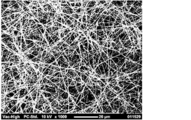
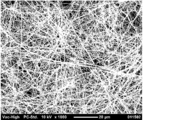
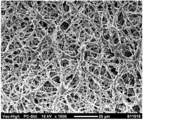
- FIG. 3 is a scanning electron micrograph of the nonwoven fabric of Example 1.
- 4 is a scanning electron micrograph of the nonwoven fabric of Example 2.
- 6 is a scanning electron micrograph of the nonwoven fabric of Comparative Example 1.
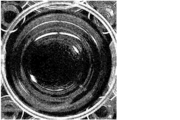
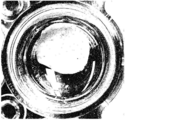
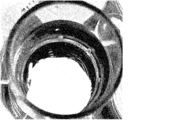
- 4 is a photograph (immediately after immersion) showing a state of decomposition of the nonwoven fabric of Example 1 at 37 ° C.
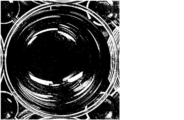
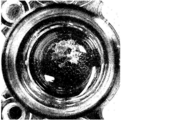
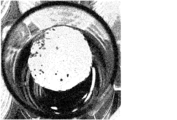
- 5 is a photograph (after 26 hours) showing a state of decomposition of the nonwoven fabric of Example 1 at 37 ° C.
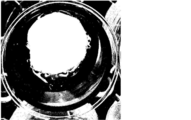
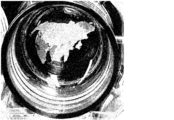
- 5 is a photograph (after 63 hours) showing the state of decomposition of the nonwoven fabric of Example 1 at 37 ° C.
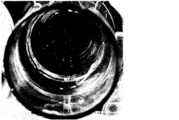
- FIGS. 5 to 13 are photographs (after 63 hours) showing the state of decomposition of the nonwoven fabric of Comparative Example 1 at 37 ° C.
- the process of decomposition for each sample shown in FIGS. 5 to 13 is summarized in one drawing.
- 5 is a photograph (immediately after immersion) showing a state of decomposition of the nonwoven fabric of Example 1 at room temperature.
- 4 is a photograph (after 11 hours) showing a state of decomposition of the nonwoven fabric of Example 1 at room temperature.
- 5 is a photograph (after 38 hours) showing the state of decomposition of the nonwoven fabric of Example 1 at room temperature.
- 5 is a photograph (immediately after immersion) showing a state of decomposition of the nonwoven fabric of Example 2 at room temperature.
- 9 is a photograph (after 11 hours) showing a state of decomposition of the nonwoven fabric of Example 2 at room temperature.
- 5 is a photograph (after 38 hours) showing a state of decomposition of the nonwoven fabric of Example 2 at room temperature.
- 5 is a photograph (immediately after immersion) showing a state of decomposition of the nonwoven fabric of Comparative Example 1 at room temperature.
- 9 is a photograph (after 11 hours) showing the state of decomposition of the nonwoven fabric of Comparative Example 1 at room temperature.
- 9 is a photograph (after 38 hours) showing a state of decomposition of the nonwoven fabric of Comparative Example 1 at room temperature.
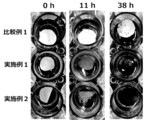
- the process of decomposition for each sample shown in FIGS. 15 to 23 is summarized in one drawing.
- FIG. 9 is a scanning electron micrograph of the nonwoven fabric of Example 3.
- 13 is a scanning electron micrograph of the nonwoven fabric of Example 4.
- 13 is a scanning electron micrograph of the nonwoven fabric of Example 5.
- 13 is a scanning electron micrograph of the nonwoven fabric of Example 6.
- 13 is a scanning electron micrograph of the nonwoven fabric of Example 7.
- 13 is a scanning electron micrograph of the nonwoven fabric of Example 8.
- 14 is a scanning electron micrograph of the nonwoven fabric of Example 9.
- 4 is a scanning electron micrograph of each nonwoven fabric produced in Test Example 1.
- FIG. 3 is a view showing the residual weight (%) of each nonwoven fabric and each cast film produced in Test Example 1 after decomposition at 37 ° C.
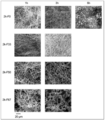
- FIG. 4 is a scanning electron micrograph of each nonwoven fabric produced in Test Example 1 after decomposition at 37 ° C.
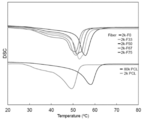
- FIG. 4 is a diagram showing the results of measuring the differential scanning calorimetry (DSC) of each nonwoven fabric produced in Test Example 1.
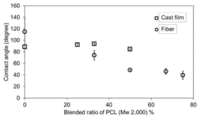
- 5 is a photograph of a water drop when one drop of water is placed on each nonwoven fabric and each cast film produced in Test Example 1. It is a figure which shows the contact angle of a water droplet when one drop of water is mounted on each nonwoven fabric and each cast film produced in Test Example 1.
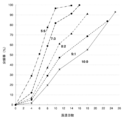
- 9 is a scanning electron microscope photograph of each nonwoven fabric produced in Test Example 2. It is a figure which shows the decomposition rate (%) at 37 degreeC of each nonwoven fabric produced in the test example 2.
- a numerical range represented by using “to” means a range including numerical values described before and after “to” as a lower limit and an upper limit.
- alkyl group includes not only an alkyl group having no substituent (unsubstituted alkyl group) but also an alkyl group having a substituent (substituted alkyl group). This is synonymous with each compound.
- (meth) acrylate represents both or either acrylate and methacrylate
- (meth) acryl represents both or either acryl and methacryl
- (meth) acryloyl represents both or both of acryloyl and methacryloyl.
- the nonwoven fabric according to the embodiment of the present invention is a nonwoven fabric made of a fiber containing an aliphatic polyester having at least two or more maximum values in the molecular weight distribution, and the fiber diameter of the fiber is 100 to 3000 nm. .
- a nonwoven fabric when a nonwoven fabric is formed by using an electrospinning method, generally, fibers spun from the composition for electrospinning are deposited on a main surface of a substrate disposed on an electrode. Is formed.
- the composition for electrospinning contains a solvent
- the fiber immediately after spinning the solvent remaining in a very small amount at the stage of being deposited on the main surface of the base material volatilizes quickly, but as the deposition of the fiber progresses, Depending on the rate of volatilization, fibers may be fused together.
- each of the constituent fibers may be simply deposited, or a part of the fibers may be fused.
- the fiber diameter of the fiber constituting the nonwoven fabric according to the embodiment of the present invention is not particularly limited as long as it is 100 to 3000 nm.
- the fiber diameter of the fiber is an average fiber diameter obtained by arithmetically averaging the widths of 10 or 100 fibers in a direction substantially perpendicular to the length direction in a scanning electron microscope observation of the nonwoven fabric. means.
- the thickness of the nonwoven fabric is not particularly limited and can be appropriately selected according to the application.
- the thickness is, for example, preferably 1 to 1000 ⁇ m, and more preferably 10 to 500 ⁇ m.
- the thickness of the nonwoven fabric means a value obtained by measuring the thickness of three points of a circular nonwoven fabric having a diameter of about 1.2 cm using a micrometer and arithmetically averaging the values.
- the mass per unit area of the nonwoven fabric is not particularly limited, and can be appropriately selected depending on the application.
- the nonwoven fabric according to the embodiment of the present invention is formed from fibers.
- the fiber diameter of the fiber is 100 to 3000 nm as measured by a predetermined method.
- the fiber contains an aliphatic polyester having a predetermined molecular weight distribution.
- the aliphatic polyester include polyglycolic acid such as poly ( ⁇ -hydroxy acid); poly ( ⁇ -hydroxyalkanoate) such as poly ( ⁇ -caprolactone) and poly ( ⁇ -propiolactone); -3-hydroxypropionate, poly-3-hydroxybutyrate, poly-3-hydroxycaprolate, poly-3-hydroxyheptanoate, poly-3-hydroxyoctanoate; and the like.
- Copolymers of these with poly-3-hydroxyvalerate or poly-4-hydroxybutyrate can also be used, and specifically, poly ( ⁇ -hydroxyalkanoate), polylactic acid, or polylactic acid A lactic acid copolymer can be mentioned.
- a condensation polymer of glycol and dicarboxylic acid can also be used.
- polyethylene oxalate, polyethylene succinate, polyethylene adipate, polyethylene azelate, polybutylene oxalate, polybutylene succinate, polybutylene sebacate examples include polyhexamethylene sebacate, polyneopentyl oxalate, and copolymers thereof.
- Copolycondensation polymers of the above aliphatic polyesters and aliphatic polyamides such as aliphatic polyesteramide copolymers can be used.
- polycapramid nylon 6
- polytetramethylene adipamide nylon 46
- Polyhexamethylene adipamide nylon 66
- polyundecanamide nylon 11
- polylaurolactamide nylon 12
- polymerization initiator of the aliphatic polyester those using any diol, hydroxy acid, dicarboxylic acid or the like can be used.
- poly ( ⁇ -caprolactone) using propylene glycol or diethylene glycol as a polymerization initiator can be used.
- examples include polylactic acid dicarboxylic acid using diol or fumaric acid as a polymerization initiator.
- a polymer having a repeating unit represented by the following formula (1) or (2) is preferable in that a nonwoven fabric having more excellent effects of the present invention can be obtained.
- a polymer comprising a repeating unit represented by (1) or (2) is more preferred.
- L represents an alkylene group which may have a branched structure (preferably having 1 to 20 carbon atoms) or an alkenylene group which may have a branched structure (which has carbon atoms) And preferably an alkylene group which may have a branched structure.
- R represents an alkylene group optionally having a branched structure (preferably having 1 to 20 carbon atoms) or an alkenylene group optionally having a branched structure (preferably having 1 to 20 carbon atoms). And may have a branched structure, and an alkylene group is more preferable. Further, the structure may have an ester bond, an amide bond, an ether bond, or the like.
- the melting point of the crystals of the aliphatic polyester is not particularly limited, but is preferably 250 ° C or lower, more preferably 180 ° C or lower, and still more preferably 100 ° C or lower, in that a nonwoven fabric having the superior effects of the present invention can be obtained. 70 ° C. or lower is particularly preferred. The lower limit is not particularly limited, but generally 30 ° C. or higher is preferred.
- the melting point of the aliphatic polyester crystal means a melting point measured by a differential scanning calorimeter (DSC).
- the aliphatic polyester has at least two or more maximum values in the molecular weight distribution.
- the molecular weight distribution means a molecular weight distribution obtained by comparison with standard polyethylene glycol / polyethylene oxide using gel permeation chromatography (GPC) and using THF as a mobile phase.
- the aliphatic polyester contained in the fiber has at least two or more maximum values in the molecular weight distribution, and the values of the respective maximum values (peaks of the molecular weight distribution) are different.
- the aliphatic polyester since the aliphatic polyester has two or more peaks (maximum values), the peak with the lowest molecular weight (hereinafter also referred to as “peak A”) and the peak with the highest molecular weight (hereinafter “peak B”) ).
- the nonwoven fabric according to the embodiment of the present invention has excellent biodegradability.
- the relatively high molecular weight component constituting the peak B of the aliphatic polyester improves the mechanical properties of the nonwoven fabric.
- the molecular weight at the peak A is not particularly limited, a number average molecular weight of, for example, 1,000 to 10,000 can be used from the viewpoint that a nonwoven fabric having better biodegradability is obtained.
- the lower limit may be 1500 or more, 2000 or more, and 2500 or more.
- the upper limit may be 9000 or less, 8000 or less, 7000 or less, 6000 or less, 5000 or less, 4000 or less, 3000 or less.
- the molecular weight at the peak B is not particularly limited, but a number average molecular weight of, for example, 30,000 to 200,000 can be used in that a nonwoven fabric having more excellent mechanical strength is obtained.
- the upper limit may be 190000 or less, 180,000 or less, 170,000 or less, 160,000 or less, 150,000 or less, 140,000 or less, 130,000 or less, 120,000 or less, or 110000 or less.
- the lower limit may be 40,000 or more, 50,000 or more, 60,000 or more, 70,000 or more, 80,000 or more.
- the content of the aliphatic polyester in the fiber is not particularly limited, but more biodegradable, and, in terms of obtaining a nonwoven fabric having better biocompatibility, 0.01 wt. It is preferably from 100 to 100% by mass.
- the fiber may contain a polymer other than the aliphatic polyester, but is preferably substantially free of a polymer other than the aliphatic polyester in that a nonwoven fabric having more excellent biodegradability can be obtained.
- the fiber does not substantially contain a polymer other than the aliphatic polyester, the fiber does not contain a polymer other than the aliphatic polyester, or the content of the aliphatic polyester in the fiber is 0 with respect to the total mass of the fiber. 0.01% by mass.
- the mechanism is not clear in detail, but the nonwoven fabric has better biodegradability.
- the nonwoven fabric is obtained by electrospinning a composition containing an aliphatic polyester having a different maximum value in the molecular weight distribution.
- the composition preferably contains the component having the lowest peak A on the lower molecular weight side (low molecular weight component) and the component having the highest peak B on the higher molecular weight side (high molecular weight component). preferable.
- the content mass ratio of the content of the low molecular weight component to the sum of the contents of the low molecular weight component and the high molecular weight component (hereinafter, “A / A + B) is not particularly limited, but the lower limit is 0.01 or more, 0.02 or more, 0.03 or more, 0.04 or more, 0.05 or more, 0.06 or more, 0.07. Above, 0.08 or more, 0.09 or more, and 0.10 or more are preferable.
- the upper limit is preferably 0.80 or less, more preferably 0.75 or less, and even more preferably less than 0.75.
- the upper limit may be 0.60 or less, 0.50 or less, 0.40 or less, 0.30 or less, 0.20 or less.
- a / A + B is less than 0.75, the nonwoven fabric has better uniformity (in other words, uniformity of fiber width). Note that A / A + B is obtained as a number up to the second decimal place by rounding off the third decimal place.
- the fiber may contain other components other than the above.
- Other components include, for example, drugs.
- the drug can be released into the living body with the decomposition of the nonwoven fabric.
- the drug-containing nonwoven fabric can be made to have such a property that the shape of the nonwoven fabric is maintained in a living body for a desired period of time and completely decomposed after a desired period of time.
- the period for maintaining the shape of the nonwoven fabric in a living body may be, for example, about 1 month, about 2 months, about 3 months, about 4 months, about 5 months, or about 6 months.
- the drug is not particularly limited, a drug for treating nerve damage, an anticancer drug, an immunosuppressant, an antibiotic, an antirheumatic drug, an antithrombotic drug, an HMG-CoA reductase inhibitor, an ACE inhibitor, an angiotensin II receptor Antagonist, NO donor, calcium antagonist, antihyperlipidemic, anti-inflammatory, integrin inhibitor, antiallergic, antioxidant, GPIIbIIIa antagonist, retinoid, flavonoid, carotenoid, lipid improving drug, DNA synthesis Inhibitors, tyrosine kinase inhibitors, antiplatelet agents, vascular smooth muscle growth inhibitors, angiographic agents, interferons, growth factors, combinations thereof, and the like.
- the fiber may contain one kind of the drug alone or may contain two or more kinds in combination.
- Vitamin B12 includes cobalamin and its derivatives. Specific examples include methylcobalamin, cyanocobalamin, hydroxocobalamin, sulfitocobalamin, adenosylcobalamin, and salts thereof. Among them, methylcobalamin, cyanocobalamin, hydroxocobalamin or a salt thereof is preferable, and methylcobalamin or a salt thereof is more preferable.
- the content of vitamin B12 can be, for example, about 1% to about 30% as a final concentration, and preferably about 2% to about 10%. Can be.
- Nonwoven fabric manufacturing method The method for producing the nonwoven fabric according to the embodiment of the present invention is not particularly limited, and a known method can be used.
- Known methods include, for example, electrospinning (electrospinning), melt spinning, self-assembly, template synthesis, electroblowing, and force spinning.
- the electrospinning method is preferred from the viewpoint that a nonwoven fabric having more excellent effects of the present invention can be obtained.
- a fiber is obtained by applying a high voltage to the composition for electrospinning and charging, and a nonwoven fabric can be obtained by depositing the fibers.
- a method of charging the composition for electrospinning it is preferable to connect an electrode connected to a high-voltage power supply to the composition for electrospinning itself or a container, and to apply a voltage of typically 1 to 100 kV. More preferably, a voltage of 5 to 50 kV is applied.
- the type of voltage may be either DC or AC.
- the temperature at the time of electrospinning is not particularly limited, but when a nonwoven fabric is produced using an electrospinning composition containing a solvent as described below, the boiling point of the solvent contained in the electrospinning composition, and volatilization What is necessary is just to adjust suitably according to property. In one embodiment, 10 to 30 ° C. is preferable.
- the electrospinning apparatus 100 has a discharge device 101 and a target electrode 102 arranged to face the discharge device 101.
- the discharging device 101 is configured to discharge the composition for electrospinning.
- the voltage is applied between the discharging device 101 and the target electrode 102 using the voltage application device 103, and the composition for electrospinning is discharged from the discharging device 101.
- the fibers 104 are formed while the composition for electrospinning moves from the ejection device 101 to the space between the target electrodes 102, and are deposited on the target electrode 102. As a result, a nonwoven fabric 105 is obtained.
- An aliphatic polyester having two or more maximum values in the molecular weight distribution can be typically obtained by mixing aliphatic polyesters having different maximum values.
- the aliphatic polyester having the peak A and the peak B and the same kind of the aliphatic polyester having the peak B can be mixed to obtain the aliphatic polyester having the peak A and the peak B.
- the composition for electrospinning contains an aliphatic polyester having a peak A (low molecular weight component) and the same kind of aliphatic polyester having a peak B (high molecular weight component), the low molecular weight in the composition for electrospinning
- the upper limit of the content ratio (A / A + B) of the content of the low molecular weight component to the total content of the components and the high molecular weight component is not particularly limited, but is preferably 0.80 or less. It is more preferably at most 75, more preferably less than 0.75.
- a / A + B is within the above numerical range, a nonwoven fabric having more excellent uniformity can be obtained.
- the lower limit of A / A + B is not particularly limited, and may be 0.01 or more, 0.02 or more, 0.03 or more, or 0.04 or more. From the viewpoint of obtaining a more excellent nonwoven fabric having the effects of the present invention, 0.05 or more, 0.06 or more, 0.07 or more, 0.08 or more, 0.09 or more, and 0.10 or more are preferable.
- the content of the aliphatic polyester in the composition for electrospinning is not particularly limited, but in terms of obtaining a nonwoven fabric having more excellent effects of the present invention, 0.1 to the total mass of the composition for electrospinning. Preferably it is 50% by mass, more preferably 1% to 30% by mass.
- the composition for electrospinning preferably contains a solvent.
- the solvent is not particularly limited, examples of the solvent include acetone, chloroform, ethanol, isopropanol, methanol, toluene, tetrahydrofuran, water, benzene, benzyl alcohol, 1,4-dioxane, propanol, carbon tetrachloride, cyclohexane, and cyclohexanone.
- the content of the solvent in the composition for electrospinning is not particularly limited, but is preferably adjusted so that the solid content of the composition for electrospinning is 0.1 to 30% by mass, and 1 to 20% by mass. More preferably, it is adjusted so that
- the composition for electrospinning may contain an aliphatic polyester and other components other than the solvent.
- Other components include the drugs already described.
- the content of the drug in the composition for electrospinning is not particularly limited, but is preferably 0.1 to 30% by mass relative to the total solid content of the composition for electrospinning.
- the nonwoven fabric according to the embodiment of the present invention Since the nonwoven fabric according to the embodiment of the present invention has excellent biodegradability, it can be used, for example, as a scaffold for tissue regeneration.
- a nonwoven fabric according to an embodiment of the present invention is implanted into a patient's body to allow cells to proliferate and differentiate to construct a three-dimensional living tissue-like structure, and cells are removed from surrounding tissues or organs.
- the present invention can be applied to a method of regenerating a tissue or an organ by invading into a nonwoven fabric and causing it to multiply and differentiate.
- the nonwoven fabric allows body fluids to penetrate from its surface, but causes scarring of the tissue.
- the method can be applied to a method of protecting a tissue from damage to inflammatory cells by preventing infiltration of inflammatory cells such as macrophages.
- PCL (A) Polycaprolactone having a number average molecular weight of 2000 as measured by gel permeation chromatography
- PCL (B) polycaprolactone having a number average molecular weight of 80000 as measured by gel permeation chromatography
- the PCL (A) and PCL (B) were dissolved in 1,1,1,3,3,3-hexafluoro-2-propanol (HFIP) to prepare a composition for electrospinning.
- HFIP 1,1,1,3,3,3-hexafluoro-2-propanol
- composition for electrospinning was spun using the electrospinning apparatus shown in FIG. 1 to produce a sheet-like nonwoven fabric.
- FIG. 2 shows a scanning electron micrograph of the obtained nonwoven fabric. From FIG. 2, it was found that the fiber diameter of the fiber constituting the nonwoven fabric was 1136 ⁇ 39 nm. In the above-mentioned fiber diameter, 100 fibers were randomly extracted from one visual field in a scanning electron microscope image of 1000 times, and the width (diameter) was obtained by “Image J (software)”.
- Example 2 The content of PCL (A) in the composition for electrospinning was 10% by mass based on the total mass of the composition for electrospinning, and the content of PCL (B) was 5% based on the total mass of the composition for electrospinning.
- a composition for electrospinning was prepared and spun to produce a sheet-like nonwoven fabric in the same manner as in Example 1, except that the mass% and the remainder were HFIP.
- FIG. 3 shows a scanning electron micrograph of the obtained nonwoven fabric. From FIG. 3, it was found that the fiber diameter of the fiber constituting the nonwoven fabric was 2774 ⁇ 174 nm.
- FIGS. 5 to 7 are photographs showing the state of decomposition of the nonwoven fabric of Example 1 at 37 ° C.
- FIG. 5 is a photograph showing a state immediately after immersing the nonwoven fabric of Example 1 in an aqueous NaOH solution.
- FIG. 6 is a photograph showing a state where the nonwoven fabric of Example 1 was immersed in an aqueous NaOH solution and 26 hours had elapsed.
- FIG. 7 is a photograph showing a state in which the nonwoven fabric of Example 1 was immersed in an aqueous NaOH solution and 63 hours had elapsed.
- the nonwoven fabric according to Example 1 had already been sufficiently degraded at 37 ° C. after 26 hours had passed, indicating that it had excellent biodegradability.
- FIG. 8 to 10 are photographs showing the state of decomposition of the nonwoven fabric of Example 2 at 37 ° C.
- FIG. 8 is a photograph showing a state immediately after immersing the nonwoven fabric of Example 2 in an aqueous NaOH solution.
- FIG. 9 is a photograph showing a state where the nonwoven fabric of Example 2 was immersed in an aqueous NaOH solution and 26 hours had elapsed.
- FIG. 10 is a photograph showing a state in which the nonwoven fabric of Example 2 was immersed in an aqueous NaOH solution and 63 hours had elapsed. 8 to 10, it was found that the nonwoven fabric according to Example 2 had already been sufficiently degraded at 37 ° C. after 26 hours, and had excellent biodegradability.
- FIGS. 11 to 13 are photographs showing the state of decomposition of the nonwoven fabric of Comparative Example 1 at 37 ° C.
- FIG. 11 is a photograph showing a state immediately after immersing the nonwoven fabric of Comparative Example 1 in an aqueous NaOH solution.
- FIG. 12 is a photograph showing a state where the nonwoven fabric of Comparative Example 1 was immersed in an aqueous NaOH solution and 26 hours had elapsed.
- FIG. 13 is a photograph showing a state in which the nonwoven fabric of Comparative Example 1 was immersed in an aqueous NaOH solution and 63 hours had elapsed. According to FIGS. 11 to 13, it was found that the nonwoven fabric according to Comparative Example 1 was not sufficiently decomposed even after 63 hours at 37 ° C., and the biodegradability was insufficient.
- FIG. 15 to 17 are photographs showing the state of decomposition of the nonwoven fabric of Example 1 at room temperature.
- FIG. 15 is a photograph showing a state immediately after immersing the nonwoven fabric of Example 1 in an aqueous NaOH solution.
- FIG. 16 is a photograph showing a state where the nonwoven fabric of Example 1 was immersed in an aqueous solution of NaOH and 11 hours had elapsed.
- FIG. 17 is a photograph showing a state in which the nonwoven fabric of Example 1 was immersed in an aqueous solution of NaOH and 38 hours had elapsed. 15 to 17, it was found that the nonwoven fabric according to Example 1 had sufficient biodegradability even at room temperature, but was not completely degraded after 38 hours.
- FIG. 18 to 20 are photographs showing the state of decomposition of the nonwoven fabric of Example 2 at room temperature.
- FIG. 18 is a photograph showing a state immediately after immersing the nonwoven fabric of Example 2 in an aqueous NaOH solution.
- FIG. 19 is a photograph showing a state in which the nonwoven fabric of Example 2 was immersed in an aqueous NaOH solution and 11 hours had passed.
- FIG. 20 is a photograph showing a state in which the nonwoven fabric of Example 2 was immersed in an aqueous solution of NaOH and elapsed for 38 hours. 18 to 20, it was found that the nonwoven fabric according to Example 2 had sufficient biodegradability even at room temperature, and was almost completely decomposed after 38 hours.
- FIG. 24 shows the process of decomposition for each sample shown in FIGS. 15 to 23 in one drawing. From the above results, it was found that the nonwoven fabrics of Example 1 and Example 2 had excellent biodegradability even at room temperature. In comparison with Example 1, Example 2 was found to have better biodegradability at room temperature. On the other hand, the nonwoven fabric of Comparative Example 1 did not have the desired effect of the present invention.
- Examples 3 to 9 A non-woven fabric was prepared in the same manner as in Example 1 except that the composition for electrospinning used had the composition shown in Table 1 and was electrospun under the conditions shown in Table 1. Scanning electron micrographs of each nonwoven fabric are shown in FIGS.
- the nonwoven fabrics according to Examples 3 to 9 also have the excellent biodegradability desired in the present application.
- HFIP 1,1,1,3,3,3-hexafluoro-2-propanol
- each composition for electrospinning in Table 2 was spun using the electrospinning apparatus shown in FIG. 1 to produce a sheet-like nonwoven fabric.
- a syringe (22G) was used for the ejection device, the distance from the syringe to the target electrode was 13 cm, and the ejection speed was 1.0 mL / h.
- the applied voltage was 20 kV.
- FIG. 32 shows a scanning electron micrograph of the obtained nonwoven fabric.
- 2k-F0 containing only 80 kPCL
- a smooth fiber structure was formed.
- the ratio of 2kPCL was larger than 75 w / w% (2k-F75, 2k-F80)
- beaded fibers were observed.
- the fiber diameter increased as the ratio of 2kPCL increased (2K-F33: 600 ⁇ 242 nm, 2k-F50: 1136 ⁇ 39 nm, 2k-F67: 2774 ⁇ 174 nm).
- the ratio of 2 kPCL was 100 w / w%, droplets were formed, and no fiber structure was formed.
- FIG. 33 shows the residual weight (%) of the cast film and the nonwoven fabric.
- (A) is the result of the cast film
- (B) is the result of the nonwoven fabric.
- the cast film showed less than 10% weight loss at 16 hours, regardless of sample composition.
- the nonwoven fabric containing 2kPCL (2k-F33, 2k-F50, 2k-F67) decomposed 100% in 6 hours. This is because the fibers have higher porosity and surface area. Degradation was accelerated as the proportion of 2kPCL was increased.
- DSC Differential scanning calorimetry
- FIG. 36 A photograph of the water droplet is shown in FIG. 36, and the measured contact angle is shown in FIG.
- the hydrophilicity increased and the contact angle decreased as the ratio of 2 kPCL increased.
- the contact angle was almost the same value (about 89 °).
- TFE trifluoroethanol
- Each of the prepared compositions for electrospinning was spun using the electrospinning apparatus shown in FIG. At this time, a needle (27G) was used for the ejection device, the distance from the needle to the target electrode was 17 cm, and the ejection speed was 0.5 mL / h. The applied voltage was 30 kV.
- FIG. 38 shows a scanning electron micrograph of the prepared nonwoven fabric. About the nonwoven fabric of each composition, ten fiber diameters were measured from the electron micrograph, and the average fiber diameter was calculated as follows. [10: 0] 991.2 nm [9: 1] 963.7 nm [8: 2] 1083.5 nm [7: 3] 949.2 nm [5: 5] 1157.0 nm
- FIG. 39 shows the decomposition rate (%) of the nonwoven fabric.
- the ratio of "8: 2" or “9: 1" having a low ratio of 2.7 kPCLdiol is increased by increasing the immersion time, and can be completely decomposed by further increasing the immersion time. Can be inferred. Therefore, by adjusting the ratio between the two, it is possible to maintain the form of the nonwoven fabric in a living body for a desired period of time and to manufacture a nonwoven fabric that is completely decomposed after a desired period of time.
Landscapes
- Engineering & Computer Science (AREA)
- Textile Engineering (AREA)
- Chemical & Material Sciences (AREA)
- Chemical Kinetics & Catalysis (AREA)
- General Chemical & Material Sciences (AREA)
- Health & Medical Sciences (AREA)
- Mechanical Engineering (AREA)
- Medicinal Chemistry (AREA)
- Polymers & Plastics (AREA)
- Organic Chemistry (AREA)
- Nonwoven Fabrics (AREA)
- Spinning Methods And Devices For Manufacturing Artificial Fibers (AREA)
- Artificial Filaments (AREA)
Abstract
Description
特許文献1には、「生分解性ポリマーの長繊維からなり且つ嵩密度が150から200kg/m3である繊維構造体層(A)と、生分解性ポリマーの長繊維からなり且つ嵩密度が5から30kg/m3である繊維構造体層(B)とが連続的に複合化された構造からなる長繊維不織布の複数枚を、部分的に熱融着して積層してなる積層不織布。」が記載されている。
また、本発明は、不織布の製造方法、及び、電界紡糸用組成物を提供することも課題とする。
[2] 上記脂肪族ポリエステルが、分子量1500~7000の領域に上記極大値を有する、[1]に記載の不織布。
[3] 上記脂肪族ポリエステルが、分子量40000~90000の領域に上記極大値を有する、[1]又は[2]に記載の不織布。
[4] 上記脂肪族ポリエステルが、分子量40000~150000の領域に上記極大値を有する、[1]又は[2]に記載の不織布。
[5] 上記脂肪族ポリエステル以外の高分子を実質的に含有しない、[1]~[4]のいずれかに記載の不織布。
[6] 分子量分布において、それぞれ異なる極大値を有する脂肪族ポリエステルを含有する組成物を電界紡糸してなる[1]~[5]のいずれかに記載の不織布。
[7] 前記組成物中に含有される脂肪族ポリエステルのうち、最も低分子量側の極大値を有する前記脂肪族ポリエステルを低分子量成分とし、最も高分子量側の極大値を有する前記脂肪族ポリエステルを高分子量成分としたとき、前記組成物中における低分子量成分の含有量と高分子量成分の含有量の和に対する、低分子量成分の含有量の含有質量比が、0.33を超え、0.75未満である、[6]に記載の不織布。
[8] 前記組成物中に含有される脂肪族ポリエステルのうち、最も低分子量側の極大値を有する前記脂肪族ポリエステルを低分子量成分とし、最も高分子量側の極大値を有する前記脂肪族ポリエステルを高分子量成分としたとき、前記組成物中における低分子量成分の含有量と高分子量成分の含有量の和に対する、低分子量成分の含有量の含有質量比が、0.05以上、0.75未満である、[6]に記載の不織布。
[9] 前記組成物中に含有される脂肪族ポリエステルのうち、最も低分子量側の極大値を有する前記脂肪族ポリエステルを低分子量成分とし、最も高分子量側の極大値を有する前記脂肪族ポリエステルを高分子量成分としたとき、前記組成物中における低分子量成分の含有量と高分子量成分の含有量の和に対する、低分子量成分の含有量の含有質量比が、0.1以上、0.25未満である、[6]に記載の不織布。
[10] 更に、薬剤を含有する、[1]~[9]のいずれかに記載の不織布。
[11] 分子量分布において、少なくとも2つ以上の極大値を有する脂肪族ポリエステルと、溶媒と、を含有する組成物を電界紡糸して、上記脂肪族ポリエステルを含有する線維径100~3000nmの繊維からなる不織布を得る工程を有する、不織布の製造方法。
[12]分子量分布において、それぞれ異なる極大値を有する脂肪族ポリエステルと、上記溶媒と、を混合して上記組成物を得る工程を有する、[11]に記載の不織布の製造方法。
[13] 分子量分布において、少なくとも2つ以上の極大値を有する脂肪族ポリエステルと、溶媒と、を含有する電界紡糸用組成物。
以下に記載する構成要件の説明は、本発明の代表的な実施形態に基づいてなされることがあるが、本発明はそのような実施形態に制限されるものではない。
なお、本明細書において、「~」を用いて表される数値範囲は、「~」の前後に記載される数値を下限値及び上限値として含む範囲を意味する。
また、本明細書において、「(メタ)アクリレート」はアクリレート及びメタクリレートの双方、又は、いずれかを表し、「(メタ)アクリル」はアクリル及びメタクリルの双方、又は、いずれかを表す。また、「(メタ)アクリロイル」はアクリロイル及びメタクリロイルの双方、又は、いずれかを表す。
本発明の実施形態に係る不織布は、分子量分布において、少なくとも2つ以上の極大値を有する脂肪族ポリエステルを含有する繊維からなる不織布であって、繊維の繊維径が100~3000nmである不織布である。
電界紡糸用組成物が溶媒を含有する場合、紡糸直後の繊維は、基材の主面に堆積した段階で極少量残存していた溶媒が速やかに揮発していくが、繊維の堆積が進むと揮発速度との関係で、繊維同士が融着することがある。
本発明の実施形態に係る不織布としては、構成する繊維のそれぞれは単に堆積されたものであってもよいし、その一部が融着されたものであってもよい。
本明細書において、繊維の繊維径とは、不織布の走査型電子顕微鏡観察において、10本又は100本の繊維の長さ方向に略垂直な方向の幅を算術平均して求められる平均繊維径を意味する。
本発明の実施形態に係る不織布は、繊維から形成される。上記繊維の繊維径は、すでに説明したとおり、所定の方法により測定した繊維径が100~3000nmである。
上記繊維は、所定の分子量分布を有する脂肪族ポリエステルを含有する。
脂肪族ポリエステルとしては、例えば、ポリ(α-ヒドロキシ酸)等のポリグリコール酸;ポリ(ε-カプロラクトン)、及び、ポリ(β-プロピオラクトン)等のポリ(ω-ヒドロキシアルカノエート);ポリ-3-ヒドロキシプロピオネート、ポリ-3-ヒドロキシブチレート、ポリ-3-ヒドロキシカプロレート、ポリ-3-ヒドロキシヘプタノエート、及び、ポリ-3-ヒドロキシオクタノエート;等が挙げられる。


なお、本明細書において、脂肪族ポリエステルの結晶の融点は、示差走査熱量計(DSC)によって測定される融点を意味する。
言い換えれば、上記脂肪族ポリエステルは、2つ以上のピーク(極大値)を有するため、最も低分子量側のピーク(以下「ピークA」ともいう。)と最も高分子量側のピーク(以下「ピークB」ともいう。)の少なくとも2つを有する。
一方、脂肪族ポリエステルのピークBを構成する比較的高分子量の成分は、不織布の力学特性を向上する。
本発明の実施形態に係る不織布は、低分子量の成分、及び、高分子量の成分を含有する脂肪族ポリエステルからなる繊維により構成されており、低分子量成分の少なくとも一部は、上記のとおり繊維表面に局在化し、このため、表面から繊維(不織布)分解がより起こりやすくなるものと推測される。
特に、本発明の実施形態に係る不織布は、微小径の繊維により形成され繊維構造由来の大きな表面積を有するため、上記の効果は顕著である。
このように、本発明の実施形態に係る不織布は、繊維の表面積の大きさ、低分子量成分による繊維表面からの分解のされやすさ、及び、結晶化度の低下による繊維全体の分解のされやすさ、という要因の相乗効果により、これまでにない優れた生分解性を有するものと推測される。
一方、ピークBにおける分子量としては特に制限されないが、より優れた力学強度を有する不織布が得られる点で、数平均分子量として、例えば30000~200000を使用することができる。上限は190000以下、180000以下、170000以下、160000以下、150000以下、140000以下、130000以下、120000以下、110000以下であってもよい。下限は、40000以上、50000以上、60000以上、70000以上、80000以上であってもよい。
脂肪族ポリエステル以外の重合体を実質的に含有しないとは、繊維が脂肪族ポリエステル以外の重合体を含有しないか、又は、繊維中の脂肪族ポリエステルの含有量が繊維の全質量に対して0.01質量%未満であることを意味する。
また、それぞれの脂肪族ポリエステルは、分子量分布において2つ以上の極大値を有することが好ましく、その形態は、すでに説明したとおりである。
このとき、上記組成物は、すでに説明した最も低分子量側のピークAを有する成分(低分子量成分)と、最も高分子量側のピークBを有する成分(高分子量成分)とを含有することがより好ましい。
A/A+Bが0.75未満であると、不織布はより優れた均一性(言い換えれば繊維幅の均一性)を有する。
なお、A/A+Bは小数第3位を四捨五入して小数第2位までの数として求めるものとする。
繊維は上記以外の他の成分を含有していてもよい。他の成分としては、例えば、薬剤が挙げられる。薬剤を含有する不織布は、生体内に留置して、又は、体内に挿入して使用するような医療デバイスに適用した際、不織布の分解に伴って、薬剤を生体内に放出することができる。このような医療デバイスに適用する場合、薬剤を含有する不織布は、生体内で所望の期間不織布の形状を維持し、所望の期間経過後に完全に分解されるといった性状のものにすることができる。生体内で不織布の形状を維持する期間としては、例えば、約1か月、約2か月、約3か月、約4か月、約5か月、約6か月であってもよい。生体内で完全に分解されるまでの期間としては、例えば、約6か月、約7か月、約8か月、約9か月、約10か月、約11か月、約12か月であってもよい。使用する薬剤やその用途に応じて、低分子量成分と高分子量成分の割合は適宜変更することができる。
一方、薬剤の放出期間が長期間であることを所望する場合は、「A/A+B」としては特に制限されないが、0.01以上、0.02以上、0.03以上、0.04以上、0.05以上、0.06以上、0.07以上、0.08以上、0.09以上が好ましく、0.10以上0.25未満がより好ましい。A/A+Bが0.10以上0.25未満であると、不織布に含有された薬剤が長期間にわたって放出され、なおかつ不織布はより優れた均一性(言い換えれば繊維幅の均一性)を有する。
繊維は薬剤の1種を単独で含有してもよく、2種以上を併せて含有していてもよい。
本発明の実施形態に係る不織布の製造方法としては特に制限されず、公知の方法が使用できる。公知の方法としては、例えば、エレクトロスピニング(電界紡糸)法、メルトスピニング法、自己組織化法、鋳型合成法、エレクトロブロー法、及び、フォーススピニング(forcespinning)法等が挙げられる。なかでも、より優れた本発明の効果を有する不織布が得られる点で、電界紡糸法が好ましい。
電圧の種類としては、直流又は交流のいずれであってもよい。
本発明の実施形態に係る不織布を電界紡糸法により製造する場合に使用可能な電界紡糸用組成物としては特に制限されないが、より優れた本発明の効果を有する不織布が得られる点で、分子量分布において少なくとも2つ以上の極大値を有する脂肪族ポリエステルと、溶媒とを含有することが好ましい。
電界紡糸用組成物が含有する脂肪族ポリエステルとしては、分子量分布において2つ以上の極大値を有していればよく、その形態としては、不織布を構成する繊維が含有する脂肪族ポリエステルとしてすでに説明したものと同様である。
言い換えれば、ピークAを有する脂肪族ポリエステルと、ピークBを有する同一種類の脂肪族ポリエステルとを混合して、ピークAとピークBとを有する脂肪族ポリエステルを得ることができる。
A/A+Bの下限としては特に制限されず、0.01以上、0.02以上、0.03以上、0.04以上であってもよい。より優れた本発明の効果を有する不織布が得られる点で、0.05以上、0.06以上、0.07以上、0.08以上、0.09以上、0.10以上が好ましい。
電界紡糸用組成物は溶媒を含有することが好ましい。溶媒としては特に制限されないが、溶媒としては、例えば、アセトン、クロロホルム、エタノール、イソプロパノール、メタノール、トルエン、テトラヒドロフラン、水、ベンゼン、ベンジルアルコール、1,4‐ジオキサン、プロパノール、四塩化炭素、シクロヘキサン、シクロヘキサノン、ジクロロメタン、フェノール、ピリジン、トリクロロエタン、酢酸、N,N‐ジメチルホルムアミド(DMF)、ジメチルスルホキシド(DMSO)、N,N‐ジメチルアセトアミド(DMAc)、1‐メチル‐2‐ピロリドン(NMP)、炭酸エチレン(EC)、炭酸プロピレン(PC)、炭酸ジメチル(DMC)、アセトニトリル(AN)、N‐メチルモルホリン‐N‐オキシド、炭酸ブチレン(BC)、1,4‐ブチロラクトン(BL)、炭酸ジエチル(DEC)、ジエチルエーテル(DEE)、1,2‐ジメトキシエタン(DME)、1,3‐ジメチル‐2‐イミダゾリジノン(DMI)、1,3‐ジオキソラン(DOL)、炭酸エチルメチル(EMC)、ギ酸メチル(MF)、3‐メチルオキサゾリジン‐2‐オン(MO)、プロピオン酸メチル(MP)、2‐メチルテトラヒドロフラン(MeTHF)、スルホラン(SL)、トリフルオロエタノール(TFE)、1,1,1,3,3,3‐ヘキサフルオロ‐2‐プロパノール(HFIP)、キシレン、メチルシクロヘキサン、デカヒドロナフタレン(Decalin)、メチルエチルケトン(MEK)、及び、ジクロロベンゼン(DCB)等が挙げられる。溶媒は、単独で又は混合して用いることができる。
また、電気伝導度や粘度等の調整のために、各種の添加剤を用いることもできる。
電界紡糸用組成物は、脂肪族ポリエステル、及び、溶媒以外のその他の成分を含有していてもよい。その他の成分としては、すでに説明した薬剤が挙げられる。電界紡糸用組成物中の薬剤の含有量としては特に制限されないが、電界紡糸用組成物の全固形分に対して、0.1~30質量%が好ましい。
本発明の実施形態に係る不織布は優れた生分解性を有するため、例えば、組織再生用の足場材として用いることができる。再生医療において、細胞が増殖分化して三次元的な生体組織様の構造物を構築させるために、本発明の実施形態に係る不織布を患者の体内に移植し、周りの組織又は器官から細胞を不織布に侵入させ増殖分化させて組織又は器官を再生する方法等に適用できる。
一方で、本発明の実施形態に係る不織布の繊維径を細くし、不織布の単位面積当たりの質量を大きくすることで、不織布を、その表面から体液は透過させるが組織の瘢痕化の要因となるマクロファージ等の炎症性細胞は浸潤させないことで、炎症細胞の障害から組織を保護する方法等に適用することもできる。
<実施例1>
ゲル浸透クロマトグラフィー法により測定した数平均分子量が2000であるポリカプロラクトン(以下、「PCL(A)」ともいう。)と、ゲル浸透クロマトグラフィー法により測定した数平均分子量が80000であるポリカプロラクトン(以下、「PCL(B)」ともいう。)を準備した。
上記PCL(A)とPCL(B)とを1,1,1,3,3,3-ヘキサフルオロ-2-プロパノール(HFIP)に溶解させ、電界紡糸用組成物を調製した。
このとき、電界紡糸用組成物中におけるPCL(A)及びPCL(B)の含有量はそれぞれ電界紡糸用組成物の全質量に対して5質量%となるよう調製した。
なお、上記の繊維径は、1000倍の走査型電子顕微鏡像において1視野から100本の繊維を無作為に抽出し、「Image J(ソフトウェア)」によってその幅(径)を求めた。
電界紡糸用組成物中におけるPCL(A)の含有量を電界紡糸用組成物の全質量に対して10質量%、PCL(B)の含有量を電界紡糸用組成物の全質量に対して5質量%、残部をHFIPとしたことを除いては、実施例1と同様の方法により電界紡糸用組成物を調製し、紡糸してシート状の不織布を作製した。得られた不織布の走査型電子顕微鏡写真を図3に示した。図3から、不織布を構成する繊維の繊維径は、2774±174nmであることがわかった。
電界紡糸用組成物中におけるPCL(A)の含有量を0質量%とし(言い換えれば、PCL(A)を用いず)、PCL(B)の含有量を5質量%とし、残部をHFIPとしたことを除いては、実施例1と同様の方法により電界紡糸用組成物を調製し、紡糸してシート状の不織布を作製した。得られた不織布の走査型電子顕微鏡写真を図4に示した。図4から、不織布を構成する繊維の繊維径は、736±46nmであることがわかった。
調製した不織布をそれぞれ直径1.2cmの略円形に切り抜いて生分解性測定用の試料を調製した(厚みは0.030±0.000mm、質量は1.3±0.10mgだった。)。これを1.5mLのNaOH(3M)水溶液に浸漬し37℃の恒温環境下で分解の過程を観察した。
図5は、実施例1の不織布をNaOH水溶液に浸漬した直後の様子を表す写真である。図6は、実施例1の不織布をNaOH水溶液に浸漬し26時間経過した際の様子を表す写真である。図7は、実施例1の不織布をNaOH水溶液に浸漬し63時間経過した際の様子を表す写真である。
図5~7によれば、実施例1に係る不織布は、37℃においては26時間経過した時点ですでに十分に分解されており、優れた生分解性を有することがわかった。
図8は、実施例2の不織布をNaOH水溶液に浸漬した直後の様子を表す写真である。図9は、実施例2の不織布をNaOH水溶液に浸漬し26時間経過した際の様子を表す写真である。図10は、実施例2の不織布をNaOH水溶液に浸漬し63時間経過した際の様子を表す写真である。
図8~10によれば、実施例2に係る不織布は、37℃においては26時間経過した時点ですでに十分に分解されており、優れた生分解性を有することがわかった。
図11は、比較例1の不織布をNaOH水溶液に浸漬した直後の様子を表す写真である。図12は、比較例1の不織布をNaOH水溶液に浸漬し26時間経過した際の様子を表す写真である。図13は、比較例1の不織布をNaOH水溶液に浸漬し63時間経過した際の様子を表す写真である。
図11~13によれば、比較例1に係る不織布は、37℃において、63時間経過しても十分には分解されておらず、生分解性が不十分であることがわかった。
以上の結果から、実施例1及び実施例2の不織布は、優れた生分解性を有していることがわかった。一方、比較例1の不織布は、本願所望の効果を有していなかった。
調製した不織布をそれぞれ直径1.2cmの略円形に切り抜いて生分解性測定用の試料(厚み0.077±0.015mm、質量1.9±0.06mgだった。)を調製した。これを1.5mLのNaOH(3M)水溶液に浸漬し室温(25℃)での分解の過程を観察した。
図15は、実施例1の不織布をNaOH水溶液に浸漬した直後の様子を表す写真である。図16は、実施例1の不織布をNaOH水溶液に浸漬し11時間経過した際の様子を表す写真である。図17は、実施例1の不織布をNaOH水溶液に浸漬し38時間経過した際の様子を表す写真である。
図15~17によれば、実施例1に係る不織布は、室温においても十分な生分解性を有するものの、38時間経過した時点では、完全には分解されていないことがわかった。
図18は、実施例2の不織布をNaOH水溶液に浸漬した直後の様子を表す写真である。図19は、実施例2の不織布をNaOH水溶液に浸漬し11時間経過した際の様子を表す写真である。図20は、実施例2の不織布をNaOH水溶液に浸漬し38時間経過した際の様子を表す写真である。
図18~20によれば、実施例2に係る不織布は、室温においても十分な生分解性を有し、38時間経過した時点で、略完全に分解されていることがわかった。
図21は、比較例1の不織布をNaOH水溶液に浸漬した直後の様子を表す写真である。図22は、比較例1の不織布をNaOH水溶液に浸漬し11時間経過した際の様子を表す写真である。図23は、比較例1の不織布をNaOH水溶液に浸漬し38時間経過した際の様子を表す写真である。
図21~23によれば、比較例1に係る不織布は、室温において、38時間経過してもほとんど分解されておらず、生分解性が不十分であることがわかった。
以上の結果から、実施例1及び実施例2の不織布は、室温においても優れた生分解性を有していることがわかった。実施例1との比較では、実施例2は、室温におけるより優れた生分解性を有していることが分かった。
一方、比較例1の不織布は、本願所望の効果を有していなかった。
電界紡糸用組成物として、表1に記載した組成のものを使用し、表1に記載した条件で電界紡糸したことを除いては、実施例1と同様の方法で不織布を調製した。各不織布の走査型電子顕微鏡写真を図25~31に示した。
実施例3~9に係る不織布も、本願所望の優れた生分解性を有している。

ゲル浸透クロマトグラフィー法により測定した数平均分子量が2000であるポリカプロラクトン(本試験例1では「2kPCL」ともいう。)と、ゲル浸透クロマトグラフィー法により測定した数平均分子量が80000であるポリカプロラクトン(本試験例1では「80kPCL」ともいう。)を準備した。
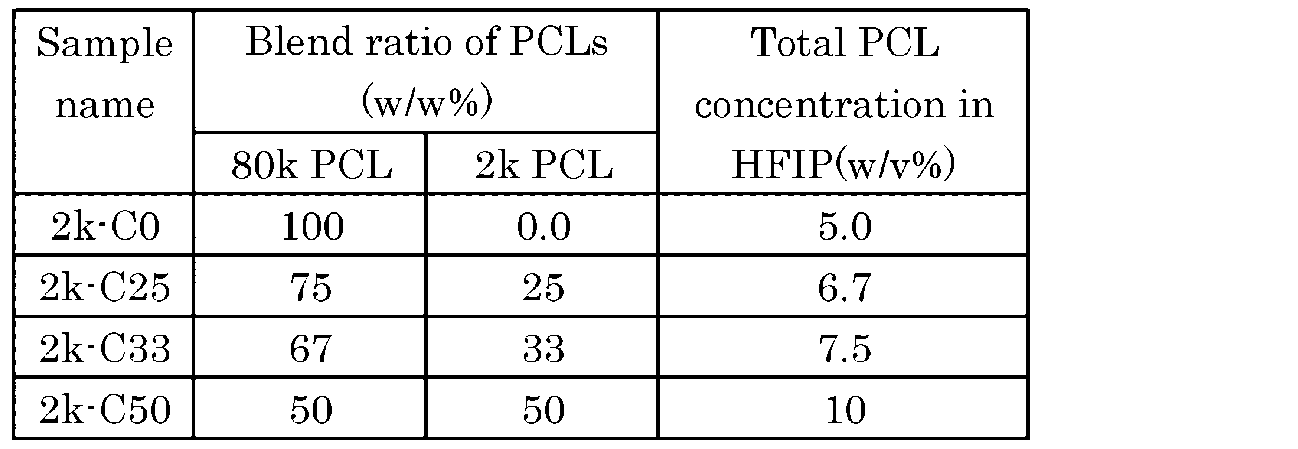
表2に記載の配合率および濃度になるように、2kPCLと80kPCLとを1,1,1,3,3,3-ヘキサフルオロ-2-プロパノール(HFIP)に溶解させ、電界紡糸用組成物を調製した。

得られた不織布の走査型電子顕微鏡写真を図32に示した。80kPCLのみを含有する2k-F0では平滑な繊維構造が形成された。一方、2kPCLの比率が75w/w%より大きい場合(2k-F75、2k-F80)はビーズ状繊維が観察された。さらに、2kPCLの比率が増加するにしたがって繊維径が増加した(2K―F33:600±242nm、2k―F50:1136±39nm、2k―F67:2774±174nm)。なお、2kPCLの比率が100w/w%の場合は液滴を形成し、繊維構造が形成されなかった。
調製した不織布を3~5mgに切断し、37℃で3MのNaOHに浸漬した。1時間後、3時間後、6時間後および16時間後にサンプルを水で2回洗浄し、次いで凍結乾燥した。乾燥した繊維およびフィルムの表面構造を走査型電子顕微鏡で観察した。残存重量(%)は、初期重量当たりのある分解時間(1時間、3時間、6時間、16時間)でのサンプル重量から計算した。比較対象のため、表3に記載の各組成物から定法に従って作製したキャストフィルム(2k-C0、2k-C25、2k-C33、2k-C50)を用いた。キャストフィルムについても不織布と同様に3~5mgに切断し、37℃で3MのNaOHに浸漬し、1時間、3時間、6時間および16時間後のサンプル重量から残存重量(%)を計算した。
作製された各不織布について、示差走査熱量(DSC:Differential scanning calorimetry)を測定した。80kPCLおよび2kPCLについても同様に示差走査熱量を測定した。
各不織布の親水性を評価するために、各不織布および各キャストフィルム上に水を1滴載置し、その接触角を測定した。
ゲル浸透クロマトグラフィー法により測定した数平均分子量が108000(n=2の平均値)であるポリカプロラクトン(本試験例2では「108kPCL」ともいう。)と、ゲル浸透クロマトグラフィー法により測定した数平均分子量が2690(n=2の平均値)であるポリカプロラクトンジオール(本試験例2では「2.7kPCLdiol」ともいう。)を準備した。

調製した不織布の走査型電子顕微鏡写真を図38に示した。各組成の不織布について、電子顕微鏡写真から、10本の繊維径を計測し、平均繊維径を以下のとおり算出した。
[10:0]991.2nm
[9:1]963.7nm
[8:2]1083.5nm
[7:3]949.2nm
[5:5]1157.0nm
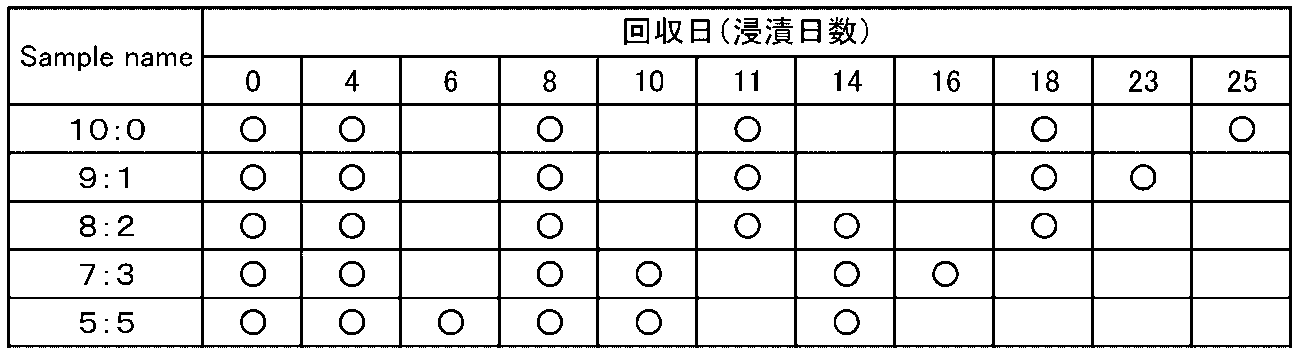
調製した不織布を2cm四方(6~8mg)に切断し、37℃で0.1M水酸化ナトリウム-生理食塩液(250mL)に浸漬した。数日おきにサンプルを回収し、水で5回洗浄し、次いで減圧、酸化リン存在下に一昼夜乾燥した。分解率(%)は、初期重量を基準にサンプル回収時のサンプル残重量から計算した。各組成の不織布のサンプル回収日を表5に示した。
Claims (13)
- 分子量分布において、少なくとも2つ以上の極大値を有する脂肪族ポリエステルを含有する繊維からなる不織布であって、
前記繊維の繊維径が100~3000nmである、不織布。 - 前記脂肪族ポリエステルが、分子量1500~7000の領域に前記極大値を有する、請求項1に記載の不織布。
- 前記脂肪族ポリエステルが、分子量40000~90000の領域に前記極大値を有する、請求項1又は2に記載の不織布。
- 前記脂肪族ポリエステルが、分子量40000~150000の領域に前記極大値を有する、請求項1又は2に記載の不織布。
- 前記脂肪族ポリエステル以外の高分子を実質的に含有しない、請求項1~4のいずれか1項に記載の不織布。
- 分子量分布において、それぞれ異なる極大値を有する脂肪族ポリエステルを含有する組成物を電界紡糸してなる請求項1~5のいずれか1項に記載の不織布。
- 前記組成物中に含有される脂肪族ポリエステルのうち、最も低分子量側の極大値を有する前記脂肪族ポリエステルを低分子量成分とし、最も高分子量側の極大値を有する前記脂肪族ポリエステルを高分子量成分としたとき、前記組成物中における低分子量成分の含有量と高分子量成分の含有量の和に対する、低分子量成分の含有量の含有質量比が、0.33を超え、0.75未満である、請求項6に記載の不織布。
- 前記組成物中に含有される脂肪族ポリエステルのうち、最も低分子量側の極大値を有する前記脂肪族ポリエステルを低分子量成分とし、最も高分子量側の極大値を有する前記脂肪族ポリエステルを高分子量成分としたとき、前記組成物中における低分子量成分の含有量と高分子量成分の含有量の和に対する、低分子量成分の含有量の含有質量比が、0.05以上、0.75未満である、請求項6に記載の不織布。
- 前記組成物中に含有される脂肪族ポリエステルのうち、最も低分子量側の極大値を有する前記脂肪族ポリエステルを低分子量成分とし、最も高分子量側の極大値を有する前記脂肪族ポリエステルを高分子量成分としたとき、前記組成物中における低分子量成分の含有量と高分子量成分の含有量の和に対する、低分子量成分の含有量の含有質量比が、0.1以上、0.25未満である、請求項6に記載の不織布。
- 更に、薬剤を含有する、請求項1~9のいずれか1項に記載の不織布。
- 分子量分布において、少なくとも2つ以上の極大値を有する脂肪族ポリエステルと、溶媒と、を含有する組成物を電界紡糸して、
前記脂肪族ポリエステルを含有する線維径100~3000nmの繊維からなる不織布を得る工程を有する、不織布の製造方法。 - 分子量分布において、それぞれ異なる極大値を有する脂肪族ポリエステルと、前記溶媒と、を混合して前記組成物を得る工程を有する、請求項11に記載の不織布の製造方法。
- 分子量分布において、少なくとも2つ以上の極大値を有する脂肪族ポリエステルと、溶媒と、を含有する電界紡糸用組成物。
Priority Applications (11)
| Application Number | Priority Date | Filing Date | Title |
|---|---|---|---|
| IL279785A IL279785B2 (en) | 2018-07-09 | 2019-07-09 | Non-woven fabric, method for its production, and compound for electrospinning |
| US17/257,043 US12252824B2 (en) | 2018-07-09 | 2019-07-09 | Nonwoven fabric, method for manufacturing same, and composition for electrospinning |
| AU2019302176A AU2019302176B2 (en) | 2018-07-09 | 2019-07-09 | Nonwoven fabric, method for manufacturing same, and composition for electrospinning |
| NZ771424A NZ771424B2 (en) | 2019-07-09 | Nonwoven fabric, method for manufacturing same, and composition for electrospinning | |
| JP2020530210A JP7391306B2 (ja) | 2018-07-09 | 2019-07-09 | 不織布、不織布の製造方法、及び、電界紡糸用組成物 |
| EP19833180.3A EP3822402A4 (en) | 2018-07-09 | 2019-07-09 | NON-WOVEN FABRIC, METHOD FOR MAKING IT AND COMPOSITION FOR ELECTROSPINNING |
| SG11202012857PA SG11202012857PA (en) | 2018-07-09 | 2019-07-09 | Nonwoven fabric, method for manufacturing same, and composition for electrospinning |
| KR1020207036059A KR102757661B1 (ko) | 2018-07-09 | 2019-07-09 | 부직포, 부직포의 제조 방법, 및 전계 방사용 조성물 |
| CA3104622A CA3104622A1 (en) | 2018-07-09 | 2019-07-09 | Nonwoven fabric, method for manufacturing same, and composition for electrospinning |
| CN201980046013.3A CN112384650A (zh) | 2018-07-09 | 2019-07-09 | 无纺布、无纺布的制造方法和静电纺丝用组合物 |
| ZA2020/07530A ZA202007530B (en) | 2018-07-09 | 2020-12-03 | Nonwoven fabric, method for manufacturing same, and composition for electrospinning |
Applications Claiming Priority (4)
| Application Number | Priority Date | Filing Date | Title |
|---|---|---|---|
| JP2018-129589 | 2018-07-09 | ||
| JP2018129589 | 2018-07-09 | ||
| JP2019076599 | 2019-04-12 | ||
| JP2019-076599 | 2019-04-12 |
Publications (2)
| Publication Number | Publication Date |
|---|---|
| WO2020013199A1 true WO2020013199A1 (ja) | 2020-01-16 |
| WO2020013199A9 WO2020013199A9 (ja) | 2020-04-16 |
Family
ID=69141748
Family Applications (1)
| Application Number | Title | Priority Date | Filing Date |
|---|---|---|---|
| PCT/JP2019/027201 Ceased WO2020013199A1 (ja) | 2018-07-09 | 2019-07-09 | 不織布、不織布の製造方法、及び、電界紡糸用組成物 |
Country Status (12)
| Country | Link |
|---|---|
| US (1) | US12252824B2 (ja) |
| EP (1) | EP3822402A4 (ja) |
| JP (1) | JP7391306B2 (ja) |
| KR (1) | KR102757661B1 (ja) |
| CN (1) | CN112384650A (ja) |
| AU (1) | AU2019302176B2 (ja) |
| CA (1) | CA3104622A1 (ja) |
| IL (1) | IL279785B2 (ja) |
| SG (1) | SG11202012857PA (ja) |
| TW (1) | TWI837148B (ja) |
| WO (1) | WO2020013199A1 (ja) |
| ZA (1) | ZA202007530B (ja) |
Cited By (4)
| Publication number | Priority date | Publication date | Assignee | Title |
|---|---|---|---|---|
| JP2021172811A (ja) * | 2020-04-24 | 2021-11-01 | 南亞塑膠工業股▲分▼有限公司Nan Ya Plastics Corporation | 多孔質癒着防止フィルムの製造方法 |
| US20230066066A1 (en) * | 2020-01-14 | 2023-03-02 | Nippon Zoki Pharmaceutical Co., Ltd. | Medical sheet |
| JP2023108999A (ja) * | 2022-01-26 | 2023-08-07 | 学校法人関西医科大学 | 抗がん剤含有シート |
| JP2026505575A (ja) * | 2023-01-31 | 2026-02-16 | ダニマー・アイピーシーオー・エルエルシー | ポリヒドロキシアルカノエート系繊維 |
Citations (6)
| Publication number | Priority date | Publication date | Assignee | Title |
|---|---|---|---|---|
| JP2004290133A (ja) * | 2003-03-28 | 2004-10-21 | Teijin Ltd | 細胞培養基材およびその製造方法 |
| JP2009507530A (ja) * | 2005-08-26 | 2009-02-26 | イーファ ユニバーシティ−インダストリー コラボレイション ファンデーション | 電界紡糸を使用した組織再生用繊維型三次元多孔性支持体及びその製造方法 |
| JP2009511092A (ja) * | 2005-08-18 | 2009-03-19 | スミス アンド ネフュー ピーエルシー | マルチモーダル高強度デバイス及び複合材料 |
| JP2010535861A (ja) * | 2007-04-19 | 2010-11-25 | スミス アンド ネフュー インコーポレーテッド | マルチモーダル形状記憶ポリマー |
| JP2014004705A (ja) | 2012-06-22 | 2014-01-16 | Teijin Ltd | 柔軟性と保水性に優れた不織布およびその製造方法 |
| JP2015525255A (ja) * | 2012-05-24 | 2015-09-03 | エシコン・インコーポレイテッドEthicon, Inc. | 吸収速度を高精度で制御可能な、機械的強度のある生体吸収性テレケリックポリマー組成物、処理方法、及びそれから得られる製品 |
Family Cites Families (23)
| Publication number | Priority date | Publication date | Assignee | Title |
|---|---|---|---|---|
| US5066231A (en) * | 1990-02-23 | 1991-11-19 | Minnesota Mining And Manufacturing Company | Dental impression process using polycaprolactone molding composition |
| US6126528A (en) * | 1995-09-18 | 2000-10-03 | 3M Innovative Properties Company | Preformed ophthalmic lens base block with textured surface |
| JP3773335B2 (ja) * | 1996-10-04 | 2006-05-10 | ダイセル化学工業株式会社 | 生分解性脂肪族ポリエステル樹脂−でん粉組成物 |
| US6515054B1 (en) * | 1999-11-02 | 2003-02-04 | Nippon Shokubai Co., Ltd. | Biodegradable resin composition and its molded product |
| JP2002242051A (ja) | 2001-02-13 | 2002-08-28 | Toyobo Co Ltd | 高強度ポリエステル繊維製編物 |
| US7994078B2 (en) * | 2002-12-23 | 2011-08-09 | Kimberly-Clark Worldwide, Inc. | High strength nonwoven web from a biodegradable aliphatic polyester |
| JP5008015B2 (ja) * | 2004-12-27 | 2012-08-22 | 株式会社豊田中央研究所 | 脂肪族ポリエステル組成物及びその成形体 |
| WO2006104092A1 (ja) * | 2005-03-29 | 2006-10-05 | Toray Industries, Inc. | 樹脂組成物、成形体およびそれらの製造方法 |
| US8236904B2 (en) * | 2005-12-28 | 2012-08-07 | Ethicon, Inc. | Bioabsorbable polymer compositions exhibiting enhanced crystallization and hydrolysis rates |
| KR100762255B1 (ko) * | 2006-12-27 | 2007-10-04 | (재)대구경북과학기술연구원 | 나노섬유의 제조 방법 |
| US8728817B2 (en) * | 2007-05-04 | 2014-05-20 | University Of Virginia Patent Foundation | Compositions and methods for making and using laminin nanofibers |
| JP5587903B2 (ja) * | 2009-10-29 | 2014-09-10 | 日本化薬株式会社 | 熱硬化性ポリアミド樹脂組成物からなるファイバー、不織布およびその製造法 |
| WO2012157359A1 (ja) * | 2011-05-18 | 2012-11-22 | 株式会社クレハ | 生物付着性が良好な生分解性脂肪族ポリエステル布帛 |
| CN102926135A (zh) * | 2011-08-09 | 2013-02-13 | 东丽纤维研究所(中国)有限公司 | 一种生物降解复合超细纤维无纺布及其制备方法 |
| JP5873317B2 (ja) * | 2011-12-14 | 2016-03-01 | 株式会社クレハ | 生分解性脂肪族ポリエステル繊維から形成される抗菌性不織布、及び抗菌方法 |
| PL2809433T3 (pl) * | 2012-01-27 | 2018-04-30 | Zeus Industrial Products, Inc. | Elektroprzędzone porowate media |
| WO2013165832A1 (en) * | 2012-04-29 | 2013-11-07 | Nature Works Llc | Process for making non-woven fabrics using polylactide resin blends |
| KR101866571B1 (ko) | 2012-06-29 | 2018-06-11 | 코오롱인더스트리 주식회사 | 생분해성 부직포 웹, 그 제조방법, 및 이를 이용한 혈액 필터 |
| US20160038645A1 (en) * | 2012-07-27 | 2016-02-11 | Association For The Advancement Of Tissue Engineering And Cell Based Technologies And Therap | Polymeric mesh with selective permeability, for the repair and regeneration of tissues |
| CN104587534A (zh) * | 2013-10-31 | 2015-05-06 | 先健科技(深圳)有限公司 | 可吸收铁基合金支架 |
| HK1249411A1 (zh) * | 2015-03-31 | 2018-11-02 | 奥梭瑞贝斯株式会社 | 使用电纺丝制造含有药物的可生物降解的纤维状物质的方法 |
| CN105012991B (zh) * | 2015-07-17 | 2018-01-12 | 清华大学 | 具有无纺布纤维织物结构的抗菌‑止血材料及其制备方法 |
| CA3016391C (en) * | 2016-03-07 | 2024-06-04 | Nippon Zoki Pharmaceutical Co., Ltd. | Sustained drug release sheet for treating nerve injury |
-
2019
- 2019-07-09 US US17/257,043 patent/US12252824B2/en active Active
- 2019-07-09 AU AU2019302176A patent/AU2019302176B2/en active Active
- 2019-07-09 TW TW108124417A patent/TWI837148B/zh active
- 2019-07-09 SG SG11202012857PA patent/SG11202012857PA/en unknown
- 2019-07-09 EP EP19833180.3A patent/EP3822402A4/en active Pending
- 2019-07-09 CA CA3104622A patent/CA3104622A1/en active Pending
- 2019-07-09 WO PCT/JP2019/027201 patent/WO2020013199A1/ja not_active Ceased
- 2019-07-09 KR KR1020207036059A patent/KR102757661B1/ko active Active
- 2019-07-09 IL IL279785A patent/IL279785B2/en unknown
- 2019-07-09 JP JP2020530210A patent/JP7391306B2/ja active Active
- 2019-07-09 CN CN201980046013.3A patent/CN112384650A/zh active Pending
-
2020
- 2020-12-03 ZA ZA2020/07530A patent/ZA202007530B/en unknown
Patent Citations (6)
| Publication number | Priority date | Publication date | Assignee | Title |
|---|---|---|---|---|
| JP2004290133A (ja) * | 2003-03-28 | 2004-10-21 | Teijin Ltd | 細胞培養基材およびその製造方法 |
| JP2009511092A (ja) * | 2005-08-18 | 2009-03-19 | スミス アンド ネフュー ピーエルシー | マルチモーダル高強度デバイス及び複合材料 |
| JP2009507530A (ja) * | 2005-08-26 | 2009-02-26 | イーファ ユニバーシティ−インダストリー コラボレイション ファンデーション | 電界紡糸を使用した組織再生用繊維型三次元多孔性支持体及びその製造方法 |
| JP2010535861A (ja) * | 2007-04-19 | 2010-11-25 | スミス アンド ネフュー インコーポレーテッド | マルチモーダル形状記憶ポリマー |
| JP2015525255A (ja) * | 2012-05-24 | 2015-09-03 | エシコン・インコーポレイテッドEthicon, Inc. | 吸収速度を高精度で制御可能な、機械的強度のある生体吸収性テレケリックポリマー組成物、処理方法、及びそれから得られる製品 |
| JP2014004705A (ja) | 2012-06-22 | 2014-01-16 | Teijin Ltd | 柔軟性と保水性に優れた不織布およびその製造方法 |
Non-Patent Citations (1)
| Title |
|---|
| See also references of EP3822402A4 |
Cited By (6)
| Publication number | Priority date | Publication date | Assignee | Title |
|---|---|---|---|---|
| US20230066066A1 (en) * | 2020-01-14 | 2023-03-02 | Nippon Zoki Pharmaceutical Co., Ltd. | Medical sheet |
| US12473664B2 (en) * | 2020-01-14 | 2025-11-18 | Nippon Zoki Pharmaceutical Co., Ltd. | Medical sheet |
| JP2021172811A (ja) * | 2020-04-24 | 2021-11-01 | 南亞塑膠工業股▲分▼有限公司Nan Ya Plastics Corporation | 多孔質癒着防止フィルムの製造方法 |
| JP2023009090A (ja) * | 2020-04-24 | 2023-01-19 | 南亞塑膠工業股▲分▼有限公司 | 多孔質癒着防止フィルムの製造方法 |
| JP2023108999A (ja) * | 2022-01-26 | 2023-08-07 | 学校法人関西医科大学 | 抗がん剤含有シート |
| JP2026505575A (ja) * | 2023-01-31 | 2026-02-16 | ダニマー・アイピーシーオー・エルエルシー | ポリヒドロキシアルカノエート系繊維 |
Also Published As
| Publication number | Publication date |
|---|---|
| KR20210029148A (ko) | 2021-03-15 |
| ZA202007530B (en) | 2022-06-29 |
| TW202012721A (zh) | 2020-04-01 |
| AU2019302176B2 (en) | 2024-09-12 |
| AU2019302176A1 (en) | 2021-01-21 |
| IL279785A (en) | 2021-03-01 |
| KR102757661B1 (ko) | 2025-01-21 |
| JPWO2020013199A1 (ja) | 2021-08-02 |
| WO2020013199A9 (ja) | 2020-04-16 |
| IL279785B2 (en) | 2024-08-01 |
| US20210140081A1 (en) | 2021-05-13 |
| CN112384650A (zh) | 2021-02-19 |
| NZ771424A (en) | 2025-05-02 |
| CA3104622A1 (en) | 2020-01-16 |
| EP3822402A1 (en) | 2021-05-19 |
| IL279785B1 (en) | 2024-04-01 |
| SG11202012857PA (en) | 2021-02-25 |
| JP7391306B2 (ja) | 2023-12-05 |
| EP3822402A4 (en) | 2022-07-27 |
| US12252824B2 (en) | 2025-03-18 |
| TWI837148B (zh) | 2024-04-01 |
Similar Documents
| Publication | Publication Date | Title |
|---|---|---|
| JP7391306B2 (ja) | 不織布、不織布の製造方法、及び、電界紡糸用組成物 | |
| US20050112349A1 (en) | Polymeric nanofibers for tissue engineering and drug delivery | |
| EP2968669B1 (en) | Ultrafine electrospun fibers of poly-4-hydroxybutyrate and copolymers thereof | |
| JP2010248665A (ja) | ナノファイバー積層体およびその製造方法 | |
| KR20110094553A (ko) | 코어-쉘 형태의 나노섬유 지지체 및 이의 제조방법 | |
| Liu et al. | Evaluation of two polymeric blends (EVA/PLA and EVA/PEG) as coating film materials for paclitaxel-eluting stent application | |
| Cork et al. | Electrospinning and mechanical properties of P (TMC-co-LLA) elastomers | |
| JP4383763B2 (ja) | 細胞培養基材およびその製造方法 | |
| JP2009030051A (ja) | カーボネートコポリマー | |
| Moosa et al. | Preparation and Physical Properties of PCL-Metoprolol Tartrate Electrospun Nanofibers as Drug Delivery System | |
| KR20120091341A (ko) | 섬유 성형체 | |
| CN103611198B (zh) | 一种可吸收医用多孔膜及其制备方法 | |
| HK40046607A (en) | Nonwoven fabric, method for manufacturing same, and composition for electrospinning | |
| Ren et al. | Preparation and characterization of electrospun, biodegradable membranes | |
| CN108578393B (zh) | 一种药物渗透促进型载药电纺纤维膜及其制备方法 | |
| JP4384116B2 (ja) | 癒着防止膜およびその製造方法 | |
| JP5698339B2 (ja) | 繊維成形体 | |
| KR101547603B1 (ko) | 전기방사용 조성물 및 이의 응용 | |
| KR20190037469A (ko) | 다공성 나노/마이크로 메쉬, 메쉬 절편의 제조방법 및 이를 이용한 주사주입제 | |
| CN103025933B (zh) | 低带电性纤维及其制造方法 |
Legal Events
| Date | Code | Title | Description |
|---|---|---|---|
| 121 | Ep: the epo has been informed by wipo that ep was designated in this application |
Ref document number: 19833180 Country of ref document: EP Kind code of ref document: A1 |
|
| ENP | Entry into the national phase |
Ref document number: 2020530210 Country of ref document: JP Kind code of ref document: A |
|
| ENP | Entry into the national phase |
Ref document number: 20207036059 Country of ref document: KR Kind code of ref document: A |
|
| ENP | Entry into the national phase |
Ref document number: 3104622 Country of ref document: CA |
|
| NENP | Non-entry into the national phase |
Ref country code: DE |
|
| ENP | Entry into the national phase |
Ref document number: 2019302176 Country of ref document: AU Date of ref document: 20190709 Kind code of ref document: A |
|
| WWG | Wipo information: grant in national office |
Ref document number: 17257043 Country of ref document: US |
|
| WWG | Wipo information: grant in national office |
Ref document number: 771424 Country of ref document: NZ |