WO2020017367A1 - 符号化装置、復号装置、符号化方法及び復号方法 - Google Patents
符号化装置、復号装置、符号化方法及び復号方法 Download PDFInfo
- Publication number
- WO2020017367A1 WO2020017367A1 PCT/JP2019/026898 JP2019026898W WO2020017367A1 WO 2020017367 A1 WO2020017367 A1 WO 2020017367A1 JP 2019026898 W JP2019026898 W JP 2019026898W WO 2020017367 A1 WO2020017367 A1 WO 2020017367A1
- Authority
- WO
- WIPO (PCT)
- Prior art keywords
- motion vector
- block
- unit
- tables
- inter prediction
- Prior art date
- Legal status (The legal status is an assumption and is not a legal conclusion. Google has not performed a legal analysis and makes no representation as to the accuracy of the status listed.)
- Ceased
Links
Images




























Classifications
-
- H—ELECTRICITY
- H04—ELECTRIC COMMUNICATION TECHNIQUE
- H04N—PICTORIAL COMMUNICATION, e.g. TELEVISION
- H04N19/00—Methods or arrangements for coding, decoding, compressing or decompressing digital video signals
- H04N19/50—Methods or arrangements for coding, decoding, compressing or decompressing digital video signals using predictive coding
- H04N19/503—Methods or arrangements for coding, decoding, compressing or decompressing digital video signals using predictive coding involving temporal prediction
- H04N19/51—Motion estimation or motion compensation
- H04N19/513—Processing of motion vectors
- H04N19/517—Processing of motion vectors by encoding
- H04N19/52—Processing of motion vectors by encoding by predictive encoding
-
- H—ELECTRICITY
- H04—ELECTRIC COMMUNICATION TECHNIQUE
- H04N—PICTORIAL COMMUNICATION, e.g. TELEVISION
- H04N19/00—Methods or arrangements for coding, decoding, compressing or decompressing digital video signals
- H04N19/10—Methods or arrangements for coding, decoding, compressing or decompressing digital video signals using adaptive coding
- H04N19/102—Methods or arrangements for coding, decoding, compressing or decompressing digital video signals using adaptive coding characterised by the element, parameter or selection affected or controlled by the adaptive coding
- H04N19/119—Adaptive subdivision aspects, e.g. subdivision of a picture into rectangular or non-rectangular coding blocks
-
- H—ELECTRICITY
- H04—ELECTRIC COMMUNICATION TECHNIQUE
- H04N—PICTORIAL COMMUNICATION, e.g. TELEVISION
- H04N19/00—Methods or arrangements for coding, decoding, compressing or decompressing digital video signals
- H04N19/10—Methods or arrangements for coding, decoding, compressing or decompressing digital video signals using adaptive coding
- H04N19/169—Methods or arrangements for coding, decoding, compressing or decompressing digital video signals using adaptive coding characterised by the coding unit, i.e. the structural portion or semantic portion of the video signal being the object or the subject of the adaptive coding
- H04N19/17—Methods or arrangements for coding, decoding, compressing or decompressing digital video signals using adaptive coding characterised by the coding unit, i.e. the structural portion or semantic portion of the video signal being the object or the subject of the adaptive coding the unit being an image region, e.g. an object
- H04N19/176—Methods or arrangements for coding, decoding, compressing or decompressing digital video signals using adaptive coding characterised by the coding unit, i.e. the structural portion or semantic portion of the video signal being the object or the subject of the adaptive coding the unit being an image region, e.g. an object the region being a block, e.g. a macroblock
-
- H—ELECTRICITY
- H04—ELECTRIC COMMUNICATION TECHNIQUE
- H04N—PICTORIAL COMMUNICATION, e.g. TELEVISION
- H04N19/00—Methods or arrangements for coding, decoding, compressing or decompressing digital video signals
- H04N19/50—Methods or arrangements for coding, decoding, compressing or decompressing digital video signals using predictive coding
- H04N19/503—Methods or arrangements for coding, decoding, compressing or decompressing digital video signals using predictive coding involving temporal prediction
- H04N19/51—Motion estimation or motion compensation
- H04N19/513—Processing of motion vectors
- H04N19/521—Processing of motion vectors for estimating the reliability of the determined motion vectors or motion vector field, e.g. for smoothing the motion vector field or for correcting motion vectors
-
- H—ELECTRICITY
- H04—ELECTRIC COMMUNICATION TECHNIQUE
- H04N—PICTORIAL COMMUNICATION, e.g. TELEVISION
- H04N19/00—Methods or arrangements for coding, decoding, compressing or decompressing digital video signals
- H04N19/70—Methods or arrangements for coding, decoding, compressing or decompressing digital video signals characterised by syntax aspects related to video coding, e.g. related to compression standards
-
- H—ELECTRICITY
- H04—ELECTRIC COMMUNICATION TECHNIQUE
- H04N—PICTORIAL COMMUNICATION, e.g. TELEVISION
- H04N19/00—Methods or arrangements for coding, decoding, compressing or decompressing digital video signals
- H04N19/90—Methods or arrangements for coding, decoding, compressing or decompressing digital video signals using coding techniques not provided for in groups H04N19/10-H04N19/85, e.g. fractals
- H04N19/96—Tree coding, e.g. quad-tree coding
Definitions
- the present disclosure relates to an encoding device, a decoding device, an encoding method, and a decoding method.
- H.264 has been used as a standard for encoding moving images. 265 are present. H. H.265 is also called HEVC (High Efficiency Video Coding).
- Each of the configurations or methods disclosed in the embodiments of the present disclosure or a part thereof can be implemented by, for example, improving encoding efficiency, reducing the amount of encoding / decoding processing, reducing the circuit scale, and encoding / decoding speed. , And / or appropriate selection of components / operations such as filters, blocks, sizes, motion vectors, reference pictures, reference blocks, etc., in encoding and decoding.
- the present disclosure also includes disclosure of configurations or methods that can provide benefits other than those described above. For example, there is a configuration or a method for improving the coding efficiency while suppressing an increase in the processing amount.
- An encoding device is an encoding device that encodes a moving image, including a circuit and a memory connected to the circuit, wherein the circuit serves as a reference in operation.
- a motion vector with a correction value specified by an index in a predetermined direction, from a plurality of tables each having a correction value with a different interval between indices, to a partition to be encoded of an image in the video.
- a first table to be used is selected, a parameter indicating a first index to be selected from among indexes included in the first table is written, and the reference becomes a reference corrected by a correction value specified by the first index.
- the partition is encoded using a motion vector.
- a decoding device is a decoding device that decodes a moving image, including a circuit, and a memory connected to the circuit, wherein the circuit operates in a motion vector as a reference in operation.
- a first table used for a partition to be decoded of an image in the moving image from a plurality of tables having a correction value specified by an index in a predetermined direction and having correction values having different intervals between the indexes. Selecting a table, analyzing a parameter indicating a first index to be selected from the indexes of the first table, and calculating the reference motion vector corrected by a correction value specified by the first index. Used to decrypt the partition.
- non-transitory recording medium such as a system, an apparatus, a method, an integrated circuit, a computer program, or a computer-readable CD-ROM.
- the present invention may be realized by an arbitrary combination of a system, an apparatus, a method, an integrated circuit, a computer program, and a recording medium.
- the present disclosure can provide an encoding device, a decoding device, an encoding method, and a decoding method that can improve encoding efficiency.
- FIG. 1 is a block diagram showing a functional configuration of the encoding device according to the embodiment.
- FIG. 2 is a flowchart illustrating an example of an overall encoding process performed by the encoding device.
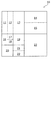
- FIG. 3 is a diagram illustrating an example of the block division.
- FIG. 4A is a diagram illustrating an example of the configuration of a slice.
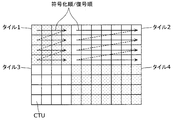
- FIG. 4B is a diagram illustrating an example of the configuration of a tile.
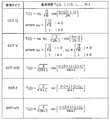
- FIG. 5A is a table showing conversion basis functions corresponding to each conversion type.
- FIG. 5B is a diagram showing an SVT (Spatially Varying Transform).
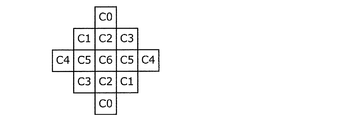
- FIG. 6A is a diagram illustrating an example of the shape of a filter used in an ALF (adaptive loop filter).
- FIG. 1 is a block diagram showing a functional configuration of the encoding device according to the embodiment.
- FIG. 2 is a flowchart illustrating an example of an overall encoding process performed by the encoding device.
- FIG. 3 is
- FIG. 6B is a diagram illustrating another example of the shape of the filter used in the ALF.
- FIG. 6C is a diagram illustrating another example of the shape of the filter used in the ALF.
- FIG. 7 is a block diagram illustrating an example of a detailed configuration of a loop filter unit that functions as a DBF.
- FIG. 8 is a diagram illustrating an example of a deblocking filter having filter characteristics symmetric with respect to a block boundary.
- FIG. 9 is a diagram for explaining a block boundary where deblocking filter processing is performed.
- FIG. 10 is a diagram illustrating an example of the Bs value.
- FIG. 11 is a diagram illustrating an example of processing performed by the prediction processing unit of the encoding device.
- FIG. 12 is a diagram illustrating another example of the processing performed by the prediction processing unit of the encoding device.
- FIG. 13 is a diagram illustrating another example of the processing performed by the prediction processing unit of the encoding device.
- FIG. 14 is a diagram illustrating an example of 67 intra prediction modes in intra prediction.
- FIG. 15 is a flowchart illustrating the flow of the basic process of inter prediction.
- FIG. 16 is a flowchart illustrating an example of motion vector derivation.
- FIG. 17 is a flowchart illustrating another example of deriving a motion vector.
- FIG. 18 is a flowchart illustrating another example of deriving a motion vector.
- FIG. 19 is a flowchart illustrating an example of inter prediction in the normal inter mode.
- FIG. 20 is a flowchart illustrating an example of inter prediction in the merge mode.
- FIG. 21 is a diagram illustrating an example of a motion vector derivation process in the merge mode.
- FIG. 22 is a flowchart illustrating an example of FRUC (frame ⁇ rate ⁇ up ⁇ conversion).
- FIG. 23 is a diagram for describing an example of pattern matching (bilateral matching) between two blocks along a motion trajectory.
- FIG. 24 is a diagram illustrating an example of pattern matching (template matching) between a template in the current picture and a block in the reference picture.
- FIG. 25A is a diagram illustrating an example of deriving a motion vector in sub-block units based on motion vectors of a plurality of adjacent blocks.
- FIG. 25B is a diagram for describing an example of deriving a motion vector in subblock units in an affine mode having three control points.
- FIG. 26A is a conceptual diagram for explaining the affine merge mode.
- FIG. 26B is a conceptual diagram illustrating an affine merge mode having two control points.
- FIG. 26C is a conceptual diagram illustrating an affine merge mode having three control points.
- FIG. 27 is a flowchart illustrating an example of the affine merge mode process.
- FIG. 28A is a diagram for describing an affine inter mode having two control points.
- FIG. 28B is a diagram for describing an affine inter mode having three control points.
- FIG. 29 is a flowchart illustrating an example of the affine inter mode processing.
- FIG. 30A is a diagram for describing an affine inter mode in which a current block has three control points and an adjacent block has two control points.
- FIG. 30B is a diagram for describing the affine inter mode in which the current block has two control points and the adjacent block has three control points.
- FIG. 31A is a diagram illustrating a relationship between a merge mode and DMVR (dynamic ⁇ vector ⁇ refreshing).
- FIG. 31B is a conceptual diagram illustrating an example of the DMVR process.
- FIG. 32 is a flowchart illustrating an example of generation of a predicted image.
- FIG. 33 is a flowchart illustrating another example of generation of a predicted image.
- FIG. 34 is a flowchart illustrating still another example of generation of a predicted image.
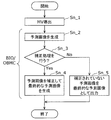
- FIG. 35 is a flowchart for explaining an example of a predicted image correction process by an OBMC (overlapped ⁇ block ⁇ motion ⁇ compensation) process.
- FIG. 36 is a conceptual diagram for describing an example of a predicted image correction process by the OBMC process.
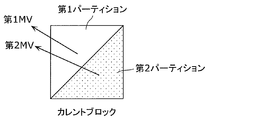
- FIG. 37 is a diagram for explaining generation of a predicted image of two triangles.
- FIG. 38 is a diagram for explaining a model assuming constant velocity linear motion.
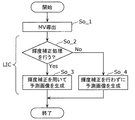
- FIG. 39 is a diagram for describing an example of a predicted image generation method using luminance correction processing by LIC (local illumination compensation) processing.
- FIG. 40 is a block diagram illustrating an implementation example of an encoding device.
- FIG. 41 is a block diagram showing a functional configuration of the decoding device according to the embodiment.
- FIG. 42 is a flowchart illustrating an example of the entire decoding process performed by the decoding device.
- FIG. 43 is a diagram illustrating an example of processing performed by the prediction processing unit of the decoding device.
- FIG. 44 is a diagram illustrating another example of processing performed by the prediction processing unit in the decoding device.
- FIG. 45 is a flowchart illustrating an example of inter prediction in the normal inter mode in the decoding device.
- FIG. 46 is a block diagram illustrating an implementation example of a decoding device.
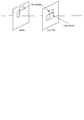
- FIG. 47 is an explanatory diagram of the delta motion vector used for the inter prediction process according to Embodiment 1.
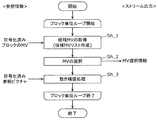
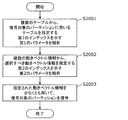
- FIG. 48 is a flowchart illustrating a motion vector selection process in the inter prediction process performed by the inter prediction unit of the decoding device according to the first example of Embodiment 1.
- FIG. 49 is a diagram illustrating an example of Table 1 including a plurality of tables used in the motion vector selection processing according to the first example of the first embodiment.
- FIG. 50 is a diagram showing an example of Table 2 including a plurality of tables used in the motion vector selection processing according to the first example of the first embodiment.
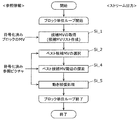
- FIG. 51 is a flowchart showing a motion vector selection process in the inter prediction process performed by the inter prediction unit of the decoding device according to the second example of the first embodiment.
- FIG. 52 is a block diagram illustrating an implementation example of the encoding device according to Embodiment 1.
- FIG. 53 is a flowchart showing an operation example of the encoding device shown in FIG.
- FIG. 54 is a block diagram illustrating an implementation example of the decoding device according to Embodiment 1.
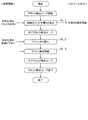
- FIG. 55 is a flowchart showing an operation example of the decoding device shown in FIG.
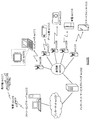
- FIG. 56 is an overall configuration diagram of a content supply system that realizes a content distribution service.
- FIG. 57 is a diagram illustrating an example of an encoding structure during scalable encoding.
- FIG. 58 is a diagram illustrating an example of an encoding structure during scalable encoding.
- FIG. 59 is a diagram illustrating an example of a display screen of a web page.
- FIG. 60 is a diagram illustrating an example of a display screen of a web page.
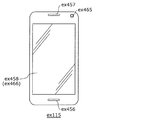
- FIG. 61 is a diagram illustrating an example of a smartphone.
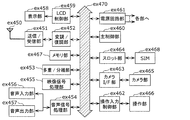
- FIG. 62 is a block diagram illustrating a configuration example of a smartphone.
- an encoding device that encodes a moving image, including a circuit, and a memory connected to the circuit, wherein the circuit operates based on a reference signal. Is used to correct the motion vector to be corrected by a correction value specified by an index in a predetermined direction, and from a plurality of tables having correction values with different intervals between indices, encoding of an image in the moving image is performed. Selecting a first table to be used for the partition, writing a parameter indicating a first index to be selected from the indexes of the first table, and writing the parameter corrected by a correction value specified by the first index; The partition is encoded using a motion vector as follows.
- the encoding device may be able to improve the encoding performance of the inter prediction process.
- the circuit selects the first table by analyzing a first parameter designating the first table among the plurality of tables.
- the circuit acquires a slice header of a current slice including the partition, and the first parameter is written in the slice header.
- the circuit selects the first table from the plurality of tables using a motion vector in an already encoded frame.
- the circuit selects the first table from the plurality of tables using a differential motion vector in an already encoded frame.
- the circuit selects the first table from the plurality of tables using the resolution of the picture to which the partition to be encoded belongs.
- the circuit selects the first table from the plurality of tables using a temporal ID of a picture to which the partition to be encoded belongs.
- the circuit selects the first table from the plurality of tables using a temporal ID of a picture to which the partition to be encoded belongs.
- the circuit selects the first table from the plurality of tables using the value of the predicted motion vector in the partition to be encoded.
- a decoding device is a decoding device that decodes a moving image, the circuit including a circuit, and a memory connected to the circuit, wherein the circuit operates as a reference motion in operation.
- the partition is decoded using a vector.
- the decoding device may be able to improve the coding performance of the inter prediction process.
- the circuit selects the first table by analyzing a first parameter designating the first table among the plurality of tables.
- the circuit acquires a slice header of a current slice including the partition, and the first parameter is written in the slice header.
- the circuit selects the first table from the plurality of tables using a motion vector in a frame that has already been decoded.
- the circuit selects the first table from the plurality of tables using a differential motion vector in a frame that has already been decoded.
- the circuit selects the first table from the plurality of tables using the resolution of the picture to which the partition to be decoded belongs.
- the circuit selects the first table from the plurality of tables using a temporal ID of a picture to which the partition to be decoded belongs.
- the circuit selects the first table from the plurality of tables using a distance between a current picture to which the partition to be decoded belongs and a reference picture.
- the circuit selects the first table from the plurality of tables using the value of the predicted motion vector in the partition to be decoded.
- the encoding method is an encoding method for encoding a moving image, in which a reference motion vector is corrected with a correction value specified by an index in a predetermined direction.
- a plurality of tables each having a correction value having a different interval between indices, selecting a first table to be used for an encoding target partition of an image in the moving image, and selecting an index of the index in the first table.
- a parameter indicating a first index to be selected is written, and the partition is encoded using the reference motion vector corrected by a correction value specified by the first index.
- the decoding method is a decoding method for decoding a moving image, and is used for correcting a reference motion vector with a correction value specified by an index in a predetermined direction. Selecting a first table to be used for a decoding target partition of an image in the moving image from a plurality of tables each having a correction value having a different interval between indices, and selecting a first table from among indices included in the first table. A parameter indicating an index of 1 is analyzed, and the partition is decoded using the reference motion vector corrected by the correction value specified by the first index.
- a decoding device that decodes a moving image, including a circuit, and a memory connected to the circuit, wherein the circuit operates with a reference
- the motion vector is corrected using a correction value that corrects the motion vector in a predetermined direction, and using the corrected motion vector, a partition to be processed of an image in the moving image is decoded, and the correction value is
- the table is specified by a first parameter indicating one of a plurality of values of the table, and the table is used by selecting one of the plurality of tables.
- a non-transitory storage medium such as a system, apparatus, method, integrated circuit, computer program, or computer readable CD-ROM
- the present invention may be realized by an arbitrary combination of a system, an apparatus, a method, an integrated circuit, a computer program, and a recording medium.
- Embodiments are examples of an encoding device and a decoding device to which the processing and / or configuration described in each aspect of the present disclosure can be applied.
- the processing and / or configuration can be implemented in an encoding device and a decoding device different from those in the embodiment.
- any of the following may be performed.
- Some of the components constituting the encoding device or the decoding device according to the embodiment may be combined with components described in any of the aspects of the present disclosure. May be combined with a component having a part of the function described in any of the aspects of the present disclosure, or a component that performs a part of a process performed by the component described in each of the aspects of the present disclosure May be combined.
- a component having a part of the function of the encoding device or the decoding device according to the embodiment, or a component performing a part of the processing of the encoding device or the decoding device according to the embodiment A component described in any of the aspects, a component having a part of the function described in any of the aspects of the present disclosure, or a part of the processing described in any of the aspects of the present disclosure It may be combined with or replaced by a component to be implemented.
- any one of a plurality of processes included in the method may be a process described in any of the aspects of the present disclosure, or may be a similar process. Any of the processes may be replaced or combined.
- the manner of implementing the processing and / or configuration described in each aspect of the present disclosure is not limited to the encoding device or the decoding device according to the embodiment.
- the processing and / or the configuration may be performed in an apparatus used for a purpose different from the moving image encoding or the moving image decoding disclosed in the embodiment.
- FIG. 1 is a block diagram showing a functional configuration of an encoding device 100 according to the present embodiment.
- the encoding device 100 is a moving image encoding device that encodes a moving image in block units.
- an encoding apparatus 100 is an apparatus that encodes an image in units of blocks, and includes a division unit 102, a subtraction unit 104, a conversion unit 106, a quantization unit 108, and entropy encoding.
- Unit 110 inverse quantization unit 112, inverse transform unit 114, addition unit 116, block memory 118, loop filter unit 120, frame memory 122, intra prediction unit 124, inter prediction unit 126, And a prediction control unit 128.
- the encoding device 100 is realized by, for example, a general-purpose processor and a memory.
- the processor when the software program stored in the memory is executed by the processor, the processor includes the dividing unit 102, the subtracting unit 104, the transforming unit 106, the quantizing unit 108, the entropy encoding unit 110, and the inverse quantizing unit 112. , The inverse transform unit 114, the adder unit 116, the loop filter unit 120, the intra prediction unit 124, the inter prediction unit 126, and the prediction control unit 128.
- the encoding apparatus 100 includes a dividing unit 102, a subtracting unit 104, a transforming unit 106, a quantizing unit 108, an entropy encoding unit 110, an inverse quantizing unit 112, an inverse transforming unit 114, an adding unit 116, and a loop filter unit 120. , The intra prediction unit 124, the inter prediction unit 126, and the prediction control unit 128.
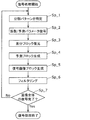
- FIG. 2 is a flowchart illustrating an example of an overall encoding process performed by the encoding device 100.
- the dividing unit 102 of the encoding device 100 divides each picture included in an input image that is a moving image into a plurality of fixed-size blocks (128 ⁇ 128 pixels) (Step Sa_1). Then, the division unit 102 selects a division pattern (also referred to as a block shape) for the fixed-size block (Step Sa_2). That is, the dividing unit 102 further divides the fixed-size block into a plurality of blocks constituting the selected division pattern. Then, for each of the plurality of blocks, the encoding device 100 performs the processing of steps Sa_3 to Sa_9 on the block (that is, the encoding target block).
- the prediction processing unit including all or a part of the intra prediction unit 124, the inter prediction unit 126, and the prediction control unit 128 generates a prediction signal (also referred to as a prediction block) of the current block (also referred to as a current block). (Step Sa_3).
- Step Sa_4 the subtraction unit 104 generates a difference between the current block and the prediction block as a prediction residual (also referred to as a difference block) (Step Sa_4).
- the conversion unit 106 and the quantization unit 108 generate a plurality of quantized coefficients by performing conversion and quantization on the difference block (step Sa_5).
- a block including a plurality of quantized coefficients is also referred to as a coefficient block.
- the entropy coding unit 110 generates a coded signal by performing coding (specifically, entropy coding) on the coefficient block and a prediction parameter related to generation of a prediction signal (step S ⁇ b> 1). Sa_6).
- the encoded signal is also referred to as an encoded bit stream, a compressed bit stream, or a stream.
- the inverse quantization unit 112 and the inverse transformation unit 114 restore a plurality of prediction residuals (that is, difference blocks) by performing inverse quantization and inverse transformation on the coefficient block (step Sa_7).
- the adding unit 116 reconstructs the current block into a reconstructed image (also referred to as a reconstructed block or a decoded image block) by adding a prediction block to the restored difference block (step Sa_8). As a result, a reconstructed image is generated.
- a reconstructed image also referred to as a reconstructed block or a decoded image block
- the loop filter unit 120 performs filtering on the reconstructed image as needed (step Sa_9).
- step Sa_10 determines whether or not the coding of the entire picture has been completed (step Sa_10), and when it is determined that the coding has not been completed (No in step Sa_10), the processing from step Sa_2 is repeatedly executed. I do.
- the encoding device 100 selects one division pattern for a fixed-size block and encodes each block according to the division pattern. Each block may be coded. In this case, the encoding device 100 evaluates the cost for each of the plurality of division patterns, and for example, converts the encoded signal obtained by encoding according to the division pattern with the lowest cost into the finally output code. May be selected as the conversion signal.
- steps Sa_1 to Sa_10 may be sequentially performed by the encoding device 100, some of the processing may be performed in parallel, and the order may be changed. You may.
- the division unit 102 divides each picture included in the input moving image into a plurality of blocks, and outputs each block to the subtraction unit 104.
- the division unit 102 first divides a picture into blocks of a fixed size (for example, 128 ⁇ 128). This fixed size block may be referred to as a coding tree unit (CTU).
- the dividing unit 102 divides each of the fixed-size blocks into variable-size (for example, 64 ⁇ 64 or less) blocks based on, for example, recursive quadtree and / or binary tree block division. I do. That is, the division unit 102 selects a division pattern.
- This variable size block may be called a coding unit (CU), a prediction unit (PU), or a transform unit (TU).
- CUs, PUs, and TUs do not need to be distinguished, and some or all blocks in a picture may be processing units of the CUs, PUs, and TUs.
- FIG. 3 is a diagram illustrating an example of block division according to the present embodiment.
- a solid line represents a block boundary obtained by dividing a quadtree block
- a broken line represents a block boundary obtained by dividing a binary tree block.
- the block 10 is a square block of 128 ⁇ 128 pixels (128 ⁇ 128 block).
- the 128 ⁇ 128 block 10 is first divided into four square 64 ⁇ 64 blocks (quad tree block division).
- the upper left 64 ⁇ 64 block is further vertically divided into two rectangular 32 ⁇ 64 blocks, and the left 32 ⁇ 64 block is further vertically divided into two rectangular 16 ⁇ 64 blocks (binary tree block division). As a result, the upper left 64 ⁇ 64 block is divided into two 16 ⁇ 64 blocks 11 and 12 and a 32 ⁇ 64 block 13.
- the upper right 64 ⁇ 64 block is horizontally divided into two rectangular 64 ⁇ 32 blocks 14 and 15 (binary tree block division).
- the lower left 64 ⁇ 64 block is divided into four square 32 ⁇ 32 blocks (quad tree block division).
- the upper left block and the lower right block of the four 32 ⁇ 32 blocks are further divided.
- the upper left 32 ⁇ 32 block is vertically divided into two rectangular 16 ⁇ 32 blocks, and the right 16 ⁇ 32 block is further horizontally divided into two 16 ⁇ 16 blocks (binary tree block division).
- the lower right 32 ⁇ 32 block is horizontally divided into two 32 ⁇ 16 blocks (binary tree block division).
- the lower left 64x64 block is divided into a 16x32 block 16, two 16x16 blocks 17,18, two 32x32 blocks 19,20, and two 32x16 blocks 21,22.
- the block 10 is divided into thirteen variable-size blocks 11 to 23 based on recursive quadtree and binary tree block division.
- Such division may be referred to as QTBT (quad-tree ⁇ plus ⁇ binary ⁇ tree) division.
- one block is divided into four or two blocks (quadtree or binary tree block division), but the division is not limited to these.
- one block may be divided into three blocks (triple tree block division).
- a division including such a ternary tree block division may be referred to as MBT (multimtype tree) division.
- Picture composition slice / tile In order to decode pictures in parallel, the pictures may be configured in slice units or tile units. A picture composed of slice units or tile units may be configured by the division unit 102.
- Slice is a basic unit of coding that constitutes a picture.
- a picture is composed of, for example, one or more slices.
- a slice is composed of one or more continuous CTUs (Coding Tree Units).
- FIG. 4A is a diagram showing an example of the configuration of a slice.
- a picture includes 11 ⁇ 8 CTUs and is divided into four slices (slices 1-4).
- Slice 1 is composed of 16 CTUs
- slice 2 is composed of 21 CTUs
- slice 3 is composed of 29 CTUs
- slice 4 is composed of 22 CTUs.
- each CTU in the picture belongs to one of the slices.
- the shape of the slice is a shape obtained by dividing the picture in the horizontal direction.
- the boundary of the slice does not need to be the edge of the screen, and may be any of the boundaries of the CTU in the screen.
- the processing order (encoding order or decoding order) of the CTU in the slice is, for example, a raster scan order.
- Each slice includes header information and encoded data.
- the header information may describe characteristics of the slice, such as the CTU address at the head of the slice and the slice type.
- a tile is a unit of a rectangular area constituting a picture.
- a number called TileId may be assigned to each tile in raster scan order.
- FIG. 4B is a diagram showing an example of the configuration of a tile.
- a picture includes 11 ⁇ 8 CTUs and is divided into four rectangular area tiles (tiles 1-4).
- the processing order of the CTU is changed as compared with the case where the tile is not used. If no tiles are used, the CTUs in the picture are processed in raster scan order. If tiles are used, at least one CTU in each of the plurality of tiles is processed in raster scan order. For example, as shown in FIG.
- the processing order of a plurality of CTUs included in tile 1 is from the left end of the first column of tile 1 to the right end of the first column of tile 1, and then the left end of the second column of tile 1 To the right end of the second column of the tile 1.
- one tile may include one or more slices, and one slice may include one or more tiles.
- the subtraction unit 104 subtracts a prediction signal (a prediction sample input from the prediction control unit 128 shown below) from an original signal (original sample) in block units input from the division unit 102 and divided by the division unit 102. . That is, the subtraction unit 104 calculates a prediction error (also referred to as a residual) of the current block (hereinafter, referred to as a current block). Then, the subtraction unit 104 outputs the calculated prediction error (residual error) to the conversion unit 106.
- a prediction signal a prediction sample input from the prediction control unit 128 shown below
- the original signal is an input signal of the encoding apparatus 100, and is a signal (for example, a luminance (luma) signal and two color difference (chroma) signals) representing an image of each picture constituting a moving image.
- a signal representing an image may be referred to as a sample.
- Transform section 106 transforms the prediction error in the spatial domain into transform coefficients in the frequency domain, and outputs the transform coefficients to quantization section 108. Specifically, the transform unit 106 performs, for example, a discrete cosine transform (DCT) or a discrete sine transform (DST) on a prediction error in a spatial domain.
- DCT discrete cosine transform
- DST discrete sine transform
- the conversion unit 106 adaptively selects a conversion type from a plurality of conversion types, and converts the prediction error into a conversion coefficient using a conversion basis function (transform basis function) corresponding to the selected conversion type. May be. Such a conversion is sometimes called EMT (explicit multiple core transform) or AMT (adaptive multiple multiple transform).
- EMT express multiple core transform
- AMT adaptive multiple multiple transform
- the plurality of conversion types include, for example, DCT-II, DCT-V, DCT-VIII, DST-I and DST-VII.
- FIG. 5A is a table showing conversion basis functions corresponding to each conversion type.
- N indicates the number of input pixels. Selection of a conversion type from among the plurality of conversion types may depend on, for example, the type of prediction (intra prediction and inter prediction) or may depend on the intra prediction mode.
- the information indicating whether to apply such EMT or AMT (for example, referred to as an EMT flag or an AMT flag) and the information indicating the selected conversion type are usually signaled at the CU level.
- the signalization of these pieces of information need not be limited to the CU level, but may be another level (for example, a bit sequence level, a picture level, a slice level, a tile level, or a CTU level).
- the conversion unit 106 may re-convert the conversion coefficient (conversion result). Such re-transformation may be referred to as AST (adaptive @ secondary @ transform) or NSST (non-separable @ secondary @ transform). For example, the transform unit 106 performs re-conversion for each sub-block (for example, a 4 ⁇ 4 sub-block) included in a block of a transform coefficient corresponding to an intra prediction error.
- the information indicating whether to apply the NSST and the information on the transformation matrix used for the NSST are usually signaled at the CU level. The signalization of these pieces of information need not be limited to the CU level, but may be another level (for example, a sequence level, a picture level, a slice level, a tile level, or a CTU level).
- Separable conversion and Non-Separable conversion may be applied to the conversion unit 106.
- Separable conversion is a method of performing conversion a plurality of times by separating each direction by the number of input dimensions.
- Non-separable conversion is a method of converting two or more dimensions when the input is multidimensional. This is a method in which conversion is performed collectively assuming that the data is one-dimensional.
- an input is a 4 ⁇ 4 block, it is regarded as one array having 16 elements, and a 16 ⁇ 16 conversion matrix is applied to the array. , Which performs the conversion process.
- a conversion in which a 4 ⁇ 4 input block is regarded as one array having 16 elements, and a Givens rotation is performed on the array a plurality of times (Hypercube). Gives @ Transform) may be performed.
- the type of base to be converted to the frequency domain can be switched according to the area in the CU.
- SVT Spaally Varying Transform
- the CU is divided into two equal parts in the horizontal or vertical direction, and only one of the areas is converted into the frequency area.
- the type of the transformation base can be set for each area, and for example, DST7 and DCT8 are used. In this example, only one of the two areas in the CU is converted and the other is not converted, but both areas may be converted.
- the dividing method can be made more flexible, such as not only dividing into two, but also dividing into four, or information indicating the division is separately encoded and signaled similarly to the CU division.
- the SVT may be referred to as SBT (Sub-block @ Transform).
- the quantization unit 108 quantizes the transform coefficient output from the transform unit 106. Specifically, the quantization unit 108 scans the transform coefficients of the current block in a predetermined scanning order, and quantizes the transform coefficients based on the quantization parameter (QP) corresponding to the scanned transform coefficients. Then, the quantization unit 108 outputs the quantized transform coefficients of the current block (hereinafter, referred to as quantization coefficients) to the entropy encoding unit 110 and the inverse quantization unit 112.
- QP quantization parameter
- the predetermined scanning order is an order for quantization / inverse quantization of transform coefficients.
- the predetermined scanning order is defined as an ascending order of frequency (low-frequency to high-frequency) or a descending order (high-frequency to low-frequency).
- the quantization parameter is a parameter that defines a quantization step (quantization width). For example, as the value of the quantization parameter increases, the quantization step also increases. That is, as the value of the quantization parameter increases, the quantization error increases.
- a quantization matrix is used for quantization.
- quantization matrices may be used in correspondence with frequency transform sizes such as 4x4 and 8x8, prediction modes such as intra prediction and inter prediction, and pixel components such as luminance and color difference.
- quantization refers to digitizing a value sampled at a predetermined interval in association with a predetermined level, and in this technical field, expressions such as rounding, rounding, and scaling are used. There is also.
- a method of using a quantization matrix there are a method of using a quantization matrix directly set on the encoding device side and a method of using a default quantization matrix (default matrix).
- default matrix default matrix
- the quantization matrix it is possible to set the quantization matrix according to the characteristics of the image.
- the coding amount is increased by coding the quantization matrix.
- the ⁇ ⁇ ⁇ ⁇ ⁇ ⁇ ⁇ ⁇ quantization matrix may be specified by, for example, SPS (Sequence Parameter Set: Sequence Parameter Set) or PPS (Picture Parameter Set: Picture Parameter Set).
- SPS Sequence Parameter Set: Sequence Parameter Set
- PPS Picture Parameter Set
- the SPS includes parameters used for sequences
- the PPS includes parameters used for pictures.
- SPS and PPS may be simply referred to as a parameter set.
- the entropy coding unit 110 generates a coded signal (coded bit stream) based on the quantized coefficients input from the quantization unit 108. Specifically, for example, the entropy encoding unit 110 binarizes the quantized coefficients, arithmetically encodes the binary signal, and outputs a compressed bit stream or sequence.
- the inverse quantization unit 112 inversely quantizes the quantization coefficient input from the quantization unit 108. Specifically, the inverse quantization unit 112 inversely quantizes the quantization coefficient of the current block in a predetermined scanning order. Then, the inverse quantization unit 112 outputs the inversely quantized transform coefficient of the current block to the inverse transformation unit 114.
- the inverse transform unit 114 restores a prediction error (residual error) by inversely transforming the transform coefficient input from the inverse quantization unit 112. Specifically, the inverse transform unit 114 restores the prediction error of the current block by performing an inverse transform corresponding to the transform by the transform unit 106 on the transform coefficient. Then, the inverse transform unit 114 outputs the restored prediction error to the adding unit 116.
- the restored prediction error usually does not match the prediction error calculated by the subtraction unit 104 because information is lost due to quantization. That is, the restored prediction error usually includes a quantization error.
- the addition unit 116 reconstructs the current block by adding the prediction error input from the inverse transform unit 114 and the prediction sample input from the prediction control unit 128. Then, the adding unit 116 outputs the reconstructed block to the block memory 118 and the loop filter unit 120.
- the reconstructed block is sometimes called a local decoding block.
- the block memory 118 is, for example, a storage unit for storing a block that is referred to in intra prediction and is in a current picture to be coded (called a current picture). Specifically, the block memory 118 stores the reconstructed block output from the adding unit 116.
- the frame memory 122 is, for example, a storage unit for storing reference pictures used for inter prediction, and may be called a frame buffer. Specifically, the frame memory 122 stores the reconstructed blocks filtered by the loop filter unit 120.
- the loop filter unit 120 applies a loop filter to the block reconstructed by the adding unit 116, and outputs the reconstructed block that has been filtered to the frame memory 122.
- the loop filter is a filter (in-loop filter) used in the encoding loop, and includes, for example, a deblocking filter (DF or DBF), a sample adaptive offset (SAO), an adaptive loop filter (ALF), and the like.
- a least squares error filter for removing coding distortion is applied. For example, for every 2 ⁇ 2 sub-block in the current block, a plurality of sub-blocks are determined based on the direction and activity of a local gradient. One filter selected from the filters is applied.
- sub-blocks for example, 2 ⁇ 2 sub-blocks
- a plurality of classes for example, 15 or 25 classes.
- the classification of the sub-blocks is performed based on the direction and the activity of the gradient.
- the sub-blocks are classified into a plurality of classes based on the classification value C.
- the gradient direction value D is derived, for example, by comparing gradients in a plurality of directions (for example, horizontal, vertical and two diagonal directions).
- the gradient activation value A is derived, for example, by adding gradients in a plurality of directions and quantizing the addition result.
- a filter for a sub-block is determined from a plurality of filters based on the result of such classification.
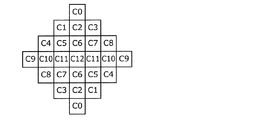
- FIG. 6A to 6C are views showing a plurality of examples of the shape of the filter used in the ALF.
- 6A shows a 5 ⁇ 5 diamond-shaped filter
- FIG. 6B shows a 7 ⁇ 7 diamond-shaped filter
- FIG. 6C shows a 9 ⁇ 9 diamond-shaped filter.
- the information indicating the shape of the filter is usually signaled at the picture level.
- the signalization of the information indicating the shape of the filter need not be limited to the picture level, but may be another level (for example, a sequence level, a slice level, a tile level, a CTU level, or a CU level).
- $ ON / OFF of ALF may be determined, for example, at a picture level or a CU level. For example, whether to apply ALF at the CU level may be determined for luminance, and whether to apply ALF at the picture level may be determined for color difference.
- the information indicating ALF on / off is usually signaled at a picture level or a CU level.
- the signalization of the information indicating ON / OFF of the ALF does not need to be limited to the picture level or the CU level, and may be at another level (for example, a sequence level, a slice level, a tile level, or a CTU level). Good.
- the set of coefficients for a plurality of selectable filters is usually signaled at the picture level.
- the signalization of the coefficient set need not be limited to the picture level, but may be another level (for example, a sequence level, a slice level, a tile level, a CTU level, a CU level, or a sub-block level).
- the loop filter unit 120 performs a filtering process on a block boundary of a reconstructed image to reduce distortion generated at the block boundary.
- FIG. 7 is a block diagram showing an example of a detailed configuration of the loop filter unit 120 functioning as a deblocking filter.
- the loop filter unit 120 includes a boundary determination unit 1201, a filter determination unit 1203, a filter processing unit 1205, a processing determination unit 1208, a filter characteristic determination unit 1207, and switches 1202, 1204, and 1206.
- the boundary determination unit 1201 determines whether or not a pixel to be subjected to deblocking filtering (that is, a target pixel) exists near a block boundary. Then, boundary determination section 1201 outputs the determination result to switch 1202 and processing determination section 1208.
- the switch 1202 When the boundary determination unit 1201 determines that the target pixel exists near the block boundary, the switch 1202 outputs the image before the filter processing to the switch 1204. Conversely, when the boundary determination unit 1201 determines that the target pixel does not exist near the block boundary, the switch 1202 outputs the image before the filter processing to the switch 1206.
- the filter determination unit 1203 determines whether to perform the deblocking filter processing on the target pixel based on the pixel values of at least one peripheral pixel around the target pixel. Then, filter determination section 1203 outputs the determination result to switch 1204 and processing determination section 1208.
- the switch 1204 If the filter determination unit 1203 determines that the deblocking filter processing is to be performed on the target pixel, the switch 1204 outputs the image before the filter processing obtained via the switch 1202 to the filter processing unit 1205. Conversely, when the filter determination unit 1203 determines that the deblocking filter processing is not performed on the target pixel, the switch 1204 outputs the image before the filter processing acquired via the switch 1202 to the switch 1206.
- the filter processing unit 1205 When acquiring the image before the filter processing via the switches 1202 and 1204, the filter processing unit 1205 performs the deblocking filter processing having the filter characteristics determined by the filter characteristic determination unit 1207 on the target pixel. Execute. Then, the filter processing unit 1205 outputs the pixel after the filter processing to the switch 1206.
- the switch 1206 selectively outputs a pixel that has not been deblocking-filtered and a pixel that has been deblocking-filtered by the filter processing unit 1205 under the control of the processing determination unit 1208.
- the processing determination unit 1208 controls the switch 1206 based on the determination results of the boundary determination unit 1201 and the filter determination unit 1203. That is, when the processing determination unit 1208 determines that the target pixel exists near the block boundary by the boundary determination unit 1201 and determines that the filter determination unit 1203 performs the deblocking filter processing on the target pixel. , The pixel subjected to the deblocking filter processing is output from the switch 1206. In cases other than those described above, the processing determining unit 1208 causes the switch 1206 to output a pixel that has not been subjected to the deblocking filter processing. By repeatedly outputting such pixels, the image after the filter processing is output from the switch 1206.
- FIG. 8 is a diagram showing an example of a deblocking filter having filter characteristics symmetric with respect to a block boundary.
- one of two deblocking filters having different characteristics that is, a strong filter and a weak filter is selected using a pixel value and a quantization parameter.
- the strong filter as shown in FIG. 8, when there are pixels p0 to p2 and pixels q0 to q2 across a block boundary, the pixel values of the pixels q0 to q2 are calculated by the following equations. By doing so, the pixel values are changed to pixel values q'0 to q'2.
- p0 to p2 and q0 to q2 are the pixel values of pixels p0 to p2 and pixels q0 to q2, respectively.
- q3 is a pixel value of the pixel q3 adjacent to the pixel q2 on the opposite side to the block boundary.
- a coefficient by which the pixel value of each pixel used in the deblocking filter processing is multiplied is a filter coefficient.
- clip processing may be performed so that the pixel value after calculation does not change beyond the threshold value.
- the pixel value after the calculation according to the above equation is clipped to “pixel value before calculation ⁇ 2 ⁇ threshold” using the threshold value determined from the quantization parameter. Thereby, excessive smoothing can be prevented.
- FIG. 9 is a diagram for explaining a block boundary where deblocking filter processing is performed.
- FIG. 10 is a diagram illustrating an example of the Bs value.
- the block boundary where the deblocking filter processing is performed is, for example, a boundary of a PU (Prediction @ Unit) or a TU (Transform @ Unit) of an 8 ⁇ 8 pixel block as shown in FIG.
- the deblocking filter processing is performed in units of four rows or four columns.
- a Bs (Boundary Strength) value is determined for the blocks P and Q shown in FIG. 9 as shown in FIG.
- the deblocking filter processing on the color difference signal is performed when the Bs value is 2.
- the deblocking filter processing on the luminance signal is performed when the Bs value is 1 or more and a predetermined condition is satisfied. Note that the determination condition of the Bs value is not limited to the one shown in FIG. 10 and may be determined based on another parameter.
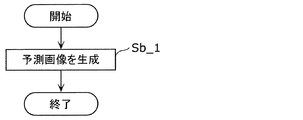
- FIG. 11 is a diagram illustrating an example of processing performed by the prediction processing unit of the encoding device 100.
- the prediction processing unit includes all or some components of the intra prediction unit 124, the inter prediction unit 126, and the prediction control unit 128.
- the prediction processing unit generates a predicted image of the current block (Step Sb_1).
- This prediction image is also called a prediction signal or a prediction block.
- the prediction signal includes, for example, an intra prediction signal or an inter prediction signal.
- the prediction processing unit generates a reconstructed image that has already been obtained by performing generation of a prediction block, generation of a difference block, generation of a coefficient block, restoration of a difference block, and generation of a decoded image block. To generate a predicted image of the current block.
- the reconstructed image may be, for example, an image of a reference picture or an image of a coded block in the current picture which is a picture including the current block.
- the coded block in the current picture is, for example, a block adjacent to the current block.
- FIG. 12 is a diagram illustrating another example of the processing performed by the prediction processing unit of the encoding device 100.
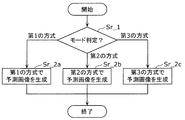
- the prediction processing unit generates a predicted image using the first method (Step Sc_1a), generates a predicted image using the second method (Step Sc_1b), and generates a predicted image using the third method (Step Sc_1c).
- the first scheme, the second scheme, and the third scheme are different schemes for generating a predicted image, and are, for example, inter prediction schemes, intra prediction schemes, and other prediction schemes, respectively. There may be. In these prediction methods, the above-described reconstructed image may be used.
- the prediction processing unit selects one of the plurality of predicted images generated in steps Sc_1a, Sc_1b, and Sc_1c (step Sc_2).
- the selection of the predicted image that is, the selection of a method or a mode for obtaining a final predicted image may be performed based on the calculated cost for each generated predicted image. Alternatively, the selection of the predicted image may be performed based on parameters used for the encoding process.
- the encoding device 100 may signal information for specifying the selected predicted image, scheme, or mode into an encoded signal (also referred to as an encoded bit stream). The information may be, for example, a flag. Thereby, the decoding device can generate a predicted image according to the method or mode selected in encoding device 100 based on the information.
- the prediction processing unit selects one of the predicted images after generating the predicted image in each method.
- the prediction processing unit before generating those predicted images, based on the parameters used in the above-described encoding processing, select a method or mode, and generate a predicted image according to the method or mode Is also good.
- the first method and the second method are intra prediction and inter prediction, respectively, and the prediction processing unit generates a final prediction image for the current block from prediction images generated according to these prediction methods. You may choose.
- FIG. 13 is a diagram illustrating another example of the processing performed by the prediction processing unit of the encoding device 100.
- the prediction processing unit generates a predicted image by intra prediction (step Sd_1a), and generates a predicted image by inter prediction (step Sd_1b).
- a predicted image generated by intra prediction is also called an intra predicted image
- a predicted image generated by inter prediction is also called an inter predicted image.
- the prediction processing unit evaluates each of the intra prediction image and the inter prediction image (Step Sd_2). Cost may be used for this evaluation. That is, the prediction processing unit calculates the respective costs C of the intra prediction image and the inter prediction image.
- D is the encoding distortion of the predicted image, and is represented by, for example, the sum of absolute differences between the pixel value of the current block and the pixel value of the predicted image.
- R is the amount of generated code of the predicted image, and specifically, is the amount of code required for encoding motion information and the like for generating the predicted image.
- ⁇ is, for example, an undetermined Lagrange multiplier.
- the prediction processing unit selects, from the intra-predicted image and the inter-predicted image, the predicted image with the smallest cost C calculated as the final predicted image of the current block (Step Sd_3). That is, a prediction method or mode for generating a prediction image of the current block is selected.
- the intra prediction unit 124 generates a prediction signal (intra prediction signal) by performing intra prediction (also referred to as intra prediction) of the current block with reference to a block in the current picture stored in the block memory 118. Specifically, the intra prediction unit 124 generates an intra prediction signal by performing intra prediction with reference to a sample (for example, a luminance value and a color difference value) of a block adjacent to the current block, and performs prediction control on the intra prediction signal. Output to the unit 128.
- intra prediction signal intra prediction signal
- intra prediction also referred to as intra prediction
- the intra prediction unit 124 performs intra prediction using one of a plurality of intra prediction modes defined in advance.
- the plurality of intra prediction modes usually includes one or more non-directional prediction modes and a plurality of directional prediction modes.
- the one or more non-directional prediction modes are, for example, H.264. It includes a Planar prediction mode and a DC prediction mode defined by the H.265 / HEVC standard.
- the plurality of direction prediction modes are, for example, H.264. Includes a prediction mode in 33 directions defined by the H.265 / HEVC standard. Note that the plurality of directional prediction modes may further include 32 directional prediction modes (total of 65 directional prediction modes) in addition to the 33 directions.
- FIG. 14 is a diagram illustrating a total of 67 intra prediction modes (two non-directional prediction modes and 65 directional prediction modes) in intra prediction. Solid arrows indicate H.E. H.265 / HEVC standard indicates 33 directions, and broken arrows indicate the added 32 directions. (Two non-directional prediction modes are not shown in FIG. 14.)
- a luminance block may be referred to in intra prediction of a chrominance block. That is, the color difference component of the current block may be predicted based on the luminance component of the current block.
- Such intra prediction is sometimes called CCLM (cross-component @ linear @ model) prediction.
- CCLM cross-component @ linear @ model
- Such an intra prediction mode of a chrominance block that refers to a luminance block may be added as one of the intra prediction modes of a chrominance block.
- the intra prediction unit 124 may correct the pixel value after intra prediction based on the gradient of the reference pixel in the horizontal / vertical direction. Intra prediction with such a correction is sometimes called PDPC (position ⁇ dependent ⁇ intra ⁇ prediction ⁇ combination). Information indicating whether or not PDPC is applied (for example, called a PDPC flag) is usually signaled at the CU level. The signalization of this information need not be limited to the CU level, but may be another level (for example, a sequence level, a picture level, a slice level, a tile level, or a CTU level).
- the inter prediction unit 126 performs inter prediction (also referred to as inter-screen prediction) of the current block with reference to a reference picture stored in the frame memory 122 and being different from the current picture, thereby obtaining a prediction signal (inter prediction).
- the inter prediction is performed in units of a current block or a current sub-block (for example, 4 ⁇ 4 block) in the current block.
- the inter prediction unit 126 performs motion estimation on the current block or the current sub-block in the reference picture, and finds a reference block or a sub-block that best matches the current block or the current sub-block.
- the inter prediction unit 126 acquires motion information (for example, a motion vector) that compensates for a motion or change from the reference block or the sub-block to the current block or the sub-block.
- the inter prediction unit 126 performs motion compensation (or motion prediction) based on the motion information, and generates an inter prediction signal of a current block or a sub block.
- the inter prediction unit 126 outputs the generated inter prediction signal to the prediction control unit 128.
- the motion information used for motion compensation may be signaled as an inter prediction signal in various forms.
- a motion vector may be signalized.
- a difference between a motion vector and a predicted motion vector may be signalized.
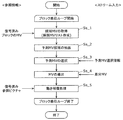
- FIG. 15 is a flowchart showing a basic flow of inter prediction.
- the inter prediction unit 126 first generates a predicted image (Steps Se_1 to Se_3). Next, the subtraction unit 104 generates a difference between the current block and the predicted image as a prediction residual (Step Se_4).
- the inter prediction unit 126 determines the motion vector (MV) of the current block (Steps Se_1 and Se_2) and performs motion compensation (Step Se_3) to generate the predicted image. I do.
- the inter prediction unit 126 determines the MV by selecting a candidate motion vector (candidate MV) (Step Se_1) and deriving the MV (Step Se_2). The selection of the candidate MV is performed, for example, by selecting at least one candidate MV from the candidate MV list.
- the inter prediction unit 126 selects at least one candidate MV from the at least one candidate MV, and determines the selected at least one candidate MV as the MV of the current block. You may.
- the inter prediction unit 126 may determine the MV of the current block by searching for a region of a reference picture indicated by the candidate MV. Note that searching for the area of the reference picture may be referred to as motion search (motion @ estimation).
- steps Se_1 to Se_3 are performed by the inter prediction unit 126.
- processing such as step Se_1 or step Se_2 may be performed by other components included in the encoding device 100. .
- FIG. 16 is a flowchart illustrating an example of motion vector derivation.
- the inter prediction unit 126 derives the MV of the current block in a mode for encoding motion information (for example, MV).
- the motion information is encoded as a prediction parameter and signalized. That is, encoded motion information is included in an encoded signal (also referred to as an encoded bit stream).
- the inter prediction unit 126 derives the MV in a mode in which motion information is not encoded. In this case, the motion information is not included in the encoded signal.
- the MV derivation modes include a normal inter mode, a merge mode, a FRUC mode, and an affine mode, which will be described later.
- modes for encoding motion information include a normal inter mode, a merge mode, and an affine mode (specifically, an affine inter mode and an affine merge mode).
- the motion information may include not only MV but also predicted motion vector selection information described later.
- the mode in which motion information is not encoded includes a FRUC mode and the like.
- the inter prediction unit 126 selects a mode for deriving the MV of the current block from the plurality of modes, and derives the MV of the current block using the selected mode.
- FIG. 17 is a flowchart showing another example of deriving a motion vector.
- the inter prediction unit 126 derives the MV of the current block in a mode for encoding the difference MV.
- the difference MV is encoded as a prediction parameter and signalized. That is, the encoded difference MV is included in the encoded signal.
- the difference MV is a difference between the MV of the current block and the predicted MV.
- the inter prediction unit 126 derives the MV in a mode in which the difference MV is not encoded.
- the encoded difference MV is not included in the encoded signal.
- the modes for deriving the MV include a normal inter, a merge mode, a FRUC mode, and an affine mode described later.
- the modes for encoding the differential MV include a normal inter mode and an affine mode (specifically, an affine inter mode).
- Modes in which the difference MV is not encoded include a FRUC mode, a merge mode, and an affine mode (specifically, an affine merge mode).
- the inter prediction unit 126 selects a mode for deriving the MV of the current block from the plurality of modes, and derives the MV of the current block using the selected mode.
- FIG. 18 is a flowchart illustrating another example of deriving a motion vector.
- the modes are roughly classified into a mode in which the differential MV is encoded and a mode in which the differential motion vector is not encoded.
- the modes in which the difference MV is not encoded include a merge mode, a FRUC mode, and an affine mode (specifically, an affine merge mode).
- the merge mode is a mode in which the MV of the current block is derived by selecting a motion vector from surrounding encoded blocks
- the FRUC mode is In this mode, the MV of the current block is derived by performing a search between encoded regions.
- the affine mode is a mode in which a motion vector of each of a plurality of sub-blocks constituting a current block is derived as an MV of the current block, assuming an affine transformation.
- the inter prediction unit 126 when the inter prediction mode information indicates 0 (0 in Sf_1), the inter prediction unit 126 derives a motion vector in the merge mode (Sf_2). Further, when the inter prediction mode information indicates 1 (1 in Sf_1), the inter prediction unit 126 derives a motion vector in the FRUC mode (Sf_3). When the inter prediction mode information indicates 2 (2 in Sf_1), the inter prediction unit 126 derives a motion vector in an affine mode (specifically, an affine merge mode) (Sf_4). In addition, when the inter prediction mode information indicates 3 (3 in Sf_1), the inter prediction unit 126 derives a motion vector in a mode for encoding the difference MV (for example, a normal inter mode) (Sf_5).
- Sf_5 when the inter prediction mode information indicates 0 (0 in Sf_1), the inter prediction unit 126 derives a motion vector in the merge mode (Sf_2). Further, when the inter prediction mode information indicates 1 (1 in Sf_1), the inter
- the normal inter mode is an inter prediction mode that derives the MV of the current block by finding a block similar to the image of the current block from the area of the reference picture indicated by the candidate MV. In the normal inter mode, the difference MV is encoded.
- FIG. 19 is a flowchart showing an example of inter prediction in the normal inter mode.
- the inter prediction unit 126 acquires a plurality of candidate MVs for the current block based on information such as the MVs of a plurality of encoded blocks around the current block in time or space (step). Sg_1). That is, the inter prediction unit 126 creates a candidate MV list.
- the inter prediction unit 126 assigns each of N (N is an integer of 2 or more) candidate MVs out of the plurality of candidate MVs obtained in step Sg_1 to a predicted motion vector candidate (also referred to as a predicted MV candidate).
- N is an integer of 2 or more
- a predicted motion vector candidate also referred to as a predicted MV candidate.
- the priority order is predetermined for each of the N candidate MVs.
- the inter prediction unit 126 selects one predicted motion vector candidate from the N predicted motion vector candidates as a predicted motion vector (also referred to as predicted MV) of the current block (step Sg_3). At this time, the inter prediction unit 126 encodes prediction motion vector selection information for identifying the selected prediction motion vector into a stream. Note that the stream is the above-described coded signal or coded bit stream.
- the inter prediction unit 126 derives the MV of the current block with reference to the encoded reference picture (Step Sg_4). At this time, the inter prediction unit 126 further encodes a difference value between the derived MV and the predicted motion vector into a stream as a difference MV.
- an encoded reference picture is a picture composed of a plurality of blocks reconstructed after encoding.
- the inter prediction unit 126 generates a predicted image of the current block by performing motion compensation on the current block using the derived MV and the encoded reference picture (step Sg_5). Note that the prediction image is the above-described inter prediction signal.
- inter prediction mode normal inter mode in the above example
- a prediction parameter for example.
- the candidate MV list may be used in common with lists used in other modes. Further, the process regarding the candidate MV list may be applied to the process regarding a list used in another mode.
- the process regarding the candidate MV list includes, for example, extraction or selection of the candidate MV from the candidate MV list, rearrangement of the candidate MV, or deletion of the candidate MV.
- the merge mode is an inter prediction mode in which a candidate MV is selected from the candidate MV list as the MV of the current block to derive the MV.
- FIG. 20 is a flowchart showing an example of inter prediction in the merge mode.
- the inter prediction unit 126 acquires a plurality of candidate MVs for the current block based on information such as the MVs of a plurality of encoded blocks around the current block in time or space (step). Sh_1). That is, the inter prediction unit 126 creates a candidate MV list.
- the inter prediction unit 126 derives the MV of the current block by selecting one candidate MV from the plurality of candidate MVs acquired in Step Sh_1 (Step Sh_2). At this time, the inter prediction unit 126 encodes MV selection information for identifying the selected candidate MV into a stream.
- the inter prediction unit 126 generates a predicted image of the current block by performing motion compensation on the current block using the derived MV and the encoded reference picture (step Sh_3).
- information indicating the inter prediction mode (merged mode in the above example) used for generating the predicted image, which is included in the coded signal is coded, for example, as a prediction parameter.
- FIG. 21 is a diagram for explaining an example of a motion vector derivation process of the current picture in the merge mode.
- a predicted MV list in which predicted MV candidates are registered is generated.
- spatial adjacent prediction MV which is the MV of a plurality of encoded blocks spatially located around the target block, and a nearby block that projects the position of the target block in the encoded reference picture
- temporally adjacent prediction MV which is an MV possessed
- combined prediction MV which is an MV generated by combining the MV values of the spatially adjacent prediction MV and the temporally adjacent prediction MV
- a zero prediction MV which is an MV having a value of zero.
- one MV is selected from a plurality of prediction MVs registered in the prediction MV list to determine the MV of the target block.
- variable-length encoding unit describes and encodes a signal “merge_idx”, which is a signal indicating which prediction MV is selected, in a stream.
- the prediction MV registered in the prediction MV list described with reference to FIG. 21 is an example, and may be different from the number in the figure, or may not include some types of the prediction MV in the figure,
- the configuration may be such that a prediction MV other than the type of the prediction MV in the drawing is added.
- the final MV may be determined by performing a dynamic motion vector feedback (DMVR) process described later using the MV of the target block derived in the merge mode.
- DMVR dynamic motion vector feedback
- the prediction MV candidate is the above-described candidate MV
- the prediction MV list is the above-described candidate MV list.
- the candidate MV list may be referred to as a candidate list.
- merge_idx is MV selection information.
- the motion information may be derived on the decoding device side without being signalized from the encoding device side.
- H.264 A merge mode defined by the H.265 / HEVC standard may be used.
- the motion information may be derived by performing a motion search on the decoding device side. In this case, the decoding device performs the motion search without using the pixel values of the current block.
- the mode in which the decoding device performs a motion search will be described.
- the mode in which a motion search is performed on the decoding device side is sometimes referred to as a PMMVD (pattern matched motion vector derivation) mode or a FRUC (frame rate up-conversion) mode.
- PMMVD pattern matched motion vector derivation
- FRUC frame rate up-conversion
- FIG. 22 shows an example of the FRUC processing.
- a list of a plurality of candidates each having a predicted motion vector (MV) (that is, a candidate MV list, (Which may be common with the merge list) is generated (step Si_1).
- the best candidate MV is selected from a plurality of candidate MVs registered in the candidate MV list (step Si_2).
- the evaluation value of each candidate MV included in the candidate MV list is calculated, and one candidate MV is selected based on the evaluation value.
- a motion vector for the current block is derived based on the selected candidate motion vector (step Si_4).
- the motion vector of the selected candidate is directly derived as a motion vector for the current block.
- a motion vector for the current block may be derived by performing pattern matching in a peripheral area of a position in the reference picture corresponding to the selected candidate motion vector. That is, a search using a pattern matching and an evaluation value in a reference picture is performed on a region around the best candidate MV, and if there is an MV having a better evaluation value, the best candidate MV is assigned to the MV. It may be updated and set as the final MV of the current block. It is also possible to adopt a configuration in which processing for updating to an MV having a better evaluation value is not performed.
- the inter prediction unit 126 generates a predicted image of the current block by performing motion compensation on the current block using the derived MV and the encoded reference picture (step Si_5).
- the evaluation value may be calculated by various methods. For example, a reconstructed image of a region in a reference picture corresponding to a motion vector and a predetermined region (for example, the region is a region of another reference picture or a region of a block adjacent to the current picture as described below). May be compared with the reconstructed image. Then, the difference between the pixel values of the two reconstructed images may be calculated and used as the evaluation value of the motion vector.
- the evaluation value may be calculated using other information in addition to the difference value.
- one candidate MV included in a candidate MV list (for example, a merge list) is selected as a start point of search by pattern matching.
- the pattern matching the first pattern matching or the second pattern matching is used.
- the first pattern matching and the second pattern matching may be referred to as bilateral matching and template matching, respectively.
- FIG. 23 is a diagram for describing an example of first pattern matching (bilateral matching) between two blocks in two reference pictures along a motion trajectory.
- first pattern matching two blocks along the motion trajectory of the current block (Cur @ block) and a pair of two blocks in two different reference pictures (Ref0, Ref1) are used.
- Ref0, Ref1 two motion vectors
- a reconstructed image at a specified position in a first encoded reference picture (Ref0) specified by a candidate MV, and a symmetric MV obtained by scaling the candidate MV at a display time interval A difference from the reconstructed image at the designated position in the second encoded reference picture (Ref1) designated by the above is derived, and an evaluation value is calculated using the obtained difference value.
- a candidate MV having the best evaluation value among the plurality of candidate MVs may be selected as the final MV.
- the motion vector (MV0, MV1) pointing to two reference blocks is the temporal distance between the current picture (Cur @ Pic) and the two reference pictures (Ref0, Ref1). (TD0, TD1).
- a reflection-symmetric bidirectional motion vector is used. Is derived.
- MV derivation>FRUC> template matching In the second pattern matching (template matching), pattern matching is performed between a template in the current picture (a block adjacent to the current block in the current picture (for example, an upper and / or left adjacent block)) and a block in the reference picture. Done. Therefore, in the second pattern matching, a block adjacent to the current block in the current picture is used as a predetermined area for calculating the above-described candidate evaluation value.
- FIG. 24 is a diagram for explaining an example of pattern matching (template matching) between a template in the current picture and a block in the reference picture.
- the current block (Cur @ Pic) is searched for a block that matches the block adjacent to the current block (Cur @ block) in the reference picture (Ref0), thereby searching for the current block.
- ⁇ Information indicating whether or not to apply such a FRUC mode may be signaled at the CU level.
- a FRUC flag information indicating whether or not to apply such a FRUC mode
- information indicating an applicable pattern matching method may be signaled at the CU level.
- the signalization of these pieces of information does not need to be limited to the CU level, and may be at another level (for example, a sequence level, a picture level, a slice level, a tile level, a CTU level, or a sub-block level).
- affine mode for deriving a motion vector in sub-block units based on motion vectors of a plurality of adjacent blocks. This mode may be referred to as an affine motion compensation prediction mode.
- FIG. 25A is a diagram illustrating an example of deriving a motion vector in sub-block units based on motion vectors of a plurality of adjacent blocks.
- the current block includes 16 4 ⁇ 4 sub-blocks.
- the motion vector v 0 of the upper left corner control point of the current block is derived based on the motion vector of the adjacent block, and similarly, the motion vector v 0 of the upper right corner control point of the current block is calculated based on the motion vector of the adjacent sub block. 1 is derived.
- two motion vectors v 0 and v 1 are projected by the following equation (1A) to derive a motion vector (v x , v y ) of each sub-block in the current block.
- x and y indicate the horizontal position and the vertical position of the sub-block, respectively, and w indicates a predetermined weight coefficient.
- ⁇ Information indicating such an affine mode may be signaled at the CU level.
- the signaling of the information indicating the affine mode need not be limited to the CU level, but may be at another level (for example, a sequence level, a picture level, a slice level, a tile level, a CTU level, or a sub-block level). You may.
- an affine mode may include several modes in which the method of deriving the motion vector of the upper left and upper right corner control points is different.
- the affine mode includes two modes: an affine inter (also called an affine normal inter) mode and an affine merge mode.
- FIG. 25B is a diagram for describing an example of deriving a motion vector in subblock units in an affine mode having three control points.
- the current block includes 16 4 ⁇ 4 sub-blocks.
- the motion vector v 0 of the upper left corner control point of the current block is derived based on the motion vector of the neighboring block
- the motion vector v 1 of the upper right corner control point of the current block is derived based on the motion vector of the neighboring block.
- motion vector v 2 in the lower left angle control point in the current block based on the motion vector of the neighboring block is derived.
- three motion vectors v 0 , v 1, and v 2 are projected by the following equation (1B), and the motion vector (v x , v y ) of each sub-block in the current block is derived.
- x and y indicate the horizontal position and the vertical position of the center of the sub-block, respectively, w indicates the width of the current block, and h indicates the height of the current block.
- Affine modes with different numbers of control points may be signaled by switching at the CU level.
- the information indicating the number of control points in the affine mode used at the CU level may be signaled at another level (for example, a sequence level, a picture level, a slice level, a tile level, a CTU level, or a sub-block level). Good.
- the affine mode having three control points may include some modes in which the method of deriving the motion vectors of the upper left, upper right, and lower left corner control points is different.
- the affine mode includes two modes: an affine inter (also called an affine normal inter) mode and an affine merge mode.
- affine merge mode As shown in FIG. 26A, for example, encoded block A (left), block B (upper), block C (upper right), block D (lower left), and block E (upper left) adjacent to the current block ),
- the respective predicted motion vectors of the control points of the current block are calculated based on a plurality of motion vectors corresponding to the block encoded in the affine mode. Specifically, these blocks are checked in the order of coded block A (left), block B (upper), block C (upper right), block D (lower left), and block E (upper left), and in affine mode
- the first valid block encoded is identified.
- a predicted motion vector of the control point of the current block is calculated based on the plurality of motion vectors corresponding to the specified block.
- the upper left corner and the upper right corner of the encoded block including the block A motion projected onto the position vector v 3 and v 4 is derived. Then, the motion vector v 3 and v 4 derived, the predicted motion vector v 0 of the control point of the upper left corner of the current block, the prediction motion vector v 1 of the control point in the upper right corner is calculated.
- the upper left corner and the upper right corner of the encoded block including the block A And the motion vectors v 3 , v 4 and v 5 projected at the position of the lower left corner. Then, from the derived motion vectors v 3 , v 4 and v 5 , the predicted motion vector v 0 of the control point at the upper left corner of the current block, the predicted motion vector v 1 of the control point at the upper right corner, and the control of the lower left corner are calculated. predicted motion vector v 2 of the points are calculated.
- This prediction motion vector derivation method may be used to derive a prediction motion vector for each control point of the current block in step Sj_1 in FIG. 29 described below.
- FIG. 27 is a flowchart showing an example of the affine merge mode.
- the inter prediction unit 126 derives each prediction MV of the control point of the current block (Step Sk_1).
- the control points are points at the upper left and upper right corners of the current block as shown in FIG. 25A, or points at the upper left, upper right and lower left corners of the current block as shown in FIG. 25B.
- the inter prediction unit 126 performs the order of the coded block A (left), block B (upper), block C (upper right), block D (lower left), and block E (upper left). Examine these blocks and identify the first valid block encoded in affine mode.
- the inter prediction unit 126 calculates the motion vector v 3 of the upper left corner and the upper right corner of the encoded block including the block A. and v 4, and calculates a motion vector v 0 of the control point of the upper left corner of the current block, the control point in the upper right corner and a motion vector v 1.
- the inter prediction unit 126 projects the motion vectors v 3 and v 4 at the upper left corner and the upper right corner of the coded block onto the current block, and thereby the predicted motion vector v 0 at the control point at the upper left corner of the current block. If, to calculate the predicted motion vector v 1 of the control point in the upper right corner.
- the inter prediction unit 126 performs the motion of the upper left corner, the upper right corner, and the lower left corner of the encoded block including the block A. From the vectors v 3 , v 4 and v 5 , the motion vector v 0 of the control point at the upper left corner of the current block, the motion vector v 1 of the control point at the upper right corner, and the motion vector v 2 of the control point at the lower left corner are calculated. I do.
- the inter prediction unit 126 projects the motion vectors v 3 , v 4, and v 5 of the upper left corner, the upper right corner, and the lower left corner of the encoded block onto the current block, thereby controlling the control point of the upper left corner of the current block. to the calculated and the predicted motion vector v 0, the predicted motion vector v 1 of the control point in the upper right corner, the control point of the lower-left corner of the motion vector v 2.
- the inter prediction unit 126 performs motion compensation on each of the plurality of sub-blocks included in the current block. That is, the inter prediction unit 126 calculates, for each of the plurality of sub-blocks, two predicted motion vectors v 0 and v 1 and the above equation (1A) or three predicted motion vectors v 0 , v 1 and v 2 . Using the above equation (1B), the motion vector of the sub-block is calculated as the affine MV (step Sk_2). Then, the inter prediction unit 126 performs motion compensation on the sub-block using the affine MV and the encoded reference picture (step Sk_3). As a result, motion compensation is performed on the current block, and a predicted image of the current block is generated.
- FIG. 28A is a diagram for describing an affine inter mode having two control points.
- a motion vector selected from the motion vectors of coded blocks A, B, and C adjacent to the current block is used to predict the control point at the upper left corner of the current block. It is used as the motion vector v 0.
- motion vectors selected from the motion vectors of the encoded block D and block E is adjacent to the current block are used as predicted motion vector v 1 of the control point of the upper-right corner of the current block.
- FIG. 28B is a diagram for explaining an affine inter mode having three control points.
- a motion vector selected from the motion vectors of the coded blocks A, B and C adjacent to the current block is used to predict the control point at the upper left corner of the current block. It is used as the motion vector v 0.
- motion vectors selected from the motion vectors of the encoded block D and block E is adjacent to the current block are used as predicted motion vector v 1 of the control point of the upper-right corner of the current block.
- motion vectors selected from the motion vectors of the encoded block F and block G adjacent to the current block are used as predicted motion vector v 2 of the control points of the lower left corner of the current block.
- FIG. 29 is a flowchart showing an example of the affine inter mode.
- the inter prediction unit 126 derives prediction MV (v 0 , v 1 ) or (v 0 , v 1 , v 2 ) of each of two or three control points of the current block ( Step Sj_1).
- the control point is a point at the upper left corner, upper right corner or lower left corner of the current block as shown in FIG. 25A or 25B.
- the inter prediction unit 126 selects the motion vector of one of the encoded blocks near each control point of the current block shown in FIG. 28A or FIG. 28B, thereby predicting the control point of the current block.
- the motion vector (v 0 , v 1 ) or (v 0 , v 1 , v 2 ) is derived.
- the inter prediction unit 126 encodes predicted motion vector selection information for identifying the two selected motion vectors into a stream.
- the inter prediction unit 126 determines which motion vector of the encoded block adjacent to the current block is to be selected as the predicted motion vector of the control point by using a cost evaluation or the like, and determines which predicted motion vector A flag indicating the selection may be described in the bit stream.
- the inter prediction unit 126 performs a motion search (steps Sj_3 and Sj_4) while updating each of the predicted motion vectors selected or derived in step Sj_1 (step Sj_2). That is, the inter prediction unit 126 calculates the motion vector of each sub-block corresponding to the predicted motion vector to be updated as the affine MV using the above equation (1A) or equation (1B) (step Sj_3). Then, the inter prediction unit 126 performs motion compensation on each sub-block using the affine MV and the coded reference picture (step Sj_4). As a result, in the motion search loop, the inter prediction unit 126 determines, for example, a predicted motion vector at which the lowest cost is obtained as the control point motion vector (step Sj_5). At this time, the inter prediction unit 126 further encodes a difference value between the determined MV and the predicted motion vector into a stream as a difference MV.
- the inter prediction unit 126 generates a predicted image of the current block by performing motion compensation on the current block using the determined MV and the encoded reference picture (step Sj_6).
- FIG. 30A and FIG. 30B are conceptual diagrams for explaining a method of deriving a predicted vector of a control point when the number of control points differs between an encoded block and a current block.
- the current block has three control points of an upper left corner, an upper right corner, and a lower left corner, and a block A adjacent to the left of the current block is encoded in an affine mode having two control points. If it is, the motion vector v 3 and v 4 projected onto the position of the upper left corner and upper right corner of the encoded blocks containing the block a is derived. Then, the motion vector v 3 and v 4 derived, the predicted motion vector v 0 of the control point of the upper left corner of the current block, the prediction motion vector v 1 of the control point in the upper right corner is calculated. Furthermore, the motion vector v 0 and v 1 derived, predicted motion vector v 2 of the control point of the bottom left corner is calculated.
- the current block has two control points of an upper left corner and an upper right corner, and a block A adjacent to the left of the current block is encoded in an affine mode having three control points.
- motion vectors v 3 , v 4 and v 5 projected at the upper left corner, upper right corner and lower left corner of the encoded block including block A are derived.
- a predicted motion vector v 0 of the control point at the upper left corner of the current block and a predicted motion vector v 1 of the control point at the upper right corner of the current block are calculated.
- This prediction motion vector derivation method may be used to derive each prediction motion vector of the control point of the current block in step Sj_1 in FIG.
- FIG. 31A is a diagram illustrating a relationship between the merge mode and the DMVR.
- the inter prediction unit 126 derives a motion vector of the current block in the merge mode (Step Sl_1). Next, the inter prediction unit 126 determines whether or not to search for a motion vector, that is, whether to perform a motion search (step Sl_2). Here, when the inter prediction unit 126 determines that the motion search is not performed (No in Step Sl_2), the inter prediction unit 126 determines the motion vector derived in Step Sl_1 as the final motion vector for the current block (Step Sl_4). That is, in this case, the motion vector of the current block is determined in the merge mode.
- step Sl_3 if it is determined in step Sl_1 that a motion search is to be performed (Yes in step Sl_2), the inter prediction unit 126 searches for a peripheral area of the reference picture indicated by the motion vector derived in step Sl_1, thereby obtaining On the other hand, a final motion vector is derived (step Sl_3). That is, in this case, the motion vector of the current block is determined by the DMVR.
- FIG. 31B is a conceptual diagram for explaining an example of the DMVR process for determining the MV.
- the optimal MVP set in the current block (for example, in the merge mode) is set as a candidate MV.
- a reference pixel is specified from the first reference picture (L0), which is a coded picture in the L0 direction, according to the candidate MV (L0).
- a reference pixel is specified from the second reference picture (L1), which is a coded picture in the L1 direction, according to the candidate MV (L1).
- a template is generated by averaging these reference pixels.
- the peripheral areas of the candidate MVs of the first reference picture (L0) and the second reference picture (L1) are respectively searched, and the MV having the minimum cost is determined as the final MV.
- the cost value may be calculated using, for example, a difference value between each pixel value of the template and each pixel value of the search area, a candidate MV value, and the like.
- Any process may be used as long as it is a process that can search the periphery of the candidate MV and derive the final MV without being the process itself described above.
- BIO / OBMC In the motion compensation, there is a mode for generating a predicted image and correcting the predicted image.
- the modes are, for example, BIO and OBMC described later.
- FIG. 32 is a flowchart illustrating an example of generation of a predicted image.
- the inter prediction unit 126 generates a predicted image (Step Sm_1), and corrects the predicted image in any one of the above modes (Step Sm_2).
- FIG. 33 is a flowchart showing another example of generation of a predicted image.
- the inter prediction unit 126 determines the motion vector of the current block (Step Sn_1). Next, the inter prediction unit 126 generates a predicted image (Step Sn_2), and determines whether or not to perform a correction process (Step Sn_3). Here, when the inter prediction unit 126 determines that the correction process is to be performed (Yes in Step Sn_3), the inter prediction unit 126 corrects the predicted image to generate a final predicted image (Step Sn_4). On the other hand, when determining that the correction process is not performed (No in Step Sn_3), the inter prediction unit 126 outputs the predicted image as a final predicted image without correction (Step Sn_5).
- ⁇ ⁇ In motion compensation, there is a mode for correcting the luminance when generating a predicted image.
- the mode is, for example, LIC described later.
- FIG. 34 is a flowchart showing still another example of generating a predicted image.
- the inter prediction unit 126 derives a motion vector of the current block (Step So_1). Next, the inter prediction unit 126 determines whether to perform the luminance correction process (Step So_2). Here, when determining that the luminance correction process is to be performed (Yes in Step So_2), the inter prediction unit 126 generates a predicted image while performing the luminance correction (Step So_3). That is, a predicted image is generated by the LIC. On the other hand, when determining that the luminance correction process is not to be performed (No in Step So_2), the inter prediction unit 126 generates a predicted image by normal motion compensation without performing luminance correction (Step So_4).
- the inter prediction signal may be generated using not only the motion information of the current block obtained by the motion search but also the motion information of the adjacent block. Specifically, by weighting and adding a prediction signal based on motion information obtained by motion search (within a reference picture) and a prediction signal based on motion information of an adjacent block (within a current picture), An inter prediction signal may be generated for each sub-block in a block.
- Such inter prediction (motion compensation) may be called OBMC (overlapped block motion compensation).
- OBMC block size information indicating the size of a sub-block for OBMC
- OBMC flag information indicating whether to apply the OBMC mode
- the level of signalization of these pieces of information need not be limited to the sequence level and the CU level, but may be another level (eg, picture level, slice level, tile level, CTU level, or sub-block level). Good.
- FIG. 35 and FIG. 36 are a flowchart and a conceptual diagram for explaining the outline of the predicted image correction processing by the OBMC processing.
- a predicted image (Pred) by normal motion compensation is obtained using a motion vector (MV) assigned to a processing target (current) block.
- MV motion vector
- an arrow “MV” indicates a reference picture, and indicates what the current block of the current picture refers to to obtain a predicted image.
- the motion vector (MV_L) already derived for the encoded left adjacent block is applied (reused) to the current block to obtain a predicted image (Pred_L).
- the motion vector (MV_L) is indicated by an arrow “MV_L” pointing from the current block to a reference picture.
- the first correction of the predicted image is performed by overlapping the two predicted images Pred and Pred_L. This has the effect of mixing the boundaries between adjacent blocks.
- the motion vector (MV_U) already derived for the encoded upper adjacent block is applied (reused) to the current block to obtain a predicted image (Pred_U).
- the motion vector (MV_U) is indicated by an arrow “MV_U” pointing from the current block to a reference picture.
- a second correction of the predicted image is performed by superimposing the predicted image Pred_U on the predicted image (for example, Pred and Pred_L) on which the first correction has been performed. This has the effect of mixing the boundaries between adjacent blocks.
- the predicted image obtained by the second correction is the final predicted image of the current block in which the boundary with the adjacent block has been mixed (smoothed).
- the above example is a two-pass correction method using left-adjacent and upper-adjacent blocks, but the correction method is three-pass or more paths using right-adjacent and / or lower-adjacent blocks. May be used.
- the region to be superimposed may not be the pixel region of the entire block, but may be only a partial region near the block boundary.
- the prediction image correction processing of the OBMC for obtaining one prediction image Pred by superimposing additional prediction images Pred_L and Pred_U from one reference picture has been described.
- a similar process may be applied to each of the plurality of reference pictures.
- OBMC image correction based on a plurality of reference pictures
- a corrected prediction image is obtained from each reference picture, and then the obtained plurality of corrected prediction images are further superimposed. To obtain the final predicted image.
- the unit of the target block may be a prediction block unit or a sub-block unit obtained by further dividing the prediction block.
- the encoding device may determine whether the target block belongs to a region having a complicated motion.
- the encoding apparatus sets the value 1 as obmc_flag to perform encoding by applying the OBMC process when belonging to a complicated motion region, and performs obmc_flag when not belonging to a complicated motion region.
- the decoding device decodes obmc_flag described in a stream (for example, a compressed sequence), and performs decoding by switching whether or not to apply the OBMC process according to the value.
- the inter prediction unit 126 generates one rectangular predicted image for the rectangular current block.
- the inter prediction unit 126 generates a plurality of predicted images having a shape different from the rectangle for the rectangular current block, and generates a final rectangular predicted image by combining the plurality of predicted images. May be.
- the shape different from the rectangle may be, for example, a triangle.
- FIG. 37 is a diagram for explaining generation of a predicted image of two triangles.
- the inter prediction unit 126 generates a predicted image of a triangle by performing motion compensation on the first partition of the triangle in the current block using the first MV of the first partition. Similarly, the inter prediction unit 126 generates a triangle predicted image by performing motion compensation on the second partition of the triangle in the current block using the second MV of the second partition. Then, the inter prediction unit 126 combines these prediction images to generate a prediction image having the same rectangle as the current block.
- the first partition and the second partition are each triangular, but may be trapezoidal or different from each other.
- the current block is composed of two partitions, but may be composed of three or more partitions.
- the first partition and the second partition may overlap. That is, the first partition and the second partition may include the same pixel region. In this case, a predicted image of the current block may be generated using the predicted image in the first partition and the predicted image in the second partition.
- a predicted image may be generated by intra prediction for at least one partition.
- BIO Binary-directional optical flow
- FIG. 38 is a diagram for explaining a model assuming uniform linear motion.
- (vx, vy) indicates a velocity vector
- ⁇ 0 and ⁇ 1 indicate temporal distances between the current picture (Cur @ Pic) and two reference pictures (Ref0, Ref1).
- (MVx0, MVy0) indicates a motion vector corresponding to the reference picture Ref0
- (MVx1, MVy1) indicates a motion vector corresponding to the reference picture Ref1.
- This optical flow equation includes (i) the time derivative of the luminance value, (ii) the product of the horizontal velocity and the horizontal component of the spatial gradient of the reference image, and (iii) the vertical velocity and the spatial gradient of the reference image. This shows that the sum of the product of the vertical components of and is equal to zero.
- a block-by-block motion vector obtained from a merge list or the like may be corrected in pixel units.
- the motion vector may be derived on the decoding device side by a method different from the method for deriving the motion vector based on a model assuming uniform linear motion.
- a motion vector may be derived for each sub-block based on motion vectors of a plurality of adjacent blocks.
- FIG. 39 is a diagram for describing an example of a predicted image generation method using a luminance correction process by an LIC process.
- the MV is derived from the encoded reference picture, and the reference image corresponding to the current block is obtained.
- the current block information indicating how the luminance value has changed between the reference picture and the current picture is extracted.
- This extraction is performed by extracting the luminance pixel values of the encoded left adjacent reference area (peripheral reference area) and the encoded upper adjacent reference area (peripheral reference area) of the current picture, and the luminance value of the reference picture specified by the derived MV. This is performed based on the luminance pixel value at the equivalent position. Then, a luminance correction parameter is calculated using information indicating how the luminance value has changed.
- a predicted image for the current block is generated by performing a luminance correction process that applies the luminance correction parameter to a reference image in a reference picture specified by $ MV.
- the shape of the peripheral reference area in FIG. 39 is an example, and other shapes may be used.
- the predicted image may be generated after performing the luminance correction processing in the same manner as described above.
- lic_flag is a signal indicating whether or not to apply the LIC processing.
- the encoding device it is determined whether the current block belongs to a region where a luminance change occurs. If the current block belongs to a region where a luminance change occurs, a value is set as lic_flag. The coding is performed by setting 1 and applying the LIC processing, and when the pixel does not belong to the area where the luminance change occurs, the value 0 is set as lic_flag and the coding is performed without applying the LIC processing.
- the decoding device may decode the lic_flag described in the stream, and perform decoding by switching whether or not to apply the LIC processing according to the value.
- determining whether or not to apply the LIC processing for example, there is a method of determining according to whether or not the LIC processing is applied to a peripheral block.
- a method of determining according to whether or not the LIC processing is applied to a peripheral block.
- the peripheral encoded block selected at the time of derivation of the MV in the merge mode processing is encoded by applying the LIC processing.
- the coding is performed by switching whether or not to apply the LIC processing according to the result. In this case, the same processing is applied to the processing on the decoding device side.
- the LIC processing luminance correction processing
- the inter prediction unit 126 derives a motion vector for acquiring a reference image corresponding to the current block from a reference picture that is a coded picture.
- the inter prediction unit 126 calculates the luminance pixel values of the encoded neighboring reference regions on the left and upper sides of the current block and the luminance pixels at the same position in the reference picture specified by the motion vector. Using the value, information indicating how the luminance value has changed between the reference picture and the current picture is extracted to calculate a luminance correction parameter. For example, the luminance pixel value of a certain pixel in the peripheral reference area in the encoding target picture is p0, and the luminance pixel value of a pixel in the peripheral reference area in the reference picture at the same position as the pixel is p1.
- the inter prediction unit 126 performs a luminance correction process on the reference image in the reference picture specified by the motion vector using the luminance correction parameter, thereby generating a predicted image for the encoding target block.
- the luminance pixel value in the reference image is p2
- the luminance pixel value of the predicted image after the luminance correction processing is p3.
- the shape of the peripheral reference area in FIG. 39 is an example, and other shapes may be used. A part of the peripheral reference area shown in FIG. 39 may be used. For example, an area including a predetermined number of pixels thinned out from each of the upper adjacent pixel and the left adjacent pixel may be used as the peripheral reference area. Further, the peripheral reference area is not limited to the area adjacent to the encoding target block, and may be an area not adjacent to the encoding target block. In the example shown in FIG. 39, the peripheral reference area in the reference picture is an area specified by the motion vector of the current picture from the peripheral reference area in the current picture. It may be a designated area. For example, the other motion vector may be a motion vector of a peripheral reference area in the current picture.
- a correction parameter may be derived individually for each of Y, Cb, and Cr, or a common correction parameter may be used for any of them.
- the LIC processing may be applied on a sub-block basis.
- the correction parameter may be derived using the peripheral reference area of the current sub-block and the peripheral reference area of the reference sub-block in the reference picture specified by the MV of the current sub-block.
- the prediction control unit 128 selects one of an intra prediction signal (a signal output from the intra prediction unit 124) and an inter prediction signal (a signal output from the inter prediction unit 126), and subtracts the selected signal as a prediction signal. Output to the section 104 and the addition section 116.
- the prediction control unit 128 may output a prediction parameter input to the entropy encoding unit 110.
- the entropy coding unit 110 may generate a coded bit stream (or sequence) based on the prediction parameters input from the prediction control unit 128 and the quantization coefficients input from the quantization unit 108.
- the prediction parameter may be used for a decoding device.
- the decoding device may receive and decode the encoded bit stream, and perform the same processing as the prediction processing performed in the intra prediction unit 124, the inter prediction unit 126, and the prediction control unit 128.
- the prediction parameter is a selected prediction signal (for example, a motion vector, a prediction type, or a prediction mode used in the intra prediction unit 124 or the inter prediction unit 126), or the intra prediction unit 124, the inter prediction unit 126, and the prediction control unit. Any index, flag, or value based on or indicative of the prediction process performed at 128 may be included.
- FIG. 40 is a block diagram illustrating an implementation example of the encoding device 100.
- the encoding device 100 includes a processor a1 and a memory a2.
- a plurality of components of the encoding device 100 shown in FIG. 1 are implemented by the processor a1 and the memory a2 shown in FIG.
- the processor a1 is a circuit that performs information processing, and is a circuit that can access the memory a2.
- the processor a1 is a dedicated or general-purpose electronic circuit that encodes a moving image.
- the processor a1 may be a processor such as a CPU.
- the processor a1 may be an aggregate of a plurality of electronic circuits.
- the processor a1 may play the role of a plurality of components of the encoding device 100 illustrated in FIG. 1 and the like, excluding a component for storing information.
- the memory a2 is a dedicated or general-purpose memory in which information for the processor a1 to encode a moving image is stored.
- the memory a2 may be an electronic circuit, and may be connected to the processor a1. Further, the memory a2 may be included in the processor a1. Further, the memory a2 may be an aggregate of a plurality of electronic circuits.
- the memory a2 may be a magnetic disk, an optical disk, or the like, or may be expressed as a storage or a recording medium. Further, the memory a2 may be a nonvolatile memory or a volatile memory.
- the memory a2 may store a moving image to be coded, or may store a bit string corresponding to the coded moving image. Further, the memory a2 may store a program for the processor a1 to encode a moving image.
- the memory a2 may serve as a component for storing information among a plurality of components of the encoding device 100 illustrated in FIG. 1 and the like. Specifically, the memory a2 may serve as the block memory 118 and the frame memory 122 shown in FIG. More specifically, the memory a2 may store reconstructed blocks, reconstructed pictures, and the like.
- FIG. 41 is a block diagram showing a functional configuration of the decoding device 200 according to the present embodiment.
- the decoding device 200 is a moving image decoding device that decodes a moving image in block units.
- the decoding device 200 includes an entropy decoding unit 202, an inverse quantization unit 204, an inverse transformation unit 206, an addition unit 208, a block memory 210, a loop filter unit 212, and a frame memory 214. , An intra prediction unit 216, an inter prediction unit 218, and a prediction control unit 220.
- the decoding device 200 is realized by, for example, a general-purpose processor and a memory.
- the processor when the software program stored in the memory is executed by the processor, the processor includes an entropy decoding unit 202, an inverse quantization unit 204, an inverse transformation unit 206, an addition unit 208, a loop filter unit 212, an intra prediction unit 216, and functions as the inter prediction unit 218 and the prediction control unit 220.
- the decoding device 200 is a dedicated device corresponding to the entropy decoding unit 202, the inverse quantization unit 204, the inverse transform unit 206, the addition unit 208, the loop filter unit 212, the intra prediction unit 216, the inter prediction unit 218, and the prediction control unit 220. May be realized as one or more electronic circuits.
- FIG. 42 is a flowchart illustrating an example of the entire decoding process performed by the decoding device 200.
- the entropy decoding unit 202 of the decoding device 200 specifies a division pattern of a fixed-size block (128 ⁇ 128 pixels) (Step Sp_1). This division pattern is the division pattern selected by the encoding device 100. Then, the decoding device 200 performs the processing of steps Sp_2 to Sp_6 on each of the plurality of blocks constituting the divided pattern.
- the entropy decoding unit 202 decodes (specifically, entropy-decodes) the encoded quantization coefficient and the prediction parameter of the decoding target block (also referred to as a current block) (Step Sp_2).
- the inverse quantization unit 204 and the inverse transform unit 206 restore the plurality of prediction residuals (that is, difference blocks) by performing inverse quantization and inverse transform on the plurality of quantized coefficients (Step Sp_3). ).
- the prediction processing unit including all or a part of the intra prediction unit 216, the inter prediction unit 218, and the prediction control unit 220 generates a prediction signal (also referred to as a prediction block) of the current block (Step Sp_4).
- the adding unit 208 reconstructs the current block into a reconstructed image (also referred to as a decoded image block) by adding the prediction block to the difference block (Step Sp_5).
- the loop filter unit 212 performs filtering on the reconstructed image (Step Sp_6).
- Step Sp_7 determines whether or not decoding of the entire picture has been completed (Step Sp_7), and when determining that the decoding has not been completed (No in Step Sp_7), repeats the processing from Step Sp_1.
- steps Sp_1 to Sp_7 may be performed sequentially by the decoding device 200, some of the processing may be performed in parallel, or the order may be changed. Is also good.
- the entropy decoding unit 202 performs entropy decoding on the encoded bit stream. Specifically, for example, the entropy decoding unit 202 arithmetically decodes an encoded bit stream into a binary signal. Then, the entropy decoding unit 202 debinarizes the binary signal. The entropy decoding unit 202 outputs the quantized coefficients to the inverse quantization unit 204 in block units.
- the entropy decoding unit 202 may output prediction parameters included in the encoded bit stream (see FIG. 1) to the intra prediction unit 216, the inter prediction unit 218, and the prediction control unit 220.
- the intra prediction unit 216, the inter prediction unit 218, and the prediction control unit 220 can execute the same prediction processing as the processing performed by the intra prediction unit 124, the inter prediction unit 126, and the prediction control unit 128 on the encoding device side.
- the inverse quantization unit 204 inversely quantizes a quantization coefficient of a decoding target block (hereinafter, referred to as a current block), which is an input from the entropy decoding unit 202. Specifically, for each of the quantization coefficients of the current block, the inverse quantization unit 204 inversely quantizes the quantization coefficient based on a quantization parameter corresponding to the quantization coefficient. Then, the inverse quantization unit 204 outputs the inversely quantized coefficients (that is, transform coefficients) of the current block to the inverse transform unit 206.
- the inverse transform unit 206 restores a prediction error by inversely transforming the transform coefficient input from the inverse quantization unit 204.
- the inverse transform unit 206 determines the current block based on the information indicating the read conversion type. Is inversely transformed.
- the inverse transform unit 206 applies the inverse retransform to the transform coefficient.
- the addition unit 208 reconstructs the current block by adding the prediction error input from the inverse conversion unit 206 and the prediction sample input from the prediction control unit 220. Then, the adding unit 208 outputs the reconstructed block to the block memory 210 and the loop filter unit 212.
- the block memory 210 is a storage unit for storing blocks that are referred to in intra prediction and are in a current picture to be decoded (hereinafter, referred to as a current picture). Specifically, the block memory 210 stores the reconstructed block output from the adder 208.
- the loop filter unit 212 performs a loop filter on the block reconstructed by the adding unit 208, and outputs the filtered reconstructed block to the frame memory 214, the display device, and the like.
- one filter is selected from the plurality of filters based on the local gradient direction and activity. The selected filter is applied to the reconstruction block.
- the frame memory 214 is a storage unit for storing reference pictures used for inter prediction, and may be called a frame buffer. Specifically, the frame memory 214 stores the reconstructed blocks filtered by the loop filter unit 212.
- FIG. 43 is a diagram illustrating an example of processing performed by the prediction processing unit of the decoding device 200.
- the prediction processing unit includes all or some components of the intra prediction unit 216, the inter prediction unit 218, and the prediction control unit 220.
- the prediction processing unit generates a predicted image of the current block (Step Sq_1).
- This prediction image is also called a prediction signal or a prediction block.
- the prediction signal includes, for example, an intra prediction signal or an inter prediction signal.
- the prediction processing unit generates a reconstructed image that has already been obtained by performing generation of a prediction block, generation of a difference block, generation of a coefficient block, restoration of a difference block, and generation of a decoded image block. To generate a predicted image of the current block.
- the reconstructed image may be, for example, an image of a reference picture or an image of a decoded block in the current picture which is a picture including the current block.
- the decoded block in the current picture is, for example, a block adjacent to the current block.
- FIG. 44 is a diagram illustrating another example of the processing performed by the prediction processing unit of the decoding device 200.
- the prediction processing unit determines a method or a mode for generating a predicted image (Step Sr_1). For example, this scheme or mode may be determined based on, for example, a prediction parameter or the like.
- the prediction processing unit determines the first method as the mode for generating the predicted image
- the prediction processing unit generates the predicted image according to the first method (Step Sr_2a).
- the prediction processing unit determines the second method as the mode for generating the predicted image
- the prediction processing unit generates the predicted image according to the second method (Step Sr_2b).
- the prediction processing unit determines the third method as the mode for generating a predicted image
- the prediction processing unit generates a predicted image according to the third method (Step Sr_2c).
- the first scheme, the second scheme, and the third scheme are different schemes for generating a predicted image, and are, for example, inter prediction schemes, intra prediction schemes, and other prediction schemes, respectively. There may be. In these prediction methods, the above-described reconstructed image may be used.
- the intra prediction unit 216 performs intra prediction with reference to a block in the current picture stored in the block memory 210 based on the intra prediction mode read from the coded bit stream, thereby obtaining a prediction signal (intra prediction mode). Signal). Specifically, the intra prediction unit 216 generates an intra prediction signal by performing intra prediction with reference to samples (for example, a luminance value and a color difference value) of a block adjacent to the current block, and performs prediction control on the intra prediction signal. Output to the unit 220.
- the intra prediction unit 216 may predict the chrominance component of the current block based on the luminance component of the current block. .
- the intra prediction unit 216 corrects the pixel value after intra prediction based on the gradient of the reference pixel in the horizontal / vertical directions.
- the inter prediction unit 218 predicts the current block with reference to the reference picture stored in the frame memory 214.
- the prediction is performed in units of the current block or sub-blocks (for example, 4 ⁇ 4 blocks) in the current block.
- the inter prediction unit 218 performs motion compensation using motion information (for example, a motion vector) read from a coded bit stream (for example, a prediction parameter output from the entropy decoding unit 202), thereby performing the current block or It generates an inter prediction signal of the sub-block and outputs the inter prediction signal to the prediction control unit 220.
- motion information for example, a motion vector
- a coded bit stream for example, a prediction parameter output from the entropy decoding unit 202
- the inter prediction unit 218 uses the motion information of the adjacent block as well as the motion information of the current block obtained by the motion search. , Generate an inter prediction signal.
- the inter prediction unit 218 uses the pattern matching method (bilateral matching or template matching) read from the encoded stream.
- the motion information is derived by performing a motion search. Then, the inter prediction unit 218 performs motion compensation (prediction) using the derived motion information.
- the inter prediction unit 218 derives a motion vector based on a model assuming uniform linear motion. If the information read from the coded bit stream indicates that the affine motion compensation prediction mode is to be applied, the inter prediction unit 218 generates a motion vector in sub-block units based on motion vectors of a plurality of adjacent blocks. Is derived.
- the inter prediction unit 218 derives the MV based on the information read from the coded stream and uses the MV. To perform motion compensation (prediction).
- FIG. 45 is a flowchart illustrating an example of inter prediction in the normal inter mode in the decoding device 200.
- the inter prediction unit 218 of the decoding device 200 performs motion compensation on each block. At this time, first, the inter prediction unit 218 acquires a plurality of candidate MVs for the current block based on information such as the MVs of a plurality of decoded blocks around the current block in time or space. (Step Ss_1). That is, the inter prediction unit 218 creates a candidate MV list.
- the inter prediction unit 218 assigns each of N (N is an integer of 2 or more) candidate MVs among a plurality of candidate MVs obtained in step Ss_1 to a motion vector predictor candidate (also referred to as a motion MV candidate). Is extracted according to a predetermined priority (step Ss_2). Note that the priority order is predetermined for each of the N predicted MV candidates.
- the inter prediction unit 218 decodes the predicted motion vector selection information from the input stream (that is, the encoded bit stream), and uses the decoded prediction motion vector selection information to generate the N predicted MV candidates. Is selected as a predicted motion vector (also referred to as predicted MV) of the current block (step Ss_3).
- the inter prediction unit 218 decodes the difference MV from the input stream, and adds the difference value that is the decoded difference MV to the selected prediction motion vector, thereby obtaining the MV of the current block. It is derived (step Ss_4).
- the inter prediction unit 218 generates a predicted image of the current block by performing motion compensation on the current block using the derived MV and the decoded reference picture (step Ss_5).
- the prediction control unit 220 selects one of the intra prediction signal and the inter prediction signal, and outputs the selected signal to the addition unit 208 as a prediction signal.
- the configuration, function, and processing of the prediction control unit 220, the intra prediction unit 216, and the inter prediction unit 218 on the decoding device side include the prediction control unit 128, the intra prediction unit 124, and the inter prediction unit 126 on the encoding device side. May correspond to the configuration, function, and processing.
- FIG. 46 is a block diagram illustrating an implementation example of the decoding device 200.
- the decoding device 200 includes a processor b1 and a memory b2.
- a plurality of components of the decoding device 200 illustrated in FIG. 41 are implemented by the processor b1 and the memory b2 illustrated in FIG.
- the processor b1 is a circuit that performs information processing, and is a circuit that can access the memory b2.
- the processor b1 is a dedicated or general-purpose electronic circuit that decodes an encoded moving image (that is, an encoded bit stream).
- the processor b1 may be a processor such as a CPU.
- the processor b1 may be an aggregate of a plurality of electronic circuits.
- the processor b1 may play a role of a plurality of components of the decoding device 200 illustrated in FIG. 41 and the like, excluding a component for storing information.
- the memory b2 is a dedicated or general-purpose memory in which information for the processor b1 to decode the encoded bit stream is stored.
- the memory b2 may be an electronic circuit, and may be connected to the processor b1. Further, the memory b2 may be included in the processor b1. Further, the memory b2 may be an aggregate of a plurality of electronic circuits.
- the memory b2 may be a magnetic disk or an optical disk, or may be expressed as a storage or a recording medium. Further, the memory b2 may be a nonvolatile memory or a volatile memory.
- the memory b2 may store a moving image or an encoded bit stream. Further, the memory b2 may store a program for the processor b1 to decode the encoded bit stream.
- the memory b2 may serve as a component for storing information among a plurality of components of the decoding device 200 illustrated in FIG. 41 and the like. Specifically, the memory b2 may serve as the block memory 210 and the frame memory 214 shown in FIG. More specifically, the memory b2 may store reconstructed blocks, reconstructed pictures, and the like.
- all of the plurality of components illustrated in FIG. 41 and the like may not be implemented, and all of the plurality of processes described above may not be performed. Some of the components illustrated in FIG. 41 and the like may be included in another device, or some of the above-described processes may be performed by another device.
- a picture is an array of a plurality of luminance samples in a monochrome format, or an array of a plurality of luminance samples and a plurality of chrominance samples in a 4: 2: 0, 4: 2: 2 and 4: 4: 4 color format. This is the corresponding sequence.
- a picture may be a frame or a field.
- the frame is a composition of a top field where a plurality of sample rows 0, 2, 4,... Occur and a bottom field where a plurality of sample rows 1, 3, 5,.
- a slice is an integer number of coding trees contained in one independent slice segment and all subsequent dependent slice segments preceding the next independent slice segment (if any) in the same access unit (if any). Unit.
- a tile is a rectangular area of a plurality of coding tree blocks in a specific tile column and a specific tile row in a picture.
- a tile may be a rectangular area of a frame, which is intended to be able to be decoded and coded independently, although a loop filter across the edges of the tile may still be applied.
- the block is an M ⁇ N (N rows and M columns) array of a plurality of samples or an M ⁇ N array of a plurality of transform coefficients.
- a block may be a square or rectangular area of multiple pixels consisting of multiple matrices of one luminance and two color differences.
- the CTU (coding tree unit) may be a coding tree block of a plurality of luminance samples of a picture having a three-sample arrangement, or may be two corresponding coding tree blocks of a plurality of chrominance samples. .
- the CTU is a multi-sample coded treeblock of any of a monochrome picture and a picture coded using three separate color planes and a syntax structure used to code the plurality of samples. It may be.
- the super block may constitute one or two mode information blocks, or may be recursively divided into four 32 ⁇ 32 blocks and further divided into 64 ⁇ 64 pixel square blocks.
- the encoding device 100 and the decoding device 200 perform the inter prediction process by introducing a motion vector introduction process of introducing a motion vector obtained by expanding a reference motion vector.
- This technique is referred to as UMVE (Ultimate Motion Vector Expression), but may also be referred to as MMVD (Merge mode Motion Vector Difference).
- the motion vector introduction process is performed by introducing a selection process of selecting which index of which table among a plurality of tables to use.
- the operation of the decoding device 200 will be described as a representative, but the operation of the encoding device 100 is also the same.
- the selection process is performed without using a flag, but using information on a block that has already been decoded.
- FIG. 47 is an explanatory diagram of the delta motion vector used for the inter prediction processing according to Embodiment 1.
- the reference motion vector is located at the origin positions of the X axis and the Y axis.
- the first direction or the second direction is a direction (oblique direction) in which the XY axis direction is inclined by 45 degrees.
- the first direction and the second direction are perpendicular.
- the delta motion vector is either positive or negative in the first direction or the second direction, and is expressed as a vector having a position (distance) indicated by a circle from the origin.
- the reference motion vector is, for example, one predicted MV selected from the predicted MV list in the merge mode.
- the inter prediction unit 218 determines that the first direction is the + X-axis direction, and obtains the magnitude (distance) of the delta motion vector from one of the plurality of tables.
- the plurality of tables include a plurality of tables having a plurality of indexes, and each table has a value with a different interval between the indexes.
- the inter prediction unit 218 can obtain a delta motion vector by selecting one index in one of a plurality of tables. Then, the inter prediction unit 218 performs an inter prediction process using the obtained delta motion vector and the reference motion vector.
- a delta motion vector can be obtained by performing selection processing such as selection of one table and selection of one index in the selected one table.
- this selection processing will be referred to as a motion vector selection processing. It may be called.
- FIG. 48 is a flowchart illustrating a motion vector selection process in the inter prediction process performed by the inter prediction unit 218 of the decoding device 200 according to the first example of the first embodiment.
- FIG. 49 is a diagram illustrating an example of Table 1 including a plurality of tables used in the motion vector selection processing according to the first example of the first embodiment.
- the inter prediction unit 218 in the decoding device 200 selects a first table to be used for a partition to be decoded from a plurality of tables (S1001).
- the partition to be decrypted is also called a current partition.
- the current partition may be interpreted as a current block.
- the plurality of tables are used to correct a reference motion vector into a delta motion vector with a correction value specified by an index in a predetermined direction, and have correction values having different intervals between indices.
- FIG. 49 shows an example of Table 1 including four tables identified by table @ index # 0 to # 3.
- the four tables included in Table 1 have different column values, ie, intervals (magnitude) of magnitude @ value.
- FIG. 49 shows an example of Table 1 including four tables identified by table @ index # 0 to # 3.
- the four tables included in Table 1 have different column values, ie, intervals (magnitude) of magnitude @ value.
- FIG. 1 shows an example of Table 1 including four tables identified by table @ index
- a row indicated by any of table @ index # 0 to 3 corresponds to the first table, and any column value in the first table corresponds to the correction value. Since this correction value is used to derive a delta motion vector from a reference motion vector, it can also be referred to as motion vector information.
- the inter prediction unit 218 analyzes a parameter indicating a first index designating motion vector information to be selected from the motion vector information included in the first table selected in step S1001 (S1002).
- the first index which is not shown in the example shown in FIG. 49, is an index for specifying the position of the column value (magnitude @ value) in the first table. This index is, for example, the magnitude @ parameter shown in FIG. Is indicated by the following parameters.
- the inter prediction unit 218 decodes the partition to be decoded, that is, generates a prediction signal of the partition to be decoded, using at least the selected motion vector information by analyzing the parameters in step S1002 (S1003). More specifically, the inter prediction unit 218 analyzes the parameters in step S1002, and decodes the partition to be decoded using the delta motion vector obtained from the selected motion vector information and the reference motion vector. I do.
- the motion vector information selected in step S1001 may be, for example, a value indicating the magnitude of the delta motion vector, as described above.
- the parameters analyzed in step S1002 may be a magnitude parameter and a direction parameter indicating a delta motion vector with the origin being a reference motion vector as shown in FIG.
- step S1001 a specific example of the process of step S1001, that is, a process of selecting a first table from a plurality of tables will be described. There are variations in the processing.
- the predicted motion vector is an example of a reference motion vector.
- the inter prediction unit 218 selects, as the first table, a table that can specify the position of a large column value (magnitude value) with a small index among a plurality of tables.
- the inter prediction unit 218 performs a process of selecting a first table for each partition (block).
- step S1001 first, the inter prediction unit 218 performs a first step of determining a plurality of ranges used to select any of a plurality of tables based on a list of predetermined thresholds. .
- the inter prediction unit 218 determines four ranges used to select any of the four tables (table @ index # 0 to 3).
- the inter prediction unit 218 selects the first table from the plurality of tables according to the value of the predicted motion vector, that is, the sum of the component values of the predicted motion vector, and the plurality and the range determined in the first step.
- a second step is performed.
- the total component value of the predicted motion vector is
- the predetermined thresholds used in the first step are three thresholds (T1 to T3) for dividing the four tables shown in FIG. 49.
- the inter prediction unit 218 determines (0, T1], (T1, T2), (T2, T3), (T2) as four ranges used to select any of the four tables.
- the inter prediction unit 218 determines the value of the predicted motion vector, The sum of the component values of the motion vector can be calculated as
- 55
- the inter prediction unit 218 determines that the sum of the component values of the predicted motion vector is Since it is included in the range of (T1, T2), the table ⁇ index ⁇ 1 indicating the table corresponding to the range of (T1, T2) can be selected as the first table.
- a process of selecting a first table from a plurality of tables based on a value of a differential motion vector allocated to a block around a block to be decoded will be described.
- a differential motion vector assigned to a peripheral block is referred to as a peripheral differential motion vector.
- the inter prediction unit 218 selects, as the first table, a table that can specify a position of a large column value (magnitude value) with a small index among a plurality of tables. Also in the second example, the inter prediction unit 218 performs a process of selecting the first table for each partition (block).
- step S1001 first, the inter prediction unit 218 performs a first step of determining a plurality of ranges used to select any of a plurality of tables based on a list of predetermined thresholds. .
- the inter prediction unit 218 selects a first table from the plurality of tables according to the average value of the values of the peripheral difference motion vectors and the plurality and range determined in the first step. I do.
- the predetermined thresholds used in the first step are three thresholds (T1 to T3) for dividing the four tables shown in FIG. 49.
- the inter prediction unit 218 sets (0, T1], (T1, T2), (T2, T3), (T2) as four ranges used to select any of the four tables. (T3, + ⁇ ) can be determined.
- the values of the peripheral differential motion vectors used in the second step are, for example, [-21, 14], [-3, 0], [102, 40], [120, 5], [100, 18]. If there is, the inter prediction unit 218 calculates the average value of the values of the peripheral differential motion vectors as
- 42 can be calculated.
- the inter prediction unit 218 corresponds to the range indicated by (T1, T2) because the average value of the peripheral differential motion vectors is included in the range of (T1, T2).
- Table ⁇ index ⁇ 1 indicating the table can be selected as the first table.
- the inter prediction unit 218 selects the first table from the plurality of tables based on the average value of the values of the peripheral differential motion vectors, but the present invention is not limited to this.
- the inter prediction unit 218 may select the first table from the plurality of tables based on the variance of the values of the peripheral difference motion vectors.
- a block around a block to be decoded is a block on which prediction processing has been performed using the merge mode
- 0 is used as a value of a peripheral difference motion vector, and a second step is performed. Processing may be performed.
- a motion vector assigned to a peripheral block is referred to as a peripheral motion vector.
- the inter prediction unit 218 selects, as the first table, a table that can specify a position of a large column value (magnitude value) with a small index among a plurality of tables. Also in the third example, the inter prediction unit 218 performs a process of selecting the first table for each partition (block).
- step S1001 first, the inter prediction unit 218 performs a first step of determining a plurality of ranges used to select any of a plurality of tables based on a list of predetermined thresholds. .
- the inter prediction unit 218 performs a second step of selecting the first table from the plurality of tables according to the average value of the values of the peripheral motion vectors and the determined plurality and range.
- the predetermined thresholds used in the first step are three thresholds (T1 to T3) for dividing the four tables shown in FIG. 49.
- the inter prediction unit 218 sets (0, T1], (T1, T2), (T2, T3), (T2) as four ranges used to select any of the four tables. (T3, + ⁇ ) can be determined.
- the values of the peripheral motion vectors used in the second step are, for example, [-21, 14], [-3, 0], [102, 40], [120, 5], [100, 18].
- the inter prediction unit 218 calculates the average value of the peripheral motion vectors as
- 42 can be calculated.
- the inter prediction unit 218 determines the table corresponding to the range indicated by (T1, T2). Can be selected as the first table.
- the inter prediction unit 218 has been described as selecting the first table from the plurality of tables based on the average of the values of the surrounding motion vectors, but the present invention is not limited to this.
- the inter prediction unit 218 may select the first table from the plurality of tables based on the variance of the values of the peripheral motion vectors.
- the inter prediction unit 218 selects, as the first table, a table that can specify a position of a large column value (magnitude $ value) with a small index among a plurality of tables. Also in the fourth example, the inter prediction unit 218 performs a process of selecting the first table for each partition (block).
- step S1001 first, the inter prediction unit 218 performs a first step of determining a plurality of ranges used to select any of a plurality of tables based on a list of predetermined thresholds. .
- the inter prediction unit 218 selects a first table from the plurality of tables according to the average value of the values of the predicted motion vector candidate list and the plurality and range determined in the first step. I do.
- the predetermined thresholds used in the first step are three thresholds (T1 to T3) for dividing the four tables shown in FIG. 49.
- the inter prediction unit 218 sets (0, T1], (T1, T2), (T2, T3), (T2) as four ranges used to select any of the four tables. (T3, + ⁇ ) can be determined.
- the values of the predicted motion vector candidate list used in the second step are, for example, [-21, 14], [-3, 0], [102, 40], [120, 5], [100, 18]. If there is, the inter prediction unit 218 calculates the average value of the values of the predicted motion vector candidate list as
- 42 can be calculated.
- the inter prediction unit 218 corresponds to the range represented by (T1, T2) because the average value of the values of the predicted motion vector candidate list is included in the range of (T1, T2).
- Table ⁇ index ⁇ 1 indicating the table can be selected as the first table.
- the inter prediction unit 218 is described as selecting the first table from the plurality of tables based on the average value of the predicted motion vector candidate list, but the present invention is not limited to this.
- the inter prediction unit 218 may select the first table from the plurality of tables based on the variance of the values of the predicted motion vector candidate list.
- a process of selecting the first table from a plurality of tables based on the size of the partition (block) to be decoded will be described.
- a partition (block) to be decoded is referred to as a current partition.
- the inter prediction unit 218 selects, as the first table, a table that can specify a position of a large column value (magnitude value) with a small index among a plurality of tables. Also in the fifth example, the inter prediction unit 218 performs a process of selecting the first table for each partition (block).
- step S1001 first, the inter prediction unit 218 performs a first step of determining a plurality of ranges used to select any of a plurality of tables based on a list of predetermined thresholds. .
- the inter prediction unit 218 performs a second step of selecting a first table from a plurality of tables according to the size (size) of the current partition and the plurality and range determined in the first step. .
- the inter prediction unit 218 sets (0, T1], (T1, T2), (T2, T3), (T2) as four ranges used to select any of the four tables. (T3, + ⁇ ) can be determined.
- the inter prediction unit 218 determines the table corresponding to the range indicated by (T1, T2). Can be selected as the first table.
- the inter prediction unit 218 selects, as the first table, a table that can specify a position of a large column value (magnitude value) with a small index among a plurality of tables. In the sixth example, the inter prediction unit 218 performs a process of selecting the first table for each picture.
- step S1001 first, the inter prediction unit 218 performs a first step of determining a plurality of ranges used to select any of a plurality of tables based on a list of predetermined thresholds. .
- the inter prediction unit 218 performs a second step of selecting a first table from a plurality of tables according to the resolution of the picture to which the current block belongs and the plurality and range determined in the first step.
- the predetermined thresholds used in the first step are three thresholds (T1 to T3) for dividing the four tables shown in FIG. 49.
- T1 832 ⁇ 580
- T2 1920 ⁇ 1080
- T3 3840 ⁇ 2160.
- the inter prediction unit 218 sets (0, T1], (T1, T2), (T2, T3), (T2) as four ranges used to select any of the four tables. (T3, + ⁇ ) can be determined.
- the inter prediction unit 218 since the resolution of the picture to which the current block belongs is included in the range of (0, T1), the inter prediction unit 218 generates a table corresponding to the range indicated by (0, T1).
- the indicated table ⁇ index ⁇ 0 can be selected as the first table.
- the resolution of the picture to which the current block belongs can be obtained by the syntax (data string expression rule) included in the encoded bit stream acquired by the decoding device 200.
- a process of selecting the first table from a plurality of tables based on the temporal ID of the slice or picture to which the partition (block) to be decoded belongs will be described.
- the temporal ID is a number indicating a layer of a temporal layer used for spatial scalable encoding.
- Spatial scalable coding is a technique for coding hierarchically (divided into layers) from coarse information to fine information. Spatial scalable coding is realized by performing coding in layers of a plurality of layers as a temporal layer. In the example shown in FIG. 57 or FIG. 58, a picture is encoded for each layer, and scalability is realized by an enhancement layer higher than the base layer.
- the attached ral ID can take a value of 0 to 2.
- a slice may be encoded for each layer, and scalability may be realized in an enhancement layer higher than the base layer.
- a slice or a picture to which a partition (block) to be decoded belongs is referred to as a current slice or a current picture.
- the inter prediction unit 218 selects, as the first table, a table that can specify a position of a large column value (magnitude value) with a small index among a plurality of tables. .
- the inter prediction unit 218 performs a process of selecting the first table for each slice or picture.
- step S1001 first, the inter prediction unit 218 performs a first step of determining a plurality of ranges used to select any of a plurality of tables based on a list of predetermined thresholds. .
- the inter prediction unit 218 selects a first table from a plurality of tables according to the value of the temporal ID of the current slice or the current picture and the plurality and range determined in the first step. I do.
- the inter prediction unit 218 corresponds to the range indicated by (T1, T2).
- Table ⁇ index ⁇ 1 indicating the table to be used can be selected as the first table.
- the inter prediction unit 218 assigns a table that can designate a position of a large column value (magnitude value) with a small index to the first table among a plurality of tables. Select as In the eighth example, the inter prediction unit 218 performs a process of selecting the first table for each partition (block).
- step S1001 first, the inter prediction unit 218 performs a first step of determining a plurality of ranges used to select any of a plurality of tables based on a list of predetermined thresholds. .
- the inter prediction unit 218 selects the first table from the plurality of tables according to the distance between the current picture and the reference picture of the current partition, and the plurality and the range determined in the first step. Perform the second step.
- the inter prediction unit 218 determines that the distance between the current picture and the reference picture of the current partition is 16 and is included in the range of (T3, + ⁇ ).
- Table ⁇ index ⁇ 3 indicating a table corresponding to the range indicated by ⁇ ) can be selected as the first table.
- the processing for selecting the first table from the plurality of tables may be performed based on a combination of the methods described in the first to eighth examples.
- FIG. 50 is a diagram showing an example of Table 2 including a plurality of tables used in the motion vector selection processing according to the first example of the first embodiment.
- FIG. 50 shows an example of Table 2 including seven tables distinguished by table @ index # 0 to 7.
- the seven tables included in Table 2 have different column values, that is, intervals (magnitude) of magnitude @ value.
- a row indicated by any of table @ index # 0 to 7 corresponds to the first table, and any column value in the first table corresponds to the correction value.
- the inter prediction unit 218 assigns a table that can specify a position of a large column value (magnitude value) with a small index to the first among a plurality of tables. Select as a table.
- step S1001 first, the inter prediction unit 218 divides a plurality of tables included in Table 2 into two sets each including a plurality of tables, that is, a plurality of tables included in Table 2.
- the first step is to determine a set composed of a part of the table of the first set as a first set and a set composed of other parts as a second set. For example, among the table @ index # 0 to 7 included in Table 2 shown in FIG. 50, the inter prediction unit 218 determines table @ index # 0 to 3 as the first set and table @ index # 4 to 7 as the second set.
- the inter prediction unit 218 performs a second step of determining a range used to select the first set or the second set based on the first list of the predetermined threshold.
- the inter prediction unit 218 performs a third step of selecting the first set or the second set according to the value of the predicted motion vector and the range determined in the second step.
- the inter prediction unit 218 selects a plurality of tables used to select one of the plurality of tables constituting the first set or the second set selected in the third step.
- a fourth step of determining the range is performed.
- the inter prediction unit 218 selects one of the tables constituting the first set or the second set selected in the third step.
- a fifth step of selecting the first table from the above is performed.
- the predetermined threshold included in the first list used in the second step is a first set composed of table indexes 0 to 3 shown in FIG. 50 and a second set composed of table indexes 4 to 7 shown in FIG.
- This is a threshold (T 21 ) for classifying the set, for example, T 21 32.
- the inter prediction unit 218 determines (0, T 21 ) and (T 21 , + ⁇ ) as two ranges used to select the first set or the second set. Can be.
- the inter prediction unit 218 calculates the value of the predicted motion vector, that is, the sum of the component values of the predicted motion vector as
- 55 can be calculated.
- the inter prediction unit 218 sets the range indicated by (T 21 , + ⁇ ). Can be selected.
- the inter prediction unit 218 can select a second set of second tables indicating tables corresponding to the range indicated by (T 41 , T 42 ), that is, table index 5, as the first table.
- the inter prediction unit 218 sets, as the first table, a table that can specify a position of a large column value (magnitude value) with a small index among a plurality of tables. select.
- the inter prediction unit 218 performs a process of selecting a first table for each picture.
- step S1001 first, the inter prediction unit 218 performs a first step of determining a plurality of ranges used to select any of a plurality of tables based on a list of predetermined thresholds. .
- the inter prediction unit 218 selects the first table from the plurality of tables according to the average value of the difference motion vectors of the already decoded pictures and the plurality and the range determined in the first step. Perform two steps.
- the predetermined thresholds used in the first step are three thresholds (T1 to T3) for dividing the four tables shown in FIG. 49.
- the inter prediction unit 218 determines (0, T1], (T1, T2), (T2, T3), (T2) as four ranges used to select any of the four tables. T3, + ⁇ ) can be determined.
- the inter prediction unit 218 calculates the average value of the differential motion vector of the already decoded picture.
- 118.
- the inter prediction unit 218 determines that the average value of the difference motion vector of the already decoded picture is within the range of (T2, T3), Table ⁇ index ⁇ 2 indicating the corresponding table can be selected as the first table.
- the inter prediction unit 218 has been described as selecting the first table from the plurality of tables based on the value of the difference motion vector of the already decoded picture, but is not limited thereto.
- the inter prediction unit 218 may select the first table from the plurality of tables based on the value of the motion vector of the already decoded picture.
- the inter prediction unit 218 has been described as selecting the first table from the plurality of tables based on the average value of the difference motion vector of the already decoded picture, but is not limited thereto.
- the inter prediction unit 218 may select the first table from the plurality of tables based on the variance value of the difference motion vector of the already decoded picture.
- the already decoded picture may be a picture of a layer indicating the same temporal ID as the current picture, or may be a picture immediately preceding in the decoding order of the current picture.
- the inter prediction unit 218 selects, as the first table, a table that can specify the position of a large column value (magnitude value) with a small index among a plurality of tables. I do. In the eleventh example, the inter prediction unit 218 performs a process of selecting a first table for each picture.
- step S1001 first, the inter prediction unit 218 performs a first step of determining a plurality of ranges used to select any of a plurality of tables based on a list of predetermined thresholds. .
- the inter prediction unit 218 selects the first table from the plurality of tables according to the average value of the block sizes of the already decoded pictures and the plurality and range determined in the first step. Perform the steps.
- the inter prediction unit 218 sets (0, T1], (T1, T2), (T2, T3), (T2) as four ranges used to select any of the four tables. (T3, + ⁇ ) can be determined.
- the inter prediction unit 218 can select table ⁇ index ⁇ 1 indicating the table corresponding to the range indicated by (T1, T2) as the first table.
- the already decoded picture may be a picture of a layer indicating the same temporal ID as the current picture, or may be a picture immediately preceding in the decoding order of the current picture.
- the inter prediction unit 218 selects, as the first table, a table that can specify the position of a large column value (magnitude value) with a small index among a plurality of tables.
- the inter prediction unit 218 performs a process of selecting the first table for each picture.
- step S1001 first, the inter prediction unit 218 performs a first step of determining a plurality of ranges used to select any of a plurality of tables based on a list of predetermined thresholds. .
- the inter prediction unit 218 determines (0, T1], (T1, T2), (T2, T3), (T2) as four ranges used to select any of the four tables. T3, + ⁇ ) can be determined.
- the inter prediction unit 218 determines the range represented by (T3, + ⁇ ). Can be selected as the first table.
- the already decoded picture may be a picture of a layer indicating the same temporal ID as the current picture, or may be a picture immediately preceding in the decoding order of the current picture.
- the inter prediction unit 218 selects, as the first table, a table that can specify the position of a large column value (magnitude value) with a small index among a plurality of tables.
- the inter prediction unit 218 performs a process of selecting the first table for each picture or slice.
- step S1001 first, the inter prediction unit 218 performs a first step of determining a plurality of ranges used to select any of a plurality of tables based on a list of predetermined thresholds. .
- the inter prediction unit 218 performs a second step of selecting the first table from the plurality of tables according to the slice QP of the already decoded picture and the plurality and range determined in the first step. .
- the inter prediction unit 218 determines (0, T1], (T1, T2), (T2, T3), (T2) as four ranges used to select any of the four tables. T3, + ⁇ ) can be determined.
- the slice QP of the already decoded picture used in the second step is, for example, 40.
- the inter prediction unit 218 corresponds to the range indicated by (T3, + ⁇ ).
- Table @ index # 3 indicating the table to be used can be selected as the first table.
- the already decoded picture may be a picture of a layer indicating the same temporal ID as the current picture, or may be a picture immediately preceding in the decoding order of the current picture.
- the fourteenth example a process of selecting the first table from a plurality of tables based on the slice QP of the picture to which the partition (block) to be decoded belongs will be described.
- the picture to which the partition (block) to be decoded belongs is referred to as a current picture.
- the inter prediction unit 218 selects, as the first table, a table that can specify a position of a large column value (magnitude value) with a small index among a plurality of tables. Also in the fourteenth example, the inter prediction unit 218 performs a process of selecting the first table for each picture or slice.
- step S1001 first, the inter prediction unit 218 performs a first step of determining a plurality of ranges used to select any of a plurality of tables based on a list of predetermined thresholds. .
- the inter prediction unit 218 performs a second step of selecting the first table from the plurality of tables according to the slice QP of the current picture and the plurality and range determined in the first step.
- the inter prediction unit 218 determines (0, T1], (T1, T2), (T2, T3), (T2) as four ranges used to select any of the four tables. T3, + ⁇ ) can be determined.
- the inter prediction unit 218 in the second step, since the slice QP of the current picture is included in the range of (T3, + ⁇ ), the inter prediction unit 218 generates a table corresponding to the range indicated by (T3, + ⁇ ).
- the table ⁇ index ⁇ 3 shown can be selected as the first table.
- the processing for selecting the first table from the plurality of tables may be performed based on a combination of the methods described in the tenth to fourteenth examples.
- the inter prediction unit 218 determines the position of the large column value (magnitude value) with a small index in a plurality of tables. Is selected as the first table.
- step S1001 first, the inter prediction unit 218 divides a plurality of tables included in Table 2 into two sets each including a plurality of tables, that is, a plurality of tables included in Table 2.
- the first step is to determine a set composed of a part of the table of the first set as a first set and a set composed of other parts as a second set. For example, among the table @ index # 0 to 7 included in Table 2 shown in FIG. 50, the inter prediction unit 218 determines table @ index # 0 to 3 as the first set and table @ index # 4 to 7 as the second set.
- the inter prediction unit 218 performs a second step of determining a range used to select the first set or the second set based on the first list of the predetermined threshold.
- the inter prediction unit 218 performs a third step of selecting the first set or the second set according to the slice QP of the current picture and the range determined in the second step.
- the inter prediction unit 218 selects a plurality of tables used to select one of the plurality of tables constituting the first set or the second set selected in the third step.
- a fourth step of determining the range is performed.
- the inter prediction unit 218 determines the first set or the second set selected in the third step according to the average value of the difference motion vectors of the already decoded pictures and the plurality and the range determined in the fourth step.
- a fifth step of selecting the first table from among the plurality of tables forming the above is performed.
- the predetermined threshold included in the first list used in the second step is a first set composed of table indexes 0 to 3 shown in FIG. 50 and a second set composed of table indexes 4 to 7 shown in FIG.
- This is a threshold (T 21 ) for classifying the set, for example, T 21 30.
- the inter prediction unit 218 determines (0, T 21 ) and (T 21 , + ⁇ ) as two ranges used to select the first set or the second set. Further, it is assumed that the slice QP of the current picture used in the third step is, for example, 40.
- the inter prediction unit 218 determines that the sum of the component values of the predicted motion vector is ( T 21, from being included in the scope of + ⁇ ), it is possible to select a second set corresponding to the range indicated by (T 21, + ⁇ ).
- the inter prediction unit 218 determines (0, T 41 ), (T 41 , T 42 ), (T 42 , and T 4) as four ranges used to select one of the four tables.
- T 43 ], (T 43 , + ⁇ ) can be determined.
- the inter prediction unit 218 calculates the average value of the differential motion vector of the already decoded picture.
- the value can be calculated as
- 118. Therefore, the average value of the difference motion vector of the already decoded picture is included in the range of (T 42 , T 43 ) In this case, in the fifth step, the inter prediction unit 218 determines that (T 42 , T 43 ] Can be selected as the first table, that is, a second set of third tables that indicate tables corresponding to the range indicated by.
- the already decoded picture may be a picture of a layer indicating the same temporal ID as the current picture, or may be a picture immediately preceding in the decoding order of the current picture.
- the present invention is not limited to this, and the same applies to a configuration having two or more tables.
- a configuration having two tables indicated by table @ index # 0 and table @ index # 2 in FIG. 49 may be employed.
- it instead of dividing into four ranges using three threshold values in the first to fifteenth examples, it may be configured to be divided into two ranges using one threshold value.
- a motion vector selection process as shown in the above-described first to fifteenth examples is introduced into the motion vector derivation process.
- the higher-precision motion vector is used by using an index of a smaller numerical value (less information) in the first table selected from the plurality of tables.
- Can be specified that is, according to the first aspect, there is a possibility that the coding performance of the inter prediction process can be improved by introducing the motion vector selection process into the motion vector derivation process.
- At least a part of the content disclosed can be combined with at least a part disclosed in one or more aspects of the other aspects.
- An apparatus / method may include a portion of a process / element. Further, the above-described processing may be executed by the same decoder as the encoder.
- the encoding device 100 and the decoding device 200 select the motion vector introduction process to be introduced when performing the inter prediction process by using which index of which table among a plurality of tables. This is done by introducing a selection process.
- the operation of the decoding device 200 will be described as a representative, but the operation of the encoding device 100 is the same.
- FIG. 51 is a flowchart illustrating a motion vector selection process in the inter prediction process performed by the inter prediction unit 218 of the decoding device 200 according to the second example of the first embodiment.
- the inter prediction unit 218 in the decoding device 200 analyzes, from a plurality of tables, a first parameter indicating a first index designating a table used for a partition to be decoded (S2001). . That is, the inter prediction unit 218 selects the first table used for the current partition by analyzing the first parameter.
- the first parameter indicates a first index that can be specified by the first table. Note that the first index is not essential, and the first parameter may directly specify the first table used for the current partition.
- the inter prediction unit 218 selects the first table used for the current partition from the four tables included in Table 1 shown in FIG. 49 by analyzing the first parameter.
- the inter prediction unit 218 analyzes a second parameter indicating a second index designating the motion vector information to be selected from the plurality of pieces of motion vector information (S2002). That is, the inter prediction unit 218 can obtain the second index indicating the motion vector information to be selected from the first table by analyzing the second parameter.
- the inter prediction unit 218 analyzes a second index indicating (designating) a position of a column value (magnitude value) in a first table included in Table 1 illustrated in FIG. 49 and a second parameter. Gain by doing.
- the inter prediction unit 218 decodes the partition to be decoded, that is, generates a prediction signal of the partition to be decoded, using at least the motion vector information specified by the second index (S2003).
- the motion vector information is information on a delta motion vector
- the motion vector information specified by the second index may be, for example, a value (magnitude value) indicating the magnitude of the delta motion vector.
- the first parameter analyzed in step S2001 is a first parameter selected from a plurality of tables based on the resolution of the picture to which the current block belongs, for example, as in the sixth example of the first mode. It has been decided to specify a table. That is, the first parameter analyzed in step S2001 describes the content such as the first index specifying the first table selected from the plurality of tables based on the resolution of the picture to which the current block belongs. ing. The first parameter analyzed in step S2001 is selected from a plurality of tables based on the average value of the difference motion vector of the already decoded picture, for example, as in the tenth example of the first mode. It may be determined to designate one table.
- the method of determining the first parameter analyzed in step S2001 is not limited to the first example and the tenth example. That is, the first parameter analyzed in step S2001 specifies the first table selected from the plurality of tables based on the criteria shown in the first to fifteenth examples of the first aspect. May be determined as follows.
- the first parameter analyzed in step S2001 and the second parameter analyzed in step S2002 may be described in a header in slice units.
- the first parameter and the second parameter are not limited to being described in a header in slice units, and may be described in a header in picture units, sequence units, and block units.
- at least the first parameter of the first parameter and the second parameter may be a CTU level parameter or a partition level parameter.
- the first parameter is a vertical value indicated by table index, and is indicated as a value that increases by one from 0 in the vertical direction of the figure in ascending order of the value.
- the second parameter is a value that increases by 1 from 0 in the horizontal direction in the figure, in the order of smaller values, as in the case of the first parameter.
- the example having four tables shown in FIG. 49 has been described.
- the present invention is not limited to this, and the same applies to a configuration having two or more tables.
- a configuration having two tables indicated by table @ index # 0 and table @ index # 2 in FIG. 49 may be employed.
- a first parameter having two values designating one table from two tables may be used instead of the first parameter having four values designating one table from the four tables.
- a motion vector selection process performed using parameters determined based on the criteria shown in the first to fifteenth examples is introduced into the motion vector derivation process.
- the higher-precision motion vector is used by using an index of a smaller numerical value (less information) in the first table selected from the plurality of tables.
- the coding performance of the inter prediction process can be improved by introducing the motion vector selection process performed using the parameters into the motion vector derivation process.
- An apparatus / method may include a portion of a process / element. Further, the above-described processing may be executed by the same decoder as the encoder.
- FIG. 52 is a block diagram illustrating an implementation example of the encoding device 100 according to Embodiment 1.
- the encoding device 100 includes a circuit 160 and a memory 162.
- a plurality of components of the encoding device 100 illustrated in FIG. 1 are implemented by the circuit 160 and the memory 162 illustrated in FIG.
- the circuit 160 is a circuit that performs information processing, and is a circuit that can access the memory 162.
- the circuit 160 is a dedicated or general-purpose electronic circuit that encodes a moving image.
- the circuit 160 may be a processor such as a CPU.
- the circuit 160 may be an aggregate of a plurality of electronic circuits.
- the circuit 160 may play the role of a plurality of components of the encoding device 100 illustrated in FIG. 1 and the like, excluding a component for storing information.
- the memory 162 is a dedicated or general-purpose memory in which information for the circuit 160 to encode a moving image is stored.
- the memory 162 may be an electronic circuit and may be connected to the circuit 160. Further, the memory 162 may be included in the circuit 160. Further, the memory 162 may be an aggregate of a plurality of electronic circuits. Further, the memory 162 may be a magnetic disk, an optical disk, or the like, or may be expressed as a storage or a recording medium. Further, the memory 162 may be a nonvolatile memory or a volatile memory.
- the memory 162 may store a moving image to be coded, or may store a bit string corresponding to the coded moving image. Further, the memory 162 may store a program for the circuit 160 to encode a moving image.
- the memory 162 may play a role of a component for storing information among a plurality of components of the encoding device 100 illustrated in FIG. 1 and the like.
- the memory 162 may serve as the block memory 118 and the frame memory 122 shown in FIG. More specifically, the memory 162 may store reconstructed blocks, reconstructed pictures, and the like.
- the encoding device 100 not all of the plurality of components illustrated in FIG. 1 and the like need to be implemented, and all of the plurality of processes described above need not be performed. Some of the components illustrated in FIG. 1 and the like may be included in another device, or some of the above-described processes may be performed by another device. Then, in the encoding device 100, a part of the plurality of components illustrated in FIG. 1 and the like is implemented, and a part of the plurality of processes described above is performed, whereby the prediction process in the inter prediction mode is performed. Is performed efficiently.
- FIG. 53 is a flowchart showing an operation example of the encoding device 100 shown in FIG.
- the encoding device 100 illustrated in FIG. 52 performs the operation illustrated in FIG. 53 when encoding a moving image.
- the circuit 160 of the encoding device 100 performs the following processing in operation. That is, first, the circuit 160 is used to correct a reference motion vector with a correction value specified by an index in a predetermined direction. The first table used for the partition of the image to be encoded is selected (S311). Next, the circuit 160 writes a parameter indicating the first index to be selected from the indexes of the first table (S312). Next, the circuit 160 encodes the encoding target partition using the reference motion vector corrected by the correction value designated by the first index (S313).
- the encoding device 100 when introducing the motion vector derivation process into the inter prediction process, the encoding device 100 can improve the encoding performance of the inter prediction process by introducing the motion vector selection process into the motion vector derivation process. it can. Therefore, the encoding device 100 can improve encoding efficiency.
- FIG. 54 is a block diagram illustrating an implementation example of the decoding device 200 according to Embodiment 1.
- the decoding device 200 includes a circuit 260 and a memory 262.
- a plurality of components of the decoding device 200 illustrated in FIG. 41 are implemented by the circuit 260 and the memory 262 illustrated in FIG.
- the circuit 260 is a circuit that performs information processing, and is a circuit that can access the memory 262.
- the circuit 260 is a dedicated or general-purpose electronic circuit for decoding a moving image.
- the circuit 260 may be a processor such as a CPU.
- the circuit 260 may be an aggregate of a plurality of electronic circuits.
- the circuit 260 may play the role of a plurality of components of the decoding device 200 shown in FIG. 41 and the like, excluding the component for storing information.
- the memory 262 is a dedicated or general-purpose memory in which information for the circuit 260 to decode a moving image is stored.
- the memory 262 may be an electronic circuit and may be connected to the circuit 260. Further, the memory 262 may be included in the circuit 260. Further, the memory 262 may be an aggregate of a plurality of electronic circuits. Further, the memory 262 may be a magnetic disk or an optical disk, or may be expressed as a storage or a recording medium. Further, the memory 262 may be a nonvolatile memory or a volatile memory.
- the memory 262 may store a bit sequence corresponding to an encoded moving image, or may store a moving image corresponding to a decoded bit sequence. Further, the memory 262 may store a program for the circuit 260 to decode a moving image.
- the memory 262 may play a role of a component for storing information among a plurality of components of the decoding device 200 illustrated in FIG. 41 and the like. Specifically, the memory 262 may play the role of the block memory 210 and the frame memory 214 shown in FIG. More specifically, the memory 262 may store reconstructed blocks, reconstructed pictures, and the like.
- all of the plurality of components illustrated in FIG. 41 and the like may not be implemented, and all of the plurality of processes described above may not be performed. Some of the components illustrated in FIG. 41 and the like may be included in another device, or some of the above-described processes may be performed by another device. Then, in the decoding device 200, a part of the plurality of components illustrated in FIG. 41 and the like is implemented, and a part of the plurality of processes described above is performed, so that motion compensation is efficiently performed. .
- FIG. 55 is a flowchart showing an operation example of the decoding device 200 shown in FIG.
- the decoding device 200 shown in FIG. 54 performs the operation shown in FIG. 55 when decoding a moving image.
- the circuit 260 of the decoding device 200 performs the following processing in operation. That is, first, the circuit 260 is used to correct a reference motion vector with a correction value specified by an index in a predetermined direction. The first table to be used for the partition of the image to be encoded is selected (S411). Next, the circuit 260 analyzes a parameter indicating the first index to be selected from the indexes of the first table (S412). Next, the circuit 260 decodes the partition to be decoded using the reference motion vector corrected by the correction value designated by the first index (S413).
- the decoding device 200 when introducing the motion vector derivation process into the inter prediction process, the decoding device 200 can improve the coding performance of the inter prediction process by introducing the motion vector selection process into the motion vector derivation process. . Therefore, the decoding device 200 can improve the coding efficiency.
- the encoding device 100 and the decoding device 200 in the present embodiment may be used as an image encoding device and an image decoding device, respectively, or may be used as a moving image encoding device and a moving image decoding device. Good.
- the encoding device 100 and the decoding device 200 can be used as inter prediction devices (inter prediction devices), respectively.
- the encoding device 100 and the decoding device 200 may correspond to only the inter prediction unit (inter prediction unit) 126 and the inter prediction unit (inter prediction unit) 218, respectively.
- Other components such as the conversion unit 106 and the inverse conversion unit 206 may be included in another device.
- each component may be configured by dedicated hardware, or may be realized by executing a software program suitable for each component.
- Each component may be realized by a program execution unit such as a CPU or a processor reading and executing a software program recorded on a recording medium such as a hard disk or a semiconductor memory.
- each of the encoding device 100 and the decoding device 200 includes a processing circuit (Processing @ Circuitry) and a storage device (Storage) electrically connected to the processing circuit and accessible from the processing circuit. You may have.
- a processing circuit corresponds to the circuit 160 or 260
- a storage device corresponds to the memory 162 or 262.
- the processing circuit includes at least one of dedicated hardware and a program execution unit, and executes processing using a storage device.
- the processing circuit includes a program execution unit
- the storage device stores a software program executed by the program execution unit.
- the software that implements the encoding device 100 or the decoding device 200 of the present embodiment is the following program.
- this program is a coding method for coding a moving image in a computer, and is used for correcting a reference motion vector with a correction value specified by an index in a predetermined direction.
- a first table to be used for an encoding target partition of an image in a moving image is selected from a plurality of tables having correction values with different intervals, and a first index to be selected from among indexes of the first table is indicated.
- a parameter may be written, and an encoding method for encoding a partition may be executed using the reference motion vector corrected by the correction value specified by the first index.
- the program is a decoding method for decoding a moving image, and is used for correcting a reference motion vector with a correction value specified by an index in a predetermined direction, and a correction method having different intervals between indexes. From the plurality of tables having values, a first table used for a partition to be decoded of an image in a moving image is selected, and a parameter indicating a first index to be selected among indexes included in the first table is analyzed.
- the computer may execute a decoding method for decoding a partition using a reference motion vector corrected by a correction value specified by an index of 1.
- Each component may be a circuit as described above. These circuits may constitute one circuit as a whole, or may be separate circuits. Further, each component may be realized by a general-purpose processor, or may be realized by a dedicated processor.
- a process performed by a specific component may be performed by another component.
- the order in which the processes are performed may be changed, or a plurality of processes may be performed in parallel.
- the encoding / decoding device may include the encoding device 100 and the decoding device 200.
- the first and second ordinal numbers used in the description may be appropriately replaced. Also, ordinal numbers may be newly given to components or the like, or may be removed.
- the aspects of the encoding apparatus 100 and the decoding apparatus 200 have been described based on the embodiment, but the aspects of the encoding apparatus 100 and the decoding apparatus 200 are not limited to this embodiment.
- Various modifications conceivable by those skilled in the art may be applied to the present embodiment, and a configuration constructed by combining components in different embodiments may be used in encoding apparatus 100 and decoding apparatus 200 without departing from the spirit of the present disclosure. May be included in the scope of the embodiment.
- This embodiment may be implemented in combination with at least a part of other embodiments in the present disclosure. Further, a part of the processing, a part of the configuration of the apparatus, a part of the syntax, and the like described in the flowchart of this embodiment may be combined with another embodiment.
- each of the functional or functional blocks can be generally realized by an MPU (micro processing unit), a memory, and the like. Further, the processing by each of the functional blocks may be realized as a program execution unit such as a processor that reads and executes software (program) recorded on a recording medium such as a ROM. The software may be distributed. The software may be recorded on various recording media such as a semiconductor memory. Each functional block can be realized by hardware (dedicated circuit).
- each embodiment may be realized by centralized processing using a single device (system), or may be realized by distributed processing using a plurality of devices.
- the number of processors that execute the program may be singular or plural. That is, centralized processing or distributed processing may be performed.
- Such a system may be characterized by having an image encoding device using an image encoding method, an image decoding device using an image decoding method, or an image encoding / decoding device including both. Other configurations of such a system can be appropriately changed as necessary.
- FIG. 56 is a diagram illustrating an overall configuration of an appropriate content supply system ex100 that implements a content distribution service.
- a communication service providing area is divided into desired sizes, and base stations ex106, ex107, ex108, ex109, and ex110, which are fixed wireless stations in the illustrated example, are installed in each cell.
- each device such as a computer ex111, a game machine ex112, a camera ex113, a home appliance ex114, and a smartphone ex115 is connected to the Internet ex101 via the Internet service provider ex102 or the communication network ex104 and the base stations ex106 to ex110. Is connected.
- the content supply system ex100 may be connected by combining any of the above devices.
- each device may be directly or indirectly interconnected via a telephone network or short-range wireless communication without using the base stations ex106 to ex110.
- the streaming server ex103 may be connected to each device such as the computer ex111, the game machine ex112, the camera ex113, the home appliance ex114, and the smartphone ex115 via the Internet ex101 and the like. Further, the streaming server ex103 may be connected to a terminal or the like in a hot spot in the airplane ex117 via the satellite ex116.
- the streaming server ex103 may be directly connected to the communication network ex104 without going through the Internet ex101 or the Internet service provider ex102, or may be directly connected to the airplane ex117 without going through the satellite ex116.
- the camera ex113 is a device such as a digital camera capable of capturing a still image and a moving image.
- the smartphone ex115 is a smartphone, a mobile phone, or a PHS (Personal Handyphone System) compatible with a mobile communication system called 2G, 3G, 3.9G, 4G, and 5G in the future.
- PHS Personal Handyphone System
- the home appliance ex114 is a device included in a refrigerator or a home fuel cell cogeneration system.
- a terminal having a photographing function is connected to the streaming server ex103 via the base station ex106 or the like, thereby enabling live distribution or the like.
- the terminal (computer ex111, game machine ex112, camera ex113, home appliance ex114, smartphone ex115, terminal in the airplane ex117, etc.) performs the above-described operation on a still image or a moving image content shot by the user using the terminal.
- the encoding process described in each embodiment may be performed, and the video data obtained by the encoding may be multiplexed with the audio data obtained by encoding the sound corresponding to the video, and the obtained data may be streamed. It may be transmitted to the server ex103. That is, each terminal functions as an image encoding device according to an aspect of the present disclosure.
- the streaming server ex103 stream-distributes the transmitted content data to the requested client.
- the client is a computer ex111, a game machine ex112, a camera ex113, a home appliance ex114, a smartphone ex115, a terminal in an airplane ex117, or the like, which can decode the encoded data.
- Each device that has received the distributed data decodes and reproduces the received data. That is, each device may function as the image decoding device according to an aspect of the present disclosure.
- the streaming server ex103 may be a plurality of servers or a plurality of computers, and may process, record, or distribute data in a distributed manner.
- the streaming server ex103 may be realized by a CDN (Contents Delivery Network), and the content distribution may be realized by a large number of edge servers distributed around the world and a network connecting the edge servers.
- CDN Contents Delivery Network
- physically close edge servers are dynamically allocated according to clients. Then, the delay can be reduced by caching and distributing the content to the edge server.
- the processing is distributed among a plurality of edge servers, the distribution entity is switched to another edge server, or a failure occurs. Since the distribution can be continued by bypassing the network, high-speed and stable distribution can be realized.
- the encoding processing of the captured data may be performed by each terminal, may be performed on the server side, or may be performed by sharing with each other.
- a processing loop is performed twice.
- the first loop the complexity or code amount of an image in units of frames or scenes is detected.
- the second loop processing for maintaining the image quality and improving the coding efficiency is performed.
- the terminal performs the first encoding process
- the server that has received the content performs the second encoding process, thereby improving the quality and efficiency of the content while reducing the processing load on each terminal. it can.
- the first encoded data performed by the terminal can be received and played back by another terminal, so more flexible real time distribution is possible Become.
- the camera ex113 or the like extracts a feature amount from an image, compresses data related to the feature amount as metadata, and transmits the metadata to the server.
- the server performs compression according to the meaning of the image (or the importance of the content), such as switching the quantization accuracy by determining the importance of the object from the feature amount.
- the feature amount data is particularly effective for improving the accuracy and efficiency of motion vector prediction at the time of recompression at the server.
- the terminal may perform simple coding such as VLC (variable length coding), and the server may perform coding with a large processing load such as CABAC (context-adaptive binary arithmetic coding).
- a plurality of terminals may have a plurality of video data obtained by shooting substantially the same scene.
- a GOP (Group of Picture) unit, a picture unit, or a tile obtained by dividing a picture is used by using a plurality of terminals that have taken a picture and, if necessary, other terminals and servers that have not taken a picture.
- Distributed processing is performed by assigning encoding processing in units or the like. Thereby, delay can be reduced and more real-time properties can be realized.
- the server may manage and / or give an instruction so that video data shot by each terminal can be referred to each other. Further, the encoded data from each terminal may be received by the server, and the reference relationship may be changed between a plurality of data, or the picture itself may be corrected or replaced to be re-encoded. As a result, it is possible to generate a stream in which the quality and efficiency of each data is improved.
- the server may perform the transcoding for changing the encoding method of the video data, and then distribute the video data.
- the server may convert an MPEG-based encoding method to a VP-based (for example, VP9) or H.264. H.264 to H.264. 265.
- the encoding process can be performed by the terminal or one or more servers. Therefore, in the following, description such as “server” or “terminal” will be used as the subject of processing, but part or all of the processing performed by the server may be performed by the terminal, or the processing performed by the terminal may be performed. Some or all may be performed at the server. The same applies to the decoding process.
- the server not only encodes a two-dimensional moving image, but also automatically encodes a still image based on scene analysis of the moving image or at a time designated by the user and transmits the encoded still image to the receiving terminal. Is also good. If the server can further acquire the relative positional relationship between the photographing terminals, the server can change the three-dimensional shape of the scene based on not only a two-dimensional moving image but also a video of the same scene photographed from different angles. Can be generated.
- the server may separately encode the three-dimensional data generated by the point cloud or the like, or generate a plurality of images to be transmitted to the receiving terminal based on the result of recognizing or tracking a person or an object using the three-dimensional data. May be selected or reconstructed from the video taken by the terminal.
- the user can arbitrarily select each video corresponding to each shooting terminal to enjoy the scene, and can select a video of the selected viewpoint from the three-dimensional data reconstructed using a plurality of images or videos. You can also enjoy clipped content. Further, along with the video, the sound is collected from a plurality of different angles, and the server may multiplex the sound from a specific angle or space with the corresponding video, and transmit the multiplexed video and sound. Good.
- the server may create right-eye and left-eye viewpoint images, and perform encoding that allows reference between viewpoint images by Multi-View @ Coding (MVC) or the like. It may be encoded as a separate stream without reference. At the time of decoding another stream, it is preferable that the streams are reproduced in synchronization with each other so that a virtual three-dimensional space is reproduced according to the viewpoint of the user.
- MVC Multi-View @ Coding
- the server superimposes virtual object information in a virtual space on camera information in a real space based on a three-dimensional position or a movement of a user's viewpoint.
- the decoding device may obtain or hold the virtual object information and the three-dimensional data, generate a two-dimensional image according to the movement of the user's viewpoint, and create the superimposition data by connecting the two-dimensional images smoothly.
- the decoding device may transmit the movement of the user's viewpoint to the server in addition to the request for the virtual object information.
- the server may create superimposed data in accordance with the movement of the viewpoint received from the three-dimensional data stored in the server, encode the superimposed data, and distribute the encoded data to the decoding device.
- the superimposed data has an ⁇ value indicating transparency other than RGB
- the server sets the ⁇ value of a portion other than the object created from the three-dimensional data to 0 or the like, and sets the portion in a transparent state.
- the server may generate data in which a predetermined RGB value such as a chroma key is set as a background, and a portion other than the object is set as a background color.
- the decoding process of the distributed data may be performed by each terminal as a client, may be performed on the server side, or may be performed by sharing with each other.
- a certain terminal may once send a reception request to the server, receive the content corresponding to the request by another terminal, perform a decoding process, and transmit a decoded signal to a device having a display. Data with good image quality can be reproduced by selecting an appropriate content by dispersing the processing regardless of the performance of the communicable terminal itself.
- a partial area such as a tile obtained by dividing a picture may be decoded and displayed on a personal terminal of a viewer.
- ⁇ ⁇ ⁇ ⁇ ⁇ ⁇ ⁇ ⁇ ⁇ In situations where multiple indoor, outdoor, short-range, medium-range, or long-range wireless communications can be used, it may be possible to seamlessly receive content by using a distribution system standard such as MPEG-DASH.
- the user may switch in real time while freely selecting a user's terminal, a decoding device such as a display placed indoors or outdoors, or a display device.
- decoding can be performed while switching between a terminal to be decoded and a terminal to be displayed by using own position information and the like. Thereby, while the user is moving to the destination, it is possible to map and display information on a wall of a neighboring building or a part of the ground where the displayable device is embedded.
- Access to encoded data on a network such as when encoded data is cached on a server that can be accessed from a receiving terminal in a short time, or copied to an edge server in a content delivery service. It is also possible to switch the bit rate of the received data based on ease.
- the switching of content will be described using a scalable stream that is compression-encoded by applying the moving image encoding method described in each of the above embodiments and illustrated in FIG.
- the server may have a plurality of streams having the same content and different qualities as individual streams, but the temporal / spatial scalable realization is realized by performing encoding by dividing into layers as shown in the figure.
- a configuration in which the content is switched by utilizing the characteristics of the stream may be employed.
- the decoding side determines which layer to decode according to an internal factor such as performance and an external factor such as a communication band state, so that the decoding side can separate low-resolution content and high-resolution content. You can switch freely to decode.
- the device when the user wants to watch the continuation of the video that was being viewed on the smartphone ex115 while moving, for example, after returning home, using a device such as an Internet TV, the device only needs to decode the same stream to a different layer. The burden on the side can be reduced.
- the picture is encoded for each layer, and in addition to the configuration that realizes scalability in the enhancement layer above the base layer, the enhancement layer includes meta information based on image statistical information and the like. Is also good.
- the decoding side may generate high-quality content by super-resolution of the base layer picture based on the meta information. Super-resolution may improve the signal-to-noise ratio while maintaining and / or enlarging the resolution.
- Meta information is information for specifying a linear or non-linear filter coefficient used for super-resolution processing, or information for specifying a parameter value in filter processing, machine learning, or least-squares operation used for super-resolution processing, and the like. including.
- a configuration in which a picture is divided into tiles or the like according to the meaning of an object or the like in an image may be provided.
- the decoding side decodes only a partial area by selecting a tile to be decoded. Furthermore, by storing the attribute of the object (person, car, ball, etc.) and the position in the video (coordinate position in the same image, etc.) as meta information, the decoding side can determine the position of the desired object based on the meta information. , And the tile that contains the object can be determined.
- the meta information may be stored using a data storage structure different from pixel data, such as an SEI (supplemental enhancement information) message in HEVC. This meta information indicates, for example, the position, size, color, etc. of the main object.
- ⁇ ⁇ Meta information may be stored in a unit composed of a plurality of pictures, such as a stream, a sequence, or a random access unit.
- the decoding side can acquire the time at which the specific person appears in the video, and can determine the picture in which the object exists by combining the information in the picture unit with the time information, and can determine the position of the object in the picture.
- FIG. 59 is a diagram illustrating an example of a display screen of a web page on the computer ex111 or the like.
- FIG. 60 is a diagram illustrating an example of a display screen of a web page on the smartphone ex115 or the like.
- a web page may include a plurality of link images which are links to image contents, and the appearance differs depending on a viewing device.
- the display device When a plurality of link images can be seen on the screen, the display device (until the link image approaches the center of the screen or the entire link image enters the screen until the user explicitly selects the link image)
- the decoding device may display a still image or an I picture included in each content as a link image, may display a video such as a gif animation with a plurality of still images or I pictures, or may include a base layer. , And may decode and display the video.
- the display device When the link image is selected by the user, the display device performs decoding while giving priority to the base layer. If there is information indicating that the content is scalable in the HTML constituting the web page, the display device may decode the content up to the enhancement layer. Furthermore, in order to ensure real-time performance, before the selection or when the communication band is extremely severe, the display device decodes only forward-referenced pictures (I-pictures, P-pictures, and B-pictures with only forward-reference). And display, the delay between the decoding time of the first picture and the display time (the delay from the start of the decoding of the content to the start of the display) can be reduced. Still further, the display device may intentionally ignore the reference relation of pictures, perform coarse decoding with all B pictures and P pictures being forward-referenced, and perform normal decoding as time passes and more pictures are received. .
- the receiving terminal when transmitting and receiving still image or video data such as two-dimensional or three-dimensional map information for automatic driving or driving support of a car, the receiving terminal is required to transmit meta data in addition to image data belonging to one or more layers. Weather or construction information may also be received as information, and these may be associated and decoded. Note that the meta information may belong to a layer or may be simply multiplexed with image data.
- the receiving terminal since a car, a drone or an airplane including the receiving terminal moves, the receiving terminal transmits the position information of the receiving terminal, and performs seamless reception and decoding while switching between the base stations ex106 to ex110. realizable. Further, the receiving terminal dynamically switches how much the meta information is received or how much the map information is updated according to the selection of the user, the status of the user, and / or the state of the communication band. Becomes possible.
- the client can receive, decode, and reproduce the encoded information transmitted by the user in real time.
- the server may perform the encoding process after performing the editing process. This can be realized using, for example, the following configuration.
- the server performs a recognition process such as a shooting error, a scene search, a meaning analysis, and an object detection from the original image data or the encoded data after shooting in real time or after storing and shooting. Then, the server manually or automatically corrects out-of-focus or camera shake based on the recognition result, or deletes a less important scene such as a scene whose brightness is lower or out of focus compared to other pictures. Perform editing such as deleting, emphasizing the edges of the object, and changing the color. The server encodes the edited data based on the editing result.
- a recognition process such as a shooting error, a scene search, a meaning analysis, and an object detection from the original image data or the encoded data after shooting in real time or after storing and shooting. Then, the server manually or automatically corrects out-of-focus or camera shake based on the recognition result, or deletes a less important scene such as a scene whose brightness is lower or out of focus compared to other pictures.
- Perform editing such as deleting, emphasizing the
- the server may generate and encode the digest based on the result of the semantic analysis of the scene.
- the server may dare to change the image of a person's face in the periphery of the screen or the inside of a house into an image out of focus. Further, the server recognizes whether or not a face of a person different from the person registered in advance is shown in the image to be encoded, and if so, performs processing such as mosaicing the face part. You may.
- the user may designate a person or a background area where the user wants to process the image from the viewpoint of copyright or the like.
- the server may perform processing such as replacing the designated area with another image or defocusing. If it is a person, it is possible to track the person in the moving image and replace the image of the face of the person.
- the decoding apparatus first receives the base layer with the highest priority and decodes and reproduces it, depending on the bandwidth.
- the decoding device may receive the enhancement layer during this time, and reproduce the high-quality video including the enhancement layer when the reproduction is performed twice or more, such as when the reproduction is looped.
- the stream is scalable encoded in this way, it is a rough moving image when not selected or when it is started to be viewed, but it is possible to provide an experience in which the stream becomes smarter and the image improves gradually.
- a similar experience can be provided even if the coarse stream reproduced at the first time and the second stream encoded with reference to the first moving image are configured as one stream. .
- the LSI (large scale integration circuit) ex500 may be a single chip or a configuration including a plurality of chips.
- the video encoding or decoding software is incorporated into any recording medium (CD-ROM, flexible disk, hard disk, or the like) readable by the computer ex111 or the like, and encoding or decoding processing is performed using the software. Is also good.
- the smartphone ex115 has a camera, the moving image data acquired by the camera may be transmitted. The moving image data at this time is data that has been encoded by the LSI ex500 of the smartphone ex115.
- the LSI ex500 may be configured to download and activate application software.
- the terminal first determines whether the terminal supports the content encoding method or has the ability to execute the specific service. If the terminal does not support the content encoding method or does not have the ability to execute a specific service, the terminal downloads a codec or application software, and then acquires and reproduces the content.
- the moving picture coding apparatus (picture coding apparatus) or the moving picture decoding apparatus (picture decoding apparatus) of each of the above-described embodiments is applicable to a digital broadcasting system. Can be incorporated. Since the multiplexed data in which video and sound are multiplexed on a radio wave for broadcasting using a satellite or the like is transmitted and received, there is a difference that the configuration of the content supply system ex100 is suitable for multicasting, in contrast to the configuration that facilitates unicasting. However, similar applications are possible for the encoding process and the decoding process.
- FIG. 61 is a diagram showing further details of the smartphone ex115 shown in FIG.
- FIG. 62 is a diagram illustrating a configuration example of the smartphone ex115.
- the smartphone ex115 receives an antenna ex450 for transmitting and receiving radio waves to and from the base station ex110, a camera unit ex465 capable of taking video and still images, a video image captured by the camera unit ex465, and an antenna ex450.
- a display unit ex458 for displaying data obtained by decoding a video or the like.
- the smartphone ex115 further includes an operation unit ex466 such as a touch panel, a sound output unit ex457 such as a speaker for outputting sound or sound, a sound input unit ex456 such as a microphone for inputting sound, and shooting.
- Memory unit ex467 that can store encoded data such as encoded video or still images, recorded audio, received video or still images, mail, etc., or decoded data;
- a slot unit ex464 as an interface unit with the SIMex 468 for authenticating access to various data is provided. Note that an external memory may be used instead of the memory unit ex467.
- a main control unit ex460 that comprehensively controls the display unit ex458, the operation unit ex466, and the like, a power supply circuit unit ex461, an operation input control unit ex462, a video signal processing unit ex455, a camera interface unit ex463, a display control unit ex459, and modulation / demodulation.
- the unit ex452, the multiplexing / demultiplexing unit ex453, the audio signal processing unit ex454, the slot unit ex464, and the memory unit ex467 are connected via a synchronous bus ex470.
- the power supply circuit ex461 starts the smartphone ex115 in an operable state, and supplies power from the battery pack to each unit.
- the smartphone ex115 performs processing such as telephone communication and data communication based on the control of the main control unit ex460 having a CPU, a ROM, a RAM, and the like.
- a voice signal collected by the voice input unit ex456 is converted into a digital voice signal by the voice signal processing unit ex454, a spectrum spread process is performed by the modulation / demodulation unit ex452, and a digital / analog conversion process is performed by the transmission / reception unit ex451.
- frequency conversion processing and transmits the resulting signal via the antenna ex450.
- the received data is amplified, subjected to frequency conversion processing and analog-to-digital conversion processing, subjected to spectrum despreading processing by a modulation / demodulation unit ex452, converted to an analog audio signal by an audio signal processing unit ex454, and then converted to an audio output unit ex457.
- Output from In the data communication mode text, still image, or video data is transmitted to the main control unit ex460 via the operation input control unit ex462 based on the operation of the operation unit ex466 or the like of the main unit. Similar transmission / reception processing is performed.
- the video signal processing unit ex455 converts the video signal stored in the memory unit ex467 or the video signal input from the camera unit ex465 into each of the above embodiments.
- the video data is compression-encoded by the moving image encoding method shown in the embodiment, and the encoded video data is transmitted to the multiplexing / demultiplexing unit ex453.
- the audio signal processing unit ex454 encodes the audio signal collected by the audio input unit ex456 while capturing the video or the still image by the camera unit ex465, and sends out the encoded audio data to the multiplexing / demultiplexing unit ex453.
- the multiplexing / demultiplexing unit ex453 multiplexes the coded video data and the coded audio data by a predetermined method, and modulates and converts the multiplexed data in the modulation / demodulation unit (modulation / demodulation circuit unit) ex452 and the transmission / reception unit ex451. After processing, the data is transmitted via the antenna ex450.
- the multiplexing / demultiplexing unit ex453 performs multiplexing / demultiplexing in order to decode the multiplexed data received via the antenna ex450.
- the multiplexed data is divided into a bit stream of video data and a bit stream of audio data, and the coded video data is supplied to the video signal processing unit ex455 via the synchronization bus ex470.
- the encoded audio data is supplied to the audio signal processing unit ex454.
- the video signal processing unit ex455 decodes the video signal by the video decoding method corresponding to the video encoding method described in each of the above embodiments, and is linked from the display unit ex458 via the display control unit ex459.
- the video or still image included in the moving image file is displayed.
- the audio signal processing unit ex454 decodes the audio signal, and the audio is output from the audio output unit ex457. Due to the increasing popularity of real-time streaming, audio playback may not be socially appropriate in some user situations. Therefore, as an initial value, it is preferable that only the video data is reproduced without reproducing the audio signal, and the audio may be reproduced synchronously only when the user performs an operation such as clicking the video data. .
- the smartphone ex115 has been described as an example here, as a terminal, in addition to a transmission / reception type terminal having both an encoder and a decoder, a transmission terminal having only an encoder, and a reception having only a decoder are provided. Three other implementation forms, a terminal, are possible.
- the digital broadcasting system it has been described that multiplexed data in which audio data is multiplexed with video data is received or transmitted.
- the multiplexed data may be multiplexed with character data or the like related to video in addition to audio data.
- the video data itself may be received or transmitted instead of the multiplexed data.
- the main control unit ex460 including the CPU controls the encoding or decoding processing
- various terminals often include a GPU. Therefore, a configuration in which a wide area is collectively processed by utilizing the performance of the GPU by using a memory shared by the CPU and the GPU or a memory whose addresses are managed so as to be commonly used may be used. As a result, the encoding time can be reduced, real-time performance can be ensured, and low delay can be realized. In particular, it is efficient to perform the motion search, the deblocking filter, the SAO (Sample Adaptive Offset), and the conversion / quantization processing collectively in units of pictures or the like by the GPU instead of the CPU.
- SAO Sample Adaptive Offset
- the present disclosure is applicable to, for example, a television receiver, a digital video recorder, a car navigation, a mobile phone, a digital camera, a digital video camera, a video conference system, an electronic mirror, and the like.
- REFERENCE SIGNS LIST 100 Encoding device 102 Divider 104 Subtractor 106 Transformer 108 Quantizer 110 Entropy encoder 112, 204 Inverse quantizer 114, 206 Inverse transformer 116, 208 Adder 118, 210 Block memory 120, 212 Loop filter Units 122 and 214 Frame memories 124 and 216 Intra prediction unit (intra-screen prediction unit) 126, 218 Inter prediction unit (inter-screen prediction unit) 128, 220 Prediction control unit 160, 260 Circuit 162, 262 Memory 200 Decoding device 202 Entropy decoding unit
Landscapes
- Engineering & Computer Science (AREA)
- Multimedia (AREA)
- Signal Processing (AREA)
- Compression Or Coding Systems Of Tv Signals (AREA)
Abstract
Description
[符号化装置]
まず、本実施の形態に係る符号化装置を説明する。図1は、本実施の形態に係る符号化装置100の機能構成を示すブロック図である。符号化装置100は、動画像をブロック単位で符号化する動画像符号化装置である。
図2は、符号化装置100による全体的な符号化処理の一例を示すフローチャートである。
分割部102は、入力動画像に含まれる各ピクチャを複数のブロックに分割し、各ブロックを減算部104に出力する。例えば、分割部102は、まず、ピクチャを固定サイズ(例えば128x128)のブロックに分割する。この固定サイズのブロックは、符号化ツリーユニット(CTU)と呼ばれることがある。そして、分割部102は、例えば再帰的な四分木(quadtree)及び/又は二分木(binary tree)ブロック分割に基づいて、固定サイズのブロックの各々を可変サイズ(例えば64x64以下)のブロックに分割する。すなわち、分割部102は、分割パターンを選択する。この可変サイズのブロックは、符号化ユニット(CU)、予測ユニット(PU)あるいは変換ユニット(TU)と呼ばれることがある。なお、種々の実装例では、CU、PU及びTUは区別される必要はなく、ピクチャ内の一部又はすべてのブロックがCU、PU、TUの処理単位となってもよい。
ピクチャを並列にデコードするために、ピクチャはスライス単位またはタイル単位で構成される場合がある。スライス単位またはタイル単位からなるピクチャは、分割部102によって構成されてもよい。
減算部104は、分割部102から入力され、分割部102によって分割されたブロック単位で、原信号(原サンプル)から予測信号(以下に示す予測制御部128から入力される予測サンプル)を減算する。つまり、減算部104は、符号化対象ブロック(以下、カレントブロックという)の予測誤差(残差ともいう)を算出する。そして、減算部104は、算出された予測誤差(残差)を変換部106に出力する。
変換部106は、空間領域の予測誤差を周波数領域の変換係数に変換し、変換係数を量子化部108に出力する。具体的には、変換部106は、例えば空間領域の予測誤差に対して予め定められた離散コサイン変換(DCT)又は離散サイン変換(DST)を行う。
量子化部108は、変換部106から出力された変換係数を量子化する。具体的には、量子化部108は、カレントブロックの変換係数を所定の走査順序で走査し、走査された変換係数に対応する量子化パラメータ(QP)に基づいて当該変換係数を量子化する。そして、量子化部108は、カレントブロックの量子化された変換係数(以下、量子化係数という)をエントロピー符号化部110及び逆量子化部112に出力する。
エントロピー符号化部110は、量子化部108から入力された量子化係数に基づいて符号化信号(符号化ビットストリーム)を生成する。具体的には、エントロピー符号化部110は、例えば、量子化係数を二値化し、二値信号を算術符号化し、圧縮されたビットストリームまたはシーケンスを出力する。
逆量子化部112は、量子化部108から入力された量子化係数を逆量子化する。具体的には、逆量子化部112は、カレントブロックの量子化係数を所定の走査順序で逆量子化する。そして、逆量子化部112は、カレントブロックの逆量子化された変換係数を逆変換部114に出力する。
逆変換部114は、逆量子化部112から入力された変換係数を逆変換することにより予測誤差(残差)を復元する。具体的には、逆変換部114は、変換係数に対して、変換部106による変換に対応する逆変換を行うことにより、カレントブロックの予測誤差を復元する。そして、逆変換部114は、復元された予測誤差を加算部116に出力する。
加算部116は、逆変換部114から入力された予測誤差と予測制御部128から入力された予測サンプルとを加算することによりカレントブロックを再構成する。そして、加算部116は、再構成されたブロックをブロックメモリ118及びループフィルタ部120に出力する。再構成ブロックは、ローカル復号ブロックと呼ばれることもある。
ブロックメモリ118は、例えば、イントラ予測で参照されるブロックであって符号化対象ピクチャ(カレントピクチャという)内のブロックを格納するための記憶部である。具体的には、ブロックメモリ118は、加算部116から出力された再構成ブロックを格納する。
フレームメモリ122は、例えば、インター予測に用いられる参照ピクチャを格納するための記憶部であり、フレームバッファと呼ばれることもある。具体的には、フレームメモリ122は、ループフィルタ部120によってフィルタされた再構成ブロックを格納する。
ループフィルタ部120は、加算部116によって再構成されたブロックにループフィルタを施し、フィルタされた再構成ブロックをフレームメモリ122に出力する。ループフィルタとは、符号化ループ内で用いられるフィルタ(インループフィルタ)であり、例えば、デブロッキング・フィルタ(DFまたはDBF)、サンプルアダプティブオフセット(SAO)及びアダプティブループフィルタ(ALF)などを含む。
デブロッキング・フィルタでは、ループフィルタ部120は、再構成画像のブロック境界にフィルタ処理を行うことによって、そのブロック境界に生じる歪みを減少させる。
q’1=(p0+q0+q1+q2+2)/4
q’2=(p0+q0+q1+3×q2+2×q3+4)/8
図11は、符号化装置100の予測処理部で行われる処理の一例を示す図である。なお、予測処理部は、イントラ予測部124、インター予測部126、および予測制御部128の全てまたは一部の構成要素からなる。
イントラ予測部124は、ブロックメモリ118に格納されたカレントピクチャ内のブロックを参照してカレントブロックのイントラ予測(画面内予測ともいう)を行うことで、予測信号(イントラ予測信号)を生成する。具体的には、イントラ予測部124は、カレントブロックに隣接するブロックのサンプル(例えば輝度値、色差値)を参照してイントラ予測を行うことでイントラ予測信号を生成し、イントラ予測信号を予測制御部128に出力する。
インター予測部126は、フレームメモリ122に格納された参照ピクチャであってカレントピクチャとは異なる参照ピクチャを参照してカレントブロックのインター予測(画面間予測ともいう)を行うことで、予測信号(インター予測信号)を生成する。インター予測は、カレントブロック又はカレントブロック内のカレントサブブロック(例えば4x4ブロック)の単位で行われる。例えば、インター予測部126は、カレントブロック又はカレントサブブロックについて参照ピクチャ内で動き探索(motion estimation)を行い、そのカレントブロック又はカレントサブブロックに最も一致する参照ブロック又はサブブロックを見つける。そして、インター予測部126は、参照ブロック又はサブブロックからカレントブロック又はサブブロックへの動き又は変化を補償する動き情報(例えば動きベクトル)を取得する。インター予測部126は、その動き情報に基づいて、動き補償(または動き予測)を行い、カレントブロック又はサブブロックのインター予測信号を生成する。インター予測部126は、生成されたインター予測信号を予測制御部128に出力する。
図15は、インター予測の基本的な流れを示すフローチャートである。
図16は、動きベクトル導出の一例を示すフローチャートである。
図18は、動きベクトル導出の他の例を示すフローチャートである。MV導出のモード、すなわちインター予測モードには、複数のモードがあり、大きく分けて、差分MVを符号化するモードと、差分動きベクトルを符号化しないモードとがある。差分MVを符号化しないモードには、マージモード、FRUCモード、およびアフィンモード(具体的には、アフィンマージモード)がある。これらのモードの詳細については、後述するが、簡単には、マージモードは、周辺の符号化済みブロックから動きベクトルを選択することによって、カレントブロックのMVを導出するモードであり、FRUCモードは、符号化済み領域間で探索を行うことによって、カレントブロックのMVを導出するモードである。また、アフィンモードは、アフィン変換を想定して、カレントブロックを構成する複数のサブブロックそれぞれの動きベクトルを、カレントブロックのMVとして導出するモードである。
ノーマルインターモードは、候補MVによって示される参照ピクチャの領域から、カレントブロックの画像に類似するブロックを見つけ出すことによって、カレントブロックのMVを導出するインター予測モードである。また、このノーマルインターモードでは、差分MVが符号化される。
マージモードは、候補MVリストから候補MVをカレントブロックのMVとして選択することによって、そのMVを導出するインター予測モードである。
動き情報は符号化装置側から信号化されずに、復号装置側で導出されてもよい。なお、上述のように、H.265/HEVC規格で規定されたマージモードが用いられてもよい。また例えば、復号装置側で動き探索を行うことにより動き情報が導出されてもよい。この場合、復号装置側では、カレントブロックの画素値を用いずに動き探索が行われる。
第1パターンマッチングでは、異なる2つの参照ピクチャ内の2つのブロックであってカレントブロックの動き軌道(motion trajectory)に沿う2つのブロックの間でパターンマッチングが行われる。したがって、第1パターンマッチングでは、上述した候補の評価値の算出のための所定の領域として、カレントブロックの動き軌道に沿う他の参照ピクチャ内の領域が用いられる。
第2パターンマッチング(テンプレートマッチング)では、カレントピクチャ内のテンプレート(カレントピクチャ内でカレントブロックに隣接するブロック(例えば上及び/又は左隣接ブロック))と参照ピクチャ内のブロックとの間でパターンマッチングが行われる。したがって、第2パターンマッチングでは、上述した候補の評価値の算出のための所定の領域として、カレントピクチャ内のカレントブロックに隣接するブロックが用いられる。
次に、複数の隣接ブロックの動きベクトルに基づいてサブブロック単位で動きベクトルを導出するアフィンモードについて説明する。このモードは、アフィン動き補償予測(affine motion compensation prediction)モードと呼ばれることがある。

図25Bは、3つの制御ポイントを有するアフィンモードにおけるサブブロック単位の動きベクトルの導出の一例を説明するための図である。図25Bにおいて、カレントブロックは、16の4x4サブブロックを含む。ここでは、隣接ブロックの動きベクトルに基づいてカレントブロックの左上角制御ポイントの動きベクトルv0が導出され、同様に、隣接ブロックの動きベクトルに基づいてカレントブロックの右上角制御ポイントの動きベクトルv1、隣接ブロックの動きベクトルに基づいてカレントブロックの左下角制御ポイントの動きベクトルv2が導出される。そして、以下の式(1B)により、3つの動きベクトルv0、v1及びv2を投影して、カレントブロック内の各サブブロックの動きベクトル(vx,vy)が導出される。

図26A、図26Bおよび図26Cは、アフィンマージモードを説明するための概念図である。
図28Aは、2つの制御ポイントを有するアフィンインターモードを説明するための図である。
異なる制御ポイント数(例えば、2つと3つ)のアフィンモードをCUレベルで切り替えて信号化する場合、符号化済みブロックとカレントブロックで制御ポイントの数が異なる場合がある。図30Aおよび図30Bは、符号化済みブロックとカレントブロックで制御ポイントの数が異なる場合の、制御ポイントの予測ベクトル導出方法を説明するための概念図である。
図31Aは、マージモードおよびDMVRの関係を示す図である。
動き補償では、予測画像を生成し、その予測画像を補正するモードがある。そのモードは、例えば、後述のBIOおよびOBMCである。
動き探索により得られたカレントブロックの動き情報だけでなく、隣接ブロックの動き情報も用いて、インター予測信号が生成されてもよい。具体的には、(参照ピクチャ内の)動き探索により得られた動き情報に基づく予測信号と、(カレントピクチャ内の)隣接ブロックの動き情報に基づく予測信号と、を重み付け加算することにより、カレントブロック内のサブブロック単位でインター予測信号が生成されてもよい。このようなインター予測(動き補償)は、OBMC(overlapped block motion compensation)と呼ばれることがある。
次に、動きベクトルを導出する方法について説明する。まず、等速直線運動を仮定したモデルに基づいて動きベクトルを導出するモードについて説明する。このモードは、BIO(bi-directional optical flow)モードと呼ばれることがある。

次に、LIC(local illumination compensation)処理を用いて予測画像(予測)を生成するモードの一例について説明する。
予測制御部128は、イントラ予測信号(イントラ予測部124から出力される信号)及びインター予測信号(インター予測部126から出力される信号)のいずれかを選択し、選択した信号を予測信号として減算部104及び加算部116に出力する。
図40は、符号化装置100の実装例を示すブロック図である。符号化装置100は、プロセッサa1及びメモリa2を備える。例えば、図1に示された符号化装置100の複数の構成要素は、図40に示されたプロセッサa1及びメモリa2によって実装される。
次に、上記の符号化装置100から出力された符号化信号(符号化ビットストリーム)を復号可能な復号装置について説明する。図41は、本実施の形態に係る復号装置200の機能構成を示すブロック図である。復号装置200は、動画像をブロック単位で復号する動画像復号装置である。
図42は、復号装置200による全体的な復号処理の一例を示すフローチャートである。
エントロピー復号部202は、符号化ビットストリームをエントロピー復号する。具体的には、エントロピー復号部202は、例えば、符号化ビットストリームから二値信号に算術復号する。そして、エントロピー復号部202は、二値信号を多値化(debinarize)する。エントロピー復号部202は、ブロック単位で量子化係数を逆量子化部204に出力する。エントロピー復号部202は、イントラ予測部216、インター予測部218および予測制御部220に、符号化ビットストリーム(図1参照)に含まれている予測パラメータを出力してもよい。イントラ予測部216、インター予測部218および予測制御部220は、符号化装置側におけるイントラ予測部124、インター予測部126および予測制御部128で行われる処理と同じ予測処理を実行することができる。
逆量子化部204は、エントロピー復号部202からの入力である復号対象ブロック(以下、カレントブロックという)の量子化係数を逆量子化する。具体的には、逆量子化部204は、カレントブロックの量子化係数の各々について、当該量子化係数に対応する量子化パラメータに基づいて当該量子化係数を逆量子化する。そして、逆量子化部204は、カレントブロックの逆量子化された量子化係数(つまり変換係数)を逆変換部206に出力する。
逆変換部206は、逆量子化部204からの入力である変換係数を逆変換することにより予測誤差を復元する。
加算部208は、逆変換部206からの入力である予測誤差と予測制御部220からの入力である予測サンプルとを加算することによりカレントブロックを再構成する。そして、加算部208は、再構成されたブロックをブロックメモリ210及びループフィルタ部212に出力する。
ブロックメモリ210は、イントラ予測で参照されるブロックであって復号対象ピクチャ(以下、カレントピクチャという)内のブロックを格納するための記憶部である。具体的には、ブロックメモリ210は、加算部208から出力された再構成ブロックを格納する。
ループフィルタ部212は、加算部208によって再構成されたブロックにループフィルタを施し、フィルタされた再構成ブロックをフレームメモリ214及び表示装置等に出力する。
フレームメモリ214は、インター予測に用いられる参照ピクチャを格納するための記憶部であり、フレームバッファと呼ばれることもある。具体的には、フレームメモリ214は、ループフィルタ部212によってフィルタされた再構成ブロックを格納する。
図43は、復号装置200の予測処理部で行われる処理の一例を示す図である。なお、予測処理部は、イントラ予測部216、インター予測部218、および予測制御部220の全てまたは一部の構成要素からなる。
イントラ予測部216は、符号化ビットストリームから読み解かれたイントラ予測モードに基づいて、ブロックメモリ210に格納されたカレントピクチャ内のブロックを参照してイントラ予測を行うことで、予測信号(イントラ予測信号)を生成する。具体的には、イントラ予測部216は、カレントブロックに隣接するブロックのサンプル(例えば輝度値、色差値)を参照してイントラ予測を行うことでイントラ予測信号を生成し、イントラ予測信号を予測制御部220に出力する。
インター予測部218は、フレームメモリ214に格納された参照ピクチャを参照して、カレントブロックを予測する。予測は、カレントブロック又はカレントブロック内のサブブロック(例えば4x4ブロック)の単位で行われる。例えば、インター予測部218は、符号化ビットストリーム(例えば、エントロピー復号部202から出力される予測パラメータ)から読み解かれた動き情報(例えば動きベクトル)を用いて動き補償を行うことでカレントブロック又はサブブロックのインター予測信号を生成し、インター予測信号を予測制御部220に出力する。
符号化ビットストリームから読み解かれた情報がノーマルインターモードを適用することを示す場合、インター予測部218は、符号化ストリームから読み解かれた情報に基づいて、MVを導出し、そのMVを用いて動き補償(予測)を行う。
予測制御部220は、イントラ予測信号及びインター予測信号のいずれかを選択し、選択した信号を予測信号として加算部208に出力する。全体的に、復号装置側の予測制御部220、イントラ予測部216およびインター予測部218の構成、機能、および処理は、符号化装置側の予測制御部128、イントラ予測部124およびインター予測部126の構成、機能、および処理と対応していてもよい。
図46は、復号装置200の実装例を示すブロック図である。復号装置200は、プロセッサb1及びメモリb2を備える。例えば、図41に示された復号装置200の複数の構成要素は、図46に示されたプロセッサb1及びメモリb2によって実装される。
各用語は一例として、以下のような定義であってもよい。
以下、符号化装置100及び復号装置200は、インター予測処理を、基準となる動きベクトルを拡張した動きベクトルを導入する動きベクトル導入処理を導入して行う。なお、この技術は、UMVE(Ultimate Motion Vector Expression)と称されるが、MMVD(Merge mode Motion Vector Difference)とも称されることもある。
第1の例では、復号対象のブロックの周辺のブロックから選択した予測動きベクトルに基づき、複数のテーブルから第1のテーブルを選択する処理について説明する。予測動きベクトルは、基準となる動きベクトルの一例である。インター予測部218は、予測動きベクトルの値が大きいときには、複数のテーブルのうち、小さなインデックスで大きい列値(magnitude value)の位置を指定できるテーブルを第1のテーブルとして選択する。第1の例では、インター予測部218は、パーティション(ブロック)ごとに、第1のテーブルを選択する処理を行う。
第2の例では、復号対象のブロックの周辺のブロックに割りあてられた差分動きベクトルの値に基づき、複数のテーブルから第1のテーブルを選択する処理について説明する。以下では、周辺のブロックに割りあてられた差分動きベクトルを周辺の差分動きベクトルと称する。インター予測部218は、周辺の差分動きベクトルの値が大きいときには、複数のテーブルのうち、小さなインデックスで大きい列値(magnitude value)の位置を指定できるテーブルを第1のテーブルとして選択する。第2の例でも、インター予測部218は、パーティション(ブロック)ごとに、第1のテーブルを選択する処理を行う。
第3の例では、復号対象のブロックの周辺のブロックに割りあてられた動きベクトルの値に基づき、複数のテーブルから第1のテーブルを選択する処理について説明する。
第4の例では、復号対象のブロックに隣接する復号済みのブロックの動きベクトルから導出された予測動きベクトル候補のリストの値に基づき、複数のテーブルから第1のテーブルを選択する処理について説明する。以下では、予測動きベクトル候補のリストを予測動きベクトル候補リストと称する。
第5の例では、復号対象のパーティション(ブロック)のサイズに基づき、複数のテーブルから第1のテーブルを選択する処理について説明する。以下では、復号対象のパーティション(ブロック)をカレントパーティションと称する。インター予測部218は、カレントパーティションのサイズが大きいときには、複数のテーブルのうち、小さなインデックスで大きい列値(magnitude value)の位置を指定できるテーブルを第1のテーブルとして選択する。第5の例でも、インター予測部218は、パーティション(ブロック)ごとに、第1のテーブルを選択する処理を行う。
第6の例では、復号対象のパーティション(ブロック)が属するピクチャの解像度に基づき、複数のテーブルから第1のテーブルを選択する処理について説明する。当該ピクチャの解像度は、当該ピクチャを構成する画素数とも表現できる。以下では、復号対象のパーティション(ブロック)が属するピクチャをカレントブロックが属するピクチャと称する。インター予測部218は、カレントブロックが属するピクチャの解像度が大きいときには、複数のテーブルのうち、小さなインデックスで大きい列値(magnitude value)の位置を指定できるテーブルを第1のテーブルとして選択する。第6の例では、インター予測部218は、ピクチャごとに、第1のテーブルを選択する処理を行う。
第7の例では、復号対象のパーティション(ブロック)が属するスライスまたはピクチャのテンポラルIDに基づき、複数のテーブルから第1のテーブルを選択する処理について説明する。ここで、テンポラルIDとは、空間スケーラブル符号化に用いられるテンポラルレイヤの階層を示す番号である。空間スケーラブル符号化は、粗い情報から細かい情報へと階層的に(レイヤを分けて)符号化する技術である。テンポラルレイヤとして複数の階層のレイヤに分けて符号化が行われることにより空間スケーラブル符号化を実現する。図57または図58に示される例では、レイヤ毎にピクチャが符号化されており、ベースレイヤの上位のエンハンスメントレイヤでスケーラビリティを実現する。この場合、添付ラルIDは0~2の値を取り得る。なお、レイヤ毎にスライスが符号化され、ベースレイヤの上位のエンハンスメントレイヤでスケーラビリティを実現してもよい。以下では、復号対象のパーティション(ブロック)が属するスライスまたはピクチャをカレントスライスまたはカレントピクチャと称する。
第8の例では、復号対象のパーティション(ブロック)が属するピクチャと復号対象のパーティション(ブロック)の参照ピクチャとの間の距離に基づき、複数のテーブルから第1のテーブルを選択する処理について説明する。以下では、復号対象のパーティション(ブロック)が属するピクチャをカレントピクチャと、復号対象のパーティション(ブロック)をカレントパーティションと称する。インター予測部218は、カレントピクチャとカレントパーティションの参照ピクチャとの間の距離が大きいときには、複数のテーブルのうち、小さなインデックスで大きい列値(magnitude value)の位置を指定できるテーブルを第1のテーブルとして選択する。第8の例では、インター予測部218は、パーティション(ブロック)ごとに、第1のテーブルを選択する処理を行う。
なお、第1の例~第8の例で説明した方法の組み合わせに基づき、複数のテーブルから第1のテーブルを選択する処理について行ってもよい。
第10の例では、既に復号済みのピクチャの差分動きベクトルの平均値に基づき、複数のテーブルから第1のテーブルを選択する処理について説明する。インター予測部218は、既に復号済みのピクチャの差分動きベクトルの平均値が大きいときには、複数のテーブルのうち、小さなインデックスで大きい列値(magnitude value)の位置を指定できるテーブルを第1のテーブルとして選択する。第10の例では、インター予測部218は、ピクチャごとに、第1のテーブルを選択する処理を行う。
第11の例では、既に復号済みのピクチャのブロックサイズの平均値に基づき、複数のテーブルから第1のテーブルを選択する処理について説明する。インター予測部218は、既に復号済みのピクチャのブロックサイズの平均値が大きいときには、複数のテーブルのうち、小さなインデックスで大きい列値(magnitude value)の位置を指定できるテーブルを第1のテーブルとして選択する。第11の例では、インター予測部218は、ピクチャごとに、第1のテーブルを選択する処理を行う。
第12の例では、既に復号済みのピクチャのQP(量子化パラメータ)の平均値に基づき、複数のテーブルから第1のテーブルを選択する処理について説明する。インター予測部218は、既に復号済みのピクチャのQPの平均値が大きいときには、複数のテーブルのうち、小さなインデックスで大きい列値(magnitude value)の位置を指定できるテーブルを第1のテーブルとして選択する。第12の例では、インター予測部218は、ピクチャごとに、第1のテーブルを選択する処理を行う。
第13の例では、既に復号済みのピクチャのスライスQPに基づき、複数のテーブルから第1のテーブルを選択する処理について説明する。インター予測部218は、既に復号済みのピクチャのスライスQPが大きいときには、複数のテーブルのうち、小さなインデックスで大きい列値(magnitude value)の位置を指定できるテーブルを第1のテーブルとして選択する。第13の例では、インター予測部218は、ピクチャまたはスライスごとに、第1のテーブルを選択する処理を行う。
第14の例では、復号対象のパーティション(ブロック)が属するピクチャのスライスQPに基づき、複数のテーブルから第1のテーブルを選択する処理について説明する。以下では、復号対象のパーティション(ブロック)が属するピクチャをカレントピクチャと称する。インター予測部218は、カレントピクチャのスライスQPが大きいときには、複数のテーブルのうち、小さなインデックスで大きい列値(magnitude value)の位置を指定できるテーブルを第1のテーブルとして選択する。第14の例でも、インター予測部218は、ピクチャまたはスライスごとに、第1のテーブルを選択する処理を行う。
なお、第10の例~第14の例で説明した方法の組み合わせに基づき、複数のテーブルから第1のテーブルを選択する処理について行ってもよい。
第1態様によれば、本開示のインター予測処理に動きベクトル導出処理を導入することで、インター予測処理において、基準となる動きベクトルより精度の高い動きベクトルを用いて動き補償を行うことができる。これにより、インター予測処理の符号化効率を向上させることができる。
本実施の形態の第2態様でも、符号化装置100及び復号装置200は、インター予測処理を行う際に導入する動きベクトル導入処理を、複数のテーブルのうちどのテーブルのどのインデックスを用いるかを選択する選択処理を導入して行う。以下では、代表して復号装置200の動作を説明するが、符号化装置100の動作も同様である。
第2態様によれば、本開示のインター予測処理に動きベクトル導出処理を導入することで、インター予測処理において、基準となる動きベクトルより精度の高い動きベクトルを用いて動き補償を行うことができる。これにより、インター予測処理の符号化効率を向上させることができる。
図52は、実施の形態1に係る符号化装置100の実装例を示すブロック図である。符号化装置100は、回路160及びメモリ162を備える。例えば、図1に示された符号化装置100の複数の構成要素は、図52に示された回路160及びメモリ162によって実装される。
図54は、実施の形態1に係る復号装置200の実装例を示すブロック図である。復号装置200は、回路260及びメモリ262を備える。例えば、図41に示された復号装置200の複数の構成要素は、図54に示された回路260及びメモリ262によって実装される。
また、本実施の形態における符号化装置100及び復号装置200は、それぞれ、画像符号化装置及び画像復号装置として利用されてもよいし、動画像符号化装置及び動画像復号装置として利用されてもよい。あるいは、符号化装置100及び復号装置200は、それぞれ、インター予測装置(画面間予測装置)として利用され得る。
[実施及び応用]
以上の各実施の形態において、機能的又は作用的なブロックの各々は、通常、MPU(micro proccessing unit)及びメモリ等によって実現可能である。また、機能ブロックの各々による処理は、ROM等の記録媒体に記録されたソフトウェア(プログラム)を読み出して実行するプロセッサなどのプログラム実行部として実現されてもよい。当該ソフトウェアは、配布されてもよい。当該ソフトウェアは、半導体メモリなどの様々な記録媒体に記録されてもよい。なお、各機能ブロックをハードウェア(専用回路)によって実現することも可能である。
図56は、コンテンツ配信サービスを実現する適切なコンテンツ供給システムex100の全体構成を示す図である。通信サービスの提供エリアを所望の大きさに分割し、各セル内にそれぞれ、図示された例における固定無線局である基地局ex106、ex107、ex108、ex109、ex110が設置されている。
また、ストリーミングサーバex103は複数のサーバ又は複数のコンピュータであって、データを分散して処理したり記録したり配信するものであってもよい。例えば、ストリーミングサーバex103は、CDN(Contents Delivery Network)により実現され、世界中に分散された多数のエッジサーバとエッジサーバ間をつなぐネットワークによりコンテンツ配信が実現されていてもよい。CDNでは、クライアントに応じて物理的に近いエッジサーバが動的に割り当てられる。そして、当該エッジサーバにコンテンツがキャッシュ及び配信されることで遅延を減らすことができる。また、いくつかのタイプのエラーが発生した場合又はトラフィックの増加などにより通信状態が変わる場合に複数のエッジサーバで処理を分散したり、他のエッジサーバに配信主体を切り替えたり、障害が生じたネットワークの部分を迂回して配信を続けることができるので、高速かつ安定した配信が実現できる。
互いにほぼ同期した複数のカメラex113及び/又はスマートフォンex115などの端末により撮影された異なるシーン、又は、同一シーンを異なるアングルから撮影した画像或いは映像を統合して利用することが増えてきている。各端末で撮影した映像は、別途取得した端末間の相対的な位置関係、又は、映像に含まれる特徴点が一致する領域などに基づいて統合される。
コンテンツの切り替えに関して、図57に示す、上記各実施の形態で示した動画像符号化方法を応用して圧縮符号化されたスケーラブルなストリームを用いて説明する。サーバは、個別のストリームとして内容は同じで質の異なるストリームを複数有していても構わないが、図示するようにレイヤに分けて符号化を行うことで実現される時間的/空間的スケーラブルなストリームの特徴を活かして、コンテンツを切り替える構成であってもよい。つまり、復号側が性能という内的要因と通信帯域の状態などの外的要因とに応じてどのレイヤを復号するかを決定することで、復号側は、低解像度のコンテンツと高解像度のコンテンツとを自由に切り替えて復号できる。例えばユーザが移動中にスマートフォンex115で視聴していた映像の続きを、例えば帰宅後にインターネットTV等の機器で視聴したい場合には、当該機器は、同じストリームを異なるレイヤまで復号すればよいので、サーバ側の負担を軽減できる。
図59は、コンピュータex111等におけるwebページの表示画面例を示す図である。図60は、スマートフォンex115等におけるwebページの表示画面例を示す図である。図59及び図60に示すようにwebページが、画像コンテンツへのリンクであるリンク画像を複数含む場合があり、閲覧するデバイスによってその見え方は異なる。画面上に複数のリンク画像が見える場合には、ユーザが明示的にリンク画像を選択するまで、又は画面の中央付近にリンク画像が近付く或いはリンク画像の全体が画面内に入るまで、表示装置(復号装置)は、リンク画像として各コンテンツが有する静止画又はIピクチャを表示してもよいし、複数の静止画又はIピクチャ等でgifアニメのような映像を表示してもよいし、ベースレイヤのみを受信し、映像を復号及び表示してもよい。
また、車の自動走行又は走行支援のため2次元又は3次元の地図情報などのような静止画又は映像データを送受信する場合、受信端末は、1以上のレイヤに属する画像データに加えて、メタ情報として天候又は工事の情報なども受信し、これらを対応付けて復号してもよい。なお、メタ情報は、レイヤに属してもよいし、単に画像データと多重化されてもよい。
また、コンテンツ供給システムex100では、映像配信業者による高画質で長時間のコンテンツのみならず、個人による低画質で短時間のコンテンツのユニキャスト、又はマルチキャスト配信が可能である。このような個人のコンテンツは今後も増加していくと考えられる。個人コンテンツをより優れたコンテンツにするために、サーバは、編集処理を行ってから符号化処理を行ってもよい。これは、例えば、以下のような構成を用いて実現できる。
また、これらの符号化又は復号処理は、一般的に各端末が有するLSIex500において処理される。LSI(large scale integration circuitry)ex500(図56参照)は、ワンチップであっても複数チップからなる構成であってもよい。なお、動画像符号化又は復号用のソフトウェアをコンピュータex111等で読み取り可能な何らかの記録メディア(CD-ROM、フレキシブルディスク、又はハードディスクなど)に組み込み、そのソフトウェアを用いて符号化又は復号処理を行ってもよい。さらに、スマートフォンex115がカメラ付きである場合には、そのカメラで取得した動画データを送信してもよい。このときの動画データはスマートフォンex115が有するLSIex500で符号化処理されたデータである。
図61は、図56に示されたスマートフォンex115のさらに詳細を示す図である。また、図62は、スマートフォンex115の構成例を示す図である。スマートフォンex115は、基地局ex110との間で電波を送受信するためのアンテナex450と、映像及び静止画を撮ることが可能なカメラ部ex465と、カメラ部ex465で撮像した映像、及びアンテナex450で受信した映像等が復号されたデータを表示する表示部ex458とを備える。スマートフォンex115は、さらに、タッチパネル等である操作部ex466と、音声又は音響を出力するためのスピーカ等である音声出力部ex457と、音声を入力するためのマイク等である音声入力部ex456と、撮影した映像或いは静止画、録音した音声、受信した映像或いは静止画、メール等の符号化されたデータ、又は、復号化されたデータを保存可能なメモリ部ex467と、ユーザを特定し、ネットワークをはじめ各種データへのアクセスの認証をするためのSIMex468とのインタフェース部であるスロット部ex464とを備える。なお、メモリ部ex467の代わりに外付けメモリが用いられてもよい。
102 分割部
104 減算部
106 変換部
108 量子化部
110 エントロピー符号化部
112、204 逆量子化部
114、206 逆変換部
116、208 加算部
118、210 ブロックメモリ
120、212 ループフィルタ部
122、214 フレームメモリ
124、216 イントラ予測部(画面内予測部)
126、218 インター予測部(画面間予測部)
128、220 予測制御部
160、260 回路
162、262 メモリ
200 復号装置
202 エントロピー復号部
Claims (21)
- 動画像を符号化する符号化装置であって、
回路と、
前記回路に接続されたメモリと、を備え、
前記回路は、動作において、
基準となる動きベクトルを所定の方向にインデックスにより指定される補正値で補正するために用いられ、インデックス間でそれぞれ間隔の異なる補正値を有する複数のテーブルから、前記動画像における画像の符号化対象のパーティションに用いる第1のテーブルを選択し、
前記第1のテーブルが有するインデックスのうち選択する第1のインデックスを示すパラメータを書き込み、
前記第1のインデックスにより指定される補正値により補正された前記基準となる動きベクトルを用いて、前記パーティションを符号化する、
符号化装置。 - 前記回路は、
前記複数のテーブルのうちの前記第1のテーブルを指定する第1のパラメータを解析することにより、前記第1のテーブルを選択する、
請求項1に記載の符号化装置。 - 前記回路は、前記パーティションを含むカレントスライスのスライスヘッダを取得し、
前記スライスヘッダには、前記第1のパラメータが書き込まれている、
請求項2に記載の符号化装置。 - 前記回路は、
既に符号化済みのフレームにおける動きベクトルを用いて、前記複数のテーブルから前記第1のテーブルを選択する、
請求項1から3のいずれか1項に記載の符号化装置。 - 前記回路は、
既に符号化済みのフレームにおける差分動きベクトルを用いて、前記複数のテーブルから前記第1のテーブルを選択する、
請求項1から3のいずれか1項に記載の符号化装置。 - 前記回路は、
前記符号化対象のパーティションが属するピクチャの解像度を用いて、前記複数のテーブルから前記第1のテーブルを選択する、
請求項1から3のいずれか1項に記載の符号化装置。 - 前記回路は、
前記符号化対象のパーティションが属するピクチャのテンポラルIDを用いて、前記複数のテーブルから前記第1のテーブルを選択する、
請求項1から3のいずれか1項に記載の符号化装置。 - 前記回路は、
前記符号化対象のパーティションが属するカレントピクチャと参照ピクチャとの距離を用いて、前記複数のテーブルから前記第1のテーブルを選択する、
請求項1に記載の符号化装置。 - 前記回路は、
前記符号化対象のパーティションにおける予測動きベクトルの値を用いて、前記複数のテーブルから前記第1のテーブルを選択する、
請求項1に記載の符号化装置。 - 動画像を復号する復号装置であって、
回路と、
前記回路に接続されたメモリと、を備え、
前記回路は、動作において、
基準となる動きベクトルを所定の方向にインデックスにより指定される補正値で補正するために用いられ、インデックス間でそれぞれ間隔の異なる補正値を有する複数のテーブルから、前記動画像における画像の復号対象のパーティションに用いる第1のテーブルを選択し、
前記第1のテーブルが有するインデックスのうち選択する第1のインデックスを示すパラメータを解析し、
前記第1のインデックスにより指定される補正値により補正された前記基準となる動きベクトルを用いて、前記パーティションを復号する、
復号装置。 - 前記回路は、
前記複数のテーブルのうちの前記第1のテーブルを指定する第1のパラメータを解析することにより、前記第1のテーブルを選択する、
請求項10に記載の復号装置。 - 前記回路は、前記パーティションを含むカレントスライスのスライスヘッダを取得し、
前記スライスヘッダには、前記第1のパラメータが書き込まれている、
請求項11に記載の復号装置。 - 前記回路は、
既に復号済みのフレームにおける動きベクトルを用いて、前記複数のテーブルから前記第1のテーブルを選択する、
請求項10から12のいずれか1項に記載の復号装置。 - 前記回路は、
既に復号済みのフレームにおける差分動きベクトルを用いて、前記複数のテーブルから前記第1のテーブルを選択する、
請求項10から12のいずれか1項に記載の復号装置。 - 前記回路は、
前記復号対象のパーティションが属するピクチャの解像度を用いて、前記複数のテーブルから前記第1のテーブルを選択する、
請求項10から12のいずれか1項に記載の復号装置。 - 前記回路は、
前記復号対象のパーティションが属するピクチャのテンポラルIDを用いて、前記複数のテーブルから前記第1のテーブルを選択する、
請求項10から12のいずれか1項に記載の復号装置。 - 前記回路は、
前記復号対象のパーティションが属するカレントピクチャと参照ピクチャとの距離を用いて、前記複数のテーブルから前記第1のテーブルを選択する、
請求項10に記載の復号装置。 - 前記回路は、
前記復号対象のパーティションにおける予測動きベクトルの値を用いて、前記複数のテーブルから前記第1のテーブルを選択する、
請求項10に記載の復号装置。 - 動画像を符号化する符号化方法であって、
基準となる動きベクトルを所定の方向にインデックスにより指定される補正値で補正するために用いられ、インデックス間でそれぞれ間隔の異なる補正値を有する複数のテーブルから、前記動画像における画像の符号化対象のパーティションに用いる第1のテーブルを選択し、
前記第1のテーブルが有するインデックスのうち選択する第1のインデックスを示すパラメータを書き込み、
前記第1のインデックスにより指定される補正値により補正された前記基準となる動きベクトルを用いて、前記パーティションを符号化する、
符号化方法。 - 動画像を復号する復号方法であって、
基準となる動きベクトルを所定の方向にインデックスにより指定される補正値で補正するために用いられ、インデックス間でそれぞれ間隔の異なる補正値を有する複数のテーブルから、前記動画像における画像の復号対象のパーティションに用いる第1のテーブルを選択し、
前記第1のテーブルが有するインデックスのうち選択する第1のインデックスを示すパラメータを解析し、
前記第1のインデックスにより指定される補正値により補正された前記基準となる動きベクトルを用いて、前記パーティションを復号する、
復号方法。 - 動画像を復号する復号装置であって、
回路と、
前記回路に接続されたメモリと、を備え、
前記回路は、動作において、
基準となる動きベクトルを所定の方向に補正する補正値を用いて前記動きベクトルを補正し、
補正した前記動きベクトルを用いて、前記動画像における画像の処理対象のパーティションを復号し、
前記補正値は、テーブルが有する複数の値のいずれかを示す第1のパラメータで指定され、
前記テーブルは、複数のテーブルのうちの一つが選択されて用いられる、
復号装置。
Priority Applications (24)
| Application Number | Priority Date | Filing Date | Title |
|---|---|---|---|
| CA3105938A CA3105938A1 (en) | 2018-07-18 | 2019-07-05 | Encoder, decoder, encoding method, and decoding method |
| EP19838553.6A EP3826305A4 (en) | 2018-07-18 | 2019-07-05 | ENCODING DEVICE, DECODING DEVICE, ENCODING PROCESS, AND DECODING PROCESS |
| CN202411020161.7A CN118714350A (zh) | 2018-07-18 | 2019-07-05 | 编码装置、解码装置和非暂时性计算机可读介质 |
| CN202411020163.6A CN119135924A (zh) | 2018-07-18 | 2019-07-05 | 编码装置、解码装置和非暂时性计算机可读介质 |
| CN201980047149.6A CN112425171B (zh) | 2018-07-18 | 2019-07-05 | 编码装置、解码装置、编码方法和解码方法 |
| CN202411020156.6A CN118984398A (zh) | 2018-07-18 | 2019-07-05 | 编码装置、解码装置和非暂时性计算机可读介质 |
| MX2021000357A MX2021000357A (es) | 2018-07-18 | 2019-07-05 | Codificador, decodificador, metodo de codificacion y metodo de decodificacion. |
| AU2019303651A AU2019303651B2 (en) | 2018-07-18 | 2019-07-05 | Encoder, decoder, encoding method, and decoding method |
| CN202411020159.XA CN118748722A (zh) | 2018-07-18 | 2019-07-05 | 编码装置、解码装置和非暂时性计算机可读介质 |
| SG11202100230PA SG11202100230PA (en) | 2018-07-18 | 2019-07-05 | Encoder, decoder, encoding method, and decoding method |
| MYPI2021000047A MY208705A (en) | 2018-07-18 | 2019-07-05 | Encoder, decoder, encoding method, and decoding method |
| KR1020217001250A KR20210030357A (ko) | 2018-07-18 | 2019-07-05 | 부호화 장치, 복호 장치, 부호화 방법 및 복호 방법 |
| JP2020531247A JP6950095B2 (ja) | 2018-07-18 | 2019-07-05 | 符号化装置及び復号装置 |
| BR112020025664-1A BR112020025664A2 (pt) | 2018-07-18 | 2019-07-05 | dispositivo codificador, dispositivo decodificador, método de codificação e método de decodificação |
| US16/797,993 US11012706B2 (en) | 2018-07-18 | 2020-02-21 | Encoder, decoder, encoding method, and decoding method |
| ZA2021/00315A ZA202100315B (en) | 2018-07-18 | 2021-01-15 | Coding device, decoding device, coding method, and decoding method |
| US17/230,725 US11463725B2 (en) | 2018-07-18 | 2021-04-14 | Encoder, decoder, encoding method, and decoding method |
| JP2021153873A JP7187640B2 (ja) | 2018-07-18 | 2021-09-22 | 符号化方法及び復号方法 |
| US17/886,281 US11805273B2 (en) | 2018-07-18 | 2022-08-11 | Encoder, decoder, encoding method, and decoding method |
| AU2023201643A AU2023201643B2 (en) | 2018-07-18 | 2023-03-15 | Encoder, decoder, encoding method, and decoding method cross reference to related applications |
| US18/473,027 US12184887B2 (en) | 2018-07-18 | 2023-09-22 | Encoder, decoder, encoding method, and decoding method |
| AU2024200587A AU2024200587C1 (en) | 2018-07-18 | 2024-01-31 | Encoder, decoder, encoding method, and decoding method |
| US18/950,959 US12615387B2 (en) | 2024-11-18 | Encoder, decoder, encoding method, and decoding method | |
| AU2025256136A AU2025256136A1 (en) | 2018-07-18 | 2025-10-22 | Encoder, decoder, encoding method, and decoding method |
Applications Claiming Priority (2)
| Application Number | Priority Date | Filing Date | Title |
|---|---|---|---|
| US201862699930P | 2018-07-18 | 2018-07-18 | |
| US62/699,930 | 2018-07-18 |
Related Child Applications (1)
| Application Number | Title | Priority Date | Filing Date |
|---|---|---|---|
| US16/797,993 Continuation US11012706B2 (en) | 2018-07-18 | 2020-02-21 | Encoder, decoder, encoding method, and decoding method |
Publications (1)
| Publication Number | Publication Date |
|---|---|
| WO2020017367A1 true WO2020017367A1 (ja) | 2020-01-23 |
Family
ID=69164364
Family Applications (1)
| Application Number | Title | Priority Date | Filing Date |
|---|---|---|---|
| PCT/JP2019/026898 Ceased WO2020017367A1 (ja) | 2018-07-18 | 2019-07-05 | 符号化装置、復号装置、符号化方法及び復号方法 |
Country Status (14)
| Country | Link |
|---|---|
| US (4) | US11012706B2 (ja) |
| EP (1) | EP3826305A4 (ja) |
| JP (5) | JP6950095B2 (ja) |
| KR (1) | KR20210030357A (ja) |
| CN (5) | CN119135924A (ja) |
| AU (4) | AU2019303651B2 (ja) |
| BR (1) | BR112020025664A2 (ja) |
| CA (1) | CA3105938A1 (ja) |
| MX (2) | MX2021000357A (ja) |
| MY (1) | MY208705A (ja) |
| SG (1) | SG11202100230PA (ja) |
| TW (4) | TWI860273B (ja) |
| WO (1) | WO2020017367A1 (ja) |
| ZA (2) | ZA202100315B (ja) |
Cited By (8)
| Publication number | Priority date | Publication date | Assignee | Title |
|---|---|---|---|---|
| JP2020145646A (ja) * | 2019-03-08 | 2020-09-10 | 株式会社Jvcケンウッド | 画像符号化装置、画像符号化方法及び画像符号化プログラム |
| WO2020184461A1 (ja) * | 2019-03-08 | 2020-09-17 | 株式会社Jvcケンウッド | 動画像符号化装置、動画像符号化方法、及び動画像符号化プログラム、動画像復号装置、動画像復号方法及び動画像復号プログラム |
| JP2022501959A (ja) * | 2018-10-04 | 2022-01-06 | テンセント・アメリカ・エルエルシー | ビデオ符号化及び復号のための方法および装置 |
| JP2022506429A (ja) * | 2018-11-08 | 2022-01-17 | オッポ広東移動通信有限公司 | ビデオ信号符号化/復号方法及び前記方法に用いられる機器 |
| JP2022509743A (ja) * | 2018-11-08 | 2022-01-24 | オッポ広東移動通信有限公司 | ビデオエンコーディング/デコーディング方法、ビデオエンコーダ、ビデオデコーダ、ビデオエンコーディング装置、ビデオデコーディング装置及びコンピュータ可読記憶媒体 |
| CN114125466A (zh) * | 2020-08-26 | 2022-03-01 | Oppo广东移动通信有限公司 | 帧间预测方法、编码器、解码器以及计算机存储介质 |
| WO2023277107A1 (ja) * | 2021-06-29 | 2023-01-05 | Kddi株式会社 | 画像復号装置、画像復号方法及びプログラム |
| JP2025094073A (ja) * | 2018-12-29 | 2025-06-24 | ホアウェイ・テクノロジーズ・カンパニー・リミテッド | インター予測の方法および装置、並びに対応するエンコーダおよびデコーダ |
Families Citing this family (5)
| Publication number | Priority date | Publication date | Assignee | Title |
|---|---|---|---|---|
| KR20210030357A (ko) * | 2018-07-18 | 2021-03-17 | 파나소닉 인텔렉츄얼 프로퍼티 코포레이션 오브 아메리카 | 부호화 장치, 복호 장치, 부호화 방법 및 복호 방법 |
| US11122272B2 (en) * | 2018-12-26 | 2021-09-14 | Mediatek Inc. | Triangle prediction with applied-block settings and motion storage settings |
| US10904553B2 (en) * | 2019-01-22 | 2021-01-26 | Tencent America LLC | Method and apparatus for video coding |
| CN120380749A (zh) * | 2022-12-16 | 2025-07-25 | 北京达佳互联信息技术有限公司 | 用于视频编解码的跨分量预测的方法和装置 |
| US20240223748A1 (en) * | 2023-01-04 | 2024-07-04 | Qualcomm Incorporated | Multiple modes and multiple templates for template matching related video coding tools |
Citations (3)
| Publication number | Priority date | Publication date | Assignee | Title |
|---|---|---|---|---|
| JPH1188890A (ja) * | 1997-07-09 | 1999-03-30 | Nippon Telegr & Teleph Corp <Ntt> | 動きベクトル符号化方法および復号方法、動きベクトル符号化装置および復号装置、並びに、動きベクトル符号化プログラムおよび復号プログラムを記録した記録媒体 |
| US20180084260A1 (en) * | 2016-09-16 | 2018-03-22 | Qualcomm Incorporated | Offset vector identification of temporal motion vector predictor |
| WO2019151093A1 (en) * | 2018-01-30 | 2019-08-08 | Sharp Kabushiki Kaisha | Systems and methods for performing motion vector prediction for video coding using motion vector predictor origins |
Family Cites Families (15)
| Publication number | Priority date | Publication date | Assignee | Title |
|---|---|---|---|---|
| US6473458B1 (en) * | 1997-07-09 | 2002-10-29 | Nippon Telegraph And Telephone Corporation | Method for encoding and decoding moving vector, encoder and decoder for moving vector, and recording medium stored with encoding and decoding programs for moving vector |
| KR100631096B1 (ko) * | 1999-06-30 | 2006-10-02 | 로지테크 유럽 소시에떼 아노님 | 주요기능이 호스트 소프트웨어에서 구현되는 비디오 카메라 |
| JP4418762B2 (ja) * | 2004-05-07 | 2010-02-24 | キヤノン株式会社 | 画像符号化装置及び画像復号装置及びそれらの制御方法、並びに、コンピュータプログラム及びコンピュータ可読記憶媒体 |
| JP5100495B2 (ja) * | 2008-05-09 | 2012-12-19 | 株式会社東芝 | 画像処理装置 |
| MX2011003076A (es) * | 2009-06-17 | 2011-04-19 | Panasonic Corp | Medio de grabacion de informacion y dispositivo de reproduccion para reproducir imagenes en tercera dimension. |
| AU2012311021B2 (en) * | 2011-09-19 | 2016-07-14 | Sun Patent Trust | Image coding method, image decoding method, image coding apparatus, image decoding apparatus, and image coding and decoding apparatus |
| JP2013110576A (ja) * | 2011-11-21 | 2013-06-06 | Jvc Kenwood Corp | 動画像復号装置、動画像復号方法及び動画像復号プログラム |
| KR20130079261A (ko) * | 2011-12-30 | 2013-07-10 | (주)휴맥스 | 3차원 영상 부호화 방법 및 장치, 및 복호화 방법 및 장치 |
| KR102137149B1 (ko) * | 2012-03-02 | 2020-07-23 | 선 페이턴트 트러스트 | 화상 부호화 방법, 화상 복호 방법, 화상 부호화 장치, 화상 복호 장치 및 화상 부호화 복호 장치 |
| US10602179B2 (en) * | 2014-10-31 | 2020-03-24 | Samsung Electronics Co., Ltd. | Video encoding device and video decoding device using high-precision skip encoding and method thereof |
| EP3306935A4 (en) * | 2015-06-05 | 2019-01-02 | Intellectual Discovery Co., Ltd. | Image encoding and decoding method and image decoding device |
| JP6172324B2 (ja) * | 2016-04-27 | 2017-08-02 | 株式会社Jvcケンウッド | 画像復号装置、画像復号方法、画像復号プログラム、受信装置、受信方法及び受信プログラム |
| EP4539467A3 (en) * | 2018-02-28 | 2025-06-18 | Samsung Electronics Co., Ltd. | Encoding method and device thereof, and decoding method and device thereof |
| WO2019225933A1 (ko) * | 2018-05-21 | 2019-11-28 | 엘지전자 주식회사 | 영상 코딩 시스템에서 lut를 기반으로 도출된 mvd 를 사용하는 영상 디코딩 방법 및 그 장치 |
| KR20210030357A (ko) * | 2018-07-18 | 2021-03-17 | 파나소닉 인텔렉츄얼 프로퍼티 코포레이션 오브 아메리카 | 부호화 장치, 복호 장치, 부호화 방법 및 복호 방법 |
-
2019
- 2019-07-05 KR KR1020217001250A patent/KR20210030357A/ko not_active Ceased
- 2019-07-05 CN CN202411020163.6A patent/CN119135924A/zh active Pending
- 2019-07-05 WO PCT/JP2019/026898 patent/WO2020017367A1/ja not_active Ceased
- 2019-07-05 CN CN202411020156.6A patent/CN118984398A/zh active Pending
- 2019-07-05 CN CN202411020161.7A patent/CN118714350A/zh active Pending
- 2019-07-05 CN CN201980047149.6A patent/CN112425171B/zh active Active
- 2019-07-05 MX MX2021000357A patent/MX2021000357A/es unknown
- 2019-07-05 CA CA3105938A patent/CA3105938A1/en active Pending
- 2019-07-05 SG SG11202100230PA patent/SG11202100230PA/en unknown
- 2019-07-05 MY MYPI2021000047A patent/MY208705A/en unknown
- 2019-07-05 BR BR112020025664-1A patent/BR112020025664A2/pt active Search and Examination
- 2019-07-05 JP JP2020531247A patent/JP6950095B2/ja active Active
- 2019-07-05 EP EP19838553.6A patent/EP3826305A4/en active Pending
- 2019-07-05 CN CN202411020159.XA patent/CN118748722A/zh active Pending
- 2019-07-05 AU AU2019303651A patent/AU2019303651B2/en active Active
- 2019-07-17 TW TW113123419A patent/TWI860273B/zh active
- 2019-07-17 TW TW108125293A patent/TWI859147B/zh active
- 2019-07-17 TW TW113148098A patent/TWI897761B/zh active
- 2019-07-17 TW TW112138228A patent/TWI868968B/zh active
-
2020
- 2020-02-21 US US16/797,993 patent/US11012706B2/en active Active
-
2021
- 2021-01-11 MX MX2024007733A patent/MX2024007733A/es unknown
- 2021-01-15 ZA ZA2021/00315A patent/ZA202100315B/en unknown
- 2021-04-14 US US17/230,725 patent/US11463725B2/en active Active
- 2021-09-22 JP JP2021153873A patent/JP7187640B2/ja active Active
-
2022
- 2022-03-25 ZA ZA2022/03500A patent/ZA202203500B/en unknown
- 2022-08-11 US US17/886,281 patent/US11805273B2/en active Active
- 2022-11-30 JP JP2022192366A patent/JP7506729B2/ja active Active
-
2023
- 2023-03-15 AU AU2023201643A patent/AU2023201643B2/en active Active
- 2023-09-22 US US18/473,027 patent/US12184887B2/en active Active
-
2024
- 2024-01-31 AU AU2024200587A patent/AU2024200587C1/en active Active
- 2024-06-14 JP JP2024096532A patent/JP7700325B2/ja active Active
-
2025
- 2025-06-18 JP JP2025102256A patent/JP2025123419A/ja active Pending
- 2025-10-22 AU AU2025256136A patent/AU2025256136A1/en active Pending
Patent Citations (3)
| Publication number | Priority date | Publication date | Assignee | Title |
|---|---|---|---|---|
| JPH1188890A (ja) * | 1997-07-09 | 1999-03-30 | Nippon Telegr & Teleph Corp <Ntt> | 動きベクトル符号化方法および復号方法、動きベクトル符号化装置および復号装置、並びに、動きベクトル符号化プログラムおよび復号プログラムを記録した記録媒体 |
| US20180084260A1 (en) * | 2016-09-16 | 2018-03-22 | Qualcomm Incorporated | Offset vector identification of temporal motion vector predictor |
| WO2019151093A1 (en) * | 2018-01-30 | 2019-08-08 | Sharp Kabushiki Kaisha | Systems and methods for performing motion vector prediction for video coding using motion vector predictor origins |
Non-Patent Citations (3)
| Title |
|---|
| HASHIMOTO T ET AL.: "Non-CE4: Enhanced ultimate motion vector expression", 12. JVET MEETING; 20181003 - 20181012; MACAO; (THE JOINT VIDEO EXPLORATION TEAM OF ISO/IEC JTC1/SC29/WG11 AND ITU-T SG.16 ), 1 October 2018 (2018-10-01), Macau, CH, pages 1 - 6, XP030194199 * |
| JEONG,ET AL.: "CE4 Ultimate motion vector expression in J0024 (Test 4. 2. 9)", 11. JVET MEETING; 20180711 - 20180718; LJUBLJANA; (THE JOINT VIDEO EXPLORATION TEAM OF ISO/IEC JTC1/SC29/WG11 AND ITU-T SG.16 ), no. JVET-K0115, 12 July 2018 (2018-07-12), Ljubljana, SI, pages 1 - 7, XP030199509 * |
| JINGYA, LI ET AL.: "CE4-related: Improvement on ultimate motion vector expression", JOINT VIDEO EXPLORATION TEAM (JVET) OF ITU-T SG 16 WP 3 AND ISO/IEC JTC 1/SC 29/WG 11 12TH MEETING, 1 October 2018 (2018-10-01), Macao, CN, pages 1 - 4, XP055647947 * |
Cited By (26)
| Publication number | Priority date | Publication date | Assignee | Title |
|---|---|---|---|---|
| US11470338B2 (en) | 2018-10-04 | 2022-10-11 | Tencent America LLC | Method and apparatus for video coding |
| US11985342B2 (en) | 2018-10-04 | 2024-05-14 | Tencent America LLC | Signaling of flag indicating zero motion vector difference for a control point |
| JP7209819B2 (ja) | 2018-10-04 | 2023-01-20 | テンセント・アメリカ・エルエルシー | ビデオ符号化及び復号のための方法および装置 |
| JP2022501959A (ja) * | 2018-10-04 | 2022-01-06 | テンセント・アメリカ・エルエルシー | ビデオ符号化及び復号のための方法および装置 |
| US12108074B2 (en) | 2018-11-08 | 2024-10-01 | Guangdong Oppo Mobile Telecommunications Corp., Ltd. | Video signal encoding and decoding method, and apparatus therefor |
| JP7574393B2 (ja) | 2018-11-08 | 2024-10-28 | オッポ広東移動通信有限公司 | ビデオ信号符号化/復号方法及び前記方法に用いられる機器 |
| JP2022506429A (ja) * | 2018-11-08 | 2022-01-17 | オッポ広東移動通信有限公司 | ビデオ信号符号化/復号方法及び前記方法に用いられる機器 |
| JP7760679B2 (ja) | 2018-11-08 | 2025-10-27 | オッポ広東移動通信有限公司 | ビデオ信号符号化/復号方法及び前記方法に用いられる機器 |
| US12452449B2 (en) | 2018-11-08 | 2025-10-21 | Guangdong Oppo Mobile Telecommunications Corp., Ltd. | Video signal encoding and decoding method, and apparatus therefor |
| JP2022509743A (ja) * | 2018-11-08 | 2022-01-24 | オッポ広東移動通信有限公司 | ビデオエンコーディング/デコーディング方法、ビデオエンコーダ、ビデオデコーダ、ビデオエンコーディング装置、ビデオデコーディング装置及びコンピュータ可読記憶媒体 |
| US11812051B2 (en) | 2018-11-08 | 2023-11-07 | Guangdong Oppo Mobile Telecommunications Corp., Ltd. | Video signal encoding and decoding method, and apparatus therefor |
| JP7391958B2 (ja) | 2018-11-08 | 2023-12-05 | オッポ広東移動通信有限公司 | ビデオ信号符号化/復号方法及び前記方法に用いられる機器 |
| JP2025004244A (ja) * | 2018-11-08 | 2025-01-14 | オッポ広東移動通信有限公司 | ビデオ信号符号化/復号方法及び前記方法に用いられる機器 |
| JP2024020503A (ja) * | 2018-11-08 | 2024-02-14 | オッポ広東移動通信有限公司 | ビデオ信号符号化/復号方法及び前記方法に用いられる機器 |
| JP7460616B2 (ja) | 2018-11-08 | 2024-04-04 | オッポ広東移動通信有限公司 | ビデオエンコーディング/デコーディング方法、ビデオエンコーダ、ビデオデコーダ、ビデオエンコーディング装置、ビデオデコーディング装置及びコンピュータ可読記憶媒体 |
| JP7768480B2 (ja) | 2018-12-29 | 2025-11-12 | ホアウェイ・テクノロジーズ・カンパニー・リミテッド | インター予測の方法および装置、並びに対応するエンコーダおよびデコーダ |
| JP2025094073A (ja) * | 2018-12-29 | 2025-06-24 | ホアウェイ・テクノロジーズ・カンパニー・リミテッド | インター予測の方法および装置、並びに対応するエンコーダおよびデコーダ |
| JPWO2020184461A1 (ja) * | 2019-03-08 | 2021-03-18 | 株式会社Jvcケンウッド | 動画像符号化装置、動画像符号化方法、及び動画像符号化プログラム、動画像復号装置、動画像復号方法及び動画像復号プログラム |
| JP2020145646A (ja) * | 2019-03-08 | 2020-09-10 | 株式会社Jvcケンウッド | 画像符号化装置、画像符号化方法及び画像符号化プログラム |
| WO2020184461A1 (ja) * | 2019-03-08 | 2020-09-17 | 株式会社Jvcケンウッド | 動画像符号化装置、動画像符号化方法、及び動画像符号化プログラム、動画像復号装置、動画像復号方法及び動画像復号プログラム |
| US11870998B2 (en) | 2019-03-08 | 2024-01-09 | Jvckenwood Corporation | Video encoding device, video encoding method, video encoding program, video decoding device, video decoding method, and video decoding program |
| JP7268409B2 (ja) | 2019-03-08 | 2023-05-08 | 株式会社Jvcケンウッド | 画像符号化装置、画像符号化方法及び画像符号化プログラム |
| CN114125466A (zh) * | 2020-08-26 | 2022-03-01 | Oppo广东移动通信有限公司 | 帧间预测方法、编码器、解码器以及计算机存储介质 |
| JP7593892B2 (ja) | 2021-06-29 | 2024-12-03 | Kddi株式会社 | 画像復号装置、画像復号方法及びプログラム |
| JP2023005871A (ja) * | 2021-06-29 | 2023-01-18 | Kddi株式会社 | 画像復号装置、画像復号方法及びプログラム |
| WO2023277107A1 (ja) * | 2021-06-29 | 2023-01-05 | Kddi株式会社 | 画像復号装置、画像復号方法及びプログラム |
Also Published As
Similar Documents
| Publication | Publication Date | Title |
|---|---|---|
| JP7187640B2 (ja) | 符号化方法及び復号方法 | |
| JP2023126578A (ja) | 画像符号化装置及び画像復号装置 | |
| JP7389283B2 (ja) | 符号化装置及び復号装置 | |
| WO2020009086A1 (ja) | 符号化装置、復号装置、符号化方法及び復号方法 | |
| JP2023068203A (ja) | 復号装置及び復号方法 | |
| JP7189234B2 (ja) | 符号化装置及び復号装置 | |
| WO2020166643A1 (ja) | 符号化装置、復号装置、符号化方法、および復号方法 | |
| JP2023017026A (ja) | 非一時的記憶媒体 | |
| WO2020031902A1 (ja) | 符号化装置、復号装置、符号化方法および復号方法 | |
| JP2023096081A (ja) | 符号化装置、復号装置、符号化方法および復号方法 | |
| WO2020059611A1 (ja) | 符号化装置、復号装置、符号化方法及び復号方法 | |
| JP2023060057A (ja) | 符号化装置及び符号化方法 | |
| JP2024036476A (ja) | 符号化装置及び復号装置 | |
| JP2022168052A (ja) | 復号装置及び符号化装置 | |
| JP2025137543A (ja) | 符号化装置、復号装置、符号化方法、復号方法及びビットストリーム生成装置 | |
| WO2020054784A1 (ja) | 符号化装置、復号装置、符号化方法および復号方法 | |
| JP7337222B2 (ja) | 符号化装置及び復号装置 | |
| JP2023053378A (ja) | 符号化方法および復号方法 | |
| WO2020171224A1 (ja) | 符号化装置、復号装置、符号化方法及び復号方法 | |
| WO2020050279A1 (ja) | 符号化装置、復号装置、符号化方法および復号方法 | |
| JP2023001298A (ja) | 復号装置及び復号方法 | |
| WO2019244809A1 (ja) | 符号化装置、復号装置、符号化方法及び復号方法 | |
| JP7079377B2 (ja) | 符号化装置、復号装置、符号化方法、および復号方法 | |
| WO2020050281A1 (ja) | 符号化装置、復号装置、符号化方法、および復号方法 | |
| WO2020031923A1 (ja) | 符号化装置、復号装置、符号化方法および復号方法 |
Legal Events
| Date | Code | Title | Description |
|---|---|---|---|
| 121 | Ep: the epo has been informed by wipo that ep was designated in this application |
Ref document number: 19838553 Country of ref document: EP Kind code of ref document: A1 |
|
| ENP | Entry into the national phase |
Ref document number: 2020531247 Country of ref document: JP Kind code of ref document: A |
|
| REG | Reference to national code |
Ref country code: BR Ref legal event code: B01A Ref document number: 112020025664 Country of ref document: BR |
|
| ENP | Entry into the national phase |
Ref document number: 3105938 Country of ref document: CA |
|
| ENP | Entry into the national phase |
Ref document number: 20217001250 Country of ref document: KR Kind code of ref document: A |
|
| NENP | Non-entry into the national phase |
Ref country code: DE |
|
| ENP | Entry into the national phase |
Ref document number: 2019303651 Country of ref document: AU Date of ref document: 20190705 Kind code of ref document: A |
|
| WWE | Wipo information: entry into national phase |
Ref document number: 2019838553 Country of ref document: EP Ref document number: 2021100589 Country of ref document: RU |
|
| ENP | Entry into the national phase |
Ref document number: 2019838553 Country of ref document: EP Effective date: 20210218 |
|
| ENP | Entry into the national phase |
Ref document number: 112020025664 Country of ref document: BR Kind code of ref document: A2 Effective date: 20201215 |
|
| WWR | Wipo information: refused in national office |
Ref document number: 1020217001250 Country of ref document: KR |