WO2020017587A1 - ピリダジノン誘導体 - Google Patents
ピリダジノン誘導体 Download PDFInfo
- Publication number
- WO2020017587A1 WO2020017587A1 PCT/JP2019/028256 JP2019028256W WO2020017587A1 WO 2020017587 A1 WO2020017587 A1 WO 2020017587A1 JP 2019028256 W JP2019028256 W JP 2019028256W WO 2020017587 A1 WO2020017587 A1 WO 2020017587A1
- Authority
- WO
- WIPO (PCT)
- Prior art keywords
- group
- same
- alkoxy
- optionally substituted
- alkyl
- Prior art date
- Legal status (The legal status is an assumption and is not a legal conclusion. Google has not performed a legal analysis and makes no representation as to the accuracy of the status listed.)
- Ceased
Links
- 0 *c(cc1)c(*)cc1N Chemical compound *c(cc1)c(*)cc1N 0.000 description 13
- MXNVJNYOMBVRLX-UHFFFAOYSA-N CC(CNCC1C)N1c1cnccc1 Chemical compound CC(CNCC1C)N1c1cnccc1 MXNVJNYOMBVRLX-UHFFFAOYSA-N 0.000 description 1
- CKXAWQCKIORQDR-UHFFFAOYSA-N Cc1nc(cc(cc2Cl)N)c2[o]1 Chemical compound Cc1nc(cc(cc2Cl)N)c2[o]1 CKXAWQCKIORQDR-UHFFFAOYSA-N 0.000 description 1
- BUINRYSFMBLSCS-UHFFFAOYSA-N Cc1nc(cc(cc2Cl)[N+]([O-])=O)c2[o]1 Chemical compound Cc1nc(cc(cc2Cl)[N+]([O-])=O)c2[o]1 BUINRYSFMBLSCS-UHFFFAOYSA-N 0.000 description 1
- TWLMSPNQBKSXOP-UHFFFAOYSA-N Nc(cc(cc1Cl)[N+]([O-])=O)c1O Chemical compound Nc(cc(cc1Cl)[N+]([O-])=O)c1O TWLMSPNQBKSXOP-UHFFFAOYSA-N 0.000 description 1
- IEUSTEIALPMDEF-UHFFFAOYSA-N Nc(cc(cc1F)[N+]([O-])=O)c1O Chemical compound Nc(cc(cc1F)[N+]([O-])=O)c1O IEUSTEIALPMDEF-UHFFFAOYSA-N 0.000 description 1
- BFSXQMXASCSKHG-UHFFFAOYSA-N Nc(cc1F)cc2c1[o]cn2 Chemical compound Nc(cc1F)cc2c1[o]cn2 BFSXQMXASCSKHG-UHFFFAOYSA-N 0.000 description 1
- UEQBXMKTFJZEFX-UHFFFAOYSA-N [O-][N+](c(cc1F)cc2c1[o]cn2)=O Chemical compound [O-][N+](c(cc1F)cc2c1[o]cn2)=O UEQBXMKTFJZEFX-UHFFFAOYSA-N 0.000 description 1
Classifications
-
- A—HUMAN NECESSITIES
- A61—MEDICAL OR VETERINARY SCIENCE; HYGIENE
- A61P—SPECIFIC THERAPEUTIC ACTIVITY OF CHEMICAL COMPOUNDS OR MEDICINAL PREPARATIONS
- A61P25/00—Drugs for disorders of the nervous system
-
- A—HUMAN NECESSITIES
- A61—MEDICAL OR VETERINARY SCIENCE; HYGIENE
- A61K—PREPARATIONS FOR MEDICAL, DENTAL OR TOILETRY PURPOSES
- A61K31/00—Medicinal preparations containing organic active ingredients
- A61K31/33—Heterocyclic compounds
- A61K31/395—Heterocyclic compounds having nitrogen as a ring hetero atom, e.g. guanethidine or rifamycins
- A61K31/495—Heterocyclic compounds having nitrogen as a ring hetero atom, e.g. guanethidine or rifamycins having six-membered rings with two or more nitrogen atoms as the only ring heteroatoms, e.g. piperazine or tetrazines
- A61K31/50—Pyridazines; Hydrogenated pyridazines
- A61K31/501—Pyridazines; Hydrogenated pyridazines not condensed and containing further heterocyclic rings
-
- A—HUMAN NECESSITIES
- A61—MEDICAL OR VETERINARY SCIENCE; HYGIENE
- A61K—PREPARATIONS FOR MEDICAL, DENTAL OR TOILETRY PURPOSES
- A61K31/00—Medicinal preparations containing organic active ingredients
- A61K31/33—Heterocyclic compounds
- A61K31/395—Heterocyclic compounds having nitrogen as a ring hetero atom, e.g. guanethidine or rifamycins
- A61K31/495—Heterocyclic compounds having nitrogen as a ring hetero atom, e.g. guanethidine or rifamycins having six-membered rings with two or more nitrogen atoms as the only ring heteroatoms, e.g. piperazine or tetrazines
- A61K31/505—Pyrimidines; Hydrogenated pyrimidines, e.g. trimethoprim
- A61K31/506—Pyrimidines; Hydrogenated pyrimidines, e.g. trimethoprim not condensed and containing further heterocyclic rings
-
- A—HUMAN NECESSITIES
- A61—MEDICAL OR VETERINARY SCIENCE; HYGIENE
- A61K—PREPARATIONS FOR MEDICAL, DENTAL OR TOILETRY PURPOSES
- A61K31/00—Medicinal preparations containing organic active ingredients
- A61K31/33—Heterocyclic compounds
- A61K31/395—Heterocyclic compounds having nitrogen as a ring hetero atom, e.g. guanethidine or rifamycins
- A61K31/495—Heterocyclic compounds having nitrogen as a ring hetero atom, e.g. guanethidine or rifamycins having six-membered rings with two or more nitrogen atoms as the only ring heteroatoms, e.g. piperazine or tetrazines
- A61K31/505—Pyrimidines; Hydrogenated pyrimidines, e.g. trimethoprim
- A61K31/517—Pyrimidines; Hydrogenated pyrimidines, e.g. trimethoprim ortho- or peri-condensed with carbocyclic ring systems, e.g. quinazoline, perimidine
-
- A—HUMAN NECESSITIES
- A61—MEDICAL OR VETERINARY SCIENCE; HYGIENE
- A61K—PREPARATIONS FOR MEDICAL, DENTAL OR TOILETRY PURPOSES
- A61K31/00—Medicinal preparations containing organic active ingredients
- A61K31/33—Heterocyclic compounds
- A61K31/395—Heterocyclic compounds having nitrogen as a ring hetero atom, e.g. guanethidine or rifamycins
- A61K31/495—Heterocyclic compounds having nitrogen as a ring hetero atom, e.g. guanethidine or rifamycins having six-membered rings with two or more nitrogen atoms as the only ring heteroatoms, e.g. piperazine or tetrazines
- A61K31/505—Pyrimidines; Hydrogenated pyrimidines, e.g. trimethoprim
- A61K31/519—Pyrimidines; Hydrogenated pyrimidines, e.g. trimethoprim ortho- or peri-condensed with heterocyclic rings
-
- A—HUMAN NECESSITIES
- A61—MEDICAL OR VETERINARY SCIENCE; HYGIENE
- A61K—PREPARATIONS FOR MEDICAL, DENTAL OR TOILETRY PURPOSES
- A61K31/00—Medicinal preparations containing organic active ingredients
- A61K31/33—Heterocyclic compounds
- A61K31/395—Heterocyclic compounds having nitrogen as a ring hetero atom, e.g. guanethidine or rifamycins
- A61K31/535—Heterocyclic compounds having nitrogen as a ring hetero atom, e.g. guanethidine or rifamycins having six-membered rings with at least one nitrogen and one oxygen as the ring hetero atoms, e.g. 1,2-oxazines
- A61K31/5375—1,4-Oxazines, e.g. morpholine
- A61K31/5377—1,4-Oxazines, e.g. morpholine not condensed and containing further heterocyclic rings, e.g. timolol
-
- A—HUMAN NECESSITIES
- A61—MEDICAL OR VETERINARY SCIENCE; HYGIENE
- A61K—PREPARATIONS FOR MEDICAL, DENTAL OR TOILETRY PURPOSES
- A61K31/00—Medicinal preparations containing organic active ingredients
- A61K31/33—Heterocyclic compounds
- A61K31/395—Heterocyclic compounds having nitrogen as a ring hetero atom, e.g. guanethidine or rifamycins
- A61K31/535—Heterocyclic compounds having nitrogen as a ring hetero atom, e.g. guanethidine or rifamycins having six-membered rings with at least one nitrogen and one oxygen as the ring hetero atoms, e.g. 1,2-oxazines
- A61K31/5375—1,4-Oxazines, e.g. morpholine
- A61K31/538—1,4-Oxazines, e.g. morpholine ortho- or peri-condensed with carbocyclic ring systems
-
- A—HUMAN NECESSITIES
- A61—MEDICAL OR VETERINARY SCIENCE; HYGIENE
- A61K—PREPARATIONS FOR MEDICAL, DENTAL OR TOILETRY PURPOSES
- A61K31/00—Medicinal preparations containing organic active ingredients
- A61K31/33—Heterocyclic compounds
- A61K31/395—Heterocyclic compounds having nitrogen as a ring hetero atom, e.g. guanethidine or rifamycins
- A61K31/535—Heterocyclic compounds having nitrogen as a ring hetero atom, e.g. guanethidine or rifamycins having six-membered rings with at least one nitrogen and one oxygen as the ring hetero atoms, e.g. 1,2-oxazines
- A61K31/5375—1,4-Oxazines, e.g. morpholine
- A61K31/5386—1,4-Oxazines, e.g. morpholine spiro-condensed or forming part of bridged ring systems
-
- A—HUMAN NECESSITIES
- A61—MEDICAL OR VETERINARY SCIENCE; HYGIENE
- A61K—PREPARATIONS FOR MEDICAL, DENTAL OR TOILETRY PURPOSES
- A61K31/00—Medicinal preparations containing organic active ingredients
- A61K31/33—Heterocyclic compounds
- A61K31/395—Heterocyclic compounds having nitrogen as a ring hetero atom, e.g. guanethidine or rifamycins
- A61K31/54—Heterocyclic compounds having nitrogen as a ring hetero atom, e.g. guanethidine or rifamycins having six-membered rings with at least one nitrogen and one sulfur as the ring hetero atoms, e.g. sulthiame
- A61K31/541—Non-condensed thiazines containing further heterocyclic rings
-
- A—HUMAN NECESSITIES
- A61—MEDICAL OR VETERINARY SCIENCE; HYGIENE
- A61K—PREPARATIONS FOR MEDICAL, DENTAL OR TOILETRY PURPOSES
- A61K31/00—Medicinal preparations containing organic active ingredients
- A61K31/33—Heterocyclic compounds
- A61K31/395—Heterocyclic compounds having nitrogen as a ring hetero atom, e.g. guanethidine or rifamycins
- A61K31/55—Heterocyclic compounds having nitrogen as a ring hetero atom, e.g. guanethidine or rifamycins having seven-membered rings, e.g. azelastine, pentylenetetrazole
-
- A—HUMAN NECESSITIES
- A61—MEDICAL OR VETERINARY SCIENCE; HYGIENE
- A61K—PREPARATIONS FOR MEDICAL, DENTAL OR TOILETRY PURPOSES
- A61K31/00—Medicinal preparations containing organic active ingredients
- A61K31/33—Heterocyclic compounds
- A61K31/395—Heterocyclic compounds having nitrogen as a ring hetero atom, e.g. guanethidine or rifamycins
- A61K31/55—Heterocyclic compounds having nitrogen as a ring hetero atom, e.g. guanethidine or rifamycins having seven-membered rings, e.g. azelastine, pentylenetetrazole
- A61K31/551—Heterocyclic compounds having nitrogen as a ring hetero atom, e.g. guanethidine or rifamycins having seven-membered rings, e.g. azelastine, pentylenetetrazole having two nitrogen atoms, e.g. dilazep
-
- A—HUMAN NECESSITIES
- A61—MEDICAL OR VETERINARY SCIENCE; HYGIENE
- A61K—PREPARATIONS FOR MEDICAL, DENTAL OR TOILETRY PURPOSES
- A61K45/00—Medicinal preparations containing active ingredients not provided for in groups A61K31/00 - A61K41/00
- A61K45/06—Mixtures of active ingredients without chemical characterisation, e.g. antiphlogistics and cardiaca
-
- A—HUMAN NECESSITIES
- A61—MEDICAL OR VETERINARY SCIENCE; HYGIENE
- A61P—SPECIFIC THERAPEUTIC ACTIVITY OF CHEMICAL COMPOUNDS OR MEDICINAL PREPARATIONS
- A61P21/00—Drugs for disorders of the muscular or neuromuscular system
- A61P21/02—Muscle relaxants, e.g. for tetanus or cramps
-
- A—HUMAN NECESSITIES
- A61—MEDICAL OR VETERINARY SCIENCE; HYGIENE
- A61P—SPECIFIC THERAPEUTIC ACTIVITY OF CHEMICAL COMPOUNDS OR MEDICINAL PREPARATIONS
- A61P25/00—Drugs for disorders of the nervous system
- A61P25/08—Antiepileptics; Anticonvulsants
-
- A—HUMAN NECESSITIES
- A61—MEDICAL OR VETERINARY SCIENCE; HYGIENE
- A61P—SPECIFIC THERAPEUTIC ACTIVITY OF CHEMICAL COMPOUNDS OR MEDICINAL PREPARATIONS
- A61P25/00—Drugs for disorders of the nervous system
- A61P25/14—Drugs for disorders of the nervous system for treating abnormal movements, e.g. chorea, dyskinesia
- A61P25/16—Anti-Parkinson drugs
-
- A—HUMAN NECESSITIES
- A61—MEDICAL OR VETERINARY SCIENCE; HYGIENE
- A61P—SPECIFIC THERAPEUTIC ACTIVITY OF CHEMICAL COMPOUNDS OR MEDICINAL PREPARATIONS
- A61P25/00—Drugs for disorders of the nervous system
- A61P25/18—Antipsychotics, i.e. neuroleptics; Drugs for mania or schizophrenia
-
- A—HUMAN NECESSITIES
- A61—MEDICAL OR VETERINARY SCIENCE; HYGIENE
- A61P—SPECIFIC THERAPEUTIC ACTIVITY OF CHEMICAL COMPOUNDS OR MEDICINAL PREPARATIONS
- A61P25/00—Drugs for disorders of the nervous system
- A61P25/24—Antidepressants
-
- A—HUMAN NECESSITIES
- A61—MEDICAL OR VETERINARY SCIENCE; HYGIENE
- A61P—SPECIFIC THERAPEUTIC ACTIVITY OF CHEMICAL COMPOUNDS OR MEDICINAL PREPARATIONS
- A61P25/00—Drugs for disorders of the nervous system
- A61P25/28—Drugs for disorders of the nervous system for treating neurodegenerative disorders of the central nervous system, e.g. nootropic agents, cognition enhancers, drugs for treating Alzheimer's disease or other forms of dementia
-
- A—HUMAN NECESSITIES
- A61—MEDICAL OR VETERINARY SCIENCE; HYGIENE
- A61P—SPECIFIC THERAPEUTIC ACTIVITY OF CHEMICAL COMPOUNDS OR MEDICINAL PREPARATIONS
- A61P43/00—Drugs for specific purposes, not provided for in groups A61P1/00-A61P41/00
-
- C—CHEMISTRY; METALLURGY
- C07—ORGANIC CHEMISTRY
- C07D—HETEROCYCLIC COMPOUNDS
- C07D237/00—Heterocyclic compounds containing 1,2-diazine or hydrogenated 1,2-diazine rings
- C07D237/02—Heterocyclic compounds containing 1,2-diazine or hydrogenated 1,2-diazine rings not condensed with other rings
- C07D237/06—Heterocyclic compounds containing 1,2-diazine or hydrogenated 1,2-diazine rings not condensed with other rings having three double bonds between ring members or between ring members and non-ring members
- C07D237/10—Heterocyclic compounds containing 1,2-diazine or hydrogenated 1,2-diazine rings not condensed with other rings having three double bonds between ring members or between ring members and non-ring members with hetero atoms or with carbon atoms having three bonds to hetero atoms with at the most one bond to halogen, e.g. ester or nitrile radicals, directly attached to ring carbon atoms
- C07D237/14—Oxygen atoms
-
- C—CHEMISTRY; METALLURGY
- C07—ORGANIC CHEMISTRY
- C07D—HETEROCYCLIC COMPOUNDS
- C07D237/00—Heterocyclic compounds containing 1,2-diazine or hydrogenated 1,2-diazine rings
- C07D237/02—Heterocyclic compounds containing 1,2-diazine or hydrogenated 1,2-diazine rings not condensed with other rings
- C07D237/06—Heterocyclic compounds containing 1,2-diazine or hydrogenated 1,2-diazine rings not condensed with other rings having three double bonds between ring members or between ring members and non-ring members
- C07D237/10—Heterocyclic compounds containing 1,2-diazine or hydrogenated 1,2-diazine rings not condensed with other rings having three double bonds between ring members or between ring members and non-ring members with hetero atoms or with carbon atoms having three bonds to hetero atoms with at the most one bond to halogen, e.g. ester or nitrile radicals, directly attached to ring carbon atoms
- C07D237/22—Nitrogen and oxygen atoms
-
- C—CHEMISTRY; METALLURGY
- C07—ORGANIC CHEMISTRY
- C07D—HETEROCYCLIC COMPOUNDS
- C07D401/00—Heterocyclic compounds containing two or more hetero rings, having nitrogen atoms as the only ring hetero atoms, at least one ring being a six-membered ring with only one nitrogen atom
- C07D401/02—Heterocyclic compounds containing two or more hetero rings, having nitrogen atoms as the only ring hetero atoms, at least one ring being a six-membered ring with only one nitrogen atom containing two hetero rings
- C07D401/04—Heterocyclic compounds containing two or more hetero rings, having nitrogen atoms as the only ring hetero atoms, at least one ring being a six-membered ring with only one nitrogen atom containing two hetero rings directly linked by a ring-member-to-ring-member bond
-
- C—CHEMISTRY; METALLURGY
- C07—ORGANIC CHEMISTRY
- C07D—HETEROCYCLIC COMPOUNDS
- C07D401/00—Heterocyclic compounds containing two or more hetero rings, having nitrogen atoms as the only ring hetero atoms, at least one ring being a six-membered ring with only one nitrogen atom
- C07D401/02—Heterocyclic compounds containing two or more hetero rings, having nitrogen atoms as the only ring hetero atoms, at least one ring being a six-membered ring with only one nitrogen atom containing two hetero rings
- C07D401/12—Heterocyclic compounds containing two or more hetero rings, having nitrogen atoms as the only ring hetero atoms, at least one ring being a six-membered ring with only one nitrogen atom containing two hetero rings linked by a chain containing hetero atoms as chain links
-
- C—CHEMISTRY; METALLURGY
- C07—ORGANIC CHEMISTRY
- C07D—HETEROCYCLIC COMPOUNDS
- C07D401/00—Heterocyclic compounds containing two or more hetero rings, having nitrogen atoms as the only ring hetero atoms, at least one ring being a six-membered ring with only one nitrogen atom
- C07D401/14—Heterocyclic compounds containing two or more hetero rings, having nitrogen atoms as the only ring hetero atoms, at least one ring being a six-membered ring with only one nitrogen atom containing three or more hetero rings
-
- C—CHEMISTRY; METALLURGY
- C07—ORGANIC CHEMISTRY
- C07D—HETEROCYCLIC COMPOUNDS
- C07D403/00—Heterocyclic compounds containing two or more hetero rings, having nitrogen atoms as the only ring hetero atoms, not provided for by group C07D401/00
- C07D403/02—Heterocyclic compounds containing two or more hetero rings, having nitrogen atoms as the only ring hetero atoms, not provided for by group C07D401/00 containing two hetero rings
- C07D403/04—Heterocyclic compounds containing two or more hetero rings, having nitrogen atoms as the only ring hetero atoms, not provided for by group C07D401/00 containing two hetero rings directly linked by a ring-member-to-ring-member bond
-
- C—CHEMISTRY; METALLURGY
- C07—ORGANIC CHEMISTRY
- C07D—HETEROCYCLIC COMPOUNDS
- C07D403/00—Heterocyclic compounds containing two or more hetero rings, having nitrogen atoms as the only ring hetero atoms, not provided for by group C07D401/00
- C07D403/02—Heterocyclic compounds containing two or more hetero rings, having nitrogen atoms as the only ring hetero atoms, not provided for by group C07D401/00 containing two hetero rings
- C07D403/06—Heterocyclic compounds containing two or more hetero rings, having nitrogen atoms as the only ring hetero atoms, not provided for by group C07D401/00 containing two hetero rings linked by a carbon chain containing only aliphatic carbon atoms
-
- C—CHEMISTRY; METALLURGY
- C07—ORGANIC CHEMISTRY
- C07D—HETEROCYCLIC COMPOUNDS
- C07D403/00—Heterocyclic compounds containing two or more hetero rings, having nitrogen atoms as the only ring hetero atoms, not provided for by group C07D401/00
- C07D403/02—Heterocyclic compounds containing two or more hetero rings, having nitrogen atoms as the only ring hetero atoms, not provided for by group C07D401/00 containing two hetero rings
- C07D403/12—Heterocyclic compounds containing two or more hetero rings, having nitrogen atoms as the only ring hetero atoms, not provided for by group C07D401/00 containing two hetero rings linked by a chain containing hetero atoms as chain links
-
- C—CHEMISTRY; METALLURGY
- C07—ORGANIC CHEMISTRY
- C07D—HETEROCYCLIC COMPOUNDS
- C07D403/00—Heterocyclic compounds containing two or more hetero rings, having nitrogen atoms as the only ring hetero atoms, not provided for by group C07D401/00
- C07D403/14—Heterocyclic compounds containing two or more hetero rings, having nitrogen atoms as the only ring hetero atoms, not provided for by group C07D401/00 containing three or more hetero rings
-
- C—CHEMISTRY; METALLURGY
- C07—ORGANIC CHEMISTRY
- C07D—HETEROCYCLIC COMPOUNDS
- C07D405/00—Heterocyclic compounds containing both one or more hetero rings having oxygen atoms as the only ring hetero atoms, and one or more rings having nitrogen as the only ring hetero atom
- C07D405/02—Heterocyclic compounds containing both one or more hetero rings having oxygen atoms as the only ring hetero atoms, and one or more rings having nitrogen as the only ring hetero atom containing two hetero rings
- C07D405/04—Heterocyclic compounds containing both one or more hetero rings having oxygen atoms as the only ring hetero atoms, and one or more rings having nitrogen as the only ring hetero atom containing two hetero rings directly linked by a ring-member-to-ring-member bond
-
- C—CHEMISTRY; METALLURGY
- C07—ORGANIC CHEMISTRY
- C07D—HETEROCYCLIC COMPOUNDS
- C07D405/00—Heterocyclic compounds containing both one or more hetero rings having oxygen atoms as the only ring hetero atoms, and one or more rings having nitrogen as the only ring hetero atom
- C07D405/02—Heterocyclic compounds containing both one or more hetero rings having oxygen atoms as the only ring hetero atoms, and one or more rings having nitrogen as the only ring hetero atom containing two hetero rings
- C07D405/12—Heterocyclic compounds containing both one or more hetero rings having oxygen atoms as the only ring hetero atoms, and one or more rings having nitrogen as the only ring hetero atom containing two hetero rings linked by a chain containing hetero atoms as chain links
-
- C—CHEMISTRY; METALLURGY
- C07—ORGANIC CHEMISTRY
- C07D—HETEROCYCLIC COMPOUNDS
- C07D405/00—Heterocyclic compounds containing both one or more hetero rings having oxygen atoms as the only ring hetero atoms, and one or more rings having nitrogen as the only ring hetero atom
- C07D405/14—Heterocyclic compounds containing both one or more hetero rings having oxygen atoms as the only ring hetero atoms, and one or more rings having nitrogen as the only ring hetero atom containing three or more hetero rings
-
- C—CHEMISTRY; METALLURGY
- C07—ORGANIC CHEMISTRY
- C07D—HETEROCYCLIC COMPOUNDS
- C07D409/00—Heterocyclic compounds containing two or more hetero rings, at least one ring having sulfur atoms as the only ring hetero atoms
- C07D409/14—Heterocyclic compounds containing two or more hetero rings, at least one ring having sulfur atoms as the only ring hetero atoms containing three or more hetero rings
-
- C—CHEMISTRY; METALLURGY
- C07—ORGANIC CHEMISTRY
- C07D—HETEROCYCLIC COMPOUNDS
- C07D413/00—Heterocyclic compounds containing two or more hetero rings, at least one ring having nitrogen and oxygen atoms as the only ring hetero atoms
- C07D413/02—Heterocyclic compounds containing two or more hetero rings, at least one ring having nitrogen and oxygen atoms as the only ring hetero atoms containing two hetero rings
- C07D413/12—Heterocyclic compounds containing two or more hetero rings, at least one ring having nitrogen and oxygen atoms as the only ring hetero atoms containing two hetero rings linked by a chain containing hetero atoms as chain links
-
- C—CHEMISTRY; METALLURGY
- C07—ORGANIC CHEMISTRY
- C07D—HETEROCYCLIC COMPOUNDS
- C07D413/00—Heterocyclic compounds containing two or more hetero rings, at least one ring having nitrogen and oxygen atoms as the only ring hetero atoms
- C07D413/14—Heterocyclic compounds containing two or more hetero rings, at least one ring having nitrogen and oxygen atoms as the only ring hetero atoms containing three or more hetero rings
-
- C—CHEMISTRY; METALLURGY
- C07—ORGANIC CHEMISTRY
- C07D—HETEROCYCLIC COMPOUNDS
- C07D417/00—Heterocyclic compounds containing two or more hetero rings, at least one ring having nitrogen and sulfur atoms as the only ring hetero atoms, not provided for by group C07D415/00
- C07D417/02—Heterocyclic compounds containing two or more hetero rings, at least one ring having nitrogen and sulfur atoms as the only ring hetero atoms, not provided for by group C07D415/00 containing two hetero rings
- C07D417/12—Heterocyclic compounds containing two or more hetero rings, at least one ring having nitrogen and sulfur atoms as the only ring hetero atoms, not provided for by group C07D415/00 containing two hetero rings linked by a chain containing hetero atoms as chain links
-
- C—CHEMISTRY; METALLURGY
- C07—ORGANIC CHEMISTRY
- C07D—HETEROCYCLIC COMPOUNDS
- C07D417/00—Heterocyclic compounds containing two or more hetero rings, at least one ring having nitrogen and sulfur atoms as the only ring hetero atoms, not provided for by group C07D415/00
- C07D417/14—Heterocyclic compounds containing two or more hetero rings, at least one ring having nitrogen and sulfur atoms as the only ring hetero atoms, not provided for by group C07D415/00 containing three or more hetero rings
-
- C—CHEMISTRY; METALLURGY
- C07—ORGANIC CHEMISTRY
- C07D—HETEROCYCLIC COMPOUNDS
- C07D451/00—Heterocyclic compounds containing 8-azabicyclo [3.2.1] octane, 9-azabicyclo [3.3.1] nonane, or 3-oxa-9-azatricyclo [3.3.1.0<2,4>] nonane ring systems, e.g. tropane or granatane alkaloids, scopolamine; Cyclic acetals thereof
- C07D451/02—Heterocyclic compounds containing 8-azabicyclo [3.2.1] octane, 9-azabicyclo [3.3.1] nonane, or 3-oxa-9-azatricyclo [3.3.1.0<2,4>] nonane ring systems, e.g. tropane or granatane alkaloids, scopolamine; Cyclic acetals thereof containing not further condensed 8-azabicyclo [3.2.1] octane or 3-oxa-9-azatricyclo [3.3.1.0<2,4>] nonane ring systems, e.g. tropane; Cyclic acetals thereof
-
- C—CHEMISTRY; METALLURGY
- C07—ORGANIC CHEMISTRY
- C07D—HETEROCYCLIC COMPOUNDS
- C07D471/00—Heterocyclic compounds containing nitrogen atoms as the only ring hetero atoms in the condensed system, at least one ring being a six-membered ring with one nitrogen atom, not provided for by groups C07D451/00 - C07D463/00
- C07D471/02—Heterocyclic compounds containing nitrogen atoms as the only ring hetero atoms in the condensed system, at least one ring being a six-membered ring with one nitrogen atom, not provided for by groups C07D451/00 - C07D463/00 in which the condensed system contains two hetero rings
- C07D471/04—Ortho-condensed systems
-
- C—CHEMISTRY; METALLURGY
- C07—ORGANIC CHEMISTRY
- C07D—HETEROCYCLIC COMPOUNDS
- C07D471/00—Heterocyclic compounds containing nitrogen atoms as the only ring hetero atoms in the condensed system, at least one ring being a six-membered ring with one nitrogen atom, not provided for by groups C07D451/00 - C07D463/00
- C07D471/02—Heterocyclic compounds containing nitrogen atoms as the only ring hetero atoms in the condensed system, at least one ring being a six-membered ring with one nitrogen atom, not provided for by groups C07D451/00 - C07D463/00 in which the condensed system contains two hetero rings
- C07D471/08—Bridged systems
-
- C—CHEMISTRY; METALLURGY
- C07—ORGANIC CHEMISTRY
- C07D—HETEROCYCLIC COMPOUNDS
- C07D487/00—Heterocyclic compounds containing nitrogen atoms as the only ring hetero atoms in the condensed system, not provided for by groups C07D451/00 - C07D477/00
- C07D487/02—Heterocyclic compounds containing nitrogen atoms as the only ring hetero atoms in the condensed system, not provided for by groups C07D451/00 - C07D477/00 in which the condensed system contains two hetero rings
- C07D487/04—Ortho-condensed systems
-
- C—CHEMISTRY; METALLURGY
- C07—ORGANIC CHEMISTRY
- C07D—HETEROCYCLIC COMPOUNDS
- C07D487/00—Heterocyclic compounds containing nitrogen atoms as the only ring hetero atoms in the condensed system, not provided for by groups C07D451/00 - C07D477/00
- C07D487/02—Heterocyclic compounds containing nitrogen atoms as the only ring hetero atoms in the condensed system, not provided for by groups C07D451/00 - C07D477/00 in which the condensed system contains two hetero rings
- C07D487/10—Spiro-condensed systems
-
- C—CHEMISTRY; METALLURGY
- C07—ORGANIC CHEMISTRY
- C07D—HETEROCYCLIC COMPOUNDS
- C07D491/00—Heterocyclic compounds containing in the condensed ring system both one or more rings having oxygen atoms as the only ring hetero atoms and one or more rings having nitrogen atoms as the only ring hetero atoms, not provided for by groups C07D451/00 - C07D459/00, C07D463/00, C07D477/00 or C07D489/00
- C07D491/02—Heterocyclic compounds containing in the condensed ring system both one or more rings having oxygen atoms as the only ring hetero atoms and one or more rings having nitrogen atoms as the only ring hetero atoms, not provided for by groups C07D451/00 - C07D459/00, C07D463/00, C07D477/00 or C07D489/00 in which the condensed system contains two hetero rings
- C07D491/04—Ortho-condensed systems
- C07D491/044—Ortho-condensed systems with only one oxygen atom as ring hetero atom in the oxygen-containing ring
- C07D491/048—Ortho-condensed systems with only one oxygen atom as ring hetero atom in the oxygen-containing ring the oxygen-containing ring being five-membered
-
- C—CHEMISTRY; METALLURGY
- C07—ORGANIC CHEMISTRY
- C07D—HETEROCYCLIC COMPOUNDS
- C07D491/00—Heterocyclic compounds containing in the condensed ring system both one or more rings having oxygen atoms as the only ring hetero atoms and one or more rings having nitrogen atoms as the only ring hetero atoms, not provided for by groups C07D451/00 - C07D459/00, C07D463/00, C07D477/00 or C07D489/00
- C07D491/02—Heterocyclic compounds containing in the condensed ring system both one or more rings having oxygen atoms as the only ring hetero atoms and one or more rings having nitrogen atoms as the only ring hetero atoms, not provided for by groups C07D451/00 - C07D459/00, C07D463/00, C07D477/00 or C07D489/00 in which the condensed system contains two hetero rings
- C07D491/10—Spiro-condensed systems
- C07D491/107—Spiro-condensed systems with only one oxygen atom as ring hetero atom in the oxygen-containing ring
-
- C—CHEMISTRY; METALLURGY
- C07—ORGANIC CHEMISTRY
- C07D—HETEROCYCLIC COMPOUNDS
- C07D498/00—Heterocyclic compounds containing in the condensed system at least one hetero ring having nitrogen and oxygen atoms as the only ring hetero atoms
- C07D498/02—Heterocyclic compounds containing in the condensed system at least one hetero ring having nitrogen and oxygen atoms as the only ring hetero atoms in which the condensed system contains two hetero rings
- C07D498/08—Bridged systems
-
- C—CHEMISTRY; METALLURGY
- C07—ORGANIC CHEMISTRY
- C07D—HETEROCYCLIC COMPOUNDS
- C07D513/00—Heterocyclic compounds containing in the condensed system at least one hetero ring having nitrogen and sulfur atoms as the only ring hetero atoms, not provided for in groups C07D463/00, C07D477/00 or C07D499/00 - C07D507/00
- C07D513/02—Heterocyclic compounds containing in the condensed system at least one hetero ring having nitrogen and sulfur atoms as the only ring hetero atoms, not provided for in groups C07D463/00, C07D477/00 or C07D499/00 - C07D507/00 in which the condensed system contains two hetero rings
- C07D513/04—Ortho-condensed systems
-
- C—CHEMISTRY; METALLURGY
- C07—ORGANIC CHEMISTRY
- C07D—HETEROCYCLIC COMPOUNDS
- C07D519/00—Heterocyclic compounds containing more than one system of two or more relevant hetero rings condensed among themselves or condensed with a common carbocyclic ring system not provided for in groups C07D453/00 or C07D455/00
Definitions
- the present invention relates to a pyridazinone derivative useful as a medicament and a pharmaceutically acceptable salt thereof, and a treatment involving a sodium channel (particularly Nav1.1) containing the active ingredient and various central nervous system diseases. And / or prophylactic agents.
- Nav1.1 is one of voltage-gated sodium channels (VGSC) and is expressed in parvalbumin-positive GABAergic neurons (Palvalbmin positive GABA neurons; PV-GABA neurons) and the like. It is known to be important for its nerve firing function. In patients with central nervous system disorders such as schizophrenia, autism spectrum disorder (ASD) and attention deficit hyperactivity disorder (ADHD), GABAergic expressing Nav1.1 It has been suggested that neuron function is impaired (Non-Patent Documents 1 and 2).
- Heterozygous loss-of-function mutations in the SCN1A gene may be responsible for epileptic syndromes such as Dravet syndrome (Infant severe myoclonic epilepsy) and generalized epilepsy with febrile seizure plus (GEFS +) Has been reported (Non-Patent Document 1).
- Dravet syndrome is a serious epileptic encephalopathy in a child who develops in infancy under one year of age and presents with various epileptic seizures including febrile seizures and status epilepticus.
- Valproic acid has been used as a first-line drug in pharmacotherapy for Dravet syndrome, but is less effective for epileptic seizures.
- Clobazam and stiripentol are used as second-line drugs, but their efficacy against epileptic seizures is low, and stiripentol can be used only in combination therapy with valproic acid or clobazam, so patients to be treated are limited.
- a drug that activates the function of Nav1.1 is useful for improving diseases such as schizophrenia, ASD, ADHD and epilepsy, and associated diseases such as cognitive dysfunction and epileptic seizures. It is expected to be a therapeutic agent for diseases.
- Non-Patent Document 3 N, N ′-(1,3-phenylene) bis (2-methylbenzamide)
- Non-Patent Document 4 PF-05661014
- Nav1.5 one of the other subtypes of voltage-gated sodium channels, is highly expressed in the heart and contributes to the formation of PR intervals, QRS widths and QT intervals in electrocardiograms, It is known to be involved in contraction and relaxation of ventricular muscle. Since an antiarrhythmic drug having a Nav1.5 inhibitory action is known to extend the PR interval and the QRS width in the electrocardiogram, when Nav1.5 is activated, the PR interval, the QRS width and the QT interval in the electrocardiogram are reduced. It is believed that changes can occur in changes, electrical conduction between the atria and the ventricles, contraction and relaxation of ventricular muscles, and the like.
- An object of the present invention is to provide a pyridazinone derivative useful as a therapeutic and / or prophylactic agent for diseases involving Nav1.1 and various central nervous system diseases, and / or pharmaceutically acceptable pharmaceutically acceptable salts thereof. And salts thereof as well as medicaments containing them as active ingredients.
- the present inventors have conducted intensive studies on the above problems, and as a result, found that a compound represented by the following formula (1) or a pharmaceutically acceptable salt thereof (hereinafter, may be referred to as “the compound of the present invention”). ) Has a strong Nav1.1 activating effect, and can be a useful medicine for treating and / or preventing diseases involving Nav1.1 and various central nervous system diseases. Reached.
- M 1 is (1-1) a saturated or partially unsaturated C 4-12 carbocyclic group (wherein the group is (A) a halogen atom, and (b) a halogen atom, hydroxy, and C 1-6 C 1-6 alkyl optionally substituted with one to three groups the same or different are selected from the group consisting of alkoxy May be substituted with 1 to 4 same or different groups selected from the group consisting of) (1-2) a 4- to 12-membered saturated or partially unsaturated heterocyclic group wherein the group is (A) a halogen atom, (B) hydroxy, (C) methoxy, (D) a halogen atom, hydroxy, and C 1-6 1 ⁇ 3 amino C 1-6 alkyl optionally substituted with a group of same or different selected from the group consisting of alkoxy, and (e) the same or (wherein said C 1-6 alkyl is the same or may be substituted
- a 5- to 7-membered saturated or partially unsaturated heterocyclic ring (wherein the ring is the same as the above-mentioned (3- (1) may be substituted with 1 to 4 same or different groups selected from the group consisting of (a) to (d)) May form;
- M 2 is, (4-1) The following formula (2a) or (2b): [ Wherein X 1a , X 1b , X 1c , X 5 , X 6 , X 7 and X 8 each independently represent N or CR 3 ; X 2 , X 3 , and X 4 each independently represent CR 3 , O, S, N, or NR 4 ; A 1 and A 2 each independently represent N or C;
- a 1 and A 2 each have a ring containing 9
- a saturated or partially unsaturated C 3-7 carbocyclic group which may be substituted with the same or different 1 to 4 groups, (G) same or different 1 to 4 selected from the group consisting of a halogen atom, hydroxy, C 1-6 alkoxy, and amino optionally substituted by 1 to 2 same or different C 1-6 alkyls; C 1-6 alkoxy optionally substituted with 3 groups, (H) a halogen atom, hydroxy, and C 1-6 the same or different are selected from the group consisting of alkoxy one to three C 1-6 alkyl optionally substituted by group; a saturated or partially unsaturated A C 3-7 carbocyclic group; and a C 2-7 alkylcarbonyl optionally substituted by 1 to 3 same or different groups selected from the group consisting of a halogen atom, hydroxy, and C 1-6 alkoxy
- An amino optionally substituted with 1 to 2 same or different groups selected from the group consisting of (I) a 5- or 6-membered heteroaryl optionally
- R 5 , R 6 and R 7 are each independently (A) a hydrogen atom, (B) a halogen atom, (C) cyano, (D) 1 to 3 same or different groups selected from the group consisting of halogen atoms, hydroxy, saturated or partially unsaturated C 3-7 carbocyclic groups, and C 1-6 alkoxy; C 1-6 alkyl, (E) saturated or partially unsaturated, same or different, 1 to 4 groups selected from the group consisting of halogen atoms, hydroxy, C 1-6 alkyl, and C 1-6 alkoxy; A C 3-7 carbocyclic group, (F) C 1-6 alkoxy optionally substituted with 1 to 3 same or different groups selected from the group consisting of halogen atom, hydroxy, and C 1-6 alkoxy; (G) the same or different C 1-6 alkyl optionally substituted with 1 to 3 halogen atoms; a saturated or partially unsaturated C 3
- a saturated or partially unsaturated C 3-7 carbocyclic group which may be substituted with the same or different 1 to 4 groups, (F) a homo- or hetero- 1- to 4-amino selected from the group consisting of a halogen atom, hydroxy, C 1-6 alkoxy, and an amino optionally substituted with the same or different 1 to 2 C 1-6 alkyl.
- a halogen atom, hydroxy, and C 1-6 the same or different are selected from the group consisting of alkoxy one to three C 1-6 alkyl optionally substituted by group; a saturated or partially unsaturated A C 3-7 carbocyclic group; and a C 2-7 alkylcarbonyl optionally substituted by 1 to 3 same or different groups selected from the group consisting of a halogen atom, hydroxy, and C 1-6 alkoxy
- a halogen atom, hydroxy, and C 1-6 optionally substituted by one to three groups the same or different are selected from the group consisting of al
- R 8 and R 9 together with the carbon atom to which they are attached, are a 5-7 membered saturated or partially unsaturated carbocyclic or heterocyclic ring wherein the ring is a halogen atom, and Or the same or different 1 to 4 groups selected from the group consisting of C 1-6 alkyl).
- R 8 and R 9 are not both hydrogen atoms, and in the formula (2e), a fluorine atom may be further substituted on a substitutable carbon atom on the ring, (4-4)
- a substitutable carbon atom on the ring may be further substituted with one fluorine atom, (4-5)
- R 1 and R 2 are each independently (1) hydrogen atom, (2) 1 to 3 same or different groups selected from the group consisting of halogen atoms, hydroxy, saturated or partially unsaturated C 3-7 carbocyclic groups, and C 1-6 alkoxy; C 1-6 alkyl, (3) C 1-6 alkoxy optionally substituted with 1 to 3 same or different groups selected from the group consisting of a halogen atom, hydroxy and C 1-6 alkoxy, or (4) the same or The same or different 1-2 selected from the group consisting of a different C 1-6 alkyl optionally substituted with 1 to 3 halogen atoms, and a saturated or partially unsaturated C 3-7 carbocyclic group Is an amino optionally substituted with Alternatively, the compound according to [1], wherein R 1 and R 2 together with the carbon atom to which they are bonded may form a 5- to 7-membered saturated or partially unsaturated carbocyclic ring. Or a pharmaceutically acceptable salt thereof.
- M 2 is, (1) Formulas (11) to (37) below: [Wherein X 1a , X 1b , R 3 , and R 4 have the same meanings as in the above [1]] A group represented by any of (2) 4-cyanophenylamino, (3) Formula (2c ′) below: Wherein R 5 and R 6 are each independently (A) a hydrogen atom, (B) a halogen atom, (C) cyano, (D) a C 1-6 alkyl which may be substituted with the same or different 1 to 3 halogen atoms; a saturated or partially unsaturated C 3-7 carbocyclic group; and C 2-7 alkylcarbonyl Amino optionally substituted with one or two same or different groups selected from the group (E) 5- or 6-membered heteroaryl optionally substituted with 1 to 4 same or different groups selected from the group consisting of halogen atoms, cyano, and C 1-6 alkyl, (F) a 4- to 7-membered, optional
- R 8 and R 9 together with the carbon atom to which they are attached, are a 5-7 membered saturated or partially unsaturated carbocyclic or heterocyclic ring wherein the ring is a halogen atom, and Or the same or different 1 to 4 groups selected from the group consisting of C 1-6 alkyl).
- R 8 and R 9 are not both hydrogen atoms, and in formula (2e), one more fluorine atom may be substituted on a substitutable carbon atom on the ring;
- formula (2h ′) [Wherein, R 8 , R 9 and R 10 have the same meaning as in the above (4) in this section]
- M 2 is, (1) Formulas (11), (12), (18), (26), (31), and (34) below: [Wherein X 1a , X 1b and R 3 have the same meanings as in the above [1]] A group represented by any of (2) 4-cyanophenylamino, (3) The following formula (2h ′′): [Wherein, R 8 and R 9 have the same meaning as in the above [3]] The compound according to [3], which is a group represented by the formula: or a pharmaceutically acceptable salt thereof.
- M 1 is, (1) a halogen atom; and halogen atoms, hydroxy, and C 1-6 group of from 1 to 3 C 1-6 alkyl optionally substituted with a group of same or different selected from the group consisting of alkoxy A saturated or partially unsaturated C 4-12 carbocyclic group which may be substituted with the same or different 1 to 4 groups selected from: or (2) a halogen atom; and a halogen atom, hydroxy, and C 1 to 4 same or different groups selected from the group consisting of C 1-6 alkyl optionally substituted with 1 to 3 same or different groups selected from the group consisting of 1-6 alkoxy Or a pharmaceutically acceptable compound thereof according to any one of [1] to [4], which is a 4- to 12-membered saturated or partially unsaturated heterocyclic group optionally substituted with salt.
- M 1 is represented by the following formula (3): [Wherein, X 16 represents N, C, or CH; Bonds containing dashed lines represent single or double bonds; m represents 0, 1, 2, or 3; R a and R b are each independently: (1-1) a hydrogen atom, (1-2) a halogen atom, or a C 1-3 optionally substituted with the same or different 1 to 3 groups selected from the group consisting of a halogen atom, hydroxy and C 1-6 alkoxy Represents 1-6 alkyl; Alternatively, R a and R b together with the carbon atom to which they are attached, together form a 3-6 membered saturated carbocycle, wherein the ring is (A) a halogen atom, (B) hydroxy, (C) a halogen atom, hydroxy, and C 1-6 1 ⁇ 3 amino C 1-6 alkyl optionally substituted with a group of same or different selected from the group consisting of alkoxy, and (d) a halogen atom,
- Equation (1) becomes equation (1 ′′):
- M 1 ′ is the following formulas (38) to (52): Represents one of the following: R 1 ′ and R 2 ′ are each independently: (2-1) a hydrogen atom, (2-2) a halogen atom, (2-3) cyano, Represents either (2-4) methyl or (2-5) methoxy:
- M 2 ′ is (1) the following formulas (53) to (58): [Wherein, when R 3 is plural, each is independently (A) a hydrogen atom, (B) a halogen atom, (C) cyano, (D) a halogen atom, a hydroxy, a saturated or partially unsaturated C 3-7 carbocyclic group, a C 1-6 alkoxy, a 4- to 7-membered saturated heterocyclic group optionally substituted with a C 1-6 alkoxy, and it may be substituted with same or different one to two C 1-6 alkyl substituted by 1 the same or different are selected from the group
- a C 1-6 alkoxy optionally substituted with three groups, or (f) 1 to 3 same or different groups selected from the group consisting of a halogen atom, hydroxy, and C 1-6 alkoxy; A C 1-6 alkyl which may be substituted; a saturated or partially unsaturated C 3-7 carbocyclic group; and a same or different one selected from the group consisting of a halogen atom, hydroxy, and C 1-6 alkoxy.
- R 8 is (A) a halogen atom, hydroxy, hydroxy or C 1-6 optionally substituted alkoxy C 1-6 alkoxy; C 1-6 alkyl or C 1-6 4-membered optionally substituted with alkoxy-7 A 5- or 6-membered heteroaryl optionally substituted with C 1-6 alkyl; and amino, wherein the amino is a halogen atom, hydroxy, and C 1 -6 optionally substituted with 1-3 groups of same or different selected from the group consisting of alkoxy C 1-6 alkyl; C 3-7 carbocyclic group, saturated or partially unsaturated; C 1- 6 saturated heterocyclic group which 4- to 7 may membered substituted alkoxy; and halogen atoms, the
- M 1 ′ is represented by the following formula (38):
- M 1 ′ is represented by the following formula (39), (40), (41) or (45):
- M 1 ′ is represented by the following formula (48), (50) or (51):
- M 2 ′ is represented by the following formulas (53) to (58): [Wherein, R 3 may be substituted with a hydrogen atom, a halogen atom, cyano, C 1-6 alkyl, C 1-6 alkoxy, or one or two same or different C 1-6 alkyls. Represents amino]
- R 3 may be substituted with a hydrogen atom, a halogen atom, cyano, C 1-6 alkyl, C 1-6 alkoxy, or one or two same or different C 1-6 alkyls. Represents amino]
- the compound according to any one of [7] to [10] which is a group represented by any of the following, or a pharmaceutically acceptable salt thereof.
- M 2 ′ is represented by the following formula (57) or (58): [Wherein, R 3 may be substituted with a hydrogen atom, a halogen atom, cyano, C 1-6 alkyl, C 1-6 alkoxy, or one or two same or different C 1-6 alkyls. Represents amino]
- R 3 may be substituted with a hydrogen atom, a halogen atom, cyano, C 1-6 alkyl, C 1-6 alkoxy, or one or two same or different C 1-6 alkyls. Represents amino]
- the compound according to any one of [7] to [10] which is a group represented by the formula: or a pharmaceutically acceptable salt thereof.
- M 2 ′ is (3) the following formula (2h ′ ′′):
- R 8 is (A) a 5- or 6-membered heteroaryl optionally substituted with 1 to 4 same or different groups selected from the group consisting of halogen atoms, cyano, and C 1-6 alkyl, or (b) halogen atoms, hydroxy, and C 1-6 1 ⁇ the same or different are selected from the group consisting of alkoxy of three may be substituted with C 1-6 alkyl; C 1-6 alkoxy; and oxo Represents a 4- to 7-membered saturated or partially unsaturated heterocyclic group optionally substituted with 1 to 4 same or different groups selected from the group consisting of Or a pharmaceutically acceptable salt thereof according to any one of [7] to [10].
- a pharmaceutical composition comprising the compound according to any one of [1] to [15] or a pharmaceutically acceptable salt thereof as an active ingredient.
- a Nav1.1 activator comprising, as an active ingredient, the compound according to any one of [1] to [15] or a pharmaceutically acceptable salt thereof.
- a therapeutic and / or prophylactic agent for a central nervous system disease comprising as an active ingredient the compound according to any one of [1] to [15] or a pharmaceutically acceptable salt thereof.
- a therapeutic and / or prophylactic agent for a disease associated with Nav1.1 comprising as an active ingredient the compound according to any one of [1] to [15] or a pharmaceutically acceptable salt thereof. Agent.
- a therapeutic agent for a disease associated with reduced function of Nav1.1 comprising as an active ingredient the compound according to any one of [1] to [15] or a pharmaceutically acceptable salt thereof; And / or prophylactic agents.
- Central nervous system disease is febrile seizure (FS); generalized epileptic febrile seizure plus (generalized epilepsy with febrile seizure plus GEFS +); epilepsy (specifically, focal epilepsy) Epilepsy syndrome (Dravet syndrome), intractable pediatric epilepsy with systemic tension-clonic seizures (intractable childhood epilepsy with generalized tonic-clonic seizures; ICE-GTC), myoclonic weakness Epilepsy with seizures (Doose syndrome), West syndrome (West syndrome), Lennox-Gastaut syndrome (Rasmussens's encephalitis and Lennox-Gastaut syndrome), epileptic epilepsy (infantile spasms), severe infantile multifocal epilepsy (sever fofanile); SIMFE), severe myoclonic epilepsy in infantile borderline (severe myoclonic epilepsy, borderline) SMEB), benign familial neonatal infant convulsions (benign familial neonatal-infantile
- a method comprising administering a therapeutically effective amount of the compound according to any one of [1] to [15] or a pharmaceutically acceptable salt thereof to a patient in need of treatment.
- [27] a method for treating central nervous system diseases in combination with one or more drugs selected from drugs classified as antiepileptic drugs, antidepressants, antiparkinson drugs, schizophrenia drugs or ADHD drugs;
- a pharmaceutical composition or agent selected from drugs classified as antiepileptic drugs, antidepressants, antiparkinson drugs, schizophrenia drugs or ADHD drugs.
- the compound of the present invention can show a significant Nav1.1 activating effect. Furthermore, in certain embodiments, it may exhibit a selective effect on Nav1.1 as compared to other subtypes of voltage-gated sodium channels (eg, Nav1.5). Therefore, the compound of the present invention is expected to be useful as a therapeutic and / or prophylactic agent for diseases involving Nav1.1 and various central nervous system diseases.
- the number of carbon atoms in the definition of “substituent” may be described as, for example, “C 1-6 ”.
- the notation “C 1-6 alkyl” has the same meaning as an alkyl group having 1 to 6 carbon atoms.
- halogen atom examples include a fluorine atom, a chlorine atom, a bromine atom and an iodine atom.
- C 1-6 alkyl means a straight-chain or branched saturated hydrocarbon group having 1 to 6 carbon atoms. Preferably, it is “C 1-4 alkyl”. Specific examples of “C 1-6 alkyl” include, for example, methyl, ethyl, propyl, isopropyl, butyl, isobutyl, sec-butyl, tert-butyl, pentyl, isopentyl, neopentyl, 1-ethylpropyl, hexyl, isohexyl, Examples thereof include 1,1-dimethylbutyl, 2,2-dimethylbutyl, 3,3-dimethylbutyl, and 2-ethylbutyl.
- C 2-7 alkylcarbonyl means a carbonyl group substituted by the above “C 1-6 alkyl”.
- C 2-4 alkylcarbonyl is used.
- Specific examples of “C 2-7 alkylcarbonyl” include, for example, methylcarbonyl, ethylcarbonyl, normal propylcarbonyl, isopropylcarbonyl and the like.
- C 2-6 alkenyl means a straight-chain or branched unsaturated hydrocarbon group having 2 to 6 carbon atoms, containing 1 to 3 carbon-carbon double bonds. Preferably it is " C2-4 alkenyl”. Specific examples of “C 2-6 alkenyl” include, for example, ethenyl, propenyl, butenyl, pentenyl, hexenyl and the like.
- “Saturated or partially unsaturated C 3-7 carbocyclic group” means a 3- to 7-membered monocyclic or polycyclic saturated or partially unsaturated hydrocarbon group. Preferably, it is a "saturated or partially unsaturated C 5-7 carbocyclic group". Specific examples of the “saturated or partially unsaturated C 3-7 carbocyclic group” include, for example, cyclopropyl, cyclobutyl, cyclopentyl, cyclohexyl, cyclopentenyl, cyclohexenyl and the like.
- “Saturated or partially unsaturated C 4-12 carbocyclic group” means a 4- to 12-membered monocyclic or polycyclic saturated or partially unsaturated hydrocarbon group. Preferably, it is a "saturated or partially unsaturated C 4-6 carbocyclic group". Specific examples of the “saturated or partially unsaturated C 4-12 carbocyclic group” include, for example, those exemplified as the above-mentioned “saturated or partially unsaturated C 3-7 carbocyclic group”, Octyl, cyclodecyl, cyclododecyl and the like can be mentioned.
- the “saturated or partially unsaturated C 4-12 carbocyclic group” also includes a saturated or partially unsaturated bicyclo ring and a saturated or partially unsaturated spiro ring. Specific examples include, for example, groups represented by the following groups.
- “5- or 6-membered saturated or partially unsaturated carbocyclic group” means a 5- or 6-membered monocyclic saturated or partially unsaturated hydrocarbon group. Specific examples of the "5- or 6-membered saturated or partially unsaturated carbocyclic group” include, for example, cyclopentyl, cyclohexyl, cyclopentenyl, cyclohexenyl and the like.
- 5- to 7-membered saturated or partially unsaturated carbocyclic ring means a monocyclic or bicyclic saturated or partially unsaturated hydrocarbon ring having 5 to 7 carbon atoms, and is partially unsaturated. Those having a saturated bond, those having a crosslinked structure, and those having a spiro ring are also included.
- Specific examples of the "5- to 7-membered saturated or partially unsaturated carbocycle” include, for example, cyclopentane, cyclohexane, cycloheptane, cyclopentene, cyclohexene, cycloheptene, cyclohexadiene, cycloheptadiene and the like.
- 3- to 6-membered saturated carbocycle means a saturated hydrocarbon ring having 3 to 6 carbon atoms, including a spiro ring.
- Specific examples of the “3- to 6-membered saturated carbocycle” include, for example, cyclopropane, cyclobutane, cyclopentane, cyclohexane and the like.
- C 1-6 alkyl part of “C 1-6 alkoxy” has the same meaning as the above “C 1-6 alkyl”. Preferably, it is “C 1-4 alkoxy”. Specific examples of “C 1-6 alkoxy” include, for example, methoxy, ethoxy, propoxy, isopropoxy, butoxy, isobutoxy, sec-butoxy, tert-butoxy and the like.
- C 2-7 alkoxycarbonyl means a carbonyl group substituted by the above “C 1-6 alkoxy”. Preferably, "C 2-5 alkoxycarbonyl” is used. Specific examples of “C 2-7 alkoxycarbonyl” include, for example, methoxycarbonyl, ethoxycarbonyl, propoxycarbonyl, isopropoxycarbonyl, butoxycarbonyl, isobutoxycarbonyl, sec-butoxycarbonyl, tert-butoxycarbonyl and the like.
- 5- or 6-membered heteroaryl refers to a 5- or 6-membered aromatic group, which is composed of one or more hetero atoms of the same or different kind selected from a nitrogen atom, a sulfur atom and an oxygen atom ( For example, 1 to 4), and may be appropriately substituted by oxo.
- Specific examples of “5- or 6-membered heteroaryl” include, for example, groups represented by the following formulas.
- the “5- to 10-membered heteroaryl” includes, for example, a 5- to 10-membered monocyclic or 9- or 10-membered bicyclic aromatic heterocyclic group and the like. It contains one or more (for example, 1 to 4) same or different hetero atoms selected from a sulfur atom and an oxygen atom, and may be appropriately substituted with oxo.
- the bicyclic heteroaryl group includes those in which the monocyclic heteroaryl group is condensed with an aromatic ring (such as benzene or pyridine) or a non-aromatic ring (such as cyclohexane or piperidine).
- Specific examples of “5- to 10-membered heteroaryl” include, for example, those exemplified as the aforementioned “5- or 6-membered heteroaryl”, and groups represented by the following formulas.
- a bond crossing a ring means that the “group” is bonded at a substitutable position in the ring.
- the “4- to 7-membered saturated or partially unsaturated heterocyclic group” for example, a 4- to 7-membered member having 1 or 2 same or different atoms selected from a nitrogen atom, an oxygen atom and a sulfur atom And a monocyclic or polycyclic saturated or partially unsaturated heterocyclic group.
- it is a "5- to 7-membered saturated or partially unsaturated heterocyclic group”.
- the “5- to 7-membered saturated or partially unsaturated heterocyclic group” include pyranyl, dihydropyranyl, tetrahydropyranyl, tetrahydrofuryl, dihydropyrrolyl, dihydrofuranyl, pyrrolidinyl, imidazolidinyl, piperidinyl, Examples include piperazinyl, dioxanyl, azepanyl, morpholinyl, thiomorpholinyl and the like.
- Specific examples of the “4- to 7-membered saturated or partially unsaturated heterocyclic group” include those exemplified as the aforementioned “5- to 7-membered saturated or partially unsaturated heterocyclic group”.
- Azetidinyl, oxetanyl and the like include azetidinyl, oxetanyl, tetrahydropyranyl, tetrahydrofuryl, pyrrolidinyl, imidazolidinyl, piperazinyl, dioxanyl, azepanyl, morpholinyl, thiomorpholinyl and the like.
- the bond of the group may be on a carbon atom or a nitrogen atom constituting the ring.
- the “4- to 12-membered saturated or partially unsaturated heterocyclic group” for example, a 4- to 12-membered member having 1 to 3 same or different atoms selected from a nitrogen atom, an oxygen atom and a sulfur atom And a monocyclic or polycyclic saturated or partially unsaturated heterocyclic group. It is preferably a 4- to 10-membered saturated or partially unsaturated heterocyclic group. Specifically, in addition to those exemplified as the aforementioned “4- to 7-membered saturated or partially unsaturated heterocyclic group”, azocanyl, 1,4-oxazocanyl, 1,5-oxazocanyl, 1,4 -Diazocanyl and 1,5-diazocanyl.
- the bond of the group may be on a carbon atom or a nitrogen atom constituting the ring.
- 4- to 7-membered saturated or partially unsaturated heterocyclic group or “4- to 12-membered saturated or partially unsaturated heterocyclic group” includes a saturated or partially unsaturated bicyclo ring and a saturated or partially unsaturated bicyclo ring. Unsaturated spiro rings are also included. Specific examples of the “4- to 7-membered saturated or partially unsaturated heterocyclic group” include groups represented by the following groups. Specific examples of the “4- to 12-membered saturated or partially unsaturated heterocyclic group” include groups represented by the following groups.
- the “nitrogen-containing saturated ring” includes a saturated heterocycle containing one or more nitrogen atoms as ring constituent atoms.
- Specific examples of the “nitrogen-containing saturated ring” include, for example, azetidine, pyrrolidine, piperidine and the like.
- “9- or 10-membered bicyclic aromatic heterocycle” refers to 9 to 10 heterocyclic rings containing 1 to 3 hetero atoms of the same or different kinds selected from the group consisting of oxygen atom, nitrogen atom and sulfur atom. Means a bicyclic aromatic hetero ring composed of the following atoms, and may be optionally substituted by oxo.
- the oxygen atom and sulfur atom of the carbonyl, sulfinyl, sulfonyl, and thiocarbonyl constituting the bicyclic aromatic hetero ring are 9 or 10 members (ring size) and the hetero atom constituting the ring. Not included in atoms.
- 9- or 10-membered bicyclic aromatic heterocycle include, for example, quinoline, isoquinoline, naphthyridine, quinazoline, quinoxaline, benzofuran, benzothiophene, indole, benzoxazole, benzisoxazole, benzimidazole, benzo Oxadiazole, benzothiadiazole, indolizine, benzofuran, indazole, pyrazolopyridine, imidazopyridine, triazolopyridine, imidazopyrimidine, imidazopyridazine, thiazolopyridine, pyrazolopyrimidine, triazolopyridazine, furopyridine and the like.
- the “3- to 6-membered saturated heterocycle” is composed of 3 to 6 atoms including 1 or 2 same or different heteroatoms selected from the group consisting of an oxygen atom, a nitrogen atom and a sulfur atom.
- Monocyclic or bicyclic saturated heterocyclic ring and includes those forming a spiro ring.
- the saturated hetero ring may be appropriately substituted with oxo, and may contain one or two carbonyl, thiocarbonyl, sulfinyl or sulfonyl.
- the oxygen atom and the sulfur atom of carbonyl, thiocarbonyl, sulfinyl and sulfonyl are not included in the number of 3- to 6-members (ring size) and the heteroatoms constituting the ring.
- the “3- to 6-membered saturated heterocycle” preferably includes a “5- or 6-membered saturated heterocycle”. Specific examples of the “5- or 6-membered saturated heterocycle” include, but are not limited to, pyrrolidine, piperidine, piperazine, morpholine, tetrahydrofuran, tetrahydropyran and the like.
- 3- to 6-membered saturated heterocycle include, in addition to the specific examples of the “5- or 6-membered saturated heterocycle”, aziridine and azetidine.
- specific examples of "6-membered saturated heterocycle” include piperidine, morpholine, tetrahydropyran and the like.
- pyridazinone ring containing a 5- to 7-membered saturated or partially unsaturated carbocyclic ring formed by R 1 and R 2 together with the carbon atom to which they are attached include, for example, a compound represented by the following formula: And the like.
- pyridazinone ring containing a 5- to 7-membered saturated or partially unsaturated heterocyclic ring formed by R 1 and R 2 together with the carbon atom to which they are bonded include, for example, a compound represented by the following formula: And the like.
- R 5 and R 6 include a 5- to 7-membered saturated or partially unsaturated carbocyclic or heterocyclic ring formed together with the carbon atom to which they are bonded.
- Examples include, for example, groups represented by the following formulas.
- R a and R b each include a 3- to 6-membered saturated carbocyclic ring and a 3- to 6-membered saturated heterocyclic ring formed together with the carbon atom to which they are bonded; Specific examples include, for example, groups represented by the following formulas.
- R 1 , R 2 , M 1 and M 2 are as follows, but the technical scope of the present invention is as exemplified below. Is not limited to the range. The preferred embodiments described below may be appropriately combined as long as they do not conflict.
- R 1 and R 2 are each independently (1) hydrogen atom, (2) 1 to 3 same or different groups selected from the group consisting of halogen atoms, hydroxy, saturated or partially unsaturated C 3-7 carbocyclic groups, and C 1-6 alkoxy; C 1-6 alkyl, (3) C 1-6 alkoxy optionally substituted with 1 to 3 same or different groups selected from the group consisting of a halogen atom, hydroxy and C 1-6 alkoxy, or (4) the same or Selected from the group consisting of C 1-6 alkyl optionally substituted with 1 to 3 different halogen atoms; a saturated or partially unsaturated C 3-7 carbocyclic group; and C 2-7 alkylcarbonyl Amino which may be substituted with one or two same or different groups may be mentioned.
- R 1 and R 2 are a case where they together with the carbon atom to which they are attached form a 5- to 7-membered saturated or partially unsaturated carbocyclic ring.
- M 1 is (1) a saturated or partially unsaturated C 4-12 carbocyclic group which may be substituted with 1 to 4 same or different groups selected from the group consisting of a halogen atom and C 1-6 alkyl, Or (2) a 4- to 12-membered saturated or partially unsaturated heterocyclic group which may be substituted with 1 to 4 same or different groups selected from the group consisting of a halogen atom and C 1-6 alkyl. And a ring group.
- M 1 is represented by the following formula (3 ′): [Wherein, X 16 represents N, C, or CH; Bonds containing dashed lines represent single or double bonds; m represents 0, 1, 2, or 3; R a , R b , R c , and R d are each independently (1-1) a hydrogen atom, (1-2) a halogen atom, (1-3) hydroxy, (1-4) halogen atoms, hydroxy, and C 1-6 1 ⁇ 3 amino C 1-6 alkyl optionally substituted with a group of same or different selected from the group consisting of alkoxy, (1-5) C 1-6 alkoxy optionally substituted with 1 to 3 same or different groups selected from the group consisting of halogen atom, hydroxy and C 1-6 alkoxy, or (1- 6) represents the same or different amino-carbonyl optionally substituted by C 1-6 alkyl optionally substituted by 1 to 3 halogen atoms; Wherein R a and R b are taken together with the carbon
- X 16 is C or N
- m is 1 or 2
- R a and R b are each independently a hydrogen atom, a halogen atom Or a C 1-6 alkyl which may be substituted with the same or different 1 to 3 halogen atoms
- R c and R d are hydrogen atoms.
- M 1 the following equation (3 ''): Wherein m represents 0, 1, 2, or 3; R a , R b , R c , and R d are each independently (1-1) a hydrogen atom, (1-2) a halogen atom, (1-3) hydroxy, (1-4) halogen atoms, hydroxy, and C 1-6 1 ⁇ 3 amino C 1-6 alkyl optionally substituted with a group of same or different selected from the group consisting of alkoxy, (1-5) C 1-6 alkoxy optionally substituted with 1 to 3 same or different groups selected from the group consisting of halogen atom, hydroxy and C 1-6 alkoxy, or (1- 6) represents the same or different amino-carbonyl optionally substituted by C 1-6 alkyl optionally substituted by 1 to 3 halogen atoms; Wherein R a and R b are taken together with the carbon atom to which they are attached, (2-1) a 3- to 6-membered saturated carbocycle (where the ring is (A
- R a , R b , R c , and R d are each independently (1-1) a hydrogen atom, (1-2) a halogen atom, (1-3) hydroxy, (1-4) halogen atoms, hydroxy, and C 1-6 1 ⁇ 3 amino C 1-6 alkyl optionally substituted with a group of same or different selected from the group consisting of alkoxy, (1-5) C 1-6 alkoxy optionally substituted with 1 to 3 same or different groups selected from the group consisting of halogen atom, hydroxy and C 1-6 alkoxy, or (1- 6) represents the same or different amino-carbonyl optionally substituted by C 1-6 alkyl optionally substituted by 1 to 3 halogen atoms; Wherein R a and R b are taken together with the carbon atom to which they are attached, (2-1) a 3- to 6-membered saturated carbocycle (where the ring is (
- X 1a or X 1b each independently represents N or CR 3 ;
- R 4 is (A) a hydrogen atom, (B) a halogen atom, hydroxy, and C 1-6 the same or different one to three C 1-6 alkyl optionally substituted with a group selected from the group consisting of alkoxy or (c) a halogen atom, Saturated or partially unsaturated C 3-7 carbon optionally substituted with 1 to 4 same or different groups selected from the group consisting of, hydroxy, C 1-6 alkyl, and C 1-6 alkoxy Represents a ring group;
- R 3 is (A) a hydrogen atom, (B) a halogen atom, (C) cyano, (D) hydroxy, (E) substituted with 1 to 3 same or different groups selected from the group consisting of halogen atoms, hydroxy, saturated or partially unsaturated C 3-7 carbocyclic groups, and C
- C 1-6 alkyl (F) saturated or partially unsaturated, same or different, 1 to 4 groups selected from the group consisting of halogen atoms, hydroxy, C 1-6 alkyl, and C 1-6 alkoxy;
- a C 3-7 carbocyclic group (G) C 1-6 alkoxy optionally substituted with 1 to 3 same or different groups selected from the group consisting of halogen atom, hydroxy, and C 1-6 alkoxy;
- H the same or different C 1-6 alkyl optionally substituted with 1 to 3 halogen atoms; a saturated or partially unsaturated C 3-7 carbocyclic group; and C 2-7 alkylcarbonyl Amino optionally substituted with one or two same or different groups selected from the group (I) a 5- or 6-membered heteroaryl optionally substituted with 1 to 4 same or different groups selected from the group consisting of halogen atoms, cyano, and C 1-6 alkyl; (J) 5- or 6-membered saturated or unsubstitute
- X 14 represents CR 20
- R 12 , R 13 and R 14 are each independently (A) represents a hydrogen atom or (b) methyl
- R 20 is (A) phenyl optionally substituted with one or two same or different groups selected from the group consisting of a fluorine atom and methoxy, or (b) methyl, methoxy, a fluorine atom, trifluoromethyl and difluoro
- M 2 is represented by the following formula (2a ′) or (2b ′): [Wherein, X 2 , X 5 , X 6 , X 7 and X 8 each independently represent N, CR 21 or O; A 1 and A 2 each independently represent N or C; Here, X 2 , X 5 , X 6 , X 7 , X 8 , A 1 , and A 2 are such that the ring containing these forms a 9- or 10-membered bicyclic aromatic heterocycle.
- R 21 and R 22 are each independently: (1) hydrogen atom, (2) a halogen atom, (3) Cyano, (4) 1 to 3 same or different groups selected from the group consisting of halogen atoms, hydroxy, saturated or partially unsaturated C 3-7 carbocyclic groups, and C 1-6 alkoxy; C 1-6 alkyl, (5) A saturated or partially unsaturated group which may be substituted with 1 to 4 same or different groups selected from the group consisting of halogen atoms, hydroxy, C 1-6 alkyl, and C 1-6 alkoxy.
- X 1a or X 1b each independently represents N or CR 3 ;
- R 4 is (A) a hydrogen atom, (B) a halogen atom, hydroxy, and C 1-6 the same or different one to three C 1-6 alkyl optionally substituted with a group selected from the group consisting of alkoxy or (c) a halogen atom, Saturated or partially unsaturated C 3-7 carbon optionally substituted with 1 to 4 same or different groups selected from the group consisting of, hydroxy, C 1-6 alkyl, and C 1-6 alkoxy Represents a ring group;
- R 3 is (A) a hydrogen atom, (B) a halogen atom, (C) cyano, (D) hydroxy, (E) substituted with 1 to 3 same or different groups selected from the group consisting of halogen atoms, hydroxy, saturated or partially unsaturated C 3-7 carbocyclic groups, and C 1-6 alkoxy
- C 1-6 alkyl (F) saturated or partially unsaturated, same or different, 1 to 4 groups selected from the group consisting of halogen atoms, hydroxy, C 1-6 alkyl, and C 1-6 alkoxy;
- a C 3-7 carbocyclic group (G) C 1-6 alkoxy optionally substituted with 1 to 3 same or different groups selected from the group consisting of halogen atom, hydroxy, and C 1-6 alkoxy;
- H the same or different C 1-6 alkyl optionally substituted with 1 to 3 halogen atoms; a saturated or partially unsaturated C 3-7 carbocyclic group; and C 2-7 alkylcarbonyl Amino optionally substituted with one or two same or different groups selected from the group (I) a 5- or 6-membered heteroaryl optionally substituted with 1 to 4 same or different groups selected from the group consisting of halogen atoms, cyano, and C 1-6 alkyl; (J) 5- or 6-membered saturated or unsubstitute
- M 2 Another aspect of M 2, is a 4-cyano-phenylamino.
- R 8 , R 9 and R 10 are each independently (A) a hydrogen atom, (B) a halogen atom, (C) cyano, (D) a halogen atom, hydroxy, hydroxy or C 1-6 optionally substituted alkoxy C 1-6 alkoxy; C 1-6 alkyl or C 1-6 4-membered optionally substituted with alkoxy-7 A 5- or 6-membered heteroaryl optionally substituted with C 1-6 alkyl; and amino, wherein the amino is a halogen atom, hydroxy, and C 1 -6 optionally substituted with 1-3 groups of same or different selected from the group consisting of alkoxy C 1-6 alkyl; C 3-7 carbocyclic group, saturated or partially unsaturated; C 1- 6 saturated heterocyclic group which 4- to 7 may membered substituted alkoxy; and halogen atoms, the same type is selected hydroxy, and from the group consisting of C 1-6 alk
- R 8 and R 9 together with the carbon atom to which they are attached, are a 5-7 membered saturated or partially unsaturated carbocyclic or heterocyclic ring wherein the ring is a halogen atom, and Or the same or different 1 to 4 groups selected from the group consisting of C 1-6 alkyl). And the group represented by
- “Pharmaceutically acceptable salts” include, for example, inorganic salts such as hydrochloride, hydrobromide, sulfate, phosphate, nitrate; and acetate, propionate, oxalate, Organic acids such as succinate, lactate, malate, tartrate, citrate, maleate, fumarate, methanesulfonate, p-toluenesulfonate, benzenesulfonate and ascorbate Salts and the like are specific examples.
- inorganic salts such as hydrochloride, hydrobromide, sulfate, phosphate, nitrate; and acetate, propionate, oxalate
- Organic acids such as succinate, lactate, malate, tartrate, citrate, maleate, fumarate, methanesulfonate, p-toluenesulfonate, benzenesulfonate and ascorbate Salts and the like are specific
- the compound of the present invention includes all crystalline forms.
- the compound represented by the formula (1) may have at least one asymmetric carbon atom. Therefore, the compounds of the present invention include not only racemic compounds of the formula (1) but also optical isomers of these compounds. Further, a deuterium conversion product obtained by converting one or two or more 1 H of the compound represented by the formula (1) into 2 H (D) is also included in the compound represented by the formula (1). .
- the compound of the present invention may be synthesized by a combination of the following production methods and known synthesis methods.
- Each of the compounds in the reaction formulas may form a salt, and examples of the salt include those similar to the above-mentioned "pharmaceutically acceptable salts". Note that these reactions are merely examples, and the compounds of the present invention can be produced by other methods as appropriate based on the knowledge of those skilled in organic synthetic chemistry.
- Examples of the protective group include, for example, literatures (TW Greene and PGM Wuts, Protective Groups in Organic Synthesis), 3rd Ed., John Wiley and Sons, Inc., Nw. )) And the like. More specifically, examples of the protective group for the amino group include, for example, tert-butoxycarbonyl, benzyloxycarbonyl, p-toluenesulfonyl, o-nitrobenzene Examples of sulfonyl, tetrahydropyranyl and the like, and examples of protecting a hydroxy group include, for example, trialkylsilyl, acetyl, benzyl, tetrahydropyranyl and methoxymethyl, and examples of a protecting group of an aldehyde group. , Dialkyl acetals, cyclic alkyl acetal, the protecting group of carboxyl group include, for example, tert- butyl ester, orthoester, amide,
- the introduction and elimination of the protecting group may be carried out by a method commonly used in synthetic organic chemistry (for example, TW Greene and PGM Wuts, "Protective Groups in Organic Organic Synthesis", 3rd Ed., John Wiley). and Sons, Inc., New York (1999)) or a method analogous thereto.
- the compound represented by the formula (1) is produced by forming a bond at each of a, b, and c. [Wherein, M 1 , M 2 , R 1 , and R 2 have the same meaning as in the above [1]. ]
- the method for forming the bond between the portions a, b, and c can be exemplified as the methods described in Production Methods 1 to 5 below, but the order of bond formation can be appropriately changed.
- Manufacturing method 1 The compound represented by the formula (1) is produced, for example, by the method shown below.
- M 1 , M 2 , R 1 , and R 2 have the same meanings as in the above [1]; R represents C 1-6 alkyl; Atom, chlorine atom, substituted sulfonyl (eg, methanesulfonyl, p-toluenesulfonyl, etc.) and the like.
- M 1 , M 2 , R 1 , and R 2 have the same meanings as in the above [1]
- R represents C 1-6 alkyl
- Atom chlorine atom, substituted sulfonyl (eg, methanesulfonyl, p-toluenesulfonyl, etc.) and the like.
- sulfonyl eg, methanesulfonyl, p-toluenesulfonyl, etc.
- Step 1-1 Production Step of Compound (1)
- the compound represented by the formula (1) is obtained by reacting the compound (1-1) with the compound (1-2) in a suitable inert solvent in the presence of a base. It is manufactured by letting it do.
- a compound synthesized by Production Method 4 or 5 described later or a commercially available compound can be used.
- a commercially available product, or a compound synthesized by a known method or a method analogous thereto can be used.
- the inert solvent examples include aprotic polar solvents such as dimethylformamide, N-methyl-2-pyrrolidinone, dimethyl sulfoxide, acetonitrile, acetone, and methyl ethyl ketone; ether solvents such as diethyl ether, tetrahydrofuran, and 1,4-dioxane; Halogenated hydrocarbons such as chloroform and dichloromethane; aromatic hydrocarbons such as benzene and toluene; and mixed solvents thereof.
- the reaction temperature is not particularly limited, but is usually selected from the range of -10 ° C to 200 ° C, preferably the range of 0 ° C to 40 ° C.
- the reaction time varies depending on conditions such as the reaction temperature, the raw materials used, and the solvent, but is usually from 10 minutes to 48 hours.
- Step 1-2 Step of Producing Compound (1-4)
- Compound (1-4) is produced from compound (1-1) and compound (1-3) according to the method described in step 1-1.
- the compound (1-3) a commercially available product, or a compound synthesized by a known method or a method analogous thereto can be used.
- Step 1-3 Preparation process of Compound (1-5) (1-5), the compound (1-4) a known method (for example, Protective Groups in Organic Synthesis 3 rd Edition (John Wiley & Sons, Inc .), By Comprehensive Organic Transformation, RC Laroque, VCH publisher Inc., 1989, etc.).
- Step 1-4 Production Step of Compound (1)
- the compound represented by the formula (1) can also be prepared by subjecting the compound (1-5) to a compound (1-5) in a suitable inert solvent in the presence or absence of a base. It is also produced by reacting 1-6) with a condensing agent.
- a commercially available product, or a compound synthesized by a known method or a method analogous thereto can be used.
- condensing agent examples include dicyclohexylcarbodiimide (DCC), diisopropylcarbodiimide (DIPC), 1-ethyl-3- (3-dimethylaminopropyl) -carbodiimide (WSC), benzotriazol-1-yl-tris (dimethylamino) phosphonium Hexafluorophosphoride salt (BOP), diphenylphosphonyldiamide (DPPA), N, N-carbonyldiimidazole (CDI), benzotriazol-1-yl-N, N, N ', N'-tetramethyluronium • hexafluorophosphoride salt (HBTU), 7-azabenzotriazol-1-yl-N, N, N ', N'-tetramethyluronium hexafluorophosphoride salt (HATU) and the like.
- DCC dicyclohexylcarbodiimide
- DIPC di
- N-hydroxysuccinimide HOSu
- 1-hydroxybenzotriazole HOBt
- 3-hydroxy-4-oxo-3,4-dihydro-1,2,3-benzotriazine HOOBt
- the base include organic bases such as triethylamine, diisopropylethylamine, and pyridine; potassium carbonate, sodium carbonate, cesium carbonate, potassium hydrogencarbonate, sodium hydrogencarbonate, dipotassium hydrogenphosphate, potassium phosphate, disodium hydrogenphosphate, phosphorus Inorganic bases such as sodium acid, potassium hydroxide, sodium hydroxide and sodium hydride; and metal alkoxides such as sodium methoxide and potassium tert-butoxide.
- organic bases such as triethylamine, diisopropylethylamine, and pyridine
- potassium carbonate, sodium carbonate, cesium carbonate potassium hydrogencarbonate, sodium hydrogencarbonate, dipotassium hydrogenphosphate, potassium phosphate, disodium hydrogenphosphate
- the inert solvent examples include aprotic polar solvents such as dimethylformamide, N-methyl-2-pyrrolidinone, dimethyl sulfoxide, acetonitrile, acetone, and methyl ethyl ketone; ether solvents such as diethyl ether, tetrahydrofuran, and 1,4-dioxane; Halogenated hydrocarbons such as chloroform and dichloromethane; aromatic hydrocarbons such as benzene and toluene; and mixed solvents thereof.
- the reaction temperature is not particularly limited, but is usually selected from the range of -10 ° C to 200 ° C, preferably the range of 0 ° C to 40 ° C.
- the reaction time varies depending on conditions such as the reaction temperature, the raw materials used, and the solvent, but is usually from 10 minutes to 48 hours.
- This step can also be carried out according to a known method, for example, by activating a carboxy group with an acid anhydride, a mixed acid anhydride, or an acid halide, and reacting with a compound (1-6).
- the compound represented by the formula (2-4) is produced, for example, by a method shown below.
- R 1 , R 2 and M 2 have the same meanings as in the above [1];
- LG is a leaving group (eg, an iodine atom, a bromine atom, a chlorine atom, a substituted sulfonyl (eg, methanesulfonyl, p R 21 and R 22 each independently represent an optionally substituted C 1-6 alkyl; or R 21 and R 22 are the groups to which they are attached Together with the nitrogen atom, it may form a 4- to 12-membered saturated heterocyclic ring which may be substituted. ]
- Step 2-1 Step of Producing Compound (2-2)
- Compound (2-2) is produced from compound (2-1) and compound (1-2) according to the method described in step 1-1.
- a compound synthesized according to a known method eg, Tetrahedron, 2015, 71, 4859., Bioorganic & Medicinal Chemistry Letters, 2015, 25, 1030.
- a commercially available product is used. be able to.
- Step 2-2 Step of producing compound (2-4)
- Compound (2-4) is obtained by reacting compound (2-2) with compound (2-3) in a suitable inert solvent in the presence of a base. It is manufactured by As the compound (2-3), a commercially available product, or a compound synthesized by a known method or a method analogous thereto can be used.
- the base examples include organic bases such as triethylamine, diisopropylethylamine, and pyridine; potassium carbonate, sodium carbonate, cesium carbonate, potassium hydrogencarbonate, sodium hydrogencarbonate, dipotassium hydrogenphosphate, potassium phosphate, disodium hydrogenphosphate, phosphorus Inorganic bases such as sodium acid, potassium hydroxide, sodium hydroxide and sodium hydride; and metal alkoxides such as sodium methoxide and potassium tert-butoxide.
- organic bases such as triethylamine, diisopropylethylamine, and pyridine
- potassium carbonate, sodium carbonate, cesium carbonate potassium hydrogencarbonate, sodium hydrogencarbonate, dipotassium hydrogenphosphate, potassium phosphate, disodium hydrogenphosphate, phosphorus Inorganic bases such as sodium acid, potassium hydroxide, sodium hydroxide and sodium hydride
- metal alkoxides such as sodium methoxide and potassium tert-butoxide.
- the inert solvent examples include aprotic polar solvents such as dimethylformamide, N-methyl-2-pyrrolidinone, dimethylsulfoxide, acetonitrile, acetone, and methylethylketone; halogenated hydrocarbons such as chloroform and dichloromethane; and aromatics such as benzene and toluene. Group hydrocarbons; and mixed solvents thereof.
- the reaction temperature is not particularly limited, but is usually selected from the range of 20 ° C to 200 ° C, preferably the range of 50 ° C to 170 ° C. This step can also be performed under microwave irradiation as needed.
- the reaction time varies depending on conditions such as the reaction temperature, the raw materials used, and the solvent, but is usually from 10 minutes to 48 hours.
- R 1 , R 2 and M 2 are as defined in the above [1];
- LG is a leaving group (for example, an iodine atom, a bromine atom, a chlorine atom, a substituted sulfonyl (for example, methanesulfonyl, p A represents a boronic acid, boronic ester, BF 3 K, or BF 3 Na;
- Q 2 is an optionally substituted 4- to 12-membered partially unsaturated Represents a heterocyclic group or a saturated or partially unsaturated C 4-12 carbocyclic group;
- Q 3 represents an optionally substituted saturated or partially unsaturated C 4-12 carbocyclic group, or an optionally substituted Represents a good 4- to 12-membered saturated heterocyclic group.
- LG is a leaving group (for example, an iodine atom, a bromine atom, a chlorine atom, a substituted sulfonyl (for example, methane
- Step 3-1 Step of producing compound (3-2)
- Compound (3-2) is prepared by reacting compound (2-2) with a suitable inert solvent in the presence of a palladium catalyst, a phosphine ligand and a base. It is produced by reacting with (3-1).
- a commercially available product, or a compound synthesized by a known method or a method analogous thereto can be used.
- the palladium catalyst examples include tetrakis (triphenylphosphine) palladium (0), bis (dibenzylideneacetone) palladium (0), tris (dibenzylideneacetone) dipalladium (0), and bis (tri-tert-butylphosphine) palladium (0), palladium acetate (0), [1,1-bis (diphenylphosphino) ferrocene] palladium (II) dichloride, bis (di-tert-butyl (4-dimethylaminophenyl) phosphine) dichloropalladium (II) And the like.
- phosphine ligand examples include o-tolylphosphine, 2-dicyclohexylphosphino-2 ′, 6′-dimethoxybiphenyl (S-Phos), and 2-dicyclohexylphosphino-2 ′, 4 ′, 6′-triisopropyl.
- DPPF 1,1′-bis (diphenylphosphino) ferrocene
- DPPE 1,2-bis (diphenylphosphino) ethane
- DPPB 1,3-bis (diphenylpho
- Examples of the base include sodium carbonate, potassium carbonate, cesium carbonate, potassium phosphate, sodium hydroxide, potassium hydroxide and the like.
- Examples of the inert solvent include 1,4-dioxane, THF, 1,2-dimethoxyethane, water, and a mixed solvent thereof.
- the reaction temperature is not particularly limited, but is usually selected from the range of 50 ° C to 200 ° C, preferably the range of 80 ° C to 150 ° C. This step can also be performed under microwave irradiation as needed.
- the reaction time is usually 30 minutes to 48 hours.
- Step 3-2 Step of producing compound (3-3)
- Compound (3-3) is obtained by catalytically reducing compound (3-2) in a suitable inert solvent under a hydrogen atmosphere using a metal catalyst.
- the metal catalyst include palladium / carbon, palladium hydroxide / carbon, Raney nickel, platinum oxide / carbon, rhodium / carbon and the like.
- the amount of the metal catalyst to be used is generally 0.1% by weight to 1000% by weight, preferably 1% by weight to 100% by weight, based on compound (3-2).
- Examples of the inert solvent include ethers such as tetrahydrofuran; esters such as ethyl acetate.
- the hydrogen pressure is usually 1 to 100 atm, preferably 1 to 5 atm.
- the reaction temperature is not particularly limited, but is usually selected from the range of 0 ° C to 120 ° C, preferably the range of 20 ° C to 80 ° C.
- the reaction time is usually 30 minutes to 72 hours.
- the compound represented by the formula (4-3) is produced, for example, by the method shown below.
- R 1 and R 2 have the same meanings as in the above [1]; LG 1 and LG 2 each independently represent a leaving group (eg, an iodine atom, a bromine atom, a chlorine atom, R 21 and R 22 are each independently an optionally substituted C 1-6 alkyl, an optionally substituted C 1-6 alkyl, an optionally substituted C 1-6 alkyl, Represents 3-10 cycloalkyl, or optionally substituted C 3-10 cycloalkyl C 1-4 alkyl; alternatively, R 21 and R 22 together with the nitrogen atom to which they are attached, It may form a 4- to 12-membered saturated heterocyclic ring which may be substituted.
- R 21 and R 22 together with the nitrogen atom to which they are attached, It may form a 4- to 12-membered saturated heterocyclic ring which may be substituted.
- Step 4-1 Step of Producing Compound (4-2)
- Compound (4-2) is produced from compound (4-1) and compound (2-3) according to the method described in Step 2-2.
- Compound (4-1) and compound (2-3) are commercially available or known methods (for example, International Publication No. WO2004 / 006922, ACS Medicinal Chemistry Letters, 2012, 3, 903.) or the like. Can be used.
- the amount of compound (2-3) to be used is generally 1.0 equivalent to 1.5 equivalents, preferably 1.05 equivalent to 1.2 equivalents, relative to compound (4-2).
- Step 4-2 Step of Producing Compound (4-3)
- Compound (4-3) can be prepared by a method known in the art (eg, Bioorganic & Medicinal Chemistry Letters, 2013, 23, 2007. 2012/114268).
- the compound represented by the formula (5-4) is produced, for example, by the method shown below.
- R 1 and R 2 have the same meaning as in the above [1];
- Q 3 is an optionally substituted saturated or partially unsaturated C 4-12 carbocyclic group, or a substituted or unsubstituted C 4-12 carbocyclic group.
- G represents a metal species such as magnesium and zinc; and
- X represents a halogen atom.
- Step 5-1 Step of Producing Compound (5-3)
- Compound (5-3) is prepared by subjecting compound (5-1) to organometallic compound (5-2) such as Grignard reagent by a known method ( For example, it is produced by reacting in the same manner as in Organic Letters, 2015, 17, 5517., Organic & Biomolecular Chemistry, 2014, 12, 2049.
- the compound (5-1) and the compound (5-2) can be obtained as commercial products or by a known method (for example, Organic Letters, 2008, 10, 4815., Journal of Organic Chemistry, 2015, 80, 12182.), or Those synthesized by a method according to it can be used.
- Step 5-2 Step of producing compound (5-4)
- Compound (5-4) can be prepared by subjecting compound (5-2) to hydrazine by a known method (for example, Journal of Medicinal Chemistry, 1993, 36, 4052. , International Publication No. 2007/020343).
- the compound of the present invention having a desired substituent at a desired position can be obtained by appropriately combining and carrying out the above-mentioned production methods. Isolation and purification of intermediates and products in the above-mentioned production method are performed by appropriately combining methods used in ordinary organic synthetic chemistry, for example, filtration, extraction, washing, drying, concentration, crystallization, various types of chromatography, and the like. Can be. In addition, the intermediate can be subjected to the next reaction without purification. Depending on the reaction conditions and the like, the starting compound or the intermediate in the above-mentioned production method may be present in the form of a salt such as a hydrochloride, but may be used as it is or in a free form.
- a salt such as a hydrochloride
- the raw material compound or intermediate When the raw material compound or intermediate is obtained in the form of a salt and it is desired to use or obtain the raw material compound or intermediate in free form, these are dissolved or suspended in an appropriate solvent and, for example, a base such as aqueous sodium hydrogen carbonate solution is used. It can be converted to the free form by neutralizing with, for example.
- a base such as aqueous sodium hydrogen carbonate solution
- the optical isomer can be separated by performing a known separation step such as a method using an optically active column or a fractional crystallization method in an appropriate step of the production method. Also, an optically active substance can be used as a starting material.
- the compound when it is desired to obtain a salt of the compound represented by the formula (1), when a salt of the compound represented by the formula (1) is obtained, the compound may be purified as it is. When it is obtained in a free form, the compound represented by the formula (1) may be dissolved or suspended in a suitable solvent, and an acid or a base may be added to form a salt.
- the compound (1) or a pharmaceutically acceptable salt thereof may be present in the form of a hydrate or a solvate (eg, an ethanol solvate) with water or various solvents such as ethanol. Hydrates and solvates thereof are also included in the present invention.
- the compound of the present invention exhibits a Nav1.1 activating effect, it can be useful as a Nav1.1 activating agent.
- the compound of the present invention also exhibits a Nav1.1 activating effect, and thus is a therapeutic and / or prophylactic agent for a disease associated with Nav1.1, particularly a disease associated with decreased function of Nav1.1, for example, a central nervous system disease ( For example, febrile seizures; generalized epilepsy febrile seizures plus; epilepsy (specifically, localization-related epilepsy, generalized epilepsy); epilepsy syndrome (Drabe syndrome, refractory pediatric epilepsy with generalized tonic-clonic seizures, myoclonic weakness) Seizures with seizures, West Syndrome, Lennox-Gastaut Syndrome, Infantile Epilepsy, Severe Infant Multifocal Epilepsy, Critical Epilepsy in the Infant Boundary Phase, Benign Familial Neonatal Infant Convulsions, etc.); Schizophrenia; Autism Spectrum disorders; may also be useful as therapeutic and
- the compound of the present invention can be used as a therapeutic agent for epilepsy syndrome or epilepsy (particularly intractable epilepsy) as described above, in which symptoms are not sufficiently suppressed by a plurality of drugs, particularly three or more existing antiepileptic drugs, and / or Or it is also expected as a prophylactic agent.
- Certain embodiments of the present invention have a particularly selective pharmacological effect on Nav1.1 and have a weak effect on other Nav subtypes, such as Nav1.5, thereby reducing concerns about cardiotoxicity and improving safety. Can be expected to be high.
- prevention refers to the act of administering the compound of the present invention to a healthy individual who has not developed a disease, and aims, for example, to prevent the development of a disease.
- Treatment refers to the act of administering a compound of the present invention to a person (patient) diagnosed as having a disease by a physician.
- the compound of the present invention can be administered directly according to an appropriate administration route, or can be formulated into an appropriate dosage form and administered.
- the administration route is desirably the one that is most effective in treatment, and includes oral; or parenteral such as intravenous, application, inhalation, and eye drops.
- parenteral such as intravenous, application, inhalation, and eye drops.
- the dosage form include tablets, capsules, powders, granules, solutions, suspensions, injections, patches, and cataplasms.
- they are tablets.
- Formulation into a dosage form or a pharmaceutical composition can be performed according to a known method using pharmaceutically acceptable additives.
- Pharmaceutically acceptable additives include excipients, disintegrants, binders, fluidizers, lubricants, coating agents, solubilizers, solubilizers, thickeners, and dispersants, depending on the purpose. , Stabilizers, sweeteners, flavors and the like can be used.
- lactose mannitol, crystalline cellulose, low-substituted hydroxypropylcellulose, corn starch, partially pregelatinized starch, carmellose calcium, croscarmellose sodium, hydroxypropylcellulose, hydroxypropylmethylcellulose, polyvinyl alcohol, stearin And magnesium stearate, sodium stearyl fumarate, polyethylene glycol, propylene glycol, titanium oxide, talc and the like.
- compositions can be appropriately determined depending on the dosage form, the disease and symptoms of the patient, the age and weight of the patient, etc., but are usually effective per day for adults.
- Component amounts (sometimes referred to herein as "therapeutically effective amounts") range from about 0.0001 to about 5000 mg, preferably from about 0.001 to about 1000 mg, more preferably about 0 mg.
- the dose can be administered in the range of 0.1 to about 500 mg, particularly preferably in the range of about 1 to about 300 mg, several times a day, preferably 1 to 3 times a day.
- the compound of the present invention can be used in combination with another drug (hereinafter, sometimes referred to as “concomitant drug”) for the purpose of enhancing its effect and / or reducing side effects.
- concomitant drugs for example, antiepileptic drugs, antipsychotic drugs, antidepressants, mood stabilizers, anxiolytics, psychostimulants, antiemetic drugs, sleep inducers, anticonvulsants, antiparkinson drugs, schizophrenia Therapeutic agents, ADHD therapeutic agents and the like.
- the compound of the present invention is a GABA signal enhancer such as valproic acid; a GABAA receptor positive allosteric modulator such as clobazam; a T-type voltage-dependent calcium channel inhibitor such as ethosuximide; an SV2A ligand such as levetiracetam; Agents for partial seizures such as pregabalin; calcium channel ⁇ 2 ⁇ (alpha2delta) ligands such as pregabalin; voltage-gated potassium channel activators such as retigabine; or agents such as AMPA receptor antagonists such as perampanel.
- GABA signal enhancer such as valproic acid
- a GABAA receptor positive allosteric modulator such as clobazam
- a T-type voltage-dependent calcium channel inhibitor such as ethosuximide
- an SV2A ligand such as levetiracetam
- Agents for partial seizures such as pregabalin; calcium channel ⁇ 2 ⁇ (alpha2delta) ligands such as pregabal
- the compound of the present invention may also be a multi-receptor-acting antipsychotic (MARTA) such as clozapine; a serotonin-dopamine antagonist (SDA) such as risperidone; a dopamine receptor partial agonist (DPA) such as aripiprazole; Serotonin uptake inhibitors (SSRIs); serotonin / noradrenaline reuptake inhibitors such as duloxetine (SNRIs); noradrenergic / specific serotonergic antidepressants such as mirtazapine (NaSSA); mood stabilizers such as lithium carbonate; tandospirone Histamine H1 receptor blockers such as hydroxyzine; central nervous system stimulants such as methylphenidate; and selective noradrenaline reuptake inhibitors such as atomoxetine.
- MARTA multi-receptor-acting antipsychotic
- MARTA multi-receptor-acting antipsychotic
- SDA
- the administration time of the compound of the present invention and the concomitant drug is not limited, and they may be administered to the administration subject simultaneously or at an interval. Further, the compound of the present invention and a concomitant drug may be used as a mixture.
- the dose or combination ratio of the concomitant drug can be appropriately selected based on the clinically used dose, depending on the administration subject, administration route, target disease, symptom, and a combination thereof. For example, when the administration subject is a human, the concomitant drug may be used in an amount of 0.01 to 100 parts by weight based on 1 part by weight of the compound of the present invention.
- CDCl 3 deuterated chloroform
- DMSO-d 6 deuterated dimethyl sulfoxide
- Rt retention time min: minute
- HATU O- (7-aza-1H-benzotriazol-1-yl) -N, N, N ′, N′-tetra Methyluronium hexafluorophosphate
- THF tetrahydrofuran
- TFA trifluoroacetic acid
- DMF N, N-dimethylformamide Boc: tert-butoxycarbonyl
- s is a singlet
- d is a doublet
- dd is a doublet
- t is a triplet
- td is a triplet doublet
- q is a quadruple
- m is a doublet.
- Multiplet, br means broad singlet or multiplet
- J means coupling constant.
- Method A Solvent: solution A; 0.06% formic acid / H 2 O, solution B; 0.06% formic acid / acetonitrile gradient conditions: 0.0-1.3 minutes (linear gradient from B 2% to 96%) Flow rate: 0.8 mL / min; detection UV: 220 nm and 254 nm; temperature: 40 ° C
- Method B Solvent: solution A; 0.05% TFA / H 2 O, solution B; acetonitrile gradient conditions: 0.0-1.7 minutes (linear gradient from B 10% to 99%) Flow rate: 0.5 mL / min; detection UV: 220 nm; temperature: 40 ° C.
- Reference example 5 6- (4,4-dimethylcyclohexyl) pyridazin-3 (2H) -one a) 6-chloropyridazin-3 (2H) -one (497 mg), 2- (4,4-dimethylcyclohex-1-en-1-yl) -4,4,5,5-tetramethyl-1, 3,2-Dioxaborolane (900 mg), 2 mol / L aqueous sodium carbonate solution (4.76 mL) are suspended in 1,2-dimethoxyethane (17 mL), and 1,1′-bis (diphenylphosphino) ferrocene palladium dichloride ( 279 mg). The mixture was stirred at 80 ° C. for 6 hours under a nitrogen atmosphere.
- Reference Example 6 [3- (4-Methylpiperidin-1-yl) -6-oxopyridazin-1 (6H) -yl] acetic acid a)
- the compound of Reference Example 2 (2.5 g), methyl bromoacetate (2.8 g) and potassium carbonate (3.6 g) were stirred in dimethylformamide (26 mL) at room temperature for 2.5 hours. After adding a saturated aqueous ammonium chloride solution, the mixture was extracted with ethyl acetate. The organic layer was dried over anhydrous sodium sulfate, filtered and concentrated under reduced pressure.
- Reference example 10 6- (6-azaspiro [3.4] octan-6-yl) -4-methoxypyridazin-3 (2H) -one a) 6-Azaspiro [3.4] octane (0.23 g) and potassium tert-butoxide (0.14 g) were added to a solution of 6-chloro-3,4-dimethoxypyridazine (0.25 g) in toluene (2.5 mL). ) And 2,2'-bis (biphenylphosphino) -1,1'-binaphthalene (6.4 mg) were added. The reaction solution was irradiated with microwave and stirred at 80 ° C. for 1 hour.
- Example 1 N- (4-cyanophenyl) -2- [3- (4-methylpiperidin-1-yl) -6-oxopyridazin-1 (6H) -yl] acetamide
- potassium carbonate (1.43 g)
- the compound of Reference Example 1 1.0 g
- water was added, and the mixture was extracted with ethyl acetate.
- the organic layer was dried over anhydrous sodium sulfate, filtered and concentrated under reduced pressure.
- Example 2 N- (4-cyanophenyl) -2- [3- (4,4-dimethylpiperidin-1-yl) -6-oxopyridazin-1 (6H) -yl] acetamide
- a solution of the compound of Reference Example 3 (60 mg), 4,4-dimethylpiperidine hydrochloride (93 mg), and diisopropylethylamine (1 mL) in dimethylacetamide (0.5 mL) was stirred at 150 ° C. for 11 hours. After completion of the reaction, water was added, and the mixture was extracted with ethyl acetate. The organic layer was dried over anhydrous sodium sulfate, filtered and concentrated under reduced pressure.
- Examples 3 to 36 According to the method described in Example 1 or 2 and known reaction conditions, and using the corresponding starting compounds, the compounds of Examples 3 to 36 were obtained.
- Example 37 N- (4-cyanophenyl) -2- [3- (4,4-difluorocyclohex-1-en-1-yl) -6-oxopyridazin-1 (6H) -yl] acetamide
- the compound of Reference Example 3 (1.58 g), the compound of Reference Example 4 (1.74 g), and a 2 mol / L aqueous sodium carbonate solution (6.85 mL) were suspended in 1,2-dimethoxyethane (25 mL).
- 1′-bis (diphenylphosphino) ferrocene palladium dichloride (401 mg) was added. The mixture was stirred at 80 ° C for 4 hours under a nitrogen atmosphere.
- Example 38 N- (4-cyanophenyl) -2- [3- (4,4-dimethylcyclohexyl) -6-oxopyridazin-1 (6H) -yl] acetamide
- potassium carbonate 54 mg
- the compound of Reference Example 1 45 mg
- water was added, and the mixture was extracted with ethyl acetate.
- the organic layer was dried over anhydrous sodium sulfate, filtered and concentrated under reduced pressure.
- Examples 39 to 49 The compounds of Examples 39 to 49 were obtained according to the method described in Example 37 or 38 and known reaction conditions using the corresponding starting compounds.
- Example 50 N- (1,3-benzoxazol-5-yl) -2- [3- (methylpiperidin-1-yl) -6-oxopyridazin-1 (6H) -yl] acetamide
- 1,3-benzoxazol-5-amine 32 mg
- HATU 91 mg
- acetonitrile 1.5 mL
- N, N-diisopropylethylamine 0.34 mL
- Examples 51 to 99 Compounds of Examples 51 to 99 were obtained according to the method described in Example 50 and known reaction conditions using the corresponding starting compounds.
- Examples 100 to 135 Compounds of Examples 100 to 135 were obtained according to the method described in Example 2, 37, 38 or 50, and known reaction conditions, and using the corresponding starting compounds.
- Examples 136 to 159 The compounds of Examples 136 to 159 were obtained according to the method described in Example 37 or 50 and known reaction conditions, and using the corresponding starting compounds.
- Examples 160 to 192 The compounds of Examples 160 to 192 were obtained according to the method described in Example 1, 2 or 50, and known reaction conditions, using the corresponding starting compounds.
- Examples 193 to 238 Compounds of Examples 193 to 238 were obtained according to the method described in Example 1, 2 or 50, and known reaction conditions, and using the corresponding starting compounds.
- Examples 239 to 243 The compounds of Examples 239 to 243 were obtained according to the method described in Example 1, 37 or 50, and known reaction conditions, and using the corresponding starting compounds.
- Example 244 N- [2- (dimethylamino) -1,3-benzoxazol-5-yl] -2- [3- (4-methylcyclohex-1-en-1-yl) -6-oxopyridazine-1 ( 6H) -yl] acetamide
- N 2 , N 2 -dimethyl-1,3-benzoxazole-2,5-diamine 39 mg
- HATU 90 mg
- Examples 245 to 424 Compounds of Examples 245 to 424 were obtained according to the method described in Example 1, 37 or 50, and known reaction conditions, and using the corresponding starting compounds.
- Examples 425 to 445 The compounds of Examples 425 to 445 were obtained according to the method described in Example 1, 37 or 50, and known reaction conditions, and using the corresponding starting compounds.
- Examples 446 to 455 The compounds of Examples 446 to 455 were obtained according to the method described in Example 1, 37 or 50, and known reaction conditions, and using the corresponding starting compounds.
- Examples 456 to 467 The compounds of Examples 456 to 467 were obtained according to the method described in Example 1, 37 or 50 and known reaction conditions, and using the corresponding starting compounds.
- Examples 468 to 481 The compounds of Examples 468 to 481 were obtained according to the methods described in Examples 1, 37, 38 and 50, and known reaction conditions, and using the corresponding starting compounds.
- Examples 482 to 490 The compounds of Examples 482 to 490 were obtained according to the method described in Example 1, 37 or 50, and known reaction conditions, and using the corresponding starting compounds.
- Examples 491 to 534 The compounds of Examples 491 to 534 were obtained according to the method described in Example 1, 37 or 50, and known reaction conditions, and using the corresponding starting compounds.
- Example 535 and 536 The cis-trans isomer of the compound (35.5 mg) obtained in Example 472 was separated by a chiral column to give the following compound (Examples 535 and 536).
- Example 537 and 538 The optical isomer of the compound (14.1 mg) obtained in Example 330 was separated by a chiral column to give the following compound (Examples 537 and 538).
- Example 539 and 540 The optical isomer of the compound (13.7 mg) obtained in Example 339 was separated by a chiral column to give the following compound (Examples 539 and 540).
- Examples 541 to 571 The compounds of Examples 541 to 571 were obtained using the corresponding starting compounds according to the method described in Example 50 and known reaction conditions.
- Test Examples The pharmacological test results of representative compounds in the present specification are shown below, and the pharmacological action of the compounds is described, but the present invention is not limited to these test examples.
- Test Example 1 Evaluation of Nav1.1-derived voltage-dependent sodium current (Nav1.1 current) enhancing activity using human Nav1.1 stably expressing cells
- Nav1.1 current Nav1.1-derived voltage-dependent sodium current
- test compound A solution was prepared and this solution was evaluated with an extracellular solution (NaCl 135 mmol / L, KCl 4 mmol / L, MgCl 2 1 mmol / L, CaCl 2 5 mmol / L, Glucose 5 mmol / L, HEPES 10 mmol / L). It was adjusted to a two-fold concentration.
- Cells with a voltage-dependent sodium current magnitude of less than 500 pA evoked by the Ramp-wave potential stimulation may have a higher percentage of the endogenous voltage-gated sodium channel-derived current component, and therefore have a Nav1.1 current Evaluation of the activity of the compound on was performed only in cells where the magnitude of the voltage-dependent sodium current was greater than 500 pA.
- Pharmacological effect on Nav1.1 current The Nav1.1 current enhancing effect of the test compound was evaluated using human Nav1.1 stably expressing cells and an HTS-type autopatch clamp system.
- Nav1.1 current enhancement rate 100 ⁇ [Peak value or area of Nav1.1 current after addition of evaluation compound] / [Peak value or area of Nav1.1 current before addition of evaluation compound] ⁇ 100
- Test Example 2 Evaluation of Nav1.5-derived voltage-dependent sodium current (Nav1.5 current) enhancing activity using human Nav1.5 stably expressing cells Evaluation of human Nav1.NV1 using purchased T-Rex System (ThermoFisher Scientific, USA). 5 (Gene Bank Accession No: P_000326.2) A CHO-K1 cell line (Chinese hamster ovary) stably expressed was obtained and used in this test. Using a human Nav1.5 stably expressing cell, the HTS-type autopatch clamp system was used to evaluate the Nav1.5 current enhancing effect of the test compound according to the same method as for Nav1.1.
- a test compound was added to a solution in which DMSO was added to the extracellular solution to a concentration of 1%, and Tetrodotoxin (TTX) was further added to a concentration of 500 nmol / L, and the peak value and area of Nav1.5 current were added. (Area under the curve, AUC) was evaluated.
- AUC Area under the curve
- Test result 1 Evaluation of the Nav1.1 activating effect (Nav1.1 current enhancing rate) based on the change in the area of the Nav1.1 current with respect to the representative compound in this specification shows that the compound exhibits the Nav1.1 current enhancing effect.
- the Nav1.5 activating action was also evaluated based on the change in the area of the Nav1.5 current.
- the following table shows the Nav1.1 current enhancement rate (%) and the Nav1.5 current enhancement rate (%) when the compound concentration is 10 ⁇ mol / L.
- Test result 2 For the representative compounds in this specification, the Nav1.1 current enhancement rate (%) and the Nav1.5 current enhancement rate (%) when the compound concentration is 3 ⁇ mol / L are shown in the following table.
- Test result 3 The Nav1.1 current enhancement rate (%) and the Nav1.5 current enhancement rate (%) when the compound concentration is 1 ⁇ mol / L are shown in the table below for the representative compounds in this specification.
- Test result 4 The Nav1.1 current enhancement rate (%) at a compound concentration of 50 ⁇ mol / L for the representative compounds in this specification is shown in the table below.
- Test result 5 The Nav1.1 current enhancement rate (%) at a compound concentration of 10 ⁇ mol / L for the representative compounds in this specification is shown in the table below.
- Test result 6 The Nav1.1 current enhancement rate (%) at a compound concentration of 1 ⁇ mol / L for the representative compounds in this specification is shown in the table below.
- Test result 7 The Nav1.1 current enhancement rate (%) for the representative compounds in this specification is shown in the table below.
- antiepileptic drugs includes a highly predictive maximum electroconvulsive model (MES), a subcutaneous injection pentetrazole model (minimal convulsive model, scPTZ), and a 6 Hz psychomotor resistant to existing antiepileptic drugs.
- MES highly predictive maximum electroconvulsive model
- scPTZ subcutaneous injection pentetrazole model
- 6 Hz psychomotor resistant to existing antiepileptic drugs a 6 Hz psychomotor resistant to existing antiepileptic drugs.
- Seizure model Psychomotor @ seizure @ model
- Test Example 3 Evaluation of maximum electroconvulsive seizure model (MES) This test is a test for evaluating the anticonvulsant action of a drug.
- the animal model used in this study is a phenotype of generalized tonic-clonic seizures and secondary generalized partial seizures.
- Slc The test compound was administered to a ddY male mouse (body weight: 20 to 30 g), and 15 to 3 hours later, electrical stimulation (60 Hz, 25 mA, 0.2 seconds) was given from the cornea, and the induced tonic extension spasm of the hind limb was induced. The anticonvulsant effect can be confirmed by observing the suppression of the expression of.
- Test Example 4 Evaluation of subcutaneous injection pentetrazole model (minimal convulsion model, scPTZ) This test evaluates the anticonvulsant action of a drug in the same manner as the MES model.
- the animal model used in this study is a phenotype of generalized absence seizures and myoclonic seizures.
- the test compound is administered to Slc: ddY male mice (body weight 20 to 30 g), and 15 mg to 3 hours later, 85 mg / kg of pentetrazole is administered subcutaneously. Thereafter, the anticonvulsant action can be confirmed by observing the presence or absence of clonic convulsions for 30 minutes.
- the animal model used in this study is a seizure phenotype that is refractory to existing antiepileptic drugs.
- Slc The test compound was administered to ddy male mice (body weight 20 to 30 g), and electrical stimulation (6 Hz, 32 mA, 3 seconds) was given from the cornea 15 minutes to 3 hours later, and induced clonic convulsions of the forelimbs, The anticonvulsant effect can be confirmed by observing the presence or absence of the reaction and immobility.
- Test Example 6 Evaluation of Rotor Rod This test is a test for evaluating the inhibitory action of drugs on coordination. Slc: Train ddy male mice (body weight 20 to 30 g) to walk on a rotor rod device (a device for rotating a 4 cm-diameter cylindrical rod, 13 rotations / minute) without falling for 3 minutes on the day before or on the day of the test. . The test compound is administered to the trained mouse, and one hour later, the test compound is mounted on the rotor rod device, and a walking state is observed for a maximum of 180 seconds under a condition of 15 rotations / minute. If it falls within 180 seconds, it is made to walk again (the maximum number of retries is two). By evaluating the longest walking time in a maximum of three trials, the coordination motor ability suppressing action can be confirmed.
- Test Example 7 Evaluation of febrile convulsion inhibition using SCN1A mutant animal This test is a test for evaluating the inhibitory effect of a drug on febrile convulsions expressed in association with a mutation in a SCN1A gene function-deficient gene.
- the animal model used in this test has a deletion-type gene mutation in the SCN1A gene similarly to Dravet's syndrome, and is a phenotype of Dravet's syndrome exhibiting febrile convulsions associated with an increase in body temperature, and can be purchased from the RIKEN BioResource Research Center. (System: BALB / c-Scn1a ⁇ +/->, catalog number: RBRC06422).
- the test compound is administered to SCN1A gene function-deficient mutant mice (18 to 23 g). Twenty minutes after administration, the mouse is put into a plastic chamber whose internal temperature has been raised by keeping it warm using a warm bath at about 43 ° C., and the body temperature is raised by keeping it warm continuously. In the case of an individual who did not develop a convulsive seizure or a convulsive seizure, the effect of the test compound on the suppression of thermal convulsions induced by the test compound was compared by comparing the rectal body temperature at 1 hour after introduction into the chamber with the test compound-untreated group. You can check.
- the compound of the present invention has a significant Nav1.1 activating effect, it can be a useful medicine for treating and / or preventing diseases involving Nav1.1 and various central nervous system diseases.
Landscapes
- Chemical & Material Sciences (AREA)
- Organic Chemistry (AREA)
- Health & Medical Sciences (AREA)
- Veterinary Medicine (AREA)
- Medicinal Chemistry (AREA)
- Pharmacology & Pharmacy (AREA)
- Life Sciences & Earth Sciences (AREA)
- Animal Behavior & Ethology (AREA)
- General Health & Medical Sciences (AREA)
- Public Health (AREA)
- Epidemiology (AREA)
- Engineering & Computer Science (AREA)
- Bioinformatics & Cheminformatics (AREA)
- Neurology (AREA)
- Biomedical Technology (AREA)
- Neurosurgery (AREA)
- Chemical Kinetics & Catalysis (AREA)
- General Chemical & Material Sciences (AREA)
- Nuclear Medicine, Radiotherapy & Molecular Imaging (AREA)
- Pain & Pain Management (AREA)
- Psychiatry (AREA)
- Hospice & Palliative Care (AREA)
- Psychology (AREA)
- Orthopedic Medicine & Surgery (AREA)
- Physical Education & Sports Medicine (AREA)
- Pharmaceuticals Containing Other Organic And Inorganic Compounds (AREA)
- Nitrogen Condensed Heterocyclic Rings (AREA)
- Nitrogen And Oxygen Or Sulfur-Condensed Heterocyclic Ring Systems (AREA)
- Medicines That Contain Protein Lipid Enzymes And Other Medicines (AREA)
- Plural Heterocyclic Compounds (AREA)
Abstract
Description
統合失調症、自閉症スペクトラム障害(autism spectrum disorder; ASD)、注意欠如多動性障害(attention deficit hyperactivity disorder; ADHD)等の中枢神経系疾患の患者では、Nav1.1を発現するGABA作動性ニューロン機能に障害があることが示唆されている(非特許文献1および2)。
また、SCN1A遺伝子のヘテロ接合性機能欠失変異は、ドラベ症候群(Dravet syndrome; 乳児重症ミオクロニーてんかん)や全般てんかん熱性痙攣プラス(Generalised epilepsy with febrile seizure plus; GEFS+)等のてんかん症候群の原因であることが報告されている(非特許文献1)。
〔1〕 式(1):

(1-1)飽和または部分不飽和のC4-12炭素環基
(ここで、該基は、
(a)ハロゲン原子、および
(b)ハロゲン原子、ヒドロキシ、およびC1-6アルコキシからなる群から選択される同種または異種の1~3個の基で置換されていてもよいC1-6アルキル
からなる群から選択される同種または異種の1~4個の基で置換されていてもよい)、
(1-2)4員~12員の飽和または部分不飽和のヘテロ環基
(ここで、該基は、
(a)ハロゲン原子、
(b)ヒドロキシ、
(c)メトキシ、
(d)ハロゲン原子、ヒドロキシ、およびC1-6アルコキシからなる群から選択される同種または異種の1~3個の基で置換されていてもよいC1-6アルキル、および
(e)同種または異種の1~2個のC1-6アルキル(ここで、該C1-6アルキルは、同種または異種の1~3個のハロゲン原子で置換されていてもよい)で置換されていてもよいアミノ-カルボニル
からなる群から選択される同種または異種の1~4個の基で置換されていてもよく、ただし、該ヘテロ環基はモルホリノ基ではない)、
(1-3)4-メチルフェニル
(ここで、該基のフェニル部分は、ハロゲン原子、ヒドロキシ、同種または異種の1~3個のハロゲン原子で置換されていてもよいC1-6アルキル、および同種または異種の1~3個のハロゲン原子で置換されていてもよいC1-6アルコキシからなる群から選択される同種または異種の1~4個の基で置換されていてもよく、
該基のメチル部分は、同種または異種の1~3個のハロゲン原子で置換されていてもよい)、
(1-4)アミノ
(ここで、該基は、
(a)同種または異種の1~3個のハロゲン原子で置換されていてもよいC1-6アルキル、
(b)ハロゲン原子、C1-6アルキルおよびC3-6シクロアルキルからなる群から選択される同種または異種の1~3個の基で置換されていてもよいC3-10シクロアルキル、および
(c)ハロゲン原子、C1-6アルキルおよびC3-6シクロアルキルからなる群から選択される同種または異種の1~3個の基で置換されていてもよいC3-10シクロアルキルC1-4アルキル
からなる群から選択される同種または異種の1~2個の基で置換されていてもよい)、
(1-5)6-メチルピリジン-3-イルまたは6-トリフルオロメチルピリジン-3-イル、
(1-6)4-クロロチオフェン-2-イル、5-メチルチオフェン-2-イルまたは3-シアノチオフェン-2-イル(ただし、M1が5-メチルチオフェン-2-イルの場合は、M2は下記(4-2)で示される基ではない)、または
(1-7)4-メチルフェニルオキシ、
を表し;
R1およびR2は、それぞれ独立して、
(2-1)水素原子、
(2-2)ハロゲン原子、
(2-3)シアノ、
(2-4)C1-6アルキル
(ここで、該基は、
(a)ハロゲン原子、
(b)ヒドロキシ、
(c)飽和または部分不飽和のC3-7炭素環基、
(d)C1-6アルコキシ、および
(e)同種または異種の1~3個のハロゲン原子で置換されていてもよいC1-6アルキル;飽和または部分不飽和のC3-7炭素環基;およびC2-7アルキルカルボニルからなる群から選択される同種または異種の1~2個の基で置換されていてもよいアミノ
からなる群から選択される同種または異種の1~3個の基で置換されていてもよい)、
(2-5)ハロゲン原子、ヒドロキシ、C1-6アルキル、およびC1-6アルコキシからなる群から選択される同種または異種の1~4個の基で置換されていてもよい飽和または部分不飽和のC3-7炭素環基、
(2-6)同種または異種の1~4個のハロゲン原子で置換されていてもよいC2-6アルケニル、
(2-7)ハロゲン原子、ヒドロキシ、飽和または部分不飽和のC3-7炭素環基、およびC1-6アルコキシからなる群から選択される同種または異種の1~3個の基で置換されていてもよいC1-6アルコキシ、または
(2-8)同種または異種の1~3個のハロゲン原子で置換されていてもよいC1-6アルキル、および飽和または部分不飽和のC3-7炭素環基からなる群から選択される同種または異種の1~2個の基で置換されていてもよいアミノ
を表すか;
あるいは、R1およびR2は、それらが結合する炭素原子と一緒になって、
(3-1)5員~7員の飽和または部分不飽和の炭素環
(ここで、該環は、
(a)ハロゲン原子、
(b)ヒドロキシ、
(c)ハロゲン原子、ヒドロキシ、およびC1-6アルコキシからなる群から選択される同種または異種の1~3個の基で置換されていてもよいC1-6アルキル、および
(d)ハロゲン原子、ヒドロキシ、およびC1-6アルコキシからなる群から選択される同種または異種の1~3個の基で置換されていてもよいC1-6アルコキシ
からなる群から選択される同種または異種の1~4個の基で置換されていてもよい)、または
(3-2)5員~7員の飽和または部分不飽和のヘテロ環
(ここで、該環は、本項中の前記(3-1)の(a)~(d)からなる群から選択される同種または異種の1~4個の基で置換されていてもよい)
を形成していてもよく;
M2は、
(4-1)下記式(2a)または(2b):

X2、X3、およびX4は、それぞれ独立して、CR3、O、S、N、またはNR4を表し;
A1およびA2は、それぞれ独立して、N、またはCを表し;
ここにおいて、X1a、X1b、X1c、X2、X3、X4、X5、X6、X7、X8、A1、およびA2は、これらを含む環が、9もしくは10員の二環性芳香族ヘテロ環が形成されるように選択され;
R3は、
(a)水素原子、
(b)ハロゲン原子、
(c)シアノ、
(d)ヒドロキシ、
(e)ハロゲン原子、ヒドロキシ、飽和または部分不飽和のC3-7炭素環基、C1-6アルコキシ、C1-6アルコキシで置換されていてもよい4~7員の飽和ヘテロ環基、および同種または異種の1~2個のC1-6アルキルで置換されていてもよいアミノからなる群から選択される同種または異種の1~3個の基で置換されていてもよいC1-6アルキル、
(f)ハロゲン原子、ヒドロキシ、C1-6アルキル、C1-6アルコキシ、および同種または異種の1~2個のC1-6アルキルで置換されていてもよいアミノからなる群から選択される同種または異種の1~4個の基で置換されていてもよい飽和または部分不飽和のC3-7炭素環基、
(g)ハロゲン原子、ヒドロキシ、C1-6アルコキシ、および同種または異種の1~2個のC1-6アルキルで置換されていてもよいアミノからなる群から選択される同種または異種の1~3個の基で置換されていてもよいC1-6アルコキシ、
(h)ハロゲン原子、ヒドロキシ、およびC1-6アルコキシからなる群から選択される同種または異種の1~3個の基で置換されていてもよいC1-6アルキル;飽和または部分不飽和のC3-7炭素環基;およびハロゲン原子、ヒドロキシ、およびC1-6アルコキシからなる群から選択される同種または異種の1~3個の基で置換されていてもよいC2-7アルキルカルボニルからなる群から選択される同種または異種の1~2個の基で置換されていてもよいアミノ、
(i)ハロゲン原子、シアノ、およびC1-6アルキルからなる群から選択される同種または異種の1~4個の基で置換されていてもよい5もしくは6員のヘテロアリール、
(j)ハロゲン原子、ヒドロキシ、C1-6アルキル、およびC1-6アルコキシからなる群から選択される同種または異種の1~4個の基で置換されていてもよい4員~7員の飽和または部分不飽和のヘテロ環基、または
(k)-C(O)NRxRy
(ここにおいて、RxおよびRyは、それぞれ独立して、水素原子、C1-6アルキル、または飽和または部分不飽和のC3-7炭素環基を表すか;
あるいは、RxおよびRyは、それらが結合する窒素原子と一緒になって、4員~7員の飽和ヘテロ環基を形成していてもよい)
を表し;
R4は、
(a)水素原子、
(b)ハロゲン原子、ヒドロキシ、およびC1-6アルコキシからなる群から選択される同種または異種の1~3個の基で置換されていてもよいC1-6アルキル、または
(c)ハロゲン原子、ヒドロキシ、C1-6アルキル、およびC1-6アルコキシからなる群から選択される同種または異種の1~4個の基で置換されていてもよい飽和または部分不飽和のC3-7炭素環基を表し、
ここで、R3およびR4が複数ある場合、各R3およびR4は、同一または異なってもよい]
で表される基、
(4-2)下記式(2c):

(a)水素原子、
(b)ハロゲン原子、
(c)シアノ、
(d)ハロゲン原子、ヒドロキシ、飽和または部分不飽和のC3-7炭素環基、およびC1-6アルコキシからなる群から選択される同種または異種の1~3個の基で置換されていてもよいC1-6アルキル、
(e)ハロゲン原子、ヒドロキシ、C1-6アルキル、およびC1-6アルコキシからなる群から選択される同種または異種の1~4個の基で置換されていてもよい飽和または部分不飽和のC3-7炭素環基、
(f)ハロゲン原子、ヒドロキシ、およびC1-6アルコキシからなる群から選択される同種または異種の1~3個の基で置換されていてもよいC1-6アルコキシ、
(g)同種または異種の1~3個のハロゲン原子で置換されていてもよいC1-6アルキル;飽和または部分不飽和のC3-7炭素環基;およびC2-7アルキルカルボニル
からなる群から選択される同種または異種の1~2個の基で置換されていてもよいアミノ、
(h)ハロゲン原子、シアノ、およびC1-6アルキルからなる群から選択される同種または異種の1~4個の基で置換されていてもよい5もしくは6員のヘテロアリール、
(i)ハロゲン原子、ヒドロキシ、C1-6アルキル、およびC1-6アルコキシからなる群から選択される同種または異種の1~4個の基で置換されていてもよい4員~7員の飽和または部分不飽和のヘテロ環基、
(j)-C(O)NRxRy
(ここにおいて、RxおよびRyは、それぞれ独立して、水素原子、C1-6アルキル、または飽和または部分不飽和のC3-7炭素環基を表すか;
あるいは、RxおよびRyは、それらが結合する窒素原子と一緒になって、4員~7員の飽和ヘテロ環基を形成していてもよい)、
(k)C2-7アルキルカルボニル、または
(l)C2-7アルコキシカルボニル
を表し、かつ、以下の条件(X)または(Y)のいずれかを満たす:
(X)R5、R6およびR7のうち少なくとも1つは、シアノ、5もしくは6員のヘテロアリール(ここで、該基は、ハロゲン原子、シアノ、およびC1-6アルキルからなる群から選択される同種または異種の1~4個の基で置換されていてもよい)、4員~7員の飽和または部分不飽和のヘテロ環基(ここで、該基は、ハロゲン原子、ヒドロキシ、C1-6アルキル、およびC1-6アルコキシからなる群から選択される同種または異種の1~4個の基で置換されていてもよい)、または-C(O)NRxRy(ここにおいて、RxおよびRyは、それぞれ独立して、水素原子、C1-6アルキル、または飽和または部分不飽和のC3-7炭素環基を表すか;あるいは、RxおよびRyは、それらが結合する窒素原子と一緒になって、4員~7員の飽和ヘテロ環基を形成していてもよい)である;あるいは、
(Y)R5およびR6は、それらが結合する炭素原子と一緒になって、5~7員の飽和または部分不飽和の炭素環またはヘテロ環(ここで、該環は、ハロゲン原子、オキソ、C1-6アルキル、C1-6アルコキシおよびC2-7アルコキシカルボニルからなる群から選択される同種または異種の1~4個の基で置換されていてもよい)を形成していてもよい]
で表される基であって、
ここにおいて、式(2c)は、環上の置換可能な炭素原子上に更にフッ素原子が1個置換していてもよく、
(4-3)下記式(2d)、(2e)、(2f)、または(2g):

(a)水素原子、
(b)ハロゲン原子、
(c)シアノ、
(d)ハロゲン原子;ヒドロキシ;飽和または部分不飽和のC3-7炭素環基;ヒドロキシまたはC1-6アルコキシで置換されていてもよいC1-6アルコキシ;C1-6アルコキシまたはC1-6アルキルで置換されていてもよい4員~7員の飽和または部分不飽和のヘテロ環;C1-6アルキルで置換されていてもよい5もしくは6員のヘテロアリール;およびアミノ(ここで、該アミノは、ハロゲン原子、ヒドロキシ、およびC1-6アルコキシからなる群から選択される同種または異種の1~3個の基で置換されていてもよいC1-6アルキル;飽和または部分不飽和のC3-7炭素環基;C1-6アルコキシで置換されていてもよい4員~7員の飽和ヘテロ環基;およびハロゲン原子、ヒドロキシ、およびC1-6アルコキシからなる群から選択される同種または異種の1~3個の基で置換されていてもよいC2-7アルキルカルボニルからなる群から選択される同種または異種の1~2個の基で置換されていてもよい)からなる群から選択される同種または異種の1~3個の基で置換されていてもよいC1-6アルキル、
(e)ハロゲン原子、ヒドロキシ、C1-6アルキル、C1-6アルコキシ、および同種または異種の1~2個のC1-6アルキルで置換されていてもよいアミノからなる群から選択される同種または異種の1~4個の基で置換されていてもよい飽和または部分不飽和のC3-7炭素環基、
(f)ハロゲン原子、ヒドロキシ、C1-6アルコキシ、および同種または異種の1~2個のC1-6アルキルで置換されていてもよいアミノからなる群から選択される同種または異種の1~3個の基で置換されていてもよいC1-6アルコキシ、
(g)ハロゲン原子、ヒドロキシ、およびC1-6アルコキシからなる群から選択される同種または異種の1~3個の基で置換されていてもよいC1-6アルキル;飽和または部分不飽和のC3-7炭素環基;およびハロゲン原子、ヒドロキシ、およびC1-6アルコキシからなる群から選択される同種または異種の1~3個の基で置換されていてもよいC2-7アルキルカルボニルからなる群から選択される同種または異種の1~2個の基で置換されていてもよいアミノ、
(h)ハロゲン原子、シアノ、C1-6アルキル、C1-6アルコキシ、およびC2-7アルコキシカルボニルからなる群から選択される同種または異種の1~4個の基で置換されていてもよい5もしくは6員のヘテロアリール、
(i)ハロゲン原子、ヒドロキシ、およびC1-6アルコキシからなる群から選択される同種または異種の1~3個の基で置換されていてもよいC1-6アルキル;C1-6アルコキシ;4員~7員の飽和または部分不飽和のヘテロ環基;ハロゲン原子、ヒドロキシ、およびC1-6アルコキシからなる群から選択される同種または異種の1~3個の基で置換されていてもよいC2-7アルキルカルボニル;およびオキソからなる群から選択される同種または異種の1~4個の基で置換されていてもよい4員~7員の飽和または部分不飽和のヘテロ環基、
(j)1~4個のC1-6アルキルで置換されていてもよい4員~7員の飽和または部分不飽和のヘテロ環基-オキシ、
(k)-C(O)NRxRy
(ここにおいて、RxおよびRyは、それぞれ独立して、水素原子、C1-6アルキル、または飽和または部分不飽和のC3-7炭素環基を表すか;
あるいは、RxおよびRyは、それらが結合する窒素原子と一緒になって、4員~7員の飽和ヘテロ環基を形成していてもよい)、
(l)-C(O)ORZ(ここにおいて、RZは、C1-6アルキルを表す)、または
(m)1個の6員の飽和ヘテロ環基で置換されていてもよいエテニルであり;
ここにおいて、R8およびR9は、それらが結合する炭素原子と一緒になって、5~7員の飽和または部分不飽和の炭素環またはヘテロ環(ここで、該環は、ハロゲン原子、およびC1-6アルキルからなる群から選択される同種または異種の1~4個の基で置換されていてもよい)を形成していてもよい]
で表される基であって、
ここにおいて、式(2d)は、R8およびR9が共に水素原子ではなく、式(2e)は、環上の置換可能な炭素原子上に更にフッ素原子が1個置換していてもよく、
(4-4)下記式(2h):

nは、0、1または2を表し;
X9は、CH2またはOを表す]
で表される基であって、
ここにおいて、式(2h)は、環上の置換可能な炭素原子上に更にフッ素原子が1個置換していてもよく、
(4-5)下記式(2i)、(2j)、または(2k):

ここにおいて、X10、X11、X12、およびX13は、これらを含む6員環が、芳香族ヘテロ環を形成するように選択され;
X14は、CR15、CHR15、NR16、またはOを表し;
ここにおいて、X14がCR15である場合、式(2j)における破線を含む結合は二重結合を表し、X14がCHR15、NR16、またはOである場合、式(2j)における破線を含む結合は単結合を表し;
X15は、NR17、またはOを表し;
R11は、
(a)水素原子、
(b)ハロゲン原子、
(c)5もしくは6員のヘテロアリール、
(d)5もしくは6員のヘテロアリール-メチル、または
(e)C1-6アルキル、C1-6アルコキシ、C2-7アルキルカルボニル、およびC2-7アルコキシカルボニルからなる群から選択される同種または異種の1~4個の基で置換されていてもよい4員~7員の飽和または部分不飽和のヘテロ環基を表し、ここで、R11が複数ある場合、各R11は、同一または異なってもよく;
R12、R13およびR14は、それぞれ独立して、
(a)水素原子、または
(b)メチルを表し、
ここにおいて、R12およびR14、またはR13およびR14は、それらが結合する炭素原子と一緒になって、架橋構造を形成してもよく;
R15は、
(a)フェニル、
(b)ベンジル、
(c)フッ素原子およびメトキシからなる群から選択される同種または異種の1~2個の基で置換されていてもよい5員~10員のヘテロアリール、
(d)ヒドロキシ、
(e)フェニルオキシ、または
(f)フェニルアミノを表し;
R16は、
(a)フッ素原子およびメトキシからなる群から選択される同種または異種の1~2個の基で置換されていてもよいフェニル、
(b)メチル、メトキシ、フッ素原子、トリフルオロメチル、およびジフルオロメトキシからなる群から選択される同種または異種の1~2個の基で置換されていてもよい5員もしくは6員のヘテロアリール、
(c)1~2個のメチルで置換されていてもよい5員もしくは6員のヘテロアリールメチル、
(d)5もしくは6員の飽和または部分不飽和の炭素環基、または
(e)6員の飽和ヘテロ環基を表し;
R17は、
(a)ピリジル、
(b)6員の飽和ヘテロ環基、または
(c)メトキシプロピルを表し;
kは、0、1または2を表し;
j1、j2、j3およびj4は、それぞれ独立して0または1を表す]
で表される基、
(4-6)下記式(2l):

(4-7)下記式(2m)または(2n):

(a)フェニル、または
(b)ベンジルであり;
k1およびk2は、それぞれ独立して、0または1を表し;
ここにおいて、式(2m)における含窒素飽和環は、オキソで置換されていてもよい]
で表される化合物、またはその製薬学的に許容される塩であって、ただし、式(1)の化合物は以下の化合物:


(1)水素原子、
(2)ハロゲン原子、ヒドロキシ、飽和または部分不飽和のC3-7炭素環基、およびC1-6アルコキシからなる群から選択される同種または異種の1~3個の基で置換されていてもよいC1-6アルキル、
(3)ハロゲン原子、ヒドロキシ、およびC1-6アルコキシからなる群から選択される同種または異種の1~3個の基で置換されていてもよいC1-6アルコキシ、または
(4)同種または異種の1~3個のハロゲン原子で置換されていてもよいC1-6アルキル、および飽和または部分不飽和のC3-7炭素環基からなる群から選択される同種または異種の1~2個の基で置換されていてもよいアミノであるか;
あるいは、R1およびR2が、それらが結合する炭素原子と一緒になって、5員~7員の飽和または部分不飽和の炭素環を形成していてもよい、〔1〕に記載の化合物またはその製薬学的に許容される塩。
(1)下記式(11)~(37):

のいずれかで表される基、
(2)4-シアノフェニルアミノ、
(3)下記式(2c’):

(a)水素原子、
(b)ハロゲン原子、
(c)シアノ、
(d)同種または異種の1~3個のハロゲン原子で置換されていてもよいC1-6アルキル;飽和または部分不飽和のC3-7炭素環基;およびC2-7アルキルカルボニルからなる群から選択される同種または異種の1~2個の基で置換されていてもよいアミノ、
(e)ハロゲン原子、シアノ、およびC1-6アルキルからなる群から選択される同種または異種の1~4個の基で置換されていてもよい5もしくは6員のヘテロアリール、
(f)ハロゲン原子、ヒドロキシ、C1-6アルキル、およびC1-6アルコキシからなる群から選択される同種または異種の1~4個の基で置換されていてもよい4員~7員の飽和または部分不飽和のヘテロ環基、または
(g)-C(O)NRxRy
(ここにおいて、RxおよびRyは、それぞれ独立して、水素原子、C1-6アルキル、または飽和もしくは部分不飽和のC3-7炭素環基を表すか;
あるいは、RxおよびRyは、それらが結合する窒素原子と一緒になって、4員~7員の飽和ヘテロ環基を形成していてもよい)
を表し、かつ、以下の条件(X’)または(Y’)のいずれかを満たす:
(X’)R5およびR6のうち少なくとも1つは、シアノ、5もしくは6員のヘテロアリール(ここで、該基は、ハロゲン原子、シアノ、およびC1-6アルキルからなる群から選択される同種または異種の1~4個の基で置換されていてもよい)、4員~7員の飽和または部分不飽和のヘテロ環基(ここで、該基は、ハロゲン原子、ヒドロキシ、C1-6アルキル、およびC1-6アルコキシからなる群から選択される同種または異種の1~4個の基で置換されていてもよい)、または-C(O)NRxRy(ここにおいて、RxおよびRyは、それぞれ独立して、水素原子、C1-6アルキル、または飽和もしくは部分不飽和のC3-7炭素環基を表すか;あるいは、RxおよびRyは、それらが結合する窒素原子と一緒になって、4員~7員の飽和ヘテロ環基を形成していてもよい)である;あるいは、
(Y’)R5およびR6は、それらが結合する炭素原子と一緒になって、5~7員の飽和または部分不飽和の炭素環またはヘテロ環(ここで、該環は、ハロゲン原子、オキソ、C1-6アルキル、C1-6アルコキシおよびC2-7アルコキシカルボニルからなる群から選択される同種または異種の1~4個の基で置換されていてもよい)を形成していてもよい]
で表される基であって、
ここにおいて、式(2c’)は、環上の置換可能な炭素原子上に更にフッ素原子が1個置換していてもよく、
(4)下記式(2d)、(2e)、(2f)、または(2g):

(a)水素原子、
(b)ハロゲン原子、
(c)シアノ、
(d)ハロゲン原子;ヒドロキシ;ヒドロキシまたはC1-6アルコキシで置換されていてもよいC1-6アルコキシ;C1-6アルキルまたはC1-6アルコキシで置換されていてもよい4員~7員の飽和または部分不飽和のヘテロ環基;C1-6アルキルで置換されていてもよい5もしくは6員のヘテロアリール;およびアミノ(ここで、該アミノは、ハロゲン原子、ヒドロキシ、およびC1-6アルコキシからなる群から選択される同種または異種の1~3個の基で置換されていてもよいC1-6アルキル;飽和または部分不飽和のC3-7炭素環基;C1-6アルコキシで置換されていてもよい4員~7員の飽和ヘテロ環基;およびハロゲン原子、ヒドロキシ、およびC1-6アルコキシからなる群から選択される同種または異種の1~3個の基で置換されていてもよいC2-7アルキルカルボニルからなる群から選択される同種または異種の1~2個の基で置換されていてもよい)からなる群から選択される同種または異種の1~3個の基で置換されていてもよいC1-6アルキル、
(e)ハロゲン原子、ヒドロキシおよびC1-6アルコキシからなる群から選択される同種または異種の1~3個の基で置換されていてもよいC1-6アルコキシ、
(f)ハロゲン原子で置換されていてもよいC1-6アルキル;飽和または部分不飽和のC3-7炭素環基;およびハロゲン原子、ヒドロキシ、およびC1-6アルコキシからなる群から選択される同種または異種の1~3個の基で置換されていてもよいC2-7アルキルカルボニルからなる群から選択される同種または異種の1~2個の基で置換されていてもよいアミノ、
(g)ハロゲン原子、シアノ、C1-6アルキル、C1-6アルコキシ、およびC2-7アルコキシカルボニルからなる群から選択される同種または異種の1~4個の基で置換されていてもよい5もしくは6員のヘテロアリール、
(h)ハロゲン原子、ヒドロキシ、およびC1-6アルコキシからなる群から選択される同種または異種の1~3個の基で置換されていてもよいC1-6アルキル;C1-6アルコキシ;4員~7員の飽和または部分不飽和のヘテロ環基;ハロゲン原子、ヒドロキシ、およびC1-6アルコキシからなる群から選択される同種または異種の1~3個の基で置換されていてもよいC2-7アルキルカルボニル;およびオキソからなる群から選択される同種または異種の1~4個の基で置換されていてもよい4員~7員の飽和または部分不飽和のヘテロ環基、
(i)1~4個のC1-6アルキルで置換されていてもよい4員~7員の飽和または部分不飽和のヘテロ環基-オキシ、
(j)-C(O)NRxRy
(ここにおいて、RxおよびRyは、それぞれ独立して、水素原子、C1-6アルキル、または飽和または部分不飽和のC3-7炭素環基を表すか;
あるいは、RxおよびRyは、それらが結合する窒素原子と一緒になって、4員~7員の飽和ヘテロ環基を形成していてもよい)、
(k)-C(O)ORZ(ここにおいて、RZは、C1-6アルキルを表す)、または
(l)1個の6員の飽和ヘテロ環基で置換されていてもよいエテニルであり;
ここにおいて、R8およびR9は、それらが結合する炭素原子と一緒になって、5~7員の飽和または部分不飽和の炭素環またはヘテロ環(ここで、該環は、ハロゲン原子、およびC1-6アルキルからなる群から選択される同種または異種の1~4個の基で置換されていてもよい)を形成していてもよい]
で表される基であって、
ここにおいて、式(2d)は、R8およびR9が共に水素原子ではなく、式(2e)は、環上の置換可能な炭素原子上に更にフッ素原子が1個置換していてもよく、または
(5)下記式(2h’):

で表される基である、〔1〕または〔2〕に記載の化合物またはその製薬学的に許容される塩。
(1)下記式(11)、(12)、(18)、(26)、(31)、(34):
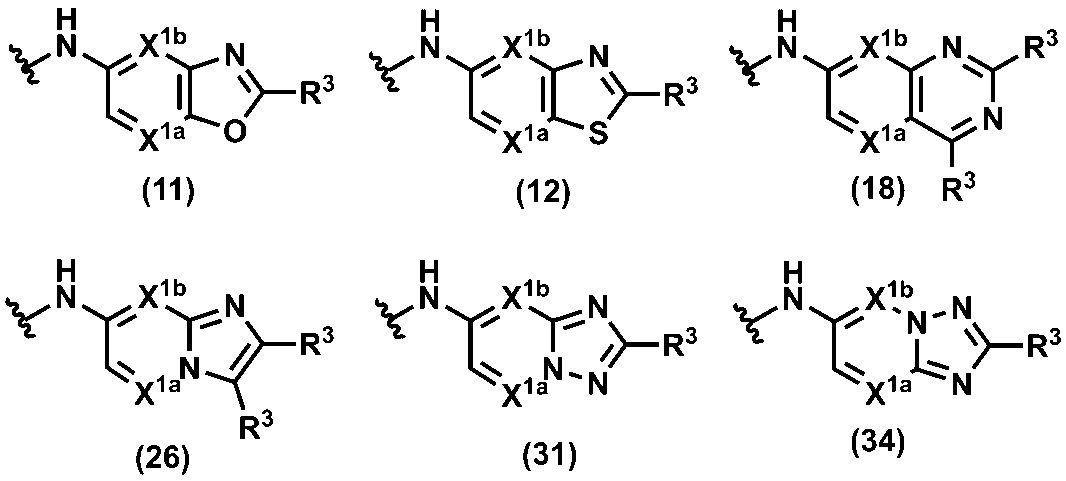
のいずれかで表される基、
(2)4-シアノフェニルアミノ、
(3)下記式(2h’’):

で表される基である、〔3〕に記載の化合物またはその製薬学的に許容される塩。
(1)ハロゲン原子;およびハロゲン原子、ヒドロキシ、およびC1-6アルコキシからなる群から選択される同種または異種の1~3個の基で置換されていてもよいC1-6アルキルからなる群から選択される同種または異種の1~4個の基で置換されていてもよい飽和または部分不飽和のC4-12炭素環基、または
(2)ハロゲン原子;およびハロゲン原子、ヒドロキシ、およびC1-6アルコキシからなる群から選択される同種または異種の1~3個の基で置換されていてもよいC1-6アルキルからなる群から選択される同種または異種の1~4個の基で置換されていてもよい4員~12員の飽和または部分不飽和のヘテロ環基である、〔1〕~〔4〕のいずれか一項に記載の化合物またはその製薬学的に許容される塩。

破線を含む結合は、単結合または二重結合を表し;
mは、0、1、2または3を表し;
RaおよびRbは、それぞれ独立して、
(1-1)水素原子、
(1-2)ハロゲン原子、または
(1-3)ハロゲン原子、ヒドロキシ、およびC1-6アルコキシからなる群から選択される同種または異種の1~3個の基で置換されていてもよいC1-6アルキルを表すか;
あるいは、RaおよびRbが、それらが結合する炭素原子と一緒になって、3~6員の飽和炭素環
(ここで、該環は、
(a)ハロゲン原子、
(b)ヒドロキシ、
(c)ハロゲン原子、ヒドロキシ、およびC1-6アルコキシからなる群から選択される同種または異種の1~3個の基で置換されていてもよいC1-6アルキル、および
(d)ハロゲン原子、ヒドロキシ、およびC1-6アルコキシからなる群から選択される同種または異種の1~3個の基で置換されていてもよいC1-6アルコキシ
からなる群から選択される同種または異種の1~4個の基で置換されていてもよい)
を形成していてもよい]
で表される基である、〔5〕に記載の化合物またはその製薬学的に許容される塩。


R1’およびR2’は、それぞれ独立して、
(2-1)水素原子、
(2-2)ハロゲン原子、
(2-3)シアノ、
(2-4)メチル、または
(2-5)メトキシ
のいずれかを表し:
M2’は
(1)下記式(53)~(58):

(a)水素原子、
(b)ハロゲン原子、
(c)シアノ、
(d)ハロゲン原子、ヒドロキシ、飽和または部分不飽和のC3-7炭素環基、C1-6アルコキシ、C1-6アルコキシで置換されていてもよい4~7員の飽和ヘテロ環基、および同種または異種の1~2個のC1-6アルキルで置換されていてもよいアミノからなる群から選択される同種または異種の1~3個の基で置換されていてもよいC1-6アルキル、
(e)ハロゲン原子、ヒドロキシ、C1-6アルコキシ、および同種または異種の1~2個のC1-6アルキルで置換されていてもよいアミノからなる群から選択される同種または異種の1~3個の基で置換されていてもよいC1-6アルコキシ、または
(f)ハロゲン原子、ヒドロキシ、およびC1-6アルコキシからなる群から選択される同種または異種の1~3個の基で置換されていてもよいC1-6アルキル;飽和または部分不飽和のC3-7炭素環基;およびハロゲン原子、ヒドロキシ、およびC1-6アルコキシからなる群から選択される同種または異種の1~3個の基で置換されていてもよいC2-7アルキルカルボニルからなる群から選択される同種または異種の1~2個の基で置換されていてもよいアミノを表す]
のいずれかで表される基、
(2)4-シアノフェニルアミノ、
(3)下記式(2h’’’):
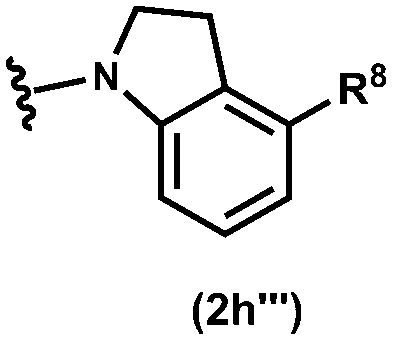
(a)ハロゲン原子;ヒドロキシ;ヒドロキシまたはC1-6アルコキシで置換されていてもよいC1-6アルコキシ;C1-6アルキルまたはC1-6アルコキシで置換されていてもよい4員~7員の飽和または部分不飽和のヘテロ環基;C1-6アルキルで置換されていてもよい5もしくは6員のヘテロアリール;およびアミノ(ここで、該アミノは、ハロゲン原子、ヒドロキシ、およびC1-6アルコキシからなる群から選択される同種または異種の1~3個の基で置換されていてもよいC1-6アルキル;飽和または部分不飽和のC3-7炭素環基;C1-6アルコキシで置換されていてもよい4員~7員の飽和ヘテロ環基;およびハロゲン原子、ヒドロキシ、およびC1-6アルコキシからなる群から選択される同種または異種の1~3個の基で置換されていてもよいC2-7アルキルカルボニルからなる群から選択される同種または異種の1~2個の基で置換されていてもよい)からなる群から選択される同種または異種の1~3個の基で置換されていてもよいC1-6アルキル、
(b)ハロゲン原子、ヒドロキシおよびC1-6アルコキシからなる群から選択される同種または異種の1~3個の基で置換されていてもよいC1-6アルコキシ、
(c)ハロゲン原子で置換されていてもよいC1-6アルキル;飽和または部分不飽和のC3-7炭素環基;およびハロゲン原子、ヒドロキシ、およびC1-6アルコキシからなる群から選択される同種または異種の1~3個の基で置換されていてもよいC2-7アルキルカルボニルからなる群から選択される同種または異種の1~2個の基で置換されていてもよいアミノ、
(d)ハロゲン原子、シアノ、C1-6アルキル、C1-6アルコキシ、およびC2-7アルコキシカルボニルからなる群から選択される同種または異種の1~4個の基で置換されていてもよい5もしくは6員のヘテロアリール、
(e)ハロゲン原子、ヒドロキシ、およびC1-6アルコキシからなる群から選択される同種または異種の1~3個の基で置換されていてもよいC1-6アルキル;C1-6アルコキシ;4員~7員の飽和または部分不飽和のヘテロ環基;ハロゲン原子、ヒドロキシ、およびC1-6アルコキシからなる群から選択される同種または異種の1~3個の基で置換されていてもよいC2-7アルキルカルボニル;およびオキソからなる群から選択される同種または異種の1~4個の基で置換されていてもよい4員~7員の飽和または部分不飽和のヘテロ環基、または
(f)1~4個のC1-6アルキルで置換されていてもよい4員~7員の飽和または部分不飽和のヘテロ環基-オキシ
を表す]
で表される、〔1〕~〔6〕のいずれか一項に記載の化合物またはその製薬学的に許容される塩。
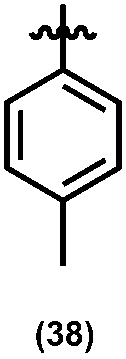


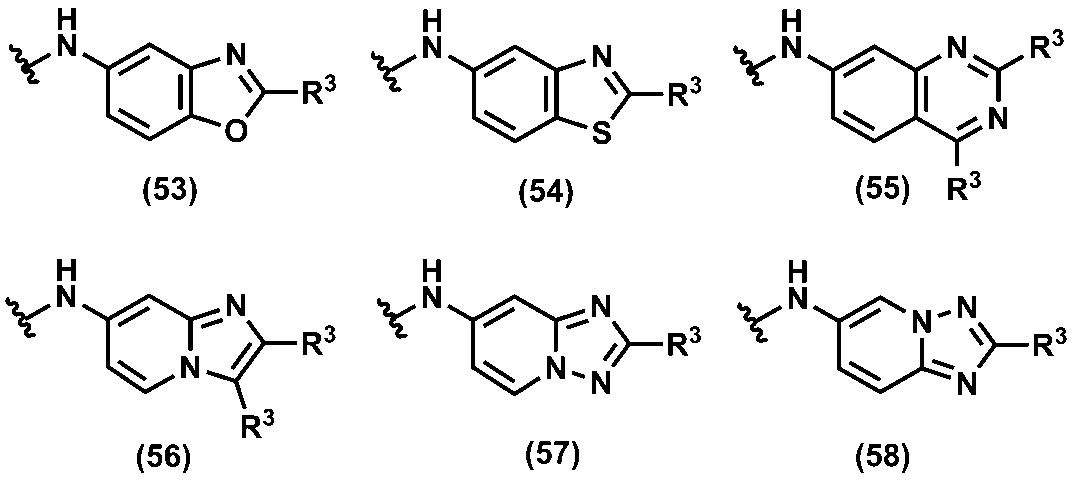
のいずれかで表される基である、〔7〕~〔10〕のいずれか一項に記載の化合物またはその製薬学的に許容される塩。

で表される基である、〔7〕~〔10〕のいずれか一項に記載の化合物またはその製薬学的に許容される塩。

(a)ハロゲン原子、シアノ、およびC1-6アルキルからなる群から選択される同種または異種の1~4個の基で置換されていてもよい5もしくは6員のヘテロアリール、または
(b)ハロゲン原子、ヒドロキシ、およびC1-6アルコキシからなる群から選択される同種または異種の1~3個の基で置換されていてもよいC1-6アルキル;C1-6アルコキシ;およびオキソからなる群から選択される同種または異種の1~4個の基で置換されていてもよい4員~7員の飽和または部分不飽和のヘテロ環基
を表す]
で表される、〔7〕~〔10〕のいずれか一項に記載の化合物またはその製薬学的に許容される塩。
N-(4-シアノフェニル)-2-[3-(4-メチルピペリジン-1-イル)-6-オキソピリダジン-1(6H)-イル]アセトアミド(実施例1)、
N-(1,3-ベンゾオキサゾール-5-イル)-2-[3-(4-メチルピペリジン-1-イル)-6-オキソピリダジン-1(6H)-イル]アセトアミド(実施例50)、
2-[3-(6-アザスピロ[3.4]オクタン-6-イル)-6-オキソピリダジン-1(6H)-イル]-N-(キナゾリン-7-イル)アセトアミド(実施例236)、
N-[2-(ジメチルアミノ)-1,3-ベンゾオキサゾール-5-イル]-2-[3-(4-メチルシクロヘキサ-1-エン)-6-オキソピリダジン-1(6H)-イル]アセトアミド(実施例244)、
2-[3-(4,4-ジメチルシクロヘキサ-1-エン-1-イル)-6-オキソピリダジン-1(6H)-イル]-N-([1,2,4]トリアゾロ[1,5-a]ピリジン-6-イル)アセトアミド(実施例428)、
2-[3-(4,4-ジメチルシクロヘキサ-1-エン-1-イル)-6-オキソピリダジン-1(6H)-イル]-N-([1,2,4]トリアゾロ[1,5-a]ピリジン-7-イル)アセトアミド(実施例429)、
N-(1,3-ベンゾオキサゾール-5-イル)-2-[3-(4,4-ジメチルシクロヘキサ-1-エン-1-イル)-6-オキソピリダジン-1(6H)-イル]アセトアミド(実施例445)、
2-[6-オキソ-3-(スピロ[2.5]オクト-5-エン-6-イル)ピリダジン-1(6H)-イル]-N-([1,2,4]トリアゾロ[1,5-a]ピリジン-7-イル)アセトアミド(実施例512)、
2-{2-オキソ-2-[4-(ピリダジン-4-イル)-2.3-ジヒドロ-1H-インドール-1-イル]エチル}-6-(スピロ[2.5]オクト-5-エン-6-イル)ピリダジン-3(2H)オン(実施例526)、
N-(1,3-ベンゾオキサゾール-5-イル)-2-[3-(4-メチルシクロヘキサ-1-エン-1-イル)-6-オキソピリダジン-1(6H)-イル]アセトアミド(実施例531)、
2-{3-[(4S)-4-メチルシクロヘキサ-1-エン-1-イル]-6-オキソピリダジン-1(6H)-イル}-N-([1,2,4]トリアゾロ[1,5-a]ピリジン-7-イル)アセトアミド(実施例537)、
2-{3-[(4R)-4-メチルシクロヘキサ-1-エン-1-イル]-6-オキソピリダジン-1(6H)-イル}-N-([1,2,4]トリアゾロ[1,5-a]ピリジン-7-イル)アセトアミド(実施例538)、
2-{3-[(4S)-4-メチルシクロヘキサ-1-エン-1-イル]-6-オキソピリダジン-1(6H)-イル}-N-([1,2,4]トリアゾロ[1,5-a]ピリジン-6-イル)アセトアミド(実施例539)、および
2-{3-[(4R)-4-メチルシクロヘキサ-1-エン-1-イル]-6-オキソピリダジン-1(6H)-イル}-N-([1,2,4]トリアゾロ[1,5-a]ピリジン-6-イル)アセトアミド(実施例540)。

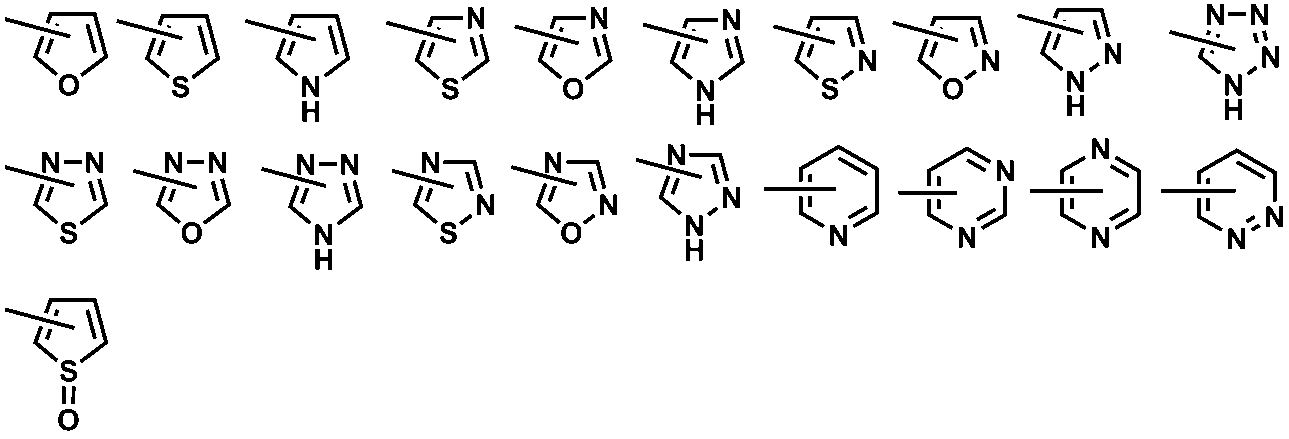


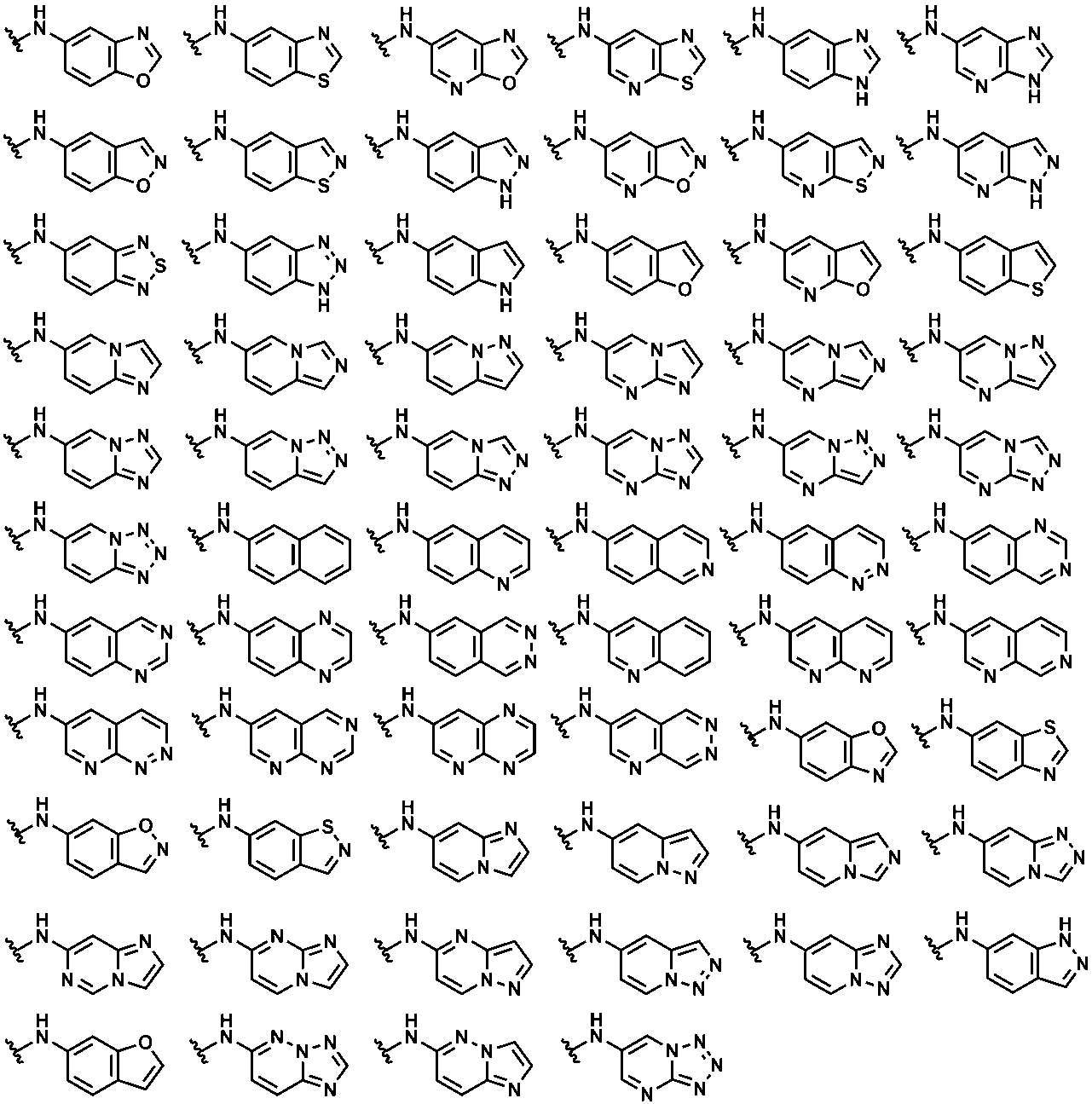
(1)水素原子、
(2)ハロゲン原子、ヒドロキシ、飽和または部分不飽和のC3-7炭素環基、およびC1-6アルコキシからなる群から選択される同種または異種の1~3個の基で置換されていてもよいC1-6アルキル、
(3)ハロゲン原子、ヒドロキシ、およびC1-6アルコキシからなる群から選択される同種または異種の1~3個の基で置換されていてもよいC1-6アルコキシ、または
(4)同種または異種の1~3個のハロゲン原子で置換されていてもよいC1-6アルキル;飽和または部分不飽和のC3-7炭素環基;およびC2-7アルキルカルボニルからなる群から選択される同種または異種の1~2個の基で置換されていてもよいアミノが挙げられる。
(1)ハロゲン原子、およびC1-6アルキルからなる群から選択される同種または異種の1~4個の基で置換されていてもよい飽和または部分不飽和のC4-12炭素環基、または
(2)ハロゲン原子、およびC1-6アルキルからなる群から選択される同種または異種の1~4個の基で置換されていてもよい4員~12員の飽和または部分不飽和のヘテロ環基が挙げられる。

破線を含む結合は、単結合または二重結合を表し;
mは、0、1、2または3を表し;
Ra、Rb、Rc、およびRdは、それぞれ独立して、
(1-1)水素原子、
(1-2)ハロゲン原子、
(1-3)ヒドロキシ、
(1-4)ハロゲン原子、ヒドロキシ、およびC1-6アルコキシからなる群から選択される同種または異種の1~3個の基で置換されていてもよいC1-6アルキル、
(1-5)ハロゲン原子、ヒドロキシ、およびC1-6アルコキシからなる群から選択される同種または異種の1~3個の基で置換されていてもよいC1-6アルコキシ、または
(1-6)同種または異種の1~3個のハロゲン原子で置換されていてもよいC1-6アルキルで置換されていてもよいアミノ-カルボニルを表し;
ここにおいて、RaおよびRbが、それらが結合する炭素原子と一緒になって、
(2-1)3~6員の飽和炭素環
(ここで、該環は、
(a)ハロゲン原子、
(b)ヒドロキシ、
(c)ハロゲン原子、ヒドロキシ、およびC1-6アルコキシからなる群から選択される同種または異種の1~3個の基で置換されていてもよいC1-6アルキル、および
(d)ハロゲン原子、ヒドロキシ、およびC1-6アルコキシからなる群から選択される同種または異種の1~3個の基で置換されていてもよいC1-6アルコキシ
からなる群から選択される同種または異種の1~4個の基で置換されていてもよい)、または
(2-2)3~6員の飽和ヘテロ環
(ここで、該環は、本項中の前記(2-1)の(a)~(d)からなる群から選択される同種または異種の1~4個の基で置換されていてもよい)
を形成していてもよい]
で表される基である。

さらに好ましくは、式(3a)、(3b)、(3c)、(3d)、(3e)、(3f)、(3g)、(3h)、(3i)、(3j)、(3k)、(3m)、(3n)、(3w)、(3x)、(3y)、(3z)、(3a’)、(3b’)、(3c‘)、(3d’)、(3e‘)または(3f’)で表される基である。

Ra、Rb、Rc、およびRdは、それぞれ独立して、
(1-1)水素原子、
(1-2)ハロゲン原子、
(1-3)ヒドロキシ、
(1-4)ハロゲン原子、ヒドロキシ、およびC1-6アルコキシからなる群から選択される同種または異種の1~3個の基で置換されていてもよいC1-6アルキル、
(1-5)ハロゲン原子、ヒドロキシ、およびC1-6アルコキシからなる群から選択される同種または異種の1~3個の基で置換されていてもよいC1-6アルコキシ、または
(1-6)同種または異種の1~3個のハロゲン原子で置換されていてもよいC1-6アルキルで置換されていてもよいアミノ-カルボニルを表し;
ここにおいて、RaおよびRbが、それらが結合する炭素原子と一緒になって、
(2-1)3~6員の飽和炭素環
(ここで、該環は、
(a)ハロゲン原子、
(b)ヒドロキシ、
(c)ハロゲン原子、ヒドロキシ、およびC1-6アルコキシからなる群から選択される同種または異種の1~3個の基で置換されていてもよいC1-6アルキル、および
(d)ハロゲン原子、ヒドロキシ、およびC1-6アルコキシからなる群から選択される同種または異種の1~3個の基で置換されていてもよいC1-6アルコキシ
からなる群から選択される同種または異種の1~4個の基で置換されていてもよい)、または
(2-2)3~6員の飽和ヘテロ環
(ここで、該環は、本項中の前記(2-1)の(a)~(d)からなる群から選択される同種または異種の1~4個の基で置換されていてもよい)
を形成していてもよい]
で表される基が挙げられる。

Ra、Rb、Rc、およびRdは、それぞれ独立して、
(1-1)水素原子、
(1-2)ハロゲン原子、
(1-3)ヒドロキシ、
(1-4)ハロゲン原子、ヒドロキシ、およびC1-6アルコキシからなる群から選択される同種または異種の1~3個の基で置換されていてもよいC1-6アルキル、
(1-5)ハロゲン原子、ヒドロキシ、およびC1-6アルコキシからなる群から選択される同種または異種の1~3個の基で置換されていてもよいC1-6アルコキシ、または
(1-6)同種または異種の1~3個のハロゲン原子で置換されていてもよいC1-6アルキルで置換されていてもよいアミノ-カルボニルを表し;
ここにおいて、RaおよびRbが、それらが結合する炭素原子と一緒になって、
(2-1)3~6員の飽和炭素環
(ここで、該環は、
(a)ハロゲン原子、
(b)ヒドロキシ、
(c)ハロゲン原子、ヒドロキシ、およびC1-6アルコキシからなる群から選択される同種または異種の1~3個の基で置換されていてもよいC1-6アルキル、および
(d)ハロゲン原子、ヒドロキシ、およびC1-6アルコキシからなる群から選択される同種または異種の1~3個の基で置換されていてもよいC1-6アルコキシ
からなる群から選択される同種または異種の1~4個の基で置換されていてもよい)、または
(2-2)3~6員の飽和ヘテロ環
(ここで、該環は、本項中の前記(2-1)の(a)~(d)からなる群から選択される同種または異種の1~4個の基で置換されていてもよい)
を形成していてもよい]
で表される基が挙げられる。
(1)下記式(11)~(37):

R4は、
(a)水素原子、
(b)ハロゲン原子、ヒドロキシ、およびC1-6アルコキシからなる群から選択される同種または異種の1~3個の基で置換されていてもよいC1-6アルキル、または
(c)ハロゲン原子、ヒドロキシ、C1-6アルキル、およびC1-6アルコキシからなる群から選択される同種または異種の1~4個の基で置換されていてもよい飽和または部分不飽和のC3-7炭素環基を表し;
R3は、
(a)水素原子、
(b)ハロゲン原子、
(c)シアノ、
(d)ヒドロキシ、
(e)ハロゲン原子、ヒドロキシ、飽和または部分不飽和のC3-7炭素環基、およびC1-6アルコキシからなる群から選択される同種または異種の1~3個の基で置換されていてもよいC1-6アルキル、
(f)ハロゲン原子、ヒドロキシ、C1-6アルキル、およびC1-6アルコキシからなる群から選択される同種または異種の1~4個の基で置換されていてもよい飽和または部分不飽和のC3-7炭素環基、
(g)ハロゲン原子、ヒドロキシ、およびC1-6アルコキシからなる群から選択される同種または異種の1~3個の基で置換されていてもよいC1-6アルコキシ、
(h)同種または異種の1~3個のハロゲン原子で置換されていてもよいC1-6アルキル;飽和または部分不飽和のC3-7炭素環基;およびC2-7アルキルカルボニルからなる群から選択される同種または異種の1~2個の基で置換されていてもよいアミノ、
(i)ハロゲン原子、シアノ、およびC1-6アルキルからなる群から選択される同種または異種の1~4個の基で置換されていてもよい5もしくは6員のヘテロアリール、
(j)ハロゲン原子、ヒドロキシ、C1-6アルキル、およびC1-6アルコキシからなる群から選択される同種または異種の1~4個の基で置換されていてもよい5もしくは6員の飽和ヘテロ環基、または
(k)-C(O)NRxRy
(ここにおいて、RxおよびRyは、それぞれ独立して、水素原子、C1-6アルキル、または飽和または部分不飽和のC3-7炭素環基を表すか;
あるいは、RxおよびRyは、それらが結合する窒素原子と一緒になって、4員~7員の飽和ヘテロ環基を形成していてもよい)
を表し、ここで、R3が複数ある場合、各R3は、同一または異なってもよい]
のいずれかで表される基、
(2)4-シアノフェニルアミノ、
(3)下記式(2c’’):

で表される基、
(4)下記式(2c’’’):

R19は、水素原子、またはC1-6アルキルを表す]
で表される基、または
(5)下記式(2d)、(2e)または(2j’):

(a)水素原子、
(b)ハロゲン原子、
(c)シアノ、
(d)同種または異種の1~3個のハロゲン原子で置換されていてもよいC1-6アルキル、
(e)同種または異種の1~3個のハロゲン原子で置換されていてもよいC1-6アルコキシ、
(f)同種または異種の1~2個のC1-6アルキルで置換されていてもよいアミノ、
(g)6員の飽和ヘテロ環基、または
(h)ハロゲン原子およびC1-6アルキルからなる群から選択される同種または異種の1~4個の基で置換されていてもよい5もしくは6員のヘテロアリールを表し;
X14は、CR20を表し;
R12、R13およびR14は、それぞれ独立して、
(a)水素原子、または
(b)メチルを表し;
R20は、
(a)フッ素原子およびメトキシからなる群から選択される同種または異種の1~2個の基で置換されていてもよいフェニル、または
(b)メチル、メトキシ、フッ素原子、トリフルオロメチル、およびジフルオロメトキシからなる群から選択される同種または異種の1~2個の基で置換されていてもよい5員~6員のヘテロアリールを表す]
で表される基のいずれかが挙げられる。

A1およびA2は、それぞれ独立して、NまたはCを表し、
ここにおいて、X2、X5、X6、X7、X8、A1、およびA2は、これらを含む環が、9もしくは10員の二環性芳香族ヘテロ環が形成されるように選択され;
R21およびR22は、それぞれ独立して、
(1)水素原子、
(2)ハロゲン原子、
(3)シアノ、
(4)ハロゲン原子、ヒドロキシ、飽和または部分不飽和のC3-7炭素環基、およびC1-6アルコキシからなる群から選択される同種または異種の1~3個の基で置換されていてもよいC1-6アルキル、
(5)ハロゲン原子、ヒドロキシ、C1-6アルキル、およびC1-6アルコキシからなる群から選択される同種または異種の1~4個の基で置換されていてもよい飽和または部分不飽和のC3-7炭素環基、
(6)ハロゲン原子、ヒドロキシ、およびC1-6アルコキシからなる群から選択される同種または異種の1~3個の基で置換されていてもよいC1-6アルコキシ、または
(7)同種または異種の1~3個のハロゲン原子で置換されていてもよいC1-6アルキル;飽和または部分不飽和のC3-7炭素環基;およびC2-7アルキルカルボニルからなる群から選択される同種または異種の1~2個の基で置換されていてもよいアミノを表す]
で表される基である。

R4は、
(a)水素原子、
(b)ハロゲン原子、ヒドロキシ、およびC1-6アルコキシからなる群から選択される同種または異種の1~3個の基で置換されていてもよいC1-6アルキル、または
(c)ハロゲン原子、ヒドロキシ、C1-6アルキル、およびC1-6アルコキシからなる群から選択される同種または異種の1~4個の基で置換されていてもよい飽和または部分不飽和のC3-7炭素環基を表し;
R3は、
(a)水素原子、
(b)ハロゲン原子、
(c)シアノ、
(d)ヒドロキシ、
(e)ハロゲン原子、ヒドロキシ、飽和または部分不飽和のC3-7炭素環基、およびC1-6アルコキシからなる群から選択される同種または異種の1~3個の基で置換されていてもよいC1-6アルキル、
(f)ハロゲン原子、ヒドロキシ、C1-6アルキル、およびC1-6アルコキシからなる群から選択される同種または異種の1~4個の基で置換されていてもよい飽和または部分不飽和のC3-7炭素環基、
(g)ハロゲン原子、ヒドロキシ、およびC1-6アルコキシからなる群から選択される同種または異種の1~3個の基で置換されていてもよいC1-6アルコキシ、
(h)同種または異種の1~3個のハロゲン原子で置換されていてもよいC1-6アルキル;飽和または部分不飽和のC3-7炭素環基;およびC2-7アルキルカルボニルからなる群から選択される同種または異種の1~2個の基で置換されていてもよいアミノ、
(i)ハロゲン原子、シアノ、およびC1-6アルキルからなる群から選択される同種または異種の1~4個の基で置換されていてもよい5もしくは6員のヘテロアリール、
(j)ハロゲン原子、ヒドロキシ、C1-6アルキル、およびC1-6アルコキシからなる群から選択される同種または異種の1~4個の基で置換されていてもよい5もしくは6員の飽和ヘテロ環基、または
(k)-C(O)NRxRy
(ここにおいて、RxおよびRyは、それぞれ独立して、水素原子、C1-6アルキル、または飽和または部分不飽和のC3-7炭素環基を表すか;
あるいは、RxおよびRyは、それらが結合する窒素原子と一緒になって、4員~7員の飽和ヘテロ環基を形成していてもよい)
を表し、ここで、R3が複数ある場合、各R3は、同一または異なってもよい]
のいずれかで表される基が挙げられる。
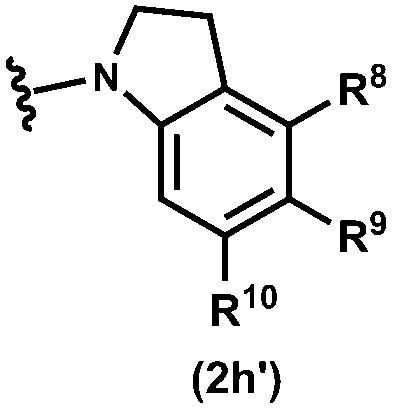
(a)水素原子、
(b)ハロゲン原子、
(c)シアノ、
(d)ハロゲン原子;ヒドロキシ;ヒドロキシまたはC1-6アルコキシで置換されていてもよいC1-6アルコキシ;C1-6アルキルまたはC1-6アルコキシで置換されていてもよい4員~7員の飽和または部分不飽和のヘテロ環基;C1-6アルキルで置換されていてもよい5もしくは6員のヘテロアリール;およびアミノ(ここで、該アミノは、ハロゲン原子、ヒドロキシ、およびC1-6アルコキシからなる群から選択される同種または異種の1~3個の基で置換されていてもよいC1-6アルキル;飽和または部分不飽和のC3-7炭素環基;C1-6アルコキシで置換されていてもよい4員~7員の飽和ヘテロ環基;およびハロゲン原子、ヒドロキシ、およびC1-6アルコキシからなる群から選択される同種または異種の1~3個の基で置換されていてもよいC2-7アルキルカルボニルからなる群から選択される同種または異種の1~2個の基で置換されていてもよい)からなる群から選択される同種または異種の1~3個の基で置換されていてもよいC1-6アルキル、
(e)ハロゲン原子、ヒドロキシおよびC1-6アルコキシからなる群から選択される同種または異種の1~3個の基で置換されていてもよいC1-6アルコキシ、
(f)ハロゲン原子で置換されていてもよいC1-6アルキル;飽和または部分不飽和のC3-7炭素環基;およびハロゲン原子、ヒドロキシ、およびC1-6アルコキシからなる群から選択される同種または異種の1~3個の基で置換されていてもよいC2-7アルキルカルボニルからなる群から選択される同種または異種の1~2個の基で置換されていてもよいアミノ、
(g)ハロゲン原子、シアノ、C1-6アルキル、C1-6アルコキシ、およびC2-7アルコキシカルボニルからなる群から選択される同種または異種の1~4個の基で置換されていてもよい5もしくは6員のヘテロアリール、
(h)ハロゲン原子、ヒドロキシ、およびC1-6アルコキシからなる群から選択される同種または異種の1~3個の基で置換されていてもよいC1-6アルキル;C1-6アルコキシ;4員~7員の飽和または部分不飽和のヘテロ環基;ハロゲン原子、ヒドロキシ、およびC1-6アルコキシからなる群から選択される同種または異種の1~3個の基で置換されていてもよいC2-7アルキルカルボニル;およびオキソからなる群から選択される同種または異種の1~4個の基で置換されていてもよい4員~7員の飽和または部分不飽和のヘテロ環基、
(i)1~4個のC1-6アルキルで置換されていてもよい4員~7員の飽和または部分不飽和のヘテロ環基-オキシ、
(j)-C(O)NRxRy
(ここにおいて、RxおよびRyは、それぞれ独立して、水素原子、C1-6アルキル、または飽和または部分不飽和のC3-7炭素環基を表すか;
あるいは、RxおよびRyは、それらが結合する窒素原子と一緒になって、4員~7員の飽和ヘテロ環基を形成していてもよい)、
(k)-C(O)ORZ(ここにおいて、RZは、C1-6アルキルを表す)、または
(l)1個の6員の飽和ヘテロ環基で置換されていてもよいエテニルであり;
ここにおいて、R8およびR9は、それらが結合する炭素原子と一緒になって、5~7員の飽和または部分不飽和の炭素環またはヘテロ環(ここで、該環は、ハロゲン原子、およびC1-6アルキルからなる群から選択される同種または異種の1~4個の基で置換されていてもよい)を形成していてもよい]
で表される基が挙げられる。
また、式(1)で表される化合物のいずれか1つ又は2つ以上の1Hを2H(D)に変換した重水素変換体も式(1)で表される化合物に包含される。
本発明化合物は、下記に示す製造法、および公知の合成方法を組み合わせた方法により合成してもよい。
反応式中の化合物はそれぞれ塩を形成している場合も含み、該塩としては、例えば、上記「製薬学的に許容される塩」と同様のものが挙げられる。なお、これらの反応は単なる例示であり、有機合成化学に習熟している者の知識に基づき、適宜、他の方法で本発明化合物を製造することもできる。

式(1)で表される化合物は、例えば、下記に示される方法によって製造される。

式(1)で表される化合物は、化合物(1-1)を適当な不活性溶媒中で塩基の存在下、化合物(1-2)と反応させることにより製造される。化合物(1-1)は、後述の製造法4または5により合成されたもの、または市販品を用いることができる。化合物(1-2)は市販品として、または公知の方法、もしくはそれに準じた方法によって合成されたものを用いることができる。
塩基としては、例えば炭酸カリウム、炭酸ナトリウム、炭酸セシウム、炭酸水素カリウム、炭酸水素ナトリウム、リン酸水素二カリウム、リン酸カリウム、リン酸水素二ナトリウム、リン酸ナトリウム、水酸化カリウム、水酸化ナトリウム、水素化ナトリウム等の無機塩基;ナトリウムメトキシド、カリウムtert-ブトキシド等の金属アルコキシド;トリエチルアミン、ジイソプロピルエチルアミン、ピリジン等の有機塩基等が挙げられる。
不活性溶媒としては、例えばジメチルホルムアミド、N-メチル-2-ピロリジノン、ジメチルスルホキシド、アセトニトリル、アセトン、メチルエチルケトン等の非プロトン性極性溶媒;ジエチルエーテル、テトラヒドロフラン、1,4-ジオキサン等のエーテル系溶媒;クロロホルム、ジクロロメタン等のハロゲン化炭化水素;ベンゼン、トルエン等の芳香族炭化水素;およびこれらの混合溶媒等が挙げられる。
反応温度は、特に限定されないが、通常-10℃から200℃、好ましくは0℃から40℃の範囲から選択される。反応時間は、反応温度、使用される原料、および溶媒等の条件によって異なるが、通常10分から48時間である。
化合物(1-4)は、化合物(1-1)と化合物(1-3)より、工程1-1に記載の方法に準じて製造される。化合物(1-3)は市販品として、または公知の方法、もしくはそれに準じた方法によって合成されたものを用いることができる。
化合物(1-5)は、化合物(1-4)を公知の方法(例えば、Protective Groups in Organic Synthesis 3rd Edition (John Wiley & Sons, Inc.)、Comprehensive Organic Transformation, R. C. ラロック著等、VCH publisher Inc., 1989等)と同様の方法で加水分解することにより製造される。
式(1)で表される化合物はまた、化合物(1-5)を適当な不活性溶媒中で、塩基存在下または非存在下において、化合物(1-6)と縮合剤を用いて反応させることによっても製造される。化合物(1-6)は市販品として、または公知の方法、もしくはそれに準じた方法によって合成されたものを用いることができる。
縮合剤としては、例えばジシクロヘキシルカルボジイミド(DCC)、ジイソプロピルカルボジイミド(DIPC)、1-エチル-3-(3-ジメチルアミノプロピル)-カルボジイミド(WSC)、ベンゾトリアゾール-1-イル-トリス(ジメチルアミノ)ホスホニウム・ヘキサフルオロリン化物塩(BOP)、ジフェニルホスホニルジアミド(DPPA)、N,N-カルボニルジイミダゾール(CDI)、ベンゾトリアゾール-1-イル-N,N,N’,N’-テトラメチルウロニウム・ヘキサフルオロリン化物塩(HBTU)、7-アザベンゾトリアゾール-1-イル-N,N,N’,N’-テトラメチルウロニウム・ヘキサフルオロリン化物塩(HATU)等が挙げられる。必要に応じて、例えば、N-ヒドロキシスクシンイミド(HOSu)、1-ヒドロキシベンゾトリアゾール(HOBt)、3-ヒドロキシ-4-オキソ-3,4-ジヒドロ-1,2,3-ベンゾトリアジン(HOOBt)等の添加剤を加えて反応を行うことができる。
塩基としては、例えばトリエチルアミン、ジイソプロピルエチルアミン、ピリジン等の有機塩基;炭酸カリウム、炭酸ナトリウム、炭酸セシウム、炭酸水素カリウム、炭酸水素ナトリウム、リン酸水素二カリウム、リン酸カリウム、リン酸水素二ナトリウム、リン酸ナトリウム、水酸化カリウム、水酸化ナトリウム、水素化ナトリウム等の無機塩基;ナトリウムメトキシド、カリウムtert-ブトキシド等の金属アルコキシド等が挙げられる。
不活性溶媒としては、例えばジメチルホルムアミド、N-メチル-2-ピロリジノン、ジメチルスルホキシド、アセトニトリル、アセトン、メチルエチルケトン等の非プロトン性極性溶媒;ジエチルエーテル、テトラヒドロフラン、1,4-ジオキサン等のエーテル系溶媒;クロロホルム、ジクロロメタン等のハロゲン化炭化水素;ベンゼン、トルエン等の芳香族炭化水素;およびこれらの混合溶媒等が挙げられる。
反応温度は、特に限定されないが、通常-10℃から200℃、好ましくは0℃から40℃の範囲から選択される。反応時間は、反応温度、使用される原料、および溶媒等の条件によって異なるが、通常10分から48時間である。
また、本工程は、公知の方法に従い、例えばカルボキシ基を酸無水物、混合酸無水物、酸ハロゲン化物により活性化し、化合物(1-6)と反応させることによっても行うことができる。
式(1)で表される化合物のうち、式(2-4)で表される化合物は、例えば、下記に示される方法によって製造される。

化合物(2-2)は、化合物(2-1)と化合物(1-2)より、工程1-1に記載の方法に準じて製造される。化合物(2-1)は、公知の方法(例えば、Tetrahedron, 2015, 71, 4859., Bioorganic & Medicinal Chemistry Letters,2015, 25, 1030.等)に準じて合成されたもの、または市販品を用いることができる。
化合物(2-4)は、化合物(2-2)を適当な不活性溶媒中で塩基の存在下、化合物(2-3)と反応させることにより製造される。化合物(2-3)は市販品として、または公知の方法、もしくはそれに準じた方法によって合成されたものを用いることができる。
塩基としては、例えばトリエチルアミン、ジイソプロピルエチルアミン、ピリジン等の有機塩基;炭酸カリウム、炭酸ナトリウム、炭酸セシウム、炭酸水素カリウム、炭酸水素ナトリウム、リン酸水素二カリウム、リン酸カリウム、リン酸水素二ナトリウム、リン酸ナトリウム、水酸化カリウム、水酸化ナトリウム、水素化ナトリウム等の無機塩基;ナトリウムメトキシド、カリウムtert-ブトキシド等の金属アルコキシド等が挙げられる。
不活性溶媒としては、例えばジメチルホルムアミド、N-メチル-2-ピロリジノン、ジメチルスルホキシド、アセトニトリル、アセトン、メチルエチルケトン等の非プロトン性極性溶媒;クロロホルム、ジクロロメタン等のハロゲン化炭化水素;ベンゼン、トルエン等の芳香族炭化水素;およびこれらの混合溶媒等が挙げられる。
反応温度は、特に限定されないが、通常20℃から200℃、好ましくは50℃から170℃の範囲から選択される。本工程はまた、必要に応じてマイクロ波照射下で行うこともできる。反応時間は、反応温度、使用される原料、および溶媒等の条件によって異なるが、通常10分から48時間である。
式(1)で表される化合物のうち、式(3-2)および式(3-3)で表される化合物は、例えば、下記に示される方法によって製造される。

化合物(3-2)は、化合物(2-2)を適当な不活性溶媒中で、パラジウム触媒、ホスフィン配位子および塩基存在下、化合物(3-1)と反応させることにより製造される。化合物(3-1)は市販品として、または公知の方法、もしくはそれに準じた方法によって合成されたものを用いることができる。
パラジウム触媒としては、例えばテトラキス(トリフェニルホスフィン)パラジウム(0)、ビス(ジベンジリデンアセトン)パラジウム(0)、トリス(ジベンジリデンアセトン)ジパラジウム(0)、ビス(トリ-tert-ブチルホスフィン)パラジウム(0)、酢酸パラジウム(0)、[1、1-ビス(ジフェニルホスフィノ)フェロセン]パラジウム(II)ジクロライド、ビス(ジ-tert-ブチル(4-ジメチルアミノフェニル)ホスフィン)ジクロロパラジウム(II)等が挙げられる。
ホスフィン配位子としては、例えばo-トリルホスフィン、2-ジシクロヘキシルホスフィノ-2’,6’-ジメトキシビフェニル(S-Phos)、2-ジシクロヘキシルホスフィノ-2’,4’,6’-トリイソプロピルビフェニル(X-Phos)、1,1’-ビス(ジフェニルホスフィノ)フェロセン(DPPF)、1,2-ビス(ジフェニルホスフィノ)エタン(DPPE)、1,3-ビス(ジフェニルホスフィノ)プロパン(DPPP)、1,4-ビス(ジフェニルホスフィノ)ブタン(DPPB)、2,2’-ビス(ジフェニルホスフィノ)-1,1’-ビナフチル(BINAP)、4,5-ビス(ジフェニルホスフィノ)-9,9-ジメチルキサンテン(XANT-Phos)、ビス(2-(ジフェニルホスフィノ)フェニル)エーテル(DPE-Phos)等が挙げられる。
塩基としては、例えば炭酸ナトリウム、炭酸カリウム、炭酸セシウム、リン酸カリウム、水酸化ナトリウム、水酸化カリウム等が挙げられる。
不活性溶媒としては、例えば1,4-ジオキサン、THF、1,2-ジメトキシエタン、水およびこれらの混合溶媒等が挙げられる。
反応温度は、特に限定されないが、通常50℃から200℃、好ましくは80℃から150℃の範囲から選択される。本工程はまた、必要に応じてマイクロ波照射下で行うこともできる。反応時間は、通常30分から48時間である。
化合物(3-3)は、化合物(3-2)を適当な不活性溶媒中で、水素雰囲気下、金属触媒を用いて接触還元することにより製造される。
金属触媒としては、例えばパラジウム/炭素、水酸化パラジウム/炭素、ラネーニッケル、酸化白金/炭素、ロジウム/炭素等が挙げられる。金属触媒の使用量は、化合物(3-2)に対して、通常0.1重量%から1000重量%、好ましくは1重量%から100重量%である。
不活性溶媒としては、例えば、テトラヒドロフラン等のエーテル類;酢酸エチルなどのエステル類等が挙げられる。
水素圧は、通常1気圧から100気圧、好ましくは1気圧から5気圧である。
反応温度は、特に限定されないが、通常0℃から120℃、好ましくは20℃から80℃の範囲から選択される。反応時間は、通常30分から72時間である。
式(1-1)で表される化合物のうち、式(4-3)で表される化合物は、例えば、下記に示される方法によって製造される。

化合物(4-2)は、化合物(4-1)と化合物(2-3)より、工程2-2に記載の方法に準じて製造される。化合物(4-1)および化合物(2-3)は市販品として、または公知の方法(例えば、国際公開第2004/006922号,ACS Medicinal Chemistry Letters,2012, 3, 903.等)、もしくはそれに準じた方法によって合成されたものを用いることができる。化合物(2-3)の使用量は、化合物(4-2)に対して、通常1.0当量から1.5当量、好ましくは1.05当量から1.2当量である。
化合物(4-3)は、化合物(4-2)を公知の方法(例えば、Bioorganic & MedicinalChemistry Letters,2013, 23, 2007.,国際公開第2012/114268号等)と同様の方法で製造される
式(1-1)で表される化合物のうち、式(5-4)で表される化合物は、例えば、下記に示される方法によって製造される。
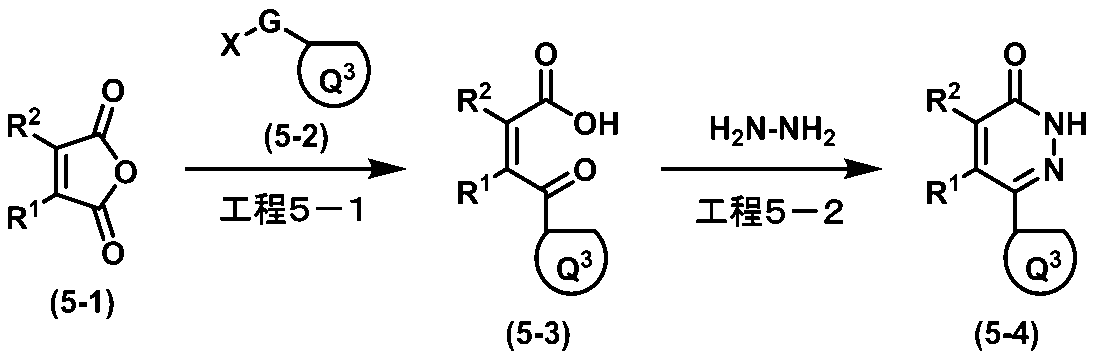
化合物(5-3)は、化合物(5-1)に対して、例えばGrignard試薬等の有機金属化合物(5-2)を公知の方法(例えば、Organic Letters,2015, 17, 5517.,Organic & Biomolecular Chemistry,2014, 12, 2049.等)と同様の方法で反応させることにより製造される。化合物(5-1)および化合物(5-2)は市販品として、または公知の方法(例えば、Organic Letters,2008, 10, 4815.,Journal of Organic Chemistry,2015, 80, 12182.等)、もしくはそれに準じた方法によって合成されたものを用いることができる。
化合物(5-4)は、化合物(5-2)に対してヒドラジンを公知の方法(例えば、Journal of Medicinal Chemistry,1993, 36, 4052., 国際公開第2007/020343号等)と同様の方法で反応させることにより製造される。
上記の製造法における原料化合物または中間体は、反応条件等により、例えば塩酸塩等の塩の形態で存在し得るものもあるが、そのまま、または遊離の形で使用することができる。原料化合物または中間体が塩の形態で得られ、原料化合物または中間体を遊離の形で使用または取得したい場合には、これらを適当な溶媒に溶解または懸濁し、例えば炭酸水素ナトリウム水溶液等の塩基等で中和することにより遊離の形へ変換できる。
また、光学異性体は前記製造法の適切な工程で、光学活性カラムを用いた方法、分別結晶化法などの公知の分離工程を実施することで分離することができる。また、出発原料として光学活性体を使用することもできる。
本発明化合物はまた、Nav1.1活性化作用を示すため、Nav1.1が関与する疾患、特にNav1.1の機能低下が関与する疾患の治療剤および/または予防剤、例えば中枢神経系疾患(例えば、熱性痙攣;全般てんかん熱性痙攣プラス;てんかん(具体的には、局在関連性てんかん、全般性てんかん);てんかん症候群(ドラベ症候群、全身性緊張間代発作を伴う難治性小児てんかん、ミオクロニー脱力発作を伴うてんかん、ウェスト症候群、レノックス・ガストー症候群、点頭てんかん、重症乳児多病巣性てんかん、乳児境界期重症筋間代性てんかん、良性家族性新生児乳児痙攣等);統合失調症;自閉症スペクトラム障害;注意欠如多動性障害に対する治療剤および/または予防剤としても有用でありうる。
加えて、本発明化合物は、複数薬剤、特に三剤以上の既存の抗てんかん薬では十分に症状が抑えられない、先に記載のてんかん症候群またはてんかん(特に、難治性てんかん)に対する治療剤および/または予防剤としても期待される。
投与経路としては、治療に際し最も効果的なものを使用するのが望ましく、経口;または静脈内、塗布、吸入および点眼等の非経口を挙げることができる。好ましくは経口投与である。
剤形としては、例えば、錠剤、カプセル剤、散剤、顆粒剤、液剤、懸濁剤、注射剤、貼付剤、ハップ剤等が挙げられる。好ましくは錠剤である。
剤形または医薬組成物への製剤化は、製薬学的に許容される添加剤を用いて、公知の方法に従い行うことができる。
製薬学的に許容される添加剤は、目的に応じて、賦形剤、崩壊剤、結合剤、流動化剤、滑沢剤、コーティング剤、溶解剤、溶解補助剤、増粘剤、分散剤、安定化剤、甘味剤、香料等を用いることができる。具体的には、例えば、乳糖、マンニトール、結晶セルロース、低置換度ヒドロキシプロピルセルロース、トウモロコシデンプン、部分α化デンプン、カルメロースカルシウム、クロスカルメロースナトリウム、ヒドロキシプロピルセルロース、ヒドロキシプロピルメチルセルロース、ポリビニルアルコール、ステアリン酸マグネシウム、フマル酸ステアリルナトリウム、ポリエチレングリコール、プロピレングリコール、酸化チタン、タルク等が挙げられる。
CDCl3:重クロロホルム
DMSO-d6:重ジメチルスルホキシド
Rt:保持時間
min:分
HATU:O-(7-アザ-1H-ベンゾトリアゾール-1-イル)-N,N,N’,N’-テトラメチルウロニウム ヘキサフルオロホスファート
THF:テトラヒドロフラン
TFA:トリフルオロ酢酸
DMF:N,N-ジメチルホルムアミド
Boc:tert-ブトキシカルボニル
1H-NMR:JEOL JNM-AL400;JEOL JNM-ECS400;Brucker AVANCE 400 Spectrometer
Method A
検出機器:ACQUITY(登録商標)SQ deteceter (Waters社)
HPLC:ACQUITY UPLC(登録商標)SYSTEM
Column:Waters ACQUITY UPLC(登録商標) BEH C18(1.7um, 2.1mm × 30mm)
Method B
検出機器:島津 LCMS-2020
Column:Phenomenex Kinetex(C18, 1.7um, 2.1mm × 50mm)
Method C
検出機器:Agilent 6110 Quadropole LC/MS
HPLC:Agilent 1200series
Column: XBridge C18(3.5um, 4.6mm × 50mm)
Method D
検出機器:ACQUITY(登録商標)SQ deteceter (Waters社)
HPLC:ACQUITY UPLC(登録商標)SYSTEM
Column:Waters ACQUITY UPLC(登録商標) BEH C18(1.7um, 2.1mm × 30mm)
Method A
溶媒:A液;0.06%ギ酸/H2O、B液;0.06%ギ酸/アセトニトリル
グラジエント条件:0.0-1.3分(linear gradient from B 2% to 96%)
流速:0.8mL/分;検出UV:220nm and 254nm;温度:40℃
Method B
溶媒:A液;0.05%TFA/H2O、B液;アセトニトリル
グラジエント条件:0.0-1.7分(linear gradient from B 10% to 99%)
流速:0.5mL/分;検出UV:220nm;温度:40℃
Method C
溶媒:A液;10mM NH4HCO3/H2O、B液;アセトニトリル
グラジエント条件:0.0-0.2分(B 5%)0.2-1.5分(linear gradient from B 5% to 95%)1.5-2.8分(B 95%)
流速:1.8mL/分;検出UV:214nm and 254nm ;温度:50℃
Method D
溶媒:A液;0.05%ギ酸/H2O、B液;アセトニトリル
グラジエント条件:0.0-1.3分(linear gradient from B 10% to 95%)1.3-1.5分(B 10%)
流速:0.8mL/分;検出UV:220nm and 254nm;温度:40℃
2-クロロ-N-(4-シアノフェニル)アセトアミド

1H-NMR (400 MHz, DMSO-d6) δ: 10.71 (s, 1H), 7.80 (d, J = 9.2 Hz, 2H), 7.76 (d, J = 9.2 Hz, 2H), 4.30 (s, 2H).
6-(4-メチルピペリジン-1-イル)ピリダジン-3(2H)-オン
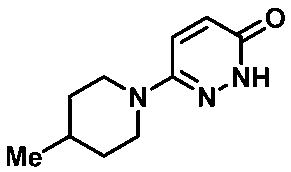
1H-NMR (400 MHz, CDCl3) δ: 7.17 (d, J = 10.5 Hz, 1H), 6.83 (d, J = 10.1 Hz, 1H), 3.73 (dt, J = 12.9, 2.4 Hz, 2H), 2.71 (td, J = 12.6, 2.6 Hz, 2H), 1.72-1.65 (m, 2H), 1.59-1.47 (m, 1H), 1.25 (dd, J = 12.3, 4.1 Hz, 1H), 1.19 (dd, J = 12.1, 4.3 Hz, 1H), 0.95 (d, J = 6.4 Hz, 3H).
2-(3-クロロ-6-オキソピリダジン-1(6H)-イル)-N-(4-シアノフェニル)アセトアミド
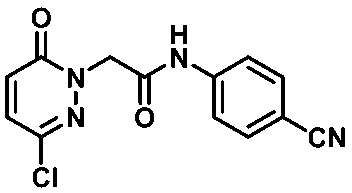
1H-NMR (400 MHz, DMSO-d6) δ: 10.78 (s, 1H), 7.79 (dt, J = 8.8, 2.1 Hz, 2H), 7.73 (dt, J = 9.0, 2.1 Hz, 2H), 7.64 (d, J = 9.6 Hz, 1H), 7.11 (d, J = 10.1 Hz, 1H), 4.90 (s, 2H).
2-(4,4-ジフルオロシクロヘキサ-1-エン-1-イル)-4,4,5,5-テトラメチル-1,3,2-ジオキサボロラン
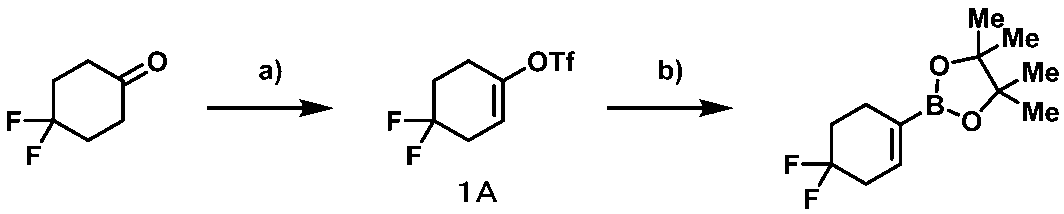
1H-NMR (400 MHz, CDCl3) δ: 5.67-5.63 (m, 1H), 2.69 (td, J = 13.5, 2.9 Hz, 2H), 2.60-2.55 m, 2H), 2.24-2.14 (m, 2H).
b)化合物1A(46.1g)、ビスピナコラートジボロン(52.8g)の1,4-ジオキサン(577mL)溶液に酢酸カリウム(42.5g)および1,1’-ビス(ジフェニルホスフィノ)フェロセンパラジウムジクロライド(6.34g)を加え、2時間加熱還流した。室温へ冷却後、セライトでろ過し、ろ液を減圧濃縮した。酢酸エチル(1.5L)を加え、有機層を水(300mL)と飽和食塩水(200mL)で洗浄後、無水硫酸ナトリウムで乾燥し、ろ過して減圧濃縮した。残渣をシリカゲルクロマトグラフィー(展開溶媒;ヘキサン:酢酸エチル=100:0、後に90:10)で精製し、表題化合物(39.8g)を得た。
1H-NMR (400 MHz, CDCl3) δ: 6.37-6.35 (m, 1H), 2.60-2.50 (m, 2H), 2.41-2.36 (m, 2H), 2.00-1.89 (m, 2H), 1.24 (s, 12H).
6-(4,4-ジメチルシクロヘキシル)ピリダジン-3(2H)-オン
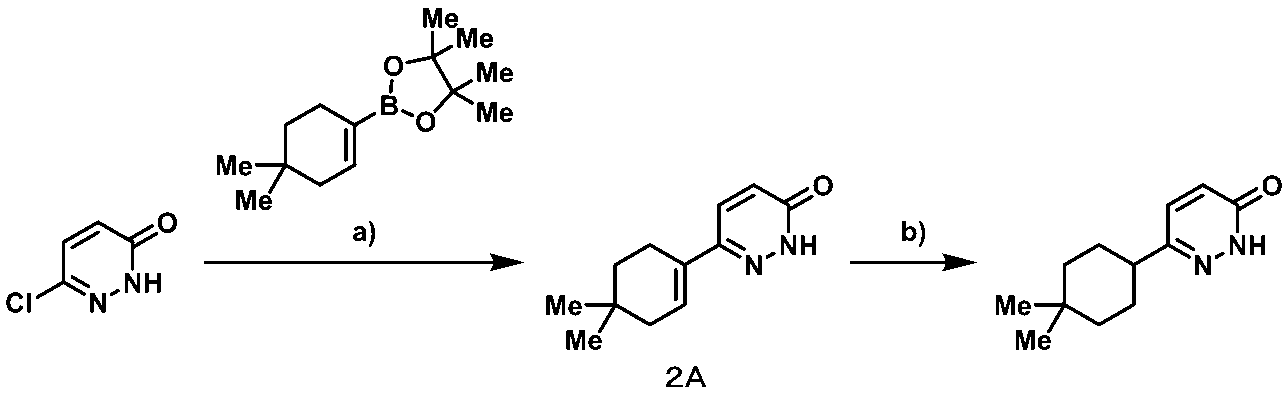
1H-NMR (400 MHz, DMSO-d6) δ: 7.80 (d, J = 10.1 Hz, 1H), 6.80 (d, J = 9.6 Hz, 1H), 6.43-6.40 (m, 1H), 2.35-2.30 (m, 2H), 1.98 (dt, J = 4.1, 1.8 Hz, 2H), 1.42 (t, J = 6.4 Hz, 2H), 0.91 (s, 6H).
b)化合物2A(88mg)、10%パラジウム/炭素(20mg)のメタノール(20mL)懸濁液を、水素雰囲気下、室温で10時間撹拌した。Pd/Cをセライト上でろ過し、メタノールで洗浄した。ろ液を濃縮し表題化合物(89mg)を得た。
1H-NMR (400MHz, CDCl3) δ: 10.66 (s, 1H), 7.19 (d, J = 10.1 Hz, 1H), 6.89 (d, J = 9.6 Hz, 1H), 2.42 (tt, J = 11.8, 4.0 Hz, 1H), 1.71-1.67 (m, 2H), 1.63-1.55 (m, 2H), 1.52-1.45 (m, 2H), 1.27 (td, J = 12.3, 4.0 Hz, 2H), 0.93 (s, 3H), 0.92 (s, 3H).
[3-(4-メチルピペリジン-1-イル)-6-オキソピリダジン-1(6H)-イル]酢酸

1H-NMR (400 MHz, CDCl3) δ: 7.16 (d, J = 10.1 Hz, 1H), 6.84 (d, J = 10.1 Hz, 1H), 4.75 (s, 2H), 3.77-3.74 (m, 2H), 3.76 (s, 3H), 2.71 (td, J = 12.5, 2.4 Hz, 2H), 1.69 (d, J = 12.5 Hz, 2H), 1.59-1.48 (m, 1H), 1.28-1.18 (m, 2H), 0.96 (d, J = 6.4 Hz, 3H).
b)化合物3A(3.2g)をメタノール(20mL)とTHF(20mL)の混合溶媒に溶解させ、2mol/Lの水酸化ナトリウム水溶液(30mL)を氷冷下で加えた。その後、室温で30分間撹拌した。反応溶液の有機溶媒を減圧下にて留去し、残った水層に対して1mol/L塩酸を加え、pH3に調整した。析出した固体をろ取し、水で洗浄後、減圧乾燥を行うことにより表題化合物(3.0g)を得た。
1H-NMR (400 MHz, CD3OD) δ: 7.50 (d, J = 10.1 Hz, 1H), 6.86 (d, J = 10.1 Hz, 1H), 4.72 (s, 2H), 3.92-3.88 (br, 2H), 2.76 (td, J = 12.7, 2.6 Hz, 2H), 1.73-1.68 (br, 2H), 1.64-1.51 (m, 1H), 1.23 (ddd, J = 24.4, 12.7, 3.9 Hz, 2H), 0.97 (d, J = 6.4 Hz, 3H).
4-(4-メチルフェニル)-5,6,7,8-テトラヒドロフタラジン-1(2H)-オン
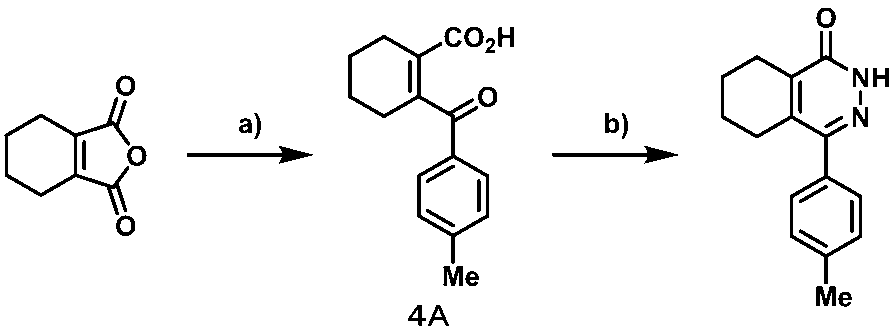
1H-NMR (400 MHz, CDCl3) δ: 7.40-7.31 (m, 2H), 7.15 (d, J = 8.5 Hz, 2H), 2.42-2.20 (m, 6H), 1.98-1.43 (m, 5H).
b)化号物4A(7.61g)のエタノール溶液(156mL)に、ヒドラジン一水和物(3.03mL)を添加し、5時間加熱還流した。室温へと放冷後、飽和炭酸水素ナトリウム水溶液を加え、エタノールを減圧濃縮により除去した。析出した固体をろ取し、水で洗浄後、減圧乾燥を行うことにより表題化合物(6.22g)を得た。
1H-NMR (400 MHz, CDCl3) δ: 10.42 (s, 1H), 7.26-7.25 (m, 2H), 7.23-7.21 (m, 2H), 2.64-2.62 (m, 2H), 2.40-2.37 (m, 5H), 1.79-1.77 (m, 2H), 1.68-1.65 (m, 2H).
6-(2-アザスピロ[4.4]ノナン-2-イル)-4-メチルピリダジン-3(2H)-オン
参考例9
6-(2-アザスピロ[4.4]ノナン-2-イル)-5-メチルピリダジン-3(2H)-オン

b)化合物5Aを酢酸(3mL)に溶解し、反応溶液にマイクロウェーブを照射し200℃で2時間撹拌した。反応溶液を室温まで冷却後、トルエンを加え減圧濃縮した。シリカゲルカラムクロマトグラフィー(展開溶媒;クロロホルム:メタノール=100:0、後に98:2)で精製することにより6-(2-アザスピロ[4.4]ノナン-2-イル)-4-メチルピリダジン-3(2H)-オン(220mg)を得た。
LC-MS: [M+H]+ / Rt (min) 234.2 / 0.832 (Method A)
化合物5Bから同様に、6-(2-アザスピロ[4.4]ノナン-2-イル)-5-メチルピリダジン-3(2H)-オン(195mg)を得た。
LC-MS: [M+H]+ / Rt (min) 234.2 / 0.839 (Method A)
6-(6-アザスピロ[3.4]オクタン-6-イル)-4-メトキシピリダジン-3(2H)-オン

LC-MS: [M+H]+ / Rt (min) 250.2 / 0.506 (Method A)
b)化合物6A(80mg)をジオキサン(500μL)と濃塩酸(2mL)に溶解し、反応溶液にマイクロウェーブを照射し、100℃で2時間撹拌した。反応溶液を室温まで冷却後、減圧濃縮した。残渣を水にあけ、析出した固体をろ取することにより表題化合物(53mg)を得た。
LC-MS: [M+H]+ / Rt (min) 236.2 / 0.527 (Method A)
1,1-ジフルオロ-4,4-ジメチル-6-アザスピロ[2.5]オクタン 塩酸塩

1H-NMR (400 MHz, CDCl3) δ: 3.87 (br s, 1H), 3.43 (br s, 1H), 3.06-2.99 (m, 1H), 2.87-2.83 (m, 1H), 1.97-1.90 (m, 1H), 1.46 (s, 9H), 1.44-1.40 (m, 1H), 1.31-1.23 (m, 1H), 1.06 (s, 3H), 0.92-0.86 (m, 4H).
b)化合物7A(4.2g)をシクロペンチルメチルエーテル(10ml)に溶かし、塩化水素シクロペンチルメチルエーテル溶液(18.5mL)を添加した後、5時間撹拌した。析出した固体をろ取し、乾燥することにより表題化合物(3.71g)を得た。
1H-NMR (400 MHz, DMSO-d6) δ: 9.59 (s, 1H), 8.96 (s, 1H), 3.16-3.12 (m, 1H), 2.94-2.91 (m, 1H), 2.88-2.70 (m, 2H), 2.09-2.02 (m, 1H), 1.70-1.64 (m, 1H), 1.46-1.40 (m, 1H), 1.32-1.26 (m, 1H), 1.17 (s, 3H), 0.89 (s, 3H).
7-クロロ-2-メチル-1,3-ベンズオキサゾール-5-アミン

1H-NMR (400 MHz, CDCl3) δ: 8.46 (d, J = 1.8 Hz, 1H), 8.30 (d, J = 2.4 Hz, 1H), 2.75 (s, 3H).
b)化合物8A(62.5mg)をメタノール(4ml)と水(1ml)の混合溶媒に溶かし、還元鉄(164mg)、塩化アンモニウム(157mg)を添加した後、70℃で2時間撹拌した。不溶物をセライトで濾別した後、有機層を濃縮した。残渣を再度酢酸エチルに溶かし、水、飽和食塩水で洗浄し、無水硫酸ナトリウムで乾燥後減圧濃縮することにより表題化合物(43.7mg)を得た。
1H-NMR (400 MHz, CDCl3) δ: 6.81 (d, J = 2.1 Hz, 1H), 6.66 (d, J = 1.8 Hz, 1H), 3.69 (br s, 2H), 2.61 (s, 3H).
[1,2,4]トリアゾロ[1,5-a]ピリジン-7-アミン 2塩酸塩
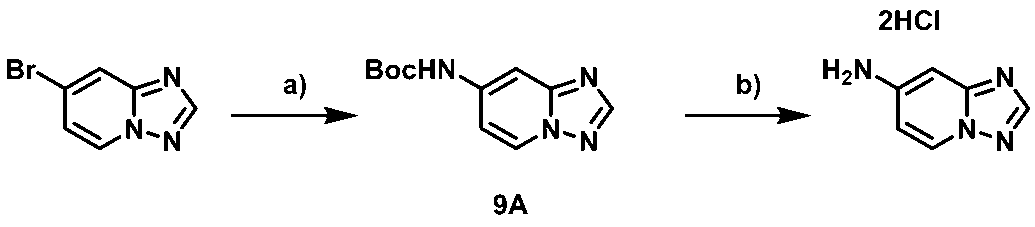
1H-NMR (400 MHz, CDCl3) δ: 8.43 (d, J = 7.3 Hz, 1H), 8.23 (s, 1H), 7.70 (d, J = 2.4 Hz, 1H), 7.18 (dd, J = 7.3, 2.4 Hz, 1H), 6.79 (s, 1H), 1.52 (s, 9H).
b)化合物9A(780mg)を酢酸エチル(3ml)に懸濁させ、塩化水素ジオキサン溶液(16ml)を添加した後、40℃で3時間撹拌した。反応溶液を減圧濃縮し、トルエンを加え減圧濃縮することを2度行った。残渣に酢酸エチルを加え攪拌した後、ろ取することで表題化合物(499mg)を得た。
1H-NMR (400 MHz, CD3OD) δ: 8.71 (s, 1H), 8.54 (d, J = 7.3 Hz, 1H), 6.90 (dd, J = 7.3, 2.1 Hz, 1H), 6.71 (d, J = 2.1 Hz, 1H).
4-(モルホリン-4-イル)-2,3-ジヒドロ-1H-インドール 2塩酸塩
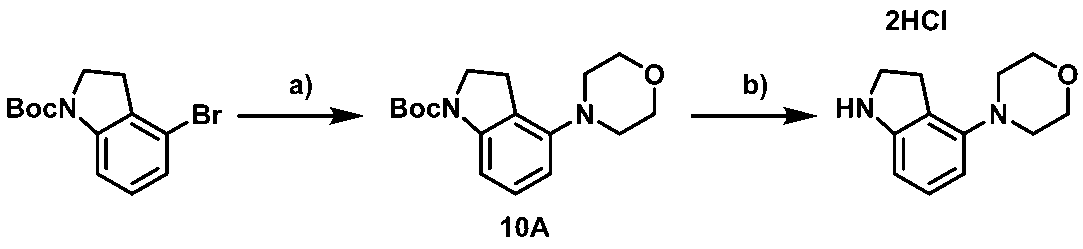
LC-MS: [M+H]+ / Rt (min) 305.2 / 1.984 (Method B)
b)化合物10A(1.07g)を酢酸エチル(15ml)に溶解させ、塩化水素酢酸エチル溶液(15ml)を添加した後、室温で20時間撹拌した。反応溶液を減圧濃縮し、残渣に酢酸エチルを加え攪拌した後、ろ取することで表題化合物(0.92g)を得た。
1H-NMR (400 MHz, CD3OD) δ: 7.48 (t, J = 8.2 Hz, 1H), 7.27 (t, J = 7.9 Hz, 2H), 3.94-3.92 (m, 4H), 3.87 (t, J = 7.6 Hz, 2H), 3.41 (t, J = 7.3 Hz, 2H), 3.26-3.24 (m, 4H).
4-(ピリダジン-4-イル)-2,3-ジヒドロ-1H-インドール 塩酸塩

LC-MS: [M+H]+ / Rt (min) 298.2 / 0.891 (Method A)
b)化合物11A(2.30g)をクロロホルム(35ml)に溶解させ、塩化水素酢酸エチル溶液(35ml)を添加した後、室温で3時間撹拌した。反応溶液を減圧濃縮し、トルエンを加え減圧濃縮することを2回行うことで表題化合物(1.8g)を得た。
LC-MS: [M+H]+ / Rt (min) 198.2 / 0.333 (Method A)
[3-(4-メチルシクロヘキサ-1-エン-1-イル)-6-オキソピリダジン-1(6H)-イル]酢酸

1H-NMR (400 MHz, DMSO-d6) δ: 7.64 (d, J = 9.8 Hz, 1H), 7.13 (d, J = 9.8 Hz, 1H), 4.85 (s, 2H), 3.69 (s, 3H).
b)化合物12A(2.15g)、4,4,5,5-テトラメチル-2-(4-メチルシクロヘキ-1-エン-1-イル)-1,3,2-ジオキサボロラン(3.06g)、2mol/L酢酸カリウム水溶液(15.92mL)をアセトニトリル(140mL)に懸濁させ、ビス(ジ-tert-ブチル(4-ジメチルアミノフェニル)ホスフィン)ジクロロパラジウム(II)(301mg)を加えた。窒素雰囲気下、90℃で5時間撹拌した。室温まで冷却後、水を加えて酢酸エチルで抽出した。有機層を無水硫酸ナトリウムで乾燥後、ろ過して減圧濃縮した。残渣をシリカゲルカラムクロマトグラフィー(展開溶媒;ヘキサン:酢酸エチル=90:10、後に70:30)で精製することにより化合物12B(2.40g)を得た。
LC-MS: [M+H]+ / Rt (min) 263.2 / 0.935 (Method A)
c)参考例6 b)に記載の方法に準じ、化合物12B(2.40g)を用いて表題化合物(1.5g)を得た。
LC-MS: [M+H]+ / Rt (min) 249.2 / 0.835 (Method A)
2-(トリフルオロメチル)イミダゾ[1,2-a]ピリジン-7-アミン

LC-MS: [M+H]+ / Rt (min) 202.1 / 0.344 (Method A)
7-フルオロ-1,3-ベンズオキサゾール-5-アミン

LC-MS: [M+H]+ / Rt (min) 183.0 / 0.749 (Method A)
b)化合物13A(330mg)をメタノール(9.0mL)に溶解し、パラジウム/炭素(96mg)を加え、室温で3時間攪拌した。不溶物をセライトで濾別した後、有機層を濃縮し表題化合物(268mg)を得た。
LC-MS: [M+H]+ / Rt (min) 153.0 / 0.445 (Method A)
2-(ジフルオロメチル)-1,3-ベンズオキサゾール-5-アミン

LC-MS: [M+H]+ / Rt (min) 215.1 / 0.850 (Method A)
b)参考例18 b)に記載の方法に準じ、化合物14A(330mg)を用いて表題化合物(268mg)を得た。
LC-MS: [M+H]+ / Rt (min) 185.1 / 0.505 (Method A)
7-フルオロ-2-メトキシ-1,3-ベンズオキサゾール-5-アミン

LC-MS: [M+H]+ / Rt (min) 213.1 / 0.843 (Method A)
b)参考例18 b)に記載の方法に準じ、化合物120A(318mg)を用いて表題化合物(248mg)を得た。
LC-MS: [M+H]+ / Rt (min) 183.0 / 0.517 (Method A)
2-メチル[1,3]チアゾロ[5,4-b]ピリジン-6-アミン

LC-MS: [M+H]+ / Rt (min) 196.1 / 0.667 (Method A)
b)化合物16A(177mg)をエタノール(3.8mL)に溶解し、水(1.3mL)、塩化アンモニウム(485mg)、還元鉄(253mg)を加え3時間加熱還流した。不溶物をセライトで濾別した後、有機層を減圧濃縮した。残渣に飽和炭酸水素ナトリウム水溶液を加え、クロロホルムで抽出した。有機層を無水硫酸ナトリウムで乾燥し、減圧濃縮することで表題化合物(97mg)を得た。
LC-MS: [M+H]+ / Rt (min) 166.0 / 0.423 (Method A)
2-(5-アミノ-1,3-ベンズオキサゾール-2-イル)プロパン-2-オール

LC-MS: [M+H]+ / Rt (min) 193.1 / 0.317 (Method A)
1-(5-メトキシ-2-メチルピリジン-3-イル)ピペラジン 3塩酸塩

1H-NMR (400 MHz, CDCl3) δ: 7.94 (d, J = 2.4 Hz, 1H), 6.86 (d, J = 2.4 Hz, 1H), 3.84 (s, 3H), 3.60-3.57 (m, 4H), 2.86-2.84 (m, 4H), 2.48 (s, 3H), 1.49 (s, 9H)
b)化合物17A(296mg)をメタノール(5mL)に溶解し、0℃で攪拌しながら2mol/L 塩化水素メタノール溶液(9.6mL)を加えた後に50℃で3時間攪拌した。室温まで冷却後、析出した固体をろ取し、得られた固体を減圧乾燥することで表題化合物(271.7mg)を得た。
1H-NMR (400 MHz, CD3OD) δ: 8.16 (d, J = 2.4 Hz, 1H), 7.83 (d, J = 2.4 Hz, 1H), 4.03 (s, 3H), 3.47-3.45 (m, 4H), 3.37-3.35 (m, 4H), 2.68 (s, 3H).
(2R,6S)-2,6-ジメチル-1-(ピリジン-3-イル)ピペラジン 3塩酸塩
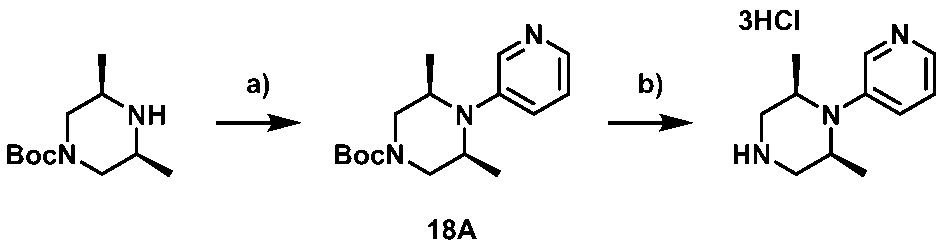
LC-MS: [M+H]+ / Rt (min) 292.0 / 0.689 (Method A)
b)参考例15 b)に記載の方法に準じ、化合物18A(114mg)を用いて表題化合物(75mg)を得た。
LC-MS: [M+H]+ / Rt (min) 192.2 / 0.149 (Method A)
4-[(モルホリン-4-イル)メチル]-2,3-ジヒドロ-1H-インドール

LC-MS: [M+H]+ / Rt (min) 217.2 / 0.292 (Method A)
b)化合物19A(209mg)を酢酸(3ml)に溶解し、水素化シアノホウ素ナトリウム(182mg)を加え室温で4時間攪拌した。反応溶液を減圧濃縮し、トルエンを加え減圧濃縮することを2度行った。残渣に飽和炭酸水素ナトリウム水溶液を加え、酢酸エチルで抽出した。有機層を飽和食塩水で洗浄し、無水硫酸ナトリウムで乾燥後、ろ過して減圧濃縮することにより表題化合物(256mg)を得た
LC-MS: [M+H]+ / Rt (min) 219.2 / 0.131 (Method A)
4-[(1H-イミダゾール-1-イル)メチル]-2,3-ジヒドロ-1H-インドール 塩酸塩

LC-MS: [M+H-tBu]+ / Rt (min) 194.1 / 0.866 (Method A)
b)化合物20A(1.54g)をジクロロメタン(20ml)に溶解し、0℃で攪拌しながら塩化チオニル(0.57ml)を加えた後に、室温まで昇温し終夜攪拌した。反応溶液を減圧濃縮し、トルエンを加え減圧濃縮することを2度行うことにより化合物20B(1.65g)を得た。
LC-MS: [M+H-tBu]+ / Rt (min) 212.1 / 1.169 (Method A)
c)化合物20B(200mg)をジメチルホルムアミド(3ml)に溶解し、イミダゾール(2.5g)を加え80℃で2時間攪拌した。反応溶液に水を加え、酢酸エチルで抽出した。有機層を水と飽和食塩水で洗浄し、無水硫酸ナトリウムで乾燥後、ろ過して減圧濃縮した。残渣をシリカゲルカラムクロマトグラフィー(展開溶媒;酢酸エチル、後に酢酸エチル:メタノール=95:5)にて精製することにより化合物20C(80mg)を得た。
LC-MS: [M+H]+ / Rt (min) 300.3 / 0.683 (Method A)
d)化合物20C(80mg)をクロロホルム(3ml)に溶解し、塩化水素酢酸エチル溶液(0.54mL)を加え室温で1時間攪拌した。反応溶液を減圧濃縮し、残渣にトルエンを加え減圧濃縮することを2度行うことにより表題化合物(53mg)を得た。
LC-MS: [M+H]+ / Rt (min) 200.1 / 0.115 (Method A)
メチル(3-クロロ-5-メチル-6-オキソピリダジン-1(6H)-イル)アセテート
参考例28
メチル(3-クロロ-4-メチル-6-オキソピリダジン-1(6H)-イル)アセテート
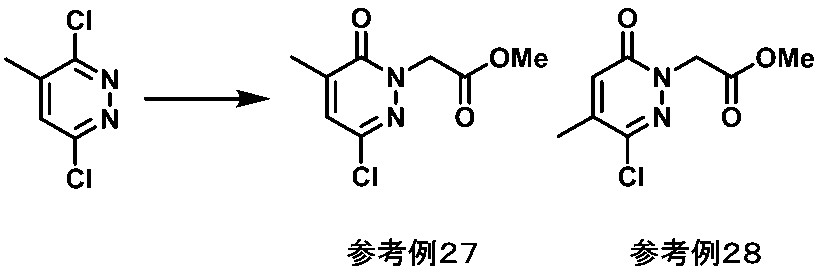
参考例27 LC-MS: [M+H]+ / Rt (min) 217.1 / 0.610 (Method A)
参考例28 LC-MS: [M+H]+ / Rt (min) 217.1 / 0.598 (Method A)
4,4,5,5-テトラメチル-2-(4-メチルシクロペント-1-エン-1-イル)-1,3,2-ジオキサボロラン

1H-NMR (400 MHz, CDCl3) δ: 5.57-5.55 (m, 1H), 2.78-2.70 (m, 1H), 2.63-2.49 (m, 2H), 2.22-2.15 (m, 1H), 2.02-1.95 (m, 1H), 1.11 (d, J = 6.8 Hz, 3H).
b)参考例4 b)に記載の方法に準じ、化合物21A(300mg)を用いて表題化合物(150mg)を得た。
1H-NMR (400 MHz, CDCl3) δ: 6.48-6.43 (1H, m), 2.67-2.52 (2H, m), 2.42-2.28 (1H, m), 2.08-1.95 (2H, m), 1.33-1.21 (12H, m), 1.04-0.99 (3H, m).
2-(1,1-ジフルオロスピロ[2.5]オクト-5-エン-6-イル)-4,4,5,5-テトラメチル-1,3,2-ジオキサボロラン
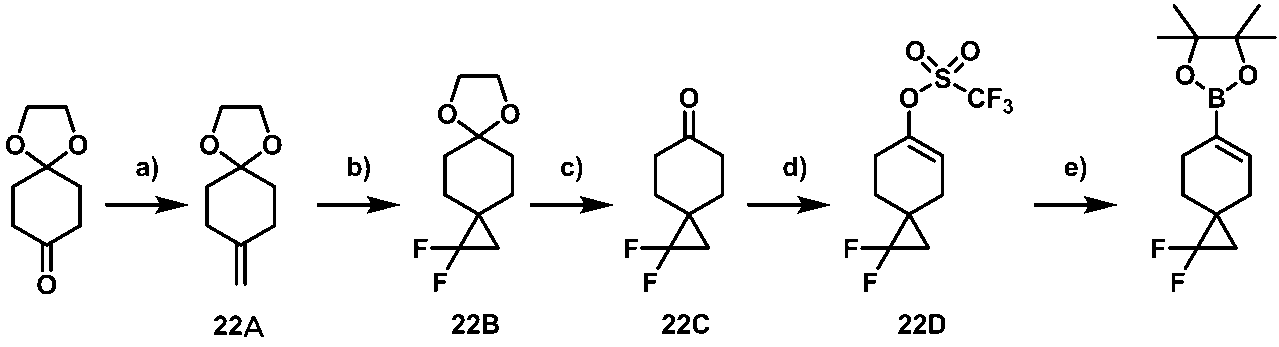
1H-NMR (400 MHz, CDCl3) δ: 4.65 (s, 2H), 3.96 (s, 4H), 2.27 (t, J = 6.5 Hz, 4H), 1.69 (t, J = 6.5 Hz, 4H).
b)参考例11 a)に記載の方法に準じ、化合物22A(20.8g)を用いて化合物22B(24.0g)を得た。
1H-NMR (400 MHz, CDCl3) δ: 3.96 (s, 4H), 1.74-1.66 (m, 8H), 1.05 (t, J = 8.2 Hz, 2H).
c)化合物22B(23.8g)をアセトン(180ml)と水(120ml)の混合溶媒に溶解し、パラトルエンスルホン酸一水和物(2.22g)を加え、4時間加熱還流した。室温まで冷却後、飽和炭酸水素ナトリウム水溶液を加えアセトン層を減圧下留去し、水層を酢酸エチルで2回抽出した。合わせた有機層を無水硫酸マグネシウムで乾燥し、ろ過して減圧濃縮した。残渣をシリカゲルカラムクロマトグラフィー(展開溶媒;ヘキサン:酢酸エチル=90:10、後にヘキサン:酢酸エチル=75:25)にて精製することにより、化合物22C(15.2g)を得た。
1H-NMR (400 MHz, CDCl3) δ: 2.48-2.37 (m, 4H), 1.98-1.89 (m, 4H), 1.25-1.21 (m, 2H).
d)化合物22C(4.77g)と2,6-ルチジンのジクロロメタン(48ml)溶液を0℃で攪拌し、トリフルオロメタンスルホン酸無水物(10.57ml)を加えた後に昇温し、3時間加熱還流した。室温まで冷却後飽和炭酸水素ナトリウム水溶液を加え、ジクロロメタン層を減圧下留去し、水層を酢酸エチルで2回抽出した。合わせた有機層を1mol/lの塩酸水、水、飽和食塩水で順次洗浄し、無水硫酸マグネシウムで乾燥し、ろ過して減圧濃縮した。残渣をシリカゲルカラムクロマトグラフィー(展開溶媒;ヘキサン:酢酸エチル=95:5、後にヘキサン:酢酸エチル=77:23)にて精製することにより、化合物22D(6.61g)を得た。
1H-NMR (400 MHz, CDCl3) δ: 5.78 (t, J = 3.7 Hz, 1H), 2.45-2.35 (m, 3H), 2.19-2.14 (m, 1H), 1.86-1.81 (m, 2H), 1.21-1.11 (m, 2H).
e)化合物22D(6.61g)、トリフェニルホスフィン(593mg)、カリウムフェノキシド(2.99g)、4,4,4’,4’,5,5,5’,5’-オクタメチル-2,2’-ビ(1,3,2-ジオキサボロラン)(6.03g)のトルエン(113ml)溶液にビス(トリフェニルホスフィン)パラジウム(2)ジクロリド(794mg)を加え、50℃で4時間攪拌した。反応溶液にカリウムフェノキシド(1.14g)とテトラキス(トリフェニルホスフィン)パラジウム(0)(784mg)を加え、50℃で1.5時間攪拌した。室温まで冷却後、水と酢酸エチルを加えセライトでろ過した。有機層を1M 炭酸ナトリウム水溶液と飽和食塩水で洗浄し、無水硫酸マグネシウムで乾燥後、ろ過して減圧濃縮した。残渣をシリカゲルカラムクロマトグラフィー(展開溶媒;ヘキサン、後にヘキサン:酢酸エチル=80:20)にて精製し、再度シリカゲルカラムクロマトグラフィー(展開溶媒;ヘキサン:トルエン=50:50、後にヘキサン:トルエン:酢酸エチル=45:50:5)にて精製することにより表題化合物(3.72g)を得た。
1H-NMR (400 MHz, CDCl3) δ: 6.53-6.50 (m, 1H), 2.36-2.14 (m, 3H), 2.05-2.00 (m, 1H), 1.67-1.55 (m, 2H), 1.25 (s, 12H), 1.09-0.97 (m, 2H).
8-フルオロ-[1,2,4]トリアゾロ[1,5-a]ピリジン-7-アミン

LC-MS: [M+H]+ / Rt (min) 281.1 / 0.948 (Method A)
b)化合物23A(1.25g)、ベンゾフェノンイミン(1.12mL)、ナトリウムtert-ブトキシド(642mg)、[(2-ジ-tert-ブチルホスフィノ-2’,4’,6’-トリイソプロピルビフェニル)-2-(2’-アミノ-1,1’-ビフェニル)]パラジウム(II)メタンスルホン酸塩(354mg)のトルエン(18ml)溶液をマイクロウェーブ波照射下150℃で5時間攪拌した。室温まで冷却後、水と酢酸エチルを加えセライトでろ過し、水層を酢酸エチルで抽出した。有機層を無水硫酸ナトリウムで乾燥し、減圧濃縮した。残渣をアミノシリカゲルカラムクロマトグラフィー(展開溶媒;ヘキサン:酢酸エチル=87:13、後にヘキサン:酢酸エチル=67:33)で精製することにより、化合物23B(490mg)を得た。
LC-MS: [M+H]+ / Rt (min) 426.3 / 1.117 (Method A)
c)化合物23B(780mg)をテトラヒドロフラン(5.3ml)に溶解させ、1mol/Lの塩酸水溶液(5.3ml)を添加した後、室温で4時間撹拌した。反応溶液に飽和炭酸水素ナトリウムを加え、クロロホルムとエタノール(3:1)の混合溶媒で抽出した。有機層を無水硫酸ナトリウムで乾燥し、減圧濃縮した。残渣をアミノシリカゲルカラムクロマトグラフィー(展開溶媒;ヘキサン:酢酸エチル=87:13、後に酢酸エチル)で精製することにより、化合物23C(179mg)を得た。
LC-MS: [M+H]+ / Rt (min) 262.1 / 0.542 (Method A)
d)化合物23C(179mg)を2-プロパノール(2.7ml)に溶解させ、N,N-ジメチルホルムアミドジメチルアセタール(0.119ml)を添加した後、100℃で3時間撹拌した。反応溶液にトルエン(2.7mL)を加え減圧濃縮し、化合物23D(212mg)を得た。
LC-MS: [M+H]+ / Rt (min) 317.2 / 0.598 (Method A)
e)化合物23D(178mg)を2-プロパノール(2.7ml)に溶解させ、50%ヒドロキシアミン水溶液(0.05ml)を添加した後、60℃で6時間撹拌した。反応溶液に水を加え、クロロホルムで抽出した。有機層を無水硫酸ナトリウムで乾燥し、減圧濃縮した。残渣をシリカゲルカラムクロマトグラフィー(展開溶媒;ヘキサン:酢酸エチル=67:33、後にヘキサン:酢酸エチル=30:70)で精製することにより、化合物23E(146mg)を得た。
LC-MS: [M+H]+ / Rt (min) 305.2 / 0.782 (Method A)
f)化合物23E(171mg)をテトラヒドロフラン(5.6ml)に溶解させ、トリフルオロ酢酸無水物(0.119ml)を添加した後、室温で21時間撹拌した。反応溶液に飽和炭酸水素ナトリウムを加え、クロロホルムで抽出した。有機層を無水硫酸ナトリウムで乾燥し、減圧濃縮した。残渣をシリカゲルカラムクロマトグラフィー(展開溶媒;ヘキサン:酢酸エチル=83:17、後にヘキサン:酢酸エチル=50:50)で精製することにより、化合物23F(82mg)を得た。
LC-MS: [M+H]+ / Rt (min) 287.2 / 0.742 (Method A)
g)化合物23F(90mg)をメタノール(1.6ml)に溶解させ、10%パラジウム/炭素(17mg)を添加した後、水素雰囲気下、室温で4時間撹拌した。パラジウム/炭素をセライト上でろ過し、メタノールで洗浄した。ろ液を濃縮し表題化合物(47mg)を得た。
LC-MS: [M+H]+ / Rt (min) 153.0 / 0.294 (Method A)
N-(4-シアノフェニル)-2-[3-(4-メチルピペリジン-1-イル)-6-オキソピリダジン-1(6H)-イル]アセトアミド

1H-NMR (400 MHz, CDCl3) δ: 9.79 (s, 1H), 7.63 (dt, J = 9.0, 2.0 Hz, 2H), 7.55 (dt, J = 8.5, 1.8 Hz, 2H), 7.24 (d, J = 9.8 Hz, 1H), 6.93 (d, J = 10.4 Hz, 1H), 4.84 (s, 2H), 3.84 (d, J = 13.4 Hz, 2H), 2.77 (td, J = 12.8, 2.4 Hz, 2H), 1.75-1.68 (m, 2H), 1.58-1.53 (m, 1H), 1.25 (dd, J = 12.5, 4.0 Hz, 1H), 1.19 (dd, J = 12.2, 4.3 Hz, 1H), 0.97 (d, J = 6.7 Hz, 3H).
N-(4-シアノフェニル)-2-[3-(4,4-ジメチルピペリジン-1-イル)-6-オキソピリダジン-1(6H)-イル]アセトアミド

1H-NMR (400 MHz, CDCl3) δ: 9.78 (s, 1H), 7.65 (d, J = 8.5 Hz, 2H), 7.57 (d, J = 8.5 Hz, 2H), 7.25 (d, J = 9.8 Hz, 1H), 6.94 (d, J = 10.4 Hz, 1H), 4.84 (s, 2H), 3.32-3.28 (m, 4H), 1.46-1.42 (m, 4H), 0.98 (s, 6H).
実施例1または2に記載の方法、および公知の反応条件に準じ、対応する原料化合物を用いて、実施例3~36の化合物を得た。
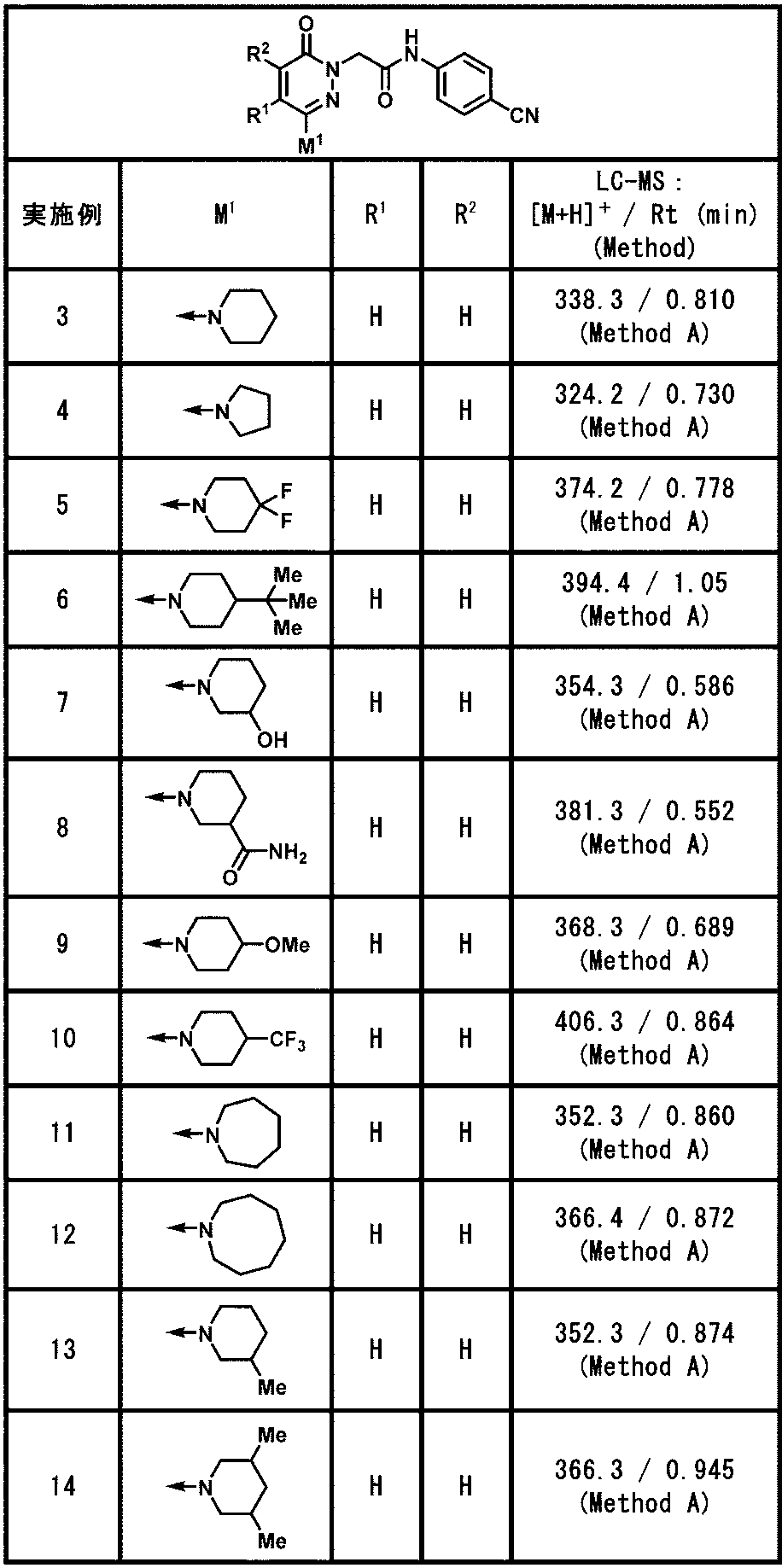


N-(4-シアノフェニル)-2-[3-(4,4-ジフルオロシクロヘキサ-1-エン-1-イル)-6-オキソピリダジン-1(6H)-イル]アセトアミド

1H-NMR (400 MHz, CDCl3) δ: 9.37 (s, 1H), 7.65-7.58 (m, 3H), 7.54 (d, J = 8.7 Hz, 2H), 7.04 (d, J = 9.6 Hz, 1H), 6.22 (s, 1H), 4.99 (s, 2H), 2.82-2.71 (m, 4H), 2.20-2.10 (m, 2H).
N-(4-シアノフェニル)-2-[3-(4,4-ジメチルシクロヘキシル)-6-オキソピリダジン-1(6H)-イル]アセトアミド

1H-NMR (400 MHz, CDCl3) δ: 9.54 (s, 1H), 7.62 (dt, J = 9.0, 2.2 Hz, 2H), 7.54 (dt, J = 9.1, 2.0 Hz, 2H), 7.27 (d, J = 9.5 Hz, 1H), 7.00 (d, J = 9.6 Hz, 1H), 4.95 (s, 2H), 2.48 (tt, J = 11.9, 3.7 Hz, 1H), 1.73-1.69 (m, 2H), 1.64-1.57 (td, J = 12.8, 3.63 Hz, 2H), 1.55-1.46 (m, 2H), 1.28 (td, J = 13.2, 4.1 Hz, 2H), 0.94 (s, 3H), 0.93 (s, 3H).
実施例37または38に記載の方法、および公知の反応条件に準じ、対応する原料化合物を用いて、実施例39~49の化合物を得た。

N-(1,3-ベンゾオキサゾール-5-イル)-2-[3-(メチルピペリジン-1-イル)-6-オキソピリダジン-1(6H)-イル]アセトアミド

1H-NMR (400 MHz, CDCl3) δ: 9.35 (s, 1H), 8.09 (s, 1H), 8.06 (s, 1H), 7.48 (s, 2H), 7.23 (d, J = 9.8 Hz, 1H), 6.94 (d, J = 9.8 Hz, 1H), 4.86 (s, 2H), 3.86-3.83 (m, 2H), 2.80-2.74 (m, 2H), 1.73-1.70 (m, 2H), 1.61-1.53 (m, 1H), 1.28-1.18 (m, 2H), 0.97 (d, J = 6.4 Hz, 3H).
実施例50に記載の方法、および公知の反応条件に準じ、対応する原料化合物を用いて、実施例51~99の化合物を得た。


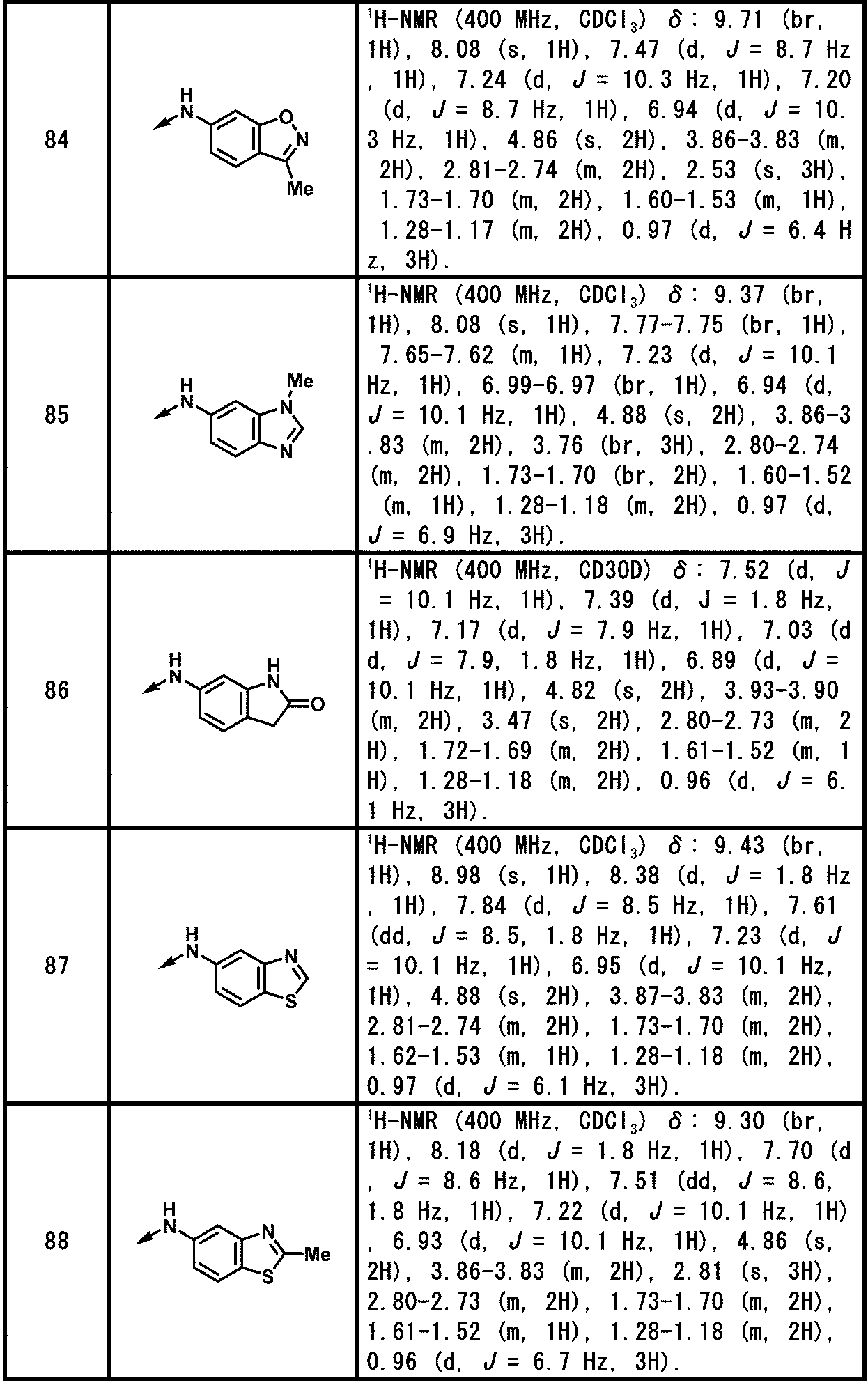


実施例2、37、38、または50に記載の方法、および公知の反応条件に準じ、対応する原料化合物を用いて、実施例100~135の化合物を得た。


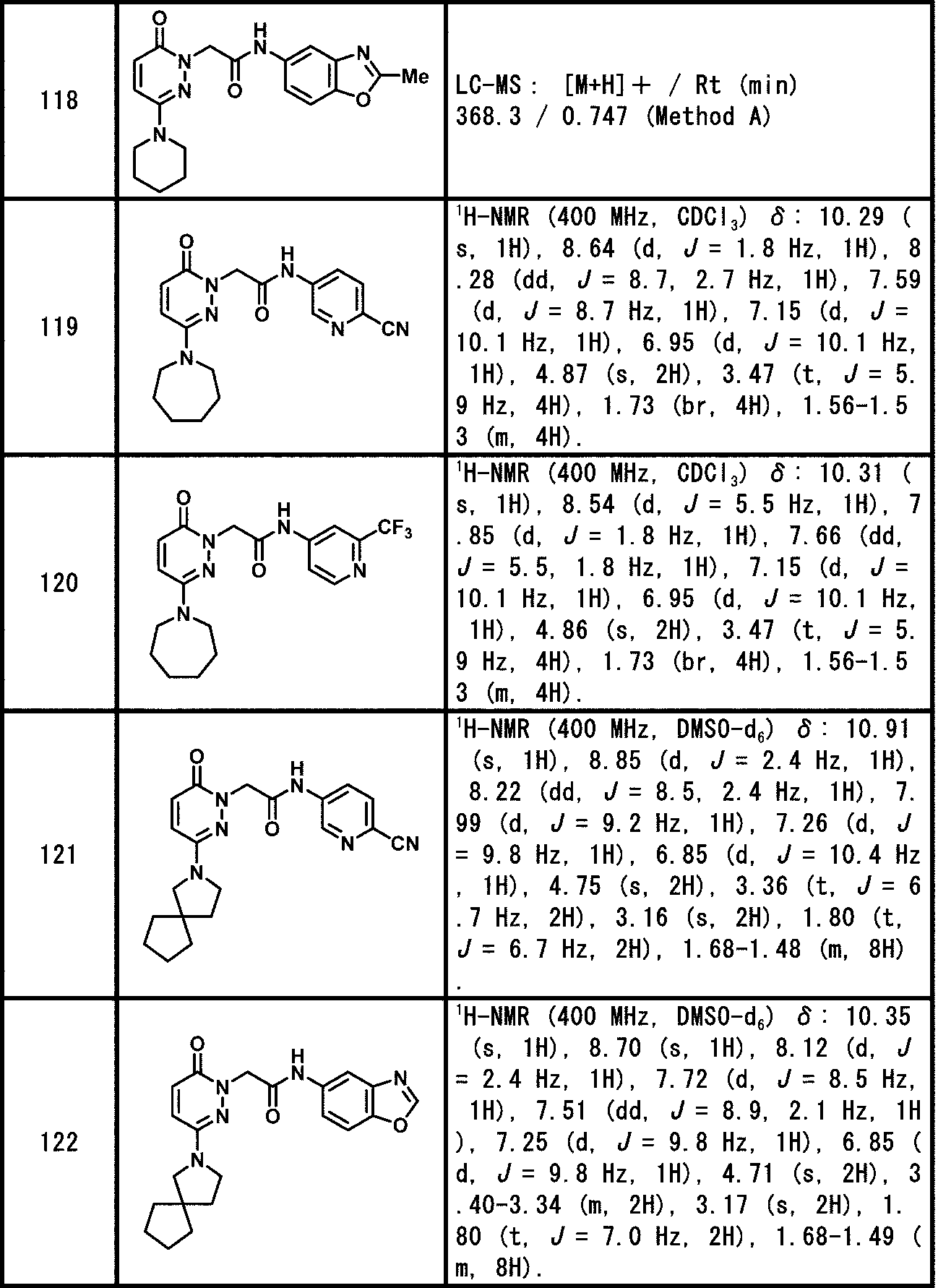

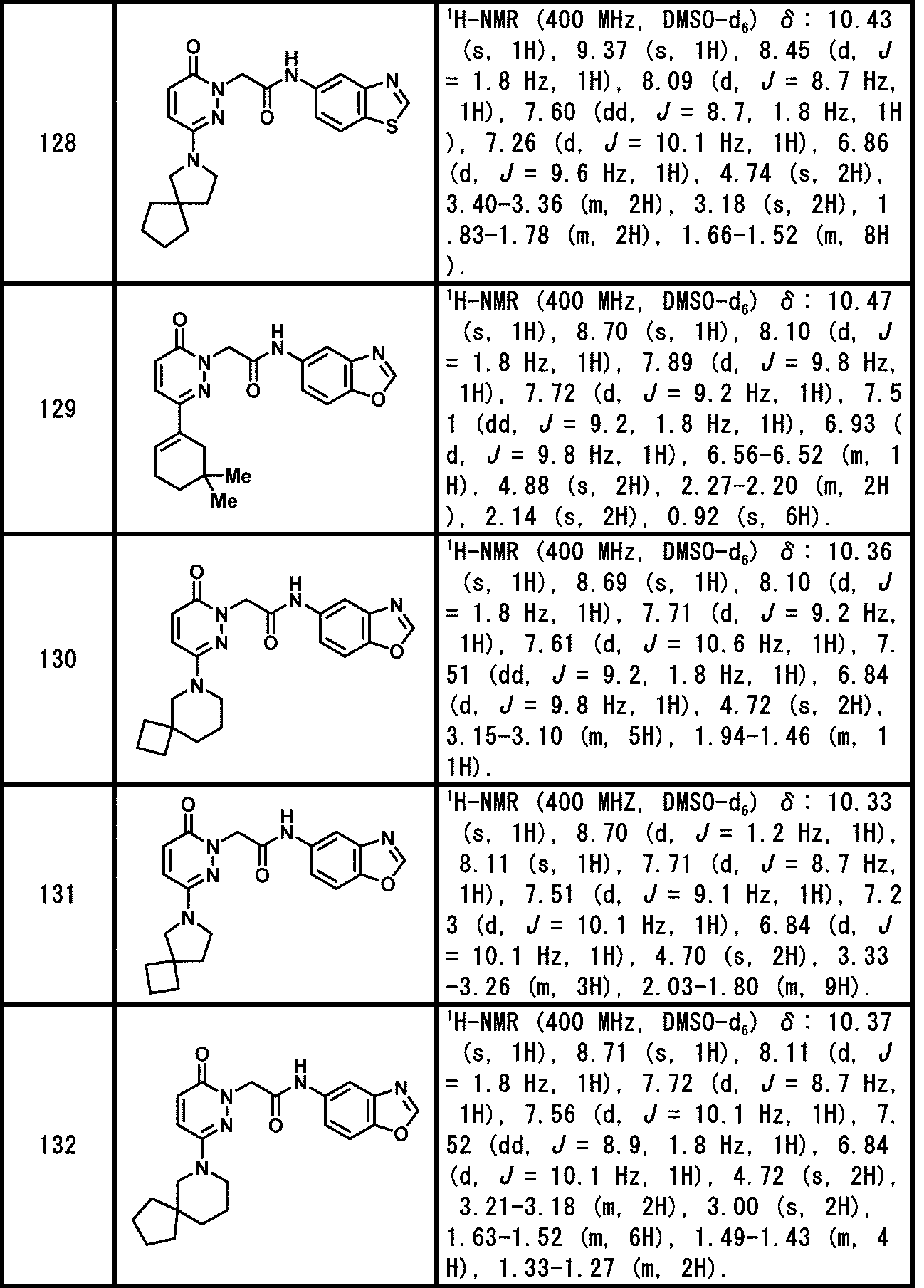
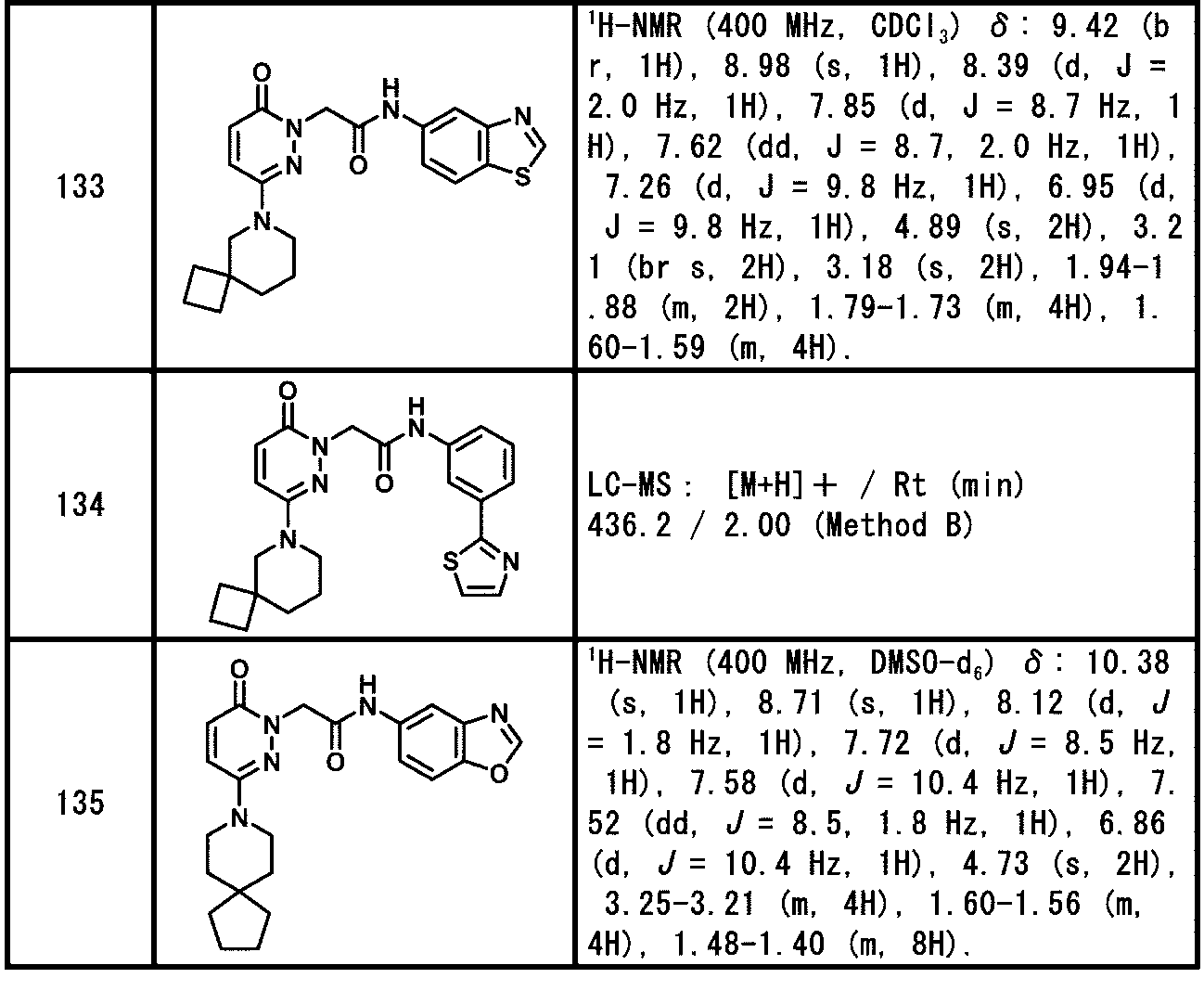
実施例37または50に記載の方法、および公知の反応条件に準じ、対応する原料化合物を用いて、実施例136~159の化合物を得た。
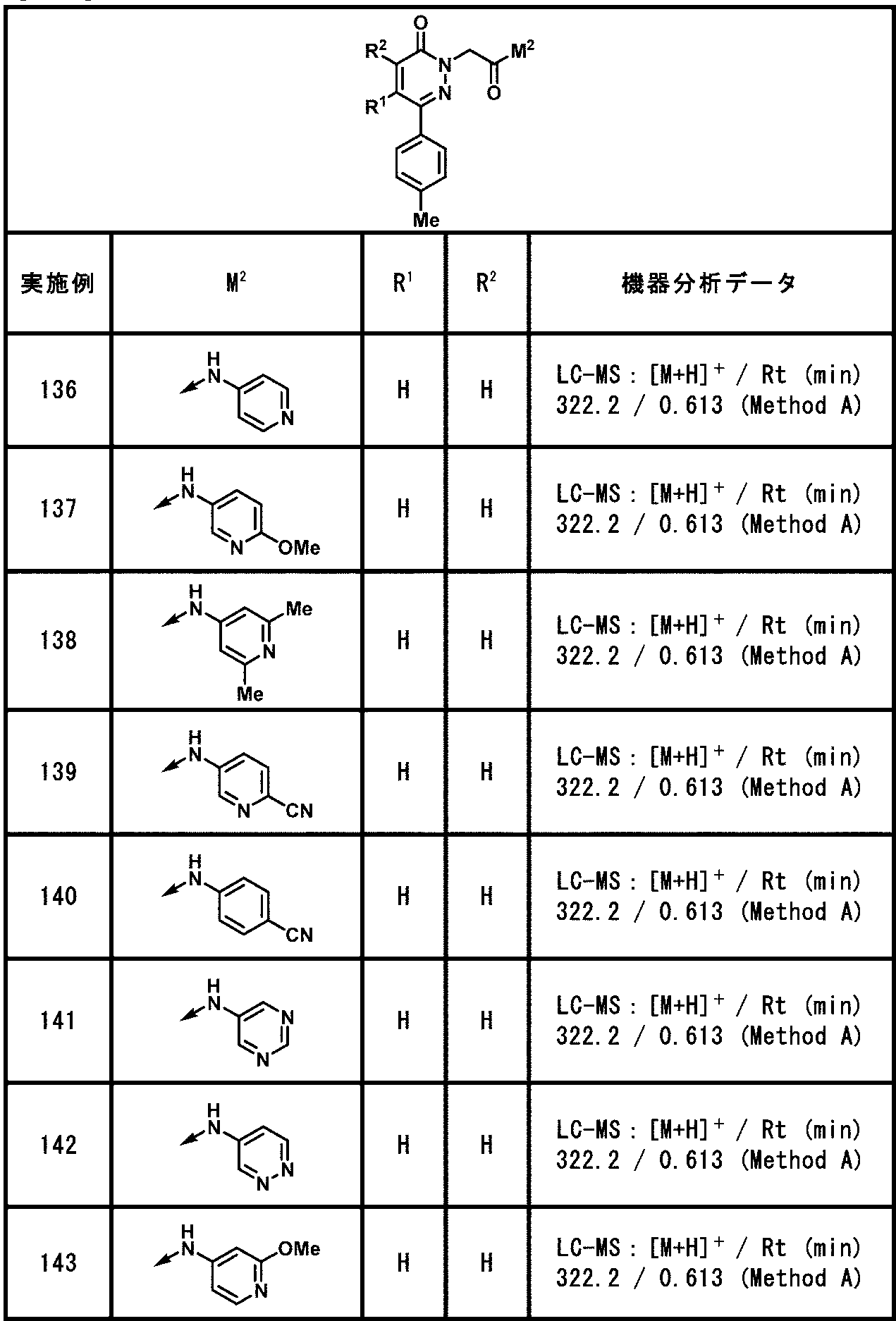


実施例1、2または50に記載の方法、および公知の反応条件に準じ、対応する原料化合物を用いて、実施例160~192の化合物を得た。


実施例1、2または50に記載の方法、および公知の反応条件に準じ、対応する原料化合物を用いて、実施例193~238の化合物を得た。


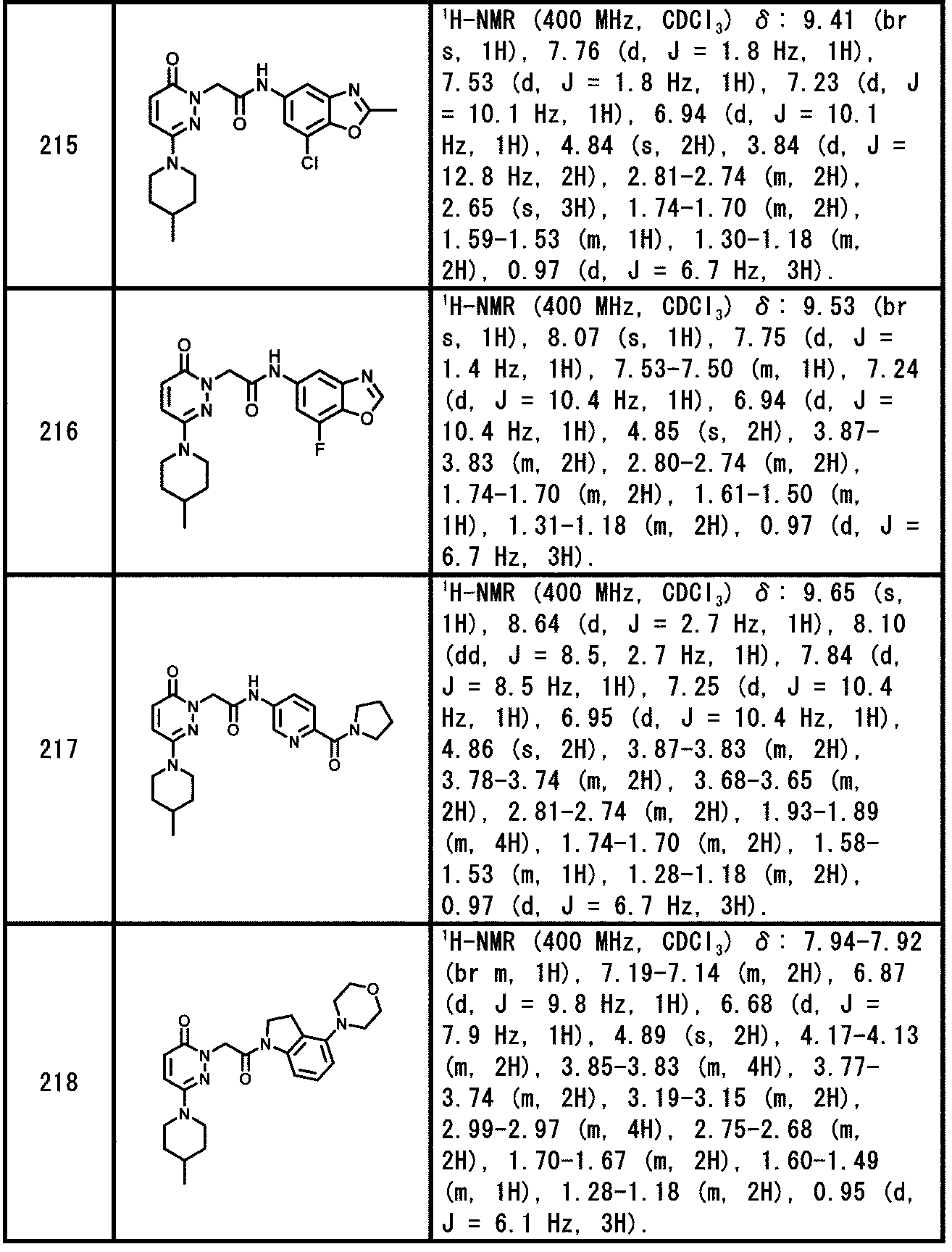

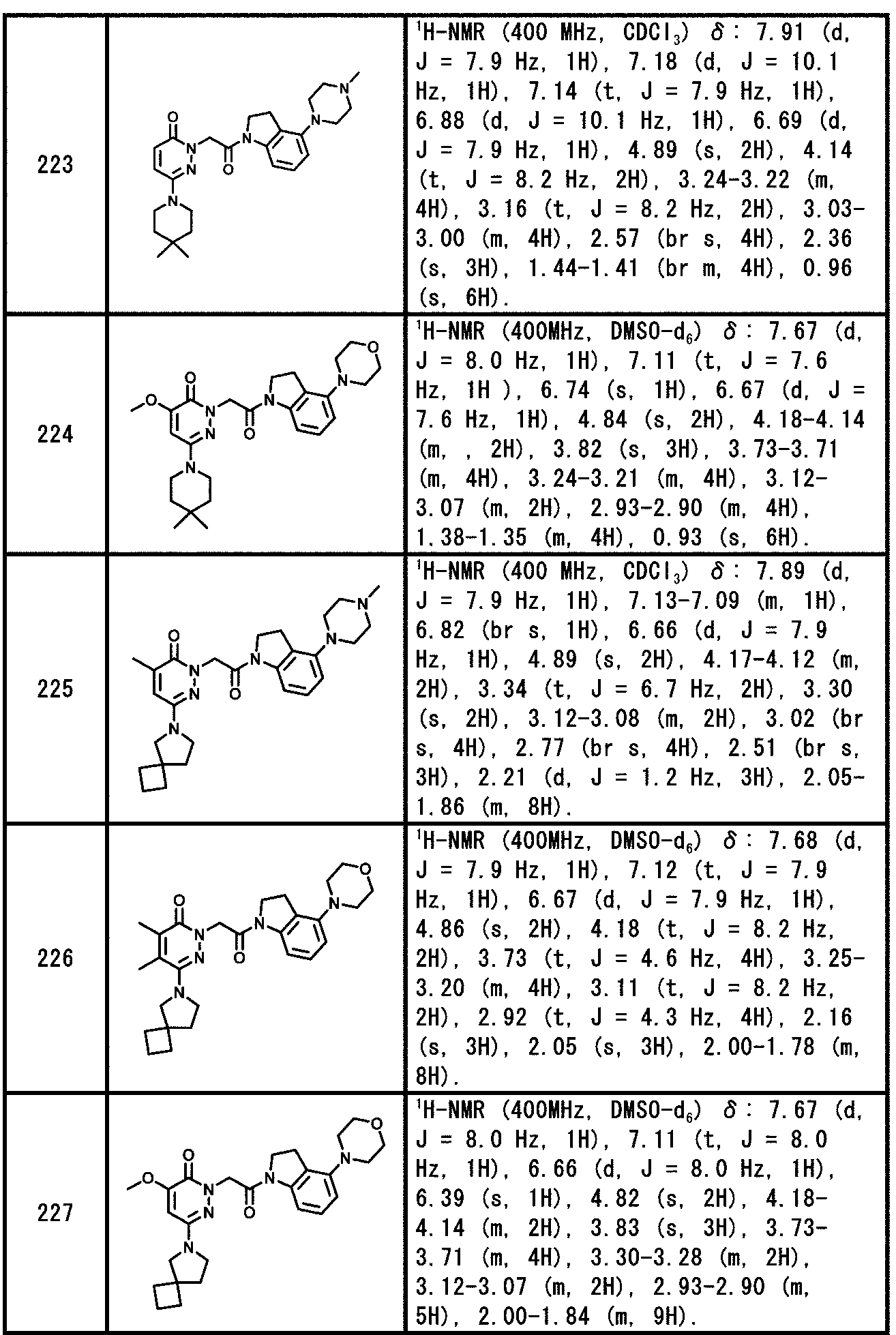
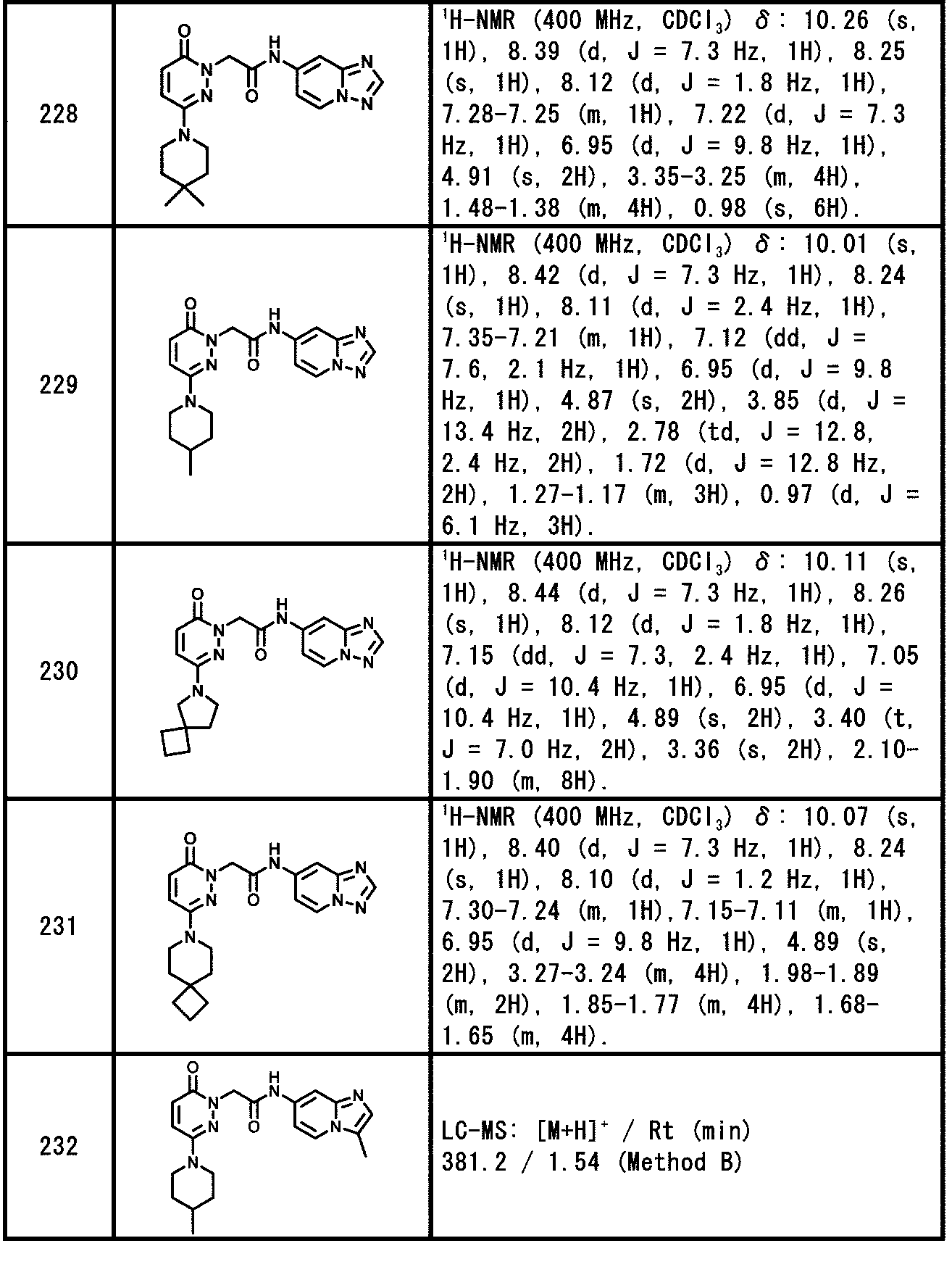


実施例1、37または50に記載の方法、および公知の反応条件に準じ、対応する原料化合物を用いて、実施例239~243の化合物を得た。
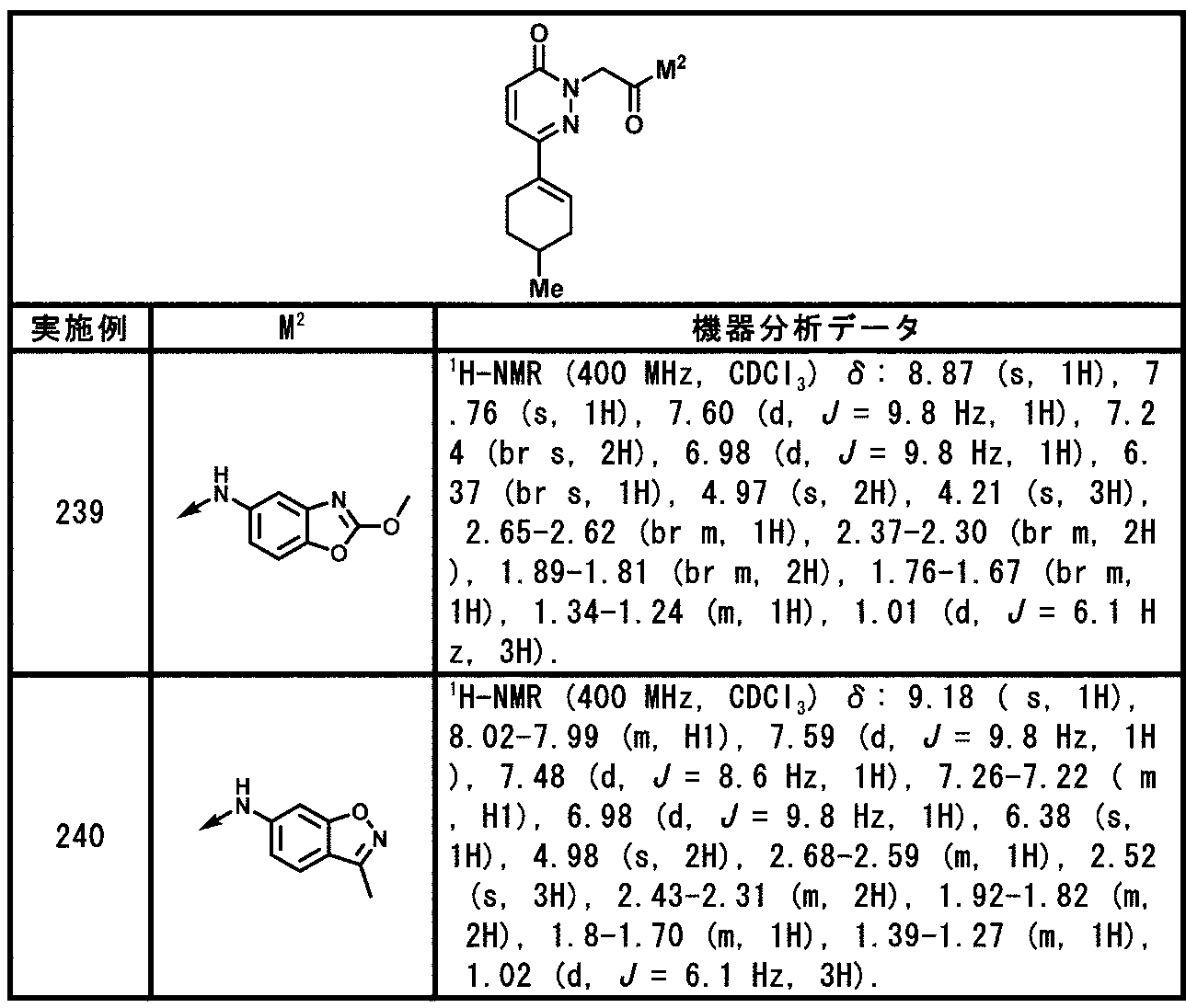

N-[2-(ジメチルアミノ)-1,3-ベンゾオキサゾール-5-イル]-2-[3-(4-メチルシクロヘキサ-1-エン-1-イル)-6-オキソピリダジン-1(6H)-イル]アセトアミド

1H-NMR (400 MHz, CDCl3) δ: 8.68 (s, 1H), 7.60 (d, J = 9.8 Hz, 1H), 7.50 (s, 1H), 7.21-7.14 (m, 2H), 6.98 (d, J = 9.8 Hz, 1H), 6.38 (s, 1H), 4.97 (s, 2H), 3.20 (s, 6H), 2.70-2.60 (m, 1H), 2.41-2.30 (m, 2H), 1.92-1.82 (m, 2H), 1.80-1.67 (m, 1H), 1.35-1.25 (m, 1H), 1.03 (d, J = 6.1 Hz, 3H).
実施例1、37または50に記載の方法、および公知の反応条件に準じ、対応する原料化合物を用いて、実施例245~424の化合物を得た。


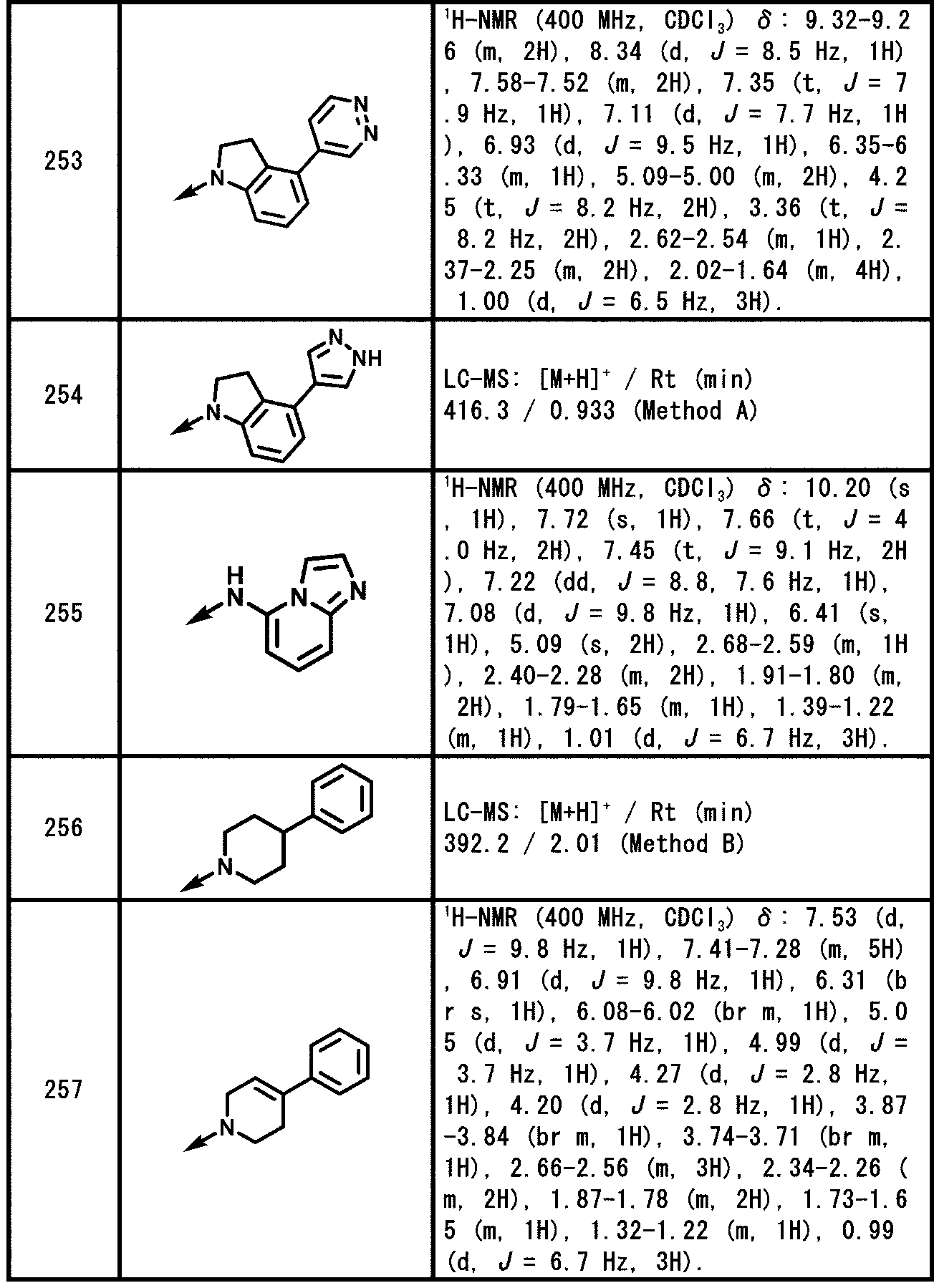

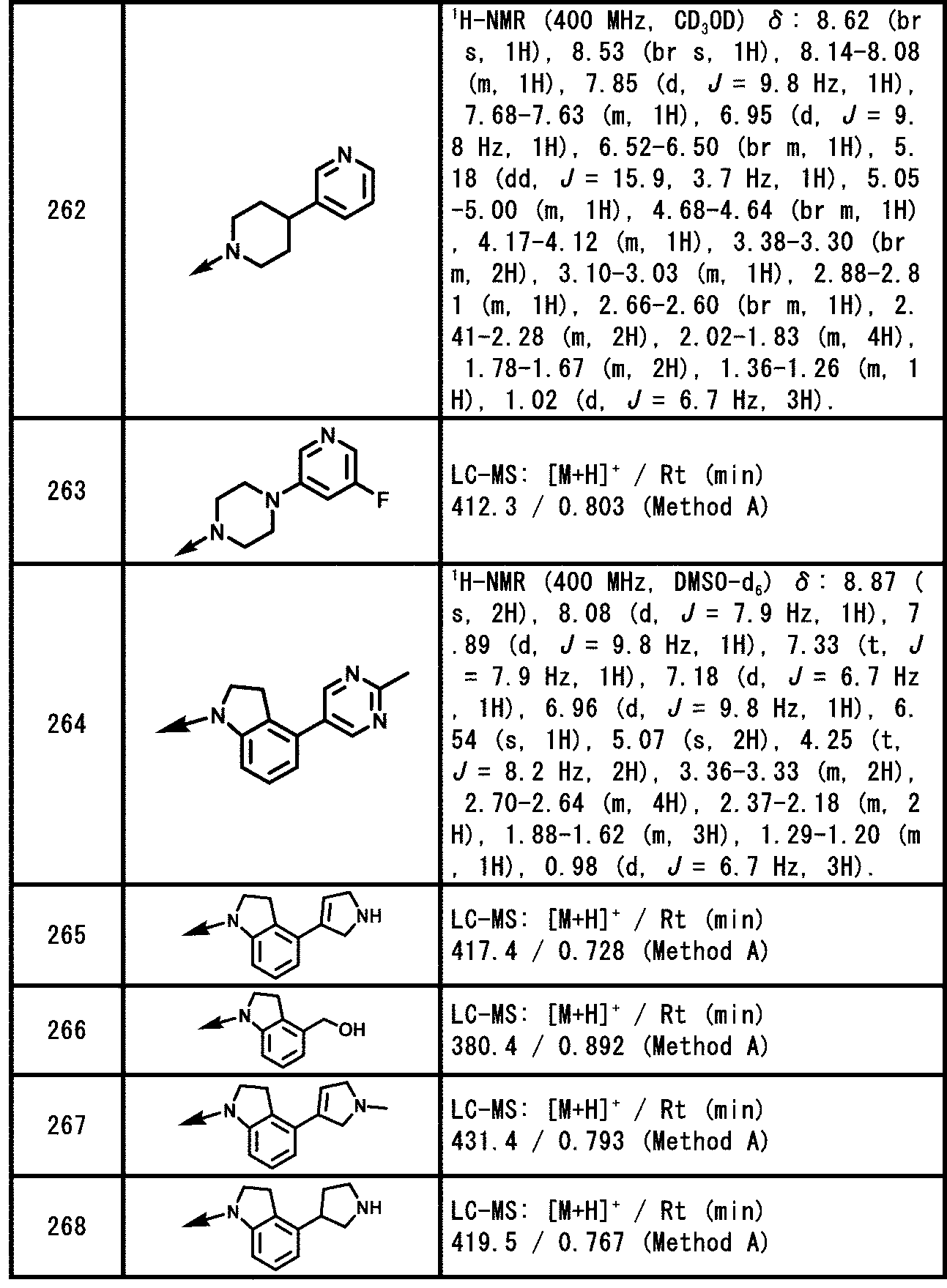
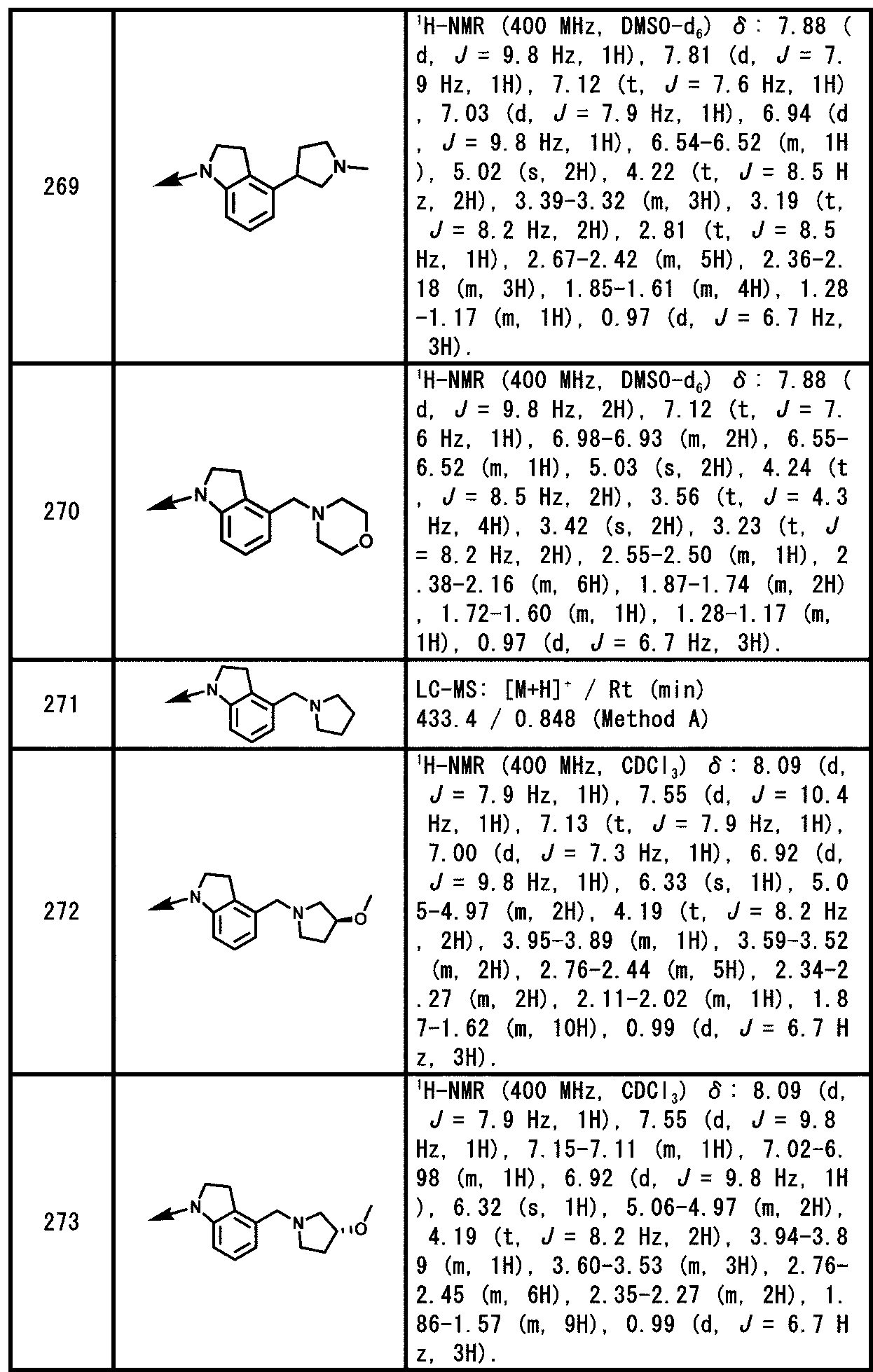
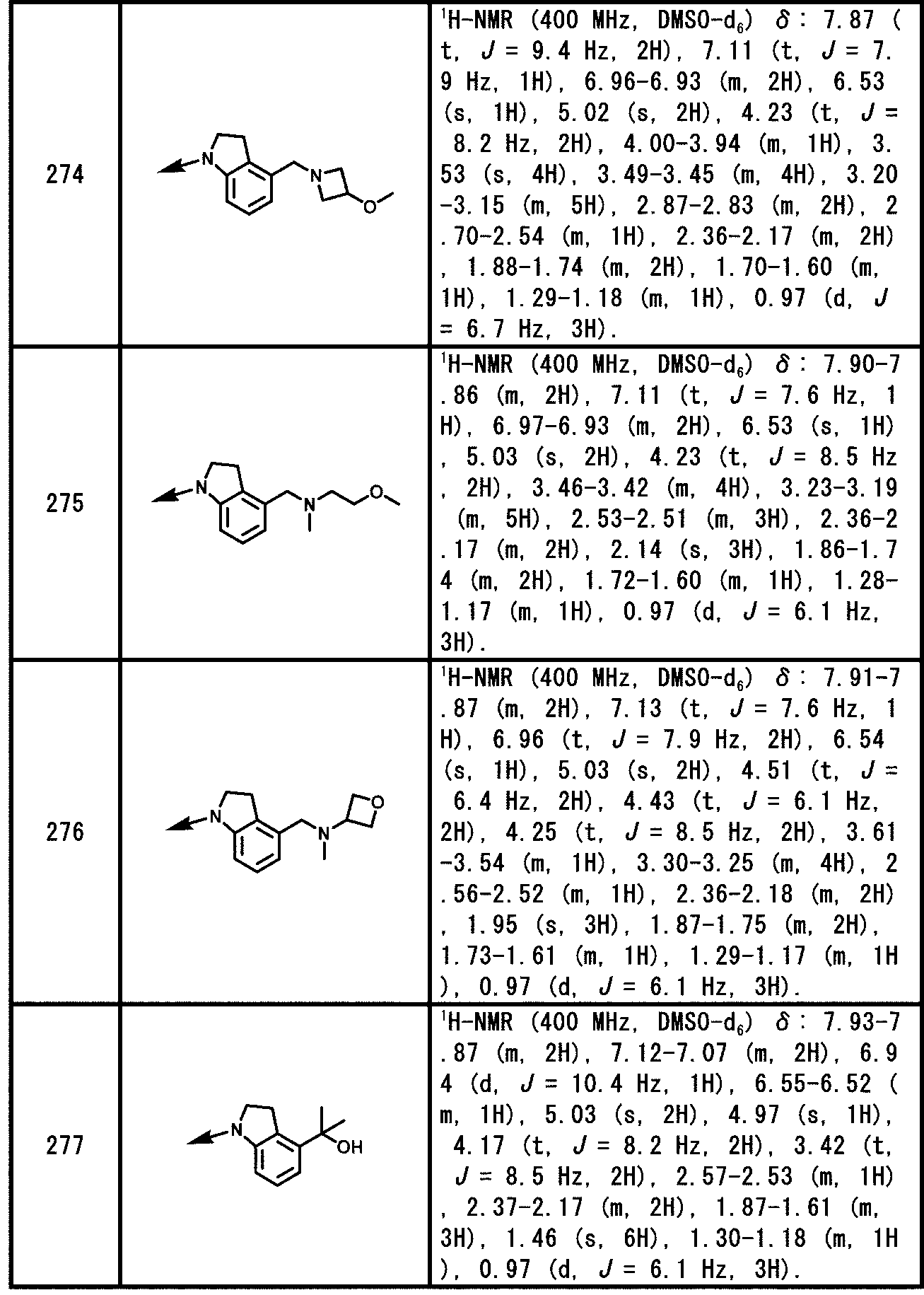


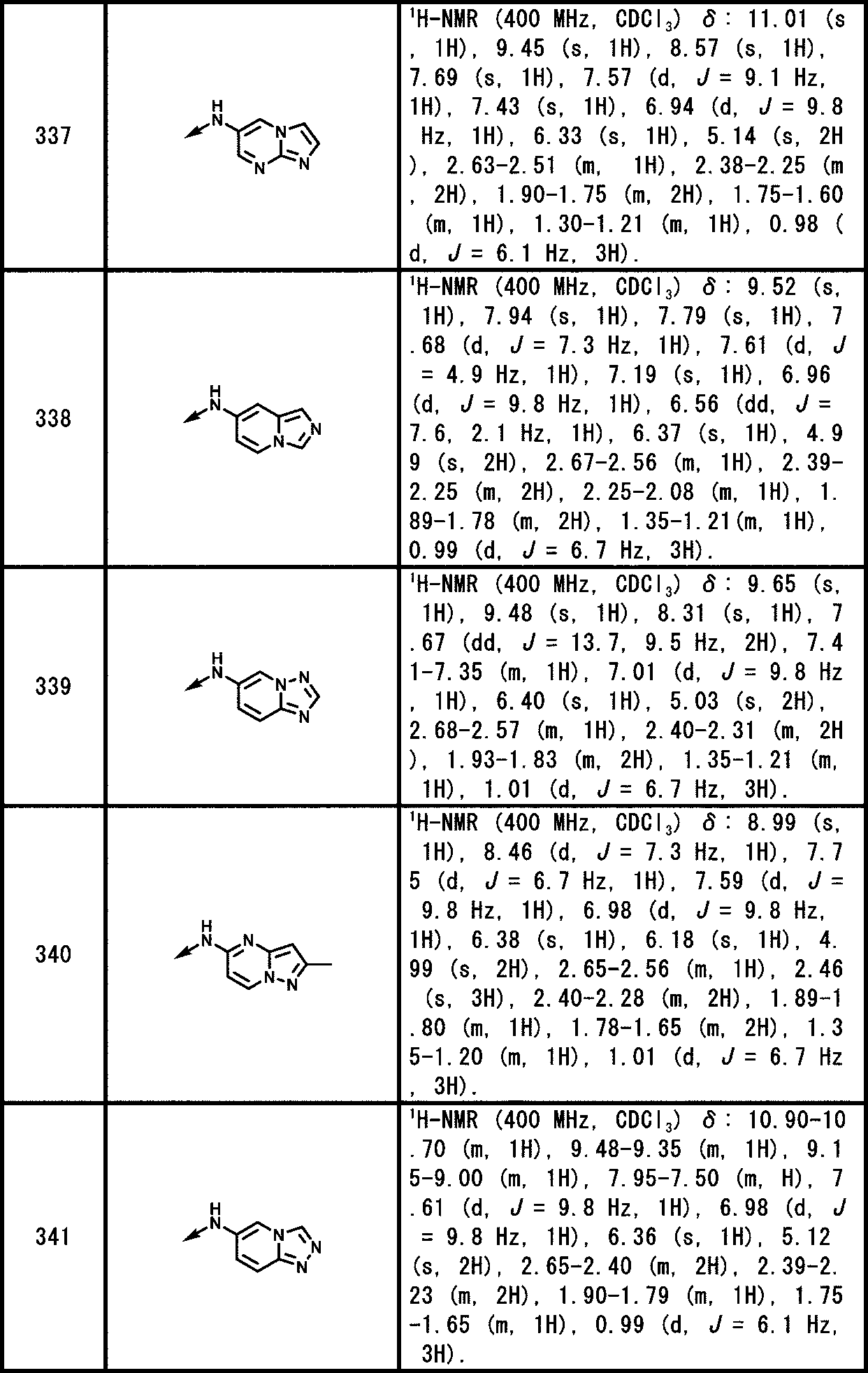
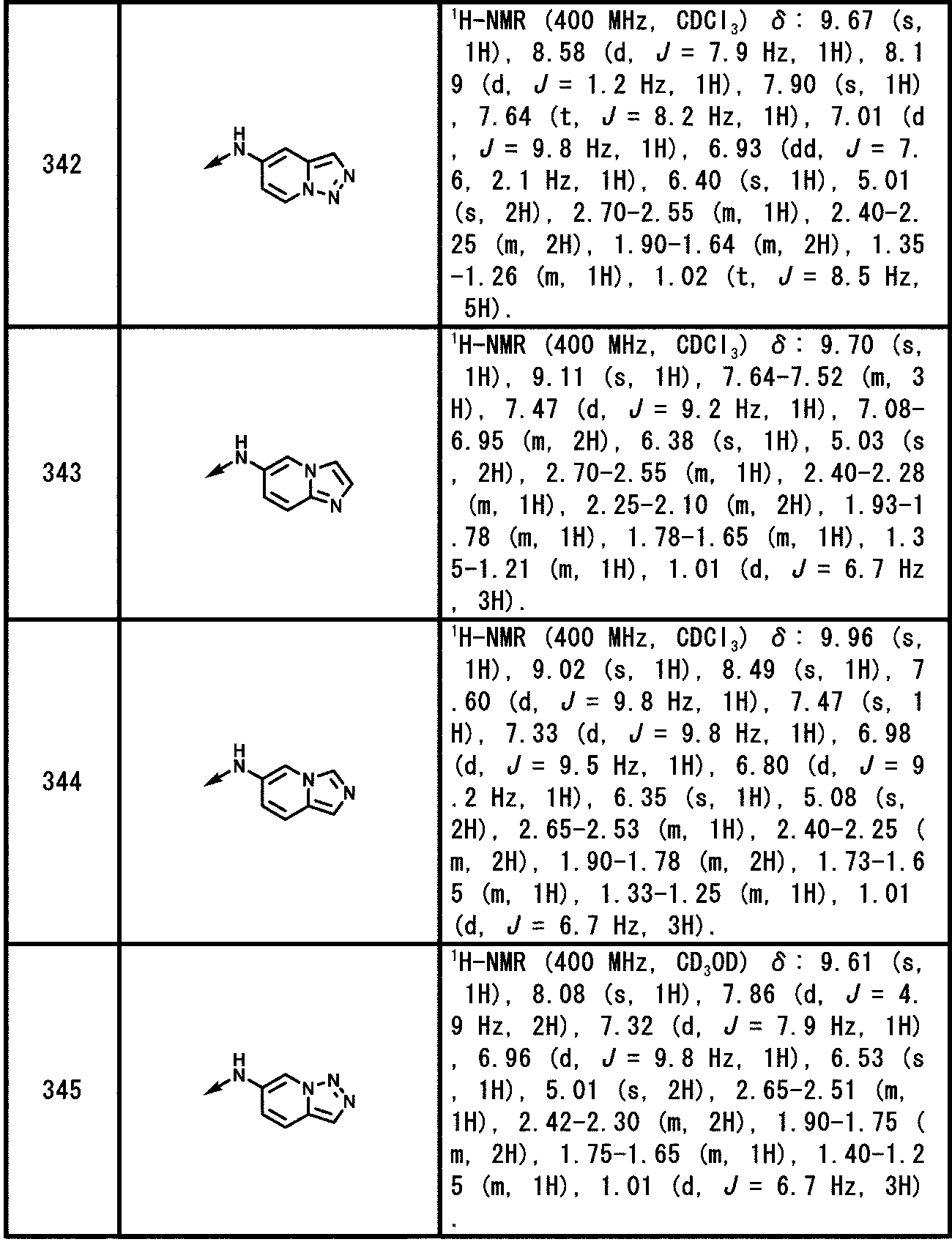
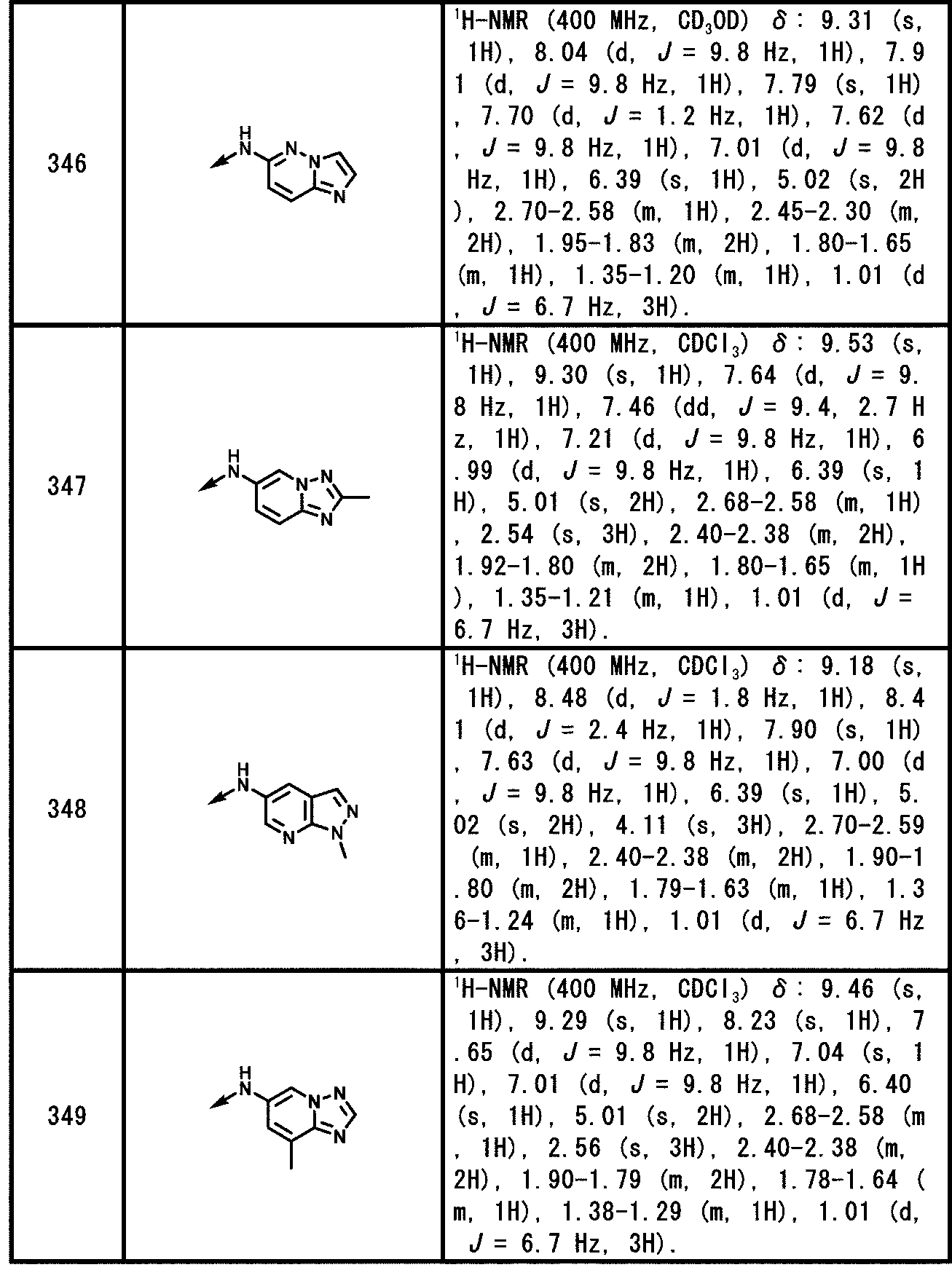
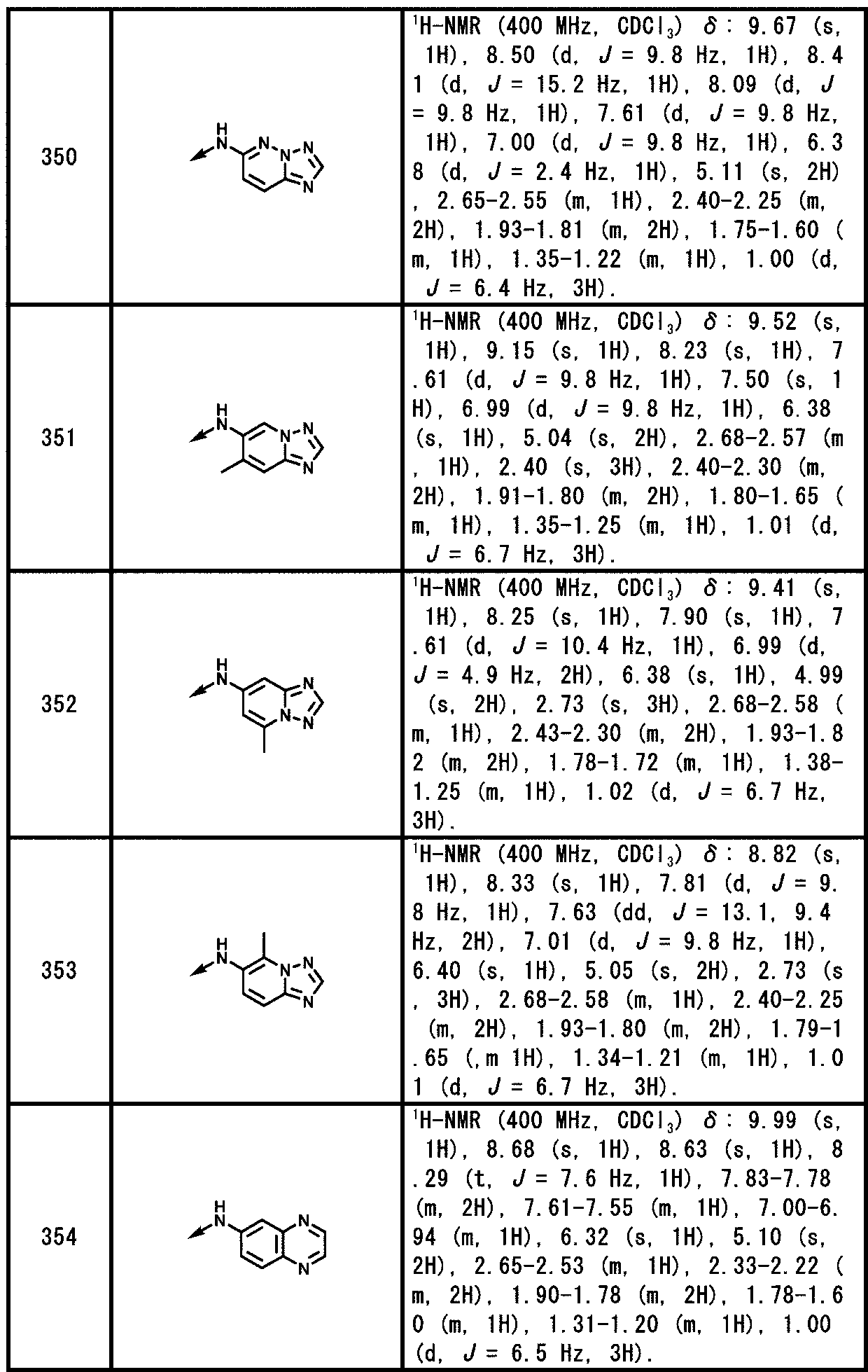

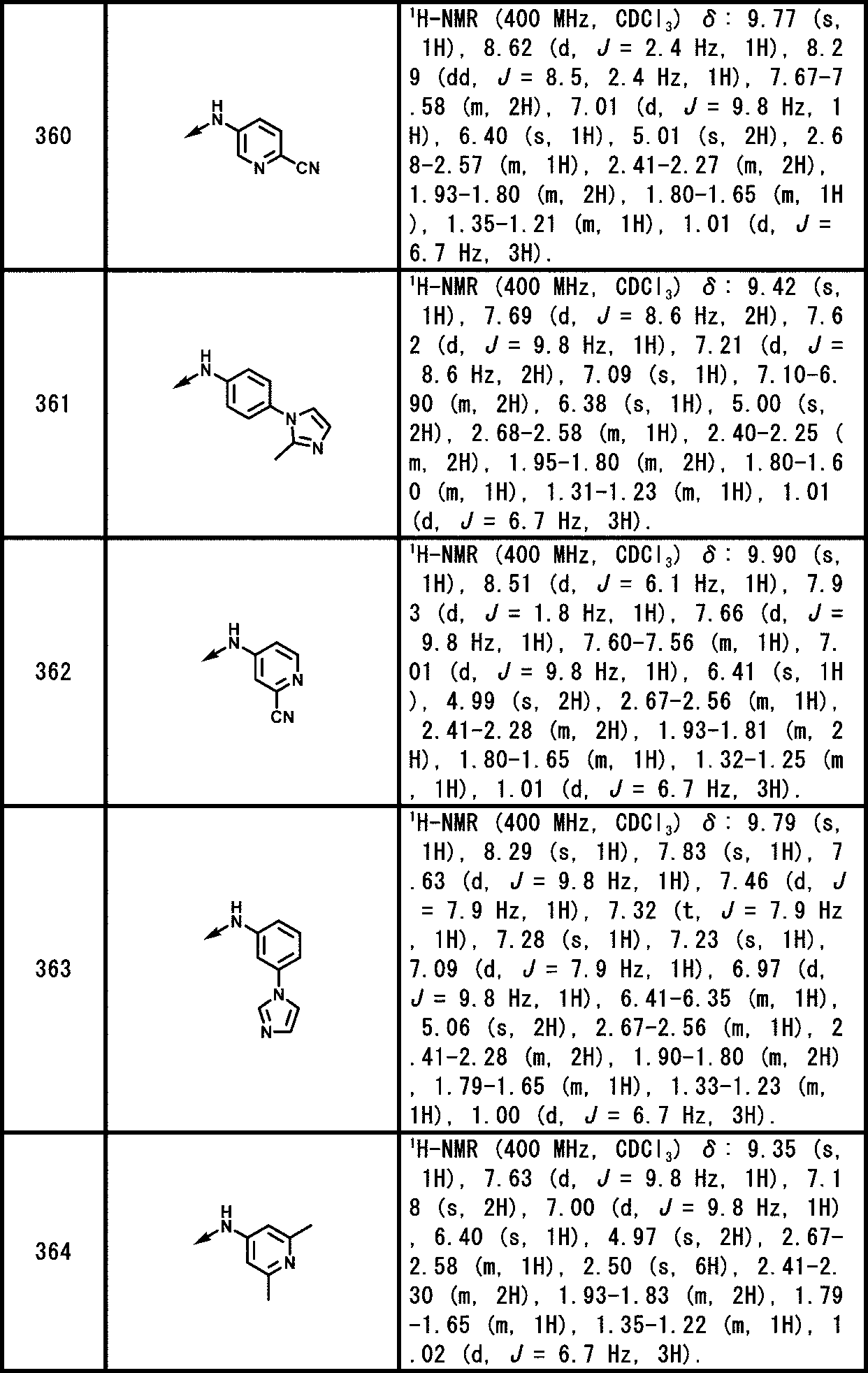

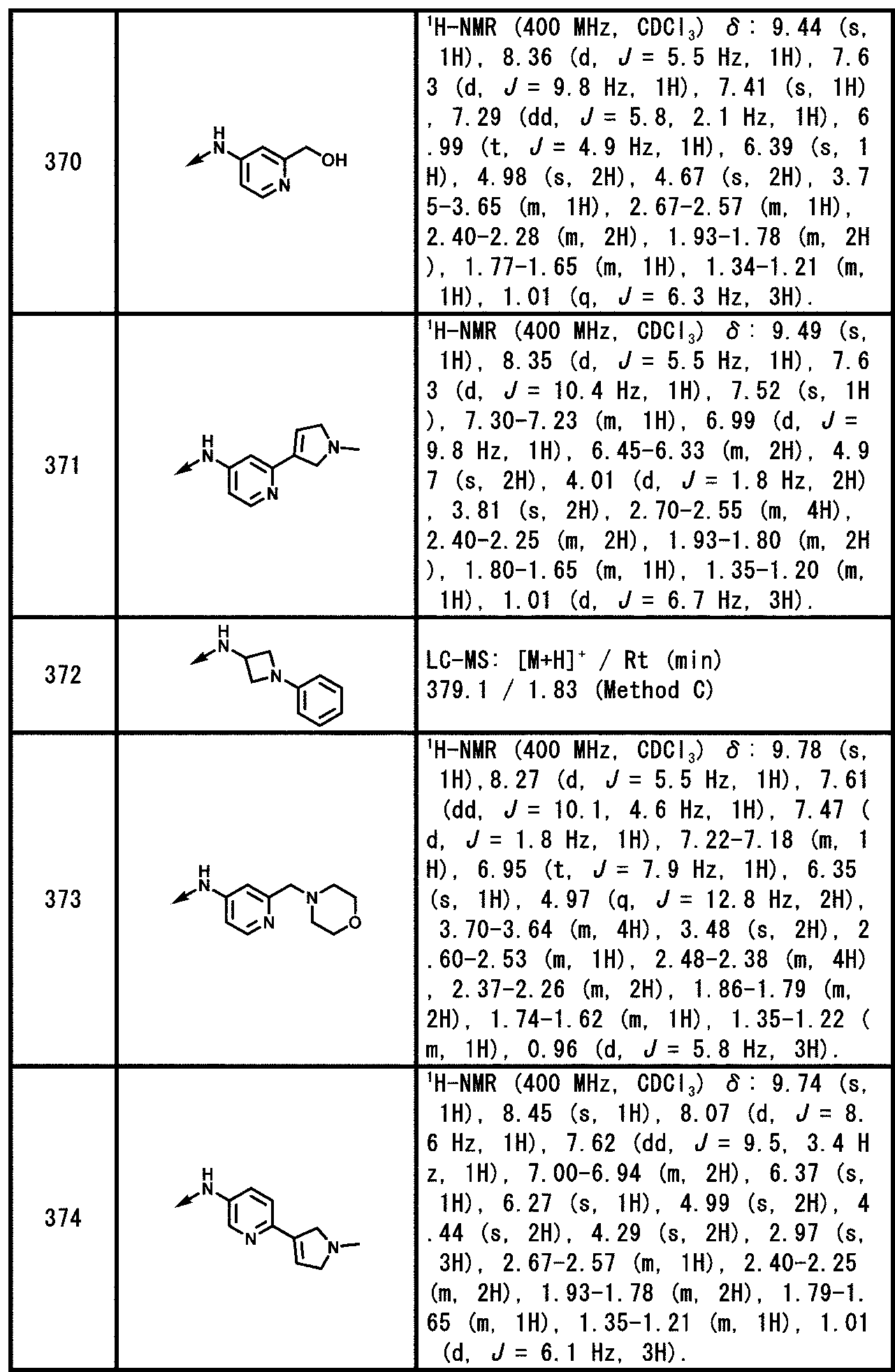


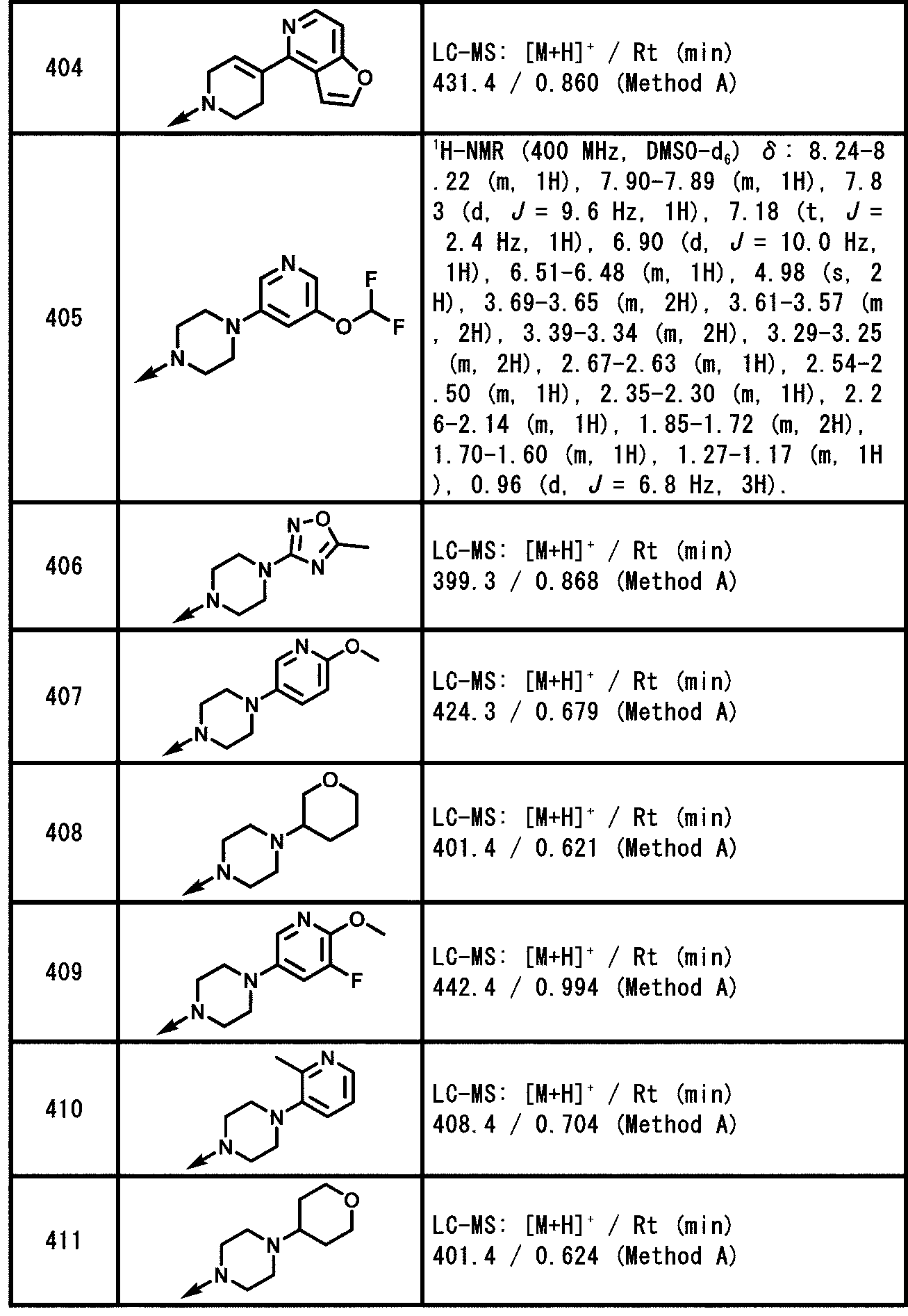


実施例1、37または50に記載の方法、および公知の反応条件に準じ、対応する原料化合物を用いて、実施例425~445の化合物を得た。


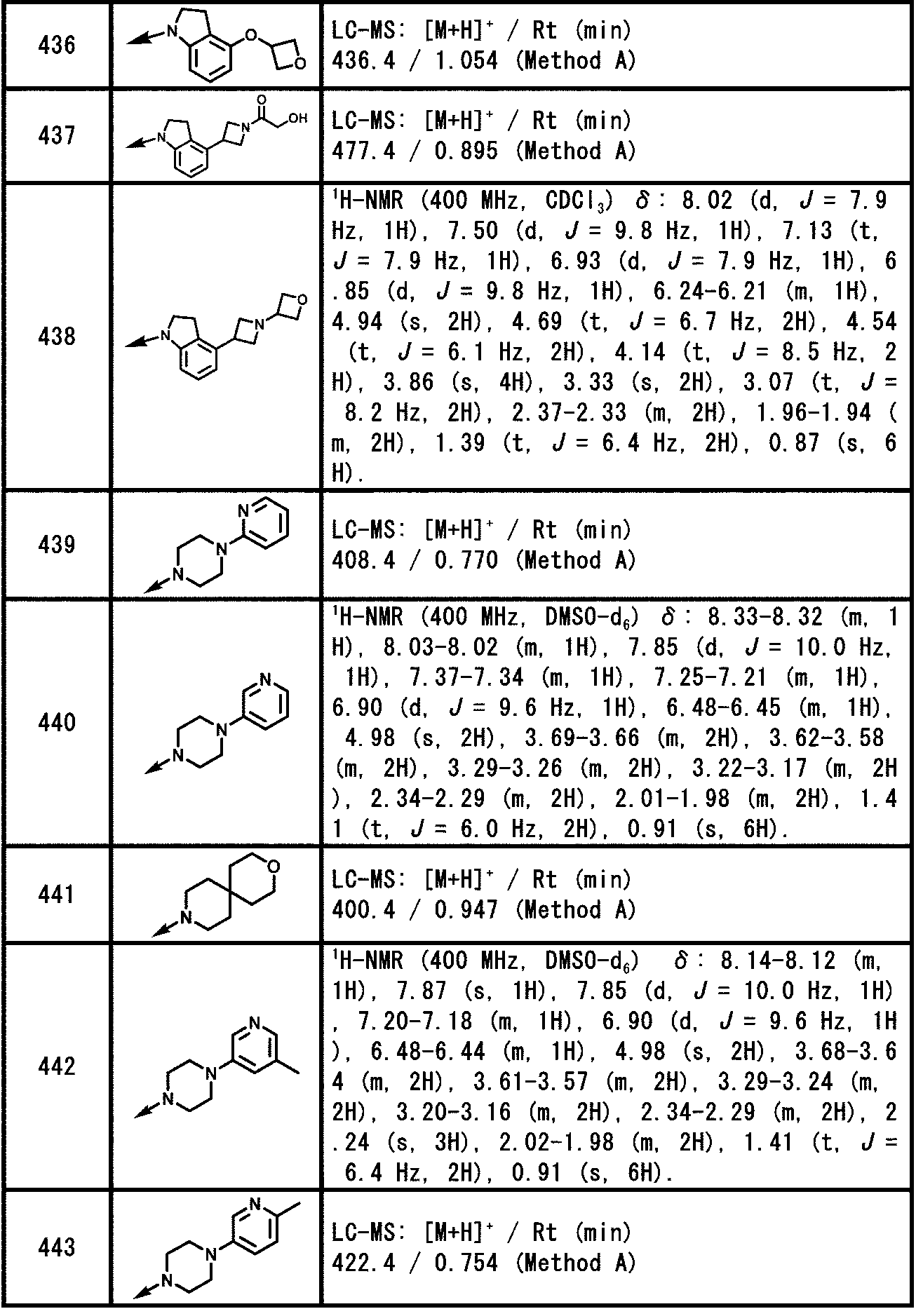
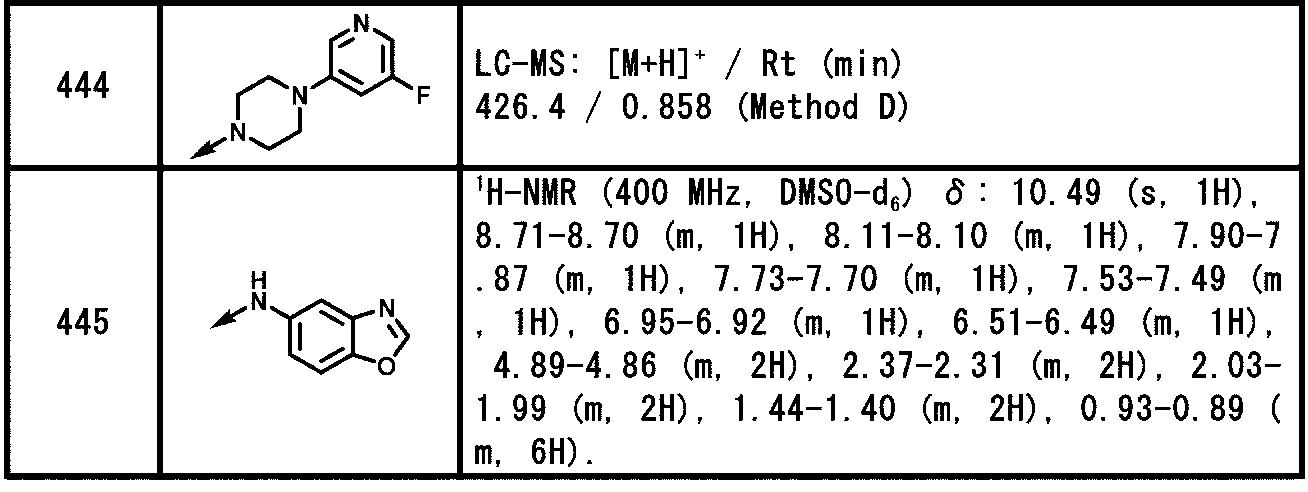
実施例1、37または50に記載の方法、および公知の反応条件に準じ、対応する原料化合物を用いて、実施例446~455の化合物を得た。
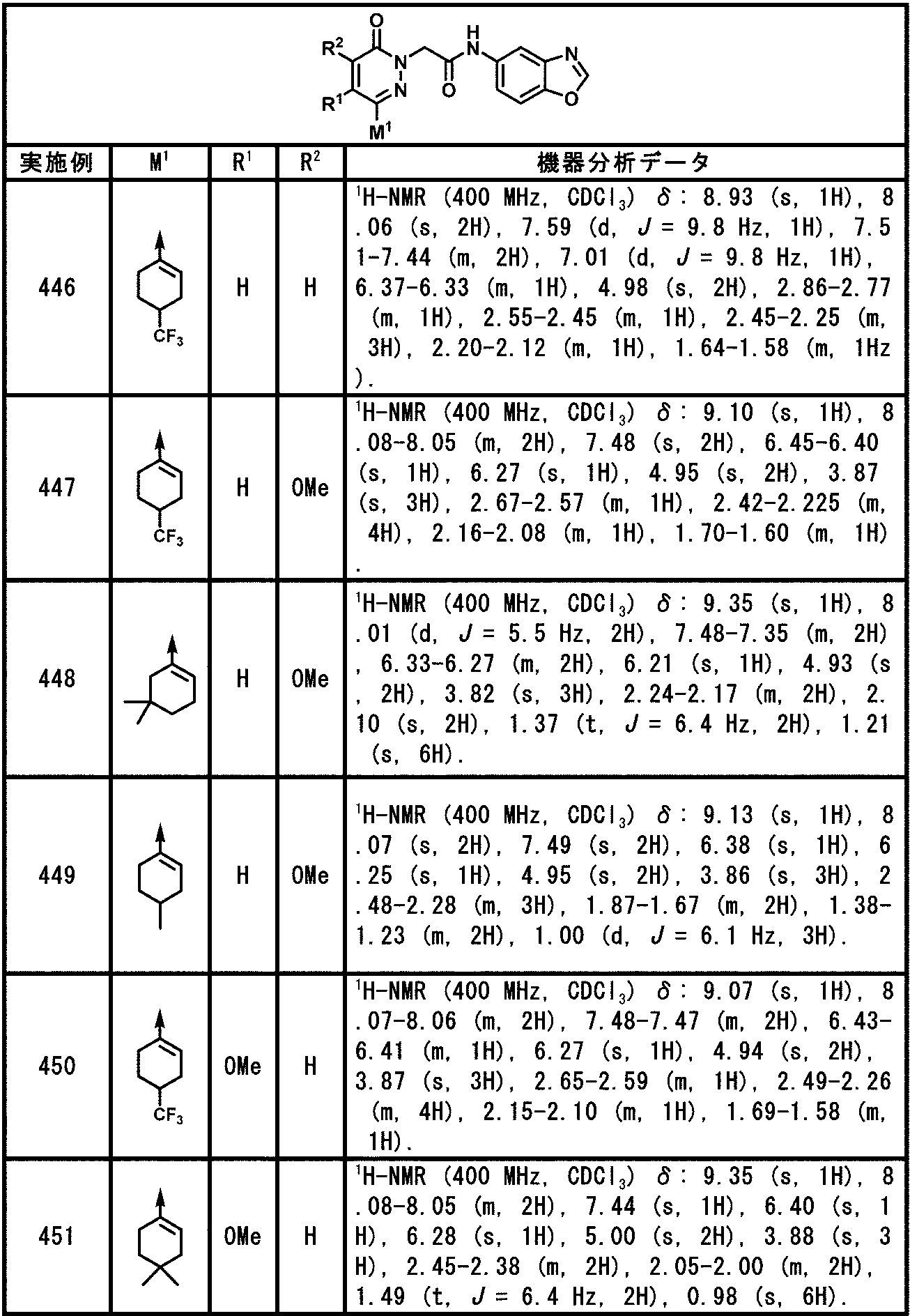

実施例1、37または50に記載の方法、および公知の反応条件に準じ、対応する原料化合物を用いて、実施例456~467の化合物を得た。
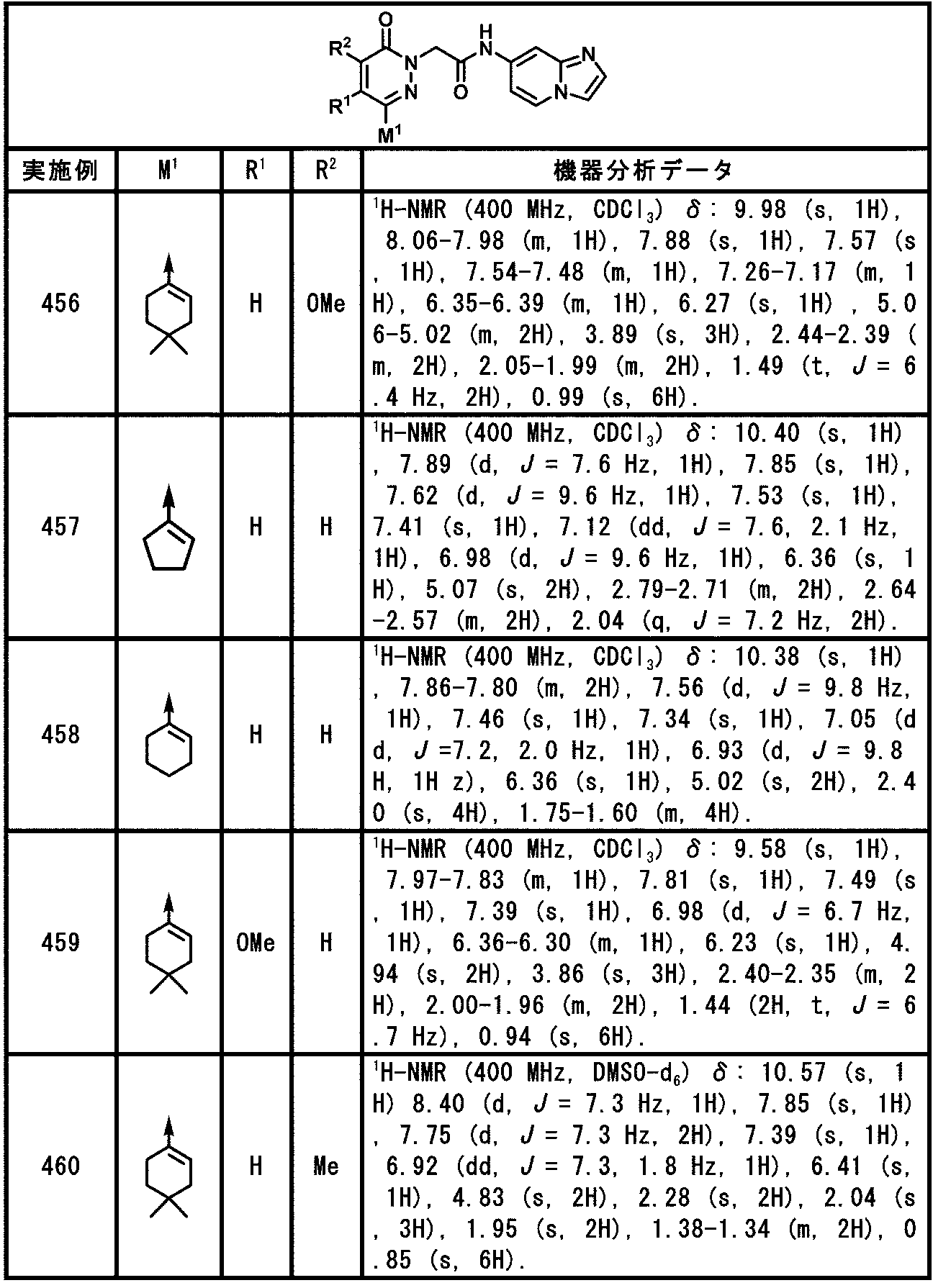

実施例1、37、38または50に記載の方法、および公知の反応条件に準じ、対応する原料化合物を用いて、実施例468~481の化合物を得た。


実施例1、37または50に記載の方法、および公知の反応条件に準じ、対応する原料化合物を用いて、実施例482~490の化合物を得た。


実施例1、37または50に記載の方法、および公知の反応条件に準じ、対応する原料化合物を用いて、実施例491~534の化合物を得た。
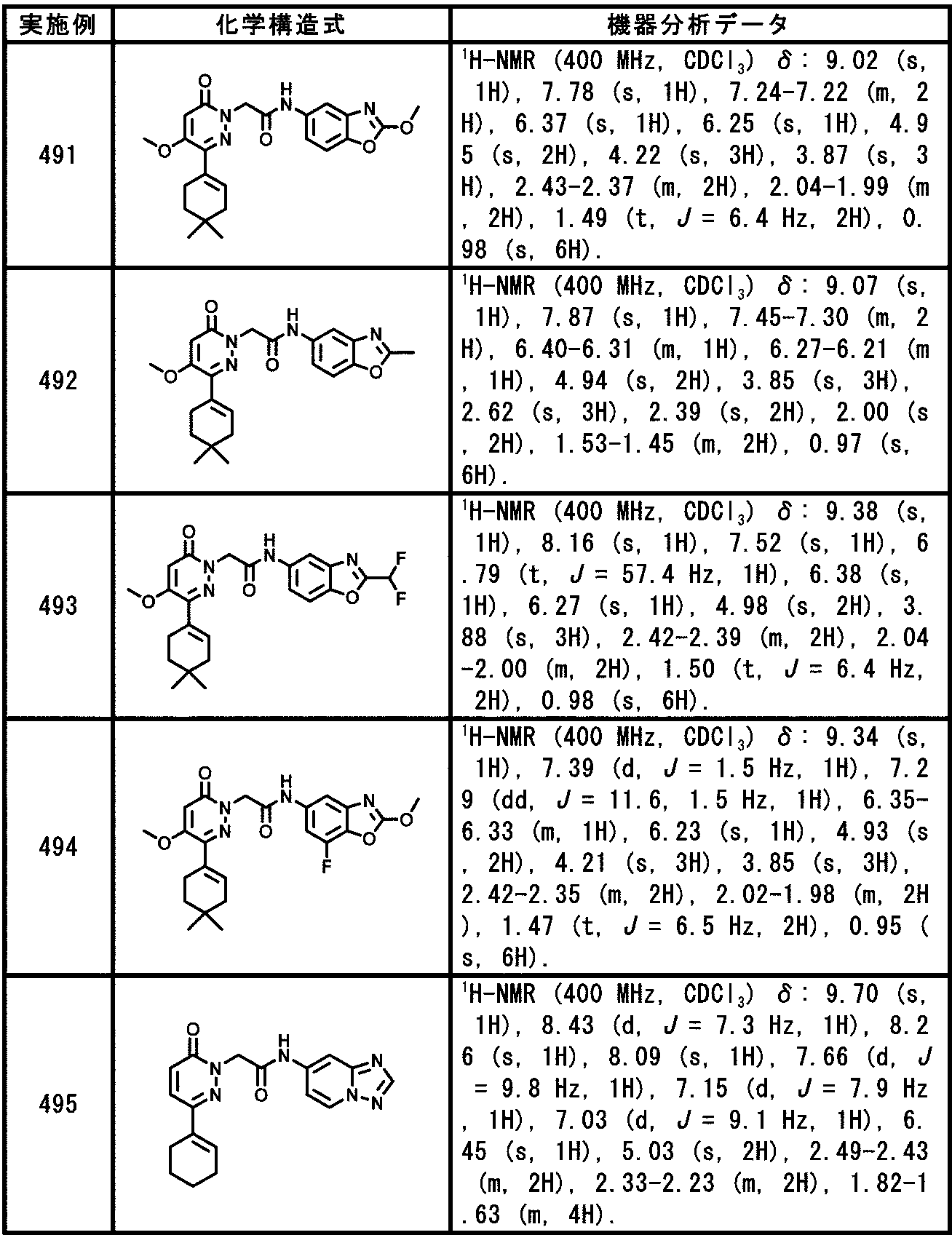

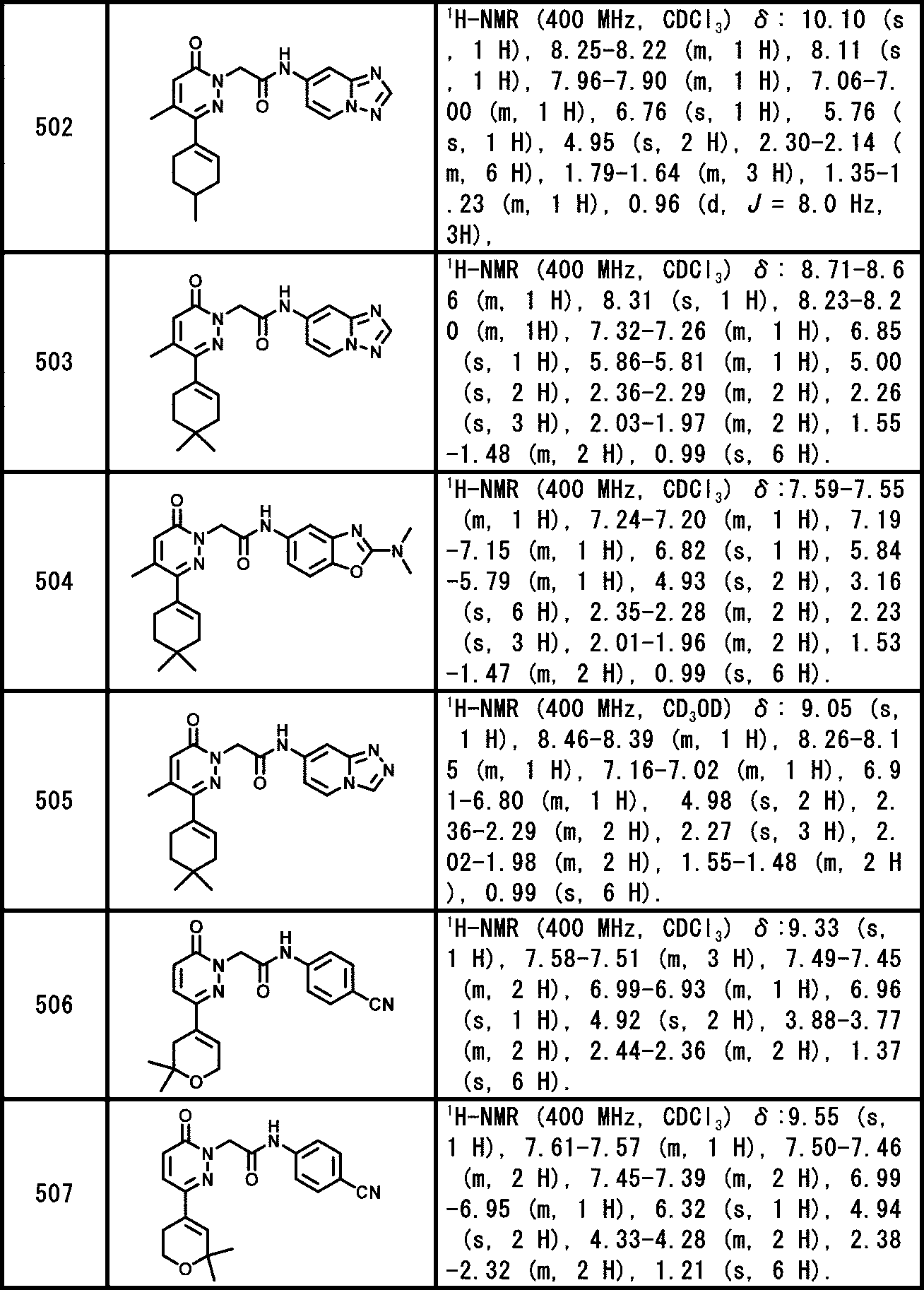
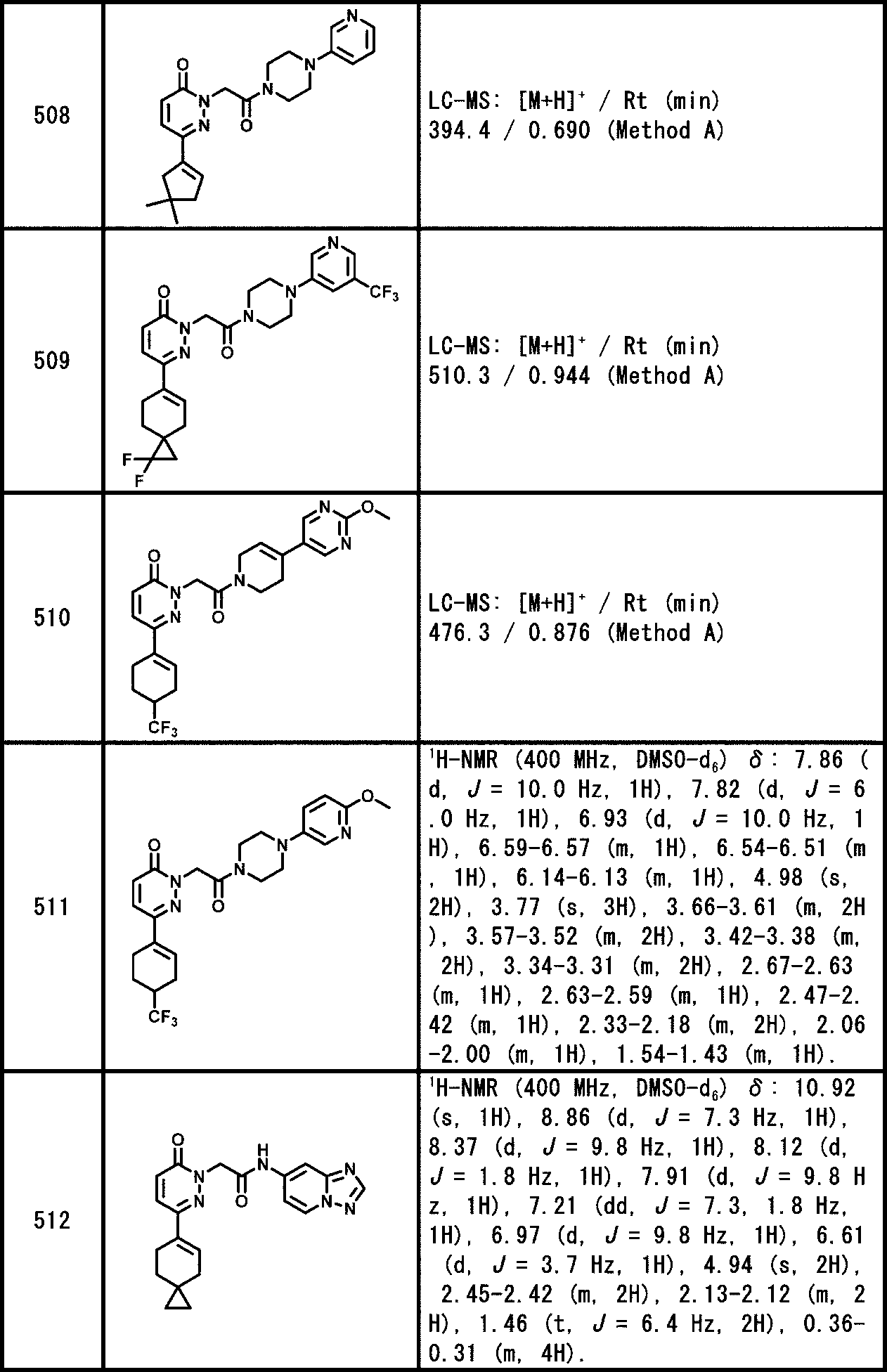


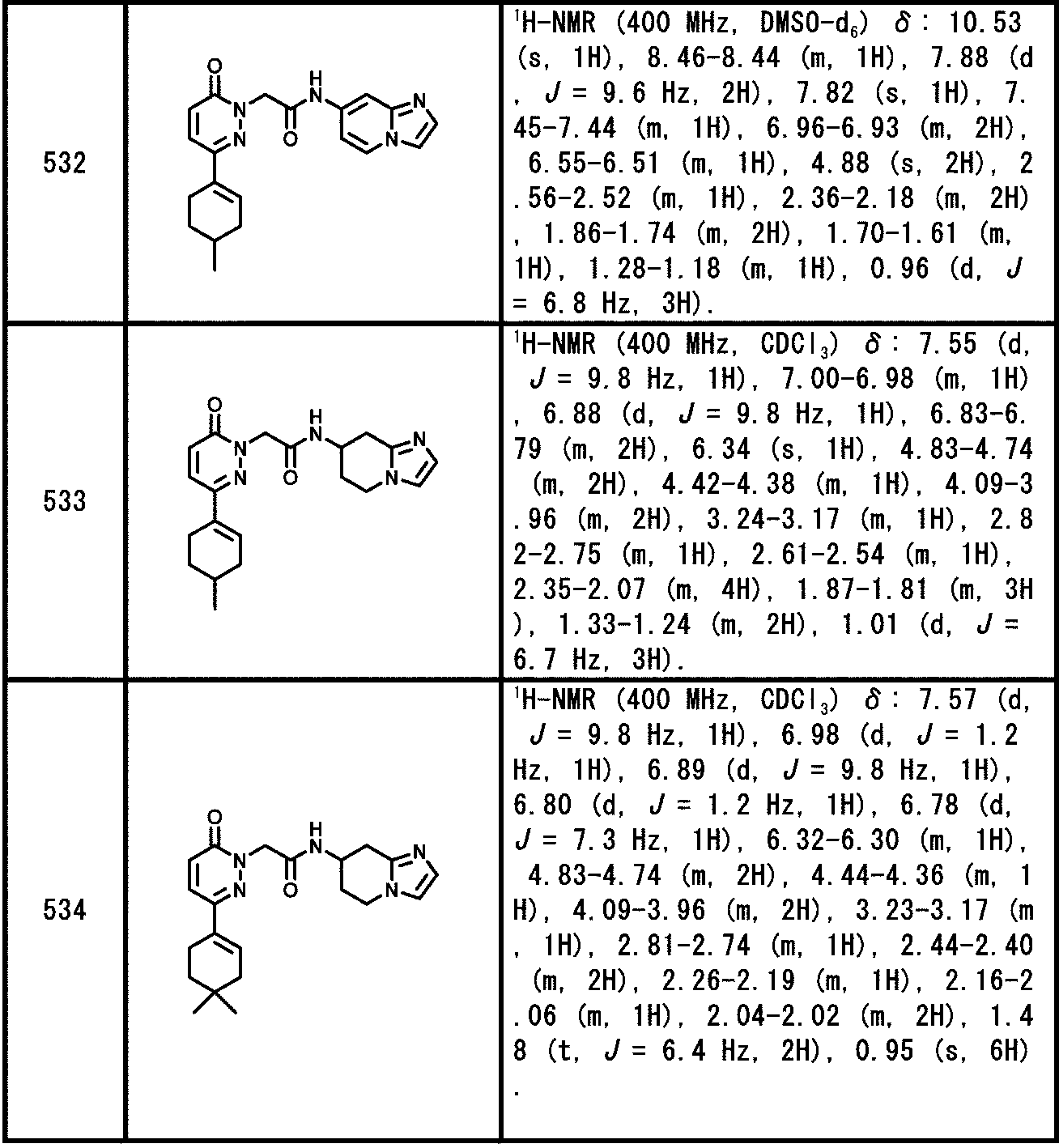
実施例472で得られた化合物(35.5mg)のシス・トランス異性体を、キラルカラムにより分割し下記化合物(実施例535および536)を得た。
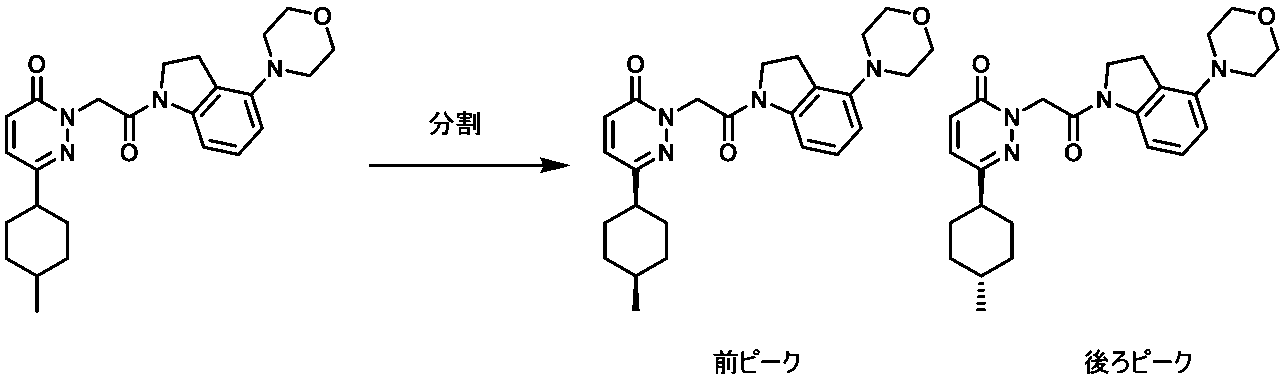
検出機器:SPD-M20A(SHIMAZU社製)
HPLC:LC-20AT(SHIMAZU社製)
カラム:CHIRALPAK IA (DAICEL社製)(S-5μm、20×250mm)
溶出条件:0.0-60.0(分):A/B=55:45
溶媒A:ヘキサン-ジエチルアミン0.1%添加
溶媒B:(イソプロピルアルコール:メタノール=2:1)-ジエチルアミン0.1%添加
流速:10ml/分
UV:220nm
カラム温度:40度

実施例330で得られた化合物(14.1mg)の光学異性体を、キラルカラムにより分割し下記化合物(実施例537および538)を得た。

検出機器:SPD-M20A (SHIMAZU社製)
HPLC:LC-20AT(SHIMAZU社製)
カラム:CHIRALPAK AY-H (DAICEL社製)(S-5μm、20×250mm)
溶出条件:0.0-80.0(分):A/B=65:35
溶媒A:ヘキサン
溶媒B:イソプロピルアルコール
流速:10ml/分
UV:220nm
カラム温度:40度

実施例339で得られた化合物(13.7mg)の光学異性体を、キラルカラムにより分割し下記化合物(実施例539および540)を得た。

検出機器:SPD-M20A(SHIMAZU社製)
HPLC:LC-20AT(SHIMAZU社製)
カラム:CHIRALPAK AY-H (DAICEL社製)(S-5μm、20×250mm)
溶出条件:0.0-80.0(分):A/B=50:50
溶媒A:ヘキサン
溶媒B:イソプロピルアルコール
流速:10ml/分
UV:220nm
カラム温度:40度

実施例50に記載の方法、および公知の反応条件に準じ、対応する原料化合物を用いて、実施例541~571の化合物を得た。

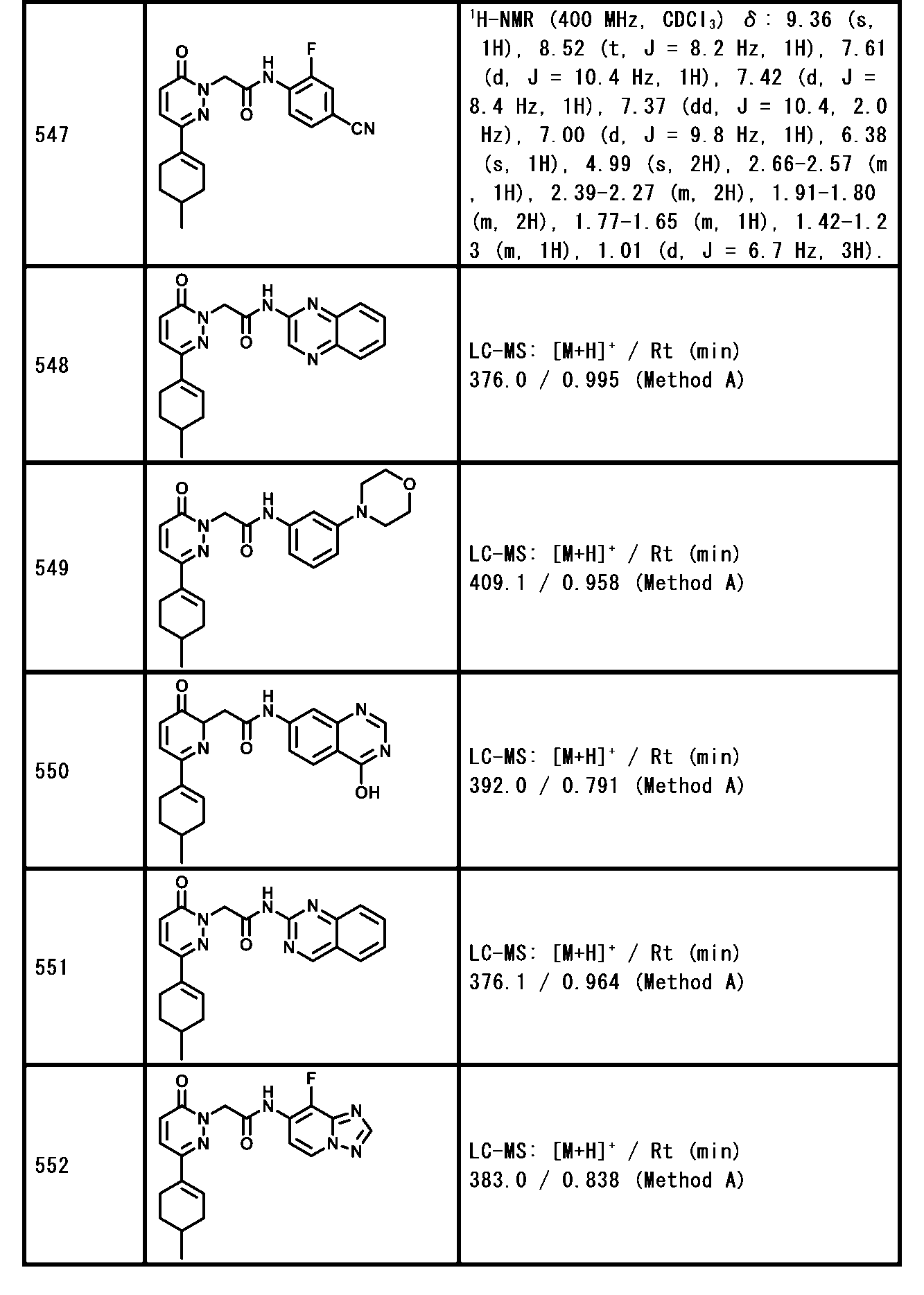
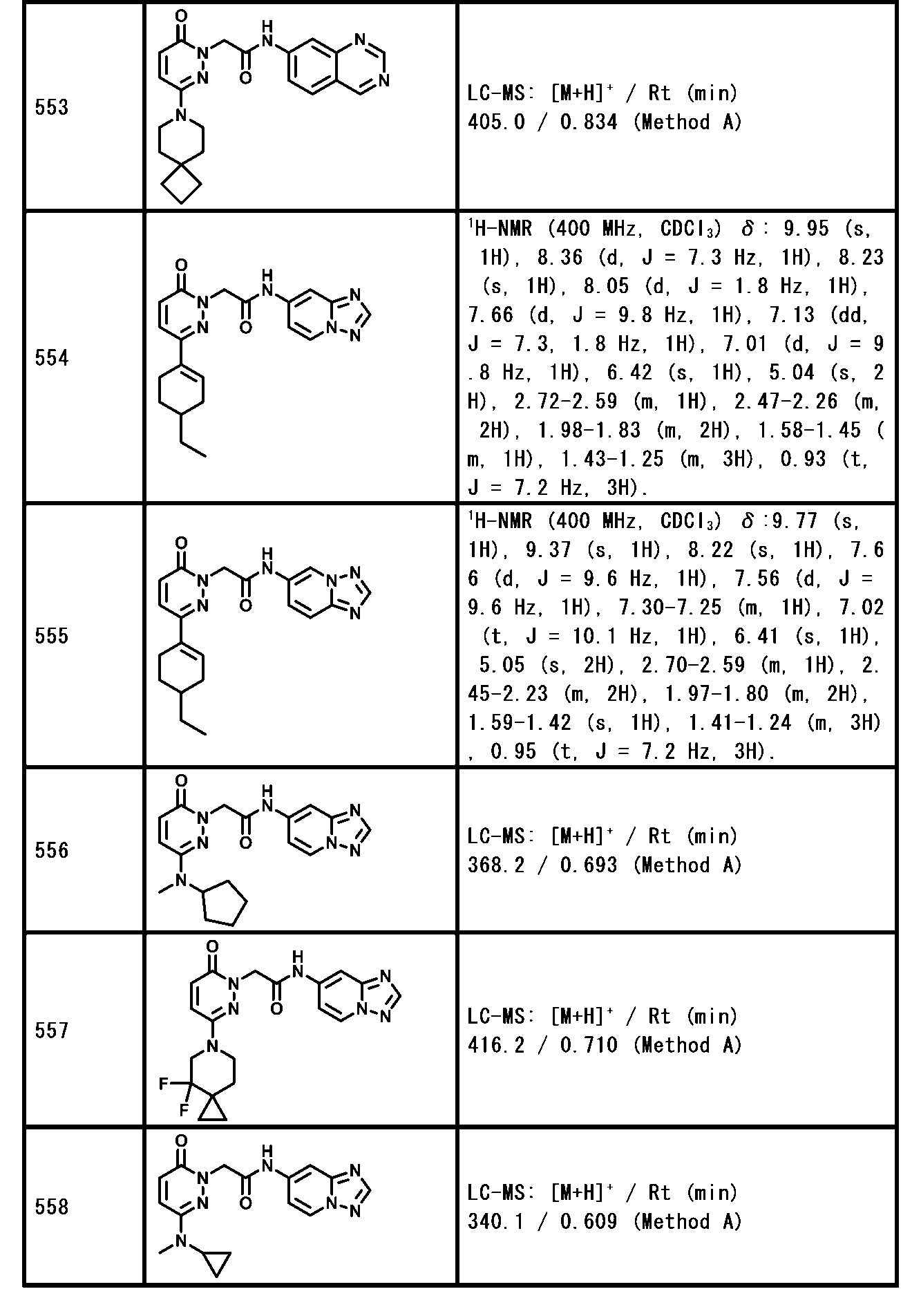

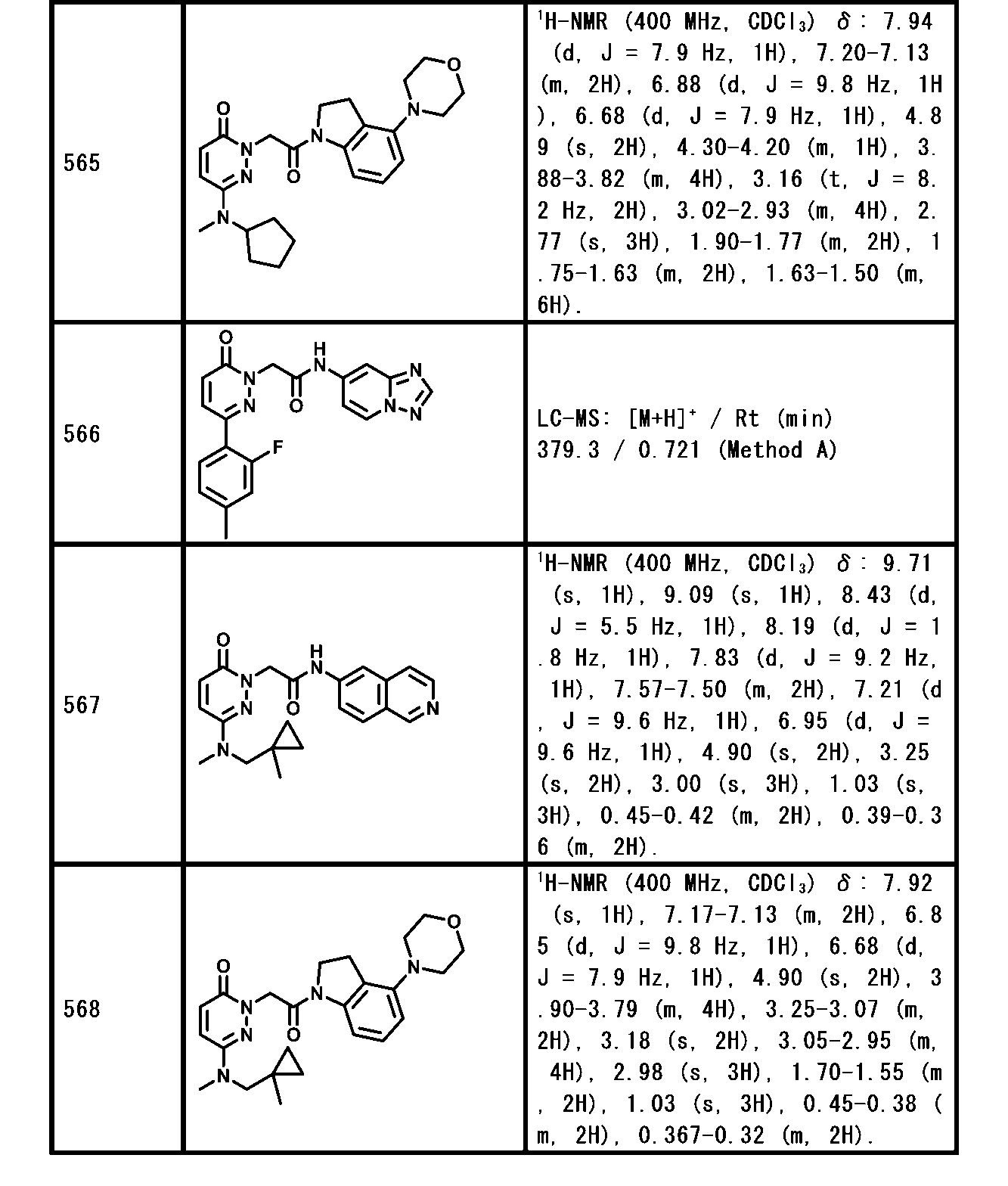

以下に、本明細書における代表的化合物の薬理試験結果を示し、該化合物についての薬理作用を説明するが、本発明はこれらの試験例に限定されるものではない。
(1)試験化合物の調製
試験化合物は評価濃度の200倍濃度のDMSO溶液を作製し、この溶液を細胞外液(NaCl 135mmol/L、KCl 4mmol/L, MgCl2 1 mmol/L、CaCl2 5mmol/L、Glucose 5mmol/L、HEPES 10mmol/L)にて評価濃度の2倍濃度に調製した。
(2)Nav1.1電流の惹起と測定
ヒトNav1.1安定発現HEK293細胞 (cat#CYL3009, Millipore, USA, Human Embryonic Kidney 293) を購入し、本試験に使用した。Nav1.1電流はRamp波電位刺激により惹起した。HTS型オートパッチクランプシステム(SynchroPatch 768PE, Nanion Technologies GmbH, Germany)を用い、パッチクランプ電位固定法により、電位刺激に伴う電流の検出を実施した。Ramp波電位刺激により惹起された電位依存性ナトリウム電流の大きさが500pAよりも小さい細胞は、内因性の電位依存性ナトリウムチャネル由来電流成分の割合が大きくなる可能性があるため、Nav1.1電流への化合物の活性の評価は電位依存性ナトリウム電流の大きさが500pAよりも大きい細胞でのみ実施した。
(3)Nav1.1電流に対する薬理効果
ヒトNav1.1安定発現細胞およびHTS型オートパッチクランプシステムを用いて、試験化合物のNav1.1電流増強作用を評価した。すなわち、細胞外液に1%濃度になるようにDMSOを添加した溶液に試験化合物を添加し、Nav1.1電流のピーク値および面積(Area under the curve, AUC)の変化を評価した。
(4)薬理評価方法
以下の計算式で、試験化合物のNav1.1電流増強率を求めた。
Nav1.1電流増強率(%)=100×[評価化合物添加後のNav1.1電流のピーク値または面積]/[評価化合物添加前のNav1.1電流のピーク値または面積]-100
購入したT―Rex System(ThermoFisher Scientific, USA)を用いてヒトNav1.5(Gene Bank Accession No:P_000326.2)安定発現CHO-K1細胞株(Chinese hamster ovary)を取得し、本試験に用いた。ヒトNav1.5安定発現細胞を用いて、Nav1.1と同様の方法に従いHTS型オートパッチクランプシステムにより、試験化合物のNav1.5電流増強作用を評価した。すなわち、細胞外液に1%濃度になるようにDMSOを添加し、さらに500nmol/LになるようにTetrodotoxin(TTX)を添加した溶液に試験化合物を添加し、Nav1.5電流のピーク値および面積(Area under the curve, AUC)の変化を評価した。Nav1.5電流の惹起と測定、Nav1.5電流に対する薬理効果、薬理評価方法についてはNav1.1と同様の方法で実施した。
本明細書における代表的化合物について、Nav1.1電流の面積の変化に基づいてNav1.1活性化作用(Nav1.1電流増強率)を評価した結果、Nav1.1電流増強作用を示すことが観察された。また、Nav1.5電流の面積の変化に基づいてNav1.5活性化作用(Nav1.5電流増強率)についても評価した。化合物濃度が10μmol/LのときのNav1.1電流増強率(%)およびNav1.5電流増強率(%)を下表に示す。

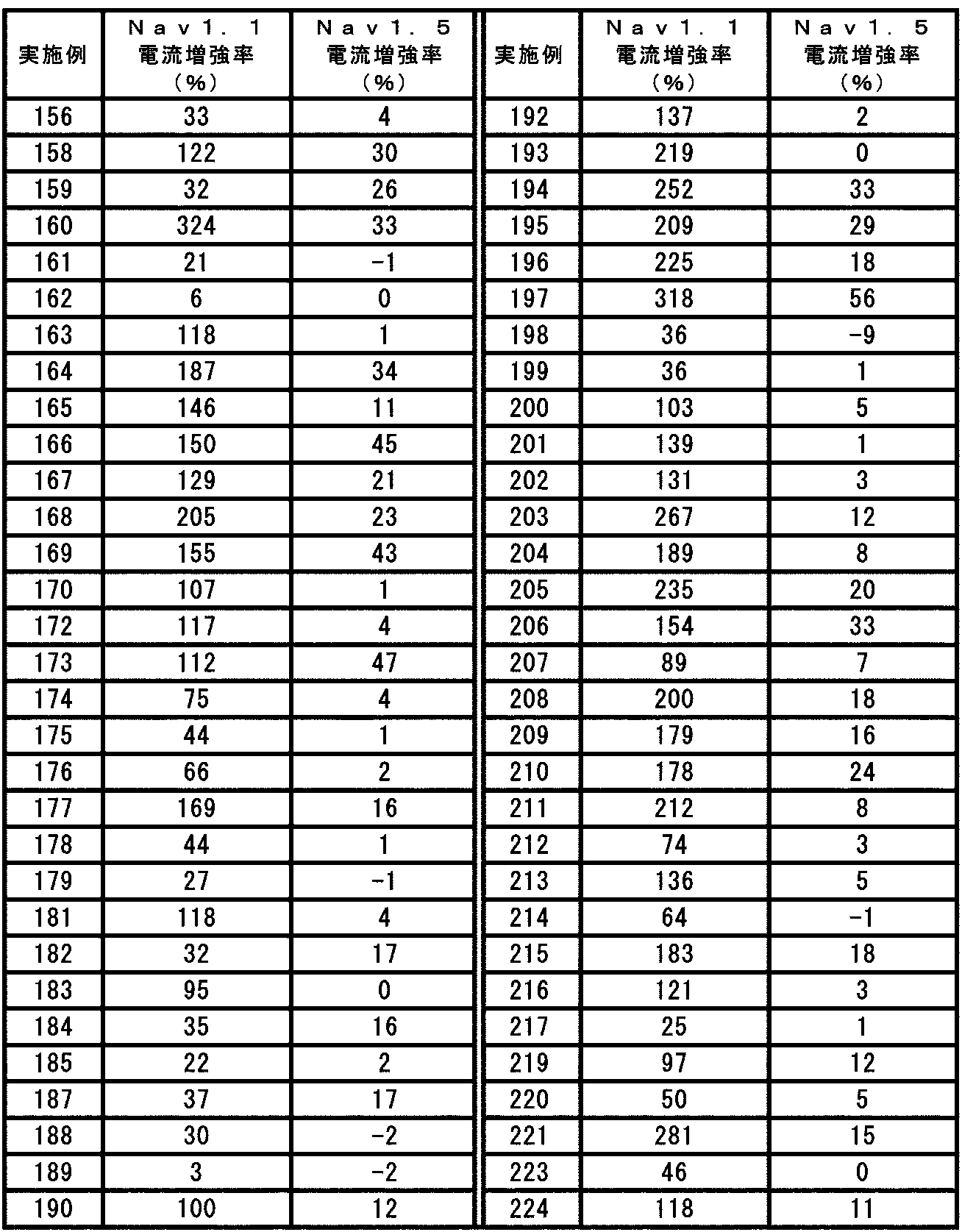

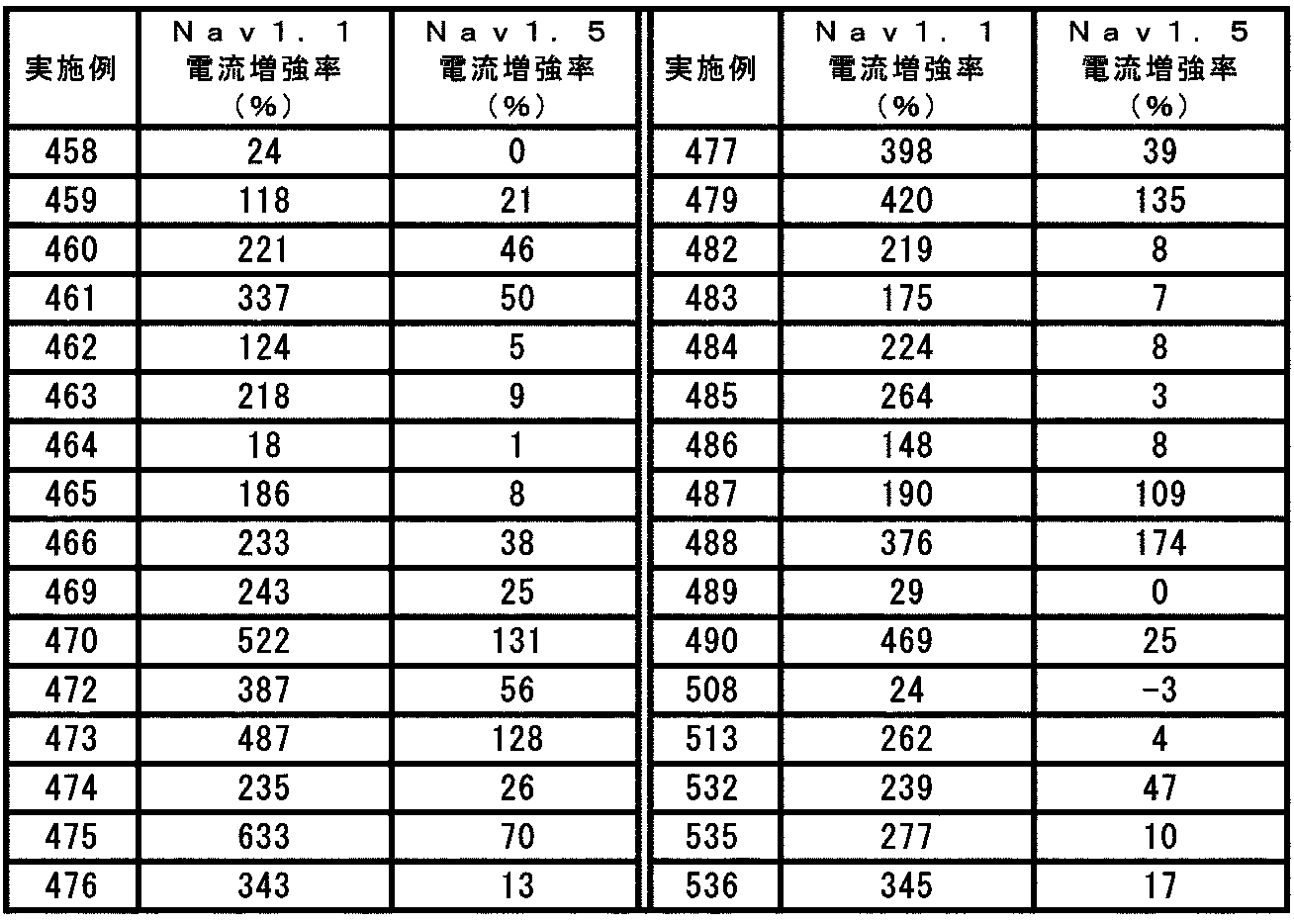
本明細書における代表的化合物について、化合物濃度が3μmol/LのときのNav1.1電流増強率(%)およびNav1.5電流増強率(%)を下表に示す。

本明細書における代表的化合物について、化合物濃度が1μmol/LのときのNav1.1電流増強率(%)およびNav1.5電流増強率(%)を下表に示す。
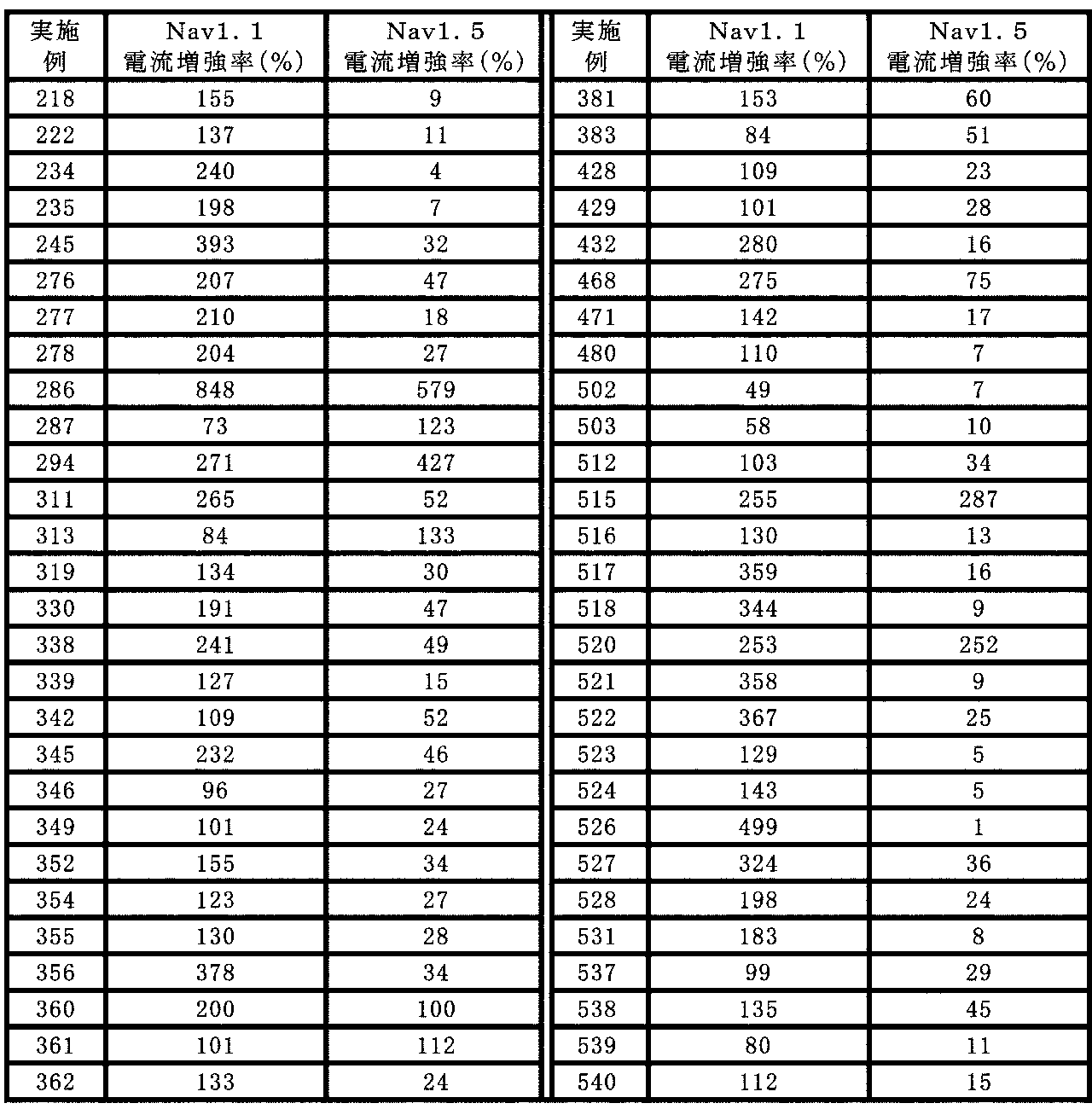
本明細書における代表的化合物について、化合物濃度が50μmol/LのときのNav1.1電流増強率(%)を下表に示す。

本明細書における代表的化合物について、化合物濃度が10μmol/LのときのNav1.1電流増強率(%)を下表に示す。
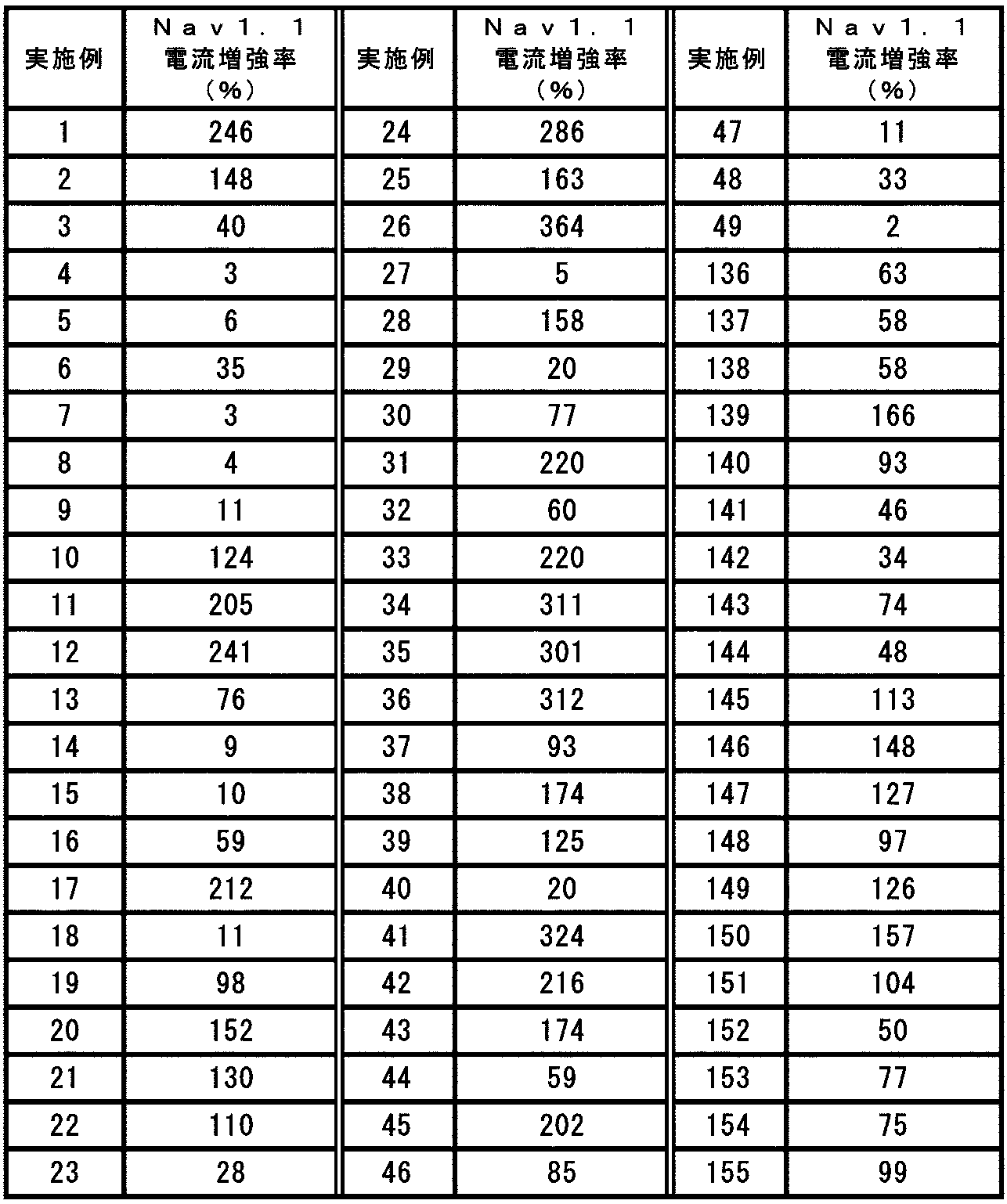

本明細書における代表的化合物について、化合物濃度が1μmol/LのときのNav1.1電流増強率(%)を下表に示す。

本明細書における代表的化合物について、Nav1.1電流増強率(%)を下表に示す。
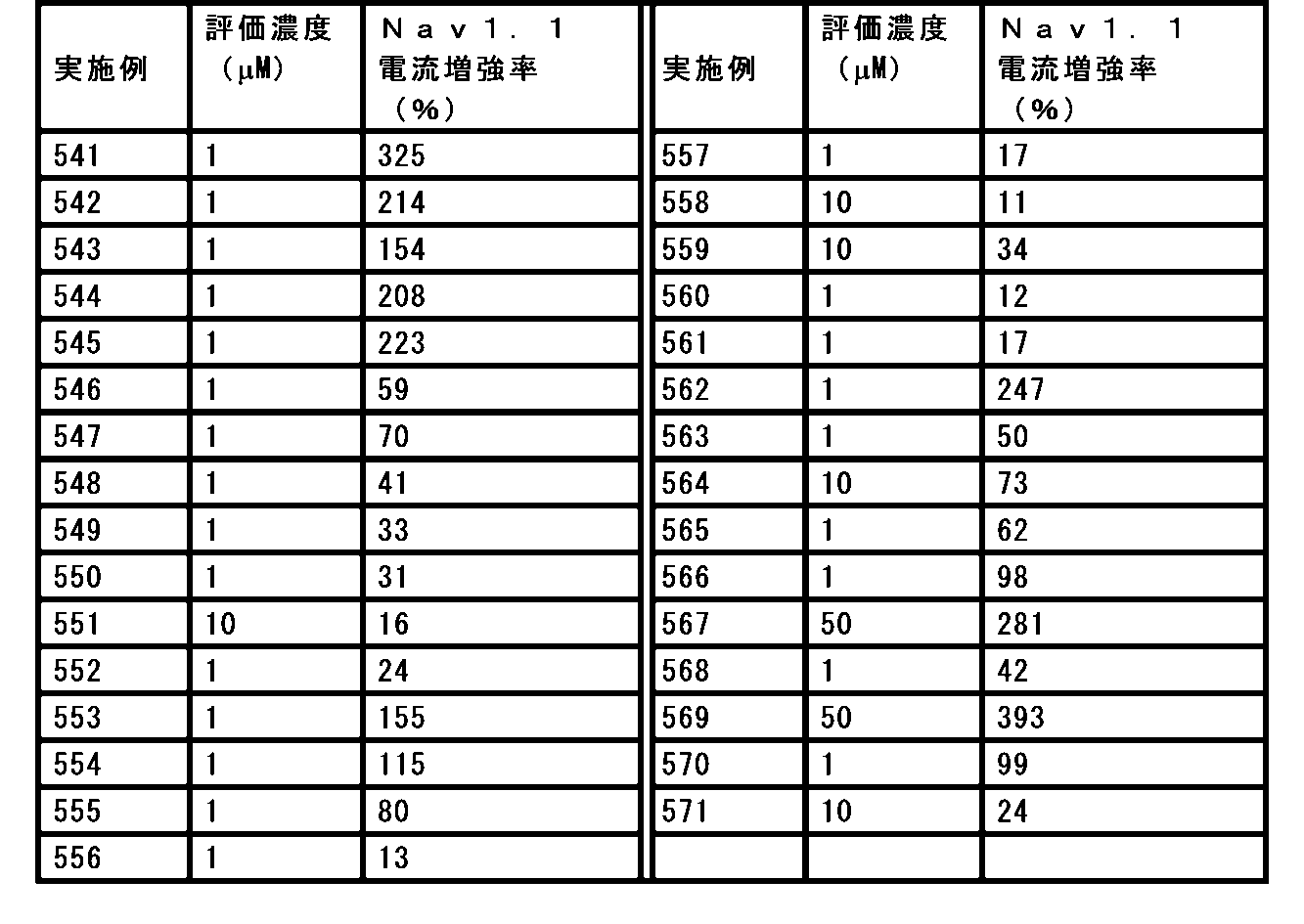
本試験は、薬物の抗痙攣作用を評価する試験である。この試験で用いる動物モデルは、全般性強直間代発作や二次性全般化部分発作の表現系である。Slc:ddY系雄性マウス(体重20~30g)に試験化合物を投与し、15分から3時間後に角膜より電気刺激(60Hz,25mA,0.2秒間)を与え、誘発される後肢の強直性伸展痙攣の発現抑制を観察することにより抗痙攣作用が確認できる。
本試験は、MESモデルと同様に薬物の抗痙攣作用を評価する試験である。この試験で用いる動物モデルは、全般性の欠神発作やミオクロニー発作の表現系である。Slc:ddY系雄性マウス(体重20~30g)に試験化合物を投与し、15分から3時間後にペンテトラゾール85mg/kgを皮下投与する。その後、30分間における間代性痙攣の発現の有無を観察することにより抗痙攣作用が確認できる。
本試験は薬物の抗痙攣作用を評価する試験である。この試験で用いる動物モデルは、既存の抗てんかん薬に治療抵抗性を示す発作の表現系である。Slc:ddy系雄性マウス(体重20~30g)に試験化合物を投与し、15分から3時間後に角膜より電気刺激(6Hz,32mA,3秒間)を与え、誘発される前肢の間代性痙攣、挙尾反応、無動状態の発現の有無を観察することにより抗痙攣作用が確認できる。
本試験は、薬物の協調運動能抑制作用を評価する試験である。Slc:ddy系雄性マウス(体重20~30g)を試験前日または試験当日にローターロッド装置(直径4cmの円柱棒を回転させる装置、13回転/分)で3分間落下しないで歩行できるように訓練する。訓練されたマウスに対し試験化合物を投与し、1時間後に上記のローターロッド装置に乗せ、15回転/分の条件にて、最大180秒間歩行状態を観察する。180秒以内に落下した場合は再度歩行させる(再試行回数は最大2回)。最大3回の試行における最長の歩行時間を評価することにより協調運動能抑制作用が確認できる。
本試験はSCN1A遺伝子機能欠失型遺伝子変異に伴って発現する熱性痙攣に対する薬物の抑制作用を評価する試験である。この試験で用いる動物モデルは、ドラベ症候群と同様にSCN1A遺伝子に欠失型遺伝子変異を有しており、体温上昇に伴う熱性痙攣を呈するドラベ症候群の表現型であり、理研バイオリソース研究センターより購入できる(系統:BALB/c-Scn1a<+/->、カタログ番号:RBRC06422)。
SCN1A遺伝子機能欠失型遺伝子変異マウス(18~23g)に対し試験化合物を投与する。投与20分後に、約43℃の温浴を用いて保温することにより内部温度を上昇させたプラスチックチャンバーに同マウスを投入、継続的に保温することによって体温を上昇させる。痙攣発作発現時、または痙攣発作を発現しなかった個体の場合はチャンバーに投入後1時間の時点の直腸内体温を試験化合物未投与群と比較することで、試験化合物の熱性痙攣誘発抑制効果を確認できる。
Claims (27)
- 式(1):

(1-1)飽和または部分不飽和のC4-12炭素環基
(ここで、該基は、
(a)ハロゲン原子、および
(b)ハロゲン原子、ヒドロキシ、およびC1-6アルコキシからなる群から選択される同種または異種の1~3個の基で置換されていてもよいC1-6アルキル
からなる群から選択される同種または異種の1~4個の基で置換されていてもよい)、
(1-2)4員~12員の飽和または部分不飽和のヘテロ環基
(ここで、該基は、
(a)ハロゲン原子、
(b)ヒドロキシ、
(c)メトキシ、
(d)ハロゲン原子、ヒドロキシ、およびC1-6アルコキシからなる群から選択される同種または異種の1~3個の基で置換されていてもよいC1-6アルキル、および
(e)同種または異種の1~2個のC1-6アルキル(ここで、該C1-6アルキルは、同種または異種の1~3個のハロゲン原子で置換されていてもよい)で置換されていてもよいアミノ-カルボニル
からなる群から選択される同種または異種の1~4個の基で置換されていてもよく、ただし、該ヘテロ環基はモルホリノ基ではない)、
(1-3)4-メチルフェニル
(ここで、該基のフェニル部分は、ハロゲン原子、ヒドロキシ、同種または異種の1~3個のハロゲン原子で置換されていてもよいC1-6アルキル、および同種または異種の1~3個のハロゲン原子で置換されていてもよいC1-6アルコキシからなる群から選択される同種または異種の1~4個の基で置換されていてもよく、
該基のメチル部分は、同種または異種の1~3個のハロゲン原子で置換されていてもよい)、
(1-4)アミノ
(ここで、該基は、
(a)同種または異種の1~3個のハロゲン原子で置換されていてもよいC1-6アルキル、
(b)ハロゲン原子、C1-6アルキルおよびC3-6シクロアルキルからなる群から選択される同種または異種の1~3個の基で置換されていてもよいC3-10シクロアルキル、および
(c)ハロゲン原子、C1-6アルキルおよびC3-6シクロアルキルからなる群から選択される同種または異種の1~3個の基で置換されていてもよいC3-10シクロアルキルC1-4アルキル
からなる群から選択される同種または異種の1~2個の基で置換されていてもよい)、
(1-5)6-メチルピリジン-3-イルまたは6-トリフルオロメチルピリジン-3-イル、
(1-6)4-クロロチオフェン-2-イル、5-メチルチオフェン-2-イルまたは3-シアノチオフェン-2-イル(ただし、M1が5-メチルチオフェン-2-イルの場合は、M2は下記(4-2)で示される基ではない)、または
(1-7)4-メチルフェニルオキシ
を表し;
R1およびR2は、それぞれ独立して、
(2-1)水素原子、
(2-2)ハロゲン原子、
(2-3)シアノ、
(2-4)C1-6アルキル
(ここで、該基は、
(a)ハロゲン原子、
(b)ヒドロキシ、
(c)飽和または部分不飽和のC3-7炭素環基、
(d)C1-6アルコキシ、および
(e)同種または異種の1~3個のハロゲン原子で置換されていてもよいC1-6アルキル;飽和または部分不飽和のC3-7炭素環基;およびC2-7アルキルカルボニルからなる群から選択される同種または異種の1~2個の基で置換されていてもよいアミノ
からなる群から選択される同種または異種の1~3個の基で置換されていてもよい)、
(2-5)ハロゲン原子、ヒドロキシ、C1-6アルキル、およびC1-6アルコキシからなる群から選択される同種または異種の1~4個の基で置換されていてもよい飽和または部分不飽和のC3-7炭素環基、
(2-6)同種または異種の1~4個のハロゲン原子で置換されていてもよいC2-6アルケニル、
(2-7)ハロゲン原子、ヒドロキシ、飽和または部分不飽和のC3-7炭素環基、およびC1-6アルコキシからなる群から選択される同種または異種の1~3個の基で置換されていてもよいC1-6アルコキシ、または
(2-8)同種または異種の1~3個のハロゲン原子で置換されていてもよいC1-6アルキル、および飽和または部分不飽和のC3-7炭素環基からなる群から選択される同種または異種の1~2個の基で置換されていてもよいアミノ
を表すか;
あるいは、R1およびR2は、それらが結合する炭素原子と一緒になって、
(3-1)5員~7員の飽和または部分不飽和の炭素環
(ここで、該環は、
(a)ハロゲン原子、
(b)ヒドロキシ、
(c)ハロゲン原子、ヒドロキシ、およびC1-6アルコキシからなる群から選択される同種または異種の1~3個の基で置換されていてもよいC1-6アルキル、および
(d)ハロゲン原子、ヒドロキシ、およびC1-6アルコキシからなる群から選択される同種または異種の1~3個の基で置換されていてもよいC1-6アルコキシ
からなる群から選択される同種または異種の1~4個の基で置換されていてもよい)、または
(3-2)5員~7員の飽和または部分不飽和のヘテロ環
(ここで、該環は、本項中の前記(3-1)の(a)~(d)からなる群から選択される同種または異種の1~4個の基で置換されていてもよい)
を形成していてもよく;
M2は、
(4-1)下記式(2a)または(2b):

X2、X3、およびX4は、それぞれ独立して、CR3、O、S、N、またはNR4を表し;
A1およびA2は、それぞれ独立して、N、またはCを表し;
ここにおいて、X1a、X1b、X1c、X2、X3、X4、X5、X6、X7、X8、A1、およびA2は、これらを含む環が、9もしくは10員の二環性芳香族ヘテロ環が形成されるように選択され;
R3は、
(a)水素原子、
(b)ハロゲン原子、
(c)シアノ、
(d)ヒドロキシ、
(e)ハロゲン原子、ヒドロキシ、飽和または部分不飽和のC3-7炭素環基、C1-6アルコキシ、C1-6アルコキシで置換されていてもよい4~7員の飽和ヘテロ環基、および同種または異種の1~2個のC1-6アルキルで置換されていてもよいアミノからなる群から選択される同種または異種の1~3個の基で置換されていてもよいC1-6アルキル、
(f)ハロゲン原子、ヒドロキシ、C1-6アルキル、C1-6アルコキシ、および同種または異種の1~2個のC1-6アルキルで置換されていてもよいアミノからなる群から選択される同種または異種の1~4個の基で置換されていてもよい飽和または部分不飽和のC3-7炭素環基、
(g)ハロゲン原子、ヒドロキシ、C1-6アルコキシ、および同種または異種の1~2個のC1-6アルキルで置換されていてもよいアミノからなる群から選択される同種または異種の1~3個の基で置換されていてもよいC1-6アルコキシ、
(h)ハロゲン原子、ヒドロキシ、およびC1-6アルコキシからなる群から選択される同種または異種の1~3個の基で置換されていてもよいC1-6アルキル;飽和または部分不飽和のC3-7炭素環基;およびハロゲン原子、ヒドロキシ、およびC1-6アルコキシからなる群から選択される同種または異種の1~3個の基で置換されていてもよいC2-7アルキルカルボニルからなる群から選択される同種または異種の1~2個の基で置換されていてもよいアミノ、
(i)ハロゲン原子、シアノ、およびC1-6アルキルからなる群から選択される同種または異種の1~4個の基で置換されていてもよい5もしくは6員のヘテロアリール、
(j)ハロゲン原子、ヒドロキシ、C1-6アルキル、およびC1-6アルコキシからなる群から選択される同種または異種の1~4個の基で置換されていてもよい4員~7員の飽和または部分不飽和のヘテロ環基、または
(k)-C(O)NRxRy
(ここにおいて、RxおよびRyは、それぞれ独立して、水素原子、C1-6アルキル、または飽和または部分不飽和のC3-7炭素環基を表すか;
あるいは、RxおよびRyは、それらが結合する窒素原子と一緒になって、4員~7員の飽和ヘテロ環基を形成していてもよい)
を表し;
R4は、
(a)水素原子、
(b)ハロゲン原子、ヒドロキシ、およびC1-6アルコキシからなる群から選択される同種または異種の1~3個の基で置換されていてもよいC1-6アルキル、または
(c)ハロゲン原子、ヒドロキシ、C1-6アルキル、およびC1-6アルコキシからなる群から選択される同種または異種の1~4個の基で置換されていてもよい飽和または部分不飽和のC3-7炭素環基を表し、
ここで、R3およびR4が複数ある場合、各R3およびR4は、同一または異なってもよい]
で表される基、
(4-2)下記式(2c):

(a)水素原子、
(b)ハロゲン原子、
(c)シアノ、
(d)ハロゲン原子、ヒドロキシ、飽和または部分不飽和のC3-7炭素環基、およびC1-6アルコキシからなる群から選択される同種または異種の1~3個の基で置換されていてもよいC1-6アルキル、
(e)ハロゲン原子、ヒドロキシ、C1-6アルキル、およびC1-6アルコキシからなる群から選択される同種または異種の1~4個の基で置換されていてもよい飽和または部分不飽和のC3-7炭素環基、
(f)ハロゲン原子、ヒドロキシ、およびC1-6アルコキシからなる群から選択される同種または異種の1~3個の基で置換されていてもよいC1-6アルコキシ、
(g)同種または異種の1~3個のハロゲン原子で置換されていてもよいC1-6アルキル;飽和または部分不飽和のC3-7炭素環基;およびC2-7アルキルカルボニル
からなる群から選択される同種または異種の1~2個の基で置換されていてもよいアミノ、
(h)ハロゲン原子、シアノ、およびC1-6アルキルからなる群から選択される同種または異種の1~4個の基で置換されていてもよい5もしくは6員のヘテロアリール、
(i)ハロゲン原子、ヒドロキシ、C1-6アルキル、およびC1-6アルコキシからなる群から選択される同種または異種の1~4個の基で置換されていてもよい4員~7員の飽和または部分不飽和のヘテロ環基、
(j)-C(O)NRxRy
(ここにおいて、RxおよびRyは、それぞれ独立して、水素原子、C1-6アルキル、または飽和または部分不飽和のC3-7炭素環基を表すか;
あるいは、RxおよびRyは、それらが結合する窒素原子と一緒になって、4員~7員の飽和ヘテロ環基を形成していてもよい)、
(k)C2-7アルキルカルボニル、または
(l)C2-7アルコキシカルボニル
を表し、かつ、以下の条件(X)または(Y)のいずれかを満たす:
(X)R5、R6およびR7のうち少なくとも1つは、シアノ、5もしくは6員のヘテロアリール(ここで、該基は、ハロゲン原子、シアノ、およびC1-6アルキルからなる群から選択される同種または異種の1~4個の基で置換されていてもよい)、4員~7員の飽和または部分不飽和のヘテロ環基(ここで、該基は、ハロゲン原子、ヒドロキシ、C1-6アルキル、およびC1-6アルコキシからなる群から選択される同種または異種の1~4個の基で置換されていてもよい)、または-C(O)NRxRy(ここにおいて、RxおよびRyは、それぞれ独立して、水素原子、C1-6アルキル、または飽和または部分不飽和のC3-7炭素環基を表すか;あるいは、RxおよびRyは、それらが結合する窒素原子と一緒になって、4員~7員の飽和ヘテロ環基を形成していてもよい)である;あるいは、
(Y)R5およびR6は、それらが結合する炭素原子と一緒になって、5~7員の飽和または部分不飽和の炭素環またはヘテロ環(ここで、該環は、ハロゲン原子、オキソ、C1-6アルキル、C1-6アルコキシおよびC2-7アルコキシカルボニルからなる群から選択される同種または異種の1~4個の基で置換されていてもよい)を形成していてもよい]
で表される基であって、
ここにおいて、式(2c)は、環上の置換可能な炭素原子上に更にフッ素原子が1個置換していてもよく、
(4-3)下記式(2d)、(2e)、(2f)、または(2g):
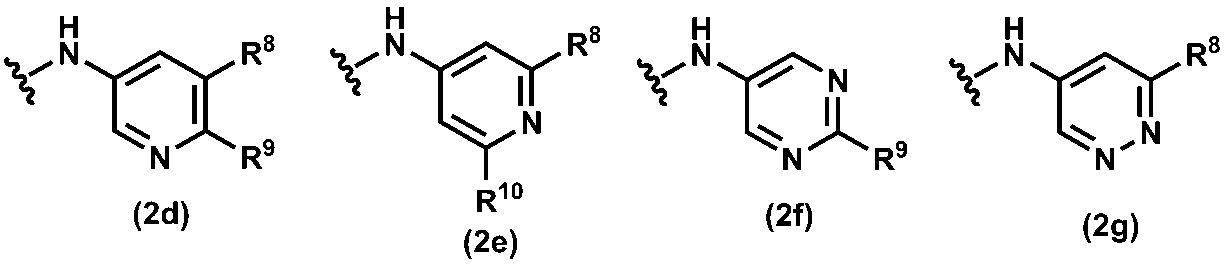
(a)水素原子、
(b)ハロゲン原子、
(c)シアノ、
(d)ハロゲン原子;ヒドロキシ;飽和または部分不飽和のC3-7炭素環基;ヒドロキシまたはC1-6アルコキシで置換されていてもよいC1-6アルコキシ;C1-6アルコキシまたはC1-6アルキルで置換されていてもよい4員~7員の飽和または部分不飽和のヘテロ環;C1-6アルキルで置換されていてもよい5もしくは6員のヘテロアリール;およびアミノ(ここで、該アミノは、ハロゲン原子、ヒドロキシ、およびC1-6アルコキシからなる群から選択される同種または異種の1~3個の基で置換されていてもよいC1-6アルキル;飽和または部分不飽和のC3-7炭素環基;C1-6アルコキシで置換されていてもよい4員~7員の飽和ヘテロ環基;およびハロゲン原子、ヒドロキシ、およびC1-6アルコキシからなる群から選択される同種または異種の1~3個の基で置換されていてもよいC2-7アルキルカルボニルからなる群から選択される同種または異種の1~2個の基で置換されていてもよい)からなる群から選択される同種または異種の1~3個の基で置換されていてもよいC1-6アルキル、
(e)ハロゲン原子、ヒドロキシ、C1-6アルキル、C1-6アルコキシ、および同種または異種の1~2個のC1-6アルキルで置換されていてもよいアミノからなる群から選択される同種または異種の1~4個の基で置換されていてもよい飽和または部分不飽和のC3-7炭素環基、
(f)ハロゲン原子、ヒドロキシ、C1-6アルコキシ、および同種または異種の1~2個のC1-6アルキルで置換されていてもよいアミノからなる群から選択される同種または異種の1~3個の基で置換されていてもよいC1-6アルコキシ、
(g)ハロゲン原子、ヒドロキシ、およびC1-6アルコキシからなる群から選択される同種または異種の1~3個の基で置換されていてもよいC1-6アルキル;飽和または部分不飽和のC3-7炭素環基;およびハロゲン原子、ヒドロキシ、およびC1-6アルコキシからなる群から選択される同種または異種の1~3個の基で置換されていてもよいC2-7アルキルカルボニルからなる群から選択される同種または異種の1~2個の基で置換されていてもよいアミノ、
(h)ハロゲン原子、シアノ、C1-6アルキル、C1-6アルコキシ、およびC2-7アルコキシカルボニルからなる群から選択される同種または異種の1~4個の基で置換されていてもよい5もしくは6員のヘテロアリール、
(i)ハロゲン原子、ヒドロキシ、およびC1-6アルコキシからなる群から選択される同種または異種の1~3個の基で置換されていてもよいC1-6アルキル;C1-6アルコキシ;4員~7員の飽和または部分不飽和のヘテロ環基;ハロゲン原子、ヒドロキシ、およびC1-6アルコキシからなる群から選択される同種または異種の1~3個の基で置換されていてもよいC2-7アルキルカルボニル;およびオキソからなる群から選択される同種または異種の1~4個の基で置換されていてもよい4員~7員の飽和または部分不飽和のヘテロ環基、
(j)1~4個のC1-6アルキルで置換されていてもよい4員~7員の飽和または部分不飽和のヘテロ環基-オキシ、
(k)-C(O)NRxRy
(ここにおいて、RxおよびRyは、それぞれ独立して、水素原子、C1-6アルキル、または飽和または部分不飽和のC3-7炭素環基を表すか;
あるいは、RxおよびRyは、それらが結合する窒素原子と一緒になって、4員~7員の飽和ヘテロ環基を形成していてもよい)、
(l)-C(O)ORZ(ここにおいて、RZは、C1-6アルキルを表す)、または
(m)1個の6員の飽和ヘテロ環基で置換されていてもよいエテニルであり;
ここにおいて、R8およびR9は、それらが結合する炭素原子と一緒になって、5~7員の飽和または部分不飽和の炭素環またはヘテロ環(ここで、該環は、ハロゲン原子、およびC1-6アルキルからなる群から選択される同種または異種の1~4個の基で置換されていてもよい)を形成していてもよい]
で表される基であって、
ここにおいて、式(2d)は、R8およびR9が共に水素原子ではなく、式(2e)は、環上の置換可能な炭素原子上に更にフッ素原子が1個置換していてもよく、
(4-4)下記式(2h):
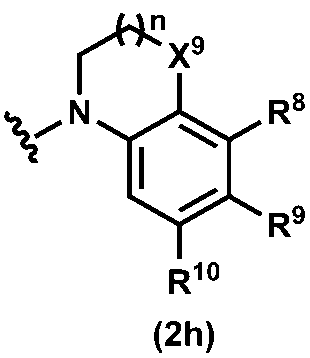
nは、0、1または2を表し;
X9は、CH2またはOを表す]
で表される基であって、
ここにおいて、式(2h)は、環上の置換可能な炭素原子上に更にフッ素原子が1個置換していてもよく、
(4-5)下記式(2i)、(2j)、または(2k):

ここにおいて、X10、X11、X12、およびX13は、これらを含む6員環が、芳香族ヘテロ環を形成するように選択され;
X14は、CR15、CHR15、NR16、またはOを表し;
ここにおいて、X14がCR15である場合、式(2j)における破線を含む結合は二重結合を表し、X14がCHR15、NR16、またはOである場合、式(2j)における破線を含む結合は単結合を表し;
X15は、NR17、またはOを表し;
R11は、
(a)水素原子、
(b)ハロゲン原子、
(c)5もしくは6員のヘテロアリール、
(d)5もしくは6員のヘテロアリール-メチル、または
(e)C1-6アルキル、C1-6アルコキシ、C2-7アルキルカルボニル、およびC2-7アルコキシカルボニルからなる群から選択される同種または異種の1~4個の基で置換されていてもよい4員~7員の飽和または部分不飽和のヘテロ環基を表し、ここで、R11が複数ある場合、各R11は、同一または異なってもよく;
R12、R13およびR14は、それぞれ独立して、
(a)水素原子、または
(b)メチルを表し、
ここにおいて、R12およびR14、またはR13およびR14は、それらが結合する炭素原子と一緒になって、架橋構造を形成してもよく;
R15は、
(a)フェニル、
(b)ベンジル、
(c)フッ素原子およびメトキシからなる群から選択される同種または異種の1~2個の基で置換されていてもよい5員~10員のヘテロアリール、
(d)ヒドロキシ、
(e)フェニルオキシ、または
(f)フェニルアミノを表し;
R16は、
(a)フッ素原子およびメトキシからなる群から選択される同種または異種の1~2個の基で置換されていてもよいフェニル、
(b)メチル、メトキシ、フッ素原子、トリフルオロメチル、およびジフルオロメトキシからなる群から選択される同種または異種の1~2個の基で置換されていてもよい5員もしくは6員のヘテロアリール、
(c)1~2個のメチルで置換されていてもよい5員もしくは6員のヘテロアリールメチル、
(d)5もしくは6員の飽和または部分不飽和の炭素環基、または
(e)6員の飽和ヘテロ環基を表し;
R17は、
(a)ピリジル、
(b)6員の飽和ヘテロ環基、または
(c)メトキシプロピルを表し;
kは、0、1または2を表し;
j1、j2、j3およびj4は、それぞれ独立して0または1を表す]
で表される基、
(4-6)下記式(2l):

(4-7)下記式(2m)または(2n):

(a)フェニル、または
(b)ベンジルであり;
k1およびk2は、それぞれ独立して、0または1を表し;
ここにおいて、式(2m)における含窒素飽和環は、オキソで置換されていてもよい]
で表される化合物、またはその製薬学的に許容される塩であって、ただし、式(1)の化合物は以下の化合物:

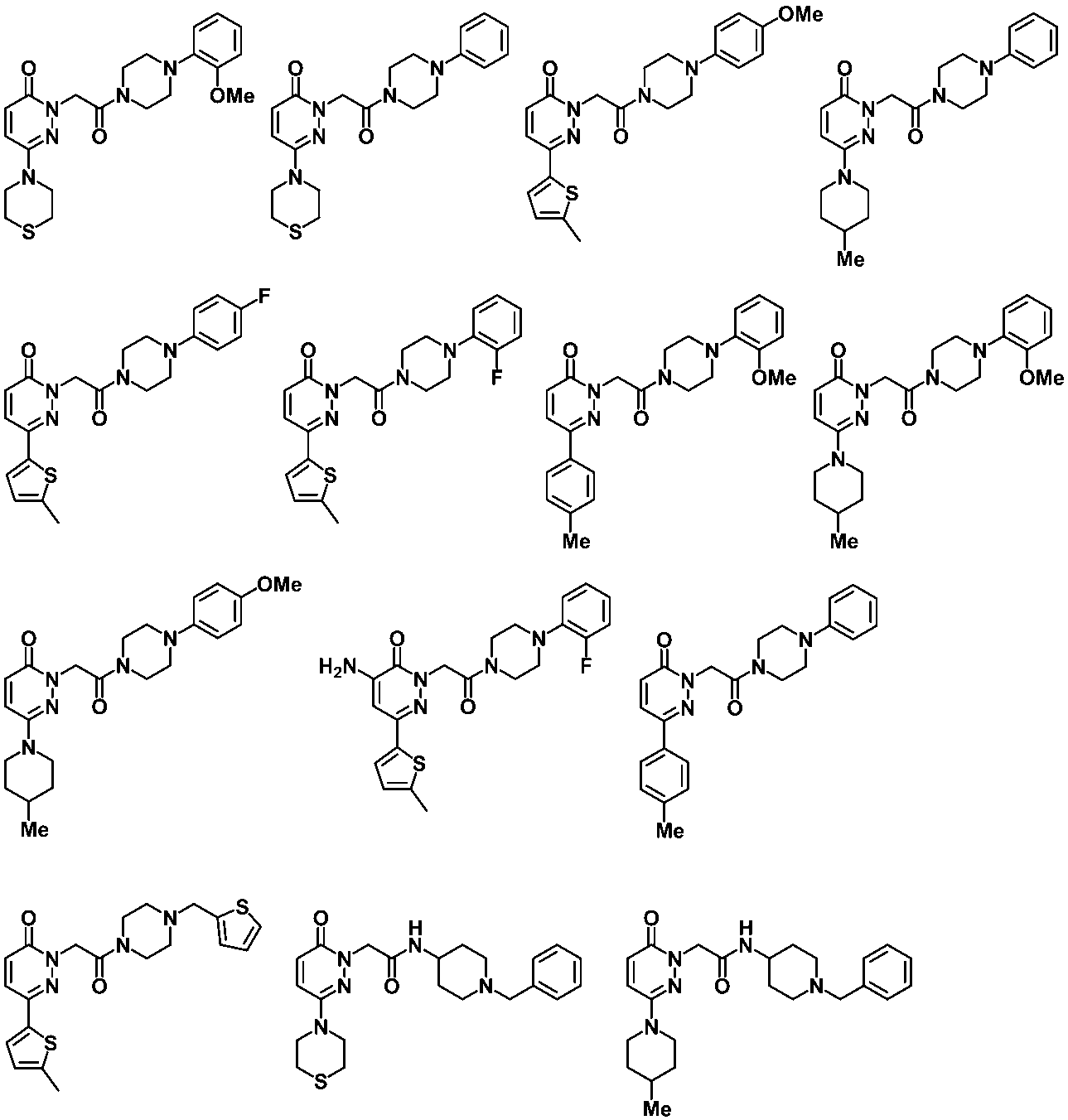
- R1およびR2が、それぞれ独立して、
(1)水素原子、
(2)ハロゲン原子、ヒドロキシ、飽和または部分不飽和のC3-7炭素環基、およびC1-6アルコキシからなる群から選択される同種または異種の1~3個の基で置換されていてもよいC1-6アルキル、
(3)ハロゲン原子、ヒドロキシ、およびC1-6アルコキシからなる群から選択される同種または異種の1~3個の基で置換されていてもよいC1-6アルコキシ、または
(4)同種または異種の1~3個のハロゲン原子で置換されていてもよいC1-6アルキル、および飽和または部分不飽和のC3-7炭素環基からなる群から選択される同種または異種の1~2個の基で置換されていてもよいアミノであるか;
あるいは、R1およびR2が、それらが結合する炭素原子と一緒になって、5員~7員の飽和または部分不飽和の炭素環を形成していてもよい、請求項1に記載の化合物またはその製薬学的に許容される塩。 - M2が、
(1)下記式(11)~(37):

のいずれかで表される基、
(2)4-シアノフェニルアミノ、
(3)下記式(2c’):

(a)水素原子、
(b)ハロゲン原子、
(c)シアノ、
(d)同種または異種の1~3個のハロゲン原子で置換されていてもよいC1-6アルキル;飽和または部分不飽和のC3-7炭素環基;およびC2-7アルキルカルボニルからなる群から選択される同種または異種の1~2個の基で置換されていてもよいアミノ、
(e)ハロゲン原子、シアノ、およびC1-6アルキルからなる群から選択される同種または異種の1~4個の基で置換されていてもよい5もしくは6員のヘテロアリール、
(f)ハロゲン原子、ヒドロキシ、C1-6アルキル、およびC1-6アルコキシからなる群から選択される同種または異種の1~4個の基で置換されていてもよい4員~7員の飽和または部分不飽和のヘテロ環基、または
(g)-C(O)NRxRy
(ここにおいて、RxおよびRyは、それぞれ独立して、水素原子、C1-6アルキル、または飽和もしくは部分不飽和のC3-7炭素環基を表すか;
あるいは、RxおよびRyは、それらが結合する窒素原子と一緒になって、4員~7員の飽和ヘテロ環基を形成していてもよい)を表し、かつ、以下の条件(X’)または(Y’)のいずれかを満たす:
(X’)R5およびR6のうち少なくとも1つは、シアノ、5もしくは6員のヘテロアリール(ここで、該基は、ハロゲン原子、シアノ、およびC1-6アルキルからなる群から選択される同種または異種の1~4個の基で置換されていてもよい)、4員~7員の飽和または部分不飽和のヘテロ環基(ここで、該基は、ハロゲン原子、ヒドロキシ、C1-6アルキル、およびC1-6アルコキシからなる群から選択される同種または異種の1~4個の基で置換されていてもよい)、または-C(O)NRxRy(ここにおいて、RxおよびRyは、それぞれ独立して、水素原子、C1-6アルキル、または飽和もしくは部分不飽和のC3-7炭素環基を表すか;あるいは、RxおよびRyは、それらが結合する窒素原子と一緒になって、4員~7員の飽和ヘテロ環基を形成していてもよい)である;あるいは、
(Y’)R5およびR6は、それらが結合する炭素原子と一緒になって、5~7員の飽和または部分不飽和の炭素環またはヘテロ環(ここで、該環は、ハロゲン原子、オキソ、C1-6アルキル、C1-6アルコキシおよびC2-7アルコキシカルボニルからなる群から選択される同種または異種の1~4個の基で置換されていてもよい)を形成していてもよい]
で表される基であって、
ここにおいて、式(2c’)は、環上の置換可能な炭素原子上に更にフッ素原子が1個置換していてもよく、
(4)下記式(2d)、(2e)、(2f)、または(2g):

(a)水素原子、
(b)ハロゲン原子、
(c)シアノ、
(d)ハロゲン原子;ヒドロキシ;ヒドロキシまたはC1-6アルコキシで置換されていてもよいC1-6アルコキシ;C1-6アルキルまたはC1-6アルコキシで置換されていてもよい4員~7員の飽和または部分不飽和のヘテロ環基;C1-6アルキルで置換されていてもよい5もしくは6員のヘテロアリール;およびアミノ(ここで、該アミノは、ハロゲン原子、ヒドロキシ、およびC1-6アルコキシからなる群から選択される同種または異種の1~3個の基で置換されていてもよいC1-6アルキル;飽和または部分不飽和のC3-7炭素環基;C1-6アルコキシで置換されていてもよい4員~7員の飽和ヘテロ環基;およびハロゲン原子、ヒドロキシ、およびC1-6アルコキシからなる群から選択される同種または異種の1~3個の基で置換されていてもよいC2-7アルキルカルボニルからなる群から選択される同種または異種の1~2個の基で置換されていてもよい)からなる群から選択される同種または異種の1~3個の基で置換されていてもよいC1-6アルキル、
(e)ハロゲン原子、ヒドロキシおよびC1-6アルコキシからなる群から選択される同種または異種の1~3個の基で置換されていてもよいC1-6アルコキシ、
(f)ハロゲン原子で置換されていてもよいC1-6アルキル;飽和または部分不飽和のC3-7炭素環基;およびハロゲン原子、ヒドロキシ、およびC1-6アルコキシからなる群から選択される同種または異種の1~3個の基で置換されていてもよいC2-7アルキルカルボニルからなる群から選択される同種または異種の1~2個の基で置換されていてもよいアミノ、
(g)ハロゲン原子、シアノ、C1-6アルキル、C1-6アルコキシ、およびC2-7アルコキシカルボニルからなる群から選択される同種または異種の1~4個の基で置換されていてもよい5もしくは6員のヘテロアリール、
(h)ハロゲン原子、ヒドロキシ、およびC1-6アルコキシからなる群から選択される同種または異種の1~3個の基で置換されていてもよいC1-6アルキル;C1-6アルコキシ;4員~7員の飽和または部分不飽和のヘテロ環基;ハロゲン原子、ヒドロキシ、およびC1-6アルコキシからなる群から選択される同種または異種の1~3個の基で置換されていてもよいC2-7アルキルカルボニル;およびオキソからなる群から選択される同種または異種の1~4個の基で置換されていてもよい4員~7員の飽和または部分不飽和のヘテロ環基、
(i)1~4個のC1-6アルキルで置換されていてもよい4員~7員の飽和または部分不飽和のヘテロ環基-オキシ、
(j)-C(O)NRxRy
(ここにおいて、RxおよびRyは、それぞれ独立して、水素原子、C1-6アルキル、または飽和または部分不飽和のC3-7炭素環基を表すか;
あるいは、RxおよびRyは、それらが結合する窒素原子と一緒になって、4員~7員の飽和ヘテロ環基を形成していてもよい)、
(k)-C(O)ORZ(ここにおいて、RZは、C1-6アルキルを表す)、または
(l)1個の6員の飽和ヘテロ環基で置換されていてもよいエテニルであり;
ここにおいて、R8およびR9は、それらが結合する炭素原子と一緒になって、5~7員の飽和または部分不飽和の炭素環またはヘテロ環(ここで、該環は、ハロゲン原子、およびC1-6アルキルからなる群から選択される同種または異種の1~4個の基で置換されていてもよい)を形成していてもよい]
で表される基であって、
ここにおいて、式(2d)は、R8およびR9が共に水素原子ではなく、式(2e)は、環上の置換可能な炭素原子上に更にフッ素原子が1個置換していてもよく、または
(5)下記式(2h’):
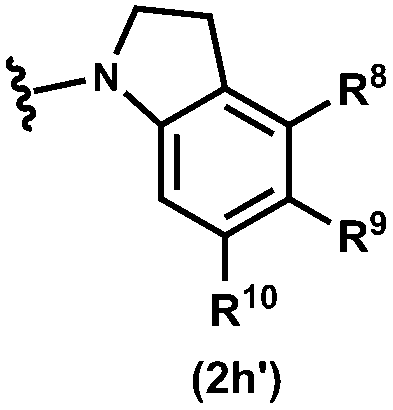
で表される基である、請求項1または2に記載の化合物またはその製薬学的に許容される塩。 - M2が、
(1)下記式(11)、(12)、(18)、(26)、(31)、(34):

のいずれかで表される基、
(2)4-シアノフェニルアミノ、
(3)下記式(2h’’):

で表される基である、請求項3に記載の化合物またはその製薬学的に許容される塩。 - M1が、
(1)ハロゲン原子;およびハロゲン原子、ヒドロキシ、およびC1-6アルコキシからなる群から選択される同種または異種の1~3個の基で置換されていてもよいC1-6アルキルからなる群から選択される同種または異種の1~4個の基で置換されていてもよい飽和または部分不飽和のC4-12炭素環基、または
(2)ハロゲン原子;およびハロゲン原子、ヒドロキシ、およびC1-6アルコキシからなる群から選択される同種または異種の1~3個の基で置換されていてもよいC1-6アルキルからなる群から選択される同種または異種の1~4個の基で置換されていてもよい4員~12員の飽和または部分不飽和のヘテロ環基である、請求項1~4のいずれか一項に記載の化合物またはその製薬学的に許容される塩。 - M1が、下記式(3):

破線を含む結合は、単結合または二重結合を表し;
mは、0、1、2または3を表し;
RaおよびRbは、それぞれ独立して、
(1-1)水素原子、
(1-2)ハロゲン原子、または
(1-3)ハロゲン原子、ヒドロキシ、およびC1-6アルコキシからなる群から選択される同種または異種の1~3個の基で置換されていてもよいC1-6アルキルを表すか;
あるいは、RaおよびRbが、それらが結合する炭素原子と一緒になって、3~6員の飽和炭素環
(ここで、該環は、
(a)ハロゲン原子、
(b)ヒドロキシ、
(c)ハロゲン原子、ヒドロキシ、およびC1-6アルコキシからなる群から選択される同種または異種の1~3個の基で置換されていてもよいC1-6アルキル、および
(d)ハロゲン原子、ヒドロキシ、およびC1-6アルコキシからなる群から選択される同種または異種の1~3個の基で置換されていてもよいC1-6アルコキシ
からなる群から選択される同種または異種の1~4個の基で置換されていてもよい)
を形成していてもよい]
で表される基である、請求項5に記載の化合物またはその製薬学的に許容される塩。 - 式(1)が式(1’’):

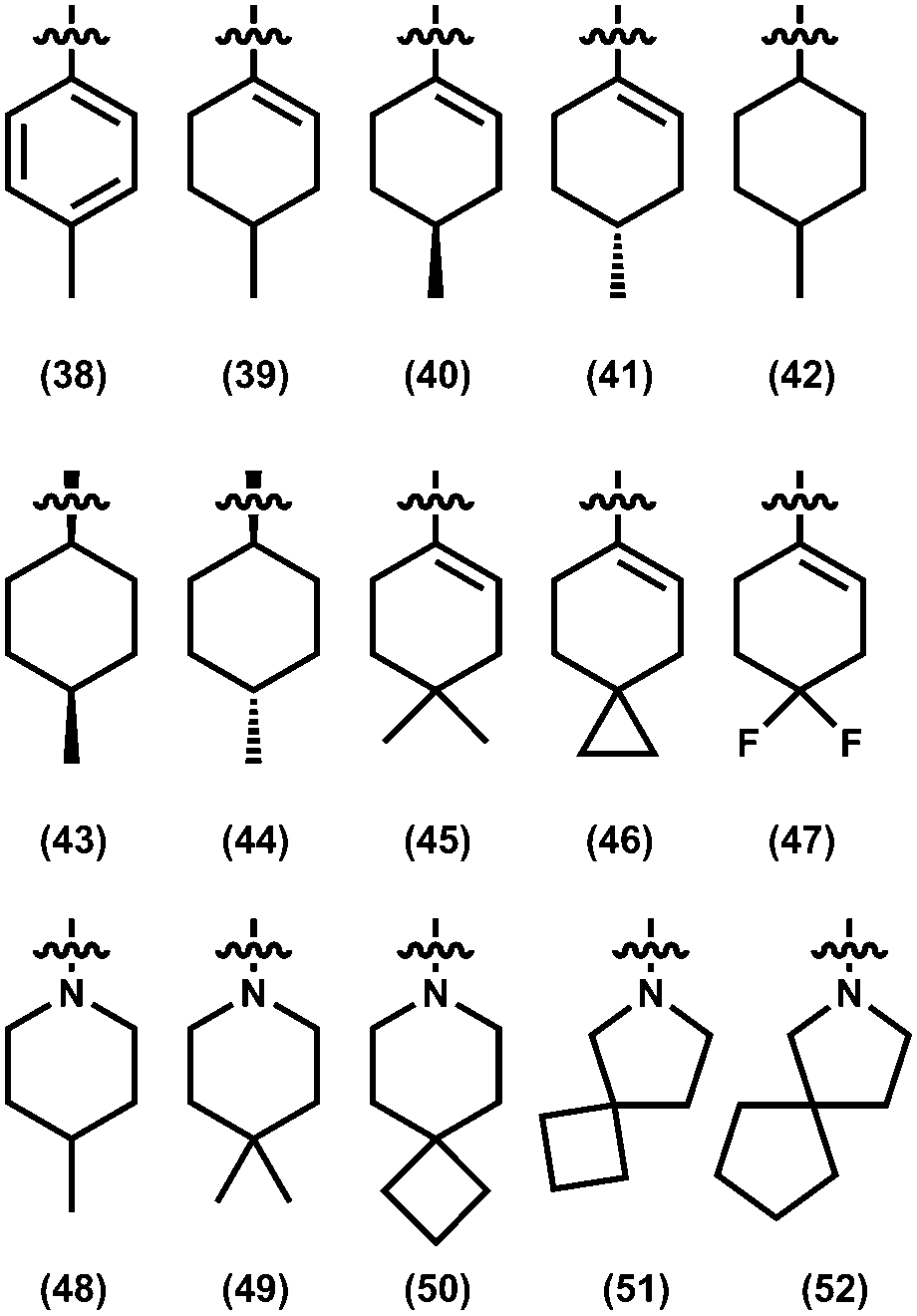
R1’およびR2’は、それぞれ独立して、
(2-1)水素原子、
(2-2)ハロゲン原子、
(2-3)シアノ、
(2-4)メチル、または
(2-5)メトキシ
のいずれかを表し:
M2’は
(1)下記式(53)~(58):

(a)水素原子、
(b)ハロゲン原子、
(c)シアノ、
(d)ハロゲン原子、ヒドロキシ、飽和または部分不飽和のC3-7炭素環基、C1-6アルコキシ、C1-6アルコキシで置換されていてもよい4~7員の飽和ヘテロ環基、および同種または異種の1~2個のC1-6アルキルで置換されていてもよいアミノからなる群から選択される同種または異種の1~3個の基で置換されていてもよいC1-6アルキル、
(e)ハロゲン原子、ヒドロキシ、C1-6アルコキシ、および同種または異種の1~2個のC1-6アルキルで置換されていてもよいアミノからなる群から選択される同種または異種の1~3個の基で置換されていてもよいC1-6アルコキシ、または
(f)ハロゲン原子、ヒドロキシ、およびC1-6アルコキシからなる群から選択される同種または異種の1~3個の基で置換されていてもよいC1-6アルキル;飽和または部分不飽和のC3-7炭素環基;およびハロゲン原子、ヒドロキシ、およびC1-6アルコキシからなる群から選択される同種または異種の1~3個の基で置換されていてもよいC2-7アルキルカルボニルからなる群から選択される同種または異種の1~2個の基で置換されていてもよいアミノを表す]
のいずれかで表される基、
(2)4-シアノフェニルアミノ、
(3)下記式(2h’’’):

(a)ハロゲン原子;ヒドロキシ;ヒドロキシまたはC1-6アルコキシで置換されていてもよいC1-6アルコキシ;C1-6アルキルまたはC1-6アルコキシで置換されていてもよい4員~7員の飽和または部分不飽和のヘテロ環基;C1-6アルキルで置換されていてもよい5もしくは6員のヘテロアリール;およびアミノ(ここで、該アミノは、ハロゲン原子、ヒドロキシ、およびC1-6アルコキシからなる群から選択される同種または異種の1~3個の基で置換されていてもよいC1-6アルキル;飽和または部分不飽和のC3-7炭素環基;C1-6アルコキシで置換されていてもよい4員~7員の飽和ヘテロ環基;およびハロゲン原子、ヒドロキシ、およびC1-6アルコキシからなる群から選択される同種または異種の1~3個の基で置換されていてもよいC2-7アルキルカルボニルからなる群から選択される同種または異種の1~2個の基で置換されていてもよい)からなる群から選択される同種または異種の1~3個の基で置換されていてもよいC1-6アルキル、
(b)ハロゲン原子、ヒドロキシおよびC1-6アルコキシからなる群から選択される同種または異種の1~3個の基で置換されていてもよいC1-6アルコキシ、
(c)ハロゲン原子で置換されていてもよいC1-6アルキル;飽和または部分不飽和のC3-7炭素環基;およびハロゲン原子、ヒドロキシ、およびC1-6アルコキシからなる群から選択される同種または異種の1~3個の基で置換されていてもよいC2-7アルキルカルボニルからなる群から選択される同種または異種の1~2個の基で置換されていてもよいアミノ、
(d)ハロゲン原子、シアノ、C1-6アルキル、C1-6アルコキシ、およびC2-7アルコキシカルボニルからなる群から選択される同種または異種の1~4個の基で置換されていてもよい5もしくは6員のヘテロアリール、
(e)ハロゲン原子、ヒドロキシ、およびC1-6アルコキシからなる群から選択される同種または異種の1~3個の基で置換されていてもよいC1-6アルキル;C1-6アルコキシ;4員~7員の飽和または部分不飽和のヘテロ環基;ハロゲン原子、ヒドロキシ、およびC1-6アルコキシからなる群から選択される同種または異種の1~3個の基で置換されていてもよいC2-7アルキルカルボニル;およびオキソからなる群から選択される同種または異種の1~4個の基で置換されていてもよい4員~7員の飽和または部分不飽和のヘテロ環基、または
(f)1~4個のC1-6アルキルで置換されていてもよい4員~7員の飽和または部分不飽和のヘテロ環基-オキシ
を表す]
で表される、請求項1~6のいずれか一項に記載の化合物またはその製薬学的に許容される塩。 - M1’が、下記式(38):
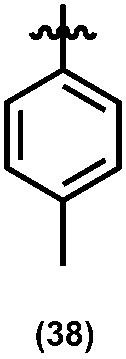
- M1’が、下記式(39)、(40)、(41)または(45):

- M1’が、下記式(48)、(50)または(51):
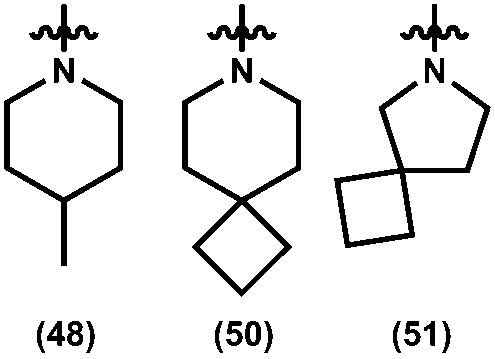
- M2’が、下記式(53)~(58):

のいずれかで表される基である、請求項7~10のいずれか一項に記載の化合物またはその製薬学的に許容される塩。 - M2’が、下記式(57)または(58):

で表される基である、請求項7~10のいずれか一項に記載の化合物またはその製薬学的に許容される塩。 - M2’が、4-シアノフェニルアミノである、請求項7~10のいずれか一項に記載の化合物またはその製薬学的に許容される塩。
- M2’が、(3)下記式(2h’’’):

(a)ハロゲン原子、シアノ、およびC1-6アルキルからなる群から選択される同種または異種の1~4個の基で置換されていてもよい5もしくは6員のヘテロアリール、または
(b)ハロゲン原子、ヒドロキシ、およびC1-6アルコキシからなる群から選択される同種または異種の1~3個の基で置換されていてもよいC1-6アルキル;C1-6アルコキシ;およびオキソからなる群から選択される同種または異種の1~4個の基で置換されていてもよい4員~7員の飽和または部分不飽和のヘテロ環基
を表す]
で表される、請求項7~10のいずれか一項に記載の化合物またはその製薬学的に許容される塩。 - 以下の化合物からなる群から選択される、請求項1に記載の化合物、またはその製薬学的に許容される塩:
N-(4-シアノフェニル)-2-[3-(4-メチルピペリジン-1-イル)-6-オキソピリダジン-1(6H)-イル]アセトアミド、
N-(1,3-ベンゾオキサゾール-5-イル)-2-[3-(4-メチルピペリジン-1-イル)-6-オキソピリダジン-1(6H)-イル]アセトアミド、
2-[3-(6-アザスピロ[3.4]オクタン-6-イル)-6-オキソピリダジン-1(6H)-イル]-N-(キナゾリン-7-イル)アセトアミド、
N-[2-(ジメチルアミノ)-1,3-ベンゾオキサゾール-5-イル]-2-[3-(4-メチルシクロヘキサ-1-エン)-6-オキソピリダジン-1(6H)-イル]アセトアミド、
2-[3-(4,4-ジメチルシクロヘキサ-1-エン-1-イル)-6-オキソピリダジン-1(6H)-イル]-N-([1,2,4]トリアゾロ[1,5-a]ピリジン-6-イル)アセトアミド、
2-[3-(4,4-ジメチルシクロヘキサ-1-エン-1-イル)-6-オキソピリダジン-1(6H)-イル]-N-([1,2,4]トリアゾロ[1,5-a]ピリジン-7-イル)アセトアミド、
N-(1,3-ベンゾオキサゾール-5-イル)-2-[3-(4,4-ジメチルシクロヘキサ-1-エン-1-イル)-6-オキソピリダジン-1(6H)-イル]アセトアミド、
2-[6-オキソ-3-(スピロ[2.5]オクト-5-エン-6-イル)ピリダジン-1(6H)-イル]-N-([1,2,4]トリアゾロ[1,5-a]ピリジン-7-イル)アセトアミド、
2-{2-オキソ-2-[4-(ピリダジン-4-イル)-2.3-ジヒドロ-1H-インドール-1-イル]エチル}-6-(スピロ[2.5]オクト-5-エン-6-イル)ピリダジン-3(2H)オン、
N-(1,3-ベンゾオキサゾール-5-イル)-2-[3-(4-メチルシクロヘキサ-1-エン-1-イル)-6-オキソピリダジン-1(6H)-イル]アセトアミド、
2-{3-[(4S)-4-メチルシクロヘキサ-1-エン-1-イル]-6-オキソピリダジン-1(6H)-イル}-N-([1,2,4]トリアゾロ[1,5-a]ピリジン-7-イル)アセトアミド、
2-{3-[(4R)-4-メチルシクロヘキサ-1-エン-1-イル]-6-オキソピリダジン-1(6H)-イル}-N-([1,2,4]トリアゾロ[1,5-a]ピリジン-7-イル)アセトアミド、
2-{3-[(4S)-4-メチルシクロヘキサ-1-エン-1-イル]-6-オキソピリダジン-1(6H)-イル}-N-([1,2,4]トリアゾロ[1,5-a]ピリジン-6-イル)アセトアミド、および
2-{3-[(4R)-4-メチルシクロヘキサ-1-エン-1-イル]-6-オキソピリダジン-1(6H)-イル}-N-([1,2,4]トリアゾロ[1,5-a]ピリジン-6-イル)アセトアミド。 - 請求項1~15のいずれか一項に記載の化合物またはその製薬学的に許容される塩を有効成分として含有する医薬組成物。
- 請求項1~15のいずれか一項に記載の化合物またはその製薬学的に許容される塩を有効成分として含有する、Nav1.1活性化剤。
- 請求項1~15のいずれか一項に記載の化合物またはその製薬学的に許容される塩を有効成分として含有する、中枢神経系疾患の治療剤および/または予防剤。
- 請求項1~15のいずれか一項に記載の化合物またはその製薬学的に許容される塩を有効成分として含有する、Nav1.1が関与する疾患の治療剤および/または予防剤。
- 請求項1~15のいずれか一項に記載の化合物またはその製薬学的に許容される塩を有効成分として含有する、Nav1.1の機能低下が関与する疾患の治療剤および/または予防剤。
- Nav1.1が関与する疾患が中枢神経系疾患である、請求項19または20に記載の治療剤および/または予防剤。
- 中枢神経系疾患が、熱性痙攣;全般てんかん熱性痙攣プラス;てんかん(具体的には、局在関連性てんかん、全般性てんかん);てんかん症候群(ドラベ症候群、全身性緊張間代発作を伴う難治性小児てんかん、ミオクロニー脱力発作を伴うてんかん、ウェスト症候群、レノックス・ガストー症候群、点頭てんかん、重症乳児多病巣性てんかん、乳児境界期重症筋間代性てんかん、良性家族性新生児乳児痙攣等);統合失調症;自閉症スペクトラム障害;および注意欠如多動性障害からなる群から選ばれる少なくとも一つの疾患である、請求項18または21に記載の治療剤および/または予防剤。
- Nav1.1が関与する疾患の治療剤および/または予防剤を製造するための、請求項1~15のいずれか一項に記載の化合物またはその製薬学的に許容される塩の使用。
- Nav1.1が関与する疾患の治療および/または予防に使用するための、請求項1~15のいずれか一項に記載の化合物またはその製薬学的に許容される塩。
- 治療が必要な患者に、治療上有効量の請求項1~15のいずれか一項に記載の化合物またはその製薬学的に許容される塩を投与することを含む、Nav1.1が関与する疾患を治療および/または予防するための方法。
- 請求項1~15のいずれか一項に記載の化合物またはその製薬学的に許容される塩と、抗てんかん薬、抗うつ薬、抗パーキンソン病薬、統合失調症治療薬またはADHD治療薬に分類される薬剤から選択される1種類以上の薬剤とを組み合わせてなる医薬。
- 抗てんかん薬、抗うつ薬、抗パーキンソン病薬、統合失調症治療薬またはADHD治療薬に分類される薬剤から選択される1種類以上の薬剤と併用して中枢神経系疾患を治療および/または予防するための、請求項1~15のいずれか一項に記載に記載の化合物もしくはその製薬学的に許容される塩または請求項16~22のいずれか一項に記載の医薬組成物もしくは剤。
Priority Applications (5)
| Application Number | Priority Date | Filing Date | Title |
|---|---|---|---|
| CN201980061100.6A CN112672997A (zh) | 2018-07-19 | 2019-07-18 | 哒嗪酮衍生物 |
| CA3105681A CA3105681A1 (en) | 2018-07-19 | 2019-07-18 | Pyridazinone derivative |
| US17/260,831 US20220347175A1 (en) | 2018-07-19 | 2019-07-18 | Pyridazinone derivative |
| JP2020531363A JP7476100B2 (ja) | 2018-07-19 | 2019-07-18 | ピリダジノン誘導体 |
| EP19838697.1A EP3828174A4 (en) | 2018-07-19 | 2019-07-18 | PYRIDAZINONE DERIVATIVE |
Applications Claiming Priority (2)
| Application Number | Priority Date | Filing Date | Title |
|---|---|---|---|
| JP2018-136152 | 2018-07-19 | ||
| JP2018136152 | 2018-07-19 |
Publications (1)
| Publication Number | Publication Date |
|---|---|
| WO2020017587A1 true WO2020017587A1 (ja) | 2020-01-23 |
Family
ID=69163916
Family Applications (1)
| Application Number | Title | Priority Date | Filing Date |
|---|---|---|---|
| PCT/JP2019/028256 Ceased WO2020017587A1 (ja) | 2018-07-19 | 2019-07-18 | ピリダジノン誘導体 |
Country Status (6)
| Country | Link |
|---|---|
| US (1) | US20220347175A1 (ja) |
| EP (1) | EP3828174A4 (ja) |
| JP (1) | JP7476100B2 (ja) |
| CN (1) | CN112672997A (ja) |
| CA (1) | CA3105681A1 (ja) |
| WO (1) | WO2020017587A1 (ja) |
Cited By (9)
| Publication number | Priority date | Publication date | Assignee | Title |
|---|---|---|---|---|
| WO2021141041A1 (ja) * | 2020-01-07 | 2021-07-15 | 大日本住友製薬株式会社 | タウオパチーの治療剤 |
| WO2021149767A1 (ja) * | 2020-01-22 | 2021-07-29 | 大日本住友製薬株式会社 | ヘテロ環誘導体 |
| JP2022506685A (ja) * | 2018-11-06 | 2022-01-17 | エッジワイズ セラピューティクス, インコーポレイテッド | ピリダジノン化合物およびその使用 |
| JP2023523418A (ja) * | 2020-04-23 | 2023-06-05 | ヤンセン ファーマシューティカ エヌ.ベー. | Nlrp3の阻害剤としての三環式化合物 |
| JP2023532298A (ja) * | 2020-07-02 | 2023-07-27 | デナリ セラピューティクス インコーポレイテッド | 化合物、組成物及び方法 |
| CN116964052A (zh) * | 2021-03-04 | 2023-10-27 | 詹森药业有限公司 | 调节nlrp3的4-氨基-6-氧代-哒嗪衍生物 |
| CN117083272A (zh) * | 2021-03-04 | 2023-11-17 | 詹森药业有限公司 | 调节nlrp3的4-烷氧基-6-氧代-哒嗪衍生物 |
| US12054486B2 (en) | 2021-09-24 | 2024-08-06 | Xenon Pharmaceuticals Inc. | Pyridine derivatives and their use as sodium channel activators |
| GB2640329A (en) * | 2024-04-09 | 2025-10-15 | Imperial College Innovations Ltd | Hedgehog acyltransferase inhibitors |
Families Citing this family (4)
| Publication number | Priority date | Publication date | Assignee | Title |
|---|---|---|---|---|
| BR112021008905A2 (pt) | 2018-11-06 | 2021-08-10 | Edgewise Therapeutics, Inc. | compostos de piridazinona e usos dos mesmos |
| AU2019374812B2 (en) | 2018-11-06 | 2025-03-06 | Edgewise Therapeutics, Inc. | Pyridazinone compounds and uses thereof |
| CN115650968B (zh) * | 2022-12-27 | 2023-03-21 | 英矽智能科技(上海)有限公司 | 作为cdk选择性抑制剂的新型哒嗪酮化合物 |
| WO2025215121A1 (en) * | 2024-04-09 | 2025-10-16 | Imperial College Innovations Limited | Hedgehog acyltransferase inhibitors |
Citations (7)
| Publication number | Priority date | Publication date | Assignee | Title |
|---|---|---|---|---|
| WO2002022587A1 (en) * | 2000-09-18 | 2002-03-21 | Eisai Co., Ltd. | Pyridazinones and triazinones and medicinal use thereof |
| WO2004006922A1 (en) | 2002-07-12 | 2004-01-22 | Glaxo Group Limited | Aryl piperidine derivatives as inducers of ldl-receptor expression for the treatment of hypercholesterolemia |
| WO2007020343A1 (fr) | 2005-08-18 | 2007-02-22 | Sanofi Aventis | Derives de 5-pyridazinyl-1-azabicyclo[3.2.1]octane, leur preparation et leur application en therapeutique |
| JP2011527336A (ja) * | 2008-07-09 | 2011-10-27 | ベトキノール ソシエテ アノニム | 9‐置換−5−カルボキシ−オキサジアジノ−キノロン誘導体、これらの調製及び抗菌薬としてのこれらの適用 |
| WO2012114268A1 (en) | 2011-02-22 | 2012-08-30 | Actelion Pharmaceuticals Ltd | Benzamide derivatives as p2x7 receptor antagonists |
| CN102964340A (zh) * | 2012-12-12 | 2013-03-13 | 中国药科大学 | 一类治疗阿尔茨海默病的选择性多巴胺d1受体激动剂 |
| WO2017147379A1 (en) * | 2016-02-26 | 2017-08-31 | The Johns Hopkins University | Pharmacological modulators of nav1.1 voltage-gated sodium channels associated with mechanical pain |
Family Cites Families (4)
| Publication number | Priority date | Publication date | Assignee | Title |
|---|---|---|---|---|
| CN105307655B (zh) * | 2013-03-13 | 2019-05-03 | 弗拉特利发现实验室有限责任公司 | 哒嗪酮化合物及其用于制备治疗囊肿状纤维化的药物的应用 |
| WO2017210685A1 (en) * | 2016-06-03 | 2017-12-07 | An2H Discovery Limited | Pyradazinone derivatives and the compositions and methods of treatment regarding the same |
| US20190256474A1 (en) * | 2016-10-26 | 2019-08-22 | Proteostasis Therapeutics, Inc. | N-phenyl-2-(3-phenyl-6-oxo-1,6-dihydropyridazin-1-yl)acetamide derivatives for treating cystic fibrosis |
| WO2018081378A1 (en) * | 2016-10-26 | 2018-05-03 | Proteostasis Therapeutics, Inc. | Compounds, compositions, and methods for modulating cftr |
-
2019
- 2019-07-18 CA CA3105681A patent/CA3105681A1/en active Pending
- 2019-07-18 CN CN201980061100.6A patent/CN112672997A/zh active Pending
- 2019-07-18 US US17/260,831 patent/US20220347175A1/en not_active Abandoned
- 2019-07-18 EP EP19838697.1A patent/EP3828174A4/en not_active Withdrawn
- 2019-07-18 WO PCT/JP2019/028256 patent/WO2020017587A1/ja not_active Ceased
- 2019-07-18 JP JP2020531363A patent/JP7476100B2/ja active Active
Patent Citations (7)
| Publication number | Priority date | Publication date | Assignee | Title |
|---|---|---|---|---|
| WO2002022587A1 (en) * | 2000-09-18 | 2002-03-21 | Eisai Co., Ltd. | Pyridazinones and triazinones and medicinal use thereof |
| WO2004006922A1 (en) | 2002-07-12 | 2004-01-22 | Glaxo Group Limited | Aryl piperidine derivatives as inducers of ldl-receptor expression for the treatment of hypercholesterolemia |
| WO2007020343A1 (fr) | 2005-08-18 | 2007-02-22 | Sanofi Aventis | Derives de 5-pyridazinyl-1-azabicyclo[3.2.1]octane, leur preparation et leur application en therapeutique |
| JP2011527336A (ja) * | 2008-07-09 | 2011-10-27 | ベトキノール ソシエテ アノニム | 9‐置換−5−カルボキシ−オキサジアジノ−キノロン誘導体、これらの調製及び抗菌薬としてのこれらの適用 |
| WO2012114268A1 (en) | 2011-02-22 | 2012-08-30 | Actelion Pharmaceuticals Ltd | Benzamide derivatives as p2x7 receptor antagonists |
| CN102964340A (zh) * | 2012-12-12 | 2013-03-13 | 中国药科大学 | 一类治疗阿尔茨海默病的选择性多巴胺d1受体激动剂 |
| WO2017147379A1 (en) * | 2016-02-26 | 2017-08-31 | The Johns Hopkins University | Pharmacological modulators of nav1.1 voltage-gated sodium channels associated with mechanical pain |
Non-Patent Citations (26)
| Title |
|---|
| ACS CHEMICAL NEUROSCIENCE, vol. 6, 2015, pages 1302 |
| ACS MEDICINAL CHEMISTRY LETTERS, vol. 3, 2012, pages 903 |
| BIOORGANIC & MEDICINAL CHEMISTRY LETTERS, vol. 23, 2013, pages 2007 |
| BIOORGANIC & MEDICINAL CHEMISTRY LETTERS, vol. 25, 2015, pages 1030 |
| BRITISH JOURNAL OF PHARMACOLOGY, vol. 172, 2015, pages 4905 |
| CRESTEY, F. ET AL.: "Identification and Electrophysiological Evaluation of 2-Methylbenzamide Derivatives as Nav1. 1 Modulators", ACS CHEMICAL NEUROSCIENCE, vol. 6, no. 8, 2015, pages 1302 - 1308, XP055677995, ISSN: 1948-7193 * |
| CURR. MED. CHEM., vol. 22, 2015, pages 1850 |
| DATABASE DATABASE Database accession no. 1324086-88-5 * |
| DATABASE Registry [online] CAS; 12 October 2010 (2010-10-12), "CN : 3(2H)-Pyridazinone, 2-[2-(3,4-dihydro-2(1H)- isoquinolinyl)-2-oxoethyl]-6-(4-methyl-1-piperidinyl)- ( CA INDEX NAME", retrieved from STN Database accession no. RN1246053-56-4 * |
| DATABASE Registry [online] CAS; 18 August 2011 (2011-08-18), "CN : 3(2H)-Pyridazinone, 2-[2-(3,4-dihydro-6,7-dimethoxy- 2 (1H)-isoquinolinyl)-2-oxoethyl]-6-(5-methyl-2-thienyl)- ( CA INDEX NAME", retrieved from STN Database accession no. RN1319290-50-0 * |
| DATABASE Registry [online] CAS; 19 April 2011 (2011-04-19), "CN : 3 (2H)-Pyridazinone, 2-[2-(3,4-dihydro-6,7-dimethoxy- 2 (1H)-isoquinolinyl)-2-oxoethyl]-6-(4-methyl-1-piperidinyl)- ( CA INDEX NAME", retrieved from STN Database accession no. RN1282130-08-8 * |
| DATABASE Registry [online] CAS; 22 September 2017 (2017-09-22), "CN : 3(2H)-Pyridazinone, 2-[2-(4-morpholinyl)-2-oxoethyl]- 6-(1-piperidinyl)- ( CA INDEX NAME", retrieved from STN Database accession no. RN2129100-69-0 * |
| DATABASE Registry [online] CAS; 25 March 2010 (2010-03-25), "CN : 3(2H)-Pyridazinone, 4-amino-6-(5-methyl-2-thienyl)- 2-[2-(4-morpholinyl)-2-oxoethyl]- ( CA INDEX NAME", retrieved from STN Database accession no. RN1214503-63-5 * |
| DATABASE Registry [online] CAS; 26 May 2015 (2015-05-26), "CN : 3(2H)-Pyridazinone, 6-amino-2-[2-(4-morpholinyl)- 2-oxoethyl]- ( CA INDEX NAME", retrieved from STN Database accession no. RN1712795-93-1 * |
| DATABASE Registry [online] CAS; 28 August 2011 (2011-08-28), "3 (2H)-Pyridazinone, 2-[2-(3, 4-dihydro-2 (1H)-isoquinolinyl)-2-oxoethyl]-6-(4-thiomorpholiny 1)", retrieved from STN Database accession no. RN1324090-55-2 * |
| JOURNAL OF MEDICINAL CHEMISTRY, vol. 36, 1993, pages 4052 |
| JOURNAL OF ORGANIC CHEMISTRY, vol. 80, 2015, pages 12182 |
| MAO, H. ET AL.: "Novel Modulator of NaV1. 1 and NaV1. 2 Na+ Channels in Rat Neuronal Cells", ACS MEDICINAL CHEMISTRY LETTERS, vol. 1, no. 3, 2010, pages 135 - 138, XP055677999, ISSN: 1948-5875 * |
| ORGANIC & BIOMOLECULAR CHEMISTRY, vol. 12, 2014, pages 2049 |
| ORGANIC LETTERS, vol. 10, 2008, pages 4815 |
| ORGANIC LETTERS, vol. 17, 2015, pages 5517 |
| R. C. LAROQUE ET AL.: "Comprehensive Organic Transformation", 1989, VCH PUBLISHER INC. |
| See also references of EP3828174A4 |
| T. W. GREENEP. G. M. WUTS: "Protective Groups in Organic Synthesis", 1999, JOHN WILEY AND SONS, INC. |
| TETRAHEDRON, vol. 71, 2015, pages 4859 |
| TRENDS IN PHARMACOLOGICAL SCIENCES, vol. 35, 2014, pages 113 |
Cited By (10)
| Publication number | Priority date | Publication date | Assignee | Title |
|---|---|---|---|---|
| JP2022506685A (ja) * | 2018-11-06 | 2022-01-17 | エッジワイズ セラピューティクス, インコーポレイテッド | ピリダジノン化合物およびその使用 |
| JP7170133B2 (ja) | 2018-11-06 | 2022-11-11 | エッジワイズ セラピューティクス, インコーポレイテッド | ピリダジノン化合物およびその使用 |
| WO2021141041A1 (ja) * | 2020-01-07 | 2021-07-15 | 大日本住友製薬株式会社 | タウオパチーの治療剤 |
| WO2021149767A1 (ja) * | 2020-01-22 | 2021-07-29 | 大日本住友製薬株式会社 | ヘテロ環誘導体 |
| JP2023523418A (ja) * | 2020-04-23 | 2023-06-05 | ヤンセン ファーマシューティカ エヌ.ベー. | Nlrp3の阻害剤としての三環式化合物 |
| JP2023532298A (ja) * | 2020-07-02 | 2023-07-27 | デナリ セラピューティクス インコーポレイテッド | 化合物、組成物及び方法 |
| CN116964052A (zh) * | 2021-03-04 | 2023-10-27 | 詹森药业有限公司 | 调节nlrp3的4-氨基-6-氧代-哒嗪衍生物 |
| CN117083272A (zh) * | 2021-03-04 | 2023-11-17 | 詹森药业有限公司 | 调节nlrp3的4-烷氧基-6-氧代-哒嗪衍生物 |
| US12054486B2 (en) | 2021-09-24 | 2024-08-06 | Xenon Pharmaceuticals Inc. | Pyridine derivatives and their use as sodium channel activators |
| GB2640329A (en) * | 2024-04-09 | 2025-10-15 | Imperial College Innovations Ltd | Hedgehog acyltransferase inhibitors |
Also Published As
| Publication number | Publication date |
|---|---|
| JP7476100B2 (ja) | 2024-04-30 |
| CA3105681A1 (en) | 2020-01-23 |
| JPWO2020017587A1 (ja) | 2021-08-05 |
| CN112672997A (zh) | 2021-04-16 |
| EP3828174A1 (en) | 2021-06-02 |
| US20220347175A1 (en) | 2022-11-03 |
| EP3828174A4 (en) | 2022-08-17 |
Similar Documents
| Publication | Publication Date | Title |
|---|---|---|
| JP7476100B2 (ja) | ピリダジノン誘導体 | |
| JP6505023B2 (ja) | Cnsおよび他の障害を治療するための、pde4アイソザイムの阻害薬としてのアザベンゾイミダゾール化合物 | |
| ES2380395T3 (es) | Triazolopiridinas como inhibidores de fosfodiesterasa para el tratamiento de enfermedades dérmicas | |
| JP7073385B2 (ja) | タンパク質凝集のモジュレーターとしての二環式ビス-ヘテロアリール誘導体 | |
| CN103917534B (zh) | 作为h3受体抑制剂的包含哌啶和哌嗪环的氨基甲酸酯/脲衍生物 | |
| US11345666B2 (en) | Phenyl and pyridinyl substituted imidazoles as modulators of RORγT | |
| JP2021105002A (ja) | イミダゾピリダジン化合物 | |
| US11149022B2 (en) | Antagonists of the muscarinic acetylcholine receptor M4 | |
| KR20210003311A (ko) | 피리미딘 사이클로헥세닐 글루코코르티코이드 수용체 조절제 | |
| CA2885476A1 (en) | Urea and amide derivatives of aminoalkylpiperazines and use thereof | |
| JP2015525740A (ja) | ベンゾジオキソール誘導体ならびにその調製方法および使用 | |
| JP7041141B2 (ja) | 置換された二環式ヘテロアリール系ニコチン性アセチルコリン受容体アロステリック調節剤 | |
| JP7041140B2 (ja) | 置換された6員アリール又はヘテロアリール系ニコチン性アセチルコリン受容体アロステリック調節剤 | |
| KR20150021120A (ko) | 헤테로아릴 화합물 및 이의 이용 방법 | |
| WO2021149767A1 (ja) | ヘテロ環誘導体 | |
| JP2001172281A (ja) | 置換された複素環式誘導体 | |
| EP4104861A1 (en) | Therapeutic agent for tauopathies | |
| JP2022553284A (ja) | Trek(twik関連k+チャネル)チャネル機能の阻害剤 | |
| WO2021039961A1 (ja) | 縮環ピラゾール誘導体 | |
| HK40053244A (en) | Pyridazinone derivative | |
| EP1973907B1 (en) | Imidazo (1,2-a)pyridin-3-yl-acetic acid hydrazides, processes for their preparation and pharmaceutical uses thereof | |
| TW202417434A (zh) | 用於治療之parp14之靶向蛋白質降解 | |
| CN121399101A (zh) | Trek(twik相关k+通道)通道功能的抑制剂 | |
| JP2020011902A (ja) | 縮環ピロール誘導体およびその医薬用途 | |
| JP2026509195A (ja) | 代謝型グルタミン酸受容体2のネガティブアロステリックモジュレーター |
Legal Events
| Date | Code | Title | Description |
|---|---|---|---|
| 121 | Ep: the epo has been informed by wipo that ep was designated in this application |
Ref document number: 19838697 Country of ref document: EP Kind code of ref document: A1 |
|
| ENP | Entry into the national phase |
Ref document number: 3105681 Country of ref document: CA |
|
| ENP | Entry into the national phase |
Ref document number: 2020531363 Country of ref document: JP Kind code of ref document: A |
|
| NENP | Non-entry into the national phase |
Ref country code: DE |
|
| WWE | Wipo information: entry into national phase |
Ref document number: 2019838697 Country of ref document: EP |