WO2020021082A1 - Controlled release formulations for agrochemicals - Google Patents

Controlled release formulations for agrochemicals Download PDF

Info

Publication number
WO2020021082A1
WO2020021082A1 PCT/EP2019/070210 EP2019070210W WO2020021082A1 WO 2020021082 A1 WO2020021082 A1 WO 2020021082A1 EP 2019070210 W EP2019070210 W EP 2019070210W WO 2020021082 A1 WO2020021082 A1 WO 2020021082A1
Authority
WO
WIPO (PCT)
Prior art keywords
active ingredient
preferred
methyl
encapsulated
group
Prior art date
Legal status (The legal status is an assumption and is not a legal conclusion. Google has not performed a legal analysis and makes no representation as to the accuracy of the status listed.)
Ceased
Application number
PCT/EP2019/070210
Other languages
French (fr)
Inventor
Andreas IDE
Smita Patel
Holger Egger
Daniel Gordon Duff
Michael Ostendorf
Roland Deckwer
Duy LE
Current Assignee (The listed assignees may be inaccurate. Google has not performed a legal analysis and makes no representation or warranty as to the accuracy of the list.)
Bayer AG
Original Assignee
Bayer AG
Priority date (The priority date is an assumption and is not a legal conclusion. Google has not performed a legal analysis and makes no representation as to the accuracy of the date listed.)
Filing date
Publication date
Priority to MX2021001044A priority Critical patent/MX2021001044A/en
Priority to KR1020217005575A priority patent/KR20210038617A/en
Priority to US17/265,496 priority patent/US20210321610A1/en
Priority to CN201980060085.3A priority patent/CN112702913A/en
Priority to BR112021001477-2A priority patent/BR112021001477A2/en
Priority to CA3107207A priority patent/CA3107207A1/en
Application filed by Bayer AG filed Critical Bayer AG
Priority to JP2021528494A priority patent/JP2021533187A/en
Priority to EP19744714.7A priority patent/EP3829303A1/en
Publication of WO2020021082A1 publication Critical patent/WO2020021082A1/en
Anticipated expiration legal-status Critical
Priority to JP2023213881A priority patent/JP2024037963A/en
Ceased legal-status Critical Current

Links

Classifications

    • AHUMAN NECESSITIES
    • A01AGRICULTURE; FORESTRY; ANIMAL HUSBANDRY; HUNTING; TRAPPING; FISHING
    • A01NPRESERVATION OF BODIES OF HUMANS OR ANIMALS OR PLANTS OR PARTS THEREOF; BIOCIDES, e.g. AS DISINFECTANTS, AS PESTICIDES OR AS HERBICIDES; PEST REPELLANTS OR ATTRACTANTS; PLANT GROWTH REGULATORS
    • A01N25/00Biocides, pest repellants or attractants, or plant growth regulators, characterised by their forms, or by their non-active ingredients or by their methods of application, e.g. seed treatment or sequential application; Substances for reducing the noxious effect of the active ingredients to organisms other than pests
    • A01N25/34Shaped forms, e.g. sheets, not provided for in any other sub-group of this main group
    • AHUMAN NECESSITIES
    • A01AGRICULTURE; FORESTRY; ANIMAL HUSBANDRY; HUNTING; TRAPPING; FISHING
    • A01NPRESERVATION OF BODIES OF HUMANS OR ANIMALS OR PLANTS OR PARTS THEREOF; BIOCIDES, e.g. AS DISINFECTANTS, AS PESTICIDES OR AS HERBICIDES; PEST REPELLANTS OR ATTRACTANTS; PLANT GROWTH REGULATORS
    • A01N25/00Biocides, pest repellants or attractants, or plant growth regulators, characterised by their forms, or by their non-active ingredients or by their methods of application, e.g. seed treatment or sequential application; Substances for reducing the noxious effect of the active ingredients to organisms other than pests
    • A01N25/08Biocides, pest repellants or attractants, or plant growth regulators, characterised by their forms, or by their non-active ingredients or by their methods of application, e.g. seed treatment or sequential application; Substances for reducing the noxious effect of the active ingredients to organisms other than pests containing solids as carriers or diluents
    • A01N25/10Macromolecular compounds
    • AHUMAN NECESSITIES
    • A01AGRICULTURE; FORESTRY; ANIMAL HUSBANDRY; HUNTING; TRAPPING; FISHING
    • A01NPRESERVATION OF BODIES OF HUMANS OR ANIMALS OR PLANTS OR PARTS THEREOF; BIOCIDES, e.g. AS DISINFECTANTS, AS PESTICIDES OR AS HERBICIDES; PEST REPELLANTS OR ATTRACTANTS; PLANT GROWTH REGULATORS
    • A01N25/00Biocides, pest repellants or attractants, or plant growth regulators, characterised by their forms, or by their non-active ingredients or by their methods of application, e.g. seed treatment or sequential application; Substances for reducing the noxious effect of the active ingredients to organisms other than pests
    • A01N25/12Powders or granules
    • A01N25/14Powders or granules wettable
    • AHUMAN NECESSITIES
    • A01AGRICULTURE; FORESTRY; ANIMAL HUSBANDRY; HUNTING; TRAPPING; FISHING
    • A01NPRESERVATION OF BODIES OF HUMANS OR ANIMALS OR PLANTS OR PARTS THEREOF; BIOCIDES, e.g. AS DISINFECTANTS, AS PESTICIDES OR AS HERBICIDES; PEST REPELLANTS OR ATTRACTANTS; PLANT GROWTH REGULATORS
    • A01N25/00Biocides, pest repellants or attractants, or plant growth regulators, characterised by their forms, or by their non-active ingredients or by their methods of application, e.g. seed treatment or sequential application; Substances for reducing the noxious effect of the active ingredients to organisms other than pests
    • A01N25/26Biocides, pest repellants or attractants, or plant growth regulators, characterised by their forms, or by their non-active ingredients or by their methods of application, e.g. seed treatment or sequential application; Substances for reducing the noxious effect of the active ingredients to organisms other than pests in coated particulate form
    • A01N25/28Microcapsules or nanocapsules
    • AHUMAN NECESSITIES
    • A01AGRICULTURE; FORESTRY; ANIMAL HUSBANDRY; HUNTING; TRAPPING; FISHING
    • A01NPRESERVATION OF BODIES OF HUMANS OR ANIMALS OR PLANTS OR PARTS THEREOF; BIOCIDES, e.g. AS DISINFECTANTS, AS PESTICIDES OR AS HERBICIDES; PEST REPELLANTS OR ATTRACTANTS; PLANT GROWTH REGULATORS
    • A01N43/00Biocides, pest repellants or attractants, or plant growth regulators containing heterocyclic compounds
    • A01N43/34Biocides, pest repellants or attractants, or plant growth regulators containing heterocyclic compounds having rings with one nitrogen atom as the only ring hetero atom
    • A01N43/40Biocides, pest repellants or attractants, or plant growth regulators containing heterocyclic compounds having rings with one nitrogen atom as the only ring hetero atom six-membered rings
    • AHUMAN NECESSITIES
    • A01AGRICULTURE; FORESTRY; ANIMAL HUSBANDRY; HUNTING; TRAPPING; FISHING
    • A01NPRESERVATION OF BODIES OF HUMANS OR ANIMALS OR PLANTS OR PARTS THEREOF; BIOCIDES, e.g. AS DISINFECTANTS, AS PESTICIDES OR AS HERBICIDES; PEST REPELLANTS OR ATTRACTANTS; PLANT GROWTH REGULATORS
    • A01N43/00Biocides, pest repellants or attractants, or plant growth regulators containing heterocyclic compounds
    • A01N43/48Biocides, pest repellants or attractants, or plant growth regulators containing heterocyclic compounds having rings with two nitrogen atoms as the only ring hetero atoms
    • A01N43/501,3-Diazoles; Hydrogenated 1,3-diazoles
    • AHUMAN NECESSITIES
    • A01AGRICULTURE; FORESTRY; ANIMAL HUSBANDRY; HUNTING; TRAPPING; FISHING
    • A01NPRESERVATION OF BODIES OF HUMANS OR ANIMALS OR PLANTS OR PARTS THEREOF; BIOCIDES, e.g. AS DISINFECTANTS, AS PESTICIDES OR AS HERBICIDES; PEST REPELLANTS OR ATTRACTANTS; PLANT GROWTH REGULATORS
    • A01N43/00Biocides, pest repellants or attractants, or plant growth regulators containing heterocyclic compounds
    • A01N43/72Biocides, pest repellants or attractants, or plant growth regulators containing heterocyclic compounds having rings with nitrogen atoms and oxygen or sulfur atoms as ring hetero atoms
    • A01N43/80Biocides, pest repellants or attractants, or plant growth regulators containing heterocyclic compounds having rings with nitrogen atoms and oxygen or sulfur atoms as ring hetero atoms five-membered rings with one nitrogen atom and either one oxygen atom or one sulfur atom in positions 1,2
    • AHUMAN NECESSITIES
    • A01AGRICULTURE; FORESTRY; ANIMAL HUSBANDRY; HUNTING; TRAPPING; FISHING
    • A01NPRESERVATION OF BODIES OF HUMANS OR ANIMALS OR PLANTS OR PARTS THEREOF; BIOCIDES, e.g. AS DISINFECTANTS, AS PESTICIDES OR AS HERBICIDES; PEST REPELLANTS OR ATTRACTANTS; PLANT GROWTH REGULATORS
    • A01N25/00Biocides, pest repellants or attractants, or plant growth regulators, characterised by their forms, or by their non-active ingredients or by their methods of application, e.g. seed treatment or sequential application; Substances for reducing the noxious effect of the active ingredients to organisms other than pests
    • A01N25/26Biocides, pest repellants or attractants, or plant growth regulators, characterised by their forms, or by their non-active ingredients or by their methods of application, e.g. seed treatment or sequential application; Substances for reducing the noxious effect of the active ingredients to organisms other than pests in coated particulate form

Definitions

  • the present invention relates to encapsulated active compounds (actives / active ingredients / AI) produced by different methods with minimized / eliminated negative effects on the plant (phytotoxicity) resulting in enhanced biological compatibility while efficacy against pests is maintained.
  • Active ingredients can be formulated in various ways, wherein the properties of the actives and the process of formulation may raise problems with regard to processability, stability, usability and efficacy of the formulations as well as negative effects of the active ingredients itself on the plant.
  • the severity of the side effect is almost independent of the applied concentration, i.e. despite of a significantly decreased active concentration the side effect is seen at unchanged severity.
  • a pronounced phytotoxicity (a.k.a. Halo ) can be observed for Fluopyram treated soybean seeds in early stages of emergence, even if there is no more nematicidal or fungicidal effect at this decreased concentration.
  • a similar negative side effect is seen for a number of dicotoleydons, including but not limited to soy beans, tomatos, cucumbers, peppers / capsicums when e.g. fluopyram is spray applied to soil.
  • Further examples include phytotoxic effects of herbicides, including but not limited to e.g. diflufenican and/or isoxaflutole spray applied to soil for treatement of soy beans and com.
  • W02010039865A2 Polymeric materials encapsulating compounds are described in W02010039865A2.
  • W02007091494A1 describe pesticide preparations containing pesticide-containing resin with controlled release.
  • W0200007443Al discloses contolled release granules with an active containing hull on a solid carrier.
  • US4285720A discribes water immiscible organic substances which are encapsulated with polyurea.
  • a process for spray coat pharmaceutical particles is described in US5632102A, however, not disclosing coating of very fine particles.
  • EP1325775A1 and US201 1228628A generally described a jet bed apparatus that allows coating of fine particles, although not for controlled release appliactions. Description of the invention

  • controlled release formulations disclosed herein will be applicable to Seeds, Soil, Leaf by Spray/Coating/ Drench/Granular/ Infurrow/Nursery box/Paddy field, and common field applications. Further, the controlled release formulation may improve physical, chemical, biological compatibility (phytotoxicity) or stability or longevity for relevant actives or minimize / eliminate negative effects on the plant in afore mentioned applications.
  • the reduction of phytotoxicity of the active ingredient is more than 50 %, more preferred more than 80 %, and most preferred more than 90 % percent, while efficacy against pests is maintained.
  • efficacy against pests is maintained. Maintained as used herein means the efficacy is at least at 50% or more of the not encapsulated reference.
  • the tested references refer to the same formulations comprising the same ingredients as the formulation according to the invention, except that the active is not encapsulated (in the reference).
  • Pests refers to insects, nematodes, fungi, bacteria, viruses and weeds.
  • Actives as used in the present invention include fungicides, herbicides, insecticides, nematicides, host defence inducers, biological agents and bactericides.
  • actives means fungicides. In another embodiment actives means nematicides.
  • actives means herbicides.
  • actives means insecticides.
  • actives means host defence inducers. In another embodiment actives means biological agents.
  • actives means bactericides.
  • Seed Treatment means applying at least one active ingredient directly or in form of a coating directly on a seed before bringing said seed onto the field.
  • foliar applications, in furrow application, nursery box applications and soil applications are not seed treatment applications.
  • Encapsulated active ingredients refers to actives which are encapsulated according to methods A, B or C, respectively, described below.
  • active compounds active compounds
  • actives active ingredients
  • agrochemical compounds active ingredients
  • AIs agrochemical compounds
  • CR in the present invention, if not otherwise defined, means“controlled release”.
  • the folloing term-pairs can be used herein interchangeably: FLU/Fluopyram; DFF/Diflufenican; IFT/Isoxaflutole.
  • D90 acitive ingredient particle size (laser diffraction 50%, respectively 90% of overall volume particles
  • the mean particle size denotes the D50 value.
  • At least one active is encapsulated, while additional actives may be present non-encapsulated in the formulation.
  • the present invention further provides formulations, and application forms prepared from them, as crop protection agents and/or pesticidal agents, such as drench, drip and spray liquors, comprising at least one of the active compounds of the invention.
  • the application forms may comprise further crop protection agents and/or pesticidal agents, and/or activity-enhancing adjuvants such as penetrants, and/or spreaders and/or retention promoters and/or humectants and/or fertilizers and or other commonly used adjuvants, for example.
  • EC emulsifiable concentrates
  • EW emulsions in water
  • SC suspension concentrates
  • SE FS
  • OD water-dispersible granules
  • GR granules
  • CS capsule concentrates
  • the formulations or application forms in question preferably comprise auxiliaries, such as extenders, solvents, spontaneity promoters, carriers, emulsifiers, dispersants, frost protectants, biocides, thickeners and/or other auxiliaries, such as adjuvants, for example.
  • auxiliaries such as extenders, solvents, spontaneity promoters, carriers, emulsifiers, dispersants, frost protectants, biocides, thickeners and/or other auxiliaries, such as adjuvants, for example.
  • An adjuvant in this context is a component which enhances the biological effect of the formulation, without the component itself having a biological effect.
  • adjuvants are agents which promote the retention, spreading, attachment to the leaf surface, or penetration.
  • formulations are produced in a known manner, for example by mixing the active compounds with auxiliaries such as, for example, extenders, solvents and/or solid carriers and/or further auxiliaries, such as, for example, surfactants.
  • auxiliaries such as, for example, extenders, solvents and/or solid carriers and/or further auxiliaries, such as, for example, surfactants.
  • the formulations are prepared either in suitable plants or else before or during the application.
  • auxiliaries are substances which are suitable for imparting to the formulation of the active compound or the application forms prepared from these formulations (such as, e.g., usable crop protection agents, such as spray liquors or seed dressings) particular properties such as certain physical, technical and/or biological properties.
  • Suitable extenders are, for example, water, polar and nonpolar organic chemical liquids, for example from the classes of the aromatic and non-aromatic hydrocarbons (such as paraffins, alkylbenzenes, alkylnaphthalenes, chlorobenzenes), the alcohols and polyols (which, if appropriate, may also be substituted, etherified and/or esterified), the ketones (such as acetone, cyclohexanone), esters (including fats and oils) and (poly)cthcrs, the unsubstituted and substituted amines, amides, lactams (such as N-alkylpyrrolidones) and lactones, the sulphones and sulphoxides (such as dimethyl sulphoxide).
  • aromatic and non-aromatic hydrocarbons such as paraffins, alkylbenzenes, alkylnaphthalenes, chlorobenzenes
  • suitable liquid solvents are: aromatics such as xylene, toluene or alkylnaphthalenes, chlorinated aromatics and chlorinated aliphatic hydrocarbons such as chlorobenzenes, chloroethylenes or methylene chloride, aliphatic hydrocarbons such as cyclohexane or paraffins, for example petroleum fractions, mineral and vegetable oils, alcohols such as butanol or glycol and also their ethers and esters, ketones such as acetone, methyl ethyl ketone, methyl isobutyl ketone or cyclohexanone, strongly polar solvents such as dimethylformamide and dimethyl sulphoxide, and also water.
  • aromatics such as xylene, toluene or alkylnaphthalenes
  • chlorinated aromatics and chlorinated aliphatic hydrocarbons such as chlorobenzenes, chloroethylenes or methylene chloride
  • aliphatic hydrocarbons
  • Suitable solvents are, for example, aromatic hydrocarbons, such as xylene, toluene or alkylnaphthalenes, for example, chlorinated aromatic or aliphatic hydrocarbons, such as chlorobenzene, chloroethylene or methylene chloride, for example, aliphatic hydrocarbons, such as cyclohexane, for example, paraffins, petroleum fractions, mineral and vegetable oils, alcohols, such as methanol, ethanol, isopropanol, butanol or glycol, for example, and also their ethers and esters, ketones such as acetone, methyl ethyl ketone, methyl isobutyl ketone or cyclohexanone, for example, strongly polar solvents, such as dimethyl sulphoxide, and water.
  • aromatic hydrocarbons such as xylene, toluene or alkylnaphthalenes
  • chlorinated aromatic or aliphatic hydrocarbons such as chloro
  • Suitable carriers are in particular: for example, ammonium salts and ground natural minerals such as kaolins, clays, talc, chalk, quartz, attapulgite, montmorillonite or diatomaceous earth, and ground synthetic minerals, such as finely divided silica, alumina and natural or synthetic silicates, resins, waxes and/or solid fertilizers. Mixtures of such carriers may likewise be used.
  • Carriers suitable for granules include the following: for example, crushed and fractionated natural minerals such as calcite, marble, pumice, sepiolite, dolomite, and also synthetic granules of inorganic and organic meals, and also granules of organic material such as sawdust, paper, coconut shells, maize cobs and tobacco stalks.
  • Liquefied gaseous extenders or solvents may also be used. Particularly suitable are those extenders or carriers which at standard temperature and under standard pressure are gaseous, examples being aerosol propellants, such as halogenated hydrocarbons, and also butane, propane, nitrogen and carbon dioxide.
  • emulsifiers and/or foam-formers, dispersants or wetting agents having ionic or nonionic properties, or mixtures of these surface-active substances are salts of polyacrylic acid, salts of lignosulphonic acid, salts of phenolsulphonic acid or naphthalenesulphonic acid, polycondensates of ethylene oxide with fatty alcohols or with fatty acids or with fatty amines, with substituted phenols (preferably alkylphenols or arylphenols), salts of sulphosuccinic esters, taurine derivatives (preferably alkyltaurates), phosphoric esters of polyethoxylated alcohols or phenols, fatty acid esters of polyols, and derivatives of the compounds containing sulphates, sulphonates and phosphates, examples being alkylaryl polyglycol ethers, alkylsulphonates, alkyl sulphates, arylsulphonates, protein hydrolysatesates,
  • Suitable surfactants or dispersing aids are all substances of this type which can customarily be employed in agrochemical agents such as non-ionic or anionic surfactants.
  • Preferred non-ionic surfactants are polyethylene glycol ethers of branched or linear alcohols, reaction products of fatty acids or fatty acid alcohols with ethylene oxide and/or propylene oxide, furthermore polyvinyl alcohol, polyoxyalkylenamine derivatives, polyvinylpyrrolidone, copolymers of polyvinyl alcohol and polyvinylpyrrolidone, and copolymers of (meth)acrylic acid and (meth)acrylic acid esters, acetylene diol ethoxylates, furthermore branched or linear alkyl ethoxylates and alkylaryl ethoxylates, where polyethylene oxide-sorbitan fatty acid esters may be mentioned by way of example.
  • selected classes can be optionally phosphate, sulphonated or
  • Possible anionic surfactants are all substances of this type which can customarily be employed in agrochemical agents.
  • Alkali metal, alkaline earth metal and ammonium salts of alkylsulphonic or alkylphospohric acids as well as alkylarylsulphonic or alkylarylphosphoric acids are preferred.
  • a further preferred group of anionic surfactants or dispersing aids are alkali metal, alkaline earth metal and ammonium salts of polystyrenesulphonic acids, salts of polyvinylsulphonic acids, salts of alkylnaphthalene sulphonic acids, salts of naphthalene-sulphonic acid-formaldehyde condensation products, salts of condensation products of naphthalenesulphonic acid, phenolsulphonic acid and formaldehyde and salts of lignosulphonic acid, as well as polycarboxylic acids, sodium and potassium salts.
  • Preferred non-ionic surfactants are for example:
  • Tristyrylphenol ethoxylates comprising an average of 5-60 EO units; castor oil ethoxylates comprising an average of 5-40 EO units (e.g. Berol® range, Emulsogen® EL range); fatty alcohol ethoxylates comprising branched or linear alcohols with 8-18 carbon atoms and an average of 2-30 EO units; block-copolymer of polyethylene oxide and polyhydroxystearic acid; ethoxylated polymethacrylate graft copolymers; polyvinylpyrrolidone based polymers; polyvinylacetate based polymers; ethoxylated diacetylene-diols (e.g.
  • Surfynol® 4xx-range alkyl ether citrate surfactants (e.g. Adsee® CE range, Akzo Nobel); alkyl polysaccharides/polyglycosides (e.g. Agnique® PG8107, PG8105, Atplus® 438, AL-2559, AL-2575); ethoxylated mono- or diesters of glycerine comprising fatty acids with 8 - 18 carbon atoms and an average of 10 - 40 EO units (e.g. Crovol® range); block-copolymer of polyethylene oxide and polybutylene oxide. organomodified polysiloxanes, e.g. BreakThru® OE444, BreakThru® S240, Silwet® L77, Silwet® 408, Silwet® 806.
  • organomodified polysiloxanes e.g. BreakThru® OE444, BreakThru® S240, Silwet® L77, Silwet® 408, Silwet® 8
  • Preferred anionic surfactants and polymers are for example:
  • More preferred surfactants are ethoxylated polymethacrylate graft copolymers, polycarboxylic acids, sodium and potassium salts, tristyrylphenol ethoxylate sulfate and ammonium and potassium salts thereof, naphthalene sulphonate formaldehyde condensate, sodium salt and ethoxylated diacetylene-diols.
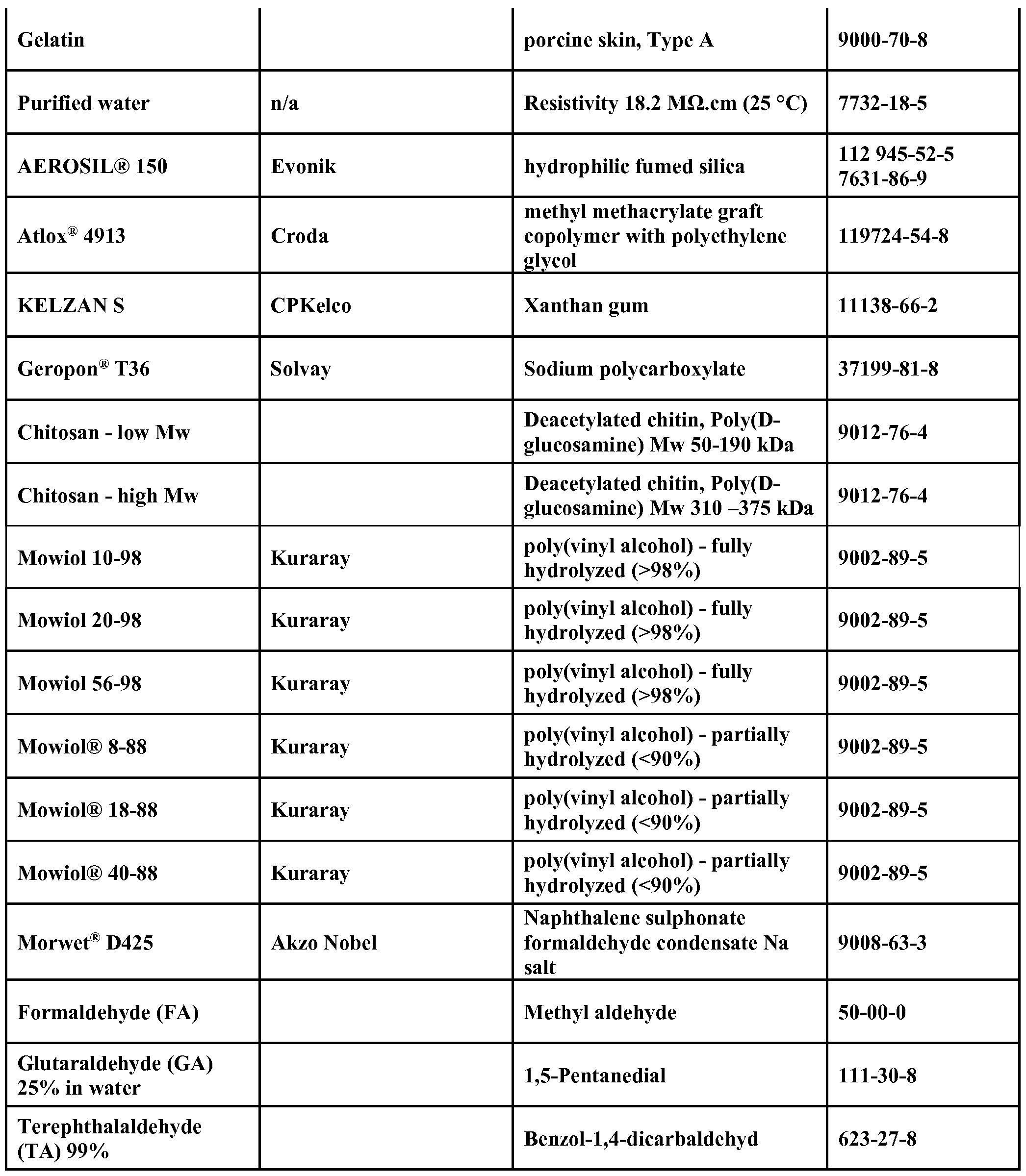
  • Table 1 tradenames for commonly known surfactants are shown:
  • auxiliaries that may be present in the formulations and in the application forms derived from them include colorants such as inorganic pigments, examples being iron oxide, titanium oxide, Prussian Blue, and organic dyes, such as alizarin dyes, azo dyes and metal phthalocyanine dyes, and nutrients and trace nutrients, such as salts of iron, manganese, boron, copper, cobalt, molybdenum and zinc.
  • colorants such as inorganic pigments, examples being iron oxide, titanium oxide, Prussian Blue, and organic dyes, such as alizarin dyes, azo dyes and metal phthalocyanine dyes, and nutrients and trace nutrients, such as salts of iron, manganese, boron, copper, cobalt, molybdenum and zinc.
  • Stabilizers such as low-temperature stabilizers, preservatives, antioxidants, light stabilizers or other agents which improve chemical and/or physical stability may also be present. Additionally present may be foam- formers or defoamers.
  • formulations and application forms derived from them may also comprise, as additional auxiliaries, stickers such as carboxymethylcellulose, natural and synthetic polymers in powder, granule or latex form, such as gum arabic, polyvinyl alcohol, polyvinyl acetate, and also natural phospholipids, such as cephalins and lecithins, and synthetic phospholipids.
  • additional auxiliaries include mineral and vegetable oils.
  • auxiliaries present in the formulations and the application forms derived from them.
  • additives include fragrances, protective colloids, binders, adhesives, thickeners, thixotropic substances, penetrants, retention promoters, stabilizers, sequestrants, complexing agents, humectants and spreaders.
  • the active compounds may be combined with any solid or liquid additive commonly used for formulation purposes.
  • Suitable retention promoters include all those substances which reduce the dynamic surface tension, such as dioctyl sulphosuccinate, or increase the viscoelasticity, such as hydroxypropylguar polymers, for example.
  • Suitable penetrants in the present context include all those substances which are typically used in order to enhance the penetration of active agrochemical compounds into plants. Penetrants in this context are defined in that, from the (generally aqueous) application liquor and/or from the spray coating, they are able to penetrate the cuticle of the plant and thereby increase the mobility of the active compounds in the cuticle. This property can be determined using the method described in the literature (Baur et al., 1997, Pesticide Science 51, 131-152).
  • Examples include alcohol alkoxylates such as coconut fatty ethoxy late (10) or isotridecyl ethoxylate (12), fatty acid esters such as rapeseed or soybean oil methyl esters, fatty amine alkoxylates such as tallowamine ethoxylate (15), or ammonium and/or phosphonium salts such as ammonium sulphate or diammonium hydrogen phosphate, for example.
  • alcohol alkoxylates such as coconut fatty ethoxy late (10) or isotridecyl ethoxylate (12)
  • fatty acid esters such as rapeseed or soybean oil methyl esters
  • fatty amine alkoxylates such as tallowamine ethoxylate (15)
  • ammonium and/or phosphonium salts such as ammonium sulphate or diammonium hydrogen phosphate, for example.
  • the formulation with the encapsulated active comprises: a) at least one encapsulated active ingredient, b) a liquid phase, c) optionally one or more emulsifier / dispersant, d) optionally one or more carriers, e) optionally one or more surfactants, f) optionally further non-encapsuled active ingredients, g) optionally further adjuvants selected from the group of extenders, stickers, penetrants, retention promoters, colourants and dyes, stabilizers, humectants and spreaders.
  • the formulation with the encapsulated active comprises: a) at least one encapsulated active ingredient, b) a liquid phase, c) optionally one or more emulsifier / dispersant, d) optionally one or more carriers, e) one or more surfactants, e.g. Geropon T36 and / or Morwet D 425, f) optionally further non-encapsuled active ingredients, g) optionally further adjuvants selected from the group of extenders, stickers, penetrants, retention promoters, colourants and dyes, stabilizers, humectants and spreaders.
  • the formulation consists of a) and b) which add up to 100%.
  • a suitable liquid phase for the formulation may be water (SC), Oils and/or organic solvents (OD).
  • the liquid phase is water.
  • Suitable cross linkers according to the present invention are typically those used to connect polymer chains.
  • Crosslinkers therefore typically adjust the physico-chemical properties of polymer, for example reducing solubility, swellability, solvent and/or active permeability; increasing melting point and/or glass transition temperature. Any of the properties before may be changed through crosslinking to an extend that e.g. a soluble polymer becomes fully insoluble or thermoplastic polymer becomes thermosetting.
  • Crosslinking is typically achieved chemically, either by complexation or kovalent linkage.
  • cross linkers are aldehydes such as formaldehyde, glutaraldehyde, terephthalaldehyde, low molecular weight epoxides such as epichlorohydrin, activated esters such as NHS esters, imidoesters, maleimides, carbodiimide, other crosslinkers may include Pyridyldithiol, hydrazine, bi- or higher functional isocyanates or photo induced drosslinkers.
  • aldehydes such as formaldehyde, glutaraldehyde, terephthalaldehyde
  • low molecular weight epoxides such as epichlorohydrin
  • activated esters such as NHS esters
  • imidoesters imidoesters
  • maleimides maleimides
  • carbodiimide other crosslinkers may include Pyridyldithiol, hydrazine, bi- or higher functional isocyanates or photo induced drosslink
  • the capsules (encapsulated material) prepared according to methods A to C comprise between 1% and 99.9% by weight of active compound or, with particular preference, between 20% and 95% by weight of active compound, more preferably between 25% and 95% by weight of active compound, and most preferred between 50% and 95% by weight of active compound, based on the weight of the whole capsule (active + shell).
  • the active compound Before encapsulation the active compound has a particle size of preferably dso ⁇ 50 pm, more prefered dso ⁇ 20 pm, even more prefered dso ⁇ 10 pm, and most preferred dso ⁇ 5 pm.
  • the active compound has a particle size of dso > 0.1 pm
  • the formulations preferably comprise between 0.1% and 70% by weight of active compound or, with particular preference, between 1% and 65% by weight of active compound, more preferably between 5% and 60% by weight of active compound, and most preferred between 5% and 50% by weight of active compound, based on the weight of the formulation.
  • the active compound content of the application forms for herbicides may vary within wide ranges.
  • the active compound concentration of the application forms may be situated typically between 0.00001% and 50% by weight of active compound, preferably between 0.001% and 5% by weight, based on the weight of the application form. Application takes place in a customary manner adapted to the application forms.
  • the active compound content of the application forms for nematicides/fungicides may vary within wide ranges.
  • the active compound concentration of the application forms may be situated typically between 0.00001% and 50% by weight of active compound, preferably between 0.001% and 10% by weight, based on the weight of the application form.
  • Application takes place in a customary manner adapted to the application forms.
  • the present invention is directed to encapsulated actives, the method of their production, formulations comprising the encapsulated actives, and a method and use for seed treatment with the encapsulated actives or the corresponding formulations.
  • the present invention is directed to encapsulated actives, the method of their production, formulations comprising the encapsulated actives, and a method and use for in furrow application with the encapsulated actives or the corresponding formulations.
  • the present invention is directed to encapsulated actives, the method of their production, formulations comprising the encapsulated actives, and a method and use for foliar application with the encapsulated actives or the corresponding formulations.
  • the present invention is directed to encapsulated actives, the method of their production, formulations comprising the encapsulated actives, and a method and use for soil application with the encapsulated actives or the corresponding formulations.
  • Suitable actives of the present invention are preferably those which are known to show unwanted effects when applied to plants.
  • Actives for the present invention are preferably selected from the group comprising herbicides, insecticides, nematicides, fungicides, host defence inducer, biological control agents.
  • Said actives may also be used as mixing partner for encapsulated actives.
  • the same may also be used as mixing partner for encapsulated actives.
  • the same is present encapsulated and in free form, which leads to fast initial uptake and continuous release and uptake of the same active for a prolonged time.
  • Components which can be used as herbicide for encapsulation or in combination with the active compounds according to the invention, preferably in mixed formulations or in tank mix are, for example, known active compounds as they are described in, for example, Weed Research 26, 441-445 (1986), or "The Pesticide Manual", l5th edition, The British Crop Protection Council and the Royal Soc.
  • acetolactate synthase acetyl-CoA- carboxylase, cellulose-synthase, enolpyruvylshikimat-3-phosphat-synthase, glutamin-synthetase, p- hydroxyphenylpyruvat-dioxygenase, phytoendesaturase, photosystem I, photosystem II and/or protoporphyrinogen-oxidase.
  • active compounds which may be mentioned as herbicides or plant growth regulators which are known from the literature are the following (compounds are either described by "common name” in accordance with the International Organization for Standardization (ISO) or by chemical name or by a customary code number), and always comprise all applicable forms such as acids, salts, ester, or modifications such as isomers, like stereoisomers and optical isomers. As an example at least one applicable from and/or modifications can be mentioned
  • herbicides are:
  • O-ethyl isopropylphosphoramidothioate halauxifen, halauxifen-methyl ,halosafen, halosulfuron, halosulfuron- methyl, haloxyfop, haloxyfop-P, haloxyfop-ethoxyethyl, haloxyfop-P-ethoxyethyl, haloxyfop-methyl, haloxyfop-P-methyl, hexazinone, HW-02, i.e.
  • plant growth regulators are:
  • active compounds which may be mentioned as fungicide which are known from the literature are the following (compounds are either described by "common name” in accordance with the International Organization for Standardization (ISO) or by chemical name or by a customary code number), and always comprise all applicable forms such as acids, salts, ester, or modifications such as isomers, like stereoisomers and optical isomers. As an example at least one applicable form and/or modifications can be mentioned.
  • Inhibitors of the ergosterol biosynthesis for example (1.001) cyproconazole, (1.002) difenoconazole, (1.003) epoxiconazole, (1.004) fenhexamid, (1.005) fenpropidin, (1.006) fenpropimorph, (1.007) fenpyrazamine, (1.008) fluquinconazole, (1.009) flutriafol, (1.010) imazalil, (1.011) imazalil sulfate, (1.012) ipconazole, (1.013) metconazole, (1.014) myclobutanil, (1.015) paclobutrazol, (1.016) prochloraz, (1.017) propiconazole, (1.018) prothioconazole, (1.019) Pyrisoxazole, (1.020) spiroxamine, (1.021) tebuconazole, (1.022) tetraconazole, (1.023) t
  • Inhibitors of the respiratory chain at complex I or II for example (2.001) benzovindiflupyr, (2.002) bixafen, (2.003) boscabd, (2.004) carboxin, (2.005) fluopyram, (2.006) flutolanil, (2.007) fluxapyroxad, (2.008) furametpyr, (2.009) Isofetamid, (2.010) isopyrazam (anti-epimeric enantiomer 1R,4S,9S), (2.011) isopyrazam (anti-epimeric enantiomer 1S,4R,9R), (2.012) isopyrazam (anti-epimeric racemate 1RS,4SR,9SR), (2.013) isopyrazam (mixture of syn-epimeric racemate 1RS,4SR,9RS and anti-epimeric racemate 1RS,4SR,9SR), (2.014) isopyrazam (syn-epimeric enantiomer 1R,4S
  • Inhibitors of the respiratory chain at complex III for example (3.001) ametoctradin, (3.002) amisulbrom,
  • Inhibitors of the mitosis and cell division for example (4.001) carbendazim, (4.002) diethofencarb, (4.003) ethaboxam, (4.004) fluopicolide, (4.005) pencycuron, (4.006) thiabendazole, (4.007) thiophanate-methyl, (4.008) zoxamide, (4.009) 3-chloro-4-(2,6-difluorophenyl)-6-methyl-5-phenylpyridazine, (4.010) 3-chloro-5-(4- chlorophenyl)-4-(2,6-difluorophenyl)-6-methylpyridazine, (4.011) 3-chloro-5-(6-chloropyridin-3-yl)-6-methyl- 4-(2,4,6-trifluorophenyl)pyridazine, (4.012) 4-(2-bromo-4-fluorophenyl)-N-(2,6-difluorophenyl)
  • Inhibitors of the amino acid and/or protein biosynthesis for example (7.001) cyprodinil, (7.002) kasugamycin, (7.003) kasugamycin hydrochloride hydrate, (7.004) oxytetracycline, (7.005) pyrimethanil, (7.006) 3-(5-fluoro- 3,3,4,4-tetramethyl-3,4-dihydroisoquinolin-l-yl)quinoline.
  • Inhibitors of the ATP production for example (8.001) silthiofam.
  • Inhibitors of the cell wall synthesis for example (9.001) benthiavalicarb, (9.002) dimethomorph, (9.003) flumorph, (9.004) iprovalicarb, (9.005) mandipropamid, (9.006) pyrimorph, (9.007) valifenalate, (9.008) (2E)-3- (4-tert-butylphenyl)-3 -(2-chloropyridin-4-yl)- 1 -(morpholin-4-yl)prop-2-en- 1 -one, (9.009) (2Z)-3 -(4-tert- butylphenyl)-3 -(2-chloropyridin-4-yl)- 1 -(morpholin-4-yl)prop-2-en- 1 -one.
  • Inhibitors of the lipid and membrane synthesis for example (10.001) propamocarb, (10.002) propamocarb hydrochloride, (10.003) tolclofos-methyl.
  • Inhibitors of the melanin biosynthesis for example (11.001) tricyclazole, (11.002) 2,2,2-trifluoroethyl ⁇ 3- methyl-l-[(4-methylbenzoyl)amino]butan-2-yl ⁇ carbamate.
  • Inhibitors of the nucleic acid synthesis for example (12.001) benalaxyl, (12.002) benalaxyl-M (kiralaxyl), (12.003) metalaxyl, (12.004) metalaxyl-M (mefenoxam).
  • Inhibitors of the signal transduction for example (13.001) fludioxonil, (13.002) iprodione, (13.003) procymidone, (13.004) proquinazid, (13.005) quinoxyfen, (13.006) vinclozolin.
  • S 1 a compounds of the type of dichlorophenylpyrazoline-3 -carboxylic acid (S G), preferably
  • S 1 c derivatives of 1 ,5-diphenylpyrazole-3-carboxylic acid (S 1 c ), preferably compounds such as
  • Sl d compounds of the type of triazolecarboxylic acids (Sl d ), preferably compounds such as
  • Sl e compounds of the type of 5-benzyl- or 5-phenyl-2-isoxazoline-3-carboxylic acid or 5,5-diphenyl- 2-isoxazoline-3 -carboxylic acid (Sl e ), preferably compounds such as ethyl
  • S2 b compounds of the type of (5-chloro-8-quinolinoxy)malonic acid (S2 b ), preferably compounds such as diethyl (5-chloro-8-quinolinoxy)malonate, diallyl (5-chloro-8-quinolinoxy)malonate, methyl ethyl (5-chloro-8-quinolinoxy)malonate and related compounds, as described in EP-A-0 582 198.
  • R-29148 (3-dichloroacetyl-2, 2, 5-trimethyl- l,3-oxazolidine) from Stauffer (S3-2),
  • R-28725" (3 -dichloroacetyl-2, 2-dimethyl- 1, 3 -oxazolidine) from Stauffer (S3 -3),
  • PPG-1292 N-allyl-N-[(l,3-dioxolan-2-yl)methyl]dichloroacetamide
  • TI-35 (1-dichloroacetylazepane) from TRI-Chemical RT (S3-8)
  • R A 1 is (Ci-C 6 )-alkyl, (C3-C6)-cycloalkyl, where the 2 last-mentioned radicals are substituted by VA substituents from the group consisting of halogen, (Ci-C4)-alkoxy, halo-(Ci-C 6 )-alkoxy and (Ci-C4)-alkylthio and, in the case of cyclic radicals, also (Ci-C4)-alkyl and (C1-C4)- haloalkyl;
  • R A 2 is halogen, (Ci-C4)-alkyl, (Ci-C4)-alkoxy, CF3 ; m A is 1 or 2;
  • V D is 0, 1, 2 or 3;
  • S4 b compounds of the type of 4-(benzoylsulphamoyl)benzamides of the formula (S4 b ) and salts thereof, as described in WO-A-99/16744,
  • RB 1 , R B 2 independently of one another are hydrogen, (Ci-C 6 )-alkyl, (C3-C6)-cycloalkyl,
  • R B 3 is halogen, (Ci-C4)-alkyl, (Ci-C4)-haloalkyl or (Ci-C4)-alkoxy, ms is 1 or 2; for example those in which
  • R B 1 cyclopropyl
  • R B 2 hydrogen
  • (R B 3 ) 2-OMe
  • R B 1 cyclopropyl
  • R B 2 hydrogen
  • (R B 3 ) 5-Cl-2-OMe (S4-2)
  • R B 1 ethyl
  • R B 2 hydrogen
  • (R B 3 ) 2-OMe (S4-3)
  • R B 1 isopropyl
  • Rc 1 , Rc 2 independently of one another are hydrogen, (Ci-Cs)-alkyl, (C3-Cs)-cycloalkyl, (C3-C6)- alkenyl, (C3-C6)-alkynyl,
  • Rc 3 is halogen, (Ci-C4)-alkyl, (Ci-C4)-alkoxy, CF3, me is 1 or 2; for example l-[4-(N-2-methoxybenzoylsulphamoyl)phenyl]-3-methylurea mecanicmetcamifen”, S4-6), l-[4-(N-2-methoxybenzoylsulphamoyl)phenyl]-3,3-dimethylurea,
  • R D 4 is halogen, (Ci-C4)-alkyl, (Ci-C4)-alkoxy, CF3; m D is 1 or 2;
  • RD 5 is hydrogen, (Ci-C 6 )-alkyl, (C3-C6)-cycloalkyl, (C2-C6)-alkenyl, (C2-C6)-alkynyl, (Cs-Ce)- cycloalkenyl.
  • Active compounds from the class of hydroxyaromatics and aromatic-aliphatic carboxylic acid derivatives (S5) for example ethyl 3,4,5-triacetoxybenzoate, 3,5-dimethoxy-4-hydroxybenzoic acid, 3,5-dihydroxybenzoic acid, 4-hydroxysalicylic acid, 4-fluorosalicyclic acid, 2-hydroxycinnamic acid, 2,4-dichlorocinnamic acid, as described in WO-A-2004/084631, WO-A-2005/015994, WO-A-2005/016001.
  • R D 1 is halogen, (Ci-C4)-alkyl, (Ci-C4)-haloalkyl, (Ci-C4)-alkoxy, (Ci-C4)-haloalkoxy,
  • R D 2 is hydrogen or (Ci-C4)-alkyl
  • R D 3 is hydrogen, (Ci-Cs)-alkyl, (C2-C4)-alkenyl, (C2-C4)-alkynyl or aryl, where each of the carbon-containing radicals mentioned above is unsubstituted or substituted by one or more, preferably by up to three, identical or different radicals from the group consisting of halogen and alkoxy; or salts thereof, n D is an integer from 0 to 2.
  • Active compounds from the class of 3-(5-tetrazolylcarbonyl)-2-quinolones for example l,2-dihydro-4-hydroxy-l -ethyl-3 -(5-tetrazolylcarbonyl)-2-quino lone (CAS Reg. No.: 219479-18- 2), l,2-dihydro-4-hydroxy-l -methyl-3 -(5 -tetrazolylcarbonyl)-2-quino lone (CAS Reg. No.: 95855- 00-8), as described in WO-A- 1999/000020.
  • R E 1 is halogen, (Ci-C4)-alkyl, methoxy, nitro, cyano, CF3, OCF3
  • Y E , Z E independently of one another are O or S, he is an integer from 0 to 4,
  • R E 2 is (Ci-Ci 6 )-alkyl, (C2-C6)-alkenyl, (C3-C6)-cycloalkyl, aryl; benzyl, halobenzyl,
  • R E 3 is hydrogen or (Ci-C 6 )-alkyl.
  • Sl 1 Active compounds of the type of oxyimino compounds (Sl 1), which are known as seed dressings, such as, for example,
  • oxabetrinil ((Z)-l,3-dioxolan-2-ylmethoxyimino(phenyl)acetonitrile) (Sl 1-1), which is known as seed dressing safener for millet against metolachlor damage,
  • naphthalic anhydrid (l,8-naphthalenedicarboxylic anhydride) (S 13-1), which is known as seed dressing safener for com against thiocarbamate herbicide damage,
  • MG 191 (CAS Reg. No.: 96420-72-3) (2-dichloromethyl-2-methyl-l,3-dioxolane) (S13-5) from Nitrokemia, which is known as safener for com,
  • RH 1 is (Ci-C 6 )-haloalkyl
  • RH 2 is hydrogen or halogen
  • RH 3 , RH 4 independently of one another are hydrogen, (Ci-Ci 6 )-alkyl, (C 2 -Ci 6 )-alkenyl or (C 2 -Ci 6 )-alkynyl, where each of the 3 last-mentioned radicals is unsubstituted or substituted by one or more radicals from the group consisting of halogen, hydroxy, cyano, (Ci-C 4 )-alkoxy, (C 1 -C 4 )- haloalkoxy, (Ci-C 4 )-alkylthio, (Ci-C 4 )-alkylamino, di-[(Ci-C 4 )-alkyl]-amino, [(C 1 -C 4 )- alkoxy] -carbonyl, [(Ci-C 4 )-haloalkoxy]-carbonyl, unsubstituted or substituted (C3-C6)- cycloalkyl,
  • RH 3 is (Ci-C 4 )-alkoxy, (C 2 -C 4 )-alkenyloxy, (C 2 -C 6 )-alkynyloxy or (C 2 -C 4 )-haloalkoxy, and RH 4 is hydrogen or (Ci-C 4 )-alkyl, or
  • RH 3 and RH 4 together with the directly bound N-atom are a 4 to 8-membered heterocyclic ring, which can contain further hetero ring atoms besides the N-atom, preferably up to two further hetero ring atoms from the group consisting of N, O and S, and which is unsubstituted or substituted by one or more radicals from the group consisting of halogen, cyano, nitro, (Ci-C 4 )-alkyl, (Ci-C 4 )-haloalkyl, (Ci-C 4 )-alkoxy, (Ci-C 4 )-haloalkoxy, and (Ci-C 4 )-alkylthio.
  • Active compounds which are primarily used as herbicides, but also have safener effect on crop plants, for example
  • biological control is defined as control of a pathogen and/or insect and/or an acarid and/or a nematode by the use of a second organism.
  • Known mechanisms of biological control include enteric bacteria that control root rot by out-competing fungi for space on the surface of the root.
  • Bacterial toxins, such as antibiotics, have been used to control pathogens.
  • the toxin can be isolated and applied directly to the plant or the bacterial species may be administered so it produces the toxin in situ.
  • Biological control agents include in particular bacteria, fungi or yeasts, protozoa, viruses, entomopathogenic nematodes, inoculants and botanicals and/or mutants of them having all identifying characteristics of the respective strain, and/or a metabolite produced by the respective strain that exhibits activity against insects, mites, nematodes and/or phytopathogens.
  • biological control agents which are summarized under the term "bacteria” include spore-forming, root-colonizing bacteria, or bacteria and their metabolites useful as biological insecticdes, -nematicdes, miticides, or -fungicide or soil amendments improving plant health and growth.
  • Biological control agents according to the invention in combination with good plant tolerance and favourable toxicity to warm-blooded animals and being tolerated well by the environment, are suitable for protecting plants and plant organs, for increasing harvest yields, for improving the quality of the harvested material and for controlling animal pests, in particular insects, arachnids, helminths, nematodes and molluscs, which are encountered in agriculture, in horticulture, in animal husbandry, in forests, in gardens and leisure facilities, in the protection of stored products and of materials, and in the hygiene sector. They can be preferably employed as plant protection agents. They are active against normally sensitive and resistant species and against all or some stages of development.
  • Biological control agents include in particular bacteria, fungi or yeasts, protozoa, viruses, entomopathogenic nematodes, products produced by microorganisms including proteins or secondary metabolites and botanical, especially botanical extracts.
  • the biological control agent may be employed or used in any physiologic state such as active or dormant.
  • Insecticides/ acaricides/nematicides The active ingredients specified herein by their“common name” are known and described, for example, in the Pesticide Manual (“The Pesticide Manual”, l4th Ed., British Crop Protection Council 2006) or can be searched in the internet (e.g. http://www.alanwood.net/pesticides).
  • Acetylcholinesterase (AChE) inhibitors for example carbamates, e.g. Alanycarb, Aldicarb, Bendiocarb, Benfuracarb, Butocarboxim, Butoxycarboxim, Carbaryl, Carbofuran, Carbosulfan, Ethiofencarb, Fenobucarb, Formetanate, Furathiocarb, Isoprocarb, Methiocarb, Methomyl, Metolcarb, Oxamyl, Pirimicarb, Propoxur, Thiodicarb, Thiofanox, Triazamate, Trimethacarb, XMC and Xylylcarb or organophosphates, e.g.
  • AChE Acetylcholinesterase
  • GABA-gated chloride channel antagonists for example cyclodiene organochlorines, e.g. Chlordane and Endosulfan, or phenylpyrazoles (fiproles), e.g. Ethiprole and Fipronil.
  • Sodium channel modulators / voltage-dependent sodium channel blockers for example py ret lira ids, e.g. Acrinathrin, Allethrin, d-cis-trans Allethrin, d-trans Allethrin, Bifenthrin, Bioallethrin, Bioallethrin S- cyclopentenyl isomer, Bioresmethrin, Cycloprothrin, Cyfluthrin, beta-Cyfluthrin, Cyhalothrin, lambda- Cyhalothrin, gamma-Cyhalothrin, Cypermethrin, alpha-Cypermethrin, beta-Cypermethrin, theta- Cypermethrin, zeta-Cypermethrin, Cyphenothrin [(lR)-trans isomers], Deltamethrin, Empenthrin [(EZ)- (1R) isomers
  • Nicotinic acetylcholine receptor (nAChR) agonists for example neonicotinoids, e.g. Acetamiprid, Clothianidin, Dinotefuran, Imidacloprid, Nitenpyram, Thiacloprid and Thiamethoxam or Nicotine or Sulfoxaflor or Flupyridafurone.
  • neonicotinoids e.g. Acetamiprid, Clothianidin, Dinotefuran, Imidacloprid, Nitenpyram, Thiacloprid and Thiamethoxam or Nicotine or Sulfoxaflor or Flupyridafurone.
  • Nicotinic acetylcholine receptor (nAChR) allosteric activators for example spinosyns, e.g. Spinetoram and Spinosad.
  • Chloride channel activators for example avermectins/milbemycins, e.g. Abamectin, Emamectin benzoate, Lepimectin and Milbemectin.
  • Juvenile hormone mimics for example juvenile hormon analogues, e.g. Hydroprene, Kinoprene and Methoprene or Fenoxycarb or Pyriproxyfen.
  • Juvenile hormone mimics for example juvenile hormon analogues, e.g. Hydroprene, Kinoprene and Methoprene or Fenoxycarb or Pyriproxyfen.
  • Miscellaneous non-specific (multi-site) inhibitors for example alkyl halides, e.g. Methyl bromide and other alkyl halides; or Chloropicrin or Sulfuryl fluoride or Borax or Tartar emetic.
  • Mite growth inhibitors e.g. Clofentezine, Hexythiazox and Diflovidazin or Etoxazole.
  • Microbial disruptors of insect midgut membranes e.g. Bacillus thuringiensis subspecies israelensis, Bacillus sphaericus, Bacillus thuringiensis subspecies aizawai, Bacillus thuringiensis subspecies kurstaki,
  • Bacillus thuringiensis subspecies tenebrionis and BT crop proteins CrylAb, CrylAc, CrylFa, Cry2Ab, mCry3A, Cry3Ab, Cry3Bb, Cry34/35Abl.
  • Inhibitors of mitochondrial ATP synthase for example Diafenthiuron or organotin miticides, e.g. Azocyclotin, Cyhexatin and Fenbutatin oxide or Propargite or Tetradifon.
  • Uncouplers of oxidative phoshorylation via disruption of the proton gradient for example Chlorfenapyr,
  • Nicotinic acetylcholine receptor (nAChR) channel blockers for example Bensultap, Cartap hydrochloride, Thiocyclam and Thiosultap-sodium.
  • Inhibitors of chitin biosynthesis type 0, for example Bistrifluron, Chlorfluazuron, Diflubenzuron, Flucycloxuron, Flufenoxuron, Hexaflumuron, Lufenuron, Novaluron, Noviflumuron, Teflubenzuron and
  • Inhibitors of chitin biosynthesis type 1, for example Buprofezin.
  • Moulting disruptors for example Cyromazine.
  • Ecdysone receptor agonists for example Chromafenozide, Halofenozide, Methoxyfenozide and Tebufenozide.
  • Octopamine receptor agonists for example Amitraz.
  • Mitochondrial complex III electron transport inhibitors for example Hydramethylnon or Acequinocyl or Fluacrypyrim.
  • Mitochondrial complex I electron transport inhibitors for example METI acaricides, e.g. Fenazaquin, Fenpyroximate, Pyrimidifen, Pyridaben, Tebufenpyrad and Tolfenpyrad or Rotenone (Derris).
  • Inhibitors of acetyl CoA carboxylase for example tetronic and tetramic acid derivatives, e.g. Spirobudiclofen, Spirodiclofen, Spiromesifen and Spirotetramat.
  • Mitochondrial complex IV electron transport inhibitors for example phosphines, e.g. Aluminium phosphide, Calcium phosphide, Phosphine and Zinc phosphide or Cyanide.
  • phosphines e.g. Aluminium phosphide, Calcium phosphide, Phosphine and Zinc phosphide or Cyanide.
  • Mitochondrial complex II electron transport inhibitors for example Cyenopyrafen and Cyflumetofen.
  • Ryanodine receptor modulators for example diamides, e.g. Chlorantraniliprole, Cyantraniliprole, Flubendiamide and Tetrachloroantraniliprole.
  • Preferred active compounds are selected from the group comprising SDH-Inhibitors, nAChR-Agonists (including neonicotinoides), chlorotica including PDS inhibitors (HRAC Fl) and HPPD inhibitors (HRAC F2) and thiadiazole carboxamides / host defence inducers.
  • More preferred active compounds for encapsulation according to the invention are selected from the group comprising Fluopyram, Flupyradifurone, Diflufenican, Isoxaflutole, Imidacloprid and Isotianil.
  • the active is solid at room temperature, wherein room temperature in the instant application is 20°C if not otherwise defined.
  • the active is insoluble in water, wherein insoluble means a solubility of less than 1 g/1 at room temperature and pH 7.
  • the encapsulated actives of the instant application or the corresponding formulations may be used in Dicotyledons, e.g. Soy (e.g. FLU, DFF) tomato (e.g. FLU), cucumber (e.g. FLU), and pepper or Monocotyledons, like com (e,g, IFT), or cereals.
  • Soy e.g. FLU, DFF
  • tomato e.g. FLU
  • cucumber e.g. FLU
  • pepper or Monocotyledons like com (e,g, IFT), or cereals.
  • the encapsulated actives according to the present invention can be produced by three alternative processes, which are described in the following:
  • % refers to weight percent (wt.%).
  • Greenhouse evaluations were conducted using a pasteurized sandy loam soil consisting of less than 1% soil organic matter and a minimum of 20 reps for each treatment. Three planting options were utilized based on greenhouse space and experiment size 1) 60 cell trays 2) 30 cell trays and 6 in. stand alone pots. Prior to planting 6 in. pots were wet with 150 mL of water per pot, while 30 and 60 cell trays were irrigated for 10 s with an overhead water source. Subsequently, a 2 cm hole was created and 1 seed was planted per hole and covered with soil. Plants were grown for approximately 21 d in a temperature and day length regulated greenhouse. Water was uniformly supplied at regular intervals throughout the growth period. All trials demonstrated a germination rate of 90% or greater.
  • Cotyledons were harvested when the unifoliate leaves reached full development and analyzed for the halo effect. Specifically, cotyledons were removed and analyzed when unifoliate leaves are fully emerged for all samples and the first trifoliate leaves are present but not fully developed. The top of each cotyledon was scanned and analyzed using WinFolia software which measured total leaf area, healthy leaf area, and halo area. Differentiation between healthy and halo cotyledon area was determined by using color screening analysis, where darker regions signified halo area and green regions signified healthy leaf tissue. For seeds treated with formulations obtained according to process A to C a visual halo rating system was also employed which consisted of a rating system from 0 to 4. The criteria for each rating are outlined in
  • Figure 1 Unifoliate leaves were analyzed for size using WinFolia software after the first trifoliate leaves were fully emerged.
  • Plant heights were typically measured at approximately 7 DAP (days after planting), which is when unifoliate leaves first emerge and begin to develop and at 14 DAP or when the first trifoliate has completely emerged.
  • Canopy analysis was performed at 7- 10 days after planting (DAP) to determine the impact of the treatment on stunting. Images were taken and analyzed using the app Canopeo which quantifies the canopy cover of green vegetation using images taken with a mobile device. Images were taken at the same distance from the samples and under similar light conditions.
  • Root Lesion Nematode (RLN) Bioassay was conducted 7 DAP soybean seeds were inoculated with 1000- 2000 RLN juveniles using a standard inoculation methodology. In brief, the soybean pots were wet 5 min prior to inoculation, then a 2 cm deep hole was created next to the stem of the soybean plant. Subsequently, a pipette was used to dispense 0.5-1.0 mL of inoculum into the hole. Next, the roots were removed from soil, cleaned of excess sand and soil, and briefly submerged in water. The roots where then blotted with a paper towel and cut into 1 to 2 cm pieces that were spread onto a baeman funnel ( ⁇ 2 g fresh weight/funnel). The funnels were covered with foil and allowed to sit for 3 d. The funnels were then drained and 30 mL of liquid was retained and the RLN count was determined from this sample.
  • RPN Root Lesion Nematode
  • SDS Bioassay was conducted by preparing an inoculum by placing 800 g of wheat into beaker and covering with potato dextrose broth. The beaker was then autoclaved for 30 mins on 2 consecutive days. After 24-28 h post autoclave, 1 plate of Fusarium Virguliforme was added to each beaker and grown at room temperature. After 14 d the jars were grown out and desiccated.
  • a cone was stacked with 100 cc of soil, followed by 1 ⁇ 4 plate of Fusarium Virguliforme inoculum. Two soybean seeds were placed on top and the cone was filled with 40 cc of soil. The seeds were grown under wet conditions and evaluated for SDS symptoms at the first trifoliate using a 0-6 scale, where 0 represents no symptoms and 6 represents a wilted or dead plant.
  • Samples were supplied as aqueous suspensions and were applied at 50, 100, 200 g active per hectare. Briefly, seeds of grasses, weeds and agricultural crops were seeded in pots with 8 cm diameter in natural soil (slit- rich, non-sterile). Seeds were covered with 0.5 cm of soil and cultivated in a glasshouse (12-16 h light, temperature day 20-22°C, night 15-18°C). At the BBCH 00 state of growth of the seeds/plants the inventive formulation was applied using a water volume of 300 L/ha. After herbicide treatment all plants were cultivated further in the glasshouse as described above. Daily irrigation was set to 1.0- 1.5 liter per square meter.
  • Efficacy of the treatment was visually assessed and graded after 14 days or 28 days after herbicide application.
  • a grading of 0% reflects a healthy non-treated plant, i.e. the non-treated reference population and 100% represents full efficacy of the herbicide, i.e. a deceased plant.
  • BalanceTM Pro isoxaflutole without safener
  • Brodal® diflufenican
  • Particle sizes and zeta potentials for formulations obtained to process A were determined via laser diffraction (Malvern Mastersizer S) in aqueous solution; typical dilution 1 : 1000 of as synthesized formulation.
  • Zeta potential of the dispersions was measured using a Malvern Zetasizer ZS90 in 1 mM KC1 as a function of pH; typical dilution 1 : 100 to 1: 1000 of as synthesized formulation. All other particle sizes were determined through laser diffraction using a Malvern mastersizer hydro 3000s. All samples were measured by dispersing in water and applying ultrasound for 300 sec prior to the measurement.
  • Scattering Modell Fraunhofer
  • analysis tool universal
  • Active content of all formualtions according to process A was determined using a thermogravimetric analysis, fully evaporating the aqeous phase at 160°C and measureing the residual dry mass and calculating the active content based on the employed manufacturing ratio (dispersion concentrate vs polymer solution).
  • the obtained dry mass was corrected for the fluopyram to stabilizer mass in the dispersion concentrate, i.e. 48% fluopyram and 3% inerts in the dispersion concentrate.
  • Release kinetics of the active into pure water were analyzed using a HPLC assay.
  • the method can be used to either analyze the release from the formulated suspension or to evaluate release kinetics from a dry application mixture.
  • the following process was used for determination of release from aqueous dispersions (CS, SC or FS type formulation).
  • a LiChroCart Purosher Star PR-18e, 3.0 pm was used with an isocratic gradient: 50% 0.1% phosphoric acid and 50% acetonitrile.
  • aqueous dispersion type formulations incl. CS / SC / FS, an aliquot of the formulation was placed in 1.0 L of purified water and shook on an orbital shaker at the lowest reasonable speed, i.e. 50-100 rpm. The added volume of the formulation was carefully chosen to ensure infinite sink conditions during release. Samples were withdrawn after 1 h and 24 hours, optionally for some samples after 5 & 300 min. In order foster full release for tightly encapsulated formulations, another 100 mL of acetonitrile were added to the mixture after 1 day, continuously shook at unchanged speed for another day, and followed by a last sample withdrawal after 48 hours.
  • Controlled release was evident if the release profile was significantly lower than for a similarly formulated non- encapsulated sample, i.e. less than 50% release at a given point in time.
  • the active is homogenized in water with surfactants and subseqently milled, preferably in a bead mill, to obtain a dispersion concentrate of the active.
  • the active containing suspension is mixed in a microjet reactor (cf. e.g. nanoSaar; http://www.nanosaar.de/nanosaarlahgmhh/) with a polymer solution to obtain a non-crosslinked encapsulation. More preferred mixing takes place at a pressure of 50-60 bar with jet velocities of - 100 m/S and a mixing time of 0.1 - 1.0 ms.
  • pH of the either/or the dispersion concentrate and polymer solution is adjusted prior to high shear mixing in the microjet reactor according to the polymer used, for example, for polyvinylalcohol pH is preferably between 4 and 5 (measured with pH-glass electrode OPS11), while the pH for Chitosan is preferably between 11 and 12.
  • the particles obtained in the steps above are crosslinked for stabilization and/or to control the release properties of the particles.
  • the so obtained encapsulation may not be fully tethered to the active surface but may contain loosely attached or unbound polymers or a highly swollen polymer gel.
  • the degree of control release i.e. active release may change with the final application, i.e. drying of the formulation upon seed treatment.
  • curing/aging/drying may significantly alter the release profile / rate.
  • the active compounds for encapsulation according to the invention are selected from the group comprising Fluopyram, Flupyradifurone, Diflufenican, Isoxaflutole, Imidacloprid and Isotianil.
  • the active compound is Fluopyram.
  • the active compound is selected from the group comprising Fluopyram, Flupyradifurone, Diflufenican, Isoxaflutole, Imidacloprid and Isotianil.
  • the active compound is Fluopyram.
  • the active compounds are selected from the group comprising Diflufenican and Isoxaflutole.
  • Preferred cross-linking agents are formaldehyde (FA), glutaraldehyde (GA), terephthalaldehyde (TA), or mixtures thereof.
  • Preferred surfactants are anionic surfactants, more preferred naphthalene sulphonate formaldehyde condensate Na salts and sodium polycarboxylate.
  • Preferred polymers for encapsulation are water soluble polymers and hydrogel forming homo and co polymers, more preferred acrylate copolymers, in particulare amine acrylates, chitosan and polyvinylalcohols (PVA) either being fully hydrolysed or partially hydrolyzed polyvinylacetates, most preferred are chitosan and polyvinylalcohols (PVA) either being fully hydrolysed or partially hydrolyzed polyvinylacetates.
  • the encapsulated actives are produced by first homogenzing 3.388 kg Fluopyram with 140 g of a surfactant of the polycarboxylic acid salt class, preferably a sodium salt, and 70 g of a surfactant of the class of naphthalene sulphonate formaldehyde condensate and 3.4 kg demineralized water. Subsequently the homogenzided mixture is milled in a beadmill under wet conditions containing glass beads with a diameter of 0.75 - 1 mm (Bachofen KDL 0.6L with Glasbeads, 80% capacity, peripheral speed 10 m/s, 3 passages, turnover 3.4 kg/h).
  • the active suspension produced as above and a solution of a polyaminosachharide, preferably a poly-D-Glucosamin (Chitosan) (parent solution 1.5, 2.0 or 2.5 % in water) (alternatively PVA (parent solution 3 or 12 % in water)) are reacted in a microjet reactor, Nanosaar, under the following conditions (pressure 50-60 bar, jet velocity ⁇ 100 m/s, mixing time 0.1 -1.0 ms, pH as indicated in Table 2).
  • Final AI conzentrations are provided in cl. 3 and 5 of Table 2.
  • crosslinker is added (0.5, 3.0, 10.0 or 20.0 mol% based on reactive groups of the polymer.
  • FIGURES Figure 1 : Rating criteria for visual cotyledon test
  • Figure 2 Leaf damages on cucumber plants after fluopyram treatment as a function of release profiles and application rates. Graph visualizes data of Table 8.
  • Figure 4 Particle size distribution of as obtained formulations; Laser diffraction - Malvern mastersizer hydro 3000s
  • Root lesion nematode bioassay conducted on 0.075 mg FLU/seed treated soy corresponds to Table 15
  • Figure 6 _Results of Bioassay for identification of severity of sudden death syndrome (SDS) on soy; Rated for SDS symptoms at first trifoliate using 0-6 scale (0: no symptoms, 6: wilted/dead); inoculated with Fusarium virguiliforme; grown under wet conditions; seeds treated at 0.075mg FLU/seed; corresponds to Table 15
  • Figure 7 Efficacy in gall reduction after treatment with CR-fluopyram formulations.
  • Figure 8 release profiles into water, FLU-reference formulation was identical to C-l to C-ll
  • Example Process A The Materials used are defined in below. The production process itself was devided into: production of A.1 dispersion concentrate - A.2 encapsulation - A.3 crosslinking.
  • Fluopyram are homogenized with 140 g Geropon T36, 70 g Morwet D 425 and 3.4 kg demineralized water. Subsequently the homogenzided mixture is milled in a beadmill under wet conditions containing glass beads with a diameter of 0.75 - 1 mm (Bachofen KDL 0.6L with Glasbeads, 80% capacity, peripheral speed 10 m/s, 3 passages, turnover 3.4 kg/h). Subsequently, a 40% active dispersion of Fluopyram slurry is prepared by dilution of a concentrated slurry (solid content: 48 % active, 3% inert stabilizer/surfactants) with DI water.
  • 968 g Isoxaflutole are homogenized with 40 g Geropon T36, 20 g Morwet D 425, 1 g Silfoam SE 39 and 968 g demineralized water. Subsequently the homogenzided mixture is milled in a beadmill under wet conditions containing glass beads with a diameter of 0.75 - 1 mm (Bachofen KDL 0.6L with Glasbeads, 80% capacity, peripheral speed 10 m/s, 3 passages passages (repititions may be adjusted to yield required particle size), turnover 3.4 kg/h). Subsequently, pH was adjusted by additional citric acid to ⁇ 5.
  • 968 g Diflufenican are homogenized with 40 g Geropon T36, 20 g Morwet D 425 and 968 g demineralized water. Subsequently the homogenzided mixture is milled in a beadmill under wet conditions containing glass beads with a diameter of 0.75 - 1 mm (Bachofen KDL 0.6L with Glasbeads, 80% capacity, peripheral speed 10 m/s, 3 passages (repititions may be adjusted to yield required particle size), turnover 3.4 kg/h).
  • the active suspension produced as above and a solution of Chitosan (parent solution 0.5, 1.0, 1.5, 2.0 or 2.5 % w/w in water) (alternatively PVA (parent solution 3 or 12 % w/w in water)) are homogenized in a symmetric 200 pm microjet reactor, Nanosaar, under the following conditions (pressure 50 - 60 bar, jet velocity > 100 m/s, mixing time 0.1- 1.0 ms, pH as indicated in Table 2).
  • Final polymer and AI concentrations are provided in cl. 4 and 5 of Table 2.
  • pH 4 for PVA-coating, adjusted with glacial acetic acid.
  • Processing was conducted at room temperature in a symmetric MJR (200 pm ruby nozzles) reactor by impinging chitosan solution with fluopyram dispersion at a hydrodynamic pressure of 50 to 60 bar to yield chitosan coated fluopyram dispersion.
  • 10 mol% of Glutaraldehyde (with respect to chitosan) can be added to the fluopyram dispersion prior to processing by MJR or in a separate post - processing step, details see below.
  • crosslinker is added (0.5, 3.0, 10.0 or 20.0 mol% based on reactive groups of the polymer.
  • Cross linker solutions were employed as obtained by the supplier and can either be added to the active dispersion prior to the coating process or added under stirring to the final formulation after coating via MJR. Typically the amount of cross-linker was added prior to the coating process. After MJR processing cross-linking was conducted for at least 12 h at room temperature at the resulting pH shown in Table 2. The cross-linking reaction was allowed react without any quenching, such as typically employed tris-buffer or ammonium chloride quenching.
  • Formaldehyde (FA) was used as 37% (w/w) in water and Glutaraldehyde (GA) in 25% (w/w) in water.
  • reaction temperature and reaction time was adjusted to control the release rate, cl. 10 Table 2.
  • the amount of polymer for encapsulation in the parent solution is from 0.5 to 15 %, more preferred from 1 to 12 %, even more preferred from 1 to 10 %, even further preferred from 1 to 8, and most preferred from 1 to 6%.
  • the crosslinker is selected from the group consisting of formaldehyde and gluraraldehyde, wherein the crosslinker, if applied, is present the parent solution preferably in an amount of 0.2 to 13%, more preferably from 0.5 to 12%, and most preferred from 0.5 to 10%.
  • the amount of crosslinker in the parent solution is from 0.5 to 5 %.
  • Table 3 Exemplary summary of typical particle sizes obtained according to process A.
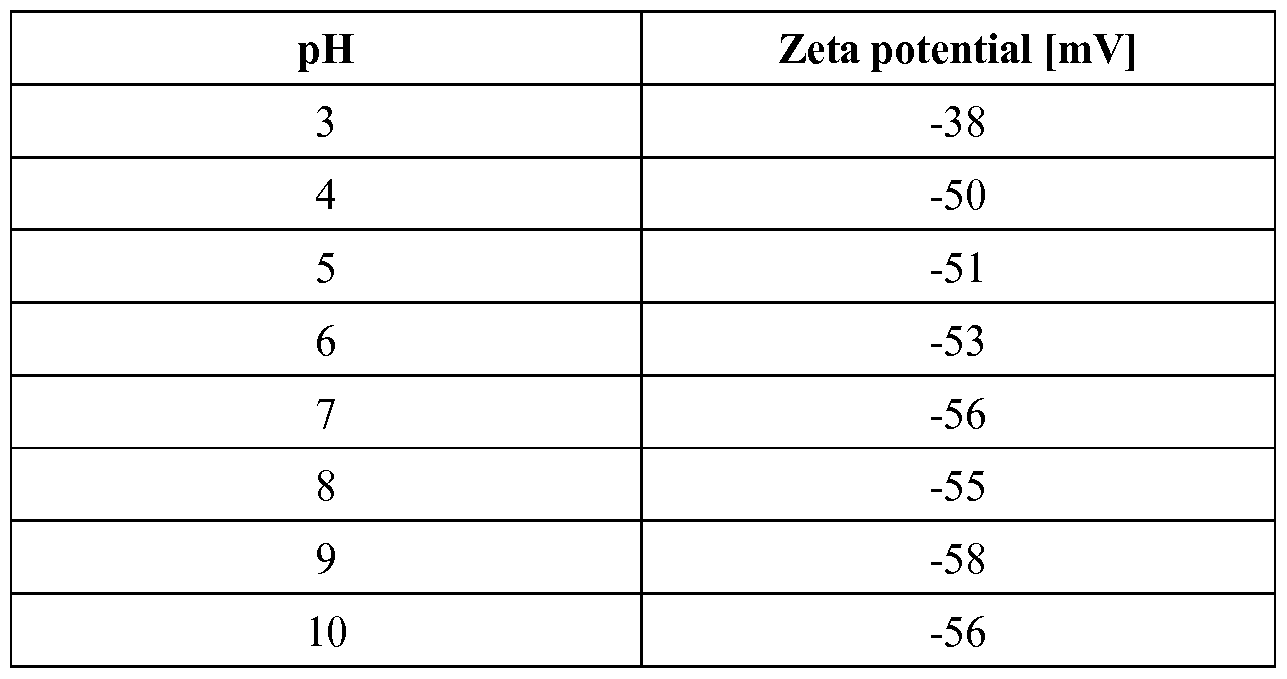
  • T able 4 Exemplary zeta potential variation with pH shown for example A- 107 (Fluopyram without coating)
  • Zeta potential measurements can be used to validate the successful coating process.
  • the zeta potential of the non controlled-release coated fluopyram is highly negative within a broad pH range, i.e. at least between pH 3-10, cf. Table 4, indicating the high potential for adsorption of neutral or positively charged polymers.
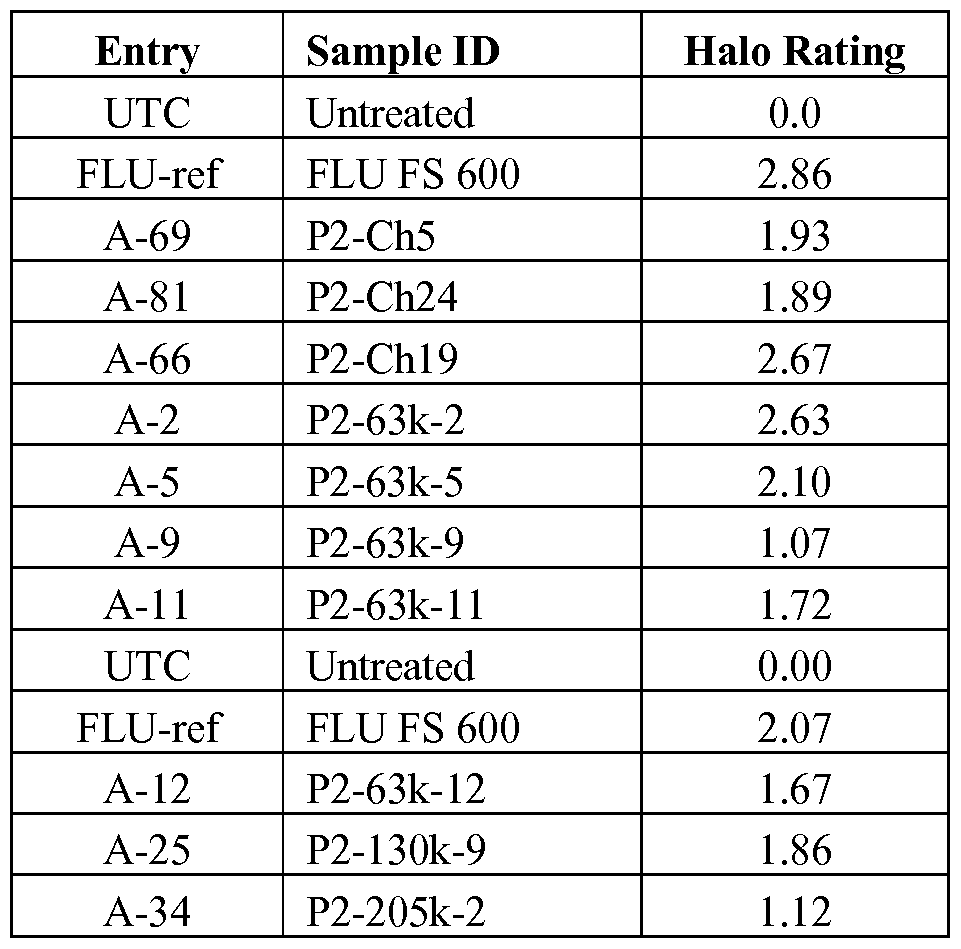
  • Table 6 Summary on greenhouse results obtained for soy treated with formulations obtained according to process A, lines with references, i.e.UTC and FLU-reference, indicate the start of a new greenhouse testing series. A-9 was found to have the lowest halo, even though not as low as the untreated control but significantly improved compared to the standard fluopyram treatment.
  • T able 7 Summary on greenhouse results obtained for soy treated with formulations obtained according to process A, lines with references, i.e.UTC and FLU -reference, indicate the start of a new greenhouse testing series. In this series A-97 and A- 100 were found to have the lowest halo, even though not as low as the untreated control but significantly improved compared to the standard fluopyram treatment.
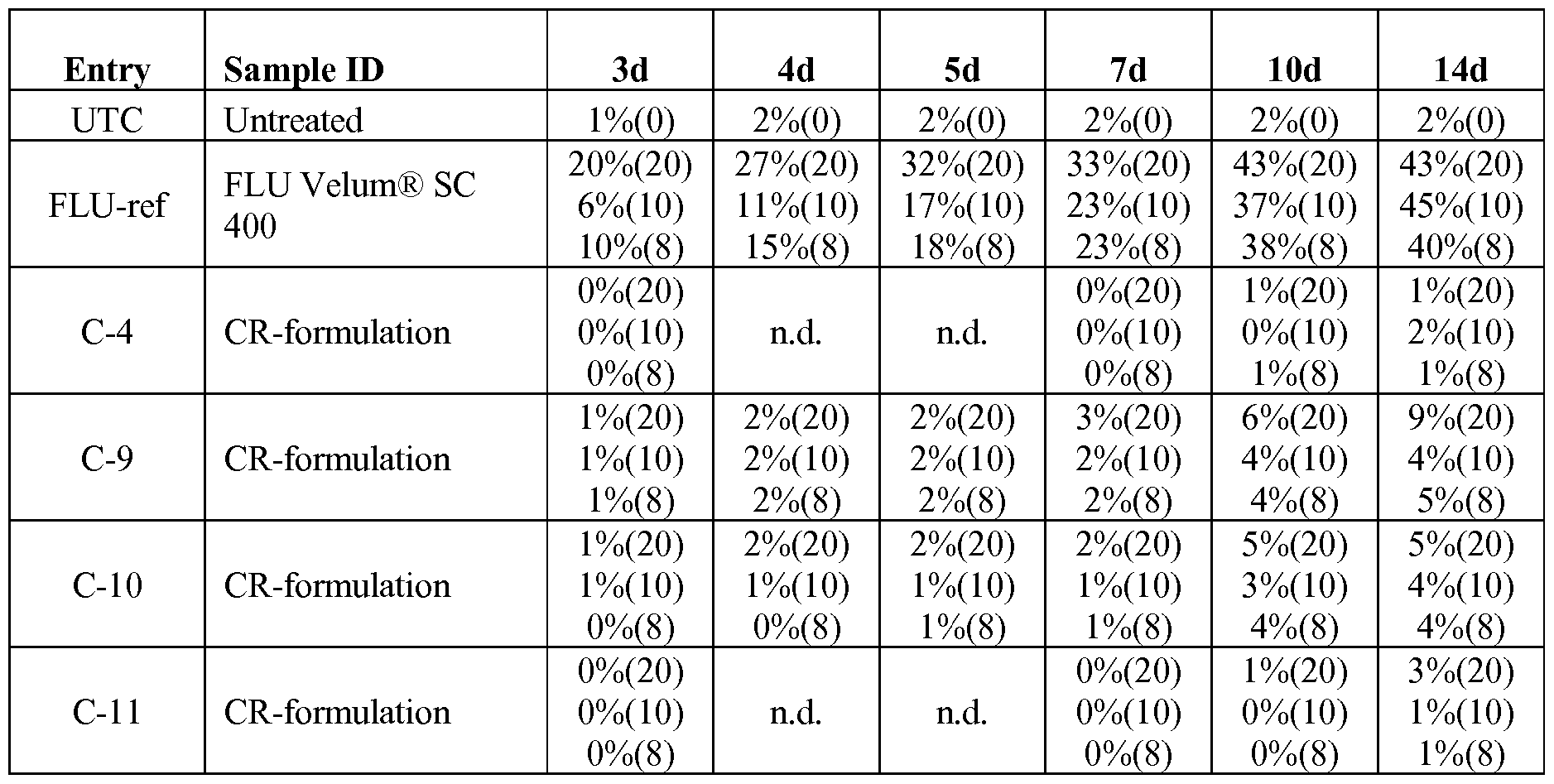
  • Samples were supplied as aqueous suspensions, cf. Table 2, and were applied at 8, 10, 20 mg a.i. per cucumber plant by applying 60mL soil drenches. Plant health (damage) was examined 3 / 4 / 5 / 7 / 10 and 14 days after application by visual inspection of leafs (% leaf area with chlorosis+necrosis) and shoot fresh weight measurement. Samples obtained according to process A were tested versus untreated control cucumber plants (UTC) and a non-controlled release fluopyram (Velum® SC400). The positive effect obtained from samples formulated according to process A applied on soil varies with the applied dose rate (dose response), and additionally, reflects the controlled release profiles, cf. Table 8 and Figure 2.
  • Table 8 Proved phytotoxicity reduction of controlled release formulations obtained according to process A, % damaged leaf area as a function of time after application and dose rate, i.e. 8, 10, 20 mg fluopyram per plant. Results represent average of triplicate analysis. Number in bracket indicates application rate in mg active/plant
  • Samples were supplied as aqueous suspensions, cf. Table 2, and were applied at 50, 100, 200 g active per hectare. Briefly, seeds of grasses, weeds and agricultural crop were seeded in pots with 8 cm diameter in natural soil (slit-rich, non-sterile). Seeds were covered with 0.5 cm of soil and cultivated in a glasshouse( 12- 16 h light, temperature day 20-22°C, night 15-18°C). At the BBCH 00 state of growth of the seeds/plants the inventive formulation was applied using a water volume of 300 L/ha. After herbicide treatment all plants were again cultivated in the glasshouse as described above. Daily irrigation was set to 1.0- 1.5 liter per square meter.
  • Efficacy of the treatment was assessed by visual grading after 14 days or 28 days, whereas a grading of 0% reflects a healthy non-treated plant, in agreement with the non-treated reference population and 100% represents full efficacy of the herbicide, i.e. a deceased plant.
  • the two commercial products BalanceTM Pro isoxaflutole without safener
  • Brodal® diflufenican
  • Controlled release formulations A- 108 & A- 109 of isoxaflutole were compared to the non-controlled release reference BalanceTM Pro which contains no safener for treatment of maize plants, cf. Table 9.
  • Controlled release formulations A-108 to A-l 11 of isoxaflutole were compared to the non-controlled relase reference Balance Pro. Independent of the application rate the efficacy profile against common grasses and weeds was comparable to the reference Brodal pro for tested formualtions A- 108 and A- 109 and somewhat reduced against avena fatua for A-l 10 and A- 11 1.
  • Controlled release formulations A- 1 12 & A- 1 13 of herbicide diflufenican were compared to the non- controlled relase reference Brodal, cf.Table 11. Independent of the application rate the efficacy profile against common grasses and weeds was comparable (A-l 12) or better (A-l 13) in this study. Alongside the herbicidal efficacy profile the tolerability of soja against both controlled release formulations significantly increased for both tested application rates on soja. For the high application rate of the controlled release formulations of 100 g/ha plant damage was reduced to 1/4* compared to the non-CR reference Brodal.
  • the encapsulated actives are produced by colloidal encapsulation, which provides excellent control of particle and phase properties.
  • Example B-6 In order to increase the electrolyte content of Example B-5, the solution obtained after concentrating was mixed 1 : 1 (v:v) with a 4 mol/L aqueous NaCl solution, obtaining example B-6.
  • Suitable solvents are water miscible organic solvents, preferably water miscible polar solvents, more preferred water miscible aprotic polar solvents, even more preferred selected from the group consisting of chloroform, dichloromethane, ethyl acetate and THF (tetrahydrofuran), and most preferred chloroform and dichloromethane.
  • Suitable polymers are any homo- or copolymers that are soluble in an organic solvent and allow formation of an emulsion in water, preferably the polymers are selected from the group comprising pure D or L lactates, lactide-co-caprolactone, lactide-co-glycolide; polyesters, polyamides, polyacrylates, polystyrenes, polyvinyls, more preferred the polymer is selected from the group comprising poly(lactic acid) (PLA) either free acid or ester terminated, poly(caprolactone) and poly(vinylacetate), and most preferred the polymer is PLA.
  • PLA poly(lactic acid)
  • the Mw of the polymer is preferably between 1 to 1000 kDa, more preferred between 5 and 200 kDa, even more preferred between 10 and 100 kDa and most preferred between 15 and 30 kDa.
  • the polymer to active ratio may be adjusted to tailor the release profile, but is preferably between 0.1 to 1 and 30 to 1, more preferred between 0.5 to 1 and 20: 1, and even more preferred between 1 : 1 to 10: 1.
  • the biological control agent may be employed or used in any physiologic state such as active or dormant.
  • Preferred active compounds are selected from the group comprising SDH-Inhibitors, nAChR-Agonists (including neonicotinoides), chlorotica including PDS inhibitors (HRAC FI) and HPPD inhibitors (HRAC F2) and thiadiazole carboxamides/ host defence inducers. More preferred active compounds for encapsulation according to the invention are selected from the group comprising Fluopyram, Flupyradifurone, Diflufenican, Isoxaflutole, Imidacloprid and Isotianil.
  • Suitable stabilisers are oil in water stabilizers known in the art, preferably gelantine, ethoxylated sorbitan fattyacid ester (e.g.Tween) and NaCl-solution.
  • Example B-6 Further concentration of the dispersion, i.e. removal of water, may be carried out using a centrifugation-decanting step, yielding, the final formulations Bl-5 and B7-8 as described in Table 13.
  • the solution obtained after concentrating was mixed 1 : 1 (v:v) with a 4 moPL aqueous NaCl solution, obtaining example B-6.
  • Table 13 Final composition of formulations obtained according to process B after full work-up, fluopyram concetration was measured using HPLC. All other concentrations were calculated based on the employed synthesis conditions.
  • Samples were supplied as aqueous suspensions and were applied to soybean seeds at a rate of 0.075 mg/seed using 100-250 g of seed in a small or medium sized Hege bowl seed treater.
  • Table 14 Summary on greenhouse results obtained for soy treated with formulations obtained according to process B.
  • the Halo-effect on soy beans treated with controlled release formulations obtained according to process B was signifantly reduced for all examples.
  • B-5 Halo was almost eliminated proving the high efficacy of the controlled release formulation in contast to the standard treatement with fluopyram.
  • Table 15 Proved efficacy of controlled release formulations obtained according to process B, root lesions nematode bioassay and sudden death syndrome bioassay. In addition to the high degree of Halo elimination for controlled release formulation B-5, this formulation was furthermore tested to have similar efficacy against Nematodes (Root Lesion count) and an improved efficacy against fungicidal disease sudden death syndrome.
  • Samples were supplied as aqueous suspensions and were applied at 8, 10, 20 mg a.i. per cucumber plant by applying 60mL soil drenches. Plant health (damage) was recorded 3 / 4 / 5 / 7 / 10 and 14 days after application by visual inspection of leafs (% leaf area with chlorosis+necrosis) and shoot fresh weight measurement. Both samples B-7 and B-8 were tested versus untreated control cucumber plants (UTC) and a non-controlled release fluopyram (Velum® SC400).
  • the encapsulated actives are produced by spray coating in a spouted bed.
  • Very fine actives may need an additional stabilization to obtain a stable fluidized bed.
  • 18.0 g stabilizer e.g.Aerosil® 150 or Aerosil® R974
  • 600 g of active may be intimately mixed with 600 g of active using a Retsch Grindomix GM 300 blade mill at 5000 rpm for 3 minutes.
  • the stabilizer is added and the particles are stabilized. Spray coating in spouted bed
  • Spray time was adjusted for obtaining targeted coating thickness.
  • Spray coating was conducted under inert gas atmosphere using a gas flow of preferably 10 to 150 nP/hour, more preferred 45 to 125 m 3 /hour, even more preferred 80 to 1 10 m 3 /hour, and most preferred 90 m 3 /hour.
  • Nebulizer pressure was always set to preferably 0.5 to 4.5 bar, more preferred to 1.5 to 3.5 bar, even more preferred to 2.0 to 3.0 bar, and most preferred to 2.5 bar.
  • Encapsulation efficiency EE was determined to be preferably >90 % for polyvinyl acetate encapsulated FLU, 60-90% for polycapro lactone and >90 % for cellulose acetate.
  • rheological modifiers 285 mg rheological modifier and 3.7 g dispersing agent were dissolved in 66.0 g water. 5.0 g of said mixture were used to disperse 50 mg of the dry encapsulated fluopyram prepared in the spouted bed. Homogenization was carried out using a suitable homogenizer, e.g. a Laboratory- Vortex at 1000 rpm for 30-60 sec.
  • suitable rheological modifiers by way of example are organic or inorganic rheological modifiers, preferably selected from the group comprising polysaccharides including xanthan gum, guar gum and hydroxyethyl cellulose.
  • examples are Veegum® R, Van Gel® B, Bentone® CT, HC, EW, Pangel® Ml 00, M200, M300, S, M, W, Attagel® 50, Laponite® RD, and fumed and precipitated silica, examples are Aerosil® 200, Siponat® 22.
  • polysaccharides including xanthan gum, guar gum and hydroxyethyl cellulose and most preferred is xanthan gum.
  • Suitable non-ionic dispersing agents are all substances of this type which can customarily be employed in agrochemical agents.
  • polyethylene oxide-polypropylene oxide block copolymers polyethylene glycol ethers of branched or linear alcohols, reaction products of fatty acids or fatty acid alcohols with ethylene oxide and/or propylene oxide, furthermore polyvinyl alcohol, polyoxyalkylenamine derivatives, polyvinylpyrrolidone, copolymers of polyvinyl alcohol and polyvinylpyrrolidone, and copolymers of (meth)acrylic acid and (meth)acrylic acid esters, furthermore branched or linear alkyl ethoxylates and alkylaryl ethoxylates, where polyethylene oxide-sorbitan fatty acid esters may be mentioned by way of example.
  • selected classes can be optionally phosphated, sulphonated or sulphated and neutralized with bases.
  • Suitable anionic dispersing agents are all substances of this type which can customarily be employed in agrochemical agents.
  • Alkali metal, alkaline earth metal and ammonium salts of alkylsulphonic or alkylphospohric acids as well as alkylarylsulphonic or alkylarylphosphoric acids are preferred.
  • a further preferred group of anionic surfactants or dispersing aids are alkali metal, alkaline earth metal and ammonium salts of polystyrenesulphonic acids, salts of polyvinylsulphonic acids, salts of alkylnaphthalene sulphonic acids, salts of naphthalene-sulphonic acid-formaldehyde condensation products, salts of condensation products of naphthalenesulphonic acid, phenolsulphonic acid and formaldehyde, and salts of lignosulphonic acid, polycarboxylic acid-co-polymers and their common salts.
  • the dispersing agent is a non-ionic dispersing agent, more preferred from the group of copolymers of (meth)acrylic acid and (meth)acrylic acid esters.
  • Suitable inert gases are selected from the group of nitrogene, helium, neon, argon, krypton and xenon, preferably nitrogene, helium and neon, and most preferred nitrogene.
  • Suitable dry particle stabilizers ensuring the integrity of the fluid bed are preferably anti-caking agents such as silica and silicates, talcum, bentonites and phosphates, more preferred the stabilizer is selected from the group of fumed silicas.
  • Suitable solvents are organic solvents, preferably polar solvents, more preferred aprotic polar solvents, even more preferred selected from the group consisting of chloroform, dichloromethane, ethylacetate, methylacetate, acetone, MiBK (Methyl-iso-butylketone), Diethylether and THF (tetrahydrofurane), and most preferred ethyl acetate, acetone and THF.
  • Suitable polymers for encapsulation are any homo- or copolymers that are soluble in an organic solvent, preferably the polymers are selected from the group comprising polyvinylic, polyesters, polyurethanes, polyvinylacetates, polylactones, polyethers, polysaccarides, including polyvinyl acetates, polycaprolactone and cellulose acetates as well as PLA (poly lactic acid).
  • the coating process is based on waterborne polymers, preferably dissolved polymers, even more prefered dispersed polymers.
  • Most preferred polymers are comprised of the group of VAE (vinyl acetate ethylene copolymers), polyacrylates, polystyrenes, polyvinylic, polycaprolactones, polyesters and polyurethanes, polysaccarides, (all as homo or copolymers)
  • the Mw of the polymer is preferably between 1 to 1000 kDa, more preferred between 5 and 200 kDa, even more preferred between 10 and 100 kD.
  • the polymer to active ratio may be adjusted to tailor the release profile, but is preferably between 0.001 to 1 and 1 to 1, more preferred between 0.01 to 1 and 0.5: 1.0, and even more preferred between 0.6: 1 to 0.4: 1.0.
  • the biological control agent may be employed or used in any physiologic state such as active or dormant.
  • Preferred active compounds are selected from the group comprising SDH-Inhibitors, nAChR-Agonists (including neonicotinoides), chlorotica including PDS inhibitors (HRAC FI) and HPPD inhibitors (HRAC F2) and thiadiazole carboxamides/ host defence inducers.
  • Other preferred active compounds are selected from pesticides causing a phytotoxicity side effect on agricultural crops.
  • More preferred active compounds for encapsulation according to the invention are selected from the group comprising Fluopyram, Flupyradifurone, Diflufenican, Isoxaflutole, Imidacloprid and Isotianil.
  • active compounds for encapsulation according to the invention are selected from the group comprising, Fluopyram. Diflufenican, Isoxaflutole
  • Aerosil® 150 was intimately mixed with 600 g fluopyram or 600 g diflufenican using a Retsch Grindomix GM 300 blade mill at 5000 rpm for 3 minutes.
  • Spray time was adjusted for obtaining targeted coating thickness. Spray coating was conducted under nitrogen atmosphere using a gas flow of 90 nfVhour. Nebulizer pressure was always set to 2.5 bar. Encapsulation efficiency EE was determined to be >90 % for polyvinyl acetate encapsulated FLU, 60-90% for polycapro lactone and >90 % for cellulose acetate.
  • Formulation of the dry particles into concentrated suspensions was done according to the mixture ratios described in Table 20Subsequently, the aqueous suspensions were applied to soybean seeds at a rate of 0.075 mg/seed using 100-250 g of seed in a small or medium sized Hege bowl seed treater.
  • Table 21 Summary on greenhouse results obtained for soy treated with formulations obtained according to process C. A clear trend of halo reduction on treated soybeans is seen with increasing polymer shell, from C- 1 to C-4 the observed halo-effect is constantly reduced with C-4 allowing an almost complete elimination of the halo. A likewise trend is seen for C-8 to C-l 1, with C-10 and C-l 1 exhibiting almost not measurable halo effect. For polycaprolactone coated fluopyram, i.e. C-5 to C-l the observed halo effect was similar to the non-controlled release reference of fluopyram.
  • Table 22 Plant height and SDS rating for Glatt microencapsulated samples
  • Samples were supplied as aqueous suspensions as described in Table 19 and were applied at 8, 10, 20 mg a.i. per cucumber plant by applying 60mL soil drenches. Plant health (damage) was examined 3 / 4 / 5 / 7 / 10 and 14 days after application by visual inspection of leafs (% leaf area with chlorosis+necrosis) and shoot fresh weight measurement. Samples C-4 and C-9 to C-l l were tested versus untreated control cucumber plants (UTC) and a non-controlled release fluopyram (V elum® SC400), cf Table 8.

Landscapes

  • Life Sciences & Earth Sciences (AREA)
  • Health & Medical Sciences (AREA)
  • General Health & Medical Sciences (AREA)
  • Dentistry (AREA)
  • Plant Pathology (AREA)
  • Engineering & Computer Science (AREA)
  • Pest Control & Pesticides (AREA)
  • Agronomy & Crop Science (AREA)
  • Wood Science & Technology (AREA)
  • Zoology (AREA)
  • Environmental Sciences (AREA)
  • Toxicology (AREA)
  • Agricultural Chemicals And Associated Chemicals (AREA)
  • Cultivation Of Plants (AREA)
  • Pretreatment Of Seeds And Plants (AREA)

Abstract

The present invention relates to encapsulated active compounds (actives / active ingredients / AI) produced by different methods with minimized / eliminated negative effects on the plant / enhanced biological compatibility while efficacy against pests is maintained.

Description

Controlled release formulations for agrochemicals
Abstract
The present invention relates to encapsulated active compounds (actives / active ingredients / AI) produced by different methods with minimized / eliminated negative effects on the plant (phytotoxicity) resulting in enhanced biological compatibility while efficacy against pests is maintained.
Background of the invention
Active ingredients can be formulated in various ways, wherein the properties of the actives and the process of formulation may raise problems with regard to processability, stability, usability and efficacy of the formulations as well as negative effects of the active ingredients itself on the plant.
Moreover, some formulations are advantageous over others for ecological and / or economical reasons.
As pointed out above, some useful acitives show unwanted effects on plants when applied, like phytotoxicity leading to severe damage of the plant, leave necrosis (also denoted halo effect), late emergence (stunting), reduced yield, etc.
For some actives the severity of the side effect is almost independent of the applied concentration, i.e. despite of a significantly decreased active concentration the side effect is seen at unchanged severity. For example, a pronounced phytotoxicity (a.k.a. Halo ) can be observed for Fluopyram treated soybean seeds in early stages of emergence, even if there is no more nematicidal or fungicidal effect at this decreased concentration. A similar negative side effect is seen for a number of dicotoleydons, including but not limited to soy beans, tomatos, cucumbers, peppers / capsicums when e.g. fluopyram is spray applied to soil. Further examples include phytotoxic effects of herbicides, including but not limited to e.g. diflufenican and/or isoxaflutole spray applied to soil for treatement of soy beans and com.
To overcome these side-effects, it is genereally known to controll the release of the actives, thus lower concentrations might lead to less unwanted effects. However, alongside the controlled release of active, often a reduction or total loss of efficacy against the pest is being observed.
The challenge to manufacture a controlled release formulation is even more demanding for sprayable application forms, i.e. particle size restrictions apply, and very high active concentrations are required (in contrast to state of the art pharmaceutical controlled release applications). Alongside the physical and biological properties of such controlled release formulations economically aspects play an important role. The three herein described approaches differ signifantly in their biological, physical and ecomical footprint. Economical refers to the number of involved process steps and consequently the cost of production. Table 0 shows general classification of the technologies and deary indicates the fine balance between achievable product properties and economical considerations. Even though Approach A will not provide the best materials with respect to leaf damage reduction (phytotoxicity) it may be favoured because of industrialization. Approach A was found to provide reasonable and significant improvement with respect to phytotoxicity.
Table 0:
Figure imgf000003_0001
The afore described boundaries require a controlled release par excellence, to manufacture agrochemical sprayable controlled release formulations, that achieve a significant reduction or elimination of negative side effects such as phytotoxicity while keeping the efficacy while fulfilling economical requirements.
Polymeric materials encapsulating compounds are described in W02010039865A2. W02007091494A1 describe pesticide preparations containing pesticide-containing resin with controlled release. W0200007443Aldiscloses contolled release granules with an active containing hull on a solid carrier. US4285720A discribes water immiscible organic substances which are encapsulated with polyurea. A process for spray coat pharmaceutical particles is described in US5632102A, however, not disclosing coating of very fine particles.
Further EP1325775A1 and US201 1228628A generally described a jet bed apparatus that allows coating of fine particles, although not for controlled release appliactions. Description of the invention
Therefore, there is a need for improved formulations which are safe to handle, which retain the efficacy and consistency of use in a challenging agricultural environment, i.e. soil. In particular, significant reduction, or in some embodiments full elimination, of phytotoxicity side effects was surpringsly achieved on crops that are showing a very high sensitivity for phytotoxicity for respective pesticides.
In particular there is need for encapsulated active ingredients, e.g. for use said formulations according to the inventions.
The controlled release formulations disclosed herein will be applicable to Seeds, Soil, Leaf by Spray/Coating/ Drench/Granular/ Infurrow/Nursery box/Paddy field, and common field applications. Further, the controlled release formulation may improve physical, chemical, biological compatibility (phytotoxicity) or stability or longevity for relevant actives or minimize / eliminate negative effects on the plant in afore mentioned applications.
In a preferred embodiment the reduction of phytotoxicity of the active ingredient is more than 50 %, more preferred more than 80 %, and most preferred more than 90 % percent, while efficacy against pests is maintained. Maintained as used herein means the efficacy is at least at 50% or more of the not encapsulated reference.
The tested references refer to the same formulations comprising the same ingredients as the formulation according to the invention, except that the active is not encapsulated (in the reference).
These problems are solved by the embodiments for encapsulation of the present invention as described below as well as formulations containing said encapsulated actives and their use for agrochemical applications.
"Pests" as used in the present invention refers to insects, nematodes, fungi, bacteria, viruses and weeds.
"Actives" as used in the present invention include fungicides, herbicides, insecticides, nematicides, host defence inducers, biological agents and bactericides.
In one embodiment actives means fungicides. In another embodiment actives means nematicides.
In another embodiment actives means herbicides.
In another embodiment actives means insecticides.
In another embodiment actives means host defence inducers. In another embodiment actives means biological agents.
In another embodiment actives means bactericides.
"Seed Treatment" as used in the present invention means applying at least one active ingredient directly or in form of a coating directly on a seed before bringing said seed onto the field. For clarification sake, foliar applications, in furrow application, nursery box applications and soil applications are not seed treatment applications.
"Encapsulated active ingredients" as used herein refers to actives which are encapsulated according to methods A, B or C, respectively, described below.
The terms "active compounds", "actives", "active ingredients", "agrochemical compounds" and "AIs" can be used herein interchangeably.
The term“CR” in the present invention, if not otherwise defined, means“controlled release”.
The folloing term-pairs can be used herein interchangeably: FLU/Fluopyram; DFF/Diflufenican; IFT/Isoxaflutole.
If not otherwise defined or with further parameter extended in the present invention, particle size is measured according to CIPAC (CIPAC = Collaborative International Pesticides Analytical Council; www.cipac.org) method MT 187 determined as D50 respectively D90 = acitive ingredient particle size (laser diffraction 50%, respectively 90% of overall volume particles The mean particle size denotes the D50 value.
In the formulations of the present invention at least one active is encapsulated, while additional actives may be present non-encapsulated in the formulation.
The present invention further provides formulations, and application forms prepared from them, as crop protection agents and/or pesticidal agents, such as drench, drip and spray liquors, comprising at least one of the active compounds of the invention. The application forms may comprise further crop protection agents and/or pesticidal agents, and/or activity-enhancing adjuvants such as penetrants, and/or spreaders and/or retention promoters and/or humectants and/or fertilizers and or other commonly used adjuvants, for example.
Examples of typical formulations include emulsifiable concentrates (EC), emulsions in water (EW), suspension concentrates (SC, SE, FS, OD), water-dispersible granules (WG), granules (GR) and capsule concentrates (CS); these and other possible types of formulation are described, for example, by Crop Life International and in Pesticide Specifications, Manual on development and use of FAO and WHO specifications for pesticides, FAO Plant Production and Protection Papers - 173, prepared by the FAO/WHO Joint Meeting on Pesticide Specifications, 2004, ISBN: 9251048576. The formulations may comprise active agrochemical compounds other than one or more active compounds of the invention. The formulations or application forms in question preferably comprise auxiliaries, such as extenders, solvents, spontaneity promoters, carriers, emulsifiers, dispersants, frost protectants, biocides, thickeners and/or other auxiliaries, such as adjuvants, for example. An adjuvant in this context is a component which enhances the biological effect of the formulation, without the component itself having a biological effect. Examples of adjuvants are agents which promote the retention, spreading, attachment to the leaf surface, or penetration.
These formulations are produced in a known manner, for example by mixing the active compounds with auxiliaries such as, for example, extenders, solvents and/or solid carriers and/or further auxiliaries, such as, for example, surfactants. The formulations are prepared either in suitable plants or else before or during the application.
Suitable for use as auxiliaries are substances which are suitable for imparting to the formulation of the active compound or the application forms prepared from these formulations (such as, e.g., usable crop protection agents, such as spray liquors or seed dressings) particular properties such as certain physical, technical and/or biological properties.
Suitable extenders are, for example, water, polar and nonpolar organic chemical liquids, for example from the classes of the aromatic and non-aromatic hydrocarbons (such as paraffins, alkylbenzenes, alkylnaphthalenes, chlorobenzenes), the alcohols and polyols (which, if appropriate, may also be substituted, etherified and/or esterified), the ketones (such as acetone, cyclohexanone), esters (including fats and oils) and (poly)cthcrs, the unsubstituted and substituted amines, amides, lactams (such as N-alkylpyrrolidones) and lactones, the sulphones and sulphoxides (such as dimethyl sulphoxide).
If the extender used is water, it is also possible to employ, for example, organic solvents as auxiliary solvents. Essentially, suitable liquid solvents are: aromatics such as xylene, toluene or alkylnaphthalenes, chlorinated aromatics and chlorinated aliphatic hydrocarbons such as chlorobenzenes, chloroethylenes or methylene chloride, aliphatic hydrocarbons such as cyclohexane or paraffins, for example petroleum fractions, mineral and vegetable oils, alcohols such as butanol or glycol and also their ethers and esters, ketones such as acetone, methyl ethyl ketone, methyl isobutyl ketone or cyclohexanone, strongly polar solvents such as dimethylformamide and dimethyl sulphoxide, and also water.
In principle it is possible to use all suitable solvents. Suitable solvents are, for example, aromatic hydrocarbons, such as xylene, toluene or alkylnaphthalenes, for example, chlorinated aromatic or aliphatic hydrocarbons, such as chlorobenzene, chloroethylene or methylene chloride, for example, aliphatic hydrocarbons, such as cyclohexane, for example, paraffins, petroleum fractions, mineral and vegetable oils, alcohols, such as methanol, ethanol, isopropanol, butanol or glycol, for example, and also their ethers and esters, ketones such as acetone, methyl ethyl ketone, methyl isobutyl ketone or cyclohexanone, for example, strongly polar solvents, such as dimethyl sulphoxide, and water. All suitable carriers may in principle be used. Suitable carriers are in particular: for example, ammonium salts and ground natural minerals such as kaolins, clays, talc, chalk, quartz, attapulgite, montmorillonite or diatomaceous earth, and ground synthetic minerals, such as finely divided silica, alumina and natural or synthetic silicates, resins, waxes and/or solid fertilizers. Mixtures of such carriers may likewise be used. Carriers suitable for granules include the following: for example, crushed and fractionated natural minerals such as calcite, marble, pumice, sepiolite, dolomite, and also synthetic granules of inorganic and organic meals, and also granules of organic material such as sawdust, paper, coconut shells, maize cobs and tobacco stalks.
Liquefied gaseous extenders or solvents may also be used. Particularly suitable are those extenders or carriers which at standard temperature and under standard pressure are gaseous, examples being aerosol propellants, such as halogenated hydrocarbons, and also butane, propane, nitrogen and carbon dioxide.
Examples of emulsifiers and/or foam-formers, dispersants or wetting agents having ionic or nonionic properties, or mixtures of these surface-active substances, are salts of polyacrylic acid, salts of lignosulphonic acid, salts of phenolsulphonic acid or naphthalenesulphonic acid, polycondensates of ethylene oxide with fatty alcohols or with fatty acids or with fatty amines, with substituted phenols (preferably alkylphenols or arylphenols), salts of sulphosuccinic esters, taurine derivatives (preferably alkyltaurates), phosphoric esters of polyethoxylated alcohols or phenols, fatty acid esters of polyols, and derivatives of the compounds containing sulphates, sulphonates and phosphates, examples being alkylaryl polyglycol ethers, alkylsulphonates, alkyl sulphates, arylsulphonates, protein hydrolysates, lignin-sulphite waste liquors and methylcellulose. The presence of a surface-active substance is advantageous if one of the active compounds and/or one of the inert carriers is not soluble in water and if application takes place in water.
Suitable surfactants or dispersing aids, for example are all substances of this type which can customarily be employed in agrochemical agents such as non-ionic or anionic surfactants. Preferred non-ionic surfactants are polyethylene glycol ethers of branched or linear alcohols, reaction products of fatty acids or fatty acid alcohols with ethylene oxide and/or propylene oxide, furthermore polyvinyl alcohol, polyoxyalkylenamine derivatives, polyvinylpyrrolidone, copolymers of polyvinyl alcohol and polyvinylpyrrolidone, and copolymers of (meth)acrylic acid and (meth)acrylic acid esters, acetylene diol ethoxylates, furthermore branched or linear alkyl ethoxylates and alkylaryl ethoxylates, where polyethylene oxide-sorbitan fatty acid esters may be mentioned by way of example. Out of the examples mentioned above selected classes can be optionally phosphate, sulphonated or sulphated and neutralized with bases.
Possible anionic surfactants are all substances of this type which can customarily be employed in agrochemical agents. Alkali metal, alkaline earth metal and ammonium salts of alkylsulphonic or alkylphospohric acids as well as alkylarylsulphonic or alkylarylphosphoric acids are preferred. A further preferred group of anionic surfactants or dispersing aids are alkali metal, alkaline earth metal and ammonium salts of polystyrenesulphonic acids, salts of polyvinylsulphonic acids, salts of alkylnaphthalene sulphonic acids, salts of naphthalene-sulphonic acid-formaldehyde condensation products, salts of condensation products of naphthalenesulphonic acid, phenolsulphonic acid and formaldehyde and salts of lignosulphonic acid, as well as polycarboxylic acids, sodium and potassium salts. Preferred non-ionic surfactants are for example:
Tristyrylphenol ethoxylates comprising an average of 5-60 EO units; castor oil ethoxylates comprising an average of 5-40 EO units (e.g. Berol® range, Emulsogen® EL range); fatty alcohol ethoxylates comprising branched or linear alcohols with 8-18 carbon atoms and an average of 2-30 EO units; block-copolymer of polyethylene oxide and polyhydroxystearic acid; ethoxylated polymethacrylate graft copolymers; polyvinylpyrrolidone based polymers; polyvinylacetate based polymers; ethoxylated diacetylene-diols (e.g. Surfynol® 4xx-range); alkyl ether citrate surfactants (e.g. Adsee® CE range, Akzo Nobel); alkyl polysaccharides/polyglycosides (e.g. Agnique® PG8107, PG8105, Atplus® 438, AL-2559, AL-2575); ethoxylated mono- or diesters of glycerine comprising fatty acids with 8 - 18 carbon atoms and an average of 10 - 40 EO units (e.g. Crovol® range); block-copolymer of polyethylene oxide and polybutylene oxide. organomodified polysiloxanes, e.g. BreakThru® OE444, BreakThru® S240, Silwet® L77, Silwet® 408, Silwet® 806.
Preferred anionic surfactants and polymers are for example:
Naphthalene sulphonate formaldehyde condensate, sodium salt; sodium diisopropylnaphthalenesulphonate; dioctylsulfosuccinate sodium salt; tristyrylphenol ethoxylate sulfate and ammonium and potassium salts thereof; tristyrylphenol ethoxylate phosphate and ammonium and potassium salts thereof; ligninsulfonic acid, sodium salt; styrene acrylic polymers; polycarboxylic acids, sodium and potassium salts. More preferred surfactants are ethoxylated polymethacrylate graft copolymers, polycarboxylic acids, sodium and potassium salts, tristyrylphenol ethoxylate sulfate and ammonium and potassium salts thereof, naphthalene sulphonate formaldehyde condensate, sodium salt and ethoxylated diacetylene-diols. In Table 1 tradenames for commonly known surfactants are shown:
Table 1: Exemplified trade names and CAS-No’s of preferred surfactants
Figure imgf000009_0001
Figure imgf000010_0001
Further auxiliaries that may be present in the formulations and in the application forms derived from them include colorants such as inorganic pigments, examples being iron oxide, titanium oxide, Prussian Blue, and organic dyes, such as alizarin dyes, azo dyes and metal phthalocyanine dyes, and nutrients and trace nutrients, such as salts of iron, manganese, boron, copper, cobalt, molybdenum and zinc.
Stabilizers, such as low-temperature stabilizers, preservatives, antioxidants, light stabilizers or other agents which improve chemical and/or physical stability may also be present. Additionally present may be foam- formers or defoamers.
Furthermore, the formulations and application forms derived from them may also comprise, as additional auxiliaries, stickers such as carboxymethylcellulose, natural and synthetic polymers in powder, granule or latex form, such as gum arabic, polyvinyl alcohol, polyvinyl acetate, and also natural phospholipids, such as cephalins and lecithins, and synthetic phospholipids. Further possible auxiliaries include mineral and vegetable oils.
There may possibly be further auxiliaries present in the formulations and the application forms derived from them. Examples of such additives include fragrances, protective colloids, binders, adhesives, thickeners, thixotropic substances, penetrants, retention promoters, stabilizers, sequestrants, complexing agents, humectants and spreaders. Generally speaking, the active compounds may be combined with any solid or liquid additive commonly used for formulation purposes.
Suitable retention promoters include all those substances which reduce the dynamic surface tension, such as dioctyl sulphosuccinate, or increase the viscoelasticity, such as hydroxypropylguar polymers, for example. Suitable penetrants in the present context include all those substances which are typically used in order to enhance the penetration of active agrochemical compounds into plants. Penetrants in this context are defined in that, from the (generally aqueous) application liquor and/or from the spray coating, they are able to penetrate the cuticle of the plant and thereby increase the mobility of the active compounds in the cuticle. This property can be determined using the method described in the literature (Baur et al., 1997, Pesticide Science 51, 131-152). Examples include alcohol alkoxylates such as coconut fatty ethoxy late (10) or isotridecyl ethoxylate (12), fatty acid esters such as rapeseed or soybean oil methyl esters, fatty amine alkoxylates such as tallowamine ethoxylate (15), or ammonium and/or phosphonium salts such as ammonium sulphate or diammonium hydrogen phosphate, for example.
In a preferred embodiment, the formulation with the encapsulated active comprises: a) at least one encapsulated active ingredient, b) a liquid phase, c) optionally one or more emulsifier / dispersant, d) optionally one or more carriers, e) optionally one or more surfactants, f) optionally further non-encapsuled active ingredients, g) optionally further adjuvants selected from the group of extenders, stickers, penetrants, retention promoters, colourants and dyes, stabilizers, humectants and spreaders.
In a more preferred embodiment, the formulation with the encapsulated active comprises: a) at least one encapsulated active ingredient, b) a liquid phase, c) optionally one or more emulsifier / dispersant, d) optionally one or more carriers, e) one or more surfactants, e.g. Geropon T36 and / or Morwet D 425, f) optionally further non-encapsuled active ingredients, g) optionally further adjuvants selected from the group of extenders, stickers, penetrants, retention promoters, colourants and dyes, stabilizers, humectants and spreaders.
In one embodiment the formulation consists of a) and b) which add up to 100%.
A suitable liquid phase for the formulation may be water (SC), Oils and/or organic solvents (OD).
Preferably the liquid phase is water.
Suitable cross linkers according to the present invention are typically those used to connect polymer chains. Crosslinkers therefore typically adjust the physico-chemical properties of polymer, for example reducing solubility, swellability, solvent and/or active permeability; increasing melting point and/or glass transition temperature. Any of the properties before may be changed through crosslinking to an extend that e.g. a soluble polymer becomes fully insoluble or thermoplastic polymer becomes thermosetting. Crosslinking is typically achieved chemically, either by complexation or kovalent linkage. Common examples for cross linkers are aldehydes such as formaldehyde, glutaraldehyde, terephthalaldehyde, low molecular weight epoxides such as epichlorohydrin, activated esters such as NHS esters, imidoesters, maleimides, carbodiimide, other crosslinkers may include Pyridyldithiol, hydrazine, bi- or higher functional isocyanates or photo induced drosslinkers.
The capsules (encapsulated material) prepared according to methods A to C comprise between 1% and 99.9% by weight of active compound or, with particular preference, between 20% and 95% by weight of active compound, more preferably between 25% and 95% by weight of active compound, and most preferred between 50% and 95% by weight of active compound, based on the weight of the whole capsule (active + shell).
Before encapsulation the active compound has a particle size of preferably dso < 50 pm, more prefered dso < 20 pm, even more prefered dso < 10 pm, and most preferred dso < 5 pm.
Preferably, before encapsulation the active compound has a particle size of dso > 0.1 pm,
The particle size of the produced capsules is preferably between dso = 1-200 pm (micrometer), more preferred between dso = 1-50 pm (micrometer). For foliar applications the particle size is preferably between dso = 1-20 pm (micrometer).
The formulations preferably comprise between 0.1% and 70% by weight of active compound or, with particular preference, between 1% and 65% by weight of active compound, more preferably between 5% and 60% by weight of active compound, and most preferred between 5% and 50% by weight of active compound, based on the weight of the formulation. The active compound content of the application forms for herbicides (including but not limited to Diflufenican & Isoxaflutole) prepared from the formulations may vary within wide ranges. The active compound concentration of the application forms may be situated typically between 0.00001% and 50% by weight of active compound, preferably between 0.001% and 5% by weight, based on the weight of the application form. Application takes place in a customary manner adapted to the application forms.
The active compound content of the application forms for nematicides/fungicides (including but not limited to Fluopyram) prepared from the formulations may vary within wide ranges. The active compound concentration of the application forms may be situated typically between 0.00001% and 50% by weight of active compound, preferably between 0.001% and 10% by weight, based on the weight of the application form. Application takes place in a customary manner adapted to the application forms.
In one embodiment the present invention is directed to encapsulated actives, the method of their production, formulations comprising the encapsulated actives, and a method and use for seed treatment with the encapsulated actives or the corresponding formulations.
In one embodiment the present invention is directed to encapsulated actives, the method of their production, formulations comprising the encapsulated actives, and a method and use for in furrow application with the encapsulated actives or the corresponding formulations.
In one embodiment the present invention is directed to encapsulated actives, the method of their production, formulations comprising the encapsulated actives, and a method and use for foliar application with the encapsulated actives or the corresponding formulations.
In one embodiment the present invention is directed to encapsulated actives, the method of their production, formulations comprising the encapsulated actives, and a method and use for soil application with the encapsulated actives or the corresponding formulations.
Suitable actives of the present invention are preferably those which are known to show unwanted effects when applied to plants.
Actives for the present invention are preferably selected from the group comprising herbicides, insecticides, nematicides, fungicides, host defence inducer, biological control agents.
Said actives may also be used as mixing partner for encapsulated actives. In one embodiment the same aktive is present encapsulated and in free form, which leads to fast initial uptake and continuous release and uptake of the same active for a prolonged time.
Herbicides
Components which can be used as herbicide for encapsulation or in combination with the active compounds according to the invention, preferably in mixed formulations or in tank mix are, for example, known active compounds as they are described in, for example, Weed Research 26, 441-445 (1986), or "The Pesticide Manual", l5th edition, The British Crop Protection Council and the Royal Soc. of Chemistry, 2006, and the literature cited therein, and which for example act as inhibitor of acetolactate synthase, acetyl-CoA- carboxylase, cellulose-synthase, enolpyruvylshikimat-3-phosphat-synthase, glutamin-synthetase, p- hydroxyphenylpyruvat-dioxygenase, phytoendesaturase, photosystem I, photosystem II and/or protoporphyrinogen-oxidase.
Examples of active compounds which may be mentioned as herbicides or plant growth regulators which are known from the literature are the following (compounds are either described by "common name" in accordance with the International Organization for Standardization (ISO) or by chemical name or by a customary code number), and always comprise all applicable forms such as acids, salts, ester, or modifications such as isomers, like stereoisomers and optical isomers. As an example at least one applicable from and/or modifications can be mentioned
Examples for herbicides are:
Acetochlor, acifluorfen, acifluorfen-sodium, aclonifen, alachlor, allidochlor, alloxydim, alloxydim- sodium, ametryn, amicarbazone, amidochlor, amidosulfuron, aminocyclopyrachlor, aminocyclo- pyrachlor-potassium, aminocyclopyrachlor-methyl, aminopyralid, amitrole, ammoniumsulfamate, anilofos, asulam, atrazine, azafenidin, azimsulfuron, beflubutamid, benazolin, benazolin-ethyl, benfluralin, benfuresate, bensulfuron, bensulfuron-methyl, bensulide, bentazone, benzobicyclon, benzofenap, bicyclopyron, bifenox, bilanafos, bilanafos-sodium, bispyribac, bispyribac-sodium, bromacil, bromobutide, bromofenoxim, bromoxynil, bromoxynil-butyrate, -potassium, -heptanoate, and - octanoate, busoxinone, butachlor, butafenacil, butamifos, butenachlor, butralin, butroxydim, butylate, cafenstrole, carbetamide, carfentrazone, carfentrazone-ethyl, chloramben, chlorbromuron, chlorfenac, chlorfenac-sodium, chlorfenprop, chlorflurenol, chlorflurenol-methyl, chloridazon, chlorimuron, chlorimuron-ethyl, chlorophthalim, chlorotoluron, chlorthal-dimethyl, 3-[5-chloro-4- (trifluormethyl)pyridine-2-yl] -4-hydroxy- 1 -methylimidazolidine-2-on, chlorsulfuron, cinidon, cinidon- ethyl, cinmethylin, cinosulfuron, clacyfos, clethodim, clodinafop, clodinafop-propargyl, clomazone, clomeprop, clopyralid, cloransulam, cloransulam-methyl, cumyluron, cyanamide, cyanazine, cycloate, cyclopyranil, cyclopyrimorate, cyclosulfamuron, cycloxydim, cyhalofop, cyhalofop-butyl, cyprazine, 2,4- D, 2,4-D-butotyl, -butyl, -dimethylammonium, -diolamin, -ethyl, -2-ethylhexyl, -isobutyl, -isooctyl, -iso- propylammonium, -potassium, -triisopropanolammonium, and -trolamine, 2,4-DB, 2,4-DB- butyl, -dimethylammonium, -isooctyl, -potassium, and -sodium, daimuron (dymron), dalapon, dazomet, n-decanol, desmedipham, detosyl-pyrazolate (DTP), dicamba, dichlobenil, 2-(2,4-dichlorobenzyl)-4,4- dimethyl- 1 ,2-oxazolidin-3-one, 2-(2,5-dichlorobenzyl)-4, 4-dimethyl- 1 ,2-oxazolidin-3-one, dichlorprop, dichlorprop-P, diclofop, diclofop-methyl, diclofop-P-methyl, diclosulam, difenzoquat, diflufenican, diflufenzopyr, diflufenzopyr-sodium, dimefuron, dimepiperate, dimethachlor, dimethametryn, dimethenamid, dimethenamid-P, dimetrasulfuron, dinitramine, dinoterb, diphenamid, diquat, diquat- dibromid, dithiopyr, diuron, DNOC, endothal, EPTC, esprocarb, ethalfluralin, ethametsulfuron, etha- metsulfuron-methyl, ethiozin, ethofumesate, ethoxyfen, ethoxyfen-ethyl, ethoxysulfuron, etobenzanid, F- 5231, i.e. N- {2-chloro-4-fluoro-5-[4-(3-fluoropropyl)-5-oxo-4, 5-dihydro- lH-tetrazol-l- yl]phenyl}ethanesulfonamide, F-7967, i. e. 3-[7-chloro-5-fluoro-2-(trifluoromethyl)-lH-benzimidazol-4- yl]- 1 -methyl-6-(trifluoromethyl)pyrimidine-2,4( 1 H,3H)-dione, fenoxaprop, fenoxaprop-P, fenoxaprop- ethyl, fenoxaprop-P-ethyl, fenoxasulfone, fenquinotrione, fentrazamide, flamprop, flamprop-M- isopropyl, flamprop-M-methyl, flazasulfuron, florasulam, fluazifop, fluazifop-P, fluazifop-butyl, fluazifop-P-butyl, flucarbazone, flucarbazone-sodium, flucetosulfuron, fluchloralin, flufenacet, flufenpyr, flufenpyr-ethyl, flumetsulam, flumiclorac, flumiclorac-pentyl, flumioxazin, fluometuron, flurenol, flurenol-butyl, -dimethylammonium and -methyl, fluoroglycofen, fluoroglycofen-ethyl, flupropanate, flupyrsulfuron, flupyrsulfuron-methyl-sodium, fluridone, flurochloridone, fluroxypyr, fluroxypyr-meptyl, flurtamone, fluthiacet, fluthiacet-methyl, fomesafen, fomesafen-sodium, foramsulfuron, fosamine, glufosinate, glufosinate-ammonium, glufosinate-P-sodium, glufosinate-P-ammonium, glufosinate-P- sodium, glyphosate, glyphosate-ammonium, -isopropylammonium, -diammonium, -dimethylammonium, -potassium, -sodium, and -trimesium, H-9201, i.e. 0-(2,4-dimethyl-6-nitrophenyl) O-ethyl isopropylphosphoramidothioate, halauxifen, halauxifen-methyl ,halosafen, halosulfuron, halosulfuron- methyl, haloxyfop, haloxyfop-P, haloxyfop-ethoxyethyl, haloxyfop-P-ethoxyethyl, haloxyfop-methyl, haloxyfop-P-methyl, hexazinone, HW-02, i.e. 1 -(dimethoxyphosphoryl) ethyl-(2,4- dichlorophenoxy)acetate, 4-hydroxy- 1 -methoxy-5 -methyl-3 - [4-(trifluormethyl)pyridine-2- yl]imidazolidine-2-on, 4-hydroxy- l-methyl-3-[4-(trifluormethyl)pyridine-2-yl]imidazolidine-2-on, imazamethabenz, imazamethabenz-methyl, imazamox, imazamox-ammonium, imazapic, imazapic- ammonium, imazapyr, imazapyr-isopropylammonium, imazaquin, imazaquin-ammonium, imazethapyr, imazethapyr-immonium, imazosulfuron, indanofan, indaziflam, iodosulfuron, iodosulfuron-methyl- sodium, ioxynil, ioxynil-octanoate, -potassium and -sodium, ipfencarbazone, isoproturon, isouron, isoxaben, isoxaflutole, karbutilate, KUH-043, i.e. 3-({[5-(difluoromethyl)- l-methyl-3-(trifluoromethyl)- lH-pyrazol-4-yl]methyl} sulfonyl)-5,5-dimethyl-4, 5-dihydro- l,2-oxazole, ketospiradox, lactofen, lenacil, linuron, MCPA, MCPA-butotyl, -dimethylammonium, -2-ethylhexyl, -isopropylammonium, -potassium, and -sodium, MCPB, MCPB-methyl, -ethy,l and -sodium, mecoprop, mecoprop-sodium, and -butotyl, mecoprop-P, mecoprop-P-butotyl, -dimethylammonium, -2-ethylhexyl, and -potassium, mefenacet, mefluidide, mesosulfuron, mesosulfuron-methyl, mesotrione, methabenzthiazuron, metam, metamifop, metamitron, metazachlor, metazosulfuron, methabenzthiazuron, methiopyrsulfuron, methiozolin, methyl isothiocyanate, metobromuron, metolachlor, S-metolachlor, metosulam, metoxuron, metribuzin, metsulfuron, metsulfuron-methyl, molinat, mono linuron, monosulfuron, monosulfuron-ester, MT-5950, i.e. N-(3-chloro-4-isopropylphenyl)-2-methylpentan amide, NGGC-01 1, napropamide, NC-310, i.e. [5- (benzyloxy)- 1 -methyl- lH-pyrazol-4-yl] (2, 4-dichlorophenyl)methanone, neburon, nicosulfuron, nonanoic acid (pelargonic acid), norflurazon, oleic acid (fatty acids), orbencarb, orthosulfamuron, oryzalin, oxadiargyl, oxadiazon, oxasulfuron, oxaziclomefon, oxyfluorfen, paraquat, paraquat dichloride, pebulate, pendimethalin, penoxsulam, pentachlorphenol, pentoxazone, pethoxamid, petroleum oils, phenmedipham, picloram, picolinafen, pinoxaden, piperophos, pretilachlor, primisulfuron, primisulfuron-methyl, prodiamine, profoxydim, prometon, prometryn, propachlor, propanil, propaquizafop, propazine, propham, propisochlor, propoxycarbazone, propoxycarbazone-sodium, propyrisulfuron, propyzamide, prosulfocarb, prosulfuron, pyraclonil, pyraflufen, pyraflufen-ethyl, pyrasulfotole, pyrazolynate (pyrazolate), pyrazosulfuron, pyrazosulfuron-ethyl, pyrazoxyfen, pyribambenz, pyribambenz-isopropyl, pyribambenz-propyl, pyribenzoxim, pyributicarb, pyridafol, pyridate, pyriftalid, pyriminobac, pyriminobac-methyl, pyrimisulfan, pyrithiobac, pyrithiobac-sodium, pyroxasulfone, pyroxsulam, quinclorac, quinmerac, quinoclamine, quizalofop, quizalofop-ethyl, quizalofop-P, quizalofop-P-ethyl, quizalofop-P-tefuryl, rimsulfuron, saflufenacil, sethoxydim, siduron, simazine, simetryn, SL-261, sulcotrion, sulfentrazone, sulfometuron, sulfometuron-methyl, sulfosulfuron, SYN-523, SYP-249, i.e. 1- ethoxy-3 -methyl- 1 -oxobut-3-en-2-yl 5-[2-chloro-4-(trifluoromethyl)phenoxy]-2-nitrobenzoate, SYP- 300, i.e. l-[7-fluoro-3-oxo-4-(prop-2-yn-l-yl)-3,4-dihydro-2H- l,4-benzoxazin-6-yl]-3-propyl-2-thioxo- imidazolidine-4,5-dione, 2,3,6-TBA, TCA (trichloroacetic acid), TCA-sodium, tebuthiuron, tefuryltrione, tembotrione, tepraloxydim, terbacil, terbucarb, terbumeton, terbuthylazin, tcrbutryn, thenylchlor, thiazopyr, thiencarbazone, thiencarbazone-methyl, thifensulfuron, thifensulfuron-methyl, thiobencarb, tiafenacil, tolpyralate, topramezone, tralkoxydim, triafamone, tri-allate, triasulfuron, triaziflam, tribenuron, tribenuron-methyl, triclopyr, trietazine, trifloxysulfuron, trifloxysulfuron-sodium, trifludimoxazin, trifluralin, triflusulfuron, triflusulfuron-methyl, tritosulfuron, urea sulfate, vemolate, ZJ- 0862, i.e. 3,4-dichloro-N- {2-[(4,6-dimethoxypyrimidin-2-yl)oxy]benzyl}aniline, and the following compounds:
Figure imgf000016_0001
Examples for plant growth regulators are:
Acibenzolar, acibenzolar-S-methyl, 5-aminolevulinic acid, ancymidol, 6-benzylaminopurine, Brassinolid, catechine, chlormequat chloride, cloprop, cyclanilide, 3 -(cycloprop- l-enyl) propionic acid, daminozide, dazomet, n-decanol, dikegulac, dikegulac-sodium, endothal, endothal-dipotassium, -disodium, and - mono(N,N-dimcthylalkylammonium), ethephon, flumetralin, flurenol, flurenol-butyl, flurprimidol, forchlorfenuron, gibberellic acid, inabenfide, indol-3-acetic acid (IAA), 4-indol-3-ylbutyric acid, isoprothiolane, probenazole, jasmonic acid, maleic hydrazide, mepiquat chloride, l-methylcyclopropene, methyl jasmonate, 2-(l-naphthyl)acetamide, l-naphthylacetic acid, 2- naphthyloxyacetic acid, nitrophenolate-mixture, paclobutrazol, N-(2-phenylethyl)-beta-alanine, N-phenylphthalamic acid, prohexadione, prohexadione-calcium, prohydrojasmone, salicylic acid, strigolactone, tecnazene, thidiazuron, triacontanol, trinexapac, trinexapac-ethyl, tsitodef, uniconazole, uniconazole-P.
Fungicides
Examples of active compounds which may be mentioned as fungicide which are known from the literature are the following (compounds are either described by "common name" in accordance with the International Organization for Standardization (ISO) or by chemical name or by a customary code number), and always comprise all applicable forms such as acids, salts, ester, or modifications such as isomers, like stereoisomers and optical isomers. As an example at least one applicable form and/or modifications can be mentioned.
The active ingredients specified herein by their Common Name are known and described, for example, in The Pesticide Manual (16th Ed.British Crop Protection Council) or can be searched in the internet (e.g. www.alanwood.net/pesticides).
Where a compound (A) or a compound (B) can be present in tautomeric form, such a compound is understood herein above and herein below also to include, where applicable, corresponding tautomeric forms, even when these are not specifically mentioned in each case.
All named mixing partners of the classes (1) to (15) can, if their functional groups enable this, optionally form salts with suitable bases or acids.
1) Inhibitors of the ergosterol biosynthesis, for example (1.001) cyproconazole, (1.002) difenoconazole, (1.003) epoxiconazole, (1.004) fenhexamid, (1.005) fenpropidin, (1.006) fenpropimorph, (1.007) fenpyrazamine, (1.008) fluquinconazole, (1.009) flutriafol, (1.010) imazalil, (1.011) imazalil sulfate, (1.012) ipconazole, (1.013) metconazole, (1.014) myclobutanil, (1.015) paclobutrazol, (1.016) prochloraz, (1.017) propiconazole, (1.018) prothioconazole, (1.019) Pyrisoxazole, (1.020) spiroxamine, (1.021) tebuconazole, (1.022) tetraconazole, (1.023) triadimenol, (1.024) tridemorph, (1.025) triticonazole, (1.026) (lR,2S,5S)-5-(4-chlorobenzyl)-2-(chloromethyl)- 2-methyl- 1 -( 1 H- 1 ,2,4-triazol- 1 -ylmethyl)cyclopentanol, ( 1.027) (1 S,2R,5R)-5-(4-chlorobenzyl)-2-
(chloromethyl)-2 -methyl- 1 -(1H- 1 ,2,4-triazol- l-ylmethyl)cyclopentanol, (1.028) (2R)-2-( 1-chlorocyclopropyl)- 4-[(lR)-2,2-dichlorocyclopropyl]- 1 -(1H- 1,2,4-triazol- 1 -yl)butan-2-ol, ( 1.029) (2R)-2-( 1 -chlorocyclopropyl)-4- [( 1 S)-2,2-dichlorocyclopropyl]- 1 -( 1 H- 1 ,2,4-triazol- 1 -yl)butan-2-ol, ( 1.030) (2R)-2-[4-(4-chlorophenoxy)-2- (trifluoromethyl)phenyl]- 1-(1H- 1,2,4-triazol- 1 -yl)propan-2-ol, (1.031) (2S)-2-(l-chlorocyclopropyl)-4-[(lR)- 2,2-dichlorocyclopropyl]- 1-(1H- 1 ,2,4-triazol- l-yl)butan-2-ol, (1.032) (2S)-2-( 1 -chlorocyclopropyl)-4-[( 1 S)-2,2- dichlorocyclopropyl]- 1 -(1H- 1,2,4-triazol- 1 -yl)butan-2-ol, (1.033) (2S)-2-[4-(4-chlorophenoxy)-2- (trifluoromethyl)phenyl]- 1 -( 1H- 1 ,2,4-triazol- 1 -yl)propan-2-ol, (1.034) (R)-[3 -(4-chloro-2-fluorophenyl)-5-(2,4- difluorophenyl)- 1 ,2-oxazol-4-yl](pyridin-3-yl)methanol, ( 1.035) (S)-[3-(4-chloro-2-fluorophenyl)-5-(2,4- difluorophenyl)- 1 ,2-oxazol-4-yl](pyridin-3-yl)methanol, (1.036) [3-(4-chloro-2-fluorophenyl)-5-(2,4- difluorophenyl)-l,2-oxazol-4-yl](pyridin-3-yl)methanol, (1.037) l-({(2R,4S)-2-[2-chloro-4-(4- chlorophenoxy)phenyl] -4-methyl- 1 ,3-dioxolan-2-yl}methyl)- 1H- 1 ,2,4-triazole, ( 1.038) l-({(2S,4S)-2-[2-chloro- 4-(4-chlorophenoxy)phenyl]-4-methyl- 1 ,3 -dioxolan-2-yl} methyl)- 1H- 1 ,2,4-triazole, (1.039) 1 - { [3-(2- chlorophenyl)-2-(2,4-difluorophenyl)oxiran-2-yl]methyl} - 1 H- 1 ,2,4-triazol-5-yl thiocyanate, ( 1.040) 1 -
{[rel(2R,3R)-3-(2-chlorophenyl)-2-(2,4-difluorophenyl)oxiran-2-yl]methyl}-lH-l,2,4-triazol-5-yl thiocyanate, (1.041) l-{ [rel(2R,3 S)-3 -(2-chlorophenyl)-2-(2,4-difluorophenyl)oxiran-2-yl]methyl} - 1 H- 1 ,2,4-triazol-5-yl thiocyanate, ( 1.042) 2-[(2R,4R,5R)- 1 -(2,4-dichlorophenyl)-5-hydroxy-2,6,6-trimethylheptan-4-yl]-2,4-dihydro- 3H-l,2,4-triazole-3-thione, (1.043) 2-[(2R,4R,5S)-l-(2,4-dichlorophenyl)-5-hydroxy-2,6,6-trimethylheptan-4- yl]-2,4-dihydro-3H-l,2,4-triazole-3-thione, (1.044) 2-[(2R,4S,5R)-l-(2,4-dichlorophenyl)-5-hydroxy-2,6,6- trimethylheptan-4-yl]-2,4-dihydro-3H-l,2,4-triazole-3-thione, (1.045) 2-[(2R,4S,5S)-l-(2,4-dichlorophenyl)-5- hydroxy-2,6,6-trimethylheptan-4-yl]-2,4-dihydro-3H- 1 ,2,4-triazole-3-thione, ( 1.046) 2-[(2S,4R,5R)- 1 -(2,4- dichlorophenyl)-5-hydroxy-2,6,6-trimethylheptan-4-yl]-2,4-dihydro-3H- 1 ,2,4-triazole-3-thione, ( 1.047) 2-
[(2S,4R,5S)-l-(2,4-dichlorophenyl)-5-hydroxy-2,6,6-trimethylheptan-4-yl]-2,4-dihydro-3H-l,2,4-triazole-3- thione, ( 1.048) 2-[(2S,4S,5R)- 1 -(2,4-dichlorophenyl)-5-hydroxy-2,6,6-trimethylheptan-4-yl]-2,4-dihydro-3H-
1.2.4-triazole-3-thione, (1.049) 2-[(2S,4S,5S)-l-(2,4-dichlorophenyl)-5-hydroxy-2,6,6-trimethylheptan-4-yl]-
2.4-dihydro-3H- 1 ,2,4-triazole-3 -thione, (1.050) 2-[l -(2,4-dichlorophenyl)-5-hydroxy-2,6,6-trimethylheptan-4- yl]-2,4-dihydro-3H- l,2,4-triazole-3-thione, (1.051) 2-[2-chloro-4-(2,4-dichlorophenoxy)phenyl]- 1 -(1H- 1 ,2,4- triazol- 1 -yl)propan-2-ol, ( 1.052) 2-[2-chloro-4-(4-chlorophenoxy)phenyl] - 1 -( 1H- 1 ,2,4-triazol- 1 -yl)butan-2-ol, (1.053) 2- [4-(4-chlorophenoxy)-2-(trifluoromethyl)phenyl]- 1 -( 1H- 1 ,2,4-triazol- 1 -yl)butan-2-ol, ( 1.054) 2-[4-(4- chlorophenoxy)-2-(trifluoromethyl)phenyl]- 1 -(1H- 1 ,2,4-triazol- 1 -yl)pentan-2-ol, (1.055) Mefentrifluconazole, ( 1.056) 2- { [3-(2-chlorophenyl)-2-(2,4-difluorophenyl)oxiran-2-yl]methyl}-2,4-dihydro-3H- 1 ,2,4-triazole-3- thione, (1.057) 2-{[rel(2R,3R)-3-(2-chlorophenyl)-2-(2,4-difluorophenyl)oxiran-2-yl]methyl}-2,4-dihydro-3H-
1.2.4-triazole-3-thione, ( 1.058) 2- { [rel(2R,3 S)-3-(2-chlorophenyl)-2-(2,4-difluorophenyl)oxiran-2-yl]methyl} -
2.4-dihydro-3H- 1 ,2,4-triazole-3 -thione, (1.059) 5-(4-chlorobenzyl)-2-(chloromethyl)-2-methyl- 1 -( 1H- 1 ,2,4- triazol- 1 -ylmethyl)cyclopentanol, ( 1.060) 5-(allylsulfanyl)- 1 - { [3 -(2-chlorophenyl)-2-(2,4- difluorophenyl)oxiran-2-yl]methyl}- 1H- 1,2,4-triazole, (1.061) 5-(allylsulfanyl)- 1 - { [rel(2R,3R)-3-(2- chlorophenyl)-2-(2,4-difluorophenyl)oxiran-2-yl]methyl} - 1 H- 1 ,2,4-triazole, ( 1.062) 5-(allylsulfanyl)- 1 -
{ [rel(2R,3 S)-3 -(2-chlorophenyl)-2-(2,4-difluorophenyl)oxiran-2-yl]methyl} - 1 H- 1 ,2,4-triazole, ( 1.063) N'-(2,5- dimethyl-4- { [3 -( 1 , 1 ,2,2-tetrafluoroethoxy)phenyl]sulfanyl}phenyl)-N-ethyl-N-methylimidoformamide, ( 1.064) N'-(2,5-dimethyl-4-{[3-(2,2,2-trifluoroethoxy)phenyl]sulfanyl}phenyl)-N-ethyl-N-methylimidoformamide,
( 1.065) N'-(2,5-dimethyl-4- { [3-(2,2,3,3-tetrafluoropropoxy)phenyl]sulfanyl}phenyl)-N-ethyl-N- methylimidoformamide, ( 1.066) N'-(2,5-dimethyl-4- { [3-(pentafluoroethoxy)phenyl]sulfanyl}phenyl)-N-ethyl- N-methylimidoformamide, (1.067) N'-(2,5-dimethyl-4-{3-[(l,l,2,2-tetrafluoroethyl)sulfanyl]phenoxy}phenyl)- N-ethyl-N-methylimidoformamide, ( 1.068) N'-(2,5-dimethyl-4- {3-[(2,2,2- trifluoroethyl)sulfanyl]phenoxy}phenyl)-N-ethyl-N-methylimidoformamide, (1.069) N'-(2,5-dimethyl-4-{3- [(2,2,3,3-tetrafluoropropyl)sulfanyl]phenoxy}phenyl)-N-ethyl-N-methylimidoformamide, (1.070) N'-(2,5- dimethyl-4- {3-[(pentafluoroethyl)sulfanyl]phenoxy}phenyl)-N-ethyl-N-methylimidoformamide, (1.071) N'- (2,5-dimethyl-4-phenoxyphenyl)-N-ethyl-N-methylimidoformamide, (1.072) N'-(4- { [3-
(difluoromethoxy)phenyl]sulfanyl}-2,5-dimethylphenyl)-N-ethyl-N-methylimidoformamide, (1.073) N'-(4-{3- [(difluoromethyl)sulfanyl]phenoxy}-2,5-dimethylphenyl)-N-ethyl-N-methylimidoformamide, (1.074) N'-[5- bromo-6-(2,3-dihydro-lH-inden-2-yloxy)-2-methylpyridin-3-yl]-N-ethyl-N-methylimidoformamide, (1.075) N'- {4-[(4,5-dichloro-l,3-thiazol-2-yl)oxy]-2,5-dimethylphenyl}-N-ethyl-N-methylimidoformamide, (1.076) N'-{5- bromo-6-[(lR)-l-(3,5-difluorophenyl)ethoxy]-2-methylpyridin-3-yl}-N-ethyl-N-methylimidoformamide,
( 1.077) N'- {5-bromo-6-[( 1 S)- l-(3,5-difluorophenyl)ethoxy]-2-methylpyridin-3-yl} -N-ethyl-N- methybmidoformamide, (1.078) N'-{5-bromo-6-[(cis-4-isopropylcyclohexyl)oxy]-2-methylpyridin-3-yl}-N- ethyl-N-methybmidoformamide, (1.079) N'-{5-bromo-6-[(trans-4-isopropylcyclohexyl)oxy]-2-methylpyridin-3- yl} -N-ethyl-N-methybmidoformamide, (1.080) N'- {5-bromo-6-[ l-(3,5-difluorophenyl)ethoxy]-2-methylpyridin- 3-yl}-N-ethyl-N-methybmidoformamide, (1.081) Ipfentrifluconazole.
2) Inhibitors of the respiratory chain at complex I or II, for example (2.001) benzovindiflupyr, (2.002) bixafen, (2.003) boscabd, (2.004) carboxin, (2.005) fluopyram, (2.006) flutolanil, (2.007) fluxapyroxad, (2.008) furametpyr, (2.009) Isofetamid, (2.010) isopyrazam (anti-epimeric enantiomer 1R,4S,9S), (2.011) isopyrazam (anti-epimeric enantiomer 1S,4R,9R), (2.012) isopyrazam (anti-epimeric racemate 1RS,4SR,9SR), (2.013) isopyrazam (mixture of syn-epimeric racemate 1RS,4SR,9RS and anti-epimeric racemate 1RS,4SR,9SR), (2.014) isopyrazam (syn-epimeric enantiomer 1R,4S,9R), (2.015) isopyrazam (syn-epimeric enantiomer 1S,4R,9S), (2.016) isopyrazam (syn-epimeric racemate 1RS,4SR,9RS), (2.017) penflufen, (2.018) penthiopyrad, (2.019) pydiflumetofen, (2.020) Pyraziflumid, (2.021) sedaxane, (2.022) l,3-dimethyl-N-(l,l,3-trimethyl-2,3-dihydro- lH-inden-4-yl)-lH-pyrazole-4-carboxamide, (2.023) l,3-dimethyl-N-[(3R)-l,l,3-trimethyl-2,3-dihydro-lH- inden-4-yl]- 1 H-pyrazole-4-carboxamide, (2.024) 1 ,3-dimethyl-N-[(3 S)- 1 , 1 ,3 -trimethyl-2,3 -dihydro- 1 H-inden-4- yl]-lH-pyrazole-4-carboxamide, (2.025) l-methyl-3-(trifluoromethyl)-N-[2'-(trifluoromethyl)biphenyl-2-yl]- lH-pyrazole-4-carboxamide, (2.026) 2-fluoro-6-(trifluoromethyl)-N-( 1,1,3 -trimethyl-2,3 -dihydro- 1 H-inden-4- yl)benzamide, (2.027) 3-(difluoromethyl)- 1 -methyl -N-( 1,1,3 -trimethyl-2, 3-dihydro- 1 H-inden-4-yl)- 1 H- pyrazole-4-carboxamide, (2.028) 3-(difluoromethyl)- 1 -methyl-N-[(3R)- 1 , 1 , 3 -trimethyl-2, 3-dihydro- lH-inden-4- yl]-lH-pyrazole-4-carboxamide, (2.029) 3-(difhioromethyl)-l-methyl-N-[(3S)- 1,1, 3 -trimethyl-2, 3-dihydro- 1H- inden-4-yl]-lH-pyrazole-4-carboxamide, (2.030) Fluindapyr, (2.031) 3-(difhioromethyl)-N-[(3R)-7-fluoro-l,l,3- trimethyl-2,3-dihydro-lH-inden-4-yl]-l -methyl- lH-pyrazole-4-carboxamide, (2.032) 3-(difluoromethyl)-N- [(3S)-7-fluoro-l,l,3-trimethyl-2,3-dihydro-lH-inden-4-yl]-l-methyl-lH-pyrazole-4-carboxamide, (2.033) 5,8- difluoro-N-[2-(2-fluoro-4- { [4-(trifluoromethyl)pyridin-2-yl]oxy}phenyl)ethyl]quinazobn-4-amine, (2.034) N- (2-cyclopentyl-5-fluorobenzyl)-N-cyclopropyl-3-(difluoromethyl)-5-fluoro-l-methyl-lH-pyrazole-4- carboxamide, (2.035) N-(2-tert-butyl-5-methylbenzyl)-N-cyclopropyl-3-(difluoromethyl)-5-fluoro-l -methyl- lH-pyrazole-4-carboxamide, (2.036) N-(2-tert-butylbenzyl)-N-cyclopropyl-3-(difluoromethyl)-5-fluoro-l- methyl-lH-pyrazole-4-carboxamide, (2.037) N-(5-chloro-2-ethylbenzyl)-N-cyclopropyl-3-(difluoromethyl)-5- fluoro- 1 -methyl- 1 H-pyrazole-4-carboxamide, (2.038) N-(5-chloro-2-isopropylbenzyl)-N-cyclopropyl-3 -
(difluoromethyl)-5-fluoro- 1 -methyl- lH-pyrazole-4-carboxamide, (2.039) N-[(lR,4S)-9-(dichloromethylene)- l,2,3,4-tetrahydro-l,4-methanonaphthalen-5-yl]-3-(difluoromethyl)-l-methyl-lH-pyrazole-4-carboxamide, (2.040) N-[(lS,4R)-9-(dichloromethylene)-l,2,3,4-tetrahydro-l,4-methanonaphthalen-5-yl]-3-(difluoromethyl)- 1 -methyl- 1 H-pyrazole-4-carboxamide, (2.041 ) N- [ 1 -(2,4-dichlorophenyl)- 1 -methoxypropan-2-yl] -3 -
(difluoromethyl)- 1 -methyl- lH-pyrazole-4-carboxamide, (2.042) N-[2-chloro-6-(trifluoromethyl)benzyl]-N- cyclopropyl-3-(difluoromethyl)-5-fluoro- 1 -methyl- lH-pyrazole-4-carboxamide, (2.043) N-[3-chloro-2-fluoro-6- (trifluoromethyl)benzyl]-N-cyclopropyl-3-(difluoromethyl)-5-fluoro- 1 -methyl- lH-pyrazole-4-carboxamide, (2.044) N-[5-chloro-2-(trifluoromethyl)benzyl]-N-cyclopropyl-3-(difluoromethyl)-5-fluoro- 1 -methyl- 1H- pyrazole-4-carboxamide, (2.045) N-cyclopropyl-3-(difluoromethyl)-5-fluoro-l-methyl-N-[5-methyl-2- (trifluoromethyl)benzyl]-lH-pyrazole-4-carboxamide, (2.046) N-cyclopropyl-3-(difluoromethyl)-5-fluoro-N-(2- fluoro-6-isopropylbenzyl)- 1 -methyl- lH-pyrazole-4-carboxamide, (2.047) N-cyclopropyl-3-(difluoromethyl)-5- fluoro-N-(2-isopropyl-5-methylbenzyl)- 1 -methyl- lH-pyrazole-4-carboxamide, (2.048) N-cyclopropyl-3-
(difluoromethyl)-5-fluoro-N-(2-isopropylbenzyl)- 1 -methyl- lH-pyrazole-4-carbothioamide, (2.049) N- cyclopropyl-3-(difluoromethyl)-5-fluoro-N-(2-isopropylbenzyl)- 1 -methyl- lH-pyrazole-4-carboxamide, (2.050) N-cyclopropyl-3 -(difluoromethyl)-5-fluoro-N-(5-fluoro-2-isopropylbenzyl)- 1 -methyl- 1 H-pyrazole-4- carboxamide, (2.051) N-cyclopropyl-3-(difluoromethyl)-N-(2-ethyl-4,5-dimethylbenzyl)-5-fluoro-l-methyl-lH- pyrazole-4-carboxamide, (2.052) N-cyclopropyl-3-(difluoromethyl)-N-(2-ethyl-5-fluorobenzyl)-5-fluoro-l- methyl-lH-pyrazole-4-carboxamide, (2.053) N-cyclopropyl-3-(difluoromethyl)-N-(2-ethyl-5-methylbenzyl)-5- fluoro- 1 -methyl- lH-pyrazole-4-carboxamide, (2.054) N-cyclopropyl-N-(2-cyclopropyl-5-fluorobenzyl)-3- (difluoromethyl)-5-fluoro- 1 -methyl- lH-pyrazole-4-carboxamide, (2.055) N-cyclopropyl-N-(2-cyclopropyl-5- methylbenzyl)-3-(difluoromethyl)-5-fluoro- 1 -methyl- lH-pyrazole-4-carboxamide, (2.056) N-cyclopropyl-N-(2- cyclopropylbenzyl)-3-(difluoromethyl)-5-fluoro-l-methyl-lH-pyrazole-4-carboxamide, (2.057) pyrapropoyne.
3) Inhibitors of the respiratory chain at complex III, for example (3.001) ametoctradin, (3.002) amisulbrom,
(3.003) azoxystrobin, (3.004) coumethoxystrobin, (3.005) coumoxystrobin, (3.006) cyazofamid, (3.007) dimoxystrobin, (3.008) enoxastrobin, (3.009) famoxadone, (3.010) fenamidone, (3.011) flufenoxystrobin, (3.012) fluoxastrobin, (3.013) kresoxim-methyl, (3.014) metominostrobin, (3.015) orysastrobin, (3.016) picoxystrobin, (3.017) pyraclostrobin, (3.018) pyrametostrobin, (3.019) pyraoxystrobin, (3.020) trifloxystrobin, (3.021) (2E)-2- 12-[( | [( I E)- 1 -(3 - { [(E)- 1 -fluoro-2-phenylvinyl]oxy}phenyl)ethylidene]amino} oxy)methyl]phenyl} -2- (methoxyimino)-N-methylacetamide, (3.022) (2E,3Z)-5- { [ 1 -(4-chlorophenyl)- lH-pyrazol-3 -yl]oxy} -2-
(methoxyimino)-N,3-dimethylpent-3-enamide, (3.023) (2R)-2-{2-[(2,5-dimethylphenoxy)methyl]phenyl}-2- methoxy-N-methylacetamide, (3.024) (2S)-2-{2-[(2,5-dimethylphenoxy)methyl]phenyl}-2-methoxy-N- methylacetamide, (3.025) (3S,6S,7R,8R)-8-benzyl-3-[({3-[(isobutyryloxy)methoxy]-4-methoxypyridin-2- yl}carbonyl)amino]-6-methyl-4,9-dioxo-l,5-dioxonan-7-yl 2-methylpropanoate, (3.026) mandestrobin, (3.027) N-(3-ethyl-3,5,5-trimethylcyclohexyl)-3-formamido-2-hydroxybenzamide, (3.028) (2E,3Z)-5-{[l-(4-chloro-2- fluorophenyl)-lH-pyrazol-3-yl]oxy}-2-(methoxyimino)-N,3-dimethylpent-3-enamide, (3.029) methyl {5-[3- (2,4-dimethylphenyl)-lH-pyrazol-l-yl]-2-methylbenzyl} carbamate, (3.030) metyltetraprole, (3.031) florylpicoxamid.
4) Inhibitors of the mitosis and cell division, for example (4.001) carbendazim, (4.002) diethofencarb, (4.003) ethaboxam, (4.004) fluopicolide, (4.005) pencycuron, (4.006) thiabendazole, (4.007) thiophanate-methyl, (4.008) zoxamide, (4.009) 3-chloro-4-(2,6-difluorophenyl)-6-methyl-5-phenylpyridazine, (4.010) 3-chloro-5-(4- chlorophenyl)-4-(2,6-difluorophenyl)-6-methylpyridazine, (4.011) 3-chloro-5-(6-chloropyridin-3-yl)-6-methyl- 4-(2,4,6-trifluorophenyl)pyridazine, (4.012) 4-(2-bromo-4-fluorophenyl)-N-(2,6-difluorophenyl)-l,3-dimethyl- lH-pyrazol-5 -amine, (4.013) 4-(2-bromo-4-fluorophenyl)-N-(2-bromo-6-fluorophenyl)-l,3-dimethyl-lH- pyrazol-5 -amine, (4.014) 4-(2-bromo-4-fluorophenyl)-N-(2-bromophenyl)- 1,3-dimethyl- lH-pyrazol-5-amine, (4.015) 4-(2-bromo-4-fluorophenyl)-N-(2-chloro-6-fluorophenyl)- 1,3-dimethyl- lH-pyrazol-5 -amine, (4.016) 4- (2 -bromo-4-fluorophenyl)-N-(2-chlorophenyl)-l, 3-dimethyl- lH-pyrazol-5-amine, (4.017) 4-(2-bromo-4- fluorophenyl)-N-(2-fluorophenyl)-l,3-dimethyl-lH-pyrazol-5-amine, (4.018) 4-(2-chloro-4-fluorophenyl)-N- (2,6-difluorophenyl)-l,3-dimethyl-lH-pyrazol-5-amine, (4.019) 4-(2-chloro-4-fluorophenyl)-N-(2-chloro-6- fluorophenyl)- 1 ,3 -dimethyl- 1 H-pyrazol-5-amine, (4.020) 4-(2-chloro-4-fluorophenyl)-N-(2-chlorophenyl)- 1,3- dimethyl-lH-pyrazol-5 -amine, (4.021) 4-(2-chloro-4-fluorophenyl)-N-(2-fluorophenyl)-l, 3-dimethyl- 1H- pyrazol-5 -amine, (4.022) 4-(4-chlorophenyl)-5-(2,6-difluorophenyl)-3,6-dimethylpyridazine, (4.023) N-(2- bromo-6-fluorophenyl)-4-(2-chloro-4-fluorophenyl)- 1,3-dimethyl- lH-pyrazol-5-amine, (4.024) N-(2- bromophenyl)-4-(2-chloro-4-fluorophenyl)- 1 ,3-dimethyl- lH-pyrazol-5-amine, (4.025) N-(4-chloro-2,6- difluorophenyl)-4-(2-chloro-4-fluorophenyl)-l,3-dimethyl-lH-pyrazol-5-amine.
5) Compounds capable to have a multisite action, for example (5.001) bordeaux mixture, (5.002) captafol, (5.003) captan, (5.004) chlorothalonil, (5.005) copper hydroxide, (5.006) copper naphthenate, (5.007) copper oxide, (5.008) copper oxychloride, (5.009) copper(2+) sulfate, (5.010) dithianon, (5.011) dodine, (5.012) folpet, (5.013) mancozeb, (5.014) maneb, (5.015) metiram, (5.016) metiram zinc, (5.017) oxine-copper, (5.018) propineb, (5.019) sulfur and sulfur preparations including calcium polysulfide, (5.020) thiram, (5.021) zineb, (5.022) ziram, (5.023) 6-ethyl-5,7-dioxo-6,7-dihydro-5H-pyrrolo[3',4':5,6][l,4]dithiino[2,3-c][l,2]thiazole-3-carbonitrile.
6) Compounds capable to induce a host defence, for example (6.001) acibenzolar-S-methyl, (6.002) isotianil, (6.003) probenazole, (6.004) tiadinil.
7) Inhibitors of the amino acid and/or protein biosynthesis, for example (7.001) cyprodinil, (7.002) kasugamycin, (7.003) kasugamycin hydrochloride hydrate, (7.004) oxytetracycline, (7.005) pyrimethanil, (7.006) 3-(5-fluoro- 3,3,4,4-tetramethyl-3,4-dihydroisoquinolin-l-yl)quinoline.
8) Inhibitors of the ATP production, for example (8.001) silthiofam.
9) Inhibitors of the cell wall synthesis, for example (9.001) benthiavalicarb, (9.002) dimethomorph, (9.003) flumorph, (9.004) iprovalicarb, (9.005) mandipropamid, (9.006) pyrimorph, (9.007) valifenalate, (9.008) (2E)-3- (4-tert-butylphenyl)-3 -(2-chloropyridin-4-yl)- 1 -(morpholin-4-yl)prop-2-en- 1 -one, (9.009) (2Z)-3 -(4-tert- butylphenyl)-3 -(2-chloropyridin-4-yl)- 1 -(morpholin-4-yl)prop-2-en- 1 -one.
10) Inhibitors of the lipid and membrane synthesis, for example (10.001) propamocarb, (10.002) propamocarb hydrochloride, (10.003) tolclofos-methyl.
11) Inhibitors of the melanin biosynthesis, for example (11.001) tricyclazole, (11.002) 2,2,2-trifluoroethyl {3- methyl-l-[(4-methylbenzoyl)amino]butan-2-yl}carbamate. 12) Inhibitors of the nucleic acid synthesis, for example (12.001) benalaxyl, (12.002) benalaxyl-M (kiralaxyl), (12.003) metalaxyl, (12.004) metalaxyl-M (mefenoxam).
13) Inhibitors of the signal transduction, for example (13.001) fludioxonil, (13.002) iprodione, (13.003) procymidone, (13.004) proquinazid, (13.005) quinoxyfen, (13.006) vinclozolin.
14) Compounds capable to act as an uncoupler, for example (14.001) fluazinam, (14.002) meptyldinocap.
15) Further compounds, for example (15.001) Abscisic acid, (15.002) benthiazole, (15.003) bethoxazin, (15.004) capsimycin, (15.005) carvone, (15.006) chinomethionat, (15.007) cufraneb, (15.008) cyflufenamid, (15.009) cymoxanil, (15.010) cyprosulfamide, (15.011) flutianil, (15.012) fosetyl-aluminium, (15.013) fosetyl-calcium, (15.014) fosetyl-sodium, (15.015) methyl isothiocyanate, (15.016) metrafenone, (15.017) mildiomycin, (15.018) natamycin, (15.019) nickel dimethyldithiocarbamate, (15.020) nitrothal-isopropyl, (15.021) oxamocarb, (15.022) Oxathiapiprobn, (15.023) oxyfenthiin, (15.024) pentachlorophenol and salts, (15.025) phosphorous acid and its salts, (15.026) propamocarb-fosetylate, (15.027) pyriofenone (chlazafenone), (15.028) tebufloquin, (15.029) tecloftalam, (15.030) tolnifanide, (15.031) l-(4-{4-[(5R)-5-(2,6-difluorophenyl)-4,5-dihydro-l,2-oxazol-3-yl]- l,3-thiazol-2-yl}piperidin-l-yl)-2-[5-methyl-3-(trifluoromethyl)-lH-pyrazol-l-yl]ethanone, (15.032) l-(4-{4- [(5S)-5-(2,6-difluorophenyl)-4,5-dihydro-l,2-oxazol-3-yl]-l,3-thiazol-2-yl}piperidin-l-yl)-2-[5-methyl-3- (trifluoromethyl)-lH-pyrazol-l-yl]ethanone, (15.033) 2-(6-benzylpyridin-2-yl)quinazoline, (15.034) dipymetitrone, (15.035) 2-[3,5-bis(difluoromethyl)- lH-pyrazol- 1 -yl]-l-[4-(4- {5-[2-(prop-2-yn- 1 -yloxy)phenyl]- 4,5-dihydro-l,2-oxazol-3-yl}-l,3-thiazol-2-yl)piperidin-l-yl]ethanone, (15.036) 2-[3,5-bis(difluoromethyl)-lH- pyrazol- 1 -yl]- 1 -[4-(4- {5-[2-chloro-6-(prop-2-yn- 1 -yloxy)phenyl]-4, 5-dihydro- l,2-oxazol-3-yl} - l,3-thiazol-2- yl)piperidin-l-yl]ethanone, (15.037) 2-[3,5-bis(difluoromethyl)-lH-pyrazol-l-yl]-l-[4-(4-{5-[2-fluoro-6-(prop- 2-yn- 1-yloxy )phenyl]-4, 5-dihydro- l,2-oxazol-3-yl} - 1 ,3-thiazol-2-yl)piperidin- 1 -yljethanone, (15.038) 2-[6-(3- fluoro-4-methoxyphenyl)-5-methylpyridin-2-yl]quinazoline, (15.039) 2-{(5R)-3-[2-(l- {[3,5- bis(difluoromethyl)-lH-pyrazol-l-yl]acetyl}piperidin-4-yl)-l,3-thiazol-4-yl]-4,5-dihydro-l,2-oxazol-5-yl}-3- chlorophenyl methanesulfonate, (15.040) 2-{(5S)-3-[2-(l-{[3,5-bis(difluoromethyl)-lH-pyrazol-l- yl]acetyl}piperidin-4-yl)-l, 3-thiazol-4-yl]-4, 5-dihydro- 1, 2 -oxazol-5-yl}-3-chlorophenyl methanesulfonate, (15.041) Ipflufenoquin, (15.042) 2-{2-fluoro-6-[(8-fluoro-2-methylquinobn-3-yl)oxy]phenyl}propan-2-ol, (15.043) 2-{3-[2-(l-{[3,5-bis(difluoromethyl)-lH-pyrazol-l-yl]acetyl}piperidin-4-yl)-l,3-thiazol-4-yl]-4,5- dihydro- 1 ,2-oxazol-5-yl} -3 -chlorophenyl methanesulfonate, ( 15.044) 2- {3 -[2-( 1 - { [3,5-bis(difluoromethyl)- 1 H- pyrazol- 1 -yl]acetyl}piperidin-4-yl)- 1 ,3-thiazol-4-yl]-4, 5-dihydro- 1 ,2-oxazol-5-yl}phenyl methanesulfonate, (15.045) 2-phenylphenol and salts, (15.046) 3-(4,4,5-trifluoro-3,3-dimethyl-3,4-dihydroisoquinolin-l- yl)quinoline, (15.047) quinofumelin, (15.048) 4-amino-5-fluoropyrimidin-2-ol (tautomeric form: 4-amino-5- fluoropyrimidin-2(lH)-one), (15.049) 4-oxo-4-[(2-phenylethyl)amino]butanoic acid, (15.050) 5-amino-l,3,4- thiadiazole-2 -thiol, (15.051) 5-chloro-N'-phenyl-N'-(prop-2-yn-l-yl)thiophene-2-sulfonohydrazide, (15.052) 5- fluoro-2-[(4-fluorobenzyl)oxy]pyrimidin-4-amine, ( 15.053) 5-fluoro-2-[(4-methylbenzyl)oxy]pyrimidin-4- amine, (15.054) 9-fluoro-2,2-dimethyl-5-(quinolin-3-yl)-2,3-dihydro-l,4-benzoxazepine, (15.055) but-3-yn-l-yl 16-[( | [(Z)-( 1 -methyl- lH-tetrazol-5-yl)(phenyl)methylene]amino}oxy)methyl]pyridin-2-yl} carbamate, (15.056) ethyl (2Z)-3-amino-2-cyano-3-phenylacrylate, (15.057) phenazine-1 -carboxylic acid, (15.058) propyl 3,4,5- trihydroxybenzoate, (15.059) quinolin-8-ol, (15.060) quinolin-8-ol sulfate (2: 1), (15.061) tert-butyl {6-[({[(l- methyl- 1 H-tetrazol-5 -yl)(phenyl)methylene]amino } oxy)methyl]pyridin-2-yl } carbamate, (15.062) 5 -fluoro-4- imino-3 -methyl- 1 - [(4-methylphenyl)sulfonyl] -3 ,4-dihydropyrimidin-2( 1 H)-one, (15.063) aminopyrifen.
Safener:
Following groups of compounds are, for example, to be considered as safeners:
51) compounds of the group of heterocyclic carboxylic acid derivatives:
S 1 a) compounds of the type of dichlorophenylpyrazoline-3 -carboxylic acid (S G), preferably
compounds such as
1 -(2, 4-dichlorophenyl)-5-(ethoxycarbonyl)-5-methyl-2-pyrazo line-3 -carboxylic acid,
ethyl 1 -(2,4-dichlorophenyl)-5-(ethoxycarbonyl)-5-methyl-2-pyrazoline-3-carboxylate (S 1 - 1 ) ("mefenpyr(-diethyl)"), and related compounds, as described in WO-A-91/07874;
Slb) derivatives of dichlorophenylpyrazolecarboxylic acid (Slb), preferably compounds such as
ethyl 1 -(2,4-dichlorophenyl)-5-methylpyrazole-3 -carboxylate (S 1 -2),
ethyl 1 -(2,4-dichlorophenyl)-5-isopropylpyrazole-3-carboxylate (S 1 -3),
ethyl l-(2,4-dichlorophenyl)-5-(l,l-dimethylethyl)pyrazole-3-carboxylate (S 1-4) and related compounds, as described in EP-A-333 131 and EP-A-269 806;
S 1 c) derivatives of 1 ,5-diphenylpyrazole-3-carboxylic acid (S 1 c), preferably compounds such as
ethyl 1 -(2,4-dichlorophenyl)-5-phenylpyrazole-3-carboxylate (S 1 -5),
methyl l-(2-chlorophenyl)-5-phenylpyrazole-3 -carboxylate (S 1-6) and related compounds, as described, for example, in EP-A-268554;
Sld) compounds of the type of triazolecarboxylic acids (Sld), preferably compounds such as
fenchlorazole(-ethyl), i.e. ethyl l-(2,4-dichlorophenyl)-5-trichloromethyl-(lH)-l,2,4-triazole-3- carboxylate (SI -7), and related compounds, as described in EP-A-174 562 and EP-A-346 620;
Sle) compounds of the type of 5-benzyl- or 5-phenyl-2-isoxazoline-3-carboxylic acid or 5,5-diphenyl- 2-isoxazoline-3 -carboxylic acid (Sle), preferably compounds such as ethyl
5-(2,4-dichlorobenzyl)-2-isoxazoline-3-carboxylate (SI -8) or ethyl 5-phenyl-2-isoxazoline-3- carboxylate (S 1-9) and related compounds, as described in WO-A-91/08202, or 5,5-diphenyl-2- isoxazolinecarboxylic acid (SI- 10) or ethyl 5,5-diphenyl-2-isoxazolinecarboxylate (S 1-11) ("isoxadifen-ethyl") or n-propyl 5,5-diphenyl-2-isoxazolinecarboxylate (SI -12) or ethyl
5-(4-fluorophenyl)-5-phenyl-2-isoxazoline-3-carboxylate (SI- 13), as described in the patent application WO-A-95/07897.
52) Compounds of the group of 8-quinolinoxy derivatives (S2): S2a) compounds of the type of 8-quinolinoxyacetic acid (S2a), preferably
l-methylhexyl (5-chloro-8-quinolinoxy)acetate (common name "cloquintocet-mexyl" (S2-1), l,3-dimethyl-but-l-yl (5-chloro-8-quinolinoxy)acetate (S2-2),
4-allyloxybutyl (5-chloro-8-quinolinoxy)acetate (S2-3),
1-allyloxyprop-2-yl (5-chloro-8-quinolinoxy)acetate (S2-4),
ethyl (5-chloro-8-quinolinoxy)acetate (S2-5),
methyl (5-chloro-8-quinolinoxy)acetate (S2-6),
allyl (5-chloro-8-quinolinoxy)acetate (S2-7),
2-(2-propylideneiminoxy)- 1 -ethyl (5-chloro-8-quinolinoxy)acetate (S2-8),
2-oxo-prop- 1 -yl (5-chloro-8-quinolinoxy)acetate (S2-9) and related compounds, as described in EP-A-86 750, EP-A-94 349 and EP-A-191 736 or EP-A-0 492 366, and also (5-chloro-8- quinolinoxy)acetic acid (S2-10), its hydrates and salts, for example its lithium, sodium, potassium, calcium, magnesium, aluminium, iron, ammonium, quaternary ammonium, sulphonium or phosphonium salts, as described in WO-A-2002/34048;
S2b) compounds of the type of (5-chloro-8-quinolinoxy)malonic acid (S2b), preferably compounds such as diethyl (5-chloro-8-quinolinoxy)malonate, diallyl (5-chloro-8-quinolinoxy)malonate, methyl ethyl (5-chloro-8-quinolinoxy)malonate and related compounds, as described in EP-A-0 582 198.
53) Active compounds of the type of dichloroacetamides (S3) which are frequently used as pre
emergence safeners (soil-acting safeners), such as, for example,
"dichlormid" (N,N-diallyl-2,2-dichloroacctamidc) (S3-1),
"R-29148" (3-dichloroacetyl-2, 2, 5-trimethyl- l,3-oxazolidine) from Stauffer (S3-2),
"R-28725" (3 -dichloroacetyl-2, 2-dimethyl- 1, 3 -oxazolidine) from Stauffer (S3 -3),
"benoxacor" (4-dichloroacetyl-3,4-dihydro-3-methyl-2H-l,4-benzoxazine) (S3-4),
"PPG-1292" (N-allyl-N-[(l,3-dioxolan-2-yl)methyl]dichloroacetamide) from PPG Industries (S3 5),
"DKA-24" (N-allyl-N-[(allylaminocarbonyl)methyl]dichloroacetamide) from Sagro-Chem (S3-6), "AD-67" or "MON 4660" (3-dichloroacetyl-l-oxa-3-aza-spiro[4,5]decane) from Nitrokemia or Monsanto (S3-7),
"TI-35" (1-dichloroacetylazepane) from TRI-Chemical RT (S3-8)
"diclonon" (dicyclonon) or "BAS145138" or "LAB145138" (S3-9)
((RS)-l-dichloroacetyl-3,3,8a-trimethylperhydropyrrolo[l,2-a]pyrimidin-6-one) from BASF, furilazole" or "MON 13900" ((RS)-3-dichloroacetyl-5-(2-furyl)-2,2-dimethyloxazolidine) (S3- 10), and also its (R)-isomer (S3-1 1).
54) Compounds of the class of acylsulphonamides (S4):
S4a) N-acylsulphonamides of the formula (S4a) and salts thereof, as described in WO-A-97/45016
Figure imgf000025_0001
in which
RA 1 is (Ci-C6)-alkyl, (C3-C6)-cycloalkyl, where the 2 last-mentioned radicals are substituted by VA substituents from the group consisting of halogen, (Ci-C4)-alkoxy, halo-(Ci-C6)-alkoxy and (Ci-C4)-alkylthio and, in the case of cyclic radicals, also (Ci-C4)-alkyl and (C1-C4)- haloalkyl;
RA 2 is halogen, (Ci-C4)-alkyl, (Ci-C4)-alkoxy, CF3; mA is 1 or 2;
VD is 0, 1, 2 or 3; S4b) compounds of the type of 4-(benzoylsulphamoyl)benzamides of the formula (S4b) and salts thereof, as described in WO-A-99/16744,
Figure imgf000025_0002
in which
RB1, RB 2independently of one another are hydrogen, (Ci-C6)-alkyl, (C3-C6)-cycloalkyl,
(C3-C6)-alkenyl, (C3-C6)-alkynyl,
RB 3 is halogen, (Ci-C4)-alkyl, (Ci-C4)-haloalkyl or (Ci-C4)-alkoxy, ms is 1 or 2; for example those in which
RB 1 = cyclopropyl, RB 2 = hydrogen and (RB 3) = 2-OMe ("cyprosulfamide", S4-1),
RB 1 = cyclopropyl, RB 2 = hydrogen and (RB 3) = 5-Cl-2-OMe (S4-2),
RB 1 = ethyl, RB 2 = hydrogen and (RB 3) = 2-OMe (S4-3),
RB 1 = isopropyl, RB 2 = hydrogen and (RB 3) = 5-Cl-2-OMe (S4-4) and RB 1 = isopropyl, RB 2 = hydrogen and (RB 3) = 2-OMe (S4-5);
S4C) compounds of the class of benzoylsulphamoylphenylureas of the formula (S4C) as described in EP-A-365484,
Figure imgf000026_0002
in which
Rc1, Rc2 independently of one another are hydrogen, (Ci-Cs)-alkyl, (C3-Cs)-cycloalkyl, (C3-C6)- alkenyl, (C3-C6)-alkynyl,
Rc3 is halogen, (Ci-C4)-alkyl, (Ci-C4)-alkoxy, CF3, me is 1 or 2; for example l-[4-(N-2-methoxybenzoylsulphamoyl)phenyl]-3-methylurea („metcamifen“, S4-6), l-[4-(N-2-methoxybenzoylsulphamoyl)phenyl]-3,3-dimethylurea,
l-[4-(N-4,5-dimethylbenzoylsulphamoyl)phenyl]-3-methylurea;
S4d) compounds of the type of N-phenylsulphonylterephthalamides of the formula (S4d) and salts
thereof, which are known, for example, from CN 101838227,
Figure imgf000026_0001
in which
RD 4 is halogen, (Ci-C4)-alkyl, (Ci-C4)-alkoxy, CF3; mD is 1 or 2;
RD5 is hydrogen, (Ci-C6)-alkyl, (C3-C6)-cycloalkyl, (C2-C6)-alkenyl, (C2-C6)-alkynyl, (Cs-Ce)- cycloalkenyl. 55) Active compounds from the class of hydroxyaromatics and aromatic-aliphatic carboxylic acid derivatives (S5), for example ethyl 3,4,5-triacetoxybenzoate, 3,5-dimethoxy-4-hydroxybenzoic acid, 3,5-dihydroxybenzoic acid, 4-hydroxysalicylic acid, 4-fluorosalicyclic acid, 2-hydroxycinnamic acid, 2,4-dichlorocinnamic acid, as described in WO-A-2004/084631, WO-A-2005/015994, WO-A-2005/016001.
56) Active compounds from the class of l,2-dihydroquinoxalin-2-ones (S6), for example
1 -methyl-3-(2 -thienyl)- 1 ,2-dihydroquinoxalin-2-one, 1 -methyl-3-(2 -thienyl)- 1 ,2- dihydroquinoxaline-2-thione, 1 -(2-aminoethyl)-3-(2 -thienyl)- 1 ,2-dihydroquinoxalin-2-one hydrochloride, 1 -(2-methylsulphonylaminoethyl)-3 -(2 -thienyl)- 1 ,2-dihydroquinoxalin-2-one, as described in WO-A-2005/112630.
57) Compounds from the class of diphenylmethoxyacetic acid derivatives (S7), for example methyl diphenylmethoxyacetate (CAS-Reg.Nr. 41858-19-9) (S7-1), ethyl diphenylmethoxyacetate, or diphenylmethoxyacetic acid, as described in WO-A-98/38856.
58) Compounds of the formula (S8), as described in WO-A-98/27049, where the symbols and indices have the following meanings:
Figure imgf000027_0001
RD 1 is halogen, (Ci-C4)-alkyl, (Ci-C4)-haloalkyl, (Ci-C4)-alkoxy, (Ci-C4)-haloalkoxy,
RD 2 is hydrogen or (Ci-C4)-alkyl,
RD 3 is hydrogen, (Ci-Cs)-alkyl, (C2-C4)-alkenyl, (C2-C4)-alkynyl or aryl, where each of the carbon-containing radicals mentioned above is unsubstituted or substituted by one or more, preferably by up to three, identical or different radicals from the group consisting of halogen and alkoxy; or salts thereof, nD is an integer from 0 to 2.
S9) Active compounds from the class of 3-(5-tetrazolylcarbonyl)-2-quinolones (S9), for example l,2-dihydro-4-hydroxy-l -ethyl-3 -(5-tetrazolylcarbonyl)-2-quino lone (CAS Reg. No.: 219479-18- 2), l,2-dihydro-4-hydroxy-l -methyl-3 -(5 -tetrazolylcarbonyl)-2-quino lone (CAS Reg. No.: 95855- 00-8), as described in WO-A- 1999/000020.
S10) Compounds of the formula (Sl0a) or (Sl0b) as described in WO-A-2007/023719 and WO-A- 2007/023764 in which
Figure imgf000028_0001
RE 1 is halogen, (Ci-C4)-alkyl, methoxy, nitro, cyano, CF3, OCF3
YE, ZE independently of one another are O or S, he is an integer from 0 to 4,
RE 2 is (Ci-Ci6)-alkyl, (C2-C6)-alkenyl, (C3-C6)-cycloalkyl, aryl; benzyl, halobenzyl,
RE 3 is hydrogen or (Ci-C6)-alkyl.
Sl 1) Active compounds of the type of oxyimino compounds (Sl 1), which are known as seed dressings, such as, for example,
"oxabetrinil" ((Z)-l,3-dioxolan-2-ylmethoxyimino(phenyl)acetonitrile) (Sl 1-1), which is known as seed dressing safener for millet against metolachlor damage,
"fluxofenim" ( 1 -(4-chlorophenyl)-2,2,2-trifluoro- 1 -ethanone 0-( 1 ,3-dioxolan-2-ylmethyl)oxime) (S 11 -2), which is known as seed dressing safener for millet against metolachlor damage, and
"cyometrinil" or "CGA-43089" ((Z)-cyanomethoxyimino(phenyl)acetonitrile) (Sl l-3), which is known as seed dressing safener for millet against metolachlor damage. S12) Active compounds from the class of isothiochromanones (S12), such as, for example, methyl [(3- oxo-lH-2-benzothiopyran-4(3H)-ylidene)methoxy]acetate (CAS Reg. No.: 205121-04-6) (S 12-1) and related compounds from WO-A-1998/13361.
S 13) One or more compounds from group (S 13) :
"naphthalic anhydrid" (l,8-naphthalenedicarboxylic anhydride) (S 13-1), which is known as seed dressing safener for com against thiocarbamate herbicide damage,
"fenclorim" (4,6-dichloro-2-phenylpyrimidine) (S13-2), which is known as safener for pretilachlor in sown rice,
"flurazole" (benzyl 2-chloro-4-trifluoromethyl-l,3-thiazole-5-carboxylate) (S13-3), which is known as seed dressing safener for millet against alachlor and metolachlor damage, "CL 304415" (CAS Reg. No.: 31541-57-8)
(4-carboxy-3,4-dihydro-2H-l-benzopyran-4-acetic acid) (S13-4) from American Cyanamid, which is known as safener for com against imidazolinone damage,
"MG 191 " (CAS Reg. No.: 96420-72-3) (2-dichloromethyl-2-methyl-l,3-dioxolane) (S13-5) from Nitrokemia, which is known as safener for com,
"MG 838" (CAS Reg. No.: 133993-74-5)
(2-propenyl l-oxa-4-azaspiro[4.5]decane-4-carbodithioate) (S13-6) from Nitrokemia,
"disulphoton" (O,O-diethyl S-2-ethylthioethyl phosphorodithioate) (S13-7),
"dietholate" (O,O-diethyl O-phenyl phosphorothioate) (S13-8), "mephenate" (4-chlorophenyl methylcarbamate) (S13-9). 14) Active compounds which, besides a herbicidal effect against harmful plants, also have a safener effect on crop plants such as rice, such as, for example, "dimepiperate" or "MY 93" (S- 1 -methyl- 1- phenylethyl piperidine- 1 -carbothioate), which is known as safener for rice against molinate herbicide damage, "daimuron" or "SK 23" (l-(l-methyl-l-phenylethyl)-3-p-tolylurea), which is known as safener for rice against imazosulphuron herbicide damage,
"cumyluron" = "JC 940" (3 -(2-chlorophenylmethyl)-l-(l -methyl- l-phenylethyl)urea, see JP-A-60087254), which is known as safener for rice against some herbicide damage,
"methoxyphenone" or "NK 049" (3,3'-dimethyl-4-methoxybenzophenone), which is known as safener for rice against some herbicide damage,
"CSB" (l-bromo-4-(chloromethylsulphonyl)benzene) from Kumiai (CAS Reg. No. 54091-06-4), which is known as safener against some herbicide damage in rice. 15) Compounds of the formula (S 15) or its tautomers,
as described
Figure imgf000029_0001
in which RH1 is (Ci-C6)-haloalkyl,
RH2 is hydrogen or halogen,
RH3, RH4 independently of one another are hydrogen, (Ci-Ci6)-alkyl, (C2-Ci6)-alkenyl or (C2-Ci6)-alkynyl, where each of the 3 last-mentioned radicals is unsubstituted or substituted by one or more radicals from the group consisting of halogen, hydroxy, cyano, (Ci-C4)-alkoxy, (C1-C4)- haloalkoxy, (Ci-C4)-alkylthio, (Ci-C4)-alkylamino, di-[(Ci-C4)-alkyl]-amino, [(C1-C4)- alkoxy] -carbonyl, [(Ci-C4)-haloalkoxy]-carbonyl, unsubstituted or substituted (C3-C6)- cycloalkyl, unsubstituted or substituted phenyl, and unsubstituted or substituted heterocyclyl; or (C3-C6)-cycloalkyl, (C4-C6)-cycloalkenyl, (C3-C6)- cycloalkyl which is at one site of the ring condensed with a 4 to 6-membered saturated or unsaturated carbocyclic ring , or (C4-C6)- cycloalkenyl which is at one site of the ring condensed with a 4 to 6-membered saturated or unsaturated carbocyclic ring, where each of the 4 last-mentioned radicals is unsubstituted or substituted by one or more radicals from the group consisting of halogen, hydroxy, cyano, (Ci-C4)-alkyl, (C1-C4)- haloalkyl, (Ci-C4)-alkoxy, (Ci-C4)-haloalkoxy, (Ci-C4)-alkylthio, (Ci-C4)-alkylamino, di- (Ci-C4)-alkyl]-amino, [(Ci-C4)-alkoxy] -carbonyl, [(Ci-C4)-haloalkoxy]-carbonyl, unsubstituted or substituted (C3-C6)-cycloalkyl, unsubstituted or substituted phenyl, and unsubstituted or substituted heterocyclyl; or
RH3 is (Ci-C4)-alkoxy, (C2-C4)-alkenyloxy, (C2-C6)-alkynyloxy or (C2-C4)-haloalkoxy, and RH4 is hydrogen or (Ci-C4)-alkyl, or
RH3 and RH4 together with the directly bound N-atom are a 4 to 8-membered heterocyclic ring, which can contain further hetero ring atoms besides the N-atom, preferably up to two further hetero ring atoms from the group consisting of N, O and S, and which is unsubstituted or substituted by one or more radicals from the group consisting of halogen, cyano, nitro, (Ci-C4)-alkyl, (Ci-C4)-haloalkyl, (Ci-C4)-alkoxy, (Ci-C4)-haloalkoxy, and (Ci-C4)-alkylthio. Active compounds which are primarily used as herbicides, but also have safener effect on crop plants, for example
(2,4-dichlorophenoxy)acetic acid (2,4-D),
(4-chlorophenoxy)acetic acid, (R,S)-2-(4-chloro-o-tolyloxy)propionic acid (mecoprop),
4-(2,4-dichlorophenoxy)butyric acid (2,4-DB),
(4-chloro-o-tolyloxy)acetic acid (MCPA),
4-(4-chloro-o-tolyloxy)butyric acid,
4-(4-chlorophenoxy)butyric acid,
3,6-dichloro-2-methoxybenzoic acid (dicamba),
1 -(ethoxycarbonyl)ethyl 3,6-dichloro-2-methoxybenzoate (lactidichlor-ethyl).
Biological control agents:
As used herein,’’biological control” is defined as control of a pathogen and/or insect and/or an acarid and/or a nematode by the use of a second organism. Known mechanisms of biological control include enteric bacteria that control root rot by out-competing fungi for space on the surface of the root. Bacterial toxins, such as antibiotics, have been used to control pathogens. The toxin can be isolated and applied directly to the plant or the bacterial species may be administered so it produces the toxin in situ.
Biological control agents include in particular bacteria, fungi or yeasts, protozoa, viruses, entomopathogenic nematodes, inoculants and botanicals and/or mutants of them having all identifying characteristics of the respective strain, and/or a metabolite produced by the respective strain that exhibits activity against insects, mites, nematodes and/or phytopathogens.
According to the invention, biological control agents which are summarized under the term "bacteria" include spore-forming, root-colonizing bacteria, or bacteria and their metabolites useful as biological insecticdes, -nematicdes, miticides, or -fungicide or soil amendments improving plant health and growth.
Biological control agents according to the invention, in combination with good plant tolerance and favourable toxicity to warm-blooded animals and being tolerated well by the environment, are suitable for protecting plants and plant organs, for increasing harvest yields, for improving the quality of the harvested material and for controlling animal pests, in particular insects, arachnids, helminths, nematodes and molluscs, which are encountered in agriculture, in horticulture, in animal husbandry, in forests, in gardens and leisure facilities, in the protection of stored products and of materials, and in the hygiene sector. They can be preferably employed as plant protection agents. They are active against normally sensitive and resistant species and against all or some stages of development. Biological control agents include in particular bacteria, fungi or yeasts, protozoa, viruses, entomopathogenic nematodes, products produced by microorganisms including proteins or secondary metabolites and botanical, especially botanical extracts.
According to the invention, the biological control agent may be employed or used in any physiologic state such as active or dormant.
Insecticides/ acaricides/nematicides : The active ingredients specified herein by their“common name” are known and described, for example, in the Pesticide Manual (“The Pesticide Manual”, l4th Ed., British Crop Protection Council 2006) or can be searched in the internet (e.g. http://www.alanwood.net/pesticides).
(1) Acetylcholinesterase (AChE) inhibitors, for example carbamates, e.g. Alanycarb, Aldicarb, Bendiocarb, Benfuracarb, Butocarboxim, Butoxycarboxim, Carbaryl, Carbofuran, Carbosulfan, Ethiofencarb, Fenobucarb, Formetanate, Furathiocarb, Isoprocarb, Methiocarb, Methomyl, Metolcarb, Oxamyl, Pirimicarb, Propoxur, Thiodicarb, Thiofanox, Triazamate, Trimethacarb, XMC and Xylylcarb or organophosphates, e.g. Acephate, Azamethiphos, Azinphos-ethyl, Azinphos-methyl, Cadusafos, Chlorethoxyfos, Chlorfenvinphos, Chlormephos, Chlorpyrifos, Chlorpyrifos-methyl, Coumaphos, Cyanophos, Demeton-S-methyl, Diazinon, Dichlorvos/DDVP, Dicrotophos, Dimethoate, Dimethylvinphos, Disulfoton, EPN, Ethion, Ethoprophos, Famphur, Fenamiphos, Fenitrothion, Fenthion, Fosthiazate, Heptenophos, Imicyafos, Isofenphos, Isopropyl 0-(methoxyaminothio-phosphoryl)salicylate, Isoxathion, Malathion, Mecarbam, Methamidophos, Methidathion, Mevinphos, Monocrotophos, Naled, Omethoate, Oxydemeton-methyl, Parathion, Parathion-methyl, Phenthoate, Phorate, Phosalone, Phosmet, Phosphamidon, Phoxim, Pirimiphos-methyl, Profenofos, Propetamphos, Prothiofos, Pyraclofos, Pyridaphenthion, Quinalphos, Sulfotep, Tebupirimfos, Temephos, Terbufos, Tetrachlorvinphos, Thiometon, Triazophos, Trichlorfon and Vamidothion.
(2) GABA-gated chloride channel antagonists, for example cyclodiene organochlorines, e.g. Chlordane and Endosulfan, or phenylpyrazoles (fiproles), e.g. Ethiprole and Fipronil.
(3) Sodium channel modulators / voltage-dependent sodium channel blockers, for example py ret lira ids, e.g. Acrinathrin, Allethrin, d-cis-trans Allethrin, d-trans Allethrin, Bifenthrin, Bioallethrin, Bioallethrin S- cyclopentenyl isomer, Bioresmethrin, Cycloprothrin, Cyfluthrin, beta-Cyfluthrin, Cyhalothrin, lambda- Cyhalothrin, gamma-Cyhalothrin, Cypermethrin, alpha-Cypermethrin, beta-Cypermethrin, theta- Cypermethrin, zeta-Cypermethrin, Cyphenothrin [(lR)-trans isomers], Deltamethrin, Empenthrin [(EZ)- (1R) isomers), Esfenvalerate, Etofenprox, Fenpropathrin, Fenvalerate, Flucythrinate, Flumethrin, tau- Fluvalinate, Halfenprox, Imiprothrin, Kadethrin, Momfluorothrin, Permethrin, Phenothrin [(lR)-trans isomer), Prallethrin, Pyrethrine (pyrethrum), Resmethrin, Silafluofen, Tefluthrin, Tetramethrin, Tetramethrin [(1R) isomers)], Tralomethrin and Transfluthrin or DDT or Methoxychlor.
(4) Nicotinic acetylcholine receptor (nAChR) agonists, for example neonicotinoids, e.g. Acetamiprid, Clothianidin, Dinotefuran, Imidacloprid, Nitenpyram, Thiacloprid and Thiamethoxam or Nicotine or Sulfoxaflor or Flupyridafurone.
(5) Nicotinic acetylcholine receptor (nAChR) allosteric activators, for example spinosyns, e.g. Spinetoram and Spinosad. (6) Chloride channel activators, for example avermectins/milbemycins, e.g. Abamectin, Emamectin benzoate, Lepimectin and Milbemectin.
(7) Juvenile hormone mimics, for example juvenile hormon analogues, e.g. Hydroprene, Kinoprene and Methoprene or Fenoxycarb or Pyriproxyfen. (8) Miscellaneous non-specific (multi-site) inhibitors, for example alkyl halides, e.g. Methyl bromide and other alkyl halides; or Chloropicrin or Sulfuryl fluoride or Borax or Tartar emetic.
(9) Selective homopteran feeding blockers, e.g. Pymetrozine or Flonicamid.
(10) Mite growth inhibitors, e.g. Clofentezine, Hexythiazox and Diflovidazin or Etoxazole.
(11) Microbial disruptors of insect midgut membranes, e.g. Bacillus thuringiensis subspecies israelensis, Bacillus sphaericus, Bacillus thuringiensis subspecies aizawai, Bacillus thuringiensis subspecies kurstaki,
Bacillus thuringiensis subspecies tenebrionis and BT crop proteins: CrylAb, CrylAc, CrylFa, Cry2Ab, mCry3A, Cry3Ab, Cry3Bb, Cry34/35Abl.
(12) Inhibitors of mitochondrial ATP synthase, for example Diafenthiuron or organotin miticides, e.g. Azocyclotin, Cyhexatin and Fenbutatin oxide or Propargite or Tetradifon. (13) Uncouplers of oxidative phoshorylation via disruption of the proton gradient, for example Chlorfenapyr,
DNOC and Sulfluramid.
(14) Nicotinic acetylcholine receptor (nAChR) channel blockers, for example Bensultap, Cartap hydrochloride, Thiocyclam and Thiosultap-sodium.
(15) Inhibitors of chitin biosynthesis, type 0, for example Bistrifluron, Chlorfluazuron, Diflubenzuron, Flucycloxuron, Flufenoxuron, Hexaflumuron, Lufenuron, Novaluron, Noviflumuron, Teflubenzuron and
Triflumuron.
(16) Inhibitors of chitin biosynthesis, type 1, for example Buprofezin.
(17) Moulting disruptors, for example Cyromazine.
(18) Ecdysone receptor agonists, for example Chromafenozide, Halofenozide, Methoxyfenozide and Tebufenozide.
(19) Octopamine receptor agonists, for example Amitraz.
(20) Mitochondrial complex III electron transport inhibitors, for example Hydramethylnon or Acequinocyl or Fluacrypyrim. (21) Mitochondrial complex I electron transport inhibitors, for example METI acaricides, e.g. Fenazaquin, Fenpyroximate, Pyrimidifen, Pyridaben, Tebufenpyrad and Tolfenpyrad or Rotenone (Derris).
(22) Voltage-dependent sodium channel blockers, e.g. Indoxacarb or Metaflumizone.
(23) Inhibitors of acetyl CoA carboxylase, for example tetronic and tetramic acid derivatives, e.g. Spirobudiclofen, Spirodiclofen, Spiromesifen and Spirotetramat.
(24) Mitochondrial complex IV electron transport inhibitors, for example phosphines, e.g. Aluminium phosphide, Calcium phosphide, Phosphine and Zinc phosphide or Cyanide.
(25) Mitochondrial complex II electron transport inhibitors, for example Cyenopyrafen and Cyflumetofen.
(28) Ryanodine receptor modulators, for example diamides, e.g. Chlorantraniliprole, Cyantraniliprole, Flubendiamide and Tetrachloroantraniliprole.
Further active ingredients with unknown or uncertain mode of action, for example Afidopyropen, Afoxolaner, Azadirachtin, Benclothiaz, Benzoximate, Bifenazate, Broflanilide, Bromopropylate, Chinomethionat, Cryolite, Cyclaniliprole, Cycloxaprid, Cyhalodiamide Dicloromezotiaz, Dicofol, Diflovidazin, Flometoquin, Fluazaindolizine, Fluensulfone, Flufenerim, Flufenoxystrobin, Flufiprole, Fluhexafon, Fluopyram, Fluralaner, Fluxametamide, Fufenozide, Guadipyr, Heptafluthrin, Imidaclothiz, Iprodione, Lotilaner, Meperfluthrin, Paichongding, Pyflubumide, Pyridalyl, Pyrifluquinazon, Pyriminostrobin, Sarolaner, Tetramethylfluthrin, Tetraniliprole, Tetrachlorantraniliprole, Tioxazafen, Thiofluoximate, Triflumezopyrim and Iodomethane; furthermore products based on Bacillus firmus (including but not limited to strain CNCM 1-1582, such as, for example, VOTiVO TM, BioNem) or one of the following known active compounds: l- {2-fluoro-4-methyl-5-[(2,2,2-trifluorethyl)sulfmyl]phenyl}-3- (trifluoromethyl)-lH-l,2,4-triazol-5-amine (known from W02006/043635), { l'-[(2E)-3-(4- chlorophenyl)prop-2-en- 1 -yl] -5-fluorospiro [indole-3 ,4'-piperidin] - 1 (2H)-yl) (2-chloropyridin-4- yl)methanone (known from W02003/106457), 2-chloro-N-[2- {l-[(2E)-3-(4-chlorophenyl)prop-2-en-l- yl]piperidin-4-yl}-4-(trifluoromethyl)phenyl]isonicotinamide (known from W02006/003494), 3-(2,5- dimethylphenyl)-4-hydroxy-8-methoxy- 1 ,8-diazaspiro[4.5]dec-3-en-2-one (known from
W02009/049851), 3-(2,5-dimethylphenyl)-8-methoxy-2-oxo-l,8-diazaspiro[4.5]dec-3-en-4-yl ethyl carbonate (known from W02009/049851), 4-(but-2-yn-l-yloxy)-6-(3,5-dimethylpiperidin-l-yl)-5- fluoropyrimidine (known from W02004/099160), 4-(but-2-yn-l-yloxy)-6-(3-chlorophenyl)pyrimidine (known from W02003/076415), PF1364 (CAS-Reg.No. 1204776-60-2), methyl 2-[2-({[3-bromo-l-(3- chloropyridin-2-yl)-lH-pyrazol-5-yl]carbonyl}amino)-5-chloro-3-methylbenzoyl]-2- methylhydrazinecarboxylate (known from W02005/085216), methyl 2-[2-({[3-bromo-l-(3-chloropyridin- 2-yl)- lH-pyrazol-5-yl]carbonyl} amino)-5-cyano-3-methylbenzoyl]-2-ethylhydrazinecarboxylate (known from W02005/085216), methyl 2-[2-({[3-bromo-l-(3-chloropyridin-2-yl)-lH-pyrazol-5- yl]carbonyl}amino)-5-cyano-3-methylbenzoyl]-2-methylhydrazinecarboxylate (known from W02005/085216), methyl 2-[3,5-dibromo-2-({[3-bromo- 1 -(3-chloropyridin-2-yl)- lH-pyrazol-5- yl]carbonyl}amino)benzoyl]-2-ethylhydrazinecarboxylate (known from W02005/085216), , N-[2-(5- amino- 1 ,3,4-thiadiazol-2-yl)-4-chloro-6-methylphenyl]-3-bromo- 1 -(3-chloropyridin-2-yl)- lH-pyrazole-5- carboxamide (known from CN102057925), 8-chloro-N-[(2-chloro-5-methoxyphenyl)sulfbnyl]-6- (trifluoromethyl)imidazo[l,2-a]pyridine-2-carboxamide (known from W02009/080250 ), N-[(2E)-l-[(6- chloropyridin-3-yl)methyl]pyridin-2(lH)-ylidene]-2,2,2-trifluoroacetamide (known from
WO2012/029672 ), l-[(2-chloro-l,3-thiazol-5-yl)methyl]-4-oxo-3-phenyl-4H-pyrido[l,2-a]pyrimidin-l- ium-2-olate (known from W02009/099929 ), l-[(6-chloropyridin-3-yl)methyl]-4-oxo-3-phenyl-4H- pyrido[l,2-a]pyrimidin-l-ium-2-olate (known from W02009/099929 ), 4-(3- {2,6-dichloro-4-[(3,3- dichloroprop-2-en- 1 -yl)oxy]phenoxy}propoxy)-2-methoxy-6-(trifluoromethyl)pyrimidine (known from CN101337940), N-[2-(tert-butylcarbamoyl)-4-chloro-6-methylphenyl]-l-(3-chloropyridin-2-yl)-3-
(fluoromethoxy)-lH-pyrazole-5-carboxamide (known from WO2008/134969), butyl [2-(2,4- dichlorophenyl)-3-oxo-4-oxaspiro[4.5]dec-l-en-l-yl] carbonate (known from CN 102060818), , 3E)-3-[l- [(6-chloro-3-pyridyl)methyl]-2-pyridylidene]-l,l,l-trifluoro-propan-2-one (known from WO2013/144213), N-(methylsulfonyl)-6-[2-(pyridin-3-yl)- 1 ,3-thiazol-5-yl]pyridine-2-carboxamide (known from W02012/000896), N-[3-(benzylcarbamoyl)-4-chlorophenyl]-l-methyl-3-(pentafluoroethyl)-4-
(trifluoromethyl)-lH-pyrazole-5-carboxamide (known from W02010/051926), 5-bromo-4-chloro-N-[4- chloro-2-methyl-6-(methylcarbamoyl)phenyl]-2-(3-chloro-2-pyridyl)pyrazole-3-carboxamido (known from CN103232431), ), Tioxazafen, 4-[5-(3,5-dichlorophenyl)-4,5-dihydro-5-(trifluoromethyl)-3-isoxazolyl]-2- mcthyl-,V-(c/v- 1 -oxido-3-thictanyl)-bcnzamidc, 4-[5-(3,5-dichlorophenyl)-4,5-dihydro-5-(trifluoromethyl)- 3-isoxazolyl]-2-mcthyl-,V-(/7Y/n.s- l -oxido-3-thictanyl)-bcnzamidc and 4-[(55)-5-(3,5-dichlorophenyl)-4,5- dihydro-5-(trifluoromethyl)-3-isoxazolyl]-2-methyl-/V-(cA- 1 -oxido-3-thietanyl)benzamide (known from WO 2013050317 Al), A-[3-chloro-l-(3-pyridinyl)-lii-pyrazol-4-yl]-/V-ethyl-3-[(3,3,3-trifluoropropyl) sulfmyl]-propanamide, (+)-/V-[3-chloiO- l -(3-pyridinyl)- 1 7-pyrazol-4-yl]-,V-cthyl-3-[(3,3,3- trifluoropropyl)sulfinyl]-propanamide and (-)-/V-[3-chloro- 1 -(3-pyridinyl)- 1 7-pyrazol-4-yl]-,V-cthyl-3-[(3, 3,3-trifluoropropyl)sulfinyl]-propanamide (known from WO 2013162715 A2, WO 2013162716 A2, US 20140213448 Al), 5-[[(2£)-3-chloro-2-propen- 1 -yl]amino]-l -[2,6-dichloro-4-(trifluoromethyl)phenyl] -4- [( trifluoromcthy 1 )sulfmy 1]- l //-pyrazolc-3 -carbon itrilc (known from CN 101337937 A), 3 -bra mo -/V- [4- chloro-2 -methyl-6- [(methylamino)thioxomethyl]phenyl] - 1 -(3-chloro-2-pyridinyl)- l //-pyrazolc-5- carboxamide, (Liudaibenjiaxuanan, known from CN 103109816 A); /V-[4-chlora-2-[[( I , l -dimcthylcthyl) amino]carbonyl]-6-mcthylphcnyl]- 1 -(3-chlora-2-pyridinyl)-3-(fluoramcthoxy)- 1 //-Pyrazolc-5- carboxamide (known from WO 2012034403 Al), /V-[2-(5-amino- 1 ,3,4-thiadiazol-2-yl)-4-chloro-6- methylphenyl] -3 -bromo- 1 -(3 -chloro-2-pyridinyl)- l //-pyrazolc-5-carboxamidc (known from
WO 201 1085575 Al), 4-[3-[2,6-dichloro-4-[(3,3-dichloro-2-propen-l-yl)oxy]phenoxy]propoxy]-2- methoxy-6-(trifluoromethyl)-pyrimidine (known from CN 101337940 A); (2 E)- and 2(Z)-2-[2-(4- cyanophenyl)- 1 - [3 -(trifluoromethyl)phenyl] cthylidcnc]-/V- [4-(difluoromethoxy)phenyl] - hydrazinecarboxamide (known from CN 101715774 A); 3-(2,2-dichloracthcnyl)-2,2-dimcthyl-4-( I H- benzimidazol-2-yl)phenyl-cyclopropanecarboxylic acid ester (known from CN 103524422 A); (4a5)-7- chloro-2,5-dihydro-2- [[(methoxycarbonyl) [4- [(trifluoromethyl)thio]phenyl] amino]carbonyl]-indeno [ 1 ,2-e] [ 1 ,3,4]oxadiazinc-4a(3//)-carboxylic acid methyl ester (known from CN 102391261 A).
Preferred active compounds are selected from the group comprising SDH-Inhibitors, nAChR-Agonists (including neonicotinoides), chlorotica including PDS inhibitors (HRAC Fl) and HPPD inhibitors (HRAC F2) and thiadiazole carboxamides / host defence inducers.
More preferred active compounds for encapsulation according to the invention are selected from the group comprising Fluopyram, Flupyradifurone, Diflufenican, Isoxaflutole, Imidacloprid and Isotianil.
Most prefered active compounds Fluopyram, Diflufenican, Isoxaflutole.
Preferably the active is solid at room temperature, wherein room temperature in the instant application is 20°C if not otherwise defined.
Moreover, the active is insoluble in water, wherein insoluble means a solubility of less than 1 g/1 at room temperature and pH 7.
Preferably the encapsulated actives of the instant application or the corresponding formulations may be used in Dicotyledons, e.g. Soy (e.g. FLU, DFF) tomato (e.g. FLU), cucumber (e.g. FLU), and pepper or Monocotyledons, like com (e,g, IFT), or cereals.
The encapsulated actives according to the present invention can be produced by three alternative processes, which are described in the following:
Methods
As far as not otherwise indicated in the present invention % refers to weight percent (wt.%).
Planting and Growth
For Seed treatment all soybean seeds were allowed to dry for 24 hr. prior to planting and were run alongside an untreated control (UTC) and a FLU FS 600 (48 w/w%, 0.075 mg/seed) treated sample for comparison.
Greenhouse evaluations were conducted using a pasteurized sandy loam soil consisting of less than 1% soil organic matter and a minimum of 20 reps for each treatment. Three planting options were utilized based on greenhouse space and experiment size 1) 60 cell trays 2) 30 cell trays and 6 in. stand alone pots. Prior to planting 6 in. pots were wet with 150 mL of water per pot, while 30 and 60 cell trays were irrigated for 10 s with an overhead water source. Subsequently, a 2 cm hole was created and 1 seed was planted per hole and covered with soil. Plants were grown for approximately 21 d in a temperature and day length regulated greenhouse. Water was uniformly supplied at regular intervals throughout the growth period. All trials demonstrated a germination rate of 90% or greater.
Cotyledons were harvested when the unifoliate leaves reached full development and analyzed for the halo effect. Specifically, cotyledons were removed and analyzed when unifoliate leaves are fully emerged for all samples and the first trifoliate leaves are present but not fully developed. The top of each cotyledon was scanned and analyzed using WinFolia software which measured total leaf area, healthy leaf area, and halo area. Differentiation between healthy and halo cotyledon area was determined by using color screening analysis, where darker regions signified halo area and green regions signified healthy leaf tissue. For seeds treated with formulations obtained according to process A to C a visual halo rating system was also employed which consisted of a rating system from 0 to 4. The criteria for each rating are outlined in
Figure 1 : Unifoliate leaves were analyzed for size using WinFolia software after the first trifoliate leaves were fully emerged.
Plant heights were typically measured at approximately 7 DAP (days after planting), which is when unifoliate leaves first emerge and begin to develop and at 14 DAP or when the first trifoliate has completely emerged.
Canopy analysis was performed at 7- 10 days after planting (DAP) to determine the impact of the treatment on stunting. Images were taken and analyzed using the app Canopeo which quantifies the canopy cover of green vegetation using images taken with a mobile device. Images were taken at the same distance from the samples and under similar light conditions.
Root Lesion Nematode (RLN) Bioassay was conducted 7 DAP soybean seeds were inoculated with 1000- 2000 RLN juveniles using a standard inoculation methodology. In brief, the soybean pots were wet 5 min prior to inoculation, then a 2 cm deep hole was created next to the stem of the soybean plant. Subsequently, a pipette was used to dispense 0.5-1.0 mL of inoculum into the hole. Next, the roots were removed from soil, cleaned of excess sand and soil, and briefly submerged in water. The roots where then blotted with a paper towel and cut into 1 to 2 cm pieces that were spread onto a baeman funnel (~ 2 g fresh weight/funnel). The funnels were covered with foil and allowed to sit for 3 d. The funnels were then drained and 30 mL of liquid was retained and the RLN count was determined from this sample.
Sudden Death Syndrome (SDS) Bioassay was conducted by preparing an inoculum by placing 800 g of wheat into beaker and covering with potato dextrose broth. The beaker was then autoclaved for 30 mins on 2 consecutive days. After 24-28 h post autoclave, 1 plate of Fusarium Virguliforme was added to each beaker and grown at room temperature. After 14 d the jars were grown out and desiccated.
Next a cone was stacked with 100 cc of soil, followed by ¼ plate of Fusarium Virguliforme inoculum. Two soybean seeds were placed on top and the cone was filled with 40 cc of soil. The seeds were grown under wet conditions and evaluated for SDS symptoms at the first trifoliate using a 0-6 scale, where 0 represents no symptoms and 6 represents a wilted or dead plant.
Biology tests in herbicide soil spray applications for controlled release formulations (general procedure)
Samples were supplied as aqueous suspensions and were applied at 50, 100, 200 g active per hectare. Briefly, seeds of grasses, weeds and agricultural crops were seeded in pots with 8 cm diameter in natural soil (slit- rich, non-sterile). Seeds were covered with 0.5 cm of soil and cultivated in a glasshouse (12-16 h light, temperature day 20-22°C, night 15-18°C). At the BBCH 00 state of growth of the seeds/plants the inventive formulation was applied using a water volume of 300 L/ha. After herbicide treatment all plants were cultivated further in the glasshouse as described above. Daily irrigation was set to 1.0- 1.5 liter per square meter. Efficacy of the treatment was visually assessed and graded after 14 days or 28 days after herbicide application. A grading of 0% reflects a healthy non-treated plant, i.e. the non-treated reference population and 100% represents full efficacy of the herbicide, i.e. a deceased plant. For reference the two commercial suspension concentrates Balance™ Pro (isoxaflutole without safener) and Brodal® (diflufenican) were chosen.
Particle sizes and zeta potentials for formulations obtained to process A were determined via laser diffraction (Malvern Mastersizer S) in aqueous solution; typical dilution 1 : 1000 of as synthesized formulation. Zeta potential of the dispersions was measured using a Malvern Zetasizer ZS90 in 1 mM KC1 as a function of pH; typical dilution 1 : 100 to 1: 1000 of as synthesized formulation. All other particle sizes were determined through laser diffraction using a Malvern mastersizer hydro 3000s. All samples were measured by dispersing in water and applying ultrasound for 300 sec prior to the measurement. Scattering Modell: Fraunhofer; analysis tool: universal
Active content of all formualtions according to process A was determined using a thermogravimetric analysis, fully evaporating the aqeous phase at 160°C and measureing the residual dry mass and calculating the active content based on the employed manufacturing ratio (dispersion concentrate vs polymer solution). The obtained dry mass was corrected for the fluopyram to stabilizer mass in the dispersion concentrate, i.e. 48% fluopyram and 3% inerts in the dispersion concentrate.
Release kinetics of the active into pure water were analyzed using a HPLC assay. The method can be used to either analyze the release from the formulated suspension or to evaluate release kinetics from a dry application mixture. The following process was used for determination of release from aqueous dispersions (CS, SC or FS type formulation). A LiChroCart Purosher Star PR-18e, 3.0 pm was used with an isocratic gradient: 50% 0.1% phosphoric acid and 50% acetonitrile.
For examination of aqueous dispersion type formulations, incl. CS / SC / FS, an aliquot of the formulation was placed in 1.0 L of purified water and shook on an orbital shaker at the lowest reasonable speed, i.e. 50-100 rpm. The added volume of the formulation was carefully chosen to ensure infinite sink conditions during release. Samples were withdrawn after 1 h and 24 hours, optionally for some samples after 5 & 300 min. In order foster full release for tightly encapsulated formulations, another 100 mL of acetonitrile were added to the mixture after 1 day, continuously shook at unchanged speed for another day, and followed by a last sample withdrawal after 48 hours. Prior to the actual HPLC-analysis, every sample taken was centrifuged to remove particulate (encapsulated) active from the supernatant. The clear supernatant was then submitted for F1PLC analysis. The latest data point (48 hours) was taken for normalization of the release to 100%.
When used for treated seeds, ca. 15 g of the treated seeds, were immersed in 500 mL water. Samples were withdrawn and treated as described above.
Controlled release was evident if the release profile was significantly lower than for a similarly formulated non- encapsulated sample, i.e. less than 50% release at a given point in time.
Encapsulation efficiency EE was determined using the release FLU concentration within the first f0 minutes, i.e. EE = 1 - [c(FLU-encapsulated,10 min) / c(FLU-reference, 10 min)].
Process A (Coating of Fluopyram using a microjet reactor process plus optional cross-linking)
According to process 1 - to obtain the encapsulated materials - the active is homogenized in water with surfactants and subseqently milled, preferably in a bead mill, to obtain a dispersion concentrate of the active.
In a second step the active containing suspension is mixed in a microjet reactor (cf. e.g. nanoSaar; http://www.nanosaar.de/nanosaarlahgmhh/) with a polymer solution to obtain a non-crosslinked encapsulation. More preferred mixing takes place at a pressure of 50-60 bar with jet velocities of - 100 m/S and a mixing time of 0.1 - 1.0 ms. Furthermore preferred pH of the either/or the dispersion concentrate and polymer solution is adjusted prior to high shear mixing in the microjet reactor according to the polymer used, for example, for polyvinylalcohol pH is preferably between 4 and 5 (measured with pH-glass electrode OPS11), while the pH for Chitosan is preferably between 11 and 12.
Optionally, in a third step the particles obtained in the steps above are crosslinked for stabilization and/or to control the release properties of the particles.
The so obtained encapsulation may not be fully tethered to the active surface but may contain loosely attached or unbound polymers or a highly swollen polymer gel. As a consequence the degree of control release, i.e. active release may change with the final application, i.e. drying of the formulation upon seed treatment. Likewise curing/aging/drying may significantly alter the release profile / rate.
Preferably the active compounds for encapsulation according to the invention are selected from the group comprising Fluopyram, Flupyradifurone, Diflufenican, Isoxaflutole, Imidacloprid and Isotianil.
In one embodiment the active compound is Fluopyram.
In another embodiment the active compound is selected from the group comprising Fluopyram, Flupyradifurone, Diflufenican, Isoxaflutole, Imidacloprid and Isotianil.
More prefered the active compound is Fluopyram.
In another more preferred embodiment the active compounds are selected from the group comprising Diflufenican and Isoxaflutole.
Preferred cross-linking agents are formaldehyde (FA), glutaraldehyde (GA), terephthalaldehyde (TA), or mixtures thereof.
Preferred surfactants are anionic surfactants, more preferred naphthalene sulphonate formaldehyde condensate Na salts and sodium polycarboxylate.
Preferred polymers for encapsulation are water soluble polymers and hydrogel forming homo and co polymers, more preferred acrylate copolymers, in particulare amine acrylates, chitosan and polyvinylalcohols (PVA) either being fully hydrolysed or partially hydrolyzed polyvinylacetates, most preferred are chitosan and polyvinylalcohols (PVA) either being fully hydrolysed or partially hydrolyzed polyvinylacetates.
In a preferred embodiment the encapsulated actives are produced by first homogenzing 3.388 kg Fluopyram with 140 g of a surfactant of the polycarboxylic acid salt class, preferably a sodium salt, and 70 g of a surfactant of the class of naphthalene sulphonate formaldehyde condensate and 3.4 kg demineralized water. Subsequently the homogenzided mixture is milled in a beadmill under wet conditions containing glass beads with a diameter of 0.75 - 1 mm (Bachofen KDL 0.6L with Glasbeads, 80% capacity, peripheral speed 10 m/s, 3 passages, turnover 3.4 kg/h). The active suspension produced as above and a solution of a polyaminosachharide, preferably a poly-D-Glucosamin (Chitosan) (parent solution 1.5, 2.0 or 2.5 % in water) (alternatively PVA (parent solution 3 or 12 % in water)) are reacted in a microjet reactor, Nanosaar, under the following conditions (pressure 50-60 bar, jet velocity ~ 100 m/s, mixing time 0.1 -1.0 ms, pH as indicated in Table 2). Final AI conzentrations are provided in cl. 3 and 5 of Table 2. Optionally crosslinker is added (0.5, 3.0, 10.0 or 20.0 mol% based on reactive groups of the polymer.
FIGURES: Figure 1 : Rating criteria for visual cotyledon test
Figure 2: Leaf damages on cucumber plants after fluopyram treatment as a function of release profiles and application rates. Graph visualizes data of Table 8.
Figure 3: release profiles into water
Figure 4: Particle size distribution of as obtained formulations; Laser diffraction - Malvern mastersizer hydro 3000s
Figure 5: Root lesion nematode bioassay conducted on 0.075 mg FLU/seed treated soy; corresponds to Table 15
Figure 6:_Results of Bioassay for identification of severity of sudden death syndrome (SDS) on soy; Rated for SDS symptoms at first trifoliate using 0-6 scale (0: no symptoms, 6: wilted/dead); inoculated with Fusarium virguiliforme; grown under wet conditions; seeds treated at 0.075mg FLU/seed; corresponds to Table 15 Figure 7 : Efficacy in gall reduction after treatment with CR-fluopyram formulations.
Figure 8: release profiles into water, FLU-reference formulation was identical to C-l to C-ll Figure 9: Canopy analysis of cotyledons for selected samples - n=60 plants
Figure 10: Cotyledon area (cm2) of soy after treatment with controlled release formulations compared to references, higher FLU rate applied for treatment @ 0.15 mg FLU/seed - dark = healthy leave area; light grey = Halo area
The encapsulation method as well as the products and their properties are described in the examples below.
Example Process A The Materials used are defined in below. The production process itself was devided into: production of A.1 dispersion concentrate - A.2 encapsulation - A.3 crosslinking.
A.1 Production of the dispersion concentrate Fluopyram for A-l to A-107
3.388 kg Fluopyram are homogenized with 140 g Geropon T36, 70 g Morwet D 425 and 3.4 kg demineralized water. Subsequently the homogenzided mixture is milled in a beadmill under wet conditions containing glass beads with a diameter of 0.75 - 1 mm (Bachofen KDL 0.6L with Glasbeads, 80% capacity, peripheral speed 10 m/s, 3 passages, turnover 3.4 kg/h). Subsequently, a 40% active dispersion of Fluopyram slurry is prepared by dilution of a concentrated slurry (solid content: 48 % active, 3% inert stabilizer/surfactants) with DI water.
A.2 Production of the dispersion concentrate Isoxaflutole for A-l 08 to A-l 11
968 g Isoxaflutole are homogenized with 40 g Geropon T36, 20 g Morwet D 425, 1 g Silfoam SE 39 and 968 g demineralized water. Subsequently the homogenzided mixture is milled in a beadmill under wet conditions containing glass beads with a diameter of 0.75 - 1 mm (Bachofen KDL 0.6L with Glasbeads, 80% capacity, peripheral speed 10 m/s, 3 passages passages (repititions may be adjusted to yield required particle size), turnover 3.4 kg/h). Subsequently, pH was adjusted by additional citric acid to < 5.
A.3 Production of the dispersion concentrate Diflufenican for A-112 and A-113
968 g Diflufenican are homogenized with 40 g Geropon T36, 20 g Morwet D 425 and 968 g demineralized water. Subsequently the homogenzided mixture is milled in a beadmill under wet conditions containing glass beads with a diameter of 0.75 - 1 mm (Bachofen KDL 0.6L with Glasbeads, 80% capacity, peripheral speed 10 m/s, 3 passages (repititions may be adjusted to yield required particle size), turnover 3.4 kg/h).
A.2 Encapsulation
The active suspension produced as above and a solution of Chitosan (parent solution 0.5, 1.0, 1.5, 2.0 or 2.5 % w/w in water) (alternatively PVA (parent solution 3 or 12 % w/w in water)) are homogenized in a symmetric 200 pm microjet reactor, Nanosaar, under the following conditions (pressure 50 - 60 bar, jet velocity > 100 m/s, mixing time 0.1- 1.0 ms, pH as indicated in Table 2). Final polymer and AI concentrations are provided in cl. 4 and 5 of Table 2.
Briefly, the 40wt % aqueous dispersion comprising fluopyram dispersion having >90 wt% of particles smaller than 1 pm and an anionic dispersant was adjusted to pH = 13.5 by addition of 5M NaOH (alternatively pH = 4 for PVA-coating, adjusted with glacial acetic acid). This solution was processed against a chitosan solution set to pH = 4 (alternatively, pH = 6.7 for the PVA in DI water) in a MJR reactor. Flow rates of solutions were adjusted by pump rate to a mass ratio of about 1 (Chitosan coating solution) to 2 (Fluopyram slurry). Processing was conducted at room temperature in a symmetric MJR (200 pm ruby nozzles) reactor by impinging chitosan solution with fluopyram dispersion at a hydrodynamic pressure of 50 to 60 bar to yield chitosan coated fluopyram dispersion. For cross-linking 10 mol% of Glutaraldehyde (with respect to chitosan) can be added to the fluopyram dispersion prior to processing by MJR or in a separate post - processing step, details see below.
A.3 Crosslinking
Optionally crosslinker is added (0.5, 3.0, 10.0 or 20.0 mol% based on reactive groups of the polymer. Cross linker solutions were employed as obtained by the supplier and can either be added to the active dispersion prior to the coating process or added under stirring to the final formulation after coating via MJR. Typically the amount of cross-linker was added prior to the coating process. After MJR processing cross-linking was conducted for at least 12 h at room temperature at the resulting pH shown in Table 2. The cross-linking reaction was allowed react without any quenching, such as typically employed tris-buffer or ammonium chloride quenching.
Formaldehyde (FA) was used as 37% (w/w) in water and Glutaraldehyde (GA) in 25% (w/w) in water.
For aldehyde crosslinking pH, reaction temperature and reaction time was adjusted to control the release rate, cl. 10 Table 2.
Table 2: encapsulated Fluopyram, Isoxaflutole and Diflufenican according to process A
Figure imgf000043_0001
Figure imgf000044_0001
Figure imgf000045_0001
Figure imgf000046_0001
In a preferred embodiment, the amount of polymer for encapsulation in the parent solution is from 0.5 to 15 %, more preferred from 1 to 12 %, even more preferred from 1 to 10 %, even further preferred from 1 to 8, and most preferred from 1 to 6%.
In a further preferred embodiment the crosslinker is selected from the group consisting of formaldehyde and gluraraldehyde, wherein the crosslinker, if applied, is present the parent solution preferably in an amount of 0.2 to 13%, more preferably from 0.5 to 12%, and most preferred from 0.5 to 10%.
If the crosslinker is glutaraldehyde, in a preferred embodiment the amount of crosslinker in the parent solution is from 0.5 to 5 %.
Table 3: Exemplary summary of typical particle sizes obtained according to process A.
Figure imgf000047_0001
T able 4 : Exemplary zeta potential variation with pH shown for example A- 107 (Fluopyram without coating)
Figure imgf000047_0002
Zeta potential measurements can be used to validate the successful coating process. The zeta potential of the non controlled-release coated fluopyram is highly negative within a broad pH range, i.e. at least between pH 3-10, cf. Table 4, indicating the high potential for adsorption of neutral or positively charged polymers. The strongly negative charge of -38 mV of the uncoated fluopyram dispersion, cf. Table 2: A- 107, becomes more positive upon PVA coating due to shielding, eventually reaching -8 mV and -12 mV for a non-cross-linked and crosslinked PVA, respectively (cf. Table 2 A-94 & A-95 ). Due to the highly positive charge of a protonated chitosan the zeta potential undergoes a full inversion of the charge finally reaching +59 mV upon coating (cf. Table 2, A-103).
Visual inspection:
All samples were inspected visually for either phase separation by sedimentation of particles or gelation. As opposed to sedimentation gelation was irreversible and these samples cannot be employed for spray type applications, examples for gelation are marked in Table 2. All samples in which phase separation was observed could easily be homogenized by shaking.
Seed treatments and biology tests for formulations obtained according to process A Samples were supplied as aqueous suspensions and were applied to soybean seeds at a rate of 0.075 mg/seed using 100-250 g of seeds in a small or medium sized Hege bowl seed treater, cf. Table 5.
Table 5: Concentration of FLU (w/w %) on treated seeds obtained through process A
Figure imgf000048_0001
Figure imgf000048_0002
Figure imgf000048_0003
Table 6: Summary on greenhouse results obtained for soy treated with formulations obtained according to process A, lines with references, i.e.UTC and FLU-reference, indicate the start of a new greenhouse testing series. A-9 was found to have the lowest halo, even though not as low as the untreated control but significantly improved compared to the standard fluopyram treatment.
Figure imgf000048_0004
Figure imgf000049_0002
T able 7 : Summary on greenhouse results obtained for soy treated with formulations obtained according to process A, lines with references, i.e.UTC and FLU -reference, indicate the start of a new greenhouse testing series. In this series A-97 and A- 100 were found to have the lowest halo, even though not as low as the untreated control but significantly improved compared to the standard fluopyram treatment.
Cotyledon Leaf Area (cm2) Results
Plant Unifoliate
Entry Sample ID Total Healthy Halo Halo % Height (cm) Area (cm2)
UTC Untreated 1.8699 1.8340 0.0359 1.92 6.82 6.60 FLU-ref FLU FS 600 1.1779 0.8052 0.3727 31.64 6.53 5.62 A- 100 FL-RS30D-1 1.2764 1.0279 0.2485 19.47 6.84 4.78 A-101 FL-RS30D-2 1.2605 0.9497 0.3108 24.65 6.47 5.07 A- 103 FL-ChL-1 1.3110 1.0216 0.2895 22.08 6.97 4.58 A- 104 FL-ChL-2 1.1907 0.8864 0.3043 25.56 5.54 4.34 A- 105 FL-ChL-3 1.3147 1.0271 0.2875 21.87 6.71 5.70 A- 106 FL-ChL-4 1.2758 0.9793 0.2966 23.25 6.62 6.54 A-94 FL-PVA-1 1.1784 0.8579 0.3205 27.19 6.97 5.19 A-95 FL-PVA-2 1.2465 0.9572 0.2894 23.21 6.22 5.11 A-96 FL-PVA-3 1.2082 0.8651 0.3431 28.40 6.45 4.53 A-97 FL-PVA-4 1.2119 0.9753 0.2366 19.53 6.75 4.02 UTC UTC 1.7347 1.7339 0.0008 0.05 8.44 12.73 FLU-ref FLU FS 600 1.1232 0.9305 0.1927 17.16 6.86 9.17 A-98 FL-PVA-5 1.1144 0.9029 0.2115 18.98 7.03 8.13 A-99 FL-PVA-6 1.0628 0.8537 0.2091 19.68 6.50 7.39 A- 102 FL-RS30D-3 1.1856 0.9868 0.1989 16.77 7.22 9.25 A-86 FL-AT-3 1.1240 0.9127 0.2113 18.80 7.06 7.50 A-87 FL-AT-4 1.1256 0.9263 0.1992 17.70 6.79 8.45 A-88 FL-AT-5 1.0397 0.7898 0.2498 24.03 7.59 8.82 A-89 FL-AT-6 1.0273 0.7554 0.2719 26.47 6.92 8.44 A-90 FL-AT-7
Figure imgf000049_0001
1.0736 0.8642 0.2094 19.50 7.37 7.76
Fluopyram biology tests in soil drench applications for formulations obtained according to process A
Samples were supplied as aqueous suspensions, cf. Table 2, and were applied at 8, 10, 20 mg a.i. per cucumber plant by applying 60mL soil drenches. Plant health (damage) was examined 3 / 4 / 5 / 7 / 10 and 14 days after application by visual inspection of leafs (% leaf area with chlorosis+necrosis) and shoot fresh weight measurement. Samples obtained according to process A were tested versus untreated control cucumber plants (UTC) and a non-controlled release fluopyram (Velum® SC400). The positive effect obtained from samples formulated according to process A applied on soil varies with the applied dose rate (dose response), and additionally, reflects the controlled release profiles, cf. Table 8 and Figure 2. Either early reduction of leaf damage (day 0 to 7) at high-dose application of 20 mg fluopyram/plant for samples A-33 and A-34, or, a up to 14 days lasting overall reduction of leaf damage at dose of 8 and 10 mg fluopyram/plant for samples A-41 and A-42 can be obtained.
Table 8: Proved phytotoxicity reduction of controlled release formulations obtained according to process A, % damaged leaf area as a function of time after application and dose rate, i.e. 8, 10, 20 mg fluopyram per plant. Results represent average of triplicate analysis. Number in bracket indicates application rate in mg active/plant
Figure imgf000050_0001
Nematicidal efficacy of a selected sample obtained according to approach A and applied at 1 mg fluopyram per pot. Infestation using Meloidogyne incognita in tomato (Rentita) was done 1 , 7 and 14 days after drench treatment (active dispersed in 120 mL water) with the controlled release formulation. Outcome analysis was performed by means of visual inspection of root galling (given in percent). Analysis was carried out in triplicate. The controlled release formulation A-42 was found to have increasing efficacy over time which is a result of its controlled release formulation nature (cf. Figure 7).
Herbicide biology tests in soil spray applications for formulations obtained according to process A
Samples were supplied as aqueous suspensions, cf. Table 2, and were applied at 50, 100, 200 g active per hectare. Briefly, seeds of grasses, weeds and agricultural crop were seeded in pots with 8 cm diameter in natural soil (slit-rich, non-sterile). Seeds were covered with 0.5 cm of soil and cultivated in a glasshouse( 12- 16 h light, temperature day 20-22°C, night 15-18°C). At the BBCH 00 state of growth of the seeds/plants the inventive formulation was applied using a water volume of 300 L/ha. After herbicide treatment all plants were again cultivated in the glasshouse as described above. Daily irrigation was set to 1.0- 1.5 liter per square meter. Efficacy of the treatment was assessed by visual grading after 14 days or 28 days, whereas a grading of 0% reflects a healthy non-treated plant, in agreement with the non-treated reference population and 100% represents full efficacy of the herbicide, i.e. a deceased plant. For reference the two commercial products Balance™ Pro (isoxaflutole without safener) and Brodal® (diflufenican) were chosen.Controlled release formulations A- 108 & A- 109 of isoxaflutole were compared to the non-controlled release reference Balance™ Pro which contains no safener for treatment of maize plants, cf. Table 9. Independent of the application rate the efficacy profile against common grasses and weeds was comparable for all formulations in this study. However, at application rates of 50 g/ha and 100 g/ha an improved tolerability against the controlled release formulations A- 108 & A- 109 is evident. At higher application rates, i.e. 200 g/ha, the improved phytotoxicity profile of the controlled release formulation could not be observed. Table 9: Controlled release isoxaflutole herbicide applied on maize proves the superiority of the controlled release treatments,“plant damage” (percent).
Figure imgf000051_0001
Figure imgf000052_0001
As for the treatment of maize, application of controlled release isoxaflutole formulations on soja is superior to a non-controlled release reference, cf. Balance™ Pro Table 10. Controlled release formulations A-108 to A-l 11 of isoxaflutole were compared to the non-controlled relase reference Balance Pro. Independent of the application rate the efficacy profile against common grasses and weeds was comparable to the reference Brodal pro for tested formualtions A- 108 and A- 109 and somewhat reduced against avena fatua for A-l 10 and A- 11 1. Alongside the excellent application profile against weeds and grasses the formulations A- 108 to A-l 11 allowed for varying degrees in improved tolerability of the agricultural crop soya against the herbicidal formulation. Table 10: Controlled release isoxaflutole herbicide applied on maize proves the superiority of the controlled release treatments,“plant damage” (percent).
Figure imgf000052_0002
Figure imgf000053_0001
Controlled release formulations A- 1 12 & A- 1 13 of herbicide diflufenican were compared to the non- controlled relase reference Brodal, cf.Table 11. Independent of the application rate the efficacy profile against common grasses and weeds was comparable (A-l 12) or better (A-l 13) in this study. Alongside the herbicidal efficacy profile the tolerability of soja against both controlled release formulations significantly increased for both tested application rates on soja. For the high application rate of the controlled release formulations of 100 g/ha plant damage was reduced to 1/4* compared to the non-CR reference Brodal.
Table 11: Controlled release formulations of herbicide diflufenican applied on soja proves the superiority of the controlled release treatments,“plant damage” (percent).
Figure imgf000053_0002
Process B (solvent removal induced encapsulation)
In a second embodiment the encapsulated actives are produced by colloidal encapsulation, which provides excellent control of particle and phase properties.
General Synthesis In a typical synthesis in a first step the active was fully dissolved in a suitable solvent (cf. Table 12“solution A”). The same solvent was used to fully dissolve the polymer (cf. Table 12“solution B”). The organic solutions were combined and then added to the aqueous phase (cf. Table 12“solution C”) containing a stabilizer that allows for emulsification.
Subsequent high shear mixing yielded the intermediate emulsion. Briefly, dispersing of the“oil phase” was carried out using rotor-stator high shear mixing (Ultra-Turrax, SN25-25F) at 10000 RPM for 300 sec, however other methods for emulsification known to the skilled aretisan may be used as well.
The organic solvent of the resulting mixture was fully removed under vacuum, yielding a white dispersion. Further concentration of the dispersion, i.e. removal of water, was carried out using a centrifugation decanting step, yielding the final formulations B-l to B-5 as described in Table 13.
In order to increase the electrolyte content of Example B-5, the solution obtained after concentrating was mixed 1 : 1 (v:v) with a 4 mol/L aqueous NaCl solution, obtaining example B-6.
Suitable solvents are water miscible organic solvents, preferably water miscible polar solvents, more preferred water miscible aprotic polar solvents, even more preferred selected from the group consisting of chloroform, dichloromethane, ethyl acetate and THF (tetrahydrofuran), and most preferred chloroform and dichloromethane.
Suitable polymers are any homo- or copolymers that are soluble in an organic solvent and allow formation of an emulsion in water, preferably the polymers are selected from the group comprising pure D or L lactates, lactide-co-caprolactone, lactide-co-glycolide; polyesters, polyamides, polyacrylates, polystyrenes, polyvinyls, more preferred the polymer is selected from the group comprising poly(lactic acid) (PLA) either free acid or ester terminated, poly(caprolactone) and poly(vinylacetate), and most preferred the polymer is PLA.
The Mw of the polymer is preferably between 1 to 1000 kDa, more preferred between 5 and 200 kDa, even more preferred between 10 and 100 kDa and most preferred between 15 and 30 kDa.
The polymer to active ratio, independent from shell thickness, may be adjusted to tailor the release profile, but is preferably between 0.1 to 1 and 30 to 1, more preferred between 0.5 to 1 and 20: 1, and even more preferred between 1 : 1 to 10: 1.
According to the invention, the biological control agent may be employed or used in any physiologic state such as active or dormant.
Preferred active compounds are selected from the group comprising SDH-Inhibitors, nAChR-Agonists (including neonicotinoides), chlorotica including PDS inhibitors (HRAC FI) and HPPD inhibitors (HRAC F2) and thiadiazole carboxamides/ host defence inducers. More preferred active compounds for encapsulation according to the invention are selected from the group comprising Fluopyram, Flupyradifurone, Diflufenican, Isoxaflutole, Imidacloprid and Isotianil.
Most preferred active compounds Fluopyram, Diflufenican, Isoxaflutole.
Suitable stabilisers are oil in water stabilizers known in the art, preferably gelantine, ethoxylated sorbitan fattyacid ester (e.g.Tween) and NaCl-solution.
The particle size of the produced capsules is preferably between dso = 1-200 pm (micrometer), more preferred between dso = 1-50 pm (micrometer). For foliar applications the particle size is preferably between dso = 1-20 pm (micrometer).
Examples: All preparations are summarized in Table 12. In a typical synthesis the active was first fully dissolved in a suitable solvent, see solution A, Table 12. The same solvent was used to fully dissolve the polymer, see solution B, Table 12. Polymer to active ratio may be adjusted to tailor the release profile. Both organic solutions, solution A+B, were combined and then added to the aqueous phase, ref. solution C. Subsequent high shear mixing yielded the intermediate emulsion. Briefly, dispersing of the“oil phase” was carried out using rotor-stator high shear mixing (Ultra-Turrax, SN25-25F) at 10000 RPM for 300sec. The organic solvent of the resulting mixture was fully removed under vacuum, yielding a white dispersion. Further concentration of the dispersion, i.e. removal of water, may be carried out using a centrifugation-decanting step, yielding, the final formulations Bl-5 and B7-8 as described in Table 13. In order to increase the electrolyte content of Example B-5, the solution obtained after concentrating was mixed 1 : 1 (v:v) with a 4 moPL aqueous NaCl solution, obtaining example B-6.
Table 12: Detailed composition of formulations according to process B
Figure imgf000055_0001
Figure imgf000056_0001
Figure imgf000057_0002
*PLA R 203 H - acid terminated; Resomer®
Table 13: Final composition of formulations obtained according to process B after full work-up, fluopyram concetration was measured using HPLC. All other concentrations were calculated based on the employed synthesis conditions.
Figure imgf000057_0001
Figure imgf000058_0001
Seed treatments and biology tests for formulations obtained according to process B
Samples were supplied as aqueous suspensions and were applied to soybean seeds at a rate of 0.075 mg/seed using 100-250 g of seed in a small or medium sized Hege bowl seed treater.
Table 14: Summary on greenhouse results obtained for soy treated with formulations obtained according to process B. The Halo-effect on soy beans treated with controlled release formulations obtained according to process B was signifantly reduced for all examples. Moreover, for B-5 Halo was almost eliminated proving the high efficacy of the controlled release formulation in contast to the standard treatement with fluopyram.
Figure imgf000059_0001
Table 15: Proved efficacy of controlled release formulations obtained according to process B, root lesions nematode bioassay and sudden death syndrome bioassay. In addition to the high degree of Halo elimination for controlled release formulation B-5, this formulation was furthermore tested to have similar efficacy against Nematodes (Root Lesion count) and an improved efficacy against fungicidal disease sudden death syndrome.
Figure imgf000059_0002
Biology tests in soil drench applications for formulations obtained according to process B
Samples were supplied as aqueous suspensions and were applied at 8, 10, 20 mg a.i. per cucumber plant by applying 60mL soil drenches. Plant health (damage) was recorded 3 / 4 / 5 / 7 / 10 and 14 days after application by visual inspection of leafs (% leaf area with chlorosis+necrosis) and shoot fresh weight measurement. Both samples B-7 and B-8 were tested versus untreated control cucumber plants (UTC) and a non-controlled release fluopyram (Velum® SC400).
Table 16: Proved efficacy of controlled release formulations obtained according to process B, % damaged leaf area was significantly reduced and for early time points fully eliminated, i.e. comparable to the untreated control (UTC). The significant improved is evident accros all dose rates, i.e. 8, 10, 20 mg fluopyram per plant. Results represent average of triplicate analysis. Number in bracket indicates application rate in mg active/plant
Figure imgf000059_0003
Figure imgf000060_0001
Table 17: Controlled release isoxaflutole herbicide applied on maize proves the superiority of the controlled release treatments,“plant damage” (percent).
Figure imgf000060_0002
Table 18: Controlled release formulations of herbicide diflufenican applied on soja proves the superiority of the controlled release treatments,“plant damage” (percent).
Figure imgf000060_0003
Figure imgf000061_0001
Process C (active coating using a spouted bed)
In a third embodiment the encapsulated actives are produced by spray coating in a spouted bed.
General Synthesis Preparation for spouted bed spray coating: Stabilization of active particles
Very fine actives may need an additional stabilization to obtain a stable fluidized bed.
Therefore, if necessary 18.0 g stabilizer (e.g.Aerosil® 150 or Aerosil® R974) may be intimately mixed with 600 g of active using a Retsch Grindomix GM 300 blade mill at 5000 rpm for 3 minutes.
In a preferred embodiment the stabilizer is added and the particles are stabilized. Spray coating in spouted bed
600 g of the stabilized active were loaded into a Glatt ProCell LabSystem equipped with a ProCell 5 spouted bed. Spray solutions were either 5% or 10% polymer in a suitable solvent, for relevant process parameters see Table 19.
Spray time (time of coating) was adjusted for obtaining targeted coating thickness. Spray coating was conducted under inert gas atmosphere using a gas flow of preferably 10 to 150 nP/hour, more preferred 45 to 125 m3/hour, even more preferred 80 to 1 10 m3/hour, and most preferred 90 m3/hour.
Nebulizer pressure was always set to preferably 0.5 to 4.5 bar, more preferred to 1.5 to 3.5 bar, even more preferred to 2.0 to 3.0 bar, and most preferred to 2.5 bar.
Encapsulation efficiency EE was determined to be preferably >90 % for polyvinyl acetate encapsulated FLU, 60-90% for polycapro lactone and >90 % for cellulose acetate.
Transferring into SC-tvne formulation
285 mg rheological modifier and 3.7 g dispersing agent were dissolved in 66.0 g water. 5.0 g of said mixture were used to disperse 50 mg of the dry encapsulated fluopyram prepared in the spouted bed. Homogenization was carried out using a suitable homogenizer, e.g. a Laboratory- Vortex at 1000 rpm for 30-60 sec. Suitable rheological modifiers by way of example are organic or inorganic rheological modifiers, preferably selected from the group comprising polysaccharides including xanthan gum, guar gum and hydroxyethyl cellulose. Examples are Kelzan®, Rhodopol® G and 23, Satiaxane® CX91 1 andNatrosol® 250 range, clays including montmorillonite, bentonite, sepeolite, attapulgite, laponite, hectorite. Examples are Veegum® R, Van Gel® B, Bentone® CT, HC, EW, Pangel® Ml 00, M200, M300, S, M, W, Attagel® 50, Laponite® RD, and fumed and precipitated silica, examples are Aerosil® 200, Siponat® 22.
More preferred are polysaccharides including xanthan gum, guar gum and hydroxyethyl cellulose and most preferred is xanthan gum.
Suitable non-ionic dispersing agents are all substances of this type which can customarily be employed in agrochemical agents. Preferably, polyethylene oxide-polypropylene oxide block copolymers, polyethylene glycol ethers of branched or linear alcohols, reaction products of fatty acids or fatty acid alcohols with ethylene oxide and/or propylene oxide, furthermore polyvinyl alcohol, polyoxyalkylenamine derivatives, polyvinylpyrrolidone, copolymers of polyvinyl alcohol and polyvinylpyrrolidone, and copolymers of (meth)acrylic acid and (meth)acrylic acid esters, furthermore branched or linear alkyl ethoxylates and alkylaryl ethoxylates, where polyethylene oxide-sorbitan fatty acid esters may be mentioned by way of example. Out of the examples mentioned above selected classes can be optionally phosphated, sulphonated or sulphated and neutralized with bases.
Suitable anionic dispersing agents are all substances of this type which can customarily be employed in agrochemical agents. Alkali metal, alkaline earth metal and ammonium salts of alkylsulphonic or alkylphospohric acids as well as alkylarylsulphonic or alkylarylphosphoric acids are preferred. A further preferred group of anionic surfactants or dispersing aids are alkali metal, alkaline earth metal and ammonium salts of polystyrenesulphonic acids, salts of polyvinylsulphonic acids, salts of alkylnaphthalene sulphonic acids, salts of naphthalene-sulphonic acid-formaldehyde condensation products, salts of condensation products of naphthalenesulphonic acid, phenolsulphonic acid and formaldehyde, and salts of lignosulphonic acid, polycarboxylic acid-co-polymers and their common salts.
Preferably the dispersing agent is a non-ionic dispersing agent, more preferred from the group of copolymers of (meth)acrylic acid and (meth)acrylic acid esters.
Suitable inert gases are selected from the group of nitrogene, helium, neon, argon, krypton and xenon, preferably nitrogene, helium and neon, and most preferred nitrogene.
Suitable dry particle stabilizers ensuring the integrity of the fluid bed are preferably anti-caking agents such as silica and silicates, talcum, bentonites and phosphates, more preferred the stabilizer is selected from the group of fumed silicas. Suitable solvents are organic solvents, preferably polar solvents, more preferred aprotic polar solvents, even more preferred selected from the group consisting of chloroform, dichloromethane, ethylacetate, methylacetate, acetone, MiBK (Methyl-iso-butylketone), Diethylether and THF (tetrahydrofurane), and most preferred ethyl acetate, acetone and THF.
Suitable polymers for encapsulation are any homo- or copolymers that are soluble in an organic solvent, preferably the polymers are selected from the group comprising polyvinylic, polyesters, polyurethanes, polyvinylacetates, polylactones, polyethers, polysaccarides, including polyvinyl acetates, polycaprolactone and cellulose acetates as well as PLA (poly lactic acid).
In an alternative embodiment the coating process is based on waterborne polymers, preferably dissolved polymers, even more prefered dispersed polymers. Most preferred polymers are comprised of the group of VAE (vinyl acetate ethylene copolymers), polyacrylates, polystyrenes, polyvinylic, polycaprolactones, polyesters and polyurethanes, polysaccarides, (all as homo or copolymers)
The Mw of the polymer is preferably between 1 to 1000 kDa, more preferred between 5 and 200 kDa, even more preferred between 10 and 100 kD.
The polymer to active ratio, independent from shell thickness, may be adjusted to tailor the release profile, but is preferably between 0.001 to 1 and 1 to 1, more preferred between 0.01 to 1 and 0.5: 1.0, and even more preferred between 0.6: 1 to 0.4: 1.0.
According to the invention, the biological control agent may be employed or used in any physiologic state such as active or dormant.
Preferred active compounds are selected from the group comprising SDH-Inhibitors, nAChR-Agonists (including neonicotinoides), chlorotica including PDS inhibitors (HRAC FI) and HPPD inhibitors (HRAC F2) and thiadiazole carboxamides/ host defence inducers.
Other preferred active compounds are selected from pesticides causing a phytotoxicity side effect on agricultural crops.
More preferred active compounds for encapsulation according to the invention are selected from the group comprising Fluopyram, Flupyradifurone, Diflufenican, Isoxaflutole, Imidacloprid and Isotianil.
Most preferred active compounds for encapsulation according to the invention are selected from the group comprising, Fluopyram. Diflufenican, Isoxaflutole
The particle size of the produced capsules is preferably between dso = 1-200 pm (micrometer), more preferred between dso = 1-50 pm (micrometer). For foliar applications the particle size is preferably between dso = 1-20 pm (micrometer). Examples C-l to C-l 1
Preparation for spouted bed spray coating: Stabilization of active particles
Very fine actives may need an additional stabilization to obtain a stable fluidized bed. 18.0 g Aerosil® 150 was intimately mixed with 600 g fluopyram or 600 g diflufenican using a Retsch Grindomix GM 300 blade mill at 5000 rpm for 3 minutes. The particle size of the as prepared Aerosil® l50-fluoypram-mixture was determined to be d.10 = 2 pm; d.50 = 8 pm; d.90 = 24 pm. The particle size of the as prepared Aerosil® 150- diflufenican-mixture was determined to be d. lO = 0.8 pm; d.50 = 1.4 pm; d.90 = 5 pm.
Spray coating in spouted bed
600 g of the Aerosil® 150 stabilized fluopyram or 600 g of the Aerosil® 150 stabilized diflufenican were loaded into a Glatt ProCell LabSystem equipped with a ProCell 5 spouted bed. Spray solutions were either 5% or 10% polymer in a suitable solvent, for relevant process parameters, cf.
Table 19. Spray time (time of coating) was adjusted for obtaining targeted coating thickness. Spray coating was conducted under nitrogen atmosphere using a gas flow of 90 nfVhour. Nebulizer pressure was always set to 2.5 bar. Encapsulation efficiency EE was determined to be >90 % for polyvinyl acetate encapsulated FLU, 60-90% for polycapro lactone and >90 % for cellulose acetate.
Transferring into SC-type formulation C- 1 to C- 1 1
285 mg Kelzan S and 3.7 g ATLOX 4913 were dissolved in 66.0 g water. 5.0 g of before prepared mixture were used to disperse 50 mg of the dry encapsulated fluopyram. Homogenization was carried out using a Laboratory-Vortex at 1000 rpm for 30-60 sec. Transferring into SC-type formulation C-l 2 to C-l 6
2.0 g Kelzan S, 8.8 g Geropon T36, 4.40 g Morwet D425, 0.32 g Acticide SPX and 0.72 g Proxel GXL were dissolved in 348 g water. 27 g of before prepared mixture were used to disperse 3.0 g of the dry encapsulated Diflufenican. Homogenization was carried out using a Laboratory- Vortex at 1000 rpm for 30-60 sec.
Table 19: Detailed composition of formulations according to process C
Figure imgf000064_0001
Figure imgf000065_0001
Seed treatments and biology tests for formulations obtained according to process C
Formulation of the dry particles into concentrated suspensions was done according to the mixture ratios described in Table 20Subsequently, the aqueous suspensions were applied to soybean seeds at a rate of 0.075 mg/seed using 100-250 g of seed in a small or medium sized Hege bowl seed treater.
Table 20: Formulation of dry encapsulated fluopyram obtained according to process C into suspension concentrates
Figure imgf000066_0001
Table 21: Summary on greenhouse results obtained for soy treated with formulations obtained according to process C. A clear trend of halo reduction on treated soybeans is seen with increasing polymer shell, from C- 1 to C-4 the observed halo-effect is constantly reduced with C-4 allowing an almost complete elimination of the halo. A likewise trend is seen for C-8 to C-l 1, with C-10 and C-l 1 exhibiting almost not measurable halo effect. For polycaprolactone coated fluopyram, i.e. C-5 to C-l the observed halo effect was similar to the non-controlled release reference of fluopyram.
Figure imgf000066_0002
Table 22: Plant height and SDS rating for Glatt microencapsulated samples
Entry Sample ID Plant Height SDS Rating
UTC Untreated 4.54 44)
FLU-ref FLU FS 600 3.55 2.5
C-4 GCIDA020-4-4 4.10 2.5
C-l l GCIDA020-6-4 4.91 4.0
Biology tests in soil drench applications for formulations obtained according to process C
Samples were supplied as aqueous suspensions as described in Table 19 and were applied at 8, 10, 20 mg a.i. per cucumber plant by applying 60mL soil drenches. Plant health (damage) was examined 3 / 4 / 5 / 7 / 10 and 14 days after application by visual inspection of leafs (% leaf area with chlorosis+necrosis) and shoot fresh weight measurement. Samples C-4 and C-9 to C-l l were tested versus untreated control cucumber plants (UTC) and a non-controlled release fluopyram (V elum® SC400), cf Table 8.
For samples C-9 to C-l l the degree of leafe damage correlates with polymer shell thickness. In particular towards later inspection times, e.g. for lOd & l4d this trend becomes clearly pronounced as the cucumber plant was exposed to active for a longer time and the shells becoming more and more permeable in the order from thin to thick polymer coating (cellulose acetate to fluopyram ratio was 0.23(C-9), 0.33(C-l0), 0.39(C- 11)) cf. Table 19
Table 23: Proved efficacy of controlled release formulations obtained according to process C, % damaged leaf area was in all cases significantly reduced and in the majority of cases fully eliminated, i.e. comparable to the untreated control (UTC). The significant improved is evident accros all dose rates, i.e. 8, 10, 20 mg fluopyram per plant. Results represent average of triplicate analysis. Number in bracket indicates application rate in mg active/plant
Figure imgf000067_0001
Table 24: Controlled release formulations of herbicide diflufenican applied on soja proves the superiority of the controlled release treatments,“plant damage” (percent).
Figure imgf000068_0001
Table 25: Materials used for this patent:
Figure imgf000068_0002
Figure imgf000069_0001

Claims

Claims
1. Encapsulated active ingredient, characterized in that a) the active ingredient is selected from the group of fungicides, herbicides, insecticides, nematicides, host defence inducers,
b) the amount of active ingredient in the capsule is between 1% and 99.9% by weight of active ingredient, preferably between 20% and 95% by weight of active ingredient, more preferably between 25% and 95% by weight of active ingredient, and most preferred between 50% and 95% by weight of active ingredient, based on the weight of the whole capsule, c) the capsule consists of organic polymers.
2. Encapsulated active ingredient according to claim 1, characterized in that the particle size of the produced capsules is preferably between d50 = 1-200 pm (micrometer), more preferred between d50 = 1- 50 pm (micrometer).
3. Encapsulated active ingredient according to claim 1, characterized in that the particle size of the produced capsules for foliar applications is preferably between dso = 1-20 pm (micrometer).
4. Encapsulated active ingredient according to one or more of claims 1-3, characterized in that before encapsulation preferably dso< 50 pm, more prefered dso< 20 pm, even more prefered dso< 10 pm, and most preferred dso < 5 pm, and before encapsulation the active compound has a particle size of dso > 0.1 pm.
5. Encapsulated active ingredient according to one or more of claims 1-4, characterized that the active compounds for encapsulation according to the invention are selected from the group comprising SDH- Inhibitors, nAChR- Agonists (including neonicotinoides), chlorotica including PDS inhibitors (HRAC Fl) and HPPD inhibitors (HRAC F2) and thiadiazole carboxamides/ host defence inducers.
6. Encapsulated active ingredient according to one or more of claim 5, characterized that the active compounds for encapsulation according to the invention are selected from the group comprising Fluopyram, Flupyradifurone, Diflufenican, Isoxaflutole, Imidacloprid and Isotianil, and preferably selected from the group comprising Fluopyram, Isoxaflutole and Diflufenican.
7. Encapsulated active ingredient according to one or more of claims 1 to 5, characterized in that the shell of the encapsulated particle is crosslinked.
8. Encapsulated active ingredient according to one or more of claims 1 to 5 or 7 , characterized in that the encapsulating polymer is selected from the group of water soluble polymers and hydrogel forming homo and co polymers, preferably from the group of acrylate copolymers, chitosan and polyvinylalcohols (PVA) either being fully hydrolysed or partially hydrolyzed polyvinylacetates, and most preferred form the group of chitosan and polyvinylalcohols (PVA) either being fully hydrolysed or partially hydrolyzed polyvinylacetates.
9. Encapsulated active ingredient according to one or more of claims 7 and 8, characterized in that the crosslinker is selected from the group comprising formaldehyde (FA), glutaraldehyde (GA), and terephthalaldehyde (TA).
10. Encapsulated active ingredient according to one or more of claims 1 to 5 or 7, characterized in that the encapsulating polymer is selected from the group homo- or copolymers that are soluble in an organic solvent and allow formation of an emulsion in water, preferably the polymers are selected from the group comprising pure D or L lactides, lactide-co- caprolactone, lactide-co-glycolide; Polyesters, polyamides, polyacrylates, polystyrenes, polyvinyls, more preferred the polymer is selected from the group comprising poly(lactic acid) (PLA) either free acid or ester terminated, poly(capro lactone) and poly(vinylacetate), and most preferred the polymer is PLA.
11. Encapsulated active ingredient according to claim 10, characterized in that the polymer is PLA the Mw of the polymer is preferably between 1 to 1000 kDa, more preferred between 5 and 200 kDa, even more preferred between 10 and 100 kDa and most preferred between 15 and 30 kDa.
12. Encapsulated active ingredient according to claim 10 or 11, characterized in that the organic solvent is a water miscible organic solvents, preferably a water miscible polar solvents, more preferred water miscible aprotic polar solvents, even more preferred the organic solvent is selected from the group consisting of chloroform, dichloromethane, ethylacetate and THF (tetrahydrofurane), and most preferred the organic solvent is selected from the group consisting of chloroform and dichloromethane.
13. Encapsulated active ingredient according to one or more of claims 1 to 5 or 7 , characterized in that the encapsulating polymer is selected from the group comprising homo- or copolymers that are soluble in an organic solvent, preferably the polymers are selected from the group comprising polyvinylic, polyesters, polyurethanes, polyvinylacetates, polylactones, polyethers, polysaccarides, including polyvinyl acetates, polycaprolactone and cellulose acetates as well as PLA (poly lactic acid).
14. Encapsulated active ingredient according to one or more of claims 1 to 5 or 7 , characterized in that the encapsulating polymer is selected from the on waterborne polymers comprising VAE, polyacrylates, polystyrenes, polyvinylic, polycaprolactones, polyesters and polyurethanes, polysaccarides, (all as homo or copolymers)
15. Encapsulated active ingredient according to claim 13 or 14, characterized in that the polymer is PLA the Mw of the polymer is preferably between 1 to 1000 kDa, more preferred between 5 and 200 kDa, and even more preferred between 10 and 100 kDa.
16. Encapsulated active ingredient according to one or more of claims 1 to 15, characterized in that the
Zeta-Potential of the coated active ingredient becomes more positive in the pH-range of 3 - 10 compared to non encapsulated active ingredient.
17. Formulation with an encapsulated active ingredient according to one or more of claims 1 - 16, wherein the formulation comprises: a) encapsulated active ingredient, b) a liquid phase, c) optionally one or more emulsifier / dispersant, d) optionally one or more carriers, e) optionally one or more surfactants, f) optionally further non-encapsuled active ingredients, g) optionally further adjuvants selected from the group of extenders, stickers, penetrants, retention promoters, colourants and dyes, stabilizers, humectants and spreaders.
18. Formulation according to claim 17, wherein the formulation comprises:
Between 0.1% and 70% by weight of active compound, preferably between 1% and 65% by weight of active compound, more preferably between 5% and 60% by weight of active compound, and most preferred between 5% and 50% by weight of active compound, based on the weight of the formulation.
19. Use of the encapsulated active ingredients according to one or more of claims 1 - 16 or their formulations according to claim 17 or 18 for curative or prenventive treatment of plants, plant parts, soil or seeds against pests with enhanced biological compatibility or for reduction of phytotoxic effects of the active ingredient.
20. Method for curative or prenventive treatment of seeds with encapsulated active ingredients according to any of claims 1 - 16 or with a formulation according to claim 17 - 18, characterized in that the seed is treated.
21. Method for curative or prenventive treatment plants, plant parts, soil or seeds with encapsulated active ingredients according to any of claims 1 - 16 or with a formulation according to claim 17 - 18, characterized in that the soil is treated.
22. Method for curative or prenventive treatment plants or plant parts with encapsulated active ingredients according to any of claims 1 - 16 or with a formulation according to claim 17 - 18, characterized in that it is a foliar application.
PCT/EP2019/070210 2018-07-27 2019-07-26 Controlled release formulations for agrochemicals Ceased WO2020021082A1 (en)

Priority Applications (9)

Application Number Priority Date Filing Date Title
KR1020217005575A KR20210038617A (en) 2018-07-27 2019-07-26 Controlled release formulations for pesticides
US17/265,496 US20210321610A1 (en) 2018-07-27 2019-07-26 Controlled release formulations for agrochemicals
CN201980060085.3A CN112702913A (en) 2018-07-27 2019-07-26 Controlled release formulations for agrochemicals
BR112021001477-2A BR112021001477A2 (en) 2018-07-27 2019-07-26 controlled release formulations for agrochemicals
CA3107207A CA3107207A1 (en) 2018-07-27 2019-07-26 Controlled release formulations for agrochemicals
MX2021001044A MX2021001044A (en) 2018-07-27 2019-07-26 CONTROLLED RELEASE FORMULATIONS FOR AGROCHEMICALS.
JP2021528494A JP2021533187A (en) 2018-07-27 2019-07-26 Controlled release formulation for pesticides
EP19744714.7A EP3829303A1 (en) 2018-07-27 2019-07-26 Controlled release formulations for agrochemicals
JP2023213881A JP2024037963A (en) 2018-07-27 2023-12-19 Controlled release formulations for pesticides

Applications Claiming Priority (4)

Application Number Priority Date Filing Date Title
EP18186131 2018-07-27
EP18186131.1 2018-07-27
US201962874130P 2019-07-15 2019-07-15
US62/874130 2019-07-15

Publications (1)

Publication Number Publication Date
WO2020021082A1 true WO2020021082A1 (en) 2020-01-30

Family

ID=67439239

Family Applications (1)

Application Number Title Priority Date Filing Date
PCT/EP2019/070210 Ceased WO2020021082A1 (en) 2018-07-27 2019-07-26 Controlled release formulations for agrochemicals

Country Status (11)

Country Link
US (1) US20210321610A1 (en)
EP (1) EP3829303A1 (en)
JP (2) JP2021533187A (en)
KR (1) KR20210038617A (en)
CN (1) CN112702913A (en)
BR (1) BR112021001477A2 (en)
CA (1) CA3107207A1 (en)
MX (1) MX2021001044A (en)
PY (1) PY1961019A (en)
UY (1) UY38318A (en)
WO (1) WO2020021082A1 (en)

Cited By (4)

* Cited by examiner, † Cited by third party
Publication number Priority date Publication date Assignee Title
CN112194972A (en) * 2020-09-18 2021-01-08 深圳市瑞玮工程有限公司 Corrosion-resistant alloy door and window and preparation method thereof
WO2022040358A1 (en) * 2020-08-20 2022-02-24 Monsanto Technology Llc Microcapsule with acetamides and diflufenican
EP4011208A1 (en) 2020-12-08 2022-06-15 BASF Corporation Microparticle compositions comprising fluopyram
EP3649865B1 (en) 2018-11-09 2023-10-25 Winfield Solutions, LLC Hydrogels as rheology modifiers

Families Citing this family (6)

* Cited by examiner, † Cited by third party
Publication number Priority date Publication date Assignee Title
EP3829309A1 (en) * 2018-07-31 2021-06-09 Bayer Aktiengesellschaft Capsule suspensions with agrochemical active ingredients
JPWO2024154588A1 (en) * 2023-01-18 2024-07-25
CN116267951B (en) * 2023-03-17 2025-04-18 郑州郑氏化工产品有限公司 A preparation method of microcapsule suspension containing brassinolide
WO2025075821A1 (en) * 2023-10-03 2025-04-10 Syngenta Crop Protection Ag Methods and compositions for improving herbicide damage recovery in crops
CN117770381A (en) * 2023-12-20 2024-03-29 南通奥凯生物技术开发有限公司 A kind of preparation method of sustained-release sorbic acid
KR102837560B1 (en) * 2024-10-28 2025-07-23 케이지케미칼 주식회사 Herbicide composition comprising pelargonic acid

Citations (72)

* Cited by examiner, † Cited by third party
Publication number Priority date Publication date Assignee Title
US4285720A (en) 1972-03-15 1981-08-25 Stauffer Chemical Company Encapsulation process and capsules produced thereby
EP0086750A2 (en) 1982-02-17 1983-08-24 Ciba-Geigy Ag Use of quinoline derivatives in the protection of crop plants
EP0094349A2 (en) 1982-05-07 1983-11-16 Ciba-Geigy Ag Use of quinoline derivatives for the protection of cultivated plants
JPS6087254A (en) 1983-10-19 1985-05-16 Japan Carlit Co Ltd:The Novel urea compound and herbicide containing the same
EP0174562A2 (en) 1984-09-11 1986-03-19 Hoechst Aktiengesellschaft Plant protecting agents based on 1,2,4 - triazole derivatives as well as 1,2,4-triazole derivatives
EP0191736A2 (en) 1985-02-14 1986-08-20 Ciba-Geigy Ag Use of quinoline derivatives for the protection of crop plants
EP0268554A2 (en) 1986-10-22 1988-05-25 Ciba-Geigy Ag 1,5-Diphenyl pyrazole-3-carbonic-acid derivatives for the protection of cultured plants
EP0269806A1 (en) 1986-10-04 1988-06-08 Hoechst Aktiengesellschaft Phenylpyrazole carbonic acid derivatives, their preparation and use as plant growth regulators and antidotes
EP0333131A1 (en) 1988-03-17 1989-09-20 Hoechst Aktiengesellschaft Plant protective agent based on pyrazolecarboxylic acid derivatives
EP0346620A1 (en) 1988-05-20 1989-12-20 Hoechst Aktiengesellschaft Plant protection agents containing 1,2,4-triazole derivatives, and the 1,2,4-triazole derivatives
EP0365484A1 (en) 1988-10-20 1990-04-25 Ciba-Geigy Ag Sulfamoyl phenyl ureas
WO1991007874A1 (en) 1989-11-30 1991-06-13 Hoechst Aktiengesellschaft Pyrazolines for the protection of crops against herbicides
WO1991008202A1 (en) 1989-11-25 1991-06-13 Hoechst Aktiengesellschaft Isoxazolines, method of preparation thereof, and their use as plant-protection agents
EP0492366A2 (en) 1990-12-21 1992-07-01 Hoechst Schering AgrEvo GmbH New 5-chloroquinolin-8-oxyalkanecarbonic acid derivatives, process for their preparation and their use as antidotes for herbicides
EP0517669A1 (en) * 1991-06-05 1992-12-09 Sandoz Ltd. Microencapsulated agricultural chemicals
EP0582198A2 (en) 1992-08-01 1994-02-09 Hoechst Schering AgrEvo GmbH Substituted (hetero-)aryle compounds, process for their preparation, those containing compositions and their use as safeners
WO1995007897A1 (en) 1993-09-16 1995-03-23 Hoechst Schering Agrevo Gmbh Substituted isoxazolines, process for producing them, agents containing them and their use as safeners
US5632102A (en) 1994-11-14 1997-05-27 Glatt Gmbh Process and apparatus for the production and/or treatment of particles
WO1997045016A1 (en) 1996-05-29 1997-12-04 Hoechst Schering Agrevo Gmbh Novel n-acyl sulphonamides, novel mixtures of herbicides and antidotes and their use
WO1998013361A1 (en) 1996-09-26 1998-04-02 Novartis Ag Herbicidal composition
WO1998027049A1 (en) 1996-12-19 1998-06-25 Hoechst Schering Agrevo Gmbh Novel 2-fluoroacrylic acid derivatives, novel mixtures of herbicides and antidotes and the use thereof
WO1998038856A1 (en) 1997-03-04 1998-09-11 Zeneca Limited Compositions for safening rice against acetochlor
WO1999000020A1 (en) 1997-06-27 1999-01-07 Hoechst Schering Agrevo Gmbh 3-(5-tetrazolyl carbonyl)-2-quinolones and products for protecting useful plants containing the same
WO1999016744A1 (en) 1997-09-29 1999-04-08 Aventis Cropscience Gmbh Acylsulfamoyl benzoic acid amides, plant protection agents containing said acylsulfamoyl benzoic acid amides, and method for producing the same
WO2000007443A1 (en) 1998-08-05 2000-02-17 Basf Aktiengesellschaft Soil granulates with controlled active ingredient release (cr soil granulates)
WO2002034048A1 (en) 2000-10-23 2002-05-02 Syngenta Participations Ag Agrochemical compositions with quinoline safeners
EP1325775A1 (en) 2001-12-20 2003-07-09 Glatt Ingenieurtechnik GmbH Jet bed apparatus for batchwise or continuous processing and process using the jet bed apparatus
WO2003076415A1 (en) 2002-03-12 2003-09-18 Sumitomo Chemical Company, Limited Pyrimidine compounds and their use as pesticides
WO2003106457A1 (en) 2002-06-14 2003-12-24 Syngenta Limited Spiroindolinepiperidine derivatives
WO2004084631A1 (en) 2003-03-26 2004-10-07 Bayer Cropscience Gmbh Use of aromatic hydroxy compounds as safeners
WO2004099160A1 (en) 2003-05-12 2004-11-18 Sumitomo Chemical Company, Limited Pyrimidine compounds and pests controlling composition containing the same
WO2005016001A1 (en) 2003-08-05 2005-02-24 Bayer Cropscience Gmbh Safener based on aromatic-aliphatic carboxylic acid derivatives
WO2005015994A1 (en) 2003-08-05 2005-02-24 Bayer Cropscience Gmbh Use of aromatic compounds as safeners
WO2005085216A1 (en) 2004-03-05 2005-09-15 Nissan Chemical Industries, Ltd. Isoxazoline-substituted benzamide compound and noxious organism control agent
WO2005112630A1 (en) 2004-05-12 2005-12-01 Bayer Cropscience Gmbh Quinoxalin-2-one derivatives crop protection agents comprising the same and method for production and use therof
WO2006003494A2 (en) 2004-06-28 2006-01-12 Syngenta Participations Ag Piperidine derivatives and their use as insecticides, acaricides, molluscicides or nematicides
WO2006043635A1 (en) 2004-10-20 2006-04-27 Kumiai Chemical Industry Co., Ltd. 3-triazolylphenyl sulfide derivative and insecticide/acaricide/nematicide containing the same as active ingredient
WO2007023764A1 (en) 2005-08-26 2007-03-01 Kumiai Chemical Industry Co., Ltd. Agent for reduction of harmful effect of herbicide and herbicide composition having reduced harmful effect
WO2007023719A1 (en) 2005-08-22 2007-03-01 Kumiai Chemical Industry Co., Ltd. Agent for reducing chemical injury and herbicide composition with reduced chemical injury
WO2007091494A1 (en) 2006-02-06 2007-08-16 Nippon Soda Co., Ltd. Pesticide-containing resin compositions controlled in dissolution, process for production thereof, and pesticide preparations
WO2008131861A1 (en) 2007-04-30 2008-11-06 Bayer Cropscience Ag Use of pyridine-2-oxy-3-carbonamides as safeners
WO2008131860A2 (en) 2007-04-30 2008-11-06 Bayer Cropscience Ag Pyridonecarboxamides crop protection agents containing the same method for production and use thereof
WO2008134969A1 (en) 2007-04-30 2008-11-13 Sinochem Corporation Benzamide compounds and applications thereof
CN101337937A (en) 2008-08-12 2009-01-07 国家农药创制工程技术研究中心 N-benz-3-substituted amino pyrazoles compounds with insecticidal activity
CN101337940A (en) 2008-08-12 2009-01-07 国家农药创制工程技术研究中心 Nitrogen heterocyclic ring dichloro allyl ether compound with insecticidal activity
EP2025229A1 (en) * 2006-06-01 2009-02-18 Sumika Enviro-Science Co., Ltd. Microcapsule
WO2009049851A1 (en) 2007-10-15 2009-04-23 Syngenta Participations Ag Spiroheterocyclic pyrrolidine dione derivatives useful as pesticides
WO2009080250A2 (en) 2007-12-24 2009-07-02 Syngenta Participations Ag Insecticidal compounds
WO2009099929A1 (en) 2008-02-06 2009-08-13 E. I. Du Pont De Nemours And Company Mesoionic pesticides
WO2010039865A2 (en) 2008-10-01 2010-04-08 Cornell University Biodegradable chemical delivery system
WO2010051926A2 (en) 2008-11-05 2010-05-14 Bayer Cropscience Aktiengesellschaft New halogen-substituted bonds
CN101715774A (en) 2008-10-09 2010-06-02 浙江化工科技集团有限公司 Preparation and use of compound having insecticidal activity
CN101838227A (en) 2010-04-30 2010-09-22 孙德群 Safener of benzamide herbicide
CN102057925A (en) 2011-01-21 2011-05-18 陕西上格之路生物科学有限公司 Insecticidal composition containing thiacloprid amide and biogenic insecticide
CN102060818A (en) 2011-01-07 2011-05-18 青岛科技大学 Novel spirodiclofen compound and preparation method and application thereof
WO2011085575A1 (en) 2010-01-15 2011-07-21 江苏省农药研究所股份有限公司 Ortho-heterocyclyl formanilide compounds, their synthesis methods and use
US20110228628A1 (en) 2008-09-11 2011-09-22 Glatt Ingenieurtechnik Gmbh Method and apparatus for the treatment of fine-grained material in a spouted bed
WO2012000896A2 (en) 2010-06-28 2012-01-05 Bayer Cropscience Ag Heterocyclic compounds as agents for pest control
WO2012029672A1 (en) 2010-08-31 2012-03-08 Meiji Seikaファルマ株式会社 Noxious organism control agent
WO2012034403A1 (en) 2010-09-14 2012-03-22 中化蓝天集团有限公司 Fluoromethoxypyrazole anthranilamide compounds, synthesization methods and uses thereof
CN102391261A (en) 2011-10-14 2012-03-28 上海交通大学 N-substituted dioxazine compound as well as preparation method and application thereof
WO2013023007A1 (en) * 2011-08-08 2013-02-14 Landec Corporation Controlled, sustained release particles for treating seeds and plants
WO2013050317A1 (en) 2011-10-03 2013-04-11 Syngenta Limited Polymorphs of an isoxazoline derivative
CN103109816A (en) 2013-01-25 2013-05-22 青岛科技大学 Thiobenzamide compounds and application thereof
CN103232431A (en) 2013-01-25 2013-08-07 青岛科技大学 Dihalogenated pyrazole amide compound and its use
WO2013144213A1 (en) 2012-03-30 2013-10-03 Basf Se N-substituted pyridinylidene compounds and derivatives for combating animal pests
WO2013162716A2 (en) 2012-04-27 2013-10-31 Dow Agrosciences Llc Pesticidal compositions and processes related thereto
CN103524422A (en) 2013-10-11 2014-01-22 中国农业科学院植物保护研究所 Benzimidazole derivative, and preparation method and purpose thereof
GB2509430A (en) * 2014-03-26 2014-07-02 Rotam Agrochem Int Co Ltd Herbicidal composition comprises clomazone microcapsules
US20140213448A1 (en) 2012-04-27 2014-07-31 Dow Agrosciences Llc Pesticidal compositions and processes related thereto
EP3111761A1 (en) * 2014-02-28 2017-01-04 Kumiai Chemical Industry Co., Ltd. Agrochemical composition for foliage treatment
WO2017165482A1 (en) * 2016-03-23 2017-09-28 Pioneer Hi-Bred International, Inc. Agricultural systems, compositions and methods for increasing crop yield

Family Cites Families (13)

* Cited by examiner, † Cited by third party
Publication number Priority date Publication date Assignee Title
JP3883228B2 (en) * 1995-03-02 2007-02-21 住化武田農薬株式会社 Agrochemical composition and method for producing the same
US5837653A (en) * 1995-12-21 1998-11-17 Basf Corporation Encapsulated plant growth regulator formulations
KR100306221B1 (en) * 1998-12-17 2002-03-21 김충섭 Sustained release chitosan microcapsules
JP2002104904A (en) * 2000-09-29 2002-04-10 Toyobo Co Ltd Sustained release pesticide composition
WO2004077948A1 (en) * 2002-12-19 2004-09-16 Nippon Soda Co., Ltd. Agricultural-chemical microcapsule preparation made by oil/water liquid drying and process for producing the same
RU2395964C2 (en) * 2004-12-17 2010-08-10 Зингента Партисипейшнс Аг Herbicidal composition
DE102006004526A1 (en) * 2006-02-01 2007-08-02 Lanxess Deutschland Gmbh Coacervation of iodopropargyl compound, useful to protect materials from microorganisms, comprises mixing aqueous hydrophilic colloid with iodopropargyl compound, precipitating/separating and cross-linking the coacervated compound
EP1844653B1 (en) * 2006-03-30 2017-07-26 GAT Microencapsulation GmbH Novel agrochemical formulations containing microcapsules
UA111167C2 (en) * 2010-08-05 2016-04-11 ДАУ АГРОСАЙЄНСІЗ ЕлЕлСі PESTICIDIC COMPOSITIONS OF MECHANIZED PARTICLES WITH STRENGTH
BR112017008200A2 (en) * 2014-10-24 2017-12-26 Basf Se particles, method for depositing a metal from an electrolyte, and, uses of a polymer and particles.
JP6542606B2 (en) * 2015-08-18 2019-07-10 クミアイ化学工業株式会社 Pesticide composition and use thereof
CN106466237B (en) * 2016-09-18 2019-07-19 中国医学科学院生物医学工程研究所 Lactic acid-based polymers particle is the rodlike micro-capsule and preparation method of template
CN108684681B (en) * 2017-03-31 2021-03-30 沈阳中化农药化工研发有限公司 Mite killing preparation and application thereof

Patent Citations (73)

* Cited by examiner, † Cited by third party
Publication number Priority date Publication date Assignee Title
US4285720A (en) 1972-03-15 1981-08-25 Stauffer Chemical Company Encapsulation process and capsules produced thereby
EP0086750A2 (en) 1982-02-17 1983-08-24 Ciba-Geigy Ag Use of quinoline derivatives in the protection of crop plants
EP0094349A2 (en) 1982-05-07 1983-11-16 Ciba-Geigy Ag Use of quinoline derivatives for the protection of cultivated plants
JPS6087254A (en) 1983-10-19 1985-05-16 Japan Carlit Co Ltd:The Novel urea compound and herbicide containing the same
EP0174562A2 (en) 1984-09-11 1986-03-19 Hoechst Aktiengesellschaft Plant protecting agents based on 1,2,4 - triazole derivatives as well as 1,2,4-triazole derivatives
EP0191736A2 (en) 1985-02-14 1986-08-20 Ciba-Geigy Ag Use of quinoline derivatives for the protection of crop plants
EP0269806A1 (en) 1986-10-04 1988-06-08 Hoechst Aktiengesellschaft Phenylpyrazole carbonic acid derivatives, their preparation and use as plant growth regulators and antidotes
EP0268554A2 (en) 1986-10-22 1988-05-25 Ciba-Geigy Ag 1,5-Diphenyl pyrazole-3-carbonic-acid derivatives for the protection of cultured plants
EP0333131A1 (en) 1988-03-17 1989-09-20 Hoechst Aktiengesellschaft Plant protective agent based on pyrazolecarboxylic acid derivatives
EP0346620A1 (en) 1988-05-20 1989-12-20 Hoechst Aktiengesellschaft Plant protection agents containing 1,2,4-triazole derivatives, and the 1,2,4-triazole derivatives
EP0365484A1 (en) 1988-10-20 1990-04-25 Ciba-Geigy Ag Sulfamoyl phenyl ureas
WO1991008202A1 (en) 1989-11-25 1991-06-13 Hoechst Aktiengesellschaft Isoxazolines, method of preparation thereof, and their use as plant-protection agents
WO1991007874A1 (en) 1989-11-30 1991-06-13 Hoechst Aktiengesellschaft Pyrazolines for the protection of crops against herbicides
EP0492366A2 (en) 1990-12-21 1992-07-01 Hoechst Schering AgrEvo GmbH New 5-chloroquinolin-8-oxyalkanecarbonic acid derivatives, process for their preparation and their use as antidotes for herbicides
EP0517669A1 (en) * 1991-06-05 1992-12-09 Sandoz Ltd. Microencapsulated agricultural chemicals
EP0582198A2 (en) 1992-08-01 1994-02-09 Hoechst Schering AgrEvo GmbH Substituted (hetero-)aryle compounds, process for their preparation, those containing compositions and their use as safeners
WO1995007897A1 (en) 1993-09-16 1995-03-23 Hoechst Schering Agrevo Gmbh Substituted isoxazolines, process for producing them, agents containing them and their use as safeners
US5632102A (en) 1994-11-14 1997-05-27 Glatt Gmbh Process and apparatus for the production and/or treatment of particles
WO1997045016A1 (en) 1996-05-29 1997-12-04 Hoechst Schering Agrevo Gmbh Novel n-acyl sulphonamides, novel mixtures of herbicides and antidotes and their use
WO1998013361A1 (en) 1996-09-26 1998-04-02 Novartis Ag Herbicidal composition
WO1998027049A1 (en) 1996-12-19 1998-06-25 Hoechst Schering Agrevo Gmbh Novel 2-fluoroacrylic acid derivatives, novel mixtures of herbicides and antidotes and the use thereof
WO1998038856A1 (en) 1997-03-04 1998-09-11 Zeneca Limited Compositions for safening rice against acetochlor
WO1999000020A1 (en) 1997-06-27 1999-01-07 Hoechst Schering Agrevo Gmbh 3-(5-tetrazolyl carbonyl)-2-quinolones and products for protecting useful plants containing the same
WO1999016744A1 (en) 1997-09-29 1999-04-08 Aventis Cropscience Gmbh Acylsulfamoyl benzoic acid amides, plant protection agents containing said acylsulfamoyl benzoic acid amides, and method for producing the same
WO2000007443A1 (en) 1998-08-05 2000-02-17 Basf Aktiengesellschaft Soil granulates with controlled active ingredient release (cr soil granulates)
WO2002034048A1 (en) 2000-10-23 2002-05-02 Syngenta Participations Ag Agrochemical compositions with quinoline safeners
EP1325775A1 (en) 2001-12-20 2003-07-09 Glatt Ingenieurtechnik GmbH Jet bed apparatus for batchwise or continuous processing and process using the jet bed apparatus
WO2003076415A1 (en) 2002-03-12 2003-09-18 Sumitomo Chemical Company, Limited Pyrimidine compounds and their use as pesticides
WO2003106457A1 (en) 2002-06-14 2003-12-24 Syngenta Limited Spiroindolinepiperidine derivatives
WO2004084631A1 (en) 2003-03-26 2004-10-07 Bayer Cropscience Gmbh Use of aromatic hydroxy compounds as safeners
WO2004099160A1 (en) 2003-05-12 2004-11-18 Sumitomo Chemical Company, Limited Pyrimidine compounds and pests controlling composition containing the same
WO2005016001A1 (en) 2003-08-05 2005-02-24 Bayer Cropscience Gmbh Safener based on aromatic-aliphatic carboxylic acid derivatives
WO2005015994A1 (en) 2003-08-05 2005-02-24 Bayer Cropscience Gmbh Use of aromatic compounds as safeners
WO2005085216A1 (en) 2004-03-05 2005-09-15 Nissan Chemical Industries, Ltd. Isoxazoline-substituted benzamide compound and noxious organism control agent
WO2005112630A1 (en) 2004-05-12 2005-12-01 Bayer Cropscience Gmbh Quinoxalin-2-one derivatives crop protection agents comprising the same and method for production and use therof
WO2006003494A2 (en) 2004-06-28 2006-01-12 Syngenta Participations Ag Piperidine derivatives and their use as insecticides, acaricides, molluscicides or nematicides
WO2006043635A1 (en) 2004-10-20 2006-04-27 Kumiai Chemical Industry Co., Ltd. 3-triazolylphenyl sulfide derivative and insecticide/acaricide/nematicide containing the same as active ingredient
WO2007023719A1 (en) 2005-08-22 2007-03-01 Kumiai Chemical Industry Co., Ltd. Agent for reducing chemical injury and herbicide composition with reduced chemical injury
WO2007023764A1 (en) 2005-08-26 2007-03-01 Kumiai Chemical Industry Co., Ltd. Agent for reduction of harmful effect of herbicide and herbicide composition having reduced harmful effect
WO2007091494A1 (en) 2006-02-06 2007-08-16 Nippon Soda Co., Ltd. Pesticide-containing resin compositions controlled in dissolution, process for production thereof, and pesticide preparations
EP2025229A1 (en) * 2006-06-01 2009-02-18 Sumika Enviro-Science Co., Ltd. Microcapsule
WO2008131860A2 (en) 2007-04-30 2008-11-06 Bayer Cropscience Ag Pyridonecarboxamides crop protection agents containing the same method for production and use thereof
WO2008134969A1 (en) 2007-04-30 2008-11-13 Sinochem Corporation Benzamide compounds and applications thereof
WO2008131861A1 (en) 2007-04-30 2008-11-06 Bayer Cropscience Ag Use of pyridine-2-oxy-3-carbonamides as safeners
WO2009049851A1 (en) 2007-10-15 2009-04-23 Syngenta Participations Ag Spiroheterocyclic pyrrolidine dione derivatives useful as pesticides
WO2009080250A2 (en) 2007-12-24 2009-07-02 Syngenta Participations Ag Insecticidal compounds
WO2009099929A1 (en) 2008-02-06 2009-08-13 E. I. Du Pont De Nemours And Company Mesoionic pesticides
CN101337937A (en) 2008-08-12 2009-01-07 国家农药创制工程技术研究中心 N-benz-3-substituted amino pyrazoles compounds with insecticidal activity
CN101337940A (en) 2008-08-12 2009-01-07 国家农药创制工程技术研究中心 Nitrogen heterocyclic ring dichloro allyl ether compound with insecticidal activity
US20110228628A1 (en) 2008-09-11 2011-09-22 Glatt Ingenieurtechnik Gmbh Method and apparatus for the treatment of fine-grained material in a spouted bed
WO2010039865A2 (en) 2008-10-01 2010-04-08 Cornell University Biodegradable chemical delivery system
CN101715774A (en) 2008-10-09 2010-06-02 浙江化工科技集团有限公司 Preparation and use of compound having insecticidal activity
WO2010051926A2 (en) 2008-11-05 2010-05-14 Bayer Cropscience Aktiengesellschaft New halogen-substituted bonds
WO2011085575A1 (en) 2010-01-15 2011-07-21 江苏省农药研究所股份有限公司 Ortho-heterocyclyl formanilide compounds, their synthesis methods and use
CN101838227A (en) 2010-04-30 2010-09-22 孙德群 Safener of benzamide herbicide
WO2012000896A2 (en) 2010-06-28 2012-01-05 Bayer Cropscience Ag Heterocyclic compounds as agents for pest control
WO2012029672A1 (en) 2010-08-31 2012-03-08 Meiji Seikaファルマ株式会社 Noxious organism control agent
WO2012034403A1 (en) 2010-09-14 2012-03-22 中化蓝天集团有限公司 Fluoromethoxypyrazole anthranilamide compounds, synthesization methods and uses thereof
CN102060818A (en) 2011-01-07 2011-05-18 青岛科技大学 Novel spirodiclofen compound and preparation method and application thereof
CN102057925A (en) 2011-01-21 2011-05-18 陕西上格之路生物科学有限公司 Insecticidal composition containing thiacloprid amide and biogenic insecticide
WO2013023007A1 (en) * 2011-08-08 2013-02-14 Landec Corporation Controlled, sustained release particles for treating seeds and plants
WO2013050317A1 (en) 2011-10-03 2013-04-11 Syngenta Limited Polymorphs of an isoxazoline derivative
CN102391261A (en) 2011-10-14 2012-03-28 上海交通大学 N-substituted dioxazine compound as well as preparation method and application thereof
WO2013144213A1 (en) 2012-03-30 2013-10-03 Basf Se N-substituted pyridinylidene compounds and derivatives for combating animal pests
WO2013162716A2 (en) 2012-04-27 2013-10-31 Dow Agrosciences Llc Pesticidal compositions and processes related thereto
WO2013162715A2 (en) 2012-04-27 2013-10-31 Dow Agrosciences Llc Pesticidal compositions and processes related thereto
US20140213448A1 (en) 2012-04-27 2014-07-31 Dow Agrosciences Llc Pesticidal compositions and processes related thereto
CN103109816A (en) 2013-01-25 2013-05-22 青岛科技大学 Thiobenzamide compounds and application thereof
CN103232431A (en) 2013-01-25 2013-08-07 青岛科技大学 Dihalogenated pyrazole amide compound and its use
CN103524422A (en) 2013-10-11 2014-01-22 中国农业科学院植物保护研究所 Benzimidazole derivative, and preparation method and purpose thereof
EP3111761A1 (en) * 2014-02-28 2017-01-04 Kumiai Chemical Industry Co., Ltd. Agrochemical composition for foliage treatment
GB2509430A (en) * 2014-03-26 2014-07-02 Rotam Agrochem Int Co Ltd Herbicidal composition comprises clomazone microcapsules
WO2017165482A1 (en) * 2016-03-23 2017-09-28 Pioneer Hi-Bred International, Inc. Agricultural systems, compositions and methods for increasing crop yield

Non-Patent Citations (6)

* Cited by examiner, † Cited by third party
Title
"The Pesticide Manual", 2006, THE BRITISH CROP PROTECTION COUNCIL AND THE ROYAL SOC. OF CHEMISTRY
BAUR ET AL., PESTICIDE SCIENCE, vol. 51, 1997, pages 131 - 152
CHEMICAL ABSTRACTS, Columbus, Ohio, US; abstract no. 1204776-60-2
FAO/WHO JOINT MEETING ON PESTICIDE SPECIFICATIONS, 2004, ISBN: 9251048576
See also references of EP3829303A1
WEED RESEARCH, vol. 26, 1986, pages 441 - 445

Cited By (6)

* Cited by examiner, † Cited by third party
Publication number Priority date Publication date Assignee Title
EP3649865B1 (en) 2018-11-09 2023-10-25 Winfield Solutions, LLC Hydrogels as rheology modifiers
WO2022040358A1 (en) * 2020-08-20 2022-02-24 Monsanto Technology Llc Microcapsule with acetamides and diflufenican
EP4199716A4 (en) * 2020-08-20 2024-11-13 Monsanto Technology LLC Microcapsule with acetamides and diflufenican
CN112194972A (en) * 2020-09-18 2021-01-08 深圳市瑞玮工程有限公司 Corrosion-resistant alloy door and window and preparation method thereof
EP4011208A1 (en) 2020-12-08 2022-06-15 BASF Corporation Microparticle compositions comprising fluopyram
WO2022122520A1 (en) 2020-12-08 2022-06-16 Basf Corporation Microparticle compositions comprising fungicides

Also Published As

Publication number Publication date
UY38318A (en) 2020-02-28
MX2021001044A (en) 2021-04-12
PY1961019A (en) 2022-04-27
JP2021533187A (en) 2021-12-02
JP2024037963A (en) 2024-03-19
US20210321610A1 (en) 2021-10-21
BR112021001477A2 (en) 2021-05-11
CA3107207A1 (en) 2020-01-30
EP3829303A1 (en) 2021-06-09
KR20210038617A (en) 2021-04-07
CN112702913A (en) 2021-04-23

Similar Documents

Publication Publication Date Title
US20210321610A1 (en) Controlled release formulations for agrochemicals
WO2013135126A1 (en) Rice transplanter-mounted liquid reagent application device, and method of applying liquid reagent during rice planting using same
ES3027836T3 (en) Solvent-free formulations comprising crystalline mefenpyr-diethyl
CN111225565B (en) Aqueous suspension concentrates
US20210307322A1 (en) Controlled release formulations with lignin for agrochemicals
WO2017198451A1 (en) Method for increasing yield in small grain cereals such as wheat and rice
WO2017198455A2 (en) Method for increasing yield in beta spp. plants
WO2021048188A1 (en) Highly effective formulations on the basis of 2-[(2,4-dichlorphenyl)-methyl]-4,4&#39;-dimethyl-3-isoxazolidinones and preemergence herbicides
BR112020007680B1 (en) AQUEOUS SUSPENSION CONCENTRATES BASED ON [2-(2,4-DICHLOROPHENYL) METHYL]-4,4-DIMETHYL-3-ISOXAZOLIDINONE, THEIR USES, AND METHOD FOR CONTROLLING UNWANTED PLANTS IN VEGETABLE CROPS
EA049275B1 (en) SOLVENT-FREE PREPARATION FORMS OF ACTIVE SUBSTANCES WITH LOW MELTING POINT
WO2017198452A1 (en) Method for increasing yield in soybean
WO2017198449A1 (en) Method for increasing yield in brassicaceae
EP3245865A1 (en) Method for increasing yield in brassicaceae

Legal Events

Date Code Title Description
121 Ep: the epo has been informed by wipo that ep was designated in this application

Ref document number: 19744714

Country of ref document: EP

Kind code of ref document: A1

ENP Entry into the national phase

Ref document number: 3107207

Country of ref document: CA

ENP Entry into the national phase

Ref document number: 3107207

Country of ref document: CA

ENP Entry into the national phase

Ref document number: 2021528494

Country of ref document: JP

Kind code of ref document: A

NENP Non-entry into the national phase

Ref country code: DE

REG Reference to national code

Ref country code: BR

Ref legal event code: B01A

Ref document number: 112021001477

Country of ref document: BR

ENP Entry into the national phase

Ref document number: 20217005575

Country of ref document: KR

Kind code of ref document: A

ENP Entry into the national phase

Ref document number: 2019744714

Country of ref document: EP

Effective date: 20210301

ENP Entry into the national phase

Ref document number: 112021001477

Country of ref document: BR

Kind code of ref document: A2

Effective date: 20210126