WO2020026979A1 - 膜タンパク質活性測定法 - Google Patents
膜タンパク質活性測定法 Download PDFInfo
- Publication number
- WO2020026979A1 WO2020026979A1 PCT/JP2019/029424 JP2019029424W WO2020026979A1 WO 2020026979 A1 WO2020026979 A1 WO 2020026979A1 JP 2019029424 W JP2019029424 W JP 2019029424W WO 2020026979 A1 WO2020026979 A1 WO 2020026979A1
- Authority
- WO
- WIPO (PCT)
- Prior art keywords
- cell
- gene
- protein
- cells
- construct
- Prior art date
- Legal status (The legal status is an assumption and is not a legal conclusion. Google has not performed a legal analysis and makes no representation as to the accuracy of the status listed.)
- Ceased
Links
Images






Classifications
-
- C—CHEMISTRY; METALLURGY
- C12—BIOCHEMISTRY; BEER; SPIRITS; WINE; VINEGAR; MICROBIOLOGY; ENZYMOLOGY; MUTATION OR GENETIC ENGINEERING
- C12Q—MEASURING OR TESTING PROCESSES INVOLVING ENZYMES, NUCLEIC ACIDS OR MICROORGANISMS; COMPOSITIONS OR TEST PAPERS THEREFOR; PROCESSES OF PREPARING SUCH COMPOSITIONS; CONDITION-RESPONSIVE CONTROL IN MICROBIOLOGICAL OR ENZYMOLOGICAL PROCESSES
- C12Q1/00—Measuring or testing processes involving enzymes, nucleic acids or microorganisms; Compositions therefor; Processes of preparing such compositions
- C12Q1/02—Measuring or testing processes involving enzymes, nucleic acids or microorganisms; Compositions therefor; Processes of preparing such compositions involving viable microorganisms
- C12Q1/04—Determining presence or kind of microorganism; Use of selective media for testing antibiotics or bacteriocides; Compositions containing a chemical indicator therefor
- C12Q1/06—Quantitative determination
-
- C—CHEMISTRY; METALLURGY
- C12—BIOCHEMISTRY; BEER; SPIRITS; WINE; VINEGAR; MICROBIOLOGY; ENZYMOLOGY; MUTATION OR GENETIC ENGINEERING
- C12N—MICROORGANISMS OR ENZYMES; COMPOSITIONS THEREOF; PROPAGATING, PRESERVING, OR MAINTAINING MICROORGANISMS; MUTATION OR GENETIC ENGINEERING; CULTURE MEDIA
- C12N15/00—Mutation or genetic engineering; DNA or RNA concerning genetic engineering, vectors, e.g. plasmids, or their isolation, preparation or purification; Use of hosts therefor
- C12N15/09—Recombinant DNA-technology
- C12N15/10—Processes for the isolation, preparation or purification of DNA or RNA
- C12N15/1034—Isolating an individual clone by screening libraries
- C12N15/1086—Preparation or screening of expression libraries, e.g. reporter assays
-
- C—CHEMISTRY; METALLURGY
- C12—BIOCHEMISTRY; BEER; SPIRITS; WINE; VINEGAR; MICROBIOLOGY; ENZYMOLOGY; MUTATION OR GENETIC ENGINEERING
- C12N—MICROORGANISMS OR ENZYMES; COMPOSITIONS THEREOF; PROPAGATING, PRESERVING, OR MAINTAINING MICROORGANISMS; MUTATION OR GENETIC ENGINEERING; CULTURE MEDIA
- C12N15/00—Mutation or genetic engineering; DNA or RNA concerning genetic engineering, vectors, e.g. plasmids, or their isolation, preparation or purification; Use of hosts therefor
- C12N15/09—Recombinant DNA-technology
- C12N15/11—DNA or RNA fragments; Modified forms thereof; Non-coding nucleic acids having a biological activity
- C12N15/62—DNA sequences coding for fusion proteins
-
- C—CHEMISTRY; METALLURGY
- C12—BIOCHEMISTRY; BEER; SPIRITS; WINE; VINEGAR; MICROBIOLOGY; ENZYMOLOGY; MUTATION OR GENETIC ENGINEERING
- C12N—MICROORGANISMS OR ENZYMES; COMPOSITIONS THEREOF; PROPAGATING, PRESERVING, OR MAINTAINING MICROORGANISMS; MUTATION OR GENETIC ENGINEERING; CULTURE MEDIA
- C12N15/00—Mutation or genetic engineering; DNA or RNA concerning genetic engineering, vectors, e.g. plasmids, or their isolation, preparation or purification; Use of hosts therefor
- C12N15/09—Recombinant DNA-technology
- C12N15/63—Introduction of foreign genetic material using vectors; Vectors; Use of hosts therefor; Regulation of expression
- C12N15/79—Vectors or expression systems specially adapted for eukaryotic hosts
- C12N15/85—Vectors or expression systems specially adapted for eukaryotic hosts for animal cells
-
- C—CHEMISTRY; METALLURGY
- C12—BIOCHEMISTRY; BEER; SPIRITS; WINE; VINEGAR; MICROBIOLOGY; ENZYMOLOGY; MUTATION OR GENETIC ENGINEERING
- C12Q—MEASURING OR TESTING PROCESSES INVOLVING ENZYMES, NUCLEIC ACIDS OR MICROORGANISMS; COMPOSITIONS OR TEST PAPERS THEREFOR; PROCESSES OF PREPARING SUCH COMPOSITIONS; CONDITION-RESPONSIVE CONTROL IN MICROBIOLOGICAL OR ENZYMOLOGICAL PROCESSES
- C12Q1/00—Measuring or testing processes involving enzymes, nucleic acids or microorganisms; Compositions therefor; Processes of preparing such compositions
- C12Q1/66—Measuring or testing processes involving enzymes, nucleic acids or microorganisms; Compositions therefor; Processes of preparing such compositions involving luciferase
-
- C—CHEMISTRY; METALLURGY
- C40—COMBINATORIAL TECHNOLOGY
- C40B—COMBINATORIAL CHEMISTRY; LIBRARIES, e.g. CHEMICAL LIBRARIES
- C40B30/00—Methods of screening libraries
- C40B30/04—Methods of screening libraries by measuring the ability to specifically bind a target molecule, e.g. antibody-antigen binding, receptor-ligand binding
-
- C—CHEMISTRY; METALLURGY
- C12—BIOCHEMISTRY; BEER; SPIRITS; WINE; VINEGAR; MICROBIOLOGY; ENZYMOLOGY; MUTATION OR GENETIC ENGINEERING
- C12N—MICROORGANISMS OR ENZYMES; COMPOSITIONS THEREOF; PROPAGATING, PRESERVING, OR MAINTAINING MICROORGANISMS; MUTATION OR GENETIC ENGINEERING; CULTURE MEDIA
- C12N2830/00—Vector systems having a special element relevant for transcription
- C12N2830/001—Vector systems having a special element relevant for transcription controllable enhancer/promoter combination
- C12N2830/002—Vector systems having a special element relevant for transcription controllable enhancer/promoter combination inducible enhancer/promoter combination, e.g. hypoxia, iron, transcription factor
-
- G—PHYSICS
- G01—MEASURING; TESTING
- G01N—INVESTIGATING OR ANALYSING MATERIALS BY DETERMINING THEIR CHEMICAL OR PHYSICAL PROPERTIES
- G01N2500/00—Screening for compounds of potential therapeutic value
- G01N2500/04—Screening involving studying the effect of compounds C directly on molecule A (e.g. C are potential ligands for a receptor A, or potential substrates for an enzyme A)
Definitions
- the present invention relates to the search or screening of substances that affect intracellular signaling.
- the invention in some aspects relates to methods for detecting receptor activation by a substance, as well as nucleic acids, systems, cells, proteins, compositions, and the like used in the methods.
- Failure to develop may be due to unplanned effects of the compound acting on a molecule other than the intended molecule, and early exclusion of compounds at potential development risk may not be possible. Economically significant. For that purpose, it is necessary to comprehensively verify the action of the compound to be developed on non-target molecules.
- the present invention covers a variety of interacting factors for different types of proteins (eg, membrane proteins such as ion channels, G protein-coupled receptors (GPCRs), enzyme-linked receptors, ion channel-linked receptors, etc.). It provides a comprehensive assay that can be measured at any time.
- proteins eg, membrane proteins such as ion channels, G protein-coupled receptors (GPCRs), enzyme-linked receptors, ion channel-linked receptors, etc.
- integration of a change in a transcription regulatory region of a gene whose expression is changed by activation of such a protein is mediated by a plurality of factors.
- the “stimulation response ratio of transcription activity before and after ligand stimulation” possessed by each transcription regulatory region is synergistically integrated, and a highly sensitive reporter assay system can be constructed.
- the present invention encodes first to Nth factors operably linked to the transcriptional regulatory regions of the first to Nth genes whose expression is induced by activation of a protein responsible for signal transduction.
- a gene construct comprising the first to Nth nucleotide sequences, wherein N is an integer of 2 or more.
- the gene construct may be combined with a gene construct comprising a nucleotide sequence encoding a label configured to cause expression by at least one of the first to Nth factors.
- Each factor may enhance the activity of at least one of the first to Nth factors different from the factor. For example, each factor may increase the expression level of another factor. It may be a substrate for a reaction that increases or is catalyzed by other factors, or may catalyze a reaction that produces the substrate.
- a cell membrane-anchored transcription factor can be used as one of the factors.
- a protease can be used as one of the factors. Proteases may be configured to cleave cell membrane-anchored transcription factors, thereby allowing the transcription factors to detach from the membrane and translocate into the nucleus.
- a label whose expression is induced by the above-mentioned transcription factor can be used.
- a label used in the art can be used without limitation, and an example includes luciferase. These constructs may be provided in kit form.
- the present invention provides a cell comprising the construct described herein.
- the cells can be used for investigating signal transduction into cells due to the interaction between a test compound and a protein responsible for signal transduction. In such cells, proteins responsible for signal transduction may be overexpressed.
- Various types of cells can be used as necessary. Since the target membrane protein is exogenously transfected, any cell type can be used in principle.
- the cells of the present invention may be provided in a kit including a plurality of cells each expressing a protein responsible for different signal transduction. Such a kit is useful for comprehensively analyzing the interaction of a test compound with a plurality of proteins responsible for different signal transduction.
- proteins responsible for signal transduction can be membrane proteins, such as receptors or channels.
- the protein responsible for signaling is a GPCR.
- GPCRs are characterized by recognizing a variety of ligands including low molecular substances, and about 40% of target molecules of current drugs are also called GPCRs. Investigating the interaction of a compound with a GPCR, as well as signal transduction from the GPCR via the G protein, is very important in compound applications.
- the present invention also provides a chimeric G protein, a nucleic acid encoding the same, a cell expressing the same, and a method using the same.
- chimeric G protein ⁇ subunits and chimeric G proteins containing the same Since the orientation of the G protein to the receptor is determined by the amino acid sequence at the C-terminus of the G ⁇ subunit, the use of a chimeric G protein activates a GPCR coupled to a certain G protein and activates a different G protein. It becomes possible to detect using an intracellular signal generated at the time of conversion.
- the present invention provides a chimeric G protein ⁇ subunit in which the C-terminal amino acid sequence of a certain G12 / 13 ⁇ subunit is replaced with an amino acid sequence of a different G protein ⁇ subunit.
- the chimeric G protein provided by the present invention can be used in a method for investigating the interaction between a test compound and a protein responsible for signal transduction described herein.
- the construct described herein can be used in combination with a chimeric G protein (or a construct encoding the same).
- a chimeric G protein can be further expressed in a cell containing the above-described construct, and a signal from a GPCR coupled to a G protein other than G12 / 13 (eg, Gs) is detected in the same manner as a signal from G12 / 13. Can be detected in the system.
- the present specification discloses a method for identifying a gene whose expression is induced by activating a protein responsible for signal transduction in a certain cell.
- the method can be for investigating the interaction between a protein responsible for signal transduction and a test compound.
- This method comprises the steps of obtaining a gene expression level in a cell when a cell that expresses a protein is contacted with an activator of a protein, and a step of obtaining a gene expression level in the cell when the cell is not contacted with an activator.
- the method may include a step of obtaining, and a step of selecting, as a candidate gene, a gene whose expression increases when it is brought into contact with the activator as compared with when it is not brought into contact with the activator.
- comparison between four groups based on the presence or absence of protein expression and the presence or absence of an activator can be performed.
- a gene whose expression increases when it is brought into contact with an activating factor can be selected as a candidate gene.
- the present invention provides the invention defined in the following items:
- (Item 1) A construct or a combination of constructs for investigating the effect of a test compound on a protein responsible for signal transduction, wherein the construct or the combination of constructs is: The first to Nth nucleotide sequences encoding the first to Nth factors, respectively, operably linked to the transcriptional regulatory regions of the first to Nth genes whose expression is induced by activation of the protein. , Wherein N is an integer of 2 or more, a construct or a combination of constructs.
- (Item 2) A construct or a combination of constructs according to the above item, A construct comprising a nucleotide sequence encoding a label configured to cause expression by at least one of the first to Nth factors.
- (Item 3) A combination of constructs for investigating the effect of a test compound on a protein responsible for signal transduction, (1) a first construct in which a transcription regulatory region of a first gene is linked to a nucleotide sequence encoding a substrate (S) for an enzyme reaction; (2) A construct in which the transcription control region of the second gene is linked to a nucleotide sequence encoding an enzyme (E1) for an enzyme reaction, wherein a product P1 is produced by an enzyme reaction between S and E1.
- a second construct When N is 3 or more, for each of n which is a natural number of 3 to N, (N) linking the transcription control region of the n-th gene to a gene encoding an enzyme (E (n-1)) that produces a product (P (n-1)) using P (n-2) as a substrate; And the n-th construct; (N + 1) a reporter gene construct configured to activate a reporter gene by a product P (N-1) of an enzymatic reaction, wherein each of the first to N-th N genes comprises the test compound Wherein the expression is induced by the stimulation of the protein by N, wherein N is a natural number greater than or equal to 2 and n is a natural number from 3 to N.
- (Item 4) A chimeric G protein ⁇ subunit, wherein the amino acid sequence at the C-terminal of the first G ⁇ subunit belonging to G ⁇ 12 / 13 is different from the first G ⁇ subunit.
- the construct or combination of constructs according to any of the preceding items further comprising a construct encoding a chimeric G protein ⁇ subunit having an amino acid sequence replaced by an amino acid sequence.
- (Item 5) A kit for investigating the effect of a test compound on a protein responsible for signal transduction, comprising the construct or a combination of constructs according to any of the preceding items.
- (Item 7) The method for producing a construct, a combination of constructs or a kit according to any of the preceding items, comprising specifying the first to Nth genes whose expression is induced by activation of the protein.
- (Item 8) A cell comprising the construct or a combination of constructs according to any of the preceding items.
- (Item 9) A cell expressing a protein responsible for signal transduction, First to Nth nucleotide sequences respectively encoding first to Nth factors operably linked to transcription regulatory regions of first to Nth genes whose expression is induced by activation of the protein; A nucleotide sequence encoding a label configured to cause expression by at least one of the first to Nth factors, wherein N is an integer of 2 or more.
- a cell expressing a protein responsible for signal transduction (1) a first construct in which a transcription regulatory region of the first gene is linked to a gene encoding a substrate (S) for an enzyme reaction; (2) A construct in which the transcription control region of the second gene is linked to a gene encoding an enzyme (E1) for an enzymatic reaction, wherein a product P1 is produced by an enzymatic reaction between S and E1.
- N 3 or more, for each of n which is a natural number of 3 to N, (N) linking the transcription control region of the n-th gene to a gene encoding an enzyme (E (n-1)) that produces a product (P (n-1)) using P (n-2) as a substrate; And the n-th construct; A reporter gene construct configured to activate the reporter gene by the product of the (N + 1) enzymatic reaction P (N-1), wherein each of the first to Nth N genes comprises A cell whose expression is induced by activation, wherein N is a natural number greater than or equal to 2 and n is a natural number from 3 to N.
- a cell expressing a membrane protein A first nucleotide sequence encoding a first factor operably linked to a transcriptional regulatory region of a first gene whose expression is induced by activation of the membrane protein; A second nucleotide sequence encoding a second factor operably linked to a transcription regulatory region of a second gene whose expression is induced by activation of the membrane protein; A nucleotide sequence encoding a label, the expression of which is induced by the first factor, wherein the second factor has an activity of inducing the expression of the label of the first factor.
- a cell that is configured to elicit or promote. The cell according to any of the preceding items, wherein the first factor is a transcription factor.
- (Item 11-2) The cell according to any one of the preceding items, wherein the transcription factor is configured to be expressed in an inactivated state.
- the transcription factor is a cell membrane-anchored transcription factor.
- the second factor has an activity of dissociating the transcription factor from a cell membrane.
- the second factor is a protease.
- the cell membrane-anchored transcription factor comprises a cleavable linker cleaved by the second factor between a cell membrane-anchored portion and a transcription factor portion.
- the second factor is a cell membrane factor.
- the membrane protein is a G protein-coupled receptor, an enzyme-linked receptor, an ion channel-linked receptor, a channel, a transporter or a cell adhesion molecule.
- the cells include HeLa cells, HEK293 cells, CHO cells, COS-1 / 7 cells, HL60 cells, K562 cells, Jurkat cells, HepG2 cells, Saos-2 cells, F9 cells, C2C12 cells, PC12 cells, NIH / 3T3 cells, U2OS cells, Vero cells, MDCK cells, MEF cells, U937 cells, C6 cells, Neuro2A cells, SK-N-MC cells, SK-N-SH cells, HUVEC cells, THP-1 cells, BW5147 cells
- the cell according to any of the preceding items, comprising at least one selected from Ba / F3 cells, Y-1 cells, H295R cells, MIN6 cells, NIT-1 cells and MDA-MB435S cells.
- (Item 12A) The cell according to any of the preceding items, wherein the cell is a HeLa cell or an HEK293T cell.
- (Item 13) The cell according to any of the preceding items, wherein the gene is selected from the group consisting of ARC, CCL20, CTGF, DUSP5, EGR1, EGR2, EGR3, FOSB, NR4A1, NR4A3, CYR61 and FOS.
- (Item 13A) The cell according to any of the preceding items, wherein the first gene is NR4A1.
- (Item 13B) The cell according to any of the preceding items, wherein the second gene is CTGF.
- (Item 13C) The cell according to any of the preceding items, wherein the first gene is FOS.
- (Item 13D) The cell according to any of the preceding items, wherein the second gene is FOSB.
- (Item 14) HeLa cells or HEK293T cells expressing a membrane protein, A first nucleotide sequence operably linked to a transcription regulatory region of a first gene whose expression is induced by activation of the membrane protein, wherein the first nucleotide sequence encodes a cell membrane-anchored transcription factor.
- GPCR G protein-coupled receptor
- a cell-anchored receptor or channel wherein the cell membrane-anchored transcription factor comprises a cleavable linker that is cleaved by the protease between the cell membrane-anchored portion and the transcription factor portion, and when the cell is a HeLa cell,
- the cell membrane-anchored transcription factor comprises a cleavable linker that is cleaved by the protease between the cell membrane-anchored portion and the transcription factor portion, and when the cell is a HeLa cell
- the first gene is NR4A1 and the second gene is CTGF, and the cell is an HEK293T cell, the first gene is FOS and the second gene is FOSB.
- a chimeric G protein ⁇ subunit wherein the amino acid sequence at the C-terminal of the first G ⁇ subunit belonging to G ⁇ 12 / 13 is different from the first G ⁇ subunit.
- the cell of any of the preceding items comprising a chimeric G protein ⁇ subunit having an amino acid sequence replaced by an amino acid sequence.
- a kit comprising a plurality of cells each expressing a different membrane protein, wherein each of the plurality of cells is a cell according to any of the preceding items.
- the kit according to any of the preceding items for comprehensively analyzing the effect of a test compound on a membrane protein.
- a method for analyzing the action of a test compound on a membrane protein comprising using the cell according to any of the above items or the kit according to any of the above items.
- (Item 19) The method for producing a cell according to any of the preceding items, Transfecting a cell with the membrane protein or GPCR; Introducing the first to Nth nucleotides into the loci of the first to Nth genes so as to be operably linked to the transcription regulatory region of each gene.
- (Item 20) A chimeric G protein ⁇ subunit, wherein the amino acid sequence of the first G ⁇ subunit belonging to G ⁇ 12 / 13 has a C-terminal amino acid sequence different from that of the first G ⁇ subunit.
- a chimeric G protein ⁇ subunit having an amino acid sequence replaced by the amino acid sequence of (Item 21) The chimeric G protein ⁇ subunit according to the preceding items, wherein the different G ⁇ is G ⁇ s.
- a composition comprising the cell according to any of the preceding items, for use in functional analysis of a GPCR.
- (Item 28) A construct for use in functional analysis of a GPCR of a cell, the construct comprising a nucleotide sequence encoding at least a part of a G protein subunit ⁇ 12, and a G protein ⁇ subunit different from G ⁇ 12 to be replaced. And a nucleotide sequence encoding at least a portion of the amino acid sequence, wherein the C-terminal amino acid sequence of G ⁇ 12 is replaced by an amino acid sequence of a G protein ⁇ subunit different from G ⁇ 12.
- a method for identifying, in a cell, a gene whose expression is induced by activation of a protein in order to investigate the effect of a test compound on a protein responsible for signal transduction Obtaining the level of gene expression in the cell when the cell expressing the protein is contacted with an activator of the protein; Obtaining a gene expression level in the cell when the cell is not contacted with the activator; Selecting a gene whose expression increases when it is contacted with the activator as compared to when it is not contacted with the activator, as a candidate gene.
- a method for identifying a gene whose expression is induced by activation of a protein responsible for signal transduction in a certain cell Obtaining the level of gene expression in the cell when the cell expressing the protein is contacted with an activator of the protein; Obtaining a gene expression level in the cell when the cell expressing the protein is not contacted with the activator; Obtaining the level of gene expression in the cell when the cell that does not express the protein is contacted with the activator; Obtaining the gene expression level in the cell when the cell that does not express the protein is not contacted with the activator; Selecting a gene whose expression increases when the cell expressing the protein is brought into contact with an activator of the protein as compared to other cases, as a candidate gene.
- the present invention enables a comprehensive assay of a target protein, which has not been realized before.
- the target protein is a GPCR
- GPCR coupled to Gs in any type of GPCR, “GPCR coupled to Gs”, “GPCR coupled to Gq”, “GPCR coupled to Gi”, “GPCR coupled to G12 / 13”
- modulators such as ligands, agonists or antagonists.
- the present invention can provide assay systems that are superior to existing cell-based assays in screening for ligand activity of compounds, in terms of sensitivity, S / N ratio, coverage, and / or cost.
- the present invention can monitor all GPCRs in a single assay format for GPCRs.
- FIG. 1 is a schematic diagram showing a mechanism for measuring ligand activity by the construct of the present invention.
- a reporter gene eg, luciferase
- the membrane-anchored artificial transcription factor and protease are configured so that their expression is induced by receptor stimulation. This can be realized by exogenously introducing into a cell a construct in which a membrane-anchored artificial transcription factor and a protease are operably linked to a transcription regulatory region of a gene whose expression is induced by receptor stimulation.
- FIG. 1 is a schematic diagram showing a mechanism for measuring ligand activity by the construct of the present invention.
- a reporter gene eg, luciferase
- the membrane-anchored artificial transcription factor and protease are configured so that their expression is induced by receptor stimulation. This can be realized by exogenously introducing into a cell a construct in which a membrane-anchored artificial transcription factor and a protease are operably linked to a transcription regulatory region of a gene whose expression is induced by receptor stimulation.
- FIG. 2 is a diagram showing the results of a proof-of-concept experiment showing that a synergistic signal amplification effect can be obtained by using a cell membrane-type transcription factor and a protease as factors linked downstream of the transcription regulatory region.
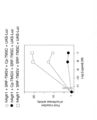
- FIG. 3 shows the signals detected by exogenously and transiently introducing multiple reporter assay constituent genes (NFAT-TMGV and SRF-TM3C) having different transcription regulatory regions into animal cells. The horizontal axis indicates the ligand concentration, and the vertical axis indicates the luminescence intensity output in each assay system.
- TMGV membrane-anchored artificial transcription factor
- TM3C protease.
- FIG. 4 shows signals detected by exogenously and transiently introducing a plurality of reporter assay constituent genes (SRF-TMGV and SRF-TM3C) having the same transcription regulatory region into animal cells.
- the horizontal axis indicates the ligand concentration, and the vertical axis indicates the luminescence intensity output in each assay system.
- TMGV membrane-anchored artificial transcription factor
- TM3C protease.
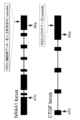
- FIG. 5 is an example of the configuration of the construct of the present invention.
- FIG. 6 shows a mechanism for measuring ligand activity in a genomically modified cell in which a cell membrane-anchored artificial transcription factor and a protease are knocked-in to the 3′UTR of the NR4A1 gene and the CTGF gene whose expression is induced by ligand stimulation, respectively.
- FIG. 6 shows a mechanism for measuring ligand activity in a genomically modified cell in which a cell membrane-anchored artificial transcription factor and a protease are knocked-in to the 3′UTR of the NR4A1 gene and the CTGF gene whose expression is induced by ligand stimulation, respectively.
- FIG. 7 is a diagram showing the results of detecting the activation of GPCRs (GPR55 and LPAR6) coupled to G12 / 13 by a ligand using the assay system of the present invention and the conventional method.
- the horizontal axis indicates the ligand concentration, and the vertical axis indicates the luminescence intensity output in each assay system.
- the assay system of the present invention showed overwhelming improvements (30 times or more) in both sensitivity and S / N ratio.
- the present invention can provide a sensitive assay system that can monitor the activation of a GPCR coupled to G12 / 13.
- FIG. 8 is a diagram showing that synergistic amplification of a signal actually occurs by using such a plurality of loci whose expression is induced.
- the horizontal axis indicates the ligand concentration
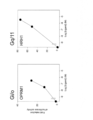
- the vertical axis indicates the luminescence intensity output in each assay system. This result is also consistent with the proof-of-concept experiment shown in FIG. FIG. 9 shows that the assay system of the present invention can monitor the activation of a GPCR coupled to a Gi / o G protein and the activation of a GPCR coupled to a Gq / 11 G protein. .
- the horizontal axis indicates the ligand concentration, and the vertical axis indicates the luminescence intensity output in each assay system. In the past, there was no good reporter system that could monitor Gi / o activation, but the present invention unexpectedly detected a signal due to Gi / o activation.
- FIG. 9 shows that the assay system of the present invention can monitor the activation of a GPCR coupled to a Gi / o G protein and the activation of a GPCR coupled to a Gq / 11 G protein.
- the horizontal axis indicates the ligand concentration
- FIG. 10 is a diagram showing that by using the G12 / s chimeric G protein, activation of a GPCR coupled to Gs can also be detected by the assay system of the present invention.
- Closed circles indicate the results of the cAMP @ response @ element (CRE) -reporter system, which was conventionally thought to be able to monitor the activation of Gs, but show the ⁇ 2 adrenergic receptor (Adrb2) and the adenosine 2A receptor (ADORA2A).
- CRE cAMP @ response @ element
- Adrb2A ⁇ 2 adrenergic receptor
- ADORA2A adenosine 2A receptor
- FIG. 11 is a diagram showing the results of detection of hSSTR2 activation by the assay system of the present invention.
- the left panel shows the results when no G12 / i chimeric protein was used, and the right panel shows the results in the presence and absence of the chimera. It should be noted that the scale of the vertical axis in the left and right figures differs by about 20 times.
- FIG. 12 is a diagram showing the results of detection of hFlt3 activation by the assay system of the present invention.
- the horizontal axis indicates the ligand concentration, and the vertical axis indicates the emission intensity output at each ligand concentration.
- FIG. 13 is a diagram showing the results of detection of activation of human EGF receptor by the assay system of the present invention.
- FIG. 14 is a schematic diagram illustrating an example of the method for identifying a gene whose expression is induced by activation of a certain protein in a certain cell, provided in the present invention.
- the gene expression response induced when G12 / 13 is specifically activated in the cells can be analyzed genome-wide using a next-generation sequencer.
- gene expression can be measured in four groups: no ligand addition (left) or ligand addition (right), no receptor overexpression (top), and receptor overexpression (bottom).
- FIG. 15 is a diagram showing detection of ligand-activated GPCRs (GPR55 and LPAR6) coupled to G12 / 13 by an assay system established using HEK293T cells of the present invention.
- the horizontal axis indicates the ligand concentration, and the vertical axis indicates the luminescence intensity output in each assay system.
- FIG. 16 shows activation of a GPCR (Adrb2) ligand coupled to a Gs-based G protein and GPCR coupled to a Gq / 11-based G protein (GPCR / Adq2) using an assay system established using HEK293T cells of the present invention.
- FIG. 3 is a diagram showing detection of activation of HRH1) by a ligand.
- FIG. 17 shows the results of the use of Gq / i1 and Gq / i3 chimeric proteins in an assay system established using HEK293T cells of the present invention, whereby GPCRs (OPRM1 and SSTR2) conjugated to Gi / o G proteins were used.
- FIG. 3 is a diagram illustrating detection of activation by a ligand.
- FIG. 18 is a diagram showing detection of ligand-activated receptor tyrosine kinases (Flt3 and EGFR) by an assay system established using HEK293T cells of the present invention.
- the binding of a ligand to a membrane protein activates a gene transcription regulatory region in a cell, thereby expressing a gene downstream thereof and producing a protein encoded by the gene.
- a plurality of independent genes gene 1, gene 2, gene 3, and gene N, in particular, whose expression is induced at almost the same time
- Attention is paid to the existence of the transcription control region 1, the transcription control region 2, the transcription control region 3, and the transcription control region N).
- a construct 1 in which a first target gene (a gene encoding a first factor) is linked in place of the gene 1 downstream of the transcription control region 1 is constructed, and Construct a construct 2 in which a second target gene (a gene encoding a second factor) is linked instead of the gene 2, and these constructs are introduced into cells.
- protein 1 is a cell membrane-anchored artificial transcription factor having a protease cleavage region and protein 2 is a protease
- signal transduction occurs by binding of a ligand to a membrane protein (for example, GPCR), and transcription occurs.
- the regulatory region 1 functions to express the cell membrane-anchored artificial transcription factor, and the expressed and generated transcription factor binds to the cell membrane.
- the transcription factor is inactive because it remains bound to the cell membrane.
- the transcription control region 2 functions and the protein 2 (protease) is expressed at the same time independently and in parallel with the activation of the transcription control region 1 by the signal transmission
- the protease is linked to the transcription factor. It acts on the protease cleavage region to separate transcription factors from the cell membrane.
- the transcription factor separated from the cell membrane translocates into the nucleus and becomes active.
- a construct (artificial transcription factor binding sequence-luciferase reporter" in FIG. 1) in which a sequence to which this active transcription factor binds (artificial transcription factor binding sequence) and a reporter gene are linked is prepared, and this is referred to as construct 1 and construct 2, the transcription factor thus cut off binds to the artificial transcription factor binding sequence, and the reporter gene downstream thereof is expressed.
- the action of the ligand on the membrane protein is converted to the product of the degree of activation of multiple signal transduction pathways caused by the binding of the ligand to the membrane protein, so that expression of the reporter gene in the construct where the reporter gene is present is present. Is detected by light emission or the like, a synergistically amplified output can be obtained. Therefore, since the ligand is equivalent to the test compound, the construct is appropriately constructed according to the purpose of the combination of the compound to be tested and the membrane protein, and introduced into cells. It is possible to investigate with high sensitivity how it acts on membrane proteins.
- the genes involved in the signal transduction pathway are not limited to the expression of the above genes 1 and 2, but may involve the 3rd,..., Nth genes. Therefore, in the present invention, in order to examine how the test compound affects the above system, N genes (1st to Nth genes) whose expression is induced at the same time phase by the activation of the membrane protein are examined. ), A construct in which nucleotide sequences encoding the first to Nth factors (the first to Nth nucleotide sequences, respectively) are operably linked to each other, or a combination thereof.
- molecules responsible for signal transduction refers to any molecule in which a change in one molecule results in a change in another molecule.
- molecules can include, but are not limited to, receptors such as G-protein coupled receptors, ion channels, and the like.
- expression is induced of a gene by an event means that the expression level of the gene when the event occurs and the expression level of the gene when the event does not occur A difference, preferably a significant difference.
- construct refers to one or more nucleic acids having a certain structure, preferably non-naturally occurring ones. Unless explicitly specified, "construct” refers to one or more constructs. Constructs are not limited to those that are isolated per se, but rather, when a foreign sequence is inserted into a longer nucleic acid (eg, genomic DNA), remove the non-naturally occurring structure containing the foreign sequence. In some cases, it refers to the part that has.
- a longer nucleic acid eg, genomic DNA
- chimera refers to a polypeptide containing all or a part of a first protein and all or a part of a second protein different from the first protein. Chimeras herein include those in which a portion of a first protein has been replaced with a corresponding portion of a second protein.
- activity refers to the function of a molecule in the broadest sense in the art. Activity generally includes, but is not limited to, the biological, biochemical, physical or chemical function of the molecule. The activity may be, for example, to activate, promote, stabilize, inhibit, suppress, or destabilize enzyme activity, the ability to interact with other molecules, and the function of other molecules. , Stability, and the ability to localize to a particular intracellular location.
- activation generally refers to the activation of a living body or biological material by its function.
- Activation of a protein refers to activation of the protein by some kind of stimulus or spontaneous activity. Raising the level to perform some function. Activation results in various biological phenomena, such as, for example, signal transduction.
- “ expression ”of a gene, a polynucleotide, a polypeptide, or the like means that the gene or the like undergoes a certain action in vivo to take another form.
- it means that a gene, a polynucleotide, or the like is transcribed and translated to form a polypeptide, but transcription is also an embodiment of expression of mRNA.
- the term "expression product” as used herein includes such a polypeptide or protein, or mRNA. More preferably, such forms of the polypeptide may have undergone post-translational processing.
- the “transcription regulatory region” is a sequence capable of controlling transcription initiation or transcription efficiency, and includes a promoter, an enhancer, a response element, a silencer and the like.
- the term “label” refers to a substance (eg, a substance that emits a substance, energy, an electromagnetic wave, or a certain optical signal, or the like) for distinguishing a target molecule or substance from others.
- Labels used in the present invention include, but are not limited to, luciferase, fluorescent proteins such as green fluorescent protein (GFP), beta-galactosidase, beta-lactamase, alkaline phosphatase, beta-glucuronidase, and the like.
- GFP green fluorescent protein
- beta-galactosidase beta-lactamase
- alkaline phosphatase alkaline phosphatase
- beta-glucuronidase and the like.
- the target can be modified using such a label so that the target can be detected by the detection means used. Such modifications are known in the art, and those skilled in the art can implement such methods as appropriate for the label and the intended target.
- enzyme is a general term for proteins that catalyze any reaction and mediates or promotes a chemical change in a living body without changing or decomposing itself.
- a substance that reacts with an enzyme is called a “substrate”, and in the present specification, the “substrate” is understood in the broadest sense.
- enzyme specificity For each enzyme, what substance is used as a substrate and what changes it are determined, and this is called enzyme specificity. In the present invention, such specificity can be used.
- introduction refers to the introduction of a nucleic acid or the like into cells, transformation, transfection, conjugation, protoplast fusion, electroporation, particle gun technology, calcium phosphate precipitation, Agrobacterium method, direct micro It can be realized by injection or the like.
- transcription factor refers to a protein or polypeptide that binds to a genomic locus of interest or a specific DNA sequence associated with a gene to control transcription. Transcription factors can promote (as an activator) or block (as a repressor) the recruitment of RNA polymerase to the gene of interest. Transcription factors can perform their function alone or as part of a larger protein complex.
- the mechanisms of gene regulation used by transcription factors include: a) stabilizing or destabilizing RNA polymerase binding, b) acetylation or deacetylation of histone proteins, and c) recruitment of coactivator or corepressor proteins. But are not limited to these.
- transcription factors play a role in biological activities including, but not limited to, basal transcription, enhancement of transcription, development, response to intercellular signaling, response to environmental cues, cell cycle control and pathogenesis.
- Latchman and DS (1997) Int. J. Biochem. Cell Biol. 29 (12): 1305-12; Lee TI, Young RA (2000), which is incorporated herein by reference in its entirety.
- the cell membrane-anchored transcription factor is an artificial transcription factor having a structure localized in the cell membrane. Examples of possible configurations of the cell membrane-anchored transcription factor include linking to the intracellular domain of a cell membrane protein, anchoring to the cell membrane from the inside of the cell via lipid modification such as palmitoylation, and the like. Not limited.
- cell membrane type or “membrane type” refers to containing or linked to any structure localized in the cell membrane.
- proteolytic enzyme is also called a proteolytic enzyme, and is a general term for an enzyme that catalyzes a reaction that hydrolyzes a peptide bond of a protein or the like.
- membrane protein refers to a protein present on the inner or outer surface of a cell membrane. Membrane proteins exist either embedded in cell membranes or loosely bound.
- the term “gene” refers to a factor that defines a genetic trait, and the term “gene” may refer to “polynucleotide”, “oligonucleotide”, and “nucleic acid”.
- protein protein
- polypeptide oligopeptide
- peptide refers to a polymer of amino acids of any length.
- This polymer may be linear, branched or cyclic.
- Amino acids may be natural or non-natural, and may be modified amino acids.
- the term may also include those assembled into a complex of multiple polypeptide chains.
- the term also includes naturally or artificially modified amino acid polymers.
- This definition also includes, for example, polypeptides containing one or more analogs of an amino acid (eg, including unnatural amino acids, etc.), peptidomimetic compounds (eg, peptoids) and other modifications known in the art. Is done.
- any of the amino acids in the amino acid sequence may be chemically modified. Further, any amino acid in the amino acid sequence may form a salt or a solvate. Further, any of the amino acids in the amino acid sequence may be L-type or D-type. Even in such cases, it can be said that the protein according to the embodiment of the present invention includes the above “specific amino acid sequence”.
- polynucleotide As used herein, the terms “polynucleotide”, “oligonucleotide” and “nucleic acid” have the same meaning and refer to a polymer of nucleotides of any length. The term also includes “oligonucleotide derivatives" or “polynucleotide derivatives". The term “oligonucleotide derivative” or “polynucleotide derivative” includes oligonucleotides or polynucleotides containing nucleotide derivatives or unusual bonds between nucleotides, and is used interchangeably.
- nucleic acid is also used interchangeably with gene, cDNA, mRNA, oligonucleotide, and polynucleotide.
- nucleotide may be natural or non-natural.
- homology of a gene refers to the degree of identity between two or more gene sequences, and generally having “homology” means that the degree of identity or similarity is high.
- Any protein, nucleic acid or gene used in the present invention may be a protein, nucleic acid or gene containing a sequence having homology to the specific sequence in addition to the specific sequence specifically mentioned, for example, It may be encoded by a nucleic acid having homology to a nucleic acid encoding a protein specifically described herein. Whether the two genes have homology can be determined by direct sequence comparison or, in the case of nucleic acids, a hybridization method under stringent conditions.
- the DNA sequences between the gene sequences are typically at least 50% identical, preferably at least 70% identical, more preferably at least 80%, 90% , 95%, 96%, 97%, 98% or 99% identical, the genes are homologous.
- the term “functional equivalent” means any entity having the same target function but a different structure from the original entity.
- Any protein or nucleic acid used in the present invention may preferably be a functional equivalent of the protein or nucleic acid specifically described herein.
- insertion, substitution or deletion of one or more amino acids, or addition of one or more amino acids to one or both terminals in an amino acid sequence can be used.
- the modified amino acid sequence may be, for example, an insertion, substitution or deletion of 1 to 30, preferably 1 to 20, more preferably 1 to 9, still more preferably 1 to 5, and particularly preferably 1 to 2 amino acids. Or an addition to one or both termini.
- the amino acid sequence may have one or more (preferably one or several or 1, 2, 3, or 4) conservative substitutions.
- conservative substitution means that one or more amino acid residues are substituted with another chemically similar amino acid residue so as not to substantially alter the function of the protein.
- Functionally similar amino acids that can make such substitutions are known in the art for each amino acid.
- Amino acids may be referred to herein by either their commonly known three letter symbols or by the one-letter symbols recommended by IUPAC-IUB Biochemical Nomenclature Commission. Nucleotides may also be referred to by the generally recognized one-letter code.
- BLAST a tool for sequence analysis, using default parameters.
- the search for the identity can be performed using, for example, NCBI's BLAST 2.2.28 (issued in 2013.4.2).
- the value of identity usually refers to a value when the above-mentioned BLAST is used and alignment is performed under default conditions.
- the highest value is used as the value of the identity.
- the identity is evaluated in a plurality of areas, the highest value among them is set as the identity value. Similarity is a numerical value calculated for similar amino acids in addition to identity.
- “several” may be, for example, 10, 8, 6, 5, 4, 3, or 2, or may be less than any of those values. It is known that polypeptides in which one or several amino acid residues have been deleted, added, inserted, or substituted with other amino acids maintain their biological activity (Mark et al., Proc. Natl Acad Sci USA 1984 Sep; 81 (18): 5566-5666., Zoller et al., Nucleic Acids Res. 1982 Oct 25; 10 (20): 6487-6500., Wang et al., Science. 29; 224 (4656): 1431-1433.). It is possible to select a protein having the same activity as that of the wild type from the mutant type protein into which a deletion or the like has been introduced, by performing various characterizations such as FACS analysis and ELISA.
- “90% or more” may be, for example, 90, 95, 96, 97, 98, 99, or 100% or more, within the range of any two values. Is also good.
- the “homology” may be calculated by calculating the ratio of the number of homologous amino acids in two or more amino acid sequences according to a method known in the art. Before calculating the ratio, the amino acid sequences of the amino acid sequence groups to be compared are aligned, and a gap is introduced in a part of the amino acid sequence as necessary to maximize the ratio of the same amino acid. Methods for alignment, percentage calculations, comparison methods, and their associated computer programs are well known in the art (eg, BLAST, GENETYX, etc.).
- homology can be represented by a value measured by NCBI BLAST unless otherwise specified.
- Blastp can be used as a default algorithm for comparing amino acid sequences with BLAST. The measurement result is quantified as Positives or Identities.
- the present invention refers to a biomolecule or substance (protein, nucleic acid, etc.), it can be preferably “purified” or “isolated”.
- the term “purified” substance or biological agent eg, nucleic acid or protein
- nucleic acid or protein refers to a substance or biological agent from which at least a part of a factor naturally associated with the substance or biological agent has been removed.
- the term “purified” as used herein preferably refers to at least 75%, more preferably at least 85%, even more preferably at least 95%, and most preferably at least 98% by weight of It means that the same type of biological factor is present.
- the substance or biological agent used in the present invention is preferably a "purified" substance.
- an “isolated” substance or biological agent eg, a nucleic acid or protein, etc.
- isolated does not necessarily have to be expressed in purity, as it will vary depending on its purpose, but if necessary, preferably at least 75% by weight, more preferably Means that at least 85%, even more preferably at least 95%, and most preferably at least 98% by weight of the same type of biological agent is present.
- the substance used in the present invention is preferably an "isolated" substance or biological agent.
- fragment refers to a polypeptide or polynucleotide having a sequence length of 1 to n ⁇ 1 with respect to a full-length polypeptide or polynucleotide (length is n).
- the nucleotide sequence used in the construct may be a fragment of another factor.
- the chimeric molecule may be a combination of a fragment of one element and a fragment of another element. The length of the fragment can be appropriately changed depending on the purpose.
- the lower limit of the length is 3, 4, 5, 6, 7, 8, 9, 10, 15, 20, 25, 30, 40, 50 and more amino acids, and lengths represented by integers not specifically recited herein (eg, 11 and the like) are also suitable as lower limits.
- nucleotides of 5, 6, 7, 8, 9, 10, 15, 20, 25, 30, 40, 50, 75, 100 and more nucleotides can be mentioned.
- a length represented by a non-integer integer (eg, 11, etc.) may also be appropriate as a lower limit.
- a cleavable linker as used herein is any linker that is cleaved by a protease, and includes, for example, those that are specifically cleaved by having a specific amino acid sequence.
- the present invention provides a means to investigate the effect of a compound on a molecule responsible for signal transduction.
- the molecule responsible for signal transduction is not particularly limited as long as the molecule transmits a signal downstream by activation of the molecule.
- the molecule responsible for signal transduction may be a molecule on which the test compound acts directly (eg, the receptor itself), or a molecule that is activated by signal transduction from the molecule on which the test compound acts to transmit a signal downstream (eg, , A protein coupled to a receptor).
- a molecule responsible for signal transmission a molecule that induces the expression of some gene downstream can be used.
- the molecule responsible for signal transduction includes, for example, proteins, nucleic acids, lipids, sugars, or complexes thereof, and is preferably a protein responsible for signal transduction.
- ⁇ Molecules responsible for signal transduction include membrane proteins that transduce signals into cells in response to stimulation by extracellular ligands.
- membrane proteins include receptors (GPCRs, enzyme-linked receptors, ion channel-linked receptors, etc.), channels, transporters, and cell adhesion molecules.
- the protein responsible for signaling is a GPCR or a G protein coupled to a GPCR.
- GPCRs are said to be present on the genome in a total of about 1,000 types, of which there are about 300 types of receptors other than odor receptors (recognizing bioactive substances), and ligands (substances that activate receptors). ) There are about 100 types of receptors for which unknown (orphan receptors).
- the GPCR may be a non-odor receptor GPCR.
- GPCRs are each coupled to a predetermined G protein, and signal transduction into cells is realized by transmitting the activation of the GPCR to the G protein.
- GPCRs are a group of receptor molecules having a characteristic seven-transmembrane structure. Receptors stimulated by ligands are heterotrimeric GTP-binding proteins (G protein: from three subunits of ⁇ , ⁇ , and ⁇ ). ) To the cell. G proteins are roughly classified into Gs, Gi, Gq and G12 / 13 based on the sequence of the ⁇ subunit, and GPCRs are “Gs-coupled GPCR”, “Gq-coupled GPCR”, and “Gi-coupled”, respectively. GPCRs "and” GPCRs that couple to G12 / 13 ".
- G proteins of each group may be simply described as Gs, Gi, Gq, and G12 / 13.
- mouse and rat and human GPCRs are highly homologous at the amino acid level (85% or more), but often significant differences are observed in the way they are activated by artificial ligands. If it is desired to know the effect of the above, it may be preferable to use a human GPCR.
- G proteins transmit signals downstream in different ways.
- the s of Gs derives from stimulation and Gs initiates the subsequent signaling cascade by activating the membrane enzyme adenylate cyclase.
- Gs also activates phospholipase A2 or phospholipase C to transmit signals into cells.
- CAMP produced by activated adenylate cyclase activates protein kinase A.
- Gi is also referred to as Gi / o, and i / o means an acronym for inhibition / other. Gi often suppresses the activity of adenylate cyclase and thus suppresses signals derived from Gs.
- Gi is involved in a wide range of signal transduction systems, such as activating phosphatidylinositol-specific phospholipase C ⁇ and phosphodiesterase via the ⁇ subunit.
- Gq performs signal transduction by activating phospholipase C ⁇ .
- G12 / 13 cross-talks with a signal transduction system via low molecular weight G proteins, Ras and Rho.
- GPCRs are also referred to as receptor molecules that are targeted by about 40% of marketed pharmaceuticals, and observation of GPCR activation by compounds is of great significance.
- G protein is activated by GPCR stimulation, the amount of second messenger in the cell changes. Therefore, there is a method for evaluating the activation state of GPCR by measuring the amount of second messenger, but there are problems in screening efficiency and cost. is there.
- a receptor to be evaluated is overexpressed in an animal cell, and a change in various gene expression induced when the cell is stimulated with a ligand. Often used.
- directly measuring mRNA or protein produced by the gene is cumbersome in experimental procedures and unsuitable for screening in which a large number of samples are used. Instead, a reporter assay using an exogenous reporter gene plasmid is performed.
- a reporter assay can be constructed as follows. 1) In a cell in which a receptor to be evaluated is overexpressed, a gene group whose expression level significantly increases before and after ligand stimulation is identified. 2) A gene having a high stimulus response ratio (expression amount after ligand stimulation / expression amount before ligand stimulation) is selected from this gene group, and the transcription regulatory region of the gene is identified. 3) Cloning the identified transcriptional regulatory region and preparing an artificial gene (exogenous reporter gene plasmid) having a reporter gene (eg, luciferase) ligated downstream thereof. 4) The above-mentioned artificial gene is exogenously transfected into a cell in which the receptor to be evaluated is overexpressed, and the activity of the exogenous reporter gene product before and after ligand stimulation is measured.
- the reporter assay is overwhelmingly simple compared to actually quantifying mRNA or protein, but when there is no gene group whose expression level increases significantly before and after ligand stimulation, or even if there is, the stimulus response ratio When only a low gene group exists, it is difficult to construct a highly sensitive reporter assay system.
- the activation state of the GPCR (the activation state of the G protein)
- the activation state of G12 / 13 and Gi / o can be monitored.
- No good reporter expression fluctuating gene
- Improvements in the reporter assay were needed to monitor G12 / 13 activation or Gi / o activation in the reporter assay.
- Gs activation could be monitored, for example, by the CRE-reporter system, but that activation of some Gs-coupled GPCRs was not detected by the CRE-reporter system. (See FIG. 10), and a system capable of monitoring GPCRs coupled to all Gs was required.
- the transcription regulatory regions of a plurality of genes whose expression is induced after stimulation of a receptor with a ligand are operably linked by intervening an enzymatic reaction, whereby each of the transcription regulatory regions has a “ligand”
- a highly sensitive reporter assay system that synergistically integrates the “stimulation response ratio of transcriptional activity before and after stimulation” is provided.
- the GPCRs that can be analyzed in the present invention may be one or more of the following, preferably substantially all.
- the activation of a protein is detected by integrating, through a plurality of factors, changes in the transcription regulatory region of a gene whose expression is changed by activation of the protein (for example, by stimulation with a ligand or an ion).
- a system is provided.
- the transcription regulatory regions of the first to Nth genes whose expression is induced by activation of a certain protein are operably linked to a nucleotide sequence encoding the first to Nth factors (N Is an arbitrary integer of 2 or more, and the letter N is used in this meaning as necessary.
- Each of the first to N-th factors may enhance the activity of at least one of the first to N-th factors different from the factor.
- a sequence encoding the first to Nth factors may be incorporated into the loci of the first to Nth genes on the genome, and the transcriptional regulatory region of the first to Nth genes and the first to Nth factors may be incorporated.
- a nucleic acid molecule operably linked to the coding sequence may be introduced.
- the assay system of the present invention may include a label whose expression is induced by at least one of the first to Nth factors.
- a label a molecule whose presence can be easily detected can be used.
- the label may be a protein, in which case a construct containing a sequence encoding the label may be used.
- Examples of the label include luciferase, green fluorescent protein (GFP), ⁇ -glucuronidase, ⁇ -galactosidase, ⁇ -lactamase, and alkaline phosphatase. Induction of the expression of the label may be due to activation of transcription of the label by the factor, or may be due to the action of enhancing the signal of another factor.
- GFP green fluorescent protein
- ⁇ -glucuronidase ⁇ -galactosidase
- ⁇ -lactamase ⁇ -lactamase
- alkaline phosphatase alkaline phosphatase
- n + 1 constructs are used.
- the “transcription regulatory region of gene # 2” The second construct (3) operably linked to the “gene encoding the enzyme (E1) of the enzymatic reaction”, the “transcription regulatory region of gene # 3” is used as the “enzyme using the S and E1 product P1 as a substrate.
- the third construct (4) operably linked to the "gene encoding (E2)” encodes an enzyme (E3) using "a transcriptional regulatory region of gene # 4" as a substrate for P1 and a product P2 of E2.
- Fourth construct operably linked to the "gene to do” ⁇ (N) The "transcription regulatory region of gene #N” is replaced with “enzyme (E (n-1)) using P (n-3) and product P (n-2) of E (n-2) as substrate.
- the N transcriptional regulatory regions have different “stimulation response ratios of transcriptional activity before and after ligand stimulation”. Can be constructed synergistically to create a highly sensitive reporter assay system.
- FIG. 2 shows a cell group (see FIG. 2) in which a plasmid expressing a cell membrane-type transcription factor and a plasmid expressing a protease were prepared, and each of them was exogenously transfected in various amounts (see FIG. 2). -Luciferase reporter gene has also been introduced exogenously).
- the ratio of luciferase activity between the two groups being compared is reported as a fold.
- the group into which the protease 10 cell membrane-type transcription factor 1000 was transfected was found. It showed about 190-fold higher luciferase activity than the group transfected with the protease 10 cell membrane transcription factor 1000.
- luciferase activity is defined by the product of the amount of the cell membrane transcription factor and the amount of the protease, the cell membrane transcription factor and the protease are driven by a constitutive promoter, It is not linked to a transcription regulatory region.
- a plurality of factors form a complex and activate another factor or label by forming a complex.
- Such factors can also be used. In this case, it is desirable that the reaction speed is relatively slow.
- a transcriptional regulatory region of a gene whose expression is induced by activating a molecule responsible for signal transduction can be used.
- the gene whose expression is induced by the molecule responsible for signal transduction may be different, but those skilled in the art can appropriately identify the gene by the method described herein.
- Expression-induced genes can be used that can detect differences when expression is induced, and by combining multiple genes, those that cannot be detected with sufficient sensitivity with each gene alone can be used It is.
- a gene whose expression is induced at least about 1.1 times, about 1.2 times, about 1.5 times, about 2 times, about 5 times, about 10 times, Alternatively, those which increase the expression level more than that can be used.
- a gene whose expression level is increased by about 5 to 10 times or more is used.
- identification of an expression-variable gene by comparison between four groups is described. However, even if a significant difference occurs between two groups, it can be used as a gene whose expression is induced.
- the expression level of the gene As the expression level of the gene, the number of cycles in quantitative PCR (eg, Ct value), the fluorescence intensity in a microarray, or the read count in RNA-Seq (the read count mapped to the gene) can be used. Those skilled in the art can appropriately normalize and use them as indices. For example, when measuring the gene expression level by RNA-Seq, the read count is determined by TMM, the median of the ratio, DEGES, FPKM (fragments per kilobase off of exon permillonreadsmapperplopemailplopemailplopemailplopemailplopemailplopemailplopemailplopemailplopemailplopemailplopemailplopemailplopemailplopemailplopemailplopemailplopemailplopemailplopemailplopemailplopemailplopemailplopemailplopemailplopemailplopemailplopemailplopemailplopemailplopemailplopemailplopemailplopemailplopemailplopemailplopemailplope.
- the basal expression level of the expression-variable gene varies depending on the gene and is preferably large.
- the gene can be used if the FPKM value in RNA-Seq analysis is about 1 or more. More preferably, the gene has an FPKM value of about 5 to 10 or more in RNA-Seq analysis. In general, FPKM is expressed as 10 at high expression, 5 at medium expression, and 1 at low expression.
- the first to N-th genes whose expression is induced may not be all different. That is, different factors may be operably linked to the transcription regulatory region of the same gene.
- the transcription control regions of two or more genes selected from the group consisting of ARC, CCL20, CTGF, DUSP5, EGR1, EGR2, EGR3, FOSB, NR4A1, NR4A3, CYR61 and FOS are used as the genes. be able to.
- transcriptional regulatory regions of CTGF and NR4A1 can be used when the cells are HeLa cells
- transcriptional regulatory regions of FOS and FOSB can be used when the cells are HEK293T cells.
- the expression induction response is about 10 times or more.
- 10 candidate genes were obtained by genome-wide expression analysis (out of about 22,000 genes) (shown in Table 2-1 below).
- genes whose expression is induced include, for example, ABHD13, ABL2, ACKR3, ACTG1, ADAMTS1, ADAMTS5, ADAP1, ADM, ADRB2, AEBP2, AEN, AHR, AKAP2, ALDH1B1, ALPK2, ANKRD1, ANKRD33B, AP1AR, ARC , AREG, ARHGAP23, ARHGAP28, ARHGAP32, ARHGDIB, ARID5B, ARL5B, ATF3, ATP2B1, ATXN7, BACH1, BCL10, BHLHE40, BIRC3, BMP2, BMPR1B, BTG2, C19orf71, C1QTNF1, C8C4, C1CTNC1, C8CC4 , CCNL1, CCNT1, CD83, CDC42EP2, CDC42SE1, CDH5, CDKN1A, CDKN2AIP, CEBPD, CHD1, CHD2, CITED2, CITED4, CMIP, CNN
- examples of the gene whose expression is induced include the following. NR4A2, LOC100506747, NR4A1, EPPK1, JUN, AMOTL2, FLNA, ARC, IER2, JUNB (at least 5 times more expression variation in any experiment); and CNN2, DUSP1, MAFF, GPR3, TPM1, PTGS2, ATF3, G0S2, TRIB1, SNAI2, PDLIM7, NFKBIZ, TIMP3, FHL2, SPRY2, FOSL2, FERMT2, VCL, NUPR1, TPM4, GRASP, NKX2-5, TUFT1, ID1, FOSL1, MYADM, ACTB, LPP, KLF7, KLF6, ADAMTS1, BTG2, ACTG1, CSRNP1, WDR1, SRF, GEM, ZYX, NR2F1, LOC101928358, ITPRIP, FUT1, COL3A1, LIMA1, SLC8A1, JAG1, SLC6A9, PMA101, SLC2
- a transcription factor can increase the expression of a label or the expression of another factor.
- the transcription factor may be, for example, an artificial transcription factor.
- artificial transcription factors include those described in the following table, each of which binds to the DNA sequence shown in the right column.
- a label or other agent can be operably linked to the DNA sequence.
- the transcription factor may be configured to be expressed in an inactivated state. "Inactivation” is achieved, for example, by the transcription factor not migrating into the nucleus where transcription takes place, or being in an inactive state (eg, a dephosphorylated state). Can be done. By expressing the transcription factor in such a state, synergistic enhancement of the signal with the expression of the second factor can be expected.
- a cell membrane-anchored transcription factor can be used as the transcription factor.
- the cell membrane-anchored transcription factor may be obtained by linking an arbitrary molecule localized in the cell membrane to the transcription factor.
- a molecule that is localized in a cell membrane and a transcription factor may be expressed as a fusion protein containing a peptide linker as necessary.
- the linker may be a cleavable linker, for example, it may have a sequence that is specifically cleaved by a protease described below.
- Examples of configurations that can be taken by the cell membrane-anchored transcription factor other than those described above include anchoring the transcription factor from the inside of the cell to the cell membrane via lipid modification such as palmitoylation.
- the transcription factor can be used as a cell membrane-anchored transcription factor.
- a factor having an activity of changing a transcription factor expressed in an inactivated state to an active state can be used.
- such factors may have the activity of dissociating transcription factors from cell membranes.
- those skilled in the art can select and use an appropriate factor.
- a protease preferably, a protease specific for the linker sequence
- a protease specific for the linker sequence can be used.
- protease for example, 3C (also referred to as HRV 3C protease and Precision protease), TEV protease (Tobacco Etch Virus Protease), caspase 3/7, enterokinase, caspase 8, PSA (prostate-specific lipase-associated or anti-lipase antigen-3) (KLK3), SARS 3CL1 (3C-like proteinase from SARS coronavirus), factor Xa protease, and thrombin, but are not limited thereto.
- 3C also referred to as HRV 3C protease and Precision protease
- TEV protease tobacco Etch Virus Protease
- caspase 3/7 enterokinase
- caspase 8 prostate-specific lipase-associated or anti-lipase antigen-3) (KLK3)
- SARS 3CL1 SARS 3CL1 (3C-like proteinase from SARS coronavirus
- the factor having an activity of changing a transcription factor to an active state may be of a cell membrane type.
- a cell membrane-type factor may be linked to a structure localized in the cell membrane, or may include a structure localized in the cell membrane.
- the structure of the cell membrane-type factor the structure localized in the cell membrane in the cell membrane-anchored transcription factor described in the present specification can be similarly used.
- Examples of possible configurations of the cell membrane type factor include linking the factor (eg, protease) to the intracellular domain of a cell membrane protein, or anchoring the cell membrane from the inside of the cell via lipid modification such as palmitoylation.
- the factor can be used as a cell membrane type factor.
- the substrate cell membrane transcription factor
- the enzyme cell membrane protease
- two different loci can be selected from the above gene list (HeLa cells) whose expression is induced.
- a cell membrane-anchored artificial transcription factor and a protease can be knocked in to the 3′UTR of those loci (FIG. 5).
- FIG. 5 HeLa cells whose genome has been modified so that the expression of the cell membrane-anchored artificial transcription factor and protease are induced by GPCR stimulation (FIG. 6).
- the cell when the cell is HEK293T, by knocking in a cell membrane type artificial transcription factor and a protease into the 3′UTR of two different selected loci (FOS locus and FOSB locus), An indicator cell having the same function as the HeLa cell can be created.
- the ligand activity of the test compound can be measured as follows. 1.
- the Luciferase and the target GPCR gene are introduced into the reporter cells. 2.
- the genome of the cells used in the assay has been modified in advance so that the expression of the membrane-anchored artificial transcription factor and protease is induced by the GPCR stimulation. 3.
- GPCR-stimulated transcription factors and proteases synergistically induce luciferase expression.
- a construct or combination of constructs is provided for investigating the effect of a test compound on a protein responsible for signaling.
- the construct or a combination of constructs encodes the first to Nth factors, respectively, operably linked to the transcriptional regulatory regions of the first to Nth genes whose expression is induced by activation of a protein responsible for signal transduction. It may include the first through Nth nucleotide sequences. N is an integer of 2 or more. Also provided is a combination of constructs comprising the construct or combination of constructs, and a construct comprising a nucleotide sequence encoding a label configured to cause expression by at least one of the first to Nth factors. obtain.
- kits may also be provided as kits.
- a kit for investigating the effect of a test compound on a protein responsible for signal transduction is provided, and the kit may include the above-described construct or a combination of the above-described constructs.
- a kit may be provided for investigating the effect of a test compound on a protein responsible for signaling, wherein the kit comprises a plurality of tandemly related factors.
- the kit (1) a first construct in which a transcription regulatory region of a first gene is linked to a nucleotide sequence encoding a substrate (S) for an enzyme reaction; (2) A construct in which the transcription control region of the second gene is linked to a nucleotide sequence encoding an enzyme (E1) for an enzyme reaction, wherein a product P1 is produced by an enzyme reaction between S and E1.
- a second construct When N is 3 or more, for each of n which is a natural number of 3 to N, (N) linking the transcription control region of the n-th gene to a gene encoding an enzyme (E (n-1)) that produces a product (P (n-1)) using P (n-2) as a substrate; And the n-th construct; (N + 1) a reporter gene construct configured to activate a reporter gene by a product P (N-1) of an enzymatic reaction, wherein each of the first to N-th N genes comprises the test compound Wherein the expression is induced by stimulation of the protein by N, wherein N is a natural number of 2 or more and n is a natural number from 1 to N.
- the kit can further include a construct encoding a chimeric G protein ⁇ subunit described herein.
- the kit may further comprise an agent for introducing the construct or combination of constructs into a cell, or for forming a construct or combination of constructs in a cell.
- cells include HeLa cells, HEK293 cells, CHO cells, COS-1 / 7 cells, HL60 cells, K562 cells, Jurkat cells, HepG2 cells, Saos-2 cells, F9 cells, C2C12 cells, PC12 cells, and NIH / 3T3 cells, U2OS cells, Vero cells, MDCK cells, MEF cells, U937 cells, C6 cells, Neuro2A cells, SK-N-MC cells, SK-N-SH cells, HUVEC cells, THP-1 cells, BW5147 cells, Ba / F3 cells, Y-1 cells, H295R cells, MIN6 cells, NIT-1 cells, and one or more cells selected from the group consisting of MDA-MB435S cells can be used.
- the cell of the present invention may contain, in addition to the assay system described herein, a chimeric G protein described herein or a nucleic acid encoding the same.
- the cell of the present invention may be one in which a molecule responsible for desired signal transduction (or a molecule that activates a molecule responsible for signal transduction, for example, a receptor) is overexpressed.
- the cells of the present invention can be prepared by introducing a plurality of nucleic acid molecules constituting the assay system described in the present specification. That is, a nucleic acid sequence encoding the first to Nth factors operably linked to the transcriptional regulatory regions of the first to Nth genes whose expression is induced by activating a molecule responsible for signal transduction in the cell line.
- One or more nucleic acid molecules can be made by introducing them into cells.
- nucleic acid into cells can be performed by lipofection, gene gun, calcium chloride method, calcium phosphate precipitation, conjugation, protoplast fusion, electroporation, Agrobacterium method, virus infection, direct microinjection and the like.
- the cells of the present invention can be prepared by incorporating the first to Nth factors into the endogenous first to Nth gene loci to form a construct in the cells.
- a technique known in the art can be used, for example, a genome editing technique can be used.
- CRISPR-Cas9 system zinc finger nuclease, TALEN, PPR nuclease, Homologous recombination (homologous recombination), a modification method thereof, and the like can be used.
- CRISPR-Cas9 system zinc finger nuclease, TALEN, PPR nuclease, Homologous recombination (homologous recombination), a modification method thereof, and the like can be used.
- a cell expressing a protein responsible for signal transduction, wherein each of the cells is operably linked to a transcription regulatory region of a first to Nth genes whose expression is induced by activation of the protein.
- N is an integer of 2 or greater.
- the cell may express a protein responsible for signal transduction and may contain a plurality of linearly related factors.
- cells (1) a first construct in which a transcription regulatory region of the first gene is linked to a gene encoding a substrate (S) for an enzyme reaction; (2) A construct in which the transcription control region of the second gene is linked to a gene encoding an enzyme (E1) for an enzymatic reaction, wherein a product P1 is produced by an enzymatic reaction between S and E1.
- N 3 or more, for each of n which is a natural number of 3 to N, (N) linking the transcription control region of the n-th gene to a gene encoding an enzyme (E (n-1)) that produces a product (P (n-1)) using P (n-2) as a substrate; And the n-th construct; A reporter gene construct configured to activate the reporter gene by the product of the (N + 1) enzymatic reaction P (N-1), wherein each of the first to Nth N genes comprises The expression is induced by activation, where N is a natural number of 2 or more, and n is a natural number of 1 to N.
- kits comprising a plurality of cells, each expressing a different membrane protein, wherein each of the plurality of cells has a characteristic described herein.
- the kit may be for comprehensively analyzing the effect of a test compound on a membrane protein.
- a method for analyzing the action of a test compound on a membrane protein comprising using the cell described herein or the kit described herein.
- a step of transfecting a cell with a membrane protein or a GPCR a step of transfecting the gene with a transcriptional regulatory region of each gene at the loci of the first to Nth genes whose expression is induced. Introducing the first to Nth nucleotides so as to be operably linked.
- the cell of the present invention is a cell that expresses a membrane protein, A first nucleotide sequence operably linked to a transcription regulatory region of a first gene whose expression is induced by activation of the membrane protein, wherein the nucleotide sequence encodes a cell membrane-anchored transcription factor; A second nucleotide sequence operably linked to a transcription regulatory region of a second gene whose expression is induced by activation of the membrane protein, the nucleotide sequence encoding a protease; A nucleotide sequence encoding luciferase configured to cause expression by the transcription factor, wherein the membrane protein is a G protein-coupled receptor, an enzyme-linked receptor, an ion channel-linked receptor.
- the cell membrane-anchored transcription factor is a cell comprising a cleavable linker that is cleaved by the protease between the cell membrane anchor portion and the transcription factor portion.
- Such cells include HeLa cells or HEK293T cells.
- the first gene is NR4A1
- the second gene is CTGF.
- the cells are HEK293T cells, for example, the first gene is FOS and the second gene is FOSB.
- the present invention also provides a chimeric G protein, a nucleic acid encoding the same, a cell expressing the same, and a method for using the same.
- chimeric G protein ⁇ subunits and chimeric G proteins containing the same Since the orientation of the G protein to the receptor is determined by the amino acid sequence at the C-terminus of the G ⁇ subunit, the use of a chimeric G protein activates a GPCR coupled to a certain G protein and activates a different G protein. It becomes possible to detect using an intracellular signal generated at the time of conversion.
- the present invention provides a chimeric G protein ⁇ subunit in which the C-terminal amino acid sequence of a certain G12 / 13 ⁇ subunit is replaced with an amino acid sequence of a different G protein ⁇ subunit.
- G ⁇ subunits include G ⁇ s, G ⁇ i and G ⁇ q, but preferably G ⁇ s subunit.
- the range to be replaced as chimera may be up to about 50 amino acids, up to about 40 amino acids, up to about 30 amino acids, up to about 20 amino acids, or up to about 10 amino acids on the C-terminal side of the ⁇ 12 subunit of G12 / 13. , Preferably 6 amino acids.
- the chimeric G protein provided by the present invention can be used in a method for investigating the effect of a test compound described herein on a protein responsible for signal transduction.
- the construct described herein can be used in combination with a chimeric G protein (or a construct encoding the same).
- a chimeric G protein can be further expressed in a cell containing the above-described construct, and a signal from a GPCR coupled to a G protein other than G12 / 13 (eg, Gs) is detected in the same manner as a signal from G12 / 13. Can be detected in the system.
- the chimeric G protein may comprise an ⁇ subunit having the sequence of SEQ ID NO: 6, the sequence of SEQ ID NO: 8, or a sequence having at least about 90% sequence identity thereto, or a fragment thereof.
- One embodiment is a chimeric G protein ⁇ subunit, wherein the amino acid sequence of the first G ⁇ subunit belonging to G ⁇ 12 / 13 has a C-terminal amino acid sequence different from that of the first G ⁇ subunit.
- G ⁇ s can be used.
- About 6 amino acids at the C-terminus can be replaced with the amino acid sequence of a different Ga subunit.
- Chimeric G proteins comprising these chimeric G protein ⁇ subunits are also provided.
- a complex comprising a chimeric G protein and a GPCR conjugated to the chimeric G protein, or a cell comprising the same is provided.
- the cell may further comprise a construct described herein. These cells can be used for functional analysis of GPCR.
- the chimeric G protein can also be provided as a construct containing the nucleotide sequence encoding it.
- the present invention provides a method for identifying a gene whose expression is induced by activating a protein responsible for signal transduction in a certain cell.
- the activatable gene found by this method can be used in a comprehensive assay of the protein of the present invention and can be used as a part of the construct of the present invention.
- This method of the present invention can be used to investigate the interaction between a protein responsible for signal transduction and a test compound.
- the method comprises the steps of obtaining a gene expression level in a cell when the cell expressing the protein is contacted with an activator of the protein, and obtaining a gene expression level in the cell when the cell is not contacted with the activator. And a step of selecting, as a candidate gene, a gene whose expression increases when it is brought into contact with the activator as compared to when it is not brought into contact with the activator.
- a method for identifying a gene whose expression is induced by activation of a molecule in a cell in order to investigate the effect of a test compound on a molecule responsible for signal transduction.
- the method comprises the steps of: obtaining a gene expression level in a cell when the cell expressing the molecule is contacted with an activator of the molecule; and obtaining the level of gene expression in the cell when the cell is not contacted with the activator. Obtaining a gene expression level.
- the method may include a step of selecting, as a candidate gene, a gene whose expression increases when it is brought into contact with the activator as compared with when it is not brought into contact with the activator.
- a method for identifying a gene whose expression is induced in a cell by activation of a molecule responsible for signal transduction, wherein the method is characterized by a comparison between four groups.
- the method comprises the steps of obtaining a gene expression level in a cell when the cell expressing the molecule is contacted with an activator of the molecule, Obtaining a gene expression level in the cell when the cell expressing the molecule is not contacted with an activator; A step of obtaining a gene expression level in a cell when the cell that does not express the molecule is brought into contact with an activator of the molecule, Obtaining the level of gene expression in the cell when the cell that does not express the molecule is not contacted with an activator of the molecule.
- the method may include a step of selecting, as a candidate gene, a gene whose expression increases when a cell expressing the molecule is brought into contact with an activator of the molecule as compared with other cases.
- G A GPCR that specifically couples to the G protein G12 / 13 can be used as a molecule responsible for signal transduction.
- the method may be for the production of an assay cell, in which the cell is incorporated by incorporating a nucleotide sequence into the locus such that it is operably linked to the transcriptional regulatory region of the candidate gene. It is possible to manufacture.
- Measurement of gene expression can be performed by any method known in the art.
- techniques for measuring the expression level of a gene include microarray, RNA-Seq, and quantitative PCR.
- RNA-Seq can be employed.
- the sequencing method is not limited as long as the sequence of the nucleic acid sample can be determined, and any method known in the art can be used, but it is preferable to use next-generation sequencing (NGS).
- Next-generation sequencing includes, but is not limited to, pyrosequencing, sequencing by synthesis (sequencing bi-synthesis), ligation sequencing, ion semiconductor sequencing, and the like.
- the gene identification method of the present invention refers to, for example, “next-generation sequencer: advanced method for each purpose” (Cell Engineering Separate Volume) and references such as Cold Spring Harb Protoc. 2015 Nov; 2015 (11): 951-969. Can be implemented as appropriate.
- the present invention can be used to comprehensively investigate the effect of a test compound on a membrane protein. Exhaustive investigations are useful not only to investigate the effect on a specific intended target, but also to detect the effect on a molecule different from the intended target, ie, off-target activity. By examining the effect on a specific target, the usefulness of the test compound to a drug or the like can be examined. In addition, the safety test or toxicity test of the compound can be conducted by detecting the off-target activity. Therefore, the present invention is useful for supporting drug discovery. In one use, binding of a test compound that activates a target receptor to one or more receptors, including the target receptor, can be screened.
- Receptors that can be screened for binding can target those listed herein, but include, for example, GPCRs (eg, GPCRs conjugated to G12 / 13 that have been difficult to detect until now). can do.
- the GPCR contains a receptor relating to taste (eg, a bitter receptor). For example, by examining the effect on the bitter receptor, the taste characteristics of the test compound can be determined. Extensive screening can also target so-called orphan receptors whose ligands are unknown. In addition, it is also possible to detect the activation of receptor tyrosine kinases, as shown in the examples herein.
- Example A1 Reporter system using transcription regulatory region sequences of multiple genes whose expression is induced>
- This example shows that a signal is amplified by exogenously and transiently introducing a plurality of reporter assay component genes having different transcription regulatory regions into animal cells. More specifically, a plurality of reporter assay constituent genes having different transcription regulatory regions (in this experiment, NFAT (nuclear factor of activated T-cells) transcription regulatory region and SRF (serum response factor) transcription regulatory region) are exogenously added. It shows that the signal is amplified by transiently introducing it into animal cells.
- NFAT nuclear factor of activated T-cells
- SRF serum response factor
- Angiotensin type 1 receptor (hAgtr1) belonging to the group of GPCRs is activated by its ligand, angiotensin II, independent of the cell type used in the assay (almost common to all cell types), and is NFAT (nuclear factor). It is already known to increase the expression of a gene having an activated T-cells transcription regulatory region or an SRF (serum response factor) transcription regulatory region. Thus, the following two artificial genes (TMGV and TM3C) were prepared as factors linked to these two transcription control regions.
- TMGV transmembrane Gal4VP64
- LUVLFQGP HRV protease 3C recognition cleavage sequence
- the amount of sGV produced can be quantified using a reporter gene called UAS-luciferase in which luciferase is linked to the UAS sequence (UAS is an sGV binding sequence: luciferase expression is induced by binding of sGV). .
- hAgtr1 + NFAT-TMGV + SRF-TM3C + UAS-luciferase In both TMGV and TM3C, expression is induced by ligand stimulation
- ⁇ Cells used HeLa cells
- Example A2 Use of multiple reporter assay constituent genes having the same transcription regulatory region sequence> [Overview]
- a signal was obtained by exogenously and transiently introducing a plurality of reporter assay component genes having the same transcription regulatory region (in this experiment, a SRF (serum response factor) transcription regulatory region) into an animal cell. The purpose is to indicate amplification.
- SRF serum response factor
- Angiotensin type 1 receptor (hAgtr1) belonging to the GPCR group is activated by its ligand, angiotensin II, and is independent of the cell type used in the assay (almost common to all cell types), and is SRF (serum response). It is already known to increase the expression of genes having a transcriptional regulatory region.
- hAgtr1 + SRF-TMGV + SRF-TM3C + UAS-luciferase In both TMGV and TM3C, expression is induced by ligand stimulation
- ⁇ Cells used HeLa cells
- Example A3 Establishment of indicator cells used in a novel GPCR assay system that can assay GPCRs coupled to G12 / 13 with high sensitivity> [Overview] Since a transcription regulatory region that responds with a high response ratio before and after activation of the G12 / 13 protein has not been elucidated at present, it is difficult to evaluate a GPCR that couples to the G12 / 13 using an ordinary reporter assay system. Therefore, it was verified whether the evaluation of the GPCR coupled to G12 / 13 can be performed by utilizing the knowledge obtained in the above-described example.
- GPCRs and methods The GPCR stimulated by the ligand transmits a signal into the cell via a heterotrimeric GTP-binding protein (composed of three subunits of G protein: ⁇ , ⁇ , and ⁇ ). G proteins are roughly classified into Gs, Gi, Gq, and G12 / 13 based on the sequence of the ⁇ subunit, and GPCRs are “Gs-coupled GPCR”, “Gq-coupled GPCR”, and “Gi-coupled”, respectively. GPCRs "and” GPCRs that couple to G12 / 13 ".
- Gene transcription is often coordinately controlled by multiple transcription regulatory regions located at different locations on the chromosome. If it is possible to focus on a gene whose expression is induced with a very high stimulus response ratio before and after ligand stimulation, clone one of the multiple transcription regulatory regions of that gene and create an artificial reporter gene plasmid based on it. However, there is a possibility that a reporter assay system having a sufficient stimulus response ratio can be constructed. However, when focusing on a gene that originally has only a moderate stimulus response ratio as in this case, one of the multiple transcription regulatory regions of that gene was cloned to create an artificial reporter gene plasmid. May not be able to construct a reporter assay system with a sufficient stimulus response ratio.
- the reporter system itself ie, TMGV and TM3C
- the reporter system itself is knocked in to the 3′UTR of the gene # 1 and the gene # 2 to thereby convert the reporter system itself into a cell.
- IRES internal ribosomal entry site
- the indicator HeLa cells were prepared as follows with reference to the genome editing procedure described in Suzuki K et al Nature 540: 144-149,2016.
- a flox-Blastcidin resistance gene cassette (N-terminal side of IRES-TMGV) A plasmid in which the same sequence as the nucleic acid sequence (for the first target site) recognized by CRISPR on the genome is added to both ends of the plasmid, in which both sides of the Blastcidin resistance gene cassette are previously ligated with loxP. Constructed with pBlueScript backbone.
- the nucleic acid sequence is as follows: (CRISPR recognition sequence: for first target site)-(flox-Blastcidin cassette)-(IRES-TMGV)-(CRISPR recognition sequence: for first target site)
- TMGV donor plasmad DP-TMGV
- Plasmid necessary for causing double-strand break (DSB) at the target site (first target site) of the genome using CRISPR is designated as pX330-U6-Chimeric_BB-CBh-hSpCas9. (Addgene # 42230) was constructed based on (pV330-1 st target).
- HeLa cells were seeded at 5 ⁇ 10 5 cells in a 6 cm dish, and the next day after seeding, “pV330-1 st target 3 ⁇ g + DP-TMGV 0.03 ⁇ g” was transiently transfected by lipofection.
- Blastcidin was added to the cell culture solution at a concentration of 10 ⁇ g / ml, and the cells were cultured for about two weeks.
- HeLa cells grown in the presence of Blastcidin were limiting-diluted and cloned.
- Cre recombinase was transiently transfected into a clone in which the (flox-Blastcidin cassette)-(IRES-TMGV) gene fragment had been inserted into the target site (seed cells were seeded at 5 ⁇ 10 5 cells in 6 cm dish)
- the next day after seeding iCre-IRES-puromycin expression plasmid (lipofection with 3 ⁇ g) was added, and from the day after gene introduction, puromycin was added to the cell culture at a concentration of 10 ug / ml and cultured for 3 days.
- the Blastcidin cassette is removed from the genome, and only the IRES-TMGV is inserted into the target genome site (first target site).
- GPR55 is known as a GPCR specifically coupled to G12 / 13. Therefore, a plasmid cocktail of GPR55 expression plasmid + TM3C expression plasmid + UAS-luciferase was transfected into each of the established clones (60 ng, 10 ng, and 30 ng of lipofection in each well of a 96-well plate). Were stimulated for 6 hours with LPI (lysophosphatidylinositol: using 3 concentrations of 3 uM, 300 nM, 0 nM).
- LPI lysophosphatidylinositol: using 3 concentrations of 3 uM, 300 nM, 0 nM).
- the nucleic acid sequence is as follows: (CRISPR recognition sequence: for second target site)-(flox-Neomycin cassette)-(IRES-TM3C)-(CRISPR recognition sequence: for second target site)
- TM3C donor plasmad DP-TM3C
- plasmid necessary for inducing DSB at the target site (second target site) of the genome was constructed based on pX330-U6-Chimeric_BB-CBh-hSpCas9 (Addgene # 42230) ( pV330-2 nd target).
- N182 cells were seeded at 5 ⁇ 10 5 cells in a 6 cm dish, and the next day, “pV330-2 nd target 3 ug + DP-TM3C 0.03 ug” was transiently transfected by lipofection.
- G418 was added to the cell culture at a concentration of 1 mg / ml and cultured for about two weeks.
- N182 cells grown in the presence of G418 and puromycin were subjected to limiting dilution and monocloned.
- the genome was recovered from each of the cloned clones, and it was confirmed by the genomic PCR method whether the IRES-TM3C gene fragment was inserted into the target site (second target site).
- Clones in which the IRES-TM3C gene fragment was inserted into the target site were further selected by the following method: A GPR55 expression plasmid + UAS-luciferase plasmid cocktail was transfected into each established clone (96-well plate). The cells were stimulated for 6 hours with LPI (lysophosphatidylinositol: 3 uM, 300 nM, 0 nM, 3 concentrations), which is a ligand of GPR55, 24 hours after gene transfer, for 60 hours and 30 ng per well, respectively. After the stimulation, the culture supernatant was discarded, a substrate for luciferase was added, and the luminescence signal was measured with a plate reader. This assay identified a clone that responded most sharply to LPI stimulation (this clone is hereafter referred to as NCP19).
- LPI lysophosphatidylinositol
- Plasmids to be used (1) Plasmid expressing GPCR to be evaluated (GPCR expression plasmid) (2) UAS-luciferase (artificial reporter gene whose luciferase expression is induced by sGV)
- Procedure Day 1 NCP19 cells are seeded at a density of 24000 cells / well in a 96-well plate.
- Day 3 Stimulation of cells with ligand 24 hours after gene transfer. After stimulation for 6 hours, the culture supernatant is discarded, a substrate for luciferase is added, and the luminescence signal is measured with a plate reader.
- GPCRs the following receptors: GPR55 (G12 / 13), LPAR6 (G12 / 13), OPRM1 (Gi / o), SSTR2 (Gi / o), HRH1 (Gq / 11), GPR119 (Gs), Adrb2 ( Gs) and ADORA2A (Gs).
- GPR55 and LPAR6 were also detected by conventional methods. Details are as follows. Cells used: HeLa cells (purchased from ATCC), plasmids using HEK293T cells (1) Plasmid expressing GPCR to be evaluated (GPCR expression plasmid) In this experiment, GPR55 and LPAR6 expression plasmid (2) SRF-luciferase
- HeLa cells or HEK293T cells were seeded at a density of 24000 cells / well in a 96-well plate.
- This assay system differs from the assay system utilizing NCP19 cells in that the protease is introduced exogenously via a plasmid that expresses the protease with a constitutive promoter. More details are as follows.
- Plasmid to be used (1) Plasmid expressing GPCR to be evaluated (GPCR expression plasmid) In this experiment, GPR55 and LPAR6 expression plasmid (2) TM3C expression plasmid (plasmid that expresses protease with a constitutive promoter) (3) UAS-luciferase
- N182 cells were seeded at a density of 24000 cells / well in a 96-well plate.
- Gs GPR119
- Adrb2 Gs
- ADORA2A Gs
- HeLa cell Plasmid used (1) Plasmid expressing GPCR to be evaluated (GPCR expression plasmid) In this experiment, GPR119, Adrb2 and ADORA2A expression plasmids (2) CRE-luciferase
- FIGS. 7 to 11 show signals (luminescence intensity / fold change from the signal at the lowest concentration of ligand) obtained from each assay system by addition of each concentration of ligand. With the above assay protocol, an increase in signal with increasing ligand concentration was observed.
- GPCR coupled to Gq and “GPCR coupled to Gi” could be evaluated by the same assay protocol (FIGS. 9 and 11).
- the activation of the GPCR coupled to the three tested Gss could not be detected by the conventional CRE-reporter assay, but a signal was detected in GPR119 by the above assay protocol (FIG. 10).
- Example A4 Detection of activation of receptor tyrosine kinase Flt3>
- the purpose of this example is to show that the activation status of not only GPCR but also other receptors can be monitored by an assay system using NCP19 cells.
- human Flt3 (hFlt3) belonging to the receptor tyrosine kinase family was used as an experimental object as an example of a cell membrane receptor other than GPCR.
- NCP19 cells were seeded at a density of 24000 cells / well in a 96-well plate.
- Day 3 Stimulation of cells with ligand 24 hours after gene transfer (Flt3-Ligand: at concentrations of 30, 3, 0.3, 0.03, 0 ng / ml). After stimulation for 6 hours, the culture supernatant was discarded, a substrate for luciferase was added, and the luminescence signal was measured with a plate reader.
- Example A5 Detection of activation of human EGF receptor>
- the purpose of this example is to show that the activation status of not only GPCR but also other receptors can be monitored by an assay system using NCP19 cells.
- a human EGF receptor belonging to the receptor tyrosine kinase family was set as an experimental object.
- hEGFR, hErbB2 and hErbB3 which are human EGF receptors are endogenously expressed in NCP19 cells.
- NCP19 cells were seeded at a density of 24000 cells / well in a 96-well plate.
- Example A6 Analysis of GPCR> According to the method described in the above example, any of the following GPCRs is expressed in cells. According to the method described in the above example, cells expressing the GPCR are stimulated with a ligand, and the activation state of the receptor is monitored.
- Example B1 Chimeric G protein> [Overview] For some of the GPCRs that couple to Gs (Adrb2, ADORA2A), no activation was detected using the above assay protocol (FIG. 10). The following experiment was performed in order to realize efficient evaluation of “GPCR coupled to Gs” by changing the protocol.
- G12 / s chimera The orientation of the G12 / s chimera G protein towards the receptor is determined by the amino acid sequence of the C-terminus of the G ⁇ subunit. Therefore, a G ⁇ 12 / s chimera (hereinafter simply referred to as a G12 / s chimera) in which the body portion is all derived from G ⁇ 12 and only the last six amino acids at the C-terminus is derived from G ⁇ s was prepared (see the amino acid sequence below).
- This G12 / s chimera can be coupled to a “Gs-coupled GPCR” and can elicit the same intracellular signal that occurs when wild-type G12 is activated.
- the above-mentioned (1) was added to the 3′UTR of two different genes whose expression was induced when the G12 / 13 protein was specifically activated.
- the reporter cells NCP19 established by knocking in) the IRES-TMGV and (2) IRES-TM3C not only the GPCR coupled to G12 / 13 could be evaluated with high sensitivity as expected, but also It has been found that an unexpected advantage is that comprehensive and highly sensitive evaluations can be performed for GPCRs that couple to GPCRs, GPCRs that couple to Gq, and GPCRs that couple to Gi.
- Example B2 Chimeric G protein based on G12> [Overview] The purpose of this example is to show that chimeric G proteins other than the G12 / s chimera are also useful in an assay system using NCP19 cells.
- the human somatostatin type 2 receptor (hSSTR2) which is known as a receptor coupled to Gi, and the G12 / i chimera were used as experimental subjects.
- the amino acid sequence of human Gi1 and the sequence of chimera G12 / i used in this example were as follows.
- NCP19 cells were seeded at a density of 24000 cells / well in a 96-well plate.
- Example C Procedure for identifying a group of genes whose expression is induced when a protein is activated> [Overview] A method for identifying a gene whose expression is induced by activation of a target protein in a cell to be used for constructing the assay system of the present invention will be demonstrated.
- LPI is a substance that is already known to function as a ligand for GPR55
- LPA Lisophosphatidic acid
- HeLa cells (wild type) Condition 1 HeLa cells (wild type) Condition 2 HeLa cell (wild type) + mock + LPI 10 uM: 1 hour stimulation condition 3 HeLa cell (wild type) + GPR55 + Vehicle: 1 hour stimulation condition 4 HeLa cell (wild type) + GPR55 + LPI 10 uM: 1 hour stimulation condition 5 HeLa cell (wild type) + mock + LPA 10 uM: 1 Time stimulation condition 6 HeLa cell (wild type) + LPAR6 + Vehicle: 1 hour stimulation condition 7 HeLa cell (wild type) + LPAR6 + LPA 10 uM: 1 hour stimulation
- Day1 HeLa cells were seeded on a 6 cm dish at 5 ⁇ 10 5 cells.
- Day2 Plasmid expressing LPAR6 2 ug was transfected into HeLa cells by lipofection method.
- Day3 24 hours after gene transfer, cells were stimulated with 10 uM of LPA for 1 hour. Total RNA is recovered from cells immediately after stimulation.
- RNA-Seq analysis was commissioned to GeneWiz (Japan).
- the next-generation sequencer used for sequencing was Illumina @ HiSeq @ 4000, and sequencing was performed at 150 pair ends. 20 to 26 million PE leads (6 to 8 GB) were obtained per sample.
- TruSeq Stranded mRNA Library Prep kit (Illumina) was used for library preparation.
- the adapter sequence was removed with Cutadapt (http://cutadapt.readthedocs.io/en/stable/) and the 3 'end with low quality bases (Pred quality score ⁇ 20) was trimmedmatic (https: //Github.com/timflutre/trimmmatic).
- Pred quality score ⁇ 20 was trimmedmatic (https: //Github.com/timflutre/trimmmatic).
- the reads were aligned to the mm9 reference sequence using STAR ver2.5.2b (https://github.com/alexdobin/STAR). Samples with unique mapping rates> 90% were available for subsequent analysis. Quantification of gene expression and differential expression analysis were performed using the Cufflinks package ver2.2.1 (http://colle-trapnel-lab.gifub.io/cufflinks).
- the gene group is shown in Table 5 below.
- genes can also be used as “genes whose expression is induced” in the method described herein.
- Example A and B HeLa cells were used. However, in the case of using cells in which different expression regulation is caused by protein activation, a group of genes whose expression is induced is identified by the procedure of this example, and an assay system is identified. It is possible to build. In fact, as shown in Example E described later, a similar assay system was successfully produced using HEK293T cells by the procedure of this example.
- Example D1 Cell array> Following the procedures described in Examples A and B above, providing a plurality of cells, each overexpressing a plurality of different receptors. In an array with multiple wells, each cell is maintained in each well. By applying the test compound on the array, a comprehensive investigation of the effects of the test compound on a plurality of receptors can be easily performed.
- a GPCR can be used as a receptor.
- GPCRs and Gqs coupled to Gs can be The effect of a test compound on all GPCRs that couple, GPCRs that couple to Gi, and GPCRs that couple to G12 / 13 can be investigated simultaneously.
- Example D2 Construct> Using the sequences of the transcription control regions of the first to Nth genes whose expression is induced by a certain membrane protein, the first to Nth constructs containing the sequences of the transcription control regions of the first to Nth genes, respectively, are prepared. provide. Each construct contains a sequence encoding a particular factor, operably linked to a transcription regulatory region. Each factor promotes the activity of the other factor. Each construct may be on a series of nucleic acid molecules or on different nucleic acid molecules.
- the first to Nth constructs are provided in a kit for modifying cells for compound screening.
- the kit may include a construct for overexpressing a membrane protein.
- the kit can include a construct that includes a reporter gene configured to cause expression by any of the factors.
- Example D3 Analysis> Using the array of Example D1 containing cells corresponding to all human GPCRs, the activity of the test compound on all human GPCRs (excluding odor receptors) is investigated. From the reaction of each well of the array, it is possible to determine to which GPCR the test compound has activity. This makes it possible to confirm that the test compound has Off-Target activity with respect to any of the human GPCRs or has no Off-Target activity. This can reduce, for example, the risk of the clinical trial being discontinued due to unexpected side effects after the start of the clinical trial. In addition, even for a compound having a known activity, a novel activity can be identified by evaluating the activity on all human GPCRs.
- Example D4 High-throughput screening by 1-cell assay> Incubate one cell in each chamber using a microchannel disc or other one-cell assay system. An appropriately low-concentration transfection reagent containing a number of different receptor plasmids is prepared and applied at once to cells in a number of chambers. In this way, a subset of the receptor group contained in the reagent can be transfected into each cell (assuming that the reagent contains 100 receptor plasmids, several of which can be transfected into each cell). is assumed). Due to the low receptor plasmid concentration in the reagent, the receptor transfected into each cell is determined stochastically.
- a single compound or a mixture of multiple compounds is applied to cells in multiple chambers at once. Washing and applying another compound may be repeated. By applying single-cell PCR to the cells in the chamber where the reaction has occurred, receptor candidates that respond to the compound can be efficiently narrowed down.
- Example D5 Search for compound that gives stress to cells>
- the knock-in reporter cells described herein, NCP19 cells not only can sense the signals elicited when various cell membrane receptors are stimulated with their corresponding ligands, but also undergo stress in the cells themselves. It is expected that the stress response at the time of the event can be monitored. Therefore, by applying a test compound to NCP19 cells themselves without exogenously introducing a cell membrane receptor or the like into a gene, an assay system capable of examining whether the compound is a compound that induces a stress response in cells becomes an assay system. sell.
- Example D6 Search for oncogene (oncogenic mutant)>
- the knock-in reporter cells described herein NCP19 cells, not only respond to GPCRs, but also when receptor tyrosine kinases are activated with their ligands.
- the resulting intracellular signal can also be sensed.
- transiently exogenous transduction of receptor tyrosine kinase mutants which often function as oncogenes in cells
- reporter activity in NCP19 cells will show a high value independently of ligand stimulation. Therefore, by transiently introducing various oncogene mutants into NCP19 cells and examining the reporter activity induced by each of these mutants, it is possible to determine which candidate mutant molecule has stronger cell growth activity. Verification can be performed in steps.
- Example D7 Bitter taste receptor> Following the procedures described in Examples A and B above, providing a plurality of cells, each overexpressing a plurality of bitter receptors. In an array with multiple wells, each cell is maintained in each well. By applying the test compound on the array, a comprehensive investigation of the effect of the test compound on the bitter receptor can be easily performed.
- Example D8 orphan receptor> Following the procedures described in Examples A and B above, provide cells that overexpress the receptor of unknown ligand. In an array with multiple wells, cells are maintained in each well. By applying a plurality of test compounds on an array, exhaustive screening for compounds that activate orphan receptors can be easily performed.
- Example E Construction of assay system using different cells> [Overview] It demonstrates that the assay system of the present invention can be constructed using a cell line other than HeLa cells to screen a test compound.
- RNA samples were collected and subjected to RNA seq analysis using a next-generation sequencer, and genes whose expression levels were significantly increased only under condition 4 were listed.
- the listed genes were used as a target gene group.
- the gene group is shown in Table 6 below.
- NR4A2, LOC100506747, NR4A1, EPPK1, JUN, AMOTL2, FLNA, ARC, IER2, JUNB (at least 5 times more expression variation in any experiment); and CNN2, DUSP1, MAFF, GPR3, TPM1, PTGS2, ATF3, G0S2, TRIB1, SNAI2, PDLIM7, NFKBIZ, TIMP3, FHL2, SPRY2, FOSL2, FERMT2, VCL, NUPR1, TPM4, GRASP, NKX2-5, TUFT1, ID1, FOSL1, MYADM, ACTB, LPP, KLF7, KLF6, ADAMTS1, BTG2, ACTG1, CSRNP1, WDR1, SRF, GEM, ZYX, NR2F1, LOC101928358, ITPRIP, FUT1, COL3A1, LIMA1, SLC8A1, JAG1, SLC6A9, PMA101, SLC2 PCK2, ZFP36L1, MA
- FOS was selected as gene # 1 and FOSB was selected as gene # 2 from the listed genes.
- TMGV and TM3C were knocked into the 3'UTR of the FOS and FOSB loci of HEK293T cells.
- a GPCR expression plasmid and a UAS-reporter gene plasmid were introduced into the above cells, and the cells were stimulated with the GPCR ligand.
- the following receptors were used as GPCRs: GPR55 (G12 / 13), LPAR6 (G12 / 13), Adrb2 (Gs), HRH1 (Gq / 11), OPRM1 (Gi / o), SSTR2 (Gi / o) .
- the activation of receptor tyrosine kinases Flt3 and EGFR was also measured using the above cells.
- FIGS. 15 to 18 show signals (emission intensity / fold change from the signal at the lowest concentration of ligand) obtained from each assay system by addition of each concentration of ligand.
- signals emission intensity / fold change from the signal at the lowest concentration of ligand obtained from each assay system by addition of each concentration of ligand.
- an increase in the signal with an increase in the ligand concentration was observed in each of the tested receptors in the indicator cells made with the HEK293T cells.
- the results of this example showed that the indicator cells of the present invention can be produced by the method of Example A3 regardless of the type of cell line.
- Example F Construction of assay system with different factors> In a cell, a first factor and a second factor are knocked-in at the gene loci of gene # 1 and gene # 2 whose expression is increased by activation of G protein G12 / 13.
- a transcription factor whose transcriptional activity is turned on by being phosphorylated as the first factor, and a phosphorylase that phosphorylates the first factor can be used as the second factor.
- an artificially inactive transcription factor can be used as the first factor, and a protease can be used as the second factor: the removal of a part of the structure of the artificially inactive transcription factor by the protease causes the nucleus existing in the transcription factor to be present.
- the translocation signal is surfaced and becomes an active transcription factor capable of translocating to the nucleus.
- a part of the structure of the artificially inactive transcription factor is removed by the protease, whereby the DNA binding domain and the transcription activation domain existing in the transcription factor become operable to become an active transcription factor.
- the assay system of the present invention can be used for screening a compound having a physiological activity.
- the present invention not only provides a sensitive assay system for G12 / 13-coupled GPCRs with improved sensitivity and S / N (1 order of magnitude), but also "Gs-coupled to Gs" under a single assay format, It also enables monitoring of “GPCR conjugated to Gq” and “GPCR conjugated to Gi”. In addition, it has versatility that can be applied to receptor groups and channel groups other than GPCRs.
- a compound having a biological activity in a drug or the like not only on-target screening of a compound having a biological activity, but also a side effect caused by a test compound activating an unexpected receptor can be reduced. It can also be used for off-target screening that predicts early (before clinical trials).
- SEQ ID NO 1 HRV protease 3C recognition cleavage sequence
- SEQ ID NO 2 Linker sequence in TMGV
- SEQ ID NO 3 GS linker sequence
- SEQ ID NO 4 Human G12 amino acid sequence
- SEQ ID NO 5 Human Gs amino acid sequence
- SEQ ID NO 6 G12 / s chimera
- SEQ ID NO: 7 human Gi1 amino acid sequence
- SEQ ID NO: 8 G12 / i1 chimeric amino acid sequence
Landscapes
- Health & Medical Sciences (AREA)
- Life Sciences & Earth Sciences (AREA)
- Chemical & Material Sciences (AREA)
- Genetics & Genomics (AREA)
- Engineering & Computer Science (AREA)
- Organic Chemistry (AREA)
- Zoology (AREA)
- Wood Science & Technology (AREA)
- Bioinformatics & Cheminformatics (AREA)
- Biotechnology (AREA)
- General Engineering & Computer Science (AREA)
- Biomedical Technology (AREA)
- Molecular Biology (AREA)
- Biochemistry (AREA)
- General Health & Medical Sciences (AREA)
- Microbiology (AREA)
- Biophysics (AREA)
- Physics & Mathematics (AREA)
- Proteomics, Peptides & Aminoacids (AREA)
- Plant Pathology (AREA)
- Immunology (AREA)
- Analytical Chemistry (AREA)
- Bioinformatics & Computational Biology (AREA)
- Crystallography & Structural Chemistry (AREA)
- Toxicology (AREA)
- Medicinal Chemistry (AREA)
- General Chemical & Material Sciences (AREA)
- Chemical Kinetics & Catalysis (AREA)
- Measuring Or Testing Involving Enzymes Or Micro-Organisms (AREA)
- Micro-Organisms Or Cultivation Processes Thereof (AREA)
- Peptides Or Proteins (AREA)
- Investigating Or Analysing Biological Materials (AREA)
- Enzymes And Modification Thereof (AREA)
Abstract
Description
(項目1) シグナル伝達を担うタンパク質への被験化合物の作用を調査するためのコンストラクトまたはコンストラクトの組合せであって、該コンストラクトまたはコンストラクトの組合せは、
該タンパク質の活性化により発現が誘導される第1~第Nの遺伝子の転写調節領域に作動可能に連結されたそれぞれ第1~第Nの因子をコードする第1~第Nのヌクレオチド配列を含み、ここで、Nは2以上の整数である、コンストラクトまたはコンストラクトの組合せ。
(項目2) 前記項目に記載のコンストラクトまたはコンストラクトの組合せと、
前記第1~第Nの因子の少なくとも1つによって発現が惹起されるように構成された標識をコードするヌクレオチド配列を含むコンストラクトと
を含む、コンストラクトまたはコンストラクトの組合せ。
(項目3) シグナル伝達を担うタンパク質への被験化合物の作用を調査するためのコンストラクトの組合せであって、
(1)第1の遺伝子の転写調節領域を酵素反応の基質(S)をコードするヌクレオチド配列に連結させた第1のコンストラクトと;
(2)第2の遺伝子の転写調節領域を酵素反応の酵素(E1)をコードするヌクレオチド配列に連結させたコンストラクトであって、ここで、SとE1との酵素反応により生産物P1が生成される、第2のコンストラクトと;
Nが3以上である場合に、3~Nの自然数であるnのそれぞれについて、
(n)第nの遺伝子の転写調節領域をP(n-2)を基質として生産物(P(n-1))を生成する酵素(E(n-1))をコードする遺伝子に連結させた第nのコンストラクトと;
(N+1)酵素反応の生産物P(N-1)によりレポーター遺伝子が活性化するように構成されたレポーター遺伝子コンストラクトと
を含み、第1~第NのN個の遺伝子のそれぞれは、該被験化合物による該タンパク質の刺激により発現が誘導され、ここで、Nは2以上の自然数であり、nは3~Nまでの自然数である、コンストラクトの組合せ。
(項目4) キメラGタンパク質αサブユニットであって、Gα12/13に属する第1のGαサブユニットのアミノ酸配列において、C末端のアミノ酸配列が該第1のGαサブユニットとは異なるGαサブユニットのアミノ酸配列に置き換えられているアミノ酸配列を有する、キメラGタンパク質αサブユニットをコードするコンストラクトをさらに含む、前記項目のいずれかに記載のコンストラクトまたはコンストラクトの組合せ。
(項目5) 前記項目のいずれかに記載のコンストラクトまたはコンストラクトの組合せを含む、シグナル伝達を担うタンパク質への被験化合物の作用を調査するためのキット。
(項目6)
前記コンストラクトを細胞に導入するための薬剤をさらに含む、前記項目のいずれかに記載のキット。
(項目7) 前記タンパク質の活性化により発現が誘導される第1~第Nの遺伝子を特定することを含む、前記項目のいずれかに記載のコンストラクト、コンストラクトの組合せまたはキットの製造方法。
(項目8) 前記項目のいずれかに記載のコンストラクトまたはコンストラクトの組合せを含む細胞。
(項目9) シグナル伝達を担うタンパク質を発現する細胞であって、
該タンパク質の活性化により発現が誘導される第1~第Nの遺伝子の転写調節領域に作動可能に連結されたそれぞれ第1~第Nの因子をコードする第1~第Nのヌクレオチド配列と、
該第1~第Nの因子の少なくとも1つによって発現が惹起されるように構成された標識をコードするヌクレオチド配列と
を含み、ここで、Nは2以上の整数である、細胞。
(項目10) シグナル伝達を担うタンパク質を発現する細胞であって、
(1)第1の遺伝子の転写調節領域を酵素反応の基質(S)をコードする遺伝子に連結させた第1のコンストラクトと;
(2)第2の遺伝子の転写調節領域を酵素反応の酵素(E1)をコードする遺伝子に連結させたコンストラクトであって、ここで、SとE1との酵素反応により生産物P1が生成される、第2のコンストラクトと;
Nが3以上である場合に、3~Nの自然数であるnのそれぞれについて、
(n)第nの遺伝子の転写調節領域をP(n-2)を基質として生産物(P(n-1))を生成する酵素(E(n-1))をコードする遺伝子に連結させた第nのコンストラクトと;
(N+1)酵素反応の生産物P(N-1)によりレポーター遺伝子が活性化するように構成されたレポーター遺伝子コンストラクトと
を含み、第1~第NのN個の遺伝子のそれぞれは、該タンパク質の活性化により発現が誘導され、ここで、Nは2以上の自然数であり、nは3~Nの自然数である、細胞。
(項目11) 膜タンパク質を発現する細胞であって、
該膜タンパク質の活性化により発現が誘導される第1の遺伝子の転写調節領域に作動可能に連結された第1の因子をコードする第1のヌクレオチド配列と、
該膜タンパク質の活性化により発現が誘導される第2の遺伝子の転写調節領域に作動可能に連結された第2の因子をコードする第2のヌクレオチド配列と、
該第1の因子によって発現が惹起されるように構成された標識をコードするヌクレオチド配列と
を含み、ここで、該第2の因子は、該第1の因子の標識の発現を惹起させる活性を惹起または促進するように構成されている、細胞。
(項目11-1) 前記第1の因子が、転写因子である、前記項目のいずれかに記載の細胞。
(項目11-2) 前記転写因子が、不活性化した状態で発現されるように構成されている、前記項目のいずれかに記載の細胞。
(項目11-3) 前記転写因子が、細胞膜アンカー型転写因子である、前記項目のいずれかに記載の細胞。
(項目11-4) 前記第2の因子が、前記転写因子を細胞膜から解離させる活性を有する、前記項目のいずれかに記載の細胞。
(項目11-5) 前記第2の因子が、プロテアーゼである、前記項目のいずれかに記載の細胞。
(項目11-6) 前記細胞膜アンカー型転写因子が、細胞膜アンカー部分と転写因子部分との間に、前記第2の因子によって切断される切断可能リンカーを含む、前記項目のいずれかに記載の細胞。
(項目11-7) 前記第2の因子が、細胞膜型因子である、前記項目のいずれかに記載の細胞。
(項目11-8) 前記膜タンパク質が、Gタンパク質共役受容体、酵素連結型受容体、イオンチャネル連結型受容体、チャネル、トランスポーターまたは細胞接着分子である、前記項目のいずれかに記載の細胞。
(項目12) 前記細胞は、HeLa細胞、HEK293細胞、CHO細胞、COS-1/7細胞、HL60細胞、K562細胞、Jurkat細胞、HepG2細胞、Saos-2細胞、F9細胞、C2C12細胞、PC12細胞、NIH/3T3細胞、U2OS細胞、Vero細胞、MDCK細胞、MEF細胞、U937細胞、C6細胞、Neuro2A細胞、SK-N-MC細胞、SK-N-SH細胞、HUVEC細胞、THP-1細胞、BW5147細胞、Ba/F3細胞、Y-1細胞、H295R細胞、MIN6細胞、NIT-1細胞およびMDA-MB435S細胞から選択される少なくとも1つを含む、前記項目のいずれかに記載の細胞。
(項目12A) 前記細胞がHeLa細胞又はHEK293T細胞である、前記項目のいずれかに記載の細胞。
(項目13) 前記遺伝子は、ARC、CCL20、CTGF、DUSP5、EGR1、EGR2、EGR3、FOSB、NR4A1、NR4A3、CYR61及びFOSからなる群から選択される、前記項目のいずれかに記載の細胞。
(項目13A) 前記第1の遺伝子が、NR4A1である、前記項目のいずれかに記載の細胞。
(項目13B) 前記第2の遺伝子が、CTGFである、前記項目のいずれかに記載の細胞。
(項目13C) 前記第1の遺伝子が、FOSである、前記項目のいずれかに記載の細胞。
(項目13D) 前記第2の遺伝子が、FOSBである、前記項目のいずれかに記載の細胞。
(項目14) 膜タンパク質を発現するHeLa細胞又はHEK293T細胞であって、
該膜タンパク質の活性化により発現が誘導される第1の遺伝子の転写調節領域に作動可能に連結された第1のヌクレオチド配列であって、細胞膜アンカー型転写因子をコードする、第1のヌクレオチド配列と、
該膜タンパク質の活性化により発現が誘導される第2の遺伝子の転写調節領域に作動可能に連結された第2のヌクレオチド配列であって、プロテアーゼをコードする、第2のヌクレオチド配列と、
該転写因子によって発現が惹起されるように構成されたルシフェラーゼをコードするヌクレオチド配列と
を含み、ここで、該膜タンパク質は、Gタンパク質共役型受容体(GPCR)、酵素連結型受容体、イオンチャネル連結型受容体、またはチャネルであり、該細胞膜アンカー型転写因子は、細胞膜アンカー部分と転写因子部分との間に、該プロテアーゼによって切断される切断可能リンカーを含み、該細胞がHeLa細胞のときは、該第1の遺伝子がNR4A1、及び該第2の遺伝子がCTGFであり、該細胞がHEK293T細胞のときは、該第1の遺伝子がFOS、及び該第2の遺伝子がFOSBである、細胞。
(項目15) キメラGタンパク質αサブユニットであって、Gα12/13に属する第1のGαサブユニットのアミノ酸配列において、C末端のアミノ酸配列が該第1のGαサブユニットとは異なるGαサブユニットのアミノ酸配列に置き換えられているアミノ酸配列を有する、キメラGタンパク質αサブユニットを含む、前記項目のいずれかに記載の細胞。
(項目16) それぞれ異なる膜タンパク質を発現する複数の細胞を含むキットであって、該複数の細胞の各々は、前記項目のいずれかに記載の細胞である、キット。
(項目17) 被験化合物の膜タンパク質への作用を網羅的に解析するための、前記項目のいずれかに記載のキット。
(項目18) 前記項目のいずれかに記載の細胞、または前記項目のいずれかに記載のキットを用いることを特徴とする、被験化合物の膜タンパク質への作用の解析方法。
(項目19) 前記項目のいずれかに記載の細胞の製造方法であって、
細胞に、前記膜タンパク質またはGPCRをトランスフェクトする工程と、
前記第1~第Nの遺伝子の遺伝子座に、各遺伝子の転写調節領域に作動可能に連結されるように前記第1~第Nのヌクレオチドを導入する工程と
を含む、方法。
(項目20) キメラGタンパク質αサブユニットであって、Gα12/13に属する第1のGαサブユニットのアミノ酸配列において、C末端のアミノ酸配列が、該第1のGαサブユニットとは異なるGαサブユニットのアミノ酸配列に置き換えられているアミノ酸配列を有する、キメラGタンパク質αサブユニット。
(項目21) 前記異なるGαは、Gαsである、前記項目に記載のキメラGタンパク質αサブユニット。
(項目22) 第1のGαサブユニットのアミノ酸配列において、C末端の約6アミノ酸が前記異なるGαサブユニットのアミノ酸配列に置き換えられているアミノ酸配列を有する、前記項目のいずれかに記載のキメラGタンパク質αサブユニット。
(項目23) 前記項目のいずれかに記載のキメラGタンパク質αサブユニットを含む、キメラGタンパク質。
(項目24) 前記項目のいずれかに記載のキメラGタンパク質と、該キメラGタンパク質と共役しているGタンパク質共役型受容体(GPCR)とを含む、複合体。
(項目25) 前記項目のいずれかに記載の複合体を含む、細胞。
(項目26) 前記項目のいずれかに記載のコンストラクトをさらに含む、前記項目のいずれかに記載の細胞。
(項目27) GPCRの機能分析に用いるための、前記項目のいずれかに記載の細胞を含む組成物。
(項目28) 細胞のGPCRの機能分析に用いるためのコンストラクトであって、該コンストラクトは、Gタンパク質サブユニットα12の少なくとも一部をコードするヌクレオチド配列と、置き換えられるGα12とは異なるGタンパク質αサブユニットの少なくとも一部をコードするヌクレオチド配列とを含み、Gα12のアミノ酸配列におけるC末端のアミノ酸配列が置き換えられるGα12とは異なるGタンパク質αサブユニットのアミノ酸配列に置き換えられているアミノ酸配列を有するキメラGタンパク質αサブユニットを発現するように構成されている、コンストラクト。
(項目29) シグナル伝達を担うタンパク質への被験化合物の作用を調査するために、ある細胞において、該タンパク質の活性化により発現が誘導される遺伝子を同定する方法であって、
該タンパク質を発現する該細胞を、該タンパク質の活性化因子と接触させた場合の該細胞における遺伝子発現レベルを得る工程と、
該細胞を該活性化因子と接触させなかった場合の該細胞における遺伝子発現レベルを得る工程と、
該活性化因子と接触させなかった場合と比較して該活性化因子と接触させた場合に発現が増加する遺伝子を候補遺伝子として選択する工程と
を含む、方法。
(項目30) ある細胞において、シグナル伝達を担うタンパク質の活性化により発現が誘導される遺伝子を同定する方法であって、
該タンパク質を発現する該細胞を、該タンパク質の活性化因子と接触させた場合の該細胞における遺伝子発現レベルを得る工程と、
該タンパク質を発現する該細胞を該活性化因子と接触させなかった場合の該細胞における遺伝子発現レベルを得る工程と、
該タンパク質を発現しない該細胞を、該活性化因子と接触させた場合の該細胞における遺伝子発現レベルを得る工程と、
該タンパク質を発現しない該細胞を、該活性化因子と接触させなかった場合の該細胞における遺伝子発現レベルを得る工程と、
該タンパク質を発現する該細胞を該タンパク質の活性化因子と接触させた場合に、他の場合と比較して発現が増加する遺伝子を候補遺伝子として選択する工程と
を含む、方法。
(項目31) 前記タンパク質は、Gタンパク質G12/13と特異的に共役するGPCRである、前記項目のいずれかに記載の方法。
(項目32) 前記細胞において、前記候補遺伝子の転写調節領域に作動可能に連結されるようにヌクレオチド配列を導入する工程をさらに含む、項目9~15のいずれか1項に記載の細胞を製造するための、前記項目のいずれかに記載の方法。
細胞膜に発現する膜タンパク質にリガンドが結合した後に、同じ時相において生じる複数の細胞内シグナル伝達経路の活性化、すなわちある膜タンパク質の活性化とその下流においてほぼ同時期に生じる複数の異なる遺伝子発現について考える。
図1に示すように、タンパク質1を、プロテアーゼ切断領域を有する細胞膜アンカー型人工転写因子とし、タンパク質2をプロテアーゼとすると、リガンドが膜タンパク質(例えばGPCR)に結合することによりシグナル伝達が起こり、転写調節領域1が機能して細胞膜アンカー型人工転写因子が発現し、発現及び生成した当該転写因子は細胞膜に結合する。この段階では、この転写因子は細胞膜に結合したままなので不活性型である。
この活性型転写因子が結合する配列(人工転写因子結合配列)とレポーター遺伝子とを連結したコンストラクト(図1では「人工転写因子結合配列-ルシフェラーゼレポーター」)を作製して、これをコンストラクト1及びコンストラクト2とともに細胞に導入しておけば、上記の通り切り離された転写因子が人工転写因子結合配列に結合し、その下流のレポーター遺伝子が発現する。
以下に本明細書において特に使用される用語の定義及び/又は基本的技術内容を適宜説明する。
本明細書において、「シグナル伝達を担う」分子とは、その分子における変化が、他の分子における変化をもたらす任意の分子を指す。このような分子には、Gタンパク質共役型受容体などの受容体、イオンチャネル等を挙げることができるがこれらに限定されない。
本発明は、シグナル伝達を担う分子への化合物の作用を調査する手段を提供する。ここで、シグナル伝達を担う分子としては、当該分子の活性化によって下流にシグナルが伝達される分子であれば特段制限はされない。シグナル伝達を担う分子は、被験化合物が直接作用する分子(例えば、受容体そのもの)でもよく、また、被験化合物が作用した分子からのシグナル伝達によって活性化されて下流にシグナルを伝達する分子(例えば、受容体と共役しているタンパク質)でもよい。シグナル伝達を担う分子としては、下流で何らかの遺伝子の発現を誘導するものを用いることができる。シグナル伝達を担う分子としては、例えば、タンパク質、核酸、脂質、糖、またはこれらの複合体などが挙げられるが、好ましくは、シグナル伝達を担うタンパク質である。
1)評価したい受容体を過剰発現させた細胞において、リガンド刺激前後でその発現量が有意に上昇する遺伝子群を同定する。
2)この遺伝子群から刺激応答比(リガンド刺激後の発現量/リガンド刺激前の発現量)の高い遺伝子をひとつ選択し、その遺伝子の転写調節領域を同定する。
3)同定された転写調節領域をクローニングし、その下流にレポーター遺伝子(例えば、ルシフェラーゼなど)を連結させた人工遺伝子(外因性レポーター遺伝子プラスミド)を作製する。
4)評価したい受容体を過剰発現させた細胞に、上記の人工遺伝子を外因性に遺伝子導入し、リガンド刺激前後の外因性レポーター遺伝子産物の活性を測定する。

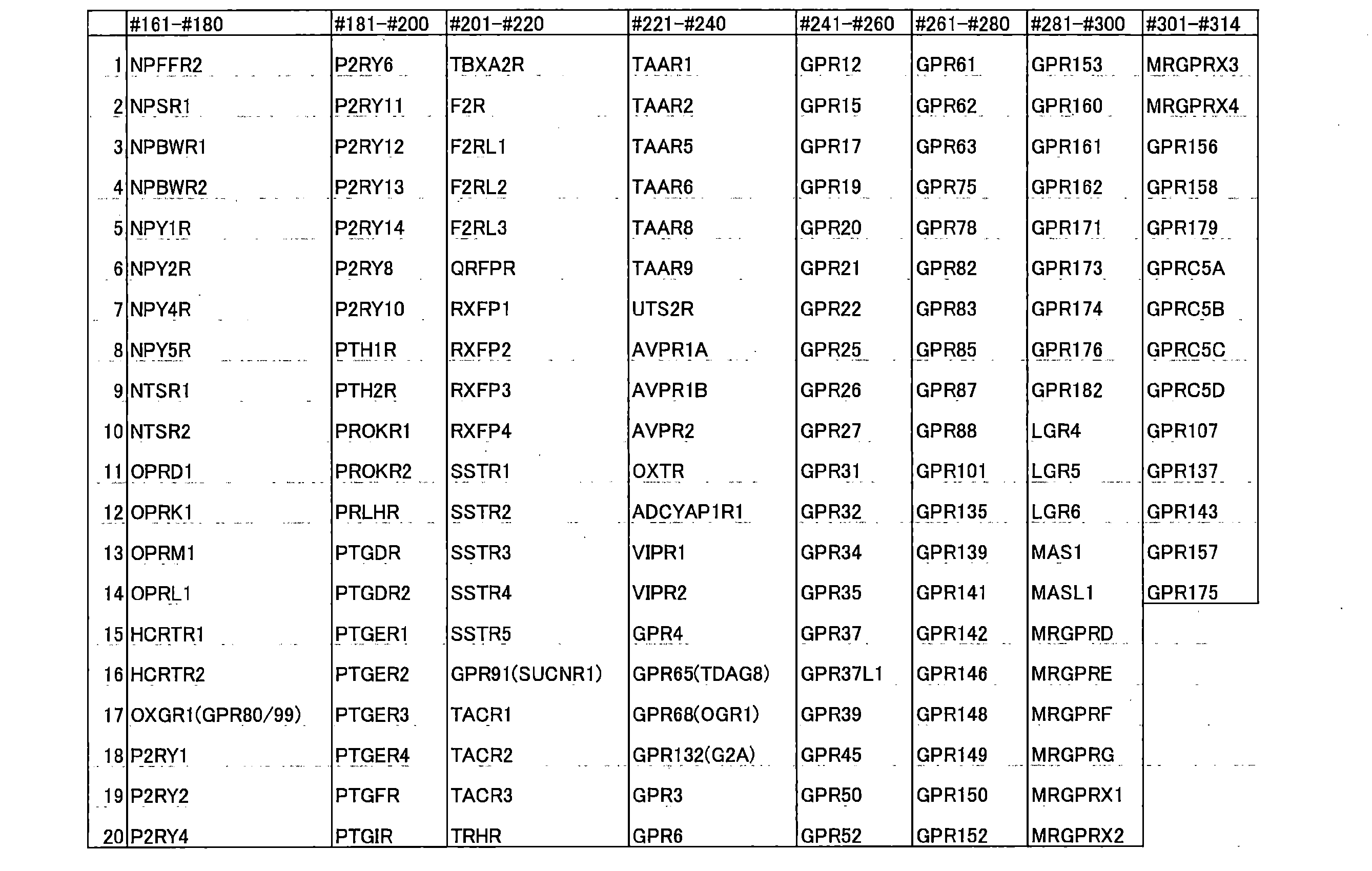
本発明では、タンパク質の活性化(例えば、リガンド、イオンによる刺激による)によって発現が変化する遺伝子の転写調節領域における変化を複数の因子を介在させて統合することによって、当該タンパク質の活性化を検出する系が提供される。
(1)「遺伝子#1の転写調節領域」を「酵素反応の基質(S)をコードする遺伝子」に作動可能に連結させた第1のコンストラクト
(2)「遺伝子#2の転写調節領域」を「酵素反応の酵素(E1)をコードする遺伝子」に作動可能に連結させた第2のコンストラクト
(3)「遺伝子#3の転写調節領域」を「SとE1の生産物P1を基質とする酵素(E2)をコードする遺伝子」に作動可能に連結させた第3のコンストラクト
(4)「遺伝子#4の転写調節領域」を「P1とE2の生産物P2を基質とする酵素(E3)をコードする遺伝子」に作動可能に連結させた第4のコンストラクト
↓
(N)「遺伝子#Nの転写調節領域」を「P(n-3)とE(n-2)の生産物P(n-2)を基質とする酵素(E(n-1))をコードする遺伝子」に作動可能に連結させた第nのコンストラクト
(N+1)一連の酵素反応の最終生産物P(n-1)によりレポーター遺伝子が活性化するように設計されたレポーター遺伝子コンストラクト
酵素[E]+基質[S]→酵素基質複合体[ES]→酵素[E]+生産物[P]
([ ]は濃度を表す)
で表され、反応速度は[S]と[E]の積に比例する。このため、[S]と[E]が経過中一定であると仮定すると、反応開始から一定時間後の[P]も[S]と[E]の積に比例する。よって上記の一連の酵素反応で生産される最終生産物P(n-1)の濃度は、
[P(n-1)]=[S]×[E1]×[E2]×・・・×[E(n-1)]となり、最終的なレポーター遺伝子の刺激応答比は理論上、
(遺伝子#1の刺激応答比)×(遺伝子#2の刺激応答比)×(遺伝子#3の刺激応答比)×(遺伝子#4の刺激応答比)×・・・×(遺伝子#Nの刺激応答比)、すなわちN個の遺伝子がそれぞれ有する刺激応答比のすべてをかけあわせたものとなる(相乗的増幅)。但し、本想定は原理を非常に単純化したモデルであるため、実際の連鎖反応において各反応の[S]と[E]は一定ではない。


NR4A2, LOC100506747, NR4A1, EPPK1, JUN, AMOTL2, FLNA, ARC, IER2, JUNB(少なくともいずれかの実験で5倍以上の発現変動);ならびに
CNN2, DUSP1, MAFF, GPR3, TPM1, PTGS2, ATF3, G0S2, TRIB1, SNAI2, PDLIM7, NFKBIZ, TIMP3, FHL2, SPRY2, FOSL2, FERMT2, VCL, NUPR1, TPM4, GRASP, NKX2-5, TUFT1, ID1, FOSL1, MYADM, ACTB, LPP, KLF7, KLF6, ADAMTS1, BTG2, ACTG1, CSRNP1, WDR1, SRF, GEM, ZYX, NR2F1, LOC101928358, ITPRIP, FUT1, COL3A1, LIMA1, SLC8A1, JAG1, SLC6A9, PMAIP1, SLC2A10, PCK2, ZFP36L1, MAFB, CBX4, FZD10, ZBTB10, JDP2, ZNF214, RHOB, ID2, RND3, IRF2BPL, BMP2, SOX4, JUND, SLC1A4, PNRC1, SYBU(少なくともいずれかの実験で2倍以上の発現変動)

また、本発明の別の態様において、細胞がHEK293Tの場合は、選択された2つの異なる遺伝子座(FOS locusおよびFOSB locus)の3’UTRに細胞膜型人工転写因子とプロテアーゼをノックインすることにより、HeLa細胞と同様の機能を持つインディケーター細胞を作成することができる。
1.Luciferaseと目的GPCRの遺伝子をレポーター細胞に導入する。
2.GPCR刺激により膜アンカー型人工転写因子とプロテアーゼが発現誘導されるようにあらかじめアッセイに使用する細胞のゲノムは改変されている。
3.GPCR刺激で誘導された転写因子とプロテアーゼが相乗的にルシフェラーゼ発現を誘導する。
1つの実施形態において、シグナル伝達を担うタンパク質への被験化合物の作用を調査するためのコンストラクトまたはコンストラクトの組合せが提供される。コンストラクトまたはコンストラクトの組合せは、シグナル伝達を担うタンパク質の活性化により発現が誘導される第1~第Nの遺伝子の転写調節領域に作動可能に連結されたそれぞれ第1~第Nの因子をコードする第1~第Nのヌクレオチド配列を含み得る。Nは2以上の整数である。このコンストラクトまたはコンストラクトの組合せと、上記第1~第Nの因子の少なくとも1つによって発現が惹起されるように構成された標識をコードするヌクレオチド配列を含むコンストラクトとを含む、コンストラクトの組合せも提供され得る。
(1)第1の遺伝子の転写調節領域を酵素反応の基質(S)をコードするヌクレオチド配列に連結させた第1のコンストラクトと;
(2)第2の遺伝子の転写調節領域を酵素反応の酵素(E1)をコードするヌクレオチド配列に連結させたコンストラクトであって、ここで、SとE1との酵素反応により生産物P1が生成される、第2のコンストラクトと;
Nが3以上である場合に、3~Nの自然数であるnのそれぞれについて、
(n)第nの遺伝子の転写調節領域をP(n-2)を基質として生産物(P(n-1))を生成する酵素(E(n-1))をコードする遺伝子に連結させた第nのコンストラクトと;
(N+1)酵素反応の生産物P(N-1)によりレポーター遺伝子が活性化するように構成されたレポーター遺伝子コンストラクトと
を含み、第1~第NのN個の遺伝子のそれぞれは、該被験化合物による該タンパク質の刺激により発現が誘導され、ここで、Nは2以上の自然数であり、nは1~Nまでの自然数である、キットであり得る。キットには、本明細書に記載されるキメラGタンパク質αサブユニットをコードするコンストラクトがさらに含まれ得る。キットは、コンストラクトまたはコンストラクトの組合せを細胞に導入するため、あるいはコンストラクトまたはコンストラクトの組合せを細胞内で形成するための薬剤をさらに含んでもよい。上記タンパク質の活性化により発現が誘導される第1~第Nの遺伝子を特定することによって、上記コンストラクト、コンストラクトの組合せまたはキットを製造することができる。
本発明において、本明細書に記載されるアッセイ系を組み込んだ細胞が提供される。細胞としては、例えば、HeLa細胞、HEK293細胞、CHO細胞、COS-1/7細胞、HL60細胞、K562細胞、Jurkat細胞、HepG2細胞、Saos-2細胞、F9細胞、C2C12細胞、PC12細胞、NIH/3T3細胞、U2OS細胞、Vero細胞、MDCK細胞、MEF細胞、U937細胞、C6細胞、Neuro2A細胞、SK-N-MC細胞、SK-N-SH細胞、HUVEC細胞、THP-1細胞、BW5147細胞、Ba/F3細胞、Y-1細胞、H295R細胞、MIN6細胞、NIT-1細胞およびMDA-MB435S細胞からなる群から選択される1または複数の細胞を使用することが可能である。
(1)第1の遺伝子の転写調節領域を酵素反応の基質(S)をコードする遺伝子に連結させた第1のコンストラクトと;
(2)第2の遺伝子の転写調節領域を酵素反応の酵素(E1)をコードする遺伝子に連結させたコンストラクトであって、ここで、SとE1との酵素反応により生産物P1が生成される、第2のコンストラクトと;
Nが3以上である場合に、3~Nの自然数であるnのそれぞれについて、
(n)第nの遺伝子の転写調節領域をP(n-2)を基質として生産物(P(n-1))を生成する酵素(E(n-1))をコードする遺伝子に連結させた第nのコンストラクトと;
(N+1)酵素反応の生産物P(N-1)によりレポーター遺伝子が活性化するように構成されたレポーター遺伝子コンストラクトと
を含み、第1~第NのN個の遺伝子のそれぞれは、該タンパク質の活性化により発現が誘導され、ここで、Nは2以上の自然数であり、nは1~Nの自然数である。
該膜タンパク質の活性化により発現が誘導される第1の遺伝子の転写調節領域に作動可能に連結された第1のヌクレオチド配列であって、細胞膜アンカー型転写因子をコードする、ヌクレオチド配列と、
該膜タンパク質の活性化により発現が誘導される第2の遺伝子の転写調節領域に作動可能に連結された第2のヌクレオチド配列であって、プロテアーゼをコードする、ヌクレオチド配列と、
該転写因子によって発現が惹起されるように構成されたルシフェラーゼをコードするヌクレオチド配列と
を含み、ここで、該膜タンパク質は、Gタンパク質共役受容体、酵素連結型受容体、イオンチャネル連結型受容体、またはチャネルであり、該細胞膜アンカー型転写因子は、細胞膜アンカー部分と転写因子部分との間に、該プロテアーゼによって切断される切断可能リンカーを含む細胞である。
当該細胞としては、HeLa細胞又はHEK293T細胞が挙げられる。そして、細胞がHeLa細胞のときは、例えば、該第1の遺伝子はNR4A1であり、該第2の遺伝子はCTGFである。また、細胞がHEK293T細胞のときは、例えば、該第1の遺伝子はFOSであり、該第2の遺伝子はFOSBである。
別の局面において、本発明はまた、キメラGタンパク質、それをコードする核酸、それを発現する細胞、およびそれを用いる方法も提供する。本明細書において、キメラとなっているGタンパク質αサブユニット、およびそれを含むキメラGタンパク質が提供される。Gタンパク質の受容体への配向性はGαサブユニットのC末端のアミノ酸配列で決定されるため、キメラGタンパク質を用いることによって、あるGタンパク質と共役するGPCRの活性化を、異なるGタンパク質が活性化されたときに生じる細胞内シグナルを用いて検出することが可能になる。本発明では、あるG12/13のαサブユニットにおいて、C末端のアミノ酸配列が、異なるGタンパク質αサブユニットのアミノ酸配列に置き換えられているキメラGタンパク質αサブユニットが提供される。
また、他の局面において、本発明は、ある細胞において、シグナル伝達を担うタンパク質の活性化により発現が誘導される遺伝子を同定する方法を提供する。この方法で見いだされた活性化可能な遺伝子は、本発明のタンパク質の網羅的アッセイにおいて利用することができ、本発明のコンストラクトの一部として用いることができる。
上記分子を発現する細胞を活性化因子と接触させなかった場合の細胞における遺伝子発現レベルを得る工程と、
上記分子を発現しない細胞を、上記分子の活性化因子と接触させた場合の細胞における遺伝子発現レベルを得る工程と、
上記分子を発現しない細胞を、上記分子の活性化因子と接触させなかった場合の細胞における遺伝子発現レベルを得る工程とを含み得る。また、上記分子を発現する細胞を上記分子の活性化因子と接触させた場合に、他の場合と比較して発現が増加する遺伝子を候補遺伝子として選択する工程を含み得る。
本発明は、網羅的に被験化合物の膜タンパク質への作用を調査するのに利用可能である。網羅的な調査は、意図されるある特定の標的への作用を調査するのみではなく、意図される標的とは異なる分子への作用、すなわちオフターゲット活性を検出するのに有用である。特定の標的への作用を調べることで、被験化合物の医薬等への有用性を調べることができるのに加え、オフターゲット活性の検出により、化合物の安全性試験または毒性試験を行うことができる。したがって、本発明は、創薬の支援に有用である。1つの利用法としては、標的となる受容体を活性化させる被験化合物の、標的となる受容体を含めた、1または複数の受容体への結合をスクリーニングすることができる。結合をスクリーニングできる受容体として、本明細書に挙げられるものを標的とすることができるが、例えば、GPCR(例えば、今まで活性化の検出が難しかったG12/13に共役するGPCR)を標的とすることができる。GPCRには味覚に関する受容体(例えば、苦味受容体)が含まれ、一例として、苦味受容体への作用を調べることで、被験化合物の呈味特性を調べることができる。また、網羅的なスクリーニングにより、リガンドが未知であるいわゆるオーファン受容体を標的とすることもできる。加えて、本明細書の実施例に示されるように、受容体型チロシンキナーゼの活性化を検出することも可能である。
[概要]
本実施例において、異なる転写調節領域を有する複数のレポーターアッセイ構成遺伝子を外因性に一過性に動物細胞に導入することでシグナルが増幅することを示す。より詳細には、異なる転写調節領域(本実験においてはNFAT(nuclear factor of activated T-cells)転写調節領とSRF(serum response factor)転写調節領域)を有する複数のレポーターアッセイ構成遺伝子を外因性に一過性に動物細胞に導入することでシグナルが増幅することを示す。
GPCR群に属するアンジオテンシン1型受容体(hAgtr1)はそのリガンドであるアンジオテンシンIIにより活性化され、アッセイに使用する細胞種に依存せず(どの細胞種においてもほぼ共通して)、NFAT(nuclear factor of activated T-cells)転写調節領域やSRF(serum response factor)転写調節領域をもつ遺伝子の発現を上昇させることが既に知られている。そこで、これらの二つの転写調節領域に連結する因子として、以下に示す二つの人工遺伝子(TMGVとTM3C)を作成した。
ストップコドンを欠失させたヒトIL2受容体アルファ鎖(NM_000417)のC末端に、HRVプロテアーゼ3C認識切断配列(LEVLFQGP(配列番号1))を含むアミノ酸配列GSSSLEVLFQGPGSSS(配列番号2)をin-frameで連結し、そのC末端にさらに開始コドンを欠失させたGal4VP64(GV:人工転写因子)をin-frameで連結した。
ストップコドンを欠失させたヒトIL2受容体アルファ鎖(NM_000417)のC末端に、GSリンカー配列(GGGGSGGGGSGGGGS(配列番号3))、開始コドンとストップコドンを共に欠失させたHRVプロテアーゼ3C(アミノ酸配列はヒト化されている)を順にin-frameで連結し、さらにそのC末端に当該膜タンパク質を不安定化させる目的でPEST配列を付加した。
(1) hAgtr1+NFAT-TMGV+Constitutive-promotor(Cp)-TM3C+UAS-luciferase
(TMGVのみにリガンド刺激により発現誘導がかかる)
(2) hAgtr1+Cp-TMGV+SRF-TM3C+UAS-luciferase
(TM3Cのみリガンド刺激により発現誘導がかかる)
(3)hAgtr1+NFAT-TMGV+SRF-TM3C+UAS-luciferase
(TMGVとTM3Cの両者においてリガンド刺激により発現誘導がかかる)
結果は図3に示される。(3)において、(1)および(2)と比較してより良好なリガンド濃度依存的なシグナルが検出された。異なる転写調節領域を有する複数のレポーターアッセイ構成遺伝子を外因性に一過性に動物細胞に導入することでシグナルが増幅することが実証された。
[概要]
本実施例は、同一の転写調節領域(本実験においてはSRF(serum response factor) 転写調節領域)を有する複数のレポーターアッセイ構成遺伝子を外因性に一過性に動物細胞に導入することでシグナルが増幅することを示すことを目的とする。
GPCR群に属するアンジオテンシン1型受容体(hAgtr1)はそのリガンドであるアンジオテンシンIIにより活性化され、アッセイに使用する細胞種に依存せず(どの細胞種においてもほぼ共通して)、SRF(serum response factor)転写調節領域をもつ遺伝子の発現を上昇させることが既に知られている。
(1) hAgtr1+SRF-TMGV+Constitutive-promotor(Cp)-TM3C+UAS-luciferase
(TMGVのみリガンド刺激により発現誘導がかかる)
(2) hAgtr1+Cp-TMGV+SRF-TM3C+UAS-luciferase
(TM3Cのみリガンド刺激により発現誘導がかかる)
(3) hAgtr1+SRF-TMGV+SRF-TM3C+UAS-luciferase
(TMGVとTM3Cの両者においてリガンド刺激により発現誘導がかかる)
結果は図4に示される。(3)において、(1)および(2)と比較してより良好なリガンド濃度依存的なシグナルが検出された。同一の転写調節領域を有する複数のレポーターアッセイ構成遺伝子を外因性に一過性に動物細胞に導入することでシグナルが増幅することが実証された。
[概要]
G12/13タンパク質の活性化前後で高い応答比をもって反応する転写調節領域が現時点では明らかになっていないため、G12/13にカップルするGPCRを通常のレポーターアッセイ系によって評価することは困難である。そこで、前述の実施例での知見を利用して、G12/13にカップルするGPCRの評価を行うことができるかを検証した。
リガンドにより刺激されたGPCRはヘテロ三量体GTP結合タンパク質(Gタンパク質:α、β、γの3つのサブユニットから構成される)を介して細胞内へとシグナルを伝達する。Gタンパク質はαサブユニットの配列に基づき、Gs、Gi、Gq、G12/13に大別され、GPCRはそれぞれ、「GsにカップルするGPCR」、「GqにカップルするGPCR」、「GiにカップルするGPCR」、「G12/13にカップルするGPCR」の4群に分類される。
そこで10倍程度の中等度の刺激応答比を有する二つの遺伝子(遺伝子#1と遺伝子#2)に着目した。(遺伝子#1:NR4A1、遺伝子#2:CTGF)
Suzuki K et al Nature 540:144-149,2016に記載されるゲノム編集手順を参考として、インディケーターHeLa細胞を以下のとおり作成した。
(CRISPR認識配列:一番目の標的部位用)-(flox-Blastcidinカセット)-(IRES-TMGV)-(CRISPR認識配列:一番目の標的部位用)
以後これをTMGV donor plasmid(DP-TMGV)と記す。
(CRISPR認識配列:二番目の標的部位用)-(flox-Neomycinカセット)-(IRES-TM3C)-(CRISPR認識配列:二番目の標的部位用)
以後これをTM3C donor plasmid (DP-TM3C)と記す。
使用するプラスミド
(1)評価したいGPCRを発現するプラスミド (GPCR発現プラスミド)
(2)UAS-luciferase(sGVによりluciferaseの発現が誘導される人工レポーター遺伝子)
NCP19(図6)
Day1:NCP19細胞を24000cells/wellの密度で96穴プレートに播種する。
GPR55およびLPAR6について、従来法での検出も試みた。詳細は以下のとおり。
使用する細胞:HeLa細胞(ATCCより購入)、HEK293T細胞
使用するプラスミド
(1)評価したいGPCRを発現するプラスミド(GPCR発現プラスミド)
本実験においてはGPR55およびLPAR6発現プラスミド
(2)SRF-luciferase
使用する細胞:N182細胞(TMGVのみが既にゲノムにノックインされている細胞)
使用するプラスミド
(1)評価したいGPCRを発現するプラスミド(GPCR発現プラスミド)
本実験においてはGPR55およびLPAR6発現プラスミド
(2)TM3C発現プラスミド(プロテアーゼを構成的なプロモーターで発現するプラスミド)
(3)UAS-luciferase
使用するプラスミド
(1)評価したいGPCRを発現するプラスミド (GPCR発現プラスミド)
本実験においてはGPR119、Adrb2およびADORA2A発現プラスミド
(2)CRE-luciferase
各濃度のリガンドの添加により、各アッセイ系から得られたシグナル(発光強度・リガンド最低濃度時のシグナルからの変化倍率)を、図7~図11に示す。上記アッセイプロトコールにより、リガンド濃度の増加に伴うシグナルの増大が観察された。
上記のアッセイプロトコールにより、「G12/13にカップルするGPCR」の活性化は問題なく評価できた(図7および8)。本アッセイ系の目的の1つであった「G12/13にカップルするGPCR」の高感度の評価が達成された。従来法では活性化が評価できていない(図7)。
[概要]
本実施例は、NCP19細胞を用いたアッセイ系により、GPCRだけでなく他の受容体の活性化状態をモニターできることを示すことを目的とする。本実施例ではGPCR以外の細胞膜受容体の一例として受容体型チロシンキナーゼファミリーに属するヒトFlt3(hFlt3)を実験対象とした。
使用する細胞:NCP19
使用するプラスミド
(1) hFlt3を発現するプラスミド(hFlt3発現プラスミド)
(2) UAS-luciferase
結果を、図12に示した。図12に示されるように、Flt3-Ligandの添加によるhFlt3の活性化がルシフェラーゼの発光として検出された。NR4A1およびCTGF遺伝子の転写調節領域にTMGVおよびTM3CがノックインされているNCP19細胞を用いたアッセイ系により、GPCRだけでなく他の受容体の活性化状態をモニターできることが示された。
[概要]
本実施例は、NCP19細胞を用いたアッセイ系により、GPCRだけでなく他の受容体の活性化状態をモニターでうることを示すことを目的とする。本実施例ではGPCR以外の細胞膜受容体の一例として受容体型チロシンキナーゼファミリーに属するヒトEGF受容体を実験対象とした。尚、ヒトEGF受容体であるhEGFR、hErbB2、hErbB3はNCP19細胞に内在性に発現している。
使用する細胞:NCP19
使用するプラスミド
UAS-luciferase
結果を、図13に示した。図13に示されるように、EGFの添加によるEGF受容体の活性化がルシフェラーゼの発光として検出された。NR4A1およびCTGF遺伝子の転写調節領域にTMGVおよびTM3CがノックインされているNCP19細胞を用いたアッセイ系により、GPCRだけでなく他の受容体の活性化状態をモニターできることが示された。
上記実施例に記載される方法に従って、以下のGPCRのいずれかを細胞に発現させる。上記実施例に記載される方法に従って、GPCRを発現させた細胞をリガンド刺激し、受容体の活性化状態をモニターする。

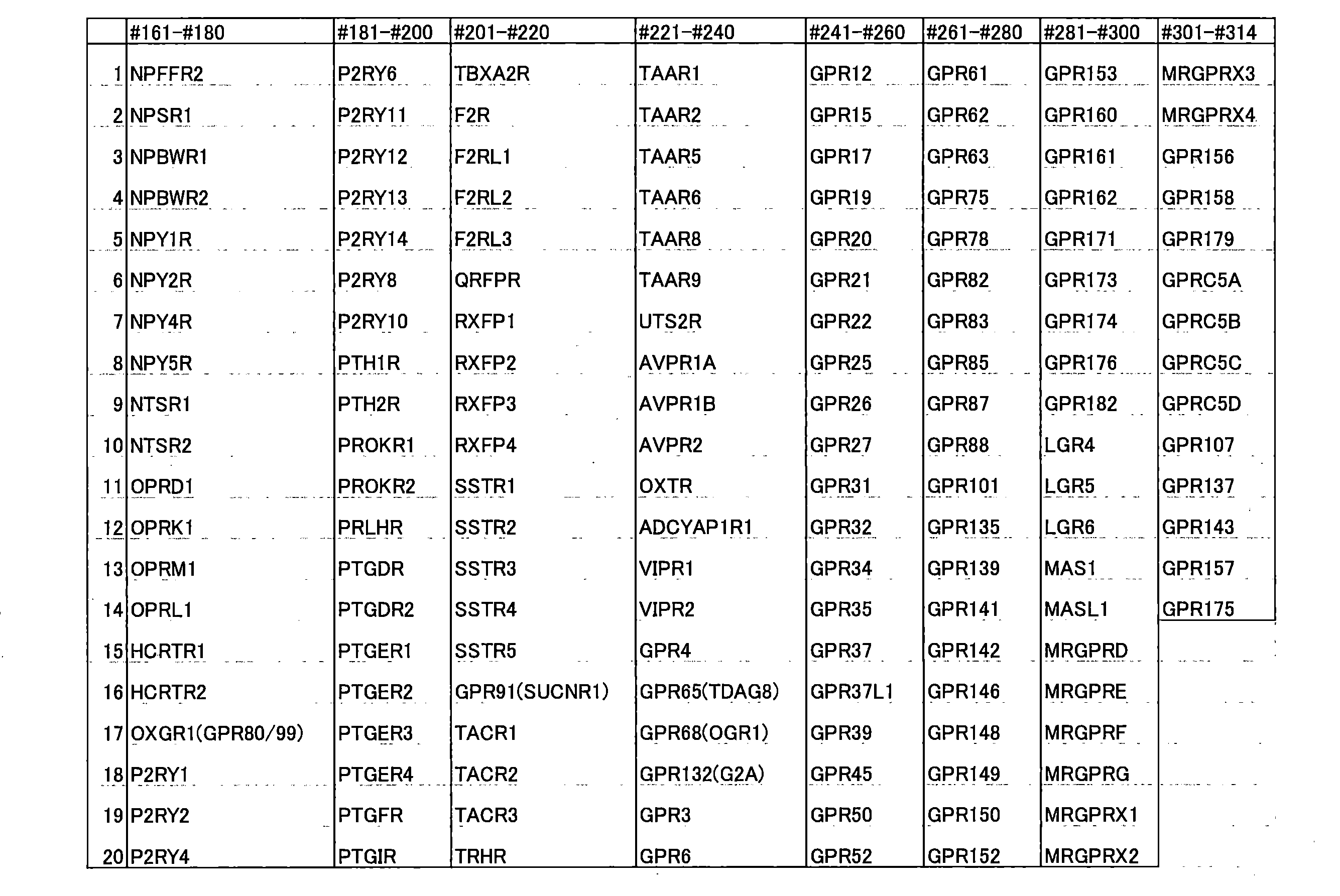
[概要]
GsにカップルするGPCRの一部(Adrb2、ADORA2A)については、上記のアッセイプロトコールを用いた場合に活性化が検出されなかった(図10)。プロトコールの変更により、「GsにカップルするGPCR」の効率の良い評価を実現するため、以下の実験を行った。
実施例A3のプロトコールにおいて、Day2を以下のとおり変更し、その他は同様にしてAdrb2およびADORA2A(Gs)の活性化の評価を行った。
Day2:96穴プレートに播種してから24時間以内に1wellあたりDNA120ng(GPCR 60ng+UAS-luciferase 30ng+G12/s chimera 30ngからなるプラスミドカクテル)をリポフェクション法により遺伝子導入する。
Gタンパク質の受容体への配向性はGαサブユニットのC末端の数個のアミノ酸配列で決定される。よって、胴体部分はすべてGα12由来で、C末端最後の6アミノ酸のみGαs由来となるGα12/sキメラ(今後は単にG12/sキメラと呼ぶ)を作成した(下記アミノ酸配列を参照のこと)。このG12/sキメラは「GsにカップルするGPCR」とカップルすることが可能で、しかも野生型G12が活性化されたときに生じる細胞内シグナルと同じシグナルを細胞内に惹起することができる。


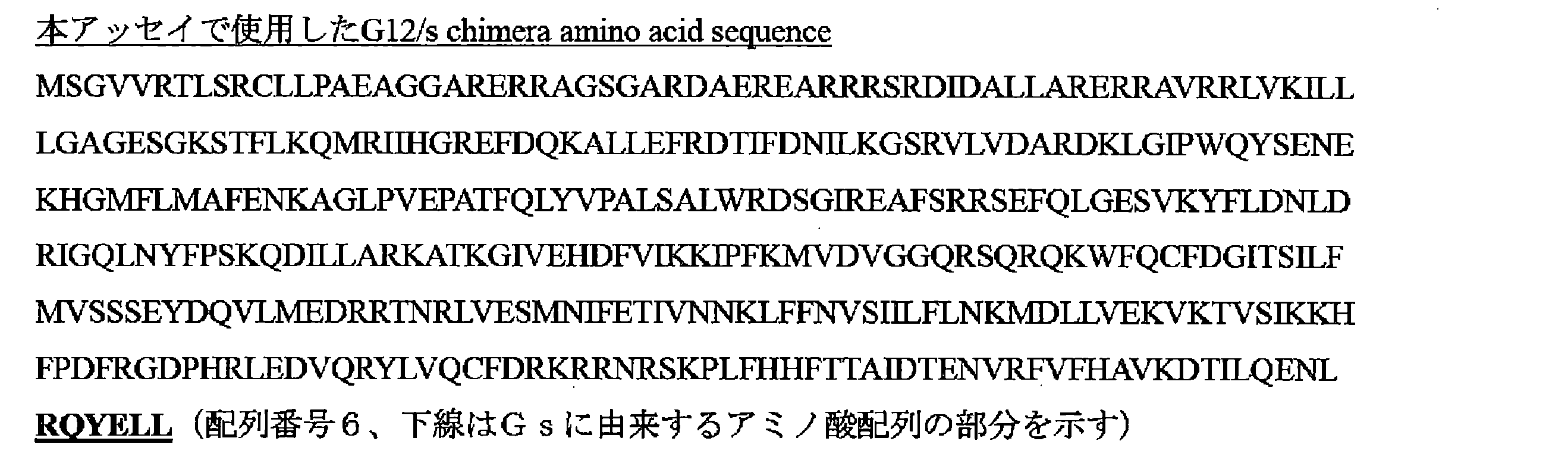
本実施例のプロトコールを用いた場合、Adrb2およびADORA2Aのいずれについても、リガンド濃度依存的なシグナルの増大を検出することができた(図10)。
上記変更により、「GsにカップルするGPCR」の活性も効率よく評価することが可能であることが示される。また、この結果から、「どのGタンパク質にカップルするか不明のGPCR(オーファンGPCR)」を評価する際にも上記のように変更したプロトコールの使用が望ましいと考えられる。
[概要]
本実施例は、NCP19細胞を用いたアッセイ系において、G12/sキメラ以外のキメラGタンパク質も有用であることを示すことを目的とする。Giに共役する受容体として知られるヒトソマトスタチン2型受容体(hSSTR2)およびG12/iキメラを実験対象とした。
使用する細胞:NCP19
使用するプラスミド
(1)hSSTR2を発現するプラスミド(hSSTR2発現プラスミド)
(2)UAS-luciferase
(3)G12/iキメラ蛋白質を発現するプラスミド(G12/i発現プラスミド)


結果を図11に示した。G12/iキメラタンパク質なしでも活性は十分に検出できる(図11左)が、キメラ存在下では、その活性検出能が有意に改善される(図11右)。なお、左図と右図において、縦軸のスケールが約20倍程異なることに注意されたい。
[概要]
本発明のアッセイ系の構築のための、使用する細胞において目的タンパク質の活性化によって発現が誘導される遺伝子の同定方法を実証する。
Gタンパク質G12/13を特異的に活性化させるGPCRとしてGPR55およびLPAR6の2つの受容体が知られている。そこでHeLa細胞と、GPR55およびLPAR6とを用いて、以下のような7条件で実験を施行した。なお、LPIはGPR55のリガンド、LPA(Lysophosphatidic acid)はLPAR6のリガンド、としてそれぞれ機能することが既に知られている物質である。
条件1 HeLa細胞(野生型)
条件2 HeLa細胞(野生型)+mock+LPI10uM:1時間刺激
条件3 HeLa細胞(野生型)+GPR55+Vehicle:1時間刺激
条件4 HeLa細胞(野生型)+GPR55+LPI10uM:1時間刺激
条件5 HeLa細胞(野生型)+mock+LPA10uM:1時間刺激
条件6 HeLa細胞(野生型)+LPAR6+Vehicle:1時間刺激
条件7 HeLa細胞(野生型)+LPAR6+LPA10uM:1時間刺激
Day2:LPAR6を発現するプラスミド 2ugをリポフェクション法にてHeLa細胞に遺伝子導入
Day3:遺伝子導入より24時間経過後、細胞をLPA10uMにて1時間刺激。刺激後すぐに細胞よりtotal RNAを回収。
実験(1):条件1、2、3および4の4群間で比較
実験(2):条件1、5、6および7の4群間で比較
この二つの実験において共通してリストアップされた遺伝子を目的の遺伝子群とした。

THBS1、AREG、SLFNL1、SLFNL1-AS1、CDH5、NR4A2、CYR61およびCRISPLD2(少なくともいずれかの実験で10倍以上の発現変動);
FOSL1、TNFAIP3、EPPK1、NUAK2、CXCL2、KDM6B、PHLDA1、CSRNP1、TAGLN、PTGER4、JUN、ATF3、NCOA7、ADAMTS1、EDN1、ZC3H12C、PTGS2、DCUN1D3、ITPRIP、JUNB、SDC4、ERRFI1、SRF、MYADM、MMP12、MAFF、RCAN1、F3、IL6、LDLR、KRT34、EDN2、GADD45A、KRT17、TUFT1、MN1、DUSP4、KLF6、REL、ABL2、CITED2、MAFK、RND3、KLF2、TRIB1およびPHLDB2(いずれの実験でも5倍以上の発現変動);
RASD1、SOWAHC、DUSP8、OTUD1、ARL5B、ETV3、ZFP36、NAV2、ITGB8、SERPINE1、NOCT、ZBTB10、BMP2、TRAF1、EPHA2、IER2、TNS4、ELMSAN1、ADAMTS5、TSC22D2、ZNF281、BCL10、RNF217、BTG2、ELL2、KIAA1217、GPCPD1、NAB2、MCL1、TIPARP、EPGN、RIMKLB、IER5、C8orf4、ADM、KRT16、NFKBID、ZNF331、SERTAD1、PSD4、DAPP1(いずれかの実験で5倍以上の発現変動);ならびに
WEE1、TBX3、PMAIP1、ARID5B、BACH1、ZFP36L2、VGLL3、GATA6、AKAP2、PLAUR、TICAM1、JAG1、SLC7A11、FOXC2、HBEGF、GPRC5A、KCNJ12、STARD4、YOD1、RHOB、IRS2、SLC30A7、C19orf71、PPP1R15B、USP36、BHLHE40、LIFR、STK38L、LOC100129550、RUNX1、CEBPD、KLF7、KLF5、LATS2、HECA、PPP1R3B、GADD45B、BIRC3、NT5DC3、ATXN7、ZNF644、FOSL2、PER2、MAP3K14、NABP1、FGF2、NFKBIA、JUND、RC3H1、RUSC2、DUSP16、ELF3、NEDD9、FAM86B3P、CREM、IQCJ-SCHIP1、HK2、ZNF548、ZNF217、PER1、AHR、SLC2A13、PDP1、HRH1、PFKFB3、TPPP、JPH2、CPEB4、MB21D2、HLA-H、SLC38A2、FRMD4B、PTPRH、SSC5D、PLEKHO2、EGLN1、FOXC1、PDE4D、CPEB3、ZSWIM4、TGFBR1、PRG2、CCDC68、IER3、FBLIM1、RASSF8、USP2、PPTC7、CDC42EP2、ZFAND5、SGK1、TNFRSF8、LYPD3、CITED4、MYH9、SIK1、SGMS2、ZC3H12A、DUSP1、IRF2BPL、ZFP36L1、EPAS1、TMEM160、NCEH1、KLF9、TMEM158、NAB1、RNF19A、KCNK1、PRDM1、IRF2BP2、CHD1、MXD1、KIAA0355、ELL、PIGA、CNN2、ABHD13、MESDC1、SCML1、TGFBR3、DDAH1、ANKRD33B、MAP3K8、MAP2K3、SOCS6、MPZL3、UGCG、AEN、CDKN1A、C9orf72、CHD2、RNF19B、VCL、MFSD2A、RELT、HELZ2、ZNF529、ADAP1、RP2、FBXO46、ETS2、ANKRD1、NFKBIE、SH3RF1、SFMBT2、AEBP2、ZYX、HES4、CBX4、GLI2、SNRK、MTCL1、MITF、ARHGAP28、ELAVL2、PMP22、SOCS3、MALAT1、WDR37、SLC2A3、COQ10B、CCNL1、PXDC1、SLC26A2、PIM1、FAM60A、OLR1、STX11、ZBTB21、SPRED2、CTTNBP2NL、CCNT1、ZNF324、UBALD1、LIMA1、ACTG1、SLC19A2、PRRG1、TLE4、ICAM1、IFFO2、PLEKHG3、ARHGAP23、GAB2、NYAP2、DKK1、NT5E、DENND3、USP53、CD83、MC1R、PANX1、SLC20A1、KLF4、TNFRSF10A、SIRT1、DNAJB4、STEAP4、PHLDA3、FAT4、C1QTNF1、AP1AR、KRT80、ZC3HAV1、SAV1、ACKR3、TP53I11、CMIP、RGS2、CDKN2AIP、ADRB2、TSC22D1、TM4SF1、FBXO33、CSRP1、BMPR1B、RELB、NTN4、ATP2B1、CDC42SE1、ALDH1B1、TRMT44、ROR1、VPS37B、TRAF4、PPP2R3A、HSPA2、DAAM1、LINC00657、CASZ1、DAW1、ALPK2、GRAMD3、RAB20、MAMDC2、SAMD4A、RASAL2、WWC2、RAP1GAP2、DNAJC6、PPP1R3C、TPM4、KIAA0825、WDR1、NFKB2、FSTL3、ARHGAP32、NFIL3、ZNF267、HMGCS1、FHL2、TPM1、KLHL29、CRB1、SLC25A16、MFAP5、FHL1、MMP24、RAB32、IL32およびARHGDIB(いずれの実験でも2~5倍の発現変動)。
上述の手順によって、特定のタンパク質の活性化によって発現が誘導される遺伝子群を同定できることが示された。このような遺伝子群を用いて、本明細書に記載される複数因子を連結したレポーター系を構築することができる。
実際に、後述する実施例Eに示すように、本実施例の手順によってHEK293T細胞を使用して同様のアッセイ系を作製することに成功した。
上述の実施例AおよびBに記載される手順に従い、それぞれが複数の異なる受容体を過剰発現する複数の細胞を提供する。複数のウェルを有するアレイにおいて、それぞれの細胞を各ウェル内で維持する。被験化合物をアレイ上にアプライすることによって、複数の受容体に対する被験化合物の作用の網羅的な調査を簡便に行うことができる。
ある膜タンパク質によって発現が誘導される第1~第Nの遺伝子の転写調節領域の配列を用いて、第1~第Nの遺伝子の転写調節領域の配列をそれぞれ含む第1~第Nのコンストラクトを提供する。それぞれのコンストラクトは、特定の因子をコードする配列を、転写調節領域と作動可能に連結した状態で含む。それぞれの因子は、他の因子の活性を促進するものである。それぞれのコンストラクトは、一連の核酸分子上に存在してもよく、異なる核酸分子上に存在してもよい。
全ヒトGPCRに対応する細胞を含む実施例D1のアレイを用いて、被験化合物の全ヒトGPCR(匂い受容体を除く)に対する活性を調査する。アレイの各ウェルの反応から、被験化合物が、どのGPCRに対して活性を有するかを調べることができる。これにより、被験化合物が、いずれかのヒトGPCRに対してOff-Target活性を有するか、あるいはOff-Target活性がないことを確認することができる。これにより、例えば、臨床試験開始後に予想外の副作用で臨床試験が中止になるリスクを軽減出来る。また、ある活性が知られた化合物についても、全ヒトGPCRに対する活性を評価することで新規の活性を同定することができる。
マイクロ流路ディスクあるいはその他の1細胞アッセイシステムを用い、各チェンバーに1個の細胞を培養する。多数の異なる受容体プラスミドを含む適当に低濃度なトランスフェクション試薬を用意し、これを多数のチェンバーの細胞に一気にアプライする。こうすることで、試薬に含まれる受容体群のサブセットを各細胞にトランスフェクトさせることができる(試薬に100種類の受容体プラスミドが含まれるとして、そのうち数種類が各々の細胞にトランスフェクトすることが想定される)。試薬中の受容体プラスミド濃度が低いので、各細胞にトランスフェクトされる受容体は確率論的に決まる。最後に単一の化合物あるいは複数の化合物の混合物を複数のチェンバーの細胞に一気にアプライする。洗浄し別の化合物をアプライすることを繰り返してもよい。反応があったチェンバーの細胞にシングルセルPCRを掛けることで、化合物に応答する受容体候補を効率よく絞りこむことができる。
本明細書で記載されているノックインレポーター細胞であるNCP19細胞は、様々な細胞膜受容体がそれらに対応するリガンドで刺激された際に惹起されるシグナルを感知できるだけでなく、細胞そのものがストレスを受けた際のストレス応答もモニターできるものと予想される。よって、細胞膜受容体などを外因性に遺伝子導入することなしに、NCP19細胞そのものに被検化合物を作用させることで、その化合物が細胞にストレス応答を誘導する化合物であるかを検討できるアッセイ系となりうる。
本明細書の実施例A4およびA5で示すように、本明細書で記載されているノックインレポーター細胞であるNCP19細胞は、GPCRだけでなく、受容体型チロシンキナーゼがそのリガンドで活性化された際に生じる細胞内シグナル(増殖シグナル)も感知できる。このことはすなわち、遺伝子変異によって恒常的な活性化状態にある受容体型チロシンキナーゼ変異体(これらは多くの場合、細胞において癌遺伝子として機能する)をNCP19に一過性に外因性に遺伝子導入すれば、NCP19細胞におけるレポーター活性はリガンド刺激非依存的に高値を示す事が予想される。よって、NCP19細胞に様々な癌遺伝子候補変異体を一過性に導入し、それらの変異体それぞれが惹起するレポーター活性を調べれば、どの候補変異体分子がより強力な細胞増殖活性を有するかワンステップで検証することが可能となる。
上述の実施例AおよびBに記載される手順に従い、それぞれが複数の苦味受容体を過剰発現する複数の細胞を提供する。複数のウェルを有するアレイにおいて、それぞれの細胞を各ウェル内で維持する。被験化合物をアレイ上にアプライすることによって、被験化合物の苦味受容体への作用の網羅的な調査を簡便に行うことができる。
上述の実施例AおよびBに記載される手順に従い、リガンド未知の受容体を過剰発現する細胞を提供する。複数のウェルを有するアレイにおいて、細胞を各ウェル内で維持する。複数の被験化合物をアレイ上にアプライすることによって、オーファン受容体を活性化させる化合物の網羅的なスクリーニングを簡便に行うことができる。
[概要]
HeLa細胞以外の細胞株を用いて、本発明のアッセイ系を構築し、被験化合物のスクリーニングを行うことができることを実証する。
(発現変動遺伝子の同定)
HEK293T細胞において、Gタンパク質G12/13を特異的に活性化させるGPCR(GPR55もしくはLPAR6)と、当該GPCRのリガンドとして機能することが既に知られている物質を用いて実験を施行する。
条件1 HEK293T細胞(野生型)
条件2 HEK293T細胞(野生型)+mock+リガンド10uM:1時間刺激
条件3 HEK293T細胞(野生型)+GPCR+Vehicle:1時間刺激
条件4 HEK293T細胞(野生型)+GPCR+リガンド10uM:1時間刺激
リストアップされた遺伝子を目的の遺伝子群とした。当該遺伝子群を以下の表6に示す。
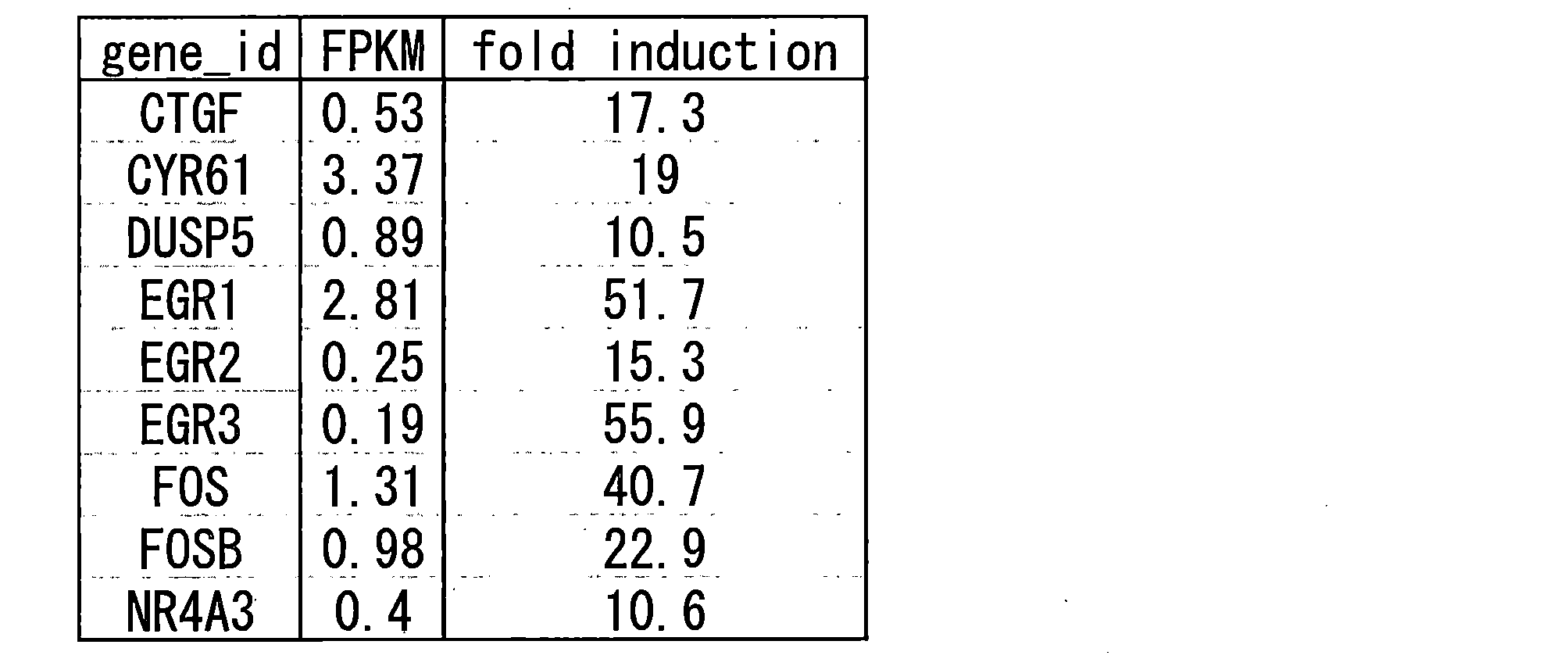
NR4A2, LOC100506747, NR4A1, EPPK1, JUN, AMOTL2, FLNA, ARC, IER2, JUNB(少なくともいずれかの実験で5倍以上の発現変動);ならびに
CNN2, DUSP1, MAFF, GPR3, TPM1, PTGS2, ATF3, G0S2, TRIB1, SNAI2, PDLIM7, NFKBIZ, TIMP3, FHL2, SPRY2, FOSL2, FERMT2, VCL, NUPR1, TPM4, GRASP, NKX2-5, TUFT1, ID1, FOSL1, MYADM, ACTB, LPP, KLF7, KLF6, ADAMTS1, BTG2, ACTG1, CSRNP1, WDR1, SRF, GEM, ZYX, NR2F1, LOC101928358, ITPRIP, FUT1, COL3A1, LIMA1, SLC8A1, JAG1, SLC6A9, PMAIP1, SLC2A10, PCK2, ZFP36L1, MAFB, CBX4, FZD10, ZBTB10, JDP2, ZNF214, RHOB, ID2, RND3, IRF2BPL, BMP2, SOX4, JUND, SLC1A4, PNRC1, SYBU(少なくともいずれかの実験で2倍以上の発現変動)
リストアップされた遺伝子から遺伝子#1としてFOS、遺伝子#2としてFOSBを選択した。
上記細胞にGPCR発現プラスミドおよびUAS-レポーター遺伝子のプラスミドを導入し、当該GPCRリガンドで細胞を刺激した。GPCRとして、以下の受容体:GPR55(G12/13), LPAR6(G12/13), Adrb2(Gs), HRH1(Gq/11), OPRM1(Gi/o), SSTR2(Gi/o)を用いた。また、上記細胞を使用して受容体型チロシンキナーゼ(Flt3およびEGFR)の活性化も測定した。
各濃度のリガンドの添加により、各アッセイ系から得られたシグナル(発光強度・リガンド最低濃度時のシグナルからの変化倍率)を図15-図18に示す。HeLa細胞で作製されたインディケーター細胞と同様に、HEK293T細胞で作製されたインディケーター細胞においても、検定した各受容体においてリガンド濃度の増加に伴うシグナルの増大が観察された。
[考察]
本実施例の結果より、本発明のインディケーター細胞は、実施例A3の方法により細胞株の種類によらず作製されうることが示された。
細胞において、Gタンパク質G12/13の活性化により発現が増加する遺伝子#1および遺伝子#2の遺伝子座に、第1の因子および第2の因子をノックインする。
以上のように、本発明の好ましい実施形態を用いて本発明を例示してきたが、上述の説明および実施例は、例示の目的のみに提供され、本発明を限定する目的で提供したのではない。従って、本発明は、本明細書に具体的に記載された実施形態にも実施例にも限定されず、請求の範囲によってのみその範囲が解釈されるべきであることが理解される。本明細書において引用した特許、特許出願および文献は、その内容自体が具体的に本明細書に記載されているのと同様にその内容が本明細書に対する参考として援用されるべきであることが理解される。
配列番号2:TMGV中のリンカー配列
配列番号3:GSリンカー配列
配列番号4:ヒトG12アミノ酸配列
配列番号5:ヒトGsアミノ酸配列
配列番号6:G12/sキメラアミノ酸配列
配列番号7:ヒトGi1アミノ酸配列
配列番号8:G12/i1キメラアミノ酸配列
Claims (26)
- シグナル伝達を担うタンパク質への被験化合物の作用を調査するためのコンストラクトまたはコンストラクトの組合せであって、該コンストラクトまたはコンストラクトの組合せは、
該タンパク質の活性化により発現が誘導される第1~第Nの遺伝子の転写調節領域に作動可能に連結されたそれぞれ第1~第Nの因子をコードする第1~第Nのヌクレオチド配列を含み、ここで、Nは2以上の整数である、コンストラクトまたはコンストラクトの組合せ。 - 請求項1に記載のコンストラクトまたはコンストラクトの組合せと、
前記第1~第Nの因子の少なくとも1つによって発現が惹起されるように構成された標識をコードするヌクレオチド配列を含むコンストラクトと
を含む、コンストラクトまたはコンストラクトの組合せ。 - シグナル伝達を担うタンパク質への被験化合物の作用を調査するためのコンストラクトの組合せであって、
(1)第1の遺伝子の転写調節領域を酵素反応の基質(S)をコードするヌクレオチド配列に連結させた第1のコンストラクトと;
(2)第2の遺伝子の転写調節領域を酵素反応の酵素(E1)をコードするヌクレオチド配列に連結させたコンストラクトであって、ここで、SとE1との酵素反応により生産物P1が生成される、第2のコンストラクトと;
Nが3以上である場合に、3~Nの自然数であるnのそれぞれについて、
(n)第nの遺伝子の転写調節領域をP(n-2)を基質として生産物(P(n-1))を生成する酵素(E(n-1))をコードする遺伝子に連結させた第nのコンストラクトと;
(N+1)酵素反応の生産物P(N-1)によりレポーター遺伝子が活性化するように構成されたレポーター遺伝子コンストラクトと
を含み、第1~第NのN個の遺伝子のそれぞれは、該被験化合物による該タンパク質の刺激により発現が誘導され、ここで、Nは2以上の自然数であり、nは3~Nまでの自然数である、コンストラクトの組合せ。 - キメラGタンパク質αサブユニットであって、Gα12/13に属する第1のGαサブユニットのアミノ酸配列において、C末端のアミノ酸配列が該第1のGαサブユニットとは異なるGαサブユニットのアミノ酸配列に置き換えられているアミノ酸配列を有する、キメラGタンパク質αサブユニットをコードするコンストラクトをさらに含む、請求項1~3のいずれか1項に記載のコンストラクトまたはコンストラクトの組合せ。
- 請求項1~4のいずれか1項に記載のコンストラクトまたはコンストラクトの組合せを含む、シグナル伝達を担うタンパク質への被験化合物の作用を調査するためのキット。
- 前記タンパク質の活性化により発現が誘導される第1~第Nの遺伝子を特定することを含む、請求項1~5のいずれか1項に記載のコンストラクト、コンストラクトの組合せまたはキットの製造方法。
- 請求項1~4のいずれか1項に記載のコンストラクトまたはコンストラクトの組合せを含む細胞。
- シグナル伝達を担うタンパク質を発現する細胞であって、
該タンパク質の活性化により発現が誘導される第1~第Nの遺伝子の転写調節領域に作動可能に連結されたそれぞれ第1~第Nの因子をコードする第1~第Nのヌクレオチド配列と、
該第1~第Nの因子の少なくとも1つによって発現が惹起されるように構成された標識をコードするヌクレオチド配列と
を含み、ここで、Nは2以上の整数である、細胞。 - シグナル伝達を担うタンパク質を発現する細胞であって、
(1)第1の遺伝子の転写調節領域を酵素反応の基質(S)をコードする遺伝子に連結させた第1のコンストラクトと;
(2)第2の遺伝子の転写調節領域を酵素反応の酵素(E1)をコードする遺伝子に連結させたコンストラクトであって、ここで、SとE1との酵素反応により生産物P1が生成される、第2のコンストラクトと;
Nが3以上である場合に、3~Nの自然数であるnのそれぞれについて、
(n)第nの遺伝子の転写調節領域をP(n-2)を基質として生産物(P(n-1))を生成する酵素(E(n-1))をコードする遺伝子に連結させた第nのコンストラクトと;
(N+1)酵素反応の生産物P(N-1)によりレポーター遺伝子が活性化するように構成されたレポーター遺伝子コンストラクトと
を含み、第1~第NのN個の遺伝子のそれぞれは、該タンパク質の活性化により発現が誘導され、ここで、Nは2以上の自然数であり、nは3~Nの自然数である、細胞。 - 膜タンパク質を発現する細胞であって、
該膜タンパク質の活性化により発現が誘導される第1の遺伝子の転写調節領域に作動可能に連結された第1の因子をコードする第1のヌクレオチド配列と、
該膜タンパク質の活性化により発現が誘導される第2の遺伝子の転写調節領域に作動可能に連結された第2の因子をコードする第2のヌクレオチド配列と、
該第1の因子によって発現が惹起されるように構成された標識をコードするヌクレオチド配列と
を含み、ここで、該第2の因子は、該第1の因子の標識の発現を惹起させる活性を惹起または促進するように構成されている、細胞。 - 前記第1の因子が、転写因子である、請求項10に記載の細胞。
- 前記転写因子が、不活性化した状態で発現されるように構成されている、請求項11に記載の細胞。
- 前記転写因子が、細胞膜アンカー型転写因子である、請求項12に記載の細胞。
- 前記第2の因子が、プロテアーゼである、請求項10~13のいずれか1項に記載の細胞。
- 前記第2の因子が、細胞膜型因子である、請求項10~14のいずれか1項に記載の細胞。
- 前記細胞がHeLa細胞又はHEK293T細胞である、請求項7~15のいずれか1項に記載の細胞。
- 前記遺伝子は、ARC、CCL20、CTGF、DUSP5、EGR1、EGR2、EGR3、FOSB、NR4A1、NR4A3、CYR61およびFOSからなる群から選択される、請求項7~16のいずれか1項に記載の細胞。
- 膜タンパク質を発現するHeLa細胞又はHEK293T細胞であって、
該膜タンパク質の活性化により発現が誘導される第1の遺伝子の転写調節領域に作動可能に連結された第1のヌクレオチド配列であって、細胞膜アンカー型転写因子をコードする、第1のヌクレオチド配列と、
該膜タンパク質の活性化により発現が誘導される第2の遺伝子の転写調節領域に作動可能に連結された第2のヌクレオチド配列であって、プロテアーゼをコードする、第2のヌクレオチド配列と、
該転写因子によって発現が惹起されるように構成されたルシフェラーゼをコードするヌクレオチド配列と
を含み、ここで、該膜タンパク質は、Gタンパク質共役型受容体(GPCR)、酵素連結型受容体、イオンチャネル連結型受容体、またはチャネルであり、該細胞膜アンカー型転写因子は、細胞膜アンカー部分と転写因子部分との間に、該プロテアーゼによって切断される切断可能リンカーを含み、該細胞がHeLa細胞のときは、該第1の遺伝子がNR4A1、及び該第2の遺伝子がCTGFであり、該細胞がHEK293T細胞のときは、該第1の遺伝子がFOS、及び該第2の遺伝子がFOSBである、細胞。 - キメラGタンパク質αサブユニットであって、Gα12/13に属する第1のGαサブユニットのアミノ酸配列において、C末端のアミノ酸配列が該第1のGαサブユニットとは異なるGαサブユニットのアミノ酸配列に置き換えられているアミノ酸配列を有する、キメラGタンパク質αサブユニットを含む、請求項7~18のいずれか1項に記載の細胞。
- それぞれ異なる膜タンパク質を発現する複数の細胞を含むキットであって、該複数の細胞の各々は、請求項7~19のいずれか1項に記載の細胞である、キット。
- 被験化合物の膜タンパク質への作用を網羅的に解析するための、請求項20に記載のキット。
- 請求項7~19のいずれか1項に記載の細胞、または請求項5または20~21のいずれか1項に記載のキットを用いることを特徴とする、被験化合物の膜タンパク質への作用の解析方法。
- 請求項7~19のいずれか1項に記載の細胞の製造方法であって、
細胞に、前記膜タンパク質またはGPCRをトランスフェクトする工程と、
前記第1~第Nの遺伝子の遺伝子座に、各遺伝子の転写調節領域に作動可能に連結されるように前記第1~第Nのヌクレオチドを導入する工程と
を含む、方法。 - キメラGタンパク質αサブユニットであって、Gα12/13に属する第1のGαサブユニットのアミノ酸配列において、C末端のアミノ酸配列が、該第1のGαサブユニットとは異なるGαサブユニットのアミノ酸配列に置き換えられているアミノ酸配列を有する、キメラGタンパク質αサブユニット。
- シグナル伝達を担うタンパク質への被験化合物の作用を調査するために、ある細胞において、該タンパク質の活性化により発現が誘導される遺伝子を同定する方法であって、
該タンパク質を発現する該細胞を、該タンパク質の活性化因子と接触させた場合の該細胞における遺伝子発現レベルを得る工程と、
該細胞を該活性化因子と接触させなかった場合の該細胞における遺伝子発現レベルを得る工程と、
該活性化因子と接触させなかった場合と比較して該活性化因子と接触させた場合に発現が増加する遺伝子を候補遺伝子として選択する工程と
を含む、方法。 - ある細胞において、シグナル伝達を担うタンパク質の活性化により発現が誘導される遺伝子を同定する方法であって、
該タンパク質を発現する該細胞を、該タンパク質の活性化因子と接触させた場合の該細胞における遺伝子発現レベルを得る工程と、
該タンパク質を発現する該細胞を該活性化因子と接触させなかった場合の該細胞における遺伝子発現レベルを得る工程と、
該タンパク質を発現しない該細胞を、該活性化因子と接触させた場合の該細胞における遺伝子発現レベルを得る工程と、
該タンパク質を発現しない該細胞を、該活性化因子と接触させなかった場合の該細胞における遺伝子発現レベルを得る工程と、
該タンパク質を発現する該細胞を該タンパク質の活性化因子と接触させた場合に、他の場合と比較して発現が増加する遺伝子を候補遺伝子として選択する工程と
を含む、方法。
Priority Applications (4)
| Application Number | Priority Date | Filing Date | Title |
|---|---|---|---|
| JP2019565957A JP7367974B2 (ja) | 2018-07-31 | 2019-07-26 | 膜タンパク質活性測定法 |
| EP19844222.0A EP3831946A4 (en) | 2018-07-31 | 2019-07-26 | METHOD OF MEASUREMENT OF MEMBRANE PROTEIN ACTIVITY |
| US17/263,410 US12247244B2 (en) | 2018-07-31 | 2019-07-26 | Membrane protein activity measurement method |
| US18/976,500 US20250122552A1 (en) | 2018-07-31 | 2024-12-11 | Membrane protein activity measurement method |
Applications Claiming Priority (2)
| Application Number | Priority Date | Filing Date | Title |
|---|---|---|---|
| JP2018-144171 | 2018-07-31 | ||
| JP2018144171 | 2018-07-31 |
Related Child Applications (2)
| Application Number | Title | Priority Date | Filing Date |
|---|---|---|---|
| US17/263,410 A-371-Of-International US12247244B2 (en) | 2018-07-31 | 2019-07-26 | Membrane protein activity measurement method |
| US18/976,500 Division US20250122552A1 (en) | 2018-07-31 | 2024-12-11 | Membrane protein activity measurement method |
Publications (1)
| Publication Number | Publication Date |
|---|---|
| WO2020026979A1 true WO2020026979A1 (ja) | 2020-02-06 |
Family
ID=69232512
Family Applications (1)
| Application Number | Title | Priority Date | Filing Date |
|---|---|---|---|
| PCT/JP2019/029424 Ceased WO2020026979A1 (ja) | 2018-07-31 | 2019-07-26 | 膜タンパク質活性測定法 |
Country Status (4)
| Country | Link |
|---|---|
| US (2) | US12247244B2 (ja) |
| EP (1) | EP3831946A4 (ja) |
| JP (1) | JP7367974B2 (ja) |
| WO (1) | WO2020026979A1 (ja) |
Cited By (3)
| Publication number | Priority date | Publication date | Assignee | Title |
|---|---|---|---|---|
| CN114957433A (zh) * | 2021-02-26 | 2022-08-30 | 暨南大学 | 一种热带爪蛙Fosl1蛋白突变体及其应用 |
| WO2023229034A1 (ja) | 2022-05-27 | 2023-11-30 | アサヒグループホールディングス株式会社 | 乳酸菌由来の外膜小胞を含有するfpr2作動剤 |
| WO2025176104A1 (en) | 2024-02-19 | 2025-08-28 | Ono Pharmaceutical Co., Ltd. | Heterocyclic derivatives having s1p3 receptor antagonistic activity |
Families Citing this family (1)
| Publication number | Priority date | Publication date | Assignee | Title |
|---|---|---|---|---|
| WO2025059015A1 (en) * | 2023-09-11 | 2025-03-20 | Octant, Inc. | Systems and methods for utilizing a plasma membrane anchored protease |
Citations (7)
| Publication number | Priority date | Publication date | Assignee | Title |
|---|---|---|---|---|
| WO2001055726A1 (en) * | 2000-01-25 | 2001-08-02 | Glaxo Group Limited | Assay for glucocorticoid receptor signalling pathway |
| JP2006507817A (ja) * | 2002-10-04 | 2006-03-09 | ニューテクバイオ・リミテッド | 細胞表面タンパク質のシグナル伝達活性を活性化する分子の存在および/またはレベルを決定するための遺伝子レポーターアッセイ、キット、および細胞 |
| JP4968498B2 (ja) | 2002-01-23 | 2012-07-04 | ユニバーシティ オブ ユタ リサーチ ファウンデーション | ジンクフィンガーヌクレアーゼを用いる、標的化された染色体変異誘発 |
| JP2013513389A (ja) | 2009-12-10 | 2013-04-22 | リージェンツ オブ ザ ユニバーシティ オブ ミネソタ | Talエフェクターに媒介されるdna修飾 |
| JP2013128413A (ja) | 2010-03-11 | 2013-07-04 | Kyushu Univ | Pprモチーフを利用したrna結合性蛋白質の改変方法 |
| US20130198901A1 (en) * | 2010-05-24 | 2013-08-01 | Mendel Biotechnology, Inc. | Novel reporter constructs for compound screening |
| JP2016149942A (ja) * | 2015-02-16 | 2016-08-22 | 国立大学法人 東京大学 | 転写因子を調節する上流のシグナル伝達経路および転写因子の活性を制御する分子および物質のスクリーニング方法 |
Family Cites Families (9)
| Publication number | Priority date | Publication date | Assignee | Title |
|---|---|---|---|---|
| US6864060B1 (en) * | 1993-03-31 | 2005-03-08 | Cadus Technologies, Inc. | Yeast cells expressing modified G proteins and methods of use therefor |
| AU3055697A (en) * | 1996-04-23 | 1997-11-12 | Cadus Pharmaceutical Corporation | Functional expression of heterologous adenylyl cyclase |
| US6004808A (en) * | 1996-06-21 | 1999-12-21 | Aurora Biosciences Corporation | Promiscuous G-protein compositions and their use |
| US6555325B1 (en) | 1999-06-14 | 2003-04-29 | Cadus Technologies, Inc. | System for detection of a functional interaction between a compound and a cellular signal transduction component |
| DE10211063A1 (de) * | 2002-03-13 | 2003-10-09 | Axaron Bioscience Ag | Neue Verfahren zur Detektion und Analyse von Protein-Interaktionen in vivo |
| US7049076B2 (en) | 2003-07-09 | 2006-05-23 | Sentigen Biosciences, Inc. | Method for assaying protein—protein interaction |
| US20070218456A1 (en) * | 2006-02-08 | 2007-09-20 | Invitrogen Corporation | Cellular assays for signaling receptors |
| EP2895610B1 (en) * | 2012-09-13 | 2019-11-06 | Indiana University Research and Technology Corporation | Compositions and systems for conferring disease resistance in plants and methods of use thereof |
| WO2015128894A1 (ja) * | 2014-02-25 | 2015-09-03 | 国立大学法人東北大学 | Gタンパク質共役型受容体のシグナル伝達の検出方法 |
-
2019
- 2019-07-26 EP EP19844222.0A patent/EP3831946A4/en active Pending
- 2019-07-26 US US17/263,410 patent/US12247244B2/en active Active
- 2019-07-26 JP JP2019565957A patent/JP7367974B2/ja active Active
- 2019-07-26 WO PCT/JP2019/029424 patent/WO2020026979A1/ja not_active Ceased
-
2024
- 2024-12-11 US US18/976,500 patent/US20250122552A1/en active Pending
Patent Citations (7)
| Publication number | Priority date | Publication date | Assignee | Title |
|---|---|---|---|---|
| WO2001055726A1 (en) * | 2000-01-25 | 2001-08-02 | Glaxo Group Limited | Assay for glucocorticoid receptor signalling pathway |
| JP4968498B2 (ja) | 2002-01-23 | 2012-07-04 | ユニバーシティ オブ ユタ リサーチ ファウンデーション | ジンクフィンガーヌクレアーゼを用いる、標的化された染色体変異誘発 |
| JP2006507817A (ja) * | 2002-10-04 | 2006-03-09 | ニューテクバイオ・リミテッド | 細胞表面タンパク質のシグナル伝達活性を活性化する分子の存在および/またはレベルを決定するための遺伝子レポーターアッセイ、キット、および細胞 |
| JP2013513389A (ja) | 2009-12-10 | 2013-04-22 | リージェンツ オブ ザ ユニバーシティ オブ ミネソタ | Talエフェクターに媒介されるdna修飾 |
| JP2013128413A (ja) | 2010-03-11 | 2013-07-04 | Kyushu Univ | Pprモチーフを利用したrna結合性蛋白質の改変方法 |
| US20130198901A1 (en) * | 2010-05-24 | 2013-08-01 | Mendel Biotechnology, Inc. | Novel reporter constructs for compound screening |
| JP2016149942A (ja) * | 2015-02-16 | 2016-08-22 | 国立大学法人 東京大学 | 転写因子を調節する上流のシグナル伝達経路および転写因子の活性を制御する分子および物質のスクリーニング方法 |
Non-Patent Citations (16)
| Title |
|---|
| COLD SPRING HARB PROTOC., vol. 2015, no. 11, November 2015 (2015-11-01), pages 951 - 969 |
| CONKLIN BR ET AL., MOL. PHARMACOLOGY, vol. 50, 1996, pages 885 - 890 |
| CONKLIN BR ET AL., NATURE, vol. 363, 1993, pages 274 - 276 |
| LATCHMANDS, INT. J. BIOCHEM. CELL BIOL., vol. 29, no. 12, 1997, pages 1305 - 12 |
| LEE TIYOUNG RA: "which is incorporated herein by reference in its entirety. References are made to Annu", REV. GENET., vol. 34, 2000, pages 77 - 137 |
| MARK ET AL., PROC. NATL ACAD SCI USA, vol. 81, no. 18, September 1984 (1984-09-01), pages 5566 - 5666 |
| MITCHELL PJTJIAN R, SCIENCE, vol. 245, no. 4916, 1989, pages 371 - 8 |
| MOL CELL, vol. 31, 2008, pages 294 - 301 |
| NAT BIOTECHNOL, vol. 20, 2002, pages 135 - 141 |
| NAT BIOTECHNOL, vol. 26, 2008, pages 695 - 701 |
| NAT BIOTECHNOL, vol. 30, 2012, pages 460 - 465 |
| NAT METHODS, vol. 8, 2011, pages 67 - 69 |
| NUCLEIC ACIDS RES, vol. 39, 2011, pages e82 |
| SUZUKI K ET AL., NATURE, vol. 540, 2016, pages 144 - 149 |
| WANG ET AL., SCIENCE, vol. 224, no. 4656, pages 1431 - 1433 |
| ZOLLER ET AL., NUCLEIC ACIDS RES., vol. 10, no. 20, 25 October 1982 (1982-10-25), pages 6487 - 6500 |
Cited By (4)
| Publication number | Priority date | Publication date | Assignee | Title |
|---|---|---|---|---|
| CN114957433A (zh) * | 2021-02-26 | 2022-08-30 | 暨南大学 | 一种热带爪蛙Fosl1蛋白突变体及其应用 |
| CN114957433B (zh) * | 2021-02-26 | 2023-06-23 | 暨南大学 | 一种热带爪蛙Fosl1蛋白突变体及其应用 |
| WO2023229034A1 (ja) | 2022-05-27 | 2023-11-30 | アサヒグループホールディングス株式会社 | 乳酸菌由来の外膜小胞を含有するfpr2作動剤 |
| WO2025176104A1 (en) | 2024-02-19 | 2025-08-28 | Ono Pharmaceutical Co., Ltd. | Heterocyclic derivatives having s1p3 receptor antagonistic activity |
Also Published As
| Publication number | Publication date |
|---|---|
| US20210310039A1 (en) | 2021-10-07 |
| EP3831946A4 (en) | 2022-08-10 |
| US20250122552A1 (en) | 2025-04-17 |
| EP3831946A1 (en) | 2021-06-09 |
| US12247244B2 (en) | 2025-03-11 |
| JP7367974B2 (ja) | 2023-10-24 |
| JPWO2020026979A1 (ja) | 2021-08-02 |
Similar Documents
| Publication | Publication Date | Title |
|---|---|---|
| US12460199B2 (en) | Modular polypeptide libraries and methods of making and using same | |
| EP3307770B1 (en) | Method of identifying musk compounds | |
| JP7367974B2 (ja) | 膜タンパク質活性測定法 | |
| Xu et al. | Individual CREB-target genes dictate usage of distinct cAMP-responsive coactivation mechanisms | |
| CN110418801B (zh) | 鉴定恶臭调节化合物的方法 | |
| KR20230005984A (ko) | 유전자 발현을 활성화 및 침묵시키기 위해 효과기 도메인을 제조, 동정 및 특성규명하기 위한 조성물, 시스템 및 방법 | |
| EP3649236A1 (en) | Multiplexed receptor-ligand interaction screens | |
| Ohki et al. | Dissecting functional roles of p53 N‐terminal transactivation domains by microarray expression analysis | |
| Kittanakom et al. | CHIP-MYTH: A novel interactive proteomics method for the assessment of agonist-dependent interactions of the human β2-adrenergic receptor | |
| EP2985347B1 (en) | Method for detecting protein stability and uses thereof | |
| JP2009544330A (ja) | Rgs21活性の調節物質を同定するための方法、rgs21調節物質を含む組成物、および味覚を調節するためのその使用方法 | |
| AU2018256412B2 (en) | Optimized lentiviral vector for XLA gene therapy | |
| CN115925970A (zh) | 基于生存压力的筛选系统及高通量筛选装置 | |
| WO2015128894A1 (ja) | Gタンパク質共役型受容体のシグナル伝達の検出方法 | |
| EP1692165A1 (en) | High troughput functional assay for g-protein coupled receptors using a rap-ras chimeric protein | |
| HK40069214B (en) | Modular polypeptide libraries and methods of making and using same | |
| Peters | Identification of PEA3 Target Genes in Human Cells | |
| WO2011036812A1 (ja) | アリルハイドロカーボンレセプター転写活性化量を測定するための細胞、方法およびアッセイキット | |
| US20030157540A1 (en) | Methods for isolating and characterizing short-lived proteins and arrays derived therefrom | |
| Argent-Katwala | The Role of c-Myb During T Cell Activation | |
| Huo | System-level analysis of early signalling in T cells | |
| KR20140020077A (ko) | 인간 고아 g-단백질 결합 수용체 단백질의 효능제 및 저해제 탐색을 위한 hts 시스템 | |
| HK1256838B (en) | Modular polypeptide libraries and methods of making and using same |
Legal Events
| Date | Code | Title | Description |
|---|---|---|---|
| ENP | Entry into the national phase |
Ref document number: 2019565957 Country of ref document: JP Kind code of ref document: A |
|
| 121 | Ep: the epo has been informed by wipo that ep was designated in this application |
Ref document number: 19844222 Country of ref document: EP Kind code of ref document: A1 |
|
| NENP | Non-entry into the national phase |
Ref country code: DE |
|
| ENP | Entry into the national phase |
Ref document number: 2019844222 Country of ref document: EP Effective date: 20210301 |
|
| WWG | Wipo information: grant in national office |
Ref document number: 17263410 Country of ref document: US |