WO2020027150A1 - ベンゼン誘導体 - Google Patents
ベンゼン誘導体 Download PDFInfo
- Publication number
- WO2020027150A1 WO2020027150A1 PCT/JP2019/029883 JP2019029883W WO2020027150A1 WO 2020027150 A1 WO2020027150 A1 WO 2020027150A1 JP 2019029883 W JP2019029883 W JP 2019029883W WO 2020027150 A1 WO2020027150 A1 WO 2020027150A1
- Authority
- WO
- WIPO (PCT)
- Prior art keywords
- phenyl
- group
- compound
- propanoic acid
- benzenesulfonamido
- Prior art date
- Legal status (The legal status is an assumption and is not a legal conclusion. Google has not performed a legal analysis and makes no representation as to the accuracy of the status listed.)
- Ceased
Links
- 0 CS(N(*)*)(=O)=O Chemical compound CS(N(*)*)(=O)=O 0.000 description 1
- FYIKRBFGYOJJTL-UHFFFAOYSA-N OC(CCc(cccc1)c1OCCC(CCc1cc(NS(c2ccccc2)(=O)=O)ccc1)(F)F)=O Chemical compound OC(CCc(cccc1)c1OCCC(CCc1cc(NS(c2ccccc2)(=O)=O)ccc1)(F)F)=O FYIKRBFGYOJJTL-UHFFFAOYSA-N 0.000 description 1
- MRQCTVFREAWOSE-XCVCLJGOSA-N OC(CCc(cccc1)c1OCCC/C=C/c1cc(NS(c2ccccc2)(=O)=O)ccc1)=O Chemical compound OC(CCc(cccc1)c1OCCC/C=C/c1cc(NS(c2ccccc2)(=O)=O)ccc1)=O MRQCTVFREAWOSE-XCVCLJGOSA-N 0.000 description 1
Images

Classifications
-
- C—CHEMISTRY; METALLURGY
- C07—ORGANIC CHEMISTRY
- C07C—ACYCLIC OR CARBOCYCLIC COMPOUNDS
- C07C311/00—Amides of sulfonic acids, i.e. compounds having singly-bound oxygen atoms of sulfo groups replaced by nitrogen atoms, not being part of nitro or nitroso groups
- C07C311/15—Sulfonamides having sulfur atoms of sulfonamide groups bound to carbon atoms of six-membered aromatic rings
- C07C311/21—Sulfonamides having sulfur atoms of sulfonamide groups bound to carbon atoms of six-membered aromatic rings having the nitrogen atom of at least one of the sulfonamide groups bound to a carbon atom of a six-membered aromatic ring
-
- C—CHEMISTRY; METALLURGY
- C07—ORGANIC CHEMISTRY
- C07D—HETEROCYCLIC COMPOUNDS
- C07D213/00—Heterocyclic compounds containing six-membered rings, not condensed with other rings, with one nitrogen atom as the only ring hetero atom and three or more double bonds between ring members or between ring members and non-ring members
- C07D213/02—Heterocyclic compounds containing six-membered rings, not condensed with other rings, with one nitrogen atom as the only ring hetero atom and three or more double bonds between ring members or between ring members and non-ring members having three double bonds between ring members or between ring members and non-ring members
- C07D213/04—Heterocyclic compounds containing six-membered rings, not condensed with other rings, with one nitrogen atom as the only ring hetero atom and three or more double bonds between ring members or between ring members and non-ring members having three double bonds between ring members or between ring members and non-ring members having no bond between the ring nitrogen atom and a non-ring member or having only hydrogen or carbon atoms directly attached to the ring nitrogen atom
- C07D213/60—Heterocyclic compounds containing six-membered rings, not condensed with other rings, with one nitrogen atom as the only ring hetero atom and three or more double bonds between ring members or between ring members and non-ring members having three double bonds between ring members or between ring members and non-ring members having no bond between the ring nitrogen atom and a non-ring member or having only hydrogen or carbon atoms directly attached to the ring nitrogen atom with hetero atoms or with carbon atoms having three bonds to hetero atoms with at the most one bond to halogen, e.g. ester or nitrile radicals, directly attached to ring carbon atoms
- C07D213/62—Oxygen or sulfur atoms
- C07D213/70—Sulfur atoms
- C07D213/71—Sulfur atoms to which a second hetero atom is attached
-
- A—HUMAN NECESSITIES
- A61—MEDICAL OR VETERINARY SCIENCE; HYGIENE
- A61K—PREPARATIONS FOR MEDICAL, DENTAL OR TOILETRY PURPOSES
- A61K45/00—Medicinal preparations containing active ingredients not provided for in groups A61K31/00 - A61K41/00
- A61K45/06—Mixtures of active ingredients without chemical characterisation, e.g. antiphlogistics and cardiaca
-
- A—HUMAN NECESSITIES
- A61—MEDICAL OR VETERINARY SCIENCE; HYGIENE
- A61K—PREPARATIONS FOR MEDICAL, DENTAL OR TOILETRY PURPOSES
- A61K31/00—Medicinal preparations containing organic active ingredients
- A61K31/16—Amides, e.g. hydroxamic acids
- A61K31/18—Sulfonamides
-
- A—HUMAN NECESSITIES
- A61—MEDICAL OR VETERINARY SCIENCE; HYGIENE
- A61K—PREPARATIONS FOR MEDICAL, DENTAL OR TOILETRY PURPOSES
- A61K31/00—Medicinal preparations containing organic active ingredients
- A61K31/185—Acids; Anhydrides, halides or salts thereof, e.g. sulfur acids, imidic, hydrazonic or hydroximic acids
- A61K31/19—Carboxylic acids, e.g. valproic acid
- A61K31/192—Carboxylic acids, e.g. valproic acid having aromatic groups, e.g. sulindac, 2-aryl-propionic acids, ethacrynic acid
-
- A—HUMAN NECESSITIES
- A61—MEDICAL OR VETERINARY SCIENCE; HYGIENE
- A61K—PREPARATIONS FOR MEDICAL, DENTAL OR TOILETRY PURPOSES
- A61K31/00—Medicinal preparations containing organic active ingredients
- A61K31/185—Acids; Anhydrides, halides or salts thereof, e.g. sulfur acids, imidic, hydrazonic or hydroximic acids
- A61K31/19—Carboxylic acids, e.g. valproic acid
- A61K31/195—Carboxylic acids, e.g. valproic acid having an amino group
- A61K31/196—Carboxylic acids, e.g. valproic acid having an amino group the amino group being directly attached to a ring, e.g. anthranilic acid, mefenamic acid, diclofenac, chlorambucil
-
- A—HUMAN NECESSITIES
- A61—MEDICAL OR VETERINARY SCIENCE; HYGIENE
- A61K—PREPARATIONS FOR MEDICAL, DENTAL OR TOILETRY PURPOSES
- A61K31/00—Medicinal preparations containing organic active ingredients
- A61K31/33—Heterocyclic compounds
- A61K31/395—Heterocyclic compounds having nitrogen as a ring hetero atom, e.g. guanethidine or rifamycins
- A61K31/41—Heterocyclic compounds having nitrogen as a ring hetero atom, e.g. guanethidine or rifamycins having five-membered rings with two or more ring hetero atoms, at least one of which being nitrogen, e.g. tetrazole
- A61K31/425—Thiazoles
-
- A—HUMAN NECESSITIES
- A61—MEDICAL OR VETERINARY SCIENCE; HYGIENE
- A61P—SPECIFIC THERAPEUTIC ACTIVITY OF CHEMICAL COMPOUNDS OR MEDICINAL PREPARATIONS
- A61P25/00—Drugs for disorders of the nervous system
-
- C—CHEMISTRY; METALLURGY
- C07—ORGANIC CHEMISTRY
- C07C—ACYCLIC OR CARBOCYCLIC COMPOUNDS
- C07C311/00—Amides of sulfonic acids, i.e. compounds having singly-bound oxygen atoms of sulfo groups replaced by nitrogen atoms, not being part of nitro or nitroso groups
- C07C311/14—Sulfonamides having sulfur atoms of sulfonamide groups bound to carbon atoms of rings other than six-membered aromatic rings
-
- C—CHEMISTRY; METALLURGY
- C07—ORGANIC CHEMISTRY
- C07C—ACYCLIC OR CARBOCYCLIC COMPOUNDS
- C07C59/00—Compounds having carboxyl groups bound to acyclic carbon atoms and containing any of the groups OH, O—metal, —CHO, keto, ether, groups, groups, or groups
- C07C59/40—Unsaturated compounds
- C07C59/58—Unsaturated compounds containing ether groups, groups, groups, or groups
- C07C59/64—Unsaturated compounds containing ether groups, groups, groups, or groups containing six-membered aromatic rings
-
- C—CHEMISTRY; METALLURGY
- C07—ORGANIC CHEMISTRY
- C07C—ACYCLIC OR CARBOCYCLIC COMPOUNDS
- C07C59/00—Compounds having carboxyl groups bound to acyclic carbon atoms and containing any of the groups OH, O—metal, —CHO, keto, ether, groups, groups, or groups
- C07C59/40—Unsaturated compounds
- C07C59/58—Unsaturated compounds containing ether groups, groups, groups, or groups
- C07C59/64—Unsaturated compounds containing ether groups, groups, groups, or groups containing six-membered aromatic rings
- C07C59/66—Unsaturated compounds containing ether groups, groups, groups, or groups containing six-membered aromatic rings the non-carboxylic part of the ether containing six-membered aromatic rings
- C07C59/68—Unsaturated compounds containing ether groups, groups, groups, or groups containing six-membered aromatic rings the non-carboxylic part of the ether containing six-membered aromatic rings the oxygen atom of the ether group being bound to a non-condensed six-membered aromatic ring
-
- C—CHEMISTRY; METALLURGY
- C07—ORGANIC CHEMISTRY
- C07D—HETEROCYCLIC COMPOUNDS
- C07D209/00—Heterocyclic compounds containing five-membered rings, condensed with other rings, with one nitrogen atom as the only ring hetero atom
- C07D209/02—Heterocyclic compounds containing five-membered rings, condensed with other rings, with one nitrogen atom as the only ring hetero atom condensed with one carbocyclic ring
- C07D209/04—Indoles; Hydrogenated indoles
- C07D209/08—Indoles; Hydrogenated indoles with only hydrogen atoms or radicals containing only hydrogen and carbon atoms, directly attached to carbon atoms of the hetero ring
-
- C—CHEMISTRY; METALLURGY
- C07—ORGANIC CHEMISTRY
- C07D—HETEROCYCLIC COMPOUNDS
- C07D209/00—Heterocyclic compounds containing five-membered rings, condensed with other rings, with one nitrogen atom as the only ring hetero atom
- C07D209/02—Heterocyclic compounds containing five-membered rings, condensed with other rings, with one nitrogen atom as the only ring hetero atom condensed with one carbocyclic ring
- C07D209/44—Iso-indoles; Hydrogenated iso-indoles
-
- C—CHEMISTRY; METALLURGY
- C07—ORGANIC CHEMISTRY
- C07D—HETEROCYCLIC COMPOUNDS
- C07D213/00—Heterocyclic compounds containing six-membered rings, not condensed with other rings, with one nitrogen atom as the only ring hetero atom and three or more double bonds between ring members or between ring members and non-ring members
- C07D213/02—Heterocyclic compounds containing six-membered rings, not condensed with other rings, with one nitrogen atom as the only ring hetero atom and three or more double bonds between ring members or between ring members and non-ring members having three double bonds between ring members or between ring members and non-ring members
- C07D213/04—Heterocyclic compounds containing six-membered rings, not condensed with other rings, with one nitrogen atom as the only ring hetero atom and three or more double bonds between ring members or between ring members and non-ring members having three double bonds between ring members or between ring members and non-ring members having no bond between the ring nitrogen atom and a non-ring member or having only hydrogen or carbon atoms directly attached to the ring nitrogen atom
- C07D213/60—Heterocyclic compounds containing six-membered rings, not condensed with other rings, with one nitrogen atom as the only ring hetero atom and three or more double bonds between ring members or between ring members and non-ring members having three double bonds between ring members or between ring members and non-ring members having no bond between the ring nitrogen atom and a non-ring member or having only hydrogen or carbon atoms directly attached to the ring nitrogen atom with hetero atoms or with carbon atoms having three bonds to hetero atoms with at the most one bond to halogen, e.g. ester or nitrile radicals, directly attached to ring carbon atoms
- C07D213/72—Nitrogen atoms
- C07D213/76—Nitrogen atoms to which a second hetero atom is attached
-
- C—CHEMISTRY; METALLURGY
- C07—ORGANIC CHEMISTRY
- C07D—HETEROCYCLIC COMPOUNDS
- C07D215/00—Heterocyclic compounds containing quinoline or hydrogenated quinoline ring systems
- C07D215/58—Heterocyclic compounds containing quinoline or hydrogenated quinoline ring systems with hetero atoms directly attached to the ring nitrogen atom
-
- C—CHEMISTRY; METALLURGY
- C07—ORGANIC CHEMISTRY
- C07D—HETEROCYCLIC COMPOUNDS
- C07D217/00—Heterocyclic compounds containing isoquinoline or hydrogenated isoquinoline ring systems
- C07D217/02—Heterocyclic compounds containing isoquinoline or hydrogenated isoquinoline ring systems with only hydrogen atoms or radicals containing only carbon and hydrogen atoms, directly attached to carbon atoms of the nitrogen-containing ring; Alkylene-bis-isoquinolines
- C07D217/08—Heterocyclic compounds containing isoquinoline or hydrogenated isoquinoline ring systems with only hydrogen atoms or radicals containing only carbon and hydrogen atoms, directly attached to carbon atoms of the nitrogen-containing ring; Alkylene-bis-isoquinolines with a hetero atom directly attached to the ring nitrogen atom
-
- C—CHEMISTRY; METALLURGY
- C07—ORGANIC CHEMISTRY
- C07D—HETEROCYCLIC COMPOUNDS
- C07D277/00—Heterocyclic compounds containing 1,3-thiazole or hydrogenated 1,3-thiazole rings
- C07D277/02—Heterocyclic compounds containing 1,3-thiazole or hydrogenated 1,3-thiazole rings not condensed with other rings
- C07D277/20—Heterocyclic compounds containing 1,3-thiazole or hydrogenated 1,3-thiazole rings not condensed with other rings having two or three double bonds between ring members or between ring members and non-ring members
- C07D277/22—Heterocyclic compounds containing 1,3-thiazole or hydrogenated 1,3-thiazole rings not condensed with other rings having two or three double bonds between ring members or between ring members and non-ring members with only hydrogen atoms, hydrocarbon or substituted hydrocarbon radicals, directly attached to ring carbon atoms
- C07D277/24—Radicals substituted by oxygen atoms
-
- C—CHEMISTRY; METALLURGY
- C07—ORGANIC CHEMISTRY
- C07D—HETEROCYCLIC COMPOUNDS
- C07D295/00—Heterocyclic compounds containing polymethylene-imine rings with at least five ring members, 3-azabicyclo [3.2.2] nonane, piperazine, morpholine or thiomorpholine rings, having only hydrogen atoms directly attached to the ring carbon atoms
- C07D295/16—Heterocyclic compounds containing polymethylene-imine rings with at least five ring members, 3-azabicyclo [3.2.2] nonane, piperazine, morpholine or thiomorpholine rings, having only hydrogen atoms directly attached to the ring carbon atoms acylated on ring nitrogen atoms
- C07D295/18—Heterocyclic compounds containing polymethylene-imine rings with at least five ring members, 3-azabicyclo [3.2.2] nonane, piperazine, morpholine or thiomorpholine rings, having only hydrogen atoms directly attached to the ring carbon atoms acylated on ring nitrogen atoms by radicals derived from carboxylic acids, or sulfur or nitrogen analogues thereof
- C07D295/182—Radicals derived from carboxylic acids
- C07D295/185—Radicals derived from carboxylic acids from aliphatic carboxylic acids
-
- C—CHEMISTRY; METALLURGY
- C07—ORGANIC CHEMISTRY
- C07D—HETEROCYCLIC COMPOUNDS
- C07D305/00—Heterocyclic compounds containing four-membered rings having one oxygen atom as the only ring hetero atoms
- C07D305/02—Heterocyclic compounds containing four-membered rings having one oxygen atom as the only ring hetero atoms not condensed with other rings
- C07D305/04—Heterocyclic compounds containing four-membered rings having one oxygen atom as the only ring hetero atoms not condensed with other rings having no double bonds between ring members or between ring members and non-ring members
- C07D305/06—Heterocyclic compounds containing four-membered rings having one oxygen atom as the only ring hetero atoms not condensed with other rings having no double bonds between ring members or between ring members and non-ring members with only hydrogen atoms, hydrocarbon or substituted hydrocarbon radicals, directly attached to the ring atoms
-
- C—CHEMISTRY; METALLURGY
- C07—ORGANIC CHEMISTRY
- C07D—HETEROCYCLIC COMPOUNDS
- C07D307/00—Heterocyclic compounds containing five-membered rings having one oxygen atom as the only ring hetero atom
- C07D307/02—Heterocyclic compounds containing five-membered rings having one oxygen atom as the only ring hetero atom not condensed with other rings
- C07D307/04—Heterocyclic compounds containing five-membered rings having one oxygen atom as the only ring hetero atom not condensed with other rings having no double bonds between ring members or between ring members and non-ring members
- C07D307/10—Heterocyclic compounds containing five-membered rings having one oxygen atom as the only ring hetero atom not condensed with other rings having no double bonds between ring members or between ring members and non-ring members with substituted hydrocarbon radicals attached to ring carbon atoms
- C07D307/14—Radicals substituted by nitrogen atoms not forming part of a nitro radical
-
- C—CHEMISTRY; METALLURGY
- C07—ORGANIC CHEMISTRY
- C07D—HETEROCYCLIC COMPOUNDS
- C07D307/00—Heterocyclic compounds containing five-membered rings having one oxygen atom as the only ring hetero atom
- C07D307/77—Heterocyclic compounds containing five-membered rings having one oxygen atom as the only ring hetero atom ortho- or peri-condensed with carbocyclic rings or ring systems
- C07D307/78—Benzo [b] furans; Hydrogenated benzo [b] furans
- C07D307/82—Benzo [b] furans; Hydrogenated benzo [b] furans with hetero atoms or with carbon atoms having three bonds to hetero atoms with at the most one bond to halogen, e.g. ester or nitrile radicals, directly attached to carbon atoms of the hetero ring
-
- C—CHEMISTRY; METALLURGY
- C07—ORGANIC CHEMISTRY
- C07D—HETEROCYCLIC COMPOUNDS
- C07D309/00—Heterocyclic compounds containing six-membered rings having one oxygen atom as the only ring hetero atom, not condensed with other rings
- C07D309/02—Heterocyclic compounds containing six-membered rings having one oxygen atom as the only ring hetero atom, not condensed with other rings having no double bonds between ring members or between ring members and non-ring members
- C07D309/04—Heterocyclic compounds containing six-membered rings having one oxygen atom as the only ring hetero atom, not condensed with other rings having no double bonds between ring members or between ring members and non-ring members with only hydrogen atoms, hydrocarbon or substituted hydrocarbon radicals, directly attached to ring carbon atoms
-
- C—CHEMISTRY; METALLURGY
- C07—ORGANIC CHEMISTRY
- C07D—HETEROCYCLIC COMPOUNDS
- C07D309/00—Heterocyclic compounds containing six-membered rings having one oxygen atom as the only ring hetero atom, not condensed with other rings
- C07D309/02—Heterocyclic compounds containing six-membered rings having one oxygen atom as the only ring hetero atom, not condensed with other rings having no double bonds between ring members or between ring members and non-ring members
- C07D309/08—Heterocyclic compounds containing six-membered rings having one oxygen atom as the only ring hetero atom, not condensed with other rings having no double bonds between ring members or between ring members and non-ring members with hetero atoms or with carbon atoms having three bonds to hetero atoms with at the most one bond to halogen, e.g. ester or nitrile radicals, directly attached to ring carbon atoms
-
- C—CHEMISTRY; METALLURGY
- C07—ORGANIC CHEMISTRY
- C07D—HETEROCYCLIC COMPOUNDS
- C07D333/00—Heterocyclic compounds containing five-membered rings having one sulfur atom as the only ring hetero atom
- C07D333/02—Heterocyclic compounds containing five-membered rings having one sulfur atom as the only ring hetero atom not condensed with other rings
- C07D333/04—Heterocyclic compounds containing five-membered rings having one sulfur atom as the only ring hetero atom not condensed with other rings not substituted on the ring sulphur atom
- C07D333/26—Heterocyclic compounds containing five-membered rings having one sulfur atom as the only ring hetero atom not condensed with other rings not substituted on the ring sulphur atom with hetero atoms or with carbon atoms having three bonds to hetero atoms with at the most one bond to halogen, e.g. ester or nitrile radicals, directly attached to ring carbon atoms
- C07D333/30—Hetero atoms other than halogen
- C07D333/34—Sulfur atoms
-
- C—CHEMISTRY; METALLURGY
- C07—ORGANIC CHEMISTRY
- C07D—HETEROCYCLIC COMPOUNDS
- C07D333/00—Heterocyclic compounds containing five-membered rings having one sulfur atom as the only ring hetero atom
- C07D333/50—Heterocyclic compounds containing five-membered rings having one sulfur atom as the only ring hetero atom condensed with carbocyclic rings or ring systems
- C07D333/52—Benzo[b]thiophenes; Hydrogenated benzo[b]thiophenes
- C07D333/62—Benzo[b]thiophenes; Hydrogenated benzo[b]thiophenes with hetero atoms or with carbon atoms having three bonds to hetero atoms with at the most one bond to halogen, e.g. ester or nitrile radicals, directly attached to carbon atoms of the hetero ring
-
- C—CHEMISTRY; METALLURGY
- C12—BIOCHEMISTRY; BEER; SPIRITS; WINE; VINEGAR; MICROBIOLOGY; ENZYMOLOGY; MUTATION OR GENETIC ENGINEERING
- C12N—MICROORGANISMS OR ENZYMES; COMPOSITIONS THEREOF; PROPAGATING, PRESERVING, OR MAINTAINING MICROORGANISMS; MUTATION OR GENETIC ENGINEERING; CULTURE MEDIA
- C12N5/00—Undifferentiated human, animal or plant cells, e.g. cell lines; Tissues; Cultivation or maintenance thereof; Culture media therefor
- C12N5/06—Animal cells or tissues; Human cells or tissues
- C12N5/0602—Vertebrate cells
- C12N5/0618—Cells of the nervous system
- C12N5/0622—Glial cells, e.g. astrocytes, oligodendrocytes; Schwann cells
-
- C—CHEMISTRY; METALLURGY
- C07—ORGANIC CHEMISTRY
- C07B—GENERAL METHODS OF ORGANIC CHEMISTRY; APPARATUS THEREFOR
- C07B2200/00—Indexing scheme relating to specific properties of organic compounds
- C07B2200/07—Optical isomers
-
- C—CHEMISTRY; METALLURGY
- C07—ORGANIC CHEMISTRY
- C07C—ACYCLIC OR CARBOCYCLIC COMPOUNDS
- C07C2601/00—Systems containing only non-condensed rings
- C07C2601/06—Systems containing only non-condensed rings with a five-membered ring
- C07C2601/08—Systems containing only non-condensed rings with a five-membered ring the ring being saturated
-
- C—CHEMISTRY; METALLURGY
- C12—BIOCHEMISTRY; BEER; SPIRITS; WINE; VINEGAR; MICROBIOLOGY; ENZYMOLOGY; MUTATION OR GENETIC ENGINEERING
- C12N—MICROORGANISMS OR ENZYMES; COMPOSITIONS THEREOF; PROPAGATING, PRESERVING, OR MAINTAINING MICROORGANISMS; MUTATION OR GENETIC ENGINEERING; CULTURE MEDIA
- C12N2501/00—Active agents used in cell culture processes, e.g. differentation
- C12N2501/999—Small molecules not provided for elsewhere
Definitions
- the present invention relates to the following general formula (I)
- the nervous system is broadly divided into the central nervous system and the peripheral nervous system.
- the peripheral nervous system communicates with the brain and spinal cord and the periphery of the body to carry out nerve transmission.
- the peripheral nervous system can be classified into a somatic nervous system (cerebrospinal nervous system) and an autonomic nervous system.
- the somatic nervous system is divided into cranial nerves and spinal nerves. Functionally classifying the somatic nervous system, those that transmit nerve signals (excitation) generated from sensory receptors to the central nervous system are classified as afferent or sensory nerve fibers.
- Those transmitting nerve signals from the spinal cord to effectors such as muscles and glands are classified into efferent or motile nerve fibers.
- the cranial nerves are 12 peripheral nerves known from the brain, some consisting of sensory, some motile, or some mixed nerve fibers.
- the first to twelfth nerve pairs are called olfactory nerve, optic nerve, oculomotor nerve, trochlear nerve, trigeminal nerve, abduction nerve, facial nerve, inner ear nerve, glossopharyngeal nerve, vagus nerve, accessory nerve, and hypoglossal nerve, respectively.
- nerves composed of sensory or mixed nerve fibers are known as olfactory nerve, optic nerve, trigeminal nerve, facial nerve, inner ear nerve, glossopharyngeal nerve, and vagus nerve.
- the spinal nerve is a peripheral nerve originating from the spinal cord, 31 pairs of left and right are known, 8 pairs of cervical nerve, 12 pairs of thoracic nerve, 5 pairs of lumbar nerve, 5 pairs of sacral nerve and 1 pair of coccyx nerve.
- Spinal nerves are all composed of mixed nerve fibers, and include sensory fibers (dorsal root) going to the skin and the like and motor fibers (anterior root) going to skeletal muscle.
- Sensory nerve fibers, or sensory nerves function to accurately transmit light, sound, temperature, contact, and other stimuli received by sensory receptors such as the visual organ, auditory organ, olfactory organ, taste organ, and skin to the central nervous system. Is responsible for.
- the neural signal transmitted to the central nervous system is finally transmitted to each sensory area of the cerebral cortex, for example, the visual area, the auditory area, and the like, and the sensation is normally recognized.
- axons, myelin sheaths, Schwann cells, and the like are affected by these sensory nerves, for example, due to viral infection, tumor, cancer, diabetes, ischemia, trauma, compression, drugs or radiation therapy, and cell death or loss.
- Various neuropathies such as the pith can be caused.
- peripheral nervous system disease as described above is a disease whose mechanism of occurrence is unknown or is a physical damage to nerves, symptomatic treatment is mainly performed for the purpose of improving symptoms.
- symptomatic treatment is mainly performed for the purpose of improving symptoms.
- drugs that provide therapy and provide a radical treatment that directly affects the affected nervous system.
- An object of the present invention is to provide a compound having a neuroprotective and / or repairing action.
- R 1 represents (1) -R 11 -COOR 12 , (2) -R 13 -CONR 14 R 15 , (3) -R 17 -CN, (4) -R 18 -CONHS (O) 2- R 19 , (5) -R 20 -CycD, or
- ring 1 represents a 3- to 6-membered nitrogen-containing monocyclic saturated heterocycle
- R 101 represents (1) a halogen atom, (2) a C1-4 alkyl group, or (3) a C1-4 haloalkyl group.
- R 11 , R 13 , R 16 , R 17 , R 18 , and R 20 are each independently (1) a C1-6 alkylene group optionally substituted with 1 to 3 halogen atoms, (2 ) Represents a C2-6 alkenylene group optionally substituted with 1 to 3 halogen atoms, or (3) a C2-6 alkynylene group optionally substituted with 1 to 3 halogen atoms.
- R 12 , R 14 , R 15 and R 19 each independently represent (1) a hydrogen atom, (2) a C1-4 alkyl group, or (3) a C1-4 haloalkyl group;
- CycD represents triazole or tetrazole
- R 2 represents (1) a halogen atom, (2) a C1-4 alkyl group, or (3) a C1-4 haloalkyl group
- p represents an integer of 0 to 3
- X represents (1) CH 2 or (2) an oxygen atom
- L 1 is (1) 1-4 C3 ⁇ 7 alkylene group which may straight optionally substituted with R L1a, (2) 1 ⁇ four R good linear be substituted with L1a
- a C3-7 alkenylene group (3) a linear C3
- R L1a When R L1a is two or more, a plurality of R L1a may be the same or different. And when the two R L1a bonded to the same carbon atom are each a C1-2 alkyl group, the C1-2 alkyl group together with the bonded carbon atom is a C3-5 saturated carbon ring. May be formed,
- R 3 represents (1) a hydrogen atom, (2) a halogen atom, (3) a hydroxyl group, (4) a C1-2 alkyl group, or (5) a methylidene group, and q represents an integer of 0 to 2,
- CycA represents (1) a C5-10 monocyclic or bicyclic carbocycle, or (2) a 5-10 membered monocyclic or bicyclic heterocycle
- R 4 is (1) a halogen atom, (2) a hydroxyl group, (3) a C1-4 alkyl group, (4) a C1-4 haloalkyl group, (5) a C1-4 alkoxy group, (6) a C1-4 haloalkoxy.
- L 2 represents -R 31 -L 3 -R 32- ;
- L 3 represents (1) -NR 201 -S (O)-, (2) -NR 202 -S (O) 2- , (3) -NR 203 -C (O)-, (4) -CR 204 (OH)-, (5) -NR 205- , (6) -S (O)-or (7) -S (O) 2-
- R 201 , R 202 , R 203 , R 204 , and R 205 each independently represent (1) a hydrogen atom, (2) a C1-4 alkyl group, or (3) a C1-4 haloalkyl group; Wherein the alkyl group or haloalkyl group is substituted with (1) a hydroxyl group, (2) an oxo group, (3) a C3-6 monocyclic carbocyclic ring, or (4) a 3- to 6-membered monocyclic heterocyclic ring.
- R 31 and R 32 may be each independently substituted with (1) a bond, or (2) one to three substituents selected from the group consisting of a halogen atom, a hydroxyl group and an oxo group.
- CycB represents (1) a C5-10 monocyclic or bicyclic carbocyclic ring, or (2) a 5-10 membered monocyclic or bicyclic heterocyclic ring
- R 5 represents (1) a halogen atom, (2) a C1-6 alkyl group, (3) a C2-6 alkenyl group, (4) a C2-6 alkynyl group, (5) a C1-6 haloalkyl group, (6) C2 -6 haloalkenyl group, (7) C2-6 haloalkynyl group, (8) C1-6 alkoxy group or (9) C1-6 haloalkoxy group
- t represents an integer of 0 to 6, and t represents When two or more, a plurality of R
- (1) CH- (1 ⁇ 2 amino C2 ⁇ 6 alkylene group which may straight optionally substituted with R L1a) -, (2) - (1 ⁇ is substituted with two R L1a (C3-7 alkylene group which may be optionally substituted)-, or (3)-( C1-3 alkylene group which may be substituted by one or two R L1a ) -O- (1-2) (1) to (3), wherein R L1a represents the same meaning as [1] in (1) to (3), wherein R L1a is a straight-chain C1-3 alkylene group optionally substituted with R 1a .
- R 11-1 represents a C2 ⁇ 4 alkylene group
- L 1-1 represents 1-2 C3 ⁇ 4 alkylene group which may straight optionally substituted with R L1a
- CycA 1 and CycB 1 each independently represents a C5-6 monocyclic carbocyclic ring
- L 2-1 represents (1) -NH—S (O) 2 — or (2) —CH (OH) —CH 2 Represents-, and the other symbols have the same meaning as in the above [1].
- a Schwann cell differentiation promoter comprising the compound represented by the general formula (I) or a salt thereof according to [1]
- a prophylactic and / or therapeutic agent for a neurological disorder comprising the compound represented by the general formula (I) or a salt thereof according to the above [1], [13] the agent of the above-mentioned [12], wherein the neuropathy is a peripheral neuropathy;
- Peripheral neuropathy is associated with chronic inflammatory demyelinating polyneuritis, Guillain-Barre syndrome, periarteritis nodosa, allergic vasculitis, diabetic peripheral neuropathy, strangulated neuropathy, administration of chemotherapeutic drugs
- the agent according to the above [13] wherein the agent is peripheral neuropathy or peripheral neuropathy associated with Charcot-Marie-Tooth disease.
- [15] a method for preventing and / or treating a neurological disorder which comprises administering to a mammal an effective amount of the compound represented by the general formula (I) or a salt thereof according to the above [1], [16] A compound represented by the general formula (I) or a salt thereof according to the above [1], which is used for prevention and / or treatment of a neuropathy, or [17] A preventive and / or therapeutic agent for a neuropathy is produced.
- a pharmaceutical composition for neuroprotection and / or repair comprising the compound represented by the general formula (I) or the salt thereof according to [1], [19] The aforementioned [18], wherein the neuroprotection and / or repair is neuroprotection and / or repair via glial cells (eg, microglia, astrocytes, oligodendrocytes, ependymal cells, Schwann cells, satellite cells, etc.). Or the pharmaceutical composition according to [19], wherein the glial cell-mediated neuroprotection and / or repair is neuroprotection and / or repair by promoting myelination of Schwann cells. About.
- glial cells eg, microglia, astrocytes, oligodendrocytes, ependymal cells, Schwann cells, satellite cells, etc.
- the pharmaceutical composition according to [19] wherein the glial cell-mediated neuroprotection and / or repair is neuroprotection and / or repair by promoting mye
- the compound of the present invention has a strong neuroprotective and / or repairing action, and is therefore useful for treating neuropathy, for example, peripheral neuropathy.
- the nociceptive threshold in the case where the compounds of Examples 11, 36, 37 and 84 were administered at a dose of 0.3 mg / kg is shown (the vertical axis represents the nociceptive threshold, and the horizontal axis represents the value after administration of streptozotocin. Indicates elapsed days.).
- a 3- to 6-membered nitrogen-containing monocyclic saturated heterocycle refers to a monocyclic saturated heterocycle containing at least one nitrogen atom, such as aziridine, azetidine, pyrrolidine, imidazolidine, Triazolidine, tetrazolidine, pyrazolidine, piperidine, piperazine, perhydropyrimidine, perhydropyridazine, tetrahydrooxazole (oxazolidine), tetrahydroisoxazole (isoxazolidine), tetrahydrothiazole (thiazolidine), tetrahydroisothiazole (isothiazolidine), tetrahydrofurazan, tetrahydro Oxadiazole (oxadiazolidine), tetrahydrooxazine, tetrahydrooxadiazine, tetrahydrothiadiazole (thiadiazolidine), tetrahydrothia Emissions
- the halogen atom means fluorine, chlorine, bromine, iodine and the like.
- the C1-4 alkyl group includes a linear or branched C1-4 alkyl group, for example, methyl, ethyl, propyl, butyl, isopropyl, isobutyl, sec-butyl, or tert-butyl. -Butyl.
- a C1-4 haloalkyl group refers to a group in which a linear or branched C1-4 alkyl group is substituted with one or more halogen atoms, for example, fluoromethyl, chloromethyl, bromomethyl , Iodomethyl, difluoromethyl, trifluoromethyl, 1-fluoroethyl, 2-fluoroethyl, 2-chloroethyl, pentafluoroethyl, 1-fluoropropyl, 2-chloropropyl, 3-fluoropropyl, 3-chloropropyl, 4, 4,4-trifluorobutyl or 4-bromobutyl.
- the C1-6 alkylene group includes a linear or branched C1-6 alkylene group, for example, methylene, ethylene, propylene, butylene, pentylene, hexanylene or an isomer thereof.
- a linear or branched C1-6 alkylene group for example, methylene, ethylene, propylene, butylene, pentylene, hexanylene or an isomer thereof.
- the C2-6 alkenylene group includes a linear or branched C2-6 alkenylene, and includes, for example, ethenylene, propenylene, butenylene, pentenylene, hexenylene, and isomers thereof.
- the C2-6 alkynylene group includes a linear or branched C2-6 alkynylene group, and includes, for example, ethynylene, propynylene, butynylene, pentynylene, hexynylene, and isomers thereof. .
- examples of the linear C3-7 alkylene group include propylene, butylene, pentylene, hexanylene, and heptanylene.
- examples of the linear C3-7 alkenylene group include propenylene, butenylene, pentenylene, hexenylene, heptenylene, and isomers thereof.
- examples of the linear C3-7 alkynylene group include propynylene, butynylene, pentynylene, hexynylene, and isomers thereof.
- the C1-2 alkyl group means methyl or ethyl.
- the C3-5 saturated carbocycle includes, for example, cyclopropane, cyclobutane and cyclopentane.
- C5-10 monocyclic or bicyclic carbocycle means, for example, cyclopentane, cyclohexane, cycloheptane, cyclooctane, cyclononane, cyclodecane, cyclopentene, cyclohexene, cycloheptene, cyclooctene, cyclopentadiene, cyclohexadiene , Cycloheptadiene, cyclooctadiene, benzene, pentalene, perhydropentalene, azulene, perhydroazulene, indene, perhydroindene, indane, naphthalene, dihydronaphthalene, tetrahydronaphthalene and perhydronaphthalene.
- a 5- to 10-membered monocyclic or bicyclic heterocycle refers to a 5- to 10-membered monocyclic or bicyclic heterocycle containing a heteroatom selected from an oxygen atom, a nitrogen atom and a sulfur atom.
- a ring for example, pyrrole, imidazole, triazole, tetrazole, pyrazole, pyridine, pyrazine, pyrimidine, pyridazine, azepine, diazepine, furan, pyran, oxepin, thiophene, thiopyran, tiepin, oxazole, isoxazole, thiazole, isothiazole, Furazane, oxadiazole, oxazine, oxadiazine, oxazepine, oxadiazepine, thiadiazole, thiazine, thiadiazine, thiazepine, thiadiazepine, indole, isoindole, indolizine, benzofuran, isobenzofuran, benzothiazine Phen, isobenzothiophene, dithianaphthalene, indazo
- the C1-4 alkoxy group includes a linear or branched C1-4 alkoxy group, for example, methoxy, ethoxy, n-propoxy, isopropoxy, n-butoxy, isobutoxy, sec -Butoxy, tert-butoxy.
- the C1-4 haloalkoxy group refers to a group in which a linear or branched C1-4 alkoxy group is substituted with one or more halogen atoms, for example, trifluoromethoxy, trichloromethoxy , Chloromethoxy, bromomethoxy, fluoromethoxy, iodomethoxy, difluoromethoxy, dibromomethoxy, 2-chloroethoxy, 2,2,2-trifluoroethoxy, 2,2,2-trichloroethoxy, 3-bromopropoxy, 3- Chloropropoxy, 2,3-dichloropropoxy, 1-fluorobutoxy, 4-fluorobutoxy, 1-chlorobutoxy.
- halogen atoms for example, trifluoromethoxy, trichloromethoxy , Chloromethoxy, bromomethoxy, fluoromethoxy, iodomethoxy, difluoromethoxy, dibromomethoxy, 2-chloroethoxy,
- examples of the C3-6 monocyclic carbocycle include cyclopropane, cyclobutane, cyclopentane, cyclohexane, cyclopentene, cyclohexene, cyclopentadiene, cyclohexadiene, and benzene.
- the 3- to 6-membered monocyclic heterocycle refers to a 3- to 6-membered monocyclic heterocycle containing a heteroatom selected from an oxygen atom, a nitrogen atom and a sulfur atom, for example, pyrrole, Imidazole, triazole, tetrazole, pyrazole, pyridine, pyrazine, pyrimidine, pyridazine, furan, pyran, thiophene, thiopyran, oxazole, isoxazole, thiazole, isothiazole, furazane, oxadiazole, oxazine, oxadiazine, thiadiazole, thiazine, thiadiazine, Aziridine, azetidine, pyrroline, pyrrolidine, imidazoline, imidazolidine, triazoline, triazolidine, tetrazoline, tetrazolidine, pyrazoline
- the 5- to 6-membered monocyclic heterocycle refers to a 5- to 6-membered monocyclic heterocycle containing a heteroatom selected from an oxygen atom, a nitrogen atom and a sulfur atom, such as pyrrole and imidazole.
- the 5- or 6-membered monocyclic aromatic heterocycle refers to a 5- or 6-membered monocyclic aromatic heterocycle containing a heteroatom selected from an oxygen atom, a nitrogen atom and a sulfur atom.
- the C1-3 alkylene group includes a linear or branched C1-3 alkylene group, and examples thereof include methylene, ethylene, propylene, and isomers thereof.
- the C1-6 alkyl group includes a linear or branched C1-6 alkyl group, for example, methyl, ethyl, n-propyl, isopropyl, n-butyl, isobutyl, sec- Butyl, tert-butyl, pentyl, hexyl, or isomers thereof.
- the C2-6 alkenyl group includes a linear or branched C2-6 alkenyl group, and includes, for example, ethenyl, propenyl, butenyl, pentenyl, hexenyl, and isomers thereof. .
- the C2-6 alkynyl group includes a linear or branched C2-6 alkynyl group, and includes, for example, ethynyl, propynyl, butynyl, pentynyl, hexynyl, and isomers thereof. .
- the C1-6 haloalkyl group refers to a group in which a linear or branched C1-6 alkyl group is substituted with one or more halogen atoms, for example, fluoromethyl, chloromethyl, bromomethyl , Iodomethyl, difluoromethyl, trifluoromethyl, 1-fluoroethyl, 2-fluoroethyl, 2-chloroethyl, pentafluoroethyl, 1-fluoropropyl, 2-chloropropyl, 3-fluoropropyl, 3-chloropropyl, 4, Examples include 4,4-trifluorobutyl, 4-bromobutyl, 1-fluoropentane, and 2-chlorohexane.
- halogen atoms for example, fluoromethyl, chloromethyl, bromomethyl , Iodomethyl, difluoromethyl, trifluoromethyl, 1-fluoroethyl, 2-fluoroethyl, 2-
- the C2-6 haloalkenyl group refers to a group in which a linear or branched C2-6 alkenyl group is substituted with one or more halogen atoms, for example, 1-fluoroethenyl, 2-fluoroethenyl, 2-chloroethenyl, pentafluoroethenyl, 1-fluoropropenyl, 2-chloropropenyl, 3-fluoropropenyl, 3-chloropropenyl, 4,4,4-trifluorobutenyl, 4-bromobutenyl, -Fluoropentenyl, 2-chlorohexenyl.
- halogen atoms for example, 1-fluoroethenyl, 2-fluoroethenyl, 2-chloroethenyl, pentafluoroethenyl, 1-fluoropropenyl, 2-chloropropenyl, 3-fluoropropenyl, 3-
- the C2-6 haloalkynyl group refers to a group in which a linear or branched C2-6 alkynyl group is substituted with one or more halogen atoms, for example, 1-fluoroethynyl, -Fluoroethynyl, 2-chloroethynyl, pentafluoroethynyl, 1-fluoropropynyl, 2-chloropropynyl, 3-fluoropropynyl, 3-chloropropynyl, 4,4,4-trifluorobutynyl, 4-bromobutynyl, 1- Fluoropentynyl and 2-chlorohexynyl.
- halogen atoms for example, 1-fluoroethynyl, -Fluoroethynyl, 2-chloroethynyl, pentafluoroethynyl, 1-fluoropropy
- the C1-6 alkoxy group includes a linear or branched C1-6 alkoxy group, for example, methoxy, ethoxy, propoxy, isopropoxy, butoxy, isobutyloxy, tert-butoxy, n-pentyloxy, isopentyloxy, neopentyloxy, n-hexyloxy and isohexyloxy.
- the C1-6 haloalkoxy group refers to a group in which a linear or branched C1-6 alkoxy group is substituted with one or more halogen atoms, for example, trifluoromethoxy, trichloromethoxy , Chloromethoxy, bromomethoxy, fluoromethoxy, iodomethoxy, difluoromethoxy, dibromomethoxy, 2-chloroethoxy, 2,2,2-trifluoroethoxy, 2,2,2-trichloroethoxy, 3-bromopropoxy, 3- Chloropropoxy, 2,3-dichloropropoxy, 1-fluorobutoxy, 4-fluorobutoxy, 1-chlorobutoxy, 2-fluoropentoxy, 3-chlorohexyloxy.
- halogen atoms for example, trifluoromethoxy, trichloromethoxy , Chloromethoxy, bromomethoxy, fluoromethoxy, iodomethoxy, difluorometh
- examples of the linear C2-6 alkylene group include ethylene, propylene, butylene, pentylene, and hexanylene.
- examples of the linear C3-7 alkylene group include propylene, butylene, pentylene, hexanylene, and heptanylene.
- examples of the linear C1-3 alkylene group include methylene, ethylene and propylene.
- the C5-6 monocyclic carbocycle includes, for example, cyclopentane, cyclohexane, cyclopentene, cyclohexene, cyclopentadiene, cyclohexadiene, and benzene.
- the C2-4 alkylene group includes a linear or branched C2-4 alkylene group, and includes, for example, ethylene, propylene, butylene and isomers thereof.
- the C3-4 alkylene group includes a linear or branched C3-4 alkylene group, for example, propylene, butylene or an isomer thereof.
- binding of the orientation of the L 3 is not limited, for example, L 3 is -NR 202 -S (O) 2 -
- L 2 is, -R 31 -NR 202 -S (O ) 2 - R 32 or —R 31 —S (O) 2 —NR 202 —R 32 may be used.
- alkyl, alkenyl, alkynyl, alkylene, alkenylene, alkynylene and alkoxy groups include straight-chain or branched ones unless otherwise specified.
- R 3 is a methylidene group
- the compound of the present invention is a compound represented by the following general formula (I) or a salt thereof, wherein the number of atoms between CycA-benzene rings is 5 or more.
- R 1 is preferably -R 11 -COOR 12 , and more preferably -R 11 -COOH.
- R 11 is preferably a C1-6 alkylene group optionally substituted with 1 to 3 halogen atoms, and a C2-4 alkylene group optionally substituted with 1 to 3 halogen atoms. More preferred.
- R 1 is a first organic compound
- ring1 is more preferably a 6-membered nitrogen-containing monocyclic saturated heterocycle, and further preferably morpholine.
- R 101 is preferably a hydrogen atom.
- each of R 11 , R 13 , R 16 , R 17 , R 18 and R 20 is preferably a C1-6 alkylene group optionally substituted with 1 to 3 halogen atoms, and 1 to 3 C2-4 alkylene groups which may be substituted with halogen atoms are more preferred.
- each of R 12 , R 14 , R 15 and R 19 is preferably a hydrogen atom.
- R 2 is preferably a halogen atom or a C1-4 alkyl group.
- X is preferably an oxygen atom.
- L 1 is represented by (1) a linear C3-7 alkylene group optionally substituted with 1 to 4 R L1a , or (2) (substituted with 1 to 2 R L1a A straight-chain C1-3 alkylene group which may be substituted) -O- (a straight-chain C1-3 alkylene group which may be substituted by one or two R L1a ), and preferably one to four R L1a Is more preferably a linear C3-7 alkylene group which may be substituted with
- RL1a is preferably a hydroxyl group, a halogen atom or an oxo group, and more preferably a hydroxyl group.
- R 3 is preferably a hydrogen atom.
- CycA is preferably (1) a C5-6 monocyclic carbocyclic ring or (2) a 5- to 10-membered monocyclic or bicyclic heterocyclic ring, and is preferably benzene or a 5- to 6-membered monocyclic aromatic ring.
- Group heterocycles are more preferred.
- CycA benzene, cyclohexane, pyridine, thiazole, isoindoline or tetrahydroquinoline is preferable, benzene, isoindoline or tetrahydroquinoline is more preferable, and benzene is further preferable.
- R 4 is preferably a halogen atom, a C1-4 alkyl group or a C1-4 haloalkyl group, more preferably a halogen atom, a methyl group or a trihalomethyl group.
- L 3 is preferably —NR 201 —S (O) 2 — or —CR 204 (OH).
- L 2 is preferably —NR 201 —S (O) 2 — or —CR 204 (OH) —CH 2 —.
- R 201 , R 202 , R 203 , R 204 , and R 205 each represent a hydrogen atom, a C1-4 alkyl group, a C1-4 alkyl group substituted with a hydroxyl group, a C3-6 monocyclic carbon.
- a C1-4 alkyl group substituted with a ring or a C1-4 alkyl group substituted with a 3- to 6-membered monocyclic heterocycle is preferable, and a hydrogen atom is more preferable.
- the C1-4 alkyl group substituted with a C3-6 monocyclic carbocyclic ring is preferably a C1-4 alkyl group substituted with cyclopropane or benzene, and is preferably a 3- to 6-membered monocyclic heterocyclic ring.
- the substituted C1-4 alkyl group a C1-4 alkyl group substituted with oxetane, tetrahydrofuran, or tetrahydropyran is preferable.
- R 31 is preferably a bond or a C1-3 alkylene group, and more preferably a bond.
- R 32 is preferably a bond or a C1-3 alkylene group, more preferably a C1-3 alkylene group.
- CycB is preferably (1) a C5-6 monocyclic carbocyclic ring or (2) a 5- to 6-membered monocyclic heterocyclic ring, and more preferably benzene or a 5- to 6-membered monocyclic aromatic heterocyclic ring. preferable.
- CycB cyclopentane, benzene, cyclohexane, thiophene, pyridine or benzofuran is preferable, and benzene is more preferable.
- R 5 is preferably a halogen atom, a C 1-4 alkyl group, a C 1-4 haloalkyl group or a C 1-4 alkoxy group, and is preferably a halogen atom, a C 1-4 alkyl group, a trihalomethyl group or a C 1-4 alkoxy group. Is more preferred.
- r and t are each preferably an integer of 0 to 3, and more preferably an integer of 0 to 2.
- L 1-i represents (1) a linear C2-4 alkylene group optionally substituted with 1 to 3 R L1a , or (2) -O- (1 to 2 R L1a represents a linear C1-3 alkylene group which may be substituted)-, and the other symbols have the same meanings as described above. ].
- L 1-ii represents a linear C2-4 alkylene group optionally substituted with 1 to 3 R L1a , and other symbols have the same meanings as described above. ].
- L 1-iii represents (1) a linear C2-4 alkylene group optionally substituted with 1 to 3 R L1a , or (2) -O- (1 to 2 R L1a Represents a linear C1-3 alkylene group which may be substituted), and other symbols have the same meanings as described above.
- L 1-iv represents a linear C2-4 alkylene group which may be substituted by 1 to 3 R L1a , and other symbols have the same meanings as described above. ].
- R 11 is a C2-4 alkylene group
- X is an oxygen atom
- R L1a is a hydroxyl group
- CycA is (i) a C5-6 monocyclic carbocyclic ring, or a 5-10 membered monocyclic or bicyclic heterocyclic ring, (ii) benzene or a 5-6 membered monocyclic aromatic heterocyclic ring, (Iii) a C5-6 monocyclic carbocycle, or (iv) benzene, cyclohexane, pyridine, thiazole, isoindoline or tetrahydroquinoline, (5) CycB is (i) a C5-C6 monocyclic carbocycle or 5- to 6-membered monocyclic heterocycle, (ii) benzene or a 5- to
- the compound represented by formula (Ii), (I-ii), (I-iii) or (I-iv) or a salt thereof is preferably (1) a compound or a salt thereof, wherein X is an oxygen atom, and L 2 is —NR 201 —S (O) 2 — or —CR 204 (OH) —CH 2 — (2) X is an oxygen atom, L 2 is —NR 201 —S (O) 2 — or —CR 204 (OH) —CH 2 —, and CycA and CycB are C5-6 monocyclic carbocycles.
- R 11 is a C2-4 alkylene group
- X is an oxygen atom
- L 2 is —NR 201 —S (O) 2 — or —CR 204 (OH) —CH 2 —
- X is an oxygen atom
- R L1a is a hydroxyl group
- L 2 is —NR 201 —S (O) 2 — or —
- another embodiment of the general formula (I) includes a compound represented by the general formula (I-1):
- X is an oxygen atom
- CycA 1 is benzene, cyclohexane, pyridine, thiazole, isoindoline or tetrahydroquinoline
- CycB 1 is cyclopentane, benzene, cyclohexane, thiophene, pyridine or benzofuran
- Symbols other than X, CycA 1 and CycB 1 are the above-mentioned groups (for example, groups referred to as “preferred”, “more preferred” or “further preferred”), (5) A compound or a salt thereof, which is a combination of two or more of the definitions described in the above (1) to (4).
- alkyl, alkenyl, alkynyl, alkoxy, alkylthio, alkylene, alkenylene, alkynylene, alkylidene, alkenylidene include straight and branched ones.
- isomers in double bonds, rings and condensed rings, isomers due to the presence of asymmetric carbon (R, S-forms, ⁇ , ⁇ configuration, enantiomers, diastereomers)
- R asymmetric carbon
- S-forms S-forms, ⁇ , ⁇ configuration, enantiomers, diastereomers
- An optically active substance having optical activity D, L, d, l-form
- a polar form high polar form, low polar form
- the optically active compound of the present invention may contain not only 100% pure but also less than 50% of other optical isomers.
- references to the compound of the present invention are represented by the compound represented by the general formula (I), a salt thereof, an N-oxide thereof, a solvate thereof, or a cocrystal thereof, or a compound represented by the general formula (I) N-oxides of the salts of the compounds, solvates thereof, and co-crystals thereof.
- the compound represented by the general formula (I) is converted into a corresponding salt by a known method.
- the salt is preferably a water-soluble salt.
- the salt is preferably a pharmaceutically acceptable salt. Examples of such salts include salts of alkali metals (lithium, potassium, sodium, etc.), salts of alkaline earth metals (calcium, magnesium, etc.), salts of other metals (silver, zinc, etc.), ammonium salts, and pharmaceutically acceptable salts.
- organic amines tetramethylammonium, choline, triethylamine, methylamine, dimethylamine, ethylamine, diethylamine, cyclopentylamine, benzylamine, phenethylamine, tert-butylamine, ethylenediamine, piperidine, piperazine, monoethanolamine, diethanolamine, tris ( (Hydroxymethyl) aminomethane, N-benzyl-2-phenethylamine, deanol, 2- (diethylamino) ethanol, 1- (2-hydroxyethyl) pyrrolidine, lysine, arginine, N- Salts, acid addition salts (inorganic acid salts (hydrochloride, hydrobromide, hydroiodide, sulfate, phosphate, nitrate, etc.), organic acid salts (acetic acid, etc.) Salt, trifluoroacetate, lactate, tartrate, oxalate,
- the compound represented by formula (I) or a pharmaceutically acceptable salt thereof may exist in an unsolvated form, or may be in a form solvated with a pharmaceutically acceptable solvent such as water or ethanol. May be present. It is preferable that the solvate has low toxicity and water solubility, and more preferably a hydrate.
- the compound represented by the general formula (I) and a salt thereof can be converted to a solvate by a known method.
- the N-oxide of the compound represented by the general formula (I) means a compound represented by the general formula (I) in which a nitrogen atom is oxidized. Further, the N-oxide of the compound represented by the general formula (I) may further be the above-mentioned alkali (earth) metal salt, ammonium salt, organic amine salt, or acid addition salt.
- the compound represented by the general formula (I) or a pharmaceutically acceptable salt thereof may be present in the form of a co-crystal with a suitable co-crystal former.
- the co-crystal is preferably a pharmaceutically acceptable co-crystal formed with a pharmaceutically acceptable co-crystal former.
- Co-crystals are typically defined as crystals formed by two or more different molecular interactions. Further, the co-crystal may be a complex of a neutral molecule and a salt. Co-crystals can be prepared by known methods, for example, by melt crystallization, by recrystallization from a solvent, or by physically grinding the components together.
- Suitable co-crystal formers include organic acids (malic acid, succinic acid, adipic acid, gluconic acid, tartaric acid, benzoic acid, 4-hydroxybenzoic acid, 3-hydroxybenzoic acid, nicotinic acid, isonicotinic acid, etc.)
- Organic amines imidazole, diethanolamine, triethanolamine, tris (hydroxymethyl) aminomethane, N-benzyl-phenethylamine, deanol, 2- (diethylamino) ethanol, 1- (2-hydroxyethyl) pyrrolidine, 4- (2- Hydroxyethyl) morpholine, N-methyl-D-glucamine, glycine, histidine, proline and the like, and other organic compounds (caffeine, saccharin and the like).
- the prodrug of the compound represented by the general formula (I) refers to a compound that is converted into the compound represented by the general formula (I) by a reaction with an enzyme, gastric acid, or the like in a living body.
- a prodrug of the compound represented by the general formula (I) for example, when the compound represented by the general formula (I) has an amino group, a compound in which the amino group is acylated, alkylated or phosphorylated (for example, Wherein the amino group of the compound represented by the general formula (I) is eicosanoylated, alanylated, pentylaminocarbonylated, (5-methyl-2-oxo-1,3-dioxolen-4-yl) methoxycarbonylated, tetrahydrofuranyl , Pyrrolidylmethylation, pivaloyloxymethylation, acetoxymethylation, tert-butylated compound, etc.); when the compound represented by the general formula (
- the prodrug of the compound represented by the general formula (I) may be a solvate.
- the prodrug of the compound represented by the general formula (I) can be prepared under the physiological conditions as described in Hirokawa Shoten, 1990, “Development of Pharmaceuticals,” Vol. 7, “Molecular Design,” pp. 163-198.
- the compound may be changed to the compound represented by (I).
- the compound represented by formula (I) isotopes (e.g., 2 H, 3 H, 11 C, 13 C, 14 C, 13 N, 15 N, 15 O, 17 O, 18 O, 35 S, 18 F, 36 Cl, 123 I, 125 I, etc.).
- the compound of the present invention is a known method, for example, a method described in Comprehensive Organic Transformations: A Guide to Functional Group Preparations, 2nd Edition (Richard C. Larock, John Wiley & Sons Inc, 1999), or a method shown in Examples. And the like can be appropriately improved and used in combination.
- L 1M (1) 1-4 C2 ⁇ 6 alkylene group which may straight optionally substituted with R L1a, optionally substituted by (2) 1-4 R L1a good linear C2 ⁇ 6 alkenylene group, (3) substituted one to four C2 ⁇ 6 alkynylene group straight optionally substituted with R L1a or (4) (1 - with two R L1a, Represents an optionally substituted linear C1-3 alkylene group) -O- (a linear C1-3 alkylene group optionally substituted by 1-2 RLla), and other symbols are as defined above. Can be produced by the method shown in the following reaction scheme 1.
- Hal represents a halogen atom, and other symbols represent the same meaning as described above.
- Reaction 1-1 is a nucleophilic addition reaction using a compound represented by the general formula (A-1) and 4,4,5,5-tetramethyl-1,3,2-dioxaborolane. It can be carried out by subjecting to a reaction.
- This nucleophilic addition reaction is known, and examples thereof include an organic solvent (hexane, heptane, octane, benzene, toluene, tetrahydrofuran (hereinafter abbreviated as THF), dioxane, dimethoxyethane, diethyl ether, or a mixed solvent of two or more thereof) ) Or under solvent-free conditions at a temperature of 0 to 120 ° C.
- THF organic solvent
- dioxane dimethoxyethane
- diethyl ether or a mixed solvent of two or more thereof
- the reaction can be carried out in the presence of a catalyst for the purpose of accelerating the reaction.
- a catalyst for the purpose of accelerating the reaction.
- the catalyst include formic acid, acetic acid, benzoic acid, 4-dimethylaminobenzoic acid, Schwarz reagent (CAS registration number: 37342-97-5) and the like.
- Reaction 1-2 can be carried out by subjecting a compound represented by the general formula (A-2) and a compound represented by the general formula (A-3) to a Suzuki coupling reaction.
- This Suzuki coupling reaction is known and includes, for example, organic solvents (toluene, benzene, N, N-dimethylformamide (hereinafter abbreviated as DMF), THF, methanol, ethanol, acetonitrile, dimethoxyethane, acetone, dioxane, dimethylacetamide).
- palladium catalyst tetrakis (triphenylphosphine) palladium (Pd (PPh 3 ) 4 ), dichlorobis (triphenylphosphine) palladium (Cl 2 Pd (PPh 3 )) in water or a mixed solvent of two or more thereof.
- the reduction reaction using a metal includes, for example, an organic solvent (for example, THF, dioxane, dimethoxyethane, diethyl ether, methanol, ethanol, benzene, toluene, acetone, methyl ethyl ketone, acetonitrile, DMF, ethyl acetate, acetic acid, water, Or a mixture of two or more thereof) in the presence of a hydrogenation catalyst (palladium-carbon, palladium black, palladium, palladium hydroxide, platinum dioxide, platinum-carbon, nickel, Raney nickel, ruthenium chloride, etc.) in the presence of an acid ( In the presence or absence of hydrochloric acid, sulfuric acid, hypochlorous acid, bo
- the reaction is carried out at 0 to 200 ° C. in a hydrogen atmosphere under normal pressure or under pressure.
- the diimide reduction reaction is performed, for example, by using a hydrazine compound in an organic solvent (toluene, benzene, DMF, THF, acetonitrile, dimethoxyethane, acetone, dioxane, dimethylacetamide, methanol, ethanol, or a mixed solvent of two or more thereof).
- an organic solvent toluene, benzene, DMF, THF, acetonitrile, dimethoxyethane, acetone, dioxane, dimethylacetamide, methanol, ethanol, or a mixed solvent of two or more thereof.
- the reaction 2-1 can be carried out by subjecting the compound represented by the general formula (A-1) and the compound represented by the general formula (A-3) to the Sonogashira reaction.
- This Sonogashira reaction is known and includes, for example, organic solvents (ethyl acetate, isopropyl acetate, benzene, toluene, xylene, heptane, cyclohexane, THF, dioxane, dimethoxyethane, ethanol, 2-propanol, polyethylene glycol, dimethyl sulfoxide, DMF , N, N-dimethylacetamide, N-methyl-2-pyrrolidinone, methylene chloride, chloroform, acetone, acetonitrile), or water, or a mixed solvent of two or more thereof, or a non-solvent-based base (diethylamine, Triethylamine, propylamine, diisopropylamine, diisoprop
- the reaction 3-1 is carried out by subjecting the compound represented by the general formula (A-3-1a) and the compound represented by the general formula (A-3-1b) to a sulfonamidation reaction.
- This sulfonamidation reaction is known and includes, for example, organic solvents (ethyl acetate, isopropyl acetate, benzene, toluene, xylene, heptane, cyclohexane, THF, dioxane, dimethoxyethane, ethanol, 2-propanol, dimethyl sulfoxide, DMF, NMF) , N-dimethylacetamide, N-methyl-2-pyrrolidinone, methylene chloride, chloroform, acetone, acetonitrile, or a mixture of two or more thereof) or under solvent-free conditions, under a base (diisopropylethylamine, pyridine, triethylamine,
- the reaction 3-2 is performed by subjecting a compound represented by the general formula (A-3-1c) and a compound represented by the general formula (A-3-1d) to an alkylation reaction
- the reaction can be carried out by subjecting the compound represented by (A-3-1c) and the compound represented by formula (A-3-1e) to a Mitsunobu reaction.
- This alkylation reaction is known, for example, in an organic solvent (DMF, dimethyl sulfoxide, chloroform, dichloromethane, diethyl ether, THF, methyl t-butyl ether, acetonitrile, water, or a mixed solvent of two or more thereof).
- This Mitsunobu reaction is known, and for example, an azo compound (diethyl azodicarboxylate, diisopropyl azodicarboxylate, 1,1 ′-(azodiamine) is dissolved in an organic solvent (dichloromethane, diethyl ether, THF, acetonitrile, benzene, toluene, etc.). Carbonyl) dipiperidine, 1,1′-azobis (N, N-dimethylformamide) and a phosphine compound (triphenylphosphine, tributylphosphine, trimethylphosphine, polymer support triphenylphosphine, etc.) at 0 to 80 ° C. It is performed by reacting.
- the reaction 4-1 is performed by converting the compound represented by the general formula (A-3-2a) into an organic solvent (eg, THF, dimethoxyethane, toluene, dichloromethane, diethyl ether, dioxane, methanol, etc.)
- organic solvent eg, THF, dimethoxyethane, toluene, dichloromethane, diethyl ether, dioxane, methanol, etc.
- the reaction is carried out in the presence or absence of cerium chloride using a reducing agent (eg, sodium borohydride, zinc borohydride, etc.) at ⁇ 20 to 50 ° C.
- a reducing agent eg, sodium borohydride, zinc borohydride, etc.
- an asymmetric reducing agent for example, chlorodiisopinocan phenylborane
- a combination of an asymmetric auxiliary and a reducing agent ((R)- Using 2-methyl-CBS-oxazaborolidine and borohydride / THF complex or borane dimethylsulfide complex, (S)-(-)-binaphthol and lithium aluminum hydride) at a temperature of -100 to 50 ° C. It is done in.
- the deprotection reaction can be carried out if necessary.
- the deprotection reaction of this protecting group is known and can be carried out by the following method. For example, (1) deprotection reaction by alkali hydrolysis, (2) deprotection reaction under acidic condition, (3) deprotection reaction by hydrogenolysis, (4) deprotection reaction of silyl group, and (5) metal And (6) a deprotection reaction using a metal complex.
- the deprotection reaction by alkali hydrolysis is performed, for example, in an organic solvent (eg, methanol, THF, dioxane, etc.), a hydroxide of an alkali metal (eg, sodium hydroxide, potassium hydroxide, lithium hydroxide, etc.), Using an alkaline earth metal hydroxide (eg, barium hydroxide, calcium hydroxide, etc.) or carbonate (eg, sodium carbonate, potassium carbonate, etc.) or an aqueous solution thereof or a mixture thereof, at 0 to 40 ° C. It is.
- an organic solvent eg, methanol, THF, dioxane, etc.
- a hydroxide of an alkali metal eg, sodium hydroxide, potassium hydroxide, lithium hydroxide, etc.
- an alkaline earth metal hydroxide eg, barium hydroxide, calcium hydroxide, etc.
- carbonate eg, sodium carbonate, potassium carbonate, etc.
- the deprotection reaction under an acid condition is performed, for example, by using an organic acid (eg, acetic acid, trifluoroacetic acid) in an organic solvent (eg, dichloromethane, chloroform, dioxane, ethyl acetate, methanol, isopropyl alcohol, THF, anisole, etc.). , Methanesulfonic acid, p-tosylic acid, etc.) or inorganic acid (eg, hydrochloric acid, sulfuric acid, etc.) or a mixture thereof (eg, hydrogen bromide / acetic acid, etc.) in the presence of 2,2,2-trifluoroethanol
- organic acid eg, acetic acid, trifluoroacetic acid
- organic solvent eg, dichloromethane, chloroform, dioxane, ethyl acetate, methanol, isopropyl alcohol, THF, anisole, etc.
- the deprotection reaction by hydrogenolysis includes, for example, a solvent (eg, ether (eg, THF, dioxane, dimethoxyethane, diethyl ether, etc.), an alcohol (eg, methanol, ethanol, etc.), a benzene (eg, Benzene, toluene, etc.), ketones (eg, acetone, methyl ethyl ketone, etc.), nitriles (eg, acetonitrile, etc.), amides (eg, DMF, etc.), water, ethyl acetate, acetic acid, or a mixed solvent of two or more thereof )
- a catalyst eg, palladium-carbon, palladium black, palladium hydroxide-carbon, platinum oxide, Raney nickel, etc.
- a catalyst eg, palladium-carbon, palladium black, palladium hydroxide-carbon, platinum oxide, Raney nickel, etc
- the deprotection reaction of the silyl group is carried out, for example, in an organic solvent miscible with water (eg, THF, acetonitrile, etc.) at 0 to 40 ° C. using tetrabutylammonium fluoride.
- an organic acid eg, acetic acid, trifluoroacetic acid, methanesulfonic acid, p-tosylic acid, etc.
- an inorganic acid eg, hydrochloric acid, sulfuric acid, etc.
- a mixture thereof eg, hydrogen bromide / acetic acid, etc.
- the deprotection reaction using a metal is carried out, for example, in an acidic solvent (for example, acetic acid, a buffer solution of pH 4.2 to 7.2 or a mixture thereof and an organic solvent such as THF) in the presence of powdered zinc.
- the treatment is performed at 0 to 40 ° C. while applying ultrasonic waves if necessary.
- the deprotection reaction using a metal complex can be performed, for example, by using a trapping reagent (eg, hydrogenation) in an organic solvent (eg, dichloromethane, DMF, THF, ethyl acetate, acetonitrile, dioxane, ethanol, etc.), water or a mixed solvent thereof.
- an organic solvent eg, dichloromethane, DMF, THF, ethyl acetate, acetonitrile, dioxane, ethanol, etc.
- Tributyltin triethylsilane, dimedone, morpholine, diethylamine, pyrrolidine, etc., organic acids (eg, acetic acid, formic acid, 2-ethylhexanoic acid, etc.) and / or organic acid salts (eg, sodium 2-ethylhexanoate, 2-ethyl Metal complexes (eg, tetrakistriphenylphosphine palladium (0), bis (triphenylphosphine) dichloride) in the presence or absence of a phosphine-based reagent (eg, triphenylphosphine) in the presence of potassium hexanoate or the like.
- Palladium (II) palladium acetate ( I), using tris (triphenylphosphine) rhodium (I) etc.
- the deprotection reaction can be carried out by the method described in, for example, T. W. Green, Protective Groups in Organic Synthesis, Wiley, New York, 1999.
- hydroxyl-protecting group examples include a methyl group, a trityl group, a methoxymethyl (MOM) group, a 1-ethoxyethyl (EE) group, a methoxyethoxymethyl (MEM) group, a 2-tetrahydropyranyl (THP) group, and a trimethylsilyl group.
- TMS triethylsilyl
- TBDMS t-butyldimethylsilyl
- TDPS t-butyldiphenylsilyl
- acetyl (Ac) group pivaloyl group
- benzoyl group benzyl (Bn) group
- examples include a p-methoxybenzyl group, an allyloxycarbonyl (Alloc) group, a 2,2,2-trichloroethoxycarbonyl (Troc) group, and the like.
- amino-protecting group examples include benzyloxycarbonyl, t-butoxycarbonyl, allyloxycarbonyl (Alloc), 1-methyl-1- (4-biphenyl) ethoxycarbonyl (Bpoc), and trifluoroacetyl. , 9-fluorenylmethoxycarbonyl group, benzyl (Bn) group, p-methoxybenzyl group, benzyloxymethyl (BOM) group, 2- (trimethylsilyl) ethoxymethyl (SEM) group and the like.
- the protecting group for the hydroxyl group and the amino group is not particularly limited as long as it is a group that can be easily and selectively eliminated, in addition to the groups described above.
- those described in T. W. Green, Protective Groups in Organic Synthesis, Wiley, New York, 1999 are used.
- a compound used as a starting material for example, represented by the general formula (A-1), (A-3), (A-3-1a) or (A-3-1b)
- the compounds are known or can be easily prepared by known methods.
- a reaction involving heating can be performed using a water bath, an oil bath, a sand bath, or a microwave, as will be apparent to those skilled in the art.
- a solid-phase-supported reagent supported on a high-molecular polymer for example, polystyrene, polyacrylamide, polypropylene, polyethylene glycol, or the like
- a high-molecular polymer for example, polystyrene, polyacrylamide, polypropylene, polyethylene glycol, or the like
- the reaction product is purified by conventional purification means, for example, distillation under normal pressure or reduced pressure, high-performance liquid chromatography using silica gel or magnesium silicate, thin-layer chromatography, ion-exchange resin, It can be purified by a method such as scavenger resin or column chromatography or washing and recrystallization. Purification may be performed for each reaction or may be performed after completion of some reactions.
- the toxicity of the compound of the present invention is sufficiently low, and it can be used safely as a pharmaceutical.
- the compound of the present invention has a neuroprotective and / or repairing action.
- the compound of the present invention has a long-lasting neuroprotective and / or repairing action. Therefore, the compound of the present invention is useful, for example, for treating diseases associated with neuropathy.
- neuroprotective and / or repair action neuroprotective and / or repair via glial cells (eg, microglia, astrocytes, oligodendrocytes, ependymal cells, Schwann cells, satellite cells, etc.) Action.
- glial cells eg, microglia, astrocytes, oligodendrocytes, ependymal cells, Schwann cells, satellite cells, etc.
- glial cells eg, microglia, astrocytes, oligodendrocytes, ependymal cells, Schwann cells, satellite cells, etc.
- the neuropathy includes peripheral neuropathy and central nervous disorder.
- diseases associated with peripheral neuropathy include diabetic neuropathy, metabolic peripheral neuropathy associated with uremia, peripheral neuropathy associated with vitamin B deficiency, infectious diseases such as diphtheria, botulinum food poisoning, and herpes virus (shingles).
- Peripheral neuropathy anticonvulsants phenytoin, antibacterials (chloramphenicol, nitrofurantoin, sulfonamides, etc.), chemotherapeutics (taxanes: paclitaxel, docetaxel, etc.)
- Platinum preparations oxaliplatin, cisplatin , Carboplatin, nedaplatin, etc., vinca alkaloids: vinblastine, vincristine, vindesine, etc., drug-induced peripheral neuropathy with administration of sedatives (barbital, hexobarbital, etc.), chronic inflammatory demyelinating polyneuritis, Guillain Barre Syndrome, strangulated nerve Disorders (eg, carpal tunnel syndrome, thoracic outlet syndrome, elbow tunnel syndrome, piriformis syndrome, tarsal tunnel syndrome, peroneal nerve entrapment disorder), immune peripheral neuropathies such as multifocal motor neuropathy, nodules Peripheral arte
- diseases associated with central nervous system disorders include, for example, Alzheimer's disease, Parkinson's disease, Lewy body dementia, frontotemporal lobar degeneration, progressive supranuclear palsy, basal ganglia degeneration, Huntington's disease, dystonia, prion Disease, multiple system atrophy, spinocerebellar degeneration, amyotrophic lateral sclerosis, primary lateral sclerosis, spinal and bulbar muscular atrophy, spinal muscular atrophy, spastic paraplegia, syringomyelia, multiple Infectious neuropathy such as sclerosis, optic myelitis, concentric sclerosis, acute sporadic encephalomyelitis, inflammatory diffuse sclerosis, subacute sclerosis panencephalitis, progressive multifocal leukoencephalopathy, hypoxic encephalopathy, Examples include poisoning and metabolic neuropathy such as central pontine demyelination, and vascular neuropathy such as Binswanger's disease.
- one embodiment of the prevention and / or treatment of peripheral neuropathy includes the prevention and / or treatment of peripheral neuropathic pain.
- the concomitant drug of the compound of the present invention and another drug may be administered in the form of a combination preparation in which both components are combined in one preparation, or may be in the form of separate preparations for administration.
- the administration in the form of separate preparations includes simultaneous administration and administration with a time difference.
- the administration with a time difference may be performed by administering the compound of the present invention first and then administering another drug, or by administering the other drug first and then administering the compound of the present invention later.
- Each administration method may be the same or different.
- the disease in which the above concomitant drug exerts a prophylactic and / or therapeutic effect is not particularly limited, and may be any disease that complements and / or enhances the prophylactic and / or therapeutic effect of the compound of the present invention.
- drugs for complementing and / or enhancing the preventive and / or therapeutic effects of the compound of the present invention on diseases associated with neuropathy include, for example, aldose reductase inhibitors, vitamins, and cerebral protectants.
- Aldose reductase inhibitors include epalrestat.
- Vitamin preparations include mecobalamin and the like.
- Edarabone is mentioned as a brain protective drug.
- the concomitant drug combined with the compound of the present invention includes not only those that have been found up to now but also those that will be found in the future.
- the compound of the present invention is usually administered systemically or locally, orally or parenterally.
- oral preparations include liquids for internal use (for example, elixirs, syrups, pharmaceutically acceptable solutions, suspensions, and emulsions) and solid preparations for internal use (for example, tablets (sublingual tablets, oral cavity) Disintegrating tablets), pills, capsules (including hard capsules, soft capsules, gelatin capsules, and microcapsules), powders, granules, troches and the like.
- parenteral preparations include liquid preparations (for example, injection preparations (intravitreal injection, subcutaneous injection, intravenous injection, intramuscular injection, intraperitoneal injection, instillation, etc.), eye drops (for example, aqueous Eye drops (aqueous eye drops, aqueous suspension eye drops, viscous eye drops, solubilized eye drops, etc.), non-aqueous eye drops (non-aqueous eye drops, non-aqueous suspension eye drops, etc.)), external preparations (for example, , Ointments (such as eye ointments)) and ear drops.
- These preparations may be release controlling agents such as immediate release preparations and sustained release preparations.
- These preparations can be produced by a known method, for example, a method described in the Japanese Pharmacopoeia and the like.
- Liquid preparations for oral use are produced, for example, by dissolving, suspending or emulsifying the active ingredient in a commonly used diluent (for example, purified water, ethanol or a mixture thereof). Further, the liquid preparation may contain a humectant, a suspending agent, an emulsifier, a sweetener, a flavor, a fragrance, a preservative, a buffer and the like.
- a commonly used diluent for example, purified water, ethanol or a mixture thereof.
- the liquid preparation may contain a humectant, a suspending agent, an emulsifier, a sweetener, a flavor, a fragrance, a preservative, a buffer and the like.
- an active ingredient is composed of excipients (eg, lactose, mannitol, glucose, microcrystalline cellulose, starch, etc.) and a binder (eg, hydroxypropylcellulose, polyvinylpyrrolidone, aluminum metasilicate).
- excipients eg, lactose, mannitol, glucose, microcrystalline cellulose, starch, etc.
- binder eg, hydroxypropylcellulose, polyvinylpyrrolidone, aluminum metasilicate.
- a coating agent eg, sucrose, gelatin, hydroxypropylcellulose, hydroxypropylmethylcellulose phthalate, etc.
- An external preparation as a parenteral preparation is produced by a known method or a commonly used formulation.
- an ointment is produced by grinding or melting an active ingredient in a base.
- the ointment base is selected from those known or commonly used.
- higher fatty acids or higher fatty acid esters eg, adipic acid, myristic acid, palmitic acid, stearic acid, oleic acid, adipic acid ester, myristic acid ester, palmitic acid ester, stearic acid ester, oleic acid ester, etc.
- waxes E.g., beeswax, spermaceti, ceresin, etc.
- surfactants e.g., polyoxyethylene alkyl ether phosphate
- higher alcohols e.g., cetanol, stearyl alcohol, cetostearyl alcohol, etc.
- silicone oils e.g., Dimethylpolysiloxane, etc.
- hydrocarbons eg, hydrophilic petrolatum, white petrolatum, purified lanolin, liquid paraffin, etc.
- glycols eg, ethylene glycol, diethylene glycol, propylene glycol, polyethylene
- glycols
- ⁇ Injections as parenteral preparations include solutions, suspensions, emulsions, and solid injections that are dissolved or suspended in a solvent before use.
- the injection is used, for example, by dissolving, suspending or emulsifying the active ingredient in a solvent.
- the solvent for example, distilled water for injection, physiological saline, vegetable oil, propylene glycol, polyethylene glycol, alcohols such as ethanol and the like, and combinations thereof are used.
- this injection contains a stabilizer, a solubilizing agent (eg, glutamic acid, aspartic acid, polysorbate 80 (registered trademark), etc.), a suspending agent, an emulsifier, a soothing agent, a buffer, a preservative, and the like. Is also good.
- a solubilizing agent eg, glutamic acid, aspartic acid, polysorbate 80 (registered trademark), etc.
- a suspending agent eg.g, glutamic acid, aspartic acid, polysorbate 80 (registered trademark), etc.
- an emulsifier emulsifier
- a soothing agent e.g., a sterile distilled water
- sterile distilled water for injection or other solvents before use.
- the compound of the present invention or a combination of the compound of the present invention and another drug for the above purpose is usually administered orally or parenterally, systemically or locally.
- the dosage varies depending on the age, body weight, symptoms, therapeutic effect, administration method, treatment time, etc., but is usually orally administered once to several times a day in the range of 1 ng to 1000 mg per adult per administration. It may be administered parenterally, once or several times daily, in the range of 0.1 ng to 10 mg per adult, or continuously intravenously in the range of 1 hour to 24 hours daily.
- a dose smaller than the above-mentioned dose may be sufficient, or administration outside the range may be necessary.
- the solvent in parentheses shown in the chromatographic separation and TLC indicates the elution solvent or developing solvent used, and the ratio indicates the volume ratio.
- the conditions used in the LC / MS analysis in the following examples are shown below.
- the parentheses in the NMR column indicate the solvents used for the measurement.
- the compound name used in the present specification is generally a computer program for naming according to the IUPAC rules, ACD / Name (registered trademark) of Advanced Chemistry Development, or a compound name according to IUPAC nomenclature. It is named.
- Example 1 Isopropyl 3- (2-hydroxyphenyl) propanoate To a solution of 3,4-dihydrocoumarin (50.0 g) in isopropyl alcohol (500 mL), sulfuric acid (0.26 mL) was added, and the reaction mixture was allowed to stand at room temperature for 2 hours. Stirred. The reaction mixture was concentrated under reduced pressure, and the obtained residue was diluted with ethyl acetate. The extract was washed with a saturated aqueous solution of sodium hydrogen carbonate, water and saturated saline, dried over sodium sulfate, and concentrated under reduced pressure to give the title compound (73.2 g) having the following physical data. 1 H-NMR (CDCl 3 ): ⁇ 1.20, 2.66-2.70, 2.87-2.91, 4.95-5.08, 6.86-6.91, 7.06-7.15, 7.35.
- Example 2 isopropyl 3- (2- (2- (1,3-dioxan-2-yl) ethoxy) phenyl) propanoate
- the compound prepared in Example 1 (2.00 g) and 2- (2-bromoethyl)-
- potassium phosphate (2.85 g)
- the reaction mixture was stirred at 70 ° C. for 2 hours.
- the reaction mixture was poured into 1M hydrochloric acid and extracted with ethyl acetate.
- the organic layer was washed with water and saturated saline, dried over sodium sulfate, and concentrated under reduced pressure.
- Example 3 Isopropyl 3- (2- (3-oxopropoxy) phenyl) propanoate
- a solution of the compound prepared in Example 2 (500 mg) and lutidine (0.40 mL) in dichloromethane (1.5 mL) was cooled to ⁇ 15 ° C. Then, trimethylsilyltrifluoromethanesulfonate (0.42 mL) was added.
- the reaction mixture was stirred at 0 ° C. for 2 hours. Ice (10 g) was added to the reaction solution, and the mixture was stirred at 0 ° C. for 15 minutes. Water and ethyl acetate were added, and the mixture was stirred at 0 ° C. for 20 hours.
- Example 4 Isopropyl 3- (2-((3-hydroxy-5- (trimethylsilyl) penta-4-yn-1-yl) oxy) phenyl) propanoate
- THF trimethylsilylacetylene
- n-butyllithium 1.6 M hexane solution, 20 mL
- a solution of the compound prepared in Example 3 (7.15 g) in THF (10 mL) was added dropwise, and the reaction mixture was stirred at 0 ° C. for 2 hours.
- Example 5 Isopropyl 3- (2-((3-hydroxypent-4-yn-1-yl) oxy) phenyl) propanoate
- THF tetrabutylammonium fluoride
- TBAF tetrabutylammonium fluoride
- Example 6 Isopropyl (R) -3- (2-((3-hydroxypent-4-yn-1-yl) oxy) phenyl) propanoate Compound (1.2 g) prepared in Example 5 in heptane (24 mL) ) To the solution was added vinyl acetate (4 mL). CHIRAZYME L-5 CA (trade name) (0.4 g) was added and the reaction mixture was stirred at 45 ° C. for 9 hours. After filtering the reaction mixture through Celite (trade name), the filtrate was concentrated under reduced pressure.
- Example 7 Isopropyl (R) -3- (2-((3-((trimethylsilyl) oxy) penta-4-yn-1-yl) oxy) phenyl) propanoate Compound (500 mg) prepared in Example 6
- the DMF (3.4 mL) solution was cooled to 0 ° C. and chlorotrimethylsilane (0.24 mL) was added.
- the reaction mixture was stirred at room temperature for 2 hours.
- the reaction mixture was poured into water and extracted with ethyl acetate.
- the organic layer was washed with water and saturated saline, dried over sodium sulfate, and concentrated under reduced pressure.
- Example 8 Isopropyl (R, E) -3- (2-((5- (4,4,5,5-tetramethyl-1,3,2-dioxaborolan-2-yl) -3-((trimethylsilyl ) Oxy) penta-4-en-1-yl) oxy) phenyl) propanoate 4,4,5,5-tetramethyl-1 was added to a solution of the compound prepared in Example 7 (2.45 g) in heptane (6 mL). , 3,2-dioxaborolane (2.09 g) and 4-dimethylaminobenzoic acid (53.9 mg) were added, and the mixture was stirred at 100 ° C. for 13 hours. The reaction solution was cooled to room temperature and concentrated.
- Example 9 N- (3-Bromophenyl) benzenesulfonamide
- pyridine (0.95 mL)
- N, N-dimethylaminopyridine (abbreviated as DMAP)
- benzenesulfonyl chloride (1.10 g)
- Example 10 Propan-2-yl 3- [2-[(E, 3R) -5- [3- (benzenesulfonamido) phenyl] -3-hydroxypenta-4-enoxy] phenyl] propanoate
- Example 8 The compound (1.18 g) prepared in Example 9 and chloro (2-dicyclohexylphosphino-2 ′, 4 ′, 6′-triisopropyl-1) were added to a solution of the prepared compound (2.00 g) in THF (18 mL).
- Example 12 (1) to (13) Using the corresponding halide compound in place of N- (3-bromophenyl) benzenesulfonamide used in Example 10 and subjecting it to the same operation as in Example 10 ⁇ Example 11, the following Example The compound was obtained.
- Example 12 3- [2-[(E, 3R) -5- (3-benzamidophenyl) -3-hydroxypenta-4-enoxy] phenyl] propanoic acid HPLC retention time (min): 0.1. 95; 1 H-NMR (CD 3 OD): ⁇ 2.10-2.15, 2.59-2.63, 2.93-2.97, 4.13, 4.21, 4.60, 6.39, 6.67, 6.86, 6.95, 7.16, 7.24, 7.33, 7.52-7.63, 7.81, 7.95 -7.97.
- Example 12 3- [2-[(E, 3R) -5- [4- (benzenesulfonamido) phenyl] -3-hydroxypenta-4-enoxy] phenyl] propanoic acid
- Example 12 3- [2-[(E, 3R) -5- (4-benzamidophenyl) -3-hydroxypenta-4-enoxy] phenyl] propanoic acid HPLC retention time (minutes): 0.1. 95; 1 H-NMR (CD 3 OD): ⁇ 2.10-2.14, 2.58-2.63, 2.93-2.97, 4.13, 4.20, 4.58, 6.32, 6.64, 6.86, 6.95, 7.15-7.20, 7.44-7.55, 7.60, 7.67-7.71 , 7.93-7.97.
- Example 12 3- [2-[(E, 3R) -5- [2- (benzenesulfonamido) phenyl] -3-hydroxypenta-4-enoxy] phenyl] propanoic acid HPLC retention time (min) ): 0.94; MS (ESI, Pos.): 464 (M + H-H 2 O) +.
- Example 12 3- [2-[(E, 3R) -5- (2-benzamidophenyl) -3-hydroxypenta-4-enoxy] phenyl] propanoic acid HPLC retention time (min): 0.1. 89; MS (ESI, Pos.): 428 (M + H-H 2 O) +.
- Example 12 3- [2-[(E, 3R) -5- [3- (benzylamino) phenyl] -3-hydroxypent-4-enoxy] phenyl] propanoic acid HPLC retention time (minutes) : 0.85; 1 H-NMR (CD 3 OD): ⁇ 2.05-2.10, 2.57-2.61, 2.92-2.95, 4.10, 4.17, 4.33, 4.52, 6.19, 6.49-6.56, 6.69-6.71, 6.85, 6.93, 7.04, 7.15-7.24 , 7.29-7.33, 7.37-7.39.
- Example 12 3- [2-[(E, 3R) -3-hydroxy-5- [3- (phenylcarbamoyl) phenyl] penta-4-enoxy] phenyl] propanoic acid HPLC retention time (minutes) : 0.95; MS (ESI, Pos.): 428 (M + H-H 2 O) +.
- Example 12 3- [2-[(E, 3R) -3-hydroxy-5- [3- (1-hydroxy-2-phenylethyl) phenyl] penta-4-enoxy] phenyl] propanoic acid HPLC retention time (min): 0.96; 1 H-NMR (CD 3 OD): ⁇ 2.08-2.13, 2.58-2.62, 2.93-2.98, 3.06, 4.11, 4.19, 4.56, 4.84, 6.27, 6.62, 6.86, 6.94, 7.10-7.31.
- Example 12 3- [2-[(E, 3R) -5- [3- (benzenesulfonamidomethyl) phenyl] -3-hydroxypenta-4-enoxy] phenyl] propanoic acid HPLC retention time ( Min): 0.93; MS (ESI, Pos.): 478 (M + H-H 2 O) +.
- Example 12 3- [2-[(E, 3R) -5- [2- (benzenesulfonamidomethyl) phenyl] -3-hydroxypenta-4-enoxy] phenyl] propanoic acid HPLC retention time ( Min): 0.97; 1 H-NMR (CDCl 3 ): ⁇ 1.99-2.07, 2.11-2.19, 2.68-2.72, 2.95-3.08, 4.12-4.26, 4.73-4.78, 6.12, 6.59, 6.86-6.92, 7.04-7.11, 7.16-7.23, 7.33-7.38, 7.44-7.48, 7.64-7.67.
- Example 12 3- [2-[(E, 3R) -3-hydroxy-5- [3- (2-hydroxy-1-phenylpropan-2-yl) phenyl] penta-4-enoxy] Phenyl] propanoic acid HPLC retention time (min): 1.00; 1 H-NMR (CDCl 3 ): ⁇ 2.10-2.15, 2.65-2.68, 2.94-3.14, 4.12-4.22, 4.62, 6.28, 6.64, 6.86-6.91, 7.00-7.02, 7.15-7.28, 7.44.
- Example 13 (1) to (19) The same operation as in Example 9 ⁇ Example 10 ⁇ Example 11 was performed using the corresponding amine compound in place of 3-bromoaniline used in Example 9 to obtain the following example compound.
- Example 13 (1) to (19) The same operation as in Example 9 ⁇ Example 10 ⁇ Example 11 was performed using the corresponding amine compound in place of 3-bromoaniline used in Example 9 to obtain the following example compound.
- Example 13 3- [2-[(E, 3R) -5- [3- (benzenesulfonamido) -2-methylphenyl] -3-hydroxypenta-4-enoxy] phenyl] propanoic acid
- Example 13 3- [2-[(E, 3R) -5- [3- (benzenesulfonamido) -5-methylphenyl] -3-hydroxypenta-4-enoxy] phenyl] propanoic acid HPLC Retention time (min): 0.96; 1 H-NMR (CD 3 OD): ⁇ 1.93-1.98, 2.12, 2.45-2.49, 2.79-2.83, 3.98, 4.05, 4.41, 6.09, 6.37, 6.69, 6.74, 6.80-6.83, 7.03-7.08, 7.34-7.38 , 7.44, 7.63-7.66.
- Example 13 (4): 3- [2-[(E, 3R) -5- [3- (benzenesulfonamido) -4-methylphenyl] -3-hydroxypenta-4-enoxy] phenyl] propanoic acid HPLC Retention time (min): 0.94; 1 H-NMR (CD 3 OD): ⁇ 1.89-1.97, 1.91, 2.46-2.50, 2.81-2.84, 3.98, 4.06, 4.40, 5.98, 6.37, 6.75, 6.83, 6.90, 6.97, 7.04-7.09, 7.34-7.38 , 7.46, 7.56-7.58.
- Example 13 3- [2-[(E, 3R) -5- [3- (benzenesulfonamido) -2-fluorophenyl] -3-hydroxypenta-4-enoxy] phenyl] propanoic acid HPLC Retention time (min): 0.94; 1 H-NMR (CD 3 OD): ⁇ 2.03-2.09, 2.55-2.59, 2.89-2.93, 4.09, 4.16, 4.53, 6.36, 6.63, 6.86, 6.92, 7.06, 7.15-7.19, 7.30-7.37, 7.45-7.49 , 7.57, 7.75-7.77.
- Example 13 3- [2-[(E, 3R) -5- [3- (benzenesulfonamido) -4-fluorophenyl] -3-hydroxypenta-4-enoxy] phenyl] propanoic acid HPLC Retention time (min): 0.92; 1 H-NMR (CD 3 OD): ⁇ 1.95-2.00, 2.45-2.49, 2.81-2.84, 4.00, 4.07, 4.44, 6.10, 6.45, 6.75, 6.81-6.86, 7.04-7.10, 7.34-7.39, 7.47, 7.64 -7.66.
- Example 13 (11) 3- [2-[(E, 3R) -5- [3- (benzenesulfonamido) -5- (trifluoromethyl) phenyl] -3-hydroxypenta-4-enoxy] phenyl ] Propanic acid HPLC retention time (min): 0.99; 1 H-NMR (CD 3 OD): ⁇ 1.91-2.03, 2.42-2.46, 2.79-2.83, 3.99, 4.07, 4.46, 6.25, 6.49, 6.74, 6.81, 7.03-7.07, 7.16, 7.22-7.26, 7.37-7.41 , 7.47, 7.67-7.70.
- Example 13 3- [2-[(E, 3R) -5- [6- (benzenesulfonamido) pyridin-2-yl] -3-hydroxypenta-4-enoxy] phenyl] propanoic acid HPLC Retention time (min): 0.85; 1 H-NMR (CD 3 OD): ⁇ 1.92-2.00, 2.45-2.49, 2.79-2.83, 3.96-4.10, 4.47, 6.42, 6.64, 6.75, 6.79-6.83, 6.88, 7.03-7.08, 7.36-7.49, 7.85 -7.88.
- Example 13 3- [2-[(E, 3R) -5- [1- (benzenesulfonyl) -2,3-dihydroindol-4-yl] -3-hydroxypenta-4-enoxy] Phenyl] propanoic acid HPLC retention time (min): 1.00; 1 H-NMR (CD 3 OD): ⁇ 2.04-2.09, 2.51-2.55, 2.70-2.89, 3.89-3.96, 4.08, 4.14, 4.53, 6.23, 6.50, 6.83, 6.90, 7.08-7.19, 7.48-7.53, 7.63 , 7.78-7.81.
- Example 13 3- [2-[(E, 3R) -5- [2- (benzenesulfonyl) -1,3-dihydroisoindol-5-yl] -3-hydroxypenta-4-enoxy ] Phenyl] propanoic acid HPLC retention time (min): 1.00; 1 H-NMR (CD 3 OD): ⁇ 2.06-2.10, 2.55-2.59, 2.89-2.93, 4.10, 4.17, 4.54, 4.60, 6.31, 6.60, 6.85, 6.92, 7.13-7.18, 7.28-7.30, 7.58-7.68 , 7.90-7.93.
- Example 13 3- [2-[(E, 3R) -5- [1- (benzenesulfonyl) -3,4-dihydro-2H-quinolin-5-yl] -3-hydroxypenta-4 -Enoxy] phenyl] propanoic acid HPLC retention time (min): 1.00; 1 H-NMR (CD 3 OD): ⁇ 1.50-1.57, 2.01-2.15, 2.19-2.37, 2.53-2.57, 2.88-2.92, 3.75-3.78, 4.07, 4.16, 4.56, 6.12, 6.67, 6.84, 6.90, 7.13 -7.21, 7.32, 7.45-7.49, 7.56-7.65.
- Example 14 N- (3-Bromophenyl) -N- (oxetan-2-ylmethyl) benzenesulfonamide
- oxetan-2-ylmethanol 132 mg
- triphenylphosphine 394 mg
- diethyl azodicarboxylate 40% toluene solution, 0.68 mL
- Example 15 3- [2-[(E, 3R) -5- [3- [benzenesulfonyl (oxetane-2-ylmethyl) amino] phenyl] -3-hydroxypenta-4-enoxy] phenyl] propanoic acid
- the same operation as in Example 10 ⁇ Example 11 was performed to obtain the following.
- the title compound having physical properties was obtained.
- Example 16 (1) to (8) The corresponding alcohol compound was used in place of oxetan-2-ylmethanol used in Example 14 and the corresponding halide compound was used instead of N- (3-bromophenyl) benzenesulfonamide used in Example 10.
- the following example compounds were obtained.
- Example 16 3- [2-[(E, 3R) -5- [3- [benzenesulfonyl (oxetan-3-ylmethyl) amino] phenyl] -3-hydroxypenta-4-enoxy] phenyl] Propanic acid HPLC retention time (min): 0.94; 1 H-NMR (CD 3 OD): ⁇ 2.06-2.11, 2.57-2.61, 2.91-2.95, 3.04, 3.95, 4.10, 4.18, 4.36-4.40, 4.55, 4.63-4.67, 6.22, 6.55, 6.85-6.97, 7.16 -7.21, 7.29, 7.40, 7.52-7.56, 7.62-7.67.
- Example 16 (2): 3- [2-[(E, 3R) -5- [3- [benzenesulfonyl (oxolan-2-ylmethyl) amino] phenyl] -3-hydroxypenta-4-enoxy] phenyl] Propanic acid HPLC retention time (min): 1.00; 1 H-NMR (CD 3 OD): ⁇ 1.72, 1.84-1.99, 2.06-2.11, 2.57-2.61, 2.92-2.95, 3.57, 3.66-3.80, 3.89, 4.10, 4.18, 4.55, 6.22, 6.56, 6.87, 6.94 -6.97, 7.05, 7.16-7.21, 7.28, 7.38, 7.49-7.53, 7.58-7.64.
- Example 16 3- [2-[(E, 3R) -5- [3- [benzenesulfonyl (oxolan-3-ylmethyl) amino] phenyl] -3-hydroxypenta-4-enoxy] phenyl] Propanic acid HPLC retention time (min): 0.97; 1 H-NMR (CD 3 OD): ⁇ 1.74, 1.95, 2.06-2.11, 2.25, 2.57-2.61, 2.91-2.95, 3.57-3.61, 3.67-3.73, 3.87, 4.10, 4.19, 4.55, 6.23, 6.56, 6.87 , 6.94-6.96, 7.02, 7.16-7.21, 7.30, 7.41, 7.50-7.54, 7.57-7.65.
- Example 16 (4): 3- [2-[(E, 3R) -5- [3- [benzenesulfonyl (oxan-2-ylmethyl) amino] phenyl] -3-hydroxypenta-4-enoxy] phenyl] Propanic acid HPLC retention time (min): 1.10; 1 H-NMR (CD 3 OD): ⁇ 1.26, 1.39-1.55, 1.68, 1.82, 2.06-2.11, 2.57-2.61, 2.92-2.95, 3.23-3.30, 3.51, 3.70, 3.87, 4.10, 4.18, 4.55, 6.20 , 6.56, 6.87, 6.93-6.96, 7.02, 7.16-7.21, 7.28, 7.38, 7.49-7.53, 7.58-7.63.
- Example 16 3- [2-[(E, 3R) -5- [3- [benzenesulfonyl (propan-2-yl) amino] phenyl] -3-hydroxypenta-4-enoxy] phenyl] Propanoic acid
- TLC Rf 0.79 (ethyl acetate);
- Example 16 3- [2-[(E, 3R) -5- [3- [benzenesulfonyl (2-phenylethyl) amino] phenyl] -3-hydroxypenta-4-enoxy] phenyl] propane Acid TLC: Rf 0.74 (ethyl acetate); 1 H-NMR (CDCl 3 ): ⁇ 2.07-2.21, 2.64-2.71, 2.74-2.81, 2.94-3.01, 3.72-3.80, 4.11-4.24, 4.63, 6.22, 6.59, 6.81-6.93, 7.09-7.26, 7.31- 7.45, 7.51-7.60.
- Example 17 N- (3-Bromophenyl) -N- (2-oxopropyl) benzenesulfonamide Hydrogenation of a solution of the compound prepared in Example 9 (1.00 g) in DMF (6 mL) under ice-cooling. Sodium (60% in mineral oil, 141 mg) was added and stirred at room temperature. After 30 minutes, chloroacetone (0.52 mL) was added, and the mixture was stirred at room temperature for 4 hours. Water was added to the reaction solution, which was extracted with ethyl acetate. The organic layer was washed with saturated saline, dried over magnesium sulfate, and concentrated under reduced pressure.
- Example 18 N- (3-Bromophenyl) -N- (2-hydroxy-2-methylpropyl) benzenesulfonamide A solution of the compound (313 mg) produced in Example 17 in THF (3 mL) was added under ice-cooling. Methyl magnesium bromide (0.95M THF solution, 1.0 mL) was added, and the mixture was stirred at room temperature overnight. A saturated aqueous ammonium chloride solution was added to the reaction solution, and the mixture was extracted with ethyl acetate. The organic layer was washed with water and saturated saline, dried over magnesium sulfate, and concentrated under reduced pressure.
- Example 19 3- [2-[(E, 3R) -5- [3- [benzenesulfonyl- (2-hydroxy-2-methylpropyl) amino] phenyl] -3-hydroxypenta-4-enoxy] phenyl ] Propanoic acid Using the compound prepared in Example 18 in place of the N- (3-bromophenyl) benzenesulfonamide used in Example 10, performing the same operation as in Example 10 ⁇ Example 11 Gave the title compound having the following physical data.
- Example 20 (1) to (4) Using the corresponding halide compound in place of the chloroacetone used in Example 17 and the corresponding halide compound in place of the N- (3-bromophenyl) benzenesulfonamide used in Example 10, the procedure of Example 17 was repeated.
- Example 10 The following compound was obtained by subjecting it to the same operation as in Example 11.
- Example 20 3- [2-[(E, 3R) -5- [3- [benzenesulfonyl (methyl) amino] phenyl] -3-hydroxypent-4-enoxy] phenyl] propanoic acid HPLC retention Time (min): 0.99; 1 H-NMR (CDCl 3 ): ⁇ 2.06-2.11, 2.57-2.61, 2.91-2.95, 3.20, 4.10, 4.19, 4.55, 6.24, 6.57, 6.87, 6.93-7.00, 7.08, 7.17-7.20, 7.27, 7.36, 7.50-7.56, 7.63.
- Example 20 3- [2-[(E, 3R) -5- [3- [benzenesulfonyl (ethyl) amino] phenyl] -3-hydroxypent-4-enoxy] phenyl] propanoic acid HPLC retention Time (min): 1.01; 1 H-NMR (CDCl 3 ): ⁇ 1.07, 2.06-2.11, 2.57-2.61, 2.92-2.96, 3.66, 4.11, 4.19, 4.55, 6.22, 6.57, 6.87, 6.92-6.96, 7.01, 7.16-7.21, 7.29, 7.39, 7.50-7.54, 7.59-7.65.
- Example 20 3- [2-[(E, 3R) -5- [3- [benzenesulfonyl (benzyl) amino] phenyl] -3-hydroxypenta-4-enoxy] phenyl] propanoic acid HPLC retention Time (min): 1.07; 1 H-NMR (CDCl 3 ): ⁇ 2.04-2.09, 2.57-2.61, 2.91-2.95, 4.08, 4.16, 4.52, 4.80, 6.14, 6.48, 6.85-6.89, 6.93-6.96, 7.14-7.28, 7.54-7.58, 7.63-7.69.
- Example 20 (4): 3- [2-[(E, 3R) -5- [3- [benzenesulfonyl (2,2,2-trifluoroethyl) amino] phenyl] -3-hydroxypenta-4- [Enoxy] phenyl] propanoic acid
- Example 21 (R) -1- (3-bromophenyl) -2-phenylethan-1-ol 1- (3-bromophenyl) -2-phenylethanone (CAS registry number: 40396-53-0) (2.00 g) in a THF (70 mL) solution at ⁇ 20 ° C. was added with (R) -methyloxazaborolidine (1.0 M in toluene, 3.6 mL) and borane dimethylsulfide (2.0 M in THF, 3 mL). .6 mL) and stirred at the same temperature for 1 hour. Methanol (1 mL) was added to the reaction solution at -20 ° C, and the mixture was concentrated under reduced pressure.
- Example 22 Isopropyl 3- (2-(((R, E) -3-hydroxy-5- (3-((R) -1-hydroxy-2-phenylethyl) phenyl) penta-4-en-1 -Yl) oxy) phenyl) propanoate
- the same operation as in Example 10 is performed, except that the compound prepared in Example 21 is used instead of N- (3-bromophenyl) benzenesulfonamide used in Example 10. Thereby, the title compound having the following physical property values was obtained.
- Example 23 3- [2-[(E, 3R) -3-hydroxy-5- [3-[(1R) -1-hydroxy-2-phenylethyl] phenyl] penta-4-enoxy] phenyl] propane Acid Propan-2-yl 3- [2-[(E, 3R) -5- [3- (benzenesulfonamido) phenyl] -3-hydroxypent-4-enoxy] phenyl] propanoate used in Example 11 Instead of using the compound prepared in Example 22 and performing the same operation as in Example 11, the title compound having the following physical property values was obtained.
- Example 24 3- [2-[(E, 3R) -3-hydroxy-5- [3-[(1S) -1-hydroxy-2-phenylethyl] phenyl] penta-4-enoxy] phenyl] propane Acid Instead of (R) -methyloxazaborolidine used in Example 21, (S) -methyloxazaborolidine was used instead of N- (3-bromophenyl) benzenesulfonamide used in Example 10. By using the corresponding halide compound and performing the same operation as in Example 21 ⁇ Example 10 ⁇ Example 11, the title compound having the following physical data was obtained.
- Example 25 3- [2-[(E, 3R) -3-hydroxy-5- [3-[(2R) -2-hydroxy-2-phenylethyl] phenyl] penta-4-enoxy] phenyl] propane Acid 2- (3-bromophenyl) -1-phenylethanone (CAS registration number: 27798-44-3) was used in place of 1- (3-bromophenyl) -2-phenylethanone used in Example 21. Using the corresponding halide compound in place of N- (3-bromophenyl) benzenesulfonamide used in Example 10, the same operation as in Example 21 ⁇ Example 10 ⁇ Example 11 was performed. The title compound having the following physical data was obtained.
- Example 26 3- [2-[(E, 3R) -3-hydroxy-5- [3-[(2S) -2-hydroxy-2-phenylethyl] phenyl] penta-4-enoxy] phenyl] propane Acid Instead of (R) -methyloxazaborolidine used in Example 25, (S) -methyloxazaborolidine was used instead of N- (3-bromophenyl) benzenesulfonamide used in Example 10. By using the corresponding halide compound and performing the same operation as in Example 25, the title compound having the following physical data was obtained.
- Example 27 1- (3-Bromophenyl) -3-phenylpropan-1-ol
- a solution of 3-bromobenzaldehyde (500 mg) in THF (13.5 mL) was cooled to 0 ° C and phenylmagnesium chloride (1. (0M THF solution, 3.5 mL) was added and the reaction mixture was stirred at 0 ° C. for 30 minutes.
- the reaction mixture was poured into a saturated ammonium chloride solution and extracted with methyl-tert-butyl ether. The organic layer was washed with saturated saline, dried over sodium sulfate, and concentrated under reduced pressure.
- Example 28 3- [2-[(E, 3R) -3-hydroxy-5- [3- (1-hydroxy-3-phenylpropyl) phenyl] penta-4-enoxy] phenyl] propanoic acid
- Example 10 Using the compound prepared in Example 27 in place of N- (3-bromophenyl) benzenesulfonamide used in Example 2, the same physical property values as in Example 10 ⁇ Example 11 were obtained to obtain the following physical property values: The title compound was obtained.
- Example 29 1- (3-bromophenyl) -2-methyl-2-phenylpropan-1-ol 1- (3-bromophenyl) -2-phenyl-ethanone (CAS registry number: 40396-53-0) To a solution of (220 mg) in toluene (0.4 mL) were added potassium hydroxide (179 mg), 18-crown-6-ether (4 mg) and methyl iodide (0.29 mL), and the reaction mixture was heated at 70 ° C. for 4 hours. Stirred. Water was added to the reaction mixture, and the mixture was extracted with 2-methoxy-2-methylpropane. The organic layer was dried over sodium sulfate and concentrated under reduced pressure.
- Example 30 3- [2-[(E, 3R) -3-hydroxy-5- [3- (1-hydroxy-2-methyl-2-phenylpropyl) phenyl] penta-4-enoxy] phenyl] propane Acid Using the compound prepared in Example 29 in place of N- (3-bromophenyl) benzenesulfonamide used in Example 10, the same operation as in Example 10 ⁇ Example 11 was performed. The title compound having the following physical data was obtained.
- Example 31 3- [2-[(E, 3R) -5- [3- (benzenesulfonamido) phenyl] -3-hydroxypenta-4-enoxy] phenyl] propanamide Compound prepared in Example 11 ( To a solution of 50 mg) in THF (1 mL) were added triethylamine (0.021 mL) and isobutyl chloroformate (0.016 mL) under ice-cooling, and the reaction mixture was stirred at 0 ° C. for 10 minutes. Ammonia (0.5 M 1,4-dioxane solution, 0.4 mL) was added at 0 ° C., and the mixture was stirred at room temperature for 30 minutes.
- Example 32 (1) to (3) The same operation as in Example 31 was performed using the corresponding amine compound in place of ammonia used in Example 31 to obtain the following example compound.
- Example 32 N- [3-[(E, 3R) -3-hydroxy-5- [2- (3-morpholin-4-yl-3-oxopropyl) phenoxy] penta-1-enyl] Phenyl] benzenesulfonamide
- Example 32 3- [2-[(E, 3R) -5- [3- (benzenesulfonamido) phenyl] -3-hydroxypenta-4-enoxy] phenyl] -N, N-dimethylpropane Amide HPLC retention time (min): 0.95; 1 H-NMR (CDCl 3 ): ⁇ 2.09-2.19, 2.60-2.65, 2.86-3.03, 4.09-4.22, 4.55, 6.33, 6.51, 6.84-6.91, 6.98-7.00, 7.12-7.20, 7.23-7.26, 7.40- 7.52, 7.78-7.83, 7.98.
- Example 32 3- [2-[(E, 3R) -5- [3- (benzenesulfonamido) phenyl] -3-hydroxypent-4-enoxy] phenyl] -N-methylpropanamide
- Example 34 3- [2-[(3S) -5- [3- (benzylamino) phenyl] -3-hydroxypentoxy] phenyl] propanoic acid 3- [2-[(E Example 33 using the compound prepared in Example 12 (6) in place of (3R) -5- [3- (benzenesulfonamido) phenyl] -3-hydroxypenta-4-enoxy] phenyl] propanoic acid. The following compound was obtained by subjecting it to the same operation as described above.
- Example 35 Isopropyl 3- (2-(((S) -3-hydroxy-5- (3-((R) -1-hydroxy-2-phenylethyl) phenyl) pentyl) oxy) phenyl) propanoate
- p-toluenesulfonylhydrazide (2.66 g) and sodium acetate (1.17 g)
- the organic layer was dried over sodium sulfate and concentrated under reduced pressure.
- Example 36 3- [2-[(3S) -3-hydroxy-5- [3-[(1R) -1-hydroxy-2-phenylethyl] phenyl] pentoxy] phenyl] propanoic acid
- Example 38 Isopropyl 3- (2-((3R) -3-hydroxy-3- (2- (3- (phenylsulfonamido) phenyl) cyclopropyl) propoxy) phenyl) propanoate
- the compound prepared in Example 10 A solution of 50 mg) in dichloromethane (2 mL) was cooled to 0 ° C., diethyl zinc (1 M in hexane, 0.5 mL) was added, and the reaction mixture of diiodomethane (128 mg) was stirred at 0 ° C. for 1.5 hours. A saturated aqueous ammonium chloride solution was added at 0 ° C., and the mixture was stirred at room temperature for 5 minutes.
- Example 39 3- [2-[(3R) -3- [2- [3- (benzenesulfonamido) phenyl] cyclopropyl] -3-hydroxypropoxy] phenyl] propanoic acid Propane used in Example 11 2-yl 3- [2-[(E, 3R) -5- [3- (benzenesulfonamido) phenyl] -3-hydroxypenta-4-enoxy] phenyl] propanoate Compound of Example 38 The title compound having the following physical data was obtained by subjecting to the same operation as in Example 11 using HPLC retention time (min): 0.92; 1 H-NMR (CD 3 OD): ⁇ 0.85-0.92, 1.03-1.08, 1.72-1.75, 2.03-2.09, 2.57, 2.91, 4.06-4.15, 6.68-6.69, 6.73-6.75, 6.84-6.89, 7.06, 7.14 -7.20, 7.44-7.57, 7.72-7.74.
- Example 40 5-((3-nitrobenzyl) sulfonyl) -1-phenyl-1H-tetrazole 5-[(3-nitrobenzyl) thio] -1-phenyl-1H-tetrazole [J. Org. Chem. (2001), 80 pp. 11611-11617] (8.50 g) in acetonitrile (150 mL) and ethanol (150 mL) was cooled to 0 ° C., and aqueous solution of ammonium molybdate tetrahydrate (3.35 g) in hydrogen peroxide (35%, 26 mL) was added dropwise over 10 minutes. The reaction mixture was stirred at 0 ° C.
- Example 42 (R) -1-((tert-butyldimethylsilyl) oxy) -4-((4-methoxybenzyl) oxy) butan-2-yl benzoate Compound prepared in Example 41 (5.60 g) And pyridine (27 mL) in dichloromethane (55 mL) were cooled to 0 ° C., and N, N-diisopropylethylamine (27 mL) and DMAP (0.2 g) were added. Benzyl chloride (2.5 mL) was added to the reaction solution, and the mixture was stirred at room temperature overnight, and then concentrated under reduced pressure.
- Example 43 (R) -1-hydroxy-4-((4-methoxybenzyl) oxy) butan-2-yl benzoate A solution of the compound prepared in Example 42 (6.31 g) in THF (170 mL) at 0 ° C. Then, acetic acid (3.6 mL) and tetrabutylammonium fluoride (1.0 M THF solution, 21.2 mL) were added, and the mixture was stirred at room temperature overnight. The obtained residue was poured into ethyl acetate, and the organic layer was washed with saturated aqueous ammonia and saturated aqueous sodium hydrogen carbonate, dried over sodium sulfate, and concentrated under reduced pressure.
- Example 44 (R) -4-((4-Methoxybenzyl) oxy) -1-oxobutan-2-yl benzoate Pyridinium dichromate (10.6 g) and molecular sieve (trade name) (21.7 g) It was suspended in dichloromethane (30 mL), and a dichloromethane solution (100 mL) of the compound prepared in Example 43 (3.1 g) was added dropwise to the solution. After stirring at room temperature for 2.5 hours, the mixture was diluted with diethyl ether and filtered. The filtrate was concentrated under reduced pressure to give the title compound having the following physical data.
- Example 45 (R, E) -5-((4-methoxybenzyl) oxy) -1- (3-nitrophenyl) penta-1-en-3-yl benzoate
- the compound prepared in Example 40 (3. A solution of 56 g) in THF (70 mL) was cooled to -70 ° C., and potassium hexamethyldisilazide (0.5 M solution in toluene, 22.5 mL) was added. The reaction solution was stirred at ⁇ 70 ° C. for 30 minutes, a solution of the compound prepared in Example 44 (3.09 g) in THF (20 mL) was added dropwise over 5 minutes, and the reaction solution was stirred at room temperature overnight.
- Example 46 (R, E) -5-hydroxy-1- (3-nitrophenyl) penta-1-en-3-yl benzoate or (S, E) -5-hydroxy-1- (3-nitro Phenyl) penta-1-en-3-yl benzoate
- a solution of the compound prepared in Example 45 (2.23 g) in dichloromethane (100 mL) and phosphate buffer (pH 7,100 mL) was added at room temperature to 2,3-dichloro-5. , 6-dicyano-1,4-benzoquinone (2.26 g) was added, and the mixture was stirred vigorously at room temperature for 3.5 hours.
- the reaction mixture was poured into ethyl acetate, and the organic layer was washed with saturated saline, dried over sodium sulfate, and concentrated under reduced pressure.
- Example 47 Methyl 2- (2-hydroxyphenyl) -2-methylpropanoate Methyl 2- (2-hydroxyphenyl) acetate (CAS registry number: 22446-37-3) (1.5 g) in THF (120 mL) )) To the solution was added lithium diisopropylamide (2.0 M THF solution, 18 mL) at -78 ° C, and the mixture was stirred at the same temperature for 1.5 hours. Methyl iodide (5.2 g) was added to the reaction solution at -78 ° C, and the mixture was stirred at room temperature for 30 minutes.
- Example 48 Methyl 1- (2-hydroxybenzyl) cyclopropane-1-carboxylate To a solution of cyclopropylcarbonitrile (CAS registry number: 5500-21-0) (3.35 g) in THF (50 mL) at room temperature Sodium bis (trimethylsilyl) amide (1.0 M in THF, 75 mL) was added and stirred for 20 minutes. 1- (Chloromethyl) -2-methoxybenzene (CAS registration number: 7035-02-1) (7.83 g) was added to the reaction solution at room temperature, and the mixture was stirred under heating and reflux for 3 hours.
- Example 49 Methyl 4- (2-hydroxyphenyl) -2,2-dimethylbutanoate THF of methyl 4- (2-hydroxyphenyl) butanoate (CAS registration number: 93108-07-7) (3.00 g) (150 mL), a lithium diisopropylamide solution (2.0 M THF solution, 22.5 mL) was added at ⁇ 78 ° C., and the mixture was stirred at the same temperature for 30 minutes. Methyl iodide (6.3 g) was added to the reaction solution at -78 ° C, and the mixture was stirred at room temperature for 2 hours. A saturated aqueous ammonium chloride solution was added to the reaction solution, and the mixture was extracted with ethyl acetate.
- Example 50 THF of methyl 1- (2-methoxyphenethyl) cyclopropane-1-carboxylate bis (cyclopentadienyl) titanium (IV) dichloride (CAS Registry Number: 1271- 19-8) (34.6 g) in THF (200 mL), zinc (18.2 g) was added to the solution at room temperature, and the mixture was stirred at the same temperature for 1 hour. To the reaction solution, methyl 2- (1-acetoxymethyl) -2-propenoate (CAS registration number: 30982-08-2) (11.0 g) and 1- (chloromethyl) -2-methoxybenzene (CAS registration) were added at room temperature.
- Example 51 Methyl 1- (2-hydroxyphenethyl) cyclopropane-1-carboxylate To a solution of the compound prepared in Example 50 (3.00 g) in dichloromethane (100 mL) at ⁇ 78 ° C. was added boron tribromide (1 (3.0M dichloromethane solution, 38.4 mL) was added dropwise, and the mixture was stirred at the same temperature for 5 hours. Methanol (30 mL) and water were added to the reaction solution, and extracted with dichloromethane. The organic layer was dried over sodium sulfate and concentrated under reduced pressure.
- Example 52 Ethyl (E) -3- (2- (benzyloxy) -5-fluorophenyl) acrylate Sodium hydride (60% in mineral oil, 1.80 g) was suspended in DMF (30 mL), and the solution was dissolved. Cooled to 0 ° C. Triethylphosphonoacetate (10.0 g) was added, and the mixture was stirred at 0 ° C. for 30 minutes. Then, DMF (8.70 g) of 2-benzyloxy-5-fluoro-benzaldehyde (CAS registration number: 31314-37-7) was added. 10 mL) solution was added dropwise and stirred at 0 ° C. for 1 hour.
- Example 54 (R, E) -5- (2-((E) -3-methoxy-3-oxoprop-1-en-1-yl) phenoxy) -1- (3-nitrophenyl) penta-1 -En-3-yl benzoate (R, E) -5-hydroxy-1- (3-nitrophenyl) penta-1-en-3-yl benzoate (110 mg) prepared in Example 46, methyl (E)- To a solution of 3- (2-hydroxyphenyl) prop-2-enoate (CAS registration number: 6236-69-7) (90 mg) and triphenylphosphine (130 mg) in THF (1 mL) was added diisopropyl azodicarboxylate (hereinafter referred to as DIAD).
- DIAD diisopropyl azodicarboxylate
- Example 55 (R, E) -1- (3-aminophenyl) -5- (2-((E) -3-methoxy-3-oxoprop-1-en-1-yl) phenoxy) penta-1 -En-3-yl benzoate
- stannic tin chloride 310 mg
- the reaction solution was poured into ethyl acetate, and the organic layer was washed with a saturated aqueous solution of sodium hydrogencarbonate and saturated saline, dried over sodium sulfate, and concentrated under reduced pressure.
- Example 56 (R, E) -5- (2-((E) -3-methoxy-3-oxoprop-1-en-1-yl) phenoxy) -1- (3- (phenylsulfonamido) phenyl ) Pent-1-en-3-yl benzoate
- a dichloromethane solution (1 mL) of the compound prepared in Example 55 (60 mg) and pyridine (0.016 mL) was cooled to 0 ° C., and phenylsulfonyl chloride (0.018 mL) was added. The mixture was stirred overnight while returning to room temperature. 1 M hydrochloric acid and saturated saline were added to the reaction solution, and the mixture was extracted with ethyl acetate.
- Example 57 (E) -3- [2-[(E, 3R) -5- [3- (benzenesulfonamido) phenyl] -3-hydroxypenta-4-enoxy] phenyl] prop-2-enoic acid
- THF 1.5 mL
- methanol 0.5 mL
- 1 M hydrochloric acid and saturated saline were added to the reaction solution, and the mixture was extracted with ethyl acetate.
- Example 58 N- [3-[(E, 3R) -5- [2- (2-cyanoethyl) phenoxy] -3-hydroxypent-1-enyl] phenyl] benzenesulfonamide Methyl used in Example 54 Using the corresponding phenol compound in place of (E) -3- (2-hydroxyphenyl) prop-2-enoate, performing the same operation as in Example 54 ⁇ Example 55 ⁇ Example 56, The title compound having the following physical properties was obtained.
- Example 59 Methyl 1- [2- [2-[(E, 3R) -5- [3- (benzenesulfonamido) phenyl] -3-hydroxypent-4-enoxy] phenyl] ethyl] cyclopropane-1 -Carboxylate Using the phenolic compound prepared in Example 51 instead of the methyl (E) -3- (2-hydroxyphenyl) prop-2-enoate used in Example 54, Example 54 ⁇ Example 55 ⁇ The same operation as in Example 56 was performed to give the title compound having the following physical data.
- Example 60 Methyl 4- [2-[(E, 3R) -5- [3- (benzenesulfonamido) phenyl] -3-hydroxypenta-4-enoxy] phenyl] -2,2-dimethylbutanoate
- Example 54 Example 55 ⁇
- Example 56 using the phenol compound prepared in Example 49 instead of the methyl (E) -3- (2-hydroxyphenyl) prop-2-enoate used in Example 54.
- the title compound having the following physical data was obtained by the same procedure as in.
- Example 61 (1) to (8) Example 54 ⁇ Example 55 ⁇ Example 56 ⁇ Example 57 using the corresponding phenol compound instead of methyl (E) -3- (2-hydroxyphenyl) prop-2-enoate used in Example 54. The following compound was obtained by subjecting it to the same operation as described above.
- Example 61 (1): (E) -3- [4-[(E, 3R) -5- [3- (benzenesulfonamido) phenyl] -3-hydroxypenta-4-enoxy] phenyl] prop-2 -Enoic acid HPLC retention time (min): 0.85; 1 H-NMR (DMSO-d6): ⁇ 1.84-1.92, 4.06-4.17, 4.32-4.33, 5.07, 5.60-6.00, 6.10, 6.21, 6.37, 6.44, 6.94-6.97, 7.09-7.11, 7.16, 7.48-7.63 , 7.75, 10.27, 12.15.
- Example 61 (3): (E) -3- [3-[(E, 3R) -5- [3- (benzenesulfonamido) phenyl] -3-hydroxypenta-4-enoxy] phenyl] prop-2 -Enoic acid HPLC retention time (min): 0.89; 1 H-NMR (DMSO-d6): ⁇ 1.83-1.98, 4.06-4.17, 4.31-4.35, 5.06, 6.20-6.25, 6.44, 6.54, 6.94-6.99, 7.09-7.11, 7.17, 7.23-7.26, 7.31, 7.52 -7.61, 7.75-7.77, 10.27, 12.35.
- Example 61 3- [3-[(E, 3R) -5- [3- (benzenesulfonamido) phenyl] -3-hydroxypenta-4-enoxy] phenyl] propanoic acid HPLC retention time (min) ): 0.89; 1 H-NMR (DMSO-d6): ⁇ 1.81-1.95, 2.51, 2.78, 4.31, 5.05, 6.21, 6.43, 6.73-6.79, 6.93-6.96, 7.09-7.10, 7.14-7.18, 7.52-7.55, 7.58-7.61 , 7.75-7.78, 10.25, 12.10.
- Example 61 2- [3-[(E, 3R) -5- [3- (benzenesulfonamido) phenyl] -3-hydroxypenta-4-enoxy] phenyl] -2-methylpropanoic acid
- Example 61 2- [4-[(E, 3R) -5- [3- (benzenesulfonamido) phenyl] -3-hydroxypenta-4-enoxy] phenyl] -2-methylpropanoic acid HPLC Retention time (min): 0.92; 1 H-NMR (DMSO-d6): ⁇ 1.44, 1.83-1.93, 3.99-4.08, 4.29-4.33, 5.04, 6.21, 6.42, 6.86-6.88, 6.93-6.95, 7.07-7.09, 7.16, 7.23-7.25, 7.51 -7.55, 7.57-7.60, 7.75-7.77, 10.25, 12.30.
- Example 61 3- [2-[(E, 3R) -5- [3- (benzenesulfonamido) phenyl] -3-hydroxypenta-4-enoxy] phenyl] -2,2-dimethylpropane Acid HPLC retention time (min): 0.95 1 H-NMR (CDCl 3 ): ⁇ 1.21, 2.05-2.15, 2.96, 4.07-4.15, 4.60, 6.23, 6.53, 6.85-7.00, 7.07-7.20, 7.40-7.63, 7.76-7.78.
- Example 62 2- [2-[(E, 3R) -5- [3- (benzenesulfonamido) phenyl] -3-hydroxypenta-4-enoxy] phenyl] -2-methylpropanoic acid
- Example 54 Example 55 ⁇
- Example 56 Example 57 using the phenol compound prepared in Example 47 instead of the methyl (E) -3- (2-hydroxyphenyl) prop-2-enoate used.
- the title compound having the following physical data was obtained by the same procedure as in.
- Example 63 1-[[2-[(E, 3R) -5- [3- (benzenesulfonamido) phenyl] -3-hydroxypenta-4-enoxy] phenyl] methyl] cyclopropane-1-carboxylic acid Using the compound prepared in Example 48 in place of the methyl (E) -3- (2-hydroxyphenyl) prop-2-enoate used in Example 54, Example 54 ⁇ Example 55 ⁇ Example 56 ⁇ The same operation as in Example 57 was performed to give the title compound having the following physical data.
- Example 64 4- [2-[(E, 3R) -5- [3- (benzenesulfonamido) phenyl] -3-hydroxypenta-4-enoxy] phenyl] -2,2-dimethylbutanoic acid
- Example 54 Example 55 ⁇
- Example 56 Example using the compound prepared in Example 49 in place of the methyl (E) -3- (2-hydroxyphenyl) prop-2-enoate used in 54 By applying the same operation as in Step 57, the title compound having the following physical data was obtained.
- Example 65 1- [2- [2-[(E, 3R) -5- [3- (benzenesulfonamido) phenyl] -3-hydroxypenta-4-enoxy] phenyl] ethyl] cyclopropane-1- Carboxylic acid Using the phenolic compound prepared in Example 51 in place of the methyl (E) -3- (2-hydroxyphenyl) prop-2-enoate used in Example 54, Example 54 ⁇ Example 55 ⁇ Example Example 56 ⁇ The title compound having the following physical properties was obtained by the same operation as in Example 57.
- Example 66 (1) to (3) Using the corresponding lactone compound in place of 3,4-dihydrocoumarin used in Example 1, the same operation as in Example 1 ⁇ Example 54 ⁇ Example 55 ⁇ Example 56 ⁇ Example 57 is performed. Thereby, the following example compounds were obtained.
- Example 66 3- [2-[(E, 3R) -5- [3- (benzenesulfonamido) phenyl] -3-hydroxypenta-4-enoxy] -5-bromophenyl] propanoic acid HPLC Retention time (min): 0.99; 1 H-NMR (CD 3 OD): ⁇ 2.06-2.10, 2.56-2.60, 2.88-2.92, 4.07-4.19, 4.51, 6.23, 6.53, 6.86-6.88, 6.97-7.00, 7.11-7.19, 7.29-7.32, 7.46 -7.50, 7.54-7.58, 7.76-7.78.
- Example 66 3- [2-[(E, 3R) -5- [3- (benzenesulfonamido) phenyl] -3-hydroxypenta-4-enoxy] -5-methylphenyl] propanoic acid HPLC Retention time (min): 0.98; 1 H-NMR (CD 3 OD): ⁇ 1.92-1.96, 2.13, 2.42-2.46, 2.75-2.79, 3.63-4.03, 4.41, 6.11, 6.42, 6.69, 6.84-6.89, 6.99-7.06, 7.34-7.46, 7.64 -7.66.
- Example 66 3- [2-[(E, 3R) -5- [3- (benzenesulfonamido) phenyl] -3-hydroxypenta-4-enoxy] -4-methylphenyl] propanoic acid HPLC Retention time (min): 0.97; 1 H-NMR (CD 3 OD): ⁇ 1.92-1.97, 2.18, 2.41-2.45, 2.74-2.78, 3.93-4.06, 4.42, 6.11, 6.41, 6.56, 6.64, 6.86-6.92, 7.00-7.07, 7.33-7.46 , 7.64-7.66.
- Example 67 3- [2-[(E, 3R) -5- [3- (benzenesulfonamido) phenyl] -3-hydroxypenta-4-enoxy] -5-fluorophenyl] propanoic acid
- Example 54 ⁇
- Example 55 ⁇
- Example 56 ⁇
- Example 57 using the phenolic compound prepared in Example 53 instead of the methyl (E) -3- (2-hydroxyphenyl) prop-2-enoate used.
- the title compound having the following physical data was obtained by the same procedure as in.
- Example 68 (1)-(2) The corresponding aldehyde compound in place of the 2-benzyloxy-5-fluoro-benzaldehyde used in Example 52 was replaced by the methyl (E) -3- (2-hydroxyphenyl) prop-2-enoate used in Example 54. Instead of using the corresponding phenol compound and performing the same operation as in Example 52 ⁇ Example 53 ⁇ Example 54 ⁇ Example 55 ⁇ Example 56 ⁇ Example 57, the following Example compound was obtained. Obtained.
- Example 68 3- [2-[(E, 3R) -5- [3- (benzenesulfonamido) phenyl] -3-hydroxypenta-4-enoxy] -6-fluorophenyl] propanoic acid HPLC Retention time (min): 0.95; 1 H-NMR (CDCl 3 ): ⁇ 2.09-2.15, 2.61-2.65, 2.97-3.01, 4.10-4.17, 4.60, 6.26, 6.54, 6.65-6.70, 6.97-7.00, 7.05-7.18, 7.41-7.44, 7.50- 7.54, 7.76-7.79.
- Example 68 (2): 3- [2-[(E, 3R) -5- [3- (benzenesulfonamido) phenyl] -3-hydroxypenta-4-enoxy] -3-fluorophenyl] propanoic acid HPLC Retention time (min): 0.94; 1 H-NMR (CDCl 3 ): ⁇ 2.09-2.15, 2.69-2.73, 3.01-3.05, 4.22-4.24, 4.67, 6.30, 6.58, 6.95-7.01, 7.10-7.20, 7.42-7.45, 7.51-7.54, 7.77- 7.79.
- Example 69 3- [2-[(E, 3S) -5- [3- (benzenesulfonamido) phenyl] -3-hydroxypenta-4-enoxy] phenyl] propanoic acid Methyl used in Example 54
- the compound prepared in Example 1 in place of (E) -3- (2-hydroxyphenyl) prop-2-enoate was used as the (R, E) -5-hydroxy-1- (3-nitro
- the (S, E) -5-hydroxy-1- (3-nitrophenyl) penta-1-en-3-yl benzoate prepared in Example 54 was used.
- Example 55 Example 56 ⁇ Example 57 using the same.
- Example 70 3- [2-[(3R) -5- [3- (benzenesulfonamido) phenyl] -3-hydroxypentoxy] phenyl] propanoic acid
- Example 33 The same operation as in Example 33 was performed using the compound prepared in Example 69 to give the title compound having the following physical data.
- Example 71 Isopropyl (R, E) -3- (2-((5- (3-aminophenyl) -3-((trimethylsilyl) oxy) penta-4-en-1-yl) oxy) phenyl) propanoate
- 3-bromoaniline 421 mg
- chloro (2-dicyclohexylphosphino-2 ′, 4 ′, 6′-triisopropyl-1, 1′-biphenyl) [2- (2′-amino-1,1′-biphenyl)] palladium (II) (0.30 g) and a 2M aqueous solution of tripotassium phosphate (5.7 mL) were added, and the mixture was added at 70 ° C.
- Example 72 Isopropyl (R, E) -3- (2-((5- (3-((4-fluorophenyl) sulfonamido) phenyl) -3-hydroxypent-4-en-1-yl) oxy ) Phenyl) propanoate
- pyridine 0.018 mL
- DMAP 2.7 mg
- 4-fluorobenzenesulfonyl chloride CAS registration number: 349) -88-2) (25.6 mg) was added, and the mixture was stirred at the same temperature for 16 hours.
- Example 73 3- [2-[(E, 3R) -5- [3-[(4-fluorophenyl) sulfonylamino] phenyl] -3-hydroxypenta-4-enoxy] phenyl] propanoic acid
- Example 11 instead of propan-2-yl 3- [2-[(E, 3R) -5- [3- (benzenesulfonamido) phenyl] -3-hydroxypent-4-enoxy] phenyl] propanoate used in The same operation as in Example 11 was performed using the compound prepared in Example 72 to give the title compound having the following physical data.
- Example 74 (1) to (21) The same procedures as in Example 72 ⁇ Example 11 were carried out except for using the corresponding sulfonyl compound in place of 4-fluorobenzenesulfonyl chloride used in Example 72, to obtain the following example compounds.
- Example 74 3- [2-[(E, 3R) -5- [3-[(4-chlorophenyl) sulfonylamino] phenyl] -3-hydroxypent-4-enoxy] phenyl] propanoic acid HPLC Retention time (min): 0.98; 1 H-NMR (CD 3 OD): ⁇ 2.06-2.11, 2.57-2.61, 2.91-2.95, 4.10, 4.18, 4.55, 6.26, 6.55, 6.86, 6.93, 6.99, 7.13-7.21, 7.48-7.51, 7.71-7.75 .
- Example 74 3- [2-[(E, 3R) -3-hydroxy-5- [3-[[4- (trifluoromethyl) phenyl] sulfonylamino] phenyl] penta-4-enoxy] Phenyl] propanoic acid HPLC retention time (min): 1.01; 1 H-NMR (CD 3 OD): ⁇ 2.06-2.10, 2.57-2.61, 2.91-2.95, 4.10, 4.18, 4.54, 6.27, 6.55, 6.86, 6.93, 6.99, 7.15-7.22, 7.80-7.83, 7.93-7.95 .
- Example 74 3- [2-[(E, 3R) -5- [3-[(4-butylphenyl) sulfonylamino] phenyl] -3-hydroxypent-4-enoxy] phenyl] propanoic acid HPLC retention time (min): 1.08; 1 H-NMR (CD 3 OD): ⁇ 0.93, 1.31-1.36, 1.55-1.63, 2.06-2.10, 2.57-2.67, 2.91-2.95, 4.11, 4.18, 4.54, 6.24, 6.54, 6.86, 6.93, 6.98, 7.11 -7.20, 7.28-7.30, 7.65-7.68.
- Example 74 3- [2-[(E, 3R) -5- [3-[(3-fluorophenyl) sulfonylamino] phenyl] -3-hydroxypenta-4-enoxy] phenyl] propanoic acid HPLC retention time (min): 0.96; MS (ESI, Pos.): 482 (M + H-H 2 O) +.
- Example 74 3- [2-[(E, 3R) -5- [3-[(3-chlorophenyl) sulfonylamino] phenyl] -3-hydroxypent-4-enoxy] phenyl] propanoic acid HPLC Retention time (min): 1.00; MS (ESI, Pos.): 498 (M + H-H 2 O) +.
- Example 74 3- [2-[(E, 3R) -3-hydroxy-5- [3-[(3-methylphenyl) sulfonylamino] phenyl] penta-4-enoxy] phenyl] propanoic acid HPLC retention time (min): 0.97; MS (ESI, Pos.): 478 (M + H-H 2 O) +.
- Example 74 3- [2-[(E, 3R) -3-hydroxy-5- [3-[[3- (trifluoromethyl) phenyl] sulfonylamino] phenyl] penta-4-enoxy] Phenyl] propanoic acid HPLC retention time (min): 1.00; MS (ESI, Pos.): 532 (M + H-H 2 O) +.
- Example 74 3- [2-[(E, 3R) -5- [3-[(2-fluorophenyl) sulfonylamino] phenyl] -3-hydroxypenta-4-enoxy] phenyl] propanoic acid HPLC retention time (min): 0.94; MS (ESI, Pos.): 482 (M + H-H 2 O) +.
- Example 74 10- [2-[(E, 3R) -5- [3-[(2-chlorophenyl) sulfonylamino] phenyl] -3-hydroxypent-4-enoxy] phenyl] propanoic acid HPLC Retention time (min): 0.97; MS (ESI, Pos.): 498 (M + H-H 2 O) +.
- Example 74 (11): 3- [2-[(E, 3R) -3-hydroxy-5- [3-[(2-methylphenyl) sulfonylamino] phenyl] penta-4-enoxy] phenyl] propanoic acid HPLC retention time (min): 0.97; MS (ESI, Pos.): 478 (M + H-H 2 O) +.
- Example 74 3- [2-[(E, 3R) -3-hydroxy-5- [3-[[2- (trifluoromethyl) phenyl] sulfonylamino] phenyl] penta-4-enoxy] Phenyl] propanoic acid HPLC retention time (min): 0.99; MS (ESI, Pos.): 532 (M + H-H 2 O) +.
- Example 74 (14): TLC of 3- [2-[(E, 3R) -3-hydroxy-5- [3- (oxan-4-ylsulfonylamino) phenyl] penta-4-enoxy] phenyl] propanoic acid : Rf 0.48 (ethyl acetate); 1 H-NMR (CDCl 3 ): ⁇ 1.88-2.00, 2.15-2.20, 2.63-2.74, 2.90-3.02, 3.22-3.35, 4.04, 4.17, 6.38, 6.60, 6.88, 7.13-7.28.
- Example 74 3- [2-[(E, 3R) -5- [3- (benzylsulfonylamino) phenyl] -3-hydroxypenta-4-enoxy] phenyl] propanoic acid
- Example 74 (16): TLC of 3- [2-[(E, 3R) -3-hydroxy-5- [3- (pyridin-2-ylsulfonylamino) phenyl] penta-4-enoxy] phenyl] propanoic acid : Rf 0.36 (ethyl acetate); 1 H-NMR (CDCl 3 ): ⁇ 2.06-2.23, 2.72, 3.02, 4.16, 4.60, 6.31, 6.52, 6.86-6.93, 7.01, 7.10-7.22, 7.46, 7.85, 7.97, 8.41, 8.65.
- Example 74 (18): 3- [2-[(E, 3R) -5- [3-[(4-butoxyphenyl) sulfonylamino] phenyl] -3-hydroxypenta-4-enoxy] phenyl] propanoic acid
- Example 74 (20): 3- [2-[(E, 3R) -3-hydroxy-5- [3-[(2-propylphenyl) sulfonylamino] phenyl] penta-4-enoxy] phenyl] propanoic acid
- Example 74 (21): 3- [2-[(E, 3R) -5- [3-[(3-butylphenyl) sulfonylamino] phenyl] -3-hydroxypent-4-enoxy] phenyl] propanoic acid
- Example 75 3- [2-[(3S) -5- [3- (cyclopentylsulfonylamino) phenyl] -3-hydroxypentoxy] phenyl] propanoic acid 3- [2-[( (E, 3R) -5- [3- (benzenesulfonamido) phenyl] -3-hydroxypenta-4-enoxy] phenyl] propanoic acid was replaced by the compound prepared in Example 74 (13), The following example compound was obtained by performing the same operation as in 33.
- Example 76 Methyl (R, E) -3- (2-((3-hydroxy-5- (3- (phenylsulfonamido) phenyl) penta-4-en-1-yl) oxy) phenyl) propanoate
- trimethylsilyldiazomethane 2.0 M hexane solution, 2.6 mL
- Acetic acid was added to the reaction solution under ice cooling, and the mixture was concentrated under reduced pressure.
- Example 77 Methyl 3- [2-[(E) -5- [3- (benzenesulfonamido) phenyl] -3-oxopenta-4-enoxy] phenyl] propanoate
- Example 78 3- [2-[(E) -5- [3- (benzenesulfonamido) phenyl] -3-oxopenta-4-enoxy] phenyl] propanoic acid Methyl used in Example 77 (R, E Prepared in Example 11 instead of) -3- (2-((3-hydroxy-5- (3- (phenylsulfonamido) phenyl) penta-4-en-1-yl) oxy) phenyl) propanoate The title compound having the following physical properties was obtained by subjecting the compound to the same operation as in Example 77 using the compound.
- Example 79 3- [2- [5- [3- (benzenesulfonamido) phenyl] -3-oxopentoxy] phenyl] propanoic acid 3- [2-[(E, 3R) used in Example 33
- -5- [3- (benzenesulfonamido) phenyl] -3-hydroxypenta-4-enoxy] phenyl] propanoic acid was used instead of the compound prepared in Example 78, The operation gave the title compound having the following physical data.
- Example 80 3- [2- [5- [3- (1-hydroxy-2-phenylethyl) phenyl] -3-oxopentoxy] phenyl] propanoic acid 3- [2- [ (E, 3R) -5- [3- (benzenesulfonamido) phenyl] -3-hydroxypenta-4-enoxy] phenyl] propanoic acid was replaced by the compound prepared in Example 12 (9).
- Example 78 ⁇ By performing the same operation as in Example 79, the title compound having the following physical data was obtained. HPLC retention time (min): 1.00; 1 H-NMR (CD 3 OD): ⁇ 2.48-2.52, 2.80-2.96, 3.03-3.08, 4.25, 4.82, 6.85-6.94, 7.08-7.22.
- Example 81 Isopropyl 3- (2- (penta-4-yn-1-yloxy) phenyl) propanoate
- a solution of the compound prepared in Example 1 (3.00 g) in N, N-dimethylacetamide (25 mL) was added at room temperature.
- cesium carbonate (9.39 g) was added thereto, and the mixture was stirred at the same temperature for 15 minutes.
- To the reaction solution was added 5-chloro-1-pentyne (CAS registration number: 14267-92-6) (1.63 g) at room temperature, and the mixture was stirred at 60 ° C. for 3 hours. Water was added to the reaction solution, which was extracted with diethyl ether.
- Example 82 Isopropyl (E) -3- (2-((5- (4,4,5,5-tetramethyl-1,3,2-dioxaborolan-2-yl) penta-4-en-1-) Yl) oxy) phenyl) propanoate
- E isopropyl
- heptane 2 mL
- 4-dimethylaminobenzoic acid 60.2 mg
- Example 83 Isopropyl (E) -3- (2-((5- (3- (phenylsulfonamido) phenyl) penta-4-en-1-yl) oxy) phenyl) propanoate
- the compound prepared in Example 82 Compound (168 mg) prepared in Example 9 and chloro (2-dicyclohexylphosphino-2 ′, 4 ′, 6′-triisopropyl-1,1′-biphenyl) [180 mg) in THF (3 mL) solution were added.
- Example 84 3- [2-[(E) -5- [3- (benzenesulfonamido) phenyl] penta-4-enoxy] phenyl] propanoic acid
- Example 83 To a solution of the compound prepared in Example 83 (146 mg) in THF (0.5 mL) and methanol (0.1 mL) was added a 1 M aqueous lithium hydroxide solution (0.5 mL), and the mixture was stirred at 50 ° C. for 8 hours. The mixture was acidified with 1M hydrochloric acid and extracted with ethyl acetate. The organic layer was dried over sodium sulfate and concentrated under reduced pressure to give the title compound (105 mg) having the following physical data.
- Example 85 3- [2-[(E) -5- [4- (1-hydroxy-2-phenylethyl) phenyl] penta-4-enoxy] phenyl] propanoic acid N- ( Example 83 ⁇
- Example 84 using 1- (4-bromophenyl) -2-phenylethan-1-ol (CAS registration number: 20498-64-0) instead of (3-bromophenyl) benzenesulfonamide
- Example 85 3- [2-[(E) -5- [4- (1-hydroxy-2-phenylethyl) phenyl] penta-4-enoxy] phenyl] propanoic acid N- ( Example 83 ⁇
- Example 84 using 1- (4-bromophenyl) -2-phenylethan-1-ol (CAS registration number: 20498-64-0) instead of (3-bromophenyl) benzenesulfonamide
- Example 86 3- [2-[(E) -5- [3-[(1R) -1-hydroxy-2-phenylethyl] phenyl] penta-4-enoxy] phenyl] propanoic acid Used in Example 83 Using the compound prepared in Example 21 in place of the N- (3-bromophenyl) benzenesulfonamide used in Example 83 ⁇ the same operation as in Example 84, the following physical properties are obtained. The title compound was obtained. HPLC retention time (min): 1.20; 1 H-NMR (CDCl 3 ): ⁇ 2.00, 2.43, 2.64-2.70, 2.95-3.07, 4.04, 4.89, 6.28, 6.44, 6.83-6.89, 7.15-7.39.
- Example 87 3- [2-[(E) -5- [3-[(1S) -1-hydroxy-2-phenylethyl] phenyl] penta-4-enoxy] phenyl] propanoic acid Used in Example 21 (S) -Methyloxazaborolidine was used in place of (R) -methyloxazaborolidine, and the corresponding halide compound was used in place of N- (3-bromophenyl) benzenesulfonamide used in Example 83. The title compound having the following physical data was obtained by subjecting it to the same operation as in Example 21 ⁇ Example 83 ⁇ Example 84.
- Example 87 (1) to (10) The same procedure as in Example 9 ⁇ Example 83 ⁇ Example 84 was performed using the corresponding amine compound in place of 3-bromoaniline used in Example 9 to give the title having the following physical property values: The compound was obtained.
- Example 87 HPLC retention time of 3- [2-[(E) -5- [3- (benzenesulfonamido) -2- (trifluoromethyl) phenyl] penta-4-enoxy] phenyl] propanoic acid (Min): 1.08; 1 H-NMR (CDCl 3 ): ⁇ 1.92-1.99, 2.36-2.42, 2.64-2.68, 2.93-2.97, 3.99, 5.98, 6.02, 6.58-6.65, 6.81, 6.88, 7.00, 7.15-7.20, 7.39-7.45, 7.51-7.56, 7.65, 7.70-7.73.
- Example 87 HPLC retention time of 3- [2-[(E) -5- [3- (benzenesulfonamido) -5- (trifluoromethyl) phenyl] penta-4-enoxy] phenyl] propanoic acid (Min): 1.11; 1 H-NMR (CDCl 3 ): ⁇ 1.96-2.02, 2.41-2.46, 2.72-2.76, 2.97-3.01, 4.03, 6.31-6.40, 6.84, 6.90, 7.15-7.25, 7.43-7.48, 7.52-7.57, 7.79- 7.82.
- Example 87 HPLC retention time of 3- [2-[(E) -5- [3- (benzenesulfonamido) -4- (trifluoromethyl) phenyl] penta-4-enoxy] phenyl] propanoic acid (Min): 1.10; 1 H-NMR (CDCl 3 ): ⁇ 1.98-2.05, 2.45-2.50, 2.68-2.72, 2.97-3.01, 4.04, 6.36-6.47, 6.80-6.91, 7.15-7.22, 7.37-7.44, 7.51-7.55, 7.74- 7.79.
- Example 87 3- [2-[(E) -5- [3- (benzenesulfonamido) -2-cyanophenyl] penta-4-enoxy] phenyl] propanoic acid HPLC retention time (min): 1.01; 1 H-NMR (CDCl 3 ): ⁇ 1.95-2.02, 2.44-2.49, 2.64-2.68, 2.93-2.97, 4.01, 6.44, 6.60, 6.82, 6.88, 7.15-7.20, 7.31-7.32, 7.42-7.50, 7.52- 7.60, 7.82-7.85.
- Example 87 3- [2-[(E) -5- [3- (benzenesulfonamido) -4-cyanophenyl] penta-4-enoxy] phenyl] propanoic acid HPLC retention time (min): 1.00; 1 H-NMR (CD 3 OD): ⁇ 1.98-2.04, 2.46-2.51, 2.57-2.61, 2.92-2.96, 4.04-4.07, 6.38-6.46, 6.87, 6.92, 7.16-7.20, 7.24, 7.34, 7.49-7.55 , 7.60, 7.75-7.78.
- Example 87 3- [2-[(E) -5- [3- (benzenesulfonamido) -4-methylsulfonylphenyl] penta-4-enoxy] phenyl] propanoic acid HPLC retention time (minutes) : 1.10; 1 H-NMR (CDCl 3 ): ⁇ 1.98-2.05, 2.46-2.50, 2.67-2.50, 2.77, 2.96-3.00, 4.03, 6.40-6.42, 6.84, 6.90, 7.16-7.22, 7.47-7.52, 7.58, 7.64, 7.71, 7.91-7.94.
- Example 87 10- [2-[(E) -5- [3- (benzenesulfonamidomethyl) phenyl] penta-4-enoxy] phenyl] propanoic acid HPLC retention time (min): 1.10 ; 1 H-NMR (CDCl 3 ): ⁇ 1.96-2.02, 2.39-2.44, 2.66-2.70, 2.93-2.97, 4.03, 4.12, 5.33, 6.24, 6.36, 6.83-6.90, 6.96-6.99, 7.14-7.21, 7.47- 7.52, 7.54-7.59, 7.84-7.88.
- Example 88 (1)-(2) Using the corresponding halide compound in place of N- (3-bromophenyl) benzenesulfonamide used in Example 83, the same operation as in Example 83 ⁇ Example 35 ⁇ Example 84 was performed, whereby The title compound having the following physical data was obtained.
- Example 88 3- [2- [5- [3- (1-hydroxy-2-phenylethyl) phenyl] pentoxy] phenyl] propanoic acid
- Example 89 (R) -3- [2- [5- [3- (1-hydroxy-2-phenylethyl) phenyl] pentoxy] phenyl] propanoic acid or (S) -3- [2- [5 -[3- (1-Hydroxy-2-phenylethyl) phenyl] pentoxy] phenyl] propanoic acid
- SFC used column: Daicel CHIRALPAK-IF (10 mm ⁇ 250 mm)
- Example 90 4-Bromo-N-methoxy-N-methylthiazole-2-carboxamide To a solution of 4-bromothiazole-2-carboxylic acid (1.0 g) in dichloromethane (9.6 mL) was added N, O-dimethylhydroxyl. Amine hydrochloride (609 mg), diisopropylethylamine (2.5 mL) and 1- (chloro-1-pyrrolidinylmethylene) pyrrolidinium hexafluorophosphate (2.4 g) were added, and the mixture was stirred at room temperature for 5 hours.
- Example 91 1- (4-Bromothiazol-2-yl) -2-phenylethan-1-one To a solution of the compound prepared in Example 90 (300 mg) in diethyl ether (1 mL) was added benzylmagnesium bromide (0. (1M diethyl ether solution, 40 mL) was added at 0 ° C., and the mixture was stirred at room temperature for 1 hour. A saturated ammonium chloride solution was added to the reaction mixture, and the mixture was extracted with diethyl ether. The organic layer was dried over sodium sulfate and concentrated under reduced pressure.
- Example 92 3- [2-[(E) -5- [2- (1-hydroxy-2-phenylethyl) -1,3-thiazol-4-yl] penta-4-enoxy] phenyl] propanoic acid
- the compound prepared in Example 91 in place of 1- (3-bromophenyl) -2-phenylethanone used in Example 21 was replaced with (R) -methyloxazaborolidine used in Example 21
- the title compound having the following physical data was obtained by the same procedure as in.
- Example 93 3- [2-[(E) -5- [4- (1-hydroxy-2-phenylethyl) -1,3-thiazol-2-yl] penta-4-enoxy] phenyl] propanoic acid Instead of 4-bromothiazole-2-carboxylic acid used in Example 90, 2-bromothiazole-4-carboxylic acid was used instead of N- (3-bromophenyl) benzenesulfonamide used in Example 83.
- Example 90 ⁇ Example 91 ⁇ Example 21 (where (RS) -methyloxazaborolidine is used in place of (R) -methyloxazaborolidine) ⁇
- Example 83 The same operation as in Example 84 was performed to give the title compound having the following physical data.
- Example 94 3- [2- [5- [5- (1-Hydroxy-2-phenylethyl) -1,3-thiazol-2-yl] pentoxy] phenyl] propanoic acid Isopropyl 3 used in Example 35 -(2-(((R, E) -3-hydroxy-5- (3-((R) -1-hydroxy-2-phenylethyl) phenyl) penta-4-en-1-yl) oxy) phenyl )
- Example 93 By using the compound prepared in Example 93 in place of propanoate and subjecting it to the same operation as in Example 35, the following compound was obtained.
- Example 95 3- [2- [5- [2- (1-hydroxy-2-phenylethyl) -1,3-thiazol-5-yl] pentoxy] phenyl] propanoic acid Isopropyl 3 used in Example 35 -(2-(((R, E) -3-hydroxy-5- (3-((R) -1-hydroxy-2-phenylethyl) phenyl) penta-4-en-1-yl) oxy) phenyl )
- Example 92 By using the compound prepared in Example 92 instead of propanoate and subjecting it to the same operation as in Example 35, the following example compounds were obtained.
- Example 95 3- [2-[(E) -5- [3- (benzenesulfonamido) phenyl] penta-4-enoxy] phenyl] -N-methylsulfonylpropanamide Prepared in Example 84 To a solution of the compound (100 mg) in DMF (1 mL) was added methanesulfonamide (102 mg), 1-ethyl-3- (3-dimethylaminopropyl) carbodiimide hydrochloride (124 mg) and DMAP (78.7 mg), and the mixture was added at room temperature. Stirred for 23 hours. 1 M hydrochloric acid was added to the reaction mixture, and the mixture was extracted with ethyl acetate.
- Example 95 3- [2-[(E) -5- [3- (benzenesulfonamido) phenyl] penta-4-enoxy] phenyl] propanamide
- Example 84 was replaced with 3- [2-[(E, 3R) -5- [3- (benzenesulfonamido) phenyl] -3-hydroxypenta-4-enoxy] phenyl] propanoic acid used in Example 31.
- the title compound having the following physical data was obtained by subjecting the compound produced in to the same operation as in Example 31 using the compound produced in the above.
- Example 95 N- [3-[(E) -5- [2- (2-cyanoethyl) phenoxy] penta-1-enyl] phenyl] benzenesulfonamide
- Pyridine 0.052 mL
- trifluoroacetic anhydride 67.8 mg
- Methanol and a 1M aqueous sodium hydroxide solution were added, and the mixture was stirred at room temperature for 1 hour.
- the reaction solution was poured into water and extracted with ethyl acetate.
- Example 95 N- [3-[(E) -5- [2- [2- (1H-tetrazol-5-yl) ethyl] phenoxy] pent-1-enyl] phenyl] benzenesulfonamide Trimethylsilyl azide (44.0 mg) and dibutyltin oxide (24.0 mg) were added to a toluene (0.5 mL) solution of the compound (43.0 mg) produced in Example 95 (3), and the mixture was stirred at 100 ° C. overnight. .
- Example 95 isobutyl (E)-(3- (5- (2- (3-amino-3-oxopropyl) phenoxy) penta-1-en-1-yl) phenyl) (phenylsulfonyl) carbamate
- triethylamine (0.20 mL)
- isobutyl chloroformate 110 mg
- Ammonia (28% aqueous solution, 0.5 mL) was added to the reaction solution under ice cooling, and the mixture was stirred at room temperature for 30 minutes.
- Example 95 (6) N- [3-[(E) -5- [2- [2- (1H-1,2,4-triazol-5-yl) ethyl] phenoxy] pent-1-enyl] [Phenyl] benzenesulfonamide
- N, N-dimethylformamide dimethyl acetal 0.5 mL
- acetic acid (1 mL) and hydrazine monohydrate (0.1 mL) were added, and the mixture was stirred at 100 ° C. for 3 hours.
- Example 96 Isopropyl (E) -3- (2-((4-hydroxy-6- (3- (phenylsulfonamido) phenyl) hex-5-en-1-yl) oxy) phenyl) propanoate
- Example 2 Example 2 ⁇
- Example 3 Example 4 ⁇ Execution using 2- (3-bromopropyl) -1,3-dioxane instead of 2- (2-bromoethyl) -1,3-dioxane used in The same operation as in Example 5 ⁇
- Example 10 was carried out to give the title compound having the following physical data.
- Example 97 3- [2-[(E) -6- [3- (benzenesulfonamido) phenyl] -4-hydroxyhex-5-enoxy] phenyl] propanoic acid Propan-2- used in Example 11 Il
- the compound prepared in Example 96 was used in place of 3- [2-[(E, 3R) -5- [3- (benzenesulfonamido) phenyl] -3-hydroxypenta-4-enoxy] phenyl] propanoate
- the title compound having the following physical data was obtained by subjecting it to the same operation as in Example 11.
- Example 98 isopropyl (R, E) -3- (2-((4-hydroxy-6- (3- (phenylsulfonamido) phenyl) hex-5-en-1-yl) oxy) phenyl) propanoate
- SFC used column: Daicel CHIRALPAK-IC (20 mm ⁇ 250 mm)
- Example 99 (R) -3- [2-[(E) -6- [3- (benzenesulfonamido) phenyl] -4-hydroxyhex-5-enoxy] phenyl] propanoic acid or (S)- 3- [2-[(E) -6- [3- (benzenesulfonamido) phenyl] -4-hydroxyhex-5-enoxy] phenyl] propanoic acid
- Propan-2-yl used in Example 11 First peak optically active substance prepared in Example 98 instead of 2-[(E, 3R) -5- [3- (benzenesulfonamido) phenyl] -3-hydroxypenta-4-enoxy] phenyl] propanoate
- the title compound having the following physical data was obtained by subjecting to the same operation as in Example 11 using HPLC retention time (min): 0.96; 1 H-NMR (CDCl 3 ): ⁇ 1.82-1.95, 2.67-2.71, 2.98-3
- Example 100 (R) -3- [2-[(E) -6- [3- (benzenesulfonamido) phenyl] -4-hydroxyhex-5-enoxy] phenyl] propanoic acid or (S)- 3- [2-[(E) -6- [3- (benzenesulfonamido) phenyl] -4-hydroxyhex-5-enoxy] phenyl] propanoic acid
- Second peak optically active substance prepared in Example 98 instead of 2-[(E, 3R) -5- [3- (benzenesulfonamido) phenyl] -3-hydroxypenta-4-enoxy] phenyl] propanoate
- the title compound having the following physical data was obtained by subjecting to the same operation as in Example 11 using HPLC retention time (min): 0.96; 1 H-NMR (CDCl 3 ): ⁇ 1.82-1.95, 2.67-2.71, 2.98-3.02, 3.
- Example 101 3- [2- [6- [3- (benzenesulfonamido) phenyl] -4-hydroxyhexoxy] phenyl] propanoic acid 3- [2-[(E, 3R) used in Example 33 The same operation as in Example 33 except that -5- [3- (benzenesulfonamido) phenyl] -3-hydroxypenta-4-enoxy] phenyl] propanoic acid was used instead of the compound prepared in Example 97 To give the title compound having the following physical data.
- Example 102 (R) -3- [2- [6- [3- (benzenesulfonamido) phenyl] -4-hydroxyhexoxy] phenyl] propanoic acid or (S) -3- [2- [6 -[3- (benzenesulfonamido) phenyl] -4-hydroxyhexoxy] phenyl] propanoic acid
- SFC used column: Daicel CHIRALPAK-IB (20 mm ⁇ 250 mm
- SFC column used: Daicel CHIRALPAK-IB (20 mm ⁇ 250 mm
- flow rate As a result of analyzing at 100 mL / min, pressure: 120 bar, wavelength: 220 nm, column temperature: 35 ° C.), the retention times of the first peak and the second peak were 9.6 minutes and 12.3 minutes, respectively.
- Example 103 3- [2- [6- [3- (benzenesulfonamido) phenyl] -4-oxohexoxy] phenyl] propanoic acid 3- [2-[(E, 3R) -5 used in Example 78 Using the compound prepared in Example 97 in place of-[3- (benzenesulfonamido) phenyl] -3-hydroxypenta-4-enoxy] phenyl] propanoic acid, the same purpose as in Example 78 ⁇
- Example 79 The title compound having the following physical data was obtained.
- Example 104 (1) and (2) Using the corresponding phenol compound instead of the isopropyl 3- (2-hydroxyphenyl) propanoate used in Example 81, the same operation as in Example 81 ⁇ Example 82 ⁇ Example 83 ⁇ Example 84 was performed. Thereby, the following example compounds were obtained.
- Example 104 2- [2-[(E) -5- [3- (benzenesulfonamido) phenyl] penta-4-enoxy] phenyl] acetic acid HPLC retention time (min): 1.01; 1 H-NMR (CDCl 3 ): ⁇ 1.89-1.96, 2.33-2.38, 3.67, 4.01, 6.14, 6.29, 6.68, 6.85-6.94, 7.00-7.28, 7.39-7.43, 7.48-7.52, 7.74-7.77.
- Example 104 4- [2-[(E) -5- [3- (benzenesulfonamido) phenyl] penta-4-enoxy] phenyl] butanoic acid HPLC retention time (min): 1.07; 1 H-NMR (CDCl 3 ): ⁇ 1.93-2.00, 2.37-2.43, 2.70, 4.00, 6.21, 6.33, 6.82-6.92, 7.04-7.19, 7.40-7.44, 7.49-7.53, 7.75-7.78.
- Example 105 (1) to (3) Using the corresponding halide compound in place of 5-chloro-1-pentine used in Example 81, the same operation as in Example 81 ⁇ Example 82 ⁇ Example 83 ⁇ Example 84 was performed, whereby The following example compounds were obtained.
- Example 105 3- [2-[(E) -4- [3- (benzenesulfonamido) phenyl] but-3-enoxy] phenyl] propanoic acid HPLC retention time (min): 1.01; 1 H-NMR (CD 3 OD): ⁇ 2.52-2.56, 2.67-2.71, 2.88-2.92, 4.10-4.13, 6.31, 6.46, 6.86, 6.93-6.98, 7.09-7.20, 7.44-7.49, 7.52-7.57, 7.75 -7.78.
- Example 105 3- [2-[(E) -7- [3- (benzenesulfonamido) phenyl] hept-6-enoxy] phenyl] propanoic acid
- Example 106 Methyl 3- (2-((4-hydroxy-5- (3- (phenylsulfonamido) phenyl) pentyl) oxy) phenyl) propanoate
- the compound prepared in Example 84 200 mg was added to ethyl acetate (1 mL).
- Methanol (1 mL) and trimethylsilyldiazomethane (2 M hexane solution, 0.3 mL) were added, and the mixture was stirred at room temperature overnight.
- the reaction solution was concentrated under reduced pressure, and the obtained residue was dissolved in dichloromethane (2 mL).
- a saturated aqueous sodium bicarbonate solution (2 mL) and metachloroperbenzoic acid (171 mg) were added, and the mixture was stirred at room temperature for 5 hours.
- a saturated aqueous solution of sodium thiosulfate was added to the reaction solution, the mixture was extracted with ethyl acetate. The organic layer was washed with water and saturated saline, dried over sodium sulfate, and concentrated under reduced pressure. The residue was dissolved in methanol (2 mL), 5% palladium-carbon (20 mg) was added, and the mixture was stirred under a hydrogen atmosphere at room temperature for 3 hours.
- Example 107 3- [2- [5- [3- (benzenesulfonamido) phenyl] -4-hydroxypentoxy] phenyl] propanoic acid Propan-2-yl 3- [2- [ Same as Example 11 except that the compound prepared in Example 106 was used instead of (E, 3R) -5- [3- (benzenesulfonamido) phenyl] -3-hydroxypenta-4-enoxy] phenyl] propanoate. By subjecting to the desired operation, the title compound having the following physical data was obtained.
- Example 108 Ethyl 3- (2- (4-oxobutyl) phenyl) propanoate Ethyl 3- [2- (4-hydroxybutyl) phenyl] propanoate (CAS Registry Number: 864677-94-1) (0.56 g)
- sodium hydrogen carbonate (0.56 g)
- 1,1,1-triacetoxy-1,1-dihydro-1,2-benziodoxol-3 (1H) -one (CAS registration number) : 87413-09-0) (1.13 g) was added at 0 ° C and the reaction mixture was stirred at room temperature for 1 hour.
- Example 109 3- [2-[(E) -6- [3- (benzenesulfonamido) phenyl] -4-hydroxyhex-5-enyl] phenyl] propanoic acid Isopropyl used in Example 4 3- ( Same as Example 4 ⁇ Example 5 ⁇ Example 7 ⁇ Example 8 ⁇ Example 10 ⁇ Example 11 using the compound prepared in Example 108 instead of 2- (3-oxopropoxy) phenyl) propanoate The title compound having the following physical data was obtained by the above procedure.
- Example 110 (R) -3- [2-[(E) -6- [3- (benzenesulfonamido) phenyl] -4-hydroxyhex-5-enyl] phenyl] propanoic acid or (S)- 3- [2-[(E) -6- [3- (benzenesulfonamido) phenyl] -4-hydroxyhex-5-enyl] phenyl] propanoic acid
- the retention times of the first peak and the second peak were 12.4 minutes and 14.4 minutes, respectively.
- Example 111 3- [2- [6- [3- (benzenesulfonamido) phenyl] -4-hydroxyhexyl] phenyl] propanoic acid 3- [2-[(E, 3R)-used in Example 33 Using the compound prepared in Example 109 in place of 5- [3- (benzenesulfonamido) phenyl] -3-hydroxypenta-4-enoxy] phenyl] propanoic acid, the same operation as in Example 33 was performed. This gave the title compound having the following physical data. HPLC retention time (min): 0.95; 1 H-NMR (CD 3 OD): ⁇ 1.37-1.61, 2.39-2.58, 2.84, 6.79-6.81, 6.98-7.08, 7.30-7.42, 7.61-7.63.
- Example 112 3- [2- [6- [3- (benzenesulfonamido) phenyl] -4-oxohexyl] phenyl] propanoic acid
- Example 109 was replaced with 3- [2-[(E, 3R) -5- [3- (benzenesulfonamido) phenyl] -3-hydroxypenta-4-enoxy] phenyl] propanoic acid used in Example 78. Using the compound prepared in the above, the same operation as in Example 78 ⁇ Example 79 was performed to give the title compound having the following physical data.
- Example 113 Isopropyl 3- (2-((5- (3- (phenylsulfonamido) phenyl) penta-4-yn-1-yl) oxy) phenyl) propanoate
- the compound prepared in Example 9 (1.7 g) in DMF (6 mL) were mixed with triethylamine (6 mL), bis (triphenylphosphine) palladium (II) dichloride (100 mg), and copper (I) iodide (50 mg).
- Triphenylphosphine palladium
- II copper
- iodide 50 mg
- Example 114 3- [2- [5- [3- (benzenesulfonamido) phenyl] penta-4-inoxy] phenyl] propanoic acid Propan-2-yl 3- [2-[( E, 3R) -5- [3- (benzenesulfonamido) phenyl] -3-hydroxypenta-4-enoxy] phenyl] propanoate was replaced with the compound prepared in Example 113, The title compound having the following physical data was obtained by subjecting it to the intended operation.
- Example 115 Isopropyl (R) -3- (2-((5- (3- (phenylsulfonamido) phenyl) -3-((trimethylsilyl) oxy) penta-4-yn-1-yl) oxy) phenyl ) Propanoate
- the title compound having the following physical properties was obtained by performing the above operation. HPLC retention time (min): 1.12.
- Example 116 Isopropyl (R) -3- (2-((3-hydroxy-5- (3- (phenylsulfonamido) phenyl) penta-4-yn-1-yl) oxy) phenyl) propanoate
- Example 115 TBAF 1.0 M THF solution, 0.48 mL was added at room temperature to a THF (1 mL) solution of the compound (170 mg) produced in the above, and the mixture was stirred at the same temperature for 20 minutes.
- Example 117 3- [2-[(3R) -5- [3- (benzenesulfonamido) phenyl] -3-hydroxypenta-4-ynoxy] phenyl] propanoic acid Propan-2-ic used in Example 11 Il
- the compound prepared in Example 116 was used in place of 3- [2-[(E, 3R) -5- [3- (benzenesulfonamido) phenyl] -3-hydroxypenta-4-enoxy] phenyl] propanoate
- the title compound having the following physical data was obtained by subjecting it to the same operation as in Example 11.
- Example 114 was replaced with 3- [2-[(E, 3R) -5- [3- (benzenesulfonamido) phenyl] -3-hydroxypenta-4-enoxy] phenyl] propanoic acid used in Example 33.
- Example 119 Isopropyl (Z) -3- (2-((5- (3- (phenylsulfonamido) phenyl) penta-4-en-1-yl) oxy) phenyl) propanoate
- a Lindlar catalyst containing 5% by weight of palladium
- quinoline containing 5% by weight of palladium
- Example 120 3- [2-[(Z) -5- [3- (benzenesulfonamido) phenyl] penta-4-enoxy] phenyl] propanoic acid Propan-2-yl 3- [ Example 1 Using the compound prepared in Example 119 in place of 2-[(E, 3R) -5- [3- (benzenesulfonamido) phenyl] -3-hydroxypenta-4-enoxy] phenyl] propanoate, The title compound having the following physical data was obtained by the same operation as in 11 to obtain the title compound.
- Example 121 3- [2-[(Z, 3R) -5- [3- (benzenesulfonamido) phenyl] -3-hydroxypenta-4-enoxy] phenyl] propanoic acid Isopropyl 3 used in Example 119
- Example 119 was repeated using the compound prepared in Example 116 instead of-(2-((5- (3- (phenylsulfonamido) phenyl) penta-4-yn-1-yl) oxy) phenyl) propanoate.
- the title compound having the following physical data was obtained.
- Example 122 Ethyl (E) -3- (2- (3- (benzyloxy) -2-hydroxypropoxy) phenyl) acrylate ethyl (E) -3- (2-hydroxyphenyl) prop-2-enoate (CAS To a solution of registration number: 6236-62-0) (1.92 g) and diisopropylethylamine (0.69 mL) in hexamethylphosphoramide (20 mL), benzyl glycidyl ether (6.57 g) was added, and the reaction mixture was heated to 80 ° C. For 19 hours. After the reaction solution was cooled to room temperature, it was poured into water and extracted with ethyl acetate.
- Example 123 Ethyl (E) -3- (2- (3- (benzyloxy) -2-((tert-butyldimethylsilyl) oxy) propoxy) phenyl) acrylate
- the compound prepared in Example 122 300 mg
- the reaction mixture was poured into water and extracted with ethyl acetate. The organic layer was washed with brine, dried over sodium sulfate, and concentrated under reduced pressure.
- Example 124 Ethyl 3- (2- (2-((tert-butyldimethylsilyl) oxy) -3-hydroxypropoxy) phenyl) propanoate
- the compound prepared in Example 123 (380 mg) and 5% palladium on carbon (50% Wet (180 mg) in ethanol (8 mL) was stirred under a hydrogen atmosphere at room temperature for 1.5 hours.
- the reaction mixture was filtered through Celite (trade name), and the filtrate was concentrated to give the title compound (290 mg) having the following physical data.
- TLC: Rf 0.34 (hexane: ethyl acetate 4: 1).
- Example 125 Ethyl 3- (2- (2-((tert-butyldimethylsilyl) oxy) -3-oxopropoxy) phenyl) propanoate Compound (290 mg) prepared in Example 124 and sodium hydrogencarbonate (190 mg) To a methylene chloride (3 mL) solution was added 1,1,1-triacetoxy-1,1-dihydro-1,2-benziodoxol-3 (1H) -one (390 mg) at 0 ° C., and the reaction mixture was added. Stirred at room temperature for 1 hour. The reaction mixture was poured into a saturated aqueous sodium hydrogen carbonate solution and extracted with methylene chloride.
- Example 126 Ethyl (E) -3- (2-((2-hydroxy-4- (3- (phenylsulfonamido) phenyl) but-3-en-1-yl) oxy) phenyl) propanoate
- Example 45 Example 55 ⁇
- the title compound having the following physical data was obtained by subjecting it to the same operation as in Example 116.
- Example 128 Ethyl (S, E) -3- (2-((2-hydroxy-4- (3- (phenylsulfonamido) phenyl) but-3-en-1-yl) oxy) phenyl) propanoate Or ethyl (R, E) -3- (2-((2-hydroxy-4- (3- (phenylsulfonamido) phenyl) but-3-en-1-yl) oxy) phenyl) propanoate
- SFC used column: Daicel CHIRALPAK-IB (20 mm ⁇ 250 mm
- SFC used column: Daicel CHIRALPAK-IB (10 mm ⁇ 250 mm
- the retention times of the first peak and the second peak were 12.6 minutes and 14.6 minutes, respectively.
- Example 129 3- [2-[(E) -4- [3- (benzenesulfonamido) phenyl] -2-hydroxybut-3-enoxy] phenyl] propanoic acid Propane-2- used in Example 11 Il
- the title compound having the following physical data was obtained by subjecting it to the same operation as in Example 11 using the optically active isomer.
- Example 130 3- [2-[(E) -4- [3- (benzenesulfonamido) phenyl] -2-hydroxybut-3-enoxy] phenyl] propanoic acid Propan-2- used in Example 11 Il
- the title compound having the following physical data was obtained by subjecting to the same operation as in Example 11 using the optically active compound of HPLC retention time (min): 0.95; 1 H-NMR (CDCl 3 ): ⁇ 2.59-2.72, 2.93-3.08, 4.00, 4.17, 4.68-4.72, 6.40, 6.64, 6.84, 6.90-6.94, 7.03-7.07, 7.13-7.22, 7.38-7.52, 7.76- 7.79.
- Example 131 N- (3-bromophenyl) -N- (phenylsulfonyl) benzenesulfonamide
- 3-bromoaniline 500 mg
- dichloromethane 10 mL
- triethylamine 1.6 mL
- DMAP 177 mg
- benzene Sulfonic anhydride 1.9 g
- Example 132 N- (3- (4-Hydroxybut-1-yn-1-yl) phenyl) -N- (phenylsulfonyl) benzenesulfonamide DMF (4 mL) of the compound prepared in Example 131 (949 mg) To the solution were added triethylamine (1.5 mL), 3-butyn-1-ol (220 mg), copper iodide (40 mg) and bis (triphenylphosphinepalladium) dichloride (147 mg), and the mixture was stirred at 80 ° C. for 2 hours. A saturated aqueous ammonium chloride solution was added to the reaction mixture, and the mixture was extracted with ethyl acetate.
- Example 133 N- (3- (4-hydroxybutyl) phenyl) -N- (phenylsulfonyl) benzenesulfonamide
- the compound prepared in Example 132 600 mg
- 20% palladium hydroxide on carbon 50% wet, 150 mg
- methanol 5 mL
- the reaction mixture was filtered through Celite (trade name), and the filtrate was concentrated to give the title compound (575 mg) having the following physical data.
- Example 134 3- [3- [4- [3- (benzenesulfonamido) phenyl] butoxy] phenyl] propanoic acid
- THF 0.5 mL
- DIAD methyl 3 -(3-Hydroxyphenyl) propanoate
- DIAD 82 mg
- triphenylphosphine 40 mg
- Example 135 (1) to (6) The same procedures as in Example 134 were carried out except for using the corresponding phenol compound instead of methyl 3- (3-hydroxyphenyl) propanoate used in Example 134, to obtain the following compound.
- Example 135 3- [4- [4- [3- (benzenesulfonamido) phenyl] butoxy] phenyl] propanoic acid HPLC retention time (min): 0.96; 1 H-NMR (CD 3 OD): ⁇ 1.64-1.74, 2.55-2.61, 2.86, 3.91, 6.80-6.84, 6.92-6.94, 7.11-7.15, 7.42-7.46, 7.50-7.54, 7.73-7.76.
- Example 135 4- [3- [4- [3- (benzenesulfonamido) phenyl] butoxy] phenyl] butanoic acid HPLC retention time (min): 0.99; 1 H-NMR (CDCl 3 ): ⁇ 1.70-1.74, 1.95-2.02, 2.40, 2.59, 2.65, 3.93, 6.71-6.78, 6.86, 6.93-6.95, 7.12-7.21, 7.39-7.43, 7.48-7.52, 7.74- 7.77.
- Example 135 2- [2- [4- [3- (benzenesulfonamido) phenyl] butoxy] phenyl] acetic acid HPLC retention time (min): 0.94; 1 H-NMR (CDCl 3 ): ⁇ 1.68-1.72, 2.57, 3.65, 3.96, 6.80-6.94, 7.13, 7.21-7.24, 7.37-7.42, 7.47-7.52, 7.74-7.77.
- Example 135 2- [3- [4- [3- (benzenesulfonamido) phenyl] butoxy] phenyl] acetic acid HPLC retention time (min): 0.95; 1 H-NMR (CDCl 3 ): ⁇ 1.74-1.77, 2.57-2.60, 3.66, 3.98, 6.83-6.86, 6.91-6.96, 7.11, 7.19-7.26, 7.36-7.43, 7.48-7.52, 7.75-7.78.
- Example 136 Isopropyl (E) -3- (2-((5- (3-nitrophenyl) -3-oxopent-4-en-1-yl) oxy) phenyl) propanoate N- used in Example 10
- Example 77 was performed using 3-bromonitrobenzene instead of (3-bromophenyl) benzenesulfonamide, to give the title compound having the following physical data.
- Example 137 Isopropyl (E) -3- (2-((3,3-difluoro-5- (3-nitrophenyl) penta-4-en-1-yl) oxy) phenyl) propanoate Produced in Example 136
- the obtained compound (205 mg) was dissolved in dichloromethane (0.4 mL), bis (2-methoxyethyl) aminosulfur trifluoride (1.5 mL) was added, and the mixture was stirred at room temperature for 3 days.
- the reaction solution was poured into a saturated aqueous solution of sodium hydrogen carbonate and extracted with ethyl acetate.
- the organic layer was washed with brine, dried over magnesium sulfate, and concentrated under reduced pressure.
- Example 138 3- [2-[(E) -5- [3- (benzenesulfonamido) phenyl] -3,3-difluoropenta-4-enoxy] phenyl] propanoic acid Used in Example 55 as (R , E) -5- (2-((E) -3-Methoxy-3-oxo-1-en-1-yl) phenoxy) -1- (3-nitrophenyl) pent-1-en-3-yl
- Example 137 By using the compound produced in Example 137 in place of benzoate and performing the same operation as in Example 55 ⁇ Example 56 ⁇ Example 11, the title compound having the following physical data was obtained.
- Example 138 instead of 3- [2-[(E, 3R) -5- [3- (benzenesulfonamido) phenyl] -3-hydroxypenta-4-enoxy] phenyl] propanoic acid used in Example 33
- the title compound having the following physical data was obtained by subjecting the compound produced in to the same operation as in Example 33 using the compound produced in the above.
- Example 140 (S) -5-((2- (2,2-dimethyl-1,3-dioxolan-4-yl) ethyl) thio) -1-phenyl-1H-tetrazole 2-[(S)- 2,2-Dimethyl-1,3-dioxolan-4-yl] ethanol (CAS registration number: 32233-43-5) (2.00 g) in THF (25 mL) was added at room temperature to 1-phenyl-1H-tetrazole. -5-Thiol (CAS registration number: 86-93-1) (3.66 g), triphenylphosphine (5.38 g) and DIAD (1.10 g) were added, and the mixture was stirred at the same temperature for 1 hour.
- Example 141 (S) -5-((2- (2,2-Dimethyl-1,3-dioxolan-4-yl) ethyl) sulfonyl) -1-phenyl-1H-tetrazole Compound prepared in Example 140 To a solution of (4.14 g) in acetonitrile (15 mL) and ethanol (15 mL) were added ammonium molybdate tetrahydrate (1.57 g) and a 30% by weight aqueous hydrogen peroxide solution (8.3 mL) under ice-cooling. For 16 hours. After the reaction solution was concentrated under reduced pressure, the obtained aqueous layer was extracted with ethyl acetate.
- the organic layer was dried over sodium sulfate and concentrated under reduced pressure.
- the obtained residue was dissolved in 2,2-dimethoxypropane (8.3 mL), p-toluenesulfonic acid monohydrate (129 mg) was added at room temperature, and the mixture was stirred at the same temperature for 1 hour.
- the reaction solution was diluted with ethyl acetate, and washed with a saturated aqueous sodium hydrogen carbonate solution and saturated saline.
- the organic layer was dried over sodium sulfate and concentrated under reduced pressure.
- Example 142 (S, E) -N- (3- (4,5-dihydroxypent-1-en-1-yl) phenyl) benzenesulfonamide 1 of the compound (1.04 g) produced in Example 141
- potassium bis (trimethylsilyl) amide 0.5 M toluene solution, 15.3 mL
- Example 143 (S, E) -1-hydroxy-5- (3- (phenylsulfonamido) phenyl) penta-4-en-2-yl benzoate
- the compound prepared in Example 142 (450 mg) and imidazole (131 mg) ) was added dropwise over 5 minutes to a solution of (5) in DMF (5 mL) under ice-cooling, and the mixture was stirred at room temperature for 24 hours. After cooling the reaction solution on ice, imidazole (131 mg) and t-butyldimethylchlorosilane (213 mg) were added, and the mixture was stirred at room temperature for 5 hours. Water was added to the reaction solution, and extracted with ethyl acetate.
- Example 144 (S, E) -1-iodo-5- (3- (phenylsulfonamido) phenyl) penta-4-en-2-yl benzoate DMF (1 mL) of the compound (147 mg) produced in Example 143 )) Imidazole (68.6 mg) and triphenylphosphine (106 mg) were added to the solution at room temperature. Iodine (102 mg) was added to the reaction solution under ice cooling, and the mixture was stirred at 50 ° C. for 1.5 hours. After cooling the reaction solution with ice, triphenylphosphine (26.0 mg) and iodine (25.0 mg) were added, and the mixture was stirred at 50 ° C. for 30 minutes.
- Example 145 (S, E) -1- (2- (3-isopropoxy-3-oxopropyl) phenoxy) -5- (3- (phenylsulfonamido) phenyl) penta-4-en-2-yl Benzoate
- sodium hydride 60% in mineral oil, 13.1 mg
- a solution of the compound prepared in Example 144 (60 mg) in DMF (0.5 mL) was added to the reaction solution at room temperature, and the mixture was stirred at 60 ° C. for 2 hours.
- Example 146 3- [2-[(E, 2S) -5- [3- (benzenesulfonamido) phenyl] -2-hydroxypenta-4-enoxy] phenyl] propanoic acid Used in Example 57 as (R , E) -5- (2-((E) -3-Methoxy-3-oxo-1-en-1-yl) phenoxy) -1- (3- (phenylsulfonamido) phenyl) penta-1-ene
- the title compound having the following physical data was obtained by subjecting the compound prepared in Example 145 instead of -3-yl benzoate to the same operation as in Example 57.
- Example 147 2- (3-Nitrophenethoxy) acetic acid
- 2- (3-nitrophenyl) ethanol (CAS registry number: 52022-77-2) (2.00 g) in DMF (4 mL) is cooled to 0 ° C.
- sodium hydride (60% in mineral oil, 0.7 g) was added, and the mixture was stirred at 0 ° C for 15 minutes.
- Isopropyl bromoacetate (2.6 g) was added dropwise, and the mixture was stirred at 0 ° C. for 1 hour and at room temperature for 2 hours.
- the reaction mixture was poured into water and extracted with ethyl acetate.
- Example 148 2- (3-Nitrophenethoxy) ethane-1-ol
- a solution of the compound prepared in Example 147 (1.15 g) and 4-methylmorpholine (0.8 mL) in THF (10 mL) is heated to 0 ° C. It was cooled and isobutyl chloroformate (0.8 mL) was added dropwise. The mixture was stirred at room temperature for 30 minutes, and the resulting white solid was collected by filtration. The filtrate was cooled to 0 ° C., sodium borohydride (1.15 g) was added, and the mixture was stirred at 0 ° C. for 10 minutes. Then, a small amount of water was added, and the mixture was stirred at room temperature for 30 minutes.
- Example 148 The compound prepared in Example 148 in place of the (R, E) -5-hydroxy-1- (3-nitrophenyl) penta-1-en-3-yl benzoate used in Example 54, Example 54 ⁇ Example 55 ⁇ Example 56 ⁇
- Example 11 by substituting the compound prepared in Example 1 for the methyl (E) -3- (2-hydroxyphenyl) prop-2-enoate used
- Example 150 tert-butyl (S) -2- (3- (1-hydroxy-2-phenylethyl) phenyl) acetate (1S) -1- (3-bromophenyl) -2-phenyl-ethanol (412 mg)
- THF 0.5 mL
- bromo- (2-tert-butoxy-2-oxo-ethyl) zinc 0.5 M THF solution, 9 mL
- bis (tri-tert-butylphosphine) palladium 76 mg.
- the reaction mixture was cooled to room temperature, a saturated aqueous ammonium chloride solution was added, and the mixture was extracted with ethyl acetate.
- Example 151 tert-butyl 2- (3-((1S) -2-phenyl-1-((tetrahydro-2H-pyran-2-yl) oxy) ethyl) phenyl) acetate
- Compound prepared in Example 150 296 mg) in dichloromethane (2 mL) was added with 3,4-dihydro-2H-pyran (239 mg) and pyridinium 4-toluenesulfonate (71 mg), and the mixture was stirred at room temperature for 1.5 hours.
- a saturated aqueous sodium hydrogen carbonate solution was added to the reaction mixture, and the mixture was extracted with dichloromethane. The organic layer was dried over sodium sulfate and concentrated under reduced pressure.
- Example 152 2- (3-((1S) -2-phenyl-1-((tetrahydro-2H-pyran-2-yl) oxy) ethyl) phenyl) ethane-1-ol
- the compound prepared in Example 151 To a solution of (341 mg) in THF (4 mL) was added water (0.15 mL) and lithium borohydride (187 mg), and the mixture was stirred at 40 ° C for 16 hours. Water was added to the reaction mixture, and extracted with ethyl acetate. The organic layer was dried over sodium sulfate and concentrated under reduced pressure.
- Example 153 tert-butyl 2- (3-((1S) -2-phenyl-1-((tetrahydro-2H-pyran-2-yl) oxy) ethyl) phenethoxy) acetate
- Compound prepared in Example 152 To a solution of 236 mg) in DMF (2 mL) were added tert-butyl bromoacetate (424 mg) and sodium hydride (60% in mineral oil, 87 mg), and the mixture was stirred at room temperature for 2.5 hours. A saturated aqueous sodium chloride solution was added to the reaction mixture, and the mixture was extracted with ethyl acetate. The organic layer was dried over sodium sulfate and concentrated under reduced pressure.
- Example 154 2- (3-((1S) -2-phenyl-1-((tetrahydro-2H-pyran-2-yl) oxy) ethyl) phenethoxy) ethane-1-ol
- the compound prepared in Example 153 To a solution of (250 mg) in THF (0.5 mL) were added water (0.1 mL) and lithium borohydride (123 mg), and the mixture was stirred at 40 ° C. for 2.5 hours. Water was added to the reaction mixture, which was extracted with ethyl acetate. The organic layer was dried over sodium sulfate and concentrated under reduced pressure.
- Example 155 Isopropyl (S) -3- (2- (2- (3- (1-hydroxy-2-phenylethyl) phenethoxy) ethoxy) phenyl) propanoate
- triphenylphosphine (114 mg) and 1,1- (azodicarbonyl) dipiperidine (110 mg) were added to the solution, and the mixture was stirred at room temperature for 1.5 hours. .
- the reaction mixture was concentrated under reduced pressure.
- Example 156 3- [2- [2- [2- [3-[(1S) -1-hydroxy-2-phenylethyl] phenyl] ethoxy] ethoxy] phenyl] propanoic acid Propane used in Example 11 2-yl 3- [2-[(E, 3R) -5- [3- (benzenesulfonamido) phenyl] -3-hydroxypenta-4-enoxy] phenyl] propanoate Instead of the compound prepared in Example 155 The title compound having the following physical data was obtained by subjecting to the same operation as in Example 11 using HPLC retention time (min): 1.10; 1 H-NMR (CDCl 3 ): ⁇ 2.59-2.63, 2.90-2.94, 3.00-3.03, 3.76-3.80, 3.84-3.86, 4.10-4.13, 4.88, 6.82, 7.13-7.21, 7.22-7.32.
- Example 157 3- [2- [2- [2- [3-[(1R) -1-hydroxy-2-phenylethyl] phenyl] ethoxy] ethoxy] phenyl] propanoic acid Used in Example 150 (1S Example 150 ⁇ Example 151 ⁇ Example 152 ⁇ Example 153 ⁇ Example 154 ⁇ Using the compound prepared in Example 21 in place of 1- (3-bromophenyl) -2-phenyl-ethanol Example 155 The title compound having the following physical data was obtained by subjecting it to the same operation as in Example 11 for the same purpose.
- Example 158 Tert-butyl (trans-4- (3-hydroxypropyl) cyclohexyl) carbamate methyl trans-3- [4- (tert-butoxycarbonylamino) cyclohexyl] propanoate (500 mg) in THF (5 mL) After cooling to °C, a solution of lithium borohydride (72.8 mg) in THF (1 mL) was added, and the mixture was stirred at room temperature for 15 minutes and at 50 ° C for 3.5 hours. The reaction mixture was poured into a saturated aqueous sodium hydrogen carbonate solution and extracted with ethyl acetate.
- Example 159 tert-butyl (trans-4- (3-oxopropyl) cyclohexyl) carbamate
- the reaction mixture was poured into a saturated aqueous sodium hydrogen carbonate solution and extracted with ethyl acetate.
- the organic layer was washed with water and saturated saline, dried over sodium sulfate, and concentrated under reduced pressure.
- Example 160 Ethyl (E) -5- (trans-4-((tert-butoxycarbonyl) amino) cyclohexyl) penta-2-enoate ethyl diethylphosphonoacetate (747 mg) in THF (5 mL) at 0 ° C. After cooling, sodium hydride (60% in mineral oil, 145 mg) was added, and the mixture was stirred at 0 ° C for 15 minutes. To the reaction mixture was added a solution of the compound (429 mg) prepared in Example 159 in THF (5 mL), and the mixture was stirred at room temperature for 2 hours. The reaction mixture was poured into water and extracted with ethyl acetate.
- Example 161 Ethyl 5- (trans-4-((tert-butoxycarbonyl) amino) cyclohexyl) pentanoate To a solution of the compound prepared in Example 160 (270 mg) in ethanol (10 mL) was added palladium carbon (54 mg). The mixture was stirred at room temperature for 1.5 hours under a hydrogen atmosphere. The reaction solution was filtered through Celite (trade name), and the filtrate was concentrated under reduced pressure to give the title compound (282 mg) having the following physical data.
- Example 162 tert-butyl (trans-4- (5-hydroxypentyl) cyclohexyl) carbamate
- a THF (5 mL) solution of the compound (282 mg) prepared in Example 161 was cooled to 0 ° C., and lithium borohydride (36 mg) was obtained. ) And stirred at 50 ° C. for 3 hours.
- the reaction mixture was poured into a saturated aqueous sodium hydrogen carbonate solution and extracted with ethyl acetate. The organic layer was washed with saturated saline, dried over sodium sulfate, and concentrated under reduced pressure to give the title compound (270 mg) having the following physical data.
- Example 163 5- (Trans-4-aminocyclohexyl) pentan-1-ol hydrochloride To the compound (140 mg) prepared in Example 162, hydrogen chloride (4.0 M solution in dioxane, 6 mL) was added, and the reaction mixture was cooled to room temperature. After stirring for 1.5 hours at room temperature, the mixture was concentrated to give the title compound (180 mg) having the following physical data.
- 1 H-NMR (DMSO-d6) ⁇ 0.88-0.97, 1.15-1.42, 1.73-1.76, 1.90-1.93, 2.91, 3.36-3.75, 7.86.
- Example 164 5- (Trans-4- (phenylsulfonamido) cyclohexyl) pentyl benzenesulfonate A solution of the compound prepared in Example 163 (180 mg), pyridine (2 mL) and dichloromethane (2 mL) was cooled to 0 ° C., and DMAP was added. (5 mg) was added. Benzenesulfonyl chloride (0.14 mL) was added dropwise, and the mixture was stirred at room temperature overnight. The reaction mixture was poured into 1M hydrochloric acid and extracted with ethyl acetate.
- Example 165 Isopropyl 3- (2-((5- (trans-4- (phenylsulfonamido) cyclohexyl) pentyl) oxy) phenyl) propanoate
- the compound prepared in Example 164 180 mg
- 1-methyl-2- Cesium carbonate (377 mg) was added to the pyrrolidinone (2 mL) solution, and the reaction mixture was stirred at 50 ° C. for 2 hours.
- the reaction mixture was poured into water and extracted with ethyl acetate.
- the organic layer was washed with water and saturated saline, dried over sodium sulfate, and concentrated under reduced pressure.
- Example 166 3- [2- [5- [4- (benzenesulfonamido) cyclohexyl] pentoxy] phenyl] propanoic acid Propan-2-yl 3- [2-[(E, 3R) used in Example 11 The same operation as in Example 11 except for using the ester compound prepared in Example 165 in place of -5- [3- (benzenesulfonamido) phenyl] -3-hydroxypenta-4-enoxy] phenyl] propanoate To give the title compound having the following physical data.
- Biological experiment example 1 In vitro test using Schwann cells (test method) 1) Preparation of rat Schwann cells Dorsal root ganglia (hereinafter abbreviated as DRG) of neonatal rats of 0 to 2 days after birth in a clean bench were collected in DMEM. The collected tube was centrifuged at 400 g for 3 minutes at room temperature, the supernatant was removed, and a 0.25% collagenase solution was added. The isolated DRG was dispersed and separated by incubating at 37 ° C. for 30 minutes, and then centrifuged at 400 g for 3 minutes at room temperature. After removing the supernatant, 0.25% Trypsin / EDTA and DNase I were added.
- DRG Dorsal root ganglia
- Static culture was performed in a CO 2 incubator under the conditions of 5% CO 2 , 95% Air and 37 ° C. 2) Addition of Compound The medium of the cell culture plate was removed by suction with an aspirator, and DMEM supplemented with 1% dialyzed FBS and 100 ⁇ mol / L dibutylcycl AMP was added. Thereafter, a solution of the compound of the present invention dissolved in DMSO was added, and the mixture was statically cultured in a CO 2 incubator under conditions of 5% CO 2 , 95% Air, and 37 ° C. The final concentration of the compound of the present invention in the cell culture plate well was 0.1, 0.3, 1, or 3 ⁇ mol / L.
- the MAG-positive area and the number of cell nuclei in the fluorescence image were calculated, and the total of 5 fields / well was defined as the MAG-positive area and the number of cell nuclei in each well. Thereafter, a value obtained by dividing the MAG-positive area of each well by the number of cell nuclei (MAG / nucleus value) was calculated, and the Schwann cell differentiation promotion rate for the vehicle group was determined by the following equation.
- the Schwann cell differentiation promotion rate (% of vehicle value) with respect to the vehicle group when 0.3 or 3 ⁇ mol / L of the compound solution of the present invention was added was as follows. From this, it is considered that the compound of the present invention has a strong neuroprotective and / or repairing action.
- Biological Experimental Example 2 Test using a streptozotocin-induced rat model
- an in vivo test using a streptozotocin model was performed.
- Test method 1) Model preparation method A model was prepared by a single intravenous administration of 55 mg / kg streptozotocin (hereinafter abbreviated as STZ) to rats. 2) Measurement of nociceptive threshold Rats were placed in a transparent acrylic cage for measurement at least once before STZ administration for 10 minutes or more to acclimate the rats to the measurement environment.
- the compound of the present invention was orally administered once a day from 14 to 28 days after STZ administration, and the dose was 0.03, 0.3, or 3 mg / kg.
- the nociceptive thresholds were determined before administration of STZ, 14 days after administration of STZ (start of administration of the compound of the present invention), 21 days (7 days after initiation of administration), 28 days (14 days after initiation of administration), and 35 days (drug discontinuation). 7 days later), 2 hours after administration of the compound of the present invention.
- the nociceptive threshold was measured by the up-down method according to the method of Chaplan et al. (J Neurosci Methods. 1994; 53: 55-63). The rate of improvement of the nociceptive threshold was calculated based on the following equation.
- FIG. 1 shows the results of the nociceptive threshold when the compound of the present invention was administered at a dose of 0.3 mg / kg
- Table 2 shows the rate of improvement of the nociceptive threshold. All compounds showed strong analgesic effects in peripheral neuropathy. Further, for example, with the compound of Example 11, an improvement in the nociceptive threshold was observed 7 days after the start of the administration, and the effect was continued even 7 days after the drug withdrawal, and a continuous analgesic effect was observed.
- Biological Experimental Example 3 Reactive Metabolite Measurement Test A complex of a reactive metabolite of the compound of the present invention and quaternary ammonium glutathione (QA-GSH) was semi-quantified by LC / MS / MS (Soglia JR et al. Chem. Res. Toxicol. 19 (3), 480-490, 2006), and the amount of reactive metabolites dependent on NADPH was measured.
- QA-GSH quaternary ammonium glutathione
- the QA-GS adduct concentration of the compound of the present invention was low.
- the QA-GS adduct concentrations of the compounds of Examples 11, 36, 37, 74 (13), 84 and 149 were all 200 nmol / L or less. .
- a 1000 mg / mL DMSO solution of the compound of the present invention was prepared.
- a 1000 mg / mL @ DMSO solution of the compound of the present invention was diluted with a myocardial differentiation medium to prepare a 1000 ⁇ g / mL solution of the compound of the present invention (final concentration of DMSO 0.1%). While visually confirming the presence or absence of a precipitate, the mixture was serially diluted 3-fold with a myocardial differentiation medium (final concentration of DMSO: 0.1%), and the concentration without the precipitate was recorded as the maximum solubility.
- Thawed Hand1-ES cells (mouse ES cells obtained by transforming the promoter region of the cardiac differentiation marker Hand1 gene using pGL4.17 as a vector and a luciferase gene downstream thereof) were suspended in an undifferentiated maintenance medium, and gelatin-coated 60 mm dish. And cultured for 2-3 days. After 2-3 days of culture, the trypsin-treated Hand1-ES cells were subcultured at 2 ⁇ 10 6 cells / 5 mL on a gelatin-coated 60 mm dish, and cultured overnight.
- the trypsin-treated Hand1-ES cells were suspended in a myocardial differentiation medium, and then seeded on a PrimeSurface (registered trademark) U-bottom 96-well plate at 750 cells / 50 ⁇ L / well and cultured for 2 hours.
- PrimeSurface registered trademark
- a myocardial differentiation medium containing the compound of the present invention or 5-FU as a positive control was added (final concentration of the compound of the present invention: 1000, 333, 111, 37.0, 12.3, 4.12 and 1.37 ⁇ g / mL, final concentration of 5-FU: 1, 0.333, 0.111, 0.0370, 0.0123, 0.00412 and 0.00137 ⁇ g / mL, final concentration of DMSO: 0.1% ) And cultured for 5 days.
- the compounds of the present invention for example, the compounds of Examples 84, 86 and 87 had a probability of less than 0.52, and were considered to have a low risk of teratogenicity.
- Formulation Example 1 The following components are mixed in a conventional manner and then tableted to give 10,000 tablets each containing 10 mg of the active ingredient. .3- [2-[(E, 3R) -5- [3- (benzenesulfonamido) phenyl] -3-hydroxypenta-4-enoxy] phenyl] propanoic acid ... 100 g ⁇ Carboxymethylcellulose calcium... 20g ⁇ Magnesium stearate... 10g ⁇ Microcrystalline cellulose... 870g
- Formulation Example 2 The following components are mixed in a conventional manner, filtered through a dust filter, filled into ampoules in 5 ml portions, and heat-sterilized in an autoclave to obtain 10,000 ampoules containing 20 mg of the active ingredient in one ampule. -3- [2-[(E, 3R) -5- [3- (benzenesulfonamido) phenyl] -3-hydroxypenta-4-enoxy] phenyl] propanoic acid ... 200 g ⁇ Mannitol... 20g ⁇ Distilled water... 50L
- the compound of the present invention has a strong neuroprotective and / or repairing action, and thus is useful for the prevention and / or treatment of diseases associated with neuropathy.
Landscapes
- Chemical & Material Sciences (AREA)
- Organic Chemistry (AREA)
- Health & Medical Sciences (AREA)
- Life Sciences & Earth Sciences (AREA)
- General Health & Medical Sciences (AREA)
- Medicinal Chemistry (AREA)
- Pharmacology & Pharmacy (AREA)
- Animal Behavior & Ethology (AREA)
- Public Health (AREA)
- Veterinary Medicine (AREA)
- Engineering & Computer Science (AREA)
- Biomedical Technology (AREA)
- Epidemiology (AREA)
- Bioinformatics & Cheminformatics (AREA)
- Neurology (AREA)
- Neurosurgery (AREA)
- Chemical Kinetics & Catalysis (AREA)
- General Chemical & Material Sciences (AREA)
- Nuclear Medicine, Radiotherapy & Molecular Imaging (AREA)
- Zoology (AREA)
- Wood Science & Technology (AREA)
- Genetics & Genomics (AREA)
- Biotechnology (AREA)
- General Engineering & Computer Science (AREA)
- Biochemistry (AREA)
- Microbiology (AREA)
- Cell Biology (AREA)
- Acyclic And Carbocyclic Compounds In Medicinal Compositions (AREA)
- Pharmaceuticals Containing Other Organic And Inorganic Compounds (AREA)
- Organic Low-Molecular-Weight Compounds And Preparation Thereof (AREA)
- Pyridine Compounds (AREA)
- Furan Compounds (AREA)
- Epoxy Compounds (AREA)
- Plural Heterocyclic Compounds (AREA)
Abstract
Description

すなわち、本発明は、
[1]一般式(I)


R11、R13、R16、R17、R18、およびR20は、それぞれ独立して、(1)1~3個のハロゲン原子で置換されていてもよいC1~6アルキレン基、(2)1~3個のハロゲン原子で置換されていてもよいC2~6アルケニレン基、または(3)1~3個のハロゲン原子で置換されていてもよいC2~6アルキニレン基を表し、基中、アルキレン基、アルケニレン基またはアルキニレン基が分枝鎖の場合、同一の炭素原子から分枝した2個のC1~2アルキル基は一緒になってC3~5の飽和炭素環を形成してもよく、
R12、R14、R15およびR19は、それぞれ独立して、(1)水素原子、(2)C1~4アルキル基、または(3)C1~4ハロアルキル基を表し、
CycDは、トリアゾールまたはテトラゾールを表し、
R2は、(1)ハロゲン原子、(2)C1~4アルキル基、または(3)C1~4ハロアルキル基を表し、pは0から3の整数を表し、pが2以上のとき複数のR2はそれぞれ同じでも異なっていてもよく、
Xは、(1)CH2、または(2)酸素原子を表し、
L1は、(1)1~4個のRL1aで置換されていてもよい直鎖のC3~7アルキレン基、(2)1~4個のRL1aで置換されていてもよい直鎖のC3~7アルケニレン基、(3)1~4個のRL1aで置換されていてもよい直鎖のC3~7アルキニレン基、または(4)(1~2個のRL1aで置換されていてもよい直鎖のC1~3アルキレン基)-O-(1~2個のRL1aで置換されていてもよい直鎖のC1~3アルキレン基)を表し、
RL1aは、(1)ハロゲン原子、(2)水酸基、(3)オキソ基、または(4)C1~2アルキル基を表し、RL1aが2個以上のとき複数のRL1aは同じでも異なっていてもよく、さらに同一の炭素原子に結合する2個のRL1aがそれぞれC1~2アルキル基のとき、該C1~2アルキル基は結合する炭素原子と一緒になってC3~5の飽和炭素環を形成してもよく、

R3は、(1)水素原子、(2)ハロゲン原子、(3)水酸基、(4)C1~2アルキル基、または(5)メチリデン基を表し、qは0から2の整数を表し、

CycAは、(1)C5~10単環式もしくは二環式炭素環、または(2)5~10員の単環式もしくは二環式複素環を表し、
R4は、(1)ハロゲン原子、(2)水酸基、(3)C1~4アルキル基、(4)C1~4ハロアルキル基、(5)C1~4アルコキシ基、(6)C1~4ハロアルコキシ基、(7)シアノ基、または(8)-SO2-C1~2アルキル基を表し、rは0から6の整数を表し、rが2以上のとき複数のR4はそれぞれ同じでも異なっていてもよく、
L2は、-R31-L3-R32-を表し、
L3は、(1)-NR201-S(O)-、(2)-NR202-S(O)2-、(3)-NR203-C(O)-、(4)-CR204(OH)-、(5)-NR205-、(6)-S(O)-、または(7)-S(O)2-を表し、
R201、R202、R203、R204、およびR205は、それぞれ独立して、(1)水素原子、(2)C1~4アルキル基、または(3)C1~4ハロアルキル基を表し、基中、アルキル基またはハロアルキル基は、(1)水酸基、(2)オキソ基、(3)C3~6単環式炭素環、または(4)3~6員の単環式複素環で置換されていてもよく、
R31およびR32は、それぞれ独立して、(1)結合手、または(2)ハロゲン原子、水酸基およびオキソ基からなる群から選択される1~3個の置換基で置換されていてもよいC1~3アルキレン基を表し、
CycBは、(1)C5~10単環式もしくは二環式炭素環、または(2)5~10員の単環式もしくは二環式複素環を表し、
R5は、(1)ハロゲン原子、(2)C1~6アルキル基、(3)C2~6アルケニル基、(4)C2~6アルキニル基、(5)C1~6ハロアルキル基、(6)C2~6ハロアルケニル基、(7)C2~6ハロアルキニル基、(8)C1~6アルコキシ基、または(9)C1~6ハロアルコキシ基を表し、tは0から6の整数を表し、tが2以上のとき複数のR5はそれぞれ同じでも異なっていてもよい。]で示される化合物またはその塩、
[2] 一般式(I)中、

[3]R1が-R11-COOR12である、前記[1]または[2]のいずれか一項に記載の化合物またはその塩、
[4]L2が、(1)-NR202-S(O)2-、または(2)-CR204(OH)-CH2-である前記[1]~[3]のいずれかに記載の化合物またはその塩、
[5]CycAがC5~6単環式炭素環である前記[1]~[4]のいずれかに記載の化合物またはその塩、
[6]CycBがC5~6単環式炭素環である前記[1]~[5]のいずれかに記載の化合物またはその塩、
[7]一般式(I)が、一般式(I-1)

[8]Xが酸素原子である、前記[1]~[7]のいずれかに記載の化合物またはその塩、
[9](1)3-[2-[(E,3R)-5-[3-(ベンゼンスルホンアミド)フェニル]-3-ヒドロキシペンタ-4-エノキシ]フェニル]プロパン酸、
(2)3-[2-[(3S)-5-[3-(ベンゼンスルホンアミド)フェニル]-3-ヒドロキシペントキシ]フェニル]プロパン酸、
(3)3-[2-[(3R)-5-[3-(ベンゼンスルホンアミド)フェニル]-3-ヒドロキシペントキシ]フェニル]プロパン酸、
(4)3-[2-[(E,3R)-5-[4-(ベンゼンスルホンアミド)フェニル]-3-ヒドロキシペンタ-4-エノキシ]フェニル]プロパン酸、
(5)3-[2-[(E,3R)-5-[3-(シクロペンチルスルホニルアミノ)フェニル]-3-ヒドロキシペンタ-4-エノキシ]フェニル]プロパン酸、
(6)3-[2-[(E,3R)-5-[3-(ベンゼンスルホンアミド)-2-メチルフェニル]-3-ヒドロキシペンタ-4-エノキシ]フェニル]プロパン酸、
(7)4-[2-[(E,3R)-5-[3-(ベンゼンスルホンアミド)フェニル]-3-ヒドロキシペンタ-4-エノキシ]フェニル]ブタン酸、
(8)3-[2-[(E)-4-[3-(ベンゼンスルホンアミド)フェニル]-2-ヒドロキシブタ-3-エノキシ]フェニル]プロパン酸、
(9)(R)-3-[2-[(E)-6-[3-(ベンゼンスルホンアミド)フェニル]-4-ヒドロキシヘキサ-5-エニル]フェニル]プロパン酸、
(10)(S)-3-[2-[(E)-6-[3-(ベンゼンスルホンアミド)フェニル]-4-ヒドロキシヘキサ-5-エニル]フェニル]プロパン酸、
(11)3-[2-[(E)-5-[3-(ベンゼンスルホンアミド)フェニル]ペンタ-4-エノキシ]フェニル]プロパン酸、
(12)3-[2-[5-[3-(ベンゼンスルホンアミド)フェニル]ペントキシ]フェニル]プロパン酸、
(13)3-[2-[(3S)-3-ヒドロキシ-5-[3-[(1R)-1-ヒドロキシ-2-フェニルエチル]フェニル]ペントキシ]フェニル]プロパン酸、
(14)3-[2-[(3S)-3-ヒドロキシ-5-[3-[(1S)-1-ヒドロキシ-2-フェニルエチル]フェニル]ペントキシ]フェニル]プロパン酸、
(15)3-[2-[2-[2-[3-(ベンゼンスルホンアミド)フェニル]エトキシ]エトキシ]フェニル]プロパン酸、
(16)3-[2-[6-[3-(ベンゼンスルホンアミド)フェニル]-4-オキソヘキシル]フェニル]プロパン酸、もしくは
(17)3-[2-[5-[3-(ベンゼンスルホンアミド)フェニル]-3,3-ジフルオロペントキシ]フェニル]プロパン酸またはその塩である、前記[1]の化合物またはその塩、
[10]請求項1記載の一般式(I)で示される化合物またはその塩を含有する医薬組成物、
[11]前記[1]記載の一般式(I)で示される化合物またはその塩を含有するシュワン細胞分化促進剤、
[12]前記[1]記載の一般式(I)で示される化合物またはその塩を含有する神経障害の予防および/または治療剤、
[13]神経障害が末梢神経障害である前記[12]記載の剤、
[14]末梢神経障害が、慢性炎症性脱髄性多発神経炎、ギランバレー症候群、結節性動脈周囲炎、アレルギー性血管炎、糖尿病性末梢神経障害、絞扼性神経障害、化学療法薬投与に伴う末梢神経障害、またはシャルコー・マリー・トゥース病に伴う末梢神経障害である、前記[13]記載の剤、
[15]前記[1]記載の一般式(I)で示される化合物またはその塩の有効量を哺乳動物に投与することを特徴とする神経障害の予防および/または治療方法、
[16]神経障害の予防および/または治療に使用される前記[1]記載の一般式(I)で示される化合物またはその塩、または
[17]神経障害の予防および/または治療剤を製造するための前記[1]記載の一般式(I)で示される化合物またはその塩の使用、
[18]前記[1]記載の一般式(I)で示される化合物またはその塩を含有する、神経保護および/または修復のための医薬組成物、
[19]神経保護および/または修復が、グリア細胞(例えば、ミクログリア、アストロサイト、オリゴデンドロサイト、上衣細胞、シュワン細胞、衛星細胞など)を介した神経保護および/または修復である、前記[18]記載の医薬組成物、または
[20]グリア細胞を介した神経保護および/または修復が、シュワン細胞のミエリン化促進による神経保護および/または修復である、前記[19]記載の医薬組成物等
に関する。



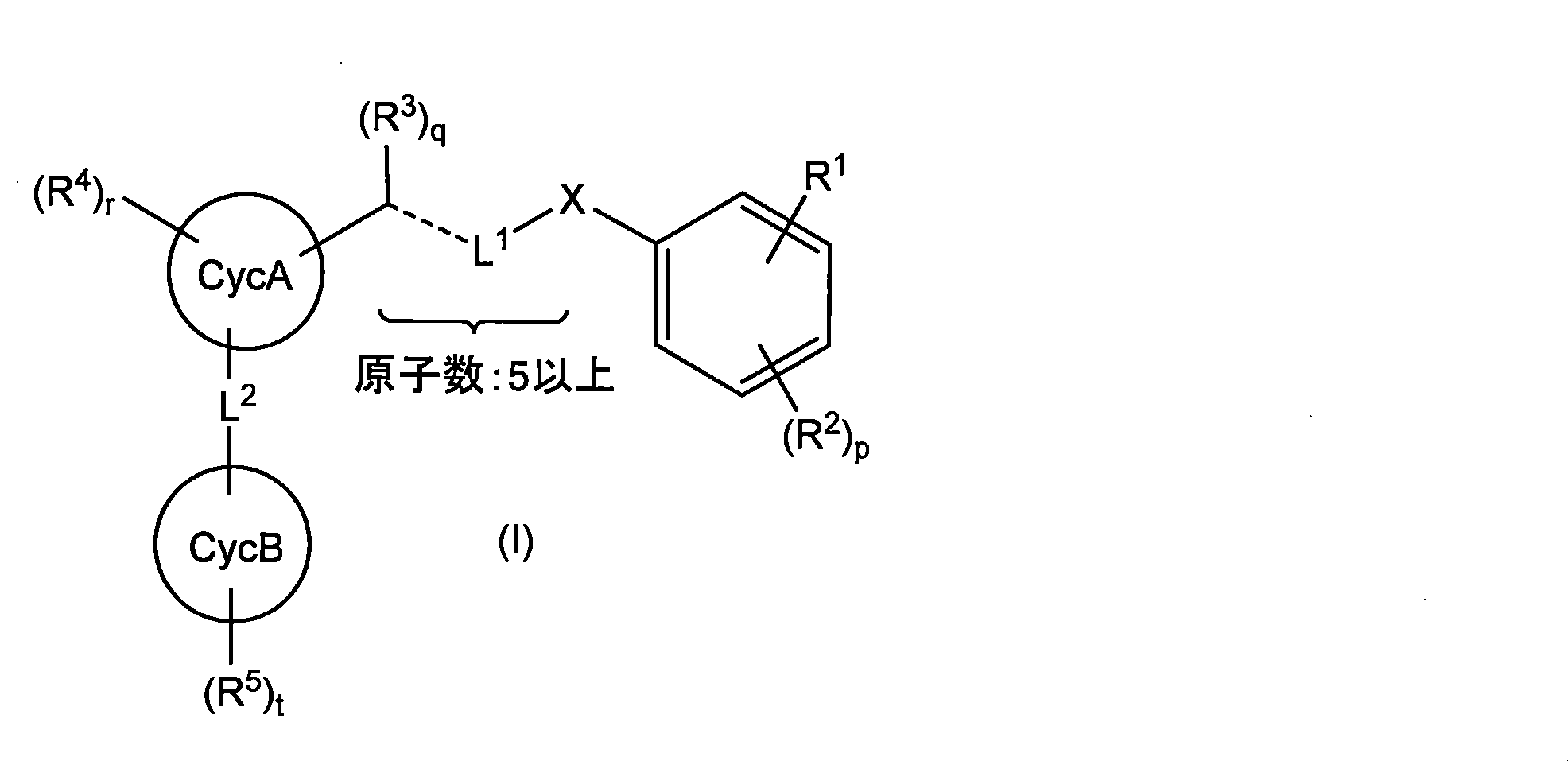


(1)=CH-(1~3個のRL1aで置換されていてもよい直鎖のC2~6アルキレン基)-、(2)-(1~3個のRL1aで置換されていてもよい直鎖のC3~7アルキレン基)-、または(3)-(1~2個のRL1aで置換されていてもよい直鎖のC1~3アルキレン基)-O-(1~2個のRL1aで置換されていてもよい直鎖のC1~3アルキレン基)-((1)~(3)においてRL1aは前記と同じ意味を表す)が好ましく、
(1)=CH-(1~3個のRL1aで置換されていてもよい直鎖のC2~6アルキレン基)-、または(2)-(1~3個のRL1aで置換されていてもよい直鎖のC3~7アルキレン基)-((1)~(2)においてRL1aは前記と同じ意味を表す)がより好ましく、
(1)=CH-(1~3個のRL1aで置換されていてもよい直鎖のC3アルキレン基)-、または(2)-(1~3個のRL1aで置換されていてもよい直鎖のC4アルキレン基)-((1)~(2)においてRL1aは前記と同じ意味を表す)がさらに好ましい。


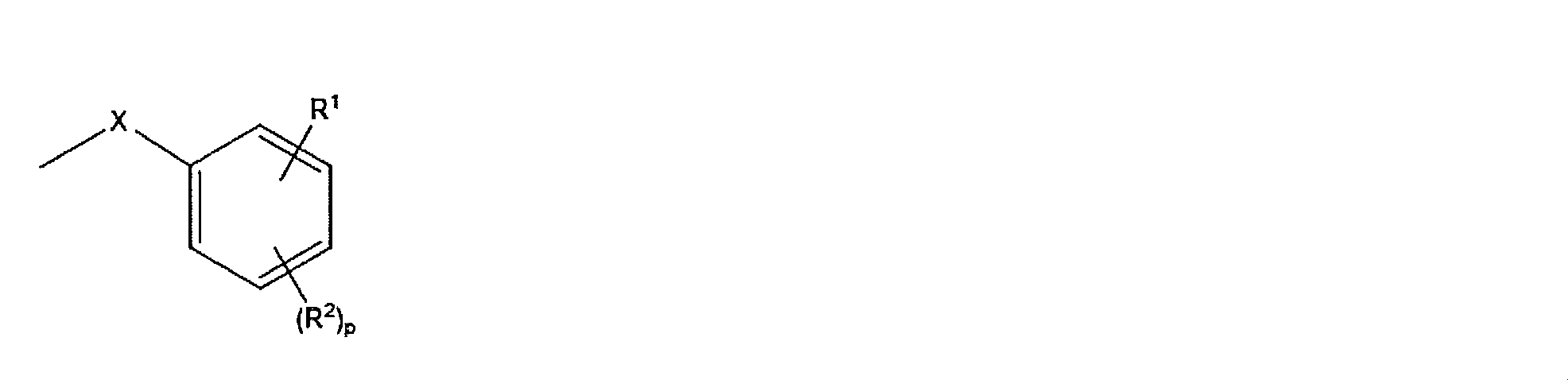


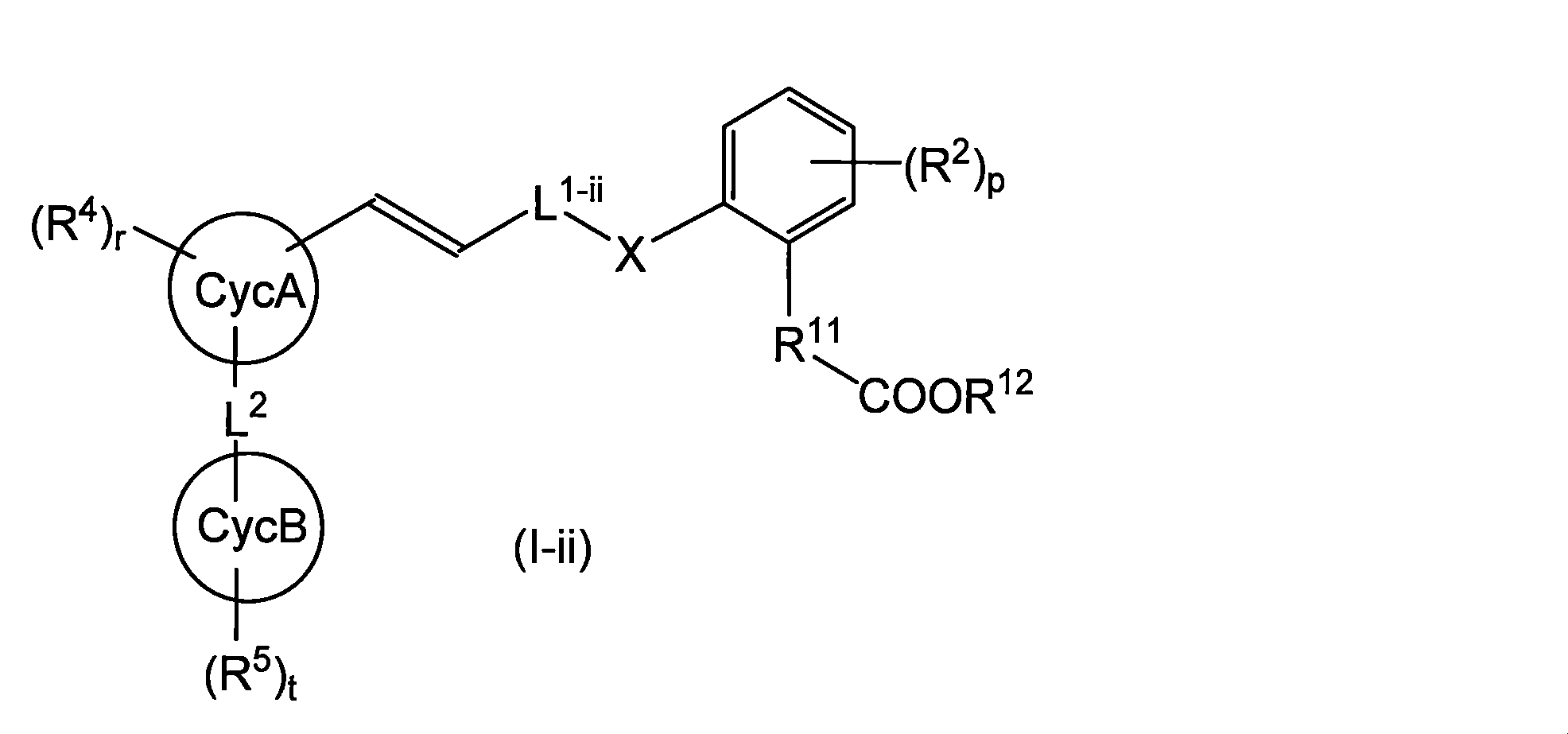
一般式(I-iii)

一般式(I-iv)

(1)R11がC2~4アルキレン基、
(2)Xが酸素原子、
(3)RL1aが水酸基、
(4)CycAが(i)C5~6単環式炭素環、または5~10員の単環式もしくは二環式複素環、(ii)ベンゼンもしくは5~6員単環式芳香族複素環、(iii)C5~6単環式炭素環、または(iv)ベンゼン、シクロヘキサン、ピリジン、チアゾール、イソインドリンもしくはテトラヒドロキノリン、
(5)CycBが(i)C5~6単環式炭素環、もしくは5~6員単環式複素環、(ii)ベンゼンもしくは5~6員単環式芳香族複素環、(iii)C5~6単環式炭素環、または(iv)シクロペンタン、ベンゼン、シクロヘキサン、チオフェン、ピリジンもしくはベンゾフラン、
(6)L2が-NR201-S(O)2-もしくは-CR204(OH)-CH2-、または
(7)R11、X、RL1a、CycA、CycBおよびL2以外の記号が前述の基(例えば、「好ましい」、「より好ましい」または「さらに好ましい」とした基)、
(8)上記(1)~(7)に記載の定義の二以上の組み合わせである化合物またはその塩が挙げられる。
本発明において、一般式(I-i)、(I-ii)、(I-iii)または(I-iv)で示される化合物またはその塩として、好ましくは、
(1)Xが酸素原子であり、L2が-NR201-S(O)2-または-CR204(OH)-CH2-である化合物またはその塩、
(2)Xが酸素原子であり、L2が-NR201-S(O)2-または-CR204(OH)-CH2-であり、CycAおよびCycBがC5~6単環式炭素環である化合物またはその塩、
(3)R11がC2~4アルキレン基であり、Xが酸素原子であり、L2が-NR201-S(O)2-または-CR204(OH)-CH2-であり、CycAおよびCycBがC5~6単環式炭素環である化合物またはその塩、または
(4)Xが酸素原子であり、RL1aが水酸基であり、L2が-NR201-S(O)2-または-CR204(OH)-CH2-であり、CycAおよびCycBがC5~6単環式炭素環である化合物またはその塩である。

本発明において、一般式(I-1)としては、一般式(I-1-A)

一般式(I-1-B)

一般式(I-1-C)
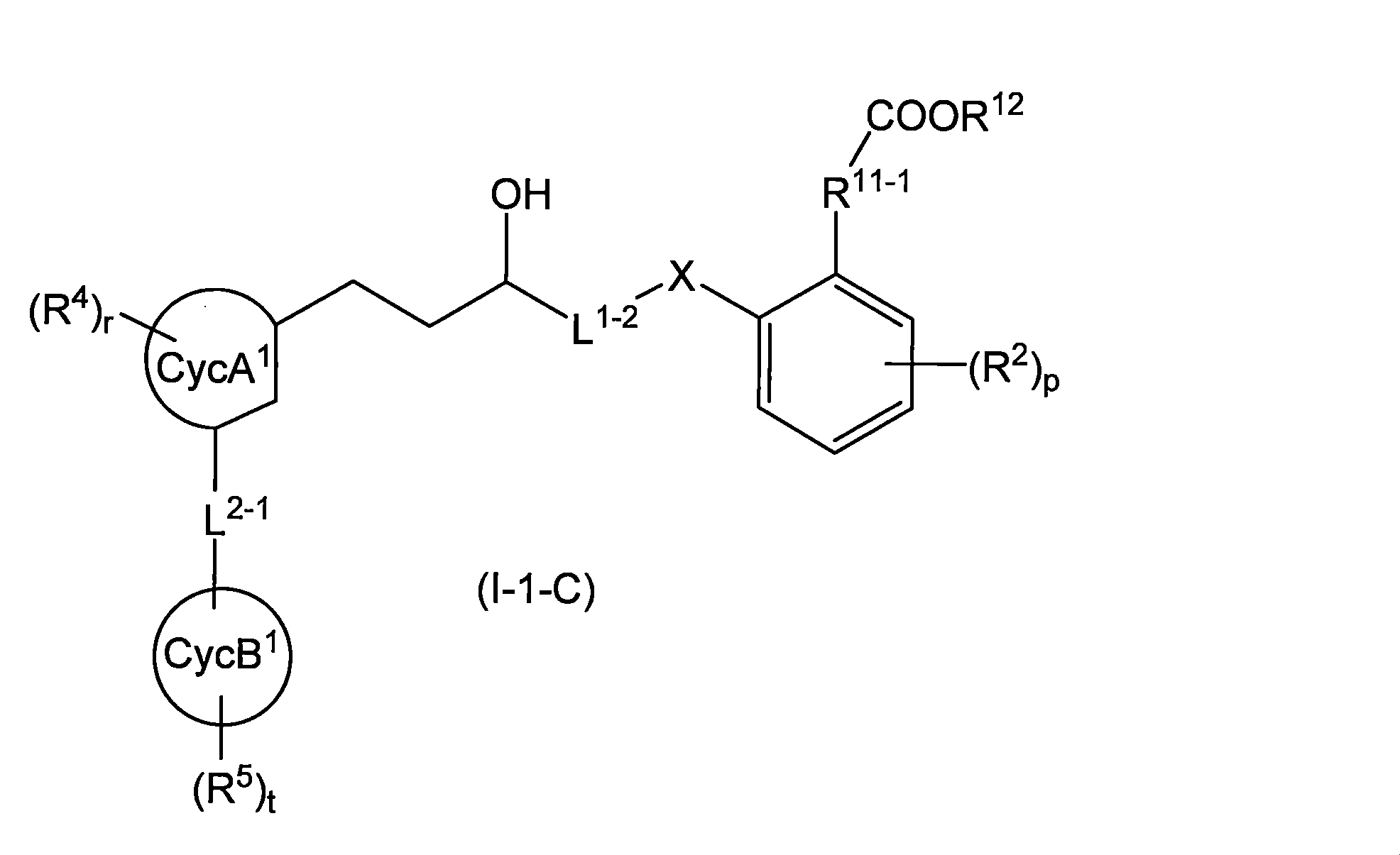
または一般式(I-1-D)

(1)Xが酸素原子、
(2)CycA1がベンゼン、シクロヘキサン、ピリジン、チアゾール、イソインドリンもしくはテトラヒドロキノリン、
(3)CycB1がシクロペンタン、ベンゼン、シクロヘキサン、チオフェン、ピリジンもしくはベンゾフラン、
(4)X、CycA1およびCycB1以外の記号が前述の基(例えば、「好ましい」、「より好ましい」または「さらに好ましい」とした基)、
(5)上記(1)~(4)に記載の定義の二以上の組み合わせ
である化合物またはその塩が挙げられる。
本発明においては、特に断わらない限り、当業者にとって明らかなように記号


本発明化合物は、公知の方法、例えば、Comprehensive Organic Transformations : A Guide to Functional Group Preparations, 2nd Edition (Richard C. Larock, John Wiley & Sons Inc, 1999)に記載された方法、または実施例に示す方法等を適宜改良し、組み合わせて用いることで製造することができる。
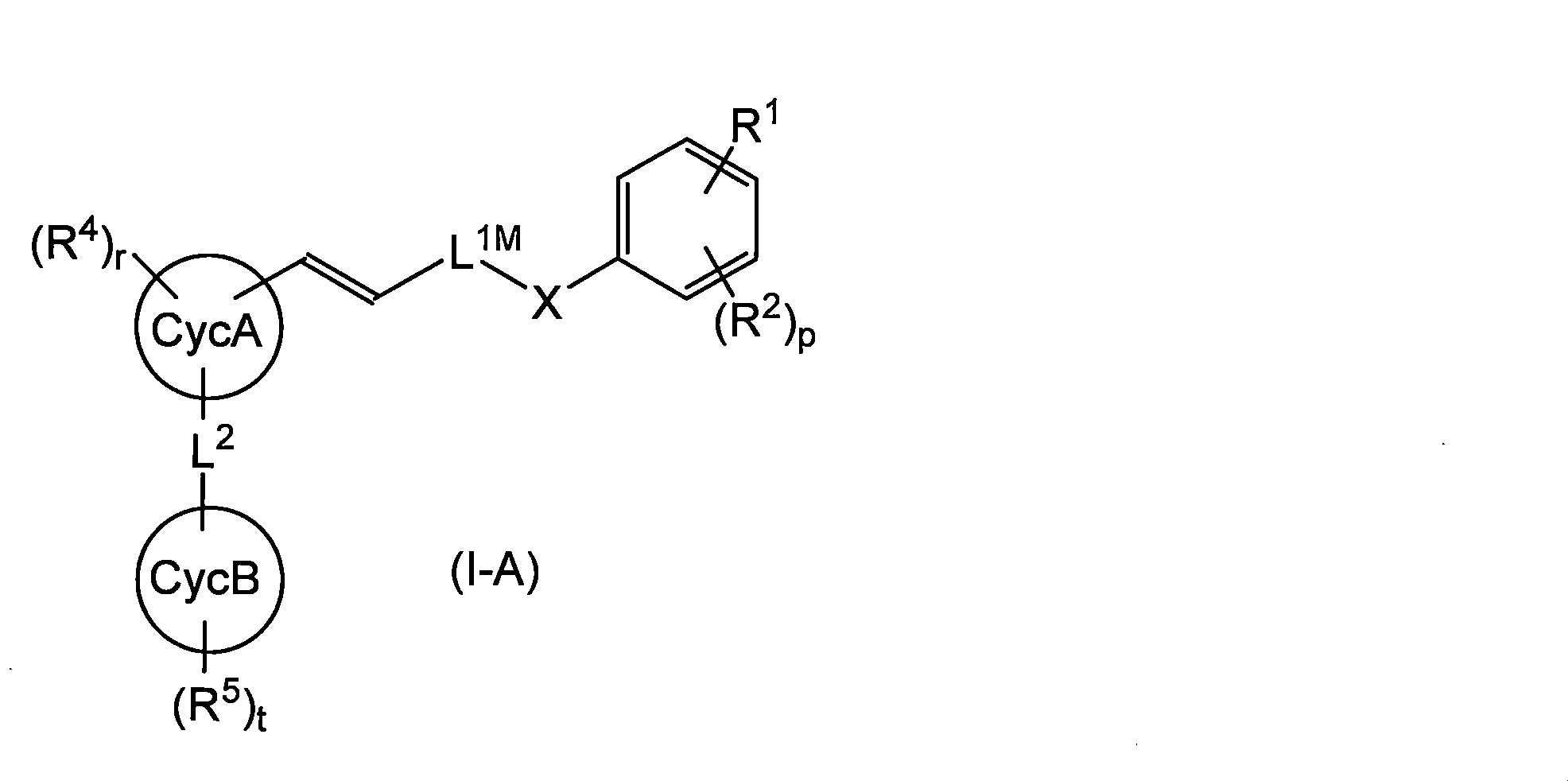


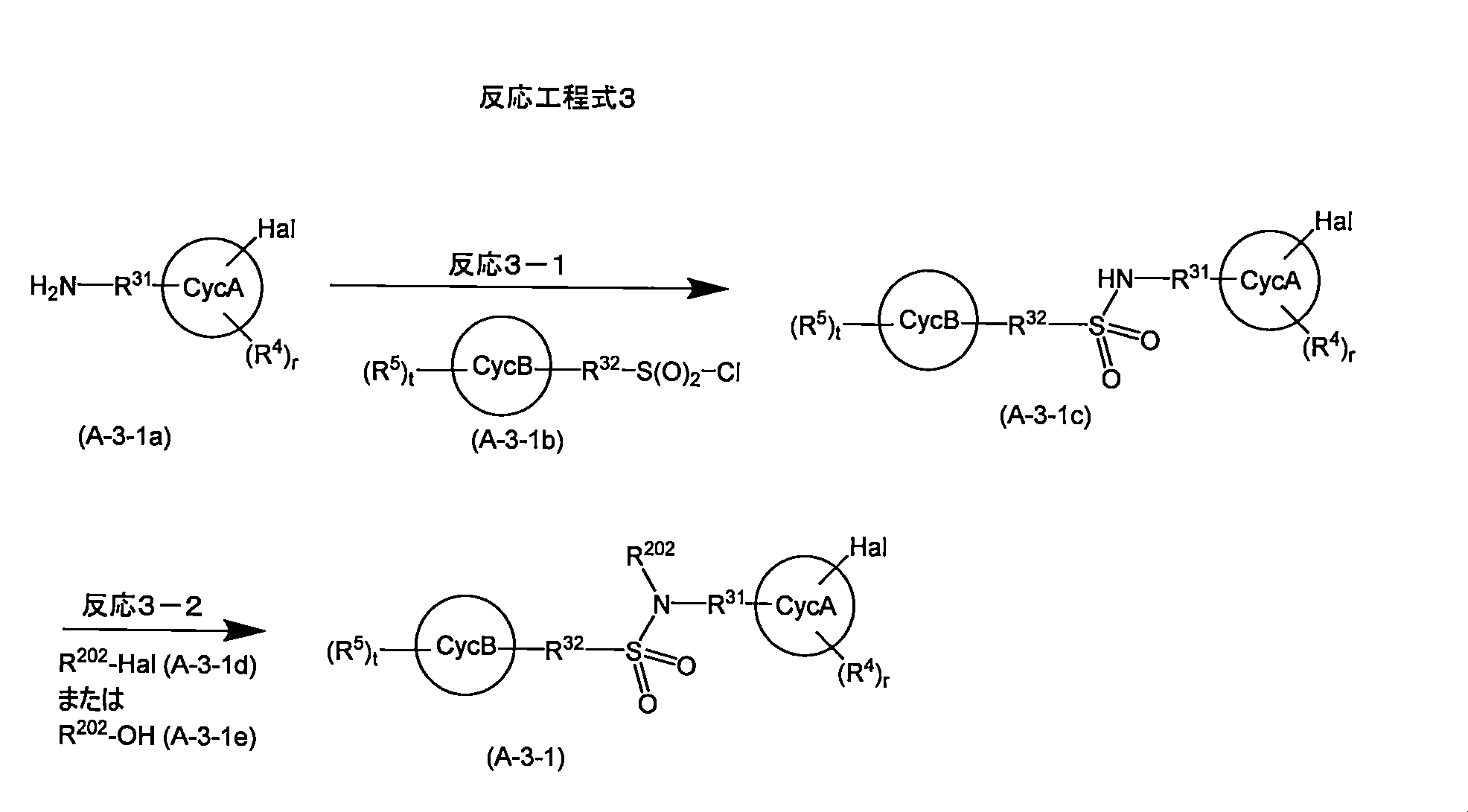
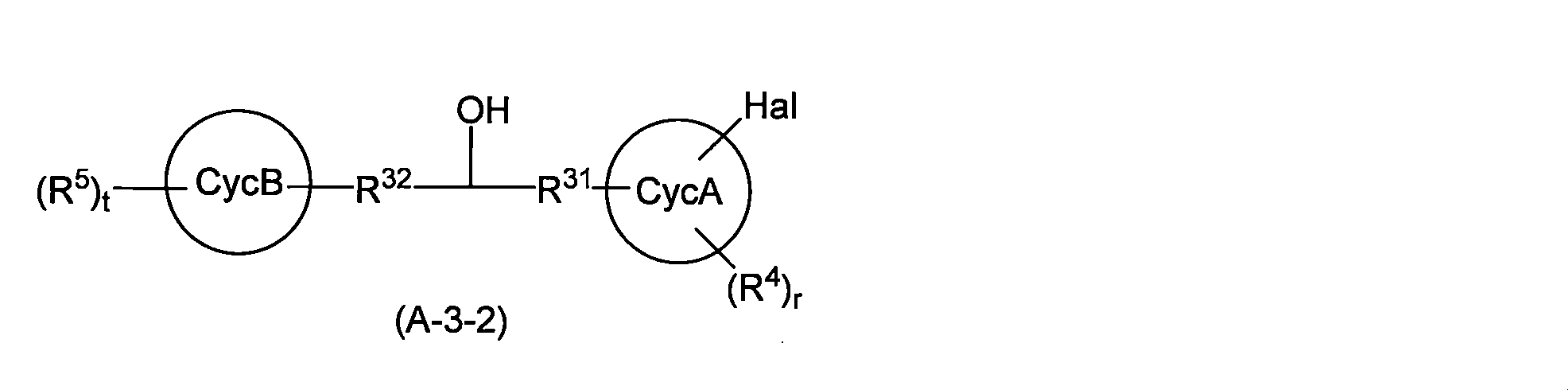

(1)アルカリ加水分解による脱保護反応は、例えば有機溶媒(例えば、メタノール、THF、ジオキサン等)中、アルカリ金属の水酸化物(例えば、水酸化ナトリウム、水酸化カリウム、水酸化リチウム等)、アルカリ土類金属の水酸化物(例えば、水酸化バリウム、水酸化カルシウム等)または炭酸塩(例えば、炭酸ナトリウム、炭酸カリウム等)あるいはその水溶液もしくはこれらの混合物を用いて、0~40℃で行なわれる。
(2)酸条件下での脱保護反応は、例えば有機溶媒(例えば、ジクロロメタン、クロロホルム、ジオキサン、酢酸エチル、メタノール、イソプロピルアルコール、THF、アニソール等)中、有機酸(例えば、酢酸、トリフルオロ酢酸、メタンスルホン酸、p-トシル酸等)、または無機酸(例えば、塩酸、硫酸等)もしくはこれらの混合物(例えば、臭化水素/酢酸等)中、2,2,2-トリフルオロエタノールの存在下または非存在下、0~100℃で行なわれる。
(3)加水素分解による脱保護反応は、例えば溶媒(例えば、エーテル系(例えば、THF、ジオキサン、ジメトキシエタン、ジエチルエーテル等)、アルコール系(例えば、メタノール、エタノール等)、ベンゼン系(例えば、ベンゼン、トルエン等)、ケトン系(例えば、アセトン、メチルエチルケトン等)、ニトリル系(例えば、アセトニトリル等)、アミド系(例えば、DMF等)、水、酢酸エチル、酢酸またはそれらの2以上の混合溶媒等)中、触媒(例えば、パラジウム-炭素、パラジウム黒、水酸化パラジウム-炭素、酸化白金、ラネーニッケル等)の存在下、常圧または加圧下の水素雰囲気下またはギ酸アンモニウム存在下、0~200℃で行なわれる。
(4)シリル基の脱保護反応は、例えば水と混和しうる有機溶媒(例えば、THF、アセトニトリル等)中、フッ化テトラブチルアンモニウムを用いて、0~40℃で行なわれる。また、例えば、有機酸(例えば、酢酸、トリフルオロ酢酸、メタンスルホン酸、p-トシル酸等)、または無機酸(例えば、塩酸、硫酸等)もしくはこれらの混合物(例えば、臭化水素/酢酸等)中、-10~100℃で行なわれる。
(5)金属を用いる脱保護反応は、例えば酸性溶媒(例えば、酢酸、pH4.2~7.2の緩衝液またはそれらの溶液とTHF等の有機溶媒との混合液)中、粉末亜鉛の存在下、必要であれば超音波をかけながら、0~40℃で行なわれる。
(6)金属錯体を用いる脱保護反応は、例えば有機溶媒(例えば、ジクロロメタン、DMF、THF、酢酸エチル、アセトニトリル、ジオキサン、エタノール等)、水またはそれらの混合溶媒中、トラップ試薬(例えば、水素化トリブチルスズ、トリエチルシラン、ジメドン、モルホリン、ジエチルアミン、ピロリジン等)、有機酸(例えば、酢酸、ギ酸、2-エチルヘキサン酸等)および/または有機酸塩(例えば、2-エチルヘキサン酸ナトリウム、2-エチルヘキサン酸カリウム等)の存在下、ホスフィン系試薬(例えば、トリフェニルホスフィン等)の存在下または非存在下、金属錯体(例えば、テトラキストリフェニルホスフィンパラジウム(0)、二塩化ビス(トリフェニルホスフィン)パラジウム(II)、酢酸パラジウム(II)、塩化トリス(トリフェニルホスフィン)ロジウム(I)等)を用いて、0-40℃で行なわれる。
本発明化合物の毒性は十分に低いものであり、医薬品として安全に使用することができる。
本発明化合物は、神経保護および/または修復作用を有する。
本発明化合物は、一実施形態において、持続性に優れた神経保護および/または修復作用を有する。
そのため、本発明化合物は例えば、神経障害を伴う疾患の治療に有用である。
以下の実施例におけるLC/MS分析で用いられた条件を以下に示す。カラム:YMC Triart C18、2.0mm×30mm、1.9μm;流量:1.0mL/min;温度:30℃;移動相A:0.1%TFA水溶液;移動相B:0.1%TFAアセトニトリル溶液:グラジエント(移動相A:移動相Bの比率を記載):0~0.10分(95:5)、0.10~1.20分(95:5から5:95)、1.20分~1.50分(5:95)。
NMRの箇所に示されているカッコ内は測定に使用した溶媒を示す。
本明細書中に用いた化合物名は、一般的にIUPACの規則に準じて命名を行なうコンピュータプログラム、Advanced Chemistry Development社のACD/Name(登録商標)を用いるか、または、IUPAC命名法に準じて命名したものである。
3,4-ジヒドロクマリン(50.0g)のイソプロピルアルコール(500mL)溶液に、硫酸(0.26mL)を加え、反応混合物を室温で2時間撹拌した。反応混合物を減圧濃縮し、得られた残さを酢酸エチルで希釈した。飽和炭酸水素ナトリウム水溶液、水、飽和食塩水で洗浄し、硫酸ナトリウムにて乾燥後、減圧濃縮し、以下の物性値を有する標題化合物(73.2g)を得た。
1H-NMR(CDCl3):δ 1.20, 2.66-2.70, 2.87-2.91, 4.95-5.08, 6.86-6.91, 7.06-7.15, 7.35。
実施例1で製造した化合物(2.00g)および2-(2-ブロモエチル)-1,3-ジオキサン(2.43g)のDMF(4mL)溶液に、リン酸カリウム(2.85g)を加え、反応混合物を70℃で2時間撹拌した。反応混合物を1M塩酸に注ぎ、酢酸エチルで抽出した。有機層を水、飽和食塩水で洗浄し、硫酸ナトリウムにて乾燥後、減圧濃縮した。得られた残さをシリカゲルカラムクロマトグラフィー(ヘキサン:酢酸エチル=95:5→4:1)によって精製することにより、以下の物性値を有する標題化合物(2.73g)を得た。
TLC:Rf0.57(ヘキサン:酢酸エチル=2:1)。
実施例2で製造した化合物(500mg)およびルチジン(0.40mL)のジクロロメタン(1.5mL)溶液を-15℃に冷却し、トリメチルシリルトリフルオロメタンスルホナート(0.42mL)を加えた。反応混合物を0℃で2時間撹拌した。反応溶液に氷(10g)を加え、0℃で15分間撹拌した。水と酢酸エチルを加え0℃で20時間撹拌し,反応混合物を1M塩酸と酢酸エチルに注ぎ、酢酸エチルで抽出した。有機層を水、飽和食塩水で洗浄し、硫酸ナトリウムにて乾燥後、減圧濃縮し、以下の物性値を有する標題化合物(443mg)を得た。
1H-NMR(CDCl3):δ 1.20, 2.50-2.55, 2.93-2.96, 4.33, 4.98, 6.85-6.92, 7.14-7.19, 9.90。
トリメチルシリルアセチレン(5.0mL)のTHF(70mL)溶液を-70℃に冷却し、n-ブチルリチウム(1.6Mヘキサン溶液、20mL)を加え、反応混合物を-70℃で30分間撹拌した。実施例3で製造した化合物(7.15g)のTHF(10mL)溶液を滴下し、反応混合物を0℃で2時間撹拌した。反応混合物を飽和塩化アンモニウム水溶液に注ぎ、酢酸エチルで抽出した。有機層を水、飽和食塩水で洗浄し、硫酸ナトリウムにて乾燥後、減圧濃縮した。得られた残さをシリカゲルカラムクロマトグラフィー(ヘキサン:酢酸エチル=95:5→7:3)によって精製することにより、以下の物性値を有する標題化合物(1.8g)を得た。
1H-NMR(CDCl3):δ 0.17, 1.19, 2.22-2.33, 2.56, 2.87-2.98, 4.09-4.23, 4.70, 3.60-4.93-5.03, 6.86-6.91, 7.14-7.18。
実施例4で製造した化合物(6.89g)のTHF(38mL)溶液を0℃に冷却し、フッ化テトラブチルアンモニウム(以下、TBAFと略記)(1.0M THF溶液、7.3mL)を加えた。反応混合物を0℃で10分間撹拌した。反応混合物を1M塩酸に注ぎ、酢酸エチルで抽出した。有機層を水、飽和食塩水で洗浄し、硫酸ナトリウムにて乾燥後、減圧濃縮した。得られた残さをシリカゲルカラムクロマトグラフィー(ヘキサン:酢酸エチル=95:5→1:1)によって精製することにより、以下の物性値を有する標題化合物(5.06g)を得た。
1H-NMR(CDCl3):δ 1.19, 2.20-2.26, 2.43, 2.50-2.59, 2.87-2.96, 4.08-4.26, 4.74, 4.99, 6.86-6.91, 7.14-7.21。
実施例5で製造した化合物(1.2g)のヘプタン(24mL)溶液に,ビニルアセテート(4mL)を加えた.CHIRAZYME L-5 CA(商品名)(0.4g)を加え,反応混合物を45℃で9時間撹拌した。反応混合物をセライト(商品名)でろ過後、ろ液を減圧濃縮した.得られた残さをシリカゲルカラムクロマトグラフィー(ヘキサン:酢酸エチル=95:5→1:1)によって精製することにより、以下の物性値を有する標題化合物(0.54g、>99%ee)を得た。得られた化合物を高速液体クロマトグラフィー(使用カラム:株式会社ダイセル CHIRALPAK-IB(4.6mm×250mm)、移動相:ヘキサン:2-プロパノール=95:5、流速:1mL/min、波長:254nm、カラム温度:40℃)で分析した結果、保持時間は10.6分であった。
1H-NMR(CDCl3):δ 1.19, 2.20-2.26, 2.41, 2.50-2.59, 2.90-2.96, 4.08-4.26, 4.74, 4.99, 6.86-6.91, 7.14-7.21。
実施例6で製造した化合物(500mg)のDMF(3.4mL)溶液を0℃に冷却し、クロロトリメチルシラン(0.24mL)を加えた。反応混合物を室温で2時間撹拌した。反応混合物を水に注ぎ、酢酸エチルで抽出した。有機層を水、飽和食塩水で洗浄し、硫酸ナトリウムにて乾燥後、減圧濃縮した。得られた残さをシリカゲルカラムクロマトグラフィー(ヘキサン:酢酸エチル=100:0→9:1)によって精製することにより、以下の物性値を有する標題化合物(600mg)を得た。
1H-NMR(CDCl3):δ 0.17, 1.21, 2.18, 2.43, 2.54-2.59, 2.90-2.95, 4.06-4.15, 4.67, 4.99, 6.83-6.89, 7.14-7.20。
実施例7で製造した化合物(2.45g)のヘプタン(6mL)溶液に、4,4,5,5-テトラメチル-1,3,2-ジオキサボロラン(2.09g)および4-ジメチルアミノ安息香酸(53.9mg)を加え、100℃で13時間撹拌した。反応溶液を室温まで冷却後、濃縮した。得られた残さをシリカゲルカラムクロマトグラフィー(ヘキサン:酢酸エチル=20:1→3:1)によって精製することにより、以下の物性値を有する標題化合物(1.45g)を得た。
HPLC保持時間(分):1.14。
3-ブロモアニリン(1.02g)のジクロロメタン(20mL)溶液に、0℃でピリジン(0.95mL)、N,N-ジメチルアミノピリジン(以下、DMAPと略記)(72.4mg)および塩化ベンゼンスルホニル(1.10g)を加え、室温で2時間撹拌した。反応溶液を濃縮後、得られた残さをシリカゲルカラムクロマトグラフィー(ヘキサン:酢酸エチル=9:1→2:1)によって精製することにより、以下の物性値を有する標題化合物(1.96g)を得た。
HPLC保持時間(分):0.98。
実施例8で製造した化合物(2.00g)のTHF(18mL)溶液に、実施例9で製造した化合物(1.18g)、クロロ(2-ジシクロヘキシルホスフィノ-2’,4’,6’-トリイソプロピル-1,1’-ビフェニル)[2-(2’-アミノ-1,1’-ビフェニル)]パラジウム(II)(CAS登録番号:1310584-14-5)(0.30g)および2Mリン酸三カリウム水溶液(5.7mL)を加え、60℃で2時間撹拌した。反応溶液を室温まで冷却後、水を加え、酢酸エチルで抽出した。有機層を硫酸ナトリウムにて乾燥後、減圧濃縮した。得られた残さのTHF(6mL)に、TBAF(1.0M THF溶液、6.3mL)を加え、室温で1時間撹拌した。反応溶液に水を加え、酢酸エチルで抽出した。有機層を硫酸ナトリウムにて乾燥後、減圧濃縮した。得られた残さをシリカゲルカラムクロマトグラフィー(ヘキサン:酢酸エチル=9:1→2:1)によって精製することにより、以下の物性値を有する標題化合物(1.41g)を得た。
HPLC保持時間(分):1.10;
1H-NMR(CDCl3):δ 1.21, 2.05-2.17, 2.21, 2.57-2.61, 2.91-2.95, 4.11-4.19, 4.62, 5.02, 6.25, 6.55, 6.72, 6.85-6.91, 6.99, 7.09-7.22, 7.41-7.45, 7.53, 7.75-7.78。

HPLC保持時間(分):0.93;
1H-NMR(CD3OD):δ 2.05-2.10, 2.57-2.61, 2.91-2.95, 4.10, 4.17, 4.51-4.56, 6.24, 6.53, 6.86, 6.93, 6.98, 7.12-7.20, 7.45-7.50, 7.56, 7.75-7.78。
実施例10で使用したN-(3-ブロモフェニル)ベンゼンスルホンアミドの代わりに相当するハライド化合物を用いて、実施例10→実施例11と同様の目的の操作に付すことにより、以下の実施例化合物を得た。
HPLC保持時間(分):0.95;
1H-NMR(CD3OD):δ 2.10-2.15, 2.59-2.63, 2.93-2.97, 4.13, 4.21, 4.60, 6.39, 6.67, 6.86, 6.95, 7.16, 7.24, 7.33, 7.52-7.63, 7.81, 7.95-7.97。
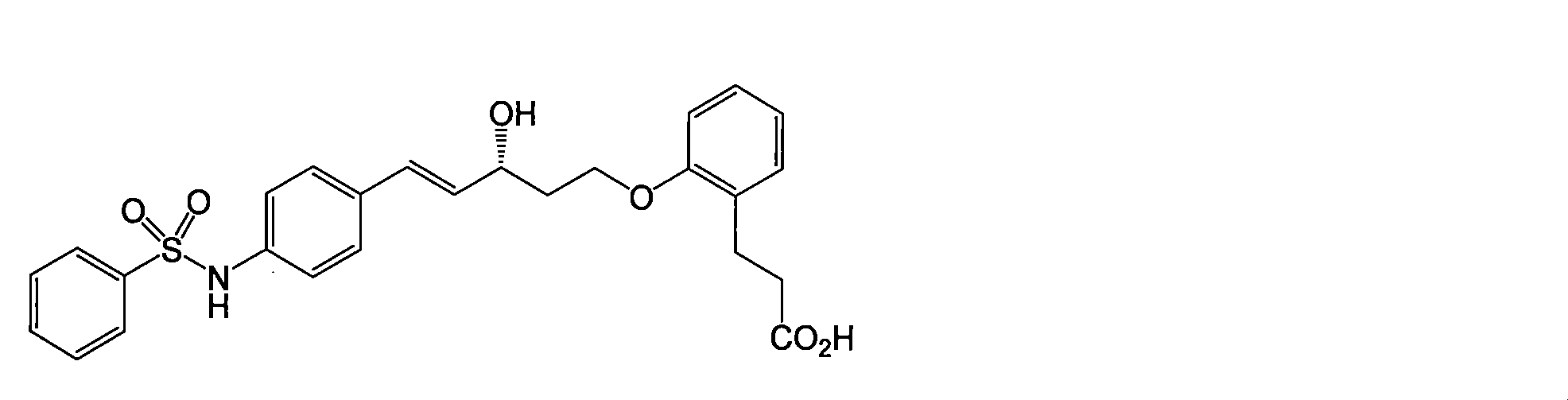
MS(ESI,Pos.):464(M+H-H2O)+。
HPLC保持時間(分):0.95;
1H-NMR(CD3OD):δ 2.10-2.14, 2.58-2.63, 2.93-2.97, 4.13, 4.20, 4.58, 6.32, 6.64, 6.86, 6.95, 7.15-7.20, 7.44-7.55, 7.60, 7.67-7.71, 7.93-7.97。
HPLC保持時間(分):0.94;
MS(ESI,Pos.):464(M+H-H2O)+。
HPLC保持時間(分):0.89;
MS(ESI,Pos.):428(M+H-H2O)+。
HPLC保持時間(分):0.85;
1H-NMR(CD3OD):δ 2.05-2.10, 2.57-2.61, 2.92-2.95, 4.10, 4.17, 4.33, 4.52, 6.19, 6.49-6.56, 6.69-6.71, 6.85, 6.93, 7.04, 7.15-7.24, 7.29-7.33, 7.37-7.39。
HPLC保持時間(分):0.94;
MS(ESI,Pos.):464(M+H-H2O)+。
HPLC保持時間(分):0.95;
MS(ESI,Pos.):428(M+H-H2O)+。
HPLC保持時間(分):0.96;
1H-NMR(CD3OD):δ 2.08-2.13, 2.58-2.62, 2.93-2.98, 3.06, 4.11, 4.19, 4.56, 4.84, 6.27, 6.62, 6.86, 6.94, 7.10-7.31。
HPLC保持時間(分):0.93;
MS(ESI,Pos.):478(M+H-H2O)+。
HPLC保持時間(分):0.97;
1H-NMR(CDCl3):δ 1.99-2.07, 2.11-2.19, 2.68-2.72, 2.95-3.08, 4.12-4.26, 4.73-4.78, 6.12, 6.59, 6.86-6.92, 7.04-7.11, 7.16-7.23, 7.33-7.38, 7.44-7.48, 7.64-7.67。
HPLC保持時間(分):1.10;
MS(ESI,Pos.):502(M+H-H2O)+。
HPLC保持時間(分):1.00;
1H-NMR(CDCl3):δ 2.10-2.15, 2.65-2.68, 2.94-3.14, 4.12-4.22, 4.62, 6.28, 6.64, 6.86-6.91, 7.00-7.02, 7.15-7.28, 7.44。
実施例9で使用した3-ブロモアニリンの代わりに相当するアミン化合物を用いて、実施例9→実施例10→実施例11と同様の目的の操作に付すことにより、以下の実施例化合物を得た。

1H-NMR(CD3OD):δ 1.96, 2.07-2.12, 2.56-2.60, 2.90-2.94, 4.10, 4.18, 4.57, 6.12, 6.78, 6.84-6.93, 7.04, 7.15-7.20, 7.36, 7.47-7.51, 7.60, 7.65-7.67。
HPLC保持時間(分):0.95;
1H-NMR(CD3OD):δ 2.05-2.11, 2.19, 2.56-2.60, 2.91-2.95, 4.09, 4.19, 4.56, 6.01, 6.76, 6.84-6.94, 6.99, 7.12-7.20, 7.44-7.48, 7.56, 7.73-7.75。
HPLC保持時間(分):0.96;
1H-NMR(CD3OD):δ 1.93-1.98, 2.12, 2.45-2.49, 2.79-2.83, 3.98, 4.05, 4.41, 6.09, 6.37, 6.69, 6.74, 6.80-6.83, 7.03-7.08, 7.34-7.38, 7.44, 7.63-7.66。
HPLC保持時間(分):0.94;
1H-NMR(CD3OD):δ 1.89-1.97, 1.91, 2.46-2.50, 2.81-2.84, 3.98, 4.06, 4.40, 5.98, 6.37, 6.75, 6.83, 6.90, 6.97, 7.04-7.09, 7.34-7.38, 7.46, 7.56-7.58。
HPLC保持時間(分):0.94;
1H-NMR(CD3OD):δ 2.03-2.09, 2.55-2.59, 2.89-2.93, 4.09, 4.16, 4.53, 6.36, 6.63, 6.86, 6.92, 7.06, 7.15-7.19, 7.30-7.37, 7.45-7.49, 7.57, 7.75-7.77。
HPLC保持時間(分):0.94;
1H-NMR(CD3OD):δ 1.90-2.01, 2.45-2.49, 2.79-2.83, 3.99, 4.07, 4.43, 6.17, 6.56, 6.75, 6.81-6.88, 7.03-7.09, 7.34-7.38, 7.45, 7.60-7.63。
HPLC保持時間(分):0.96;
1H-NMR(CD3OD):δ 1.92-1.98, 2.44-2.48, 2.78-2.82, 3.98, 4.06, 4.42, 6.17, 6.39, 6.68, 6.70-6.82, 7.03-7.08, 7.37-7.41, 7.47, 7.68-7.71。
HPLC保持時間(分):0.92;
1H-NMR(CD3OD):δ 1.95-2.00, 2.45-2.49, 2.81-2.84, 4.00, 4.07, 4.44, 6.10, 6.45, 6.75, 6.81-6.86, 7.04-7.10, 7.34-7.39, 7.47, 7.64-7.66。
HPLC保持時間(分):0.95;
1H-NMR(CD3OD):δ 1.94-2.00, 2.43-2.47, 2.78-2.82, 3.99, 4.06, 4.45, 6.08, 6.74, 6.79-6.85, 7.03-7.10, 7.32-7.43, 7.50, 7.58-7.60。
HPLC保持時間(分):0.99;
1H-NMR(CD3OD):δ 1.94-2.00, 2.43-2.47, 2.79-2.83, 3.99, 4.07, 4.47, 6.09, 6.73-6.82, 7.04-7.08, 7.27, 7.38-7.42, 7.48, 7.73-7.76。
HPLC保持時間(分):0.99;
1H-NMR(CD3OD):δ 1.91-2.03, 2.42-2.46, 2.79-2.83, 3.99, 4.07, 4.46, 6.25,6.49, 6.74, 6.81, 7.03-7.07, 7.16, 7.22-7.26, 7.37-7.41, 7.47, 7.67-7.70。
HPLC保持時間(分):0.97;
1H-NMR(CD3OD):δ 1.94-2.00, 2.46-2.50, 2.80-2.84, 4.00, 4.08, 4.46, 6.19, 6.49, 6.76, 6.84, 7.05-7.10, 7.24, 7.28, 7.39-7.52, 7.67-7.70。
HPLC保持時間(分):0.85;
1H-NMR(CD3OD):δ 1.92-2.00, 2.45-2.49, 2.79-2.83, 3.96-4.10, 4.47, 6.42, 6.64, 6.75, 6.79-6.83, 6.88, 7.03-7.08, 7.36-7.49, 7.85-7.88。
HPLC保持時間(分):1.00;
1H-NMR(CD3OD):δ 2.11-2.16, 2.59-2.63, 2.82-2.86, 2.94-2.98, 3.94-3.98, 4.14, 4.22, 4.60, 6.34, 6.66, 6.87, 6.96, 7.05-7.09, 7.16-7.21, 7.48-7.52, 7.63, 7.66, 7.78-7.81。
HPLC保持時間(分):1.00;
1H-NMR(CD3OD):δ 2.04-2.09, 2.51-2.55, 2.70-2.89, 3.89-3.96, 4.08, 4.14, 4.53, 6.23, 6.50, 6.83, 6.90, 7.08-7.19, 7.48-7.53, 7.63, 7.78-7.81。
HPLC保持時間(分):1.00;
1H-NMR(CD3OD):δ 2.06-2.10, 2.55-2.59, 2.89-2.93, 4.10, 4.17, 4.54, 4.60, 6.31, 6.60, 6.85, 6.92, 7.13-7.18, 7.28-7.30, 7.58-7.68, 7.90-7.93。
HPLC保持時間(分):1.00;
1H-NMR(CD3OD):δ 1.59-1.66, 2.10-2.15, 2.40-2.43, 2.59-2.63, 2.93-2.97, 3.82-3.85, 4.14, 4.21, 4.59, 6.31, 6.62, 6.86, 6.94-7.01, 7.16-7.21, 7.45-7.49, 7.59-7.63, 7.79。
HPLC保持時間(分):1.00;
1H-NMR(CD3OD):δ 1.50-1.57, 2.01-2.15, 2.19-2.37, 2.53-2.57, 2.88-2.92, 3.75-3.78, 4.07, 4.16, 4.56, 6.12, 6.67, 6.84, 6.90, 7.13-7.21, 7.32, 7.45-7.49, 7.56-7.65。
HPLC保持時間(分):1.00;
1H-NMR(CD3OD):δ 2.07-2.12, 2.57-2.61, 2.87-2.95, 3.36-3.39, 4.11, 4.18, 4.25, 4.55, 6.29, 6.57, 6.85, 6.93, 7.05, 7.14-7.19, 7.23, 7.59-7.70, 7.87-7.89。
実施例9で製造した化合物(313mg)のTHF(2mL)溶液に、オキセタン-2-イルメタノール(132mg)、トリフェニルホスフィン(394mg)、アゾジカルボン酸ジエチル(40%トルエン溶液、0.68mL)を加え、室温で2時間撹拌した.反応溶液をシリカゲルカラムクロマトグラフィー(ヘキサン:酢酸エチル=4:1→1:1)によって精製することにより、以下の物性値を有する標題化合物(381mg)を得た。
TLC:Rf 0.34(ヘキサン:酢酸エチル=2:1)
実施例10で使用したN-(3-ブロモフェニル)ベンゼンスルホンアミドの代わりに実施例14で製造した化合物を用いて、実施例10→実施例11と同様の目的の操作を付すことにより、以下の物性値を有する標題化合物を得た。
HPLC保持時間(分):0.95;
1H-NMR(CD3OD):δ 2.06-2.10, 2.48-2.69, 2.91-2.95, 3.80, 4.00, 4.10, 4.18, 4.47-4.64, 4.83, 6.21, 6.55, 6.87, 6.94-6.96, 7.03, 7.17-7.21, 7.27, 7.38, 7.50-7.54, 7.60-7.65。
実施例14で使用したオキセタン-2-イルメタノールの代わりに相当するアルコール化合物を、実施例10で使用したN-(3-ブロモフェニル)ベンゼンスルホンアミドの代わりに相当するハライド化合物を用いて、実施例14→実施例10→実施例11と同様の目的の操作を付すことにより、以下の実施例化合物を得た。
HPLC保持時間(分):0.94;
1H-NMR(CD3OD):δ 2.06-2.11, 2.57-2.61, 2.91-2.95, 3.04, 3.95, 4.10, 4.18, 4.36-4.40, 4.55, 4.63-4.67, 6.22, 6.55, 6.85-6.97, 7.16-7.21, 7.29, 7.40, 7.52-7.56, 7.62-7.67。
HPLC保持時間(分):1.00;
1H-NMR(CD3OD):δ 1.72, 1.84-1.99, 2.06-2.11, 2.57-2.61, 2.92-2.95, 3.57, 3.66-3.80, 3.89, 4.10, 4.18, 4.55, 6.22, 6.56, 6.87, 6.94-6.97, 7.05, 7.16-7.21, 7.28, 7.38, 7.49-7.53, 7.58-7.64。
HPLC保持時間(分):0.97;
1H-NMR(CD3OD):δ 1.74, 1.95, 2.06-2.11, 2.25, 2.57-2.61, 2.91-2.95, 3.57-3.61, 3.67-3.73, 3.87, 4.10, 4.19, 4.55, 6.23, 6.56, 6.87, 6.94-6.96, 7.02, 7.16-7.21, 7.30, 7.41, 7.50-7.54, 7.57-7.65。
HPLC保持時間(分):1.10;
1H-NMR(CD3OD):δ 1.26, 1.39-1.55, 1.68, 1.82, 2.06-2.11, 2.57-2.61, 2.92-2.95, 3.23-3.30, 3.51, 3.70, 3.87, 4.10, 4.18, 4.55, 6.20, 6.56, 6.87, 6.93-6.96, 7.02, 7.16-7.21, 7.28, 7.38, 7.49-7.53, 7.58-7.63。
TLC:Rf 0.31(ヘキサン:酢酸エチル=1:2);
1H-NMR(CDCl3):δ 1.04, 1.98-2.21, 2.67, 2.89-3.01, 4.10-4.24, 4.55-4.66, 6.22, 6.59, 6.85-6.92, 7.07, 7.16-7.28, 7.38-7.57, 7.76。
TLC:Rf 0.34(ヘキサン:酢酸エチル=1:2);
1H-NMR(CDCl3):δ 0.91, 1.57, 2.08-2.15, 2.67, 2.97, 3.30, 4.10-4.24, 4.62, 6.20, 6.57, 6.83-6.92, 7.08, 7.16-7.25, 7.31, 7.40-7.47, 7.51-7.60。
TLC:Rf 0.79(酢酸エチル);
1H-NMR(CDCl3):δ 0.09-0.13, 0.38-0.43, 0.80-0.90, 2.09-2.18, 2.67, 2.97, 3.42, 4.11-4.23, 4.63, 6.22, 6.58, 6.86-6.93, 7.14-7.26, 7.33, 7.44, 7.55, 7.63。
TLC:Rf 0.74(酢酸エチル);
1H-NMR(CDCl3):δ 2.07-2.21, 2.64-2.71, 2.74-2.81, 2.94-3.01, 3.72-3.80, 4.11-4.24, 4.63, 6.22, 6.59, 6.81-6.93, 7.09-7.26, 7.31-7.45, 7.51-7.60。
実施例9で製造した化合物(1.00g)のDMF(6mL)溶液に、氷冷下、水素化ナトリウム(60%inミネラルオイル、141mg)を加え、室温で撹拌した。30分後、クロロアセトン(0.52mL)を加え、室温で4時間撹拌した.反応液に水を加え、酢酸エチルで抽出した。有機層を飽和食塩水で洗浄し,硫酸マグネシウムにて乾燥後、減圧濃縮した。得られた残さをシリカゲルカラムクロマトグラフィー(ヘキサン:酢酸エチル=80:20→50:50)によって精製することにより、以下の物性値を有する標題化合物(1.10g)を得た。
TLC:Rf 0.42(ヘキサン:酢酸エチル=2:1)
実施例17で製造した化合物(313mg)のTHF(3mL)溶液に、氷冷下、メチルマグネシウムブロミド(0.95M THF溶液、1.0mL)を加え、室温で一晩撹拌した。反応液に飽和塩化アンモニウム水溶液を加え、酢酸エチルで抽出した。有機層を水、飽和食塩水で洗浄し,硫酸マグネシウムにて乾燥後、減圧濃縮した。得られた残さをシリカゲルカラムクロマトグラフィー(ヘキサン:酢酸エチル=80:20→50:50)によって精製することにより、以下の物性値を有する標題化合物(50mg)を得た。
TLC:Rf 0.58(ヘキサン:酢酸エチル=1:1)。
実施例10で使用したN-(3-ブロモフェニル)ベンゼンスルホンアミドの代わりに実施例18で製造した化合物を用いて、実施例10→実施例11と同様の目的の操作を付すことにより、以下の物性値を有する標題化合物を得た。
HPLC保持時間(分):0.93;
1H-NMR(CD3OD):δ 1.18, 2.06-2.10, 2.58-2.62, 2.92-2.96, 3.66, 4.10, 4.18, 4.54, 6.20, 6.55, 6.87, 6.95, 6.99, 7.05, 7.17-7.21, 7.25, 7.35, 7.46-7.54, 7.60。
実施例17で使用したクロロアセトンの代わりに相当するハライド化合物を、実施例10で使用したN-(3-ブロモフェニル)ベンゼンスルホンアミドの代わりに相当するハライド化合物を用いて、実施例17→実施例10→実施例11と同様の目的の操作を付すことにより、以下の実施例化合物を得た。
HPLC保持時間(分):0.99;
1H-NMR(CDCl3):δ 2.06-2.11, 2.57-2.61, 2.91-2.95, 3.20, 4.10, 4.19, 4.55, 6.24, 6.57, 6.87, 6.93-7.00, 7.08, 7.17-7.20, 7.27, 7.36, 7.50-7.56, 7.63。
HPLC保持時間(分):1.01;
1H-NMR(CDCl3):δ 1.07, 2.06-2.11, 2.57-2.61, 2.92-2.96, 3.66, 4.11, 4.19, 4.55, 6.22, 6.57, 6.87, 6.92-6.96, 7.01, 7.16-7.21, 7.29, 7.39, 7.50-7.54, 7.59-7.65。
HPLC保持時間(分):1.07;
1H-NMR(CDCl3):δ 2.04-2.09, 2.57-2.61, 2.91-2.95, 4.08, 4.16, 4.52, 4.80, 6.14, 6.48, 6.85-6.89, 6.93-6.96, 7.14-7.28, 7.54-7.58, 7.63-7.69。
TLC:Rf 0.49(ヘキサン:酢酸エチル=1:2);
1H-NMR(CDCl3):δ 2.08-2.17, 2.62-2.70, 2.94-3.00, 4.11-4.26, 4.62, 6.21, 6.57, 6.83-6.93, 7.10, 7.17-7.25, 7.36, 7.47, 7.57-7.63。
1-(3-ブロモフェニル)-2-フェニルエタノン(CAS登録番号:40396-53-0)(2.00g)のTHF(70mL)溶液に、-20℃で(R)-メチルオキサザボロリジン(1.0Mトルエン溶液、3.6mL)およびボラン・ジメチルスルフィド(2.0M THF溶液、3.6mL)を加え、同温で1時間撹拌した。反応溶液に-20℃でメタノール(1mL)を加え、減圧濃縮した。得られた残さをシリカゲルカラムクロマトグラフィー(ヘキサン:酢酸エチル=9:1→2:1)によって精製することにより、以下の物性値を有する標題化合物(1.91g、96%ee)を得た。得られた化合物をSFC(使用カラム:株式会社ダイセル CHIRALPAK-IA(10mm×250mm)、移動相:CO2:アセトニトリル:メタノール=90:9:1、流速:30mL/min、圧力:100bar、波長:220nm、カラム温度:35℃)で分析した結果、保持時間は5.6分であった。
HPLC保持時間(分):1.08。
実施例10で使用したN-(3-ブロモフェニル)ベンゼンスルホンアミドの代わりに実施例21で製造した化合物を用いて、実施例10と同様の目的の操作を付すことにより、以下の物性値を有する標題化合物を得た。
HPLC保持時間(分):1.21。
実施例11で使用したプロパン-2-イル 3-[2-[(E,3R)-5-[3-(ベンゼンスルホンアミド)フェニル]-3-ヒドロキシペンタ-4-エノキシ]フェニル]プロパノエートの代わりに実施例22で製造した化合物を用いて、実施例11と同様の目的の操作を付すことにより、以下の物性値を有する標題化合物を得た。
HPLC保持時間(分):0.95;
1H-NMR(CD3OD):δ 2.08-2.13, 2.58-2.62, 2.93-2.98, 3.06, 4.11, 4.19, 4.56, 4.84, 6.28, 6.62, 6.86, 6.94, 7.10-7.31。
実施例21で使用した(R)-メチルオキサザボロリジンの代わりに(S)-メチルオキサザボロリジンを、実施例10で使用したN-(3-ブロモフェニル)ベンゼンスルホンアミドの代わりに相当するハライド化合物を用いて、実施例21→実施例10→実施例11と同様の目的の操作を付すことにより、以下の物性値を有する標題化合物を得た。
HPLC保持時間(分):0.97;
1H-NMR(CD3OD):δ 2.08-2.13, 2.58-2.62, 2.93-2.98, 3.06, 4.11, 4.19, 4.56, 4.84, 6.27, 6.61, 6.86, 6.94, 7.10-7.31。
実施例21で使用した1-(3-ブロモフェニル)-2-フェニルエタノンの代わりに2-(3-ブロモフェニル)-1-フェニルエタノン(CAS登録番号:27798-44-3)を、実施例10で使用したN-(3-ブロモフェニル)ベンゼンスルホンアミドの代わりに相当するハライド化合物を用いて、実施例21→実施例10→実施例11と同様の目的の操作を付すことにより、以下の物性値を有する標題化合物を得た。
HPLC保持時間(分):0.99;
1H-NMR(CDCl3):δ 2.10-2.15, 2.64-2.68, 2.94-3.05, 4.10-4.21, 4.59-4.64, 4.92, 6.27, 6.61, 6.86-6.91, 7.05-7.24, 7.27-7.37。
実施例25で使用した(R)-メチルオキサザボロリジンの代わりに(S)-メチルオキサザボロリジンを、実施例10で使用したN-(3-ブロモフェニル)ベンゼンスルホンアミドの代わりに相当するハライド化合物を用いて、実施例25と同様の目的の操作を付すことにより、以下の物性値を有する標題化合物を得た。
HPLC保持時間(分):0.98;
1H-NMR(CDCl3):δ 2.10-2.15, 2.63-2.67, 2.94-3.05, 4.10-4.22, 4.59-4.64, 4.91, 6.27, 6.61, 6.86-6.91, 7.06-7.08, 7.14-7.24, 7.28-7.38。
3-ブロモベンズアルデヒド(500mg)のTHF(13.5mL)溶液を、0℃に冷却し、フェニルマグネシウムクロリド(1.0M THF溶液、3.5mL)を加え、反応混合物を0℃で30分間撹拌した。反応混合物を飽和塩化アンモニウム溶液に注ぎ、メチル-tert-ブチルエーテルで抽出した。有機層を飽和食塩水で洗浄し、硫酸ナトリウムにて乾燥後、減圧濃縮した。得られた残さをシリカゲルカラムクロマトグラフィー(ヘキサン:酢酸エチル=10:0→2:1)によって精製することにより、以下の物性値を有する標題化合物(610mg)を得た。
1H-NMR(CDCl3):δ 1.85, 1.98-2.15, 2.65-2.80, 4.65-4.69, 7.18-7.31, 7.39-7.42, 7.51。
実施例10で使用したN-(3-ブロモフェニル)ベンゼンスルホンアミドの代わりに実施例27で製造した化合物を用いて、実施例10→実施例11と同様の目的の操作を付すことにより、以下の物性値を有する標題化合物を得た。
HPLC保持時間(分):1.00;
1H-NMR(CD3OD):δ 1.82-2.03, 2.36-2.40, 2.47-2.63, 2.81-2.85, 3.96-4.09, 4.46-4.51, 6.22, 6.54, 6.69-6.79, 6.98-7.29。
1-(3-ブロモフェニル)-2-フェニル-エタノン(CAS登録番号:40396-53-0)(220mg)のトルエン(0.4mL)溶液に、水酸化カリウム(179mg)および18-クラウン-6-エーテル(4mg)およびヨウ化メチル(0.29mL)を加え、反応混合物を70℃で4時間撹拌した。反応混合物に水を加え、2-メトキシ-2-メチルプロパンで抽出した。有機層を硫酸ナトリウムで乾燥後、減圧濃縮した。得られた残さのメタノール(1.5mL)溶液に、水素化ホウ素ナトリウム(61mg)を加え、反応混合物を室温で1時間撹拌した。反応混合物に水を加え、酢酸エチルで抽出した。有機層を硫酸ナトリウムで乾燥後、減圧濃縮した。得られた残さシリカゲルカラムクロマトグラフィー(ヘキサン:酢酸エチル=9:1)によって精製することにより、以下の物性値を有する標題化合物(129mg)を得た。
HPLC保持時間(分):1.15(条件)。
実施例10で使用したN-(3-ブロモフェニル)ベンゼンスルホンアミドの代わりに、実施例29で製造した化合物を用いて、実施例10→実施例11と同様の目的の操作を付すことにより、以下の物性値を有する標題化合物を得た。
HPLC保持時間(分):1.10;
1H-NMR(CDCl3):δ 2.08-2.13, 2.64-2.68, 2.94-2.97, 4.08-4.21, 4.59, 4.75, 6.15, 6.56, 6.86-6.91, 6.97-7.00, 7.09, 7.15-7.25, 7.30-7.38。
実施例11で製造した化合物(50mg)のTHF(1mL)溶液に、氷冷下、トリエチルアミン(0.021mL)とイソブチルクロロホルマート(0.016mL)を加え、反応混合物を0℃で10分間撹拌した。アンモニア(0.5M 1,4-ジオキサン溶液、0.4mL)を0℃で加え,室温で30分間撹拌した。反応混合物を減圧濃縮し、得られた残さをシリカゲルカラムクロマトグラフィー(ヘキサン:酢酸エチル=1:1→0:1)によって精製することにより、以下の物性値を有する標題化合物(38mg)を得た。
HPLC保持時間(分):0.88;
1H-NMR(CDCl3):δ 2.09-2.21, 2.54-2.63, 3.01, 4.13-4.23, 4.59, 5.70, 6.36, 6.54, 6.87-6.94, 7.00-7.22, 7.40-7.53, 7.79-7.82, 7.93。
実施例31で使用したアンモニアの代わりに相当するアミン化合物を用いて、実施例31と同様の目的の操作を付すことにより、以下の実施例化合物を得た。
HPLC保持時間(分):0.94;
1H-NMR(CDCl3):δ 2.09-2.19, 2.60-2.65, 2.92-2.99, 3.41, 3.50-3.70, 4.09-4.23, 4.57, 6.30, 6.52, 6.85-6.91, 7.02-7.20, 7.40-7.56, 7.78-7.81。
HPLC保持時間(分):0.95;
1H-NMR(CDCl3):δ 2.09-2.19, 2.60-2.65, 2.86-3.03, 4.09-4.22, 4.55, 6.33, 6.51, 6.84-6.91, 6.98-7.00, 7.12-7.20, 7.23-7.26, 7.40-7.52, 7.78-7.83, 7.98。
HPLC保持時間(分):0.90;
1H-NMR(CDCl3):δ 2.07-2.19, 2.41-2.53, 2.82, 2.93-2.97, 4.10-4.22, 4.60, 5.58, 6.31, 6.54, 6.86-6.90, 7.02-7.20, 7.40-7.54, 7.78。

TLC:Rf 0.30(ヘキサン:酢酸エチル=1:2);
1H-NMR(CDCl3):δ 1.69-2.02, 2.59-2.75, 2.90-2.96, 3.89, 4.05-4.18, 6.85-7.00, 7.11-7.22, 7.36-7.43, 7.44-7.53, 7.76。
実施例33で使用した3-[2-[(E,3R)-5-[3-(ベンゼンスルホンアミド)フェニル]-3-ヒドロキシペンタ-4-エノキシ]フェニル]プロパン酸の代わりに実施例12(6)で製造した化合物を用いて、実施例33と同様の目的の操作を付すことにより、以下の実施例化合物を得た。
HPLC保持時間(分):0.81;
1H-NMR(CD3OD):δ 1.74-1.90, 2.00, 2.51-2.55, 2.59, 2.70, 2.85-2.89, 3.85, 4.07-4.16, 4.31, 6.47-6.56, 6.85, 6.92, 7.00, 7.13-7.23, 7.28-7.32, 7.36-7.38。
実施例22で製造した化合物(782mg)のTHF(10mL)溶液に、室温でp-トルエンスルホニルヒドラジド(2.66g)と酢酸ナトリウム(1.17g)を加え、80℃で19時間撹拌した。反応溶液を室温まで冷却後、水を加え、酢酸エチルで抽出した。有機層を硫酸ナトリウムにて乾燥後、減圧濃縮した。得られた残さをシリカゲルカラムクロマトグラフィー(ヘキサン:酢酸エチル=7:3→1:1)によって精製することにより、以下の物性値を有する標題化合物(515mg)を得た。
HPLC保持時間(分):1.22。

HPLC保持時間(分):0.99;
1H-NMR(CD3OD):δ 1.74-1.81, 1.89, 2.02, 2.52-2.56, 2.66, 2.79, 2.86-2.90, 2.94, 3.05, 3.86, 4.08-4.19, 4.82, 6.85, 6.94, 7.08-7.23。

HPLC保持時間(分):0.99;
1H-NMR(CD3OD):δ 1.74-1.81, 1.89, 2.02, 2.52-2.56, 2.66, 2.79, 2.86-2.90, 2.94, 3.05, 3.86, 4.08-4.19, 4.81, 6.85, 6.94, 7.08-7.23。
実施例10で製造した化合物(50mg)のジクロロメタン(2mL)溶液を0℃に冷却し、ジエチル亜鉛(1Mヘキサン溶液、0.5mL)を加え、続けてジヨードメタン(128mg)反応混合物を0℃で1時間半撹拌した。飽和塩化アンモニウム水溶液を0℃で加え,室温で5分間撹拌した。反応混合物を水にあけ、酢酸エチルで抽出し,有機層を飽和食塩水で洗浄し、硫酸ナトリウムにて乾燥後、減圧濃縮した。得られた残さをシリカゲルカラムクロマトグラフィー(ヘキサン:酢酸エチル=10:0→2:1)によって精製することにより、以下の物性値を有する標題化合物(15mg)を得た。
HPLC保持時間(分):1.10。
実施例11で使用したプロパン-2-イル 3-[2-[(E,3R)-5-[3-(ベンゼンスルホンアミド)フェニル]-3-ヒドロキシペンタ-4-エノキシ]フェニル]プロパノエートの代わりに実施例38で製造した化合物を用いて、実施例11と同様の目的の操作を付すことにより、以下の物性値を有する標題化合物を得た。
HPLC保持時間(分):0.92;
1H-NMR(CD3OD):δ 0.85-0.92, 1.03-1.08, 1.72-1.75, 2.03-2.09, 2.57, 2.91, 4.06-4.15, 6.68-6.69, 6.73-6.75, 6.84-6.89, 7.06, 7.14-7.20, 7.44-7.57, 7.72-7.74。
5-[(3-ニトロベンジル)チオ]-1-フェニル-1H-テトラゾール[J.Org.Chem.(2001),80,pp.11611-11617](8.50g)のアセトニトリル(150mL)とエタノール(150mL)溶液を0℃に冷却し、モリブデン酸アンモニウム四水和物(3.35g)の過酸化水素水溶液(35%、26mL)を10分間かけて滴下した。反応混合物を0℃で2時間,室温で2時間半撹拌した。反応液を再び0℃に冷却し、チオ硫酸ナトリウム水溶液(1M、150mL)を20分間かけてゆっくりと加た。減圧濃縮し,残さを酢酸エチルで抽出し,有機層を飽和食塩水で洗浄、硫酸ナトリウムにて乾燥後、減圧濃縮した。得られた油状物をヘキサンと酢酸エチルの混合溶媒に懸濁させ、青色個体を濾取した.個体をジクロロメタンに溶解させ、生じる固体をろ過し、ろ液を減圧濃縮し、以下の物性値を有する標題化合物(7.71g)を得た。
1H-NMR(CDCl3):δ 5.12, 7.46-7.64, 7.82, 8.27, 8.35。
(R)-4-[(4-メトキシベンジル)オキシ]ブタン-1,2-ジオール(CAS登録番号:213978-61-1)(13.5g)のDMF(300mL)溶液に、DMAP(0.73g)およびイミダゾール(6.08g)を加え、反応混合物を0℃で5分間撹拌した。クロロ-tert-ブチル-ジメチルシラン(8.93g)を加え,室温で終夜撹拌した。反応液に酢酸エチルを加え希釈した後、有機層を飽和塩化アンモニウム水溶液、飽和食塩水で洗浄し、硫酸ナトリウムにて乾燥後、減圧濃縮し、以下の物性値を有する標題化合物(18.1g)を得た。
1H-NMR(CDCl3):δ 0.02, 0.83, 1.65-1.71, 2.73, 3.62-3.41, 3.74, 3.74-3.76, 4.39, 6.82, 7.18-7.21。
実施例41で製造した化合物(5.60g)とピリジン(27mL)のジクロロメタン(55mL)溶液を0℃に冷却し、N,N-ジイソプロピルエチルアミン(27mL)とDMAP(0.2g)を加えた。反応溶液にベンジルクロリド(2.5mL)を加え、室温で終夜撹拌した後,減圧濃縮した。得られた残さを酢酸エチルにあけ、有機層を1M塩酸,飽和炭酸水素ナトリウム水で洗浄し、硫酸ナトリウムにて乾燥後、減圧濃縮した。得られた残さをシリカゲルカラムクロマトグラフィー(ヘキサン:酢酸エチル=10:0→7:3)によって精製することにより、下の物性値を有する標題化合物(6.31g)を得た。
1H-NMR(CDCl3):δ 0.00, 0.01, 0.85, 2.02-2.08, 3.53-3.57, 3.76, 3.79, 4.40, 5.27-5.30, 6.81, 7.21, 7.42, 7.53-7.56, 8.01。
実施例42で製造した化合物(6.31g)のTHF(170mL)溶液を0℃に冷却し、酢酸(3.6mL)とテトラブチルアンモニウムフルオリド(1.0M THF溶液、21.2mL)を加え、室温で終夜撹拌した。得られた残さを酢酸エチルにあけ、有機層を飽和アンモニア水,飽和炭酸水素ナトリウム水で洗浄し、硫酸ナトリウムにて乾燥後、減圧濃縮した。得られた残さをシリカゲルカラムクロマトグラフィー(ヘキサン:酢酸エチル=10:0→1:1)によって精製することにより、下の物性値を有する標題化合物(4.10g)を得た。
1H-NMR(CDCl3):δ 2.06-2.09, 2.57, 3.54-3.65, 3.78, 3.80-3.86, 4.41-4.46, 5.27-5.30, 6.84, 7.23, 7.43, 7.56, 8.02。
二クロム酸ピリジニウム(10.6g)とモレキュラーシーブ(商品名)(21.7g)をジクロロメタン(30mL)に懸濁させ、その溶液に実施例43で製造した化合物(3.1 g)のジクロロメタン溶液(100mL)を滴下した。室温で2時間半撹拌した後、ジエチルエーテルで希釈し、ろ過した。ろ液を減圧濃縮し、以下の物性値を有する標題化合物を得た。
1H-NMR(CDCl3):δ 2.27-2.40, 3.57-3.70, 3.76, 4.43, 5.40, 6.82, 7.15-7.24, 7.45, 7.60, 8.03, 9.64。
実施例40で製造した化合物(3.56g)のTHF(70mL)溶液を-70℃に冷却し,カリウムヘキサメチルジシラジド(0.5Mトルエン溶液、22.5mL)を加えた。反応液を-70℃で30分間撹拌し、実施例44で製造した化合物(3.09g)のTHF(20mL)溶液を5分かけて滴下し、反応溶液を室温で終夜撹拌した。反応液に酢酸エチルを加え希釈した後、有機層を飽和食塩水で洗浄し、硫酸ナトリウムにて乾燥後、減圧濃縮し、得られた残さをシリカゲルカラムクロマトグラフィー(ヘキサン:酢酸エチル=10:0→1:1)によって精製することにより、以下の物性値を有する標題化合物(2.23g)を得た。
1H-NMR(CDCl3):δ 2.11-2.24, 3.60, 3.75, 6.81, 7.22, 7.43-7.47, 7.56-7.63, 8.04-8.09, 8.21。
実施例45で製造した化合物(2.23g)のジクロロメタン(100mL)とリン酸バッファー(pH7,100mL) 溶液に、室温で2,3-ジクロロ-5,6-ジシアノ-1,4-ベンゾキノン(2.26g)を加え、室温で3時間半激しく撹拌した。反応混合物を酢酸エチルにあけ、有機層を飽和食塩水で洗浄し、硫酸ナトリウムにて乾燥後、減圧濃縮した。得られた残さをシリカゲルカラムクロマトグラフィー(ヘキサン:酢酸エチル=10:0→1:4)によって精製することにより、標題化合物の混合物(1.25g)を得た。得られた混合物をSFC(使用カラム:株式会社ダイセル CHIRALPAK-IA(20mm×250mm)、移動相:CO2:メタノール=90:10、流速:100mL/min、圧力:120bar、波長:254nm、カラム温度:35℃)を用いて光学分割を行った。前記光学分割条件において得られた光学活性体をSFC(使用カラム:株式会社ダイセル CHIRALPAK-IA(10mm×250mm)、移動相:CO2:メタノール=75:22.5:2.5、流速:30mL/min、圧力:100bar、波長:220nm、カラム温度:35℃)で分析した結果、(R,E)-5-ヒドロキシ-1-(3-ニトロフェニル)ペンタ-1-エン-3-イル ベンゾエートおよび(S,E)-5-ヒドロキシ-1-(3-ニトロフェニル)ペンタ-1-エン-3-イル ベンゾエートの保持時間はそれぞれ5.4分および8.5分であった。
1H-NMR(CDCl3):δ 2.04, 2.10-2.14, 3.77-3.82, 5.92-5.95, 6.47, 6.79, 7.46-7.51, 7.60, 7.68, 8.08-8.12, 8.26。
メチル 2-(2-ヒドロキシフェニル)アセテート(CAS登録番号:22446-37-3)(1.5g)のTHF(120mL)溶液に、-78℃でリチウム ジイソプロピルアミド(2.0M THF溶液、18mL)を加え、同温で1.5時間撹拌した。反応溶液に、-78℃でヨウ化メチル(5.2g)を加え、室温で30分間撹拌した。反応溶液に水(40mL)と酢酸(1mL)を加え、酢酸エチルで抽出した。有機層を飽和食塩水で洗浄後、硫酸ナトリウムにて乾燥し、減圧濃縮した。得られた残さ(1.8g)をTHF(150mL)に溶解後、-78℃でリチウム ジイソプロピルアミド(2.0M THF溶液、10mL)を加え、同温で1.5時間撹拌した。反応溶液に、-78℃でヨウ化メチル(2.85g)を加え、室温で30分間撹拌した。反応溶液に水(40mL)と酢酸(1mL)を加え、酢酸エチルで抽出した。有機層を飽和炭酸水素ナトリウム水溶液と飽和食塩水で洗浄後、硫酸ナトリウムにて乾燥し、減圧濃縮した。得られた残さをシリカゲルカラムクロマトグラフィー(石油エーテル:酢酸エチル=7:1)によって精製することにより、以下の物性値を有する標題化合物(538mg)を得た。
1H-NMR(DMSO-d6):δ 1.42, 3.51, 6.70-6.83, 7.05, 7.19, 9.49。
シクロプロピルカルボニトリル(CAS登録番号:5500-21-0)(3.35g)のTHF(50mL)溶液に、室温でナトリウム ビス(トリメチルシリル)アミド(1.0M THF溶液、75mL)を加え、20分間撹拌した。反応溶液に、室温で1-(クロロメチル)-2-メトキシベンゼン(CAS登録番号:7035-02-1)(7.83g)を加え、加熱還流下3時間撹拌した。室温まで冷却後、反応溶液に飽和塩化アンモニウム水溶液を加え、酢酸エチルで抽出した。有機層を硫酸ナトリウムにて乾燥後、減圧濃縮した。得られた残さをシリカゲルカラムクロマトグラフィー(石油エーテル:酢酸エチル=10:1)によって精製することにより、ニトリル化合物の粗生成物(6.00g)を得た。得られたニトリル化合物の粗生成物(4.50g)のメタノール(50mL)溶液に、室温で濃硫酸(20mL)を加え、加熱還流下5時間撹拌した。反応溶液を室温まで冷却後、減圧濃縮した。得られた残さに氷水を加え、酢酸エチルで抽出した。有機層を硫酸ナトリウムにて乾燥後、減圧濃縮することによりエステル化合物の粗生成物(3.20g)を得た。得られたエステル化合物の粗生成物(2.00g)のジクロロメタン(30mL)溶液に、-10℃で三臭化ホウ素(1.0Mジクロロメタン溶液、18.2mL)を滴下し、室温で1時間撹拌した。反応溶液を減圧濃縮後、得られた残さを高速液体クロマトグラフィー(移動相A(0.1%トリフルオロ酢酸(以下、TFAと略記)水溶液):移動相B(0.1%TFA/アセトニトリル)=95:5→5:95)にて分取精製することにより、以下の物性値を有する標題化合物(550mg)を得た。
1H-NMR(CDCl3):δ 1.11, 1.39, 2.90, 3.67, 6.87, 6.99, 7.18, 8.45。
メチル 4-(2-ヒドロキシフェニル)ブタノエート(CAS登録番号:93108-07-7)(3.00g)のTHF(150mL)溶液に、-78℃でリチウム ジイソプロピルアミド溶液(2.0M THF溶液、22.5mL)を加え、同温で30分間撹拌した。反応溶液に、-78℃でヨウ化メチル(6.3g)を加え、室温で2時間撹拌した。反応溶液に飽和塩化アンモニウム水溶液を加え、酢酸エチルで抽出した。有機層を硫酸ナトリウムにて乾燥後、減圧濃縮した。得られた残さを高速液体クロマトグラフィー(移動相A(0.1%TFA水溶液):移動相B(0.1%TFA/アセトニトリル)=95:5→5:95)にて分取精製することにより、以下の物性値を有する標題化合物(538mg)を得た。
1H-NMR(DMSO-d6):δ 1.17, 1.67-1.73, 2.38-2.43, 3.59, 6.66-6.76, 6.95-7.00, 9.19。
ビス(シクロペンタジエニル)チタン(IV)ジクロリド(CAS登録番号:1271-19-8)(34.6g)のTHF(200mL)溶液に、室温で亜鉛(18.2g)を加え、同温で1時間撹拌した。反応溶液に、室温でメチル 2-(1-アセトキシメチル)-2-プロペノエート(CAS登録番号:30982-08-2)(11.0g)と1-(クロロメチル)-2-メトキシベンゼン(CAS登録番号:7035-02-1)(10.9g)のTHF(200mL)溶液を加え、同温で終夜撹拌した。反応溶液に水を加え、ジエチルエーテルで抽出した。有機層を硫酸ナトリウムにて乾燥後、減圧濃縮した。得られた残さをシリカゲルカラムクロマトグラフィー(石油エーテル:酢酸エチル=5:1→2:1)によって精製することにより、エステル化合物の粗生成物(13.0g)を得た。得られたエステル化合物(3.00g)の粗生成物のジエチルエーテル(100mL)溶液に、氷冷下酢酸パラジウム(II)とジアゾメタン(0.5Mジエチルエーテル溶液、32.6mL)を加え、室温で4時間撹拌した。反応溶液に酢酸(4mL)と水を加え、ジエチルエーテルで抽出した。有機層を硫酸ナトリウムにて乾燥後、減圧濃縮することにより、以下の物性値を有する標題化合物(3.00g)を得た。
1H-NMR(DMSO-d6):δ 0.70, 1.21, 1.76-1.88, 2.76-2.87, 3.70, 3.83, 6.80-6.96, 7.11-7.32。
実施例50で製造した化合物(3.00g)のジクロロメタン(100mL)溶液に、-78℃で三臭化ホウ素(1.0Mジクロロメタン溶液、38.4mL)を滴下し、同温で5時間撹拌した。反応溶液にメタノール(30mL)と水を加え、ジクロロメタンで抽出した。有機層を硫酸ナトリウムにて乾燥後、減圧濃縮した。得られた残さを得られた残さを高速液体クロマトグラフィー(移動相A(0.5%炭酸水素アンモニウム水溶液):移動相B(アセトニトリル)=80:20→25:75)にて分取精製することにより、以下の物性値を有する標題化合物(515mg)を得た。
1H-NMR(DMSO-d6):δ 0.73, 1.06, 1.67-1.79, 2.58-2.70, 3.58, 6.63-6.80, 6.95-7.01, 9.17。
水素化ナトリウム(60%inミネラルオイル、1.80g)をDMF(30mL)に懸濁させ溶液を0℃に冷却した。トリエチルホスホノアセテート(10.0g)を加え、0℃で30分間撹拌した後,2-ベンジルオキシ-5-フルオロ-ベンズアルデヒド(CAS登録番号:312314-37-7)(8.70g)のDMF(10mL)溶液を滴下し、0℃で1時間撹拌した。反応混合液を氷水にあけ、酢酸エチルで抽出した。有機層を水、飽和食塩水で洗浄し、硫酸ナトリウムにて乾燥後、減圧濃縮し、下の物性値を有する標題化合物(13.2g)を得た。
1H-NMR(CDCl3):δ 1.33, 4.24, 5.13, 6.47, 6.85-7.00, 7.21-7.41, 7.99-8.05。
実施例52で製造した化合物(11.0g)のエタノール(18mL)の溶液にパラジウム炭素(1.95g)を加え、水素雰囲気下、室温で3時間撹拌した。反応液をセライト(商品名)でろ過し,ろ液を減圧濃縮した。得られた残さをシリカゲルカラムクロマトグラフィー(ヘキサン:酢酸エチル=4:1→2:1)によって精製することにより、下の物性値を有する標題化合物(5.8g)を得た。
1H-NMR(CDCl3):δ 1.24, 2.71, 2.86, 4.15, 6.77-6.83, 7.23。
実施例46で製造した(R,E)-5-ヒドロキシ-1-(3-ニトロフェニル)ペンタ-1-エン-3-イル ベンゾエート(110mg)、メチル (E)-3-(2-ヒドロキシフェニル)プロパ-2-エノエート(CAS登録番号:6236-69-7)(90mg)並びにトリフェニルホスフィン(130mg)のTHF(1mL)溶液にアゾジカルボン酸ジイソプロピル(以下、DIADと略記)(0.1mL)を加え、室温で終夜撹拌した。減圧濃縮し、得られた残さをシリカゲルカラムクロマトグラフィー(ヘキサン:酢酸エチル=10:0→1:2)によって精製することにより、下の物性値を有する標題化合物(200mg)を得た。
1H-NMR(CDCl3):δ 2.43-2.55, 3.78, 4.24, 5.94-5.98, 6.46-6.53, 6.82, 6.90, 6.96, 7.29-7.33, 7.44-7.51, 7.57-7.60, 7.68, 8.00, 8.07-8.10, 8.23-8.24。
実施例54で製造した化合物(160mg)のエタノール溶液(7mL)に塩化第二すず(310mg)を加え、70℃で3時間半撹拌した。反応液を室温に戻した後、酢酸エチルにあけ、有機層を飽和炭酸水素ナトリウム水溶液、飽和食塩水で洗浄し、硫酸ナトリウムにて乾燥後、減圧濃縮した。得られた残さをシリカゲルカラムクロマトグラフィー(ヘキサン:酢酸エチル=10:0→1:2)によって精製することにより、下の物性値を有する標題化合物(120mg)を得た。
1H-NMR(CDCl3):δ 2.39-2.52, 3.66, 3.79, 4.20, 5.90, 6.28, 6.53, 6.57-6.59, 6.68, 6.73, 6.79, 6.89, 6.94, 7.09, 7.28-7.32, 7.42-7.47, 7.49-7.50, 7.54-7.58, 8.01, 8.05-8.07。
実施例55で製造した化合物(60mg)とピリジン(0.016mL)のジクロロメタン溶液(1mL)を0℃に冷却し、フェニルスルホニルクロリド(0.018mL)を加え、室温に戻しながら終夜撹拌した。反応溶液に1M塩酸と飽和食塩水を加え、酢酸エチルで抽出した。有機層を飽和食塩水で洗浄し、硫酸ナトリウムにて乾燥後、減圧濃縮した。得られた残さをシリカゲルカラムクロマトグラフィー(ヘキサン:酢酸エチル=10:0→1:1)によって精製することにより、下の物性値を有する標題化合物(62mg)を得た。
1H-NMR(CDCl3):δ 2.41-2.45, 3.87, 4.18-4.22, 5.84-5.88, 6.30-6.34, 6.51, 6.64, 6.89, 6.99, 7.05-7.19, 7.30-7.34, 7.38-7.50, 7.50-7.52, 7.56-7.59, 7.74-7.77, 8.04-8.07。
実施例56で製造した化合物(62mg)のTHF(1.5mL)とメタノール(0.5mL)の溶液に1M水酸化リチウム水溶液(0.5mL)を加え、室温で7時間撹拌した。反応溶液に1M塩酸と飽和食塩水を加え、酢酸エチルで抽出した。有機層を飽和食塩水で洗浄し、硫酸ナトリウムにて乾燥後、減圧濃縮した。得られた残さをシリカゲルカラムクロマトグラフィー(ジクロロメタン:メタノール=10:0→9:1)によって精製することにより、下の物性値を有する標題化合物(29mg)を得た。
HPLC保持時間(分):0.89;
1H-NMR(DMSO-d6):δ 1.91-2.04, 4.10-4.22, 4.36, 5.12, 6.21-6.25, 6.44, 6.55, 6.93-6.99, 7.08-7.11, 7.16, 7.36-7.40, 7.52-7.55, 7.58-7.61, 7.66-7.68, 7.75-7.77, 7.85, 10.27, 12.31。
実施例54で使用したメチル (E)-3-(2-ヒドロキシフェニル)プロパ-2-エノエートの代わりに相当するフェノール化合物を用いて、実施例54→実施例55→実施例56と同様の目的の操作を付すことにより、以下の物性値を有する標題化合物を得た。
HPLC保持時間(分):0.99;
1H-NMR(CDCl3):δ 2.07-2.19, 2.60-2.65, 2.89-3.00, 4.10-4.23, 4.58, 6.24, 6.44, 6.56, 6.89-6.95, 7.10-7.27, 7.42-7.46, 7.52-7.56, 7.75-7.78。
実施例54で使用したメチル (E)-3-(2-ヒドロキシフェニル)プロパ-2-エノエートの代わりに実施例51で製造したフェノール化合物を用いて、実施例54→実施例55→実施例56と同様の目的の操作を付すことにより、以下の物性値を有する標題化合物を得た。
HPLC保持時間(分):1.10;
1H-NMR(CDCl3):δ 0.71, 1.22, 1.79-1.83, 2.07-2.15, 2.44, 2.77-2.81, 3.65, 4.10-4.23, 6.24, 6.44, 6.55, 6.83-6.94, 7.08-7.20, 7.41-7.45, 7.51-7.55, 7.75-7.77。
実施例54で使用したメチル (E)-3-(2-ヒドロキシフェニル)プロパ-2-エノエートの代わりに実施例49で製造したフェノール化合物を用いて、実施例54→実施例55→実施例56と同様の目的の操作を付すことにより、以下の物性値を有する標題化合物を得た。
HPLC保持時間(分):1.10;
1H-NMR(CDCl3):δ 1.53, 1.56, 2.33-2.45, 3.63, 4.10-4.19, 5.95, 6.46, 6.71-6.91, 7.17-7.24, 7.45-7.52, 7.57-7.68。
実施例54で使用したメチル (E)-3-(2-ヒドロキシフェニル)プロパ-2-エノエートの代わりに相当するフェノール化合物を用いて、実施例54→実施例55→実施例56→実施例57と同様の目的の操作を付すことにより、以下の実施例化合物を得た。
HPLC保持時間(分):0.85;
1H-NMR(DMSO-d6):δ 1.84-1.92, 4.06-4.17, 4.32-4.33, 5.07, 5.60-6.00, 6.10, 6.21, 6.37, 6.44, 6.94-6.97, 7.09-7.11, 7.16, 7.48-7.63, 7.75, 10.27, 12.15。
HPLC保持時間(分):0.86;
1H-NMR(DMSO-d6):δ 1.80-1.84, 1.87-1.96, 2.48, 2.74, 3.95-4.01, 4.01-4.08, 4.28-4.34, 5.04, 6.21, 6.43, 6.82-6.94, 6.93-6.96, 7.08-7.13, 7.17, 7.51-7.56, 7.57-7.59, 7.75-7.78, 10.27, 12.04。
HPLC保持時間(分):0.89;
1H-NMR(DMSO-d6):δ 1.83-1.98, 4.06-4.17, 4.31-4.35, 5.06, 6.20-6.25, 6.44, 6.54, 6.94-6.99, 7.09-7.11, 7.17, 7.23-7.26, 7.31, 7.52-7.61, 7.75-7.77, 10.27, 12.35。
HPLC保持時間(分):0.89;
1H-NMR(DMSO-d6):δ 1.81-1.95, 2.51, 2.78, 4.31, 5.05, 6.21, 6.43, 6.73-6.79, 6.93-6.96, 7.09-7.10, 7.14-7.18, 7.52-7.55, 7.58-7.61, 7.75-7.78, 10.25, 12.10。
HPLC保持時間(分):0.93;
1H-NMR(DMSO-d6):δ 1.44, 1.81-1.97, 3.99-4.10, 4.30-4.35, 5.05, 6.21, 6.44, 6.79-6.82, 6.84-6.85, 6.88-6.90, 6.93-6.96, 7.08-7.10, 7.16, 7.23, 7.51-7.55, 7.57-7.61, 7.75-7.78, 10.25, 12.30。
HPLC保持時間(分):0.92;
1H-NMR(DMSO-d6):δ 1.44, 1.83-1.93, 3.99-4.08, 4.29-4.33, 5.04, 6.21, 6.42, 6.86-6.88, 6.93-6.95, 7.07-7.09, 7.16, 7.23-7.25, 7.51-7.55, 7.57-7.60, 7.75-7.77, 10.25, 12.30。

1H-NMR(CDCl3):δ 1.92-2.00, 2.12, 2.28-2.42, 2.68-2.71, 4.07-4.20, 4.63, 6.85-6.96, 7.08-7.19, 7.40-7.59, 7.59-7.63, 7.75-7.77。
HPLC保持時間(分):0.95
1H-NMR(CDCl3):δ 1.21, 2.05-2.15, 2.96, 4.07-4.15, 4.60, 6.23, 6.53, 6.85-7.00, 7.07-7.20, 7.40-7.63, 7.76-7.78。
実施例54で使用したメチル (E)-3-(2-ヒドロキシフェニル)プロパ-2-エノエートの代わりに実施例47で製造したフェノール化合物を用いて、実施例54→実施例55→実施例56→実施例57と同様の目的の操作を付すことにより、以下の物性値を有する標題化合物を得た。
HPLC保持時間(分):0.95;
1H-NMR(CDCl3):δ 1.63-1.65, 2.09-2.14, 4.13-4.21, 4.58, 6.28, 6.52, 6.82-6.84, 7.00-7.06, 7.15-7.19, 7.40-7.62, 7.76-7.78。
実施例54で使用したメチル (E)-3-(2-ヒドロキシフェニル)プロパ-2-エノエートの代わりに実施例48で製造した化合物を用いて、実施例54→実施例55→実施例56→実施例57と同様の目的の操作を付すことにより、以下の物性値を有する標題化合物を得た。
HPLC保持時間(分):0.96;
1H-NMR(CDCl3):δ 1.38-1.40, 2.11-2.16, 4.13-4.18, 4.58, 6.28, 6.54, 6.85-7.20, 7.38-7.52, 7.74-7.76。
実施例54で使用したメチル (E)-3-(2-ヒドロキシフェニル)プロパ-2-エノエートの代わりに実施例49で製造した化合物を用いて、実施例54→実施例55→実施例56→実施例57と同様の目的の操作を付すことにより、以下の物性値を有する標題化合物を得た。
HPLC保持時間(分):1.00;
1H-NMR(CDCl3):δ 1.28, 1.74-1.91, 2.08-2.17, 2.61, 4.01-4.16, 4.62, 6.22, 6.51, 6.81-7.17, 7.39-7.43, 7.48-7.53, 7.75-7.78。
実施例54で使用したメチル (E)-3-(2-ヒドロキシフェニル)プロパ-2-エノエートの代わりに実施例51で製造したフェノール化合物を用いて、実施例54→実施例55→実施例56→実施例57と同様の目的の操作を付すことにより、以下の物性値を有する標題化合物を得た。
HPLC保持時間(分):1.00;
1H-NMR(CDCl3):δ 0.66-0.76, 1.19-1.30, 1.64-1.72, 1.79-1.88, 2.08-2.14, 2.75-2.89, 4.10-4.21, 4.65, 6.28, 6.55, 6.83-6.90, 6.96-7.00, 7.07-7.18, 7.35-7.39, 7.46-7.52, 7.73-7.76。
実施例1で使用した3,4-ジヒドロクマリンの代わりに相当するラクトン化合物を用いて、実施例1→実施例54→実施例55→実施例56→実施例57と同様の目的の操作を付すことにより、以下の実施例化合物を得た。
HPLC保持時間(分):0.99;
1H-NMR(CD3OD):δ 2.06-2.10, 2.56-2.60, 2.88-2.92, 4.07-4.19, 4.51, 6.23, 6.53, 6.86-6.88, 6.97-7.00, 7.11-7.19, 7.29-7.32, 7.46-7.50, 7.54-7.58, 7.76-7.78。
HPLC保持時間(分):0.98;
1H-NMR(CD3OD):δ 1.92-1.96, 2.13, 2.42-2.46, 2.75-2.79, 3.63-4.03, 4.41, 6.11, 6.42, 6.69, 6.84-6.89, 6.99-7.06, 7.34-7.46, 7.64-7.66。
HPLC保持時間(分):0.97;
1H-NMR(CD3OD):δ 1.92-1.97, 2.18, 2.41-2.45, 2.74-2.78, 3.93-4.06, 4.42, 6.11, 6.41, 6.56, 6.64, 6.86-6.92, 7.00-7.07, 7.33-7.46, 7.64-7.66。
実施例54で使用したメチル (E)-3-(2-ヒドロキシフェニル)プロパ-2-エノエートの代わりに実施例53で製造したフェノール化合物を用いて、実施例54→実施例55→実施例56→実施例57と同様の目的の操作を付すことにより、以下の物性値を有する標題化合物を得た。
HPLC保持時間(分):0.94;
1H-NMR(CDCl3):δ 2.09-2.15, 2.67-2.71, 2.93-2.97, 4.10-4.15, 4.59, 6.27, 6.54, 6.77-6.80, 6.84-6.90, 6.95-7.00, 7.08-7.10, 7.16, 7.40-7.44, 7.50-7.55, 7.76-7.78。
実施例52で使用した2-ベンジルオキシ-5-フルオロ-ベンズアルデヒドの代わりに相当するアルデヒド化合物を、実施例54で使用したメチル (E)-3-(2-ヒドロキシフェニル)プロパ-2-エノエートの代わりに相当するフェノール化合物を用いて、実施例52→実施例53→実施例54→実施例55→実施例56→実施例57と同様の目的の操作を付すことにより、以下の実施例化合物を得た。
HPLC保持時間(分):0.95;
1H-NMR(CDCl3):δ 2.09-2.15, 2.61-2.65, 2.97-3.01, 4.10-4.17, 4.60, 6.26, 6.54, 6.65-6.70, 6.97-7.00, 7.05-7.18, 7.41-7.44, 7.50-7.54, 7.76-7.79。
HPLC保持時間(分):0.94;
1H-NMR(CDCl3):δ 2.09-2.15, 2.69-2.73, 3.01-3.05, 4.22-4.24, 4.67, 6.30, 6.58, 6.95-7.01, 7.10-7.20, 7.42-7.45, 7.51-7.54, 7.77-7.79。
実施例54で使用したメチル (E)-3-(2-ヒドロキシフェニル)プロパ-2-エノエートの代わりに実施例1で製造した化合物を、実施例54で使用した(R,E)-5-ヒドロキシ-1-(3-ニトロフェニル)ペンタ-1-エン-3-イル ベンゾエートの代わりに実施例54で製造した(S,E)-5-ヒドロキシ-1-(3-ニトロフェニル)ペンタ-1-エン-3-イル ベンゾエートを用いて、実施例54→実施例55→実施例56→実施例57と同様の目的の操作を付すことにより、以下の物性値を有する標題化合物を得た。
HPLC保持時間(分):0.93;
1H-NMR(CD3OD):δ 2.05-2.10, 2.57-2.61, 2.91-2.95, 4.10, 4.17, 4.51-4.56, 6.24, 6.53, 6.86, 6.93, 6.98, 7.12-7.20, 7.45-7.50, 7.56, 7.75-7.78。

HPLC保持時間(分):0.93;
1H-NMR(CD3OD):δ 1.69-2.02, 2.59-2.75, 2.90-2.96, 3.89, 4.05-4.18, 6.85-7.00, 7.11-7.22, 7.36-7.43, 7.44-7.53, 7.76。
実施例8で製造した化合物(1.00g)のTHF(10mL)溶液に、3-ブロモアニリン(421mg)、クロロ(2-ジシクロヘキシルホスフィノ-2’,4’,6’-トリイソプロピル-1,1’-ビフェニル)[2-(2’-アミノ-1,1’-ビフェニル)]パラジウム(II)(0.30g)および2Mリン酸三カリウム水溶液(5.7mL)を加え、70℃で19時間撹拌した。反応溶液を室温まで冷却後、水を加え、酢酸エチルで抽出した。有機層を硫酸ナトリウムにて乾燥後、減圧濃縮した。得られた残さをシリカゲルカラムクロマトグラフィー(ヘキサン:酢酸エチル=9:1→2:1)によって精製することにより、以下の物性値を有する標題化合物(515mg)を得た。
HPLC保持時間(分):0.82。
実施例71で製造した化合物(50mg)のTHF(1mL)溶液に、室温でピリジン(0.018mL)、DMAP(2.7mg)および塩化 4-フルオロベンゼンスルホニル(CAS登録番号:349-88-2)(25.6mg)を加え、同温で16時間撹拌した。反応溶液に室温でTBAF(1.0M THF溶液、0.27mL)を加え、同温で1時間撹拌した。反応溶液に水を加え、酢酸エチルで抽出した。有機層を硫酸ナトリウムにて乾燥後、減圧濃縮した。得られた残さを高速液体クロマトグラフィー(移動相A(0.1%TFA水溶液):移動相B(0.1%TFA/アセトニトリル)=90:0→10:90)にて分取精製することにより、以下の物性値を有する標題化合物(515mg)を得た。
HPLC保持時間(分):1.11。
実施例11で使用したプロパン-2-イル 3-[2-[(E,3R)-5-[3-(ベンゼンスルホンアミド)フェニル]-3-ヒドロキシペンタ-4-エノキシ]フェニル]プロパノエートの代わりに、実施例72で製造した化合物を用いて、実施例11と同様の目的の操作を付すことにより、以下の物性値を有する標題化合物を得た。
HPLC保持時間(分):0.94
1H-NMR(CD3OD):δ 2.06-2.11, 2.57-2.61, 2.91-2.95, 4.10, 4.18, 4.55, 6.26, 6.55, 6.86, 6.93, 6.99, 7.13-7.25, 7.79-7.82。
実施例72で使用した塩化 4-フルオロベンゼンスルホニルの代わりに相当するスルホニル化合物を用いて、実施例72→実施例11と同様の目的の操作を付すことにより、以下の実施例化合物を得た。
HPLC保持時間(分):0.98;
1H-NMR(CD3OD):δ 2.06-2.11, 2.57-2.61, 2.91-2.95, 4.10, 4.18, 4.55, 6.26, 6.55, 6.86, 6.93, 6.99, 7.13-7.21, 7.48-7.51, 7.71-7.75。
HPLC保持時間(分):0.96;
1H-NMR(CD3OD):δ 2.06-2.11, 2.37, 2.57-2.61, 2.91-2.95, 4.10, 4.18, 4.54, 6.24, 6.54, 6.86, 6.93, 6.98, 7.11-7.20, 7.27-7.30, 7.63-7.66。
HPLC保持時間(分):1.01;
1H-NMR(CD3OD):δ 2.06-2.10, 2.57-2.61, 2.91-2.95, 4.10, 4.18, 4.54, 6.27, 6.55, 6.86, 6.93, 6.99, 7.15-7.22, 7.80-7.83, 7.93-7.95。
HPLC保持時間(分):1.08;
1H-NMR(CD3OD):δ 0.93, 1.31-1.36, 1.55-1.63, 2.06-2.10, 2.57-2.67, 2.91-2.95, 4.11, 4.18, 4.54, 6.24, 6.54, 6.86, 6.93, 6.98, 7.11-7.20, 7.28-7.30, 7.65-7.68。
HPLC保持時間(分):0.96;
MS(ESI,Pos.):482(M+H-H2O)+。
HPLC保持時間(分):1.00;
MS(ESI,Pos.):498(M+H-H2O)+。
HPLC保持時間(分):0.97;
MS(ESI,Pos.):478(M+H-H2O)+。
HPLC保持時間(分):1.00;
MS(ESI,Pos.):532(M+H-H2O)+。
HPLC保持時間(分):0.94;
MS(ESI,Pos.):482(M+H-H2O)+。
HPLC保持時間(分):0.97;
MS(ESI,Pos.):498(M+H-H2O)+。
HPLC保持時間(分):0.97;
MS(ESI,Pos.):478(M+H-H2O)+。
HPLC保持時間(分):0.99;
MS(ESI,Pos.):532(M+H-H2O)+。
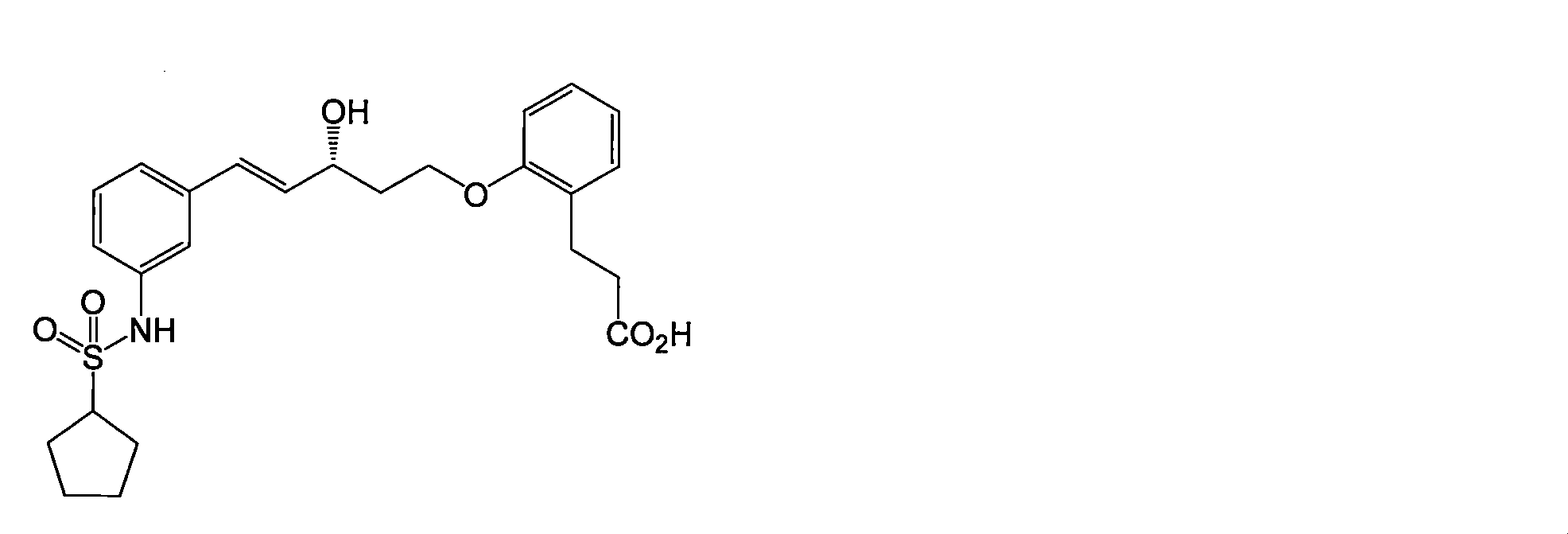
1H-NMR(CD3OD):δ 1.60-1.67, 1.74-1.81, 1.90-2.05, 2.08-2.13, 2.58-2.62, 2.92-2.96, 3.56, 4.13, 4.20, 4.58, 6.35, 6.62, 6.86, 6.94, 7.14-7.20, 7.26-7.32。
TLC:Rf 0.48(酢酸エチル);
1H-NMR(CDCl3):δ 1.88-2.00, 2.15-2.20, 2.63-2.74, 2.90-3.02, 3.22-3.35, 4.04, 4.17, 6.38, 6.60, 6.88, 7.13-7.28。
TLC:Rf 0.55(ヘキサン:酢酸エチル=1:2);
1H-NMR(CDCl3):δ 2.13-2.18, 2.67, 2.96, 4.13-4.22, 4.34, 4.64, 6.35, 6.61, 6.89, 6.96, 7.06, 7.13-7.36。
TLC:Rf 0.36(酢酸エチル);
1H-NMR(CDCl3):δ 2.06-2.23, 2.72, 3.02, 4.16, 4.60, 6.31, 6.52, 6.86-6.93, 7.01, 7.10-7.22, 7.46, 7.85, 7.97, 8.41, 8.65。
HPLC保持時間(分):0.98;
1H-NMR(CDCl3):δ 2.08-2.13, 2.69, 2.96, 4.11, 4.55-4.62, 6.21, 6.52, 684-6.92, 6.99-7.03, 7.09-7.19, 7.30-7.40, 7.50, 7.70, 8.05。
TLC:Rf 0.40(ヘキサン:酢酸エチル=1:2);
1H-NMR(CDCl3):δ 0.95, 1.40-1.50, 1.68-1.79, 2.10-2.14, 2.68, 2.96, 3.93, 4.10-4.19, 4.60, 6.26, 6.52, 6.81-6.91, 6.97-7.09, 7.12-7.24, 7.68。
TLC:Rf 0.35(ヘキサン:酢酸エチル=1:2);
1H-NMR(CDCl3):δ 2.10-2.15, 2.68, 2.96, 4.09-4.20, 4.62, 6.27, 6.54, 6.84-6.92, 7.00-7.23, 7.27-7.32, 7.86。
TLC:Rf 0.38(ヘキサン:酢酸エチル=1:2);
1H-NMR(CDCl3):δ 1.00, 1.64-1.74, 2.10-2.15, 2.70, 2.93-3.01, 4.10-4.19, 4.60, 6.26, 6.53, 6.85-6.92, 7.02-7.06, 7.10-7.24, 7.33, 7.45, 7.95。
TLC:Rf 0.38(ヘキサン:酢酸エチル=1:2);
1H-NMR(CDCl3):δ 0.86, 1.18-1.28, 1.42-1.53, 2.08-2.14, 2.57, 2.69, 2.97, 4.10-4.21, 4.61, 6.25, 6.53, 6.84-6.92, 6.98, 7.04-7.21, 7.29-7.32, 7.55-7.60。
実施例33で使用した3-[2-[(E,3R)-5-[3-(ベンゼンスルホンアミド)フェニル]-3-ヒドロキシペンタ-4-エノキシ]フェニル]プロパン酸の代わりに実施例74(13)で製造した化合物を用いて、実施例33と同様の目的の操作を付すことにより、以下の実施例化合物を得た。
HPLC保持時間(分):0.93;
1H-NMR(CD3OD):δ 1.55-1.63, 1.74-2.07, 2.52-2.56, 2.73, 2.84, 2.85-2.89, 3.53, 3.89, 4.09-4.19, 6.85, 6.93, 7.02, 7.08-7.19, 7.23。
実施例11で製造した化合物(500mg)のメタノール(10mL)溶液に、氷冷下トリメチルシリルジアゾメタン(2.0Mヘキサン溶液、2.6mL)を加え、室温で30分間撹拌した。反応溶液に氷冷下で酢酸を加え、減圧濃縮した。得られた残さをシリカゲルカラムクロマトグラフィー(ヘキサン:酢酸エチル=7:3→1:1)によって精製することにより、以下の物性値を有する標題化合物(495mg)を得た。
HPLC保持時間(分):1.03。
実施例76で製造した化合物(495mg)のジクロロメタン(10mL)溶液に、室温で二酸化マンガン(868mg)を加え、同温で20時間撹拌した。反応溶液をセライト(商品名)でろ過後、ろ液を減圧濃縮した。得られた残さをシリカゲルカラムクロマトグラフィー(ヘキサン:酢酸エチル=7:3→1:1)によって精製することにより、以下の物性値を有する標題化合物(439mg)を得た。
HPLC保持時間(分):1.10。
1H-NMR(CDCl3):δ 2.59-2.63, 2.88-2.92, 3.08-3.11, 3.68, 4.31-4.34, 6.80, 6.85-6.92, 7.12, 7.18-7.34, 7.42-7.56, 7.77-7.80。
実施例77で使用したメチル (R,E)-3-(2-((3-ヒドロキシ-5-(3-(フェニルスルホンアミド)フェニル)ペンタ-4-エン-1-イル)オキシ)フェニル)プロパノエートの代わりに、実施例11で製造した化合物を用いて、実施例77と同様の目的の操作を付すことにより、以下の物性値を有する標題化合物を得た。
HPLC保持時間(分):0.97;
1H-NMR(CD3OD):δ 2.44-2.48, 2.81-2.85, 3.22, 3.25 ,4.33-4.37, 6.82, 6.86, 6.97, 7.14-7.21, 7.29, 7.33-7.39, 7.48-7.52, 7.56-7.63, 7.79-7.81。
実施例33で使用した3-[2-[(E,3R)-5-[3-(ベンゼンスルホンアミド)フェニル]-3-ヒドロキシペンタ-4-エノキシ]フェニル]プロパン酸の代わりに、実施例78で製造した化合物を用いて、実施例33と同様の目的の操作を付すことにより、以下の物性値を有する標題化合物を得た。
HPLC保持時間(分):0.97;
1H-NMR(CD3OD):δ 2.47-2.51, 2.80-2.85, 2.88-2.91, 4.21-4.24, 6.85-6.95, 7.09-7.21, 7.44-7.48, 7.54, 7.74-7.76。
実施例78で使用した3-[2-[(E,3R)-5-[3-(ベンゼンスルホンアミド)フェニル]-3-ヒドロキシペンタ-4-エノキシ]フェニル]プロパン酸の代わりに実施例12(9)で製造した化合物を用いて、実施例78→実施例79と同様の目的の操作を付すことにより、以下の物性値を有する標題化合物を得た。
HPLC保持時間(分):1.00;
1H-NMR(CD3OD):δ 2.48-2.52, 2.80-2.96, 3.03-3.08, 4.25, 4.82, 6.85-6.94, 7.08-7.22。
実施例1で製造した化合物(3.00g)のN,N-ジメチルアセトアミド(25mL)溶液に、室温で炭酸セシウム(9.39g)を加え、同温で15分間撹拌した。反応溶液に室温で5-クロロ-1-ペンチン(CAS登録番号:14267-92-6)(1.63g)を加え、60℃で3時間撹拌した。反応溶液に水を加え、ジエチルエーテルで抽出した。有機層を硫酸ナトリウムにて乾燥後、減圧濃縮した。得られた残さをシリカゲルカラムクロマトグラフィー(ヘキサン:酢酸エチル=1:0→5:1)によって精製することにより、以下の物性値を有する標題化合物(2.40g)を得た。
HPLC保持時間(分):1.13。
実施例81で製造した化合物(1.00g)のヘプタン(2mL)溶液に、室温で4,4,5,5-テトラメチル-1,3,2-ジオキサボロラン(1.17g)と4-ジメチルアミノ安息香酸(60.2mg)を加え、100℃で4時間撹拌した。反応溶液を室温まで冷却後、濃縮した。得られた残さをシリカゲルカラムクロマトグラフィー(ヘキサン:酢酸エチル=20:1→4:1)によって精製することにより、以下の物性値を有する標題化合物(503mg)を得た。
HPLC保持時間(分):1.38。
実施例82で製造した化合物(180mg)のTHF(3mL)溶液に、実施例9で製造した化合物(168mg)、クロロ(2-ジシクロヘキシルホスフィノ-2’,4’,6’-トリイソプロピル-1,1’-ビフェニル)[2-(2’-アミノ-1,1’-ビフェニル)]パラジウム(II)(0.035g)および2Mリン酸三カリウム水溶液(0.67mL)を加え、60℃で1時間撹拌した。反応溶液を室温まで冷却後、水を加え、酢酸エチルで抽出した。有機層を硫酸ナトリウムにて乾燥後、減圧濃縮した。得られた残さをシリカゲルカラムクロマトグラフィー(ヘキサン:酢酸エチル=7:1→2:1)によって精製することにより、以下の物性値を有する標題化合物(113mg)を得た。
HPLC保持時間(分):1.24。

HPLC保持時間(分):1.10
1H-NMR(CD3OD):δ 1.95-2.03, 2.41-2.46, 2.57-2.61, 2.92-2.95, 4.03-4.06, 6.24, 6.36, 6.86, 6.90-6.95, 7.06-7.08, 7.11-7.19, 7.45-7.49, 7.55, 7.75-7.78。
実施例83で使用したN-(3-ブロモフェニル)ベンゼンスルホンアミドの代わりに1-(4-ブロモフェニル)-2-フェニルエタン-1-オール(CAS登録番号:20498-64-0)を用いて、実施例83→実施例84と同様の目的の操作に付すことにより、以下の実施例化合物を得た。
HPLC保持時間(分):1.10;
1H-NMR(CDCl3):δ 1.97-2.03, 2.41-2.45, 2.67-2.71, 2.96-3.03, 4.04, 4.86-4.90, 6.23-6.30, 6.44, 6.83-6.89, 7.16-7.34。
実施例83で使用したN-(3-ブロモフェニル)ベンゼンスルホンアミドの代わりに実施例21で製造した化合物を用いて、実施例83→実施例84と同様の目的の操作に付すことにより、以下の物性値を有する標題化合物を得た。
HPLC保持時間(分):1.20;
1H-NMR(CDCl3):δ 2.00, 2.43, 2.64-2.70, 2.95-3.07, 4.04, 4.89, 6.28, 6.44, 6.83-6.89, 7.15-7.39。
実施例21で使用した(R)-メチルオキサザボロリジンの代わりに(S)-メチルオキサザボロリジンを、実施例83で使用したN-(3-ブロモフェニル)ベンゼンスルホンアミドの代わりに相当するハライド化合物を用いて、実施例21→実施例83→実施例84と同様の目的の操作に付すことにより、以下の物性値を有する標題化合物を得た。
HPLC保持時間(分):1.20;
1H-NMR(CDCl3):δ 2.00, 2.44, 2.66-2.70, 2.95-3.07, 4.04, 4.89, 6.28, 6.45, 6.83-8.89, 7.15-7.40。
実施例9で使用した3-ブロモアニリンの代わりに相当するアミン化合物を用いて、実施例9→実施例83→実施例84と同様の目的の操作に付すことにより、以下の物性値を有する標題化合物を得た。
HPLC保持時間(分):1.08;
1H-NMR(CDCl3):δ 1.92-1.99, 2.36-2.42, 2.64-2.68, 2.93-2.97, 3.99, 5.98, 6.02, 6.58-6.65, 6.81, 6.88, 7.00, 7.15-7.20, 7.39-7.45, 7.51-7.56, 7.65, 7.70-7.73。
HPLC保持時間(分):1.10;
1H-NMR(CDCl3):δ 1.97-2.04, 2.43-2.49, 2.74-2.78, 3.00-3.04, 4.04, 6.25-6.32, 6.66, 6.85, 6.91, 7.10-7.25, 7.44-7.48, 7.53-7.58, 7.84-7.87。
HPLC保持時間(分):1.11;
1H-NMR(CDCl3):δ 1.96-2.02, 2.41-2.46, 2.72-2.76, 2.97-3.01, 4.03, 6.31-6.40, 6.84, 6.90, 7.15-7.25, 7.43-7.48, 7.52-7.57, 7.79-7.82。
HPLC保持時間(分):1.10;
1H-NMR(CDCl3):δ 1.98-2.05, 2.45-2.50, 2.68-2.72, 2.97-3.01, 4.04, 6.36-6.47, 6.80-6.91, 7.15-7.22, 7.37-7.44, 7.51-7.55, 7.74-7.79。
HPLC保持時間(分):1.01;
1H-NMR(CDCl3):δ 1.95-2.02, 2.44-2.49, 2.64-2.68, 2.93-2.97, 4.01, 6.44, 6.60, 6.82, 6.88, 7.15-7.20, 7.31-7.32, 7.42-7.50, 7.52-7.60, 7.82-7.85。
HPLC保持時間(分):1.00;
1H-NMR(CD3OD):δ 1.98-2.04, 2.46-2.51, 2.57-2.61, 2.92-2.96, 4.04-4.07, 6.38-6.46, 6.87, 6.92, 7.16-7.20, 7.24, 7.34, 7.49-7.55, 7.60, 7.75-7.78。
HPLC保持時間(分):1.07;
1H-NMR(CD3OD):δ 1.87-1.94, 2.36-2.41, 2.44-2.48, 2.81, 3.95, 6.25, 6.59, 6.74, 6.79, 7.03-7.08, 7.22, 7.39-7.43, 7.49-7.53, 7.67-7.70。
HPLC保持時間(分):1.10;
1H-NMR(CDCl3):δ 1.98-2.05, 2.46-2.50, 2.67-2.50, 2.77, 2.96-3.00, 4.03, 6.40-6.42, 6.84, 6.90, 7.16-7.22, 7.47-7.52, 7.58, 7.64, 7.71, 7.91-7.94。
HPLC保持時間(分):0.99;
1H-NMR(CDCl3):δ 1.97-2.03, 2.44-2.49, 2.72-2.76, 2.97-3.03, 4.04, 6.36, 6.41-6.48, 6.84, 6.90, 7.15-7.22, 7.40, 7.45-7.49, 7.54-7.58, 7.77, 7.82-7.84。
HPLC保持時間(分):1.10;
1H-NMR(CDCl3):δ 1.96-2.02, 2.39-2.44, 2.66-2.70, 2.93-2.97, 4.03, 4.12, 5.33, 6.24, 6.36, 6.83-6.90, 6.96-6.99, 7.14-7.21, 7.47-7.52, 7.54-7.59, 7.84-7.88。
実施例83で使用したN-(3-ブロモフェニル)ベンゼンスルホンアミドの代わりに相当するハライド化合物を用いて、実施例83→実施例35→実施例84と同様の目的の操作に付すことにより、以下の物性値を有する標題化合物を得た。
TLC:Rf 0.61(ヘキサン:酢酸エチル=1:2);
1H-NMR(CDCl3):δ 1.47-1.55, 1.67-1.74, 1.79-1.85, 2.58, 2.65, 2.88, 2.97-3.07, 3.96, 4.89, 6.79-6.88, 7.09-7.33。
HPLC保持時間(分):1.1;
1H-NMR(CDCl3):δ 1.47-1.80, 2.48-2.56, 2.64-2.69, 2.82-2.88, 3.02-3.06, 3.95, 4.89-4.93, 6.79-6.87, 7.11-7.34。
実施例88(1)で製造した化合物をSFC(使用カラム:株式会社ダイセル CHIRALPAK-IF(10mm×250mm)、移動相:CO2:アセトニトリル:メタノール=75:22.5:2.5、流速:30mL/min、圧力:100bar、波長:220nm、カラム温度:35℃)を用いて光学分割を行った。前記光学分割条件において得られた実施例88(1)の光学活性体をSFC(使用カラム:株式会社ダイセル CHIRALPAK-IF(10mm×250mm)、移動相:CO2:アセトニトリル:メタノール=75:22.5:2.5、流速:30mL/min、圧力:100bar、波長:220nm、カラム温度:35℃)で分析した結果、第一ピークおよび第二ピークの保持時間はそれぞれ14.9分および19.1分であった。
4-ブロモチアゾール-2-カルボン酸(1.0g)のジクロロメタン(9.6mL)溶液に、N,O-ジメチルヒドロキシルアミン塩酸塩(609mg)およびジイソプロピルエチルアミン(2.5mL)および1-(クロロ-1-ピロリジニルメチレン)ピロリジニウムヘキサフルオロホスファート(2.4g)を加え、室温で5時間撹拌した。反応混合物を減圧濃縮し、得られた残さをシリカゲルカラムクロマトグラフィー(ヘキサン:酢酸エチル=2:1)によって精製することにより、以下の物性値を有する標題化合物(1.0g)を得た。
TLC:Rf 0.3(ヘキサン:酢酸エチル=2:1)。
実施例90で製造した化合物(300mg)のジエチルエーテル(1mL)溶液に,ベンジルマグネシウムブロミド(0.1Mジエチルエーテル溶液、40mL)を0℃で加え、室温で1時間撹拌した.反応混合物に飽和塩化アンモニウム溶液を加え、ジエチルエーテルで抽出した。有機層を、硫酸ナトリウムで乾燥後、減圧濃縮した。得られた残さをシリカゲルカラムクロマトグラフィー(ヘキサン:酢酸エチル=8:1)によって精製することにより、以下の物性値を有する標題化合物(181mg)を得た。
TLC:Rf 0.7(ヘキサン:酢酸エチル=4:1)。
実施例21で使用した1-(3-ブロモフェニル)-2-フェニルエタノンの代わりに実施例91で製造した化合物を、実施例21で使用した(R)-メチルオキサザボロリジンの代わりに(RS)-メチルオキサザボロリジンを、実施例83で使用したN-(3-ブロモフェニル)ベンゼンスルホンアミドの代わりに相当するハライド化合物を用いて、実施例21→実施例83→実施例84と同様の目的の操作を付すことにより、以下の物性値を有する標題化合物を得た。
HPLC保持時間(分):0.98;
1H-NMR(DMSO-d6):δ 1.92-2.00, 2.41-2.48, 2.80-2.84, 2.85-2.90, 3.10-3.15, 4.01-4.06, 4.80-4.85, 5.83, 6.60-6.72, 6.85, 6.95, 7.14-7.18, 7.21-7.25。
実施例90で使用した4-ブロモチアゾール-2-カルボン酸の代わりに2-ブロモチアゾール-4-カルボン酸を、実施例83で使用したN-(3-ブロモフェニル)ベンゼンスルホンアミドの代わりに相当するハライド化合物を用いて、実施例90→実施例91→実施例21(ただし、(R)-メチルオキサザボロリジンの代わりに(RS)-メチルオキサザボロリジンを使用)→実施例83→実施例84と同様の目的の操作を付すことにより、以下の物性値を有する標題化合物を得た。
HPLC保持時間(分):1.00;
1H-NMR(CDCl3):δ 1.98-2.05, 2.41-2.47, 2.66-2.70, 2.96-3.00, 3.08, 3.34, 4.03, 5.18, 6.42-6.46, 6.58, 6.62, 6.83-6.89, 6.93, 7.16-7.25, 7.27-7.34。
実施例35で使用したイソプロピル 3-(2-(((R,E)-3-ヒドロキシ-5-(3-((R)-1-ヒドロキシ-2-フェニルエチル)フェニル)ペンタ-4-エン-1-イル)オキシ)フェニル)プロパノエートの代わりに実施例93で製造した化合物を用いて,実施例35と同様の目的の操作に付すことにより、以下の実施例化合物を得た。
HPLC保持時間(分):0.96;
1H-NMR(CDCl3):δ 1.56-1.64, 1.80-1.90, 2.57-2.61, 2.94, 3.05, 3.09-3.11, 3.96, 5.14, 6.80, 6.86, 7.14-7.25, 7.29-7.33, 7.46。
実施例35で使用したイソプロピル 3-(2-(((R,E)-3-ヒドロキシ-5-(3-((R)-1-ヒドロキシ-2-フェニルエチル)フェニル)ペンタ-4-エン-1-イル)オキシ)フェニル)プロパノエートの代わりに実施例92で製造した化合物を用いて,実施例35と同様の目的の操作に付すことにより、以下の実施例化合物を得た。
HPLC保持時間(分):1.00;
1H-NMR(CDCl3):δ 1.51-1.59, 1.68-1.85, 2.57-2.61, 2.84, 2.90, 3.09, 3.27, 3.97, 5.14, 6.81, 6.86, 7.13-7.25, 7.28-7.32, 7.39。
実施例84で製造した化合物(100mg)のDMF(1mL)溶液に、メタンスルホンアミド(102mg)、1-エチル-3-(3-ジメチルアミノプロピル)カルボジイミド塩酸塩(124mg)およびDMAP(78.7mg)を加え、室温で23時間撹拌した。反応混合物に1M塩酸を加え、酢酸エチルで抽出した。有機層を、硫酸ナトリウムで乾燥後、減圧濃縮した。得られた残さをシリカゲルカラムクロマトグラフィー(ヘキサン:酢酸エチル=9:1→0:1)によって精製することにより、以下の物性値を有する標題化合物(80.7mg)を得た。HPLC保持時間(分):1.00;
1H-NMR(CDCl3):δ 1.97-2.04, 2.37-2.42, 2.64-2.67, 2.96-2.99, 3.19, 4.05, 6.22, 6.33, 6.73, 6.85-6.92, 7.06-7.08, 7.13-7.17, 7.21, 7.41-7.45, 7.50-7.54, 7.76-7.78。
HPLC保持時間(分):0.98;
1H-NMR(CDCl3):δ 1.95-2.02, 2.40-2.45, 2.60-2.64, 3.03-3.07, 4.04, 5.55, 5.82, 6.29, 6.34-6.41, 6.86, 6.89-6.95, 7.03-7.06, 7.11-7.22, 7.41-7.44, 7.49-7.53, 7.82-7.85, 8.25。
実施例95(2)で製造した化合物(100mg)のTHF(1mL)溶液に、氷冷下、ピリジン(0.052mL)とトリフルオロ酢酸無水物(67.8mg)を加え、同温で1時間撹拌した。メタノールと1M水酸化ナトリウム水溶液を加え、室温で1時間撹拌した。反応溶液を水に注ぎ、酢酸エチルで抽出した。有機層を、硫酸ナトリウムで乾燥後、減圧濃縮した。得られた残さをシリカゲルカラムクロマトグラフィー(ヘキサン:酢酸エチル=4:1→1:1)によって精製することにより、以下の物性値を有する標題化合物(91.0mg)を得た。
HPLC保持時間(分):1.10;
1H-NMR(CDCl3):δ 1.95-2.02, 2.37-2.42, 2.61-2.65, 2.95-2.99, 4.03, 6.20, 6.34, 6.49, 6.84-6.94, 7.05-7.25, 7.41-7.46, 7.51-7.55, 7.75-7.78。
HPLC保持時間(分):0.99;
1H-NMR(CDCl3):δ 1.92-1.99, 2.34-2.39, 3.11-3.15, 3.30-3.34, 4.02, 6.20, 6.30, 6.83-6.90, 7.30-7.22, 7.39-7.43, 7.49-7.53, 7.76-7.78。
実施例84で製造した化合物(100mg)のTHF(1mL)溶液に、氷冷下、トリエチルアミン(0.20mL)とイソブチルクロロホルマート(110mg)を加え、反応混合物を室温で10分間撹拌した。反応溶液に氷冷下、アンモニア(28%水溶液、0.5mL)を加え,室温で30分間撹拌した。反応溶液を水に注ぎ、酢酸エチルで抽出した。有機層を、硫酸ナトリウムで乾燥後、減圧濃縮した。得られた残さをシリカゲルカラムクロマトグラフィー(ヘキサン:酢酸エチル=1:1→0:1)によって精製することにより、以下の物性値を有する標題化合物(120mg)を得た。
HPLC保持時間(分):1.11。
HPLC保持時間(分):0.90;
1H-NMR(CDCl3):δ 1.95-2.02, 2.38-2.43, 3.08-3.18, 4.04, 6.22, 6.32, 6.84-6.89, 6.94-6.97, 7.02, 7.07-7.21, 7.39-7.43, 7.49-7.53, 7.67, 7.75-7.77, 8.04。
実施例2で使用した2-(2-ブロモエチル)-1,3-ジオキサンの代わりに2-(3-ブロモプロピル)-1,3-ジオキサンを用いて、実施例2→実施例3→実施例4→実施例5→実施例7→実施例8→実施例10と同様の目的の操作に付すことにより、以下の物性値を有する標題化合物を得た。
TLC:Rf 0.43(ヘキサン:酢酸エチル=1:1)。
実施例11で使用したプロパン-2-イル 3-[2-[(E,3R)-5-[3-(ベンゼンスルホンアミド)フェニル]-3-ヒドロキシペンタ-4-エノキシ]フェニル]プロパノエートの代わりに実施例96で製造した化合物を用いて、実施例11と同様の目的の操作に付すことにより、以下の物性値を有する標題化合物を得た。
HPLC保持時間(分):0.96;
1H-NMR(CDCl3):δ 1.82-1.95, 2.67-2.71, 2.98-3.02, 3.97-4.04, 4.36-4.40, 6.20, 6.52, 6.83, 6.87-6.91, 7.00-7.04, 7.10-7.21, 7.40-7.45, 7.49-7.54, 7.66, 7.78-7.81。
実施例96で製造した化合物をSFC(使用カラム:株式会社ダイセル CHIRALPAK-IC(20mm×250mm)、移動相:CO2:メタノール=85:15、流速:100mL/min、圧力:120bar、波長:220nm、カラム温度:35℃)を用いて光学分割を行った。前記光学分割条件において得られた実施例96の光学活性体をSFC(使用カラム:株式会社ダイセル CHIRALPAK-IC(10mm×250mm)、移動相:CO2:メタノール=85:15、流速:30mL/min、圧力:120bar、波長:220nm、カラム温度:35℃)で分析した結果、第一ピークおよび第二ピークの保持時間はそれぞれ13.6分および15.8分であった。
実施例11で使用したプロパン-2-イル 3-[2-[(E,3R)-5-[3-(ベンゼンスルホンアミド)フェニル]-3-ヒドロキシペンタ-4-エノキシ]フェニル]プロパノエートの代わりに実施例98で製造した第一ピークの光学活性体を用いて、実施例11と同様の目的の操作に付すことにより、以下の物性値を有する標題化合物を得た。
HPLC保持時間(分):0.96;
1H-NMR(CDCl3):δ 1.82-1.95, 2.67-2.71, 2.98-3.02, 3.97-4.04, 4.36-4.40, 6.20, 6.52, 6.83, 6.87-6.91, 7.00-7.04, 7.10-7.21, 7.40-7.45, 7.49-7.54, 7.66, 7.78-7.81。
実施例11で使用したプロパン-2-イル 3-[2-[(E,3R)-5-[3-(ベンゼンスルホンアミド)フェニル]-3-ヒドロキシペンタ-4-エノキシ]フェニル]プロパノエートの代わりに実施例98で製造した第二ピークの光学活性体を用いて、実施例11と同様の目的の操作に付すことにより、以下の物性値を有する標題化合物を得た。
HPLC保持時間(分):0.96;
1H-NMR(CDCl3):δ 1.82-1.95, 2.67-2.71, 2.98-3.02, 3.97-4.04, 4.36-4.40, 6.20, 6.52, 6.83, 6.87-6.91, 7.00-7.04, 7.10-7.21, 7.40-7.45, 7.49-7.54, 7.66, 7.78-7.81。
実施例33で使用した3-[2-[(E,3R)-5-[3-(ベンゼンスルホンアミド)フェニル]-3-ヒドロキシペンタ-4-エノキシ]フェニル]プロパン酸の代わりに実施例97で製造した化合物を用いて、実施例33と同様の目的の操作に付すことにより、以下の物性値を有する標題化合物を得た。
HPLC保持時間(分):0.96;
1H-NMR(CDCl3):δ 1.58-1.67, 1.72-2.00, 2.65-2.09, 2.93-3.07, 3.59-3.65, 3.95-4.05, 6.82-6.93, 6.98-7.01, 7.12-7.22, 7.40-7.45, 7.50-7.54, 7.77-7.80。
実施例101で製造した化合物をSFC(使用カラム:株式会社ダイセル CHIRALPAK-IB(20mm×250mm)、移動相:CO2:アセトニトリル:メタノール=80:18:2、流速:100mL/min、圧力:120bar、波長:220nm、カラム温度:35℃)を用いて光学分割を行った。前記光学分割条件において得られた実施例101の光学活性体をSFC(使用カラム:株式会社ダイセル CHIRALPAK-IB(20mm×250mm)、移動相:CO2:アセトニトリル:メタノール=80:18:2、流速:100mL/min、圧力:120bar、波長:220nm、カラム温度:35℃)で分析した結果、第一ピークおよび第二ピークの保持時間はそれぞれ9.6分および12.3分であった。
実施例78で使用した3-[2-[(E,3R)-5-[3-(ベンゼンスルホンアミド)フェニル]-3-ヒドロキシペンタ-4-エノキシ]フェニル]プロパン酸の代わりに実施例97で製造した化合物を用いて、実施例78→実施例79と同様の目的の操作に付すことにより、以下の物性値を有する標題化合物を得た。
TLC:Rf 0.45(ヘキサン:酢酸エチル=1:2);
1H-NMR(CDCl3):δ 2.01-2.10, 2.61-2.75, 2.83, 2.96, 3.96, 6.78-6.82, 6.86-6.91, 6.96, 7.10, 7.14-7.21, 7.42, 7.51, 7.68-7.84。
実施例81で使用したイソプロピル 3-(2-ヒドロキシフェニル)プロパノエートの代わりに相当するフェノール化合物を用いて、実施例81→実施例82→実施例83→実施例84と同様の目的の操作に付すことにより、以下の実施例化合物を得た。
HPLC保持時間(分):1.01;
1H-NMR(CDCl3):δ 1.89-1.96, 2.33-2.38, 3.67, 4.01, 6.14, 6.29, 6.68, 6.85-6.94, 7.00-7.28, 7.39-7.43, 7.48-7.52, 7.74-7.77。
HPLC保持時間(分):1.07;
1H-NMR(CDCl3):δ 1.93-2.00, 2.37-2.43, 2.70, 4.00, 6.21, 6.33, 6.82-6.92, 7.04-7.19, 7.40-7.44, 7.49-7.53, 7.75-7.78。
実施例81で使用した5-クロロ-1-ペンチンの代わりに相当するハライド化合物を用いて、実施例81→実施例82→実施例83→実施例84と同様の目的の操作に付すことにより、以下の実施例化合物を得た。
HPLC保持時間(分):1.01;
1H-NMR(CD3OD):δ 2.52-2.56, 2.67-2.71, 2.88-2.92, 4.10-4.13, 6.31, 6.46, 6.86, 6.93-6.98, 7.09-7.20, 7.44-7.49, 7.52-7.57, 7.75-7.78。
TLC:Rf 0.44(ヘキサン:酢酸エチル=1:1);
1H-NMR(CDCl3):δ 1.65-1.76, 1.77-1.88, 2.25-2.31, 2.69-2.75, 2.99-3.05, 3.99, 6.18, 6.33, 6.83, 6.89, 6.95-7.00, 7.10-7.21, 7.44, 7.53, 7.67, 7.81。
TLC:Rf 0.44(ヘキサン:酢酸エチル=1:1);
1H-NMR(CDCl3):δ 1.61-1.73, 1.77-1.88, 2.27, 2.76-2.82, 3.02-3.07, 4.01, 6.29-6.33, 6.83-6.93, 7.08-7.23, 7.45, 7.53, 7.84, 8.75。
実施例84で製造した化合物(200mg)を酢酸エチル(1mL)に溶解した。メタノール(1mL)、トリメチルシリルジアゾメタン(2Mヘキサン溶液、0.3mL)を加え、室温で一晩撹拌した。反応液を減圧濃縮し、得られた残渣をジクロロメタン(2mL)に溶解した。飽和重炭酸ナトリウム水溶液(2mL)、メタクロロ過安息香酸(171mg)を加え、室温で5時間撹拌した。反応溶液に、飽和チオ硫酸ナトリウム水溶液を加えた後、酢酸エチルで抽出した。有機層を水、飽和食塩水で洗浄し、硫酸ナトリウムにて乾燥後、減圧濃縮した。残渣をメタノール(2mL)に溶解し、5%パラジウム-炭素(20mg)を加え、水素雰囲気下、室温で3時間撹拌した。反応溶液を濾過した後、濾液を減圧濃縮し、得られた残さをシリカゲルカラムクロマトグラフィー(ヘキサン:酢酸エチル=70:30→酢酸エチル)によって精製することにより、以下の物性値を有する標題化合物(53mg)を得た。
TLC:Rf 0.31(ヘキサン:酢酸エチル=1:1)。
実施例11で使用したプロパン-2-イル 3-[2-[(E,3R)-5-[3-(ベンゼンスルホンアミド)フェニル]-3-ヒドロキシペンタ-4-エノキシ]フェニル]プロパノエートの代わりに実施例106で製造した化合物を用いて、実施例11と同様の目的の操作を付すことにより、以下の物性値を有する標題化合物を得た。
TLC:Rf 0.60(酢酸エチル);
1H-NMR(CDCl3):δ 1.50-1.68, 1.68-1.74, 1.77-2.00, 2.61-2.70, 2.72-2.79, 2.92-2.99, 3.87, 3.95-4.05, 6.82-7.03, 7.15-7.21, 7.38-7.45, 7.48-7.53, 7.77。
エチル 3-[2-(4-ヒドロキシブチル)フェニル]プロパノエート(CAS登録番号:864677-94-1)(0.56g)のジクロロメタン(9mL)溶液に、炭酸水素ナトリウム(0.56g)および1,1,1-トリアセトキシ-1,1-ジヒドロ-1,2-ベンズヨードキソール-3(1H)-オン(CAS登録番号:87413-09-0)(1.13g)を0℃で加え、反応混合物を室温で1時間撹拌した。反応混合物を飽和炭酸水素ナトリウム水溶液に注ぎ、ジクロロメタンで抽出した。有機層を、飽和チオ硫酸ナトリウム水溶液で洗浄し、硫酸ナトリウムにて乾燥後、減圧濃縮した。得られた残さをシリカゲルカラムクロマトグラフィー(ヘキサン:酢酸エチル=4:1)によって精製することにより、以下の物性値を有する標題化合物(0.34g)を得た。
TLC:Rf 0.30(ヘキサン:酢酸エチル=4:1)。
実施例4で使用したイソプロピル 3-(2-(3-オキソプロポキシ)フェニル)プロパノエートの代わりに実施例108で製造した化合物を用いて、実施例4→実施例5→実施例7→実施例8→実施例10→実施例11と同様の目的の操作に付すことにより、以下の物性値を有する標題化合物を得た。
HPLC保持時間(分):0.95;
1H-NMR(CDCl3):δ 1.60-1.79, 2.66-2.72, 2.97-3.01, 4.30-4.35, 6.16, 6.49, 6.98-7.07, 7.13-7.17, 7.40-7.53, 7.77-7.79。

実施例33で使用した3-[2-[(E,3R)-5-[3-(ベンゼンスルホンアミド)フェニル]-3-ヒドロキシペンタ-4-エノキシ]フェニル]プロパン酸の代わりに実施例109で製造した化合物を用いて、実施例33と同様の目的の操作に付すことにより、以下の物性値を有する標題化合物を得た。
HPLC保持時間(分):0.95;
1H-NMR(CD3OD):δ 1.37-1.61, 2.39-2.58, 2.84, 6.79-6.81, 6.98-7.08, 7.30-7.42, 7.61-7.63。
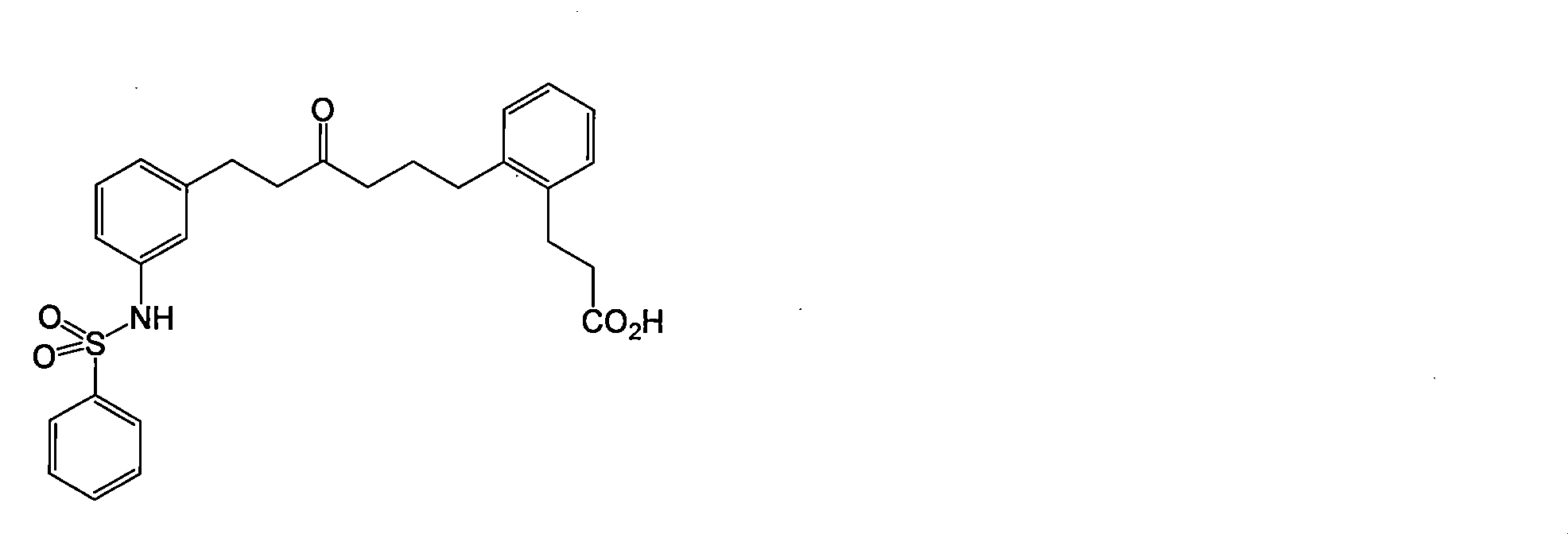
HPLC保持時間(分):1.00;
1H-NMR(CD3OD):δ 1.75-1.83, 2.44-2.47, 2.54-2.61, 2.65-2.69, 2.75-2.79, 2.92-2.96, 6.90-6.94, 7.09-7.14, 7.18, 7.43-7.48, 7.54, 7.74-7.76。
実施例81で製造した化合物(1.5g)および実施例9で製造した化合物(1.7g)のDMF(6mL)溶液に、トリエチルアミン(6mL)、ビス(トリフェニルホスフィン)パラジウム(II)ジクロリド(100mg)、ヨウ化銅(I)(50mg)を加え、60℃で一晩撹拌した。反応溶液に水を加えた後、酢酸エチルで抽出した。有機層を飽和食塩水で洗浄し、硫酸マグネシウムにて乾燥後、減圧濃縮した。得られた残さをシリカゲルカラムクロマトグラフィー(ヘキサン:酢酸エチル=9:1→0:1)によって精製することにより、以下の物性値を有する標題化合物(1.57g)を得た。
TLC:Rf 0.39(ヘキサン:酢酸エチル=2:1)。
実施例11で使用したプロパン-2-イル 3-[2-[(E,3R)-5-[3-(ベンゼンスルホンアミド)フェニル]-3-ヒドロキシペンタ-4-エノキシ]フェニル]プロパノエートの代わりに実施例113で製造した化合物を用いて、実施例11と同様の目的の操作に付すことにより、以下の物性値を有する標題化合物を得た。
HPLC保持時間(分):1.00;
1H-NMR(CD3OD):δ 2.06-2.12, 2.55-2.59, 2.64-2.67, 2.92-2.96, 4.13-4.16, 6.87, 6.95, 7.03-7.07, 7.12-7.20, 7.45-7.50, 7.56, 7.74-7.77。
実施例113で使用したイソプロピル 3-(2-(ペンタ-4-イン-1-イルオキシ)フェニル)プロパノエートの代わりに実施例7で製造した化合物を用いて、実施例113と同様の目的の操作に付すことにより、以下の物性値を有する標題化合物を得た。
HPLC保持時間(分):1.12。
実施例115で製造した化合物(170mg)のTHF(1mL)溶液に、室温でTBAF(1.0M THF溶液、0.48mL)を加え、同温で20分間撹拌した。反応溶液をシリカゲルカラムクロマトグラフィー(ヘキサン:酢酸エチル=7:3→ヘキサン:酢酸エチル=1:1)によって精製することにより、以下の物性値を有する標題化合物(82.8mg)を得た。
HPLC保持時間(分):1.12。
実施例11で使用したプロパン-2-イル 3-[2-[(E,3R)-5-[3-(ベンゼンスルホンアミド)フェニル]-3-ヒドロキシペンタ-4-エノキシ]フェニル]プロパノエートの代わりに実施例116で製造した化合物を用いて、実施例11と同様の目的の操作に付すことにより、以下の物性値を有する標題化合物を得た。
HPLC保持時間(分):0.93;
1H-NMR(CD3OD):δ 2.19-2.30, 2.57-2.60, 2.91-2.95, 4.16-4.26, 4.85, 6.88, 6.96, 7.07-7.22, 7.46-7.51, 7.57, 7.75-7.77。

TLC:Rf 0.42(ヘキサン:酢酸エチル=1:2);
1H-NMR(CDCl3):δ 1.42-1.49, 1.58-1.65, 1.75-1.82, 2.55, 2.67, 2.95, 3.95, 6.80-6.97, 7.10-7.21, 7.27, 7.40, 7.49, 7.76。
実施例113で製造した化合物(100mg)の酢酸エチル(10mL)溶液に、室温でリンドラー触媒(パラジウム5重量%含有)(10.0mg)とキノリン(12.8mg)を加え、同温、水素雰囲気化で5時間撹拌した。反応溶液をシリカゲルカラムクロマトグラフィー(ヘキサン:酢酸エチル=7:3→1:1)によって精製することにより、以下の物性値を有する標題化合物(92.3mg)を得た。
HPLC保持時間(分):1.23。
実施例11で使用したプロパン-2-イル 3-[2-[(E,3R)-5-[3-(ベンゼンスルホンアミド)フェニル]-3-ヒドロキシペンタ-4-エノキシ]フェニル]プロパノエートの代わりに実施例119で製造した化合物を用いて、実施例11と同様の目的の操作に付すことにより、以下の物性値を有する標題化合物を得た。
HPLC保持時間(分):1.10;
1H-NMR(CD3OD):δ 1.89-1.95, 2.37-2.43, 2.49-2.53, 2.83-2.87, 3.97-4.00, 5.74, 6.38, 6.83-6.89, 6.96-7.02, 7.13-7.19, 7.41-7.45, 7.51, 7.72-7.76。
実施例119で使用したイソプロピル 3-(2-((5-(3-(フェニルスルホンアミド)フェニル)ペンタ-4-イン-1-イル)オキシ)フェニル)プロパノエートの代わりに実施例116で製造した化合物を用いて、実施例119→実施例11と同様の目的の操作に付すことにより、以下の物性値を有する標題化合物を得た。
HPLC保持時間(分):0.92;
1H-NMR(CD3OD):δ 2.00-2.07, 2.44-2.48, 2.77-2.80, 4.02, 4.11, 4.75, 5.72, 6.46 ,6.83-6.88, 6.92-7.04, 7.12-7.18, 7.42-7.47, 7.52, 7.74-7.77。
エチル (E)-3-(2-ヒドロキシフェニル)プロパ-2-エノエート(CAS登録番号:6236-62-0)(1.92g)およびジイソプロピルエチルアミン(0.69mL)のヘキサメチルホスホルアミド(20mL)溶液に、ベンジル グリシジル エーテル(6.57g)を加え、反応混合物を80℃で19時間撹拌した。反応液を室温まで冷却後、水に注ぎ、酢酸エチルで抽出した。有機層を、飽和食塩水で洗浄し、硫酸ナトリウムにて乾燥後、減圧濃縮した。得られた残さをシリカゲルカラムクロマトグラフィー(ヘキサン:酢酸エチル=2:1)によって精製することにより、以下の物性値を有する標題化合物(2.66g)を得た。
TLC:Rf 0.33(ヘキサン:酢酸エチル=2:1)。
実施例122で製造した化合物(300mg)およびイミダゾ-ル(200mg)のDMF(3mL)溶液に、tert-ブチルジメチルシリル クロライド(330mg)を0℃で加え、反応混合物を室温で5日間撹拌した。反応混合物を水に注ぎ、酢酸エチルで抽出した。有機層を、飽和食塩水で洗浄し、硫酸ナトリウムにて乾燥後、減圧濃縮した。得られた残さをシリカゲルカラムクロマトグラフィー(ヘキサン:酢酸エチル=9:1)によって精製することにより、以下の物性値を有する標題化合物(380mg)を得た。
TLC:Rf 0.41(ヘキサン:酢酸エチル=9:1)。
実施例123で製造した化合物(380mg)および5%パラジウム炭素(50%wet、180mg)のエタノール(8mL)溶液を、水素雰囲気下、室温で1.5時間撹拌した。反応混合物をセライト(商品名)でろ過後、ろ液を濃縮することにより、以下の物性値を有する標題化合物(290mg)を得た。
TLC:Rf 0.34(ヘキサン:酢酸エチル=4:1)。
実施例124で製造した化合物(290mg)および炭酸水素ナトリウム(190mg)の塩化メチレン(3mL)溶液に、1,1,1-トリアセトキシ-1,1-ジヒドロ-1,2-ベンズヨードキソール-3(1H)-オン(390mg)を0℃で加え、反応混合物を室温で1時間撹拌した。反応混合物を飽和炭酸水素ナトリウム水溶液に注ぎ、塩化メチレンで抽出した。有機層を、飽和チオ硫酸ナトリウム水溶液で洗浄し、硫酸ナトリウムにて乾燥後、減圧濃縮した。得られた残さをシリカゲルカラムクロマトグラフィー(ヘキサン:酢酸エチル=4:1)によって精製することにより、以下の物性値を有する標題化合物(250mg)を得た。
TLC:Rf 0.40(ヘキサン:酢酸エチル=4:1)。
実施例45で使用した(R)-4-((4-メトキシベンジル)オキシ)-1-オキソブタン-2-イル ベンゾエートの代わりに実施例125で製造した化合物を用いて、実施例45→実施例55→実施例56→実施例116と同様の目的の操作に付すことにより、以下の物性値を有する標題化合物を得た。
TLC:Rf 0.43(ヘキサン:酢酸エチル=1:1)。

HPLC保持時間(分):0.95;
1H-NMR(CDCl3):δ 2.59-2.72, 2.93-3.08, 4.00, 4.17, 4.68-4.72, 6.40, 6.64, 6.84, 6.90-6.94, 7.03-7.07, 7.13-7.22, 7.38-7.52, 7.76-7.79。
実施例126で製造した化合物をSFC(使用カラム:株式会社ダイセル CHIRALPAK-IB(20mm×250mm)、移動相:CO2:2-プロパノール=83:17、流速:100mL/min、圧力:120bar、波長:220nm、カラム温度:35℃)を用いて光学分割を行った。前記光学分割条件において得られた実施例126の光学活性体をSFC(使用カラム:株式会社ダイセル CHIRALPAK-IB(10mm×250mm)、移動相:CO2:2-プロパノール=83:17、流速:30mL/min、圧力:100bar、波長:220nm、カラム温度:35℃)で分析した結果、第一ピークおよび第二ピークの保持時間はそれぞれ12.6分および14.6分であった。
実施例11で使用したプロパン-2-イル 3-[2-[(E,3R)-5-[3-(ベンゼンスルホンアミド)フェニル]-3-ヒドロキシペンタ-4-エノキシ]フェニル]プロパノエートの代わりに実施例128で製造した第一ピークの光学活性体を用いて、実施例11と同様の目的の操作に付すことにより、以下の物性値を有する標題化合物を得た。
HPLC保持時間(分):0.95;
1H-NMR(CDCl3):δ 2.59-2.72, 2.93-3.08, 4.00, 4.17, 4.68-4.72, 6.40, 6.64, 6.84, 6.90-6.94, 7.03-7.07, 7.13-7.22, 7.38-7.52, 7.76-7.79。
実施例11で使用したプロパン-2-イル 3-[2-[(E,3R)-5-[3-(ベンゼンスルホンアミド)フェニル]-3-ヒドロキシペンタ-4-エノキシ]フェニル]プロパノエートの代わりに実施例128で製造した第二ピークの光学活性体を用いて、実施例11と同様の目的の操作に付すことにより、以下の物性値を有する標題化合物を得た。
HPLC保持時間(分):0.95;
1H-NMR(CDCl3):δ 2.59-2.72, 2.93-3.08, 4.00, 4.17, 4.68-4.72, 6.40, 6.64, 6.84, 6.90-6.94, 7.03-7.07, 7.13-7.22, 7.38-7.52, 7.76-7.79。
3-ブロモアニリン(500mg)のジクロロメタン(10mL)溶液に、トリエチルアミン(1.6mL)およびDMAP(177mg)およびベンゼンスルホン酸無水物(1.9g)を加え、室温で18時間撹拌した。反応混合物に水を加え、ジクロロメタンで抽出した。有機層を硫酸ナトリウムで乾燥後、減圧濃縮した。得られた残さをシリカゲルカラムクロマトグラフィー(ヘキサン:酢酸エチル=4:1)によって精製することにより、以下の物性値を有する標題化合物(950mg)を得た。
TLC:Rf 0.30(ヘキサン:酢酸エチル=4:1)。
実施例131で製造した化合物(949mg)のDMF(4mL)溶液に、トリエチルアミン(1.5mL)および3-ブチン-1-オール(220mg)およびヨウ化銅(40mg)およびビス(トリフェニルホスフィンパラジウム)ジクロリド(147mg)を加え、80℃で2時間撹拌した。反応混合物に飽和塩化アンモニウム水溶液を加え、酢酸エチルで抽出した.有機層を、水で洗浄し、硫酸ナトリウムで乾燥後、減圧濃縮した。得られた残さをシリカゲルカラムクロマトグラフィー(ヘキサン:酢酸エチル=2:1)によって精製することにより、以下の物性値を有する標題化合物(771mg)を得た。
TLC:Rf 0.30(ヘキサン:酢酸エチル=2:1)。
実施例132で製造した化合物(600mg)および20%水酸化パラジウム炭素(50%wet、150mg)のメタノール(5mL)溶液を、水素雰囲気化、室温で9時間撹拌した.反応混合物をセライト(商品名)でろ過後、ろ液を濃縮することにより、以下の物性値を有する標題化合物(575mg)を得た。
HPLC保持時間(分):1.00。
実施例133で製造した化合物(45mg)のTHF(0.5mL)溶液に、メチル 3-(3-ヒドロキシフェニル)プロパノエート(22mg)およびDIAD(82mg)およびトリフェニルホスフィン(40mg)を加え、室温で2時間撹拌した。反応混合物を、減圧濃縮した。得られた残さのメタノール(0.5mL)および1,2-ジメトキシエタン(0.5mL)溶液に、5N水酸化ナトリウム水溶液(0.4mL)を加え、45℃で19時間撹拌した。反応混合物に、2M塩酸を加え、酢酸エチルで抽出した。有機層を、硫酸ナトリウムで乾燥した後に、減圧濃縮した。得られた残さを、シリカゲルカラムクロマトグラフィー(ヘキサン:酢酸エチル=1:1)によって精製することにより、以下の物性値を有する標題化合物(14mg)を得た。
HPLC保持時間(分):0.97;
1H-NMR(CDCl3):δ 1.66-1.75, 2.61, 2.74, 2.94, 3.94, 6.71-6.73, 6.79-6.86, 6.91-7.00, 7.14, 7.21, 7.37-7.41, 7.47-7.52, 7.72-7.74。
実施例134で使用したメチル 3-(3-ヒドロキシフェニル)プロパノエートの代わりに相当するフェノール化合物を用いて、実施例134と同様の目的の操作に付すことにより、以下の実施例化合物を得た。
HPLC保持時間(分):0.96;
1H-NMR(CD3OD):δ 1.64-1.74, 2.55-2.61, 2.86, 3.91, 6.80-6.84, 6.92-6.94, 7.11-7.15, 7.42-7.46, 7.50-7.54, 7.73-7.76。
HPLC保持時間(分):1.00;
1H-NMR(CDCl3):δ 1.77-1.83, 1.96-2.03, 2.48, 2.60, 2.71-2.75, 3.97, 6.82, 6.87-6.90, 7.05-7.07, 7.11-7.20, 7.39-7.43, 7.47-7.52, 7.78-7.81。
HPLC保持時間(分):0.99;
1H-NMR(CDCl3):δ 1.70-1.74, 1.95-2.02, 2.40, 2.59, 2.65, 3.93, 6.71-6.78, 6.86, 6.93-6.95, 7.12-7.21, 7.39-7.43, 7.48-7.52, 7.74-7.77。
HPLC保持時間(分):0.94;
1H-NMR(CDCl3):δ 1.68-1.72, 2.57, 3.65, 3.96, 6.80-6.94, 7.13, 7.21-7.24, 7.37-7.42, 7.47-7.52, 7.74-7.77。
HPLC保持時間(分):0.95;
1H-NMR(CDCl3):δ 1.74-1.77, 2.57-2.60, 3.66, 3.98, 6.83-6.86, 6.91-6.96, 7.11, 7.19-7.26, 7.36-7.43, 7.48-7.52, 7.75-7.78。
HPLC保持時間(分):0.99;
1H-NMR(CDCl3):δ 1.70-1.86, 2.61, 2.66-2.70, 2.97-3.01, 3.97, 6.82, 6.87-6.91, 7.03-7.06, 7.12-7.21, 7.40-7.44, 7.48-7.53, 7.60, 7.78-7.81。
実施例10で使用したN-(3-ブロモフェニル)ベンゼンスルホンアミドの代わりに3-ブロモニトロベンゼンを用いて、実施例10→実施例77と同様の目的の操作に付すことにより、以下の物性値を有する標題化合物を得た。
TLC:Rf 0.43(ヘキサン:酢酸エチル=2:1)。
実施例136で製造した化合物(205mg)をジクロロメタン(0.4mL)に溶解し、ビス(2-メトキシエチル)アミノ硫黄トリフルオリド(1.5mL)を加え、室温で3日間撹拌した。反応溶液を飽和炭酸水素ナトリウム水溶液に注ぎ、酢酸エチルで抽出した。有機層を飽和食塩水で洗浄し、硫酸マグネシウムにて乾燥後、減圧濃縮した。得られた残さをシリカゲルカラムクロマトグラフィー(ヘキサン:酢酸エチル=90:10→酢酸エチル)によって精製することにより、以下の物性値を有する標題化合物(29mg)を得た。
TLC:Rf 0.66(ヘキサン:酢酸エチル=2:1)。
実施例55で使用した(R,E)-5-(2-((E)-3-メトキシ-3-オキソプロパ-1-エン-1-イル)フェノキシ)-1-(3-ニトロフェニル)ペンタ-1-エン-3-イル ベンゾエートの代わりに実施例137で製造した化合物を用いて、実施例55→実施例56→実施例11と同様の目的の操作に付すことにより、以下の物性値を有する標題化合物を得た。
TLC:Rf 0.22(ヘキサン:酢酸エチル=1:2);
1H-NMR(CDCl3):δ 2.50-2.62, 2.72, 2.93, 4.20, 6.30, 6.80-6.95, 7.05, 7.12-7.25, 7.43, 7.53, 7.78, 7.89。

TLC:Rf 0.20(ヘキサン:酢酸エチル=1:2);
1H-NMR(CDCl3):δ 2.14-2.47, 2.67-2.74, 2.76-2.84, 2.88-2.98, 4.13-4.21, 6.79-6.88, 6.89-7.07, 7.11-7.25, 7.42, 7.52, 7.79。
2-[(S)-2,2-ジメチル-1,3-ジオキソラン-4-イル]エタノール(CAS登録番号:32233-43-5)(2.00g)のTHF(25mL)溶液に、室温で1-フェニル-1H-テトラゾール-5-チオール(CAS登録番号:86-93-1)(3.66g)、トリフェニルホスフィン(5.38g)およびDIAD(1.10g)を加え、同温で1時間撹拌した。反応溶液を減圧濃縮後、シリカゲルカラムクロマトグラフィー(ヘキサン:酢酸エチル=7:1→2:1)によって精製することにより、以下の物性値を有する標題化合物(4.14g)を得た。
HPLC保持時間(分):0.97。
実施例140で製造した化合物(4.14g)のアセトニトリル(15mL)とエタノール(15mL)溶液に、氷冷下モリブデン酸アンモニウム四水和物(1.57g)と30重量%過酸化水素水(8.3mL)を加え、室温で16時間撹拌した。反応溶液を減圧濃縮後、得られた水層を酢酸エチルで抽出した。有機層を硫酸ナトリウムにて乾燥後、減圧濃縮した。得られた残さを2,2-ジメトキシプロパン(8.3mL)に溶解後、室温でp-トルエンスルホン酸一水和物(129mg)を加え、同温で1時間撹拌した。反応溶液を酢酸エチルで希釈し、飽和炭酸水素ナトリウム水溶液と飽和食塩水で洗浄した。有機層を硫酸ナトリウムにて乾燥後、減圧濃縮した。得られた残さをシリカゲルカラムクロマトグラフィー(ヘキサン:酢酸エチル=7:1→2:1)によって精製することにより、以下の物性値を有する標題化合物(3.96g)を得た。
HPLC保持時間(分):0.96。
実施例141で製造した化合物(1.04g)の1,2-ジメトキシエタン(15mL)溶液に、-78℃でカリウム ビス(トリメチルシリル)アミド(0.5Mトルエン溶液、15.3mL)を加え、同温で10分間撹拌した。反応溶液に、-78℃でN-(3-ホルミルフェニル)ベンゼンスルホンアミド(CAS登録番号:151721-35-6)(800mg)の1,2-ジメトキシエタン(5mL)溶液を加え、室温で1時間撹拌した。反応溶液に飽和塩化アンモニウム水溶液を加え、酢酸エチルで抽出した。有機層を硫酸ナトリウムにて乾燥後、減圧濃縮した。得られた残さをシリカゲルカラムクロマトグラフィー(ヘキサン:酢酸エチル=10:1)によって精製した。得られた残さをメタノール(3mL)に溶解後、室温で2M塩酸(3mL)を加え、50℃で30分間撹拌した。反応溶液を氷冷後、2M水酸化ナトリウム水溶液で中和し、酢酸エチルで抽出した。有機層を硫酸ナトリウムにて乾燥後、減圧濃縮した。得られた残さをシリカゲルカラムクロマトグラフィー(ヘキサン:酢酸エチル=1:0→9:1)によって精製することにより、以下の物性値を有する標題化合物(675mg)を得た。
HPLC保持時間(分):0.73。
実施例142で製造した化合物(450mg)とイミダゾール(131mg)のDMF(5mL)溶液に、氷冷下でt-ブチルジメチルクロロシラン(0.7M DMF溶液、2mL)を5分間かけて滴下後、室温で24時間撹拌した。反応溶液を氷冷後、イミダゾール(131mg)とt-ブチルジメチルクロロシラン(213mg)を加え、室温で5時間撹拌した。反応溶液に水を加え、酢酸エチルで抽出した。有機層を硫酸ナトリウムにて乾燥後、減圧濃縮した。得られた残さをジクロロメタン(5mL)に溶解後、氷冷下でピリジン(0.42mL)、塩化ベンゾイル(215mg)およびDMAP(15.7mg)を加え、室温で1.5時間撹拌した。反応溶液を氷冷後、塩化ベンゾイル(215mg)を加え,室温で1.5時間撹拌した。反応溶液に飽和炭酸水素ナトリウム水溶液を加え、酢酸エチルで抽出した。有機層を硫酸ナトリウムにて乾燥後、減圧濃縮した。得られた残さをシリカゲルカラムクロマトグラフィー(ヘキサン:酢酸エチル=7:1→2:1)によって精製した。得られた残さをTHF(3mL)と酢酸(0.30mL)に溶解後、氷冷下でTBAF(1.0M THF溶液1.6mL)を加え、室温で12時間撹拌した。反応溶液に飽和炭酸水素ナトリウム水溶液を加え、酢酸エチルで抽出した。有機層を硫酸ナトリウムにて乾燥後、減圧濃縮した。得られた残さをシリカゲルカラムクロマトグラフィー(ヘキサン:酢酸エチル=7:1→2:1)によって精製することにより、以下の物性値を有する標題化合物(292mg)を得た。
HPLC保持時間(分):0.97。
実施例143で製造した化合物(147mg)のDMF(1mL)溶液に、室温でイミダゾール(68.6mg)とトリフェニルホスフィン(106mg)を加えた。反応溶液に氷冷下でヨウ素(102mg)を加え、50℃で1.5時間撹拌した。反応溶液を氷冷後、トリフェニルホスフィン(26.0mg)とヨウ素(25.0mg)を加え、50℃で30分間撹拌した。反応溶液をシリカゲルカラムクロマトグラフィー(ヘキサン:酢酸エチル=7:1→3:2)によって精製することにより、以下の物性値を有する標題化合物(121mg)を得た。
HPLC保持時間(分):1.20。
実施例1で製造した化合物(68.4mg)のDMF(0.5mL)溶液に、氷冷下で水素化ナトリウム(60%inミネラルオイル、13.1mg)を加え、室温で15分間撹拌した。反応溶液に、室温で実施例144で製造した化合物(60mg)のDMF(0.5mL)溶液を加え、60℃で2時間撹拌した。反応溶液を室温まで冷却後、シリカゲルカラムクロマトグラフィー(ヘキサン:酢酸エチル=7:1→3:2)によって精製することにより、以下の物性値を有する標題化合物(12.1mg)を得た。
HPLC保持時間(分):1.29。
実施例57で使用した(R,E)-5-(2-((E)-3-メトキシ-3-オキソプロパ-1-エン-1-イル)フェノキシ)-1-(3-(フェニルスルホンアミド)フェニル)ペンタ-1-エン-3-イル ベンゾエートの代わりに実施例145で製造した化合物を用いて、実施例57と同様の目的の操作を付すことにより、以下の物性値を有する標題化合物を得た。
HPLC保持時間(分):0.95
1H-NMR(CD3OD):δ 2.50, 2.59-2.65, 2.95-2.99, 3.95-4.02, 4.09, 6.29, 6.43, 6.86-6.96, 7.08-7.10, 7.12-7.20, 7.44-7.48, 7.54, 7.75-7.77。
2-(3-ニトロフェニル)エタノール(CAS登録番号:52022-77-2)(2.00g)のDMF(4mL)溶液を0℃に冷却し、水素化ナトリウム(60% inミネラルオイル、0.7g)を加え、0℃で15分撹拌した。イソプロピルブロモアセテート(2.6g)を滴下し、0℃で1時間、室温で2時間撹拌した。反応混合物を水に注ぎ、酢酸エチルで抽出した。有機層を水、飽和食塩水で洗浄し、硫酸ナトリウムにて乾燥後、減圧濃縮した。得られた残さをシリカゲルカラムクロマトグラフィー(ヘキサン:酢酸エチル=10:0→2:1)によって精製することにより、エステル化合物(1.80g)を得た。メタノール(15mL)に溶解させ,水酸化ナトリウム(2N水溶液、10mL)を加え室温で終夜撹拌した。反応混合物を2M塩酸に注ぎ、酢酸エチルで抽出した。有機層を水、飽和食塩水で洗浄し、硫酸ナトリウムにて乾燥後、減圧濃縮し、以下の物性値を有する標題化合物(1.15g)を得た。
1H-NMR(CDCl3):δ 3.05-3.07, 3.84-3.87, 4.14, 7.48, 7.58-7.60, 8.09-8.14。
実施例147で製造した化合物(1.15g)と4-メチルモルホリン(0.8mL)のTHF(10mL)溶液を0℃に冷却し、イソブチルクロロホルメート(0.8mL)を滴下した。室温で30分間撹拌し、生成する白色固体を濾取した。ろ液を0℃に冷却し、水素化ホウ素ナトリウム(1.15g)を加え0℃で10分間撹拌した後,少量の水を加え室温で30分間撹拌した.反応混合物を水に注ぎ、酢酸エチルで抽出した。有機層を水、飽和食塩水で洗浄し、硫酸ナトリウムにて乾燥後、減圧濃縮した。得られた残さをシリカゲルカラムクロマトグラフィー(ヘキサン:酢酸エチル=10:0→1:1)によって精製することにより、以下の物性値を有する標題化合物(1.15g)を得た。
1H-NMR(CDCl3):δ 1.82, 3.00-3.03, 3.56-3.58, 3.69-3.78, 7.47, 7.56-7.58, 8.07-8.13。

HPLC保持時間(分):0.99;
1H-NMR(DMSO-d6):δ 2.70-2.80, 3.17-3.18, 3.56-3.60, 3.68-3.71, 4.05-4.08, 6.84-6.96, 7.09-7.19, 7.50-7.60, 7.74-7.76。
(1S)-1-(3-ブロモフェニル)-2-フェニル-エタノール(412mg)のTHF(0.5mL)溶液にブロモ-(2-tert-ブトキシ-2-オキソ-エチル)亜鉛(0.5M THF溶液、9mL)およびビス(トリ-tert-ブチルホスフィン)パラジウム(76mg)を加え、70℃で2時間撹拌した。反応混合物を室温に冷却し、飽和塩化アンモニウム水溶液を加え、酢酸エチルで抽出した。有機層を、硫酸ナトリウムで乾燥後、減圧濃縮した。得られた残さをシリカゲルカラムクロマトグラフィー(ヘキサン:酢酸エチル=4:1)によって精製することにより、以下の物性値を有する標題化合物(296mg)を得た。
TLC:Rf 0.40(ヘキサン:酢酸エチル=4:1)。
実施例150で製造した化合物(296mg)のジクロロメタン(2mL)溶液に、3,4-ジヒドロ-2H-ピラン(239mg)および4-トルエンスルホン酸ピリジニウム(71mg)を加え、室温で1.5時間撹拌した。反応混合物に、飽和炭酸水素ナトリウム水溶液を加え、ジクロロメタンで抽出した。有機層を、硫酸ナトリウムで乾燥後、減圧濃縮した。得られた残さをシリカゲルカラムクロマトグラフィー(ヘキサン:酢酸エチル=4:1)によって精製することにより、以下の物性値を有する標題化合物(341mg)を得た。
TLC:Rf 0.60(ヘキサン:酢酸エチル=4:1)。
実施例151で製造した化合物(341mg)のTHF(4mL)溶液に、水(0.15mL)および水素化ホウ素リチウム(187mg)加え、40℃で16時間撹拌した。反応混合物に水を加え、酢酸エチルで抽出した。有機層を、硫酸ナトリウムで乾燥後、減圧濃縮した。得られた残さをシリカゲルカラムクロマトグラフィー(ヘキサン:酢酸エチル=1:1)によって精製することにより、以下の物性値を有する標題化合物(236mg)を得た。
TLC:Rf 0.50(ヘキサン:酢酸エチル=1:1)。
実施例152で製造した化合物(236mg)のDMF(2mL)溶液に、ブロモ酢酸tert-ブチル(424mg)および水素化ナトリウム(60%inミネラルオイル、87mg)を加え、室温で2.5時間撹拌した。反応混合物に、飽和塩化ナトリウム水溶液を加え、酢酸エチルで抽出した。有機層を、硫酸ナトリウムで乾燥後、減圧濃縮した。得られた残さをシリカゲルカラムクロマトグラフィー(ヘキサン:酢酸エチル=4:1)によって精製することにより、以下の物性値を有する標題化合物(250mg)を得た。
TLC:Rf 0.60(ヘキサン:酢酸エチル=4:1)。
実施例153で製造した化合物(250mg)のTHF(0.5mL)溶液に、水(0.1mL)および水素化ホウ素リチウム(123mg)を加え、40℃で2.5時間撹拌した。反応混合物に、水を加え、酢酸エチルで抽出した。有機層を、硫酸ナトリウムで乾燥後、減圧濃縮した。得られた残さをシリカゲルカラムクロマトグラフィー(ヘキサン:酢酸エチル=1:1)によって精製することにより、以下の物性値を有する標題化合物(107mg)を得た。
TLC:Rf 0.30(ヘキサン:酢酸エチル=1:1)。
実施例154で製造した化合物(107mg)のジクロロメタン(1mL)溶液に、実施例1で製造した化合物(90mg)、トリフェニルホスフィン(114mg)および1,1-(アゾジカルボニル)ジピぺリジン(110mg)を加え、室温で1.5時間撹拌した。反応混合物を、減圧濃縮した。得られた残さをシリカゲルカラムクロマトグラフィー(ヘキサン:酢酸エチル=5:1)によって精製することによりエステル化合物(181mg)を得た。得られたエステル化合物(181mg)のTHF(0.6mL)溶液に、水(0.8mL)および酢酸(3.2mL)を加え、50℃で7時間撹拌した。反応混合物に、飽和炭酸水素ナトリウム水溶液を加え、酢酸エチルで抽出した。有機層を硫酸ナトリウムで乾燥後、減圧濃縮した。得られた残さをシリカゲルカラムクロマトグラフィー(ヘキサン:酢酸エチル=4:1)によって精製することにより、以下の物性値を有する標題化合物(97mg)を得た。
TLC:Rf 0.20(ヘキサン:酢酸エチル=4:1)。
実施例11で使用したプロパン-2-イル 3-[2-[(E,3R)-5-[3-(ベンゼンスルホンアミド)フェニル]-3-ヒドロキシペンタ-4-エノキシ]フェニル]プロパノエートの代わりに実施例155で製造した化合物を用いて、実施例11と同様の目的の操作に付すことにより、以下の物性値を有する標題化合物を得た。
HPLC保持時間(分):1.10;
1H-NMR(CDCl3):δ 2.59-2.63, 2.90-2.94, 3.00-3.03, 3.76-3.80, 3.84-3.86, 4.10-4.13, 4.88, 6.82, 7.13-7.21, 7.22-7.32。
実施例150で使用した(1S)-1-(3-ブロモフェニル)-2-フェニル-エタノールの代わりに実施例21で製造した化合物を用いて,実施例150→実施例151→実施例152→実施例153→実施例154→実施例155→実施例11と同様の目的の操作に付すことにより、以下の物性値を有する標題化合物を得た。
HPLC保持時間(分):1.00;
1H-NMR(CDCl3):δ 2.58-2.62, 2.90-2.95, 2.99-3.06, 3.77-3.81, 3.84-3.86, 4.10-4.13, 4.88, 6.82, 6.88, 7.13-7.21, 7.25-7.32。
メチル トランス-3-[4-(tert-ブトキシカルボニルアミノ)シクロヘキシル]プロパノエート(500mg)のTHF(5mL)溶液を0℃に冷却し、水素化ホウ素リチウム(72.8mg)のTHF(1mL)溶液を加え、室温で15分間,50℃で3時間半撹拌した。反応混合物を飽和炭酸水素ナトリウム水溶液に注ぎ、酢酸エチルで抽出した。有機層を飽和食塩水で洗浄し、硫酸ナトリウムにて乾燥後、減圧濃縮し、以下の物性値を有する標題化合物(429mg)を得た。
1H-NMR(CDCl3):δ 0.95-1.28, 1.44, 1.53-1.60, 1.75-1.78, 1.98-2.01, 2.27-2.31, 3.36, 3.62, 4.36。
実施例158で製造した化合物(429mg)のジクロロメタン(8.3mL)溶液を0℃に冷却し、1,1,1-トリアセトキシ-1,1-ジヒドロ-1,2-ベンズヨードキソール-3(1H)-オン(848mg)を加え、室温で3時間撹拌した。反応混合物を飽和炭酸水素ナトリウム水溶液に注ぎ、酢酸エチルで抽出した。有機層を水、飽和食塩水で洗浄し、硫酸ナトリウムにて乾燥後、減圧濃縮した。得られた残さをシリカゲルカラムクロマトグラフィー(ヘキサン:酢酸エチル=10:0→1:1)によって精製することにより、以下の物性値を有する標題化合物(429mg)を得た。
1H-NMR(CDCl3):δ 0.96-1.28, 1.44, 1.53-1.60, 1.62-1.75, 1.98-2.01, 2.42-2.46, 3.36, 4.38。
エチル ジエチルホスホノアセテート(747mg)のTHF(5mL)溶液を0℃に冷却し、水素化ナトリウム(60%inミネラルオイル、145mg)を加え、0℃で15分間撹拌した。反応混合物に実施例159で製造した化合物(429mg)のTHF(5mL)溶液を加え、室温で2時間撹拌した。反応混合物を水に注ぎ、酢酸エチルで抽出した。有機層を飽和食塩水で洗浄し、硫酸ナトリウムにて乾燥後、減圧濃縮した。得られた残さをシリカゲルカラムクロマトグラフィー(ヘキサン:酢酸エチル=10:0→1:1)によって精製することにより、以下の物性値を有する標題化合物(270mg)を得た。
1H-NMR(CDCl3):δ 0.95-1.38, 1.44, 1.53-1.59, 1.74-1.77, 1.98-2.01, 2.17-2.31, 3.36, 4.09-4.17, 4.35, 5.78-5.83, 6.91-7.00。
実施例160で製造した化合物(270mg)のエタノール(10mL)の溶液にパラジウム炭素(54mg)を加え、水素雰囲気下、室温で1時間半撹拌した。反応液をセライト(商品名)でろ過し,ろ液を減圧濃縮し、下の物性値を有する標題化合物(282mg)を得た。
1H-NMR(CDCl3):δ 0.95-1.38, 1.44, 1.53-1.59, 1.74-1.77, 1.98-2.01, 2.17-2.31, 3.36, 4.09-4.17, 4.35, 5.78-5.83, 6.91-7.00。
実施例161で製造した化合物(282mg)のTHF(5mL)溶液を0℃に冷却し、水素化ホウ素リチウム(36mg)を加え、50℃で3時間撹拌した。反応混合物を飽和炭酸水素ナトリウム水溶液に注ぎ、酢酸エチルで抽出した。有機層を飽和食塩水で洗浄し、硫酸ナトリウムにて乾燥後、減圧濃縮し、以下の物性値を有する標題化合物(270mg)を得た。
1H-NMR(CDCl3):δ 0.92-1.32, 1.44, 1.53-1.60, 1.73-1.78, 1.98-2.01, 2.26-2.31, 3.36, 3.64, 4.36。
実施例162で製造した化合物(140mg)に塩化水素(4.0Mジオキサン溶液、6mL)を加え、反応混合物を室温で1時間半撹拌後、濃縮し、以下の物性値を有する標題化合物(180mg)を得た。
1H-NMR(DMSO-d6):δ 0.88-0.97, 1.15-1.42, 1.73-1.76, 1.90-1.93, 2.91, 3.36-3.75, 7.86。
実施例163で製造した化合物(180mg)ピリジン(2mL)とジクロロメタン(2mL)の溶液を0℃に冷却し、DMAP(5mg)を加えた。ベンゼンスルホニルクロリド(0.14mL)を滴下し、室温で終夜撹拌した。反応混合物を1M塩酸に注ぎ、酢酸エチルで抽出した。有機層を飽和炭酸水素ナトリウム水溶液、飽和食塩水で洗浄し、硫酸ナトリウムにて乾燥後、減圧濃縮し、以下の物性値を有する標題化合物(180mg)を得た。
1H-NMR(CDCl3):δ 0.84-0.89, 1.07-1.83, 3.04-3.09, 3.98-4.27, 7.51-8.07。
実施例164で製造した化合物(180mg)と1-メチル-2-ピロリジノン(2mL)溶液に、炭酸セシウム(377mg)を加え、反応混合物を50℃で2時間撹拌した。反応混合物を水に注ぎ、酢酸エチルで抽出した。有機層を水、飽和食塩水で洗浄し、硫酸ナトリウムにて乾燥後、減圧濃縮した。得られた残さをシリカゲルカラムクロマトグラフィー(ヘキサン:酢酸エチル=10:0→2:1)によって精製することにより、以下の物性値を有する標題化合物(60mg)を得た。
1H-NMR(CDCl3):δ 0.83-0.92, 1.07-1.84, 2.53-2.57, 2.89-2.93, 3.04-3.12, 3.92-3.95, 4.26-4.27, 4.96-5.02, 6.79-6.86, 7.13-7.17, 7.48-7.59, 7.87-7.89。
実施例11で使用したプロパン-2-イル 3-[2-[(E,3R)-5-[3-(ベンゼンスルホンアミド)フェニル]-3-ヒドロキシペンタ-4-エノキシ]フェニル]プロパノエートの代わりに実施例165で製造したエステル化合物を用いて、実施例11と同様の目的の操作に付すことにより、以下の物性値を有する標題化合物を得た。
HPLC保持時間(分):1.20;
1H-NMR(CDCl3):δ 0.83-0.92, 1.07-1.83, 2.64-2.68, 2.92-2.96, 3.05-3.13, 3.93-3.96, 4.42-4.43, 6.80-6.88, 7.14-7.20, 7.48-7.59, 7.87-7.89。
(試験方法)
1)ラットシュワン細胞の調製
クリーンベンチ内で生後0~2日の新生仔ラットの後根神経節(以下DRGと略す)を摘出し、DMEM中に回収した。回収後のチューブを室温にて400g、3分間、遠心分離し、上清を除去後、0.25%コラゲナーゼ溶液を添加した。37℃、30分間のインキュベートにより摘出DRGを分散・分離させた後、室温にて400g、3分間遠心分離し、上清を除去後、0.25%Trypsin/EDTAとDNaseIを添加した。37℃、30分間のインキュベート後、10%FBSを添加したDMEM(10%FBS-DMEM)でtrypsinを不活化し、室温にて400g、3分間遠心分離した。上清を除去後、10%FBS-DMEMを添加して細胞懸濁液を調製し、フィルター(直径70μm)に通した。フィルターを通した細胞懸濁液の細胞数をカウントし、2.0×105 cells/mLに調製した後、ポリ-D-リジンコート96-well black-clear plateに100μL/wellずつ播種し、CO2インキュベーターにて5%CO2、95%Air、37℃の条件下で静置培養した。
2)化合物添加
細胞培養プレートの培地をアスピレーターで吸引除去し、1%透析済みFBSと100μmol/L dibutyryl cyclic AMPを添加したDMEMを添加した。その後、DMSOに溶解した本発明化合物溶液を添加し、CO2インキュベーターにて5%CO2、95%Air、37℃の条件下で静置培養した。なお、細胞培養プレートwell中における本発明化合物の終濃度は、0.1、0.3、1または3μmol/Lとした。
3)細胞免疫染色
化合物処置後3日に細胞培養プレートの各wellにホルムアルデヒドを添加し、室温で30分以上静置した。上清を除去後、0.3%TritonX-100溶液を添加し、室温で20分以上静置した。上清を除去後、5μg/mL 抗myeline-associated glycoprotein抗体(抗MAG抗体)溶液を添加し、室温で60分以上または4℃(許容範囲:1~9℃)で一晩静置した。0.1%TritonX-100溶液で3回洗浄した後、10μg/mL Alexa fluor 488 anti-mouse IgG溶液を添加し、室温で60分以上または4℃で一晩静置した。0.1%TritonX-100溶液で4回洗浄した後、1μg/mL Hoechst33342溶液を添加し、核を染色した。
蛍光画像のMAG陽性面積と細胞核数を算出し、それぞれ5視野/wellの総和を各wellのMAG陽性面積及び細胞核数とした。その後、各wellのMAG陽性面積を細胞核数で除した値(MAG/細胞核数値)を算出し、以下の式により媒体群に対するシュワン細胞分化促進率を求めた。

0.3または3μmol/Lの本発明化合物溶液を添加した場合の媒体群に対するシュワン細胞分化促進率(% of vehicle値)は、以下のとおりであった。このことから、本発明化合物は強力な神経保護および/または修復作用を有すると考えられる。

本発明化合物の糖尿病性末梢神経障害における治療効果を評価するため、ストレプトゾトシンモデルを用いたin vivo試験を行った。
(試験方法)
1)モデル作成法
ラットに55 mg/kgのストレプトゾトシン(以下STZと略す)を単回静脈内投与することで作製した。
2)侵害受容閾値の測定
STZ投与までに1回以上、ラットを測定用の透明アクリルケージに10分間以上入れ、測定環境にラットを馴化させた.0.4、0.6、1、2、4、6、8、15 gの8本のvon Freyフィラメントを、金網床の下から後肢足底部に垂直に適用した。すばやい逃避反応あるいは足振り反応を陽性反応(反応あり)とした。本発明化合物は、STZ投与後14日から28日まで1日1回経口投与し、投与量は0.03、0.3、または3mg/kgとした。また侵害受容閾値は、STZ投与前、STZ投与後14日(本発明化合物の投薬開始日)、21日(投薬開始後7日)、28日(投薬開始後14日)および35日(休薬後7日)において、本発明化合物の投与2時間後に測定した。
Chaplanらの方法(J Neurosci Methods. 1994;53:55-63)に従い,up-down法にて侵害受容閾値を測定した。また、侵害受容閾値の改善率は以下の式に基づき算出した。

本発明化合物を0.3mg/kgの投与量で投与した場合の侵害受容閾値の結果を図1に、侵害受容閾値改善率を表2に示す。いずれの化合物においても末梢神経障害において強力な鎮痛作用が認められた。また、例えば実施例11の化合物では投薬開始後7日から侵害受容閾値の改善が認められ、その作用は休薬後7日においても持続しており、持続的な鎮痛作用が認められた。

本発明化合物の反応性代謝物とquaternary ammonium glutathione(QA-GSH)との複合体をLC/MS/MSで半定量し(Soglia JR et al.,Chem.Res.Toxicol.19(3),480-490,2006)、NADPHに依存した反応性代謝物量を測定した。
100mM リン酸バッファー(pH7.4)187.5μLに20mg/mLのヒト肝ミクロソーム(Xenotech)を12.5μL(終濃度:1mg/mL)、10mmol/L QA-GSHを25μL(終濃度:1mmol/L)、0.5mmol/L 本発明化合物溶液(DMSO:アセトニトリル:水 =5:38:57)を5μL(本発明化合物の終濃度:10μmol/L)添加した。37℃の水浴で3分間プレインキュベーション後、25mmol/L NADPHを20μL(終濃度:2mmol/L)添加して反応を開始した。反応1時間後にIS含有アセトニトリル500μLを混和して反応を停止した。反応を停止した試料中に生成した反応性代謝物とQA-GSHとの複合体(QA-GS付加体)をLC/MS/MSで分析した。測定はQA-GS付加体内部標準物質(IS)とともに実施した。

本発明化合物のQA-GS付加体濃度は低く、例えば、実施例11、36、37、74(13)、84および149の化合物のQA-GS付加体濃度はいずれも200nmol/L以下であった。
本発明化合物の生殖発生毒性を、マウスES細胞から心筋への分化過程における生細胞数と分化効率を指標にしたPOCA(登録商標) Hand1-EST(DS ファーマバイオメディカル株式会社)を用いて測定した(Le Coz F et al.,J. Toxicol.,40(2):251-61.2015)。
本発明化合物のうち、例えば、実施例84、86および87の化合物は、probabilityが0.52未満であり、催奇形性のリスクは低いと考えられた。
製剤例1
以下の各成分を常法により混合した後打錠して、一錠中に10mgの活性成分を含有する錠剤1万錠を得る。
・3-[2-[(E,3R)-5-[3-(ベンゼンスルホンアミド)フェニル]-3-ヒドロキシペンタ-4-エノキシ]フェニル]プロパン酸…100g
・カルボキシメチルセルロースカルシウム … 20g
・ステアリン酸マグネシウム … 10g
・微結晶セルロース … 870g
以下の各成分を常法により混合した後、除塵フィルターでろ過し、5mlずつアンプルに充填し、オートクレーブで加熱滅菌して、1アンプル中20mgの活性成分を含有するアンプル1万本を得る。
・3-[2-[(E,3R)-5-[3-(ベンゼンスルホンアミド)フェニル]-3-ヒドロキシペンタ-4-エノキシ]フェニル]プロパン酸…200g
・マンニトール … 20g
・蒸留水 … 50L
Claims (17)
- 一般式(I)


R11、R13、R16、R17、R18、およびR20は、それぞれ独立して、(1)1~3個のハロゲン原子で置換されていてもよいC1~6アルキレン基、(2)1~3個のハロゲン原子で置換されていてもよいC2~6アルケニレン基、または(3)1~3個のハロゲン原子で置換されていてもよいC2~6アルキニレン基を表し、基中、アルキレン基、アルケニレン基またはアルキニレン基が分枝鎖の場合、同一の炭素原子から分枝した2個のC1~2アルキル基は一緒になってC3~5の飽和炭素環を形成してもよく、
R12、R14、R15およびR19は、それぞれ独立して、(1)水素原子、(2)C1~4アルキル基、または(3)C1~4ハロアルキル基を表し、
CycDは、トリアゾールまたはテトラゾールを表し、
R2は、(1)ハロゲン原子、(2)C1~4アルキル基、または(3)C1~4ハロアルキル基を表し、pは0から3の整数を表し、pが2以上のとき複数のR2はそれぞれ同じでも異なっていてもよく、
Xは、(1)CH2、または(2)酸素原子を表し、
L1は、(1)1~4個のRL1aで置換されていてもよい直鎖のC3~7アルキレン基、(2)1~4個のRL1aで置換されていてもよい直鎖のC3~7アルケニレン基、(3)1~4個のRL1aで置換されていてもよい直鎖のC3~7アルキニレン基、または(4)(1~2個のRL1aで置換されていてもよい直鎖のC1~3アルキレン基)-O-(1~2個のRL1aで置換されていてもよい直鎖のC1~3アルキレン基)を表し、
RL1aは、(1)ハロゲン原子、(2)水酸基、(3)オキソ基、または(4)C1~2アルキル基を表し、RL1aが2個以上のとき複数のRL1aは同じでも異なっていてもよく、さらに同一の炭素原子に結合する2個のRL1aがそれぞれC1~2アルキル基のとき、該C1~2アルキル基は結合する炭素原子と一緒になってC3~5の飽和炭素環を形成してもよく、

R3は、(1)水素原子、(2)ハロゲン原子、(3)水酸基、(4)C1~2アルキル基、または(5)メチリデン基を表し、qは0から2の整数を表し、

CycAは、(1)C5~10単環式もしくは二環式炭素環、または(2)5~10員の単環式もしくは二環式複素環を表し、
R4は、(1)ハロゲン原子、(2)水酸基、(3)C1~4アルキル基、(4)C1~4ハロアルキル基、(5)C1~4アルコキシ基、(6)C1~4ハロアルコキシ基、(7)シアノ基、または(8)-SO2-C1~2アルキル基を表し、rは0から6の整数を表し、rが2以上のとき複数のR4はそれぞれ同じでも異なっていてもよく、
L2は、-R31-L3-R32-を表し、
L3は、(1)-NR201-S(O)-、(2)-NR202-S(O)2-、(3)-NR203-C(O)-、(4)-CR204(OH)-、(5)-NR205-、(6)-S(O)-、または(7)-S(O)2-を表し、
R201、R202、R203、R204、およびR205は、それぞれ独立して、(1)水素原子、(2)C1~4アルキル基、または(3)C1~4ハロアルキル基を表し、基中、アルキル基またはハロアルキル基は、(1)水酸基、(2)オキソ基、(3)C3~6単環式炭素環、または(4)3~6員の単環式複素環で置換されていてもよく、
R31およびR32は、それぞれ独立して、(1)結合手、または(2)ハロゲン原子、水酸基およびオキソ基からなる群から選択される1~3個の置換基で置換されていてもよいC1~3アルキレン基を表し、
CycBは、(1)C5~10単環式もしくは二環式炭素環、または(2)5~10員の単環式もしくは二環式複素環を表し、
R5は、(1)ハロゲン原子、(2)C1~6アルキル基、(3)C2~6アルケニル基、(4)C2~6アルキニル基、(5)C1~6ハロアルキル基、(6)C2~6ハロアルケニル基、(7)C2~6ハロアルキニル基、(8)C1~6アルコキシ基、または(9)C1~6ハロアルコキシ基を表し、tは0から6の整数を表し、tが2以上のとき複数のR5はそれぞれ同じでも異なっていてもよい。]で示される化合物またはその塩。 - 一般式(I)中、

- R1が-R11-COOR12である、請求項1または2のいずれか一項に記載の化合物またはその塩。
- L2が、(1)-NR202-S(O)2-、または(2)-CR204(OH)-CH2-である請求項1~3のいずれか一項に記載の化合物またはその塩。
- CycAがC5~6単環式炭素環である請求項1~4のいずれか一項に記載の化合物またはその塩。
- CycBがC5~6単環式炭素環である請求項1~5のいずれか一項に記載の化合物またはその塩。
- 一般式(I)が、一般式(I-1)

- Xが酸素原子である、請求項1~7いずれか一項に記載の化合物またはその塩。
- (1)3-[2-[(E,3R)-5-[3-(ベンゼンスルホンアミド)フェニル]-3-ヒドロキシペンタ-4-エノキシ]フェニル]プロパン酸、
(2)3-[2-[(3S)-5-[3-(ベンゼンスルホンアミド)フェニル]-3-ヒドロキシペントキシ]フェニル]プロパン酸、
(3)3-[2-[(3R)-5-[3-(ベンゼンスルホンアミド)フェニル]-3-ヒドロキシペントキシ]フェニル]プロパン酸、
(4)3-[2-[(E,3R)-5-[4-(ベンゼンスルホンアミド)フェニル]-3-ヒドロキシペンタ-4-エノキシ]フェニル]プロパン酸、
(5)3-[2-[(E,3R)-5-[3-(シクロペンチルスルホニルアミノ)フェニル]-3-ヒドロキシペンタ-4-エノキシ]フェニル]プロパン酸、
(6)3-[2-[(E,3R)-5-[3-(ベンゼンスルホンアミド)-2-メチルフェニル]-3-ヒドロキシペンタ-4-エノキシ]フェニル]プロパン酸、
(7)4-[2-[(E,3R)-5-[3-(ベンゼンスルホンアミド)フェニル]-3-ヒドロキシペンタ-4-エノキシ]フェニル]ブタン酸、
(8)3-[2-[(E)-4-[3-(ベンゼンスルホンアミド)フェニル]-2-ヒドロキシブタ-3-エノキシ]フェニル]プロパン酸、
(9)(R)-3-[2-[(E)-6-[3-(ベンゼンスルホンアミド)フェニル]-4-ヒドロキシヘキサ-5-エニル]フェニル]プロパン酸、
(10)(S)-3-[2-[(E)-6-[3-(ベンゼンスルホンアミド)フェニル]-4-ヒドロキシヘキサ-5-エニル]フェニル]プロパン酸、
(11)3-[2-[(E)-5-[3-(ベンゼンスルホンアミド)フェニル]ペンタ-4-エノキシ]フェニル]プロパン酸、
(12)3-[2-[5-[3-(ベンゼンスルホンアミド)フェニル]ペントキシ]フェニル]プロパン酸、
(13)3-[2-[(3S)-3-ヒドロキシ-5-[3-[(1R)-1-ヒドロキシ-2-フェニルエチル]フェニル]ペントキシ]フェニル]プロパン酸、
(14)3-[2-[(3S)-3-ヒドロキシ-5-[3-[(1S)-1-ヒドロキシ-2-フェニルエチル]フェニル]ペントキシ]フェニル]プロパン酸、
(15)3-[2-[2-[2-[3-(ベンゼンスルホンアミド)フェニル]エトキシ]エトキシ]フェニル]プロパン酸、
(16)3-[2-[6-[3-(ベンゼンスルホンアミド)フェニル]-4-オキソヘキシル]フェニル]プロパン酸、もしくは
(17)3-[2-[5-[3-(ベンゼンスルホンアミド)フェニル]-3,3-ジフルオロペントキシ]フェニル]プロパン酸またはその塩である、請求項1記載の化合物またはその塩。 - 請求項1記載の一般式(I)で示される化合物またはその塩を含有する医薬組成物。
- 請求項1記載の一般式(I)で示される化合物またはその塩を含有するシュワン細胞分化促進剤。
- 請求項1記載の一般式(I)で示される化合物またはその塩を含有する神経障害の予防および/または治療剤。
- 神経障害が末梢神経障害である請求項12記載の剤。
- 末梢神経障害が、慢性炎症性脱髄性多発神経炎、ギランバレー症候群、結節性動脈周囲炎、アレルギー性血管炎、糖尿病性末梢神経障害、絞扼性神経障害、化学療法薬投与に伴う末梢神経障害、またはシャルコー・マリー・トゥース病に伴う末梢神経障害である、請求項13記載の剤。
- 請求項1記載の一般式(I)で示される化合物またはその塩の有効量を哺乳動物に投与することを特徴とする神経障害の予防および/または治療方法。
- 神経障害の予防および/または治療に使用される請求項1記載の一般式(I)で示される化合物またはその塩。
- 神経障害の予防および/または治療剤を製造するための請求項1記載の一般式(I)で示される化合物またはその塩の使用。
Priority Applications (17)
| Application Number | Priority Date | Filing Date | Title |
|---|---|---|---|
| EP19844712.0A EP3831810A4 (en) | 2018-07-31 | 2019-07-30 | BENZENE DERIVATIVE |
| SG11202101033YA SG11202101033YA (en) | 2018-07-31 | 2019-07-30 | Benzene derivative |
| NZ772452A NZ772452B2 (en) | 2019-07-30 | Benzene derivative | |
| BR112021001853-0A BR112021001853B1 (pt) | 2018-07-31 | 2019-07-30 | Compostos derivado de benzeno, sais dos mesmos, uso dos mesmos para prevenir ou tratar neuropatia, composição farmacêutica e agentes profiláctico e/ou terapêutico e para a promoção da diferenciação de células de schwann |
| US17/264,603 US11261154B2 (en) | 2018-07-31 | 2019-07-30 | Benzene derivative |
| AU2019313082A AU2019313082B2 (en) | 2018-07-31 | 2019-07-30 | Benzene derivative |
| CN201980050733.7A CN112513011B (zh) | 2018-07-31 | 2019-07-30 | 苯衍生物 |
| KR1020217003113A KR102799419B1 (ko) | 2018-07-31 | 2019-07-30 | 벤젠 유도체 |
| CA3108046A CA3108046A1 (en) | 2018-07-31 | 2019-07-30 | Benzene derivative |
| IL280453A IL280453B2 (en) | 2018-07-31 | 2019-07-30 | History of benzenesulfonamide-phenyl-alkyloxy-alkyl acids and their use in therapy. |
| JP2020534675A JP7306392B2 (ja) | 2018-07-31 | 2019-07-30 | ベンゼン誘導体 |
| MX2021001110A MX2021001110A (es) | 2018-07-31 | 2019-07-30 | Derivado de benceno. |
| PH12021550207A PH12021550207A1 (en) | 2018-07-31 | 2021-01-28 | Benzene derivative |
| ZA2021/00679A ZA202100679B (en) | 2018-07-31 | 2021-01-29 | Benzene derivative |
| US17/544,616 US12258308B2 (en) | 2018-07-31 | 2021-12-07 | Benzene derivative |
| JP2023100088A JP7632523B2 (ja) | 2018-07-31 | 2023-06-19 | ベンゼン誘導体 |
| US19/059,196 US20250188023A1 (en) | 2018-07-31 | 2025-02-20 | Benzene derivative |
Applications Claiming Priority (2)
| Application Number | Priority Date | Filing Date | Title |
|---|---|---|---|
| JP2018-143024 | 2018-07-31 | ||
| JP2018143024 | 2018-07-31 |
Related Child Applications (2)
| Application Number | Title | Priority Date | Filing Date |
|---|---|---|---|
| US17/264,603 A-371-Of-International US11261154B2 (en) | 2018-07-31 | 2019-07-30 | Benzene derivative |
| US17/544,616 Continuation US12258308B2 (en) | 2018-07-31 | 2021-12-07 | Benzene derivative |
Publications (1)
| Publication Number | Publication Date |
|---|---|
| WO2020027150A1 true WO2020027150A1 (ja) | 2020-02-06 |
Family
ID=69232258
Family Applications (1)
| Application Number | Title | Priority Date | Filing Date |
|---|---|---|---|
| PCT/JP2019/029883 Ceased WO2020027150A1 (ja) | 2018-07-31 | 2019-07-30 | ベンゼン誘導体 |
Country Status (14)
| Country | Link |
|---|---|
| US (3) | US11261154B2 (ja) |
| EP (1) | EP3831810A4 (ja) |
| JP (2) | JP7306392B2 (ja) |
| KR (1) | KR102799419B1 (ja) |
| CN (1) | CN112513011B (ja) |
| AU (1) | AU2019313082B2 (ja) |
| CA (1) | CA3108046A1 (ja) |
| IL (1) | IL280453B2 (ja) |
| MX (2) | MX2021001110A (ja) |
| PH (1) | PH12021550207A1 (ja) |
| SG (1) | SG11202101033YA (ja) |
| TW (1) | TWI881947B (ja) |
| WO (1) | WO2020027150A1 (ja) |
| ZA (1) | ZA202100679B (ja) |
Cited By (1)
| Publication number | Priority date | Publication date | Assignee | Title |
|---|---|---|---|---|
| WO2021153690A1 (ja) * | 2020-01-29 | 2021-08-05 | 小野薬品工業株式会社 | ベンゼン誘導体の新規結晶形 |
Families Citing this family (3)
| Publication number | Priority date | Publication date | Assignee | Title |
|---|---|---|---|---|
| WO2020027150A1 (ja) * | 2018-07-31 | 2020-02-06 | 小野薬品工業株式会社 | ベンゼン誘導体 |
| WO2023111996A1 (en) | 2021-12-17 | 2023-06-22 | Reglagene Holding, Inc. | Compositions and methods of making and using small molecules in the treatment of cancer |
| US12215102B2 (en) | 2023-02-28 | 2025-02-04 | Reglagene, Inc. | Compositions and methods for making and using small molecules for tubulin-targeted therapy in the treatment of cancers and related conditions |
Citations (5)
| Publication number | Priority date | Publication date | Assignee | Title |
|---|---|---|---|---|
| WO2003016254A1 (en) * | 2001-08-09 | 2003-02-27 | Ono Pharmaceutical Co., Ltd. | Carboxylic acid derivative compounds and drugs comprising these compounds as the active ingredient |
| WO2006113471A2 (en) * | 2005-04-19 | 2006-10-26 | Merck & Co., Inc. | N-alkyl-azacycloalkyl nmda/nr2b antagonists |
| JP2011503030A (ja) * | 2007-11-12 | 2011-01-27 | アジェンデ・キミケ・リウニテ・アンジェリニ・フランチェスコ・ア・チ・エレ・ア・エフェ・ソシエタ・ペル・アチオニ | 神経因性疼痛に活性な薬物 |
| CN105622488A (zh) * | 2016-04-01 | 2016-06-01 | 南阳师范学院 | 一种4-环胺烷氧基-3-甲氧基肉桂酸酯类化合物、制备方法及其用途 |
| WO2017068070A1 (en) * | 2015-10-20 | 2017-04-27 | Vassilatis Demetrios K | Nurr1:rxr activating compounds for simultaneous treatment of symptoms and pathology of parkinson's disease |
Family Cites Families (5)
| Publication number | Priority date | Publication date | Assignee | Title |
|---|---|---|---|---|
| US5453443A (en) | 1994-07-20 | 1995-09-26 | Merck Frosst Canada, Inc. | Bis(aryloxy)alkanes as inhibitors of phospholipase A2 enzymes |
| TW523506B (en) | 1996-12-18 | 2003-03-11 | Ono Pharmaceutical Co | Sulfonamide or carbamide derivatives and drugs containing the same as active ingredients |
| FR2872159B1 (fr) * | 2004-06-28 | 2007-10-05 | Merck Sante Soc Par Actions Si | Nouveaux derives acides carboxyliques phenyliques et leur utilisation dans le traitement du diabete |
| RU2420316C2 (ru) * | 2005-06-03 | 2011-06-10 | Оно Фармасьютикал Ко., Лтд. | Агент для регенерации и/или защиты нервов |
| WO2020027150A1 (ja) * | 2018-07-31 | 2020-02-06 | 小野薬品工業株式会社 | ベンゼン誘導体 |
-
2019
- 2019-07-30 WO PCT/JP2019/029883 patent/WO2020027150A1/ja not_active Ceased
- 2019-07-30 KR KR1020217003113A patent/KR102799419B1/ko active Active
- 2019-07-30 CN CN201980050733.7A patent/CN112513011B/zh active Active
- 2019-07-30 TW TW108126983A patent/TWI881947B/zh active
- 2019-07-30 IL IL280453A patent/IL280453B2/en unknown
- 2019-07-30 CA CA3108046A patent/CA3108046A1/en active Pending
- 2019-07-30 EP EP19844712.0A patent/EP3831810A4/en active Pending
- 2019-07-30 US US17/264,603 patent/US11261154B2/en active Active
- 2019-07-30 AU AU2019313082A patent/AU2019313082B2/en active Active
- 2019-07-30 SG SG11202101033YA patent/SG11202101033YA/en unknown
- 2019-07-30 MX MX2021001110A patent/MX2021001110A/es unknown
- 2019-07-30 JP JP2020534675A patent/JP7306392B2/ja active Active
-
2021
- 2021-01-28 MX MX2024008636A patent/MX2024008636A/es unknown
- 2021-01-28 PH PH12021550207A patent/PH12021550207A1/en unknown
- 2021-01-29 ZA ZA2021/00679A patent/ZA202100679B/en unknown
- 2021-12-07 US US17/544,616 patent/US12258308B2/en active Active
-
2023
- 2023-06-19 JP JP2023100088A patent/JP7632523B2/ja active Active
-
2025
- 2025-02-20 US US19/059,196 patent/US20250188023A1/en active Pending
Patent Citations (5)
| Publication number | Priority date | Publication date | Assignee | Title |
|---|---|---|---|---|
| WO2003016254A1 (en) * | 2001-08-09 | 2003-02-27 | Ono Pharmaceutical Co., Ltd. | Carboxylic acid derivative compounds and drugs comprising these compounds as the active ingredient |
| WO2006113471A2 (en) * | 2005-04-19 | 2006-10-26 | Merck & Co., Inc. | N-alkyl-azacycloalkyl nmda/nr2b antagonists |
| JP2011503030A (ja) * | 2007-11-12 | 2011-01-27 | アジェンデ・キミケ・リウニテ・アンジェリニ・フランチェスコ・ア・チ・エレ・ア・エフェ・ソシエタ・ペル・アチオニ | 神経因性疼痛に活性な薬物 |
| WO2017068070A1 (en) * | 2015-10-20 | 2017-04-27 | Vassilatis Demetrios K | Nurr1:rxr activating compounds for simultaneous treatment of symptoms and pathology of parkinson's disease |
| CN105622488A (zh) * | 2016-04-01 | 2016-06-01 | 南阳师范学院 | 一种4-环胺烷氧基-3-甲氧基肉桂酸酯类化合物、制备方法及其用途 |
Non-Patent Citations (7)
| Title |
|---|
| "Design of Molecules", vol. 7, 1990, HIROKAWA-SHOTEN LTD., article "Development of Pharmaceuticals", pages: 163 - 198 |
| CHAPLAN, J NEUROSCI METHODS, vol. 53, 1994, pages 55 - 63 |
| J. ORG. CHEM., vol. 80, 2001, pages 11611 - 11617 |
| LE COZ F ET AL., J. TOXICOL., vol. 40, no. 2, 2015, pages 251 - 61 |
| NAGAHORI ET AL., TOXICOLOGY LETTERS, vol. 259, pages 44 - 51 |
| RICHARD C. LAROCK: "Comprehensive Organic Transformations: A Guide to Functional Group Preparations", 1999, JOHN WILEY & SONS INC |
| SOGLIA JR ET AL., CHEM. RES. TOXICOL., vol. 19, no. 3, 2006, pages 480 - 490 |
Cited By (1)
| Publication number | Priority date | Publication date | Assignee | Title |
|---|---|---|---|---|
| WO2021153690A1 (ja) * | 2020-01-29 | 2021-08-05 | 小野薬品工業株式会社 | ベンゼン誘導体の新規結晶形 |
Also Published As
| Publication number | Publication date |
|---|---|
| SG11202101033YA (en) | 2021-03-30 |
| US11261154B2 (en) | 2022-03-01 |
| JP2023123607A (ja) | 2023-09-05 |
| KR102799419B1 (ko) | 2025-04-22 |
| AU2019313082B2 (en) | 2024-05-30 |
| US20210332009A1 (en) | 2021-10-28 |
| PH12021550207A1 (en) | 2021-10-18 |
| MX2024008636A (es) | 2024-07-23 |
| TWI881947B (zh) | 2025-05-01 |
| EP3831810A1 (en) | 2021-06-09 |
| CA3108046A1 (en) | 2020-02-06 |
| CN112513011B (zh) | 2023-06-16 |
| ZA202100679B (en) | 2024-01-31 |
| AU2019313082A1 (en) | 2021-02-18 |
| NZ772452A (en) | 2024-07-05 |
| IL280453B2 (en) | 2026-04-01 |
| EP3831810A4 (en) | 2022-04-20 |
| IL280453A (en) | 2021-03-25 |
| US20220089532A1 (en) | 2022-03-24 |
| CN112513011A (zh) | 2021-03-16 |
| KR20210038558A (ko) | 2021-04-07 |
| US20250188023A1 (en) | 2025-06-12 |
| JP7632523B2 (ja) | 2025-02-19 |
| JPWO2020027150A1 (ja) | 2021-08-12 |
| JP7306392B2 (ja) | 2023-07-11 |
| TW202019876A (zh) | 2020-06-01 |
| IL280453B1 (en) | 2025-12-01 |
| MX2021001110A (es) | 2021-03-31 |
| US12258308B2 (en) | 2025-03-25 |
| BR112021001853A2 (pt) | 2021-05-04 |
Similar Documents
| Publication | Publication Date | Title |
|---|---|---|
| JP7632523B2 (ja) | ベンゼン誘導体 | |
| JP6149975B2 (ja) | 二環式化合物およびその医薬用途 | |
| JP5835236B2 (ja) | 二環式化合物およびその医薬用途 | |
| WO2017131149A1 (ja) | テトラヒドロナフタレン誘導体 | |
| JP7384179B2 (ja) | ベンゼン誘導体を含有する医薬組成物 | |
| IL323168A (en) | Tricyclic compound | |
| RU2811803C2 (ru) | Производное бензола | |
| RU2811803C9 (ru) | Производное бензола | |
| JPWO2017014315A1 (ja) | Ep2アゴニスト活性を有する化合物 | |
| HK40048484A (en) | Benzene derivative | |
| HK40048484B (en) | Benzene derivative | |
| BR112021001853B1 (pt) | Compostos derivado de benzeno, sais dos mesmos, uso dos mesmos para prevenir ou tratar neuropatia, composição farmacêutica e agentes profiláctico e/ou terapêutico e para a promoção da diferenciação de células de schwann | |
| KR20260038836A (ko) | 삼환성 화합물을 함유하는 신장 질환의 예방 및/또는 치료제 | |
| CA3285359A1 (en) | Tricyclic compound | |
| WO2024190780A1 (ja) | 三環性化合物を含有する腎疾患の予防及び/又は治療剤 | |
| JP2026071419A (ja) | 三環性化合物を含有する腎疾患の予防及び/又は治療剤 |
Legal Events
| Date | Code | Title | Description |
|---|---|---|---|
| 121 | Ep: the epo has been informed by wipo that ep was designated in this application |
Ref document number: 19844712 Country of ref document: EP Kind code of ref document: A1 |
|
| ENP | Entry into the national phase |
Ref document number: 2020534675 Country of ref document: JP Kind code of ref document: A |
|
| ENP | Entry into the national phase |
Ref document number: 3108046 Country of ref document: CA |
|
| ENP | Entry into the national phase |
Ref document number: 20217003113 Country of ref document: KR Kind code of ref document: A |
|
| NENP | Non-entry into the national phase |
Ref country code: DE |
|
| REG | Reference to national code |
Ref country code: BR Ref legal event code: B01A Ref document number: 112021001853 Country of ref document: BR |
|
| ENP | Entry into the national phase |
Ref document number: 2019313082 Country of ref document: AU Date of ref document: 20190730 Kind code of ref document: A |
|
| ENP | Entry into the national phase |
Ref document number: 2019844712 Country of ref document: EP Effective date: 20210301 |
|
| ENP | Entry into the national phase |
Ref document number: 112021001853 Country of ref document: BR Kind code of ref document: A2 Effective date: 20210201 |
|
| WWG | Wipo information: grant in national office |
Ref document number: 280453 Country of ref document: IL |