WO2020032241A1 - 乳化化粧料 - Google Patents
乳化化粧料 Download PDFInfo
- Publication number
- WO2020032241A1 WO2020032241A1 PCT/JP2019/031595 JP2019031595W WO2020032241A1 WO 2020032241 A1 WO2020032241 A1 WO 2020032241A1 JP 2019031595 W JP2019031595 W JP 2019031595W WO 2020032241 A1 WO2020032241 A1 WO 2020032241A1
- Authority
- WO
- WIPO (PCT)
- Prior art keywords
- oil
- emulsified cosmetic
- mass
- ultraviolet
- acid
- Prior art date
- Legal status (The legal status is an assumption and is not a legal conclusion. Google has not performed a legal analysis and makes no representation as to the accuracy of the status listed.)
- Ceased
Links
Classifications
-
- A—HUMAN NECESSITIES
- A61—MEDICAL OR VETERINARY SCIENCE; HYGIENE
- A61K—PREPARATIONS FOR MEDICAL, DENTAL OR TOILETRY PURPOSES
- A61K8/00—Cosmetics or similar toiletry preparations
- A61K8/02—Cosmetics or similar toiletry preparations characterised by special physical form
- A61K8/04—Dispersions; Emulsions
- A61K8/06—Emulsions
- A61K8/062—Oil-in-water emulsions
-
- A—HUMAN NECESSITIES
- A61—MEDICAL OR VETERINARY SCIENCE; HYGIENE
- A61K—PREPARATIONS FOR MEDICAL, DENTAL OR TOILETRY PURPOSES
- A61K8/00—Cosmetics or similar toiletry preparations
- A61K8/02—Cosmetics or similar toiletry preparations characterised by special physical form
- A61K8/04—Dispersions; Emulsions
- A61K8/06—Emulsions
- A61K8/064—Water-in-oil emulsions, e.g. Water-in-silicone emulsions
-
- A—HUMAN NECESSITIES
- A61—MEDICAL OR VETERINARY SCIENCE; HYGIENE
- A61K—PREPARATIONS FOR MEDICAL, DENTAL OR TOILETRY PURPOSES
- A61K8/00—Cosmetics or similar toiletry preparations
- A61K8/18—Cosmetics or similar toiletry preparations characterised by the composition
- A61K8/30—Cosmetics or similar toiletry preparations characterised by the composition containing organic compounds
- A61K8/33—Cosmetics or similar toiletry preparations characterised by the composition containing organic compounds containing oxygen
- A61K8/35—Ketones, e.g. benzophenone
-
- A—HUMAN NECESSITIES
- A61—MEDICAL OR VETERINARY SCIENCE; HYGIENE
- A61K—PREPARATIONS FOR MEDICAL, DENTAL OR TOILETRY PURPOSES
- A61K8/00—Cosmetics or similar toiletry preparations
- A61K8/18—Cosmetics or similar toiletry preparations characterised by the composition
- A61K8/30—Cosmetics or similar toiletry preparations characterised by the composition containing organic compounds
- A61K8/33—Cosmetics or similar toiletry preparations characterised by the composition containing organic compounds containing oxygen
- A61K8/37—Esters of carboxylic acids
-
- A—HUMAN NECESSITIES
- A61—MEDICAL OR VETERINARY SCIENCE; HYGIENE
- A61K—PREPARATIONS FOR MEDICAL, DENTAL OR TOILETRY PURPOSES
- A61K8/00—Cosmetics or similar toiletry preparations
- A61K8/18—Cosmetics or similar toiletry preparations characterised by the composition
- A61K8/30—Cosmetics or similar toiletry preparations characterised by the composition containing organic compounds
- A61K8/33—Cosmetics or similar toiletry preparations characterised by the composition containing organic compounds containing oxygen
- A61K8/39—Derivatives containing from 2 to 10 oxyalkylene groups
-
- A—HUMAN NECESSITIES
- A61—MEDICAL OR VETERINARY SCIENCE; HYGIENE
- A61K—PREPARATIONS FOR MEDICAL, DENTAL OR TOILETRY PURPOSES
- A61K8/00—Cosmetics or similar toiletry preparations
- A61K8/18—Cosmetics or similar toiletry preparations characterised by the composition
- A61K8/72—Cosmetics or similar toiletry preparations characterised by the composition containing organic macromolecular compounds
- A61K8/84—Cosmetics or similar toiletry preparations characterised by the composition containing organic macromolecular compounds obtained by reactions otherwise than those involving only carbon-carbon unsaturated bonds
- A61K8/86—Polyethers
-
- A—HUMAN NECESSITIES
- A61—MEDICAL OR VETERINARY SCIENCE; HYGIENE
- A61K—PREPARATIONS FOR MEDICAL, DENTAL OR TOILETRY PURPOSES
- A61K8/00—Cosmetics or similar toiletry preparations
- A61K8/18—Cosmetics or similar toiletry preparations characterised by the composition
- A61K8/72—Cosmetics or similar toiletry preparations characterised by the composition containing organic macromolecular compounds
- A61K8/90—Block copolymers
-
- A—HUMAN NECESSITIES
- A61—MEDICAL OR VETERINARY SCIENCE; HYGIENE
- A61Q—SPECIFIC USE OF COSMETICS OR SIMILAR TOILETRY PREPARATIONS
- A61Q17/00—Barrier preparations; Preparations brought into direct contact with the skin for affording protection against external influences, e.g. sunlight, X-rays or other harmful rays, corrosive materials, bacteria or insect stings
- A61Q17/04—Topical preparations for affording protection against sunlight or other radiation; Topical sun tanning preparations
-
- A—HUMAN NECESSITIES
- A61—MEDICAL OR VETERINARY SCIENCE; HYGIENE
- A61K—PREPARATIONS FOR MEDICAL, DENTAL OR TOILETRY PURPOSES
- A61K2800/00—Properties of cosmetic compositions or active ingredients thereof or formulation aids used therein and process related aspects
- A61K2800/20—Chemical, physico-chemical or functional or structural properties of the composition as a whole
- A61K2800/26—Optical properties
- A61K2800/262—Transparent; Translucent
-
- A—HUMAN NECESSITIES
- A61—MEDICAL OR VETERINARY SCIENCE; HYGIENE
- A61K—PREPARATIONS FOR MEDICAL, DENTAL OR TOILETRY PURPOSES
- A61K2800/00—Properties of cosmetic compositions or active ingredients thereof or formulation aids used therein and process related aspects
- A61K2800/40—Chemical, physico-chemical or functional or structural properties of particular ingredients
- A61K2800/52—Stabilizers
- A61K2800/522—Antioxidants; Radical scavengers
-
- A—HUMAN NECESSITIES
- A61—MEDICAL OR VETERINARY SCIENCE; HYGIENE
- A61K—PREPARATIONS FOR MEDICAL, DENTAL OR TOILETRY PURPOSES
- A61K2800/00—Properties of cosmetic compositions or active ingredients thereof or formulation aids used therein and process related aspects
- A61K2800/40—Chemical, physico-chemical or functional or structural properties of particular ingredients
- A61K2800/59—Mixtures
- A61K2800/591—Mixtures of compounds not provided for by any of the codes A61K2800/592 - A61K2800/596
Definitions
- the present invention relates to an emulsified cosmetic having a sunscreen effect. More specifically, the present invention relates to a cosmetic having an unprecedented property in which the ultraviolet ray protection effect is improved by heating as compared to immediately after application.
- Cosmetics having a sunscreen effect reduce the amount of ultraviolet light that reaches the skin to which the cosmetic has been applied by the action of ultraviolet absorbers and ultraviolet scattering agents incorporated in the cosmetic, thereby suppressing adverse effects on the skin Has the effect of doing
- the Sun Protection Factor As the index of the ultraviolet protection effect of the cosmetic, the Sun Protection Factor (SPF) is the most widely known, and the ultraviolet protection effect is displayed as an SPF value (for example, “SPF30”).
- SPF Sun Protection Factor
- PFA Protection Factor of UVA
- UVAPF UVA Protection Factor of Product
- UVA UVA classification
- CW critical wavelength
- UV protection effect of sunscreen products is exerted by the UV protection agents that are incorporated, that is, UV absorbers and UV scattering agents.
- UV absorbers and UV scattering agents have a reduced UV absorption capacity due to light irradiation (light deterioration).
- Some ultraviolet absorbers and ultraviolet scattering agents may flow out of the skin surface when coming into contact with moisture.
- Patent Document 1 Numerous devices for suppressing the light deterioration of the ultraviolet protection effect have been proposed (Patent Document 1). Regarding water resistance, the ultraviolet protection effect does not decrease even if it comes in contact with moisture, and conversely, the protection effect does not increase. A cosmetic having an innovative performance of improving has been developed (Patent Document 2).
- the present invention is based on the finding that in the course of research for developing a cosmetic having an ultraviolet protection effect, a phenomenon in which the ultraviolet protection effect does not decrease but is improved by the heat applied in the use environment, but based on heat, It is an object of the present invention to provide an emulsified cosmetic having innovative properties that have not been improved so far.
- the present inventors have conducted intensive studies in order to solve the above-mentioned problems, and as a result, by blending an ultraviolet ray protective agent, a predetermined alkylene oxide derivative and an ester oil, an emulsified cosmetic having the above-mentioned novel properties aimed at.
- the present invention was found to be possible, and the present invention was completed.
- the present invention (A) an ultraviolet ray protective agent, (B) an alkylene oxide derivative represented by the following formula (I): R 1 O-[(AO) m (EO) n ] -R 2 (I) (Wherein, R 1 and R 2 each independently represent a hydrocarbon group or a hydrogen atom having 1 to 4 carbon atoms, AO represents an oxyalkylene group having 3 to 4 carbon atoms, and EO represents an oxyethylene group. Where m is the average addition mole number of one or more AOs, n is the average addition mole number of one or more EOs, and m + n ⁇ 40. (C) An emulsion cosmetic comprising an ester oil.
- the emulsified cosmetic of the present invention by adopting the above constitution, not only deteriorates the UV protection effect when heat is applied in actual use, but also significantly improves the UV protection effect immediately after applying the cosmetic to the skin. Can be done. That is, the emulsified cosmetic according to the present invention is an innovative cosmetic having characteristics contrary to conventional common sense that the UV protection effect is rather improved by heat which has been a cause of the effect deterioration in the conventional cosmetic. It is.
- the cosmetic of the present invention is characterized by containing (A) an ultraviolet ray protective agent, (B) a predetermined alkylene oxide derivative, and (C) an ester oil.
- A an ultraviolet ray protective agent
- B a predetermined alkylene oxide derivative
- C an ester oil
- the (A) ultraviolet ray protective agent (hereinafter sometimes simply referred to as “component (A)”) to be incorporated in the emulsified cosmetic of the present invention means an ultraviolet absorbent and / or an ultraviolet light scattering agent. What is usually blended can be used.
- the ultraviolet absorber used in the present invention is not particularly limited, but a wide range of ultraviolet absorbers generally used for cosmetics can be used.
- Specific examples and trade names are listed below, but are not limited thereto.
- benzoic acid derivative examples include ethyl para-aminobenzoate (PABA), ethyl-dihydroxypropyl PABA, ethylhexyl-dimethyl PABA (eg, “Escalol 507”; ISP), glyceryl PABA, and PEG-25-PABA (eg, “Ubinal”). P25 "; BASF), hexyl diethylaminohydroxybenzoyl benzoate (eg,” Ubinal A Plus ”) and the like.
- salicylic acid derivative examples include homosalate (“Eusolex HMS”; Rona / EM Industries), ethylhexyl salicylate or octyl salicylate (eg, “Neo Heliopan OS”; Herman and Reimer), Examples thereof include dipropylene glycol salicylate (eg, “Dipsal”; Skel) and TEA salicylate (eg, “Neo Heliopan TS”; Herman and Reimer).
- homosalate (“Eusolex HMS”; Rona / EM Industries)
- ethylhexyl salicylate or octyl salicylate examples thereof include dipropylene glycol salicylate (eg, “Dipsal”; Skel) and TEA salicylate (eg, “Neo Heliopan TS”; Herman and Reimer).
- cinnamic acid derivatives examples include octyl methoxycinnamate or ethylhexyl methoxycinnamate (for example, “Parsol MCX”; DSM Nutrition Japan), isopropyl methoxycinnamate, and isoamyl methoxycinnamate (for example, “Neo Heliopan E1000”; Harman & & Co.).
- dibenzoylmethane derivative examples include 4-tert-butyl-4'-methoxydibenzoylmethane (for example, "Palsol 1789”; DSM Nutrition Japan).
- ⁇ , ⁇ -diphenylacrylate derivative examples include octocrylene (eg, “Ubinal N539T”; BASF).
- Benzophenone derivatives include benzophenone-1 (eg, “Ubinal 400”; BASF), benzophenone-2 (eg, “Ubinal D50”; BASF), benzophenone-3 or oxybenzone-3 (eg, “Ubinal M40”; BASF).
- Benzophenone-4 eg, “Ubinal MS40”; BASF
- benzophenone-5 benzophenone-6 (eg, “Helisorb 11”; Norcuai)
- benzophenone-8 eg, “Spectra-Sorb”) UV-24 "; American Cyanamide Co., Ltd.
- benzophenone-9 eg," Ubinal DS-49 "; BASF
- benzophenone-12 and the like.
- benzylidene camphor derivative examples include 3-benzylidene camphor (eg, “Mexoryl SD”; Simex), 4-methylbenzylidene camphor, benzylidene camphor sulfonic acid (eg, “Megizolyl SL”; Simex), camphor benzalcometh sulfate
- methphthalolidene dicamphorsulfonic acid eg, “Megizolyl SX”; Simex
- polyacrylamidomethylbenzylidenecamphor eg, “Megizolyl SW”; Simex
- phenylbenzimidazole derivative examples include phenylbenzimidazole sulfonic acid (for example, “Eusorex 232”; Merck), disodium phenyldibenzimidazole tetrasulfonate (for example, “Neo Heliopan AP”, Herman & Reimer) and the like. Is exemplified.
- triazine derivative examples include bisethylhexyloxyphenol methoxyphenyl triazine (for example, “Tinosorb S”; Ciba Specialty Chemicals), ethylhexyl triazone (for example, “Ubinal T150”; BASF), and diethylhexylbutamide trioxide.
- Azone eg, “Uvasorb HEB”; Sigma 3 @ V
- 2,4,6-tris diisobutyl-4′-aminobenzalmalonate
- -s-triazine 2,4,6-tris [4 -(2-ethylhexyloxycarbonyl) anilino] -1,3,5-triazine and the like.
- phenylbenzotriazole derivative examples include drometrizole trisiloxane (eg, “Silatrizole”; Rhodia Shimmy), methylene bis (benzotriazolyltetramethylbutylphenol) (eg, “Tinosorb M” (Ciba Specialty. Chemicals)) and the like.
- anthranil derivatives include menthyl anthranilate (for example, "Neo Heliopan MA”; Harman & Reimer).
- imidazoline derivative examples include ethylhexyl dimethoxybenzylidene dioxoimidazoline propionate.
- benzalmalonate derivative examples include polyorganosiloxane having a benzalmalonate functional group (for example, Polysilicone-15; "Palsol SLX”; DSM Nutrition @ Japan) and the like.
- Examples of the '4,4-diarylbutadiene derivative include 1,1-dicarboxy (2,2'-dimethylpropyl) -4,4-diphenylbutadiene.
- Particularly preferred examples include, but are not limited to, ethylhexyl methoxycinnamate, octocrylene, dimethicodiethylbenzalmalonate, polysilicon-15, 4-tert-butyl-4'-methoxydibenzoylmethane (t-butylmethoxydibenzoyl).
- the ultraviolet absorbent used in the present invention may be used alone or in combination of two or more. Particularly, when at least octocrylene is contained as the component (A), a favorable effect of improving ultraviolet protection can be obtained.
- the blending amount is preferably 10% by mass or less based on the total amount of the component (A). Since 4-tert-butyl-4'-methoxydibenzoylmethane tends to hinder the improvement of the UV protection effect by heating when the (B) alkylene oxide derivative and (C) ester oil are blended, the UV protection effect by heat is used. This is because it is difficult to feel the increase in
- the ultraviolet scattering agent used in the present invention is not particularly limited, but specific examples include metal oxides in the form of fine particles, such as zinc oxide, titanium oxide, iron oxide, cerium oxide, and tungsten oxide. be able to.
- the ultraviolet scattering agent may be one not subjected to surface treatment or one subjected to various hydrophobic surface treatments, but one subjected to hydrophobic surface treatment is preferably used.
- the surface treatment agent include those commonly used in the cosmetics field, for example, dimethicone, silicone such as alkyl-modified silicone, alkoxysilane such as octyltriethoxysilane, dextrin fatty acid ester such as dextrin palmitate, and fatty acid such as stearic acid. Can be used.
- the (A) ultraviolet protective agent in the present invention includes an embodiment composed of only an ultraviolet absorber, an embodiment composed of only an ultraviolet scattering agent, and an embodiment containing both an ultraviolet absorbent and an ultraviolet scattering agent.
- the amount of the (A) ultraviolet protective agent is not particularly limited, but is usually 5% by mass or more, for example, 5 to 40% by mass, preferably 6 to 40% by mass, more preferably 7 to 7% by mass based on the total amount of the cosmetic composition. 35% by mass.
- the (B) alkylene oxide derivative (hereinafter sometimes simply referred to as “component (B)”) to be incorporated in the emulsified cosmetic of the present invention is a polyoxyalkylene / polyoxyethylene represented by the following formula (I). Copolymer dialkyl ethers are preferred.
- R 1 O-[(AO) m (EO) n ] -R 2 (I)
- AO represents an oxyalkylene group having 3 to 4 carbon atoms. Specific examples include an oxypropylene group, an oxybutylene group, an oxyisobutylene group, an oxytrimethylene group, and an oxytetramethylene group.
- an oxypropylene group and an oxybutylene group are used.
- EO represents an oxyethylene group.
- R 1 and R 2 each independently represent a hydrocarbon group having 1 to 4 carbon atoms or a hydrogen atom.
- the hydrocarbon group include a methyl group, an ethyl group, an n-propyl group, an isopropyl group, an n-butyl group, a sec-butyl group, and a tert-butyl group. Preferred are a methyl group and an ethyl group.
- R 1 and R 2 in one molecule may each be the same hydrocarbon group, a mixture of hydrocarbon groups and hydrogen atoms, and a plurality of hydrocarbon groups having different numbers of carbon atoms. May be mixed.
- the ratio of the number of hydrogen atoms (Y) to the number of hydrocarbon groups (X) (Y / X) is 0.15 with respect to the number of hydrocarbon groups (X). It is preferably at most, more preferably at most 0.06.
- ⁇ m is the average number of moles of AO added, and 1 ⁇ m ⁇ 70, preferably 2 ⁇ m ⁇ 20, and more preferably 2 ⁇ m ⁇ 10.
- n is the average number of moles of EO added, 1 ⁇ n ⁇ 70, preferably 2 ⁇ n ⁇ 20, more preferably 2 ⁇ n ⁇ 10, and m + n is 40 or less, preferably 25 or less, more preferably 20 or less. It is as follows.
- AO and EO may be block copolymers added in a block shape or random copolymers added at random.
- the block copolymer includes not only a two-stage block but also a copolymer containing three or more stages of blocks. From the viewpoint of obtaining a stable effect of improving the ultraviolet protection ability, a random copolymer is preferably used.
- the molecular weight of the polyoxyalkylene / polyoxyethylene copolymer dialkyl ether represented by the formula (I) is 100 to 10,000, preferably 150 to 5,000, more preferably 200 to 3,000, and more preferably 300 to 2,000. .
- the ratio of EO to the total of AO and EO in one molecule [EO / (AO + EO)] is preferably 20 to 80% by mass.
- polyoxyalkylene / polyoxyethylene copolymer dialkyl ether preferably used in the present invention include, but are not limited to, the following polyoxypropylene / polyoxyethylene copolymer dimethyl ether.
- PEG / PPG-9 / 2 dimethyl ether PEG / PPG-17 / 4 dimethyl ether
- PEG / PPG-14 / 7 dimethyl ether
- Polyoxyalkylene / polyoxyethylene copolymer dialkyl ethers having a relatively small molecular weight tend to be more excellent in the effect of improving ultraviolet protection ability by heat. Therefore, among the above-listed polyoxypropylene / polyoxyethylene copolymer dimethyl ethers, PEG / PPG-9 / 2 dimethyl ether and the like show the highest effects.
- the blending amount of the alkylene oxide derivative is at least 1% by mass or more, preferably 2% by mass or more, more preferably 3% by mass or more, still more preferably 5% by mass or more, based on the total amount of the emulsified cosmetic. % By mass, preferably 25% by mass or less, more preferably 20% by mass or less. If the amount is less than 1% by mass, the effect of improving the ultraviolet protection ability by heat may not be sufficiently obtained, and if the amount exceeds 30% by mass, stability and usability may be affected.
- an ester oil usually blended in a cosmetic can be used.
- examples include diisopropyl sebacate, isopropyl myristate, cetyl ethylhexanoate, octyldodecyl myristate, isopropyl palmitate, butyl stearate, hexyl laurate, myristyl myristate, decyl oleate, hexyl decyl dimethyloctanoate, isononyl isononanoate Cetyl lactate, myristyl lactate, lanolin acetate, isocetyl stearate, isocetyl isostearate, cholesteryl 12-hydroxystearate, ethylene glycol di-2-ethylhexanoate
- IOB 0.32
- IOB is an abbreviation of Inorganic / Organic Balance (inorganic / organic balance), and is a value indicating a ratio of an inorganic value to an organic value, and is an index indicating the degree of polarity of an organic compound. Things.
- ⁇ Inorganic value '' and ⁇ organic value '' are set according to the atom or functional group, and ⁇ inorganic value '' and ⁇ organic value '' of all atoms and functional groups in the organic compound should be integrated
- the IOB value of the organic compound can be calculated (see, for example, Yoshio Koda, “Organic Conceptual Diagram-Basics and Applications”, pages 11 to 17, published by Sankyo Publishing Co., 1984).
- the component (C) of the present invention one or more selected from the above ester oils can be suitably used.
- the compounding amount of (C) the ester oil is 1.0% by mass or more, for example, 1.0 to 60% by mass, and preferably 3.0 to 50% by mass based on the total amount of the emulsified cosmetic. If the compounding amount is less than 1.0% by mass, the effect of improving the ultraviolet protection ability by heat may not be sufficiently obtained, and if the compounding amount exceeds 60% by mass, the stability and the usability may be affected. is there.
- ⁇ Optional ingredients> In addition to the above components (A) to (C), components commonly used in cosmetics can be added to the emulsified cosmetic of the present invention as long as the effects of the present invention are not impaired.
- components commonly used in cosmetics can be added to the emulsified cosmetic of the present invention as long as the effects of the present invention are not impaired.
- polyhydric alcohols, lower alcohols, oil phase thickeners, surfactants, oil components other than (C), powder components and the like can be mentioned.
- the polyhydric alcohol is often blended as a humectant in ordinary cosmetics, like the component (B).
- the component (B) and the polyhydric alcohol are combined and compounded, the improvement of the ultraviolet ray protection effect after heat is applied becomes remarkable.
- the polyhydric alcohol blended in the present invention preferably has an ether bond. It is thought that by having an ether bond, it is easier to dissolve in water and to dissolve in oil than one having no ether bond.
- polyhydric alcohol examples include a polyalkylene glycol represented by the following formula (II), butylene glycol, dipropylene glycol, diglycerin, propanediol, erythritol, xylitol, methyl gluces-10, and sorbitol. Can be.
- the polyalkylene glycol is represented by the following formula (II): HO (RO) pH (II) (Wherein, RO represents an oxyalkylene group having 2 to 4 carbon atoms, and p is 3 to 500) It is represented by Specifically, from those widely used in cosmetics, such as polyethylene glycol (also referred to as “PEG”), polypropylene glycol (also referred to as “PPG”), and polybutylene glycol (also referred to as “PBG”) Selected.
- PEG polyethylene glycol
- PPG polypropylene glycol
- PBG polybutylene glycol
- polyethylene glycol in which RO is an oxyethylene group and p is in the range of 3 to 500, more preferably 3 to 60 is preferable.
- Preferred polyethylene glycols have an average molecular weight in the range of 150 to 23,000, more preferably 150 to 3000.
- Specific examples include polyethylene glycol 300, polyethylene glycol 400, polyethylene glycol 1500, and polyethylene glycol 20000.
- Polyalkylene glycols having a relatively small molecular weight tend to be more excellent in the effect of improving ultraviolet protection ability by heat. Therefore, when polyethylene glycol 300 or polyethylene glycol 400 is used among the polyethylene glycols listed above, a particularly high effect is obtained.
- a low molecular weight polyoxypropylene / polyoxyethylene copolymer dimethyl ether having an average molecular weight of 150 to 3000 and a low molecular weight polyhydric alcohol derivative having an average molecular weight of 150 to 3000 are contained in combination, for example.
- the improvement of the defense effect becomes remarkable.
- Specific examples of such a combination include, in particular, a combination of PEG / PPG-9 / 2 dimethyl ether and polyethylene glycol 300, and a combination of PEG / PPG-9 / 2 dimethyl ether and polyethylene glycol 400.
- the compounding amount of the polyhydric alcohol is at least 1% by mass or more, preferably 2% by mass or more, more preferably 3% by mass or more, still more preferably 5% by mass or more, and preferably 30% by mass or less based on the total amount of the emulsified cosmetic. , Preferably 25% by mass or less, more preferably 20% by mass or less. If the amount is less than 1% by mass, the effect of improving the ultraviolet protection ability by heat may not be sufficiently obtained, and if the amount exceeds 30% by mass, stability and usability may be affected.
- ⁇ Lower alcohol> examples include alcohols having 1 to 5 carbon atoms, such as ethanol and isopropanol.
- the blending amount can be, for example, 5 to 30% by mass based on the total amount of the emulsified cosmetic.
- oil phase thickener a substance used as a component that exerts the effect of increasing the oil phase by dissolving in or swelling with oil in an emulsified cosmetic or the like is preferable.
- dextrin palmitate dextrin fatty acid ester such as dextrin myristate
- sucrose fatty acid ester such as sucrose caprylate, vaseline
- hydrogenated palm oil solid or semi-solid hydrocarbon oil such as hydrogenated castor oil
- di Organically modified clay minerals such as steardimonium hectorite and benzyldimethyl stearyl ammonium hectorite, or higher fatty acids having 8 to 22 carbon atoms and solids thereof at room temperature, such as lauric acid, myristic acid, palmitic acid and stearic acid, and salts thereof Is mentioned.
- a surfactant in the case of a water-in-oil type emulsified cosmetic, a surfactant having a silicone skeleton (polysiloxane structure) and an HLB of less than 8 is preferred.
- a surfactant having a silicone skeleton (polysiloxane structure) and an HLB of less than 8 is preferred.
- polyether-modified silicone polyether-alkyl co-modified silicone
- polyglycerin-modified silicone polyglycerin-modified silicone
- / or polyglycerin-alkyl co-modified silicone polyether-modified silicone and polyether-alkyl co-modified silicone are preferable. Is more preferred.
- one or two or more nonionic surfactants conventionally used in oil-in-water emulsified cosmetics may be used. Six or more are preferably used.
- polyoxyethylene hydrogenated castor oil from the viewpoint of the stability of the preparation and the effect of improving the absorbance by contact with water.
- polyoxyethylene hydrogenated castor oil include PEG-10 hydrogenated castor oil, PEG-20 hydrogenated castor oil, PEG-25 hydrogenated castor oil, PEG-30 hydrogenated castor oil, and PEG-40 hydrogenated castor oil.
- Nonionic surfactant having an HLB of 8 or more, preferably 10 or more, more preferably 12 or more.
- a volatile oil component and a non-volatile oil component usually used in cosmetics may be further added to the emulsified cosmetic of the present invention.
- Volatile oils include volatile hydrocarbon oils and volatile silicone oils.
- the volatile hydrocarbon oil component is not particularly limited as long as it is a hydrocarbon oil which has been conventionally used in cosmetics and the like and has volatile properties at normal temperature (25 ° C.). Specific examples include, for example, isododecane, isohexadecane, hydrogenated polyisobutene, and the like.
- Volatile silicone oils are silicone oils which have been used in cosmetics and the like and which have volatile properties at normal temperature (25 ° C.), such as cyclic dimethylpolysiloxane having 4 to 6 silicon atoms and 2 to 2 silicon atoms. 5 linear dimethylpolysiloxanes. Specific examples include cyclic silicone oils such as hexamethylcyclotrisiloxane (D3), octamethyltetracyclosiloxane (D4), decamethylcyclopentasiloxane (D5), and dodecamethylcyclohexasiloxane (D6), and diphenylsiloxyphenyl. Examples thereof include trimethicone and volatile dimethicone (commercially available products are KF-96L-1.5cs and KF-96L-2cs; manufactured by Shin-Etsu Chemical Co., Ltd.).
- Non-volatile oils include, for example, hydrocarbon oils, vegetable oils, high molecular weight polyoxyalkylene glycols, and silicone oils. Specific examples include palm oil, linseed oil, camellia oil, macadamia nut oil, corn oil, olive oil, avocado oil, sasanqua oil, castor oil, safflower oil, kyonin oil, cinnamon oil, jojoba oil, grape oil, almond oil, Rapeseed oil, sesame oil, sunflower oil, wheat germ oil, rice germ oil, rice bran oil, cottonseed oil, soybean oil, peanut oil, teaseed oil, evening primrose oil, egg yolk oil, liver oil, triglycerin, glyceryl trioctanoate, triisopalmitin Oils and fats such as glyceryl acid and isostearic acid; hydrocarbon oils such as hydrogenated polyisobutene, liquid paraffin, squalane and hydrogenated polydecene; polyoxybutylene polyoxypropylene
- the spherical powder can be arbitrarily used without particular limitation as long as it is generally used in cosmetics and the like.
- (meth) acrylate resin powder polyamide resin powder (nylon powder), polyethylene powder, polystyrene powder, copolymer resin powder of styrene and (meth) acrylic acid, benzoguanamine resin powder, polytetrafluoroethylene powder
- examples include cellulose powder, trimethylsilsesquioxane powder, and the like, and organopolysiloxane elastomer spherical powder or composite spherical powder using the same as a mother powder.
- the average particle diameter of the spherical powder is preferably 3 to 20 ⁇ m.
- the blending amount of the spherical powder is not particularly limited, but is preferably 3 to 30% by mass, and more preferably 7 to 20% by mass.
- spherical organic resin powders include, for example, Ganz Pearl (manufactured by Aika Kogyo), and commercially available spherical silicone resin powders include, for example, Trefill E-505C, Trefill E-506C, Trefill E-506S, Trefill HP40T (above, Dow Corning Toray Silicone), Tospearl 2000B (Momentive Performance Materials), KSP-100, KSP-300 (Shin-Etsu Chemical Co., Ltd.) and the like.
- Ganz Pearl manufactured by Aika Kogyo
- spherical silicone resin powders include, for example, Trefill E-505C, Trefill E-506C, Trefill E-506S, Trefill HP40T (above, Dow Corning Toray Silicone), Tospearl 2000B (Momentive Performance Materials), KSP-100, KSP-300 (Shin-Etsu Chemical Co., Ltd.) and the like.
- humectants including polyhydric alcohols other than those described above, such as glycerin
- oil gelling agents eg, hydroxystearic acid, dibutyl lauroylglutamide, polyamide-8
- polysaccharides eg, hydroxystearic acid, dibutyl lauroylglutamide, polyamide-8
- chelating agents eg, hydroxystearic acid, dibutyl lauroylglutamide, polyamide-8
- Examples of the drug include ascorbic acid (vitamin C), tranexamic acid, kojic acid, ellagic acid, arbutin, alkoxysalicylic acid, nicotinamide, glycyrrhizic acid, tocopherol, retinol, and salts or derivatives thereof (eg, sodium L-ascorbate) L-ascorbic acid ester magnesium salt, L-ascorbic acid glucoside, 2-O-ethyl-L-ascorbic acid, 3-O-ethyl-L-ascorbic acid, 4-methoxysalicylic acid sodium salt, 4-methoxysalicylic acid potassium salt , Dipotassium glycyrrhizinate, stearyl glycyrrhizinate, tocophenol acetate, retinol acetate, retinol palmitate, etc.).
- vitamin C ascorbic acid
- tranexamic acid k
- the emulsified cosmetic of the present invention can be provided in the form of an oil-in-water emulsified cosmetic or a water-in-oil emulsified cosmetic.
- Specific dosage forms include emulsions, creams, and sprays, and can be produced using conventional methods suitable for each dosage form.
- the cosmetics of the present invention include not only sunscreen cosmetics, but also makeup cosmetics such as foundations with sunscreen effect, makeup bases, and hair cosmetics (hair sprays and hair treatments for protecting hair and scalp from ultraviolet rays). And other hair products), and spray-type cosmetics.
- the emulsified cosmetic of the present invention has a novel property that the UV protection effect of a coating film is improved by heat.
- “the UV protection effect is improved by heat” means that the integrated value of the absorbance measured with a spectrophotometer or the like over a range of 280 to 400 nm for the coating film before heat treatment (unheated sample) and the coating film after heat treatment (heated sample) This means that the thermal reaction rate obtained by the following equation from the absorbance integrated value similarly measured for the sample) exceeds 100%.
- Thermal reaction rate (%) (integrated absorbance value after heat treatment) / (integrated absorbance value before heat treatment) ⁇ 100
- the thermal reaction rate is 100% or more, preferably 103% or more, more preferably 105% or more, further preferably 110% or more, and particularly preferably 115% or more.
- the heating temperature is preferably in the range of 30 ° C. to 70 ° C., for example, 32 ° C. or more, 35 ° C. or more, 37 ° C. or more, or 40 ° C. or more.
- the temperature can be set to 65 ° C. or lower, 60 ° C. or lower, 55 ° C. or lower, or 50 ° C. or lower. If the heating temperature exceeds 70 ° C., problems such as melting of the resin measurement plate may occur.
- the heating time is preferably at least 1 minute, more preferably at least 10 minutes, in order to accurately evaluate the influence of heat.
- the upper limit of the heating time is not particularly limited, but is usually 60 minutes or less, preferably 30 minutes or less.
- the present invention will be described in more detail with reference to the following examples, but the present invention is not limited thereto.
- the compounding amount is shown in mass% based on the system in which the component is compounded.
- the prepared emulsified cosmetic was dropped at a dose of 2 mg / cm 2 on a simulated skin PMMA plate (SPFMASTER-PA01), applied with a finger for 60 seconds, and dried for 15 minutes to form a coating film.
- the absorbance (280 to 400 nm) of the coating film was measured with a U-3500 self-recording spectrophotometer manufactured by Hitachi, Ltd., and the integrated absorbance value before heat treatment was determined from the obtained measurement data. I asked.
- the plate having the coating film was placed in a thermostat, and heated at 37 ° C.
- thermal reaction rate (%) (integrated absorbance value after heat treatment) / (integrated absorbance value before heat treatment) ⁇ 100
- the value of the thermal reaction rate (%) of each sample is also shown in the following table.
- Water-in-oil emulsion cosmetic composition shown in Table 1 below was prepared. Specifically, after the powder was dispersed in the oil component mixed using a homomixer, a well-mixed aqueous component was added to obtain a composition.
- compositions of water-in-oil type emulsified cosmetics shown in Table 2 below were prepared.
- compositions of water-in-oil type emulsified cosmetics shown in Table 3 below were prepared.
- compositions of water-in-oil type emulsified cosmetics shown in Table 4 below were prepared.
- compositions of water-in-oil type emulsified cosmetics shown in Table 5 below were prepared.
- Oil-in-water type emulsified cosmetic composition shown in Table 6 below was prepared. Specifically, after the powder was dispersed in the oil component mixed using a homomixer, a well-mixed aqueous component was added to obtain a composition.
- Formulation Example 1 Two-layer makeup base (component name) Compounding amount (% by mass) Purified water Residual ethanol 5 PEG / PPG-9 / 2 dimethyl ether 5 Glycerin 1 Xylitol 1 Tormentilla extract 0.3 Sodium hyaluronate 0.1 2-O-ethyl-L-ascorbic acid 0.1 Dipotassium glycyrrhizinate 0.05 Isododecane 3 Diisopropyl sebacate 10 PBG / PPG-9 / 1 copolymer 1 Dimethicone 13 Caprylyl methicone 3 Highly polymerized aminopropyl dimethicone 20% dimethicone solution 1 Trifluoroalkyldimethyltrimethylsiloxysilicic acid 50% dimethicone solution 3 Dextrin palmitate 0.5 Ethylhexyl methoxycinnamate 7 Octocrylene 5 Hexyl diethylaminohydroxybenzoyl be
- Formulation Example 2 Creamy foundation (name of component) Compounding amount (% by mass) Purified water Residual ethanol 5 Phenoxyethanol 1 PEG / PPG-9 / 2 dimethyl ether 5 Glycerin 3 Erythritol 1 Xylitol 1 Tormentilla extract 1 Glycylglycine 0.1 Tranexamic acid 1 Dipotassium glycyrrhizinate 0.05 Tripropylene glycol pivalate 2 Diisopropyl sebacate 5 Dimethicone 10 Cyclomethicone 5 Trisiloxysilicate 50% cyclopentasiloxane solution 2 Dextrin palmitate 1 Ethylhexyl methoxycinnamate 7 Hydrophobized fine particle titanium oxide 3 Hydrophobized fine particle zinc oxide 3 Hydrophobized pigment grade titanium oxide 6 Hydrophobized iron oxide 3.2 Hydrophobized barium sulfate coated mica titanium 0.01 Hydrophobized titanium mica 0.01 Dimethicone crosspoly
- Formulation Example 3 Sunscreen of aerosol spray type (component name) Compounding amount (% by mass) Purified water Residual ethanol 5 Polyethylene glycol 300 2 Silica 0.5 Glycerin 1 PEG / PPG-14 / 7 dimethyl ether 6 DL- ⁇ -tocopherol acetate 0.5 D-glutamic acid 0.1 Stearyl glycyrrhizinate 0.1 Isododecane 10 Glyceryl tri-2-ethylhexanoate 5 Isopropyl myristate 3 Diisopropyl sebacate 5 PBG / PPG-9 / 1 copolymer 1 Dimethicone 13 Trisiloxysilicic acid 50% cyclopentasiloxane solution 0.5 Sucrose tristearate 0.5 Dextrin palmitate 1 Ethylhexyl methoxycinnamate 5 Hexyl diethylaminohydroxybenzoyl benzoate 2 Bisethylhexyloxyphenol me
- Formulation Example 4 Gel-like BB cream (component name) Compounding amount (% by mass) Purified water Residual ethanol 8 PEG / PPG-9 / 2 dimethyl ether 5 Izayoibara extract 0.1 Stearoxyhydroxypropyl methylcellulose 0.2 (Dimethylacrylamide / acryloyldimethyltaurine Na) copolymer 0.2 Succinoglucan 0.1 Glycerin 3 Polyethylene glycol 300 1 Bis PEG-18 methyl ether dimethyl silane 3 PEG / PPG-14 / 7 dimethyl ether 1 Ethylhexyl methoxycinnamate 10 Diisopropyl sebacate 5 Hexyl diethylaminohydroxybenzoyl benzoate 1 Bisethylhexyloxyphenol methoxyphenyl triazine 3 Hydrophobized fine particle titanium oxide 3 Hydrophobized fine particle zinc oxide 5 Hydrophobized pigment grade titanium 4 Hydrophobized iron oxide 0.4 Isopropyl myri
- Formulation Example 5 Emulsion to creamy BB cream (component name) Compounding amount (% by mass) Purified water Residual ethanol 6 L-ascorbyl magnesium phosphate 0.5 Acetylated sodium hyaluronate 0.1 Water-soluble collagen 0.1 Izayoibara extract 0.1 (Dimethylacrylamide / acryloyldimethyltaurine Na) copolymer 0.3 Succino glucan 0.2 Cellulose gum 0.2 Glycerin 2 Butylene glycol 4 PEG / PPG-14 / 7 dimethyl ether 3 PEG / PPG-9 / 2 dimethyl ether 2 Polyethylene glycol 300 1 Polyoxyethylene hydrogenated castor oil (100 mol) 1 Polyoxyethylene (8 mol) behenyl ether 1 Stearoyl methyl taurine sodium 0.1 Stearyl alcohol 0.5 Behenyl alcohol 0.5 Ethylhexyl methoxycinnamate 8 Octocrylene 2 Ethylhexyl triazine
Landscapes
- Health & Medical Sciences (AREA)
- Life Sciences & Earth Sciences (AREA)
- Public Health (AREA)
- Animal Behavior & Ethology (AREA)
- General Health & Medical Sciences (AREA)
- Veterinary Medicine (AREA)
- Birds (AREA)
- Epidemiology (AREA)
- Chemical & Material Sciences (AREA)
- Emergency Medicine (AREA)
- Dispersion Chemistry (AREA)
- Oil, Petroleum & Natural Gas (AREA)
- Dermatology (AREA)
- Cosmetics (AREA)
Abstract
使用環境下で加わる熱によって紫外線防御効果が低下せず逆に効果が向上するという、従来にない革新的な特性を有する乳化化粧料を提供することを目的とする。 本発明は、(A)紫外線防御剤と、(B)所定のアルキレンオキシド誘導体と、(C)エステル油とを含有してなる乳化化粧料に関する。
Description
本発明は、日焼け止め効果を有する乳化化粧料に関する。さらに詳しくは、加熱により塗布直後よりも紫外線防御効果が向上するという従来にない特性を有する化粧料に関する。
日焼け止め効果を有する化粧料は、化粧料に配合された紫外線吸収剤や紫外線散乱剤の作用によって、当該化粧料を塗布した皮膚に到達する紫外線量を低下させることにより、皮膚への悪影響を抑制する効果がある。
化粧料の紫外線防御効果の指標としては、サンプロテクション・ファクター(Sun Protection Factor:SPF)が最も広く知られており、紫外線防御効果がSPF値(例えば、「SPF30」等)として表示される。我が国においては、UVA領域の紫外線に関してPFA(Protection Factor of UVA)又はUVAPF(UVA Protection factor of product)が用いられ、製品のUVA防御効果の程度が、PFA又はUVAPFの値に基づくPA(Protection grade of UVA)分類(「PA++」等)で表示されている。米国では、UVAとUVBの防御効果のバランスを示す臨界波長(Critical Wavelength:CW)が用いられている。
近年、紫外線による皮膚への悪影響を抑制するため、UVAからUVBに渡る広い波長領域で高い紫外線防御効果を発揮する化粧料が求められるようになっており、例えば、SPF50以上(50+)及びPA++++を訴求した日焼け止め製品が上市されるに至っている。
日焼け止め製品による紫外線防御効果は、配合されている紫外線防御剤、すなわち紫外線吸収剤や紫外線散乱剤によって発揮されるが、紫外線吸収剤の中には光照射によって紫外線吸収能が低下(光劣化)するものがあり、また、紫外線吸収剤や紫外線散乱剤は水分と接触した際に皮膚表面から流出してしまうこともある。
紫外線防御効果の光劣化を抑制するための工夫は多数提案されており(特許文献1)、また、耐水性に関しては、水分に接触しても紫外線防御効果が低下せず、逆に防御効果が向上するという革新的な性能を有する化粧料が開発されている(特許文献2)。
一方、光や水分と同様に、熱による紫外線防御効果の低下も無視できない。一般に、皮膚に塗布された化粧料に熱が加わると、化粧料に含まれる紫外線吸収剤やその他の成分が劣化し、紫外線防御効果が低下してしまう。しかしながら、熱に関しては、例えば、化粧料を含む乳化化粧料の乳化安定性に対する熱の影響を検討した例は存在するが(特許文献3)、熱による紫外線防御効果の変化については今日まで検討対象とされることはなく、熱による紫外線防御効果の低下抑制を目的とする化粧料はこれまでに提案されていない。
本発明は、紫外線防御効果を持つ化粧料を開発する研究過程において、使用環境下で加わる熱によって紫外線防御効果が低下せずに逆に向上するという現象を見出したことに基づき、熱によって紫外線防御効果が向上する従来にない革新的な特性を有する乳化化粧料を提供することを目的とする。
本発明者等は、前記の課題を解決すべく鋭意検討を重ねた結果、紫外線防御剤と所定のアルキレンオキシド誘導体とエステル油とを配合することにより、前記目的とする新規な特性を有する乳化化粧料が得られることを見出し、本発明を完成するに至った。
すなわち、本発明は、
(A)紫外線防御剤と、
(B)下記式(I)で表されるアルキレンオキシド誘導体と、
R1O-[(AO)m(EO)n]-R2 (I)
(式中、R1及びR2は、それぞれ独立に、炭素原子数1~4の炭化水素基又は水素原子を示し、AOは炭素原子数3~4のオキシアルキレン基、EOはオキシエチレン基を示し、mは1以上のAOの平均付加モル数、nは1以上のEOの平均付加モル数であり、m+n≦40とする。)
(C)エステル油と
を含有してなる、乳化化粧料を提供する。
(A)紫外線防御剤と、
(B)下記式(I)で表されるアルキレンオキシド誘導体と、
R1O-[(AO)m(EO)n]-R2 (I)
(式中、R1及びR2は、それぞれ独立に、炭素原子数1~4の炭化水素基又は水素原子を示し、AOは炭素原子数3~4のオキシアルキレン基、EOはオキシエチレン基を示し、mは1以上のAOの平均付加モル数、nは1以上のEOの平均付加モル数であり、m+n≦40とする。)
(C)エステル油と
を含有してなる、乳化化粧料を提供する。
本発明の乳化化粧料は、上記構成とすることにより、実際の使用において熱が付加した際に紫外線防御効果が劣化するどころか、化粧料を肌に塗布した直後よりも紫外線防御効果を顕著に向上させることができる。すなわち、本発明に係る乳化化粧料は、従来の化粧料において効果劣化の原因とされていた熱により紫外線防御効果が却って向上するという、従来の常識とは逆の特性を有する革新的な化粧料である。
本発明の化粧料は、(A)紫外線防御剤、(B)所定のアルキレンオキシド誘導体、および(C)エステル油を含有することを特徴とする。以下、本発明の乳化化粧料を構成する各成分について詳述する。
<(A)紫外線防御剤(紫外線吸収剤および/又は紫外線散乱剤)>
本発明の乳化化粧料に配合される(A)紫外線防御剤(以下、単に「(A)成分」と称する場合がある)は、紫外線吸収剤および/又は紫外線散乱剤を意味し、化粧料に通常配合されるものを使用することができる。
本発明の乳化化粧料に配合される(A)紫外線防御剤(以下、単に「(A)成分」と称する場合がある)は、紫外線吸収剤および/又は紫外線散乱剤を意味し、化粧料に通常配合されるものを使用することができる。
本発明で用いる紫外線吸収剤としては、特に限定されないが、一般に化粧料に用いられる紫外線吸収剤を広く挙げることができる。例えば、安息香酸誘導体、サリチル酸誘導体、ケイヒ酸誘導体、ジベンゾイルメタン誘導体、β,β-ジフェニルアクリレート誘導体、ベンゾフェノン誘導体、ベンジリデンカンファー誘導体、フェニルベンゾイミダゾール誘導体、トリアジン誘導体、フェニルベンゾトリアゾール誘導体、アントラニル誘導体、イミダゾリン誘導体、ベンザルマロナート誘導体、4,4-ジアリールブタジエン誘導体等が例示される。以下に具体例および商品名などを列挙するが、これらに限定されるものではない。
安息香酸誘導体としては、パラ-アミノ安息香酸(PABA)エチル、エチル-ジヒドロキシプロピルPABA、エチルヘキシル-ジメチルPABA(例えば「エスカロール507」;ISP社)、グリセリルPABA、PEG-25-PABA(例えば「ユビナールP25」;BASF社)、ジエチルアミノヒドロキシベンゾイル安息香酸ヘキシル(例えば「ユビナールAプラス」)などが例示される。
サリチル酸誘導体としては、ホモサレート(「ユーソレックス(Eusolex)HMS」;ロナ/EMインダストリーズ社)、エチルヘキシルサリチレート又はサリチル酸オクチル(例えば「ネオ・ヘリオパン(NeoHeliopan)OS」;ハーマン・アンド・レイマー社)、ジプロピレングリコールサリチレート(例えば「ディピサル(Dipsal)」;スケル社)、TEAサリチレート(例えば「ネオ・ヘリオパンTS」;ハーマン・アンド・レイマー社)などが例示される。
ケイヒ酸誘導体としては、オクチルメトキシシンナメートまたはメトキシケイヒ酸エチルヘキシル(例えば「パルソールMCX」;DSMニュートリションジャパン社)、メトキシケイヒ酸イソプロピル、メトキシケイヒ酸イソアミル(例えば「ネオ・ヘリオパンE1000」;ハーマン・アンド・レイマー社)、シンノキセート、DEAメトキシシンナメート、メチルケイヒ酸ジイソプロピル、グリセリル-エチルヘキサノエート-ジメトキシシンナメート、ジ-(2-エチルヘキシル)-4’-メトキシベンザルマロネートなどが例示される。
ジベンゾイルメタン誘導体としては、4-tert-ブチル-4’-メトキシジベンゾイルメタン(例えば「パルソール1789」;DSMニュートリションジャパン社)などが例示される。
β,β-ジフェニルアクリレート誘導体としては、オクトクリレン(例えば「ユビナールN539T」;BASF社)などが例示される。
ベンゾフェノン誘導体としては、ベンゾフェノン-1(例えば「ユビナール400」;BASF社)、ベンゾフェノン-2(例えば「ユビナールD50」;BASF社)、ベンゾフェノン-3またはオキシベンゾン-3(例えば「ユビナールM40」;BASF社)、ベンゾフェノン-4(例えば「ユビナールMS40」;BASF社)、ベンゾフェノン-5、ベンゾフェノン-6(例えば「ヘリソーブ(Helisorb)11」;ノルクアイ社)、ベンゾフェノン-8(例えば「スペクトラ-ソーブ(Spectra-Sorb)UV-24」;アメリカン・シアナミド社)、ベンゾフェノン-9(例えば「ユビナールDS-49」;BASF社)、ベンゾフェノン-12などが例示される。
ベンジリデンカンファー誘導体としては、3-ベンジリデンカンファー(例えば「メギゾリル(Mexoryl)SD」;シメックス社)、4-メチルベンジリデンカンファー、ベンジリデンカンファースルホン酸(例えば「メギゾリルSL」;シメックス社)、メト硫酸カンファーベンザルコニウム(例えば「メギゾリルSO」;シメックス社)、テレフタリリデンジカンファースルホン酸(例えば「メギゾリルSX」;シメックス社)、ポリアクリルアミドメチルベンジリデンカンファー(例えば「メギゾリルSW」;シメックス社)などが例示される。
フェニルベンゾイミダゾール誘導体としては、フェニルベンゾイミダゾールスルホン酸(例えば「ユーソレックス232」;メルク社)、フェニルジベンゾイミダゾールテトラスルホン酸二ナトリウム(例えば「ネオ・ヘリオパンAP」;ハーマン・アンド・レイマー社)などが例示される。
トリアジン誘導体としては、ビスエチルヘキシルオキシフェノールメトキシフェニルトリアジン(例えば「チノソーブ(Tinosorb)S」;チバ・スペシャリティー・ケミカルズ社)、エチルヘキシルトリアゾン(例えば「ユビナールT150」;BASF社)、ジエチルヘキシルブタミドトリアゾン(例えば「ユバソーブ(Uvasorb)HEB」;シグマ3 V社)、2,4,6-トリス(ジイソブチル-4’-アミノベンザルマロナート)-s-トリアジン、2,4,6-トリス[4-(2-エチルヘキシルオキシカルボニル)アニリノ]-1,3,5-トリアジンなどが例示される。
フェニルベンゾトリアゾール誘導体としては、ドロメトリゾールトリシロキサン(例えば「シラトリゾール(Silatrizole)」;ローディア・シミー社)、メチレンビス(ベンゾトリアゾリルテトラメチルブチルフェノール)(例えば「チノソーブM」(チバ・スペシャリティー・ケミカルズ社))などが例示される。
アントラニル誘導体としては、アントラニル酸メンチル(例えば「ネオ・ヘリオパンMA」;ハーマン・アンド・レイマー社)などが例示される。
イミダゾリン誘導体としては、エチルヘキシルジメトキシベンジリデンジオキソイミダゾリンプロピオナートなどが例示される。
ベンザルマロナート誘導体としては、ベンザルマロナート官能基を有するポリオルガノシロキサン(例えば、ポリシリコーン-15;「パルソールSLX」;DSMニュートリション ジャパン社)などが例示される。
4,4-ジアリールブタジエン誘導体としては、1,1-ジカルボキシ(2,2’-ジメチルプロピル)-4,4-ジフェニルブタジエンなどが例示される。
特に好ましい例としては、限定されないが、メトキシケイヒ酸エチルヘキシル、オクトクリレン、ジメチコジエチルベンザルマロネート、ポリシリコン-15、4-tert-ブチル-4’-メトキシジベンゾイルメタン(t-ブチルメトキシジベンゾイルメタン)、エチルヘキシルトリアゾン、ジエチルアミノヒドロキシベンゾイル安息香酸ヘキシル、ビスエチルヘキシルオキシフェノールメトキシフェニルトリアジン、オキシベンゾン-3、メチレンビス(ベンゾトリアゾリルテトラメチルブチルフェノール)、フェニルベンズイミダゾールスルホン酸、3-(4’-メチルベンジリデン)-d,l-カンファー、3-ベンジリデン―d,l-カンファー、ホモサレート、サリチル酸エチルへキシル等の紫外線吸収剤を挙げることができる。本発明に用いる紫外線吸収剤は、1種でも2種以上を組み合わせて配合してもよい。なかでも、(A)成分として少なくともオクトクリレンを含む場合に良好な紫外線防御向上効果を得ることができる。
ただし、4-tert-ブチル-4’-メトキシジベンゾイルメタンを配合する場合には、その配合量を(A)成分の全量に対して10質量%以下とすることが好ましい。4-tert-ブチル-4’-メトキシジベンゾイルメタンは(B)アルキレンオキシド誘導体及び(C)エステル油を配合したときの加熱による紫外線防御効果の向上を妨げる傾向があるため、熱による紫外線防御効果の増強を実感しにくいからである。
本発明で用いられる紫外線散乱剤は、特に限定されるものではないが、具体例としては、微粒子状の金属酸化物、例えば、酸化亜鉛、酸化チタン、酸化鉄、酸化セリウム、酸化タングステン等を挙げることができる。
紫外線散乱剤は、表面処理していないものでも各種疎水化表面処理したものでもよいが、疎水化表面処理をしたものが好ましく用いられる。表面処理剤としては、化粧料分野で汎用されているもの、例えば、ジメチコン、アルキル変性シリコーン等のシリコーン、オクチルトリエトキシシランなどのアルコキシシラン、パルミチン酸デキストリンなどのデキストリン脂肪酸エステル、ステアリン酸などの脂肪酸を用いることができる。
本発明における(A)紫外線防御剤は、紫外線吸収剤のみからなる態様、紫外線散乱剤のみからなる態様、および紫外線吸収剤と紫外線散乱剤の両方を含む態様を包含する。
(A)紫外線防御剤の配合量は特に限定されないが、通常は化粧料組成物全量に対して5質量%以上、例えば5~40質量%、好ましくは6~40質量%、より好ましくは7~35質量%である。(A)紫外線防御剤の配合量が5質量%未満では十分な紫外線防御効果が得られにくく、40質量%を超えて配合しても配合量に見合った紫外線防御効果の増加を期待できず、安定性が悪くなるなどの点から好ましくない。
<(B)アルキレンオキシド誘導体>
本発明の乳化化粧料に配合される(B)アルキレンオキシド誘導体(以下、単に「(B)成分」と称する場合がある)は、下記式(I)で表されるポリオキシアルキレン・ポリオキシエチレン共重合体ジアルキルエーテルが好ましい。
R1O-[(AO)m(EO)n]-R2 (I)
上記式中、AOは炭素原子数3~4のオキシアルキレン基を示す。具体的にはオキシプロピレン基、オキシブチレン基、オキシイソブチレン基、オキシトリメチレン基、オキシテトラメチレン基等が挙げられる。好ましくはオキシプロピレン基、オキシブチレン基が挙げられる。EOはオキシエチレン基を示す。
本発明の乳化化粧料に配合される(B)アルキレンオキシド誘導体(以下、単に「(B)成分」と称する場合がある)は、下記式(I)で表されるポリオキシアルキレン・ポリオキシエチレン共重合体ジアルキルエーテルが好ましい。
R1O-[(AO)m(EO)n]-R2 (I)
上記式中、AOは炭素原子数3~4のオキシアルキレン基を示す。具体的にはオキシプロピレン基、オキシブチレン基、オキシイソブチレン基、オキシトリメチレン基、オキシテトラメチレン基等が挙げられる。好ましくはオキシプロピレン基、オキシブチレン基が挙げられる。EOはオキシエチレン基を示す。
R1及びR2は、それぞれ独立に、炭素原子数1~4の炭化水素基又は水素原子を示す。炭化水素基としては、メチル基、エチル基、n-プロピル基、イソプロピル基、n-ブチル基、sec-ブチル基、tert-ブチル基などが挙げられる。好ましくはメチル基、エチル基である。
一分子中のR1及びR2は、それぞれ同一の1種の炭化水素基であってもよく、炭化水素基と水素原子とが混在してもよく、炭素原子数が異なる複数の炭化水素基が混在していてもよい。ただし、R1及びR2の各々について、炭化水素基と水素原子との存在割合は、炭化水素基の数(X)に対する水素原子の数(Y)の割合(Y/X)が0.15以下であるのが好ましく、より好ましくは0.06以下である。
一分子中のR1及びR2は、それぞれ同一の1種の炭化水素基であってもよく、炭化水素基と水素原子とが混在してもよく、炭素原子数が異なる複数の炭化水素基が混在していてもよい。ただし、R1及びR2の各々について、炭化水素基と水素原子との存在割合は、炭化水素基の数(X)に対する水素原子の数(Y)の割合(Y/X)が0.15以下であるのが好ましく、より好ましくは0.06以下である。
mはAOの平均付加モル数であり、1≦m≦70、好ましくは2≦m≦20、さらに好ましくは2≦m≦10である。nはEOの平均付加モル数であり、1≦n≦70、好ましくは2≦n≦20、さらに好ましくは2≦n≦10であり、m+nは40以下、好ましくは25以下、さらに好ましくは20以下である。
AOおよびEOの付加する順序は特に限定されるものではない。AOとEOはブロック状に付加したブロック共重合体でもよく、あるいはランダムに付加したランダム共重合体でもよい。ブロック共重合体は、2段ブロックのみならず、3段以上のブロックを含む共重合体が含まれる。安定した紫外線防御能向上効果を得る観点から、好ましくはランダム共重合体が用いられる。
前記式(I)で表されるポリオキシアルキレン・ポリオキシエチレン共重合体ジアルキルエーテルの分子量は、100~10000、好ましくは150~5000、さらに好ましくは200~3000、より好ましくは300~2000である。一分子中のAOとEOの合計に対するEOの割合[EO/(AO+EO)]は、20~80質量%であることが好ましい。
本発明で好ましく用いられるポリオキシアルキレン・ポリオキシエチレン共重合体ジアルキルエーテルの具体例としては、以下のポリオキシプロピレン・ポリオキシエチレン共重合体ジメチルエーテルが含まれるが、これらに限定されない。
PEG/PPG-9/2ジメチルエーテル
PEG/PPG-17/4ジメチルエーテル
PEG/PPG-14/7ジメチルエーテル
PEG/PPG-11/9ジメチルエーテル
PEG/PPG-55/28ジメチルエーテル
PEG/PPG-36/41ジメチルエーテル
PEG/PPG-6/3ジメチルエーテル
PEG/PPG-8/4ジメチルエーテル
PEG/PPG-6/11ジメチルエーテル
PEG/PPG-14/27ジメチルエーテル
PEG/PPG-9/2ジメチルエーテル
PEG/PPG-17/4ジメチルエーテル
PEG/PPG-14/7ジメチルエーテル
PEG/PPG-11/9ジメチルエーテル
PEG/PPG-55/28ジメチルエーテル
PEG/PPG-36/41ジメチルエーテル
PEG/PPG-6/3ジメチルエーテル
PEG/PPG-8/4ジメチルエーテル
PEG/PPG-6/11ジメチルエーテル
PEG/PPG-14/27ジメチルエーテル
ポリオキシアルキレン・ポリオキシエチレン共重合体ジアルキルエーテルは、分子量が比較的小さいものほど熱による紫外線防御能向上効果に優れる傾向がある。したがって、上に列挙したポリオキシプロピレン・ポリオキシエチレン共重合体ジメチルエーテルの中でも、PEG/PPG-9/2ジメチルエーテルなどが最も高い効果を示す。
(B)アルキレンオキシド誘導体の配合量は、乳化化粧料全量に対して少なくとも1質量%以上、好ましくは2質量%以上、より好ましくは3質量%以上、さらに好ましくは5質量%以上であり、30質量%以下、好ましくは25質量%以下、より好ましくは20質量%以下である。配合量が1質量%未満であると、熱による紫外線防御能向上の効果が十分に得られない場合があり、30質量%を超えて配合すると安定性や使用性に影響を及ぼす場合がある。
<(C)エステル油>
本発明の乳化化粧料に配合される(C)エステル油(以下、単に「(C)成分」と称する場合がある)は、化粧料に通常配合されるエステル油を使用することができる。例として、セバシン酸ジイソプロピル、ミリスチン酸イソプロピル、エチルヘキサン酸セチル、ミリスチン酸オクチルドデシル、パルミチン酸イソプロピル、ステアリン酸ブチル、ラウリン酸ヘキシル、ミリスチン酸ミリスチル、オレイン酸デシル、ジメチルオクタン酸ヘキシルデシル、イソノナン酸イソノニル、乳酸セチル、乳酸ミリスチル、酢酸ラノリン、ステアリン酸イソセチル、イソステアリン酸イソセチル、12-ヒドロキシステアリル酸コレステリル、ジ2-エチルヘキサン酸エチレングリコール、ジペンタエリスリトール脂肪酸エステル、モノイソステアリン酸N-アルキルグリコール、ジカプリン酸ネオペンチルグリコール、リンゴ酸ジイソステアリル、ジ2-ヘプチルウンデカン酸グリセリン、トリ2-エチルヘキサン酸トリメチロールプロパン、トリイソステアリン酸トリメチロールプロパン、テトラ2-エチルヘキサン酸ペンタエリトリット、トリ2-エチルヘキサン酸グリセリル(トリエチルヘキサノイン)、セチルイソオクタノエート、セチル2-エチルヘキサノエート、2-エチルヘキシルパルミテート、安息香酸(炭素数12~15)アルキル、セテアリルイソノナノエート、トリ(カプリル酸・カプリン酸)グリセリン、(ジカプリル酸/カプリン酸)ブチレングリコール、トリミリスチン酸グリセリン、トリ2-ヘプチルウンデカン酸グリセライド、ヒマシ油脂肪酸メチルエステル、オレイン酸オレイル、セトステアリルアルコール、アセトグリセライド、パルミチン酸2-ヘプチルウンデシル、アジピン酸ジイソブチル、N-ラウロイル-L-グルタミン酸-2-オクチルドデシルエステル、アジピン酸ジ2-ヘプチルウンデシル、エチルラウレート、セバチン酸ジ2-エチルヘキシル、ミリスチン酸2-ヘキシルデシル、パルミチン酸2-ヘキシルデシル、アジピン酸2-ヘキシルデシル、コハク酸ジ2-エチルヘキシル、酢酸エチル、酢酸ブチル、酢酸アミル、クエン酸トリエチル、パラメトキシケイ皮酸2-エチルヘキシル、ジピバリン酸トリプロピレングリコール、2-シアノ-3,3-ジフェニルアクリル酸2-エチルヘキシル等を挙げることができる。
本発明の乳化化粧料に配合される(C)エステル油(以下、単に「(C)成分」と称する場合がある)は、化粧料に通常配合されるエステル油を使用することができる。例として、セバシン酸ジイソプロピル、ミリスチン酸イソプロピル、エチルヘキサン酸セチル、ミリスチン酸オクチルドデシル、パルミチン酸イソプロピル、ステアリン酸ブチル、ラウリン酸ヘキシル、ミリスチン酸ミリスチル、オレイン酸デシル、ジメチルオクタン酸ヘキシルデシル、イソノナン酸イソノニル、乳酸セチル、乳酸ミリスチル、酢酸ラノリン、ステアリン酸イソセチル、イソステアリン酸イソセチル、12-ヒドロキシステアリル酸コレステリル、ジ2-エチルヘキサン酸エチレングリコール、ジペンタエリスリトール脂肪酸エステル、モノイソステアリン酸N-アルキルグリコール、ジカプリン酸ネオペンチルグリコール、リンゴ酸ジイソステアリル、ジ2-ヘプチルウンデカン酸グリセリン、トリ2-エチルヘキサン酸トリメチロールプロパン、トリイソステアリン酸トリメチロールプロパン、テトラ2-エチルヘキサン酸ペンタエリトリット、トリ2-エチルヘキサン酸グリセリル(トリエチルヘキサノイン)、セチルイソオクタノエート、セチル2-エチルヘキサノエート、2-エチルヘキシルパルミテート、安息香酸(炭素数12~15)アルキル、セテアリルイソノナノエート、トリ(カプリル酸・カプリン酸)グリセリン、(ジカプリル酸/カプリン酸)ブチレングリコール、トリミリスチン酸グリセリン、トリ2-ヘプチルウンデカン酸グリセライド、ヒマシ油脂肪酸メチルエステル、オレイン酸オレイル、セトステアリルアルコール、アセトグリセライド、パルミチン酸2-ヘプチルウンデシル、アジピン酸ジイソブチル、N-ラウロイル-L-グルタミン酸-2-オクチルドデシルエステル、アジピン酸ジ2-ヘプチルウンデシル、エチルラウレート、セバチン酸ジ2-エチルヘキシル、ミリスチン酸2-ヘキシルデシル、パルミチン酸2-ヘキシルデシル、アジピン酸2-ヘキシルデシル、コハク酸ジ2-エチルヘキシル、酢酸エチル、酢酸ブチル、酢酸アミル、クエン酸トリエチル、パラメトキシケイ皮酸2-エチルヘキシル、ジピバリン酸トリプロピレングリコール、2-シアノ-3,3-ジフェニルアクリル酸2-エチルヘキシル等を挙げることができる。
なかでも、本発明で用いられる(C)エステル油としては、熱による紫外線防御能向上の効果を十分に得る観点から、ジカプリル酸プロピレングリコール(IOB=0.32)、コハク酸ジ2-エチルヘキシル(IOB=0.32)、テトラ2-エチルヘキサン酸ペンタエリスリット(IOB=0.35)、トリ-2-エチルヘキサン酸グリセリル(IOB=0.36)、テトラオクタン酸ペンタエリスリット(IOB=0.35)、セバシン酸ジイソプロピル(IOB=0.40)、ジネオペンタン酸トリプロピレングリコール(IOB=0.52)等のIOB値が0.3以上であるものが好ましい。
ここでIOBとは、Inorganic/Organic Balance(無機性/有機性比)の略であって、無機性値の有機性値に対する比率を表す値であり、有機化合物の極性の度合いを示す指標となるものである。IOB値は、具体的には、IOB値=無機性値/有機性値として表される。「無機性値」、「有機性値」のそれぞれについては、例えば、分子中の炭素原子1個について「有機性値」が20、水酸基1個について「無機性値」が100といったように、各種原子又は官能基に応じた「無機性値」、「有機性値」が設定されており、有機化合物中の全ての原子及び官能基の「無機性値」、「有機性値」を積算することによって、当該有機化合物のIOB値を算出することができる(例えば、甲田善生著、「有機概念図-基礎と応用-」p11~17、三共出版、1984年発行参照)。
ここでIOBとは、Inorganic/Organic Balance(無機性/有機性比)の略であって、無機性値の有機性値に対する比率を表す値であり、有機化合物の極性の度合いを示す指標となるものである。IOB値は、具体的には、IOB値=無機性値/有機性値として表される。「無機性値」、「有機性値」のそれぞれについては、例えば、分子中の炭素原子1個について「有機性値」が20、水酸基1個について「無機性値」が100といったように、各種原子又は官能基に応じた「無機性値」、「有機性値」が設定されており、有機化合物中の全ての原子及び官能基の「無機性値」、「有機性値」を積算することによって、当該有機化合物のIOB値を算出することができる(例えば、甲田善生著、「有機概念図-基礎と応用-」p11~17、三共出版、1984年発行参照)。
本発明の(C)成分としては、上記エステル油から選択される1種又は2種以上を好適に使用することができる。
(C)エステル油の配合量は、乳化化粧料全量に対して1.0質量%以上であり、例えば1.0~60質量%、好ましくは3.0~50質量%である。配合量が1.0質量%未満であると、熱による紫外線防御能向上の効果が十分に得られない場合があり、60質量%を超えて配合すると安定性や使用性に影響を及ぼす場合がある。
(C)エステル油の配合量は、乳化化粧料全量に対して1.0質量%以上であり、例えば1.0~60質量%、好ましくは3.0~50質量%である。配合量が1.0質量%未満であると、熱による紫外線防御能向上の効果が十分に得られない場合があり、60質量%を超えて配合すると安定性や使用性に影響を及ぼす場合がある。
<任意配合成分>
本発明の乳化化粧料には、上記(A)~(C)成分に加えて、本発明の効果を妨げない範囲で、化粧料に通常用いられる成分を配合することができる。例えば、多価アルコール、低級アルコール、油相増粘剤、界面活性剤、(C)以外の油分、粉末成分等が挙げられる。
本発明の乳化化粧料には、上記(A)~(C)成分に加えて、本発明の効果を妨げない範囲で、化粧料に通常用いられる成分を配合することができる。例えば、多価アルコール、低級アルコール、油相増粘剤、界面活性剤、(C)以外の油分、粉末成分等が挙げられる。
<多価アルコール>
多価アルコールは、上記(B)成分と同様に通常の化粧料では保湿剤として配合されることが多い。本発明の乳化化粧料においては、前記(B)成分と多価アルコールとを組み合わせて配合した場合には、熱が加わった後の紫外線防御効果の向上が顕著となる。
多価アルコールは、上記(B)成分と同様に通常の化粧料では保湿剤として配合されることが多い。本発明の乳化化粧料においては、前記(B)成分と多価アルコールとを組み合わせて配合した場合には、熱が加わった後の紫外線防御効果の向上が顕著となる。
本発明に配合される多価アルコールは、エーテル結合を有するものが好ましい。エーテル結合を有することにより、エーテル結合を有しないものと比べて水に溶解しやすく、油にも溶解し得ると考えられる。
本発明に使用できる多価アルコールとしては、後述する式(II)のポリアルキレングリコール、及び、ブチレングリコール、ジプロピレングリコール、ジグリセリン、プロパンジオール、エリスリトール、キシリトール、メチルグルセス-10、ソルビトール等を挙げることができる。
ここで、ポリアルキレングリコールは、下記式(II):
HO(RO)pH (II)
(式中、ROは炭素原子数2~4のオキシアルキレン基を示し、pは3~500である)
で表されるものである。
具体的には、ポリエチレングリコール(「PEG」とも表記する)、ポリプロピレングリコール(「PPG」とも表記する)およびポリブチレングリコール(「PBG」とも表記する)等、化粧料に広く使用されているものから選択される。
HO(RO)pH (II)
(式中、ROは炭素原子数2~4のオキシアルキレン基を示し、pは3~500である)
で表されるものである。
具体的には、ポリエチレングリコール(「PEG」とも表記する)、ポリプロピレングリコール(「PPG」とも表記する)およびポリブチレングリコール(「PBG」とも表記する)等、化粧料に広く使用されているものから選択される。
なかでも、上記式(I)において、ROがオキシエチレン基であり、pが3~500、より好ましくは3~60の範囲であるポリエチレングリコールが好ましい。好ましいポリエチレングリコールの平均分子量は150~23000、さらに好ましくは150~3000の範囲である。具体的には、ポリエチレングリコール300、ポリエチレングリコール400、ポリエチレングリコール1500、ポリエチレングリコール20000等を挙げることができる。
ポリアルキレングリコールは、分子量が比較的小さいものほど熱による紫外線防御能向上効果に優れる傾向がある。したがって、上に列挙したポリエチレングリコールの中ではポリエチレングリコール300又はポリエチレングリコール400を用いると特に高い効果が得られる。
本発明においては、例えば平均分子量150~3000の低分子量ポリオキシプロピレン・ポリオキシエチレン共重合体ジメチルエーテルと、例えば平均分子量150~3000の低分子量多価アルコール誘導体とを組み合わせて含む場合に熱による紫外線防御効果の向上が顕著となる。このような組合せの具体例として、特にPEG/PPG-9/2ジメチルエーテルとポリエチレングリコール300との組合せ、PEG/PPG-9/2ジメチルエーテルとポリエチレングリコール400との組合せを挙げることができる。
多価アルコールの配合量は、乳化化粧料全量に対して少なくとも1質量%以上、好ましくは2質量%以上、より好ましくは3質量%以上、さらに好ましくは5質量%以上であり、30質量%以下、好ましくは25質量%以下、より好ましくは20質量%以下である。配合量が1質量%未満であると、熱による紫外線防御能向上の効果が十分に得られない場合があり、30質量%を超えて配合すると安定性や使用性に影響を及ぼす場合がある。
<低級アルコール>
低級アルコールとしては、エタノール、イソプロパノールなどの炭素数1~5のアルコールが挙げられる。低級アルコールを配合することにより、乳化化粧料を塗布する際の伸びを改善することができる。低級アルコールを配合する場合の配合量としては、例えば、乳化化粧料全量に対して5~30質量%とすることができる。
低級アルコールとしては、エタノール、イソプロパノールなどの炭素数1~5のアルコールが挙げられる。低級アルコールを配合することにより、乳化化粧料を塗布する際の伸びを改善することができる。低級アルコールを配合する場合の配合量としては、例えば、乳化化粧料全量に対して5~30質量%とすることができる。
<油相増粘剤>
油相増粘剤としては、乳化型化粧料等において油分に溶解又は油分で膨潤することにより油相を増粘する効果を発揮する成分として使用されている物質が好ましい。例えば、パルミチン酸デキストリン、ミリスチン酸デキストリン等のデキストリン脂肪酸エステル、ショ糖カプリル酸エステル等のショ糖脂肪酸エステル、ワセリン、水添パーム油、水添ヒマシ油等の固形又は半固形の炭化水素油、ジステアルジモニウムヘクトライト、ベンジルジメチルステアリルアンモニウムヘクトライト等の有機変性粘土鉱物、あるいは、ラウリン酸、ミリスチン酸、パルミチン酸、ステアリン酸等の常温で固体の炭素数8~22の高級脂肪酸又はその塩等が挙げられる。
油相増粘剤としては、乳化型化粧料等において油分に溶解又は油分で膨潤することにより油相を増粘する効果を発揮する成分として使用されている物質が好ましい。例えば、パルミチン酸デキストリン、ミリスチン酸デキストリン等のデキストリン脂肪酸エステル、ショ糖カプリル酸エステル等のショ糖脂肪酸エステル、ワセリン、水添パーム油、水添ヒマシ油等の固形又は半固形の炭化水素油、ジステアルジモニウムヘクトライト、ベンジルジメチルステアリルアンモニウムヘクトライト等の有機変性粘土鉱物、あるいは、ラウリン酸、ミリスチン酸、パルミチン酸、ステアリン酸等の常温で固体の炭素数8~22の高級脂肪酸又はその塩等が挙げられる。
<界面活性剤>
界面活性剤としては、油中水型乳化化粧料の場合は、シリコーン骨格(ポリシロキサン構造)を有し、HLBが8未満の界面活性剤が好ましい。例えば、ポリエーテル変性シリコーン、ポリエーテル・アルキル共変性シリコーン、ポリグリセリン変性シリコーン、および/又はポリグリセリン・アルキル共変性シリコーンの使用が好ましく、なかでも、ポリエーテル変性シリコーン、ポリエーテル・アルキル共変性シリコーンがより好ましい。
界面活性剤としては、油中水型乳化化粧料の場合は、シリコーン骨格(ポリシロキサン構造)を有し、HLBが8未満の界面活性剤が好ましい。例えば、ポリエーテル変性シリコーン、ポリエーテル・アルキル共変性シリコーン、ポリグリセリン変性シリコーン、および/又はポリグリセリン・アルキル共変性シリコーンの使用が好ましく、なかでも、ポリエーテル変性シリコーン、ポリエーテル・アルキル共変性シリコーンがより好ましい。
一方、水中油型乳化化粧料の場合は、従来から水中油型乳化化粧料に使用されている非イオン性界面活性剤から選択される1種又は2種以上であってよく、中でも、HLBが6以上のものが好ましく用いられる。特に、製剤の安定性及び水分との接触による吸光度向上効果という点で、ポリオキシエチレン硬化ヒマシ油を含むのが特に好ましい。ポリオキシエチレン硬化ヒマシ油の具体例としては、PEG-10水添ヒマシ油、PEG-20水添ヒマシ油、PEG-25水添ヒマシ油、PEG-30水添ヒマシ油、PEG-40水添ヒマシ油、PEG-50水添ヒマシ油、PEG-60水添ヒマシ油、PEG-80水添ヒマシ油、PEG-100水添ヒマシ油等が挙げられる。一方、ポリオキシエチレン硬化ヒマシ油を含めない場合には、HLBが8以上、好ましくは10以上、より好ましくは12以上の非イオン性界面活性剤を用いるのが好ましい。
<前記エステル油以外の油分>
また、本発明の乳化化粧料には、前記(C)エステル油以外に、化粧料に通常用いられる揮発性油分や非揮発性油分がさらに配合されてよい。
揮発性油分としては、揮発性炭化水素油及び揮発性シリコーン油が含まれる。
揮発性炭化水素油分としては、従来から化粧料等に使用されている常温(25℃)で揮発性を有する炭化水素油であれば特に限定されない。具体例としては、例えば、イソドデカン、イソヘキサデカン、水添ポリイソブテン等を挙げることができる。
揮発性シリコーン油としては、従来から化粧料等に使用されている常温(25℃)で揮発性を有するシリコーン油であって、ケイ素原子数4~6の環状ジメチルポリシロキサン、ケイ素原子数2~5の鎖状ジメチルポリシロキサンが含まれる。具体例としては、ヘキサメチルシクロトリシロキサン(D3)、オクタメチルテトラシクロシロキサン(D4)、デカメチルシクロペンタシロキサン(D5)、及びドデカメチルシクロヘキサシロキサン(D6)等の環状シリコーン油、ジフェニルシロキシフェニルトリメチコン、揮発性ジメチコン(市販品としては、KF-96L-1.5cs、KF-96L-2cs;信越化学工業社製)などを挙げることができる。
また、本発明の乳化化粧料には、前記(C)エステル油以外に、化粧料に通常用いられる揮発性油分や非揮発性油分がさらに配合されてよい。
揮発性油分としては、揮発性炭化水素油及び揮発性シリコーン油が含まれる。
揮発性炭化水素油分としては、従来から化粧料等に使用されている常温(25℃)で揮発性を有する炭化水素油であれば特に限定されない。具体例としては、例えば、イソドデカン、イソヘキサデカン、水添ポリイソブテン等を挙げることができる。
揮発性シリコーン油としては、従来から化粧料等に使用されている常温(25℃)で揮発性を有するシリコーン油であって、ケイ素原子数4~6の環状ジメチルポリシロキサン、ケイ素原子数2~5の鎖状ジメチルポリシロキサンが含まれる。具体例としては、ヘキサメチルシクロトリシロキサン(D3)、オクタメチルテトラシクロシロキサン(D4)、デカメチルシクロペンタシロキサン(D5)、及びドデカメチルシクロヘキサシロキサン(D6)等の環状シリコーン油、ジフェニルシロキシフェニルトリメチコン、揮発性ジメチコン(市販品としては、KF-96L-1.5cs、KF-96L-2cs;信越化学工業社製)などを挙げることができる。
非揮発性油分としては、例えば、炭化水素油、植物油、高分子量のポリオキシアルキレングリコール、シリコーン油が含まれる。
具体例としては、パーム油、アマニ油、ツバキ油、マカデミアナッツ油、トウモロコシ油、オリーブ油、アボカド油、サザンカ油、ヒマシ油、サフラワー油、キョウニン油、シナモン油、ホホバ油、ブドウ油、アルモンド油、ナタネ油、ゴマ油、ヒマワリ油、小麦胚芽油、米胚芽油、米ヌカ油、綿実油、大豆油、落花生油、茶実油、月見草油、卵黄油、肝油、トリグリセリン、トリオクタン酸グリセリル、トリイソパルミチン酸グリセリル、イソステアリン酸等の液状油脂;水添ポリイソブテン、流動パラフィン、スクワラン、水添ポリデセン等の炭化水素油;ポリオキシブチレンポリオキシプロピレングリコール、非揮発性ジメチコン(市販品としては、KF-96A-6cs;信越化学工業社製)等のシリコーン油が挙げられる。
具体例としては、パーム油、アマニ油、ツバキ油、マカデミアナッツ油、トウモロコシ油、オリーブ油、アボカド油、サザンカ油、ヒマシ油、サフラワー油、キョウニン油、シナモン油、ホホバ油、ブドウ油、アルモンド油、ナタネ油、ゴマ油、ヒマワリ油、小麦胚芽油、米胚芽油、米ヌカ油、綿実油、大豆油、落花生油、茶実油、月見草油、卵黄油、肝油、トリグリセリン、トリオクタン酸グリセリル、トリイソパルミチン酸グリセリル、イソステアリン酸等の液状油脂;水添ポリイソブテン、流動パラフィン、スクワラン、水添ポリデセン等の炭化水素油;ポリオキシブチレンポリオキシプロピレングリコール、非揮発性ジメチコン(市販品としては、KF-96A-6cs;信越化学工業社製)等のシリコーン油が挙げられる。
<球状粉末>
また、球状粉末をさらに含むことが好ましい。球状粉末を配合することにより、べたつきが抑えられ、使用感が改善されてさらさらとした良好な感触を得ることができる。球状粉末としては、一般に化粧品等において用いられるものであれば特に制限されることなく任意に使用し得る。例えば、(メタ)アクリル酸エステル樹脂粉末、ポリアミド樹脂粉末(ナイロン粉末)、ポリエチレン粉末、ポリスチレン粉末、スチレンと(メタ)アクリル酸の共重合体樹脂粉末、ベンゾグアナミン樹脂粉末、ポリ四弗化エチレン粉末、セルロース粉末、及びトリメチルシルセスキオキサン粉末等、並びにオルガノポリシロキサンエラストマー球状粉末またはこれを母粉末とする複合球状粉末を挙げることができる。球状粉末の平均粒子径は3~20μmが好ましい。3μmより小さいとべたつきを抑制する効果が見られず、20μmより大きいと却ってざらつきを生じる場合がある。球状粉末の配合量は特に限定されないが、好ましくは3~30質量%、さらに好ましくは7~20質量%である。
また、球状粉末をさらに含むことが好ましい。球状粉末を配合することにより、べたつきが抑えられ、使用感が改善されてさらさらとした良好な感触を得ることができる。球状粉末としては、一般に化粧品等において用いられるものであれば特に制限されることなく任意に使用し得る。例えば、(メタ)アクリル酸エステル樹脂粉末、ポリアミド樹脂粉末(ナイロン粉末)、ポリエチレン粉末、ポリスチレン粉末、スチレンと(メタ)アクリル酸の共重合体樹脂粉末、ベンゾグアナミン樹脂粉末、ポリ四弗化エチレン粉末、セルロース粉末、及びトリメチルシルセスキオキサン粉末等、並びにオルガノポリシロキサンエラストマー球状粉末またはこれを母粉末とする複合球状粉末を挙げることができる。球状粉末の平均粒子径は3~20μmが好ましい。3μmより小さいとべたつきを抑制する効果が見られず、20μmより大きいと却ってざらつきを生じる場合がある。球状粉末の配合量は特に限定されないが、好ましくは3~30質量%、さらに好ましくは7~20質量%である。
市販の球状有機樹脂粉末としては、例えば、ガンツパール(アイカ工業社製)が挙げられ、市販の球状シリコーン樹脂粉末としては、例えば、トレフィルE-505C、トレフィルE-506C、トレフィルE-506S、トレフィルHP40T(以上、東レ・ダウコーニング・シリコーン社)、トスパール2000B(モメンティブ・パフォーマンス・マテリアルズ社)、シリコーンパウダーKSP-100、KSP-300(信越化学工業社)等が挙げられる。
また、本発明の乳化化粧料には、上記以外に、調製する剤形に応じて、本発明の効果を妨げない範囲で、化粧料に通常用いられる成分を適宜配合することができる。例えば、保湿剤(前記以外の多価アルコールを含む、例えば、グリセリン)、油ゲル化剤(例えば、ヒドロキシステアリン酸、ジブチルラウロイルグルタミド、ポリアミド-8)、多糖類、乳化剤、増粘剤、pH調整剤、キレート剤、防腐剤、酸化防止剤、油性活性剤、アルコール類、色剤、色素、薬剤等が挙げられる。薬剤としては例えば、アスコルビン酸(ビタミンC)、トラネキサム酸、コウジ酸、エラグ酸、アルブチン、アルコキシサリチル酸、ニコチン酸アミド、グリチルリチン酸、トコフェロール、レチノール及びこれらの塩又は誘導体(例えば、L-アスコルビン酸ナトリウム、L-アスコルビン酸エステルマグネシウム塩、L-アスコルビン酸グルコシド、2-O-エチル-L-アスコルビン酸、3-O-エチル-L-アスコルビン酸、4-メトキシサリチル酸ナトリウム塩、4-メトキシサリチル酸カリウム塩、グリチルリチン酸ジカリウム、グリチルリチン酸ステアリル、酢酸トコフェノール、酢酸レチノール、パルミチン酸レチノール等)を例示することができる。
本発明の乳化化粧料は、水中油型乳化化粧料又は油中水型乳化化粧料の形態で提供することが可能である。具体的な剤型としては、乳液、クリーム、噴霧剤であり、各剤型に適した常法を用いて製造することができる。
本発明の化粧料は、日焼け止め化粧料のみならず、日焼け止め効果を付与したファンデーション等のメーキャップ化粧料や化粧下地、毛髪化粧料(紫外線から毛髪や頭皮を保護するためのヘアスプレーやヘアトリートメント等の各種ヘア製品を含む)、噴霧型化粧料にも適用可能である。
本発明の化粧料は、日焼け止め化粧料のみならず、日焼け止め効果を付与したファンデーション等のメーキャップ化粧料や化粧下地、毛髪化粧料(紫外線から毛髪や頭皮を保護するためのヘアスプレーやヘアトリートメント等の各種ヘア製品を含む)、噴霧型化粧料にも適用可能である。
本発明の乳化化粧料は、塗膜の紫外線防御効果が熱により向上するという新規な特性を有する。ここで、「紫外線防御効果が熱により向上する」とは、熱処理前の塗膜(非加熱サンプル)について280~400nmにわたって分光光度計等で測定した吸光度積算値と、熱処理後の塗膜(加熱サンプル)について同様に測定した吸光度積算値から、以下の式で求めた熱反応率が100%を超えた場合をいう。
熱反応率(%)=(熱処理後の吸光度積算値)/(熱処理前の吸光度積算値)×100
本発明の乳化化粧料では、熱反応率が100%以上、好ましくは103%以上、より好ましくは105%以上、さらに好ましくは110%以上、特に好ましくは115%以上を示す。
熱反応率(%)=(熱処理後の吸光度積算値)/(熱処理前の吸光度積算値)×100
本発明の乳化化粧料では、熱反応率が100%以上、好ましくは103%以上、より好ましくは105%以上、さらに好ましくは110%以上、特に好ましくは115%以上を示す。
熱による紫外線防御効果の向上を調べる場合には、加熱温度は30℃~70℃の範囲とするのが好ましく、例えば32℃以上、35℃以上、37℃以上、あるいは40℃以上とすることができ、65℃以下、60℃以下、55℃以下、あるいは50℃以下の温度とすることができる。加熱温度が70℃を超えると樹脂製の測定プレートが溶解する等の問題を生じることがある。
加熱時間は、熱による影響を的確に評価するために、1分以上とするのが好ましく、より好ましくは10分以上である。加熱時間の上限としては、特に限定されないが、通常は60分以下、好ましくは30分以下である。
加熱時間は、熱による影響を的確に評価するために、1分以上とするのが好ましく、より好ましくは10分以上である。加熱時間の上限としては、特に限定されないが、通常は60分以下、好ましくは30分以下である。
以下に実施例を挙げて本発明をさらに詳述するが、本発明はこれらにより何ら限定されるものではない。配合量は特記しない限り、その成分が配合される系に対する質量%で示す。各実施例について具体的に説明する前に、採用した評価方法について説明する。
熱照射後の吸光度積算値の変化(熱反応率)
調製した乳化化粧料を、疑似皮膚PMMAプレート(SPFMASTER-PA01)に2mg/cm2の量で滴下し、60秒間指で塗布し、15分間乾燥させて塗膜を形成した。未塗布のプレートをコントロールとして、前記塗膜の吸光度(280~400nm)を日立製作所社製U-3500型自記録分光光度計にて測定し、得られた測定データから熱処理前の吸光度積算値を求めた。
次いで、前記塗膜を有するプレートを恒温槽に置き、37℃、30分の加熱処理を行い、上記と同様に吸光度積算値を求めた。
熱照射前後の吸光度積算値の変化(熱反応率)を次式に従って算出した。
熱反応率(%)=(熱処理後の吸光度積算値)/(熱処理前の吸光度積算値)×100
各サンプルの熱反応率(%)の値は以下の表に併せて示す。
調製した乳化化粧料を、疑似皮膚PMMAプレート(SPFMASTER-PA01)に2mg/cm2の量で滴下し、60秒間指で塗布し、15分間乾燥させて塗膜を形成した。未塗布のプレートをコントロールとして、前記塗膜の吸光度(280~400nm)を日立製作所社製U-3500型自記録分光光度計にて測定し、得られた測定データから熱処理前の吸光度積算値を求めた。
次いで、前記塗膜を有するプレートを恒温槽に置き、37℃、30分の加熱処理を行い、上記と同様に吸光度積算値を求めた。
熱照射前後の吸光度積算値の変化(熱反応率)を次式に従って算出した。
熱反応率(%)=(熱処理後の吸光度積算値)/(熱処理前の吸光度積算値)×100
各サンプルの熱反応率(%)の値は以下の表に併せて示す。
(1)油中水型乳化化粧料
下記表1に示す油中水型乳化化粧料の組成物を調製した。具体的には、ホモミキサーを用いて混合した油性成分に粉末を分散させた後、よく混合した水性成分を添加して組成物を得た。
下記表1に示す油中水型乳化化粧料の組成物を調製した。具体的には、ホモミキサーを用いて混合した油性成分に粉末を分散させた後、よく混合した水性成分を添加して組成物を得た。

表1に示されるように、アルキレンオキシド誘導体を配合することにより、熱による紫外線防御効果は熱処理前の値以上であることが確認された。また、1質量%以上配合すると十分な紫外線防御効果の向上が得られた。さらに、アルキレンオキシド誘導体の配合量を増やすほど、その効果の上昇率は高くなった。
表1と同様に、下記表2に示す油中水型乳化化粧料の組成物を調製した。

表2に示されるように、アルキレンオキシド誘導体を配合することにより、熱による紫外線防御効果の向上が確認された。なかでも、アルキレンオキシド誘導体の分子量(m+n)が小さいものほど熱による紫外線防御効果が大きく向上する傾向が見られた。
表1と同様に、下記表3に示す油中水型乳化化粧料の組成物を調製した。

表3に示されるように、アルキレンオキシド誘導体を配合することにより、熱による紫外線防御効果の向上が確認された。さらに、アルキレンオキシド誘導体に多価アルコール誘導体を組み合わせると、熱による紫外線防御効果の向上が顕著であった。特にPEG/PPG-9/2ジメチルエーテルとポリエチレングリコール300との組み合わせ(試験例12)、PEG/PPG-9/2ジメチルエーテルとポリエチレングリコール400との組み合わせ(試験例13)によって、極めて高い効果が得られた。
表1と同様に、下記表4に示す油中水型乳化化粧料の組成物を調製した。

表4に示されるように、(A)紫外線防御剤としてt-ブチルメトキシジベンゾイルメタンを配合しない場合、および配合する場合にはその配合量を(A)紫外線防御剤の全量に対して10質量%以下とすることにより高い熱反応率が得られた。
表1と同様に、下記表5に示す油中水型乳化化粧料の組成物を調製した。
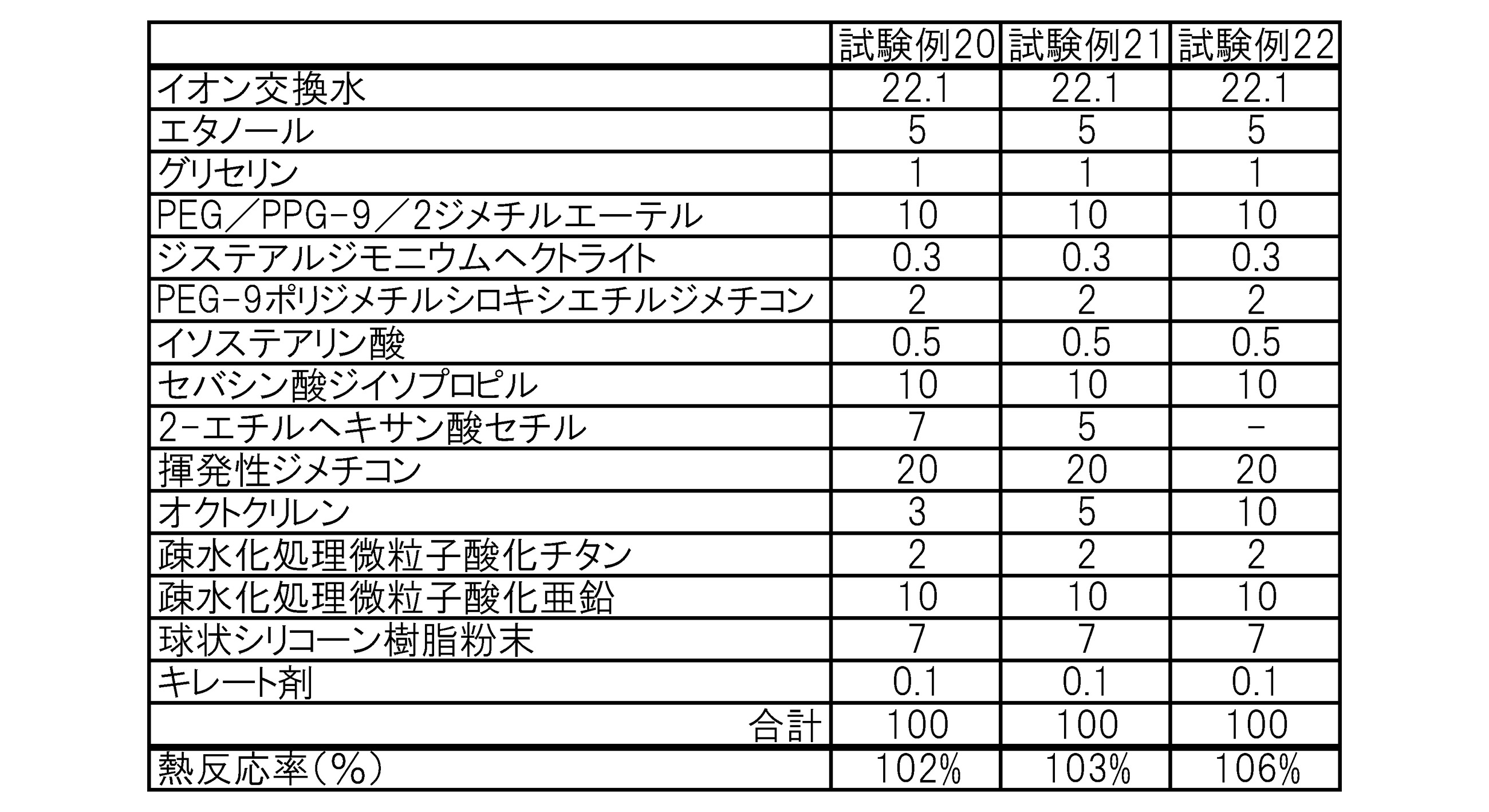
表5に示されるように、(A)紫外線防御剤としてオクトクリレンを配合した場合、オクトクリレンの配合量が多くなるほど高い熱反応率が得られた。
(2)水中油型乳化化粧料
下記表6に示す水中油型乳化化粧料の組成物を調製した。具体的には、ホモミキサーを用いて混合した油性成分に粉末を分散させた後、よく混合した水性成分を添加して組成物を得た。
下記表6に示す水中油型乳化化粧料の組成物を調製した。具体的には、ホモミキサーを用いて混合した油性成分に粉末を分散させた後、よく混合した水性成分を添加して組成物を得た。

表6に示されるように、水中油型乳化形態の化粧料においても、熱により紫外線防御効果が向上することが確認された。
表6と同様に、下記表7に示す水中油型乳化化粧料の組成物を調製した。

表7に示されるように、水中油型乳化形態の化粧料においても、(A)紫外線防御剤としてt-ブチルメトキシジベンゾイルメタンを配合する場合にはその配合量を(A)紫外線防御剤の全量に対して10質量%以下とすることにより高い熱反応率が得られた。
以下に、本発明の化粧料の処方を例示する。本発明はこれらの処方例によって何ら限定されるものではなく、特許請求の範囲によって特定されるものであることはいうまでもない。なお、配合量は全て化粧料全量に対する質量%で表す。
処方例1:2層式の化粧下地
(成分名) 配合量(質量%)
精製水 残余
エタノール 5
PEG/PPG-9/2ジメチルエーテル 5
グリセリン 1
キシリトール 1
トルメンチラエキス 0.3
ヒアルロン酸ナトリウム 0.1
2-O-エチル-L-アスコルビン酸 0.1
グリチルリチン酸ジカリウム 0.05
イソドデカン 3
セバシン酸ジイソプロピル 10
PBG/PPG-9/1コポリマー 1
ジメチコン 13
カプリリルメチコン 3
高重合アミノプロピルジメチコン20%のジメチコン溶液
1
トリフルオロアルキルジメチルトリメチルシロキシケイ酸50%ジメチコン溶液 3
パルミチン酸デキストリン 0.5
メトキシケイヒ酸エチルヘキシル 7
オクトクリレン 5
ジエチルアミノヒドロキシベンゾイル安息香酸ヘキシル 1
ビスエチルヘキシルオキシフェノールメトキシフェニルトリアジン
0.5
疎水化処理微粒子酸化チタン 2
疎水化処理微粒子酸化亜鉛 5
疎水化処理顔料級酸化チタン 1
疎水化処理酸化鉄 0.07
メタクリル酸メチルクロスポリマー 2
(ビニルジメチコン/メチコンシルセスキオキサン)クロスポリマー
2
疎水化処理タルク 2
PEG-9ポリジメチルポリシロキシエチルジメチコン 1.5
PEG/PPG-19/19ジメチコン 0.3
ジメチルジステアリルアンモニウムヘクトライト 0.4
イソステアリン酸 0.3
EDTA・3Na 適量
食塩 適量
ピロ亜硫酸ナトリウム 適量
トコフェロール 適量
香料 適量
(成分名) 配合量(質量%)
精製水 残余
エタノール 5
PEG/PPG-9/2ジメチルエーテル 5
グリセリン 1
キシリトール 1
トルメンチラエキス 0.3
ヒアルロン酸ナトリウム 0.1
2-O-エチル-L-アスコルビン酸 0.1
グリチルリチン酸ジカリウム 0.05
イソドデカン 3
セバシン酸ジイソプロピル 10
PBG/PPG-9/1コポリマー 1
ジメチコン 13
カプリリルメチコン 3
高重合アミノプロピルジメチコン20%のジメチコン溶液
1
トリフルオロアルキルジメチルトリメチルシロキシケイ酸50%ジメチコン溶液 3
パルミチン酸デキストリン 0.5
メトキシケイヒ酸エチルヘキシル 7
オクトクリレン 5
ジエチルアミノヒドロキシベンゾイル安息香酸ヘキシル 1
ビスエチルヘキシルオキシフェノールメトキシフェニルトリアジン
0.5
疎水化処理微粒子酸化チタン 2
疎水化処理微粒子酸化亜鉛 5
疎水化処理顔料級酸化チタン 1
疎水化処理酸化鉄 0.07
メタクリル酸メチルクロスポリマー 2
(ビニルジメチコン/メチコンシルセスキオキサン)クロスポリマー
2
疎水化処理タルク 2
PEG-9ポリジメチルポリシロキシエチルジメチコン 1.5
PEG/PPG-19/19ジメチコン 0.3
ジメチルジステアリルアンモニウムヘクトライト 0.4
イソステアリン酸 0.3
EDTA・3Na 適量
食塩 適量
ピロ亜硫酸ナトリウム 適量
トコフェロール 適量
香料 適量
処方例2:クリーム状のファンデーション
(成分名) 配合量(質量%)
精製水 残余
エタノール 5
フェノキシエタノール 1
PEG/PPG-9/2ジメチルエーテル 5
グリセリン 3
エリスリトール 1
キシリトール 1
トルメンチラエキス 1
グリシルグリシン 0.1
トラネキサム酸 1
グリチルリチン酸ジカリウム 0.05
ピバリン酸トリプロピレングリコール 2
セバシン酸ジイソプロピル 5
ジメチコン 10
シクロメチコン 5
トリシロキシケイ酸50%のシクロペンタシロキサン溶液
2
パルミチン酸デキストリン 1
メトキシケイヒ酸エチルヘキシル 7
疎水化処理微粒子酸化チタン 3
疎水化処理微粒子酸化亜鉛 3
疎水化処理顔料級酸化チタン 6
疎水化処理酸化鉄 3.2
疎水化処理硫酸バリウム被覆雲母チタン 0.01
疎水化処理雲母チタン 0.01
ジメチコンクロスポリマー13%のシクロペンタシロキサン混合物
2
ポリメチルシルセスキオキサン 2
メタクリル酸メチルクロスポリマー 2
疎水化処理微粒子シリカ 0.5
ラウリルPEG-9ポリジメチルポリシロキシエチルジメチコン
2
(ジメチコン/(PEG-10/15))クロスポリマー
1
ジメチルジステアリルアンモニウムヘクトライト 1
イソステアリン酸 0.2
トコフェロール 適量
EDTA・3Na 適量
食塩 適量
ピロ亜硫酸ナトリウム 適量
香料 適量
(成分名) 配合量(質量%)
精製水 残余
エタノール 5
フェノキシエタノール 1
PEG/PPG-9/2ジメチルエーテル 5
グリセリン 3
エリスリトール 1
キシリトール 1
トルメンチラエキス 1
グリシルグリシン 0.1
トラネキサム酸 1
グリチルリチン酸ジカリウム 0.05
ピバリン酸トリプロピレングリコール 2
セバシン酸ジイソプロピル 5
ジメチコン 10
シクロメチコン 5
トリシロキシケイ酸50%のシクロペンタシロキサン溶液
2
パルミチン酸デキストリン 1
メトキシケイヒ酸エチルヘキシル 7
疎水化処理微粒子酸化チタン 3
疎水化処理微粒子酸化亜鉛 3
疎水化処理顔料級酸化チタン 6
疎水化処理酸化鉄 3.2
疎水化処理硫酸バリウム被覆雲母チタン 0.01
疎水化処理雲母チタン 0.01
ジメチコンクロスポリマー13%のシクロペンタシロキサン混合物
2
ポリメチルシルセスキオキサン 2
メタクリル酸メチルクロスポリマー 2
疎水化処理微粒子シリカ 0.5
ラウリルPEG-9ポリジメチルポリシロキシエチルジメチコン
2
(ジメチコン/(PEG-10/15))クロスポリマー
1
ジメチルジステアリルアンモニウムヘクトライト 1
イソステアリン酸 0.2
トコフェロール 適量
EDTA・3Na 適量
食塩 適量
ピロ亜硫酸ナトリウム 適量
香料 適量
処方例3:エアゾールスプレータイプの日焼け止め
(成分名) 配合量(質量%)
精製水 残余
エタノール 5
ポリエチレングリコール300 2
シリカ 0.5
グリセリン 1
PEG/PPG-14/7ジメチルエーテル 6
酢酸DL-α-トコフェロール 0.5
D-グルタミン酸 0.1
グリチルリチン酸ステアリル 0.1
イソドデカン 10
トリ2-エチルヘキサン酸グリセリル 5
ミルスチン酸イソプロピル 3
セバシン酸ジイソプロピル 5
PBG/PPG-9/1コポリマー 1
ジメチコン 13
トリシロキシケイ酸50%のシクロペンタシロキサン溶液
0.5
トリ酢酸テトラステアリン酸スクロース 0.5
パルミチン酸デキストリン 1
メトキシケイヒ酸エチルヘキシル 5
ジエチルアミノヒドロキシベンゾイル安息香酸ヘキシル 2
ビスエチルヘキシルオキシフェノールメトキシフェニルトリアジン
1
ポリシリコーン-15 2
オクトクリレン 5
メタクリル酸メチルクロスポリマー 5
(ビニルジメチコン/メチコンシルセスキオキサン)クロスポリマー
3
疎水化処理タルク 1
セチルPEG/PPG-10/1ジメチコン 1
ラウリルPEG-9ポリジメチルポリシロキシエチルジメチコン
1
ジメチルジステアリルアンモニウムヘクトライト 0.5
イソステアリン酸 0.3
セスキイソステアリン酸ソルビタン 0.3
EDTA・3Na 適量
トコフェロール 適量
香料 適量
上記成分を混合して原液とし、原液とLPGとを50:50となるようにスプレー缶に充填して、エアゾールスプレータイプの日焼け止めを得た。
(成分名) 配合量(質量%)
精製水 残余
エタノール 5
ポリエチレングリコール300 2
シリカ 0.5
グリセリン 1
PEG/PPG-14/7ジメチルエーテル 6
酢酸DL-α-トコフェロール 0.5
D-グルタミン酸 0.1
グリチルリチン酸ステアリル 0.1
イソドデカン 10
トリ2-エチルヘキサン酸グリセリル 5
ミルスチン酸イソプロピル 3
セバシン酸ジイソプロピル 5
PBG/PPG-9/1コポリマー 1
ジメチコン 13
トリシロキシケイ酸50%のシクロペンタシロキサン溶液
0.5
トリ酢酸テトラステアリン酸スクロース 0.5
パルミチン酸デキストリン 1
メトキシケイヒ酸エチルヘキシル 5
ジエチルアミノヒドロキシベンゾイル安息香酸ヘキシル 2
ビスエチルヘキシルオキシフェノールメトキシフェニルトリアジン
1
ポリシリコーン-15 2
オクトクリレン 5
メタクリル酸メチルクロスポリマー 5
(ビニルジメチコン/メチコンシルセスキオキサン)クロスポリマー
3
疎水化処理タルク 1
セチルPEG/PPG-10/1ジメチコン 1
ラウリルPEG-9ポリジメチルポリシロキシエチルジメチコン
1
ジメチルジステアリルアンモニウムヘクトライト 0.5
イソステアリン酸 0.3
セスキイソステアリン酸ソルビタン 0.3
EDTA・3Na 適量
トコフェロール 適量
香料 適量
上記成分を混合して原液とし、原液とLPGとを50:50となるようにスプレー缶に充填して、エアゾールスプレータイプの日焼け止めを得た。
処方例4:ジェル状のBBクリーム
(成分名) 配合量(質量%)
精製水 残余
エタノール 8
PEG/PPG-9/2ジメチルエーテル 5
イザヨイバラエキス 0.1
ステアロキシヒドロキシプロピルメチルセルロース 0.2
(ジメチルアクリルアミド/アクリロイルジメチルタウリンNa)コポリマー 0.2
サクシノグルカン 0.1
グリセリン 3
ポリエチレングリコール300 1
ビスPEG-18メチルエーテルジメチルシラン 3
PEG/PPG-14/7ジメチルエーテル 1
メトキシケイヒ酸エチルヘキシル 10
セバシン酸ジイソプロピル 5
ジエチルアミノヒドロキシベンゾイル安息香酸ヘキシル 1
ビスエチルヘキシルオキシフェノールメトキシフェニルトリアジン
3
疎水化処理微粒子酸化チタン 3
疎水化処理微粒子酸化亜鉛 5
疎水化処理顔料級チタン 4
疎水化処理酸化鉄 0.4
ミルスチン酸イソプロピル 2
ポリプロピレングリコール(17) 2
N-ラウロイル-L-グルタミン酸ジ(コレステリル・フィトステリル)
0.5
(パルミチン酸/エチルヘキサン酸)デキストリン 0.5
香料 適量
シリカ 1
(成分名) 配合量(質量%)
精製水 残余
エタノール 8
PEG/PPG-9/2ジメチルエーテル 5
イザヨイバラエキス 0.1
ステアロキシヒドロキシプロピルメチルセルロース 0.2
(ジメチルアクリルアミド/アクリロイルジメチルタウリンNa)コポリマー 0.2
サクシノグルカン 0.1
グリセリン 3
ポリエチレングリコール300 1
ビスPEG-18メチルエーテルジメチルシラン 3
PEG/PPG-14/7ジメチルエーテル 1
メトキシケイヒ酸エチルヘキシル 10
セバシン酸ジイソプロピル 5
ジエチルアミノヒドロキシベンゾイル安息香酸ヘキシル 1
ビスエチルヘキシルオキシフェノールメトキシフェニルトリアジン
3
疎水化処理微粒子酸化チタン 3
疎水化処理微粒子酸化亜鉛 5
疎水化処理顔料級チタン 4
疎水化処理酸化鉄 0.4
ミルスチン酸イソプロピル 2
ポリプロピレングリコール(17) 2
N-ラウロイル-L-グルタミン酸ジ(コレステリル・フィトステリル)
0.5
(パルミチン酸/エチルヘキサン酸)デキストリン 0.5
香料 適量
シリカ 1
処方例5:乳液~クリーム状のBBクリーム
(成分名) 配合量(質量%)
精製水 残余
エタノール 6
リン酸L-アスコルビルマグネシウム 0.5
アセチル化ヒアルロン酸ナトリウム 0.1
水溶性コラーゲン 0.1
イザヨイバラエキス 0.1
(ジメチルアクリルアミド/アクリロイルジメチルタウリンNa)コポリマー 0.3
サクシノグルカン 0.2
セルロースガム 0.2
グリセリン 2
ブチレングリコール 4
PEG/PPG-14/7ジメチルエーテル 3
PEG/PPG-9/2ジメチルエーテル 2
ポリエチレングリコール300 1
ポリオキシエチレン硬化ヒマシ油(100モル) 1
ポリオキシエチレン(8モル)ベヘニルエーテル 1
ステアロイルメチルタウリンナトリウム 0.1
ステアリルアルコール 0.5
ベヘニルアルコール 0.5
メトキシケイヒ酸エチルヘキシル 8
オクトクリレン 2
エチルヘキシルトリアジン 1
ジエチルアミノヒドロキシベンゾイル安息香酸ヘキシル 1
ビスエチルヘキシルオキシフェノールメトキシフェニルトリアジン
1
イソドデカン 10
セバシン酸ジイソプロピル 5
ジメチコン 2
マカデミアナッツ油脂肪酸フィトステリル 1
N-ラウロイル-L-グルタミン酸ジ(フィトステリル・オクチルドデシル) 0.5
(パルミチン酸/エチルヘキサン酸)デキストリン 0.5
疎水化処理微粒子酸化亜鉛 8
顔料級疎水化処理酸化チタン 4
疎水化処理酸化鉄 0.2
イソステアリン酸 0.5
セスキイソステアリン酸ソルビタン 0.5
EDTA-2Na・H2O 適量
ヘキサメタリン酸ナトリウム 適量
クエン酸 適量
クエン酸ナトリウム 適量
香料 適量
タルク 3
シリカ 3
(成分名) 配合量(質量%)
精製水 残余
エタノール 6
リン酸L-アスコルビルマグネシウム 0.5
アセチル化ヒアルロン酸ナトリウム 0.1
水溶性コラーゲン 0.1
イザヨイバラエキス 0.1
(ジメチルアクリルアミド/アクリロイルジメチルタウリンNa)コポリマー 0.3
サクシノグルカン 0.2
セルロースガム 0.2
グリセリン 2
ブチレングリコール 4
PEG/PPG-14/7ジメチルエーテル 3
PEG/PPG-9/2ジメチルエーテル 2
ポリエチレングリコール300 1
ポリオキシエチレン硬化ヒマシ油(100モル) 1
ポリオキシエチレン(8モル)ベヘニルエーテル 1
ステアロイルメチルタウリンナトリウム 0.1
ステアリルアルコール 0.5
ベヘニルアルコール 0.5
メトキシケイヒ酸エチルヘキシル 8
オクトクリレン 2
エチルヘキシルトリアジン 1
ジエチルアミノヒドロキシベンゾイル安息香酸ヘキシル 1
ビスエチルヘキシルオキシフェノールメトキシフェニルトリアジン
1
イソドデカン 10
セバシン酸ジイソプロピル 5
ジメチコン 2
マカデミアナッツ油脂肪酸フィトステリル 1
N-ラウロイル-L-グルタミン酸ジ(フィトステリル・オクチルドデシル) 0.5
(パルミチン酸/エチルヘキサン酸)デキストリン 0.5
疎水化処理微粒子酸化亜鉛 8
顔料級疎水化処理酸化チタン 4
疎水化処理酸化鉄 0.2
イソステアリン酸 0.5
セスキイソステアリン酸ソルビタン 0.5
EDTA-2Na・H2O 適量
ヘキサメタリン酸ナトリウム 適量
クエン酸 適量
クエン酸ナトリウム 適量
香料 適量
タルク 3
シリカ 3
Claims (7)
- (A)紫外線防御剤と、
(B)下記式(I)で表されるアルキレンオキシド誘導体と、
R1O-[(AO)m(EO)n]-R2 (I)
(式中、R1及びR2は、それぞれ独立に、炭素原子数1~4の炭化水素基又は水素原子を示し、AOは炭素原子数3~4のオキシアルキレン基、EOはオキシエチレン基、mは1以上のAOの平均付加モル数、nは1以上のEOの平均付加モル数、m+n≦40とする。)
(C)エステル油と
を含有してなる乳化化粧料。 - (A)紫外線防御剤が4-tert-ブチル-4’-メトキシジベンゾイルメタンを含む場合に、その配合量が(A)紫外線防御剤全量に対して10質量%以下である、請求項1に記載の乳化化粧料。
- 前記(B)成分の配合量が5質量%以上である、請求項1又は2に記載の乳化化粧料。
- 前記(B)成分が、m+nが20以下のポリオキシプロピレン・ポリオキシエチレンランダム共重合体ジメチルエーテルである、請求項1から3のいずれか一項に記載の乳化化粧料。
- 前記(A)紫外線防御剤に少なくともオクトクリレンを含む、請求項1から4のいずれか一項に記載の乳化化粧料。
- さらに、(D)平均分子量150~3000のポリエチレングリコールを含む、請求項1から5のいずれか一項に記載の乳化化粧料。
- 油中水型乳化化粧料又は水中油型乳化化粧料である、請求項1から6のいずれか一項に記載の乳化化粧料。
Priority Applications (5)
| Application Number | Priority Date | Filing Date | Title |
|---|---|---|---|
| CN201980052130.0A CN112566616A (zh) | 2018-08-10 | 2019-08-09 | 乳化化妆品 |
| JP2020535908A JP7482775B2 (ja) | 2018-08-10 | 2019-08-09 | 乳化化粧料 |
| US17/267,319 US20210338544A1 (en) | 2018-08-10 | 2019-08-09 | Emulsion cosmetic |
| EP19848364.6A EP3834807A4 (en) | 2018-08-10 | 2019-08-09 | EMULSIZED COSMETIC |
| JP2024073474A JP7794887B2 (ja) | 2018-08-10 | 2024-04-30 | 乳化化粧料 |
Applications Claiming Priority (2)
| Application Number | Priority Date | Filing Date | Title |
|---|---|---|---|
| JP2018151679 | 2018-08-10 | ||
| JP2018-151679 | 2018-08-10 |
Publications (1)
| Publication Number | Publication Date |
|---|---|
| WO2020032241A1 true WO2020032241A1 (ja) | 2020-02-13 |
Family
ID=69414952
Family Applications (1)
| Application Number | Title | Priority Date | Filing Date |
|---|---|---|---|
| PCT/JP2019/031595 Ceased WO2020032241A1 (ja) | 2018-08-10 | 2019-08-09 | 乳化化粧料 |
Country Status (6)
| Country | Link |
|---|---|
| US (1) | US20210338544A1 (ja) |
| EP (1) | EP3834807A4 (ja) |
| JP (2) | JP7482775B2 (ja) |
| CN (1) | CN112566616A (ja) |
| TW (1) | TW202011930A (ja) |
| WO (1) | WO2020032241A1 (ja) |
Cited By (4)
| Publication number | Priority date | Publication date | Assignee | Title |
|---|---|---|---|---|
| JP2021063071A (ja) * | 2019-10-15 | 2021-04-22 | 花王株式会社 | 油中水型乳化化粧料 |
| CN115697296A (zh) * | 2020-06-03 | 2023-02-03 | 株式会社Lg生活健康 | 通过热和紫外线提高紫外线阻断效率的紫外线阻断用化妆料组合物 |
| CN116075289A (zh) * | 2020-09-09 | 2023-05-05 | 株式会社资生堂 | 水包油型乳化组合物 |
| WO2024247734A1 (ja) * | 2023-05-29 | 2024-12-05 | 株式会社 資生堂 | 水中油型化粧料 |
Families Citing this family (4)
| Publication number | Priority date | Publication date | Assignee | Title |
|---|---|---|---|---|
| WO2020032242A1 (ja) | 2018-08-10 | 2020-02-13 | 株式会社 資生堂 | 油性化粧料 |
| CN112533586A (zh) * | 2018-08-10 | 2021-03-19 | 株式会社资生堂 | 乳化化妆品 |
| FR3157131A1 (fr) * | 2023-12-20 | 2025-06-27 | L'oreal | Composition cosmétique de type émulsion huile-dans-eau, basée sur une structure de phases lamellaires |
| WO2026088308A1 (en) * | 2024-10-22 | 2026-04-30 | Lvmh Recherche | Water-in-oil type liquid emulsion cosmetic composition |
Citations (4)
| Publication number | Priority date | Publication date | Assignee | Title |
|---|---|---|---|---|
| JP2009024012A (ja) * | 2000-12-22 | 2009-02-05 | Shiseido Co Ltd | ゲル状組成物 |
| JP4397286B2 (ja) | 2003-11-28 | 2010-01-13 | 日清オイリオグループ株式会社 | 水中油型乳化化粧料及びその製造方法 |
| WO2016068300A1 (ja) | 2014-10-31 | 2016-05-06 | 株式会社 資生堂 | 日焼け止め化粧料 |
| WO2017057676A1 (ja) | 2015-09-30 | 2017-04-06 | 株式会社 資生堂 | 日焼け止め化粧料 |
Family Cites Families (12)
| Publication number | Priority date | Publication date | Assignee | Title |
|---|---|---|---|---|
| TWI366469B (en) * | 2005-07-26 | 2012-06-21 | Shiseido Co Ltd | Emulsified skin agent for external use |
| JP4611831B2 (ja) * | 2005-07-26 | 2011-01-12 | 株式会社資生堂 | 油中水型皮膚外用剤 |
| GB0601644D0 (en) | 2006-01-27 | 2006-03-08 | Unilever Plc | Antiperspirant compositions |
| WO2007122822A2 (ja) * | 2007-07-27 | 2007-11-01 | Shiseido Company, Ltd. | 水中油型乳化日焼け止め化粧料 |
| JP4863411B2 (ja) * | 2010-01-29 | 2012-01-25 | 株式会社 資生堂 | 水中油型乳化日焼け止め化粧料 |
| AU2015337532A1 (en) * | 2014-10-31 | 2017-04-20 | Shiseido Company, Ltd. | Oil-in-water emulsified sunblock cosmetic |
| KR102480670B1 (ko) * | 2014-10-31 | 2022-12-23 | 가부시키가이샤 시세이도 | 유중 수형 유화 자외선 차단 화장료 |
| WO2017057675A1 (ja) * | 2015-09-30 | 2017-04-06 | 株式会社 資生堂 | 日焼け止め化粧料 |
| JP6263244B2 (ja) * | 2015-10-09 | 2018-01-17 | 株式会社 資生堂 | 噴霧型日焼け止め化粧料 |
| JP7320914B2 (ja) * | 2017-04-26 | 2023-08-04 | 株式会社 資生堂 | 透明組成物および透明化粧料 |
| KR102648547B1 (ko) * | 2017-06-08 | 2024-03-18 | 가부시키가이샤 시세이도 | 유중 수형 유화 화장료 |
| CN112533586A (zh) * | 2018-08-10 | 2021-03-19 | 株式会社资生堂 | 乳化化妆品 |
-
2019
- 2019-08-09 US US17/267,319 patent/US20210338544A1/en active Pending
- 2019-08-09 WO PCT/JP2019/031595 patent/WO2020032241A1/ja not_active Ceased
- 2019-08-09 EP EP19848364.6A patent/EP3834807A4/en active Pending
- 2019-08-09 JP JP2020535908A patent/JP7482775B2/ja active Active
- 2019-08-09 CN CN201980052130.0A patent/CN112566616A/zh active Pending
- 2019-08-12 TW TW108128602A patent/TW202011930A/zh unknown
-
2024
- 2024-04-30 JP JP2024073474A patent/JP7794887B2/ja active Active
Patent Citations (4)
| Publication number | Priority date | Publication date | Assignee | Title |
|---|---|---|---|---|
| JP2009024012A (ja) * | 2000-12-22 | 2009-02-05 | Shiseido Co Ltd | ゲル状組成物 |
| JP4397286B2 (ja) | 2003-11-28 | 2010-01-13 | 日清オイリオグループ株式会社 | 水中油型乳化化粧料及びその製造方法 |
| WO2016068300A1 (ja) | 2014-10-31 | 2016-05-06 | 株式会社 資生堂 | 日焼け止め化粧料 |
| WO2017057676A1 (ja) | 2015-09-30 | 2017-04-06 | 株式会社 資生堂 | 日焼け止め化粧料 |
Non-Patent Citations (4)
| Title |
|---|
| DATABASE Mintel GNPD [online] June 2016 (2016-06-01), SHISEIDO INTERNATIONAL, JAPAN: "Perfect UV Protector SPF 50+/PA++++ for Sensitive Skin & Children", Database accession no. 4057965 * |
| DATABASE Mintel GNPD [online] June 2016 (2016-06-01), SHISEIDO, JAPAN: "Whitening Essence Facial UV Sunscreen SPF 50+/PA++++", Database accession no. 4100943 * |
| See also references of EP3834807A4 |
| YOSHIO KODA: "''Yuki Gainenzu - Kiso to Oyo -'' [Organic Conceptual Diagram - Fundamentals and Applications", 1984, SANKYO SHUPPAN, pages: 11 - 17 |
Cited By (7)
| Publication number | Priority date | Publication date | Assignee | Title |
|---|---|---|---|---|
| JP2021063071A (ja) * | 2019-10-15 | 2021-04-22 | 花王株式会社 | 油中水型乳化化粧料 |
| JP7589003B2 (ja) | 2019-10-15 | 2024-11-25 | 花王株式会社 | 油中水型乳化化粧料 |
| CN115697296A (zh) * | 2020-06-03 | 2023-02-03 | 株式会社Lg生活健康 | 通过热和紫外线提高紫外线阻断效率的紫外线阻断用化妆料组合物 |
| CN115697296B (zh) * | 2020-06-03 | 2023-12-22 | 株式会社Lg生活健康 | 通过热和紫外线提高紫外线阻断效率的紫外线阻断用化妆料组合物 |
| CN117357434A (zh) * | 2020-06-03 | 2024-01-09 | 株式会社Lg生活健康 | 提高紫外线阻断效率的方法及化妆品的制造用途 |
| CN116075289A (zh) * | 2020-09-09 | 2023-05-05 | 株式会社资生堂 | 水包油型乳化组合物 |
| WO2024247734A1 (ja) * | 2023-05-29 | 2024-12-05 | 株式会社 資生堂 | 水中油型化粧料 |
Also Published As
| Publication number | Publication date |
|---|---|
| JP7794887B2 (ja) | 2026-01-06 |
| EP3834807A4 (en) | 2022-05-04 |
| JPWO2020032241A1 (ja) | 2021-08-12 |
| US20210338544A1 (en) | 2021-11-04 |
| TW202011930A (zh) | 2020-04-01 |
| CN112566616A (zh) | 2021-03-26 |
| EP3834807A1 (en) | 2021-06-16 |
| JP2024099778A (ja) | 2024-07-25 |
| JP7482775B2 (ja) | 2024-05-14 |
Similar Documents
| Publication | Publication Date | Title |
|---|---|---|
| JP7794887B2 (ja) | 乳化化粧料 | |
| JP7794886B2 (ja) | 乳化化粧料 | |
| EP3213742B1 (en) | Water-in-oil emulsion sunscreen cosmetic | |
| JP7681088B2 (ja) | 化粧料 | |
| US11529293B2 (en) | Oil-in-water emulsion cosmetic | |
| JP7351837B2 (ja) | 油性化粧料 | |
| JP2024041892A (ja) | 日やけ止め効果増強剤 | |
| JP5834037B2 (ja) | 油中水型乳化化粧料 | |
| JP7347993B2 (ja) | 日焼け止め用組成物 | |
| CN108367177A (zh) | 用于改进组合物的spf和流变学的高内相乳液组合物 | |
| WO2020032245A1 (ja) | 化粧料 | |
| WO2024142783A1 (ja) | 日焼け止め化粧料、紫外線吸収剤の紫外線防止指数の向上方法、及び紫外線防止指数向上剤 | |
| WO2025142833A1 (ja) | 油性化粧料組成物 | |
| JP2025018346A (ja) | 油中水型乳化化粧料 |
Legal Events
| Date | Code | Title | Description |
|---|---|---|---|
| 121 | Ep: the epo has been informed by wipo that ep was designated in this application |
Ref document number: 19848364 Country of ref document: EP Kind code of ref document: A1 |
|
| ENP | Entry into the national phase |
Ref document number: 2020535908 Country of ref document: JP Kind code of ref document: A |
|
| NENP | Non-entry into the national phase |
Ref country code: DE |
|
| ENP | Entry into the national phase |
Ref document number: 2019848364 Country of ref document: EP Effective date: 20210310 |