WO2020032242A1 - 油性化粧料 - Google Patents
油性化粧料 Download PDFInfo
- Publication number
- WO2020032242A1 WO2020032242A1 PCT/JP2019/031596 JP2019031596W WO2020032242A1 WO 2020032242 A1 WO2020032242 A1 WO 2020032242A1 JP 2019031596 W JP2019031596 W JP 2019031596W WO 2020032242 A1 WO2020032242 A1 WO 2020032242A1
- Authority
- WO
- WIPO (PCT)
- Prior art keywords
- oil
- cosmetic
- cosmetic according
- oily
- group
- Prior art date
- Legal status (The legal status is an assumption and is not a legal conclusion. Google has not performed a legal analysis and makes no representation as to the accuracy of the status listed.)
- Ceased
Links
Classifications
-
- A—HUMAN NECESSITIES
- A61—MEDICAL OR VETERINARY SCIENCE; HYGIENE
- A61K—PREPARATIONS FOR MEDICAL, DENTAL OR TOILETRY PURPOSES
- A61K8/00—Cosmetics or similar toiletry preparations
- A61K8/18—Cosmetics or similar toiletry preparations characterised by the composition
- A61K8/30—Cosmetics or similar toiletry preparations characterised by the composition containing organic compounds
- A61K8/33—Cosmetics or similar toiletry preparations characterised by the composition containing organic compounds containing oxygen
- A61K8/35—Ketones, e.g. benzophenone
-
- A—HUMAN NECESSITIES
- A61—MEDICAL OR VETERINARY SCIENCE; HYGIENE
- A61K—PREPARATIONS FOR MEDICAL, DENTAL OR TOILETRY PURPOSES
- A61K8/00—Cosmetics or similar toiletry preparations
- A61K8/18—Cosmetics or similar toiletry preparations characterised by the composition
- A61K8/30—Cosmetics or similar toiletry preparations characterised by the composition containing organic compounds
- A61K8/33—Cosmetics or similar toiletry preparations characterised by the composition containing organic compounds containing oxygen
- A61K8/34—Alcohols
- A61K8/345—Alcohols containing more than one hydroxy group
-
- A—HUMAN NECESSITIES
- A61—MEDICAL OR VETERINARY SCIENCE; HYGIENE
- A61K—PREPARATIONS FOR MEDICAL, DENTAL OR TOILETRY PURPOSES
- A61K8/00—Cosmetics or similar toiletry preparations
- A61K8/02—Cosmetics or similar toiletry preparations characterised by special physical form
- A61K8/04—Dispersions; Emulsions
- A61K8/042—Gels
-
- A—HUMAN NECESSITIES
- A61—MEDICAL OR VETERINARY SCIENCE; HYGIENE
- A61K—PREPARATIONS FOR MEDICAL, DENTAL OR TOILETRY PURPOSES
- A61K8/00—Cosmetics or similar toiletry preparations
- A61K8/02—Cosmetics or similar toiletry preparations characterised by special physical form
- A61K8/04—Dispersions; Emulsions
- A61K8/046—Aerosols; Foams
-
- A—HUMAN NECESSITIES
- A61—MEDICAL OR VETERINARY SCIENCE; HYGIENE
- A61K—PREPARATIONS FOR MEDICAL, DENTAL OR TOILETRY PURPOSES
- A61K8/00—Cosmetics or similar toiletry preparations
- A61K8/18—Cosmetics or similar toiletry preparations characterised by the composition
- A61K8/30—Cosmetics or similar toiletry preparations characterised by the composition containing organic compounds
- A61K8/33—Cosmetics or similar toiletry preparations characterised by the composition containing organic compounds containing oxygen
- A61K8/39—Derivatives containing from 2 to 10 oxyalkylene groups
-
- A—HUMAN NECESSITIES
- A61—MEDICAL OR VETERINARY SCIENCE; HYGIENE
- A61K—PREPARATIONS FOR MEDICAL, DENTAL OR TOILETRY PURPOSES
- A61K8/00—Cosmetics or similar toiletry preparations
- A61K8/18—Cosmetics or similar toiletry preparations characterised by the composition
- A61K8/72—Cosmetics or similar toiletry preparations characterised by the composition containing organic macromolecular compounds
- A61K8/84—Cosmetics or similar toiletry preparations characterised by the composition containing organic macromolecular compounds obtained by reactions otherwise than those involving only carbon-carbon unsaturated bonds
- A61K8/86—Polyethers
-
- A—HUMAN NECESSITIES
- A61—MEDICAL OR VETERINARY SCIENCE; HYGIENE
- A61K—PREPARATIONS FOR MEDICAL, DENTAL OR TOILETRY PURPOSES
- A61K8/00—Cosmetics or similar toiletry preparations
- A61K8/18—Cosmetics or similar toiletry preparations characterised by the composition
- A61K8/72—Cosmetics or similar toiletry preparations characterised by the composition containing organic macromolecular compounds
- A61K8/90—Block copolymers
-
- A—HUMAN NECESSITIES
- A61—MEDICAL OR VETERINARY SCIENCE; HYGIENE
- A61Q—SPECIFIC USE OF COSMETICS OR SIMILAR TOILETRY PREPARATIONS
- A61Q17/00—Barrier preparations; Preparations brought into direct contact with the skin for affording protection against external influences, e.g. sunlight, X-rays or other harmful rays, corrosive materials, bacteria or insect stings
- A61Q17/04—Topical preparations for affording protection against sunlight or other radiation; Topical sun tanning preparations
-
- A—HUMAN NECESSITIES
- A61—MEDICAL OR VETERINARY SCIENCE; HYGIENE
- A61K—PREPARATIONS FOR MEDICAL, DENTAL OR TOILETRY PURPOSES
- A61K2800/00—Properties of cosmetic compositions or active ingredients thereof or formulation aids used therein and process related aspects
- A61K2800/20—Chemical, physico-chemical or functional or structural properties of the composition as a whole
- A61K2800/26—Optical properties
- A61K2800/262—Transparent; Translucent
-
- A—HUMAN NECESSITIES
- A61—MEDICAL OR VETERINARY SCIENCE; HYGIENE
- A61K—PREPARATIONS FOR MEDICAL, DENTAL OR TOILETRY PURPOSES
- A61K2800/00—Properties of cosmetic compositions or active ingredients thereof or formulation aids used therein and process related aspects
- A61K2800/20—Chemical, physico-chemical or functional or structural properties of the composition as a whole
- A61K2800/30—Characterized by the absence of a particular group of ingredients
- A61K2800/31—Anhydrous
-
- A—HUMAN NECESSITIES
- A61—MEDICAL OR VETERINARY SCIENCE; HYGIENE
- A61K—PREPARATIONS FOR MEDICAL, DENTAL OR TOILETRY PURPOSES
- A61K2800/00—Properties of cosmetic compositions or active ingredients thereof or formulation aids used therein and process related aspects
- A61K2800/40—Chemical, physico-chemical or functional or structural properties of particular ingredients
- A61K2800/42—Colour properties
- A61K2800/43—Pigments; Dyes
-
- A—HUMAN NECESSITIES
- A61—MEDICAL OR VETERINARY SCIENCE; HYGIENE
- A61K—PREPARATIONS FOR MEDICAL, DENTAL OR TOILETRY PURPOSES
- A61K2800/00—Properties of cosmetic compositions or active ingredients thereof or formulation aids used therein and process related aspects
- A61K2800/40—Chemical, physico-chemical or functional or structural properties of particular ingredients
- A61K2800/48—Thickener, Thickening system
-
- A—HUMAN NECESSITIES
- A61—MEDICAL OR VETERINARY SCIENCE; HYGIENE
- A61Q—SPECIFIC USE OF COSMETICS OR SIMILAR TOILETRY PREPARATIONS
- A61Q1/00—Make-up preparations; Body powders; Preparations for removing make-up
- A61Q1/02—Preparations containing skin colorants, e.g. pigments
-
- A—HUMAN NECESSITIES
- A61—MEDICAL OR VETERINARY SCIENCE; HYGIENE
- A61Q—SPECIFIC USE OF COSMETICS OR SIMILAR TOILETRY PREPARATIONS
- A61Q1/00—Make-up preparations; Body powders; Preparations for removing make-up
- A61Q1/02—Preparations containing skin colorants, e.g. pigments
- A61Q1/04—Preparations containing skin colorants, e.g. pigments for lips
- A61Q1/06—Lipsticks
Definitions
- the present invention relates to an oily cosmetic having a sunscreen effect. More specifically, the present invention relates to an oil-based cosmetic having an unprecedented property in which the ultraviolet ray protection effect is improved by heating as compared to immediately after application.
- Cosmetics having a sunscreen effect reduce the amount of ultraviolet light that reaches the skin to which the cosmetic has been applied by the action of ultraviolet absorbers and ultraviolet scattering agents incorporated in the cosmetic, thereby suppressing adverse effects on the skin Has the effect of doing
- the Sun Protection Factor As the index of the ultraviolet protection effect of the cosmetic, the Sun Protection Factor (SPF) is the most widely known, and the ultraviolet protection effect is displayed as an SPF value (for example, “SPF30”).
- SPF Sun Protection Factor
- PFA Protection Factor of UVA
- UVAPF UVA Protection Factor of Product
- UVA UVA classification
- CW critical wavelength
- UV protection effect of sunscreen products is exerted by the UV protection agents that are incorporated, that is, UV absorbers and UV scattering agents.
- UV absorbers and UV scattering agents have a reduced UV absorption capacity due to light irradiation (light deterioration).
- Some ultraviolet absorbers and ultraviolet scattering agents may flow out of the skin surface when coming into contact with moisture.
- Patent Document 1 Numerous devices for suppressing the light deterioration of the ultraviolet protection effect have been proposed (Patent Document 1). Regarding water resistance, the ultraviolet protection effect does not decrease even if it comes in contact with moisture, and conversely, the protection effect does not increase. A cosmetic having an innovative performance of improving has been developed (Patent Document 2).
- the present invention is based on the finding that in the course of research for developing a cosmetic having an ultraviolet protection effect, a phenomenon in which the ultraviolet protection effect does not decrease but is improved by the heat applied in the use environment, but based on heat,
- An object of the present invention is to provide an oil-based cosmetic having an unprecedented and innovative property with improved effects.
- the present inventors have conducted intensive studies in order to solve the above-described problems, and as a result, by blending an ultraviolet protective agent and a specific alkylene oxide derivative or a polyhydric alcohol, by limiting the water content to a predetermined range, The present inventors have found that an oil-based cosmetic having the above-mentioned desired novel properties can be obtained, and have completed the present invention.
- the present invention (A) an ultraviolet ray protective agent, (B) at least one selected from (i) an alkylene oxide derivative and (ii) a polyhydric alcohol having water solubility and IOB of 5.0 or less, Including
- the (B) (i) alkylene oxide derivative has the following formula (I): R 1 O-[(AO) m (EO) n ] -R 2 (I) (Wherein, R 1 and R 2 each independently represent a hydrocarbon group or a hydrogen atom having 1 to 4 carbon atoms, AO represents an oxyalkylene group having 3 to 4 carbon atoms, and EO represents an oxyethylene group.
- the oily cosmetic of the present invention by adopting the above constitution, not only deteriorates the UV protection effect when heat is applied in actual use, but also significantly improves the UV protection effect immediately after applying the cosmetic to the skin. Can be done. That is, the oil-based cosmetic according to the present invention is an innovative cosmetic having properties opposite to conventional common sense that the UV protection effect is rather improved by heat which has been the cause of the effect deterioration in the conventional cosmetic. It is.
- the oil-based cosmetic of the present invention contains (A) an ultraviolet ray protective agent and (B) a predetermined alkylene oxide derivative or polyhydric alcohol, and has a water content of 5% by mass or less.
- A an ultraviolet ray protective agent
- B a predetermined alkylene oxide derivative or polyhydric alcohol
- the (A) ultraviolet ray protective agent (hereinafter sometimes simply referred to as “component (A)”) blended in the oily cosmetic of the present invention means an ultraviolet ray absorbent and / or an ultraviolet ray scattering agent. What is usually blended can be used.
- the ultraviolet absorber that can be used in the present invention is not particularly limited, and examples thereof include benzoic acid derivatives, salicylic acid derivatives, cinnamic acid derivatives, dibenzoylmethane derivatives, ⁇ , ⁇ -diphenylacrylate derivatives, benzophenone derivatives, Examples thereof include a benzylidene camphor derivative, a phenylbenzimidazole derivative, a triazine derivative, a phenylbenzotriazole derivative, an anthranyl derivative, an imidazoline derivative, a benzalmalonate derivative, and a 4,4-diarylbutadiene derivative. Specific examples and trade names are listed below, but are not limited thereto.
- benzoic acid derivative examples include ethyl para-aminobenzoate (PABA), ethyl-dihydroxypropyl PABA, ethylhexyl-dimethyl PABA (eg, “Escalol 507”; ISP), glyceryl PABA, and PEG-25-PABA (eg, “Ubinal”). P25 "; BASF), hexyl diethylaminohydroxybenzoyl benzoate (eg,” Ubinal A Plus ”) and the like.
- salicylic acid derivative examples include homosalate ("Eusolex HMS”; Rona / EM Industries), ethylhexyl salicylate or octyl salicylate (for example, “Neo Heliopan OS”; Herman & Reimer), Examples thereof include dipropylene glycol salicylate (eg, “Dipsal”; Skel), TEA salicylate (eg, “Neo Heliopan TS”, Herman and Reimer), and the like.
- homosalate eusolex HMS
- Rona / EM Industries ethylhexyl salicylate or octyl salicylate
- dipropylene glycol salicylate eg, “Dipsal”; Skel
- TEA salicylate eg, “Neo Heliopan TS”, Herman and Reimer
- cinnamic acid derivatives examples include octyl methoxycinnamate or ethylhexyl methoxycinnamate (eg, “Parsol MCX”; DSM Corporation), isopropyl methoxycinnamate, and isoamyl methoxycinnamate (eg, “Neo Heliopan E1000”; Herman & Reimer) ), Cinnoxate, DEA methoxycinnamate, diisopropyl methyl cinnamate, glyceryl-ethylhexanoate-dimethoxycinnamate, di- (2-ethylhexyl) -4'-methoxybenzalmalonate and the like.
- octyl methoxycinnamate or ethylhexyl methoxycinnamate eg, “Parsol MCX”; DSM Corporation
- isopropyl methoxycinnamate eg
- dibenzoylmethane derivative examples include 4-tert-butyl-4'-methoxydibenzoylmethane (for example, "Parsol 1789"; DSM Corporation).
- ⁇ , ⁇ -diphenylacrylate derivative examples include octocrylene (eg, “Ubinal N539T”; BASF).
- Benzophenone derivatives include benzophenone-1 (eg, “Ubinal 400”; BASF), benzophenone-2 (eg, “Ubinal D50”; BASF), benzophenone-3 or oxybenzone (eg, “Ubinal M40”; BASF), benzophenone -4 (eg, “Ubinal MS40”; BASF), benzophenone-5, benzophenone-6 (eg, “Helisorb 11”; Norquay), benzophenone-8 (eg, “Spectra-Sorb” UV-) 24 "; American Cyanamide Co., Ltd.), benzophenone-9 (eg,” Ubinal DS-49 "; BASF), benzophenone-12, and the like.
- benzophenone-1 eg, “Ubinal 400”; BASF
- benzophenone-2 eg, “Ubinal D50”; BASF
- benzophenone-3 or oxybenzone eg, “Ubinal M40”; BASF
- benzylidene camphor derivative examples include 3-benzylidene camphor (eg, “Mexoryl SD”; Simex), 4-methylbenzylidene camphor, benzylidene camphor sulfonic acid (eg, “Megizolyl SL”; Simex), camphor benzalcometh sulfate
- methphthalolidene dicamphorsulfonic acid eg, “Megizolyl SX”; Simex
- polyacrylamidomethylbenzylidenecamphor eg, “Megizolyl SW”; Simex
- phenylbenzimidazole derivative examples include phenylbenzimidazole sulfonic acid (for example, “Eusorex 232”; Merck), disodium phenyldibenzimidazole tetrasulfonate (for example, “Neo Heliopan AP”, Herman & Reimer) and the like. Is exemplified.
- triazine derivative examples include bisethylhexyloxyphenol methoxyphenyl triazine (for example, “Tinosorb S”; Ciba Specialty Chemicals), ethylhexyl triazone (for example, “Ubinal T150”; BASF), and diethylhexylbutamide trioxide.
- Azone eg, “Uvasorb HEB”; Sigma 3 @ V
- 2,4,6-tris diisobutyl-4′-aminobenzalmalonate
- -s-triazine 2,4,6-tris [4 -(2-ethylhexyloxycarbonyl) anilino] -1,3,5-triazine and the like.
- phenylbenzotriazole derivative examples include drometrizole trisiloxane (eg, “Silatrizole”; Rhodia Shimmy), methylene bis (benzotriazolyltetramethylbutylphenol) (eg, “Tinosorb M” (Ciba Specialty. Chemicals)) and the like.
- anthranil derivatives include menthyl anthranilate (for example, "Neo Heliopan MA”; Harman & Reimer).
- imidazoline derivative examples include ethylhexyl dimethoxybenzylidene dioxoimidazoline propionate.
- benzalmalonate derivative examples include polyorganosiloxane having a benzalmalonate functional group (for example, Polysilicone-15; "Palsol SLX”; DSM Nutrition @ Japan) and the like.
- Examples of the '4,4-diarylbutadiene derivative include 1,1-dicarboxy (2,2'-dimethylpropyl) -4,4-diphenylbutadiene.
- UV absorbers include, but are not limited to, ethylhexyl methoxycinnamate, octocrylene, dimethicodiethylbenzalmalonate, polysilicone-15, 4-tert-butyl-4'-methoxydibenzoylmethane (t- Butylmethoxydibenzoylmethane), ethylhexyltriazone, diethylaminohydroxybenzoylhexylbenzoate, bisethylhexyloxyphenolmethoxyphenyltriazine, oxybenzone-3, methylenebisbenzotriazolyltetramethylbutylphenol, phenylbenzimidazolesulfonic acid, 3- (4 '-Methylbenzylidene) -d, l-camphor, 3-benzylidene-d, l-camphor, homosalate, ethylhexyl salicylateParticularly
- the blending amount is preferably 10% by mass or less based on the total amount of the component (A). Since 4-tert-butyl-4'-methoxydibenzoylmethane tends to hinder the improvement of the ultraviolet protection effect by heating when the (B) alkylene oxide derivative or the polyhydric alcohol is blended, the ultraviolet protection effect by heat is reduced. This is because it is difficult to realize the enhancement.
- the ultraviolet scattering agent used in the present invention is not particularly limited, but specific examples include metal oxides in the form of fine particles, such as zinc oxide, titanium oxide, iron oxide, cerium oxide, and tungsten oxide. be able to.
- the ultraviolet scattering agent may be one not subjected to surface treatment or one subjected to various hydrophobic surface treatments, but one subjected to hydrophobic surface treatment is preferably used.
- the surface treatment agent include those commonly used in the cosmetics field, for example, dimethicone, silicone such as alkyl-modified silicone, alkoxysilane such as octyltriethoxysilane, dextrin fatty acid ester such as dextrin palmitate, and fatty acid such as stearic acid. Can be used.
- the (A) ultraviolet protective agent in the present invention includes an embodiment composed of only an ultraviolet absorber, an embodiment composed of only an ultraviolet scattering agent, and an embodiment containing both an ultraviolet absorbent and an ultraviolet scattering agent.
- the amount of the (A) ultraviolet protective agent is not particularly limited, but is usually 5% by mass or more, for example, 5 to 40% by mass, preferably 6 to 40% by mass, and more preferably 7 to 35% by mass based on the total amount of the oily cosmetic. % By mass.
- (B) Alkylene oxide derivative or polyhydric alcohol The (B) (i) alkylene oxide derivative or (ii) polyhydric alcohol (hereinafter sometimes simply referred to as “component (B)”) blended in the oily cosmetic of the present invention is moisturizing in ordinary cosmetics. Often formulated as an agent.
- component (B) a specific alkylene oxide derivative or a polyhydric alcohol, the ultraviolet protection effect after heat is applied can be remarkably improved as compared with immediately after the cosmetic is applied to the skin.
- both (i) the alkylene oxide derivative and (ii) the polyhydric alcohol need to be water-soluble.
- water-soluble means dissolving 0.1 mass% or more in 25 degreeC water.
- the (B) (i) alkylene oxide derivative or (ii) polyhydric alcohol has an IOB of 5.0 or less, more preferably 3.0 or less, and still more preferably 2.5 or less. If the IOB value is too high, the effect of improving the ultraviolet protection ability by heat may not be sufficiently obtained. On the other hand, the lower limit of the IOB value is not particularly limited, but is preferably 0.5 or more, and more preferably 0.8 or more.
- IOB is an abbreviation of Inorganic / Organic Balance (inorganic / organic ratio), which is a value indicating a ratio of an inorganic value to an organic value, and is an index indicating the degree of polarity of an organic compound. Things.
- ⁇ Inorganic value '' and ⁇ organic value '' are set according to the atom or functional group, and ⁇ inorganic value '' and ⁇ organic value '' of all atoms and functional groups in the organic compound should be integrated
- the IOB value of the organic compound can be calculated (see, for example, Yoshio Koda, “Organic Conceptual Diagram-Basics and Applications”, pages 11 to 17, published by Sankyo Publishing Co., 1984).
- (B) (i) the alkylene oxide derivative or (ii) the polyhydric alcohol preferably has an ether bond. It is thought that by having an ether bond, it is easier to dissolve in water and to dissolve in oil than one having no ether bond.
- Examples of the (i) alkylene oxide derivative that can be used in the present invention include polyoxyalkylene / polyoxyethylene copolymer dialkyl ethers represented by the following (I).
- R 1 O-[(AO) m (EO) n ] -R 2 (I)
- AO represents an oxyalkylene group having 3 to 4 carbon atoms.
- Specific examples include an oxypropylene group, an oxybutylene group, an oxyisobutylene group, an oxytrimethylene group, and an oxytetramethylene group.
- an oxypropylene group and an oxybutylene group are used.
- EO represents an oxyethylene group.
- R 1 and R 2 each independently represent a hydrocarbon group having 1 to 4 carbon atoms or a hydrogen atom.
- the hydrocarbon group include a methyl group, an ethyl group, an n-propyl group, an isopropyl group, an n-butyl group, a sec-butyl group, and a tert-butyl group. Preferred are a methyl group and an ethyl group.
- R 1 and R 2 in one molecule may each be the same hydrocarbon group, a mixture of hydrocarbon groups and hydrogen atoms, and a plurality of hydrocarbon groups having different numbers of carbon atoms. May be mixed.
- the ratio of the number of hydrogen atoms (Y) to the number of hydrocarbon groups (X) (Y / X) is 0.15 with respect to the number of hydrocarbon groups (X). It is preferably at most, more preferably at most 0.06.
- ⁇ m is the average number of moles of AO added, and 1 ⁇ m ⁇ 70, preferably 2 ⁇ m ⁇ 20, and more preferably 2 ⁇ m ⁇ 10.
- n is the average number of moles of EO added, and 1 ⁇ n ⁇ 70, preferably 2 ⁇ n ⁇ 20, and more preferably 2 ⁇ n ⁇ 10.
- M + n is 40 or less, preferably 25 or less, and more preferably 20 or less. In particular, when m + n is 20 or less, it is possible to obtain an extremely excellent effect of improving ultraviolet protection by heating.
- AO and EO may be block copolymers added in a block shape or random copolymers added at random.
- the block copolymer includes not only a two-stage block but also a copolymer containing three or more stages of blocks. Preferably, a random copolymer is used.
- the molecular weight of the polyoxyalkylene / polyoxyethylene copolymer dialkyl ether represented by the formula (I) is 100 to 10,000, preferably 150 to 5,000, more preferably 200 to 3,000, and more preferably 300 to 2,000. .
- the ratio of EO to the total of AO and EO in one molecule [EO / (AO + EO)] is preferably 20 to 80% by mass.
- polyoxyalkylene / polyoxyethylene copolymer dialkyl ether preferably used in the present invention include, but are not limited to, the following polyoxypropylene / polyoxyethylene copolymer dimethyl ether.
- PEG / PPG-9 / 2 dimethyl ether PEG / PPG-17 / 4 dimethyl ether
- PEG / PPG-14 / 7 dimethyl ether
- Polyoxyalkylene / polyoxyethylene copolymer dialkyl ethers having a relatively small molecular weight tend to be more excellent in the effect of improving ultraviolet protection ability by heat. Therefore, among the above-listed polyoxypropylene / polyoxyethylene copolymer dimethyl ethers, PEG / PPG-9 / 2 dimethyl ether and the like show the highest effects.
- the polyalkylene glycol is represented by the following formula (II): HO (RO) pH (II) (Wherein, RO represents an oxyalkylene group having 2 to 4 carbon atoms, and p is 3 to 500) It is represented by Specifically, from those widely used in cosmetics, such as polyethylene glycol (also referred to as “PEG”), polypropylene glycol (also referred to as “PPG”), and polybutylene glycol (also referred to as “PBG”) Selected.
- PEG polyethylene glycol
- PPG polypropylene glycol
- PBG polybutylene glycol
- polyethylene glycol in which RO is an oxyethylene group and p is in the range of 3 to 500, more preferably 3 to 60 is preferable.
- Preferred polyethylene glycols have an average molecular weight in the range of 150 to 23,000, more preferably 150 to 3000. Specific examples include polyethylene glycol 300, polyethylene glycol 400, polyethylene glycol 1500, and polyethylene glycol 20000.
- Polyalkylene glycols having a relatively small molecular weight tend to be more excellent in the effect of improving ultraviolet protection ability by heat. Therefore, when polyethylene glycol 300 or polyethylene glycol 400 is used among the polyethylene glycols listed above, a particularly high effect is obtained.
- the component (B) includes an embodiment comprising only an alkylene oxide derivative, an embodiment comprising only a polyhydric alcohol, and an embodiment comprising both an alkylene oxide derivative and a polyhydric alcohol.
- a low molecular weight polyoxypropylene / polyoxyethylene copolymer dimethyl ether having an average molecular weight of 150 to 3000 and a polyalkylene glycol having an average molecular weight of 150 to 3000 are included in combination, the effect of improving the ultraviolet protection ability by heat is remarkable.
- Specific examples include a combination of polyethylene glycol 300 and PEG / PPG-9 / 2 dimethyl ether, and a combination of polyethylene glycol 400 and PEG / PPG-9 / 2 dimethyl ether.
- the blending amount of the component (B) is at least 1.0% by mass or more, more preferably 2.5% by mass or more, and preferably 30% by mass or less, more preferably 25% by mass or less based on the total amount of the oily cosmetic. . If the compounding amount is less than 1.0% by mass, the effect of improving the ultraviolet protection ability by heat may not be sufficiently obtained. In particular, when the content is 2.5% by mass or more, the effect can be more reliably achieved. On the other hand, if it exceeds 30% by mass, stability and usability may be affected.
- the oil-based cosmetic of the present invention does not substantially contain water like the conventional oil-based cosmetic, but may contain water as long as the effects, appearance, and usability of the present invention are not impaired. However, when water is contained, it is necessary to suppress the amount to 5% by mass or less, more preferably 3% by mass or less based on the total amount of the oily cosmetic. If the water content is too large, the stability of the oily cosmetic may be impaired or the cosmetic may become cloudy.
- the oily cosmetic of the present invention may contain, in addition to the components (A) and (B), components commonly used in cosmetics as long as the effects of the present invention are not impaired.
- a solidifying agent, an oil, a lower alcohol, a powder component, and the like can be appropriately compounded.
- the solidifying agent is a component that gels or thickens the oil component, for example, dextrin palmitate, dextrin fatty acid ester such as myristate dextrin, sucrose fatty acid ester such as sucrose caprylate, vaseline, hydrogenated palm oil, Solid or semi-solid hydrocarbon oils such as hydrogenated castor oil, organically modified clay minerals such as disteardimonium hectorite, benzyldimethyl stearyl ammonium hectorite, lauric acid, myristic acid, palmitic acid, stearic acid, 12-hydroxy A higher fatty acid having 8 to 22 carbon atoms which is solid at room temperature such as stearic acid or a salt thereof, or an amino acid-based gelling agent such as dibutyl lauroylglutamide, dibutylethylhexanoylglutamide, polyamide-8, polyamide-3, etc. No.
- oils widely used in cosmetics can be widely used irrespective of whether they are polar or non-polar, as oils that can be blended with the oily cosmetic of the present invention.
- Lower alcohols include alcohols having 1 to 5 carbon atoms such as ethanol and isopropanol.
- a spherical powder By blending the spherical powder, stickiness is suppressed, the feeling in use is improved, and a smooth and good feel can be obtained.
- the spherical powder can be arbitrarily used without particular limitation as long as it is generally used in cosmetics and the like.
- (meth) acrylate resin powder polyamide resin powder (nylon powder), polyethylene powder, polystyrene powder, copolymer resin powder of styrene and (meth) acrylic acid, benzoguanamine resin powder, polytetrafluoroethylene powder
- examples include cellulose powder, trimethylsilsesquioxane powder and the like, and organopolysiloxane elastomer spherical powder or composite spherical powder using the same as a mother powder.
- the average particle diameter of the spherical powder is preferably 3 to 20 ⁇ m.
- the blending amount of the spherical powder is not particularly limited, but is preferably 3 to 30% by mass, and more preferably 7 to 20% by mass.
- spherical organic resin powders include, for example, Ganz Pearl (Aika Kogyo), and commercially available spherical silicone resin powders include, for example, Trefill E-505C, Trefill E-506C, Trefill E-506S, Trefill HP40T (Toray Dow Corning Silicone Co., Ltd.), Tospearl 2000B (Momentive Performance Materials), silicone powder KSP-100, KSP-300 (Shin-Etsu Chemical Co., Ltd.) and the like.
- the oil-based cosmetic of the present invention may contain components other than those described above, which are commonly used in cosmetics, depending on the dosage form to be prepared, as long as the effects of the present invention are not impaired.
- a pH adjuster, a chelating agent, a preservative, an antioxidant, a drug, an alcohol, a coloring agent, a pigment, and the like can be appropriately compounded.
- Examples of the drug include ascorbic acid (vitamin C), tranexamic acid, kojic acid, ellagic acid, arbutin, alkoxysalicylic acid, nicotinamide, glycyrrhizic acid, tocopherol, retinol, and salts or derivatives thereof (eg, sodium L-ascorbate) L-ascorbic acid ester magnesium salt, L-ascorbic acid glucoside, 2-O-ethyl-L-ascorbic acid, 3-O-ethyl-L-ascorbic acid, 4-methoxysalicylic acid sodium salt, 4-methoxysalicylic acid potassium salt , Dipotassium glycyrrhizinate, stearyl glycyrrhizinate, tocophenol acetate, retinol acetate, retinol palmitate, etc.).
- vitamin C ascorbic acid
- tranexamic acid k
- the present invention can be provided in the form of general oily cosmetics.
- Specific dosage forms are liquid, gel-like, solid, and the like, and can be produced using a conventional method suitable for each dosage form.
- the viscosity of the oily cosmetic at 25 ° C. is preferably 300 mPa ⁇ s or more, more preferably 500 mPa ⁇ s or more. If the viscosity is 300 mPa ⁇ s or more, a sufficiently high ultraviolet protection effect can be achieved. In this specification, the viscosity is the maximum viscosity measured by a Brookfield viscometer (spindle number 7, rotation speed 5 rpm).
- the hardness of the oily cosmetic at 25 ° C. is preferably 5 N or more, more preferably 30 N or more. If the hardness is 5 N or more, a higher ultraviolet protection effect can be obtained.
- the upper limit of the hardness is not particularly limited, but is preferably 300 N or less in consideration of usability.
- the hardness in the present invention is a value measured by a rheometer manufactured by Leotech Co., Ltd. (pressure-sensitive axis 5 ⁇ , penetration speed 2 cm / min, penetration 3 mm).
- the oily cosmetic of the present invention can be prepared in a non-separable one-phase form. It is preferable that the oily cosmetic is a non-separable single phase because the cosmetic can be applied without shaking immediately before.
- non-separable one phase means that the liquid components contained in the cosmetic are mutually soluble and in one phase, and can be confirmed by visual observation.
- the oily cosmetic of the present invention can be prepared in a transparent state.
- transparent refers to a cell having a transmittance of at least 50% when filled in a cell having an optical path length of 10 mm and the transmittance of light having a wavelength of 700 nm is measured by a spectrophotometer.
- the oily cosmetic of the present invention is not only a sunscreen cosmetic, but also a makeup cosmetic such as a foundation having a sunscreen effect, a makeup base, and a hair cosmetic (a hair spray or a hair for protecting hair or scalp from ultraviolet rays). And various hair products such as treatments), and spray-type cosmetics.
- the oily cosmetic of the present invention has a novel property that the UV protection effect of a coating film is improved by heat.
- the UV protection effect is improved by heat means that the integrated value of the absorbance measured with a spectrophotometer or the like over a range of 280 to 400 nm for the coating film before heat treatment (unheated sample) and the coating film after heat treatment (heated sample) This means that the thermal reaction rate obtained by the following equation from the absorbance integrated value similarly measured for the sample) exceeds 100%.
- Thermal reaction rate (%) (integrated absorbance value after heat treatment) / (integrated absorbance value before heat treatment) ⁇ 100
- the thermal reaction rate is at least over 100%, preferably at least 103%, more preferably at least 105%, further preferably at least 110%, particularly preferably at least 115%.
- the heating temperature is preferably in the range of 30 ° C. to 70 ° C., for example, 32 ° C. or more, 35 ° C. or more, 37 ° C. or more, or 40 ° C. or more.
- the temperature can be set to 65 ° C. or lower, 60 ° C. or lower, 55 ° C. or lower, or 50 ° C. or lower. If the heating temperature exceeds 70 ° C., problems such as melting of the resin measurement plate may occur.
- the heating time is preferably at least 1 minute, more preferably at least 10 minutes, in order to accurately evaluate the influence of heat.
- the upper limit of the heating time is not particularly limited, but is usually 60 minutes or less, preferably 30 minutes or less.
- phase separation Presence or absence of phase separation The appearance of the prepared oil-based cosmetic is visually observed, and whether the liquid component is in a compatible state and forms one phase (non-separated one phase), or a part of the liquid component is another liquid It was examined whether separation occurred without being compatible with the components (phase separation).
- Viscosity The viscosity of the prepared oily cosmetic was measured at 25 ° C. using a Brookfield viscometer (spindle number 7, rotational speed 5 rpm).
- Hardness The hardness of the prepared oily cosmetic was measured at 25 ° C. with a rheometer manufactured by Leotech Co., Ltd. (pressure-sensitive axis 5 ⁇ , penetration speed 2 cm / min, penetration 3 mm).
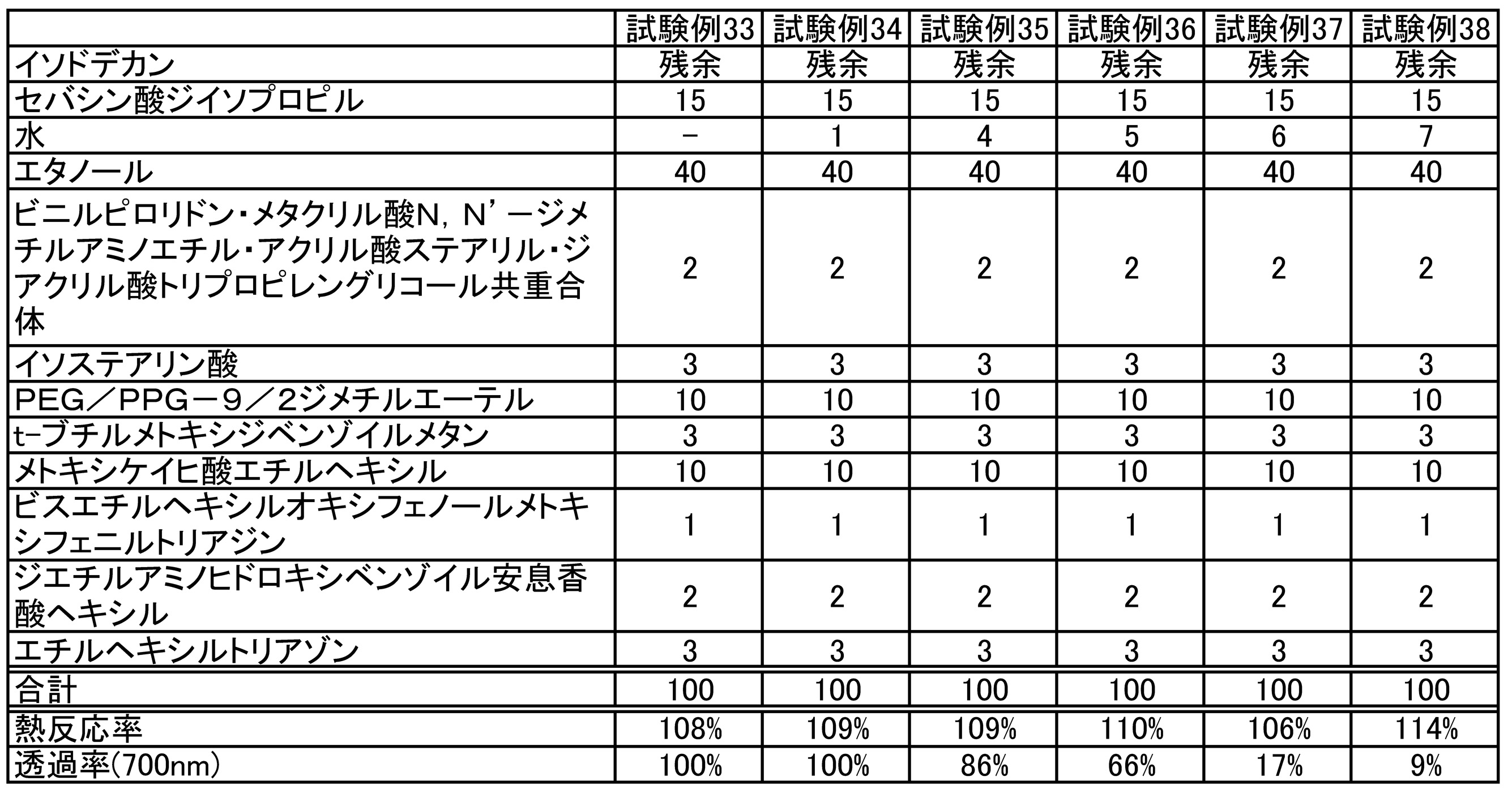
- Test Examples 33 to 38 For each of the test examples shown in Table 6 below, a solidifying agent was added to the oily component, and the mixture was heated and melted. After adding a humectant, the mixture was homogenized and then cooled to obtain a gel-like sunscreen cosmetic. .
- the blending amount is (A) By setting the content to 10% by mass or less based on the total amount of the protective agent, a high thermal reaction rate was obtained.
- Formulation Example 1 Makeup base (liquid) (Ingredient name) Compounding amount (% by mass) Isododecane Residual diisopropyl sebacate 30 Ethanol 10 PEG / PPG-9 / 2 dimethyl ether 20 Ethylhexyl methoxycinnamate 10 Octyl salicylate 5 Bisethylhexyloxyphenol methoxyphenyl triazine 2 Octocrylene 5 Hexyl diethylaminohydroxybenzoyl benzoate 2 Isostearic acid 2 Polymethyl methacrylate 6 Hydrophobized silica 0.5 Hydrophobized fine particle titanium oxide 1 Hydrophobized fine particle zinc oxide 1 Hydrophobized iron oxide 0.7 Hydrophobized barium sulfate coated mica titanium 0.01 Hydrophobized titanium mica 0.01
- Aerosol spray type sunscreen (component name) Compounding amount (% by mass) Isododecane Residual diisopropyl sebacate 20 Glyceryl tri-2-ethylhexanoate 5 Isopropyl myristate 6 Ethanol 7 PEG / PPG-9 / 2 dimethyl ether 20 Ethylhexyl methoxycinnamate 10 Octyl salicylate 5 Bisethylhexyloxyphenol methoxyphenyl triazine 2 Octocrylene 5 Hexyl diethylaminohydroxybenzoyl benzoate 2 Isostearic acid 2 Polymethyl methacrylate 6 Hydrophobized silica 0.5 The above components were mixed to give a stock solution, and the stock solution and LPG were filled into a spray can at a ratio of 50:50 to obtain an aerosol spray type sunscreen.
- Formulation Example 3 Lipstick (component name) Compounding amount (% by mass) Diisopropyl sebacate Residual hydrogenated polydecene 20 Diphenylsiloxyphenyltrimethicone 2 PEG / PPG-9 / 2 dimethyl ether 15 Ethylhexyl methoxycinnamate 10 4-tert-butyl-4'-methoxybenzoylmethane 3 Homosalate 10 Bisethylhexyloxyphenol methoxyphenyl triazine 2 Octocrylene 5 Hexyl diethylaminohydroxybenzoyl benzoate 3 Hydroxystearic acid 6 Polyamide-8 2 Dibutyl lauroyl glutamide 2 Pigment 0.03
Landscapes
- Health & Medical Sciences (AREA)
- Life Sciences & Earth Sciences (AREA)
- Public Health (AREA)
- Veterinary Medicine (AREA)
- Animal Behavior & Ethology (AREA)
- General Health & Medical Sciences (AREA)
- Epidemiology (AREA)
- Birds (AREA)
- Emergency Medicine (AREA)
- Chemical & Material Sciences (AREA)
- Dispersion Chemistry (AREA)
- Dermatology (AREA)
- Cosmetics (AREA)
Abstract
Description
(A)紫外線防御剤と、
(B)水溶性かつIOBが5.0以下である(i)アルキレンオキシド誘導体及び(ii)多価アルコールから選択される1種以上と、
を含み、
前記(B)(i)アルキレンオキシド誘導体は下記式(I):
R1O-[(AO)m(EO)n]-R2 (I)
(式中、R1及びR2は、それぞれ独立に、炭素原子数1~4の炭化水素基又は水素原子を示し、AOは炭素原子数3~4のオキシアルキレン基、EOはオキシエチレン基を示し、1≦m≦70、1≦n≦70、かつ、m+n≦40である)
で表されるポリオキシアルキレン・ポリオキシエチレン共重合体ジアルキルエーテルであり、かつ、
水の含有量が5質量%以下である、油性化粧料を提供する。
本発明の油性化粧料に配合される(A)紫外線防御剤(以下、単に「(A)成分」と称する場合がある)は、紫外線吸収剤および/又は紫外線散乱剤を意味し、化粧料に通常配合されるものを使用することができる。
本発明の油性化粧料に配合される(B)(i)アルキレンオキシド誘導体又は(ii)多価アルコール(以下、単に「(B)成分」と称する場合がある)は、通常の化粧料では保湿剤として配合されることが多い。本発明では、特定のアルキレンオキシド誘導体又は多価アルコールを配合することにより、化粧料を肌に塗布した直後よりも、熱が加わった後の紫外線防御効果を顕著に向上させることができる。
R1O-[(AO)m(EO)n]-R2 (I)
上記式中、AOは炭素原子数3~4のオキシアルキレン基を示す。具体的にはオキシプロピレン基、オキシブチレン基、オキシイソブチレン基、オキシトリメチレン基、オキシテトラメチレン基等が挙げられる。好ましくはオキシプロピレン基、オキシブチレン基が挙げられる。EOはオキシエチレン基を示す。
一分子中のR1及びR2は、それぞれ同一の1種の炭化水素基であってもよく、炭化水素基と水素原子とが混在してもよく、炭素原子数が異なる複数の炭化水素基が混在していてもよい。ただし、R1及びR2の各々について、炭化水素基と水素原子との存在割合は、炭化水素基の数(X)に対する水素原子の数(Y)の割合(Y/X)が0.15以下であるのが好ましく、より好ましくは0.06以下である。
前記式(I)で表されるポリオキシアルキレン・ポリオキシエチレン共重合体ジアルキルエーテルの分子量は、100~10000、好ましくは150~5000、さらに好ましくは200~3000、より好ましくは300~2000である。一分子中のAOとEOの合計に対するEOの割合[EO/(AO+EO)]は、20~80質量%であることが好ましい。
PEG/PPG-9/2ジメチルエーテル
PEG/PPG-17/4ジメチルエーテル
PEG/PPG-14/7ジメチルエーテル
PEG/PPG-11/9ジメチルエーテル
PEG/PPG-55/28ジメチルエーテル
PEG/PPG-36/41ジメチルエーテル
PEG/PPG-6/3ジメチルエーテル
PEG/PPG-8/4ジメチルエーテル
PEG/PPG-6/11ジメチルエーテル
PEG/PPG-14/27ジメチルエーテル
HO(RO)pH (II)
(式中、ROは炭素原子数2~4のオキシアルキレン基を示し、pは3~500である)
で表されるものである。
具体的には、ポリエチレングリコール(「PEG」とも表記する)、ポリプロピレングリコール(「PPG」とも表記する)およびポリブチレングリコール(「PBG」とも表記する)等、化粧料に広く使用されているものから選択される。
なかでも、熱による紫外線防御能向上効果を最大限に発揮させるためには、アルキレンオキシド誘導体と多価アルコールをそれぞれ一種以上含むことが好ましい。例えば、平均分子量150~3000の低分子量ポリオキシプロピレン・ポリオキシエチレン共重合体ジメチルエーテルと、平均分子量150~3000のポリアルキレングリコールとを組み合わせて含む場合に、熱による紫外線防御能向上効果が顕著となる。具体例として、特にポリエチレングリコール300とPEG/PPG-9/2ジメチルエーテルとの組合せ、ポリエチレングリコール400とPEG/PPG-9/2ジメチルエーテルとの組合せを挙げることができる。
本発明の油性化粧料は、従来の油性化粧料と同様に水を実質的に含まないが、本発明の効果、外観、使用性等を損なわない範囲であれば水を含有してもよい。ただし、水を含む場合は、油性化粧料全量に対して5質量%以下、より好ましくは3質量%以下に抑えることが必要である。水の含有量が多すぎると、油性化粧料の安定性が損なわれたり、化粧料が白濁したりする場合がある。
本発明の油性化粧料には、上記(A)成分及び(B)成分に加えて、本発明の効果を妨げない範囲で、化粧料に通常用いられる成分を配合することができる。例えば、固化剤、油分、低級アルコール、粉末成分等を適宜配合することができる。
熱反応率(%)=(熱処理後の吸光度積算値)/(熱処理前の吸光度積算値)×100
本発明の油性化粧料では、熱反応率が少なくとも100%を超えており、好ましくは103%以上、より好ましくは105%以上、更に好ましくは110%以上、特に好ましくは115%以上である。
加熱時間は、熱による影響を的確に評価するために、1分以上とするのが好ましく、より好ましくは10分以上である。加熱時間の上限としては、特に限定されないが、通常は60分以下、好ましくは30分以下である。
調製した油性化粧料を、疑似皮膚PMMAプレート(SPFMASTER-PA01)に2mg/cm2の量で滴下し、60秒間指で塗布し、15分間乾燥させて塗膜を形成した。未塗布のプレートをコントロールとして、前記塗膜の吸光度(280~400nm)を日立製作所製U-3500型自記録分光光度計にて測定し、得られた測定データから熱処理前の吸光度積算値を求めた。
次いで、前記塗膜を有するプレートを恒温槽に置き、37℃、30分の加熱処理を行い、上記と同様に吸光度積算値を求めた。
以下の式から熱照射前後の吸光度積算値の変化(熱反応率)を算出した。
熱反応率(%)=(熱処理後の吸光度積算値)/(熱処理前の吸光度積算値)×100
調製した油性化粧料の外観を目視により観察し、液体成分が相溶状態にあり一相をなしているか(非分離一相)、液体成分の一部が他の液体成分と相溶せずに分離を生じているか(相分離)を調べた。
調製した油性化粧料を、光路長10mmのセルに充填し、分光光度計(日立製作所製U3510)で波長700nmの光の透過率を測定した。
透過率が50%以上のものを「透明」であると評価した。
調製した油性化粧料の粘度を、25℃において、ブルックフィールド型粘度計(スピンドル番号7、回転数5rpm)を用いて測定した。
調製した油性化粧料の硬度を、25℃において、レオテック社製レオメーター(感圧軸5φ、針入速度2cm/min、針入度3mm)で測定した。
下記表1に示す各試験例について、全成分をホモミキサーを用いて混合して液状日焼け止め化粧料を得た。

下記表2に示す各試験例について、全成分をホモミキサーを用いて混合して液状日焼け止め化粧料を得た。
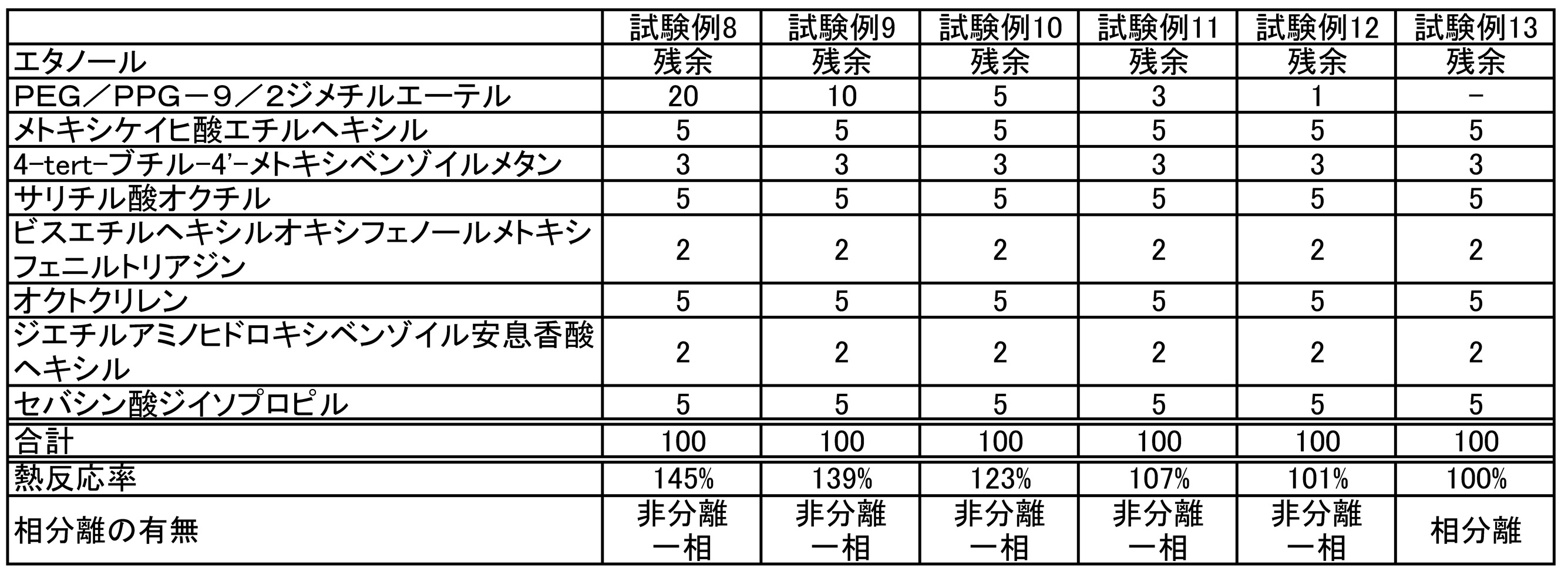
下記表3に示す各試験例について、全成分をホモミキサーを用いて混合して油性日焼け止め化粧料を得た。固化剤を含む場合には、油性成分に固化剤を添加して加温・融解し、保湿剤を添加後、混合して均一化し、その後冷却して固形状日焼け止め化粧料を得た。
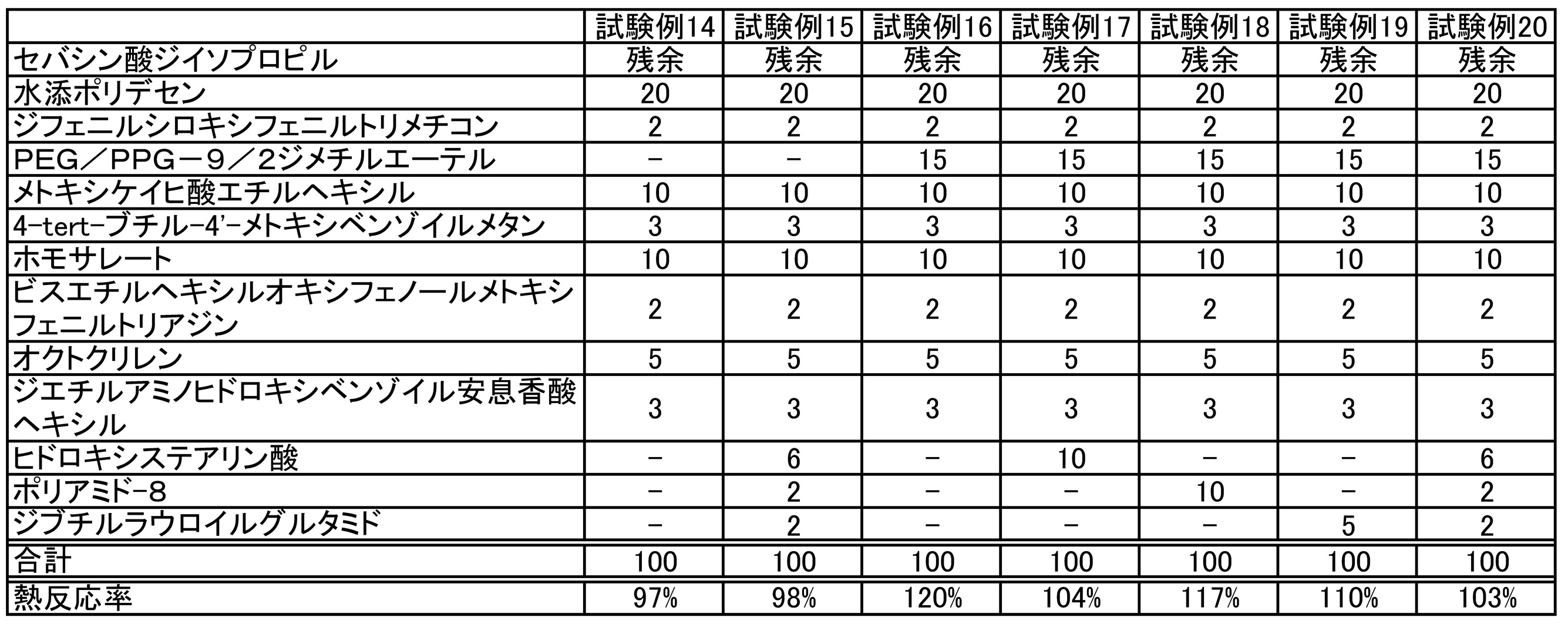
下記表4に示す各試験例について、全成分をホモミキサーを用いて混合して油性日焼け止め化粧料を得た。固化剤を含む場合には、油性成分に固化剤を添加して加温・融解し、保湿剤を添加後、混合して均一化し、その後冷却してジェル状日焼け止め化粧料を得た。
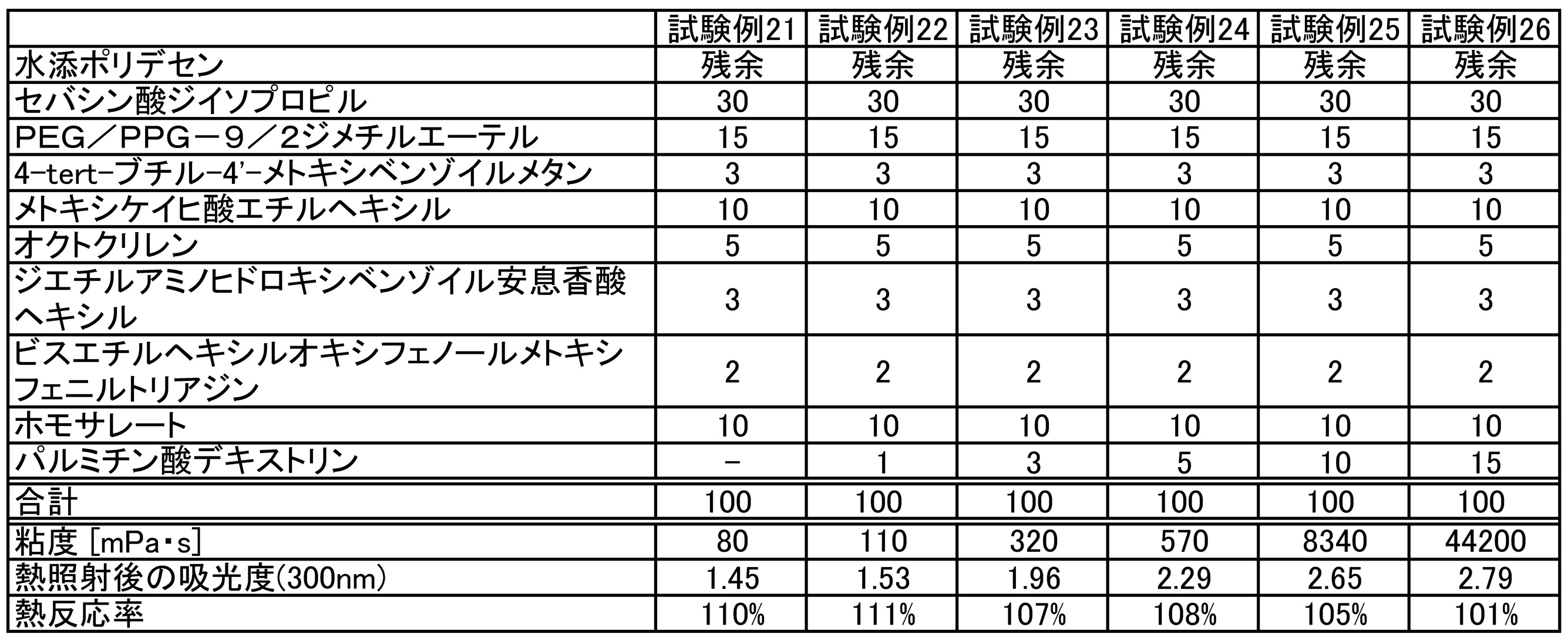
下記表5に示す各試験例について、全成分をホモミキサーを用いて混合して油性日焼け止め化粧料を得た。固化剤を含む場合には、油性成分に固化剤を添加して加温・融解し、保湿剤を添加後、混合して均一化し、その後冷却して固形状日焼け止め化粧料を得た。
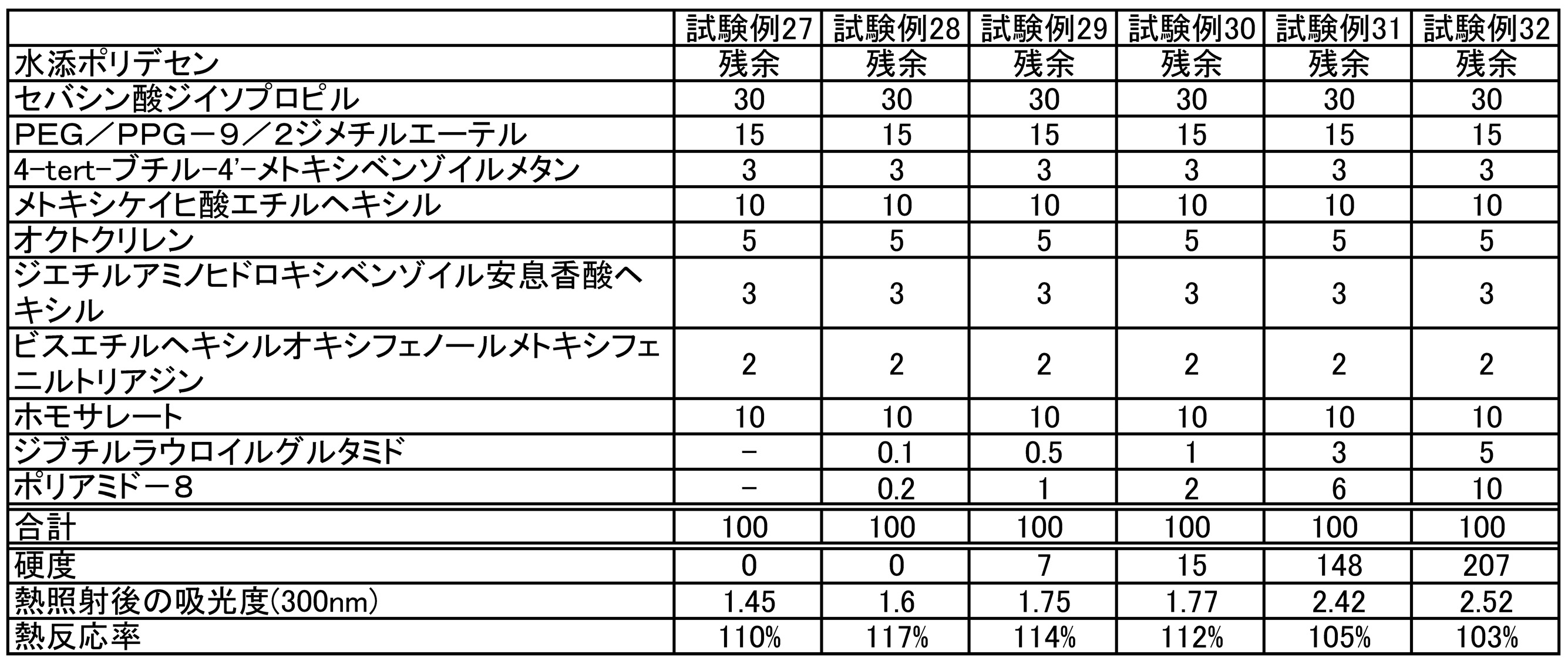
下記表6に示す各試験例について、油性成分に固化剤を添加して加温・融解し、保湿剤を添加後、混合して均一化し、その後冷却してジェル状日焼け止め化粧料を得た。
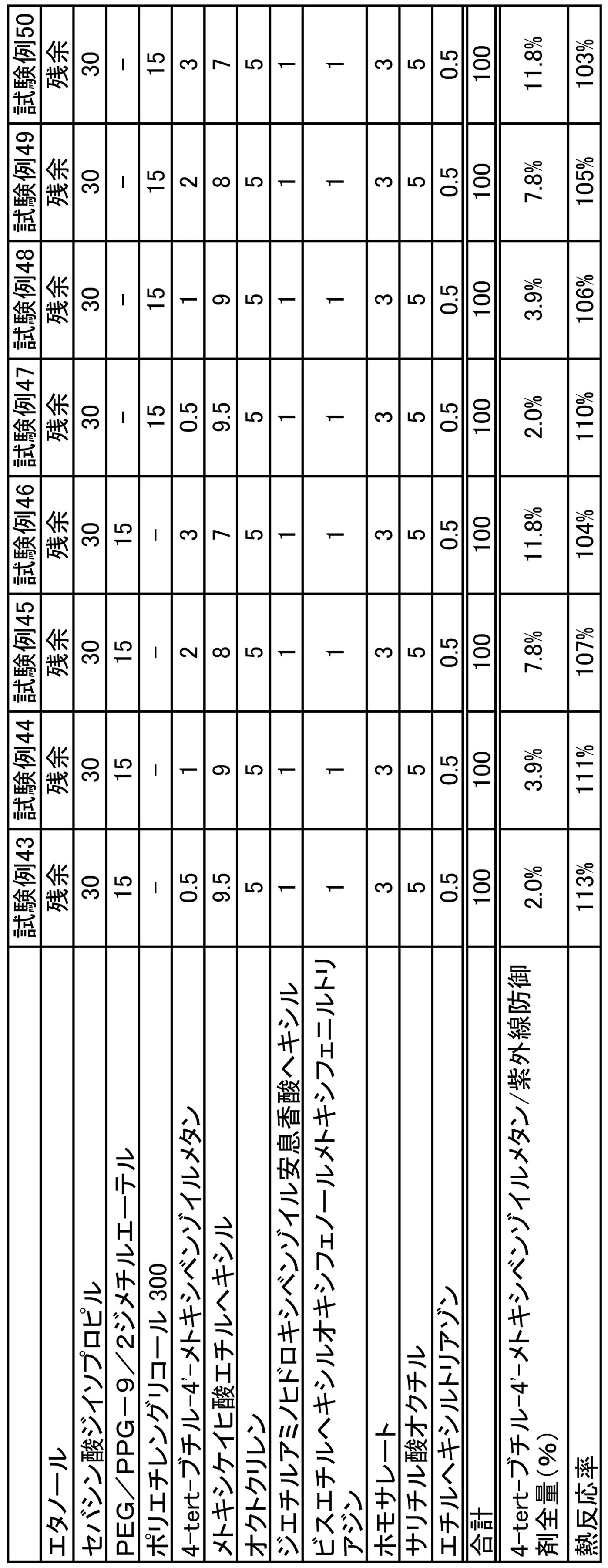
下記表7に示す各試験例について、全成分をホモミキサーを用いて混合して液状日焼け止め化粧料を得た。
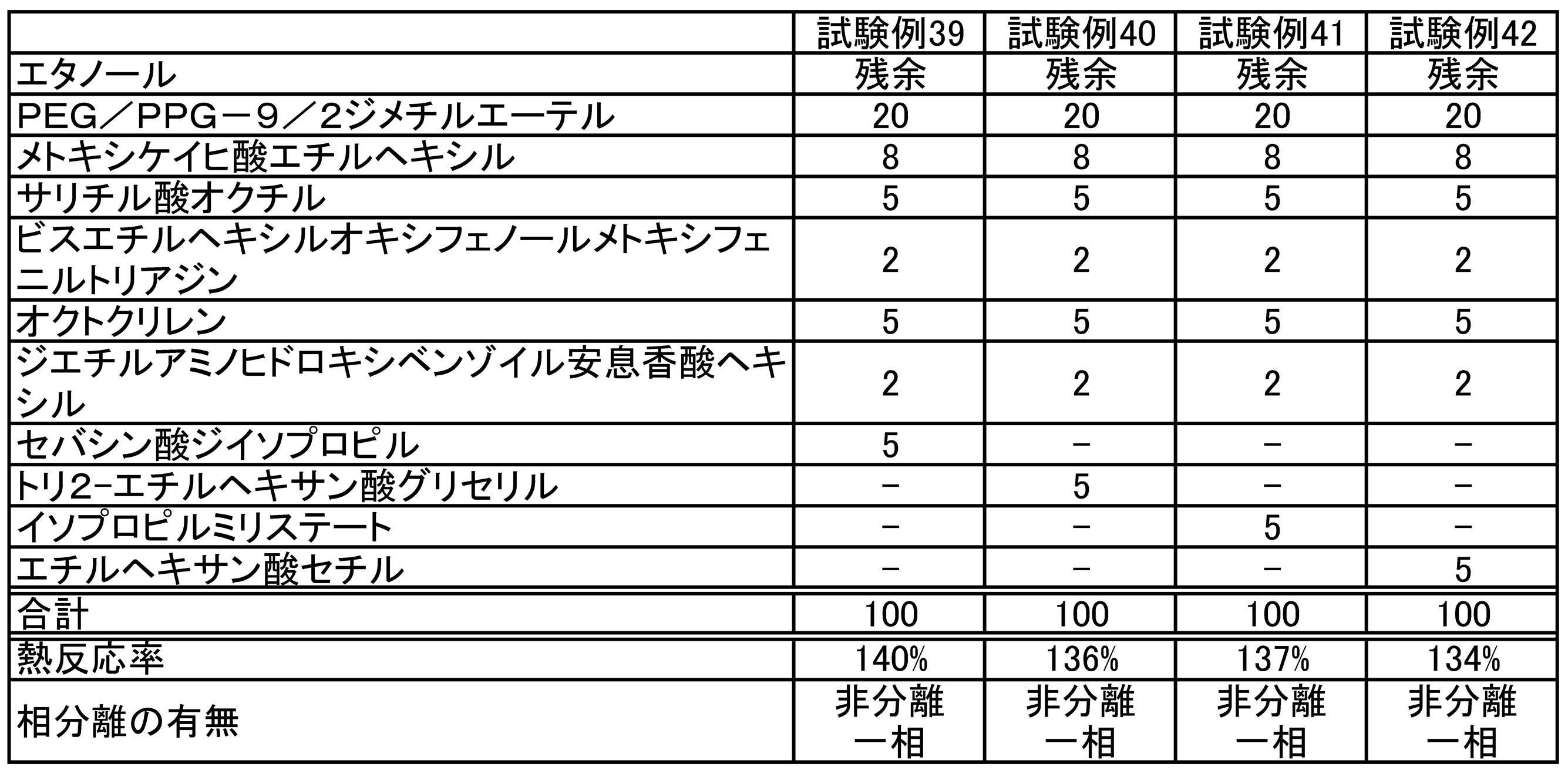
下記表8に示す各試験例について、全成分をホモミキサーを用いて混合して液状日焼け止め化粧料を得た。
(成分名) 配合量(質量%)
イソドデカン 残余
セバシン酸ジイソプロピル 30
エタノール 10
PEG/PPG-9/2ジメチルエーテル 20
メトキシケイヒ酸エチルヘキシル 10
サリチル酸オクチル 5
ビスエチルヘキシルオキシフェノールメトキシフェニルトリアジン
2
オクトクリレン 5
ジエチルアミノヒドロキシベンゾイル安息香酸ヘキシル 2
イソステアリン酸 2
ポリメタクリル酸メチル 6
疎水化処理シリカ 0.5
疎水化微粒子酸化チタン 1
疎水化微粒子酸化亜鉛 1
疎水化処理酸化鉄 0.7
疎水化処理硫酸バリウム被覆雲母チタン 0.01
疎水化処理雲母チタン 0.01
(成分名) 配合量(質量%)
イソドデカン 残余
セバシン酸ジイソプロピル 20
トリ2-エチルヘキサン酸グリセリル 5
ミルスチン酸イソプロピル 6
エタノール 7
PEG/PPG-9/2ジメチルエーテル 20
メトキシケイヒ酸エチルヘキシル 10
サリチル酸オクチル 5
ビスエチルヘキシルオキシフェノールメトキシフェニルトリアジン
2
オクトクリレン 5
ジエチルアミノヒドロキシベンゾイル安息香酸ヘキシル 2
イソステアリン酸 2
ポリメタクリル酸メチル 6
疎水化処理シリカ 0.5
上記成分を混合して原液とし、原液とLPGとを50:50となるようにスプレー缶に充填して、エアゾールスプレータイプの日焼け止めを得た。
(成分名) 配合量(質量%)
セバシン酸ジイソプロピル 残余
水添ポリデセン 20
ジフェニルシロキシフェニルトリメチコン 2
PEG/PPG-9/2ジメチルエーテル 15
メトキシケイヒ酸エチルヘキシル 10
4-tert-ブチル-4’-メトキシベンゾイルメタン
3
ホモサレート 10
ビスエチルヘキシルオキシフェノールメトキシフェニルトリアジン
2
オクトクリレン 5
ジエチルアミノヒドロキシベンゾイル安息香酸ヘキシル 3
ヒドロキシステアリン酸 6
ポリアミド-8 2
ジブチルラウロイルグルタミド 2
色素 0.03
Claims (11)
- (A)紫外線防御剤と、
(B)水溶性かつIOBが5.0以下である(i)アルキレンオキシド誘導体及び(ii)多価アルコールから選択される1種以上と、
を含み、
前記(B)(i)アルキレンオキシド誘導体は下記式(I):
R1O-[(AO)m(EO)n]-R2 (I)
(式中、R1及びR2は、それぞれ独立に、炭素原子数1~4の炭化水素基又は水素原子を示し、AOは炭素原子数3~4のオキシアルキレン基、EOはオキシエチレン基を示し、1≦m≦70、1≦n≦70、かつ、m+n≦40である)
で表されるポリオキシアルキレン・ポリオキシエチレン共重合体ジアルキルエーテルであり、かつ、
水の含有量が5質量%以下である、油性化粧料。 - (A)紫外線防御剤が4-tert-ブチル-4’-メトキシジベンゾイルメタンを含む場合に、その配合量が(A)紫外線防御剤全量に対して10質量%以下である、請求項1に記載の油性化粧料。
- (B)(i)アルキレンオキシド誘導体が式(I)においてm+n≦20を満たす、請求項1又は2に記載の油性化粧料。
- (B)(ii)多価アルコールが、ポリアルキレングリコール、ブチレングリコール、ジプロピレングリコール、ジグリセリン、プロパンジオール、エリスリトール、キシリトール、メチルグルセス-10、ソルビトールから成る群から選択される1種以上であり、
前記ポリアルキレングリコールは下記式(II):
HO(RO)pH (II)
(式中、ROは炭素原子数2~4のオキシアルキレン基を示し、pは3~500である)を満たす、請求項1~3のいずれか一項に記載の油性化粧料。 - (B)(ii)多価アルコールが平均分子量150~23000のポリエチレングリコールである、請求項1~4のいずれか一項に記載の油性化粧料。
- (B)成分の配合量が、油性化粧料全量に対して2.5質量%以上である、請求項1~5のいずれか一項に記載の油性化粧料。
- 固化剤をさらに含む、請求項1~6のいずれか一項に記載の油性化粧料。
- 非分離一相である、請求項1~7のいずれか一項に記載の油性化粧料。
- 透明である、請求項1~8のいずれか一項に記載の油性化粧料。
- 油性化粧料がジェル状である場合に、25℃における粘度が300mPa・s以上である、請求項1~9のいずれか一項に記載の油性化粧料。
- 油性化粧料が固形状である場合に、25℃における硬度が5N以上である、請求項1~9のいずれか一項に記載の油性化粧料。
Priority Applications (4)
| Application Number | Priority Date | Filing Date | Title |
|---|---|---|---|
| JP2020535909A JP7351837B2 (ja) | 2018-08-10 | 2019-08-09 | 油性化粧料 |
| EP19847047.8A EP3834809A4 (en) | 2018-08-10 | 2019-08-09 | OIL-BASED COSMETIC |
| CN201980052079.3A CN112533585A (zh) | 2018-08-10 | 2019-08-09 | 油性化妆品 |
| US17/267,330 US11771630B2 (en) | 2018-08-10 | 2019-08-09 | Oil-based cosmetic |
Applications Claiming Priority (4)
| Application Number | Priority Date | Filing Date | Title |
|---|---|---|---|
| JP2018151678 | 2018-08-10 | ||
| JP2018-151678 | 2018-08-10 | ||
| JP2019-091903 | 2019-05-15 | ||
| JP2019091903 | 2019-05-15 |
Publications (1)
| Publication Number | Publication Date |
|---|---|
| WO2020032242A1 true WO2020032242A1 (ja) | 2020-02-13 |
Family
ID=69414872
Family Applications (1)
| Application Number | Title | Priority Date | Filing Date |
|---|---|---|---|
| PCT/JP2019/031596 Ceased WO2020032242A1 (ja) | 2018-08-10 | 2019-08-09 | 油性化粧料 |
Country Status (6)
| Country | Link |
|---|---|
| US (1) | US11771630B2 (ja) |
| EP (1) | EP3834809A4 (ja) |
| JP (1) | JP7351837B2 (ja) |
| CN (1) | CN112533585A (ja) |
| TW (1) | TW202011927A (ja) |
| WO (1) | WO2020032242A1 (ja) |
Cited By (4)
| Publication number | Priority date | Publication date | Assignee | Title |
|---|---|---|---|---|
| JPWO2022138538A1 (ja) * | 2020-12-22 | 2022-06-30 | ||
| US20240148626A1 (en) * | 2021-03-30 | 2024-05-09 | Shiseido Company, Ltd. | Cosmetic |
| JP2024066028A (ja) * | 2022-11-01 | 2024-05-15 | 株式会社ミルボン | 油性化粧料及び化粧方法 |
| WO2025142833A1 (ja) * | 2023-12-28 | 2025-07-03 | 株式会社 資生堂 | 油性化粧料組成物 |
Families Citing this family (3)
| Publication number | Priority date | Publication date | Assignee | Title |
|---|---|---|---|---|
| JP7482776B2 (ja) | 2018-08-10 | 2024-05-14 | 株式会社 資生堂 | 乳化化粧料 |
| WO2021157667A1 (ja) * | 2020-02-04 | 2021-08-12 | 株式会社ダイセル | 予測装置、予測方法及びプログラム |
| JP7379594B1 (ja) * | 2022-06-15 | 2023-11-14 | 花王株式会社 | 固形パーソナルケア製品の製造方法 |
Citations (8)
| Publication number | Priority date | Publication date | Assignee | Title |
|---|---|---|---|---|
| JP2006052155A (ja) * | 2004-08-10 | 2006-02-23 | Kose Corp | 油性固形化粧料 |
| JP2009132638A (ja) * | 2007-11-29 | 2009-06-18 | Shin Etsu Chem Co Ltd | 化粧料 |
| JP4397286B2 (ja) | 2003-11-28 | 2010-01-13 | 日清オイリオグループ株式会社 | 水中油型乳化化粧料及びその製造方法 |
| WO2011027710A1 (ja) * | 2009-09-04 | 2011-03-10 | 株式会社Adeka | 紫外線吸収剤を含有した日焼け防止用化粧組成物 |
| WO2016068300A1 (ja) | 2014-10-31 | 2016-05-06 | 株式会社 資生堂 | 日焼け止め化粧料 |
| WO2017057676A1 (ja) | 2015-09-30 | 2017-04-06 | 株式会社 資生堂 | 日焼け止め化粧料 |
| JP2017149699A (ja) * | 2016-02-26 | 2017-08-31 | クラシエホームプロダクツ株式会社 | 皮膚洗浄剤組成物 |
| JP2018062504A (ja) * | 2016-10-13 | 2018-04-19 | 株式会社コーセー | 油性化粧料用組成物 |
Family Cites Families (19)
| Publication number | Priority date | Publication date | Assignee | Title |
|---|---|---|---|---|
| WO2002051939A1 (en) | 2000-12-22 | 2002-07-04 | Shiseido Co., Ltd. | Gel-form composition |
| US20030103930A1 (en) | 2001-10-30 | 2003-06-05 | The Procter & Gamble Company | Anhydrous cosmetic compositions containing quaternary ammonium compounds |
| JP4442751B2 (ja) * | 2004-01-27 | 2010-03-31 | 株式会社資生堂 | 透明固形組成物及びこれを基剤として含有する透明固形化粧料 |
| TWI366469B (en) | 2005-07-26 | 2012-06-21 | Shiseido Co Ltd | Emulsified skin agent for external use |
| GB0601644D0 (en) | 2006-01-27 | 2006-03-08 | Unilever Plc | Antiperspirant compositions |
| AU2007223713B2 (en) * | 2006-03-01 | 2009-11-19 | Elc Management Llc | Clear sunscreen gels and methods of use thereof |
| JP5424866B2 (ja) * | 2006-03-21 | 2014-02-26 | ダウ・コーニング・コーポレイション | シリコーンポリエーテルエラストマーゲル |
| KR101380241B1 (ko) | 2007-07-27 | 2014-04-01 | 가부시키가이샤 시세이도 | 수중유형 유화 자외선 차단 화장료 |
| EP2156819A1 (en) * | 2008-08-20 | 2010-02-24 | KPSS-Kao Professional Salon Services GmbH | Solid anhydrous composition for keratin fibres |
| JP2010275206A (ja) | 2009-05-27 | 2010-12-09 | Shiseido Co Ltd | 化粧料 |
| DE102009034115A1 (de) | 2009-07-20 | 2011-01-27 | Beiersdorf Ag | Kosmetische Zubereitung mit einem Gehalt an Acylarginaten |
| JP5731138B2 (ja) | 2010-07-02 | 2015-06-10 | 日光ケミカルズ株式会社 | 油中水型乳化剤組成物及び該組成物を用いた油中水型乳化組成物並びに化粧料 |
| US11806412B2 (en) | 2014-10-31 | 2023-11-07 | Shiseido Company, Ltd. | Oil-in-water emulsion sunscreen cosmetic |
| CN116270260A (zh) | 2014-10-31 | 2023-06-23 | 株式会社资生堂 | 油包水型乳化防晒化妆品 |
| JP2016094361A (ja) | 2014-11-13 | 2016-05-26 | ロート製薬株式会社 | 微小粒子状物質防御用外用剤 |
| JP6113899B2 (ja) * | 2015-09-30 | 2017-04-12 | 株式会社 資生堂 | 日焼け止め化粧料 |
| JP7320914B2 (ja) * | 2017-04-26 | 2023-08-04 | 株式会社 資生堂 | 透明組成物および透明化粧料 |
| JP7482776B2 (ja) | 2018-08-10 | 2024-05-14 | 株式会社 資生堂 | 乳化化粧料 |
| EP3834807A4 (en) | 2018-08-10 | 2022-05-04 | Shiseido Company, Ltd. | EMULSIZED COSMETIC |
-
2019
- 2019-08-09 EP EP19847047.8A patent/EP3834809A4/en not_active Withdrawn
- 2019-08-09 US US17/267,330 patent/US11771630B2/en active Active
- 2019-08-09 WO PCT/JP2019/031596 patent/WO2020032242A1/ja not_active Ceased
- 2019-08-09 JP JP2020535909A patent/JP7351837B2/ja active Active
- 2019-08-09 CN CN201980052079.3A patent/CN112533585A/zh active Pending
- 2019-08-12 TW TW108128604A patent/TW202011927A/zh unknown
Patent Citations (8)
| Publication number | Priority date | Publication date | Assignee | Title |
|---|---|---|---|---|
| JP4397286B2 (ja) | 2003-11-28 | 2010-01-13 | 日清オイリオグループ株式会社 | 水中油型乳化化粧料及びその製造方法 |
| JP2006052155A (ja) * | 2004-08-10 | 2006-02-23 | Kose Corp | 油性固形化粧料 |
| JP2009132638A (ja) * | 2007-11-29 | 2009-06-18 | Shin Etsu Chem Co Ltd | 化粧料 |
| WO2011027710A1 (ja) * | 2009-09-04 | 2011-03-10 | 株式会社Adeka | 紫外線吸収剤を含有した日焼け防止用化粧組成物 |
| WO2016068300A1 (ja) | 2014-10-31 | 2016-05-06 | 株式会社 資生堂 | 日焼け止め化粧料 |
| WO2017057676A1 (ja) | 2015-09-30 | 2017-04-06 | 株式会社 資生堂 | 日焼け止め化粧料 |
| JP2017149699A (ja) * | 2016-02-26 | 2017-08-31 | クラシエホームプロダクツ株式会社 | 皮膚洗浄剤組成物 |
| JP2018062504A (ja) * | 2016-10-13 | 2018-04-19 | 株式会社コーセー | 油性化粧料用組成物 |
Non-Patent Citations (5)
| Title |
|---|
| DATABASE Mintel GNPD [online] April 2003 (2003-04-01), KOSE: "Pure Bright Foundation", Database accession no. 200747 * |
| DATABASE Mintel GNPD [online] August 2017 (2017-08-01), SHISEIDO: "UV Protective Lip Treatment 30", Database accession no. 5005209 * |
| DATABASE Mintel GNPD [online] February 2015 (2015-02-01), SHISEIDO: "Pressed Powder SPF15/PA++", Database accession no. 2952765 * |
| DATABASE Mintel GNPD [online] October 2005 (2005-10-01), SHISEIDO: "Sun Protection Lip Treatment", Database accession no. 406984 * |
| YOSHIO KODA: "Organic Conceptual Diagram - Fundamentals and Applications", 1984, SANKYO SHUPPAN, article "Yuki Gainenzu - Kiso to Oyo", pages: 11 - 17 |
Cited By (8)
| Publication number | Priority date | Publication date | Assignee | Title |
|---|---|---|---|---|
| JPWO2022138538A1 (ja) * | 2020-12-22 | 2022-06-30 | ||
| WO2022138538A1 (ja) * | 2020-12-22 | 2022-06-30 | 株式会社 資生堂 | 固形化粧料 |
| CN116456956A (zh) * | 2020-12-22 | 2023-07-18 | 株式会社资生堂 | 固体化妆料 |
| JP7733018B2 (ja) | 2020-12-22 | 2025-09-02 | 株式会社 資生堂 | 固形化粧料 |
| CN116456956B (zh) * | 2020-12-22 | 2026-05-26 | 株式会社资生堂 | 固体化妆料 |
| US20240148626A1 (en) * | 2021-03-30 | 2024-05-09 | Shiseido Company, Ltd. | Cosmetic |
| JP2024066028A (ja) * | 2022-11-01 | 2024-05-15 | 株式会社ミルボン | 油性化粧料及び化粧方法 |
| WO2025142833A1 (ja) * | 2023-12-28 | 2025-07-03 | 株式会社 資生堂 | 油性化粧料組成物 |
Also Published As
| Publication number | Publication date |
|---|---|
| JP7351837B2 (ja) | 2023-09-27 |
| EP3834809A4 (en) | 2022-05-04 |
| JPWO2020032242A1 (ja) | 2021-08-10 |
| TW202011927A (zh) | 2020-04-01 |
| US20210338552A1 (en) | 2021-11-04 |
| EP3834809A1 (en) | 2021-06-16 |
| US11771630B2 (en) | 2023-10-03 |
| CN112533585A (zh) | 2021-03-19 |
Similar Documents
| Publication | Publication Date | Title |
|---|---|---|
| JP7351837B2 (ja) | 油性化粧料 | |
| JP7681088B2 (ja) | 化粧料 | |
| JP7794886B2 (ja) | 乳化化粧料 | |
| JP7794887B2 (ja) | 乳化化粧料 | |
| WO2020032246A1 (ja) | 日やけ止め効果増強剤 | |
| CN114828804A (zh) | 防晒组合物 | |
| JP7347993B2 (ja) | 日焼け止め用組成物 | |
| JP5834037B2 (ja) | 油中水型乳化化粧料 | |
| ES3002384T3 (en) | Photoprotective composition | |
| JPWO2020032245A1 (ja) | 化粧料 | |
| WO2023218971A1 (ja) | 油中水型日焼け止め化粧料 | |
| JP2026000657A (ja) | 化粧料 | |
| JP2026065946A (ja) | 無機uv遮蔽剤及び界面活性剤を含む組成物 | |
| JP2026065948A (ja) | 両親媒性無機uv遮蔽剤及びポリオールを含む組成物 | |
| WO2025142833A1 (ja) | 油性化粧料組成物 |
Legal Events
| Date | Code | Title | Description |
|---|---|---|---|
| 121 | Ep: the epo has been informed by wipo that ep was designated in this application |
Ref document number: 19847047 Country of ref document: EP Kind code of ref document: A1 |
|
| ENP | Entry into the national phase |
Ref document number: 2020535909 Country of ref document: JP Kind code of ref document: A |
|
| NENP | Non-entry into the national phase |
Ref country code: DE |
|
| ENP | Entry into the national phase |
Ref document number: 2019847047 Country of ref document: EP Effective date: 20210310 |
|
| WWW | Wipo information: withdrawn in national office |
Ref document number: 2019847047 Country of ref document: EP |