WO2020035901A1 - セルロースアセテート繊維、セルロースアセテートトウバンド、及びセルロースアセテートトウバンドの製造方法 - Google Patents
セルロースアセテート繊維、セルロースアセテートトウバンド、及びセルロースアセテートトウバンドの製造方法 Download PDFInfo
- Publication number
- WO2020035901A1 WO2020035901A1 PCT/JP2018/030263 JP2018030263W WO2020035901A1 WO 2020035901 A1 WO2020035901 A1 WO 2020035901A1 JP 2018030263 W JP2018030263 W JP 2018030263W WO 2020035901 A1 WO2020035901 A1 WO 2020035901A1
- Authority
- WO
- WIPO (PCT)
- Prior art keywords
- cellulose acetate
- spinning
- tow band
- weight
- titanium dioxide
- Prior art date
- Legal status (The legal status is an assumption and is not a legal conclusion. Google has not performed a legal analysis and makes no representation as to the accuracy of the status listed.)
- Ceased
Links
Images

Classifications
-
- D—TEXTILES; PAPER
- D01—NATURAL OR MAN-MADE THREADS OR FIBRES; SPINNING
- D01F—CHEMICAL FEATURES IN THE MANUFACTURE OF ARTIFICIAL FILAMENTS, THREADS, FIBRES, BRISTLES OR RIBBONS; APPARATUS SPECIALLY ADAPTED FOR THE MANUFACTURE OF CARBON FILAMENTS
- D01F2/00—Monocomponent artificial filaments or the like of cellulose or cellulose derivatives; Manufacture thereof
- D01F2/24—Monocomponent artificial filaments or the like of cellulose or cellulose derivatives; Manufacture thereof from cellulose derivatives
- D01F2/28—Monocomponent artificial filaments or the like of cellulose or cellulose derivatives; Manufacture thereof from cellulose derivatives from organic cellulose esters or ethers, e.g. cellulose acetate
- D01F2/30—Monocomponent artificial filaments or the like of cellulose or cellulose derivatives; Manufacture thereof from cellulose derivatives from organic cellulose esters or ethers, e.g. cellulose acetate by the dry spinning process
-
- D—TEXTILES; PAPER
- D01—NATURAL OR MAN-MADE THREADS OR FIBRES; SPINNING
- D01F—CHEMICAL FEATURES IN THE MANUFACTURE OF ARTIFICIAL FILAMENTS, THREADS, FIBRES, BRISTLES OR RIBBONS; APPARATUS SPECIALLY ADAPTED FOR THE MANUFACTURE OF CARBON FILAMENTS
- D01F2/00—Monocomponent artificial filaments or the like of cellulose or cellulose derivatives; Manufacture thereof
- D01F2/24—Monocomponent artificial filaments or the like of cellulose or cellulose derivatives; Manufacture thereof from cellulose derivatives
- D01F2/28—Monocomponent artificial filaments or the like of cellulose or cellulose derivatives; Manufacture thereof from cellulose derivatives from organic cellulose esters or ethers, e.g. cellulose acetate
-
- D—TEXTILES; PAPER
- D01—NATURAL OR MAN-MADE THREADS OR FIBRES; SPINNING
- D01F—CHEMICAL FEATURES IN THE MANUFACTURE OF ARTIFICIAL FILAMENTS, THREADS, FIBRES, BRISTLES OR RIBBONS; APPARATUS SPECIALLY ADAPTED FOR THE MANUFACTURE OF CARBON FILAMENTS
- D01F1/00—General methods for the manufacture of artificial filaments or the like
- D01F1/02—Addition of substances to the spinning solution or to the melt
-
- D—TEXTILES; PAPER
- D01—NATURAL OR MAN-MADE THREADS OR FIBRES; SPINNING
- D01F—CHEMICAL FEATURES IN THE MANUFACTURE OF ARTIFICIAL FILAMENTS, THREADS, FIBRES, BRISTLES OR RIBBONS; APPARATUS SPECIALLY ADAPTED FOR THE MANUFACTURE OF CARBON FILAMENTS
- D01F1/00—General methods for the manufacture of artificial filaments or the like
- D01F1/02—Addition of substances to the spinning solution or to the melt
- D01F1/10—Other agents for modifying properties
-
- D—TEXTILES; PAPER
- D01—NATURAL OR MAN-MADE THREADS OR FIBRES; SPINNING
- D01D—MECHANICAL METHODS OR APPARATUS IN THE MANUFACTURE OF ARTIFICIAL FILAMENTS, THREADS, FIBRES, BRISTLES OR RIBBONS
- D01D5/00—Formation of filaments, threads, or the like
- D01D5/253—Formation of filaments, threads, or the like with a non-circular cross section; Spinnerette packs therefor
Definitions
- the present invention relates to a cellulose acetate fiber, a cellulose acetate tow band, and a method for producing a cellulose acetate tow band.
- Fibers made of cellulose acetate, especially cellulose diacetate, are useful as materials for cigarette filters used in cigarettes including electronic cigarettes, as materials for absorbents for sanitary articles, and the like.
- cellulose acetate is used for these applications, it is used as a cellulose acetate tow band composed of cellulose acetate fibers.
- Non-Patent Document 1 a spinning solution (also referred to as a dope) in which cellulose acetate is dissolved in an organic solvent is discharged from a spinning hole of a spinneret. Then, spinning (shaping) is performed by evaporating the solvent in the spinning solution.
- acetone is often used as an organic solvent contained in the spinning solution.
- a yarn is formed by a plurality of cellulose acetate fibers. A plurality of yarns are united to form a tow.
- the tow band is manufactured by crimping the tow.
- the toe band is packed in a packing box and compressed and packed.
- Non-Patent Document 2 In the case of cellulose acetate, there is a sulfuric acid catalyst in the acetylation step of cellulose, which is neutralized in a hydrolysis step or the like using calcium acetate or the like. Further, an alkaline earth metal is added to suppress hydrolysis in the drying step of cellulose acetate (Non-Patent Document 2).
- the dope contains titanium dioxide.
- U.S. Patent No. 6,077,086 provides "cellulose ester fibers having a medium degree of substitution per anhydroglucose (DS / AGU) combined with a pigment that acts as a photooxidation catalyst.
- the fibers are used for tobacco products. It is useful as a filter material.
- the filter material thus provided is easily dispersible and biodegradable and does not remain in the environment.
- Patent Document 2 The problem of Patent Document 2 is to enhance biodegradability, and it is disclosed to add anatase-type titanium dioxide for this purpose, and a metal circle coexisting with anatase-type titanium dioxide is used in a thermal oxidation process.
- metals useful for increasing the concentration include Cu, Fe or Ni or, preferably, the sulfate thereof in the form of salts such as nitrates, acetates, propionates, benzoates, chlorides and the like.
- Ca, Mg, Ba, or Zn existing as a phosphate or sodium or potassium existing as a sulfate thereof is disclosed.
- tow or tow band means to increase the spinning speed. Therefore, increasing the spinning speed while obtaining a tow or a tow band composed of fibers having the same single fiber diameter (filament denier) requires the speed at which the spinning dope (dope) passes through the spinning hole (dope discharge speed). [Ejection amount per unit time]).
- the discharge speed of the dope there is a problem of the solution viscosity of the dope, or the fluidity of the dope becomes unstable in the spinning hole, and the frequency of thread breakage, particularly immediately below the die (before drying), increases. There was a problem of getting high.
- the present inventors have found that the cause of this problem is due to titanium dioxide dispersed in the spinning dope (dope). Then, it was found that when the content of titanium dioxide was reduced to a certain amount, the frequency of thread breakage did not increase even when high-speed spinning was performed.
- tow spun using a spinning dope having a reduced content of titanium dioxide as described above has certain problems. Due to the surface tension, the spinning solution accumulates at the corners and edges of the spinning hole of the spinneret and deposits as a solid by drying.If the content of titanium dioxide is reduced, the effect of the titanium dioxide abrasive will be lost It was clarified that the spinning hole was remarkably closed as the use time of the spinneret became longer, probably because the effect of titanium dioxide adsorbing calcium in the spinning solution was weakened.
- the cellulose acetate tow band discharged and spun from such a closed spinning hole has a reduced airflow resistance as the spinning time elapses, resulting in a change in quality.
- the airflow resistance becomes unstable. Therefore, it is necessary to periodically replace the base. If the frequency of replacing the base increases, the production efficiency decreases and the work load increases.
- the present invention reduces the blockage of the spinning hole due to the lapse of spinning time despite the low content of titanium dioxide or the cellulose acetate that does not contain titanium dioxide, and aeration of the resulting cellulose acetate tow band.
- An object is to suppress a decrease in resistance.
- the content of titanium dioxide is 0.05% by weight or less, and Fe 3 O 4 , Fe 2 O 3 , MnO 2, Cr 2 O 3 , Cr 2 CuO 4 , NiO, Sb 2 O 3 And a cellulose acetate fiber, wherein the content of at least one metal oxide selected from the group consisting of CoAl 2 O 4 is 0.05% by weight or more and 1% by weight or less.
- the cellulose acetate fiber may have a calcium content of 100 ppm or less.
- the metal oxide may be Fe 3 O 4 or Fe 2 O 3 .
- the cellulose acetate fiber may have a ferret area of 0.50 or less.
- the cellulose acetate fiber may have a filament denier of 1.0 or more and 12.0 or less.
- the second aspect of the present invention relates to a cellulose acetate tow band composed of cellulose acetate fibers.
- the cellulose acetate tow band may have a total denier of 8000 or more and 44000 or less.
- a third aspect of the present invention is to dissolve the cellulose acetate and adjust the solid content so that the content of Fe 3 O 4 , Fe 2 O 3 , MnO 2, and Cr 2 O is 0.05% by weight or more and 1% by weight or less.
- a step of spinning cellulose acetate using the filtered spinning dope and relates to a method for producing a cellulose acetate tow band without adding titanium dioxide before the spinning step.
- the clogging of the spinning hole with the passage of spinning time is eased, and the resulting cellulose acetate tow band is obtained. Can be suppressed from decreasing.
- TD Total fiber density (total denier), indicating the fiber density (gram per 9000 m) of the aggregate of tow (tow band).
- Filament Refers to a continuous long fiber, particularly a single fiber discharged from the following spinning hole.
- Spinning hole Refers to the hole of the following spinneret for discharging the filament.
- Tow band A tow, which is an aggregate of filaments (single fibers) discharged from each of a plurality of spinning cylinders, is united, and TD is set to a predetermined value. The tow with this union and TD set to a predetermined value is crimped.
- This crimped tow (filament aggregate) is a tow band. That is, the toe band has TD and the number of crimps. The toe band is packed in a bale.
- Toe refers to a plurality of filament aggregates discharged from a spinning hole. Ends and yarns are another form of tow.
- End refers to an aggregate of filaments having a predetermined total denier by combining (converging) a plurality of filaments discharged from a plurality of spinning holes.
- Yarn refers to a bundle of filaments spun from one spinneret.
- a yarn is a collection of filaments before they are coalesced.
- Cellulose acetate fiber of the present disclosure 0.05 wt% or less content of titanium dioxide, and Fe 3 O 4, Fe 2 O 3, MnO 2, Cr 2 O 3, Cr 2 CuO 4, NiO, Sb 2 O 3, and the content of at least one metal oxide selected from the group consisting of CoAl 2 O 4 is from 0.05% by weight to 1% by weight.
- the cellulose acetate fiber of the present disclosure has a titanium dioxide content of 0.05% by weight or less.
- the content of titanium dioxide is preferably 0.03% by weight or less, more preferably 0.01% by weight or less. Most preferably, the content of titanium dioxide is 0% by weight. This is because yarn breakage, in particular, yarn breakage immediately below the die (before drying) can be reduced.
- the term “0% by weight” includes a case where titanium dioxide is not contained and a case where titanium dioxide is contained only in a trace amount equal to or less than an analysis limit value.
- the content of titanium dioxide in the cellulose acetate fiber can be measured by an atomic absorption spectrometry or the like. In addition, it can be measured according to the chemical fiber filament yarn test method: 2010 specified in JIS L # 1013. As an instrument used in the test method specified in JIS L1013, an instrument specified in JIS K # 0050 can be used. The content of titanium dioxide can be measured by a gravimetric method in addition to the atomic absorption method and the JIS method described above.
- Cellulose acetate fiber of the present disclosure are selected from Fe 3 O 4, Fe 2 O 3, MnO 2, Cr 2 O 3, Cr 2 CuO 4, NiO, Sb 2 O 3, and the group consisting of CoAl 2 O 4
- the content of at least one metal oxide is from 0.05% by weight to 1% by weight.
- the content of the metal oxide may be 0.05% by weight or more and 0.8% by weight or less, and may be 0.05% by weight or more and 0.5% by weight or less.
- the content of the metal oxide in the cellulose acetate fiber can be measured by inductively coupled high frequency plasma emission spectroscopy, atomic absorption spectrometry, or the like.
- the average particle diameter of the metal oxide is not particularly limited, but may be 1 nm or more and 1000 nm or less, 100 nm or more and 600 nm or less, or 200 nm or more and 400 nm or less. Even if the average particle size exceeds 600 nm, the effect of suppressing a decrease in the airflow resistance of the cellulose acetate tow band may not change. On the other hand, if the average particle size is too small, it may not be possible to sufficiently suppress a decrease in the airflow resistance of the cellulose acetate tow band.
- the average particle diameter of the metal oxide can be measured using a dynamic light scattering method. Specifically, it is as follows. First, a sample is prepared by making a cellulose acetate fiber having a concentration of 100 ppm into an acetone suspension using an ultrasonic vibrator. Then, by a laser diffraction method (Horiba, Ltd. “Laser diffraction / scattering particle size distribution analyzer LA-960”, ultrasonic treatment for 15 minutes, refractive index (1.500, medium (water; 1.333)). The average particle size can be measured by measuring the volume frequency particle size distribution, where the average particle size (nm, ⁇ m, etc.) is a particle corresponding to 50% of the integrated scattering intensity in this particle size distribution. It means the value of diameter.
- a laser diffraction method Horiba, Ltd. “Laser diffraction / scattering particle size distribution analyzer LA-960”
- the average particle size can be measured by measuring the volume frequency particle size distribution, where the average particle size (nm
- the metal oxide is preferably Fe 3 O 4 or Fe 2 O 3 . This is because it is easy to handle and high in safety. In particular, high safety is suitable when a cellulose cellulose acetate fiber or a cellulose cellulose acetate tow band is used as a material that touches the human body such as a cigarette filter. It is also preferable in that it is inexpensive.
- the content of calcium in the cellulose acetate fiber of the present disclosure is not particularly limited, the content of calcium is preferably 100 ppm or less, more preferably 30 ppm or less, and still more preferably 10 ppm or less. This is because a decrease in the airflow resistance of the cellulose acetate tow band can be further suppressed.
- it may be 1 ppm or more.
- the content of magnesium in the cellulose acetate fiber of the present disclosure is not particularly limited, but the content of magnesium may be 1 ppm or more, 30 ppm or more, or 100 ppm or more. Further, from the viewpoint of high-speed spinning stability, it may be 300 ppm or less.
- ⁇ ⁇ ⁇ ⁇ ⁇ Calcium and magnesium contained in the cellulose acetate fiber of the present disclosure may be derived from a neutralizing agent, a stabilizer, or washing water used in the production of cellulose acetate. For example, it is present due to adhesion to the cellulose acetate flake surface, electrostatic interaction with a carboxyl group contained in cellulose fibers and a sulfate portion formed during production.
- a neutralizing agent such as sulfuric acid
- a stabilizer or a neutralizing agent and a stabilizer are used.
- a calcium compound such as calcium and a magnesium compound such as magnesium acetate may be added.
- the content of calcium and magnesium in the cellulose acetate fiber can be adjusted by the amounts of the calcium compound and the magnesium compound added at this time.
- the calcium content and the magnesium content of the cellulose acetate fiber can each be measured by atomic absorption spectrometry or the like.
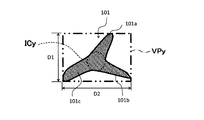
- the cross-sectional shape of the cellulose acetate fiber is not particularly limited, and may be any of a circular shape, an elliptical shape, a polygonal shape, a hollow shape, and an irregular shape such as a Y-shaped shape. Is preferred.
- the cross-sectional shape of the cellulose acetate fiber is a Y-shaped shape, the effect of blocking the air flow is high, the expression of airflow resistance is good, and the airflow resistance of the cellulose acetate tow band is suitable.
- the Y-shape will be described with reference to FIG. 1 showing an example of a cross section of a Y-shape cellulose acetate fiber.
- a region of the cross-section excluding the inscribed circle (ICy) extends outward from a plurality (three places) on the circumference of the inscribed circle ICy.
- the plurality of portions project in the circumferential direction.
- the protrusions 101a, 101b, and 101c project in the circumferential direction.
- the cross-sectional shape of the fiber can be observed using an optical microscope.
- a pencil-shaped filament sample is prepared from the tow band. That is, a part of the fiber bundle is extracted from the tow band, and the fiber bundle is wrapped in paraffin such that the fiber bundle is located at a position corresponding to the pencil lead.
- the filament sample thus prepared is sliced with a microtome to a thickness of 1 ⁇ m to 10 ⁇ m to obtain a sample section, and this sample section can be observed with an optical microscope (“BX-51” manufactured by Olympus Corporation). it can.
- a spinning dope is discharged from a plurality of spinning holes in a spinneret having a plurality of spinning holes. It depends on the shape of the hole.
- the shape of the spinning hole may be triangular.
- the ferret area of the cellulose acetate fiber is not particularly limited, but is preferably 0.5 or less.
- the ferrite area is less than 0.5 because the triangle of the spinning hole is contracted.
- the Feret area is preferably 0.48 or less, more preferably 0.43 or less, particularly preferably 0.42 or less.
- the lower limit is not particularly limited, but is 0.35 or more.
- the Feret area is less than 0.35, the shape of the spinneret becomes complicated, and blockage and breakage at the spinneret easily occur.
- “Feret area” is an index that can be used to evaluate the irregularity of the fiber cross section.
- FIG. 1 showing an example of a cross section of a cellulose acetate fiber having a Y-shape.
- a cross section is taken by cutting the fiber at an arbitrary point perpendicular to the fiber long axis direction, and a parallelogram (VPy) circumscribing this cross section is imagined.
- VPy parallelogram
- one of the two opposite sides is a two parallel line circumscribing the cross section and the distance between the lines (D2) is the maximum value (so-called maximum Feret diameter (maximum Feret diameter)).
- the other is a two-parallel line circumscribing the cross section and having a minimum distance (D1) (a so-called minimum Feret diameter).
- D1 a so-called minimum Feret diameter
- the Feret area is an area ratio obtained by dividing the cross-sectional area S of the fiber by the area (D1 ⁇ D2) of the virtual parallelogram, in other words, the occupancy of the fiber cross section in the virtual parallelogram.
- the setting of the virtual parallelogram VPy circumscribing the cross section of the fiber, the cross-sectional area S of the fiber, and the area (D1 ⁇ D2) of the virtual parallelogram are obtained by using a well-known image processing technique by using electronic data of an image photographed through a microscope. It can be measured by processing using or manually calculating based on the captured image.
- the filament denier (FD) of the cellulose acetate fiber of the present disclosure is preferably from 1.0 to 12.0, more preferably from 1.5 to 10.0, even more preferably from 2.0 to 5.0. According to the production method of the present disclosure, the clogging of the spinning hole due to the elapse of the spinning time can be alleviated, so that the production method is suitable for producing such a thin cellulose acetate fiber.
- Filament denier depends on the diameter of the spinning hole.
- the diameter of the spinning hole may be about 40 to 100 ⁇ m.
- the cellulose acetate fiber according to the present disclosure has a total degree of acetyl substitution of preferably 2.41 to 2.49, more preferably 2.43 to 2.47, still more preferably 2.44 to 2.46. This is because the discharge from the spinning hole is stabilized by reducing the variation in the degree of substitution.
- the total acetyl substitution degree can be measured by the following method.
- First, the total acetyl substitution degree is the sum of the respective acetyl substitution degrees at positions 2, 3, and 6 of the glucose ring of cellulose acetate, and the respective acetyl substitution degrees at positions 2, 3, and 6 of the glucose ring of cellulose acetate are: It can be measured by the NMR method according to the method of Tezuka (Tezuka, Carbonydr. Res. 273, 83 (1995)). That is, free hydroxyl groups of a cellulose diacetate sample are propionylated with propionic anhydride in pyridine. The obtained sample is dissolved in deuterated chloroform, and the 13 C-NMR spectrum is measured.
- the carbon signal of the acetyl group appears in the region from 169 ppm to 171 ppm in the order from the high field to the second, third, and sixth positions, and the signal of the carbonyl carbon in the propionyl group appears in the region of 172 ppm to 174 ppm in the same order.
- the respective acetyl substitution degrees at positions 2, 3, and 6 of the glucose ring in the original cellulose diacetate can be determined.
- the degree of acetyl substitution can be analyzed by 1 H-NMR in addition to 13 C-NMR.
- the total degree of acetyl substitution is determined by converting the degree of acetylation determined according to the method for measuring the degree of acetylation in ASTM: D-817-91 (test method for cellulose acetate or the like) by the following formula. This is the most common method of determining the degree of substitution of cellulose acetate.
- DS 162.14 ⁇ AV ⁇ 0.01 / (60.252-42.037 ⁇ AV ⁇ 0.01)
- DS is the total degree of acetyl substitution
- AV is the degree of acetylation (%).
- the value of the degree of substitution obtained by the conversion usually has a slight error from the above-mentioned NMR measurement value. When the converted value and the NMR measurement value are different, the NMR measurement value is adopted. When the value differs depending on the specific method of the NMR measurement, the NMR measurement value according to the above-mentioned Tezuka method is adopted.
- the outline of the method for measuring the acetylation degree of ASTM: D-817-91 (test method for cellulose acetate or the like) is as follows. First, 1.9 g of dried cellulose acetate was precisely weighed and dissolved in 150 mL of a mixed solution of acetone and dimethyl sulfoxide (volume ratio: 4: 1), and then 30 mL of a 1N aqueous sodium hydroxide solution was added. Time saponification. Phenolphthalein is added as an indicator and excess sodium hydroxide is titrated with 1N sulfuric acid (concentration factor: F). A blank test is performed in the same manner as described above, and the acetylation degree is calculated according to the following equation.
- Average degree of acetylation (%) ⁇ 6.5 ⁇ (BA) ⁇ F ⁇ / W (Where A is the titer (mL) of 1N-sulfuric acid in the sample, B is the titer (mL) of 1N-sulfuric acid in the blank test, F is the concentration factor of 1N-sulfuric acid, and W is the weight of the sample. Is shown).
- a cellulose acetate tow band may be constituted by the cellulose acetate fiber of the present disclosure.
- the total denier (TD) of the cellulose acetate tow band is preferably from 8,000 to 44,000, more preferably from 15,000 to 40,000, and even more preferably from 25,000 to 35,000. This is because crimping of the tow can be stably applied, and unevenness in expression of airflow resistance is suppressed.
- Step of preparing spinning stock solution Cellulose acetate is dissolved, and Fe 3 O 4 , Fe 2 O 3 , MnO 2, Cr 2 O 3 , Cr 2 CuO 4 , so as to be 0.05% by weight or more and 1% by weight or less in terms of solid content.
- the step of adding at least one metal oxide selected from the group consisting of NiO, Sb 2 O 3 and CoAl 2 O 4 to prepare a spinning dope will be described.
- the blockage of the spinning hole due to the elapse of the spinning time in the spinning step can be alleviated, and a decrease in the airflow resistance of the obtained cellulose acetate tow band can be suppressed.
- the service life of the spinneret can be extended.
- the spinning solution of cellulose acetate contains a component obtained by acetylating a hemicellulose component such as glucuronoxylan derived from the raw material cellulose, the component forms a calcium salt, which appears as a sediment or a foreign substance. This is one of the causes of pore blockage.
- the metal oxide adsorbs calcium ions, and as a result, formation of deposits or foreign substances can be prevented.
- the metal oxide can also polish off formed deposits or foreign substances.
- the spinning dope is prepared by dissolving cellulose acetate as a raw material in a solvent that is soluble, and adding Fe 3 O 4 , Fe 2 O 3 , and MnO such that the solid content is 0.05% by weight or more and 1% by weight or less.
- 2, Cr 2 O 3, Cr 2 CuO 4, NiO is obtained by adding Sb 2 O 3, and at least one metal oxide selected from the group consisting of CoAl 2 O 4.
- solvents include organic solvents such as acetone and dichloromethane.
- the concentration of cellulose acetate in the spinning dope may be adjusted, for example, to 20 wt% or more and 30 wt% or less.
- the amount of each component contained in the spinning dope may be adjusted so that the concentration of the metal oxide in the spinning dope is 0.05% by weight or more and 1% by weight or less in terms of solid content.
- the concentration of the metal oxide may be 0.05% by weight or more and 0.8% by weight or less, and may be 0.05% by weight or more and 0.5% by weight or less.
- the content of the metal oxide When the content of the metal oxide is too large, it does not affect the effect of suppressing the decrease in the airflow resistance of the cellulose acetate tow band, but the yarn breakage, particularly the yarn breakage immediately below the die (before drying) may increase. I am concerned. Further, when the content of the metal oxide is too small, it is not possible to sufficiently suppress the decrease in the airflow resistance of the cellulose acetate tow band.
- the temperature of the spinning solution may be adjusted, for example, to 45 ° C. or more and 55 ° C. or less.
- the spinning dope does not contain titanium dioxide.
- the content of titanium dioxide in the cellulose acetate tow band is 0.05% by weight or less, 0.03% or less.
- a small amount of titanium dioxide may be contained to the extent of not more than% by weight.
- cellulose acetate as a raw material can be produced as follows.
- a so-called acetic acid method using acetic anhydride as an acetylating agent, acetic acid as a diluent, and sulfuric acid as a catalyst can be used.
- acetic acid method using acetic anhydride as an acetylating agent, acetic acid as a diluent, and sulfuric acid as a catalyst can be used.
- acetic acid method using acetic anhydride as an acetylating agent, acetic acid as a diluent, and sulfuric acid as a catalyst
- Acetylation is performed while controlling (
- the viscous completely trisubstituted cellulose acetate is dropped into an aging tank, and a neutralizing agent such as a magnesium acetate solution is added. Is neutralized (completely or partially neutralized), and acetic anhydride is inactivated by water contained in a magnesium acetate solution or the like, followed by hydrolysis to obtain cellulose acetate having a desired degree of acetylation (ripening step). A large amount of water is added to this cellulose acetate (secondary cellulose acetate) to precipitate the cellulose acetate (precipitation step).
- a neutralizing agent such as a magnesium acetate solution
- the precipitated cellulose acetate is solid-liquid separated, washed (purification step), and dried to obtain cellulose acetate (drying step).
- an alkali metal compound and / or an alkaline earth metal compound, particularly a magnesium acetate solution, and a calcium compound such as calcium hydroxide may be added as a stabilizer.
- the content of calcium and magnesium in the cellulose acetate fiber and the cellulose acetate tow band can be adjusted by the amounts of the calcium compound and the magnesium compound added at this time.
- magnesium acetate As a stabilizer, it is preferable to use magnesium acetate as a stabilizer. This is because when calcium hydroxide is used, the content of calcium in the cellulose acetate fiber and the cellulose acetate tow band tends to increase, and it is difficult to suppress a decrease in airflow resistance.
- the step of filtering the spinning solution will be described.
- the method of filtration for removing foreign matter in the spinning solution is not particularly limited. For example, filter filtration is mentioned.
- a material mainly containing a metal material such as cellulose, synthetic fiber, and stainless steel can be used as a filter material.
- the filter filtration it is preferable to provide a plurality of filtration steps. This is because, if performed in a single filtration step, the life of the filter medium is significantly shortened, and the productivity is likely to be reduced.
- a plurality of filtration steps it is preferable to employ a multi-stage filtration method.
- the step of spinning cellulose acetate using the spinning solution will be described.
- the spinning solution is discharged from a plurality of spinning holes in a spinneret in which a plurality of spinning holes are formed.
- the organic solvent in the discharged spinning dope is evaporated by hot air, and the cellulose acetate is dried. Then, the cellulose acetate tow band is obtained by winding with a roll.
- the filament denier of the cellulose acetate fiber is 1.0 or more and 12.0 or less, for example, the diameter of the spinning hole is 40 ⁇ m or more and 100 ⁇ m or less, and the discharge speed when discharging the spinning solution from the spinning hole, What is necessary is just to set in the range of 500 m / min or more and 900 m / min or less.
- the diameter of the spinning holes may be set to 40 ⁇ m or more and 100 ⁇ m or less, and the number of spinning holes may be set to 100 or more and 1000 or less.
- titanium dioxide titanium dioxide
- the content of titanium dioxide can be extremely reduced even if titanium dioxide is not contained or contained. Therefore, the frequency of thread breakage does not increase even when high-speed spinning is performed.
- the spinning dope (dope) containing titanium dioxide is discharged from the spinning hole, if the discharge speed at which the spinning dope (dope) is discharged from the spinning hole is increased, whether the solution viscosity of the spinning dope (dope) is a problem, There was a problem that the fluidity of the dope becomes unstable in the spinning hole, but this can also be solved.
- FIG. 2 is an overall view of a cellulose acetate tow band manufacturing apparatus 1 (hereinafter, also referred to as manufacturing apparatus 1).
- the manufacturing apparatus 1 manufactures the tow band 33 by a dry spinning method.
- a spinning stock solution 22 in which cellulose acetate flakes as a raw material is dissolved in an organic solvent is used.
- the spinning solution 22 is mixed in the mixing device 2 and then filtered by the filtering device 3.
- the spinning solution 22 having passed through the filtration device 3 is discharged from a plurality of spinning holes of a spinneret 15 provided on a spinning cylinder 14 of the spinning unit 4.
- the spinning cylinder 14 may be cylindrical.
- the spinning solution 22 discharged from each spinning hole is dried by evaporating the organic solvent by hot air supplied into the spinning tube 14 from a drying unit (not shown). As a result, a solid filament 30 is formed.
- the filament 30 is guided by guide pins 7 and 8 which are guide devices (also referred to as guiding).
- guide device the widths of the yarns of the plurality of filaments 30 are adjusted by the width determining guide.
- the plurality of filaments 30 that have passed through one spinning tube 14 are converged by a width determining guide into a yarn 31.
- a fiber oil agent here, a fiber oil emulsion
- the oil agent application unit 5 for example, a rotating roll type
- a series of units for producing the yarn 31, that is, a spinning unit 4 for discharging the spinning solution 22 from the spinneret 15 to spin the filament 30, a drying unit, an oil agent attachment unit 5, and a winding unit having a godet roll 6. are collectively referred to as stations. Usually, a plurality of stations are arranged in a line.
- the yarn 31 is horizontally pulled up from the peripheral surface of the godet roll 6 by a winding device.
- the direction of the guiding of the yarn 31 passing through each station is changed by 90 ° by the guide pins 7 and 8.
- Each yarn 31 is conveyed along the station arrangement direction and is sequentially accumulated or stacked. Thereby, the plurality of yarns 31 are converged, and an end (toe) 32 which is a flat aggregate of the yarns 31 is formed.
- the end 32 converges the plurality of yarns 31 and is finally set to a predetermined total denier.
- the end 32 is conveyed in a horizontal state and guided to the crimping device 9.
- the crimping device 9 includes a pair of nip rolls 16 and 17 for pushing the end 32 into a stuffing box (crimp box) 18. As the end 32 is pushed into the stuffing box 18 by the pair of nip rolls 16 and 17, resistance is generated from inside the stuffing box 18. However, the end 32 is crimped by pushing the end 32 into the stuffing box 18 with a force greater than this resistance. Thereby, the toe band 33 is manufactured.
- the tow band 33 that has passed through the crimping device 9 is dried by the drying device 10.
- the tow bands 33 that have passed through the drying device 10 are stacked, compressed and packed to form a bale.
- T1 (% by weight) ((B ⁇ 1000) / (C ⁇ A)) ⁇ 100
- T1 titanium dioxide (% by weight)
- A is the diluted solution (mL)
- B is the concentration of titanium dioxide (g / 50 mL)
- C is the absolute dry weight (g) of the sample.
- the content of Fe 2 O 3 in the cellulose acetate tow band was measured as follows. Take about 0.1 g of a sample, weigh it into a platinum crucible, incinerate it on an electric heater, and incinerate it in an electric furnace at 500 ° C for 1 hour and then at 600 ° C for 1 hour. Finished. After cooling, a small amount of ultrapure water and 0.12 ml of concentrated hydrochloric acid were added to a platinum crucible, and the ash was heated and dissolved on a sand bath. After that, the sample was made up to 20 mL with ultrapure water and subjected to ICP-AES analysis to obtain a measurement result.
- the standard solution for the calibration curve was prepared by appropriately diluting the standard solution for atomic absorption Fe1000 with an aqueous nitric acid solution having the same concentration as the sample.
- ICP-AES analysis is Inductively Coupled Plasma-Atomic Emission Spectrometry.
- the instrument used for ICP-AES analysis is CIROS-120 manufactured by Rigaku.
- the same operation was performed on an empty platinum crucible without a sample, and the result of ICP-AES analysis was taken as a blank test value.
- the blank test value is subtracted from the measurement result to derive a metal concentration (iron concentration) in the sample, and the metal concentration (iron concentration) is converted to a metal oxide (Fe 2 O 3 ) concentration (% by weight). did.
- the calcium (Ca) content or the magnesium ( Mg) content was calculated, and the content of calcium (Ca) or magnesium (Mg) of the sample was calculated by the following formula.
- the moisture in the sample can be measured using, for example, a kett moisture meter (METLER TOLEDO HB43). About 2.0 g of a water-containing sample is placed on an aluminum tray of a ket moisture meter, and heated at 120 ° C. until the weight no longer changes, whereby the moisture (% by weight) in the sample can be calculated from the weight change before and after heating.
- ⁇ Change rate (%) of pressure loss in average use days of the cap ⁇ Measured value of pressure loss (mmWG) ⁇ Correction value of pressure loss (mmWG) ⁇ / Correction value of pressure loss (mmWG) ⁇ 100
- Number of crimps The number of crimps was measured by a measuring method described in Japanese Patent Application Laid-Open No. 7-316975.
- the average number of days of use of the base is an average value of the number of days of use of one or more bases when continuously producing a cellulose acetate tow band.
- the average use days (days) are calculated with the replacement time as 0 day.
- the rate of change in pressure loss per day (% / day) is plotted using the average number of days of use of the base (days) as the horizontal axis and the rate of change in pressure loss (%) as the vertical axis. This is the slope of the straight line.
- Example 1 29.0 parts by weight of cellulose acetate (total degree of acetyl substitution: 2.45) and 0.15 parts by weight of Fe 2 O 3 (average particle diameter: 300 nm) were added to 68.5 parts by weight of acetone and 2.5 parts by weight of water. The solution was dissolved to prepare a spinning stock solution. No titanium dioxide was added, and the content of titanium dioxide in the spinning dope was set to 0% by weight.
- the spinning stock solution was discharged to produce an end from the formed single fiber (filament), and the end was crimped by a crimping device to obtain a cellulose acetate tow band.
- the filament denier (FD) of the cellulose acetate fiber was set to 2.9, and the total denier (TD) was set to 30,000.
- the number of crimps of the cellulose acetate tow band was set to 30 per inch.
- Example 2 Filtration of the spinning dope containing titanium dioxide, and the spinning dope in the same manner as in Example 1 except that filtration of the spinning dope and spinning of the cellulose acetate were performed using the apparatus after spinning of cellulose acetate. was prepared to obtain a cellulose acetate tow band.
- Example 3 The amount of Fe 2 O 3 was changed to 0.015 parts by weight, and the filtration of the spinning dope containing titanium dioxide and the apparatus after spinning of cellulose acetate were performed to filter the spinning dope and the cellulose acetate.
- a spinning dope was prepared in the same manner as in Example 1, except that spinning was performed, to obtain a cellulose acetate tow band.
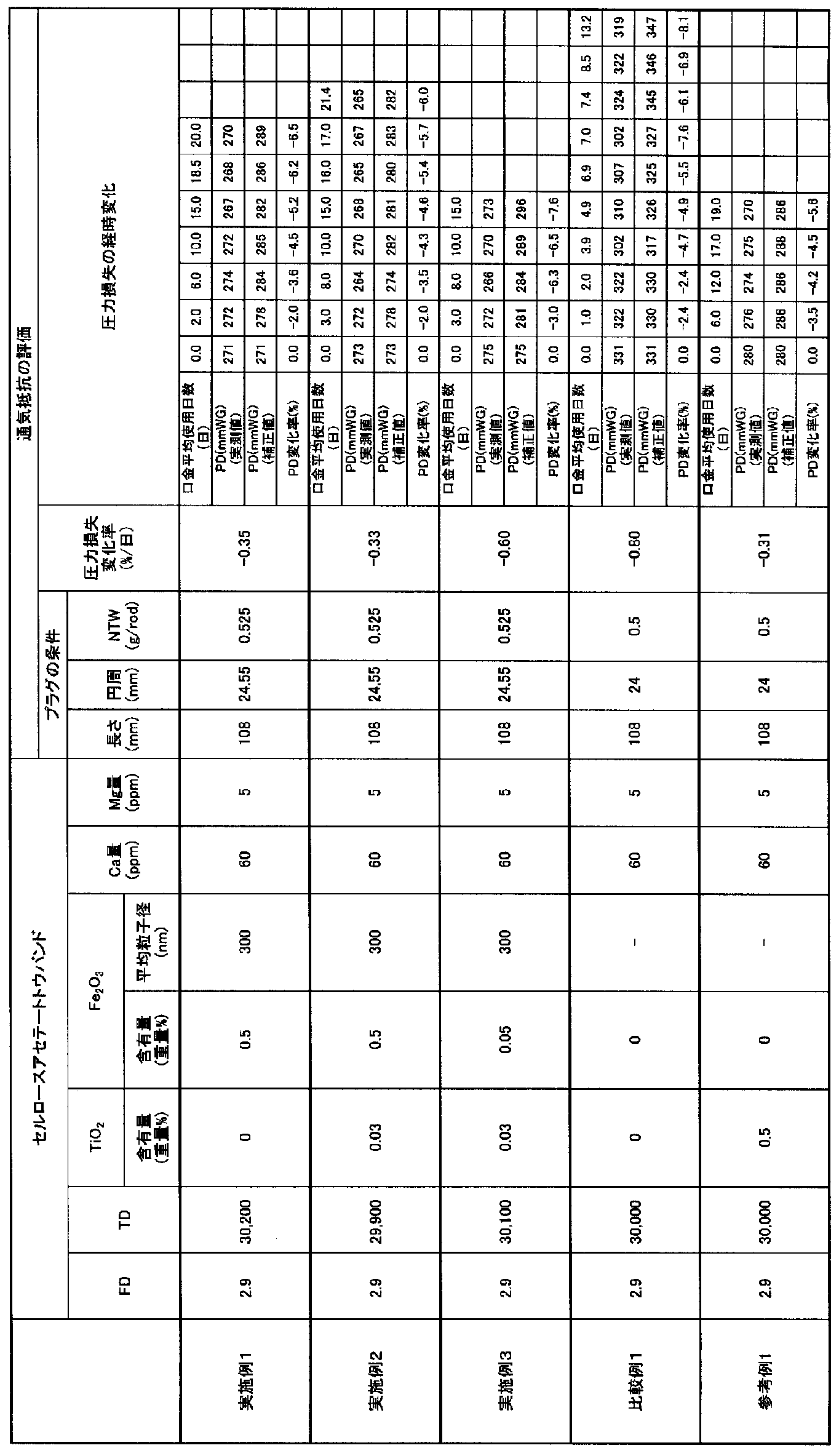
- Example 1 A cellulose acetate tow band was produced in the same manner as in Example 1, except that a spinning stock solution was prepared without adding Fe 2 O 3 . Each evaluation result of the obtained cellulose acetate tow band is shown in Table 1.
- the rate of change in pressure loss (% / day) was extremely large.
- the content of titanium dioxide in the tow band is 0.05% by weight although the content of titanium dioxide is as small as 0% by weight or 0.03% by weight. %, The rate of change in pressure loss (% / day) is small even after the spinning time has elapsed, and a decrease in the ventilation resistance of the cellulose acetate tow band can be suppressed.
Landscapes
- Engineering & Computer Science (AREA)
- Chemical & Material Sciences (AREA)
- Chemical Kinetics & Catalysis (AREA)
- General Chemical & Material Sciences (AREA)
- Textile Engineering (AREA)
- Manufacturing & Machinery (AREA)
- Artificial Filaments (AREA)
- Spinning Methods And Devices For Manufacturing Artificial Fibers (AREA)
Abstract
Description
本開示のセルロースアセテート繊維は、二酸化チタンの含有量が0.05重量%以下、並びにFe3O4、Fe2O3、MnO2、Cr2O3、Cr2CuO4、NiO、Sb2O3、及びCoAl2O4よりなる群から選択される少なくとも一種の金属酸化物の含有量が0.05重量%以上1重量%以下である。
本開示のセルロースアセテート繊維は、二酸化チタンの含有量が0.05重量%以下である。二酸化チタンの含有量は、0.03重量%以下が好ましく、0.01重量%以下がさらに好ましい。また、二酸化チタンの含有量は、0重量%であることが最も好ましい。糸切れ、特に口金の直下(乾燥前)の糸切れを低減できるためである。なお、この0重量%とは、二酸化チタンが含有されていない場合、及び二酸化チタンが分析限界値以下の痕跡量しか含有されていない場合を包含する。
本開示のセルロースアセテート繊維は、Fe3O4、Fe2O3、MnO2、Cr2O3、Cr2CuO4、NiO、Sb2O3、及びCoAl2O4よりなる群から選択される少なくとも一種の金属酸化物の含有量が0.05重量%以上1重量%以下である。金属酸化物の含有量は、0.05重量%以上0.8重量%以下であってよく、0.05重量%以上0.5重量%以下であってよい。
本開示のセルロースアセテート繊維における、カルシウムの含有量は特に限定されるものではないが、カルシウムの含有量は100ppm以下が好ましく、30ppm以下がより好ましく、10ppm以下がさらに好ましい。セルロースアセテートトウバンドの通気抵抗の低下をより抑制できるためである。また、セルロースアセテート繊維の化学的安定性の観点からは、1ppm以上であってよい。
セルロースアセテート繊維の断面形状は、特に限定されるものではなく、円形、楕円形、多角形、中空形、及びY型形状等の異形等の何れであってもよいが、Y型形状であることが好ましい。セルロースアセテート繊維の断面形状がY型形状であることにより、空気流量の遮り効果が高く、通気抵抗の発現性が良く、セルロースアセテートトウバンドの通気抵抗が好適なものとなる。
セルロースアセテート繊維のフェレエリアは、特に限定されるものではないが、0.5以下が好ましい。
本開示のセルロースアセテート繊維のフィラメントデニール(FD)は、1.0以上12.0以下が好ましく、1.5以上10.0以下がより好ましく、2.0以上5.0以下がさらに好ましい。本開示の製造方法によれば、紡糸時間の経過による紡糸孔の閉塞を緩和できるため、このような細いセルロースアセテート繊維の製造に好適である。
本開示に係るセルロースアセテート繊維は、アセチル総置換度が2.41以上2.49以下が好ましく、2.43以上2.47以下がより好ましく、2.44以上2.46以下がさらに好ましい。置換度のバラつきを低減することで、紡糸孔からの吐出が安定するためである。
DS=162.14×AV×0.01/(60.052-42.037×AV×0.01)
上記式において、DSはアセチル総置換度であり、AVは酢化度(%)である。なお、換算して得られる置換度の値は、前記のNMR測定値との間に若干の誤差が生じることが普通である。換算値とNMR測定値とが異なる場合は、NMR測定値を採用する。また、NMR測定の具体的方法によって値が相違する場合は、上記手塚の方法によるNMR測定値を採用する。
平均酢化度(%)={6.5×(B-A)×F}/W
(式中、Aは試料の1N-硫酸の滴定量(mL)を、Bはブランク試験の1N-硫酸の滴定量(mL)を、Fは1N-硫酸の濃度ファクターを、Wは試料の重量を示す)。
本開示のセルロースアセテート繊維により、セルロースアセテートトウバンドを構成してもよい。
本開示のセルロースアセテートトウバンドの製造方法について詳述する。本開示のセルロースアセテートトウバンドの製造方法は、セルロースアセテートを溶解し、並びに、固形分換算で0.05重量%以上1重量%以下となるように、Fe3O4、Fe2O3、MnO2、Cr2O3、Cr2CuO4、NiO、Sb2O3、及びCoAl2O4よりなる群から選択される少なくとも一種の金属酸化物を添加して、紡糸原液を調製する工程と、前記紡糸原液を濾過する工程と、前記濾過した紡糸原液を用いて、セルロースアセテートを紡糸する工程と、を備え、前記紡糸工程までに、二酸化チタンを添加しない。
セルロースアセテートを溶解し、並びに、固形分換算で0.05重量%以上1重量%以下となるように、Fe3O4、Fe2O3、MnO2、Cr2O3、Cr2CuO4、NiO、Sb2O3、及びCoAl2O4よりなる群から選択される少なくとも一種の金属酸化物を添加して、紡糸原液を調製する工程について述べる。
前記紡糸原液を濾過する工程について述べる。紡糸原液中の異物を除去するため、濾過の方法としては、特に限定されるものではない。例えば、フィルター濾過が挙げられる。
前記紡糸原液を用いて、セルロースアセテートを紡糸する工程について述べる。紡糸原液を、複数の紡糸孔が形成された紡糸口金における複数の紡糸孔から吐出させる。吐出した紡糸原液中の有機溶媒を熱風により蒸発させ、セルロースアセテートを乾燥する。そして、ロールにより巻き取ることにより、セルロースアセテートトウバンドが得られる。
本開示のセルロースアセテートトウバンドの製造方法においては、紡糸工程までに二酸化チタンを添加しないため、二酸化チタンを含まないか、含む場合であっても、二酸化チタンの含有量を非常に少なくできる。そのため、高速紡糸を行った場合でも糸切れ頻度が高くならない。さらに、二酸化チタンを含有する紡糸原液(ドープ)を紡糸孔から吐出させる場合に、紡糸原液(ドープ)を紡糸孔から吐出させる吐出速度を上げると、紡糸原液(ドープ)の溶液粘性の問題か、紡糸孔でドープの流動性が不安定となるという問題があったが、これも解決できる。
図2は、セルロースアセテートトウバンドの製造装置1(以下、製造装置1とも称する。)の全体図である。製造装置1は、乾式紡糸法によりトウバンド33を製造する。
セルロースアセテートトウバンドにおける二酸化チタンの含有量は、以下の通り測定した。
T1(重量%)=((B×1000)/(C×A))×100
但し、T1は二酸化チタン(重量%)、Aは採取した希釈液(mL)、Bは二酸化チタン濃度(g/50 mL)、Cは試料の絶乾重量(g)とする。
セルロースアセテートトウバンドにおけるFe2O3の含有量は、以下の通り測定した。
サンプル約0.1gをとり、白金るつぼに精秤して入れ、電熱器上にて灰化後、さらに電気炉にて500℃で1時間、続けて600℃で1時間の条件にて灰化を終了した。放冷後、白金るつぼに少量の超純水及び濃塩酸0.12mlを加えてサンドバス上で灰分を加熱溶解した。その後、超純水で20mLにメスアップしたものをICP-AES分析に供し、測定結果を得た。検量線用標準液は、原子吸光用標準液Fe1000をサンプルと同濃度の硝酸水溶液にて適宜希釈調製して用いた。ICP-AES分析とは、誘導結合高周波プラズマ発光分光分析(Inductively Coupled Plasma-Atomic Emission Spectrometry)である。また、ICP-AES分析に使用した機器はリガク製CIROS-120である。
未乾燥試料3.0gをルツボに計量し、電熱器上で炭化させた後、750℃以上850℃の電気炉で2時間程度灰化させた。約30分放冷した後、0.07重量%の塩酸溶液25mLを加え、220℃以上230℃以下で加熱溶解させた。放冷後、溶解液を200mLまで蒸留水でメスアップし、これを検液として標準液と共に原子吸光光度計を用いて吸光度を測定して、検液のカルシウム(Ca)の含有量またはマグネシウム(Mg)の含有量を求め、以下の式で換算して、試料のカルシウム(Ca)の含有量またはマグネシウム(Mg)の含有量を求めた。なお、試料中の水分は、例えばケット水分計(METTLER TOLEDO HB43)を用いて測定することができる。ケット水分計のアルミ受け皿に含水状態の試料約2.0gを乗せ、重量が変化しなくなるまで120℃で加熱することで加熱前後の重量変化から試料中の水分(重量%)が算出できる。

トウバンドを所定の長さに切り出して、プラグにした。このプラグの長さ(mm)、円周(mm)、及びネットトウウェイト(NTW:g/rod)を予め求め、自動通気抵抗測定器(イギリス・セルリーン(CERULEAN)社製「QTM-6」)を用いて、空気流速17.5ml/秒の条件で圧力損失(プレッシャードロップ)PD(mmWG)を測定した。この測定結果が、圧力損失の実測値である。
セルロースアセテート(アセチル総置換度:2.45)29.0重量部、Fe2O3(平均粒子径:300nm)0.15重量部を、アセトン68.5重量部、水2.5重量部に溶解して紡糸原液を調製した。二酸化チタンを添加せず、紡糸原液中の二酸化チタン含有量を0重量%とした。
二酸化チタンを含有する紡糸原液の濾過、及びセルロースアセテートの紡糸を行った後の装置を用いて、紡糸原液の濾過及びセルロースアセテートの紡糸を行ったこと以外は、実施例1と同様にして紡糸原液を調製し、セルロースアセテートトウバンドを得た。
Fe2O3の添加量を0.015重量部に代え、また二酸化チタンを含有する紡糸原液の濾過、及びセルロースアセテートの紡糸を行った後の装置を用いて、紡糸原液の濾過及びセルロースアセテートの紡糸を行った以外は、実施例1と同様にして紡糸原液を調製し、セルロースアセテートトウバンドを得た。
Fe2O3を添加せず紡糸原液を調製した以外は、実施例1と同様にしてセルロースアセテートトウバンドを作製した。得られたセルロースアセテートトウバンドの各評価結果は、表1に示す。
紡糸原液に、二酸化チタン0.15重量部を添加した以外は、比較例1と同様にしてセルロースアセテートトウバンドを作製した。得られたセルロースアセテートトウバンドの各評価結果は、表1に示す。
Claims (8)
- 二酸化チタンの含有量が0.05重量%以下、並びに
Fe3O4、Fe2O3、MnO2、Cr2O3、Cr2CuO4、NiO、Sb2O3、及びCoAl2O4よりなる群から選択される少なくとも一種の金属酸化物の含有量が0.05重量%以上1重量%以下である、セルロースアセテート繊維。 - カルシウムの含有量が100ppm以下である、請求項1に記載のセルロースアセテート繊維。
- 前記金属酸化物がFe3O4またはFe2O3である、請求項1または2に記載のセルロースアセテート繊維。
- フェレエリアが0.50以下である、請求項1~3のいずれか一項に記載のセルロースアセテート繊維。
- フィラメントデニールが1.0以上12.0以下である、請求項1~4のいずれか一項に記載のセルロースアセテート繊維。
- 請求項1~5のいずれか一項に記載のセルロースアセテート繊維により構成された、セルロースアセテートトウバンド。
- トータルデニールが8000以上44000以下である、請求項6に記載のセルロースアセテートトウバンド。
- セルロースアセテートを溶解し、並びに、固形分換算で0.05重量%以上1重量%以下となるように、Fe3O4、Fe2O3、MnO2、Cr2O3、Cr2CuO4、NiO、Sb2O3、及びCoAl2O4よりなる群から選択される少なくとも一種の金属酸化物を添加して、紡糸原液を調製する工程と、
前記紡糸原液を濾過する工程と、
前記濾過した紡糸原液を用いて、セルロースアセテートを紡糸する工程と、を備え、
前記紡糸工程までに、二酸化チタンを添加しない、セルロースアセテートトウバンドの製造方法。
Priority Applications (6)
| Application Number | Priority Date | Filing Date | Title |
|---|---|---|---|
| CN201880095590.7A CN112424405A (zh) | 2018-08-14 | 2018-08-14 | 乙酸纤维素纤维、乙酸纤维素丝束带、及乙酸纤维素丝束带的制造方法 |
| US17/259,354 US11920261B2 (en) | 2018-08-14 | 2018-08-14 | Cellulose acetate fiber, cellulose acetate band, and method for manufacturing cellulose acetate band |
| KR1020207036099A KR102590077B1 (ko) | 2018-08-14 | 2018-08-14 | 셀룰로오스 아세테이트 섬유, 셀룰로오스 아세테이트 토 밴드, 및 셀룰로오스 아세테이트 토 밴드의 제조 방법 |
| PCT/JP2018/030263 WO2020035901A1 (ja) | 2018-08-14 | 2018-08-14 | セルロースアセテート繊維、セルロースアセテートトウバンド、及びセルロースアセテートトウバンドの製造方法 |
| EP18930491.8A EP3839113A4 (en) | 2018-08-14 | 2018-08-14 | CELLULOSE ACETATE FIBER, CELLULOSE ACETATE TAPE AND METHOD OF MAKING CELLULOSE ACETATE TAPE |
| BR112021000644-3A BR112021000644A2 (pt) | 2018-08-14 | 2018-08-14 | Fibra de acetato de celulose, fita de acetato de celulose, e método para produzir uma fita de acetato de celulose |
Applications Claiming Priority (1)
| Application Number | Priority Date | Filing Date | Title |
|---|---|---|---|
| PCT/JP2018/030263 WO2020035901A1 (ja) | 2018-08-14 | 2018-08-14 | セルロースアセテート繊維、セルロースアセテートトウバンド、及びセルロースアセテートトウバンドの製造方法 |
Publications (1)
| Publication Number | Publication Date |
|---|---|
| WO2020035901A1 true WO2020035901A1 (ja) | 2020-02-20 |
Family
ID=69525320
Family Applications (1)
| Application Number | Title | Priority Date | Filing Date |
|---|---|---|---|
| PCT/JP2018/030263 Ceased WO2020035901A1 (ja) | 2018-08-14 | 2018-08-14 | セルロースアセテート繊維、セルロースアセテートトウバンド、及びセルロースアセテートトウバンドの製造方法 |
Country Status (6)
| Country | Link |
|---|---|
| US (1) | US11920261B2 (ja) |
| EP (1) | EP3839113A4 (ja) |
| KR (1) | KR102590077B1 (ja) |
| CN (1) | CN112424405A (ja) |
| BR (1) | BR112021000644A2 (ja) |
| WO (1) | WO2020035901A1 (ja) |
Cited By (2)
| Publication number | Priority date | Publication date | Assignee | Title |
|---|---|---|---|---|
| WO2021040815A1 (en) * | 2019-08-27 | 2021-03-04 | Acetate International Llc | Cellulose acetate tow with low dpf and low titanium dioxide content |
| WO2021040816A1 (en) * | 2019-08-27 | 2021-03-04 | Acetate International Llc | Cellulose acetate tow with high dpf and low titanium dioxide content |
Families Citing this family (1)
| Publication number | Priority date | Publication date | Assignee | Title |
|---|---|---|---|---|
| KR20230116901A (ko) | 2020-12-22 | 2023-08-04 | 주식회사 다이셀 | 흡연 물품용 토우 밴드, 흡연 물품용 필터, 흡연 물품및 흡연 물품용 카트리지 |
Citations (8)
| Publication number | Priority date | Publication date | Assignee | Title |
|---|---|---|---|---|
| US3618619A (en) * | 1970-03-03 | 1971-11-09 | Eastman Kodak Co | Tobacco smoke filters |
| JPH07316975A (ja) | 1994-05-19 | 1995-12-05 | Daicel Chem Ind Ltd | 繊維の捲縮特性の測定方法及びその装置 |
| JPH08500152A (ja) | 1992-05-27 | 1996-01-09 | イーストマン ケミカル カンパニー | 環境的に非残存性のセルロースエステル繊維 |
| JPH10317227A (ja) * | 1997-05-14 | 1998-12-02 | Mitsubishi Rayon Co Ltd | セルロースアセテート溶液 |
| JP2004068198A (ja) | 2002-08-06 | 2004-03-04 | Daicel Chem Ind Ltd | 糸状体の案内装置および案内方法 |
| JP4737203B2 (ja) * | 2008-01-22 | 2011-07-27 | ソニー株式会社 | バッテリパック |
| JP2015503038A (ja) * | 2011-11-03 | 2015-01-29 | セラニーズ アセテート,エルエルシー | 高いフィラメント当たりデニールおよび低い総デニールのトウバンド |
| JP2015508992A (ja) * | 2011-11-03 | 2015-03-26 | セラニーズ アセテート,エルエルシー | 高いフィラメント当たりデニールおよび低い総デニールのトウバンドの製品 |
Family Cites Families (5)
| Publication number | Priority date | Publication date | Assignee | Title |
|---|---|---|---|---|
| JPH10168650A (ja) * | 1996-12-06 | 1998-06-23 | Mitsubishi Rayon Co Ltd | 細繊度y型断面セルロ−スアセテ−トトウの製造方法 |
| DE102004048651A1 (de) * | 2004-10-06 | 2006-04-13 | Rhodia Acetow Gmbh | Tabakrauchfilter oder -filterelemente mit einem Gehalt an Zusatzstoffen |
| MX2014015420A (es) * | 2012-07-25 | 2015-07-14 | Celanese Acetate Llc | Hilera que comprende agujeros tri-arcos y filamentos tri-arcos producidos de la misma. |
| CN102941058A (zh) * | 2012-11-16 | 2013-02-27 | 湖南中烟工业有限责任公司 | 一种介孔氧化铁-二氧化钛吸附剂及制备和应用 |
| US20170006912A1 (en) | 2014-03-13 | 2017-01-12 | Daicel Corporation | Cellulose acetate tow band for use in cigarette filter, cigarette filter, apparatus for manufacturing tow band, and method of manufacturing tow band |
-
2018
- 2018-08-14 KR KR1020207036099A patent/KR102590077B1/ko active Active
- 2018-08-14 CN CN201880095590.7A patent/CN112424405A/zh active Pending
- 2018-08-14 EP EP18930491.8A patent/EP3839113A4/en active Pending
- 2018-08-14 BR BR112021000644-3A patent/BR112021000644A2/pt not_active Application Discontinuation
- 2018-08-14 US US17/259,354 patent/US11920261B2/en active Active
- 2018-08-14 WO PCT/JP2018/030263 patent/WO2020035901A1/ja not_active Ceased
Patent Citations (8)
| Publication number | Priority date | Publication date | Assignee | Title |
|---|---|---|---|---|
| US3618619A (en) * | 1970-03-03 | 1971-11-09 | Eastman Kodak Co | Tobacco smoke filters |
| JPH08500152A (ja) | 1992-05-27 | 1996-01-09 | イーストマン ケミカル カンパニー | 環境的に非残存性のセルロースエステル繊維 |
| JPH07316975A (ja) | 1994-05-19 | 1995-12-05 | Daicel Chem Ind Ltd | 繊維の捲縮特性の測定方法及びその装置 |
| JPH10317227A (ja) * | 1997-05-14 | 1998-12-02 | Mitsubishi Rayon Co Ltd | セルロースアセテート溶液 |
| JP2004068198A (ja) | 2002-08-06 | 2004-03-04 | Daicel Chem Ind Ltd | 糸状体の案内装置および案内方法 |
| JP4737203B2 (ja) * | 2008-01-22 | 2011-07-27 | ソニー株式会社 | バッテリパック |
| JP2015503038A (ja) * | 2011-11-03 | 2015-01-29 | セラニーズ アセテート,エルエルシー | 高いフィラメント当たりデニールおよび低い総デニールのトウバンド |
| JP2015508992A (ja) * | 2011-11-03 | 2015-03-26 | セラニーズ アセテート,エルエルシー | 高いフィラメント当たりデニールおよび低い総デニールのトウバンドの製品 |
Non-Patent Citations (5)
| Title |
|---|
| "Cellulose Acetates: Properties and Applications", MACROMOL. SYMP., vol. 208, 2004, pages 49 - 60 |
| CELLULOSE ACETATES: PROPERTIES AND APPLICATIONS, March 2004 (2004-03-01), pages 266 - 281 |
| RICARDO ET AL.: "Electrospun composite cellulose acetate/iron oxide nanoparticles non-woven membranes for magnetic hyperthermia applications", CARBOHYDRATE POLYMERS, vol. 198, 13 June 2018 (2018-06-13), pages 9 - 16, XP085437641, DOI: 10.1016/j.carbpol.2018.06.048 * |
| See also references of EP3839113A4 |
| THANAA ET AL.: "Preparation and application of magnetite nanoparticles immobilized on cellulose acetate nanofibers for lead removal from polluted water", WATER SCIENCE & TECHNOLOGY: WATER SUPPLY, vol. 17, no. 1, 27 July 2016 (2016-07-27) - 1 February 2017 (2017-02-01), pages 176 - 187, XP055685036 * |
Cited By (3)
| Publication number | Priority date | Publication date | Assignee | Title |
|---|---|---|---|---|
| WO2021040815A1 (en) * | 2019-08-27 | 2021-03-04 | Acetate International Llc | Cellulose acetate tow with low dpf and low titanium dioxide content |
| WO2021040816A1 (en) * | 2019-08-27 | 2021-03-04 | Acetate International Llc | Cellulose acetate tow with high dpf and low titanium dioxide content |
| US11814507B2 (en) | 2019-08-27 | 2023-11-14 | Acetate International Llc | Cellulose acetate tow with high dpf and low titanium dioxide content |
Also Published As
| Publication number | Publication date |
|---|---|
| EP3839113A1 (en) | 2021-06-23 |
| KR102590077B1 (ko) | 2023-10-16 |
| BR112021000644A2 (pt) | 2021-04-06 |
| KR20210040834A (ko) | 2021-04-14 |
| US20210180215A1 (en) | 2021-06-17 |
| EP3839113A4 (en) | 2023-01-11 |
| US11920261B2 (en) | 2024-03-05 |
| CN112424405A (zh) | 2021-02-26 |
Similar Documents
| Publication | Publication Date | Title |
|---|---|---|
| KR102677634B1 (ko) | 셀룰로오스아세테이트 섬유, 셀룰로오스아세테이트 토우 밴드, 및 셀룰로오스아세테이트 토우 밴드의 제조 방법 | |
| EP3653765B1 (en) | Cellulose acetate tow band, and method for producing cellulose acetate tow band | |
| KR102590077B1 (ko) | 셀룰로오스 아세테이트 섬유, 셀룰로오스 아세테이트 토 밴드, 및 셀룰로오스 아세테이트 토 밴드의 제조 방법 | |
| EP3390308B1 (de) | Glasfasern aus quarzglas mit geringem oh-, cl- und al-gehalt | |
| EP3117724B1 (en) | Cellulose acetate tow band for use in cigarette filters and cigarette filter | |
| JP2018504897A (ja) | タバコフィルター用リヨセル素材及びその製造方法 | |
| EP4166701A1 (en) | Lyocell material for tobacco filter and method for preparing same | |
| WO2016140307A1 (ja) | 酢酸セルロース繊維及びその製造方法並びにタバコ用フィルタートウ | |
| CN118475258A (zh) | 莱赛尔材料、香烟过滤嘴及其各自的制造方法 | |
| DE112014006175T5 (de) | Celluloseacetatfaser, Celluloseacetatfaserformkörper und Verfahren zur Herstellung der Celluloseacetatfaser und des Celluloseacetatfaserformkörpers | |
| US20240284970A1 (en) | Lyocell material for cigarette filter and method for manufacturing same | |
| RU2778645C1 (ru) | Волокно из ацетилцеллюлозы, лента из ацетилцеллюлозы и способ получения ленты из ацетилцеллюлозы | |
| JP2024531481A (ja) | 酢酸セルロース繊維の乾式紡糸 | |
| JPH10168650A (ja) | 細繊度y型断面セルロ−スアセテ−トトウの製造方法 | |
| JPH0465540A (ja) | たばこフィルター用繊維束及びその製造方法 | |
| NL8005347A (nl) | Viscose rayongaren, alsmede werkwijze ter vervaardiging daarvan. | |
| CN114364271B (zh) | 具有低dpf和低二氧化钛含量的乙酸纤维素丝束 | |
| EP4566464A1 (en) | Lyocell material, smoking articles, and manufacturing method thereof | |
| JPH10317227A (ja) | セルロースアセテート溶液 | |
| TW202615742A (zh) | 萊賽爾紡絲原液、萊賽爾材料、吸煙製品過濾嘴、吸煙製品及其製造方法 |
Legal Events
| Date | Code | Title | Description |
|---|---|---|---|
| 121 | Ep: the epo has been informed by wipo that ep was designated in this application |
Ref document number: 18930491 Country of ref document: EP Kind code of ref document: A1 |
|
| REG | Reference to national code |
Ref country code: BR Ref legal event code: B01A Ref document number: 112021000644 Country of ref document: BR |
|
| NENP | Non-entry into the national phase |
Ref country code: DE |
|
| ENP | Entry into the national phase |
Ref document number: 2018930491 Country of ref document: EP Effective date: 20210315 |
|
| ENP | Entry into the national phase |
Ref document number: 112021000644 Country of ref document: BR Kind code of ref document: A2 Effective date: 20210114 |
|
| NENP | Non-entry into the national phase |
Ref country code: JP |