WO2020036062A1 - 水中油型乳化化粧料 - Google Patents
水中油型乳化化粧料 Download PDFInfo
- Publication number
- WO2020036062A1 WO2020036062A1 PCT/JP2019/029935 JP2019029935W WO2020036062A1 WO 2020036062 A1 WO2020036062 A1 WO 2020036062A1 JP 2019029935 W JP2019029935 W JP 2019029935W WO 2020036062 A1 WO2020036062 A1 WO 2020036062A1
- Authority
- WO
- WIPO (PCT)
- Prior art keywords
- cosmetic
- group
- oil
- carbon atoms
- carboxylic acid
- Prior art date
- Legal status (The legal status is an assumption and is not a legal conclusion. Google has not performed a legal analysis and makes no representation as to the accuracy of the status listed.)
- Ceased
Links
Classifications
-
- A—HUMAN NECESSITIES
- A61—MEDICAL OR VETERINARY SCIENCE; HYGIENE
- A61K—PREPARATIONS FOR MEDICAL, DENTAL OR TOILETRY PURPOSES
- A61K8/00—Cosmetics or similar toiletry preparations
- A61K8/18—Cosmetics or similar toiletry preparations characterised by the composition
- A61K8/72—Cosmetics or similar toiletry preparations characterised by the composition containing organic macromolecular compounds
- A61K8/84—Cosmetics or similar toiletry preparations characterised by the composition containing organic macromolecular compounds obtained by reactions otherwise than those involving only carbon-carbon unsaturated bonds
- A61K8/89—Polysiloxanes
- A61K8/895—Polysiloxanes containing silicon bound to unsaturated aliphatic groups, e.g. vinyl dimethicone
-
- A—HUMAN NECESSITIES
- A61—MEDICAL OR VETERINARY SCIENCE; HYGIENE
- A61K—PREPARATIONS FOR MEDICAL, DENTAL OR TOILETRY PURPOSES
- A61K8/00—Cosmetics or similar toiletry preparations
- A61K8/18—Cosmetics or similar toiletry preparations characterised by the composition
- A61K8/72—Cosmetics or similar toiletry preparations characterised by the composition containing organic macromolecular compounds
- A61K8/84—Cosmetics or similar toiletry preparations characterised by the composition containing organic macromolecular compounds obtained by reactions otherwise than those involving only carbon-carbon unsaturated bonds
- A61K8/89—Polysiloxanes
- A61K8/891—Polysiloxanes saturated, e.g. dimethicone, phenyl trimethicone, C24-C28 methicone or stearyl dimethicone
-
- A—HUMAN NECESSITIES
- A61—MEDICAL OR VETERINARY SCIENCE; HYGIENE
- A61K—PREPARATIONS FOR MEDICAL, DENTAL OR TOILETRY PURPOSES
- A61K8/00—Cosmetics or similar toiletry preparations
- A61K8/02—Cosmetics or similar toiletry preparations characterised by special physical form
- A61K8/04—Dispersions; Emulsions
- A61K8/06—Emulsions
- A61K8/062—Oil-in-water emulsions
-
- A—HUMAN NECESSITIES
- A61—MEDICAL OR VETERINARY SCIENCE; HYGIENE
- A61K—PREPARATIONS FOR MEDICAL, DENTAL OR TOILETRY PURPOSES
- A61K8/00—Cosmetics or similar toiletry preparations
- A61K8/18—Cosmetics or similar toiletry preparations characterised by the composition
- A61K8/30—Cosmetics or similar toiletry preparations characterised by the composition containing organic compounds
- A61K8/33—Cosmetics or similar toiletry preparations characterised by the composition containing organic compounds containing oxygen
- A61K8/34—Alcohols
- A61K8/345—Alcohols containing more than one hydroxy group
-
- A—HUMAN NECESSITIES
- A61—MEDICAL OR VETERINARY SCIENCE; HYGIENE
- A61K—PREPARATIONS FOR MEDICAL, DENTAL OR TOILETRY PURPOSES
- A61K8/00—Cosmetics or similar toiletry preparations
- A61K8/18—Cosmetics or similar toiletry preparations characterised by the composition
- A61K8/30—Cosmetics or similar toiletry preparations characterised by the composition containing organic compounds
- A61K8/33—Cosmetics or similar toiletry preparations characterised by the composition containing organic compounds containing oxygen
- A61K8/37—Esters of carboxylic acids
-
- A—HUMAN NECESSITIES
- A61—MEDICAL OR VETERINARY SCIENCE; HYGIENE
- A61K—PREPARATIONS FOR MEDICAL, DENTAL OR TOILETRY PURPOSES
- A61K8/00—Cosmetics or similar toiletry preparations
- A61K8/18—Cosmetics or similar toiletry preparations characterised by the composition
- A61K8/30—Cosmetics or similar toiletry preparations characterised by the composition containing organic compounds
- A61K8/58—Cosmetics or similar toiletry preparations characterised by the composition containing organic compounds containing atoms other than carbon, hydrogen, halogen, oxygen, nitrogen, sulfur or phosphorus
- A61K8/585—Organosilicon compounds
-
- A—HUMAN NECESSITIES
- A61—MEDICAL OR VETERINARY SCIENCE; HYGIENE
- A61K—PREPARATIONS FOR MEDICAL, DENTAL OR TOILETRY PURPOSES
- A61K8/00—Cosmetics or similar toiletry preparations
- A61K8/18—Cosmetics or similar toiletry preparations characterised by the composition
- A61K8/72—Cosmetics or similar toiletry preparations characterised by the composition containing organic macromolecular compounds
- A61K8/81—Cosmetics or similar toiletry preparations characterised by the composition containing organic macromolecular compounds obtained by reactions involving only carbon-to-carbon unsaturated bonds
- A61K8/8141—Compositions of homopolymers or copolymers of compounds having one or more unsaturated aliphatic radicals, each having only one carbon-to-carbon double bond, and at least one being terminated by only one carboxyl radical, or of salts, anhydrides, esters, amides, imides or nitriles thereof; Compositions of derivatives of such polymers
- A61K8/8152—Homopolymers or copolymers of esters, e.g. (meth)acrylic acid esters; Compositions of derivatives of such polymers
-
- A—HUMAN NECESSITIES
- A61—MEDICAL OR VETERINARY SCIENCE; HYGIENE
- A61Q—SPECIFIC USE OF COSMETICS OR SIMILAR TOILETRY PREPARATIONS
- A61Q1/00—Make-up preparations; Body powders; Preparations for removing make-up
-
- A—HUMAN NECESSITIES
- A61—MEDICAL OR VETERINARY SCIENCE; HYGIENE
- A61Q—SPECIFIC USE OF COSMETICS OR SIMILAR TOILETRY PREPARATIONS
- A61Q1/00—Make-up preparations; Body powders; Preparations for removing make-up
- A61Q1/02—Preparations containing skin colorants, e.g. pigments
- A61Q1/04—Preparations containing skin colorants, e.g. pigments for lips
-
- A—HUMAN NECESSITIES
- A61—MEDICAL OR VETERINARY SCIENCE; HYGIENE
- A61Q—SPECIFIC USE OF COSMETICS OR SIMILAR TOILETRY PREPARATIONS
- A61Q1/00—Make-up preparations; Body powders; Preparations for removing make-up
- A61Q1/02—Preparations containing skin colorants, e.g. pigments
- A61Q1/10—Preparations containing skin colorants, e.g. pigments for eyes, e.g. eyeliner, mascara
-
- A—HUMAN NECESSITIES
- A61—MEDICAL OR VETERINARY SCIENCE; HYGIENE
- A61Q—SPECIFIC USE OF COSMETICS OR SIMILAR TOILETRY PREPARATIONS
- A61Q1/00—Make-up preparations; Body powders; Preparations for removing make-up
- A61Q1/12—Face or body powders for grooming, adorning or absorbing
-
- A—HUMAN NECESSITIES
- A61—MEDICAL OR VETERINARY SCIENCE; HYGIENE
- A61Q—SPECIFIC USE OF COSMETICS OR SIMILAR TOILETRY PREPARATIONS
- A61Q19/00—Preparations for care of the skin
-
- A—HUMAN NECESSITIES
- A61—MEDICAL OR VETERINARY SCIENCE; HYGIENE
- A61K—PREPARATIONS FOR MEDICAL, DENTAL OR TOILETRY PURPOSES
- A61K2800/00—Properties of cosmetic compositions or active ingredients thereof or formulation aids used therein and process related aspects
- A61K2800/10—General cosmetic use
-
- A—HUMAN NECESSITIES
- A61—MEDICAL OR VETERINARY SCIENCE; HYGIENE
- A61K—PREPARATIONS FOR MEDICAL, DENTAL OR TOILETRY PURPOSES
- A61K2800/00—Properties of cosmetic compositions or active ingredients thereof or formulation aids used therein and process related aspects
- A61K2800/40—Chemical, physico-chemical or functional or structural properties of particular ingredients
- A61K2800/42—Colour properties
- A61K2800/43—Pigments; Dyes
-
- A—HUMAN NECESSITIES
- A61—MEDICAL OR VETERINARY SCIENCE; HYGIENE
- A61K—PREPARATIONS FOR MEDICAL, DENTAL OR TOILETRY PURPOSES
- A61K2800/00—Properties of cosmetic compositions or active ingredients thereof or formulation aids used therein and process related aspects
- A61K2800/40—Chemical, physico-chemical or functional or structural properties of particular ingredients
- A61K2800/48—Thickener, Thickening system
-
- A—HUMAN NECESSITIES
- A61—MEDICAL OR VETERINARY SCIENCE; HYGIENE
- A61K—PREPARATIONS FOR MEDICAL, DENTAL OR TOILETRY PURPOSES
- A61K2800/00—Properties of cosmetic compositions or active ingredients thereof or formulation aids used therein and process related aspects
- A61K2800/80—Process related aspects concerning the preparation of the cosmetic composition or the storage or application thereof
- A61K2800/95—Involves in-situ formation or cross-linking of polymers
-
- A—HUMAN NECESSITIES
- A61—MEDICAL OR VETERINARY SCIENCE; HYGIENE
- A61Q—SPECIFIC USE OF COSMETICS OR SIMILAR TOILETRY PREPARATIONS
- A61Q17/00—Barrier preparations; Preparations brought into direct contact with the skin for affording protection against external influences, e.g. sunlight, X-rays or other harmful rays, corrosive materials, bacteria or insect stings
- A61Q17/04—Topical preparations for affording protection against sunlight or other radiation; Topical sun tanning preparations
Definitions
- the present invention relates to an oil-in-water type emulsified cosmetic comprising a continuous aqueous phase and a discontinuous oil phase.
- Oil-in-water emulsified cosmetics containing an aqueous phase as a continuous phase are fresh and give a refreshing feeling of use, for example, basic cosmetics such as emulsions, foundation cosmetics, sunscreens, foundations, eye shadows, etc. Widely used as makeup cosmetics.
- oil-soluble resins such as trimethylsiloxysilicic acid (see Example 1) have high hydrophobicity, and in order to stably emulsify the oil phase containing them, it is necessary to incorporate a surfactant having high hydrophilicity. Therefore, there is a problem that the water resistance of the decorative film is reduced.
- Japanese Patent Application Laid-Open No. H11-043417 discloses an oil-in-water emulsified cosmetic containing a hydrophobized powder and a silicone resin using an alkyl-modified carboxyvinyl polymer instead of a normal surfactant.
- the alkyl-modified carboxyvinyl polymer is a water-soluble thickener and can stably maintain the dispersed oil phase, but has poor emulsifying power. There is a problem of being restricted.
- Japanese Patent Application Laid-Open No. 2015-203026 discloses the use of carboxylic acid-modified silicone under alkaline conditions in order to stably disperse hydrophobic powder in an aqueous phase and stabilize cosmetics. ing.
- the carboxylic acid-modified silicone is used to disperse the hydrophobic powder in the aqueous phase, and since another hydrophilic surfactant is used to emulsify the oil, the water resistance is insufficient. It was not something.
- An object of the present invention is to provide an oil-in-water emulsified cosmetic which has high stability and can provide a cosmetic film having excellent water resistance.
- the object of the present invention is the following components: (A) a carboxylic acid-modified silicone liquid at 50 ° C., (B) oil agent, (C) water, and (D) an oil-soluble film forming agent, This is achieved by an oil-in-water emulsified cosmetic containing the oil-soluble film-forming agent (D) in the range of 0.01 to 5% by mass relative to the total mass of the cosmetic.
- the (A) carboxylic acid-modified silicone has the following structural formula (1): (Where Rc is a general formula: -R 1- (OR 2 ) p- (O) wR 3 -COOH (R 1 represents a linear or branched alkylene group having 2 to 22 carbon atoms, and R 2 represents 2 carbon atoms.
- R 3 represents a bond (-) or a linear or branched alkylene group having 1 to 22 carbon atoms
- p represents a number of 0 to 200
- w represents a number of 0 or 1
- R represents a carboxyl group-containing organic group represented by R represents the same or different and represents an alkyl or alkoxy group having 1 to 22 carbon atoms or a phenyl group
- R ′ is Rc or R
- a and b are each 0 or a positive number
- a + b is a number in the range of 0 to 30, and when b is 0, at least one of R 'is Rc. ) Is preferable.
- the (A) carboxylic acid-modified silicone is preferably liquid at room temperature (25 ° C).
- the carboxylic acid-modified silicone (A) has the following structural formula (2): (Where Rc is a general formula: -R 1- (OR 2 ) p- (O) wR 3 -COOH (R 1 represents a linear or branched alkylene group having 2 to 22 carbon atoms, and R 2 represents 2 carbon atoms.
- R 3 represents a bond (-) or a linear or branched alkylene group having 1 to 22 carbon atoms
- p represents a number of 0 to 200
- w represents a number of 0 or 1
- R represents a carboxyl group-containing organic group represented by R represents the same or different and represents an alkyl or alkoxy group having 1 to 22 carbon atoms or a phenyl group
- R ′ is Rc or R
- a and b are each a positive number
- a + b is a number in the range of 2 to 20
- a / b is in the range of 0.3 to 3.0.
- the cosmetic of the present invention preferably contains the carboxylic acid-modified silicone (A) in an amount of 0.1 to 15% by mass.
- mass% is synonymous with “wt%”, and the standard is the total mass (total weight) of the cosmetic of the present invention unless otherwise specified.
- the oil agent (B) contains at least one ultraviolet absorber.
- the cosmetic of the present invention preferably contains the oil agent (B) in an amount of 1 to 60% by mass.
- the cosmetic of the present invention preferably contains the water (C) in the range of 20 to 98% by mass.
- the (D) oil-soluble film-forming agent (D1) a silicone resin containing M units and Q units, (D2) silicone acrylate, (D3) a silicone resin containing a T unit, and (D4) It is preferable to include at least one selected from the group consisting of silicone resin gums.
- the cosmetic of the present invention preferably further contains (E) a basic compound.
- the cosmetic of the present invention preferably contains the basic compound (E) in a range of 0.01 to 2.5% by mass.
- the cosmetic of the present invention preferably further contains (F) a polyhydric alcohol.
- the cosmetic of the present invention preferably further contains (G) a water-soluble thickener.
- the cosmetic of the present invention preferably further contains (H) a hydrophobic powder.
- the (H) hydrophobic powder can be dispersed in an oil phase and / or an aqueous phase.
- the cosmetic of the present invention may contain a surfactant other than the (A) carboxylic acid-modified silicone in an amount of less than 5% by mass based on the total mass of the cosmetic.
- the cosmetic of the present invention has high stability.
- “stable” means that the material is uniform without phase separation over time.
- the cosmetic of the present invention is stable regardless of the presence or absence of the hydrophobic powder.
- the cosmetic of the present invention can provide a cosmetic film having excellent water resistance.
- the cosmetic of the present invention can give a refreshing feeling when used.
- the cosmetic film formed by the cosmetic of the present invention can be easily removed by using ordinary soap and water.
- the present inventors have conducted intensive studies and found that a cosmetic film having high stability and excellent water resistance was obtained by using a carboxylic acid-modified silicone liquid at 50 ° C. in combination with a predetermined amount of an oil-soluble film forming agent. Found that it is possible to provide an oil-in-water emulsified cosmetic which can provide the following, and completed the present invention.
- the cosmetic of the present invention is stable even when the oil contains an ultraviolet absorber.
- the cosmetic of the present invention is stable even when it contains a water-soluble thickener.
- the cosmetic of the present invention contains a hydrophobic powder, the water resistance of the obtained decorative film can be further increased.
- the cosmetic of the present invention contains a hydrophobic powder and a basic compound
- the cosmetic of the present invention has a high stability and forms a cosmetic film having better water resistance. can do.
- the cosmetic of the present invention does not contain a surfactant other than the (A) carboxylic acid-modified silicone, the water resistance of the cosmetic film obtained by the cosmetic of the present invention can be further increased.
- Surfactants other than the (A) carboxylic acid-modified silicone essentially contained in the cosmetic of the present invention are not particularly limited, and various surfactants such as anionic, cationic, nonionic and amphoteric are used. Agents.
- the above-mentioned “does not contain” means that it does not substantially contain, and “substantially” means up to less than 5% by mass of the total mass of the cosmetic of the present invention. Means that it can be included. However, it is advantageous that the content is small, preferably 3% by mass or less, more preferably 2% by mass or less, even more preferably 1% by mass or less. Most preferably, the cosmetic of the present invention does not contain any surfactant other than the (A) carboxylic acid-modified silicone.
- the cosmetic of the present invention contains at least one (A) carboxylic acid-modified silicone liquid at 50 ° C.
- the carboxylic acid-modified silicone (A) may be liquid at 50 ° C. and 1 atm. For example, it may be solid at room temperature (25 ° C.).
- the carboxylic acid-modified silicone contained in the cosmetic of the present invention is not particularly limited as long as it is liquid at 50 ° C., as long as it is an organosiloxane having at least one carboxyl group-containing organic group introduced into a side chain or a terminal.
- the organic group containing a carboxyl group is introduced into the side chain of the organosiloxane.
- carboxylic acid-modified silicones include those having a carboxyl group-containing organic group grafted on the silicone main chain, those having a carboxyl group-containing organic group added to one end of the silicone main chain, and those having a carboxyl group at both ends of the silicone main chain.
- an organic oil such as a hydrocarbon oil or an organic cosmetic raw material (particularly, a UV absorber
- a linking group may be present between the carboxyl group and the silicon atom, and examples of the linking group include divalent or higher valent organic groups such as an alkylene group and a polyoxyalkylene group which may have a hetero atom.
- the linking group include divalent or higher valent organic groups such as an alkylene group and a polyoxyalkylene group which may have a hetero atom.
- a carboxylic acid-modified silicone in which (n-1) carboxyl groups are bonded to a silicon atom by an n-valent linking group (n is 3 or more) may be used.
- silicone having a carboxyl group in the main chain or side chain of silicone via the following linking group is included in the carboxylic acid-modified silicone of the present invention.
- organopolysiloxane having a silicon-bonded carboxyl group-containing organic group described in JP-T-11-504665: (Wherein R is a C 1 -C 12 alkylene group, a C 1 -C 12 alkyleneoxy group, an oxygen atom, a sulfur atom, —NH—, —NR′— (R ′ is a C 1 -C 6 alkyl group)) Indicates a divalent group containing these combinations), Any one of the following organopolysiloxanes having a carboxyl group-containing organic group described in JP-A-2002-114849: (Wherein, R 1 to R 24 are the same or different and each may have a substituent containing a hetero atom, and may be a linear or branched alkylene group, alkenylene group or arylene having 2 to 22 carbon atoms.) X represents —O— or NH—, M represents a hydrogen atom), The following organopolysiloxane having a
- JP-A-2009-263643 discloses an organopolysiloxane having a carboxyl group-containing organic group represented by the following average composition formula: [Wherein, R 1 is selected from an alkyl group having 1 to 30 carbon atoms, a fluoroalkyl group having 1 to 30 carbon atoms, an aryl group having 6 to 30 carbon atoms, and an aralkyl group having 6 to 30 carbon atoms.
- Group R 2 is a group represented by the following formula (2), and when c is 0, R 2 is bonded to at least one terminal of the organopolysiloxane; (Wherein, R 4 is a divalent hydrocarbon group having 2 to 20 carbon atoms, with or without an oxygen atom, R 5 is a hydrogen atom, and R 6 are each independently a hydrogen atom or An alkyl group having 1 to 6 carbon atoms, and R 7 is a hydrogen atom or an alkyl group having 1 to 6 carbon atoms) R 3 is a group represented by the following formula (3); (Wherein, R 2 is as defined above, and R 8 is independently of each other an alkyl group having 1 to 30 carbon atoms, a fluoroalkyl group having 1 to 30 carbon atoms, an aryl having 6 to 30 carbon atoms.
- At least one silicon atom at the side chain or at the terminal of the silicone main chain has the general formula: -R 1- (OR 2 ) p- (O) wR 3 -COOH (wherein, R 1 represents a linear or branched alkylene group having 2 to 22 carbon atoms, R 2 represents a linear or branched alkylene group having 2 to 4 carbon atoms, and R 3 represents a bond A carboxyl group-containing organic group represented by a hand (-) or a linear or branched alkylene group having 1 to 22 carbon atoms, p represents a number of 0 to 200, and w represents a number of 0 or 1. And those bonded to.
- R 1 is a straight-chain or branched chain having 2 to 22 carbon atoms, preferably a straight-chain alkylene group having 2 to 12 carbon atoms, and particularly preferably a straight-chain alkylene group having 2 to 10 carbon atoms.
- Examples of the linear or branched alkylene group having 2 to 4 carbon atoms for R 2 include ethylene, propylene, trimethylene, and butylene, and an ethylene group is particularly preferable.
- Examples of the linear or branched alkylene group having 1 to 22 carbon atoms for R 3 include methylene, ethylene, ethylethylene, propylene, trimethylene, tetramethylene, pentamethylene, hexamethylene, heptamethylene, octamethylene, nonamethylene, and decamethylene. And undecamethylene, dodecamethylene, tridecamethylene, tetradecamethylene, pentadecamethylene, hexadecamethylene and the like.
- the groups having 1 to 12 carbon atoms, especially the sum of the carbon atoms of R 1 and R 3 can be mentioned. Is preferably 2 to 22.
- p represents a number of 0 to 200, preferably a number of 0 to 20, and particularly preferably a number of 0 to 10.
- W represents a number of 0 or 1, and is preferably 0.
- the carboxyl group-containing organic group is represented by the structural formula-(C n H 2n ) -COOH, and one carboxyl group is a straight-chain having 3 to 44 carbon atoms.
- the compound preferably has a structure in which the compound is bonded to a silicon atom via a branched alkylene group.
- n is a number of 3 to 44, preferably a number of 3 to 20, and particularly preferably a number of 3 to 16.
- the carboxylic acid-modified silicone disclosed in JP-A-8-109263 and a part of the carboxylic acid-modified silicone disclosed in International Publication No. 2009/22621 have the above-mentioned structure. It is included in the carboxylic acid-modified silicone represented by the formula (1) and preferably used in the present invention.
- a + b is a number in the range of 0 to 500, particularly b> 0, and the silicone main chain has the general formula :
- b> a more than half of the siloxane units in the side chain portion have a carboxyl group-containing organic group, and a + b is preferably a number in the range of 1 to 500.
- b 0 and b>0
- the siloxane unit in the side chain part has a carboxyl group-containing organic group
- b is a number in the range of 1 to 200 or a number in the range of 1 to 50. Most preferably it is a number.
- R is preferably a methyl group, an alkoxy group or a phenyl group, but is stable in combination with an organic oil such as a hydrocarbon oil or an organic cosmetic material (particularly, a UV absorber). From the viewpoint of properties, it may have a long-chain alkyl group having 6 to 22 carbon atoms in part.
- the rate of modification by the carboxyl group-containing organic group is not particularly limited, but when a + b is a number in the range of 0 to 500, the case where the carboxyl group-containing organic group is bonded to both ends of the silicone main chain is included. It is preferable that the compound has an average of 2 to 100 carboxyl group-containing organic groups in the molecule.
- such a carboxylic acid-modified silicone is subjected to a known method, for example, an addition reaction of dimethylpolysiloxane having a Si—H group with an unsaturated carboxylic acid ester compound in the presence of a platinum catalyst, followed by saponification to form a carboxylic acid.
- carboxylic acid-modified silicone represented by the structural formula (1) a commercially available carboxylic acid-modified silicone can be used as it is or after removing the solvent.
- a commercially available carboxylic acid-modified silicone can be used as it is or after removing the solvent.
- -880, BY16-750, FZ-3516 manufactured by Dow Corning Toray Co., Ltd.
- TSF # 4770, TSF4771 manufactured by Momentive Performance Materials, Inc.
- X-22-162A, X-22-162C, X-22 3701E and X-22-3710 manufactured by Shin-Etsu Chemical Co., Ltd.
- the (A) carboxylic acid-modified silicone is preferably liquid at room temperature (25 ° C.).
- the carboxylic acid-modified silicone (A) is particularly preferably liquid at room temperature (25 ° C.) and 1 atm.
- the (A) carboxylic acid-modified silicone has the following structural formula (2): (Where Rc is a general formula: -R 1- (OR 2 ) p- (O) wR 3 -COOH (R 1 represents a linear or branched alkylene group having 2 to 22 carbon atoms, and R 2 represents 2 carbon atoms.
- R 3 represents a bond (-) or a linear or branched alkylene group having 1 to 22 carbon atoms
- p represents a number of 0 to 200
- w represents a number of 0 or 1
- R represents a carboxyl group-containing organic group represented by R represents the same or different and represents an alkyl or alkoxy group having 1 to 22 carbon atoms or a phenyl group
- R ′ is Rc or R
- a and b are each a positive number, preferably a ⁇ 2, and more preferably b ⁇ 2
- a + b is a number in the range of 2 to 20, preferably 2 to 15, more preferably 2 to 10
- a / b is in the range of 0.3 to 3.0, preferably 0.3 to 2.5, more preferably 0.3 to 2.0, and even more preferably 0.5 to 2.0. Is more preferable.
- R 1 is a straight or branched chain having 2 to 22 carbon atoms, preferably 2 to 12 carbon atoms, particularly preferably 2 to 2 carbon atoms.
- 10 linear alkylene groups such as ethylene, propylene, trimethylene, butylene, pentamethylene, hexamethylene, heptamethylene, octamethylene, nonamethylene, decamethylene, undecamethylene, dodecamethylene, tridecamethylene, tetradecamethylene, Examples include a pentadecamethylene and a hexadecamethylene group.
- Examples of the linear or branched alkylene group having 2 to 4 carbon atoms for R 2 include ethylene, propylene, trimethylene, and butylene, and an ethylene group is particularly preferable.
- Examples of the linear or branched alkylene group having 1 to 22 carbon atoms for R 3 include methylene, ethylene, ethylethylene, propylene, trimethylene, tetramethylene, pentamethylene, hexamethylene, heptamethylene, octamethylene, nonamethylene, and decamethylene. And undecamethylene, dodecamethylene, tridecamethylene, tetradecamethylene, pentadecamethylene, hexadecamethylene and the like.
- the groups having 1 to 12 carbon atoms, especially the sum of the carbon atoms of R 1 and R 3 can be mentioned. Is preferably 2 to 22.
- p represents a number of 0 to 200, preferably a number of 0 to 20, and particularly preferably a number of 0 to 10.
- W represents a number of 0 or 1, and is preferably 0.
- the carboxyl group-containing organic group is represented by the structural formula-(C n H 2n ) -COOH, and one carboxyl group is a straight-chain having 3 to 44 carbon atoms.
- the compound preferably has a structure in which the compound is bonded to a silicon atom via a branched alkylene group.
- n is a number of 3 to 44, preferably a number of 3 to 20, and particularly preferably a number of 3 to 16.
- the (A) carboxylic acid-modified silicone represented by the structural formula (2) is not particularly limited as long as it is an organosiloxane having at least one carboxyl group-containing organic group introduced into a side chain or a terminal.
- the organic group containing a carboxyl group is introduced into the side chain of the organosiloxane.
- the (A) carboxylic acid-modified silicone represented by the structural formula (2) for example, a carboxyl group-containing organic group grafted to the silicone main chain as a side chain, or a carboxyl group at one end of the silicone main chain
- Organic group-containing organic group added carboxyl group-containing organic group added to both ends of silicone main chain, carboxyl group-containing organic group added to both ends of silicone main chain, and carboxyl group-containing organic group further added to side chain
- those optionally having a long-chain alkyl group having 6 or more carbon atoms Most preferably, those obtained by grafting a carboxyl group-containing organic group as a side chain to a silicone main chain can be used.
- the carboxylic acid-modified silicone has a long-chain alkyl group, the compounding stability with an organic oil such as a hydrocarbon oil or an organic cosmetic raw material (particularly, a UV absorber) may be improved.
- R ′ is R, and the silicone has a general formula: —R 1 — (OR 2 ) p- (O) on a side chain of the silicone.
- a carboxylic acid-modified silicone grafted with a carboxyl group-containing organic group represented by wR 3 —COOH is preferable;
- R is preferably a methyl group, an alkoxy group or a phenyl group, but is stable in combination with an organic oil such as a hydrocarbon oil or an organic cosmetic raw material (in particular, a UV absorber). From the viewpoint of properties, it may have a long-chain alkyl group having 6 to 22 carbon atoms in part.
- such a carboxylic acid-modified silicone is subjected to a known method, for example, an addition reaction of dimethylpolysiloxane having a Si—H group with an unsaturated carboxylic acid ester compound in the presence of a platinum catalyst, followed by saponification to form a carboxylic acid.
- particularly preferred carboxylic acid-modified silicones in the present invention include those marketed under the trade name ⁇ ES-5800 ⁇ Formulation Aid (manufactured by Dow Toray Industries, Inc.).
- the cosmetic of the present invention preferably contains the carboxylic acid-modified silicone (A) in the range of 0.1 to 15% by mass, preferably 0.5 to 10% by mass, based on the total mass of the cosmetic. Is more preferred, and it is even more preferred that the content be in the range of 1.0 to 5% by mass.
- the cosmetic of the present invention contains at least one (B) oil agent.
- the oil agent forms an oil phase in the cosmetic of the present invention.
- the "oil agent” in the present invention is generally used as a component of cosmetics, and is not particularly limited.
- the oil agent is usually liquid at room temperature, but may be a solid such as wax, or may be a high-viscosity and viscous gum or paste described later.
- the oil agent is preferably at least one liquid at 5 to 100 ° C. selected from the group consisting of silicone oils, non-polar organic compounds and low-polar organic compounds.
- Silicone oil is hydrophobic, and its molecular structure may be cyclic, linear, or branched. Viscosity at 25 ° C. of the silicone oil is generally in the range of 0.65 ⁇ 100,000mm 2 / s, preferably in the range of 0.65 ⁇ 10,000mm 2 / s.
- silicone oil examples include a linear organopolysiloxane, a cyclic organopolysiloxane, and a branched organopolysiloxane.
- volatile linear organopolysiloxanes, cyclic organopolysiloxanes, and branched organopolysiloxanes are preferred.
- a dimethylpolysiloxane having a trimethylsiloxy group at both ends of a molecular chain (a low-viscosity dimethylsilicone such as 2 mPa ⁇ s or 6 mPa ⁇ s to a high viscosity dimethyl silicone such as 1,000,000 mPa ⁇ s)
- cyclic organopolysiloxane examples include hexamethylcyclotrisiloxane (D3), octamethylcyclotetrasiloxane (D4), decamethylcyclopentasiloxane (D5), dodecamethylcyclohexasiloxane (D6), and 1,1-diethylhexamethyl.
- branched organopolysiloxane examples include methyltristrimethylsiloxysilane, ethyltristrimethylsiloxysilane, propyltristrimethylsiloxysilane, tetrakistrimethylsiloxysilane, and phenyltristrimethylsiloxysilane.
- non-polar organic compound and the low-polar organic compound a hydrocarbon oil and a fatty acid ester oil are preferable. These are components widely used especially as base materials for makeup cosmetics.
- hydrocarbon oil examples include liquid paraffin, light liquid isoparaffin, heavy liquid isoparaffin, petrolatum, n-paraffin, isoparaffin, isododecane, isohexadecane, polyisobutylene, hydrogenated polyisobutylene, polybutene, ozokerite, ceresin, microcrystalline wax , Paraffin wax, polyethylene wax, polyethylene / polypropylene wax, squalane, squalene, pristane, polyisoprene and the like.
- fatty acid ester oils include hexyldecyl octoate, cetyl octoate, isopropyl myristate, isopropyl palmitate, butyl stearate, hexyl laurate, myristyl myristate, oleyl oleate, decyl oleate, octyl dodecyl myristate, Hexyldecyl dimethyloctanoate, cetyl lactate, myristyl lactate, diethyl phthalate, dibutyl phthalate, lanolin acetate, propylene glycol dioleate, glyceryl tri-2-ethylhexanoate, trimethylolpropane tri-2-ethylhexanoate, ditritrihexanoate Methylolpropane, (isostearic acid / sebacic acid) ditrimethylolpropane,
- the low polarity organic compound for example, a higher alcohol having 10 to 30 carbon atoms can be used.
- a higher alcohol is used as the emulsion stabilizing component, the amount of the hydrophilic surfactant can be reduced, and the water resistance can be further improved.
- the higher alcohol is a saturated or unsaturated monohydric aliphatic alcohol, and its hydrocarbon group may be linear or branched, but is preferably linear. preferable.
- higher alcohols having 10 to 30 carbon atoms include lauryl alcohol, myristyl alcohol, palmityl alcohol, stearyl alcohol, behenyl alcohol, hexadecyl alcohol, oleyl alcohol, isostearyl alcohol, hexyldecanol, octyldodecanol, and setosteryl. Alcohol, 2-decyltetradecinol, cholesterol, sitosterol, phytosterol, lanosterol, lanolin alcohol, hydrogenated lanolin alcohol and the like. In the present invention, it is preferable to use a higher alcohol having a melting point of 40 to 80 ° C. alone, or to combine a plurality of higher alcohols so that the melting point becomes 40 to 70 ° C.
- the blending amount of the oil agent in the cosmetic of the present invention is not particularly limited, but is preferably 1 to 60% by mass, more preferably 2 to 40% by mass, and more preferably 3 to 40% by mass, based on the total mass of the cosmetic. 20% by weight is even more preferred.
- the oil agent (B) may contain at least one ultraviolet absorber. That is, the oil phase of the cosmetic of the present invention may contain an ultraviolet absorber.
- the ultraviolet absorber is preferably organic, more preferably lipophilic, and even more preferably oil-soluble.
- the oil-soluble ultraviolet absorber is not particularly limited as long as it is generally used in cosmetics and external preparations for the skin, and examples thereof include the following.
- the oil-soluble ultraviolet absorbers can be used alone or in combination of two or more. Cinnamic acid ultraviolet absorbers such as benzyl paramethoxycinnamate, 2-ethylhexyl paramethoxycinnamate, and glyceryl mono-2-ethylhexanoate diparamethoxycinnamate; Benzophenone-based ultraviolet absorbers such as hydroxymethoxybenzophenone, dihydroxymethoxybenzophenone, dihydroxybenzophenone, and tetrahydroxybenzophenone; Paraaminobenzoic acid, ethyl paraaminobenzoate, glyceryl paraaminobenzoate, amyl paradimethylaminobenzoate, octyl paradimethylaminobenzoate, ethyl 4- [N, N-di (2
- a UV absorber such as lybutyl-4'-methoxydibenzoylmethane or diethylaminohydroxybenzoyl hexyl benzoate
- the blending amount of the ultraviolet absorber in the cosmetic of the present invention is not particularly limited, but is preferably 0 to 30% by mass, more preferably 0.1 to 20% by mass based on the total mass of the cosmetic. preferable.
- the ultraviolet absorber is an optional component, and a non-blended formulation can be designed.
- the cosmetic of the present invention contains (C) water. Water forms an aqueous phase in the cosmetic of the present invention.
- the amount of water in the cosmetic of the present invention is not particularly limited, but is preferably 20 to 98% by mass, more preferably 30 to 95% by mass, and more preferably 40 to 95% by mass, based on the total mass of the cosmetic. 90% by weight is even more preferred.
- the cosmetic of the present invention contains at least one (D) oil-soluble film-forming agent.
- the type of the oil-soluble film-forming agent is not particularly limited, and examples thereof include rosin acid resins such as pentaerythritol rosinate and glyceryl rosin, candelilla resins, polyvinyl acetate resins, polyvinyl isobutyl ether, And polyisobutylene.
- the candelilla resin is a resin obtained by separating and extracting candelilla wax with an organic solvent, and preferably has a resin content of 65% by mass or more, more preferably 85% by mass or more.
- the oil-soluble film-forming agent is preferably silicone-based, (D1) a silicone resin containing M units and Q units, (D2) silicone acrylate, (D3) a silicone resin containing a T unit, and (D4) At least one selected from the group consisting of silicone resin gums is more preferred.
- the silicone resin containing the M unit and the Q unit may be any silicone resin that is commonly used in cosmetics.
- Examples of the silicone resin containing M units and Q units include triorganosiloxy units (M units) (for example, the organo group is only an alkyl group such as a methyl group, or an alkyl group such as a methyl group and a vinyl group). Any silicone resin can be used as long as it has an aryl group such as an allyl group or a phenyl group) and a siloxy unit (Q unit).
- an MQ resin, an MDQ resin, an MDTQ resin (D is diorganosiloxy) Represents a unit, and examples of the organo group include only an alkyl group such as a methyl group, or an alkyl group such as a methyl group and an allyl group such as a vinyl group or an aryl group such as a phenyl group. More specifically, trimethylsiloxysilicic acid, polyalkylsiloxysilicic acid, trimethylsiloxysilicic acid containing a dimethylsiloxy unit, alkyl (perfluoroalkyl) siloxysilicic acid and the like can be mentioned. These silicone resins are oil-soluble and particularly preferably those which can be dissolved in tetracyclosiloxane (D4) or pentacyclosiloxane (D5).
- trimethylsiloxysilicic acid is preferred.
- examples of commercially available products include 749 Fluid (manufactured by Dow Corning Toray Co., Ltd.) in which trimethylsiloxysilicic acid is previously dissolved in a solvent, X-21-5595, KF-7312J, and KF-7312F (all manufactured by Shin-Etsu Chemical Co., Ltd.) No. These may be used alone or in combination as appropriate.
- silicone acrylate examples include cyclopentasiloxane (and) acrylate / dimethicone copolymer (KP-545, manufactured by Shin-Etsu Chemical Co., Ltd.) and methyltrimethicone (and) acrylate / dimethicone copolymer (KP-549, Shin-Etsu (Manufactured by Chemical Co., Ltd.) and a copolymer having a dimethicone polymer grafted to an alkyl ester side chain.
- a polyalkyl acrylate skeleton such as FA4001CM, FA4002ID, FA4103, FA4003DM, and FA4004ID (manufactured by Dow Corning Toray Co., Ltd.), which are (acrylates / polytrimethylsiloxy methacrylate) copolymers, and a siloxane dendron structure grafted to an alkyl ester side chain are used. Can also be mentioned. These may be used alone or in combination as appropriate.
- the silicone resin containing a T unit may be any resin that is commonly used in cosmetics.
- Examples of the silicone resin containing a T unit include monoorganosiloxy units (T units) (for example, an organo group is an alkyl group such as a methyl group, or an aryl group such as an allyl group such as a vinyl group or an phenyl group).
- T units monoorganosiloxy units
- Any silicone resin can be used as long as the resin has the above condition, and examples thereof include an MTQ resin, an MDTQ resin, a TD resin, a TQ resin, and a TDQ resin.
- These silicone resins are oil-soluble, and those which can be dissolved in D4 and D5 are particularly preferable.
- silicone resin containing a T unit examples include 670 Fluid, a polypropylsilsesquioxane, and SW-8005 @ C30 resin wax, an alkyl (C30-45) dimethylsilylpolypropylsilsesquioxane (Toray) -Dow Corning). These may be used alone or in combination as appropriate.
- (D4) silicone resin gum for example, FC-5002IDD (manufactured by Dow Corning Toray Co., Ltd.), which is a (trimethylsiloxysilicic acid / dimethiconol) crosspolymer, and the like can be mentioned.
- the compounding amount of the oil-soluble film-forming agent in the cosmetic of the present invention is 0.01 to 5% by mass, preferably 0.05 to 4% by mass, and more preferably 0.1 to 5% by mass based on the total mass of the cosmetic. 3% by mass is more preferred.
- the cosmetic of the present invention can contain at least one (E) basic compound.
- the basic compound used in the present invention is not particularly limited as long as it is a compound showing basicity when dissolved in water, and various inorganic compounds and organic compounds can be used. One or more basic compounds may be blended.
- organic compound examples include monoethanolamine, triethanolamine, 2-amino-2-methyl-1,3-propanediol, aminomethylpropanol, arginine, guanidine and the like.
- Examples of the inorganic compound include sodium hydroxide, sodium carbonate, potassium hydroxide, potassium carbonate, calcium hydroxide, calcium carbonate, ammonia, and the like. Of these, potassium hydroxide can be particularly preferably used.
- the compounding amount of the basic compound in the cosmetic of the present invention is not particularly limited, but in the case of a monovalent base with respect to 1 mol of the carboxylic acid group contained in the carboxylic acid-modified silicone compounded,
- the ratio of group / monovalent base is preferably from 1 / 0.5 to 1 / 1.5.
- the amount is preferably 0.01 to 2.5% by mass, more preferably 0.05 to 2.0% by mass, and even more preferably 0.1 to 1.5% by mass based on the total mass of the cosmetic. preferable.
- the pH of the cosmetic of the present invention may be acidic or alkaline, but is preferably weakly alkaline, specifically, preferably in the range of 6.0 to 9.5, and more preferably in the range of 6.5 to 9.5.
- the range of 0 is more preferable, and the range of 7.0 to 8.5 is even more preferable.
- the carboxylic acid-modified silicone of the (A) carboxylic acid-modified silicone is anionized, so that the (A) carboxylic acid-modified silicone has a good function as a surfactant.
- the cosmetic of the present invention contains a hydrophobic powder
- the hydrophobic powder can be well dispersed in the cosmetic of the present invention.
- the cosmetic of the present invention can contain at least one (F) polyhydric alcohol.
- the moisturizing feeling and the feeling of use of the cosmetic of the present invention can be adjusted.
- the cosmetic of the present invention contains a hydrophobic powder, the component (A) and the hydrophobic
- the hydrophobic powder By mixing the powder with a polyhydric alcohol in advance and then mixing it with other components to prepare the cosmetic, the hydrophobic powder can be favorably dispersed in the aqueous phase.
- polyhydric alcohols examples include sorbitol, xylitol, propylene glycol, dipropylene glycol, 1,3-butylene glycol, glycerin, diglycerin, polyethylene glycol, and the like. These polyhydric alcohols can be used alone or And two or more kinds can be used in combination. When the component (A) and the hydrophobic powder are preliminarily mixed together with the polyhydric alcohol, it is preferable because the liquid polyhydric alcohol can be more uniformly dispersed in the aqueous phase. Among them, propylene glycol, dipropylene glycol, 1,3 -Butylene glycol, glycerin, diglycerin and combinations thereof are preferred.
- the blending amount of the polyhydric alcohol in the cosmetic of the present invention is not particularly limited, but is preferably from 0.3 to 30% by mass, based on the total mass of the cosmetic, and is preferably from 0.3 to 30% by mass. 5 to 25% by mass is more preferable, and 1 to 20% by mass is even more preferable.
- the cosmetic of the present invention can contain at least one (G) water-soluble thickener.
- water-soluble thickener those commonly used in cosmetics can be used.
- a hydrophilic organic polymer can be used, and may have a function as a film-forming agent.
- the viscosity and feeling of use of the cosmetic of the present invention can be adjusted, and the storage stability is further improved.
- water-soluble thickener examples include carboxyvinyl polymer, sodium polyacrylate, polyethylene glycol, acrylic acid / alkyl methacrylate copolymer, polyoxyethylene polyoxypropylene block copolymer, polyvinyl alcohol, polyvinyl pyrrolidone, and polyvinyl methyl ether , Methylcellulose, ethylcellulose, hydroxyethylcellulose, hydroxypropylcellulose, hydroxypropylmethylcellulose, cationized cellulose, sodium alginate, propylene glycol alginate, guar gum, locust bean gum, carrageenan, xanthan gum, dextran, bentonite and the like, preferably carboxy. Vinyl polymer, acrylic acid / alkyl methacrylate Polymers, polyvinyl alcohol, polyvinyl pyrrolidone, hydroxypropyl methylcellulose. These water-soluble thickeners can be used alone or in combination of two or more.
- the amount of the water-soluble thickener in the cosmetic of the present invention is not particularly limited, but is preferably 0.01 to 5% by mass, and is preferably 0.05 to 2% by mass based on the total mass of the cosmetic. %, More preferably 0.1 to 2% by weight.
- the cosmetic of the present invention can contain at least one type of (H) hydrophobic powder.
- the “powder” in the present invention is generally used as a component of cosmetics, and includes fine particles (including so-called nanoparticles) such as white and colored pigments and ultraviolet scattering agents, and extenders.
- white and colored pigments are used for coloring cosmetics and the like, while extenders are used for improving the feel of cosmetics and the like.
- white and colored pigments commonly used in cosmetics and extenders can be used without any particular limitation. It is preferable to mix one or more powders.
- the shape of the powder (spherical, rod-like, needle-like, plate-like, irregular shape, spindle-like, etc.), particle size (fume-like, fine particles, pigment grade, etc.) and particle structure (porous, non-porous, etc.)
- the average primary particle diameter is in the range of 1 nm to 100 ⁇ m.
- the powder examples include an inorganic powder, an organic powder, a surfactant metal salt powder (metal soap), a colored pigment, a pearl pigment, and a metal powder pigment.
- an inorganic powder titanium oxide, zirconium oxide, zinc oxide, cerium oxide, magnesium oxide, barium sulfate, calcium sulfate, magnesium sulfate, calcium carbonate, magnesium carbonate, talc, mica, kaolin, sericite, Muscovite, synthetic mica, phlogopite, phlogopite, biotite, lithia mica, silicic acid, silicic anhydride, aluminum silicate, sodium silicate, sodium magnesium silicate, magnesium silicate, magnesium aluminum silicate, calcium silicate , Barium silicate, strontium silicate, metal tungstate, hydroxyapatite, vermiculite, heidilite, bentonite, montmorillonite, hectorite, zeolite, ceramic powder
- cellulose, silk powder nylon powder, 12 nylon, 6 nylon, silicone powder, polymethylsilsesquioxane spherical powder, styrene / acrylic acid copolymer, divinylbenzene / styrene copolymer, vinyl resin, urea resin , Phenolic resin, fluororesin, silicon resin, acrylic resin, melamine resin, epoxy resin, polycarbonate resin, microcrystalline fiber powder, starch Powder, lauroyl lysine, etc .; surfactant metal salt powders ⁇ include zinc stearate, aluminum stearate, calcium stearate, magnesium stearate, zinc myristate, magnesium myristate, zinc palmitate, zinc laurate, zinc cetyl phosphate , Calcium cetyl phosphate, sodium sodium cetyl phosphate, etc .; Examples of colored pigments include inorganic red pigments such as red iron oxide, iron oxide, iron hydroxide, and iron titanate; inorganic brown pigments such
- Yellow No. 5 Yellow No. 5, Yellow No. 202, Yellow No. 203, Yellow No. 204, Yellow No. 401, Blue No. 1, Blue No. 2, Blue No. 201, Blue No. 404, Green No. 3, Green No. 201, Green No. 204, Tar dyes such as Green No. 205, Orange No. 201, Orange No. 203, Orange No. 204, Orange No. 206, Orange No. 207 and the like and lakes thereof, and natural such as carminic acid, laccaic acid, calsamine, brassine, crocin, etc.
- Pearl pigments such as titanium oxide-coated mica, titanium mica, iron oxide-treated mica titanium, titanium oxide-coated mica, bismuth oxychloride, Titanium oxide-coated bismuth oxychloride, titanium oxide-coated talc, fish scale foil, titanium oxide-coated colored mica, and the like;
- metal powder pigments include metal powders of aluminum, gold, silver, copper, platinum, stainless steel, and the like.
- the hydrophobizing treatment is not particularly limited, and examples thereof include treating the powder with various hydrophobizing surface treating agents.
- a methylhydrogenpolysiloxane (methicone in Japanese cosmetics label) treatment (Dimethicone / methicone) copolymer (hydrogen dimethicone in Japanese cosmetic label), dimethylpolysiloxane (dimethicone in Japanese cosmetic label), silicone resin treatment, silicone gum treatment, acrylic silicone treatment, fluorinated silicone treatment, etc.
- Metal soap treatment such as zinc stearate treatment; silane treatment such as silane coupling agent treatment and alkyl silane treatment; fluorine compound treatment such as perfluoroalkyl silane, perfluoroalkyl phosphate ester salt, perfluoro polyether treatment; - amino processing such as lauroyl -L- lysine treatment; oil processing squalane processing like; include acrylic processing such as alkyl acrylate treatment, it is also possible to use a combination of two or more of these.
- the powder may have been subjected to a hydrophobic surface treatment with the component (A) or another carboxylic acid-modified silicone.
- a part or all of the powder may be subjected to a surface treatment using a part of the component (A), and may be blended with the cosmetic of the present invention.
- treatment with a silicone compound is preferred from the viewpoint of water resistance and easy dispersibility with a carboxylic acid-modified silicone.
- methyl hydrogen polysiloxane, (dimethicone / methicone) copolymer, dimethylpolysiloxane, alkyl Treatment with silane is particularly preferred.
- the surface treatment with the component (A) or another carboxylic acid-modified silicone also has benefits in terms of excellent water resistance and excellent dispersion stability.
- Silicone elastomer powder can also be used as the hydrophobic powder.
- the silicone elastomer powder is a crosslinked product of a linear diorganopolysiloxane mainly composed of diorganosiloxy units (D units), and is composed of an organohydrogenpolysiloxane having a silicon-bonded hydrogen atom at a side chain or a terminal and a side chain or A diorganopolysiloxane having an unsaturated hydrocarbon group such as an alkenyl group at a terminal can be suitably obtained by performing a cross-linking reaction under a hydrosilylation reaction catalyst.
- Silicone elastomer powder is softer and more elastic than silicone resin powder consisting of T and Q units, and has excellent oil absorbency, so it absorbs oils and fats on the skin and prevents makeup collapse. it can.
- the silicone elastomer powder can take various shapes such as a spherical shape, a flat shape, and an irregular shape.
- the silicone elastomer powder may be in the form of an oil dispersion.
- the cosmetic of the present invention is a silicone elastomer powder having a particle shape, and has a primary particle diameter of 0.1 and an average primary particle diameter measured by a laser diffraction / scattering method of 0.1 observed by an electron microscope. Silicone elastomer powder having a primary particle shape in a range of from 50 ⁇ m to 50 ⁇ m and having a spherical shape can be suitably compounded.
- the silicone elastomer constituting the silicone elastomer powder preferably has a hardness of 80 or less, more preferably 65 or less, as measured by a type A durometer of JIS K 6253 “Testing method for hardness of vulcanized rubber and thermoplastic rubber”. .
- the silicone elastomer powder may be arbitrarily subjected to a surface treatment with a silicone resin, silica, or the like.
- the surface treatment include JP-A-2-243612, JP-A-8-12545, JP-A-8-12546, JP-A-8-12524, JP-A-9-241511, and JP-A-9-241511. Examples thereof include those described in JP-A-10-36219, JP-A-11-193331, JP-A-2000-281523 and the like.
- a cross-linked silicone powder listed in “Composition type specifications by cosmetic type” corresponds.
- silicone elastomer powders include, for example, Toray Dow Corning Tolefill E-506S, Tolefill E-508, 9701 Cosmetic Powder, 9702 Powder. These silicone elastomer powders may be surface-treated. Examples of surface treatment agents include methyl hydrogen polysiloxane, silicone resin, metal soap, silane coupling agent, silica, and inorganic oxides such as titanium oxide. And fluorine compounds such as perfluoroalkylsilanes and perfluoroalkylphosphate salts.
- hydrophobic inorganic fine particles are preferably used from the viewpoint of the effect of preventing ultraviolet rays.
- hydrophobic fine titanium oxide and / or hydrophobic fine zinc oxide are preferable.
- the particle diameter of the hydrophobic fine particle titanium oxide and / or the hydrophobic fine particle zinc oxide is preferably 1 to 200 nm from the viewpoint of the ultraviolet ray preventing effect and the dispersibility, and more preferably 10 to 80 nm.
- a hydrophobicized inorganic pigment powder, a pearl pigment powder, or the like may be used as the hydrophobic inorganic particles, and the hydrophobicized fine particle inorganic powder and the hydrophobicized inorganic powder may be used. Pigment powders and the like may be used in combination.
- the (H) hydrophobic powder can be dispersed in an oil phase and / or an aqueous phase.
- the (E) basic compound is used, the (H) hydrophobic powder can be dispersed well in the aqueous phase, and when the (F) polyhydric alcohol is used, the (H) hydrophobic powder can be dispersed.
- the body can be more evenly dispersed in the aqueous phase.
- the amount of the hydrophobic powder in the cosmetic of the present invention is not particularly limited, but is preferably 1 to 40% by mass, more preferably 2 to 35% by mass, based on the total mass of the cosmetic. Is still more preferably 3 to 30% by mass, still more preferably 4 to 25% by mass, and still more preferably 5 to 20% by mass.
- Optional component In the cosmetic of the present invention, other components used in ordinary cosmetics, for example, a hydrophilic powder, a humectant other than the component (F), and a component (G), as long as the effects of the present invention are not impaired.
- a hydrophilic powder for example, a hydrophilic powder, a humectant other than the component (F), and a component (G)
- Other components are not particularly limited.
- the production process of the cosmetic of the present invention is optional, and the above-mentioned components are mixed, and an oil-in-water type containing (A) a carboxylic acid-modified silicone, (B) an oil agent, and (C) water which is liquid at 50 ° C.
- A a carboxylic acid-modified silicone
- B an oil agent
- C water which is liquid at 50 ° C.
- At least one selected from the group consisting of the components (D), (E), (F), (G) and (H) may be further mixed.
- the cosmetic of the present invention may be in any form of a cream, a gel, an emulsion, and a liquid.
- the cosmetic of the present invention is, for example, a basic cosmetic such as an emulsion, a cream, a serum, and a base makeup.
- Sunscreens, foundations, eye shadows, eyeliners, water makeup, etc. and can also be used as sunscreens for hair and scalp, temporary hair dyes, etc. .
- the cosmetic of the present invention can further be used as a precursor for cosmetics (premix or cosmetic raw material).
- the cosmetic of the present invention is in the form of an oil-in-water emulsion composition, and the water constituting the continuous phase comes into direct contact with the skin, so that a fresh and refreshing feeling of use can be more strongly imparted.
- the cosmetic of the present invention is preferably a skin cosmetic, more preferably applied on weakly acidic skin, for example, even more preferably applied on skin having a pH of 5.1 to 7.0. .
- the pH of the application surface after 30 minutes is preferably 7.0 or less. Is more preferably 6.7 or less.
- the cosmetics of this invention can form the cosmetic film which is stable and excellent in water resistance on skin, it is hard to cause makeup collapse by sweat, rain, etc., and it is excellent in cosmetics lasting.
- Examples 1 to 3 Using the components shown in Table 1, the compositions of Examples 1 to 3 were produced by the following production methods. The amount of each component in Table 1 represents "% by mass"("% by weight”) unless otherwise specified.
- phase A The components of phase A are mixed.
- B phase components are mixed.
- the mixture of the components of phase B is added little by little to the mixture of the components of phase A to prepare a gel emulsion.
- a cosmetic is prepared by mixing the component of phase C with the gel emulsion.
- Trimethylsiloxysilicic acid, (acrylates / polytrimethylsiloxy methacrylate) copolymer, and (trimethylsiloxysilicic acid / dimethiconol) crosspolymer are oil-soluble film-forming agents. Things are stable.
- Example 4 to 7 and Comparative Examples 1 to 3 Using the components shown in Table 2, the compositions of Examples 4 to 7 and Comparative Examples 1 to 3 were produced by the following production methods.
- the amount of each component in Table 2 represents "% by mass"("% by weight") unless otherwise specified.
- the subject to be evaluated was uniformly applied to the inner side of the forearm of 20 female panelists at an application amount of 0.5 mg / cm 2 , and after 30 minutes, a water drop of pH 7.0 water was gently dropped to form on the surface. A photograph of the water droplet was taken, and the contact angle was measured based on the shape by the ⁇ / 2 method, and evaluated based on the following criteria.
- ⁇ The average value of the contact angle is 75 ° or more.
- ⁇ The average value of the contact angle is 70 ° or more and less than 75 °.
- ⁇ The average value of the contact angle is 60 ° or more and less than 70 °.
- X The average value of the contact angle is less than 60 °. The results are shown in Table 2.
- Example 8 to 11 and Comparative Examples 4 to 7 Using the components shown in Table 3, the compositions of Examples 8 to 11 and Comparative Examples 4 to 7 were produced by the following production methods.
- the amount of each component in Table 3 represents "% by mass"("% by weight") unless otherwise specified.
- phase A The components of phase A are mixed.
- B phase components are mixed.
- the mixture of the components of phase B is added little by little to the mixture of the components of phase A to prepare a gel emulsion.
- a cosmetic is prepared by mixing the component of phase C with the gel emulsion.
- Comparative Example 4 containing no oil-soluble film-forming agent had poor water resistance.
- Comparative Example 6 using decaglyceryl monolaurate as a typical nonionic surfactant as an emulsifier a composition excellent in stability can be obtained even when (D) an oil-soluble film-forming agent is blended. And the water resistance was remarkably inferior.
- Comparative Example 7 using only the thickening polymer without using a surfactant was excellent in water resistance, but inferior in stability and detergency.
- composition of the present invention is shown below.
- the amount of each component in the table represents "% by mass” ("% by weight") unless otherwise specified.
- % by weight unless otherwise specified.
- ES-5800 Formulation Aid manufactured by Dow Toray Industries, Inc.
- Components 1-4 are mixed.
- Components 5 to 9 are mixed using a three-roll mill.
- the mixture obtained in the above (2) is added little by little to obtain an A phase.
- Components 10 to 15 are mixed to form phase B.
Landscapes
- Health & Medical Sciences (AREA)
- Life Sciences & Earth Sciences (AREA)
- Animal Behavior & Ethology (AREA)
- General Health & Medical Sciences (AREA)
- Public Health (AREA)
- Veterinary Medicine (AREA)
- Birds (AREA)
- Epidemiology (AREA)
- Chemical & Material Sciences (AREA)
- Emergency Medicine (AREA)
- Dermatology (AREA)
- Oil, Petroleum & Natural Gas (AREA)
- Dispersion Chemistry (AREA)
- Cosmetics (AREA)
Abstract
本発明は、(A)50℃で液状のカルボン酸変性シリコーン、(B)油剤、(C)水、及び、(D)油溶性皮膜形成剤を含み、前記(D)油溶性皮膜形成剤を化粧料の全質量に対して0.01~5質量%の範囲で含む、水中油型乳化化粧料に関する。本発明に係る化粧料は、高い安定性を備え、且つ、優れた耐水性を有する化粧膜を与えることができる。
Description
本発明は、連続水相及び不連続油相からなる水中油型の乳化化粧料に関する。
水相を連続相として含む水中油型乳化化粧料は、みずみずしく、さっぱりとした使用感を与えることから、例えば、乳液等の基礎化粧料、下地化粧料、サンスクリーン剤、ファンデーション、アイシャドー等のメイクアップ化粧料として広く使用されている。
一方、そのような化粧料は、通常、該化粧料を塗布して得られる化粧膜が耐水性に劣るという問題がある。
そこで、例えば、特開平1-261316号公報に記載されるように、水中油型乳化化粧料中に、化粧膜への耐水性付与等の目的で疎水化処理された粉末と油溶性樹脂を配合することが提案されている。
しかし、トリメチルシロキシケイ酸等の油溶性樹脂(実施例1参照)は疎水性が高く、これらを含む油相を安定に乳化するためには、親水性の高い界面活性剤を配合する必要があり、そのために化粧膜の耐水性が低下するという問題がある。
そこで、特開平11-043417号公報では、通常の界面活性剤に代えて、アルキル変性カルボキシビニルポリマーを用いた、疎水化処理粉末とシリコーン樹脂とを含有する水中油型乳化化粧料が開示されている。しかしながらアルキル変性カルボキシビニルポリマーは、水溶性増粘剤であり、分散した油相を安定に保持することはできるものの、乳化力に乏しいため、微細な油滴を得るために製造機械や油剤組成が制約されるという問題がある。
また、特開2015-203026号公報では、疎水性粉体を水相中に良好に分散させて化粧料の安定化を図るためにアルカリ性条件下にてカルボン酸変性シリコーンを使用することが開示されている。しかし、カルボン酸変性シリコーンは、疎水性粉体を水相中に分散させるために使用され、油分を乳化するためには別の親水性界面活性剤を用いているために、耐水性が十分なものではなかった。
このような事情から、高い安定性を備えた上で、水中油型乳化化粧料による化粧膜の耐水性をより高めることが求められている。
本発明は、高い安定性を備え、且つ、優れた耐水性を有する化粧膜を与えることができる水中油型乳化化粧料を提供することをその目的とする。
本発明の目的は、下記の成分:
(A)50℃で液状のカルボン酸変性シリコーン、
(B)油剤、
(C)水、及び、
(D)油溶性皮膜形成剤
を含み、
前記(D)油溶性皮膜形成剤を化粧料の全質量に対して0.01~5質量%の範囲で含む、水中油型乳化化粧料によって達成される。
(A)50℃で液状のカルボン酸変性シリコーン、
(B)油剤、
(C)水、及び、
(D)油溶性皮膜形成剤
を含み、
前記(D)油溶性皮膜形成剤を化粧料の全質量に対して0.01~5質量%の範囲で含む、水中油型乳化化粧料によって達成される。
前記(A)カルボン酸変性シリコーンは、下記構造式(1):

(式中、
Rcは、一般式:-R1-(OR2)p-(O)w-R3-COOH(R1 は炭素数2~22の直鎖又は分岐鎖のアルキレン基を表し、R2 は炭素数2~4の直鎖又は分岐鎖のアルキレン基を表し、R3 は結合手(-)又は炭素数1~22の直鎖若しくは分岐鎖のアルキレン基を表し、pは0~200の数を表し、wは0又は1の数を表す)で示されるカルボキシル基含有有機基を表し、
Rは、同一又は異なり、炭素数1~22のアルキル若しくはアルコキシ基又はフェニル基を表し、
R´は、Rc又はRであり、
a、bは各々0又は正の数であり、a+bは0~30の範囲の数であり、bが0のとき、R´の少なくとも一方はRcである。)で表されるものであることが好ましい。
Rcは、一般式:-R1-(OR2)p-(O)w-R3-COOH(R1 は炭素数2~22の直鎖又は分岐鎖のアルキレン基を表し、R2 は炭素数2~4の直鎖又は分岐鎖のアルキレン基を表し、R3 は結合手(-)又は炭素数1~22の直鎖若しくは分岐鎖のアルキレン基を表し、pは0~200の数を表し、wは0又は1の数を表す)で示されるカルボキシル基含有有機基を表し、
Rは、同一又は異なり、炭素数1~22のアルキル若しくはアルコキシ基又はフェニル基を表し、
R´は、Rc又はRであり、
a、bは各々0又は正の数であり、a+bは0~30の範囲の数であり、bが0のとき、R´の少なくとも一方はRcである。)で表されるものであることが好ましい。
また、前記(A)カルボン酸変性シリコーンは室温(25℃)で液状であることが好ましい。
そして、前記(A)カルボン酸変性シリコーンは、下記構造式(2):

(式中、
Rcは、一般式:-R1-(OR2)p-(O)w-R3-COOH(R1 は炭素数2~22の直鎖又は分岐鎖のアルキレン基を表し、R2 は炭素数2~4の直鎖又は分岐鎖のアルキレン基を表し、R3 は結合手(-)又は炭素数1~22の直鎖若しくは分岐鎖のアルキレン基を表し、pは0~200の数を表し、wは0又は1の数を表す)で示されるカルボキシル基含有有機基を表し、
Rは、同一又は異なり、炭素数1~22のアルキル若しくはアルコキシ基又はフェニル基を表し、
R´は、Rc又はRであり、
a、bは各々正の数であり、a+bは2~20の範囲の数であり、a/bは0.3~3.0の範囲である。)で表されるものであることが好ましい。
Rcは、一般式:-R1-(OR2)p-(O)w-R3-COOH(R1 は炭素数2~22の直鎖又は分岐鎖のアルキレン基を表し、R2 は炭素数2~4の直鎖又は分岐鎖のアルキレン基を表し、R3 は結合手(-)又は炭素数1~22の直鎖若しくは分岐鎖のアルキレン基を表し、pは0~200の数を表し、wは0又は1の数を表す)で示されるカルボキシル基含有有機基を表し、
Rは、同一又は異なり、炭素数1~22のアルキル若しくはアルコキシ基又はフェニル基を表し、
R´は、Rc又はRであり、
a、bは各々正の数であり、a+bは2~20の範囲の数であり、a/bは0.3~3.0の範囲である。)で表されるものであることが好ましい。
本発明の化粧料は前記(A)カルボン酸変性シリコーンを0.1~15質量%の範囲で含むことが好ましい。
なお、本明細書中において「質量%」は「重量%」と同義であり、その基準は、特記しない限り、本発明の化粧料の全質量(全重量)である。
前記(B)油剤が少なくとも1種の紫外線吸収剤を含むことが好ましい。
本発明の化粧料は前記(B)油剤を1~60質量%の範囲で含むことが好ましい。
本発明の化粧料は前記(C)水を20~98質量%の範囲で含むことが好ましい。
前記(D)油溶性皮膜形成剤が、
(D1)M単位及びQ単位を含有するシリコーン樹脂、
(D2)シリコーンアクリレート、
(D3)T単位を含有するシリコーン樹脂、及び、
(D4)シリコーンレジンガム
からなる群から選択される少なくとも1種を含むことが好ましい。
(D1)M単位及びQ単位を含有するシリコーン樹脂、
(D2)シリコーンアクリレート、
(D3)T単位を含有するシリコーン樹脂、及び、
(D4)シリコーンレジンガム
からなる群から選択される少なくとも1種を含むことが好ましい。
本発明の化粧料は(E)塩基性化合物を更に含むことが好ましい。
本発明の化粧料は前記(E)塩基性化合物を0.01~2.5質量%の範囲で含むことが好ましい。
本発明の化粧料は(F)多価アルコールを更に含むことが好ましい。
本発明の化粧料は(G)水溶性増粘剤を更に含むことが好ましい。
本発明の化粧料は(H)疎水性粉体を更に含むことが好ましい。
本発明の化粧料では前記(H)疎水性粉体が油相中及び/又は水相中に分散していることができる。
本発明の化粧料は前記(A)カルボン酸変性シリコーン以外の界面活性剤を、化粧料の全質量に対して、5質量%未満までの量で含むことができる。
本発明の化粧料は高い安定性を備えている。なお、ここで「安定」とは、経時的に相分離を生じることなく、均一であることを意味する。
特に、本発明の化粧料は、疎水性粉体の有無によらず、安定である。
また、本発明の化粧料は、優れた耐水性を有する化粧膜を与えることができる。
更に、本発明の化粧料は、使用時にはさっぱりとした使用感を与えることができる。
そして、本発明の化粧料により形成された化粧膜は通常の石鹸と水を使用することにより容易に除去可能である。
本発明者らは鋭意検討の結果、50℃で液状のカルボン酸変性シリコーンを所定量の油溶性皮膜形成剤と併用することによって、高い安定性を備え、且つ、優れた耐水性を有する化粧膜を与えることができる水中油型乳化化粧料を提供可能であることを見出し、本発明を完成した。
本発明の化粧料は、油剤が紫外線吸収剤を含む場合でも安定である。
本発明の化粧料は、水溶性増粘剤を含む場合でも安定である。
本発明の化粧料が疎水性粉体を含む場合は、得られる化粧膜の耐水性を更に高めることができる。
本発明の化粧料が疎水性粉体を含み、且つ、塩基性化合物を含む場合は、本発明の化粧料は、高い安定性を有し、且つ、より優れた耐水性を有する化粧膜を形成することができる。
本発明の化粧料が前記(A)カルボン酸変性シリコーン以外の界面活性剤を含まない場合は、本発明の化粧料により得られる化粧膜の耐水性をより高めることができる。
本発明の化粧料に必須に含まれる前記(A)カルボン酸変性シリコーン以外の界面活性剤は、特に限定されるものではないが、アニオン性、カチオン性、非イオン性、両性の各種の界面活性剤が挙げられる。
なお、本発明において、上記「含まない」とは、実質的に含まない、の意味であり、ここで「実質的に」とは、本発明の化粧料の全質量の5質量%未満までは含むことができることを意味する。但し、その含有量は少ない方が有利であり、3質量%以下が好ましく、2質量%以下がより好ましく、1質量%以下が更により好ましい。本発明の化粧料には、前記(A)カルボン酸変性シリコーン以外の界面活性剤が全く含まれないことが最も好ましい。
以下、本発明の化粧料について、更に詳細に説明する。
[カルボン酸変性シリコーン]
本発明の化粧料は、少なくとも1種の、50℃で液状の(A)カルボン酸変性シリコーンを含む。なお、前記(A)カルボン酸変性シリコーンは50℃及び1気圧下で液状であればよく、例えば、室温(25℃)において固体であってもよい。
本発明の化粧料は、少なくとも1種の、50℃で液状の(A)カルボン酸変性シリコーンを含む。なお、前記(A)カルボン酸変性シリコーンは50℃及び1気圧下で液状であればよく、例えば、室温(25℃)において固体であってもよい。
本発明の化粧料に含まれるカルボン酸変性シリコーンは、50℃で液状である限り、少なくとも1つのカルボキシル基含有有機基が側鎖又は末端に導入されたオルガノシロキサンであれば特に限定されない。好ましくは、カルボキシル基含有有機基はオルガノシロキサンの側鎖に導入される。
したがって、カルボン酸変性シリコーンとしては、シリコーン主鎖にカルボキシル基含有有機基がグラフトしたもの、シリコーン主鎖の片末端にカルボキシル基含有有機基が付加したもの、シリコーン主鎖の両末端にカルボキシル基含有有機基が付加したもの、シリコーン主鎖の両末端にカルボキシル基含有有機基が付加し、更にカルボキシル基含有有機基がグラフトしたもの、シリコーン主鎖にシリコーン鎖(シルアルキレン結合により結合したシロキサンマクロモノマーを含む)とカルボキシル基含有有機基がグラフトしたもの、シリコーン主鎖又は末端に、カルボシロキサンデンドリマー構造を有するシロキサン変性基とカルボキシル基含有有機基を有するもの、任意で更に、炭素原子数6以上の長鎖のアルキル基を有するもの等が挙げられる。最も好適には、シリコーン主鎖にカルボキシル基含有有機基がグラフトしたものが挙げられる。なお、カルボン酸変性シリコーンが長鎖アルキル基を有することで、炭化水素油等の有機系油剤あるいは有機系化粧料原料(特に、UV吸収剤)との配合安定性が改善される場合がある。
カルボキシル基とケイ素原子の間には連結基が存在してもよく、当該連結基としては、ヘテロ原子を有してもよいアルキレン基、ポリオキシアルキレン基等の2価以上の有機基が挙げられるが、特に制限されるものではない。また、n価の連結基(nは3以上の数)により、(n-1)個のカルボキシル基がケイ素原子に結合したカルボン酸変性シリコーンであってもよい。具体的には、以下の連結基を介してカルボキシル基をシリコーンの主鎖又は側鎖に有するシリコーンが、本発明のカルボン酸変性シリコーンに包含される。
特表平11-504665号公報に記載の、下記のケイ素結合カルボキシル基含有有機基を有するオルガノポリシロキサン:

(式中、RはC1-C12アルキレン基、C1-C12アルキレンオキシ基、酸素原子、硫黄原子、-NH-、-NR’-(R’はC1-C6アルキル基)又はこれらの組み合わせを含む二価基を示す)、
特開2002-114849号公報に記載の、以下のいずれかのカルボキシル基含有有機基を有するオルガノポリシロキサン:

(式中、R1~R24は、同一又は異なって、ヘテロ原子を含む置換基を有していてもよい、炭素数2~22の直鎖若しくは分岐鎖状のアルキレン基、アルケニレン基又はアリーレン基を示し、Xは-O-又はNH-を示し、Mは水素原子を示す)、
特表2005-524747号公報に記載の以下のカルボキシル基含有有機基を有するオルガノポリシロキサン:

(式中、Bは、2~30個の炭素原子を有し、任意に、1~30個の炭素原子を有する1個以上のアルキル基によって置換されたアルキレン残基を表し、
R’は、水素原子、又は1~30個の炭素原子を有するアルキル基を表し、
Eは、存在しないか、又は1~5個の炭素原子、好ましくは1~3個の炭素原子を有し、任意に、1~30個の炭素原子を有する1個以上のアルキル基によって置換されたアルキレン残基であり;Mは、水素原子である)、
特開2009-263643号公報に記載の、以下の平均組成式で表されるカルボキシル基含有有機基を有するオルガノポリシロキサン:

[式中、R1は炭素原子数1~30のアルキル基、炭素原子数1~30のフロロアルキル基、炭素原子数6~30のアリール基及び炭素原子数6~30のアラルキル基から選択される基であり、
R2は下記式(2)で表される基であり、cが0の場合にはR2は該オルガノポリシロキサンの少なくとも一の末端に結合されており、

(式中、R4は炭素原子数2~20の、酸素原子を有する若しくは有しない2価の炭化水素基であり、R5は水素原子であり、R6は、互いに独立に、水素原子又は炭素原子数1~6のアルキル基であり、R7は水素原子又は炭素原子数1~6のアルキル基である)
R3は下記式(3)で表される基であり、

(式中、R2は上記のとおりであり、R8は、互いに独立に、炭素原子数1~30のアルキル基、炭素原子数1~30のフロロアルキル基、炭素原子数6~30のアリール基及び炭素原子数6~30のアラルキル基から選択される基であり、QはCdH2d(但し、dは1~5の整数、好ましくは2~4の整数)又は酸素原子であり、kは0~500、好ましくは1~100、より好ましくは5~60の整数であり、hは0~3の整数であり、好ましくは0である)。
特開2002-114849号公報に記載の、以下のいずれかのカルボキシル基含有有機基を有するオルガノポリシロキサン:
特表2005-524747号公報に記載の以下のカルボキシル基含有有機基を有するオルガノポリシロキサン:
R’は、水素原子、又は1~30個の炭素原子を有するアルキル基を表し、
Eは、存在しないか、又は1~5個の炭素原子、好ましくは1~3個の炭素原子を有し、任意に、1~30個の炭素原子を有する1個以上のアルキル基によって置換されたアルキレン残基であり;Mは、水素原子である)、
特開2009-263643号公報に記載の、以下の平均組成式で表されるカルボキシル基含有有機基を有するオルガノポリシロキサン:
R2は下記式(2)で表される基であり、cが0の場合にはR2は該オルガノポリシロキサンの少なくとも一の末端に結合されており、
R3は下記式(3)で表される基であり、
本発明において使用されるカルボン酸変性シリコーンとして、特に好適には、シリコーン主鎖の側鎖又は末端の少なくとも1つのケイ素原子が一般式:-R1-(OR2)p-(O)w-R3-COOH(式中、R1 は炭素数2~22の直鎖又は分岐鎖のアルキレン基を表し、R2 は炭素数2~4の直鎖又は分岐鎖のアルキレン基を表し、R3 は結合手(-)又は炭素数1~22の直鎖若しくは分岐鎖のアルキレン基を表し、pは0~200の数を表し、wは0又は1の数を表す)で表わされるカルボキシル基含有有機基に結合したものが挙げられる。
前記カルボキシル基含有有機基を表す一般式において、R1 は炭素数2~22の直鎖又は分岐鎖の、好ましくは炭素数2~12、特に好ましくは炭素数2~10の直鎖のアルキレン基であり、例えばエチレン、プロピレン、トリメチレン、ブチレン、ペンタメチレン、ヘキサメチレン、ヘプタメチレン、オクタメチレン、ノナメチレン、デカメチレン、ウンデカメチレン、ドデカメチレン、トリデカメチレン、テトラデカメチレン、ペンタデカメチレン、ヘキサデカメチレン基等が挙げられる。
また、R2の炭素数2~4の直鎖又は分岐鎖のアルキルレン基としては、例えばエチレン、プロピレン、トリメチレン、ブチレン基が挙げられ、特にエチレン基が好ましい。
R3の炭素数1~22の直鎖又は分岐鎖のアルキレン基としては、例えばメチレン、エチレン、エチルエチレン、プロピレン、トリメチレン、テトラメチレン、ペンタメチレン、ヘキサメチレン、ヘプタメチレン、オクタメチレン、ノナメチレン、デカメチレン、ウンデカメチレン、ドデカメチレン、トリデカメチレン、テトラデカメチレン、ペンタデカメチレン、ヘキサデカメチレン等の基を挙げることができ、中でも炭素数1~12、特にR1とR3の炭素数の和が2~22となるものが好ましい。
pは0~200の数を示すが、0~20の数が好ましく、特に0~10の数が好ましい。また、wは0又は1の数を示すが、好ましくは0である。なお、p、wが共に0であるとき、当該カルボキシル基含有有機基は、構造式-(CnH2n)-COOHで示され、1個のカルボキシル基が、炭素数3~44の直鎖又は分岐鎖のアルキレン基を介してケイ素原子に結合する構造を有することが好ましい。なお、式中、nは3~44の数であり、3~20の数であることが好ましく、特に、3~16の数であることが好ましい。
本発明において使用されるカルボン酸変性シリコーンとして、例えば、下記構造式(1):

(式中、Rcは、前記一般式:-R1-(OR2)p-(O)w-R3-COOHで示されるカルボキシル基含有有機基を表し、Rは、同一又は異なり、炭素数1~22のアルキル若しくはアルコキシ基又はフェニル基を表し、R´は、Rc又はRであり、a、bは各々0以上の範囲の数であり、a+bは0~1000の範囲の数である。但し、b=0のとき、R´の少なくとも一方はRcである。)で表されるオルガノポリシロキサンが挙げられる。特に、特開平8-109263号公報に開示されたカルボン酸変性シリコーン、国際公開第2009/22621号等に開示されたカルボン酸変性シリコーンの一部(シロキサンデンドロン構造を有するもの以外)は、前記構造式(1)で表され、且つ、本発明において好適に使用されるカルボン酸変性シリコーンに含まれる。
構造式(1)で表されるカルボン酸変性シリコーンであってより好適なものとしては、a+bが0~500の範囲の数であり、特にb>0であって、シリコーン主鎖に前記一般式:-R1-(OR2)p-(O)w-R3-COOHで示されるカルボキシル基含有有機基がグラフトしたカルボン酸変性シリコーン又はb=0であって、シリコーン主鎖の両末端のR´が、一般式:-R1-(OR2)p-(O)w-R3-COOHで示されるカルボキシル基含有有機基であるカルボン酸変性シリコーンが挙げられる。本発明において、特に好適なカルボン酸変性シリコーンは、側鎖部分に多数のカルボキシル基含有有機基を有するものであり、b>aであることが好ましく、より好適には、b>0かつa=0である。b>aとは、側鎖部分の半数より多くのシロキサン単位がカルボキシル基含有有機基を有するものであり、a+bが1~500の範囲の数であることが好ましい。また、a=0のとき、b>0であれば、側鎖部分のシロキサン単位は全てカルボキシル基含有有機基を有するものであり、bが1~200の範囲の数又は1~50の範囲の数であることが最も好ましい。
構造式(1)において、Rは、メチル基、アルコキシ基又はフェニル基であることが好ましいが、炭化水素油等の有機系油剤あるいは有機系化粧料原料(特に、UV吸収剤)との配合安定性の観点から、一部に炭素原子数6~22の長鎖アルキル基を有するものであっても良い。カルボキシル基含有有機基による変性率は、特に制限されるものではないが、a+bが0~500の範囲の数であれば、シリコーン主鎖の両末端にカルボキシル基含有有機基が結合する場合を含め、分子中に平均して2~100の前記カルボキシル基含有有機基を有することが好ましい。
本発明において、かかるカルボン酸変性シリコーンは、公知の方法、例えばSi-H基を有するジメチルポリシロキサンと不飽和カルボン酸エステル化合物を白金触媒下で付加反応し、更にケン化により、カルボン酸にする方法;Si-H基を有するジメチルポリシロキサンと不飽和カルボン酸シリルエステル又はアリルオキシカルボン酸シリルエステルを白金触媒下で付加反応し、反応後加水分解にて目的物を得る方法;並びにビス(ヒドロキシカルボニルエチル)テトラメチルジシロキサンと環状シロキサン及び酸性触媒を用いて平衡化反応し、両末端カルボン酸変性シリコーンを得る方法(シリコーンハンドブック、伊藤邦雄編、日刊工業新聞社、166~167頁)等により製造することができる。
また、本発明においては、構造式(1)で表されるカルボン酸変性シリコーンとして、カルボン酸変性シリコーンの市販品をそのまま、又は溶媒を除去して使用することもでき、その具体例としてはBY16-880、BY16-750、FZ-3516(東レ・ダウコーニング株式会社製)、TSF 4770、TSF4771(株式会社モメンティブパフォーマンスマテリアルズ製)、X-22-162A、X-22-162C、X-22-3701E、X-22-3710(信越化学工業(株)製)等が挙げられる。
前記(A)カルボン酸変性シリコーンは、室温(25℃)で液状であることが好ましい。なお、前記(A)カルボン酸変性シリコーンは室温(25℃)及び1気圧下で液状であることが特に好ましい。
前記(A)カルボン酸変性シリコーンは、下記構造式(2):

(式中、
Rcは、一般式:-R1-(OR2)p-(O)w-R3-COOH(R1 は炭素数2~22の直鎖又は分岐鎖のアルキレン基を表し、R2 は炭素数2~4の直鎖又は分岐鎖のアルキレン基を表し、R3 は結合手(-)又は炭素数1~22の直鎖若しくは分岐鎖のアルキレン基を表し、pは0~200の数を表し、wは0又は1の数を表す)で示されるカルボキシル基含有有機基を表し、
Rは、同一又は異なり、炭素数1~22のアルキル若しくはアルコキシ基又はフェニル基を表し、
R´は、Rc又はRであり、
a、bは各々正の数であり、a≧2が好ましく、また、b≧2が好ましく、
a+bは2~20の範囲の数であり、2~15が好ましく、2~10がより好ましく、
a/bは0.3~3.0の範囲であり、0.3~2.5が好ましく、0.3~2.0がより好ましく、0.5~2.0が更により好ましい。)で表されるものがより好ましい。
Rcは、一般式:-R1-(OR2)p-(O)w-R3-COOH(R1 は炭素数2~22の直鎖又は分岐鎖のアルキレン基を表し、R2 は炭素数2~4の直鎖又は分岐鎖のアルキレン基を表し、R3 は結合手(-)又は炭素数1~22の直鎖若しくは分岐鎖のアルキレン基を表し、pは0~200の数を表し、wは0又は1の数を表す)で示されるカルボキシル基含有有機基を表し、
Rは、同一又は異なり、炭素数1~22のアルキル若しくはアルコキシ基又はフェニル基を表し、
R´は、Rc又はRであり、
a、bは各々正の数であり、a≧2が好ましく、また、b≧2が好ましく、
a+bは2~20の範囲の数であり、2~15が好ましく、2~10がより好ましく、
a/bは0.3~3.0の範囲であり、0.3~2.5が好ましく、0.3~2.0がより好ましく、0.5~2.0が更により好ましい。)で表されるものがより好ましい。
構造式(2)中の前記カルボキシル基含有有機基を表す一般式において、R1 は炭素数2~22の直鎖又は分岐鎖の、好ましくは炭素数2~12、特に好ましくは炭素数2~10の直鎖のアルキレン基であり、例えばエチレン、プロピレン、トリメチレン、ブチレン、ペンタメチレン、ヘキサメチレン、ヘプタメチレン、オクタメチレン、ノナメチレン、デカメチレン、ウンデカメチレン、ドデカメチレン、トリデカメチレン、テトラデカメチレン、ペンタデカメチレン、ヘキサデカメチレン基等が挙げられる。
また、R2の炭素数2~4の直鎖又は分岐鎖のアルキルレン基としては、例えばエチレン、プロピレン、トリメチレン、ブチレン基が挙げられ、特にエチレン基が好ましい。
R3の炭素数1~22の直鎖又は分岐鎖のアルキレン基としては、例えばメチレン、エチレン、エチルエチレン、プロピレン、トリメチレン、テトラメチレン、ペンタメチレン、ヘキサメチレン、ヘプタメチレン、オクタメチレン、ノナメチレン、デカメチレン、ウンデカメチレン、ドデカメチレン、トリデカメチレン、テトラデカメチレン、ペンタデカメチレン、ヘキサデカメチレン等の基を挙げることができ、中でも炭素数1~12、特にR1とR3の炭素数の和が2~22となるものが好ましい。
pは0~200の数を示すが、0~20の数が好ましく、特に0~10の数が好ましい。また、wは0又は1の数を示すが、好ましくは0である。なお、p、wが共に0であるとき、当該カルボキシル基含有有機基は、構造式-(CnH2n)-COOHで示され、1個のカルボキシル基が、炭素数3~44の直鎖又は分岐鎖のアルキレン基を介してケイ素原子に結合する構造を有することが好ましい。なお、式中、nは3~44の数であり、3~20の数であることが好ましく、特に、3~16の数であることが好ましい。
構造式(2)で表される前記(A)カルボン酸変性シリコーンは、少なくとも1つのカルボキシル基含有有機基が側鎖又は末端に導入されたオルガノシロキサンであれば特に限定されない。好ましくは、カルボキシル基含有有機基はオルガノシロキサンの側鎖に導入される。
したがって、構造式(2)で表される前記(A)カルボン酸変性シリコーンとしては、例えば、シリコーン主鎖に側鎖としてカルボキシル基含有有機基がグラフトしたもの、シリコーン主鎖の片末端にカルボキシル基含有有機基が付加したもの、シリコーン主鎖の両末端にカルボキシル基含有有機基が付加したもの、シリコーン主鎖の両末端にカルボキシル基含有有機基が付加し、更にカルボキシル基含有有機基が側鎖としてグラフトしたもの、任意で更に、炭素原子数6以上の長鎖のアルキル基を有するもの等が挙げられる。最も好適には、シリコーン主鎖に側鎖としてカルボキシル基含有有機基がグラフトしたものが挙げられる。なお、カルボン酸変性シリコーンが長鎖アルキル基を有することで、炭化水素油等の有機系油剤あるいは有機系化粧料原料(特に、UV吸収剤)との配合安定性が改善される場合がある。
構造式(2)で表される前記(A)カルボン酸変性シリコーンとしては、R´がRであり、且つ、シリコーン側鎖に前記一般式:-R1-(OR2)p-(O)w-R3-COOHで示されるカルボキシル基含有有機基がグラフトしたカルボン酸変性シリコーンが好ましく;R´がRであり、且つ、シリコーン側鎖に複数の前記カルボキシル基含有有機基を有するものがより好ましく;R´がRであり、シリコーン側鎖に複数の前記カルボキシル基含有有機基を有し、且つ、a/b=1であるものが更により好ましい。
構造式(2)において、Rは、メチル基、アルコキシ基又はフェニル基であることが好ましいが、炭化水素油等の有機系油剤あるいは有機系化粧料原料(特に、UV吸収剤)との配合安定性の観点から、一部に炭素原子数6~22の長鎖アルキル基を有するものであっても良い。
本発明において、かかるカルボン酸変性シリコーンは、公知の方法、例えばSi-H基を有するジメチルポリシロキサンと不飽和カルボン酸エステル化合物を白金触媒下で付加反応し、更にケン化により、カルボン酸にする方法;Si-H基を有するジメチルポリシロキサンと不飽和カルボン酸シリルエステル又はアリルオキシカルボン酸シリルエステルを白金触媒下で付加反応し、反応後加水分解にて目的物を得る方法;並びにビス(ヒドロキシカルボニルエチル)テトラメチルジシロキサンと環状シロキサン及び酸性触媒を用いて平衡化反応し、両末端カルボン酸変性シリコーンを得る方法(シリコーンハンドブック、伊藤邦雄編、日刊工業新聞社、166~167頁)等により製造することができる。また、特に、本発明における好適なカルボン酸変性シリコーンとして、商品名 ES-5800 Formulation Aid (ダウ東レ株式会社製)等として上市されるものが挙げられる。
本発明の化粧料は前記(A)カルボン酸変性シリコーンを化粧料の全質量に対して0.1~15質量%の範囲で含むことが好ましく、0.5~10質量%の範囲で含むことがより好ましく、1.0~5質量%の範囲で含むことが更により好ましい。
[油剤]
本発明の化粧料は少なくとも1種の(B)油剤を含む。油剤は、本発明の化粧料中において油相を形成する。
本発明の化粧料は少なくとも1種の(B)油剤を含む。油剤は、本発明の化粧料中において油相を形成する。
本発明における「油剤」は、化粧料の成分として一般に使用されるものであり、特に限定されるものではない。油剤は、通常は室温で液体であるが、ワックスのような固形であってもよく、後述する高粘度かつ粘稠なガム状或いはペースト状であってもよい。
油剤は、シリコーン油、非極性有機化合物及び低極性有機化合物からなる群から選択される5~100℃で液状の少なくとも1種であることが好ましい。
シリコーン油は疎水性であり、その分子構造は、環状、直鎖状、分岐状のいずれであってもよい。シリコーン油の25℃における粘度は、通常、0.65~100,000mm2/sの範囲であり、0.65~10,000mm2/sの範囲が好ましい。
シリコーン油としては、例えば、直鎖状オルガノポリシロキサン、環状オルガノポリシロキサン、及び、分岐状オルガノポリシロキサンが挙げられる。これらの中でも、揮発性の、直鎖状オルガノポリシロキサン、環状オルガノポリシロキサン、及び、分岐状オルガノポリシロキサンが好ましい。
より具体的には、直鎖状オルガノポリシロキサンとしては、分子鎖両末端トリメチルシロキシ基封鎖ジメチルポリシロキサン(2mPa・sや6mPa・s等の低粘度~100万mPa・s等高粘度のジメチルシリコーン)、オルガノハイドロジェンポリシロキサン、分子鎖両末端トリメチルシロキシ基封鎖メチルフェニルポリシロキサン,分子鎖両末端トリメチルシロキシ基封鎖ジメチルシロキサン・メチルフェニルシロキサン共重合体,分子鎖両末端トリメチルシロキシ基封鎖ジフェニルポリシロキサン,分子鎖両末端トリメチルシロキシ基封鎖ジメチルシロキサン・ジフェニルシロキサン共重合体,トリメチルペンタフェニルトリシロキサン、フェニル(トリメチルシロキシ)シロキサン、分子鎖両末端トリメチルシロキシ基封鎖メチルアルキルポリシロキサン、分子鎖両末端トリメチルシロキシ基封鎖ジメチルポリシロキサン・メチルアルキルシロキサン共重合体,分子鎖両末端トリメチルシロキシ基封鎖ジメチルシロキサン・メチル(3,3,3-トリフルオロプロピル)シロキサン共重合体、α,ω-ジヒドロキシポリジメチルシロキサン、α,ω-ジエトキシポリジメチルシロキサン、1,1,1,3,5,5,5-ヘプタメチル-3-オクチルトリシロキサン、1,1,1,3,5,5,5-ヘプタメチル-3-ドデシルトリシロキサン、1,1,1,3,5,5,5-ヘプタメチル-3-ヘキサデシルトリシロキサン、トリストリメチルシロキシメチルシラン、トリストリメチルシロキシアルキルシラン、テトラキストリメチルシロキシシラン、テトラメチル-1,3-ジヒドロキシジシロキサン、オクタメチル-1,7-ジヒドロキシテトラシロキサン、ヘキサメチル-1,5-ジエトキシトリシロキサン、ヘキサメチルジシロキサン、オクタメチルトリシロキサン、高級アルコキシ変性シリコーン、高級脂肪酸変性シリコーン、ジメチコノール等が例示される。
環状オルガノポリシロキサンとしては、ヘキサメチルシクロトリシロキサン(D3)、オクタメチルシクロテトラシロキサン(D4)、デカメチルシクロペンタシロキサン(D5)、ドデカメチルシクロヘキサシロキサン(D6)、1,1-ジエチルヘキサメチルシクロテトラシロキサン、フェニルヘプタメチルシクロテトラシロキサン、1、1-ジフェニルヘキサメチルシクロテトラシロキサン、1,3,5,7-テトラビニルテトラメチルシクロテトラシロキサン、1,3,5,7-テトラメチルシクロテトラシロキサン、1,3,5,7-テトラシクロヘキシルテトラメチルシクロテトラシロキサン、トリス(3,3,3-トリフルオロプロピル)トリメチルシクロトリシロキサン、1,3,5,7-テトラ(3-メタクリロキシプロピル)テトラメチルシクロテトラシロキサン、1,3,5,7-テトラ(3-アクリロキシプロピル)テトラメチルシクロテトラシロキサン、1,3,5,7-テトラ(3-カルボキシプロピル)テトラメチルシクロテトラシロキサン、1,3,5,7-テトラ(3-ビニロキシプロピル)テトラメチルシクロテトラシロキサン、1,3,5,7-テトラ(p-ビニルフェニル)テトラメチルシクロテトラシロキサン、1,3,5,7-テトラ[3-(p-ビニルフェニル)プロピル]テトラメチルシクロテトラシロキサン、1,3,5,7-テトラ(N-アクリロイル-N-メチル-3-アミノプロピル)テトラメチルシクロテトラシロキサン、1,3,5,7-テトラ(N,N-ビス(ラウロイル)-3-アミノプロピル)テトラメチルシクロテトラシロキサン等が例示される。
分岐状オルガノポリシロキサンとしては、メチルトリストリメチルシロキシシラン、エチルトリストリメチルシロキシシラン、プロピルトリストリメチルシロキシシラン、テトラキストリメチルシロキシシラン、フェニルトリストリメチルシロキシシラン等が挙げられる。
非極性有機化合物及び低極性有機化合物としては、炭化水素油及び脂肪酸エステル油が好ましい。これらは、特にメイクアップ化粧料の基材として広く用いられている成分である。
炭化水素油としては、例えば、流動パラフィン、軽質流動イソパラフィン、重質流動イソパラフィン、ワセリン、n-パラフィン、イソパラフィン、イソドデカン、イソヘキサデカン、ポリイソブチレン、水素化ポリイソブチレン、ポリブテン、オゾケライト、セレシン、マイクロクリスタリンワックス、パラフィンワックス、ポリエチレンワックス、ポリエチレン・ポリプロピレンワックス、スクワラン、スクワレン、プリスタン、ポリイソプレン等が例示される。
脂肪酸エステル油としては、例えば、オクタン酸ヘキシルデシル、オクタン酸セチル、ミリスチン酸イソプロピル、パルミチン酸イソプロピル、ステアリン酸ブチル、ラウリン酸ヘキシル、ミリスチン酸ミリスチル、オレイン酸オレイル、オレイン酸デシル、ミリスチン酸オクチルドデシル、ジメチルオクタン酸ヘキシルデシル、乳酸セチル、乳酸ミリスチル、フタル酸ジエチル、フタル酸ジブチル、酢酸ラノリン、ジオイレイン酸プロピレングリコール、トリ2-エチルヘキサン酸グリセリル、トリ2-エチルヘキサン酸トリメチロールプロパン、トリエチルヘキサン酸ジトリメチロールプロパン、(イソステアリン酸/セバシン酸)ジトリメチロールプロパン、トリオクタン酸トリメチロールプロパン、トリイソステアリン酸トリメチロールプロパン、アジピン酸ジイソプロピル、アジピン酸ジイソブチル、アジピン酸2-ヘキシルデシル、アジピン酸ジ-2-ヘプチルウンデシル、リンゴ酸ジイソステアリル、モノイソステアリン酸水添ヒマシ油、イソステアリン酸オクチルドデシル、イソステアリン酸イソプロピル、イソステアリン酸イソセチル、ジ-2-エチルヘキサン酸エチレングリコール、2-エチルヘキサン酸セチル、テトラ-2-エチルヘキサン酸ペンタエリスリトール、オクチルドデシルガムエステル、オレイン酸エチル、オレイン酸オクチルドデシル、ジカプリン酸ネオペンチルグリコール、クエン酸トリエチル、コハク酸2-エチルヘキシル、コハク酸ジオクチル、ステアリン酸イソセチル、セバシン酸ジイソプロピル、セバシン酸ジ-2-エチルヘキシル、セバシン酸ジエチル、セバシン酸ジオクチル、セバシン酸ジブチルオクチル、パリミチン酸セチル、パルミチン酸オクチルドデシル、パルミチン酸オクチル、パルミチン酸2-エチルヘキシル、パルミチン酸2-ヘキシルデシル、パルミチン酸2-ヘプチルウンデシル、12-ヒドロキシステアリル酸コレステリル、ジペンタエリスリトール脂肪酸エステル、ミリスチン酸2-ヘキシルデシル、ラウリン酸エチル、N-ラウロイル-L-グルタミン酸-2-オクチルドデシルエステル、N - ラウロイル-L-グルタミン酸ジ(コレステリル/ベヘニル/オクチルドデシル)、N-ラウロイル-L-グルタミン酸ジ(コレステリル/オクチルドデシル)、N-ラウロイル-L-グルタミン酸ジ(フィトステリル/ベヘニル/オクチルドデシル) 、N-ラウロイル-L-グルタミン酸ジ(フィトステリル/オクチルドデシル)、N-ラウロイルサルコシンイソプロピル、リンゴ酸ジイソステアリル、ジオクタン酸ネオペンチルグリコール、ネオペンタン酸イソデシル、ネオペンタン酸イソトリデシル、ネオペンタン酸イソステアリル、イソノナン酸イソノニル、イソノナン酸イソトリデシル、イソノナン酸オクチル、イソノナン酸イソトリデシル、ジネオペンタン酸ジエチルペンタンジオール、ジネオペンタン酸メチルペンタンジオール、ネオデカン酸オクチルドデシル、ジオクタン酸2-ブチル-2-エチル-1、3-プロパンジオール、テトラオクタン酸ペンタエリスリチル、水素添加ロジンペンタエリスリチル、トリエチルヘキサン酸ペンタエリスリチル、(ヒドロキシステアリン酸/ステアリン酸/ロジン酸)ジペンタエリスリチル、テトライソステアリン酸ポリグリセリル、ノナイソステアリン酸ポリグリセリル-10 、デカ( エルカ酸/イソステアリン酸/リシノレイン酸)ポリグリセリル-8、(ヘキシルデカン酸/セバシン酸)ジグリセリルオリゴエステル、ジステアリン酸グリコール(ジステアリン酸エチレングリコール)、ダイマージリノール酸ジイソプロピル、ダイマージリノール酸ジイソステアリル、ダイマージリール酸ジ(イソステアリル/フィトステリル)、ダイマージリノール酸(フィトステリル/ベヘニル)、ダイマージリノール酸(フィトステリル/ イソステアリル/セチル/ステアリル/ベヘニル)、ダイマージリノール酸ダイマージリノレイル、ジイソステアリン酸ダイマージリノレイル、ダイマージリノレイル水添ロジン縮合物、ダイマージリノール酸硬化ヒマシ油、ヒドロキシアルキルダイマージリノレイルエーテル、トリイソオクタン酸グリセリル、トリイソステアリン酸グリセリル、トリミリスチン酸グリセリル、トリイソパルミチン酸グリセリル、トリオクタン酸グリセリル、トリオレイン酸グリセリル、ジイソステアリン酸グリセリル、トリ(カプリル酸/カプリン酸)グリセリル、トリ(カプリル酸/カプリン酸/ミリスチン酸/ステアリン酸) グリセリル、水添ロジントリグリセリド(水素添加エステルガム)、ロジントリグリセリド(エステルガム)、ベヘン酸エイコサン二酸グリセリル、ジ-2-ヘプチルウンデカン酸グリセリル、ミリスチン酸イソステアリン酸ジグリセリル、酢酸コレステリル、ノナン酸コレステリル、ステアリン酸コレステリル、イソステアリン酸コレステリル、オレイン酸コレステリル、12-ヒドロキシステアリン酸コレステリル、マカデミアナッツ油脂肪酸コレステリル、マカデミアナッツ油脂肪酸フィトステリル、イソステアリン酸フィトステリル、軟質ラノリン脂肪酸コレステリル、硬質ラノリン脂肪酸コレステリル、長鎖分岐脂肪酸コレステリル、長鎖α-ヒドロキシ脂肪酸コレステリル、リシノレイン酸オクチルドデシル、ラノリン脂肪酸オクチルドデシル、エルカ酸オクチルドデシル、イソステアリン酸硬化ヒマシ油、アボカド油脂肪酸エチル、ラノリン脂肪酸イソプロピル、等が例示される。
低極性有機化合物として、例えば、炭素原子数10~30の高級アルコールを使用することもできる。高級アルコールを乳化安定化成分として用いる場合は、親水性の界面活性剤の量を減ずることができ、耐水性を更に向上することができる。前記高級アルコールは、飽和又は不飽和の一価脂肪族アルコールであって、その炭化水素基の部分は直鎖状、分岐状のいずれであっても構わないが、直鎖状であることがより好ましい。炭素原子数10~30の高級アルコールとしては、例えば、ラウリルアルコール、ミリスチルアルコール、パルミチルアルコール、ステアリルアルコール、ベヘニルアルコール、ヘキサデシルアルコール、オレイルアルコール、イソステアリルアルコール、ヘキシルドデカノール、オクチルドデカノール、セトステアリルアルコール、2-デシルテトラデシノール、コレステロール、シトステロール、フィトステロール、ラノステロール、ラノリンアルコール、水素添加ラノリンアルコール等が挙げられる。なお、本発明においては、単独で融点40~80℃の高級アルコールを用いるか、或いは、融点が40~70℃になるように複数の高級アルコールの組み合わせることが好ましい。
本発明の化粧料中の油剤の配合量は、特に限定されるものではないが、化粧料の全質量を基準として、1~60質量%が好ましく、2~40質量%がより好ましく、3~20質量%が更により好ましい。
(紫外線吸収剤)
前記(B)油剤は少なくとも1種の紫外線吸収剤を含むことができる。すなわち、本発明の化粧料の油相は紫外線吸収剤を含むことができる。紫外線吸収剤は有機系であることが好ましく、親油性であることがより好ましく、油溶性であることが更により好ましい。
前記(B)油剤は少なくとも1種の紫外線吸収剤を含むことができる。すなわち、本発明の化粧料の油相は紫外線吸収剤を含むことができる。紫外線吸収剤は有機系であることが好ましく、親油性であることがより好ましく、油溶性であることが更により好ましい。
前記油溶性紫外線吸収剤としては、通常、化粧料や皮膚外用剤に使用されるものであれば特に制限されず、例えば、以下のようなものが挙げられる。油溶性紫外線吸収剤は、単独で、または二種以上混合して用いることができる。
パラメトキシケイ皮酸ベンジル、パラメトキシケイ皮酸2-エチルヘキシル、ジパラメトキシケイ皮酸モノ-2-エチルヘキサン酸グリセリル等のケイ皮酸系紫外線吸収剤;
ヒドロキシメトキシベンゾフェノン、ジヒドロキシメトキシベンゾフェノン、ジヒドロキシベンゾフェノン、テトラヒドロキシベンゾフェノン等のベンゾフェノン系紫外線吸収剤;
パラアミノ安息香酸、パラアミノ安息香酸エチル、パラアミノ安息香酸グリセリル、パラジメチルアミノ安息香酸アミル、パラジメチルアミノ安息香酸オクチル、4-[N,N-ジ(2-ヒドロキシプロピル)アミノ]安息香酸エチル、ジエチルアミノヒドロキシベンゾイル安息香酸ヘキシル等の安息香酸エステル系紫外線吸収剤;
サリチル酸エチレングリコール、サリチル酸フェニル、サリチル酸オクチル、サリチル酸ベンジル、サリチル酸パラ-ターシャリーブチルフェニル、サリチル酸ホモメンチル等のサリチル酸系紫外線吸収剤;
エチルヘキシルトリアゾン(2,4,6-トリス[4-(2-エチルヘキシルオキシカルボニル)アニリノ]1,3,5-トリアジン)、ビスエチルヘキシルオキシフェノールメトキシフェニルトリアジン等のトリアジン系紫外線吸収剤;
4-ターシャリーブチル-4’-メトキシジベンゾイルメタン、アントラニル酸メンチル、2-(2-ヒドロキシ-5-メチルフェニル)ベンゾトリアゾール、ジメトキシベンジリデンジオキソイミダゾリジンプロピオン酸2-エチルヘキシル、オクトクリレン、ジメチコジエチルベンザルマロネート等のその他の紫外線吸収剤
パラメトキシケイ皮酸ベンジル、パラメトキシケイ皮酸2-エチルヘキシル、ジパラメトキシケイ皮酸モノ-2-エチルヘキサン酸グリセリル等のケイ皮酸系紫外線吸収剤;
ヒドロキシメトキシベンゾフェノン、ジヒドロキシメトキシベンゾフェノン、ジヒドロキシベンゾフェノン、テトラヒドロキシベンゾフェノン等のベンゾフェノン系紫外線吸収剤;
パラアミノ安息香酸、パラアミノ安息香酸エチル、パラアミノ安息香酸グリセリル、パラジメチルアミノ安息香酸アミル、パラジメチルアミノ安息香酸オクチル、4-[N,N-ジ(2-ヒドロキシプロピル)アミノ]安息香酸エチル、ジエチルアミノヒドロキシベンゾイル安息香酸ヘキシル等の安息香酸エステル系紫外線吸収剤;
サリチル酸エチレングリコール、サリチル酸フェニル、サリチル酸オクチル、サリチル酸ベンジル、サリチル酸パラ-ターシャリーブチルフェニル、サリチル酸ホモメンチル等のサリチル酸系紫外線吸収剤;
エチルヘキシルトリアゾン(2,4,6-トリス[4-(2-エチルヘキシルオキシカルボニル)アニリノ]1,3,5-トリアジン)、ビスエチルヘキシルオキシフェノールメトキシフェニルトリアジン等のトリアジン系紫外線吸収剤;
4-ターシャリーブチル-4’-メトキシジベンゾイルメタン、アントラニル酸メンチル、2-(2-ヒドロキシ-5-メチルフェニル)ベンゾトリアゾール、ジメトキシベンジリデンジオキソイミダゾリジンプロピオン酸2-エチルヘキシル、オクトクリレン、ジメチコジエチルベンザルマロネート等のその他の紫外線吸収剤
これらの中でも、パラメトキシケイ皮酸2-エチルヘキシル、ジパラメトキシケイ皮酸モノ-2-エチルヘキサン酸グリセリル、サリチル酸オクチル、サリチル酸ホモメンチル、ビスエチルヘキシルオキシフェノールメトキシフェニルトリアジン、ジヒドロキシベンゾフェノン、オクトクリレン、4-ターシャリーブチル-4’-メトキシジベンゾイルメタン、ジエチルアミノヒドロキシベンゾイル安息香酸ヘキシル等の紫外線吸収剤を選択すると、とくに高い紫外線防御効果が得られる。
本発明の化粧料中の紫外線吸収剤の配合量は、特に限定されるものではないが、化粧料の全質量を基準として、0~30質量%が好ましく、0.1~20質量%がより好ましい。ただし、本発明の化粧料において、紫外線吸収剤は任意成分であり、非配合の処方設計も可能である。
[水]
本発明の化粧料は(C)水を含む。水は、本発明の化粧料中において水相を形成する。
本発明の化粧料は(C)水を含む。水は、本発明の化粧料中において水相を形成する。
本発明の化粧料中の水の配合量は、特に限定されるものではないが、化粧料の全質量を基準として、20~98質量%が好ましく、30~95質量%がより好ましく、40~90質量%が更により好ましい。
[油溶性皮膜形成剤]
本発明の化粧料は少なくとも1種の(D)油溶性皮膜形成剤を含む。
本発明の化粧料は少なくとも1種の(D)油溶性皮膜形成剤を含む。
(D)油溶性皮膜形成剤の種類は特に限定されるものではなく、例えば、ロジン酸ペンタエリスリット、ロジン酸グリセリル等のロジン酸系樹脂、キャンデリラ樹脂、ポリ酢酸ビニル系樹脂、ポリビニルイソブチルエーテル、ポリイソブチレンなどが挙げられる。なお、キャンデリラ樹脂とは、キャンデリラワックスを有機溶剤にて分別抽出して得られる樹脂分であって、樹脂分含量が好ましくは65質量%以上、更に好ましくは85%質量以上のものである。
(D)油溶性皮膜形成剤はシリコーン系であることが好ましく、
(D1)M単位及びQ単位を含有するシリコーン樹脂、
(D2)シリコーンアクリレート、
(D3)T単位を含有するシリコーン樹脂、及び、
(D4)シリコーンレジンガム
からなる群から選択される少なくとも1種がより好ましい。
(D1)M単位及びQ単位を含有するシリコーン樹脂、
(D2)シリコーンアクリレート、
(D3)T単位を含有するシリコーン樹脂、及び、
(D4)シリコーンレジンガム
からなる群から選択される少なくとも1種がより好ましい。
(D1)M単位及びQ単位を含有するシリコーン樹脂は、化粧料に通常用いられるものであればいずれでもよい。(D1)M単位及びQ単位を含有するシリコーン樹脂としては、トリオルガノシロキシ単位(M単位)(例えば、オルガノ基はメチル基等のアルキル基のみ、又は、メチル基等のアルキル基とビニル基等のアリル基若しくはフェニル基等のアリール基である)及びシロキシ単位(Q単位)を有する限り任意のシリコーン樹脂を使用することができ、例えば、MQ樹脂、MDQ樹脂、MDTQ樹脂(Dはジオルガノシロキシ単位を表し、例えば、オルガノ基はメチル基等のアルキル基のみ、又は、メチル基等のアルキル基とビニル基等のアリル基若しくはフェニル基等のアリール基である)等が挙げられる。より具体的には、トリメチルシロキシケイ酸、ポリアルキルシロキシケイ酸、ジメチルシロキシ単位含有トリメチルシロキシケイ酸、アルキル(パーフルオロアルキル)シロキシケイ酸等が挙げられる。これらのシリコーン樹脂は油溶性であり、テトラシクロシロキサン(D4)やペンタシクロシロキサン(D5)に溶解しうるものが特に好ましい。
これらの中でも、トリメチルシロキシケイ酸が好ましい。市販品としては、トリメチルシロキシケイ酸を予め溶剤に溶解させた749Fluid(東レ・ダウコーニング社製)、X-21-5595、KF-7312J、KF-7312F(いずれも信越化学工業社製)等が挙げられる。これらは単独で用いてもよく、また、適宜組み合わせて用いることもできる。
(D2)シリコーンアクリレートとしては、例えば、シクロペンタシロキサン(と)アクリレート/ジメチコンのコポリマー(KP-545、信越化学株式会社製)やメチルトリメチコン(と)アクリレート/ジメチコンのコポリマー(KP-549、信越化学株式会社製)等のポリアルキルアクリレート骨格とアルキルエステル側鎖にグラフトされるジメチコンポリマーを有するコポリマーが挙げられる。また、(アクリレーツ/メタクリル酸ポリトリメチルシロキシ)コポリマーであるFA4001CM、FA4002ID、FA4103、FA4003DM、FA4004ID(東レ・ダウコーニング社製)等のポリアルキルアクリレート骨格とアルキルエステル側鎖にグラフトされるシロキサンデンドロン構造を有するコポリマーも挙げることができる。これらは単独で用いてもよく、また、適宜組み合わせて用いることもできる。
(D3)T単位を含有するシリコーン樹脂は、化粧料に通常用いられるものであればいずれでもよい。(D3)T単位を含有するシリコーン樹脂としては、モノオルガノシロキシ単位(T単位)(例えば、オルガノ基はメチル基等のアルキル基、又は、ビニル基等のアリル基若しくはフェニル基等のアリール基である)を有する限り任意のシリコーン樹脂を使用することができ、例えば、MTQ樹脂、MDTQ樹脂、TD樹脂、TQ樹脂、TDQ樹脂等が挙げられる。これらのシリコーン樹脂は油溶性であり、D4やD5に溶解しうるものが特に好ましい。
(D3)T単位を含有するシリコーン樹脂としては、具体的には、ポリプロピルシルセスキオキサンである670Fluid、アルキル(C30-45)ジメチルシリルポリプロピルシルセスキオキサンであるSW-8005 C30レジンワックス(東レ・ダウコーニング社製)等が挙げられる。これらは単独で用いてもよく、また、適宜組み合わせて用いることもできる。
(D4)シリコーンレジンガムとしては、例えば、(トリメチルシロキシケイ酸/ジメチコノール)クロスポリマーであるFC-5002IDD(東レ・ダウコーニング社製)等が挙げられる。
本発明の化粧料中の油溶性皮膜形成剤の配合量は、化粧料の全質量を基準として、0.01~5質量%であり、0.05~4質量%が好ましく、0.1~3質量%がより好ましい。
[塩基性化合物]
本発明の化粧料は少なくとも1種の(E)塩基性化合物を含むことができる。
本発明の化粧料は少なくとも1種の(E)塩基性化合物を含むことができる。
本発明に用いられる塩基性化合物は、水中に溶解した際に塩基性を示す化合物であれば特に限定されるものではなく、各種の無機化合物及び有機化合物を使用することができる。1種類又は2種類以上の塩基性化合物を配合してもよい。
有機化合物としては、モノエタノールアミン、トリエタノールアミン、2-アミノ-2-メチル-1,3-プロパンジオール、アミノメチルプロパノール、アルギニン、グアニジン等が挙げられる。
無機化合物としては、例えば、水酸化ナトリウム、炭酸ナトリウム、水酸化カリウム、炭酸カリウム、水酸化カルシウム、炭酸カルシウム、アンモニア等が挙げられ、これらのうち、水酸化カリウムを特に好適に用いることができる。
本発明の化粧料中の塩基性化合物の配合量は、特に限定されるものではないが、配合されるカルボン酸変性シリコーンに含まれるカルボン酸基1モルに対し1価の塩基の場合はカルボン酸基/1価の塩基(モル比)が1/0.5~1/1.5が好ましい。具体的には化粧料の全質量を基準として、0.01~2.5質量%が好ましく、0.05~2.0質量%がより好ましく、0.1~1.5質量%が更により好ましい。
本発明の化粧料のpHは、酸性でもアルカリ性でもよいが、弱アルカリ性であることが好ましく、具体的には、6.0~9.5の範囲であることが好ましく、6.5~9.0の範囲がより好ましく、7.0~8.5の範囲がさらにより好ましい。
本発明の化粧料のpHがアルカリ性の場合には、(A)カルボン酸変性シリコーンのカルボン酸変性部位がアニオン化することにより、該(A)カルボン酸変性シリコーンが界面活性剤としての機能を良好に発揮することができる。特に、本発明の化粧料が疎水性粉体を含む場合は、疎水性粉体を本発明の化粧料中に良好に分散することができる。
[多価アルコール]
本発明の化粧料は少なくとも1種の(F)多価アルコールを含むことができる。
本発明の化粧料は少なくとも1種の(F)多価アルコールを含むことができる。
多価アルコールを含むことにより、本発明の化粧料の保湿感、使用感を調整することができ、また、本発明の化粧料が疎水性粉体を含む場合に、(A)成分と疎水性粉体を多価アルコールとともに事前に混合した上で、他の成分と混合して当該化粧料を調製することで、疎水性粉体を水相に良好に分散させることができる。
多価アルコールとしては、例えば、ソルビトール、キシリトール、プロピレングリコール、ジプロピレングリコール、1,3-ブチレングリコール、グリセリン、ジグリセリン、ポリエチレングリコール等を挙げることができ、これらの多価アルコールは単独で、又は、2種以上を組み合わせて使用できる。(A)成分と疎水性粉体とを多価アルコールとともに事前に混合する場合は、液状の多価アルコールが水相により均一に分散できる点で好ましく、中でもプロピレングリコール、ジプロピレングリコール、1,3-ブチレングリコール、グリセリン、ジグリセリン及びこれらの組み合わせが好ましい。
本発明の化粧料中の多価アルコールの配合量は、特に限定されるものではないが、好的には、化粧料の全質量を基準として、0.3~30質量%が好ましく、0.5~25質量%がより好ましく、1~20質量%が更により好ましい。
[水溶性増粘剤]
本発明の化粧料は少なくとも1種の(G)水溶性増粘剤を含むことができる。
本発明の化粧料は少なくとも1種の(G)水溶性増粘剤を含むことができる。
水溶性増粘剤としては、化粧料に汎用のものを使用することができる。水溶性増粘剤としては、例えば、親水性の有機高分子を使用することができ、皮膜形成剤としての機能を有していてもよい。
水溶性増粘剤を含むことにより、本発明の化粧料の粘度、使用感を調整することができる上、保存安定性が更に向上する。
水溶性増粘剤としては、例えば、カルボキシビニルポリマー、ポリアクリル酸ナトリウム、ポリエチレングリコール、アクリル酸・メタクリル酸アルキル共重合体、ポリオキシエチレンポリオキシプロピレンブロックコポリマー、ポリビニルアルコール、ポリビニルピロリドン、ポリビニルメチルエーテル、メチルセルロース、エチルセルロース、ヒドロキシエチルセルロース、ヒドロキシプロピルセルロース、ヒドロキシプロピルメチルセルロース、カチオン化セルロース、アルギン酸ナトリウム、アルギン酸プロピレングリコールエステル、グアーガム、ローカストビーンガム、カラギーナン、キサンタンガム、デキストラン、ベントナイト等が挙げられ、好ましくは、カルボキシビニルポリマー、アクリル酸・メタクリル酸アルキル共重合体、ポリビニルアルコール、ポリビニルピロリドン、ヒドロキシプロピルメチルセルロースである。これらの水溶性増粘剤は、単独で、又は、2種以上を組み合わせて使用できる。
本発明の化粧料中の水溶性増粘剤の配合量は、特に限定されるものではないが、化粧料の全質量を基準として、0.01~5質量%が好ましく、0.05~2質量%がより好ましく、0.1~2質量%が更により好ましい。
[疎水性粉体]
本発明の化粧料は少なくとも1種の(H)疎水性粉体を含むことができる。
本発明の化粧料は少なくとも1種の(H)疎水性粉体を含むことができる。
本発明における「粉体」は、化粧料の成分として一般に使用されるものであり、白色及び着色顔料、紫外線散乱剤等の微粒子(いわゆるナノ粒子を含む)並びに、体質顔料を含む。白色及び着色顔料は化粧料の着色等に使用され、一方、体質顔料は、化粧料の感触改良等に使用される。本発明における「粉体」としては、化粧料に通常使用される白色及び着色顔料、並びに、体質顔料を特に制限なく使用することができる。1種類又は2種類以上の粉体を配合することが好ましい。
粉体の形状(球状、棒状、針状、板状、不定形状、紡錘状等)、粒子径(煙霧状、微粒子、顔料級等)、及び、粒子構造(多孔質、無孔質等)は何ら限定されるものではないが、平均一次粒子径が1nm~100μmの範囲にあることが好ましい。
粉体としては、例えば、無機粉体、有機粉体、界面活性剤金属塩粉体(金属石鹸)、有色顔料、パール顔料、金属粉末顔料等が挙げられ、更に、これらを複合化したものも使用することができる。具体的には、無機粉体としては、酸化チタン、酸化ジルコニウム、酸化亜鉛、酸化セリウム、酸化マグネシウム、硫酸バリウム、硫酸カルシウム、硫酸マグネシウム、炭酸カルシウム、炭酸マグネシウム、タルク、マイカ、カオリン、セリサイト、白雲母、合成雲母、金雲母、紅雲母、黒雲母、リチア雲母、ケイ酸、無水ケイ酸、ケイ酸アルミニウム、ケイ酸ナトリウム、ケイ酸ナトリウムマグネシウム、ケイ酸マグネシウム、ケイ酸アルミニウムマグネシウム、ケイ酸カルシウム、ケイ酸バリウム、ケイ酸ストロンチウム、タングステン酸金属塩、ヒドロキシアパタイト、バーミキュライト、ハイジライト、ベントナイト、モンモリロナイト、ヘクトライト、ゼオライト、セラミックスパウダー、第二リン酸カルシウム、アルミナ、水酸化アルミニウム、窒化ホウ素、窒化ボロン等;有機粉体としては、ポリアミドパウダー、ポリエステルパウダー、ポリエチレンパウダー、ポリプロピレンパウダー、ポリスチレンパウダー、ポリウレタンパウダー、ベンゾグアナミンパウダー、ポリメチルベンゾグアナミンパウダー、ポリテトラフルオロエチレンパウダー、ポリメチルメタクリレートパウダー、セルロース、シルクパウダー、ナイロンパウダー、12ナイロン、6ナイロン、シリコーンパウダー、ポリメチルシルセスキオキサン球状粉体、スチレン・アクリル酸共重合体、ジビニルベンゼン・スチレン共重合体、ビニル樹脂、尿素樹脂、フェノール樹脂、フッ素樹脂、ケイ素樹脂、アクリル樹脂、メラミン樹脂、エポキシ樹脂、ポリカーボネイト樹脂、微結晶繊維粉体、デンプン末、ラウロイルリジン等;界面活性剤金属塩粉体 としては、ステアリン酸亜鉛、ステアリン酸アルミニウム、ステアリン酸カルシウム、ステアリン酸マグネシウム、ミリスチン酸亜鉛、ミリスチン酸マグネシウム、パルミチン酸亜鉛、ラウリン酸亜鉛、セチルリン酸亜鉛、セチルリン酸カルシウム、セチルリン酸亜鉛ナトリウム等;有色顔料としては、ベンガラ、酸化鉄、水酸化鉄、チタン酸鉄の無機赤色顔料、γー酸化鉄等の無機褐色系顔料、黄酸化鉄、黄土等の無機黄色系顔料、黒酸化鉄、カーボンブラック等の無機黒色顔料、マンガンバイオレット、コバルトバイオレット等の無機紫色顔料、水酸化クロム、酸化クロム、酸化コバルト、チタン酸コバルト等の無機緑色顔料、紺青、群青等の無機青色系顔料、赤色3号、赤色104号、赤色106号、赤色201号、赤色202号、赤色204号、赤色205号、赤色220号、赤色226号、赤色227号、赤色228号、赤色230号、赤色401号、赤色505号、黄色4号、黄色5号、黄色202号、黄色203号、黄色204号、黄色401号、青色1号、青色2号、青色201号、青色404号、緑色3号、緑色201号、緑色204号、緑色205号、橙色201号、橙色203号、橙色204号、橙色206号、橙色207号等のタール系色素及びこれらをレーキ化したもの、カルミン酸、ラッカイン酸、カルサミン、ブラジリン、クロシン等の天然色素をレーキ化したもの等;パール顔料としては、酸化チタン被覆雲母、雲母チタン、酸化鉄処理雲母チタン、酸化チタン被覆マイカ、オキシ塩化ビスマス、酸化チタン被覆オキシ塩化ビスマス、酸化チタン被覆タルク、魚鱗箔、酸化チタン被覆着色雲母等;金属粉末顔料としては、アルミニウム、金、銀、銅、白金、ステンレス等の金属粉末が挙げられる。
上記の粉体自体の表面が疎水性でない場合は、その表面に疎水化処理を施すことが好ましい。なお、これらの疎水性粉体同士を複合化してもよい。
疎水化処理は、特に限定されるものではないが、前記粉体を各種の疎水化表面処理剤で処理することが挙げられ、例えばメチルハイドロジェンポリシロキサン(日本化粧品表示名称ではメチコン、)処理、(ジメチコン/メチコン)コポリマー(日本化粧品表示名称ではハイドロゲンジメチコン)処理、ジメチルポリシロキサン(日本化粧品表示名称ではジメチコン)処理、シリコーンレジン処理、シリコーンガム処理、アクリルシリコーン処理、フッ素化シリコーン処理等のオルガノシロキサン処理;ステアリン酸亜鉛処理等の金属石鹸処理;シランカップリング剤処理、アルキルシラン処理等のシラン処理;パーフルオロアルキルシラン、パーフルオロアルキルリン酸エステル塩、パーフルオロポリエーテル処理等のフッ素化合物処理;N-ラウロイル-L-リジン処理等のアミノ酸処理;スクワラン処理等の油剤処理;アクリル酸アルキル処理等のアクリル処理等が挙げられ、これらの2種以上を組み合わせて使用することも可能である。
前記粉体は成分(A)またはその他のカルボン酸変性シリコーンにより疎水性表面処理を行ったものであってもよい。例えば、前記の成分(A)の一部を用いて、前記粉体の一部又は全部を表面処理し、本発明の化粧料に配合してもよい。
これらの処理の中でも、シリコーン化合物による処理が、耐水性とカルボン酸変性シリコーンによる分散のし易さの点から好ましく、中でも、メチルハイドロジェンポリシロキサン、(ジメチコン/メチコン)コポリマー、ジメチルポリシロキサン、アルキルシランによる処理が特に好ましい。なお、成分(A)またはその他のカルボン酸変性シリコーンにより表面処理を行った場合も耐水性に優れ、かつ、分散安定性に優れる点で実益がある。
疎水性粉体としてシリコーンエラストマー粉体を使用することもできる。シリコーンエラストマー粉体は、主としてジオルガノシロキシ単位(D単位)からなる直鎖状ジオルガノポリシロキサンの架橋物であり、側鎖若しくは末端に珪素結合水素原子を有するオルガノハイドロジェンポリシロキサンと側鎖若しくは末端にアルケニル基等の不飽和炭化水素基を有するジオルガノポリシロキサンを、ヒドロシリル化反応触媒下で架橋反応させることによって好適に得ることができる。シリコーンエラストマー粉体は、T単位及びQ単位からなるシリコーン樹脂粉体に比して、柔らかく、弾力があり、また、吸油性に優れるため、肌上の油脂を吸収し、化粧崩れを防ぐことができる。
シリコーンエラストマー粉体は、球状、扁平状、不定形状等種々の形状を取りうる。シリコーンエラストマー粉体は油分散体の形態であってもよい。本発明の化粧料には、粒子形状を有するシリコーンエラストマー粉体であり、電子顕微鏡を用いた観察による一次粒子径及び/又はレーザー回析/散乱法で測定された平均一次粒子径が0.1~50μmの範囲に入り、且つ、一次粒子の形状が球状のシリコーンエラストマー粉体を好適に配合することができる。シリコーンエラストマー粉体を構成するシリコーンエラストマーは、JIS K 6253「加硫ゴム及び熱可塑性ゴムの硬さ試験方法」のタイプAデュロメータによる硬さが80以下のものが好ましく、65以下のものがより好ましい。
シリコーンエラストマー粉体はシリコーンレジン、シリカ等による表面処理が任意に施されていていてもよい。前記表面処理としては、例えば、特開平2-243612号公報、特開平8-12545号公報、特開平8-12546号公報、特開平8-12524号公報、特開平9-241511号公報、特開平10-36219号公報、特開平11-193331号公報、特開2000-281523号公報等に記載されているものが挙げられる。なお、シリコーンエラストマー粉体としては、「化粧品種別配合成分規格」収載の架橋型シリコーン末が該当する。シリコーンエラストマー粉体の市販品としては、例えば東レ・ダウコーニング社製のトレフィルE-506S、トレフィルE-508、9701 Cosmetic Powder、9702 Powder等が挙げられる。これらのシリコーンエラストマー粉体は表面処理がされていてもよく、表面処理剤の例としては、メチルハイドロジェンポリシロキサン、シリコーンレジン、金属石鹸、シランカップリング剤、シリカ、酸化チタン等の無機酸化物、パーフルオロアルキルシラン、パーフルオロアルキルリン酸エステル塩等のフッ素化合物が挙げられる。
これら疎水性粉体の中でも、疎水化処理された微粒子無機粉体が紫外線防止効果の点から好ましく用いられ、中でも疎水化微粒子酸化チタン及び/又は疎水化微粒子酸化亜鉛が好ましい。疎水化微粒子酸化チタン及び/又は疎水化微粒子酸化亜鉛の粒子径は1~200nmであることが紫外線防止効果及び分散性の点から好ましく、より好ましくは10~80nmである。更に、本発明においては、疎水化処理された無機顔料粉体、パール顔料粉体等を疎水性無機粒子として用いてもよく、上記の疎水化された微粒子無機粉体と疎水化処理された無機顔料粉体等を組み合わせて用いてもよい。
前記(H)疎水性粉体は油相中及び/又は水相中に分散可能である。前記(E)塩基性化合物を使用すると、(H)疎水性粉体を水相中に良好に分散することができ、また、前記(F)多価アルコールを使用すると、(H)疎水性粉体を水相により均一に分散することができる。
本発明の化粧料中の疎水性粉体の配合量は、特に限定されるものではないが、化粧料の全質量を基準として、1~40質量%が好ましく、2~35質量%がより好ましく、3~30質量%が更により好ましく、4~25質量%が更により好ましく、5~20質量%が更により好ましい。
[任意成分]
本発明の化粧料には、本発明の効果を妨げない範囲で、通常の化粧料に使用されるその他の成分:例えば、親水性粉体、(F)成分以外の保湿剤、(G)成分以外の増粘剤、防腐剤、抗菌剤、香料、塩類、酸化防止剤、(E)成分以外のpH調整剤、キレート剤、清涼剤、抗炎症剤、生理活性成分(美白剤、細胞賦活剤、肌荒れ改善剤、血行促進剤、皮膚収斂剤、抗脂漏剤等)、ビタミン類、アミノ酸類、核酸、ホルモン、包接化合物等を添加することができる。その他の成分は特に限定されるものではない。
本発明の化粧料には、本発明の効果を妨げない範囲で、通常の化粧料に使用されるその他の成分:例えば、親水性粉体、(F)成分以外の保湿剤、(G)成分以外の増粘剤、防腐剤、抗菌剤、香料、塩類、酸化防止剤、(E)成分以外のpH調整剤、キレート剤、清涼剤、抗炎症剤、生理活性成分(美白剤、細胞賦活剤、肌荒れ改善剤、血行促進剤、皮膚収斂剤、抗脂漏剤等)、ビタミン類、アミノ酸類、核酸、ホルモン、包接化合物等を添加することができる。その他の成分は特に限定されるものではない。
[製造方法]
本発明の化粧料の製造工程は任意であり、前記各成分を混合して、50℃で液状の(A)カルボン酸変性シリコーン、(B)油剤、及び、(C)水を含む水中油型乳化化粧料を調製できる限り、特に限定されない。
本発明の化粧料の製造工程は任意であり、前記各成分を混合して、50℃で液状の(A)カルボン酸変性シリコーン、(B)油剤、及び、(C)水を含む水中油型乳化化粧料を調製できる限り、特に限定されない。
必要に応じて、上記(D)、(E)、(F)、(G)及び(H)成分からなる群から選択される少なくとも1種を更に混合してもよい。
[使用方法]
本発明の化粧料は、クリーム状、ゲル状、乳液状、液状のいずれの形態であってもよい、本発明の化粧料は、例えば、乳液、クリーム、美容液等の基礎化粧料、下地化粧料、サンスクリーン剤、ファンデーション、アイシャドー、アイライナー、水おしろい等のメイクアップ化粧料として使用することができ、また毛髪・頭皮用のサンスクリーン剤、一時染毛剤等として使用することもできる。
本発明の化粧料は、クリーム状、ゲル状、乳液状、液状のいずれの形態であってもよい、本発明の化粧料は、例えば、乳液、クリーム、美容液等の基礎化粧料、下地化粧料、サンスクリーン剤、ファンデーション、アイシャドー、アイライナー、水おしろい等のメイクアップ化粧料として使用することができ、また毛髪・頭皮用のサンスクリーン剤、一時染毛剤等として使用することもできる。
本発明の化粧料を更に化粧料用の前駆体(プレミックス又は化粧料原料)として使用することもできる。
本発明の化粧料は、水中油型乳化組成物の形態であり、連続相を構成する水が皮膚に直接接触するので、みずみずしく、さっぱりとした使用感をより強く与えることができる。
本発明の化粧料は皮膚化粧料であることが好ましく、弱酸性の皮膚上に塗布することがより好ましく、例えば、pHが5.1~7.0の皮膚上に塗布することが更により好ましい。
また、本発明の化粧料を0.5mg/cm2の塗布量で皮膚上に塗布した場合に、30分後の、塗布面のpHが7.0以下となることが好ましく、更には、pHが6.7以下となることがより好ましい。
本発明の化粧料は、安定であり、且つ、耐水性に優れた化粧膜を皮膚上に形成することができるので、汗、雨等による化粧崩れを起こしにくく、化粧持ちに優れている。
以下、本発明を実施例に基づいて更に詳細に説明するが、本発明はこれらの実施例によってなんら限定されるものではない。
(合成例1)
撹拌機、還流冷却器、滴下ロート及び温度計を備えたフラスコにウンデシレン酸トリメチルシリル230.67g、白金-1,3-ジビニル-1,1,3,3-テトラメチルジシロキサン錯体0.042gを加え、70-80℃の範囲を保つように、下記一般式で表されるSi-Hシロキサン129.33gを滴下した。

撹拌機、還流冷却器、滴下ロート及び温度計を備えたフラスコにウンデシレン酸トリメチルシリル230.67g、白金-1,3-ジビニル-1,1,3,3-テトラメチルジシロキサン錯体0.042gを加え、70-80℃の範囲を保つように、下記一般式で表されるSi-Hシロキサン129.33gを滴下した。
滴下終了後、2時間、110℃で熟成した後、水素発生法によりSi-H結合の消失を確認した。低沸点分を減圧下、留去した。その後、脱イオン水90gを加え、還流下4時間熟成し、脱保護を行った。その後再び低沸点分を減圧下除去し、化合物1を得た。分析の結果、化合物1の化学構造は下記化学式で示されることが確認された。
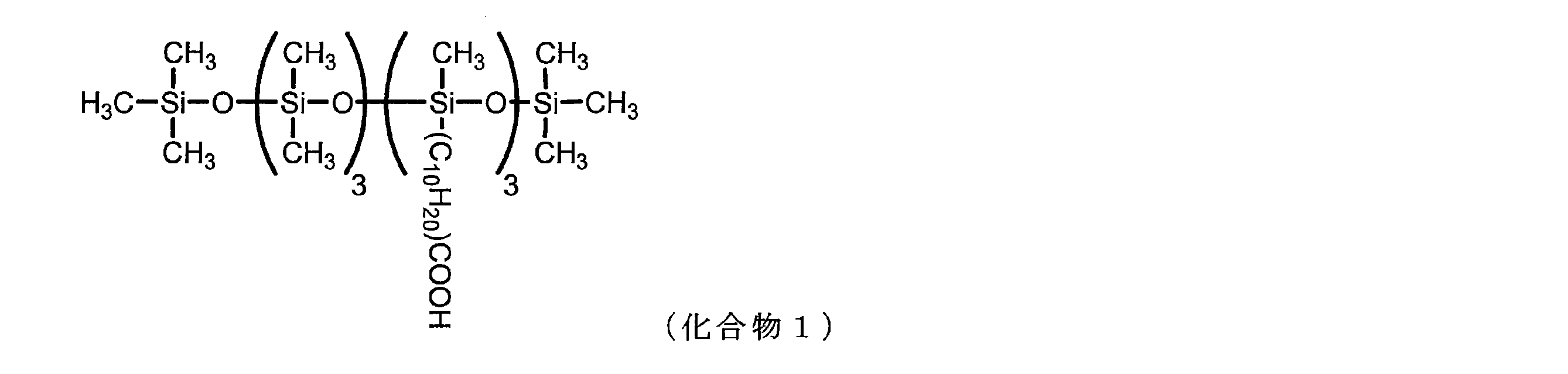
(合成例2)
撹拌機、還流冷却器、滴下ロート及び温度計を備えたフラスコに1,1,1,3,5,5,5-ヘプタメチルトリシロキサン100g、白金-1,3-ジビニル-1,1,3,3-テトラメチルジシロキサン錯体のトルエン溶液0.02gを加え、70-100℃の範囲を保つように、ウンデシレン酸トリメチルシリル105gを滴下した。滴下終了後、2時間、110℃で熟成した後、水素発生法によりSi-H結合の消失を確認した。低沸点分を減圧下、留去した。その後、水を加え、還流下4時間熟成し、脱保護を行った。その後再び低沸点分を減圧下除去し、化合物2を得た。分析の結果、化合物2の化学構造は下記化学式で示されることが確認された。

撹拌機、還流冷却器、滴下ロート及び温度計を備えたフラスコに1,1,1,3,5,5,5-ヘプタメチルトリシロキサン100g、白金-1,3-ジビニル-1,1,3,3-テトラメチルジシロキサン錯体のトルエン溶液0.02gを加え、70-100℃の範囲を保つように、ウンデシレン酸トリメチルシリル105gを滴下した。滴下終了後、2時間、110℃で熟成した後、水素発生法によりSi-H結合の消失を確認した。低沸点分を減圧下、留去した。その後、水を加え、還流下4時間熟成し、脱保護を行った。その後再び低沸点分を減圧下除去し、化合物2を得た。分析の結果、化合物2の化学構造は下記化学式で示されることが確認された。
[実施例1~3]
表1に示す各成分を使用して下記製造方法により実施例1~3の組成物を製造した。表1中の各成分の配合量は、特記しない限り「質量%」(「重量%」)を表す。
表1に示す各成分を使用して下記製造方法により実施例1~3の組成物を製造した。表1中の各成分の配合量は、特記しない限り「質量%」(「重量%」)を表す。
(製造方法)
(1)A相の成分を混合する。
(2)B相の成分を混合する。
(3)常温にて、A相の成分の混合物にB相の成分の混合物を少量ずつ添加し、ゲル状エマルションを調製する。
(4)上記ゲル状エマルジョンにC相の成分を混合して化粧料を調製する。
(1)A相の成分を混合する。
(2)B相の成分を混合する。
(3)常温にて、A相の成分の混合物にB相の成分の混合物を少量ずつ添加し、ゲル状エマルションを調製する。
(4)上記ゲル状エマルジョンにC相の成分を混合して化粧料を調製する。

(乳化物の安定性評価)
実施例1~3の各組成物を50℃の恒温槽中で30日間保管し、油相と水相の分離の有無を目視で観察し、以下の基準に従って保存安定性を評価した。
○:30日間保管しても油相と水相の分離を生じない。
△:30日経過後には油相と水相の分離が見られる。
×:調製直後から油相と水相の分離が見られる。
結果を表1に示す。
実施例1~3の各組成物を50℃の恒温槽中で30日間保管し、油相と水相の分離の有無を目視で観察し、以下の基準に従って保存安定性を評価した。
○:30日間保管しても油相と水相の分離を生じない。
△:30日経過後には油相と水相の分離が見られる。
×:調製直後から油相と水相の分離が見られる。
結果を表1に示す。
トリメチルシロキシケイ酸、(アクリレーツ/メタクリル酸ポリトリメチルシロキシ)コポリマー、及び、(トリメチルシロキシケイ酸/ジメチコノール)クロスポリマーは油溶性皮膜形成剤であるところ、表1から明らかなように、本発明の組成物は安定である。
[実施例4~7及び比較例1~3]
表2に示す各成分を使用して下記製造方法により実施例4~7及び比較例1~3の組成物を製造した。表2中の各成分の配合量は、特記しない限り「質量%」(「重量%」)を表す。
表2に示す各成分を使用して下記製造方法により実施例4~7及び比較例1~3の組成物を製造した。表2中の各成分の配合量は、特記しない限り「質量%」(「重量%」)を表す。
(製造方法)
(1)A相の成分を混合し、80℃に加熱する。
(2)B相の成分を混合し、80℃に加熱する。
(3)B相にA相を少量ずつ混合して乳化相(D)を調製する。
(4)乳化相(D)を冷却し、35℃で成分Cを混合して化粧料を調製する。
(1)A相の成分を混合し、80℃に加熱する。
(2)B相の成分を混合し、80℃に加熱する。
(3)B相にA相を少量ずつ混合して乳化相(D)を調製する。
(4)乳化相(D)を冷却し、35℃で成分Cを混合して化粧料を調製する。

(乳化物の安定性評価)
実施例及び比較例の各組成物を50℃の恒温槽中で30日間保管し、油相と水相の分離の有無を目視で観察し、以下の基準に従って保存安定性を評価した。
○:30日間保管しても油相と水相の分離を生じない。
△:30日経過後には油相と水相の分離が見られる。
×:調製直後から油相と水相の分離が見られる。
結果を表2に示す。
実施例及び比較例の各組成物を50℃の恒温槽中で30日間保管し、油相と水相の分離の有無を目視で観察し、以下の基準に従って保存安定性を評価した。
○:30日間保管しても油相と水相の分離を生じない。
△:30日経過後には油相と水相の分離が見られる。
×:調製直後から油相と水相の分離が見られる。
結果を表2に示す。
(耐水性の評価)
20名の女性パネリストの前腕内側に評価対象を0.5mg/cm2の塗布量で均一に塗布し、30分後に、pH7.0の水の水滴を静かに滴下して、表面に形成された水滴を写真撮影して、その形状に基づいて接触角をθ/2法で測定し、下記の基準で評価した。
◎:接触角の平均値が75°以上
○:接触角の平均値が70°以上75°未満
△:接触角の平均値が60°以上70°未満
×:接触角の平均値が60°未満
結果を表2に示す
20名の女性パネリストの前腕内側に評価対象を0.5mg/cm2の塗布量で均一に塗布し、30分後に、pH7.0の水の水滴を静かに滴下して、表面に形成された水滴を写真撮影して、その形状に基づいて接触角をθ/2法で測定し、下記の基準で評価した。
◎:接触角の平均値が75°以上
○:接触角の平均値が70°以上75°未満
△:接触角の平均値が60°以上70°未満
×:接触角の平均値が60°未満
結果を表2に示す
表2の結果から明らかなように、50℃で液状の(A)カルボン酸変性シリコーンを使用し、(D)油溶性皮膜形成剤を配合した実施例4乃至7の組成物は、優れた耐水性を示すとともに、多量の有機紫外線吸収剤を含む場合においても安定性に優れることがわかる。一方、代表的なアニオン界面活性剤である高級脂肪酸(イソステアリン酸)を塩基で中和して脂肪酸セッケンとして用いた比較例2においては、製造直後から油相と水相の分離が見られ、組成物を調製できなかった。(D)油溶性皮膜形成剤を配合しない比較例1は耐水性に劣るものであった。また、代表的なノニオン界面活性剤であるモノラウリン酸デカグリセリルを乳化剤として用いた比較例3においては、(D)油溶性皮膜形成剤を配合した場合においても安定性に優れる組成物を得られるものの、耐水性が顕著に劣るものであった。
[実施例8~11及び比較例4~7]
表3に示す各成分を使用して下記製造方法により実施例8~11及び比較例4~7の組成物を製造した。表3中の各成分の配合量は、特記しない限り「質量%」(「重量%」)を表す。
表3に示す各成分を使用して下記製造方法により実施例8~11及び比較例4~7の組成物を製造した。表3中の各成分の配合量は、特記しない限り「質量%」(「重量%」)を表す。
(製造方法)
(1)A相の成分を混合する。
(2)B相の成分を混合する。
(3)常温にて、A相の成分の混合物にB相の成分の混合物を少量ずつ添加し、ゲル状エマルションを調製する。
(4)上記ゲル状エマルジョンにC相の成分を混合して化粧料を調製する。
(1)A相の成分を混合する。
(2)B相の成分を混合する。
(3)常温にて、A相の成分の混合物にB相の成分の混合物を少量ずつ添加し、ゲル状エマルションを調製する。
(4)上記ゲル状エマルジョンにC相の成分を混合して化粧料を調製する。


(乳化物の安定性評価)
実施例及び比較例の各組成物を50℃の恒温槽中で30日間保管し、油相と水相の分離の有無を目視で観察し、以下の基準に従って保存安定性を評価した。
○:30日間保管しても油相と水相の分離を生じない。
△:30日経過後には油相と水相の分離が見られる。
×:調製直後から油相と水相の分離が見られる。
結果を表3に示す。
実施例及び比較例の各組成物を50℃の恒温槽中で30日間保管し、油相と水相の分離の有無を目視で観察し、以下の基準に従って保存安定性を評価した。
○:30日間保管しても油相と水相の分離を生じない。
△:30日経過後には油相と水相の分離が見られる。
×:調製直後から油相と水相の分離が見られる。
結果を表3に示す。
(耐水性の評価)
20名の女性パネリストの前腕内側に評価対象を0.5mg/cm2の塗布量で均一に塗布し、30分後に、pH7.0の水の水滴を静かに滴下して、表面に形成された水滴を写真撮影して、その形状に基づいて接触角をθ/2法で測定し、下記の基準で評価した。
◎:接触角の平均値が75°以上
○:接触角の平均値が70°以上75°未満
△:接触角の平均値が60°以上70°未満
×:接触角の平均値が60°未満
結果を表3に示す
20名の女性パネリストの前腕内側に評価対象を0.5mg/cm2の塗布量で均一に塗布し、30分後に、pH7.0の水の水滴を静かに滴下して、表面に形成された水滴を写真撮影して、その形状に基づいて接触角をθ/2法で測定し、下記の基準で評価した。
◎:接触角の平均値が75°以上
○:接触角の平均値が70°以上75°未満
△:接触角の平均値が60°以上70°未満
×:接触角の平均値が60°未満
結果を表3に示す
(洗浄性評価)
20名の女性パネリストの前腕内側に評価対象を0.5mg/cm2の塗布量で均一に塗布し、30分後に、市販のアルカリ性固形セッケン(花王ホワイト:花王社製)を用いて洗浄し、化粧膜の洗い流し易さを目視で観察し、以下の基準に従って洗浄性を評価した。
○:完全に除去された。
△:一部除去されたが、組成物の残留が顕著に認められる。
×:除去されなかった。
結果を表3に示す
20名の女性パネリストの前腕内側に評価対象を0.5mg/cm2の塗布量で均一に塗布し、30分後に、市販のアルカリ性固形セッケン(花王ホワイト:花王社製)を用いて洗浄し、化粧膜の洗い流し易さを目視で観察し、以下の基準に従って洗浄性を評価した。
○:完全に除去された。
△:一部除去されたが、組成物の残留が顕著に認められる。
×:除去されなかった。
結果を表3に示す
表3の結果から明らかなように、50℃で液状の(A)カルボン酸変性シリコーンを使用し、(D)油溶性皮膜形成剤を配合した実施例8乃至11の組成物は、優れた耐水性を示すとともに、疎水性粉体を含む場合においても安定性に優れること、また耐水性に優れるにも係わらず、市販セッケンで容易に洗浄できることがわかる。一方、代表的なアニオン界面活性剤である高級脂肪酸(イソステアリン酸)を塩基で中和して脂肪酸セッケンとして用いた比較例5においては、製造直後から油相と水相の分離が見られ、組成物を調製できなかった。(D)油溶性皮膜形成剤を配合しない比較例4は耐水性に劣るものであった。また、代表的なノニオン界面活性剤であるモノラウリン酸デカグリセリルを乳化剤として用いた比較例6においては、(D)油溶性皮膜形成剤を配合した場合においても安定性に優れる組成物を得られるものの、耐水性が顕著に劣るものであった。また界面活性剤を用いずに増粘性ポリマーのみを用いた比較例7は、耐水性に優れるものの、安定性と洗浄性に劣るものであった。
以下に、本発明の組成物の具体的な処方例を示す。表中の各成分の配合量は、特記しない限り「質量%」(「重量%」)を表す。なお、処方例中の(A)カルボン酸変性シリコーンとして上記化合物1の使用が好適であるほか、商品名 ES-5800 Formulation Aid (ダウ東レ株式会社製)等として上市されるものが好適に使用可能である。
(O/Wファンデーション 油中粉体分散型)

(製造方法)
(1)成分1~4を混合する。
(2)成分5~10を3本ロールを用いて混合する。
(3)上記(1)で得られた混合物を攪拌しながら、上記(2)で得られた混合物を少しずつ加えてA相とする。
(4)成分11~15を混合してB相とする。
(5)B相にA相を加えて均一になるまで攪拌する。
(1)成分1~4を混合する。
(2)成分5~10を3本ロールを用いて混合する。
(3)上記(1)で得られた混合物を攪拌しながら、上記(2)で得られた混合物を少しずつ加えてA相とする。
(4)成分11~15を混合してB相とする。
(5)B相にA相を加えて均一になるまで攪拌する。
(ハンドクリーム)

(製造方法)
(1)成分1~5を混合し、80℃に加熱して油相(a)を調製する。
(2)成分6~12を混合し、80℃に加熱して水相(b)を調製する。
(3)油相(a)に水相(b)を少量ずつ混合して乳化相(c)を調製する。
(4)乳化相(c)を冷却し、35℃で成分13を混合して化粧料を調製する。
(1)成分1~5を混合し、80℃に加熱して油相(a)を調製する。
(2)成分6~12を混合し、80℃に加熱して水相(b)を調製する。
(3)油相(a)に水相(b)を少量ずつ混合して乳化相(c)を調製する。
(4)乳化相(c)を冷却し、35℃で成分13を混合して化粧料を調製する。
(アイシャドー)

(1)成分1~4を混合する。
(2)成分5~9を3本ロールを用いて混合する。
(3)上記(1)で得られた混合物を攪拌しながら、上記(2)で得られた混合物を少しずつ加えてA相とする。
(4)成分10~15を混合してB相とする。
(5)B相にA相を加えて均一になるまで攪拌する。
(2)成分5~9を3本ロールを用いて混合する。
(3)上記(1)で得られた混合物を攪拌しながら、上記(2)で得られた混合物を少しずつ加えてA相とする。
(4)成分10~15を混合してB相とする。
(5)B相にA相を加えて均一になるまで攪拌する。
(リップクリーム)

(製造方法)
(1)成分1~5を混合する。
(2)成分6~14を3本ロールを用いて混合する。
(3)上記(1)で得られた混合物を攪拌しながら、上記(2)で得られた混合物を少しずつ加えてA相とする。
(4)成分15~18を混合してB相とする。
(5)B相にA相を加えて均一になるまで攪拌する。
(1)成分1~5を混合する。
(2)成分6~14を3本ロールを用いて混合する。
(3)上記(1)で得られた混合物を攪拌しながら、上記(2)で得られた混合物を少しずつ加えてA相とする。
(4)成分15~18を混合してB相とする。
(5)B相にA相を加えて均一になるまで攪拌する。
Claims (16)
- (A)50℃で液状のカルボン酸変性シリコーン、
(B)油剤、
(C)水、及び、
(D)油溶性皮膜形成剤
を含み、
前記(D)油溶性皮膜形成剤を化粧料の全質量に対して0.01~5質量%の範囲で含む、水中油型乳化化粧料。 - 前記(A)カルボン酸変性シリコーンが、下記構造式(1):

Rcは、一般式:-R1-(OR2)p-(O)w-R3-COOH(R1 は炭素数2~22の直鎖又は分岐鎖のアルキレン基を表し、R2 は炭素数2~4の直鎖又は分岐鎖のアルキレン基を表し、R3 は結合手(-)又は炭素数1~22の直鎖若しくは分岐鎖のアルキレン基を表し、pは0~200の数を表し、wは0又は1の数を表す)で示されるカルボキシル基含有有機基を表し、
Rは、同一又は異なり、炭素数1~22のアルキル若しくはアルコキシ基又はフェニル基を表し、
R´は、Rc又はRであり、
a、bは各々0又は正の数であり、a+bは0~30の範囲の数であり、bが0のとき、R´の少なくとも一方はRcである。)で表される、請求項1記載の化粧料。 - 前記(A)カルボン酸変性シリコーンが室温(25℃)で液状である、請求項1又は2記載の化粧料。
- 前記(A)カルボン酸変性シリコーンが、下記構造式(2):

Rcは、一般式:-R1-(OR2)p-(O)w-R3-COOH(R1 は炭素数2~22の直鎖又は分岐鎖のアルキレン基を表し、R2 は炭素数2~4の直鎖又は分岐鎖のアルキレン基を表し、R3 は結合手(-)又は炭素数1~22の直鎖若しくは分岐鎖のアルキレン基を表し、pは0~200の数を表し、wは0又は1の数を表す)で示されるカルボキシル基含有有機基を表し、
Rは、同一又は異なり、炭素数1~22のアルキル若しくはアルコキシ基又はフェニル基を表し、
R´は、Rc又はRであり、
a、bは各々正の数であり、a+bは2~20の範囲の数であり、a/bは0.3~3.0の範囲である。)で表される、請求項1乃至3のいずれかに記載の化粧料。 - 前記(A)カルボン酸変性シリコーンを化粧料の全質量に対して0.1~15質量%の範囲で含む、請求項1乃至4のいずれかに記載の化粧料。
- 前記(B)油剤が少なくとも1種の紫外線吸収剤を含む、請求項1乃至5のいずれかに記載の化粧料。
- 前記(B)油剤を化粧料の全質量に対して1~60質量%の範囲で含む、請求項1乃至6のいずれかに記載の化粧料。
- 前記(C)水を化粧料の全質量に対して20~98質量%の範囲で含む、請求項1乃至7のいずれかに記載の化粧料。
- 前記(D)油溶性皮膜形成剤が、
(D1)M単位及びQ単位を含有するシリコーン樹脂、
(D2)シリコーンアクリレート、
(D3)T単位を含有するシリコーン樹脂、及び、
(D4)シリコーンレジンガム
からなる群から選択される少なくとも1種を含む、請求項1乃至8のいずれかに記載の化粧料。 - (E)塩基性化合物を更に含む、請求項1乃至9のいずれかに記載の化粧料。
- 前記(E)塩基性化合物を化粧料の全質量に対して0.01~2.5質量%の範囲で含む、請求項10記載の化粧料。
- (F)多価アルコールを更に含む、請求項1乃至11のいずれかに記載の化粧料。
- (G)水溶性増粘剤を更に含む、請求項1乃至12のいずれかに記載の化粧料。
- (H)疎水性粉体を更に含む、請求項1乃至13のいずれかに記載の化粧料。
- 前記(H)疎水性粉体が油相中及び/又は水相中に分散している、請求項14記載の化粧料。
- 前記(A)カルボン酸変性シリコーン以外の界面活性剤を、化粧料の全質量に対して、5質量%未満含む、請求項1乃至15のいずれかに記載の化粧料。
Priority Applications (4)
| Application Number | Priority Date | Filing Date | Title |
|---|---|---|---|
| KR1020217007416A KR102850890B1 (ko) | 2018-08-15 | 2019-07-31 | 수중유형 유화 화장료 |
| US17/268,047 US20220183955A1 (en) | 2018-08-15 | 2019-07-31 | Oil-in-water emulsion cosmetic |
| CN201980064898.XA CN112789027B (zh) | 2018-08-15 | 2019-07-31 | 水包油型乳化化妆料 |
| EP19850395.5A EP3838256A4 (en) | 2018-08-15 | 2019-07-31 | Oil-in-water emulsion cosmetic |
Applications Claiming Priority (2)
| Application Number | Priority Date | Filing Date | Title |
|---|---|---|---|
| JP2018-152812 | 2018-08-15 | ||
| JP2018152812 | 2018-08-15 |
Publications (1)
| Publication Number | Publication Date |
|---|---|
| WO2020036062A1 true WO2020036062A1 (ja) | 2020-02-20 |
Family
ID=69524811
Family Applications (1)
| Application Number | Title | Priority Date | Filing Date |
|---|---|---|---|
| PCT/JP2019/029935 Ceased WO2020036062A1 (ja) | 2018-08-15 | 2019-07-31 | 水中油型乳化化粧料 |
Country Status (6)
| Country | Link |
|---|---|
| US (1) | US20220183955A1 (ja) |
| EP (1) | EP3838256A4 (ja) |
| JP (1) | JP7371854B2 (ja) |
| KR (1) | KR102850890B1 (ja) |
| CN (1) | CN112789027B (ja) |
| WO (1) | WO2020036062A1 (ja) |
Cited By (7)
| Publication number | Priority date | Publication date | Assignee | Title |
|---|---|---|---|---|
| WO2022075372A1 (ja) | 2020-10-09 | 2022-04-14 | ダウ・東レ株式会社 | カルボン酸共変性オルガノポリシロキサンおよびその用途 |
| JPWO2022255176A1 (ja) * | 2021-06-03 | 2022-12-08 | ||
| JPWO2022255177A1 (ja) * | 2021-06-03 | 2022-12-08 | ||
| US12023403B2 (en) | 2018-08-15 | 2024-07-02 | Dow Toray Co., Ltd. | Oil-in-water type emulsion cosmetics |
| US12453694B2 (en) | 2019-04-24 | 2025-10-28 | Dow Toray Co., Ltd. | Cosmetic composition |
| US12502345B2 (en) | 2018-08-15 | 2025-12-23 | Dow Toray Co., Ltd. | Cosmetic |
| US12569428B2 (en) | 2019-04-10 | 2026-03-10 | Dow Toray Co., Ltd. | Oil-in-water cleansing cosmetic composition |
Families Citing this family (6)
| Publication number | Priority date | Publication date | Assignee | Title |
|---|---|---|---|---|
| KR102577644B1 (ko) * | 2021-04-07 | 2023-09-12 | 주식회사 브이티피엘 | 천연 방수 아이라이너 화장품 조성물 및 이를 통한 천연 방수 아이라이너 화장품 제조방법 |
| CN113350228B (zh) * | 2021-06-28 | 2022-07-22 | 广州卡迪莲化妆品科技有限公司 | 一种能够改善底妆暗沉的妆前乳 |
| JP7762619B2 (ja) | 2022-04-14 | 2025-10-30 | 信越化学工業株式会社 | カルボキシ基含有オルガノポリシロキサン、カルボキシ基含有オルガノポリシロキサンの製造方法、及び界面活性剤 |
| JPWO2024128029A1 (ja) * | 2022-12-15 | 2024-06-20 | ||
| JPWO2024204558A1 (ja) * | 2023-03-31 | 2024-10-03 | ||
| JP2025096908A (ja) * | 2023-12-18 | 2025-06-30 | 信越化学工業株式会社 | 化粧料 |
Citations (21)
| Publication number | Priority date | Publication date | Assignee | Title |
|---|---|---|---|---|
| JPH01261316A (ja) | 1988-04-12 | 1989-10-18 | Shiseido Co Ltd | 水中油型乳化化粧料 |
| JPH02243612A (ja) | 1989-01-31 | 1990-09-27 | Toray Dow Corning Silicone Co Ltd | 化粧料 |
| JPH0812524A (ja) | 1994-06-30 | 1996-01-16 | Toray Dow Corning Silicone Co Ltd | メーキャップ化粧料 |
| JPH0812546A (ja) | 1994-06-30 | 1996-01-16 | Toray Dow Corning Silicone Co Ltd | 日焼け防止用化粧料 |
| JPH0812545A (ja) | 1994-06-30 | 1996-01-16 | Toray Dow Corning Silicone Co Ltd | 制汗・消臭剤 |
| JPH0844260A (ja) * | 1994-02-25 | 1996-02-16 | Ricoh Co Ltd | 被記録材の再生方法および再生装置 |
| JPH08109263A (ja) | 1994-10-12 | 1996-04-30 | Kao Corp | カルボン酸多価金属塩変性オルガノ(ポリ)シロキサン、その製造法並びにこれを含有するゲル化剤及び化粧料 |
| JPH09241511A (ja) | 1996-03-08 | 1997-09-16 | Toray Dow Corning Silicone Co Ltd | シリコーンゴムサスペンジョン |
| JPH1036219A (ja) | 1996-07-23 | 1998-02-10 | Toray Dow Corning Silicone Co Ltd | 化粧料 |
| JPH1143417A (ja) | 1997-07-28 | 1999-02-16 | Shiseido Co Ltd | 水中油型乳化化粧料 |
| JPH11504665A (ja) | 1995-04-12 | 1999-04-27 | モナ・インダストリーズ・インコーポレーテッド | 分子内にカルボキシル官能基を有する有機ケイ素 |
| JPH11193331A (ja) | 1997-07-21 | 1999-07-21 | Dow Corning Corp | 溶剤の粘度を調整する方法 |
| JP2000281523A (ja) | 1998-06-23 | 2000-10-10 | Dow Corning Toray Silicone Co Ltd | 化粧品原料、化粧品、および化粧品の製造方法 |
| JP2002114849A (ja) | 2000-10-05 | 2002-04-16 | Kao Corp | オルガノポリシロキサン |
| JP2005524747A (ja) | 2002-05-09 | 2005-08-18 | ザ プロクター アンド ギャンブル カンパニー | ジカルボキシ官能化ポリオルガノシロキサンを含むホームケア組成物 |
| WO2009022621A1 (ja) | 2007-08-10 | 2009-02-19 | Shiseido Company Ltd. | 表面処理剤、表面処理粉体及び化粧料 |
| JP2009263643A (ja) | 2008-04-03 | 2009-11-12 | Shin Etsu Chem Co Ltd | カルボキシル基を有するオルガノポリシロキサン |
| WO2013115099A1 (ja) * | 2012-01-30 | 2013-08-08 | 株式会社 資生堂 | メーキャップ化粧料 |
| JP2014201569A (ja) * | 2013-04-09 | 2014-10-27 | 信越化学工業株式会社 | 水中油型日焼け止め化粧料 |
| JP2015203026A (ja) | 2014-04-15 | 2015-11-16 | ジェイオーコスメティックス株式会社 | 化粧料 |
| WO2018066559A1 (ja) * | 2016-10-04 | 2018-04-12 | 東レ・ダウコーニング株式会社 | 化粧料組成物または外用剤組成物、および化粧料原料組成物 |
Family Cites Families (5)
| Publication number | Priority date | Publication date | Assignee | Title |
|---|---|---|---|---|
| JP3450541B2 (ja) * | 1995-08-24 | 2003-09-29 | 花王株式会社 | 化粧料用粉体及びこれを含有する化粧料 |
| US6342209B1 (en) * | 2000-05-04 | 2002-01-29 | Revlon Consumer Products Corporation | Cosmetic compositions containing film forming polymers plasticized with esters and malic acid |
| JP2002097366A (ja) * | 2000-06-19 | 2002-04-02 | L'oreal Sa | 化粧品組成物 |
| EP2174985B1 (en) * | 2007-07-26 | 2017-02-15 | Shiseido Company, Ltd. | Gel composition and cosmetic preparation |
| JP5357280B2 (ja) * | 2012-01-16 | 2013-12-04 | 株式会社 資生堂 | 油中水型乳化皮膚化粧料 |
-
2019
- 2019-07-31 WO PCT/JP2019/029935 patent/WO2020036062A1/ja not_active Ceased
- 2019-07-31 US US17/268,047 patent/US20220183955A1/en not_active Abandoned
- 2019-07-31 KR KR1020217007416A patent/KR102850890B1/ko active Active
- 2019-07-31 JP JP2019140767A patent/JP7371854B2/ja active Active
- 2019-07-31 EP EP19850395.5A patent/EP3838256A4/en active Pending
- 2019-07-31 CN CN201980064898.XA patent/CN112789027B/zh active Active
Patent Citations (21)
| Publication number | Priority date | Publication date | Assignee | Title |
|---|---|---|---|---|
| JPH01261316A (ja) | 1988-04-12 | 1989-10-18 | Shiseido Co Ltd | 水中油型乳化化粧料 |
| JPH02243612A (ja) | 1989-01-31 | 1990-09-27 | Toray Dow Corning Silicone Co Ltd | 化粧料 |
| JPH0844260A (ja) * | 1994-02-25 | 1996-02-16 | Ricoh Co Ltd | 被記録材の再生方法および再生装置 |
| JPH0812524A (ja) | 1994-06-30 | 1996-01-16 | Toray Dow Corning Silicone Co Ltd | メーキャップ化粧料 |
| JPH0812546A (ja) | 1994-06-30 | 1996-01-16 | Toray Dow Corning Silicone Co Ltd | 日焼け防止用化粧料 |
| JPH0812545A (ja) | 1994-06-30 | 1996-01-16 | Toray Dow Corning Silicone Co Ltd | 制汗・消臭剤 |
| JPH08109263A (ja) | 1994-10-12 | 1996-04-30 | Kao Corp | カルボン酸多価金属塩変性オルガノ(ポリ)シロキサン、その製造法並びにこれを含有するゲル化剤及び化粧料 |
| JPH11504665A (ja) | 1995-04-12 | 1999-04-27 | モナ・インダストリーズ・インコーポレーテッド | 分子内にカルボキシル官能基を有する有機ケイ素 |
| JPH09241511A (ja) | 1996-03-08 | 1997-09-16 | Toray Dow Corning Silicone Co Ltd | シリコーンゴムサスペンジョン |
| JPH1036219A (ja) | 1996-07-23 | 1998-02-10 | Toray Dow Corning Silicone Co Ltd | 化粧料 |
| JPH11193331A (ja) | 1997-07-21 | 1999-07-21 | Dow Corning Corp | 溶剤の粘度を調整する方法 |
| JPH1143417A (ja) | 1997-07-28 | 1999-02-16 | Shiseido Co Ltd | 水中油型乳化化粧料 |
| JP2000281523A (ja) | 1998-06-23 | 2000-10-10 | Dow Corning Toray Silicone Co Ltd | 化粧品原料、化粧品、および化粧品の製造方法 |
| JP2002114849A (ja) | 2000-10-05 | 2002-04-16 | Kao Corp | オルガノポリシロキサン |
| JP2005524747A (ja) | 2002-05-09 | 2005-08-18 | ザ プロクター アンド ギャンブル カンパニー | ジカルボキシ官能化ポリオルガノシロキサンを含むホームケア組成物 |
| WO2009022621A1 (ja) | 2007-08-10 | 2009-02-19 | Shiseido Company Ltd. | 表面処理剤、表面処理粉体及び化粧料 |
| JP2009263643A (ja) | 2008-04-03 | 2009-11-12 | Shin Etsu Chem Co Ltd | カルボキシル基を有するオルガノポリシロキサン |
| WO2013115099A1 (ja) * | 2012-01-30 | 2013-08-08 | 株式会社 資生堂 | メーキャップ化粧料 |
| JP2014201569A (ja) * | 2013-04-09 | 2014-10-27 | 信越化学工業株式会社 | 水中油型日焼け止め化粧料 |
| JP2015203026A (ja) | 2014-04-15 | 2015-11-16 | ジェイオーコスメティックス株式会社 | 化粧料 |
| WO2018066559A1 (ja) * | 2016-10-04 | 2018-04-12 | 東レ・ダウコーニング株式会社 | 化粧料組成物または外用剤組成物、および化粧料原料組成物 |
Non-Patent Citations (1)
| Title |
|---|
| "Silicone Handbook", NIKKAN KOGYO SHIMBUN, pages: 166 - 167 |
Cited By (9)
| Publication number | Priority date | Publication date | Assignee | Title |
|---|---|---|---|---|
| US12023403B2 (en) | 2018-08-15 | 2024-07-02 | Dow Toray Co., Ltd. | Oil-in-water type emulsion cosmetics |
| US12502345B2 (en) | 2018-08-15 | 2025-12-23 | Dow Toray Co., Ltd. | Cosmetic |
| US12569428B2 (en) | 2019-04-10 | 2026-03-10 | Dow Toray Co., Ltd. | Oil-in-water cleansing cosmetic composition |
| US12453694B2 (en) | 2019-04-24 | 2025-10-28 | Dow Toray Co., Ltd. | Cosmetic composition |
| WO2022075372A1 (ja) | 2020-10-09 | 2022-04-14 | ダウ・東レ株式会社 | カルボン酸共変性オルガノポリシロキサンおよびその用途 |
| JPWO2022255176A1 (ja) * | 2021-06-03 | 2022-12-08 | ||
| JPWO2022255177A1 (ja) * | 2021-06-03 | 2022-12-08 | ||
| WO2022255177A1 (ja) * | 2021-06-03 | 2022-12-08 | 株式会社 資生堂 | 仕上げ化粧料組成物 |
| WO2022255176A1 (ja) * | 2021-06-03 | 2022-12-08 | 株式会社 資生堂 | 化粧料組成物 |
Also Published As
| Publication number | Publication date |
|---|---|
| JP2020029453A (ja) | 2020-02-27 |
| KR102850890B1 (ko) | 2025-08-27 |
| CN112789027A (zh) | 2021-05-11 |
| KR20210044823A (ko) | 2021-04-23 |
| EP3838256A4 (en) | 2022-05-11 |
| JP7371854B2 (ja) | 2023-10-31 |
| CN112789027B (zh) | 2023-11-07 |
| US20220183955A1 (en) | 2022-06-16 |
| EP3838256A1 (en) | 2021-06-23 |
Similar Documents
| Publication | Publication Date | Title |
|---|---|---|
| JP7371854B2 (ja) | 水中油型乳化化粧料 | |
| JP6586554B2 (ja) | 化粧料 | |
| US12023403B2 (en) | Oil-in-water type emulsion cosmetics | |
| JP7422353B2 (ja) | 水中油型乳化化粧料 | |
| JP7422354B2 (ja) | 化粧料 | |
| JP6615935B2 (ja) | 化粧料 | |
| JP2004169015A (ja) | 粉体組成物及び油中粉体分散物.並びにそれらを有する化粧料 | |
| JP7348275B2 (ja) | 化粧料 |
Legal Events
| Date | Code | Title | Description |
|---|---|---|---|
| 121 | Ep: the epo has been informed by wipo that ep was designated in this application |
Ref document number: 19850395 Country of ref document: EP Kind code of ref document: A1 |
|
| NENP | Non-entry into the national phase |
Ref country code: DE |
|
| ENP | Entry into the national phase |
Ref document number: 20217007416 Country of ref document: KR Kind code of ref document: A |
|
| ENP | Entry into the national phase |
Ref document number: 2019850395 Country of ref document: EP Effective date: 20210315 |