WO2020045458A1 - 硬化性組成物、硬化物、及び硬化物の製造方法 - Google Patents
硬化性組成物、硬化物、及び硬化物の製造方法 Download PDFInfo
- Publication number
- WO2020045458A1 WO2020045458A1 PCT/JP2019/033585 JP2019033585W WO2020045458A1 WO 2020045458 A1 WO2020045458 A1 WO 2020045458A1 JP 2019033585 W JP2019033585 W JP 2019033585W WO 2020045458 A1 WO2020045458 A1 WO 2020045458A1
- Authority
- WO
- WIPO (PCT)
- Prior art keywords
- group
- base
- compound
- general formula
- curable composition
- Prior art date
- Legal status (The legal status is an assumption and is not a legal conclusion. Google has not performed a legal analysis and makes no representation as to the accuracy of the status listed.)
- Ceased
Links
Images


Classifications
-
- C—CHEMISTRY; METALLURGY
- C08—ORGANIC MACROMOLECULAR COMPOUNDS; THEIR PREPARATION OR CHEMICAL WORKING-UP; COMPOSITIONS BASED THEREON
- C08G—MACROMOLECULAR COMPOUNDS OBTAINED OTHERWISE THAN BY REACTIONS ONLY INVOLVING UNSATURATED CARBON-TO-CARBON BONDS
- C08G18/00—Polymeric products of isocyanates or isothiocyanates
- C08G18/06—Polymeric products of isocyanates or isothiocyanates with compounds having active hydrogen
- C08G18/70—Polymeric products of isocyanates or isothiocyanates with compounds having active hydrogen characterised by the isocyanates or isothiocyanates used
- C08G18/72—Polyisocyanates or polyisothiocyanates
- C08G18/74—Polyisocyanates or polyisothiocyanates cyclic
- C08G18/76—Polyisocyanates or polyisothiocyanates cyclic aromatic
- C08G18/7614—Polyisocyanates or polyisothiocyanates cyclic aromatic containing only one aromatic ring
- C08G18/7628—Polyisocyanates or polyisothiocyanates cyclic aromatic containing only one aromatic ring containing at least one isocyanate or isothiocyanate group linked to the aromatic ring by means of an aliphatic group
- C08G18/7642—Polyisocyanates or polyisothiocyanates cyclic aromatic containing only one aromatic ring containing at least one isocyanate or isothiocyanate group linked to the aromatic ring by means of an aliphatic group containing at least two isocyanate or isothiocyanate groups linked to the aromatic ring by means of an aliphatic group having a primary carbon atom next to the isocyanate or isothiocyanate groups, e.g. xylylene diisocyanate or homologues substituted on the aromatic ring
-
- C—CHEMISTRY; METALLURGY
- C08—ORGANIC MACROMOLECULAR COMPOUNDS; THEIR PREPARATION OR CHEMICAL WORKING-UP; COMPOSITIONS BASED THEREON
- C08G—MACROMOLECULAR COMPOUNDS OBTAINED OTHERWISE THAN BY REACTIONS ONLY INVOLVING UNSATURATED CARBON-TO-CARBON BONDS
- C08G18/00—Polymeric products of isocyanates or isothiocyanates
- C08G18/06—Polymeric products of isocyanates or isothiocyanates with compounds having active hydrogen
- C08G18/08—Processes
- C08G18/16—Catalysts
- C08G18/161—Catalysts containing two or more components to be covered by at least two of the groups C08G18/166, C08G18/18 or C08G18/22
-
- C—CHEMISTRY; METALLURGY
- C08—ORGANIC MACROMOLECULAR COMPOUNDS; THEIR PREPARATION OR CHEMICAL WORKING-UP; COMPOSITIONS BASED THEREON
- C08G—MACROMOLECULAR COMPOUNDS OBTAINED OTHERWISE THAN BY REACTIONS ONLY INVOLVING UNSATURATED CARBON-TO-CARBON BONDS
- C08G18/00—Polymeric products of isocyanates or isothiocyanates
- C08G18/06—Polymeric products of isocyanates or isothiocyanates with compounds having active hydrogen
- C08G18/08—Processes
- C08G18/16—Catalysts
- C08G18/18—Catalysts containing secondary or tertiary amines or salts thereof
- C08G18/1841—Catalysts containing secondary or tertiary amines or salts thereof having carbonyl groups which may be linked to one or more nitrogen or oxygen atoms
-
- C—CHEMISTRY; METALLURGY
- C08—ORGANIC MACROMOLECULAR COMPOUNDS; THEIR PREPARATION OR CHEMICAL WORKING-UP; COMPOSITIONS BASED THEREON
- C08G—MACROMOLECULAR COMPOUNDS OBTAINED OTHERWISE THAN BY REACTIONS ONLY INVOLVING UNSATURATED CARBON-TO-CARBON BONDS
- C08G18/00—Polymeric products of isocyanates or isothiocyanates
- C08G18/06—Polymeric products of isocyanates or isothiocyanates with compounds having active hydrogen
- C08G18/08—Processes
- C08G18/16—Catalysts
- C08G18/18—Catalysts containing secondary or tertiary amines or salts thereof
- C08G18/20—Heterocyclic amines; Salts thereof
- C08G18/2045—Heterocyclic amines; Salts thereof containing condensed heterocyclic rings
- C08G18/2072—Heterocyclic amines; Salts thereof containing condensed heterocyclic rings having at least three nitrogen atoms in the condensed ring system
-
- C—CHEMISTRY; METALLURGY
- C08—ORGANIC MACROMOLECULAR COMPOUNDS; THEIR PREPARATION OR CHEMICAL WORKING-UP; COMPOSITIONS BASED THEREON
- C08G—MACROMOLECULAR COMPOUNDS OBTAINED OTHERWISE THAN BY REACTIONS ONLY INVOLVING UNSATURATED CARBON-TO-CARBON BONDS
- C08G18/00—Polymeric products of isocyanates or isothiocyanates
- C08G18/06—Polymeric products of isocyanates or isothiocyanates with compounds having active hydrogen
- C08G18/08—Processes
- C08G18/16—Catalysts
- C08G18/18—Catalysts containing secondary or tertiary amines or salts thereof
- C08G18/20—Heterocyclic amines; Salts thereof
- C08G18/2081—Heterocyclic amines; Salts thereof containing at least two non-condensed heterocyclic rings
-
- C—CHEMISTRY; METALLURGY
- C08—ORGANIC MACROMOLECULAR COMPOUNDS; THEIR PREPARATION OR CHEMICAL WORKING-UP; COMPOSITIONS BASED THEREON
- C08G—MACROMOLECULAR COMPOUNDS OBTAINED OTHERWISE THAN BY REACTIONS ONLY INVOLVING UNSATURATED CARBON-TO-CARBON BONDS
- C08G18/00—Polymeric products of isocyanates or isothiocyanates
- C08G18/06—Polymeric products of isocyanates or isothiocyanates with compounds having active hydrogen
- C08G18/28—Polymeric products of isocyanates or isothiocyanates with compounds having active hydrogen characterised by the compounds used containing active hydrogen
- C08G18/30—Low-molecular-weight compounds
- C08G18/32—Polyhydroxy compounds; Polyamines; Hydroxyamines
- C08G18/3203—Polyhydroxy compounds
- C08G18/3206—Polyhydroxy compounds aliphatic
-
- C—CHEMISTRY; METALLURGY
- C08—ORGANIC MACROMOLECULAR COMPOUNDS; THEIR PREPARATION OR CHEMICAL WORKING-UP; COMPOSITIONS BASED THEREON
- C08G—MACROMOLECULAR COMPOUNDS OBTAINED OTHERWISE THAN BY REACTIONS ONLY INVOLVING UNSATURATED CARBON-TO-CARBON BONDS
- C08G18/00—Polymeric products of isocyanates or isothiocyanates
- C08G18/06—Polymeric products of isocyanates or isothiocyanates with compounds having active hydrogen
- C08G18/28—Polymeric products of isocyanates or isothiocyanates with compounds having active hydrogen characterised by the compounds used containing active hydrogen
- C08G18/40—High-molecular-weight compounds
- C08G18/58—Epoxy resins
- C08G18/581—Reaction products of epoxy resins with less than equivalent amounts of compounds containing active hydrogen added before or during the reaction with the isocyanate component
-
- C—CHEMISTRY; METALLURGY
- C08—ORGANIC MACROMOLECULAR COMPOUNDS; THEIR PREPARATION OR CHEMICAL WORKING-UP; COMPOSITIONS BASED THEREON
- C08G—MACROMOLECULAR COMPOUNDS OBTAINED OTHERWISE THAN BY REACTIONS ONLY INVOLVING UNSATURATED CARBON-TO-CARBON BONDS
- C08G18/00—Polymeric products of isocyanates or isothiocyanates
- C08G18/06—Polymeric products of isocyanates or isothiocyanates with compounds having active hydrogen
- C08G18/28—Polymeric products of isocyanates or isothiocyanates with compounds having active hydrogen characterised by the compounds used containing active hydrogen
- C08G18/40—High-molecular-weight compounds
- C08G18/58—Epoxy resins
- C08G18/584—Epoxy resins having nitrogen
-
- C—CHEMISTRY; METALLURGY
- C08—ORGANIC MACROMOLECULAR COMPOUNDS; THEIR PREPARATION OR CHEMICAL WORKING-UP; COMPOSITIONS BASED THEREON
- C08G—MACROMOLECULAR COMPOUNDS OBTAINED OTHERWISE THAN BY REACTIONS ONLY INVOLVING UNSATURATED CARBON-TO-CARBON BONDS
- C08G59/00—Polycondensates containing more than one epoxy group per molecule; Macromolecules obtained by polymerising compounds containing more than one epoxy group per molecule using curing agents or catalysts which react with the epoxy groups
- C08G59/18—Macromolecules obtained by polymerising compounds containing more than one epoxy group per molecule using curing agents or catalysts which react with the epoxy groups ; e.g. general methods of curing
- C08G59/40—Macromolecules obtained by polymerising compounds containing more than one epoxy group per molecule using curing agents or catalysts which react with the epoxy groups ; e.g. general methods of curing characterised by the curing agents used
-
- C—CHEMISTRY; METALLURGY
- C08—ORGANIC MACROMOLECULAR COMPOUNDS; THEIR PREPARATION OR CHEMICAL WORKING-UP; COMPOSITIONS BASED THEREON
- C08J—WORKING-UP; GENERAL PROCESSES OF COMPOUNDING; AFTER-TREATMENT NOT COVERED BY SUBCLASSES C08B, C08C, C08F, C08G or C08H
- C08J5/00—Manufacture of articles or shaped materials containing macromolecular substances
- C08J5/18—Manufacture of films or sheets
-
- C—CHEMISTRY; METALLURGY
- C09—DYES; PAINTS; POLISHES; NATURAL RESINS; ADHESIVES; COMPOSITIONS NOT OTHERWISE PROVIDED FOR; APPLICATIONS OF MATERIALS NOT OTHERWISE PROVIDED FOR
- C09D—COATING COMPOSITIONS, e.g. PAINTS, VARNISHES OR LACQUERS; FILLING PASTES; CHEMICAL PAINT OR INK REMOVERS; INKS; CORRECTING FLUIDS; WOODSTAINS; PASTES OR SOLIDS FOR COLOURING OR PRINTING; USE OF MATERIALS THEREFOR
- C09D163/00—Coating compositions based on epoxy resins; Coating compositions based on derivatives of epoxy resins
-
- C—CHEMISTRY; METALLURGY
- C08—ORGANIC MACROMOLECULAR COMPOUNDS; THEIR PREPARATION OR CHEMICAL WORKING-UP; COMPOSITIONS BASED THEREON
- C08J—WORKING-UP; GENERAL PROCESSES OF COMPOUNDING; AFTER-TREATMENT NOT COVERED BY SUBCLASSES C08B, C08C, C08F, C08G or C08H
- C08J2375/00—Characterised by the use of polyureas or polyurethanes; Derivatives of such polymers
- C08J2375/04—Polyurethanes
Definitions
- the present disclosure relates to a curable composition, a cured product, and a method for producing a cured product.
- curable compositions that are cured by application of active energy rays such as light or radiation or energy such as heat have been widely used in applications such as curable inks, printing plates, photoresists, and curable adhesives.
- active energy rays such as light or radiation or energy such as heat
- curable adhesives such as adhesives, adhesives, and curable adhesives.
- a composition containing a photopolymerization initiator that releases an active species by applying energy is known as a composition that can be polymerized and cured by an active energy ray and developed.
- Photopolymerization initiators are classified into radical generators, acid generators, and base generators based on the difference in active species generated by irradiation with active energy rays.
- a radical generator that releases a radical species is used in the case of a radical polymerization system that generates a radical species in a composition and acts on a monomer containing an unsaturated double bond to promote addition polymerization.
- the radical generator has the advantage that the curing rate in the composition is high and no radical species remain after curing, but it has the property of being susceptible to polymerization inhibition by oxygen. Therefore, in curing the film, there is a disadvantage that it is essential to devise measures such as lowering the oxygen concentration in the atmosphere or providing a layer or the like for blocking oxygen.
- An acid generator that releases an acid is used in the case of a cationic polymerization system that generates an acid in a composition and acts on a monomer or the like to promote a polymerization reaction.
- Acid generators are different from radical generators in that they have the advantage of being less susceptible to polymerization inhibition by oxygen.On the other hand, since the active species is an acid, there is concern about corrosion by the acid or denaturation of the resin. Or there is a drawback that cannot be applied to the site.
- a base generator that releases a base is used in the case of an anionic polymerization system that generates a base in a composition and acts on a monomer or the like to promote a polymerization reaction.
- the base generator is different from the radical generator and the acid generator described above, because it hardly causes a situation such as polymerization inhibition by oxygen, or corrosion or resin denaturation due to the acid as an active species remaining in the system. Attention has been focused on a polymerization system using a base generator. Examples of the base generator include those disclosed in JP-A-2001-513765, WO 2010/064631, and WO 2010/064632.
- an ionic base generator which is a salt of guanidine or a guanidine-type strong base and a carboxylic acid and which releases a guanidine-type strong base upon application of energy
- nonionic base generators that release primary or secondary amines are known (K. Arimitsu, R. Endo, Chem. Mater. 2013, 25, 4461-4463 .; JFCameron, JMJ Frechet, J. Am. Chem. Soc. 1991, 113, 4303 .; M. Shirai, M. Tsunooka, Prog. Polym. Sci. 1996, 21, 1.) .
- the base generator has a problem that the sensitivity at the time of curing (that is, curability) is generally lower than that of the acid generator.
- the base generator has advantages different from the radical generator or the acid generator as described above, if the sensitivity is low, it can be used for curing a thin film, but it can be applied to a thick film.
- the method is difficult to be performed and the utility is poor.
- the curable composition is expected to be used as a reinforcing material represented by a structural material such as concrete, a molding material, and the like. Is also required to exhibit good curability.
- the present disclosure has been made in view of the above.
- the problem to be solved by one embodiment of the present invention is to provide a curable composition of an anionic polymerization system which is excellent in curing sensitivity while avoiding disadvantages in radical polymerization or cationic polymerization.
- a problem to be solved by another embodiment of the present invention is to provide a cured product that has been successfully cured.
- another object of the present invention is to provide a method for producing a cured product that can perform a urethane bond forming reaction with high sensitivity while avoiding disadvantages in radical polymerization or cationic polymerization.
- the base proliferating agent is the curable composition according to ⁇ 1>, including a compound represented by the following general formula (1).
- G represents an organic group
- X is represented by the following general formula (1) -11, general formula (1) -12, general formula (1) -13 or general formula (1) -14. Represents a group.
- R 11 , R 12 , R 13 , R 21 , R 22 , R 23 , R 24 , R 31 , R 32 , R 33 , R 41 , R 42 , R 43 and R 44 are each independently: Represents a hydrogen atom or a hydrocarbon group.
- R 11 , R 12 and R 13 are a hydrocarbon group
- two or more hydrocarbon groups may be bonded to each other to form a ring
- R 21 , R 22 When two or more of R 23 and R 24 are a hydrocarbon group, two or more hydrocarbon groups may be bonded to each other to form a ring
- R 31 , R 32 and R 33 When two or more of them are hydrocarbon groups, two or more of the hydrocarbon groups may be bonded to each other to form a ring, and two of R 41 , R 42 , R 43, and R 44
- at least one kind is a hydrocarbon group
- two or more kinds of hydrocarbon groups may be mutually bonded to form a ring. * Represents a bond bonded to a carbon atom.
- the compound represented by the general formula (1) is selected from the group consisting of a compound represented by the following general formula (1) -A and a compound represented by the following general formula (1) -B
- the curable composition according to ⁇ 2> which contains at least one compound.
- R 1 represents an organic group
- R 2 and R 3 each independently represent a hydrogen atom or an organic group
- X each independently represents a group represented by the above general formula (1) -11, general formula (1) -12, general formula (1) -13 or general formula (1) -14.
- At least one of R 2 and R 3 represents an organic group, R 2 and R 3 are organic groups, they may be bonded to each other to form a ring.
- ⁇ 4> The curable composition according to any one of ⁇ 1> to ⁇ 3>, further including a base generator.
- ⁇ 5> The curable composition according to ⁇ 4>, wherein the base generator is a compound that generates a base by light irradiation or heating.
- ⁇ 6> A cured product obtained by curing the curable composition according to any one of ⁇ 1> to ⁇ 5>.
- ⁇ 7> The cured product according to ⁇ 6>, having a thickness of 1 ⁇ 10 ⁇ 3 m or more.
- a method for producing a cured product comprising: applying energy to the curable composition according to any one of ⁇ 1> to ⁇ 5>, and forming a urethane bond using the generated base as a catalyst.
- a base is generated from the base generator, and a base is generated from the base multiplying agent, Part of the generated base activates the hydroxyl group of the polyhydric alcohol or the epoxy group of the epoxy compound, and promotes the generation of a base from the base proliferating agent,
- a method for producing a cured product which starts or promotes a urethane bond-forming reaction between a polyvalent isocyanate compound and a polyhydric alcohol by using another part of the generated base as a catalyst, and produces a polyurethane as a reaction cured product.
- ⁇ 10> The method for producing a cured product according to ⁇ 8> or ⁇ 9>, wherein the application of the energy is at least one of light irradiation and heating.
- ⁇ 11> The method for producing a cured product according to any one of ⁇ 8> to ⁇ 10>, wherein the curable composition is a film having a thickness of 1 ⁇ 10 ⁇ 3 m or more.
- an anionic polymerizable curable composition which avoids defects in radical polymerization or cationic polymerization and has excellent curing sensitivity.
- a cured product that is well cured is provided.
- a method for producing a cured product capable of performing a urethane bond-forming reaction with high sensitivity while avoiding defects in radical polymerization or cationic polymerization.
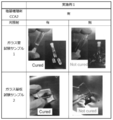
- FIG. 1 is a photograph showing the results of an evaluation test of curability in Example 1.
- FIG. 2 is a photograph showing the results of a curability evaluation test of Comparative Example 1.
- FIG. 3 shows a measurement result of an FT-IR spectrum in the reference example.
- the notation “to” described in this specification indicates a range including numerical values described before and after “to” as a minimum value and a maximum value, respectively.
- the upper limit or the lower limit described in a certain numerical range may be replaced with the upper limit or the lower limit of another numerical range described in a stepwise manner.
- the upper limit or the lower limit described in a certain numerical range may be replaced with the value shown in the embodiment.
- the amount of each component in the composition when there are a plurality of substances corresponding to each component in the composition, it is present in the composition unless otherwise specified. It means the total amount of multiple substances.
- step is included in the term as well as an independent step, even if it cannot be clearly distinguished from other steps as long as the intended purpose of the step is achieved. .
- the curable composition of the present disclosure contains a polyfunctional isocyanate compound, a compound selected from the group consisting of polyhydric alcohols and epoxy compounds, and a base proliferating agent, and preferably further contains a base generator.
- the curable composition of the present disclosure can further contain other components such as a coloring agent or an additive, if necessary.
- radical generators used in radical polymerization-based curable compositions have a disadvantage that they are easily susceptible to polymerization inhibition by oxygen. There is a concern that corrosion or denaturation of the resin may occur, and the method cannot be applied to materials or parts using metal.
- the base generator does not have the drawbacks of the radical generator or the acid generator, it is expected to be applied to the field where the radical generator or the acid generator has conventionally been used.
- the base generator has a drawback that the sensitivity is low and satisfactory curability may not be obtained. If the sensitivity (curability) at the time of curing is improved more than before, it is expected that the field of application of an anionic polymerization system using a basic generator will be significantly expanded.
- the curable composition of the present disclosure is one in which the sensitivity (curability) of the anionic polymerizable curable composition is improved.
- the curable composition of the present disclosure contains a base proliferating agent in addition to a polyfunctional isocyanate compound and a compound selected from the group consisting of polyhydric alcohols and epoxy compounds.
- the base proliferating agent By containing the base proliferating agent, the base generated in the composition is converted into a polyhydric alcohol and / or an epoxy compound, as shown in the scheme shown in the section “Method for producing cured product” described below. Acts to promote the production of base from the base proliferating agent.
- a part of the generated base activates the hydroxyl group of the polyhydric alcohol and / or the epoxy group of the epoxy compound, and promotes the reaction of generating a base from the base proliferating agent. Then, a part of the generated base functions as a catalyst in a urethane bond forming reaction between the polyvalent isocyanate compound and the polyhydric alcohol. If the base is generated efficiently, the urethane bond forming reaction is promoted, and the reaction sensitivity can be improved. In the curable composition of the present disclosure, since a base is generated in a chain in the composition, the urethane formation reaction proceeds more quickly (that is, with high sensitivity), and the production of a polyurethane that is a reaction cured product can be favorably performed.
- the curable composition when the curable composition is formed into a thick film (for example, a thickness of 0.5 ⁇ 10 ⁇ 3 m or more), the curability (urethane-forming reactivity) is improved, and the curable composition extends to a deep portion of the film.
- the urethane bond forming reaction can proceed promptly.
- Polyfunctional isocyanate compound The curable composition of the present disclosure contains at least one polyfunctional isocyanate compound.
- Polyurethane is formed by the reaction of the polyfunctional isocyanate compound with the polyhydric alcohol.
- Polyfunctional isocyanate compounds include aliphatic polyisocyanates, aromatic polyisocyanates, and the like.
- As the polyisocyanate a compound selected from the group consisting of a bifunctional polyisocyanate and a trifunctional or higher polyisocyanate can be arbitrarily selected.
- aliphatic polyisocyanate examples include trimethylene diisocyanate, propylene-1,2-diisocyanate, butylene diisocyanate, hexamethylene diisocyanate, cyclohexylene diisocyanate, dicyclohexylmethane diisocyanate, isophorone diisocyanate, hydrogenated xylylene diisocyanate, 1,4-bis (Isocyanatemethyl) cyclohexane, 1,3-bis (isocyanatomethyl) cyclohexane, lysine diisocyanate, and the like.
- aromatic polyisocyanate examples include m-phenylene diisocyanate, p-phenylene diisocyanate, tolylene diisocyanate, naphthalene diisocyanate, diphenylmethane diisocyanate, 3,3′-dimethoxy-biphenyl diisocyanate, 3,3′-dimethyldiphenylmethane-4,4 '-Diisocyanate, m-xylylene diisocyanate, 4-chloroxylylene-1,3-diisocyanate, 2-methylxylylene-1,3-diisocyanate, 4,4'-diphenylpropane diisocyanate, 4,4'-diphenylhexa And fluoropropane diisocyanate.
- m-xylylene diisocyanate XDI
- tolylene diisocyanate TDI
- phenylene diisocyanate PDI
- diphenylmethane diisocyanate MDI
- isophorone diisocyanate IDI
- hexamethylene diisocyanate HDI
- a diisocyanate compound is exemplified as the bifunctional aliphatic polyisocyanate and the aromatic polyisocyanate.
- a trifunctional triisocyanate compound inferred from the diisocyanate compound and A tetrafunctional tetraisocyanate compound is also included.
- Examples of the trifunctional or higher polyisocyanate include a bifunctional aliphatic isocyanate compound (a compound having two isocyanate groups in a molecule) and a compound having three or more active hydrogen groups in a molecule (eg, a trifunctional or higher functional polyol, Examples thereof include a trifunctional or more adduct-type isocyanate compound as an adduct (addition product) with a polyamine or polythiol), and a biuret-type or isocyanurate-type isocyanate compound which is a trimer of a bifunctional aliphatic isocyanate compound.
- a bifunctional aliphatic isocyanate compound a compound having two isocyanate groups in a molecule
- a compound having three or more active hydrogen groups in a molecule eg, a trifunctional or higher functional polyol
- examples thereof include a trifunctional or more adduct-type isocyanate compound as an adduct (addition product) with
- the content of the polyisocyanate in the curable composition is preferably from 90% by mass to 10% by mass, more preferably from 80% by mass to 50% by mass, based on the total mass of the curable composition.
- the curable composition of the present disclosure may not contain or contain an epoxy compound described below, and may contain at least one polyhydric alcohol (hereinafter, also referred to as “polyol”).
- polyol for example, ethylene glycol, polyethylene glycol (the degree of polymerization may be 2 to 5 or 6 or more), propylene glycol, polypropylene glycol (the degree of polymerization may be 2 to 5 or 6 or more), 3-methyl- 1,3-butanediol, 1,3-butylene glycol, isoprene glycol, 1,2-pentanediol, 1,2-hexanediol, glycerin, polyglycerin (the degree of polymerization may be 2 to 5 or 6 or more), Pentaerythritol, N, N, N ', N'-tetrakis (2-hydroxypropyl) ethylenediamine and the like.
- the content of the polyol in the curable composition is preferably from 90% by mass to 10% by mass, more preferably from 60% by mass to 20% by mass, based on the total mass of the curable composition.
- the curable composition of the present disclosure does not contain or contains the above-mentioned polyhydric alcohol, and may contain at least one epoxy compound.
- the content of polyhydric alcohol can be reduced, and if necessary, a composition containing no polyhydric alcohol can be obtained.
- a reaction with a coexisting base proliferating agent reaction of a hydroxy group before energy application
- the stability of the composition after long-term storage tends to decrease.
- the stability of the curable composition can be further improved, and the pot life of the curable composition can be further improved.
- the epoxy compound is not particularly limited as long as it has one or more epoxy groups in one molecule, and may be any compound selected from monomers, oligomers and polymers.
- epoxy monomers include monomers such as ethyl glycidyl ether, glycidyl phenyl ether, 2-ethylpentyl glycidyl ether, butyl glycidyl ether, and compounds having the structures shown below, and polymers such as epoxy resins. be able to.
- epoxy monomer commercially available products may be used.
- examples of commercially available products include glycidyl ethers of Nagase ChemteX Corporation (eg, Denacol EX-946L, Denacol EX-991, Denacol). EX-991L, Denacol EX-992L), glycidyl esters (eg, Denacol EX-1111, Denacol EX-1112), etc., monoepoxy types of Sakamoto Pharmaceutical Co., Ltd.
- the epoxy resin examples include a bisphenol A type epoxy resin, a bisphenol F type epoxy resin, a novolak glycidyl ether type epoxy resin, and the like.
- the epoxy resin commercially available products may be used. Examples of the commercially available products include Nagase ChemteX, such as jER828 and jER806 of Mitsubishi Chemical Corporation and YDPN-638 of Nippon Steel Sumitomo Chemical Co., Ltd. And polybutadiene type epoxy resins (eg, Denarex R15EPT, Denarex FCA-061L, Denarex FCA-061M) and the like.
- a compound having a glycidyl group and a hydroxy group can be mentioned, which is more suitable as a substitute compound for the polyhydric alcohol.
- Specific examples include glycerol polyglycidyl ether, diglycerol polyglycidyl ether, polyglycerol polyglycidyl ether, pentaerythritol polyglycidyl ether, and sorbitol polyglycidyl ether.
- the content of the epoxy compound in the curable composition is preferably from 90% by mass to 10% by mass, more preferably from 60% by mass to 20% by mass, based on the total mass of the curable composition.
- the curable composition of the present disclosure contains at least one base proliferating agent (chain curing agent).
- a base proliferating agent when energy such as light or heat is applied, bases are formed in a chain in the composition, so that the urethane formation reaction proceeds more rapidly (that is, with high sensitivity). As a result, polyurethane which is a reaction cured product can be favorably produced.
- the base proliferating agent is a compound that is decomposed by the action of a base in the system to generate a new base molecule.
- Such an autocatalytic reaction in which a base is newly generated by a decomposition reaction with a base is called a base multiplication reaction.
- the base proliferating agent desirably satisfies that it decomposes under the action of a base in the system, newly releases a base molecule during the decomposition process, and is stable in the absence of a base.
- the base proliferating agent is decomposed in a self-proliferating manner by applying a smaller amount of the base to the fixed amount, and eventually the entire amount is decomposed, and a large amount of base corresponding to the amount of the base proliferating agent is removed. Can be generated.
- the base proliferating agent include compounds having a carbamate structure in the molecule. In the case of a compound having a carbamate structure, an aliphatic amine is generated as a base. Further, the base proliferating agent may be a compound that generates a polyfunctional amine. Compounds that produce polyfunctional amines are suitable as components of curable compositions.
- base proliferating agent examples include the compounds described in paragraphs 0010 to 0032 of JP-A-2000-330270 and paragraphs 0116 to 0146 of JP-A-2006-20439.
- base proliferating agent examples include the compounds described in paragraphs 0010 to 0032 of JP-A-2000-330270 and paragraphs 0116 to 0146 of JP-A-2006-20439.
- the base proliferating agent include compounds represented by the following general formula (1).
- Conventionally known base generators tend to generate not only a base but also a gas such as carbon dioxide (CO 2 ) when energy such as light or heat is applied.
- the base proliferating agent represented by the general formula (1) activates a hydroxyl group generated from a polyhydric alcohol and / or an epoxy compound by a base in the composition and decomposes to generate a base, while carbon dioxide is generated. No gas is released. Further, the residue after releasing the base is taken into the inside of the cured product. That is, the base proliferating agent has an advantage that it does not generate carbon dioxide and other unnecessary low-molecular decomposed products in exhibiting the action.
- G represents an organic group
- X is represented by the following general formula (1) -11, general formula (1) -12, general formula (1) -13 or general formula (1) -14. Represents a group.
- R 11 , R 12 , R 13 , R 21 , R 22 , R 23 , R 24 , R 31 , R 32 , R 33 , R 41 , R 42 , R 43 and R 44 are each independently: Represents a hydrogen atom or a hydrocarbon group.
- R 11 , R 12 and R 13 are a hydrocarbon group
- two or more hydrocarbon groups may be bonded to each other to form a ring
- R 21 , R 22 When two or more of R 23 and R 24 are a hydrocarbon group, two or more hydrocarbon groups may be bonded to each other to form a ring
- R 31 , R 32 and R 33 When two or more of them are hydrocarbon groups, two or more of the hydrocarbon groups may be bonded to each other to form a ring, and two of R 41 , R 42 , R 43, and R 44
- at least one kind is a hydrocarbon group
- two or more kinds of hydrocarbon groups may be mutually bonded to form a ring.
- * Represents a bond bonded to the carbon atom of the carbonyl group.
- the compound represented by the general formula (1) is a compound having a carboxylic acid amide bond formed by bonding a nitrogen atom in X and a carbon atom of a carbonyl group. Further, in the compound represented by the general formula (1), the bond between X and the carbonyl group present in the structure is cleaved under specific conditions, and X in X bonded to the carbon atom of the carbonyl group is bonded. It has a property that a nitrogen atom generates a basic compound having a structure in which it is bonded to a hydrogen atom (hereinafter, also simply referred to as “base”). This characteristic will be described later.
- the compound represented by the general formula (1) has a base conversion effect of expressing a base by the action of a base and a base growth action of generating a base in a self-proliferating manner.
- G is an organic group.
- the organic group is not particularly limited, and can be appropriately selected from monovalent groups containing a carbon atom as a constituent atom.
- an organic group that forms an ester structure or an amide structure with an adjacent carbonyl group is preferable.
- the organic group is an organic group forming an ester structure or an amide structure with an adjacent carbonyl group, for example, a substituent having a hydrocarbon group or the like other than a portion forming an ester structure or an amide structure with an adjacent carbonyl group It may be.
- the compound represented by the general formula (1) is a compound represented by the following general formula (1) -A and It preferably contains at least one compound selected from the group consisting of compounds represented by the following general formula (1) -B.
- R 1 represents an organic group
- R 2 and R 3 each independently represent a hydrogen atom or an organic group
- X each independently represents a group represented by the above general formula (1) -11, general formula (1) -12, general formula (1) -13 or general formula (1) -14.
- At least one of R 2 and R 3 represents an organic group, R 2 and R 3 are organic groups, they may be bonded to each other to form a ring.
- the organic group in G in the general formula (1), R 1 in the general formula (1) -A, or R 2 to R 3 in the general formula (1) -B has, for example, a substituent.
- a hydrocarbon group a substituent
- “the hydrocarbon group has a substituent” means that one or more hydrogen atoms constituting the hydrocarbon group are substituted with a group (substituent) other than a hydrogen atom, or the hydrocarbon group has a substituent.
- the hydrocarbon group may be any of an aliphatic hydrocarbon group and an aromatic hydrocarbon group (aryl group), and may be an aliphatic hydrocarbon group in which one or more hydrogen atoms have been substituted with an aromatic hydrocarbon group.
- aryl group an aromatic hydrocarbon group
- a polycyclic hydrocarbon group formed by condensing a cyclic aliphatic hydrocarbon group and an aromatic hydrocarbon group may be used.
- the aliphatic hydrocarbon group may be any of a saturated aliphatic hydrocarbon group (alkyl group) and an unsaturated aliphatic hydrocarbon group.
- the alkyl group may be linear, branched, or cyclic. If it is cyclic, it may be monocyclic or polycyclic.
- the alkyl group preferably has 1 to 20 carbon atoms.
- the linear or branched alkyl group preferably has 1 to 20 carbon atoms.
- linear or branched alkyl groups include methyl, ethyl, n-propyl, isopropyl, n-butyl, isobutyl, sec-butyl, tert-butyl, n-pentyl Group, isopentyl group, neopentyl group, tert-pentyl group, 1-methylbutyl group, n-hexyl group, 2-methylpentyl group, 3-methylpentyl group, 2,2-dimethylbutyl group, 2,3-dimethylbutyl group , N-heptyl group, 2-methylhexyl group, 3-methylhexyl group, 2,2-dimethylpentyl group, 2,3-dimethylpentyl group, 2,4-dimethylpentyl group, 3,3-dimethylpentyl group, 3-ethylpentyl, 2,2,
- the cyclic alkyl group preferably has 3 to 20 carbon atoms.
- Examples of the cyclic alkyl group include cyclopropyl, cyclobutyl, cyclopentyl, cyclohexyl, cycloheptyl, cyclooctyl, cyclononyl, cyclodecyl, norbornyl, isobornyl, 1-adamantyl, and 2-adamantyl.
- examples of the straight-chain, branched-chain, and cyclic alkyl groups for substituting a hydrogen atom include those described above as examples of the alkyl group.
- the unsaturated aliphatic hydrocarbon group may be linear, branched, or cyclic. In the case of a cyclic unsaturated aliphatic hydrocarbon group, it may be monocyclic or polycyclic, and the unsaturated aliphatic hydrocarbon group preferably has 2 to 20 carbon atoms.
- the number of unsaturated bonds may be only one, two or more, and when two or more, these unsaturated bonds may be only double bonds or triple bonds. It may be a bond alone or a mixture of a double bond and a triple bond.
- the position of the unsaturated bond is not particularly limited.
- the unsaturated aliphatic hydrocarbon group include, for example, a linear or branched alkenyl group and an alkynyl group corresponding to one unsaturated bond, and a cyclic group. And a cycloalkenyl group and a cycloalkynyl group.
- the alkenyl group include an ethenyl group (vinyl group), a 2-propenyl group (allyl group), and a cyclohexenyl group.
- the aryl group may be monocyclic or polycyclic, and preferably has 6 to 20 carbon atoms.
- Examples of such an aryl group include a phenyl group, 1-naphthyl group, 2-naphthyl group, o-tolyl group, m-tolyl group, p-tolyl group, xylyl group (dimethylphenyl group), and the like.
- the aryl group further includes one or more hydrogen atoms further substituted with the aryl group or the alkyl group.
- the aryl group having such a substituent preferably has 6 to 20 carbon atoms including the substituent.
- examples of the aliphatic hydrocarbon group in which one or more hydrogen atoms are substituted with an aromatic hydrocarbon group include, for example, those having one hydrogen atom substitution number.
- arylalkyl groups such as phenylmethyl group (benzyl group) and 2-phenylethyl group (phenethyl group).
- Examples of the substituent in which one or more hydrogen atoms are substituted in the hydrocarbon group include, for example, an alkoxy group, an aryloxy group, a dialkylamino group, a diarylamino group, an alkylarylamino group, an alkylcarbonyl group, and an arylcarbonyl group.
- Examples include a nitro group, a haloalkyl group (halogenated alkyl group), a hydroxyl group (—OH), and a mercapto group (—SH).
- the number of the substituents that substitute hydrogen atoms may be only one, or two or more, and all the hydrogen atoms may be substituted with the substituents.
- these substituents may be all the same, may be all different, and may be partially the same. Is also good.
- alkoxy group as a substituent examples include a monovalent group in which the alkyl group is bonded to an oxygen atom, such as a methoxy group, an ethoxy group, an n-propoxy group, an isopropoxy group, and a cyclopropoxy group.
- aryloxy group that is a substituent include a monovalent group formed by bonding the aryl group to an oxygen atom, such as a phenyloxy group (phenoxy group), a 1-naphthyloxy group, and a 2-naphthyloxy group.
- dialkylamino group that is a substituent examples include a monovalent group in which two hydrogen atoms of an amino group (—NH 2 ) are substituted with the alkyl group, such as a dimethylamino group and a methylethylamino group. Is mentioned. In the dialkylamino group, the two alkyl groups bonded to the nitrogen atom may be the same or different.
- the diarylamino group that is a substituent include a monovalent group in which two hydrogen atoms of an amino group are substituted with the aryl group, such as a diphenylamino group and a phenyl-1-naphthylamino group.
- the two aryl groups bonded to the nitrogen atom may be the same or different.
- the alkylarylamino group as a substituent include, for example, one hydrogen atom among two hydrogen atoms of an amino group such as a methylphenylamino group is substituted with the alkyl group, and one hydrogen atom is A monovalent group substituted by the aryl group is exemplified.
- arylcarbonyl group as a substituent examples include a monovalent group formed by bonding the aryl group to a carbonyl group, such as a phenylcarbonyl group (benzoyl group).
- heteroarylcarbonyl group examples include a monovalent group formed by bonding an aromatic heterocyclic group (heteroaryl group) and a carbonyl group such as an imidazolylcarbonyl group, a pyrazolylcarbonyl group, and a pyrazinylcarbonyl group. Groups.
- alkyloxycarbonyl group as a substituent examples include a monovalent group formed by bonding the alkoxy group to a carbonyl group, such as a methyloxycarbonyl group (methoxycarbonyl group).
- aryloxycarbonyl group as a substituent examples include a monovalent group formed by bonding the aryloxy group to a carbonyl group, such as a phenyloxycarbonyl group (phenoxycarbonyl group).
- arylcarbonyloxy group as a substituent examples include a monovalent group formed by bonding the aryl group to a carbon atom of the carbonyloxy group, such as a phenylcarbonyloxy group.
- alkylthio group as a substituent examples include a monovalent group in which the alkyl group is bonded to a sulfur atom, such as a methylthio group, an ethylthio group, an n-propylthio group, an isopropylthio group, and a cyclopropylthio group.
- arylthio group as a substituent examples include a monovalent group in which the aryl group is bonded to a sulfur atom, such as a phenylthio group, a 1-naphthylthio group, and a 2-naphthylthio group.
- halogen atom as a substituent include a fluorine atom (—F), a chlorine atom (—Cl), a bromine atom (—Br), and an iodine atom (—I).
- Examples of the haloalkyl group as a substituent include groups in which one or more hydrogen atoms of the alkyl group have been substituted with halogen atoms.
- Examples of the halogen atom in the haloalkyl group include those described above as examples of the halogen atom as the substituent.
- the number of halogen atoms in the haloalkyl group is not particularly limited, and may be one or two or more. When the number of halogen atoms in the haloalkyl group is two or more, the plurality of halogen atoms may be all the same, may be different from each other, or may be partially the same.
- the haloalkyl group may be a perhaloalkyl group in which all hydrogen atoms in the alkyl group have been substituted with halogen atoms.
- Examples of the haloalkyl group include, but are not limited to, a chloromethyl group, a dichloromethyl group, a trichloromethyl group, a trifluoromethyl group, and the like.
- the number of the substituents for substituting hydrogen atoms depends on the number of substitutable hydrogen atoms, but is preferably 1 to 4, more preferably 1 to 3. It is particularly preferable that the number is one or two.
- examples of the substituent in which one or more carbon atoms are substituted with one or more hydrogen atoms bonded to the carbon atom include a nitrogen atom, an oxygen atom, and a sulfur atom. And the like.
- the number of the substituents for substituting a carbon atom or a carbon atom to which a hydrogen atom is bonded may be only one, or may be two or more, and all the carbon atoms are alone or the carbon atom. May be substituted with a substituent together with the hydrogen atom bonded to
- these substituents may be all the same or different. And only some of them may be the same.
- the aromatic hydrocarbon group that is, the aromatic heterocyclic group (heteroaryl group) constitutes the ring skeleton from various aromatic heterocyclic compounds.
- the aromatic heterocyclic compound include sulfur-containing aromatic heterocyclic compounds (compounds having one or more sulfur atoms as atoms constituting the aromatic heterocyclic skeleton) and nitrogen-containing aromatic heterocyclic compounds (aromatic compounds).
- Examples of the sulfur-containing aromatic heterocyclic compound include thiophene and benzothiophene.
- Examples of the nitrogen-containing aromatic heterocyclic compound include, for example, pyrrole, imidazole, pyrazole, pyridine, pyrazine, pyrimidine, pyridazine, triazine, indole, isoindole, benzimidazole, purine, indazole, quinoline, isoquinoline, quinoxaline, quinazoline, cinnoline And the like.
- Examples of the oxygen-containing aromatic heterocyclic compound include furan, benzofuran (1-benzofuran), isobenzofuran (2-benzofuran) and the like.
- Examples of the compound having two different hetero atoms as the atoms constituting the aromatic heterocyclic skeleton include oxazole, isoxazole, thiazole, benzoxazole, benzoisoxazole, and benzothiazole.
- the number of the substituents for substituting a carbon atom or a carbon atom to which a hydrogen atom is bonded depends on the substitutable carbon atom, but is preferably 1 to 3, and preferably 1 or 3. More preferably, the number is two.
- G in the general formula (1) represents an alkoxy group in which one hydrogen atom of an alkyl group is substituted with a carbonyl group, or a substituted aryl in which one hydrogen atom of an aryl group is substituted with a substituent.
- a group preferably, a phenyl group substituted with a heteroarylcarbonyl group
- G is an alkoxy group
- a compound represented by general formula (1) -A is preferable.
- the organic groups represented by R 1 to R 3 in the general formulas (1) -A and (1) -B each independently have an alkyl group which may have a substituent or a substituent.
- the substituent here is the same as the above-described substituent described as having a hydrocarbon group.
- R 1 and R 2 each independently represent an alkyl group optionally having a substituent, an alkenyl group optionally having a substituent, an aryl group optionally having a substituent, A heteroaryl group which may have a group or an arylalkyl group which may have a substituent, and R 3 is preferably a hydrogen atom, and R 1 and R 2 are substituents Is more preferably an alkyl group which may have the formula: and R 3 is a hydrogen atom.
- X in the general formulas (1), (1) -A and (1) -B will be described.
- X is a group represented by the above general formulas (1) -11, (1) -12, (1) -13 or (1) -14. Further, the bond denoted by * is formed to the carbon atom to which X is bonded, that is, the carbon atom in the carbonyl group to which G is bonded in the general formula (1).
- R 11 , R 12 , R 13 , R 21 , R 22 , and R 23 , R 24 , R 31 , R 32 , R 33 , R 41 , R 42 , R 43 and R 44 are each independently a hydrogen atom or a hydrocarbon group. That is, all of R 11 , R 12 and R 13 (hereinafter may be abbreviated as “R 11 to R 13 ”) in the general formula (1) -11 may be the same or different. And only some of them may be the same.
- R 21 , R 22 , R 23 and R 24 in the general formula (1) -12 may all be the same, All may be different or only some may be the same.
- R 31 , R 32 and R 33 in the general formula (1) -13 may be all the same or different. Or only some of them may be the same.
- R 41 , R 42 , R 43 and R 44 in the general formula (1) -14 may all be the same, All may be different or only some may be the same.
- the hydrocarbon group for R 11 to R 13 , R 21 to R 24 , R 31 to R 33 , and R 41 to R 44 may be any of an aliphatic hydrocarbon group and an aromatic hydrocarbon group (aryl group).
- An aliphatic hydrocarbon group in which one or more hydrogen atoms have been substituted with an aromatic hydrocarbon group may be used, or a polycyclic group obtained by condensing a cyclic aliphatic hydrocarbon group with an aromatic hydrocarbon group. It may be a cyclic hydrocarbon group.
- the aliphatic hydrocarbon group may be any of a saturated aliphatic hydrocarbon group (alkyl group) and an unsaturated aliphatic hydrocarbon group.
- the alkyl group may be linear, branched, or cyclic, and when cyclic, may be monocyclic or polycyclic.
- the alkyl group preferably has 1 to 20 carbon atoms.
- the linear or branched alkyl group preferably has 1 to 20 carbon atoms.
- linear or branched alkyl groups include methyl, ethyl, n-propyl, isopropyl, n-butyl, isobutyl, sec-butyl, tert-butyl, n-pentyl Group, isopentyl group, neopentyl group, tert-pentyl group, 1-methylbutyl group, n-hexyl group, 2-methylpentyl group, 3-methylpentyl group, 2,2-dimethylbutyl group, 2,3-dimethylbutyl group , N-heptyl group, 2-methylhexyl group, 3-methylhexyl group, 2,2-dimethylpentyl group, 2,3-dimethylpentyl group, 2,4-dimethylpentyl group, 3,3-dimethylpentyl group, 3-ethylpentyl, 2,2,
- the cyclic alkyl group preferably has 3 to 20 carbon atoms.
- Examples of the cyclic alkyl group include cyclopropyl, cyclobutyl, cyclopentyl, cyclohexyl, cycloheptyl, cyclooctyl, cyclononyl, cyclodecyl, norbornyl, isobornyl, 1-adamantyl, and 2-adamantyl.
- examples of the straight-chain, branched-chain, and cyclic alkyl groups for substituting a hydrogen atom include those described above as examples of the alkyl group.
- the unsaturated aliphatic hydrocarbon group may be linear, branched or cyclic. In the case of a cyclic unsaturated aliphatic hydrocarbon group, it may be either monocyclic or polycyclic, and the unsaturated aliphatic hydrocarbon group preferably has 2 to 20 carbon atoms.
- the number of unsaturated bonds may be only one, two or more, and when two or more, these unsaturated bonds may be only double bonds or triple bonds. It may be a bond alone or a mixture of a double bond and a triple bond.
- the position of the unsaturated bond is not particularly limited.
- the unsaturated aliphatic hydrocarbon group include, for example, a linear or branched alkenyl group and an alkynyl group corresponding to one unsaturated bond, and a cyclic group. And a cycloalkenyl group and a cycloalkynyl group.
- the alkenyl group include an ethenyl group (vinyl group), a 2-propenyl group (allyl group), and a cyclohexenyl group.
- the aryl group may be monocyclic or polycyclic, and preferably has 6 to 20 carbon atoms.
- Examples of such an aryl group include a phenyl group, 1-naphthyl group, 2-naphthyl group, o-tolyl group, m-tolyl group, p-tolyl group, xylyl group (dimethylphenyl group), and the like.
- the aryl group in which one or more hydrogen atoms are further substituted with the aryl group, the alkyl group, and the like are also included.
- the aryl group having such a substituent preferably has 6 to 20 carbon atoms including the substituent.
- the position of the bonded carbon atom is not particularly limited.
- the bonding position may be a carbon atom at the terminal of the hydrocarbon group or constitutes an imidazole skeleton of the hydrocarbon group. It may be a so-called root carbon atom directly bonded to a carbon atom, or may be a carbon atom at an intermediate position between the terminal and the root.
- the bonding position may be a carbon atom at the root or other carbon atoms. Is also good.
- a ring formed thereby may be either a monocyclic ring or a polycyclic ring.
- the group represented by the general formula (1) -11 has a structure in which an imidazole skeleton and a ring formed by mutual bonding of these hydrocarbon groups are condensed.
- R 21 , R 22 , R 23 and R 24 when two or more of R 21 , R 22 , R 23 and R 24 are a hydrocarbon group, these hydrocarbon groups are bonded to each other, and these hydrocarbon groups are A ring may be formed together with the bonded nitrogen atom and the carbon atom bonded to the nitrogen atom (the same carbon atom to which three nitrogen atoms are bonded together).
- "two or more hydrocarbon groups are mutually bonded” means the same as the case where any one of R 11 to R 13 is mutually bonded as described above.
- R 21 to R 24 only three or all (four) of R 21 to R 24 are hydrocarbon groups, and any two or three types of hydrocarbon groups are bonded.
- R 21 to R 24 are all hydrocarbon groups, and all of these hydrocarbon groups are bonded to each other.
- the method is the same as in the case of R 11 to R 13 .
- R 41 , R 42 , R 43 and R 44 when two or more of R 41 , R 42 , R 43 and R 44 are hydrocarbon groups, these hydrocarbon groups are bonded to each other, and these hydrocarbon groups are A ring may be formed together with the bonded nitrogen atom and the carbon atom bonded to the nitrogen atom (the same carbon atom to which three nitrogen atoms are bonded together).
- "two or more hydrocarbon groups are mutually bonded” means the same as the case where any one of R 11 to R 13 is mutually bonded as described above.
- R 41 to R 44 and three or all (four) of R 41 to R 44 are hydrocarbon groups, and any two or three of these hydrocarbon groups are bonded.
- R 41 to R 44 are hydrocarbon groups, and all of these hydrocarbon groups are bonded to each other.
- the method is the same as in the case of R 11 to R 13 .
- the compound represented by the general formula (1) includes a compound represented by the following general formula (1) -1 (hereinafter, also referred to as “compound (1) -1”) and a compound represented by the following general formula (1)- 2 (hereinafter also referred to as “compound (1) -2”) and a compound represented by the following general formula (1) -3 (hereinafter also referred to as “compound (1) -3”) and compounds represented by the following general formula (1) -4 (hereinafter, also referred to as “compound (1) -4”).
- the compound (1) -1 include a compound represented by the following general formula (1) -1A (hereinafter may be abbreviated as “compound (1) -1A”), and a compound represented by the following general formula: And a compound represented by (1) -1B (hereinafter sometimes abbreviated as “compound (1) -1B”).
- R 11 ′, R 12 ′, and R 13 ′ are each independently a hydrogen atom or a hydrocarbon group; R 011 is a hydrocarbon ring.
- R 11 ′, R 12 ′ and R 13 ′ each independently represent a hydrogen atom or a hydrocarbon group.
- the hydrocarbon groups for R 11 ′, R 12 ′ and R 13 ′ are the same as the above-mentioned hydrocarbon groups for R 11 to R 13 except that they do not bond to each other to form a ring. . That is, the compound (1) -1A has a structure in which the imidazole skeleton described in the general formula (1) -1A is condensed, regardless of whether R 11 ′, R 12 ′, and R 13 ′ are any groups. Does not have.
- R 11 ′, R 12 ′ and R 13 ′ are preferably a hydrogen atom, an alkyl group or an aryl group.
- R 011 is a hydrocarbon ring. That is, in the general formula (1) -1B, R 011 is a hydrocarbon ring (cyclic) condensed with the imidazole skeleton by sharing two adjacent carbon atoms in the imidazole skeleton with the imidazole skeleton. Hydrocarbon group).
- Compound (1) -1B is a compound (1) -1 in which hydrocarbon groups R 12 and R 13 are mutually bonded to form a ring.
- R 011 may be monocyclic or polycyclic, and is preferably a saturated aliphatic hydrocarbon ring such as a cyclohexane ring, or an aromatic hydrocarbon ring such as a benzene ring or a naphthalene ring.
- Preferred examples of the compound (1) -1A include those in which at least one of R 11 ′, R 12 ′, and R 13 ′ is a hydrogen atom.
- Preferred examples of the compound (1) -1B include those in which R 011 is an aromatic hydrocarbon ring.
- the compound (1) -2 include a compound represented by the following general formula (1) -2A (hereinafter, also referred to as “compound (1) -2A”) and the following general formula (1)-
- the compound represented by 2B hereinafter, also referred to as “compound (1) -2B” and the compound represented by the following general formula (1) -2C (hereinafter, also referred to as “compound (1) -2C”)
- a compound represented by the following general formula (1) -2D hereeinafter, also referred to as “compound (1) -2D”
- a compound represented by the following general formula (1) -2E hereinafter, “compound ( 1) -2E ").
- R 21 ′, R 22 ′, R 23 ′ and R 24 ′ each independently represent a hydrogen atom or a hydrocarbon.
- R 021 , R 022 and R 023 are each independently a nitrogen-containing ring.
- R 21 ′, R 22 ′, R 23 ′ and R 24 ′ each independently represent a hydrogen atom or a hydrocarbon group.
- the hydrocarbon groups for R 21 ′, R 22 ′, R 23 ′ and R 24 ′ are the same as those for the aforementioned hydrocarbon groups for R 11 to R 13 except that they do not bond to each other to form a ring.
- R 21 ′, R 22 ′, R 23 ′ and R 24 ′ are preferably a hydrogen atom, an alkyl group or an aryl group, more preferably an alkyl group or an aryl group.
- R 021 is a nitrogen-containing ring.
- a "nitrogen-containing ring” means the cyclic structure which has a nitrogen atom other than a carbon atom and a hydrogen atom. That is, in the general formula (1) -2B, R 021 is a nitrogen atom bonded to a carbon atom of a carbonyl group described in the general formula, a nitrogen atom bonded to R 23 ′, It is a ring structure (nitrogen-containing cyclic group) in which one carbon atom located between these two nitrogen atoms is a constituent atom of a ring skeleton. R 021 may be monocyclic or polycyclic, and is usually an aliphatic nitrogen-containing ring.
- Compound (1) -2B is a compound (1) -2 in which hydrocarbon groups R 21 and R 22 are mutually bonded to form a ring.
- R 022 is a nitrogen-containing ring. That is, in the general formula (1) -2C, R 022 is one nitrogen atom to which both R 21 ′ and R 24 ′ are not bonded among the three nitrogen atoms described in the general formula. Is a ring structure (nitrogen-containing cyclic group) in which is a constituent atom of the ring skeleton. R 022 may be monocyclic or polycyclic, and may be any of an aliphatic nitrogen-containing ring and an aromatic nitrogen-containing ring.
- Compound (1) -2C is a compound (1) -2 in which hydrocarbon groups R 22 and R 23 are mutually bonded to form a ring.
- R 023 is a nitrogen-containing ring. That is, in the general formula (1) -2D, R 023 represents two nitrogen atoms to which R 21 ′ is not bonded, among the three nitrogen atoms described in the general formula, Is a ring structure (nitrogen-containing cyclic group) in which one carbon atom located between nitrogen atoms is a constituent atom of a ring skeleton. R 023 may be monocyclic or polycyclic, and may be any of an aliphatic nitrogen-containing ring and an aromatic nitrogen-containing ring.
- Compound (1) -2D is a compound (1) -2 in which hydrocarbon groups R 23 and R 24 are mutually bonded to form a ring.
- R 021 and R 023 are nitrogen-containing ring
- R 021 is the formula (1) is the same as R 021 in -2B
- R 023 is the formula (1) -2 D It is the same as R 023 in .
- Compound (1) -2E is a compound of the formula (1) -2 in which hydrocarbon groups R 21 and R 22 are mutually bonded to form a ring, and hydrocarbon groups R 23 and R 24 are mutually bonded. To form a ring.
- Preferred examples of the compound (1) -2A include compounds in which R 21 ′, R 22 ′, R 23 ′ and R 24 ′ are all alkyl groups or aryl groups.
- Preferred examples of the compound (1) -2C include those in which R 022 is an aliphatic nitrogen-containing ring.
- Preferred examples of the compound (1) -2D include those in which R 023 is an aliphatic nitrogen-containing ring.
- Preferred examples of the compound (1) -2E include those in which R 023 is an aliphatic nitrogen-containing ring (both in which R 021 and R 023 are both aliphatic nitrogen-containing rings).
- Preferred examples of the compound (1) -3 include a compound represented by the following formula (1) -3A (hereinafter, also referred to as “compound (1) -3A”) and the following formula (1)-
- the compound represented by 3B hereinafter, also referred to as “compound (1) -3B”
- the compound represented by the following general formula (1) -3C hereinafter, also referred to as “compound (1) -3C”
- a compound represented by the following general formula (1) -3D hereinafter, also referred to as “compound (1) -3D”.
- G is the same as described above;
- R 31 ′, R 32 ′, and R 33 ′ each independently represent a hydrogen atom or a hydrocarbon group;
- R 031 , R 032 and R 033 are each independently a nitrogen-containing ring.
- R 31 ′, R 32 ′ and R 33 ′ are each independently a hydrogen atom or a hydrocarbon group.
- the hydrocarbon groups for R 31 ′, R 32 ′ and R 33 ′ are the same as the above-mentioned hydrocarbon groups for R 11 to R 13 except that they do not bond to each other to form a ring.
- R 31 ′, R 32 ′ and R 33 ′ are preferably a hydrogen atom, an alkyl group or an aryl group.
- R 031 is a nitrogen-containing ring. That is, in the general formula (1) -3B, R 031 is one of the two nitrogen atoms described in the general formula, and one of these two nitrogen atoms to which R 31 ′ is not bonded; Is a ring structure (nitrogen-containing cyclic group) in which one carbon atom located between nitrogen atoms is a constituent atom of a ring skeleton. R 031 may be monocyclic or polycyclic, and may be either an aliphatic nitrogen-containing ring or an aromatic nitrogen-containing ring.
- Compound (1) -3B is a compound (1) -3 in which hydrocarbon groups R 32 and R 33 are mutually bonded to form a ring.
- R 032 is a nitrogen-containing ring. That is, in the general formula (1) -3C, R 032 represents two nitrogen atoms described in the general formula and one carbon atom located between the two nitrogen atoms in a ring. It is a ring structure (nitrogen-containing cyclic group) which is a constituent atom of the skeleton. R 032 may be monocyclic or polycyclic, and may be any of an aliphatic nitrogen-containing ring and an aromatic nitrogen-containing ring.
- Compound (1) -3C is a compound (1) -3 in which hydrocarbon groups R 31 and R 33 are mutually bonded to form a ring.
- R 033 is a nitrogen-containing ring. That is, in the general formula (1) -3D, R 033 is one nitrogen atom to which R 33 ′ is not bonded among two nitrogen atoms described in the general formula, Is a ring structure (nitrogen-containing cyclic group) in which one carbon atom located between nitrogen atoms is a constituent atom of a ring skeleton. R 033 may be monocyclic or polycyclic, and is usually an aliphatic nitrogen-containing ring.
- Compound (1) -3D is a compound (1) -3 in which hydrocarbon groups R 31 and R 32 are mutually bonded to form a ring.
- Preferred examples of the compound (1) -3A include compounds in which at least one of R 31 ′, R 32 ′, and R 33 ′ is a hydrogen atom.
- Preferred examples of the compound (1) -3B include those in which R 031 is an aliphatic nitrogen-containing ring.
- Preferred examples of the compound (1) -3C include those in which R 032 is an aliphatic nitrogen-containing ring.
- Preferred examples of the compound (1) -4 include, for example, a compound represented by the following general formula (1) -4A (hereinafter, also referred to as “compound (1) -4A”) and the following general formula (1)-
- the compound represented by 4B hereinafter, also referred to as “compound (1) -4B” and the compound represented by the following general formula (1) -4C (hereinafter, also referred to as “compound (1) -4C”)
- a compound represented by the following general formula (1) -4D hereeinafter, also referred to as “compound (1) -4D”
- a compound represented by the following general formula (1) -4E hereinafter, referred to as “compound ( 1) -4E ").
- R 41 ′, R 42 ′, R 43 ′, and R 44 ′ each independently represent a hydrogen atom or a hydrocarbon.
- R 041 , R 042 and R 043 are each independently a nitrogen-containing ring.
- R 41 ' , R 42', R 43 ' and R 44' are each independently a hydrogen atom or a hydrocarbon group.
- the hydrocarbon groups for R 41 to R 13 described above are the same as those for R 11 to R 13 except that the hydrocarbon groups for R 41 ′, R 42 ′, R 43 ′, and R 44 ′ do not bond to each other to form a ring.
- R 41 ′, R 42 ′, R 43 ′ and R 44 ′ are preferably a hydrogen atom, an alkyl group or an aryl group, and more preferably an alkyl group or an aryl group. More preferably, it is a group.
- Compound (1) as preferred in -4A for example, R 41 ', R 42' , are those R 43 'and R 44' are all alkyl group or an aryl group.
- Preferred examples of the compound (1) -4B include those in which R 041 is an aliphatic nitrogen-containing ring.
- Preferred examples of the compound (1) -4D include those in which R 043 is an aliphatic nitrogen-containing ring.
- Preferred examples of the compound (1) -4E include those in which R 041 and R 043 are an aliphatic nitrogen-containing ring.
- compound (1) -1A, compound (1) -2E, compound (1) -3A and compound (1) -4A are more preferable, and compound (1) is more preferable.
- compound (1) is more preferable.
- the compound represented by the general formula (1) can be produced, for example, by using a known method for forming an ester structure or an amide structure.
- the content of the base proliferating agent in the curable composition is preferably 3% by mass to 15% by mass, and more preferably 4% by mass to 12% by mass, based on the total amount of the polyhydric alcohol and the epoxy compound. Is more preferably 5% by mass to 10% by mass.
- the content of the base proliferating agent is 3% by mass or more, the content of the base generating agent can be reduced, which is suitable for reducing adverse effects such as light absorption (that is, coloring) by the base generating agent itself. Further, there is an advantage that a base multiplying effect can be more remarkably obtained when used in combination with a base generator described later. Further, even if the content of the base proliferating agent exceeds 15% by mass, an effect commensurate with the content cannot be expected.
- the curable composition of the present disclosure preferably contains at least one kind of a base generator (PBG; Photo Base Generator).
- a base generator By containing a base generator, a base is generated when energy is applied.
- a compound that releases a strong base is preferable.
- the release of the strong base promotes the urethane formation reaction between the polyvalent isocyanate compound and the polyhydric alcohol.
- the hydroxyl group of the polyhydric alcohol and / or the epoxy group of the epoxy compound are easily activated, for example, the generated base extracts a proton from the polyhydric alcohol.
- the activation promotes the production of a base from the base proliferating agent. In this way, the process of generating a base in the composition proceeds in a chain, so that the urethane bond forming reaction easily proceeds, and the sensitivity of the curing reaction (anionic curing reaction) of the composition is increased.
- the base generator that releases a strong base can be appropriately selected from among compounds known as known base generators or photobase generators, for example, oxime ester compounds, ammonium compounds, benzoin compounds, Dimethoxybenzyl urethane compounds, orthonitrobenzyl urethane compounds and the like can be mentioned.
- the base generator is preferably a compound that generates a base by light irradiation or heating. Among them, a compound that generates a base by light irradiation is more preferable from the viewpoint of the curing rate.
- the base generator examples include compounds that generate a base by irradiation (exposure) of light having a wavelength of 1 nm to 400 nm.
- non-bases that generate a primary amine, a secondary amine, imidazole, or the like by light irradiation.
- examples thereof include an ionic photobase generator, and an ionic photobase generator that generates a strong base such as a tertiary amine or amidine or guanidine by light irradiation.
- the base generator include a base generator represented by the formula (I) described in Japanese Patent No. 5401737 and a carboxyl represented by the formula (X) described in Japanese Patent No. 55561694.
- Base generators that are acid salts, photobase generators represented by formula (X) described in Japanese Patent No. 5725515, and carboxylic acid compounds composed of carboxylic acids and bases described in Japanese Patent No. 5765851 A base generator comprising a compound represented by the general formula (A) described in Japanese Patent No. 63332870, and a base generator represented by the formula (X) described in Japanese Patent No. 6011956.
- a base generator composed of a carboxylate composed of a carboxylate.
- Preferable examples of the base generator include a carboxylate represented by the following formula.
- a - in B + ⁇ ⁇ ⁇ formula formula A - is represented by the following formula (IV), a (V), the carboxylic acid represented by any one of (VI) and (VII),
- B + is represented by the following formula Guanidine represented by (I), formula (Ic), formula (Id), formula (Ie), formula (If), formula (Ig), or formula (Ih)
- amidines represented by the formula (III) "Me” represents a methyl group
- Et represents an ethyl group
- Pr represents a propyl group
- Bu represents a butyl group.
- R 1 to R 5 each independently represent a hydrogen atom, an alkyl group or an aryl group (the alkyl group may have a cyclic structure).
- R 1 to R 7 each independently represent a hydrogen atom, an alkyl group or an aryl group (the alkyl group may have a cyclic structure).
- n represents an integer of 1 to 3.
- R 1 , R 2 , and R 3 represent CH 2 COO ⁇ , CH (CH 3 ) COO ⁇ or H, and CH 2 COO ⁇ or CH (CH 3 ) COO ⁇ Is attached to any one group of R 1 , R 2 and R 3 , and H is attached to the remaining two groups.
- R 1 , R 2 and R 3 represent CH 2 COO ⁇ or H, and CH 2 COO ⁇ is attached to any one of R 1 , R 2 and R 3 , and the remaining 2 H is attached to one of the groups.
- Formulas (I) to (VII), Formulas (Ic), Formulas (Id), Formulas (Ie), and Formulas (I) in a base generator which is a carboxylate represented by the above formula. -F), the formulas (Ig), the formulas (Ih), the formulas (II-c), and the formulas (II-d) are described in detail in Japanese Patent No. 6011957. And specific examples thereof include the following compounds (hereinafter, also referred to as PBG). “Me” represents a methyl group, and “Et” represents an ethyl group.
- the content of the base generator in the curable composition is preferably from 4% by mass to 35% by mass, more preferably from 8% by mass to 30% by mass, based on the total content of the polyhydric alcohol and the epoxy compound. A more preferred range is 12% to 25% by mass.
- the content of the base generator is 4% by mass or more, curing of the curable composition proceeds more favorably.
- the content of the base generator is 35% by mass or less, the amount of the base generator is only excessive, and an effect corresponding to the content of the base generator can be expected.
- the curable composition may include a sensitizer (photosensitizer) together with a base generator that generates a base by light irradiation.
- a sensitizer photosensitizer
- a base generator that generates a base by light irradiation
- ultraviolet light ultraviolet light having a wavelength of 1 nm to 400 nm
- the curable composition is easily cured even by irradiation with visible light having a longer wavelength than ultraviolet light.
- the sensitizer excited by absorbing visible light or the like acts on the base generator that generates a base by light irradiation, so that the base generator is converted from the base generator in the same manner as when no sensitizer is used. Occurs.
- a known sensitizer such as benzophenone can be selected and used, and is not particularly limited.
- the sensitizer contained in the curable composition may be only one kind or two or more kinds. When two or more sensitizers are used, their combination and ratio can be arbitrarily set.
- the content of the sensitizer in the curable composition is not particularly limited, and may be appropriately adjusted.
- the curable composition may include a filler (a so-called filler).
- a filler a so-called filler
- the filler can be selected from known ones, and is not particularly limited.
- the shape of the filler may be any of a fibrous shape, a plate shape, and a granular shape, and any shape, size, and material may be appropriately selected depending on the purpose.
- the filler contained in the curable composition may be only one kind or two or more kinds. When two or more fillers are used, their combination and ratio can be arbitrarily set.
- the content of the filler in the curable composition is not particularly limited, and may be appropriately adjusted.
- the curable composition may include a pigment. This makes it possible to adjust the hue, light transmittance and the like of the cured product.
- the pigment contained in the curable composition is not particularly limited and can be appropriately selected from known pigments. Examples thereof include white, blue, red, yellow, and green pigments.
- the pigment contained in the curable composition may be only one kind or two or more kinds. When two or more pigments are used, their combination and ratio can be arbitrarily set.
- the content of the pigment in the curable composition is not particularly limited, and may be appropriately adjusted.
- the curable composition may include a solvent.
- the solvent is not particularly limited, and may be appropriately selected in consideration of, for example, the solubility and stability of the polyvalent isocyanate compound, the polyhydric alcohol, the epoxy compound, the base proliferating agent, the base generator, and the like.
- the solvent examples include halogenated hydrocarbons such as dichloromethane and chloroform; aromatic hydrocarbons such as toluene, o-xylene, m-xylene and p-xylene; aliphatic hydrocarbons such as hexane, heptane and octane; ethyl acetate Carboxylic acid esters such as acetic acid and butyl acetate; ethers such as diethyl ether, tetrahydrofuran (THF) and 1,2-dimethoxyethane (dimethylcellosolve); ketones such as acetone, methyl ethyl ketone (MEK), cyclohexanone and cyclopentanone; acetonitrile and the like Nitriles; amides such as N, N-dimethylformamide (DMF) and N, N-dimethylacetamide.
- halogenated hydrocarbons such as dichloromethane and chlor
- the solvent contained in the curable composition may be only one kind, two or more kinds, and when two or more kinds, the combination and the ratio thereof can be arbitrarily set.
- the content of the solvent in the curable composition is preferably from 20% by mass to 80% by mass, more preferably from 30% by mass to 75% by mass, and preferably from 40% by mass to 70% by mass, based on the total amount of the curable composition. Is more preferred.
- the handleability of the curable composition can be further improved.
- the curable composition is prepared by blending a compound selected from the group consisting of a polyfunctional isocyanate compound, a polyhydric alcohol and an epoxy compound, a base proliferating agent, and, if necessary, a base generator and other components. be able to. After blending each component, the obtained one may be used as it is as a curable composition, or the one obtained by performing a known purification operation or the like may be used as a curable composition if necessary. Good.
- the mixing operation may be performed after all the components have been added, or may be mixed while sequentially adding some components, or may be mixed while sequentially adding all the components.
- the mixing method is not particularly limited, and a method of mixing by rotating a stirrer or a stirring blade; a method of mixing using a mixer or the like; a method of mixing by adding ultrasonic waves may be appropriately selected from known methods. .
- the temperature at the time of blending is not particularly limited as long as each blended component does not deteriorate, and may be, for example, 3 ° C. to 30 ° C.
- the blending time is not particularly limited as long as each blended component does not deteriorate, and can be, for example, 0.5 hour to 1 hour.
- these mixing conditions are only examples.
- the cured product of the present disclosure is obtained by curing the curable composition of the present disclosure described above.
- the curable composition of the present disclosure is excellent in curing reactivity that progresses due to the application of energy, so that a cured product having a high degree of curing can be obtained.
- the shape of the cured product can be arbitrarily selected depending on the purpose, such as a film shape or a linear shape.
- the method for producing a cured product of the present disclosure includes a step of applying energy to the above-described curable composition of the present disclosure to form a urethane bond using the generated base as a catalyst.
- the method for producing a cured product according to the present disclosure may further include another step.
- the energy includes an active energy ray, heat, and the like, and is preferably an active energy ray.
- the active energy rays include X-rays, ultraviolet rays, visible rays, and the like.
- the application of energy is preferably at least one of light irradiation and heating, and more preferably by light irradiation.
- a urethane bond forming reaction proceeds by the action of a base generated in the composition, and the generation of a base contributing to the urethane bond forming reaction is efficiently performed by a base proliferating agent. It is performed well and in a chain. That is, the generated base acts on the polyhydric alcohol and / or the epoxy compound, and promotes the generation of the base from the base proliferating agent. As a result, the urethane bond forming reaction can be promoted, and polyurethane, which is a cured reaction product, can be produced with high sensitivity.
- the step of forming a urethane bond by applying energy to the curable composition, to generate a base from the base generator, and , Producing a base from the base proliferating agent.
- Some of the bases present in the composition result in activation of the hydroxyl groups of the polyhydric alcohol or of the epoxy groups of the epoxy compound (eg, formation of hydroxyl groups having active hydrogens), and the base from the base proliferating agent.
- Another part of the base present in the composition serves as a catalyst to initiate or promote a urethane bond formation reaction between the polyvalent isocyanate compound and the polyhydric alcohol, thereby efficiently producing a polyurethane as a reaction cured product.
- the reaction here is presumed to proceed when each component acts as shown in Scheme 1 below. The reaction system will be specifically described with reference to the following Scheme 1.
- a part of the generated base repeatedly activates the hydroxyl group of the polyhydric alcohol, and the polyhydric alcohol is activated and acts on CCA2, whereby the generation of a strong base proceeds in a chain.
- bases particularly strong bases
- some of the generated bases function as catalysts in the urethane bond forming reaction between the polyvalent isocyanate compound and the polyhydric alcohol.
- the urethane forming reaction proceeds more rapidly (that is, with high sensitivity), and polyurethane as a reaction cured product is produced.
- the curable composition when the curable composition is formed into a thick film (for example, a thickness of 0.5 ⁇ 10 ⁇ 3 m or more) in which irradiated light does not reach a deep part, the curability (urethane-forming reactivity) is high. ) Is improved, and the urethane formation reaction can be promptly advanced to the deep part of the film.
- Scheme 2 involves the formation of bases in a chain using PBG1 which is an ionic base generator and CCA2 which is a base proliferating agent, and urethane bond formation using an epoxy compound instead of a polyhydric alcohol.
- FIG. 3 shows a reaction route for efficiently proceeding the reaction.
- the epoxy compound is used without using a polyhydric alcohol that easily reacts with the base proliferating agent, the reaction caused by the polyhydric alcohol can be avoided, so that the stability of the composition itself is improved, and the pot of the composition is improved. Life is better.
- PBG1 generates a base represented by R 1 NHR 2 by light irradiation or heating.
- the generated base acts on an epoxy resin as an epoxy compound, a hydroxyl group is generated from the epoxy group, acts on CCA2 as a base proliferating agent, decomposes CCA2, and newly generates a strong base. Binds to the residue.
- the newly generated strong base acts on the reaction between the amine compound having a hydroxyl group and the diisocyanate compound. Then, a part of the generated base acts on the epoxy resin to activate the epoxy group one after another (formation of a hydroxyl group having active hydrogen), thereby generating a strong base in a chain.
- a base (particularly a strong base) is generated in a chain, and a part of the generated base functions as a catalyst in a urethane bond forming reaction between an amine compound having a hydroxyl group and a polyvalent isocyanate compound.
- the urethane forming reaction proceeds more rapidly (that is, with high sensitivity), and polyurethane as a reaction cured product is produced.
- bases are formed in a chain using PBG1, which is an ionic base generator, and CCA1, which is a base multiplying agent, and each component acts as shown in scheme 3. It is inferred.
- PBG1 generates a base represented by R 1 NHR 2 by light irradiation or heating.
- the generated base acts on an epoxy resin as an epoxy compound, and the epoxy group becomes a hydroxyl group, acts on CCA1 as a base proliferating agent, decomposes CCA1, and newly generates an imidazole compound as a base. Further, the generated base binds to some or all of the residues of CCA1.
- the generated base acts on the epoxy resin to generate a new base, and this base acts on the reaction between the amine compound having a hydroxyl group and the diisocyanate compound. Then, a part of the generated base acts on the epoxy resin again to activate the epoxy group one after another (formation of a hydroxyl group having active hydrogen), thereby generating a base in a chain.
- a base particularly a strong base
- a part of the generated base forms an urethane bond between the epoxy resin or the amine compound having a hydroxyl group and the polyvalent isocyanate compound. Functions as a catalyst in As a result, the urethane forming reaction proceeds more rapidly (that is, with high sensitivity), and polyurethane as a reaction cured product is produced.
- PBG1 is shown as an example of the base generator.
- a base proliferating agent is used. The formation reaction can proceed efficiently.
- the curable composition is, for example, adhered to a target adherend by a known method, prebaked (dried) as necessary, and then cured by light irradiation or heating to obtain a cured product.
- a film-shaped cured product that is, a cured film
- an air knife coater, blade coater, bar coater, gravure coater, roll coater, roll knife coater, curtain coater, die coater, knife coater, screen coater Using a coater such as a Meyer bar coater, a kiss coater, or an applicator, the curable composition is applied to the target adherend, or the target adherend is cured. By immersing in the composition, a desired cured product is obtained.
- a desired cured product can be obtained.
- Prebaking is not particularly limited, and can be performed, for example, at 50 ° C. to 80 ° C. for 1 minute to 10 minutes.
- the wavelength of light at the time of light irradiation of the curable composition is preferably, for example, 200 nm to 500 nm.
- illuminance of the light at the time of light irradiation is preferably 30mW / cm 2 ⁇ 100mW / cm 2
- irradiation amount for example, is preferably 800mJ / cm 2 ⁇ 8000mJ / cm 2.
- the cured product obtained by irradiating the curable composition with light may be further subjected to post bake (heat treatment after exposure).
- Post-baking can be performed, for example, at 100 ° C. to 160 ° C. for 0.5 to 2 hours, but the conditions are not limited thereto.
- the heating temperature of the curable composition is preferably, for example, 80 ° C. to 160 ° C.
- the heating time during heating is preferably, for example, 0.5 to 2 hours.
- Example 1 0.26 g (1.4 ⁇ 10 ⁇ 3 mol) of m-xylylene diisocyanate (XDI; bifunctional polyisocyanate), 0.12 g (7.2 ⁇ 10 ⁇ 4 mol) of diglycerol (polyol), and dimethyl sulfoxide (DMSO) (0.80 g, 6.7 times the mol of the polyol) was mixed with the mixture by applying ultrasonic waves.
- XDI m-xylylene diisocyanate
- DMSO dimethyl sulfoxide
- the curable composition prepared as described above was placed in a glass tube having a diameter of ⁇ 8 mm and a length of 30 mm to prepare a cylindrical test sample 1. Further, a glass substrate having a length of 10 mm and a width of 20 mm was immersed in the curable composition prepared as described above to form a curable layer having a thickness of 2 mm to 3 mm on the glass substrate. Sample 2 was produced.
- Example 1 A column-shaped test sample 3 was prepared in the same manner as in Example 1 except that the compound CCA2 (base proliferating agent) was not used.
- test samples 1a and 3a were prepared in the same manner as in each test sample, except that PBG (base generator) was not used.
- PBG base generator
- Each test sample was applied to a 13 mm ⁇ 76 mm glass substrate, and 1,5,7-triazabicyclo [4.4.0] dec-5-ene (TBD) was used as a base at one longitudinal end of each glass substrate.
- TBD 1,5,7-triazabicyclo [4.4.0] dec-5-ene
- a 40% by mass solution of a PBG polymer in tetrahydrofuran is applied onto a silicon substrate by a spin coater, prebaked at 60 ° C., and then irradiated with light (wavelength: 365 nm, irradiation amount: 28000 mJ / cm 2 ) to obtain a thickness.
- a first substrate having a PBG layer of about 1 to 2 ⁇ m was manufactured.
- another silicon substrate is prepared, the above-mentioned curable composition a is dropped on the silicon substrate, and then pre-baked at 60 ° C. to form a second substrate having a CCA layer having a thickness of 10 ⁇ m to 13 ⁇ m on the silicon substrate.
- a substrate was prepared. The produced first substrate and second substrate were overlapped so that the PBG layer and the CCA layer were in contact with each other, to obtain a laminate. Then, the obtained laminate was heated in an oven at 125 ° C. to cause a curing reaction.
Landscapes
- Chemical & Material Sciences (AREA)
- Organic Chemistry (AREA)
- Chemical Kinetics & Catalysis (AREA)
- Medicinal Chemistry (AREA)
- Polymers & Plastics (AREA)
- Health & Medical Sciences (AREA)
- Engineering & Computer Science (AREA)
- Manufacturing & Machinery (AREA)
- Materials Engineering (AREA)
- Life Sciences & Earth Sciences (AREA)
- Wood Science & Technology (AREA)
- Polyurethanes Or Polyureas (AREA)
- Epoxy Resins (AREA)
- Organic Low-Molecular-Weight Compounds And Preparation Thereof (AREA)
Abstract
本発明の一実施形態は、多官能イソシアネート化合物と、多価アルコール及びエポキシ化合物からなる群より選択される化合物と、塩基増殖剤と、を含有する硬化性組成物を提供する。
Description
本開示は、硬化性組成物、硬化物、及び硬化物の製造方法に関する。
光もしくは放射線等の活性エネルギー線又は熱等のエネルギーの付与によって硬化する硬化性組成物は、硬化性インキ、印刷版、フォトレジスト、硬化性接着剤等の用途に広く用いられるに至っている。硬化性組成物のうち、活性エネルギー線による重合硬化及び現像処理が可能な組成物としては、エネルギーの付与により活性種を放出する光重合開始剤を含有する組成物が知られている。
光重合開始剤は、活性エネルギー線の照射により発生する活性種の違いから、ラジカル発生剤、酸発生剤、又は塩基発生剤に分けられる。
ラジカル種を放出するラジカル発生剤は、組成物中でラジカル種を発生して不飽和二重結合を含むモノマー等に作用して付加重合を促進するラジカル重合系とする場合に用いられる。ラジカル発生剤は、組成物における硬化速度が速く、硬化後にラジカル種が残存しない等の利点がある一方、酸素による重合阻害を受けやすい性質がある。そのため、膜の硬化にあたり、例えば雰囲気中の酸素濃度を低くしたり、酸素を遮断する層等を付設する等の工夫が不可欠であるという欠点がある。
また、酸を放出する酸発生剤は、組成物中で酸を発生してモノマー等に作用して重合反応を促進するカチオン重合系とする場合に用いられる。酸発生剤は、ラジカル発生剤とは異なり、酸素による重合阻害を受けにくいという利点がある一方、活性種が酸であるため、酸による腐食又は樹脂の変性を懸念して、金属を利用した材料又は部位には適用できない欠点がある。
ラジカル種を放出するラジカル発生剤は、組成物中でラジカル種を発生して不飽和二重結合を含むモノマー等に作用して付加重合を促進するラジカル重合系とする場合に用いられる。ラジカル発生剤は、組成物における硬化速度が速く、硬化後にラジカル種が残存しない等の利点がある一方、酸素による重合阻害を受けやすい性質がある。そのため、膜の硬化にあたり、例えば雰囲気中の酸素濃度を低くしたり、酸素を遮断する層等を付設する等の工夫が不可欠であるという欠点がある。
また、酸を放出する酸発生剤は、組成物中で酸を発生してモノマー等に作用して重合反応を促進するカチオン重合系とする場合に用いられる。酸発生剤は、ラジカル発生剤とは異なり、酸素による重合阻害を受けにくいという利点がある一方、活性種が酸であるため、酸による腐食又は樹脂の変性を懸念して、金属を利用した材料又は部位には適用できない欠点がある。
塩基を放出する塩基発生剤は、組成物中で塩基を発生してモノマー等に作用して重合反応を促進するアニオン重合系とする場合に用いられる。塩基発生剤は、上記のラジカル発生剤及び酸発生剤とは異なり、酸素による重合阻害、又は活性種である酸が系中に残存することによる腐食又は樹脂の変性といった状況を招来しにくいことから、塩基発生剤を用いた重合系が注目されている。塩基発生剤の例として、特開2001-513765号公報、国際公開第2010/064631号、又は国際公開第2010/064632号に開示されたものがある。
上記のほか、グアニジン又はグアニジン型の強塩基とカルボン酸との塩であってエネルギーの付与によりグアニジン型の強塩基を放出するイオン型の塩基発生剤(例えば、K.Arimitsu, R.Endo, Chem.Mater.2013, 25, 4461-4463.)、並びに第1級アミン又は第2級アミンを放出するノニオン型の塩基発生剤が知られている(K.Arimitsu, R.Endo, Chem.Mater.2013, 25, 4461-4463.; J.F.Cameron, J.M.J.Frechet, J.Am.Chem.Soc.1991, 113, 4303.; M.Shirai, M.Tsunooka, Prog.Polym.Sci.1996, 21, 1.参照)。
上記のほか、グアニジン又はグアニジン型の強塩基とカルボン酸との塩であってエネルギーの付与によりグアニジン型の強塩基を放出するイオン型の塩基発生剤(例えば、K.Arimitsu, R.Endo, Chem.Mater.2013, 25, 4461-4463.)、並びに第1級アミン又は第2級アミンを放出するノニオン型の塩基発生剤が知られている(K.Arimitsu, R.Endo, Chem.Mater.2013, 25, 4461-4463.; J.F.Cameron, J.M.J.Frechet, J.Am.Chem.Soc.1991, 113, 4303.; M.Shirai, M.Tsunooka, Prog.Polym.Sci.1996, 21, 1.参照)。
しかしながら、塩基発生剤は、酸発生剤と比較すると、概して硬化時の感度(即ち、硬化性)が低いという課題がある。塩基発生剤は、既述のようにラジカル発生剤又は酸発生剤とは異なる利点を有しているものの、感度が低いと、薄膜の硬化には使用可能であっても、厚膜への適用が困難となりやすく、実用性に乏しいという課題がある。
また、硬化性組成物は、コンクリート等の構造材料に代表される補強材料、成型材料等への用途が期待されており、特に、厚みがmm単位ないし数十mm単位の厚膜とした場合にも良好な硬化性を示すことが求められている。
また、硬化性組成物は、コンクリート等の構造材料に代表される補強材料、成型材料等への用途が期待されており、特に、厚みがmm単位ないし数十mm単位の厚膜とした場合にも良好な硬化性を示すことが求められている。
本開示は、上記に鑑みなされたものである。
本発明の一実施形態が解決しようとする課題は、ラジカル重合又はカチオン重合における欠点を回避し、硬化感度に優れたアニオン重合系の硬化性組成物を提供することにある。
また、本発明の他の実施形態が解決しようとする課題は、良好に硬化された硬化物を提供することにある。
更に、本発明の他の実施形態が解決しようとする課題は、ラジカル重合又はカチオン重合における欠点を回避しつつ、ウレタン結合形成反応を感度良く行える硬化物の製造方法を提供することにある。
本発明の一実施形態が解決しようとする課題は、ラジカル重合又はカチオン重合における欠点を回避し、硬化感度に優れたアニオン重合系の硬化性組成物を提供することにある。
また、本発明の他の実施形態が解決しようとする課題は、良好に硬化された硬化物を提供することにある。
更に、本発明の他の実施形態が解決しようとする課題は、ラジカル重合又はカチオン重合における欠点を回避しつつ、ウレタン結合形成反応を感度良く行える硬化物の製造方法を提供することにある。
課題を解決するための具体的手段には、以下の態様が含まれる。
<1> 多官能イソシアネート化合物と、多価アルコール及びエポキシ化合物からなる群より選択される化合物と、塩基増殖剤と、を含有する硬化性組成物である。
<2> 前記塩基増殖剤は、下記一般式(1)で表される化合物を含む前記<1>に記載の硬化性組成物である。
<1> 多官能イソシアネート化合物と、多価アルコール及びエポキシ化合物からなる群より選択される化合物と、塩基増殖剤と、を含有する硬化性組成物である。
<2> 前記塩基増殖剤は、下記一般式(1)で表される化合物を含む前記<1>に記載の硬化性組成物である。

式中、Gは、有機基を表し、Xは、下記の一般式(1)-11、一般式(1)-12、一般式(1)-13又は一般式(1)-14で表される基を表す。
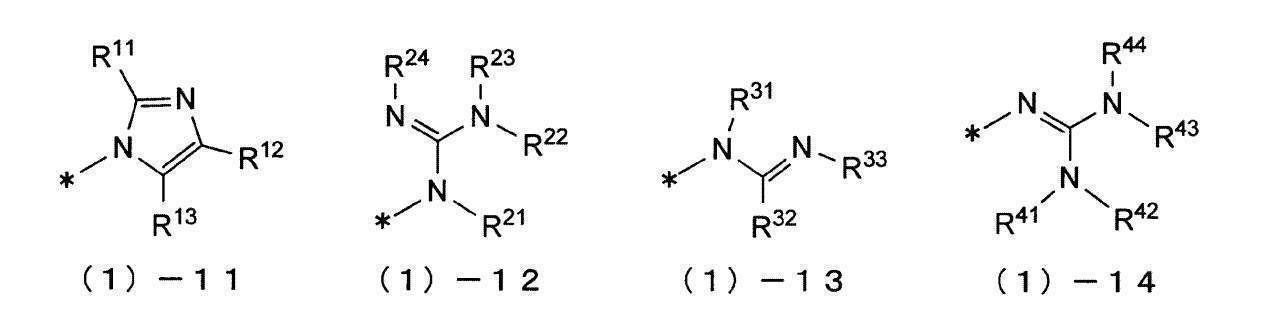
式中、R11、R12、R13、R21、R22、R23、R24、R31、R32、R33、R41、R42、R43及びR44は、それぞれ独立に、水素原子又は炭化水素基を表す。R11、R12及びR13のうちの2種以上が炭化水素基である場合、2種以上の炭化水素基が相互に結合して環を形成していてもよく、R21、R22、R23及びR24のうちの2種以上が炭化水素基である場合、2種以上の炭化水素基が相互に結合して環を形成していてもよく、R31、R32及びR33のうちの2種以上が炭化水素基である場合、2種以上の炭化水素基が相互に結合して環を形成していてもよく、R41、R42、R43及びR44のうちの2種以上が炭化水素基である場合、2種以上の炭化水素基が相互に結合して環を形成していてもよい。*は、炭素原子と結合する結合手を表す。
<3> 前記一般式(1)で表される化合物は、下記一般式(1)-Aで表される化合物及び下記一般式(1)-Bで表される化合物からなる群より選択される少なくとも一種の化合物を含む前記<2>に記載の硬化性組成物である。
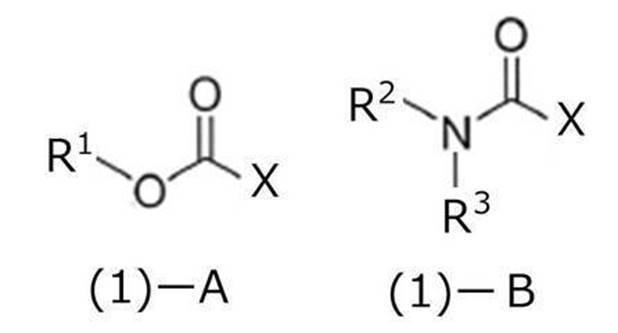
式中、R1は有機基を表し、R2及びR3は、それぞれ独立に、水素原子又は有機基を表す。Xは、それぞれ独立に、上記の一般式(1)-11、一般式(1)-12、一般式(1)-13又は一般式(1)-14で表される基を表す。R2及びR3の少なくとも一方は、有機基を表し、R2及びR3が有機基である場合、互いに結合して環を形成していてもよい。
<4> 更に、塩基発生剤を含有する前記<1>~前記<3>のいずれか1つに記載の硬化性組成物であるである。
<5> 前記塩基発生剤が、光照射又は加熱により塩基を発生する化合物である前記<4>に記載の硬化性組成物である。
<6> 前記<1>~前記<5>のいずれか1つに記載の硬化性組成物が硬化した硬化物である。
<7> 厚みが1×10⁻³m以上である前記<6>に記載の硬化物である。
<8> 前記<1>~前記<5>のいずれか1つに記載の硬化性組成物にエネルギーを付与し、生成した塩基を触媒としてウレタン結合を形成する工程を含む硬化物の製造方法である。
<9> 前記<4>又は前記<5>に記載の硬化性組成物にエネルギーを付与することにより、塩基発生剤から塩基を生成し、かつ、塩基増殖剤から塩基を生成し、
生成した塩基の一部は、多価アルコールの水酸基又はエポキシ化合物のエポキシ基を活性化し、前記塩基増殖剤からの塩基の生成を促進し、
生成した塩基の他の一部を触媒として、多価イソシアネート化合物と多価アルコールとのウレタン結合形成反応を開始し又は促進し、反応硬化物であるポリウレタンを製造する、硬化物の製造方法である。
<10> 前記エネルギーの付与が、光照射及び加熱の少なくとも一方である前記<8>又は前記<9>に記載の硬化物の製造方法である。
<11> 前記硬化性組成物が、厚みが1×10⁻³m以上の膜である前記<8>~前記<10>のいずれか1つに記載の硬化物の製造方法である。
<5> 前記塩基発生剤が、光照射又は加熱により塩基を発生する化合物である前記<4>に記載の硬化性組成物である。
<6> 前記<1>~前記<5>のいずれか1つに記載の硬化性組成物が硬化した硬化物である。
<7> 厚みが1×10⁻³m以上である前記<6>に記載の硬化物である。
<8> 前記<1>~前記<5>のいずれか1つに記載の硬化性組成物にエネルギーを付与し、生成した塩基を触媒としてウレタン結合を形成する工程を含む硬化物の製造方法である。
<9> 前記<4>又は前記<5>に記載の硬化性組成物にエネルギーを付与することにより、塩基発生剤から塩基を生成し、かつ、塩基増殖剤から塩基を生成し、
生成した塩基の一部は、多価アルコールの水酸基又はエポキシ化合物のエポキシ基を活性化し、前記塩基増殖剤からの塩基の生成を促進し、
生成した塩基の他の一部を触媒として、多価イソシアネート化合物と多価アルコールとのウレタン結合形成反応を開始し又は促進し、反応硬化物であるポリウレタンを製造する、硬化物の製造方法である。
<10> 前記エネルギーの付与が、光照射及び加熱の少なくとも一方である前記<8>又は前記<9>に記載の硬化物の製造方法である。
<11> 前記硬化性組成物が、厚みが1×10⁻³m以上の膜である前記<8>~前記<10>のいずれか1つに記載の硬化物の製造方法である。
本発明の一実施形態によれば、ラジカル重合又はカチオン重合における欠点を回避し、硬化感度に優れたアニオン重合系の硬化性組成物が提供される。
本発明の他の一実施形態によれば、良好に硬化された硬化物が提供される。
本発明の他の一実施形態によれば、ラジカル重合又はカチオン重合における欠点を回避しつつ、ウレタン結合形成反応を感度良く行える硬化物の製造方法が提供される。
本発明の他の一実施形態によれば、良好に硬化された硬化物が提供される。
本発明の他の一実施形態によれば、ラジカル重合又はカチオン重合における欠点を回避しつつ、ウレタン結合形成反応を感度良く行える硬化物の製造方法が提供される。
以下、本開示の硬化性組成物、並びに、硬化物及びその製造方法について詳細に説明する。
なお、本明細書中に記載の「~」の表記は、「~」の前後に記載される数値をそれぞれ最小値及び最大値として含む範囲を示す。本開示に段階的に記載されている数値範囲において、ある数値範囲で記載された上限値又は下限値は、他の段階的な記載の数値範囲の上限値又は下限値に置き換えてもよい。また、本開示に記載されている数値範囲において、ある数値範囲で記載された上限値又は下限値は、実施例に示されている値に置き換えてもよい。
また、本明細書中において、組成物中の各成分の量について言及する場合、組成物中に各成分に相当する物質が複数存在する場合には、特に断らない限り、組成物中に存在する複数の物質の合計量を意味する。
本明細書において、「工程」の語は、独立した工程だけではなく、他の工程と明確に区別できない場合であってもその工程の所期の目的が達成されれば、本用語に含まれる。
<硬化性組成物>
本開示の硬化性組成物は、多官能イソシアネート化合物と、多価アルコール及びエポキシ化合物からなる群より選択される化合物と、塩基増殖剤と、を含有し、好ましくは、更に塩基発生剤を含有する。また、本開示の硬化性組成物は、必要に応じて、更に、着色剤、又は添加剤等の他の成分を含有することができる。
本開示の硬化性組成物は、多官能イソシアネート化合物と、多価アルコール及びエポキシ化合物からなる群より選択される化合物と、塩基増殖剤と、を含有し、好ましくは、更に塩基発生剤を含有する。また、本開示の硬化性組成物は、必要に応じて、更に、着色剤、又は添加剤等の他の成分を含有することができる。
従来から、ラジカル重合系の硬化性組成物に用いられるラジカル発生剤は、酸素による重合阻害を受けやすい欠点があり、カチオン重合系に用いられる酸発生剤は、活性種である酸による金属等の腐食又は樹脂の変性が懸念され、金属を利用した材料又は部位には適用できない欠点がある。
これに対して、塩基発生剤は、ラジカル発生剤又は酸発生剤が有する欠点がないため、従来ラジカル発生剤又は酸発生剤が用いられてきた分野への適用が期待される。しかしながら、塩基発生剤は、感度が低く、満足のいく硬化性が得られない場合があるという欠点がある。硬化時の感度(硬化性)が従来以上に改善されれば、塩基性発生剤を用いたアニオン重合系による利用分野が著しく拡がることが予想される。
これに対して、塩基発生剤は、ラジカル発生剤又は酸発生剤が有する欠点がないため、従来ラジカル発生剤又は酸発生剤が用いられてきた分野への適用が期待される。しかしながら、塩基発生剤は、感度が低く、満足のいく硬化性が得られない場合があるという欠点がある。硬化時の感度(硬化性)が従来以上に改善されれば、塩基性発生剤を用いたアニオン重合系による利用分野が著しく拡がることが予想される。
本開示の硬化性組成物は、アニオン重合系の硬化性組成物の感度(硬化性)を改善したものである。
具体的には、本開示の硬化性組成物は、多官能イソシアネート化合物と多価アルコール及びエポキシ化合物からなる群より選択される化合物とに加え、塩基増殖剤を含有する。
塩基増殖剤が含有されることで、後述の「硬化物の製造方法」の項に示すスキームで表されるように、組成物中で生成された塩基が、多価アルコール及び/又はエポキシ化合物に作用し、塩基増殖剤からの塩基の生成が促進される。すなわち、生成された塩基の一部は、多価アルコールの水酸基及び/又はエポキシ化合物のエポキシ基を活性化し、塩基増殖剤からの塩基の生成反応を促進する。そして、生成された塩基の一部は、多価イソシアネート化合物と多価アルコールとのウレタン結合形成反応における触媒として機能する。塩基の生成が効率良く行われれば、ウレタン結合形成反応が促進され、反応感度を向上させることができる。
本開示の硬化性組成物では、組成物中で塩基が連鎖的に生成されるので、ウレタン形成反応がより速やかに(つまり感度良く)進行し、反応硬化物であるポリウレタンの製造が良好に行える。特に、硬化性組成物を例えば厚膜(例えば、0.5×10⁻³m以上の厚み)の膜状に形成した際の硬化性(ウレタン形成反応性)を向上し、膜の深部にまでウレタン結合形成反応を速やかに進行させることができる。
具体的には、本開示の硬化性組成物は、多官能イソシアネート化合物と多価アルコール及びエポキシ化合物からなる群より選択される化合物とに加え、塩基増殖剤を含有する。
塩基増殖剤が含有されることで、後述の「硬化物の製造方法」の項に示すスキームで表されるように、組成物中で生成された塩基が、多価アルコール及び/又はエポキシ化合物に作用し、塩基増殖剤からの塩基の生成が促進される。すなわち、生成された塩基の一部は、多価アルコールの水酸基及び/又はエポキシ化合物のエポキシ基を活性化し、塩基増殖剤からの塩基の生成反応を促進する。そして、生成された塩基の一部は、多価イソシアネート化合物と多価アルコールとのウレタン結合形成反応における触媒として機能する。塩基の生成が効率良く行われれば、ウレタン結合形成反応が促進され、反応感度を向上させることができる。
本開示の硬化性組成物では、組成物中で塩基が連鎖的に生成されるので、ウレタン形成反応がより速やかに(つまり感度良く)進行し、反応硬化物であるポリウレタンの製造が良好に行える。特に、硬化性組成物を例えば厚膜(例えば、0.5×10⁻³m以上の厚み)の膜状に形成した際の硬化性(ウレタン形成反応性)を向上し、膜の深部にまでウレタン結合形成反応を速やかに進行させることができる。
(多官能イソシアネート化合物)
本開示の硬化性組成物は、多官能イソシアネート化合物の少なくとも一種を含有する。多官能イソシアネート化合物が多価アルコールと反応することでポリウレタンが形成される。
多官能イソシアネート化合物(以下、「ポリイソシアネート」ともいう。)には、脂肪族ポリイソシアネート及び芳香族ポリイソシアネート等が含まれる。ポリイソシアネートは、2官能のポリイソシアネート及び3官能以上のポリイソシアネートからなる群から選択される化合物を任意に選択することができる。
本開示の硬化性組成物は、多官能イソシアネート化合物の少なくとも一種を含有する。多官能イソシアネート化合物が多価アルコールと反応することでポリウレタンが形成される。
多官能イソシアネート化合物(以下、「ポリイソシアネート」ともいう。)には、脂肪族ポリイソシアネート及び芳香族ポリイソシアネート等が含まれる。ポリイソシアネートは、2官能のポリイソシアネート及び3官能以上のポリイソシアネートからなる群から選択される化合物を任意に選択することができる。
脂肪族ポリイソシアネートとしては、例えば、トリメチレンジイソシアネート、プロピレン-1,2-ジイソシアネート、ブチレンジイソシアネート、ヘキサメチレンジイソシアネート、シクロヘキシレンジイソシアネート、ジシクロヘキシルメタンジイソシアネート、イソホロンジイソシアネート、水素化キシリレンジイソシアネート、1,4-ビス(イソシアネートメチル)シクロヘキサン、1,3-ビス(イソシアネートメチル)シクロヘキサン、リジンジイソシアネート等が挙げられる。
芳香族ポリイソシアネートとしては、例えば、m-フェニレンジイソシアネート、p-フェニレンジイソシアネート、トリレンジイソシアネート、ナフタレンジイソシアネート、ジフェニルメタンジイソシアネート、3,3’-ジメトキシ-ビフェニルジイソシアネート、3,3’-ジメチルジフェニルメタン-4,4’-ジイソシアネート、m-キシリレンジイソシアネート、4-クロロキシリレン-1,3-ジイソシアネート、2-メチルキシリレン-1,3-ジイソシアネート、4,4’-ジフェニルプロパンジイソシアネート、4,4’-ジフェニルヘキサフルオロプロパンジイソシアネート等が挙げられる。
中でも、m-キシリレンジイソシアネート(XDI)、トリレンジイソシアネート(TDI)、フェニレンジイソシアネート(PDI)、ジフェニルメタンジイソシアネート(MDI)、イソホロンジイソシアネート(IDI)、ヘキサメチレンジイソシアネート(HDI)が好適に挙げられる。
中でも、m-キシリレンジイソシアネート(XDI)、トリレンジイソシアネート(TDI)、フェニレンジイソシアネート(PDI)、ジフェニルメタンジイソシアネート(MDI)、イソホロンジイソシアネート(IDI)、ヘキサメチレンジイソシアネート(HDI)が好適に挙げられる。
上記では、2官能である脂肪族ポリイソシアネート及び芳香族ポリイソシアネートとしてジイソシアネート化合物を例示しているが、脂肪族ポリイソシアネート及び芳香族ポリイソシアネートとして、ジイソシアネート化合物から類推される3官能のトリイソシアネート化合物及び4官能のテトライソシアネート化合物も含まれる。
3官能以上のポリイソシアネートとしては、2官能の脂肪族イソシアネート化合物(分子中に2つのイソシアネート基を有する化合物)と分子中に3つ以上の活性水素基を有する化合物(3官能以上の例えばポリオール、ポリアミン又はポリチオール等)とのアダクト体(付加物)とした3官能以上のアダクト型イソシアネート化合物、2官能の脂肪族イソシアネート化合物の3量体であるビウレット型もしくはイソシアヌレート型イソシアネート化合物等が挙げられる。
3官能以上のポリイソシアネートとしては、2官能の脂肪族イソシアネート化合物(分子中に2つのイソシアネート基を有する化合物)と分子中に3つ以上の活性水素基を有する化合物(3官能以上の例えばポリオール、ポリアミン又はポリチオール等)とのアダクト体(付加物)とした3官能以上のアダクト型イソシアネート化合物、2官能の脂肪族イソシアネート化合物の3量体であるビウレット型もしくはイソシアヌレート型イソシアネート化合物等が挙げられる。
ポリイソシアネートの硬化性組成物中における含有量としては、硬化性組成物の全質量に対して、90質量%~10質量%が好ましく、80質量%~50質量%がより好ましい。
(多価アルコール)
本開示の硬化性組成物は、後述のエポキシ化合物を含有せず又は含有すると共に、多価アルコール(以下、「ポリオール」ともいう。)の少なくとも一種を含有することができる。
本開示の硬化性組成物は、後述のエポキシ化合物を含有せず又は含有すると共に、多価アルコール(以下、「ポリオール」ともいう。)の少なくとも一種を含有することができる。
ポリオールとしては、例えば、エチレングリコール、ポリエチレングリコール(重合度は2~5又は6以上でもよい。)、プロピレングリコール、ポリプロピレングリコール(重合度は2~5又は6以上でもよい。)、3-メチル-1,3-ブタンジオール、1,3-ブチレングリコール、イソプレングリコール、1,2-ペンタンジオール、1,2-ヘキサンジオール、グリセリン、ポリグリセリン(重合度は2~5又は6以上でもよい。)、ペンタエリスリトール、N,N,N’,N’-テトラキス(2-ヒドロキシプロピル)エチレンジアミンなどが挙げられる。
ポリオールの硬化性組成物中における含有量としては、硬化性組成物の全質量に対して、90質量%~10質量%が好ましく、60質量%~20質量%がより好ましい。
(エポキシ化合物)
本開示の硬化性組成物は、既述の多価アルコールを含有せず又は含有すると共に、エポキシ化合物の少なくとも一種を含有することができる。
本開示の硬化性組成物は、既述の多価アルコールを含有せず又は含有すると共に、エポキシ化合物の少なくとも一種を含有することができる。
エポキシ化合物を用いることで、多価アルコールの含有量を減らすことができ、また必要により、多価アルコールを含有しない組成とすることが可能である。多価アルコールを含有する組成では、共存する塩基増殖剤との反応(エネルギー付与前のヒドロキシ基の反応)が進行しやすく、例えば長期保存した際の組成物の安定性が低下しやすい傾向がある。多価アルコールの一部又は全部をエポキシ化合物に代替することで、硬化性組成物の安定性をより高めることができ、硬化性組成物のポットライフをより向上させることができる。
エポキシ化合物としては、1分子中に1以上のエポキシ基を有する化合物であれば特に制限されるものではなく、単量体、オリゴマー及びポリマーから選択されるいずれの化合物でもよい。
エポキシ単量体の例としては、エチルグリシジルエーテル、グリシジルフェニルエーテル、2-エチルペンチルグリシジルエーテル、ブチルグリシジルエーテル、及び以下に示す構造の化合物等の単量体、並びに、エポキシ樹脂等のポリマーを挙げることができる。
エポキシ単量体の例としては、エチルグリシジルエーテル、グリシジルフェニルエーテル、2-エチルペンチルグリシジルエーテル、ブチルグリシジルエーテル、及び以下に示す構造の化合物等の単量体、並びに、エポキシ樹脂等のポリマーを挙げることができる。
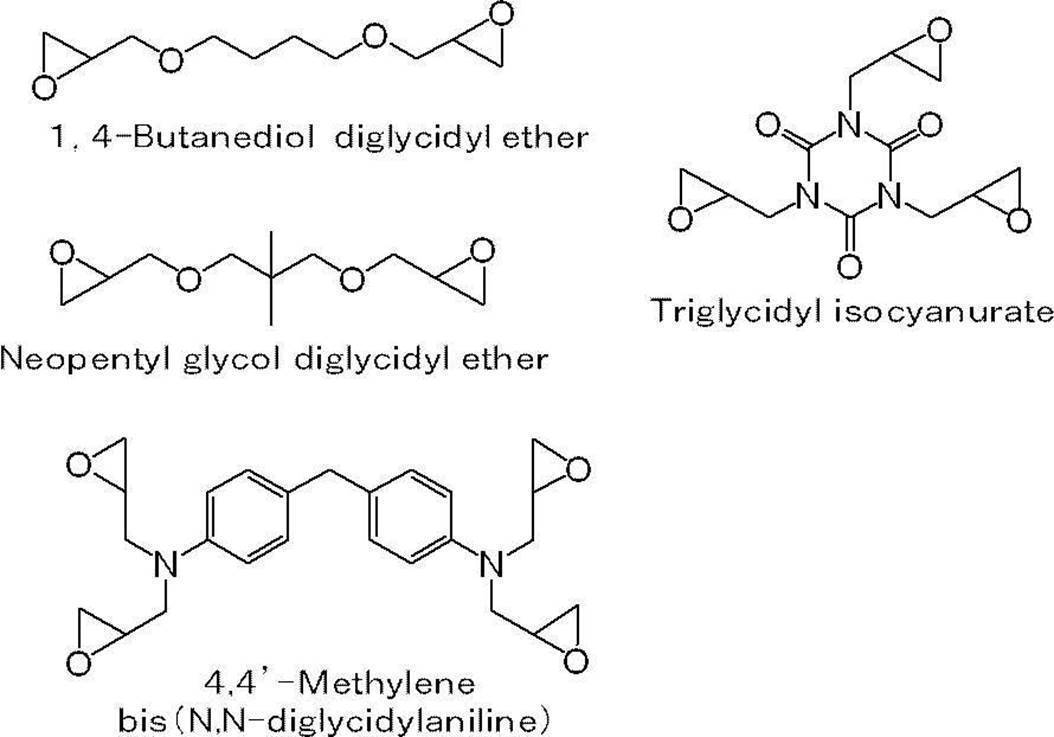
また、エポキシ単量体には、上市されている市販品を用いてもよく、市販品の例としては、ナガセケムテックス株式会社のグリシジルエーテル(例:デナコールEX-946L、デナコールEX-991、デナコールEX-991L、デナコールEX-992L)、グリシジルエステル(例:デナコールEX-1111、デナコールEX-1112)等、阪本薬品工業株式会社のモノエポキシタイプ(例:BGE-C、BGE-R、PGE)、ポリエポキシタイプ(例:SR-NPG、SR-14BL、SR-16H、SR-TMP、SR-PG、SR-TPG、SR-GLG、SR-DGE、SR-4GL)等が挙げられる。
エポキシ樹脂としては、例えば、ビスフェノールA型エポキシ樹脂、ビスフェノールF型エポキシ樹脂、ノボラックグリシジルエーテル型エポキシ樹脂等が挙げられる。
また、エポキシ樹脂には、上市されている市販品を用いてもよく、市販品の例としては、三菱ケミカル株式会社のjER828、jER806等、新日鉄住友化学株式会社のYDPN-638等、ナガセケムテックス株式会社のポリブタジエン型エポキシ樹脂(例:デナレックスR15EPT、デナレックスFCA-061L、デナレックスFCA-061M)等が挙げられる。
また、エポキシ樹脂には、上市されている市販品を用いてもよく、市販品の例としては、三菱ケミカル株式会社のjER828、jER806等、新日鉄住友化学株式会社のYDPN-638等、ナガセケムテックス株式会社のポリブタジエン型エポキシ樹脂(例:デナレックスR15EPT、デナレックスFCA-061L、デナレックスFCA-061M)等が挙げられる。
また、エポキシ化合物の他の例として、グリシジル基とヒドロキシ基とを有する化合物を挙げることができ、多価アルコールの代替化合物としてより好適である。具体的には、例えば、グリセロールポリグリシジルエーテル、ジグリセロールポリグリシジルエーテル、ポリグリセロールポリグリシジルエーテル、ペンタエリスリトールポリグリシジルエーテル、ソルビトールポリグリシジルエーテル等が挙げられる。
エポキシ化合物の硬化性組成物中における含有量としては、硬化性組成物の全質量に対して、90質量%~10質量%が好ましく、60質量%~20質量%がより好ましい。
(塩基増殖剤)
本開示の硬化性組成物は、塩基増殖剤(連鎖硬化剤)の少なくとも一種を含有する。
塩基増殖剤が含まれることにより、光又は熱等のエネルギーを付与した際、組成物中で塩基が連鎖的に生成されるので、ウレタン形成反応がより速やかに(つまり感度良く)進行する。結果、反応硬化物であるポリウレタンの製造が良好に行える。
本開示の硬化性組成物は、塩基増殖剤(連鎖硬化剤)の少なくとも一種を含有する。
塩基増殖剤が含まれることにより、光又は熱等のエネルギーを付与した際、組成物中で塩基が連鎖的に生成されるので、ウレタン形成反応がより速やかに(つまり感度良く)進行する。結果、反応硬化物であるポリウレタンの製造が良好に行える。
塩基増殖剤は、系内の塩基の作用で分解し、新たに塩基分子を発生する化合物である。このように、塩基による分解反応で新たに塩基を生成する自己触媒反応は、塩基増殖反応と呼ばれる。塩基増殖剤は、系内の塩基の作用で分解すること、その分解過程で塩基分子を新たに放出すること、及び塩基の非存在下では安定であることを満たすものが望ましい。塩基増殖剤は、その一定量に対してそれより少ない当量の塩基を作用させることで自己増殖的に分解し、最終的にその全量が分解し、その塩基増殖剤量に対応する多量の塩基を発生させることができる。
塩基増殖剤の例としては、分子内にカルバメート構造を有する化合物などを挙げることができる。カルバメート構造を有する化合物の場合、塩基として脂肪族アミンを生成する。また、塩基増殖剤は、多官能アミンを生成する化合物であってもよい。多官能アミンを生成する化合物は、硬化性の組成物の成分として好適である。塩基増殖剤の具体例としては、特開2000-330270号公報の段落0010~段落0032及び特開2006-20539の段落0116~段落0146に記載されている化合物などを挙げることができる。
なお、塩基増殖剤の詳細については、「光機能性高分子材料の新たな潮流-最新技術とその展望-」(市村國宏監修、シーエムシー出版、2008年)の記載を参照することができる。
塩基増殖剤の例としては、分子内にカルバメート構造を有する化合物などを挙げることができる。カルバメート構造を有する化合物の場合、塩基として脂肪族アミンを生成する。また、塩基増殖剤は、多官能アミンを生成する化合物であってもよい。多官能アミンを生成する化合物は、硬化性の組成物の成分として好適である。塩基増殖剤の具体例としては、特開2000-330270号公報の段落0010~段落0032及び特開2006-20539の段落0116~段落0146に記載されている化合物などを挙げることができる。
なお、塩基増殖剤の詳細については、「光機能性高分子材料の新たな潮流-最新技術とその展望-」(市村國宏監修、シーエムシー出版、2008年)の記載を参照することができる。
塩基増殖剤としては、下記一般式(1)で表される化合物が好適に挙げられる。
従来から知られている塩基発生剤は、光又は熱等のエネルギーを付与した際に塩基のみならず二酸化炭素(CO2)等のガスを発生する傾向がある。これに対し、一般式(1)で表される塩基増殖剤は、組成物中の塩基によって多価アルコール及び/又はエポキシ化合物から生成した水酸基を活性化して分解し塩基を発生する一方、二酸化炭素等のガスを放出することがない。また、塩基を放出した後の残基は、硬化物の内部に取り込まれる。すなわち、塩基増殖剤は、作用を発現する上で二酸化炭素及び他の不要な低分子の分解物を発生しない利点がある。
従来から知られている塩基発生剤は、光又は熱等のエネルギーを付与した際に塩基のみならず二酸化炭素(CO2)等のガスを発生する傾向がある。これに対し、一般式(1)で表される塩基増殖剤は、組成物中の塩基によって多価アルコール及び/又はエポキシ化合物から生成した水酸基を活性化して分解し塩基を発生する一方、二酸化炭素等のガスを放出することがない。また、塩基を放出した後の残基は、硬化物の内部に取り込まれる。すなわち、塩基増殖剤は、作用を発現する上で二酸化炭素及び他の不要な低分子の分解物を発生しない利点がある。
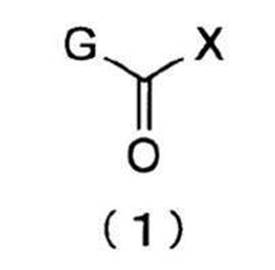
式中、Gは、有機基を表し、Xは、下記の一般式(1)-11、一般式(1)-12、一般式(1)-13又は一般式(1)-14で表される基を表す。
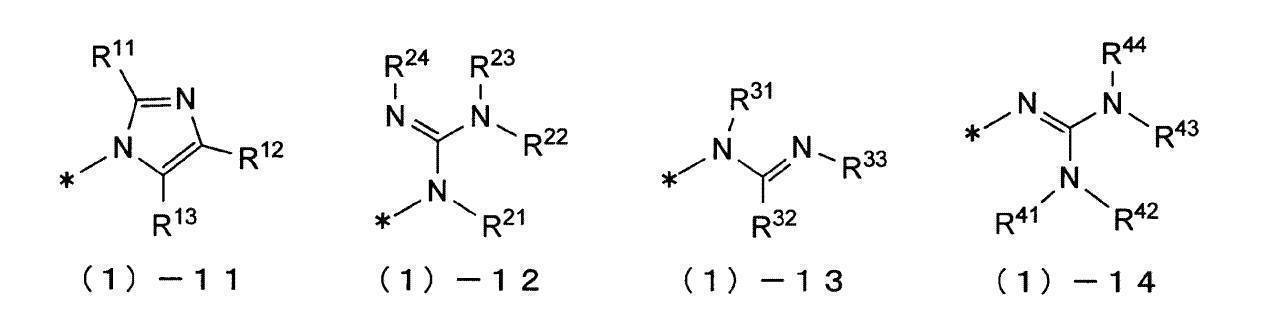
式中、R11、R12、R13、R21、R22、R23、R24、R31、R32、R33、R41、R42、R43及びR44は、それぞれ独立に、水素原子又は炭化水素基を表す。R11、R12及びR13のうちの2種以上が炭化水素基である場合、2種以上の炭化水素基が相互に結合して環を形成していてもよく、R21、R22、R23及びR24のうちの2種以上が炭化水素基である場合、2種以上の炭化水素基が相互に結合して環を形成していてもよく、R31、R32及びR33のうちの2種以上が炭化水素基である場合、2種以上の炭化水素基が相互に結合して環を形成していてもよく、R41、R42、R43及びR44のうちの2種以上が炭化水素基である場合、2種以上の炭化水素基が相互に結合して環を形成していてもよい。*は、カルボニル基の炭素原子と結合する結合手を表す。
一般式(1)で表される化合物は、X中の窒素原子とカルボニル基の炭素原子とが結合して形成されているカルボン酸アミド結合を有する化合物である。
また、一般式(1)で表される化合物は、構造中に存在するカルボニル基とXとの間の結合が特定の条件下で切断され、カルボニル基の炭素原子と結合していたX中の窒素原子が、水素原子と結合した構造の塩基性化合物(本明細書中では、単に「塩基」ともいう。)を生じるという特性を有する。本特性については後述する。
また、一般式(1)で表される化合物は、構造中に存在するカルボニル基とXとの間の結合が特定の条件下で切断され、カルボニル基の炭素原子と結合していたX中の窒素原子が、水素原子と結合した構造の塩基性化合物(本明細書中では、単に「塩基」ともいう。)を生じるという特性を有する。本特性については後述する。
一般式(1)で表される化合物は、後述するように、塩基の作用で塩基を発現する塩基変換作用を有すると共に、自己増殖的に塩基を生成する塩基増殖作用を有する。
一般式(1)において、Gは、有機基である。
有機基としては、特に制限されるものではなく、構成原子として炭素原子を含む1価の基の中から適宜選択することができる。本開示では、本開示の効果をより効果的に奏する観点から、隣接するカルボニル基とエステル構造又はアミド構造を形成する有機基が好ましい。有機機が、隣接するカルボニル基とエステル構造又はアミド構造を形成する有機基である場合、例えば、隣接するカルボニル基とエステル構造又はアミド構造を形成する部分以外が、炭化水素基等を有する置換基であってもよい。
有機基としては、特に制限されるものではなく、構成原子として炭素原子を含む1価の基の中から適宜選択することができる。本開示では、本開示の効果をより効果的に奏する観点から、隣接するカルボニル基とエステル構造又はアミド構造を形成する有機基が好ましい。有機機が、隣接するカルボニル基とエステル構造又はアミド構造を形成する有機基である場合、例えば、隣接するカルボニル基とエステル構造又はアミド構造を形成する部分以外が、炭化水素基等を有する置換基であってもよい。
有機機が、隣接するカルボニル基とエステル構造又はアミド構造を形成する有機基である場合、前記一般式(1)で表される化合物は、下記一般式(1)-Aで表される化合物及び下記一般式(1)-Bで表される化合物からなる群より選択される少なくとも一種の化合物を含むことが好ましい。
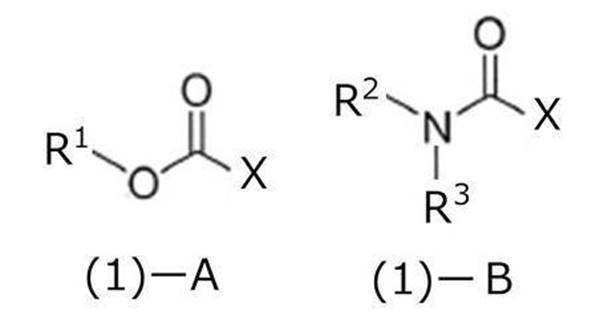
式中、R1は有機基を表し、R2及びR3は、それぞれ独立に、水素原子又は有機基を表す。Xは、それぞれ独立に、上記の一般式(1)-11、一般式(1)-12、一般式(1)-13又は一般式(1)-14で表される基を表す。R2及びR3の少なくとも一方は、有機基を表し、R2及びR3が有機基である場合、互いに結合して環を形成していてもよい。
一般式(1)中のG、一般式(1)-A中のR1、又は一般式(1)-B中のR2~R3おける有機基としては、例えば、置換基を有していてもよい炭化水素基が挙げられる。
ここで「炭化水素基が置換基を有する」とは、炭化水素基を構成する1個以上の水素原子が、水素原子以外の基(置換基)で置換されているか、又は炭化水素基を構成する1個以上の炭素原子が、若しくは前記炭素原子がこれに結合している1個以上の水素原子とともに、炭素原子又は1個以上の水素原子が結合している炭素原子とは異なる基(置換基)で置換されていることを意味する。そして、水素原子及び炭素原子がともに置換基で置換されていてもよい。
ここで「炭化水素基が置換基を有する」とは、炭化水素基を構成する1個以上の水素原子が、水素原子以外の基(置換基)で置換されているか、又は炭化水素基を構成する1個以上の炭素原子が、若しくは前記炭素原子がこれに結合している1個以上の水素原子とともに、炭素原子又は1個以上の水素原子が結合している炭素原子とは異なる基(置換基)で置換されていることを意味する。そして、水素原子及び炭素原子がともに置換基で置換されていてもよい。
前記炭化水素基は、脂肪族炭化水素基及び芳香族炭化水素基(アリール基)のいずれでもよく、1個以上の水素原子が芳香族炭化水素基で置換された脂肪族炭化水素基であってもよいし、環状の脂肪族炭化水素基と芳香族炭化水素基とが縮環してなる多環状の炭化水素基であってもよい。
前記脂肪族炭化水素基は、飽和脂肪族炭化水素基(アルキル基)及び不飽和脂肪族炭化水素基のいずれでもよい。
前記アルキル基は、直鎖状、分岐鎖状及び環状のいずれでもよく、環状である場合、単環状及び多環状のいずれでもよい。そして、前記アルキル基は、炭素数が1~20であることが好ましい。
前記脂肪族炭化水素基は、飽和脂肪族炭化水素基(アルキル基)及び不飽和脂肪族炭化水素基のいずれでもよい。
前記アルキル基は、直鎖状、分岐鎖状及び環状のいずれでもよく、環状である場合、単環状及び多環状のいずれでもよい。そして、前記アルキル基は、炭素数が1~20であることが好ましい。
直鎖状又は分岐鎖状のアルキル基としては、炭素数が1~20であることが好ましい。
直鎖状又は分岐鎖状のアルキル基の例としては、メチル基、エチル基、n-プロピル基、イソプロピル基、n-ブチル基、イソブチル基、sec-ブチル基、tert-ブチル基、n-ペンチル基、イソペンチル基、ネオペンチル基、tert-ペンチル基、1-メチルブチル基、n-ヘキシル基、2-メチルペンチル基、3-メチルペンチル基、2,2-ジメチルブチル基、2,3-ジメチルブチル基、n-ヘプチル基、2-メチルヘキシル基、3-メチルヘキシル基、2,2-ジメチルペンチル基、2,3-ジメチルペンチル基、2,4-ジメチルペンチル基、3,3-ジメチルペンチル基、3-エチルペンチル基、2,2,3-トリメチルブチル基、n-オクチル基、イソオクチル基、2-エチルヘキシル基、ノニル基、デシル基、ウンデシル基、ドデシル基、トリデシル基、テトラデシル基、ペンタデシル基、ヘキサデシル基、ヘプタデシル基、オクタデシル基、ノナデシル基、イコシル基等が挙げられる。
直鎖状又は分岐鎖状のアルキル基の例としては、メチル基、エチル基、n-プロピル基、イソプロピル基、n-ブチル基、イソブチル基、sec-ブチル基、tert-ブチル基、n-ペンチル基、イソペンチル基、ネオペンチル基、tert-ペンチル基、1-メチルブチル基、n-ヘキシル基、2-メチルペンチル基、3-メチルペンチル基、2,2-ジメチルブチル基、2,3-ジメチルブチル基、n-ヘプチル基、2-メチルヘキシル基、3-メチルヘキシル基、2,2-ジメチルペンチル基、2,3-ジメチルペンチル基、2,4-ジメチルペンチル基、3,3-ジメチルペンチル基、3-エチルペンチル基、2,2,3-トリメチルブチル基、n-オクチル基、イソオクチル基、2-エチルヘキシル基、ノニル基、デシル基、ウンデシル基、ドデシル基、トリデシル基、テトラデシル基、ペンタデシル基、ヘキサデシル基、ヘプタデシル基、オクタデシル基、ノナデシル基、イコシル基等が挙げられる。
環状のアルキル基としては、炭素数が3~20であることが好ましい。
環状のアルキル基の例としては、シクロプロピル基、シクロブチル基、シクロペンチル基、シクロヘキシル基、シクロヘプチル基、シクロオクチル基、シクロノニル基、シクロデシル基、ノルボルニル基、イソボルニル基、1-アダマンチル基、2-アダマンチル基、トリシクロデシル基等が挙げられ、さらに、これら環状のアルキル基の1個以上の水素原子が、直鎖状、分岐鎖状又は環状のアルキル基で置換されたものが挙げられる。ここで、水素原子を置換する直鎖状、分岐鎖状及び環状のアルキル基としては、アルキル基として例示した上記のものが挙げられる。
環状のアルキル基の例としては、シクロプロピル基、シクロブチル基、シクロペンチル基、シクロヘキシル基、シクロヘプチル基、シクロオクチル基、シクロノニル基、シクロデシル基、ノルボルニル基、イソボルニル基、1-アダマンチル基、2-アダマンチル基、トリシクロデシル基等が挙げられ、さらに、これら環状のアルキル基の1個以上の水素原子が、直鎖状、分岐鎖状又は環状のアルキル基で置換されたものが挙げられる。ここで、水素原子を置換する直鎖状、分岐鎖状及び環状のアルキル基としては、アルキル基として例示した上記のものが挙げられる。
また、前記不飽和脂肪族炭化水素基は、直鎖状、分岐鎖状及び環状のいずれでもよい。
環状の不飽和脂肪族炭化水素基の場合、単環状及び多環状のいずれでもよく、不飽和脂肪族炭化水素基の炭素数は2~20が好ましい。
不飽和脂肪族炭化水素基の例としては、上記のアルキル基中の炭素原子間の1個以上の単結合(C-C)が、不飽和結合である二重結合(C=C)又は三重結合(C≡C)で置換されてなる基が挙げられる。
環状の不飽和脂肪族炭化水素基の場合、単環状及び多環状のいずれでもよく、不飽和脂肪族炭化水素基の炭素数は2~20が好ましい。
不飽和脂肪族炭化水素基の例としては、上記のアルキル基中の炭素原子間の1個以上の単結合(C-C)が、不飽和結合である二重結合(C=C)又は三重結合(C≡C)で置換されてなる基が挙げられる。
前記不飽和脂肪族炭化水素基において、不飽和結合の数は1個のみでもよいし、2個以上でもよく、2個以上である場合、これら不飽和結合は二重結合のみでもよいし、三重結合のみでもよく、二重結合及び三重結合が混在していてもよい。
前記不飽和脂肪族炭化水素基において、不飽和結合の位置は特に限定されない。
前記不飽和脂肪族炭化水素基において、不飽和結合の位置は特に限定されない。
前記不飽和脂肪族炭化水素基で好ましいものとしては、例えば、前記不飽和結合が1個のものに相当する、直鎖状又は分岐鎖状のものであるアルケニル基及びアルキニル基、並びに環状のものであるシクロアルケニル基及びシクロアルキニル基が挙げられる。
前記アルケニル基としては、例えば、エテニル基(ビニル基)、2-プロペニル基(アリル基)、シクロヘキセニル基等が挙げられる。
前記アルケニル基としては、例えば、エテニル基(ビニル基)、2-プロペニル基(アリル基)、シクロヘキセニル基等が挙げられる。
前記アリール基は、単環状及び多環状のいずれでもよく、炭素数が6~20であることが好ましい。このようなアリール基としては、例えば、フェニル基、1-ナフチル基、2-ナフチル基、o-トリル基、m-トリル基、p-トリル基、キシリル基(ジメチルフェニル基)等が挙げられ、これらアリール基の1個以上の水素原子が、さらにこれらアリール基や、前記アルキル基で置換されたものも挙げられる。これら置換基を有するアリール基は、置換基も含めて炭素数が6~20であることが好ましい。
前記炭化水素基のうち、1個以上の水素原子が芳香族炭化水素基(アリール基)で置換された脂肪族炭化水素基としては、例えば、水素原子の置換数が1であるものであれば、フェニルメチル基(ベンジル基)、2-フェニルエチル基(フェネチル基)等のアリールアルキル基(アラルキル基)が挙げられる。
前記炭化水素基において、1個以上の水素原子が置換される置換基としては、例えば、アルコキシ基、アリールオキシ基、ジアルキルアミノ基、ジアリールアミノ基、アルキルアリールアミノ基、アルキルカルボニル基、アリールカルボニル基、ヘテロアリールカルボニル基、アルキルオキシカルボニル基、アリールオキシカルボニル基、アルキルカルボニルオキシ基、アリールカルボニルオキシ基、アルキルチオ基、アリールチオ基、酸素原子(-O-)、シアノ基(-CN)、ハロゲン原子、ニトロ基、ハロアルキル基(ハロゲン化アルキル基)、水酸基(-OH)、メルカプト基(-SH)等が挙げられる。
前記炭化水素基において、水素原子を置換する前記置換基は、1個のみでもよいし、2個以上でもよく、すべての水素原子が前記置換基で置換されていてもよい。
前記炭化水素基において、水素原子を置換する前記置換基が2個以上である場合、これら置換基は、すべて同一であってもよいし、すべて異なっていてもよく、一部のみ同一であってもよい。
前記炭化水素基において、水素原子を置換する前記置換基が2個以上である場合、これら置換基は、すべて同一であってもよいし、すべて異なっていてもよく、一部のみ同一であってもよい。
置換基である前記アルコキシ基としては、例えば、メトキシ基、エトキシ基、n-プロポキシ基、イソプロポキシ基、シクロプロポキシ基等、前記アルキル基が酸素原子に結合してなる1価の基が挙げられる。
置換基である前記アリールオキシ基としては、例えば、フェニルオキシ基(フェノキシ基)、1-ナフチルオキシ基、2-ナフチルオキシ基等、前記アリール基が酸素原子に結合してなる1価の基が挙げられる。
置換基である前記アリールオキシ基としては、例えば、フェニルオキシ基(フェノキシ基)、1-ナフチルオキシ基、2-ナフチルオキシ基等、前記アリール基が酸素原子に結合してなる1価の基が挙げられる。
置換基である前記ジアルキルアミノ基としては、例えば、ジメチルアミノ基、メチルエチルアミノ基等、アミノ基(-NH2)の2個の水素原子が、前記アルキル基で置換されてなる1価の基が挙げられる。前記ジアルキルアミノ基において、窒素原子に結合している2個のアルキル基は、互いに同一でも、異なっていてもよい。
置換基である前記ジアリールアミノ基としては、例えば、ジフェニルアミノ基、フェニル-1-ナフチルアミノ基等、アミノ基の2個の水素原子が、前記アリール基で置換されてなる1価の基が挙げられる。前記ジアリールアミノ基において、窒素原子に結合している2個のアリール基は、互いに同一でも、異なっていてもよい。
置換基である前記アルキルアリールアミノ基としては、例えば、メチルフェニルアミノ基等、アミノ基の2個の水素原子のうち、1個の水素原子が前記アルキル基で置換され、1個の水素原子が前記アリール基で置換されてなる1価の基が挙げられる。
置換基である前記ジアリールアミノ基としては、例えば、ジフェニルアミノ基、フェニル-1-ナフチルアミノ基等、アミノ基の2個の水素原子が、前記アリール基で置換されてなる1価の基が挙げられる。前記ジアリールアミノ基において、窒素原子に結合している2個のアリール基は、互いに同一でも、異なっていてもよい。
置換基である前記アルキルアリールアミノ基としては、例えば、メチルフェニルアミノ基等、アミノ基の2個の水素原子のうち、1個の水素原子が前記アルキル基で置換され、1個の水素原子が前記アリール基で置換されてなる1価の基が挙げられる。
置換基である前記アルキルカルボニル基としては、例えば、メチルカルボニル基(アセチル基)等、前記アルキル基がカルボニル基(-C(=O)-)に結合してなる1価の基が挙げられる。
置換基である前記アリールカルボニル基としては、例えば、フェニルカルボニル基(ベンゾイル基)等、前記アリール基がカルボニル基に結合してなる1価の基が挙げられる。
置換基であるヘテロアリールカルボニル基としては、えば、イミダゾリルカルボニル基、ピラゾリルカルボニル基、ピラジニルカルボニル基等、芳香族複素環基(ヘテロアリール基)とカルボニル基とが結合してなる1価の基が挙げられる。
置換基である前記アリールカルボニル基としては、例えば、フェニルカルボニル基(ベンゾイル基)等、前記アリール基がカルボニル基に結合してなる1価の基が挙げられる。
置換基であるヘテロアリールカルボニル基としては、えば、イミダゾリルカルボニル基、ピラゾリルカルボニル基、ピラジニルカルボニル基等、芳香族複素環基(ヘテロアリール基)とカルボニル基とが結合してなる1価の基が挙げられる。
置換基である前記アルキルオキシカルボニル基としては、例えば、メチルオキシカルボニル基(メトキシカルボニル基)等、前記アルコキシ基がカルボニル基に結合してなる1価の基が挙げられる。
置換基である前記アリールオキシカルボニル基としては、例えば、フェニルオキシカルボニル基(フェノキシカルボニル基)等、前記アリールオキシ基がカルボニル基に結合してなる1価の基が挙げられる。
置換基である前記アリールオキシカルボニル基としては、例えば、フェニルオキシカルボニル基(フェノキシカルボニル基)等、前記アリールオキシ基がカルボニル基に結合してなる1価の基が挙げられる。
置換基である前記アルキルカルボニルオキシ基としては、例えば、メチルカルボニルオキシ基等、前記アルキル基がカルボニルオキシ基(-C(=O)-O-)の炭素原子に結合してなる1価の基が挙げられる。
置換基である前記アリールカルボニルオキシ基としては、例えば、フェニルカルボニルオキシ基等、前記アリール基がカルボニルオキシ基の炭素原子に結合してなる1価の基が挙げられる。
置換基である前記アリールカルボニルオキシ基としては、例えば、フェニルカルボニルオキシ基等、前記アリール基がカルボニルオキシ基の炭素原子に結合してなる1価の基が挙げられる。
置換基である前記アルキルチオ基としては、例えば、メチルチオ基、エチルチオ基、n-プロピルチオ基、イソプロピルチオ基、シクロプロピルチオ基等、前記アルキル基が硫黄原子に結合してなる1価の基が挙げられる。
置換基である前記アリールチオ基としては、例えば、フェニルチオ基、1-ナフチルチオ基、2-ナフチルチオ基等、前記アリール基が硫黄原子に結合してなる1価の基が挙げられる。
置換基である前記アリールチオ基としては、例えば、フェニルチオ基、1-ナフチルチオ基、2-ナフチルチオ基等、前記アリール基が硫黄原子に結合してなる1価の基が挙げられる。
置換基である前記ハロゲン原子としては、例えば、フッ素原子(-F)、塩素原子(-Cl)、臭素原子(-Br)、ヨウ素原子(-I)が挙げられる。
置換基である前記ハロアルキル基としては、前記アルキル基の1個以上の水素原子がハロゲン原子で置換されてなる基が挙げられる。
ハロアルキル基におけるハロゲン原子としては、置換基であるハロゲン原子として例示した上記のものが挙げられる。
ハロアルキル基におけるハロゲン原子の数は、特に限定されず、1個でもよいし、2個以上でもよい。ハロアルキル基におけるハロゲン原子の数が2個以上である場合、これら複数個のハロゲン原子は、すべて同一であってもよいし、すべて異なっていてもよく、一部のみ同一であってもよい。ハロアルキル基は、アルキル基中のすべての水素原子がハロゲン原子で置換されたパーハロアルキル基であってもよい。
ハロアルキル基としては、例えば、クロロメチル基、ジクロロメチル基、トリクロロメチル基、トリフルオロメチル基等が挙げられるが、これらに限定されない。
ハロアルキル基におけるハロゲン原子としては、置換基であるハロゲン原子として例示した上記のものが挙げられる。
ハロアルキル基におけるハロゲン原子の数は、特に限定されず、1個でもよいし、2個以上でもよい。ハロアルキル基におけるハロゲン原子の数が2個以上である場合、これら複数個のハロゲン原子は、すべて同一であってもよいし、すべて異なっていてもよく、一部のみ同一であってもよい。ハロアルキル基は、アルキル基中のすべての水素原子がハロゲン原子で置換されたパーハロアルキル基であってもよい。
ハロアルキル基としては、例えば、クロロメチル基、ジクロロメチル基、トリクロロメチル基、トリフルオロメチル基等が挙げられるが、これらに限定されない。
前記炭化水素基において、水素原子を置換する前記置換基の数は、置換可能な水素原子の数にもよるが、1~4個であることが好ましく、1~3個であることがより好ましく、1又は2個であることが特に好ましい。
前記炭化水素基において、1個以上の炭素原子が、又は前記炭素原子がこれに結合している1個以上の水素原子とともに置換される置換基としては、例えば、窒素原子、酸素原子、硫黄原子等のヘテロ原子が挙げられる。
前記炭化水素基において、炭素原子又は水素原子が結合している炭素原子を置換する前記置換基は、1個のみでもよいし、2個以上でもよく、すべての炭素原子が単独で若しくは前記炭素原子に結合している水素原子とともに、置換基で置換されていてもよい。
前記炭化水素基において、炭素原子又は水素原子が結合している炭素原子を置換する前記置換基が2個以上である場合、これら置換基は、すべて同一であってもよいし、すべて異なっていてもよく、一部のみ同一であってもよい。
前記炭化水素基において、炭素原子又は水素原子が結合している炭素原子を置換する前記置換基が2個以上である場合、これら置換基は、すべて同一であってもよいし、すべて異なっていてもよく、一部のみ同一であってもよい。
ヘテロ原子で置換されている前記炭化水素基のうち、芳香族炭化水素基、すなわち、芳香族複素環基(ヘテロアリール基)としては、各種の芳香族複素環化合物から、その環骨格を構成する炭素原子又はヘテロ原子に結合している1個の水素原子を除いてなる基が挙げられる。
前記芳香族複素環化合物で好ましいものとしては、含硫黄芳香族複素環化合物(芳香族複素環骨格を構成する原子として1個以上の硫黄原子を有する化合物)、含窒素芳香族複素環化合物(芳香族複素環骨格を構成する原子として1個以上の窒素原子を有する化合物)、含酸素芳香族複素環化合物(芳香族複素環骨格を構成する原子として1個以上の酸素原子を有する化合物)、硫黄原子、窒素原子及び酸素原子から選択される互いに異なる2個のヘテロ原子を、芳香族複素環骨格を構成する原子として有する化合物が挙げられる。
前記芳香族複素環化合物で好ましいものとしては、含硫黄芳香族複素環化合物(芳香族複素環骨格を構成する原子として1個以上の硫黄原子を有する化合物)、含窒素芳香族複素環化合物(芳香族複素環骨格を構成する原子として1個以上の窒素原子を有する化合物)、含酸素芳香族複素環化合物(芳香族複素環骨格を構成する原子として1個以上の酸素原子を有する化合物)、硫黄原子、窒素原子及び酸素原子から選択される互いに異なる2個のヘテロ原子を、芳香族複素環骨格を構成する原子として有する化合物が挙げられる。
前記含硫黄芳香族複素環化合物としては、例えば、チオフェン、ベンゾチオフェン等が挙げられる。
前記含窒素芳香族複素環化合物としては、例えば、ピロール、イミダゾール、ピラゾール、ピリジン、ピラジン、ピリミジン、ピリダジン、トリアジン、インドール、イソインドール、ベンゾイミダゾール、プリン、インダゾール、キノリン、イソキノリン、キノキサリン、キナゾリン、シンノリン等が挙げられる。
前記含酸素芳香族複素環化合物としては、例えば、フラン、ベンゾフラン(1-ベンゾフラン)、イソベンゾフラン(2-ベンゾフラン)等が挙げられる。
前記含窒素芳香族複素環化合物としては、例えば、ピロール、イミダゾール、ピラゾール、ピリジン、ピラジン、ピリミジン、ピリダジン、トリアジン、インドール、イソインドール、ベンゾイミダゾール、プリン、インダゾール、キノリン、イソキノリン、キノキサリン、キナゾリン、シンノリン等が挙げられる。
前記含酸素芳香族複素環化合物としては、例えば、フラン、ベンゾフラン(1-ベンゾフラン)、イソベンゾフラン(2-ベンゾフラン)等が挙げられる。
上述の互いに異なる2個のヘテロ原子を、芳香族複素環骨格を構成する原子として有する化合物としては、例えば、オキサゾール、イソオキサゾール、チアゾール、ベンゾオキサゾール、ベンゾイソオキサゾール、ベンゾチアゾール等が挙げられる。
前記炭化水素基において、炭素原子又は水素原子が結合している炭素原子を置換する前記置換基の数は、置換可能な炭素原子にもよるが、1~3個であることが好ましく、1又は2個であることがより好ましい。
上記のうち、一般式(1)におけるGとしては、アルキル基の1個の水素原子がカルボニル基で置換されたアルコキシ基、又はアリール基の1個の水素原子が置換基で置換された置換アリール基(好ましくは、ヘテロアリールカルボニル基で置換されたフェニル基)が好適に挙げられる。
Gがアルコキシ基である化合物のうち、一般式(1)-Aで表される化合物が好適である。
Gがアルコキシ基である化合物のうち、一般式(1)-Aで表される化合物が好適である。
一般式(1)-A及び一般式(1)-B中のR1~R3における有機基としては、それぞれ独立に、置換基を有していてもよいアルキル基、置換基を有していてもよいアルケニル基、置換基を有していてもよいアリール基、置換基を有していてもよいヘテロアリール基、又は置換基を有していてもよいアリールアルキル基であることが好ましく、置換基を有していてもよいアルキル基であることがより好ましい。
ここでの置換基は、炭化水素基が有するものとして説明した上記置換基と同様である。
中でも、R1及びR2が、それぞれ独立に、置換基を有していてもよいアルキル基、置換基を有していてもよいアルケニル基、置換基を有していてもよいアリール基、置換基を有していてもよいヘテロアリール基、又は置換基を有していてもよいアリールアルキル基であって、かつ、R3が水素原子である場合が好ましく、R1及びR2が置換基を有していてもよいアルキル基であって、かつ、R3が水素原子である場合がより好ましい。
ここでの置換基は、炭化水素基が有するものとして説明した上記置換基と同様である。
中でも、R1及びR2が、それぞれ独立に、置換基を有していてもよいアルキル基、置換基を有していてもよいアルケニル基、置換基を有していてもよいアリール基、置換基を有していてもよいヘテロアリール基、又は置換基を有していてもよいアリールアルキル基であって、かつ、R3が水素原子である場合が好ましく、R1及びR2が置換基を有していてもよいアルキル基であって、かつ、R3が水素原子である場合がより好ましい。
次に、上記の一般式(1)、一般式(1)-A及び一般式(1)-BにおけるXについて説明する。
Xは、上記の一般式(1)-11、一般式(1)-12、一般式(1)-13又は一般式(1)-14で表される基である。
また、符号*を付した結合は、Xの結合先である炭素原子、すなわち、一般式(1)中の、Gが結合しているカルボニル基中の炭素原子に対して形成されている。
Xは、上記の一般式(1)-11、一般式(1)-12、一般式(1)-13又は一般式(1)-14で表される基である。
また、符号*を付した結合は、Xの結合先である炭素原子、すなわち、一般式(1)中の、Gが結合しているカルボニル基中の炭素原子に対して形成されている。
一般式(1)-11、一般式(1)-12、一般式(1)-13又は一般式(1)-14において、R11、R12、R13、R21、R22、R23、R24、R31、R32、R33、R41、R42、R43及びR44は、それぞれ独立に、水素原子又は炭化水素基である。
すなわち、一般式(1)-11におけるR11、R12及びR13(以下、「R11~R13」と略記することがある)は、すべて同一であってもよいし、すべて異なっていてもよく、一部のみ同一であってもよい。
同様に、一般式(1)-12におけるR21、R22、R23及びR24(以下、「R21~R24」と略記することがある)は、すべて同一であってもよいし、すべて異なっていてもよく、一部のみ同一であってもよい。
同様に、一般式(1)-13におけるR31、R32及びR33(以下、「R31~R33」と略記することがある)は、すべて同一であってもよいし、すべて異なっていてもよく、一部のみ同一であってもよい。
同様に、一般式(1)-14におけるR41、R42、R43及びR44(以下、「R41~R44」と略記することがある)は、すべて同一であってもよいし、すべて異なっていてもよく、一部のみ同一であってもよい。
すなわち、一般式(1)-11におけるR11、R12及びR13(以下、「R11~R13」と略記することがある)は、すべて同一であってもよいし、すべて異なっていてもよく、一部のみ同一であってもよい。
同様に、一般式(1)-12におけるR21、R22、R23及びR24(以下、「R21~R24」と略記することがある)は、すべて同一であってもよいし、すべて異なっていてもよく、一部のみ同一であってもよい。
同様に、一般式(1)-13におけるR31、R32及びR33(以下、「R31~R33」と略記することがある)は、すべて同一であってもよいし、すべて異なっていてもよく、一部のみ同一であってもよい。
同様に、一般式(1)-14におけるR41、R42、R43及びR44(以下、「R41~R44」と略記することがある)は、すべて同一であってもよいし、すべて異なっていてもよく、一部のみ同一であってもよい。
R11~R13、R21~R24、R31~R33、及びR41~R44における前記炭化水素基は、脂肪族炭化水素基及び芳香族炭化水素基(アリール基)のいずれでもよく、1個以上の水素原子が芳香族炭化水素基で置換された脂肪族炭化水素基であってもよいし、環状の脂肪族炭化水素基と芳香族炭化水素基とが縮環してなる多環状の炭化水素基であってもよい。
前記脂肪族炭化水素基は、飽和脂肪族炭化水素基(アルキル基)及び不飽和脂肪族炭化水素基のいずれでもよい。
前記アルキル基は、直鎖状、分岐鎖状及び環状のいずれでもよく、環状である場合、単環状及び多環状のいずれでもよい。そして、前記アルキル基は、炭素数が1~20であることが好ましい。
直鎖状又は分岐鎖状のアルキル基は、炭素数が1~20であることが好ましい。
直鎖状又は分岐鎖状のアルキル基の例としては、メチル基、エチル基、n-プロピル基、イソプロピル基、n-ブチル基、イソブチル基、sec-ブチル基、tert-ブチル基、n-ペンチル基、イソペンチル基、ネオペンチル基、tert-ペンチル基、1-メチルブチル基、n-ヘキシル基、2-メチルペンチル基、3-メチルペンチル基、2,2-ジメチルブチル基、2,3-ジメチルブチル基、n-ヘプチル基、2-メチルヘキシル基、3-メチルヘキシル基、2,2-ジメチルペンチル基、2,3-ジメチルペンチル基、2,4-ジメチルペンチル基、3,3-ジメチルペンチル基、3-エチルペンチル基、2,2,3-トリメチルブチル基、n-オクチル基、イソオクチル基、2-エチルヘキシル基、ノニル基、デシル基、ウンデシル基、ドデシル基、トリデシル基、テトラデシル基、ペンタデシル基、ヘキサデシル基、ヘプタデシル基、オクタデシル基、ノナデシル基、イコシル基等が挙げられる。
直鎖状又は分岐鎖状のアルキル基の例としては、メチル基、エチル基、n-プロピル基、イソプロピル基、n-ブチル基、イソブチル基、sec-ブチル基、tert-ブチル基、n-ペンチル基、イソペンチル基、ネオペンチル基、tert-ペンチル基、1-メチルブチル基、n-ヘキシル基、2-メチルペンチル基、3-メチルペンチル基、2,2-ジメチルブチル基、2,3-ジメチルブチル基、n-ヘプチル基、2-メチルヘキシル基、3-メチルヘキシル基、2,2-ジメチルペンチル基、2,3-ジメチルペンチル基、2,4-ジメチルペンチル基、3,3-ジメチルペンチル基、3-エチルペンチル基、2,2,3-トリメチルブチル基、n-オクチル基、イソオクチル基、2-エチルヘキシル基、ノニル基、デシル基、ウンデシル基、ドデシル基、トリデシル基、テトラデシル基、ペンタデシル基、ヘキサデシル基、ヘプタデシル基、オクタデシル基、ノナデシル基、イコシル基等が挙げられる。
環状のアルキル基は、炭素数が3~20であることが好ましい。
環状のアルキル基の例としては、シクロプロピル基、シクロブチル基、シクロペンチル基、シクロヘキシル基、シクロヘプチル基、シクロオクチル基、シクロノニル基、シクロデシル基、ノルボルニル基、イソボルニル基、1-アダマンチル基、2-アダマンチル基、トリシクロデシル基等が挙げられ、さらに、これら環状のアルキル基の1個以上の水素原子が、直鎖状、分岐鎖状又は環状のアルキル基で置換されたものが挙げられる。ここで、水素原子を置換する直鎖状、分岐鎖状及び環状のアルキル基としては、アルキル基として例示した上記のものが挙げられる。
環状のアルキル基の例としては、シクロプロピル基、シクロブチル基、シクロペンチル基、シクロヘキシル基、シクロヘプチル基、シクロオクチル基、シクロノニル基、シクロデシル基、ノルボルニル基、イソボルニル基、1-アダマンチル基、2-アダマンチル基、トリシクロデシル基等が挙げられ、さらに、これら環状のアルキル基の1個以上の水素原子が、直鎖状、分岐鎖状又は環状のアルキル基で置換されたものが挙げられる。ここで、水素原子を置換する直鎖状、分岐鎖状及び環状のアルキル基としては、アルキル基として例示した上記のものが挙げられる。
また、不飽和脂肪族炭化水素基は、直鎖状、分岐鎖状及び環状のいずれでもよい。
環状の不飽和脂肪族炭化水素基の場合、単環状及び多環状のいずれでもよく、不飽和脂肪族炭化水素基の炭素数は2~20であることが好ましい。
不飽和脂肪族炭化水素基の例としては、上記のアルキル基中の炭素原子間の1個以上の単結合(C-C)が、不飽和結合である二重結合(C=C)又は三重結合(C≡C)で置換されてなる基が挙げられる。
前記不飽和脂肪族炭化水素基において、不飽和結合の数は1個のみでもよいし、2個以上でもよく、2個以上である場合、これら不飽和結合は二重結合のみでもよいし、三重結合のみでもよく、二重結合及び三重結合が混在していてもよい。
前記不飽和脂肪族炭化水素基において、不飽和結合の位置は特に限定されない。
環状の不飽和脂肪族炭化水素基の場合、単環状及び多環状のいずれでもよく、不飽和脂肪族炭化水素基の炭素数は2~20であることが好ましい。
不飽和脂肪族炭化水素基の例としては、上記のアルキル基中の炭素原子間の1個以上の単結合(C-C)が、不飽和結合である二重結合(C=C)又は三重結合(C≡C)で置換されてなる基が挙げられる。
前記不飽和脂肪族炭化水素基において、不飽和結合の数は1個のみでもよいし、2個以上でもよく、2個以上である場合、これら不飽和結合は二重結合のみでもよいし、三重結合のみでもよく、二重結合及び三重結合が混在していてもよい。
前記不飽和脂肪族炭化水素基において、不飽和結合の位置は特に限定されない。
前記不飽和脂肪族炭化水素基で好ましいものとしては、例えば、前記不飽和結合が1個のものに相当する、直鎖状又は分岐鎖状のものであるアルケニル基及びアルキニル基、並びに環状のものであるシクロアルケニル基及びシクロアルキニル基が挙げられる。
前記アルケニル基としては、例えば、エテニル基(ビニル基)、2-プロペニル基(アリル基)、シクロヘキセニル基等が挙げられる。
前記アルケニル基としては、例えば、エテニル基(ビニル基)、2-プロペニル基(アリル基)、シクロヘキセニル基等が挙げられる。
前記アリール基は、単環状及び多環状のいずれでもよく、炭素数が6~20であることが好ましい。このようなアリール基としては、例えば、フェニル基、1-ナフチル基、2-ナフチル基、o-トリル基、m-トリル基、p-トリル基、キシリル基(ジメチルフェニル基)等が挙げられ、これらアリール基の1個以上の水素原子が、さらにこれらアリール基、前記アルキル基等で置換されたものも挙げられる。これら置換基を有するアリール基は、置換基も含めて炭素数が6~20であることが好ましい。
一般式(1)-11中、R11、R12及びR13のうちの2種以上が炭化水素基である場合、これら炭化水素基は相互に結合して、これら炭化水素基が結合している炭素原子(イミダゾール骨格を構成している炭素原子)とともに、環を形成していてもよい。ここで、「2種以上の炭化水素基が相互に結合する」とは、R11~R13のうちの2種のみ又はすべて(3種)が炭化水素基であり、いずれか2種の炭化水素基のみが相互に結合する場合と、R11~R13のすべて(3種)が炭化水素基であり、これらすべての炭化水素基が相互に結合する場合とがある。そして、いずれの場合もこれら炭化水素基は、炭素原子同士が相互に結合するものとする。
2種以上の炭化水素基が相互に結合する場合、その結合する炭素原子の位置(結合位置)は特に限定されない。例えば、結合する炭化水素基が直鎖状又は分岐鎖状である場合には、結合位置は炭化水素基の末端の炭素原子であってもよいし、炭化水素基のイミダゾール骨格を構成している炭素原子に直接結合している、いわゆる根元の炭素原子であってもよく、これら末端及び根元間の中間位置の炭素原子であってもよい。一方、結合する炭化水素基が環状であるか、又は鎖状構造及び環状構造の両方を有する場合には、結合位置は根元の炭素原子であってもよいし、それ以外の炭素原子であってもよい。
R11~R13のうちの2種の炭化水素基が相互に結合する場合、それによって形成される環は、単環状及び多環状のいずれでもよい。一般式(1)-11で表される基は、イミダゾール骨格と、これら炭化水素基の相互の結合によって形成される環と、が縮環した構造を有する。
一般式(1)-12中、R21、R22、R23及びR24のうちの2種以上が炭化水素基である場合、これら炭化水素基は相互に結合して、これら炭化水素基が結合している窒素原子と、この窒素原子に結合している炭素原子(3個の窒素原子がともに結合している同一の炭素原子)とともに、環を形成していてもよい。ここで、「2種以上の炭化水素基が相互に結合する」とは、上述のようにR11~R13のいずれかの炭化水素基が相互に結合する場合と同様のことを意味する。例えば、このように結合するのには、R21~R24のうちの2種のみ、3種のみ又はすべて(4種)が炭化水素基であり、いずれか2種又は3種の炭化水素基のみが相互に結合する場合と、R21~R24のすべて(4種)が炭化水素基であり、これらすべての炭化水素基が相互に結合する場合とがあり、炭化水素基同士の結合の仕方も、R11~R13の場合と同じである。
一般式(1)-13中、R31、R32及びR33のうちの2種以上が炭化水素基である場合、これら炭化水素基は相互に結合して、これら炭化水素基が結合している窒素原子又は炭素原子と、この窒素原子に結合している炭素原子、又は炭素原子に結合している窒素原子とともに、環を形成していてもよい。ここで、「2種以上の炭化水素基が相互に結合する」とは、上述のようにR11~R13のいずれかの炭化水素基が相互に結合する場合と同様のことを意味する。例えば、このように結合するのには、R31~R33のうちの2種のみ又はすべて(3種)が炭化水素基であり、いずれか2種の炭化水素基のみが相互に結合する場合と、R31~R33のすべて(3種)が炭化水素基であり、これらすべての炭化水素基が相互に結合する場合とがあり、炭化水素基同士の結合の仕方も、R11~R13の場合と同じである。
一般式(1)-14中、R41、R42、R43及びR44のうちの2種以上が炭化水素基である場合、これら炭化水素基は相互に結合して、これら炭化水素基が結合している窒素原子と、この窒素原子に結合している炭素原子(3個の窒素原子がともに結合している同一の炭素原子)とともに、環を形成していてもよい。ここで、「2種以上の炭化水素基が相互に結合する」とは、上述のようにR11~R13のいずれかの炭化水素基が相互に結合する場合と同様のことを意味する。例えば、このように結合するのには、R41~R44のうちの2種のみ、3種のみ又はすべて(4種)が炭化水素基であり、いずれか2種又は3種の炭化水素基のみが相互に結合する場合と、R41~R44のすべて(4種)が炭化水素基であり、これらすべての炭化水素基が相互に結合する場合とがあり、炭化水素基同士の結合の仕方も、R11~R13の場合と同じである。
また、一般式(1)で表される化合物は、下記一般式(1)-1で表される化合物(以下、「化合物(1)-1」ともいう。)、下記一般式(1)-2で表される化合物(以下、「化合物(1)-2」ともいう。)、下記一般式(1)-3で表される化合物(以下、「化合物(1)-3」ともいう。)、及び下記一般式(1)-4で表される化合物(以下、「化合物(1)-4」ともいう。)に分類される。
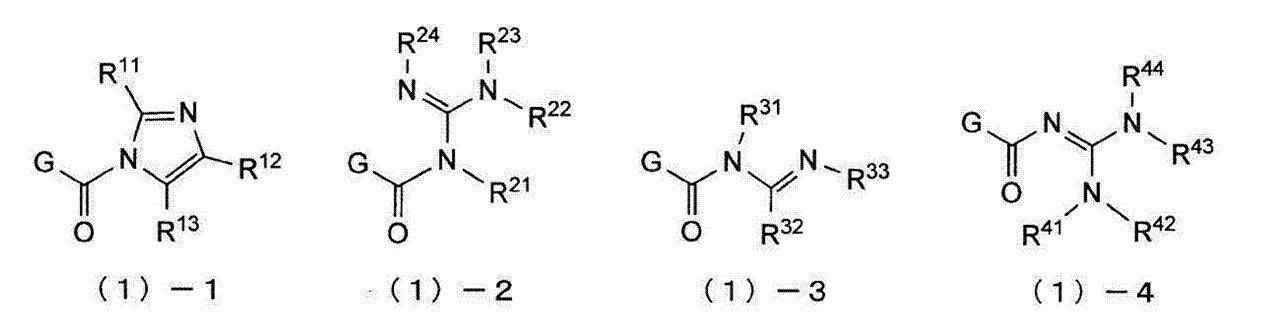
一般式(1)-1~一般式(1)-4において、G、R11、R12、R13、R21、R22、R23、R24、R31、R32、R33、R41、R42、R43及びR44は、既述と同義であり、好ましい態様も同様である。
化合物(1)-1で好ましいものとしては、例えば、下記一般式(1)-1Aで表される化合物(以下、「化合物(1)-1A」と略記することがある)、及び下記一般式(1)-1Bで表される化合物(以下、「化合物(1)-1B」と略記することがある)が挙げられる。
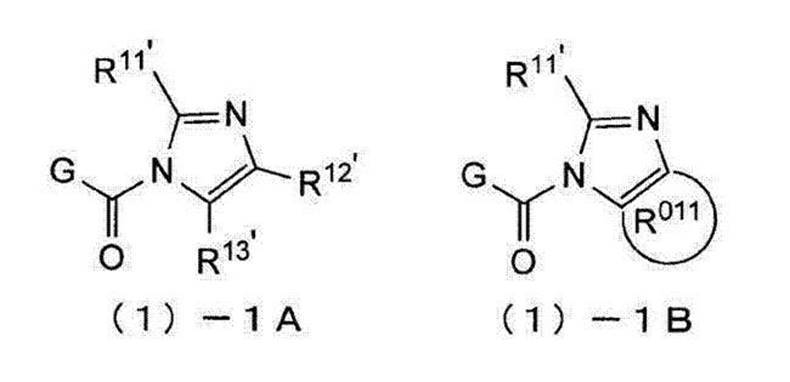
一般式(1)-1A及び一般式(1)-1B中、Gは前記と同じであり;R11’、R12’及びR13’は、それぞれ独立に水素原子又は炭化水素基であり;R011は炭化水素環である。
一般式(1)-1A及び一般式(1)-1B中、R11’、R12’及びR13’は、それぞれ独立に水素原子又は炭化水素基である。
R11’、R12’及びR13’における前記炭化水素基は、相互に結合して環を形成することがない点以外は、上述のR11~R13における前記炭化水素基と同じである。すなわち、化合物(1)-1Aは、R11’、R12’及びR13’がいずれの基であっても、一般式(1)-1A中に記載されているイミダゾール骨格が縮環した構造を有しない。
R11’、R12’及びR13’は、水素原子、アルキル基又はアリール基であることが好ましい。
R11’、R12’及びR13’における前記炭化水素基は、相互に結合して環を形成することがない点以外は、上述のR11~R13における前記炭化水素基と同じである。すなわち、化合物(1)-1Aは、R11’、R12’及びR13’がいずれの基であっても、一般式(1)-1A中に記載されているイミダゾール骨格が縮環した構造を有しない。
R11’、R12’及びR13’は、水素原子、アルキル基又はアリール基であることが好ましい。
一般式(1)-1B中、R011は炭化水素環である。すなわち、一般式(1)-1Bにおいて、R011は、イミダゾール骨格中の隣接する2個の炭素原子を、このイミダゾール骨格と共有して、このイミダゾール骨格と縮環している炭化水素環(環状の炭化水素基)である。
化合物(1)-1Bは、化合物(1)-1のうち、炭化水素基であるR12及びR13が相互に結合して環を形成しているものである。
R011は、単環状及び多環状のいずれでもよく、シクロヘキサン環等の飽和脂肪族炭化水素環、又はベンゼン環、ナフタレン環等の芳香族炭化水素環であることが好ましい。
化合物(1)-1Bは、化合物(1)-1のうち、炭化水素基であるR12及びR13が相互に結合して環を形成しているものである。
R011は、単環状及び多環状のいずれでもよく、シクロヘキサン環等の飽和脂肪族炭化水素環、又はベンゼン環、ナフタレン環等の芳香族炭化水素環であることが好ましい。
化合物(1)-1Aで好ましいものとしては、例えば、R11’、R12’及びR13’の少なくとも1種が水素原子であるものが挙げられる。
化合物(1)-1Bで好ましいものとしては、例えば、R011が芳香族炭化水素環であるものが挙げられる。
化合物(1)-1Bで好ましいものとしては、例えば、R011が芳香族炭化水素環であるものが挙げられる。
化合物(1)-2で好ましいものとしては、例えば、下記一般式(1)-2Aで表される化合物(以下、「化合物(1)-2A」ともいう。)、下記一般式(1)-2Bで表される化合物(以下、「化合物(1)-2B」ともいう。)、下記一般式(1)-2Cで表される化合物(以下、「化合物(1)-2C」ともいう。)、下記一般式(1)-2Dで表される化合物(以下、「化合物(1)-2D」ともいう。)、及び下記一般式(1)-2Eで表される化合物(以下、「化合物(1)-2E」ともいう。)が挙げられる。

一般式(1)-2A~一般式(1)-2Eにおいて、Gは前記と同じであり;R21’、R22’、R23’及びR24’は、それぞれ独立に水素原子又は炭化水素基であり;R021、R022及びR023は、それぞれ独立に含窒素環である。
一般式(1)-2A~一般式(1)-2Eにおいて、R21’、R22’、R23’及びR24’は、それぞれ独立に水素原子又は炭化水素基である。
R21’、R22’、R23’及びR24’における前記炭化水素基は、相互に結合して環を形成することがない点以外は、上述のR11~R13における前記炭化水素基と同じである。
R21’、R22’、R23’及びR24’は、水素原子、アルキル基又はアリール基であることが好ましく、アルキル基又はアリール基であることがより好ましい。
R21’、R22’、R23’及びR24’における前記炭化水素基は、相互に結合して環を形成することがない点以外は、上述のR11~R13における前記炭化水素基と同じである。
R21’、R22’、R23’及びR24’は、水素原子、アルキル基又はアリール基であることが好ましく、アルキル基又はアリール基であることがより好ましい。
一般式(1)-2Bにおいて、R021は含窒素環である。なお、本明細書において「含窒素環」とは、炭素原子及び水素原子以外に窒素原子を有する環状構造を意味する。すなわち、一般式(1)-2Bにおいて、R021は、この一般式中に記載されているカルボニル基の炭素原子に結合している窒素原子と、R23’が結合している窒素原子と、これら2個の窒素原子の間に位置する1個の炭素原子を、環骨格の構成原子とする環構造(含窒素環式基)である。R021は、単環状及び多環状のいずれでもよく、通常は、脂肪族含窒素環である。
化合物(1)-2Bは、化合物(1)-2のうち、炭化水素基であるR21及びR22が相互に結合して環を形成しているものである。
化合物(1)-2Bは、化合物(1)-2のうち、炭化水素基であるR21及びR22が相互に結合して環を形成しているものである。
一般式(1)-2Cにおいて、R022は含窒素環である。すなわち、一般式(1)-2Cにおいて、R022は、この一般式中に記載されている3個の窒素原子のうち、R21’及びR24’がともに結合していない1個の窒素原子を、環骨格の構成原子とする環構造(含窒素環式基)である。R022は、単環状及び多環状のいずれでもよく、脂肪族含窒素環及び芳香族含窒素環のいずれでもよい。
化合物(1)-2Cは、化合物(1)-2のうち、炭化水素基であるR22及びR23が相互に結合して環を形成しているものである。
化合物(1)-2Cは、化合物(1)-2のうち、炭化水素基であるR22及びR23が相互に結合して環を形成しているものである。
一般式(1)-2Dにおいて、R023は含窒素環である。すなわち、一般式(1)-2Dにおいて、R023は、この一般式中に記載されている3個の窒素原子のうち、R21’が結合していない2個の窒素原子と、これら2個の窒素原子の間に位置する1個の炭素原子を、環骨格の構成原子とする環構造(含窒素環式基)である。R023は、単環状及び多環状のいずれでもよく、脂肪族含窒素環及び芳香族含窒素環のいずれでもよい。
化合物(1)-2Dは、化合物(1)-2のうち、炭化水素基であるR23及びR24が相互に結合して環を形成しているものである。
化合物(1)-2Dは、化合物(1)-2のうち、炭化水素基であるR23及びR24が相互に結合して環を形成しているものである。
一般式(1)-2Eにおいて、R021及びR023は含窒素環であり、R021は一般式(1)-2B中のR021と同じであり、R023は一般式(1)-2D中のR023と同じである。
化合物(1)-2Eは、化合物(1)-2のうち、炭化水素基であるR21及びR22が相互に結合して環を形成し、炭化水素基であるR23及びR24が相互に結合して環を形成しているものである。
化合物(1)-2Eは、化合物(1)-2のうち、炭化水素基であるR21及びR22が相互に結合して環を形成し、炭化水素基であるR23及びR24が相互に結合して環を形成しているものである。
化合物(1)-2Aで好ましいものとしては、例えば、R21’、R22’、R23’及びR24’がすべてアルキル基又はアリール基であるものが挙げられる。
化合物(1)-2Cで好ましいものとしては、例えば、R022が脂肪族含窒素環であるものが挙げられる。
化合物(1)-2Dで好ましいものとしては、例えば、R023が脂肪族含窒素環であるものが挙げられる。
化合物(1)-2Eで好ましいものとしては、例えば、R023が脂肪族含窒素環であるもの(R021及びR023がともに脂肪族含窒素環であるもの)が挙げられる。
化合物(1)-2Cで好ましいものとしては、例えば、R022が脂肪族含窒素環であるものが挙げられる。
化合物(1)-2Dで好ましいものとしては、例えば、R023が脂肪族含窒素環であるものが挙げられる。
化合物(1)-2Eで好ましいものとしては、例えば、R023が脂肪族含窒素環であるもの(R021及びR023がともに脂肪族含窒素環であるもの)が挙げられる。
化合物(1)-3で好ましいものとしては、例えば、下記一般式(1)-3Aで表される化合物(以下、「化合物(1)-3A」ともいう。)、下記一般式(1)-3Bで表される化合物(以下、「化合物(1)-3B」ともいう。)、下記一般式(1)-3Cで表される化合物(以下、「化合物(1)-3C」ともいう。)、及び下記一般式(1)-3Dで表される化合物(以下、「化合物(1)-3D」ともいう。)が挙げられる。
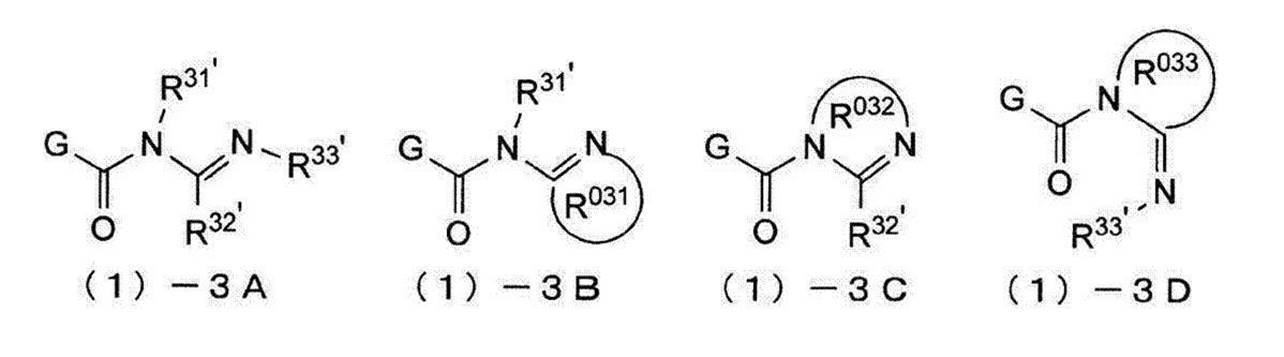
一般式(1)-3A~一般式(1)-3Dにおいて、Gは前記と同じであり;R31’、R32’及びR33’は、それぞれ独立に水素原子又は炭化水素基であり;R031、R032及びR033は、それぞれ独立に含窒素環である。
一般式(1)-3A~一般式(1)-3Dにおいて、R31’、R32’及びR33’は、それぞれ独立に水素原子又は炭化水素基である。
R31’、R32’及びR33’における前記炭化水素基は、相互に結合して環を形成することがない点以外は、上述のR11~R13における前記炭化水素基と同じである。
R31’、R32’及びR33’は、水素原子、アルキル基又はアリール基であることが好ましい。
R31’、R32’及びR33’における前記炭化水素基は、相互に結合して環を形成することがない点以外は、上述のR11~R13における前記炭化水素基と同じである。
R31’、R32’及びR33’は、水素原子、アルキル基又はアリール基であることが好ましい。
一般式(1)-3Bにおいて、R031は含窒素環である。
すなわち、一般式(1)-3Bにおいて、R031は、この一般式中に記載されている2個の窒素原子のうち、R31’が結合していない1個の窒素原子と、これら2個の窒素原子の間に位置する1個の炭素原子を、環骨格の構成原子とする環構造(含窒素環式基)である。R031は、単環状及び多環状のいずれでもよく、脂肪族含窒素環及び芳香族含窒素環のいずれでもよい。
化合物(1)-3Bは、化合物(1)-3のうち、炭化水素基であるR32及びR33が相互に結合して環を形成しているものである。
すなわち、一般式(1)-3Bにおいて、R031は、この一般式中に記載されている2個の窒素原子のうち、R31’が結合していない1個の窒素原子と、これら2個の窒素原子の間に位置する1個の炭素原子を、環骨格の構成原子とする環構造(含窒素環式基)である。R031は、単環状及び多環状のいずれでもよく、脂肪族含窒素環及び芳香族含窒素環のいずれでもよい。
化合物(1)-3Bは、化合物(1)-3のうち、炭化水素基であるR32及びR33が相互に結合して環を形成しているものである。
一般式(1)-3Cにおいて、R032は含窒素環である。
すなわち、一般式(1)-3Cにおいて、R032は、この一般式中に記載されている2個の窒素原子と、これら2個の窒素原子の間に位置する1個の炭素原子を、環骨格の構成原子とする環構造(含窒素環式基)である。R032は、単環状及び多環状のいずれでもよく、脂肪族含窒素環及び芳香族含窒素環のいずれでもよい。
化合物(1)-3Cは、化合物(1)-3のうち、炭化水素基であるR31及びR33が相互に結合して環を形成しているものである。
すなわち、一般式(1)-3Cにおいて、R032は、この一般式中に記載されている2個の窒素原子と、これら2個の窒素原子の間に位置する1個の炭素原子を、環骨格の構成原子とする環構造(含窒素環式基)である。R032は、単環状及び多環状のいずれでもよく、脂肪族含窒素環及び芳香族含窒素環のいずれでもよい。
化合物(1)-3Cは、化合物(1)-3のうち、炭化水素基であるR31及びR33が相互に結合して環を形成しているものである。
一般式(1)-3Dにおいて、R033は含窒素環である。
すなわち、一般式(1)-3Dにおいて、R033は、この一般式中に記載されている2個の窒素原子のうち、R33’が結合していない1個の窒素原子と、これら2個の窒素原子の間に位置する1個の炭素原子を、環骨格の構成原子とする環構造(含窒素環式基)である。R033は、単環状及び多環状のいずれでもよく、通常は、脂肪族含窒素環である。
化合物(1)-3Dは、化合物(1)-3のうち、炭化水素基であるR31及びR32が相互に結合して環を形成しているものである。
すなわち、一般式(1)-3Dにおいて、R033は、この一般式中に記載されている2個の窒素原子のうち、R33’が結合していない1個の窒素原子と、これら2個の窒素原子の間に位置する1個の炭素原子を、環骨格の構成原子とする環構造(含窒素環式基)である。R033は、単環状及び多環状のいずれでもよく、通常は、脂肪族含窒素環である。
化合物(1)-3Dは、化合物(1)-3のうち、炭化水素基であるR31及びR32が相互に結合して環を形成しているものである。
化合物(1)-3Aで好ましいものとしては、例えば、R31’、R32’及びR33’の少なくとも1種が水素原子であるものが挙げられる。
化合物(1)-3Bで好ましいものとしては、例えば、R031が脂肪族含窒素環であるものが挙げられる。
化合物(1)-3Cで好ましいものとしては、例えば、R032が脂肪族含窒素環であるものが挙げられる。
化合物(1)-3Bで好ましいものとしては、例えば、R031が脂肪族含窒素環であるものが挙げられる。
化合物(1)-3Cで好ましいものとしては、例えば、R032が脂肪族含窒素環であるものが挙げられる。
化合物(1)-4で好ましいものとしては、例えば、下記一般式(1)-4Aで表される化合物(以下、「化合物(1)-4A」ともいう。)、下記一般式(1)-4Bで表される化合物(以下、「化合物(1)-4B」ともいう。)、下記一般式(1)-4Cで表される化合物(以下、「化合物(1)-4C」ともいう。)、下記一般式(1)-4Dで表される化合物(以下、「化合物(1)-4D」ともいう。)、及び下記一般式(1)-4Eで表される化合物(以下、「化合物(1)-4E」ともいう。)が挙げられる。

一般式(1)-4A~一般式(1)-4Eにおいて、Gは前記と同じであり;R41’、R42’、R43’及びR44’は、それぞれ独立に水素原子又は炭化水素基であり;R041、R042及びR043は、それぞれ独立に含窒素環である。
一般式(1)-4A~一般式(1)-4Eにおいて、R41’、R42’、R43’及びR44’は、それぞれ独立に水素原子又は炭化水素基である。
R41’、R42’、R43’及びR44’における前記炭化水素基は、相互に結合して環を形成することがない点以外は、上述のR11~R13における前記炭化水素基と同じである。
一般式(1)-4A~(1)-4Eにおいて、R41’、R42’、R43’及びR44’は、水素原子、アルキル基又はアリール基であることが好ましく、アルキル基又はアリール基であることがより好ましい。
R41’、R42’、R43’及びR44’における前記炭化水素基は、相互に結合して環を形成することがない点以外は、上述のR11~R13における前記炭化水素基と同じである。
一般式(1)-4A~(1)-4Eにおいて、R41’、R42’、R43’及びR44’は、水素原子、アルキル基又はアリール基であることが好ましく、アルキル基又はアリール基であることがより好ましい。
化合物(1)-4Aで好ましいものとしては、例えば、R41’、R42’、R43’及びR44’がすべてアルキル基又はアリール基であるものが挙げられる。
化合物(1)-4Bで好ましいものとしては、例えば、R041が脂肪族含窒素環であるものが挙げられる。
化合物(1)-4Dで好ましいものとしては、例えば、R043が脂肪族含窒素環であるものが挙げられる。
化合物(1)-4Eで好ましいものとしては、例えば、R041及びR043が脂肪族含窒素環であるものが挙げられる。
化合物(1)-4Bで好ましいものとしては、例えば、R041が脂肪族含窒素環であるものが挙げられる。
化合物(1)-4Dで好ましいものとしては、例えば、R043が脂肪族含窒素環であるものが挙げられる。
化合物(1)-4Eで好ましいものとしては、例えば、R041及びR043が脂肪族含窒素環であるものが挙げられる。
一般式(1)で表される化合物の中でも、化合物(1)-1A、化合物(1)-2E、化合物(1)-3A及び化合物(1)-4Aがより好ましく、更に好ましくは化合物(1)-2Eである。
一般式(1)で表される化合物の具体例としては、以下の化合物が挙げられる。但し、本開示においては、以下の化合物に制限されるものではない。
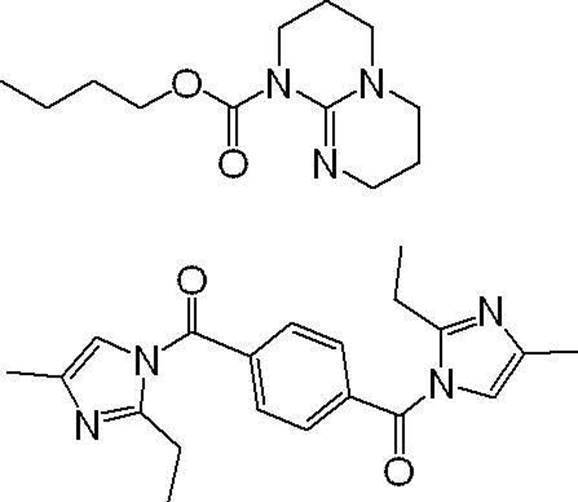
一般式(1)で表される化合物は、例えば、エステル構造又はアミド構造を形成する公知の手法を用いて製造することができる。
塩基増殖剤の硬化性組成物中における含有量は、多価アルコール及びエポキシ化合物の合計量に対して、3質量%~15質量%であることが好ましく、4質量%~12質量%であることがより好ましく、5質量%~10質量%であることが更に好ましい。
塩基増殖剤の含有量が3質量%以上であることにより、塩基発生剤の含有量を減らすことができ、塩基発生剤自身による吸光(すなわち着色)等による弊害を低減するのに適している。更には、後述する塩基発生剤と併用した場合の、塩基増殖作用がより顕著に得られる利点がある。また、塩基増殖剤を含有量が15質量%を超える範囲で含有しても、含有量に見合う効果は期待できない。
塩基増殖剤の含有量が3質量%以上であることにより、塩基発生剤の含有量を減らすことができ、塩基発生剤自身による吸光(すなわち着色)等による弊害を低減するのに適している。更には、後述する塩基発生剤と併用した場合の、塩基増殖作用がより顕著に得られる利点がある。また、塩基増殖剤を含有量が15質量%を超える範囲で含有しても、含有量に見合う効果は期待できない。
(塩基発生剤)
本開示の硬化性組成物は、塩基発生剤(PBG;Photo Base Generator)の少なくとも一種を含有することが好ましい。
塩基発生剤を含有することで、エネルギーを付与した際に塩基が生成される。
本開示における塩基発生剤としては、強塩基を放出する化合物が好ましい。強塩基が放出されることで、多価イソシアネート化合物と多価アルコールとのウレタン形成反応を促進する。また、既述の塩基増殖剤と併用されることで、例えば、生成した塩基が多価アルコールからプロトンを引き抜く等、多価アルコールの水酸基及び/又はエポキシ化合物のエポキシ基が活性化されやすくなる。そして、この活性化により塩基増殖剤からの塩基の生成が促進される。
このようにして組成物中における塩基の生成プロセスが連鎖的に進行するので、ウレタン結合形成反応が進行しやすく、組成物の硬化反応(アニオン系硬化反応)の感度が高められる。
本開示の硬化性組成物は、塩基発生剤(PBG;Photo Base Generator)の少なくとも一種を含有することが好ましい。
塩基発生剤を含有することで、エネルギーを付与した際に塩基が生成される。
本開示における塩基発生剤としては、強塩基を放出する化合物が好ましい。強塩基が放出されることで、多価イソシアネート化合物と多価アルコールとのウレタン形成反応を促進する。また、既述の塩基増殖剤と併用されることで、例えば、生成した塩基が多価アルコールからプロトンを引き抜く等、多価アルコールの水酸基及び/又はエポキシ化合物のエポキシ基が活性化されやすくなる。そして、この活性化により塩基増殖剤からの塩基の生成が促進される。
このようにして組成物中における塩基の生成プロセスが連鎖的に進行するので、ウレタン結合形成反応が進行しやすく、組成物の硬化反応(アニオン系硬化反応)の感度が高められる。
強塩基を放出する塩基発生剤は、公知の塩基発生剤又は光塩基発生剤と称される化合物の中から適宜選択することができ、例えば、オキシムエステル系化合物、アンモニウム系化合物、ベンゾイン系化合物、ジメトキシベンジルウレタン系化合物、オルトニトロベンジルウレタン系化合物等を挙げることができる。
塩基発生剤が、光照射又は加熱により塩基を発生する化合物であることが好ましい。中でも、硬化速度の点から、光照射により塩基を発生する化合物がより好ましい。
塩基発生剤の例としては、波長1nm~400nmの光の照射(露光)により塩基を発生させる化合物が挙げられ、例えば、光照射により第1級アミンもしくは第2級アミン又はイミダゾール等を発生させる非イオン型の光塩基発生剤、及び光照射により3級アミン又はアミジンもしくはグアニジン等の強塩基を発生させるイオン型の光塩基発生剤等を挙げることができる。
塩基発生剤の具体的な例としては、特許第5401737号公報に記載の、式(I)で表される塩基発生剤、特許第5561694号公報に記載の、式(X)で表されるカルボン酸塩である塩基発生剤、特許第5725515号公報に記載の、式(X)で表される光塩基発生剤、特許第5765851号公報に記載の、カルボン酸と塩基類とからなるカルボン酸化合物である塩基発生剤、特許第6332870号公報に記載の、一般式(A)で示される化合物を含んでなる塩基発生剤、及び、特許第6011956号公報に記載の、式(X)で表されるカルボン酸塩からなる塩基発生剤等が挙げられる。
以下に、好ましい塩基発生剤の一例を示す。
塩基発生剤としては、例えば、下記式で表されるカルボン酸塩が好適に挙げられる。
A-B+ ・・・式
式中、A-は、下記式(IV)、(V)、(VI)及び(VII)のいずれかで表されるカルボン酸であり、B+は、下記式(I)、式(I-c)、式(I-d)、式(I-e)、式(I-f)、式(I-g)、式(I-h)で表されるグアニジン類、式(II)、式(II-c)、式(II-d)で表されるホスファゼン誘導体、式(III)で表されるアミジン類、のいずれかからなる塩基類を示す。
なお、「Me」はメチル基を、「Et」はエチル基を、「Pr」はプロピル基を、「Bu」はブチル基を、それぞれ表す。
塩基発生剤としては、例えば、下記式で表されるカルボン酸塩が好適に挙げられる。
A-B+ ・・・式
式中、A-は、下記式(IV)、(V)、(VI)及び(VII)のいずれかで表されるカルボン酸であり、B+は、下記式(I)、式(I-c)、式(I-d)、式(I-e)、式(I-f)、式(I-g)、式(I-h)で表されるグアニジン類、式(II)、式(II-c)、式(II-d)で表されるホスファゼン誘導体、式(III)で表されるアミジン類、のいずれかからなる塩基類を示す。
なお、「Me」はメチル基を、「Et」はエチル基を、「Pr」はプロピル基を、「Bu」はブチル基を、それぞれ表す。
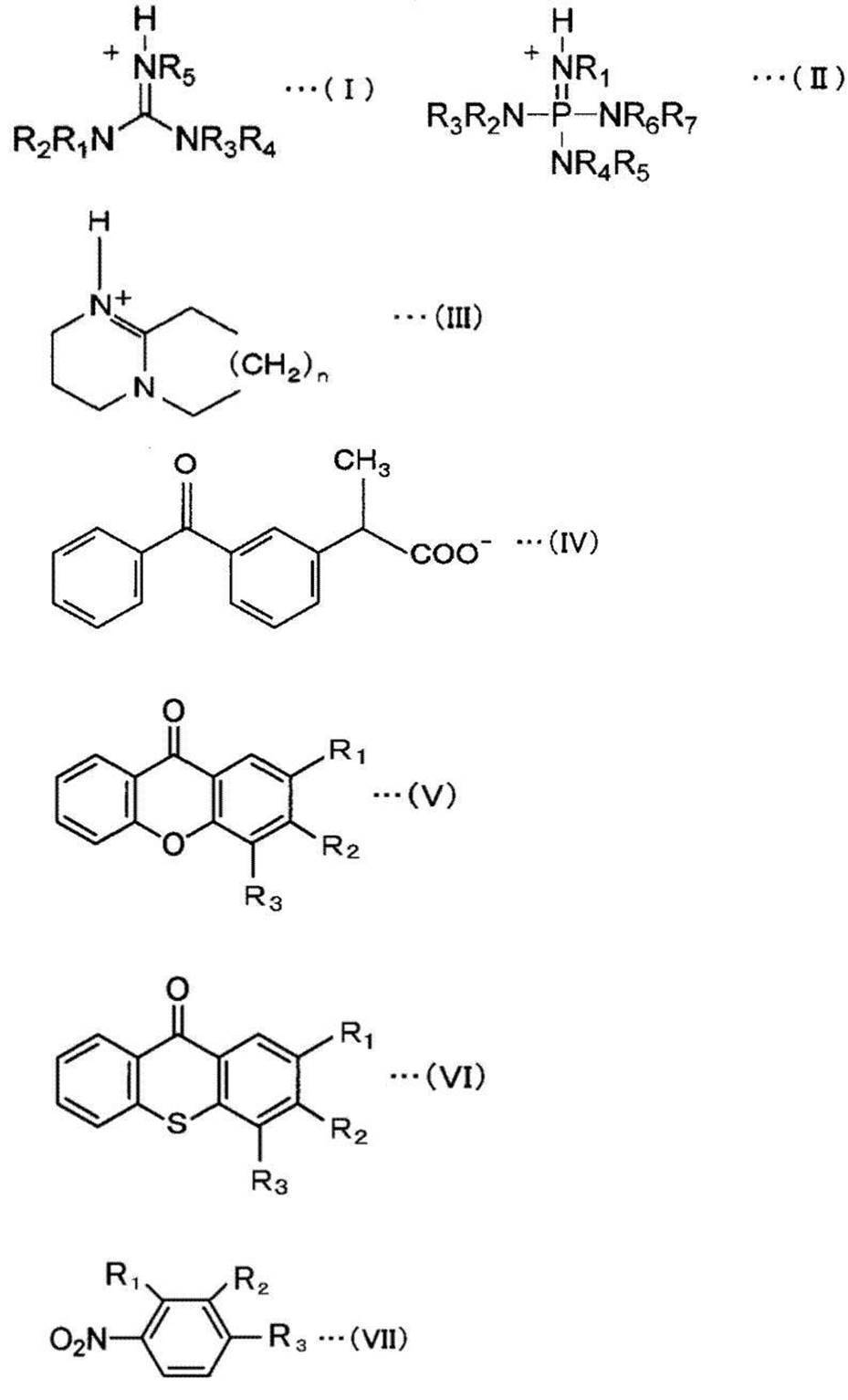

式(I)中、R1~R5はそれぞれ、独立して水素原子、アルキル基またはアリール基(アルキル基は環状構造でもよい。)を示す。
式(II)中、R1~R7はそれぞれ、独立して水素原子、アルキル基またはアリール基
(アルキル基は環状構造でもよい。)を示す。
式(III)中、nは1~3の整数を示す。
式(V)及び式(VI)中、R1、R2、R3は、CH2COO-、CH(CH3)COO-またはHを示し、CH2COO-またはCH(CH3)COO-はR1、R2、R3のいずれか1つの基に付され、残りの2つの基にはHが付される。
式(VII)中、R1、R2、R3はCH2COO-またはHを示し、CH2COO-はR1、R2、R3のいずれか1つの基に付され、残りの2つの基にはHが付される。
式(II)中、R1~R7はそれぞれ、独立して水素原子、アルキル基またはアリール基
(アルキル基は環状構造でもよい。)を示す。
式(III)中、nは1~3の整数を示す。
式(V)及び式(VI)中、R1、R2、R3は、CH2COO-、CH(CH3)COO-またはHを示し、CH2COO-またはCH(CH3)COO-はR1、R2、R3のいずれか1つの基に付され、残りの2つの基にはHが付される。
式(VII)中、R1、R2、R3はCH2COO-またはHを示し、CH2COO-はR1、R2、R3のいずれか1つの基に付され、残りの2つの基にはHが付される。
上記式で表されるカルボン酸塩である塩基発生剤における、式(I)~(VII)、並びに式(I-c)、式(I-d)、式(I-e)、式(I-f)、式(I-g)、式(I-h)、式(II-c)及び式(II-d)における各基の詳細及び好ましい態様等については、特許第6011956号公報の記載を参照することができ、具体例として下記化合物(以下、PBGともいう。)を挙げることができる。
なお、「Me」はメチル基を、「Et」はエチル基を、それぞれ表す。
なお、「Me」はメチル基を、「Et」はエチル基を、それぞれ表す。
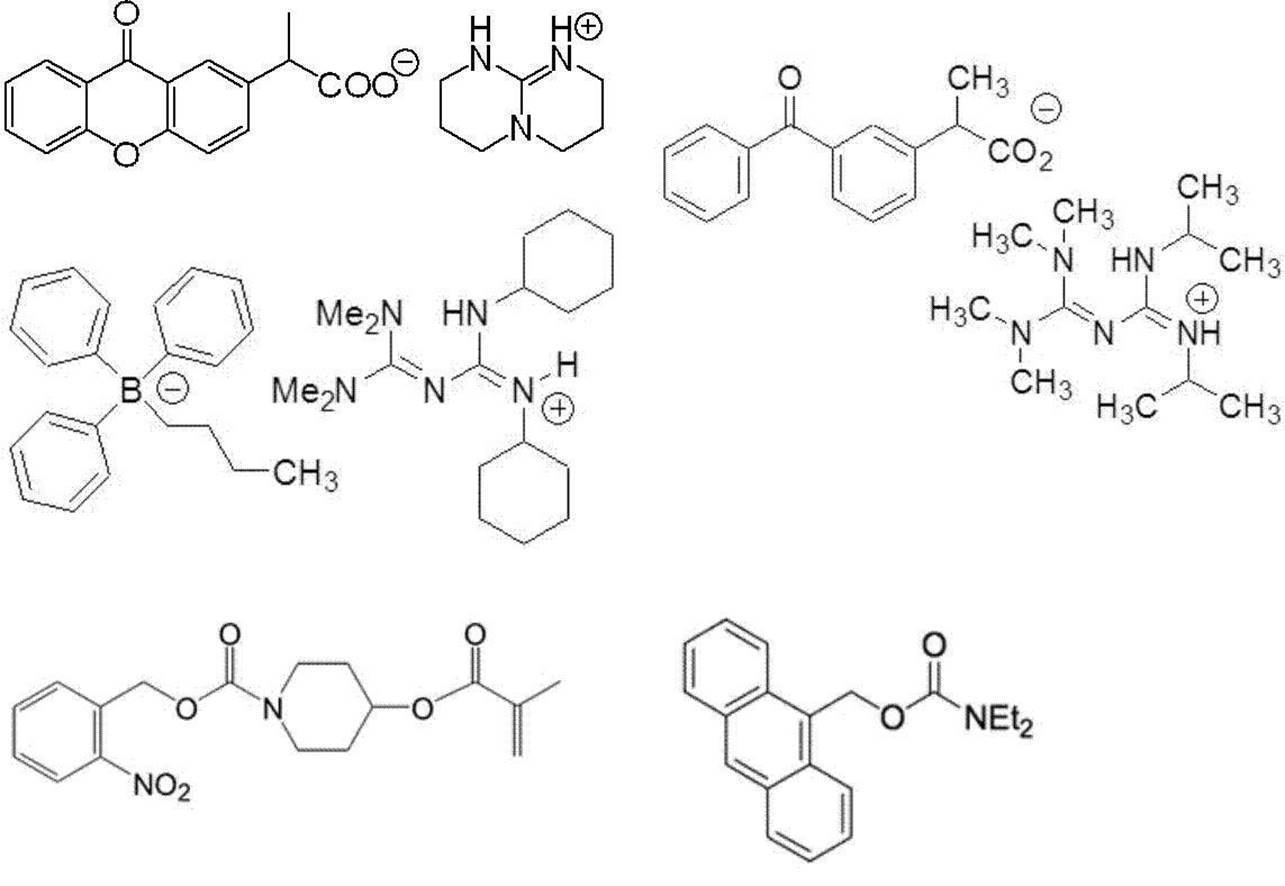
塩基発生剤の硬化性組成物中における含有量としては、多価アルコール及びエポキシ化合物の合計含有量に対して、4質量%~35質量%が好ましく、8質量%~30質量%がより好ましく、12質量%~25質量%が更に好ましい。
塩基発生剤の含有量が4質量%以上であると、硬化性組成物の硬化がより良好に進行する。また、塩基発生剤の含有量が35質量%以下であると、塩基発生剤の量が過剰に過ぎず、塩基発生剤の含有量に見合う効果が期待できる。
塩基発生剤の含有量が4質量%以上であると、硬化性組成物の硬化がより良好に進行する。また、塩基発生剤の含有量が35質量%以下であると、塩基発生剤の量が過剰に過ぎず、塩基発生剤の含有量に見合う効果が期待できる。
(他の成分)
-増感剤-
硬化性組成物は、光照射により塩基を発生させる塩基発生剤とともに増感剤(光増感剤)を含んでいてもよい。これにより、より広い波長範囲の光の照射によって、硬化しやすくなる。例えば、光照射により塩基を発生させる塩基発生剤としては、波長1nm~400nm等の紫外線(紫外光)の照射によって、塩基を発生させるものが汎用される。そこで、このような塩基発生剤を用いた場合に増感剤を併用することで、紫外線よりも長波長である可視光の照射によっても、硬化性組成物は硬化しやすくなる。この場合、可視光等を吸収して励起された増感剤が、光照射により塩基を発生させる塩基発生剤に作用することで、増感剤を用いなかった場合と同様に塩基発生剤から塩基が発生する。
増感剤は、例えば、ベンゾフェノン等の公知のものを選択して用いることができ、特に限定されるものではない。
硬化性組成物に含まれる増感剤は、1種のみでもよいし、2種以上でもよい。増感剤が2種以上である場合、それらの組み合わせ及び比率は任意に設定できる。
硬化性組成物の増感剤の含有量は、特に限定されず、適宜調節すればよい。
-増感剤-
硬化性組成物は、光照射により塩基を発生させる塩基発生剤とともに増感剤(光増感剤)を含んでいてもよい。これにより、より広い波長範囲の光の照射によって、硬化しやすくなる。例えば、光照射により塩基を発生させる塩基発生剤としては、波長1nm~400nm等の紫外線(紫外光)の照射によって、塩基を発生させるものが汎用される。そこで、このような塩基発生剤を用いた場合に増感剤を併用することで、紫外線よりも長波長である可視光の照射によっても、硬化性組成物は硬化しやすくなる。この場合、可視光等を吸収して励起された増感剤が、光照射により塩基を発生させる塩基発生剤に作用することで、増感剤を用いなかった場合と同様に塩基発生剤から塩基が発生する。
増感剤は、例えば、ベンゾフェノン等の公知のものを選択して用いることができ、特に限定されるものではない。
硬化性組成物に含まれる増感剤は、1種のみでもよいし、2種以上でもよい。増感剤が2種以上である場合、それらの組み合わせ及び比率は任意に設定できる。
硬化性組成物の増感剤の含有量は、特に限定されず、適宜調節すればよい。
-充填材-
硬化性組成物は、充填材(いわゆるフィラー)を含んでいてもよい。これにより、硬化性組成物の粘度、硬化物の強度等の特性を調節し得る。
充填材としては、公知のものの中から選択して用いることができ、特に限定されるものではない。充填材の形状は、繊維状、板状又は粒状のいずれでもよく、形状、大きさ及び材質はいずれも目的に応じて適宜選択すればよい。
硬化性組成物に含まれる充填材は、1種のみでもよいし、2種以上でもよい。充填材が2種以上である場合、それらの組み合わせ及び比率は任意に設定できる。
硬化性組成物の充填材の含有量は、特に限定されず、適宜調節すればよい。
硬化性組成物は、充填材(いわゆるフィラー)を含んでいてもよい。これにより、硬化性組成物の粘度、硬化物の強度等の特性を調節し得る。
充填材としては、公知のものの中から選択して用いることができ、特に限定されるものではない。充填材の形状は、繊維状、板状又は粒状のいずれでもよく、形状、大きさ及び材質はいずれも目的に応じて適宜選択すればよい。
硬化性組成物に含まれる充填材は、1種のみでもよいし、2種以上でもよい。充填材が2種以上である場合、それらの組み合わせ及び比率は任意に設定できる。
硬化性組成物の充填材の含有量は、特に限定されず、適宜調節すればよい。
-顔料-
硬化性組成物は、顔料を含んでいてもよい。これにより、硬化物の色相、光透過性等の調節が可能である。
硬化性組成物に含まれる顔料は、特に制限はなく、公知のものから適宜選択することができ、例えば、白色、青色、赤色、黄色又は緑色等の顔料が挙げられる。
硬化性組成物に含まれる顔料は、1種のみでもよいし、2種以上でもよい。顔料が2種以上である場合、それらの組み合わせ及び比率は任意に設定できる。
硬化性組成物の顔料の含有量は、特に限定されず、適宜調節すればよい。
硬化性組成物は、顔料を含んでいてもよい。これにより、硬化物の色相、光透過性等の調節が可能である。
硬化性組成物に含まれる顔料は、特に制限はなく、公知のものから適宜選択することができ、例えば、白色、青色、赤色、黄色又は緑色等の顔料が挙げられる。
硬化性組成物に含まれる顔料は、1種のみでもよいし、2種以上でもよい。顔料が2種以上である場合、それらの組み合わせ及び比率は任意に設定できる。
硬化性組成物の顔料の含有量は、特に限定されず、適宜調節すればよい。
-溶媒-
硬化性組成物は、溶媒を含んでいてもよい。これにより、硬化性組成物の取り扱い性が向上し得る。
溶媒は、特に制限はなく、例えば、多価イソシアネート化合物、多価アルコール、エポキシ化合物、塩基増殖剤、及び塩基発生剤等の、溶解性及び安定性等を考慮して適宜選択すればよい。
溶媒としては、例えば、ジクロロメタン、クロロホルム等のハロゲン化炭化水素;トルエン、o-キシレン、m-キシレン、p-キシレン等の芳香族炭化水素;ヘキサン、ヘプタン、オクタン等の脂肪族炭化水素;酢酸エチル、酢酸ブチル等のカルボン酸エステル;ジエチルエーテル、テトラヒドロフラン(THF)、1,2-ジメトキシエタン(ジメチルセロソルブ)等のエーテル;アセトン、メチルエチルケトン(MEK)、シクロヘキサノン、シクロペンタノン等のケトン;アセトニトリル等のニトリル;N,N-ジメチルホルムアミド(DMF)、N,N-ジメチルアセトアミド等のアミドなどが挙げられる。
硬化性組成物は、溶媒を含んでいてもよい。これにより、硬化性組成物の取り扱い性が向上し得る。
溶媒は、特に制限はなく、例えば、多価イソシアネート化合物、多価アルコール、エポキシ化合物、塩基増殖剤、及び塩基発生剤等の、溶解性及び安定性等を考慮して適宜選択すればよい。
溶媒としては、例えば、ジクロロメタン、クロロホルム等のハロゲン化炭化水素;トルエン、o-キシレン、m-キシレン、p-キシレン等の芳香族炭化水素;ヘキサン、ヘプタン、オクタン等の脂肪族炭化水素;酢酸エチル、酢酸ブチル等のカルボン酸エステル;ジエチルエーテル、テトラヒドロフラン(THF)、1,2-ジメトキシエタン(ジメチルセロソルブ)等のエーテル;アセトン、メチルエチルケトン(MEK)、シクロヘキサノン、シクロペンタノン等のケトン;アセトニトリル等のニトリル;N,N-ジメチルホルムアミド(DMF)、N,N-ジメチルアセトアミド等のアミドなどが挙げられる。
硬化性組成物に含まれる溶媒は、1種のみでもよいし、2種以上でもよく、2種以上である場合、それらの組み合わせ及び比率は任意に設定できる。
溶媒の硬化性組成物中における含有量は、硬化性組成物の全量に対して、20質量%~80質量%が好ましく、30質量%~75質量%がより好ましく、40質量%~70質量%が更に好ましい。溶媒の含有量が上記の範囲であると、硬化性組成物の取り扱い性がより向上し得る。
溶媒の硬化性組成物中における含有量は、硬化性組成物の全量に対して、20質量%~80質量%が好ましく、30質量%~75質量%がより好ましく、40質量%~70質量%が更に好ましい。溶媒の含有量が上記の範囲であると、硬化性組成物の取り扱い性がより向上し得る。
~硬化性組成物の調製~
硬化性組成物は、多官能イソシアネート化合物、多価アルコール及びエポキシ化合物からなる群より選択される化合物、塩基増殖剤、並びに、必要に応じて塩基発生剤及び他の成分を配合することによって調製することができる。各成分の配合後は、得られたものをそのまま硬化性組成物として用いてもよいし、必要に応じて引き続き公知の精製操作等を行って得られたものを硬化性組成物として用いてもよい。
硬化性組成物は、多官能イソシアネート化合物、多価アルコール及びエポキシ化合物からなる群より選択される化合物、塩基増殖剤、並びに、必要に応じて塩基発生剤及び他の成分を配合することによって調製することができる。各成分の配合後は、得られたものをそのまま硬化性組成物として用いてもよいし、必要に応じて引き続き公知の精製操作等を行って得られたものを硬化性組成物として用いてもよい。
各成分の配合時には、全ての成分を添加してから混合操作を行ってもよいし、一部の成分を順次添加しながら混合してもよく、全ての成分を順次添加しながら混合してもよい。
混合方法は特に限定されず、撹拌子又は撹拌翼等を回転させて混合する方法;ミキサー等を用いて混合する方法;超音波を加えて混合する方法等、公知の方法から適宜選択すればよい。
混合方法は特に限定されず、撹拌子又は撹拌翼等を回転させて混合する方法;ミキサー等を用いて混合する方法;超音波を加えて混合する方法等、公知の方法から適宜選択すればよい。
配合時の温度は、各配合成分が劣化しない限り特に限定されず、例えば、3℃~30℃とすることができる。
配合時間も、各配合成分が劣化しない限り特に限定されず、例えば、0.5時間~1時間とすることができる。
ただし、これら配合条件は、一例に過ぎない。
配合時間も、各配合成分が劣化しない限り特に限定されず、例えば、0.5時間~1時間とすることができる。
ただし、これら配合条件は、一例に過ぎない。
<硬化物>
本開示の硬化物は、既述の本開示の硬化性組成物が硬化してなるものである。
本開示の硬化性組成物は、エネルギーの付与によって進行する硬化反応性に優れるので、硬化度の高い硬化物が得られる。
硬化物の形状は、例えば、膜状、線状等、目的に応じて任意に選択できる。
本開示の硬化物は、既述の本開示の硬化性組成物が硬化してなるものである。
本開示の硬化性組成物は、エネルギーの付与によって進行する硬化反応性に優れるので、硬化度の高い硬化物が得られる。
硬化物の形状は、例えば、膜状、線状等、目的に応じて任意に選択できる。
本開示の硬化性組成物は、塩基増殖剤、又は塩基増殖剤及び塩基発生剤を含有することで、塩基による硬化反応が連鎖的に、かつ、広範に亘って進行しやすく、従来以上に反応感度を高めることができる。
そのため、硬化物の厚みとしては、厚くすることが可能であり、例えば、0.5×10⁻³m(=500μm)以上とすることができる。更には、硬化物の厚みは、1×10⁻³m(1mm)以上としてもよく、1×10⁻²m(10mm)以上とすることも可能である。
そのため、硬化物の厚みとしては、厚くすることが可能であり、例えば、0.5×10⁻³m(=500μm)以上とすることができる。更には、硬化物の厚みは、1×10⁻³m(1mm)以上としてもよく、1×10⁻²m(10mm)以上とすることも可能である。
<硬化物の製造方法>
本開示の硬化物の製造方法は、既述の本開示の硬化性組成物にエネルギーを付与し、生成した塩基を触媒としてウレタン結合を形成する工程を含む。本開示の硬化物の製造方法は、更に、他の工程を有するものであってもよい。
本開示の硬化物の製造方法は、既述の本開示の硬化性組成物にエネルギーを付与し、生成した塩基を触媒としてウレタン結合を形成する工程を含む。本開示の硬化物の製造方法は、更に、他の工程を有するものであってもよい。
ここで、エネルギーとは、活性エネルギー線、熱等が含まれ、活性エネルギー線であることが好ましい。活性エネルギー線には、X線、紫外線、可視光線等が含まれる。
エネルギーの付与としては、光照射及び加熱の少なくとも一方であることが好ましく、光照射によることがより好ましい。
エネルギーの付与としては、光照射及び加熱の少なくとも一方であることが好ましく、光照射によることがより好ましい。
本開示の硬化物の製造方法は、後記のように、組成物中で生成する塩基の作用でウレタン結合形成反応が進行し、このウレタン結合形成反応に寄与する塩基の生成が塩基増殖剤によって効率よく、かつ、連鎖的に行われる。即ち、生成された塩基は、多価アルコール及び/又はエポキシ化合物に作用し、塩基増殖剤からの塩基の生成を促進する。これにより、ウレタン結合形成反応の促進が図れ、反応硬化物であるポリウレタンを感度良く製造することができる。
また、本開示の硬化性組成物が塩基発生剤を含有する場合、上記のウレタン結合を形成する工程は、硬化性組成物にエネルギーを付与することにより、塩基発生剤から塩基を生成し、かつ、塩基増殖剤から塩基を生成する。組成物中に存在する塩基の一部は、多価アルコールの水酸基の活性化、又はエポキシ化合物のエポキシ基の活性化(例えば、活性水素を有する水酸基の形成)をもたらし、塩基増殖剤からの塩基の生成を促進する。更に、組成物中に存在する塩基の他の一部は触媒として、多価イソシアネート化合物と多価アルコールとのウレタン結合形成反応を開始し又は促進し、反応硬化物であるポリウレタンを効率良く製造する。
ここでの反応は、各成分が以下のスキーム1に示すように作用することで進行するものと推察される。以下のスキーム1を参照して反応系を具体的に説明する。
ここでの反応は、各成分が以下のスキーム1に示すように作用することで進行するものと推察される。以下のスキーム1を参照して反応系を具体的に説明する。
-スキーム1-

スキーム1は、イオン性の塩基発生剤であるPBG1と、塩基増殖剤であるCCA2と、を用いて塩基を連鎖的に生成し、ウレタン結合を効率良く進行させるものである。
PBG1は、光照射又は加熱されるとCO2を放出して強塩基を生成する。一方、塩基増殖剤であるCCA2(butyl-3,4,7,8-tetrahydro-2H-pyrimido[1,2-a]pyrimidine-1(6H)-carboxylate)が含まれると、CCA2から塩基が新たに生成される。そして、生成された塩基の一部は、多価アルコールの水酸基を繰り返し活性化し、多価アルコールは活性化されてCCA2に作用することで、連鎖的に強塩基の生成が進行する。このように、組成物中で塩基(特に強塩基)が連鎖的に生成され、生成された塩基の一部が多価イソシアネート化合物と多価アルコールとのウレタン結合形成反応における触媒として機能する。これにより、ウレタン形成反応がより速やかに(つまり感度良く)進行し、反応硬化物であるポリウレタンが製造される。
そのため、硬化性組成物を例えば、照射された光が深部まで届かない厚膜(例えば、0.5×10⁻³m以上の厚み)の膜状に形成した際の硬化性(ウレタン形成反応性)が向上し、膜の深部にまでウレタン形成反応を速やかに進行させることができる。
PBG1は、光照射又は加熱されるとCO2を放出して強塩基を生成する。一方、塩基増殖剤であるCCA2(butyl-3,4,7,8-tetrahydro-2H-pyrimido[1,2-a]pyrimidine-1(6H)-carboxylate)が含まれると、CCA2から塩基が新たに生成される。そして、生成された塩基の一部は、多価アルコールの水酸基を繰り返し活性化し、多価アルコールは活性化されてCCA2に作用することで、連鎖的に強塩基の生成が進行する。このように、組成物中で塩基(特に強塩基)が連鎖的に生成され、生成された塩基の一部が多価イソシアネート化合物と多価アルコールとのウレタン結合形成反応における触媒として機能する。これにより、ウレタン形成反応がより速やかに(つまり感度良く)進行し、反応硬化物であるポリウレタンが製造される。
そのため、硬化性組成物を例えば、照射された光が深部まで届かない厚膜(例えば、0.5×10⁻³m以上の厚み)の膜状に形成した際の硬化性(ウレタン形成反応性)が向上し、膜の深部にまでウレタン形成反応を速やかに進行させることができる。
上記スキーム1では、エチレングリコールを用いた例を示したが、多価アルコールとしてジグリセロール等を用いても同様であり、ウレタン結合形成反応を効率良く進行させることができる。
また、上記のスキーム1では、塩基発生剤としてPBG1を一例に示したが、本開示では塩基増殖剤を用いるので、他の塩基発生剤を用いた場合にも類似する反応スキームに基づいてウレタン結合形成反応を効率よく進行させることが可能である。
また、上記のスキーム1では、塩基発生剤としてPBG1を一例に示したが、本開示では塩基増殖剤を用いるので、他の塩基発生剤を用いた場合にも類似する反応スキームに基づいてウレタン結合形成反応を効率よく進行させることが可能である。
次に、多価アルコールに代えてエポキシ化合物を用いることにより、無溶剤型の硬化性組成物としてウレタン樹脂を製造する態様を以下に示す。
-スキーム2-

スキーム2では、各成分が上記スキームの通りに作用するものと推察される。
スキーム2は、イオン性の塩基発生剤であるPBG1と、塩基増殖剤であるCCA2と、を用いて塩基を連鎖的に生成し、かつ、多価アルコールに代えてエポキシ化合物を用いてウレタン結合形成反応を効率良く進行させる反応経路を示すものである。
本スキームでは、塩基増殖剤と反応しやすい多価アルコールを用いずにエポキシ化合物を用いるので、多価アルコールに起因した反応を回避できるので、組成物自体の安定性が向上し、組成物のポットライフがより改善される。
スキーム2は、イオン性の塩基発生剤であるPBG1と、塩基増殖剤であるCCA2と、を用いて塩基を連鎖的に生成し、かつ、多価アルコールに代えてエポキシ化合物を用いてウレタン結合形成反応を効率良く進行させる反応経路を示すものである。
本スキームでは、塩基増殖剤と反応しやすい多価アルコールを用いずにエポキシ化合物を用いるので、多価アルコールに起因した反応を回避できるので、組成物自体の安定性が向上し、組成物のポットライフがより改善される。
スキーム2では、上記と同様に、PBG1が光照射又は加熱によりR1NHR2で表される塩基を生成する。生成された塩基は、エポキシ化合物であるエポキシ樹脂に作用して、エポキシ基から水酸基が生じ、塩基増殖剤であるCCA2に作用し、CCA2を分解させて、新たに強塩基を発生させると共に、CCA2の残基と結合する。新たに生成した強塩基は、水酸基を有するアミン化合物とジイソシアネート化合物との反応に作用する。そして、生成された塩基の一部は、エポキシ樹脂に作用してエポキシ基を次々に活性化(活性水素を有する水酸基の形成)し、連鎖的に強塩基を生成する。このように、塩基(特に強塩基)が連鎖的に生成され、生成された塩基の一部が水酸基を有するアミン化合物と多価イソシアネート化合物との間のウレタン結合形成反応における触媒として機能する。
これにより、ウレタン形成反応がより速やかに(つまり感度良く)進行し、反応硬化物であるポリウレタンが製造される。
これにより、ウレタン形成反応がより速やかに(つまり感度良く)進行し、反応硬化物であるポリウレタンが製造される。
-スキーム3-

上記スキーム3では、イオン性の塩基発生剤であるPBG1と、塩基増殖剤であるCCA1と、を用いて塩基を連鎖的に生成するものであり、各成分はスキーム3に示すように作用するものと推察される。
スキーム3では、上記と同様に、PBG1が光照射又は加熱によりR1NHR2で表される塩基を生成する。生成された塩基は、エポキシ化合物であるエポキシ樹脂に作用して、エポキシ基が水酸基となり、塩基増殖剤であるCCA1に作用し、CCA1を分解させて、新たに塩基であるイミダゾール化合物を発生させる。また、生成した塩基は、CCA1の残基の一部又は全部と結合する。更に、生成した塩基は、エポキシ樹脂に作用して新たな塩基を生成し、この塩基が、水酸基を有するアミン化合物とジイソシアネート化合物との反応に作用する。そして、生成された塩基の一部は、再びエポキシ樹脂に作用してエポキシ基を次々に活性化(活性水素を有する水酸基の形成)し、連鎖的に塩基を生成する。このように、組成物中で塩基(特に強塩基)が連鎖的に生成され、生成された塩基の一部がエポキシ樹脂又は水酸基を有するアミン化合物と多価イソシアネート化合物との間のウレタン結合形成反応における触媒として機能する。
これにより、ウレタン形成反応がより速やかに(つまり感度良く)進行し、反応硬化物であるポリウレタンが製造される。
スキーム3では、上記と同様に、PBG1が光照射又は加熱によりR1NHR2で表される塩基を生成する。生成された塩基は、エポキシ化合物であるエポキシ樹脂に作用して、エポキシ基が水酸基となり、塩基増殖剤であるCCA1に作用し、CCA1を分解させて、新たに塩基であるイミダゾール化合物を発生させる。また、生成した塩基は、CCA1の残基の一部又は全部と結合する。更に、生成した塩基は、エポキシ樹脂に作用して新たな塩基を生成し、この塩基が、水酸基を有するアミン化合物とジイソシアネート化合物との反応に作用する。そして、生成された塩基の一部は、再びエポキシ樹脂に作用してエポキシ基を次々に活性化(活性水素を有する水酸基の形成)し、連鎖的に塩基を生成する。このように、組成物中で塩基(特に強塩基)が連鎖的に生成され、生成された塩基の一部がエポキシ樹脂又は水酸基を有するアミン化合物と多価イソシアネート化合物との間のウレタン結合形成反応における触媒として機能する。
これにより、ウレタン形成反応がより速やかに(つまり感度良く)進行し、反応硬化物であるポリウレタンが製造される。
上記のスキーム2~3では、塩基発生剤としてPBG1を一例に示したが、本開示では塩基増殖剤を用いるので、他の塩基発生剤を用いた場合にも類似する反応スキームに基づいてウレタン結合形成反応を効率よく進行させることが可能である。
エネルギーが付与される硬化性組成物の形態としては、厚みが0.5×10⁻³m(=500μm)以上の膜とされていることが好ましい。更には、厚みとしては、1×10⁻³m(1mm)以上としてもよく、1×10⁻²m(10mm)以上としてもよい。
硬化性組成物は、例えば、公知の手法で目的とする被着体に付着され、必要に応じてプリベーク(乾燥)した後、光照射又は加熱することにより硬化させることで硬化物が得られる。
例えば膜状の硬化物(即ち、硬化膜)を製造する場合には、エアーナイフコーター、ブレードコーター、バーコーター、グラビアコーター、ロールコーター、ロールナイフコーター、カーテンコーター、ダイコーター、ナイフコーター、スクリーンコーター、マイヤーバーコーター、キスコーター等の各種コーター、又はアプリケーター等の塗工手段を利用して、硬化性組成物を目的とする被着体に塗工するか、あるいは目的とする被着体を硬化性組成物に浸漬することにより、目的とする硬化物が得られる。また、例えば、スクリーン印刷法、フレキソ印刷法、オフセット印刷法、インクジェット法、ディスペンサー式印刷法、ジェットディスペンサー式印刷法、グラビア印刷法、グラビアオフセット印刷法、又はパッド印刷法等の手段を利用することによっても、目的とする硬化物を得ることができる。
プリベークは、特に条件に制限はなく、例えば、50℃~80℃、1分~10分の条件で行うことができる。
例えば膜状の硬化物(即ち、硬化膜)を製造する場合には、エアーナイフコーター、ブレードコーター、バーコーター、グラビアコーター、ロールコーター、ロールナイフコーター、カーテンコーター、ダイコーター、ナイフコーター、スクリーンコーター、マイヤーバーコーター、キスコーター等の各種コーター、又はアプリケーター等の塗工手段を利用して、硬化性組成物を目的とする被着体に塗工するか、あるいは目的とする被着体を硬化性組成物に浸漬することにより、目的とする硬化物が得られる。また、例えば、スクリーン印刷法、フレキソ印刷法、オフセット印刷法、インクジェット法、ディスペンサー式印刷法、ジェットディスペンサー式印刷法、グラビア印刷法、グラビアオフセット印刷法、又はパッド印刷法等の手段を利用することによっても、目的とする硬化物を得ることができる。
プリベークは、特に条件に制限はなく、例えば、50℃~80℃、1分~10分の条件で行うことができる。
硬化性組成物に光を照射して硬化物を製造する場合、硬化性組成物の光照射時における光の波長は、例えば、200nm~500nmであることが好ましい。
また、光照射時における光の照度は、例えば、30mW/cm2~100mW/cm2であることが好ましく、光照射量は、例えば、800mJ/cm2~8000mJ/cm2であることが好ましい。
また、光照射時における光の照度は、例えば、30mW/cm2~100mW/cm2であることが好ましく、光照射量は、例えば、800mJ/cm2~8000mJ/cm2であることが好ましい。
硬化性組成物の光照射により得られた硬化物は、更にポストベーク(露光後加熱処理)が行われてもよい。ポストベークは、例えば、100℃~160℃、0.5時間~2時間の条件で行うことができるが、条件はこれに限定されない。
硬化性組成物を加熱して硬化物を製造する場合、硬化性組成物の加熱温度は、例えば、80℃~160℃であることが好ましい。また、加熱時における加熱時間は、例えば、0.5時間~2時間であることが好ましい。
以下、本開示について実施例を示して具体的に説明する。但し、本開示は、その主旨を越えない限り、以下の実施例に限定されるものではない。なお、特に断りのない限り、「部」は質量基準である。
(実施例1)
m-キシリレンジイソシアネート(XDI;2官能ポリイソシアネート)0.26g(1.4×10⁻³モル)と、ジグリセロール(ポリオール)0.12g(7.2×10⁻⁴モル)と、ジメチルスルホキシド(DMSO)0.80g(ポリオールに対して6.7倍モル)と、を配合し、超音波をあてて混合した。
次いで、得られた混合物に、下記の構造で表されるPBG(塩基発生剤)4.8×10⁻³g(ジグリセロールに対して4質量%)を加え、更に、下記の構造で表される化合物CCA2(塩基増殖剤)8.4×10⁻³g(ジグリセロールに対して7質量%)を加え、再び超音波をあてて攪拌混合し、硬化性組成物を調製した。
次に、上記のようにして調製した硬化性組成物を直径φ8mm、長さ30mmのガラス管に入れ、円柱状の試験サンプル1を作製した。また、縦10mm×横20mmのガラス基板を、上記のように調製した硬化性組成物中に浸漬することにより、ガラス基板の上に厚み2mm~3mmの硬化性層を形成し、板状の試験サンプル2を作製した。
m-キシリレンジイソシアネート(XDI;2官能ポリイソシアネート)0.26g(1.4×10⁻³モル)と、ジグリセロール(ポリオール)0.12g(7.2×10⁻⁴モル)と、ジメチルスルホキシド(DMSO)0.80g(ポリオールに対して6.7倍モル)と、を配合し、超音波をあてて混合した。
次いで、得られた混合物に、下記の構造で表されるPBG(塩基発生剤)4.8×10⁻³g(ジグリセロールに対して4質量%)を加え、更に、下記の構造で表される化合物CCA2(塩基増殖剤)8.4×10⁻³g(ジグリセロールに対して7質量%)を加え、再び超音波をあてて攪拌混合し、硬化性組成物を調製した。
次に、上記のようにして調製した硬化性組成物を直径φ8mm、長さ30mmのガラス管に入れ、円柱状の試験サンプル1を作製した。また、縦10mm×横20mmのガラス基板を、上記のように調製した硬化性組成物中に浸漬することにより、ガラス基板の上に厚み2mm~3mmの硬化性層を形成し、板状の試験サンプル2を作製した。
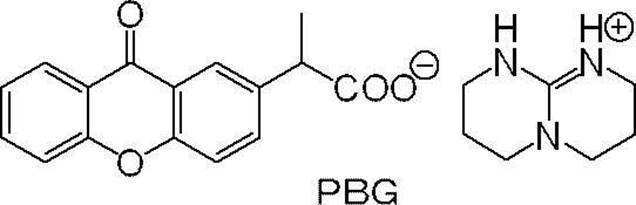

(比較例1)
実施例1において、化合物CCA2(塩基増殖剤)を用いなかったこと以外は、実施例1と同様にして、円柱状の試験サンプル3を作製した。
実施例1において、化合物CCA2(塩基増殖剤)を用いなかったこと以外は、実施例1と同様にして、円柱状の試験サンプル3を作製した。
(硬化性の評価1)
(1)作製した試験サンプル1~3に対して、以下の照射条件にて光照射を行い、硬化性を評価した。この際、各硬化性組成物では、ポリイソシアネートとポリオールとが反応して硬化物であるポリウレタンが製造されている。
<照射条件>
露光波長:365nm
照度:50mW/cm2
照射量:4000mJ/cm2
(1)作製した試験サンプル1~3に対して、以下の照射条件にて光照射を行い、硬化性を評価した。この際、各硬化性組成物では、ポリイソシアネートとポリオールとが反応して硬化物であるポリウレタンが製造されている。
<照射条件>
露光波長:365nm
照度:50mW/cm2
照射量:4000mJ/cm2
その結果、図1~図2に示すように、照射を行うことで、試験サンプル1及び2では硬化が良好に行われていた。これに対して、塩基増殖剤を用いなかった比較用の試験サンプル3は、光照射を行っても、非照射の場合と同様に十分な硬化が得られなかった。
本開示の硬化性組成物では、試験サンプル1及び2で明らかなように、厚みのある形状であっても良好な硬化性が示された。
本開示の硬化性組成物では、試験サンプル1及び2で明らかなように、厚みのある形状であっても良好な硬化性が示された。
(2)次に、以下の方法で硬化の進行性を評価した。
試験サンプル1(実施例1)及び試験サンプル3(比較例1)の調製において、PBG(塩基発生剤)を用いなかったこと以外は、各試験サンプルと同様にして、試験サンプル1a及び試験サンプル3aを作製した。
そして、各試験サンプルをそれぞれ、13mm×76mmのガラス基板に塗布し、各ガラス基板の長手方向一端において塩基として1,5,7-triazabicyclo[4.4.0]dec-5-ene(TBD)を1滴垂らした。このときの塗布膜における温度変化を、サーモセンサを用い、サーモグラフィ画像を観察して評価した。
試験サンプル1(実施例1)及び試験サンプル3(比較例1)の調製において、PBG(塩基発生剤)を用いなかったこと以外は、各試験サンプルと同様にして、試験サンプル1a及び試験サンプル3aを作製した。
そして、各試験サンプルをそれぞれ、13mm×76mmのガラス基板に塗布し、各ガラス基板の長手方向一端において塩基として1,5,7-triazabicyclo[4.4.0]dec-5-ene(TBD)を1滴垂らした。このときの塗布膜における温度変化を、サーモセンサを用い、サーモグラフィ画像を観察して評価した。
その結果、いずれのガラス基板でも、基板の長手方向の中央付近まで温度上昇が見られたが、試験サンプル3aでの温度上昇(最高値)は65.2℃であったのに対し、試験サンプル1aでの温度上昇(最高値)は54.9℃に留まった。即ち、塩基自体の膜中の拡散に両者間の差異はみられなかったが、塩基増殖剤を含有することによる連鎖的な硬化が現れたことで両者間に温度差ができたものと考えられる。
これにより、塩基発生剤の添加量の低減が期待でき、しかも著しい温度上昇も回避し得ることから、熱に弱い基材等の使用に適するものと考えられる。
これにより、塩基発生剤の添加量の低減が期待でき、しかも著しい温度上昇も回避し得ることから、熱に弱い基材等の使用に適するものと考えられる。
(参考例)
塩基発生剤として、下記の構造で表されるPBGポリマー(重量平均分子量(Mw):5440、分子量分布(Mw/Mn):1.47、n=14.7)の40質量%テトラヒドロフラン溶液を用意した。
次いで、ビスフェノールA型エポキシ樹脂(三菱ケミカル株式会社、jER828;エポキシ化合物)1gと、下記の構造で表される化合物CCA1(塩基増殖剤)0.025g(エポキシ樹脂に対して2.5質量%)と、クロロホルム1.5g(エポキシ樹脂に対して150質量%)と、を加え、超音波をあてて混合し、硬化性組成物aを調製した。
塩基発生剤として、下記の構造で表されるPBGポリマー(重量平均分子量(Mw):5440、分子量分布(Mw/Mn):1.47、n=14.7)の40質量%テトラヒドロフラン溶液を用意した。
次いで、ビスフェノールA型エポキシ樹脂(三菱ケミカル株式会社、jER828;エポキシ化合物)1gと、下記の構造で表される化合物CCA1(塩基増殖剤)0.025g(エポキシ樹脂に対して2.5質量%)と、クロロホルム1.5g(エポキシ樹脂に対して150質量%)と、を加え、超音波をあてて混合し、硬化性組成物aを調製した。
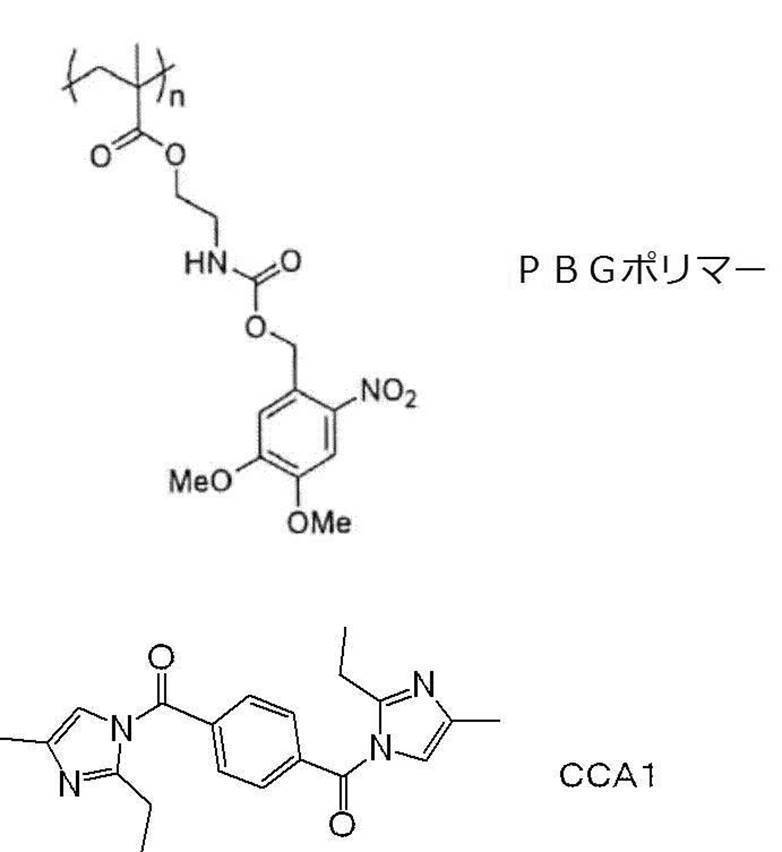
次に、PBGポリマーの40質量%テトラヒドロフラン溶液を、シリコン基板上にスピンコーターにより塗布し、60℃でプリベークした後、光照射(波長:365nm、照射量:28000mJ/cm2)することにより、厚み1~2μm程度のPBG層を有する第1基板を作製した。また、別のシリコン基板を用意し、シリコン基板に、上記の硬化性組成物aを滴下した後、60℃でプリベークすることにより、シリコン基板の上に厚み10μm~13μmのCCA層を有する第2基板を作製した。
作製した第1基板と第2基板とを、それぞれPBG層及びCCA層が互いに接するようにして重ね、積層体を得た。そして、得られた積層体を125℃のオーブンにて加熱し、硬化反応させた。
作製した第1基板と第2基板とを、それぞれPBG層及びCCA層が互いに接するようにして重ね、積層体を得た。そして、得られた積層体を125℃のオーブンにて加熱し、硬化反応させた。
(硬化性の評価2)
参考例で作製した加熱後の積層体に対して、フーリエ変換赤外分光法(FT-IR)により測定を行った。
参考例で作製した加熱後の積層体に対して、フーリエ変換赤外分光法(FT-IR)により測定を行った。
その結果、図3に示すように、CCA層の厚みを10μm~13μmとした参考例の積層体において、加熱による、910cm-1付近のエポキシ基に起因するピークの減少が確認された。
一方、参考例の積層体では、1720cm-1付近のエステル基に起因するピークの増加が、比較用の積層体に比べて小さいことが分かる。即ち、塩基増殖剤を含むことで、塩基発生剤に起因する炭酸の発生を抑えつつ、塩基増殖剤からの塩基の発生による反応が優位に進行したことが推察される。つまり、塩基増殖剤の反応機構によるものであることが確認された。
よって、厚膜とした場合にも、硬化反応が良好に進行し、硬化物の製造性は良好であると考えられる。
一方、参考例の積層体では、1720cm-1付近のエステル基に起因するピークの増加が、比較用の積層体に比べて小さいことが分かる。即ち、塩基増殖剤を含むことで、塩基発生剤に起因する炭酸の発生を抑えつつ、塩基増殖剤からの塩基の発生による反応が優位に進行したことが推察される。つまり、塩基増殖剤の反応機構によるものであることが確認された。
よって、厚膜とした場合にも、硬化反応が良好に進行し、硬化物の製造性は良好であると考えられる。
2018年8月28日に出願された日本出願特願2018-159767の開示はその全体が参照により本明細書に取り込まれる。
本明細書に記載された全ての文献、特許出願、及び技術規格は、個々の文献、特許出願、及び技術規格が参照により取り込まれることが具体的かつ個々に記された場合と同程度に、本明細書中に参照により取り込まれる。
本明細書に記載された全ての文献、特許出願、及び技術規格は、個々の文献、特許出願、及び技術規格が参照により取り込まれることが具体的かつ個々に記された場合と同程度に、本明細書中に参照により取り込まれる。
Claims (11)
- 多官能イソシアネート化合物と、
多価アルコール及びエポキシ化合物からなる群より選択される化合物と、
塩基増殖剤と、
を含有する硬化性組成物。 - 前記塩基増殖剤は、下記一般式(1)で表される化合物を含む請求項1に記載の硬化性組成物。
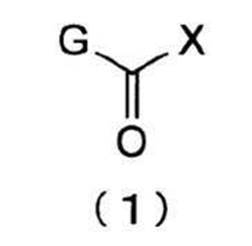
式中、Gは、有機基を表し、Xは、下記の一般式(1)-11、一般式(1)-12、一般式(1)-13又は一般式(1)-14で表される基を表す。
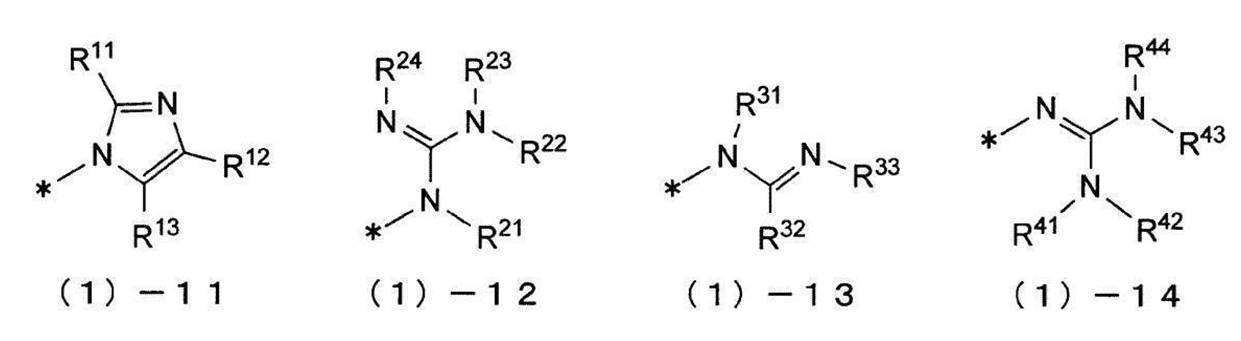
式中、R11、R12、R13、R21、R22、R23、R24、R31、R32、R33、R41、R42、R43及びR44は、それぞれ独立に、水素原子又は炭化水素基を表す。R11、R12及びR13のうちの2種以上が炭化水素基である場合、2種以上の炭化水素基が相互に結合して環を形成していてもよく、R21、R22、R23及びR24のうちの2種以上が炭化水素基である場合、2種以上の炭化水素基が相互に結合して環を形成していてもよく、R31、R32及びR33のうちの2種以上が炭化水素基である場合、2種以上の炭化水素基が相互に結合して環を形成していてもよく、R41、R42、R43及びR44のうちの2種以上が炭化水素基である場合、2種以上の炭化水素基が相互に結合して環を形成していてもよい。*は、炭素原子と結合する結合手を表す。 - 前記一般式(1)で表される化合物は、下記一般式(1)-Aで表される化合物及び下記一般式(1)-Bで表される化合物からなる群より選択される少なくとも一種の化合物を含む請求項2に記載の硬化性組成物。
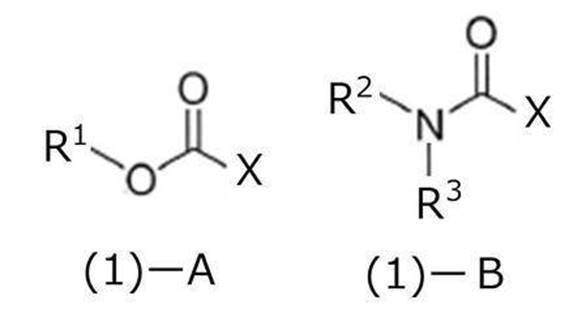
式中、R1は有機基を表し、R2及びR3は、それぞれ独立に、水素原子又は有機基を表す。Xは、それぞれ独立に、上記の一般式(1)-11、一般式(1)-12、一般式(1)-13又は一般式(1)-14で表される基を表す。R2及びR3の少なくとも一方は、有機基を表し、R2及びR3が有機基である場合、互いに結合して環を形成していてもよい。 - 更に、塩基発生剤を含有する請求項1~請求項3のいずれか1項に記載の硬化性組成物。
- 前記塩基発生剤が、光照射又は加熱により塩基を発生する化合物である請求項4に記載の硬化性組成物。
- 請求項1~請求項5のいずれか1項に記載の硬化性組成物が硬化した硬化物。
- 厚みが1×10⁻³m以上である請求項6に記載の硬化物。
- 請求項1~請求項5のいずれか1項に記載の硬化性組成物にエネルギーを付与し、生成した塩基を触媒としてウレタン結合を形成する工程を含む硬化物の製造方法。
- 請求項4又は請求項5に記載の硬化性組成物にエネルギーを付与することにより、塩基発生剤から塩基を生成し、かつ、塩基増殖剤から塩基を生成し、
生成した塩基の一部は、多価アルコールの水酸基又はエポキシ化合物のエポキシ基を活性化し、前記塩基増殖剤からの塩基の生成を促進し、
生成した塩基の他の一部を触媒として、多価イソシアネート化合物と多価アルコールとのウレタン結合形成反応を開始し又は促進し、反応硬化物であるポリウレタンを製造する、硬化物の製造方法。 - 前記エネルギーの付与が、光照射及び加熱の少なくとも一方である請求項8又は請求項9に記載の硬化物の製造方法。
- 前記硬化性組成物が、厚みが1×10⁻³m以上の膜である請求項8~請求項10のいずれか1項に記載の硬化物の製造方法。
Priority Applications (4)
| Application Number | Priority Date | Filing Date | Title |
|---|---|---|---|
| CN201980065830.3A CN112805311A (zh) | 2018-08-28 | 2019-08-27 | 固化性组合物、固化物和固化物的制造方法 |
| JP2020539519A JP7384418B2 (ja) | 2018-08-28 | 2019-08-27 | 硬化性組成物、硬化物、及び硬化物の製造方法 |
| US17/270,974 US12110360B2 (en) | 2018-08-28 | 2019-08-27 | Curable composition, cured product, and method of producing cured product |
| EP19854227.6A EP3845577B1 (en) | 2018-08-28 | 2019-08-27 | Curable composition, cured product, and method of producing cured product |
Applications Claiming Priority (2)
| Application Number | Priority Date | Filing Date | Title |
|---|---|---|---|
| JP2018159767 | 2018-08-28 | ||
| JP2018-159767 | 2018-08-28 |
Publications (1)
| Publication Number | Publication Date |
|---|---|
| WO2020045458A1 true WO2020045458A1 (ja) | 2020-03-05 |
Family
ID=69645241
Family Applications (1)
| Application Number | Title | Priority Date | Filing Date |
|---|---|---|---|
| PCT/JP2019/033585 Ceased WO2020045458A1 (ja) | 2018-08-28 | 2019-08-27 | 硬化性組成物、硬化物、及び硬化物の製造方法 |
Country Status (5)
| Country | Link |
|---|---|
| US (1) | US12110360B2 (ja) |
| EP (1) | EP3845577B1 (ja) |
| JP (1) | JP7384418B2 (ja) |
| CN (1) | CN112805311A (ja) |
| WO (1) | WO2020045458A1 (ja) |
Cited By (2)
| Publication number | Priority date | Publication date | Assignee | Title |
|---|---|---|---|---|
| WO2024232387A1 (ja) * | 2023-05-08 | 2024-11-14 | 学校法人東京理科大学 | 硬化性組成物 |
| WO2026058671A1 (ja) * | 2024-09-10 | 2026-03-19 | 学校法人東京理科大学 | 硬化性組成物 |
Citations (16)
| Publication number | Priority date | Publication date | Assignee | Title |
|---|---|---|---|---|
| JPS52151172A (en) * | 1976-06-09 | 1977-12-15 | Sankyo Kasei Kougiyou Kk | Preparation of benzimidazolecarbamates |
| JPS541737B1 (ja) | 1967-05-15 | 1979-01-29 | ||
| JPS5725515B2 (ja) | 1975-07-19 | 1982-05-29 | ||
| JPS6011956B2 (ja) | 1978-04-11 | 1985-03-29 | 工業技術院長 | 石炭類の流動層ガス化装置 |
| JPS6332870B2 (ja) | 1980-12-12 | 1988-07-01 | Sanshin Kagaku Kogyo Co | |
| JP2000330270A (ja) | 1999-05-24 | 2000-11-30 | Kunihiro Ichimura | 塩基増殖剤、塩基増殖剤組成物、塩基反応性組成物及びパターン形成方法 |
| JP2001513765A (ja) | 1997-02-26 | 2001-09-04 | チバ スペシャルティ ケミカルズ ホールディング インコーポレーテッド | α−アンモニウムケトン、イミニウムケトンまたはアミジニウムケトンおよびアリールボラートに基づく、光による活性化が可能な窒素含有塩基 |
| JP2006020539A (ja) | 2004-07-06 | 2006-01-26 | Kao Corp | スタテリン融合タンパク質 |
| WO2010064632A1 (ja) | 2008-12-02 | 2010-06-10 | 和光純薬工業株式会社 | 光塩基発生剤 |
| WO2010064631A1 (ja) | 2008-12-02 | 2010-06-10 | 和光純薬工業株式会社 | 光塩基発生剤 |
| JP2013076000A (ja) * | 2011-09-30 | 2013-04-25 | Dainippon Printing Co Ltd | 樹脂組成物および硬化物 |
| JP2013139566A (ja) * | 2011-12-29 | 2013-07-18 | Eternal Chemical Co Ltd | 塩基発生剤、塩基発生剤を含むポリイミド前駆体組成物、ならびにその製造方法およびその使用 |
| JP5561694B2 (ja) | 2008-09-08 | 2014-07-30 | 学校法人東京理科大学 | 塩基発生剤及び当該塩基発生剤を含有する感光性樹脂組成物 |
| JP5765851B2 (ja) | 2011-05-09 | 2015-08-19 | 学校法人東京理科大学 | カルボン酸化合物、塩基発生剤及び当該塩基発生剤を含有する感光性樹脂組成物 |
| JP2017155204A (ja) * | 2016-03-04 | 2017-09-07 | 学校法人東京理科大学 | 光硬化性組成物、化合物及び塩基変換増殖剤 |
| JP2018159767A (ja) | 2017-03-22 | 2018-10-11 | キヤノン株式会社 | 画像形成装置 |
Family Cites Families (3)
| Publication number | Priority date | Publication date | Assignee | Title |
|---|---|---|---|---|
| JP6554313B2 (ja) * | 2014-08-29 | 2019-07-31 | 三菱ケミカル株式会社 | コーティング剤及びその硬化被膜の製造方法 |
| JP6638170B2 (ja) | 2014-10-01 | 2020-01-29 | 学校法人東京理科大学 | 感光性樹脂組成物及びその硬化物 |
| EP3315529B1 (en) * | 2016-10-28 | 2019-12-04 | Henkel AG & Co. KGaA | Copolymer hybrid aerogels based on isocyanate - cyclic ether - clay networks |
-
2019
- 2019-08-27 EP EP19854227.6A patent/EP3845577B1/en active Active
- 2019-08-27 US US17/270,974 patent/US12110360B2/en active Active
- 2019-08-27 WO PCT/JP2019/033585 patent/WO2020045458A1/ja not_active Ceased
- 2019-08-27 CN CN201980065830.3A patent/CN112805311A/zh active Pending
- 2019-08-27 JP JP2020539519A patent/JP7384418B2/ja active Active
Patent Citations (16)
| Publication number | Priority date | Publication date | Assignee | Title |
|---|---|---|---|---|
| JPS541737B1 (ja) | 1967-05-15 | 1979-01-29 | ||
| JPS5725515B2 (ja) | 1975-07-19 | 1982-05-29 | ||
| JPS52151172A (en) * | 1976-06-09 | 1977-12-15 | Sankyo Kasei Kougiyou Kk | Preparation of benzimidazolecarbamates |
| JPS6011956B2 (ja) | 1978-04-11 | 1985-03-29 | 工業技術院長 | 石炭類の流動層ガス化装置 |
| JPS6332870B2 (ja) | 1980-12-12 | 1988-07-01 | Sanshin Kagaku Kogyo Co | |
| JP2001513765A (ja) | 1997-02-26 | 2001-09-04 | チバ スペシャルティ ケミカルズ ホールディング インコーポレーテッド | α−アンモニウムケトン、イミニウムケトンまたはアミジニウムケトンおよびアリールボラートに基づく、光による活性化が可能な窒素含有塩基 |
| JP2000330270A (ja) | 1999-05-24 | 2000-11-30 | Kunihiro Ichimura | 塩基増殖剤、塩基増殖剤組成物、塩基反応性組成物及びパターン形成方法 |
| JP2006020539A (ja) | 2004-07-06 | 2006-01-26 | Kao Corp | スタテリン融合タンパク質 |
| JP5561694B2 (ja) | 2008-09-08 | 2014-07-30 | 学校法人東京理科大学 | 塩基発生剤及び当該塩基発生剤を含有する感光性樹脂組成物 |
| WO2010064631A1 (ja) | 2008-12-02 | 2010-06-10 | 和光純薬工業株式会社 | 光塩基発生剤 |
| WO2010064632A1 (ja) | 2008-12-02 | 2010-06-10 | 和光純薬工業株式会社 | 光塩基発生剤 |
| JP5765851B2 (ja) | 2011-05-09 | 2015-08-19 | 学校法人東京理科大学 | カルボン酸化合物、塩基発生剤及び当該塩基発生剤を含有する感光性樹脂組成物 |
| JP2013076000A (ja) * | 2011-09-30 | 2013-04-25 | Dainippon Printing Co Ltd | 樹脂組成物および硬化物 |
| JP2013139566A (ja) * | 2011-12-29 | 2013-07-18 | Eternal Chemical Co Ltd | 塩基発生剤、塩基発生剤を含むポリイミド前駆体組成物、ならびにその製造方法およびその使用 |
| JP2017155204A (ja) * | 2016-03-04 | 2017-09-07 | 学校法人東京理科大学 | 光硬化性組成物、化合物及び塩基変換増殖剤 |
| JP2018159767A (ja) | 2017-03-22 | 2018-10-11 | キヤノン株式会社 | 画像形成装置 |
Non-Patent Citations (5)
| Title |
|---|
| "New Trends in Photofunctional Polymer Materials -Latest Technologies and Prospects Thereof", 2008, CMC PUBLISHING |
| J. F. CAMERONJ. M. J. FRECHET, J. AM. CHEM. SOC., vol. 113, 1991, pages 4303 |
| K. ARIMITSUR. ENDO, CHEM. MATER., vol. 25, 2013, pages 4461 - 4463 |
| M. SHIRAIM. TSUNOOKA, PROG. POLYM. SCI., vol. 21, 1996, pages 1 |
| See also references of EP3845577A4 |
Cited By (2)
| Publication number | Priority date | Publication date | Assignee | Title |
|---|---|---|---|---|
| WO2024232387A1 (ja) * | 2023-05-08 | 2024-11-14 | 学校法人東京理科大学 | 硬化性組成物 |
| WO2026058671A1 (ja) * | 2024-09-10 | 2026-03-19 | 学校法人東京理科大学 | 硬化性組成物 |
Also Published As
| Publication number | Publication date |
|---|---|
| US12110360B2 (en) | 2024-10-08 |
| EP3845577A1 (en) | 2021-07-07 |
| CN112805311A (zh) | 2021-05-14 |
| EP3845577A4 (en) | 2021-10-13 |
| US20230212345A1 (en) | 2023-07-06 |
| JPWO2020045458A1 (ja) | 2021-08-26 |
| JP7384418B2 (ja) | 2023-11-21 |
| EP3845577B1 (en) | 2023-05-10 |
Similar Documents
| Publication | Publication Date | Title |
|---|---|---|
| TW201247603A (en) | β -hydroxylalkyl amide and resin composition | |
| WO2008001637A1 (fr) | Composé imide d'amine destiné à être activé par irradiation par un rayonnement d'énergie active, composition utilisant celui-ci et procédé servant à faire durcir celui-ci | |
| RS65110B1 (sr) | Epoksi smola koja sadrži karbonat, postupak za njenu proizvodnju, tako pripremljen epoksi proizvod koji može da očvrsne i postupak za razgradnju epoksi proizvoda koji može da očvrsne | |
| JP7384418B2 (ja) | 硬化性組成物、硬化物、及び硬化物の製造方法 | |
| JP6811949B2 (ja) | 光硬化性組成物 | |
| JP6966764B2 (ja) | 樹脂組成物、化合物及び光重合開始剤 | |
| US11873380B2 (en) | Photoreactive composition, reaction product, and method of producing reaction product | |
| JP7359447B2 (ja) | 硬化性組成物、化合物、塩基変換増殖剤及び硬化物 | |
| JP7626457B2 (ja) | 光塩基発生剤、化合物、光反応性組成物及び反応生成物 | |
| JP6877791B2 (ja) | 塩基変換増殖剤 | |
| JP2002128750A (ja) | 塩基増殖性プレポリマー | |
| JP2013076000A (ja) | 樹脂組成物および硬化物 | |
| WO2023054288A1 (ja) | 光塩基発生剤、化合物、光反応性組成物及び反応生成物 | |
| CA2796259A1 (fr) | Composition liquide d'etancheite reticulable a la demande, son procede de preparation et ses applications | |
| KR102874225B1 (ko) | 광염기 발생제, 화합물, 광반응성 조성물 및 반응 생성물 | |
| JP2023128508A (ja) | 光塩基発生剤、化合物、光反応性組成物及び反応生成物 | |
| JP2026019650A (ja) | 化合物、熱塩基発生剤、反応性組成物及び反応生成物 | |
| JP2025175876A (ja) | 硬化性組成物及び反応生成物 | |
| JP2026051913A (ja) | 熱塩基発生剤、化合物、光反応性組成物及び反応生成物 | |
| JP2025175875A (ja) | 硬化性組成物、反応生成物及び多官能ラクトン化合物 | |
| Schneider | Catalytic systems for the additive manufacturing of isocyanate-based high performance photopolymers | |
| PT96717B (pt) | Processo para evitar a sedimentacao de pigmentos em misturas liquidas endureciveis mediante utilizacao de um agente anti-sedimentacao que possui grupos ureia | |
| JP2021109924A (ja) | 光硬化性樹脂組成物及び接着剤 |
Legal Events
| Date | Code | Title | Description |
|---|---|---|---|
| 121 | Ep: the epo has been informed by wipo that ep was designated in this application |
Ref document number: 19854227 Country of ref document: EP Kind code of ref document: A1 |
|
| ENP | Entry into the national phase |
Ref document number: 2020539519 Country of ref document: JP Kind code of ref document: A |
|
| NENP | Non-entry into the national phase |
Ref country code: DE |
|
| ENP | Entry into the national phase |
Ref document number: 2019854227 Country of ref document: EP Effective date: 20210329 |