WO2020071342A1 - トレッドゴム用組成物及び空気入りタイヤ - Google Patents
トレッドゴム用組成物及び空気入りタイヤInfo
- Publication number
- WO2020071342A1 WO2020071342A1 PCT/JP2019/038669 JP2019038669W WO2020071342A1 WO 2020071342 A1 WO2020071342 A1 WO 2020071342A1 JP 2019038669 W JP2019038669 W JP 2019038669W WO 2020071342 A1 WO2020071342 A1 WO 2020071342A1
- Authority
- WO
- WIPO (PCT)
- Prior art keywords
- mass
- parts
- rubber composition
- resin
- rubber
- Prior art date
- Legal status (The legal status is an assumption and is not a legal conclusion. Google has not performed a legal analysis and makes no representation as to the accuracy of the status listed.)
- Ceased
Links
Classifications
-
- B—PERFORMING OPERATIONS; TRANSPORTING
- B60—VEHICLES IN GENERAL
- B60C—VEHICLE TYRES; TYRE INFLATION; TYRE CHANGING; CONNECTING VALVES TO INFLATABLE ELASTIC BODIES IN GENERAL; DEVICES OR ARRANGEMENTS RELATED TO TYRES
- B60C1/00—Tyres characterised by the chemical composition or the physical arrangement or mixture of the composition
- B60C1/0016—Compositions of the tread
-
- C—CHEMISTRY; METALLURGY
- C08—ORGANIC MACROMOLECULAR COMPOUNDS; THEIR PREPARATION OR CHEMICAL WORKING-UP; COMPOSITIONS BASED THEREON
- C08K—Use of inorganic or non-macromolecular organic substances as compounding ingredients
- C08K3/00—Use of inorganic substances as compounding ingredients
- C08K3/02—Elements
- C08K3/04—Carbon
-
- C—CHEMISTRY; METALLURGY
- C08—ORGANIC MACROMOLECULAR COMPOUNDS; THEIR PREPARATION OR CHEMICAL WORKING-UP; COMPOSITIONS BASED THEREON
- C08K—Use of inorganic or non-macromolecular organic substances as compounding ingredients
- C08K3/00—Use of inorganic substances as compounding ingredients
- C08K3/34—Silicon-containing compounds
- C08K3/36—Silica
-
- C—CHEMISTRY; METALLURGY
- C08—ORGANIC MACROMOLECULAR COMPOUNDS; THEIR PREPARATION OR CHEMICAL WORKING-UP; COMPOSITIONS BASED THEREON
- C08L—COMPOSITIONS OF MACROMOLECULAR COMPOUNDS
- C08L9/00—Compositions of homopolymers or copolymers of conjugated diene hydrocarbons
- C08L9/06—Copolymers with styrene
Definitions
- the present invention relates to a composition for a tread rubber and a pneumatic tire.
- Patent Literature 1 discloses a tire having improved grip performance and the like by using two types of styrene butadiene copolymers having a predetermined difference in styrene content and a hydrogenated terpene aromatic resin. As described above, there is a great demand for improvement in dry grip performance, and further improvement is desired.
- An object of the present invention is to solve the above problems and to provide a rubber composition for a tread and a pneumatic tire having excellent dry grip performance (grip performance on a dry road surface).
- the present invention relates to a rubber composition for a tread comprising 1 to 100 parts by mass of carbon black and 0 to 150 parts by mass of silica with respect to 100 parts by mass of a rubber component containing at least one styrene-butadiene copolymer.
- the extracted component obtained by acetone extraction and the ozonolysis component obtained by subjecting the extracted component to ozonolysis have a peak area H1a and H1b in the range of 50 to less than 2500 with a molecular weight of 2,500 to 30,000, respectively.
- the present invention relates to a tread rubber composition in which each of the following ranges of peak areas H2a and H2b satisfy the following formula (2). 1.05 ⁇ H1b / H1a ⁇ 1.75 (1) 0.20 ⁇ H2b / H2a ⁇ 0.75 (2)
- the styrene-butadiene copolymer is preferably an emulsion-polymerized styrene-butadiene copolymer.
- the rubber composition preferably contains a liquid polymer and a resin.
- the present invention also relates to a pneumatic tire having a tread composed of the rubber composition.
- the rubber composition for a tread can improve dry grip performance (grip performance on a dry road surface).
- the rubber composition for a tread (rubber composition for a tread after vulcanization) of the present invention contains 1 to 100 parts by mass of carbon black based on 100 parts by mass of a rubber component containing at least one styrene-butadiene copolymer.
- the extracted component obtained by acetone extraction containing 0 to 150 parts by mass of silica and the ozonolysis component obtained by subjecting the extracted component to ozonolysis have respective peak areas in the molecular weight range of 50 to less than 2500 ( ⁇ M1).
- H1a and H1b satisfy the above formula (1), and peak areas H2a and H2b satisfying the above formula (2) when the molecular weight is in a range of 2500 to 30,000 ( ⁇ M2). Thereby, excellent dry grip performance can be obtained.
- a rubber composition satisfying the formulas (1) and (2) can be provided.
- the reason that the peak area in the molecular weight distribution in the corresponding range changes by ozonolysis is presumed to be due to the decomposition of low molecular weight components containing double bonds such as liquid polymers and resins.
- the liquid polymer is compatible with the polymer that is the skeleton of the rubber, thereby making the system uniform and contributing to an increase in grip performance. It is presumed that raising the glass transition temperature contributes to an increase in grip performance.
- the low molecular weight component of the rubber itself, and the double polymer such as a liquid polymer and a resin are used. It was considered that the low-molecular component having a bond had some affinity for the rubber and remained in the rubber to a certain extent, while partly precipitated on the surface to form an adhesive layer on the surface. Then, the present invention speculates that, for example, by specifying an ideal blending amount of components (liquid polymer, resin, etc.) forming such an adhesive layer, a high grip force is exhibited, and the present invention is completed. It has been reached.
- Such a rubber composition satisfies the formulas (1) and (2) and has excellent dry grip performance.
- the liquid polymer and the resin are both materials that tend to soften at high temperatures, and if they are added in an appropriate amount, there is a concern about passing through the process. In addition, there is a concern that the liquid polymer is crosslinked as in the case of the polymer, and the tensile properties are reduced. On the other hand, as described above, it is presumed that adoption of appropriate values of the amounts of the liquid polymer and the resin prevents such process passage and deterioration of tensile properties. Therefore, it is inferred that the rubber composition also has excellent processability.
- the present invention provides a composition for a tread rubber composition that satisfies the formulas (1) and (2) in a composition containing a predetermined amount of at least one styrene-butadiene copolymer, carbon black, and, if necessary, silica.
- the configuration is as follows.
- the rubber composition (rubber composition after vulcanization) is obtained by subjecting an extracted component obtained by acetone extraction to a peak area H1a in the range of ⁇ M1 and subjecting the extracted component to ozonolysis.
- the peak area H1b in the range of ⁇ M1 of the obtained ozonolysis component satisfies the following equation (1). 1.05 ⁇ H1b / H1a ⁇ 1.75 (1)
- the lower limit of H1b / H1a is preferably 1.10 or more, more preferably 1.20 or more, and still more preferably 1.30 or more.
- the upper limit is preferably 1.45 or less.
- the lower or upper limit of H1b / H1a is 1.06, 1.08, 1.09, 1.15, 1.16, 1.17, 1.18, 1.28, 1.30, 1.42. , Or 1.44.
- the rubber composition (rubber composition after vulcanization) is subjected to ozonolysis of the peak area H2a in the range of ⁇ M2 of the extracted component obtained by acetone extraction, and the extracted component.
- the peak area H2b in the range of ⁇ M2 of the obtained ozonolysis component satisfies the following expression (2). 0.20 ⁇ H2b / H2a ⁇ 0.75 (2)
- the lower limit of H2b / H2a is preferably 0.30 or more, more preferably 0.40 or more, and even more preferably 0.50 or more.
- the upper limit is preferably equal to or less than 0.65, and more preferably equal to or less than 0.55.
- the lower or upper limit of H2b / H2a is 0.33, 0.35, 0.40, 0.41, 0.50, 0.51, 0.52, 0.67, 0.68, 0.69. May be.
- the acetone extraction can be performed by a method according to JIS K 6229: 2015.
- the ozonolysis can be carried out, for example, by the method described in the Journal of the Society of Polymer Science, Vol. 29, No. 9, page 2055.
- the molecular weight distribution (molecular weight distribution such as ⁇ M1, ⁇ M2, etc.) was determined by gel permeation chromatography (GPC) (eluent: tetrahydrofuran, detector: differential refractometer, column: Shodex @ KF-804L manufactured by Showa Denko KK). Can be measured (standard polystyrene conversion).
- the rubber composition contains a styrene butadiene copolymer (styrene butadiene rubber (SBR)) as a rubber component.
- SBR styrene butadiene copolymer
- SBR has a styrene content of preferably 10.0% by mass or more, more preferably 15.0% by mass or more, and still more preferably 20.0% by mass or more, from the viewpoint of dry grip performance and processability.
- the upper limit is not particularly limited, but is preferably 50.0% by mass or less, more preferably 40.0% by mass or less.
- the lower limit or the upper limit of the styrene content may be 23.5% by mass.
- the styrene content of SBR is calculated by 1 H-NMR measurement.
- the content of SBR in 100% by mass of the rubber component is preferably 60% by mass or more, more preferably 80% by mass or more, and still more preferably 90% by mass or more, from the viewpoint of dry grip performance and processability. % May be used.
- the SBR is not particularly limited, and examples thereof include an emulsion-polymerized styrene-butadiene polymer (emulsion-polymerized styrene-butadiene rubber (E-SBR)) and a solution-polymerized styrene-butadiene copolymer (solution-polymerized styrene-butadiene rubber (S-SBR)).
- E-SBR is preferred from the viewpoint of dry grip performance. Since E-SBR contains a low molecular weight component not containing S-SBR in the polymer skeleton, it is presumed that the grip performance is improved from the viewpoint of the type of the polymer serving as the skeleton.
- the SBR may be either a non-modified SBR or a modified SBR.
- the modified SBR may be any SBR having a functional group that interacts with a filler such as silica.
- at least one terminal of the SBR is modified with a compound having the above functional group (a modifying agent).
- SBR terminal modified SBR having the above functional group at the terminal
- main chain modified SBR having the above functional group in the main chain or main chain terminal modified SBR having the above functional group in the main chain and the terminal
- terminal-modified SBR into which an epoxy group has been introduced for example, A main chain terminal modified SBR having the above functional group and at least one terminal modified with the above modifying agent, or a polyfunctional compound having two or more epoxy groups in a molecule.
- Examples of the functional group include, for example, amino group, amide group, silyl group, alkoxysilyl group, isocyanate group, imino group, imidazole group, urea group, ether group, carbonyl group, oxycarbonyl group, mercapto group, sulfide group, disulfide Group, sulfonyl group, sulfinyl group, thiocarbonyl group, ammonium group, imide group, hydrazo group, azo group, diazo group, carboxyl group, nitrile group, pyridyl group, alkoxy group, hydroxyl group, oxy group, epoxy group and the like. . Note that these functional groups may have a substituent.
- an amino group preferably an amino group in which a hydrogen atom of the amino group is substituted by an alkyl group having 1 to 6 carbon atoms
- an alkoxy group preferably an alkoxy group having 1 to 6 carbon atoms
- an alkoxysilyl group preferably, it is an alkoxysilyl group having 1 to 6 carbon atoms
- an amide group preferably an aminosilyl group having 1 to 6 carbon atoms
- an SBR modified with a compound (denaturing agent) represented by the following formula can be suitably used.
- R 1 , R 2 and R 3 are the same or different and represent an alkyl group, an alkoxy group, a silyloxy group, an acetal group, a carboxyl group (—COOH), a mercapto group (—SH) or a derivative thereof.
- R 4 and R 5 are the same or different and each represent a hydrogen atom or an alkyl group; R 4 and R 5 may combine to form a ring structure together with a nitrogen atom; n represents an integer)
- the polymerization end (active end) of solution-polymerized styrene butadiene rubber (S-SBR) is changed by the compound represented by the above formula.
- S-SBR solution-polymerized styrene butadiene rubber
- a modified SBR (such as a modified SBR described in JP-A-2010-111753) is preferably used.
- an alkoxy group is suitable (preferably an alkoxy group having 1 to 8 carbon atoms, more preferably an alkoxy group having 1 to 4 carbon atoms).
- an alkyl group (preferably an alkyl group having 1 to 3 carbon atoms) is suitable.
- n is preferably 1 to 5, more preferably 2 to 4, and still more preferably 3.
- the alkoxy group also includes a cycloalkoxy group (such as a cyclohexyloxy group) and an aryloxy group (such as a phenoxy group or a benzyloxy group).
- modifying agent examples include 2-dimethylaminoethyltrimethoxysilane, 3-dimethylaminopropyltrimethoxysilane, 2-dimethylaminoethyltriethoxysilane, 3-dimethylaminopropyltriethoxysilane, 2-diethylaminoethyltrimethoxysilane.
- Examples include methoxysilane, 3-diethylaminopropyltrimethoxysilane, 2-diethylaminoethyltriethoxysilane, and 3-diethylaminopropyltriethoxysilane.
- 3-dimethylaminopropyltrimethoxysilane, 3-dimethylaminopropyltriethoxysilane, and 3-diethylaminopropyltrimethoxysilane are preferred. These may be used alone or in combination of two or more.
- a modified SBR modified with the following compound can also be suitably used.
- the denaturing agent include two or more polyglycidyl ethers of polyhydric alcohols such as ethylene glycol diglycidyl ether, glycerin triglycidyl ether, trimethylolethane triglycidyl ether, and trimethylolpropane triglycidyl ether; and diglycidylated bisphenol A.
- Amino group-containing acid chlorides such as bis- (1-methylpropyl) carbamic acid chloride, 4-morpholinecarbonyl chloride, 1-pyrrolidinecarbonyl chloride, N, N-dimethylcarbamic acid chloride, N, N-diethylcarbamic acid chloride; 1 Epoxy group-containing silane compounds such as 2,3-bis- (glycidyloxypropyl) -tetramethyldisiloxane and (3-glycidyloxypropyl) -pentamethyldisiloxane;
- N-substituted aziridine compounds such as ethyleneimine and propyleneimine; methyltriethoxysilane, N, N-bis (trimethylsilyl) -3-aminopropyltrimethoxysilane, N, N-bis (trimethylsilyl) -3-aminopropyltriethoxy Alkoxysilanes such as silane, N, N-bis (trimethylsilyl) aminoethyltrimethoxysilane, N, N-bis (trimethylsilyl) aminoethyltriethoxysilane; 4-N, N-dimethylaminobenzophenone, 4-N, N- Di-t-butylaminobenzophenone, 4-N, N-diphenylaminobenzophenone, 4,4'-bis (dimethylamino) benzophenone, 4,4'-bis (diethylamino) benzophenone, 4,4'-bis (diphenylamino ) Benzoph
- N, N-bis- (2,3-epoxypropoxy) -aniline, 4,4-methylene-bis- (N, N-glycidylaniline), tris- (2,3-epoxypropyl) -1,3,5 -Triazine-2,4,6-triones N, N-diethylacetamide, N-methylmaleimide, N, N-diethylurea, 1,3-dimethylethyleneurea, 1,3-divinylethyleneurea, 1,3 -Diethyl-2-imidazolidinone, 1-methyl-3-ethyl-2-imidazolidinone, 4-N, N-dimethylaminoacetophene, 4-N, N-diethylaminoacetophenone, 1,3-bis (diphenyl Amino) -2-propanone, 1,7-bis (methylethylamino) -4-heptanone and the like.
- modified SBR modified with alkoxysilane is preferable.
- SBR for example, SBR manufactured and sold by ZS Elastomer Co., Ltd., JSR Co., Ltd., Asahi Kasei Co., Ltd., Nippon Zeon Co., Ltd. and the like can be used. SBR may be used alone or in combination of two or more.
- the rubber component used in the rubber composition may include a rubber component other than SBR.
- Other rubber components include, for example, isoprene rubber (isoprene rubber (IR), epoxidized isoprene rubber, hydrogenated isoprene rubber, grafted isoprene rubber, natural rubber (NR), deproteinized natural rubber (DPNR), high purity Natural rubber (UPNR), epoxidized natural rubber (ENR), hydrogenated natural rubber (HNR), grafted natural rubber), butadiene rubber (BR), styrene isoprene butadiene rubber (SIBR), chloroprene rubber (CR), acrylonitrile butadiene Rubber (NBR) and the like. These may be used alone or in combination of two or more.
- the rubber composition contains carbon black. Thereby, good grip performance and the like can be obtained.
- the carbon black is not particularly limited, and includes GPF, FEF, HAF, ISAF, SAF and the like.
- the content of carbon black is 1 part by mass or more, preferably 3 parts by mass or more, more preferably 30 parts by mass or more, still more preferably 50 parts by mass or more, particularly preferably 70 parts by mass, based on 100 parts by mass of the rubber component. That is all.
- the content of the carbon black is 100 parts by mass or less, preferably 95 parts by mass or less, more preferably 90 parts by mass or less.
- the lower limit or the upper limit of the content of the carbon black may be 5 parts by mass or 85 parts by mass.
- the nitrogen adsorption specific surface area (N 2 SA) of carbon black is preferably not less than 50 m 2 / g, more preferably at least 80 m 2 / g, more 110m 2 / g is more preferable. By setting the lower limit or more, dry grip performance tends to be improved. Also, N 2 SA of the carbon black is preferably 150 meters 2 / g or less, more preferably 130m 2 / g. When the content is not more than the upper limit, good workability and the like tend to be obtained. Further, the lower or upper limit of N 2 SA of carbon black may be 114 m 2 / g. The N 2 SA of the carbon black is determined by the method A of JIS K6217, paragraph 7.
- Examples of carbon black include products of Asahi Carbon Co., Ltd., Cabot Japan Co., Ltd., Tokai Carbon Co., Ltd., Mitsubishi Chemical Co., Ltd., Lion Co., Ltd., Shin Nikka Carbon Co., Ltd. and Columbia Carbon Co., Ltd. Can be used.
- the rubber composition may contain silica. By using silica, good grip performance and the like can be obtained.
- the content of silica with respect to 100 parts by mass of the rubber component is preferably 150 parts by mass or less, more preferably 100 parts by mass or less, and even more preferably 90 parts by mass or less. Further, the content of the silica is preferably 0 parts by mass or more, more preferably 20 parts by mass or more, further preferably 50 parts by mass or more, and particularly preferably 70 parts by mass or more. When the content is in the above range, good grip performance tends to be obtained. Further, the lower or upper limit of the content of the silica may be 80 parts by mass.
- the nitrogen adsorption specific surface area (N 2 SA) of silica is preferably 40 m 2 / g or more, more preferably 80 m 2 / g or more, and further preferably 100 m 2 / g or more.
- the N 2 SA is preferably at most 300 m 2 / g, more preferably at most 250 m 2 / g, further preferably at most 200 m 2 / g, particularly preferably at most 180 m 2 / g.
- the lower or upper limit of N 2 SA of silica may be 175 m 2 / g.
- the nitrogen adsorption specific surface area of silica is a value measured by a BET method according to ASTM D3037-81.
- silica examples include dry-process silica (anhydrous silica) and wet-process silica (hydrous silica). However, wet-process silica is preferable because it has many silanol groups.
- silica for example, products such as Degussa, Tosoh Silica Co., Ltd., Solvay Japan Co., Ltd., Tokuyama Co., Ltd. can be used.
- the rubber composition may contain a filler (reinforcing filler) other than carbon black and silica.
- a filler (reinforcing filler) other than carbon black and silica.
- Other fillers are not particularly limited, and include calcium carbonate, talc, alumina, clay, aluminum hydroxide, aluminum oxide, mica and the like.
- the content of the filler is preferably at least 30 parts by mass, more preferably at least 50 parts by mass, even more preferably at least 70 parts by mass with respect to 100 parts by mass of the rubber component.
- the content of the filler is preferably 150 parts by mass or less, more preferably 100 parts by mass or less, and further preferably 90 parts by mass or less.
- the lower limit or the upper limit of the content of the filler may be 85 parts by mass.
- the rubber composition contains silica
- the rubber composition further contains a silane coupling agent. Thereby, good strength and the like tend to be obtained.
- the content of the silane coupling agent is preferably at least 0.1 part by mass, more preferably at least 2 parts by mass, still more preferably at least 3 parts by mass, particularly preferably at least 5 parts by mass with respect to 100 parts by mass of silica. is there. Further, the content is preferably 20 parts by mass or less, more preferably 16 parts by mass or less, and still more preferably 12 parts by mass or less. When the content is in the above range, good grip performance tends to be obtained.
- the silane coupling agent is not particularly limited and includes, for example, bis (3-triethoxysilylpropyl) tetrasulfide, bis (2-triethoxysilylethyl) tetrasulfide, bis (4-triethoxysilylbutyl) tetrasulfide, Bis (3-trimethoxysilylpropyl) tetrasulfide, bis (2-trimethoxysilylethyl) tetrasulfide, bis (2-triethoxysilylethyl) trisulfide, bis (4-trimethoxysilylbutyl) trisulfide, bis ( 3-triethoxysilylpropyl) disulfide, bis (2-triethoxysilylethyl) disulfide, bis (4-triethoxysilylbutyl) disulfide, bis (3-trimethoxysilylpropyl) disulfide, bis (2-trimethoxy
- the rubber composition preferably contains a softener from the viewpoint of dry grip performance and processability.
- the softener is a component having a softening action in a liquid state at normal temperature (25 ° C.). Although it does not specifically limit as a softening agent, A liquid polymer (liquid diene type polymer), an oil, etc. are mentioned. These may be used alone or in combination of two or more.
- the content (total content) of the softener is preferably at least 2 parts by mass, more preferably at least 4 parts by mass, based on 100 parts by mass of the rubber component.
- the content is preferably 40 parts by mass or less, more preferably 35 parts by mass or less, and still more preferably 30 parts by mass or less.
- the lower limit or the upper limit of the content of the softener may be 5 parts by mass, 10 parts by mass, 15 parts by mass, 20 parts by mass, or 25 parts by mass.
- the content of the softener includes the amount of oil contained in the oil-extended rubber.
- liquid polymers and oils are preferable, and liquid polymers (liquid diene polymers) are particularly preferable from the viewpoint of dry grip performance and processability.
- the liquid polymer is a polymer in a liquid state at normal temperature (25 ° C.), and includes, for example, a liquid diene polymer.
- the liquid diene polymer preferably has a weight average molecular weight (Mw) in terms of polystyrene of 1.0 ⁇ 10 3 to 2.0 ⁇ 10 5 as measured by gel permeation chromatography (GPC). More preferably, it is 0 ⁇ 10 3 to 1.5 ⁇ 10 4 .
- the lower or upper limit of Mw of the liquid diene polymer may be 4500 or 8500.
- Mw of the liquid diene polymer is a value in terms of polystyrene measured by gel permeation chromatography (GPC).
- liquid diene polymer examples include liquid styrene-butadiene copolymer (liquid SBR), liquid butadiene polymer (liquid BR), liquid isoprene polymer (liquid IR), liquid styrene isoprene copolymer (liquid SIR), and the like.
- liquid SBR liquid styrene-butadiene copolymer
- liquid BR liquid butadiene polymer
- liquid IR liquid isoprene polymer
- liquid SIR liquid styrene isoprene copolymer
- the content of the liquid polymer is preferably at least 1 part by mass, more preferably at least 3 parts by mass, even more preferably at least 4 parts by mass based on 100 parts by mass of the rubber component.
- the content is preferably 40 parts by mass or less, more preferably 35 parts by mass or less, further preferably 30 parts by mass or less, and particularly preferably 27 parts by mass or less.
- the lower limit or the upper limit of the content of the liquid polymer may be 5 parts by mass, 10 parts by mass, 15 parts by mass, or 20 parts by mass.
- the oil is not particularly limited, and includes process oils such as paraffin-based process oils, aroma-based process oils, and naphthene-based process oils, low PCA (polycyclic aromatic) process oils such as TDAE and MES, vegetable oils and fats, and Conventionally known oils such as mixtures thereof can be used. Above all, an aroma-based process oil is preferable in terms of rubber properties.
- the oil content is preferably 30 parts by mass or less, more preferably 20 parts by mass or less, and even more preferably 17 parts by mass or less, based on 100 parts by mass of the rubber component, from the viewpoint of processability and the like.
- the lower limit is not particularly limited, and may not be blended (0 parts by mass). Further, the lower or upper limit of the content of the oil may be 15 parts by mass.
- the oil content includes the amount of oil contained in the oil-extended rubber.
- the resin content is preferably at least 1.0 part by mass, more preferably at least 3.0 parts by mass, still more preferably at least 4.0 parts by mass, based on 100 parts by mass of the rubber component. 0.0 parts by mass or more is particularly preferred. By setting the lower limit or more, good dry grip performance tends to be obtained. Further, the content is preferably at most 40.0 parts by mass, more preferably at most 35.0 parts by mass, further preferably at most 30.0 parts by mass, particularly preferably at most 27.0 parts by mass. When the content is not more than the upper limit, good workability tends to be obtained. Further, the lower or upper limit of the resin content may be 5 parts by mass, 10 parts by mass, 15 parts by mass, or 20 parts by mass.
- the resin preferably has a softening point of 160 ° C. or lower, more preferably 150 ° C. or lower, and even more preferably 130 ° C. or lower, from the viewpoint of dry grip performance and workability.
- the softening point of the resin is preferably 50 ° C. or higher, more preferably 60 ° C. or higher, even more preferably 70 ° C. or higher.
- the lower limit or upper limit of the softening point of the resin may be 115 ° C or 125 ° C.
- the softening point is a temperature at which a sphere falls when a softening point specified in JIS K 6220-1: 2001 is measured by a ring and ball softening point measuring device.
- the resin examples include an aromatic vinyl polymer, a coumarone indene resin, an indene resin, a rosin resin, a terpene resin, and an acrylic resin.
- Commercially available products include Maruzen Petrochemical Co., Ltd., Sumitomo Bakelite Co., Ltd., Yashara Chemical Co., Ltd., Tosoh Co., Ltd., Rutgers @ Chemicals, BASF, Arizona Chemical Co., Nikki Chemical Co., Ltd., and Japan Co., Ltd. Catalysts, products of JX Energy Co., Ltd., Arakawa Chemical Industry Co., Ltd., Taoka Chemical Industry Co., Ltd., Toagosei Co., Ltd. and the like can be used. These may be used alone or in combination of two or more.
- the aromatic vinyl polymer is a resin obtained by polymerizing ⁇ -methylstyrene and / or styrene, and includes a homopolymer of styrene, a homopolymer of ⁇ -methylstyrene, and a copolymer of ⁇ -methylstyrene and styrene. And copolymers. Among them, a copolymer of ⁇ -methylstyrene and styrene is preferred.
- the above-mentioned coumarone indene resin is a resin containing coumarone and indene as main monomer components constituting the skeleton (main chain) of the resin, and styrene, ⁇ as monomer components contained in the skeleton other than coumarone and indene.
- coumarone and indene as main monomer components constituting the skeleton (main chain) of the resin
- styrene, ⁇ monomer components contained in the skeleton other than coumarone and indene.
- the indene resin is a resin containing indene as a main monomer component constituting a skeleton (main chain) of the resin.
- rosin-based resin rosins
- unmodified rosin unmodified rosin
- rosin modified product rosin derivative
- unmodified rosin examples include tall rosin (also known as tall oil rosin), gum rosin, wood rosin, disproportionated rosin, polymerized rosin, hydrogenated rosin, and other chemically modified rosins.
- the rosin-modified product is a modified product of unmodified rosin, and examples thereof include rosin esters, unsaturated carboxylic acid-modified rosins, unsaturated carboxylic acid-modified rosin esters, rosin amide compounds, and rosin amine salts.
- the rosin-based resin does not have an excessively high carboxyl group content and has an appropriate acid value.
- the acid value of the rosin-based resin usually exceeds 0 mgKOH / g, for example, 200 mgKOH / g or less, preferably 100 mgKOH / g or less, more preferably 30 mgKOH / g or less, and still more preferably 10 mgKOH / g or less. It is.
- an acid value can be measured based on the Example mentioned later.
- the carboxyl group of the rosin can be reduced by a known esterification treatment, and the acid value can be adjusted to the above range.
- terpene resin a polyterpene resin obtained by polymerizing a terpene compound, an aromatic modified terpene resin obtained by polymerizing a terpene compound and an aromatic compound, and the like can be used. These hydrogenated products can also be used.
- the polyterpene resin is a resin obtained by polymerizing a terpene compound.
- the terpene compound is a hydrocarbon represented by the composition of (C 5 H 8 ) n and its oxygen-containing derivative, and is a monoterpene (C 10 H 16 ), a sesquiterpene (C 15 H 24 ), a diterpene (C 20 H).
- Compounds having a basic skeleton of a terpene such as ⁇ -pinene, ⁇ -pinene, dipentene, limonene, myrcene, allocymene, ocimene, ⁇ -pherandrene, ⁇ -terpinene, ⁇ -terpinene, Examples include terpinolene, 1,8-cineole, 1,4-cineole, ⁇ -terpineol, ⁇ -terpineol, and ⁇ -terpineol.
- the polyterpene resin examples include a pinene resin, a limonene resin, a dipentene resin, and a pinene / limonene resin using the above-described terpene compound as a raw material.
- a pinene resin is preferred from the viewpoint that polymerization reaction is easy and natural rosin is a raw material and is inexpensive.
- the pinene resin usually contains both ⁇ -pinene and ⁇ -pinene which are in an isomer relationship. However, depending on the components contained, ⁇ -pinene resin containing ⁇ -pinene as a main component and ⁇ -pinene resin It is classified into ⁇ -pinene resin containing pinene as a main component.
- the aromatic modified terpene resin examples include a terpene phenol resin using the above terpene compound and phenolic compound as raw materials, and a terpene styrene resin using the above terpene compound and styrene type compound as raw materials. Further, a terpene phenol styrene resin made from the above terpene compound, phenol compound and styrene compound can also be used. In addition, as a phenol compound, phenol, bisphenol A, cresol, xylenol, etc. are mentioned, for example. Examples of the styrene compound include styrene and ⁇ -methylstyrene.
- terpene resins are preferable, and aromatic modified terpene resins are particularly preferable from the viewpoint of dry grip performance and processability.
- the softening point of the terpene resin is preferably from 70 to 150 ° C.
- the lower limit is more preferably 80 ° C or higher, and the upper limit is more preferably 145 ° C or lower. When the content is in the above range, good dry grip performance tends to be obtained. Further, the lower or upper limit of the terpene resin may be 115 ° C or 125 ° C.
- the content of the terpene resin is preferably at least 1.0 part by mass, more preferably at least 3.0 parts by mass, and preferably at least 4.0 parts by mass, based on 100 parts by mass of the rubber component. More preferably, 5.0 parts by mass or more is particularly preferable. By setting the lower limit or more, good dry grip performance tends to be obtained. Further, the content is preferably at most 40.0 parts by mass, more preferably at most 35.0 parts by mass, further preferably at most 30.0 parts by mass, particularly preferably at most 27.0 parts by mass. When the content is not more than the upper limit, good workability tends to be obtained. Further, the lower or upper limit of the content of the terpene resin may be 5 parts by mass, 10 parts by mass, 15 parts by mass, or 20 parts by mass.
- the total content of the softener and the resin is preferably 10 parts by mass or more, more preferably 20 parts by mass or more, and even more preferably 25 parts by mass or more based on 100 parts by mass of the rubber component.
- the total content is preferably 60 parts by mass or less, more preferably 50 parts by mass or less, and still more preferably 40 parts by mass or less.
- the lower or upper limit of the total content may be 25 parts by mass or 30 parts by mass. The same range is also preferable when a material containing a liquid polymer (liquid diene polymer) is used as the softener and a resin containing a terpene resin (aromatic modified terpene resin) is used as the resin.
- the rubber composition preferably contains sulfur (sulfur vulcanizing agent).
- sulfur sulfur vulcanizing agent
- examples of the sulfur include powdery sulfur, precipitated sulfur, colloidal sulfur, insoluble sulfur, highly dispersible sulfur, and soluble sulfur commonly used in the rubber industry.
- Commercially available products such as Tsurumi Chemical Co., Ltd., Karuizawa Sulfur Co., Ltd., Shikoku Kasei Kogyo Co., Ltd., Flexis, Nippon Kishii Kogyo Co., Ltd. and Hosoi Chemical Co., Ltd. can be used. These may be used alone or in combination of two or more.
- the content of the sulfur (sulfur vulcanizing agent) with respect to 100 parts by mass of the rubber component is preferably 1.0 part by mass or more, more preferably 2.0 parts by mass or more, and still more preferably 2.2 parts by mass or more.
- the upper limit is not particularly limited, but is preferably 5.0 parts by mass or less, more preferably 4.0 parts by mass or less, and still more preferably 3.5 parts by mass or less.
- the lower or upper limit of the sulfur content may be 2.6 parts by mass.
- the rubber composition preferably contains a vulcanization accelerator.
- the vulcanization accelerator include 2-mercaptobenzothiazole, di-2-benzothiazolyl disulfide (DM (2,2′-dibenzothiazolyl disulfide)), N-cyclohexyl-2-benzothiazyl sulfide Thiazole vulcanization accelerators such as phenamide; thiuram vulcanization accelerators such as tetramethylthiuram disulfide (TMTD), tetrabenzylthiuram disulfide (TBzTD), tetrakis (2-ethylhexyl) thiuram disulfide (TOT-N); N -Cyclohexyl-2-benzothiazolesulfenamide, Nt-butyl-2-benzothiazolylsulfenamide, N-oxyethylene-2-benzothiazolesulfenamide, N-oxyethylene-2-benzothiazolesulfen Am
- the content of the vulcanization accelerator is preferably 0.5 parts by mass or more, more preferably 0.7 parts by mass or more, from the viewpoint of vulcanization characteristics and the like, based on 100 parts by mass of the rubber component.
- the content is preferably 5.0 parts by mass or less, more preferably 2.5 parts by mass or less, and still more preferably 2.0 parts by mass or less, from the viewpoint of process passability. When it is in the above numerical range, good dry grip performance and workability tend to be obtained.
- the rubber composition may include a wax.
- the wax include, but are not particularly limited to, petroleum waxes such as paraffin wax and microcrystalline wax; natural waxes such as plant waxes and animal waxes; and synthetic waxes such as polymers such as ethylene and propylene.
- petroleum waxes such as paraffin wax and microcrystalline wax
- natural waxes such as plant waxes and animal waxes
- synthetic waxes such as polymers such as ethylene and propylene.
- products of Ouchi Shinko Chemical Co., Ltd., Nippon Seiro Co., Ltd., Seiko Chemical Co., Ltd., etc. can be used. These may be used alone or in combination of two or more.
- petroleum wax is preferred, and paraffin wax is more preferred.
- the wax content is preferably at least 0.5 part by mass, more preferably at least 1 part by mass, and preferably at most 10 parts by mass, more preferably at most 6 parts by mass, based on 100 parts by mass of the rubber component. It is.
- the rubber composition preferably contains an antioxidant.
- the antioxidant is not particularly limited, and examples thereof include naphthylamine antioxidants such as phenyl- ⁇ -naphthylamine; diphenylamine antioxidants such as octylated diphenylamine and 4,4′-bis ( ⁇ , ⁇ ′-dimethylbenzyl) diphenylamine.
- a p-phenylenediamine antioxidant such as phenylenediamine; a quinoline antioxidant such as a polymer of 2,2,4-trimethyl-1,2-dihydroquinoline; 2,6-di-t-butyl-4 Monophenol-based antioxidants such as methylphenol and styrenated phenol; tetrakis- [methylene-3- (3 ′, 5′-di-tert-butyl) [4'-hydroxyphenyl) propionate] bis, tris, polyphenol-based antioxidants such as methane and the like.
- the content of the antioxidant is preferably at least 1.0 part by mass, more preferably at least 3.0 parts by mass, based on 100 parts by mass of the rubber component. Further, it is preferably 7.0 parts by mass or less, more preferably 6.0 parts by mass or less.
- the rubber composition preferably contains a fatty acid, particularly stearic acid.
- a fatty acid particularly stearic acid.
- Conventionally known stearic acid can be used, and for example, products such as NOF Corporation, NOF, Kao Corporation, Fujifilm Wako Pure Chemical Industries, Ltd., and Chiba Fatty Acid Co., Ltd. can be used.
- the content of the fatty acid is preferably at least 0.5 part by mass, more preferably at least 1.0 part by mass, based on 100 parts by mass of the rubber component. Further, the content is preferably 10.0 parts by mass or less, more preferably 5.0 parts by mass or less.
- the rubber composition preferably contains zinc oxide.
- zinc oxide conventionally known ones can be used.
- products such as Mitsui Mining & Smelting Co., Ltd., Toho Zinc Co., Ltd., Hakusuiteku Co., Ltd., Shodo Chemical Co., Ltd., Sakai Chemical Co., Ltd., etc. Can be used.
- the content of zinc oxide is preferably at least 0.5 part by mass, more preferably at least 1.0 part by mass, based on 100 parts by mass of the rubber component. Further, the content is preferably 5.0 parts by mass or less, more preferably 3.0 parts by mass or less.
- additives generally used in the tire industry can be added to the rubber composition, and examples thereof include processing aids and surfactants.
- a known method can be used as a method for producing the rubber composition for a tread (rubber composition for a tread after vulcanization).
- a rubber kneading device such as an open roll, a Banbury mixer, or a kneader can be used to mix the above components. And then kneading, and then vulcanizing.
- the kneading discharge temperature is usually 100 to 180 ° C, preferably 120 to 170 ° C.
- the kneading temperature is usually 120 ° C. or lower, preferably 85 to 110 ° C.
- the composition obtained by kneading a vulcanizing agent and a vulcanization accelerator is usually subjected to vulcanization treatment such as press vulcanization.
- the vulcanization temperature is usually 140 to 190 ° C, preferably 150 to 185 ° C.
- the pneumatic tire of the present invention is manufactured by a usual method using the above rubber composition. That is, a rubber composition containing the above components is extruded in the unvulcanized state according to the shape of a tread (a member that contacts a road surface such as a cap tread of a single-layer tread or a multi-layer tread) or the like, and other tires are extruded.
- An unvulcanized tire is formed by molding together with the member on a tire molding machine by a usual method. The unvulcanized tire is heated and pressurized in a vulcanizer to obtain a tire.
- the tire can be used for a tire for a passenger car, a tire for a large passenger car, a tire for a large SUV, a tire for heavy loads such as trucks and buses, a tire for a light truck, a tire for a motorcycle, a tire for racing (high-performance tire), and the like. .
- E-SBR SBR1502 manufactured by JSR Corporation (E-SBR, styrene content 23.5% by mass) Carbon black: Mitsubishi Chemical Co., Ltd. of diamond black N220 (N 2 SA114m 2 / g )
- Silica Degussa of ULTRASIL VN3 (N 2 SA175m 2 / g) Silane coupling agent: Si75 manufactured by Degussa
- Zinc oxide Zinc oxide stearic acid manufactured by Mitsui Kinzoku Mining Co., Ltd .
- Oil Process oil NC300SN manufactured by Japan Energy Co., Ltd.
- Liquid diene polymer 1 RICON100 manufactured by Sartomer (liquid SBR, styrene content 25% by mass, Mw 4500)
- Liquid diene polymer 2 L-SBR-820 manufactured by Kuraray (liquid SBR, styrene content 20% by mass, Mw 8500)
- Resin 1 YS resin TO125 (aromatic modified terpene resin, softening point 125 ° C) manufactured by Yashara Chemical Co.
- Resin 2 YS resin TO115 (aromatic modified terpene resin, softening point 115 ° C) manufactured by Yashara Chemical Co., Ltd.
- Sulfur powder sulfur vulcanization accelerator manufactured by Tsurumi Chemical Co., Ltd .: Noxeller NS (N-tert-butyl-2-benzothiazolylsulfenamide) manufactured by Ouchi Shinko Chemical Industry Co., Ltd.
- Examples and Comparative Examples According to the formulation shown in Tables 1 and 2, a chemical other than sulfur and a vulcanization accelerator was kneaded for 5 minutes at a temperature of 150 ° C. using a 1.7 L Banbury mixer manufactured by Kobe Steel, Ltd. To obtain a kneaded product. Next, sulfur and a vulcanization accelerator were added to the obtained kneaded product, and the mixture was kneaded with an open roll at 80 ° C. for 5 minutes to obtain an unvulcanized rubber composition. The obtained unvulcanized rubber composition is formed into a tread shape, and is bonded together with other tire members to produce an unvulcanized tire. Size: 195 / 65R15).
- the obtained test tire and unvulcanized rubber composition were evaluated as follows. The results are shown in Tables 1 and 2.
- the reference comparative example in Table 1 is Comparative Example 1-1, and the reference comparative example in Table 2 is Comparative Example 2-1.
- ⁇ Dry grip performance> The test tires were mounted on all wheels of a vehicle (domestic FF 2000 cc), and the vehicle was run on a dry asphalt road surface test course.
- the test driver evaluated the steering control stability during starting, acceleration, and cornering.
- the feeling evaluation was scored as 100 based on the reference comparative example, 110 when the test driver judged that the performance was clearly improved, and 120 when it was a good level that was not seen at all before. Indices are shown as points. The larger the value, the better the grip performance on a dry road surface.
Landscapes
- Chemical & Material Sciences (AREA)
- Health & Medical Sciences (AREA)
- Chemical Kinetics & Catalysis (AREA)
- Medicinal Chemistry (AREA)
- Polymers & Plastics (AREA)
- Organic Chemistry (AREA)
- Engineering & Computer Science (AREA)
- Mechanical Engineering (AREA)
- Compositions Of Macromolecular Compounds (AREA)
- Tires In General (AREA)
Abstract
ドライグリップ性能(乾燥路面でのグリップ性能)に優れたトレッド用ゴム組成物及び空気入りタイヤを提供する。 少なくとも1種のスチレンブタジエン共重合体を含むゴム成分100質量部に対して、カーボンブラックを1~100質量部、シリカを0~150質量部含有するトレッド用ゴム組成物であって、アセトン抽出で得られる抽出成分及び該抽出成分にオゾン分解を施して得られるオゾン分解成分は、分子量50以上2500未満の範囲のそれぞれのピーク面積H1a及びH1bが下記式(1)、分子量2500以上30000以下の範囲のそれぞれのピーク面積H2a及びH2bが下記式(2)を満たすトレッド用ゴム組成物。 1.05≦H1b/H1a≦1.75 (1) 0.20≦H2b/H2a≦0.75 (2)
Description
本発明は、トレッドゴム用組成物及び空気入りタイヤに関する。
近年、自動車及び自動二輪車においては、出力の向上により、高い次元での操縦安定性を求められることが増えてきたが、それに呼応して要求される乾燥路面での高いグリップ感を持つタイヤも求められている。
例えば、特許文献1には、所定のスチレン含量差を有する2種のスチレンブタジエン共重合体と、水素添加テルペン芳香族樹脂とを用いることで、グリップ性能等を改善したタイヤが開示されているが、前記のとおり、ドライグリップ性能の改善要求は大きく、更なる改善が望まれている。
本発明は、前記課題を解決し、ドライグリップ性能(乾燥路面でのグリップ性能)に優れたトレッド用ゴム組成物及び空気入りタイヤを提供することを目的とする。
本発明は、少なくとも1種のスチレンブタジエン共重合体を含むゴム成分100質量部に対して、カーボンブラックを1~100質量部、シリカを0~150質量部含有するトレッド用ゴム組成物であって、
アセトン抽出で得られる抽出成分及び該抽出成分にオゾン分解を施して得られるオゾン分解成分は、分子量50以上2500未満の範囲のそれぞれのピーク面積H1a及びH1bが下記式(1)、分子量2500以上30000以下の範囲のそれぞれのピーク面積H2a及びH2bが下記式(2)を満たすトレッド用ゴム組成物に関する。
1.05≦H1b/H1a≦1.75 (1)
0.20≦H2b/H2a≦0.75 (2)
アセトン抽出で得られる抽出成分及び該抽出成分にオゾン分解を施して得られるオゾン分解成分は、分子量50以上2500未満の範囲のそれぞれのピーク面積H1a及びH1bが下記式(1)、分子量2500以上30000以下の範囲のそれぞれのピーク面積H2a及びH2bが下記式(2)を満たすトレッド用ゴム組成物に関する。
1.05≦H1b/H1a≦1.75 (1)
0.20≦H2b/H2a≦0.75 (2)
前記スチレンブタジエン共重合体は、乳化重合スチレンブタジエン共重合体であることが好ましい。
前記ゴム組成物は、液状ポリマー及びレジンを含むことが好ましい。
前記ゴム組成物は、液状ポリマー及びレジンを含むことが好ましい。
本発明はまた、前記ゴム組成物で構成されたトレッドを有する空気入りタイヤに関する。
本発明によれば、少なくとも1種のスチレンブタジエン共重合体を含むゴム成分100質量部に対して、カーボンブラックを1~100質量部、シリカを0~150質量部含有し、かつ前記式(1)、(2)を満たすトレッド用ゴム組成物であるので、ドライグリップ性能(乾燥路面でのグリップ性能)を改善できる。
本発明のトレッド用ゴム組成物(加硫後のトレッド用ゴム組成物)は、少なくとも1種のスチレンブタジエン共重合体を含むゴム成分100質量部に対して、カーボンブラックを1~100質量部、シリカを0~150質量部含有し、かつアセトン抽出で得られる抽出成分及び該抽出成分にオゾン分解を施して得られるオゾン分解成分は、分子量50以上2500未満の範囲(ΔM1)のそれぞれのピーク面積H1a及びH1bが前記式(1)、分子量2500以上30000以下の範囲(ΔM2)のそれぞれのピーク面積H2a及びH2bが前記式(2)を満たす。
これにより、優れたドライグリップ性能を得ることができる。
これにより、優れたドライグリップ性能を得ることができる。
例えば、液状ポリマーやレジンを用いることで、式(1)、(2)を満たすゴム組成物を提供できる。該当範囲の分子量分布におけるピーク面積がオゾン分解により変化する要因は、液状ポリマー、レジン等の2重結合を含む低分子量成分が分解されることによると推察される。そして、液状ポリマーやレジンを用いた場合、液状ポリマーはゴムの骨格であるポリマーと相溶して系を均一化させ、グリップ性能の上昇に寄与し、また、レジンはゴムに溶け込むことにより系のガラス転移温度を上昇させて、グリップ性能の上昇に寄与すると推察される。加えて、本発明者は、このような系全体の物性だけでなく、トレッド表面の粘着性も重要と考え、具体的には、ゴム自身の低分子量成分や、液状ポリマー、レジンなどの2重結合を持つ低分子成分は、ゴムと親和することで、ある程度ゴム中に留まりつつ、一部が表面に析出し、表面に粘着層を生じると考えた。そして、本発明は、例えば、そのような粘着層を形成する成分(液状ポリマー、レジン等)の理想的な配合量を特定することで、高度なグリップ力が発揮されると推測し、完成に至ったものである。このようなゴム組成物は式(1)、(2)を満たし、優れたドライグリップ性能を有している。
一方、液状ポリマー、レジンは共に高温での軟化しやすい材料であり、適量を超えて配合した場合、工程通過に懸念がある。また、液状ポリマーに関してはポリマー同様に架橋をし、引張特性の低下の懸念もある。これに対し、前記のとおり、液状ポリマー、レジンの配合量の適値を採用することで、そのような工程通過や引張特性の低下が防止されると推察される。従って、前記ゴム組成物は、優れた加工性も有するものと推察される。
このように、本発明は、少なくとも1種のスチレンブタジエン共重合体、カーボンブラック、必要に応じてシリカを所定量含む配合において、式(1)、(2)を満たすトレッド用ゴム組成物の構成にすることにより、ドライグリップ性能、加工性の改善という課題(目的)を解決するものである。すなわち、式(1)、(2)のパラメーターは課題(目的)を規定したものではなく、本願の課題は、ドライグリップ性能、加工性の改善であり、そのための解決手段として当該パラメーターを満たすような構成にしたものである。
ここで、前記式(1)、(2)を満足させる手法としては、(a)液状ポリマーを適量配合する方法、(b)レジンを適量配合する方法、(c)液状ポリマー、オイル等の軟化剤と、レジンとの合計量を適量に調整する方法、(d)乳化重合SBRを適量配合する方法、(e)カーボンブラック、シリカを適量配合する方法、等を単独又は適宜組み合わせる手法が挙げられる。
前記ゴム組成物(加硫後のゴム組成物)は、ドライグリップ性能、加工性の観点から、アセトン抽出で得られる抽出成分のΔM1の範囲のピーク面積H1a、該抽出成分にオゾン分解を施して得られるオゾン分解成分のΔM1の範囲のピーク面積H1bが、下記式(1)を満たす。
1.05≦H1b/H1a≦1.75 (1)
H1b/H1aの下限は1.10以上が好ましく、1.20以上がより好ましく、1.30以上が更に好ましい。上限は1.45以下が好ましい。上記範囲内の場合、オゾン分解によるピーク面積の増加が少なく、良好なドライグリップ性能、加工性が得られる傾向がある。また、H1b/H1aの下限又は上限は、1.06、1.08、1.09、1.15、1.16、1.17、1.18、1.28、1.30、1.42、1.44でもよい。
1.05≦H1b/H1a≦1.75 (1)
H1b/H1aの下限は1.10以上が好ましく、1.20以上がより好ましく、1.30以上が更に好ましい。上限は1.45以下が好ましい。上記範囲内の場合、オゾン分解によるピーク面積の増加が少なく、良好なドライグリップ性能、加工性が得られる傾向がある。また、H1b/H1aの下限又は上限は、1.06、1.08、1.09、1.15、1.16、1.17、1.18、1.28、1.30、1.42、1.44でもよい。
前記ゴム組成物(加硫後のゴム組成物)は、ドライグリップ性能、加工性の観点から、アセトン抽出で得られる抽出成分のΔM2の範囲のピーク面積H2a、該抽出成分にオゾン分解を施して得られるオゾン分解成分のΔM2の範囲のピーク面積H2bが、下記式(2)を満たす。
0.20≦H2b/H2a≦0.75 (2)
H2b/H2aの下限は0.30以上が好ましく、0.40以上がより好ましく、0.50以上が更に好ましい。上限は0.65以下が好ましく、0.55以下がより好ましい。上記範囲内の場合、オゾン分解によるピーク面積の減少が少なく、良好なドライグリップ性能、加工性が得られる傾向がある。また、H2b/H2aの下限又は上限は、0.33、0.35、0.40、0.41、0.50、0.51、0.52、0.67、0.68、0.69でもよい。
0.20≦H2b/H2a≦0.75 (2)
H2b/H2aの下限は0.30以上が好ましく、0.40以上がより好ましく、0.50以上が更に好ましい。上限は0.65以下が好ましく、0.55以下がより好ましい。上記範囲内の場合、オゾン分解によるピーク面積の減少が少なく、良好なドライグリップ性能、加工性が得られる傾向がある。また、H2b/H2aの下限又は上限は、0.33、0.35、0.40、0.41、0.50、0.51、0.52、0.67、0.68、0.69でもよい。
なお、アセトン抽出は、JIS K 6229:2015に準拠した方法により実施できる。オゾン分解は、例えば、高分子学会予稿集第29巻第9号第2055頁に記載の方法によって実施できる。分子量の分布(ΔM1、ΔM2等の分子量分布)は、ゲルパーミエーションクロマトグラフ(GPC)(溶離液:テトラヒドロフラン、検出器:示差屈折計、カラム:昭和電工(株)製のShodex KF-804Lを二本連結)により測定できる(標準ポリスチレン換算)。
前記ゴム組成物は、ゴム成分として、スチレンブタジエン共重合体(スチレンブタジエンゴム(SBR))を含む。
SBRは、ドライグリップ性能、加工性の観点から、スチレン含有量が好ましくは10.0質量%以上、より好ましくは15.0質量%以上、更に好ましくは20.0質量%以上である。上限は特に限定されないが、好ましくは50.0質量%以下、より好ましくは40.0質量%以下である。また、該スチレン含有量の下限又は上限は、23.5質量%でもよい。
なお、SBRのスチレン含有量は、1H-NMR測定により算出される。
SBRは、ドライグリップ性能、加工性の観点から、スチレン含有量が好ましくは10.0質量%以上、より好ましくは15.0質量%以上、更に好ましくは20.0質量%以上である。上限は特に限定されないが、好ましくは50.0質量%以下、より好ましくは40.0質量%以下である。また、該スチレン含有量の下限又は上限は、23.5質量%でもよい。
なお、SBRのスチレン含有量は、1H-NMR測定により算出される。
ゴム成分100質量%中のSBRの含有量は、ドライグリップ性能、加工性の観点から、好ましくは60質量%以上、より好ましくは80質量%以上、更に好ましくは90質量%以上であり、100質量%でもよい。
SBRとしては特に限定されず、例えば、乳化重合スチレンブタジエン重合体(乳化重合スチレンブタジエンゴム(E-SBR))、溶液重合スチレンブタジエン共重合体(溶液重合スチレンブタジエンゴム(S-SBR))等を使用できる。なかでも、ドライグリップ性能の観点から、E-SBRが好ましい。E-SBRは、S-SBRが含まない低分子量成分をポリマー骨格内に含んでいるため、骨格となるポリマーの種類という観点から、グリップ性能が改善されると推察される。SBRは、非変性SBR、変性SBRのいずれでもよい。
変性SBRとしては、シリカ等の充填剤と相互作用する官能基を有するSBRであればよく、例えば、SBRの少なくとも一方の末端を、上記官能基を有する化合物(変性剤)で変性された末端変性SBR(末端に上記官能基を有する末端変性SBR)や、主鎖に上記官能基を有する主鎖変性SBRや、主鎖及び末端に上記官能基を有する主鎖末端変性SBR(例えば、主鎖に上記官能基を有し、少なくとも一方の末端を上記変性剤で変性された主鎖末端変性SBR)や、分子中に2個以上のエポキシ基を有する多官能化合物により変性(カップリング)され、水酸基やエポキシ基が導入された末端変性SBR等が挙げられる。
上記官能基としては、例えば、アミノ基、アミド基、シリル基、アルコキシシリル基、イソシアネート基、イミノ基、イミダゾール基、ウレア基、エーテル基、カルボニル基、オキシカルボニル基、メルカプト基、スルフィド基、ジスルフィド基、スルホニル基、スルフィニル基、チオカルボニル基、アンモニウム基、イミド基、ヒドラゾ基、アゾ基、ジアゾ基、カルボキシル基、ニトリル基、ピリジル基、アルコキシ基、水酸基、オキシ基、エポキシ基等が挙げられる。なお、これらの官能基は、置換基を有していてもよい。なかでも、アミノ基(好ましくはアミノ基が有する水素原子が炭素数1~6のアルキル基に置換されたアミノ基)、アルコキシ基(好ましくは炭素数1~6のアルコキシ基)、アルコキシシリル基(好ましくは炭素数1~6のアルコキシシリル基)、アミド基が好ましい。
変性SBRとして、例えば、下記式で表される化合物(変性剤)により変性されたSBRを好適に使用できる。

(式中、R1、R2及びR3は、同一又は異なって、アルキル基、アルコキシ基、シリルオキシ基、アセタール基、カルボキシル基(-COOH)、メルカプト基(-SH)又はこれらの誘導体を表す。R4及びR5は、同一又は異なって、水素原子又はアルキル基を表す。R4及びR5は結合して窒素原子と共に環構造を形成してもよい。nは整数を表す。)
上記式で表される化合物(変性剤)により変性された変性SBRとしては、なかでも、溶液重合のスチレンブタジエンゴム(S-SBR)の重合末端(活性末端)を上記式で表される化合物により変性されたSBR(特開2010-111753号公報に記載の変性SBR等)が好適に用いられる。
R1、R2及びR3としてはアルコキシ基が好適である(好ましくは炭素数1~8、より好ましくは炭素数1~4のアルコキシ基)。R4及びR5としてはアルキル基(好ましくは炭素数1~3のアルキル基)が好適である。nは、好ましくは1~5、より好ましくは2~4、更に好ましくは3である。また、R4及びR5が結合して窒素原子と共に環構造を形成する場合、4~8員環であることが好ましい。なお、アルコキシ基には、シクロアルコキシ基(シクロヘキシルオキシ基等)、アリールオキシ基(フェノキシ基、ベンジルオキシ基等)も含まれる。
上記変性剤の具体例としては、2-ジメチルアミノエチルトリメトキシシラン、3-ジメチルアミノプロピルトリメトキシシラン、2-ジメチルアミノエチルトリエトキシシラン、3-ジメチルアミノプロピルトリエトキシシラン、2-ジエチルアミノエチルトリメトキシシラン、3-ジエチルアミノプロピルトリメトキシシラン、2-ジエチルアミノエチルトリエトキシシラン、3-ジエチルアミノプロピルトリエトキシシラン等が挙げられる。なかでも、3-ジメチルアミノプロピルトリメトキシシラン、3-ジメチルアミノプロピルトリエトキシシラン、3-ジエチルアミノプロピルトリメトキシシランが好ましい。これらは、単独で用いてもよく、2種以上を併用してもよい。
変性SBRとしては、以下の化合物(変性剤)により変性された変性SBRも好適に使用できる。変性剤としては、例えば、エチレングリコールジグリシジルエーテル、グリセリントリグリシジルエーテル、トリメチロールエタントリグリシジルエーテル、トリメチロールプロパントリグリシジルエーテル等の多価アルコールのポリグリシジルエーテル;ジグリシジル化ビスフェノールA等の2個以上のフェノール基を有する芳香族化合物のポリグリシジルエーテル;1,4-ジグリシジルベンゼン、1,3,5-トリグリシジルベンゼン、ポリエポキシ化液状ポリブタジエン等のポリエポキシ化合物;4,4’-ジグリシジル-ジフェニルメチルアミン、4,4’-ジグリシジル-ジベンジルメチルアミン等のエポキシ基含有3級アミン;ジグリシジルアニリン、N,N’-ジグリシジル-4-グリシジルオキシアニリン、ジグリシジルオルソトルイジン、テトラグリシジルメタキシレンジアミン、テトラグリシジルアミノジフェニルメタン、テトラグリシジル-p-フェニレンジアミン、ジグリシジルアミノメチルシクロヘキサン、テトラグリシジル-1,3-ビスアミノメチルシクロヘキサン等のジグリシジルアミノ化合物;
ビス-(1-メチルプロピル)カルバミン酸クロリド、4-モルホリンカルボニルクロリド、1-ピロリジンカルボニルクロリド、N,N-ジメチルカルバミド酸クロリド、N,N-ジエチルカルバミド酸クロリド等のアミノ基含有酸クロリド;1,3-ビス-(グリシジルオキシプロピル)-テトラメチルジシロキサン、(3-グリシジルオキシプロピル)-ペンタメチルジシロキサン等のエポキシ基含有シラン化合物;
(トリメチルシリル)[3-(トリメトキシシリル)プロピル]スルフィド、(トリメチルシリル)[3-(トリエトキシシリル)プロピル]スルフィド、(トリメチルシリル)[3-(トリプロポキシシリル)プロピル]スルフィド、(トリメチルシリル)[3-(トリブトキシシリル)プロピル]スルフィド、(トリメチルシリル)[3-(メチルジメトキシシリル)プロピル]スルフィド、(トリメチルシリル)[3-(メチルジエトキシシリル)プロピル]スルフィド、(トリメチルシリル)[3-(メチルジプロポキシシリル)プロピル]スルフィド、(トリメチルシリル)[3-(メチルジブトキシシリル)プロピル]スルフィド等のスルフィド基含有シラン化合物;
エチレンイミン、プロピレンイミン等のN-置換アジリジン化合物;メチルトリエトキシシラン、N,N-ビス(トリメチルシリル)-3-アミノプロピルトリメトキシシラン、N,N-ビス(トリメチルシリル)-3-アミノプロピルトリエトキシシラン、N,N-ビス(トリメチルシリル)アミノエチルトリメトキシシラン、N,N-ビス(トリメチルシリル)アミノエチルトリエトキシシラン等のアルコキシシラン;4-N,N-ジメチルアミノベンゾフェノン、4-N,N-ジ-t-ブチルアミノベンゾフェノン、4-N,N-ジフェニルアミノベンゾフェノン、4,4’-ビス(ジメチルアミノ)ベンゾフェノン、4,4’-ビス(ジエチルアミノ)ベンゾフェノン、4,4’-ビス(ジフェニルアミノ)ベンゾフェノン、N,N,N’,N’-ビス-(テトラエチルアミノ)ベンゾフェノン等のアミノ基及び/又は置換アミノ基を有する(チオ)ベンゾフェノン化合物;4-N,N-ジメチルアミノベンズアルデヒド、4-N,N-ジフェニルアミノベンズアルデヒド、4-N,N-ジビニルアミノベンズアルデヒド等のアミノ基及び/又は置換アミノ基を有するベンズアルデヒド化合物;N-メチル-2-ピロリドン、N-ビニル-2-ピロリドン、N-フェニル-2-ピロリドン、N-t-ブチル-2-ピロリドン、N-メチル-5-メチル-2-ピロリドン等のN-置換ピロリドンN-メチル-2-ピペリドン、N-ビニル-2-ピペリドン、N-フェニル-2-ピペリドン等のN-置換ピペリドン;N-メチル-ε-カプロラクタム、N-フェニル-ε-カプロラクタム、N-メチル-ω-ラウリロラクタム、N-ビニル-ω-ラウリロラクタム、N-メチル-β-プロピオラクタム、N-フェニル-β-プロピオラクタム等のN-置換ラクタム類;の他、
N,N-ビス-(2,3-エポキシプロポキシ)-アニリン、4,4-メチレン-ビス-(N,N-グリシジルアニリン)、トリス-(2,3-エポキシプロピル)-1,3,5-トリアジン-2,4,6-トリオン類、N,N-ジエチルアセトアミド、N-メチルマレイミド、N,N-ジエチル尿素、1,3-ジメチルエチレン尿素、1,3-ジビニルエチレン尿素、1,3-ジエチル-2-イミダゾリジノン、1-メチル-3-エチル-2-イミダゾリジノン、4-N,N-ジメチルアミノアセトフェン、4-N,N-ジエチルアミノアセトフェノン、1,3-ビス(ジフェニルアミノ)-2-プロパノン、1,7-ビス(メチルエチルアミノ)-4-ヘプタノン等を挙げることができる。なかでも、アルコキシシランにより変性された変性SBRが好ましい。
なお、上記化合物(変性剤)による変性は公知の方法で実施可能である。
なお、上記化合物(変性剤)による変性は公知の方法で実施可能である。
SBRとしては、例えば、ZSエラストマー(株)、JSR(株)、旭化成(株)、日本ゼオン(株)等により製造・販売されているSBRを使用できる。なお、SBRは、単独で用いてもよく、2種以上を組み合わせて用いてもよい。
前記ゴム組成物に用いるゴム成分は、SBR以外の他のゴム成分を配合してもよい。他のゴム成分としては、例えば、イソプレン系ゴム(イソプレンゴム(IR)、エポキシ化イソプレンゴム、水素添加イソプレンゴム、グラフト化イソプレンゴム、天然ゴム(NR)、脱タンパク質天然ゴム(DPNR)、高純度天然ゴム(UPNR)、エポキシ化天然ゴム(ENR)、水素添加天然ゴム(HNR)、グラフト化天然ゴム)、ブタジエンゴム(BR)、スチレンイソプレンブタジエンゴム(SIBR)、クロロプレンゴム(CR)、アクリロニトリルブタジエンゴム(NBR)等が挙げられる。これらは単独で用いてもよく、2種以上を組み合わせて用いてもよい。
前記ゴム組成物は、カーボンブラックを含む。これにより、良好なグリップ性能等が得られる。カーボンブラックとしては、特に限定されず、GPF、FEF、HAF、ISAF、SAFなどが挙げられる。
カーボンブラックの含有量は、ゴム成分100質量部に対して、1質量部以上、好ましくは3質量部以上、より好ましくは30質量部以上、更に好ましくは50質量部以上、特に好ましくは70質量部以上である。下限以上にすることで、ドライグリップ性能が向上する傾向がある。また、該カーボンブラックの含有量は、100質量部以下、好ましくは95質量部以下、より好ましくは90質量部以下である。上限以下にすることで、良好な加工性等が得られる傾向がある。更に、該カーボンブラックの含有量の下限又は上限は、5質量部、85質量部でもよい。
カーボンブラックのチッ素吸着比表面積(N2SA)は、50m2/g以上が好ましく、80m2/g以上がより好ましく、110m2/g以上が更に好ましい。下限以上にすることで、ドライグリップ性能が向上する傾向がある。また、カーボンブラックのN2SAは、150m2/g以下が好ましく、130m2/g以下がより好ましい。上限以下にすることで、良好な加工性等が得られる傾向がある。更に、カーボンブラックのN2SAの下限又は上限は、114m2/gでもよい。
なお、カーボンブラックのN2SAは、JIS K6217、7項のA法によって求められる。
なお、カーボンブラックのN2SAは、JIS K6217、7項のA法によって求められる。
カーボンブラックとしては、例えば、旭カーボン(株)、キャボットジャパン(株)、東海カーボン(株)、三菱化学(株)、ライオン(株)、新日化カーボン(株)、コロンビアカーボン社等の製品を使用できる。
前記ゴム組成物は、シリカを含有してもよい。シリカを用いることで、良好なグリップ性能等が得られる。
シリカを含む場合、ゴム成分100質量部に対するシリカの含有量は、好ましくは150質量部以下、より好ましくは100質量部以下、更に好ましくは90質量部以下である。また、該シリカの含有量は、好ましくは0質量部以上、より好ましくは20質量部以上、更に好ましくは50質量部以上、特に好ましくは70質量部以上である。上記範囲内にすることで、良好なグリップ性能が得られる傾向がある。更に、該シリカの含有量の下限又は上限は、80質量部でもよい。
シリカの窒素吸着比表面積(N2SA)は、好ましくは40m2/g以上、より好ましくは80m2/g以上、更に好ましくは100m2/g以上である。上記N2SAは、好ましくは300m2/g以下、より好ましくは250m2/g以下、更に好ましくは200m2/g以下、特に好ましくは180m2/g以下である。上記範囲内にすることで、良好なグリップ性能が得られる傾向がある。また、シリカのN2SAの下限又は上限は、175m2/gでもよい。
なお、シリカの窒素吸着比表面積は、ASTM D3037-81に準じてBET法で測定される値である。
なお、シリカの窒素吸着比表面積は、ASTM D3037-81に準じてBET法で測定される値である。
シリカとしては、例えば、乾式法シリカ(無水シリカ)、湿式法シリカ(含水シリカ)等が挙げられるが、シラノール基が多いという理由から、湿式法シリカが好ましい。
シリカとしては、例えば、デグッサ社、東ソー・シリカ(株)、ソルベイジャパン(株)、(株)トクヤマ等の製品を使用できる。
前記ゴム組成物は、カーボンブラック、シリカ以外の他の充填剤(補強性充填剤)を配合してもよい。他の充填剤としては特に限定されず、炭酸カルシウム、タルク、アルミナ、クレー、水酸化アルミニウム、酸化アルミニウム、マイカなどが挙げられる。
充填剤の含有量は、ゴム成分100質量部に対して、好ましくは30質量部以上、より好ましくは50質量部以上、更に好ましくは70質量部以上である。下限以上にすることで、ドライグリップ性能が向上する傾向がある。また、該充填剤の含有量は、好ましくは150質量部以下、より好ましくは100質量部以下、更に好ましくは90質量部以下である。上限以下にすることで、良好な加工性等が得られる傾向がある。更に、該充填剤の含有量の下限又は上限は、85質量部でもよい。
前記ゴム組成物がシリカを含む場合、更にシランカップリング剤を含むことが好ましい。これにより、良好な強度等が得られる傾向がある。
シランカップリング剤の含有量は、シリカ100質量部に対して、好ましくは0.1質量部以上、より好ましくは2質量部以上、更に好ましくは3質量部以上、特に好ましくは5質量部以上である。また、該含有量は、好ましくは20質量部以下、より好ましくは16質量部以下、更に好ましくは12質量部以下である。上記範囲内にすることで、良好なグリップ性能が得られる傾向がある。
シランカップリング剤としては、特に限定されず、例えば、ビス(3-トリエトキシシリルプロピル)テトラスルフィド、ビス(2-トリエトキシシリルエチル)テトラスルフィド、ビス(4-トリエトキシシリルブチル)テトラスルフィド、ビス(3-トリメトキシシリルプロピル)テトラスルフィド、ビス(2-トリメトキシシリルエチル)テトラスルフィド、ビス(2-トリエトキシシリルエチル)トリスルフィド、ビス(4-トリメトキシシリルブチル)トリスルフィド、ビス(3-トリエトキシシリルプロピル)ジスルフィド、ビス(2-トリエトキシシリルエチル)ジスルフィド、ビス(4-トリエトキシシリルブチル)ジスルフィド、ビス(3-トリメトキシシリルプロピル)ジスルフィド、ビス(2-トリメトキシシリルエチル)ジスルフィド、ビス(4-トリメトキシシリルブチル)ジスルフィド、3-トリメトキシシリルプロピル-N,N-ジメチルチオカルバモイルテトラスルフィド、2-トリエトキシシリルエチル-N,N-ジメチルチオカルバモイルテトラスルフィド、3-トリエトキシシリルプロピルメタクリレートモノスルフィド、などのスルフィド系、3-メルカプトプロピルトリメトキシシラン、2-メルカプトエチルトリエトキシシラン、Momentive社製のNXT、NXT-Zなどのメルカプト系、ビニルトリエトキシシラン、ビニルトリメトキシシランなどのビニル系、3-アミノプロピルトリエトキシシラン、3-アミノプロピルトリメトキシシランなどのアミノ系、γ-グリシドキシプロピルトリエトキシシラン、γ-グリシドキシプロピルトリメトキシシラン、などのグリシドキシ系、3-ニトロプロピルトリメトキシシラン、3-ニトロプロピルトリエトキシシランなどのニトロ系、3-クロロプロピルトリメトキシシラン、3-クロロプロピルトリエトキシシランなどのクロロ系などがあげられる。これらは、単独で用いてもよく、2種以上を併用してもよい。なかでも、前記効果が良好に得られるという理由から、スルフィド系、メルカプト系が好ましい。
前記ゴム組成物は、ドライグリップ性能、加工性の観点から、軟化剤を配合することが好ましい。軟化剤とは、常温(25℃)で液体状態の軟化作用を有する成分である。軟化剤としては特に限定されないが、液状ポリマー(液状ジエン系重合体)、オイルなどが挙げられる。これらは、1種を用いてもよいし、2種以上を併用してもよい。
軟化剤の含有量(合計含有量)は、ゴム成分100質量部に対して、2質量部以上が好ましく、4質量部以上がより好ましい。下限以上にすることで、良好なドライグリップ性能が得られる傾向がある。また、該含有量は、40質量部以下が好ましく、35質量部以下がより好ましく、30質量部以下が更に好ましい。上限以下にすることで、良好な加工性が得られる傾向がある。更に、該軟化剤の含有量の下限又は上限は、5質量部、10質量部、15質量部、20質量部、25質量部でもよい。
なお、本明細書において、軟化剤の含有量には、油展ゴムに含まれるオイルの量も含まれる。
なお、本明細書において、軟化剤の含有量には、油展ゴムに含まれるオイルの量も含まれる。
軟化剤のなかでも、液状ポリマー、オイルが好ましく、ドライグリップ性能、加工性の観点から、液状ポリマー(液状ジエン系重合体)が特に好ましい。
上記液状ポリマーとは、常温(25℃)で液体状態の重合体であり、例えば、液状ジエン系重合体等が挙げられる。
液状ジエン系重合体は、ゲルパーミエーションクロマトグラフィー(GPC)で測定したポリスチレン換算の重量平均分子量(Mw)が、1.0×10³~2.0×10⁵であることが好ましく、3.0×10³~1.5×10⁴であることがより好ましい。また、該液状ジエン系重合体のMwの下限又は上限は、4500、8500でもよい。
なお、本明細書において、液状ジエン系重合体のMwは、ゲルパーミエーションクロマトグラフィー(GPC)で測定したポリスチレン換算値である。
液状ジエン系重合体は、ゲルパーミエーションクロマトグラフィー(GPC)で測定したポリスチレン換算の重量平均分子量(Mw)が、1.0×10³~2.0×10⁵であることが好ましく、3.0×10³~1.5×10⁴であることがより好ましい。また、該液状ジエン系重合体のMwの下限又は上限は、4500、8500でもよい。
なお、本明細書において、液状ジエン系重合体のMwは、ゲルパーミエーションクロマトグラフィー(GPC)で測定したポリスチレン換算値である。
液状ジエン系重合体としては、液状スチレンブタジエン共重合体(液状SBR)、液状ブタジエン重合体(液状BR)、液状イソプレン重合体(液状IR)、液状スチレンイソプレン共重合体(液状SIR)などが挙げられる。
液状ポリマー(液状ジエン系重合体)の含有量は、ゴム成分100質量部に対して、1質量部以上が好ましく、3質量部以上がより好ましく、4質量部以上が更に好ましい。下限以上にすることで、良好なドライグリップ性能が得られる傾向がある。また、該含有量は、40質量部以下が好ましく、35質量部以下がより好ましく、30質量部以下が更に好ましく、27質量部以下が特に好ましい。上限以下にすることで、良好な加工性が得られる傾向がある。更に、該液状ポリマーの含有量の下限又は上限は、5質量部、10質量部、15質量部、20質量部でもよい。
上記オイルとしては、特に限定されず、パラフィン系プロセスオイル、アロマ系プロセスオイル、ナフテン系プロセスオイルなどのプロセスオイル、TDAE、MES等の低PCA(多環式芳香族)プロセスオイル、植物油脂、及びこれらの混合物等、従来公知のオイルを使用できる。なかでも、ゴム物性の点では、アロマ系プロセスオイルが好ましい。
例えば、市販品として、出光興産(株)、三共油化工業(株)、(株)ジャパンエナジー、オリソイ社、H&R社、豊国製油(株)、昭和シェル石油(株)、富士興産(株)等の製品を使用できる。これらは、単独で用いてもよく、2種以上を併用してもよい。
オイルの含有量は、加工性等の観点から、ゴム成分100質量部に対して、好ましくは30質量部以下、より好ましくは20質量部以下、更に好ましくは17質量部以下である。下限は特に限定されず、配合しなくてもよい(0質量部)。更に、該オイルの含有量の下限又は上限は、15質量部でもよい。
なお、本明細書において、オイルの含有量には、油展ゴムに含まれるオイルの量も含まれる。
なお、本明細書において、オイルの含有量には、油展ゴムに含まれるオイルの量も含まれる。
前記ゴム組成物には、ドライグリップ性能、加工性の観点から、常温(25℃)で固体状態のレジン(樹脂)を配合することが好ましい。
レジンの含有量(合計含有量)は、ゴム成分100質量部に対して、1.0質量部以上が好ましく、3.0質量部以上がより好ましく、4.0質量部以上が更に好ましく、5.0質量部以上が特に好ましい。下限以上にすることで、良好なドライグリップ性能が得られる傾向がある。また、該含有量は、40.0質量部以下が好ましく、35.0質量部以下がより好ましく、30.0質量部以下が更に好ましく、27.0質量部以下が特に好ましい。上限以下にすることで、良好な加工性が得られる傾向がある。更に、該レジンの含有量の下限又は上限は、5質量部、10質量部、15質量部、20質量部でもよい。
レジンは、ドライグリップ性能、加工性の観点から、軟化点が160℃以下であることが好ましく、150℃以下がより好ましく、130℃以下が更に好ましい。上記レジンの軟化点は、50℃以上が好ましく、60℃以上がより好ましく、70℃以上が更に好ましい。また、該レジンの軟化点の下限又は上限は、115℃、125℃でもよい。
なお、本明細書において、軟化点は、JIS K 6220-1:2001に規定される軟化点を環球式軟化点測定装置で測定し、球が降下した温度である。
なお、本明細書において、軟化点は、JIS K 6220-1:2001に規定される軟化点を環球式軟化点測定装置で測定し、球が降下した温度である。
レジンとしては、例えば、芳香族ビニル重合体、クマロンインデン樹脂、インデン樹脂、ロジン系樹脂、テルペン系樹脂、アクリル系樹脂などが挙げられる。市販品としては、丸善石油化学(株)、住友ベークライト(株)、ヤスハラケミカル(株)、東ソー(株)、Rutgers Chemicals社、BASF社、アリゾナケミカル社、日塗化学(株)、(株)日本触媒、JXエネルギー(株)、荒川化学工業(株)、田岡化学工業(株)、東亞合成(株)等の製品を使用できる。これらは単独で用いてもよく、2種以上を組み合わせて用いてもよい。
上記芳香族ビニル重合体とは、α-メチルスチレン及び/又はスチレンを重合して得られる樹脂であり、スチレンの単独重合体、α-メチルスチレンの単独重合体、α-メチルスチレンとスチレンとの共重合体などが挙げられる。なかでも、α-メチルスチレンとスチレンとの共重合体が好ましい。
上記クマロンインデン樹脂とは、樹脂の骨格(主鎖)を構成する主なモノマー成分として、クマロン及びインデンを含む樹脂であり、クマロン、インデン以外に骨格に含まれるモノマー成分としては、スチレン、α-メチルスチレン、メチルインデン、ビニルトルエンなどが挙げられる。
上記インデン樹脂とは、樹脂の骨格(主鎖)を構成する主なモノマー成分として、インデンを含む樹脂である。
上記ロジン系樹脂(ロジン類)変性の有無によって分類可能であり、無変性ロジン(未変性ロジン)、ロジン変性体(ロジン誘導体)に分類できる。無変性ロジンとしては、トールロジン(別名トール油ロジン)、ガムロジン、ウッドロジン、不均斉化ロジン、重合ロジン、水素化ロジン、その他の化学的に修飾されたロジンなどが挙げられる。ロジン変性体は無変性ロジンの変性体であって、ロジンエステル類、不飽和カルボン酸変性ロジン類、不飽和カルボン酸変性ロジンエステル類、ロジンのアミド化合物、ロジンのアミン塩などが挙げられる。
ロジン系樹脂は、カルボキシル基の含有量が過度に高くなく、適度な酸価を有していることが好ましい。具体的には、ロジン系樹脂の酸価は、通常、0mgKOH/gを超え、例えば、200mgKOH/g以下、好ましくは100mgKOH/g以下、より好ましくは30mgKOH/g以下、さらに好ましくは10mgKOH/g以下である。
なお、酸価は、後述する実施例に準拠して測定できる。なお、酸価が過度に高い場合などには、公知のエステル化処理によって、ロジン類のカルボキシル基を低減し、酸価を上記範囲に調整することも可能である。
なお、酸価は、後述する実施例に準拠して測定できる。なお、酸価が過度に高い場合などには、公知のエステル化処理によって、ロジン類のカルボキシル基を低減し、酸価を上記範囲に調整することも可能である。
上記テルペン系樹脂としては、テルペン化合物を重合して得られるポリテルペン樹脂や、テルペン化合物と芳香族化合物とを重合して得られる芳香族変性テルペン樹脂などを使用できる。また、これらの水素添加物を使用することもできる。
上記ポリテルペン樹脂は、テルペン化合物を重合して得られる樹脂である。該テルペン化合物は、(C5H8)nの組成で表される炭化水素及びその含酸素誘導体で、モノテルペン(C10H16)、セスキテルペン(C15H24)、ジテルペン(C20H32)などに分類されるテルペンを基本骨格とする化合物であり、例えば、α-ピネン、β-ピネン、ジペンテン、リモネン、ミルセン、アロオシメン、オシメン、α-フェランドレン、α-テルピネン、γ-テルピネン、テルピノレン、1,8-シネオール、1,4-シネオール、α-テルピネオール、β-テルピネオール、γ-テルピネオールなどが挙げられる。
上記ポリテルペン樹脂としては、上述したテルペン化合物を原料とするピネン樹脂、リモネン樹脂、ジペンテン樹脂、ピネン/リモネン樹脂などが挙げられる。なかでも、重合反応が容易である点、天然松脂が原料のため、安価であるという点から、ピネン樹脂が好ましい。ピネン樹脂は、通常、異性体の関係にあるα-ピネン及びβ-ピネンの両方を含んでいるが、含有する成分の違いにより、β-ピネンを主成分とするβ-ピネン樹脂と、α-ピネンを主成分とするα-ピネン樹脂とに分類される。
上記芳香族変性テルペン樹脂としては、上記テルペン化合物及びフェノール系化合物を原料とするテルペンフェノール樹脂や、上記テルペン化合物及びスチレン系化合物を原料とするテルペンスチレン樹脂などが挙げられる。また、上記テルペン化合物、フェノール系化合物及びスチレン系化合物を原料とするテルペンフェノールスチレン樹脂を使用することもできる。なお、フェノール系化合物としては、例えば、フェノール、ビスフェノールA、クレゾール、キシレノールなどが挙げられる。また、スチレン系化合物としては、スチレン、α-メチルスチレンなどが挙げられる。
なかでも、ドライグリップ性能、加工性の観点から、テルペン系樹脂が好ましく、芳香族変性テルペン樹脂が特に好ましい。また、テルペン系樹脂の軟化点は70~150℃が好ましい。下限は80℃以上がより好ましく、上限は145℃以下がより好ましい。上記範囲内にすることで、良好なドライグリップ性能が得られる傾向がある。更に、該テルペン系樹脂の下限又は上限は、115℃、125℃でもよい。
テルペン系樹脂(芳香族変性テルペン樹脂)の含有量は、ゴム成分100質量部に対して、1.0質量部以上が好ましく、3.0質量部以上がより好ましく、4.0質量部以上が更に好ましく、5.0質量部以上が特に好ましい。下限以上にすることで、良好なドライグリップ性能が得られる傾向がある。また、該含有量は、40.0質量部以下が好ましく、35.0質量部以下がより好ましく、30.0質量部以下が更に好ましく、27.0質量部以下が特に好ましい。上限以下にすることで、良好な加工性が得られる傾向がある。更に、該テルペン系樹脂の含有量の下限又は上限は、5質量部、10質量部、15質量部、20質量部でもよい。
軟化剤及びレジンの合計含有量は、ゴム成分100質量部に対して、10質量部以上が好ましく、20質量部以上がより好ましく、25質量部以上が更に好ましい。下限以上にすることで、良好なドライグリップ性能が得られる傾向がある。また、該合計含有量は、60質量部以下が好ましく、50質量部以下がより好ましく、40質量部以下が更に好ましい。上限以下にすることで、良好な工程通過性が得られ、優れた加工性が得られる傾向がある。更に、該合計含有量の下限又は上限は、25質量部、30質量部でもよい。なお、軟化剤として液状ポリマー(液状ジエン系重合体)を含むものを用い、レジンとしてテルペン系樹脂(芳香族変性テルペン樹脂)を含むものを用いる場合も、同様の範囲が好適である。
前記ゴム組成物は、硫黄(硫黄加硫剤)を含むことが好ましい。
硫黄としては、ゴム工業において一般的に用いられる粉末硫黄、沈降硫黄、コロイド硫黄、不溶性硫黄、高分散性硫黄、可溶性硫黄などが挙げられる。市販品としては、鶴見化学工業(株)、軽井沢硫黄(株)、四国化成工業(株)、フレクシス社、日本乾溜工業(株)、細井化学工業(株)等の製品を使用できる。これらは、単独で用いてもよく、2種以上を併用してもよい。
硫黄としては、ゴム工業において一般的に用いられる粉末硫黄、沈降硫黄、コロイド硫黄、不溶性硫黄、高分散性硫黄、可溶性硫黄などが挙げられる。市販品としては、鶴見化学工業(株)、軽井沢硫黄(株)、四国化成工業(株)、フレクシス社、日本乾溜工業(株)、細井化学工業(株)等の製品を使用できる。これらは、単独で用いてもよく、2種以上を併用してもよい。
ゴム成分100質量部に対する前記硫黄(硫黄加硫剤)の含有量は、好ましくは1.0質量部以上、より好ましくは2.0質量部以上、更に好ましくは2.2質量部以上である。下限以上にすることで、良好なドライグリップ性能が得られる傾向がある。上限は特に限定されないが、好ましくは5.0質量部以下、より好ましくは4.0質量部以下、更に好ましくは3.5質量部以下である。また、該硫黄の含有量の下限又は上限は、2.6質量部でもよい。
前記ゴム組成物は、加硫促進剤を含むことが好ましい。
加硫促進剤としては、例えば、2-メルカプトベンゾチアゾール、ジ-2-ベンゾチアゾリルジスルフィド(DM(2,2’-ジベンゾチアゾリルジスルフィド))、N-シクロヘキシル-2-ベンゾチアジルスルフェンアミド等のチアゾール系加硫促進剤;テトラメチルチウラムジスルフィド(TMTD)、テトラベンジルチウラムジスルフィド(TBzTD)、テトラキス(2-エチルヘキシル)チウラムジスルフィド(TOT-N)等のチウラム系加硫促進剤;N-シクロヘキシル-2-ベンゾチアゾールスルフェンアミド、N-t-ブチル-2-ベンゾチアゾリルスルフェンアミド、N-オキシエチレン-2-ベンゾチアゾールスルフェンアミド、N-オキシエチレン-2-ベンゾチアゾールスルフェンアミド、N,N’-ジイソプロピル-2-ベンゾチアゾールスルフェンアミド等のスルフェンアミド系加硫促進剤;ジフェニルグアニジン、ジオルトトリルグアニジン、オルトトリルビグアニジン等のグアニジン系加硫促進剤を挙げることができる。これらは、単独で用いてもよく、2種以上を併用してもよい。なかでも、スルフェンアミド系、チアゾール系加硫促進剤が好ましい。
加硫促進剤としては、例えば、2-メルカプトベンゾチアゾール、ジ-2-ベンゾチアゾリルジスルフィド(DM(2,2’-ジベンゾチアゾリルジスルフィド))、N-シクロヘキシル-2-ベンゾチアジルスルフェンアミド等のチアゾール系加硫促進剤;テトラメチルチウラムジスルフィド(TMTD)、テトラベンジルチウラムジスルフィド(TBzTD)、テトラキス(2-エチルヘキシル)チウラムジスルフィド(TOT-N)等のチウラム系加硫促進剤;N-シクロヘキシル-2-ベンゾチアゾールスルフェンアミド、N-t-ブチル-2-ベンゾチアゾリルスルフェンアミド、N-オキシエチレン-2-ベンゾチアゾールスルフェンアミド、N-オキシエチレン-2-ベンゾチアゾールスルフェンアミド、N,N’-ジイソプロピル-2-ベンゾチアゾールスルフェンアミド等のスルフェンアミド系加硫促進剤;ジフェニルグアニジン、ジオルトトリルグアニジン、オルトトリルビグアニジン等のグアニジン系加硫促進剤を挙げることができる。これらは、単独で用いてもよく、2種以上を併用してもよい。なかでも、スルフェンアミド系、チアゾール系加硫促進剤が好ましい。
加硫促進剤の含有量は、ゴム成分100質量部に対して、加硫特性等の観点から、好ましくは0.5質量部以上、より好ましくは0.7質量部以上である。また、上記含有量は、工程通過性の観点から、好ましくは5.0質量部以下、より好ましくは2.5質量部以下、更に好ましくは2.0質量部以下である。上記数値範囲内であると、良好なドライグリップ性能、加工性が得られる傾向がある。
前記ゴム組成物は、ワックスを含んでもよい。
ワックスとしては、特に限定されず、パラフィンワックス、マイクロクリスタリンワックス等の石油系ワックス;植物系ワックス、動物系ワックス等の天然系ワックス;エチレン、プロピレン等の重合物等の合成ワックス等が挙げられる。市販品として、大内新興化学工業(株)、日本精蝋(株)、精工化学(株)等の製品を使用できる。これらは、単独で用いてもよく、2種以上を併用してもよい。なかでも、石油系ワックスが好ましく、パラフィンワックスがより好ましい。
ワックスとしては、特に限定されず、パラフィンワックス、マイクロクリスタリンワックス等の石油系ワックス;植物系ワックス、動物系ワックス等の天然系ワックス;エチレン、プロピレン等の重合物等の合成ワックス等が挙げられる。市販品として、大内新興化学工業(株)、日本精蝋(株)、精工化学(株)等の製品を使用できる。これらは、単独で用いてもよく、2種以上を併用してもよい。なかでも、石油系ワックスが好ましく、パラフィンワックスがより好ましい。
ワックスの含有量は、ゴム成分100質量部に対して、好ましくは0.5質量部以上、より好ましくは1質量部以上であり、また、好ましくは10質量部以下、より好ましくは6質量部以下である。
前記ゴム組成物は、老化防止剤を含有することが好ましい。
老化防止剤としては特に限定されず、例えば、フェニル-α-ナフチルアミン等のナフチルアミン系老化防止剤;オクチル化ジフェニルアミン、4,4’-ビス(α,α’-ジメチルベンジル)ジフェニルアミン等のジフェニルアミン系老化防止剤;N-イソプロピル-N’-フェニル-p-フェニレンジアミン、N-(1,3-ジメチルブチル)-N’-フェニル-p-フェニレンジアミン、N,N’-ジ-2-ナフチル-p-フェニレンジアミン等のp-フェニレンジアミン系老化防止剤;2,2,4-トリメチル-1,2-ジヒドロキノリンの重合物等のキノリン系老化防止剤;2,6-ジ-t-ブチル-4-メチルフェノール、スチレン化フェノール等のモノフェノール系老化防止剤;テトラキス-[メチレン-3-(3’,5’-ジ-t-ブチル-4’-ヒドロキシフェニル)プロピオネート]メタン等のビス、トリス、ポリフェノール系老化防止剤などが挙げられる。市販品としては、精工化学(株)、住友化学(株)、大内新興化学工業(株)、フレクシス社等の製品を使用できる。これらは単独で用いてもよいし、2種類以上を組み合わせて用いてもよい。なかでも、p-フェニレンジアミン系老化防止剤(より好ましくは、N-(1,3-ジメチルブチル)-N’-フェニル-p-フェニレンジアミン)が好ましい。
老化防止剤としては特に限定されず、例えば、フェニル-α-ナフチルアミン等のナフチルアミン系老化防止剤;オクチル化ジフェニルアミン、4,4’-ビス(α,α’-ジメチルベンジル)ジフェニルアミン等のジフェニルアミン系老化防止剤;N-イソプロピル-N’-フェニル-p-フェニレンジアミン、N-(1,3-ジメチルブチル)-N’-フェニル-p-フェニレンジアミン、N,N’-ジ-2-ナフチル-p-フェニレンジアミン等のp-フェニレンジアミン系老化防止剤;2,2,4-トリメチル-1,2-ジヒドロキノリンの重合物等のキノリン系老化防止剤;2,6-ジ-t-ブチル-4-メチルフェノール、スチレン化フェノール等のモノフェノール系老化防止剤;テトラキス-[メチレン-3-(3’,5’-ジ-t-ブチル-4’-ヒドロキシフェニル)プロピオネート]メタン等のビス、トリス、ポリフェノール系老化防止剤などが挙げられる。市販品としては、精工化学(株)、住友化学(株)、大内新興化学工業(株)、フレクシス社等の製品を使用できる。これらは単独で用いてもよいし、2種類以上を組み合わせて用いてもよい。なかでも、p-フェニレンジアミン系老化防止剤(より好ましくは、N-(1,3-ジメチルブチル)-N’-フェニル-p-フェニレンジアミン)が好ましい。
老化防止剤の含有量は、ゴム成分100質量部に対して、好ましくは1.0質量部以上、より好ましくは3.0質量部以上である。また、好ましくは7.0質量部以下、より好ましくは6.0質量部以下である。
前記ゴム組成物は、脂肪酸、特にステアリン酸を含むことが好ましい。
ステアリン酸としては、従来公知のものを使用でき、例えば、日油(株)、NOF社、花王(株)、富士フイルム和光純薬(株)、千葉脂肪酸(株)等の製品を使用できる。
ステアリン酸としては、従来公知のものを使用でき、例えば、日油(株)、NOF社、花王(株)、富士フイルム和光純薬(株)、千葉脂肪酸(株)等の製品を使用できる。
脂肪酸の含有量は、ゴム成分100質量部に対して、好ましくは0.5質量部以上、より好ましくは1.0質量部以上である。また、上記含有量は、好ましくは10.0質量部以下、より好ましくは5.0質量部以下である。
前記ゴム組成物は、酸化亜鉛を含むことが好ましい。
酸化亜鉛としては、従来公知のものを使用でき、例えば、三井金属鉱業(株)、東邦亜鉛(株)、ハクスイテック(株)、正同化学工業(株)、堺化学工業(株)等の製品を使用できる。
酸化亜鉛としては、従来公知のものを使用でき、例えば、三井金属鉱業(株)、東邦亜鉛(株)、ハクスイテック(株)、正同化学工業(株)、堺化学工業(株)等の製品を使用できる。
酸化亜鉛の含有量は、ゴム成分100質量部に対して、好ましくは0.5質量部以上、より好ましくは1.0質量部以上である。また、上記含有量は、好ましくは5.0質量部以下、より好ましくは3.0質量部以下である。
前記ゴム組成物には、前記成分の他、タイヤ工業において一般的に用いられている添加剤を配合でき、加工助剤、界面活性剤等を例示できる。
トレッド用ゴム組成物(加硫後のトレッド用ゴム組成物)の製造方法としては、公知の方法を用いることができ、例えば、前記各成分をオープンロール、バンバリーミキサー、ニーダーなどのゴム混練装置を用いて混練し、その後加硫する方法などにより製造できる。
混練条件としては、架橋剤(加硫剤)及び加硫促進剤以外の添加剤を混練するベース練り工程では、混練排出温度は、通常100~180℃、好ましくは120~170℃である。加硫剤、加硫促進剤を混練する仕上げ練り工程では、混練温度は、通常120℃以下、好ましくは85~110℃である。また、加硫剤、加硫促進剤を混練した組成物は、通常、プレス加硫などの加硫処理が施される。加硫温度としては、通常140~190℃、好ましくは150~185℃である。
本発明の空気入りタイヤは、上記ゴム組成物を用いて通常の方法で製造される。すなわち、上記成分を配合したゴム組成物を、未加硫の段階でトレッド(単層トレッド、多層トレッドのキャップトレッド等の路面に接触する部材)等の形状にあわせて押出し加工し、他のタイヤ部材とともに、タイヤ成型機上にて通常の方法で成形することにより、未加硫タイヤを形成する。この未加硫タイヤを加硫機中で加熱加圧することによりタイヤを得る。
前記タイヤは、乗用車用タイヤ、大型乗用車用、大型SUV用タイヤ、トラック、バスなどの重荷重用タイヤ、ライトトラック用タイヤ、二輪自動車用タイヤ、レース用タイヤ(高性能タイヤ)などに使用可能である。
実施例に基づいて、本発明を具体的に説明するが、本発明はこれらのみに限定されるものではない。
実施例及び比較例で使用した各種薬品について、まとめて説明する。
E-SBR:JSR(株)製のSBR1502(E-SBR、スチレン含有量23.5質量%)
カーボンブラック:三菱化学(株)製のダイヤブラックN220(N2SA114m2/g)
シリカ:デグッサ社製のULTRASIL VN3(N2SA175m2/g)
シランカップリング剤:デグッサ社製のSi75
酸化亜鉛:三井金属鉱業(株)製の酸化亜鉛
ステアリン酸:日油(株)製のつばき
老化防止剤:大内新興化学工業(株)製のノクラック6C(N-(1,3-ジメチルブチル)-N’-フェニル-p-フェニレンジアミン)
オイル:(株)ジャパンエナジー製のプロセスオイルNC300SN
液状ジエン系重合体1:サートマー社製のRICON100(液状SBR、スチレン含有量25質量%、Mw4500)
液状ジエン系重合体2:クラレ社製のL-SBR-820(液状SBR、スチレン含有量20質量%、Mw8500)
レジン1:ヤスハラケミカル社製のYSレジンTO125(芳香族変性テルペン樹脂、軟化点125℃)
レジン2:ヤスハラケミカル社製のYSレジンTO115(芳香族変性テルペン樹脂、軟化点115℃)
硫黄:鶴見化学(株)製の粉末硫黄
加硫促進剤:大内新興化学工業(株)製のノクセラーNS(N-tert-ブチル-2-ベンゾチアゾリルスルフェンアミド)
E-SBR:JSR(株)製のSBR1502(E-SBR、スチレン含有量23.5質量%)
カーボンブラック:三菱化学(株)製のダイヤブラックN220(N2SA114m2/g)
シリカ:デグッサ社製のULTRASIL VN3(N2SA175m2/g)
シランカップリング剤:デグッサ社製のSi75
酸化亜鉛:三井金属鉱業(株)製の酸化亜鉛
ステアリン酸:日油(株)製のつばき
老化防止剤:大内新興化学工業(株)製のノクラック6C(N-(1,3-ジメチルブチル)-N’-フェニル-p-フェニレンジアミン)
オイル:(株)ジャパンエナジー製のプロセスオイルNC300SN
液状ジエン系重合体1:サートマー社製のRICON100(液状SBR、スチレン含有量25質量%、Mw4500)
液状ジエン系重合体2:クラレ社製のL-SBR-820(液状SBR、スチレン含有量20質量%、Mw8500)
レジン1:ヤスハラケミカル社製のYSレジンTO125(芳香族変性テルペン樹脂、軟化点125℃)
レジン2:ヤスハラケミカル社製のYSレジンTO115(芳香族変性テルペン樹脂、軟化点115℃)
硫黄:鶴見化学(株)製の粉末硫黄
加硫促進剤:大内新興化学工業(株)製のノクセラーNS(N-tert-ブチル-2-ベンゾチアゾリルスルフェンアミド)
(実施例及び比較例)
表1~2に示す配合処方にしたがい、(株)神戸製鋼所製の1.7Lバンバリーミキサーを用いて、硫黄及び加硫促進剤以外の薬品を150℃排出の条件下で5分間混練りし、混練り物を得た。次に、得られた混練り物に硫黄及び加硫促進剤を添加し、オープンロールを用いて、80℃の条件下で5分間練り込み、未加硫ゴム組成物を得た。
得られた未加硫ゴム組成物をトレッドの形状に成形し、他のタイヤ部材とともに貼り合わせて未加硫タイヤを作製し、170℃の条件下で10分間プレス加硫して試験用タイヤ(サイズ:195/65R15)を得た。
表1~2に示す配合処方にしたがい、(株)神戸製鋼所製の1.7Lバンバリーミキサーを用いて、硫黄及び加硫促進剤以外の薬品を150℃排出の条件下で5分間混練りし、混練り物を得た。次に、得られた混練り物に硫黄及び加硫促進剤を添加し、オープンロールを用いて、80℃の条件下で5分間練り込み、未加硫ゴム組成物を得た。
得られた未加硫ゴム組成物をトレッドの形状に成形し、他のタイヤ部材とともに貼り合わせて未加硫タイヤを作製し、170℃の条件下で10分間プレス加硫して試験用タイヤ(サイズ:195/65R15)を得た。
得られた試験用タイヤ、未加硫ゴム組成物を用いて、下記により評価した。結果を表1、2に示す。なお、表1の基準比較例は比較例1-1、表2の基準比較例は比較例2-1である。
<アセトン抽出・オゾン分解>
上記試験用タイヤ(新品)のトレッドから切り出したゴム試験片(加硫後のトレッド用ゴム組成物)について、JIS K 6229:2015に準拠してアセトン抽出を実施した。得られた抽出成分について、ゲルパーミエーションクロマトグラフ(GPC)(溶離液:テトラヒドロフラン、検出器:示差屈折計、カラム:昭和電工(株)製のShodex KF-804Lを二本連結)を用いて分子量の分布を測定した(標準ポリスチレン換算)。
更に、前記抽出成分に高分子学会予稿集第29巻第9号第2055頁に記載の方法によってオゾン分解を施して得られたオゾン分解成分についても、同様に分子量の分布を測定した。
得られた新品の抽出成分の測定結果を用いて、ΔM1の範囲のピーク面積H1a、ΔM2のピーク面積H2aを測定し、また、オゾン分解成分の測定結果を用いて、ΔM1の範囲のピーク面積H1b、ΔM2のピーク面積H2bを求めた。得られたH1a、H1b、H2a、H2bを用いて、H1b/H1a、H2b/H2aを算出した。
上記試験用タイヤ(新品)のトレッドから切り出したゴム試験片(加硫後のトレッド用ゴム組成物)について、JIS K 6229:2015に準拠してアセトン抽出を実施した。得られた抽出成分について、ゲルパーミエーションクロマトグラフ(GPC)(溶離液:テトラヒドロフラン、検出器:示差屈折計、カラム:昭和電工(株)製のShodex KF-804Lを二本連結)を用いて分子量の分布を測定した(標準ポリスチレン換算)。
更に、前記抽出成分に高分子学会予稿集第29巻第9号第2055頁に記載の方法によってオゾン分解を施して得られたオゾン分解成分についても、同様に分子量の分布を測定した。
得られた新品の抽出成分の測定結果を用いて、ΔM1の範囲のピーク面積H1a、ΔM2のピーク面積H2aを測定し、また、オゾン分解成分の測定結果を用いて、ΔM1の範囲のピーク面積H1b、ΔM2のピーク面積H2bを求めた。得られたH1a、H1b、H2a、H2bを用いて、H1b/H1a、H2b/H2aを算出した。
<ドライグリップ性能>
試験用タイヤを車両(国産FF2000cc)の全輪に装着し、ドライアスファルト路面のテストコースにて実車走行を行った。発進、加速、コーナリング時における操舵コントロールの安定性をテストドライバーがフィーリング評価した。フィーリング評価は、基準比較例を100とし、明らかに性能が向上したとテストドライバーが判断したものを110、これまでに全く見られなかった良好なレベルであるものを120とする評点付けで総合点として、指数表示をした。数値が大きいほど乾燥路面におけるグリップ性能が優れることを示す。
試験用タイヤを車両(国産FF2000cc)の全輪に装着し、ドライアスファルト路面のテストコースにて実車走行を行った。発進、加速、コーナリング時における操舵コントロールの安定性をテストドライバーがフィーリング評価した。フィーリング評価は、基準比較例を100とし、明らかに性能が向上したとテストドライバーが判断したものを110、これまでに全く見られなかった良好なレベルであるものを120とする評点付けで総合点として、指数表示をした。数値が大きいほど乾燥路面におけるグリップ性能が優れることを示す。
<加工性(工程通過性)>
得られた未加硫ゴム組成物をロール練りし、その際のロールとの密着性を評価した。評価は、基準比較例を100とし、明らかに加工性が劣るものを95、加工できないものを90、逆に明らかに加工性が向上したものを105として、各配合を指数表示した(加工性指数)。指数が大きいほど、加工性(ロール密着性)に優れることを示す。
得られた未加硫ゴム組成物をロール練りし、その際のロールとの密着性を評価した。評価は、基準比較例を100とし、明らかに加工性が劣るものを95、加工できないものを90、逆に明らかに加工性が向上したものを105として、各配合を指数表示した(加工性指数)。指数が大きいほど、加工性(ロール密着性)に優れることを示す。
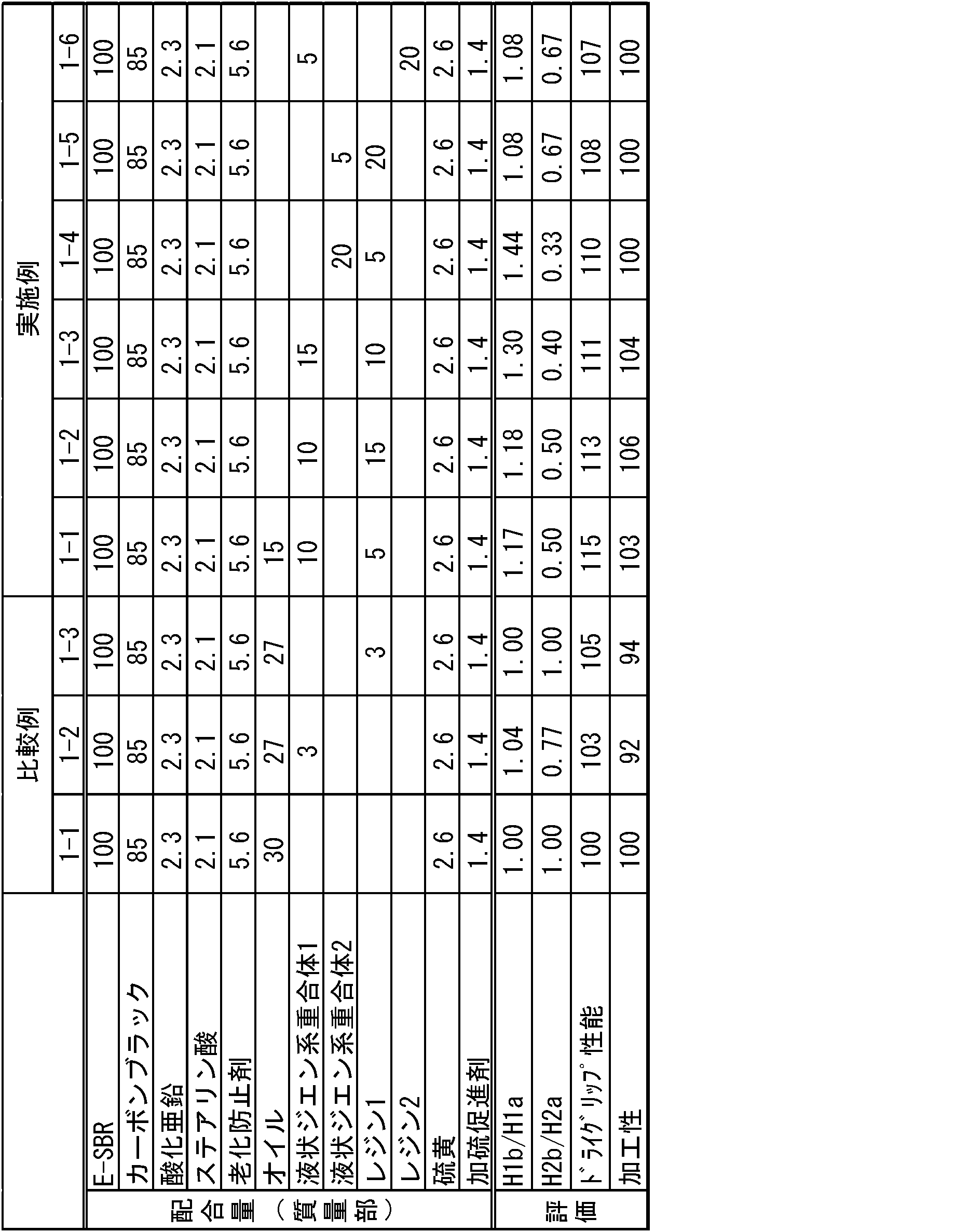
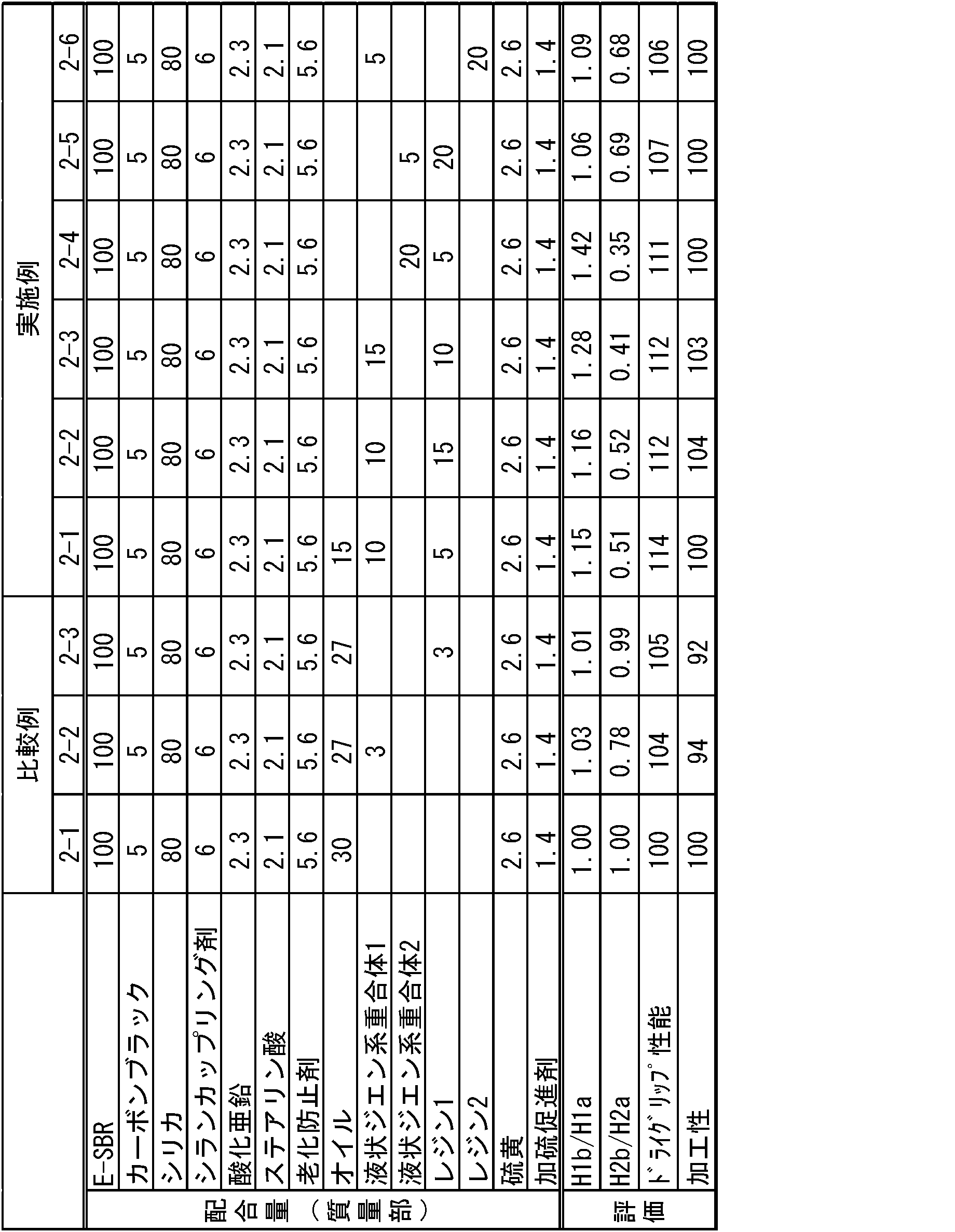
表1、2より、SBR/カーボンブラック配合、SBR/シリカ配合とも、前記式(1)、(2)を満たす実施例では、優れたドライグリップ性能が得られた。また、加工性(工程通過性)にも優れていた。このように実施例は、ドライグリップ性能、加工性の総合性能(ドライグリップ性能、加工性の2つの指数の総和で表す)が顕著に優れていた。
Claims (4)
- 少なくとも1種のスチレンブタジエン共重合体を含むゴム成分100質量部に対して、カーボンブラックを1~100質量部、シリカを0~150質量部含有するトレッド用ゴム組成物であって、
アセトン抽出で得られる抽出成分及び該抽出成分にオゾン分解を施して得られるオゾン分解成分は、分子量50以上2500未満の範囲のそれぞれのピーク面積H1a及びH1bが下記式(1)、分子量2500以上30000以下の範囲のそれぞれのピーク面積H2a及びH2bが下記式(2)を満たすトレッド用ゴム組成物。
1.05≦H1b/H1a≦1.75 (1)
0.20≦H2b/H2a≦0.75 (2) - スチレンブタジエン共重合体が乳化重合スチレンブタジエン共重合体である請求項1記載のトレッド用ゴム組成物。
- 液状ポリマー及びレジンを含む請求項1又は2記載のトレッド用ゴム組成物。
- 請求項1~3のいずれかに記載のゴム組成物で構成されたトレッドを有する空気入りタイヤ。
Priority Applications (1)
| Application Number | Priority Date | Filing Date | Title |
|---|---|---|---|
| EP19869141.2A EP3851488B1 (en) | 2018-10-04 | 2019-10-01 | Tread rubber composition and pneumatic tire |
Applications Claiming Priority (2)
| Application Number | Priority Date | Filing Date | Title |
|---|---|---|---|
| JP2018189197A JP6806119B2 (ja) | 2018-10-04 | 2018-10-04 | トレッドゴム組成物及び空気入りタイヤ |
| JP2018-189197 | 2018-10-04 |
Publications (1)
| Publication Number | Publication Date |
|---|---|
| WO2020071342A1 true WO2020071342A1 (ja) | 2020-04-09 |
Family
ID=70055176
Family Applications (1)
| Application Number | Title | Priority Date | Filing Date |
|---|---|---|---|
| PCT/JP2019/038669 Ceased WO2020071342A1 (ja) | 2018-10-04 | 2019-10-01 | トレッドゴム用組成物及び空気入りタイヤ |
Country Status (3)
| Country | Link |
|---|---|
| EP (1) | EP3851488B1 (ja) |
| JP (1) | JP6806119B2 (ja) |
| WO (1) | WO2020071342A1 (ja) |
Cited By (1)
| Publication number | Priority date | Publication date | Assignee | Title |
|---|---|---|---|---|
| JPWO2024147227A1 (ja) * | 2023-01-06 | 2024-07-11 |
Families Citing this family (4)
| Publication number | Priority date | Publication date | Assignee | Title |
|---|---|---|---|---|
| JP7771972B2 (ja) * | 2020-10-16 | 2025-11-18 | 住友ゴム工業株式会社 | タイヤ |
| WO2022114178A1 (ja) * | 2020-11-27 | 2022-06-02 | Jsr株式会社 | 重合体組成物、架橋体及びタイヤ |
| JP7647207B2 (ja) * | 2021-03-18 | 2025-03-18 | 住友ゴム工業株式会社 | 二輪自動車用タイヤ |
| CN117858809A (zh) * | 2021-09-01 | 2024-04-09 | 住友橡胶工业株式会社 | 充气轮胎 |
Citations (5)
| Publication number | Priority date | Publication date | Assignee | Title |
|---|---|---|---|---|
| JPS6115319B2 (ja) * | 1979-11-05 | 1986-04-23 | Aisin Seiki | |
| JPS6324436B2 (ja) * | 1982-12-25 | 1988-05-20 | Nippon Steel Corp | |
| JP2010111753A (ja) | 2008-11-05 | 2010-05-20 | Sumitomo Rubber Ind Ltd | ゴム組成物及びタイヤ |
| JP2016210937A (ja) * | 2015-05-12 | 2016-12-15 | 住友ゴム工業株式会社 | ゴム組成物およびタイヤ |
| JP2017160291A (ja) | 2016-03-07 | 2017-09-14 | 住友ゴム工業株式会社 | 高性能タイヤ |
Family Cites Families (13)
| Publication number | Priority date | Publication date | Assignee | Title |
|---|---|---|---|---|
| JP6291901B2 (ja) * | 2013-02-25 | 2018-03-14 | 横浜ゴム株式会社 | タイヤ用ゴム組成物および空気入りタイヤ |
| JP6115319B2 (ja) * | 2013-05-28 | 2017-04-19 | 横浜ゴム株式会社 | タイヤ用ゴム組成物および空気入りタイヤ |
| JP2016037532A (ja) * | 2014-08-06 | 2016-03-22 | 住友ゴム工業株式会社 | 空気入りタイヤ |
| JP6594611B2 (ja) * | 2014-08-07 | 2019-10-23 | 住友ゴム工業株式会社 | 高性能タイヤ |
| JP6334314B2 (ja) * | 2014-08-20 | 2018-05-30 | 住友ゴム工業株式会社 | タイヤ用ゴム組成物及び空気入りタイヤ |
| JP5944964B2 (ja) * | 2014-08-25 | 2016-07-05 | 住友ゴム工業株式会社 | ゴム組成物及び空気入りタイヤ |
| JP6423208B2 (ja) * | 2014-09-05 | 2018-11-14 | 住友ゴム工業株式会社 | 空気入りタイヤ |
| JP2016089015A (ja) * | 2014-11-04 | 2016-05-23 | 住友ゴム工業株式会社 | 空気入りタイヤ |
| JP6074113B2 (ja) * | 2014-12-24 | 2017-02-01 | 住友ゴム工業株式会社 | 空気入りタイヤ |
| CN107001712B (zh) * | 2014-12-24 | 2020-03-17 | 住友橡胶工业株式会社 | 充气轮胎 |
| JP6627466B2 (ja) * | 2015-12-04 | 2020-01-08 | 住友ゴム工業株式会社 | タイヤ用ゴム組成物および空気入りタイヤ |
| JP6324436B2 (ja) * | 2016-05-16 | 2018-05-16 | 住友ゴム工業株式会社 | ゴム組成物 |
| JP6776638B2 (ja) * | 2016-06-09 | 2020-10-28 | 住友ゴム工業株式会社 | 高性能タイヤ |
-
2018
- 2018-10-04 JP JP2018189197A patent/JP6806119B2/ja active Active
-
2019
- 2019-10-01 EP EP19869141.2A patent/EP3851488B1/en active Active
- 2019-10-01 WO PCT/JP2019/038669 patent/WO2020071342A1/ja not_active Ceased
Patent Citations (5)
| Publication number | Priority date | Publication date | Assignee | Title |
|---|---|---|---|---|
| JPS6115319B2 (ja) * | 1979-11-05 | 1986-04-23 | Aisin Seiki | |
| JPS6324436B2 (ja) * | 1982-12-25 | 1988-05-20 | Nippon Steel Corp | |
| JP2010111753A (ja) | 2008-11-05 | 2010-05-20 | Sumitomo Rubber Ind Ltd | ゴム組成物及びタイヤ |
| JP2016210937A (ja) * | 2015-05-12 | 2016-12-15 | 住友ゴム工業株式会社 | ゴム組成物およびタイヤ |
| JP2017160291A (ja) | 2016-03-07 | 2017-09-14 | 住友ゴム工業株式会社 | 高性能タイヤ |
Non-Patent Citations (2)
| Title |
|---|
| See also references of EP3851488A4 |
| THE SOCIETY OF POLYMER SCIENCE, JAPAN, vol. 29, no. 9, pages 2055 |
Cited By (2)
| Publication number | Priority date | Publication date | Assignee | Title |
|---|---|---|---|---|
| JPWO2024147227A1 (ja) * | 2023-01-06 | 2024-07-11 | ||
| JP7667521B2 (ja) | 2023-01-06 | 2025-04-23 | 横浜ゴム株式会社 | タイヤ用ゴム組成物およびタイヤ |
Also Published As
| Publication number | Publication date |
|---|---|
| JP6806119B2 (ja) | 2021-01-06 |
| EP3851488A1 (en) | 2021-07-21 |
| EP3851488A4 (en) | 2022-06-08 |
| JP2020055980A (ja) | 2020-04-09 |
| EP3851488B1 (en) | 2023-08-09 |
Similar Documents
| Publication | Publication Date | Title |
|---|---|---|
| JP7192329B2 (ja) | トレッドゴム組成物及び空気入りタイヤ | |
| EP3851488B1 (en) | Tread rubber composition and pneumatic tire | |
| EP3626481B1 (en) | Pneumatic tire | |
| JP7375562B2 (ja) | 二輪自動車用タイヤ | |
| JP7151167B2 (ja) | トレッド用ゴム組成物及び空気入りタイヤ | |
| WO2020059302A1 (ja) | トレッドゴム組成物及び空気入りタイヤ | |
| JP2020066326A (ja) | 重荷重用空気入りタイヤ | |
| JP2019199526A (ja) | タイヤ用ゴム組成物及び空気入りタイヤ | |
| JP2019194289A (ja) | タイヤ用ゴム組成物及び空気入りタイヤ | |
| JP2019196436A (ja) | タイヤ用ゴム組成物及び空気入りタイヤ | |
| JP2019203071A (ja) | タイヤ用ゴム組成物及び空気入りタイヤ | |
| JP2019189672A (ja) | タイヤ用ゴム組成物及び空気入りタイヤ | |
| JP7352126B2 (ja) | トレッドゴム組成物及び空気入りタイヤ | |
| WO2022050153A1 (ja) | 空気入りタイヤ | |
| JP7306050B2 (ja) | タイヤ用ゴム組成物及び空気入りタイヤ | |
| EP3608127B1 (en) | Pneumatic tire | |
| JP7358780B2 (ja) | タイヤ用ゴム組成物及び空気入りタイヤ | |
| EP3424749B1 (en) | Pneumatic tire | |
| JP6939926B2 (ja) | トレッド用ゴム組成物及び空気入りタイヤ | |
| WO2021111693A1 (ja) | タイヤ | |
| JP2019203070A (ja) | タイヤ用ゴム組成物及び空気入りタイヤ | |
| JP7439483B2 (ja) | 二輪車用タイヤ | |
| JP2020050732A (ja) | ゴム組成物及び空気入りタイヤ | |
| JP2021167390A (ja) | タイヤ用ゴム組成物及びタイヤ |
Legal Events
| Date | Code | Title | Description |
|---|---|---|---|
| 121 | Ep: the epo has been informed by wipo that ep was designated in this application |
Ref document number: 19869141 Country of ref document: EP Kind code of ref document: A1 |
|
| NENP | Non-entry into the national phase |
Ref country code: DE |
|
| ENP | Entry into the national phase |
Ref document number: 2019869141 Country of ref document: EP Effective date: 20210412 |