WO2020080490A1 - ペプチドライブラリーの製造方法 - Google Patents
ペプチドライブラリーの製造方法 Download PDFInfo
- Publication number
- WO2020080490A1 WO2020080490A1 PCT/JP2019/040975 JP2019040975W WO2020080490A1 WO 2020080490 A1 WO2020080490 A1 WO 2020080490A1 JP 2019040975 W JP2019040975 W JP 2019040975W WO 2020080490 A1 WO2020080490 A1 WO 2020080490A1
- Authority
- WO
- WIPO (PCT)
- Prior art keywords
- peptide
- library
- amino acid
- bond
- trp
- Prior art date
- Legal status (The legal status is an assumption and is not a legal conclusion. Google has not performed a legal analysis and makes no representation as to the accuracy of the status listed.)
- Ceased
Links
Images








Classifications
-
- C—CHEMISTRY; METALLURGY
- C40—COMBINATORIAL TECHNOLOGY
- C40B—COMBINATORIAL CHEMISTRY; LIBRARIES, e.g. CHEMICAL LIBRARIES
- C40B40/00—Libraries per se, e.g. arrays, mixtures
- C40B40/04—Libraries containing only organic compounds
- C40B40/06—Libraries containing nucleotides or polynucleotides, or derivatives thereof
- C40B40/08—Libraries containing RNA or DNA which encodes proteins, e.g. gene libraries
-
- C—CHEMISTRY; METALLURGY
- C40—COMBINATORIAL TECHNOLOGY
- C40B—COMBINATORIAL CHEMISTRY; LIBRARIES, e.g. CHEMICAL LIBRARIES
- C40B50/00—Methods of creating libraries, e.g. combinatorial synthesis
- C40B50/06—Biochemical methods, e.g. using enzymes or whole viable microorganisms
-
- C—CHEMISTRY; METALLURGY
- C12—BIOCHEMISTRY; BEER; SPIRITS; WINE; VINEGAR; MICROBIOLOGY; ENZYMOLOGY; MUTATION OR GENETIC ENGINEERING
- C12N—MICROORGANISMS OR ENZYMES; COMPOSITIONS THEREOF; PROPAGATING, PRESERVING, OR MAINTAINING MICROORGANISMS; MUTATION OR GENETIC ENGINEERING; CULTURE MEDIA
- C12N9/00—Enzymes; Proenzymes; Compositions thereof; Processes for preparing, activating, inhibiting, separating or purifying enzymes
- C12N9/14—Hydrolases (3)
- C12N9/48—Hydrolases (3) acting on peptide bonds (3.4)
- C12N9/50—Proteinases, e.g. Endopeptidases (3.4.21-3.4.25)
- C12N9/64—Proteinases, e.g. Endopeptidases (3.4.21-3.4.25) derived from animal tissue
- C12N9/6402—Proteinases, e.g. Endopeptidases (3.4.21-3.4.25) derived from animal tissue from non-mammals
- C12N9/6405—Proteinases, e.g. Endopeptidases (3.4.21-3.4.25) derived from animal tissue from non-mammals not being snakes
- C12N9/641—Cysteine endopeptidases (3.4.22)
-
- C—CHEMISTRY; METALLURGY
- C12—BIOCHEMISTRY; BEER; SPIRITS; WINE; VINEGAR; MICROBIOLOGY; ENZYMOLOGY; MUTATION OR GENETIC ENGINEERING
- C12P—FERMENTATION OR ENZYME-USING PROCESSES TO SYNTHESISE A DESIRED CHEMICAL COMPOUND OR COMPOSITION OR TO SEPARATE OPTICAL ISOMERS FROM A RACEMIC MIXTURE
- C12P21/00—Preparation of peptides or proteins
- C12P21/02—Preparation of peptides or proteins having a known sequence of two or more amino acids, e.g. glutathione
-
- C—CHEMISTRY; METALLURGY
- C12—BIOCHEMISTRY; BEER; SPIRITS; WINE; VINEGAR; MICROBIOLOGY; ENZYMOLOGY; MUTATION OR GENETIC ENGINEERING
- C12P—FERMENTATION OR ENZYME-USING PROCESSES TO SYNTHESISE A DESIRED CHEMICAL COMPOUND OR COMPOSITION OR TO SEPARATE OPTICAL ISOMERS FROM A RACEMIC MIXTURE
- C12P5/00—Preparation of hydrocarbons or halogenated hydrocarbons
- C12P5/007—Preparation of hydrocarbons or halogenated hydrocarbons containing one or more isoprene units, i.e. terpenes
-
- C—CHEMISTRY; METALLURGY
- C12—BIOCHEMISTRY; BEER; SPIRITS; WINE; VINEGAR; MICROBIOLOGY; ENZYMOLOGY; MUTATION OR GENETIC ENGINEERING
- C12Y—ENZYMES
- C12Y205/00—Transferases transferring alkyl or aryl groups, other than methyl groups (2.5)
- C12Y205/01—Transferases transferring alkyl or aryl groups, other than methyl groups (2.5) transferring alkyl or aryl groups, other than methyl groups (2.5.1)
-
- C—CHEMISTRY; METALLURGY
- C40—COMBINATORIAL TECHNOLOGY
- C40B—COMBINATORIAL CHEMISTRY; LIBRARIES, e.g. CHEMICAL LIBRARIES
- C40B30/00—Methods of screening libraries
- C40B30/04—Methods of screening libraries by measuring the ability to specifically bind a target molecule, e.g. antibody-antigen binding, receptor-ligand binding
-
- C—CHEMISTRY; METALLURGY
- C40—COMBINATORIAL TECHNOLOGY
- C40B—COMBINATORIAL CHEMISTRY; LIBRARIES, e.g. CHEMICAL LIBRARIES
- C40B40/00—Libraries per se, e.g. arrays, mixtures
- C40B40/04—Libraries containing only organic compounds
- C40B40/10—Libraries containing peptides or polypeptides, or derivatives thereof
-
- G—PHYSICS
- G01—MEASURING; TESTING
- G01N—INVESTIGATING OR ANALYSING MATERIALS BY DETERMINING THEIR CHEMICAL OR PHYSICAL PROPERTIES
- G01N33/00—Investigating or analysing materials by specific methods not covered by groups G01N1/00 - G01N31/00
- G01N33/48—Biological material, e.g. blood, urine; Haemocytometers
- G01N33/50—Chemical analysis of biological material, e.g. blood, urine; Testing involving biospecific ligand binding methods; Immunological testing
- G01N33/53—Immunoassay; Biospecific binding assay; Materials therefor
Definitions
- the present invention relates to a method for producing a peptide library and a method for producing a peptide-mRNA complex library.
- peptide drugs In recent years, research and development of various peptide drugs have been promoted. The greatest advantage of peptide drugs is their high affinity and high specificity for target molecules, and the ability to inhibit protein-protein interactions that are difficult for small molecule compounds. Due to their chemical and biological diversity, peptide drugs often have higher specificity of interaction with a target molecule than low molecular weight compounds, and as a result, greater physiological activity is obtained.
- peptide drugs like most other biopharmaceuticals, cannot reach the inside of cells because they cannot penetrate cell membranes, and they are inferior in protease resistance compared to large proteins such as antibodies, so they are decomposed in a short time, and they are effective. There is a problem that it is difficult to obtain. In recent years, it has been studied to improve the problems of such peptide drugs by adding various modifications to peptides.
- the present inventors have developed the RAndom Peptide Integrated Discovery (RAPID) system as a protein translation system.
- the RAPID system combines an artificial translation synthesis system specialized for the synthesis of special cyclic peptides with a screening system that takes advantage of the characteristics of the translation system and a molecular evolution engineering method to create a highly diverse special cyclic peptide library.
- An experimental system that allows the construction and identification of active peptides from the library.
- an artificial aminoacylated RNA catalyst "flexizyme" for example, Non-Patent Document 1 can be used to link an arbitrary amino acid to an arbitrary tRNA. Can be bound to a tRNA having an anticodon.
- any amino acid including a non-protein amino acid can be assigned to any position of a peptide. It is possible to create an introduced peptide library or a peptide library having a macrocyclic structure.
- the highly diverse special cyclic peptide library to be constructed will contain peptides with increased protease resistance, cell permeability, affinity for target molecules and specificity. Further, by in vitro selection, a peptide serving as an active species that binds to an arbitrary target protein can be rapidly and reliably identified from the obtained library.
- a peptide library can be prepared using the RAPID system to rapidly identify peptides that bind to any target protein, it is still possible to obtain peptides with sufficient cell membrane permeability among the identified peptides. The reality is that they are not. Therefore, a method for producing a peptide library containing a peptide having excellent cell membrane permeability is particularly required in order to create a peptide having an activity against a target existing in cells.
- An object of the present invention is to provide a novel method for producing a peptide library.
- the present inventors have modified a peptide library by using a prenylation enzyme to modify a predetermined amino acid contained in a peptide constituting the library, The inventors have found that the above problems can be solved and completed the present invention.
- the present invention is as follows. [1] Contacting a peptide library containing a peptide having an amino acid sequence containing at least one Trp or a derivative thereof with a prenylation enzyme to prenylate at least one Trp residue or a derivative residue thereof, Of a peptide library containing the above peptides. [2] The method for producing a peptide library according to [1], wherein the prenylation enzyme is at least one selected from the group consisting of enzymes 1 to 21 and homologs thereof. [3] The method for producing a peptide library according to [1], wherein the prenylation enzyme comprises the amino acid sequence of any of the following (1) to (3).
- the prenylation step Prior to the prenylation step, it comprises a step of translating an mRNA library by a cell-free translation system to prepare a peptide library containing a peptide having an amino acid sequence containing at least one Trp or a derivative thereof [1 ] The manufacturing method of the peptide library in any one of [5]. [7] Providing a peptide-genotype library comprising a complex of genotype and peptide, and Contacting the peptide-genotype library with a prenylation enzyme to prenylate at least one Trp or derivative thereof. A method for producing a peptide-genotype complex library.
- the step of preparing the peptide-genotype library comprises the step of preparing a peptide-mRNA library by the mRNA display method,
- the step of preparing the peptide-mRNA library comprises The step of binding puromycin to the 3'end of each mRNA of the mRNA library to produce a puromycin-binding mRNA library, and Translating the puromycin-binding mRNA library by a cell-free translation system to prepare a peptide-mRNA library containing a peptide having an amino acid sequence containing at least one Trp or a derivative thereof,
- the method for producing a peptide-genotype complex library according to [7].
- a screening method for identifying a peptide that binds to a target substance A method for producing a prenylated peptide, comprising the step of contacting a peptide having an amino acid sequence containing at least one Trp or a derivative thereof with a prenylation enzyme to prenylate at least one Trp residue or a derivative residue thereof. .
- FIG. 6 is a diagram of an electrophoresis gel showing that an mRNA library was successfully prepared from a PCR product.
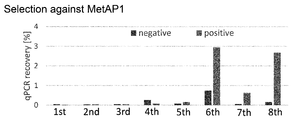
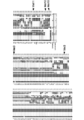
- FIG. 3 is a view showing a sequence obtained by selection targeting MetAP1. It is a figure which shows the result of the pull-down assay of the prenylated cyclic peptide identified as a result of the screening targeting MetAP1.
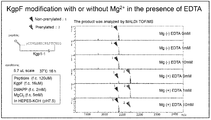
- FIG. 3 shows the results of the progress of prenylation reaction by KgpF in the presence or absence of EDTA and Mg2 + on the cyclic peptide Met3-1.
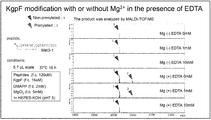
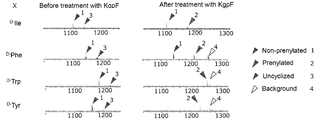
- FIG. 3 is a diagram showing the results of the progress of the prenylation reaction by OltF for the cyclic peptide Met14 in the presence or absence of EDTA and Mg2 +. It is a figure which shows the MALDI-TOF-MS spectrum before and after making KgpF act about the translation mixture containing the artificial cyclic peptide containing D body amino acid. It is a figure which shows the MALDI-TOF-MS spectrum after carrying out the prenylation of the said Trp derivative using OltF or KgpF in the cyclic peptide containing a non-proteinaceous Trp derivative.
- the method for producing a peptide library of the present invention comprises contacting a peptide library containing a peptide having an amino acid sequence containing at least one Trp or a derivative thereof with a prenylation enzyme to obtain at least one Trp residue or a derivative residue thereof. A step of prenylating.
- the peptide library in the present invention contains at least two peptides. At least one of the peptides contained in the peptide library of the present invention has an amino acid sequence containing at least one Trp or a derivative thereof.
- a peptide library containing highly hydrophobic peptides can be produced by prenylating part of Trp or its derivative using a prenylation enzyme. Further, according to the method for producing a peptide library of the present invention, the substrate tolerance of the prenylation enzyme is high, so that the hydrophobicity of the peptides contained in the peptide library can be efficiently increased. As described above, according to the production method of the present invention, a hydrophobic group can be efficiently introduced into a peptide, and a peptide library containing the peptide expected to penetrate the cell membrane can be obtained.
- the peptide library used in the production method of the present invention may be produced and obtained, or the peptide library may be purchased and obtained.
- the production method includes a method of producing a peptide library by solid-phase or liquid-phase chemical synthesis, and an mRNA library translated by a cell-free translation system, and at least A preferable method is a method of preparing a peptide library containing a peptide having an amino acid sequence containing one Trp or its derivative.
- an mRNA library is translated by a cell-free translation system to prepare a peptide library containing a peptide having an amino acid sequence containing at least one Trp or a derivative thereof. And a step of contacting the peptide library with a prenylation enzyme to prenylate at least one Trp residue or a derivative residue thereof.
- the mRNA library contains mRNA having a plurality of N1N2N3 as codons.
- N1N2N3 means a codon specifying any amino acid, for example, N1, N2 and N3 are each independently adenine (A), guanine (G), cytosine (C) and uracil ( U) selected from.
- One mRNA contains a plurality of N1N2N3, and each N1, N2 and N3 is independently selected.
- each two N1, N2 and N3 may be the same or different from each other.
- N1N2N3 is reassigned any amino acid.
- the reassignment it is possible to assign a different one from the relationship between the codon and the amino acid in the natural genetic code table, or the same relationship.
- the “natural genetic code table” refers to a table showing amino acids represented by a genetic code consisting of a triplet of mRNA in a living body.
- N1N2N3 represents the following amino acids.
- the mRNA library includes, as the plurality of N1N2N3, for example, mRNA containing any one of a plurality of N1N2K, a plurality of N1N2S, a plurality of N1N2M, a plurality of N1N2W, a plurality of N1N2A, a plurality of N1N2U, a plurality of N1N2C, and a plurality of N1N2G. It may include one.
- N1 and N2 are as defined above, K is independently uracil (U) or guanine (G), and S is independently cytosine (C) or guanine (G).
- M is independently adenine (A) or cytosine (C)
- W is independently adenine (A) or uracil (U).
- N1N2K represents 20 kinds of amino acids when G or U is shown in the right column of the above table.
- Leu may be assigned to UUG according to the natural genetic code, or amino acids other than Leu may be assigned by reassigning codons. Any amino acid can be assigned to the "N1N2K" codon. “Assigning an amino acid to a codon” means rewriting the genetic code table so that a codon codes for the amino acid. In the present specification, “assign amino acid to codon” and “reassign codon” are used synonymously. The assignment of amino acids different from the natural genetic code to each codon is realized by, for example, codon reassignment using an artificial aminoacylated RNA-catalyzed Flexizyme.
- a desired amino acid can be bound to a tRNA having an arbitrary anticodon, and thus an arbitrary amino acid can be assigned to an arbitrary codon.
- binding an amino acid to a tRNA may be to charge the amino acid to the tRNA, to aminoacylate the tRNA, or to acylate the tRNA with the amino acid.
- non-protein amino acids may be assigned to “N1N2K”.
- N1N2K an amino acid containing a cyclic structure or an N-alkyl amino acid
- a peptide library having increased resistance to proteolysis, cell membrane permeability, and conformational rigidity can be obtained.
- Such a peptide library is useful for screening for those targeting intracellular disease-related molecules and peptides targeting molecules having protease activity.
- the mRNA contains two or more “N1N2K”, all of them may be assigned to non-protein amino acids, or some of them may be assigned to non-protein amino acids.
- amino acid is used in its broadest sense, and includes artificial amino acid variants and derivatives in addition to natural amino acids.
- Amino acids may be designated by the conventional one-letter or three-letter code.
- examples of the amino acids or derivatives thereof include naturally-occurring proteinaceous L-amino acids; unnatural amino acids; chemically synthesized compounds having characteristics known to those skilled in the art that are characteristic of amino acids.
- unnatural amino acids include ⁇ , ⁇ -disubstituted amino acids ( ⁇ -methylalanine, etc.), N-alkyl- ⁇ -amino acids, D-amino acids, ⁇ -amino acids, ⁇ - Hydroxy acids, amino acids with a side chain structure different from the natural type (norleucine, homohistidine, etc.), amino acids with extra methylene in the side chain (“homo” amino acids, homophenylalanine, homohistidine, etc.) and carvone in the side chain. Examples thereof include, but are not limited to, amino acids in which an acid functional group amino acid is substituted with a sulfonic acid group (cysteic acid and the like).
- amino acid includes proteinogenic amino acids and non-proteinogenic amino acids.
- protein amino acid means amino acids (Arg, His, Lys, Asp, Glu, Ser, Thr, Asn, Gln, Cys, Gly, Pro, Ala, Ile, Leu, Met, Phe that constitute a protein. , Trp, Tyr, and Val).
- non-proteinogenic amino acid means a natural or unnatural amino acid other than proteinaceous amino acids.
- Trp is represented by, for example, the following formula (I), formula (II), and formula (III).
- the chemical structural formulas in this specification include tautomers, geometrical isomers, optical isomers, and the like.
- the asymmetric carbons in formula (I), formula (II), and formula (III) may be in the R configuration, the S configuration, or a mixture thereof.
- ring A is an aromatic 6-membered ring which may contain a hetero atom
- R 1 is an arbitrary substituent on ring A
- R 2 and R 3 are each independently Is a hydrogen atom or an optional substituent
- m is an integer of 0 to 4
- l is an integer of 1 or 2.
- ring A include a benzene ring, a pyridine ring, a pyridazine ring, a pyrimidine ring, a pyrazine ring and the like.
- the substituents R 1 , R 2 and R 3 are not particularly limited and include, for example, hydroxy group; halogen group such as fluorine group, chloro group, bromo group and iodo group; carbon such as methyl group, ethyl group and propyl group. And the like. Examples thereof include an alkyl group of 1 to 10; an aryl group such as a phenyl group and a naphthyl group; an aralkyl group such as a benzyl group; an aralkyloxy group such as a benzyloxy group.
- Ring A, R 1, R 2, m, and l have the same meanings as ring A, R 1, R 2, m, and l in formula (I).
- Ring A in formula (II) is preferably a benzene ring.
- Ring A in formula (III) is preferably a benzene ring.
- Trp derivative represented by the formula (I) examples include the following derivatives.
- R 1, R 2, R 3 , and m have the same meanings as R 1, R 2, R 3 , and m in formula (I).
- Trp derivatives include D-tryptophan, 5-methyltryptophan, 5-hydroxytryptophan, 7-azatryptophan, 5-benzyloxytryptophan, and the like.
- Trp residue is prenylated to form a structure in which the main chain nitrogen is alkylated as shown in the following formula (T1), so that the hydrogen bond donor is reduced, and the peptide containing the Trp residue is It is presumed that hydrophobicity and membrane permeability tend to improve (see Beilstein JOrg Chem. 2017 Feb 22; 13: 338-346.).
- the prenyl group is a structural unit composed of an isoprene unit having 5 carbon atoms, and when the formula (T1) is taken as an example, it is the following structural part.
- n is an integer of 0 to 11.
- the configuration in formula (T1) is not particularly limited, but has, for example, the configuration represented by the following formula (T1-1) and formula (T1-2).
- the configuration in formula (T1) preferably has a configuration represented by the following formula (T1-1).
- Trp When the derivative residue of Trp is prenylated, it can be represented by the following formulas (I-1), (II-1), and (III-1).
- rings A, R 1 , R 2 , R 3 , m, and l are rings A, R 1 in formula (I). , R 2 , R 3 , m, and l.
- a peptide library containing a plurality of peptides containing the amino acids encoded by "N1N2N3" can be produced.
- the number of amino acids encoded by “N1N2N3” contained in each peptide is not particularly limited, and includes, for example, 4, 5, 6, 7, 8, 9, 9, 15, 15, 20 , 30 pieces, etc.
- the position of the amino acid encoded by “N1N2N3” in each peptide is not particularly limited.
- the amino acids encoded by “N1N2N3” in each peptide may be adjacent or separated.
- an mRNA library containing mRNA encoding each peptide of the peptide library and each mRNA containing at least one N1N2N3 is prepared.
- the sequence of mRNA encoding each peptide of the peptide library can be determined according to the amino acid sequence of the peptides constituting the peptide library, and such mRNA library synthesizes a DNA library encoding this, It can be prepared by transferring this.
- an mRNA library containing mRNAs in which N1N2N3 is NNG, NNK, NNS, NNM, NNW, NNA, NNU, or NNC can be designed using the natural genetic code table. .
- each N is independently selected from adenine (A), guanine (G), cytosine (C) and uracil (U).
- Each K is independently uracil (U) or guanine (G).
- Each S is independently cytosine (C) or guanine (G).
- M is independently adenine (A) or cytosine (C).
- W is independently adenine (A) or uracil (U).
- n is any integer of 1 or more, preferably any integer of 1 to 100, more preferably any integer of 3 to 50, and further preferably any integer of 3 to 20. And more preferably any integer of 6 to 15.
- the triplet encoding Trp is only one of UGG among 64 types of N1N2N3. So theoretically, the probability of a N1N2N3 triplet of 1 encoding Trp is 1/64. On the other hand, for example, the probability that an NNK triplet of 1 encodes Trp is 1/32.
- the natural genetic code table for example, it is possible to design an mRNA library containing mRNA in which the number of triplet repeats is 12 and N1N2N3 is NNK. Such an mRNA library theoretically has a diversity of 1.15 ⁇ 10 18 , contains no stop codon and contains 22% of mRNA containing at least one UGG.
- the probability that an NNG triplet of 1 encodes Trp is 1/16.
- the present inventors have found that the prenylation of a Trp residue by a prenylation enzyme affects the modification efficiency by amino acid residues before and after the Trp residue. Therefore, if an mRNA library containing an mRNA containing a codon coding for an amino acid residue that is adjacent to Trp or its derivative to be prenylated and promotes the Trp or its derivative to be prenylated, Trp or its The efficiency of prenylation of the derivative can be improved. For example, as shown in Table 3-1 below, the use of mRNA containing UGG and codons (XXX, YYY) adjacent to UGG and coding for amino acid residues that promote prenylation, The prenyl group can be efficiently introduced into the library.
- XXX is a degenerate codon sequence that specifies a set of upstream amino acids that are easily modified by the prenylation enzyme used.
- YYY is a degenerate codon sequence that specifies the set of downstream amino acids that are likely to be modified by the prenylation enzyme used.
- n and m are each independently an arbitrary integer of 0 or more. The sum of n and m is preferably an integer of 1 to 100, more preferably an integer of 3 to 50, and further preferably an integer of 3 to 20. It is preferably an integer of 4 to 13.
- N1N2N3 is as defined above, and is, for example, a codon selected from the group consisting of NNK, NNS, NNW, NNM, NNA, NNC, NNG, and NNU. Multiple N1N2N3 are independent codons.
- the modification efficiency of the prenylation enzyme varies depending on the type of the prenylation enzyme used, and is increased by adjusting the amino acid residue before and / or after the Trp (that is, XXX, YYY as the corresponding codon). be able to.
- a streamlined amino acid sequence consisting of Trp and adjacent amino acid residues before and after, and XXX and YYY are comprehensively made into peptides using a cell-free translation system, and prenyl in vitro using a predetermined prenylation enzyme. It can be appropriately determined by conducting a test for confirming the efficiency of conversion.
- the prenylation Trp can be efficiently introduced into a peptide by mixing the mRNAs shown in Table 3-2 among the mRNAs shown in Table 3-1 into the library. Become.
- the mRNA library containing mRNA containing UGG is used while using the natural genetic code, like mRNA shown in Table 3-2, UGG in the obtained peptide library is obtained. It is possible to fix the position of occurrence of the and to control the position of the Trp residue that is prenylated in the peptide. Furthermore, for example, when KgpF is used as the prenylation enzyme, the triplet XXX upstream of UGG is set to RYU or CMG, and / or the triplet downstream of UGG is set to NNK to improve the prenylation efficiency of the Trp residue. It can be increased.
- Such an mRNA library theoretically has a diversity of 6.8 ⁇ 10 16 , contains no stop codon and contains 73% of mRNAs containing at least one UGG.
- Table 3-2 when XXX represents RYU or CMG, R independently represents G or A, Y independently represents U or C, M independently represents A or C, and K represents Each represents G or U independently.
- a cell-free translation system having an anticodon for any of the 20 types of N1N2N3 and adding 20 types of tRNA charged with an amino acid corresponding to the codon is used.
- Translate each mRNA in the mRNA library it is possible to use a translation system in which constituent elements of the translation system are freely removed according to the purpose and only necessary components are reconstructed. For example, when the translation system in which a specific amino acid is removed is reconfigured, the codon corresponding to the amino acid becomes an empty codon that does not code any amino acid.
- the tRNA used in the present invention may be a wild-type tRNA derived from Escherichia coli or an artificial tRNA prepared by in vitro transcription.
- 20 kinds of tRNA corresponding to 20 kinds of N1N2N3 used in the translation system may have the same sequence except the anticodon loop portion. With such a configuration, the reactivity of a specific tRNA does not become high or low, each tRNA has a uniform reactivity, and it is possible to express a scheduled peptide with good reproducibility. Become.
- the "cell-free translation system” refers to a cell-free translation system, and examples of the cell-free translation system include Escherichia coli extract, wheat germ extract, rabbit red blood cell extract, insect cell extract and the like. Can be used.
- purified ribosomal protein, aminoacyl-tRNA synthetase (aaRS), ribosomal RNA, amino acid, rRNA, GTP, ATP, translation initiation factor (IF) elongation factor (EF), termination factor (RF), and ribosomal refolding factor A reconstituted cell-free translation system constructed by reconstituting RRF) and other factors required for translation may be used.
- a system containing RNA polymerase may also be used to perform transcription from DNA together.
- Escherichia coli-derived systems include RTS-100 (registered trademark) from Roche Diagnostics, and as reconstituted translation systems, PGI PURESYSTEM (registered trademark) and Gene Frontier.
- PGI PURESYSTEM registered trademark
- Gene Frontier As a system using a wheat germ extract, such as PUREfrex of P. Inc. or PUR Express In Vitro Protein Synthesis Kit of New England BioLabs, those of Zogene or Cell Free Science can be used.
- a system using the ribosome of Escherichia coli for example, the technique described in the following document is known: HF Kung et al., 1977. The Journal of Biological Chemistry Vol.
- the expression product can be obtained in a highly pure form without purification.
- the cell-free translation system of the present invention may be used for transcription as well as translation by adding a factor required for transcription.
- the present invention it is also preferable not to add a natural aminoacyl-tRNA synthetase corresponding to the N1N2K codon to the cell-free translation system.
- the tRNA corresponding to the N1N2K codon can be charged with the corresponding amino acid by an artificial aminoacyl-tRNA synthetase such as flexizyme.
- the peptide library in the present invention may contain a cyclic peptide in which the peptide is cyclized.
- cyclic peptide refers to a peptide containing a cyclic structure composed of 4 or more amino acids.
- the “cyclic structure” means a closed ring structure formed in a molecule in a linear peptide by binding two amino acids separated by 2 amino acid residues or more directly or via a linker or the like. By “two or more amino acid residues apart” is meant that there are at least two amino acids between the two amino acids.
- By circularizing the peptide it may be possible to stabilize the structure of the peptide and increase the affinity for the target.
- Amino acids forming a cyclic structure that is, the number of amino acids forming a ring among cyclic peptides is not particularly limited as long as it is 4 amino acids or more, for example, 4 amino acids or more, 5 amino acids or more, 8 amino acids or more, 15 amino acids or less, 20 It may be amino acids or less, 25 amino acids or less, 30 amino acids or less, and the like.
- the cyclization is not limited to the bond between the N-terminal and C-terminal amino acids of the peptide, but may be the bond between the terminal amino acid and a non-terminal amino acid, or the bonding between non-terminal amino acids.
- a cyclic peptide when one of the amino acids linked for ring formation is a terminal amino acid and the other is a non-terminal amino acid, the cyclic peptide includes a structure in which a linear peptide is attached to the cyclic structure like a tail. In this specification, such a structure may be referred to as a “lasso type”.
- amino acids adjacent to each other means amino acids adjacent to each other even after the ring is formed.
- Adjacent amino acids mean amino acids in which the direct amino acid residues are directly linked to each other and are not separated by more than one amino acid residue in the peptide.
- a chloroacetylated amino acid at the N-terminal may be used, and Cys may be arranged downstream of the N-terminal (C-terminal side).
- the peptide is naturally cyclized after being expressed by the thioether bond between the N-terminal amino acid and Cys located downstream of the N-terminal (C-terminal side).
- the thioether bond formed between the chloroacetylated amino acid and Cys is less susceptible to degradation under reducing conditions in vivo, so it is possible to prolong the blood half-life of the peptide and sustain the physiologically active effect. .
- chloroacetylated amino acids examples include N-chloroacetyl-L-alanine, N-chloroacetyl-L-phenylalanine, N-chloroacetyl-L-tyrosine, N-chloroacetyl-L-tryptophan, N-3-chloromethylbenzoyl-L-phenylalanine.
- the chloroacetylated amino acid for example, if N ⁇ - (2-chloroacetyl) - ⁇ , ⁇ -diaminobutylic acid or N ⁇ - (2-chloroacetyl) - ⁇ , ⁇ -diaminopropanoic acid is used, the position of the peptide chain Can also be introduced, so that a thioether bond is generated between an amino acid at any position and cysteine in the same peptide, and a cyclic structure is formed.
- the cyclization method is, for example, Kawakami, T. et al., Nature Chemical Biology 5, 888-890 (2009); Yamagishi, Y.
- the chloroacetylated amino acid and Cys may be directly bound to the peptide of the present invention, or may be bound via a linker or the like.
- the C-terminal amino acid of the cyclic peptide when the C-terminal amino acid of the cyclic peptide is not used for cyclization, the C-terminal may be an amide or ester as well as a carboxyl group or a carboxylate group.
- the cyclic peptide also includes salts of cyclic peptides. Salts of cyclic peptides include salts with physiologically acceptable bases and acids, such as addition salts of inorganic acids (hydrochloric acid, hydrobromic acid, hydroiodic acid, sulfuric acid, phosphoric acid, etc.), organic salts.
- Acid p-toluenesulfonic acid, methanesulfonic acid, oxalic acid, p-bromophenylsulfonic acid, carboxylic acid, succinic acid, citric acid, benzoic acid, acetic acid, etc.
- inorganic base ammonium hydroxide or alkali or Alkaline earth metal hydroxides, carbonates, bicarbonates, etc.
- amino acid addition salts and the like amino acid addition salts and the like.
- the cyclic peptide of the present invention as long as it solves the problems of the present invention, those modified by phosphorylation, methylation, acetylation, adenylylation, ADP ribosylation, glycosylation and the like. May be. It may be one fused with another peptide or protein.
- the method for producing a peptide library of the present invention includes a step of contacting the peptide library with a prenylation enzyme to prenylate at least a part of Trp or a derivative thereof contained in at least a part of the peptides.
- a prenylation enzyme means an enzyme capable of binding a prenyl group composed of an isoprene unit having 5 carbon atoms to at least a part of Trp or its derivative contained in a peptide. To do.
- the prenyl group here includes those in which a plurality of isoprene units are continuously bonded, and dimethylallyl is the order in which the number of isoprene units is 1, 2, 3, 4, 5, 6, 8, and 10. It is also called a group, geranyl group, farnesyl group, geranylgeranyl group, geranylfarnesyl group, hexaprenyl group, octaprenyl group, decaprenyl group.
- a prenylation enzyme in the presence of a donor of a prenyl group.
- the donor for donating the prenyl group is not particularly limited, and examples thereof include dimethylallyl diphosphate (DMAPP), isoprenyl diphosphate (IPP), geranyl diphosphate (GPP), farnesyl diphosphate (FPP), geranylgeranyl diphosphate (GGPP). ), And phytyl diphosphate (PDP).
- DMAPP dimethylallyl diphosphate
- IPP isoprenyl diphosphate
- GPP geranyl diphosphate
- FPP farnesyl diphosphate
- GGPP geranylgeranyl diphosphate
- PDP phytyl diphosphate
- the donors that donate these prenyl groups may be used alone or in combination of two or more.
- the prenylation step in the method for producing a peptide library of the present invention may be carried out in the presence or absence of a cofactor.
- a cofactor refers to a substance that enhances the catalytic activity of an enzyme.
- the cofactor is not particularly limited, but examples thereof include magnesium ion, copper ion, iron ion, manganese ion, molybdenum ion, nickel ion, selenium ion, and zinc ion. These may be used alone or in combination of two or more. Of these, magnesium ion is preferable.
- Whether or not a cofactor is used in the method for producing a peptide library of the present invention may be appropriately selected depending on the prenylation enzyme used.
- a cofactor may be contained in the cell-free translation system, so prenylation may be performed without adding a cofactor separately. it can.
- prenylation enzyme examples include KgpF, OltF, TruF1, TruF2, PatF, LynF, AcyF, OscF, which are listed in Tables 4-1 and 4-2 below. Mention may be made of PagF or Trp residues or homologues thereof capable of prenylating Trp derivatives. These prenylation enzymes are capable of modifying a very wide range of substrates regardless of the type of amino acid residues adjacent to Trp or its derivative to be prenylated, as verified in the Examples described later. .
- the “amino acid derivative” is used in its broadest sense, includes all amino acids other than natural amino acids, and includes the above-mentioned artificial amino acid variants and derivatives.
- the prenylation enzyme of the present invention can prenylate even an amino acid residue contained in a cyclic peptide, and in that respect as well, it is possible to modify a very wide range of substrates.
- the prenylation enzyme can also be used while being carried on a solid phase carrier such as magnetic beads. Therefore, the prenylation enzyme in the present invention also includes an embodiment of the enzyme supported on a solid phase carrier.
- the prenylation enzyme in the present invention may have an additional sequence such as His tag, glutathione-S-transferase (GST), maltose binding protein (MBP) and the like.
- prenylation enzymes capable of prenylating Trp or a derivative thereof and homologues thereof are not particularly limited as long as they can prenylate Trp or a derivative thereof.
- a known prenylation enzyme enzyme obtained as a result of analysis of BLAST search
- ClustalW a sequence alignment is created using analysis by MEGA7 software
- An enzyme having an amino acid sequence having homology with the amino acid sequence of the known prenylation enzyme can be preferably used.
- the enzyme having an amino acid sequence showing homology as a result of analysis also includes a protein annotated as hypothetical protein.
- the enzymes 1 to 21 shown in Table 4-1 and Table 4-2 can be preferably used. These enzymes can be used in combination of two or more.
- the homolog of the prenylation enzyme of the above-mentioned enzymes 1 to 21 is not particularly limited as long as it is an enzyme having a function of prenylating Trp or a derivative thereof, and has 20% homology to the alignment of the above-mentioned enzymes 1 to 21. Any enzyme having the above amino acid sequence may be used.
- the prenylation enzyme in the present specification is not particularly limited as long as it contains at least a domain involved in the prenylation reaction.
- the homologs of Enzyme 1 to Enzyme 21 may each be an embodiment of an enzyme (also referred to as a bi-functional enzyme) containing a domain involved in a prenylation reaction and a domain involved in another function together. It may be in the form of two or more enzymes that separately contain such domains. Among the enzymes shown in Tables 4-1 and 4-2, the enzymes of group 1 and group 2 are preferable, and the enzymes of group 1 are more preferable.
- the prenylation enzyme be specifically composed of any of the following amino acid sequences.
- Any of the amino acid sequences represented by SEQ ID NOs: 1 to 56 in Table 4-3 to Table 4-8 below (2) An amino acid sequence having one or more amino acid deletions, substitutions or additions in any of the amino acid sequences represented by SEQ ID NOs: 1 to 56.
- Any of the amino acid sequences represented by SEQ ID NOs: 1 to 56 is preferably 80% or more, more preferably 90% or more, further preferably 95% or more, even more preferably 96% or more, still more preferably 97. % Or more, particularly preferably 98% or more homologous amino acid sequence
- the expression “having a deletion, substitution or addition of one or more amino acids” is used, the number of amino acids deleted, substituted, etc. is determined by the resulting prenylation enzyme prenylating amino acid residues. There is no particular limitation as long as it retains the function to perform.
- the term "plurality" as used herein means an integer of 2 or more, preferably several, for example 2 to 15, more preferably 2 to 10, even more preferably 2 to 5, and even more preferably 2 3 pieces, 4 pieces.
- the position of the deletion, substitution or addition in each prenylation enzyme may be either N-terminal or C-terminal in each prenylation enzyme as long as the resulting prenylation enzyme retains the function of prenylating amino acid residues. It may be intermediate.
- “having a homology of Y% or more with the amino acid sequence represented by SEQ ID NO: X” means that the two amino acid sequences are aligned so that the amino acid sequences of the two polypeptides have the maximum match. Means that the ratio of the number of common amino acid residues to the total number of amino acids shown in SEQ ID NO: X is Y% or more.
- the prenylation enzyme is not particularly limited, for example, X2X1X3 or X4X2X1X3X5 (X1 is W which is an amino acid residue to be prenylated or a derivative thereof, and X2, X3, X4 and X5 are each independently any arbitrary. Amino acid residues are shown, and arbitrary amino acid residues include ClAc-D-Tyr.) It is possible to prenylate a peptide containing a motif.
- the amino acid residue containing X2, X3, X4 and X5 is not particularly limited if the prenylation enzyme of the present invention is used, but from the viewpoint of improving the reaction efficiency of prenylation, it is prenylated.
- the amino acid residue X1 is preferably an amino acid residue that promotes prenylation.
- X1 is W or a derivative thereof.
- the following X2 to X5 and the following motifs are examples when KgpF is used as the prenylation enzyme.
- KgpF is used as the prenylation enzyme.
- a prenylation enzyme other than KgpF comprehensively prepare peptides using a cell-free translation system and confirm the efficiency of prenylation in vitro using a given prenylation enzyme, as described above. By conducting a test, suitable X2 to X5 and motifs can be set.
- X2 is preferably V, T, I, A, P, Q, N, S, F, H, W, L or G or a derivative of any of these, and V, T, I, A, P , Q or N or a derivative of any of these is more preferable, and V, T, I, A or N or a derivative of any of these is further preferable.
- X3 is preferably G, W, S, A, L, F, T, R, N, Y, I, V, H, Q, K, D or E or a derivative of any of these, and G , W, S, A, L, F, T, R, N, or Y or a derivative of any of these is more preferred, and G, W or S, or a derivative of any of these is further preferred. preferable.
- X4 is preferably G, N, Y, I, R, E, F, S, W, H, D, T, P, A, V, L, Q or K or a derivative of any of these.
- X5 must be G, N, Y, I, R, E, F, S, W, H, D, T, P, A, V, L, Q, K or C or any of these derivatives Is preferred.
- the prenylation enzyme can also prenylate a peptide containing the following specific motifs.
- y means ClAc-D-Tyr.
- the prenylation enzyme can prenylate a more specific peptide containing the following motifs.
- y means ClAc-D-Tyr.
- NNWSP NNWST GNWSY YNWSQ INWSL RNWSY RNWSR FNWSF GNWSG NNWST GNWGG GNWWG GNWAG GNWLG GNWFG GNWTG GNWRG GNWNG GNWYG GNWIG GNWVG GNWHG GNWQG GNWKG GNWDG GNWEG NNWPT PNWRF
- the prenylation enzyme can prenylate a peptide containing the following specific motifs.
- y means ClAc-D-Tyr.
- the prenylation enzyme can also prenylate a peptide containing the following specific motifs.
- the prenylation enzyme can prenylate Fmoc-Trp-OH with low efficiency.
- the notation Cyclic [] or c [] means that it is an amino acid sequence of a cyclic peptide, and the leftmost amino acid residue and the rightmost amino acid residue in parentheses are linked.
- the concentration of the prenylating enzyme varies depending on the expression and purification conditions of the enzyme and is not particularly limited, but is, for example, 0.1 to 1000 ⁇ M. Further, the concentration of the prenylating enzyme can be made smaller by adjusting the expression and purification conditions of the enzyme.
- the display method is a method in which a phenotype is displayed as a genotype by linking the phenotype and the genotype that encodes the sequence with a noncovalent bond or a covalent bond, and is reconstructed in a test tube. It refers to a system that enables active species to be concentrated and amplified (selected) using a replication system. For example, phage display using Escherichia coli as a replication medium, yeast display and the like can be mentioned.
- in vitro display that does not use prokaryotic or eukaryotic organisms as a medium can also be applied, and it becomes possible to search a more diverse library than in phage display. Examples of in vitro displays include ribosome display, cDNA display, and mRNA display.
- One of the present invention is to prepare a peptide-genotype library containing a complex of genotype and peptide, and to contact the peptide-genotype library with a prenylating enzyme, And a step of prenylating one Trp or a derivative thereof, which is a method for producing a peptide-genotype complex library.
- the method for producing the peptide-genotype complex library is preferably the method for producing the peptide-mRNA complex library
- the step of preparing the peptide-genotype library comprises comprising a step of preparing an mRNA library
- the step of preparing the peptide-mRNA library comprises the step of binding puromycin to the 3'end of each mRNA of the mRNA library to produce a puromycin-bound mRNA library
- a step of translating the puromycin-binding mRNA library by a cell-free translation system to prepare a peptide-mRNA library containing a peptide having an amino acid sequence containing at least one Trp or a derivative thereof.
- puromycin is added to the downstream region of the ORF (Open reading frame) of each mRNA when the mRNA library is prepared in the method for producing a peptide library described above. It is done by combining.
- Puromycin may be bound to mRNA via a linker composed of peptides and nucleic acids.
- the ribosome that translated the ORF of mRNA incorporates puromycin, and a complex of mRNA and peptide is formed.
- a peptide-mRNA complex can be associated with a genotype and a phenotype, and can be applied to in vitro display.
- the present invention includes a peptide library produced by the production method described above.
- the peptide library of the present invention includes an embodiment of a peptide library containing the above-mentioned cyclic peptide and an embodiment of a peptide-mRNA complex library.
- One of the present invention is a step of contacting a peptide library and / or a peptide-genotype complex library, preferably a peptide-mRNA complex library, produced by the above-mentioned method with a target substance, and a target substance Is a screening method for identifying a peptide that binds to a target substance, which further comprises the step of selecting a peptide that binds to.
- the contacting step in the screening method of the present invention comprises contacting the target substance with the peptide library and / or the peptide-genotype complex library, preferably the peptide-mRNA complex library, produced by the method of the present invention. You may incubate.
- the target substance is not particularly limited, and may be a low molecular weight compound, a high molecular compound, a nucleic acid, a peptide, a protein, a sugar, a lipid or the like.
- the library of the present invention it can be used even when the target substance has a protease activity or is an intracellular molecule.
- the target substance may be immobilized on a solid phase carrier and brought into contact with the peptide library and / or peptide-mRNA complex library of the present invention.
- the “solid phase carrier” is not particularly limited as long as it is a carrier capable of immobilizing a target substance, and is made of glass, metal, resin or the like microtiter plate, substrate, beads, nitrocellulose membrane, nylon membrane. , PVDF membrane, etc., and the target substance can be immobilized on these solid phase carriers according to a known method.
- the target substance and the library are brought into contact with each other in an appropriately selected buffer solution, and the pH, temperature, time and the like are adjusted to interact.
- the screening method of the present invention includes a step of selecting a peptide bound to a target substance.
- the peptide bound to the target substance is selected by, for example, detectably labeling the peptide according to a known method, and after the contacting step, the surface of the solid phase carrier is washed with a buffer to remove the compound bound to the target substance. It can be detected and performed.
- detectable labels include enzymes such as peroxidase and alkaline phosphatase, radioactive substances such as 25I, 131I, 35S, and 3H, fluorescein isothiocyanate, rhodamine, dansyl chloride, phycoerythrin, tetramethylrhodamine isothiocyanate, and near infrared fluorescent material. Fluorescent substances, luminescent substances such as luciferase, luciferin and aequorin, and colloidal gold and nanoparticles such as quantum dots. When an enzyme is used as a label, it can also be detected by contacting the enzyme substrate with the enzyme to develop color. It is also possible to detect by binding biotin to the peptide and binding avidin or streptavidin labeled with an enzyme or the like.
- enzymes such as peroxidase and alkaline phosphatase
- radioactive substances such as 25I, 131I, 35S, and 3H
- a display method can be applied to the step of selecting a peptide that binds to a target substance, and phage display using Escherichia coli as a replication medium and yeast display, and a prokaryotic or eukaryotic organism as a medium in In vitro displays such as ribosome display, cDNA display, and mRNA display can be applied.
- the mRNA display method can be applied to the step of selecting a peptide that binds to a target substance.
- the mRNA display method is a method that allows the mRNA and the synthesized peptide to bind to each other when the mRNA is translated, so that the phenotype (peptide) and the nucleic acid sequence (mRNA) can be associated with each other.
- the peptide-genotype complex library is contacted with the target molecule and incubated, and the peptide-genotype complex group bound to the target molecule is selected.
- the target molecule is immobilized on the solid phase surface and the peptide-genotype complex captured on the solid phase surface is selected, similar to the case of selecting the peptide bound to the target substance described above.
- a cDNA group can be obtained by performing a reverse transcription reaction on the peptide-mRNA complex group.
- This cDNA encodes a cyclic peptide that binds to the target molecule.
- an mRNA library can be obtained again.
- the mRNA library obtained again has a higher concentration of molecules that bind to the target molecule, compared to the original mRNA library. Therefore, the molecule that binds to the target molecule can be gradually concentrated by repeating the above-mentioned steps a plurality of times. Since the amino acid sequence of the concentrated cyclic peptide can be specified by analyzing the sequence of the cDNA, it is possible to produce a cyclic peptide having a high affinity for the target molecule based on the sequence information.
- RaPID system (Yamagishi, Y. et al., Chemistry & biology, 2011, 18 (12), 1562-70) is an example of a screening system that combines the FIT system and mRNA display used in the examples described below. .
- the RaPID system which combines the genetic code reprogramming technology using the FIT system with the mRNA display method, enabled screening using a peptide library containing non-proteins.
- the present invention also provides a peptide screening kit.
- One embodiment of the screening kit of the present invention contains the peptide library and / or the peptide-mRNA complex library produced by the production method of the present invention.
- the screening kit of the present invention comprises, in addition to the above-mentioned peptide library and / or peptide-mRNA complex library, reagents necessary for detecting the binding between a target substance and a peptide or peptide-mRNA complex. Including equipment. Examples of such reagents and devices include, but are not limited to, solid phase carriers, buffers, labeling reagents, enzymes, enzyme reaction stopping solutions, and microplate readers.
- the present invention comprises a step of contacting a peptide having an amino acid sequence containing at least one Trp or a derivative thereof with a prenylation enzyme to prenylate at least one Trp residue or a derivative residue thereof, and prenylated.
- a method for producing the peptide is also provided.
- the method for obtaining the peptide having an amino acid sequence containing at least one Trp or a derivative thereof is not particularly limited, and examples thereof include chemical synthesis, preferably a method of synthesizing by solid phase synthesis.
- One of the preferred embodiments of the method for producing a peptide of the present invention is a step of synthesizing a peptide having an amino acid sequence containing at least one Trp or a derivative thereof by chemical synthesis, and an amino acid containing the at least one Trp or a derivative thereof. Contacting the peptide having the sequence with a prenylation enzyme to prenylate at least one Trp residue or a derivative residue thereof.
- the method for producing the peptide of the present invention can be performed according to the above-described method for producing the peptide library of the present invention. That is, in the step of prenylation, contacting a peptide having an amino acid sequence containing at least one Trp or a derivative thereof with a prenylation enzyme in the presence of a donor of a prenyl group and in the presence or absence of a cofactor. Is preferred.
- the donor for donating the prenyl group is not particularly limited, and examples thereof include dimethylallyl diphosphate (DMAPP), isoprenyl diphosphate (IPP), geranyl diphosphate (GPP), farnesyl diphosphate (FPP), geranylgeranyl diphosphate (GGPP).
- the donors that donate these prenyl groups may be used alone or in combination of two or more.
- the cofactor is not particularly limited, but examples thereof include magnesium ion, copper ion, iron ion, manganese ion, molybdenum ion, nickel ion, selenium ion, and zinc ion. These may be used alone or in combination of two or more. Of these, magnesium ion is preferable. Whether or not a cofactor is used in the method for producing a peptide of the present invention may be appropriately selected depending on the prenylation enzyme used.
- the cell-free translation system contains an elongating tRNA and may further contain an initiation tRNA.
- the present inventors have developed a translation system in which N1N2N3 encodes any amino acid by reassigning codons using flexizyme.
- N1N2N3 encodes any amino acid by reassigning codons using flexizyme.
- a tRNA having an anticodon corresponding to each amino acid there is a tRNA having an anticodon corresponding to each amino acid, and each tRNA has a unique sequence in each region other than the anticodon loop.
- flexizyme is used to reassign any amino acid to all of N1N2N3, all tRNAs can be made artificial.
- the extended tRNA corresponding to each N1N2N3 added to the translation system may have the same nucleotide sequence in 80% or more, 85% or more, 88% or more, or 90% or more of the entire length. That is, of the sequences excluding the anticodon, extended tRNAs having almost the same sequences can be used.
- the extended tRNAs may have the same nucleotide sequence except for the anticodon loop.
- the sequence of the part other than the anticodon loop is 85% or more, 88% or more, 90% or more, 93% or more, 95% or more, 98% or more, or 99% or more. It may be the same.
- the anticodon loop refers to a single-stranded loop portion containing an anticodon in tRNA.
- the sequence of the anticodon loop can be appropriately determined by those skilled in the art so as to complement the codon-anticodon interaction.
- the translation system thus obtained contains only one type of initiation tRNA and one type of extended tRNA (that is, tRNAs having almost the same nucleotide sequence other than the anticodon) as tRNAs, so that the reactivity of each tRNA is uniform. Therefore, the scheduled peptide can be obtained with good reproducibility.
- the translation system of the present invention it is possible to produce a library containing 1 ⁇ 10 12 to 1 ⁇ 10 13 or more different peptides based on the diversity of N1N2N3 in mRNA.
- the translation system of the present invention may be used for transcription by adding a factor required for transcription. Further, the translation system of the present invention is preferably used in the above-mentioned method for producing the peptide library of the present invention.
- FIT system v7S / v8.0.3 The composition of the FIT system is as follows. 50 mM HEPES-KOH (pH 7.6); 12 mM magnesium acetate; 100 mM potassium acetate; 2 mM spermidine; 20 mM creatinine phosphate; 2 mM DTT; 2 mM ATP; 2 mM GTP; 1 mM CTP; 1 mM UTP; 0.1 mM 10 -Hormi r-5,6,7,8-tetrahydrofolate; 0.5 mM 15 Met, Lys, Gln, Trp, protein amino acids other than Glu; 1.5 mg / ml E.
- the gene synthesized by optimizing the codons of the gene from the producing bacterium was heterologously co-expressed in Escherichia coli and purified to prepare the prenylating enzyme.
- MALDI-TOF analysis was performed using UltrafleXtreme (Bruker Daltonics) or Autoflex II (Bruker Daltonics) and peptide calibration standard II (Bruker Daltonics).
- Example 1 Modification experiment of thioether ring-closing artificial cyclic peptide having Kawaguchipeptin sequence element which is a natural substrate
- Three kinds of thioether ring-closing artificial cyclic amino acid sequences, YG280-282, derived from the natural substrate sequence of Kawaguchi peptin (hereinafter, also referred to as "natural substrate sequence") were designed.
- thioether ring-closing artificial cyclic peptides (YG280-282) were synthesized, in which the configuration of the N-terminal Trp that corresponds to the starting residue was D-configuration and L-configuration, respectively, so a total of 6 types of peptides were invented.
- the translation was synthesized under the artificial translation system (condition 1) developed by the present inventors. Then, the obtained peptide was reacted with 14.7 ⁇ M KgpF for 18 hours at 37 ° C. in the system shown in (Condition 2).
- the “DMAPP” used in (Condition 2) is dimethylallyl pyrophosphate.
- Example 2 Modification of thioether ring-closing artificial cyclic peptide by KgpF-optimization of enzyme concentration
- the peptide of YG280 sequence was used to increase the concentration of KgpF to optimize the reaction conditions for prenylation.
- the YG280 sequence two types of peptides were prepared in total, because the configuration in which the configuration of the N-terminal Trp corresponding to the starting residue is D-configuration and L-configuration was synthesized.
- These two kinds of artificial cyclic peptides were translationally synthesized by an artificial translation system (condition 3) developed by the inventors. Then, the obtained peptide was reacted with 53, 160, 580 ⁇ M KgpF in the system shown in (Condition 4) at 37 ° C. for 18 hours.
- Example 3 Modification of thioether ring-closing artificial cyclic peptide by KgpF-identification of modification position
- the prenylation occurred at only one site, despite the two Trp sites in the peptide.
- each Trp residue in the YG280 sequence was mutated to Tyr (YG298,280) and a peptide without a Trp residue in the random region (YG290). was designed, and the presence or absence of progress of modification by KgpF was evaluated.
- the reaction product was analyzed by MALDI-TOF-MS.
- the peptide YG298 that left the N-terminal Trp residue and the peptide YG290-CM11 that had no Trp residue in the peptide chain showed no modified form at all even when reacted with 580 ⁇ M KgpF.
- the peptide ClAc-D-Tyr-initiated YG280 in which the Trp residue was left in the middle (residue 8) was modified with the same efficiency as the peptide of the original sequence (YG280). From this, it was revealed that in the YG280 peptide, the Trp residue in the peptide chain was modified with prenylation.
- YG280 sequence derived from the natural substrate sequence was a thioether ring-closing cyclic peptide consisting of 12 residues. Therefore, based on YG280-1, it was confirmed that shorter thioether ring-closed cyclic peptide (YG310-311) and longer thioether ring-closed cyclic peptide (YG312-314) can be modified with KgpF.
- the reaction product was analyzed by MALDI-TOF-MS. As a result, it was confirmed that the three types of artificial peptides tested were modified by prenylation.
- the following cyclic peptides (YG288-S2iL8, YG289-S2iD7, YG292-PaktiL5, YG297-aMD4) were also translated and synthesized in the same manner and reacted with DMAPP in the presence of KgpF. was observed by MALDI-TOF-MS.
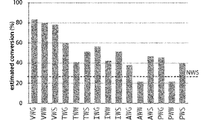
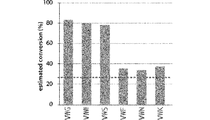
- 1 and 2 show the apparent modification efficiency on the mass spectrometry spectrum by quantifying the intensities of the unmodified peptide peak and the modified peptide peak in the mass spectrometry spectrum of each reaction product. Is calculated and summarized in a histogram.
- the amino acids at the upstream position of W are arranged in order from the amino acid residue giving higher modification efficiency.
- the amino acids at the downstream position of W are arranged in order from the amino acid residue that gives higher modification efficiency.
- the level of modification efficiency of N the natural upstream sequence, is shown by the dotted line.
- Example 8 Substrate permissiveness search of KgpF-Verification of front and rear sequences of Trp, Part 4] Based on the results obtained in Example 7, it was possible to design several front and rear sequences that gave higher modification efficiency than the natural NWS front and rear sequences. Here, 5 kinds of amino acids having a higher modification efficiency than the natural N as an upstream sequence and 2 kinds of amino acids having a higher modification efficiency than the natural S as a downstream sequence are respectively multiplied to obtain 10 kinds of amino acids. The front and rear arrays were newly designed (horizontal axis in Fig. 3). Each peptide was synthesized in the same manner as in Example 6, and the prenylation reaction was performed in the same manner as in Example 6.
- Example 9 Substrate permissive study of KgpF-Verification of front and rear sequences of Trp Part 5
- an amino acid residue upstream of W was fixed to the most preferred Val and then a peptide in which the amino acid sequence on the downstream side was changed was designed.
- a mutant G, W, S, F, N, K
- Each peptide was synthesized in the same manner as in Example 6, and the prenylation reaction was performed in the same manner as in Example 6.
- the above reaction product was analyzed by MALDI-TOF-MS.
- Example 10 KgpF modification reaction with an amino acid sequence containing multiple Trps
- the artificial cyclic peptides Clone-M1 to M9 shown below were translationally synthesized by an artificial translation system (condition 13) developed by the present inventors. Then, the obtained peptide was reacted with 160 ⁇ M KgpF in the system shown in (Condition 14) at 0 ° C. for 20 hours.
- Amount of translation mixture 2.5 ⁇ L (mixture obtained in the above reaction) EDTA; 18 mM Reaction; 42 °C, 60 minutes Scale: 2.75 ⁇ L scale (Condition 14) Amount of translation mixture; 2.75 ⁇ L (mixture obtained under (condition 13)) KOH; 6.0 mM Mg (OAc) 2 ; 9.0 mM Tris-HCl (pH8.3); 15 mM KgpF; 160 ⁇ M DMAPP; 2 mM Reaction; 0 °C, 20 hours
- Example 11 Improvement of efficiency of modification reaction by changing KgpF
- the artificial cyclic peptides shown in Table 7 were used except that v8s / v11.1 was used as the FIT system, KgpF v 3.1 was used as the prenylation modifying enzyme, and the concentration of the KgpF v 3.1 was 10 ⁇ M (condition 11).
- (Condition 12) KgpF v 3.1 is an enzyme having a higher degree of purification than the KgpF used in (Condition 12) and further improved specific activity.
- 5 strong intensity
- 4 medium intensity
- 3 weak intensity
- 2 very weak intensity
- 1 no peak
- N / A not observed.
- Example 12 Modification of artificial cyclic peptide containing VW sequence and having various ring sizes
- the artificial cyclic peptides shown in Tables 8 and 9 were translationally synthesized by the artificial translation system (condition 15) developed by the present inventors. Then, the obtained peptide was reacted with 60 ⁇ M KgpF for 18 hours at 37 ° C. in the system shown in (Condition 16).
- Example 13 Modification of artificial cyclic peptide containing VW or WG sequence and having various W positions
- the artificial cyclic peptides shown in Table 10 were translationally synthesized by the artificial translation system (condition 17) developed by the present inventors. Then, the obtained peptide was reacted with 60 ⁇ M KgpF for 18 hours at 37 ° C. in the system shown in (Condition 18).
- Example 14 Modification of artificial cyclic peptide having various peptide arrangement sequences
- the artificial cyclic peptides shown below were translationally synthesized by an artificial translation system (condition 19) developed by the present inventors. Then, the obtained peptide was reacted with 160 ⁇ M KgpF for 20 hours at 0 ° C. in the system shown in (Condition 20). The reaction product was analyzed by MALDI-TOF-MS. As a result, it was confirmed that the artificial cyclic peptides shown below were modified by prenylation. As described above, the progress of prenylation in peptides having various sequences indicates that a peptide library containing peptides having higher cell membrane permeability can be efficiently obtained.
- Amount of translation mixture 2.5 ⁇ L (mixture obtained in the above reaction) EDTA; 18 mM Reaction; 42 °C, 60 minutes Scale: 2.75 ⁇ L scale (Condition 20) Amount of translation mixture; 2.75 ⁇ L (mixture obtained under (condition 19)) KOH; 6.0 mM Mg (OAc) 2 ; 9.0 mM Tris-HCl (pH8.3); 15 mM KgpF; 160 ⁇ M DMAPP; 2 mM Reaction; 0 °C, 20 hours
- Example 15 Experiment for modifying thioether ring-closing artificial cyclic peptide with OltF
- OltF enzyme can be used to modify the thioether ring-closing artificial cyclic peptide.
- Six thioether ring-closing artificial cyclic amino acid sequences (YG413-417,419) derived from the sequences of OscE1 and OscE2, which are supposed to be natural substrates of OltF, were designed.
- Example 16 Experiment for modifying thioether ring-closing artificial cyclic peptide with OltF
- the artificial cyclic peptides shown in Tables 11 and 12 were translationally synthesized by the artificial translation system (condition 23) developed by the present inventors. Then, the obtained peptide was reacted with 9.13 ⁇ M OltF at 37 ° C. for 18 hours in the system shown in (Condition 24).
- OltF v 2.1 is an enzyme whose purification was changed from OltF used in (condition 22) at the time of preparation.
- Trp is reassigned to UGG of mRNA in Table 13.
- XXX was RYU or CMG (the abundance ratio of RYU and CMG (RYU: CMG) was 2: 1) or RYU.
- R independently represents G or A
- Y independently represents U or C
- M in CMG independently represents A or C
- K in NNK independently represents G or A. Represents U.
- N is any base.
- T7YGM.F46 v1tr.F46 The sequence of primer T7YGM.F46 v1tr.F46 is as follows. T7YGM.F46 v1tr.F46: TAATACGACTCACTATAGGGTTAACTTTAAGAAGGAGATATAAATA
- ⁇ 10 mL scale system composition Product from the above extension; 1 mL MgCl 2 ; 2.5 mM dNTPs; 0.25 mM KCl; 50 mM Tris-HCl (pH 9.0); 10 mM Triton X-100; 10 ⁇ L primers; 250nM (T7YGM.F46 v1tr.F46 and rCNSGGVSan13.R39) Taq polymerase ⁇ PCR of 10 mL scale system> As shown in Table 16, PCR (polymerase chain reaction) was first held at 95 ° C. for 40 seconds, then at 65 ° C. for 40 seconds, and then at 72 ° C. for 40 seconds. Holding at 95 ° C. for 40 seconds, then holding at 65 ° C. for 40 seconds, and further holding at 72 ° C. for 40 seconds were repeated 4 times.
- T7YGM.F46 v1tr.F46 and rCNSGGVSan13.R39 are as follows.
- T7YGM.F46 v1tr.F46 TAATACGACTCACTATAGGGTTAACTTTAAGAAGGAGATATAAATA rCNSGGVSan13.R39: TTTCCGCCCCCCGTCCTAGCTTACCCCACCACTGTTACA
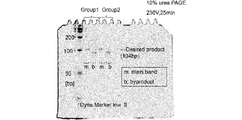
- the obtained PCR product is transcribed in vitro using T7 RNA polymerase (4 mL scale) and purified by electrophoresis under the conditions of 12% denaturing-PAGE, 230V, and 70 minutes to prepare an mRNA library. succeeded in. As shown in the electrophoretic gel diagram of FIG. 6, it was confirmed that the desired product was obtained by separation from the by-products.
- the prenyl group can be introduced into the peptide in the peptide library obtained from the mRNA by translation of the FIT system and contact with the prenylating enzyme as described above.
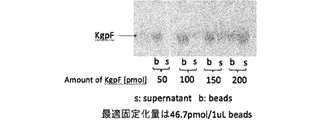
- Example 18 Modification reaction of artificial cyclic peptide with KgpF in solid phase
- Amount of translation mixture 2.5 ⁇ L (mixture obtained in the above reaction) EDTA; 18 mM Reaction: 42 °C, 60 minutes Scale: 2.75 ⁇ L scale (Condition 26) Amount of translation mixture; 2.75 ⁇ L (mixture obtained under (condition 25)) KOH; 6.0 mM Mg (OAc) 2 ; 9.0 mM Tris-HCl (pH8.3); 15 mM KgpF immobilized on magnetic beads; 72 ⁇ M DMAPP; 2 mM Reaction; Rotation mixing at 4 °C for 14 hours
- the solution was analyzed by MALDI-TOF-MS, and as shown in the table, the solid phase showed a 100% modification efficiency similar to the liquid phase, even though the KgpF concentration was lower (starting material Was not seen). From this, it was confirmed that the solid phase can be modified similarly to the liquid phase.
- Example 19 Preparation and screening of compound library
- the mRNA library design shown in Example 17 in which XXX was replaced with RYU was prepared by the same procedure as in Example 17.
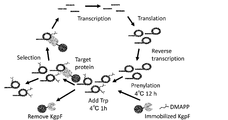
- a peptide-mRNA complex library was constructed from the above-mentioned mRNA library according to the scheme shown in FIG. 8, and the KgpF enzyme immobilized on magnetic beads was allowed to act on the compound library containing a prenylated peptide. It was constructed. Then, the compound library was subjected to a step of screening a cyclic peptide that interacts with the enzyme MetAP1 (Human) as shown in the scheme shown in FIG. 8. As a result, as shown in FIG.
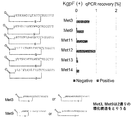
- Example 19-1 Evaluation of peptides obtained as a result of screening for MetAP1] (Pull-down assay for binding ability to MetAP1)
- the prenylated cyclic peptides identified as a result of the screening targeting MetAP1 were evaluated for their target binding ability by a qualitative pull-down assay.
- Each sequence of Met3, Met9, Met11, Met12, Met13, and Met14 was synthesized in a state of being displayed on mRNA, and the Trp residue in the sequence was prenylated.
- the amount of recovered mRNA was quantified by the RT-qPCR method. The results are shown in Fig. 11. In the bar graph of FIG.
- the Negative bar represents the pull-down amount of beads on which MetAP1 was not immobilized
- the Positive bar represents the pull-down amount of beads on which MetAP1 was immobilized. It was confirmed that Positive had a significantly higher pull-down amount than Negative, and that the prenylated peptide sequence binds to MetAP1.
- MetAP1 inhibition test of prenylated cyclic peptide In vitro, MetAP1 inhibition test was performed using prenylated Met2, Met3a-L, and Met3-1 at concentrations of 1 ⁇ M, 5 ⁇ M, and 10 ⁇ M in the presence of MetAP1 cofactor Mn 2+ or Co 2+. It was In this test, the enzyme activity was measured by detecting the probe fluorescence that emits fluorescence depending on the enzyme activity of MetAP1. The measurement result of the fluorescence intensity is shown in FIG. As shown in FIG. 13, it was confirmed that the prenylated Met2, Met3, and Met3a-L peptides were able to inhibit the target MetAP1 enzyme activity.
- Example 20 Characteristics of enzymatic reaction of prenylation enzyme
- prenylation reaction was carried out in the presence or absence of Mg2 + and adjusting the concentration of EDTA to 0 mM, 1 mM, and 10 mM.
- the cyclic peptides shown below were obtained by synthesizing using the solid-phase synthesis method.
- the reaction product was analyzed by MALDI-TOF-MS.
- KgpF was used as the prenylation enzyme
- the reaction proceeded in a Mg 2 + -dependent manner (see FIGS. 14 and 15)
- OltF was used, the reaction proceeded in a Mg 2 + -independent manner. was found (see FIG. 16).
- Example 21 Prenylation of cyclic peptides containing non-proteinogenic amino acids
- Prenylation studies with KgpF were performed on cyclic peptides containing the D-form of amino acids as non-proteinogenic amino acids.
- a cyclic peptide containing a D-form of amino acid (X in the following formula) is represented by the following formula.
- the reaction product was analyzed by MALDI-TOF-MS. As a result, it was confirmed that an artificial cyclic peptide containing D-form Ile, D-form Phe, D-form Trp, and D-form Tyr as X was modified by prenylation (see FIG. 17).
- Example 22 Prenylation of a Trp containing a non-protein Trp in the cyclic peptide
- the cyclic peptide containing the non-proteinogenic amino acid Trp was tested for prenylation of the Trp with OltF or KgpF.
- the cyclic peptides used were as follows. In the formula, X is a D-form Trp.
- the above-mentioned artificial cyclic peptide containing D-form Trp was translationally synthesized by the artificial translation system developed by the present inventors under the following (condition 30). Thereafter, the obtained translation mixture was reacted (prenylated) under the following (condition 31) at 37 ° C. for 20 hours.
- the reaction product was analyzed by MALDI-TOF-MS. As a result, it was confirmed that the artificial cyclic peptide containing Drp Trp as X was modified by prenylation (see FIG. 18).
- Example 23 Prenylation of N-terminally located Trp
- the cyclic peptides shown below were translationally synthesized by the artificial translation system developed by the present inventors under the following (condition 32). Then, the obtained translation mixture was reacted (prenylated) under the following (condition 33).
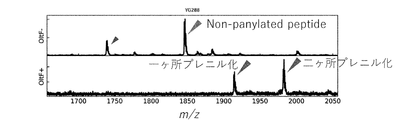
- the reaction product was analyzed by MALDI-TOF-MS. As a result, it was found that by using OltF as the prenylation enzyme, Trp at the N-terminal position and two positions inside the sequence can be prenylated (see FIG. 19). When AY015, AY016, AY017, AY018, AY019, and AY020 (see FIG. 20) were prenylated using OltF in the same manner as above, it was confirmed that Trp at the N-terminal position was prenylated. .
Landscapes
- Chemical & Material Sciences (AREA)
- Life Sciences & Earth Sciences (AREA)
- Health & Medical Sciences (AREA)
- Organic Chemistry (AREA)
- Engineering & Computer Science (AREA)
- Biochemistry (AREA)
- Molecular Biology (AREA)
- General Health & Medical Sciences (AREA)
- Zoology (AREA)
- Wood Science & Technology (AREA)
- General Chemical & Material Sciences (AREA)
- Chemical Kinetics & Catalysis (AREA)
- Genetics & Genomics (AREA)
- Medicinal Chemistry (AREA)
- Bioinformatics & Cheminformatics (AREA)
- Microbiology (AREA)
- Biotechnology (AREA)
- Immunology (AREA)
- Biomedical Technology (AREA)
- General Engineering & Computer Science (AREA)
- Hematology (AREA)
- Urology & Nephrology (AREA)
- Analytical Chemistry (AREA)
- Cell Biology (AREA)
- Food Science & Technology (AREA)
- Physics & Mathematics (AREA)
- General Physics & Mathematics (AREA)
- Pathology (AREA)
- Proteomics, Peptides & Aminoacids (AREA)
- Preparation Of Compounds By Using Micro-Organisms (AREA)
- Peptides Or Proteins (AREA)
- Investigating Or Analysing Biological Materials (AREA)
- Enzymes And Modification Thereof (AREA)
Abstract
本発明は、少なくとも一つのTrp又はその誘導体を含むアミノ酸配列を有するペプチドを含むペプチドライブラリーをプレニル化酵素に接触させ、少なくとも一部のペプチドに含まれるアミノ酸残基の少なくとも一部をプレニル化する工程、を含む、ペプチドライブラリーの製造方法を提供する。
Description
本発明は、ペプチドライブラリーの製造方法及びペプチド-mRNA複合体ライブラリーの製造方法に関する。
近年、様々なペプチド医薬の研究開発が進められている。ペプチド医薬の最大の利点は、標的分子への高親和性及び高特異性と、低分子化合物では難しいタンパク質-タンパク質相互作用の阻害が可能なことである。ペプチド医薬は、その化学的、生物的多様性から、低分子化合物よりも標的分子との相互作用の特異性が高いものが得られることが多く、その結果、より大きな生理活性が得られる。
一方、ペプチド医薬は、他のほとんどのバイオ医薬品と同様に、細胞膜を透過できないため細胞内に到達できず、また抗体等の大きなタンパク質に比較してプロテアーゼ耐性に劣るので短時間で分解され、効果を得にくいという問題がある。近年、このようなペプチド医薬の問題は、ペプチドに様々な修飾を加えることによって改善することが検討されている。
本発明者らは、タンパク質の翻訳系として、RAndom Peptide Integrated Discovery (RAPID)システムを開発している。RAPIDシステムは、特殊環状ペプチドの合成に特化した人工翻訳合成系と、翻訳系の特性を活かしたスクリーニング系や分子進化工学的手法とを組み合わせることで、多様性の高い特殊環状ペプチドライブラリーの構築と、そのライブラリーからの活性ペプチドの同定を可能にする実験系である。
RAPIDシステムにおいては、人工アミノアシル化RNA触媒「フレキシザイム(flexizyme)」(例えば、非特許文献1)を用いて、任意のtRNAに任意のアミノ酸を連結させることができるため、所望のアミノ酸を、所望のアンチコドンを有するtRNAに結合させることができる。そこで、所望のアミノ酸を天然の遺伝暗号とは異なる任意のコドンと対応させて、遺伝暗号表を書き換えるコドン再割当を行うことで、非タンパク質性アミノ酸を含む任意のアミノ酸をペプチドの任意の位置に導入したペプチドライブラリーや大環状構造を有するペプチドライブラリーを創出可能である。
構築される多様性の高い特殊環状ペプチドライブラリーには、プロテアーゼ耐性や細胞透過性、標的分子への親和性や特異性を増大させたペプチドが含まれることとなる。
また、in vitro selectionにより、得られたライブラリーから任意の標的タンパク質に結合する活性種となるペプチドを迅速に、また、信頼性高く同定できる。
RAPIDシステムにおいては、人工アミノアシル化RNA触媒「フレキシザイム(flexizyme)」(例えば、非特許文献1)を用いて、任意のtRNAに任意のアミノ酸を連結させることができるため、所望のアミノ酸を、所望のアンチコドンを有するtRNAに結合させることができる。そこで、所望のアミノ酸を天然の遺伝暗号とは異なる任意のコドンと対応させて、遺伝暗号表を書き換えるコドン再割当を行うことで、非タンパク質性アミノ酸を含む任意のアミノ酸をペプチドの任意の位置に導入したペプチドライブラリーや大環状構造を有するペプチドライブラリーを創出可能である。
構築される多様性の高い特殊環状ペプチドライブラリーには、プロテアーゼ耐性や細胞透過性、標的分子への親和性や特異性を増大させたペプチドが含まれることとなる。
また、in vitro selectionにより、得られたライブラリーから任意の標的タンパク質に結合する活性種となるペプチドを迅速に、また、信頼性高く同定できる。
H. Murakami, H. Saito, and H. Suga, (2003), Chemistry &Biology, Vol. 10, 655-662.
しかしながら、RAPIDシステムを用いてペプチドライブラリーを作製し、迅速に任意の標的タンパク質に結合するペプチドを同定できるとはいえ、依然として、同定されてくるペプチドにおいて、細胞膜の透過性が十分なペプチドが得られていないのが実情である。
よって、細胞内に存在する標的に活性を持つペプチドを創出するためにも、細胞膜の透過性に優れたペプチドを含むペプチドライブラリーの製造方法が特に求められている。
よって、細胞内に存在する標的に活性を持つペプチドを創出するためにも、細胞膜の透過性に優れたペプチドを含むペプチドライブラリーの製造方法が特に求められている。
本発明は、ペプチドライブラリーの新規な製造方法を提供することを課題とする。特に、細胞膜の透過が期待される、疎水性の高い局所構造を有するペプチドを含むペプチドライブラリーを製造することのできる、ペプチドライブラリーの製造方法を提供することを課題とする。
本発明者らは、上記課題を解決するために検討を重ねた結果、ペプチドライブラリーに対して、プレニル化酵素を用いてライブラリーを構成するペプチドに含まれる所定のアミノ酸を修飾することにより、上記課題を解決し得ることを見出し、本発明を完成した。
すなわち、本発明は以下のとおりである。
[1]
少なくとも一つのTrp又はその誘導体を含むアミノ酸配列を有するペプチドを含むペプチドライブラリーをプレニル化酵素に接触させ、少なくとも一つのTrp残基又はその誘導体残基をプレニル化する工程、を含む、プレニル化されたペプチドを含むペプチドライブラリーの製造方法。
[2]
前記プレニル化酵素が、酵素1~酵素21及びこれらのホモログからなる群より選択される少なくとも1種以上である、[1]に記載のペプチドライブラリーの製造方法。
[3]
前記プレニル化酵素が、以下(1)~(3)のいずれかのアミノ酸配列からなる、[1]に記載のペプチドライブラリーの製造方法。
(1) 配列番号1~56で表されるアミノ酸配列のいずれか
(2) 配列番号1~56で表されるアミノ酸配列のいずれかにおいて、1又は複数のアミノ酸の欠失、置換又は付加を有するアミノ酸配列
(3) 配列番号1~56で表されるアミノ酸配列のいずれかと80%以上の相同性を有するアミノ酸配列
[4]
前記ペプチドライブラリーが、環状ペプチドを含む、[1]~[3]のいずれかに記載のペプチドライブラリーの製造方法。
[5]
前記環状ペプチドが、2つのアミノ酸残基が、ジスルフィド結合、ペプチド結合、アルキル結合、アルケニル結合、エステル結合、チオエステル結合、エーテル結合、チオエーテル結合、ホスホネートエーテル結合、アゾ結合、C-S-C結合、C-N-C結合、C=N-C結合、アミド結合、ラクタム架橋、カルバモイル結合、尿素結合、チオ尿素結合、アミン結合、チオアミド結合、又はトリアゾール結合によって結合することで形成される環状構造を含む、[4]に記載のペプチドライブラリーの製造方法。
[6]
前記プレニル化する工程の前に、mRNAライブラリーを、無細胞翻訳系によって翻訳し、少なくとも一つのTrp又はその誘導体を含むアミノ酸配列を有するペプチドを含むペプチドライブラリーを調製する工程を含む、[1]~[5]のいずれかに記載のペプチドライブラリーの製造方法。
[7]
遺伝子型(genotype)とペプチドとの複合体を含む、ペプチド-遺伝子型ライブラリーを準備する工程、及び、
前記ペプチド-遺伝子型ライブラリーをプレニル化酵素に接触させ、少なくとも一つのTrp又はその誘導体をプレニル化する工程、を含む、
ペプチド-遺伝子型複合体ライブラリーの製造方法。
[8]
前記ペプチド-遺伝子型ライブラリーを準備する工程が、mRNAディスプレイ法によるペプチド-mRNAライブラリーを調製する工程を含み、
前記ペプチド-mRNAライブラリーを調製する工程が、
mRNAライブラリーの各mRNAの3'末端にピューロマイシンを結合させ、ピューロマイシン結合mRNAライブラリーを製造する工程、及び、
ピューロマイシン結合mRNAライブラリーを、無細胞翻訳系によって翻訳し、少なくとも一つのTrp又はその誘導体を含むアミノ酸配列を有するペプチドを含むペプチド-mRNAライブラリーを調製する工程、を含む、
[7]に記載のペプチド-遺伝子型複合体ライブラリーの製造方法。
[9]
[1]~[6]のいずれかに記載の製造方法により作製されたペプチドライブラリー及び/又は[7]又は[8]に記載の製造方法により作製されたペプチド-遺伝子型複合体ライブラリーを標的物質に接触させる工程、及び
標的物質に結合するペプチドを選択する工程、を含む、
標的物質に結合するペプチドを同定するスクリーニング方法。
[10]
少なくとも一つのTrp又はその誘導体を含むアミノ酸配列を有するペプチドをプレニル化酵素に接触させ、少なくとも一つのTrp残基又はその誘導体残基をプレニル化する工程、を含む、プレニル化されたペプチドの製造方法。
[11]
前記プレニル化する工程の前に、少なくとも一つのTrp又はその誘導体を含むアミノ酸配列を有するペプチドを化学合成により合成する工程、を含む、
[10]に記載の、プレニル化されたペプチドの製造方法。
[1]
少なくとも一つのTrp又はその誘導体を含むアミノ酸配列を有するペプチドを含むペプチドライブラリーをプレニル化酵素に接触させ、少なくとも一つのTrp残基又はその誘導体残基をプレニル化する工程、を含む、プレニル化されたペプチドを含むペプチドライブラリーの製造方法。
[2]
前記プレニル化酵素が、酵素1~酵素21及びこれらのホモログからなる群より選択される少なくとも1種以上である、[1]に記載のペプチドライブラリーの製造方法。
[3]
前記プレニル化酵素が、以下(1)~(3)のいずれかのアミノ酸配列からなる、[1]に記載のペプチドライブラリーの製造方法。
(1) 配列番号1~56で表されるアミノ酸配列のいずれか
(2) 配列番号1~56で表されるアミノ酸配列のいずれかにおいて、1又は複数のアミノ酸の欠失、置換又は付加を有するアミノ酸配列
(3) 配列番号1~56で表されるアミノ酸配列のいずれかと80%以上の相同性を有するアミノ酸配列
[4]
前記ペプチドライブラリーが、環状ペプチドを含む、[1]~[3]のいずれかに記載のペプチドライブラリーの製造方法。
[5]
前記環状ペプチドが、2つのアミノ酸残基が、ジスルフィド結合、ペプチド結合、アルキル結合、アルケニル結合、エステル結合、チオエステル結合、エーテル結合、チオエーテル結合、ホスホネートエーテル結合、アゾ結合、C-S-C結合、C-N-C結合、C=N-C結合、アミド結合、ラクタム架橋、カルバモイル結合、尿素結合、チオ尿素結合、アミン結合、チオアミド結合、又はトリアゾール結合によって結合することで形成される環状構造を含む、[4]に記載のペプチドライブラリーの製造方法。
[6]
前記プレニル化する工程の前に、mRNAライブラリーを、無細胞翻訳系によって翻訳し、少なくとも一つのTrp又はその誘導体を含むアミノ酸配列を有するペプチドを含むペプチドライブラリーを調製する工程を含む、[1]~[5]のいずれかに記載のペプチドライブラリーの製造方法。
[7]
遺伝子型(genotype)とペプチドとの複合体を含む、ペプチド-遺伝子型ライブラリーを準備する工程、及び、
前記ペプチド-遺伝子型ライブラリーをプレニル化酵素に接触させ、少なくとも一つのTrp又はその誘導体をプレニル化する工程、を含む、
ペプチド-遺伝子型複合体ライブラリーの製造方法。
[8]
前記ペプチド-遺伝子型ライブラリーを準備する工程が、mRNAディスプレイ法によるペプチド-mRNAライブラリーを調製する工程を含み、
前記ペプチド-mRNAライブラリーを調製する工程が、
mRNAライブラリーの各mRNAの3'末端にピューロマイシンを結合させ、ピューロマイシン結合mRNAライブラリーを製造する工程、及び、
ピューロマイシン結合mRNAライブラリーを、無細胞翻訳系によって翻訳し、少なくとも一つのTrp又はその誘導体を含むアミノ酸配列を有するペプチドを含むペプチド-mRNAライブラリーを調製する工程、を含む、
[7]に記載のペプチド-遺伝子型複合体ライブラリーの製造方法。
[9]
[1]~[6]のいずれかに記載の製造方法により作製されたペプチドライブラリー及び/又は[7]又は[8]に記載の製造方法により作製されたペプチド-遺伝子型複合体ライブラリーを標的物質に接触させる工程、及び
標的物質に結合するペプチドを選択する工程、を含む、
標的物質に結合するペプチドを同定するスクリーニング方法。
[10]
少なくとも一つのTrp又はその誘導体を含むアミノ酸配列を有するペプチドをプレニル化酵素に接触させ、少なくとも一つのTrp残基又はその誘導体残基をプレニル化する工程、を含む、プレニル化されたペプチドの製造方法。
[11]
前記プレニル化する工程の前に、少なくとも一つのTrp又はその誘導体を含むアミノ酸配列を有するペプチドを化学合成により合成する工程、を含む、
[10]に記載の、プレニル化されたペプチドの製造方法。
本発明によれば、ペプチドライブラリーの新規な製造方法を提供することができる。
(ペプチドライブラリーの製造方法)
本発明のペプチドライブラリーの製造方法は、少なくとも一つのTrp又はその誘導体を含むアミノ酸配列を有するペプチドを含むペプチドライブラリーをプレニル化酵素に接触させ、少なくとも一つのTrp残基又はその誘導体残基をプレニル化する工程を含む。
本発明におけるペプチドライブラリーは、少なくとも2つのペプチドを含む。本発明におけるペプチドライブラリーに含まれるペプチドの少なくとも一つは、少なくとも一つのTrp又はその誘導体を含むアミノ酸配列を有する。
本発明においては、プレニル化酵素を用いて、Trp又はその誘導体の一部をプレニル化することにより、疎水性の高いペプチドを含むペプチドライブラリーを製造することができる。また、本発明のペプチドライブラリーの製造方法によれば、プレニル化酵素の基質許容性が高いため、効率よくペプチドライブラリーに含まれるペプチドの疎水性を高めることができる。以上のとおり、本発明の製造方法によって、効率よくペプチドに疎水性基を導入でき、細胞膜の透過が期待されるペプチドを含むペプチドライブラリーを得ることができる。
本発明のペプチドライブラリーの製造方法は、少なくとも一つのTrp又はその誘導体を含むアミノ酸配列を有するペプチドを含むペプチドライブラリーをプレニル化酵素に接触させ、少なくとも一つのTrp残基又はその誘導体残基をプレニル化する工程を含む。
本発明におけるペプチドライブラリーは、少なくとも2つのペプチドを含む。本発明におけるペプチドライブラリーに含まれるペプチドの少なくとも一つは、少なくとも一つのTrp又はその誘導体を含むアミノ酸配列を有する。
本発明においては、プレニル化酵素を用いて、Trp又はその誘導体の一部をプレニル化することにより、疎水性の高いペプチドを含むペプチドライブラリーを製造することができる。また、本発明のペプチドライブラリーの製造方法によれば、プレニル化酵素の基質許容性が高いため、効率よくペプチドライブラリーに含まれるペプチドの疎水性を高めることができる。以上のとおり、本発明の製造方法によって、効率よくペプチドに疎水性基を導入でき、細胞膜の透過が期待されるペプチドを含むペプチドライブラリーを得ることができる。
(ペプチドライブラリーを調製する工程)
本発明の製造方法に用いられるペプチドライブラリーは、製造して取得してもよく、ペプチドライブラリーを購入して入手してもよい。ペプチドライブラリーを製造して取得する場合、その製造方法としては、固相又は液相の化学合成によってペプチドライブラリーを製造する方法、及び、mRNAライブラリーを、無細胞翻訳系によって翻訳し、少なくとも一つのTrp又はその誘導体を含むアミノ酸配列を有するペプチドを含むペプチドライブラリーを調製する方法を好適に挙げることができる。
すなわち、本発明の製造方法の好ましい態様の一つは、mRNAライブラリーを、無細胞翻訳系によって翻訳し、少なくとも一つのTrp又はその誘導体を含むアミノ酸配列を有するペプチドを含むペプチドライブラリーを調製する工程、及び、前記ペプチドライブラリーをプレニル化酵素に接触させ、少なくとも一つのTrp残基又はその誘導体残基をプレニル化する工程を含む。
本発明の製造方法に用いられるペプチドライブラリーは、製造して取得してもよく、ペプチドライブラリーを購入して入手してもよい。ペプチドライブラリーを製造して取得する場合、その製造方法としては、固相又は液相の化学合成によってペプチドライブラリーを製造する方法、及び、mRNAライブラリーを、無細胞翻訳系によって翻訳し、少なくとも一つのTrp又はその誘導体を含むアミノ酸配列を有するペプチドを含むペプチドライブラリーを調製する方法を好適に挙げることができる。
すなわち、本発明の製造方法の好ましい態様の一つは、mRNAライブラリーを、無細胞翻訳系によって翻訳し、少なくとも一つのTrp又はその誘導体を含むアミノ酸配列を有するペプチドを含むペプチドライブラリーを調製する工程、及び、前記ペプチドライブラリーをプレニル化酵素に接触させ、少なくとも一つのTrp残基又はその誘導体残基をプレニル化する工程を含む。
mRNAライブラリーは、コドンとして、複数のN1N2N3を有するmRNAを含む。
本明細書において、「N1N2N3」は、任意のアミノ酸を指定するコドンを意味し、例えばN1、N2及びN3は、それぞれ独立に、アデニン(A)、グアニン(G)、シトシン(C)及びウラシル(U)から選択される。1つのmRNAには、N1N2N3が複数含まれているが、それぞれのN1、N2及びN3はそれぞれ独立に選択される。したがって、例えば、mRNAに、-N1N2N3-N1N2N3-が含まれる場合、それぞれ2つのN1、N2及びN3は、互いに同一であっても異なってもよい。
本明細書において、「N1N2N3」は、任意のアミノ酸を指定するコドンを意味し、例えばN1、N2及びN3は、それぞれ独立に、アデニン(A)、グアニン(G)、シトシン(C)及びウラシル(U)から選択される。1つのmRNAには、N1N2N3が複数含まれているが、それぞれのN1、N2及びN3はそれぞれ独立に選択される。したがって、例えば、mRNAに、-N1N2N3-N1N2N3-が含まれる場合、それぞれ2つのN1、N2及びN3は、互いに同一であっても異なってもよい。
本発明においては、N1N2N3には、任意のアミノ酸が再割当される。再割当においては、天然の遺伝暗号表におけるコドンとアミノ酸の関係とは異なるものを割り当てることもでき、同一の関係を割り当てることもできる。
本明細書において、「天然の遺伝暗号表」とは、生体においてmRNAのトリプレットからなる遺伝暗号が表すアミノ酸を示した表をいう。天然の遺伝暗号表においてN1N2N3は、以下のアミノ酸を示す。
本明細書において、「天然の遺伝暗号表」とは、生体においてmRNAのトリプレットからなる遺伝暗号が表すアミノ酸を示した表をいう。天然の遺伝暗号表においてN1N2N3は、以下のアミノ酸を示す。

mRNAライブラリーは、複数のN1N2N3として、例えば、複数のN1N2K、複数のN1N2S、複数のN1N2M、複数のN1N2W、複数のN1N2A、複数のN1N2U、複数のN1N2C、複数のN1N2Gのいずれかを含むmRNAを含むものであってもよい。本明細書において、N1及びN2は前記と同義であり、Kはそれぞれ独立にウラシル(U)、グアニン(G)のいずれかであり、Sはそれぞれ独立にシトシン(C)、グアニン(G)のいずれかであり、Mはそれぞれ独立にアデニン(A)、シトシン(C)のいずれかであり、Wはそれぞれ独立にアデニン(A)、ウラシル(U)のいずれかである。
以下、便宜的に、mRNAライブラリーが複数のN1N2Kを含むmRNAを含む場合、すなわちmRNAライブラリーがN1N2N3としてN1N2Kをコドンとして複数含むmRNAを含む場合を例に挙げて本発明を説明するが、その他のmRNAライブラリーを用いた場合でも、翻訳されたペプチドライブラリーに含まれるペプチドがプレニル化する限りは同様に実施可能である。天然の遺伝暗号表においてN1N2Kは、上記表の右欄がG又はUである場合の20種のアミノ酸を示す。
以下、便宜的に、mRNAライブラリーが複数のN1N2Kを含むmRNAを含む場合、すなわちmRNAライブラリーがN1N2N3としてN1N2Kをコドンとして複数含むmRNAを含む場合を例に挙げて本発明を説明するが、その他のmRNAライブラリーを用いた場合でも、翻訳されたペプチドライブラリーに含まれるペプチドがプレニル化する限りは同様に実施可能である。天然の遺伝暗号表においてN1N2Kは、上記表の右欄がG又はUである場合の20種のアミノ酸を示す。
また、本明細書においては、例えば、天然の遺伝暗号表のとおりにUUGにはLeuを割り当ててもよいし、コドンを再割当することによりLeu以外のアミノ酸を割り当ててもよい。「N1N2K」コドンには、あらゆるアミノ酸を割り当てることができる。「コドンにアミノ酸を割り当てる」とは、あるコドンがそのアミノ酸をコードするように遺伝暗号表を書き換えることを意味する。本明細書においては、「コドンにアミノ酸を割り当てる」と「コドンを再割当する」とは同義で用いられる。
各コドンに対する、天然の遺伝暗号表とは異なるアミノ酸の割り当ては、例えば、人工アミノアシル化RNA触媒フレキシザイム(Flexizyme)を利用したコドン再割当によって実現される。フレキシザイムによれば、任意のアンチコドンを有するtRNAに所望のアミノ酸を結合させることができるため、任意のコドンに任意のアミノ酸を割り当てることが可能となる。フレキシザイムについては後述する。本明細書においては、tRNAにアミノ酸を結合させることを、アミノ酸をtRNAにチャージする、tRNAをアミノアシル化する、又は、アミノ酸でtRNAをアシル化する、という場合もある。
各コドンに対する、天然の遺伝暗号表とは異なるアミノ酸の割り当ては、例えば、人工アミノアシル化RNA触媒フレキシザイム(Flexizyme)を利用したコドン再割当によって実現される。フレキシザイムによれば、任意のアンチコドンを有するtRNAに所望のアミノ酸を結合させることができるため、任意のコドンに任意のアミノ酸を割り当てることが可能となる。フレキシザイムについては後述する。本明細書においては、tRNAにアミノ酸を結合させることを、アミノ酸をtRNAにチャージする、tRNAをアミノアシル化する、又は、アミノ酸でtRNAをアシル化する、という場合もある。
本発明においては、「N1N2K」に、非タンパク質性アミノ酸を割り当ててもよい。例えば、非タンパク質性アミノ酸として、環状構造を含むアミノ酸や、N-アルキルアミノ酸を用いれば、タンパク質分解への耐性、細胞膜透過性、及びコンフォメーションの剛性が増大したペプチドライブラリーを得ることができる。かかるペプチドライブラリーは、細胞内の疾患関連分子を標的とするものや、プロテアーゼ活性を有する分子を標的とするペプチドのスクリーニングに有用である。mRNAに「N1N2K」が2以上含まれる場合、すべてを非タンパク質性アミノ酸に割り当ててもよいし、一部を非タンパク質性アミノ酸に割り当ててもよい。
本明細書において、「アミノ酸」は、その最も広い意味で用いられ、天然アミノ酸に加え、人工のアミノ酸変異体や誘導体を含む。アミノ酸は慣用的な一文字表記又は三文字表記で示される場合もある。本明細書においてアミノ酸又はその誘導体としては、天然タンパク質性L-アミノ酸;非天然アミノ酸;アミノ酸の特徴である当業界で公知の特性を有する化学的に合成された化合物等が挙げられる。非天然アミノ酸の例として、主鎖の構造が天然型と異なる、α,α-二置換アミノ酸(α-メチルアラニン等)、N-アルキル-α-アミノ酸、D-アミノ酸、β-アミノ酸、α-ヒドロキシ酸や、側鎖の構造が天然型と異なるアミノ酸(ノルロイシン、ホモヒスチジン等)、側鎖に余分のメチレンを有するアミノ酸(「ホモ」アミノ酸、ホモフェニルアラニン、ホモヒスチジン等)及び側鎖中のカルボン酸官能基アミノ酸がスルホン酸基で置換されるアミノ酸(システイン酸等)が挙げられるがこれらに限定されない。
また、本明細書において「アミノ酸」は、タンパク質性アミノ酸(proteinogenic amino acids)と、非タンパク質性アミノ酸(non-proteinogenic amino acids)を含む。本明細書において「タンパク質性アミノ酸」は、タンパク質を構成するアミノ酸(Arg、His、Lys、Asp、Glu、Ser、Thr、Asn、Gln、Cys、Gly、Pro、Ala、Ile、Leu、Met、Phe、Trp、Tyr、及びVal)を意味する。
本明細書において「非タンパク質性アミノ酸」は、タンパク質性アミノ酸以外の天然又は非天然のアミノ酸を意味する。
また、本明細書において「アミノ酸」は、タンパク質性アミノ酸(proteinogenic amino acids)と、非タンパク質性アミノ酸(non-proteinogenic amino acids)を含む。本明細書において「タンパク質性アミノ酸」は、タンパク質を構成するアミノ酸(Arg、His、Lys、Asp、Glu、Ser、Thr、Asn、Gln、Cys、Gly、Pro、Ala、Ile、Leu、Met、Phe、Trp、Tyr、及びVal)を意味する。
本明細書において「非タンパク質性アミノ酸」は、タンパク質性アミノ酸以外の天然又は非天然のアミノ酸を意味する。
Trpの誘導体は、例えば、以下の式(I)、式(II)、式(III)で表される。なお、本明細書における化学構造式には、互変異性体、幾何異性体、光学異性体等が包含される。特に、式(I)、式(II)、及び式(III)における不斉炭素は、R配置であってもよく、S配置であってもよく、また、これらの混合物であってもよい。

式(I)中、環Aは、ヘテロ原子を含んでいてもよい芳香族六員環であり、R1は、環A上の任意の置換基であり、R2及びR3は、それぞれ独立して水素原子又は任意の置換基であり、mは、0~4のいずれかの整数であり、lは、1又は2の整数である。
環Aとしては、例えば、ベンゼン環、ピリジン環、ピリダジン環、ピリミジン環、ピラジン環等が挙げられる。
置換基R1、R2及びR3としては、特に制限されないが、例えば、ヒドロキシ基;フッ素基、クロロ基、ブロモ基、ヨード基等のハロゲン基;メチル基、エチル基、プロピル基等の炭素数1~10のアルキル基;フェニル基、ナフチル基等のアリール基;ベンジル基等のアラルキル基;ベンジルオキシキ基等のアラルキルオキシ基;等が挙げられる。
環Aとしては、例えば、ベンゼン環、ピリジン環、ピリダジン環、ピリミジン環、ピラジン環等が挙げられる。
置換基R1、R2及びR3としては、特に制限されないが、例えば、ヒドロキシ基;フッ素基、クロロ基、ブロモ基、ヨード基等のハロゲン基;メチル基、エチル基、プロピル基等の炭素数1~10のアルキル基;フェニル基、ナフチル基等のアリール基;ベンジル基等のアラルキル基;ベンジルオキシキ基等のアラルキルオキシ基;等が挙げられる。

式(II)中、環A、R1、R2、m、及びlは、式(I)における環A、R1、R2、m、及びlと同義である。式(II)における環Aは好ましくはベンゼン環である。

式(III)中、環A、R1、R2、m、及びlは、式(I)における環A、R1、R2、m、及びlと同義である。式(III)における環Aは好ましくはベンゼン環である。
式(I)で表されるTrp誘導体としては、例えば、以下の誘導体が挙げられる。

これら誘導体中、R1、R2、R3、及びmは、式(I)におけるR1、R2、R3、及びmと同義である。
Trpの誘導体としては、具体的には、D-トリプトファン、5-メチルトリプトファン、5-ヒドロキシトリプトファン、7-アザトリプトファン、5-ベンジルオキシトリプトファン等が挙げられる。
Trp残基は、プレニル化されることにより、下記式(T1)のように主鎖窒素がアルキル化された構造を形成するため、水素結合のドナーが減少し、そのTrp残基を含むペプチドの疎水性及び膜透過性が向上する傾向にあると推察される(Beilstein J Org Chem. 2017 Feb 22;13:338-346.参照)。

ここで、プレニル基とは、炭素数5のイソプレン単位で構成される構造単位であり、式(T1)を例にすると、以下の構造部分である。

式(T1)における立体配置は特に制限されないが、例えば、下記式(T1-1)及び式(T1-2)で表される立体配置を有する。式(T1)における立体配置は、下記式(T1-1)で表される立体配置を有することが好ましい。
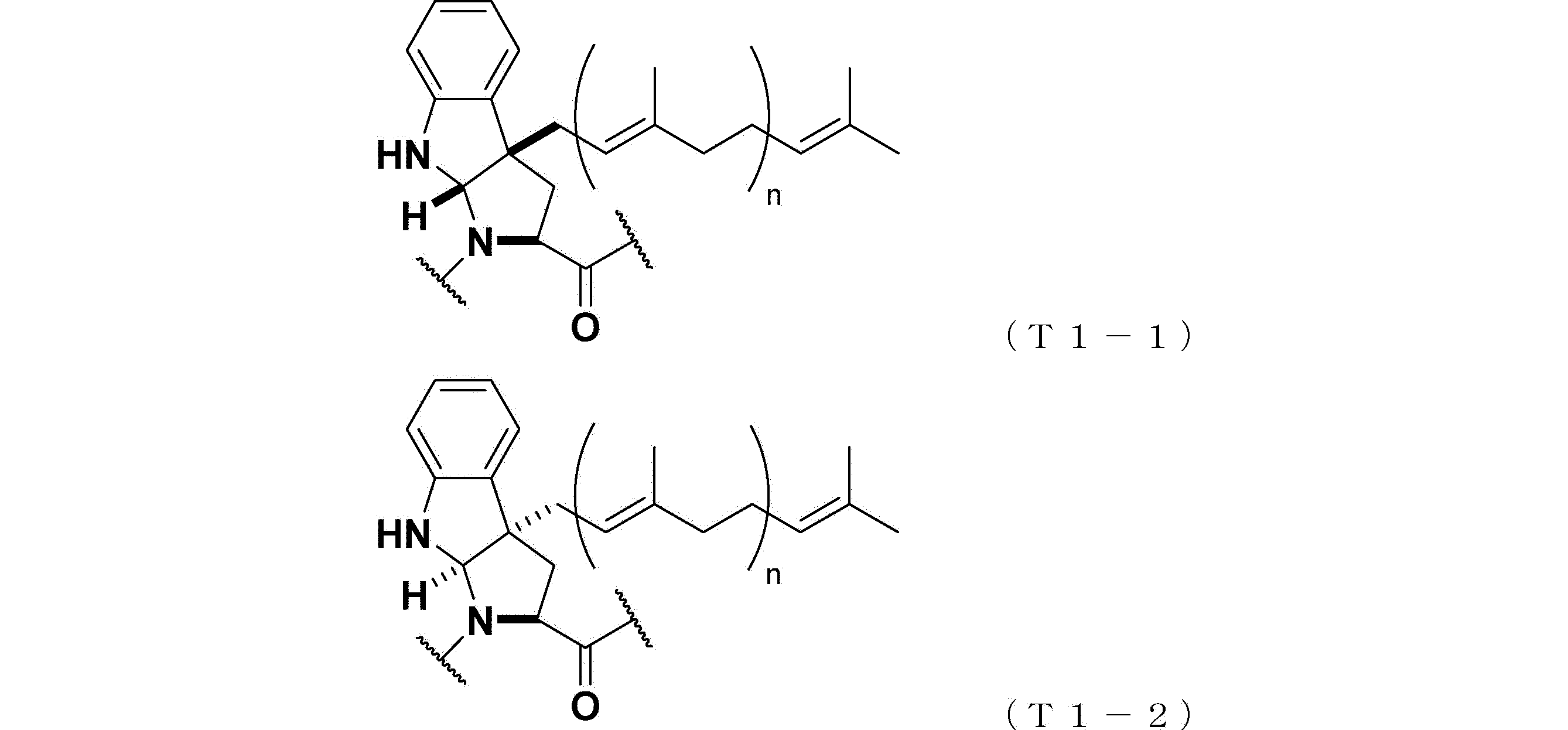
また、Trpの誘導体残基をプレニル化した場合、以下の式(I-1)、(II-1)、及び(III-1)で表すことができる。
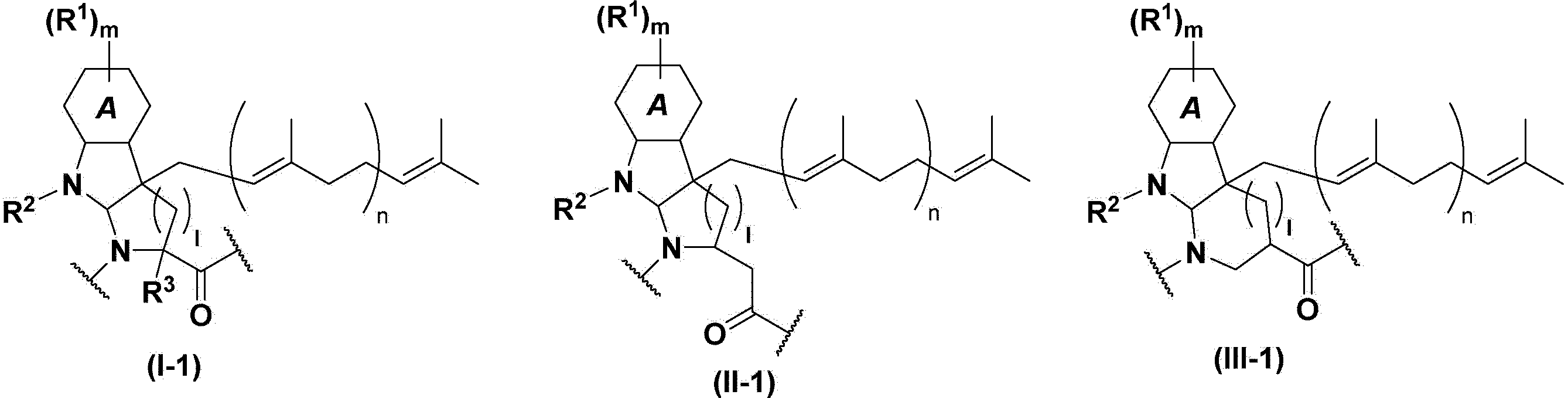
本発明のペプチドライブラリーの製造方法では、「N1N2N3」でコードされるアミノ酸を含むペプチドを複数含むペプチドライブラリーを製造することができる。各ペプチドに含まれる「N1N2N3」でコードされるアミノ酸の数は、特に限定されず、例えば、4個、5個、6個、7個、8個、9個、10個、15個、20個、30個等とすることができる。各ペプチドにおける「N1N2N3」でコードされるアミノ酸の位置は特に限定されない。また、各ペプチドに「N1N2N3」でコードされるアミノ酸は、それらのアミノ酸は隣接していてもよく、離れていてもよい。
本発明のペプチドライブラリーの製造方法では、ペプチドライブラリーの各ペプチドをコードするmRNAを含み、各mRNAが少なくとも1つのN1N2N3を含むmRNAライブラリーを調製する。
ペプチドライブラリーの各ペプチドをコードするmRNAの配列は、ペプチドライブラリーを構成するペプチドのアミノ酸配列に応じて決定することができ、かかるmRNAライブラリーは、これをコードするDNAライブラリーを合成し、これを転写することによって調製することができる。
ペプチドライブラリーの各ペプチドをコードするmRNAの配列は、ペプチドライブラリーを構成するペプチドのアミノ酸配列に応じて決定することができ、かかるmRNAライブラリーは、これをコードするDNAライブラリーを合成し、これを転写することによって調製することができる。
例えば、下記の表2ように、天然の遺伝暗号表を利用しつつ、N1N2N3がNNG、NNK、NNS、NNM、NNW、NNA、NNU、NNCであるmRNAを含むmRNAライブラリーを設計することができる。

表2中、Nはそれぞれ独立に、アデニン(A)、グアニン(G)、シトシン(C)及びウラシル(U)から選択される。
Kはそれぞれ独立にウラシル(U)、グアニン(G)のいずれかである。
Sはそれぞれ独立にシトシン(C)、グアニン(G)のいずれかである。
Mはそれぞれ独立にアデニン(A)、シトシン(C)のいずれかである。
Wはそれぞれ独立にアデニン(A)、ウラシル(U)のいずれかである。
nは、1以上の任意の整数であり、好ましくは1~100のいずれかの整数であり、より好ましくは3~50のいずれかの整数であり、さらに好ましくは3~20のいずれかの整数であり、よりさらに好ましくは6~15のいずれかの整数である。
Kはそれぞれ独立にウラシル(U)、グアニン(G)のいずれかである。
Sはそれぞれ独立にシトシン(C)、グアニン(G)のいずれかである。
Mはそれぞれ独立にアデニン(A)、シトシン(C)のいずれかである。
Wはそれぞれ独立にアデニン(A)、ウラシル(U)のいずれかである。
nは、1以上の任意の整数であり、好ましくは1~100のいずれかの整数であり、より好ましくは3~50のいずれかの整数であり、さらに好ましくは3~20のいずれかの整数であり、よりさらに好ましくは6~15のいずれかの整数である。
ここで、天然の遺伝暗号表を利用した場合、Trpをコードするトリプレットは、N1N2N3の64種のうちUGGの1種のみである。つまり、理論上、1のN1N2N3のトリプレットがTrpをコードする確率は64分の1である。一方、例えば、1のNNKのトリプレットがTrpをコードする確率は32分の1である。天然の遺伝暗号表を利用しつつ、例えばトリプレットの繰り返し数が12であり、N1N2N3がNNKであるmRNAを含むmRNAライブラリーを設計することができる。このようなmRNAライブラリーは、理論的には1.15×10¹⁸の多様性を有し、停止コドンを含まず、かつ少なくとも1つのUGGを含むmRNAを22%含む。
また、例えば、1のNNGのトリプレットがTrpをコードする確率は16分の1である。このようなNNGのトリプレットを含み、nが12である、mRNAライブラリーは、理論的には2.8×10¹⁴の多様性を有し、停止コドンを含まず、かつ少なくとも1つのUGGを含むmRNAを26%含む。
また、例えば、1のNNGのトリプレットがTrpをコードする確率は16分の1である。このようなNNGのトリプレットを含み、nが12である、mRNAライブラリーは、理論的には2.8×10¹⁴の多様性を有し、停止コドンを含まず、かつ少なくとも1つのUGGを含むmRNAを26%含む。
本発明者らは、プレニル化酵素によるTrp残基のプレニル化がTrp残基の前後のアミノ酸残基により修飾効率が影響することを見出した。したがって、プレニル化されるTrp又はその誘導体に隣接し、当該Trp又はその誘導体がプレニル化されることを促進するアミノ酸残基をコードするコドンを含むmRNAを含むmRNAライブラリーを用いれば、Trp又はその誘導体のプレニル化の効率を向上させることができる。
例えば、下記表3-1に示すように、UGG、及び、UGGに隣接し、プレニル化されることを促進するアミノ酸残基をコードするコドン(XXX、YYY)を含むmRNAを用いることにより、ペプチドライブラリーにプレニル基を効率よく導入することができる。
例えば、下記表3-1に示すように、UGG、及び、UGGに隣接し、プレニル化されることを促進するアミノ酸残基をコードするコドン(XXX、YYY)を含むmRNAを用いることにより、ペプチドライブラリーにプレニル基を効率よく導入することができる。
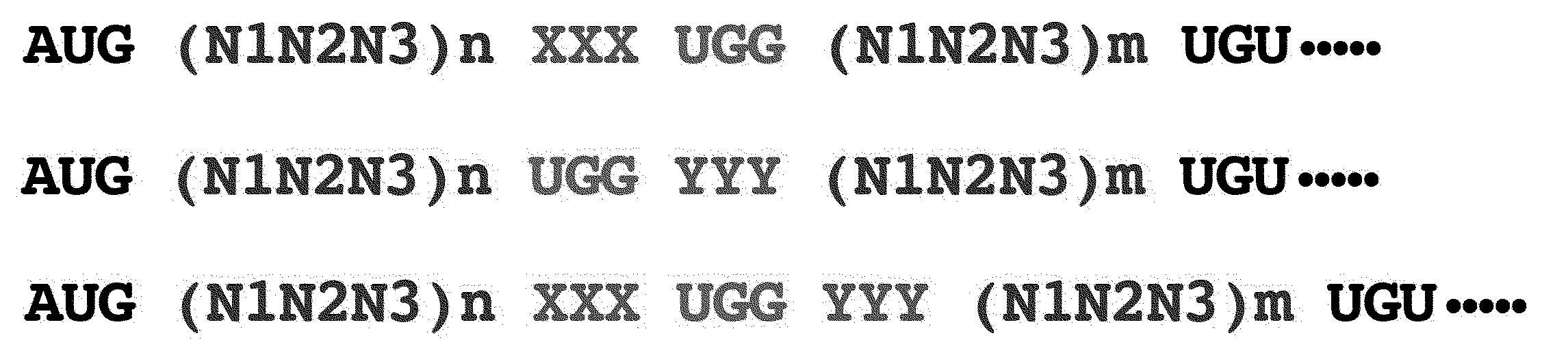
表3-1中、XXXは、用いるプレニル化酵素に修飾されやすくなる上流アミノ酸の集合を指定する縮重コドン配列である。
YYYは、用いるプレニル化酵素に修飾されやすくなる下流アミノ酸の集合を指定する縮重コドン配列である。
n及びmは、それぞれ独立して0以上の任意の整数である。n及びmの和は、好ましくは1~100のいずれかの整数であり、より好ましくは3~50のいずれかの整数であり、さらに好ましくは3~20のいずれかの整数であり、よりさらに好ましくは4~13のいずれかの整数である。
N1N2N3は、上述の定義のとおりであり、例えば、NNK、NNS、NNW、NNM、NNA、NNC、NNG、NNUからなる群より選択されるコドンである。複数のN1N2N3はそれぞれ独立のコドンである。
YYYは、用いるプレニル化酵素に修飾されやすくなる下流アミノ酸の集合を指定する縮重コドン配列である。
n及びmは、それぞれ独立して0以上の任意の整数である。n及びmの和は、好ましくは1~100のいずれかの整数であり、より好ましくは3~50のいずれかの整数であり、さらに好ましくは3~20のいずれかの整数であり、よりさらに好ましくは4~13のいずれかの整数である。
N1N2N3は、上述の定義のとおりであり、例えば、NNK、NNS、NNW、NNM、NNA、NNC、NNG、NNUからなる群より選択されるコドンである。複数のN1N2N3はそれぞれ独立のコドンである。
プレニル化酵素の修飾効率は、用いるプレニル化酵素の種類に応じて変化し、Trpに隣接する前及び/又は後のアミノ酸残基(すなわち、対応するコドンとしてXXX、YYY)を調整することにより高めることができる。Trpと隣接する前後のアミノ酸残基とからなる効率化できるアミノ酸配列及びXXX、YYYは、無細胞翻訳系を用いて網羅的にペプチドを作製し、所定のプレニル化酵素を用いてin vitroでプレニル化を行う効率性を確認する試験を行うことで、適宜決定することができる。
例えば、プレニル化酵素としてKgpFを用いる場合、表3-1のmRNAの中でも表3-2に示すmRNAをライブラリー内に混合することにより、プレニル化Trpを効率よくペプチドに導入することが可能となる。

表3-2中、XXX、NNK、n、mは、上記と同義である。
また、表3-2に示すmRNAのように、天然の遺伝暗号表を利用しつつ、n及びmを任意とし、UGGを含むmRNAを含むmRNAライブラリーを用いれば、得られるペプチドライブラリーにおけるUGGの出現位置を固定し、ペプチド中のプレニル化されるTrp残基の位置を制御することができる。さらに、例えばプレニル化酵素としてKgpFを用いる場合、UGGの上流のトリプレットXXXをRYU又はCMGに設定すること及び/又はUGGの下流のトリプレットをNNKに設定することで、Trp残基のプレニル化効率をより高めることができる。このようなmRNAライブラリーは、理論的には6.8×1016の多様性を有し、停止コドンを含まず、かつ少なくとも1つのUGGを含むmRNAを73%含む。
表3-2中、XXXがRYU又はCMGを表すとき、Rはそれぞれ独立にG又はAを表し、Yはそれぞれ独立にU又はCを表し、Mはそれぞれ独立にA又はCを表し、Kはそれぞれ独立にG又はUを表す。
表3-2中、XXXがRYU又はCMGを表すとき、Rはそれぞれ独立にG又はAを表し、Yはそれぞれ独立にU又はCを表し、Mはそれぞれ独立にA又はCを表し、Kはそれぞれ独立にG又はUを表す。
本発明のペプチドライブラリーの製造方法では、例えば、20種類のN1N2N3のいずれかのコドンに対するアンチコドンを有し、当該コドンに対応するアミノ酸がチャージされた20種類のtRNAを加えた無細胞翻訳系で、前記mRNAライブラリーの各mRNAを翻訳する。
コドン再割当には、翻訳系の構成因子を目的に合わせて自由に取り除き、必要な成分だけを再構成してできる翻訳系を利用できる。例えば、特定のアミノ酸を除去した翻訳系を再構成すると、当該アミノ酸に対応するコドンが、いずれのアミノ酸もコードしない空きコドンになる。そこで、フレキシザイム等を利用して、その空きコドンに相補的なアンチコドンを有するtRNAに任意のアミノ酸を連結し、これを加えて翻訳を行うと、当該任意のアミノ酸がそのコドンでコードされることになり、除去したアミノ酸の代わりに当該任意のアミノ酸が導入されたペプチドが翻訳される。
コドン再割当には、翻訳系の構成因子を目的に合わせて自由に取り除き、必要な成分だけを再構成してできる翻訳系を利用できる。例えば、特定のアミノ酸を除去した翻訳系を再構成すると、当該アミノ酸に対応するコドンが、いずれのアミノ酸もコードしない空きコドンになる。そこで、フレキシザイム等を利用して、その空きコドンに相補的なアンチコドンを有するtRNAに任意のアミノ酸を連結し、これを加えて翻訳を行うと、当該任意のアミノ酸がそのコドンでコードされることになり、除去したアミノ酸の代わりに当該任意のアミノ酸が導入されたペプチドが翻訳される。
本発明に用いられるtRNAは、大腸菌由来野生型tRNAであってよく、in vitroの転写で調製した人工tRNAであってもよい。
本発明において、翻訳系で用いられる20種類のN1N2N3に対応する20種類のtRNAは、アンチコドンループ部分以外、同じ配列を有していてもよい。このような構成とすることにより、特定のtRNAの反応性が高く又は低くなることがなく、各tRNAが均一な反応性を有するようになり、再現性よく予定したペプチドを発現させることが可能となる。
本発明において、翻訳系で用いられる20種類のN1N2N3に対応する20種類のtRNAは、アンチコドンループ部分以外、同じ配列を有していてもよい。このような構成とすることにより、特定のtRNAの反応性が高く又は低くなることがなく、各tRNAが均一な反応性を有するようになり、再現性よく予定したペプチドを発現させることが可能となる。
本明細書において「無細胞翻訳系」とは、細胞を含まない翻訳系をいい、無細胞翻訳系としては、例えば、大腸菌抽出液、小麦胚芽抽出液、ウサギ赤血球抽出液、昆虫細胞抽出液等を用いることができる。また、それぞれ精製したリボソームタンパク質、アミノアシルtRNA合成酵素(aaRS)、リボソームRNA、アミノ酸、rRNA、GTP、ATP、翻訳開始因子(IF)伸長因子(EF)、終結因子(RF)、及びリボソーム再生因子(RRF)、ならびに翻訳に必要なその他の因子を再構成することで構築した、再構成型の無細胞翻訳系を用いてもよい。
DNAからの転写を併せて行うためにRNAポリメラーゼを含む系としてもよい。市販されている無細胞翻訳系として、大腸菌由来の系としてはロシュ・ダイアグノスティックス社のRTS-100(登録商標)、再構成型翻訳系としてはPGI社のPURESYSTEM(登録商標)やジーンフロンティア社のPUREfrexやNew England BioLabs社のPURExpress In Vitro Protein Synthesis Kit等、小麦胚芽抽出液を用いた系としてはゾイジーン社やセルフリーサイエンス社のもの等を使用できる。
また、大腸菌のリボソームを用いる系として、例えば次の文献に記載された技術が公知である:H. F. Kung et al., 1977. The Journal of Biological Chemistry Vol. 252, No. 19, 6889-6894; M. C. Gonza et al., 1985, Proceeding of National Academy of Sciences of the United States of America Vol. 82, 1648-1652; M. Y. Pavlov and M. Ehrenberg, 1996, Archives of Biochemistry and Biophysics Vol. 328, No. 1, 9-16; Y. Shimizu et al., 2001, Nature Biotechnology Vol. 19, No. 8, 751-755; H. Ohashi et al., 2007, Biochemical and Biophysical Research Communications Vol. 352, No. 1, 270-276。
無細胞翻訳系によれば、発現産物を精製することなく純度の高い形で得ることができる。
なお、本発明の無細胞翻訳系は、転写に必要な因子を加えて、翻訳のみならず転写に用いてもよい。
DNAからの転写を併せて行うためにRNAポリメラーゼを含む系としてもよい。市販されている無細胞翻訳系として、大腸菌由来の系としてはロシュ・ダイアグノスティックス社のRTS-100(登録商標)、再構成型翻訳系としてはPGI社のPURESYSTEM(登録商標)やジーンフロンティア社のPUREfrexやNew England BioLabs社のPURExpress In Vitro Protein Synthesis Kit等、小麦胚芽抽出液を用いた系としてはゾイジーン社やセルフリーサイエンス社のもの等を使用できる。
また、大腸菌のリボソームを用いる系として、例えば次の文献に記載された技術が公知である:H. F. Kung et al., 1977. The Journal of Biological Chemistry Vol. 252, No. 19, 6889-6894; M. C. Gonza et al., 1985, Proceeding of National Academy of Sciences of the United States of America Vol. 82, 1648-1652; M. Y. Pavlov and M. Ehrenberg, 1996, Archives of Biochemistry and Biophysics Vol. 328, No. 1, 9-16; Y. Shimizu et al., 2001, Nature Biotechnology Vol. 19, No. 8, 751-755; H. Ohashi et al., 2007, Biochemical and Biophysical Research Communications Vol. 352, No. 1, 270-276。
無細胞翻訳系によれば、発現産物を精製することなく純度の高い形で得ることができる。
なお、本発明の無細胞翻訳系は、転写に必要な因子を加えて、翻訳のみならず転写に用いてもよい。
本発明では、無細胞翻訳系には、N1N2Kコドンに対応する天然のアミノアシルtRNA合成酵素は添加しないことも好ましい。この場合、N1N2Kコドンに対応するtRNAには、例えばフレキシザイム等の人工アミノアシルtRNA合成酵素によって、対応するアミノ酸をチャージすることができる。
本発明におけるペプチドライブラリーには、ペプチドが環状化した環状ペプチドを含んでもよい。本明細書において「環状ペプチド」とは、4以上のアミノ酸から構成される環状構造を含むペプチドをいう。「環状構造」とは、直鎖状ペプチドにおいて、2アミノ酸残基以上離れた2つのアミノ酸が直接に、又はリンカー等を介して結合することによって分子内に形成される閉環構造を意味する。「2アミノ酸残基以上離れた」とは、2つのアミノ酸の間に少なくとも2残基のアミノ酸が存在することを意味する。
環状構造は、2つのアミノ酸が、ジスルフィド結合、ペプチド結合、アルキル結合、アルケニル結合、エステル結合、チオエステル結合、エーテル結合、チオエーテル結合、ホスホネートエーテル結合、アゾ結合、C-S-C結合、C-N-C結合、C=N-C結合、アミド結合、ラクタム架橋、カルバモイル結合、尿素結合、チオ尿素結合、アミン結合、チオアミド結合、トリアゾール結合等によって結合することで形成されるが、結合の種類はこれらに限定されない。
ペプチドを環状化することにより、ペプチドの構造を安定化させ、標的への親和性を高めることができる場合がある。
ペプチドを環状化することにより、ペプチドの構造を安定化させ、標的への親和性を高めることができる場合がある。
環状構造を形成するアミノ酸、すなわち環状ペプチドのうち環を形成するアミノ酸の数は、4アミノ酸以上であれば特に限定されないが、例えば4アミノ酸以上、5アミノ酸以上、8アミノ酸以上、15アミノ酸以下、20アミノ酸以下、25アミノ酸以下、30アミノ酸以下等としてもよい。
環状化は、ペプチドのN末端とC末端のアミノ酸の結合に限られず、末端のアミノ酸と末端以外のアミノ酸の結合、又は末端以外のアミノ酸同士の結合によるものであってもよい。環状ペプチドにおいて、環形成のために結合するアミノ酸の一方が末端アミノ酸で、他方が非末端アミノ酸である場合、環状ペプチドは、環状構造に直鎖のペプチドが尾のように付いた構造を含む。本明細書においては、このような構造を「投げ縄型」と呼ぶ場合がある。
本明細書において「互いに隣接しているアミノ酸」とは、環が形成された後においても隣接しているアミノ酸を意味する。隣接しているアミノ酸とは、ペプチドにおいて1アミノ酸残基以上離れていない、直接アミノ酸残基同士が互いに結合しているアミノ酸同士を意味する。
環状化のためには、例えば、N末端にクロロアセチル化したアミノ酸を用い、N末端の下流(C末端側)にCysを配してもよい。これにより、N末端アミノ酸とN末端の下流に配される(C末端側)Cysとのチオエーテル結合により、ペプチドは発現した後、自然に環状化する。クロロアセチル化アミノ酸とCysとの間に形成されるチオエーテル結合は生体内の還元条件下でも分解を受けにくいので、ペプチドの血中半減期を長くして生理活性効果を持続させることが可能である。
クロロアセチル化アミノ酸としては、例えば、N-chloroacetyl-L-alanine、N-chloroacetyl-L-phenylalanine、N-chloroacetyl-L-tyrosine、N-chloroacetyl-L-tryptophan、N-3-chloromethylbenzoyl-L-phenylalanine、N-3-chloromethylbenzoyl-L-tyrosine、N-3-chloromethylbenzoyl-L-tryptophane、N-3-(2-chloroacetamido)benzoyl-L-phenylalanine、N-3-(2-chloroacetamido)benzoyl-L-tyrosine、N-3-(2-chloroacetamido)benzoyl-L-tryptophane、及びこれらに対応するD-アミノ酸誘導体を用いることができる。
また、クロロアセチル化アミノ酸として、例えば、Nγ-(2-chloroacetyl)-α,γ-diaminobutylic acid、又はNγ-(2-chloroacetyl)-α,γ-diaminopropanoic acidを用いれば、ペプチド鎖のどの部位にも導入できるので、任意の箇所のアミノ酸と、同じペプチド内のシステインとの間にチオエーテル結合が生成され、環状構造が形成される。
環状化方法は、例えば、Kawakami, T. et al., Nature Chemical Biology 5, 888-890 (2009);Yamagishi, Y. et al., ChemBioChem 10, 1469-1472(2009);Sako, Y. et al., Journal of American Chemical Society 130, 7932-7934 (2008);Goto, Y. et al., ACS Chemical Biology 3, 120-129 (2008);Kawakami T. et al, Chemistry & Biology 15, 32-42 (2008)に記載された方法に従って行うことができる。
クロロアセチル化アミノ酸とCysは、本発明のペプチドに直接結合していてもよいし、リンカー等を介して結合していてもよい。
クロロアセチル化アミノ酸としては、例えば、N-chloroacetyl-L-alanine、N-chloroacetyl-L-phenylalanine、N-chloroacetyl-L-tyrosine、N-chloroacetyl-L-tryptophan、N-3-chloromethylbenzoyl-L-phenylalanine、N-3-chloromethylbenzoyl-L-tyrosine、N-3-chloromethylbenzoyl-L-tryptophane、N-3-(2-chloroacetamido)benzoyl-L-phenylalanine、N-3-(2-chloroacetamido)benzoyl-L-tyrosine、N-3-(2-chloroacetamido)benzoyl-L-tryptophane、及びこれらに対応するD-アミノ酸誘導体を用いることができる。
また、クロロアセチル化アミノ酸として、例えば、Nγ-(2-chloroacetyl)-α,γ-diaminobutylic acid、又はNγ-(2-chloroacetyl)-α,γ-diaminopropanoic acidを用いれば、ペプチド鎖のどの部位にも導入できるので、任意の箇所のアミノ酸と、同じペプチド内のシステインとの間にチオエーテル結合が生成され、環状構造が形成される。
環状化方法は、例えば、Kawakami, T. et al., Nature Chemical Biology 5, 888-890 (2009);Yamagishi, Y. et al., ChemBioChem 10, 1469-1472(2009);Sako, Y. et al., Journal of American Chemical Society 130, 7932-7934 (2008);Goto, Y. et al., ACS Chemical Biology 3, 120-129 (2008);Kawakami T. et al, Chemistry & Biology 15, 32-42 (2008)に記載された方法に従って行うことができる。
クロロアセチル化アミノ酸とCysは、本発明のペプチドに直接結合していてもよいし、リンカー等を介して結合していてもよい。
なお、環状ペプチドは、そのC末端アミノ酸が環状化に用いられていない場合、当該C末端は、カルボキシル基又はカルボキシレート基のみでなく、アミドやエステルになっていてもよい。また、環状ペプチドには、環状ペプチドの塩も含まれる。環状ペプチドの塩としては、生理学的に許容される塩基や酸との塩があり、例えば、無機酸(塩酸、臭化水素酸、ヨウ化水素酸、硫酸、リン酸等)の付加塩、有機酸(p-トルエンスルホン酸、メタンスルホン酸、シュウ酸、p-ブロモフェニルスルホン酸、カルボン酸、コハク酸、クエン酸、安息香酸、酢酸等)の付加塩、無機塩基(水酸化アンモニウム又はアルカリ若しくはアルカリ土類金属水酸化物、炭酸塩、重炭酸塩等)、アミノ酸の付加塩等が挙げられる。
また、本発明の環状ペプチドは、本発明の課題を解決するものである限り、リン酸化、メチル化、アセチル化、アデニリル化、ADPリボシル化、糖鎖付加などの修飾が加えられたものであってもよい。他のペプチドやタンパク質と融合させたものであってもよい。
また、本発明の環状ペプチドは、本発明の課題を解決するものである限り、リン酸化、メチル化、アセチル化、アデニリル化、ADPリボシル化、糖鎖付加などの修飾が加えられたものであってもよい。他のペプチドやタンパク質と融合させたものであってもよい。
(プレニル化する工程)
本発明のペプチドライブラリーの製造方法は、ペプチドライブラリーをプレニル化酵素に接触させ、少なくとも一部のペプチドに含まれるTrp又はその誘導体の少なくとも一部をプレニル化する工程を含む。本明細書において「プレニル化酵素」とは、ペプチドに含まれるTrp又はその誘導体の少なくとも一部に対して、炭素数5のイソプレン単位で構成されるプレニル基を結合することの可能な酵素を意味する。ここでのプレニル基は、イソプレン単位が複数連続して結合したものも含まれ、そのイソプレン単位数が1、2、3、4、5、6、8、10である場合の順で、ジメチルアリル基、ゲラニル基、ファルネシル基、ゲラニルゲラニル基、ゲラニルファルネシル基、ヘキサプレニル基、オクタプレニル基、デカプレニル基のようにも呼ばれる。
本発明のペプチドライブラリーの製造方法におけるプレニル化する工程においては、プレニル基のドナーの存在下で、ペプチドライブラリーをプレニル化酵素と接触させることが好ましい。プレニル基を供与するドナーとしては、特に限定されないが、例えば、ジメチルアリル二燐酸(DMAPP)、イソプレニル二燐酸(IPP)、ゲラニル二燐酸(GPP)、ファルネシル二燐酸(FPP)、ゲラニルゲラニル二燐酸(GGPP)、及びフィチル二燐酸(PDP)が挙げられる。これらのプレニル基を供与するドナーは、1単独で用いてもよく、2種以上を組み合わせて用いてもよい。
本発明のペプチドライブラリーの製造方法は、ペプチドライブラリーをプレニル化酵素に接触させ、少なくとも一部のペプチドに含まれるTrp又はその誘導体の少なくとも一部をプレニル化する工程を含む。本明細書において「プレニル化酵素」とは、ペプチドに含まれるTrp又はその誘導体の少なくとも一部に対して、炭素数5のイソプレン単位で構成されるプレニル基を結合することの可能な酵素を意味する。ここでのプレニル基は、イソプレン単位が複数連続して結合したものも含まれ、そのイソプレン単位数が1、2、3、4、5、6、8、10である場合の順で、ジメチルアリル基、ゲラニル基、ファルネシル基、ゲラニルゲラニル基、ゲラニルファルネシル基、ヘキサプレニル基、オクタプレニル基、デカプレニル基のようにも呼ばれる。
本発明のペプチドライブラリーの製造方法におけるプレニル化する工程においては、プレニル基のドナーの存在下で、ペプチドライブラリーをプレニル化酵素と接触させることが好ましい。プレニル基を供与するドナーとしては、特に限定されないが、例えば、ジメチルアリル二燐酸(DMAPP)、イソプレニル二燐酸(IPP)、ゲラニル二燐酸(GPP)、ファルネシル二燐酸(FPP)、ゲラニルゲラニル二燐酸(GGPP)、及びフィチル二燐酸(PDP)が挙げられる。これらのプレニル基を供与するドナーは、1単独で用いてもよく、2種以上を組み合わせて用いてもよい。
本発明のペプチドライブラリーの製造方法におけるプレニル化する工程においては、補因子の存在下又は非存在下で行ってもよい。本明細書において補因子とは、酵素の触媒活性を高める物質を指す。補因子としては、特に限定されないが、例えば、マグネシウムイオン、銅イオン、鉄イオン、マンガンイオン、モリブデンイオン、ニッケルイオン、セレンイオン、亜鉛イオン等が挙げられる。これらは1種単独で用いてもよく、2種以上を組み合わせて用いてもよい。これらの中でも好ましくは、マグネシウムイオンである。
本発明のペプチドライブラリーの製造方法において補因子を用いるか否かは、使用するプレニル化酵素に応じて適宜選択すればよい。また、プレニル化に供するペプチドライブラリーを無細胞翻訳系により調製する場合、当該無細胞翻訳系中に補因子が含まれることがあるため、補因子を別途添加することなくプレニル化を行うことができる。
本発明のペプチドライブラリーの製造方法において補因子を用いるか否かは、使用するプレニル化酵素に応じて適宜選択すればよい。また、プレニル化に供するペプチドライブラリーを無細胞翻訳系により調製する場合、当該無細胞翻訳系中に補因子が含まれることがあるため、補因子を別途添加することなくプレニル化を行うことができる。
本発明に用いることのできるプレニル化酵素としては、具体的には、後述する表4-1~表4-2に挙げられる、KgpF、OltF、TruF1、TruF2、PatF、LynF、AcyF、OscF、及びPagF或いはTrp残基又はTrp誘導体をプレニル化することの可能なこれらのホモログを挙げることができる。これらのプレニル化酵素は、後述する実施例で検証されたように、プレニル化されるTrp又はその誘導体に隣接するアミノ酸残基の種類によらず、非常に幅広い基質を修飾することが可能である。本明細書において、「アミノ酸誘導体」は、その最も広い意味で用いられ、天然アミノ酸以外のあらゆるアミノ酸を包含し、上述した人工のアミノ酸変異体や誘導体を含む。また、本発明におけるプレニル化酵素は、環状ペプチドに含まれるアミノ酸残基であってもプレニル化することができるため、その点でも非常に幅広い基質を修飾することが可能である。
また、プレニル化酵素は、磁気ビーズ等の固相担体に担持させた状態で使用することもできる。したがって、本発明におけるプレニル化酵素には、固相担体に担持させた酵素の態様も包含される。さらに、本発明におけるプレニル化酵素は、Hisタグ、グルタチオン-S-トランスフェラーゼ(GST)、マルトース結合タンパク質(MBP)等の付加配列を有していてもよい。
また、プレニル化酵素は、磁気ビーズ等の固相担体に担持させた状態で使用することもできる。したがって、本発明におけるプレニル化酵素には、固相担体に担持させた酵素の態様も包含される。さらに、本発明におけるプレニル化酵素は、Hisタグ、グルタチオン-S-トランスフェラーゼ(GST)、マルトース結合タンパク質(MBP)等の付加配列を有していてもよい。
Trp又はその誘導体をプレニル化することの可能なこれらプレニル化酵素の及びそのホモログとしては、Trp又はその誘導体をプレニル化することができるものであれば特に限定されない。プレニル化酵素としては、公知のプレニル化酵素(BLAST検索の解析の結果得られた酵素)を選択し、例えば、ClustalW, MEGA7ソフトウェアによる解析を用いてシーケンスアラインメントを作成し、系統樹解析の結果、当該公知のプレニル化酵素のアミノ酸配列と相同性が見られたアミノ酸配列を有する酵素を好適に用いることができる。解析の結果相同性が見られたアミノ酸配列を有する酵素には、hypothetical proteinとアノテーションされたタンパク質も含まれる。
上記プレニル化酵素としては、例えば、表4-1及び表4-2に記載の酵素1~酵素21を好適に用いることができる。これらの酵素は2種以上を組み合わせて用いることもできる。
ここで、上記酵素1~酵素21のプレニル化酵素のホモログは、Trp又はその誘導体をプレニル化するはたらきを有する酵素であれば特に制限されず、上記酵素1~酵素21のアライメントに対する相同性20%以上のアミノ酸配列の酵素であればよい。
また、本明細書におけるプレニル化酵素は、少なくともプレニル化反応にかかるドメインを含んでいれば特に制限されない。酵素1~酵素21のホモログは、それぞれ、プレニル化反応にかかるドメインと他の機能にかかるドメインとを一緒に含む酵素の態様(bi-functionalな酵素ともいう)であってもよく、プレニル化にかかるドメインを別々に含む2つ以上の酵素の態様であってもよい。
表4-1及び表4-2に記載の酵素の中でも、好ましくはグループ1及びグループ2の酵素であり、より好ましくはグループ1の酵素である。
上記プレニル化酵素としては、例えば、表4-1及び表4-2に記載の酵素1~酵素21を好適に用いることができる。これらの酵素は2種以上を組み合わせて用いることもできる。
ここで、上記酵素1~酵素21のプレニル化酵素のホモログは、Trp又はその誘導体をプレニル化するはたらきを有する酵素であれば特に制限されず、上記酵素1~酵素21のアライメントに対する相同性20%以上のアミノ酸配列の酵素であればよい。
また、本明細書におけるプレニル化酵素は、少なくともプレニル化反応にかかるドメインを含んでいれば特に制限されない。酵素1~酵素21のホモログは、それぞれ、プレニル化反応にかかるドメインと他の機能にかかるドメインとを一緒に含む酵素の態様(bi-functionalな酵素ともいう)であってもよく、プレニル化にかかるドメインを別々に含む2つ以上の酵素の態様であってもよい。
表4-1及び表4-2に記載の酵素の中でも、好ましくはグループ1及びグループ2の酵素であり、より好ましくはグループ1の酵素である。
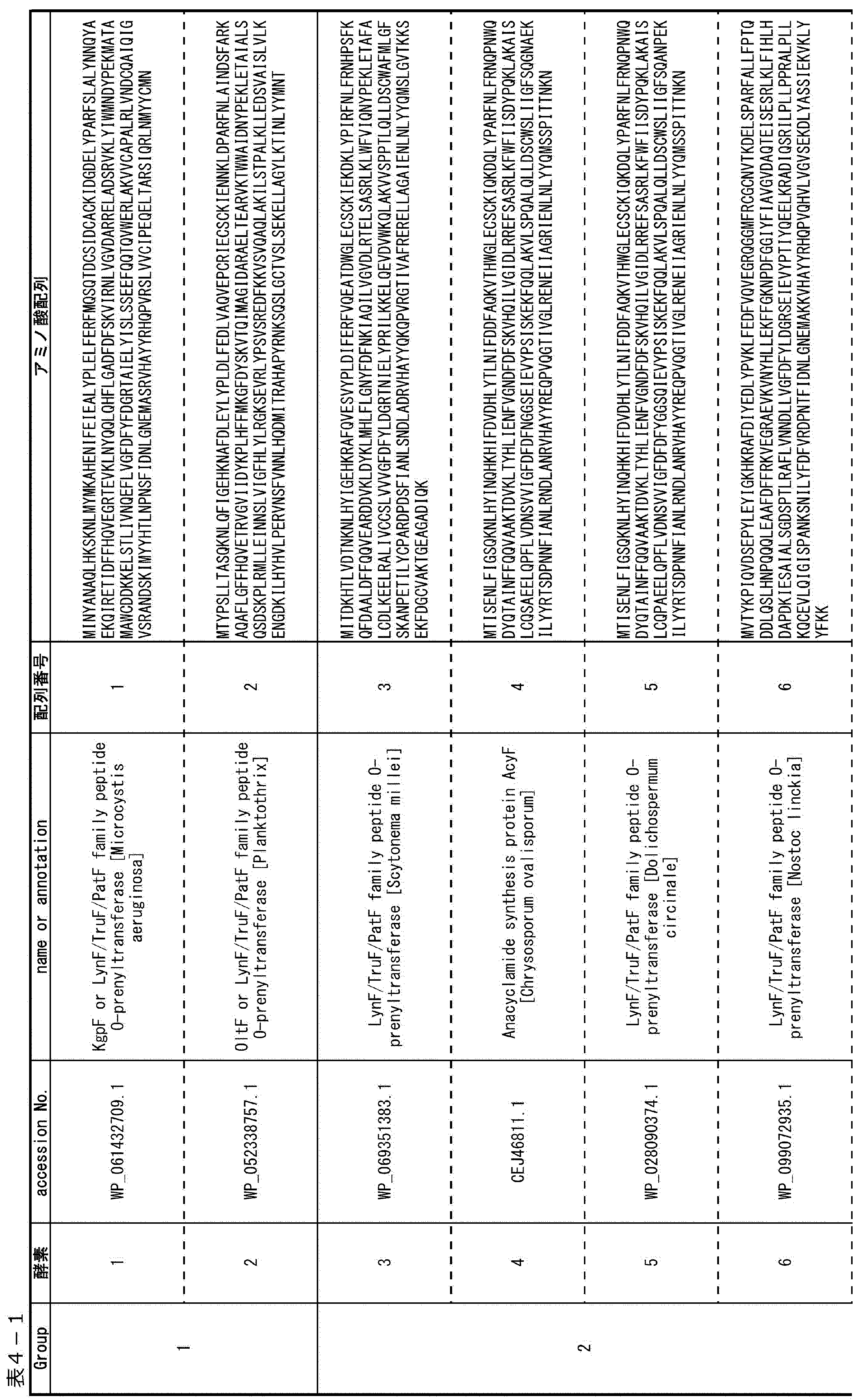

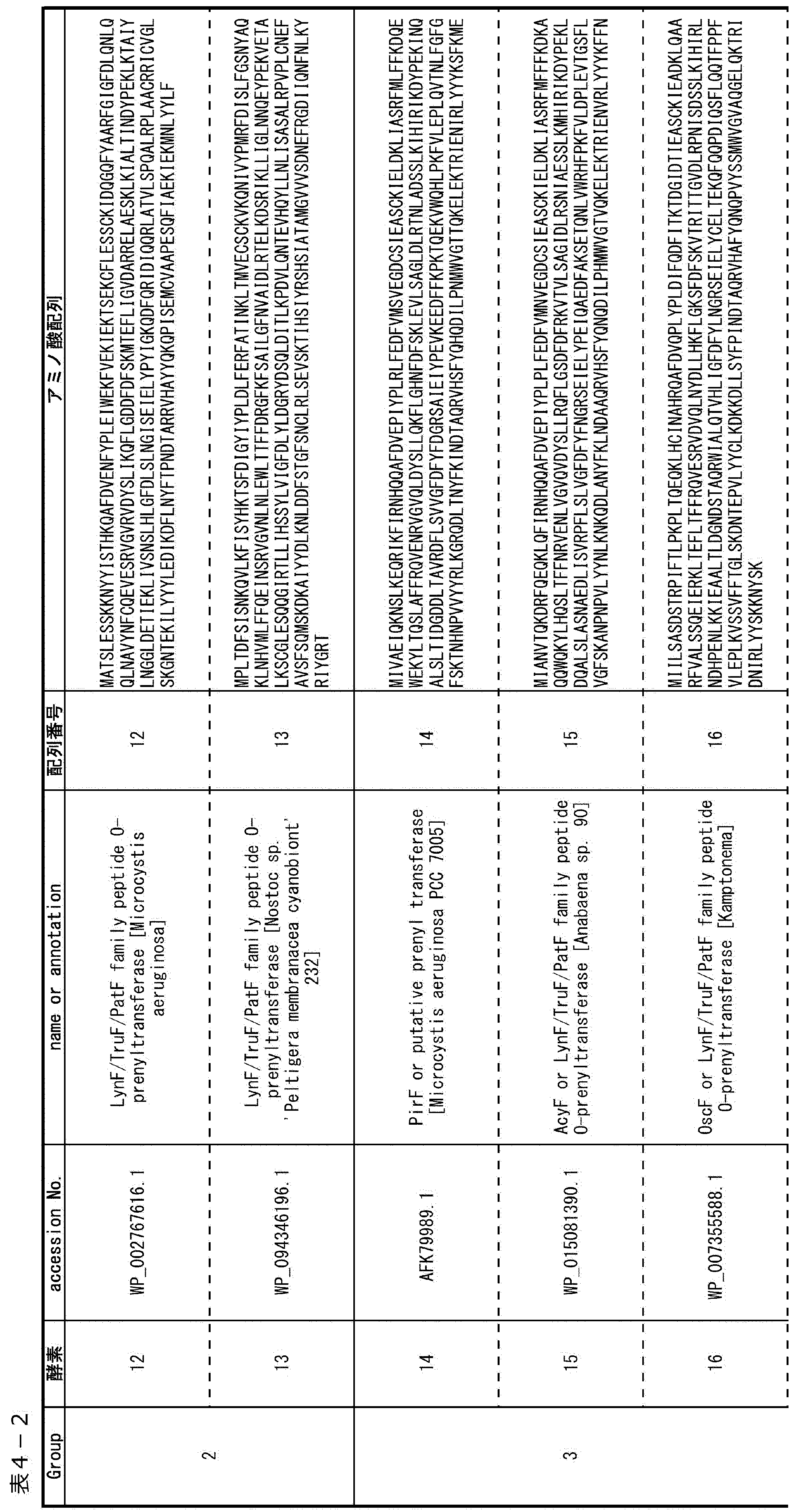

また、上記プレニル化酵素は、具体的に以下のいずれかのアミノ酸配列からなることが好ましい。
(1) 以下の表4-3~表4-8に記載の配列番号1~56で表されるアミノ酸配列のいずれか
(2) 配列番号1~56で表されるアミノ酸配列のいずれかにおいて、1又は複数のアミノ酸の欠失、置換又は付加を有するアミノ酸配列
(3) 配列番号1~56で表されるアミノ酸配列のいずれかと好ましくは80%以上、より好ましくは90%以上、さらに好ましくは95%以上、よりさらに好ましくは96%以上、さらにより好ましくは97%以上、特に好ましくは98%以上の相同性を有するアミノ酸配列
(1) 以下の表4-3~表4-8に記載の配列番号1~56で表されるアミノ酸配列のいずれか
(2) 配列番号1~56で表されるアミノ酸配列のいずれかにおいて、1又は複数のアミノ酸の欠失、置換又は付加を有するアミノ酸配列
(3) 配列番号1~56で表されるアミノ酸配列のいずれかと好ましくは80%以上、より好ましくは90%以上、さらに好ましくは95%以上、よりさらに好ましくは96%以上、さらにより好ましくは97%以上、特に好ましくは98%以上の相同性を有するアミノ酸配列
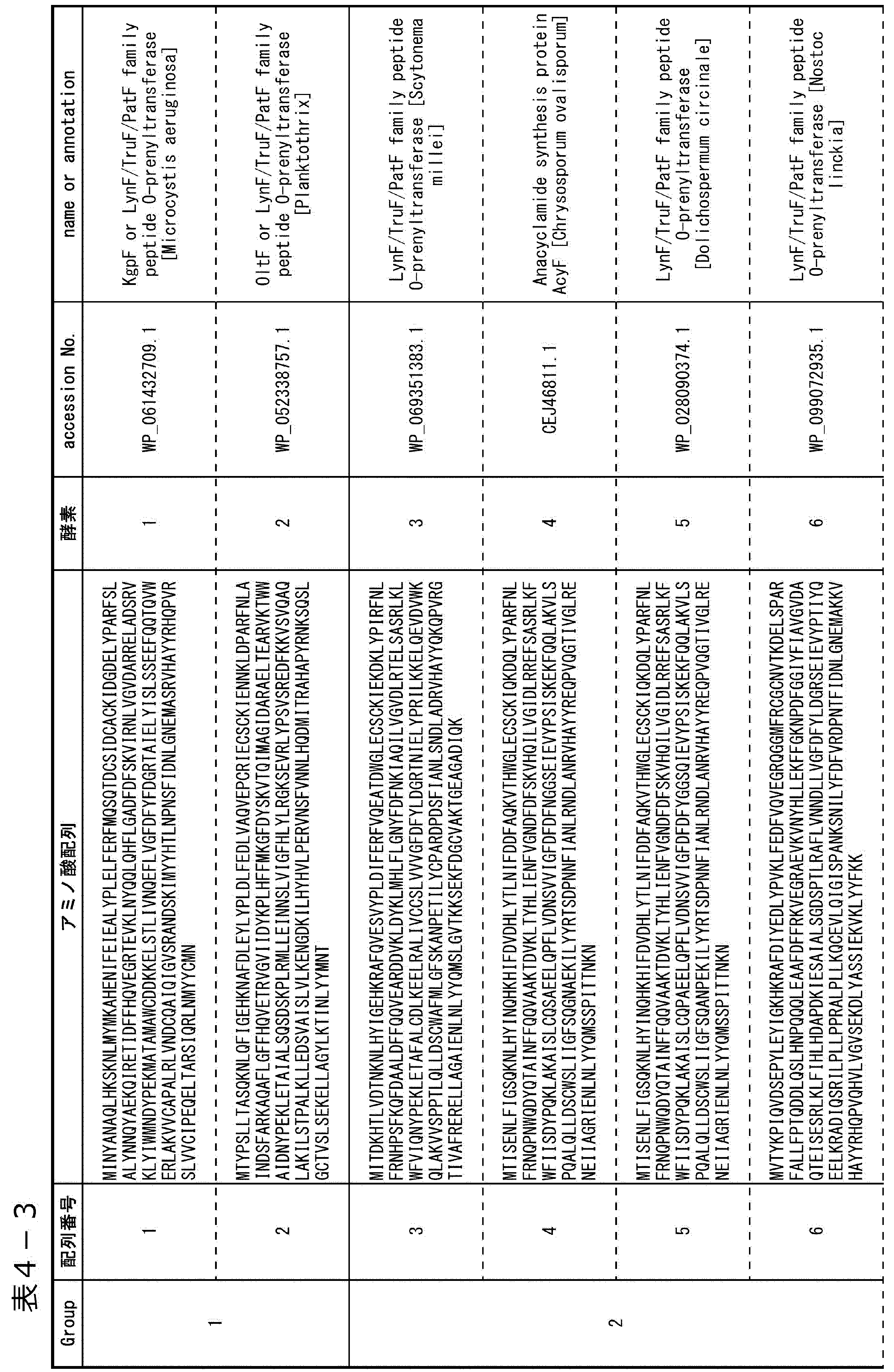
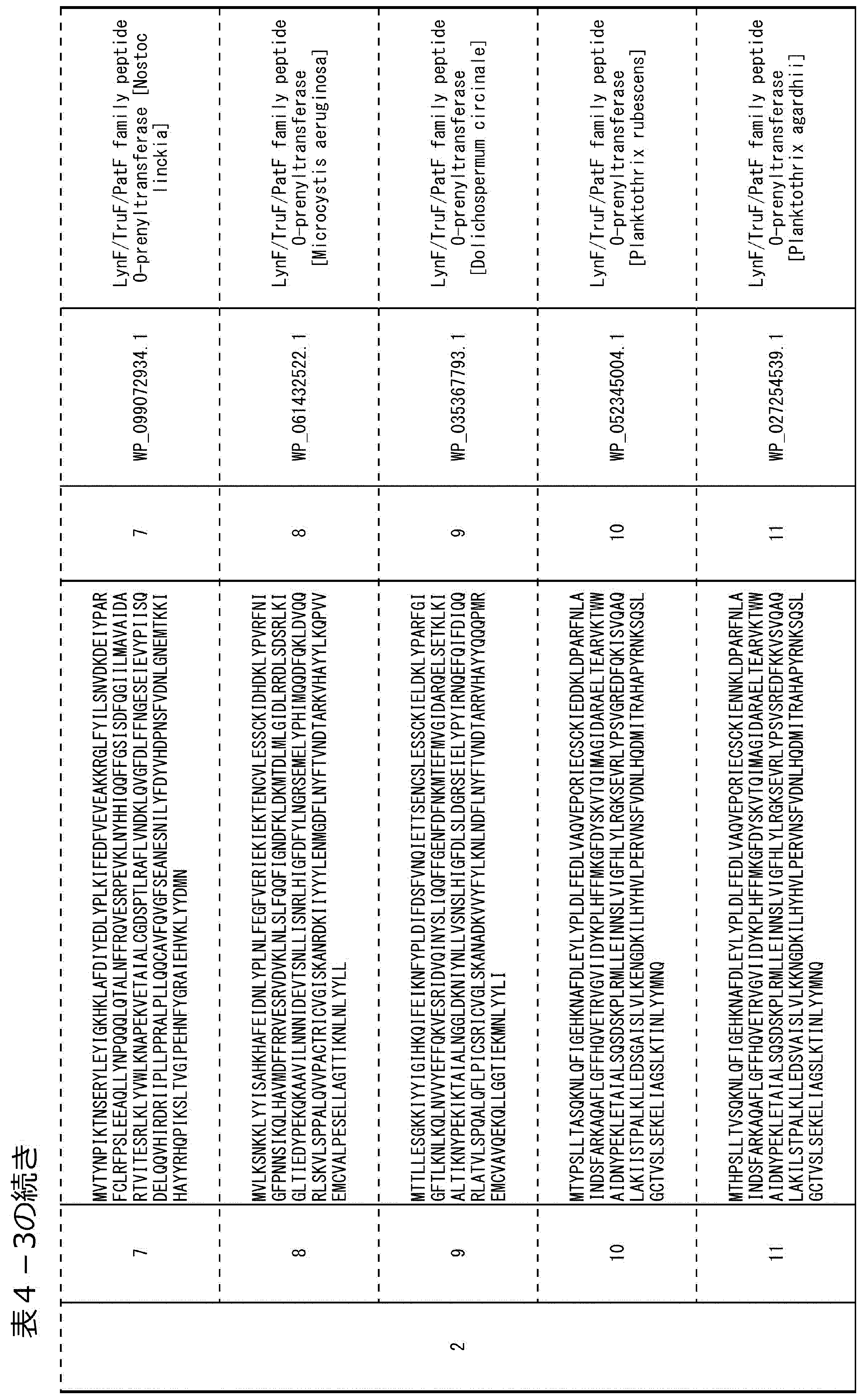


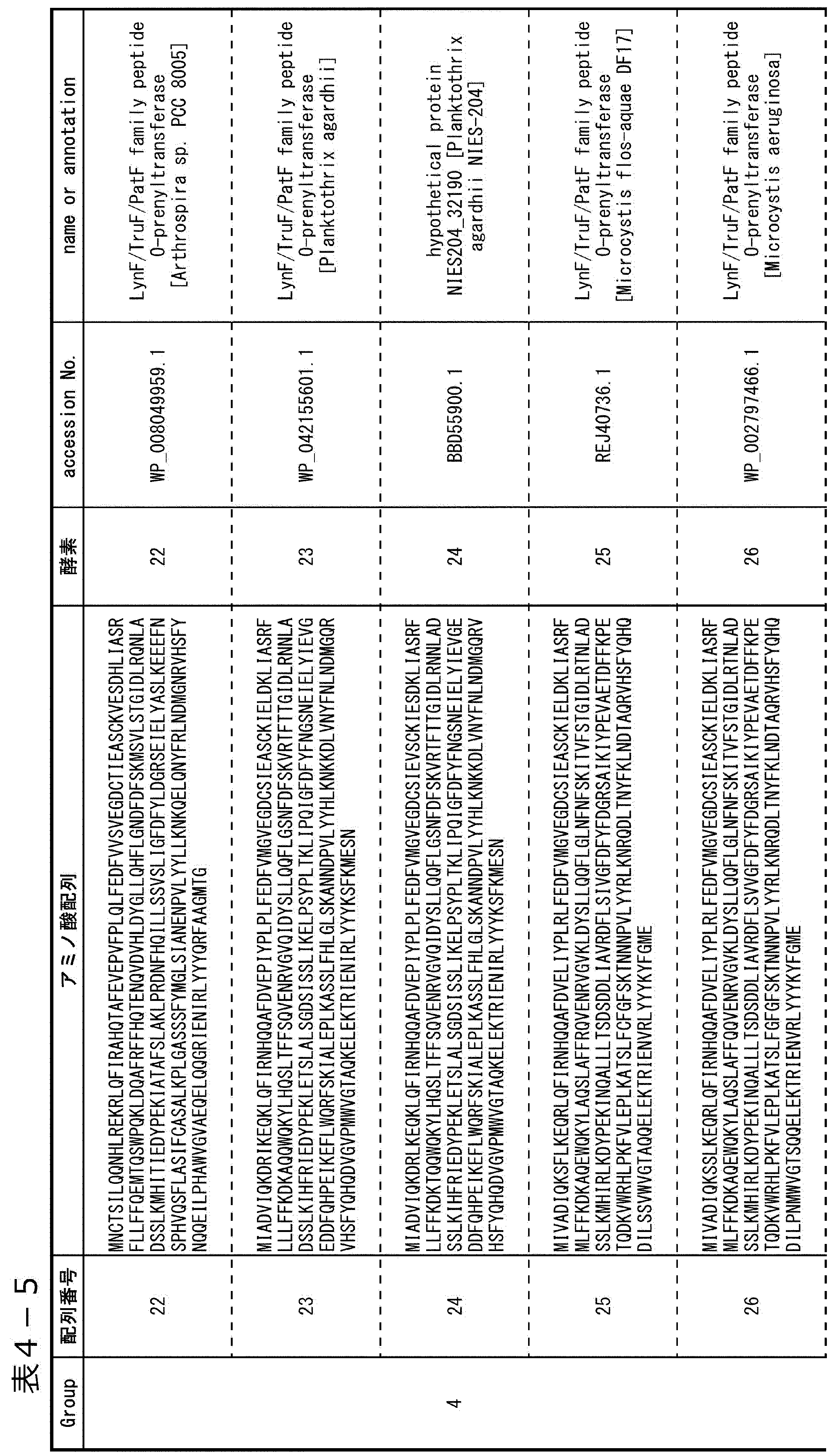
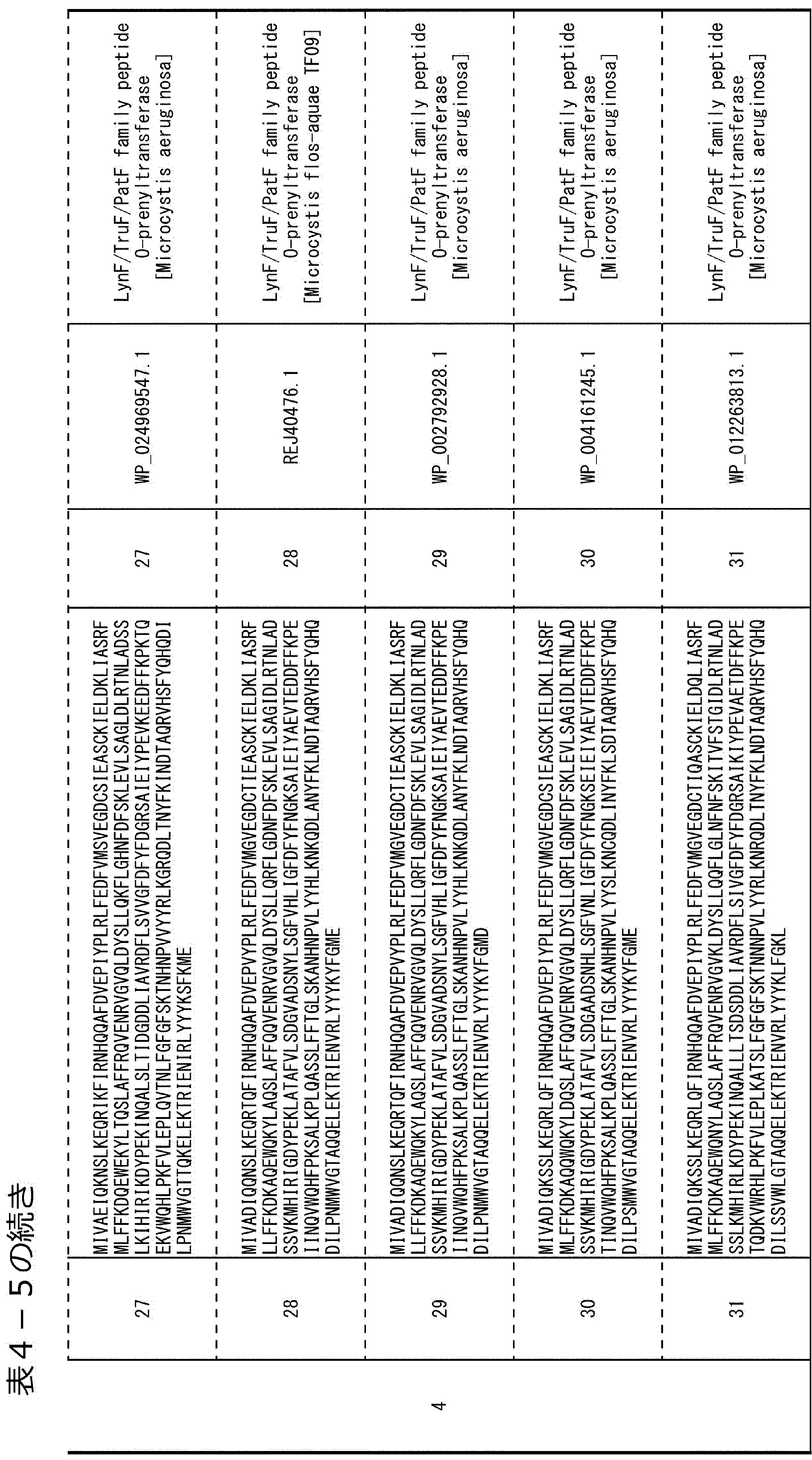


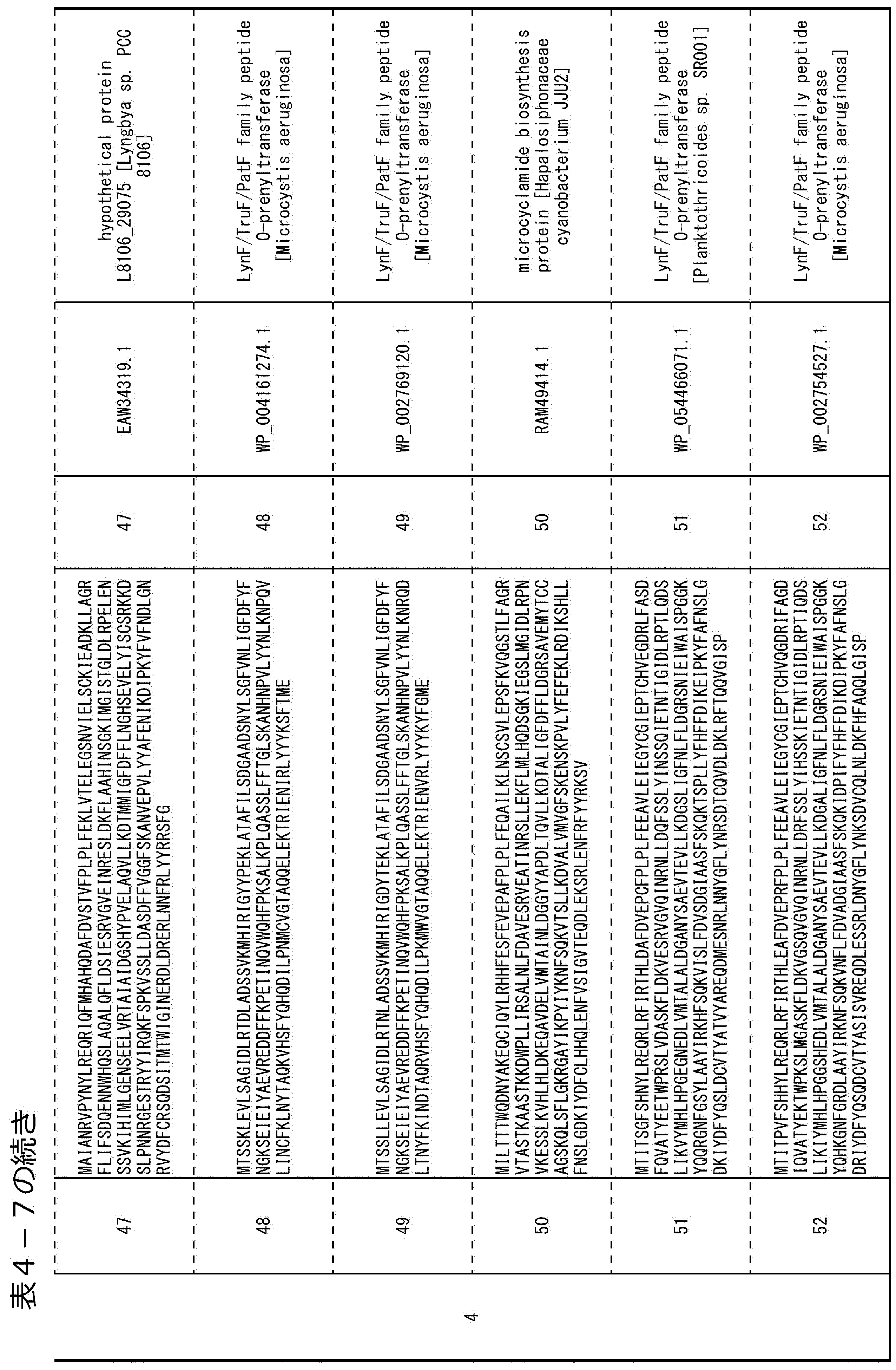
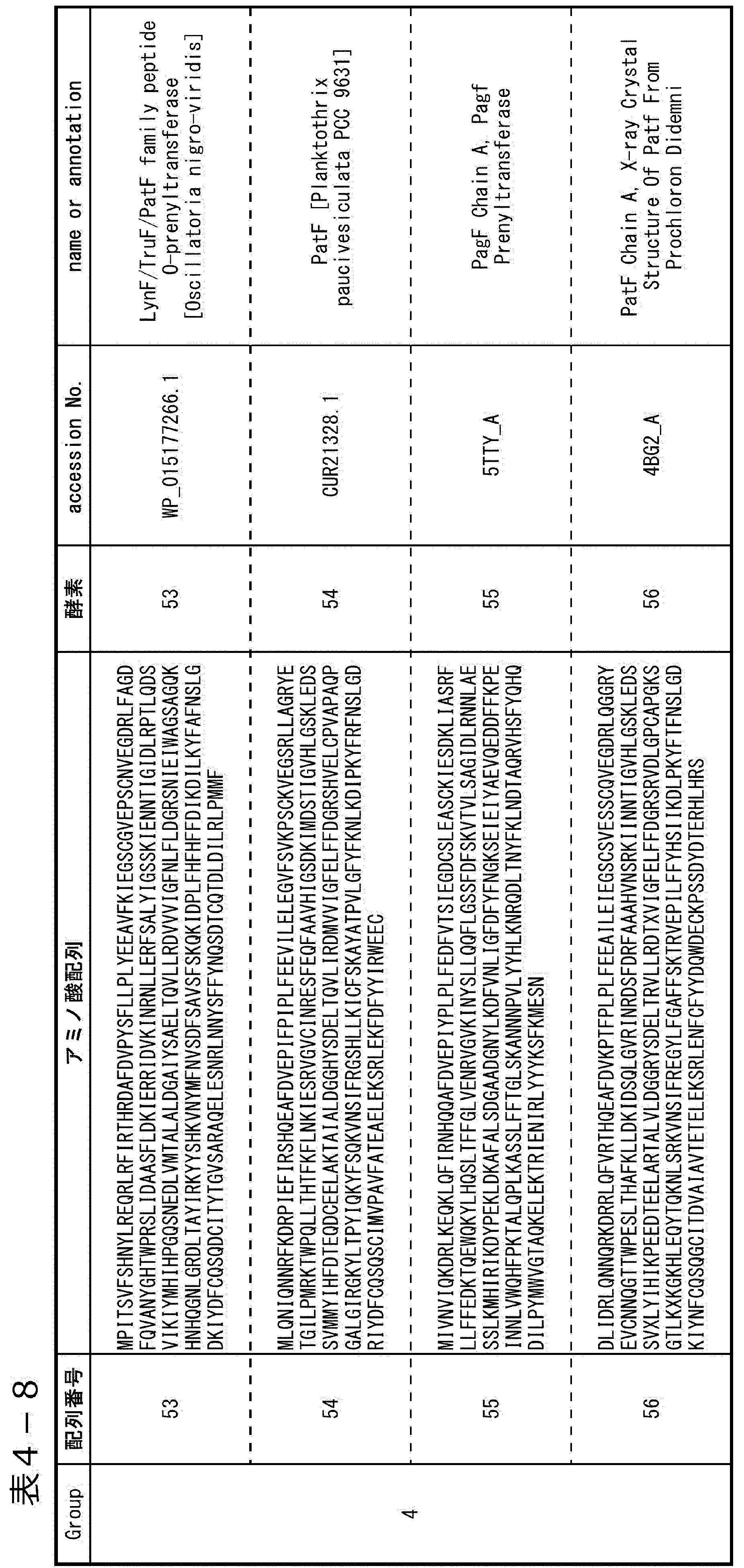
本明細書において、「1又は複数のアミノ酸の欠失、置換又は付加を有する」という場合、欠失、置換等されるアミノ酸の個数は、結果として得られるプレニル化酵素がアミノ酸残基をプレニル化する機能を保持する限り特に限定されない。また、ここでの「複数」は、2以上の整数を意味し、好ましくは、数個例えば2~15個、より好ましくは2~10個、さらに好ましくは2~5個、よりさらに好ましくは2個、3個、4個である。各プレニル化酵素における欠失、置換又は付加の位置は、結果として得られるプレニル化酵素がアミノ酸残基をプレニル化する機能を保持する限り、各プレニル化酵素におけるN末端でも、C末端でも、その中間であってもよい。
本明細書において、「配列番号Xで表されるアミノ酸配列とY%以上の相同性を有する」とは、2つのポリペプチドのアミノ酸配列の一致が最大になるように整列(アライメント)させたときに、共通するアミノ酸残基数の、配列番号Xに示す全アミノ酸数に対する割合が、Y%以上であることを意味する。
プレニル化酵素は、特に限定されるものではないが、例えばX2X1X3又はX4X2X1X3X5(X1はプレニル化されるアミノ酸残基であるW又はその誘導体であり、X2、X3、X4及びX5はそれぞれ独立に任意のアミノ酸残基を示す。任意のアミノ酸残基には、ClAc-D-Tyrも含まれる。)のモチーフを含むペプチドをプレニル化することが可能である。ここで、X1に隣接する、X2、X3、X4及びX5を含むアミノ酸残基は、本発明のプレニル化酵素を用いれば特に限定されないが、プレニル化の反応効率を向上させる観点から、プレニル化されるアミノ酸残基X1がプレニル化されることを促進するアミノ酸残基であることが好ましい。
X1は、W又はその誘導体である。
下記X2~X5、及び下記モチーフは、プレニル化酵素としてKgpFを用いる場合の例示である。KgpF以外のプレニル化酵素を用いる場合、上述したように、無細胞翻訳系を用いて網羅的にペプチドを作製し、所定のプレニル化酵素を用いてin vitroでプレニル化を行う効率性を確認する試験を行うことにより、好適なX2~X5及びモチーフを設定することができる。
下記X2~X5、及び下記モチーフは、プレニル化酵素としてKgpFを用いる場合の例示である。KgpF以外のプレニル化酵素を用いる場合、上述したように、無細胞翻訳系を用いて網羅的にペプチドを作製し、所定のプレニル化酵素を用いてin vitroでプレニル化を行う効率性を確認する試験を行うことにより、好適なX2~X5及びモチーフを設定することができる。
X2は、V, T, I, A, P, Q, N, S, F, H, W, L若しくはG又はこれらのいずれかの誘導体であることが好ましく、V, T, I, A, P, Q若しくはN又はこれらのいずれかの誘導体であることがより好ましく、V, T, I, A若しくはN又はこれらのいずれかの誘導体であることがさらに好ましい。
X3は、G, W, S, A, L, F, T, R, N, Y, I, V, H, Q, K, D若しくはE又はこれらのいずれかの誘導体であることが好ましく、G, W, S, A, L, F, T, R, N,若しくはY又はこれらのいずれかの誘導体であることがより好ましく、G, W若しくはS又はこれらのいずれかの誘導体であることがさらに好ましい。
X4は、G, N, Y, I, R, E, F, S, W, H, D, T, P, A, V, L, Q若しくはK又はこれらのいずれかの誘導体であることが好ましい。X5は、G, N, Y, I, R, E, F, S, W, H, D, T, P, A, V, L, Q, K若しくはC又はこれらのいずれかの誘導体であることが好ましい。
例えば、プレニル化酵素としてKgpFを用いる場合、プレニル化酵素は、具体的な以下のモチーフを含むペプチドをプレニル化することも可能である。後述のモチーフ中、yはClAc-D-Tyrを意味する。
VWG
VWW
VWS
VWI
VWC
VWT
VWR
VWQ
VWN
VWF
VWK
VWD
VWH
VWW
VWS
VWI
VWC
VWT
VWR
VWQ
VWN
VWF
VWK
VWD
VWH
TWG
TWW
TWS
TWT
TWP
TWL
TWK
TWD
TWN
TWH
TWW
TWS
TWT
TWP
TWL
TWK
TWD
TWN
TWH
IWG
IWW
IWS
IWR
IWI
IWP
IWT
IWN
IWQ
IWE
IWH
IWW
IWS
IWR
IWI
IWP
IWT
IWN
IWQ
IWE
IWH
AWG
AWW
AWS
AWH
AWV
AWD
AWL
AWT
AWR
AWQ
AWI
AWW
AWS
AWH
AWV
AWD
AWL
AWT
AWR
AWQ
AWI
PWG
PWW
PWS
PWP
PWV
PWR
PWA
PWL
PWN
PWY
PWI
PWK
PWW
PWS
PWP
PWV
PWR
PWA
PWL
PWN
PWY
PWI
PWK
QWS
QWA
QWA
NWG
NWW
NWA
NWL
NWF
NWT
NWR
NWN
NWY
NWI
NWV
NWH
NWQ
NWK
NWD
NWE
NWP
NWS
NWW
NWA
NWL
NWF
NWT
NWR
NWN
NWY
NWI
NWV
NWH
NWQ
NWK
NWD
NWE
NWP
NWS
SWS
FWF
FWS
FWS
HWS
HWG
HWD
HWG
HWD
WWQ
WWS
WWS
LWV
LWS
LWC
LWS
LWC
GWS
GWT
GWT
DWF
DWS
DWS
RWR
RWC
RWC
YWS
EWS
EWP
EWP
KWS
例えば、プレニル化酵素としてKgpFを用いる場合、プレニル化酵素は、より具体的な以下のモチーフを含むペプチドをプレニル化することも可能である。後述のモチーフ中、yはClAc-D-Tyrを意味する。
GVWGG
GVWWG
GVWSG
EVWNL
RVWGP
RVWGC
RVWGY
HVWGD
DVWGY
DVWIF
YVWGR
YVWGH
HVWGT
TVWGY
YVWGP
PVWGC
HVWSL
AVWDH
SVWTC
AVWRS
yVWNV
AVWQT
RVWKL
TVWQQ
SVWSI
DVWQT
HVWHQ
EVWNL
GVWWG
GVWSG
EVWNL
RVWGP
RVWGC
RVWGY
HVWGD
DVWGY
DVWIF
YVWGR
YVWGH
HVWGT
TVWGY
YVWGP
PVWGC
HVWSL
AVWDH
SVWTC
AVWRS
yVWNV
AVWQT
RVWKL
TVWQQ
SVWSI
DVWQT
HVWHQ
EVWNL
GTWGG
GTWWG
GTWSG
HTWST
STWTS
NTWWQ
ITWPL
GTWLY
NTWKV
FTWDN
TTWDE
ETWNA
TTWNA
VTWNS
VTWNA
NTWNS
ETWHN
STWGS
LTWGA
STWGH
VTWKG
ATWNA
GTWWG
GTWSG
HTWST
STWTS
NTWWQ
ITWPL
GTWLY
NTWKV
FTWDN
TTWDE
ETWNA
TTWNA
VTWNS
VTWNA
NTWNS
ETWHN
STWGS
LTWGA
STWGH
VTWKG
ATWNA
GIWGG
GIWWG
GIWSG
RIWRY
IIWII
GIWGS
QIWTH
RIWRK
KIWNS
TIWII
RIWQV
GIWEK
SIWSQ
HIWTD
IIWHR
QIWPN
GIWWG
GIWSG
RIWRY
IIWII
GIWGS
QIWTH
RIWRK
KIWNS
TIWII
RIWQV
GIWEK
SIWSQ
HIWTD
IIWHR
QIWPN
GAWGG
GAWWG
GAWSG
SAWHG
PAWVR
YAWDQ
YAWLR
QAWTK
NAWTG
YAWRS
LAWQI
KAWIC
KAWHR
GAWWG
GAWSG
SAWHG
PAWVR
YAWDQ
YAWLR
QAWTK
NAWTG
YAWRS
LAWQI
KAWIC
KAWHR
GPWGG
GPWWG
GPWSG
RPWVP
QPWPE
TPWVC
WPWRT
VPWAE
KPWLK
KPWNY
RPWYC
SPWID
DPWKS
GPWWG
GPWSG
RPWVP
QPWPE
TPWVC
WPWRT
VPWAE
KPWLK
KPWNY
RPWYC
SPWID
DPWKS
NNWSP
NNWST
GNWSY
YNWSQ
INWSL
RNWSY
RNWSR
FNWSF
GNWSG
NNWST
GNWGG
GNWWG
GNWAG
GNWLG
GNWFG
GNWTG
GNWRG
GNWNG
GNWYG
GNWIG
GNWVG
GNWHG
GNWQG
GNWKG
GNWDG
GNWEG
NNWPT
PNWRF
NNWST
GNWSY
YNWSQ
INWSL
RNWSY
RNWSR
FNWSF
GNWSG
NNWST
GNWGG
GNWWG
GNWAG
GNWLG
GNWFG
GNWTG
GNWRG
GNWNG
GNWYG
GNWIG
GNWVG
GNWHG
GNWQG
GNWKG
GNWDG
GNWEG
NNWPT
PNWRF
FFWFF
GFWSG
GFWSG
GLWSG
YLWSK
yLWVL
YLWSK
yLWVL
NDWST
YDWFC
YDWFC
NEWST
HEWPW
HEWPW
NKWST
NYWST
GSWSG
ySWSP
ISWNE
ySWSP
ISWNE
GWWSG
TWWQR
TWWQR
GGWSG
TGWTR
TGWTR
GHWSG
FHWGL
IHWDC
FHWGL
IHWDC
GQWSG
YQWAC
YQWAC
YRWRV
また、例えば、プレニル化酵素としてOltFを用いる場合、プレニル化酵素は、具体的な以下のモチーフを含むペプチドをプレニル化することも可能である。後述のモチーフ中、yはClAc-D-Tyrを意味する。
NWS
IWR
PWV
VWI
SWN
NWR
yWY
AWD
VWN
RWG
FWF
GWG
YWY
NWN
VWV
FWL
LWV
DWF
IWR
PWV
VWI
SWN
NWR
yWY
AWD
VWN
RWG
FWF
GWG
YWY
NWN
VWV
FWL
LWV
DWF
さらに、例えば、プレニル化酵素としてOltFを用いる場合、プレニル化酵素は、具体的な以下のモチーフを含むペプチドをプレニル化することも可能である。
NNWSP
NNWST
RIWRY
RPWVP
DVWIF
ISWNE
PNWRF
YAWDQ
EVWNL
GRWGY
FFWFF
GGWGG
YYWYY
NNWNN
VVWVV
YFWLP
GLWVP
SDWFW
WFWLP
NNWST
RIWRY
RPWVP
DVWIF
ISWNE
PNWRF
YAWDQ
EVWNL
GRWGY
FFWFF
GGWGG
YYWYY
NNWNN
VVWVV
YFWLP
GLWVP
SDWFW
WFWLP
より具体的には、後述する実施例で示すペプチド以外にも、少なくとも下記アミノ酸配列を有するペプチドをプレニル化することが可能である。
Cyclic [WLNGDNNWSTP]
Cyclic [TSQIWGSPVP]
Cyclic [SAQWQNFGVP]
WLNGDNNWSTP
WLNGDNNWSTPAYDG
このことは、例えばKgpFが、Kawaguchipeptin Aの前駆体ペプチド(KgpE)から生成される11残基からなる主鎖環状化ペプチド(Cyclic[WLNGDNNWSTP])に含まれる2つのTrp残基をプレニル化し、天然物Kawaguchipeptin Aを生成することから理解できる(Tetrahedron, 1996, 52, 9025. ACIE, 2016, 55, 3596. Org. Biomol. Chem., 2016, 14, 9639.参照)。また、プレニル化酵素は、Fmoc-Trp-OHを低効率ながらプレニル化することも可能である。上記でCyclic[]やc[]の表記は、環状ペプチドのアミノ酸配列であることを意味し、括弧内の左端のアミノ酸残基と右端のアミノ酸残基とが結合している。
Cyclic [WLNGDNNWSTP]
Cyclic [TSQIWGSPVP]
Cyclic [SAQWQNFGVP]
WLNGDNNWSTP
WLNGDNNWSTPAYDG
このことは、例えばKgpFが、Kawaguchipeptin Aの前駆体ペプチド(KgpE)から生成される11残基からなる主鎖環状化ペプチド(Cyclic[WLNGDNNWSTP])に含まれる2つのTrp残基をプレニル化し、天然物Kawaguchipeptin Aを生成することから理解できる(Tetrahedron, 1996, 52, 9025. ACIE, 2016, 55, 3596. Org. Biomol. Chem., 2016, 14, 9639.参照)。また、プレニル化酵素は、Fmoc-Trp-OHを低効率ながらプレニル化することも可能である。上記でCyclic[]やc[]の表記は、環状ペプチドのアミノ酸配列であることを意味し、括弧内の左端のアミノ酸残基と右端のアミノ酸残基とが結合している。
プレニル化酵素の濃度は、酵素の発現及び精製条件によって異なるため特に限定されないが、例えば0.1~1000μMである。また、プレニル化酵素の濃度は、酵素の発現及び精製条件を調整することにより、より小さくすることが可能である。
(表現型を遺伝型にディスプレイしたペプチドライブラリー)
ディスプレイ法とは、表現型(phenotype)とその配列をコードした遺伝型(genotype)を非共有結合又は共有結合で連結することにより、表現型を遺伝型にディスプレイし、試験管に再構築された複製システムを用いて活性種を濃縮、増幅(セレクション)することを可能にするシステムを指す。
例えば、大腸菌を複製媒体とするファージディスプレイ、及びイーストディスプレイ等が挙げられる。
また、原核又は真核生命体を媒体としないin vitroディスプレイも適用することができ、in vitroディスプレイではファージディスプレイよりもより多様なライブラリーの探索が可能となる。in vitroディスプレイとしては、ribosomeディスプレイ、cDNAディスプレイ、及びmRNAディスプレイ等が挙げられる。
ディスプレイ法とは、表現型(phenotype)とその配列をコードした遺伝型(genotype)を非共有結合又は共有結合で連結することにより、表現型を遺伝型にディスプレイし、試験管に再構築された複製システムを用いて活性種を濃縮、増幅(セレクション)することを可能にするシステムを指す。
例えば、大腸菌を複製媒体とするファージディスプレイ、及びイーストディスプレイ等が挙げられる。
また、原核又は真核生命体を媒体としないin vitroディスプレイも適用することができ、in vitroディスプレイではファージディスプレイよりもより多様なライブラリーの探索が可能となる。in vitroディスプレイとしては、ribosomeディスプレイ、cDNAディスプレイ、及びmRNAディスプレイ等が挙げられる。
(ペプチド-遺伝子型ライブラリーの製造方法)
本発明の一つは、遺伝子型(genotype)とペプチドとの複合体を含む、ペプチド-遺伝子型ライブラリーを準備する工程、及び、前記ペプチド-遺伝子型ライブラリーをプレニル化酵素に接触させ、少なくとも一つのTrp又はその誘導体をプレニル化する工程、を含む、ペプチド-遺伝子型複合体ライブラリーの製造方法である。
本発明の一つは、遺伝子型(genotype)とペプチドとの複合体を含む、ペプチド-遺伝子型ライブラリーを準備する工程、及び、前記ペプチド-遺伝子型ライブラリーをプレニル化酵素に接触させ、少なくとも一つのTrp又はその誘導体をプレニル化する工程、を含む、ペプチド-遺伝子型複合体ライブラリーの製造方法である。
(ペプチド-遺伝子型ライブラリーの製造方法)
本発明のディスプレイ法はいずれの方法も用いることができるが、mRNAディスプレイを好適に用いることができる。
すなわち、上記ペプチド-遺伝子型複合体ライブラリーの製造方法は、好ましくはペプチド-mRNA複合体ライブラリーの製造方法であり、上記ペプチド-遺伝子型ライブラリーを準備する工程が、mRNAディスプレイ法によるペプチド-mRNAライブラリーを調製する工程を含み、前記ペプチド-mRNAライブラリーを調製する工程が、mRNAライブラリーの各mRNAの3'末端にピューロマイシンを結合させ、ピューロマイシン結合mRNAライブラリーを製造する工程、ピューロマイシン結合mRNAライブラリーを、無細胞翻訳系によって翻訳し、少なくとも一つのTrp又はその誘導体を含むアミノ酸配列を有するペプチドを含むペプチド-mRNAライブラリーを調製する工程を含む。
ピューロマイシン結合mRNAライブラリーを製造する工程は、具体的に、上述したペプチドライブラリーの製造方法において、mRNAライブラリーを調製する際、各mRNAのORF(Open reading frame)の下流領域にピューロマイシンを結合させることによって行われる。ピューロマイシンは、ペプチドや核酸で構成されるリンカーを介してmRNAに結合させてもよい。mRNAのORF下流領域にピューロマイシンを結合させることにより、mRNAのORFを翻訳したリボソームがピューロマイシンを取り込み、mRNAとペプチドの複合体が形成される。このようなペプチド-mRNA複合体は、遺伝子型と表現型を対応付けることができ、in vitroディスプレイに応用できる。
本発明のディスプレイ法はいずれの方法も用いることができるが、mRNAディスプレイを好適に用いることができる。
すなわち、上記ペプチド-遺伝子型複合体ライブラリーの製造方法は、好ましくはペプチド-mRNA複合体ライブラリーの製造方法であり、上記ペプチド-遺伝子型ライブラリーを準備する工程が、mRNAディスプレイ法によるペプチド-mRNAライブラリーを調製する工程を含み、前記ペプチド-mRNAライブラリーを調製する工程が、mRNAライブラリーの各mRNAの3'末端にピューロマイシンを結合させ、ピューロマイシン結合mRNAライブラリーを製造する工程、ピューロマイシン結合mRNAライブラリーを、無細胞翻訳系によって翻訳し、少なくとも一つのTrp又はその誘導体を含むアミノ酸配列を有するペプチドを含むペプチド-mRNAライブラリーを調製する工程を含む。
ピューロマイシン結合mRNAライブラリーを製造する工程は、具体的に、上述したペプチドライブラリーの製造方法において、mRNAライブラリーを調製する際、各mRNAのORF(Open reading frame)の下流領域にピューロマイシンを結合させることによって行われる。ピューロマイシンは、ペプチドや核酸で構成されるリンカーを介してmRNAに結合させてもよい。mRNAのORF下流領域にピューロマイシンを結合させることにより、mRNAのORFを翻訳したリボソームがピューロマイシンを取り込み、mRNAとペプチドの複合体が形成される。このようなペプチド-mRNA複合体は、遺伝子型と表現型を対応付けることができ、in vitroディスプレイに応用できる。
(ペプチドライブラリー)
本発明は、上述した製造方法により製造されるペプチドライブラリーを包含する。具体的には、本発明のペプチドライブラリーは、上述した環状ペプチドを含むペプチドライブラリーの態様及びペプチド-mRNA複合体ライブラリーの態様を含む。
本発明は、上述した製造方法により製造されるペプチドライブラリーを包含する。具体的には、本発明のペプチドライブラリーは、上述した環状ペプチドを含むペプチドライブラリーの態様及びペプチド-mRNA複合体ライブラリーの態様を含む。
(スクリーニング方法)
本発明の一つは、上述した方法で製造されたペプチドライブラリー及び/又はペプチド-遺伝子型複合体ライブラリー、好ましくはペプチド-mRNA複合体ライブラリーを標的物質に接触させる工程、及び、標的物質に結合するペプチドを選択する工程をさらに含む、標的物質に結合するペプチドを同定するスクリーニング方法である。本発明のスクリーニング方法における接触させる工程は、本発明の方法で製造されたペプチドライブラリー及び/又はペプチド-遺伝子型複合体ライブラリー、好ましくはペプチド-mRNA複合体ライブラリーと標的物質を接触させてインキュベートしてもよい。
本発明の一つは、上述した方法で製造されたペプチドライブラリー及び/又はペプチド-遺伝子型複合体ライブラリー、好ましくはペプチド-mRNA複合体ライブラリーを標的物質に接触させる工程、及び、標的物質に結合するペプチドを選択する工程をさらに含む、標的物質に結合するペプチドを同定するスクリーニング方法である。本発明のスクリーニング方法における接触させる工程は、本発明の方法で製造されたペプチドライブラリー及び/又はペプチド-遺伝子型複合体ライブラリー、好ましくはペプチド-mRNA複合体ライブラリーと標的物質を接触させてインキュベートしてもよい。
本明細書において、標的物質は特に限定されず、低分子化合物、高分子化合物、核酸、ペプチド、タンパク質、糖、脂質等とすることができる。特に、本発明のライブラリーによれば、標的物質がプロテアーゼ活性を有する場合や細胞内の分子である場合にも用いることができる。
標的物質は、例えば、固相担体に固定して、本発明のペプチドライブラリー及び/又はペプチド-mRNA複合体ライブラリーと接触させてもよい。本明細書において、「固相担体」は、標的物質を固定できる担体であれば特に限定されず、ガラス製、金属性、樹脂製等のマイクロタイタープレート、基板、ビーズ、ニトロセルロースメンブレン、ナイロンメンブレン、PVDFメンブレン等が挙げられ、標的物質は、これらの固相担体に公知の方法に従って固定することができる。
標的物質と、ライブラリーは、適宜選択された緩衝液中で接触させ、pH、温度、時間等を調節して相互作用させる。
標的物質は、例えば、固相担体に固定して、本発明のペプチドライブラリー及び/又はペプチド-mRNA複合体ライブラリーと接触させてもよい。本明細書において、「固相担体」は、標的物質を固定できる担体であれば特に限定されず、ガラス製、金属性、樹脂製等のマイクロタイタープレート、基板、ビーズ、ニトロセルロースメンブレン、ナイロンメンブレン、PVDFメンブレン等が挙げられ、標的物質は、これらの固相担体に公知の方法に従って固定することができる。
標的物質と、ライブラリーは、適宜選択された緩衝液中で接触させ、pH、温度、時間等を調節して相互作用させる。
本発明のスクリーニング方法は、標的物質と結合したペプチドを選択する工程を含む。標的物質と結合したペプチドの選択は、例えば、ペプチドを公知の方法に従って検出可能に標識し、上記接触工程の後、緩衝液で固相担体表面を洗浄し、標的物質に結合している化合物を検出して行うことができる。
検出可能な標識としては、ペルオキシダーゼ、アルカリホスファターゼ等の酵素、25I、131I、35S、3H等の放射性物質、フルオレセインイソチオシアネート、ローダミン、ダンシルクロリド、フィコエリトリン、テトラメチルローダミンイソチオシアネート、近赤外蛍光材料等の蛍光物質、ルシフェラーゼ、ルシフェリン、エクオリン等の発光物質、金コロイド、量子ドット等のナノ粒子が挙げられる。標識として酵素を用いる場合、酵素の基質を酵素と接触させることにより発色させ、検出することもできる。また、ペプチドにビオチンを結合させ、酵素等で標識したアビジン又はストレプトアビジンを結合させて検出することもできる。
検出可能な標識としては、ペルオキシダーゼ、アルカリホスファターゼ等の酵素、25I、131I、35S、3H等の放射性物質、フルオレセインイソチオシアネート、ローダミン、ダンシルクロリド、フィコエリトリン、テトラメチルローダミンイソチオシアネート、近赤外蛍光材料等の蛍光物質、ルシフェラーゼ、ルシフェリン、エクオリン等の発光物質、金コロイド、量子ドット等のナノ粒子が挙げられる。標識として酵素を用いる場合、酵素の基質を酵素と接触させることにより発色させ、検出することもできる。また、ペプチドにビオチンを結合させ、酵素等で標識したアビジン又はストレプトアビジンを結合させて検出することもできる。
単に結合の有無又は程度を検出及び測定するのみでなく、標的物質の活性の亢進又は阻害を測定し、かかる亢進活性又は阻害活性を有するペプチドを同定することも可能である。このような方法により、生理活性を有し、医薬として有用なペプチドの同定も可能となる。
本発明のスクリーニング方法では、標的物質に結合するペプチドを選択する工程にディスプレイ法を適用でき、大腸菌を複製媒体とするファージディスプレイ、及びイーストディスプレイ、並びに、原核又は真核生命体を媒体としないin vitroディスプレイである、ribosomeディスプレイ、cDNAディスプレイ、及びmRNAディスプレイ等を適用できる。本発明のスクリーニング方法において特にペプチド-mRNA複合体ライブラリーを用いる場合、標的物質に結合するペプチドを選択する工程にmRNAディスプレイ法を適用できる。ここでmRNAディスプレイ法とは、mRNAを翻訳する際に、mRNAと合成されたペプチドとを結合させ、表現型(ペプチド)と核酸配列(mRNA)とを対応付けることを可能にする方法である。
ディスプレイ法では、ペプチド-遺伝子型複合体ライブラリーと標的分子とを接触させてインキュベートし、標的分子に結合したペプチド-遺伝子型複合体群を選択する。この工程は、上述した標的物質と結合したペプチドとを選択することと同様に、例えば標的分子を固相表面に固定しておき、固相表面に捕捉されたペプチド-遺伝子型複合体を選択することによって行うことができる。
ディスプレイ法として、mRNAディスプレイ法を適用する場合、ペプチド-mRNA複合体群に対して逆転写反応を行うことにより、cDNA群が得られる。このcDNAは、標的分子に結合する環状ペプチドをコードする。
cDNA群を増幅し、これを転写することによって再度mRNAライブラリーを得ることができる。再度得られたmRNAライブラリーは、当初のmRNAライブラリーに比較して、標的分子に結合する分子の濃度が高くなっている。したがって、上述の工程を複数回繰り返すことにより、標的分子に結合する分子を徐々に濃縮することができる。
濃縮された環状ペプチドのアミノ酸配列は、cDNAの配列を解析することによって特定できるので、配列情報を基に、標的分子に対して高い親和性を有する環状ペプチドを産生することが可能である。
cDNA群を増幅し、これを転写することによって再度mRNAライブラリーを得ることができる。再度得られたmRNAライブラリーは、当初のmRNAライブラリーに比較して、標的分子に結合する分子の濃度が高くなっている。したがって、上述の工程を複数回繰り返すことにより、標的分子に結合する分子を徐々に濃縮することができる。
濃縮された環状ペプチドのアミノ酸配列は、cDNAの配列を解析することによって特定できるので、配列情報を基に、標的分子に対して高い親和性を有する環状ペプチドを産生することが可能である。
RaPIDシステム(Yamagishi, Y. et al., Chemistry & biology, 2011, 18(12), 1562-70)は、後述する実施例で用いたFITシステムとmRNAディスプレイとを組み合わせたスクリーニング系の一例である。FITシステムを用いた遺伝暗号のリプログラミング技術を、mRNAディスプレイ法と組み合わせたRaPIDシステムにより、非タンパク質を含むペプチドライブラリーを用いたスクリーニングが可能となった。
(スクリーニング用キット)
本発明は、ペプチドのスクリーニング用キットも提供する。本発明のスクリーニング用キットの一態様は、本発明の製造方法で製造されたペプチドライブラリー、及び/又は、ペプチド-mRNA複合体ライブラリーを含む。
本発明のスクリーニング用キットは、上記ペプチドライブラリー、及び/又は、ペプチド-mRNA複合体ライブラリーに加え、標的物質と、ペプチド又はペプチド-mRNA複合体との結合を検出するのに必要な試薬及び装置を含む。かかる試薬及び装置としては、例えば、固相担体、緩衝液、標識用試薬、酵素、酵素反応停止液、マイクロプレートリーダーが挙げられるがこれらに限定されない。
本発明は、ペプチドのスクリーニング用キットも提供する。本発明のスクリーニング用キットの一態様は、本発明の製造方法で製造されたペプチドライブラリー、及び/又は、ペプチド-mRNA複合体ライブラリーを含む。
本発明のスクリーニング用キットは、上記ペプチドライブラリー、及び/又は、ペプチド-mRNA複合体ライブラリーに加え、標的物質と、ペプチド又はペプチド-mRNA複合体との結合を検出するのに必要な試薬及び装置を含む。かかる試薬及び装置としては、例えば、固相担体、緩衝液、標識用試薬、酵素、酵素反応停止液、マイクロプレートリーダーが挙げられるがこれらに限定されない。
(ペプチドの製造方法)
本発明は、少なくとも一つのTrp又はその誘導体を含むアミノ酸配列を有するペプチドをプレニル化酵素に接触させ、少なくとも一つのTrp残基又はその誘導体残基をプレニル化する工程、を含む、プレニル化されたペプチドの製造方法も提供する。
上記少なくとも一つのTrp又はその誘導体を含むアミノ酸配列を有するペプチドの入手方法は特に限定されないが、例えば、化学合成、好ましくは固相合成法により合成する方法等が挙げられる。本発明のペプチドの製造方法の好ましい態様の一つは、少なくとも一つのTrp又はその誘導体を含むアミノ酸配列を有するペプチドを化学合成により合成する工程、及び、前記少なくとも一つのTrp又はその誘導体を含むアミノ酸配列を有するペプチドをプレニル化酵素に接触させ、少なくとも一つのTrp残基又はその誘導体残基をプレニル化する工程、を含む。
本発明は、少なくとも一つのTrp又はその誘導体を含むアミノ酸配列を有するペプチドをプレニル化酵素に接触させ、少なくとも一つのTrp残基又はその誘導体残基をプレニル化する工程、を含む、プレニル化されたペプチドの製造方法も提供する。
上記少なくとも一つのTrp又はその誘導体を含むアミノ酸配列を有するペプチドの入手方法は特に限定されないが、例えば、化学合成、好ましくは固相合成法により合成する方法等が挙げられる。本発明のペプチドの製造方法の好ましい態様の一つは、少なくとも一つのTrp又はその誘導体を含むアミノ酸配列を有するペプチドを化学合成により合成する工程、及び、前記少なくとも一つのTrp又はその誘導体を含むアミノ酸配列を有するペプチドをプレニル化酵素に接触させ、少なくとも一つのTrp残基又はその誘導体残基をプレニル化する工程、を含む。
本発明のペプチドの製造方法は、上述した、本発明のペプチドライブラリーの製造方法に準じて行うことができる。すなわち、プレニル化する工程においては、プレニル基のドナーの存在下で、補因子の存在下又は非存在下、少なくとも一つのTrp又はその誘導体を含むアミノ酸配列を有するペプチドをプレニル化酵素と接触させることが好ましい。
プレニル基を供与するドナーとしては、特に限定されないが、例えば、ジメチルアリル二燐酸(DMAPP)、イソプレニル二燐酸(IPP)、ゲラニル二燐酸(GPP)、ファルネシル二燐酸(FPP)、ゲラニルゲラニル二燐酸(GGPP)、及びフィチル二燐酸(PDP)が挙げられる。これらのプレニル基を供与するドナーは、1単独で用いてもよく、2種以上を組み合わせて用いてもよい。
補因子としては、特に限定されないが、例えば、マグネシウムイオン、銅イオン、鉄イオン、マンガンイオン、モリブデンイオン、ニッケルイオン、セレンイオン、亜鉛イオン等が挙げられる。これらは1種単独で用いてもよく、2種以上を組み合わせて用いてもよい。これらの中でも好ましくは、マグネシウムイオンである。本発明のペプチドの製造方法において補因子を用いるか否かは、使用するプレニル化酵素に応じて適宜選択すればよい。
プレニル基を供与するドナーとしては、特に限定されないが、例えば、ジメチルアリル二燐酸(DMAPP)、イソプレニル二燐酸(IPP)、ゲラニル二燐酸(GPP)、ファルネシル二燐酸(FPP)、ゲラニルゲラニル二燐酸(GGPP)、及びフィチル二燐酸(PDP)が挙げられる。これらのプレニル基を供与するドナーは、1単独で用いてもよく、2種以上を組み合わせて用いてもよい。
補因子としては、特に限定されないが、例えば、マグネシウムイオン、銅イオン、鉄イオン、マンガンイオン、モリブデンイオン、ニッケルイオン、セレンイオン、亜鉛イオン等が挙げられる。これらは1種単独で用いてもよく、2種以上を組み合わせて用いてもよい。これらの中でも好ましくは、マグネシウムイオンである。本発明のペプチドの製造方法において補因子を用いるか否かは、使用するプレニル化酵素に応じて適宜選択すればよい。
(翻訳系)
本発明において、無細胞翻訳系は、伸長用tRNAを含み、開始tRNAをさらに含んでもよい。上述のとおり、本発明者らは、フレキシザイムを利用したコドンの再割当により、N1N2N3が任意のアミノ酸をコードする翻訳系を開発した。天然の翻訳系においては、各アミノ酸に対応したアンチコドンを有するtRNAが存在し、各tRNAは、アンチコドンループ以外の領域においてもそれぞれ固有の配列を有する。
しかしながら、フレキシザイムを利用し、N1N2N3のすべてに任意のアミノ酸を再割当する場合、tRNAをすべて人工のものとすることができる。この場合、翻訳系に加える各N1N2N3に対応する伸長tRNAは、全長の80%以上、85%以上、88%以上、又は90%以上が同一の塩基配列からなるものであってもよい。すなわち、アンチコドンを除いた配列のうち、ほとんど配列が同じである伸長tRNA群を用いることができる。伸長tRNA群は、アンチコドンループ以外すべて同じ塩基配列のものとしてもよい。翻訳系に加える各N1N2N3に対応する伸長tRNAは、アンチコドンループ以外の部分の配列が、85%以上、88%以上、90%以上、93%以上、95%以上、98%以上、又は99%以上同一のものであってもよい。
本発明において、無細胞翻訳系は、伸長用tRNAを含み、開始tRNAをさらに含んでもよい。上述のとおり、本発明者らは、フレキシザイムを利用したコドンの再割当により、N1N2N3が任意のアミノ酸をコードする翻訳系を開発した。天然の翻訳系においては、各アミノ酸に対応したアンチコドンを有するtRNAが存在し、各tRNAは、アンチコドンループ以外の領域においてもそれぞれ固有の配列を有する。
しかしながら、フレキシザイムを利用し、N1N2N3のすべてに任意のアミノ酸を再割当する場合、tRNAをすべて人工のものとすることができる。この場合、翻訳系に加える各N1N2N3に対応する伸長tRNAは、全長の80%以上、85%以上、88%以上、又は90%以上が同一の塩基配列からなるものであってもよい。すなわち、アンチコドンを除いた配列のうち、ほとんど配列が同じである伸長tRNA群を用いることができる。伸長tRNA群は、アンチコドンループ以外すべて同じ塩基配列のものとしてもよい。翻訳系に加える各N1N2N3に対応する伸長tRNAは、アンチコドンループ以外の部分の配列が、85%以上、88%以上、90%以上、93%以上、95%以上、98%以上、又は99%以上同一のものであってもよい。
本明細書において、アンチコドンループとは、tRNAにおけるアンチコドンを含む一本鎖のループ部分を示す。アンチコドンループの配列は、コドン-アンチコドンの相互作用を相補するように、当業者が適宜決定することが可能である。
このようにして得られる翻訳系は、tRNAとして、一種類の開始tRNAと、一種類の伸長tRNA(すなわち、アンチコドン以外ほとんど同じ塩基配列であるtRNA)しか含まないので、各tRNAの反応性が均一となり、再現性よく予定したペプチドを得ることができる。
本発明の翻訳系によれば、mRNAにおけるN1N2N3の多様性に基づき、1×10¹²~1×10¹³以上の異なるペプチドを含むライブラリーを製造することが可能である。
本発明の翻訳系は、転写に必要な因子を加えて転写に用いてもよい。
また、本発明の翻訳系は、上述した、本発明のペプチドライブラリーの製造方法に好適に用いられる。
本発明の翻訳系によれば、mRNAにおけるN1N2N3の多様性に基づき、1×10¹²~1×10¹³以上の異なるペプチドを含むライブラリーを製造することが可能である。
本発明の翻訳系は、転写に必要な因子を加えて転写に用いてもよい。
また、本発明の翻訳系は、上述した、本発明のペプチドライブラリーの製造方法に好適に用いられる。
本明細書において引用されるすべての特許文献及び参考文献の開示は、全体として本明細書に参照により組み込まれる。
以下、本発明を実施例に基づいて具体的に説明するが、本発明は何らこれに限定されるものではない。当業者は、本発明の意義を逸脱することなく様々な態様に本発明を変更することができ、かかる変更も本発明の範囲に含まれる。
1.FIT system v7S/v8.0.3
FITシステムの組成は以下のとおりである。
50 mM HEPES-KOH (pH 7.6); 12mM 酢酸マグネシウム; 100 mM 酢酸カリウム;2mM スペルミジン; 20 mM リン酸クレアチニン; 2 mM DTT; 2 mM ATP; 2 mMGTP; 1 mM CTP; 1 mM UTP; 0.1 mM 10-ホルミr-5,6,7,8-テトラヒドロ葉酸; 0.5 mM 15 Met, Lys, Gln, Trp, Glu以外のタンパク質性アミノ酸; 1.5 mg/ml E.coli total tRNA; 0.73 μM AlaRS; 0.03 μM ArgRS; 0.38 μM AsnRS; 0.13 μM AspRS; 0.02 μM CysRS; 0.06 μM GlnRS; 0.23 μM GluRS; 0.02 μM GlyRS; 0.02 μM HisRS; 0.4 μM IleRS; 0.04 LeuRS; 0.11 μM LysRS; 0.03 μM MetRS; 0.68 μM PheRS; 0.16 μM ProRS; 0.04 μM SerRS; 0.09 μM ThrRS; 0.03 μM TrpRS; 0.02 μM TyrRS; 0.02 μM ValRS; 0.6 μM MTF; 2.7 μM IF1; 0.4 μM IF2; 1.5 μM IF3; 0.26 μM EF-G; 10 μM EF-Tu; 10 μM EF-Ts; 0.25 μM RF2; 0.17 μM RF3; 0.5 μM RRF; 0.1 μM T7 RNA ポリメラーゼ; 4 μg/ml クレアチンキナーゼ; 3 μg/ml ミオキナーゼ; 0.1 μM ピロホスファターゼ; 0.1 μM ヌクレオチド・ジホスファターゼキナーゼ; 及び1.2 μM ribosome。
FITシステムの組成は以下のとおりである。
50 mM HEPES-KOH (pH 7.6); 12mM 酢酸マグネシウム; 100 mM 酢酸カリウム;2mM スペルミジン; 20 mM リン酸クレアチニン; 2 mM DTT; 2 mM ATP; 2 mMGTP; 1 mM CTP; 1 mM UTP; 0.1 mM 10-ホルミr-5,6,7,8-テトラヒドロ葉酸; 0.5 mM 15 Met, Lys, Gln, Trp, Glu以外のタンパク質性アミノ酸; 1.5 mg/ml E.coli total tRNA; 0.73 μM AlaRS; 0.03 μM ArgRS; 0.38 μM AsnRS; 0.13 μM AspRS; 0.02 μM CysRS; 0.06 μM GlnRS; 0.23 μM GluRS; 0.02 μM GlyRS; 0.02 μM HisRS; 0.4 μM IleRS; 0.04 LeuRS; 0.11 μM LysRS; 0.03 μM MetRS; 0.68 μM PheRS; 0.16 μM ProRS; 0.04 μM SerRS; 0.09 μM ThrRS; 0.03 μM TrpRS; 0.02 μM TyrRS; 0.02 μM ValRS; 0.6 μM MTF; 2.7 μM IF1; 0.4 μM IF2; 1.5 μM IF3; 0.26 μM EF-G; 10 μM EF-Tu; 10 μM EF-Ts; 0.25 μM RF2; 0.17 μM RF3; 0.5 μM RRF; 0.1 μM T7 RNA ポリメラーゼ; 4 μg/ml クレアチンキナーゼ; 3 μg/ml ミオキナーゼ; 0.1 μM ピロホスファターゼ; 0.1 μM ヌクレオチド・ジホスファターゼキナーゼ; 及び1.2 μM ribosome。
2.ClAc-D/L-Trp/Tyr-tRNAfMet
CUAの調製
3 μLの83.3 μM tRNAfMet CUAと、3 μLの83.3 μM のフレキシザイムとを83.3 mM HEPES-KOH (pH 8.0)中で、95°Cで2分加熱し、5分で室温まで冷却した。このRNA溶液に、2 μLの3 M MgCl2を加え、5分間氷上でインキュベートした。続いて、2 μLの25 mM ClAc-D-Trp-CME, ClAc-L-Trp-CME , ClAc-D-Tyr-CME 又はClAc-L-Tyr-CME (DMSO中)を反応液に加え、2時間氷上でインキュベートした。40 μLの0.3 M 酢酸ナトリウム(pH5.2)を加えて反応を停止させ、tRNAをエタノール沈殿で回収した。沈殿を70%エタノールと0.1 Mの酢酸ナトリウム(pH5.2)で2回、70%エタノールで1回洗浄した。10分間空気乾燥した後、沈殿物を1.0 μLの1.0 mM酢酸ナトリウムに溶解させ、以下の翻訳反応に用いた。
3 μLの83.3 μM tRNAfMet CUAと、3 μLの83.3 μM のフレキシザイムとを83.3 mM HEPES-KOH (pH 8.0)中で、95°Cで2分加熱し、5分で室温まで冷却した。このRNA溶液に、2 μLの3 M MgCl2を加え、5分間氷上でインキュベートした。続いて、2 μLの25 mM ClAc-D-Trp-CME, ClAc-L-Trp-CME , ClAc-D-Tyr-CME 又はClAc-L-Tyr-CME (DMSO中)を反応液に加え、2時間氷上でインキュベートした。40 μLの0.3 M 酢酸ナトリウム(pH5.2)を加えて反応を停止させ、tRNAをエタノール沈殿で回収した。沈殿を70%エタノールと0.1 Mの酢酸ナトリウム(pH5.2)で2回、70%エタノールで1回洗浄した。10分間空気乾燥した後、沈殿物を1.0 μLの1.0 mM酢酸ナトリウムに溶解させ、以下の翻訳反応に用いた。
3.プレニル化酵素
KgpF及びOltFのそれぞれについて、産生菌由来の遺伝子のコドンを最適化した上で合成した遺伝子を大腸菌内で異種共発現し、精製してプレニル化酵素を調製した。
KgpF及びOltFのそれぞれについて、産生菌由来の遺伝子のコドンを最適化した上で合成した遺伝子を大腸菌内で異種共発現し、精製してプレニル化酵素を調製した。
4.MALDI-TOF解析
UltrafleXtreme (Bruker Daltonics)もしくはAutoflex II (Bruker Daltonics)とpeptide calibration standard II (Bruker Daltonics)を用いて行った。
UltrafleXtreme (Bruker Daltonics)もしくはAutoflex II (Bruker Daltonics)とpeptide calibration standard II (Bruker Daltonics)を用いて行った。
以上の他に、国際公開第2014/181888号及び国際公開第2015/030014号で、特にその実施例で開示する試薬等は、本実施例においても適宜用いた。
[実施例1:天然の基質であるKawaguchipeptin配列要素を有するチオエーテル閉環人工環状ペプチドの修飾実験]
天然の基質であるKawaguchipeptinの配列(以下、「天然の基質配列」ともいう。)に由来する3種類のチオエーテル閉環人工環状アミノ酸配列、YG280-282を設計した。
天然の基質であるKawaguchipeptinの配列(以下、「天然の基質配列」ともいう。)に由来する3種類のチオエーテル閉環人工環状アミノ酸配列、YG280-282を設計した。
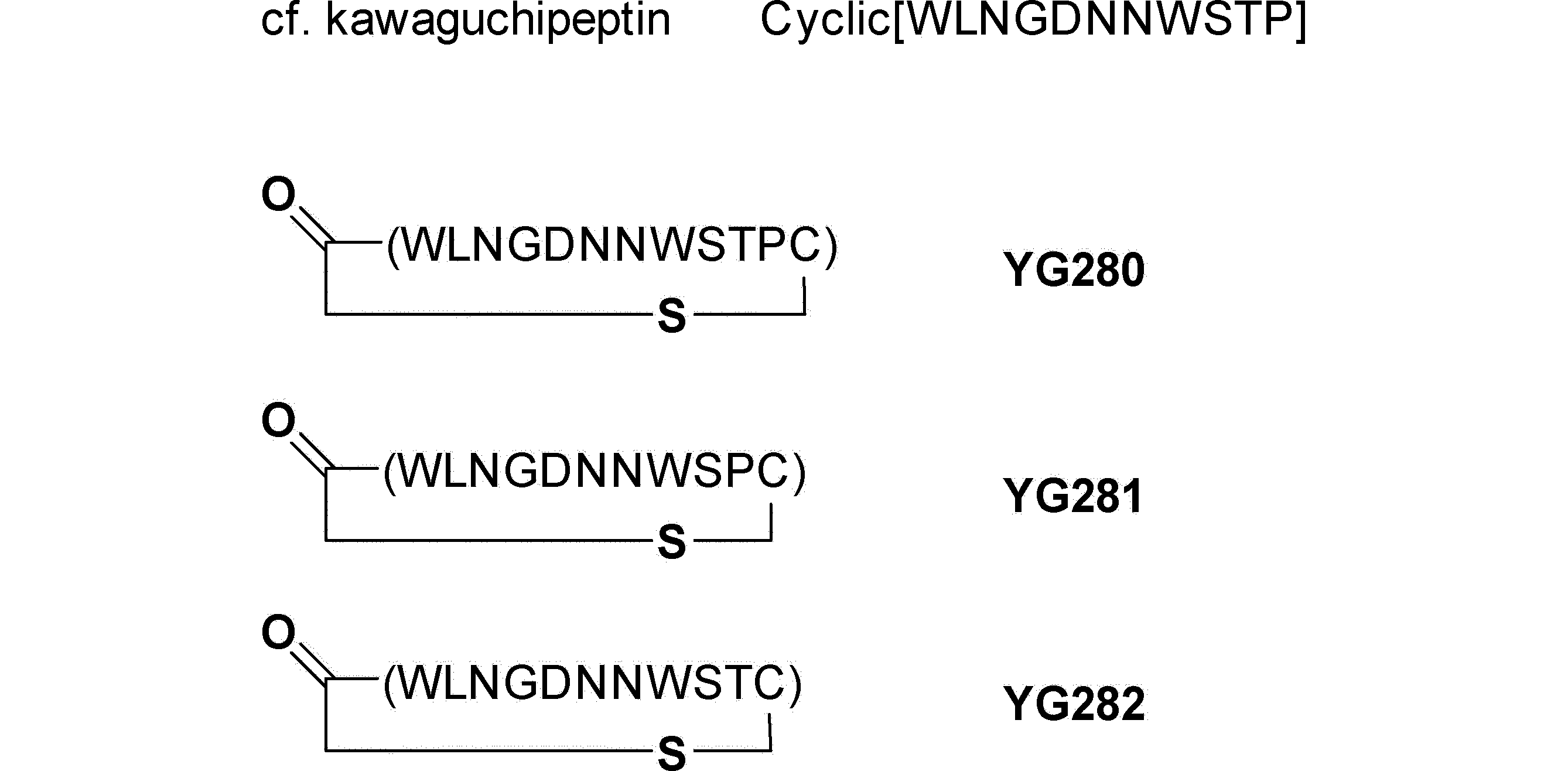
3種類のチオエーテル閉環人工環状ペプチド(YG280-282)について、開始残基にあたるN末端Trpの立体配置がD体であるものとL体であるものをそれぞれ合成したため、合計で6種類のペプチドを発明者らが開発した人工翻訳系の(条件1)で翻訳合成した。その後、得られたペプチドを(条件2)に示す系で14.7μMのKgpFと37℃で18時間反応させた。なお、(条件2)で使用した「DMAPP」は、ジメチルアリルピロリン酸である。
(条件1)
FIT system; v7s/v8.0.3
19aa-Met; 0.5 mM
ClAc-D or L-Trp-tRNAfMet CUA; 90 μM
反応; 37℃、60分
スケール; 2.5 μLスケール
(条件2)
翻訳混合物量; 2.5 μL((条件1)で得られた混合物)
KgpF; 14.7 μM
DMAPP; 2 mM
合計量; 15.7 μL
反応; 37℃、18時間
FIT system; v7s/v8.0.3
19aa-Met; 0.5 mM
ClAc-D or L-Trp-tRNAfMet CUA; 90 μM
反応; 37℃、60分
スケール; 2.5 μLスケール
(条件2)
翻訳混合物量; 2.5 μL((条件1)で得られた混合物)
KgpF; 14.7 μM
DMAPP; 2 mM
合計量; 15.7 μL
反応; 37℃、18時間
上記の反応産物をMALDI-TOF-MSで解析した。その結果は次に示すとおりであった。
試した3種類のペプチドの全てについて、KgpFで処理した場合にプレニル化に相当する分だけ分子量が大きくなった生成物を観測した。つまり、これらのペプチドがKgpFの基質となったことが分かった。
ペプチド内に2カ所のTrpがあるにもかかわらず、プレニル化は一カ所でしか起きなかった。
試した3種類のペプチドの中では、YG280配列のN末端Trpの立体配置がD体であるペプチドが最もプレニル化の修飾効率に優れていたため、以後YG280配列を中心にさらに実験を進めた。
試した3種類のペプチドの全てについて、KgpFで処理した場合にプレニル化に相当する分だけ分子量が大きくなった生成物を観測した。つまり、これらのペプチドがKgpFの基質となったことが分かった。
ペプチド内に2カ所のTrpがあるにもかかわらず、プレニル化は一カ所でしか起きなかった。
試した3種類のペプチドの中では、YG280配列のN末端Trpの立体配置がD体であるペプチドが最もプレニル化の修飾効率に優れていたため、以後YG280配列を中心にさらに実験を進めた。
[実施例2;KgpFによるチオエーテル閉環人工環状ペプチドの修飾-酵素濃度の最適化]
実施例1の結果を受けて、YG280配列のペプチドを用いてKgpFの濃度を上げていき、プレニル化の反応条件の最適化を図った。
YG280配列について、開始残基にあたるN末端Trpの立体配置がD体であるものとL体であるものを合成しているため、合計で2種類のペプチドを用意した。これら2種類の人工環状ペプチドを発明者らが開発した人工翻訳系(条件3)で翻訳合成した。その後、得られたペプチドを(条件4)に示す系で53, 160, 580μMのKgpFと37℃で18時間反応させた。
実施例1の結果を受けて、YG280配列のペプチドを用いてKgpFの濃度を上げていき、プレニル化の反応条件の最適化を図った。
YG280配列について、開始残基にあたるN末端Trpの立体配置がD体であるものとL体であるものを合成しているため、合計で2種類のペプチドを用意した。これら2種類の人工環状ペプチドを発明者らが開発した人工翻訳系(条件3)で翻訳合成した。その後、得られたペプチドを(条件4)に示す系で53, 160, 580μMのKgpFと37℃で18時間反応させた。
(条件3)
FIT system; v7s/v8.0.3
19aa-Met; 0.5 mM
ClAc-D or L-Trp-tRNAfMet CUA; 120 μM
反応; 37℃、3時間
スケール; 2.5 μLスケール
(条件4)
翻訳混合物量; 2.5 μL((条件3)で得られた混合物)
KgpF; 53, 160, 580 μM
DMAPP; 2 mM
反応; 37℃、18時間
FIT system; v7s/v8.0.3
19aa-Met; 0.5 mM
ClAc-D or L-Trp-tRNAfMet CUA; 120 μM
反応; 37℃、3時間
スケール; 2.5 μLスケール
(条件4)
翻訳混合物量; 2.5 μL((条件3)で得られた混合物)
KgpF; 53, 160, 580 μM
DMAPP; 2 mM
反応; 37℃、18時間
なお、160 μMのKgpFを用いた系では、わずかに沈殿を確認し、580 μMのKgpFを用いた系では、多量の沈殿を確認した。
上記の反応産物をMALDI-TOF-MSで解析した。その結果は次に示すとおりであった。
KgpFの濃度を高めていくと、それに応じて修飾産物に相当するピークが強くなった。
N末端のTrpの立体配置がD体であるものの方がL体であるものよりもプレニル化の修飾効率に優れていた。
N末端のTrpの立体配置がD体であるペプチドを580 μMのKgpFと反応させた場合、ほぼ全てのペプチドがプレニル化修飾を受けた(非プレニル化ペプチドのピークはごくわずかであった。)。
ペプチド内に2カ所のTrpがあるにもかかわらず、プレニル化は一カ所のみで起きた。
高濃度のKgpFを用いることで効率よくチオエーテル閉環人工環状ペプチドをプレニル化できることが分かった。
KgpFの濃度を高めていくと、それに応じて修飾産物に相当するピークが強くなった。
N末端のTrpの立体配置がD体であるものの方がL体であるものよりもプレニル化の修飾効率に優れていた。
N末端のTrpの立体配置がD体であるペプチドを580 μMのKgpFと反応させた場合、ほぼ全てのペプチドがプレニル化修飾を受けた(非プレニル化ペプチドのピークはごくわずかであった。)。
ペプチド内に2カ所のTrpがあるにもかかわらず、プレニル化は一カ所のみで起きた。
高濃度のKgpFを用いることで効率よくチオエーテル閉環人工環状ペプチドをプレニル化できることが分かった。
[実施例3;KgpFによるチオエーテル閉環人工環状ペプチドの修飾-修飾位置の同定]
実施例1及び2では、ペプチド内に2カ所のTrpがあるにもかかわらず、プレニル化は1カ所でしか起きなかった。どちらのTrpでプレニル化が起きているかを決定するため、YG280配列におけるTrp残基をそれぞれ一つずつTyrに変異させたペプチド(YG298,280)及びランダム領域にTrp残基のないペプチド(YG290)を設計し、KgpFによる修飾の進行の有無をそれぞれ評価した。
実施例1及び2では、ペプチド内に2カ所のTrpがあるにもかかわらず、プレニル化は1カ所でしか起きなかった。どちらのTrpでプレニル化が起きているかを決定するため、YG280配列におけるTrp残基をそれぞれ一つずつTyrに変異させたペプチド(YG298,280)及びランダム領域にTrp残基のないペプチド(YG290)を設計し、KgpFによる修飾の進行の有無をそれぞれ評価した。

これら3種類の人工環状ペプチドを発明者らが開発した人工翻訳系(条件5)で翻訳合成した。その後、得られたペプチドを(条件6)に示す系でKgpFと37℃で18時間反応させた。
(条件5)
FIT system; v7s/v8.0.3
19aa-Met; 0.5 mM
ClAc-D or L-Trp-tRNAfMet CUA; 90 μM
反応; 37℃、60分
スケール; 2.5 μLスケール
(条件6)
翻訳混合物量; 2.5 μL((条件5)で得られた混合物)
KgpF; 160又は580 μM
DMAPP; 2 mM
反応; 37℃、18時間
FIT system; v7s/v8.0.3
19aa-Met; 0.5 mM
ClAc-D or L-Trp-tRNAfMet CUA; 90 μM
反応; 37℃、60分
スケール; 2.5 μLスケール
(条件6)
翻訳混合物量; 2.5 μL((条件5)で得られた混合物)
KgpF; 160又は580 μM
DMAPP; 2 mM
反応; 37℃、18時間
その反応産物をMALDI-TOF-MSで解析した。その結果、N末端のTrp残基を残したペプチドYG298及びペプチド鎖中にTrp残基のないペプチドYG290-CM11は580μMのKgpFと反応させても一切修飾体が見られなかったのに対し、鎖中(8番残基)にTrp残基を残したペプチドClAc-D-Tyr-initiated YG280は元々の配列(YG280)のペプチドと同様の効率で修飾を受けたことを確認した。このことから、YG280のペプチドにおいてペプチド鎖中のTrp残基がプレニル化修飾を受けていることが分かった。
[実施例4;KgpFの基質許容性調査-様々な環サイズを持つペプチドの修飾]
天然の基質配列に由来するYG280配列は12残基からなるチオエーテル閉環環状ペプチドであった。そこで、YG280-1を基準として、より短いチオエーテル閉環環状ペプチド(YG310-311)やより長いチオエーテル閉環環状ペプチド(YG312-314)についても、KgpFで修飾できるか確認した。
天然の基質配列に由来するYG280配列は12残基からなるチオエーテル閉環環状ペプチドであった。そこで、YG280-1を基準として、より短いチオエーテル閉環環状ペプチド(YG310-311)やより長いチオエーテル閉環環状ペプチド(YG312-314)についても、KgpFで修飾できるか確認した。
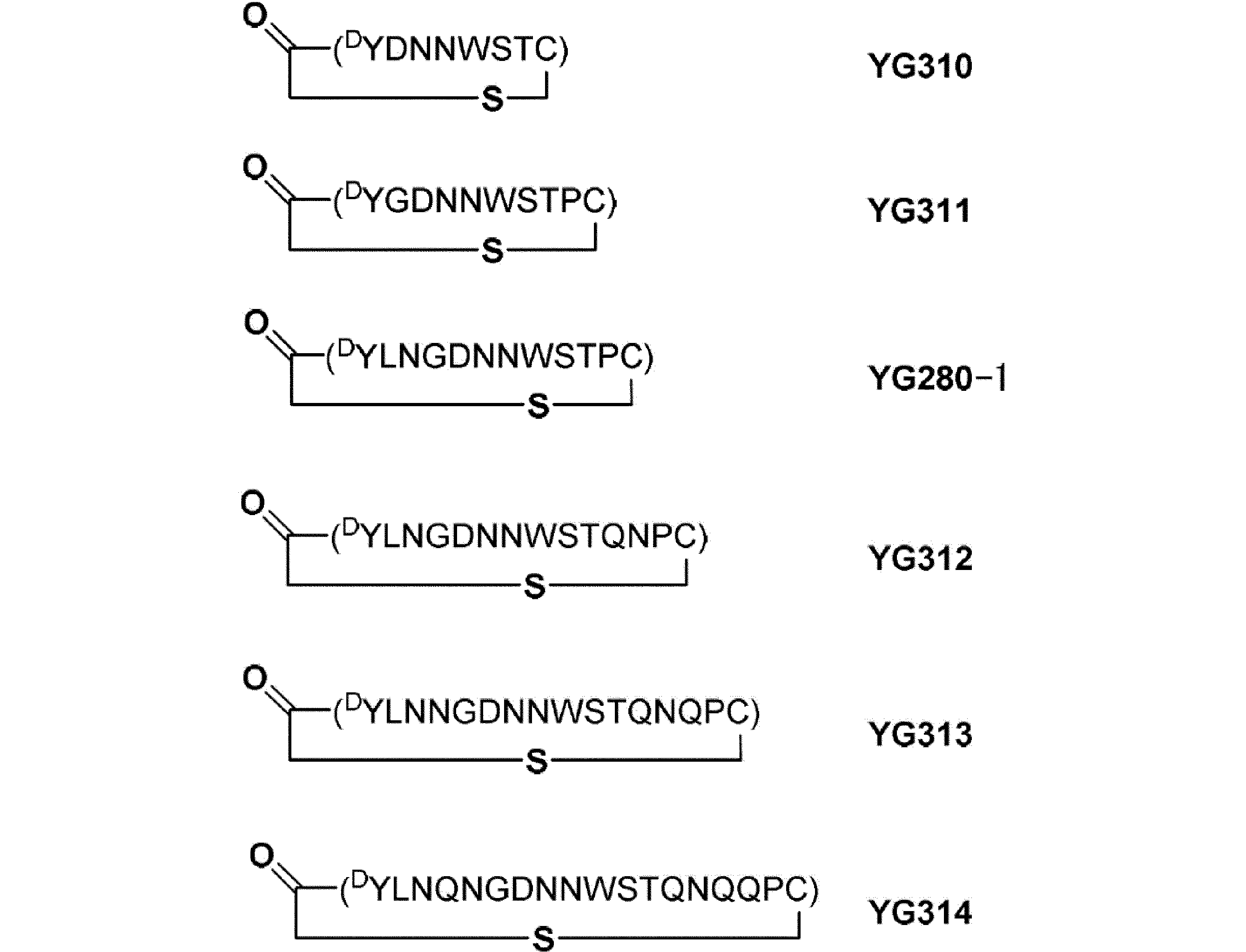
上記6種類の人工環状ペプチドを本発明者らが開発した人工翻訳系(条件7)で翻訳合成した。その後、得られたペプチドを(条件8)に示す系で160 μMのKgpFと37℃で18時間反応させた。
(条件7)
FIT system; v7s/v9.1
19aa-Met; 0.5 mM
ClAc-D-Tyr-tRNAfMet CUA; 90 μM
反応; 37℃、60分
スケール; 2.5 μLスケール
(条件8)
翻訳混合物量; 2.5 μL((条件7)で得られた混合物)
KgpF; 160 μM
DMAPP; 2 mM
反応; 37℃、18時間
FIT system; v7s/v9.1
19aa-Met; 0.5 mM
ClAc-D-Tyr-tRNAfMet CUA; 90 μM
反応; 37℃、60分
スケール; 2.5 μLスケール
(条件8)
翻訳混合物量; 2.5 μL((条件7)で得られた混合物)
KgpF; 160 μM
DMAPP; 2 mM
反応; 37℃、18時間
上記の反応産物をMALDI-TOF-MSで解析した。その結果、環サイズによって修飾効率の増減はあるものの、試した全ての配列がKgpFで修飾されることが分かった。つまり、KgpFは多彩な環サイズのチオエーテル閉環人工環状ペプチドを修飾しうることが実証された。
[実施例5;KgpFの基質許容性調査-Trpの前後配列の検証 その1]
天然の基質配列及びYG280においては、修飾されるTrpの前後に存在するアミノ酸残基はそれぞれAsnとSerであった。Trpの前後配列を変更した人工の3種類のアミノ酸配列を設計し(YG300,304,305)、KgpFで修飾できるか確認した。
天然の基質配列及びYG280においては、修飾されるTrpの前後に存在するアミノ酸残基はそれぞれAsnとSerであった。Trpの前後配列を変更した人工の3種類のアミノ酸配列を設計し(YG300,304,305)、KgpFで修飾できるか確認した。
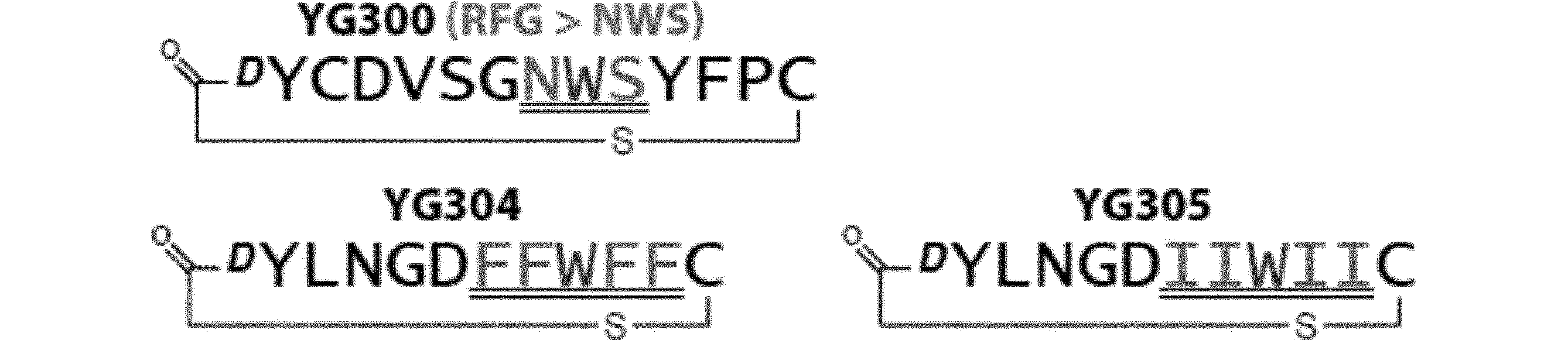
これら3種類の人工環状ペプチドを本発明者らが開発した人工翻訳系(条件9)で翻訳合成した。その後、得られたペプチドを(条件10)に示す系で160 μMのKgpFと37℃で18時間反応させた。
(条件9)
FIT system; v7s/v9.1
19aa-Met; 0.5 mM
ClAc-D-Tyr-tRNAfMet CUA; 90 μM
反応; 37℃、60分
スケール; 2.5 μLスケール
(条件10)
翻訳混合物量; 2.5 μL((条件9)で得られた混合物)
KgpF; 160 μM
DMAPP; 2 mM
反応; 37℃、18時間
FIT system; v7s/v9.1
19aa-Met; 0.5 mM
ClAc-D-Tyr-tRNAfMet CUA; 90 μM
反応; 37℃、60分
スケール; 2.5 μLスケール
(条件10)
翻訳混合物量; 2.5 μL((条件9)で得られた混合物)
KgpF; 160 μM
DMAPP; 2 mM
反応; 37℃、18時間
その反応産物をMALDI-TOF-MSで解析した。その結果、試した3種の人工ペプチドについては、いずれもプレニル化の修飾が確認された。
また、以下の環状ペプチド(YG288-S2iL8, YG289-S2iD7, YG292-PaktiL5, YG297-aMD4)についても同様に翻訳合成し、KgpFの存在下でDMAPPと反応させたところ、プレニル基で修飾されたことがMALDI-TOF-MSにより観測された。
また、以下の環状ペプチド(YG288-S2iL8, YG289-S2iD7, YG292-PaktiL5, YG297-aMD4)についても同様に翻訳合成し、KgpFの存在下でDMAPPと反応させたところ、プレニル基で修飾されたことがMALDI-TOF-MSにより観測された。
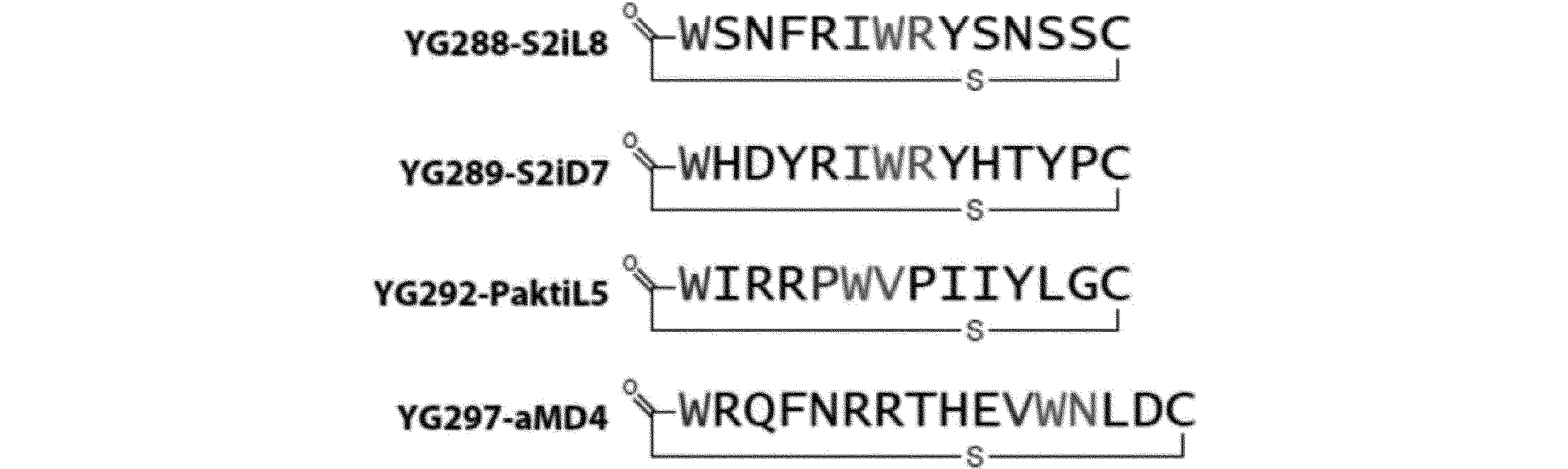
[実施例6;KgpFの基質許容性調査-Trpの前後配列の検証 その2]
KgpFの修飾効率が、Trpの前後配列に影響することをさらに精査するため、Wの前後配列を、天然基質であるカワグチペプチンに見られるNWS又はNNWST配列に変えた13種類の配列を設計し(表5)、KgpFで修飾できるか確認した。
KgpFの修飾効率が、Trpの前後配列に影響することをさらに精査するため、Wの前後配列を、天然基質であるカワグチペプチンに見られるNWS又はNNWST配列に変えた13種類の配列を設計し(表5)、KgpFで修飾できるか確認した。
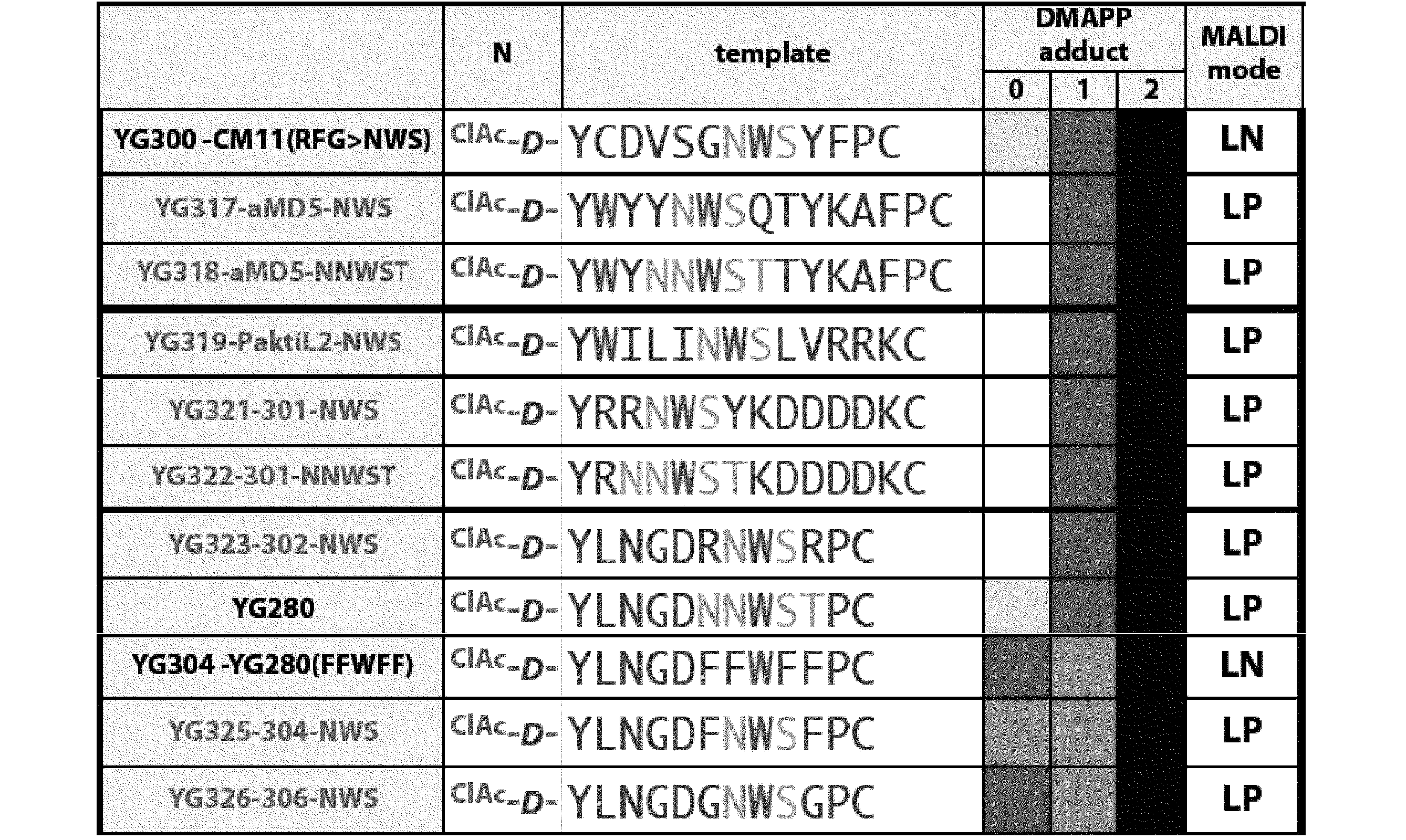
これらの人工環状ペプチドを本発明者らが開発した人工翻訳系(条件11)で翻訳合成した。その後、得られたペプチドを(条件12)に示す系で160 μMのKgpFと37℃で18時間反応させた。
(条件11)
FIT system; v7s/v9.1
19aa-Met; 0.5 mM
ClAc-D-Tyr-tRNAfMet CUA; 90 μM
反応; 37℃、60分
スケール; 2.5 μLスケール
(条件12)
翻訳混合物量; 2.5 μL((条件11)で得られた混合物)
KgpF; 160 μM
DMAPP; 2 mM
反応; 37℃、18時間
FIT system; v7s/v9.1
19aa-Met; 0.5 mM
ClAc-D-Tyr-tRNAfMet CUA; 90 μM
反応; 37℃、60分
スケール; 2.5 μLスケール
(条件12)
翻訳混合物量; 2.5 μL((条件11)で得られた混合物)
KgpF; 160 μM
DMAPP; 2 mM
反応; 37℃、18時間
上記の反応産物をMALDI-TOF-MSで解析した。その結果、Wの前後配列を、天然基質に見られるNWS又はNNWST配列に変えることによりKgpFによる修飾効率が大きく向上したことが分かった。
[実施例7;KgpFの基質許容性調査-Trpの前後配列の検証 その3]
どのようなWの前後配列にしたペプチドがKgpFによるプレニル化に優れる好ましいかをさらに網羅的に調査した。
ここでは、ペプチドYG326のWの前後配列を他のアミノ酸残基へと変換した、以下の変異体を網羅的に作製し、それらがKgpFでプレニル化できるか確認した。
どのようなWの前後配列にしたペプチドがKgpFによるプレニル化に優れる好ましいかをさらに網羅的に調査した。
ここでは、ペプチドYG326のWの前後配列を他のアミノ酸残基へと変換した、以下の変異体を網羅的に作製し、それらがKgpFでプレニル化できるか確認した。



ペプチドYG326について、その配列に含まれるWの上流のN(YG326の変異体IにおけるX)及び下流のS(YG326の変異体IIにおけるX)を図1及び図2示すグラフの横軸に示す様々なアミノ酸残基に変更したペプチドについて、それぞれ実施例6と同様に合成し、実施例6と同様にプレニル化の反応を行った。その反応産物をMALDI-TOF-MSで解析した。その結果は次に示すとおりであった。
なお、図1及び図2に示すグラフは、各反応産物の質量分析スペクトルにおいて、未修飾ペプチドのピークと修飾ペプチドのピークの強度をそれぞれ定量することで、質量分析スペクトル上での見かけの修飾効率を計算し、ヒストグラムにまとめたものである。図1のグラフでは、Wの上流位置のアミノ酸について、より高い修飾効率を与えたアミノ酸残基から順に並べた。図2のグラフでは、Wの下流位置のアミノ酸について、より高い修飾効率を与えたアミノ酸残基から順に並べた。
天然の上流配列であるNの修飾効率のレベルを点線で示した。
また、Wの上流位置のアミノ酸が、D、E、K、Yである以下の化合物、及び、Wの下流位置のアミノ酸がPである以下の化合物についても、それぞれ実施例6と同様に合成し、実施例6と同様にプレニル化の反応を行った。
なお、図1及び図2に示すグラフは、各反応産物の質量分析スペクトルにおいて、未修飾ペプチドのピークと修飾ペプチドのピークの強度をそれぞれ定量することで、質量分析スペクトル上での見かけの修飾効率を計算し、ヒストグラムにまとめたものである。図1のグラフでは、Wの上流位置のアミノ酸について、より高い修飾効率を与えたアミノ酸残基から順に並べた。図2のグラフでは、Wの下流位置のアミノ酸について、より高い修飾効率を与えたアミノ酸残基から順に並べた。
天然の上流配列であるNの修飾効率のレベルを点線で示した。
また、Wの上流位置のアミノ酸が、D、E、K、Yである以下の化合物、及び、Wの下流位置のアミノ酸がPである以下の化合物についても、それぞれ実施例6と同様に合成し、実施例6と同様にプレニル化の反応を行った。

上記の化合物YG280-DWS, YG280-EWS, YG280-KWS, YG280-YWS, YG280-NWPについてプレニル基で修飾されたことがMALDI-TOF-MSにより観測された。
総じて、上流位置、下流位置ともに、酸性、塩基性、親水性、疎水性等の多彩な性質のアミノ酸残基を許容することが分かった。
総じて、上流位置、下流位置ともに、酸性、塩基性、親水性、疎水性等の多彩な性質のアミノ酸残基を許容することが分かった。
[実施例8;KgpFの基質許容性調査-Trpの前後配列の検証 その4]
実施例7で得られた結果をもとに、天然のNWS前後配列よりも高い修飾効率を与える前後配列がいくつか設計可能となった。ここでは、上流配列として天然のNよりも修飾効率に優れていた5種類のアミノ酸、下流配列として天然のSよりも修飾効率に優れていた2種類のアミノ酸について、それぞれを掛け合わせた10種類の前後配列を新たに設計した(図3の横軸)。それぞれのペプチドを、実施例6と同様に合成し、実施例6と同様にプレニル化の反応を行った。
実施例7で得られた結果をもとに、天然のNWS前後配列よりも高い修飾効率を与える前後配列がいくつか設計可能となった。ここでは、上流配列として天然のNよりも修飾効率に優れていた5種類のアミノ酸、下流配列として天然のSよりも修飾効率に優れていた2種類のアミノ酸について、それぞれを掛け合わせた10種類の前後配列を新たに設計した(図3の横軸)。それぞれのペプチドを、実施例6と同様に合成し、実施例6と同様にプレニル化の反応を行った。
上記の反応産物をMALDI-TOF-MSで解析した。その結果、試したほとんどのペプチドが天然のNWSの配列を有したペプチドよりも高い修飾効率を示すことが分かった(図3)。
[実施例9;KgpFの基質許容性調査-Trpの前後配列の検証 その5]
実施例7で得た前後配列の修飾効率の結果をもとに、Wの上流のアミノ酸残基を最も好ましいValに固定した上で、下流側のアミノ酸配列を変更したペプチドを設計した。ここでは、VWXのX部分を6種類のアミノ酸に変化させた(G, W, S, F, N, K)変異体を設計した。それぞれのペプチドを、実施例6と同様に合成し、実施例6と同様にプレニル化の反応を行った。
上記の反応産物をMALDI-TOF-MSで解析した。その結果、天然のNWSと同等以上の修飾効率を示すことが分かった(図4)。以上の実施例を全て考慮すれば、Trpの上流のアミノ酸が修飾されやすいアミノ酸(V, T, I, A, P)であることにより、下流のアミノ酸残基に依存せず、KgpFによってそのTrpはプレニル化されることが分かった。つまり、網羅的な基質許容性調査により、KgpFは非常に高い基質許容性を持つTrpプレニル化酵素であることが実証された。
実施例7で得た前後配列の修飾効率の結果をもとに、Wの上流のアミノ酸残基を最も好ましいValに固定した上で、下流側のアミノ酸配列を変更したペプチドを設計した。ここでは、VWXのX部分を6種類のアミノ酸に変化させた(G, W, S, F, N, K)変異体を設計した。それぞれのペプチドを、実施例6と同様に合成し、実施例6と同様にプレニル化の反応を行った。
上記の反応産物をMALDI-TOF-MSで解析した。その結果、天然のNWSと同等以上の修飾効率を示すことが分かった(図4)。以上の実施例を全て考慮すれば、Trpの上流のアミノ酸が修飾されやすいアミノ酸(V, T, I, A, P)であることにより、下流のアミノ酸残基に依存せず、KgpFによってそのTrpはプレニル化されることが分かった。つまり、網羅的な基質許容性調査により、KgpFは非常に高い基質許容性を持つTrpプレニル化酵素であることが実証された。
[実施例10;複数のTrpを含むアミノ酸配列でのKgpF修飾反応]
以下に示す人工環状ペプチドClone-M1~M9を本発明者らが開発した人工翻訳系(条件13)で翻訳合成した。その後、得られたペプチドを(条件14)に示す系で160 μMのKgpFと0℃で20時間反応させた。
以下に示す人工環状ペプチドClone-M1~M9を本発明者らが開発した人工翻訳系(条件13)で翻訳合成した。その後、得られたペプチドを(条件14)に示す系で160 μMのKgpFと0℃で20時間反応させた。

(条件13)
FIT system; v8s/v11.0
19aa-Met; 0.5 mM
ClAc-D-Tyr-tRNAfMet CUA; 90 μM
反応; 37℃、60分
スケール; 2.5 μLスケール
上記の反応を行ったのち、25℃で12分、反応産物をインキュベーションした。
その後、次に示す条件で環化反応を行った。
翻訳混合物量; 2.5 μL(上記の反応で得られた混合物)
EDTA; 18 mM
反応; 42℃、60分
スケール; 2.75 μLスケール
(条件14)
翻訳混合物量; 2.75 μL((条件13)で得られた混合物)
KOH; 6.0 mM
Mg(OAc)2; 9.0 mM
Tris-HCl(pH8.3); 15 mM
KgpF; 160 μM
DMAPP; 2 mM
反応; 0℃、20時間
FIT system; v8s/v11.0
19aa-Met; 0.5 mM
ClAc-D-Tyr-tRNAfMet CUA; 90 μM
反応; 37℃、60分
スケール; 2.5 μLスケール
上記の反応を行ったのち、25℃で12分、反応産物をインキュベーションした。
その後、次に示す条件で環化反応を行った。
翻訳混合物量; 2.5 μL(上記の反応で得られた混合物)
EDTA; 18 mM
反応; 42℃、60分
スケール; 2.75 μLスケール
(条件14)
翻訳混合物量; 2.75 μL((条件13)で得られた混合物)
KOH; 6.0 mM
Mg(OAc)2; 9.0 mM
Tris-HCl(pH8.3); 15 mM
KgpF; 160 μM
DMAPP; 2 mM
反応; 0℃、20時間
表6中、5:強い強度、4:中程度の強度、3:弱い強度、2:とても弱い強度、1:ピークなし、N/A:観測されないこと、を表す。

[実施例11;KgpFの変更による修飾反応の効率化]
表7に示す人工環状ペプチドを、FIT systemとしてv8s/v11.1を用い、プレニル化修飾酵素としてはKgpF v 3.1を用い、当該KgpF v 3.1の濃度を10μMとしたこと以外は、(条件11)、(条件12)の条件にて、反応を行った。ここで、KgpF v 3.1は、(条件12)で用いたKgpFから精製度を高め、さらに比活性を向上させた酵素である。
表7中、5:強い強度、4:中程度の強度、3:弱い強度、2:とても弱い強度、1:ピークなし、N/A:観測されないこと、を表す。
表7に示す人工環状ペプチドを、FIT systemとしてv8s/v11.1を用い、プレニル化修飾酵素としてはKgpF v 3.1を用い、当該KgpF v 3.1の濃度を10μMとしたこと以外は、(条件11)、(条件12)の条件にて、反応を行った。ここで、KgpF v 3.1は、(条件12)で用いたKgpFから精製度を高め、さらに比活性を向上させた酵素である。
表7中、5:強い強度、4:中程度の強度、3:弱い強度、2:とても弱い強度、1:ピークなし、N/A:観測されないこと、を表す。
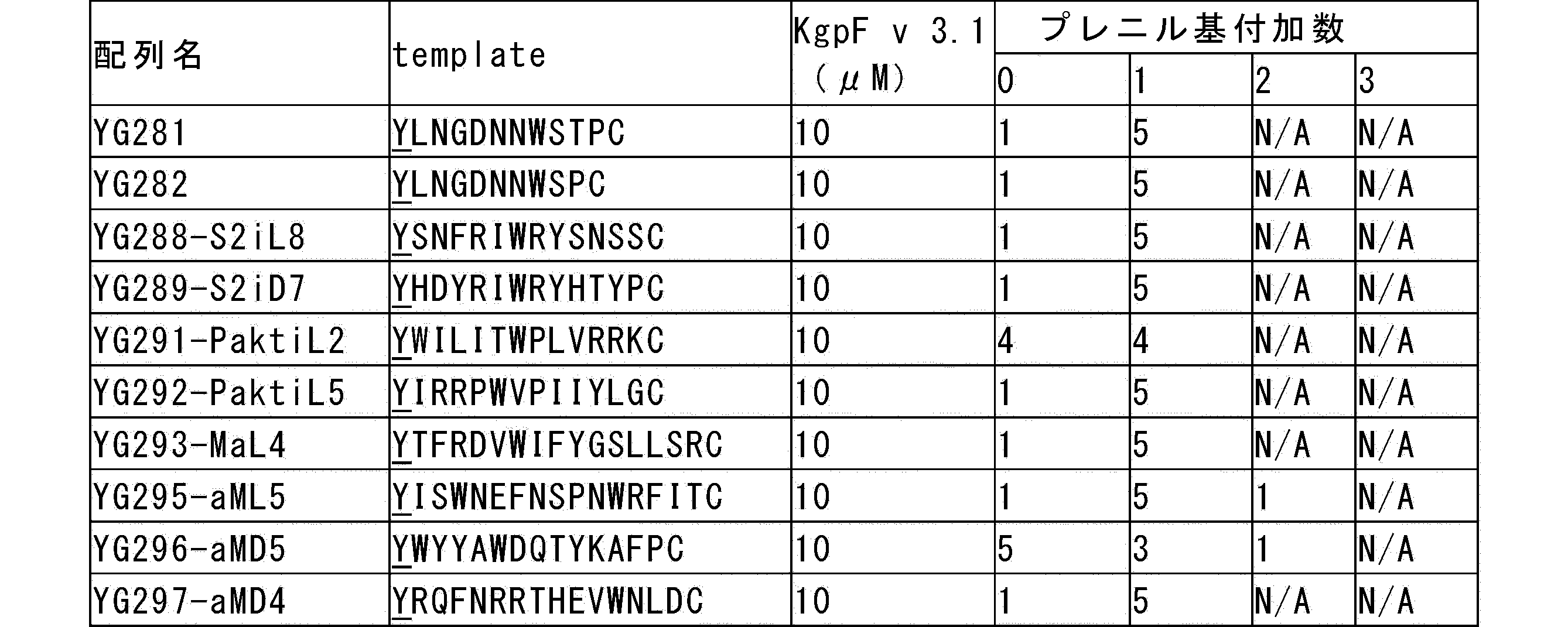
[実施例12;VW配列を含み、且つ様々な環サイズを持つ人工環状ペプチドの修飾]
表8及び表9に示す人工環状ペプチドを本発明者らが開発した人工翻訳系(条件15)で翻訳合成した。その後、得られたペプチドを(条件16)に示す系で60 μMのKgpFと37℃で18時間反応させた。
表8及び表9に示す人工環状ペプチドを本発明者らが開発した人工翻訳系(条件15)で翻訳合成した。その後、得られたペプチドを(条件16)に示す系で60 μMのKgpFと37℃で18時間反応させた。
(条件15)
FIT system; v8s/v11.1
19aa-Met; 0.5 mM
ClAc-D-Tyr-tRNAfMet CUA; 90 μM
反応; 37℃、60分
スケール; 2.5 μLスケール
(条件16)
翻訳混合物量; 2.5 μL((条件15)で得られた混合物)
KgpF; 60 μM
DMAPP; 2 mM
反応; 37℃、18時間
FIT system; v8s/v11.1
19aa-Met; 0.5 mM
ClAc-D-Tyr-tRNAfMet CUA; 90 μM
反応; 37℃、60分
スケール; 2.5 μLスケール
(条件16)
翻訳混合物量; 2.5 μL((条件15)で得られた混合物)
KgpF; 60 μM
DMAPP; 2 mM
反応; 37℃、18時間
表8及び表9中、5:強い強度、4:中程度の強度、3:弱い強度、2:とても弱い強度、1:ピークなし、N/A:観測されないこと、を表す。

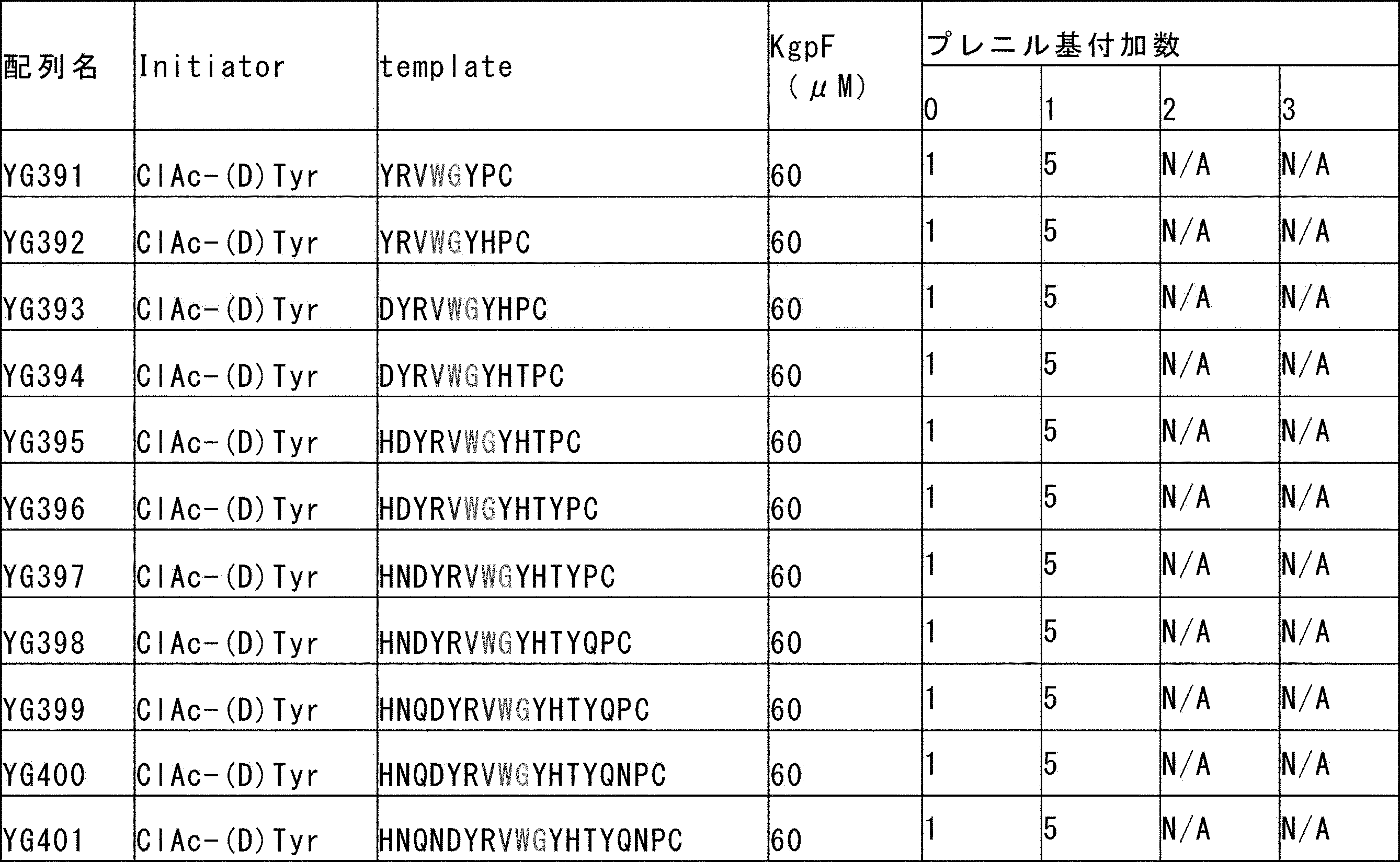
[実施例13;VW又はWG配列を含み、且つ様々なW位置を持つ人工環状ペプチドの修飾]
表10に示す人工環状ペプチドを本発明者らが開発した人工翻訳系(条件17)で翻訳合成した。その後、得られたペプチドを(条件18)に示す系で60 μMのKgpFと37℃で18時間反応させた。
表10に示す人工環状ペプチドを本発明者らが開発した人工翻訳系(条件17)で翻訳合成した。その後、得られたペプチドを(条件18)に示す系で60 μMのKgpFと37℃で18時間反応させた。
(条件17)
FIT system; v8s/v11.1
19aa-Met; 0.5 mM
ClAc-D-Tyr-tRNAfMet CUA; 90 μM
反応; 37℃、60分
スケール; 2.5 μLスケール
(条件18)
翻訳混合物量; 2.5 μL((条件17)で得られた混合物)
KgpF; 60 μM
DMAPP; 2 mM
反応; 37℃、18時間
FIT system; v8s/v11.1
19aa-Met; 0.5 mM
ClAc-D-Tyr-tRNAfMet CUA; 90 μM
反応; 37℃、60分
スケール; 2.5 μLスケール
(条件18)
翻訳混合物量; 2.5 μL((条件17)で得られた混合物)
KgpF; 60 μM
DMAPP; 2 mM
反応; 37℃、18時間
表10中、5:強い強度、4:中程度の強度、3:弱い強度、2:とても弱い強度、1:ピークなし、N/A:観測されないこと、を表す。
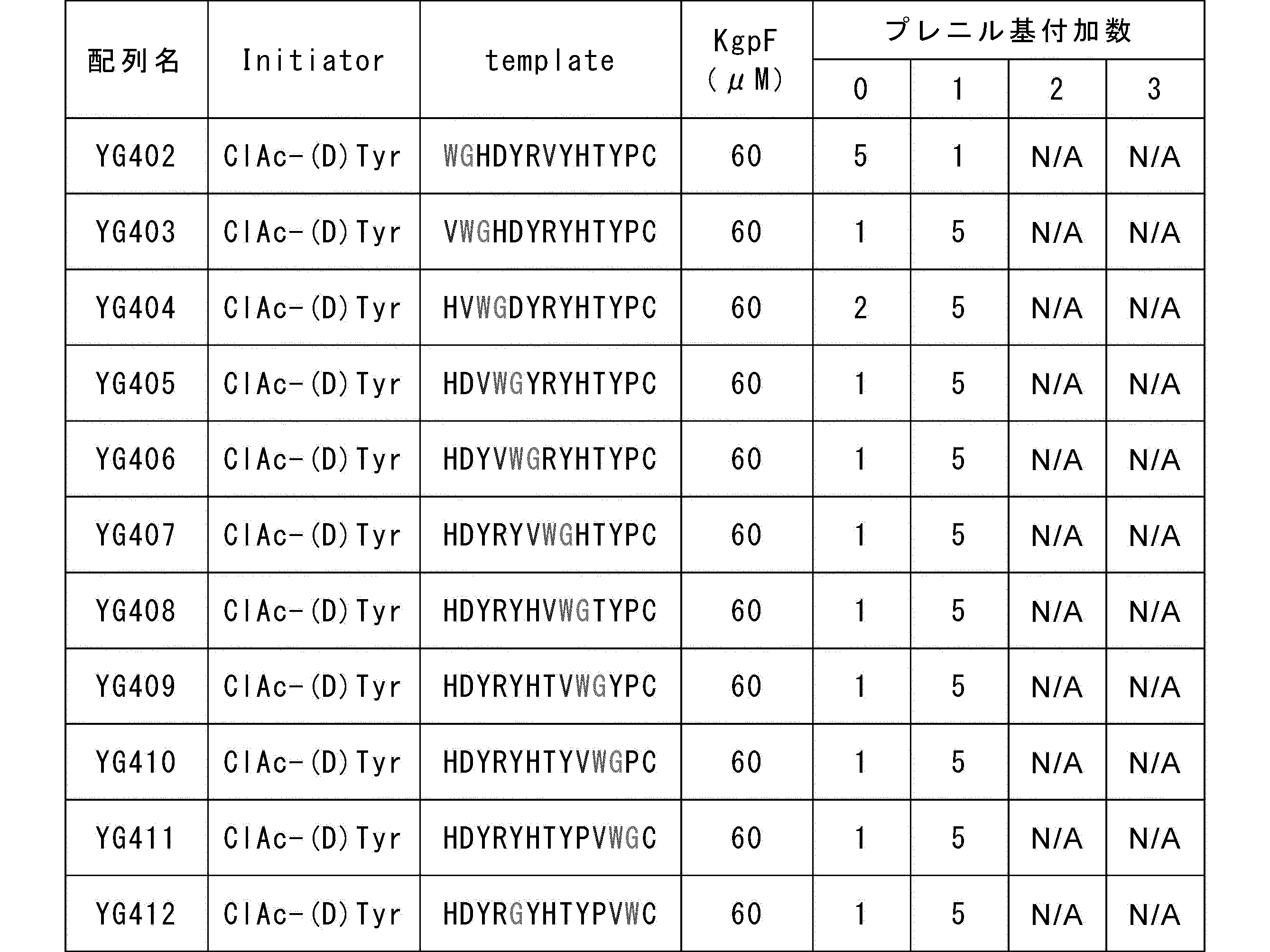
[実施例14;様々なペプチド配配列を持つ人工環状ペプチドの修飾]
以下に示す人工環状ペプチドを本発明者らが開発した人工翻訳系(条件19)で翻訳合成した。その後、得られたペプチドを(条件20)に示す系で160 μMのKgpFと0℃で20時間反応させた。
その反応産物をMALDI-TOF-MSで解析した。その結果、以下に示す人工環状ペプチドはプレニル化の修飾を受けたことを確認した。以上のとおり様々な配列のペプチドにおいてプレニル化が進行したことは、細胞膜の透過性がより高いペプチドを含むペプチドライブラリーを効率的に得られることを示す。
以下に示す人工環状ペプチドを本発明者らが開発した人工翻訳系(条件19)で翻訳合成した。その後、得られたペプチドを(条件20)に示す系で160 μMのKgpFと0℃で20時間反応させた。
その反応産物をMALDI-TOF-MSで解析した。その結果、以下に示す人工環状ペプチドはプレニル化の修飾を受けたことを確認した。以上のとおり様々な配列のペプチドにおいてプレニル化が進行したことは、細胞膜の透過性がより高いペプチドを含むペプチドライブラリーを効率的に得られることを示す。
(条件19)
FIT system; v8s/11.0
19aa-Met; 0.5 mM
ClAc-D-Tyr-tRNAfMet CUA; 90 μM
反応; 37℃、60分
スケール; 2.5 μLスケール
上記の反応を行ったのち、25℃で12分、反応産物をインキュベーションした。
その後、次に示す条件で環化反応を行った。
翻訳混合物量; 2.5 μL(上記の反応で得られた混合物)
EDTA; 18 mM
反応; 42℃、60分
スケール; 2.75 μLスケール
(条件20)
翻訳混合物量; 2.75 μL((条件19)で得られた混合物)
KOH; 6.0 mM
Mg(OAc)2; 9.0 mM
Tris-HCl(pH8.3); 15 mM
KgpF; 160 μM
DMAPP; 2 mM
反応; 0℃、20時間
FIT system; v8s/11.0
19aa-Met; 0.5 mM
ClAc-D-Tyr-tRNAfMet CUA; 90 μM
反応; 37℃、60分
スケール; 2.5 μLスケール
上記の反応を行ったのち、25℃で12分、反応産物をインキュベーションした。
その後、次に示す条件で環化反応を行った。
翻訳混合物量; 2.5 μL(上記の反応で得られた混合物)
EDTA; 18 mM
反応; 42℃、60分
スケール; 2.75 μLスケール
(条件20)
翻訳混合物量; 2.75 μL((条件19)で得られた混合物)
KOH; 6.0 mM
Mg(OAc)2; 9.0 mM
Tris-HCl(pH8.3); 15 mM
KgpF; 160 μM
DMAPP; 2 mM
反応; 0℃、20時間
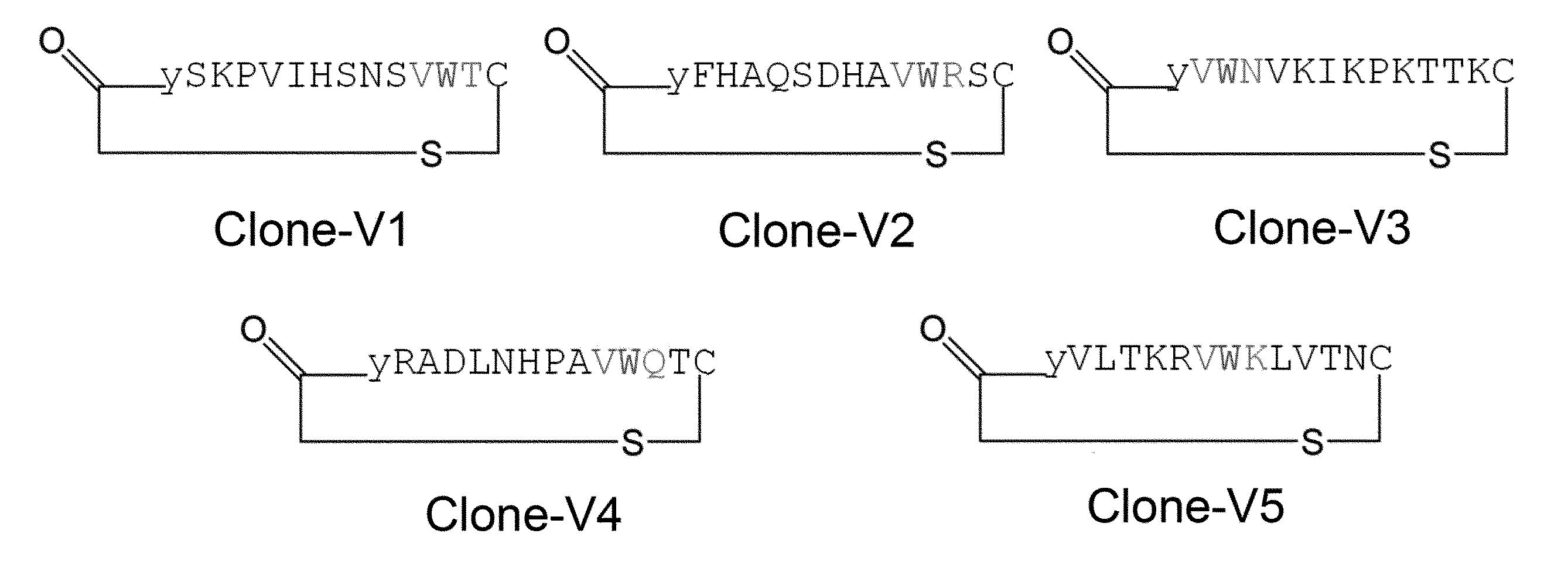


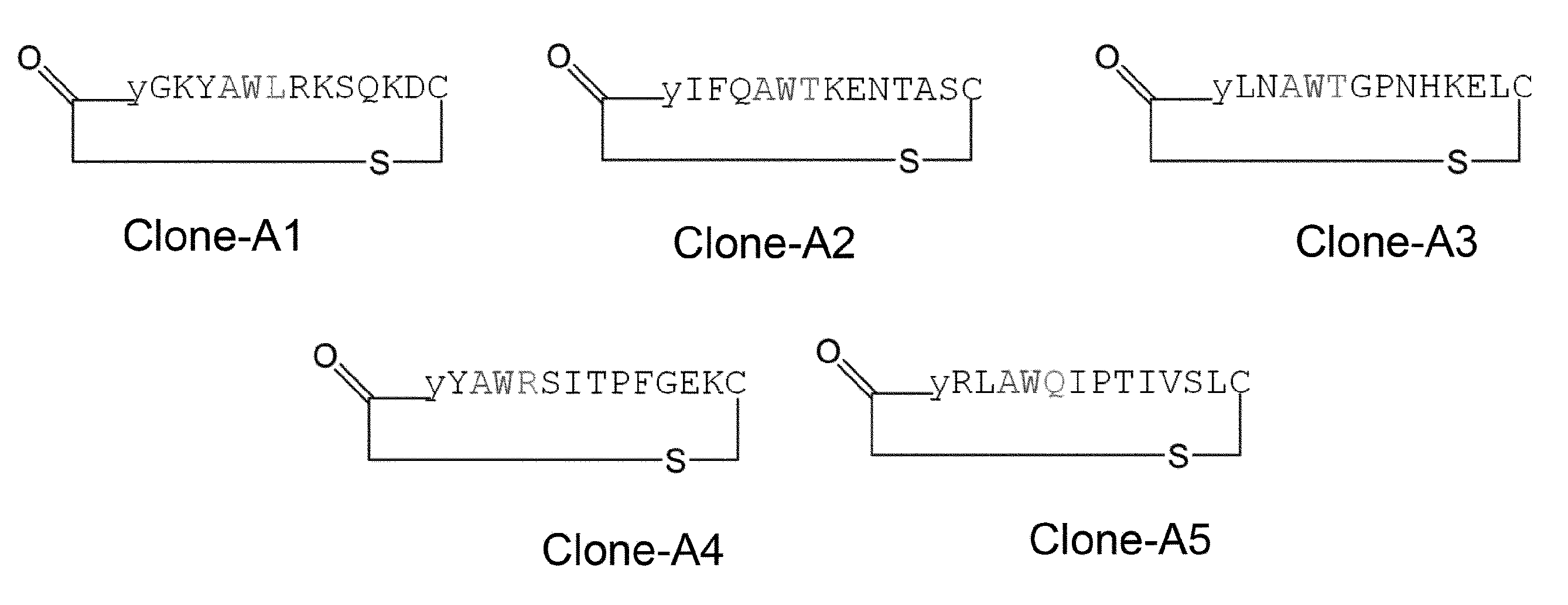
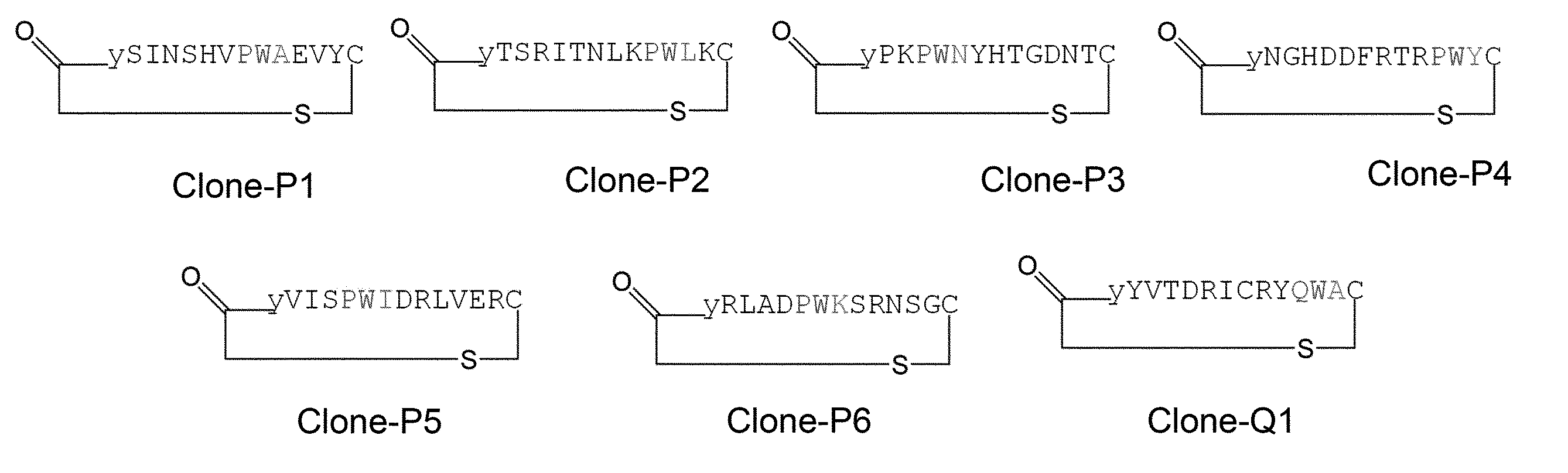
[実施例15;OltFによるチオエーテル閉環人工環状ペプチドの修飾実験]
KgpFだけでなく、これと相同性を持つ他の酵素でもチオエーテル閉環人工環状ペプチドを修飾できることを実証するため、OltF酵素を用いてチオエーテル閉環人工環状ペプチドを修飾できるか確認した。
OltFの天然基質であると想定されるOscE1及びOscE2の配列に由来する6種類のチオエーテル閉環人工環状アミノ酸配列(YG413-417,419)を設計した。
KgpFだけでなく、これと相同性を持つ他の酵素でもチオエーテル閉環人工環状ペプチドを修飾できることを実証するため、OltF酵素を用いてチオエーテル閉環人工環状ペプチドを修飾できるか確認した。
OltFの天然基質であると想定されるOscE1及びOscE2の配列に由来する6種類のチオエーテル閉環人工環状アミノ酸配列(YG413-417,419)を設計した。

これらの人工環状ペプチドを本発明者らが開発した人工翻訳系(条件21)で翻訳合成した。その後、得られたペプチドを(条件22)に示す系で24又は72 μMのOltFと37℃で18時間反応させた。
(条件21)
FIT system; v7s/v9.1
19aa-Met; 0.5 mM
ClAc-D or L-Tyr-tRNAfMet CUA; 90 μM
反応; 37℃、60分
スケール; 2.5 μLスケール
(条件22)
翻訳混合物量; 2.5 μL((条件21)で得られた混合物)
OltF; 24, 72μM
DMAPP; 2 mM
反応; 37℃、18時間
FIT system; v7s/v9.1
19aa-Met; 0.5 mM
ClAc-D or L-Tyr-tRNAfMet CUA; 90 μM
反応; 37℃、60分
スケール; 2.5 μLスケール
(条件22)
翻訳混合物量; 2.5 μL((条件21)で得られた混合物)
OltF; 24, 72μM
DMAPP; 2 mM
反応; 37℃、18時間
上記の反応産物をMALDI-TOF-MSで解析した。その結果、いずれのペプチドにおいてもプレニル化された修飾産物を観測した。このことから、OltFもKgpFと同様に、天然の主鎖環化ペプチドだけでなく、チオエーテル閉環人工環状ペプチドも修飾できる能力があることが確認された。このことは、OltFやKgpFと相同性の高い酵素群は同様にチオエーテル閉環人工環状ペプチドを修飾し、本発明におけるプレニル化酵素として利用できることを示している。
[実施例16;OltFによるチオエーテル閉環人工環状ペプチドの修飾実験]
表11及び表12に示す人工環状ペプチドを本発明者らが開発した人工翻訳系(条件23)で翻訳合成した。その後、得られたペプチドを(条件24)に示す系で9.13 μMのOltFと37℃で18時間反応させた。なお、OltF v 2.1は、調製の際、(条件22)で用いたOltFから精製を変えた酵素である。
表11及び表12に示す人工環状ペプチドを本発明者らが開発した人工翻訳系(条件23)で翻訳合成した。その後、得られたペプチドを(条件24)に示す系で9.13 μMのOltFと37℃で18時間反応させた。なお、OltF v 2.1は、調製の際、(条件22)で用いたOltFから精製を変えた酵素である。
(条件23)
FIT system; v8s/v11.1
19aa-Met; 0.5 mM
ClAc-D or L-Tyr-tRNAfMet CUA; 90 μM
反応; 37℃、60分
スケール; 2.5 μLスケール
(条件24)
翻訳混合物量; 2.5 μL((条件23)で得られた混合物)
OltF v 2.1; 9.13 μM
DMAPP; 2 mM
反応; 37℃、18時間
FIT system; v8s/v11.1
19aa-Met; 0.5 mM
ClAc-D or L-Tyr-tRNAfMet CUA; 90 μM
反応; 37℃、60分
スケール; 2.5 μLスケール
(条件24)
翻訳混合物量; 2.5 μL((条件23)で得られた混合物)
OltF v 2.1; 9.13 μM
DMAPP; 2 mM
反応; 37℃、18時間
表11及び表12中、5:強い強度、4:中程度の強度、3:弱い強度、2:とても弱い強度、1:ピークなし、N/A:観測されないこと、を表す。
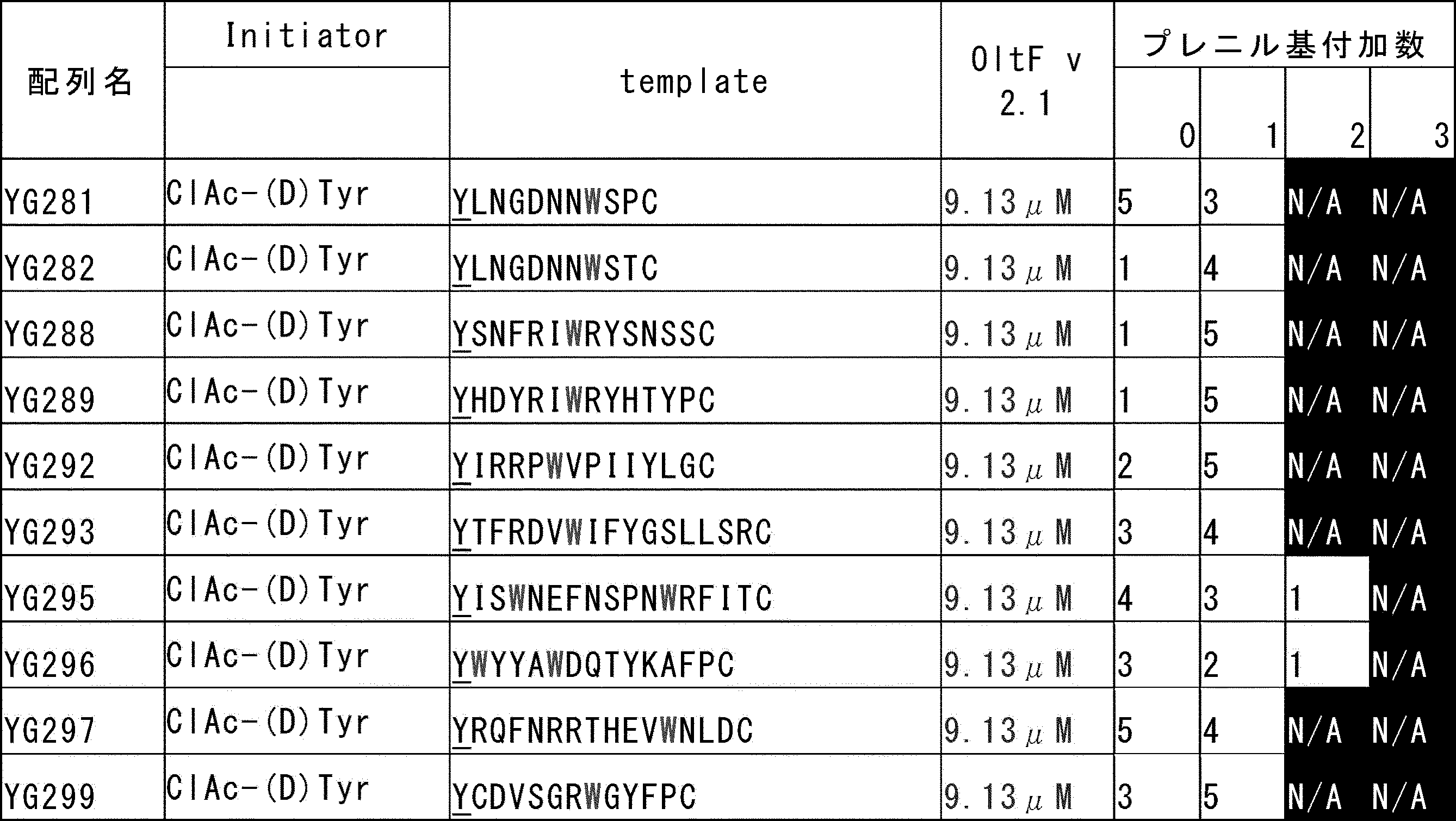

[実施例17;mRNAライブラリーの調製]
(mRNAライブラリーのデザイン)
表13に示すように、mRNAライブラリーをデザインした。
表13に示すように、mRNAライブラリーをデザインした。

上記表13におけるmRNAでは、下記表14の遺伝子暗号表に基づきアミノ酸が再割当された。ここで、表13におけるmRNAのUGGには、Trpが再割当される。また、XXXは、RYU及びCMGであるか(ここでRYU及びCMGの存在比(RYU:CMG)は2:1であった)、RYUであった。なお、RYUにおける、Rはそれぞれ独立にG又はAを表し、Yはそれぞれ独立にU又はCを表し、CMGにおける、Mはそれぞれ独立にA又はCを表し、NNKにおけるKはそれぞれ独立にG又はUを表す。Nは任意の塩基である。
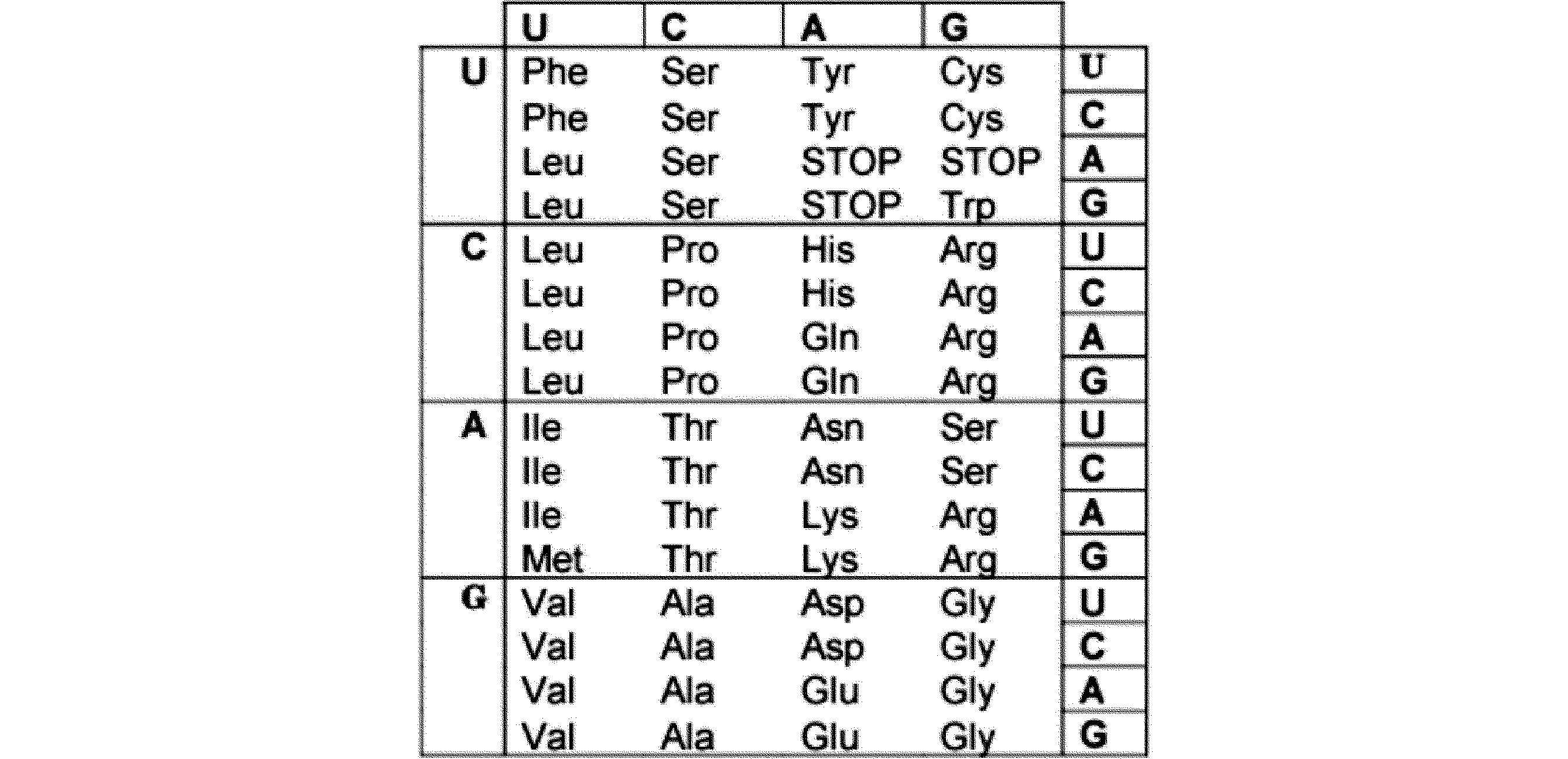
(mRNAライブラリーの調製)
<1mLスケールの系の組成>
MgCl2; 2.5mM
dNTPs; 0.25 mM
KCl; 50mM
Tris-HCl (pH9.0); 10mM
Triton X-100; 1μL
primers ; 250nM(T7YGM.F46 v1tr.F46及び上記ライブラリーの配列を含むプライマー)Taq polymerase
<1mLスケールの系の伸長>
伸長Extensionは、表15に示すように、まず95℃で1分保持した後、61℃で1分保持し、次に72℃で1分保持した。61℃で1分保持し、次に72℃で1分保持することを5回繰り返した。
<1mLスケールの系の組成>
MgCl2; 2.5mM
dNTPs; 0.25 mM
KCl; 50mM
Tris-HCl (pH9.0); 10mM
Triton X-100; 1μL
primers ; 250nM(T7YGM.F46 v1tr.F46及び上記ライブラリーの配列を含むプライマー)Taq polymerase
<1mLスケールの系の伸長>
伸長Extensionは、表15に示すように、まず95℃で1分保持した後、61℃で1分保持し、次に72℃で1分保持した。61℃で1分保持し、次に72℃で1分保持することを5回繰り返した。
なお、primerのT7YGM.F46 v1tr.F46の配列は以下のとおりである。
T7YGM.F46 v1tr.F46:TAATACGACTCACTATAGGGTTAACTTTAAGAAGGAGATATAAATA
T7YGM.F46 v1tr.F46:TAATACGACTCACTATAGGGTTAACTTTAAGAAGGAGATATAAATA

<10mLスケールの系の組成>
上記伸長による生成物; 1mL
MgCl2; 2.5mM
dNTPs; 0.25 mM
KCl; 50mM
Tris-HCl (pH9.0); 10mM
Triton X-100; 10μL
primers ; 250nM(T7YGM.F46 v1tr.F46及びrCNSGGVSan13.R39)
Taq polymerase
<10mLスケールの系のPCR>
PCR(ポリメラーゼ連鎖反応)は、表16に示すように、まず95℃で40秒保持した後、65℃で40秒保持し、次に72℃で40秒保持した。95℃で40秒保持し、次に65℃で40秒保持し、さらに72℃で40秒保持することを4回繰り返した。
上記伸長による生成物; 1mL
MgCl2; 2.5mM
dNTPs; 0.25 mM
KCl; 50mM
Tris-HCl (pH9.0); 10mM
Triton X-100; 10μL
primers ; 250nM(T7YGM.F46 v1tr.F46及びrCNSGGVSan13.R39)
Taq polymerase
<10mLスケールの系のPCR>
PCR(ポリメラーゼ連鎖反応)は、表16に示すように、まず95℃で40秒保持した後、65℃で40秒保持し、次に72℃で40秒保持した。95℃で40秒保持し、次に65℃で40秒保持し、さらに72℃で40秒保持することを4回繰り返した。
なお、primerのT7YGM.F46 v1tr.F46及びrCNSGGVSan13.R39の配列は以下のとおりである。
T7YGM.F46 v1tr.F46:TAATACGACTCACTATAGGGTTAACTTTAAGAAGGAGATATAAATA
rCNSGGVSan13.R39:TTTCCGCCCCCCGTCCTAGCTTACCCCACCACTGTTACA
T7YGM.F46 v1tr.F46:TAATACGACTCACTATAGGGTTAACTTTAAGAAGGAGATATAAATA
rCNSGGVSan13.R39:TTTCCGCCCCCCGTCCTAGCTTACCCCACCACTGTTACA
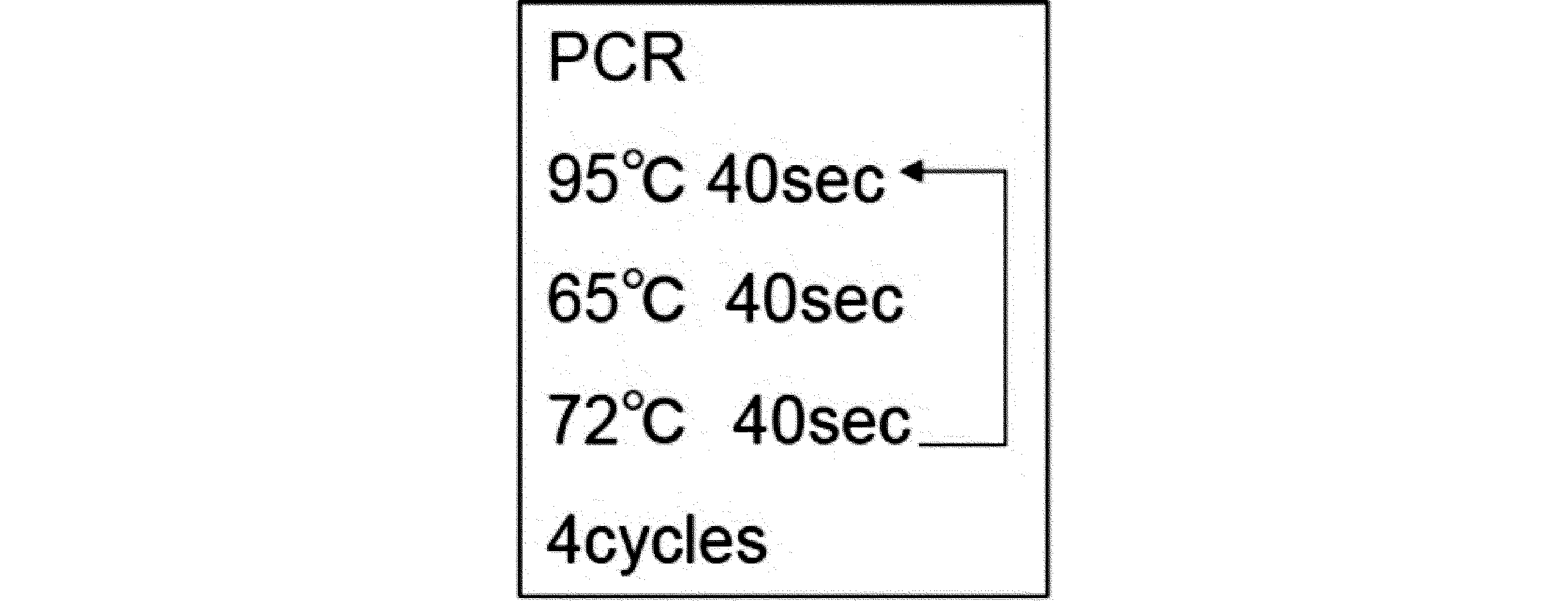
図5に示すように、PCRによって所望の生成物が得られたことが確認された。
(mRNAライブラリーの精製)
次に、得られたPCR産物をT7 RNA polymeraseを用いてin vitroで転写し(4mLスケール)、12%denaturing-PAGE、230V、70分の条件の電気泳動にて精製し、mRNAライブラリーの調製に成功した。電気泳動のゲルの図を図6に示すように、所望の生成物が、副生成物と分離されて得られたことが確認された。得られたmRNAライブラリーを上述したように、FIT systemによる翻訳、及びプレニル化酵素と接触させることにより、当該mRNAから得られるペプチドライブラリー中のペプチドにプレニル基を導入することができる。
次に、得られたPCR産物をT7 RNA polymeraseを用いてin vitroで転写し(4mLスケール)、12%denaturing-PAGE、230V、70分の条件の電気泳動にて精製し、mRNAライブラリーの調製に成功した。電気泳動のゲルの図を図6に示すように、所望の生成物が、副生成物と分離されて得られたことが確認された。得られたmRNAライブラリーを上述したように、FIT systemによる翻訳、及びプレニル化酵素と接触させることにより、当該mRNAから得られるペプチドライブラリー中のペプチドにプレニル基を導入することができる。
[実施例18;固相でのKgpFによる人工環状ペプチドの修飾反応]
液相だけでなく、固相でもプレニル化修飾ができることを実証するため、磁気ビーズ表面上にタグを介して固定化したKgpF酵素を用いて、人工環状ペプチドを修飾できるか確認した。
液相だけでなく、固相でもプレニル化修飾ができることを実証するため、磁気ビーズ表面上にタグを介して固定化したKgpF酵素を用いて、人工環状ペプチドを修飾できるか確認した。
(KgpFの磁気ビーズへの固定化)
N末端にHisタグが付加されたKgpFに対して、Dynabeads His-Tag Isolation and Pulldown (Invitrogen) を接触させ、磁気ビーズ上にKgpFを固定化した。図7に示すように、ビーズに接触させるKgpFの量が増えるほどビーズへのKgpFの固定化量は増大し、一定量を超えると飽和状態に達した。
N末端にHisタグが付加されたKgpFに対して、Dynabeads His-Tag Isolation and Pulldown (Invitrogen) を接触させ、磁気ビーズ上にKgpFを固定化した。図7に示すように、ビーズに接触させるKgpFの量が増えるほどビーズへのKgpFの固定化量は増大し、一定量を超えると飽和状態に達した。
(磁気ビーズに固定化されたKgpFによる人工環状ペプチドの修飾)
表に示す人工環状ペプチドを、(条件25)によって合成し、(条件26)によって固相でKgpFに接触させた。また、同じペプチドを、プレニル化反応時間を14時間としたこと以外は(条件13)、(条件14)に示した条件にて、液相で反応させた。
表に示す人工環状ペプチドを、(条件25)によって合成し、(条件26)によって固相でKgpFに接触させた。また、同じペプチドを、プレニル化反応時間を14時間としたこと以外は(条件13)、(条件14)に示した条件にて、液相で反応させた。
(条件25)
FIT system; v8s/v11.1
19aa-Met; 0.5 mM
ClAc-D-Tyr-tRNAfMet CUA; 90 μM
反応; 37℃、60分
スケール; 2.5 μLスケール
上記の反応を行ったのち、25℃で12分、反応産物をインキュベーションした。
その後、次に示す条件で環化反応を行った。
翻訳混合物量; 2.5 μL(上記の反応で得られた混合物)
EDTA; 18 mM
反応; 42℃、60分
スケール; 2.75 μLスケール
(条件26)
翻訳混合物量; 2.75 μL((条件25)で得られた混合物)
KOH; 6.0 mM
Mg(OAc)2; 9.0 mM
Tris-HCl(pH8.3); 15 mM
磁気ビーズに固定化されたKgpF; 72 μM
DMAPP; 2 mM
反応; 4℃、14時間 回転混合
FIT system; v8s/v11.1
19aa-Met; 0.5 mM
ClAc-D-Tyr-tRNAfMet CUA; 90 μM
反応; 37℃、60分
スケール; 2.5 μLスケール
上記の反応を行ったのち、25℃で12分、反応産物をインキュベーションした。
その後、次に示す条件で環化反応を行った。
翻訳混合物量; 2.5 μL(上記の反応で得られた混合物)
EDTA; 18 mM
反応; 42℃、60分
スケール; 2.75 μLスケール
(条件26)
翻訳混合物量; 2.75 μL((条件25)で得られた混合物)
KOH; 6.0 mM
Mg(OAc)2; 9.0 mM
Tris-HCl(pH8.3); 15 mM
磁気ビーズに固定化されたKgpF; 72 μM
DMAPP; 2 mM
反応; 4℃、14時間 回転混合
反応後の溶液をMALDI-TOF-MSで解析したところ、表に示すように、固相のほうがKgpF濃度が低いにも関わらず、液相と同様に100%の修飾効率を示した(出発物質のピークが見られなかった)。このことから、固相でも、液相と同様に修飾を行うことが可能であることが確かめられた。
表17中、5:強い強度、4:中程度の強度、3:弱い強度、2:とても弱い強度、1:ピークなし、N/A:観測されないこと、を表す。

[実施例19;化合物ライブラリーの調製及びスクリーニング]
実施例17で示したmRNAライブラリーのデザインで、XXXの部分をRYUに置き換えたものを、実施例17と同様の手順により調製した。
上述のmRNAライブラリーから、図8に示すスキームのとおり、ペプチド-mRNA複合体ライブラリーを構築し、さらに磁気ビーズ上に固定化したKgpF酵素を作用させて、プレニル化ペプチドを含む化合物ライブラリーを構築した。
その後、上記化合物ライブラリーを図8に示すスキームのように、酵素MetAP1 (Human)と相互作用する環状ペプチドをスクリーニングする工程に供したところ、図9に示すように、MetAP1に結合する環状ペプチドが濃縮されたライブラリーが取得できた。この濃縮されたライブラリーに含まれていたペプチド配列を図10に示した。図10に示したペプチドの一部について、これらの配列を有するペプチドを、(条件13)及び(条件14)に示した条件でKgpFと接触させることにより、表18に示すように、プレニル化修飾されることを確認した。
以上の結果から、プレニル化酵素を用いる本発明の製造方法によって、化合物ライブラリーを提供できることが示された。
実施例17で示したmRNAライブラリーのデザインで、XXXの部分をRYUに置き換えたものを、実施例17と同様の手順により調製した。
上述のmRNAライブラリーから、図8に示すスキームのとおり、ペプチド-mRNA複合体ライブラリーを構築し、さらに磁気ビーズ上に固定化したKgpF酵素を作用させて、プレニル化ペプチドを含む化合物ライブラリーを構築した。
その後、上記化合物ライブラリーを図8に示すスキームのように、酵素MetAP1 (Human)と相互作用する環状ペプチドをスクリーニングする工程に供したところ、図9に示すように、MetAP1に結合する環状ペプチドが濃縮されたライブラリーが取得できた。この濃縮されたライブラリーに含まれていたペプチド配列を図10に示した。図10に示したペプチドの一部について、これらの配列を有するペプチドを、(条件13)及び(条件14)に示した条件でKgpFと接触させることにより、表18に示すように、プレニル化修飾されることを確認した。
以上の結果から、プレニル化酵素を用いる本発明の製造方法によって、化合物ライブラリーを提供できることが示された。
表18、19中、5:強い強度、4:中程度の強度、3:弱い強度、2:とても弱い強度、1:ピークなし、N/A:観測されないこと、を表す。

[実施例19-1;MetAP1に対するスクリーニングの結果得られたペプチドの評価]
(MetAP1への結合能についてのプルダウンアッセイ)
MetAP1を標的としたスクリーニングの結果同定したプレニル化環状ペプチドについて、その標的結合能を、定性的なプルダウンアッセイによって評価した。Met3, Met9, Met11, Met12, Met13, Met14の各配列をmRNA上に提示した状態で合成した上で、配列中のTrp残基をプレニル化させた。得られたプレニル化ペプチド-mRNA複合体を、磁気ビーズを用いてプルダウンした後に、回収されたmRNA量をRT-qPCR法で定量した。結果を図11に示す。
図11の棒グラフにおいてNegativeのバーがMetAP1未固定のビーズでのプルダウン量、PositiveのバーがMetAP1を固定したビーズでのプルダウン量を表す。PositiveがNegativeよりも有意にプルダウン量が高く、プレニル化されたペプチド配列がMetAP1へ結合することが確認された。
(MetAP1への結合能についてのプルダウンアッセイ)
MetAP1を標的としたスクリーニングの結果同定したプレニル化環状ペプチドについて、その標的結合能を、定性的なプルダウンアッセイによって評価した。Met3, Met9, Met11, Met12, Met13, Met14の各配列をmRNA上に提示した状態で合成した上で、配列中のTrp残基をプレニル化させた。得られたプレニル化ペプチド-mRNA複合体を、磁気ビーズを用いてプルダウンした後に、回収されたmRNA量をRT-qPCR法で定量した。結果を図11に示す。
図11の棒グラフにおいてNegativeのバーがMetAP1未固定のビーズでのプルダウン量、PositiveのバーがMetAP1を固定したビーズでのプルダウン量を表す。PositiveがNegativeよりも有意にプルダウン量が高く、プレニル化されたペプチド配列がMetAP1へ結合することが確認された。
(Fmoc固相合成及びKgpFを用いるプレニル化によるプレニル化環状ペプチドの合成)
Fmoc固相合成法によりMet2, Met3-1, Met3a-L, Met11, Met13の各配列を有する環状ペプチドを化学合成した後に、試験管内でKgpFを作用させることでプレニル化環状ペプチドを調製した。プレニル化の条件は、以下の条件27とした。
Fmoc固相合成法によりMet2, Met3-1, Met3a-L, Met11, Met13の各配列を有する環状ペプチドを化学合成した後に、試験管内でKgpFを作用させることでプレニル化環状ペプチドを調製した。プレニル化の条件は、以下の条件27とした。
(条件27)
スケール; 1 mL
環状ペプチド; 300 μM(Met3-1, Met11, Met13において)
又は 1500 μM(Met2, Met3a-Lにおいて)
MgCl2; 5.0 mM
KgpF; 16 μM(Met11, Met13において)
又は 75 μM(Met2, Met3-1, Met3a-Lにおいて)
DMAPP; 1 mM
HEPES-KOH (pH7.5); 50 mM
反応; 37℃、20時間
スケール; 1 mL
環状ペプチド; 300 μM(Met3-1, Met11, Met13において)
又は 1500 μM(Met2, Met3a-Lにおいて)
MgCl2; 5.0 mM
KgpF; 16 μM(Met11, Met13において)
又は 75 μM(Met2, Met3-1, Met3a-Lにおいて)
DMAPP; 1 mM
HEPES-KOH (pH7.5); 50 mM
反応; 37℃、20時間
図12に示すように、KgpFを作用させる前と後のMALDI-TOF-MSスペクトルにより、目的のプレニル化環状ペプチドが得られていることが確認された。
(プレニル化環状ペプチドのMetAP1阻害試験)
In vitroにて、MetAP1の補因子Mn2+又はCo2+の存在下、プレニル化されたMet2, Met3a-L, Met3-1を1μM、5μM, 10μMの濃度で用いて、MetAP1阻害試験を行った。本試験では、MetAP1の酵素活性に依存して蛍光を発するプローブ蛍光を検出することで、酵素活性を測定した。蛍光強度の測定結果を図13に示した。図13に示すとおり、プレニル化された、Met2, Met3, Met3a-Lの各ペプチドは標的であるMetAP1酵素活性を阻害できることが確認された。
In vitroにて、MetAP1の補因子Mn2+又はCo2+の存在下、プレニル化されたMet2, Met3a-L, Met3-1を1μM、5μM, 10μMの濃度で用いて、MetAP1阻害試験を行った。本試験では、MetAP1の酵素活性に依存して蛍光を発するプローブ蛍光を検出することで、酵素活性を測定した。蛍光強度の測定結果を図13に示した。図13に示すとおり、プレニル化された、Met2, Met3, Met3a-Lの各ペプチドは標的であるMetAP1酵素活性を阻害できることが確認された。
(条件)
スケール; 20 μL
環状ペプチド; 1, 5, 10 μM
MnCl2 又はCoCl2; 100 μM
MetAP1酵素活性プローブ; 1 μM
MetAP1; 1 μM
Tris (pH7.6); 25 mM
NaCl; 75 mM
反応; 37℃、120分
上記反応ののち、プレートリーダーでプローブの蛍光強度を測定した。
スケール; 20 μL
環状ペプチド; 1, 5, 10 μM
MnCl2 又はCoCl2; 100 μM
MetAP1酵素活性プローブ; 1 μM
MetAP1; 1 μM
Tris (pH7.6); 25 mM
NaCl; 75 mM
反応; 37℃、120分
上記反応ののち、プレートリーダーでプローブの蛍光強度を測定した。
[実施例20:プレニル化酵素の酵素反応の特性]
以下に示す環状ペプチドを用いて、(条件27)に示す条件にて、Mg2+の存在下、又は非存在下、およびEDTAの濃度を0mM、1mM、10mMに調整して、プレニル化反応を行った。なお、以下に示す環状ペプチドは、固相合成法を用いて合成することにより取得した。
以下に示す環状ペプチドを用いて、(条件27)に示す条件にて、Mg2+の存在下、又は非存在下、およびEDTAの濃度を0mM、1mM、10mMに調整して、プレニル化反応を行った。なお、以下に示す環状ペプチドは、固相合成法を用いて合成することにより取得した。

(条件27)
スケール; 5.7 μL
環状ペプチド; 120 μM
MgCl2; 5.0 mM(Mg(+);使用する場合)
KgpF又はOltF; 16 μM(KgpF)又は8.5 μM(OltF)
DMAPP; 2 mM
HEPES-KOH (pH7.5); 50 mM
反応; 37℃、16時間
スケール; 5.7 μL
環状ペプチド; 120 μM
MgCl2; 5.0 mM(Mg(+);使用する場合)
KgpF又はOltF; 16 μM(KgpF)又は8.5 μM(OltF)
DMAPP; 2 mM
HEPES-KOH (pH7.5); 50 mM
反応; 37℃、16時間
反応産物をMALDI-TOF-MSで解析した。その結果、プレニル化酵素としてKgpFを用いた場合はMg2+依存的に反応が進行し(図14及び図15参照)、OltFを用いた場合はMg2+非依存的に反応が進行することがわかった(図16参照)。
[実施例21:非タンパク質性アミノ酸を含む環状ペプチドのプレニル化]
非タンパク質性アミノ酸としてアミノ酸のD体を含む環状ペプチドにおいて、KgpFを用いたプレニル化の試験を行った。アミノ酸のD体(以下の式中、X)を含む環状ペプチドは以下の式で表される。
非タンパク質性アミノ酸としてアミノ酸のD体を含む環状ペプチドにおいて、KgpFを用いたプレニル化の試験を行った。アミノ酸のD体(以下の式中、X)を含む環状ペプチドは以下の式で表される。

上記のD体アミノ酸を含む人工環状ペプチドを本発明者らが開発した人工翻訳系で以下の(条件28)で翻訳合成した。その後、得られた翻訳混合物を以下の(条件29)にて反応(プレニル化)させた。
(条件28)
5aa-mix (K,R,A,W,C); 0.5 mM
ClAc-D-Tyr-tRNAfMet CUA; 90 μM
D-aa-tRNAPro1E2 CGG; 90 μM
反応; 人工翻訳系溶液中で37℃、60分
スケール; 2.5 μLスケール
(条件29)
翻訳混合物量; 2.5 μL((条件28)で得られた混合物)
KgpF ; 16 μM
DMAPP; 2 mM
反応; 37℃、20時間
5aa-mix (K,R,A,W,C); 0.5 mM
ClAc-D-Tyr-tRNAfMet CUA; 90 μM
D-aa-tRNAPro1E2 CGG; 90 μM
反応; 人工翻訳系溶液中で37℃、60分
スケール; 2.5 μLスケール
(条件29)
翻訳混合物量; 2.5 μL((条件28)で得られた混合物)
KgpF ; 16 μM
DMAPP; 2 mM
反応; 37℃、20時間
反応産物をMALDI-TOF-MSで解析した。その結果、XとしてD体のIle、D体のPhe、D体のTrp、D体のTyrを含む人工環状ペプチドがプレニル化の修飾を受けたことを確認した(図17参照)。
[実施例22:非タンパク質性Trpを含む環状ペプチドにおける当該Trpのプレニル化]
非タンパク質性アミノ酸Trpを含む環状ペプチドにおいて、OltFまたはKgpFを用いて当該Trpのプレニル化の試験を行った。用いた環状ペプチドは以下のとおりであった。式中、XはD体のTrpである。
非タンパク質性アミノ酸Trpを含む環状ペプチドにおいて、OltFまたはKgpFを用いて当該Trpのプレニル化の試験を行った。用いた環状ペプチドは以下のとおりであった。式中、XはD体のTrpである。
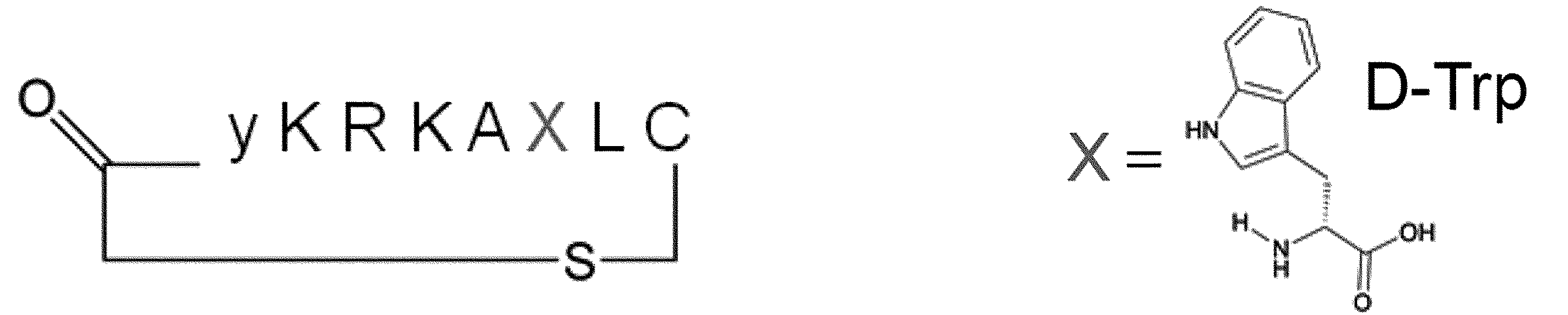
上記のD体Trpを含む人工環状ペプチドを本発明者らが開発した人工翻訳系で以下の(条件30)で翻訳合成した。その後、得られた翻訳混合物を以下の(条件31)で37℃、20時間、反応(プレニル化)させた。
(条件30)
19aa-mix(M以外の19種のタンパク質性アミノ酸); 0.5 mM
ClAc-D-Tyr-tRNAfMet CUA; 90 μM
D-Trp-tRNAPro1E2 CGG; 90 μM
反応; 人工翻訳系溶液中で37℃、60分
スケール; 2.5 μLスケール
(条件31)
翻訳混合物量; 2.5 μL((条件30)で得られた混合物)
KgpF又はOltF ; 170 μM
DMAPP; 2 mM
反応; 37℃、20時間
19aa-mix(M以外の19種のタンパク質性アミノ酸); 0.5 mM
ClAc-D-Tyr-tRNAfMet CUA; 90 μM
D-Trp-tRNAPro1E2 CGG; 90 μM
反応; 人工翻訳系溶液中で37℃、60分
スケール; 2.5 μLスケール
(条件31)
翻訳混合物量; 2.5 μL((条件30)で得られた混合物)
KgpF又はOltF ; 170 μM
DMAPP; 2 mM
反応; 37℃、20時間
反応産物をMALDI-TOF-MSで解析した。その結果、XとしてD体のTrpを含む人工環状ペプチドはプレニル化の修飾を受けたことを確認した(図18参照)。
[実施例23:N末端に位置するTrpのプレニル化]
以下に示す環状ペプチドを本発明者らが開発した人工翻訳系で以下の(条件32)で翻訳合成した。その後、得られた翻訳混合物を以下の(条件33)にて反応(プレニル化)させた。
以下に示す環状ペプチドを本発明者らが開発した人工翻訳系で以下の(条件32)で翻訳合成した。その後、得られた翻訳混合物を以下の(条件33)にて反応(プレニル化)させた。

(条件32)
19aa-mix(M以外の19種のタンパク質性アミノ酸); 0.5 mM
ClAc-D-Tyr-tRNAfMet CUA; 50 μM
反応; 人工翻訳系溶液中で37℃、30分
スケール; 2.5 μLスケール
(条件33)
翻訳混合物量; 2.5 μL((条件32)で得られた混合物)
OltF; 100 μM
DMAPP; 2.1 mM
反応; 37℃、18時間
スケール; 5.7 μLスケール
19aa-mix(M以外の19種のタンパク質性アミノ酸); 0.5 mM
ClAc-D-Tyr-tRNAfMet CUA; 50 μM
反応; 人工翻訳系溶液中で37℃、30分
スケール; 2.5 μLスケール
(条件33)
翻訳混合物量; 2.5 μL((条件32)で得られた混合物)
OltF; 100 μM
DMAPP; 2.1 mM
反応; 37℃、18時間
スケール; 5.7 μLスケール
反応産物をMALDI-TOF-MSで解析した。その結果、プレニル化酵素としてOltFを用いることにより、N末端位置及び配列内部の2箇所のTrpがプレニル化できることがわかった(図19参照)。
上記と同様にして、AY015, AY016, AY017, AY018, AY019, AY020(図20参照)についてもOltFを用いたプレニル化を行ったところ、N末端位置のTrpがプレニル化されることが確認された。
上記と同様にして、AY015, AY016, AY017, AY018, AY019, AY020(図20参照)についてもOltFを用いたプレニル化を行ったところ、N末端位置のTrpがプレニル化されることが確認された。
Claims (11)
- 少なくとも一つのTrp又はその誘導体を含むアミノ酸配列を有するペプチドを含むペプチドライブラリーをプレニル化酵素に接触させ、少なくとも一つのTrp残基又はその誘導体残基をプレニル化する工程、を含む、プレニル化されたペプチドを含むペプチドライブラリーの製造方法。
- 前記プレニル化酵素が、酵素1~酵素21及びこれらのホモログからなる群より選択される少なくとも1種以上である、請求項1に記載のペプチドライブラリーの製造方法。
- 前記プレニル化酵素が、以下(1)~(3)のいずれかのアミノ酸配列からなる、請求項1に記載のペプチドライブラリーの製造方法。
(1) 配列番号1~56で表されるアミノ酸配列のいずれか
(2) 配列番号1~56で表されるアミノ酸配列のいずれかにおいて、1又は複数のアミノ酸の欠失、置換又は付加を有するアミノ酸配列
(3) 配列番号1~56で表されるアミノ酸配列のいずれかと80%以上の相同性を有するアミノ酸配列 - 前記ペプチドライブラリーが、環状ペプチドを含む、請求項1~3のいずれか一項に記載のペプチドライブラリーの製造方法。
- 前記環状ペプチドが、2つのアミノ酸残基が、ジスルフィド結合、ペプチド結合、アルキル結合、アルケニル結合、エステル結合、チオエステル結合、エーテル結合、チオエーテル結合、ホスホネートエーテル結合、アゾ結合、C-S-C結合、C-N-C結合、C=N-C結合、アミド結合、ラクタム架橋、カルバモイル結合、尿素結合、チオ尿素結合、アミン結合、チオアミド結合、又はトリアゾール結合によって結合することで形成される環状構造を含む、請求項4に記載のペプチドライブラリーの製造方法。
- 前記プレニル化する工程の前に、mRNAライブラリーを、無細胞翻訳系によって翻訳し、少なくとも一つのTrp又はその誘導体を含むアミノ酸配列を有するペプチドを含むペプチドライブラリーを調製する工程を含む、請求項1~5のいずれか一項に記載のペプチドライブラリーの製造方法。
- 遺伝子型(genotype)とペプチドとの複合体を含む、ペプチド-遺伝子型ライブラリーを準備する工程、及び、
前記ペプチド-遺伝子型ライブラリーをプレニル化酵素に接触させ、少なくとも一つのTrp又はその誘導体をプレニル化する工程、を含む、
ペプチド-遺伝子型複合体ライブラリーの製造方法。 - 前記ペプチド-遺伝子型ライブラリーを準備する工程が、mRNAディスプレイ法によるペプチド-mRNAライブラリーを調製する工程を含み、
前記ペプチド-mRNAライブラリーを調製する工程が、
mRNAライブラリーの各mRNAの3'末端にピューロマイシンを結合させ、ピューロマイシン結合mRNAライブラリーを製造する工程、及び、
ピューロマイシン結合mRNAライブラリーを、無細胞翻訳系によって翻訳し、少なくとも一つのTrp又はその誘導体を含むアミノ酸配列を有するペプチドを含むペプチド-mRNAライブラリーを調製する工程、を含む、
請求項7に記載のペプチド-遺伝子型複合体ライブラリーの製造方法。 - 請求項1~6のいずれか一項に記載の製造方法により作製されたペプチドライブラリー及び/又は請求項7又は8に記載の製造方法により作製されたペプチド-遺伝子型複合体ライブラリーを標的物質に接触させる工程、及び
標的物質に結合するペプチドを選択する工程、を含む、
標的物質に結合するペプチドを同定するスクリーニング方法。 - 少なくとも一つのTrp又はその誘導体を含むアミノ酸配列を有するペプチドをプレニル化酵素に接触させ、少なくとも一つのTrp残基又はその誘導体残基をプレニル化する工程、を含む、プレニル化されたペプチドの製造方法。
- 前記プレニル化する工程の前に、少なくとも一つのTrp又はその誘導体を含むアミノ酸配列を有するペプチドを化学合成により合成する工程、を含む、
請求項10に記載の、プレニル化されたペプチドの製造方法。
Priority Applications (3)
| Application Number | Priority Date | Filing Date | Title |
|---|---|---|---|
| US17/283,599 US20220275534A1 (en) | 2018-10-17 | 2019-10-17 | Peptide Library Production Method |
| JP2020553313A JP7538532B2 (ja) | 2018-10-17 | 2019-10-17 | ペプチドライブラリーの製造方法 |
| EP19872920.4A EP3879013A4 (en) | 2018-10-17 | 2019-10-17 | Peptide library production method |
Applications Claiming Priority (2)
| Application Number | Priority Date | Filing Date | Title |
|---|---|---|---|
| JP2018-196102 | 2018-10-17 | ||
| JP2018196102 | 2018-10-17 |
Publications (1)
| Publication Number | Publication Date |
|---|---|
| WO2020080490A1 true WO2020080490A1 (ja) | 2020-04-23 |
Family
ID=70283049
Family Applications (1)
| Application Number | Title | Priority Date | Filing Date |
|---|---|---|---|
| PCT/JP2019/040975 Ceased WO2020080490A1 (ja) | 2018-10-17 | 2019-10-17 | ペプチドライブラリーの製造方法 |
Country Status (4)
| Country | Link |
|---|---|
| US (1) | US20220275534A1 (ja) |
| EP (1) | EP3879013A4 (ja) |
| JP (1) | JP7538532B2 (ja) |
| WO (1) | WO2020080490A1 (ja) |
Cited By (3)
| Publication number | Priority date | Publication date | Assignee | Title |
|---|---|---|---|---|
| WO2022168952A1 (ja) * | 2021-02-05 | 2022-08-11 | 国立大学法人北海道大学 | 新規プレニル化酵素 |
| WO2023068296A1 (ja) | 2021-10-19 | 2023-04-27 | 国立大学法人東京大学 | 化合物の製造方法、化合物ライブラリーの製造方法、化合物ライブラリー及びスクリーニング方法 |
| WO2025089420A1 (ja) * | 2023-10-25 | 2025-05-01 | 国立大学法人東京大学 | 環状化合物の製造方法、化合物ライブラリーの製造方法、スクリーニング方法、及び環状化合物 |
Citations (2)
| Publication number | Priority date | Publication date | Assignee | Title |
|---|---|---|---|---|
| WO2014181888A1 (ja) | 2013-05-10 | 2014-11-13 | 国立大学法人東京大学 | ペプチドライブラリの製造方法、ペプチドライブラリ、及びスクリーニング方法 |
| WO2015030014A1 (ja) | 2013-08-26 | 2015-03-05 | 国立大学法人東京大学 | 大環状ペプチド、その製造方法、及び大環状ペプチドライブラリを用いるスクリーニング方法 |
Family Cites Families (3)
| Publication number | Priority date | Publication date | Assignee | Title |
|---|---|---|---|---|
| CA2234418A1 (en) * | 1997-06-24 | 1998-12-24 | Smithkline Beecham Corporation | Human afc1 |
| AU2002357382A1 (en) | 2001-12-21 | 2003-07-30 | Diadexus, Inc. | Compositions and methods relating to endometrial specific genes and proteins |
| CN107531780B (zh) | 2015-02-03 | 2021-11-02 | 国家健康与医学研究院 | 抗-Rho GTPase的构象单域抗体及其用途 |
-
2019
- 2019-10-17 EP EP19872920.4A patent/EP3879013A4/en active Pending
- 2019-10-17 WO PCT/JP2019/040975 patent/WO2020080490A1/ja not_active Ceased
- 2019-10-17 JP JP2020553313A patent/JP7538532B2/ja active Active
- 2019-10-17 US US17/283,599 patent/US20220275534A1/en active Pending
Patent Citations (2)
| Publication number | Priority date | Publication date | Assignee | Title |
|---|---|---|---|---|
| WO2014181888A1 (ja) | 2013-05-10 | 2014-11-13 | 国立大学法人東京大学 | ペプチドライブラリの製造方法、ペプチドライブラリ、及びスクリーニング方法 |
| WO2015030014A1 (ja) | 2013-08-26 | 2015-03-05 | 国立大学法人東京大学 | 大環状ペプチド、その製造方法、及び大環状ペプチドライブラリを用いるスクリーニング方法 |
Non-Patent Citations (16)
| Title |
|---|
| BEILSTEIN, J ORG CHEM., vol. 13, 22 February 2017 (2017-02-22), pages 338 - 346 |
| GOTO, Y. ET AL., ACS CHEMICAL BIOLOGY, vol. 3, 2008, pages 120 - 129 |
| H. F. KUNG ET AL., THE JOURNAL OF BIOLOGICAL CHEMISTRY, vol. 252, no. 19, 1977, pages 6889 - 6894 |
| H. MURAKAMIH. SAITOH. SUGA, CHEMISTRY &BIOLOGY, vol. 10, 2003, pages 655 - 662 |
| H. OHASHI ET AL., BIOCHEMICAL AND BIOPHYSICAL RESEARCH COMMUNICATIONS, vol. 352, no. 1, 2007, pages 270 - 276 |
| KAWAKAMI T. ET AL., CHEMISTRY & BIOLOGY, vol. 15, 2008, pages 32 - 42 |
| KAWAKAMI, T. ET AL., NATURE CHEMICAL BIOLOGY, vol. 5, 2009, pages 888 - 890 |
| M. Y. PAVLOVM. EHRENBERG, ARCHIVES OF BIOCHEMISTRY AND BIOPHYSICS, vol. 328, no. 1, 1996, pages 9 - 16 |
| PARAJULI, ANIRUDRA: "A Unique Tryptophan C-Prenyltransferase from the Kawaguchipeptin Biosynthetic Pathway", ANGEWANDTE CHEMIE INTERNATIONAL EDITION, vol. 55, no. 11, 2016, pages 3596 - 3599, XP055703783, DOI: 10.1002/anie.201509920 * |
| PROCEEDING OF NATIONAL ACADEMY OF SCIENCES OF THE UNITED STATES OF AMERICA, vol. 82, 1985, pages 1648 - 1652 |
| SAKO, Y. ET AL., JOURNAL OF AMERICAN CHEMICAL SOCIETY, vol. 130, 2008, pages 7932 - 7934 |
| See also references of EP3879013A4 |
| TETRAHEDRON, vol. 52, 1996, pages 9025 |
| Y. SHIMIZU ET AL., NATURE BIOTECHNOLOGY, vol. 19, no. 8, 2001, pages 751 - 755 |
| YAMAGISHI, Y. ET AL., CHEMBIOCHEM, vol. 10, 2009, pages 1469 - 1472 |
| YAMAGISHI, Y. ET AL., CHEMISTRY & BIOLOGY, vol. 18, no. 12, 2011, pages 1562 - 70 |
Cited By (3)
| Publication number | Priority date | Publication date | Assignee | Title |
|---|---|---|---|---|
| WO2022168952A1 (ja) * | 2021-02-05 | 2022-08-11 | 国立大学法人北海道大学 | 新規プレニル化酵素 |
| WO2023068296A1 (ja) | 2021-10-19 | 2023-04-27 | 国立大学法人東京大学 | 化合物の製造方法、化合物ライブラリーの製造方法、化合物ライブラリー及びスクリーニング方法 |
| WO2025089420A1 (ja) * | 2023-10-25 | 2025-05-01 | 国立大学法人東京大学 | 環状化合物の製造方法、化合物ライブラリーの製造方法、スクリーニング方法、及び環状化合物 |
Also Published As
| Publication number | Publication date |
|---|---|
| US20220275534A1 (en) | 2022-09-01 |
| JP7538532B2 (ja) | 2024-08-22 |
| JPWO2020080490A1 (ja) | 2021-10-21 |
| EP3879013A1 (en) | 2021-09-15 |
| EP3879013A4 (en) | 2022-12-14 |
Similar Documents
| Publication | Publication Date | Title |
|---|---|---|
| Wang et al. | Expanding the genetic code | |
| Wang et al. | Expanding the genetic code | |
| JP6440055B2 (ja) | ペプチドライブラリの製造方法、ペプチドライブラリ、及びスクリーニング方法 | |
| US10195578B2 (en) | Peptide library production method, peptide library, and screening method | |
| US8986953B2 (en) | Macrocyclic compounds with a hybrid peptidic/non-peptidic backbone and methods for their preparation | |
| US20180171321A1 (en) | Platform for a non-natural amino acid incorporation into proteins | |
| WO2016148044A1 (ja) | 改変アミノアシルtRNA合成酵素およびその用途 | |
| EP3699276A1 (en) | Modification of d and t arms of trna enhancing d-amino acid and beta-amino acid uptake | |
| JP7538532B2 (ja) | ペプチドライブラリーの製造方法 | |
| US20240069033A1 (en) | Method for screening for candidate molecule capable of forming complex in conjunction with plurality of target molecules | |
| EP4410982A1 (en) | Method for producing polypeptide, tag, expression vector, method for evaluating polypeptide, method for producing nucleic acid display library, and screening method | |
| WO2014119600A1 (ja) | Flexible Display法 | |
| US20240384267A1 (en) | Compositions and methods for multiplex decoding of quadruplet codons | |
| US20160229899A1 (en) | LUCIGEN YELLOW (LucY), A YELLOW FLUORESCENT PROTEIN | |
| JP7461652B2 (ja) | 化合物ライブラリー及び化合物ライブラリーの製造方法 | |
| US20250320471A1 (en) | Method for Producing Compounds, Method for Producing Compound Library, Compound Library, and Screening Method | |
| JP7566294B2 (ja) | N-メチルアミノ酸の取り込みを増強するtRNAのTステムの改変 | |
| US9783800B2 (en) | Method for producing peptides having azole-derived skeleton | |
| JP2017160272A (ja) | アゾリン化合物及びアゾール化合物のライブラリー、並びにその製造方法 | |
| WO2025089420A1 (ja) | 環状化合物の製造方法、化合物ライブラリーの製造方法、スクリーニング方法、及び環状化合物 | |
| WO2007055429A1 (ja) | 非天然アミノ酸をタンパク質に導入するためのtRNA変異体 | |
| Enriquez | Dissecting the roles of cbiz, a cobyric forming amidohydrolase and cbib, an adenosylcobinamide-phosphate synthase in the last steps of corrin ring biosynthesis | |
| JP2011139640A (ja) | タンパク質の可逆的デュアルラベリング法 |
Legal Events
| Date | Code | Title | Description |
|---|---|---|---|
| 121 | Ep: the epo has been informed by wipo that ep was designated in this application |
Ref document number: 19872920 Country of ref document: EP Kind code of ref document: A1 |
|
| ENP | Entry into the national phase |
Ref document number: 2020553313 Country of ref document: JP Kind code of ref document: A |
|
| NENP | Non-entry into the national phase |
Ref country code: DE |
|
| ENP | Entry into the national phase |
Ref document number: 2019872920 Country of ref document: EP Effective date: 20210517 |