WO2020085075A1 - 成形用樹脂組成物、繊維強化成形材料及びそれを用いた成形品 - Google Patents
成形用樹脂組成物、繊維強化成形材料及びそれを用いた成形品 Download PDFInfo
- Publication number
- WO2020085075A1 WO2020085075A1 PCT/JP2019/039600 JP2019039600W WO2020085075A1 WO 2020085075 A1 WO2020085075 A1 WO 2020085075A1 JP 2019039600 W JP2019039600 W JP 2019039600W WO 2020085075 A1 WO2020085075 A1 WO 2020085075A1
- Authority
- WO
- WIPO (PCT)
- Prior art keywords
- resin composition
- group
- molding
- molding resin
- fiber
- Prior art date
- Legal status (The legal status is an assumption and is not a legal conclusion. Google has not performed a legal analysis and makes no representation as to the accuracy of the status listed.)
- Ceased
Links
Classifications
-
- C—CHEMISTRY; METALLURGY
- C08—ORGANIC MACROMOLECULAR COMPOUNDS; THEIR PREPARATION OR CHEMICAL WORKING-UP; COMPOSITIONS BASED THEREON
- C08G—MACROMOLECULAR COMPOUNDS OBTAINED OTHERWISE THAN BY REACTIONS ONLY INVOLVING UNSATURATED CARBON-TO-CARBON BONDS
- C08G18/00—Polymeric products of isocyanates or isothiocyanates
- C08G18/06—Polymeric products of isocyanates or isothiocyanates with compounds having active hydrogen
- C08G18/70—Polymeric products of isocyanates or isothiocyanates with compounds having active hydrogen characterised by the isocyanates or isothiocyanates used
- C08G18/72—Polyisocyanates or polyisothiocyanates
- C08G18/74—Polyisocyanates or polyisothiocyanates cyclic
- C08G18/76—Polyisocyanates or polyisothiocyanates cyclic aromatic
- C08G18/7657—Polyisocyanates or polyisothiocyanates cyclic aromatic containing two or more aromatic rings
- C08G18/7664—Polyisocyanates or polyisothiocyanates cyclic aromatic containing two or more aromatic rings containing alkylene polyphenyl groups
- C08G18/7671—Polyisocyanates or polyisothiocyanates cyclic aromatic containing two or more aromatic rings containing alkylene polyphenyl groups containing only one alkylene bisphenyl group
-
- C—CHEMISTRY; METALLURGY
- C08—ORGANIC MACROMOLECULAR COMPOUNDS; THEIR PREPARATION OR CHEMICAL WORKING-UP; COMPOSITIONS BASED THEREON
- C08G—MACROMOLECULAR COMPOUNDS OBTAINED OTHERWISE THAN BY REACTIONS ONLY INVOLVING UNSATURATED CARBON-TO-CARBON BONDS
- C08G18/00—Polymeric products of isocyanates or isothiocyanates
- C08G18/04—Polymeric products of isocyanates or isothiocyanates with vinyl compounds
-
- C—CHEMISTRY; METALLURGY
- C08—ORGANIC MACROMOLECULAR COMPOUNDS; THEIR PREPARATION OR CHEMICAL WORKING-UP; COMPOSITIONS BASED THEREON
- C08G—MACROMOLECULAR COMPOUNDS OBTAINED OTHERWISE THAN BY REACTIONS ONLY INVOLVING UNSATURATED CARBON-TO-CARBON BONDS
- C08G18/00—Polymeric products of isocyanates or isothiocyanates
- C08G18/06—Polymeric products of isocyanates or isothiocyanates with compounds having active hydrogen
- C08G18/28—Polymeric products of isocyanates or isothiocyanates with compounds having active hydrogen characterised by the compounds used containing active hydrogen
- C08G18/67—Unsaturated compounds having active hydrogen
- C08G18/671—Unsaturated compounds having only one group containing active hydrogen
- C08G18/672—Esters of acrylic or alkyl acrylic acid having only one group containing active hydrogen
-
- C—CHEMISTRY; METALLURGY
- C08—ORGANIC MACROMOLECULAR COMPOUNDS; THEIR PREPARATION OR CHEMICAL WORKING-UP; COMPOSITIONS BASED THEREON
- C08G—MACROMOLECULAR COMPOUNDS OBTAINED OTHERWISE THAN BY REACTIONS ONLY INVOLVING UNSATURATED CARBON-TO-CARBON BONDS
- C08G18/00—Polymeric products of isocyanates or isothiocyanates
- C08G18/06—Polymeric products of isocyanates or isothiocyanates with compounds having active hydrogen
- C08G18/70—Polymeric products of isocyanates or isothiocyanates with compounds having active hydrogen characterised by the isocyanates or isothiocyanates used
- C08G18/72—Polyisocyanates or polyisothiocyanates
- C08G18/77—Polyisocyanates or polyisothiocyanates having heteroatoms in addition to the isocyanate or isothiocyanate nitrogen and oxygen or sulfur
- C08G18/78—Nitrogen
- C08G18/79—Nitrogen characterised by the polyisocyanates used, these having groups formed by oligomerisation of isocyanates or isothiocyanates
- C08G18/797—Nitrogen characterised by the polyisocyanates used, these having groups formed by oligomerisation of isocyanates or isothiocyanates containing carbodiimide and/or uretone-imine groups
-
- C—CHEMISTRY; METALLURGY
- C08—ORGANIC MACROMOLECULAR COMPOUNDS; THEIR PREPARATION OR CHEMICAL WORKING-UP; COMPOSITIONS BASED THEREON
- C08J—WORKING-UP; GENERAL PROCESSES OF COMPOUNDING; AFTER-TREATMENT NOT COVERED BY SUBCLASSES C08B, C08C, C08F, C08G or C08H
- C08J5/00—Manufacture of articles or shaped materials containing macromolecular substances
- C08J5/04—Reinforcing macromolecular compounds with loose or coherent fibrous material
- C08J5/0405—Reinforcing macromolecular compounds with loose or coherent fibrous material with inorganic fibres
- C08J5/042—Reinforcing macromolecular compounds with loose or coherent fibrous material with inorganic fibres with carbon fibres
-
- C—CHEMISTRY; METALLURGY
- C08—ORGANIC MACROMOLECULAR COMPOUNDS; THEIR PREPARATION OR CHEMICAL WORKING-UP; COMPOSITIONS BASED THEREON
- C08K—Use of inorganic or non-macromolecular organic substances as compounding ingredients
- C08K7/00—Use of ingredients characterised by shape
- C08K7/02—Fibres or whiskers
- C08K7/04—Fibres or whiskers inorganic
- C08K7/06—Elements
-
- C—CHEMISTRY; METALLURGY
- C08—ORGANIC MACROMOLECULAR COMPOUNDS; THEIR PREPARATION OR CHEMICAL WORKING-UP; COMPOSITIONS BASED THEREON
- C08J—WORKING-UP; GENERAL PROCESSES OF COMPOUNDING; AFTER-TREATMENT NOT COVERED BY SUBCLASSES C08B, C08C, C08F, C08G or C08H
- C08J2375/00—Characterised by the use of polyureas or polyurethanes; Derivatives of such polymers
Definitions
- the present invention relates to a resin composition for molding, a fiber-reinforced molding material, and a molded product using the same.
- Fiber-reinforced resin composite materials made of carbon fiber as a reinforcing fiber and reinforced with thermosetting resins such as epoxy resin and unsaturated polyester resin have attracted attention because of their light weight and excellent heat resistance and mechanical strength.
- the use for various structures such as body or various members is expanding.
- As a method of molding a material using an epoxy resin in this fiber reinforced resin composite material an autoclave method in which a material called a prepreg is heated and cured in a pressurizable autoclave is known, and an unsaturated polyester resin is used.
- a method of molding a material a method of curing and molding using an intermediate material called a sheet molding compound (SMC) or a bulk molding compound (BMC) by a method such as press molding or injection molding is known. Particularly in recent years, development of materials with excellent productivity has been actively conducted.
- SMC sheet molding compound
- BMC bulk molding compound
- a molding material for example, a carbon fiber reinforced sheet-shaped molding material containing unsaturated polyester, vinyl monomer, thermoplastic polymer, polyisocyanate, filler, conductive carbon black and wide carbon fiber bundle as essential components.
- a molded product having an excellent appearance can be obtained from this molding material, volatile organic compounds such as formaldehyde emitted from the molded product pose a problem when used as an indoor member such as in a vehicle or a room.
- the problems to be solved by the present invention are excellent in various physical properties such as bending strength, and a molding resin composition, a fiber reinforced molding material and a molding resin composition which can obtain a molded article in which the emission of volatile organic compounds such as formaldehyde is suppressed are obtained. It is to provide a molded product.
- the present inventors are excellent in various physical properties such as bending strength from a molding resin composition characterized by using vinyl ester, an unsaturated monomer, polyisocyanate, and a specific polymerization initiator as essential raw materials. At the same time, they have found that a molded article in which the emission of volatile organic compounds such as formaldehyde is suppressed can be obtained, and the present invention has been completed.
- a molding resin composition containing vinyl ester (A), unsaturated monomer (B), polyisocyanate (C), and polymerization initiator (D) as essential raw materials, wherein the polymerization initiator (D ) Is at least one compound selected from the group consisting of the compound (D1) represented by the general formula (1), benzopinacol or its ester compound (D2), and the compound (D3) having an azo group.
- the present invention relates to a molding resin composition, a fiber-reinforced molding material, and a molded article using the same.
- R 1 in the general formula (1) represents an aryl group
- R 2 represents a hydrogen atom, an alkyl group, or an arylalkyl group.
- Molded articles obtained from the fiber-reinforced molding material of the present invention are excellent in bending strength and the like, and since emission of volatile organic compounds is suppressed, automobile parts, railway car parts, aerospace parts, ship parts It can be preferably used for housing equipment members, sports members, light vehicle members, construction civil engineering members, housings for OA equipment and the like.
- the molding resin composition of the present invention is a molding resin composition containing vinyl ester (A), unsaturated monomer (B), polyisocyanate (C), and polymerization initiator (D) as essential raw materials.
- the polymerization initiator (D) is selected from the group consisting of the compound (D1) represented by the general formula (1), benzopinacol or its ester compound (D2), and the compound (D3) having an azo group.
- R 1 in the general formula (1) represents an aryl group
- R 2 represents a hydrogen atom, an alkyl group, or an arylalkyl group.
- the vinyl ester (A) can be obtained by reacting the epoxy resin (a1) with the (meth) acrylic acid (a2), and it has good handling property such as film peeling property and tack property during molding and fluidity. Since the balance is further improved, the epoxy equivalent of the epoxy resin (a1) is preferably in the range of 135 to 500, and more preferably in the range of 175 to 400.
- (meth) acrylic acid represents one or both of acrylic acid and methacrylic acid
- (meth) acrylate represents one or both of "acrylate” and “methacrylate”. It is a thing.
- the molar ratio (COOH / EP) between the epoxy group (EP) of the epoxy resin (a1) and the carboxyl group (COOH) of the (meth) acrylic acid (a2) depends on the strength and heat resistance of the molded product.
- the range of 0.85 to 1.1 is preferable because the mechanical properties are further improved.
- Examples of the epoxy resin (a1) include bisphenol A type epoxy resin, bisphenol F type epoxy resin, bisphenol E type epoxy resin, bisphenol S type epoxy resin, bisphenol sulfide type epoxy resin, phenylene ether type epoxy resin, naphthylene ether.
- Type epoxy resin biphenyl type epoxy resin, tetramethyl biphenyl type epoxy resin, polyhydroxynaphthalene type epoxy resin, phenol novolac type epoxy resin, cresol novolac type epoxy resin, triphenylmethane type epoxy resin, tetraphenylethane type epoxy resin, di Cyclopentadiene-phenol addition reaction type epoxy resin, phenol aralkyl type epoxy resin, naphthol novolac type epoxy resin, naphthol group Rutile type epoxy resin, naphthol-phenol co-condensed novolac type epoxy resin, naphthol-cresol co-condensed novolac type epoxy resin, naphthylene ether type epoxy resin, aromatic hydrocarbon formaldehyde resin modified phenol resin type epoxy resin, biphenyl modified novolac type epoxy resin Resin, anthracene-type epoxy resin, etc.
- a bifunctional aromatic epoxy resin is preferable, and a bisphenol A type epoxy resin and a bisphenol F type epoxy resin are more preferable because they are excellent in the strength of the molded product, the handleability of the molding material, and the fluidity when molding the molding material. preferable.
- These epoxy resins may be used alone or in combination of two or more.
- the epoxy equivalent of the epoxy resin (a1) when two or more epoxy resins are used in combination is the average epoxy equivalent of all epoxy resins.
- epoxy resin (a1) in order to adjust the epoxy equivalent, a high molecular weight may be used with a dibasic acid such as bisphenol A and the like.
- the reaction between the epoxy resin (a1) and the (meth) acrylic acid (a2) is preferably carried out at 60 to 140 ° C. using an esterification catalyst. Further, a polymerization inhibitor or the like can also be used.
- the molding resin composition of the present invention may contain an epoxy resin, but after the vinyl ester (A) and the epoxy resin are mixed, the molding resin composition is superior in mechanical properties such as strength and heat resistance.
- the average epoxy equivalent of is preferably 4000 or more.
- Examples of the unsaturated monomer (B) include styrene, p-methylstyrene, p-ethylstyrene, p-propylstyrene, p-isopropylstyrene, p-butylstyrene, p-tert-butylstyrene, o- Methylstyrene, o-ethylstyrene, o-propylstyrene, o-isopropylstyrene, m-methylstyrene, m-ethylstyrene, m-propylstyrene, m-isopropylstyrene, m-butylstyrene, mesitylstyrene, 2,4 -Dimethylstyrene, 2,5-dimethylstyrene, 3,5-dimethylstyrene,
- the unsaturated monomer (B) preferably has a flash point of 100 ° C. or higher because it can suppress odor during molding operation and enables high-temperature single-time molding, and among them, higher
- An unsaturated monomer having an aromatic group is more preferable, and benzyl methacrylate and phenoxyethyl methacrylate are more preferable, because a molding material having high strength can be obtained.
- the flash point in the present invention is the flash point measured by the Cleveland opening method specified in JIS K2265-4: 2007.
- the mass ratio ((A) / (B)) of the vinyl ester (A) and the unsaturated monomer (B) is such that the resin impregnability into carbon fiber, the handleability (tackability) and the curability are Since the balance is further improved, the range is 40/60 to 85/15, but the range 50/50 to 70/30 is preferable.
- the viscosity of the mixture of the vinyl ester (A) and the unsaturated monomer (B) is The range of 200 to 8000 mPa ⁇ s (25 ° C., single cylindrical rotational viscometer) is preferable because the resin impregnation property into the carbon fiber is further improved.
- polyisocyanate (C) examples include diphenylmethane diisocyanate (4,4′-form, 2,4′-form, 2,2′-form, or a mixture thereof), carbodiimide-modified diphenylmethane diisocyanate, and nurate-modified.
- Buret modified products, urethaneimine modified products, diphenylmethane diisocyanate modified products such as polyol modified products modified with a polyol having a number average molecular weight of 1,000 or less such as diethylene glycol and dipropylene glycol, tolylene diisocyanate, tolidine diisocyanate, polymethylene poly Aromatic polyisocyanates such as phenyl polyisocyanate, xylylene diisocyanate, 1,5-naphthalene diisocyanate, and tetramethyl xylene diisocyanate; isophorone diisocyanate Alicyclic polyisocyanates such as hydrogenated diphenylmethane diisocyanate, hydrogenated xylylene diisocyanate, norbornene diisocyanate; hexamethylene diisocyanate, nurate modification of hexamethylene diisocyanate, buret modification, adduct, aliphatic polyisocyanate
- aromatic polyisocyanates are preferable, and carbodiimide-modified diphenylmethane diisocyanate is more preferable, because a molding material excellent in handleability (film peeling property / tack property) can be obtained.
- the carbodiimide-modified diphenylmethane diisocyanate includes, in addition to those having a carbodiimide group, those having a urethaneimine structure in which an isocyanate group is further added to the carbodiimide group. Further, these polyisocyanates (C) can be used alone or in combination of two or more kinds.
- the isocyanate group (NCO) of the polyisocyanate (C) and the hydroxyl group of the vinyl ester (A) is preferably in the range of 0.1 to 0.85, more preferably in the range of 0.25 to 0.8.
- the polymerization initiator (D) is a compound (D1) represented by the general formula (1), benzopinacol or an ester compound thereof (D2), in order to suppress the emission of the volatile organic compound from the molded article, and It is important that the compound is at least one compound selected from the group consisting of compounds (D3) having an azo group.
- R 1 in the general formula (1) represents an aryl group
- R 2 represents a hydrogen atom, an alkyl group, or an arylalkyl group.
- the polymerization initiator (D1) can further reduce the emission of the volatile organic compound from the molded article, among the compounds represented by the general formula (1), dicumyl peroxide and t-butyl ⁇ -cuminate can be used. Ruperoxide and di (2-t-butylperoxyisopropyl) benzene are preferred. In addition, these polymerization initiators (D1) can be used alone or in combination of two or more kinds.
- the vinyl ester (A) and the above The range of 0.1 to 3 mass% is preferable, and the range of 0.3 to 2 mass% is more preferable, based on the total amount of the unsaturated monomer (B).
- polymerization initiator (D2) is benzopinacol or its ester compound in order to suppress the emission of volatile organic compounds from the molded product.
- polymerization initiators (D2) can be used alone or in combination of two or more kinds.
- the content of the polymerization initiator (D2) it is possible to further reduce the emission of the volatile organic compound from the molded product while maintaining excellent curing characteristics and storage stability.
- the range of 0.05 to 5 mass% is preferable, and the range of 0.1 to 3 mass% is more preferable, based on the total amount of the unsaturated monomer (B).
- the polymerization initiator (D3) is, for example, 2,2′-azobis (isobutyronitrile), 2,2′-azobis (2-methylbutyronitrile, 2,2′-azobis (2,4-dimethyl). Valeronitrile), dimethyl 2,2′-azobis (2-methylpropionate), 1,1′-azobis (cyclohexane-1-carbonitrile), dimethyl 1,1′-azobis (1-cyclohexanecarboxylate), 1,1′-azobis (1-acetoxy-1-phenylethane) and the like can be mentioned.
- the 10-hour half-life temperature is preferably in the range of 60 to 100 ° C.
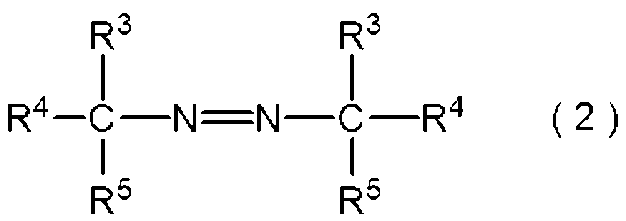
- the polymerization initiator (D3) is more preferably represented by the following general formula (2) since it can further suppress the emission of the volatile organic compound from the molded article, and among them, the resin is preferable.
- 2,2′-azobis (2-methylbutyronitrile) or 1,1′-azobis (1-acetoxy-1-phenylethane) is more preferable because it has excellent solubility in VOCs from molded articles.
- 1,1′-azobis (1-acetoxy-1-phenylethane) is particularly preferable because it can further reduce the emission.
- R 3 in the general formula (2) represents an alkyl group
- R 4 represents an alkyl group or an aryl group
- R 5 represents a cyano group or an acetoxy group.
- the content of the polymerization initiator (D3) while maintaining excellent curing characteristics and storage stability, it is possible to further reduce the emission of the volatile organic compound from the molded article, and thus the vinyl ester (A) and the vinyl ester (A)
- the range of 0.1 to 3 mass% is preferable, and the range of 0.3 to 2 mass% is more preferable, based on the total amount of the unsaturated monomer (B).
- a polymerization initiator other than the above-mentioned polymerization initiator (D) may be used in combination with the molding resin composition of the present invention, but in order to suppress the emission of the volatile organic compound from the molded product, all polymerization initiation
- the ratio of the polymerization initiator (D) in the agent is preferably 50% by mass or more, and more preferably 75% by mass or more. ..
- the fiber-reinforced molding material of the present invention contains the above-mentioned molding resin composition and the reinforcing fiber (E).
- Examples of the reinforcing fibers (E) include carbon fibers, glass fibers, silicon carbide fibers, alumina fibers, boron fibers, metal fibers, aramid fibers, vinylon fibers, and organic fibers such as tetron fibers, but higher strength, Carbon fibers or glass fibers are preferable, and carbon fibers are more preferable, because a molded article having high elasticity can be obtained.
- These reinforcing fibers (E) can be used alone or in combination of two or more kinds.
- glass fiber for example, those obtained by using alkali-containing glass, low-alkali glass, alkali-free glass, etc. as a raw material can be used, but alkali-free glass with little deterioration over time and stable mechanical properties. It is preferable to use glass (E glass).
- carbon fiber various types such as polyacrylonitrile-based, pitch-based and rayon-based can be used. Among them, polyacrylonitrile-based one is preferable because high strength carbon fiber can be easily obtained.
- reinforcing fiber (E) for example, twisted yarn, spun yarn, spinning process, or non-woven process can be used.
- shape of the carbon fibers filaments, yarns, rovings, strands, chopped strands, felts, needle punches, cloths, roving cloths, milled fibers, nanofibers and the like can be used.
- the number of filaments of the fiber bundle used as the reinforcing fiber (E) is preferably in the range of 1,000 to 60,000 because the resin impregnation property and the mechanical properties of the molded product are further improved.
- the content of the reinforcing fiber (E) in the components of the fiber-reinforced molding material of the present invention is preferably in the range of 25 to 80% by mass, since the mechanical properties of the obtained molded product are further improved, The range of 70 mass% is more preferable.
- the components of the fiber-reinforced molding material of the present invention include the vinyl ester (A), the unsaturated monomer (B), the polyisocyanate (C), the polymerization initiator (D), and the reinforcing fiber (E).
- thermosetting resins other than the vinyl ester (A) thermoplastic resins, polymerization inhibitors, curing accelerators, fillers, low-shrinking agents, release agents, thickeners, etc.
- thermosetting resin examples include vinyl urethane resin, unsaturated polyester resin, acrylic resin, epoxy resin, phenol resin, melamine resin, furan resin and the like. In addition, these thermosetting resins may be used alone or in combination of two or more kinds.
- thermoplastic resin examples include polyamide resin, polyethylene terephthalate resin, polybutylene terephthalate resin, polycarbonate resin, urethane resin, polypropylene resin, polyethylene resin, polystyrene resin, acrylic resin, polybutadiene resin, polyisoprene resin and copolymerization thereof. And the like. These thermoplastic resins may be used alone or in combination of two or more.
- polymerization inhibitor examples include organic copper compounds such as hydroquinone, trimethylhydroquinone, pt-butylcatechol, t-butylhydroquinone, tolhydroquinone, p-benzoquinone, naphthoquinone, hydroquinone monomethyl ether, phenothiazine, and copper naphthenate.
- organic copper compounds such as hydroquinone, trimethylhydroquinone, pt-butylcatechol, t-butylhydroquinone, tolhydroquinone, p-benzoquinone, naphthoquinone, hydroquinone monomethyl ether, phenothiazine, and copper naphthenate.
- nitroxyl radical compounds such as copper chloride and 4-hydroxy-2,2,6,6-tetramethylpiperidine-1-oxyl.
- curing accelerator examples include, for example, cobalt naphthenate, cobalt octenoate, vanadyl octenoate, copper naphthenate, metal soaps such as barium naphthenate, vanadyl acetyl acetate, cobalt acetyl acetate, metal chelates such as iron acetyl acetonate.
- amines such as N, N-dimethylamino-p-benzaldehyde, N, N-dimethylaniline, N, N-diethylaniline, N, N-dimethyl-p-toluidine and N, N-dimethyl-p-toluidine Ethylene oxide or propylene oxide adduct, N-ethyl-m-toluidine, ethylene oxide or propylene oxide adduct of N-ethyl-m-toluidine, triethanolamine, m-toluidine, diethylenetriamine, pyridine, phenylmorpholine, piperidine, diethanol Examples include aniline and the like. These curing accelerators can be used alone or in combination of two or more kinds.
- inorganic compounds and organic compounds as the filler, which can be used to adjust physical properties such as strength, elastic modulus, impact strength and fatigue durability of the molded product.
- Examples of the inorganic compound include calcium carbonate, magnesium carbonate, barium sulfate, mica, talc, kaolin, clay, celite, asbestos, barlite, baryta, silica, silica sand, dolomite limestone, gypsum, aluminum fine powder, hollow balloon, Alumina, glass powder, aluminum hydroxide, cryolite, zirconium oxide, antimony trioxide, titanium oxide, molybdenum dioxide, iron powder and the like can be mentioned.
- the organic compound examples include natural polysaccharide powder such as cellulose and chitin, and synthetic resin powder
- the synthetic resin powder includes hard resin, soft rubber, elastomer or polymer (copolymer).
- Particles having a multi-layer structure such as organic powder and core-shell type particles can be used. Specific examples thereof include particles made of butadiene rubber and / or acrylic rubber, urethane rubber, silicon rubber and the like, polyimide resin powder, fluororesin powder, phenol resin powder and the like. These fillers may be used alone or in combination of two or more.
- release agent examples include zinc stearate, calcium stearate, paraffin wax, polyethylene wax, carnauba wax and the like.
- zinc stearate, paraffin wax, polyethylene wax, carnauba wax and the like can be mentioned.
- These release agents can be used alone or in combination of two or more kinds.
- thickener examples include metal oxides and metal hydroxides such as magnesium oxide, magnesium hydroxide, calcium oxide, calcium hydroxide, acrylic resin-based fine particles, and the fiber-reinforced molding material of the present invention. It can be appropriately selected depending on the handling property. These thickeners can be used alone or in combination of two or more.
- the fiber-reinforced molding material of the present invention is a sheet molding compound (hereinafter abbreviated as “SMC”) or a bulk molding compound (hereinafter “BMC”) from the viewpoint of excellent productivity and moldability having a variety of designs. Is abbreviated as ").
- a vinyl mixer (A), the unsaturated monomer (B), a mixer such as an ordinary mixer, an intermixer, a planetary mixer, a roll, a kneader, and an extruder are used.
- Each component such as the polyisocyanate (C) and the polymerization initiator (D) is mixed and dispersed, and the obtained resin composition is applied to a carrier film placed above and below so as to have a uniform thickness,
- the reinforcing fiber (E) is sandwiched between the resin compositions on the carrier films placed above and below, then the whole is passed between impregnating rolls, and pressure is applied to apply the resin composition to the reinforcing fiber (E).
- the carrier film a polyethylene film, a polypropylene film, a laminated film of polyethylene and polypropylene, polyethylene terephthalate, nylon or the like can be used.
- a mixer such as a normal mixer, intermixer, planetary mixer, roll, kneader or extruder is used to produce the vinyl ester (A),
- the unsaturated monomer (B), the polyisocyanate (C), the polymerization initiator (D) and other components are mixed and dispersed, and the reinforcing resin (E) is mixed and dispersed in the obtained resin composition.
- the molded product of the present invention can be obtained from the above fiber reinforced molding material, but the heat compression molding of SMC or BMC is preferable as the molding method from the viewpoint of excellent productivity and design versatility.
- a predetermined amount of a molding material such as SMC or BMC is weighed, put into a mold heated in advance to 80 to 180 ° C., and the mold is clamped by a compression molding machine to apply the molding material.
- a manufacturing method is used in which a molding material is cured by molding and holding a molding pressure of 0.1 to 30 MPa, and then the molded product is taken out to obtain a molded product.
- molding conditions in which a molding pressure of 1 to 10 MPa is maintained for 1 to 2 minutes per 1 mm of the thickness of the molded product at a mold temperature of 100 to 160 ° C. in the mold are preferable. Therefore, it is more preferable to maintain the molding pressure at a mold temperature of 120 to 160 ° C. for 30 to 150 seconds per 1 mm of the thickness of the molded product at a molding pressure of 1 to 10 MPa.
- Molded articles obtained from the fiber-reinforced molding material of the present invention are excellent in bending strength and the like, and since emission of volatile organic compounds is suppressed, automobile parts, railway car parts, aerospace parts, ship parts It can be preferably used for housing equipment members, sports members, light vehicle members, construction civil engineering members, housings for OA equipment and the like.
- the hydroxyl value is the potassium hydroxide required to neutralize the acetic acid produced when 1 g of the resin sample was reacted at the specified temperature and time with an acetylating agent based on the method specified in JIS K-0070.
- the number of milligrams (mgKOH / g) was measured.
- the epoxy equivalent is based on the prescribed method based on JIS K-7236 for the resin sample, and perchloric acid is dropped in the coexistence of the sample and ammonium bromide salt, and the hydrogen bromide produced consumes all the epoxy groups. Then, the point where the excess amount was obtained was used as the end point, and calculation was performed using a prescribed calculation formula.
- the acid value the number of milligrams of potassium hydroxide (mgKOH / g) required to neutralize (meth) acrylic acid from 1 g of a resin sample was measured based on the method specified in JIS K-0070.
- Example 1 Preparation and evaluation of molding resin composition (1)
- DCPO dicumyl peroxide
- the molding resin composition (1) obtained above was coated on a laminated film of polyethylene and polypropylene so that the coating amount became 1 kg / m 2 on average, and carbon fiber roving (produced by Toray Industries, Inc. T700SC-12000-50C ") cut into 25 mm carbon fiber (hereinafter abbreviated as carbon fiber (E-1).) So that the carbon fiber content is 50% by mass with no fiber orientation and uniform thickness.
- the carbon fiber was left to stand in a thermostat at 45 ° C. for 24 hours, and the fiber reinforced molding material as SMC ( 1) was obtained.
- the basis weight of this fiber-reinforced molding material (1) was 2 kg / m 2 .
- the fiber-reinforced molding material (1) obtained above was peeled from the film and cut into 26.5 cm x 26.5 cm, and three pieces were stacked and set in the center of a flat plate mold of 30 cm x 30 cm, and the press mold was pressed. Molding was performed at a temperature of 140 ° C. for a pressing time of 5 minutes and a pressing pressure of 12 MPa to obtain a flat plate-shaped molded product (1) having a thickness of 3 mm.
- VOC emission evaluation of volatile organic compound (VOC) emission
- a total of 2 g of the molded product cut into 10 to 25 mg was weighed in a 20 mL vial, the vial was heated at 120 ° C. for 5 hours, and the released gas was quantified by an FID-gas chromatograph.
- the analysis method and the VOC emission amount ( ⁇ g C / g) calculation method from the molded product were based on VDA277.
- the VOC emission amount ( ⁇ g C / g) from the molded product was evaluated according to the following criteria.
- Example 2 Preparation and evaluation of molding resin composition (2)
- Molding resin composition (2), fiber-reinforced molding material (2) and molded article were prepared in the same manner as in Example 1 except that 1 part by mass of DCPO used in Example 1 was changed to 1.5 parts by mass. After obtaining (1), each evaluation was performed.
- the molar ratio (NCO / OH) in the molding resin composition (2) was 0.68, and the basis weight of the fiber-reinforced molding material (2) was 2 kg / m 2 .
- Example 3 Preparation and evaluation of molding resin composition (3)
- 1 part by mass of DCPO used in Example 1 was added to 0.6 part by mass of DCPO and 0.1 part by mass of t-butylperoxy 2-ethylhexanoate (“Kayaester O” manufactured by Kayaku Akzo Co., Ltd.).
- Each evaluation was performed after obtaining the molding resin composition (3), the fiber-reinforced molding material (3) and the molded product (3) in the same manner as in Example 1 except that the modification was made.
- the molar ratio (NCO / OH) in the molding resin composition (3) was 0.68, and the basis weight of the fiber-reinforced molding material (3) was 2 kg / m 2 .
- Example 4 Preparation and evaluation of molding resin composition (4)
- 1 part by mass of DCPO used in Example 1 was changed to 1 part by mass of t-butyl ⁇ -cumyl peroxide (“Trigonox T” manufactured by Kayaku Akzo Co., Ltd., hereinafter abbreviated as “TBCP”).
- Trigonox T manufactured by Kayaku Akzo Co., Ltd.
- TBCP t-butyl ⁇ -cumyl peroxide
- Example 5 Preparation and evaluation of molding resin composition (5)
- 1 part by mass of DCPO used in Example 1 was added to 0.5 part by mass of TBCP and 0.1 part by mass of t-butylperoxy 2-ethylhexanoate (“Kayaester O” manufactured by Kayaku Akzo Co., Ltd.).
- Each evaluation was performed after obtaining the molding resin composition (5), the fiber-reinforced molding material (5) and the molded product (5) in the same manner as in Example 1 except that the modification was performed.
- the molar ratio (NCO / OH) in the molding resin composition (5) was 0.68, and the basis weight of the fiber-reinforced molding material (5) was 2 kg / m 2 .
- Example 6 Preparation and evaluation of molding resin composition (6)
- 55 parts by mass of the vinyl ester (A-1) obtained in Synthesis Example 1 was dissolved in 45 parts by mass of phenoxyethyl methacrylate, and 100 parts by mass of a resin solution was mixed with 1 part by mass of benzopinacol ground into fine powder in a mortar and stirred. Then, after confirming dissolution of benzopinacol, 20 parts by mass of polyisocyanate (C-1) was mixed to obtain a resin composition (6) for molding.
- the molar ratio (NCO / OH) in this molding resin composition (6) was 0.68.
- a fiber reinforced molding material (6) and a molded article (6) were obtained in the same manner as in Example 1 except that the molding resin composition (1) used in Example 1 was changed to the molding resin composition (6). After obtaining, each evaluation was performed.
- the basis weight of the fiber-reinforced molding material (6) was 2 kg / m 2 .
- Example 7 Preparation and evaluation of molding resin composition (7)
- the molar ratio (NCO / OH) in the molding resin composition (7) was 0.68, and the basis weight of the fiber-reinforced molding material (7) was 2 kg / m 2 .
- Example 8 Preparation and evaluation of molding resin composition (8)
- a molding resin composition (8) and a fiber-reinforced molding material (8) were obtained in the same manner as in Example 6 except that 1 part by mass of benzopinacol used in Example 6 was changed to 0.5 part by mass of benzopinacol. And each evaluation was performed after obtaining the molded product (8).
- the molar ratio (NCO / OH) in the molding resin composition (8) was 0.68, and the basis weight of the fiber-reinforced molding material (8) was 2 kg / m 2 .
- Example 9 Preparation and evaluation of molding resin composition (9)
- a resin solution prepared by dissolving 55 parts by mass of the vinyl ester (A-1) obtained in Synthesis Example 1 in 45 parts by mass of phenoxyethyl methacrylate 1,1′-azobis (1-acetoxy-1-phenylethane) was added.
- phenoxyethyl methacrylate 1,1′-azobis (1-acetoxy-1-phenylethane
- the molding resin composition (1) used in Example 1 was changed to the molding resin composition (9), Each evaluation was performed after obtaining the fiber-reinforced molding material (9) and the molded product (9) in the same manner as in Example 1 except that the temperature of the thermostat for producing the fiber-reinforced molding material was changed from 45 ° C to 25 ° C. It was The basis weight of the fiber-reinforced molding material (9) was 2 kg / m 2 .
- Example 10 Preparation and evaluation of molding resin composition (10) Except that 1 part by mass of 1,1′-azobis (1-acetoxy-1-phenylethane) used in Example 9 was changed to 1 part by mass of 2,2′-azobis (2-methylbutyronitrile). After the molding resin composition (10), the fiber reinforced molding material (10) and the molded product (10) were obtained in the same manner as in Example 9, each evaluation was performed. The molar ratio (NCO / OH) in the molding resin composition (10) was 0.68, and the basis weight of the fiber-reinforced molding material (10) was 2 kg / m 2 .
- Comparative Example 1 is an example in which a polymerization initiator having a specific structure, which is an essential component of the present invention, is not used, but it was confirmed that a large amount of volatile organic compounds were emitted from the molded product.
Landscapes
- Chemical & Material Sciences (AREA)
- Health & Medical Sciences (AREA)
- Chemical Kinetics & Catalysis (AREA)
- Medicinal Chemistry (AREA)
- Polymers & Plastics (AREA)
- Organic Chemistry (AREA)
- Inorganic Chemistry (AREA)
- Engineering & Computer Science (AREA)
- Manufacturing & Machinery (AREA)
- Materials Engineering (AREA)
- Reinforced Plastic Materials (AREA)
- Macromonomer-Based Addition Polymer (AREA)
- Polyurethanes Or Polyureas (AREA)
Abstract
ビニルエステル(A)、不飽和単量体(B)、ポリイソシアネート(C)、及び重合開始剤(D)を必須原料とする成形用樹脂組成物であって、前記重合開始剤(D)が、一般式(1)で表される化合物(D1)、ベンゾピナコール又はそのエステル化合物(D2)、及びアゾ基を有する化合物(D3)からなる群より選ばれる1種以上の化合物であることを特徴とする成形用樹脂組成物を提供する。この成形用樹脂組成物は、曲げ強さ等に優れるとともに、揮発性有機化合物の放散が抑制されていることから、自動車部材、鉄道車両部材、航空宇宙機部材、船舶部材、住宅設備部材、スポーツ部材、軽車両部材、建築土木部材、OA機器等の筐体等に好適に用いることができる。(一般式(1)中のR1はアリール基を表し、R2は水素原子、アルキル基、又はアリールアルキル基を表す。)
Description
本発明は、成形用樹脂組成物、繊維強化成形材料及びそれを用いた成形品に関する。
炭素繊維を強化繊維としてエポキシ樹脂や不飽和ポリエステル樹脂等の熱硬化性樹脂を強化した繊維強化樹脂複合材料は、軽量でありながら耐熱性や機械強度に優れる特徴が注目され、自動車や航空機の筐体或いは各種部材をはじめ、様々な構造体用途での利用が拡大している。この繊維強化樹脂複合材料で、エポキシ樹脂を使用した材料の成形方法としては、プリプレグと呼ばれる材料を加圧可能なオートクレーブで加熱し硬化させるオートクレーブ法が知られており、不飽和ポリエステル樹脂を使用した材料の成形方法としては、シートモールディングコンパウンド(SMC)、バルクモールディングコンパウンド(BMC)と呼ばれる中間材料を用いて、プレス成形、射出成形等の手法により、硬化、成形させる方法が知られている。特に近年では、生産性に優れる材料開発が活発に行われている。
このような成形材料としては、例えば、不飽和ポリエステル、ビニル単量体、熱可塑性ポリマー、ポリイソシアネート、充填材、導電性カーボンブラック及び幅広炭素繊維束を必須成分として含む炭素繊維強化シート状成形材料が知られている(例えば、特許文献1参照。)。この成形材料からは、外観に優れる成形品が得られるものの、車内、室内等の屋内部材として利用する際には、成形品から放散されるホルムアルデヒド等の揮発性有機化合物が問題となっていた。
本発明が解決しようとする課題は、曲げ強さ等の各種物性に優れるとともに、ホルムアルデヒド等の揮発性有機化合物の放散を抑制した成形品が得られる成形用樹脂組成物、繊維強化成形材料及びその成形品を提供することである。
本発明者等は、ビニルエステル、不飽和単量体、ポリイソシアネート、及び特定の重合開始剤を必須原料とすることを特徴とする成形用樹脂組成物から、曲げ強さ等の各種物性に優れるとともに、ホルムアルデヒド等の揮発性有機化合物の放散を抑制した成形品が得られることを見出し、本発明を完成した。
すなわち、ビニルエステル(A)、不飽和単量体(B)、ポリイソシアネート(C)、及び重合開始剤(D)を必須原料とする成形用樹脂組成物であって、前記重合開始剤(D)が、一般式(1)で表される化合物(D1)、ベンゾピナコール又はそのエステル化合物(D2)、及びアゾ基を有する化合物(D3)からなる群より選ばれる1種以上の化合物であることを特徴とする成形用樹脂組成物、繊維強化成形材料及びそれを用いた成形品に関する。

本発明の繊維強化成形材料から得られる成形品は、曲げ強さ等に優れるとともに、揮発性有機化合物の放散が抑制されていることから、自動車部材、鉄道車両部材、航空宇宙機部材、船舶部材、住宅設備部材、スポーツ部材、軽車両部材、建築土木部材、OA機器等の筐体等に好適に用いることができる。
本発明の成形用樹脂組成物は、ビニルエステル(A)、不飽和単量体(B)、ポリイソシアネート(C)、及び重合開始剤(D)を必須原料とする成形用樹脂組成物であって、前記重合開始剤(D)が、一般式(1)で表される化合物(D1)、ベンゾピナコール又はそのエステル化合物(D2)、及びアゾ基を有する化合物(D3)からなる群より選ばれる1種以上の化合物であるものである。
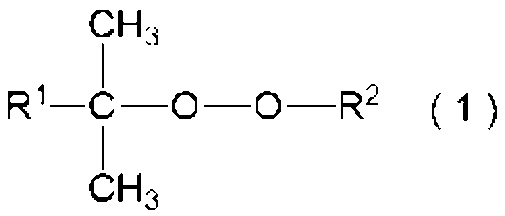
前記ビニルエステル(A)は、エポキシ樹脂(a1)と(メタ)アクリル酸(a2)とを反応させることで得られるが、成形時のフィルム剥ぎ性やタック性等の取り扱い性と流動性とのバランスがより向上することから、前記エポキシ樹脂(a1)のエポキシ当量は、135~500の範囲が好ましく、175~400の範囲がより好ましい。
なお、本発明において、「(メタ)アクリル酸」の表記は、アクリル酸とメタクリル酸の一方又は両方を表し、「(メタ)アクリレート」は、「アクリレート」及び「メタクリレート」の一方又は両方を表すものである。
また、前記エポキシ樹脂(a1)のエポキシ基(EP)と前記(メタ)アクリル酸(a2)のカルボキシル基(COOH)とのモル比(COOH/EP)は、成形品の強度や耐熱性等の機械的特性がより向上することから、0.85~1.1の範囲が好ましい。
前記エポキシ樹脂(a1)としては、例えば、ビスフェノールA型エポキシ樹脂、ビスフェノールF型エポキシ樹脂、ビスフェノールE型エポキシ樹脂、ビスフェノールS型エポキシ樹脂、ビスフェノールスルフィド型エポキシ樹脂、フェニレンエーテル型エポキシ樹脂、ナフチレンエーテル型エポキシ樹脂、ビフェニル型エポキシ樹脂、テトラメチルビフェニル型エポキシ樹脂、ポリヒドロキシナフタレン型エポキシ樹脂、フェノールノボラック型エポキシ樹脂、クレゾールノボラック型エポキシ樹脂、トリフェニルメタン型エポキシ樹脂、テトラフェニルエタン型エポキシ樹脂、ジシクロペンタジエン-フェノール付加反応型エポキシ樹脂、フェノールアラルキル型エポキシ樹脂、ナフトールノボラック型エポキシ樹脂、ナフトールアラルキル型エポキシ樹脂、ナフトール-フェノール共縮ノボラック型エポキシ樹脂、ナフトール-クレゾール共縮ノボラック型エポキシ樹脂、ナフチレンエーテル型エポキシ樹脂、芳香族炭化水素ホルムアルデヒド樹脂変性フェノール樹脂型エポキシ樹脂、ビフェニル変性ノボラック型エポキシ樹脂、アントラセン型エポキシ樹脂等が挙げられる。これらの中でも、成形品強度と成形材料の取り扱い性、成形材料の成形時の流動性により優れることから2官能性芳香族系エポキシ樹脂が好ましく、ビスフェノールA型エポキシ樹脂およびビスフェノールF型エポキシ樹脂がより好ましい。なお、これらのエポキシ樹脂は、単独で用いることも2種以上併用することもできる。エポキシ樹脂を2種以上併用した際の前記エポキシ樹脂(a1)のエポキシ当量は、全エポキシ樹脂の平均エポキシ当量とする。
また、前記エポキシ樹脂(a1)としては、エポキシ当量を調整するために、ビスフェノールA等の二塩基酸により高分子量化し使用してもよい。
前記エポキシ樹脂(a1)と前記(メタ)アクリル酸(a2)との反応は、エステル化触媒を用い、60~140℃において行われることが好ましい。また、重合禁止剤等を使用することもできる。
本発明の成形用樹脂組成物には、エポキシ樹脂を含んでいてもよいが、成形品の強度や耐熱性等の機械的特性がより優れることから、前記ビニルエステル(A)とエポキシ樹脂混合後の平均エポキシ当量は、4000以上であることが好ましい。
前記不飽和単量体(B)としては、例えば、スチレン、p-メチルスチレン、p-エチルスチレン、p-プロピルスチレン、p-イソプロピルスチレン、p-ブチルスチレン、p-tert-ブチルスチレン、o-メチルスチレン、o-エチルスチレン、o-プロピルスチレン、o-イソプロピルスチレン、m-メチルスチレン、m-エチルスチレン、m-プロピルスチレン、m-イソプロピルスチレン、m-ブチルスチレン、メシチルスチレン、2,4-ジメチルスチレン、2,5-ジメチルスチレン、3,5-ジメチルスチレン、4-ブテニルスチレン等のアルキルスチレン、p-クロロスチレン、m-クロロスチレン、o-クロロスチレン、p-ブロモスチレン、m-ブロモスチレン、o-ブロモスチレン、p-フルオロスチレン、m-フルオロスチレン、o-フルオロスチレン、o-メチル-p-フルオロスチレン等のハロゲン化スチレン、p-メトキシスチレン、o-メトキシスチレン、m-メトキシスチレン等のアルコキシスチレン、ヒドロキシスチレン、シアノスチレン、ビニル安息香酸エステル等のスチレン系化合物;1,3-ジビニルベンゼン、1,4-ジビニルベンゼン、1,3-ジイソプロペニルベンゼン、1,4-ジイソプロペニルベンゼン等のジビニルベンゼン系化合物;メチル(メタ)アクリレート、エチル(メタ)アクリレート、プロピル(メタ)アクリレート、ブチル(メタ)アクリレート、2-エチルへキシル(メタ)アクリレート、シクロへキシル(メタ)アクリレート、イソボロニル(メタ)アクリレート、ベンジル(メタ)アクリレート、メチルベンジル(メタ)アクリレート、フェノキシエチル(メタ)アクリレート、メチルフェノキシエチル(メタ)アクリレート、モルホリン(メタ)アクリレート、フェニルフェノキシエチルアクリレート、フェニルベンジル(メタ)アクリレート、フェニルメタクリレート、ジシクロペンテニル(メタ)アクリレート、ジシクロペンテニルオキシエチル(メタ)アクリレート、ジシクロペンタニルメタクリレート等の単官能(メタ)アクリレート化合物;ヒドロキシエチル(メタ)アクリレート、ヒドロキシプロピル(メタ)アクリレート、ヒドロキシブチル(メタ)アクリレート等の水酸基含有(メタ)アクリレート化合物;エチレングリコールジ(メタ)アクリレート、プロピレングリコールジ(メタ)アクリレート、1,4-ブタンジオールジ(メタ)アクリレート、1,6-ヘキサンジオールジ(メタ)アクリレート、ビスフェノールジ(メタ)アクリレート、1,4-シクロヘキサンジメタノールジ(メタ)アクリレート等のジ(メタ)アクリレート化合物等が挙げられる。これらは単独で用いることも、2種以上併用することもできる。
前記不飽和単量体(B)は、成形作業時の臭気を抑制できるとともに、高温単時間成形が可能となることから、引火点が100℃以上であることが好ましく、それらの中でも、より高強度の成形材料が得られることから、芳香族を有する不飽和単量体がより好ましく、ベンジルメタクリレート、フェノキシエチルメタクリレートがさらに好ましい。
なお、本発明における引火点は、JISK2265-4:2007に規定されたクリーブランド開放法により測定した引火点とする。
前記ビニルエステル(A)と前記不飽和単量体(B)との質量比((A)/(B))は、炭素繊維への樹脂含浸性、取り扱い性(タック性)と硬化性とのバランスがより向上することから、40/60~85/15の範囲であるが、50/50~70/30の範囲が好ましい。
また、前記ビニルエステル(A)と前記不飽和単量体(B)との混合物の粘度は、
炭素繊維への樹脂含浸性がより向上することから、200~8000mPa・s(25℃、単一円筒形回転粘度計)の範囲が好ましい。
炭素繊維への樹脂含浸性がより向上することから、200~8000mPa・s(25℃、単一円筒形回転粘度計)の範囲が好ましい。
前記ポリイソシアネート(C)は、例えば、ジフェニルメタンジイソシアネート(4,4’-体、2,4’-体、又は2,2’-体、若しくはそれらの混合物)、ジフェニルメタンジイソシアネートのカルボジイミド変性体、ヌレート変性体、ビュレット変性体、ウレタンイミン変性体、ジエチレングリコールやジプロピレングリコール等の数平均分子量1,000以下のポリオールで変性したポリオール変性体等のジフェニルメタンジイソシアネート変性体、トリレンジイソシアネート、トリジンジイソシアネート、ポリメチレンポリフェニルポリイソシアネート、キシリレンジイソシアネート、1,5-ナフタレンジイソシアネート、テトラメチルキシレンジイソシアネート等の芳香族ポリイソシアネート;イソホロンジイソシアネート、水添ジフェニルメタンジイソシアネート、水添キシリレンジイソシアネート、ノルボルネンジイソシアネート等の脂環式ポリイソシアネート;ヘキサメチレンジイソシアネート、ヘキサメチレンジイソシアネートのヌレート変性体、ビュレット変性体、アダクト体、ダイマー酸ジイソシアネート等の脂肪族ポリイソシアネートなどを用いることができる。これらの中でも、取り扱い性(フィルム剥離性・タック性)に優れる成形材料が得られることから、芳香族ポリイソシアネートが好ましく、ジフェニルメタンジイソシアネートのカルボジイミド変性体がより好ましい。ジフェニルメタンジイソシアネートのカルボジイミド変性体としては、カルボジイミド基を有するものの他に、カルボジイミド基に更にイソシアネート基が付加してウレタンイミン構造を有するものを含む。また、これらのポリイソシアネート(C)は、単独で用いることも2種以上併用することもできる。
また、成形時のフィルム剥ぎ性やタック性等の取り扱い性と流動性とのバランスがより向上することから、前記ポリイソシアネート(C)のイソシアネート基(NCO)と前記ビニルエステル(A)の水酸基(OH)とのモル比(NCO/OH)は、0.1~0.85の範囲が好ましく、0.25~0.8の範囲がより好ましい。
前記重合開始剤(D)は、成形品からの揮発性有機化合物の放散を抑制する上で、一般式(1)で表される化合物(D1)、ベンゾピナコール又はそのエステル化合物(D2)、及びアゾ基を有する化合物(D3)からなる群より選ばれる1種以上の化合物であることが重要である。
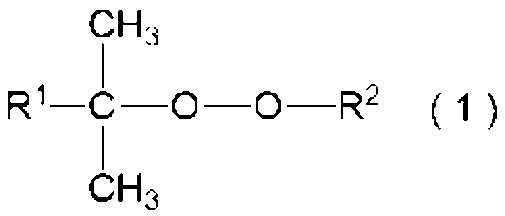
前記重合開始剤(D1)は、成形品からの揮発性有機化合物の放散をより低減できることから、前記一般式(1)で表される化合物の中でも、ジクミルパーオキサイド、t-ブチルα-クミルパーオキサイド、ジ(2-t-ブチルパーオキシイソプロピル)ベンゼンが好ましい。なお、これらの重合開始剤(D1)は、単独で用いることも2種以上併用することもできる。
前記重合開始剤(D1)の含有量としては、優れた硬化特性及び保存安定性を維持しながら、成形品からの揮発性有機化合物の放散をより低減できることから、前記ビニルエステル(A)と前記不飽和単量体(B)との総量に対して、0.1~3質量%の範囲が好ましく、0.3~2質量%の範囲がより好ましい。
前記重合開始剤(D2)は、成形品からの揮発性有機化合物の放散を抑制する上で、ベンゾピナコール又はそのエステル化合物であることが重要である。なお、これらの重合開始剤(D2)は、単独で用いることも2種以上併用することもできる。
前記重合開始剤(D2)の含有量としては、優れた硬化特性及び保存安定性を維持しながら、成形品からの揮発性有機化合物の放散をより低減できることから、前記ビニルエステル(A)と前記不飽和単量体(B)との総量に対して、0.05~5質量%の範囲が好ましく、0.1~3質量%の範囲がより好ましい。
前記重合開始剤(D3)は、例えば、2,2’-アゾビス(イソブチロニトリル)、2,2’-アゾビス(2-メチルブチロニトリル、2,2’-アゾビス(2,4-ジメチルバレロニトリル)、ジメチル2,2’-アゾビス(2-メチルプロピオネート)、1,1’-アゾビス(シクロヘキサン-1-カルボニトリル)、ジメチル1,1’-アゾビス(1-シクロヘキサンカルボキシレート)、1,1’-アゾビス(1-アセトキシ-1-フェニルエタン)等が挙げられるが、前記不飽和単量体(B)の硬化反応を効果的に促進することにより、揮発性有機化合物の放散がより抑制できることから、10時間半減期温度が60~100℃の範囲であることが好ましい。なお、これらの重合開始剤(D3)は、単独で用いることも2種以上併用することもできる。
また、前記重合開始剤(D3)は、成形品からの揮発性有機化合物の放散をより抑制できることから、下記一般式(2)で表されるものであることがより好ましく、これらの中でも、樹脂への溶解性に優れることから、2,2’-アゾビス(2-メチルブチロ二トリル)、又は1,1’-アゾビス(1-アセトキシ-1-フェニルエタン)がさらに好ましく、成形品からのVOCの放散をより低減できることから、1,1’-アゾビス(1-アセトキシ-1-フェニルエタン)が特に好ましい。
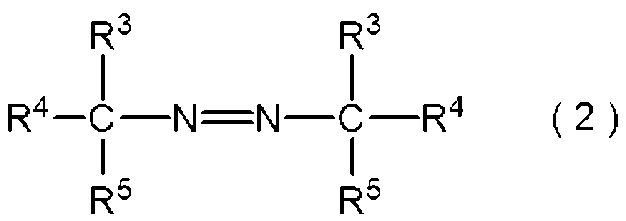
前記重合開始剤(D3)の含有量としては、優れた硬化特性及び保存安定性を維持しながら、成形品からの揮発性有機化合物の放散をより低減できることから、前記ビニルエステル(A)と前記不飽和単量体(B)との総量に対して、0.1~3質量%の範囲が好ましく、0.3~2質量%の範囲がより好ましい。
本発明の成形用樹脂組成物には、前記重合開始剤(D)以外の重合開始剤を併用してもよいが、成形品からの揮発性有機化合物の放散を抑制する上で、全重合開始剤中の前記重合開始剤(D)の比率は50質量%以上であることが好ましく、75質量%以上であることがより好ましい。
本発明の繊維強化成形材料は、上記した成形用樹脂組成物、及び強化繊維(E)を含有するものである。
前記強化繊維(E)としては、炭素繊維、ガラス繊維、炭化ケイ素繊維、アルミナ繊維、ボロン繊維、金属繊維、アラミド繊維、ビニロン繊維、テトロン繊維等の有機繊維などが挙げられるが、より高強度、高弾性の成形品が得られることから、炭素繊維又はガラス繊維が好ましく、炭素繊維がより好ましい。これらの強化繊維(E)は単独で用いることも、2種以上併用することもできる。
前記ガラス繊維としては、例えば、含アルカリガラス、低アルカリガラス、無アルカリガラス等を原料にして得られたものを使用することができるが、経時劣化も少なく機械的特性が安定している無アルカリガラス(Eガラス)を使用することが好ましい。
前記炭素繊維としては、ポリアクリロニトリル系、ピッチ系、レーヨン系などの各種のものが使用できるが、これらの中でも、容易に高強度の炭素繊維が得られることから、ポリアクリロニトリル系のものが好ましい。
前記強化繊維(E)としては、例えば、撚糸、紡糸、紡績加工、不織加工したものを使用することができる。また、前記炭素繊維の形状としては、フィラメント、ヤーン、ロービング、ストランド、チョップドストランド、フェルト、ニードルパンチ、クロス、ロービングクロス、ミルドファイバー、ナノファイバー等のものを使用することができる。
また、前記強化繊維(E)として使用される繊維束のフィラメント数は、樹脂含浸性及び成形品の機械的物性がより向上することから、1,000~60,000の範囲が好ましい。
本発明の繊維強化成形材料の成分中の、前記強化繊維(E)の含有率は、得られる成形品の機械的物性がより向上することから、25~80質量%の範囲が好ましく、40~70質量%の範囲がより好ましい。
本発明の繊維強化成形材料の成分としては、前記ビニルエステル(A)、前記不飽和単量体(B)、前記ポリイソシアネート(C)、前記重合開始剤(D)、前記強化繊維(E)以外のものを使用してもよく、例えば、前記ビニルエステル(A)以外の熱硬化性樹脂、熱可塑性樹脂、重合禁止剤、硬化促進剤、充填剤、低収縮剤、離型剤、増粘剤、減粘剤、顔料、酸化防止剤、可塑剤、難燃剤、抗菌剤、紫外線安定剤、紫外線吸収剤、補強材、光硬化剤等を含有することができる。
前記熱硬化性樹脂としては、例えば、ビニルウレタン樹脂、不飽和ポリエステル樹脂、アクリル樹脂、エポキシ樹脂、フェノール樹脂、メラミン樹脂、フラン樹脂等が挙げられる。また、これらの熱硬化性樹脂は、単独で用いることも2種以上併用することもできる。
前記熱可塑性樹脂としては、例えば、ポリアミド樹脂、ポリエチレンテレフタレート樹脂、ポリブチレンテレフタレート樹脂、ポリカーボネート樹脂、ウレタン樹脂、ポリプロピレン樹脂、ポリエチレン樹脂、ポリスチレン樹脂、アクリル樹脂、ポリブタジエン樹脂、ポリイソプレン樹脂およびこれらを共重合等により変性させたものが挙げられる。また、これらの熱可塑性樹脂は、単独で用いることも2種以上併用することもできる。
前記重合禁止剤としては、例えば、ハイドロキノン、トリメチルハイドロキノン、p-t-ブチルカテコール、t-ブチルハイドロキノン、トルハイドロキノン、p-ベンゾキノン、ナフトキノン、ハイドロキノンモノメチルエーテル、フェノチアジン、ナフテン酸銅などの有機銅化合物、塩化銅、4-ヒドロキシ-2,2,6,6-テトラメチルピペリジン-1-オキシルなどのニトロキシルラジカル化合物等が挙げられる。これらの重合禁止剤は、単独で用いることも、2種以上を併用することもできる。
前記硬化促進剤としては、例えば、ナフテン酸コバルト、オクテン酸コバルト、オクテン酸バナジル、ナフテン酸銅、ナフテン酸バリウム等の金属石鹸類、バナジルアセチルアセテート、コバルトアセチルアセテート、鉄アセチルアセトネート等の金属キレート化合物が挙げられる。またアミン類として、N,N-ジメチルアミノ-p-ベンズアルデヒド、N,N-ジメチルアニリン、N,N-ジエチルアニリン、N,N-ジメチル-p-トルイジン、N,N-ジメチル-p-トルイジンのエチレンオキサイドもしくはプロピレンオキサイド付加物、N-エチル-m-トルイジン、N-エチル-m-トルイジンのエチレンオキサイドもしくはプロピレンオキサイド付加物、トリエタノールアミン、m-トルイジン、ジエチレントリアミン、ピリジン、フェニルモルホリン、ピペリジン、ジエタノールアニリン等が挙げられる。これらの硬化促進剤は、単独で用いることも、2種以上を併用することもできる。
前記充填剤としては、無機化合物、有機化合物があり、成形品の強度、弾性率、衝撃強度、疲労耐久性等の物性を調整するために使用できる。
前記無機化合物としては、例えば、炭酸カルシウム、炭酸マグネシウム、硫酸バリウム、マイカ、タルク、カオリン、クレー、セライト、アスベスト、バーライト、バライタ、シリカ、ケイ砂、ドロマイト石灰石、石こう、アルミニウム微粉、中空バルーン、アルミナ、ガラス粉、水酸化アルミニウム、寒水石、酸化ジルコニウム、三酸化アンチモン、酸化チタン、二酸化モリブデン、鉄粉等が挙げられる。
前記有機化合物としては、セルロース、キチン等の天然多糖類粉末や、合成樹脂粉末等があり、合成樹脂粉末としては、硬質樹脂、軟質ゴム、エラストマーまたは重合体(共重合体)などから構成される有機物の粉体やコアシェル型などの多層構造を有する粒子を使用できる。具体的には、ブタジエンゴムおよび/またはアクリルゴム、ウレタンゴム、シリコンゴム等からなる粒子、ポリイミド樹脂粉末、フッ素樹脂粉末、フェノール樹脂粉末などが挙げられる。これらの充填剤は、単独で用いることも、2種以上を併用することもできる。
前記離型剤としては、例えば、ステアリン酸亜鉛、ステアリン酸カルシウム、パラフィンワックス、ポリエチレンワックス、カルナバワックスなどが挙げられる。好ましくは、ステアリン酸亜鉛、パラフィンワックス、ポリエチレンワックス、カルナバワックス等が挙げられる。これらの離型剤は、単独で用いることも、2種以上を併用することもできる。
前記増粘剤としては、例えば、酸化マグネシウム、水酸化マグネシウム、酸化カルシウム、水酸化カルシウム等の金属酸化物や金属水酸化物など、アクリル樹脂系微粒子などが挙げられ、本発明の繊維強化成形材料の取り扱い性によって適宜選択できる。これらの増粘剤は、単独で用いることも、2種以上を併用することもできる。
本発明の繊維強化成形材料は、生産性に優れる観点及びデザイン多様性を有する成形性の観点から、シートモールディングコンパウンド(以下、「SMC」と略記する。)又はバルクモールディングコンパウンド(以下、「BMC」と略記する。)であることが好ましい。
前記SMCの製造方法としては、通常のミキサー、インターミキサー、プラネタリーミキサー、ロール、ニーダー、押し出し機などの混合機を用いて、前記ビニルエステル(A)、前記不飽和単量体(B)、前記ポリイソシアネート(C)、前記重合開始剤(D)等の各成分を混合・分散し、得られた樹脂組成物を上下に設置されたキャリアフィルムに均一な厚さになるように塗布し、前記強化繊維(E)を前記上下に設置されたキャリアフィルム上の樹脂組成物で挟み込み、次いで、全体を含浸ロールの間に通して、圧力を加えて前記強化繊維(E)に樹脂組成物を含浸させた後、ロール状に巻き取る又はつづら折りに畳む方法等が挙げられる。さらに、この後に20~60℃の温度で熟成を行うことが好ましい。キャリアフィルムとしては、ポリエチレンフィルム、ポリプロピレンフィルム、ポリエチレンとポリプロピレンのラミネートフィルム、ポリエチレンテレフタレート、ナイロン等を用いることができる。
前記BMCの製造方法としては、前記SMCの製造方法と同様に、通常のミキサー、インターミキサー、プラネタリーミキサー、ロール、ニーダー、押し出し機などの混合機を用いて、前記ビニルエステル(A)、前記不飽和単量体(B)、前記ポリイソシアネート(C)、前記重合開始剤(D)等の各成分を混合・分散し、得られた樹脂組成物に前記強化繊維(E)を混合・分散させる方法等が挙げられる。また、SMCと同様に20~60℃の温度で熟成することが好ましい。
本発明の成形品は、前記繊維強化成形材料より得られるが、生産性に優れる点とデザイン多様性に優れる観点からその成形方法としては、SMC又はBMCの加熱圧縮成形が好ましい。
前記加熱圧縮成形としては、例えば、SMC、BMC等の成形材料を所定量計量し、予め80~180℃に加熱した金型に投入し、圧縮成形機にて型締めを行い、成形材料を賦型させ、0.1~30MPaの成形圧力を保持することによって、成形材料を硬化させ、その後成形品を取り出し成形品を得る製造方法が用いられる。具体的な成形条件としては、金型内で金型温度100~160℃にて、成形品の厚さ1mm当たり1~2分間、1~10MPaの成形圧力を保持する成形条件が好ましく、生産性がより向上することから、金型温度120~160℃にて、成形品の厚さ1mm当たり30~150秒間、1~10MPaの成形圧力を保持する成形条件がより好ましい。
本発明の繊維強化成形材料から得られる成形品は、曲げ強さ等に優れるとともに、揮発性有機化合物の放散が抑制されていることから、自動車部材、鉄道車両部材、航空宇宙機部材、船舶部材、住宅設備部材、スポーツ部材、軽車両部材、建築土木部材、OA機器等の筐体等に好適に用いることができる。
以下に本発明を具体的な実施例を挙げてより詳細に説明する。なお、水酸基価は、樹脂試料1gをJIS K-0070の規定の方法に基づきアセチル化剤を用いて、規定温度及び時間で反応させた時に生成した酢酸を中和するのに要する水酸化カリウムのミリグラム数(mgKOH/g)を測定した。また、エポキシ当量は、樹脂試料をJIS K-7236に準拠した規定の方法に基づき、試料と臭化アンモニウム塩の共存下、過塩素酸を滴下し、生成する臭化水素がエポキシ基を全て消費して過剰となったところを終点とし、規定の計算式を用いて算出した。酸価は、樹脂試料1gをJIS K-0070の規定の方法に基づき(メタ)アクリル酸を中和するのに要する水酸化カリウムのミリグラム数(mgKOH/g)を測定した。
(合成例1:ビニルエステル(A-1)の合成)
温度計、窒素導入管、撹拌機を設けた2Lフラスコに、エポキシ樹脂(DIC株式会社製「エピクロン850」、ビスフェノールA型エポキシ樹脂、エポキシ当量188)661質量部、ビスフェノールA 58.8質量部、及び2-メチルイミダゾール0.36質量部を仕込み、120℃に昇温して3時間反応させ、エポキシ当量を測定した。エポキシ当量が設定通り240になったことを確認後、60℃付近まで冷却した後、メタクリル酸253質量部、及びt-ブチルハイドロキノン0.28質量部を仕込み、窒素と空気とを1対1で混合したガス流通下で、90℃まで昇温した。ここに2-メチルイミダゾール0.25質量部を入れ、110℃に昇温して10時間反応させると、酸価が6以下、エポキシ当量が10080で、エポキシ当量4000以上を確認したので、反応を終了した。60℃付近まで冷却した後、反応容器より取り出し、水酸基価206mgKOH/gのビニルエステル(A-1)を得た。
温度計、窒素導入管、撹拌機を設けた2Lフラスコに、エポキシ樹脂(DIC株式会社製「エピクロン850」、ビスフェノールA型エポキシ樹脂、エポキシ当量188)661質量部、ビスフェノールA 58.8質量部、及び2-メチルイミダゾール0.36質量部を仕込み、120℃に昇温して3時間反応させ、エポキシ当量を測定した。エポキシ当量が設定通り240になったことを確認後、60℃付近まで冷却した後、メタクリル酸253質量部、及びt-ブチルハイドロキノン0.28質量部を仕込み、窒素と空気とを1対1で混合したガス流通下で、90℃まで昇温した。ここに2-メチルイミダゾール0.25質量部を入れ、110℃に昇温して10時間反応させると、酸価が6以下、エポキシ当量が10080で、エポキシ当量4000以上を確認したので、反応を終了した。60℃付近まで冷却した後、反応容器より取り出し、水酸基価206mgKOH/gのビニルエステル(A-1)を得た。
(合成例2:ビニルエステル(A-2)の合成)
温度計、窒素導入管、撹拌機を設けた2Lフラスコに、エポキシ樹脂(DIC株式会社製「エピクロン840LV」、ビスフェノールA型エポキシ樹脂、エポキシ当量179)680質量部、メタクリル酸317質量部及びt-ブチルハイドロキノン0.28質量部を仕込み、窒素と空気とを1対1で混合したガス流通下で、90℃まで昇温した。ここに2-メチルイミダゾール0.65質量部を仕込み、110℃に昇温して10時間反応させると、酸価が6以下、エポキシ当量が4138でエポキシ当量が4000以上を確認したので、反応を終了した。60℃付近まで冷却した後、反応容器より取り出し、水酸基価210mgKOH/gのビニルエステル(A-2)を得た。
温度計、窒素導入管、撹拌機を設けた2Lフラスコに、エポキシ樹脂(DIC株式会社製「エピクロン840LV」、ビスフェノールA型エポキシ樹脂、エポキシ当量179)680質量部、メタクリル酸317質量部及びt-ブチルハイドロキノン0.28質量部を仕込み、窒素と空気とを1対1で混合したガス流通下で、90℃まで昇温した。ここに2-メチルイミダゾール0.65質量部を仕込み、110℃に昇温して10時間反応させると、酸価が6以下、エポキシ当量が4138でエポキシ当量が4000以上を確認したので、反応を終了した。60℃付近まで冷却した後、反応容器より取り出し、水酸基価210mgKOH/gのビニルエステル(A-2)を得た。
(実施例1:成形用樹脂組成物(1)の調製及び評価)
合成例1で得たビニルエステル(A-1)55質量部をフェノキシエチルメタクリレート45質量部に溶解させた樹脂溶液100質量部に、ポリイソシアネート(三井化学株式会社製「コスモネートLL」、以下、「ポリイソシアネート(C-1)」と略記する。)20質量部、及びジクミルパーオキサイド(化薬アクゾ株式会社製「パーカドックス BC-FF」、以下「DCPO」と略記する。)1質量部を混合し、成形用樹脂組成物(1)を得た。この成形用樹脂組成物(1)におけるモル比(NCO/OH)は0.68であった。
合成例1で得たビニルエステル(A-1)55質量部をフェノキシエチルメタクリレート45質量部に溶解させた樹脂溶液100質量部に、ポリイソシアネート(三井化学株式会社製「コスモネートLL」、以下、「ポリイソシアネート(C-1)」と略記する。)20質量部、及びジクミルパーオキサイド(化薬アクゾ株式会社製「パーカドックス BC-FF」、以下「DCPO」と略記する。)1質量部を混合し、成形用樹脂組成物(1)を得た。この成形用樹脂組成物(1)におけるモル比(NCO/OH)は0.68であった。
[繊維強化成形材料の作製]
上記で得られた成形用樹脂組成物(1)を、ポリエチレンとポリプロピレンのラミネートフィルム上に塗布量が平均1kg/m2となるよう塗布し、この上に、炭素繊維ロービング(東レ株式会社製「T700SC-12000-50C」)を25mmにカットした炭素繊維(以下、炭素繊維(E-1)と略記する。)を繊維方向性が無く厚みが均一で炭素繊維含有率が50質量%になるよう空中から均一落下させ、同様に成形用樹脂組成物(1)を塗布したフィルムで挟み込み炭素繊維に樹脂を含浸させた後、45℃恒温機中に24時間放置し、SMCとして繊維強化成形材料(1)を得た。この繊維強化成形材料(1)の目付け量は、2kg/m2であった。
上記で得られた成形用樹脂組成物(1)を、ポリエチレンとポリプロピレンのラミネートフィルム上に塗布量が平均1kg/m2となるよう塗布し、この上に、炭素繊維ロービング(東レ株式会社製「T700SC-12000-50C」)を25mmにカットした炭素繊維(以下、炭素繊維(E-1)と略記する。)を繊維方向性が無く厚みが均一で炭素繊維含有率が50質量%になるよう空中から均一落下させ、同様に成形用樹脂組成物(1)を塗布したフィルムで挟み込み炭素繊維に樹脂を含浸させた後、45℃恒温機中に24時間放置し、SMCとして繊維強化成形材料(1)を得た。この繊維強化成形材料(1)の目付け量は、2kg/m2であった。
[成形品の作製]
上記で得られた繊維強化成形材料(1)をフィルムから剥離し、26.5cm×26.5cmにカットしたものを3枚重ね、30cm×30cmの平板金型の中央にセットし、プレス金型温度140℃、プレス時間5分間、プレス圧力12MPaで成形し、厚み3mmの平板状の成形品(1)を得た。
上記で得られた繊維強化成形材料(1)をフィルムから剥離し、26.5cm×26.5cmにカットしたものを3枚重ね、30cm×30cmの平板金型の中央にセットし、プレス金型温度140℃、プレス時間5分間、プレス圧力12MPaで成形し、厚み3mmの平板状の成形品(1)を得た。
[揮発性有機化合物(VOC)放散量の評価]
10~25mgにカットした成形品を20mLバイアル瓶に総量2g秤量した後、バイアル瓶を120℃5hr加熱し、放散されたガスをFID-ガスクロマトグラフにて定量した。分析方法、成形品からのVOC放散量(μgC/g)計算方法はVDA277に準拠した。成形品からのVOC放散量(μgC/g)を下記の基準で評価した。
◎:100μgC/g未満
○:100μgC/g以上300μgC/g未満
△:300μg/g以上400μgC/g未満
×:400μg/g以上
10~25mgにカットした成形品を20mLバイアル瓶に総量2g秤量した後、バイアル瓶を120℃5hr加熱し、放散されたガスをFID-ガスクロマトグラフにて定量した。分析方法、成形品からのVOC放散量(μgC/g)計算方法はVDA277に準拠した。成形品からのVOC放散量(μgC/g)を下記の基準で評価した。
◎:100μgC/g未満
○:100μgC/g以上300μgC/g未満
△:300μg/g以上400μgC/g未満
×:400μg/g以上
[曲げ強さの評価]
上記で得られた成形品から幅25mm、長さ150mmの試験片を切り出し、JIS K7074に準拠し、3点曲げ試験を行い、曲げ強さを測定した。
上記で得られた成形品から幅25mm、長さ150mmの試験片を切り出し、JIS K7074に準拠し、3点曲げ試験を行い、曲げ強さを測定した。
(実施例2:成形用樹脂組成物(2)の調製及び評価)
実施例1で使用したDCPO 1質量部を、1.5質量部に変更した以外は、実施例1と同様にして、成形用樹脂組成物(2)、繊維強化成形材料(2)及び成形品(1)を得た後、各評価を行った。成形用樹脂組成物(2)におけるモル比(NCO/OH)は0.68であり、繊維強化成形材料(2)の目付け量は、2kg/m2であった。
実施例1で使用したDCPO 1質量部を、1.5質量部に変更した以外は、実施例1と同様にして、成形用樹脂組成物(2)、繊維強化成形材料(2)及び成形品(1)を得た後、各評価を行った。成形用樹脂組成物(2)におけるモル比(NCO/OH)は0.68であり、繊維強化成形材料(2)の目付け量は、2kg/m2であった。
(実施例3:成形用樹脂組成物(3)の調製及び評価)
実施例1で使用したDCPO 1質量部を、DCPO 0.6質量部、及びt-ブチルパーオキシ2-エチルヘキサノエート(化薬アクゾ株式会社製「カヤエステルO」)0.1質量部に変更した以外は、実施例1と同様にして、成形用樹脂組成物(3)、繊維強化成形材料(3)及び成形品(3)を得た後、各評価を行った。成形用樹脂組成物(3)におけるモル比(NCO/OH)は0.68であり、繊維強化成形材料(3)の目付け量は、2kg/m2であった。
実施例1で使用したDCPO 1質量部を、DCPO 0.6質量部、及びt-ブチルパーオキシ2-エチルヘキサノエート(化薬アクゾ株式会社製「カヤエステルO」)0.1質量部に変更した以外は、実施例1と同様にして、成形用樹脂組成物(3)、繊維強化成形材料(3)及び成形品(3)を得た後、各評価を行った。成形用樹脂組成物(3)におけるモル比(NCO/OH)は0.68であり、繊維強化成形材料(3)の目付け量は、2kg/m2であった。
(実施例4:成形用樹脂組成物(4)の調製及び評価)
実施例1で使用したDCPO 1質量部を、t-ブチルα-クミルパーオキサイド(化薬アクゾ株式会社製「トリゴノックスT」、以下「TBCP」と略記する。)1質量部に変更した以外は、実施例1と同様にして、成形用樹脂組成物(4)、繊維強化成形材料(4)及び成形品(4)を得た後、各評価を行った。成形用樹脂組成物(4)におけるモル比(NCO/OH)は0.68であり、繊維強化成形材料(4)の目付け量は、2kg/m2であった。
実施例1で使用したDCPO 1質量部を、t-ブチルα-クミルパーオキサイド(化薬アクゾ株式会社製「トリゴノックスT」、以下「TBCP」と略記する。)1質量部に変更した以外は、実施例1と同様にして、成形用樹脂組成物(4)、繊維強化成形材料(4)及び成形品(4)を得た後、各評価を行った。成形用樹脂組成物(4)におけるモル比(NCO/OH)は0.68であり、繊維強化成形材料(4)の目付け量は、2kg/m2であった。
(実施例5:成形用樹脂組成物(5)の調製及び評価)
実施例1で使用したDCPO 1質量部を、TBCP 0.5質量部、及びt-ブチルパーオキシ2-エチルヘキサノエート(化薬アクゾ株式会社製「カヤエステルO」)0.1質量部に変更した以外は、実施例1と同様にして、成形用樹脂組成物(5)、繊維強化成形材料(5)及び成形品(5)を得た後、各評価を行った。成形用樹脂組成物(5)におけるモル比(NCO/OH)は0.68であり、繊維強化成形材料(5)の目付け量は、2kg/m2であった。
実施例1で使用したDCPO 1質量部を、TBCP 0.5質量部、及びt-ブチルパーオキシ2-エチルヘキサノエート(化薬アクゾ株式会社製「カヤエステルO」)0.1質量部に変更した以外は、実施例1と同様にして、成形用樹脂組成物(5)、繊維強化成形材料(5)及び成形品(5)を得た後、各評価を行った。成形用樹脂組成物(5)におけるモル比(NCO/OH)は0.68であり、繊維強化成形材料(5)の目付け量は、2kg/m2であった。
(実施例6:成形用樹脂組成物(6)の調製及び評価)
合成例1で得たビニルエステル(A-1)55質量部をフェノキシエチルメタクリレート45質量部に溶解させた樹脂溶液100質量部に、乳鉢で微粉に磨り潰したベンゾピナコール1質量部を混合・攪拌して、ベンゾピナコールの溶解を確認後、ポリイソシアネート(C-1)20質量部を混合し、成形用樹脂組成物(6)を得た。この成形用樹脂組成物(6)におけるモル比(NCO/OH)は0.68であった。
実施例1で使用した成形用樹脂組成物(1)を成形用樹脂組成物(6)に変更した以外は、実施例1と同様にして、繊維強化成形材料(6)及び成形品(6)を得た後、各評価を行った。繊維強化成形材料(6)の目付け量は、2kg/m2であった。
合成例1で得たビニルエステル(A-1)55質量部をフェノキシエチルメタクリレート45質量部に溶解させた樹脂溶液100質量部に、乳鉢で微粉に磨り潰したベンゾピナコール1質量部を混合・攪拌して、ベンゾピナコールの溶解を確認後、ポリイソシアネート(C-1)20質量部を混合し、成形用樹脂組成物(6)を得た。この成形用樹脂組成物(6)におけるモル比(NCO/OH)は0.68であった。
実施例1で使用した成形用樹脂組成物(1)を成形用樹脂組成物(6)に変更した以外は、実施例1と同様にして、繊維強化成形材料(6)及び成形品(6)を得た後、各評価を行った。繊維強化成形材料(6)の目付け量は、2kg/m2であった。
(実施例7:成形用樹脂組成物(7)の調製及び評価)
実施例6で使用した ベンゾピナコール1質量部を、ベンゾピナコール0.5質量部、及びDCPO 0.5質量部に変更した以外は、実施例6と同様にして、成形用樹脂組成物(7)、繊維強化成形材料(7)及び成形品(7)を得た後、各評価を行った。成形用樹脂組成物(7)におけるモル比(NCO/OH)は0.68であり、繊維強化成形材料(7)の目付け量は、2kg/m2であった。
実施例6で使用した ベンゾピナコール1質量部を、ベンゾピナコール0.5質量部、及びDCPO 0.5質量部に変更した以外は、実施例6と同様にして、成形用樹脂組成物(7)、繊維強化成形材料(7)及び成形品(7)を得た後、各評価を行った。成形用樹脂組成物(7)におけるモル比(NCO/OH)は0.68であり、繊維強化成形材料(7)の目付け量は、2kg/m2であった。
(実施例8:成形用樹脂組成物(8)の調製及び評価)
実施例6で使用した ベンゾピナコール1質量部を、ベンゾピナコール 0.5質量部に変更した以外は、実施例6と同様にして、成形用樹脂組成物(8)、繊維強化成形材料(8)及び成形品(8)を得た後、各評価を行った。成形用樹脂組成物(8)におけるモル比(NCO/OH)は0.68であり、繊維強化成形材料(8)の目付け量は、2kg/m2であった。
実施例6で使用した ベンゾピナコール1質量部を、ベンゾピナコール 0.5質量部に変更した以外は、実施例6と同様にして、成形用樹脂組成物(8)、繊維強化成形材料(8)及び成形品(8)を得た後、各評価を行った。成形用樹脂組成物(8)におけるモル比(NCO/OH)は0.68であり、繊維強化成形材料(8)の目付け量は、2kg/m2であった。
(実施例9:成形用樹脂組成物(9)の調製及び評価)
合成例1で得たビニルエステル(A-1)55質量部をフェノキシエチルメタクリレート45質量部に溶解させた樹脂溶液100質量部に、1,1’-アゾビス(1-アセトキシ-1-フェニルエタン)を1部混合・攪拌し、溶解確認後、ポリイソシアネート(C-1)20質量部を混合し、成形用樹脂組成物(9)を得た。この成形用樹脂組成物(9)におけるモル比(NCO/OH)は0.68であった。
実施例1で使用した成形用樹脂組成物(1)を成形用樹脂組成物(9)に変更し、
繊維強化成形材料作製の恒温機温度45℃を25℃に変更した以外は、実施例1と同様にして、繊維強化成形材料(9)及び成形品(9)を得た後、各評価を行った。繊維強化成形材料(9)の目付け量は、2kg/m2であった。
合成例1で得たビニルエステル(A-1)55質量部をフェノキシエチルメタクリレート45質量部に溶解させた樹脂溶液100質量部に、1,1’-アゾビス(1-アセトキシ-1-フェニルエタン)を1部混合・攪拌し、溶解確認後、ポリイソシアネート(C-1)20質量部を混合し、成形用樹脂組成物(9)を得た。この成形用樹脂組成物(9)におけるモル比(NCO/OH)は0.68であった。
実施例1で使用した成形用樹脂組成物(1)を成形用樹脂組成物(9)に変更し、
繊維強化成形材料作製の恒温機温度45℃を25℃に変更した以外は、実施例1と同様にして、繊維強化成形材料(9)及び成形品(9)を得た後、各評価を行った。繊維強化成形材料(9)の目付け量は、2kg/m2であった。
(実施例10:成形用樹脂組成物(10)の調製及び評価)
実施例9で使用した 1,1’-アゾビス(1-アセトキシ-1-フェニルエタン)1質量部を、2,2’-アゾビス(2-メチルブチロ二トリル)1質量部に変更した以外は、実施例9と同様にして、成形用樹脂組成物(10)、繊維強化成形材料(10)及び成形品(10)を得た後、各評価を行った。成形用樹脂組成物(10)におけるモル比(NCO/OH)は0.68であり、繊維強化成形材料(10)の目付け量は、2kg/m2であった。
実施例9で使用した 1,1’-アゾビス(1-アセトキシ-1-フェニルエタン)1質量部を、2,2’-アゾビス(2-メチルブチロ二トリル)1質量部に変更した以外は、実施例9と同様にして、成形用樹脂組成物(10)、繊維強化成形材料(10)及び成形品(10)を得た後、各評価を行った。成形用樹脂組成物(10)におけるモル比(NCO/OH)は0.68であり、繊維強化成形材料(10)の目付け量は、2kg/m2であった。
(比較例1:成形用樹脂組成物(R1)の調製及び評価)
合成例2で得たビニルエステル(A-2)70質量部をスチレン30質量部に溶解させた樹脂溶液100質量部に、ポリイソシアネート(C-1)10質量部、及びt-アミルパーオキシイソプロピルカーボネート(化薬アクゾ株式会社製「カヤカルボンAIC-75」) 1.0質量部を混合し、成形用樹脂組成物(R1)を得た。この成形用樹脂組成物(R1)におけるモル比(NCO/OH)は0.26であった。
合成例2で得たビニルエステル(A-2)70質量部をスチレン30質量部に溶解させた樹脂溶液100質量部に、ポリイソシアネート(C-1)10質量部、及びt-アミルパーオキシイソプロピルカーボネート(化薬アクゾ株式会社製「カヤカルボンAIC-75」) 1.0質量部を混合し、成形用樹脂組成物(R1)を得た。この成形用樹脂組成物(R1)におけるモル比(NCO/OH)は0.26であった。
さらに、実施例1で使用した成形用樹脂組成物(1)を成形用樹脂組成物(R1)に変更した以外は、実施例1と同様にして、繊維強化成形材料(R1)及び成形品(R1)を得た後、各評価を行った。
上記で得られた成形用樹脂組成物(1)~(10)及び(R1)の評価結果を表1及び2に示す。
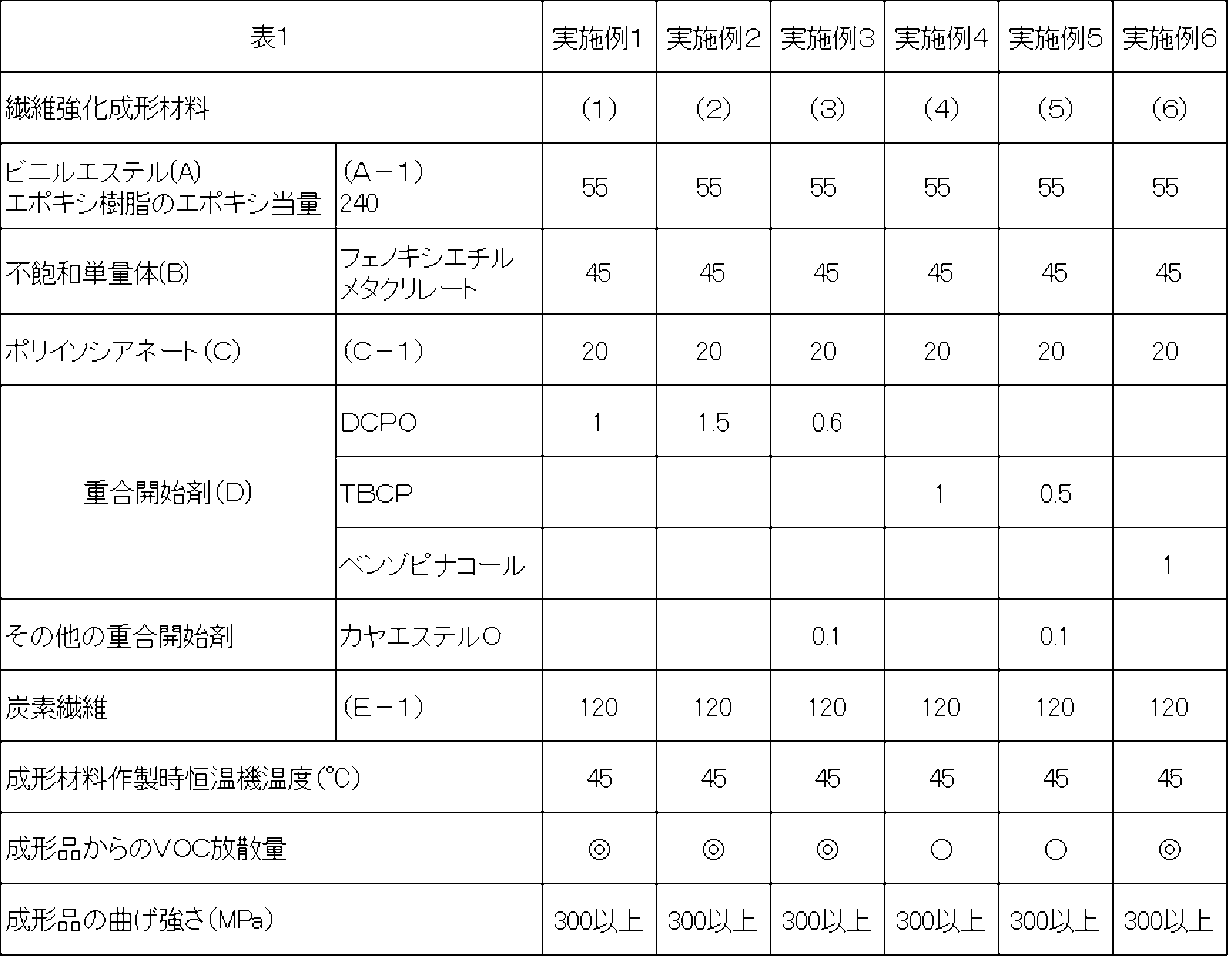

実施例1~10の本発明の繊維強化成形材料から得られる成形品は、揮発性有機化合物の放散量が抑制され、曲げ強さに優れることが確認された。
一方、比較例1は、本発明の必須成分である特定構造を有する重合開始剤を使用しない例であるが、成形品から多量の揮発性有機化合物を放散していることが確認された。
Claims (9)
- ビニルエステル(A)、不飽和単量体(B)、ポリイソシアネート(C)、及び重合開始剤(D)を必須原料とする成形用樹脂組成物であって、前記重合開始剤(D)が、一般式(1)で表される化合物(D1)、ベンゾピナコール又はそのエステル化合物(D2)、及びアゾ基を有する化合物(D3)からなる群より選ばれる1種以上の化合物であることを特徴とする成形用樹脂組成物。

- 前記アゾ基を有する重合開始剤(D3)の10時間半減期温度が、60~100℃の範囲である請求項1記載の成形用樹脂組成物。
- 前記アゾ基を有する重合開始剤(D3)が、下記一般式(2)で表されるものである請求項1又は2記載の成形用樹脂組成物。
- 前記ビニルエステル(A)が、エポキシ当量が135~500の範囲であるエポキシ樹脂(a1)と(メタ)アクリル酸(a2)との反応物である請求項1~3のいずれか1項記載の成形用樹脂組成物。
- 前記不飽和単量体(B)が、フェノキシエチルメタクリレート及び/又はベンジルメタクリレートである請求項1~4のいずれか1項記載の成形用樹脂組成物。
- 前記エポキシ樹脂(a1)のエポキシ基(EP)と前記(メタ)アクリル酸(a2)のカルボキシル基(COOH)とのモル比(COOH/EP)が0.6~1.1の範囲である請求項4又は5記載の成形用樹脂組成物。
- 前記ポリイソシアネート(C)が、芳香族ポリイソシアネートである請求項1~6のいずれか1項記載の成形用樹脂組成物。
- 請求項1~7のいずれか1項記載の成形用樹脂組成物、及び強化繊維(E)を含有することを特徴とする繊維強化成形材料。
- 請求項8記載の繊維強化成形材料を用いた成形品。
Priority Applications (2)
| Application Number | Priority Date | Filing Date | Title |
|---|---|---|---|
| EP19876963.0A EP3872111B1 (en) | 2018-10-24 | 2019-10-08 | Molding resin composition, fiber-reinforced molding material, and molded article therefrom |
| JP2020544548A JP6886589B2 (ja) | 2018-10-24 | 2019-10-08 | 成形用樹脂組成物、繊維強化成形材料及びそれを用いた成形品 |
Applications Claiming Priority (6)
| Application Number | Priority Date | Filing Date | Title |
|---|---|---|---|
| JP2018200031 | 2018-10-24 | ||
| JP2018-200031 | 2018-10-24 | ||
| JP2018209709 | 2018-11-07 | ||
| JP2018-209709 | 2018-11-07 | ||
| JP2019-023547 | 2019-02-13 | ||
| JP2019023547 | 2019-02-13 |
Publications (1)
| Publication Number | Publication Date |
|---|---|
| WO2020085075A1 true WO2020085075A1 (ja) | 2020-04-30 |
Family
ID=70331144
Family Applications (1)
| Application Number | Title | Priority Date | Filing Date |
|---|---|---|---|
| PCT/JP2019/039600 Ceased WO2020085075A1 (ja) | 2018-10-24 | 2019-10-08 | 成形用樹脂組成物、繊維強化成形材料及びそれを用いた成形品 |
Country Status (3)
| Country | Link |
|---|---|
| EP (1) | EP3872111B1 (ja) |
| JP (1) | JP6886589B2 (ja) |
| WO (1) | WO2020085075A1 (ja) |
Cited By (2)
| Publication number | Priority date | Publication date | Assignee | Title |
|---|---|---|---|---|
| WO2023089999A1 (ja) * | 2021-11-18 | 2023-05-25 | Dic株式会社 | ラジカル硬化性樹脂組成物、繊維強化成形材料、及びそれを用いた成形品 |
| EP4174127A4 (en) * | 2020-06-25 | 2024-07-24 | DIC Corporation | ROOT-CURABLE RESIN COMPOSITION, FIBER-REINFORCED MOLDING MATERIAL, AND MOLDED ARTICLE USING SAME |
Families Citing this family (1)
| Publication number | Priority date | Publication date | Assignee | Title |
|---|---|---|---|---|
| US12269912B2 (en) | 2019-05-16 | 2025-04-08 | Dic Corporation | Fiber-reinforced molding material and molded article using same |
Citations (5)
| Publication number | Priority date | Publication date | Assignee | Title |
|---|---|---|---|---|
| JP2005247879A (ja) * | 2004-03-01 | 2005-09-15 | Showa Highpolymer Co Ltd | 繊維強化複合材料用組成物及びその成形材料 |
| JP2009013306A (ja) | 2007-07-05 | 2009-01-22 | Honda Motor Co Ltd | 炭素繊維強化シート状成形材料及びその製造方法 |
| JP2009019099A (ja) * | 2007-07-11 | 2009-01-29 | Showa Highpolymer Co Ltd | 繊維強化複合材料用樹脂組成物、それを用いた成形材料及び繊維強化複合材料 |
| WO2013018237A1 (ja) * | 2011-08-01 | 2013-02-07 | 昭和電工株式会社 | 圧力容器の製造方法 |
| JP2015021091A (ja) * | 2013-07-22 | 2015-02-02 | Dic株式会社 | 硬化性組成物及びその硬化物 |
Family Cites Families (3)
| Publication number | Priority date | Publication date | Assignee | Title |
|---|---|---|---|---|
| US4296215A (en) * | 1978-07-27 | 1981-10-20 | Ici Americas Inc. | Method to thicken dissolved thermoset resins |
| DE102011050035A1 (de) * | 2011-05-02 | 2012-11-08 | Byk-Chemie Gmbh | Emissionsarmes, durch radikalische Polymerisation thermisch härtbares Faser-Matrix-Halbzeug |
| ES2901423T3 (es) * | 2016-10-11 | 2022-03-22 | Dainippon Ink & Chemicals | Material de moldura reforzado con fibra y artículo moldeado utilizando el mismo |
-
2019
- 2019-10-08 WO PCT/JP2019/039600 patent/WO2020085075A1/ja not_active Ceased
- 2019-10-08 JP JP2020544548A patent/JP6886589B2/ja active Active
- 2019-10-08 EP EP19876963.0A patent/EP3872111B1/en active Active
Patent Citations (5)
| Publication number | Priority date | Publication date | Assignee | Title |
|---|---|---|---|---|
| JP2005247879A (ja) * | 2004-03-01 | 2005-09-15 | Showa Highpolymer Co Ltd | 繊維強化複合材料用組成物及びその成形材料 |
| JP2009013306A (ja) | 2007-07-05 | 2009-01-22 | Honda Motor Co Ltd | 炭素繊維強化シート状成形材料及びその製造方法 |
| JP2009019099A (ja) * | 2007-07-11 | 2009-01-29 | Showa Highpolymer Co Ltd | 繊維強化複合材料用樹脂組成物、それを用いた成形材料及び繊維強化複合材料 |
| WO2013018237A1 (ja) * | 2011-08-01 | 2013-02-07 | 昭和電工株式会社 | 圧力容器の製造方法 |
| JP2015021091A (ja) * | 2013-07-22 | 2015-02-02 | Dic株式会社 | 硬化性組成物及びその硬化物 |
Non-Patent Citations (1)
| Title |
|---|
| See also references of EP3872111A4 |
Cited By (3)
| Publication number | Priority date | Publication date | Assignee | Title |
|---|---|---|---|---|
| EP4174127A4 (en) * | 2020-06-25 | 2024-07-24 | DIC Corporation | ROOT-CURABLE RESIN COMPOSITION, FIBER-REINFORCED MOLDING MATERIAL, AND MOLDED ARTICLE USING SAME |
| WO2023089999A1 (ja) * | 2021-11-18 | 2023-05-25 | Dic株式会社 | ラジカル硬化性樹脂組成物、繊維強化成形材料、及びそれを用いた成形品 |
| JP7298800B1 (ja) * | 2021-11-18 | 2023-06-27 | Dic株式会社 | ラジカル硬化性樹脂組成物、繊維強化成形材料、及びそれを用いた成形品 |
Also Published As
| Publication number | Publication date |
|---|---|
| EP3872111B1 (en) | 2024-08-28 |
| EP3872111A1 (en) | 2021-09-01 |
| EP3872111A4 (en) | 2022-07-13 |
| JP6886589B2 (ja) | 2021-06-16 |
| JPWO2020085075A1 (ja) | 2021-02-15 |
Similar Documents
| Publication | Publication Date | Title |
|---|---|---|
| JP6241583B1 (ja) | 繊維強化成形材料及びそれを用いた成形品 | |
| EP3395869B1 (en) | Prepreg and molded article | |
| JP6156612B1 (ja) | 加熱圧縮成形用成形材料、それを用いた成形品及びその製造方法 | |
| WO2017163899A1 (ja) | プリプレグ及び成形品 | |
| JP6886589B2 (ja) | 成形用樹脂組成物、繊維強化成形材料及びそれを用いた成形品 | |
| JP6708312B2 (ja) | 繊維強化成形材料及びそれを用いた成形品 | |
| JP7087358B2 (ja) | 繊維強化成形材料及びそれを用いた成形品 | |
| WO2020213414A1 (ja) | 繊維強化成形材料及びそれを用いた成形品 | |
| JP7334570B2 (ja) | 成形材料及び成形品の製造方法 | |
| JP7003583B2 (ja) | 繊維強化成形材料及びそれを用いた成形品 | |
| JP6966026B2 (ja) | 繊維強化成形材料及びそれを用いた成形品 | |
| JP7739763B2 (ja) | ラジカル硬化性樹脂組成物、成形材料、及びそれを用いた成形品 | |
| JP7298800B1 (ja) | ラジカル硬化性樹脂組成物、繊維強化成形材料、及びそれを用いた成形品 | |
| JP7136393B2 (ja) | ラジカル硬化性樹脂組成物、繊維強化成形材料、及びそれを用いた成形品 | |
| JP2024040268A (ja) | 成形用樹脂組成物、繊維強化成形材料及びそれを用いた成形品 | |
| JP2025047196A (ja) | 硬化性樹脂組成物、繊維強化成形材料及びそれを用いた成形品 | |
| JP2026048292A (ja) | 樹脂成形体及びその製造方法 |
Legal Events
| Date | Code | Title | Description |
|---|---|---|---|
| 121 | Ep: the epo has been informed by wipo that ep was designated in this application |
Ref document number: 19876963 Country of ref document: EP Kind code of ref document: A1 |
|
| ENP | Entry into the national phase |
Ref document number: 2020544548 Country of ref document: JP Kind code of ref document: A |
|
| NENP | Non-entry into the national phase |
Ref country code: DE |
|
| ENP | Entry into the national phase |
Ref document number: 2019876963 Country of ref document: EP Effective date: 20210525 |