WO2020092639A1 - Amino acid compositions and methods for treating cystic fibrosis - Google Patents
Amino acid compositions and methods for treating cystic fibrosis Download PDFInfo
- Publication number
- WO2020092639A1 WO2020092639A1 PCT/US2019/058954 US2019058954W WO2020092639A1 WO 2020092639 A1 WO2020092639 A1 WO 2020092639A1 US 2019058954 W US2019058954 W US 2019058954W WO 2020092639 A1 WO2020092639 A1 WO 2020092639A1
- Authority
- WO
- WIPO (PCT)
- Prior art keywords
- cftr
- amino acids
- free amino
- certain embodiments
- pharmaceutical formulation
- Prior art date
- Legal status (The legal status is an assumption and is not a legal conclusion. Google has not performed a legal analysis and makes no representation as to the accuracy of the status listed.)
- Ceased
Links
Classifications
-
- A—HUMAN NECESSITIES
- A61—MEDICAL OR VETERINARY SCIENCE; HYGIENE
- A61K—PREPARATIONS FOR MEDICAL, DENTAL OR TOILETRY PURPOSES
- A61K31/00—Medicinal preparations containing organic active ingredients
- A61K31/33—Heterocyclic compounds
- A61K31/395—Heterocyclic compounds having nitrogen as a ring hetero atom, e.g. guanethidine or rifamycins
- A61K31/40—Heterocyclic compounds having nitrogen as a ring hetero atom, e.g. guanethidine or rifamycins having five-membered rings with one nitrogen as the only ring hetero atom, e.g. sulpiride, succinimide, tolmetin, buflomedil
- A61K31/401—Proline; Derivatives thereof, e.g. captopril
-
- A—HUMAN NECESSITIES
- A61—MEDICAL OR VETERINARY SCIENCE; HYGIENE
- A61P—SPECIFIC THERAPEUTIC ACTIVITY OF CHEMICAL COMPOUNDS OR MEDICINAL PREPARATIONS
- A61P11/00—Drugs for disorders of the respiratory system
-
- A—HUMAN NECESSITIES
- A61—MEDICAL OR VETERINARY SCIENCE; HYGIENE
- A61K—PREPARATIONS FOR MEDICAL, DENTAL OR TOILETRY PURPOSES
- A61K31/00—Medicinal preparations containing organic active ingredients
- A61K31/185—Acids; Anhydrides, halides or salts thereof, e.g. sulfur acids, imidic, hydrazonic or hydroximic acids
- A61K31/19—Carboxylic acids, e.g. valproic acid
- A61K31/195—Carboxylic acids, e.g. valproic acid having an amino group
- A61K31/197—Carboxylic acids, e.g. valproic acid having an amino group the amino and the carboxyl groups being attached to the same acyclic carbon chain, e.g. gamma-aminobutyric acid [GABA], beta-alanine, epsilon-aminocaproic acid or pantothenic acid
- A61K31/198—Alpha-amino acids, e.g. alanine or edetic acid [EDTA]
-
- A—HUMAN NECESSITIES
- A61—MEDICAL OR VETERINARY SCIENCE; HYGIENE
- A61K—PREPARATIONS FOR MEDICAL, DENTAL OR TOILETRY PURPOSES
- A61K31/00—Medicinal preparations containing organic active ingredients
- A61K31/33—Heterocyclic compounds
- A61K31/395—Heterocyclic compounds having nitrogen as a ring hetero atom, e.g. guanethidine or rifamycins
- A61K31/435—Heterocyclic compounds having nitrogen as a ring hetero atom, e.g. guanethidine or rifamycins having six-membered rings with one nitrogen as the only ring hetero atom
- A61K31/47—Quinolines; Isoquinolines
-
- A—HUMAN NECESSITIES
- A61—MEDICAL OR VETERINARY SCIENCE; HYGIENE
- A61K—PREPARATIONS FOR MEDICAL, DENTAL OR TOILETRY PURPOSES
- A61K45/00—Medicinal preparations containing active ingredients not provided for in groups A61K31/00 - A61K41/00
- A61K45/06—Mixtures of active ingredients without chemical characterisation, e.g. antiphlogistics and cardiaca
-
- A—HUMAN NECESSITIES
- A61—MEDICAL OR VETERINARY SCIENCE; HYGIENE
- A61P—SPECIFIC THERAPEUTIC ACTIVITY OF CHEMICAL COMPOUNDS OR MEDICINAL PREPARATIONS
- A61P43/00—Drugs for specific purposes, not provided for in groups A61P1/00-A61P41/00
Definitions
- compositions and methods described herein are useful for treating cystic fibrosis in subjects bearing one or more mutations in the CFTR protein. Use of these compositions for the treatment of cystic fibrosis and in the preparation of a medicament for the treatment of cystic fibrosis are also encompassed herein.
- Cystic fibrosis is a hereditary recessive disease caused by reduction or lack of CFTR synthesis, protein misfolding and/or channel dysfunction resulting in decreased chloride secretion, increased sodium absorption (ENaC), and impaired fluid homeostasis in airways, intestinal and pancreas epithelial cells.
- CF is the most common life-limiting genetic disorder that can affect the lungs, liver, pancreas, kidneys, and intestines.
- Cystic fibrosis is inherited in an autosomal recessive manner, where each parent carries a mutation in at least one allele of the gene encoding the cystic fibrosis transmembrane conductance (CFTR) protein, leading to one out of four progeny carrying two mutated copies (e.g., alleles) of the
- Phe, single letter code: F Phe, single letter code: F.
- This mutation results in defective CFTR protein processing (e.g., folding and trafficking to the plasma membrane), resulting in little to no membrane expression of CFTR, a chloride ion transporter protein involved in ion and water transport across the cell membrane.
- the small amount of Phe508del CFTR that successfully translocates to the plasma membrane is often functionally defective, as characterized by impaired chloride ion transport.
- CFTR mutations lead to the dysregulation of the ion gradient across membranes, resulting in reduced osmotic pressure for water to flow out of the epithelial cells and manifestation of a thick mucus layer that covers the cells.
- the thick, nutrient rich mucus serves as an optimal environment for the trapping and growth of bacteria, such as Pseudomonas aeruginosa and Staphylococcus aureus, that lead to persistent infection that is often unresponsive to antibiotics.
- bacteria such as Pseudomonas aeruginosa and Staphylococcus aureus
- many CF patients also develop other lung diseases, such as bronchopulmonary aspergilliosis and bronchiectasis, leading to increased morbidity and mortality.
- KAYLDECO ⁇ a sm all molecule potentiator of CFTR, ⁇ as described in U.S. Patent Application Publication US 2014/0221424 and International Patent ApplicationNumber PCT/US2015/036691.
- ivacaftor is directed to the treatment of CF in patients with the missense mutation Gly55lAsp (G551D) on at least one allele of the CFTR gene, which encompasses around 4 to 5% of patients suffering from CF. ⁇
- Gly55lAsp G551D
- FIG.5 shows a graph depicting basal chloride flux.
- Non-stimulated CF cells bathed in vehicle do not secrete chloride.
- FIG.6 shows a graph depicting basal chloride flux.
- FIG.7A-7F shows graphs depicting anion currents and stimulated chloride flux.
- FIGs. 7C , 7D, 7E, and 7F show that CF cells bathed in CF-5AA-3 had a significantly higher anion peak current (FIG. 7E) and total chloride secretion (FIG. 7F), and stimulation with FSK and GLPG1837 did not contribute to the increased values in the presence of AA (FIGs. 7C, D).
- FIG. 8A and FIG.8B show graphs depicting ENaC activity and blocked sodium flux.
- FIG.9 shows a graph depicting an effect of the indicated AA formulation on ENaC activity in CF cells.
- FIG. 10A and FIG.10 B present graphs depicting an effect of C18 (corrector; similar to Lumacaftor) and/or VX661 (corrector; tezacaftor) in the presence of forskolin and potentiator on CFTRAF508 cells.
- Ivacaftor GLPG1837 (reversible potentiator); Symdeko:
- CF5AA-3 increased current to a greater extent than C18 or
- FIG. 11 shows a graph depicting 36 Chloride flux studies in primary HBECs with CFTR ⁇ F508 showed increased chloride secretion responsive to CF-5AA-3.
- FIG. 12 presents a graph showing that CF5AA-3 increased anion current via CFTR in primary HBECs with CFTR ⁇ F508. Anion current by CF5AA-3 is significantly higher and sustained when compared to triple combination.
- FIG. 13 presents a graph showing that CF5AA-3 increased anion current via Anol.
- Anol- mediated current by CF5AA-3 is significantly higher and sustained when compared to tire current observed with triple combination.
- FIG. 14 presents a graph showing that CF5AA-3 increases apical anion secretion to a degree similar to that of the indicated correctors and potentiators.
- the present disclosure recognizes the need to provide more cost-effective and efficacious treatment options for cystic fibrosis patients.
- the amino acid compositions described herein may be particularly useful in treating CF patients carrying at least one Phe508del mutation on an allele of the CFTR gene.
- a CFTR potentiator e.g., ivacaftor
- the present disclosure provides compositions shown to increase the translocation of both wild-type and Phe508del CFTR proteins from the cytoplasm to the plasma membrane.
- the compositions described herein are particularly effective at increasing the number of mutant CFTR proteins on the plasma membrane.
- methods for treating diseases in which CFTR dysfunction is present are also provided herein.
- the present invention provides a formulation comprising: cysteine and proline as free amino adds and at least one additional free amino acid selected from the group consisting of glycine, tyrosine and lysine, with the proviso that at least one of the free amino acids is an L-amino acid.
- the free amino acids are L- amino acids.
- the formulation does not comprise free amino acids other than cysteine, proline and at least one additional amino acid selected from the group consisting of glycine, tyrosine and lysine.
- the formulation consists essentially of: cysteine and proline as free amino acids and one or more additional free amino acids selected from the group consisting of glycine, tyrosine and lysine, with the proviso that at least one of the free amino acids is an L-amino acid.
- the formulation consists of: cysteine and proline as free amino acids and one or more additional free amino acids selected from the group consisting of glycine, tyrosine and lysine, with the proviso that at least one of the free amino acids is an L-amino acid.
- the formulation comprises, consists, or consists essentially of cysteine, proline and glycine as free amino acids and optionally one or more additional free amino acids selected from the group consisting of tyrosine and lysine, with the proviso that at least one of the free amino acids is an L-amino acid.
- the formulation comprises, consists, or consists essentially of cysteine, proline and glycine as free amino acids, with the proviso that at least one of the free amino acids is an L-amino acid, and no other free amino acids.
- the formulation comprises, consists, or consists essentially of cysteine, proline and tyrosine as free amino acids and optionally one or more additional free amino acids selected from the group consisting of glycine and lysine, with the proviso that at least one of the free amino acids is an L-amino acid.
- the formulation comprises, consists, or consists essentially of cysteine, proline and tyrosine as free amino acids, with the proviso that at least one of the free amino acids is an L-amino acid, and no other free amino acids.
- the formulation comprises, consists, or consists essentially of cysteine, proline and lysine as free amino acids and optionally one or more additional free amino acids selected from the group consisting of glycine and tyrosine, with the proviso that at least one of the free amino acids is an L-amino acid.
- the formulation comprises, consists, or consists essentially of cysteine, proline and lysine as free amino acids, with the proviso that at least one of the free amino acids is an L-amino acid, and no other free amino acids.
- the formulation comprises, consists, or consists essentially of cysteine, proline, glycine and tyrosine as free amino acids and optionally additionally comprises lysine as a free amino acid, with the proviso that at least one of the free amino acids is an L-amino acid.
- the formulation comprises, consists or consists essentially of cysteine, proline, glycine and tyrosine as free amino acids, with the proviso that at least one of the free amino acids is an L-amino acid, and no other free amino acids.
- the formulation comprises, consists, or consists essentially of cysteine, proline, glycine and lysine as free amino acids and optionally additionally comprises tyrosine as a free amino acid, with the proviso that at least one of the free amino acids is an L-amino acid.
- the formulation comprises, consists, or consists essentially of cysteine, proline, glycine and lysine as free amino acids, with the proviso that at least one of the free amino acids is an L-amino acid, and no other free amino acids.
- the formulation comprises, consists, or consists essentially of cysteine, proline, lysine and tyrosine as free amino acids and optionally additionally comprises glycine as a free amino acid, with the proviso that at least one of the free amino acids is an L-amino acid.
- the formulation comprises, consists, or consists essentially of cysteine, proline, lysine and tyrosine as free amino acids, with the proviso that at least one of the free amino acids is an L-amino acid, and no other free amino acids.
- the formulation comprises, consists, or consists essentially of cysteine, proline, glycine, tyrosine and lysine as free amino acids with the proviso that at least one of the free amino acids is an L-amino acid.
- the formulation comprises no other free amino acids.
- the present invention provides a formulation comprising: cysteine and proline as free amino adds and at least one additional free amino acid selected from the group consisting of glycine, tyrosine, lysine, and valine, with the proviso that at least one of the free amino acids is an L-amino acid.
- the free amino acids are L- amino acids.
- the formulation does not comprise free amino acids other than cysteine, proline and at least one additional amino acid selected from the group consisting of glycine, tyrosine, lysine, and valine.
- the formulation comprises, consists, or consists essentially of cysteine, proline, and valine as free amino acids, with the proviso that at least one of the free amino acids is an L-amino acid.
- the formulation comprises, consists, or consists essentially of cysteine, proline, valine, and glycine as free amino acids, with the proviso that at least one of the free amino acids is an L-amino acid.
- the formulation comprises, consists, or consists essentially of cysteine, proline, valine, and tyrosine as free amino acids, with the proviso that at least one of the free amino acids is an L-amino acid.
- any one of the formulations of the second aspect comprises no other free amino acids.
- the formulation further comprises water.
- the formulation is a pharmaceutical formulation.
- the formulation further comprises a pharmaceutically acceptable carrier, buffer, electrolyte, adjuvant, or excipient.
- the formulation is sterile.
- the formulation is formulated for administration by an enteral, pulmonary, inhalation, intranasal, or sublingual route.
- each free amino acid is present in a therapeutically effective amount.
- the present invention provides a formulation as described hereinabove, for use as a medicament.
- a formulation as described hereinabove is for use in the treatment of cystic fibrosis.
- the invention also provides the use of a formulation as described hereinabove, in the manufacture of a medicament for the treatment of cystic fibrosis.
- the present invention provides a method for treating a subject afflicted with cystic fibrosis, the method comprising administering to the subject afflicted with cystic fibrosis the formulation as herein above described, wherein the administering reduces at least one symptom of cystic fibrosis.
- the subject afflicted with cystic fibrosis expresses wild-type CFTR.
- the subject has a mutation in the CFTR gene.
- the subject expresses wild-type CFTR and mutant CFTR.
- the subject is afflicted with cystic fibrosis in which a CFTR protein that is at least 90%, at least 95%, at least 98%, at least 99%, or at least 99.5% identical to the amino acid sequence of wild-type CFTR is present, wherein the wild-type CFTR sequence comprises SEQ ID NO: 1.
- the mutation in the CFTR comprises Gly542X, Gly55lAsp, Arg553X, Argl l7His, l20del23, Phe508del, or a combination thereof, wherein X is any amino acid.
- the CFTR is a Phe508del CFTR mutant.
- the formulation as described herein above is used in combination with an additional therapeutic agent.
- the additional therapeutic agent comprises at least one of a small molecule drug, protein drug, nucleic acid drug, or combination thereof. In one embodiment, the additional therapeutic agent is at least one of a CFTR potentiator, CFTR corrector, CFTR read-through agent, or a combination thereof. In one embodiment, the additional therapeutic agent is a CFTR potentiator. In one embodiment, the CFTR potentiator is ivacaftor.
- kits comprising: a pharmaceutical formulation as described hereinabove; and instructions for administering to a subject or contacting a biological sample with the formulation.
- a method for increasing the number of cystic fibrosis transmembrane conductance regulator (CFTR) proteins present on the plasma membrane of at least one cell comprising: contacting the at least one cell with an effective amount of the pharmaceutical formulation as described hereinabove, wherein the contacting promotes at least one of folding of CFTR or transport of CFTR to the plasma membrane, thereby increasing the number of CFTR proteins present on the plasma membrane of the cell.
- CFTR cystic fibrosis transmembrane conductance regulator
- the number of wild-type CFTR proteins on the plasma membrane increases. In one embodiment, the number of mutant CFTR proteins on the plasma membrane increases. In one embodiment, the number of CFTR proteins that are at least 90%, at least 95%, at least 98%, at least 99%, or at least 99.5% identical to the amino acid sequence of wild-type CFTR on the plasma membrane increases, wherein the wild-type CFTR comprises SEQ ID NO: 1. In one embodiment, one or more of the CFTR proteins comprise Gly542X, Gly55lAsp, Arg553X, Argl l7His, !20del23, Phe508del, or a combination thereof, wherein X is any amino acid.
- one or more of the CFTR proteins comprise the Phe508del mutation.
- increasing the number of CFTR proteins present on the plasma membrane of the cell is detected by increased chloride ion export from the cell.
- increasing the number of CFTR proteins present on the plasma membrane of the cell is associated with increased water export from the cell.
- the cell is an epithelial cell.
- the epithelial cell is a lung epithelial cell.
- the lung epithelial cell is a bronchial epithelial cell.
- the bronchial epithelial cell is isolated from a subject afflicted with cystic fibrosis.
- a pharmaceutical formulation comprising: a therapeutically effective amount of cysteine and proline as free amino adds and a therapeutically effective amount of at least one additional free amino acid consisting of glycine, tyrosine or lysine, with the proviso that at least one of the free amino acids is an L-amino acid, wherein the
- pharmaceutical formulation consists essentially of cysteine, proline, and the at least one additional free amino acid.
- the free amino acids are L- amino acids.
- the pharmaceutical formulation further comprises water.
- the pharmaceutical formulation further comprises a pharmaceutically acceptable carrier, buffer, electrolyte, adjuvant, or excipient.
- the pharmaceutical formulation is sterile.
- the pharmaceutical formulation is formulated for administration by an enteral, pulmonary, inhalation, intranasal, or sublingual route.
- the pharmaceutical formulation comprises, consists essentially of, or consists of a therapeutically effective amount of cysteine and proline as free amino adds and a therapeutically effective amount of at least one additional free amino acid consisting of glycine, tyrosine or lysine, and no other free amino acids.
- Combinations of the recited amino acids include, for example: cysteine, proline, and glycine; cysteine, proline, and tyrosine; cysteine, proline, and lysine; cysteine, proline, glycine, and tyrosine; cysteine, proline, glycine, and lysine; cysteine, proline, glycine, and lysine; cysteine, proline, tyrosine, and lysine; and cysteine, proline, glycine, tyrosine, and lysine.
- the pharmaceutical formulation comprises, consists essentially of, or consists of a therapeutically effective amount of cysteine and proline as free amino adds and a therapeutically effective amount of at least one additional free amino acid consisting of glycine, tyrosine, lysine, or valine, and no other free amino acids.
- Combinations of the recited amino acids include, for example: cysteine, proline, and valine; cysteine, proline, valine, and glycine; and cysteine, proline, valine, and tyrosine.
- the pharmaceutical formulation comprises a therapeutically effective amount of each of cysteine, proline, glycine, tyrosine and lysine, as free amino adds and no other free amino acids.
- the pharmaceutical formulation consists essentially of or consists of a therapeutically effective amount of each of cysteine, proline, glycine, tyrosine and lysine, as free amino adds.
- the pharmaceutical formulation is for use in therapy.
- the pharmaceutical formulation is for use in the treatment of cystic fibrosis.
- the pharmaceutical formulation is used for the manufacture of a medicament for treatment of cystic fibrosis.
- a method for treating a subjed afflided with cystic fibrosis comprising administering to the subject afflicted with cystic fibrosis a pharmaceutical formulation described herein, wher n the administering reduces at least one symptom of cystic fibrosis.
- the subject expresses wild-type CFTR.
- the subject has a mutation in the CFTR gene.
- the subject expresses wild-type CFTR and mutant CFTR.
- the subject is afflicted with cystic fibrosis in which a CFTR protein that is at least 90%, at least 95%, at least 98%, at least 99%, or at least 99.5% identical to the amino acid sequence of wild-type CFTR is present, wherein the wild-type CFTR sequence comprises SEQ ID NO: 1.
- the mutation in the CFTR comprises Gly542X, Gly55 lAsp, Arg553X, Argl l7His, l20del23, Phe508del,oracombinatiai tfiereofj wherein X is any amino acid.
- the CFTR is a Phe508del CFTR mutant.
- the method further comprises administering an additional therapeutic agent.
- the additional therapeutic agent comprises at least one of a small molecule drug, protein drug, nucleic acid drug, or combination thereof.
- the additional therapeutic agent is at least one of a CFTR potentiator, CFTR corrector, CFTR read-through agent, or a combination thereof.
- the additional therapeutic agent is a CFTR potentiator.
- the CFTR potentiator is ivacaftor.
- the pharmaceutical formulation comprises, consists essentially of, or consists of a therapeutically effective amount of cysteine and proline as free amino adds and a therapeutically effective amount of at least one additional free amino acid consisting of glycine, tyrosine or lysine, and no other free amino acids.
- Combinations of the recited amino acids include, for example: cysteine, proline, and glycine; cysteine, proline, and tyrosine; cysteine, proline, and lysine; cysteine, proline, glycine, and tyrosine; cysteine, proline, glycine, and lysine; cysteine, proline, glycine, and lysine; cysteine, proline, tyrosine, and lysine; and cysteine, proline, glycine, tyrosine, and lysine.
- the pharmaceutical formulation comprises a therapeutically effective amount of each of cysteine, proline, glycine, tyrosine and lysine, as free amino adds and no other free amino acids.
- the pharmaceutical formulation consists essentially of or consists of a therapeutically effective amount of each of cysteine, proline, glycine, tyrosine and lysine, as free amino adds.
- transmembrane conductance regulator (CFTR) proteins present on the plasma membrane of at least one cell comprising: contacting the at least one cell with an effective amount of a pharmaceutical formulation described herein, wher n the contacting promotes at least one of folding of CFTR or transport of CFTR to the plasma membrane, thereby increasing the number of CFTR proteins present on the plasma membrane of the cell.
- the number of wild-type CFTR proteins on the plasma membrane increases.
- the number of mutant CFTR proteins on the plasma membrane increases.
- the number of CFTR proteins that are at least 90%, at least 95%, at least 98%, at least 99%, or at least 99.5% identical to the amino acid sequence of wild-type CFTR on the plasma membrane increases, wherein the wild-type CFTR comprises SEQ ID NO: 1.
- the one or more of the CFTR proteins comprise Gly542X, Gly55 lAsp, Arg553X, Argl l7His, l20del23, Phe508del,oracombination thereof; wherein X is any amino acid.
- the one or more of the CFTR proteins comprise the Phe508del mutation.
- the increasing the number of CFTR proteins present on the plasma membrane of the cell is detected by increased chloride ion export from the cell. In another particular embodiment of the method, the increasing the number of CFTR proteins present on the plasma membrane of the cell is associated with increased water export from the cell.
- the cell is an epithelial cell. In a more particular embodiment of the method, the epithelial cell is a lung epithelial cell. In a still more particular embodiment of the method, the lung epithelial cell is a bronchial epithelial cell.
- the bronchial epithelial cell is isolated from a subject afflicted with cystic fibrosis and results from in vitro assays performed on such cells provides guidance on what therapeutic agents and/or combinations thereof will confer therapeutic efficacy to the subject form whom the cells were isolated.
- the method further comprises administering an additional therapeutic agent.
- the additional therapeutic agent comprises at least one of a small molecule drug, protein drug, nucleic acid drug, or combination thereof.
- the additional therapeutic agent is at least one of a CFTR potentiator, CFTR corrector, CFTR read-through agent, or a combination thereof.
- the additional therapeutic agent is a CFTR potentiator.
- the CFTR potentiator is ivacaftor.
- the pharmaceutical formulation comprises, consists essentially of, or consists of a therapeutically effective amount of cysteine and proline as free amino adds and a therapeutically effective amount of at least one additional free amino acid consisting of glycine, tyrosine or lysine, and no other free amino acids.
- Combinations of the recited amino acids include, for example: cysteine, proline, and glycine; cysteine, proline, and tyrosine; cysteine, proline, and lysine; cysteine, proline, glycine, and tyrosine; cysteine, proline, glycine, and lysine; cysteine, proline, glycine, and lysine; cysteine, proline, tyrosine, and lysine; and cysteine, proline, glycine, tyrosine, and lysine.
- the pharmaceutical formulation comprises a therapeutically effective amount of each of cysteine, proline, glycine, tyrosine and lysine, as free amino adds and no other free amino acids.
- the pharmaceutical formulation consists essentially of or consists of a therapeutically effective amount of each of cysteine, proline, glycine, tyrosine and lysine, as free amino adds.
- kits comprising: a pharmaceutical formulation comprising, consisting essentially of, or consisting of cysteine, proline, glycine, tyrosine and lysine, as free amino acids; and instructions for administering to a subject or contacting a biological sample with the composition.
- the present disclosure provides compositions comprising, consisting essentially of, or consisting of a composition comprising, consisting essentially of, or consisting of cysteine, proline, glycine, tyrosine and lysine for use in treating cystic fibrosis.
- the present invention provides use of the compositions of amino acids to treat cystic fibrosis in a subject in needthereof.
- the present invention provides use of the compositions of amino acids in the preparation of a medicament for the treatment of cystic fibrosis in a subject in needthereof.
- compositions comprising, consisting essentially of, or consisting of, cysteine, proline, glycine, tyrosine and lysine.
- the amino acids are L- amino acids.
- the composition further comprises water.
- the composition further comprises a
- composition is sterile.
- composition is formulated for administration by an enteral, pulmonary, inhalation, intranasal, or sublingual route.
- the subject is suffering from cystic fibrosis in which wild- type CFTR is present.
- the subject has a mutation in the CFTR gene.
- the subject is suffering from cystic fibrosis in which both wild-type and mutant CFTR are present.
- the subject is suffering from cystic fibrosis in which a CFTR protein that is at least 90%, at least 95%, at least 98%, at least 99%, or at least 99.5% identical to the amino acid sequence of wild-type CFTR as provided by SEQ ID NO: 1 is present.
- the CFTR is a Gly542X, Gly55lAsp, Arg553X,
- the CFTR is a Phe508del CFTR mutant.
- CFTR cystic fibrosis transmembrane conductance regulator
- the method comprising contacting the cell with an effective amount of a composition comprising, consisting essentially of, or consisting of cysteine, proline, glycine, tyrosine and lysine.
- the effective amount increases the number of CFTR proteins present on the plasma membrane of the cell.
- the number of wild-type CFTR proteins on the plasma membrane increases.
- the number of mutant CFTR proteins on the plasma membrane increases.
- the number of CFTR proteins that are at least 90%, at least 95%, at least 98%, at least 99%, or at least 99.5% identical to the amino acid sequence of wild-type CFTR as provided by SEQ ID NO: 1 on the plasma membrane increases.
- the one or more of the CFTR proteins are aGly542X, Gly55lAsp, Arg553X, Argl l7His, l20del23, or Phe508del mutant, wherein X is any amino acid.
- the one or more of the CFTR proteins are a Phe508del CFTR mutant.
- chloride ion export from the cell is increased.
- the cell is an epithelial cell.
- the epithelial cell is a lung epithelial cell.
- the lung epithelial cell is a bronchial epithelial cell.
- the bronchial epithelial cell was obtained from a subject suffering from cystic fibrosis.
- the cells may be in vitro , in vivo, or exvivo.
- the methods provided herein further comprise administering an additional therapeutic agent.
- the additional therapeutic agent is a small molecule drug, protein drug, or nucleic acid drug.
- the additional therapeutic agent is a small molecule drug.
- the additional therapeutic agent is a CFTR potentiator, corrector, or read-through agent.
- the additional therapeutic agent is a CFTR potentiator.
- the CFTR potentiator is ivacaftor.
- the additional therapeutic agent is a CFTR corrector.
- the CFTR corrector is lumcaftor.
- the additional therapeutic agent may be included in any of the compositions described herein (e.g., the composition further comprises an additional therapeutic agent).
- the additional therapeutic agent may be administered concurrently with, prior to, or subsequently after, administration of any of the compositions described herein (e.g., combination therapy).
- the present disclosure provides a method for treating cystic fibrosis, the method comprising administering to a subject in need thereof a composition described herein, wherein the composition is formulated for administration by an enteral, pulmonary, inhalation, intranasal, or sublingual route.
- the composition is formulated for pulmonary administration to the subject.
- the composition is formulated for enteral administration to the subject.
- the composition is formulated for oral administration to the subject.
- the present disclosure provides a method for treating cystic fibrosis, the method comprising administering to a subject in need thereof a composition described herein.
- the subject is suffering from cystic fibrosis in which the subject has a mutation in the CFTR gene.
- the subject is suffering from cystic fibrosis in which the subject is heterozygous for both wild-type CFTR and mutant CFTR.
- the subject is suffering from cystic fibrosis in which the subject is heterozygous for a first mutant CFTR and a second mutant CFTR (e.g., wherein the mutations are different).
- the subject is suffering from cystic fibrosis in which the subject is homozygous for mutant CFTR (e.g., both alleles have the same mutation). In certain embodiments, the subject is suffering from cystic fibrosis in which the subject is homozygous for wild-type CFTR (e.g., both alleles are not mutated).
- the mutant CFTR is a Gly542X, Gly55lAsp, Arg553X, Argl l7His, l20del23, or Phe508del CFTR mutant, wherein X is any amino acid. In certain embodiments, the mutant CFTR is a Phe508del CFTR mutant.
- the CFTR protein present in the subject is least 90%, at least 95%, at least 98%, at least 99%, or at least 99.5% identical to the amino acid sequence of wild-type CFTR as provided by SEQ ID NO: 1. In certain embodiments, the CFTR protein present in the subject is least 90%, at least 95%, at least 98%, at least 99%, or at least 99.5% identical to the amino acid sequence of Phe508del CFTR as provided by SEQ ID NO: 2.
- composition provided herein comprises, consists essentially of, or consists of one or more free amino acids selected from cysteine, proline, glycine, tyrosine and lysine, and no other free amino acids.
- compositions to treat cystic fibrosis in a subject in need thereof wherein the composition comprises cysteine, proline, glycine, tyrosine and lysine.
- kits comprising a composition comprising, consisting essentially of, or consisting of cysteine, proline, glycine, tyrosine and lysine; and instructions for administering to a subject or contacting a biological sample with the composition.
- agent is used herein to refer to any substance, compound (e.g., molecule), supramolecular complex, material, or combination or mixture thereof.
- a compound may be any agent that can be represented by a chemical formula, chemical structure, or sequence.
- agent include, e.g., small molecules, polypeptides, nucleic acids (e.g., RNAi agents, antisense oligonucleotide, aptamers), lipids,
- agents may be obtained using any suitable method known in the art. The ordinary skilled artisan will select an appropriate method based, e.g., on the nature of the agent.
- An agent may be at least partly purified.
- an agent may be provided as part of a composition, which may contain, e.g., a counter-ion, aqueous or non-aqueous diluent or carrier, buffer, preservative, or other ingredient, in addition to the agent, in various embodiments.
- an agent may be provided as a salt, ester, hydrate, or solvate.
- an agent is cell-permeable, e.g., within the range of typical agents that are taken up by cells and acts intracellularly, e.g., within mammalian cells, to produce a biological effect.
- Certain compounds may exist in particular geometric or stereoisomeric forms. Such compounds, including cis- and trans isomers, E- andZ-isomers, R- and S-enantiomers, diastereomers, (D)-isomers, (L)-isomers, (-)- and (+)- isomers, racemic mixtures thereof, and other mixtures thereof are
- compositions may exist as solvates [e.g., with water (i.e. hydrates) or common solvents] and/or may have different crystalline forms (e.g., polymorphs) or different tautomeric forms.
- solvates e.g., with water (i.e. hydrates) or common solvents
- crystalline forms e.g., polymorphs
- tautomeric forms e.g., polymorphs
- agent may also encompass a“therapeutic agent”.
- the term“compound” and“agent” may be used interchangeably.
- an“effective amount” or“effective dose” of an agent refers to the amount sufficient to achieve a desired biological and/or pharmacological effect, e.g., when delivered to a cell or organism according to a selected administration form, route, and/or schedule.
- the phrases“effective amount” and “therapeutically effective amount” are used interchangeably.
- the absolute amount of a particular agent or composition that is effective may vary depending on such factors as the desired biological or pharmacological endpoint, the agent to be delivered, the target tissue, etc.
- an“effective amount” may be contacted with cells or administered to a subject in a single dose, or through use of multiple doses, in various embodiments.
- an effective amount is an amount that increases the trafficking of CFTR to the plasma membrane of a cell.
- an effective amount is an amount that increases the translocation of CFTR from the cytoplasm to the plasma membrane of a cell. In certain embodiments, an effective amount is an amount that increases the chloride ion export from a cell. In certain embodiments, an effective amount is an amount that increases water export from a cell. In certain embodiments, an effective amount is an amount that reduces the symptoms of and/or treats a lung disease. In certain embodiments, an effective amount is an amount that reduces the symptoms of and/or treats cystic fibrosis.
- compositions and use thereof for the treatment of cystic fibrosis and methods for treating cystic fibrosis limits the scope of the ingredients and steps to the specified materials or steps and those that do not materially affect the basic and novel characteristic(s) of the present invention, e.g., compositions and use thereof for the treatment of cystic fibrosis and methods for treating cystic fibrosis.
- the therapeutic composition does not contain any unspecified ingredients including, but not limited to, free amino acids, di-, oligo-, or polypeptides or proteins; and mono-, di-, oligo-, polysaccharides, and carbohydrates that have a direct beneficial or adverse therapeutic effect on treatment of cystic fibrosis.
- composition may comprise substances that do not have therapeutic effects on the treatment of cystic fibrosis; such ingredients include carriers, excipients, adjuvants, flavoring agents, etc. that do not affect the health or function of the lung epithelium.
- the term“gene” refers to a locus (e.g., region) of DNA that is comprised of nucleotides. Generally, a gene contains multiple regions, including one or more upstream or downstream regulatory sequences (e.g., enhancer/silencer, promoter, 5' non-coding sequences, 3’ non-coding sequences) that is normally required to initiate transcription, an open reading frame comprising one or more exons and one or more introns.
- An“exon” is any part of a gene that will encode part of the final mature RNA, which will be translated into a protein sequence.
- An“intron” is any part of a gene that is removed by RNA splicing during maturation of the final mature RNA.
- A“cryptic exon” is an exon that can introduce a premature translation stop codon into mature RNA or result in atypical splicing patterns.
- the term“gene” may refer to a nucleic acid fragment that expresses a protein, including regulatory sequences preceding (5' non-coding sequences) and following (3' non-coding sequences) the coding sequence.“Native gene” refers to a gene as found in nature with its own regulatory sequences.
- a chimeric gene or chimeric construct may comprise regulatory sequences and coding sequences that are derived from different sources, or regulatory sequences and coding sequences derived from the same source, but arranged in a manner different than that found in nature.
- “Endogenous gene” refers to a native gene in its natural location in the genome of an organism.
- A“foreign” gene refers to a gene not normally found in the host organism, but which is introduced into the host organism by gene transfer.
- Foreign genes can comprise native genes inserted into a non-native organism, or chimeric genes.
- RNA transcripts may be spliced, polyadenylated, etc., prior to mRNA translation, and/or polypeptides may undergo co-translational or post-translational processing such as removal of secretion signal sequences, removal of organelle targeting sequences, or modifications such as phosphorylation, fatty acylation, etc.
- Genomic, mRNA, polypeptide sequences from a variety of species, including human, are known in the art and are available in publicly accessible databases such as those available at the National Center for Biotechnology Information (www.ncbi.nih.gov) or Universal Protein Resource (www.uniprot.org).
- sequences e.g., mRNA and polypeptide sequences, in the NCBI Reference Sequence database may be used as gene product sequences for a gene of interest. It will be appreciated that multiple alleles of a gene may exist among individuals of the same species. For example, differences in one or more nucleotides (e.g., up to about 1%, 2%, 3-5% of the nucleotides) of the nucleic acids encoding a particular protein may exist among individuals of a given species.
- dbSNP Single Nucleotide Polymorphism Database
- dbSNP single nucleotide polymorphism database
- Certain embodiments may be directed to particular sequence(s), e.g., particular allele(s) or isoform(s).
- amino acid encompasses all known amino acids comprising an amine (-
- amino acids encompasses the 21 amino acids encoded by the human genome (i.e., proteinogenic amino acids), amino acids encoded or produced by bacteria or single-celled organisms, and naturally derived amino acids.
- conjugate acid form of amino acids with basic side chains arginine, lysine, and histidine
- conjugate base form of amino acids with acidic side chains arginine, lysine, and histidine
- amino acids also encompass derivatives thereof that retain substantially the same, or better, activity in terms of enhancing the effect of a composition of the present invention (e.g., increasing the number of CFTR proteins in the plasma membrane, increasing chloride ion export from a cell, treating cystic fibrosis).
- the derivatives may be, for example, enantiomers, and include both the D- and L- forms of the amino acids.
- the derivatives may be derivatives of“natural” or “non-natural” amino acids (e.g., b-amino acids, homo-amino acids, proline derivatives, pyruvic acid derivatives, 3-substituted alanine derivatives, glycine derivatives, ring- substituted tyrosine derivatives, ring-substituted phenylalanine derivatives, linear core amino acids, and N-methyl amino acids), for example, selenocysteine, pyrrolysine, iodotyrosine, norleucine, or norvaline.
- “natural” or “non-natural” amino acids e.g., b-amino acids, homo-amino acids, proline derivatives, pyruvic acid derivatives, 3-substituted alanine derivatives, glycine derivatives, ring- substituted tyrosine derivatives, ring-substituted phenylalanine derivatives, linear core
- amino acid derivatives include, but are not limited to, those that are synthesized by, for example, acylation, methylation, glycosylation, and/or halogenation of the amino acid. These include, for example, b-methyl amino acids, C- methylamino acids, and N-methyl amino acids.
- the amino acids described herein may be present as free amino acids.
- the term“free amino acid” refers to an amino acid that is not part of a peptide or polypeptide (e.g., is not connected to another amino acid through a peptide bond). A free amino acid is free in solution, but may be associated with a salt or other component in solution.
- protein refers to a polymer of amino acid residues linked together by peptide (amide) bonds.
- the terms refer to a protein, peptide, or polypeptide of any size, structure, or function. Typically, a protein, peptide, or polypeptide will be at least three amino acids long.
- a protein, peptide, or polypeptide may refer to an individual protein or a collection of proteins.
- One or more of the amino acids in a protein, peptide, or polypeptide may be modified, for example, by the addition of a chemical entity such as a carbohydrate group, a hydroxyl group, a phosphate group, a famesyl group, an isofamesyl group, a fatty acid group, a linker for conjugation, functionalization, or other modification, etc.
- a protein, peptide, or polypeptide may also be a single molecule or may be a multi -molecular complex.
- a protein comprises a homodimer or a heterodimer.
- a protein, peptide, or polypeptide may be just a fragment of a naturally occurring protein or peptide.
- a protein, peptide, or polypeptide may be naturally occurring, recombinant, or synthetic, or any combination thereof.
- a protein may comprise different domains, for example, a nucleic acid binding domain (e.g., the gRNA binding domain of Cas9 that directs the binding of the protein to a target site) and a nucleic acid cleavage domain.
- a protein comprises a proteinaceous part, e.g., an amino acid sequence constituting a nucleic acid binding domain, and an organic compound, e.g., a compound that can act as a nucleic acid cleavage agent.
- a protein is in a complex with, or is in association with, a nucleic acid, e.g., RNA.
- a protein comprises a ligand binding domain.
- a protein comprises an active site (e.g., site of biological or enzymatic activity).
- a protein comprises an allosteric site (e.g., site of a protein that can bind to a ligand that can be remote from an active site).
- Any of the proteins provided herein may be produced by any method known in the art.
- the proteins provided herein may be produced via recombinant protein expression and purification, which is especially suited for fusion proteins comprising a peptide linker. Methods for recombinant protein expression and purification are well known, and include those described by Green and Sambrook, Molecular
- Identity or“percent identity” is a measure of the extent to which the sequence of two or more nucleic acids or polypeptides is the same.
- the percent identity between a sequence of interest A and a second sequence B may be computed by aligning the sequences, allowing the introduction of gaps to maximize identity, determining the number of residues (nucleotides or amino acids) that are opposite an identical residue, dividing by the minimum of TGA and TGB (here TGA and TGB are the sum of the number of residues and internal gap positions in sequences A and B in the alignment), and multiplying by 100.
- TGA and TGB are the sum of the number of residues and internal gap positions in sequences A and B in the alignment
- Sequences can be aligned with the use of a variety of computer programs known in the art. F or example, computer programs such as BL AST2, BLASTN, BLASTP, Gapped BLAST, etc., may be used to generate alignments and/or to obtain a percent identity.
- the algorithm of Karlin and Altschul Karlin and Altschul (Karlin and Altschul, Proc Natl Acad Sci USA , 87: 22264-2268, 1990) modified as in Karlin and Altschul. Proc Nall AcadSci USA, 90: 5873-5877,1993 is incorporated into the NBL AST and XBLAST programs of Altschul et al. [Altschul, et al.
- Gapped BLAST is utilized as described in Altschul et al. [Altschul, et al. (1997) Nucleic Acids Res, 25: 3389- 3402]
- the default parameters of the respective programs may be used. See the Web site having URL www.ncbi.nlm.nih.gov and/or McGinnis, S. and Madden, TL, W20-W25 Nucleic Acids Research, 2004, Vol. 32, Web server issue.
- Other suitable programs include CLUSTALW [Thompson, J. D., Higgins,
- Percent identity may be evaluated over a window of evaluation.
- a window of evaluation may have alength of at least 10%, 15%, 20%, 25%, 30%, 35%, 40%, 45%, 50%, 55%, 60%, 65%, 70%, 75%, 80%, 85%, 90%, 95%, 96%, 97%, 98%, 99%, or more, e.g., 100%, of the length of the shortest of the sequences being compared.
- a window of evaluation is at least 100; 200; 300; 400; 500; 600; 700; 800; 900; 1,000; 1,200; 1,500; 2,000; 2,500; 3,000; 3,500; 4,000; 4,500; or 5,000 amino acids.
- no more than 20%, 10%, 5%, or 1% of positions in either sequence or in both sequences over a window of evaluation are occupied by a gap.
- no more than 20%, 10%, 5%, or 1% of positions in either sequence or in both sequences are occupied by a gap.
- A“variant” of a particular polypeptide or polynucleotide has one or more additions, substitutions, and/or deletions with respect to the polypeptide or polynucleotide, which may be referred to as the“original polypeptide” or“original polynucleotide,” respectively.
- An addition may be an insertion or may be at either terminus.
- a variant may be shorter or longer than the original polypeptide or polynucleotide.
- the term“variant” encompasses
- A“fragment” is a continuous portion of a polypeptide or polynucleotide that is shorter than the original polypeptide.
- a variant comprises or consists of a fragment.
- a fragment or variant is at least 20%, 30%, 40%, 50%, 60%, 70%, 80%, 90%, 95%, 96%, 97%, 98%, 99%, or more as long as the original polypeptide or polynucleotide.
- a fragment may be an N-terminal, C-terminal, or internal fragment.
- a variant polypeptide comprises or consists of at least one domain of an original polypeptide.
- a variant polypeptide or polynucleotide comprises or consists of a polypeptide or polynucleotide that is at least 70%, 80%, 90%, 95%, 96%, 97%, 98%, 99%, or more identical in sequence to the original polypeptide or polynucleotide. In some embodiments a variant polypeptide or polynucleotide comprises or consists of a polypeptide or polynucleotide that is over at least 50%, 60%, 70%, 80%, 90%, 95%, 96%, 97%, 98%, 99%, or 100% of the original polypeptide or polynucleotide.
- the sequence of a variant polypeptide comprises or consists of a sequence that has N amino acid differences with respect to an original sequence, wherein N is any integer up to 1%, 2%, 5%, or 10% of the number of amino acids in the original polypeptide, where an “amino acid difference” refers to a substitution, insertion, or deletion of an amino acid.
- a substitution is a conservative substitution. Conservative substitutions may be made, e.g., on the basis of similarity in side chain size, polarity, charge, solubility, hydrophobicity, hydrophilicity and/or the amphipathic nature of the residues involved.
- conservative substitutions may be made according to Table A, wherein amino acids in the same block in the second column and in the same line in the third column may be substituted for one another other in a conservative substitution. Certain conservative substitutions are substituting an amino acid in one row of the third column corresponding to a block in the second column with an amino acid from another row of the third column within the same block in the second column.
- proline (P), cysteine (C), or both are each considered to be in an individual group.
- certain substitutions may be of particular interest in certain embodiments, e.g., replacements of leucine by isoleucine (or vice versa), serine by threonine (or vice versa), or alanine by glycine (or vice versa).
- a variant is a biologically active variant, i.e., the variant at least in part retains at least one activity of the original polypeptide or polynucleotide. In some embodiments a variant at least in part retains more than one or substantially all known biologically significant activities of the original polypeptide or polynucleotide.
- An activity may be, e.g., a catalytic activity, binding activity, ability to perform or participate in a biological structure or process, etc.
- an activity of a variant may be at least 10%, 20%, 30%, 40%, 50%, 60%, 70%, 80%, 90%, 95%, or more, of the activity of the original polypeptide or polynucleotide, up to approximately 100%, approximately 125%, or approximately 150% of the activity of the original polypeptide or polynucleotide, in various embodiments.
- a variant e.g., a biologically active variant, comprises or consists of a polypeptide at least 95%, 96%, 97%, 98%, 99%, 99.5% or 100% identical to an original polypeptide or over at least 70%, 75%, 80%, 85%, 90%, 95%, 96%, 97%, 98%, or 99% or 100% of the original polypeptide.
- an alteration e.g., a substitution or deletion, e.g., in a functional variant, does not alter or delete an amino acid or nucleotide that is known or predicted to be important for an activity, e.g., a known or predicted catalytic residue or residue involved in binding a substrate or cofactor.
- Variants may be tested in one or more suitable assays to assess activity.
- the term“small molecule” as used herein, is an organic molecule that is less than about 2 kilodaltons (kDa) in mass. In some embodiments, the small molecule is less than about 1.5 kDa, or less than about 1 kDa. In some embodiments, the small molecule is less than about 800 daltons (Da), 600 Da, 500 Da, 400 Da, 300 Da, 200 Da, or 100 Da. Often, a small molecule has a mass of at least 50 Da. In some embodiments, a small molecule is non polymeric. In some embodiments, a small molecule is not an amino acid.
- a small molecule is not a nucleotide. In some embodiments, a small molecule is not a saccharide. In some embodiments, a small molecule contains multiple carbon-carbon bonds and can comprise one or more heteroatoms and / or one or more functional groups important for structural interaction with proteins (e.g., hydrogen bonding), e.g., an amine, carbonyl, hydroxyl, or carboxyl group, and in some embodiments at least two functional groups. Small molecules often comprise one or more cyclic carbon or heterocyclic structures and/or aromatic or poly aromatic structures, optionally substituted with one or more of the above functional groups. In certain embodiments, the small molecule is a therapeutically active agent such as a drug (e.g., a molecule approved by the U.S. Food and Drug
- the small molecule may also be complexed with one or more metal atoms and/or metal ions.
- the small molecule is also referred to as a“small organometallic molecule.”
- Preferred small molecules are biologically active in that they produce a biological effect in animals, preferably mammals, more preferably humans. Small molecules include, but are not limited to, radionuclides and imaging agents.
- the small molecule is a drug.
- the drug is one that has already been deemed safe and effective for use in humans or animals by the appropriate governmental agency or regulatory body.
- drugs approved for human use are listed by the FDA under 21 C.F.R. ⁇ 330.5, 331 through 361, and 440 through 460, incorporated herein by reference. All listed drugs are considered acceptable for use in accordance with the present invention.
- composition and“formulation” are used interchangeably.
- administer refers to implanting, absorbing, ingesting, injecting, inhaling, or otherwise introducing a compound described herein, or a composition thereof, in or on a subject.
- A“subject” may be any vertebrate organism in various embodiments.
- a subject may be individual to whom an agent is administered, e.g., for experimental, diagnostic, and/or therapeutic purposes or from whom a sample is obtained or on whom a procedure is performed.
- a subject is a mammal, e.g., ahuman, non-human primate, or rodent (e.g., mouse, rat, rabbit).
- Mammalian species that can benefit from the disclosed methods of treatment include, but are not limited to, apes, chimpanzees, orangutans, humans, monkeys; domesticated animals such as dogs, cats; livestock such as horses, cattle, pigs, sheep, goats, chickens; and animals such as mice, rats, guinea pigs, and hamsters.
- the subject is a human.
- the human may be of either sex and may be at any stage of development.
- a subj ect has been diagnosed with cystic fibrosis.
- a subject has been diagnosed with cystic fibrosis caused by a CFTR mutation.
- a subj ect has been diagnosed with cystic fibrosis caused by a Phe508del CFTR mutation.
- Treatment refers to providing medical and/or surgical management of a subject.
- Treatment may include, but is not limited to, administering an agent or composition (e.g., a pharmaceutical composition) to a subject.
- agent or composition e.g., a pharmaceutical composition
- treatment includes but is not limited to, alleviating a symptom of a disease or condition; and/or reducing, suppressing, inhibiting, lessening, or affecting the progression, severity, and/or scope of a disease or condition.
- the effect of treatment may also include reducing the likelihood of occurrence or recurrence of the disease or one or more symptoms or manifestations of the disease.
- a therapeutic agent may be administered to a subject who has a disease or is at increased risk of developing a disease relative to a member of the general population. In some embodiments, a therapeutic agent may be administered to a subject who has had a disease but no longer shows evidence of the disease. The agent may be administered, e.g., to reduce the likelihood of recurrence of the disease.
- a therapeutic agent may be administered prophylactically, i.e., before development of any symptom or manifestation of a disease.
- prophylactic treatment refers to providing medical and/or surgical management to a subject who has not developed a disease or does not show evidence of a disease in order, e.g., to reduce the likelihood that the disease will occur or to reduce the severity of the disease should it occur.
- the subject may have been identified as being at risk of developing the disease (e.g., at increased risk relative to the general population or as having a risk factor that increases the likelihood of developing the disease).
- Amelioration or any grammatical variation thereof (e.g., ameliorate, ameliorating, and amelioration, etc.), as used herein, includes, but is not limited to, delaying the onset, or reducing the severity of a disease or condition (e.g., cystic fibrosis or a complication thereof). Amelioration, as used herein, does not require the complete absence of symptoms.
- an“effective amount” of a compound described herein refers to an amount sufficient to elicit the desired biological response.
- an effective amount is an amount sufficient to increase chloride ion transport.
- an effective amount is an amount sufficientto modulate (e.g., increase) the function of the cystic fibrosis transmembrane conductance regulator (CFTR) protein (e.g., wild-type CFTR or mutant CFTR).
- CFTR cystic fibrosis transmembrane conductance regulator
- an effective amount is an amount sufficient to modulate (e.g., increase) the function of Phe508del CFTR.
- an effective amount is an amount sufficient to increase the translocation of CFTR from the cytoplasm to the plasma membrane.
- an effective amount of a compound described herein may vary depending on such factors as the desired biological endpoint, the pharmacokinetics of the compound, the condition being treated, the mode of administration, and the age and health of the subject. In certain embodiments, an effective amount is a therapeutically effective amount. In certain embodiments, an effective amount is a prophylactic treatment. In certain embodiments, an effective amount is the amount of a compound described herein in a single dose. In certain embodiments, an effective amount is the combined amounts of a compound described herein in multiple doses.
- A“therapeutically effective amount” of a compound described herein is an amount sufficient to provide a therapeutic benefit in the treatment of a condition or to delay or minimize one or more symptoms associated with the condition.
- a therapeutically effective amount of a compound means an amount of therapeutic agent, alone or in combination with other therapies, which provides a therapeutic benefit in the treatment of the condition.
- the term“therapeutically effective amount” can encompass an amount that improves overall therapy, reduces or avoids symptoms, signs, or causes of the condition, and/or enhances the therapeutic efficacy of another therapeutic agent.
- a therapeutically effective amount is an amount sufficient for increasing chloride ion transport (e.g., increasing chloride export from an epithelial cell).
- a therapeutically effective amount is an amount sufficient for increasing water transport (e.g., increasing water export from an epithelial cell). In certain embodiments, a therapeutically effective amount is an amount sufficient for modulating (e.g., increasing) the function of the cystic fibrosis transmembrane conductance regulator (CFTR) protein (e.g., wild-type CFTR or mutant CFTR). In certain embodiments, a therapeutically effective amount is an amount sufficient to modulate (e.g., increase) the function of Phe508del CFTR. In certain embodiments, a therapeutically effective amount is an amount sufficient to increase the translocation of CFTR from the cytoplasm to the plasma membrane. In certain embodiments, a therapeutically effective amount is an amount sufficient for treating a lung disease. In certain embodiments, a therapeutically effective amount is an amount sufficient for treating cystic fibrosis.
- CFTR cystic fibrosis transmembrane conductance regulator
- salt refers to any and all salts, and encompasses pharmaceutically acceptable salts.
- carrier may refer to any diluent, adjuvant, excipient, or vehicle with which a composition of the present disclosure is administered.
- suitable pharmaceutical carriers are described in Remington’s Essentials of Pharmaceuticals , 21 st ed. , Ed. Felton, 2012, which is herein incorporated by reference.
- Exemplary diluents include calcium carbonate, sodium carbonate, calcium phosphate, dicalcium phosphate, calcium sulfate, cal ciumhydrogen phosphate, sodium phosphate lactose, sucrose, cellulose, microcrystalline cellulose, kaolin, mannitol, sorbitol, inositol, sodium chloride, dry starch, cornstarch, powdered sugar, and mixtures thereof.
- compositions used in the manufacture of provided pharmaceutical compositions include inert diluents, dispersing and/or granulating agents, surface active agents and/or emulsifiers, disintegrating agents, binding agents, preservatives, buffering agents, lubricating agents, and/or oils. Excipients such as cocoa butter and suppository waxes, coloring agents, coating agents, sweetening, flavoring, and perfuming agents may also be present in the composition.
- any two doses of the multiple doses include different or substantially the same amounts of a compound described herein.
- the frequency of administering the multiple doses to the subject or applying the multiple doses to the tissue or cell is three doses a day, two doses a day, one dose a day, one dose every other day, one dose every third day, one dose every week, one dose every two weeks, one dose every three weeks, or one dose every four weeks.
- the frequency of administering the multiple doses to the subject or applying the multiple doses to the tissue or cell is one dose per day. In certain embodiments, the frequency of administering the multiple doses to the subject or applying the multiple doses to the tissue or cell is two doses per day.
- the frequency of administering the multiple doses to the subject or applying the multiple doses to the tissue or cell is three doses per day.
- the duration between the first dose and last dose of the multiple doses is one day, two days, four days, one week, two weeks, three weeks, one month, two months, three months, four months, six months, nine months, one year, two years, three years, four years, five years, seven years, ten years, fifteen years, twenty years, or the lifetime of the subject, tissue, or cell.
- the duration between the first dose and last dose of the multiple doses is three months, six months, or one year.
- the duration between the first dose and last dose of the multiple doses is the lifetime of the subject, tissue, or cell.
- a dose (e.g. , a single dose, or any dose of multiple doses) described herein includes independently between 0.1 pg and 1 pg, between 0.001 mg and 0.01 mg, between 0.01 mg and 0.1 mg, between 0.1 mg and 1 mg, between 1 mg and 3 mg, between 3 mg and 10 mg, between 10 mg and 30 mg, between 30 mg and 100 mg, between 100 mg and 300 mg, between 300 mg and 1,000 mg, or between 1 g and 10 g, inclusive, of a composition comprising amino acids described herein.
- a dose described herein includes independently between 1 mg and 3 mg, inclusive, of a composition comprising amino acids described herein.
- a dose described herein includes independently between 3 mg and 10 mg, inclusive, of a composition comprising amino acids described herein.
- a dose described herein includes independently between 10 mg and 30 mg, inclusive, of a composition comprising amino acids described herein.
- a dose described herein includes independently between 30 mg and 100 mg, inclusive, of a composition comprising amino acids describedherein.
- Dose ranges as described herein provide guidance for the administration of provided pharmaceutical compositions to an adult.
- the amount to be administered to, for example, a child or an adolescent can be determined by a medical practitioner or person skilled in the art and can be lower or the same as that administered to an adult.
- the composition can be administered concurrently with, prior to, or subsequent to one or more additional pharmaceutical agents or therapeutic agents, which may be useful as, e.g., combination therapies.
- Pharmaceutical agents include therapeutically active agents.
- Pharmaceutical agents also include prophylactically active agents.
- Pharmaceutical agents include small organic molecules such as drug compounds (e.g , compounds approved for human or veterinary use by the U.S. Food and Drug Administration as provided in the Code of Federal Regulations (CFR)), peptides, proteins, carbohydrates, monosaccharides, oligosaccharides, polysaccharides, nucleoproteins, mucoproteins, lipoproteins, synthetic polypeptides or proteins, small molecules linked to proteins, glycoproteins, steroids, nucleic acids, DNAs, RNAs, nucleotides, nucleosides, oligonucleotides, antisense oligonucleotides, lipids, hormones, vitamins, and cells.
- drug compounds e.g , compounds approved for human or veterinary use by the U.S. Food and Drug Administration as provided in the Code of Federal Regulations (CFR)
- CFR Code of Federal Regulations
- peptides proteins
- carbohydrates monosaccharides
- the additional pharmaceutical agent is a pharmaceutical agent useful for treating and/or preventing a disease (e.g., proliferative disease, lung disease, gastrointestinal disease, hematological disease, neurological disease, painful condition, psychiatric disorder, or metabolic disorder).
- a disease e.g., proliferative disease, lung disease, gastrointestinal disease, hematological disease, neurological disease, painful condition, psychiatric disorder, or metabolic disorder.
- the additional therapeutic agent is an agent useful for treating a lung disease.
- the additional therapeutic agent is an agent useful for treating cystic fibrosis.
- an agent useful for treating cystic fibrosis may be ivacaftor (KALYDECO®), lumacaftor (ORKAMBI®), ataluren, or tezacaftor.
- the additional therapeutic agent is ivacaftor.
- the additional therapeutic agent is lumacaftor.
- the additional therapeutic agent is an agent useful for treating cystic fibrosis, managing the symptoms associated with cystic fibrosis, or for treating diseases or infections which occur concurrently with cystic fibrosis (e.g., bacterial infection, viral infection, bronchiolitis, asthma, etc.).
- Additional therapeutics useful for the purposes of this disclose include, but are not limited to, dornase alfa systemic (Pulmozyme), azithromycin (e.g., Zithromax, Zmax), aztreonam (Cayston,
- Each additional pharmaceutical agent may be administered at a dose and/or on a time schedule determined for that pharmaceutical agent.
- the additional pharmaceutical agents may also be administered together with each other and/or with the compound or composition described herein in a single dose or administered separately in different doses.
- the particular combination to employ in a regimen will take into account compatibility of the compound described herein with the additional pharmaceutical agent(s) and/or the desired therapeutic and/or prophylactic effect to be achieved. In general, it is expected that the additional pharmaceutical agent(s) in combination be utilized at levels that do not exceed the levels at which they are utilized individually. In some embodiments, the levels utilized in combination will be lower than those utilized individually.
- the compounds described herein or pharmaceutical compositions can be administered in combination with an anti-cancer therapy including, but not limited to, surgery, radiation therapy, transplantation (e.g., stem cell transplantation, bone marrow transplantation), immunotherapy, and chemotherapy.
- an anti-cancer therapy including, but not limited to, surgery, radiation therapy, transplantation (e.g., stem cell transplantation, bone marrow transplantation), immunotherapy, and chemotherapy.
- lung disease or“pulmonary disease” refers to a disease of the lung.
- lung diseases include, but are not limited to, cystic fibrosis and conditions associated therewith, including: bronchiectasis, bronchitis, asthma (e.g., intermittent asthma, mild persistent asthma, moderate persistent asthma, severe persistent asthma), chronic bronchitis, and pulmonary fibrosis.
- kits e.g. , pharmaceutical packs
- the kits provided may comprise a pharmaceutical composition or compound described herein and a container (e.g., a vial, ampule, bottle, syringe, and/or dispenser package, or other suitable container).
- a container e.g., a vial, ampule, bottle, syringe, and/or dispenser package, or other suitable container.
- provided kits may optionally further include a second container comprising a pharmaceutical excipient for dilution or suspension of a
- kits described herein further includes instructions for using thekit.
- CF is the most common lethal recessive genetic disorder among individuals of European decent, affecting between 1 in 2,500 to 1 in 3,500 newborns each year. CF is caused by mutations in the cystic fibrosis transmembrane conductance regulator (CFTR) gene that result in reduction or lack of CFTR synthesis, protein misfolding and/or channel dysfunction, which lead to decreased chloride secretion, increased sodium absorption (ENaC), and impaired fluid homeostasis in airway, intestinal, and pancreas epithelial cells. The CFTR gene is expressed in multiple tissues. CF is characterized by multi-system pathology that includes the respiratory, gastrointestinal, pancreatic, and hepatobiliary systems. Primary morbidity and mortality are related to chronic pulmonary infection and inflammation.
- CFTR cystic fibrosis transmembrane conductance regulator
- AA amino acid
- Also encompassed herein is the use of the select AA combinations for the treatment CF or in the preparation of medicaments for treating CF, wherein the use is alone and/or in combination with other CF therapeutic agents such as, for example, lumacaftor, tezacaftor, and/or ivacaftor.
- transepithelial short-circuit current (I sc ), resistance (R), and unidirectional (Jms & Jsm) and net fluxes (J ne t) of 22 Na and 36 Cl have been measured in Ussing chambers.
- I sc transepithelial short-circuit current
- R resistance
- Jms & Jsm unidirectional
- J ne t net fluxes
- results presented in, for example, FIGs. 5-9 demonstrate that select amino acid combinations (e.g., CF-5AA-3) improve dysfunctional chloride and sodium channel activity in CFTRAF508 fully differentiated primary normal human bronchial epithelial cells (HBEC), which are homozygous for CFTRAF508, by correcting and/or modifying plasma membrane channel function. Accordingly, select amino acid formulations (e.g., CF-5AA-3) are proposed to complement existing standard of care in patients with the CFTRAF508 mutation.
- select amino acid combinations e.g., CF-5AA-3
- HBEC normal human bronchial epithelial cells
- Results presented herein indicate that additional chloride channels may also be active (e.g., SLC26A9) in HBEC. Activation of chloride channels other than CFTR suggests that CF- 5AA-3 may provide relief to all 5 classes of CF mutations by inducing chloride secretion via CFTR independent means. This is particularly noteworthy with respect to subjects having CFTR Class I mutations for which there are currently no drugs.
- compositions comprising amino acids that increase translocation of CFTR to the plasma membrane
- compositions provided herein increase the translocation of both wild-type and mutant CFTR proteins from the cytoplasm to the plasma membrane.
- the compositions described herein are particularly effective at increasing the number of Phe508del CFTR proteins on the plasma membrane, leading to more chloride ion and water secretion from epithelial cells to combat the formation of thick mucus, a hallmark of cystic fibrosis.
- the composition comprises, consists essentially of, or consists of one or more free amino acids selected from cysteine, proline, glycine, tyrosine and lysine; and optionally, pharmaceutically acceptable carriers, buffers, electrolytes, adjuvants, excipients, and/or an additional therapeutic agent.
- the composition comprises, consists essentially of, or consists of the free amino acids cysteine, proline, glycine, tyrosine and lysine.
- the composition consists essentially of, or consists of only the specified free amino acids and no other free amino acids, or a negligible amount of other free amino acids.
- compositions include, in certain embodiments, derivatives of the amino acids that are derivatives of“natural” or“non-natural” amino acids.
- the compositions include, in certain embodiments, salts and/or prodrugs of the amino acids.
- the composition comprises, consists essentially of, or consists of the free amino acids cysteine, proline, glycine, tyrosine and lysine.
- the composition further comprises, consists essentially of, or consists of one or more of the free amino acids selected from cysteine, proline, glycine, tyrosine and lysine.
- the composition comprises, consists essentially of, or consists of two or more, three or more, four or more, or all five free amino acids selected from cysteine, proline, glycine, tyrosine and lysine; and optionally, pharmaceutically acceptable carriers, buffers, electrolytes, adjuvants, excipients, and/or an additional therapeuticagent.
- the composition comprises, consists essentially of, or consists of free amino acids cysteine and proline and at least one additional free amino acid selected from glycine, tyrosine and/or lysine; and optionally, pharmaceutically acceptable carriers, buffers, electrolytes, adjuvants, excipients, and/or an additional therapeuticagent.
- the composition comprises, consists essentially of, or consists of one or more free amino acids selected from threonine and lysine; and optionally, pharmaceutically acceptable carriers, buffers, electrolytes, adjuvants, excipients, and/or an additional therapeutic agent.
- the composition comprises, consists essentially of, or consists of the free amino acids threonine and lysine.
- the composition consists essentially of, or consists of only the specified free amino acids and no other free amino acids, or a negligible amount of other free amino acids.
- the compositions include, in certain embodiments, derivatives of the amino acids that are derivatives of “natural” or“non-natural” amino acids.
- compositions include, in certain embodiments, salts and/or prodrugs of the amino acids.
- the composition comprises, consists essentially of, or consists of the free amino acids threonine and lysine. In certain embodiments, the composition further comprises, consists essentially of, or consists of one or more of the free amino acids selected from threonine and lysine.
- the composition comprises, consists essentially of, or consists of one or more free amino acids selected from cysteine, proline and valine; and optionally,
- the composition comprises, consists essentially of, or consists of the free amino acids cysteine, proline and valine. In certain embodiments, the composition consists essentially of, or consists of only the specified free amino acids and no other free amino acids, or a negligible amount of other free amino acids.
- the compositions include, in certain embodiments, derivatives of the amino acids that are derivatives of“natural” or“non-natural” amino acids.
- the compositions include, in certain embodiments, salts and/or prodrugs of the amino acids.
- the composition comprises, consists essentially of, or consists of the free amino acids cysteine, proline and valine. In certain embodiments, the composition further comprises, consists essentially of, or consists of one or more of the free amino acids selected from cysteine, proline and valine. In yet another aspect, the composition comprises, consists essentially of, or consists of two or more, or all three free amino acids selected from cysteine, proline and valine; and optionally, pharmaceutically acceptable carriers, buffers, electrolytes, adjuvants, excipients, and/or an additional therapeutic agent.
- the composition comprises, consists essentially of, or consists of one or more free amino acids selected from cysteine, proline, glycine, and valine; and optionally, pharmaceutically acceptable carriers, buffers, electrolytes, adjuvants, excipients, and/or an additional therapeutic agent.
- the composition comprises, consists essentially of, or consists of the free amino acids cysteine, proline, glycine, and valine.
- the composition consists essentially of, or consists of only the specified free amino acids and no other free amino acids, or a negligible amount of other free amino acids.
- compositions include, in certain embodiments, derivatives of the amino acids that are derivatives of“natural” or“non-natural” amino acids.
- the compositions include, in certain embodiments, salts and/or prodrugs of the amino acids.
- the composition comprises, consists essentially of, or consists of the free amino acids cysteine, proline, glycine, and valine.
- the composition further comprises, consists essentially of, or consists of one or more of the free amino acids selected from cysteine, proline, glycine, and valine.
- the composition comprises, consists essentially of, or consists of two or more, three or more, or all four free amino acids selected from cysteine, proline, glycine, and valine; and optionally, pharmaceutically acceptable carriers, buffers, electrolytes, adjuvants, excipients, and/or an additional therapeutic agent.
- the composition comprises, consists essentially of, or consists of one or more free amino acids selected from cysteine, proline, valine and tyrosine; and optionally, pharmaceutically acceptable carriers, buffers, electrolytes, adjuvants, excipients, and/or an additional therapeutic agent.
- the composition comprises, consists essentially of, or consists of the free amino acids cysteine, proline, valine and tyrosine.
- the composition consists essentially of, or consists of only the specified free amino acids and no other free amino acids, or a negligible amount of other free amino acids.
- compositions include, in certain embodiments, derivatives of the amino acids that are derivatives of“natural” or“non-natural” amino acids.
- the compositions include, in certain embodiments, salts and/or prodrugs of the amino acids.
- the composition comprises, consists essentially of, or consists of the free amino acids cysteine, proline, valine and tyrosine.
- the composition further comprises, consists essentially of, or consists of one or more of the free amino acids selected from cysteine, proline, valine and tyrosine.
- the composition comprises, consists essentially of, or consists of two or more, three or more, or all four free amino acids selected from cysteine, proline, valine and tyrosine; and optionally, pharmaceutically acceptable carriers, buffers, electrolytes, adjuvants, excipients, and/or an additional therapeutic agent.
- the composition comprises, consists essentially of, or consists of one or more free amino acids selected from glycine, leucine and lysine; and optionally,
- the composition comprises, consists essentially of, or consists of the free amino acids glycine, leucine and lysine. In certain embodiments, the composition consists essentially of, or consists of only the specified free amino acids and no other free amino acids, or a negligible amount of other free amino acids.
- the compositions include, in certain embodiments, derivatives of the amino acids that are derivatives of“natural” or“non-natural” amino acids.
- the compositions include, in certain embodiments, salts and/or prodrugs of the amino acids.
- the composition comprises, consists essentially of, or consists of the free amino acids glycine, leucine and lysine. In certain embodiments, the composition further comprises, consists essentially of, or consists of one or more of the free amino acids selected from glycine, leucine and lysine. In yet another aspect, the composition comprises, consists essentially of, or consists of two or more, or all three free amino acids selected from glycine, leucine and lysine; and optionally, pharmaceutically acceptable carriers, buffers, electrolytes, adjuvants, excipients, and/or an additional therapeutic agent.
- the composition comprises, consists essentially of, or consists of one or more free amino acids selected from glycine, leucine, lysine, tyrosine, arginine and isoleucine; and optionally, pharmaceutically acceptable carriers, buffers, electrolytes, adjuvants, excipients, and/or an additional therapeutic agent.
- the composition comprises, consists essentially of, or consists of the free amino acids glycine, leucine, lysine, tyrosine, arginine and isoleucine.
- the composition consists essentially of, or consists of only the specified free amino acids and no other free amino acids, or a negligible amount of other free amino acids.
- compositions include, in certain embodiments, derivatives of the amino acids that are derivatives of“natural” or“non- natural” amino acids.
- the compositions include, in certain embodiments, salts and/or prodrugs of the amino acids.
- the composition comprises, consists essentially of, or consists of the free amino acids glycine, leucine, lysine, tyrosine, arginine and isoleucine.
- the composition further comprises, consists essentially of, or consists of one or more of the free amino acids selected from glycine, leucine, lysine, tyrosine, arginine and isoleucine.
- the composition comprises, consists essentially of, or consists of two or more, three or more, four or more, five or more, or all six free amino acids selected from glycine, leucine, lysine, tyrosine, arginine and isoleucine; and optionally, pharmaceutically acceptable carriers, buffers, electrolytes, adjuvants, excipients, and/or an additional therapeutic agent.
- compositions comprising amino acids that increase translocation of CFTRto the plasma membrane are provided in Table B below.
- Table B Compositions Comprising Amino Acids
- Each of the free amino acids may be present in, for example, the following concentrations: proline at about 0.4 to about 1.5, about 0.7 to about
- 1.3 at about 1.1 to about 2.1, about 1.3 to about 1.9, or about 1.5 to about 1.7 grams/liter; phenylalanine at 0.4 to about 1.5, about 0.7 to about 1.3, at about 1.1 to about 2. l, about 1.3 to about 1.9, or about 1.5 to about 1.7 grams/liter; histidine at 0.4 to about 1.5, about 0.7 to about
- 1.3 at about 1.1 to about 2.1, about 1.3 to about 1.9, or about 1.5 to about 1.7 grams/liter; threonine at about 0.4 to about 1.5, about 0.7 to about 1.3, about 0.9 to about 1.1 grams/liter, or about 1.5 to about 1.7 grams/liter; isoleucine at 0.4 to about 1.5, about 0.7 to about 1.3, at about 1.1 to about 2.1, about 1.3 to about 1.9, or about 1.5 to about 1.7 grams/liter;
- asparagine at 0.4 to about 1.5, about 0.7 to about 1.3, at about 1.1 to about 2.1, about 1.3 to about 1.9, or about 1.5 to about 1.7 grams/liter; tryptophan at 0.4 to about 1.5, about 0.7 to about 1.3, at about 1.1 to about 2.1, about 1.3 to about 1.9, or about 1.5 to about 1.7 grams/liter.
- the amino acids of the composition are free amino acids. In certain embodiments, the amino acids of the composition are L-amino acids. In certain embodiments, the amino acids of the composition are D-amino acids. In certain
- the amino acids of the composition are a combination of D- and L-amino acids.
- the amino acids of the compositions described herein may be prodrugs of the free amino acids.
- prodrugs refers to compounds that have cleavable groups and become by solvolysis or under physiological conditions the compounds described herein, which are pharmaceutically active in vivo.
- the amino acids of the compositions described herein may be salts of amino acids (i.e., amino acid salts).
- Amino acids may be in salt form with cations (e.g., salts of amino acids with negatively charged side chains in solution (e.g., glutamate and aspartate)), anions (salts of amino acids with positively charged side chains in solution (e.g., lysine, arginine, histidine)), and inorganic compounds.
- Exemplary amino acid salts are listed in Fleck M and Petrosyan AM, Salts of Amino Acids , I s * Ed; Springer International Publishing, 2014, which is herein incorporated by reference.
- the composition further comprises water.
- the composition further comprises a buffer.
- buffering agents include citrate buffer solutions, acetate buffer solutions, phosphate buffer solutions, ammonium chloride, calcium carbonate, calcium chloride, calcium citrate, calcium glubionate, calcium gluceptate, calcium gluconate, D-gluconic acid, calcium
- glycerophosphate calcium lactate, propanoic acid, calcium levubnate, pentanoic acid, dibasic calcium phosphate, phosphoric acid, tribasic calcium phosphate, calcium hydroxide phosphate, potassium acetate, potassium chloride, potassium gluconate, potassium mixtures, dibasic potassium phosphate, monobasic potassium phosphate, potassium phosphate mixtures, sodium acetate, sodium bicarbonate, sodium chloride, sodium citrate, sodium lactate, dibasic sodium phosphate, monobasic sodium phosphate, sodium phosphate mixtures, tromethamine, magnesium hydroxide, aluminum hydroxide, alginic acid, pyrogen-free water, isotonic saline, Ringer’s solution, ethyl alcohol, and mixtures thereof.
- phosphate ions such as H2P04 , HP04 9 , and P049 , are used to buffer the composition of the subject invention.
- the therapeutic composition uses HC03 or C03 as a buffer. In other embodiments, the therapeutic composition does not use HC03 or CO3 2 as a buffer.
- the composition comprises one or more electrolytes selected from, for example, Na + ; K + ; HC03 ; CO3 2 : Ca 2+ ; Mg 2+ ; Fe 2+ ; Cl ; phosphate ions, such as H2P04 , HP04 2 , and P04 3 zinc; iodine; copper; iron; selenium; chromium; and
- the composition does not contain HC03 or C03 2
- the composition comprises HC03 and C03 2 at a total concentration of less than 5 mg/ 1 , or concentrations lower than 5 mg/ 1.
- the composition does not contain electrolytes.
- the composition does not contain carbohydrates (e.g., di-, oligo-, or polysaccharides).
- the composition does not comprise one or more, or any, of Na + ; K + ; HC03 ; C03 2 : Ca 2+ :
- the composition further comprises sugars, vitamins, electrolytes, minerals, proteins, or lipids.
- the composition further comprises sugars.
- the composition further comprises vitamins.
- the composition further comprises electrolytes.
- the composition further comprises minerals.
- the composition further comprises proteins.
- the composition further comprises lipids.
- the composition does not contain one or more of the ingredients selected from oligo-, polysaccharides, and carbohydrates; oligo-, or polypeptides or proteins; lipids; small-, medium-, and/or long-chain fatty acids; and/or food containing one or more above-mentioned nutrients.
- the composition may have a pH ranging from about 2.5 to about 8.5.
- the pH of the composition ranges from about 2.5 to about 6.5, about 3.0 to about 6.0, about 3.5 to about 5.5, about 3.9 to about 5.0, or about 4.2 to about 4.6.
- the pH of the composition ranges from about 6.5 to about 8.5, about 7.0 to about 8.0, or about 7.2 to about 7.8.
- the composition has a pH from, for example, about 2.5 to about 8.5.
- the composition has a pH from about 2.5 to about 6.5, about 2.5 to about 6.0, about 3.0 to about 6.0, about 3.5 to about 6.0, about 3.9 to about 6.0, about 4.2 to about 6.0, about 3.5 to about 5.5, about 3.9 to about 5.0, or about 4.2 to about 4.6.
- the pH is about 6.5 to about 8.5, about 7.0 to about 8.5, about 7.0 to about 8.0, about 7.2 to about 8.0, or about 7.2 to about 7.8.
- the pH is about 7.3 to about 7.5.
- the pH is about 7.3 to about 7.4.
- the pH is about 7.4 to about 7.5.
- the pH is about 7.4.
- the total osmolarity of the composition is from about 100 mosm to 280 mosm, or any value therebetween. In certain embodiments, the total osmolarity is from about 150 msom to 260 mosm. In another embodiment, the composition has a total osmolarity that is any value lower than 280 mosm.
- the composition is sterile.
- compositions described herein can be prepared by any method known in the art of pharmacology.
- preparatory methods include bringing compounds of the compositions described herein (i.e., the free amino acid(s)) into association with a carrier or excipient, and/or one or more other accessory ingredients, and then, if necessary and/or desirable, shaping, and/or packaging the product into a desired single- or multi-dose unit.
- compositions described herein will vary, depending upon the identity, size, and/or condition of the subject treated and further depending upon the route by which the composition is to be administered.
- the composition may comprise between 0.1% and 100% (w/w) active ingredient.
- a compound or composition, as described herein, can be administered in combination with one or more additional pharmaceutical agents (e.g. , therapeutically and/or prophylactically active agents).
- additional pharmaceutical agents e.g. , therapeutically and/or prophylactically active agents.
- the compounds or compositions can be administered in combination with additional pharmaceutical agents that improve their activity (e.g. , activity, obesity, diabetes, neurological disorders, neurological disorders, neurological disorders, neurological disorders, neurological disorders, etc.
- additional pharmaceutical agents e.g. , therapeutically and/or prophylactically active agents
- a pharmaceutical composition described herein including a compound described herein and an additional pharmaceutical agent shows a synergistic effect that is absent in a pharmaceutical composition including one of the compound and the additional pharmaceutical agent, but not both.
- compositions described herein can be administered concurrently with, prior to, or subsequent to one or more additional pharmaceutical agents or therapeutic agents, which are different from the compound or composition and may be useful as, e.g. , combination therapies.
- Pharmaceutical agents include therapeutically active agents.
- Pharmaceutical agents also include prophylactically active agents.
- Pharmaceutical agents include small organic molecules such as drug compounds (e.g , compounds approved for human or veterinary use by the U.S. Food and Drug Administration as provided in the Code of Federal Regulations (CFR)), peptides, proteins, carbohydrates, monosaccharides, oligosaccharides,
- the additional pharmaceutical agent is a pharmaceutical agent useful for treating and/or preventing a disease (e.g. , proliferative disease, hematological disease, neurological disease, painful condition, psychiatric disorder, lung disease, or metabolic disorder). In certain embodiments, the additional pharmaceutical agent is useful for treating a lung disease.
- a disease e.g. , proliferative disease, hematological disease, neurological disease, painful condition, psychiatric disorder, lung disease, or metabolic disorder.
- the additional pharmaceutical agent is useful for treating a lung disease.
- the additional pharmaceutical agent is useful for treating cystic fibrosis.
- Each additional pharmaceutical agent may be administered at a dose and/or on a time schedule determined for that pharmaceutical agent.
- the additional pharmaceutical agents may also be administered together with each other and/or with the compound or composition described herein in a single dose or administered separately in different doses.
- the particular combination to employ in a regimen will take into account compatibility of the compound described herein with the additional pharmaceutical agent(s) and/or the desired therapeutic and/or prophylactic effect to be achieved. In general, it is expected that the additional pharmaceutical agent(s) in combination be utilized at levels that do not exceed the levels at which they are utilized individually. In some embodiments, the levels utilized in combination will be lower than those utilized individually.
- compositions are administered concurrently with, prior to, or subsequent to one or more additional therapeutic agents, wherein the additional therapeutic agent is a CFTR potentiator, corrector, or read-through agent.
- A“CFTR potentiator” is a compound that increases the function of a CFTR on the plasma membrane of a cell. These compounds may be useful for treating cystic fibrosis mutations that result in CFTR proteins that are correctly trafficked to the plasma membrane, but do not function properly (e.g., channel gating is defective, ATP binding is reduced or abrogated, and/or chloride transport is reduced).
- the CFTR potentiator is ivacaftor
- A“CFTR corrector” is a compound that improves the intracellular processing and translocation of mutant CFTR, allowing more protein to reach the plasma membrane.
- the CFTR corrector is lumacaftor (VX-809,
- the CFTR corrector is tezacaftor (VX-661).
- A“CFTR read-through agent” is a compound that promotes transcription in the presence of a premature termination codon (PTC) mutation resulting from a point mutation in the CFTR gene sequence.
- the PTC would result in a truncated CFTR protein which is not properly processed and/or is malfunctioning (e.g., channel gating is defective, ATP binding is reduced or abrogated, and/or chloride transport is reduced).
- the CFTR read- through agent is ataluren (TRANSL ARNA ⁇ M)
- a composition comprising amino acids as described herein is administered in combination with ivacaftor.
- a composition comprising amino acids as described herein is administered in combination with lumacaftor.
- a composition comprising amino acids as described herein is administered in combination with ataluren.
- a composition comprising amino acids as described herein is administered in combination with ivacaftor and lumacaftor. In certain embodiments, a composition comprising amino acids as described herein is administered in combination with ivacaftor and ataluren. In certain embodiments, a composition comprising amino acids as described herein is administered in combination with lumacaftor and ataluren. In certain embodiments, the compositions are administered alone, i.e., are not administered concurrently with, prior to, or subsequent to one or more additional pharmaceutical agents or therapeutic agents. In certain embodiments, the compositions are administered in the absence of a CFTR potentiator, corrector, or read- through agent.
- Solid dosage forms for oral administration include capsules, tablets, pills, powders and granules.
- the active ingredient is mixed with at least one inert, pharmaceutically acceptable excipient or carrier such as sodium citrate or dicalcium phosphate and/or (a) fillers or extenders such as starches, lactose, sucrose, glucose, mannitol, and silicic acid, (b) binders such as, for example,
- the dosage form may include a buffering agent.
- a composition comprising amino acids described herein may be provided in powdered form and reconstituted for administration to a subject.
- a pharmaceutical composition described herein can be prepared, packaged, and/or sold in a formulation suitable for pulmonary administration via the buccal cavity.
- Such a formulation may comprise dry particles which comprise the active ingredient and which have a diameter in the range from about 0.5 to about 7 nanometers, or from about 1 to about 6 nanometers.
- compositions are conveniently in the form of dry powders for administration using a device comprising a dry powder reservoir to which a stream of propellant can be directed to disperse the powder and/or using a self-propelling solvent/powder dispensing container such as a device comprising the active ingredient dissolved and/or suspended in a low-boiling propellant in a sealed container.
- a self-propelling solvent/powder dispensing container such as a device comprising the active ingredient dissolved and/or suspended in a low-boiling propellant in a sealed container.
- Such powders comprise particles wherein at least 98% of the particles by weight have a diameter greater than 0.5 nanometers and at least 95% of the particles by number have a diameter less than 7 nanometers. Alternatively, at least 95% of the particles by weight have a diameter greater than 1 nanometer and at least 90% of the particles by number have a diameter less than 6 nanometers.
- Dry powder compositions may include a solid fine powder diluent
- Liquid dosage forms for oral and parenteral administration include
- the liquid dosage forms may comprise inert diluents commonly used in the art such as, for example, water or other solvents, solubilizing agents and emulsifiers such as ethyl alcohol, isopropyl alcohol, ethyl carbonate, ethyl acetate, benzyl alcohol, benzyl benzoate, propylene glycol, 1, 3-butylene glycol, dimethylformamide, oils (e.g., cottonseed, groundnut, com, germ, olive, castor, and sesame oils), glycerol, tetrahydrofurfuryl alcohol, polyethylene glycols and fatty acid esters of sorbitan, and mixtures thereof.
- inert diluents commonly used in the art such as, for example, water or other solvents, solubilizing agents and emulsifiers such as ethyl alcohol, isopropyl alcohol, ethyl carbonate, ethyl acetate,
- the oral compositions can include adjuvants such as wetting agents, emulsifying and suspending agents, sweetening, flavoring, and perfuming agents.
- adjuvants such as wetting agents, emulsifying and suspending agents, sweetening, flavoring, and perfuming agents.
- the conjugates described herein are mixed with solubilizing agents such as
- Cremophor® alcohols, oils, modified oils, glycols, polysorbates, cyclodextrins, polymers, and mixtures thereof.
- compositions described herein formulated for pulmonary delivery may provide the active ingredient in the form of droplets of a solution and/or suspension.
- Such formulations can be prepared, packaged, and/or sold as aqueous and/or dilute alcoholic solutions and/or suspensions, optionally sterile, comprising the active ingredient, and may conveniently be administered using any nebulization and/or atomization device.
- Such formulations may further comprise one or more additional ingredients including, but not limited to, a flavoring agent such as saccharin sodium, a volatile oil, a buffering agent, a surface active agent, and/or a preservative such as methylhydroxybenzoate.
- the droplets provided by this route of administration may have an average diameter in the range from about 0.1 to about 200 nanometers.
- Formulations described herein as being useful for pulmonary delivery are useful for intranasal delivery of a pharmaceutical composition described herein.
- Another formulation suitable for intranasal administration is a coarse powder comprising the active ingredient and having an average particle from about 0.2 to 500 micrometers. Such a formulation is administered by rapid inhalation through the nasal passage from a container of the powder held close to the nares.
- Formulations for nasal administration may, for example, comprise from about as little as 0.1% (w/w) to as much as 100% (w/w) of the active ingredient, and may comprise one or more of the additional ingredients described herein.
- a pharmaceutical composition described herein can be prepared, packaged, and/or sold in a formulation for buccal administration.
- Such formulations may, for example, be in the form of tablets and/or lozenges made using conventional methods, and may contain, for example, 0.1 to 20% (w/w) active ingredient, the balance comprising an orally dissolvable and/or degradable composition and, optionally, one or more of the additional ingredients described herein.
- formulations for buccal administration may comprise a powder and/or an aerosolized and/or atomized solution and/or suspension comprising the active ingredient.
- Such powdered, aerosolized, and/or aerosolized formulations when dispersed, may have an average particle and/or droplet size in the range from about 0.1 to about 200 nanometers, and may further comprise one or more of the additional ingredients describedherein.
- CFTR cystic fibrosis transmembrane conductance regulator
- mutations in the CFTR protein may disrupt correct processing, folding, and/or trafficking to the plasma membrane, resulting in a lower number of CFTR proteins on the plasma membrane and impaired chloride ion transport function in cells expressing the mutated CFTR protein.
- Impaired chloride ion transport results in an imbalanced osmotic profile, such that water is not being drawn out of the cells expressing the mutated CFTR protein via osmosis due to the abnormally high intracellular concentration of chloride ions. This results in formation of a thick mucus layer covering the cells, a hallmark of cystic fibrosis.
- the present disclosure provides a method for increasing the number of CFTR proteins on the plasma membrane of a cell, the method comprising contacting the cell with an effective amount of a composition comprising amino acids of the present disclosure.
- the cell is an epithelial cell.
- the epithelial cell is a small intestine epithelial cell or lung epithelial cell.
- the epithelial cell is a lung epithelial cell.
- the lung epithelial cell is a bronchial epithelial cell.
- the bronchial epithelial cell may be a normal human bronchial epithelial cell (NHBE) or a diseased human bronchial epithelial cell (DHBE).
- a diseased human bronchial epithelial cell may be obtained from a human donor diagnosed with alung disease (e.g., asthma, COPD, cystic fibrosis).
- the bronchial epithelial cells are expressing wild-type CFTR.
- the bronchial epithelial cells are expressing mutant CFTR.
- the bronchial epithelial cells are expressing both wild-type and mutant CFTR (i.e., one allele in the CFTR gene encodes wild-type CFTR and the second allele contains a mutation (e.g., Phe508del CFTR)). In certain embodiments, the bronchial epithelial cells are expressing only the Phe508del mutant CFTR.
- the cells may be present in vitro , in vivo, or ex vivo.
- the number of wild-type CFTR proteins on the plasma membrane increases. In certain embodiments, the number of mutant CFTR proteins on the plasma membrane increases. In certain embodiments, the number of Gly542X mutant CFTR proteins on the plasma membrane increases, where X is any amino acid. In certain embodiments, the number of Gly55lAsp mutant CFTR proteins on the plasma membrane increases. In certain embodiments, the number of Arg553X mutant CFTR proteins on the plasma membrane increases, where X is any amino acid. In certain embodiments, the number of Argl l7His mutant CFTR proteins on the plasma membrane increases. In certain embodiments, the number of l20del23 mutant CFTR proteins on the plasma membrane increases.
- the number of Phe508del mutant CFTR proteins on the plasma membrane increases. In certain embodiments, the number of CFTR proteins that are at least 90%, at least 95%, at least 98%, at least 99%, or at least 99.5% identical to the amino acid sequence of wild-type CFTR as provided by SEQ ID NO: 1 on the plasma membrane increases. In certain embodiments, the number of CFTR proteins that are at least 90%, at least 95%, at least 98%, at least 99%, or at least 99.5% identical to the amino acid sequence of Phe508del CFTR as provided by SEQ ID NO: 2 on the plasma membrane increases.
- the present disclosure provides a method for increasing the number of CFTR proteins on the plasma membrane of a cell, the method comprising contacting the cell with an effective amount of a composition described herein.
- the composition comprises, consists essentially of, or consists of one or more free amino acids selected from threonine and lysine.
- the composition comprises, consists essentially of, or consists of one or more free amino acids selected from cysteine, proline and valine.
- the composition comprises, consists essentially of, or consists of one or more free amino acids selected from cysteine, proline, glycine, and valine.
- the composition comprises, consists essentially of, or consists of one or more free amino acids selected from cysteine, proline, valine and tyrosine. In certain embodiments, the composition comprises, consists essentially of, or consists of one or more free amino acids selected from cysteine, proline, glycine, tyrosine and lysine. In certain embodiments, the composition comprises, consists essentially of, or consists of one or more free amino acids selected from glycine, leucine and lysine. In certain embodiments, the composition comprises, consists essentially of, or consists of one or more free amino acids selected from glycine, leucine, lysine, tyrosine, arginine and isoleucine.
- the composition comprises, consists essentially of, or consists of free amino acids cysteine and proline and at least one additional free amino acid selected from glycine, tyrosine and/or lysine; and optionally, buffers, electrolytes, adjuvants, and/or excipients.
- negligible amount it is meant that the amino acid present has no effect on the CFTR protein. Or, in certain embodiments, even if the amino acid is present in the composition, it is not present in an amount that would affect the translocation of CFTR to the plasma membrane, chloride ion transport, or the therapeutic effect of treating a subject in need thereof.
- a negligible amount is an amount wherein the total concentration of the amino acid is less than 100 mg/1, 50 mg/1, 10 mg/1, 5 mg/1, 1 mg/1, 0.5 mg/1, 0.1 mg/1, or 0.01 mg/1. In certain embodiments, a negligible amount is an amount wherein the total concentration of the amino acid is less than 100 mg/1.
- a negligible amount is an amount wherein the total concentration of the amino acid is less than 50 mg/1. In certain embodiments, a negligible amount is an amount wherein the total concentration of the amino acid is less than 10 mg/1. In certain embodiments, a negligible amount is an amount wherein the total concentration of the amino acid is less than 5 mg/1. In certain embodiments, a negligible amount is an amount wherein the total concentration of the amino acid is less than 1 mg/1. In certain embodiments, a negligible amount is an amount wherein the total concentration of the amino acid is less than 0.5 mg/1. In certain embodiments, a negligible amount is an amount wherein the total concentration of the amino acid is less than 0.1 mg/1. In certain embodiments, a negligible amount is an amount wherein the total concentration of the amino acid is less than 0.01 mg/1. It is understood that a negligible amount is an amount greater zero.
- compositions of the present disclosure comprise one or more free amino acids that are essential (e.g., necessary) for increasing the translocation of CFTR to the plasma membrane.
- compositions of the present disclosure may include one or more free amino acids that are not essential for increasing the translocation of CFTR to the plasma membrane (i.e., do not directly stabilize CFTR), but may instead provide alternative beneficial properties to the composition (e.g., maintain a specific pH or osmolarity).
- the method of increasing the number of CFTR proteins on the plasma membrane of a cell involves increasing the translocation of CFTR from the cytoplasm of the cell to the cell membrane, the method comprising contacting the cell with an effective amount of a composition comprising amino acids of the present disclosure.
- the method leads to an increase in the number of CFTR proteins on the plasma membrane of the treated cell.
- An increase in the number of CFTR proteins on the plasma membrane can be determined by comparing the cells contacted with a composition comprising amino acids described herein to untreated cells (e.g., control cells).
- a western blot may be used to compare the presence and amount of CFTR in membrane vesicles isolated from epithelial cells contacted with a composition comprising amino acids as described herein versus the amount of CFTR in membrane vesicles isolated from untreated epithelial cells (e.g., control cells).
- Conducting a western blot analysis as described herein is within the ability of a person of ordinary skill in the art. Additional related techniques that may be used to determine the expression level of the CFTR protein in a sample include dot blot analysis, immunohistochemistry, immunocytochemistry, and enzyme-linked immunosorbent assay (ELISA), among others.
- the CFTR protein is an ABC transporter protein that functions as an ATP-gated ion channel. When activated, CFTR allows chloride ions (Cl-), and other negatively charged ions such as thiocyanate ([SCN]-), to flow down their electrochemical gradient (e.g., passive diffusion or passive transport). Mutations in CFTR, such as, for example, Gly55 IX, where X represents any amino acid (e.g., Gly55lAsp), result in a CFTR protein characterized by defective ion channel gating function.
- the present disclosure provides a method for increasing the number of CFTR proteins on the plasma membrane of a cell and increasing the transport of chloride ions across the cell membrane (e.g., export of chloride ions from the cell), the method comprising contacting a cell with a composition comprising amino acids as described herein.
- the present disclosure provides a method for increasing chloride ion export from a cell, the method comprising contacting the cell with an effective amount of a composition described herein.
- the composition comprises, consists essentially of, or consists of one or more free amino acids selected from threonine and lysine.
- the composition comprises, consists essentially of, or consists of one or more free amino acids selected from cysteine, proline and valine.
- the composition comprises, consists essentially of, or consists of one or more free amino acids selected from cysteine, proline, glycine, and valine.
- the composition comprises, consists essentially of, or consists of one or more free amino acids selected from cysteine, proline, valine and tyrosine. In certain embodiments, the composition comprises, consists essentially of, or consists of one or more free amino acids selected from cysteine, proline, glycine, tyrosine and lysine. In certain embodiments, the composition comprises, consists essentially of, or consists of one or more free amino acids selected from glycine, leucine and lysine. In certain embodiments, the composition comprises, consists essentially of, or consists of one or more free amino acids selected from glycine, leucine, lysine, tyrosine, arginine and isoleucine.
- the composition comprises, consists essentially of, or consists of free amino acids cysteine and proline and at least one additional free amino acid selected from glycine, tyrosine and/or lysine; and optionally, buffers, electrolytes, adjuvants, and/or excipients.
- the export of chloride from a cell is further enhanced by contacting the cell with a CFTR potentiator, corrector, or read-through agent.
- the export of chloride from a cell is increased by contacting the cell with a combination therapy comprising a composition described herein and a CFTR potentiator.
- the export of chloride from a cell is increased by contacting the cell with a combination therapy comprising a composition described herein and a CFTR corrector.
- the export of chloride from a cell is increased by contacting the cell with a combination therapy comprising a composition described herein and a CFTR read-through agent.
- the export of chloride from a cell is increased by contacting the cell with a combination therapy comprising a composition described herein and ivacaftor.
- the flow of ions, such as chloride ions, across a membrane is one biological mechanism used to regulate the flow of water across a semi-permeable membrane (e.g., a cell membrane).
- Osmosis describes aprocess by which solvent (e.g., water) molecules flow from an area of low solute concentration to an area of higher solute concentration to balance the concentration on each side of a semi-permeable membrane (e.g., passive diffusion of water).
- solvent e.g., water
- the chloride ion concentration in a cell increases due to malfunction of the CFTR, water molecules do not flow out of the cell and into the surrounding mucus membrane, resulting in the formation of thick mucus.
- the present disclosure provides methods and compositions for increasing the flow of water out of a cell (e.g., osmosis), the method comprising contacting a cell with a composition comprising amino acids as described herein.
- the present disclosure provides a method for increasing the export of water from a cell, the method comprising contacting a cell with a composition described herein.
- the composition comprises, consists essentially of, or consists of one or more free amino acids selected from threonine and lysine.
- the composition comprises, consists essentially of, or consists of one or more free amino acids selected from cysteine, proline and valine.
- the composition comprises, consists essentially of, or consists of one or more free amino acids selected from cysteine, proline, glycine, and valine.
- the composition comprises, consists essentially of, or consists of one or more free amino acids selected from cysteine, proline, valine and tyrosine. In certain embodiments, the composition comprises, consists essentially of, or consists of one or more free amino acids selected from cysteine, proline, glycine, tyrosine and lysine. In certain embodiments, the composition comprises, consists essentially of, or consists of one or more free amino acids selected from glycine, leucine and lysine. In certain embodiments, the composition comprises, consists essentially of, or consists of one or more free amino acids selected from glycine, leucine, lysine, tyrosine, arginine and isoleucine.
- the composition comprises, consists essentially of, or consists of free amino acids cysteine and proline and at least one additional free amino acid selected from glycine, tyrosine and/or lysine; and optionally, buffers, electrolytes, adjuvants, and/or excipients.
- the export of water from a cell is further enhanced by contacting the cell with a CFTR potentiator, corrector, or read-through agent.
- the export of water from a cell is increased by contacting the cell with a combination therapy comprising a composition described herein and a CFTR potentiator.
- the export of water from a cell is increased by contacting the cell with a combination therapy comprising a composition described herein and a CFTR corrector.
- the export of water from a cell is increased by contacting the cell with a combination therapy comprising a composition described herein and a CFTR read-through agent.
- the export of water from a cell is increased by contacting the cell with a combination therapy comprising a composition described herein and ivacaftor.
- cystic fibrosis transmembrane conductance regulator (CFTR) protein is crucial for maintenance of fluid levels in the cell and surrounding mucosal membrane, particularly in the lungs and small intestines.
- Mutations in the CFTR protein e.g., Phe508del
- the biological result is the build-up of a thick mucus layer covering the epithelial cell layer, promoting bacterial growth and preventing epithelial cells from obtaining nutrients from the surrounding fluid.
- respiratory and lung diseases such as cystic fibrosis, may develop in patients carrying one or more CFTR gene mutations.
- the subject can be, for example, a human suffering from a lung disease.
- the subject is suffering from cystic fibrosis.
- the underlying genetic cause of the cystic fibrosis may be the Phe508del mutation in one or more alleles of the CFTR gene.
- the human may also be suffering from additional complications that often occur concurrently with cystic fibrosis, such as bacterial infections, viral infections, asthma, and chronic respiratory failure, among others.
- the compositions comprising amino acids disclosed herein may also be useful in managing the symptoms and other complications in a subject with cystic fibrosis.
- the methods described herein lead to increased survival of a patient suffering from a lung disease (e.g., cystic fibrosis).
- a lung disease e.g., cystic fibrosis.
- compositions described herein may also be useful for improving the therapeutic outcome of patients with cystic fibrosis.
- the present disclosure provides compositions for use for treatment of cystic fibrosis, wherein the compositions are administered to a subject in need thereof (e.g., a subject with cystic fibrosis).
- a subject is suffering from cystic fibrosis in which wild-type CFTR of SEQ ID NO: 1 is present.
- the subject is suffering from cystic fibrosis in which a CFTR protein that is at least 90%, at least 95%, at least 98%, at least 99%, or at least 99.5% identical to the amino acid sequence of wild-type CFTR as provided by SEQ ID NO: 1 is present.
- the subject is suffering from cystic fibrosis in which mutant CFTR is present.
- the subject is suffering from cystic fibrosis in which the mutant CFTR is a Gly542X, Gly55lAsp, Arg553X, Argl l7His, l20del23, or Phe508del mutant, wherein X represents any amino acid.
- the subj ect is suffering from cystic fibrosis in which both wild-type CFTR and mutant CFTR are present.
- the subject is suffering from cystic fibrosis in which a CFTR protein that is at least 90%, at least 95%, at least 98%, at least 99%, or at least 99.5% identical to the amino acid sequence of Phe508del CFTR as provided by SEQ ID NO: 2 is present.
- the subject is suffering from cystic fibrosis in which the mutant CFTR is Phe508del CFTR of SEQ ID NO: 2.
- the subject is suffering from cystic fibrosis in which both wild-type CFTR of SEQ ID NO: 1 and
- compositions described herein may be administered with one or more additional therapeutic agents, e.g., combination therapy, to further increase the therapeutic benefit of the compositions described herein.
- the present disclosure provides a method for treating cystic fibrosis, the method comprising administering to a subject in need thereof a composition described herein.
- the composition comprises, consists essentially of, or consists of one or more free amino acids selected from threonine and lysine.
- the composition comprises, consists essentially of, or consists of one or more free amino acids selected from cysteine, proline and valine.
- the composition comprises, consists essentially of, or consists of one or more free amino acids selected from cysteine, proline, glycine, and valine. In certain embodiments, the composition comprises, consists essentially of, or consists of one or more free amino acids selected from cysteine, proline, valine and tyrosine. In certain embodiments, the composition comprises, consists essentially of, or consists of one or more free amino acids selected from cysteine, proline, glycine, tyrosine and lysine. In certain embodiments, the composition comprises, consists essentially of, or consists of one or more free amino acids selected from glycine, leucine and lysine.
- the composition comprises, consists essentially of, or consists of one or more free amino acids selected from glycine, leucine, lysine, tyrosine, arginine and isoleucine.
- the composition comprises, consists essentially of, or consists of free amino acids cysteine and proline and at least one additional free amino acid selected from glycine, tyrosine and/or lysine; and optionally, buffers, electrolytes, adjuvants, and/or excipients.
- the composition further comprises a CFTR potentiator, corrector, or read-through agent. In certain embodiments, the composition further comprises a CFTR potentiator. In certain embodiments, the composition further comprises a CFTR corrector. In certain embodiments, the composition further comprises a CFTR read-through agent. In certain embodiments, the composition further comprises ivacaftor. In certain embodiments, the composition does not further comprise a CFTR potentiator, corrector, or read-through agent.
- SYMDEKO ® tezacaftor/ivacaftor and ivacaftor
- CF cystic fibrosis
- CFTR cystic fibrosis transmembrane conductance regulator
- the typical dose is 50 mg tezacafior + 75 mg ivacaftor in the morning and 75 mg ivacaftor 12 hours later.
- the typical dose is 100 mg tezacafior t- 150 mg ivacaftor in the morning and 150 mg ivacaftor 12 hours later.
- ORKAMBI® (lumacaftor/ ivacaftor) is indicated for cystic fibrosis (CF) in patients who are homozygous for the F508del mutation in the CFTR gene.
- CF cystic fibrosis
- KALYDECO ® is a c tic fibrosis transmembrane conductance regulator (CFTR) potentiator indicated for the treatment of CF in patients age 6 months and older who have one mutation in the CFTR gene that is responsive to ivacaftor potentiation based on clinical and/or in vitro assay data.
- the recommended dose is weight based 5 kg to ⁇ 7 kg: One 25 mg packet every 12 hours; 7 kg to ⁇ 14 kg: One 50 mg packet every 12 hours; >14 kg: One 75 mg packet every 12 hours.
- Ata!uren may be used at a dose of 40 g/kg/day
- the typical doses may vary.
- the dosing of either of, for example, SYMDEKO ® , ORKAMBI®, KALYDECO ® , or Ata!uren may be reduced, either with respect to the dose administered and/or the frequency of administration, when administered in conjunction with a pharmaceutical formulation described herein.
- compositions comprising amino acids as described herein effectively increase the translocation of CFTR to the plasma membrane.
- the compositions comprising amino acids as described herein can effectively increase the translocation of mutant (e.g., Phe508del) CFTR to the plasma membrane.
- mutant e.g., Phe508del
- the compositions result in an increase in the number of CFTR proteins on the plasma membrane, providing a method for increasing chloride ion transport across the epithelial cell membrane to maintain membrane hyperpolarization and transmembrane water transport.
- These compositions are useful for the treatment of lung diseases, such as cystic fibrosis, or diseases which result from dysregulation of fluid transport in other epithelial cells, such as those in the pancreas and small intestine.
- Sequences of the CFTR gene products of interest herein often comprise or consist of sequences encoded by human CFTR genes, although sequences of non-human mammalian homologs may be used in certain embodiments.
- the sequence of a CFTR protein or CFTR RNA often comprises or consists of a sequence of a human CFTR.
- the sequence of a gene product of a CFTR gene comprises or consists of a naturally occurring sequence. It will be appreciated that a genetic locus may have more than one sequence or allele in a population of individuals. In some embodiments a naturally occurring sequence is a standard sequence.
- a sequence listed in the Reference Sequence (RefSeq) Database as a reference sequence for a protein that is referred to herein by a particular name, abbreviation, or symbol, is considered to be a “standard sequence.” If a sequence has been updated subsequent to the time of the present disclosure a version current at the time of the present disclosure or an updated version thereof may be used in certain embodiments. It will be appreciated that a genetic locus may have more than one sequence or allele in a population of individuals. In some embodiments a naturally occurring sequence differs from a standard sequence at one or more amino acid positions. A naturally occurring polynucleotide or polypeptide whose sequence differs from a standard sequence and that performs the normal function(s) of the polynucleotide or polypeptide may be referred to as having a“normal sequence”.
- the CFTR gene is approximately 189 kb in length and is comprised of 27 exons and 26 introns.
- the CFTR protein is the full-length, wild-type CFTR.
- the CFTR may be a mammalian (e.g., human) CFTR.
- the sequence of a CFTR or variant thereof used in the compositions and methods described herein comprises the sequence of a naturally occurring CFTR protein or a biologically active variant thereof.
- a biologically active variant of an androgen receptor protein may contain one or more additions, substitutions, and/or deletions relative to the sequence of a naturally occurring CFTR protein.
- the sequence of a CFTR protein comprises a standard CFTR sequence.
- the full-length CFTR protein is 1480 amino acids in length and has five domains: two transmembrane domains, one intracellular nucleotide binding domain (NBD) connected to each transmembrane domain, and one intracellular regulatory“R” domain.
- Full-length, wild-type CFTR has the following standard amino acid sequence (GenBank and NCBI Reference Sequence Accession Number: NG_0l6465.4):
- the present disclosure provides compositions comprising amino acids useful for increasing the number of CFTR proteins on the plasma membrane.
- the CFTR protein is at least 70%, 80%, 90%, 95%, 96%, 97%, 98%, 99%, 99.5% or more, e.g. 100%, identical in sequence to wild-type CFTR of SEQ ID NO: 1.
- the CFTR protein is at least 70% identical in sequence to wild-type CFTR of SEQ ID NO: 1.
- the CFTR protein is at least 80% identical in sequence to wild-type CFTR of SEQ ID NO: 1.
- the CFTR protein is at least 90% identical in sequence to wild-type CFTR of SEQ ID NO: 1.
- the CFTR protein is at least 95% identical in sequence to wild-type CFTR of SEQ ID NO: 1. In certain embodiments, the CFTR protein is at least 96% identical in sequence to wild-type CFTR of SEQ ID NO: 1. In certain embodiments, the CFTR protein is at least 97% identical in sequence to wild-type CFTR of SEQ ID NO: 1. In certain embodiments,
- the CFTR protein is at least 98% identical in sequence to wild-type CFTR of SEQ ID NO: 1. In certain embodiments, the CFTR protein is at least 99% identical in sequence to wild-type CFTR of SEQ ID NO: 1. In certain embodiments, the CFTR protein is at least 99.5% identical in sequence to wild-type CFTR of SEQ ID NO: 1. In certain embodiments, the CFTR protein is at least 100% identical in sequence to wild-type CFTR of SEQ ID NO: 1.
- the CFTR protein is a variant or fragment of the full- length CFTR of SEQ ID NO: 1.
- the term“variant” also encompasses splice variants of CFTR that result from alternative splicing of the CFTR gene.
- the CFTR variant comprises or consists of a polypeptide that is over at least 50%, 60%, 70%, 80%, 90%, 95%, 96%, 97%, 98%, 99%, 99.5%, or 100% of the full-length CFTR of SEQ ID NO: 1.
- the CFTR variant comprises or consists of a polypeptide that is over at least 50% of the full-length CFTR of SEQ ID NO: 1.
- the CFTR variant comprises or consists of a polypeptide that is over at least 60% of the full- length CFTR of SEQ ID NO: 1. In certain embodiments, the CFTR variant comprises or consists of a polypeptide that is over at least 70% of the full-length CFTR of SEQ ID NO: 1. In certain embodiments, the CFTR variant comprises or consists of a polypeptide that is over at least 80% of the full-length CFTR of SEQ ID NO: 1. In certain embodiments, the CFTR variant comprises or consists of a polypeptide that is over at least 90% of the full-length CFTR of SEQ ID NO: 1.
- the CFTR variant comprises or consists of a polypeptide that is over at least 95% of the full-length CFTR of SEQ ID NO: 1. In certain embodiments, the CFTR variant comprises or consists of a polypeptide that is over at least 96% of the full-length CFTR of SEQ ID NO: 1. In certain embodiments, the CFTR variant comprises or consists of a polypeptide that is over at least 97% of the full-length CFTR of SEQ ID NO: 1. In certain embodiments, the CFTR variant comprises or consists of a polypeptide that is over at least 98% of the full-length CFTR of SEQ ID NO: 1.
- the CFTR variant comprises or consists of a polypeptide that is over at least 99% of the full-length CFTR of SEQ ID NO: 1. In certain embodiments, the CFTR variant comprises or consists of a polypeptide that is over at least 99.5% of the full-length CFTR of SEQ ID NO: 1. In certain embodiments, the CFTR variant comprises or consists of a polypeptide that is over at least 100% of the full-length CFTR of SEQ ID NO: 1.
- These variants may be biologically active variants of wild-type CFTR, such that the ion channel gating function and/or the chloride transport function of the CFTR is retained in the variant. These variants may be biologically inactive variants of wild-type CFTR, such that the ion channel gating function and/or the chloride transport function of the CFTR is abrogated (e.g., not functional) in the variant.
- a CFTR protein is a mutant CFTR protein, e.g., the sequence of the protein comprises the sequence of a naturally occurring mutant form of CFTR.
- the mutant CFTR may be a mammalian (e.g., human) CFTR mutant.
- the mutant CFTR may result from a nonsense, frameshift, or mRNA splicing mutation. Over 2,000 mutations in the CFTR gene have been discovered, many of which are clinically relevant and/or lead to a disease (e.g., cystic fibrosis) phenotype. See Bobadilla JL et al., 2002, Human Mutation, 19; pp.
- the mutant CFTR is a Gly542X, Gly55lAsp, Arg553X, Argl l7His, l20del23, or Phe508del mutant, wherein X represents any amino acid.
- the mutant CFTR is a Gly542X mutant, wherein X represents any amino acid. In certain embodiments, the mutant CFTR is a Gly55lAsp mutant. In certain embodiments, the mutant CFTR is a Arg553X mutant, wherein X represents any amino acid. In certain embodiments, the mutant CFTR is a Argl l7His mutant. In certain embodiments, the mutant CFTR is a l20del23 mutant. In certain embodiments, the mutant CFTR is a Phe508del mutant.
- a human subject harbors a CFTR mutation in at least one allele of the gene encoding the CFTR protein (e.g., one allele encodes wild-type CFTR and one allele encodes Phe508del CFTR). In certain embodiments, a human subject harbors a CFTR mutation in at least two of the alleles of the gene encoding the CFTR protein. In certain embodiments, a human subject harbors the same mutation in at least two of the alleles of the gene encoding the CFTR protein (e.g., both alleles encode a Phe508del mutant, i.e., homozygous). In certain embodiments, a human subject harbors different mutations in at least two of the alleles of the gene encoding the CFTR protein (e.g., one allele encodes a
- a cell harbors a CFTR mutation in at least one allele of the gene encoding the CFTR protein e.g., one allele encodes wild-type CFTR and one allele encodes Phe508del CFTR.
- a cell harbors the same mutation in at least two of the alleles of the gene encoding the CFTR protein (e.g., both alleles encode a Phe508del mutant, i.e., homozygous). In certain embodiments, a cell harbors different mutations in at least two of the alleles of the gene encoding the CFTR protein (e.g., one allele encodes a Phe508del mutant and one allele encodes a Gly55lAsp mutant, i.e., heterozygous). In certain embodiments, the cell is an epithelial cell. In certain embodiments, the epithelial cell is a lung epithelial cell. In certain embodiments, the lung epithelial cell is a bronchial epithelial cell. In certain embodiments, the bronchial epithelial cell is derived from a patient with cystic fibrosis.
- the Phe508del mutant is the most common mutant among patients with cystic fibrosis.
- the Phe508del mutant results from a deletion mutation in which the codon for the phenylalanine at amino acid position 508 is deleted, resulting in a CFTR protein that lacks residue 508 (e.g., is 1479 amino acids in length).
- Phe508del CFTR has the following standard amino acid sequence (GenBank and NCBI Reference Sequence Accession Number:
- a CFTR protein is a mutant CFTR protein, e.g., the sequence of the protein comprises the sequence of a naturally occurring mutant form of
- the mutant CFTR protein is at least 70%, 80%, 90%, 95%,
- the mutant CFTR protein is at least 70% identical in sequence to Phe508del CFTR of SEQ ID NO: 2. In certain embodiments, the mutant CFTR protein is at least 80% identical in sequence to Phe508del CFTR of SEQ ID NO: 2. In certain embodiments, the mutant CFTR protein is at least 90% identical in sequence to Phe508del CFTR of SEQ ID NO: 2. In certain embodiments, the mutant CFTR protein is at least 95% identical in sequence to Phe508del CFTR of SEQ ID NO: 2. In certain embodiments, the mutant CFTR protein is at least 96% identical in sequence to Phe508del CFTR of SEQ ID NO: 2.
- the mutant CFTR protein is at least 97% identical in sequence to Phe508del CFTR of SEQ ID NO: 2. In certain embodiments, the mutant CFTR protein is at least 98% identical in sequence to Phe508del CFTR of SEQ ID NO: 2. In certain embodiments, the mutant CFTR protein is at least 99% identical in sequence to Phe508del CFTR of SEQ ID NO: 2. In certain embodiments, the mutant CFTR protein is at least 99.5% identical in sequence to Phe508del CFTR of SEQ ID NO: 2. In certain embodiments, the mutant CFTR protein is at least 100% identical in sequence to Phe508del CFTR of SEQ ID NO: 2.
- the CFTR protein cannot be properly processed by traditional cellular machinery in the endoplasmic reticulum (ER). In certain embodiments, the CFTR protein cannot fold properly. In certain embodiments, the CFTR protein cannot be properly trafficked to the plasma membrane (e.g., remains in the cytoplasm or in the endoplasmic reticulum). In certain embodiments, the CFTR protein displays impaired ion channel gating functionality, i.e., cannot open properly for chloride ions to be transported out of the cell.
- the CFTR protein is a variant or fragment of Phe508del CFTR of SEQ ID NO: 2.
- the CFTR variant comprises or consists of a polypeptide that is over at least 50%, 60%, 70%, 80%, 90%, 95%, 96%, 97%, 98%, 99%, 99.5%, or 100% of the Phe508del CFTR of SEQ ID NO: 2.
- the CFTR variant comprises or consists of a polypeptide that is over at least 50% of the Phe508del CFTR of SEQ ID NO: 2.
- the CFTR variant comprises or consists of a polypeptide that is over at least 60% of the Phe508del CFTR of SEQ ID NO: 2. In certain embodiments, the CFTR variant comprises or consists of a polypeptide that is over at least 70% of the Phe508del CFTR of SEQ ID NO: 2. In certain embodiments, the CFTR variant comprises or consists of a polypeptide that is over at least 80% of the Phe508del CFTR of SEQ ID NO: 2. In certain embodiments, the CFTR variant comprises or consists of a polypeptide that is over at least 90% of the Phe508del CFTR of SEQ ID NO: 2.
- the CFTR variant comprises or consists of a polypeptide that is over at least 95% of the Phe508del CFTR of SEQ ID NO: 2. In certain embodiments, the CFTR variant comprises or consists of a polypeptide that is over at least 96% of the Phe508del CFTR of SEQ ID NO: 2. In certain embodiments, the CFTR variant comprises or consists of a polypeptide that is over at least 97% of the Phe508del CFTR of SEQ ID NO: 2. In certain embodiments, the CFTR variant comprises or consists of a polypeptide that is over at least 98% of the Phe508del CFTR of SEQ ID NO: 2.
- the CFTR variant comprises or consists of a polypeptide that is over at least 99% of the Phe508del CFTR of SEQ ID NO: 2. In certain embodiments, the CFTR variant comprises or consists of a polypeptide that is over at least 99.5% of the Phe508del CFTR of SEQ ID NO: 2. In certain embodiments, the CFTR variant comprises or consists of a polypeptide that is over at least 100% of the Phe508del CFTR of SEQ ID NO: 2.
- These variants may be biologically active variants of Phe508del CFTR, such that the ion channel gating function and/or the chloride transport function of the CFTR is retained in the variant. These variants may be biologically inactive variants of Phe508del CFTR, such that the ion channel gating function and/or the chloride transport function of the CFTR is abrogated (e.g., not functional) in the variant.
- a mammalian nucleic acid sequence e.g., a human nucleic acid sequence, e.g., a human DNA sequence encoding a CFTR protein (e.g., wild-type CFTR, Phe508del CFTR) may be codon optimized for increased expression in a cell.
- a sequence encoding a CFTR protein may be codon optimized for increased expression in an epithelial cell.
- the epithelial cell is a small intestine epithelial cell.
- the epithelial cell is a lung epithelial cell.
- the lung epithelial cell is a bronchial epithelial cell. The bronchial epithelial cell may be derived from a subject with cystic fibrosis.
- a CFTR protein provided in a purified form.
- a CFTR protein is provided in the form of a cell lysate.
- a CFTR protein is provided in the form of a tissue homogenate.
- Ussing chamber equipment for cell culture EM-CS YS-8 Ussing Chamber System, P2300 Chambers, P2302 Sliders, VCC MC8 Multichannel Voltage/ current Clamp, P2020 Electrodes, and DM MC6 Single Channel Electrode Input Module and Dummy Membranes (Physiologic Instruments, San Diego, CA).
- Electrodes Silver/silver chloride (Ag/AgCl) electrodes placed in 4% agar-Ringer buffer-containing electrode tips
- Ringer solution H5 mM NaCl, 25 mM NaHC0 3- , 2.4 mM K 2 HP0 4 , 0.4 mM
- AA select amino acids
- the AA formulations were tested in primary human bronchial epithelial cells (HBEC) with the mutation CFTRAF508.
- HBEC primary human bronchial epithelial cells
- the cells were obtained from CF and non-CF patients. Cells were grown to 80% confluence in culture dishes and the they were transferred to snapwell permeable inserts. Cells were grown to mature and differentiated in permeable cell culture supports for ⁇ 30 days in air-media interface. Thereafter the cells were studied in Ussing chamber for measuring the transepithelial current and resistance.
- Short-circuit current (Isc) and resistance (R) was measured in fully differentiated primary homozygous CFTRAF508 HBEC cultured at an air-liquid interface for 28 to 42 days after exposure to the select AA formulation (CF3AA, CF4AA-1/2/4, CF5AA), CF4AA-3 (negative control) and vehicle (control) in Ussing chambers.
- Benzamil is an ENaC blocker, so
- Benzamil-insensitive current therefore represents the current remaining after blocking the ENaC.
- the best amino acids were selected from the single amino acids based on the delta change in the selected current.
- CF5AA-3 yielded the highest Benzamil-insensitive current and CF4AA-3 was a negative control.
- CF5AA-3 still yielded the highest Benzamil-insensitive current and CF4AA-3 was a negative control.
- a higher Benzamil-sensitive current means that more ENaC activity remains. AA solutions that could inhibit ENaC activity show a low Benzamil-sensitive current.
- CF5AA-3 yields the greatest decrease in ENaC current.
- the basal resistance of the cells was between 350 and 500 Ohm.
- CF4AA- 4 and CF5AA-3 reduced ENaC activity compared to controls as shown in the FIG. 4A (benzamil-sensitive current).
- the benzamil-insensitive current representing chloride secretion was higher in cells treated with AA formulations, except for CF4AA-
- CFTR was the main contributor to the chloride secretion in HBEC treated with AA formulations, but not CaCC.
- Cl 8 showed a small increase in Isc following forskolin, PG01 and a small inhibition following CFTR(inh)-l72 compared to corresponding controls.
- Expression of CFTR protein increased, and ENaC decreased in HBEC treated with AA formulations, with the majority of CFTR located in the apical membrane of cells.
- formulations based on a select set of AAs can improve dysfunctional chloride and sodium channel activity in CFTRAF508 HBEC by modifying the membrane channel expression and function. These formulations could be used alone or in conjunction with existing standard of care.
- HBEC Fully differentiated primary normal human bronchial epithelial cells
- CF cells homozygous CFTRAF508 HBEC
- Ussing chamber Transepithelial short-circuit current (7 SC ), resistance (R). and unidirectional (./, notice 3 ⁇ 4 & ./, composer,) and net fluxes (./ nct ) of 22 Na and 36 Cl were measured in normal HBECs and CF cells while bathing in vehicle, or CF-5AA-3 and CF-4AA-3.
- Chloride secretion was stimulated with forskolin (FSK, 10 mM apical and basolateral) and the potentiator GLPG1837 (3 pM apical), and benzamil (6 pM apical) and bumetanide (20uM apical and basolateral) were used to block ENaC and NKCC.
- forskolin 10 mM apical and basolateral
- benzamil 6 pM apical
- bumetanide 20uM apical and basolateral
- Basolateral Basic Ringer or AA solutions contained 5mM glucose.
- FIGs. 5-9 show that select AA combinations can improve dysfunctional chloride and sodium channel activity in CFTRAF508 HBEC by correcting and/or modifying plasma membrane channel function. These formulations could successfully complement existing standard of care in patients with the CFTRAF508 mutation.
- FIG. 10A and FIG. 10B show that CF5AA-3 is more effective than corrector and more effective than corrector/s plus potentiator.
- FIG. 10A and FIG. 10B also show that CF5AA-3 plus corrector/s and potentiator act synergistically.
- FIG. 11 shows that CF-5AA-3 induces a statistically significant increase in chloride secretion relative to Cl 8 (corrector) alone, either with respect to basal chloride flux or stimulated chloride flux.
- FIG. 12 shows a graph showing 1hat CF5AA-3 increased anion current via CFTR Anion current by CF 5 AA-3 is significantly higher and sustained when compared to triple combination.
- FIG. 12 shows that CF5AA-3 stimulates the CFTR channel better than corrector and better than corrector plus potentiator. These results present evidence that CF5AA-3 directly affects the CFTR channel.
- FIG. 13 shows that CF5AA-3 stimulates the CaCC channel better than corrector and better than corrector plus potentiator. These results present evidence that CF5AA-3 directly affects the CaCC channel.
- the present inventors compared the efficiency or additive efficiency of CF5AA-3 to treatment with VX809/VX770 or VX661/VX770 alone in trafficking defective CFTR and increasing chloride secretion in primary human bronchial epithelial cells with homozygous F508del (HBEC-F508del).
- Transepithelial short-circuit current and 36 Cl net flux were measured in differentiated HBEC-F508del bathed in vehicle (no AA), AA test formulation (CF5AA-3) or AA negative control (NC; CF4AA-3) in Ussing chambers.
- Cells were treated with C18 (VX809-analogue), VX661 or DMSO for 24 hours. After blocking ENaC with benzamil, chloride secretion was stimulated using GLPG1837 (VX770-analogue) with or without forskolin.
- CFTRinh-l72, CaCCinh-AOl or bumetanide were added to distinguish CFTR-, TMEM16A- and NKCC1 -sensitive chloride currents, respectively.
- Western blot was performed on HBEC-F508del membrane fractions to determine apical CFTR expression.
- CF5AA-3 increases apical anion secretion similar to correctors and potentiators indicating that CF5AA-3 is a promising pharmaceutically active ingredient as a stand-alone treatment option for CF patients or as an additive in conjunction therapies already implemented for treating CF patients following additional preclinical and clinical studies.
- a genetically modified rat model will be used in this protocol. This model has alterations to its cystic fibrosis transmembrane conductance regulator (CFTR) gene.
- the rat model has the human version of the CFTR gene, with a common patient mutation,
- hCFTR humanized CFTR protein
- Class III humanized CFTR protein
- the rat model is referred to herein and in the art as the hG551D.
- hG551D humanized CFTR protein
- CF knock out (KO) rats develop teeth abnormalities, including malocclusion, which may make it more difficult to chew. Therefore, the rats will receive softened rat food, three times weekly. The affected rats will also be monitored for the need to trim their teeth, to facilitate eating and prevent morbidity or mortality.
- the hG551D rat strain was designed to mimic the human disease cystic fibrosis. This disease is characterized by lack of chloride secretion through epithelial cell layers, for example, the nasal epithelial layer.
- the rat airway of hG551D rats exhibits characteristics of cystic fibrosis lung disease.
- the rat expresses submucosal glands in the airways, which are similar to those of human patients, and thus, offers a pathology consistent with that seen in human cystic fibrosis patients.
- NPD nasal potential difference procedure
- the rat tail is gently abraded, placed in Factated Ringer’s solution, and connected through a calomel cell to a high impedance voltage follower (VF 1; World Precision Instruments).
- VF 1 high impedance voltage follower
- An exploring probe is established by connecting a Ag/AgCl electrode (wire) bridge into a syringe which pumps solutions at a rate of 180 pl/hr. After approximately five minutes, rats are appropriately somnolent to permit cannulation of the nostril with a PE 10 cannula pulled to a tip diameter of ⁇ 0.15 mm.
- the solutions perfused include Ringer’s lactate plus amiloride, a low [Cl] solution containing K2HPO4, KH2PO4, Na Gluconate, NaHCCF, Ca Gluconate, and forskolin.
- Each perfused solution will be administered at approximately a rate of 2mF/min, with less than 80 uF total per rat into the nasal cavity.
- Rats will be allowed to recover from anesthesia, and will have atipamazole administered for reversal.
- Animals in this study will, for example, be treated with one of four compounds: a test formulation (CF5AA-3), a positive control (ivacaftor), a negative control (CF4AA- 3), or the vehicle. Ivacaftor will be given by oral gavage; the other compounds will be given by aerosol nebulization. Animals will be treated once daily for seven days, and then will undergo a nasal potential difference procedure to test for drug efficacy. Nasal potential difference 24 hours after final dose of ivacaftor or VS-009 will be compared. Once this is complete, the animals will be euthanized for tissue collection and subsequent analysis.
- a test formulation CF5AA-3
- ivacaftor positive control
- CF4AA- 3 negative control
- Animals will be treated once daily for seven days, and then will undergo a nasal potential difference procedure to test for drug efficacy. Nasal potential difference 24 hours after final dose of ivacaftor or VS-009 will be compared. Once this is complete,
- Table C presents exemplary dosing for the indicated agents.
- the invention encompasses all variations, combinations, and permutations in which one or more limitations, elements, clauses, and descriptive terms from one or more of the listed claims is introduced into another claim.
- any claim that is dependent on another claim can be modified to include one or more limitations found in any other claim that is dependent on the same base claim.
- elements are presented as lists, e.g. , in Markush group format, each subgroup of the elements is also disclosed, and any element(s) can be removed from the group.
- the invention, or aspects of the invention is/are referred to as comprising particular elements and/or features, certain embodiments of the invention or aspects of the invention consist, or consist essentially of, such elements and/or features. For purposes of simplicity, those embodiments have not been specifically set forth in haec verba herein.
- the terms“comprising” and“containing” are intended to be open and permits the inclusion of additional elements or steps.
- “at least 1, 2, or 3” should be understood to mean“at least 1, at least 2, or at least 3” in various embodiments. It will also be understood that any and all reasonable lower limits and upper limits are expressly contemplated where applicable. A reasonable lower or upper limit may be selected or determined by one of ordinary skill in the art based, e.g., on factors such as convenience, cost, time, effort, availability (e.g., of samples, agents, or reagents), statistical considerations, etc. In some embodiments an upper or lower limit differs by a factor of 2, 3, 5, or 10, from a particular value. Numerical values, as used herein, include values expressed as percentages.
- a method may be performed by an individual or entity.
- steps of a method may be performed by two or more individuals or entities such that a method is collectively performed.
- a method may be performed at least in part by requesting or authorizing another individual or entity to perform one, more than one, or all steps of a method.
- a method comprises requesting two or more entities or individuals to each perform at least one step of a method.
- performance of two or more steps is coordinated so that a method is collectively performed. Individuals or entities performing different step(s) may or may not interact.
- Section headings used herein are not to be construed as limiting in any way. It is expressly contemplated that subject matter presented under any section heading may be applicable to any aspect or embodiment described herein.
- Embodiments or aspects herein may be directed to any agent, composition, article, kit, and/or method described herein. It is contemplated that any one or more embodiments or aspects can be freely combined with any one or more other embodiments or aspects whenever appropriate. For example, any combination of two or more agents, compositions, articles, kits, and/or methods that are not mutually inconsistent, is provided. It will be understood that any description or exemplification of a term anywhere herein may be applied wherever such term appears herein (e.g., in any aspect or embodiment in which such term is relevant) unless indicated or clearly evident otherwise.
Landscapes
- Health & Medical Sciences (AREA)
- Chemical & Material Sciences (AREA)
- Medicinal Chemistry (AREA)
- Pharmacology & Pharmacy (AREA)
- Life Sciences & Earth Sciences (AREA)
- Animal Behavior & Ethology (AREA)
- General Health & Medical Sciences (AREA)
- Public Health (AREA)
- Veterinary Medicine (AREA)
- Epidemiology (AREA)
- Engineering & Computer Science (AREA)
- Bioinformatics & Cheminformatics (AREA)
- Chemical Kinetics & Catalysis (AREA)
- General Chemical & Material Sciences (AREA)
- Nuclear Medicine, Radiotherapy & Molecular Imaging (AREA)
- Organic Chemistry (AREA)
- Pulmonology (AREA)
- Pharmaceuticals Containing Other Organic And Inorganic Compounds (AREA)
- Medicines That Contain Protein Lipid Enzymes And Other Medicines (AREA)
- Medicinal Preparation (AREA)
- Acyclic And Carbocyclic Compounds In Medicinal Compositions (AREA)
- Peptides Or Proteins (AREA)
Abstract
Description

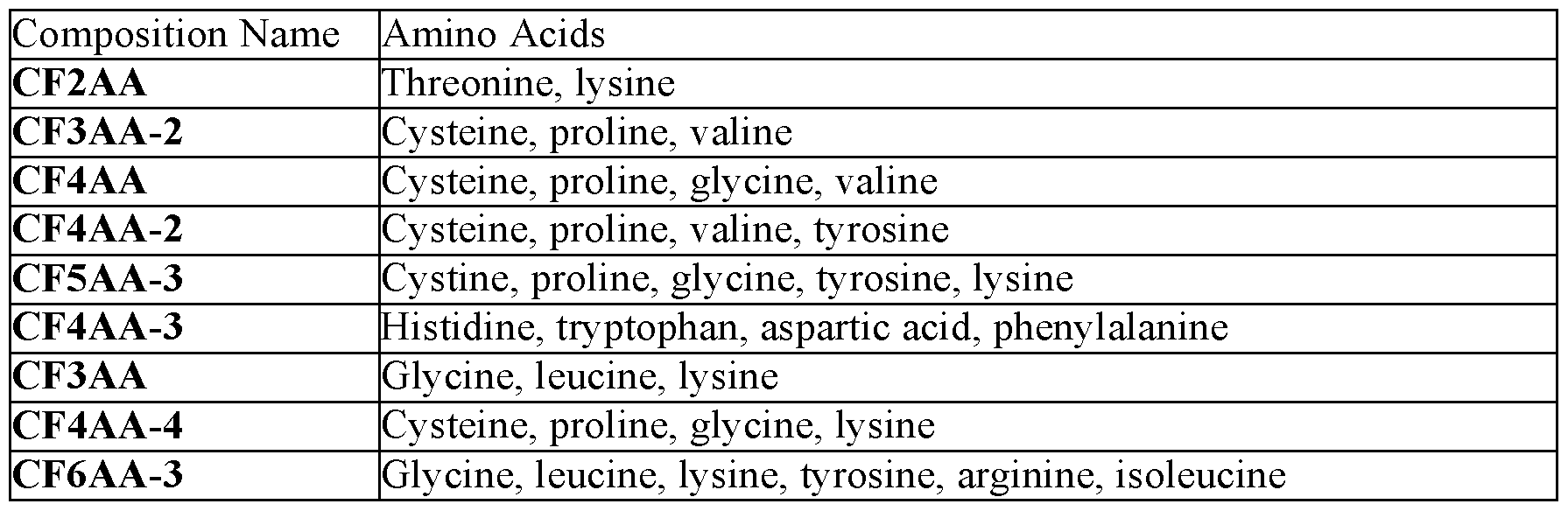

Claims
Priority Applications (11)
| Application Number | Priority Date | Filing Date | Title |
|---|---|---|---|
| MX2021005113A MX2021005113A (en) | 2018-10-30 | 2019-10-30 | Amino acid compositions and methods for treating cystic fibrosis. |
| BR112021008395-2A BR112021008395A2 (en) | 2018-10-30 | 2019-10-30 | Amino Acid Compositions and Methods for Treating Cystic Fibrosis |
| JP2021523195A JP7689492B2 (en) | 2018-10-30 | 2019-10-30 | Amino acid compositions and methods for treating cystic fibrosis |
| KR1020217015464A KR20210086660A (en) | 2018-10-30 | 2019-10-30 | Amino acid compositions and methods for treating cystic fibrosis |
| CA3116015A CA3116015A1 (en) | 2018-10-30 | 2019-10-30 | Amino acid compositions and methods for treating cystic fibrosis |
| EP19879930.6A EP3873453A4 (en) | 2018-10-30 | 2019-10-30 | AMINO ACID COMPOSITIONS AND METHODS OF TREATING CYSTIC FIBROSIS |
| AU2019370363A AU2019370363B2 (en) | 2018-10-30 | 2019-10-30 | Amino acid compositions and methods for treating cystic fibrosis |
| CN201980077878.6A CN113164425A (en) | 2018-10-30 | 2019-10-30 | Amino acid compositions and methods for treating cystic fibrosis |
| US17/289,374 US12220400B2 (en) | 2018-10-30 | 2019-10-30 | Amino acid compositions and methods for treating cystic fibrosis |
| JP2025087837A JP2025128185A (en) | 2018-10-30 | 2025-05-27 | Amino acid compositions and methods for treating asthma or COPD |
| AU2025248660A AU2025248660A1 (en) | 2018-10-30 | 2025-10-08 | Amino acid compositions and methods for treating cystic fibrosis |
Applications Claiming Priority (2)
| Application Number | Priority Date | Filing Date | Title |
|---|---|---|---|
| US201862752847P | 2018-10-30 | 2018-10-30 | |
| US62/752,847 | 2018-10-30 |
Publications (1)
| Publication Number | Publication Date |
|---|---|
| WO2020092639A1 true WO2020092639A1 (en) | 2020-05-07 |
Family
ID=70464502
Family Applications (1)
| Application Number | Title | Priority Date | Filing Date |
|---|---|---|---|
| PCT/US2019/058954 Ceased WO2020092639A1 (en) | 2018-10-30 | 2019-10-30 | Amino acid compositions and methods for treating cystic fibrosis |
Country Status (10)
| Country | Link |
|---|---|
| US (1) | US12220400B2 (en) |
| EP (1) | EP3873453A4 (en) |
| JP (2) | JP7689492B2 (en) |
| KR (1) | KR20210086660A (en) |
| CN (1) | CN113164425A (en) |
| AU (2) | AU2019370363B2 (en) |
| BR (1) | BR112021008395A2 (en) |
| CA (1) | CA3116015A1 (en) |
| MX (1) | MX2021005113A (en) |
| WO (1) | WO2020092639A1 (en) |
Cited By (2)
| Publication number | Priority date | Publication date | Assignee | Title |
|---|---|---|---|---|
| WO2021243183A1 (en) * | 2020-05-29 | 2021-12-02 | University Of Florida Research Foundation, Inc. | Formulations and methods for treating acute respiratory distress syndrome, asthma, or allergic rhinitis |
| US11878073B1 (en) | 2022-09-20 | 2024-01-23 | Entrinsic, LLC | Generation of hydration-targeted formulations and methods of use therein |
Citations (3)
| Publication number | Priority date | Publication date | Assignee | Title |
|---|---|---|---|---|
| US20040192756A1 (en) * | 2001-08-08 | 2004-09-30 | Franco Conti | Amino-acid-based compositions, suitable in therapy for the healing and/or mending of wounds and lesions, in particular for application in the opthalmic field |
| WO2004110383A2 (en) * | 2003-06-11 | 2004-12-23 | Matthias Rath | Pharmaceutical composition and method for alleviating side effects of estrogen replacement therapy |
| US20050129787A1 (en) * | 1999-08-20 | 2005-06-16 | Howard Murad | Pharmaceutical compositions and methods for managing connective tissue ailments |
Family Cites Families (13)
| Publication number | Priority date | Publication date | Assignee | Title |
|---|---|---|---|---|
| WO2002098405A1 (en) | 2001-06-05 | 2002-12-12 | Ajinomoto Co., Inc. | Liver fibrosis inhibitors |
| EP1466602A4 (en) | 2001-12-25 | 2006-03-01 | Ajinomoto Kk | Organ fibrosis inhibitors |
| WO2003090682A2 (en) * | 2002-04-25 | 2003-11-06 | The Scripps Research Institute | Treatment and prevention of pulmonary conditions |
| EP1513870A4 (en) * | 2002-05-31 | 2006-06-07 | Childrens Hosp Medical Center | CFTR MODIFIER GENES AND EXPRESSED POLYPEPTIDES SUITABLE FOR THE TREATMENT OF CYSTIC FIBROSIS AND METHOD AND PRODUCTS FOR DETECTING AND / OR IDENTIFYING THEM |
| AU2003901316A0 (en) * | 2003-03-21 | 2003-04-03 | The Royal Alexandra Hospital For Children | Regulation of cell surface proteins |
| WO2009051909A1 (en) * | 2007-10-16 | 2009-04-23 | The Regents Of The University Of California | Compounds having activity in correcting mutant-cftr cellular processing and uses thereof |
| ITTO20080443A1 (en) * | 2008-06-06 | 2009-12-07 | Professional Dietetics Srl | COMPOSITIONS INCLUDING AMINO ACIDS, WITH PRO-ANGIOGENIC ACTIVITY |
| PT2664326T (en) | 2012-05-17 | 2018-01-19 | I E R F C European Institute For Cystic Fibrosis Res | COMBINED THERAPY FOR CYSTIC FIBROSIS |
| US20140221424A1 (en) | 2013-01-30 | 2014-08-07 | Vertex Pharmaceuticals Incorporated | Pharmaceutical compositions for use in the treatment of cystic fibrosis |
| MA41031A (en) * | 2014-11-26 | 2017-10-03 | Catabasis Pharmaceuticals Inc | CYSTEAMINE-FATTY ACID CONJUGATES AND THEIR USE AS AUTOPHAGIC ACTIVATORS |
| WO2016191263A1 (en) * | 2015-05-22 | 2016-12-01 | Trustees Of Dartmouth College | Therapy and kit for the prevention and treatment of cystic fibrosis |
| BR112018007176A2 (en) * | 2015-10-09 | 2018-10-16 | AbbVie S.à.r.l. | enhancer-corrector combinations useful in the treatment of cystic fibrosis |
| MA45397A (en) | 2016-06-21 | 2019-04-24 | Proteostasis Therapeutics Inc | COMPOUNDS, COMPOSITIONS AND PROCESSES TO INCREASE THE ACTIVITY OF CFTR |
-
2019
- 2019-10-30 EP EP19879930.6A patent/EP3873453A4/en active Pending
- 2019-10-30 BR BR112021008395-2A patent/BR112021008395A2/en not_active Application Discontinuation
- 2019-10-30 US US17/289,374 patent/US12220400B2/en active Active
- 2019-10-30 WO PCT/US2019/058954 patent/WO2020092639A1/en not_active Ceased
- 2019-10-30 AU AU2019370363A patent/AU2019370363B2/en active Active
- 2019-10-30 JP JP2021523195A patent/JP7689492B2/en active Active
- 2019-10-30 KR KR1020217015464A patent/KR20210086660A/en active Pending
- 2019-10-30 MX MX2021005113A patent/MX2021005113A/en unknown
- 2019-10-30 CN CN201980077878.6A patent/CN113164425A/en active Pending
- 2019-10-30 CA CA3116015A patent/CA3116015A1/en active Pending
-
2025
- 2025-05-27 JP JP2025087837A patent/JP2025128185A/en active Pending
- 2025-10-08 AU AU2025248660A patent/AU2025248660A1/en not_active Abandoned
Patent Citations (3)
| Publication number | Priority date | Publication date | Assignee | Title |
|---|---|---|---|---|
| US20050129787A1 (en) * | 1999-08-20 | 2005-06-16 | Howard Murad | Pharmaceutical compositions and methods for managing connective tissue ailments |
| US20040192756A1 (en) * | 2001-08-08 | 2004-09-30 | Franco Conti | Amino-acid-based compositions, suitable in therapy for the healing and/or mending of wounds and lesions, in particular for application in the opthalmic field |
| WO2004110383A2 (en) * | 2003-06-11 | 2004-12-23 | Matthias Rath | Pharmaceutical composition and method for alleviating side effects of estrogen replacement therapy |
Non-Patent Citations (1)
| Title |
|---|
| See also references of EP3873453A1 * |
Cited By (4)
| Publication number | Priority date | Publication date | Assignee | Title |
|---|---|---|---|---|
| WO2021243183A1 (en) * | 2020-05-29 | 2021-12-02 | University Of Florida Research Foundation, Inc. | Formulations and methods for treating acute respiratory distress syndrome, asthma, or allergic rhinitis |
| JP2023531872A (en) * | 2020-05-29 | 2023-07-26 | ユニバーシティ オブ フロリダ リサーチ ファウンデーション,インコーポレイティド | Formulations and methods for treating acute respiratory distress syndrome, asthma, or allergic rhinitis |
| EP4157218A4 (en) * | 2020-05-29 | 2024-06-26 | University of Florida Research Foundation, Inc. | FORMULATIONS AND METHODS FOR TREATING ACUTE RESPIRATORY DISTRESS SYNDROME, ASTHMA OR ALLERGIC RHINITIS |
| US11878073B1 (en) | 2022-09-20 | 2024-01-23 | Entrinsic, LLC | Generation of hydration-targeted formulations and methods of use therein |
Also Published As
| Publication number | Publication date |
|---|---|
| JP7689492B2 (en) | 2025-06-06 |
| CN113164425A (en) | 2021-07-23 |
| KR20210086660A (en) | 2021-07-08 |
| AU2019370363A1 (en) | 2021-05-13 |
| JP2025128185A (en) | 2025-09-02 |
| US12220400B2 (en) | 2025-02-11 |
| AU2019370363B2 (en) | 2025-07-10 |
| CA3116015A1 (en) | 2020-05-07 |
| MX2021005113A (en) | 2021-06-15 |
| BR112021008395A2 (en) | 2021-09-28 |
| US20210393584A1 (en) | 2021-12-23 |
| EP3873453A1 (en) | 2021-09-08 |
| JP2022506044A (en) | 2022-01-17 |
| EP3873453A4 (en) | 2022-08-03 |
| AU2025248660A1 (en) | 2025-10-30 |
Similar Documents
| Publication | Publication Date | Title |
|---|---|---|
| AU2025248660A1 (en) | Amino acid compositions and methods for treating cystic fibrosis | |
| Rotin et al. | Function and regulation of the epithelial Na+ channel ENaC | |
| Scott et al. | SPX-101 is a novel epithelial sodium channel–targeted therapeutic for cystic fibrosis that restores mucus transport | |
| TWI870336B (en) | Recombinant human acid alpha-glucosidase | |
| Rubenstein et al. | Regulation of endogenous ENaC functional expression by CFTR and ΔF508-CFTR in airway epithelial cells | |
| US20020115619A1 (en) | Compositions and methods for treatment of cystic fibrosis | |
| WO2019070759A1 (en) | Amino acid compositions and methods for treating cystic fibrosis | |
| AU2025201099A1 (en) | Compositions and methods for delivering CFTR polypeptides | |
| KR102819396B1 (en) | Compositions and methods for the treatment of homocystinuria | |
| JP2022517255A (en) | Improvement of epithelial or endothelial barrier function | |
| WO2018227248A1 (en) | Methods and compositions for the treatment of obesity | |
| US9855314B2 (en) | Methods for modulating development and function of photoreceptor cells | |
| Wu et al. | CFTR dysfunction leads to defective bacterial eradication on cystic fibrosis airways | |
| US11413325B2 (en) | Neuronal survival and axonal regeneration through increasing mitochondrial motility | |
| US20210038575A1 (en) | Use of 1-phenyl-2-pyridinyl alkyl alcohol derivatives for treating cystic fibrosis | |
| JP7630540B2 (en) | Neuroprotective Peptides | |
| Ren et al. | Nicotinic acetylcholine receptor (nAChR) dependent chorda tympani taste nerve responses to nicotine, ethanol and acetylcholine | |
| JP2018506534A (en) | Growth hormone receptor blockers in disease prevention and treatment | |
| Liu et al. | Lysosomal ion channels and pain | |
| US5834421A (en) | Methods and compositions for treating cystic fibrosis | |
| Hildebrandt et al. | Characterization of chronic nicotine exposure on the survival of the" spastic" Han-Wistar rat | |
| Kirjavainen et al. | silencing the p27" expression, myosin VIla was labeled immuno | |
| NZ749459A (en) | TATĸ-CDKL5 FUSION PROTEINS, COMPOSITIONS, FORMULATIONS, AND USE THEREOF |
Legal Events
| Date | Code | Title | Description |
|---|---|---|---|
| 121 | Ep: the epo has been informed by wipo that ep was designated in this application |
Ref document number: 19879930 Country of ref document: EP Kind code of ref document: A1 |
|
| ENP | Entry into the national phase |
Ref document number: 3116015 Country of ref document: CA |
|
| ENP | Entry into the national phase |
Ref document number: 2021523195 Country of ref document: JP Kind code of ref document: A |
|
| NENP | Non-entry into the national phase |
Ref country code: DE |
|
| REG | Reference to national code |
Ref country code: BR Ref legal event code: B01A Ref document number: 112021008395 Country of ref document: BR |
|
| ENP | Entry into the national phase |
Ref document number: 2019370363 Country of ref document: AU Date of ref document: 20191030 Kind code of ref document: A |
|
| ENP | Entry into the national phase |
Ref document number: 20217015464 Country of ref document: KR Kind code of ref document: A |
|
| ENP | Entry into the national phase |
Ref document number: 2019879930 Country of ref document: EP Effective date: 20210531 |
|
| ENP | Entry into the national phase |
Ref document number: 112021008395 Country of ref document: BR Kind code of ref document: A2 Effective date: 20210430 |