WO2020097284A1 - TOPICAL FORMULATIONS OF 5-α-REDUCTASE INHIBITORS AND USES THEREOF - Google Patents
TOPICAL FORMULATIONS OF 5-α-REDUCTASE INHIBITORS AND USES THEREOF Download PDFInfo
- Publication number
- WO2020097284A1 WO2020097284A1 PCT/US2019/060194 US2019060194W WO2020097284A1 WO 2020097284 A1 WO2020097284 A1 WO 2020097284A1 US 2019060194 W US2019060194 W US 2019060194W WO 2020097284 A1 WO2020097284 A1 WO 2020097284A1
- Authority
- WO
- WIPO (PCT)
- Prior art keywords
- dutasteride
- finasteride
- composition
- oil
- solution
- Prior art date
- Legal status (The legal status is an assumption and is not a legal conclusion. Google has not performed a legal analysis and makes no representation as to the accuracy of the status listed.)
- Ceased
Links
Classifications
-
- A—HUMAN NECESSITIES
- A61—MEDICAL OR VETERINARY SCIENCE; HYGIENE
- A61K—PREPARATIONS FOR MEDICAL, DENTAL OR TOILETRY PURPOSES
- A61K31/00—Medicinal preparations containing organic active ingredients
- A61K31/33—Heterocyclic compounds
- A61K31/395—Heterocyclic compounds having nitrogen as a ring hetero atom, e.g. guanethidine or rifamycins
- A61K31/435—Heterocyclic compounds having nitrogen as a ring hetero atom, e.g. guanethidine or rifamycins having six-membered rings with one nitrogen as the only ring hetero atom
- A61K31/47—Quinolines; Isoquinolines
- A61K31/473—Quinolines; Isoquinolines ortho- or peri-condensed with carbocyclic ring systems, e.g. acridines, phenanthridines
-
- A—HUMAN NECESSITIES
- A61—MEDICAL OR VETERINARY SCIENCE; HYGIENE
- A61K—PREPARATIONS FOR MEDICAL, DENTAL OR TOILETRY PURPOSES
- A61K31/00—Medicinal preparations containing organic active ingredients
- A61K31/56—Compounds containing cyclopenta[a]hydrophenanthrene ring systems; Derivatives thereof, e.g. steroids
- A61K31/58—Compounds containing cyclopenta[a]hydrophenanthrene ring systems; Derivatives thereof, e.g. steroids containing heterocyclic rings, e.g. danazol, stanozolol, pancuronium or digitogenin
-
- A—HUMAN NECESSITIES
- A61—MEDICAL OR VETERINARY SCIENCE; HYGIENE
- A61K—PREPARATIONS FOR MEDICAL, DENTAL OR TOILETRY PURPOSES
- A61K47/00—Medicinal preparations characterised by the non-active ingredients used, e.g. carriers or inert additives; Targeting or modifying agents chemically bound to the active ingredient
- A61K47/06—Organic compounds, e.g. natural or synthetic hydrocarbons, polyolefins, mineral oil, petrolatum or ozokerite
- A61K47/08—Organic compounds, e.g. natural or synthetic hydrocarbons, polyolefins, mineral oil, petrolatum or ozokerite containing oxygen, e.g. ethers, acetals, ketones, quinones, aldehydes, peroxides
- A61K47/10—Alcohols; Phenols; Salts thereof, e.g. glycerol; Polyethylene glycols [PEG]; Poloxamers; PEG/POE alkyl ethers
-
- A—HUMAN NECESSITIES
- A61—MEDICAL OR VETERINARY SCIENCE; HYGIENE
- A61K—PREPARATIONS FOR MEDICAL, DENTAL OR TOILETRY PURPOSES
- A61K47/00—Medicinal preparations characterised by the non-active ingredients used, e.g. carriers or inert additives; Targeting or modifying agents chemically bound to the active ingredient
- A61K47/06—Organic compounds, e.g. natural or synthetic hydrocarbons, polyolefins, mineral oil, petrolatum or ozokerite
- A61K47/08—Organic compounds, e.g. natural or synthetic hydrocarbons, polyolefins, mineral oil, petrolatum or ozokerite containing oxygen, e.g. ethers, acetals, ketones, quinones, aldehydes, peroxides
- A61K47/14—Esters of carboxylic acids, e.g. fatty acid monoglycerides, medium-chain triglycerides, parabens or PEG fatty acid esters
-
- A—HUMAN NECESSITIES
- A61—MEDICAL OR VETERINARY SCIENCE; HYGIENE
- A61K—PREPARATIONS FOR MEDICAL, DENTAL OR TOILETRY PURPOSES
- A61K47/00—Medicinal preparations characterised by the non-active ingredients used, e.g. carriers or inert additives; Targeting or modifying agents chemically bound to the active ingredient
- A61K47/44—Oils, fats or waxes according to two or more groups of A61K47/02-A61K47/42; Natural or modified natural oils, fats or waxes, e.g. castor oil, polyethoxylated castor oil, montan wax, lignite, shellac, rosin, beeswax or lanolin
-
- A—HUMAN NECESSITIES
- A61—MEDICAL OR VETERINARY SCIENCE; HYGIENE
- A61K—PREPARATIONS FOR MEDICAL, DENTAL OR TOILETRY PURPOSES
- A61K8/00—Cosmetics or similar toiletry preparations
- A61K8/18—Cosmetics or similar toiletry preparations characterised by the composition
- A61K8/30—Cosmetics or similar toiletry preparations characterised by the composition containing organic compounds
- A61K8/69—Cosmetics or similar toiletry preparations characterised by the composition containing organic compounds containing fluorine
-
- A—HUMAN NECESSITIES
- A61—MEDICAL OR VETERINARY SCIENCE; HYGIENE
- A61K—PREPARATIONS FOR MEDICAL, DENTAL OR TOILETRY PURPOSES
- A61K9/00—Medicinal preparations characterised by special physical form
- A61K9/0012—Galenical forms characterised by the site of application
- A61K9/0014—Skin, i.e. galenical aspects of topical compositions
-
- A—HUMAN NECESSITIES
- A61—MEDICAL OR VETERINARY SCIENCE; HYGIENE
- A61K—PREPARATIONS FOR MEDICAL, DENTAL OR TOILETRY PURPOSES
- A61K9/00—Medicinal preparations characterised by special physical form
- A61K9/06—Ointments; Bases therefor; Other semi-solid forms, e.g. creams, sticks, gels
-
- A—HUMAN NECESSITIES
- A61—MEDICAL OR VETERINARY SCIENCE; HYGIENE
- A61K—PREPARATIONS FOR MEDICAL, DENTAL OR TOILETRY PURPOSES
- A61K9/00—Medicinal preparations characterised by special physical form
- A61K9/10—Dispersions; Emulsions
- A61K9/107—Emulsions ; Emulsion preconcentrates; Micelles
-
- A—HUMAN NECESSITIES
- A61—MEDICAL OR VETERINARY SCIENCE; HYGIENE
- A61P—SPECIFIC THERAPEUTIC ACTIVITY OF CHEMICAL COMPOUNDS OR MEDICINAL PREPARATIONS
- A61P17/00—Drugs for dermatological disorders
- A61P17/14—Drugs for dermatological disorders for baldness or alopecia
-
- A—HUMAN NECESSITIES
- A61—MEDICAL OR VETERINARY SCIENCE; HYGIENE
- A61Q—SPECIFIC USE OF COSMETICS OR SIMILAR TOILETRY PREPARATIONS
- A61Q7/00—Preparations for affecting hair growth
- A61Q7/02—Preparations for inhibiting or slowing hair growth
-
- A—HUMAN NECESSITIES
- A61—MEDICAL OR VETERINARY SCIENCE; HYGIENE
- A61K—PREPARATIONS FOR MEDICAL, DENTAL OR TOILETRY PURPOSES
- A61K9/00—Medicinal preparations characterised by special physical form
- A61K9/10—Dispersions; Emulsions
- A61K9/12—Aerosols; Foams
- A61K9/122—Foams; Dry foams
Definitions
- the invention relates to topical compositions for modulating hair growth and the treatment of various types of alopecia, for example, female and male androgenetic alopecia (AGA), alopecia areata, hair loss secondary to endocrine therapy in patients with breast cancer (Endocrine Therapy-Induced Alopecia or ETIA), and hirsutism.
- AGA female and male androgenetic alopecia
- ETIA Enddocrine Therapy-Induced Alopecia
- Hair loss or alopecia is a common and embarrassing problem for many people.
- One of the most frequent types of alopecia is androgenetic alopecia, which is a common form of hair loss in both men and women. In men, this condition is also known as male-pattern baldness.
- the pattern of hair loss in women differs from male-pattern baldness. In women, the hair becomes thinner all over the head, and the hairline does not always recede.
- DHT dihydrotestosterone
- SERMs Selective Estrogen Receptor Modulators
- AIs Aromatase Inhibitors
- Alopecia areata is a common autoimmune disorder, which results in unpredictable hair loss. Hair often falls out in small patches, e.g., around the size of a quarter. In more extreme cases, however, it can lead to complete hair loss on the scalp and even on the entire body.
- hirsutism which is an excessive facial and/or body hair growth, particularly in women, is another common and embarrassing problem. Hirsutism can occur if the levels of female and male sex hormones become unbalanced with too high a proportion of male sex hormones (androgens) in women.
- vasodilators such as potassium channel agonists including minoxidil and minoxidil derivatives such as diaminopyrimidine oxide; and an oral formulation of inhibitors for 5-a reductase enzyme that converts testosterone to DHT for the treatment of alopecia.
- Use of such oral formulations of such inhibitors such as oral finasteride has resulted in mixed success and with a risk of adverse side effects.
- Avodart® (dutasteride) has been shown to be safe and effective for oral use through both extensive nonclinical testing and data obtained from over 18 years of clinical use.
- Dutasteride reduces circulating levels of DHT by inhibiting both type 1 and type 2 5a-reductase isoenzymes that are responsible for the conversion of testosterone to DHT, which is known to be the most potent natural androgen in the human body.
- DHT is believed to potently regulate the transcription of androgen-sensitive genes within the follicle, thereby affecting hair growth. See Jain, R. and De-Ekanumkul.“Potential targets in the discovery of new hair growth promoters for androgenic alopecia.” Expert Opin Ther Targets (2014) 18(7): 787-086.
- anti-5a-reductase agents such as oral Avodart® (dutasteride) soft gelatin capsules, 0.5mg
- AGA Herskovitz, I. and Tosti, A.“Female Pattern Hair Loss.” Int J Endocrinol Metab (2013) 11(4): e9860 (published online October 21, 2013)
- those patients using 5a-reductase enzyme inhibitors have a significant improvement in hair loss (see Olsen, E. et al. “The importance of dual 5a-reductase inhibition in the treatment of male pattern hair loss:
- oral finasteride is the older drug. Oral finasteride was developed in the l970s and received FDA approval as a treatment for BPH in 1992. Oral finasteride was eventually approved for use as an AGA treatment in 1997 at a lower dose (lmg) than the higher-dosed BPH treatment version of oral finasteride (5mg). Dutasteride, on the other hand, was only patented in 1996 and became approved by the FDA as an oral treatment for BPH in 2001 at a dose of 0.5mg.
- oral dutasteride is, milligram for milligram, more effective at lowering DHT than oral finasteride. It also shows that oral dutasteride is more consistent at blocking DHT than oral finasteride. The level of variability for the oral dutasteride group was +/- 1.2%, showing an almost total elimination of DHT, with far less variation between patients than the +/- 18.3% of the oral finasteride group. Study data also shows that oral dutasteride is more effective at promoting hair growth in people with male AGA than finasteride.
- the present disclosure provides topical compositions of 5-a reductase inhibitors, such as dutasteride or finasteride or pharmaceutically acceptable salts, esters, or derivatives thereof for the treatment of hair loss secondary to endocrine therapy in patients with breast cancer
- ETIA Enddocrine Therapy-Induced Alopecia
- AGA androgenetic alopecia
- alopecia areata
- hirsutism alopecia areata
- compositions and formulations described in the working examples are included within the scope of the invention.
- the present disclosure provides a topical composition
- a topical composition comprising a therapeutically effective amount of 5-a reductase inhibitors, such as dutasteride or finasteride or pharmaceutically acceptable salts, esters, or derivatives thereof, and appropriate topical pharmaceutically acceptable excipients or carriers.
- 5-a reductase inhibitors such as dutasteride or finasteride or pharmaceutically acceptable salts, esters, or derivatives thereof, and appropriate topical pharmaceutically acceptable excipients or carriers.
- the present disclosure provides methods for preparing 5-a reductase inhibitor (e.g., dutasteride) formulations as set forth in the examples.
- 5-a reductase inhibitor e.g., dutasteride
- the present disclosure provides a method for stimulating the hair growth on the scalp of a human subject suspected of affected by endocrine-therapy induced alopecia from breast cancer treatment.
- the method includes a) providing a topical composition comprising a therapeutically effective amount of 5-a reductase inhibitors, such as dutasteride or finasteride or pharmaceutically acceptable salts, esters, or derivatives thereof, and appropriate topical pharmaceutically acceptable excipients or carriers; and b) topically applying the composition to the subject’s skin or scalp on and/or adjacent to the area in which hair growth is desired.
- An increase in scalp hair density, hair thickness, or scalp coverage in the human subject receiving the topical composition as compared to an untreated individual is indicative of stimulation of hair growth on the scalp of the human subject.
- the present disclosure provides a method for stimulating the hair growth on the scalp of a human subject suspected of being affected by androgenetic alopecia.
- the method includes a) providing a topical composition comprising a therapeutically effective amount of 5-a reductase inhibitors, such as dutasteride or finasteride or pharmaceutically acceptable salts, esters, or derivatives thereof, and appropriate topical pharmaceutically acceptable excipients or carriers; and b) topically applying the composition to the subject’s skin or scalp on and/or adjacent to the area in which hair growth is desired.
- 5-a reductase inhibitors such as dutasteride or finasteride or pharmaceutically acceptable salts, esters, or derivatives thereof, and appropriate topical pharmaceutically acceptable excipients or carriers.
- the present disclosure provides a method for reducing the facial hair growth of a human subject suspected of being affected by hirsutism.
- the method includes a) providing a topical composition comprising a therapeutically effective amount of 5-a reductase inhibitors, such as dutasteride or finasteride or pharmaceutically acceptable salts, esters, or derivatives thereof, and appropriate topical pharmaceutically acceptable excipients or carriers; and b) topically applying the composition to the subject’s facial or body skin on and/or adjacent to the area in which reduced hair growth is desired.
- a decrease in facial hair density, hair thickness, or coverage in the human subject receiving the topical composition as compared to an untreated individual is indicative of a reduction of facial hair growth of the human subject.
- the present disclosure provides a topical formulation comprising a therapeutically effective amount of dutasteride or a pharmaceutically acceptable salt, ester, or derivative thereof dissolved in an oil phase; and a topical pharmaceutically acceptable excipient or carrier.
- the topical formulation may be an emulsion.
- the oil phase may include at least one oil, alternatively at least two oils.
- the formulation may further include a humectant, a thickener, an emulsifier, and a preservative.
- the present disclosure provides a topical formulation comprising a therapeutically effective amount of dutasteride or a pharmaceutically acceptable salt, ester, or derivative thereof dissolved in an oil phase; and a topical pharmaceutically acceptable excipient or carrier.
- the formulation may not contain ethyl alcohol and/or polypropylene glycol.
- the present disclosure provides a topical formulation comprising a therapeutically effective amount of dutasteride or a pharmaceutically acceptable salt, ester, or derivative thereof dissolved in an aqueous phase; and a topical pharmaceutically acceptable excipient or carrier.
- the topical formulation may be an emulsion.
- the aqueous phase may optionally include a solubilizer.
- the aqueous phase may optionally include a penetration enhancer.
- the formulation may further include a thickener, an emollient, a pH adjuster, a preservative, and/or a conditioning agent.
- the present disclosure provides methods for preparing a topical formulation, comprising the steps of mixing a conditioning agent with water to form a conditioning solution; mixing a first emulsifier, a first preservative, and a solvent to obtain an emulsifier solution; mixing dutasteride, at least one oil, and at least one solvent to obtain a dutasteride solution; mixing the dutasteride solution with the emulsifier solution to obtain a combined solution; mixing the combined solution with the conditioning solution to form a dutasteride conditioning mixture; and mixing a second emulsifier and a second preservative into the dutasteride conditioning mixture.
- the present disclosure provides methods for preparing a topical formulation, comprising the steps of mixing a humectant with water to form a humectant solution; mixing a thickener and a first solvent to form a thickener solution; mixing the thickener solution with the humectant solution to form a combined solution; mixing a preservative into the combined solution to form a combined preservative solution; mixing dutasteride and a second solvent to form a dutasteride solution; mixing at least one oil into the dutasteride solution to form a dutasteride oil mixture; mixing at least one emulsifier to the dutasteride oil mixture to form a second dutasteride oil mixture; and mixing the second dutasteride oil mixture with the combined preservative solution in a vessel.
- the therapeutically effective amount of dutasteride is about 0.001% to about 1% (w/w). In some embodiments, the therapeutically effective amount of 5-a reductase inhibitors, such as dutasteride or finasteride, is about 0.001% to about 0.5% (w/w). In some embodiments, the therapeutically effective amount of 5-a reductase inhibitors, such as dutasteride or finasteride, is about 0.002% to about 0.1% (w/w).
- the therapeutically effective amount of dutasteride is about 0.001%, 0.005%, 0.010%, 0.025%, 0.050%, 0.075%, 0.100%, 0.150%, 0.200%, 0.250%, 0.300%, 0.350%,
- the amount of 5-a reductase inhibitors, such as dutasteride or finasteride, administered in a single topical application is about: O.Olmg, 0.05mg, O.lmg, 0.25mg, 0.5mg, 0.75mg, lmg, l.25mg, l.5mg, 2mg, 2.5mg, 3mg, 3.5mg, 4mg, 4.5mg, or 5mg.
- the amount of 5- a reductase inhibitors, such as dutasteride or finasteride, administered in a single topical application is about 0.1 to about 3.0 mg, alternatively about 0.3 mg to about 2.5 mg, alternatively about 0.5 mg to about 2.5 mg, alternatively about 0.5 mg to about 2.0 mg, alternatively about 0.5 mg to about 1.5 mg, alternatively about 0.5 mg to about 1.0 mg.
- the dutasteride of the composition is in the form of nanoparticles.
- the nanoparticles are coated with 5-a reductase inhibitors, such as dutasteride or finasteride.
- the 5-a reductase inhibitors, such as dutasteride or finasteride is slowly released to the skin or scalp when the topical composition is applied to the skin or scalp of the human subject.
- the diameter of the nanoparticles is about 25nm to about 500nm. In some embodiments, the diameter of the nanoparticles is about lOOnm to about 500nm. In some embodiments, the diameter of the nanoparticles is about 500nm.
- the topical composition comprises a surfactant, a co- surfactant, a penetration enhancer, an antioxidant, a buffering agent, a preservative, a viscosity modifying agent, a chelating or complexing agent, a coloring agent, a perfume, a polymer, a gelling agent, an alcohol, a liquid or semi-solid oily component, or any combination thereof.
- the topical composition comprises at least two of API (5-a reductase inhibitors, such as dutasteride or finasteride), cationic emulsifier, conditioning agent, emollient, emulsifier, humectant solvent, nonionic emulsifier, penetration enhancer, pH adjuster, preservative, solvent, thickener, viscosity enhancer, or any combination thereof.
- API a reductase inhibitors, such as dutasteride or finasteride
- cationic emulsifier such as dutasteride or finasteride
- conditioning agent such as dutasteride or finasteride
- emollient such as dutasteride or finasteride
- emulsifier such as dutasteride or finasteride
- conditioning agent such as dutasteride or finasteride
- emollient such as dutasteride or finasteride
- emulsifier such as dutasteride
- the topical composition is a cream and comprises a solvent, a humectant, a thickener, a preservative, an emollient, an emulsifier, and a penetration enhancer.
- the topical composition is a lotion and comprises a solvent, a humectant, a thickener, a preservative, an emollient, an emulsifier, and a penetration enhancer.
- the topical composition is a lotion and comprises a solvent, a humectant, a thickener, a preservative, an emollient, an emulsifier, a pH adjuster, and a penetration enhancer.
- the topical composition is a lotion conditioner and comprises a solvent, a humectant, a thickener, a preservative, an emollient, an emulsifier, and a conditioning agent.
- the topical composition is a lotion serum and comprises a solvent, a humectant, a thickener, a preservative, an emollient, an emulsifier, a pH adjuster, a penetration enhancer, and a conditioning agent.
- the topical composition is a gel and comprises a solvent, a thickener, an emollient, and a penetration enhancer.
- the topical composition is a gel and comprises a solvent, a thickener, and a penetration enhancer.
- the topical composition is a gel and/or serum and comprises a solvent, a viscosity enhancer, an emollient, and a penetration enhancer.
- the topical pharmaceutically acceptable carrier is hydrophilic, hydrophobic, lipophilic, or amphiphilic, or a mixture thereof.
- the pharmaceutically acceptable carrier comprises a hydrophobic or lipophilic substance comprising a paraffin oil, an ester of a Cx-Cix organic acid, a C8-C30 fatty alcohol, a silicone oil, a vegetable oil, a fractionated or hydrogenated vegetable oil, a monoglyceride, a diglyceride, a triglyceride, a phospholipid, dimethylisosorbide, a volatile solvent, N- methylpyrrolidone, dimethylacetamide, dimethylformamide; dimethylsulphoxide, or any combination thereof.
- the topical pharmaceutically acceptable excipients or carriers comprise ethanol, polypropylene glycol, purified water, or a combination thereof.
- the topical composition is in the form of foam, cream, paste, gel, aerosol, powder, oil, serum, or liquid.
- the topical composition further comprises a therapeutically effective amount of finasteride, minoxidil, or a combination thereof.
- the amount of finasteride can be about O.Olmg to about 5mg. In some embodiments, the amount of finasteride can be about: O.Olmg, 0.05mg, O.
- the topical composition comprises a propellant.
- propellant include dichloromethane, dimethyl ether, butanes, propane, nitrogen, fluorocarbons, and carbon dioxide.
- the topical composition is applied to the skin or scalp of a human subject for a single day. In some embodiments, the topical composition is applied to the skin or scalp of a human subject for multiple days. In some embodiments, the topical composition is applied each day for about 2, 3, 4, 5, 6, 7, 8, 9, 10, 11, 12, 13, 14, or 21 or more days. In some embodiments, the topical composition is applied each day for 2, 3, 4, 5, 6, 7, 8, 9, 10, 11, 12, 13, 14, 15, 16, or more weeks. In some embodiments, the topical 5-a reductase inhibitor formulation is applied QD, bid, tid, qid, or more frequently. In some embodiments, the topical composition is applied multiple times each day for multiple days or multiple weeks, or multiple months. In some embodiments, the skin is abdominal skin. In some embodiments, the skin is skin on the limbs, forehead, throat, or back.
- stimulating the hair growth comprises an increase in hair count.
- stimulating the hair growth comprises hair thickness increase.
- the hair thickness increase comprises an increase in frontal, central, vertex regions, or their combination of the scalp of the human subject.
- stimulating the hair growth comprises improved scalp coverage and improved hair structure.
- the human subject can be a male or a female.
- the human subject suspected of being affected by androgenetic alopecia is a male.
- the male suspected of being affected by androgenetic alopecia has male baldness pattern.
- the term“about” in quantitative terms refers to plus or minus 10%. For example,“about 3%” would encompass 2.7-3.3% and“about 10%” would encompass 9-11%. Moreover, where“about” is used herein in conjunction with a quantitative term it is understood that in addition to the value plus or minus 10%, the exact value of the quantitative term is also contemplated and described. For example, the term “about 3%” expressly contemplates, describes and includes exactly 3%.
- FIG. 1 shows the chemical structure of dutasteride.
- FIG. 2 shows the results of the binary dutasteride/excipient compatibility study.
- the present disclosure is directed to topical compositions of 5-a reductase inhibitors, such as dutasteride or finasteride or pharmaceutically acceptable salts, esters, or derivatives thereof for the treatment of hair loss secondary to endocrine therapy in patients with breast cancer (Endocrine Therapy-Induced Alopecia or ETIA), androgenetic alopecia (AGA), Alopecia Areata (AA), and hirsutism.
- ETIA Enddocrine Therapy-Induced Alopecia
- AGA androgenetic alopecia
- AA Alopecia Areata
- hirsutism hirsutism
- the topical composition of 5-a reductase inhibitors is advantageous over any oral formulation of 5-a reductase inhibitors because it may allow for a slow release of the active ingredient, better penetration at the therapeutically effective amount of the 5-a reductase inhibitor with an improved safety profile since it does not need to travel through the bloodstream to be efficacious, thereby minimizing the risk of systemic side effects.
- Dutasteride is chemically designated as (5a,17b)-N- ⁇ 2,5 bis(trifluoromethyl)phenyl ⁇ -3- oxo-4- azaandrost-l-ene-l7-carboxamide.
- the empirical formula of dutasteride is C27H30F6N2O2, representing a molecular weight of 528.53 kDa with the following structural formula as shown in FIG. 1.
- Dutasteride is a selective inhibitor of both the type 1 and type 2 5a-reductase
- dutasteride may be more effective than another known type 1 5a-reductase inhibitor finasteride because dutasteride inhibits both type 1 and type 2 5a-reductase isoenzymes.
- dutasteride may be more potent than finasteride in inhibiting 5a-reductase enzymes, they both have published adverse effects.
- Oral formulations of finasteride and dutasteride have been shown by researchers to be effective in treating androgenetic alopecia (AGA), and proposed as a treatment for hair loss secondary to endocrine therapy in patients with breast cancer (Endocrine Therapy-Induced Alopecia or ETIA).
- Oral dutasteride has not been approved for any form of treatment of alopecia or hirsutism in the ETnited States.
- the present invention provides topical formulations of 5-a reductase inhibitors, such as dutasteride or finasteride or pharmaceutically acceptable salts, esters, or derivatives thereof for the treatment of hair loss secondary to endocrine therapy in patients with breast cancer
- ETIA Enddocrine Therapy-Induced Alopecia
- AGA androgenetic alopecia
- hirsutism that is safe and effective because the topical formulation may allow for: a slow release of the active ingredient; better penetration at the therapeutically effective amount of the 5-a reductase inhibitor; and an improved safety profile since it does not need to travel through the bloodstream to be efficacious, thereby minimizing the risk of systemic side effects.
- modulating hair growth refers to an increase or decrease of hair count, hair thickness, or hair structure in scalp or face.
- the term“therapeutically effective amount” is a sufficient to contribute to the treatment, prevention, or reduction of a symptom or symptoms of a disease.
- a reduction of a symptom or symptoms means decreasing of the severity or frequency of the symptom(s), or elimination of the symptom(s).
- the amount of a dutasteride when expressed as“%” refers to % (w/w) unless otherwise indicated.
- the phrase“pharmaceutically acceptable” is used with reference to compounds, materials, compositions, and/or dosage forms which are, within the scope of sound medical judgment, suitable for use in contact with the tissues of human beings and animals without excessive toxicity, irritation, allergic response, or other problems or complications commensurate with a reasonable benefit/risk ratio.
- the term“penetration enhancement” or“permeation enhancement” means an increase in the permeability of a biological membrane (i.e. skin or mucosa) to a drug, so as to increase the rate at which the drug is transported through the membrane.
- “Permeation enhancer”,“enhancer”,“penetration enhancer”, or similar terms mean a material that achieves such permeation or penetration enhancement, and an“effective amount” of an enhancer means an amount effective to enhance penetration through the skin or mucosa of a selected agent to a desired degree.
- Suitable penetration enhancers that can be used in the present invention include, but are not limited to: sulfoxides such as dimethylsulfoxide (DMSO) and decylmethylsulfoxide (Cio MSO); ethers such as diethylene glycol monoethyl ether (available commercially as Transcutol® P) and di ethylene glycol monomethyl ether; 1 -substituted azacycloheptan-2-ones, such as l-n- dodecyl-cyclazacycloheptan-2-one; alcohols such as propanol, octanol, benzyl alcohol, and the like; fatty acids such as lauric acid, oleic acid, and valeric acid; fatty acid esters such as isopropyl myristate, isopropyl palmitate, methylpropionate, and ethyl oleate; polyol esters such as butanediol and polyethylene glycol monol
- Suitable penetration enhancers also include, but are not limited to, medium chain triglycerides, isopropyl myristate, diisopropyl adipate, isopropyl palmitate, propylene glycol, diethylene glycol monoethylether (Transcutol® P), oleyl alcohol, dehydrated alcohol, benzyl alcohol, laureth-4, diethyl sebacate, and dimethyl isosorbide.
- medium chain triglycerides isopropyl myristate, diisopropyl adipate, isopropyl palmitate, propylene glycol, diethylene glycol monoethylether (Transcutol® P), oleyl alcohol, dehydrated alcohol, benzyl alcohol, laureth-4, diethyl sebacate, and dimethyl isosorbide.
- Suitable solvents that can be used in the present invention include, but are not limited to: sterile water, glycerin, medium chain triglycerides, isopropyl myristate, diisopropyl adipate, isopropyl palmitate, propylene glycol, olive oil, castor oil, coconut oil, light mineral oil, diethylene glycol monoethylether (Transcutol® P), diethyl sebacate, benzyl alcohol,
- Suitable humectants that can be used in the present invention include, but are not limited to: sodium hyaluronate, glycerin, sorbitol solution, 70%, and methyl gluceth-20 (Glucam E20).
- Suitable thickeners that can be used in the present invention include, but are not limited to: xanthan gum, cetearyl alcohol, Promulgen D, Carbopol 974P NF Polymer, Pemulen TR-2, Pemulen TR-l, Klucel HG Pharm, Carbopol 980 NF, Polymer, and Sepineo P 600.
- Suitable preservatives that can be used in the present invention include, but are not limited to: methylparaben and propylparaben.
- Suitable emollients that can be used in the present invention include, but are not limited to: olive oil, medium chain triglycerides, isopropyl myristate, diisopropyl adipate, isopropyl palmitate, castor oil, light mineral oil, cyclomethicone, diethyl sebacate, benzyl alcohol, PEG-35 castor oil, and coconut oil.
- Suitable emulsifiers that can be used in the present invention include, but are not limited to: Brij L4, Arlacel 165, Tween 20, Brij S721, Brij S2, Promulgen D, Stearalkonium Chloride, Pemulen TR-2, Pemulen TR-l, Sodium Monostearate, Sepineo P 600, Laureth-4, Polysorbate 20, Sorbitan Monostearate, and PEG-35 Castor Oil.
- Non-ionic emulsifiers include, but are not limited to, Brij L4, Arlacel 165, Sodium Monostearate, Laureth-4, Polysorbate 20, and PEG-35 Castor Oil.
- Cationic surfactants include, but are not limited to, stearalkonium chloride.
- Suitable pH adjusters that can be used in the present invention include, but are not limited to: NaOH and HC1 solutions.
- Suitable conditioning agents that can be used in the present invention include, but are not limited to: stearalkonium chloride and Polyquaternium-lO.
- Suitable solubilizers that can be used in the present invention include, but are not limited to: Laureth-4.
- Suitable viscosity enhancers that can be used in the present invention include, but are not limited to : PEG 3350.
- Example 1 Topical formulation comprising dutasteride
- a topical formulation of 0.10% w/v may be prepared as follows.
- Example 2 Topical cream formulations comprising dutasteride (dutasteride dissolved in oil phase)
- a topical formulation of 0.05% w/w may be prepared as follows:
- Phase A The components of Phase A were combined in the main vessel until a solution was obtained. With high agitation, Phase B was sprinkled into the main vessel and mixed until a homogenous gel was obtained. Phase C was pre-mixed in a separate container and added to the main vessel until it was uniformly dispersed. The batch was then heated to 70 - 75 °C. Phase D was then added to the main vessel and mixed until Phase D was solubilized. The components of Phase E were combined in a separate vessel and mixed until a solution was obtained. Phase F was then added to Phase E in the separate vessel and heated until the mixture was 70 - 75 °C.
- Phase E + F was added to the main vessel for homogenization. The batch was then cooled down to less than 30 °C.
- HLB Hydrophilic-lipophilic balance
- a topical formulation of 0.05% w/w may be prepared as follows. (2019-045-31R)
- Phase A The components of Phase A were combined in the main vessel until a solution was obtained. With high agitation, Phase B was sprinkled into the main vessel and mixed until a homogenous gel was obtained. Phase C was pre-mixed in a separate container and added to the main vessel until it was uniformly dispersed. The batch was then heated to 70 - 75 °C. Phase D was then added to the main vessel and mixed until Phase D was solubilized. The components of Phase E were combined in a separate vessel and mixed until a solution was obtained. Phase F was then added to Phase E in the separate vessel and heated until the mixture was 70 - 75 °C. When the mixture in the main vessel and the Phase E + F mixture are both at 70 - 75 °C, Phase E + F was added to the main vessel for homogenization. The batch was then cooled down to less than 30 °C.
- HLB Hydrophilic-lipophilic balance
- Example 3 Topical cream formulation comprising dutasteride (dutasteride dissolved in water phase]
- a topical formulation of 0.05% w/w may be prepared as follows.
- Phase A The components of Phase A were combined in the main vessel.
- the components of Phase B were combined in a separate vessel and mixed until a solution was obtained.
- Phase B was then added to the main vessel and mixed until a solution was obtained.
- the main vessel was then heated to 70 - 75 °C.
- the components of Phase C were mixed in a separate vessel and heated to 70 - 75 °C.
- Phase C was then added to the main vessel with homogenization.
- the contents of the main vessel were mixed until the oil phase was fully incorporated.
- Phase D was then added to the main vessel and homogenized until the batch temperature was 60 °C.
- the main vessel was cooled down to ⁇ 30 °C.
- Phase E was combined in a separated container until a solution was obtained. Phase E was then added to the main vessel and mixed.
- the HLB was calculated.
- Example 4 Topical lotions [“conditioners”) comprising dutasteride (dutasteride dissolved in oil phase)
- a topical formulation of 0.05% w/w for a leave-in conditioner may be prepared as follows.
- Phase A The components of Phase A were combined in the main vessel while heating to 70 - 75
- Phase B was combined in a separate vessel and mixed until a solution was obtained.
- Phase C were added to Phase B while heating up to 70 - 75 °C.
- the combined Phases B and C were added to the main vessel while heating at 70 - 75 °C and mixed until uniform.
- the main vessel was then cooled to 40 °C.
- the components of Phase D were combined in a separate vessel. Phase D was then added to the main vessel and the main vessel was then cooled to ⁇ 30 °C.
- a topical formulation of 0.05% w/w for a leave-in conditioner may be prepared as follows. (2019-045-34R)
- Phase A The components of Phase A were combined in the main vessel while heating to 70 - 75 °C. The components were mixed until uniform.
- the components of Phase B combined in a separate vessel and mixed until a solution was obtained.
- the components of Phase C were combined in a separate vessel and mixed until a solution was obtained.
- the components of Phase C were added to Phase B while heating up to 70 - 75 °C.
- the combined Phases B and C were added to the main vessel while heating at 70 - 75 °C and mixed until uniform.
- the main vessel was then cooled to 40 °C.
- the components of Phase D were combined in a separate vessel. Phase D was then added to the main vessel and the main vessel was then cooled to ⁇ 30 °C.
- Example 5 Topical lotion formulation comprising dutasteride (dutasteride dissolved in water phase)
- a topical formulation of 0.05% w/w for application may be prepared as follows.
- Phase A The components of Phase A were combined in the main vessel and were mixed until a solution was obtained.
- the components of Phase B were sprinkled into the main vessel with vigorous mixing for no longer than 30 minutes.
- the components of Phase C were combined in a separate container and mixed until a solution was obtained.
- Phase C was added to the main vessel and mixed until uniform.
- the components of Phase D were pre-mixed and then added to the main vessel with vigorous mixing and mixed until fully incorporated.
- the pH of the mixture in the main vessel was adjusted to pH 6.5 -7.0 using the Phase E.
- the components of Phase F were combined in a separate container and mixed until a solution was obtained, added to the main vessel, and mixed until uniform.
- Example 6 Topical lotion formulation comprising dutasteride [2019-045-71]
- a topical formulation of 0.05% w/w for application may be prepared as follows.
- Phase A The components of Phase A were combined in the main manufacturing vessel and heated to 70-75 °C, if necessary, to dissolve methylparaben.
- Phase B was sprinkled into the main vessel and mixed until no fish eyes were present.
- the main vessel was then heated until 75-80 °C.
- the components of Phase C were combined in a separate vessel and homogenized until a solution was obtained.
- the components of Phase C were heated to 75-80 °C, if necessary, to dissolve the dutasteride.
- the components of Phase D were added to Phase C while heating to 75-80 °C and mixed until Phase D was completely melted.
- Phases C + D were added to the main manufacturing vessel at 75-80 °C with homogenization until the oil phase was fully incorporated.
- Phase E was used to rinse the Phase C + D vessel.
- the main manufacturing vessel as cooled to ⁇ 30 °C.
- Phase F was used to neutralize the batch to pH 5.5-6.0.
- Phase G was added to the main manufacturing vessel in an amount sufficient such that the total was 100% w/w.
- Example 7 Topical lotion formulation comprising dutasteride [2019-045-76)
- a topical formulation of 0.05% w/w for application may be prepared as follows.
- Phase A The components of Phase A were combined in the main manufacturing vessel with high agitation until a homogeneous gel was obtained.
- the components of Phase B were combined in a separate vessel. Phase B was added to the main manufacturing vessel and mixed until uniformly dispersed. Phase C was added to the main manufacturing vessel and mixed until dissolved. The main manufacturing vessel was then heated to 70-75 °C. Phase D was combined in a separate vessel with homogenization until a solution was obtained. The phase was heated to 70-75 °C if necessary to dissolve the dutasteride.
- the components of Phase E were added to Phase D one at a time until a solution was obtained.
- the components of Phase F were added to Phases D + E while heating to 70-75 °C until Phase F was completely melted.
- Example 8 Topical lotion [conditioner) formulation comprising dutasteride
- a topical formulation of 0.05% w/w for application may be prepared as follows.
- Phase A The components of Phase A were combined in the main manufacturing vessel and heated to 70-75 °C, and mixed until uniform.
- the components of Phase B were combined in a separate vessel with homogenization until a solution was obtained.
- the components of Phase B were heated to 70-75 °C, if necessary, to dissolve the dutasteride.
- the components of Phase C were added to Phase B while heating to 70-75 °C, and mixed until Phase C was completely melted and incorporated.
- Phases B + C were added to the main manufacturing vessel at 70-75 °C with homogenization and mixed until the oil phase was fully incorporated.
- Phase D was used to rinse the Phase B + C vessel.
- the main manufacturing vessel was cooled to ⁇ 40 °C.
- the components of Phase E were combined in a separate vessel, then added to the main
- phase F was added to the batch in an amount sufficient such that the total was 100% w/w.
- Example 9 Topical lotion“serum” formulation comprising dutasteride
- a topical formulation of 0.05% w/w for application may be prepared as follows.
- Phase A The components of Phase A were combined in the main vessel and were mixed until a solution was obtained.
- the components of Phase B were sprinkled into the main vessel with vigorous mixing until no fish eyes were present.
- the components of Phase C were combined in a separate container and mixed until a solution was obtained.
- the component of Phase D was then added to Phase C and mixed until a solution was obtained.
- Phase E was then dispersed in combined Phases C + D.
- the combined Phases C + D + E were then added to the main vessel with vigorous propeller mixing for 20-30 minutes.
- the batch was then homogenized for 1 minute at 6,000 rpm.
- the pH of the batch was adjusted to pH 5.5 - 6.0 using the Phase F.
- a topical lotion (serum) formulation of 0.05% w/w for application may be prepared as follows. (2019-045 -25R)
- Phase A The components of Phase A were combined in the main vessel and were mixed until a solution was obtained.
- the components of Phase B were sprinkled into the main vessel with vigorous mixing until no fish eyes were present.
- the components of Phase C were combined in a separate container and mixed until a solution was obtained.
- the component of Phase D was then added to Phase C and mixed until a solution was obtained.
- Phase E was then dispersed in combined Phases C + D.
- the combined Phases C + D + E were then added to the main vessel with vigorous propeller mixing for 20-30 minutes.
- the batch was then homogenized for 1 minute at 6,000 rpm.
- the pH of the batch was adjusted to pH 5.5 - 6.0 using the Phase F.
- Example 10 Topical gel formulation comprising dutasteride
- a topical formulation of 0.05% w/w for application may be prepared as follows.
- the light gel with a non-sticky finish can be applied on the scalp/hair and will advantageously not leave much residue after it sets.
- Phase A The components of Phase A were combined in the main vessel and were mixed until a solution was obtained.
- Phase B were added to the main vessel and were mixed until a solution was obtained.
- Phase C was sprinkled into the main vessel and mixed until a uniform gel was obtained.
- Example 11 Topical gel formulation comprising dutasteride
- a topical formulation of 0.05% w/w for application may be prepared as follows.
- Phase A The components of Phase A were combined in the main manufacturing vessel until a solution was obtained.
- Phase B was slowly added to the main manufacturing vessel with mixing until a homogenous gel was obtained.
- Phase C was added to the main manufacturing vessel in an amount sufficient such that the total was 100% w/w.
- a topical formulation of 0.05% w/w for application may be prepared as follows.
- Phase A The components of Phase A were combined in the main manufacturing vessel until a solution was obtained.
- Phase B was slowly added to the main manufacturing vessel with mixing until a homogenous gel was obtained.
- Example 12 Topical gel formulation comprising dutasteride
- a topical formulation of 0.05% w/w for application may be prepared as follows. (2019-045-55)
- Phase A The components of Phase A were combined in the main manufacturing vessel until a solution was obtained.
- Phase B was added to the main manufacturing vessel with
- Example 13 Topical gel (serum) formulation comprising dutasteride
- a topical formulation of 0.05% w/w for application may be prepared as follows.
- Phase A The components of Phase A were combined in the main manufacturing vessel until a solution was obtained. Phase A was then heated to 60-65 °C. Phase B was weighed out in a separate vessel and heated to 60-65 °C. Phase B was then slowly added to the main
- Example 14 Analysis of Binary Dutasteride/Excipient Compatibility Study
- Samples were weighed out (about 500 mg to 100 mg of sample into a 40 mL VOA bottle). The samples were fully dispersed in 5.0 mL of hexane by vortex. Sonication was also used as needed to fully disperse the sample. 10 mL of diluent (water/acetonitrile 40/60) was added to the VOA bottle and mixed by Vortex. An aliquot was filtered through a 0.45 pm PTFE filter into an autosampler vial for HPLC analysis. For the standard, a 6-point calibration curve in the range of 10 pg/mL to 200 pg/mL of dutasteride in diluent was prepared.
- Example 15 Treatment of human subjects suffering from alopecia with a topical composition of dutasteride
- a topical composition of dutasteride such as those described in Examples 1-13, can be applied to the scalp of a human subject suffering from alopecia for multiple days.
- Group I 10 human subjects may receive 1 mL (lmg) of the topical formulation of Example 1, applied to the scalp once a day (qd) or twice a day (b.i.d) for at least 4 weeks, alternatively at least 8 weeks, alternatively at least 12 weeks, alternatively at least 16 weeks.
- Group 2 may receive a placebo without the dutasteride applied to the scalp once a day (qd) or twice a day (b.i.d) for at least 4 weeks, alternatively at least 8 weeks, alternatively at least 12 weeks, alternatively at least 16 weeks.
- hair thickness increase can be measured every 2 weeks, alternatively every 4 weeks, alternatively every 8 weeks, alternatively every 12 weeks.
- TAHC target area hair count
- THW target area hair width
- TAHD target area hair density
- Example 16 Treatment of women suffering from hirsutism with a topical composition of dutasteride
- Group I 10 women suffering from hirsutism can receive 1 mL (lmg) of a topical formulation of dutasteride, such as those described in Examples 1-13, applied to the face once a day (q.d.) or twice a day (b.i.d) for at least 4 weeks, alternatively at least 8 weeks, alternatively at least 12 weeks, alternatively at least 16 weeks.
- a topical formulation of dutasteride such as those described in Examples 1-13
- Group 2 may receive a placebo without the dutasteride applied to the face once a day (q.d.) or twice a day (b.i.d) for at least 4 weeks, alternatively at least 8 weeks, alternatively at least 12 weeks, alternatively at least 16 weeks.
- hair thickness decrease can be measured every 2 weeks, alternatively every 4 weeks, alternatively every 8 weeks, alternatively every 12 weeks.
- a decrease in facial hair thickness, target area hair count (TAHC), facial hair width (TAHW), hair structure, and facial hair density (TAHD) of the women in Group 1 as compared to Group 2 is indicative of a positive response to the topical treatment with dutasteride to hirsuitism.
- Example 17 Treatment of men suffering from hypertrichosis with a topical composition of dutasteride
- Group I 10 men suffering from hypertrichosis can receive 1 mL (lmg) of a topical formulation of dutasteride, such as those described in Examples 1-13, applied to the face once a day (q.d.) or twice a day (b.i.d) for at least 4 weeks, alternatively at least 8 weeks, alternatively at least 12 weeks, alternatively at least 16 weeks.
- Group 2 may receive a placebo without the dutasteride applied to the face once a day (q.d.) or twice a day (b.i.d) for at least 4 weeks, alternatively at least 8 weeks, alternatively at least 12 weeks, alternatively at least 16 weeks.
- hair thickness decrease can be measured every 2 weeks, alternatively every 4 weeks, alternatively every 8 weeks, alternatively every 12 weeks.
- a decrease in facial hair thickness, target area hair count (TAHC), facial hair width (TAHW), hair structure, and facial hair density (TAHD) of the women in Group 1 as compared to Group 2 is indicative of a positive response to the topical treatment with dutasteride to hirsuitism.
- Example 18 Treatment of women suffering from hair loss secondary to endocrine therapy in patients with breast cancer
- Group I 20 women suffering from hair loss secondary to endocrine therapy in patients with breast cancer can receive 0.5 mg of dutasteride in a topical formulation, such as those described in Examples 1-13, applied to the affected area of the scalp once a day (q.d.) or twice a day (b.i.d) for at least 4 weeks, alternatively at least 8 weeks, alternatively at least 12 weeks, alternatively at least 16 weeks.
- a topical formulation such as those described in Examples 1-13
- Group 2 may receive a placebo without the dutasteride applied to the affected area of the scalp once a day (q.d.) or twice a day (b.i.d) for at least 1 week, alternatively up to 12 weeks.
- hair thickness increase For each of the groups, hair thickness increase, target area hair count (TAHC), hair growth assessment (HGA), target area hair width (TAHW), scalp coverage, hair structure, and target area hair density (TAHD) can be measured.
- TAHC target area hair count
- HGA hair growth assessment
- THW target area hair width
- THD target area hair density
- An increase in hair thickness, target area hair count (TAHC), target area hair width (TAHW), scalp coverage, hair structure, or target area hair density (TAHD) in Group 1 individual as compared to Group 2 individuals is indicative of a positive response to the topical treatment with dutasteride to alopecia.
- Example 19 Treatment of human subjects suffering from alopecia with a topical composition of dutasteride
- a patient suffering from alopecia may apply a dose of a topical formulation of dutasteride.
- the dutasteride topical formulation may be a solid formulation, such as a lotion, conditioner, serum, gel, foam, cream, paste, powder, oil, or gel.
- the dose may be 0.5 mg to 1.5 mg.
- the dutasteride topical formulation may be administered to the affected area once, hourly, b.i.d., t.i.d., q.i.d., or daily (q.d.) for 1 day, alternatively every 2 days, alternatively every 3 days, alternatively every 4 days, alternatively every 5 days, alternatively every 6 days, alternatively every week for at least 4 weeks, alternatively at least 8 weeks, alternatively at least 12 weeks, alternatively at least 16 weeks.
- Example 20 Treatment of women suffering from hirsutism with a topical composition of dutasteride
- a patient suffering from hirsuitism may apply a dose of a topical formulation of dutasteride.
- the dutasteride topical formulation may be a solid formulation, such as a lotion, conditioner, serum, gel, foam, cream, paste, powder, oil, or gel.
- the dose may be 0.5 mg to 1.5 mg.
- the dutasteride topical formulation may be administered to the affected area once, hourly, b.i.d., t.i.d., q.i.d., or daily (q.d.) for 1 day, alternatively every 2 days, alternatively every 3 days, alternatively every 4 days, alternatively every 5 days, alternatively every 6 days, alternatively every week for at least 4 weeks, alternatively at least 8 weeks, alternatively at least 12 weeks, alternatively at least 16 weeks.
- Example 21 Treatment of men suffering from hypertrichosis with a topical composition of dutasteride
- a patient suffering from hypertrichosis may apply a dose of a topical formulation of dutasteride.
- the dutasteride topical formulation may be a solid formulation, such as a lotion, conditioner, serum, gel, foam, cream, paste, powder, oil, or gel.
- the dose may be 0.5 mg to 1.5 mg.
- the dutasteride topical formulation may be administered to the affected area once, hourly, b.i.d., t.i.d., q.i.d., or daily (q.d.) for 1 day, alternatively every 2 days, alternatively every 3 days, alternatively every 4 days, alternatively every 5 days, alternatively every 6 days, alternatively every week for at least 4 weeks, alternatively at least 8 weeks, alternatively at least 12 weeks, alternatively at least 16 weeks.
- Example 22 Treatment of women suffering from hair loss secondary to endocrine therapy in patients with breast cancer
- a patient suffering from breast cancer and hair loss secondary to endocrine therapy may apply a dose of a topical formulation of dutasteride.
- the dutasteride topical formulation may be a solid formulation, such as a lotion, conditioner, serum, gel, foam, cream, paste, powder, oil, or gel.
- the dose may be 0.5 mg to 1.5 mg.
- the dutasteride topical formulation may be administered to the affected area once, hourly, b.i.d., t.i.d., q.i.d., or daily (q.d.) for 1 day, alternatively every 2 days, alternatively every 3 days, alternatively every 4 days, alternatively every 5 days, alternatively every 6 days, alternatively every week for at least 4 weeks, alternatively at least 8 weeks, alternatively at least 12 weeks, alternatively at least 16 weeks.
Landscapes
- Health & Medical Sciences (AREA)
- Chemical & Material Sciences (AREA)
- Life Sciences & Earth Sciences (AREA)
- Animal Behavior & Ethology (AREA)
- General Health & Medical Sciences (AREA)
- Public Health (AREA)
- Veterinary Medicine (AREA)
- Medicinal Chemistry (AREA)
- Pharmacology & Pharmacy (AREA)
- Epidemiology (AREA)
- Engineering & Computer Science (AREA)
- Chemical Kinetics & Catalysis (AREA)
- General Chemical & Material Sciences (AREA)
- Dermatology (AREA)
- Oil, Petroleum & Natural Gas (AREA)
- Bioinformatics & Cheminformatics (AREA)
- Nuclear Medicine, Radiotherapy & Molecular Imaging (AREA)
- Organic Chemistry (AREA)
- Dispersion Chemistry (AREA)
- Birds (AREA)
- Pharmaceuticals Containing Other Organic And Inorganic Compounds (AREA)
- Medicinal Preparation (AREA)
- Cosmetics (AREA)
Abstract
Disclosed herein are topical compositions of 5-α reductase inhibitors, such as dutasteride or finasteride, or a pharmaceutically acceptable salt, ester, or derivative thereof and the use of the compositions for the treatment of hair loss secondary to endocrine therapy in patients with breast cancer (Endocrine Therapy-Induced Alopecia or ETIA), androgenetic alopecia (AGA), alopecia areata, and hirsutism. The topical composition is advantageous over the existing oral compositions of 5-α reductase inhibitors because the topical composition is safer and more effective. The topical formulation may allow for a slow release of the active ingredient dutasteride, better penetration at the therapeutically effective amount of dutasteride with an improved safety profile because it does not need to travel through the bloodstream to be efficacious, thereby minimizing the risk of systemic side effects.
Description
TOPICAL FORMULATIONS OF 5-a-REDUCTASE INHIBITORS
AND USES THEREOF
FIELD OF THE INVENTION
[0001] The invention relates to topical compositions for modulating hair growth and the treatment of various types of alopecia, for example, female and male androgenetic alopecia (AGA), alopecia areata, hair loss secondary to endocrine therapy in patients with breast cancer (Endocrine Therapy-Induced Alopecia or ETIA), and hirsutism.
BACKGROUND
[0002] The following description of the background of the invention is provided simply as an aid in understanding the invention and is not admitted to describe or constitute prior art to the invention.
[0003] Hair loss or alopecia is a common and embarrassing problem for many people. One of the most frequent types of alopecia is androgenetic alopecia, which is a common form of hair loss in both men and women. In men, this condition is also known as male-pattern baldness. The pattern of hair loss in women differs from male-pattern baldness. In women, the hair becomes thinner all over the head, and the hairline does not always recede. Researchers have determined that this form of hair loss is related to hormones called androgens, particularly an androgen called dihydrotestosterone (DHT).
[0004] Another common form of alopecia is hair loss secondary to endocrine therapy in patients with breast cancer (Endocrine Therapy-Induced Alopecia or ETIA). Selective Estrogen Receptor Modulators (SERMs) and Aromatase Inhibitors (AIs) currently hold an important place as adjuvant endocrine therapy for patients with early invasive or non-invasive, and/or advanced metastatic, hormone receptor-positive breast cancer. A substantial portion of the patients using SERMs, such as tamoxifen, for many years has reported hair loss or hair thinning. See
Gallicchio, L. et al.“Aromatase inhibitor therapy and hair loss among breast cancer survivors.” Breast Cancer Res Treat (2013) 142: 435-43. A retrospective questioning of patients with breast cancer regarding hair loss has revealed that approximately 34% of patients receiving endocrine therapy experience hair loss or thinning. See id. The psychosocial importance of alopecia resulting from cancer therapies cannot be understated. Approximately 58% of women receiving
treatment for breast cancer state that alopecia is one of the most traumatic adverse events (AEs) during their treatment, with 8% indicating they would reject treatment because of this reaction alone. See Saagar, V. et al.“Alopecia with Endocrine Therapies in Patients with Cancer.” Oncologist (2013) 18(10): 1126-34. Decreased Quality of Life (QoL), social activity, self- esteem, and body image are all associated with hair loss. See Wang, J. et al. “Protection Against Chemotherapy-Induced Alopecia.” Pharm Res. (2006) 23(11): 2505-14 and Shapiro, J. “Hair Loss in Women.” N Engl JMed (2007) 357(16) 1620-30. These findings have been attributed to the severe alopecia that develops during treatment with cytotoxic agents. Endocrine Therapy- Induced Alopecia (ETIA) that occurs during treatment with endocrine agents is of lower severity; however, ETIA can last for the duration of treatment (typically 5-10 years) which heightens and extends the impact on patients’ QoL. ETIA has a significant negative impact on the QoL and often results in depression, anxiety and dissatisfaction with one’s appearance and low self-esteem.
[0005] The properties of hair growth and the underlying mechanisms of AGA may help explain why SERMs and AIs cause ETIA. Animal (mice) models treated with a tamoxifen-loaded gel experienced arrested hair growth, with no growth persisting even after discontinuation of this treatment. See Bhatia, A. et al. “Tamoxifen-loaded liposomal topical formulation arrests hair growth in mice.” Br J Dermatol (2010) 163(2): 412-15. Further, the affected hair follicles were arrested in the telogen phase. See id. Alopecia related to tamoxifen has been shown to exhibit a distribution similar to that of female AGA, primarily affecting the crown and frontal scalp. See Linder, J. et al.“Hair shaft abnormalities after chemotherapy and tamoxifen therapy in patients with breast cancer evaluated by optical coherence tomography.” Br J Dermatol (2012) 167(6): 1272-78. Both men and women with AGA have lower levels of aromatase in hair follicles located within the frontal region of the scalp (see Sawaya, M. and Price, V. “Different Levels of 5a-Reductase Type I and II, Aromatase, and Androgen Receptor in Hair Follicles of Women and Men with Androgenetic Alopecia.” J Invest Dermatol ( 1997) 109(3): 296-300.); therefore, it is possible that AIs mimic the hereditary deficiency typically seen in AGA.
[0006] Alopecia areata is a common autoimmune disorder, which results in unpredictable hair loss. Hair often falls out in small patches, e.g., around the size of a quarter. In more extreme cases, however, it can lead to complete hair loss on the scalp and even on the entire body.
[0007] In addition to alopecia, hirsutism, which is an excessive facial and/or body hair growth, particularly in women, is another common and embarrassing problem. Hirsutism can occur if the levels of female and male sex hormones become unbalanced with too high a proportion of male sex hormones (androgens) in women.
[0008] Researchers have attempted several treatment regimens to address different forms of alopecia and hirsutism with mixed results. For example, vasodilators such as potassium channel agonists including minoxidil and minoxidil derivatives such as diaminopyrimidine oxide; and an oral formulation of inhibitors for 5-a reductase enzyme that converts testosterone to DHT for the treatment of alopecia. Use of such oral formulations of such inhibitors such as oral finasteride has resulted in mixed success and with a risk of adverse side effects.
[0009] Avodart® (dutasteride) has been shown to be safe and effective for oral use through both extensive nonclinical testing and data obtained from over 18 years of clinical use.
Dutasteride reduces circulating levels of DHT by inhibiting both type 1 and type 2 5a-reductase isoenzymes that are responsible for the conversion of testosterone to DHT, which is known to be the most potent natural androgen in the human body. DHT is believed to potently regulate the transcription of androgen-sensitive genes within the follicle, thereby affecting hair growth. See Jain, R. and De-Ekanumkul.“Potential targets in the discovery of new hair growth promoters for androgenic alopecia.” Expert Opin Ther Targets (2014) 18(7): 787-086. Therefore, specific and systemic treatment with anti-5a-reductase agents (such as oral Avodart® (dutasteride) soft gelatin capsules, 0.5mg) has been shown to treat hair loss on the scalp in both men and women. The fact that patients with deficiency of congenital 5a-reductase enzyme activity rarely experience AGA (see Herskovitz, I. and Tosti, A.“Female Pattern Hair Loss.” Int J Endocrinol Metab (2013) 11(4): e9860 (published online October 21, 2013), and that those patients using 5a-reductase enzyme inhibitors have a significant improvement in hair loss (see Olsen, E. et al. “The importance of dual 5a-reductase inhibition in the treatment of male pattern hair loss:
Results of a randomized placebo-controlled study of dutasteride versus finasteride.” J Am Acad Dermatol (2006) 55(6): 1014-23) are the objective preliminary evidence of this proposed indication. By contrast, given the systemic side effects of these agents when taken orally, topical 5a-reductase enzyme inhibitors can be locally (particularly frontal-temporal regions) or entirely applied on the scalp skin.
[0010] Oral finasteride and oral dutasteride are two of the most widely known and frequently used 5a-reductase inhibitors available today. Both drugs are designed to inhibit the conversion of testosterone into DHT. DHT is the androgen known to contribute to AGA. While oral finasteride and oral dutasteride share a few key benefits, they are both unique drugs with slightly different purposes and effects.
[0011] Between oral finasteride and oral dutasteride, oral finasteride is the older drug. Oral finasteride was developed in the l970s and received FDA approval as a treatment for BPH in 1992. Oral finasteride was eventually approved for use as an AGA treatment in 1997 at a lower dose (lmg) than the higher-dosed BPH treatment version of oral finasteride (5mg). Dutasteride, on the other hand, was only patented in 1996 and became approved by the FDA as an oral treatment for BPH in 2001 at a dose of 0.5mg.
[0012] Although oral dutasteride is approved as a treatment for AGA in some other countries, it still has not received FDA approval as a treatment for AGA in the United States.
[0013] In a study of 399 subjects, researchers found that oral dutasteride blocked 98.4% +/- 1.2% of DHT at a 5mg daily dose, compared to 70.8 +/- 18.3% with the same dose of oral finasteride. See Clark, R.V. et al. “Marked Suppression of Dihydrotestosterone in Men with Benign Prostatic Hyperplasia by Dutasteride, a Dual 5a-Reductase Inhibitor.” J Clin Endocrinol Metab (2004) 89(5): 2179-84. This study was conducted on people suffering from BPH, meaning it used far higher doses of oral dutasteride and oral finasteride than the doses used to treat hair loss. Still, it shows that oral dutasteride is, milligram for milligram, more effective at lowering DHT than oral finasteride. It also shows that oral dutasteride is more consistent at blocking DHT than oral finasteride. The level of variability for the oral dutasteride group was +/- 1.2%, showing an almost total elimination of DHT, with far less variation between patients than the +/- 18.3% of the oral finasteride group. Study data also shows that oral dutasteride is more effective at promoting hair growth in people with male AGA than finasteride.
[0014] A 2006 study of 416 men shows that oral dutasteride produced better hair count results than oral finasteride over a period of 12 to 24 weeks. See Olsen, E. et al. 2006, supra. The researchers used an expert panel and before and after photographs to compare and verify the effects of the two drugs.
SUMMARY OF THE INVENTION
[0015] The present disclosure provides topical compositions of 5-a reductase inhibitors, such as dutasteride or finasteride or pharmaceutically acceptable salts, esters, or derivatives thereof for the treatment of hair loss secondary to endocrine therapy in patients with breast cancer
(Endocrine Therapy-Induced Alopecia or ETIA), androgenetic alopecia (AGA), alopecia areata, and/or hirsutism. Specifically included within the scope of the invention are the compositions and formulations described in the working examples.
[0016] In one aspect, the present disclosure provides a topical composition comprising a therapeutically effective amount of 5-a reductase inhibitors, such as dutasteride or finasteride or pharmaceutically acceptable salts, esters, or derivatives thereof, and appropriate topical pharmaceutically acceptable excipients or carriers.
[0017] In another aspect of the invention, the present disclosure provides methods for preparing 5-a reductase inhibitor (e.g., dutasteride) formulations as set forth in the examples.
[0018] In another aspect, the present disclosure provides a method for stimulating the hair growth on the scalp of a human subject suspected of affected by endocrine-therapy induced alopecia from breast cancer treatment. The method includes a) providing a topical composition comprising a therapeutically effective amount of 5-a reductase inhibitors, such as dutasteride or finasteride or pharmaceutically acceptable salts, esters, or derivatives thereof, and appropriate topical pharmaceutically acceptable excipients or carriers; and b) topically applying the composition to the subject’s skin or scalp on and/or adjacent to the area in which hair growth is desired. An increase in scalp hair density, hair thickness, or scalp coverage in the human subject receiving the topical composition as compared to an untreated individual is indicative of stimulation of hair growth on the scalp of the human subject.
[0019] In another aspect, the present disclosure provides a method for stimulating the hair growth on the scalp of a human subject suspected of being affected by androgenetic alopecia.
The method includes a) providing a topical composition comprising a therapeutically effective amount of 5-a reductase inhibitors, such as dutasteride or finasteride or pharmaceutically acceptable salts, esters, or derivatives thereof, and appropriate topical pharmaceutically acceptable excipients or carriers; and b) topically applying the composition to the subject’s skin
or scalp on and/or adjacent to the area in which hair growth is desired. An increase in scalp hair density, hair thickness, or scalp coverage in the human subject receiving the topical composition as compared to an untreated individual is indicative of stimulation of hair growth on the scalp of the human subject.
[0020] In another aspect, the present disclosure provides a method for reducing the facial hair growth of a human subject suspected of being affected by hirsutism. The method includes a) providing a topical composition comprising a therapeutically effective amount of 5-a reductase inhibitors, such as dutasteride or finasteride or pharmaceutically acceptable salts, esters, or derivatives thereof, and appropriate topical pharmaceutically acceptable excipients or carriers; and b) topically applying the composition to the subject’s facial or body skin on and/or adjacent to the area in which reduced hair growth is desired. A decrease in facial hair density, hair thickness, or coverage in the human subject receiving the topical composition as compared to an untreated individual is indicative of a reduction of facial hair growth of the human subject.
[0021] In another aspect, the present disclosure provides a topical formulation comprising a therapeutically effective amount of dutasteride or a pharmaceutically acceptable salt, ester, or derivative thereof dissolved in an oil phase; and a topical pharmaceutically acceptable excipient or carrier. The topical formulation may be an emulsion. The oil phase may include at least one oil, alternatively at least two oils. The formulation may further include a humectant, a thickener, an emulsifier, and a preservative.
[0022] In another aspect, the present disclosure provides a topical formulation comprising a therapeutically effective amount of dutasteride or a pharmaceutically acceptable salt, ester, or derivative thereof dissolved in an oil phase; and a topical pharmaceutically acceptable excipient or carrier. The formulation may not contain ethyl alcohol and/or polypropylene glycol.
[0023] In another aspect, the present disclosure provides a topical formulation comprising a therapeutically effective amount of dutasteride or a pharmaceutically acceptable salt, ester, or derivative thereof dissolved in an aqueous phase; and a topical pharmaceutically acceptable excipient or carrier. The topical formulation may be an emulsion. The aqueous phase may optionally include a solubilizer. The aqueous phase may optionally include a penetration
enhancer. The formulation may further include a thickener, an emollient, a pH adjuster, a preservative, and/or a conditioning agent.
[0024] In another aspect, the present disclosure provides methods for preparing a topical formulation, comprising the steps of mixing a conditioning agent with water to form a conditioning solution; mixing a first emulsifier, a first preservative, and a solvent to obtain an emulsifier solution; mixing dutasteride, at least one oil, and at least one solvent to obtain a dutasteride solution; mixing the dutasteride solution with the emulsifier solution to obtain a combined solution; mixing the combined solution with the conditioning solution to form a dutasteride conditioning mixture; and mixing a second emulsifier and a second preservative into the dutasteride conditioning mixture.
[0025] In another aspect, the present disclosure provides methods for preparing a topical formulation, comprising the steps of mixing a humectant with water to form a humectant solution; mixing a thickener and a first solvent to form a thickener solution; mixing the thickener solution with the humectant solution to form a combined solution; mixing a preservative into the combined solution to form a combined preservative solution; mixing dutasteride and a second solvent to form a dutasteride solution; mixing at least one oil into the dutasteride solution to form a dutasteride oil mixture; mixing at least one emulsifier to the dutasteride oil mixture to form a second dutasteride oil mixture; and mixing the second dutasteride oil mixture with the combined preservative solution in a vessel.
[0026] In some embodiments of the above aspects, the therapeutically effective amount of dutasteride is about 0.001% to about 1% (w/w). In some embodiments, the therapeutically effective amount of 5-a reductase inhibitors, such as dutasteride or finasteride, is about 0.001% to about 0.5% (w/w). In some embodiments, the therapeutically effective amount of 5-a reductase inhibitors, such as dutasteride or finasteride, is about 0.002% to about 0.1% (w/w). In some embodiments, the therapeutically effective amount of dutasteride is about 0.001%, 0.005%, 0.010%, 0.025%, 0.050%, 0.075%, 0.100%, 0.150%, 0.200%, 0.250%, 0.300%, 0.350%,
0.400%, 0.500%, 0.600%, 0.700%, 0.800%, 0.900% or about 1% (w/w). In some embodiments, the amount of 5-a reductase inhibitors, such as dutasteride or finasteride, administered in a single topical application is about: O.Olmg, 0.05mg, O.lmg, 0.25mg, 0.5mg, 0.75mg, lmg, l.25mg, l.5mg, 2mg, 2.5mg, 3mg, 3.5mg, 4mg, 4.5mg, or 5mg. In some embodiments, the amount of 5-
a reductase inhibitors, such as dutasteride or finasteride, administered in a single topical application is about 0.1 to about 3.0 mg, alternatively about 0.3 mg to about 2.5 mg, alternatively about 0.5 mg to about 2.5 mg, alternatively about 0.5 mg to about 2.0 mg, alternatively about 0.5 mg to about 1.5 mg, alternatively about 0.5 mg to about 1.0 mg.
[0027] In some embodiments, the dutasteride of the composition is in the form of nanoparticles. In some embodiments, the nanoparticles are coated with 5-a reductase inhibitors, such as dutasteride or finasteride. In some embodiments, the 5-a reductase inhibitors, such as dutasteride or finasteride, is slowly released to the skin or scalp when the topical composition is applied to the skin or scalp of the human subject. In some embodiments, the diameter of the nanoparticles is about 25nm to about 500nm. In some embodiments, the diameter of the nanoparticles is about lOOnm to about 500nm. In some embodiments, the diameter of the nanoparticles is about 500nm.
[0028] In some embodiments of the above aspects, the topical composition comprises a surfactant, a co- surfactant, a penetration enhancer, an antioxidant, a buffering agent, a preservative, a viscosity modifying agent, a chelating or complexing agent, a coloring agent, a perfume, a polymer, a gelling agent, an alcohol, a liquid or semi-solid oily component, or any combination thereof.
[0029] In some embodiments, the topical composition comprises at least two of API (5-a reductase inhibitors, such as dutasteride or finasteride), cationic emulsifier, conditioning agent, emollient, emulsifier, humectant solvent, nonionic emulsifier, penetration enhancer, pH adjuster, preservative, solvent, thickener, viscosity enhancer, or any combination thereof.
[0030] In some embodiments, the topical composition is a cream and comprises a solvent, a humectant, a thickener, a preservative, an emollient, an emulsifier, and a penetration enhancer.
[0031] In some embodiments, the topical composition is a lotion and comprises a solvent, a humectant, a thickener, a preservative, an emollient, an emulsifier, and a penetration enhancer.
[0032] In some embodiments, the topical composition is a lotion and comprises a solvent, a humectant, a thickener, a preservative, an emollient, an emulsifier, a pH adjuster, and a penetration enhancer.
[0033] In some embodiments, the topical composition is a lotion conditioner and comprises a solvent, a humectant, a thickener, a preservative, an emollient, an emulsifier, and a conditioning agent.
[0034] In some embodiments, the topical composition is a lotion serum and comprises a solvent, a humectant, a thickener, a preservative, an emollient, an emulsifier, a pH adjuster, a penetration enhancer, and a conditioning agent.
[0035] In some embodiments, the topical composition is a gel and comprises a solvent, a thickener, an emollient, and a penetration enhancer.
[0036] In some embodiments, the topical composition is a gel and comprises a solvent, a thickener, and a penetration enhancer.
[0037] In some embodiments, the topical composition is a gel and/or serum and comprises a solvent, a viscosity enhancer, an emollient, and a penetration enhancer.
[0038] In some embodiments of the above aspects, the topical pharmaceutically acceptable carrier is hydrophilic, hydrophobic, lipophilic, or amphiphilic, or a mixture thereof. In some embodiments, the pharmaceutically acceptable carrier comprises a hydrophobic or lipophilic substance comprising a paraffin oil, an ester of a Cx-Cix organic acid, a C8-C30 fatty alcohol, a silicone oil, a vegetable oil, a fractionated or hydrogenated vegetable oil, a monoglyceride, a diglyceride, a triglyceride, a phospholipid, dimethylisosorbide, a volatile solvent, N- methylpyrrolidone, dimethylacetamide, dimethylformamide; dimethylsulphoxide, or any combination thereof. In some embodiments, the topical pharmaceutically acceptable excipients or carriers comprise ethanol, polypropylene glycol, purified water, or a combination thereof.
[0039] In some embodiments of the above aspects, the topical composition is in the form of foam, cream, paste, gel, aerosol, powder, oil, serum, or liquid. In some embodiments, the topical composition further comprises a therapeutically effective amount of finasteride, minoxidil, or a combination thereof. In some embodiments, the amount of finasteride can be about O.Olmg to about 5mg. In some embodiments, the amount of finasteride can be about: O.Olmg, 0.05mg, O. lmg, 0.25mg, 0.5mg, 0.75mg, lmg, l.25mg, l.5mg, 2mg, 2.5mg, 3mg, 3.5mg, 4mg, 4.5mg, or 5mg. In some embodiments, the amount of minoxidil can be about: O.Olmg, 0.05mg, O.lmg, 0.25mg, 0.5mg, 0.75mg, lmg, l.25mg, l.5mg, 2mg, 2.5mg, 3mg, 3.5mg, 4mg, 4.5mg, 5mg,
5.5mg, 6.0mg, 6.5mg, 7.0mg. or 7.5mg. In some embodiments, the topical composition comprises a propellant. Non-limiting examples of propellant include dichloromethane, dimethyl ether, butanes, propane, nitrogen, fluorocarbons, and carbon dioxide.
[0040] In some embodiments, the topical composition is applied to the skin or scalp of a human subject for a single day. In some embodiments, the topical composition is applied to the skin or scalp of a human subject for multiple days. In some embodiments, the topical composition is applied each day for about 2, 3, 4, 5, 6, 7, 8, 9, 10, 11, 12, 13, 14, or 21 or more days. In some embodiments, the topical composition is applied each day for 2, 3, 4, 5, 6, 7, 8, 9, 10, 11, 12, 13, 14, 15, 16, or more weeks. In some embodiments, the topical 5-a reductase inhibitor formulation is applied QD, bid, tid, qid, or more frequently. In some embodiments, the topical composition is applied multiple times each day for multiple days or multiple weeks, or multiple months. In some embodiments, the skin is abdominal skin. In some embodiments, the skin is skin on the limbs, forehead, throat, or back.
[0041] In some embodiments, stimulating the hair growth comprises an increase in hair count.
In some embodiments, stimulating the hair growth comprises hair thickness increase. In some embodiments, the hair thickness increase comprises an increase in frontal, central, vertex regions, or their combination of the scalp of the human subject. In some embodiments, stimulating the hair growth comprises improved scalp coverage and improved hair structure.
[0042] In some embodiments of the above aspects, the human subject can be a male or a female. In some embodiments, the human subject suspected of being affected by androgenetic alopecia is a male. In some embodiments, the male suspected of being affected by androgenetic alopecia has male baldness pattern.
[0043] As used herein, unless otherwise stated, the singular forms“a,”“an,” and“the” include plural reference. Thus, for example, a reference to“a protein” includes a plurality of protein molecules.
[0044] As used herein, the term“about” in quantitative terms refers to plus or minus 10%. For example,“about 3%” would encompass 2.7-3.3% and“about 10%” would encompass 9-11%. Moreover, where“about” is used herein in conjunction with a quantitative term it is understood that in addition to the value plus or minus 10%, the exact value of the quantitative term is also
contemplated and described. For example, the term "about 3%" expressly contemplates, describes and includes exactly 3%.
[0045] The summary of the disclosure described above is non-limiting and other features and advantages of the disclosed apparatus and methods will be apparent from the following detailed description of the disclosure, and from the claims. It is to be understood that other 5-a reductase inhibitors, such as finasteride, may be substituted for dutasteride in any of the formulations and methods.
BRIEF DESCRIPTION OF THE DRAWINGS
[0046] FIG. 1 shows the chemical structure of dutasteride.
[0047] FIG. 2 shows the results of the binary dutasteride/excipient compatibility study.
DETAILED DESCRIPTION
[0048] The present disclosure is directed to topical compositions of 5-a reductase inhibitors, such as dutasteride or finasteride or pharmaceutically acceptable salts, esters, or derivatives thereof for the treatment of hair loss secondary to endocrine therapy in patients with breast cancer (Endocrine Therapy-Induced Alopecia or ETIA), androgenetic alopecia (AGA), Alopecia Areata (AA), and hirsutism. The topical composition of 5-a reductase inhibitors is advantageous over any oral formulation of 5-a reductase inhibitors because it may allow for a slow release of the active ingredient, better penetration at the therapeutically effective amount of the 5-a reductase inhibitor with an improved safety profile since it does not need to travel through the bloodstream to be efficacious, thereby minimizing the risk of systemic side effects.
[0049] Dutasteride is chemically designated as (5a,17b)-N-{2,5 bis(trifluoromethyl)phenyl}-3- oxo-4- azaandrost-l-ene-l7-carboxamide. The empirical formula of dutasteride is C27H30F6N2O2, representing a molecular weight of 528.53 kDa with the following structural formula as shown in FIG. 1. Dutasteride is a selective inhibitor of both the type 1 and type 2 5a-reductase
isoenzymes, an intracellular enzyme that converts testosterone to DHT. Additionally, dutasteride may be more effective than another known type 1 5a-reductase inhibitor finasteride because dutasteride inhibits both type 1 and type 2 5a-reductase isoenzymes.
[0050] Although dutasteride may be more potent than finasteride in inhibiting 5a-reductase enzymes, they both have published adverse effects. Oral formulations of finasteride and dutasteride have been shown by researchers to be effective in treating androgenetic alopecia (AGA), and proposed as a treatment for hair loss secondary to endocrine therapy in patients with breast cancer (Endocrine Therapy-Induced Alopecia or ETIA). Oral dutasteride has not been approved for any form of treatment of alopecia or hirsutism in the ETnited States.
[0051] The present invention provides topical formulations of 5-a reductase inhibitors, such as dutasteride or finasteride or pharmaceutically acceptable salts, esters, or derivatives thereof for the treatment of hair loss secondary to endocrine therapy in patients with breast cancer
(Endocrine Therapy-Induced Alopecia or ETIA), androgenetic alopecia (AGA), and hirsutism that is safe and effective because the topical formulation may allow for: a slow release of the active ingredient; better penetration at the therapeutically effective amount of the 5-a reductase inhibitor; and an improved safety profile since it does not need to travel through the bloodstream to be efficacious, thereby minimizing the risk of systemic side effects.
[0052] As used herein the term“modulating hair growth” refers to an increase or decrease of hair count, hair thickness, or hair structure in scalp or face.
[0053] As used herein the term“therapeutically effective amount” is a sufficient to contribute to the treatment, prevention, or reduction of a symptom or symptoms of a disease. A reduction of a symptom or symptoms (and grammatical equivalents of this phrase) means decreasing of the severity or frequency of the symptom(s), or elimination of the symptom(s).
[0054] As used herein, the amount of a dutasteride, when expressed as“%” refers to % (w/w) unless otherwise indicated.
[0055] As used herein, the phrase“pharmaceutically acceptable” is used with reference to compounds, materials, compositions, and/or dosage forms which are, within the scope of sound medical judgment, suitable for use in contact with the tissues of human beings and animals without excessive toxicity, irritation, allergic response, or other problems or complications commensurate with a reasonable benefit/risk ratio.
[0056] As used herein, the term“penetration enhancement” or“permeation enhancement” means an increase in the permeability of a biological membrane (i.e. skin or mucosa) to a drug,
so as to increase the rate at which the drug is transported through the membrane.“Permeation enhancer”,“enhancer”,“penetration enhancer”, or similar terms mean a material that achieves such permeation or penetration enhancement, and an“effective amount” of an enhancer means an amount effective to enhance penetration through the skin or mucosa of a selected agent to a desired degree.
[0057] Suitable penetration enhancers that can be used in the present invention include, but are not limited to: sulfoxides such as dimethylsulfoxide (DMSO) and decylmethylsulfoxide (Cio MSO); ethers such as diethylene glycol monoethyl ether (available commercially as Transcutol® P) and di ethylene glycol monomethyl ether; 1 -substituted azacycloheptan-2-ones, such as l-n- dodecyl-cyclazacycloheptan-2-one; alcohols such as propanol, octanol, benzyl alcohol, and the like; fatty acids such as lauric acid, oleic acid, and valeric acid; fatty acid esters such as isopropyl myristate, isopropyl palmitate, methylpropionate, and ethyl oleate; polyol esters such as butanediol and polyethylene glycol monolaurate, amides and other nitrogenous compounds such as urea, N,N-dimethylacetamide (DMA), N,N-dimethylformamide (DMF), 2-pyrrolidone, 1- methyl-2-pyrrolidone, ethanolamine, diethanolamine, and triethanolamine; terpenes and terpinoids; alkanones; organic acids, such as salicylic acid and salicylates, citric acid and succinic-acid and the like; and any mixtures thereof. Suitable penetration enhancers also include, but are not limited to, medium chain triglycerides, isopropyl myristate, diisopropyl adipate, isopropyl palmitate, propylene glycol, diethylene glycol monoethylether (Transcutol® P), oleyl alcohol, dehydrated alcohol, benzyl alcohol, laureth-4, diethyl sebacate, and dimethyl isosorbide.
[0058] Suitable solvents that can be used in the present invention include, but are not limited to: sterile water, glycerin, medium chain triglycerides, isopropyl myristate, diisopropyl adipate, isopropyl palmitate, propylene glycol, olive oil, castor oil, coconut oil, light mineral oil, diethylene glycol monoethylether (Transcutol® P), diethyl sebacate, benzyl alcohol,
cyclomethicone, PEG 400, dehydrated alcohol, and dimethyl isosorbide.
[0059] Suitable humectants that can be used in the present invention include, but are not limited to: sodium hyaluronate, glycerin, sorbitol solution, 70%, and methyl gluceth-20 (Glucam E20).
[0060] Suitable thickeners that can be used in the present invention include, but are not limited to: xanthan gum, cetearyl alcohol, Promulgen D, Carbopol 974P NF Polymer, Pemulen TR-2, Pemulen TR-l, Klucel HG Pharm, Carbopol 980 NF, Polymer, and Sepineo P 600.
[0061] Suitable preservatives that can be used in the present invention include, but are not limited to: methylparaben and propylparaben.
[0062] Suitable emollients that can be used in the present invention include, but are not limited to: olive oil, medium chain triglycerides, isopropyl myristate, diisopropyl adipate, isopropyl palmitate, castor oil, light mineral oil, cyclomethicone, diethyl sebacate, benzyl alcohol, PEG-35 castor oil, and coconut oil.
[0063] Suitable emulsifiers that can be used in the present invention include, but are not limited to: Brij L4, Arlacel 165, Tween 20, Brij S721, Brij S2, Promulgen D, Stearalkonium Chloride, Pemulen TR-2, Pemulen TR-l, Sodium Monostearate, Sepineo P 600, Laureth-4, Polysorbate 20, Sorbitan Monostearate, and PEG-35 Castor Oil. Non-ionic emulsifiers include, but are not limited to, Brij L4, Arlacel 165, Sodium Monostearate, Laureth-4, Polysorbate 20, and PEG-35 Castor Oil. Cationic surfactants include, but are not limited to, stearalkonium chloride.
[0064] Suitable pH adjusters that can be used in the present invention include, but are not limited to: NaOH and HC1 solutions.
[0065] Suitable conditioning agents that can be used in the present invention include, but are not limited to: stearalkonium chloride and Polyquaternium-lO.
[0066] Suitable solubilizers that can be used in the present invention include, but are not limited to: Laureth-4.
[0067] Suitable viscosity enhancers that can be used in the present invention include, but are not limited to : PEG 3350.
EXAMPLES
[0068] Example 1: Topical formulation comprising dutasteride
[0069] A topical formulation of 0.10% w/v may be prepared as follows.

[0070] Example 2: Topical cream formulations comprising dutasteride (dutasteride dissolved in oil phase)
[0071] A. A topical formulation of 0.05% w/w may be prepared as follows:

[0072] The components of Phase A were combined in the main vessel until a solution was obtained. With high agitation, Phase B was sprinkled into the main vessel and mixed until a homogenous gel was obtained. Phase C was pre-mixed in a separate container and added to the main vessel until it was uniformly dispersed. The batch was then heated to 70 - 75 °C. Phase D
was then added to the main vessel and mixed until Phase D was solubilized. The components of Phase E were combined in a separate vessel and mixed until a solution was obtained. Phase F was then added to Phase E in the separate vessel and heated until the mixture was 70 - 75 °C.
[0073] The When the mixture in the main vessel and the Phase E + F mixture are both at 70 - 75 °C, Phase E + F was added to the main vessel for homogenization. The batch was then cooled down to less than 30 °C.
[0074] The Hydrophilic-lipophilic balance (HLB), which is the balance of the size and strength of the hydrophilic and lipophilic moieties of a surfactant molecule, was calculated.

[0075] B. A topical formulation of 0.05% w/w may be prepared as follows. (2019-045-31R)


[0076] The components of Phase A were combined in the main vessel until a solution was obtained. With high agitation, Phase B was sprinkled into the main vessel and mixed until a homogenous gel was obtained. Phase C was pre-mixed in a separate container and added to the main vessel until it was uniformly dispersed. The batch was then heated to 70 - 75 °C. Phase D was then added to the main vessel and mixed until Phase D was solubilized. The components of Phase E were combined in a separate vessel and mixed until a solution was obtained. Phase F was then added to Phase E in the separate vessel and heated until the mixture was 70 - 75 °C. When the mixture in the main vessel and the Phase E + F mixture are both at 70 - 75 °C, Phase E + F was added to the main vessel for homogenization. The batch was then cooled down to less than 30 °C.
[0077] The Hydrophilic-lipophilic balance (HLB), which is the balance of the size and strength of the hydrophilic and lipophilic moieties of a surfactant molecule, was calculated.

[0080] A topical formulation of 0.05% w/w may be prepared as follows.

[0081] The components of Phase A were combined in the main vessel. The components of Phase B were combined in a separate vessel and mixed until a solution was obtained. Phase B was then added to the main vessel and mixed until a solution was obtained. The main vessel was then heated to 70 - 75 °C. The components of Phase C were mixed in a separate vessel and heated to 70 - 75 °C. Phase C was then added to the main vessel with homogenization. The contents of the main vessel were mixed until the oil phase was fully incorporated. Phase D was then added to the main vessel and homogenized until the batch temperature was 60 °C. The main vessel was cooled down to < 30 °C. Phase E was combined in a separated container until a solution was obtained. Phase E was then added to the main vessel and mixed.
[0082] The HLB was calculated.

[0083] Example 4: Topical lotions [“conditioners”) comprising dutasteride (dutasteride dissolved in oil phase)
[0084] A topical formulation of 0.05% w/w for a leave-in conditioner may be prepared as follows.

[0085] The components of Phase A were combined in the main vessel while heating to 70 - 75
°C. The components were mixed until uniform. The components of Phase B was combined in a separate vessel and mixed until a solution was obtained. The components of Phase C were added to Phase B while heating up to 70 - 75 °C. The combined Phases B and C were added to the
main vessel while heating at 70 - 75 °C and mixed until uniform. The main vessel was then cooled to 40 °C. The components of Phase D were combined in a separate vessel. Phase D was then added to the main vessel and the main vessel was then cooled to < 30 °C.
[0086] A topical formulation of 0.05% w/w for a leave-in conditioner may be prepared as follows. (2019-045-34R)

[0087] The components of Phase A were combined in the main vessel while heating to 70 - 75 °C. The components were mixed until uniform. The components of Phase B combined in a separate vessel and mixed until a solution was obtained. The components of Phase C were combined in a separate vessel and mixed until a solution was obtained. The components of
Phase C were added to Phase B while heating up to 70 - 75 °C. The combined Phases B and C were added to the main vessel while heating at 70 - 75 °C and mixed until uniform. The main vessel was then cooled to 40 °C. The components of Phase D were combined in a separate vessel. Phase D was then added to the main vessel and the main vessel was then cooled to < 30 °C.
[0088] Example 5: Topical lotion formulation comprising dutasteride (dutasteride dissolved in water phase)
[0089] A topical formulation of 0.05% w/w for application may be prepared as follows.


[0090] The components of Phase A were combined in the main vessel and were mixed until a solution was obtained. The components of Phase B were sprinkled into the main vessel with vigorous mixing for no longer than 30 minutes. The components of Phase C were combined in a separate container and mixed until a solution was obtained. Phase C was added to the main vessel and mixed until uniform. The components of Phase D were pre-mixed and then added to the main vessel with vigorous mixing and mixed until fully incorporated. The pH of the mixture in the main vessel was adjusted to pH 6.5 -7.0 using the Phase E. The components of Phase F were combined in a separate container and mixed until a solution was obtained, added to the main vessel, and mixed until uniform.
[0091] Example 6: Topical lotion formulation comprising dutasteride [2019-045-71] [0092] A topical formulation of 0.05% w/w for application may be prepared as follows.

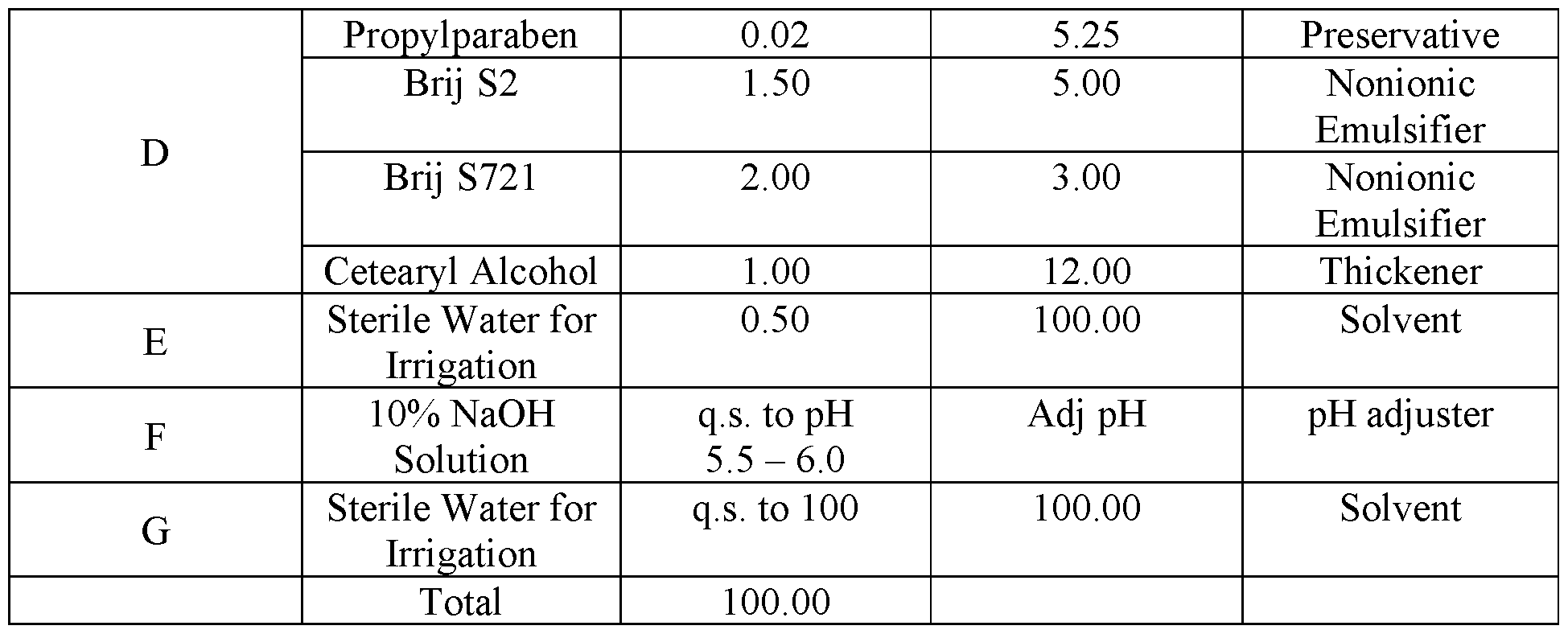
[0093] The components of Phase A were combined in the main manufacturing vessel and heated to 70-75 °C, if necessary, to dissolve methylparaben. Phase B was sprinkled into the main vessel and mixed until no fish eyes were present. The main vessel was then heated until 75-80 °C. The components of Phase C were combined in a separate vessel and homogenized until a solution was obtained. The components of Phase C were heated to 75-80 °C, if necessary, to dissolve the dutasteride. The components of Phase D were added to Phase C while heating to 75-80 °C and mixed until Phase D was completely melted. Phases C + D were added to the main manufacturing vessel at 75-80 °C with homogenization until the oil phase was fully incorporated. Phase E was used to rinse the Phase C + D vessel. The main manufacturing vessel as cooled to < 30 °C. Phase F was used to neutralize the batch to pH 5.5-6.0. Phase G was added to the main manufacturing vessel in an amount sufficient such that the total was 100% w/w.
[0094] Example 7: Topical lotion formulation comprising dutasteride [2019-045-76)
[0095] A topical formulation of 0.05% w/w for application may be prepared as follows.


[0096] The components of Phase A were combined in the main manufacturing vessel with high agitation until a homogeneous gel was obtained. The components of Phase B were combined in a separate vessel. Phase B was added to the main manufacturing vessel and mixed until uniformly dispersed. Phase C was added to the main manufacturing vessel and mixed until dissolved. The main manufacturing vessel was then heated to 70-75 °C. Phase D was combined in a separate vessel with homogenization until a solution was obtained. The phase was heated to 70-75 °C if necessary to dissolve the dutasteride. The components of Phase E were added to Phase D one at a time until a solution was obtained. The components of Phase F were added to Phases D + E while heating to 70-75 °C until Phase F was completely melted. Phases D + E + F were added to the main manufacturing vessel at 70-75 °C with homogenization until the oil phase was fully incorporated. Phase G was used to rinse the Phase D+ E + F vessel. The main manufacturing vessel was cooled down to < 30 °C.
[0097] Example 8: Topical lotion [conditioner) formulation comprising dutasteride
[2019-045-63]
[0098] A topical formulation of 0.05% w/w for application may be prepared as follows.

[0099] The components of Phase A were combined in the main manufacturing vessel and heated to 70-75 °C, and mixed until uniform. The components of Phase B were combined in a separate vessel with homogenization until a solution was obtained. The components of Phase B were heated to 70-75 °C, if necessary, to dissolve the dutasteride. The components of Phase C
were added to Phase B while heating to 70-75 °C, and mixed until Phase C was completely melted and incorporated. Phases B + C were added to the main manufacturing vessel at 70-75 °C with homogenization and mixed until the oil phase was fully incorporated. Phase D was used to rinse the Phase B + C vessel. The main manufacturing vessel was cooled to < 40 °C. The components of Phase E were combined in a separate vessel, then added to the main
manufacturing vessel and mixed until uniform. The main manufacturing vessel was cooled to < 30 °C. Phase F was added to the batch in an amount sufficient such that the total was 100% w/w.
[00100] Example 9: Topical lotion“serum” formulation comprising dutasteride
(dutasteride dissolved in oil phase]
[00101] A topical formulation of 0.05% w/w for application may be prepared as follows.


[00102] The components of Phase A were combined in the main vessel and were mixed until a solution was obtained. The components of Phase B were sprinkled into the main vessel with vigorous mixing until no fish eyes were present. The components of Phase C were combined in a separate container and mixed until a solution was obtained. The component of Phase D was then added to Phase C and mixed until a solution was obtained. Phase E was then dispersed in combined Phases C + D. The combined Phases C + D + E were then added to the main vessel with vigorous propeller mixing for 20-30 minutes. The batch was then homogenized for 1 minute at 6,000 rpm. The pH of the batch was adjusted to pH 5.5 - 6.0 using the Phase F.
[00103] A topical lotion (serum) formulation of 0.05% w/w for application may be prepared as follows. (2019-045 -25R)


[00104] The components of Phase A were combined in the main vessel and were mixed until a solution was obtained. The components of Phase B were sprinkled into the main vessel with vigorous mixing until no fish eyes were present. The components of Phase C were combined in a separate container and mixed until a solution was obtained. The component of Phase D was then added to Phase C and mixed until a solution was obtained. Phase E was then dispersed in combined Phases C + D. The combined Phases C + D + E were then added to the main vessel with vigorous propeller mixing for 20-30 minutes. The batch was then homogenized for 1 minute at 6,000 rpm. The pH of the batch was adjusted to pH 5.5 - 6.0 using the Phase F.
[00105] Example 10: Topical gel formulation comprising dutasteride
[00106] A topical formulation of 0.05% w/w for application may be prepared as follows. The light gel with a non-sticky finish can be applied on the scalp/hair and will advantageously not leave much residue after it sets.

[00107] The components of Phase A were combined in the main vessel and were mixed until a solution was obtained. The components of Phase B were added to the main vessel and were
mixed until a solution was obtained. Phase C was sprinkled into the main vessel and mixed until a uniform gel was obtained.
[00108] Example 11: Topical gel formulation comprising dutasteride
[00109] A topical formulation of 0.05% w/w for application may be prepared as follows.
(2019-045-531

[00110] The components of Phase A were combined in the main manufacturing vessel until a solution was obtained. Phase B was slowly added to the main manufacturing vessel with mixing until a homogenous gel was obtained. Phase C was added to the main manufacturing vessel in an amount sufficient such that the total was 100% w/w.
[00111] A topical formulation of 0.05% w/w for application may be prepared as follows.


[00112] The components of Phase A were combined in the main manufacturing vessel until a solution was obtained. Phase B was slowly added to the main manufacturing vessel with mixing until a homogenous gel was obtained.
[00113] Example 12: Topical gel formulation comprising dutasteride
[00114] A topical formulation of 0.05% w/w for application may be prepared as follows. (2019-045-55)

[00115] The components of Phase A were combined in the main manufacturing vessel until a solution was obtained. Phase B was added to the main manufacturing vessel with
homogenization and mixed until a uniform gel was obtained.
[00116] Example 13: Topical gel (serum) formulation comprising dutasteride
[00117] A topical formulation of 0.05% w/w for application may be prepared as follows.
(2019-045-611

[00118] The components of Phase A were combined in the main manufacturing vessel until a solution was obtained. Phase A was then heated to 60-65 °C. Phase B was weighed out in a separate vessel and heated to 60-65 °C. Phase B was then slowly added to the main
manufacturing vessel and mixed until a homogenous gel was obtained and when the temperature was < 30 °C.
[00119] Example 14: Analysis of Binary Dutasteride/Excipient Compatibility Study
[00120] Samples were weighed out (about 500 mg to 100 mg of sample into a 40 mL VOA bottle). The samples were fully dispersed in 5.0 mL of hexane by vortex. Sonication was also used as needed to fully disperse the sample. 10 mL of diluent (water/acetonitrile 40/60) was added to the VOA bottle and mixed by Vortex. An aliquot was filtered through a 0.45 pm PTFE filter into an autosampler vial for HPLC analysis. For the standard, a 6-point calibration curve in the range of 10 pg/mL to 200 pg/mL of dutasteride in diluent was prepared.
[00121] The samples were analyzed via HPLC in accordance with the following parameters.


[00122] Various combinations of dutasteride and excipients were tested at T = 0 and T = 14 days after being stored at 50°C to determine their stability and dutasteride’ s compatibility with different excipients. Results from the study are reported in FIG. 2.
[00123] Example 15: Treatment of human subjects suffering from alopecia with a topical composition of dutasteride
[00124] A topical composition of dutasteride, such as those described in Examples 1-13, can be applied to the scalp of a human subject suffering from alopecia for multiple days.
[00125] Two randomized, parallel -group studies can be conducted. Group I: 10 human subjects may receive 1 mL (lmg) of the topical formulation of Example 1, applied to the scalp once a day (qd) or twice a day (b.i.d) for at least 4 weeks, alternatively at least 8 weeks, alternatively at least 12 weeks, alternatively at least 16 weeks.
[00126] Group 2 may receive a placebo without the dutasteride applied to the scalp once a day (qd) or twice a day (b.i.d) for at least 4 weeks, alternatively at least 8 weeks, alternatively at least 12 weeks, alternatively at least 16 weeks.
[00127] For each of the groups, hair thickness increase, target area hair count (TAHC), hair growth assessment (HGA), target area hair width (TAF1W), scalp coverage, hair structure, and target area hair density (TAHD) can be measured every 2 weeks, alternatively every 4 weeks, alternatively every 8 weeks, alternatively every 12 weeks.
[00128] An increase in hair thickness, target area hair count (TAHC), target area hair width (TAHW), scalp coverage, hair structure, or target area hair density (TAHD) in Group 1
individual as compared to Group 2 individuals is indicative of a positive response to the topical treatment with dutasteride to alopecia.
[00129] Example 16: Treatment of women suffering from hirsutism with a topical composition of dutasteride
[00130] Two randomized, parallel -group studies can be conducted. Group I: 10 women suffering from hirsutism can receive 1 mL (lmg) of a topical formulation of dutasteride, such as those described in Examples 1-13, applied to the face once a day (q.d.) or twice a day (b.i.d) for at least 4 weeks, alternatively at least 8 weeks, alternatively at least 12 weeks, alternatively at least 16 weeks.
[00131] Group 2 may receive a placebo without the dutasteride applied to the face once a day (q.d.) or twice a day (b.i.d) for at least 4 weeks, alternatively at least 8 weeks, alternatively at least 12 weeks, alternatively at least 16 weeks.
[00132] For each of the groups, hair thickness decrease, target area hair count (TAHC), hair growth assessment (HGA), target area hair width (TAF1W), hair structure, and target area hair density (TAHD) can be measured every 2 weeks, alternatively every 4 weeks, alternatively every 8 weeks, alternatively every 12 weeks.
[00133] A decrease in facial hair thickness, target area hair count (TAHC), facial hair width (TAHW), hair structure, and facial hair density (TAHD) of the women in Group 1 as compared to Group 2 is indicative of a positive response to the topical treatment with dutasteride to hirsuitism.
[00134] Example 17: Treatment of men suffering from hypertrichosis with a topical composition of dutasteride
[00135] Two randomized, parallel -group studies can be conducted. Group I: 10 men suffering from hypertrichosis can receive 1 mL (lmg) of a topical formulation of dutasteride, such as those described in Examples 1-13, applied to the face once a day (q.d.) or twice a day (b.i.d) for at least 4 weeks, alternatively at least 8 weeks, alternatively at least 12 weeks, alternatively at least 16 weeks.
[00136] Group 2 may receive a placebo without the dutasteride applied to the face once a day (q.d.) or twice a day (b.i.d) for at least 4 weeks, alternatively at least 8 weeks, alternatively at least 12 weeks, alternatively at least 16 weeks.
[00137] For each of the groups, hair thickness decrease, target area hair count (TAHC), hair growth assessment (HGA), target area hair width (TAF1W), hair structure, and target area hair density (TAHD) can be measured every 2 weeks, alternatively every 4 weeks, alternatively every 8 weeks, alternatively every 12 weeks.
[00138] A decrease in facial hair thickness, target area hair count (TAHC), facial hair width (TAHW), hair structure, and facial hair density (TAHD) of the women in Group 1 as compared to Group 2 is indicative of a positive response to the topical treatment with dutasteride to hirsuitism.
[00139] Example 18: Treatment of women suffering from hair loss secondary to endocrine therapy in patients with breast cancer
[00140] Two randomized, parallel-group studies can be conducted. Group I: 20 women suffering from hair loss secondary to endocrine therapy in patients with breast cancer can receive 0.5 mg of dutasteride in a topical formulation, such as those described in Examples 1-13, applied to the affected area of the scalp once a day (q.d.) or twice a day (b.i.d) for at least 4 weeks, alternatively at least 8 weeks, alternatively at least 12 weeks, alternatively at least 16 weeks.
[00141] Group 2 may receive a placebo without the dutasteride applied to the affected area of the scalp once a day (q.d.) or twice a day (b.i.d) for at least 1 week, alternatively up to 12 weeks.
[00142] For each of the groups, hair thickness increase, target area hair count (TAHC), hair growth assessment (HGA), target area hair width (TAHW), scalp coverage, hair structure, and target area hair density (TAHD) can be measured.
[00143] An increase in hair thickness, target area hair count (TAHC), target area hair width (TAHW), scalp coverage, hair structure, or target area hair density (TAHD) in Group 1
individual as compared to Group 2 individuals is indicative of a positive response to the topical treatment with dutasteride to alopecia.
[00144] Example 19: Treatment of human subjects suffering from alopecia with a topical composition of dutasteride
[00145] A patient suffering from alopecia may apply a dose of a topical formulation of dutasteride. The dutasteride topical formulation may be a solid formulation, such as a lotion, conditioner, serum, gel, foam, cream, paste, powder, oil, or gel. The dose may be 0.5 mg to 1.5 mg. The dutasteride topical formulation may be administered to the affected area once, hourly, b.i.d., t.i.d., q.i.d., or daily (q.d.) for 1 day, alternatively every 2 days, alternatively every 3 days, alternatively every 4 days, alternatively every 5 days, alternatively every 6 days, alternatively every week for at least 4 weeks, alternatively at least 8 weeks, alternatively at least 12 weeks, alternatively at least 16 weeks.
[00146] Example 20: Treatment of women suffering from hirsutism with a topical composition of dutasteride
[00147] A patient suffering from hirsuitism may apply a dose of a topical formulation of dutasteride. The dutasteride topical formulation may be a solid formulation, such as a lotion, conditioner, serum, gel, foam, cream, paste, powder, oil, or gel. The dose may be 0.5 mg to 1.5 mg. The dutasteride topical formulation may be administered to the affected area once, hourly, b.i.d., t.i.d., q.i.d., or daily (q.d.) for 1 day, alternatively every 2 days, alternatively every 3 days, alternatively every 4 days, alternatively every 5 days, alternatively every 6 days, alternatively every week for at least 4 weeks, alternatively at least 8 weeks, alternatively at least 12 weeks, alternatively at least 16 weeks.
[00148] Example 21: Treatment of men suffering from hypertrichosis with a topical composition of dutasteride
[00149] A patient suffering from hypertrichosis may apply a dose of a topical formulation of dutasteride. The dutasteride topical formulation may be a solid formulation, such as a lotion, conditioner, serum, gel, foam, cream, paste, powder, oil, or gel. The dose may be 0.5 mg to 1.5
mg. The dutasteride topical formulation may be administered to the affected area once, hourly, b.i.d., t.i.d., q.i.d., or daily (q.d.) for 1 day, alternatively every 2 days, alternatively every 3 days, alternatively every 4 days, alternatively every 5 days, alternatively every 6 days, alternatively every week for at least 4 weeks, alternatively at least 8 weeks, alternatively at least 12 weeks, alternatively at least 16 weeks.
[00150] Example 22: Treatment of women suffering from hair loss secondary to endocrine therapy in patients with breast cancer
[00151] A patient suffering from breast cancer and hair loss secondary to endocrine therapy may apply a dose of a topical formulation of dutasteride. The dutasteride topical formulation may be a solid formulation, such as a lotion, conditioner, serum, gel, foam, cream, paste, powder, oil, or gel. The dose may be 0.5 mg to 1.5 mg. The dutasteride topical formulation may be administered to the affected area once, hourly, b.i.d., t.i.d., q.i.d., or daily (q.d.) for 1 day, alternatively every 2 days, alternatively every 3 days, alternatively every 4 days, alternatively every 5 days, alternatively every 6 days, alternatively every week for at least 4 weeks, alternatively at least 8 weeks, alternatively at least 12 weeks, alternatively at least 16 weeks.
[00152] The invention has been described broadly and generically herein. Each of the narrower species and subgeneric groupings falling within the generic disclosure also form part of the methods. This includes the generic description of the methods with a proviso or negative limitation removing any subject matter from the genus, regardless of whether or not the excised material is specifically recited herein.
[00153] Other embodiments are within the following claims. In addition, where features or aspects of the methods are described in terms of Markush groups, those skilled in the art will recognize that the invention is also thereby described in terms of any individual member or subgroup of members of the Markush group.
Claims
1. A method for stimulating the hair growth on the scalp of a human subject, comprising:
a) providing a topical composition comprising a therapeutically effective amount of dutasteride and/or finasteride, or a pharmaceutically acceptable salt, ester, or derivative of dutasteride and/or finasteride, and a topical pharmaceutically acceptable excipient or carrier; and b) topically applying the composition to the scalp in an amount and for a duration sufficient to stimulate hair growth;
wherein hair growth comprises an increase in scalp hair density, hair thickness, or scalp coverage.
2. The method of claim 1, wherein the human subject suffers from a condition selected from the group consisting of androgenetic alopecia (AGA), alopecia areata, and Endocrine Therapy-Induced Alopecia (ETIA).
3. The method of claim 2, wherein the ETIA is hair loss secondary to endocrine therapy for breast cancer.
4. The method of any one of claims 1-3, wherein the composition is applied to scalp in an area comprising the frontal, central, vertex regions, or a combination thereof of the scalp.
5. The method of any one of claims 1-4, wherein the hair growth further comprises improved scalp coverage and improved hair structure.
6. A method for reducing facial hair growth of a human subject diagnosed as having hirsutism, comprising:
a) providing a topical composition comprising a therapeutically effective amount of dutasteride and/or finasteride, or a pharmaceutically acceptable salt, ester, or derivative of dutasteride and/or finasteride, and a topical pharmaceutically acceptable excipient or carrier; and b) topically applying the composition to the subject’s skin at a site of facial hair growth n an amount and for a duration sufficient to decrease facial hair density, facial hair thickness, or both.
7. The method of claim 6, wherein the reduction in facial hair growth includes a decrease in at least one of facial hair thickness, target area hair count (TAHC), facial hair width (TAHW), hair structure, and facial hair density (TAHD).
8. A method for reducing excess facial or body hair growth of a human subject diagnosed as having hypertrichosis, comprising:
a) providing a topical composition comprising a therapeutically effective amount of dutasteride and/or finasteride, or a pharmaceutically acceptable salt, ester, or derivative of dutasteride and/or finasteride, and a topical pharmaceutically acceptable excipient or carrier; and b) topically applying the composition to the subject’s skin at a site of facial or body hair growth in an amount and for a duration sufficient to decrease facial or body hair density, facial or body hair thickness, or both.
9. The method of claim 8, wherein the reduction in facial or body hair growth includes a decrease in at least one of facial or body hair thickness, target area hair count
(TAHC), facial or body hair width (TAHW), hair structure, and facial or body hair density (TAHD).
10. The method of any one of claims 1-9, wherein the human subject is a female, a male, transgender or nonbinary
11. The method of any one of claims 1-10, wherein the therapeutically effective amount of dutasteride or finasteride is about 0.001% to about 1% (w/w).
12. The method of claim 11, wherein the therapeutically effective amount of dutasteride or finasteride is about 0.002% to about 0.1% (w/w).
13. The method of claim 12, wherein the therapeutically effective amount of dutasteride or finasteride is about 0.075% (w/w).
14. The method of any one of claims 1-13, wherein the topical composition further comprises a surfactant, a penetration enhancer, an antioxidant, a buffering agent, a preservative, a viscosity modifying agent, a chelating agent, a coloring agent, a perfume, a polymer, a gelling agent, an alcohol, a liquid or semi-solid oily component, or any combination thereof.
15. The method of any one of claims 1-14, wherein the topical pharmaceutically acceptable excipients or carriers comprise ethanol, polypropylene glycol, purified water, or a combination thereof.
16. The method of any one of claims 1-15, wherein dutasteride or finasteride is in the form of a nanoparticle.
17. The method of any one of claims 1-16, wherein the topical composition further comprises at least one of a solvent, a humectant, a thickener, a preservative, an emollient, an emulsifier, a pH adjuster, a penetration enhancer, a conditioning agent, and combinations thereof.
18. The method of any one of claims 1-17, wherein the topical composition further comprises at least one of a solvent, a humectant solvent, a thickener, a preservative, an emollient, a cationic emulsifier, an emulsifier, a non-ionic emulsifier, a pH adjuster, a penetration enhancer, a conditioning agent, a preservative, a thickener, a viscosity enhancer, and combinations thereof.
19. The method of any one of claims 1-18, further comprising a therapeutically effective amount of minoxidil.
20. The method of any one of claims 1-19, wherein the composition is in the form of lotion, serum, foam, cream, paste, gel, aerosol, powder, oil, or liquid.
21. A topical composition comprising a therapeutically effective amount of dutasteride and/or finasteride, or a pharmaceutically acceptable salt, ester, or derivative of dutasteride and/or finasteride, and a topical pharmaceutically acceptable excipient or carrier.
22. The composition of claim 21, wherein the therapeutically effective amount of dutasteride or finasteride is about 0.001% to about 1% (w/w).
23. The composition of claim 21, wherein the therapeutically effective amount of dutasteride or finasteride is about 0.002% to about 0.1% (w/w).
24. The composition of claim 21, wherein the therapeutically effective amount of dutasteride or finasteride is about 0.075% (w/w).
25. The composition of any one of claims 21-24, wherein dutasteride or finasteride is in the form of a nanoparticle.
26. The composition of any one of claims 21-25, wherein the composition is in the form of lotion, serum, foam, cream, paste, gel, aerosol, powder, oil, or liquid.
27. The composition of any one of claims 21-26, further comprising a therapeutically effective amount of minoxidil.
28. The composition of any one of claims 21-27, wherein the composition does not contain ethyl alcohol, polypropylene glycol, or both.
29. The composition of any one of claims 21-28, further comprising a surfactant, a co-surfactant, a penetration enhancer, an antioxidant, a buffering agent, a solubilizer, a preservative, a viscosity modifying agent, a chelating or complexing agent, a coloring agent, a perfume, a polymer, a gelling agent, an alcohol, a liquid or semi-solid oily component, or any combination thereof.
30. The composition of any one of claims 21-29, wherein the topical
pharmaceutically acceptable carrier comprises a lipophilic substance comprising a paraffin oil, an ester of a Cx-C ix organic acid, a C8-C30 fatty alcohol, a silicone oil, a vegetable oil, a fractionated or hydrogenated vegetable oil, a monoglyceride, a diglyceride, a triglyceride, a phospholipid, dimethylisosorbide, a volatile solvent, N-methylpyrrolidone, dimethylacetamide, dimethylformamide; dimethylsulphoxide, or any combination thereof.
31. The composition of any one of claims 21-30, wherein the topical
pharmaceutically acceptable excipients or carriers comprise ethanol, polypropylene glycol, purified water, or a combination thereof.
32. The composition of any one of claims 21-31, further comprising at least one of a solvent, a humectant, a thickener, a preservative, an emollient, an emulsifier, a pH adjuster, a penetration enhancer, a conditioning agent, and combinations thereof.
33. The composition of any one of claims 21-32, further comprising at least two of cationic emulsifier, conditioning agent, emollient, emulsifier, humectant solvent, nonionic emulsifier, penetration enhancer, pH adjuster, preservative, solvent, thickener, viscosity enhancer, and any combinations thereof.
34. The composition of any one of claims 21-33, further comprising a solvent, a humectant, a thickener, a preservative, an emollient, an emulsifier, and a penetration enhancer.
35. The composition of any one of claims 21-34, further comprising a solvent, a humectant, a thickener, a preservative, an emollient, an emulsifier, a pH adjuster, and a penetration enhancer.
36. The composition of any one of claims 21-35 further comprising a solvent, a humectant, a thickener, a preservative, an emollient, an emulsifier, and a conditioning agent.
37. The composition of any one of claims 21-36, further comprising a solvent, a humectant, a thickener, a preservative, an emollient, an emulsifier, a pH adjuster, a penetration enhancer, and a conditioning agent.
38. The composition of any one of claims 21-37, further comprising a solvent, a thickener, an emollient, and a penetration enhancer.
39. The composition of any one of claims 21-38, further comprising a solvent, a viscosity enhancer, an emollient, and a penetration enhancer.
40. The composition of any one of claims 21-39, further comprising a penetration enhancer selected from the group consisting of medium chain triglycerides, isopropyl myristate, diisopropyl adipate, isopropyl palmitate, propylene glycol, diethylene glycol monoethylether, oleyl alcohol, dehydrated alcohol, benzyl alcohol, laureth-4, and dimethyl isosorbide.
41. The composition of any one of claims 21-40, further comprising a solvent selected from the group consisting of sterile water, glycerin, medium chain triglycerides, isopropyl myristate, diisopropyl adipate, isopropyl palmitate, propylene glycol, olive oil, castor oil, coconut oil, light mineral oil, diethylene glycol monoethylether, diethyl sebacate, benzyl alcohol, cyclomethicone, PEG 400, dehydrated alcohol, and dimethyl isosorbide.
42. The composition of any one of claims 21-41, further comprising a humectant selected from the group consisting of sodium hyaluronate, glycerin, sorbitol solution, 70%, and methyl gluceth-20.
43. The composition of any one of claims 21-42, further comprising a thickener selected from the group consisting of xanthan gum, cetearyl alcohol, Promulgen D, Carbopol 974P NF Polymer, Pemulen TR-2, Pemulen TR-l, Klucel HG Pharm, Carbopol 980 NF, Polymer, and Sepineo P 600.
44. The composition of any one of claims 21-43, further comprising a preservative selected from the group consisting of methylparaben and propylparaben.
45. The composition of any one of claims 21-44, further comprising an emollient selected from the group consisting of olive oil, medium chain triglycerides, isopropyl myristate, diisopropyl adipate, isopropyl palmitate, castor oil, light mineral oil, cyclomethicone, diethyl sebacate, benzyl alcohol, PEG-35 castor oil, and coconut oil.
46. The composition of any one of claims 21-45, further comprising an emulsifier selected from the group consisting of Brij L4, Arlacel 165, Tween 20, Brij S721, Brij S2, Promulgen D, Stearalkonium Chloride, Pemulen TR-2, Pemulen TR-l, Sodium Monostearate, Sepineo P 600, Laureth-4, Polysorbate 20, and PEG-35 Castor Oil.
47. The composition of any one of claims 21-46, further comprising a pH adjuster selected from the group consisting of NaOH and HC1 solutions.
48. The composition of any one of claims 21-47, further comprising a conditioning agent selected from the group consisting of stearalkonium chloride and Polyquatemium-lO.
49. The composition of any one of claims 21-48, further comprising Laureth-4.
50. The composition of any one of claims 21-49, further comprising PEG 3350.
51. A topical formulation comprising:
dutasteride and/or finasteride, or a pharmaceutically acceptable salt, ester, or derivative of dutasteride and/or finasteride dissolved in an oil phase comprising at least one oil; and
a topical pharmaceutically acceptable excipient or carrier.
52. The formulation of claim 51, wherein the topical formulation is an emulsion.
53. The formulation of any one of claims 51-52, wherein the oil phase comprises a medium chain triglyceride oil.
54. The formulation of any one of claims 51-53, wherein the at least one oil is olive oil.
55. The formulation of any one of claims 51-54, wherein the oil phase comprises oleyl alcohol, isopropyl myristate, diethyl sebacate, and combinations thereof.
56. The formulation of any one of claims 51-55, wherein the oil phase comprises at least two, three, four, or more oils.
57. The formulation of any one of claims 51-56, wherein the oil phase comprises medium chain tricglyceride oil and olive oil.
58. The formulation of any one of claims 51-57, wherein the oil phase further comprises at least one solvent.
59. The formulation of claim 58, wherein the at least one solvent is benzyl alcohol, diissopropyl acetate, isopropyl palmitate, and combinations thereof.
60. The formulation of any one of claims 51-59, further comprising a humectant, a thickener, an emulsifier, and a preservative.
61. The formulation of any one of claims 51-60, wherein the formulation does not contain ethyl alcohol, polypropylene glycol, or both.
62. The composition of any one of claims 51-61, wherein the therapeutically effective amount of dutasteride or finasteride is about 0.001% to about 1% (w/w).
63. The composition of any one of claims 51-62, wherein the therapeutically effective amount of dutasteride or finasteride is about 0.002% to about 0.1% (w/w).
64. The composition of any one of claims 51-63, wherein the therapeutically effective amount of dutasteride or finasteride is about 0.075% (w/w).
65. A method for preparing a topical formulation, comprising the steps of:
mixing a first conditioning agent and a first preservative with a first solvent to form a conditioning solution;
mixing dutasteride or finasteride, at least one oil, and at least one solvent to obtain a dutasteride/finasteride solution;
mixing a first emulsifier and a second preservative with the dutasteride/finasteride solution to obtain a dutasteride/finasteride emulsifier solution;
mixing the dutasteride/finasteride emulsifier solution with the conditioning solution to obtain a combined solution;
mixing a second conditioning agent and a solvent to form a second conditioning solution; and
mixing the second conditioning solution and the combined solution to form a combined dutasteride/finasteride solution.
66. The method of claim 65, wherein the first preservative is methylparaben.
67. The method of any one of claims 65-66, wherein the first conditioning agent is stearalkonium chloride.
68. The method of any one of claims 65-67, wherein the first preservative and the second preservatives comprise a paraben.
69. The method of any one of claims 65-68, wherein the first preservative and the second preservatives are each independently selected from the group consisting of
methylparaben and propylparaben.
70. The method of any one of claims 65-69, wherein the first solvent is water, glycerin, or combinations thereof.
71. The method of any one of claims 65-70, wherein the at least one oil is selected from the group consisting of olive oil, medium chain tricglycerides, and combinations thereof.
72. The method of any one of claims 65-71, wherein the at least one solvent is benzyl alcohol, diisopropyl adipate, or combinations thereof.
73. The method of any one of claims 65-72, wherein the first emulsifier is Promulgen D.
74. The method of any one of claims 65-73, wherein the second conditioning agent is Polyquaternium- 10.
75. The method of any one of claims 65-74, wherein the step of mixing the first conditioning agent with the first solvent includes heating up to 70-75°C.
76. The method of any one of claims 65-75, wherein the step of mixing the dutasteride or finasteride, at least one oil, and at least one solvent to obtain the
dutasteride/finasteride solution includes heating up to 70-75°C.
77. The method of any one of claims 65-76, wherein the step of mixing the first emulsifier and the second preservative with the dutasteride/finasteride solution to obtain the dutasteride/finasteride emulsifier solution includes heating up to 70-75°C.
78. The method of any one of claims 65-77, wherein the step of mixing the dutasteride/finasteride emulsifier solution with the conditioning solution to obtain the combined solution includers heating up to 70-75°C and homogenization.
79. The method of any one of claims 65-78, further comprising the step of cooling the combined dutasteride/fmasteride solution to less than approximately 30 °C after mixing the combined solution with the second conditioning solution.
80. The method of any one of claims 65-79, further comprising the step of adding sterile water to the combined dutasteride/fmasteride solution after cooling to less than approximately 30 °C.
81. A method for preparing a topical formulation, comprising the steps of:
mixing a humectant with water to form a humectant solution;
mixing a thickener and a first solvent to form a thickener solution;
mixing the thickener solution with the humectant solution to form a combined solution; mixing a preservative into the combined solution to form a combined preservative solution;
mixing dutasteride or finasteride and a second solvent to form a dutasteride/fmasteride solution;
mixing at least one oil into the dutasteride/fmasteride solution to form a
dutasteride/fmasteride oil mixture;
mixing at least one emulsifier to the dutasteride/fmasteride oil mixture to form a second dutasteride/fmasteride oil mixture; and
mixing the second dutasteride/fmasteride oil mixture with the combined preservative solution in a vessel.
82. The method of claim 81, wherein the humectant is mixed with the water with agitation to form the humectant solution.
83. The method of any one of claims 81-82, wherein the dutasteride and second solvent are mixed together with homogenization to form the dutasteride/fmasteride solution.
84. The method of any one of claims 81-83, wherein the step of mixing the second solvent and dutasteride or finasteride includes heating to approximately 70 - 75 °C.
85. The method of any one of claims 81-84, wherein the step of mixing the at least one emulsifier and the dutasteride/finasteride oil mixture to form the second
dutasteride/finasteride oil mixture includes heating.
86. The method of any one of claims 81-85, wherein the second
dutasteride/finasteride oil mixture is mixed with the combined preservative solution while heating to approximately 70 - 75 °C.
87. The method of any one of claims 81-86, further comprising the step of cooling the vessel after mixing the second dutasteride/finasteride oil mixture with the combined preservative solution to less than approximately 30 °C.
88. The method of any one of claims 81-87, wherein the humectant is selected from the group consisting of sodium hyaluronate and glycerin.
89. The method of any one of claims 81-88, wherein the thickener is selected from the group consisting of xanthum gum and cetearyl alcohol.
90. The method of any one of claims 81-89, wherein the preservative is selected from the group consisting of paraben, methylparaben, and propylparaben.
91. The method of any one of claims 81-90, wherein the at least one oil is a medium chain glyceride.
92. The method of any one of claims 81-91, wherein the at least one emulsifier is selected from the group consisting of arlacel 165, sodium monostearate, and combinations thereof.
93. A topical formulation comprising:
a therapeutically effective amount of dutasteride and/or finasteride, or a pharmaceutically acceptable salt, ester, or derivative of dutasteride and/or finasteride dissolved in an aqueous phase; and
a topical pharmaceutically acceptable excipient or carrier.
94. The formulation of claim 93, wherein the topical formulation is an emulsion.
95. The formulation of any one of claims 93-94, wherein the aqueous phase further comprises a penetration enhancer.
96. The formulation of any one of claims 93-95, wherein the aqueous phase further comprises a solubilizer.
97. The formulation of any one of claims 93-96, wherein the aqueous phase further comprises diisopropyl adipate.
98. The formulation of any one of claims 93-97, further comprising a thickener, an emollient, a pH adjuster, a preservative, and a conditioning agent.
99. The formulation of any one of claims 93-98, further comprising an oil phase.
100. The formulation of claim 99, wherein the oil phase comprises medium chain triglycerides.
101. The formulation of any one of claims 99-100, wherein the oil phase further comprises an emulsifier.
102. The formulation of any one of claims 99-101, wherein the oil phase further comprises a thickener and a preservative.
103. The composition of any one of claims 93-102, wherein the therapeutically effective amount of dutasteride or finasteride is about 0.001% to about 1% (w/w).
104. The composition of any one of claims 93-102, wherein the therapeutically effective amount of dutasteride or finasteride is about 0.002% to about 0.1% (w/w).
105. The composition of any one of claims 93-102, wherein the therapeutically effective amount of dutasteride or finasteride is about 0.075% (w/w).
Priority Applications (3)
| Application Number | Priority Date | Filing Date | Title |
|---|---|---|---|
| EP19882117.5A EP3876935A4 (en) | 2018-11-08 | 2019-11-07 | TOPICAL FORMULATIONS OF 5-a-REDUCTASE INHIBITORS AND USES THEREOF |
| JP2021525096A JP2022506944A (en) | 2018-11-08 | 2019-11-07 | Topical formulations of 5-α-reductase inhibitors and their use |
| JP2024198983A JP2025032123A (en) | 2018-11-08 | 2024-11-14 | Topical formulations of 5-alpha-reductase inhibitors and their uses - Patents.com |
Applications Claiming Priority (4)
| Application Number | Priority Date | Filing Date | Title |
|---|---|---|---|
| US201862757483P | 2018-11-08 | 2018-11-08 | |
| US62/757,483 | 2018-11-08 | ||
| US201962889318P | 2019-08-20 | 2019-08-20 | |
| US62/889,318 | 2019-08-20 |
Publications (1)
| Publication Number | Publication Date |
|---|---|
| WO2020097284A1 true WO2020097284A1 (en) | 2020-05-14 |
Family
ID=70551490
Family Applications (1)
| Application Number | Title | Priority Date | Filing Date |
|---|---|---|---|
| PCT/US2019/060194 Ceased WO2020097284A1 (en) | 2018-11-08 | 2019-11-07 | TOPICAL FORMULATIONS OF 5-α-REDUCTASE INHIBITORS AND USES THEREOF |
Country Status (4)
| Country | Link |
|---|---|
| US (2) | US11311529B2 (en) |
| EP (1) | EP3876935A4 (en) |
| JP (2) | JP2022506944A (en) |
| WO (1) | WO2020097284A1 (en) |
Cited By (1)
| Publication number | Priority date | Publication date | Assignee | Title |
|---|---|---|---|---|
| WO2025163683A1 (en) * | 2024-02-02 | 2025-08-07 | Zydus Lifesciences Limited | Pharmaceutical compositions of 5-alpha reductase inhibitors |
Families Citing this family (8)
| Publication number | Priority date | Publication date | Assignee | Title |
|---|---|---|---|---|
| MX2015002252A (en) | 2012-08-21 | 2015-07-21 | Sage Therapeutics Inc | Methods of treating epilepsy or status epilepticus. |
| JOP20200195A1 (en) | 2014-09-08 | 2017-06-16 | Sage Therapeutics Inc | Neuroactive steroids and formulations, and their uses |
| HK1258616A1 (en) | 2016-03-08 | 2019-11-15 | Sage Therapeutics, Inc. | Neuroactive steroids, compositions, and uses thereof |
| WO2020097284A1 (en) * | 2018-11-08 | 2020-05-14 | Jindal Vinay K | TOPICAL FORMULATIONS OF 5-α-REDUCTASE INHIBITORS AND USES THEREOF |
| US20230181430A1 (en) * | 2020-05-02 | 2023-06-15 | XYON Health Inc. | Topical formulations comprising dutasteride for treating dermatological disorders including male pattern baldness |
| AU2021272476A1 (en) | 2020-05-13 | 2022-12-15 | Follicle Pharma Ltd | Compositions for delivery of bioactive agents into hair follicles |
| US11311556B2 (en) | 2020-05-13 | 2022-04-26 | Varsona Therapeutics, Inc. | Topical dutasteride emulsions for treating endocrine therapy-induced alopecia |
| US11850300B2 (en) | 2022-03-17 | 2023-12-26 | Rally Guide | Topical lotion composition, methods of use, and methods of preparation |
Citations (8)
| Publication number | Priority date | Publication date | Assignee | Title |
|---|---|---|---|---|
| US20030191035A1 (en) * | 2002-03-26 | 2003-10-09 | Alberto-Culver Company | Hair conditioning composition |
| US20060204588A1 (en) * | 2005-03-10 | 2006-09-14 | Elan Pharma International Limited | Formulations of a nanoparticulate finasteride, dutasteride or tamsulosin hydrochloride, and mixtures thereof |
| US20100048598A1 (en) * | 2008-08-21 | 2010-02-25 | Sateesh Kandavilli | Topical compositions comprising 5-alpha reductase inhibitors |
| US20110212167A1 (en) * | 2008-09-27 | 2011-09-01 | Jina Pharmaceuticals, Inc. | Lipid based pharmaceutical preparations for oral and topical application; their compositions, methods, and uses thereof |
| US20140079686A1 (en) * | 2010-12-06 | 2014-03-20 | Shikha P. Barman | Methods For Treating Baldness And Promoting Hair Growth |
| US20140322148A1 (en) * | 2011-11-25 | 2014-10-30 | Adrianna Janell Jackson | Oil Compositions and Methods for Increasing Hair Growth and/or Preventing Hair Loss |
| US20150216986A1 (en) * | 2012-08-31 | 2015-08-06 | Biolab Sanus Farmaceutia Ltda. | Finasteride and minoxidil polymeric nonoparticle, its process of preparation, aqueous suspension containing the same, pharmaceutical composition, and its use |
| WO2018013142A1 (en) * | 2016-07-15 | 2018-01-18 | Medicell Technologies Llc | Compositions and methods for providing hair growth |
Family Cites Families (21)
| Publication number | Priority date | Publication date | Assignee | Title |
|---|---|---|---|---|
| US4299826A (en) * | 1979-10-12 | 1981-11-10 | The Procter & Gamble Company | Anti-acne composition |
| JPS5682843A (en) * | 1979-12-08 | 1981-07-06 | Nippon Oil Co Ltd | Wax emulsion |
| US4950475A (en) * | 1988-07-19 | 1990-08-21 | Imaginative Research Associates, Inc. | Novel film-forming gels with high concentrations of humectants and emollients |
| US5030374A (en) * | 1989-07-17 | 1991-07-09 | International Research And Development Corporation | Clear neutral non-foaming rapidly-rinsable gel facial cleanser formulation |
| WO1991008733A1 (en) * | 1989-12-20 | 1991-06-27 | Schering Corporation | Stable cream and lotion bases for lipophilic drug compositions |
| ZA954599B (en) * | 1994-06-07 | 1996-01-26 | Allergan Inc | Stable gel formulation for topical treatment of skin conditions |
| US7074747B1 (en) | 1999-07-01 | 2006-07-11 | Johnson & Johnson Consumer Companies, Inc. | Cleansing compositions |
| US20020035070A1 (en) | 2000-07-26 | 2002-03-21 | The Procter & Gamble Company | Method of regulating hair growth using metal complexes of oxidized carbohydrates |
| US20070292355A1 (en) | 2002-10-25 | 2007-12-20 | Foamix Ltd. | Anti-infection augmentation foamable compositions and kit and uses thereof |
| DK1670433T3 (en) * | 2003-10-10 | 2012-03-12 | Ferring Bv | Transdermal pharmaceutical formulation to reduce skin remnants |
| US7854940B2 (en) * | 2004-09-16 | 2010-12-21 | Arch Chemicals, Inc. | Broad spectrum preservation blends |
| US20080260864A1 (en) | 2005-10-21 | 2008-10-23 | Medidermis Ltd. | Topical Compositions for the Treatment of Depilation-Induced Irritation or Prevention Thereof |
| US8367112B2 (en) | 2006-02-28 | 2013-02-05 | Alkermes Pharma Ireland Limited | Nanoparticulate carverdilol formulations |
| WO2009072007A2 (en) | 2007-12-07 | 2009-06-11 | Foamix Ltd. | Carriers, formulations, methods for formulating unstable active agents for external application and uses thereof |
| US9642862B2 (en) * | 2010-11-18 | 2017-05-09 | White Mountain Pharma, Inc. | Methods for treating chronic or unresolvable pain and/or increasing the pain threshold in a subject and pharmaceutical compositions for use therein |
| US8883224B2 (en) | 2011-03-28 | 2014-11-11 | Mary Kay Inc. | Topical skin care formulations comprising plant extracts |
| KR101976137B1 (en) * | 2012-01-25 | 2019-05-09 | 한미약품 주식회사 | Self-emulsifying drug delivery system composition comprising dutasteride and method for preparing the same |
| EP3094323A4 (en) | 2014-01-17 | 2017-10-11 | Ligand Pharmaceuticals Incorporated | Methods and compositions for modulating hormone levels |
| WO2019012353A1 (en) | 2017-07-11 | 2019-01-17 | Shilpa Medicare Limited | Topical compositions of dutasteride |
| WO2020097284A1 (en) * | 2018-11-08 | 2020-05-14 | Jindal Vinay K | TOPICAL FORMULATIONS OF 5-α-REDUCTASE INHIBITORS AND USES THEREOF |
| US11311556B2 (en) | 2020-05-13 | 2022-04-26 | Varsona Therapeutics, Inc. | Topical dutasteride emulsions for treating endocrine therapy-induced alopecia |
-
2019
- 2019-11-07 WO PCT/US2019/060194 patent/WO2020097284A1/en not_active Ceased
- 2019-11-07 US US16/676,657 patent/US11311529B2/en active Active
- 2019-11-07 JP JP2021525096A patent/JP2022506944A/en active Pending
- 2019-11-07 EP EP19882117.5A patent/EP3876935A4/en active Pending
-
2022
- 2022-03-31 US US17/709,710 patent/US20230021330A1/en active Pending
-
2024
- 2024-11-14 JP JP2024198983A patent/JP2025032123A/en active Pending
Patent Citations (8)
| Publication number | Priority date | Publication date | Assignee | Title |
|---|---|---|---|---|
| US20030191035A1 (en) * | 2002-03-26 | 2003-10-09 | Alberto-Culver Company | Hair conditioning composition |
| US20060204588A1 (en) * | 2005-03-10 | 2006-09-14 | Elan Pharma International Limited | Formulations of a nanoparticulate finasteride, dutasteride or tamsulosin hydrochloride, and mixtures thereof |
| US20100048598A1 (en) * | 2008-08-21 | 2010-02-25 | Sateesh Kandavilli | Topical compositions comprising 5-alpha reductase inhibitors |
| US20110212167A1 (en) * | 2008-09-27 | 2011-09-01 | Jina Pharmaceuticals, Inc. | Lipid based pharmaceutical preparations for oral and topical application; their compositions, methods, and uses thereof |
| US20140079686A1 (en) * | 2010-12-06 | 2014-03-20 | Shikha P. Barman | Methods For Treating Baldness And Promoting Hair Growth |
| US20140322148A1 (en) * | 2011-11-25 | 2014-10-30 | Adrianna Janell Jackson | Oil Compositions and Methods for Increasing Hair Growth and/or Preventing Hair Loss |
| US20150216986A1 (en) * | 2012-08-31 | 2015-08-06 | Biolab Sanus Farmaceutia Ltda. | Finasteride and minoxidil polymeric nonoparticle, its process of preparation, aqueous suspension containing the same, pharmaceutical composition, and its use |
| WO2018013142A1 (en) * | 2016-07-15 | 2018-01-18 | Medicell Technologies Llc | Compositions and methods for providing hair growth |
Non-Patent Citations (4)
| Title |
|---|
| "Robinson's current therapy in equine medicine", 2015, ELSEVIER, ISBN: 978-0-323-24216-5, article FRANK, N.: "Robinson's Current Therapy in EQUINE MEDICINE", pages: 574, XP009527814 * |
| FARSHI, S ET AL.: "A randomized double blind, vehicle controlled bilateral comparison study of the efficacy and safety of finasteride 0.5 percent solution in combination with intense pulsed light in the treatment of facial hirsutism", JOURNAL OF COSMETIC AND LASER THERAPY, vol. 14, 2012, pages 193 - 199, XP055807991 * |
| FREITES-MARTINEZ, A ET AL.: "Endocrine Therapy-Induced Alopecia in Patients With Breast Cancer", JAMA DERMATOLOGY, vol. 154, no. 6, June 2018 (2018-06-01), pages 670 - 675, XP055807994 * |
| See also references of EP3876935A4 * |
Cited By (1)
| Publication number | Priority date | Publication date | Assignee | Title |
|---|---|---|---|---|
| WO2025163683A1 (en) * | 2024-02-02 | 2025-08-07 | Zydus Lifesciences Limited | Pharmaceutical compositions of 5-alpha reductase inhibitors |
Also Published As
| Publication number | Publication date |
|---|---|
| US11311529B2 (en) | 2022-04-26 |
| JP2022506944A (en) | 2022-01-17 |
| US20230021330A1 (en) | 2023-01-26 |
| EP3876935A1 (en) | 2021-09-15 |
| JP2025032123A (en) | 2025-03-11 |
| US20200147071A1 (en) | 2020-05-14 |
| EP3876935A4 (en) | 2022-08-17 |
Similar Documents
| Publication | Publication Date | Title |
|---|---|---|
| US20230021330A1 (en) | Topical formulations of 5-alpha-reductase inhibitors and uses thereof | |
| JP3710380B2 (en) | Pharmaceutical solution | |
| CA2987701C (en) | High concentration formulation of cortexolone-17a-propionate for treating alopecia | |
| KR102327820B1 (en) | Topical composition of dutasteride | |
| US12053481B2 (en) | Compositions and methods for deep dermal drug delivery | |
| JP2022541605A (en) | Treatment of Skin Disorders with Topical Tapinalof-EGFR Inhibitor Compositions | |
| US20210353643A1 (en) | Topical dutasteride emulsions for treating endocrine therapy-induced alopecia | |
| WO2025133909A1 (en) | Topical composition comprising dutasteride and minoxidil for alopecia | |
| AU2021368099A1 (en) | Methods for treating vitiligo lesions having improved efficacy | |
| US20220347191A1 (en) | Topical compositions of dutasteride | |
| JP2001502317A (en) | New carrier system | |
| WO2025133899A1 (en) | Topical composition comprising dutasteride and latanoprost for alopecia | |
| CN116723832A (en) | Compositions and methods for deep skin drug delivery |
Legal Events
| Date | Code | Title | Description |
|---|---|---|---|
| 121 | Ep: the epo has been informed by wipo that ep was designated in this application |
Ref document number: 19882117 Country of ref document: EP Kind code of ref document: A1 |
|
| ENP | Entry into the national phase |
Ref document number: 2021525096 Country of ref document: JP Kind code of ref document: A |
|
| NENP | Non-entry into the national phase |
Ref country code: DE |
|
| ENP | Entry into the national phase |
Ref document number: 2019882117 Country of ref document: EP Effective date: 20210608 |