WO2020098627A1 - 一种卫星通信的方法、装置及系统 - Google Patents
一种卫星通信的方法、装置及系统 Download PDFInfo
- Publication number
- WO2020098627A1 WO2020098627A1 PCT/CN2019/117430 CN2019117430W WO2020098627A1 WO 2020098627 A1 WO2020098627 A1 WO 2020098627A1 CN 2019117430 W CN2019117430 W CN 2019117430W WO 2020098627 A1 WO2020098627 A1 WO 2020098627A1
- Authority
- WO
- WIPO (PCT)
- Prior art keywords
- satellite
- terminal device
- ephemeris
- interface
- satellites
- Prior art date
- Legal status (The legal status is an assumption and is not a legal conclusion. Google has not performed a legal analysis and makes no representation as to the accuracy of the status listed.)
- Ceased
Links
Images



Classifications
-
- H—ELECTRICITY
- H04—ELECTRIC COMMUNICATION TECHNIQUE
- H04W—WIRELESS COMMUNICATION NETWORKS
- H04W74/00—Wireless channel access
- H04W74/08—Non-scheduled access, e.g. ALOHA
- H04W74/0833—Random access procedures, e.g. with 4-step access
- H04W74/0841—Random access procedures, e.g. with 4-step access with collision treatment
-
- H—ELECTRICITY
- H04—ELECTRIC COMMUNICATION TECHNIQUE
- H04B—TRANSMISSION
- H04B7/00—Radio transmission systems, i.e. using radiation field
- H04B7/14—Relay systems
- H04B7/15—Active relay systems
- H04B7/185—Space-based or airborne stations; Stations for satellite systems
- H04B7/1851—Systems using a satellite or space-based relay
- H04B7/18513—Transmission in a satellite or space-based system
-
- H—ELECTRICITY
- H04—ELECTRIC COMMUNICATION TECHNIQUE
- H04W—WIRELESS COMMUNICATION NETWORKS
- H04W76/00—Connection management
- H04W76/10—Connection setup
- H04W76/15—Setup of multiple wireless link connections
-
- H—ELECTRICITY
- H04—ELECTRIC COMMUNICATION TECHNIQUE
- H04B—TRANSMISSION
- H04B7/00—Radio transmission systems, i.e. using radiation field
- H04B7/14—Relay systems
- H04B7/15—Active relay systems
- H04B7/185—Space-based or airborne stations; Stations for satellite systems
- H04B7/1851—Systems using a satellite or space-based relay
-
- H—ELECTRICITY
- H04—ELECTRIC COMMUNICATION TECHNIQUE
- H04B—TRANSMISSION
- H04B7/00—Radio transmission systems, i.e. using radiation field
- H04B7/14—Relay systems
- H04B7/15—Active relay systems
- H04B7/185—Space-based or airborne stations; Stations for satellite systems
- H04B7/1851—Systems using a satellite or space-based relay
- H04B7/18519—Operations control, administration or maintenance
-
- H—ELECTRICITY
- H04—ELECTRIC COMMUNICATION TECHNIQUE
- H04B—TRANSMISSION
- H04B7/00—Radio transmission systems, i.e. using radiation field
- H04B7/14—Relay systems
- H04B7/15—Active relay systems
- H04B7/185—Space-based or airborne stations; Stations for satellite systems
- H04B7/1853—Satellite systems for providing telephony service to a mobile station, i.e. mobile satellite service
-
- H—ELECTRICITY
- H04—ELECTRIC COMMUNICATION TECHNIQUE
- H04B—TRANSMISSION
- H04B7/00—Radio transmission systems, i.e. using radiation field
- H04B7/14—Relay systems
- H04B7/15—Active relay systems
- H04B7/185—Space-based or airborne stations; Stations for satellite systems
- H04B7/1853—Satellite systems for providing telephony service to a mobile station, i.e. mobile satellite service
- H04B7/18539—Arrangements for managing radio, resources, i.e. for establishing or releasing a connection
- H04B7/18541—Arrangements for managing radio, resources, i.e. for establishing or releasing a connection for handover of resources
-
- H—ELECTRICITY
- H04—ELECTRIC COMMUNICATION TECHNIQUE
- H04L—TRANSMISSION OF DIGITAL INFORMATION, e.g. TELEGRAPHIC COMMUNICATION
- H04L5/00—Arrangements affording multiple use of the transmission path
- H04L5/003—Arrangements for allocating sub-channels of the transmission path
- H04L5/0053—Allocation of signalling, i.e. of overhead other than pilot signals
-
- H—ELECTRICITY
- H04—ELECTRIC COMMUNICATION TECHNIQUE
- H04W—WIRELESS COMMUNICATION NETWORKS
- H04W72/00—Local resource management
- H04W72/12—Wireless traffic scheduling
- H04W72/1263—Mapping of traffic onto schedule, e.g. scheduled allocation or multiplexing of flows
-
- H—ELECTRICITY
- H04—ELECTRIC COMMUNICATION TECHNIQUE
- H04W—WIRELESS COMMUNICATION NETWORKS
- H04W74/00—Wireless channel access
- H04W74/002—Transmission of channel access control information
- H04W74/004—Transmission of channel access control information in the uplink, i.e. towards network
-
- H—ELECTRICITY
- H04—ELECTRIC COMMUNICATION TECHNIQUE
- H04W—WIRELESS COMMUNICATION NETWORKS
- H04W74/00—Wireless channel access
- H04W74/08—Non-scheduled access, e.g. ALOHA
- H04W74/0833—Random access procedures, e.g. with 4-step access
-
- H—ELECTRICITY
- H04—ELECTRIC COMMUNICATION TECHNIQUE
- H04W—WIRELESS COMMUNICATION NETWORKS
- H04W76/00—Connection management
- H04W76/10—Connection setup
- H04W76/15—Setup of multiple wireless link connections
- H04W76/16—Involving different core network technologies, e.g. a packet-switched [PS] bearer in combination with a circuit-switched [CS] bearer
-
- H—ELECTRICITY
- H04—ELECTRIC COMMUNICATION TECHNIQUE
- H04W—WIRELESS COMMUNICATION NETWORKS
- H04W84/00—Network topologies
- H04W84/02—Hierarchically pre-organised networks, e.g. paging networks, cellular networks, WLAN [Wireless Local Area Network] or WLL [Wireless Local Loop]
- H04W84/04—Large scale networks; Deep hierarchical networks
- H04W84/06—Airborne or Satellite Networks
Definitions
- This application relates to the field of satellite communications, and in particular, to a satellite communications method, device, and system.
- Satellite communication has the characteristics of long communication distance, large coverage area, and flexible networking.
- satellite communication plays an irreplaceable role.
- satellite communication can provide services for both fixed terminal equipment and various mobile terminal equipment.
- satellite communication systems can be divided into geostationary orbit (GEO) satellite systems and non-geostationary orbital (NGEO) satellite systems, among which non-geostationary satellite systems It can be divided into medium orbit (MEO) satellite system and low orbit (LEO) satellite system.
- GEO geostationary orbit
- NGEO non-geostationary orbital
- MEO medium orbit
- LEO low orbit
- the low-orbit satellite system has become a hotspot for global mobile communications due to its low orbit height and small propagation delay.
- the characteristics of satellite high-speed movement determine that its network topology is constantly changing.
- its orbital height is about 500-1000km.
- the single satellite has a small coverage area on the ground and moves at high speed relative to the ground. (25000km / h), the average time that the satellite covers the terminal equipment is only a few minutes, so the cell covered by the satellite also changes constantly with the high-speed movement of the satellite.
- a low-orbit satellite system with an orbit altitude of 1000 km and a minimum elevation angle of 10 degrees has an average coverage time of only about 6 minutes for terminal equipment.
- the future mobile communication network is mainly divided into three access scenarios: (1) cellular coverage: In a densely populated environment, the cellular network is densely deployed and the signal coverage is strong. At this time, the user chooses to access the cellular network to achieve mobile communication; (2) Satellite coverage: In areas such as oceans, deserts and other inaccessible areas, due to factors such as construction and cost, there is no cellular network coverage. At this time, users choose to access satellite networks to achieve mobile communications; (3) Hybrid access: in rural In scenes such as land and sea borders, the cellular network signal is weak. At this time, the user can select the access method of the dual connection of the cellular network and the satellite network to improve communication reliability.
- This application provides a satellite communication method, device and system.
- the dual connection between the terminal equipment accessing the cellular network and the satellite network is realized, ensuring the dual The accuracy and stability of the connection access method.
- a satellite communication method including: an ephemeris management unit acquiring ephemeris information of a satellite in a satellite network, the ephemeris information of a satellite in a satellite network includes one or more of the following information: the satellite network The beam parameters of the satellite in the satellite, the physical resources of the satellite in the satellite network, and the scheduling information of the satellite in the satellite network; according to the ephemeris information of the satellite in the satellite network, the ephemeris management unit generates a first message, the first A message includes: ephemeris information of one or more satellites serving the terminal device; when the terminal device performs random access, the ephemeris management unit sends a first message to implement communication between the terminal device and the satellite.
- the method for acquiring ephemeris information of satellites in the satellite network specifically includes: acquiring ephemeris information of satellites in the satellite network through the first interface, wherein The first interface includes: NG-S interface or XS interface.
- the terminal device sends a first message when performing random access, specifically including: when the terminal device performs random access, sending through a second interface
- the second interface includes: an NG-C interface, an XC interface, or an NG-X interface.
- the satellite communication method further includes: acquiring an ephemeris request message of the terminal device, where the ephemeris request message is used to request a service for the terminal device Ephemeris information for one or more satellites.
- a satellite communication method includes: when a terminal device performs random access, the terminal device sends an ephemeris request message, and the ephemeris request message is used to request one serving the terminal device Or ephemeris information of multiple satellites, the ephemeris information includes one or more of the following information: satellite beam parameters serving terminal equipment, satellite physical resources serving terminal equipment, and satellite scheduling serving terminal equipment Information; the terminal device obtains a first message, the first message includes: ephemeris information of one or more satellites serving the terminal device; the terminal device obtains the terminal device according to the first message Ephemeris information of the communicating satellite; the terminal device establishes a communication connection between the terminal device and the satellite according to the obtained ephemeris information of the satellite communicating with the terminal device; the terminal device passes the The established communication connection communicates with the satellite.
- the terminal device acquiring the first message specifically includes: the terminal device acquiring the first message through an NG-C interface, an X-C interface, or an NG-X interface.
- the terminal device obtaining ephemeris information of a satellite that communicates with the terminal device according to the first message specifically includes: The first message selects a satellite that communicates with the terminal device; the terminal device obtains ephemeris information of the selected satellite according to the selected satellite.
- the request message is a random access message or uplink control information UCI.
- a communication device in a third aspect, includes: an acquisition unit for acquiring ephemeris information of satellites in a satellite network, the ephemeris information of satellites in the satellite network includes one or more of the following information Kinds: beam parameters of satellites in the satellite network, physical resources of satellites in the satellite network, and scheduling information of satellites in the satellite network;
- the processing unit is used for generating a first message according to the ephemeris information of the satellites in the satellite network, the first message includes: ephemeris information of one or more satellites serving the terminal device; the sending unit is used for When the terminal device performs random access, the first message is sent.
- the acquiring unit is specifically configured to acquire ephemeris information of satellites in the satellite network through a first interface, where the first interface includes: NG- S interface or XS interface.
- the sending unit is specifically configured to send the first message through the second interface when the terminal device performs random access, where the second The interface includes: NG-C interface, XC interface or NG-X interface.
- the acquiring unit is further configured to acquire an ephemeris request message of the terminal device, and the ephemeris request message is used to request service to the terminal device Ephemeris information of one or more satellites.
- a communication device includes: a memory for storing a program; a processor for executing the program stored in the memory, and when the program is executed, the processor uses For performing the satellite communication method described in the first aspect and any possible implementation manner of the first aspect.
- a computer-readable storage medium in which instructions are stored in a computer-readable storage medium, which when executed on a computer, enables the computer to execute the above-mentioned first aspect and all possible implementation manners of the first aspect
- a computer program product containing instructions, which when run on a computer, enables the computer to execute the satellite communication method described in any one of the first aspect and all possible implementation manners of the first aspect.
- a chip which includes a memory and a processor, where the memory is used to store a computer program, and the processor is used to call and run the computer program from the memory, so that the processor executes the foregoing
- the satellite communication method according to any one of the first aspect and any possible implementation manner of the first aspect.
- a terminal device includes:
- the transceiver unit is used to send an ephemeris request message when the terminal device performs random access.
- the ephemeris request message is used to request ephemeris information of one or more satellites serving the terminal device.
- the ephemeris information includes the following information One or more of: satellite beam parameters serving terminal equipment, satellite physical resources serving terminal equipment, and satellite scheduling information serving terminal equipment; obtaining a first message, the first message including: serving the terminal Ephemeris information of one or more satellites of the device; and a communication connection established with the satellite by the terminal device to send data; a processing unit for obtaining the communication with the terminal device based on the first message Ephemeris information of the satellite; based on the obtained ephemeris information of the satellite communicating with the terminal device, establishing a communication connection between the terminal device and the satellite.
- the transceiver unit is specifically configured to obtain the first message through the NG-C interface, the X-C interface, or the NG-X interface.
- the processing unit is specifically configured to select a satellite that communicates with the terminal device based on the first message; based on the selected satellite, obtain the State the ephemeris information of the selected satellite.
- a terminal device includes:
- a processor configured to execute the program stored in the memory, and when the program is executed, the processor is configured to execute the satellite described in the second aspect and any possible implementation manner of the second aspect Communication method.
- a computer-readable storage medium in which instructions are stored in a computer-readable storage medium, which when executed on a computer, enables the computer to perform the second aspect and all possible implementation manners of the second aspect
- the satellite communication method described in any one is provided, in which instructions are stored in a computer-readable storage medium, which when executed on a computer, enables the computer to perform the second aspect and all possible implementation manners of the second aspect.
- a computer program product containing instructions that, when run on a computer, enable the computer to execute the satellite communication method described in any one of the second aspect and any possible implementation manner of the second aspect .
- a chip including a memory and a processor, the memory is used to store a computer program, and the processor is used to call and run the computer program from the memory, so that the processor executes the above
- the satellite communication method according to any one of the second aspect and any possible implementation manner of the second aspect.
- a communication system including: an ephemeris management unit, a satellite network, and a cellular mobile network; wherein the satellite network includes: one or more satellites; and the cellular mobile network includes : A base station and a terminal device connected to the base station; the ephemeris management unit includes the communication device according to any one of all possible implementation manners of the third aspect and the fourth aspect, and the eighth aspect and the ninth aspect The terminal device described in any one of all possible embodiments.
- the satellite ground management unit is configured to acquire ephemeris information of satellites in the satellite network through the NG-C interface, XC interface, or NG-X interface; And sending the ephemeris information of the satellite in the satellite network to the ephemeris management unit through the XS interface.
- the mobile management unit is configured to receive ephemeris information of satellites in the satellite network obtained by the ephemeris management unit through an XC interface; and through NG -Sending a first message to the base station of the cellular network by the C interface, XC interface or NG-X interface, and forwarding it to the terminal device through the base station.
- FIG. 1 is a 5G core network architecture 100 suitable for this application.
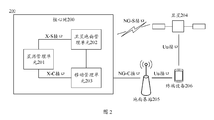
- FIG. 2 is a schematic structural diagram of a satellite communication network provided in Embodiment 1 of the present application.
- FIG. 3 is a schematic structural diagram of a control plane and user plane protocol stack applicable to the NG-S interface in the embodiment of the present application.
- FIG. 4 is a schematic diagram of a communication process of a satellite communication network provided in Embodiment 1 of the present application.
- FIG. 5 is a schematic structural diagram of a satellite communication network provided in Embodiment 2 of the present application.
- FIG. 6 is a schematic diagram of a communication process of a satellite communication network provided in Embodiment 2 of the present application.
- FIG. 7 is a schematic structural diagram of a satellite communication network provided in Embodiment 3 of the present application.
- FIG. 8 is a schematic diagram of a communication process of a satellite communication network provided in Embodiment 3 of the present application.
- Embodiment 9 is a schematic structural diagram of a satellite communication network for assisting handover provided by Embodiment 4 of the present application.
- FIG. 10 is a schematic diagram of a communication process of a satellite communication network for assisting handover provided by Embodiment 4 of the present application.
- FIG. 11 is a schematic structural diagram of an apparatus of a terminal device 1100 provided by this application.
- FIG. 12 is a schematic structural diagram of an apparatus of a terminal device 1200 provided by this application.
- FIG. 13 is a schematic structural diagram of a communication device 1300 provided by the present application.
- FIG. 14 is a schematic structural diagram of a communication device 1400 provided by the present application.
- the cellular network communication system mentioned in the embodiments of the present application includes but is not limited to a long term evolution (LTE) system and a 5G new radio system (new radio (NR)), or a new mobile communication system after 5G, etc.
- LTE long term evolution
- NR new radio
- the terminal equipment involved in this application may refer to user equipment (UE), terminal, access terminal, subscriber unit, user station, mobile station, mobile station, remote station, remote terminal, mobile device, user terminal, Wireless communication equipment, user agents, user devices, etc.
- the terminal equipment can also be a cellular phone, a cordless phone, a session initiation protocol (SIP) phone, a wireless local loop (wireless local loop (WLL) station), and a personal digital processing (personal digital assistant).
- SIP session initiation protocol
- WLL wireless local loop
- personal digital assistant personal digital assistant
- PDA handheld devices with wireless communication function
- computing devices or other processing devices connected to wireless modems computing devices or other processing devices connected to wireless modems
- in-vehicle devices wearable devices
- terminal devices in future 5G networks or public land mobile communication networks that will evolve in the future (public land mobile network (abbreviation: PLMN) terminal equipment, etc., which is not limited in this application.
- PLMN public land mobile network
- FIG. 1 is a 5G core network architecture 100 applicable to the present application.
- the 5G core network architecture 100 may include at least the following core network elements:
- Network slice selection function (Network Slice Selection Function, NSSF for short): Responsible for network slice management, determine the AMF set for serving UE or query the NRF to determine the candidate AMF list;
- AUSF Authentication Server Function
- Unified Data Management (Unified Data Management, referred to as: UDM): responsible for user management;
- Access and Mobility Management Function responsible for the access rights and handover management of terminal equipment, including access authorization, handover, cell camping, paging, UE mobile event notification, etc .;
- Session Management Function responsible for session management, providing service continuity, uninterrupted user experience of services, including changes in IP address and / or anchor point;
- Policy Control Function responsible for QoS policy selection, etc .
- AF Application Function
- UPF User Plane Function
- R User Plane Function
- R User Plane Function
- each satellite moves around the earth according to the set orbit, and each satellite corresponds to a set of ephemeris and almanac data, which includes information such as the different spatial positions of the satellites at different times.
- the satellite orbit and other settings will continue to be fine-tuned or updated.
- the ephemeris data corresponding to the satellite will be updated accordingly.
- This application provides a method of satellite communication. A new ephemeris management unit is added, and the ephemeris management unit is added to the 5G architecture to form a satellite communication network.
- the ephemeris management unit is responsible for ephemeris management, and is connected to the mobile management unit of the cellular network, the satellite ground management unit, the cellular base station, and the satellite through corresponding interfaces, and is used to interact with the ephemeris information of the satellite network.
- FIG. 2 is a schematic structural diagram of a satellite communication network provided by an embodiment of the present application.
- the ephemeris management unit 201 is connected to the satellite ground management unit 202 through the XS interface, and to the mobile management unit 203 through the XC interface; the satellite ground management unit 202 communicates with the satellite 204 through the NG-S interface, and the mobile management unit 203 passes
- the NG-C interface communicates with the ground base station 205; the terminal device 206 in the figure communicates with the satellite 204 and the ground base station 205 through the Uu interface, respectively.
- Uu interface used to connect the cellular access network node and terminal equipment or the satellite access network node and terminal equipment, responsible for the control plane and user plane transmission between the two;
- (2) NG-C interface used to connect the cellular access network node and the core network node, responsible for the control plane and user plane transmission between the two, the core network node includes the mobile management unit and the data gateway;
- NG-S interface used to connect the satellite access network node and the core network node, responsible for the control plane and user plane transmission between the two, the core network node includes the satellite ground management unit and the data gateway;
- NG-X interface used to connect the ephemeris management unit in the cellular access network node and the core network node, responsible for the control plane and user plane transmission between the two;
- X-S interface used to connect the ephemeris management unit and the core network node, responsible for the control plane transmission between the two;
- X-C interface used to connect the ephemeris management unit and the core network node, responsible for the control plane transmission between the two.
- the interface between the wireless access point and the core network element is physically carried by the optical fiber, and the bandwidth is large, without considering the problem caused by the overhead of the upper layer data packet header.
- NTN non-terrestrial network
- a wireless link is required to implement the corresponding interface between the access point deployed on the NTN platform and the core network element deployed on the ground.
- the upper layer protocol The overhead of the data becomes an issue that must be considered to save wireless bandwidth resources.
- the NG-S interface in this embodiment is used to connect the satellite access network node and the ground core network node, and a new set of interface protocols needs to be designed to meet the demand. Therefore, this application proposes a new interface protocol for meeting the communication requirements of the satellite access network node and the ground core network node in the satellite communication network proposed in this application.
- FIG. 2 provides a satellite network structure in which the ephemeris management unit 201 can be integrated in the satellite ground management unit 202, or the ephemeris management unit 201 can also be integrated in the mobile management unit 203, or the ephemeris management unit is integrated
- the functions of the satellite ground management unit 202 and the mobile management unit 203, or the ephemeris management unit completely replaces the functions of the mobile management unit 203.
- the ephemeris management unit 201, the satellite ground management unit 202, or the mobile management unit 203 are independent of the core network.
- FIG. 3 is a schematic structural diagram of a control plane and user plane protocol stack applicable to an NG-S interface in a non-terrestrial network NTN.
- the left frame in Figure 3 is the control plane protocol stack of the NG-S interface, which are as follows:
- Physical layer physical layer, which provides all the functions needed for bit stream transmission in the physical medium, and provides information transmission services for the data link layer and high layers;
- Data link data link layer, responsible for channel management mapping, data packet encapsulation and de-encapsulation, data scheduling, priority management and other functions;
- Protocol X new protocol layer, responsible for upper layer header compression, integrity protection, encryption and decryption, etc .;
- IP network layer protocol, responsible for routing of data packets
- SCTP Transport layer protocol to provide reliable transmission of application layer messages
- NG AP Application layer signaling protocol.
- the right frame in Figure 3 is the user plane protocol stack of the NG-S interface, which are as follows:
- Physical layer physical layer, which provides all the functions needed for bit stream transmission in the physical medium, and provides information transmission services for the data link layer and high layers;
- Data link data link layer, responsible for channel management mapping, data packet encapsulation and de-encapsulation, data scheduling, priority management and other functions;
- IP network layer protocol, responsible for routing of data packets
- User Datagram Protocol User Datagram Protocol, a connectionless transport layer protocol in the OSI (Open System Interconnection) reference model;
- GTP-U transfer user plane PDU between gNB deployed on NTN platform and UPF deployed on ground gateway;
- Protocol X new protocol layer, responsible for upper layer header compression, integrity protection, encryption and decryption, etc .;
- Protocol Data Unit Protocol data unit, which contains the information of the upper layer protocol and additional information of the current protocol layer.
- the specific implementation method of the NG-S interface protocol is to configure a one-to-one corresponding protocol layer between the base station deployed on the NTN platform and the core network element deployed on the ground gateway.
- the signaling message is first processed by each protocol layer on the core network element side, and then sent to the base station through the physical layer through the physical layer, after passing through each protocol layer of the base station After processing, the signaling message is parsed, and the base station performs corresponding processing according to the content of the message, and vice versa;
- the processing of each protocol layer of the core network element includes: the physical layer processes the received data packet and sends it to the data link layer.
- the data link layer removes the corresponding layer header, from The corresponding data packet is taken out from the GTP-U tunnel and submitted to the Protocol X layer; the Protocol X layer decompresses the compressed upper layer protocol (IP, etc.) headers in sequence to obtain the original data packet sent by the base station.
- the base station when the base station side sends data to the core network element, the base station sends the data packet processed by each protocol layer from its own physical layer to the physical layer of the core network element, and each protocol layer of the core network element Process the received data packet to obtain the original data packet sent by the base station, and vice versa;
- the processing of the user data packets by the protocol layers of the base station side includes: performing header compression on the upper layer protocol data (IP, etc.) by the Protocol X protocol layer, and encapsulating through the GTP-U tunnel protocol It is then submitted to the data link layer; the data link layer selects the appropriate transmission method, and the physical layer sends the data packet to the physical layer of the core network element according to the selected transmission method.
- IP upper layer protocol data
- the protocol X protocol layer encapsulating through the GTP-U tunnel protocol
- the signaling between the satellite and the core network element is encapsulated according to the NG AP (application protocol) application layer signaling protocol, and the protocol After the protocol of each layer of the stack is encapsulated, it is transmitted by the wireless link;
- NG AP application protocol
- the method in which the above NG-S interface user plane protocol stack is applied to the following embodiments of the present application is: user data, ephemeris, etc. sent by a satellite to a core network element, carried by a PDU, and encapsulated according to each layer protocol of the protocol stack, Send to the ground core network element via wireless link.
- the NG-S interface protocol can be used to connect the satellite access network point and the ground core network node in the following embodiments, responsible for the control plane and user plane transmission between the two, and can also be applied between two satellite Inter-satellite link communication.
- an embodiment of the present application provides a satellite communication method, including:
- Step 1 The ephemeris management unit obtains the ephemeris information of the satellites in the satellite network.
- the ephemeris information of the satellites in the satellite network includes one or more of the following information: the beam parameters of the satellites in the satellite network, the physics of the satellites in the satellite network Resources, scheduling information of satellites in the satellite network, etc .;
- Step 2 The ephemeris management unit generates a first message according to the ephemeris information of the satellites in the satellite network, the first message includes: ephemeris information of one or more satellites serving the terminal device;
- Step 3 When the terminal device performs random access, the ephemeris management unit sends a first message to implement communication between the terminal device and the satellite.
- the ephemeris management unit acquiring ephemeris information of satellites in the satellite network specifically includes:
- the ephemeris management unit obtains ephemeris information of the satellites in the satellite network through the first interface, where the first interface includes: NG-S interface and X-S interface.
- the first message sent by the ephemeris management unit specifically includes:
- the ephemeris management unit sends a first message through a second interface, where the second interface includes: NG-C interface, X-C interface, NG-X interface, and so on.
- the above method further includes:
- the ephemeris management unit obtains the ephemeris request message of the terminal device, and the ephemeris request message is used to request ephemeris information of one or more satellites serving the terminal device.
- an embodiment of the present application provides a satellite communication method.
- the method is different from the above embodiments in that the method is described based on a terminal device, and the details are as follows:
- Step 1 When the terminal device performs random access, the terminal device sends an ephemeris request message, which is used to request ephemeris information of one or more satellites serving the terminal device, and the ephemeris information includes the following information One or more of: satellite beam parameters serving terminal equipment, satellite physical resources serving terminal equipment, and satellite scheduling information serving terminal equipment;
- Step 2 The terminal device obtains a first message, the first message includes: ephemeris information of one or more satellites serving the terminal device;
- Step 3 The terminal device obtains ephemeris information of the satellite communicating with the terminal device according to the first message;
- Step 4 The terminal device establishes a communication connection between the terminal device and the satellite according to the obtained ephemeris information of the satellite communicating with the terminal device;
- Step 5 The terminal device communicates with the satellite through the established communication connection.
- the terminal device acquiring the first message specifically includes:
- the terminal device obtains the first message through the NG-C interface, the X-C interface, and the NG-X interface.
- the terminal device obtaining ephemeris information of the satellite communicating with the terminal device specifically includes:
- the terminal device selects a satellite to communicate with the terminal device according to the first message
- the terminal device obtains the ephemeris information of the selected satellite according to the selected satellite.
- the ephemeris request message is a random access message or uplink control information UCI.
- the ephemeris management unit is connected to the satellite ground management unit and the mobile management unit, respectively, where the ephemeris management unit, the satellite ground management unit and the mobile management unit are deployed in the core network.
- the flow of satellite communication method of network architecture is connected to the satellite ground management unit and the mobile management unit, respectively, where the ephemeris management unit, the satellite ground management unit and the mobile management unit are deployed in the core network.
- FIG. 4 is a schematic flowchart of a satellite communication method provided by an embodiment of the present application, including:
- the satellite ground management unit obtains the ephemeris information of the satellite in the satellite network, and transmits it to the ephemeris management unit through the X-S interface.
- the methods for obtaining satellite ephemeris information in the satellite network may include one or more of the following:
- the way to obtain satellite ephemeris information in the satellite network may be periodically obtained;
- the way to obtain satellite ephemeris information in the satellite network can also be to receive over-the-top satellite signals and update in real time;
- the way to obtain satellite ephemeris information in the satellite network can also be triggered by the core network element;
- the ephemeris information of the satellites in the satellite network may include one or more of the following information:
- Satellite beam parameters including: number of beams, beam opening angle, beam tilt angle, beam ID, tracking area list, etc .;
- Satellite physical resources including operating bandwidth, operating frequency, carrier spacing, etc .
- Satellite scheduling including the current number of terminal equipment access, time domain resources, frequency domain resources, code domain resources, beam resource occupancy, etc .;
- the ephemeris information of the satellites in the satellite network may also include one or a combination of the following information:
- Satellite working status including active status Active, idle status Idle, offline status Offline, etc .;
- Satellite orbit parameters including orbit height, orbit inclination, etc .
- the X-S interface is used to connect the satellite ground management unit 202 and the ephemeris management unit 201, and is responsible for control plane transmission between the two.
- the ephemeris management unit transmits the acquired ephemeris information to the mobile management unit through the X-C interface.
- the X-C interface is used to connect the ephemeris management unit 201 and the mobile management unit 203, and is responsible for control plane transmission between the two.
- the terminal device performs random access to the cellular network, and sends ephemeris request information to the mobile management unit through the ground base station.
- the ephemeris request information may be carried by the terminal device 206 in contention-based random access signaling Msg1 or Msg3, and the ground base station 205 sends and receives the agreed resources or scheduled resources;
- the ephemeris request information may also be carried by the terminal device 206 in uplink control information (uplink control information, UCI), and the ground base station 205 sends and receives the agreed resources or scheduled resources.
- uplink control information uplink control information, UCI
- the mobile management unit transmits the ephemeris information to the ground base station through the NG-C interface, and then the ground base station transmits the terminal equipment through control plane signaling.
- the ephemeris information may be all ephemeris information at the current time
- the ephemeris information may be part of the ephemeris information at the current moment
- the ephemeris information may also be an update performed on the ephemeris information already stored on the terminal device side;
- the NG-C interface is used to connect the mobile management unit 203 and the ground base station 205, and is responsible for control plane and user plane transmission between the two.
- the terminal device selects a satellite based on ephemeris information, completes random access, and establishes a connection with the satellite.
- the terminal equipment obtains ephemeris information in advance through the ground base station signaling in the satellite network, so it can quickly select satellites and satellite idle resources, and establish a connection with the satellite or complete an over-the-top satellite switch. Ensure the stability of satellite communications.
- the ephemeris management module can be independent of the satellite ground management unit and the mobile management unit.
- the ephemeris management unit in this embodiment is integrated in the satellite ground management unit , Is a function module inside it, and the ephemeris information interacts between the satellite ground management unit and the mobile management unit.
- the ephemeris management unit function is integrated in the satellite ground management unit, and the satellite ground management unit is connected to the mobile management unit.
- the method flow of satellite communication will be further described below in conjunction with FIG. 6.
- FIG. 5 is a schematic structural diagram of a satellite communication network according to an embodiment of the present application.
- the ephemeris management module 5011 is a functional module inside the satellite ground management unit 501, and its function is implemented by the satellite ground management unit 501 in this embodiment.
- the satellite ground management unit 501 can communicate with the mobile management unit 502; the satellite The ground management unit 501 communicates with the satellite 503 through the NG-S interface, and the mobile management unit 502 communicates with the ground base station 504 through the NG-C interface; the terminal device 505 in the figure communicates with the satellite 503 and the ground base station 504 through the Uu interface, respectively.
- FIG. 6 is a schematic flowchart of a satellite communication method according to an embodiment of the present application, including:
- the satellite ground management unit obtains ephemeris information of satellites in the satellite network.
- the way to obtain satellite ephemeris information in the satellite network may be periodically obtained;
- the way to obtain satellite ephemeris information in the satellite network may be to receive over-the-top satellite signals and update in real time;
- the way to obtain satellite ephemeris information in the satellite network may also be triggered by the core network element;
- the ephemeris information of the satellites in the satellite network may include one or more of the following information:
- Satellite beam parameters including: number of beams, beam opening angle, beam tilt angle, beam ID, tracking area list, etc .;
- Satellite physical resources including operating bandwidth, operating frequency, carrier spacing, etc .
- Satellite scheduling including the current number of terminal equipment access, time domain resources, frequency domain resources, code domain resources, beam resource occupancy, etc .;
- the ephemeris information of the satellites in the satellite network may also include one or a combination of the following information:
- Satellite working status including active status Active, idle status Idle, offline status Offline, etc .;
- Satellite orbit parameters including orbit height, orbit inclination, etc .
- the satellite ground management unit transmits the acquired ephemeris information to the mobile management unit of the cellular network.
- the terminal device performs random access to the cellular network, and sends ephemeris request information to the mobile management unit through the ground base station.
- the ephemeris request information may be carried by the terminal device 505 in contention-based random access signaling Msg1 or Msg3, and the ground base station 504 may send and receive the agreed resources or scheduled resources;
- the ephemeris request information may also be carried in the uplink control information UCI by the terminal device 505, and sent and received by the ground base station 504 on the agreed resources or scheduled resources.
- the mobile management unit transmits the ephemeris information to the ground base station through the NG-C interface, and then the ground base station transmits the control plane signaling to the terminal equipment.
- the ephemeris information may be all ephemeris information at the current time
- the ephemeris information may be part of the ephemeris information at the current moment
- the ephemeris information may also be an update performed on the ephemeris information already stored on the terminal device side;
- the NG-C interface is used to connect the mobile management unit 502 and the ground base station 504, and is responsible for control plane and user plane transmission between the two.
- the terminal device selects a satellite based on ephemeris information, completes random access, and establishes a connection with the satellite.
- the beneficial effects of the satellite communication network in the embodiment of the present application are substantially the same as the embodiment described in FIG. 4.
- the ephemeris management unit is integrated as a software / hardware function module in the satellite ground management unit, instead of existing as an independent new network element, and correspondingly, there is no need to add a new interface, thus reducing The complexity of core network deployment and maintenance.
- the following embodiments of the present application provide a satellite communication network in which terminal equipment maintains dual connection communication with satellites and ground base stations.
- a new network element is added to the core network: an ephemeris management unit, and the network element is connected with a mobile base station and a ground management unit of a satellite network through newly added NG-X and XS interfaces Communication, interactive ephemeris information of the satellite network.
- the ephemeris management unit replaces the mobile management unit and is connected to the satellite ground management unit.
- the flow of the satellite communication method based on the satellite network architecture will be further described below in conjunction with FIG. 8.
- the functions of the ephemeris management unit can also be integrated in the mobile management unit, which is connected to the satellite ground management unit through the mobile management unit, thereby achieving satellite communication.
- the ephemeris management unit may replace the mobile management unit and the satellite ground management unit, and the functions of the mobile management unit and the satellite ground management unit may be realized by the ephemeris management unit.
- FIG. 7 is a schematic structural diagram of a satellite communication network provided by an embodiment of the present application.
- the satellite ground management unit 701 is connected to the ephemeris management unit 702 through the XS interface; the satellite ground management unit 701 communicates with the satellite 703 through the NG-S interface, and the ephemeris management unit 702 communicates with the ground base station 704 through the NG-X interface ; Terminal equipment 705 communicates with satellite 703 and ground base station 704 via Uu interface respectively.
- FIG. 8 is a schematic flowchart of a satellite communication method according to an embodiment of the present application, including:
- the satellite ground management unit obtains ephemeris information of satellites in the satellite network.
- the way to obtain satellite ephemeris information in the satellite network may be periodically obtained;
- the way to obtain satellite ephemeris information in the satellite network may be to receive over-the-top satellite signals and update in real time;
- the way to obtain satellite ephemeris information in the satellite network may also be triggered by the core network element;
- the ephemeris information of the satellites in the satellite network may include one or more of the following information:
- Satellite beam parameters including: number of beams, beam opening angle, beam tilt angle, beam ID, tracking area list, etc .;
- Satellite physical resources including operating bandwidth, operating frequency, carrier spacing, etc .
- Satellite scheduling including the current number of terminal equipment access, time domain resources, frequency domain resources, code domain resources, beam resource occupancy, etc .;
- the ephemeris information of the satellites in the satellite network may also include one or a combination of the following information:
- Satellite working status including active status Active, idle status Idle, offline status Offline, etc .;
- Satellite orbit parameters including orbit height, orbit inclination, etc .
- the satellite ground management unit transmits the acquired ephemeris information to the ephemeris management unit through the X-S interface.
- the X-S interface is used to connect the satellite ground management unit 701 and the ephemeris management unit 702, and is responsible for control plane transmission between the two.
- the terminal device performs random access to the cellular network, and sends ephemeris request information to the ephemeris management unit through the ground base station.
- the ephemeris request information may be carried by the terminal device 705 in contention-based random access signaling Msg1 or Msg3, and the ground base station 704 sends and receives the agreed resources or scheduled resources;
- the ephemeris request information may also be carried in the uplink control information UCI by the terminal device 705, and sent and received by the ground base station 704 on the agreed resources or scheduled resources.
- the ephemeris management unit transmits the ephemeris information to the ground base station through the NG-X interface, and then the ground base station transmits the terminal equipment through control plane signaling.
- the ephemeris information may be all ephemeris information at the current time
- the ephemeris information may be part of the ephemeris information at the current moment
- the ephemeris information may also be an update performed on the ephemeris information already stored on the terminal device side;
- the NG-X interface is used to connect the ephemeris management unit 702 and the ground base station 704, and is responsible for control plane and user plane transmission between the two.
- the terminal device selects a satellite based on ephemeris information, completes random access, and establishes a connection with the satellite.
- the beneficial effects of the satellite communication network in the embodiment of the present application are substantially the same as the embodiment described in FIG. 4.
- the ephemeris management unit is connected to the base station through a newly added interface.
- the terminal device needs to request ephemeris information, it can directly query the ephemeris management unit through the base station without having to
- the ground eNodeB queries the ephemeris management unit via the mobile management unit, because the related process is simplified.
- the above-mentioned embodiment in FIG. 4 and the embodiment in FIG. 8 both add a new ephemeris management unit to the core network.
- the function of the ephemeris management unit is ephemeris management.
- the management unit, cellular base station, and satellite connection are used to interact with the ephemeris information of the satellite network.
- the functions of the ephemeris management module of the embodiment described in FIG. 6 are the same as the ephemeris management unit.
- the embodiment described in FIG. 10 will be introduced.
- the ephemeris management unit introduced in the core network in this embodiment is no longer used for ephemeris management, but is used to assist the switching operation of satellite communications.
- An embodiment of the present application provides a satellite communication network, in which terminal equipment maintains dual connection communication with satellites and ground base stations.
- the difference from the embodiment shown in FIG. 4 is that a new network element is added to the core network: an ephemeris management unit, and the network element communicates with the mobile management unit and the ground management unit of the satellite network through the newly added XC interface and XS interface , Used to assist the switching operation in satellite communications.
- FIG. 9 is a schematic structural diagram of a satellite communication network for handover operation provided by an embodiment of the present application.
- the ephemeris management unit 902 is connected to the satellite ground management unit 901 through the XS interface, and to the mobile management unit 903 through the XC interface; the satellite ground management unit 901 is connected to the source satellite 904 through the NG-S interface and to be switched to The target satellite 905 communicates; the terminal device 906 in the figure communicates with the source satellite 904 and the target satellite 905 through the Uu interface, respectively.
- FIG. 10 is a schematic flowchart of a satellite communication method for handover operation provided by an embodiment of the present application, including:
- the satellite ground management unit obtains the ephemeris information of the satellites in the satellite network and transmits it to the ephemeris management unit through the X-S interface.
- the way to obtain satellite ephemeris information in the satellite network may be periodically obtained;
- the way to obtain satellite ephemeris information in the satellite network may be to receive over-the-top satellite signals and update in real time;
- the way to obtain satellite ephemeris information in the satellite network may also be triggered by the core network element;
- the ephemeris information of the satellites in the satellite network may include one or more of the following information:
- Satellite beam parameters including: number of beams, beam opening angle, beam tilt angle, beam ID, tracking area list, etc .;
- Satellite physical resources including operating bandwidth, operating frequency, carrier spacing, etc .
- Satellite scheduling including the current number of terminal equipment access, time domain resources, frequency domain resources, code domain resources, beam resource occupancy, etc .;
- the ephemeris information of the satellites in the satellite network may also include one or a combination of the following information:
- Satellite working status including active status Active, idle status Idle, offline status Offline, etc .;
- Satellite orbit parameters including orbit height, orbit inclination, etc .
- the X-S interface is used to connect the satellite ground management unit and the ephemeris management unit 902, and is responsible for the control plane transmission between the two.
- the ephemeris management unit transmits the acquired ephemeris information to the mobile management unit through the X-C interface.
- the X-C interface is used to connect the ephemeris management unit 902 and the mobility management unit 903, and is responsible for control plane transmission between the two.
- the terminal device triggers a handover based on the measurement result, and the source satellite initiates a handover operation to the mobile management unit or the satellite ground management unit.
- the switching operation may be triggered by the source satellite 904 based on the measurement results
- the handover operation may also be triggered by the mobility management unit 903 based on ephemeris information.
- the mobile management unit requests the ephemeris information from the ephemeris management unit through the X-C interface, and dispatches the target satellite resource through the satellite ground management unit to complete the switching operation.
- the X-C interface is used to connect the mobile management unit 903 and the ephemeris management unit 902, and is responsible for control plane transmission between the two.
- the mobile management unit obtains ephemeris information through the satellite ground station, and can quickly select satellites and satellite idle resources, determine the satellites participating in the handover, and trigger the corresponding handover operation to improve the handover success rate and speed.
- the terminal device, the communication device, and the satellite communication system provided by the present application will be briefly described below with reference to FIGS. 11 to 14 for performing the satellite communication method or process provided by the foregoing embodiments.
- the satellite communication methods provided by the foregoing embodiments are applicable to the devices described in FIG. 11 to FIG. 14, and the foregoing satellite communication methods will not be repeated here.
- FIG. 11 is a schematic structural diagram of a terminal device 1100 provided by this application, including:
- the transceiver unit 1101 is used to send a request message when the terminal device performs random access.
- the request message is used to request ephemeris information of one or more satellites serving the terminal device.
- the ephemeris information includes one or more Species: Satellite beam parameters serving the terminal device, satellite physical resources serving the terminal device, and satellite scheduling information serving the terminal device; acquiring a first message, the first message including: one or more satellites serving the terminal device Ephemeris information; and the communication connection established with the satellite through the terminal device to send data;
- the processing unit 1102 is configured to obtain ephemeris information of the satellite communicating with the terminal device according to the first message; and establish a communication connection between the terminal device and the satellite according to the obtained ephemeris information of the satellite communicating with the terminal device.
- the transceiver unit 1101 is specifically used to obtain the first message through the NG-C interface, XC interface or NG-X interface; the processing unit 1102 is specifically used to select the satellite to communicate with the terminal device according to the first message; Get the ephemeris information of the selected satellite.
- FIG. 12 is a schematic structural diagram of a terminal device 1200 provided by the present application, including:
- the memory 1201 is used to store computer program instructions
- the processor 1202 is configured to execute computer program instructions stored in the memory;
- the processor executes the computer program instructions stored in the memory, so that the terminal device implements the satellite communication method related to the terminal device in any of the above method embodiments.
- the terminal device 1200 further includes a transceiver 1203, and when the program is executed, the processor executes computer program instructions stored in the memory to enable the transceiver of the terminal device to implement any of the above method embodiments related to the terminal device The steps of receiving and sending in the satellite communication method.
- FIG. 13 is a schematic structural diagram of a communication device 1300 provided by the present application, including:
- the obtaining unit 1301 is used to obtain ephemeris information of satellites in the satellite network.
- the ephemeris information of satellites in the satellite network may include one or more of the following: beam parameters of satellites in the satellite network, physical resources of satellites in the satellite network, and satellites Satellite scheduling information in the network;
- the processing unit 1302 is configured to generate a first message according to the ephemeris information of the satellites in the satellite network, where the first message includes: ephemeris information of one or more satellites serving the terminal device;
- the sending unit 1303 is configured to send the first message when the terminal device performs random access.
- the obtaining unit is specifically used to obtain the ephemeris information of the satellite in the satellite network through the first interface, where the first interface includes: NG-S interface, XS interface, etc .; the sending unit is specifically used when the terminal device performs random access , The first message is sent through the second interface, where the second interface includes: NG-C interface, XC interface, NG-X interface, etc .; the obtaining unit is also used to obtain a request message of the terminal device, the request message is used to request Ephemeris information of one or more satellites serving terminal equipment.
- FIG. 14 is a schematic structural diagram of a communication device 1400 provided by the present application, including:
- the memory 1401 is used to store computer program instructions
- the processor 1402 is configured to execute computer program instructions stored in the memory
- the processor executes the computer program instructions stored in the memory, so that the communication device 1400 implements the satellite communication method related to the satellite in any of the above method embodiments.
- the communication device 1400 further includes a transceiver 1403, and the processor executes computer program instructions stored in the memory to enable the transceiver 1403 of the communication device to implement satellite-based and cellular network dual-connection communication related to any of the foregoing method embodiments. Receive and send steps.
- An embodiment of the present application also provides a dual-connection communication system, including: an ephemeris management unit, a satellite network, and a cellular mobile network.
- the satellite network includes: one or more satellites;
- the cellular mobile network includes: a ground base station and a terminal device connected to the ground base station;
- the ephemeris management unit includes any one of the embodiments shown in FIGS. 2-10 The communication device and terminal equipment mentioned above.
- the communication system further includes: a satellite ground management unit; the satellite ground management unit is used to obtain ephemeris information of satellites in a satellite network through an NG-C interface; and send satellites in the satellite network through an XS interface Ephemeris information to the ephemeris management unit.
- the communication system further includes: a mobile management unit; the mobile management unit is configured to receive ephemeris information of satellites in the satellite network obtained by the ephemeris management unit through an XC interface; and send it through an NG-C interface The first message is sent to the base station of the cellular network, and forwarded to the terminal device through the base station.
- Embodiments of the present application also provide a computer-readable storage medium on which computer program instructions are stored. When the computer program instructions are executed by a computer, any satellite communication method provided by the present application is implemented.
- An embodiment of the present application further provides a computer program product, which implements any of the satellite communication methods provided by the present application when the computer program product is executed by a computer.
- An embodiment of the present application further provides a system chip.
- the system chip includes: a processing unit and a communication unit.
- the processing unit may be, for example, a processor.
- the communication unit may be, for example, an input / output interface, a pin, a circuit, or the like.
- the processing unit can execute computer instructions to cause the chip in the communication device to execute any of the satellite communication methods provided in this application.
- the exemplary units and method processes described in the embodiments of the present application can be implemented by electronic hardware, or a combination of computer software and electronic hardware. Whether these functions are executed in hardware or software depends on the specific application of the technical solution and design constraints. Professional technicians can use different methods to implement the described functions for each specific application.
- the disclosed device and method may be implemented in other ways.
- the device embodiments described above are only schematic.
- the division of the unit is only a logical function division, and there may be other division manners in actual implementation.
- multiple units or components may be combined or may be integrated into another system. Some steps in the method can be ignored or not executed.
- the coupling or direct coupling or communication connection between the various units may be achieved through some interfaces, and these interfaces may be in electrical, mechanical, or other forms.
- each functional unit in each embodiment of the present application may be integrated into one processing unit, or each unit may exist alone physically, or two or more units may be integrated into one unit.
- the computer program product includes one or more computer instructions.
- the computer may be a general-purpose computer, a dedicated computer, a computer network, or other programmable devices.
- the computer instructions may be stored in a computer-readable storage medium or transmitted through the computer-readable storage medium.
- the computer instructions can be sent from one website site, computer, server or data center to another website site by wire (such as coaxial cable, optical fiber, digital subscriber line (DSL)) or wireless (such as infrared, wireless, microwave, etc.) , Computer, server or data center for transmission.
- the computer-readable storage medium may be any available medium that can be accessed by a computer or a data storage device including a server, a data center, and the like integrated with one or more available media.
- the usable medium may be a magnetic medium (for example, floppy disk, hard disk, magnetic tape, U disk, ROM, RAM, etc.), an optical medium (for example, CD, DVD, etc.), or a semiconductor medium (for example, solid state disk, SSD) etc.
Landscapes
- Engineering & Computer Science (AREA)
- Signal Processing (AREA)
- Computer Networks & Wireless Communication (AREA)
- Physics & Mathematics (AREA)
- Astronomy & Astrophysics (AREA)
- Aviation & Aerospace Engineering (AREA)
- General Physics & Mathematics (AREA)
- Mobile Radio Communication Systems (AREA)
Abstract
本申请提供一种卫星通信方法,包括:星历管理单元获取卫星网络的卫星星历信息,卫星网络中卫星的星历信息包括以下信息中的一种或多种:卫星网络中卫星的波束参数、卫星网络中卫星的物理资源以及卫星网络中卫星的调度信息;根据卫星网络中卫星的星历信息,星历管理单元生成第一消息,第一消息包括:服务于终端设备的一个或多个卫星的星历信息;当终端设备执行随机接入时,星历管理单元发送第一消息,实现终端设备与卫星的通信。
Description
本申请涉及卫星通信领域,尤其涉及一种卫星通信的方法、装置及系统。
随着通信技术的发展,人们对通信技术的高效、机动、多样性等指标提出更高的要求。目前,通信领域的一个重要发展方向是全球移动通信,而卫星通信是全球移动通信的重要组成部分。卫星通信具有通信距离远、覆盖面积大、组网灵活等特点,在一些重要领域,如空间通信、航空通信、海事通信、军事通信等领域,卫星通信发挥着无可替代的作用。其中,卫星通信既可以为固定终端设备提供服务,也可为各种移动终端设备提供服务。根据提供服务的卫星所在的轨道高度,卫星通信系统可以分为静止轨道(geostationary earth orbit,GEO)卫星系统和非静止轨道(non-geostationary earth orbit,NGEO)卫星系统,其中非静止轨道卫星系统又可以分为中轨(medium earth orbit,MEO)卫星系统和低轨(low earth orbit,LEO)卫星系统。而低轨卫星系统由于轨道高度低,传播时延小,成为全球移动通信的一个发展热点。
卫星高速移动的特点决定了其网络拓扑结构是不断发生变化的,以低轨卫星系统为例,其轨道高度约为500-1000km,单颗卫星对地面覆盖面积较小,并相对于地面高速移动(25000km/h),卫星平均覆盖终端设备的时间只有几分钟左右,因此卫星覆盖的小区也随着卫星的高速移动不断发生变化。例如,轨道高度为1000km,最小仰角为10度的低轨卫星系统,其平均覆盖终端设备的时间仅为6分钟左右。
未来移动通信网络主要分为三种接入场景:(1)蜂窝覆盖:在人口密集环境下,蜂窝网络部署密集,信号覆盖性强,此时用户选择接入蜂窝网络实现移动通信;(2)卫星覆盖:在海洋、沙漠等人迹罕至的区域,受限于施工、成本等因素,无蜂窝网络覆盖,此时用户选择接入卫星网络实现移动通信;(3)混合接入:在乡村、郊区、海陆交界等场景下,蜂窝网络信号较弱,此时用户可以选择蜂窝网络、卫星网络双连接的接入方式,提高通信可靠度。
在上述蜂窝网络、卫星网络混合接入的双连接场景下,即移动通信网络同时包含终端设备、基站与卫星的场景下,由于卫星移动速度快,为终端设备提供服务的卫星网络的拓扑结构变化频繁,使得终端设备无法准确接入为其提供服务的卫星,进而导致通信中断。
发明内容
本申请提供一种卫星通信的方法、装置及系统,通过快速、准确地获知为终端设备提供服务的卫星的星历信息,实现了终端设备接入蜂窝网络和卫星网络的双连接,保证了双连接接入方式的准确性和稳定性。
第一方面,提供一种卫星通信方法,包括:星历管理单元获取卫星网络中卫星的星历 信息,卫星网络中卫星的星历信息包括以下信息中的一种或多种:所述卫星网络中卫星的波束参数、所述卫星网络中卫星的物理资源以及所述卫星网络中卫星的调度信息;根据所述卫星网络中卫星的星历信息,星历管理单元生成第一消息,所述第一消息包括:服务于终端设备的一个或多个卫星的星历信息;当所述终端设备执行随机接入时,星历管理单元发送第一消息,实现所述终端设备与卫星的通信。
结合第一方面,在第一方面的某些实现方式中,所述获取卫星网络中卫星的星历信息的方式具体包括:通过第一接口,获取卫星网络中卫星的星历信息,其中,所述第一接口包括:NG-S接口或者X-S接口。
结合第一方面,在第一方面的某些实现方式中,所述终端设备执行随机接入时,发送第一消息,具体包括:当所述终端设备执行随机接入时,通过第二接口发送第一消息,其中,所述第二接口包括:NG-C接口、X-C接口或者NG-X接口。
结合第一方面,在第一方面的某些实现方式中,所述卫星通信方法还包括:获取所述终端设备的星历请求消息,该星历请求消息用于请求服务于所述终端设备的一个或多个卫星的星历信息。
第二方面,提供一种卫星通信方法,所述方法包括:当终端设备执行随机接入时,所述终端设备发送星历请求消息,所述星历请求消息用于请求服务于终端设备的一个或多个卫星的星历信息,所述星历信息包括以下信息中的一种或多种:服务于终端设备的卫星波束参数、服务于终端设备的卫星物理资源以及服务于终端设备的卫星调度信息;所述终端设备获取第一消息,所述第一消息包括:服务于终端设备的一个或多个卫星的星历信息;所述终端设备根据所述第一消息,获得与所述终端设备通信的卫星的星历信息;所述终端设备根据所述获得的与所述终端设备通信的卫星的星历信息,建立所述终端设备与所述卫星的通信连接;所述终端设备通过所述建立的通信连接与所述卫星通信。
结合第二方面,在第二方面的某些实现方式中,所述终端设备获取第一消息具体包括:所述终端设备通过NG-C接口、X-C接口或者NG-X接口获取第一消息。
结合第二方面,在第二方面的某些实现方式中,所述终端设备根据所述第一消息,获得与所述终端设备进行通信的卫星的星历信息具体包括:所述终端设备根据所述第一消息,选择与所述终端设备通信的卫星;所述终端设备根据所述选择的卫星,获得所述选择的卫星的星历信息。
结合第一方面,在第一方面的所有实现方式中,所述请求消息为随机接入消息或上行控制信息UCI。
第三方面,提供一种通信装置,所述通信装置包括:获取单元,用于获取卫星网络中卫星的星历信息,所述卫星网络中卫星的星历信息包括以下信息中的一种或多种:所述卫星网络中卫星的波束参数、所述卫星网络中卫星的物理资源以及所述卫星网络中卫星的调度信息;
处理单元,用于根据所述卫星网络中卫星的星历信息,生成第一消息,所述第一消息包括:服务于终端设备的一个或多个卫星的星历信息;发送单元,用于当所述终端设备执行随机接入时,发送所述第一消息。结合第三方面,在第三方面的某些实现方式中,所述获取单元具体用于,通过第一接口,获取卫星网络中卫星的星历信息,其中,所述第一接口包括:NG-S接口或X-S接口。
结合第三方面,在第三方面的某些实现方式中,所述发送单元,具体用于当所述终端设备执行随机接入时,通过第二接口发送第一消息,其中,所述第二接口包括:NG-C接口、X-C接口或NG-X接口。
结合第三方面,在第三方面的某些实现方式中,所述获取单元,还用于获取所述终端设备的星历请求消息,所述星历请求消息用于请求服务于所述终端设备的一个或多个卫星的星历信息。
第四方面,提供一种通信装置,所述通信装置包括:存储器,用于存储程序;处理器,用于执行所述存储器存储的所述程序,当所述程序被执行时,所述处理器用于执行上述第一方面以及第一方面所有可能的实施方式中任一项所述的卫星通信方法。
第五方面,提供一种计算机可读存储介质,该计算机可读存储介质中存储有指令,当其在计算机上运行时,使得计算机可以执行上述第一方面以及第一方面所有可能的实施方式中任一项所述的卫星通信方法。
第六方面,提供一种包含指令的计算机程序产品,当其在计算机上运行时,使得计算机可以执行上述第一方面以及第一方面所有可能的实施方式中任一项所述的卫星通信方法。
第七方面,提供一种芯片,包括存储器和处理器,所述存储器用于存储计算机程序,所述处理器用于从所述存储器中调用并运行所述计算机程序,使得所述处理器执行上述第一方面以及第一方面所有可能的实施方式中任一项所述的卫星通信方法。
第八方面,提供一种终端设备,所述终端设备包括:
收发单元,用于当终端设备执行随机接入时,发送星历请求消息,星历请求消息用于请求服务于终端设备的一个或多个卫星的星历信息,所述星历信息包括以下信息中的一种或多种:服务于终端设备的卫星波束参数、服务于终端设备的卫星物理资源以及服务于终端设备的卫星调度信息;获取第一消息,所述第一消息包括:服务于终端设备的一个或多个卫星的星历信息;以及通过所述终端设备与所述卫星建立的通信连接,发送数据;处理单元,用于根据所述第一消息,获得与所述终端设备通信的卫星的星历信息;根据所述获得的与所述终端设备通信的卫星的星历信息,建立所述终端设备与所述卫星的通信连接。
结合第八方面,在第八方面的某些实现方式中,所述收发单元,具体用于通过NG-C接口、X-C接口或者NG-X接口获取第一消息。
结合第八方面,在第八方面的某些实现方式中,所述处理单元,具体用于根据所述第一消息,选择与所述终端设备通信的卫星;根据所述选择的卫星,获得所述选择的卫星的星历信息。
第九方面,提供一种终端设备,所述终端设备包括:
存储器,用于存储程序;
处理器,用于执行所述存储器存储的所述程序,当所述程序被执行时,所述处理器用于执行上述第二方面以及第二方面所有可能的实施方式中任一项所述的卫星通信方法。
第十方面,提供一种计算机可读存储介质,该计算机可读存储介质中存储有指令,当其在计算机上运行时,使得计算机可以执行上述第二方面以及第二方面所有可能的实施方式中任一项所述的卫星通信方法。
第十一方面,提供一种包含指令的计算机程序产品,当其在计算机上运行时,使得计 算机可以执行上述第二方面以及第二方面所有可能的实施方式中任一项所述的卫星通信方法。
第十二方面,提供一种芯片,包括存储器和处理器,所述存储器用于存储计算机程序,所述处理器用于从所述存储器中调用并运行所述计算机程序,使得所述处理器执行上述第二方面以及第二方面所有可能的实施方式中任一项所述的卫星通信方法。
第十三方面,提供一种通信系统,所述通信系统包括:星历管理单元,卫星网络、以及蜂窝移动网络;其中,所述卫星网络包括:一个或者多个卫星;所述蜂窝移动网络包括:基站以及与所述基站连接的终端设备;所述星历管理单元包括上述第三方面、第四方面所有可能的实施方式中任一项所述的通信装置和上述第八方面、第九方面所有可能的实施方式中任一项所述的终端设备。
结合第十三方面,在第十三方面的某些实现方式中,所述卫星地面管理单元,用于通过NG-C接口、X-C接口或者NG-X接口获取卫星网络中卫星的星历信息;以及通过X-S接口发送所述卫星网络中卫星的星历信息给所述星历管理单元。
结合第十三方面,在第十三方面的某些实现方式中,所述移动管理单元,用于通过X-C接口接收所述星历管理单元获取的卫星网络中卫星的星历信息;以及通过NG-C接口、X-C接口或者NG-X接口发送第一消息给所述蜂窝网络的基站,通过所述基站转发给终端设备。
图1是适用于本申请的5G核心网架构100。
图2是本申请实施例一提供的卫星通信网络的结构示意图。
图3是适用于本申请实施例中的NG-S接口的控制面和用户面协议栈的结构示意图。
图4是本申请实施例一提供的卫星通信网络的通信流程示意图。
图5是本申请实施例二提供的卫星通信网络的结构示意图。
图6是本申请实施例二提供的卫星通信网络的通信流程示意图。
图7是本申请实施例三提供的卫星通信网络的结构示意图。
图8是本申请实施例三提供的卫星通信网络的通信流程示意图。
图9是本申请实施例四提供的用于辅助切换的卫星通信网络的结构示意图。
图10是本申请实施例四提供的用于辅助切换的卫星通信网络的通信流程示意图。
图11是本申请提供的一种终端设备1100的装置结构示意图。
图12是本申请提供的一种终端设备1200的装置结构示意图。
图13是本申请提供的一种通信装置1300的结构示意图。
图14是本申请提供的一种通信装置1400的结构示意图。
下面结合附图,对本申请中的技术方案进行详细描述。
本申请实施例中提及的蜂窝网络通信系统,包括但不限于长期演进(long term evolution,LTE)系统及5G新无线系统(new radio,NR),或者5G之后的新的移动通信系统等。
本申请涉及的终端设备可以指用户设备(user equipment,UE)、终端(terminal)、接入终端、用户单元、用户站、移动站、移动台、远方站、远程终端、移动设备、用户终端、无线通信设备、用户代理或用户装置等。终端设备还可以是蜂窝电话、无绳电话、会话启动协议(session initiation protocol,简称:SIP)电话、无线本地环路(wireless local loop,简称:WLL)站、个人数字处理(personal digital assistant,简称:PDA)、具有无线通信功能的手持设备、计算设备或连接到无线调制解调器的其它处理设备、车载设备、可穿戴设备,未来5G网络中的终端设备或者未来演进的公用陆地移动通信网络(public land mobile network,简称:PLMN)中的终端设备等,本申请对此不作限定。
参见图1,图1是适用于本申请的5G核心网架构100。5G核心网架构100中至少可以包括如下核心网元:
网络切片选择功能(Network Slice Selection Function,简称:NSSF):负责网络切片管理,确定AMF集用于服务UE或者通过查询NRF来确定候选AMF列表;
鉴权服务器功能(Authentication Server Function,简称:AUSF):负责鉴权管理,支持3GPP网络接入和不受信任的非3GPP网络接入的认证;
统一数据管理(Unified Data Management,简称:UDM):负责用户管理;
接入及移动性管理功能(Access and Mobility Management Function,简称:AMF):负责终端设备的接入权限和切换管理,包括接入授权、切换、小区驻留、寻呼、UE移动事件通知等;
会话管理功能(Session Management Function,简称:SMF):负责会话管理,提供服务连续性,服务的不间断用户体验,包括IP地址和/或锚点变化的情况;
策略控制功能(Policy Control Function,简称:PCF):负责QoS策略选择等;
应用功能(Application Function,简称:AF):负责与3GPP核心网络交互以提供服务;
用户平面功能(User Plane Function,简称:UPF):负责用户数据转发等用户面操作,与UPF关联的PDU会话可以由(R)AN节点通过(R)AN和UPF之间的N3接口服务的区域,而无需在其间添加新的UPF或移除或重新分配UPF。
通常情况下,卫星按照设置的轨道围绕地球运动,每个卫星都对应一套星历和历书数据,其中包括卫星在不同时刻所处的不同空间位置等信息。而卫星的轨道等设置会不断进行微调或更新。当这些设置微调或更新时,卫星对应的星历数据也会相应的进行更新。本申请提供一种卫星通信的方法,新增一个星历管理单元,将星历管理单元添加到5G架构中,构成卫星通信网络。星历管理单元,负责星历管理,通过相应的接口与蜂窝网的移动管理单元、卫星地面管理单元、蜂窝基站、卫星连接,用于交互卫星网络的星历信息。
参见图2,图2为本申请实施例提供的一种卫星通信网络的结构示意图。
图2中,星历管理单元201通过X-S接口与卫星地面管理单元202连接,通过X-C接口与移动管理单元203连接;卫星地面管理单元202通过NG-S接口与卫星204通信,移动管理单元203通过NG-C接口与地面基站205通信;图中终端设备206通过Uu接口分别与卫星204和地面基站205通信。
图2中各网元间的接口功能如下:
(1)Uu接口:用于连接蜂窝接入网节点与终端设备或者卫星接入网节点与终端设备, 负责两者间的控制面和用户面传输;
(2)NG-C接口:用于连接蜂窝接入网节点与核心网节点,负责两者间的控制面和用户面传输,核心网节点包括移动管理单元和数据网关等;
(3)NG-S接口:用于连接卫星接入网节点与核心网节点,负责两者间的控制面和用户面传输,核心网节点包括卫星地面管理单元和数据网关等;
(4)NG-X接口:用于连接蜂窝接入网节点与核心网节点中的星历管理单元,负责两者间的控制面和用户面传输;
(5)X-S接口:用于连接星历管理单元与核心网节点,负责两者间的控制面传输;
(6)X-C接口:用于连接星历管理单元与核心网节点,负责两者间的控制面传输。
在蜂窝网络中,无线接入点与核心网元的接口,在物理上是由光纤承载,带宽大,无需考虑上层数据包头部开销带来的问题。在非地面网络(non-terrestrial network,简称:NTN)场景下,部署于NTN平台的接入点与部署于地面的核心网元之间需要由无线链路实现相应的接口,此时,上层协议数据的头部开销就成为一个必须要考虑的问题,以节省无线带宽资源。本实施例中的NG-S接口用于连接卫星接入网节点与地面核心网节点,需要设计一套新的接口协议以满足需求。因此,本申请提出一种新的接口协议,用于满足本申请提出的卫星通信网络中的卫星接入网节点与地面核心网节点的通信需求。
图2提供一种卫星网络结构,其中,星历管理单元201可以集成在卫星地面管理单元202中,或者,星历管理单元201也可以集成在移动管理单元203中,或者,星历管理单元集成卫星地面管理单元202和移动管理单元203的功能,或者,星历管理单元完全替代移动管理单元203的功能。另外,星历管理单元201、卫星地面管理单元202或者移动管理单元203独立于核心网。参见图3,图3为适用于非地面网络NTN中的NG-S接口的控制面和用户面协议栈的结构示意图。
图3中左边框架为NG-S接口的控制面协议栈,其自下而上分别为:
Physical link layer:物理层,提供物理介质中比特流传输所需要的所有功能,为数据链路层和高层提供信息传输的服务;
Data link layer:数据链路层,负责信道管理映射、数据包封装与解封装、数据调度、优先级管理等功能;
Protocol X:新增协议层,负责上层数据包头压缩、完整性保护、加密解密等功能;
IP:网络层协议,负责数据包的路由;
SCTP:传输层协议,为应用层消息提供可靠传输;
NG AP:应用层信令协议。
图3中右边框架为NG-S接口的用户面协议栈,其自下而上分别为:
Physical link layer:物理层,提供物理介质中比特流传输所需要的所有功能,为数据链路层和高层提供信息传输的服务;
Data link layer:数据链路层,负责信道管理映射、数据包封装与解封装、数据调度、优先级管理等功能;
IP:网络层协议,负责数据包的路由;
User Datagram Protocol:用户数据报协议,OSI(Open System Interconnection,开放式系统互联)参考模型中一种无连接的传输层协议;
GTP-U:传递部署于NTN平台的gNB与部署于地面网关的UPF之间的用户平面PDU;
Protocol X:新增协议层,负责上层数据包头压缩、完整性保护、加密解密等功能;
Protocol Data Unit:协议数据单元,是包含上层协议的信息以及当前协议层的附加的信息。
所述NG-S接口协议的具体实现方式为:在部署于NTN平台的基站与部署在地面网关的核心网元配置一一对应的协议层。
以控制面为例,当核心网元发送信令至基站时,该信令消息首先由核心网元侧的各协议层进行处理,在通过物理层发送给基站的物理层,经过基站各协议层处理后解析出该信令消息,基站再根据消息的内容执行相应的处理,反之亦然;
在上述方法中,当基站发送数据时,核心网元各协议层的处理包括:物理层对收到的数据包处理后发送至数据链路层,由数据链路层去掉相应的层包头,从GTP-U隧道中取出相应数据包,递交至Protocol X层;Protocol X层对经过压缩的上层协议(IP等)包头依次进行解压缩,得到基站发送的原始数据包。
以用户面为例,当基站侧发送数据到核心网元时,基站将经过自身各协议层处理后的数据包由自身的物理层发送给核心网元的物理层,核心网元的各协议层对收到的数据包进行处理,得到基站发送的原始数据包,反之亦然;
在上述方法中,当基站发送数据时,所述基站侧各协议层对用户数据包的处理包括:由Protocol X协议层对上层协议数据(IP等)执行头压缩,通过GTP-U隧道协议封装后递交至数据链路层;数据链路层选择合适的传输方式,由物理层根据选定的传输方式将数据包发给核心网元的物理层。
上述NG-S接口控制面协议栈应用到本申请下述实施例中的方法为:卫星与核心网元之间交互的信令,按照NG AP(application protocol)应用层信令协议封装,经协议栈各层协议封装后,由无线链路传输;
上述NG-S接口用户面协议栈应用到本申请下述实施例中的方法为:卫星发送给核心网元的用户数据、星历等,由PDU承载,按照协议栈的各层协议封装后,经无线链路发送给地面核心网元。
所述NG-S接口协议除了可以用于连接下述实施例中的卫星接入网点与地面核心网节点,负责二者间的控制面和用户面传输外,还可以应用于两个卫星之间的星间链路通信。
基于图2中的卫星网络,本申请实施例提供一种卫星通信方法,包括:
步骤1:星历管理单元获取卫星网络中卫星的星历信息,卫星网络中卫星的星历信息包括以下信息中的一种或多种:卫星网络中卫星的波束参数、卫星网络中卫星的物理资源、卫星网络中卫星的调度信息等;
步骤2:星历管理单元根据卫星网络中卫星的星历信息,生成第一消息,该第一消息包括:服务于终端设备的一个或多个卫星的星历信息;
步骤3:当终端设备执行随机接入时,星历管理单元发送第一消息,实现终端设备与卫星的通信。
进一步地,星历管理单元获取卫星网络中卫星的星历信息具体包括:
星历管理单元通过第一接口,获取卫星网络中卫星的星历信息,其中第一接口包括:NG-S接口、X-S接口。
进一步地,当终端设备执行随机接入时,星历管理单元发送第一消息具体包括:
当终端设备执行随机接入时,星历管理单元通过第二接口发送第一消息,其中,第二接口包括:NG-C接口、X-C接口、NG-X接口等。
进一步地,上述方法还包括:
星历管理单元获取终端设备的星历请求消息,该星历请求消息用于请求服务于终端设备的一个或多个卫星的星历信息。
基于图2中的卫星通信网络,本申请实施例提供一种卫星通信方法,该方法与上述实施例的区别在于,该方法是基于终端设备描述的,具体如下:
步骤1、当终端设备执行随机接入时,终端设备发送星历请求消息,该星历请求消息用于请求服务于终端设备的一个或多个卫星的星历信息,该星历信息包括以下信息中的一种或多种:服务于终端设备的卫星波束参数、服务于终端设备的卫星物理资源以及服务于终端设备的卫星调度信息;
步骤2、终端设备获取第一消息,该第一消息包括:服务于终端设备的一个或多个卫星的星历信息;
步骤3、终端设备根据第一消息,获得与终端设备通信的卫星的星历信息;
步骤4、终端设备根据获得的与终端设备通信的卫星的星历信息,建立终端设备与卫星的通信连接;
步骤5、终端设备通过建立的通信连接与卫星通信。
进一步地,终端设备获取第一消息具体包括:
终端设备通过NG-C接口、X-C接口、NG-X接口获取第一消息。
进一步地,终端设备根据第一消息,获得与终端设备通信的卫星的星历信息具体包括:
终端设备根据第一消息,选择与终端设备通信的卫星;
终端设备根据选择的卫星,获得选择的卫星的星历信息。
进一步地,星历请求消息为随机接入消息或者上行控制信息UCI。
下面针对上述两个实施例,结合不同的场景分别进行举例描述。
图2中,星历管理单元分别与卫星地面管理单元以及移动管理单元连接,其中,星历管理单元、卫星地面管理单元以及移动管理单元部署在核心网络中,下面结合图4进一步描述基于该卫星网络架构的卫星通信方法的流程。
图4为本申请实施例提供的一种卫星通信方法的流程示意图,包括:
401、卫星地面管理单元获取卫星网络中卫星的星历信息,并通过X-S接口传输至星历管理单元。
获取卫星网络中卫星星历信息的方式可以包括如下一种或多种:
获取卫星网络中卫星星历信息的方式可以是周期性获取;
获取卫星网络中卫星星历信息的方式还可以是接收过顶卫星信号、实时更新;
或者,获取卫星网络中卫星星历信息的方式还可以是由核心网元触发;
卫星网络中卫星的星历信息可以包括以下信息中的一种或多种:
(1)卫星波束参数,包括:波束数量、波束张角、波束倾角、波束ID、跟踪区列表等;
(2)卫星物理资源,包括工作带宽、工作频点、载波间隔等;
(3)卫星调度情况,包括当前终端设备接入数量,时域资源、频域资源、码域资源、波束资源占用情况等;
进一步地,卫星网络中卫星的星历信息还可以包括如下信息中的一种或多种的组合:
(4)卫星身份标识ID;
(5)卫星工作状态,包括激活状态Active、空闲状态Idle、离线状态Offline等;
(6)卫星轨道参数,包括轨道高度、轨道倾角等;
其中,X-S接口用于连接卫星地面管理单元202与星历管理单元201,负责两者间的控制面传输。
402、星历管理单元将获取的星历信息,通过X-C接口传输至移动管理单元。
其中,X-C接口用于连接星历管理单元201与移动管理单元203,负责两者间的控制面传输。
403、终端设备进行蜂窝网络随机接入,并通过地面基站向移动管理单元发送星历请求信息。
可选的,星历请求信息可以由终端设备206在基于竞争的随机接入信令Msg1或Msg3中携带,并由地面基站205在约定的资源或者调度的资源上下发;
可选的,星历请求信息还可以由终端设备206在上行控制信息(uplink control information,UCI)中携带,并由地面基站205在约定的资源或者调度的资源上下发。
404、移动管理单元通过NG-C接口将星历信息传送至地面基站,再由地面基站通过控制面信令传输至终端设备。
可选的,星历信息可以是当前时刻的全部星历信息;
可选的,星历信息可以是当前时刻的部分星历信息;
可选的,星历信息还可以是对终端设备侧已存储的星历信息执行的更新;
NG-C接口用于连接移动管理单元203与地面基站205,负责两者间的控制面和用户面传输。
405、终端设备基于星历信息,选择卫星,完成随机接入,建立与卫星的连接。
本申请实施例中,终端设备通过卫星网络中的地面基站信令提前获取了星历信息,因此可以快速地选择卫星及卫星空闲的资源,并建立与卫星的连接或完成过顶卫星的切换,保证了卫星通信的稳定性。
本申请下述实施例提供一种卫星通信网络,终端设备与卫星和地面基站保持双连接通信。图4所述实施例中,星历管理模块可以独立于与卫星地面管理单元与移动管理单元,与图4所述实施例不同的是,本实施例中星历管理单元集成在卫星地面管理单元中,是其内部的一个功能模块,星历信息在卫星地面管理单元与移动管理单元之间交互。
图5中,星历管理单元功能集成在卫星地面管理单元中,卫星地面管理单元与移动管理单元连接,下面将结合图6进一步描述卫星通信的方法流程。
参见图5,图5为本申请实施例提供的一种卫星通信网络的结构示意图。
图5中,星历管理模块5011为卫星地面管理单元501内部的一个功能模块,其功能在本实施例中由卫星地面管理单元501实现,卫星地面管理单元501可以与移动管理单元502通信;卫星地面管理单元501通过NG-S接口与卫星503通信,移动管理单元502通过NG-C接口与地面基站504通信;图中终端设备505通过Uu接口分别与卫星503和地 面基站504通信。
基于图5中的卫星通信网络,图6为本申请实施例提供的一种卫星通信方法的流程示意图,包括:
601、卫星地面管理单元获取卫星网络中卫星的星历信息。
可选的,获取卫星网络中卫星星历信息的方式可以是周期性获取;
可选的,获取卫星网络中卫星星历信息的方式可以是接收过顶卫星信号、实时更新;
可选的,获取卫星网络中卫星星历信息的方式还可以是由核心网元触发;
卫星网络中卫星的星历信息可以包括以下一种或多种信息:
(1)卫星波束参数,包括:波束数量、波束张角、波束倾角、波束ID、跟踪区列表等;
(2)卫星物理资源,包括工作带宽、工作频点、载波间隔等;
(3)卫星调度情况,包括当前终端设备接入数量,时域资源、频域资源、码域资源、波束资源占用情况等;
进一步地,卫星网络中卫星的星历信息还可以包括如下信息中的一种或多种的组合:
(4)卫星身份标识ID;
(5)卫星工作状态,包括激活状态Active、空闲状态Idle、离线状态Offline等;
(6)卫星轨道参数,包括轨道高度、轨道倾角等;
602、卫星地面管理单元将获取的星历信息传输至蜂窝网络的移动管理单元。
603、终端设备执行蜂窝网络随机接入,并通过地面基站向移动管理单元发送星历请求信息。
可选的,星历请求信息可以由终端设备505在基于竞争的随机接入信令Msg1或Msg3中携带,并由地面基站504在约定的资源或者调度的资源上下发;
可选的,星历请求信息还可以由终端设备505在上行控制信息UCI中携带,并由地面基站504在约定的资源或者调度的资源上下发。
604、移动管理单元通过NG-C接口将星历信息传送至地面基站,再由地面基站通过控制面信令传输至终端设备
可选的,星历信息可以是当前时刻的全部星历信息;
可选的,星历信息可以是当前时刻的部分星历信息;
可选的,星历信息还可以是对终端设备侧已存储的星历信息执行的更新;
其中,NG-C接口用于连接移动管理单元502和地面基站504,负责两者间的控制面和用户面传输。
605、终端设备基于星历信息,选择卫星,完成随机接入,建立与卫星的连接。
本申请实施例中卫星通信网络的有益效果与图4所述实施例大致相同。相较于图4所述实施例,星历管理单元作为一个软件/硬件功能模块集成于卫星地面管理单元,而不是作为一个独立新网元存在,相应的也无需增加新的接口,因此降低了核心网部署和维护的复杂度。
本申请下述实施例提供一种卫星通信网络,终端设备和卫星、地面基站保持双连接通信。与图4所述实施例不同的是,在核心网中新增一个网元:星历管理单元,所述网元通过新增的NG-X和X-S接口与移动基站以及卫星网络的地面管理单元通信,交互卫星网络 的星历信息。
图7中,星历管理单元替换了移动管理单元,与卫星地面管理单元连接,下面将结合图8进一步描述基于该卫星网络架构的卫星通信方法的流程。
另外,星历管理单元的功能也可以集成在移动管理单元中,通过移动管理单元与卫星地面管理单元连接,进而实现卫星通信。也可以是星历管理单元代替移动管理单元以及卫星地面管理单元,通过星历管理单元实现移动管理单元以及卫星地面管理单元的功能。
下面以星历管理单元替换移动管理单元为例描述本申请提供的一种卫星通信方法。图7为本申请实施例提供的一种卫星通信网络的结构示意图。
图7中,卫星地面管理单元701通过X-S接口与星历管理单元702连接;卫星地面管理单元701通过NG-S接口与卫星703通信,星历管理单元702通过NG-X接口与地面基站704通信;终端设备705通过Uu接口分别与卫星703和地面基站704通信。
基于图7中的卫星通信网络,图8为本申请实施例提供的一种卫星通信方法的流程示意图,包括:
801、卫星地面管理单元获取卫星网络中卫星的星历信息。
可选的,获取卫星网络中卫星星历信息的方式可以是周期性获取;
可选的,获取卫星网络中卫星星历信息的方式可以是接收过顶卫星信号、实时更新;
可选的,获取卫星网络中卫星星历信息的方式还可以是由核心网元触发;
卫星网络中卫星的星历信息可以包括以下一种或多种信息:
(1)卫星波束参数,包括:波束数量、波束张角、波束倾角、波束ID、跟踪区列表等;
(2)卫星物理资源,包括工作带宽、工作频点、载波间隔等;
(3)卫星调度情况,包括当前终端设备接入数量,时域资源、频域资源、码域资源、波束资源占用情况等;
进一步地,卫星网络中卫星的星历信息还可以包括如下信息中的一种或者多种的组合:
(4)卫星身份标识ID;
(5)卫星工作状态,包括激活状态Active、空闲状态Idle、离线状态Offline等;
(6)卫星轨道参数,包括轨道高度、轨道倾角等;
802、卫星地面管理单元将获取的星历信息通过X-S接口传输至星历管理单元。
其中,X-S接口用于连接卫星地面管理单元701与星历管理单元702,负责两者间的控制面传输。
803、终端设备执行蜂窝网络随机接入,并通过地面基站向星历管理单元发送星历请求信息。
可选的,星历请求信息可以由终端设备705在基于竞争的随机接入信令Msg1或Msg3中携带,并由地面基站704在约定的资源或者调度的资源上下发;
可选的,星历请求信息还可以由终端设备705在上行控制信息UCI中携带,并由地面基站704在约定的资源或者调度的资源上下发。
804、星历管理单元通过NG-X接口将星历信息传送至地面基站,再由地面基站通过控制面信令传输至终端设备。
可选的,星历信息可以是当前时刻的全部星历信息;
可选的,星历信息可以是当前时刻的部分星历信息;
可选的,星历信息还可以是对终端设备侧已存储的星历信息执行的更新;
其中,NG-X接口用于连接星历管理单元702与地面基站704,负责两者间的控制面和用户面传输。
805、终端设备基于星历信息,选择卫星,完成随机接入,建立与卫星的连接。
本申请实施例中卫星通信网络的有益效果与图4所述实施例大致相同。相较于图4所述实施例,星历管理单元通过新增的接口与基站连接,当终端设备需要请求星历信息时,可以通过基站直接向星历管理单元查询,而无需像图4所述实施例那样,通过地面基站再经由移动管理单元向星历管理单元查询,因为简化了相关的流程。
上述图4所述实施例和图8所述实施例均为在核心网中新增星历管理单元,该星历管理单元的功能为星历管理,通过相应的接口与移动管理单元、卫星地面管理单元、蜂窝基站、卫星连接,用于交互卫星网络的星历信息。图6所述实施例的星历管理模块功能与该星历管理单元相同。下面将引入下图10所述实施例,该实施例在核心网中引入的星历管理单元不再用于星历管理,而是用于辅助卫星通信的切换操作。
本申请实施例提供一种卫星通信网络,其中,终端设备和卫星、地面基站保持双连接通信。与图4所述实施例不同的是,在核心网中新增一个网元:星历管理单元,该网元通过新增的X-C接口和X-S接口与移动管理单元以及卫星网络的地面管理单元通信,用于辅助卫星通信中的切换操作。
参见图9,图9为本申请实施例提供的用于切换操作的卫星通信网络的结构示意图。
图9中,星历管理单元902通过X-S接口与卫星地面管理单元901连接,通过X-C接口与移动管理单元903连接;所述卫星地面管理单元901通过NG-S接口与源卫星904和要切换到的目标卫星905通信;图中终端设备906通过Uu接口分别与源卫星904和目标卫星905通信。
基于图9中的卫星通信网络,图10为本申请实施例提供的一种用于切换操作的卫星通信方法的流程示意图,包括:
1001、卫星地面管理单元获取卫星网络中卫星的星历信息,并通过X-S接口传输至星历管理单元。
可选的,获取卫星网络中卫星星历信息的方式可以是周期性获取;
可选的,获取卫星网络中卫星星历信息的方式可以是接收过顶卫星信号、实时更新;
可选的,获取卫星网络中卫星星历信息的方式还可以是由核心网元触发;
卫星网络中卫星的星历信息可以包括以下信息中的一种或多种:
(1)卫星波束参数,包括:波束数量、波束张角、波束倾角、波束ID、跟踪区列表等;
(2)卫星物理资源,包括工作带宽、工作频点、载波间隔等;
(3)卫星调度情况,包括当前终端设备接入数量,时域资源、频域资源、码域资源、波束资源占用情况等;
进一步地,卫星网络中卫星的星历信息还可以包括如下信息中的一种或多种的组合:
(4)卫星身份标识ID;
(5)卫星工作状态,包括激活状态Active、空闲状态Idle、离线状态Offline等;
(6)卫星轨道参数,包括轨道高度、轨道倾角等;
其中,X-S接口用于连接卫星地面管理单元与星历管理单元902,负责两者间的控制面传输。
1002、星历管理单元将获取的星历信息,通过X-C接口传输至移动管理单元。
其中,X-C接口用于连接星历管理单元902和移动管理单元903,负责两者间的控制面传输。
1003、终端设备基于测量结果触发切换,源卫星向移动管理单元或卫星地面管理单元发起切换操作。
可选的,该切换操作可以由源卫星904基于测量结果触发;
可选的,该切换操作还可以由移动管理单元903基于星历信息触发。
1004、移动管理单元通过X-C接口向星历管理单元请求星历信息,通过卫星地面管理单元调度目标卫星资源完成切换操作。
其中,X-C接口用于连接移动管理单元903与星历管理单元902,负责两者间的控制面传输。
本申请实施例中,移动管理单元通过卫星地面站获取了星历信息,可以快速选择卫星及卫星空闲的资源,确定参与切换的卫星,并触发相应的切换操作,提高切换的成功率和速度。
以下将结合图11到图14简要介绍本申请提供的终端装置、通信装置和卫星通信系统,用于执行上述各个实施例提供的卫星通信方法或流程。上述各个实施例提供的卫星通信方法适用于图11-图14所述的装置,此处不再赘述上述各卫星通信方法。
图11所示为本申请提供的一种终端装置1100的结构示意图,包括:
收发单元1101,用于当终端装置执行随机接入时,发送请求消息,该请求消息用于请求服务于终端装置的一个或多个卫星的星历信息,该星历信息包括以一种或多种:服务于终端装置的卫星波束参数、服务于终端装置的卫星物理资源以及服务于终端装置的卫星调度信息;获取第一消息,该第一消息包括:服务于终端装置的一个或多个卫星的星历信息;以及通过终端装置与卫星建立的通信连接,发送数据;
处理单元1102,用于根据第一消息,获得与终端装置通信的卫星的星历信息;根据获得的与终端装置通信的卫星的星历信息,建立终端装置与卫星的通信连接。
收发单元1101,具体用于通过NG-C接口、X-C接口或者NG-X接口获取第一消息;处理单元1102,具体用于根据第一消息,选择与终端装置通信的卫星;根据选择的卫星,获得所选择的卫星的星历信息。
图12为本申请提供的一种终端装置1200的结构示意图,包括:
存储器1201,用于存储计算机程序指令;
处理器1202,用于执行存储器存储的计算机程序指令;
当上述计算机程序指令被执行时,处理器执行存储器存储的计算机程序指令,以使终端装置实现上述任一方法实施例中与终端设备相关的卫星通信方法。
可选的,终端装置1200还包括收发器1203,当所述程序被执行时,处理器执行存储器存储的计算机程序指令,以使终端装置的收发器实现上述任一方法实施例中与终端设备 相关的卫星通信方法中接收和发送的步骤。
图13为本申请提供的一种通信装置1300的结构示意图,包括:
获取单元1301,用于获取卫星网络中卫星的星历信息,卫星网络中卫星的星历信息可以包括以下一种或多种:卫星网络中卫星的波束参数、卫星网络中卫星的物理资源、卫星网络中卫星的调度信息;
处理单元1302,用于根据卫星网络中卫星的星历信息,生成第一消息,该第一消息包括:服务于终端设备的一个或多个卫星的星历信息;
发送单元1303,用于当终端设备执行随机接入时,发送第一消息。
获取单元具体用于,通过第一接口,获取卫星网络中卫星的星历信息,其中第一接口包括:NG-S接口、X-S接口等;发送单元具体用于,当终端设备执行随机接入时,通过第二接口发送第一消息,其中,第二接口包括:NG-C接口、X-C接口、NG-X接口等;获取单元还用于,获取终端设备的请求消息,该请求消息用于请求服务于终端设备的一个或多个卫星的星历信息。
图14为本申请提供的一种通信装置1400的结构示意图,包括:
存储器1401,用于存储计算机程序指令;
处理器1402,用于执行存储器存储的计算机程序指令;
当上述计算机程序指令被执行时,处理器执行存储器存储的计算机程序指令,以使通信装置1400实现上述任一方法实施例中与卫星相关的卫星通信方法。
可选的,该通信装置1400还包括收发器1403,处理器执行存储器存储的计算机程序指令,以使通信装置的收发器1403实现上述任一方法实施例中基于卫星与蜂窝网络双连接通信相关的接收和发送的步骤。
本申请实施例还提供一种双连接通信系统,包括:星历管理单元,卫星网络、以及蜂窝移动网络。其中,卫星网络包括:一个或者多个卫星;蜂窝移动网络包括:地面基站以及与所述地面基站连接的终端设备;星历管理单元包括如附图2-10所示实施例中任一项所述的通信装置和终端设备。
进一步的,所述通信系统还包括:卫星地面管理单元;所述卫星地面管理单元,用于通过NG-C接口获取卫星网络中卫星的星历信息;以及通过X-S接口发送所述卫星网络中卫星的星历信息给所述星历管理单元。
进一步的,所述通信系统还包括:移动管理单元;所述移动管理单元,用于通过X-C接口接收所述星历管理单元获取的卫星网络中卫星的星历信息;以及通过NG-C接口发送第一消息给所述蜂窝网络的基站,并通过所述基站转发给终端设备。
本申请实施例还提供一种计算机可读存储介质,其上存储有计算机程序指令,该计算机程序指令被计算机执行时实现本申请提供的任一种卫星通信方法。
本申请实施例还提供一种计算机程序产品,该计算机程序产品被计算机执行时实现本申请提供的任一种卫星通信方法。
本申请实施例还提供一种系统芯片,该系统芯片包括:处理单元和通信单元。该处理单元,例如可以是处理器。该通信单元例如可以是输入/输出接口、管脚或电路等。该处理单元可执行计算机指令,以使该通信装置内的芯片执行本申请提供的任一种卫星通信方法。
本申请实施例描述的各示例的单元及方法过程,能够以电子硬件、或者计算机软件和电子硬件的结合来实现。这些功能究竟以硬件还是软件方式来执行,取决于技术方案的特定应用和设计约束条件。专业技术人员可以对每个特定的应用使用不同方法来实现所描述的功能。
本申请提供的所有实施例,应该理解到,所揭露的装置和方法,可以通过其它的方式实现。以上所描述的装置实施例仅仅是示意性的,例如,所述单元的划分,仅仅为一种逻辑功能划分,实际实现时可以有另外的划分方式。例如多个单元或组件可以结合或者可以集成到另一个系统。方法中的一些步骤可以忽略,或不执行。此外,各个单元相互之间的耦合或直接耦合或通信连接可以是通过一些接口实现,这些接口可以是电性、机械或其它的形式。
作为分离部件说明的单元可以是或者也可以不是物理上分开的,既可以位于一个地方,也可以分布到多个单元上。另外,本申请各个实施例中的各功能单元可以集成在一个处理单元中,也可以是各个单元单独物理存在,也可以是两个或两个以上单元集成在一个单元中。
在上述实施例中,可以全部或部分地通过软件、硬件、固件或者其任意组合来实现。当使用软件实现时,可以全部或部分地以计算机程序产品的形式实现。所述计算机程序产品包括一个或多个计算机指令。在计算机上加载和执行所述计算机程序指令时,全部或部分地产生按照本申请实施例所述的方法流程或功能。所述计算机可以是通用计算机、专用计算机、计算机网络、或者其他可编程装置。所述计算机指令可以存储在计算机可读存储介质中,或者通过所述计算机可读存储介质进行传输。所述计算机指令可以从一个网站站点、计算机、服务器或数据中心通过有线(例如同轴电缆、光纤、数字用户线(DSL))或无线(例如红外、无线、微波等)方式向另一个网站站点、计算机、服务器或数据中心进行传输。所述计算机可读存储介质可以是计算机能够存取的任何可用介质或者是包含一个或多个可用介质集成的服务器、数据中心、等数据存储设备。所述可用介质可以是磁性介质,(例如,软盘、硬盘、磁带、U盘、ROM、RAM等)、光介质(例如,CD、DVD等)、或者半导体介质(例如固态硬盘(solid state disk,SSD)等。
以上实施例仅用以说明本申请的技术方案,而非对其限制;尽管参照前述实施例对本申请进行了详细说明,本领域的普通技术人员应当理解:其依然可以对前述各实施例所记载的技术方案进行修改,或者对其中部分技术特征进行等同替换;而这些修改或者替换,并不使相应技术方案的本质脱离本申请技术方案的范围。尽管在此结合各实施例对本申请进行了描述,然而,在实施要求保护的本申请过程中,本领域技术人员通过查看所述附图、公开内容、以及所附权利要求书,可理解并实现所述公开实施例的其他变化。在权利要求中,“包括”一词不排除其他组成部分或步骤,“一”或“一个”不排除多个的情况。单个处理器或其他单元可以实现权利要求中列举的若干项功能。相互不同的从属权利要求中记载了某些措施,但这并不表示这些措施不能组合起来产生良好的效果。
尽管结合具体特征及其实施例对本申请进行了描述,显而易见的,在不脱离本申请的保护范围的情况下,可对其进行各种修改和组合。相应地,本说明书和附图仅仅是所附权利要求所界定的本申请的示例性说明,且视为已覆盖本申请范围内的任意和所有修改、变化、组合或其等同物。显然,本领域的技术人员可以对本申请进行各种改动和变形而不脱离本申请的保护范围。这样,倘若本申请的这些修改和变形属于本申请权利要求及其等同技术的范围之内,则本申请也意图包含这些改动和变形在内。
Claims (26)
- 一种卫星通信方法,其特征在于,所述方法包括:获取卫星网络中卫星的星历信息,所述卫星网络中卫星的星历信息包括以下信息中的一种或多种:所述卫星网络中卫星的波束参数、所述卫星网络中卫星的物理资源、所述卫星网络中卫星的调度信息;根据所述卫星网络中卫星的星历信息,生成第一消息,所述第一消息包括:服务于终端设备的一个或多个卫星的星历信息;当所述终端设备执行随机接入时,发送第一消息,实现所述终端设备与所述一个或多个卫星的通信。
- 根据权利要求1所述的方法,其特征在于,所述获取卫星网络中卫星的星历信息具体包括:通过第一接口,获取卫星网络中卫星的星历信息,其中,所述第一接口包括:NG-S接口或X-S接口。
- 根据权利要求1或2所述的方法,其特征在于,所述当所述终端设备执行随机接入时,发送第一消息,具体包括:当所述终端设备执行随机接入时,通过第二接口发送第一消息,其中,所述第二接口包括:NG-C接口、X-C接口或者NG-X接口。
- 根据权利要求1-3任一所述的方法,其特征在于,所述方法还包括:获取所述终端设备的星历请求消息,所述星历请求消息用于请求服务于所述终端设备的所述一个或多个卫星的星历信息。
- 一种卫星通信方法,其特征在于,所述方法包括:当终端设备执行随机接入时,所述终端设备发送星历请求消息,所述星历请求消息用于请求服务于终端设备的一个或多个卫星的星历信息,所述星历信息包括以下信息中的一种或多种:服务于终端设备的卫星波束参数、服务于终端设备的卫星物理资源以及服务于终端设备的卫星调度信息;所述终端设备获取第一消息,所述第一消息包括:服务于终端设备的一个或多个卫星的星历信息;所述终端设备根据所述第一消息,获得与所述终端设备通信的卫星的星历信息;所述终端设备根据所述获得的与所述终端设备通信的卫星的星历信息,建立所述终端设备与所述卫星的通信连接;所述终端设备通过所述建立的通信连接与所述卫星通信。
- 根据权利要求5所述的方法,其特征在于,所述终端设备获取第一消息具体包括:所述终端设备通过NG-C接口、X-C接口或者NG-X接口获取第一消息。
- 根据权利要求5或6所述的方法,其特征在于,所述终端设备根据所述第一消息,获得与所述终端设备通信的卫星的星历信息具体包括:所述终端设备根据所述第一消息,选择与所述终端设备通信的卫星;所述终端设备根据所述选择的卫星,获得所述选择的卫星的星历信息。
- 根据权利要求5或6所述的方法,其特征在于,所述星历请求消息为随机接入消息或上行控制信息UCI。
- 一种通信装置,其特征在于,所述通信装置包括:获取单元,用于获取卫星网络中卫星的星历信息,所述卫星网络中卫星的星历信息包括以下信息中的一种或多种:所述卫星网络中卫星的波束参数、所述卫星网络中卫星的物理资源以及所述卫星网络中卫星的调度信息;处理单元,用于根据所述卫星网络中卫星的星历信息,生成第一消息,所述第一消息包括:服务于终端设备的一个或多个卫星的星历信息;发送单元,用于当所述终端设备执行随机接入时,发送所述第一消息。
- 根据权利要求9所述的装置,其特征在于,所述获取单元具体用于,通过第一接口,获取卫星网络中卫星的星历信息,其中,所述第一接口包括:NG-S接口或X-S接口。
- 根据权利要求9或10所述的装置,其特征在于,所述发送单元,具体用于当所述终端设备执行随机接入时,通过第二接口发送第一消息,其中,所述第二接口包括:NG-C接口、X-C接口或NG-X接口。
- 根据权利要求9-11任一项所述的装置,其特征在于,所述获取单元,还用于获取所述终端设备的星历请求消息,所述星历请求消息用于请求服务于所述终端设备的一个或多个卫星的星历信息。
- 一种通信装置,其特征在于,所述通信装置包括:存储器,用于存储程序;处理器,用于执行所述存储器存储的所述程序,当所述程序被执行时,所述处理器用于执行如权利要求1至4中任一所述的方法。
- 一种计算机可读存储介质,包括指令,当其在计算机上运行时,使得计算机执行如权利要求1至4中任一所述的方法。
- 一种计算机程序产品,其特征在于,所述计算机程序产品包括计算机程序代码,当所述计算机程序代码在计算机上运行时,使得计算机执行如权利要求1至4中任一所述的方法。
- 一种芯片,其特征在于,包括存储器和处理器,所述存储器用于存储计算机程序,所述处理器用于从所述存储器中调用并运行所述计算机程序,使得所述处理器执行如权利要求1至4中任一所述的方法。
- 一种终端设备,其特征在于,所述终端设备包括:收发单元,用于当终端设备执行随机接入时,发送星历请求消息,所述星历请求消息用于请求服务于终端设备的一个或多个卫星的星历信息,所述星历信息包括以下信息中的一种或多种:服务于终端设备的卫星波束参数、服务于终端设备的卫星物理资源以及服务于终端设备的卫星调度信息;获取第一消息,所述第一消息包括:服务于终端设备的一个或多个卫星的星历信息;以及通过所述终端设备与所述卫星建立的通信连接,发送数据;处理单元,用于根据所述第一消息,获得与所述终端设备通信的卫星的星历信息;根据所述获得的与所述终端设备通信的卫星的星历信息,建立所述终端设备与所述卫星的通信连接。
- 根据权利要求17所述的终端设备,其特征在于,所述收发单元,具体用于通过 NG-C接口、X-C接口或者NG-X接口获取第一消息。
- 根据权利要求17或者18所述的终端设备,其特征在于,所述处理单元,具体用于根据所述第一消息,选择与所述终端设备通信的卫星;根据所述选择的卫星,获得所述选择的卫星的星历信息。
- 一种终端设备,其特征在于,所述终端设备包括:存储器,用于存储程序;处理器,用于执行所述存储器存储的所述程序,当所述程序被执行时,所述处理器用于执行如权利要求5至8中任一所述的方法。
- 一种计算机可读存储介质,包括指令,当其在计算机上运行时,使得计算机执行如权利要求5至8中任一所述的方法。
- 一种计算机程序产品,其特征在于,所述计算机程序产品包括计算机程序代码,当所述计算机程序代码在计算机上运行时,使得计算机执行如权利要求5至8中任一所述的方法。
- 一种芯片,其特征在于,包括存储器和处理器,所述存储器用于存储计算机程序,所述处理器用于从所述存储器中调用并运行所述计算机程序,使得所述处理器执行如权利要求5至8中任一所述的方法。
- 一种通信系统,包括:星历管理单元,卫星网络、以及蜂窝移动网络;其中,所述卫星网络包括:一个或者多个卫星;所述蜂窝移动网络包括:基站以及与所述基站连接的终端设备;所述星历管理单元包括如权利要求9-12中任一所述的通信装置和如权利要求17-19中任一所述的终端设备。
- 根据权利要求24所述的装置,其特征在于,所述通信系统还包括:卫星地面管理单元;所述卫星地面管理单元,用于通过NG-C接口、X-C接口或者NG-X接口获取卫星网络中卫星的星历信息;以及通过X-S接口发送所述卫星网络中卫星的星历信息给所述星历管理单元。
- 根据权利要求24所述的装置,其特征在于,所述通信系统还包括:移动管理单元;所述移动管理单元,用于通过所述X-C接口接收所述星历管理单元获取的卫星网络中卫星的星历信息;以及通过NG-C接口、X-C接口或者NG-X接口发送第一消息给所述蜂窝网络的基站,通过所述基站转发给终端设备。
Priority Applications (2)
| Application Number | Priority Date | Filing Date | Title |
|---|---|---|---|
| EP19885412.7A EP3869906A4 (en) | 2018-11-12 | 2019-11-12 | Satellite communication method, device and system |
| US17/317,298 US11997725B2 (en) | 2018-11-12 | 2021-05-11 | Satellite communication method, apparatus, and system |
Applications Claiming Priority (2)
| Application Number | Priority Date | Filing Date | Title |
|---|---|---|---|
| CN201811341283.0A CN111182658B (zh) | 2018-11-12 | 2018-11-12 | 一种卫星通信的方法、装置及系统 |
| CN201811341283.0 | 2018-11-12 |
Related Child Applications (1)
| Application Number | Title | Priority Date | Filing Date |
|---|---|---|---|
| US17/317,298 Continuation US11997725B2 (en) | 2018-11-12 | 2021-05-11 | Satellite communication method, apparatus, and system |
Publications (1)
| Publication Number | Publication Date |
|---|---|
| WO2020098627A1 true WO2020098627A1 (zh) | 2020-05-22 |
Family
ID=70651658
Family Applications (1)
| Application Number | Title | Priority Date | Filing Date |
|---|---|---|---|
| PCT/CN2019/117430 Ceased WO2020098627A1 (zh) | 2018-11-12 | 2019-11-12 | 一种卫星通信的方法、装置及系统 |
Country Status (4)
| Country | Link |
|---|---|
| US (1) | US11997725B2 (zh) |
| EP (1) | EP3869906A4 (zh) |
| CN (1) | CN111182658B (zh) |
| WO (1) | WO2020098627A1 (zh) |
Cited By (12)
| Publication number | Priority date | Publication date | Assignee | Title |
|---|---|---|---|---|
| CN113038618A (zh) * | 2021-05-20 | 2021-06-25 | 银河航天(北京)网络技术有限公司 | 卫星通信系统及卫星通信系统接入的方法 |
| CN113114333A (zh) * | 2021-03-11 | 2021-07-13 | 中国电子科技集团公司第五十四研究所 | 一种同步轨道卫星移动通信终端快速入网方法及装置 |
| CN114157334A (zh) * | 2021-08-27 | 2022-03-08 | 中国空间技术研究院 | 一种卫星通信接入系统和传输分析方法 |
| WO2022082546A1 (en) * | 2020-10-22 | 2022-04-28 | Huawei Technologies Co., Ltd. | Mobility management in multi-tier wireless communication networks |
| CN114567363A (zh) * | 2020-11-27 | 2022-05-31 | 中国移动通信有限公司研究院 | 卫星间信息交互的方法和卫星 |
| CN115102602A (zh) * | 2022-05-25 | 2022-09-23 | 中国电子科技集团公司第十研究所 | 一种国产化星载资源管理与任务调度设备及方法 |
| CN116032892A (zh) * | 2022-12-30 | 2023-04-28 | 北京卫星导航中心 | 一种融合时频传递与数据传输的广域时空信息保障网体系架构 |
| CN116346204A (zh) * | 2023-03-27 | 2023-06-27 | 广州爱浦路网络技术有限公司 | 基于新一代核心网的卫星应急通信控制方法及系统 |
| CN116367256A (zh) * | 2023-03-17 | 2023-06-30 | 湖北星纪魅族科技有限公司 | 网络切换方法、电子设备和存储介质 |
| CN116488710A (zh) * | 2023-05-26 | 2023-07-25 | 中国电信股份有限公司卫星通信分公司 | 卫星通信方法及非易失性存储介质、电子设备 |
| US20230239043A1 (en) * | 2020-06-12 | 2023-07-27 | Lenovo (Beijing) Ltd. | Method and apparatus for group ephemeris data provision |
| WO2024207521A1 (zh) * | 2023-04-07 | 2024-10-10 | 北京小米移动软件有限公司 | 信息传输方法、装置、系统、通信设备及存储介质 |
Families Citing this family (44)
| Publication number | Priority date | Publication date | Assignee | Title |
|---|---|---|---|---|
| EP3847856A4 (en) * | 2018-09-28 | 2022-04-27 | Nokia Technologies Oy | METHOD, DEVICE, AND COMPUTER READABLE MEDIUM FOR SUPPORTING SATELLITE ACCESS |
| CN111182658B (zh) * | 2018-11-12 | 2023-04-07 | 华为技术有限公司 | 一种卫星通信的方法、装置及系统 |
| CN113170519B (zh) * | 2018-12-10 | 2024-06-07 | 谷歌有限责任公司 | 与地面基站和卫星或高空平台的用户设备双重连接 |
| US11916651B1 (en) * | 2019-07-08 | 2024-02-27 | Trackonomy Systems, Inc. | Managing satellite communications in flexible form factors |
| CN113973313B (zh) * | 2020-07-06 | 2024-04-09 | 中国移动通信有限公司研究院 | 移动性管理方法及设备 |
| CN112042134B (zh) * | 2020-07-09 | 2022-10-18 | 北京小米移动软件有限公司 | 卫星通信方法及装置、核心网网元及存储介质 |
| CN113556821B (zh) * | 2020-08-17 | 2022-05-03 | 中兴通讯股份有限公司 | 调度方法、基站及存储介质 |
| CN114269005B (zh) | 2020-09-16 | 2023-06-27 | 大唐移动通信设备有限公司 | 卫星通信系统的通信方法、装置、设备及可读存储介质 |
| CN114665943B (zh) * | 2020-12-23 | 2025-07-22 | 中国移动通信有限公司研究院 | 用于网络接入的信息处理方法、装置、星载设备和终端 |
| CN115119534B (zh) * | 2021-01-21 | 2024-06-25 | 北京小米移动软件有限公司 | 切换配置确定方法、装置和通信设备装置 |
| EP4283885A4 (en) * | 2021-01-22 | 2024-03-27 | Beijing Xiaomi Mobile Software Co., Ltd. | WIRELESS COMMUNICATION METHOD AND APPARATUS, AND COMMUNICATION DEVICE AND STORAGE MEDIUM |
| CN113055908B (zh) * | 2021-02-24 | 2022-04-05 | 重庆邮电大学 | 一种资源受限场景下的轻量化核心网的方法 |
| CN115119300B (zh) * | 2021-03-22 | 2024-10-15 | 展讯通信(上海)有限公司 | 用于卫星通信的寻呼方法及装置、计算机可读存储介质、基站 |
| EP4311320A4 (en) * | 2021-03-30 | 2024-05-22 | Guangdong Oppo Mobile Telecommunications Corp., Ltd. | INFORMATION TRANSMISSION METHOD, TERMINAL DEVICE AND NETWORK DEVICE |
| CN115189747A (zh) * | 2021-04-01 | 2022-10-14 | 华为技术有限公司 | 一种卫星通信方法、装置及系统 |
| CN115173918A (zh) * | 2021-04-06 | 2022-10-11 | 华为技术有限公司 | 一种无线通信的方法及装置 |
| CN113225836B (zh) * | 2021-04-30 | 2022-02-01 | 广州爱浦路网络技术有限公司 | 低轨卫星与5g核心网的通信方法、系统、装置及存储介质 |
| CN113411810B (zh) * | 2021-05-24 | 2023-02-21 | 广东省大湾区集成电路与系统应用研究院 | 天基物联网通信系统 |
| CN113328785B (zh) * | 2021-05-27 | 2022-03-18 | 广州爱浦路网络技术有限公司 | 卫星通信中对终端的寻呼方法和用于卫星通信的核心网 |
| CN115943571B (zh) * | 2021-08-04 | 2026-02-27 | 苹果公司 | 用于星历信息的信令 |
| US12289665B2 (en) | 2021-09-03 | 2025-04-29 | Qualcomm Incorporated | Techniques to facilitate on-demand ephemeris and beam information requests |
| CN116095764B (zh) * | 2021-11-05 | 2026-03-17 | 展讯通信(上海)有限公司 | 通信方法、装置及计算机可读存储介质 |
| CN116405908B (zh) * | 2022-01-06 | 2026-02-13 | 大唐移动通信设备有限公司 | 一种信息传输方法、装置及介质 |
| CN114786221B (zh) * | 2022-04-06 | 2023-08-18 | 北京邮电大学 | 面向基于非同步卫星的非地面网络切换方法和装置 |
| CN117015067A (zh) * | 2022-04-29 | 2023-11-07 | 展讯通信(上海)有限公司 | 一种信息传输方法及相关装置 |
| CN115278803B (zh) * | 2022-05-12 | 2025-06-13 | 北京邮电大学 | 星地融合网络的群切换方法和装置 |
| CN119138099A (zh) * | 2022-05-20 | 2024-12-13 | 联想(北京)有限公司 | 用于不连续覆盖的平均星历的方法及设备 |
| CN117597873A (zh) * | 2022-06-17 | 2024-02-23 | 北京小米移动软件有限公司 | 信息处理方法、装置、通信设备及存储介质 |
| CN117528557A (zh) * | 2022-07-29 | 2024-02-06 | 华为技术有限公司 | 通信方法、装置和系统 |
| CN115379542A (zh) * | 2022-08-11 | 2022-11-22 | 湖北星纪时代科技有限公司 | 用于移动终端的功耗控制方法、移动终端及存储介质 |
| CN115379493A (zh) * | 2022-08-12 | 2022-11-22 | 广州银禾网络通信有限公司 | 一种支撑卫星与5g通信网络融合的测试方法和系统 |
| CN117715098A (zh) * | 2022-08-31 | 2024-03-15 | 华为技术有限公司 | 卫星通信方法及装置 |
| CN115694601A (zh) * | 2022-09-22 | 2023-02-03 | 湖北星纪时代科技有限公司 | 信息传输方法、装置、终端及地面站设备 |
| WO2024065495A1 (zh) * | 2022-09-29 | 2024-04-04 | 北京小米移动软件有限公司 | 位置指示方法、装置、设备及存储介质 |
| CN116131905B (zh) * | 2022-12-29 | 2024-06-14 | 中国电信股份有限公司卫星通信分公司 | 消息的兼容方法、装置、电子设备以及存储介质 |
| CN116368769A (zh) * | 2023-02-24 | 2023-06-30 | 北京小米移动软件有限公司 | 信息处理方法及装置、通信设备及存储介质 |
| CN116614172A (zh) * | 2023-05-26 | 2023-08-18 | 中国电信股份有限公司卫星通信分公司 | 卫星通信方法及非易失性存储介质、电子设备 |
| CN116709451A (zh) * | 2023-07-06 | 2023-09-05 | 中国电信股份有限公司技术创新中心 | 双连接处理方法、陆地网络侧设备、系统以及存储介质 |
| CN116582875B (zh) * | 2023-07-07 | 2023-10-03 | 中国电信股份有限公司 | 双连接建立方法、装置、电子设备以及存储介质 |
| CN117478758B (zh) * | 2023-10-30 | 2024-04-26 | 中国人民解放军军事科学院系统工程研究院 | 一种支持虚拟逻辑平面的多级链路控制方法及装置 |
| CN120357944A (zh) * | 2024-01-22 | 2025-07-22 | 华为技术有限公司 | 一种通信方法及装置 |
| WO2026000167A1 (zh) * | 2024-06-25 | 2026-01-02 | 北京小米移动软件有限公司 | 通信方法、终端、网络设备、通信系统、介质及程序产品 |
| CN121603071A (zh) * | 2024-08-14 | 2026-03-03 | 中兴通讯股份有限公司 | 星历数据处理方法、通信设备、存储介质及产品 |
| CN119402504B (zh) * | 2024-09-19 | 2026-01-06 | 中国移动通信有限公司研究院 | 跨网络的消息同步方法、设备、存储介质和计算机程序产品 |
Citations (2)
| Publication number | Priority date | Publication date | Assignee | Title |
|---|---|---|---|---|
| CN1155192A (zh) * | 1995-11-17 | 1997-07-23 | 环球星有限合伙人公司 | 移动卫星用户信息请求系统和方法 |
| CN108702200A (zh) * | 2016-02-15 | 2018-10-23 | 高通股份有限公司 | 用于卫星通信的星历信息管理 |
Family Cites Families (10)
| Publication number | Priority date | Publication date | Assignee | Title |
|---|---|---|---|---|
| AU2395799A (en) | 1998-05-07 | 1999-11-18 | Loral Spacecom Corp. | Two-way/broadcast mobile and portable satellite communications system |
| US10024972B2 (en) * | 2009-09-10 | 2018-07-17 | Nextnav, Llc | Cell organization and transmission schemes in a wide area positioning system (WAPS) |
| US9341719B2 (en) * | 2012-09-07 | 2016-05-17 | Qualcomm Technologies International, Ltd. | Psuedo maximum likelihood tracking for global navigation satellite systems |
| MX357494B (es) * | 2014-03-19 | 2018-07-11 | Hughes Network Systems Llc | Aparato y metodo para sincronizacion a nivel de red en multiples sistemas de comunicaciones satelitales de orbita baja terrestre (leo). |
| US9888426B2 (en) * | 2015-05-01 | 2018-02-06 | Qualcomm Incorporated | Handoff for satellite communication |
| CN111182658B (zh) * | 2018-11-12 | 2023-04-07 | 华为技术有限公司 | 一种卫星通信的方法、装置及系统 |
| CN111629400B (zh) * | 2019-02-27 | 2022-03-29 | 华为技术有限公司 | 一种卫星协作通信的方法、装置及系统 |
| CN111918379B (zh) * | 2019-05-09 | 2022-07-08 | 上海朗帛通信技术有限公司 | 一种用于无线通信的通信节点中的方法和装置 |
| US11528644B2 (en) * | 2019-08-26 | 2022-12-13 | Acer Incorporated | Method of handling cell selection and related network device and mobile device |
| EP3886498A1 (en) * | 2020-03-27 | 2021-09-29 | Nokia Technologies Oy | Carrier selection in wireless network |
-
2018
- 2018-11-12 CN CN201811341283.0A patent/CN111182658B/zh active Active
-
2019
- 2019-11-12 WO PCT/CN2019/117430 patent/WO2020098627A1/zh not_active Ceased
- 2019-11-12 EP EP19885412.7A patent/EP3869906A4/en active Pending
-
2021
- 2021-05-11 US US17/317,298 patent/US11997725B2/en active Active
Patent Citations (2)
| Publication number | Priority date | Publication date | Assignee | Title |
|---|---|---|---|---|
| CN1155192A (zh) * | 1995-11-17 | 1997-07-23 | 环球星有限合伙人公司 | 移动卫星用户信息请求系统和方法 |
| CN108702200A (zh) * | 2016-02-15 | 2018-10-23 | 高通股份有限公司 | 用于卫星通信的星历信息管理 |
Non-Patent Citations (2)
| Title |
|---|
| See also references of EP3869906A4 * |
| THALES, IDC.: "NR-NTN: Solution Principles for NR to Support Non-Terrestrial Networks", 3GPP TSG RANI MEETING #93 RL-1807864, 25 May 2018 (2018-05-25), XP051463528 * |
Cited By (20)
| Publication number | Priority date | Publication date | Assignee | Title |
|---|---|---|---|---|
| US20230239043A1 (en) * | 2020-06-12 | 2023-07-27 | Lenovo (Beijing) Ltd. | Method and apparatus for group ephemeris data provision |
| US12278689B2 (en) * | 2020-06-12 | 2025-04-15 | Lenovo (Beijing) Ltd. | Method and apparatus for group ephemeris data provision |
| US12414033B2 (en) | 2020-10-22 | 2025-09-09 | Huawei Technologies Co., Ltd. | Mobility management in multi-tier wireless communication networks |
| WO2022082546A1 (en) * | 2020-10-22 | 2022-04-28 | Huawei Technologies Co., Ltd. | Mobility management in multi-tier wireless communication networks |
| CN114567363A (zh) * | 2020-11-27 | 2022-05-31 | 中国移动通信有限公司研究院 | 卫星间信息交互的方法和卫星 |
| CN113114333B (zh) * | 2021-03-11 | 2022-08-30 | 中国电子科技集团公司第五十四研究所 | 一种同步轨道卫星移动通信终端快速入网方法及装置 |
| CN113114333A (zh) * | 2021-03-11 | 2021-07-13 | 中国电子科技集团公司第五十四研究所 | 一种同步轨道卫星移动通信终端快速入网方法及装置 |
| CN113038618B (zh) * | 2021-05-20 | 2021-09-14 | 银河航天(北京)网络技术有限公司 | 卫星通信系统及卫星通信系统接入的方法 |
| CN113038618A (zh) * | 2021-05-20 | 2021-06-25 | 银河航天(北京)网络技术有限公司 | 卫星通信系统及卫星通信系统接入的方法 |
| CN114157334A (zh) * | 2021-08-27 | 2022-03-08 | 中国空间技术研究院 | 一种卫星通信接入系统和传输分析方法 |
| CN114157334B (zh) * | 2021-08-27 | 2024-05-03 | 中国空间技术研究院 | 一种卫星通信接入系统和传输分析方法 |
| CN115102602B (zh) * | 2022-05-25 | 2023-08-15 | 中国电子科技集团公司第十研究所 | 一种国产化星载资源管理与任务调度设备的调度方法 |
| CN115102602A (zh) * | 2022-05-25 | 2022-09-23 | 中国电子科技集团公司第十研究所 | 一种国产化星载资源管理与任务调度设备及方法 |
| CN116032892B (zh) * | 2022-12-30 | 2023-11-28 | 北京卫星导航中心 | 一种融合时频传递与数据传输的广域时空信息保障网系统 |
| CN116032892A (zh) * | 2022-12-30 | 2023-04-28 | 北京卫星导航中心 | 一种融合时频传递与数据传输的广域时空信息保障网体系架构 |
| CN116367256A (zh) * | 2023-03-17 | 2023-06-30 | 湖北星纪魅族科技有限公司 | 网络切换方法、电子设备和存储介质 |
| CN116346204B (zh) * | 2023-03-27 | 2023-10-24 | 广州爱浦路网络技术有限公司 | 基于新一代核心网的卫星应急通信控制方法及系统 |
| CN116346204A (zh) * | 2023-03-27 | 2023-06-27 | 广州爱浦路网络技术有限公司 | 基于新一代核心网的卫星应急通信控制方法及系统 |
| WO2024207521A1 (zh) * | 2023-04-07 | 2024-10-10 | 北京小米移动软件有限公司 | 信息传输方法、装置、系统、通信设备及存储介质 |
| CN116488710A (zh) * | 2023-05-26 | 2023-07-25 | 中国电信股份有限公司卫星通信分公司 | 卫星通信方法及非易失性存储介质、电子设备 |
Also Published As
| Publication number | Publication date |
|---|---|
| US11997725B2 (en) | 2024-05-28 |
| EP3869906A4 (en) | 2022-01-05 |
| CN111182658A (zh) | 2020-05-19 |
| EP3869906A1 (en) | 2021-08-25 |
| US20210410198A1 (en) | 2021-12-30 |
| CN111182658B (zh) | 2023-04-07 |
Similar Documents
| Publication | Publication Date | Title |
|---|---|---|
| US11997725B2 (en) | Satellite communication method, apparatus, and system | |
| US20240334525A1 (en) | Access network device, terminal device, and core network device | |
| CN111106865B (zh) | 基于卫星网络的通信方法、装置及系统 | |
| CN116827420A (zh) | 卫星数据管理方法、装置、设备及存储介质 | |
| WO2022217613A1 (zh) | 数据传输方法、设备及存储介质 | |
| CA3258097A1 (en) | METHOD AND APPARATUS OF COMMUNICATION | |
| US20250344120A1 (en) | Mobility management method and communication apparatus | |
| US11924893B2 (en) | Method for establishing connection, and terminal device | |
| CN117793946A (zh) | 一种卫星通信方法及装置 | |
| CN118828447B (zh) | 通信方法及相关设备 | |
| WO2023070449A1 (zh) | 信息传输方法、相关设备及介质 | |
| CN116321312A (zh) | 一种接入控制方法、装置、设备及存储介质 | |
| Kak et al. | Role of Software‐Defined Networking in Machine‐Type Communications and Satellite Connectivity | |
| WO2024125370A1 (zh) | 通信方法和通信装置 | |
| RU2787012C2 (ru) | Система, устройство и способ спутниковой связи | |
| WO2026045922A1 (zh) | 通信方法及相关装置 | |
| WO2025066729A1 (zh) | 一种通信方法及装置 | |
| CN121261759A (zh) | 一种通信方法及通信装置 | |
| WO2026001214A1 (zh) | 一种通信方法、通信装置、通信系统及存储介质 | |
| WO2025140154A1 (zh) | 通信方法及装置 | |
| WO2025118117A1 (zh) | 无线通信的方法、终端设备及通信设备 | |
| CN120786559A (zh) | 通信方法、通信装置及通信系统 | |
| WO2025214130A1 (zh) | 一种通信方法、通信装置、通信系统及存储介质 | |
| CN120835310A (zh) | 通信方法及相关装置 | |
| CN120201501A (zh) | 一种通信方法、装置、可读存储介质以及计算机程序产品 |
Legal Events
| Date | Code | Title | Description |
|---|---|---|---|
| 121 | Ep: the epo has been informed by wipo that ep was designated in this application |
Ref document number: 19885412 Country of ref document: EP Kind code of ref document: A1 |
|
| NENP | Non-entry into the national phase |
Ref country code: DE |
|
| ENP | Entry into the national phase |
Ref document number: 2019885412 Country of ref document: EP Effective date: 20210520 |