WO2020100639A1 - ループ状係合素子を有する面ファスナー及びその製造方法 - Google Patents
ループ状係合素子を有する面ファスナー及びその製造方法 Download PDFInfo
- Publication number
- WO2020100639A1 WO2020100639A1 PCT/JP2019/043144 JP2019043144W WO2020100639A1 WO 2020100639 A1 WO2020100639 A1 WO 2020100639A1 JP 2019043144 W JP2019043144 W JP 2019043144W WO 2020100639 A1 WO2020100639 A1 WO 2020100639A1
- Authority
- WO
- WIPO (PCT)
- Prior art keywords
- loop
- shaped engaging
- engaging element
- yarn
- weft
- Prior art date
- Legal status (The legal status is an assumption and is not a legal conclusion. Google has not performed a legal analysis and makes no representation as to the accuracy of the status listed.)
- Ceased
Links
Images


Classifications
-
- A—HUMAN NECESSITIES
- A44—HABERDASHERY; JEWELLERY
- A44B—BUTTONS, PINS, BUCKLES, SLIDE FASTENERS, OR THE LIKE
- A44B18/00—Fasteners of the touch-and-close type; Making such fasteners
- A44B18/0023—Woven or knitted fasteners
- A44B18/0034—Female or loop elements
-
- D—TEXTILES; PAPER
- D03—WEAVING
- D03D—WOVEN FABRICS; METHODS OF WEAVING; LOOMS
- D03D15/00—Woven fabrics characterised by the material, structure or properties of the fibres, filaments, yarns, threads or other warp or weft elements used
- D03D15/50—Woven fabrics characterised by the material, structure or properties of the fibres, filaments, yarns, threads or other warp or weft elements used characterised by the properties of the yarns or threads
- D03D15/587—Woven fabrics characterised by the material, structure or properties of the fibres, filaments, yarns, threads or other warp or weft elements used characterised by the properties of the yarns or threads adhesive; fusible
-
- D—TEXTILES; PAPER
- D03—WEAVING
- D03D—WOVEN FABRICS; METHODS OF WEAVING; LOOMS
- D03D1/00—Woven fabrics designed to make specified articles
- D03D1/0017—Woven household fabrics
-
- D—TEXTILES; PAPER
- D03—WEAVING
- D03D—WOVEN FABRICS; METHODS OF WEAVING; LOOMS
- D03D15/00—Woven fabrics characterised by the material, structure or properties of the fibres, filaments, yarns, threads or other warp or weft elements used
- D03D15/20—Woven fabrics characterised by the material, structure or properties of the fibres, filaments, yarns, threads or other warp or weft elements used characterised by the material of the fibres or filaments constituting the yarns or threads
- D03D15/283—Woven fabrics characterised by the material, structure or properties of the fibres, filaments, yarns, threads or other warp or weft elements used characterised by the material of the fibres or filaments constituting the yarns or threads synthetic polymer-based, e.g. polyamide or polyester fibres
-
- D—TEXTILES; PAPER
- D03—WEAVING
- D03D—WOVEN FABRICS; METHODS OF WEAVING; LOOMS
- D03D27/00—Woven pile fabrics
- D03D27/02—Woven pile fabrics wherein the pile is formed by warp or weft
- D03D27/06—Warp pile fabrics
-
- D—TEXTILES; PAPER
- D10—INDEXING SCHEME ASSOCIATED WITH SUBLASSES OF SECTION D, RELATING TO TEXTILES
- D10B—INDEXING SCHEME ASSOCIATED WITH SUBLASSES OF SECTION D, RELATING TO TEXTILES
- D10B2331/00—Fibres made from polymers obtained otherwise than by reactions only involving carbon-to-carbon unsaturated bonds, e.g. polycondensation products
- D10B2331/04—Fibres made from polymers obtained otherwise than by reactions only involving carbon-to-carbon unsaturated bonds, e.g. polycondensation products polyesters, e.g. polyethylene terephthalate [PET]
-
- D—TEXTILES; PAPER
- D10—INDEXING SCHEME ASSOCIATED WITH SUBLASSES OF SECTION D, RELATING TO TEXTILES
- D10B—INDEXING SCHEME ASSOCIATED WITH SUBLASSES OF SECTION D, RELATING TO TEXTILES
- D10B2501/00—Wearing apparel
- D10B2501/06—Details of garments
- D10B2501/063—Fasteners
- D10B2501/0632—Fasteners of the touch-and-close type
Definitions
- the present invention relates to a surface fastener having a loop-shaped engaging element, particularly a loop surface fastener having excellent peeling durability of the loop-shaped engaging element, or both the loop-shaped engaging element and the hook-shaped engaging element having the same base fabric.
- the present invention relates to hook and loop coexisting surface fasteners that are mixed on the surface.
- a hook surface fastener having a hook-shaped engaging element made of a monofilament thread on the surface of the base cloth, and a multi-filament thread capable of engaging with the hook-shaped engaging element A combination of loop surface fasteners having the following loop-shaped engaging element on the surface of the base cloth is widely used.
- the base cloth is made of warp threads, weft threads, and threads for engagement elements, and these warp threads, weft threads, and threads for engagement elements are all made of polyethylene terephthalate.
- a polyester-based surface fastener in which the weft yarn is a heat-fusible multifilament yarn and the engaging element yarn is fixed to the base fabric by the heat-fusible multifilament yarn is known.
- This polyester loop hook-and-loop fastener is similar to conventional nylon and polyolefin loop hook-and-loop fasteners because the thread for the loop-shaped engaging element is fixed to the base cloth by melting the threads that make up the hook-and-loop fastener base cloth.
- an adhesive layer so-called back coat layer
- the engaging element is fixed to the back surface, resulting in excellent process simplicity and flexibility, and the resulting surface fastener is also formed from polyester fiber. Therefore, it is known that dimensional stability and dyeability are excellent.
- the multifilament yarn forming the loop has a small degree of division (variation), and further, due to repeated peeling.
- the loop is apt to be deformed (sag), which lowers the engaging force and peeling durability, and when the hook-and-loop fastener is sewn, when the engaging element is laid down by the sewing thread,
- the engagement element does not rise even if the coupling element portion is rubbed.
- the engaging element is not necessarily suitable for applications in which the rigidity is high, the touch is hard, and the touch feeling of clothing and daily necessities is flexible. ..
- a multifilament yarn for a loop engaging element that constitutes a loop surface fastener is prepared from polyethylene terephthalate polyester to polybutylene terephthalate
- a loop hook-and-loop fastener that has been changed to polyester has been proposed (Patent Document 2).
- a loop surface fastener having a loop-shaped engaging element made of polybutylene terephthalate-based multifilament yarn is loop-shaped at the loop portion as compared with a loop surface fastener having a loop-shaped engaging element made of polyethylene terephthalate-based multifilament yarn.
- the multifilament yarns that make up the engaging element are easy to divide (easy to separate), and as a result, the engaging force and peeling durability are improved, and the engaging element is flexible, making it excellent in touch. is doing.
- loop-shaped engagement can be obtained by repeatedly performing engagement / release such as 5000 times. It has been found that there is a problem that individual filaments constituting the multifilament yarn constituting the element are gradually damaged and eventually cut, resulting in poor peeling durability.
- the loop-shaped engaging element is formed in the loop portion.
- the individual filaments forming the multi-filament yarn that composes the tentatively are divided (separated), they are not sufficiently divided (separated), and as a result, they are separated (separated). It was found that the improvement of the engaging force due to the presence of the above) is insufficient. By the process of further dividing (separating), some of the individual filaments forming the multifilament yarn forming the loop-shaped engaging element are cut, and as a result, the improvement of the engaging strength may be insufficient. I found it.
- the present invention provides a multifilament yarn that has a further excellent peeling durability and that forms a loop-shaped engaging element, as compared with a surface fastener having a loop-shaped engaging element made of a polybutylene terephthalate-based multifilament yarn.
- a process of splitting separating
- the degree of splitting (separation) is improved much more than that of a surface fastener having a loop-shaped engaging element made of polybutylene terephthalate-based multifilament yarn, and further splitting (separation) is performed. It is an object of the present invention to provide a surface fastener in which the filaments constituting the multifilament yarn are less likely to be cut by the treatment (curling), and as a result, the engaging strength is improved.
- the present invention provides a surface fastener in which a plurality of loop-shaped engaging elements are present on the surface of a base fabric, wherein the fibers constituting the loop-shaped engaging elements contain 1 to 8% by mass of polytrimethylene terephthalate.
- a surface fastener comprising a polybutylene terephthalate-based polyester containing the same.
- the base fabric is a surface fastener which is a woven fabric composed of warp yarns, weft yarns and loop-shaped engaging element yarns, and the warp yarns, the weft yarns and the loop-shaped engaging element yarns are all A multifilament yarn, wherein the weft yarn has a heat-sealing property, the loop-shaped engaging element yarn is woven into the woven fabric in parallel with the warp yarn, and the loop-shaped engaging element is The thread for the loop-shaped engaging element is formed at a position that straddles one of the wefts without straddling the warp, and the root of the loop-shaped engaging element is fixed to the base cloth by fusion with the weft.
- the loop-shaped engaging elements are arranged on the woven fabric in a row in the warp direction with the loop surface facing the warp direction, and the rows are present in parallel in a plurality of rows in the weft direction,
- the base fabric has a plain weave structure, and the loop-shaped engaging element yarns are woven into the woven fabric base fabric every four warp yarns in parallel with the warp yarns, and the five weft yarns are suspended.
- the hook-and-loop fastener is formed with a loop for the engaging element at a position that floats above the weft.
- the loop-shaped engaging element thread is a multi-filament thread in which 6 to 12 filaments of 32 to 45 dtex are bundled together.
- part of the thread for the loop-shaped engaging element is replaced with a polyethylene terephthalate-based monofilament thread for the hook-shaped engaging element, and the polyethylene-terephthalate-based monofilament for the hook-shaped engaging element is provided.
- a yarn is woven into the fabric in parallel with the warp yarn, a hook-shaped engagement element is formed at a position straddling the warp yarn and the weft yarn, and the loop-shaped engagement element and the hook-shaped engagement element are formed on the surface of the base cloth. It is a mixed fastener.
- the multifilament yarn constituting the loop-shaped engaging element is divided into loop portions, and each of the multifilament yarns is the above-mentioned fastener not cut by the loop portion.
- the present invention comprises a warp, a heat fusible weft and a loop-shaped engaging element thread, wherein the warp, the heat fusible weft and the engaging element thread are all multifilament threads,
- the loop-shaped engaging element yarn is woven in parallel with the warp yarn, and forms a loop at a position where one weft yarn is straddled without straddling the warp yarn,
- the loops are arranged on the woven fabric in a row in the warp direction, and the rows are present in parallel in a plurality of rows in the weft direction, and the wefts straddled by the loops existing in the row are the rows.
- the heat fusible weft yarn is heated and fused to form the loop-shaped engaging element yarn in the woven fabric.
- the multi-filament made of polybutylene terephthalate polyester containing 1 to 8% by mass of polytrimethylene terephthalate as a multi-filament thread for the loop-shaped engaging element.
- a method for manufacturing a surface fastener which comprises using a thread.
- the loop-shaped engaging element yarn is a multifilament yarn having a breaking elongation of 25 to 45%.
- a part of the loop-shaped engaging element thread is replaced with a hook-shaped engaging element monofilament thread, and the hook-shaped engaging element monofilament thread is the warp thread.
- the hook-shaped engaging element monofilament yarn forms a loop at a location straddling the warp and the heat-fusible weft, and the heat-weldable weft is heated and fused.
- the fiber forming the loop-shaped engaging element preferably the multi-filament yarn forming the loop-shaped engaging element, is made of polybutylene terephthalate-based polyester blended with 1 to 8% by mass of polytrimethylene terephthalate. It uses multifilament yarn.
- the physical properties of the fiber are often largely deteriorated due to the compatibility of the two polymers.
- the loop-shaped engaging element is rubbed with a cloth or the like to divide (separate) the multifilament yarns forming the loop-shaped engaging element into individual filaments, the same processing is performed. As a result, the filaments that make up the multifilament yarn are less likely to be cut, and it is possible to more completely divide (separate) the individual filaments, resulting in improved engagement strength.
- FIG. 3 is a photograph showing a cross section of the surface fastener of the present invention in the weft direction.
- FIG. 6 is a photograph showing a cross section in the weft direction of a surface fastener having a loop-shaped engaging element composed of a conventional multifilament terephthalate single filament yarn.
- the surface fastener targeted by the present invention is a surface fastener having a plurality of loop-shaped engaging elements, preferably a large number (about 30 pieces / cm 2 to 120 pieces / cm 2 ), on the surface of the base fabric.
- the base fabric may be a woven fabric, a knitted fabric, or a non-woven fabric, but is preferably a woven fabric woven from warps, wefts, and threads for engaging elements. In the case of a woven fabric, the features of the present invention become remarkable.
- the surface of the non-woven fabric or the knitted fabric is scratched with a needle cloth or the like, and the fibers constituting the non-woven fabric or the knitted fabric are pulled out from the base fabric surface in a loop shape, thereby having a loop-shaped engaging element on the surface.
- a surface fastener made of cloth can be obtained.
- a woven fabric is preferable as the base fabric.
- the warp yarn, the weft yarn, and the yarn for the loop-shaped engaging element are all multifilament yarns, and the weft yarn has heat fusion property, and the loop-shaped engaging element yarn is woven into the fabric in parallel with the warp yarn.
- the loop-shaped engaging element is formed at a position where the loop-shaped engaging element yarn straddles one weft without straddling the warp, and the root of the loop-shaped engaging element is formed by fusion with the weft. It is particularly preferable that it is fixed to a cloth.
- the heat-fusible property is a property of softening by heating, and more specifically, the heat-fusible fiber is softened when heated to a certain temperature or more, and comes into close contact with the fiber. It means that it is possible to fuse with fibers made of the same material or different materials.
- the warp does not cause waviness (the base fabric surface of the surface fastener moves up and down irregularly and does not become a horizontal surface) due to heat, water absorption, or moisture absorption, and from the viewpoint of further improving the heat fusion property of the weft.
- It is preferably composed substantially of a polyethylene terephthalate polyester polymer. More preferably, it is formed from polyethylene terephthalate homopolymer.
- the thickness of the multifilament yarn used as the warp is preferably a multifilament yarn having a total decitex of 20 to 54 filaments of 100 to 300 decitex, and a total decitex of 24 to 48 filaments of 150 to 250. Multifilament yarns that are decitex are particularly preferred.
- the wefts preferably include heat fusible multifilament yarns.
- a suitable representative example of the heat-fusible multifilament yarn is a multifilament yarn in which core-sheath type heat-fusible filaments having a sheath component as a heat-fusion component are bundled. Since the weft contains the heat-fusible multifilament yarn, it is possible to firmly fix the engaging element thread to the base cloth, and the engaging element thread is separated from the base cloth like a conventional surface fastener. There is no need to apply a polyurethane or acrylic back coat resin to the back surface of the hook-and-loop fastener base fabric to prevent it from being pulled out, and the process can be simplified. Furthermore, the back face of the base fabric is not hardened with the back coat resin. Therefore, the flexibility and breathability of the surface fastener can be obtained. Further, the presence of the back coat resin layer does not significantly impair the dyeability of the surface fastener.
- a sheath resin is melted under heat treatment conditions, and a polyester-based resin capable of firmly fixing the root of the loop-shaped engaging element multifilament yarn to the base cloth.
- a preferable example is a multifilament yarn in which a plurality of core-sheath filaments made of a polyester resin whose core component does not melt under heat treatment conditions are bundled.
- polyethylene terephthalate is used as a core component, and a large amount of a copolymerization component typified by isophthalic acid, adipic acid or the like is copolymerized, for example, 20 to 30 mol% to significantly lower the melting point or softening point.
- a typical example is a core-sheath type polyester multifilament yarn containing a copolymer polyethylene terephthalate as a sheath component.
- the melting point or softening point of the sheath component is preferably 100 to 200 ° C., and lower than the melting points of the warp yarn, the core component and the multifilament yarn for loop-like engaging elements by 20 to 150 ° C.
- the cross-sectional shape of the core-sheath type heat-fusible fiber may be a concentric core sheath, an eccentric core sheath, a single core sheath, or a multi-core sheath.
- all of the multifilament yarns constituting the weft yarn are the above-mentioned heat-fusible multifilament yarns because the loop-shaped engaging element yarns are firmly fixed to the base fabric.
- the multifilament yarn constituting the weft is not in the core-sheath cross-sectional shape, and the entire cross-section is formed of a heat-fusible polymer, the heat-fusible polymer that is melted and solidified again becomes brittle and easily cracks, When sewn, the base cloth is likely to tear from the thread portion.
- the heat-fusible multifilament yarn preferably contains a resin that is not heat-fusible, and more preferably has a core-sheath cross-sectional shape. Further, the mass ratio of the core component and the sheath component is preferably in the range of 20:80 to 80:20, particularly preferably in the range of 75:25 to 55:45.
- the weft yarn is preferably a multifilament yarn, and the thickness of the multifilament yarn constituting the weft yarn is preferably a multifilament yarn having a total decitex of 10 to 72 filaments of 80 to 300 decitex, particularly 18 to 36 yarns.
- a multifilament yarn having a total decitex of 100 to 240 decitex composed of the above filaments is preferable.
- the multifilament yarn for a loop-shaped engaging element which is a fiber forming the loop-shaped engaging element, contains 1 to 8% by mass of polytrimethylene terephthalate based on polybutylene terephthalate polyester. It is composed of a blended polybutylene terephthalate polyester.
- a multifilament yarn made of polybutylene terephthalate polyester blended with polytrimethylene terephthalate is prepared by blending polytrimethylene terephthalate chips with polybutylene terephthalate chips during spinning. It is easily obtained by so-called mixed spinning.
- polytrimethylene terephthalate Since 1 to 8% by mass of polytrimethylene terephthalate is blended with the polybutylene terephthalate-based polyester, polybutylene terephthalate alone (that is, polytrimethylene terephthalate is not blended) even if engagement and release are repeated. Compared with the case of the multifilament yarn of (1), the individual filaments constituting the multifilament yarn are less likely to be scratched and cut due to repeated engagement and peeling, and as a result, the peeling durability is greatly improved.
- the term “blended with 1 to 8% by weight of trimethylene terephthalate” as used in the present invention means a value with respect to polybutylene terephthalate polyester.
- polybutylene terephthalate and polytrimethylene terephthalate may be blended as other optional components within a range that does not impair the performance, and further, as other optional components, various stabilizers and colorings. Agents and the like may be added within a range that does not impair the performance.
- the total mass of the two components of polybutylene terephthalate and polytrimethylene terephthalate is 80 mass with respect to the mass of the polybutylene terephthalate polyester (“polybutylene terephthalate” + “polytrimethylene terephthalate” + “other optional components”). % Or more, preferably 90% by mass or more, more preferably 100% by mass (particularly only two components of polybutylene terephthalate and polytrimethylene terephthalate).
- the resin to be blended is not polytrimethylene terephthalate, but nylon-based resin, polypropylene, polyethylene terephthalate, polyethylene naphthalate, etc.
- the peeling durability cannot be improved and the loop can be formed by repeating engagement and peeling.
- the multifilament yarn constituting the linear engagement element is likely to be fibrillated, and improvement in peeling durability cannot be obtained. Therefore, it is an effect peculiar to polytrimethylene terephthalate.
- the blending amount of polytrimethylene terephthalate is less than 1% by mass with respect to polybutylene terephthalate, the effect of blending polytrimethylene terephthalate hardly appears.
- the blend amount exceeds 8% by mass, it becomes difficult to industrially and stably produce a multifilament yarn having a uniform thickness and composed of extremely thick filaments, which is suitable for the present invention.
- 2 to 7% by mass, more preferably 2 to 5% by mass, and further preferably 3 to 5% by mass of polytrimethylene terephthalate is blended.
- a multifilament thread in which 6 to 12 filaments of 32 to 45 dtex are bundled, particularly 6 to 9 filaments are preferred.
- This thickness is different from that of 10 to 20 multifilament yarns for loop-shaped engaging elements, which are generally used for loop surface fasteners, and 10 to 20 filaments of 15 to 30 dtex are bundled.
- the multifilament yarn for loop-shaped engaging element used for manufacturing a surface fastener has a breaking elongation of 25 to 45%
- the effect of blending polytrimethylene terephthalate is best expressed. I found that If it is out of this range, the effect is reduced.
- the breaking elongation of the multifilament yarn for loop-shaped engaging elements depends mainly on the draw ratio at the time of manufacturing the multifilament yarn, and the breaking elongation of 25 to 25
- a multifilament yarn made of polybutylene terephthalate blended with 45% of polytrimethylene terephthalate is obtained.
- Woven a fabric for hook-and-loop fasteners from the above-mentioned warp, weft, and multifilament yarn for loop-shaped engaging elements.
- a plain weave in which the loop-shaped engaging element multifilament yarn (3) is part of the warp (1) is preferable, and the loop-shaped engaging element multifilament yarn is It is preferable to use a woven design that exists parallel to the warp, rises from the base fabric surface in the middle of the design, and forms the loop (4) without straddling the warp.
- the weaving density of the warp is preferably 50 to 90 yarns / cm after the heat treatment, and the weaving density of the weft yarn is preferably 15 to 25 yarns / cm after the heat treatment.
- the mass ratio of the weft yarn is preferably 10 to 45% with respect to the total mass of the loop-shaped engaging element yarn, the warp yarn, and the weft yarn constituting the surface fastener.
- the number of the multifilament yarns for the loop-shaped engaging element is 3 to 6 for each 20 warps (including the monofilament yarn for the hook-shaped engaging element or the multifilament yarn for the loop-shaped engaging element).
- a degree is preferable.
- the ratio of one warp yarn (including the multifilament yarn for loop-shaped engaging element) to one multifilament yarn for the loop-shaped engaging element is such that the yarn for loop-shaped engaging element is relative to the warp yarn. It is preferable to be driven uniformly without being biased. Therefore, it is preferable that the loop-shaped engaging element threads are present on both sides of which four warp threads are continuous.
- the loop-shaped engaging elements are arranged in a row in the warp direction (MD direction) on the woven fabric, and such a row is arranged in the weft direction (
- the weft yarns that are present in multiple rows parallel to each other in the CD direction and that are straddled by the loop-shaped engaging elements that are present in the row are different from the weft threads that are straddled by the engaging elements in the adjacent row. It is preferable to do so because it is possible to prevent the force at the time of peeling from concentrating on a specific weft, and as a result, the peeling durability can be improved.
- the engaging element yarn is woven into the woven fabric for every four warp yarns in parallel with the warp yarns (1), and the weft yarns (2) are suspended and suspended in five yarns. It is preferable that the engaging element loop (4) is formed at a position that floats up on the weft because both the engaging strength and the peeling durability can be satisfied.
- the surface fastener fabric thus obtained is subjected to a heat treatment to melt the sheath component of the core-sheath type heat-fusible multifilament yarn constituting the weft.
- the temperature during the heat treatment is generally 150 to 220 ° C., which is the temperature at which the sheath component of the heat-fusible multifilament yarn melts or softens but the other yarns do not melt, and more preferably 185 to It is in the range of 210 ° C.
- the heat generated during this heat treatment causes the loop to twist naturally, and the loop surface is oriented in the warp direction.
- a multifilament yarn from polybutylene terephthalate containing trimethylene terephthalate it is a multifilament yarn in which the above-mentioned thick filaments are bundled in a small number, and do not straddle the warp at the foot of the loop.
- the loop surface is easily oriented in the warp direction.
- FIG. 1 when the loop-shaped engaging element yarn forms a loop at a position where one weft yarn is straddled without straddling the warp yarn, it is easy to twist and the loop surface is easily oriented in the warp direction.
- the loop surface faces the warp direction, uniform engagement with the hook-shaped engaging element is likely to occur, and the surface of the loop-shaped engaging element is rubbed with a cloth to form the loop-shaped engaging element.
- splitting splitting
- the multifilament yarn it is easy to split (split) into individual filaments, and part of the individual filaments is cut by the process of splitting (splitting) There is almost nothing.
- the term "the loop surface is oriented in the warp direction" as used in the present invention means that the loop surface is oriented in a direction closer to the warp direction than the weft direction, in addition to the case where the loop surface is oriented completely in the warp direction. Inclusive.
- FIG. 2 is a photograph of a case where the multifilament yarn constituting the loop-shaped engaging element of the surface fastener of the present invention is rubbed with a needle cloth to divide (separate) the multifilament yarn
- FIG. I is a case where the conventional multifilament yarn for loop-shaped engaging elements is made of polybutylene terephthalate alone, and in this case, the multifilament yarn formed by rubbing with a cloth likewise does not divide into individual filaments. You can see from these pictures that it is not loose.
- the density of the loop-shaped engaging elements in the loop surface fastener is preferably 25 to 125 pieces / cm 2 on the basis of the base cloth portion where the engaging elements are present. Further, the height of the loop-shaped engaging element is preferably 1.5 to 3.5 mm from the base cloth surface.
- the surface of the loop-shaped engaging element is rubbed with a cloth or the like to divide (separate) the multifilament yarn forming the loop-shaped engaging element into individual filaments. It is more preferable to enhance the peeling durability.
- polytrimethylene terephthalate is added to the multifilament yarn that constitutes the loop-shaped engaging element, it is easy to divide individual filaments (easy to separate). As a result, excellent engagement strength and peeling durability are obtained.
- the present invention is also effective when the surface of the surface fastener has a loop-shaped engaging element and a hook-shaped engaging element.
- the hook-shaped engaging element is required to have so-called hook shape retention and rigidity, in which the hook shape is not extended by a light force, and therefore thick monofilament thread is used.
- the monofilament yarn a monofilament yarn which is particularly formed of polyethylene terephthalate or polybutylene terephthalate excellent in hook shape retention property and which is not melted at the temperature at which the heat fusible fiber is heat fused is used. ..
- the thickness of the monofilament yarn for hook-shaped engaging elements is preferably 0.12 to 0.25 mm in diameter.
- the monofilament yarn for hook-like engaging elements is woven in parallel with the warp yarns, and at the place where a loop for forming the hook-like engaging element is formed, 1 to 3 warp yarns, 1 to 3 weft yarns are skipped, and the space between the warp yarns is increased.
- a woven structure is used so that it digs into it.
- the number of monofilament threads for hook-shaped engaging elements is 20 warps in total of the monofilament threads for hook-shaped engaging elements and the multifilament threads for loop-shaped engaging elements (monofilament threads for hook-shaped engaging elements and loop-shaped (Including the multifilament yarn for the engaging element) is preferably 3 to 6, and the number ratio of the monofilament yarn for the hook-like engaging element and the multifilament yarn for the loop-like engaging element is 30:70 to 70:30. Is preferred. It is particularly preferable that a row in which a plurality of hook-shaped engaging elements are arranged in the warp direction and a row in which a plurality of loop-shaped engaging elements are arranged are alternately arranged in units of two rows on the fabric surface.
- one leg side part of the loop for hook-shaped engaging elements protruding from the surface of the heat-treated surface fastener fabric is cut to form hook-shaped engaging elements. It is preferable that the hook-like engaging element loop is formed at a position where it crosses the ground warp as described above, because only one leg of the loop can be easily cut.
- the height of the hook-shaped engaging element is preferably 1.5 to 2.5 mm from the base cloth surface and is 0.3 to 0.8 mm lower than the height of the loop-shaped engaging element.
- Polybutylene terephthalate which composes the linear engaging element, is blended with polytrimethylene terephthalate, so that it has excellent flexibility and texture, but this effect is higher in the loop engaging element than in the hook engaging element. As a result, it becomes more remarkable.
- the density of each of the hook-shaped engaging element and the loop-shaped engaging element in the hook / loop mixed type surface fastener is preferably 20 to 40 pieces / cm 2 on the basis of the base cloth portion where the engaging element exists. ..
- the ratio of the number of hook-shaped engaging elements to the number of loop-shaped engaging elements is preferably in the range of 30:70 to 70:30.
- the surface of the loop-shaped engaging element is rubbed with a cloth or the like to divide the multi-filament yarn constituting the loop-shaped engaging element into individual filaments (separation). It is preferable to improve the peeling durability.
- the height of the loop-shaped engaging element is higher than the height of the hook-shaped engaging element, the hook-shaped engaging element is less likely to be scratched even if rubbed with a cloth or the like, and the engagement strength and the peeling durability are not impaired. ..
- the loop surface fastener of the present invention can be used in the field of application where conventional general surface fasteners are used, but is particularly suitable for applications in which engagement and release are repeated.
- conventional general surface fasteners for example, in addition to shoes, bags, hats, gloves, clothes, sphygmomanometers, supporters, banding bands for packing, binding tape, various toys, fixing of civil engineering construction sheets, storage boxes that can be freely assembled and disassembled, It can be used in a wide range of fields such as packaging cases, small items, and curtains.
- the present invention will be described below with reference to examples.
- the initial engagement strength was measured according to the method of JIS L3416: 2000, and the peeling durability was also measured according to JIS L3416: 2000.
- the breaking elongation was measured according to JIS L1096: 2010 (method A).
- the hook-and-loop fastener is a loop hook-and-loop fastener as an engagement partner at that time, a woven hook hook-and-loop fastener A8693Y.
- hook-and-loop mixed type hook-and-loop fastener Kuraray Fastening Co., Ltd .: hook-and-loop mixed hook-and-loop fastener F9820Y.12
- the hook-and-loop mixed hook-and-loop fastener was used. ..
- Example 1 The following yarns were prepared as warp yarns, weft yarns, and multifilament yarns for loop-shaped engaging elements that form the base fabric of the surface fastener.
- Core component polyethylene terephthalate (melting point: 260 ° C.)
- Sheath component isophthalic acid 25 mol% copolymerized polyethylene terephthalate (softening point: 190 ° C.)
- Core-sheath ratio mass ratio: 70:30 (core component: sheath component)
- Total decitex and filament number 24 at 110 dtex
- Multifilament yarn for loop-shaped engaging elements -Multifilament yarn made of polybutylene terephthalate polyester blended with 5% by mass of polytrimethylene terephthalate (melting point: 220 ° C) -Total decitex and number of filaments: 7 at 265 dtex-At a draw ratio of 3.0, the breaking elongation is 34.6% (average of 10 filaments)
- the loop in the next row straddles (specifically, the weft thread that is located in the middle of the two weft threads that straddles the two front and rear loops in the row).
- the weft thread is straddled by the loops in the next row), and a loop is formed on the base fabric.
- the loop surface fastener tape woven under the above conditions is a temperature at which only the sheath component of the weft is heat-melted, and the warp, the multi-filament for loop engaging element, and the core component of the weft are not heat-melted.
- Heat treatment was performed at 200 ° C. As a result, the sheath component was melted and the yarn existing in the vicinity was fused to the core component of the weft yarn.
- the obtained loop hook-and-loop fastener had a loop-shaped engaging element density of 44 / cm 2 , the height of the loop-shaped engaging element from the base cloth surface was 2.4 mm, and the loop-shaped engaging element was When twisted, most of the loop surface was oriented in the warp direction. Table 1 below shows the results of the initial engagement strength of the obtained loop surface fastener and the peeling durability after repeating the engagement and peeling 5000 times.
- loop forming element yarn forms a loop after sinking by one weft thread, and for nap raising with a loop engaging element density of 120 / cm 2 .
- the loop fastener of the tissue was woven, and then the surface was rubbed with a needle cloth to divide (separate) the multifilament yarn constituting the loop-shaped engaging element.
- the multifilament yarns forming the loop-shaped engaging element were almost completely divided into individual filaments (separated). However, no filaments broken by the cloth treatment were found.
- the results of the initial engaging strength of the loop surface fastener rubbed with this cloth and the durability of the peeling after repeating the engagement and peeling 5000 times are also shown in the same table.
- the loop surface fasteners of the present example are excellent in initial engagement strength, both for those without rubbing with the cloth and those with rubbing with the cloth for engaging 5000 times. It can be seen that the engaging strength after repeated peeling is extremely excellent.
- the state of the loop-shaped engaging element of the loop surface fastener after repeating the engagement and disengagement 5000 times was observed by enlarging with a microscope, the filaments forming the multi-filament thread forming the loop-shaped engaging element were Some of them were broken, but they were scarcely broken, and the multifilament yarn was divided (separated) at the loop portion, and no collapsed loop-shaped engaging element was found.
- Example 2 As the multifilament yarn for loop engaging elements used in Example 1 above, the blending amount of polytrimethylene terephthalate was 2% by mass (Example 2), 7% by mass (Example 3), and 0% by mass (comparison).
- Example 1 A loop surface fastener was produced by the same method as in Example 1 except that the content was changed to 10% by mass (Comparative Example 2). Further, as Comparative Example 3, a loop surface fastener was produced in the same manner as in Example 1 using a multifilament yarn composed of polytrimethylene terephthalate alone as a multifilament yarn for loop-shaped engaging elements.
- the draw ratios of the multifilament yarn having a blending amount of 2% by mass (Example 2) and the multifilament yarn having a blending amount of 7% (Example 3) were both 3 times, and as a result, the breaking elongation was increased. Were 25% and 40%, respectively.
- the loop surface of each of the obtained loop fasteners was oriented in the warp direction, but as the blending amount of polymethylene terephthalate was increased, the loop surface was oriented in the warp direction accurately.
- Table 1 below also shows the results of the initial engaging strength and the peeling durability after 5000 times of engaging and peeling of the obtained loop surface fastener. Further, the surface of each of these loop surface fasteners is rubbed with a needle cloth to divide (separate) the multifilament yarns that form the loop-shaped engaging element, and the initial engagement strength and 5000 times of engagement of the obtained loop surface fastener. The peeling durability was measured after repeating peeling. The results are also shown in the table.
- Example 2 Furthermore, as a result of observing the state of the loop-shaped engaging element of the loop surface fastener after repeating the engagement and disengagement 5000 times with a microscope, those of Examples 2 and 3 were the same as those of Example 1. Some of the filaments forming the multifilament yarns that form the loop-shaped engaging element were broken at some parts, but almost no breakage was observed, and the multifilament yarns were further divided at the loop portion (individual No collapsed loop-shaped engaging element was found at all in the closed state. However, in the case of Example 3, the multifilament yarn that was partially broken was observed to be an extended yarn.
- Comparative Example 1 the filaments forming the multi-filament forming the loop-shaped engaging element are considerably broken, and further the loop-shaped engaging element collapses to lose the engaging ability. I was able to see what I was doing. Further, in the case of a multifilament yarn consisting of polytrimethylene terephthalate alone, the stability of the loop shape was poor and it could not be used as an engaging element of a loop surface fastener.
- Example 4 Comparative Example 4
- every two multifilament yarns for loop-shaped engaging elements are replaced with the following monofilament yarns for hook-shaped engaging elements, and two rows of loop-shaped engaging element rows are provided on the surface of the surface fastener.
- the same procedure as in Example 1 was carried out to produce a hook / loop mixed type surface fastener fabric (Example 4).
- Example 4 the polybutylene terephthalate multifilament yarn used in Comparative Example 1 and containing no polytrimethylene terephthalate was used as the multifilament yarn for the loop-shaped engaging element.
- a mixed-type surface fastener fabric was produced (Comparative Example 4).
- Table 2 shows the results of the initial engagement strength of the two types of hook and loop mixed type surface fasteners obtained and the peeling durability after 5000 times of engagement and peeling.
- the hook and loop mixed type surface fasteners were used as the mating partners.
- Example 4 the multi-filament yarn forming the loop-shaped engaging element was formed. Some filaments were broken, but they were hardly broken, and the multi-filament yarn was split (separated) at the loop part, and no collapsed loop-shaped engaging element was found. There wasn't. On the other hand, in Comparative Example 4, the filaments forming the multi-filament forming the loop-shaped engaging element are considerably broken, and further the loop-shaped engaging element collapses to lose the engaging ability. I was able to see what I was doing.
Landscapes
- Engineering & Computer Science (AREA)
- Textile Engineering (AREA)
- Slide Fasteners, Snap Fasteners, And Hook Fasteners (AREA)
- Woven Fabrics (AREA)
Abstract
基布の表面にループ状係合素子が複数存在している面ファスナーにおいて、前記ループ状係合素子を構成している繊維が、1~8質量%のポリトリメチレンテレフタレートを含むポリブチレンテレフタレート系ポリエステルからなる面ファスナーは、優れた剥離・耐久性を有するループ面ファスナーを提供する。
Description
本発明は、ループ状係合素子を有する面ファスナー、特にループ状係合素子の剥離耐久性に優れたループ面ファスナー、あるいはループ状係合素子とフック状係合素子の両方が基布の同一面に混在しているフック・ループ並存面ファスナーに関する。
従来から、布製の織物基布を有する面ファスナーとして、モノフィラメント糸からなるフック状係合素子を基布の表面に有するフック面ファスナーと、該フック状係合素子と係合し得るマルチフィラメント糸からなるループ状係合素子を基布の表面に有するループ面ファスナーの組み合わせが広く用いられている。
このようなループ状係合素子を基布の表面に有するループ面ファスナーにおいて、基布が、経糸、緯糸および係合素子用糸からなり、これら経糸、緯糸および係合素子用糸がともにポリエチレンテレフタレート系のマルチフィラメント糸で、緯糸が熱融着性マルチフィラメント糸であり、係合素子用糸がこの熱融着性マルチフィラメント糸により基布に固定されているポリエステル系面ファスナーが公知である(特許文献1)。
このポリエステル系ループ面ファスナーは、面ファスナー基布を構成する糸の溶融によりループ状係合素子用糸が基布に固定されていることから、従来のナイロン系やポリオレフィン系のループ面ファスナーのように裏面に係合素子固定用の接着剤層(いわゆるバックコート層)を設ける必要がなく、その結果、工程の簡略性や柔軟性に優れ、さらに得られる面ファスナーもポリエステル系繊維から形成されていることから寸法安定性や染色性に優れていることが知られている。
しかしながら、ポリエチレンテレフタレート系ポリエステルからなるマルチフィラメント糸をループ面ファスナーのループ状係合素子用糸として用いた場合には、ループを構成するマルチフィラメント糸の分割度合い(バラケ)が少なく、さらに繰り返し剥離によりループに変形(へたり)が生じやすく、これらのことから係合力および剥離耐久性が低下すること、また面ファスナーを縫製する際に、係合素子が縫糸により倒された場合に倒された係合素子部分を擦過しても係合素子が立ち上がらないという欠点を有している。
さらに係合素子の剛性が高く、肌触りが固く、衣料品や日用雑貨等の肌触り感が柔軟であることが求められる用途には必ずしも適したものではないこと等の問題点も有している。
さらに係合素子の剛性が高く、肌触りが固く、衣料品や日用雑貨等の肌触り感が柔軟であることが求められる用途には必ずしも適したものではないこと等の問題点も有している。
このようなポリエチレンテレフタレート系ループ状係合素子の有する問題点を解決する方法として、ループ面ファスナーを構成するループ状係合素子用のマルチフィラメント糸を、ポリエチレンテレフタレート系のポリエステルからポリブチレンテレフタレート系のポリエステルに変更した、ループ面ファスナーが提案されている(特許文献2)。
確かにポリブチレンテレフタレート系マルチフィラメント糸からなるループ状係合素子を有するループ面ファスナーは、ポリエチレンテレフタレート系マルチフィラメント糸からなるループ状係合素子を有するループ面ファスナーと比べて、ループ部でループ状係合素子を構成するマルチフィラメント糸が分割し易く(バラけ易く)、その結果、係合力や剥離耐久性が向上し、係合素子が柔軟であることから肌触りに優れているという特長を有している。
しかしながら、このように優れた柔軟性や剥離耐久性を有するポリブチレンテレフタレート系ループ状係合素子を有する面ファスナーであるが、係合・剥離を5000回のように繰り返し行うと、ループ状係合素子を構成するマルチフィラメント糸を構成する個々のフィラメントが徐々に傷つき、終には切断され、剥離耐久性に劣るという問題点を有していることを見出した。
特に、ポリブチレンテレフタレート系ループ状係合素子を有する面ファスナーの場合、ループ状係合素子を構成するマルチフィラメント糸を分割させる(バラけさせる)処理を行なうと、ループ部でループ状係合素子を構成するマルチフィラメント糸を形成する個々のフィラメントが一応は分割されて(バラけて)いるものの、十分には分割されて(バラけて)おらず、その結果、分割されて(バラけて)いることによる係合力の向上が不十分であることを見出した。さらに分割させる(バラけさせる)処理により、ループ状係合素子を構成するマルチフィラメント糸を形成する個々のフィラメントの一部が切断され、その結果、係合強力の向上が不十分であることも見出した。
本発明は、このようにポリブチレンテレフタレート系マルチフィラメント糸からなるループ状係合素子を有する面ファスナーよりも、さらに優れた剥離耐久性を有し、ループ状係合素子を構成するマルチフィラメント糸を分割させる(バラけさせる)処理をした場合にポリブチレンテレフタレート系マルチフィラメント糸からなるループ状係合素子を有する面ファスナーよりもはるかに分割(バラケ)の程度が向上して、しかも分割させる(バラけさせる)処理によりマルチフィラメント糸を構成するフィラメントが切断され難く、その結果、係合強力が向上した面ファスナーを提供することを目的とするものである。
すなわち本発明は、基布の表面にループ状係合素子が複数存在している面ファスナーにおいて、前記ループ状係合素子を構成している繊維が、1~8質量%のポリトリメチレンテレフタレートを含むポリブチレンテレフタレート系ポリエステルからなることを特徴とする面ファスナーである。
そして、好ましくは、前記基布が、経糸、緯糸および前記ループ状係合素子用糸からなる織物である面ファスナーであって、前記経糸、前記緯糸および前記ループ状係合素子用糸がいずれもマルチフィラメント糸であり、前記緯糸が熱融着性を有しており、前記ループ状係合素子用糸が前記経糸に平行に前記織物中に織り込まれており、前記ループ状係合素子は、前記ループ状係合素子用糸が前記経糸を跨ぐことなく前記緯糸を1本跨ぐ箇所で形成され、且つ前記ループ状係合素子の根元が前記緯糸との融着により前記基布に固定されており、前記ループ状係合素子は、ループ面を経糸方向に向けて経糸方向に列をなして前記織物上に並んでおり、且つ前記列が緯糸方向に複数列平行に存在しており、前記列に存在しているループ状係合素子が跨ぐ緯糸が、前記列の隣の列のループ状係合素子が跨いでいる緯糸とは相違している上記の面ファスナーである。
さらに好ましくは、前記基布が平織構造であって、前記ループ状係合素子用糸は、前記経糸に平行に前記経糸4本毎に織物基布に織り込まれており、前記緯糸5本を浮沈して緯糸上に浮き上がった箇所で係合素子用ループを形成している上記の面ファスナーである。
また好ましくは、前記ループ状係合素子用糸が、32~45dtexのフィラメントが6~12本集束されたマルチフィラメント糸である上記の面ファスナーである。
また好ましくは、前記ループ状係合素子用糸が、32~45dtexのフィラメントが6~12本集束されたマルチフィラメント糸である上記の面ファスナーである。
また本発明は、上記の面ファスナーにおいて、前記ループ状係合素子用糸の一部がフック状係合素子用ポリエチレンテレフタレート系モノフィラメント糸に置き換えられて、前記フック状係合素子用ポリエチレンテレフタレート系モノフィラメント糸が前記経糸に平行に織物に織り込まれ、フック状係合素子は前記経糸および前記緯糸を跨ぐ箇所で形成され、前記ループ状係合素子と前記フック状係合素子が前記基布の表面に混在している面ファスナーである。
また好ましくは、前記ループ状係合素子を構成するマルチフィラメント糸が、ループ部で分割されており、且つ、前記マルチフィラメント糸の各々は前記ループ部で切断されていない上記の面ファスナーである。
また好ましくは、前記ループ状係合素子を構成するマルチフィラメント糸が、ループ部で分割されており、且つ、前記マルチフィラメント糸の各々は前記ループ部で切断されていない上記の面ファスナーである。
また本発明は、経糸、熱融着性緯糸およびループ状係合素子用糸からなり、前記経糸、前記熱融着性緯糸および前記係合素子用糸がともにマルチフィラメント糸であり、
前記ループ状係合素子用糸が、前記経糸に平行に織り込まれており、前記経糸を跨ぐことなく緯糸を1本跨ぐ箇所でループを形成しており、
前記ループは、経糸方向に列をなして織物上に並んでおり、且つ、前記列が緯糸方向に複数列平行に存在しており、前記列に存在しているループが跨ぐ緯糸が、前記列の隣の列のループが跨いでいる緯糸とは相違している織物を織った後に、前記熱融着性緯糸を加熱して、融着させて、前記ループ状係合素子用糸を前記織物に固定してループ状係合素子とする面ファスナーの製造方法において、ループ状係合素子用マルチフィラメント糸として、1~8質量%のポリトリメチレンテレフタレートを含むポリブチレンテレフタレート系ポリエステルからなるマルチフィラメント糸を用いることを特徴とする面ファスナーの製造方法である。
前記ループ状係合素子用糸が、前記経糸に平行に織り込まれており、前記経糸を跨ぐことなく緯糸を1本跨ぐ箇所でループを形成しており、
前記ループは、経糸方向に列をなして織物上に並んでおり、且つ、前記列が緯糸方向に複数列平行に存在しており、前記列に存在しているループが跨ぐ緯糸が、前記列の隣の列のループが跨いでいる緯糸とは相違している織物を織った後に、前記熱融着性緯糸を加熱して、融着させて、前記ループ状係合素子用糸を前記織物に固定してループ状係合素子とする面ファスナーの製造方法において、ループ状係合素子用マルチフィラメント糸として、1~8質量%のポリトリメチレンテレフタレートを含むポリブチレンテレフタレート系ポリエステルからなるマルチフィラメント糸を用いることを特徴とする面ファスナーの製造方法である。
そして、好ましくは、上記の面ファスナーの製造方法において、前記ループ状係合素子用糸が25~45%の破断伸度を有するマルチフィラメント糸である。
そして、好ましくは、上記の面ファスナーの製造方法において、前記ループ状係合素子用糸の一部をフック状係合素子用モノフィラメント糸に置き換えて、前記フック状係合素子用モノフィラメント糸を前記経糸に平行に前記織物に織り込み、前記フック状係合素子用モノフィラメント糸が前記経糸および前記熱融着性緯糸を跨ぐ箇所でループを形成し、前記熱融着性緯糸を加熱して融着させて、前記ループ状係合素子用糸および前記フック状係合素子用モノフィラメント糸を前記織物に固定した後に、前記フック状係合素子用モノフィラメント糸により形成されたループの片脚を切断することにより、フック状係合素子とする。
そして、好ましくは、上記の面ファスナーの製造方法において、前記ループ状係合素子用糸の一部をフック状係合素子用モノフィラメント糸に置き換えて、前記フック状係合素子用モノフィラメント糸を前記経糸に平行に前記織物に織り込み、前記フック状係合素子用モノフィラメント糸が前記経糸および前記熱融着性緯糸を跨ぐ箇所でループを形成し、前記熱融着性緯糸を加熱して融着させて、前記ループ状係合素子用糸および前記フック状係合素子用モノフィラメント糸を前記織物に固定した後に、前記フック状係合素子用モノフィラメント糸により形成されたループの片脚を切断することにより、フック状係合素子とする。
本発明では、ループ状係合素子を構成する繊維、好ましくはループ状係合素子を構成するマルチフィラメント糸として、1~8質量%のポリトリメチレンテレフタレートがブレンドされたポリブチレンテレフタレート系ポリエステルからなるマルチフィラメント糸を用いている。通常、繊維を構成するポリマーに他のポリマーをブレンドすると2種のポリマーの相溶性等から繊維物性が大きく劣化することが多い。しかしながら、ポリブチレンテレフタレート系ポリエステルは、ポリトリメチレンテレフタレートをブレンドすると、ループ状係合素子用マルチフィラメント糸として使用する場合において、係合・剥離を繰り返しても、ポリブチレンテレフタレート単独からなるマルチフィラメント糸の場合と比べて、マルチフィラメント糸を構成する個々のフィラメントが傷つき難く、切断され難く、さらに整合素子が倒れ難く、その結果、剥離耐久性が大きく向上する。
また、ループ状係合素子を針布等で擦って、ループ状係合素子を構成しているマルチフィラメント糸を個々のフィラメントに分割させる(バラけさせる)処理を行った場合にも、同処理により、マルチフィラメント糸を構成するフィラメントが切断され難く、より完璧に個々のフィラメントまで分割させる(バラけさせる)ことが可能となり、係合強力の向上をもたらすこととなる。
以下、本発明を詳細に説明する。本発明で対象となる面ファスナーは、基布の表面にループ状係合素子が複数、好ましくは多数(約30個/cm2~120個/cm2)存在している面ファスナーである。
基布は、織物、編物、不織布のいずれであってもよいが、好ましくは、経糸、緯糸および係合素子用糸から織られた織物の場合である。織物の場合には、本発明の特長が顕著となる。
基布は、織物、編物、不織布のいずれであってもよいが、好ましくは、経糸、緯糸および係合素子用糸から織られた織物の場合である。織物の場合には、本発明の特長が顕著となる。
不織布や編物の場合には、不織布や編物の表面を針布等で掻き、不織布や編物を構成している繊維をループ状に基布表面から引き出すことにより、ループ状係合素子を表面に有する布製の面ファスナーが得られる。
基布としては織物が好ましい。また、経糸、緯糸およびループ状係合素子用糸がともにマルチフィラメント糸であり、しかも緯糸が熱融着性を有しており、ループ状係合素子用糸が経糸に平行に織物中に織り込まれており、ループ状係合素子は、ループ状係合素子用糸が経糸を跨ぐことなく緯糸を1本跨ぐ箇所で形成され、且つループ状係合素子の根元が緯糸との融着により基布に固定されているのが特に好ましい。
なお、本発明において熱融着性とは、加熱によって軟化する性質のことであり、より詳細には、熱融着性繊維をある温度以上に加熱した際に軟化し、該繊維と密接に接触している、同素材または異素材からなる繊維と融着することが可能であることを意味する。
なお、本発明において熱融着性とは、加熱によって軟化する性質のことであり、より詳細には、熱融着性繊維をある温度以上に加熱した際に軟化し、該繊維と密接に接触している、同素材または異素材からなる繊維と融着することが可能であることを意味する。
経糸は、熱や吸水・吸湿により波打ち(面ファスナーの基布面が不規則に上下して、水平な面とならない状態)を生じない点から、さらに緯糸の熱融着性を向上させる点から、実質的にポリエチレンテレフタレート系ポリエステルのポリマーから構成されているのが好ましい。ポリエチレンテレフタレートホモポリマーから形成されているのがより好ましい。
経糸として用いられるマルチフィラメント糸の太さとしては、20~54本のフィラメントからなるトータルデシテックスが100~300デシテックスであるマルチフィラメント糸が好ましく、24~48本のフィラメントからなるトータルデシテックスが150~250デシテックスであるマルチフィラメント糸が特に好ましい。
緯糸は熱融着性マルチフィラメント糸を含んでいるのが好ましい。熱融着性マルチフィラメント糸の好適な代表例として、鞘成分を熱融着成分とする芯鞘型の熱融着性フィラメントが集束したマルチフィラメント糸が挙げられる。
緯糸が熱融着性マルチフィラメント糸を含んでいることにより、係合素子用糸を基布に強固に固定することが可能となり、従来の面ファスナーのように係合素子用糸が基布から引き抜かれることを防ぐためにポリウレタン系やアクリル系のバックコート樹脂を面ファスナー基布裏面に塗布する必要もなくなり、工程を簡略化することができ、さらに基布裏面がバックコート樹脂で固められていないことから面ファスナーの柔軟性や通気性が得られる。さらにバックコート樹脂層が存在することにより面ファスナーの染色性が大きく損なわれることもない。
緯糸が熱融着性マルチフィラメント糸を含んでいることにより、係合素子用糸を基布に強固に固定することが可能となり、従来の面ファスナーのように係合素子用糸が基布から引き抜かれることを防ぐためにポリウレタン系やアクリル系のバックコート樹脂を面ファスナー基布裏面に塗布する必要もなくなり、工程を簡略化することができ、さらに基布裏面がバックコート樹脂で固められていないことから面ファスナーの柔軟性や通気性が得られる。さらにバックコート樹脂層が存在することにより面ファスナーの染色性が大きく損なわれることもない。
上記した芯鞘型の熱融着性マルチフィラメント糸としては、鞘成分が熱処理条件で溶融して、ループ状係合素子用マルチフィラメント糸の根元を基布に強固に固定できるポリエステル系の樹脂からなり、芯成分が熱処理条件下では溶融しないポリエステル系の樹脂からなる芯鞘型フィラメントが複数本集束したマルチフィラメント糸が好適例として挙げられる。
具体的には、ポリエチレンテレフタレートを芯成分とし、イソフタル酸やアジピン酸等で代表される共重合成分を多量に共重合、例えば20~30モル%共重合することにより融点又は軟化点を大きく低下させた共重合ポリエチレンテレフタレートを鞘成分とする芯鞘型ポリエステル系マルチフィラメント糸が代表例として挙げられる。鞘成分の融点または軟化点としては100~200℃であり、かつ経糸や芯成分やループ状係合素子用マルチフィラメント糸の融点より20~150℃低いのが好ましい。芯鞘型熱融着性繊維の断面形状としては、同心芯鞘であっても、偏心芯鞘であっても、あるいは1芯芯鞘であっても、多芯芯鞘であってもよい。
さらには、緯糸を構成するマルチフィラメント糸の全てが上記熱融着性マルチフィラメント糸であるのが、ループ状係合素子用糸が強固に基布に固定されることとなるため好ましい。緯糸を構成するマルチフィラメント糸が芯鞘断面形状ではなく、断面の全てが熱融着性のポリマーで形成されている場合には、溶けて再度固まった熱融着性ポリマーは脆く割れやすくなり、縫製した場合等は縫糸部分から基布が裂け易くなる。したがって、熱融着性マルチフィラメント糸は、熱融着されない樹脂を含んでいることが好ましく、芯鞘の断面形状を有していることがより好ましいということになる。そして、芯成分と鞘成分の質量比率は20:80~80:20の範囲、特に75:25~55:45の範囲が好ましい。
緯糸としてはマルチフィラメント糸が好ましく、緯糸を構成するマルチフィラメント糸の太さとしては、10~72本のフィラメントからなるトータルデシテックスが80~300デシテックスであるマルチフィラメント糸が好ましく、特に18~36本のフィラメントからなるトータルデシテックスが100~240デシテックスであるマルチフィラメント糸が好ましい。
本発明において重要なことは、ループ状係合素子を構成している繊維としてのループ状係合素子用マルチフィラメント糸がポリブチレンテレフタレート系ポリエステルに対して1~8質量%のポリトリメチレンテレフタレートがブレンドされたポリブチレンテレフタレート系ポリエステルからなることである。
ポリトリメチレンテレフタレートがブレンドされた(ポリトリメチレンテレフタレートとポリブチレンテレフタレートとを含む)ポリブチレンテレフタレート系ポリエステルからなるマルチフィラメント糸は紡糸の際に、ポリブチレンテレフタレートチップにポリトリメチレンテレフタレートチップをブレンドして紡糸する、いわゆる混合紡糸により容易に得られる。
ポリトリメチレンテレフタレートがブレンドされた(ポリトリメチレンテレフタレートとポリブチレンテレフタレートとを含む)ポリブチレンテレフタレート系ポリエステルからなるマルチフィラメント糸は紡糸の際に、ポリブチレンテレフタレートチップにポリトリメチレンテレフタレートチップをブレンドして紡糸する、いわゆる混合紡糸により容易に得られる。
ポリブチレンテレフタレート系ポリエステルに対して1~8質量%のポリトリメチレンテレフタレートがブレンドされていることにより、係合・剥離を繰り返しても、ポリブチレンテレフタレート単独(すなわちポリトリメチレンテレフタレートがブレンドされていない)からなるマルチフィラメント糸の場合と比べて、マルチフィラメント糸を構成する個々のフィラメントが係合・剥離の繰り返しにより傷つき難く、切断され難く、その結果、剥離耐久性が大きく向上することとなる。なお、本発明で言う1~8質量%のトリメチレンテレフタレートがブレンドされたとは、ポリブチレンテレフタレート系ポリエステルに対する値である。もちろん、ポリブチレンテレフタレートおよびポリトリメチレンテレフタレート以外の樹脂が僅かならば、他の任意成分として、性能を損なわない範囲でブレンドされていてもよく、さらに、他の任意成分として、各種安定剤や着色剤等が、性能を損なわない範囲で添加されていてもよい。ポリブチレンテレフタレートおよびポリトリメチレンテレフタレートの2成分の合計質量が、ポリブチレンテレフタレート系ポリエステル(「ポリブチレンテレフタレート」+「ポリトリメチレンテレフタレート」+「他の任意成分」)の質量に対して、80質量%以上であることが好ましく、90質量%以上であることがより好ましく、100質量%であること(ポリブチレンテレフタレートおよびポリトリメチレンテレフタレートの2成分のみであること)が特に好ましい。
ブレンドする樹脂が、ポリトリメチレンテレフタレートではなく、ナイロン系樹脂やポリプロピレンやポリエチレンテレフタレート、ポリエチレンナフタレート等である場合には、剥離耐久性の向上は得られず、係合・剥離を繰り返すことによりループ状係合素子を構成するマルチフィラメント糸がフィブリル化し易くなり、剥離耐久性の向上は得られない。したがって、ポリトリメチレンテレフタレートに特有の効果である。
ポリトリメチレンテレフタレートのブレンド量がポリブチレンテレフタレートに対して1質量%未満の場合には、ポリトリメチレンテレフタレートがブレンドされている効果が殆ど発現しない。またブレンド量が8質量%を超えた場合には、本発明で好適とされる極めて太いフィラメントからなる均一太さのマルチフィラメント糸を工業的に安定的に製造することが難しくなる。好ましくは2~7質量%、より好ましくは2~5質量%、さらに好ましくは3~5質量%のポリトリメチレンテレフタレートがブレンドされている。
ループ状係合素子用糸の太さとしては、32~45dtexのフィラメントが6~12本、特に6~9本集束されたマルチフィラメント糸が好ましい。この太さは、一般的にループ面ファスナーに用いられているループ状係合素子用マルチフィラメント糸が15~30dtexのフィラメントが10~20本集束したものであると比べて、構成する個々にフィラメントが太く、かつ集束本数も少ない。構成する個々のフィラメントが太いことにより係合・剥離の繰り返しによりループ状係合素子が傷つき難くなり、剥離耐久性が向上し、さらにこのような太いフィラメントの集束本数が少ないことから分割し易くなり(バラけ易くなり)係合強力の向上をもたらす。
さらに、本発明において、面ファスナー製造に使用するループ状係合素子用マルチフィラメント糸は25~45%の破断伸度を有している場合が、ポリトリメチレンテレフタレートをブレンドする効果が最もよく発現することを見出した。この範囲を外れる場合には、効果は低下する。ループ状係合素子用マルチフィラメント糸の破断伸度は、主としてマルチフィラメント糸の製造時の延伸倍率により左右され、延伸倍率を2.5~3.5倍程度に保つことにより破断伸度25~45%の、ポリトリメチレンテレフタレートがブレンドされたポリブチレンテレフタレート製のマルチフィラメント糸が得られる。
以上述べた経糸、緯糸およびループ状係合素子用マルチフィラメント糸から、面ファスナー用織物を織成する。織物の織組織としては、図1に示すように、ループ状係合素子用マルチフィラメント糸(3)を経糸(1)の一部とした平織が好ましく、ループ状係合素子用マルチフィラメント糸は、経糸と平行に存在しつつ、組織の途中で基布面から立ち上がり、経糸をまたぐことなくループ(4)を形成している織組織が好ましい。
そして、経糸の織密度としては、熱処理後の織密度で50~90本/cmが、また緯糸の織密度としては、熱処理後の織密度で15~25本/cmが好ましい。そして、緯糸の質量割合としては、面ファスナーを構成するループ状係合素子用糸と経糸と緯糸の合計質量に対して10~45%が好ましい。
そして、ループ状係合素子用マルチフィラメント糸の打ち込み本数は、それぞれ、経糸20本(フック状係合素子用モノフィラメント糸またはループ状係合素子用マルチフィラメント糸を含む)に対して3~6本程度が好ましい。特に好ましくは、経糸5本(ループ状係合素子用マルチフィラメント糸を含む)に対してループ状係合素子用マルチフィラメント糸1本の割合であり、ループ状係合素子用糸は経糸に対して偏ることなく均一に打ち込まれるのが好ましい。したがって経糸4本が連続するその両隣にループ状係合素子用糸が存在しているのが好ましい。
そして、本発明のループ面ファスナーにおいて、図1に示すように、ループ状係合素子は経糸方向(MD方向)に列をなして織物上に並んでおり、且つそのような列が緯糸方向(CD方向)に複数列平行に存在しており、列に存在しているループ状係合素子が跨ぐ緯糸が、その隣の列の係合素子が跨いでいる緯糸とは相違しているようにすることが、特定の緯糸に剥離の際の力が集中することを防ぐことができ、その結果、剥離耐久性を向上させることが出来ることから好ましい。
特に本発明において、係合素子用糸は、図1に示すように、経糸(1)に平行に経糸4本毎に織物基布に織り込まれており、緯糸(2)を5本を浮沈して緯糸上に浮き上がった箇所で係合素子用ループ(4)を形成しているものが係合強力と剥離耐久性の両方を満足できることから好ましい。
このようにして得られた面ファスナー用織物に、次に熱処理をして緯糸を構成する芯鞘型熱融着性マルチフィラメント糸の鞘成分を溶融させる。これにより、従来の面ファスナーで行われていたバックコート処理が不要となり、バックコート用樹脂液の溶剤の蒸散による職場環境の悪化やバックコート樹脂液が装置に付着する等の問題点、さらにバックコート樹脂層により面ファスナーの柔軟性が損なわれるという問題点が生じることを防ぐことができる。熱処理の際の温度としては、熱融着性マルチフィラメント糸の鞘成分が溶融または軟化するがそれ以外の糸は溶融しない温度である150~220℃が一般的に用いられ、より好ましくは185~210℃の範囲である。
さらに、この熱処理の際の熱によりループが自然に捩れてループ面を経糸方向に向けることとなる。特に、トリメチレンテレフタレートを含有するポリブチレンテレフタレートからマルチフィラメント糸の場合、中でも上記したような太いフィラメントが少数の本数で集束しているマルチフィラメント糸であって、ループの足元で経糸を跨がずに緯糸から立ち上がっている場合には、捩れてループ面を経糸方向に向け易い。特に、図1に示すように、ループ状係合素子用糸が経糸を跨ぐことなく緯糸を1本跨ぐ箇所でループを形成している場合には、捩れ易くループ面を経糸方向に向け易い。
ループ面が経糸方向を向いている場合には、フック状係合素子との均一な係合が起こり易く、さらにループ状係合素子の表面を針布等で撫でてループ状係合素子を構成するマルチフィラメント糸を分割させる(バラけさせる)際に、個々のフィラメントに分割し易く(バラけ易く)、かつ分割させる(バラけさせる)際の処理により個々のフィラメントの一部が切断されることも殆どない。なお、本発明でいう、ループ面が経糸方向を向いているとは、ループ面が完全に経糸方向を向いている場合の他に、緯糸方向よりも経糸方向に近い方向を向いている場合も包含している。
図2は、本発明の面ファスナーのループ状係合素子を構成するマルチフィラメント糸を針布で擦って構成するマルチフィラメント糸を分割させた(バラけさせた)場合の写真であり、図3は、従来のループ状係合素子用マルチフィラメント糸がポリブチレンテレフタレート単独からなる場合であり、この場合には同様に針布で擦っても構成するマルチフィラメント糸が個々のフィラメントまで分割していない(バラけていない)ことがこれら写真から分かる。
そして、ループ面ファスナーにおけるループ状係合素子の密度としては、係合素子が存在している基布部分基準で25~125個/cm2が好ましい。また、ループ状係合素子の高さとしては基布面から1.5~3.5mmが好ましい。
そして、本発明のループ面ファスナーにおいて、ループ状係合素子の表面を針布等で擦って、ループ状係合素子を構成するマルチフィラメント糸を個々のフィラメントに分割させる(バラけさせる)のが、剥離耐久性を高める上でより好ましい。前記したように、本発明の面ファスナーでは、ループ状係合素子を構成するマルチフィラメント糸には、ポリトリメチレンテレフタレートが添加されていることから、個々のフィラメントまで分割し易く(バラけ易く)、その結果、優れた係合強力と剥離耐久性が得られる。
以上、ループ面ファスナーの場合について詳細に説明してきたが、本発明は、面ファスナーの表面にループ状係合素子とフック状係合素子が混在している場合においても有効である。
その際のフック状係合素子には、軽い力ではフック形状が伸展されない、いわゆるフック形状保持性と剛直性が求められ、そのために太いモノフィラメント糸が用いられる。本発明では、このモノフィラメント糸として、特にフック形状保持性に優れたポリエチレンテレフタレートまたはポリブチレンテレフタレートから形成され、かつ上記熱融着性繊維を熱融着させる際の温度では溶融しないモノフィラメント糸が用いられる。フック状係合素子用モノフィラメント糸の太さとしては、直径0.12~0.25mmのものが好ましい。
そして、フック状係合素子用モノフィラメント糸は経糸に平行に織り込まれ、フック状係合素子を形成するためのループを形成する箇所で経糸を1~3本、緯糸1~3本飛び越えて経糸間にもぐり込むような織組織が用いられる。
またフック状係合素子用モノフィラメント糸の打ち込み本数は、フック状係合素子用モノフィラメント糸およびループ状係合素子用マルチフィラメント糸の合計で経糸20本(フック状係合素子用モノフィラメント糸およびループ状係合素子用マルチフィラメント糸を含む)に対して3~6本が好ましく、そしてフック状係合素子用モノフィラメント糸およびループ状係合素子用マルチフィラメント糸の本数比が30:70~70:30の範囲が好ましい。そして、経糸方向に複数のフック状係合素子が並ぶ列および複数のループ状係合素子が並ぶ列がそれぞれ2列単位で交互に織物表面に存在しているのが特に好ましい。
そして、フック・ループ混在型面ファスナーの場合には、熱処理した面ファスナー用織物の表面から突出しているフック状係合素子用ループの片脚側部を切断してフック状係合素子とする。フック状係合素子用ループは、上記したように地経糸をまたぐ場所で形成していると、ループの片足だけを容易に切断できることから好ましい。
またフック状係合素子の高さとしては基布面から1.5~2.5mmで、かつループ状係合素子の高さより0.3~0.8mm低いのが好ましく、特に本発明ではループ状係合素子を構成するポリブチレンテレフタレートにポリトリメチレンテレフタレートがブレンドされていることから柔軟性と風合いに優れているが、この効果が、ループ状係合素子がフック状係合素子よりも高いことにより、より一層顕著となる。
フック・ループ混在型面ファスナーにおけるフック状係合素子とループ状係合素子のそれぞれの密度としては、係合素子が存在している基布部分基準で、共に20~40個/cm2が好ましい。そして、フック状係合素子の個数とループ状係合素子の個数の比率としては、30:70~70:30の範囲が好ましい。
そして、フック・ループ混在型面ファスナーの場合においても、ループ状係合素子の表面を針布等で擦って、ループ状係合素子を構成するマルチフィラメント糸を個々のフィラメントに分割させる(バラけさせる)のが、剥離耐久性を高める上で好ましい。ループ状係合素子の高さがフック状係合素子の高さより高い場合には、針布等で擦ってもフック状係合素子が傷つき難く、係合強力および剥離耐久性を損なうことが少ない。
本発明のループ面ファスナー、またフック・ループ混在面ファスナーは、従来の一般的な面ファスナーが用いられている用途分野に用いることができるが、特に係合・剥離が繰り返し行われる用途に適しており、例えば、靴、バッグ、帽子、手袋等の他、衣類、血圧計、サポーター類、荷造りの縛りバンド、結束テープ、各種おもちゃ類、土木建築用シートの固定、組み立て・解体自在の収納箱や梱包ケース、小物類、カーテン等の幅広い分野に使用できる。
以下本発明を実施例により説明する。なお、実施例中、初期係合強力はJIS L3416:2000の方法に従って、また剥離耐久性もJIS L3416:2000に従って測定した。
破断伸度は、JIS L1096:2010(A法)に従って測定した。
なお、その際の係合相手として、面ファスナーがループ面ファスナーである場合には、クラレファスニング社製の織物製フック面ファスナーA8693Y.71を用い、また、面ファスナーがフック・ループ混在型面ファスナー(クラレファスニング社製:フック・ループ混在型面ファスナーF9820Y.12)である場合には、同フック・ループ混在型面ファスナーを用いた。
破断伸度は、JIS L1096:2010(A法)に従って測定した。
なお、その際の係合相手として、面ファスナーがループ面ファスナーである場合には、クラレファスニング社製の織物製フック面ファスナーA8693Y.71を用い、また、面ファスナーがフック・ループ混在型面ファスナー(クラレファスニング社製:フック・ループ混在型面ファスナーF9820Y.12)である場合には、同フック・ループ混在型面ファスナーを用いた。
(実施例1)
面ファスナーの基布を構成する経糸、緯糸およびループ状係合素子用マルチフィラメント糸として次の糸を用意した。
[経糸]
・融点260℃のポリエチレンテレフタレートからなるマルチフィラメント糸
・トータルデシテックスおよびフィラメント本数:167dtexで30本
面ファスナーの基布を構成する経糸、緯糸およびループ状係合素子用マルチフィラメント糸として次の糸を用意した。
[経糸]
・融点260℃のポリエチレンテレフタレートからなるマルチフィラメント糸
・トータルデシテックスおよびフィラメント本数:167dtexで30本
[緯糸(芯鞘型複合フィラメントからなるマルチフィラメント糸)]
・芯成分:ポリエチレンテレフタレート(融点:260℃)
・鞘成分:イソフタル酸25モル%共重合ポリエチレンテレフタレート
(軟化点:190℃)
・芯鞘比率(質量比): 70:30(芯成分:鞘成分)
・トータルデシテックスおよびフィラメント本数:110dtexで24本
・芯成分:ポリエチレンテレフタレート(融点:260℃)
・鞘成分:イソフタル酸25モル%共重合ポリエチレンテレフタレート
(軟化点:190℃)
・芯鞘比率(質量比): 70:30(芯成分:鞘成分)
・トータルデシテックスおよびフィラメント本数:110dtexで24本
[ループ状係合素子用マルチフィラメント糸]
・ポリトリメチレンテレフタレートを5質量%ブレンドしたポリブチレンテレフタレート系ポリエステルからなるマルチフィラメント糸(融点:220℃)
・トータルデシテックスおよびフィラメント本数:265dtexで7本
・延伸倍率3.0倍で破断伸度は34.6%(10本の平均値)
・ポリトリメチレンテレフタレートを5質量%ブレンドしたポリブチレンテレフタレート系ポリエステルからなるマルチフィラメント糸(融点:220℃)
・トータルデシテックスおよびフィラメント本数:265dtexで7本
・延伸倍率3.0倍で破断伸度は34.6%(10本の平均値)
[ループ面ファスナーの製造]
上記経糸、緯糸およびループ状係合素子用マルチフィラメント糸を用いて、織組織として平織を用い、織密度(熱収縮処理後)が経糸55本/cm、緯糸22本/cmとなるように織った。そして、図1に示すように、経糸4本に1本の割合でループ状係合素子用マルチフィラメント糸を、経糸を跨ぐことなく経糸に平行に打ち込み、緯糸5本を浮沈したのちループを形成するように、かつループは、経糸方向に列をなして織物上に並んでおり、且つそのような列が緯糸方向に複数列平行に存在しており、列に存在しているループが跨ぐ緯糸が、その隣の列のループが跨いでいる緯糸とは相違しているように(具体的には、列に存在している前後2個のループの跨いでいる2本の緯糸の中間に位置している緯糸を、隣の列のループが跨いでいる)、基布上にループを形成した。
上記経糸、緯糸およびループ状係合素子用マルチフィラメント糸を用いて、織組織として平織を用い、織密度(熱収縮処理後)が経糸55本/cm、緯糸22本/cmとなるように織った。そして、図1に示すように、経糸4本に1本の割合でループ状係合素子用マルチフィラメント糸を、経糸を跨ぐことなく経糸に平行に打ち込み、緯糸5本を浮沈したのちループを形成するように、かつループは、経糸方向に列をなして織物上に並んでおり、且つそのような列が緯糸方向に複数列平行に存在しており、列に存在しているループが跨ぐ緯糸が、その隣の列のループが跨いでいる緯糸とは相違しているように(具体的には、列に存在している前後2個のループの跨いでいる2本の緯糸の中間に位置している緯糸を、隣の列のループが跨いでいる)、基布上にループを形成した。
上記条件にて織成されたループ面ファスナー用テープを、緯糸の鞘成分のみが熱溶融し、なおかつ、経糸、ループ係合素子用マルチフィラメント、さらには緯糸の芯成分が熱溶融しない温度である200℃で熱処理を施した。その結果、鞘成分が溶融して近隣に存在する糸を緯糸の芯成分に融着させた。得られたループ面ファスナーのループ状係合素子密度は44個/cm2であり、さらにループ状係合素子の基布面からの高さは2.4mmであり、そしてループ状係合素子は捩れてループ面の殆どが経糸方向を向いていた。
得られたループ面ファスナーの初期係合強力および5000回係合・剥離を繰り返したのちの剥離耐久性の結果を以下の表1に示す。
得られたループ面ファスナーの初期係合強力および5000回係合・剥離を繰り返したのちの剥離耐久性の結果を以下の表1に示す。
さらに、このループ係合素子用マルチフィラメントを用いて、ループ状係合素子糸が緯糸1本分沈んだのちにループを形成する、ループ状係合素子密度が120個/cm2となる起毛用組織のループ面ファスナーを織り、その後表面を針布で擦ってループ状係合素子を構成するマルチフィラメント糸を分割させた(バラけさせた)。得られたループ面ファスナーの表面を顕微鏡で観察したところ、図2に示すように、ループ状係合素子を構成するマルチフィラメント糸はほぼ完全に個々のフィラメントに分かれて分割して(バラけて)おり、針布処理により破断されたフィラメントは見当たらなかった。
この針布で擦ったループ面ファスナーの初期係合強力及び5000回係合・剥離を繰り返したのちの剥離耐久性の結果を同表に併記した。
この針布で擦ったループ面ファスナーの初期係合強力及び5000回係合・剥離を繰り返したのちの剥離耐久性の結果を同表に併記した。
表1の結果から明らかなように、本実施例のループ面ファスナーは、針布で擦る処理なしのものおよび針布で擦る処理品のもの共に、初期係合強力に優れ、5000回係合・剥離を繰り返したのちの係合強力において極めて優れていることが分かる。
5000回係合・剥離を繰り返したのちのループ面ファスナーのループ状係合素子の状態を顕微鏡で拡大して観察したところ、ループ状係合素子を構成するマルチフィラメント糸を形成しているフィラメントは一部破断しているものをあったが、殆ど破断しておらず、さらにマルチフィラメント糸はループ部で分割した(バラけた)状態で、倒れているループ状係合素子は全く見当たらなかった。
5000回係合・剥離を繰り返したのちのループ面ファスナーのループ状係合素子の状態を顕微鏡で拡大して観察したところ、ループ状係合素子を構成するマルチフィラメント糸を形成しているフィラメントは一部破断しているものをあったが、殆ど破断しておらず、さらにマルチフィラメント糸はループ部で分割した(バラけた)状態で、倒れているループ状係合素子は全く見当たらなかった。
(実施例2~3、比較例1~3)
上記実施例1に使用したループ状係合素子用マルチフィラメント糸として、ポリトリメチレンテレフタレートのブレンド量を、2質量%(実施例2)、7質量%(実施例3)、0質量%(比較例1)、10質量%(比較例2)に変更する以外は実施例1と同様の方法により、ループ面ファスナーを作製した。また、比較例3として、ポリトリメチレンテレフタレート単独からなるマルチフィラメント糸をループ状係合素子用マルチフィラメント糸として使用してループ面ファスナーを実施例1と同様にして作製した。
なお、ブレンド量が10質量%の場合(比較例2)の場合には、ループ面ファスナーのループ状係合素子として使用できるような均一な太さを有するマルチフィラメント糸を製造できず、したがって、ループ面ファスナーとして使用できなかった。
また、ポリトリメチレンテレフタレート単独(比較例3)の場合には、織成中にかかる張力により糸が伸び、ループ状係合素子を安定的に起き上がらせることが出来なかった。
したがって、フック状係合素子が引っ掛かるループ状係合素子にすることが出来ず、面ファスナーとすることは出来なかった。
上記実施例1に使用したループ状係合素子用マルチフィラメント糸として、ポリトリメチレンテレフタレートのブレンド量を、2質量%(実施例2)、7質量%(実施例3)、0質量%(比較例1)、10質量%(比較例2)に変更する以外は実施例1と同様の方法により、ループ面ファスナーを作製した。また、比較例3として、ポリトリメチレンテレフタレート単独からなるマルチフィラメント糸をループ状係合素子用マルチフィラメント糸として使用してループ面ファスナーを実施例1と同様にして作製した。
なお、ブレンド量が10質量%の場合(比較例2)の場合には、ループ面ファスナーのループ状係合素子として使用できるような均一な太さを有するマルチフィラメント糸を製造できず、したがって、ループ面ファスナーとして使用できなかった。
また、ポリトリメチレンテレフタレート単独(比較例3)の場合には、織成中にかかる張力により糸が伸び、ループ状係合素子を安定的に起き上がらせることが出来なかった。
したがって、フック状係合素子が引っ掛かるループ状係合素子にすることが出来ず、面ファスナーとすることは出来なかった。
なお、上記ブレンド量が2質量%のマルチフィラメント糸(実施例2)、上記ブレンド量が7質量のマルチフィラメント糸(実施例3)の延伸倍率は共に3倍であり、その結果、破断伸度はそれぞれ25%、40%であった。また、得られたループ面ファスナーのループ面はいずれも経糸方向を向いていたが、ポリメチレンテレフタレートのブレンド量が増加するにしたがって、ループ面が経糸方向に正確に向くようになっていた。
これら得られたループ面ファスナーの初期係合強力および5000回係合・剥離後の剥離耐久性の結果を下記表1に併記する。
さらにこれらループ面ファスナーの表面を針布で擦ってループ状係合素子を構成するマルチフィラメント糸を分割させ(バラけさせ)、得られたループ面ファスナーの初期係合強力及び5000回係合・剥離を繰り返したのちの剥離耐久性を測定した。その結果を同表に併記した。
さらにこれらループ面ファスナーの表面を針布で擦ってループ状係合素子を構成するマルチフィラメント糸を分割させ(バラけさせ)、得られたループ面ファスナーの初期係合強力及び5000回係合・剥離を繰り返したのちの剥離耐久性を測定した。その結果を同表に併記した。

さらに、これらのループ面ファスナーについて、ループ状係合素子のマルチフィラメント糸の状態を顕微鏡で観察したところ、比較例1のものは、針布で擦った状態で、図3に示すように、マルチフィラメント糸を構成する個々のフィラメントは、分割状態(バラけ状態)が少なく、集束した状態のものが多く観察された。それに対して、実施例2および実施例3のものは、共に、実施例1のもの同様に、マルチフィラメント糸を構成する個々のフィラメントは、ほぼ完全に分割している(バラけている)ことが観察された。ただし、実施例3のものは、分割した(バラけた)マルチフィラメント糸の中に、伸びている糸がいくつか観察された。
さらに、5000回係合・剥離を繰り返した後のループ面ファスナーのループ状係合素子の状態を顕微鏡で観察した結果、実施例2および実施例3のものは、実施例1のもの同様に、ループ状係合素子を構成するマルチフィラメント糸を形成しているフィラメントはごく一部破断しているものもあったが、殆ど破断しておらず、さらにマルチフィラメント糸はループ部で分割した(バラけた)状態で、倒れているループ状係合素子は全く見当たらなかった。
ただし、実施例3のものは、一部破断しているマルチフィラメント糸は、伸びている糸が観察された。それに対して比較例1のものは、ループ状係合素子を構成しているマルチフィラメントを形成しているフィラメントのかなりが破断しており、さらにループ状係合素子が倒れ、係合能を消失しているものが見られた。また、ポリトリメチレンテレフタレート単独からなるマルチフィラメント糸の場合には、ループ形状の安定性に劣り、ループ面ファスナーの係合素子として使用できるようなものではなかった。
ただし、実施例3のものは、一部破断しているマルチフィラメント糸は、伸びている糸が観察された。それに対して比較例1のものは、ループ状係合素子を構成しているマルチフィラメントを形成しているフィラメントのかなりが破断しており、さらにループ状係合素子が倒れ、係合能を消失しているものが見られた。また、ポリトリメチレンテレフタレート単独からなるマルチフィラメント糸の場合には、ループ形状の安定性に劣り、ループ面ファスナーの係合素子として使用できるようなものではなかった。
(実施例4、比較例4)
上記実施例1において、ループ状係合素子用マルチフィラメント糸2本単位毎に下記のフック状係合素子用モノフィラメント糸に代え、そして、面ファスナーの表面に2列のループ状係合素子列の隣に2列のフック状係合素子用ループ列が存在し、フック状係合素子用ループが形成されている箇所でフック状係合素子用マルチフィラメント糸は経糸3本、緯糸1本を跨ぐようにする以外は実施例1と同様に行い、フック・ループ混在型面ファスナー用織物を作製した(実施例4)。また、この実施例4において、ループ状係合素子用マルチフィラメント糸として、上記比較例1に使用した、ポリトリメチレンテレフタレートを全くブレンドしていないポリブチレンテレフタレートマルチフィラメント糸を使用してフック・ループ混在型面ファスナー用織物を作製した(比較例4)。
上記実施例1において、ループ状係合素子用マルチフィラメント糸2本単位毎に下記のフック状係合素子用モノフィラメント糸に代え、そして、面ファスナーの表面に2列のループ状係合素子列の隣に2列のフック状係合素子用ループ列が存在し、フック状係合素子用ループが形成されている箇所でフック状係合素子用マルチフィラメント糸は経糸3本、緯糸1本を跨ぐようにする以外は実施例1と同様に行い、フック・ループ混在型面ファスナー用織物を作製した(実施例4)。また、この実施例4において、ループ状係合素子用マルチフィラメント糸として、上記比較例1に使用した、ポリトリメチレンテレフタレートを全くブレンドしていないポリブチレンテレフタレートマルチフィラメント糸を使用してフック・ループ混在型面ファスナー用織物を作製した(比較例4)。
[フック状係合素子用モノフィラメント]
・ポリエチレンテレフタレート製モノフィラメント(融点:260℃)
・繊度:390デシテックス(直径:0.19mm)
得られた2種類の織物を実施例1と同様に熱処理し、さらに2列のフック状係合素子用ループの中央部に近い方の脚を切断して、ループをフック状係合素子とした。得られたフック・ループ混在型面ファスナーのループ状係合素子密度およびフック状係合素子密度は共に30個/cm2であり、ループ状係合素子の高さは2.5mm、フック状係合素子の高さは2.0mmであった。なお、実施例4の面ファスナーではループ面が完全に経糸方向を向いていた。
・ポリエチレンテレフタレート製モノフィラメント(融点:260℃)
・繊度:390デシテックス(直径:0.19mm)
得られた2種類の織物を実施例1と同様に熱処理し、さらに2列のフック状係合素子用ループの中央部に近い方の脚を切断して、ループをフック状係合素子とした。得られたフック・ループ混在型面ファスナーのループ状係合素子密度およびフック状係合素子密度は共に30個/cm2であり、ループ状係合素子の高さは2.5mm、フック状係合素子の高さは2.0mmであった。なお、実施例4の面ファスナーではループ面が完全に経糸方向を向いていた。
得られた2種類のフック・ループ混在型面ファスナーの初期係合強力および5000回係合・剥離後の剥離耐久性の結果を下記表2に併記する。なお、係合相手として、それぞれのフック・ループ混在型面ファスナー同士を用いた。
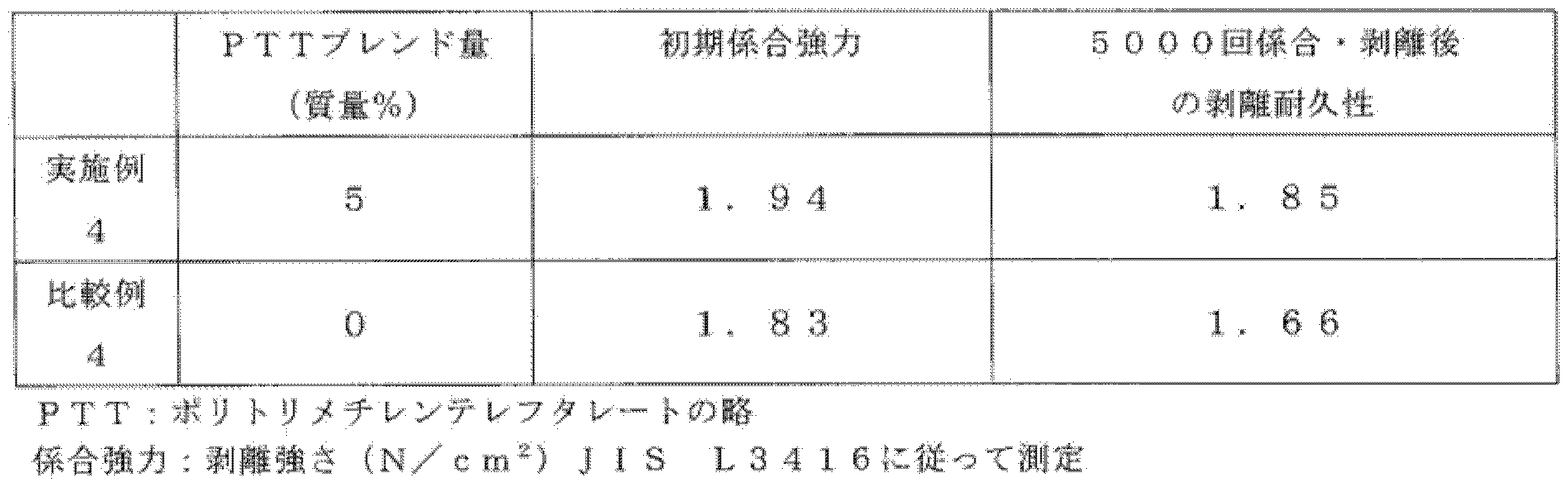
さらに、5000回係合・剥離を繰り返した後のループ状係合素子の状態を顕微鏡で観察した結果、実施例4のものは、ループ状係合素子を構成するマルチフィラメント糸を形成しているフィラメントはごく一部破断しているものもあったが、殆ど破断しておらず、さらにマルチフィラメント糸はループ部で分割した(バラけた)状態で、倒れているループ状係合素子は全く見当たらなかった。それに対して比較例4のものは、ループ状係合素子を構成しているマルチフィラメントを形成しているフィラメントのかなりが破断しており、さらにループ状係合素子が倒れ、係合能を消失しているものが見られた。
1:経糸
2:緯糸
3:ループ状係合素子用糸
4:ループ状係合素子
MD:経糸方向
CD:緯糸方向
2:緯糸
3:ループ状係合素子用糸
4:ループ状係合素子
MD:経糸方向
CD:緯糸方向
Claims (9)
- 基布の表面にループ状係合素子が複数存在している面ファスナーにおいて、
前記ループ状係合素子を構成している繊維が、1~8質量%のポリトリメチレンテレフタレートを含むポリブチレンテレフタレート系ポリエステルからなることを特徴とする面ファスナー。 - 前記基布が、経糸、緯糸および前記ループ状係合素子用糸からなる織物である面ファスナーであって、
前記経糸、前記緯糸および前記ループ状係合素子用糸がいずれもマルチフィラメント糸であり、
前記緯糸が熱融着性を有しており、
前記ループ状係合素子用糸が前記経糸に平行に前記織物中に織り込まれており、前記ループ状係合素子は、前記ループ状係合素子用糸が前記経糸を跨ぐことなく前記緯糸を1本跨ぐ箇所で形成され、且つ前記ループ状係合素子の根元が前記緯糸との融着により前記基布に固定されており、
前記ループ状係合素子は、ループ面を経糸方向に向けて経糸方向に列をなして前記織物上に並んでおり、且つ前記列が緯糸方向に複数列平行に存在しており、前記列に存在しているループ状係合素子が跨ぐ緯糸が、その前記列の隣の列のループ状係合素子が跨いでいる緯糸とは相違している請求項1に記載の面ファスナー。 - 前記基布が平織構造であって、
前記ループ状係合素子用糸は、前記経糸に平行に前記経糸4本毎に織物基布に織り込まれており、前記緯糸5本を浮沈して緯糸上に浮き上がった箇所で係合素子用ループを形成している請求項2に記載の面ファスナー。 - 前記ループ状係合素子用糸が、32~45dtexのフィラメントが6~12本集束されたマルチフィラメント糸である請求項1~3のいずれかに記載の面ファスナー。
- 前記ループ状係合素子用糸の一部がフック状係合素子用ポリエチレンテレフタレート系モノフィラメント糸に置き換えられて、前記フック状係合素子用ポリエチレンテレフタレート系モノフィラメント糸が前記経糸に平行に織物に織り込まれ、フック状係合素子は前記経糸および前記緯糸を跨ぐ箇所で形成され、前記ループ状係合素子と前記フック状係合素子が前記基布の表面に混在している請求項2~4のいずれかに記載の面ファスナー。
- 前記ループ状係合素子を構成するマルチフィラメント糸が、ループ部で分割されており、且つ、前記マルチフィラメント糸の各々は前記ループ部で切断されていない請求項2~5のいずれかに記載の面ファスナー。
- 経糸、熱融着性緯糸およびループ状係合素子用糸からなり、前記経糸、前記熱融着性緯糸および前記係合素子用糸がともにマルチフィラメント糸であり、
前記ループ状係合素子用糸が、前記経糸に平行に織り込まれており、前記経糸を跨ぐことなく緯糸を1本跨ぐ箇所でループを形成しており、
前記ループは、経糸方向に列をなして織物上に並んでおり、且つ、前記列が緯糸方向に複数列平行に存在しており、前記列に存在しているループが跨ぐ緯糸が、前記列の隣の列のループが跨いでいる緯糸とは相違している織物を織った後に、前記熱融着性緯糸を加熱して、融着させて、前記ループ状係合素子用糸を前記織物に固定してループ状係合素子とする面ファスナーの製造方法において、
ループ状係合素子用マルチフィラメント糸として、1~8質量%のポリトリメチレンテレフタレートを含むポリブチレンテレフタレート系ポリエステルからなるマルチフィラメント糸を用いることを特徴とする面ファスナーの製造方法。 - 前記ループ状係合素子用糸が25~45%の破断伸度を有するマルチフィラメント糸である請求項7に記載の面ファスナーの製造方法。
- 前記ループ状係合素子用糸の一部をフック状係合素子用モノフィラメント糸に置き換えて、前記フック状係合素子用モノフィラメント糸を前記経糸に平行に織物に織り込み、前記フック状係合素子用モノフィラメント糸が前記経糸および前記熱融着性緯糸を跨ぐ箇所でループを形成し、前記熱融着性緯糸を加熱して融着させて、前記ループ状係合素子用糸および前記フック状係合素子用モノフィラメント糸を前記織物に固定した後に、前記フック状係合素子用モノフィラメント糸により形成されたループの片脚を切断することにより、フック状係合素子とする請求項7または8に記載の面ファスナーの製造方法。
Priority Applications (2)
| Application Number | Priority Date | Filing Date | Title |
|---|---|---|---|
| EP19885239.4A EP3881710B1 (en) | 2018-11-14 | 2019-11-01 | Touch fastener having loop-shaped engagement elements and production method for touch fastener having loop-shaped engagement elements |
| JP2020556052A JP7299236B2 (ja) | 2018-11-14 | 2019-11-01 | ループ状係合素子を有する面ファスナー及びその製造方法 |
Applications Claiming Priority (2)
| Application Number | Priority Date | Filing Date | Title |
|---|---|---|---|
| JP2018213393 | 2018-11-14 | ||
| JP2018-213393 | 2018-11-14 |
Publications (1)
| Publication Number | Publication Date |
|---|---|
| WO2020100639A1 true WO2020100639A1 (ja) | 2020-05-22 |
Family
ID=70731508
Family Applications (1)
| Application Number | Title | Priority Date | Filing Date |
|---|---|---|---|
| PCT/JP2019/043144 Ceased WO2020100639A1 (ja) | 2018-11-14 | 2019-11-01 | ループ状係合素子を有する面ファスナー及びその製造方法 |
Country Status (3)
| Country | Link |
|---|---|
| EP (1) | EP3881710B1 (ja) |
| JP (1) | JP7299236B2 (ja) |
| WO (1) | WO2020100639A1 (ja) |
Citations (7)
| Publication number | Priority date | Publication date | Assignee | Title |
|---|---|---|---|---|
| JPS58104216A (ja) * | 1981-12-14 | 1983-06-21 | Teijin Ltd | ポリトリメチレンテレフタレ−ト繊維の製造法 |
| JPH11244010A (ja) * | 1998-03-06 | 1999-09-14 | Ykk Corp | 繊維製面ファスナーとその製造方法 |
| WO2005122817A1 (ja) * | 2004-06-17 | 2005-12-29 | Kuraray Fastening Co., Ltd. | 布製面ファスナー |
| WO2007074791A1 (ja) | 2005-12-26 | 2007-07-05 | Kuraray Fastening Co., Ltd. | 改良された自己融着ループ面ファスナー |
| JP2014027988A (ja) | 2012-07-31 | 2014-02-13 | Kuraray Fastening Co Ltd | 布製面ファスナーの組み合わせ |
| JP2016123419A (ja) * | 2014-12-26 | 2016-07-11 | クラレファスニング株式会社 | ループ面ファスナー用生機およびループ面ファスナーの製造方法およびループ面ファスナー |
| JP2018029912A (ja) * | 2016-08-26 | 2018-03-01 | クラレファスニング株式会社 | フック状係合素子を有する織面ファスナー |
Family Cites Families (3)
| Publication number | Priority date | Publication date | Assignee | Title |
|---|---|---|---|---|
| US6910353B2 (en) * | 2002-11-27 | 2005-06-28 | Milliken & Company | Printed loop fabric and method for producing the same |
| JP2006034872A (ja) * | 2004-07-30 | 2006-02-09 | Toyobo Co Ltd | 面ファスナー雌材及びその製造方法 |
| KR20190016121A (ko) * | 2011-09-28 | 2019-02-15 | 구라레파스닝 가부시키가이샤 | 면 파스너 및 면 파스너용 걸어맞춤 소자의 조합 |
-
2019
- 2019-11-01 JP JP2020556052A patent/JP7299236B2/ja active Active
- 2019-11-01 EP EP19885239.4A patent/EP3881710B1/en active Active
- 2019-11-01 WO PCT/JP2019/043144 patent/WO2020100639A1/ja not_active Ceased
Patent Citations (7)
| Publication number | Priority date | Publication date | Assignee | Title |
|---|---|---|---|---|
| JPS58104216A (ja) * | 1981-12-14 | 1983-06-21 | Teijin Ltd | ポリトリメチレンテレフタレ−ト繊維の製造法 |
| JPH11244010A (ja) * | 1998-03-06 | 1999-09-14 | Ykk Corp | 繊維製面ファスナーとその製造方法 |
| WO2005122817A1 (ja) * | 2004-06-17 | 2005-12-29 | Kuraray Fastening Co., Ltd. | 布製面ファスナー |
| WO2007074791A1 (ja) | 2005-12-26 | 2007-07-05 | Kuraray Fastening Co., Ltd. | 改良された自己融着ループ面ファスナー |
| JP2014027988A (ja) | 2012-07-31 | 2014-02-13 | Kuraray Fastening Co Ltd | 布製面ファスナーの組み合わせ |
| JP2016123419A (ja) * | 2014-12-26 | 2016-07-11 | クラレファスニング株式会社 | ループ面ファスナー用生機およびループ面ファスナーの製造方法およびループ面ファスナー |
| JP2018029912A (ja) * | 2016-08-26 | 2018-03-01 | クラレファスニング株式会社 | フック状係合素子を有する織面ファスナー |
Non-Patent Citations (1)
| Title |
|---|
| See also references of EP3881710A4 |
Also Published As
| Publication number | Publication date |
|---|---|
| JPWO2020100639A1 (ja) | 2021-09-24 |
| JP7299236B2 (ja) | 2023-06-27 |
| EP3881710A4 (en) | 2022-08-03 |
| EP3881710A1 (en) | 2021-09-22 |
| EP3881710B1 (en) | 2024-07-10 |
Similar Documents
| Publication | Publication Date | Title |
|---|---|---|
| US9700105B2 (en) | Surface fastener and surface fastener latch element combination | |
| JP5743154B2 (ja) | フック・ループ混在型面ファスナー | |
| JP6249330B2 (ja) | 同一面にフックとループの両係合素子を有する面ファスナー | |
| JP7281174B2 (ja) | 芯鞘型複合熱接着性繊維 | |
| WO2014049940A1 (ja) | 両面係合タイプの布製面ファスナー | |
| JP5966195B2 (ja) | 布製面ファスナーの組み合わせ | |
| JP6699840B2 (ja) | フック状係合素子を有する織面ファスナー | |
| JP6263779B2 (ja) | 布製の面ファスナー | |
| JP5916115B2 (ja) | 布製面ファスナーの組み合わせ | |
| JP7299249B2 (ja) | 織物系フック面ファスナー | |
| JP6717448B2 (ja) | 面ファスナーの製造方法 | |
| JP5140017B2 (ja) | 耳部ほつれ防止織物 | |
| JP7299236B2 (ja) | ループ状係合素子を有する面ファスナー及びその製造方法 | |
| JP7299237B2 (ja) | フック状係合素子を有する織物製面ファスナー | |
| JP7027661B2 (ja) | 難燃性の面ファスナー | |
| JP6413123B2 (ja) | 布製ループ面ファスナー | |
| JP6996684B2 (ja) | 布製面ファスナー | |
| JP2016123419A (ja) | ループ面ファスナー用生機およびループ面ファスナーの製造方法およびループ面ファスナー | |
| JP7604745B2 (ja) | ポリエチレンテレフタレート系面ファスナー | |
| JP6197194B2 (ja) | 布製ループ面ファスナー |
Legal Events
| Date | Code | Title | Description |
|---|---|---|---|
| 121 | Ep: the epo has been informed by wipo that ep was designated in this application |
Ref document number: 19885239 Country of ref document: EP Kind code of ref document: A1 |
|
| ENP | Entry into the national phase |
Ref document number: 2020556052 Country of ref document: JP Kind code of ref document: A |
|
| NENP | Non-entry into the national phase |
Ref country code: DE |
|
| ENP | Entry into the national phase |
Ref document number: 2019885239 Country of ref document: EP Effective date: 20210614 |