WO2020116092A1 - モリンガ抽出物及び/又は粉砕物を含む組成物 - Google Patents
モリンガ抽出物及び/又は粉砕物を含む組成物 Download PDFInfo
- Publication number
- WO2020116092A1 WO2020116092A1 PCT/JP2019/043940 JP2019043940W WO2020116092A1 WO 2020116092 A1 WO2020116092 A1 WO 2020116092A1 JP 2019043940 W JP2019043940 W JP 2019043940W WO 2020116092 A1 WO2020116092 A1 WO 2020116092A1
- Authority
- WO
- WIPO (PCT)
- Prior art keywords
- moringa
- mass
- glucomoringin
- moringin
- content
- Prior art date
- Legal status (The legal status is an assumption and is not a legal conclusion. Google has not performed a legal analysis and makes no representation as to the accuracy of the status listed.)
- Ceased
Links
Images

Classifications
-
- A—HUMAN NECESSITIES
- A61—MEDICAL OR VETERINARY SCIENCE; HYGIENE
- A61K—PREPARATIONS FOR MEDICAL, DENTAL OR TOILETRY PURPOSES
- A61K8/00—Cosmetics or similar toiletry preparations
- A61K8/18—Cosmetics or similar toiletry preparations characterised by the composition
- A61K8/30—Cosmetics or similar toiletry preparations characterised by the composition containing organic compounds
- A61K8/60—Sugars; Derivatives thereof
- A61K8/602—Glycosides, e.g. rutin
-
- A—HUMAN NECESSITIES
- A23—FOODS OR FOODSTUFFS; TREATMENT THEREOF, NOT COVERED BY OTHER CLASSES
- A23L—FOODS, FOODSTUFFS OR NON-ALCOHOLIC BEVERAGES, NOT OTHERWISE PROVIDED FOR; PREPARATION OR TREATMENT THEREOF
- A23L2/00—Non-alcoholic beverages; Dry compositions or concentrates therefor; Preparation or treatment thereof
- A23L2/52—Adding ingredients
-
- A—HUMAN NECESSITIES
- A23—FOODS OR FOODSTUFFS; TREATMENT THEREOF, NOT COVERED BY OTHER CLASSES
- A23L—FOODS, FOODSTUFFS OR NON-ALCOHOLIC BEVERAGES, NOT OTHERWISE PROVIDED FOR; PREPARATION OR TREATMENT THEREOF
- A23L33/00—Modifying nutritive qualities of foods; Dietetic products; Preparation or treatment thereof
- A23L33/10—Modifying nutritive qualities of foods; Dietetic products; Preparation or treatment thereof using additives
- A23L33/105—Plant extracts, their artificial duplicates or their derivatives
-
- A—HUMAN NECESSITIES
- A61—MEDICAL OR VETERINARY SCIENCE; HYGIENE
- A61K—PREPARATIONS FOR MEDICAL, DENTAL OR TOILETRY PURPOSES
- A61K8/00—Cosmetics or similar toiletry preparations
- A61K8/18—Cosmetics or similar toiletry preparations characterised by the composition
- A61K8/96—Cosmetics or similar toiletry preparations characterised by the composition containing materials, or derivatives thereof of undetermined constitution
- A61K8/97—Cosmetics or similar toiletry preparations characterised by the composition containing materials, or derivatives thereof of undetermined constitution from algae, fungi, lichens or plants; from derivatives thereof
- A61K8/9783—Angiosperms [Magnoliophyta]
- A61K8/9789—Magnoliopsida [dicotyledons]
-
- A—HUMAN NECESSITIES
- A61—MEDICAL OR VETERINARY SCIENCE; HYGIENE
- A61Q—SPECIFIC USE OF COSMETICS OR SIMILAR TOILETRY PREPARATIONS
- A61Q19/00—Preparations for care of the skin
- A61Q19/02—Preparations for care of the skin for chemically bleaching or whitening the skin
-
- A—HUMAN NECESSITIES
- A23—FOODS OR FOODSTUFFS; TREATMENT THEREOF, NOT COVERED BY OTHER CLASSES
- A23F—COFFEE; TEA; THEIR SUBSTITUTES; MANUFACTURE, PREPARATION, OR INFUSION THEREOF
- A23F3/00—Tea; Tea substitutes; Preparations thereof
- A23F3/16—Tea extraction; Tea extracts; Treating tea extract; Making instant tea
-
- A—HUMAN NECESSITIES
- A23—FOODS OR FOODSTUFFS; TREATMENT THEREOF, NOT COVERED BY OTHER CLASSES
- A23F—COFFEE; TEA; THEIR SUBSTITUTES; MANUFACTURE, PREPARATION, OR INFUSION THEREOF
- A23F5/00—Coffee; Coffee substitutes; Preparations thereof
- A23F5/10—Treating roasted coffee; Preparations produced thereby
- A23F5/14—Treating roasted coffee; Preparations produced thereby using additives, e.g. milk or sugar; Coating
-
- A—HUMAN NECESSITIES
- A23—FOODS OR FOODSTUFFS; TREATMENT THEREOF, NOT COVERED BY OTHER CLASSES
- A23V—INDEXING SCHEME RELATING TO FOODS, FOODSTUFFS OR NON-ALCOHOLIC BEVERAGES AND LACTIC OR PROPIONIC ACID BACTERIA USED IN FOODSTUFFS OR FOOD PREPARATION
- A23V2002/00—Food compositions, function of food ingredients or processes for food or foodstuffs
Definitions
- the present invention relates to a composition containing a moringa extract and/or a pulverized product, and foods and drinks and cosmetics containing the composition.
- Moringa Plants belonging to the genus Moringa (genus Wasabi) (also simply referred to as "moringa” in the present specification) are plants that are widely known as medicinal plants in India and Southeast Asia, and have various antioxidant and anti-inflammatory effects. Useful physiological functions have been found. Moringa contains a large amount of minerals, amino acids, benzyl glucosinolate (BGL), etc. as active ingredients for these effects. Therefore, in recent years, dry pulverized products of moringa leaves or roots, and extract powders extracted from these as raw materials with hot water, hydrous alcohol, etc. have begun to be sold as raw materials for functional foods, and have been drawing attention (Patent Document 1). 2, Non-Patent Document 1).
- Moringa contains myrosinase that converts (enzymatic degradation) benzyl glucosinolate to benzyl isothiocyanate (BITC).
- Benzyl glucosinolate and myrosinase do not react because they are separated and localized in a normal state, but when they are extracted with a solvent or pulverized, they react rapidly to be converted into benzyl isothiocyanate. Therefore, benzyl glucosinolate does not exist in the moringa extract which is an extract of moringa. Therefore, the applicant of the present application has proposed to inactivate myrosinase by performing a specific pretreatment to suppress the decomposition of benzylglucosinolate in the moringa extract (Patent Document 3).
- the moringa extract of Patent Document 3 has a useful physiological function and is highly safe, but the area under the blood concentration-time curve (Area Under the Curve; AUC) that is an index of the amount absorbed into the body With regard to the above, further improvement is required.
- An object of the present invention is to provide a composition having a useful physiological function and excellent AUC and storage stability, and foods and drinks and cosmetics containing the composition.
- a composition in which the mass ratio of the content of moringin, which is one type of benzyl isothiocyanate, to the content of glucomoringin, which is one type of benzyl glucosinolate, is adjusted to a specific range is excellent in AUC.
- Benzyl glucosinolate has a plurality of analogs in addition to glucomoringin, and benzyl glucosinolate is a generic term for them.
- glucomoringin (4-( ⁇ -L-rhamnosiloxy)benzyl glucosinolate), which is the main active ingredient, and its derivative moringin (4-( ⁇ -L-rhamnosiloxy)benzyl isothiocyanate) is used as an index.
- moringin (4-( ⁇ -L-rhamnosiloxy)benzyl isothiocyanate)
- a composition having excellent storage stability of moringin can be obtained by allowing glucomoringin and moringin to coexist in the composition of the present invention.
- the present inventors have conducted intensive studies based on such findings and completed the present invention.
- the present invention relates to the following [1] to [3].
- [1] A composition containing a moringa extract and/or a pulverized product, wherein the mass ratio of the content of moringin to the content of glucomoringin (moringin/glucomoringin) is 0.00005 to 0.30.
- [2] A food or drink containing the composition according to [1].
- [3] A cosmetic containing the composition according to [1].
- composition having a useful physiological function and excellent AUC and storage stability, and foods and drinks and cosmetics containing the composition.
- the composition of the present invention contains a moringa extract and/or a pulverized product (hereinafter sometimes referred to as “moringa extract and the like”).
- the moringa extract is obtained by extracting from moringa by a known method using a solvent.
- the moringa crushed product is obtained by crushing moringa using a known crusher.
- Moringa to be subjected to extraction and crushing is not particularly limited, and examples thereof include Moringa oleifera, Moringa concanensis, Moringa drouhardii, and the like. Among these, moringa oleifera is preferable from the viewpoint that it is widely cultivated and can be easily collected. Moringa oleifera is a deciduous small tree native to India, and has other names such as horseradish tree, ben nut, Malungai (Tagalog), and Sanjanaa (Hindu).
- the leaves, stems, pods (flesh) and seeds can be used as the part of the moringa to be extracted or crushed. These parts may be used as they are or after being dried, but it is preferable to use after drying from the viewpoint of storage stability as a raw material and yield at the time of producing the extract.
- the solvent used for extraction water, an organic solvent, or a mixed solvent of water and an organic solvent is used.
- the organic solvent include lower alcohols (monohydric or polyhydric alcohols having 1 to 4 carbon atoms such as methanol, ethanol, propanol, propylene glycol, butylene glycol, and glycerin) that are miscible with water, and acetone. ..
- these organic solvents may be mixed with water in advance and then used, or two or more kinds may be mixed with water and used.
- the mixing ratio of the organic solvent can be from 0% to less than 100%, but from the viewpoint of safety, it is preferable to extract only with water.
- the amount of the solvent used for the extraction is not particularly limited, but can be, for example, 200 to 3000 parts by mass with respect to 100 parts by mass of the moringa used for the extraction.
- the temperature of the solvent at the time of extraction is not particularly limited, but may be, for example, 20 to 95°C.
- the extraction time is not particularly limited, but may be 30 to 150 minutes from the viewpoint of production efficiency, for example.
- the extraction can be carried out with stirring or at rest. After the extraction, a treatment such as filtration or centrifugation is performed to remove the residue, and then the extraction solvent can be removed by decompression or the like.
- the extract can be dried with a spray dryer or the like, if necessary, such as when the extract is made into powder.
- the composition of the present invention contains glucomoringin and moringin. It is known that these components have useful physiological functions such as anti-fatigue, anti-oxidation, nutritional tonicity, and hormone regulation, but the effects of various activities are basically possessed by moringin, and Moringin is believed to be the active precursor.
- Glucomoringin is known to be metabolized by intestinal bacteria in the body when ingested and converted into moringin, but a moringa extract and/or crushed powder containing glucomoringin and moringin in a certain ratio. The composition containing the thing was not known.
- the composition of the present invention is one in which myrosinase is inactivated or does not contain myrosinase.
- the content of glucomoringin in the composition of the present invention is preferably 1.5% by mass or more, more preferably 6% by mass or more, in terms of dry solid content, from the viewpoint of exerting useful physiological functions. It is more preferably 10% by mass or more, and further preferably 15% by mass or more.
- the upper limit is not particularly limited, but may be, for example, 50 mass% or less.
- the glucomoringin content is measured by the method described in Examples below.
- the content of moringin in the composition of the present invention is preferably 0.0005 mass% or more, more preferably 0.005 mass% or more, in terms of dry solid content, from the viewpoint of exerting useful physiological functions. It is more preferably 0.01% by mass or more, and further preferably 0.1% by mass or more.
- the upper limit is not particularly limited, but may be, for example, 15% by mass or less.
- the content of moringin is measured by the method described in Examples below.
- the mass ratio of the content of moringin to the content of glucomoringin is 0.00005 or more, preferably 0.0002 or more, from the viewpoint of AUC. , More preferably 0.002 or more, further preferably 0.20 or more, and from the viewpoint of storage stability, 0.30 or less, preferably 0.10 or less, more preferably 0. It is 0.05 or less, and more preferably 0.03 or less.
- the method of adjusting the mass ratio is not particularly limited, by mixing a moringa extract containing glucomoringin and the like, and a moringa extract containing moringin, etc., to an arbitrary mass ratio. Can be adjusted.
- a moringa extract or the like containing glucomoringin can be obtained by inactivating myrosinase by a known method and performing extraction or the like.
- the moringa extract containing moringine can be obtained by, for example, extracting without deactivating myrosinase and then deactivating or removing myrosinase.
- Examples of means for deactivating and removing myrosinase include heat treatment at 85° C. or higher, extraction treatment with a solvent having an ethanol content of 80% or higher, enzyme removal treatment by dialysis, gel filtration, or ultrafiltration.
- the inactivation or removal confirmation of myrosinase can be measured by the method described in Examples below.
- composition of the present invention may contain a free amino acid, and may further contain, for example, one or more amino acids selected from the group consisting of arginine, glutamic acid, alanine, methionine, and cysteine.
- the content of the free amino acid in the composition of the present invention is preferably 0.1% by mass or more, and more preferably 0.5% by mass or more, in terms of the dry solid content of the extract, from the viewpoint of promoting health.
- the upper limit value is not particularly limited, but may be, for example, 2.0% by mass or less.
- the content when two or more free amino acids are contained refers to the total amount.
- composition of the present invention comprises minerals such as zinc, potassium, calcium, iron, copper, sodium and magnesium, vitamins such as vitamin A, vitamin B1, vitamin B2, vitamin C, vitamin D and vitamin E, dextrin and malt. It may contain optional components such as excipients such as dextrin, galactomannan, cyclodextrin, starch and lactose.
- composition of the present invention has useful physiological functions and is excellent in AUC and storage stability, it can be incorporated into foods and drinks and cosmetics.
- glucomoringin and moringin By coexisting glucomoringin and moringin in the composition of the present invention, it is possible to suppress bitterness and color change derived from glucomoringin in foods and drinks, or to suppress spiciness and unpleasant odor derived from moringin.
- the food and drink may be, for example, soft drinks, carbonated drinks, nutritional drinks, fruit drinks, lactic acid drinks, and the like, concentrated stock solutions of these drinks, and adjustment powders.
- the composition of the present invention can be added to frozen desserts such as ice cream, sorbet and shaved ice, and noodles such as buckwheat, udon, harsame, gyoza rind, shimai rind, Chinese noodles and instant noodles.
- composition of the present invention can be added to confectioneries such as candy, candy, gum, chocolate, tablet confectionery, gummy candy, snacks, biscuits, jellies, puddings, jams, creams, baked confectioneries and the like.
- confectioneries such as candy, candy, gum, chocolate, tablet confectionery, gummy candy, snacks, biscuits, jellies, puddings, jams, creams, baked confectioneries and the like.
- kamaboko, ham, processed fish and livestock products such as sausage
- dairy products such as processed milk and fermented milk, salad oil, tempura oil, margarine, mayonnaise, shortening, whipped cream
- oils and fats such as dressings and processed oils and fats, seasonings such as sauces and sauces, soups, stews, salads, prepared foods, pickles and the like.
- various forms of health and nutritional supplements such as tablets, capsules, and drinks, as well as oral refreshing agents used in the oral cavity such as oral fresheners and breath fresheners, toothpaste, mouthwash, etc. It can be used by adding to external products, emollient creams, emollient lotions and the like.
- the blending amount of the composition of the present invention is not particularly limited, but it can be blended in foods and drinks, for example, so as to be 0.01 to 80% by mass in terms of dry solid content of extract.
- cosmetics examples include basic cosmetics, makeup cosmetics, fragrance cosmetics, body cosmetics, hair cosmetics, and the like.
- basic cosmetics softening lotions, astringent lotions, washing lotions, multi-layer lotions and other lotions; emollient lotions, moisturizing lotions, milky lotions, nourishing lotions, nourishing milks, skin moisturizers, moisturizers -Emulsions, massage lotions, cleansing lotions, protect emulsions, sun protects, sun protectors, UV care milks, sunscreens, makeup lotions, keratin smoothers, elbow lotions, hand lotions, body lotions, etc.; emollient creams, nourishing creams, nari Thing cream, vanishing cream, moisture cream, night cream, massage cream, cleansing cream, makeup cream, base cream, premakeup cream, sunscreen cream, suntan cream, depilatory cream, deodorant cream, shaving cream, keratin softening cream, etc.
- Creams such as moisturizing gels; essences such as moisturizing essences, whitening essences, UV protection essences; liposome cosmetics such as liposomal beauty essences, liposomal lotions; peel-off packs, powder packs, washing packs, oil packs, cleansing masks, etc. Packs and masks; cleansing foams, cleansing creams, cleansing milks, cleansing lotions, cleansing gels, cleansing oils, cleansing masks, facial cleansers, facial cleansers, facial cleansers, toilet soaps, transparent soaps, medicated soaps, liquid soaps, shaving soaps, It can be used by adding it to soap such as synthetic toilet soap.
- a makeup cosmetic it can be used by adding it to white powder/powder, foundations, lipsticks, lip gloss, blusher, eyeliner, mascara, eye shadow, eyebrow, eyebrow, nail enamel, enamel remover, nail treatment. it can.
- the fragrance cosmetic it can be used by adding it to perfume, perfume, perfume, perfume, eau de perfume, eau de toilette, cologne, perfume, aromatic powder, perfume soap, body lotion, bath oil.
- body cosmetics body wash such as body shampoo; deodorant cosmetics such as deodorant lotion, deodorant powder, deodorant spray, deodorant stick; decolorant, depilatory/hair remover; bath agent; insect spray etc. It can be used by adding it to a repeller.
- Hair cosmetics include oil shampoos, cream shampoos, conditioning shampoos, dandruff shampoos, shampoos for hair coloring, shampoos with integrated rinse, shampoos for rinse, treatment, hair pack, color lotion, split hair coat, permanent wave It can be used by adding it to an agent, a straight perm agent, an oxidative hair dye, a hair bleach, a hair color pretreatment, a hair color aftertreatment, a perm pretreatment, a perm aftertreatment, a hair manicure, a hair tonic, and a hair restorer.
- an agent a straight perm agent, an oxidative hair dye, a hair bleach, a hair color pretreatment, a hair color aftertreatment, a perm pretreatment, a perm aftertreatment, a hair manicure, a hair tonic, and a hair restorer.
- Preparation examples 1 to 44 of moringa extract (moringa extract) or ground product Moringa seeds were crushed with a mill to obtain crushed seeds.
- 500 g of deionized water (90° C.) was added and stirred (pretreatment) for 5 minutes, then 1500 g of deionized water (10° C.) was added to 35° C., and the mixture was stirred for 2 hours.
- the solution was filtered through a paper, and the filtrate was concentrated under reduced pressure with a rotary evaporator.
- the obtained concentrated liquid was dried with a freeze dryer to obtain 10 g of the moringa extract of Preparation Example 1.
- Moringa stalks of Preparation Example 3 were obtained in the same manner as in Preparation Example 1 except that the crushed stalks of the moringa stalks were crushed with a hammer mill.
- Moringa pods of Preparation Example 4 were obtained in the same manner as in Preparation Example 1 except that the moringa pods were cut into pieces each having a size of about 1 cm, freeze-dried, and pulverized with a mill.
- Moringa seeds were crushed with a mill to obtain crushed seeds. 2000 g of deionized water (90° C.) was added to 100 g of the ground seeds, and the mixture was stirred for 2 hours. After that, the solution was filtered through a paper, and the filtrate was concentrated under reduced pressure with a rotary evaporator. The obtained concentrated liquid was dried with a freeze dryer to obtain 15 g of the moringa extract of Preparation Example 5.
- Moringa seeds were crushed with a mill to obtain crushed seeds. 2000 g of 50% (v/v) ethanol aqueous solution (55° C.) was added to 100 g of the crushed seeds, and the mixture was stirred for 2 hours. After filtering with a back paper and removing the internal myrosinase by subjecting the filtrate to an ultrafiltration membrane treatment, the filtrate was concentrated under reduced pressure by a rotary evaporator. The obtained concentrated liquid was dried with a freeze dryer to obtain 12 g of the moringa extract of Preparation Example 9.
- the moringa extracts of Preparation Examples 9 to 12 cannot inactivate myrosinase at an ethanol content of about 50%, and they have myrosinase activity during the extraction treatment, so that moringine is produced.
- Moringa seeds were crushed with a mill to obtain crushed seeds. 2000 g of 90% (v/v) ethanol aqueous solution (35° C.) was added to 100 g of crushed seeds, and the mixture was stirred for 2 hours. After that, the solution was filtered through a paper, and the filtrate was concentrated under reduced pressure with a rotary evaporator. The obtained concentrated liquid was dried with a freeze dryer to obtain 10 g of the moringa extract of Preparation Example 13.
- Moringin does not exist in the moringa extracts of Preparation Examples 13 to 16 because the myrosinase was inactivated by the extraction treatment with 90% ethanol or the myrosinase was precipitated in the solution and the contact with glucomoringin was inhibited. It was a thing.
- Moringa seeds were crushed with a mill to obtain crushed seeds. 100 g of the crushed seeds was autoclaved at 121° C. for 20 minutes to obtain 100 g of the moringa crushed product of Preparation Example 17.
- a moringa pod was cut into about 1 cm, freeze-dried, pulverized with a mill, and 100 g of a moringa pulverized product of Preparation Example 20 was obtained in the same manner as in Preparation Example 17, except that the obtained pod dried pulverized product was used. ..
- Moringa seeds were crushed with a mill to obtain crushed seeds. 2000 g of deionized water (55° C.) was added to 100 g of the crushed seeds, and the mixture was stirred for 1 hour. After filtering with a back paper and removing the internal myrosinase by subjecting the filtrate to an ultrafiltration membrane treatment, the filtrate was concentrated under reduced pressure by a rotary evaporator. The obtained concentrated liquid was dried with a freeze dryer to obtain 15 g of the moringa extract of Preparation Example 21.
- Moringin was produced in the moringa extracts of Preparation Examples 21 to 24 because they had myrosinase activity during the extraction treatment.
- Moringa seeds were crushed with a mill to obtain crushed seeds. 2000 g of 50% (v/v) ethanol aqueous solution (75° C.) was added to 100 g of the crushed seeds, and the mixture was stirred for 2 hours. After filtering with a back paper and removing the internal myrosinase by subjecting the filtrate to an ultrafiltration membrane treatment, the filtrate was concentrated under reduced pressure by a rotary evaporator. The obtained concentrated liquid was dried with a freeze dryer to obtain 12 g of the moringa extract of Preparation Example 25.
- the moringa extracts of Preparation Examples 25 to 28 cannot deactivate myrosinase at an ethanol content of about 50%, and do not contain glucomoringin because the myrosinase activity is promoted at an extraction temperature of 75°C. Met.
- Moringa seeds were crushed with a mill to obtain crushed seeds. 100 g of deionized water (25° C.) was added to 100 g of the crushed seeds, and the mixture was stirred (pretreatment) and then allowed to stand at 55° C. for 4 hours. The resulting mixture was further dried at 90° C. for 1 hour to inactivate the internal myrosinase, and 100 g of a moringa pulverized product of Preparation Example 29 was obtained.
- a moringa pod was cut into about 1 cm, freeze-dried, pulverized with a mill, and 100 g of a moringa pulverized product of Preparation Example 32 was obtained in the same manner as in Preparation Example 29 except that the obtained pod dried pulverized product was used. ..
- Moringin was produced in the crushed moringa products of Preparation Examples 29 to 32 because they have myrosinase activity when allowed to stand at 55°C.
- the moringa extract or crushed moringa product of Preparation Examples 33 to 44 was obtained in the same manner as in Preparation Examples 21 to 32 except that inactivation or removal treatment of myrosinase was not carried out.
- Table 1 shows the glucomoringin content and the moringine content in the moringa extract or crushed moringa product of Preparation Examples 1 to 32.
- the glucomoringin content and moringine content of the moringa extract or crushed moringa of Preparation Examples 33 to 44 were the same as those of Preparation Examples 21 to 32.
- Glucomoringin and Moringin Content Glucomoringin content (dry solid content conversion) of the Moringa extract or moringa crushed product of each preparation example, and moringin content (dry solid content conversion) were analyzed based on the following conditions. . The results are shown in Table 1.
- the glucomoringin and the moringin content in the composition of the present invention can be similarly measured using HPLC.
- the preparation of the sample solution is not particularly limited, and if necessary, water, an organic solvent, or a mixed solvent of water and an organic solvent is appropriately added so that the concentration is suitable for the analysis of glucomoringin and moringin.
- the solution fraction can be added and collected to obtain a sample solution.
- the mixing ratio of the organic solvent can be from 0% to less than 100%.
- An aqueous solution (solid content concentration: 5.0% (w/v)) of the moringa extract or moringa crushed product of each preparation example was prepared. To 100 ⁇ L of these sample solutions, 300 ⁇ L of acetonitrile was added and mixed, and filtration was performed, followed by quantitative analysis by reverse phase high performance liquid chromatography under the following conditions.
- HPLC (SHIMADZU) analysis HPLC conditions; column: Inertsil HILIC SIZE 4.6 mm x 250 mm (GL Science), eluent A: acetonitrile (93%), eluent B: 10 mM ammonium formate (7%), flow rate: 1.
- Moringin A moringin conversion value was calculated as shown below by comparing the peak area by HPLC analysis (the same condition as the glucomoringin concentration analysis) with the peak area of the calibration curve of the reagent glucomoringin. Conversion formula for glucomoringin peak area: A/0.738 A: Moringin peak area When the reagent glucomoringin was completely decomposed by commercially available myrosinase and converted into moringin, it was found that the value obtained by dividing 0.738 can be used for the conversion of the peak area of each component. The above calculation formula is used.
- B Converted glucomoringin content obtained from the above (dry solid content conversion) Moringin content (converted to dry solid content): B ⁇ 311/570 311: Molingin molecular weight 570: Glucomoringin molecular weight As described above, the content of molingin was converted by multiplying the value once calculated as glucomoringin by the molecular weight ratio.
- glucomoringin content in the sample solution after 20 hours is 80% or more when the glucomoringin content in the sample solution after 0 hour is 100%. It is preferably 90% or more, more preferably 95% or more, and "no increase in the content of moringin” means that when the content of moringin in the sample solution after 0 hour is 100%, It means that the content of moringin in the sample solution after the lapse of time is 120% or less, preferably 110% or less, more preferably 105% or less. In Preparation Examples 12 and 21 to 44 containing no glucomoringin, glucomoringin was added in an appropriate amount, and the presence or absence of increase or decrease was examined.
- the myrosinase activity in the composition of the present invention can be confirmed by an increase or decrease in the content of glucomoringin and moringin.
- the preparation of the sample solution is not particularly limited, and if necessary, water, an organic solvent, or a mixed solvent of water and an organic solvent is appropriately added so that the concentration is suitable for the analysis of glucomoringin and moringin.
- the solution fraction can be added and collected to obtain a sample solution.
- the mixing ratio of the organic solvent can be from 0% to less than 100%.
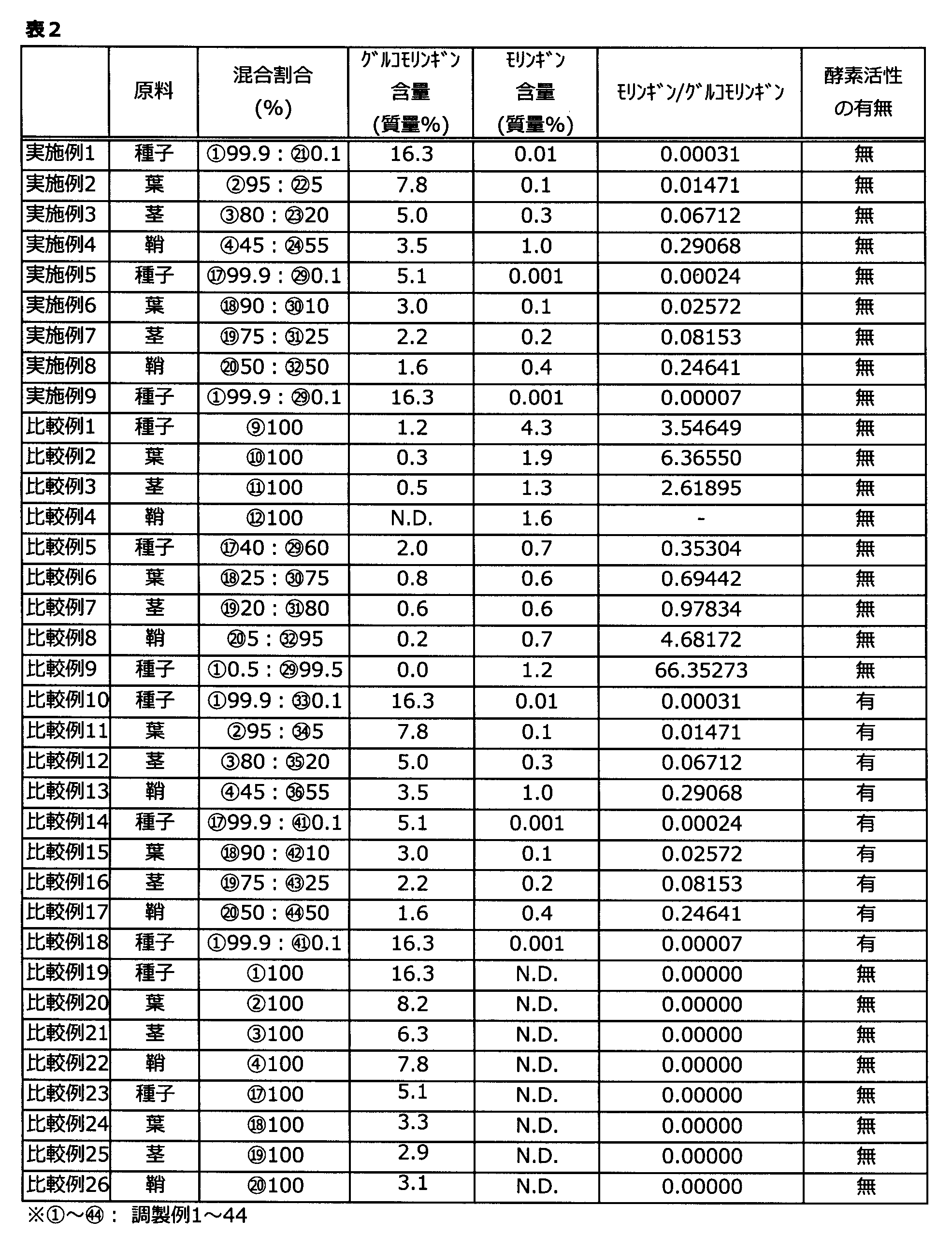
- Examples 1-9, Comparative Examples 1-26 The compositions of Examples and Comparative Examples were prepared at the mixing ratios shown in Table 2.
- the composition consisting of only the preparation examples in which myrosinase is inactivated or removed is referred to as "no" for the enzyme activity, and a composition containing the moringa extract or moringa pulverized product of preparation examples 33 to 36 and 41 to 44 having myrosinase activity. Is described in Table 2 as the enzyme activity "present".
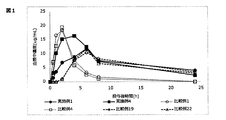
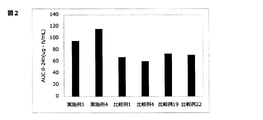
- compositions of Examples 1 and 4 have an increased AUC as compared with the compositions of Comparative Examples 1, 4, 19, and 22.
- HPLC (SHIMADZU) analysis HPLC conditions; column: L-column ODS SIZE 4.6 mm ⁇ 250 mm (CERI), eluent: water/methanol (20/80, v/v), flow rate: 0.5 mL/min, column Temperature °C: 30 °C, wavelength: 365nm
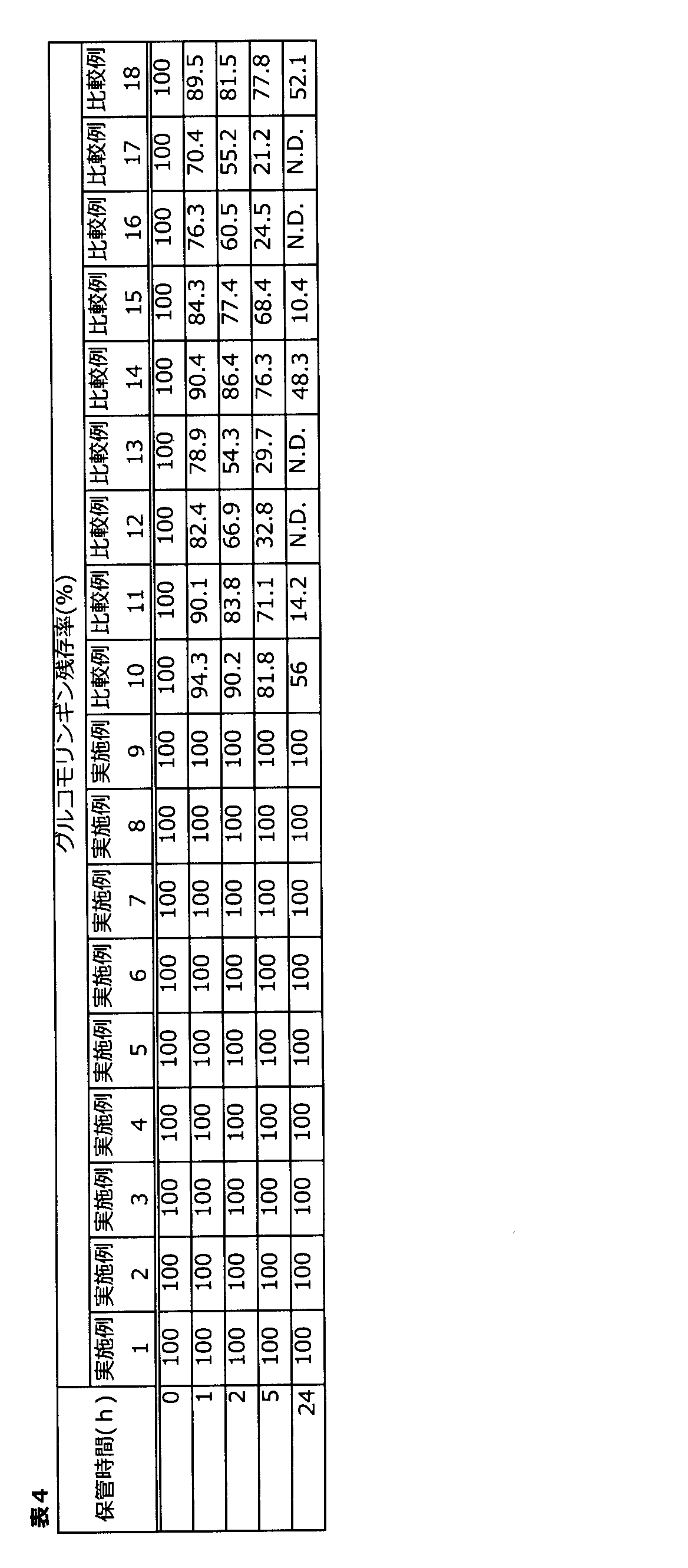
- compositions of Examples 1 to 9 have higher stability of glucomoringin than the compositions of Comparative Examples 10 to 18.
- Examples 4 and 8 and Comparative Examples 4 and 8 were tested for glutathione production promoting action on B16 melanoma cells as follows. B16 melanoma cells were precultured in Dulbecco's MEM medium containing 10% FBS, and then cells were collected by trypsin treatment. The collected cells were diluted with 10% FBS-containing Dulbecco's MEM medium to a cell density of 10 ⁇ 10 4 cells/mL, and then plated in a 48-well plate at 200 ⁇ L per well and cultured overnight.
- the medium was removed, and 200 ⁇ L of a test sample dissolved in 1% FBS-containing Dulbecco's MEM medium containing the same concentration of moringin was added to each well and cultured for 24 hours.
- 1% FBS-containing Dulbecco's MEM medium containing no sample was used for the same culture.
- the medium was removed from each well, washed with 400 ⁇ L of PBS( ⁇ ) buffer, and then the cells were lysed using 150 ⁇ L of M-PER (manufactured by PIERCE). Total glutathione was quantified using 100 ⁇ L of this.
- the total glutathione concentration was calculated based on a calibration curve prepared using oxidized glutathione (manufactured by Wako Pure Chemical Industries, Ltd.). After correcting the obtained value to the amount of glutathione per total protein amount, the glutathione production promoting rate (%) was calculated by the following formula. The results are shown in Table 5.
- Glutathione production promotion rate (%) A/B ⁇ 100 A: Glutathione amount per total protein amount in cells to which test sample was added B: Glutathione amount per total protein amount in cells without sample (control)
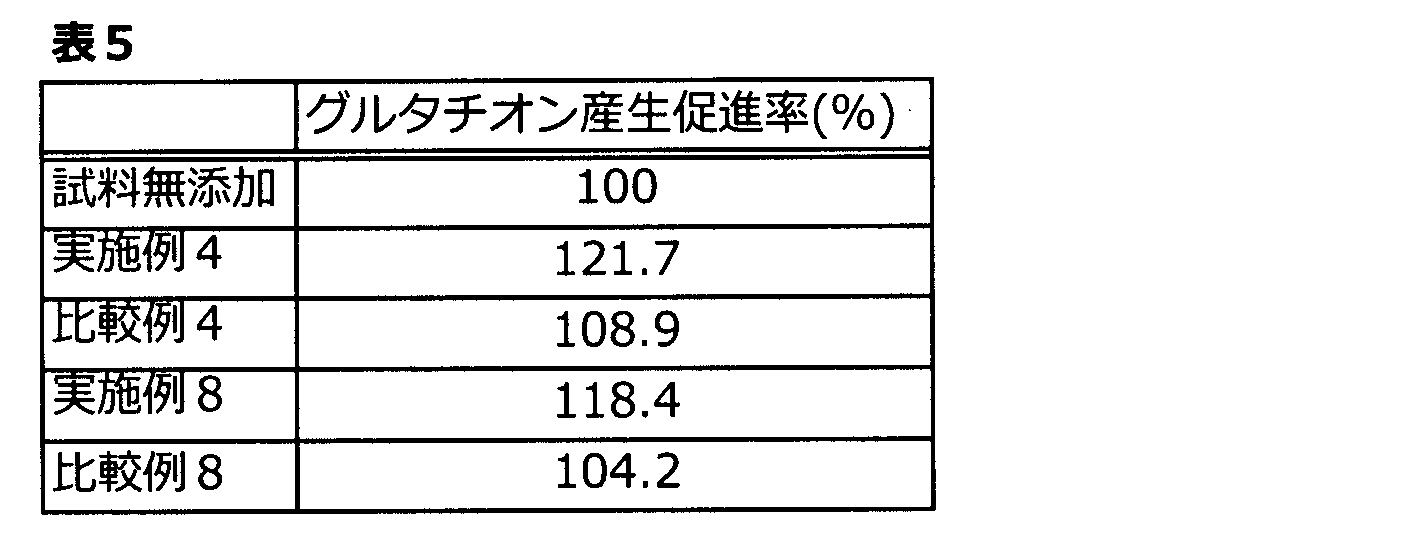
- compositions of Examples 4 and 8 have a higher glutathione production promoting action than the compositions of Comparative Examples 4 and 8.
- Emulsion production method Components 1 to 8 shown in Table 6 are heated to 80° C. and uniformly dissolved or dispersed to form an oil phase. Moreover, the components 9, 10 and 12 are heated to 80° C. to form an aqueous phase. The oil phase is added to the aqueous phase with stirring to carry out preliminary emulsification, and then Component 11 is added and uniformly emulsified using a homomixer. After completion of the emulsification, the mixture was cooled and the compositions of Examples 4 and 8 and Comparative Examples 4 and 8 were added at 25° C.
- Lemon beverage Improvement of bitterness of glucomoringin
- the composition of Examples 1 to 4 and Comparative Examples 19 to 22 is 0.05 mass% in terms of glucomoringin content, and 0.005 mass of sucralose is not added.
- Sucralose (Tate & Lyle Co., Ltd.)
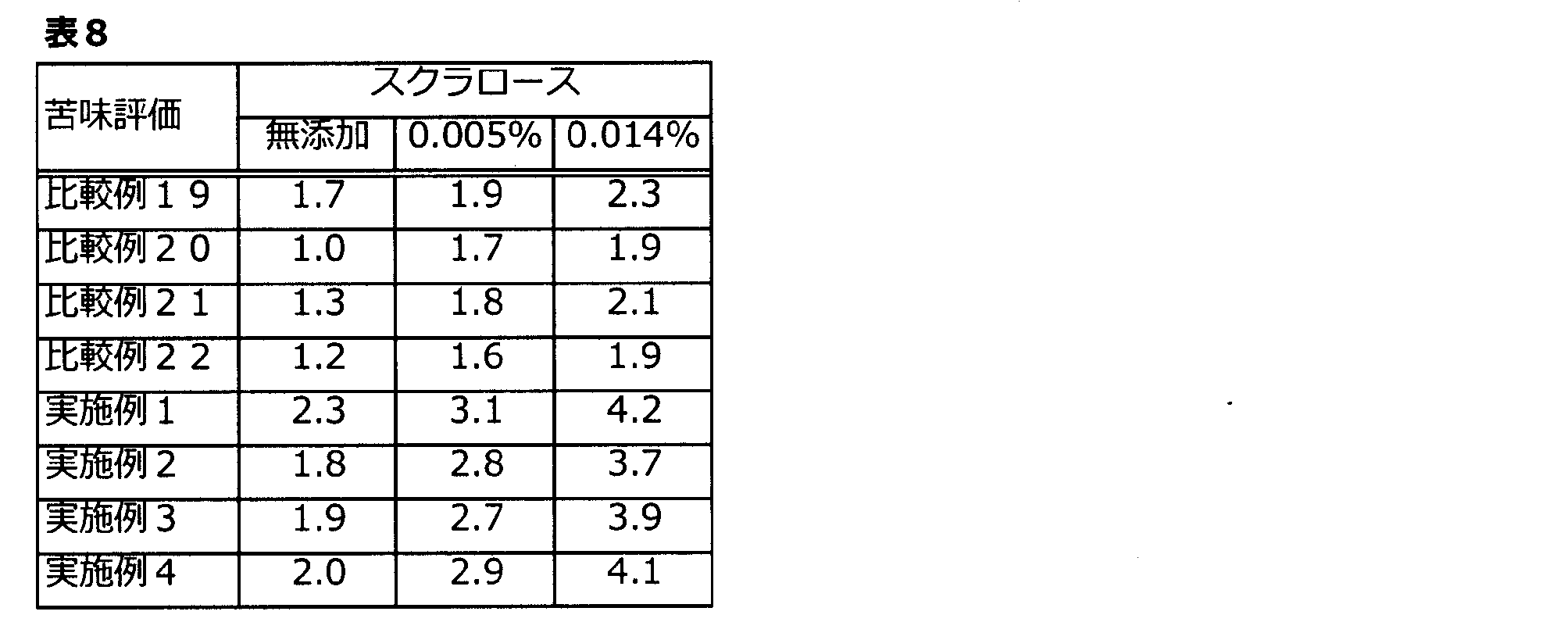
- the lemon drinks containing the compositions of Examples 1 to 4 have weaker bitterness than the lemon drinks containing the compositions of Comparative Examples 19 to 22.
- sucralose 0.013% by mass, 0.04% by mass of aspartame (manufactured by Ajinomoto Co., Inc., PAL suite), Acesulfame K (manufactured by Neutrinova, Sannett) ) 0.02% by mass, 0.05% by mass, Stevia extract (manufactured by Toyo Sugar Refining Co., Ltd., stevirose 90) 0.02% by mass, 0.06% by mass, erythritol (manufactured by Bussan Food Science Co., Ltd., erythritol) F) 3% by mass, 8% by mass, sorbitol (product of Food Science Co., Ltd., sorbitol SP) 3% by mass, 9% by mass,
- Acidic beverage Improvement of color tone change by long-term storage of glucomoringin
- the composition of Examples 1 to 4 and Comparative Examples 19 to 22 is 0.05 mass% in glucomoringin content, and no sucralose is added.
- An acidic beverage containing 0.005% by mass and 0.014% by mass (pH 3, citric acid 0.08% by mass, pH adjusted with trisodium citrate) was prepared.
- Black tea extract Black tea concentrate (manufactured by GS Food Co., Ltd.) Sodium hydrogen carbonate: (manufactured by Taiyo Pharmaceutical Co., Ltd.) Stevia extract: (manufactured by Toyo Seito Co., Ltd., stevirose 90) L-ascorbic acid: (Fuso Chemical Industry Co., Ltd.) Xylitol: (manufactured by Bussan Food Science Co., Ltd.) Black tea flavor: (Ogawa Koryo Co., Ltd.)
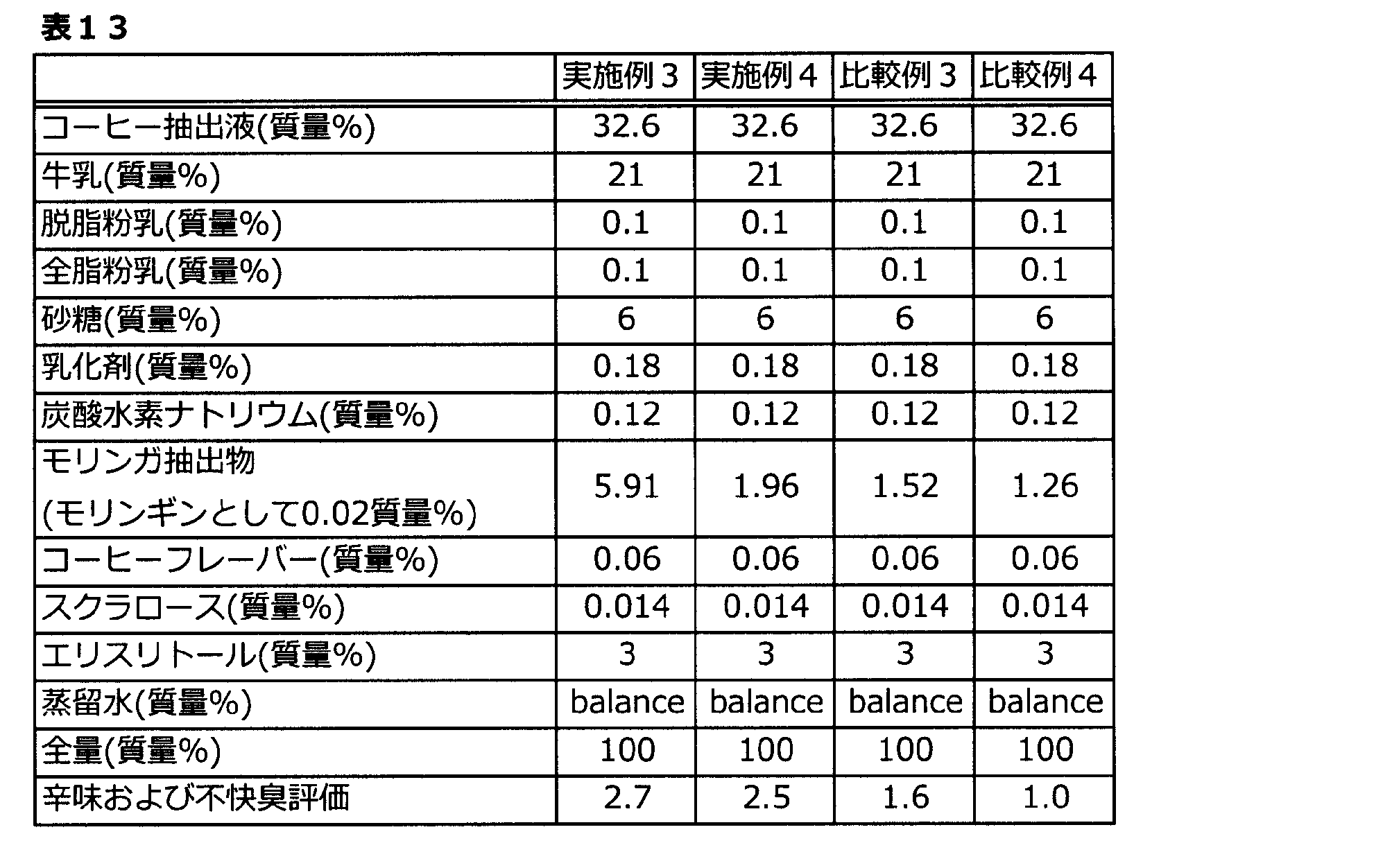
- Coffee Beverage Improvement of Pungency and Unpleasant Smell of Moringin Using Examples 3 and 4 and Comparative Examples 3 and 4, after stirring and mixing the raw materials shown in Table 13, the total amount was corrected and homogenized with a homogenizer at a temperature of 70°C. After conversion, 200 mL of canned food was subjected to retort sterilization at 121° C. for 15 minutes to prepare a coffee beverage. The pungency and unpleasant odor were evaluated in the same manner as the black tea beverage. The results are shown in Table 13. The evaluation criteria were the same as those for tea drinks. Details of the components listed in Table 13 are shown below.
- Coffee extract (manufactured by GS Food Co., Ltd.) Milk: (Meiji Dairy Co., Ltd.) Skim milk powder: (made by Yotsuba Dairy Co., Ltd.) Sugar: (Mitsui Seito Co., Ltd.) Emulsifier: (manufactured by Taiyo Kagaku Co., Ltd.) Sodium hydrogen carbonate: (manufactured by Taiyo Pharmaceutical Co., Ltd.) Coffee flavor: (Ogawa Fragrance Co., Ltd.) Sucralose: (Tate & Lyle Co., Ltd.) Erythritol: (Busan Food Science Co., Ltd.)
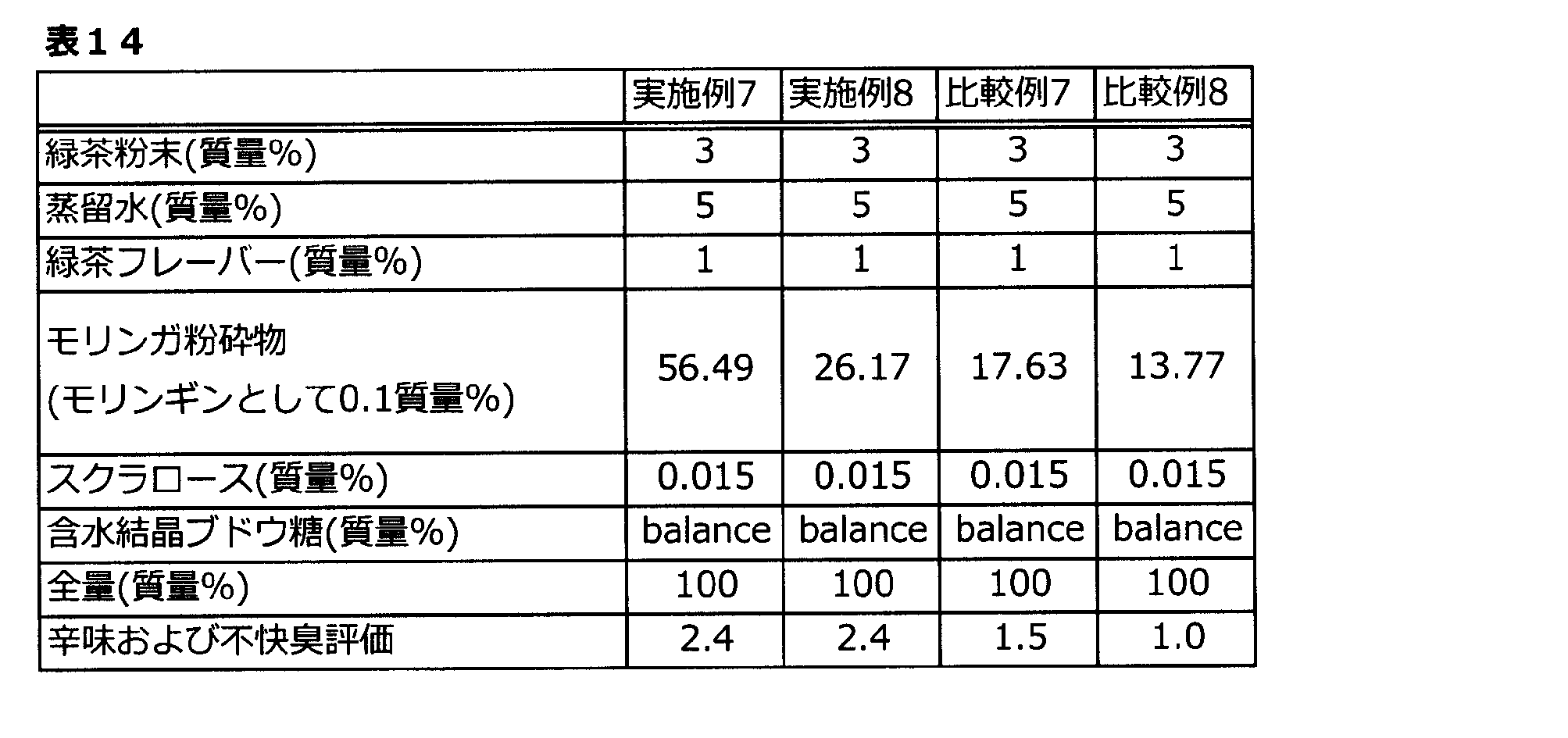
- Granules Improvement of pungent taste and unpleasant odor of moringin Described in Table 14 while mixing crystalline hydrous glucose, sucralose, and the compositions of Examples 7 and 8 and Comparative Examples 7 and 8 with powder, while stirring and mixing with a mixing stirrer. The rest of the ingredients were mixed. After mixing, the mixture was dried with a hot air dryer at 60° C. for 2 hours to prepare granules. The pungency and unpleasant odor were evaluated in the same manner as the black tea beverage. The results are shown in Table 14.
- compositions of Example 4 and Comparative Example 4 were dissolved so that the glucomoringin concentration was the same, and glucomoringin was orally administered at a dose of 2 mg/kg body weight.
- Moringin contained in the compositions of Example 4 and Comparative Example 4 at the time of dissolution was converted into glucomoringin content by using the conversion formula of moringin to glucomoringin shown in the above-mentioned analysis conditions, and glucomoringin was calculated. The concentration was adjusted as the content.
- Example 4 Forced swimming by load loading Two hours after the administration on the grouping day and four weeks after the administration of each composition, a weight corresponding to 5% of the body weight was attached to the lower abdomen of the rat, the weight was put into a cylinder, and the time until drowning (sec. ) was measured and used as the swimming time. When the rat's mouth and nose were submerged in water for 10 seconds during swimming, it was determined to be drowned. From FIG. 3, it can be seen that the composition of Example 4 has an increased swimming time at a lower dose as the reduced glucomoringin content than the composition of Comparative Example 4.
- composition of the present invention is useful in the fields of food and drink, cosmetics and the like.
Landscapes
- Life Sciences & Earth Sciences (AREA)
- Health & Medical Sciences (AREA)
- Engineering & Computer Science (AREA)
- Botany (AREA)
- Mycology (AREA)
- Animal Behavior & Ethology (AREA)
- General Health & Medical Sciences (AREA)
- Public Health (AREA)
- Veterinary Medicine (AREA)
- Birds (AREA)
- Epidemiology (AREA)
- Nutrition Science (AREA)
- Chemical & Material Sciences (AREA)
- Food Science & Technology (AREA)
- Polymers & Plastics (AREA)
- Microbiology (AREA)
- Biotechnology (AREA)
- Dermatology (AREA)
- Cosmetics (AREA)
- Saccharide Compounds (AREA)
- Medicinal Preparation (AREA)
- Pharmaceuticals Containing Other Organic And Inorganic Compounds (AREA)
- Tea And Coffee (AREA)
- Non-Alcoholic Beverages (AREA)
- Medicines Containing Plant Substances (AREA)
- Acyclic And Carbocyclic Compounds In Medicinal Compositions (AREA)
- Coloring Foods And Improving Nutritive Qualities (AREA)
Abstract
Description
[1]モリンガ抽出物及び/又は粉砕物を含む組成物であって、グルコモリンギンの含有量に対するモリンギンの含有量の質量比(モリンギン/グルコモリンギン)が0.00005~0.30であり、ミロシナーゼが失活しているか、あるいはミロシナーゼを含まない、組成物。
[2][1]記載の組成物を含む、飲食品。
[3][1]記載の組成物を含む、化粧料。
モリンガ種子をミルにて粉砕し、種子粉砕物を得た。種子粉砕物100gに対して、500gの脱イオン水(90℃)を加え、5分間攪拌(前処理)した後に、脱イオン水(10℃)を1500g加えて35℃とし、2時間攪拌した。その後ろ紙にてろ過し、ろ液をロータリーエバポレーターにより減圧濃縮した。得られた濃縮液を凍結乾燥機にて乾燥し、調製例1のモリンガエキスを10g得た。
各調製例のモリンガ抽出物又はモリンガ粉砕物のグルコモリンギン含有量(乾燥固形分換算)、およびモリンギン含有量(乾燥固形分換算)について、以下の条件に基づき分析した。結果を表1に示す。なお、本発明の組成物におけるグルコモリンギンおよびモリンギン含有量についても同様に、HPLCを用いて測定することができる。サンプル溶液の調製については、特に限定されるものではなく、グルコモリンギンおよびモリンギンの分析に適した濃度となるよう、要すれば、適宜、水、有機溶媒、または水と有機溶媒の混合溶媒を添加して溶液画分を回収し、サンプル溶液とすることができる。水との混合溶媒とした場合における、有機溶媒の混合割合は、0%超~100%未満まで使用可能である。
各調製例のモリンガ抽出物又はモリンガ粉砕物の水溶液(固形分濃度:5.0%(w/v))を調製した。これらのサンプル溶液100μLにアセトニトリル300μLを加えて混和し、フィルトレーションを行った後、以下の条件で逆相高速液体クロマトグラフィーにて定量分析した。
HPLC(SHIMADZU)分析(HPLC条件;カラム:Inertsil HILIC SIZE 4.6mm×250mm(GLサイエンス)、溶離液A:アセトニトリル(93%)、溶離液B:10mM ギ酸アンモニウム(7%)、流速:1.0mL/min、カラム温℃:30℃、波長:220nmによるピーク面積と、標準試薬(試薬グルコモリンギン:EXTRASYNTHESE)の検量線を比較しグルコモリンギン濃度を算出し、各調製例におけるグルコモリンギン含有量を算出した。また、モリンギンについては、標準試薬(試薬モリンギン:Chem Faces)およびLC-MSによる分子量測定からモリンギンのピークを同定した後、グルコモリンギンの検量線を使用してモリンギンの含有量を換算値として表示した。具体的には、以下のように算出した。
モリンギン:HPLC分析(グルコモリンギン濃度分析と同条件)によるピーク面積と、試薬グルコモリンギンの検量線のピーク面積比較により以下に示すようにモリンギン換算値を算出した。
グルコモリンギンピークエリアへの換算式:A/0.738
A:モリンギンのピークエリア
なお、試薬グルコモリンギンを市販のミロシナーゼにより完全分解させてモリンギンに変換した際、各成分のピークエリアの換算には0.738を除した値が使用できることが分かったことから上記の計算式を用いている。
B:上記から求めた換算グルコモリンギン含有量(乾燥固形分換算)
モリンギン含有量(乾燥固形分換算):B×311/570
311:モリンギンの分子量
570:グルコモリンギンの分子量
上記のように一度グルコモリンギンとして算出した値へ分子量比を乗することで、モリンギンの含有量を換算した。
各調製例のモリンガ抽出物又はモリンガ粉砕物の水溶液(固形分濃度:5.0%(w/v))を調製した。これらのサンプル溶液を55℃のウォーターバスで加温し、0時間後と20時間後にサンプル採取してグルコモリンギンおよびモリンギン含有量を算出した。確認方法としては、0時間後と20時間後を比較した場合にグルコモリンギン含量の減少が無く、かつモリンギン含量の増加が無い場合にミロシナーゼが失活あるいは除去されているものとした。「グルコモリンギン含量の減少が無い」とは、0時間後のサンプル溶液中のグルコモリンギン含量を100%とした場合に20時間後のサンプル溶液中のグルコモリンギン含量が80%以上であり、好ましくは90%以上であり、より好ましくは95%以上であることをいい、「モリンギン含量の増加が無い」とは、0時間後のサンプル溶液中のモリンギン含量を100%とした場合に20時間後のサンプル溶液中のモリンギン含量が120%以下であり、好ましくは110%以下であり、より好ましくは105%以下であることをいう。なお、グルコモリンギンを含有しない調製例12、21~44においては、グルコモリンギンを適当量添加して、その増減の有無を調べた。結果、調製例1~32についてはミロシナーゼが失活・除去されており、調製例33~44については、ミロシナーゼ活性があることを確認した。本発明の組成物におけるミロシナーゼ活性についても同様に、グルコモリンギンおよびモリンギン含有量の増減により確認することができる。サンプル溶液の調製については、特に限定されるものではなく、グルコモリンギンおよびモリンギンの分析に適した濃度となるよう、要すれば、適宜、水、有機溶媒、または水と有機溶媒の混合溶媒を添加して溶液画分を回収し、サンプル溶液とすることができる。水との混合溶媒とした場合における、有機溶媒の混合割合は、0%超~100%未満まで使用可能である。

表2に示す混合割合で各実施例、比較例の組成物を調製した。ミロシナーゼの失活あるいは除去された調製例のみからなる組成物については、酵素活性「無」とし、ミロシナーゼ活性のある調製例33~36、41~44のモリンガ抽出物又はモリンガ粉砕物を含む組成物については、酵素活性「有」として表2に記載した。
9週齢の雄SDラット(n=10)を室温23±2℃で飼育し、標準飼料と水を1週間与えて訓化した。18時間絶食させた後、実施例1、実施例4、比較例1、比較例4、比較例19、比較例22をグルコモリンギン濃度として同量になるように溶解し、グルコモリンギン30mg/kg体重にて強制経口投与した。なお溶解時に各実施例と各比較例に含まれるモリンギンは、前述の分析条件に示したモリンギンのグルコモリンギンへの換算式を用いて換算グルコモリンギン含量を算出し、グルコモリンギン含量として濃度調整した。0、0.5、1、2、4、6、8、24時間後の血漿を採取し、HPLC法にてグルコモリンギン代謝物濃度を測定し、AUCを算出した。結果を図1および図2に示す。
得られた血漿100μLに0.2%リン酸25μLおよびメタノール200μLを加えて混和し、10,000rpmで4℃、5分間遠心分離し、上清を得た。得られた上清をリン酸緩衝溶液(pH8.5)中に希釈し、1,2-ベンゼンジチオールを加え、65℃で2時間処理し、処理物中に含まれる生成物(1,3-ベンゼンジチオール-2-チオン)を以下の条件で逆相高速液体クロマトグラフィーにて定量分析した。
HPLC(SHIMADZU)分析(HPLC条件;カラム: L-カラムODS SIZE 4.6mm×250mm(CERI)、溶離液:水/メタノール(20/80,v/v)、流速:0.5mL/min、カラム温℃:30℃、波長:365nm
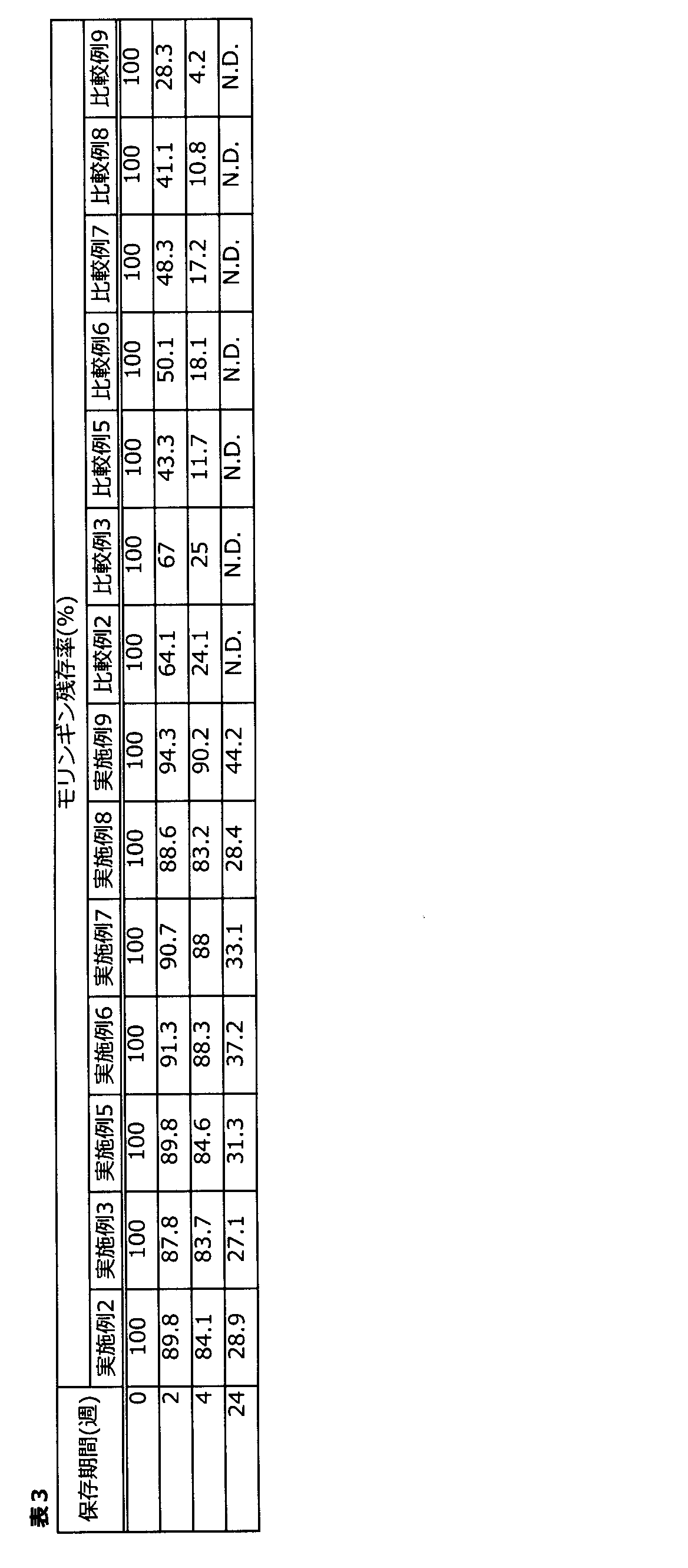
実施例2、3、5、6、7、8、9および比較例2、3、5、6、7、8、9の組成物をアルミ袋に入れて、55℃にて保管するとともに所定期間ごとにサンプルを袋から取り出し、モリンギン含有量について測定した。結果を表3に示す。最初のモリンギン含量を100%とし、残存率(%)にて表記した。
実施例1~9および比較例10~18の組成物の水溶液(濃度:5.0%(w/v))を調製した。得られた水溶液を25℃にて保管するとともに所定期間ごとにサンプルを回収し、グルコモリンギン含有量について測定した。結果を表4に示す。最初のグルコモリンギン含量を100%とし、残存率(%)にて表記した。
実施例4、8および比較例4、8の組成物について、以下のようにしてB16メラノーマ細胞に対するグルタチオン産生促進作用を試験した。
B16メラノーマ細胞を、10%FBS含有ダルベッコMEM培地を用いて前培養した後、トリプシン処理により細胞を回収した。回収した細胞を10×104cells/mLの細胞密度になるように10%FBS含有ダルベッコMEM培地で希釈した後、48ウェルプレートに1ウェル当たり200μLずつ播種し、一晩培養した。培養後、培地を除去し、1%FBS含有ダルベッコMEM培地にモリンギンを同濃度含むように溶解した被験サンプルを各ウェルに200μL添加し、24時間培養した。なお、コントロールとして、試料無添加の1%FBS含有ダルベッコMEM培地を用いて同様に培養した。培養終了後、各ウェルから培地を除去し、400μLのPBS(-)緩衝液にて洗浄後、150μLのM-PER(PIERCE社製)を使用して細胞を溶解した。
このうちの100μLを使用して総グルタチオンの定量を行った。すなわち、96ウェルプレートに溶解した細胞抽出液100μL、0.1mmol/Lリン酸緩衝液50μL、2mmol/L NADPH25μL及びグルタチオンレダクターゼ25μL(終濃度17.5unit/mL)を加え37℃で10分間加温した後、10mMの5,5'-dithiobis(2-nitrobenzoic acid)25μLを加え、5分後までの波長412nmにおける吸光度を測定し、ΔOD/minを求めた。総グルタチオン濃度は、酸化型グルタチオン(和光純薬社製)を使用して作成した検量線をもとに算出した。得られた値を総タンパク量当たりのグルタチオン量に補正した後、下記式によりグルタチオン産生促進率(%)を算出した。結果を表5に示す。
グルタチオン産生促進率(%)=A/B×100
A:被験試料を添加した細胞中における総タンパク量当たりのグルタチオン量
B:試料無添加の細胞中における総タンパク量当たりのグルタチオン量(対照)
実施例4、8および比較例4、8の組成物を有効成分として含有する皮膚外用剤に関する実施例を示す。
乳液の製造方法:表6に示す成分1~8を80℃まで加熱し均一に溶解もしくは分散し、油相とする。また、成分9、10、および12を80℃まで加熱し、水相とする。水相に油相を撹拌しながら加え、予備乳化を行った後、成分11を加えてホモミキサーを用いて均一に乳化する。乳化終了後、冷却を行い25℃で実施例4、8および比較例4、8の組成物をモリンギンを同濃度含むように加えて試験サンプルとした。また、実施例4、8の組成物を精製水に置き換えたものを「無添加」として比較した。
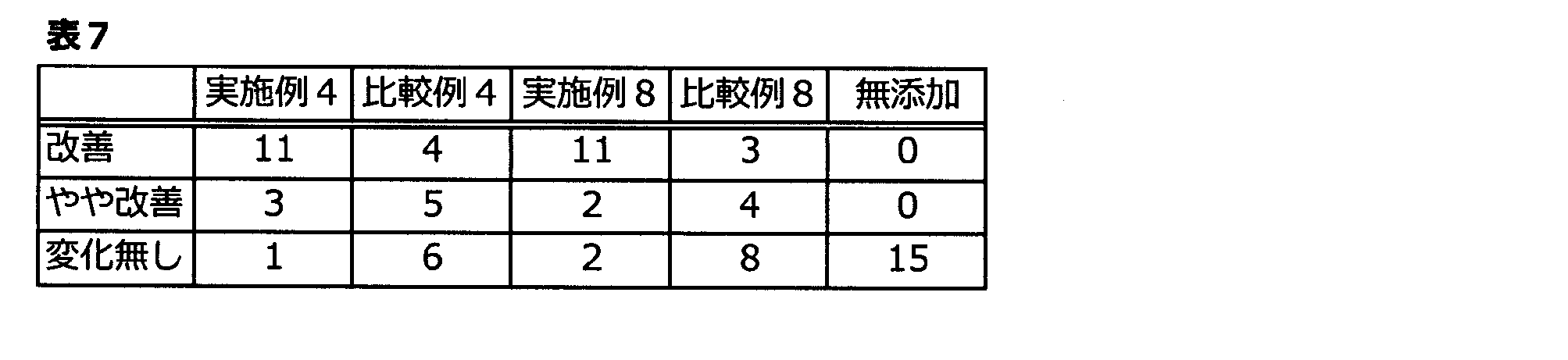
美白効果確認試験では、パネラーは、皮膚のシミ、ソバカス、日焼け等の色素沈着を主な症状とする15名を一群として選んだ。各群にそれぞれブラインドにて顔面及び手の甲に連続3ヶ月間使用させた。使用試験開始前および使用試験終了後の肌の状態を写真撮影し、色素沈着状態の変化を専門の判定員に「改善」、「やや改善」、「変化なし」の3段階で判定させた。結果を表7に示す。

実施例1~4および比較例19~22の組成物をグルコモリンギン含有量で0.05質量%となる量、及びスクラロースを無添加、0.005質量%、0.014質量%を含有するレモン飲料(pH3、クエン酸0.08質量%、レモンフレーバー(長谷川香料(株)製)0.1質量%、クエン酸三ナトリウムでpH調整)を調製した。
成分の詳細を以下に示す。
スクラロース:(Tate & Lyle(株)製)
実施例1~4および比較例19~22の組成物を用いたレモン飲料のグルコモリンギンによる苦味に関しての官能評価を、7名のパネラーにより下記の基準で5段階評価し、合計点の平均点を算出した。結果を表8に示す。グルコモリンギンによる苦味は、苦味、渋み、及び後味の不快味(後味に残る苦渋味等)を同種の成分で総合的に官能評価し、それぞれ相対的な評価を行った。また、実施例1~4および比較例19~22の組成物のみをそれぞれ0.0005%(飲料への各実施例および比較例のみの添加量の1/10量)に添加したレモン飲料を評価5とした。
(評価基準)
1:同種成分の中で苦味が最も強い。
2:苦味がやや強い。評価1よりは弱い。
3:苦味が、評価1よりある程度改善されている
4:苦味が、評価1より改善されている。
5:苦味が、評価1より非常に改善されている。
実施例1~4および比較例19~22の組成物をグルコモリンギン含有量で0.05質量%となる量、及びスクラロースを無添加、0.005質量%、0.014質量%を含有する酸性飲料(pH3、クエン酸0.08質量%、クエン酸三ナトリウムでpH調整)を調製した。
実施例1~4および比較例19~22の組成物を用いた酸性飲料の製造直後及び37℃で3ヶ月保存後の色調を分光光度計(Cary60 UV-VIS、Software:CaryWinUV/Color、Agilent Technologies)を使用し、試料を光路長10mmの石英セルに入れてLab表色系のL値、a値及びb値を測定した。製造直後の酸性飲料のL値、a値、b値と、37℃で3ヶ月保存後の酸性飲料のL値、a値、b値から、下記式よりΔE値を求め、表9に示した。
ΔE=(ΔL2+Δa2+Δb2)0.5

油圧プレス機(理研精機株式会社製)とそれに対応した臼と杵を用いて、実施例5~8および比較例23~26の組成物をグルコモリンギン含有量で1質量%となる量、スクラロースを無添加、0.04質量%、0.2質量%、微粒二酸化ケイ素0.5質量%、クエン酸2.5質量%、結晶セルロース(Balance)の混合物をそれぞれ100kg/cm2の圧力で圧縮成形し、直径9mm、重量300mgの錠剤を作成した。
実施例5~8および比較例23~26の組成物を用いた錠剤の苦味に関しての官能評価を、5名のパネラーにより評価し、合計点の平均点を算出した。結果を表10に示す。レモン飲料と同様に同種成分を含有する錠剤間で比較し、評価基準についてもレモン飲料と同様の基準とした。なお、錠剤は、2錠剤を噛み砕き、飲み込んだ際の苦味評価を行った。
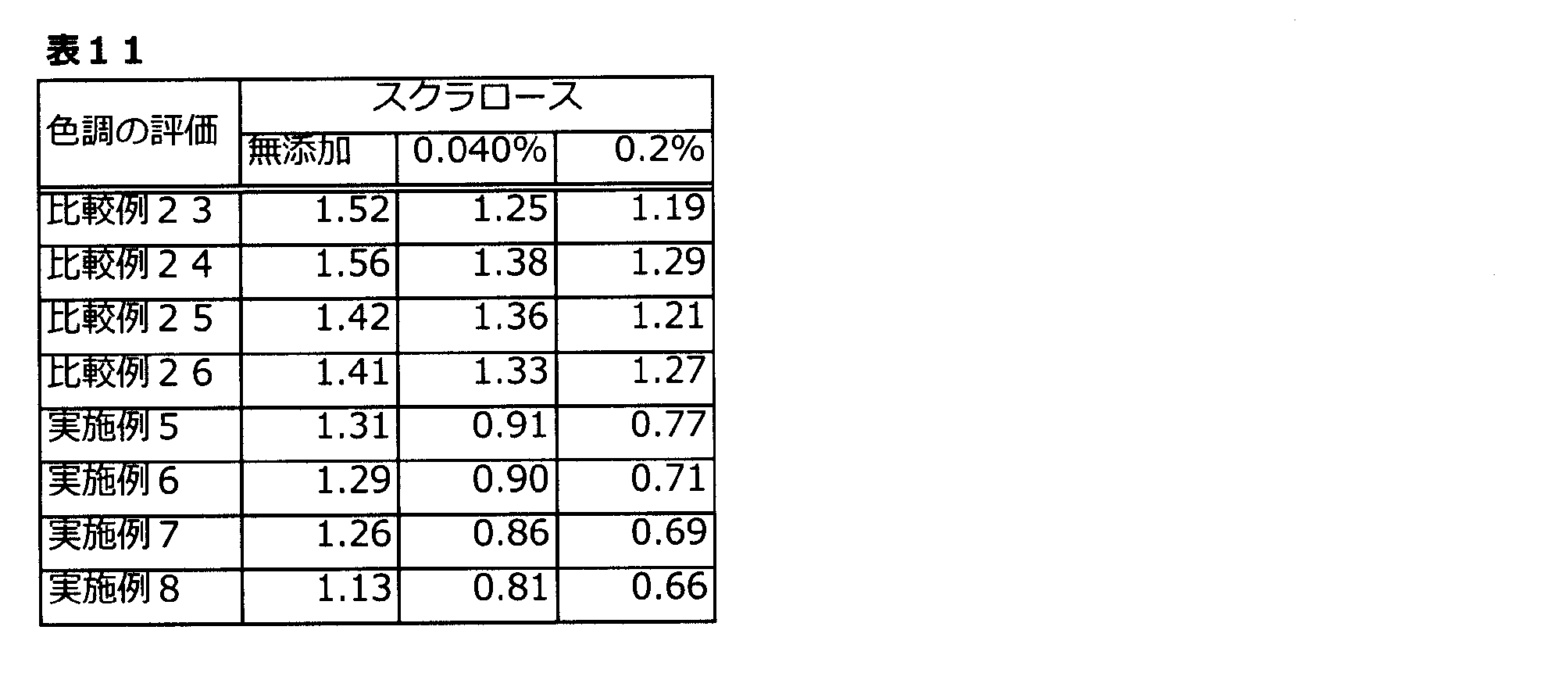
実施例5~8および比較例23~26の組成物を用いた錠剤の製造直後及び37℃で3ヶ月保存後のLab値を測定し、算出したΔE値を表11に示した。すなわちLab値は、錠剤を乳鉢で粉砕したものを、0.05質量%のグルコモリンギン含有量又は換算値になるように錠剤を酸性液(pH3.1 クエン酸0.08%、クエン酸三ナトリウムで調整)で溶解濾過後、Lab値を測定した。測定方法やΔE値の算出方法は酸性飲料と同様である。

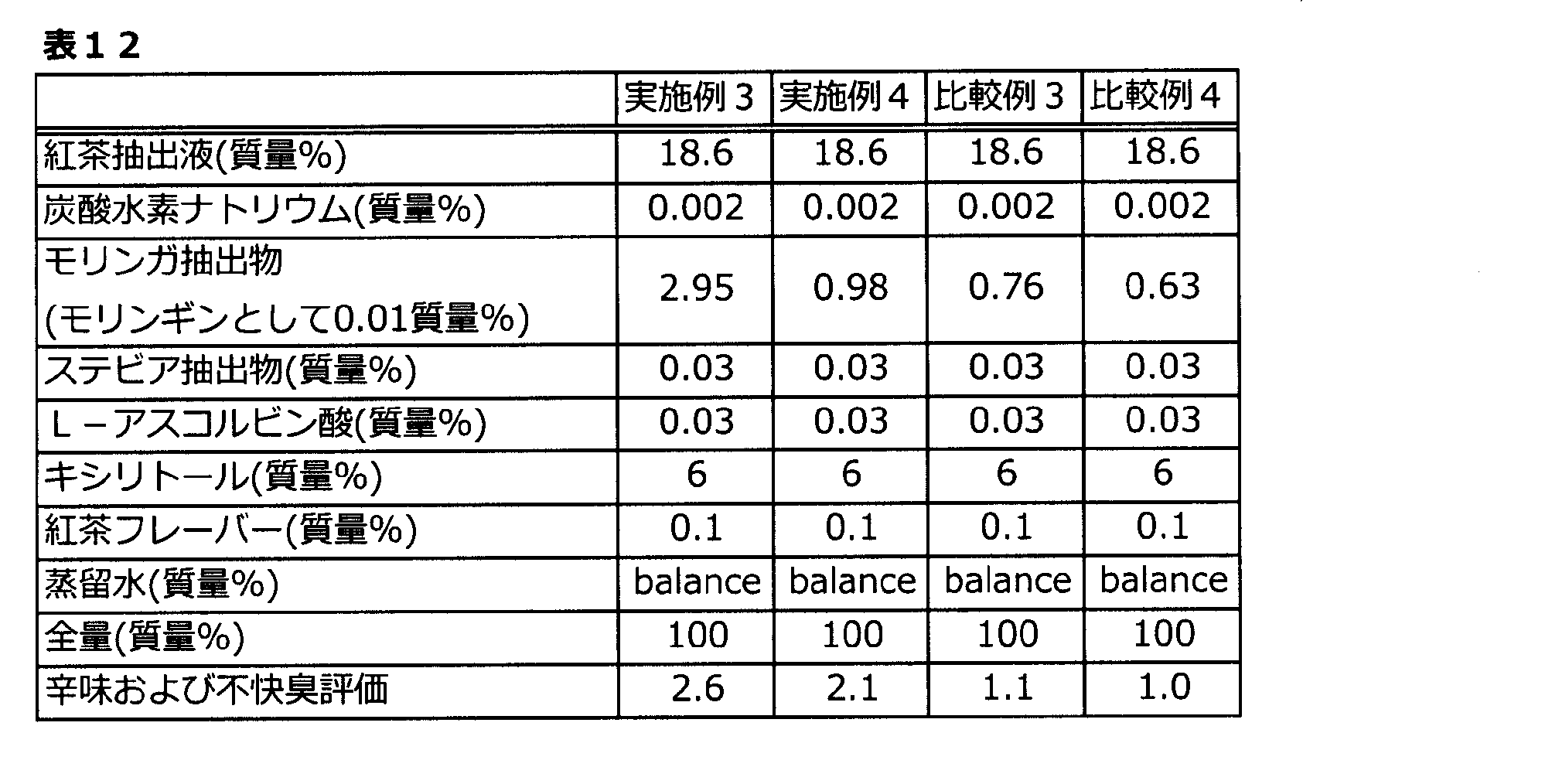
実施例3、4および比較例3、4の組成物を用いて表12に記載の原料を攪拌混合後に全量補正を行い、93℃達温にてフレーバーを添加し、350mLのペットボトルにホットパック充填し、紅茶飲料(pH5)を調製した。表12に記載した成分の詳細を以下に示す。
紅茶抽出液:紅茶濃縮品((株)ジーエスフード製)
炭酸水素ナトリウム:(太洋製薬(株)製)
ステビア抽出物:(東洋精糖(株)製、ステビロース90)
L-アスコルビン酸:(扶桑化学工業(株)製)
キシリトール:(物産フードサイエンス(株)製)
紅茶フレーバー:(小川香料(株)製)
実施例3、4および比較例3、4の組成物を用いた紅茶飲料の辛味および不快臭に関しての官能評価を、7名のパネラーにより下記の基準で3段階評価し、合計点の平均点を算出した。辛味および不快臭を総合的に官能評価して比較をした。モリンギンのみを含有する比較例4の紅茶飲料は、辛味および不快臭が最も強かったため、その評価を1とし、比較例4の添加量を1/50にしたものの評価を3とした。結果を表12に示す。
(評価基準)
1:辛味および不快臭が最も強い。
2:辛味および不快臭が、評価1より改善されている。
3:辛味および不快臭が、評価1より非常に改善されている。
実施例3、4および比較例3、4を用いて表13に記載の原料を攪拌混合後に全量補正を行い、70℃達温にてホモゲナイザーにて均質化後、200mLの缶詰を、121℃15分間レトルト殺菌を行ない、コーヒー飲料を調製した。紅茶飲料と同様にして辛味および不快臭の評価を行った。結果を表13に示す。なお、評価基準については、紅茶飲料と同様の基準とした。
表13に記載した成分の詳細を以下に示す。
コーヒー抽出液:((株)ジーエスフード製)
牛乳:(明治乳業(株)製)
脱脂粉乳:(よつ葉乳業(株)製)
砂糖:(三井精糖(株)製)
乳化剤:(太陽化学(株)製)
炭酸水素ナトリウム:(太洋製薬(株)製)
コーヒーフレーバー:(小川香料(株)製)
スクラロース:(Tate & Lyle(株)製)
エリスリトール:(物産フードサイエンス(株)製)
含水結晶ブドウ糖、スクラロース、及び実施例7、8および比較例7、8の組成物を粉体混合後、混合攪拌機にて撹拌混合しながら、表14に記載の残りの原料を混合した。混合後、熱風乾燥機にて60℃・2時間乾燥させ、顆粒を調製した。紅茶飲料と同様にして辛味および不快臭の評価を行った。結果を表14に示す。モリンギンの質量部が一番高い比較例8の顆粒は、辛味および不快臭が最も強かったため、その評価を1とし、比較例8の添加量を1/50にしたものの評価を3とした。
表14に記載した成分の詳細を以下に示す。
緑茶粉末:(伊藤園(株)製)
緑茶フレーバー:(小川香料(株)製)
スクラロース:(Tate & Lyle(株)製)
含水結晶ブドウ糖:(サンエイ糖化(株)製)
6週齢の雄SDラット(n=10)を室温23±2℃で飼育し、標準飼料と水を1週間与えて訓化した。次に馴化が終了したラットを用いて荷重負荷による強制水泳(下記参照)を行い、ラットが溺れるまでの遊泳時間(秒)を測定し、遊泳時間の結果を基に可能な限りラットを均等に振り分けて各群の遊泳時間の平均が等しくなるよう3群に群分けを行った。各組成物の投与方法としては、群分けを行なったラットに対して、水、実施例4の組成物、又は比較例4の組成物を1日1回(8:00~12:00)の頻度で4週間投与した。実施例4および比較例4の組成物については、グルコモリンギン濃度として同量になるように溶解し、グルコモリンギンとして2mg/kg体重にて強制経口投与した。なお溶解時に実施例4および比較例4の組成物に含まれるモリンギンは、前述の分析条件に示したモリンギンのグルコモリンギンへの換算式を用いて換算グルコモリンギン含量を算出し、グルコモリンギン含量として濃度調整した。
群分け日および各組成物投与4週間目の投与2時間後にラットの下腹部に体重の5%に相当するおもりを付けて、シリンダーに入れて泳がせ、溺れるまでの時間(秒)を測定し、遊泳時間とした。遊泳中にラットの口および鼻が10秒間持続して水没した場合を溺れたと判定した。図3より、実施例4の組成物は、比較例4の組成物に比べて換算グルコモリンギン含量として低用量で遊泳時間が増加していることが分かる。
Claims (4)
- モリンガ抽出物及び/又は粉砕物を含む組成物であって、グルコモリンギンの含有量に対するモリンギンの含有量の質量比(モリンギン/グルコモリンギン)が0.00005~0.30であり、ミロシナーゼが失活しているか、あるいはミロシナーゼを含まない、組成物。
- グルコモリンギンの含有量が乾燥固形分換算で1.5質量%以上である、請求項1記載の組成物。
- 請求項1又は2記載の組成物を含む、飲食品。
- 請求項1又は2記載の組成物を含む、化粧料。
Priority Applications (4)
| Application Number | Priority Date | Filing Date | Title |
|---|---|---|---|
| EP19892636.2A EP3847896A4 (en) | 2018-12-07 | 2019-11-08 | COMPOSITION WITH AN EXTRACT AND/OR GROUND PRODUCT OF MORINGA |
| JP2020512895A JP6693007B1 (ja) | 2018-12-07 | 2019-11-08 | モリンガ抽出物及び/又は粉砕物を含む組成物 |
| US16/769,625 US10869829B1 (en) | 2018-12-07 | 2019-11-08 | Composition containing moringa extract and/or pulverized product |
| CA3109614A CA3109614C (en) | 2018-12-07 | 2019-11-08 | Composition containing moringa extract and/or pulverized product |
Applications Claiming Priority (2)
| Application Number | Priority Date | Filing Date | Title |
|---|---|---|---|
| JP2018-229933 | 2018-12-07 | ||
| JP2018229933 | 2018-12-07 |
Publications (1)
| Publication Number | Publication Date |
|---|---|
| WO2020116092A1 true WO2020116092A1 (ja) | 2020-06-11 |
Family
ID=70974585
Family Applications (1)
| Application Number | Title | Priority Date | Filing Date |
|---|---|---|---|
| PCT/JP2019/043940 Ceased WO2020116092A1 (ja) | 2018-12-07 | 2019-11-08 | モリンガ抽出物及び/又は粉砕物を含む組成物 |
Country Status (5)
| Country | Link |
|---|---|
| US (1) | US10869829B1 (ja) |
| EP (1) | EP3847896A4 (ja) |
| JP (1) | JP6693007B1 (ja) |
| CA (1) | CA3109614C (ja) |
| WO (1) | WO2020116092A1 (ja) |
Cited By (2)
| Publication number | Priority date | Publication date | Assignee | Title |
|---|---|---|---|---|
| JP2023096635A (ja) * | 2021-12-27 | 2023-07-07 | サッポロビール株式会社 | ノンアルコールビールテイスト飲料、ノンアルコールビールテイスト飲料の製造方法、及び、ノンアルコールビールテイスト飲料の香味向上方法 |
| JP2023098105A (ja) * | 2021-12-28 | 2023-07-10 | サッポロビール株式会社 | 飲料、飲料の製造方法、及び、飲料の香味向上方法 |
Citations (3)
| Publication number | Priority date | Publication date | Assignee | Title |
|---|---|---|---|---|
| JP4032393B2 (ja) | 2004-07-09 | 2008-01-16 | 有限会社イッシンランバー | 栄養機能補助食品、モリンガ茶葉及びモリンガ茶飲料 |
| JP2008237117A (ja) | 2007-03-27 | 2008-10-09 | Kinos:Kk | 抗疲労食品素材及び抗疲労食品 |
| JP2017217006A (ja) | 2015-10-28 | 2017-12-14 | 太陽化学株式会社 | モリンガエキス |
Family Cites Families (2)
| Publication number | Priority date | Publication date | Assignee | Title |
|---|---|---|---|---|
| JP2012060995A (ja) | 2010-08-18 | 2012-03-29 | Utsunomiya Univ | 大根粉末の製造方法、食品の抗菌、除菌及び保存方法、並びにヘリコバクターピロリ菌の抗菌及び除菌食材。 |
| US9687439B1 (en) * | 2016-01-21 | 2017-06-27 | Elc Management Llc | Methods and compositions for treating aged skin |
-
2019
- 2019-11-08 US US16/769,625 patent/US10869829B1/en active Active
- 2019-11-08 CA CA3109614A patent/CA3109614C/en active Active
- 2019-11-08 JP JP2020512895A patent/JP6693007B1/ja active Active
- 2019-11-08 WO PCT/JP2019/043940 patent/WO2020116092A1/ja not_active Ceased
- 2019-11-08 EP EP19892636.2A patent/EP3847896A4/en not_active Withdrawn
Patent Citations (3)
| Publication number | Priority date | Publication date | Assignee | Title |
|---|---|---|---|---|
| JP4032393B2 (ja) | 2004-07-09 | 2008-01-16 | 有限会社イッシンランバー | 栄養機能補助食品、モリンガ茶葉及びモリンガ茶飲料 |
| JP2008237117A (ja) | 2007-03-27 | 2008-10-09 | Kinos:Kk | 抗疲労食品素材及び抗疲労食品 |
| JP2017217006A (ja) | 2015-10-28 | 2017-12-14 | 太陽化学株式会社 | モリンガエキス |
Non-Patent Citations (4)
| Title |
|---|
| GLOBAL ADVANCED RESEARCH JOURNAL OF AGRICULTURAL SCIENCE, vol. 4, no. 4, April 2015 (2015-04-01), pages 188 - 199, ISSN: ISSN:2315-5094 |
| LEE, JEONG GU ET AL.: "The mechanism of deterioration of the glucosinolate- myrosynase system in radish roots during cold storage after harvest", FOOD CHEMISTRY, vol. 233, 2017, pages 60 - 68, XP085491841, DOI: 10.1016/j.foodchem.2017.04.104 * |
| See also references of EP3847896A4 |
| WATERMAN, CARRIE ET AL.: "Stable, water extractable isothiocyanates from Moringa oleifera leaves attenuate inflammation in vitro", PHYTOCHEMISTRY, vol. 103, 2014, pages 114 - 122, XP055321973, DOI: 10.1016/j.phytochem.2014.03.028 * |
Cited By (3)
| Publication number | Priority date | Publication date | Assignee | Title |
|---|---|---|---|---|
| JP2023096635A (ja) * | 2021-12-27 | 2023-07-07 | サッポロビール株式会社 | ノンアルコールビールテイスト飲料、ノンアルコールビールテイスト飲料の製造方法、及び、ノンアルコールビールテイスト飲料の香味向上方法 |
| JP2023098105A (ja) * | 2021-12-28 | 2023-07-10 | サッポロビール株式会社 | 飲料、飲料の製造方法、及び、飲料の香味向上方法 |
| JP7854295B2 (ja) | 2021-12-28 | 2026-05-01 | サッポロビール株式会社 | 飲料、飲料の製造方法、及び、飲料の香味向上方法 |
Also Published As
| Publication number | Publication date |
|---|---|
| CA3109614C (en) | 2021-08-03 |
| JP6693007B1 (ja) | 2020-05-13 |
| US20200390684A1 (en) | 2020-12-17 |
| EP3847896A4 (en) | 2022-07-20 |
| EP3847896A1 (en) | 2021-07-14 |
| US10869829B1 (en) | 2020-12-22 |
| CA3109614A1 (en) | 2020-06-11 |
| JPWO2020116092A1 (ja) | 2021-02-15 |
Similar Documents
| Publication | Publication Date | Title |
|---|---|---|
| JP4205188B2 (ja) | メイラード反応阻害剤 | |
| FR2953135A1 (fr) | Extrait de graines d'acacia macrostachya et compositions cosmetiques, pharmaceutiques, dermatologiques, nutraceutiques ou alimentaires le comprenant | |
| FR2969495A1 (fr) | Extrait de parties aeriennes de maca riche en polyphenols et composition le comprenant | |
| JP5283873B2 (ja) | 美白用組成物 | |
| JP2009079043A (ja) | 線維芽細胞増殖促進能を有する組成物 | |
| JP2009057481A (ja) | 抗酸化組成物 | |
| JP2025157605A (ja) | 肝機能改善剤 | |
| JP6693007B1 (ja) | モリンガ抽出物及び/又は粉砕物を含む組成物 | |
| JP6902329B2 (ja) | 皮脂腺細胞の活性化の抑制剤 | |
| KR102283527B1 (ko) | 곡류 발효 추출물을 유효성분으로 함유하는 화장료 조성물 | |
| JP4247091B2 (ja) | 皮膚老化防止剤 | |
| CN110913833B (zh) | 包含槲皮素类化合物的美白组合物 | |
| JP2006089385A (ja) | 美肌用組成物 | |
| JP2004149729A (ja) | 抗酸化剤 | |
| JP7262760B2 (ja) | シワ予防・改善用の医薬品、医薬部外品、化粧料又は飲食品組成物 | |
| JP7166840B2 (ja) | 発毛促進、脱毛防止又はキューティクル改善用組成物及び創傷治癒剤 | |
| KR102212343B1 (ko) | 마리안 플럼 추출물을 유효성분으로 함유하는 피부 항노화 및 보습용 조성물 | |
| JP7614652B2 (ja) | ステロイド-5α-リダクターゼ阻害剤 | |
| JP7029825B2 (ja) | セラミド類含有組成物の製造方法 | |
| JP7256656B2 (ja) | 変色抑制用組成物、変色を抑制する方法、及びこれらの応用 | |
| JP2020105126A (ja) | 皮膚外用剤、トランスグルタミナーゼ1産生促進剤、フィラグリン産生促進剤、保湿因子産生促進剤、バリア機能改善剤、セラミド産生促進剤、医薬品 | |
| JP2019520786A (ja) | 3−o−ガロイル−3,3’,5,5’,7−ペンタヒドロキシフラボンを含む保湿用組成物 | |
| KR102134968B1 (ko) | 우절 추출물 및 미숙사과 추출물을 포함하는 피부 미백용 화장료 조성물 | |
| JP2024041535A (ja) | Sirt1活性化剤 | |
| JP7121758B2 (ja) | 後発酵茶由来の新規なケンペロール系化合物を含む美白用組成物 |
Legal Events
| Date | Code | Title | Description |
|---|---|---|---|
| ENP | Entry into the national phase |
Ref document number: 2020512895 Country of ref document: JP Kind code of ref document: A |
|
| 121 | Ep: the epo has been informed by wipo that ep was designated in this application |
Ref document number: 19892636 Country of ref document: EP Kind code of ref document: A1 |
|
| ENP | Entry into the national phase |
Ref document number: 3109614 Country of ref document: CA |
|
| WWE | Wipo information: entry into national phase |
Ref document number: 19892636.2 Country of ref document: EP |
|
| ENP | Entry into the national phase |
Ref document number: 2019892636 Country of ref document: EP Effective date: 20210408 |
|
| NENP | Non-entry into the national phase |
Ref country code: DE |