WO2020118355A1 - A method for determining a chemotypic profile - Google Patents
A method for determining a chemotypic profile Download PDFInfo
- Publication number
- WO2020118355A1 WO2020118355A1 PCT/AU2019/051345 AU2019051345W WO2020118355A1 WO 2020118355 A1 WO2020118355 A1 WO 2020118355A1 AU 2019051345 W AU2019051345 W AU 2019051345W WO 2020118355 A1 WO2020118355 A1 WO 2020118355A1
- Authority
- WO
- WIPO (PCT)
- Prior art keywords
- chemotypic
- plant material
- profile
- cannabis
- spectroscopic data
- Prior art date
- Legal status (The legal status is an assumption and is not a legal conclusion. Google has not performed a legal analysis and makes no representation as to the accuracy of the status listed.)
- Ceased
Links
Classifications
-
- G—PHYSICS
- G01—MEASURING; TESTING
- G01N—INVESTIGATING OR ANALYSING MATERIALS BY DETERMINING THEIR CHEMICAL OR PHYSICAL PROPERTIES
- G01N33/00—Investigating or analysing materials by specific methods not covered by groups G01N1/00 - G01N31/00
- G01N33/48—Biological material, e.g. blood, urine; Haemocytometers
- G01N33/50—Chemical analysis of biological material, e.g. blood, urine; Testing involving biospecific ligand binding methods; Immunological testing
- G01N33/94—Chemical analysis of biological material, e.g. blood, urine; Testing involving biospecific ligand binding methods; Immunological testing involving narcotics or drugs or pharmaceuticals, neurotransmitters or associated receptors
- G01N33/948—Sedatives, e.g. cannabinoids, barbiturates
-
- G—PHYSICS
- G16—INFORMATION AND COMMUNICATION TECHNOLOGY [ICT] SPECIALLY ADAPTED FOR SPECIFIC APPLICATION FIELDS
- G16C—COMPUTATIONAL CHEMISTRY; CHEMOINFORMATICS; COMPUTATIONAL MATERIALS SCIENCE
- G16C20/00—Chemoinformatics, i.e. ICT specially adapted for the handling of physicochemical or structural data of chemical particles, elements, compounds or mixtures
- G16C20/70—Machine learning, data mining or chemometrics
-
- A—HUMAN NECESSITIES
- A01—AGRICULTURE; FORESTRY; ANIMAL HUSBANDRY; HUNTING; TRAPPING; FISHING
- A01H—NEW PLANTS OR NON-TRANSGENIC PROCESSES FOR OBTAINING THEM; PLANT REPRODUCTION BY TISSUE CULTURE TECHNIQUES
- A01H6/00—Angiosperms, i.e. flowering plants, characterised by their botanic taxonomy
- A01H6/28—Cannabaceae, e.g. cannabis
-
- G—PHYSICS
- G01—MEASURING; TESTING
- G01N—INVESTIGATING OR ANALYSING MATERIALS BY DETERMINING THEIR CHEMICAL OR PHYSICAL PROPERTIES
- G01N21/00—Investigating or analysing materials by the use of optical means, i.e. using sub-millimetre waves, infrared, visible or ultraviolet light
- G01N21/17—Systems in which incident light is modified in accordance with the properties of the material investigated
- G01N21/25—Colour; Spectral properties, i.e. comparison of effect of material on the light at two or more different wavelengths or wavelength bands
- G01N21/31—Investigating relative effect of material at wavelengths characteristic of specific elements or molecules, e.g. atomic absorption spectrometry
- G01N21/35—Investigating relative effect of material at wavelengths characteristic of specific elements or molecules, e.g. atomic absorption spectrometry using infrared light
- G01N21/3563—Investigating relative effect of material at wavelengths characteristic of specific elements or molecules, e.g. atomic absorption spectrometry using infrared light for analysing solids; Preparation of samples therefor
-
- G—PHYSICS
- G01—MEASURING; TESTING
- G01N—INVESTIGATING OR ANALYSING MATERIALS BY DETERMINING THEIR CHEMICAL OR PHYSICAL PROPERTIES
- G01N21/00—Investigating or analysing materials by the use of optical means, i.e. using sub-millimetre waves, infrared, visible or ultraviolet light
- G01N21/17—Systems in which incident light is modified in accordance with the properties of the material investigated
- G01N21/25—Colour; Spectral properties, i.e. comparison of effect of material on the light at two or more different wavelengths or wavelength bands
- G01N21/31—Investigating relative effect of material at wavelengths characteristic of specific elements or molecules, e.g. atomic absorption spectrometry
- G01N21/35—Investigating relative effect of material at wavelengths characteristic of specific elements or molecules, e.g. atomic absorption spectrometry using infrared light
- G01N21/359—Investigating relative effect of material at wavelengths characteristic of specific elements or molecules, e.g. atomic absorption spectrometry using infrared light using near infrared light
-
- G—PHYSICS
- G01—MEASURING; TESTING
- G01N—INVESTIGATING OR ANALYSING MATERIALS BY DETERMINING THEIR CHEMICAL OR PHYSICAL PROPERTIES
- G01N33/00—Investigating or analysing materials by specific methods not covered by groups G01N1/00 - G01N31/00
- G01N33/0098—Plants or trees
-
- G—PHYSICS
- G16—INFORMATION AND COMMUNICATION TECHNOLOGY [ICT] SPECIALLY ADAPTED FOR SPECIFIC APPLICATION FIELDS
- G16H—HEALTHCARE INFORMATICS, i.e. INFORMATION AND COMMUNICATION TECHNOLOGY [ICT] SPECIALLY ADAPTED FOR THE HANDLING OR PROCESSING OF MEDICAL OR HEALTHCARE DATA
- G16H70/00—ICT specially adapted for the handling or processing of medical references
- G16H70/40—ICT specially adapted for the handling or processing of medical references relating to drugs, e.g. their side effects or intended usage
-
- G—PHYSICS
- G01—MEASURING; TESTING
- G01N—INVESTIGATING OR ANALYSING MATERIALS BY DETERMINING THEIR CHEMICAL OR PHYSICAL PROPERTIES
- G01N21/00—Investigating or analysing materials by the use of optical means, i.e. using sub-millimetre waves, infrared, visible or ultraviolet light
- G01N21/17—Systems in which incident light is modified in accordance with the properties of the material investigated
- G01N21/25—Colour; Spectral properties, i.e. comparison of effect of material on the light at two or more different wavelengths or wavelength bands
- G01N21/31—Investigating relative effect of material at wavelengths characteristic of specific elements or molecules, e.g. atomic absorption spectrometry
- G01N21/35—Investigating relative effect of material at wavelengths characteristic of specific elements or molecules, e.g. atomic absorption spectrometry using infrared light
- G01N2021/3595—Investigating relative effect of material at wavelengths characteristic of specific elements or molecules, e.g. atomic absorption spectrometry using infrared light using FTIR
-
- G—PHYSICS
- G01—MEASURING; TESTING
- G01N—INVESTIGATING OR ANALYSING MATERIALS BY DETERMINING THEIR CHEMICAL OR PHYSICAL PROPERTIES
- G01N21/00—Investigating or analysing materials by the use of optical means, i.e. using sub-millimetre waves, infrared, visible or ultraviolet light
- G01N21/17—Systems in which incident light is modified in accordance with the properties of the material investigated
- G01N21/25—Colour; Spectral properties, i.e. comparison of effect of material on the light at two or more different wavelengths or wavelength bands
- G01N21/31—Investigating relative effect of material at wavelengths characteristic of specific elements or molecules, e.g. atomic absorption spectrometry
- G01N21/35—Investigating relative effect of material at wavelengths characteristic of specific elements or molecules, e.g. atomic absorption spectrometry using infrared light
-
- G—PHYSICS
- G01—MEASURING; TESTING
- G01N—INVESTIGATING OR ANALYSING MATERIALS BY DETERMINING THEIR CHEMICAL OR PHYSICAL PROPERTIES
- G01N2201/00—Features of devices classified in G01N21/00
- G01N2201/02—Mechanical
- G01N2201/022—Casings
- G01N2201/0221—Portable; cableless; compact; hand-held
-
- G—PHYSICS
- G01—MEASURING; TESTING
- G01N—INVESTIGATING OR ANALYSING MATERIALS BY DETERMINING THEIR CHEMICAL OR PHYSICAL PROPERTIES
- G01N2201/00—Features of devices classified in G01N21/00
- G01N2201/08—Optical fibres; light guides
-
- G—PHYSICS
- G01—MEASURING; TESTING
- G01N—INVESTIGATING OR ANALYSING MATERIALS BY DETERMINING THEIR CHEMICAL OR PHYSICAL PROPERTIES
- G01N2333/00—Assays involving biological materials from specific organisms or of a specific nature
- G01N2333/415—Assays involving biological materials from specific organisms or of a specific nature from plants
Definitions
- the present invention relates generally to methods for determining the chemotypic profile of cannabis plant material, including uses thereof.
- Cannabis is an herbaceous flowering plant of the Cannabis genus ( Rosale ) that has been used for its fibre and medicinal properties for thousands of years.
- the medicinal qualities of cannabis have been recognised since at least 2800 BC, with use of cannabis featuring in ancient Chinese and Indian medical texts.
- use of cannabis for medicinal purposes has been known for centuries, research into the pharmacological properties of the plant has been limited due to its illegal status in most jurisdictions.
- CBD D-9-tetrahydrocannabinol
- CBD A cannabidiolic acid
- Cannabis preparations e.g., oil and resin preparations that are not heated for consumption
- the cannabis material from which these preparations are derived are 'cured' (i.e., heated under controlled conditions) to ensure maximum decarboxylation of cannabinoids prior to consumption.
- cannabinoids interact with the endocannabinoid system in mammals, including humans, to exert complex biological effects on the neuronal, metabolic, immune and reproductive systems. They also interact with G protein-coupled receptors (GPCRs), such as CB1 and CB2, in the human endocannabinoid system, where they are thought to play a part in the regulation of appetite, pain, mood, memory, inflammation and insulin sensitivity. Cannabinoids have also been implicated in neuronal signalling, gastrointestinal inflammation, tumorigenesis, microbial infection and diabetes.
- GPCRs G protein-coupled receptors
- cannabinoids are likely to have different therapeutic potential, it is important to be able to screen and select for cannabis strains that have the desirable chemotypic (cannabinoid) profiles that make them suitable for medicinal use.
- Cannabinoid chemotypic
- Previous studies of the cannabinoid content of cannabis plants have largely focused on the differentiation of cannabis varieties bred for recreational or industrial use. For example, in a study conducted by Turner et al. (1979, Journal of Natural Products, 42:319-21), leaf material from 85 cannabis varieties was screened for cannabichromene (CBC), CBD and THC in order to differentiate between recreational and industrial cannabis varieties.
- CBC cannabichromene
- CBD cannabichromene
- a method for determining a chemotypic profile of cannabis plant material comprising:
- a method for monitoring a cannabis plant for a change in the chemotypic profile of the cannabis plant comprising:
- a method of selecting growing conditions that favour the development of a cannabis plant with a desirable chemotypic profile comprising:
- step (c) optionally, repeating step (b) for a subsequent set of growing conditions that is different from the first and second sets of selected growing conditions;
- step (e) selecting from the set of growing conditions of steps (a)-(c) one or more sets of selected growing conditions that favor the development of a cannabis plant with a desirable chemotypic profile based on the chemotypic profiles determined at step (d).
- a method of training a classifier to determine the chemotypic profile of cannabis plant material comprising:
- step (b) for each of the plurality of cannabis plant, using a processor, generating an association between the spectroscopic data and the chemotypic profile; (c) using the association generated in step (b) to train the classifier to determine the chemotypic profile of sample cannabis plant material from spectroscopic data; and
- step (d) optionally, repeating steps (a)-(c) using a different plurality of cannabis plants to improve the accuracy of the classifier.
- the present disclosure also extends to trained classifiers produced from the method of training a classifier, as described herein.
- a method for determining a chemotypic profile of cannabis plant material comprising:
- Figure 1 shows the correlation between the concentration of cannabinoids as measured using LC-MS and the spectra measured using NIR for five different cannabis strains.
- Figure 2 shows the predicted strain type (I, II, III) for five different cannabis strains as determined from NIR spectra following Partial Least Squares Discriminant Analysis (PLS-DA) and Venetian blind validation using associations between the cannabinoid concentration measured by LC-MS and the spectra measured by NIR, cross validated (CV) predictions (y-axis) against sample number (x-axis) are shown.
- the R 2 for each CV class prediction are 0.96 (I), 1.00 (II) and 0.94 (III), respectively.
- Figure 3 shows the predicted cannabinoid concentration of CBDA using Partial Least Squares (PLS) regression analysis with leave out cross-validation using NIR spectra (y-axis) and CBDA concentration measured by LC-MS (x-axis).
- the R 2 for calibration is 1.00 and 0.99 for cross validated predictions.
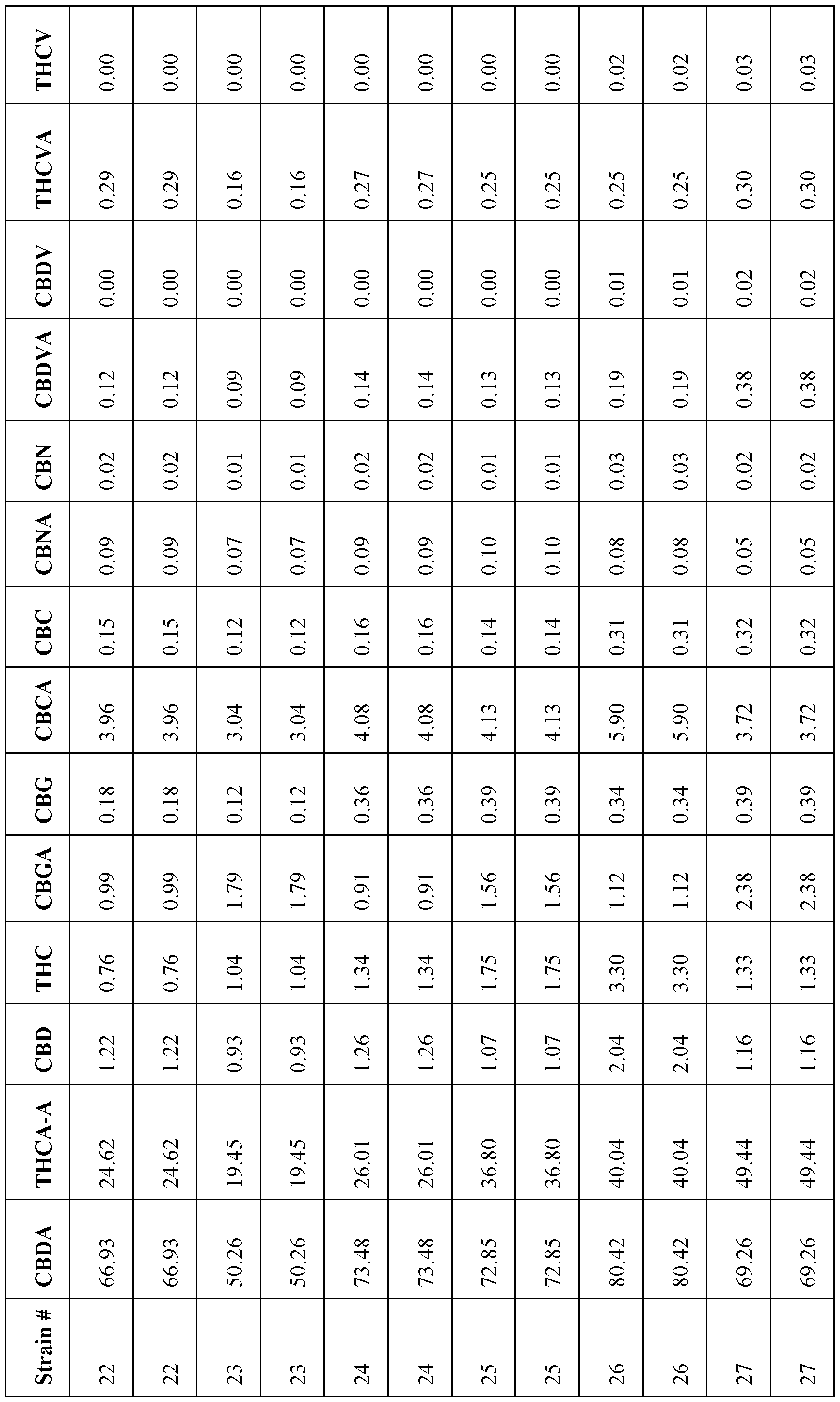
- Figure 4 shows the correlation between the concentration of cannabinoids as measured using LC-MS and the spectra measured using NIR for 65 different cannabis strains.
- Figure 5 shows the predicted strain type (I, II) for 19 different cannabis strains (x-axis) from the spectra measured by NIR. Strain type was predicted using PLS-DA and Venetian blind validation (y-axis). The data shown does not include the strains used in the calibration set. All strain types were correctly predicted (i.e., an error of classification after cross validation of 0%).
- Figure 6 shows the accuracy of the predicted cannabinoid concentration for THCA-A and CBDA using PLS regression analysis using NIR spectra (y-axis) and the THCA-A and CBDA concentration measured by LC-MS (x-axis) for different cannabis strains in the calibration set.
- the R 2 for prediction is 0.98 for both THCA-A and CBDA for cross validated predictions.
- Figure 7 shows the accuracy of the predicted cannabinoid concentration for THCA-A and CBDA using PLS regression analysis using NIR spectra (y-axis) and the THCA-A and CBDA concentration measured by LC-MS (x-axis) for different cannabis strains in the prediction set (i.e., cannabis strains that are naive to the model).
- the R 2 for prediction is 0.95 for THCA-A and 0.92 for CBDA for cross validated predictions.
- the present disclosure is predicated, at least in part, on the unexpected finding that the chemotypic profile of cannabis plant material that evaluates at least one cannabinoid in acid form can be predicted from spectroscopic data obtained from that plant material by using a predetermined association (e.g ., a trained classifier) between spectroscopic data and corresponding chemotypic data of reference cannabis plant material.
- a predetermined association e.g ., a trained classifier
- a method for determining a chemotypic profile of cannabis plant material comprising:
- the term "cannabis plant” means a plant of the genus Cannabis , illustrative examples of which include Cannabis sativa, Cannabis indica and Cannabis ruderalis.
- Cannabis is an erect annual herb with a dioecious breeding system, although monoecious plants exist. Wild and cultivated forms of cannabis are morphologically variable, which has resulted in difficulty defining the taxonomic organisation of the genus.
- the cannabis plant is C. sativa.
- plant The terms "plant”, “cultivar”, “variety”, “strain” or “race” are used interchangeably herein to refer to a plant or a group of similar plants according to their structural features and performance (i.e., morphological and physiological characteristics).
- the reference genome for C. sativa is the assembled draft genome and transcriptome of "Purple Kush” or "PK" (van Bakal el al. 2011, Genome Biology , 12: R102).
- Female plants are homogametic (XX) and males heterogametic (XY) with sex determination controlled by an X-to- autosome balance system.
- the estimated size of the haploid genome is 818 Mb for female plants and 843 Mb for male plants.
- plant part refers to any part of the plant, illustrative examples of which include an embryo, a shoot, a bud, a root, a stem, a seed, a stipule, a leaf, a petal, an inflorescence, an ovule, a bract, a trichome, a branch, a petiole, an internode, bark, a pubescence, a tiller, a rhizome, a frond, a blade, pollen and stamen.
- plant part also includes any material listed in the Plant Part Code Table as approved by the Australian Therapeutic Goods Administration (TGA) Business Services (TBS).
- the part is selected from the group consisting of an embryo, a shoot, a bud, a root, a stem, a seed, a stipule, a leaf, a petal, an inflorescence, an ovule, a bract, a trichome, a branch, a petiole, an internode, bark, a pubescence, a tiller, a rhizome, a frond, a blade, pollen and stamen.
- the part is a cannabis bud.
- cannabinoid refers to a family of terpeno-phenolic compounds, of which more than 100 compounds are known to exist in nature. Cannabinoids will be known to persons skilled in the art, illustrative examples of which are provided in Table 1, below, including acidic and decarboxylated ( i.e ., neutral) forms thereof.
- Table 1 Cannabinoids and their properties.
- Cannabinoids are synthesised in cannabis plants as carboxylic acids. While some decarboxylation may occur in the plant, decarboxylation typically occurs post harvest and is increased by exposing plant material to heat (Sanchez and Verpoote, 2008, Plant Cell Physiology , 49(12): 1767-82). Decarboxylation is usually achieved by drying, heating and/or curing ( i.e ., heating for a specific time and temperature to ensure maximum decarboxylation) the plant material. Persons skilled in the art would be familiar with methods by which decarboxylation of cannabinoids can be promoted, illustrative examples of which include combustion, vaporisation, curing, drying, heating and baking.
- D-9-tetrahydrocannabinolic acid or "THCA-A” is synthesised from the CBGA precursor by THCA synthase.
- the neutral form “D-9-tetrahydrocannabinol” or “THC” is associated with psychoactive effects of cannabis, which are primarily mediated by its activation of CBIG-protein coupled receptors, which result in a decrease in the concentration of cyclic AMP (cAMP) through the inhibition of adenylate cyclase.
- THC also exhibits partial agonist activity at the cannabinoid receptors CB1 and CB2.
- CB1 is mainly associated with the central nervous system, while CB2 is expressed predominantly in the cells of the immune system.
- THC is also associated with pain relief, relaxation, fatigue, appetite stimulation, and alteration of the visual, auditory and olfactory senses.
- THC mediates an anti cholinesterase action, which may suggest its use for the treatment of Alzheimer's disease and myasthenia (Eubanks et al. , 2006, Molecular Pharmaceuticals, 3(6): 773-7).
- Acid forms of cannabinoids will be known to persons skilled in the art, illustrative examples of which are described in Papaset et al. ( Int . ./. Med. Sci., 2018; 15(12): 1286-1295) and Cannabis and Cannabinoids (PDQ®): Health Professional Version ; PDQ Integrative, Alternative, and Complementary Therapies Editorial Board; Bethesda (MD): National Cancer Institute (US); 2002-2018).
- CBDA cannabigerolic acid
- CBDA synthase cannabigerolic acid
- CBDA cannabigerolic acid
- Its neutral form, “cannabidiol” or “CBD” has antagonist activity on agonists of the CB1 and CB2 receptors.
- CBD has also been shown to act as an antagonist of the putative cannabinoid receptor, GPR55.
- CBD is commonly associated with therapeutic or medicinal effects of cannabis and has been suggested for use as a sedative, anti-inflammatory, anti-anxiety, anti-nausea, atypical anti psychotic, and as a cancer treatment.
- CBD can also increase alertness, and attenuate the memory impairing effect of THC.
- the chemotypic profile evaluates at least one cannabinoid in acid form selected from the group consisting of CBDA, THCA-A, CBDVA, CBGA, THCVA, CBNA and CBCA. In another embodiment, the chemotypic profile evaluates at least one cannabinoid in acid form selected from the group consisting of THCA-A, CBDA, CBGA, CBCA and CBNA. In a preferred embodiment, the chemotypic profile evaluates at least one cannabinoid in acid form selected from the group consisting of THCA-A and CBDA.
- the chemotypic profile evaluates at least one cannabinoid in acid form and at least one cannabinoid in neutral form.
- the at least one cannabinoid in acid form is selected from the group consisting of CBDA, THCA-A, CBDVA, CBGA, THCVA, CBNA and CBCA, and wherein the at least one cannabinoid in neutral form is selected from the group consisting of CBD, THC, CBG, CBDV and THCV.
- the at least one cannabinoid in acid form is selected from the group consisting of CBDA, THCA-A, CBGA, CBNA and CBCA, and wherein the at least one cannabinoid in neutral form is selected from the group consisting of CBD and CBDV.
- the at least one cannabinoid in acid form is selected from the group consisting of THCA-A and CBDA.
- the chemotypic profile evaluates at least two, preferably at least three, preferably at least four, preferably at least five, preferably at least six, preferably at least seven, preferably at least eight, preferably at least nine, preferably at least ten, preferably at least eleven cannabinoids, preferably at least twelve, preferably at least thirteen, and more preferably fourteen cannabinoids selected from the group consisting of CBD, CBDA, THC, THCA-A, CBC, CBDVA, CBDV, CBGA, CBG, THCV, THCVA, CBNA, CBN and CBCA.
- the chemotypic profile evaluates CBD, CBDA, THC, THCA-A, CBC, CBDV, CBDVA, CBGA, CBG, THCV, THCVA, CBNA and CBCA.
- chemotypic profile or “chemotype” are used interchangeably herein to refer to a representation of the type, amount, level, ratio and/or proportion of cannabinoids that are present in the cannabis plant or part thereof, as typically measured within plant material derived from the plant or plant part, including an extract therefrom.
- the chemotypic profile in a cannabis plant will typically predominantly comprise the acidic form of the cannabinoids, but may also comprise some decarboxyl ated (. i.e ., neutral) forms thereof, at various concentrations or levels at any given time (i.e., at propagation, growth, harvest, drying, curing, etc).
- the chemotypic profile evaluates the concentration of at least one cannabinoid in the plant material.
- level is used interchangeably herein to describe an amount of the referenced compound, and may be represented in absolute terms (e.g ., mg/g, mg/ml, etc) or in relative terms, such as a ratio to any or all of the other compounds in the cannabis plant material or as a percentage of the amount (e.g., by weight) of any or all of the other compounds in the cannabis plant material.
- the term "plant material” is to be understood to mean any part of the cannabis plant, including the leaves, stems, roots, and inflorescence, or parts thereof, as described elsewhere herein, as well as extracts, illustrative examples of which include kief or hash, which includes trichomes and glands.
- the plant material is derived from a female cannabis plant.
- the plant material is an inflorescence or a leaf.
- the plant material is an inflorescence.
- the term“inflorescence” as used herein means the complete flower head of the cannabis plant, comprising stems, stalks, bracts, flowers and trichomes (i.e., glandular, sessile and stalked trichomes).
- the plant material comprises cannabis trichomes.
- cannabinoids are synthesised in cannabis plants predominantly in acid form (i.e., as carboxylic acids). While some decarboxylation may occur in the plant, decarboxylation typically occurs post-harvest and is increased by exposing the plant material to heat.
- the methods disclosed herein comprise obtaining spectroscopic data from plant material that has not been heat treated under conditions and for a period of time that would otherwise result in the decarboxylation of acid forms of cannabinoids in the plant material.
- the chemotypic profile evaluates at least one cannabinoid in acid form and at least one cannabinoid in neutral form. [0050] In an embodiment, the chemotypic profile evaluates at least one cannabinoid in neutral form, preferably at least two, preferably at least three, preferably at least four, preferably at least five, preferably at least six or more preferably at least seven cannabinoids in neutral form.
- the chemotypic profile evaluates at least one, preferably at least two, preferably at least three, preferably at least four, preferably at least five, preferably at least six or more preferably at least seven cannabinoids in neutral form selected from the group consisting of CBD, THC, CBC, CBG, CBDV, THCV and CBN.
- the chemotypic profile evaluates at least one cannabinoid in acid form, preferably at least two, preferably at least three, preferably at least four, preferably at least five, preferably at least six or more preferably at least seven cannabinoids in acid form.
- the chemotypic profile evaluates at least one, preferably at least two, preferably at least three, preferably at least four, preferably at least five, preferably at least six or more preferably at least seven cannabinoids in acid form selected from the group consisting of CBDA, THCA-A, CBDVA, CBGA, THCVA, CBNA and CBCA.
- the chemotypic profile evaluates at least one cannabinoid selected from the group consisting of CBD, CBDA, THC, THCA-A, CBC, CBDV, CBDVA, CBGA, CBG, THCV, THCVA, CBNA and CBCA.
- the chemotypic profile evaluates at least one cannabinoid selected from the group consisting of THCA-A, CBDA, CBGA, CBCA, CBNA, CBD and CBDV.
- the chemotypic profile evaluates at least one cannabinoid selected from the group consisting of THCA-A and CBDA.
- the chemotypic profile may be used to classify the plant material into Type I (THC/THCA-enriched), Type II (THC/THCA- and CBD/CBDA- enriched) and/or Type III (CBD/CBDA-enriched) cannabis plant material.
- enriched means that the referenced cannabinoid(s) is/are the main cannabinoid(s) in the plant material.
- Methods for measuring a chemotypic profile of a plant or plant part would be familiar to persons skilled in the art, illustrative examples of which include nuclear magnetic resonance (NMR) spectroscopy, RT-PCR analysis, gas chromatography-mass spectroscopy (GC-MS) and liquid chromatography-mass spectroscopy (LC-MS).
- NMR nuclear magnetic resonance
- GC-MS gas chromatography-mass spectroscopy
- LC-MS liquid chromatography-mass spectroscopy
- the chemotypic profile is measured by LC-MS.
- the present disclosure provides methods for determining a chemotypic profile of cannabis plant material from spectroscopic data.
- Methods for measuring spectroscopic data would be known to persons skilled in the art, illustrative examples of which include infrared (IR) spectroscopy and near-infrared (NIR) spectroscopy.
- IR infrared
- NIR near-infrared
- the principles of IR spectroscopy related to the examination of absorption and transmission of photons in the infrared energy range, based on their frequency and intensity. Different IR-spectra are measured depending on the type of IR used.
- far-infrared ranges from a frequency of 300 GHz and/or a wavelength of 1 mm to a frequency of 30 THz and/or 10 pm wavelength
- mid-infrared ranges from frequencies of 30 to 120 THz and/or wavelengths of 10 to 2.7 pm
- NIR ranges from frequencies of 120 to 400 THz and/or wavelengths of 2,700 to 750 nm.
- spectroscopic data refers to a spectrum or spectra measured in either reflection or transmission.
- the spectroscopic data is NIR spectrum or spectra.
- NIR spectra can be used to identify single chemical characteristics of a certain chemical group (i.e., cannabinoids) and more complex characteristics, such as the chemical, structural, sensoric or functional qualities of different cannabis plants.
- the spectroscopic data is measured by near NIR spectroscopy.
- the spectroscopic data is measured by Fourier- transform NIR (FT-NTR) spectroscopy, as described, for example, by Maresca M. (2014; Toxins (Basel ) 6(11):3129-3143).
- FT-NTR Fourier- transform NIR
- NIR spectroscopy is based on molecular overtone and combination vibrations. Such transitions are forbidden by the selection rules of quantum mechanics. As a result, the molar absorptivity in the NIR region is typically quite small. This is particularly advantageous as NIR can penetrate much further into a sample of cannabis plant material, when compared to mid-infrared radiation, for example. Accordingly, NIR is useful in probing material with little to no sample preparation.
- the spectroscopic data is measured using a rotary cup. In another embodiment, the spectroscopic data is measured using a fibre optic probe.
- Instrumentation for NIR spectrometry typically comprises a source, a detector and a dispersive element (e.g ., a prism or a diffraction grating) to allow the intensity at different wavelengths to be recorded.
- a dispersive element e.g ., a prism or a diffraction grating
- the spectroscopic data is measured using a hand held device.
- the spectroscopic data measured using the hand-held device is processed in a control unit, wherein the control unit is configured to receive and process the measured spectroscopic data to determine the chemotypic profile of the plant material based on the predetermined association between spectroscopic data from reference cannabis plant material and a chemotypic profile from the reference cannabis plant material.
- the resolution that the spectroscopic data is measured with will determine the number of data points collected from any given cannabis plant material.
- the spectroscopic data is measured with a resolution of 8 cm 1 .
- the spectroscopic data may be filtered or "pre-processed" prior to determining the chemotypic profile of sample cannabis plant material.
- the pre processing limits the measured spectroscopic data to a spectrum of from about 3500 cm 1 to about 12,500 cm 1 .
- the pre-processing limits the measured spectroscopic data to a spectrum of from about 4000 cm 1 to about 12,500 cm 1 .
- the pre-processing limits the measured spectroscopic data to a spectrum of from about 3500 cm 1 to about 9250 cm 1 .
- the pre-processing further comprises one or more methods selected from the group consisting of: detrend, extended scatted correction (EMSC), orthogonal signal correction (OSC), 1 st or 2 nd derivative, smoothing, and mean center.
- MSC extended scatted correction
- OSC orthogonal signal correction
- 1 st or 2 nd derivative smoothing
- mean center mean center
- a "predetermined association” is utilised to determine the chemotypic profile of sample cannabis plant material.
- the "predetermined association” is established between spectroscopic data from reference cannabis plant material and a chemotypic profile from the reference cannabis plant material (i.e., the same reference cannabis plant material from which the reference spectroscopic data are derived).
- the predetermined association is a predetermined correlation between spectroscopic data from reference cannabis plant material and a chemotypic profile from the reference cannabis plant material.
- the predetermined association is a trained classifier.
- the term "trained classifier” as used herein refers to a classifier that may be used to determine the chemotypic profile of sample cannabis material that has not been subject to a different quantitative method, such as LC-MS. To establish a trained classifier, it is necessary to create a "training set" of reference cannabis plant material to use as a standard. In an embodiment, the classifier is trained using spectroscopic data from a plurality of reference cannabis plant material and chemotypic profiles from the plurality of reference cannabis plant material.
- the classifier is trained using Partial Least Squares
- the classifier is trained using PLS-DA with Venetian blinds cross validation.
- a method of training a classifier to determine the chemotypic profile of cannabis plant material comprising:
- step (c) using the association generated in step (b) to train the classifier to determine the chemotypic profile of sample cannabis plant material from spectroscopic data;
- step (d) optionally, repeating steps (a)-(c) using a different plurality of cannabis plants to improve the accuracy of the classifier.
- the methods disclosed herein may suitably be used to monitor changes to the chemotypic profile of cannabis plants, for example, during their growth cycle. This advantageously allows breeders, cultivators and the like to monitor their crop to ensure their plants retain / maintain the desired chemotype(s) or chemotypic profile(s) and, where necessary, remove and/or discard plants with an undesirable chemotype or chemotypic profile.
- a method for monitoring a cannabis plant for a change in the chemotypic profile of the cannabis plant comprising: (a) determining the chemotypic profile of plant material derived from a cannabis plant in accordance with the methods disclosed herein; and
- the methods disclosed herein may also suitably be used to select growing conditions (e.g ., frequency of watering, water quantity and/or quality; amount and/or type of fertiliser used; etc.) that give rise to or promote the development of cannabis plants with a desired chemotypic profile.
- growing conditions e.g ., frequency of watering, water quantity and/or quality; amount and/or type of fertiliser used; etc.
- a method of selecting growing conditions that favour the development of a cannabis plant with a desirable chemotypic profile comprising: the method comprising:
- step (c) optionally, repeating step (b) for a subsequent set of growing conditions that is different from the first and second sets of selected growing conditions;
- step (e) selecting from the set of growing conditions of steps (a)-(c) one or more sets of selected growing conditions that favour the development of a cannabis plant with a desirable chemotypic profile based on the chemotypic profiles determined at step (d).
- selecting means the selection of a particular growing condition from one or more different growing conditions based on the chemotypic profile of the cannabis plants that develop following exposure to each growing condition evaluated in accordance with the methods disclosed herein.
- a mixed stock standard at 125 pg/mL CBDA, CBN, CBC, THCA-A and 250 pg/mL CBD, THC in methanol was prepared with working standards at 0.05, 0.125, 0.25, 0.5, 1.25, 2.5 and 50.0 pg/mL for CBDA, CBN, CBC and THCA; and 0.1, 0.25, 0.5, 1.0, 2.5, 5.0 and 100.0 pg/mL for CBD and THC prepared from the mixed stock.
- Dried and ground plant material was obtained from the Victorian Government Medicinal Cannabis Cultivation Facility. Mature buds (aged from three to five weeks, depending on the strain) from 65 different cannabis cultivars were analysed. Samples were ground to a fine powder with liquid nitrogen using a SPEX SamplePrep 2010 Geno/Grinder for 1 minute at 1500 rpm. After grinding, 10 mg of each sample was weighed into an Axygen 2.0 mL microcentrifuge tube on a Sartorius BP210D analytical balance. Each sample was extracted with 1 mL of methanol, vortexed for 30 seconds, sonicated for 5 minutes and centrifuged at 13,000 rpm for 5 minutes. The supernatant was transferred to a 2 mL amber HPLC vial and diluted 1 :3 for analysis.
- Samples were analysed using a Thermo Scientific (Waltham, MA) Q Exactive Plus Orbitrap mass spectrometer (MS) coupled with Thermo Scientific Vanquish ultra- high performance liquid chromatography (UHPLC) system equipped with degasser, binary pump, temperature controlled autosampler and column compartment, and photodiode array detector (PDA).
- MS Thermo Scientific
- UHPLC ultra- high performance liquid chromatography
- the MS was set to acquire a full range spectrum (80 - 1,200 m/z) followed by a data independent MS2 spectrum in positive polarity with resolution set to 35,000.
- the capillary temperature was set to 320°C with sheath and auxiliary gas at 28 and 15 units respectively and a spray voltage of 4 kV.
- PDA data acquisition was set to a data collection rate of 5 Hz between 190 and 680 nm.
- Table 2 Separation gradient for LCMS analysis.
- FT-NIR Fourier transform near infrared
- MPA multipurpose analyser
- Spectra were collected in diffuse reflectance mode in the wavenumber range 12,500-4000 cm -1 (800-2500 nm), with a resolution of 8 cm -1 , using the macro sample integrating sphere or fibre optic probe measurement channels.
- Ground cannabis material was transferred to a 50 mm cup and measurement acquired with the sample rotating or to a 20 mm vial where measurement was acquired in static mode. The fibre optic probe was placed into the ground cannabis and measurements taken.
- Example 1 - FT-NIR using 50 mm rotating cup
- Cannabis is often divided in to categories based on cannabinoid content: Type I cannabis (THC -predominant) and Type II cannabis (containing both THC and CBD) have been described, as well as a Type III, which is rich in CBD.
- the five strains were classified into each class based on the LCMS data analysis.
- Strain No. 1 is a Type III strain
- Strain Nos. 2 and 3 are Type II strains
- Strain Nos. 4 and 5 are Type I strains.
- Partial Least Squares Discriminant Analysis (PLSDA) with Venetian blinds cross validation (7 splits and 1 sample per split) was used to predict each strain type. Classification error was 0%. i.e. each strain type (as defined above) was correctly predicted from the NIR spectra ( Figure 2). Permutation testing (50 iterations) confirmed that the model was not over fitted (p ⁇ 0.05). This data confirms that NIR can predict strain type.
- PLSDA Partial Least Squares Discriminant Analysis
- Partial Least Squares (PLS) regression analysis (with leave one out cross validation) of the NIR spectra against the LCMS quantitation data confirmed that cannabinoid concentration can also be predicted from NIR.
- the CV R 2 for CBDA, CBD, THC, THCA-A, CBC, CBDVA, CBGA, CBG, THCV, THCVA, CBNA, CBCA measurements were between 0.99 and 1.00.
- Figure 3 shows the data for CBDA. Permutation testing (50 iterations) confirmed that the model was not over fitted (p ⁇ 0.05). This supports the utility of NIR for quantitating the acid form and neutral form of cannabinoids in cannabis plant material.
- the PLSDA models included spectral pre-processing: detrend, OSC (Orthogonal Signal Correction), 1st Derivative (order: 2, window: 15 pt, tails: polyinterp) and mean center. Error of classification after cross validation (Venetian blinds with 10 splits and 1 sample per split) for the calibration set was 0%. The samples that had not been used in creating the model were also predicted with 100% accuracy (specificity and sensitivity were both 1). Permutation testing (50 iterations) confirmed that the model was not overfitted (p ⁇ 0.05).
- CBGA minor cannabinoids
- CBCA minor cannabinoids
- CBDV CBDV
- NIR spectroscopy allows the classification of cannabis by Type I, Type II or Type III and for prediction of cannabinoid content (including cannabinoid in acid form) in cannabis plant material.
- a fibre optic probe can be employed to provide sufficient data to allow the classification of cannabis by Type I, Type II or Type III and for prediction of cannabinoid content, as compared to the use of rotating cups.
- portable, hand held spectrometers can be used to carry out real time monitoring of cannabis plant material for type identification and cannabinoid content. This has applications in large scale breeding, in field and in glasshouse/greenhouse monitoring for optimal harvesting and as a rapid testing tool for authorities.
Landscapes
- Health & Medical Sciences (AREA)
- Life Sciences & Earth Sciences (AREA)
- Engineering & Computer Science (AREA)
- Chemical & Material Sciences (AREA)
- Physics & Mathematics (AREA)
- General Health & Medical Sciences (AREA)
- Immunology (AREA)
- Molecular Biology (AREA)
- General Physics & Mathematics (AREA)
- Analytical Chemistry (AREA)
- Pathology (AREA)
- Biochemistry (AREA)
- Spectroscopy & Molecular Physics (AREA)
- Bioinformatics & Cheminformatics (AREA)
- Medicinal Chemistry (AREA)
- Urology & Nephrology (AREA)
- Hematology (AREA)
- Biomedical Technology (AREA)
- Pharmacology & Pharmacy (AREA)
- Food Science & Technology (AREA)
- Medical Informatics (AREA)
- Biotechnology (AREA)
- Microbiology (AREA)
- Cell Biology (AREA)
- Anesthesiology (AREA)
- Botany (AREA)
- Epidemiology (AREA)
- Public Health (AREA)
- Primary Health Care (AREA)
- Toxicology (AREA)
- Artificial Intelligence (AREA)
- Wood Science & Technology (AREA)
- Theoretical Computer Science (AREA)
- Computer Vision & Pattern Recognition (AREA)
- Databases & Information Systems (AREA)
- Bioinformatics & Computational Biology (AREA)
- Software Systems (AREA)
- Data Mining & Analysis (AREA)
- Evolutionary Computation (AREA)
- Computing Systems (AREA)
Abstract
Description




Claims
Priority Applications (9)
| Application Number | Priority Date | Filing Date | Title |
|---|---|---|---|
| MX2021007048A MX2021007048A (en) | 2018-12-14 | 2019-12-09 | A METHOD TO DETERMINE A CHEMOTYPIC PROFILE. |
| US17/297,738 US20220051760A1 (en) | 2018-12-14 | 2019-12-09 | Method for Determining a Chemotypic Profile |
| CA3122416A CA3122416A1 (en) | 2018-12-14 | 2019-12-09 | A method for determining a chemotypic profile |
| EP19895981.9A EP3893630A4 (en) | 2018-12-14 | 2019-12-09 | METHOD OF DETERMINING A CHEMOTYPIC PROFILE |
| AU2019399134A AU2019399134A1 (en) | 2018-12-14 | 2019-12-09 | A method for determining a chemotypic profile |
| BR112021011484-0A BR112021011484A2 (en) | 2018-12-14 | 2019-12-09 | METHOD TO DETERMINE A CHEMOTYPICAL PROFILE |
| IL283892A IL283892A (en) | 2018-12-14 | 2021-06-10 | A method for determining a kamotypic profile |
| US19/229,113 US20250308644A1 (en) | 2018-12-14 | 2025-06-05 | Method for Determining a Chemotypic Profile |
| AU2026201729A AU2026201729A1 (en) | 2018-12-14 | 2026-03-06 | A Method for Determining a Chemotypic Profile |
Applications Claiming Priority (2)
| Application Number | Priority Date | Filing Date | Title |
|---|---|---|---|
| AU2018904756 | 2018-12-14 | ||
| AU2018904756A AU2018904756A0 (en) | 2018-12-14 | A method for determining a chemotypic profile |
Related Child Applications (2)
| Application Number | Title | Priority Date | Filing Date |
|---|---|---|---|
| US17/297,738 A-371-Of-International US20220051760A1 (en) | 2018-12-14 | 2019-12-09 | Method for Determining a Chemotypic Profile |
| US19/229,113 Continuation US20250308644A1 (en) | 2018-12-14 | 2025-06-05 | Method for Determining a Chemotypic Profile |
Publications (1)
| Publication Number | Publication Date |
|---|---|
| WO2020118355A1 true WO2020118355A1 (en) | 2020-06-18 |
Family
ID=71075263
Family Applications (1)
| Application Number | Title | Priority Date | Filing Date |
|---|---|---|---|
| PCT/AU2019/051345 Ceased WO2020118355A1 (en) | 2018-12-14 | 2019-12-09 | A method for determining a chemotypic profile |
Country Status (8)
| Country | Link |
|---|---|
| US (2) | US20220051760A1 (en) |
| EP (1) | EP3893630A4 (en) |
| AU (2) | AU2019399134A1 (en) |
| BR (1) | BR112021011484A2 (en) |
| CA (1) | CA3122416A1 (en) |
| IL (1) | IL283892A (en) |
| MX (1) | MX2021007048A (en) |
| WO (1) | WO2020118355A1 (en) |
Cited By (3)
| Publication number | Priority date | Publication date | Assignee | Title |
|---|---|---|---|---|
| WO2022066700A1 (en) * | 2020-09-22 | 2022-03-31 | Central Coast Agriculture, Inc. | Infrared spectroscopic methods for evaluating compositions |
| WO2023057739A1 (en) * | 2021-10-06 | 2023-04-13 | Nicoventures Trading Limited | Quantification method |
| US12710362B2 (en) | 2021-10-06 | 2026-08-18 | Nicoventures Trading Limited | Quantification method |
Families Citing this family (1)
| Publication number | Priority date | Publication date | Assignee | Title |
|---|---|---|---|---|
| CA3260728A1 (en) * | 2022-06-29 | 2024-01-04 | The State Of Israel, Ministry Of Agriculture & Rural Development, Agricultural Research Organization (Aro) (Volcani Institute) | System and method for cannabis classification |
Citations (2)
| Publication number | Priority date | Publication date | Assignee | Title |
|---|---|---|---|---|
| WO2017134669A1 (en) * | 2016-02-04 | 2017-08-10 | Cannabitech Ltd. | System and method for qualifying plant material |
| WO2018080938A1 (en) * | 2016-10-25 | 2018-05-03 | Big Sur Scientific, Llc | Systems and methods for chemical analysis using fabry-perot tunable filter-attenuated total reflectance (fptf-atr) spectrometer |
Family Cites Families (2)
| Publication number | Priority date | Publication date | Assignee | Title |
|---|---|---|---|---|
| US20170212049A9 (en) * | 2014-08-01 | 2017-07-27 | Chad Allen Lieber | Method and Apparatus for Nondestructive Quantification of Cannabinoids |
| US11047837B2 (en) * | 2017-09-06 | 2021-06-29 | Green Ocean Sciences, Inc. | Mobile integrated device and electronic data platform for chemical analysis |
-
2019
- 2019-12-09 AU AU2019399134A patent/AU2019399134A1/en not_active Abandoned
- 2019-12-09 EP EP19895981.9A patent/EP3893630A4/en active Pending
- 2019-12-09 US US17/297,738 patent/US20220051760A1/en not_active Abandoned
- 2019-12-09 MX MX2021007048A patent/MX2021007048A/en unknown
- 2019-12-09 CA CA3122416A patent/CA3122416A1/en active Pending
- 2019-12-09 BR BR112021011484-0A patent/BR112021011484A2/en unknown
- 2019-12-09 WO PCT/AU2019/051345 patent/WO2020118355A1/en not_active Ceased
-
2021
- 2021-06-10 IL IL283892A patent/IL283892A/en unknown
-
2025
- 2025-06-05 US US19/229,113 patent/US20250308644A1/en active Pending
-
2026
- 2026-03-06 AU AU2026201729A patent/AU2026201729A1/en active Pending
Patent Citations (2)
| Publication number | Priority date | Publication date | Assignee | Title |
|---|---|---|---|---|
| WO2017134669A1 (en) * | 2016-02-04 | 2017-08-10 | Cannabitech Ltd. | System and method for qualifying plant material |
| WO2018080938A1 (en) * | 2016-10-25 | 2018-05-03 | Big Sur Scientific, Llc | Systems and methods for chemical analysis using fabry-perot tunable filter-attenuated total reflectance (fptf-atr) spectrometer |
Non-Patent Citations (5)
| Title |
|---|
| BORILLE BT ET AL.: "Near infrared spectroscopy combined with chemometrics for growth stage classification of cannabis cultivated in a greenhouse from seized seeds", SPECTROCHIMICA ACTA PART A: MOLECULAR AND BIOMOLECULAR SPECTROSCOPY, vol. 173, 2017, pages 318 - 323, XP029840156, DOI: 10.1016/j.saa.2016.09.040 * |
| C. SÁNCHEZ-CARNERERO CALLADO, NÚÑEZ-SÁNCHEZ N., CASANO S., FERREIRO-VERA C.: "The potential of near infrared spectroscopy to estimate the content of cannabinoids in Cannabis sativa L.: A comparative study", TALANTA, vol. 190, 1 December 2018 (2018-12-01), pages 147 - 157, XP055717964 * |
| See also references of EP3893630A4 * |
| SMITH BC CHARLES ROACH SMITH, PH D, LEWIS MARK A, MENDEZ JUDAHET AL.: "Optimization of Cannabis Grows Using Fourier Transform Mid-Infrared Spectroscopy", 2016, pages 3, XP055717958, Retrieved from the Internet <URL:https://cdn.technologynetworks.com/tn/Resources/pdf/optimization-of-cannabis-grows-using-fourier-transform-mid-infrared-spectroscopy.pdf> [retrieved on 20190612] * |
| WILSON ND ET AL.: "Discrimination between 'drug type' cannabis and hemp using Near Infrared Spectroscopy", JOURNAL OF PHARMACY AND PHARMACOLOGY, vol. 58, no. 1, 2006, pages A56 * |
Cited By (3)
| Publication number | Priority date | Publication date | Assignee | Title |
|---|---|---|---|---|
| WO2022066700A1 (en) * | 2020-09-22 | 2022-03-31 | Central Coast Agriculture, Inc. | Infrared spectroscopic methods for evaluating compositions |
| WO2023057739A1 (en) * | 2021-10-06 | 2023-04-13 | Nicoventures Trading Limited | Quantification method |
| US12710362B2 (en) | 2021-10-06 | 2026-08-18 | Nicoventures Trading Limited | Quantification method |
Also Published As
| Publication number | Publication date |
|---|---|
| AU2026201729A1 (en) | 2026-03-26 |
| AU2019399134A1 (en) | 2021-06-17 |
| IL283892A (en) | 2021-07-29 |
| US20250308644A1 (en) | 2025-10-02 |
| EP3893630A4 (en) | 2022-09-07 |
| US20220051760A1 (en) | 2022-02-17 |
| CA3122416A1 (en) | 2020-06-18 |
| MX2021007048A (en) | 2021-10-22 |
| EP3893630A1 (en) | 2021-10-20 |
| BR112021011484A2 (en) | 2021-08-31 |
Similar Documents
| Publication | Publication Date | Title |
|---|---|---|
| US20250308644A1 (en) | Method for Determining a Chemotypic Profile | |
| US10458908B2 (en) | System and method for qualifying plant material | |
| Sârbu et al. | Classification and fingerprinting of kiwi and pomelo fruits by multivariate analysis of chromatographic and spectroscopic data | |
| Donno et al. | Foodomics for mulberry fruit (Morus spp.): Analytical fingerprint as antioxidants' and health properties' determination tool | |
| Haruna et al. | Simultaneous quantification of total flavonoids and phenolic content in raw peanut seeds via NIR spectroscopy coupled with integrated algorithms | |
| Cirilli et al. | On-field monitoring of fruit ripening evolution and quality parameters in olive mutants using a portable NIR-AOTF device | |
| Nunes et al. | Characterization of Brazilian floral honey produced in the states of Santa Catarina and São Paulo through ultraviolet–visible (UV–vis), near-infrared (NIR), and nuclear magnetic resonance (NMR) spectroscopy | |
| Yisak et al. | Selective determination of caffeine and trigonelline in aqueous extract of green coffee beans by FT-MIR-ATR spectroscopy | |
| Ribera-Fonseca et al. | Assessment of technological maturity parameters and anthocyanins in berries of cv. Sangiovese (Vitis vinifera L.) by a portable vis/NIR device | |
| Khodabakhshian | Feasibility of using Raman spectroscopy for detection of tannin changes in pomegranate fruits during maturity | |
| Cabrera-Banegil et al. | Evolution of polyphenols content in plum fruits (Prunus salicina) with harvesting time by second-order excitation-emission fluorescence multivariate calibration | |
| Zheng et al. | Determination of total phenolic content and antioxidant capacity of blueberries using Fourier transformed infrared (FT-IR) spectroscopy and Raman spectroscopy | |
| Hao et al. | Rapid determination of total flavonoid content, xanthine oxidase inhibitory activities, and antioxidant activity in Prunus mume by near-infrared spectroscopy | |
| Li et al. | Evaluation of phenolics in the analysis of virgin olive oil using near infrared spectroscopy | |
| Malagoli et al. | Variations of elements, pigments, amino acids and secondary metabolites in Vitis vinifera (L.) cv Garganega after 501 biodynamic treatment | |
| Guo et al. | Optimization of informative spectral variables for the quantification of EGCG in green tea using Fourier transform near-infrared (FT-NIR) spectroscopy and multivariate calibration | |
| Estopa et al. | NIR spectroscopic models for phenotyping wood traits in breeding programs of Eucalyptus benthamii | |
| Zhang et al. | Evaluation of changes in chemical composition and antioxidant activities from vine tea at different harvest times based on LC-MS, GC-MS, and data fusion algorithms | |
| CN121039742A (en) | A novel integrated analysis platform for quality evaluation of complex natural products | |
| JP3947819B2 (en) | Plant individual selection method using optical technique | |
| Guo et al. | Sensor-based in-situ detector for distinguishing between forchlorfenuron treated and untreated kiwifruit at multi-wavelengths | |
| Đurović et al. | Development, validation, and verification of the gas chromatography-mas spectrometry method for detecting and quantifying major cannabinoids in the inflorescence of Cannabis sativa L | |
| US20220187328A1 (en) | Methods of Terpene Profiling Cannabis Plant Material | |
| Godbout et al. | Non-destructive identification of varieties of Hawaii-grown avocados using near-infrared spectroscopy: Feasibility studies using bench-top and handheld spectrometers | |
| Obata et al. | Discrimination of male-sterility and male-fertility in Japanese cedar (Cryptomeria japonica) using near-infrared diffuse transmission spectroscopy |
Legal Events
| Date | Code | Title | Description |
|---|---|---|---|
| 121 | Ep: the epo has been informed by wipo that ep was designated in this application |
Ref document number: 19895981 Country of ref document: EP Kind code of ref document: A1 |
|
| ENP | Entry into the national phase |
Ref document number: 3122416 Country of ref document: CA |
|
| NENP | Non-entry into the national phase |
Ref country code: DE |
|
| ENP | Entry into the national phase |
Ref document number: 2019399134 Country of ref document: AU Date of ref document: 20191209 Kind code of ref document: A |
|
| REG | Reference to national code |
Ref country code: BR Ref legal event code: B01A Ref document number: 112021011484 Country of ref document: BR |
|
| ENP | Entry into the national phase |
Ref document number: 2019895981 Country of ref document: EP Effective date: 20210714 |
|
| ENP | Entry into the national phase |
Ref document number: 112021011484 Country of ref document: BR Kind code of ref document: A2 Effective date: 20210614 |
|
| WWW | Wipo information: withdrawn in national office |
Ref document number: 283892 Country of ref document: IL |