WO2020121670A1 - エアバッグ用織物およびエアバッグ用織物の製造方法 - Google Patents
エアバッグ用織物およびエアバッグ用織物の製造方法 Download PDFInfo
- Publication number
- WO2020121670A1 WO2020121670A1 PCT/JP2019/042427 JP2019042427W WO2020121670A1 WO 2020121670 A1 WO2020121670 A1 WO 2020121670A1 JP 2019042427 W JP2019042427 W JP 2019042427W WO 2020121670 A1 WO2020121670 A1 WO 2020121670A1
- Authority
- WO
- WIPO (PCT)
- Prior art keywords
- yarn
- fabric
- woven
- weaving
- warp
- Prior art date
- Legal status (The legal status is an assumption and is not a legal conclusion. Google has not performed a legal analysis and makes no representation as to the accuracy of the status listed.)
- Ceased
Links
Images

Classifications
-
- D—TEXTILES; PAPER
- D03—WEAVING
- D03D—WOVEN FABRICS; METHODS OF WEAVING; LOOMS
- D03D15/00—Woven fabrics characterised by the material, structure or properties of the fibres, filaments, yarns, threads or other warp or weft elements used
- D03D15/20—Woven fabrics characterised by the material, structure or properties of the fibres, filaments, yarns, threads or other warp or weft elements used characterised by the material of the fibres or filaments constituting the yarns or threads
- D03D15/283—Woven fabrics characterised by the material, structure or properties of the fibres, filaments, yarns, threads or other warp or weft elements used characterised by the material of the fibres or filaments constituting the yarns or threads synthetic polymer-based, e.g. polyamide or polyester fibres
-
- D—TEXTILES; PAPER
- D03—WEAVING
- D03D—WOVEN FABRICS; METHODS OF WEAVING; LOOMS
- D03D13/00—Woven fabrics characterised by the special disposition of the warp or weft threads, e.g. with curved weft threads, with discontinuous warp threads, with diagonal warp or weft
-
- B—PERFORMING OPERATIONS; TRANSPORTING
- B60—VEHICLES IN GENERAL
- B60R—VEHICLES, VEHICLE FITTINGS, OR VEHICLE PARTS, NOT OTHERWISE PROVIDED FOR
- B60R21/00—Arrangements or fittings on vehicles for protecting or preventing injuries to occupants or pedestrians in case of accidents or other traffic risks
- B60R21/02—Occupant safety arrangements or fittings, e.g. crash pads
- B60R21/16—Inflatable occupant restraints or confinements designed to inflate upon impact or impending impact, e.g. air bags
- B60R21/23—Inflatable members
- B60R21/235—Inflatable members characterised by their material
-
- D—TEXTILES; PAPER
- D03—WEAVING
- D03D—WOVEN FABRICS; METHODS OF WEAVING; LOOMS
- D03D1/00—Woven fabrics designed to make specified articles
- D03D1/02—Inflatable articles
-
- D—TEXTILES; PAPER
- D03—WEAVING
- D03D—WOVEN FABRICS; METHODS OF WEAVING; LOOMS
- D03D15/00—Woven fabrics characterised by the material, structure or properties of the fibres, filaments, yarns, threads or other warp or weft elements used
- D03D15/40—Woven fabrics characterised by the material, structure or properties of the fibres, filaments, yarns, threads or other warp or weft elements used characterised by the structure of the yarns or threads
- D03D15/43—Woven fabrics characterised by the material, structure or properties of the fibres, filaments, yarns, threads or other warp or weft elements used characterised by the structure of the yarns or threads with differing diameters
-
- D—TEXTILES; PAPER
- D03—WEAVING
- D03D—WOVEN FABRICS; METHODS OF WEAVING; LOOMS
- D03D5/00—Selvedges
-
- B—PERFORMING OPERATIONS; TRANSPORTING
- B60—VEHICLES IN GENERAL
- B60R—VEHICLES, VEHICLE FITTINGS, OR VEHICLE PARTS, NOT OTHERWISE PROVIDED FOR
- B60R21/00—Arrangements or fittings on vehicles for protecting or preventing injuries to occupants or pedestrians in case of accidents or other traffic risks
- B60R21/02—Occupant safety arrangements or fittings, e.g. crash pads
- B60R21/16—Inflatable occupant restraints or confinements designed to inflate upon impact or impending impact, e.g. air bags
- B60R21/23—Inflatable members
- B60R21/235—Inflatable members characterised by their material
- B60R2021/23504—Inflatable members characterised by their material characterised by material
- B60R2021/23509—Fabric
-
- B—PERFORMING OPERATIONS; TRANSPORTING
- B60—VEHICLES IN GENERAL
- B60R—VEHICLES, VEHICLE FITTINGS, OR VEHICLE PARTS, NOT OTHERWISE PROVIDED FOR
- B60R21/00—Arrangements or fittings on vehicles for protecting or preventing injuries to occupants or pedestrians in case of accidents or other traffic risks
- B60R21/02—Occupant safety arrangements or fittings, e.g. crash pads
- B60R21/16—Inflatable occupant restraints or confinements designed to inflate upon impact or impending impact, e.g. air bags
- B60R21/23—Inflatable members
- B60R21/235—Inflatable members characterised by their material
- B60R2021/23504—Inflatable members characterised by their material characterised by material
- B60R2021/23509—Fabric
- B60R2021/23514—Fabric coated fabric
-
- B—PERFORMING OPERATIONS; TRANSPORTING
- B60—VEHICLES IN GENERAL
- B60R—VEHICLES, VEHICLE FITTINGS, OR VEHICLE PARTS, NOT OTHERWISE PROVIDED FOR
- B60R21/00—Arrangements or fittings on vehicles for protecting or preventing injuries to occupants or pedestrians in case of accidents or other traffic risks
- B60R21/02—Occupant safety arrangements or fittings, e.g. crash pads
- B60R21/16—Inflatable occupant restraints or confinements designed to inflate upon impact or impending impact, e.g. air bags
- B60R21/23—Inflatable members
- B60R21/235—Inflatable members characterised by their material
- B60R2021/23533—Inflatable members characterised by their material characterised by the manufacturing process
- B60R2021/23542—Weaving
-
- D—TEXTILES; PAPER
- D10—INDEXING SCHEME ASSOCIATED WITH SUBLASSES OF SECTION D, RELATING TO TEXTILES
- D10B—INDEXING SCHEME ASSOCIATED WITH SUBLASSES OF SECTION D, RELATING TO TEXTILES
- D10B2505/00—Industrial
- D10B2505/12—Vehicles
- D10B2505/124—Air bags
Definitions
- the present invention relates to an airbag fabric and a method for manufacturing an airbag fabric. More specifically, the present invention relates to a high-density woven fabric, in particular, a woven fabric that effectively suppresses the receding of the weft and the occurrence of ear fluttering that occur in the vicinity of the selvage during weaving, and a method for manufacturing the same.
- Vehicles are equipped with airbags to ensure the safety of passengers.
- the sensor operates in response to the impact of a collision to generate high-temperature, high-pressure gas inside the airbag, and this gas momentarily inflates the airbag to occupant during a collision. It protects the face and forehead.
- Airbags are generally made of a plain woven fabric using synthetic fibers of 150 to 600 dtex, and a resin such as silicone is applied or laminated on the fabric in order to improve properties such as heat resistance, flame retardancy, and air barrier properties. It is made by manufacturing a base cloth (so-called coated cloth), cutting it, and sewing it into a bag.
- non-coated cloth which is used by weaving synthetic fiber filament threads such as polyamide fibers at a high density without adding resin to reduce the air permeability of the cloth.
- the fabric for an airbag has high strength and low air permeability because it protects the occupant's face, forehead, etc. in the event of a collision of an automobile by inflating the airbag instantaneously. It is required.
- the present invention has been made in view of such a conventional problem, and effectively suppresses the receding of the weft and the flare of both ears before weaving that occur during weaving, and provides a long piece of cloth.
- An object of the present invention is to provide a high-quality fabric for an air bag and a method for manufacturing a fabric for an air bag, which can suppress the occurrence of wrinkles at the end portion at the same time and can suppress the positional deviation at the time of cutting.
- the airbag fabric of the present invention which solves the above-mentioned problems is an airbag fabric made of synthetic fibers, wherein at least one of the ears of the fabric has a weaving yarn YA arranged in warp directions having different crimp ratios and The woven yarn YB is provided, and the woven yarn YA and the woven yarn YB are repeatedly arranged.
- the crimp rate CA of the woven thread YA and the crimp rate CB of the woven thread YB are CA ⁇ CB ⁇ 1. .2 and the crimp rate CB is smaller than the crimp rate CA.
- a method for manufacturing an airbag fabric of the present invention to solve the above problems is a method for manufacturing an airbag fabric for manufacturing the airbag fabric, wherein at least one ear of the fabric is woven.
- the yarn YA and the weaving yarn YB are repeatedly arranged, and the weaving is performed by adjusting the tension TA applied to the weaving yarn YA and the tension TB applied to the weaving yarn YB in a relation of TB ⁇ TA ⁇ 1.2. It is a method for manufacturing a fabric for an airbag.
- FIG. 1 is a schematic diagram for explaining a structure of a weaving yarn that constitutes a base portion of a woven fabric according to an embodiment of the present invention.
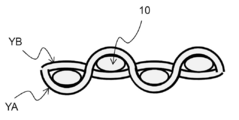
- FIG. 2 is a schematic diagram for explaining the structure of the weaving yarn that constitutes the selvage portion of the fabric according to the embodiment of the present invention.
- the base portion is made of synthetic fiber multifilaments (hereinafter also referred to as synthetic fiber yarn).
- the base portion means a portion of the fabric body other than the ear portion.
- the material of the synthetic fiber for example, polyamide fiber, polyester fiber, aramid fiber, rayon fiber, polysulfone fiber, ultrahigh molecular weight polyethylene fiber, or the like can be used.
- the synthetic fiber material is preferably a polyamide fiber or polyester fiber, which is excellent in mass productivity and economical efficiency.
- the polyamide fiber is, for example, nylon 6, nylon 66, nylon 12, nylon 46, a copolymer polyamide of nylon 6 and nylon 66, or a copolymer of nylon 6 with polyalkylene glycol, dicarboxylic acid, amine or the like.
- a fiber made of polymerized polyamide or the like can be used.
- Polyamide fibers are preferably nylon 6 fibers and nylon 66 fibers because they are particularly excellent in strength.
- polyester fibers include fibers made of polyethylene terephthalate, polybutylene terephthalate, and the like.
- the polyester fiber may be a fiber made of a copolymerized polyester obtained by copolymerizing polyethylene terephthalate or polybutylene terephthalate with isophthalic acid, 5-sodium sulfoisophthalic acid as an acid component, or an aliphatic dicarboxylic acid such as adipic acid. ..
- a heat stabilizer in order to improve the productivity in the spinning/drawing process and the processing process, or the characteristics of these synthetic fibers, a heat stabilizer, an antioxidant, a light stabilizer, a leveling agent, an antistatic agent, a plasticizer, It may contain additives such as a thickener, a pigment, and a flame retardant.
- the single fiber of the synthetic fiber may have a flat cross section.
- the same synthetic fiber yarn is used as the warp yarn and the weft yarn.
- the same synthetic fiber yarn is used as warp and weft means that both warp and weft are made of the same type of polymer, both warp and weft have the same single fiber fineness, and both warp and weft have the same total fineness. is there.
- the same type of polymer is a polymer having common main repeating units such as nylon 66 and polyethylene terephthalate.
- a combination of a homopolymer and a copolymer is also preferably used as the same type of polymer in the present embodiment.
- the synthetic fiber yarn used as the base yarn of the woven fabric in the present embodiment is preferably a synthetic fiber filament having a single fiber fineness of 1 to 7 dtex.
- the single fiber fineness By setting the single fiber fineness to 7 dtex or less, the voids occupied by the single fibers in the woven fabric are reduced, and the effect of filling the fibers is further improved, so that the ventilation amount can be reduced, which is preferable. Further, if the single yarn fineness is small, the rigidity of the synthetic fiber filament is lowered, and the effect of improving the flexibility of the woven fabric can be obtained.
- the total fineness of the synthetic fiber yarn used as the base yarn of the woven fabric is preferably 150 to 600 dtex.
- the total fineness is more preferably 200 to 550 dtex, further preferably 250 to 500 dtex.
- the tensile strength of the synthetic fiber that constitutes the woven fabric of the present embodiment, particularly the synthetic fiber thread used as the base thread, is sufficient for satisfying the mechanical properties required for an airbag and from the viewpoint of the yarn manufacturing operation. It is preferably 8.0 to 9.0 cN/dtex, and more preferably 8.3 to 8.7 cN/dtex.
- the woven fabric manufactured in the present embodiment is made of the same synthetic fiber yarn as that described above including warps and wefts, and the structure of the woven fabric is not particularly limited.
- the woven fabric structure includes plain weave, twill weave, satin weave and their modified weaves, multiaxial weaves, and the like.
- a plain weave is particularly preferable because it has excellent mechanical properties and is thin.
- the woven density can be changed depending on whether the woven fabric is resin-treated or not woven, and the fineness of the woven yarn. It is preferable that the cover factor is 1900 to 2500 in order to achieve both low air permeability and high slip resistance.
- the cover factor In general, if the cover factor is within the above range, the mechanical properties (tensile strength, tear strength, etc.) necessary for the airbag are appropriately maintained, and the appropriate basis weight is likely to be obtained and coarse hardness is unlikely to occur. ..
- the cover factor is 1900 or more, the basis weight of the base fabric does not become too small, and the misalignment hardly occurs.
- the cover factor is 2,500 or less, the basis weight of the base fabric does not become too large, and it is difficult for the base fabric to become coarse and hard.
- the cover factor exceeds 1900, the retraction of the selvage opening of the selvage portion, which is a problem during weaving, becomes large. Also, flare becomes noticeable.
- the present embodiment can be effectively used even for a woven fabric having a cover factor of less than 1900 or more than 2500, and the above effect is easily exhibited particularly in the case of a woven fabric having a cover factor of 1900 to 2500.
- the cover factor (CF) is a value calculated from the total fineness of the yarn used for the warp or weft and the weave density, and is defined by the following formula (1).
- Dw is the warp total fineness (dtex)
- Nw is the warp density (pieces/2.54 cm)
- Df is the weft total fineness (dtex)
- Nf is the weft density (pieces). /2.54 cm).
- CF (Dw ⁇ 0.9) 1/2 ⁇ Nw+(Df ⁇ 0.9) 1/2 ⁇ Nf (1)
- entwined yarns or additional yarns are used at the ears of the ears.
- an ear tightening thread may be used between the additional yarn and the warp yarn.
- Tangled yarn is also called Reno, and in order to prevent the fraying of the ears, the wefts are tightened while the two or more yarns are entwined at the outermost part of the ears of the fabric to form the ears.
- a planetary gear mechanism is generally used, and more preferably, a planetary gear torsion system is used. Other methods may be used to form the ears.
- the material, type, and fineness of the entangled yarn are appropriately selected depending on the type and the woven density of the ground yarn. It is preferable that the number of used pieces is two or more, preferably two at each end.
- the entangled yarn generally, a monofilament having excellent selvage tightening performance is used.
- a multifilament may be used as the entangled yarn.
- the material of the entangled yarn is preferably the same as that of the ground yarn.
- the fineness of the entangled yarn is preferably 33 dtex or less. If the fineness exceeds 33 dtex, fraying may occur in the selvages of the fabric.
- the fineness of the entangled yarn is preferably 5 to 22 dtex.
- the “addition yarn” is used for the purpose of preventing the fray of the ears of the fabric, and is arranged between the entanglement yarn and the warp yarn at the ears of the fabric to assist the entanglement yarn.
- the planetary device is not used for the additional yarn. It is preferable to use a flat tissue having excellent ear tightening properties.
- the material, type, and fineness of the additional yarn are appropriately selected according to the type and the woven density of the ground yarn. Similar to the above-mentioned entwined yarn, the additional yarn is preferably a monofilament having excellent selvage fastening performance.
- the number of additional yarns is, for example, 2 to 12 at each end.
- the fineness of the additional yarn is preferably 33 dtex or less. If the fineness exceeds 33 dtex, fraying may occur in the selvages of the fabric.
- the fineness of the entangled yarn is preferably 5 to 22 dtex.
- the “earing yarn” may be used for the purpose of preventing ear flapping of the fabric, and is arranged between the additional yarn and the warp yarn in the ears of the fabric. As with the additional yarn, no planetary device is used. It is preferable to use a flat tissue having excellent ear tightening properties.
- the material, the type, and the fineness of the selvage yarn are appropriately selected depending on the type of the ground yarn and the weaving density. Since the selvage yarn is woven under a high tension, a multifilament having a total fineness of 80% or more with respect to the total fineness of the ground yarn is preferably used. When the total fineness is less than 80% of the ground yarn, high tension cannot be applied for weaving, and the effect of preventing earlobe cannot be obtained. When used, the number of selvage yarns is, for example, 4 to 8 at both ends.
- At least one of the selvages of the fabric has woven yarns YA and YB arranged in the warp direction having different crimping rates, and YA and YB are repeatedly arranged. YA and YB respectively.
- the crimp rates CA and CB of are satisfying the relationship of CA ⁇ CB ⁇ 1.2.
- the woven yarns YA and YB arranged in the warp direction having different crimp ratios in the present embodiment are not limited to any one of the warp yarn (ground yarn), the entangled yarn, the additional yarn, and the selvage fastening yarn. Is preferably a warp yarn, an additional yarn, or a selvage yarn.
- Each of the woven yarns YA and YB preferably has the same type of polymer or the same total fineness, but may have different polymers or total fineness.
- the woven yarns YA and YB which have different crimping ratios and are arranged in the warp direction, are repeatedly arranged on at least one selvage of the woven fabric.
- the "ear part" of the fabric refers to a part within 100 mm from the edge of the fabric.
- the portion where the woven yarns YA and YB are repeatedly arranged is preferably arranged within 25 mm from the edge of the fabric. Since it is within 25 mm from the selvage, the selvage where the woven yarns YA and YB are repeatedly arranged has different characteristics as the fabric part from the base part of the woven fabric, so that the area that can be used for cutting as an airbag is small.
- the positions and widths of the woven yarns YA and YB are not particularly limited within a region within 25 mm from the edge. In order to effectively suppress the receding of the cloth fell and flare occurring during weaving, it is necessary to repeatedly arrange the weaving yarns YA and YB with a width of 5 mm or more at a portion 1 to 15 mm from the selvage edge. preferable.
- the base portion of the woven fabric according to the present embodiment has the same crimp ratio as the adjacent weaving yarns YC arranged in the warp direction intersecting with the weft yarns 10, as in a general plain fabric. Hold. At this time, if the weaving density is increased, there will be a limit in driving the weft yarns, and the weft retraction will increase during weaving. On the other hand, as shown in FIG.
- the selvage portion of the fabric in the present embodiment changes the crimp structure as a result of the crimp ratios of YA and YB being different, and the weft yarn is driven in as compared with a general plain fabric.
- the weaving density can be increased.
- YA and YB are arranged adjacent to each other to form a flat structure.
- a method for arranging YA and YB for example, a method (1:1) in which YA and YB are alternately arranged one by one is preferable.
- the ratio is changed such as by making the arrangement 2:1 or 10:1, or by appropriately selecting the arrangement such as the arrangement 2:2 or 8:8
- the YA and YB adjacent to each other in a ratio of 1:1 and repeat the arrangement, and a sufficient suppressing effect is easily obtained.
- the woven structure formed by YA and YB can obtain the effect in the present embodiment even when the ridge structure is formed by aligning YA and YB, for example. It is particularly preferable that the woven structure composed of YA and YB is a flat structure having excellent ear tightening properties.
- At least one of YA and YB is made of the same synthetic fiber as the weaving yarn YC arranged in the warp direction constituting the base portion of the woven fabric.
- YA and YB are made of a yarn having a characteristic that the total fineness or shrinkage is significantly different from YC, a difference in the thickness and shrinkage characteristics of the woven fabric between the ground portion and the ear portion appears, so that the woven fabric is It may cause wrinkles in the ears when wound as a roll and in the subsequent scouring, setting and coating steps.
- YA and YB are the same synthetic fiber as YC, the difference between the ground portion and the ear portion is reduced, and wrinkles in the ear portion are less likely to occur, which is preferable. It is particularly preferable that YA, YB, and YC are all made of the same synthetic fiber.
- the YC crimp rate CC satisfy the relationship of CA>CC>CB.
- CA>CC>CB By satisfying the relationship of CA>CC>CB, it is possible to obtain a ground portion having a woven structure as shown in FIG. 1 and an ear portion having a woven structure as shown in FIG.
- the densification of the weft yarns in the selvages can effectively suppress the occurrence of flare.
- CA and CB are smaller than CC (CC>CA>CB)
- the crimp of the weaving yarn in the selvage is smaller than that in the ground, so that the selvage of the fabric tends to be coarse and hard, which causes wrinkles. May be.
- CA>CB>CC sufficient selvage tightness cannot be obtained, and it becomes difficult to obtain the effect of suppressing the receding of the cloth fell and the occurrence of flare.
- a method for manufacturing an airbag fabric according to an embodiment of the present invention (hereinafter, also simply referred to as a fabric manufacturing method) is the method for manufacturing the fabric (airbag fabric) according to the above-described embodiment.
- the method for manufacturing a woven fabric is such that at least one of the ears of the woven fabric weaves the woven yarns YA and YB arranged in the warp direction with different crimping rates with different tensions, and the respective tensions TA and TB applied to the YA and YB. Satisfies the relation of TB ⁇ TA ⁇ 1.2. Therefore, the other steps shown below are all examples, and may be replaced with other known steps.
- the warp yarns having the above-mentioned total fineness in relation to the woven fabric are warped and set on the loom.
- wefts are installed on the loom.
- the loom is not particularly limited.
- the loom include a water jet loom, an air jet loom, and a rapier room.
- the water jet loom is preferable as the loom because the high-speed weaving is relatively easy and the productivity is easily increased.
- the tension applied to each warp that constitutes the base of the woven fabric is adjusted in the range of 0.2 to 0.5 cN/dtex.
- the tension of the warp is within the above range, the resulting woven fabric can have improved dimensional stability due to a decrease in inter-single fiber voids in the yarn bundle of the multifilament yarn constituting the woven fabric.
- the warp tension is 0.2 cN/dtex or more, the weft binding force during weaving becomes sufficient, and a woven fabric in which the warp and the weft have the same density is easily obtained.
- the warp tension when the warp tension is 0.5 cN/dtex or less, it is easy to appropriately adjust the contact area (adhesion) between the warp and the weft in the woven fabric. Therefore, the warp is less likely to fluff, and the weavability is excellent.
- the method for adjusting the warp tension is not particularly limited.
- the warp tension can be adjusted by a method of adjusting the warp feeding speed of the loom, a method of adjusting the driving density of the weft, or the like. Whether or not the warp tension is within the above range can be confirmed, for example, by measuring the tension applied to each warp in the warp beam and the central portion of the back roller with a tension measuring device while the loom is in operation.
- the weaving yarns YA and YB arranged in the warp direction with different crimp ratios are woven with different tensions, respectively, and YA, It is characterized in that the respective tensions TA and TB applied to YB satisfy the relationship of TB ⁇ TA ⁇ 1.2.
- the woven yarns YA and YB arranged in the warp directions having different crimp ratios are not limited to warp yarns, entangled yarns, additional yarns, and selvage yarns, but may be warp yarns, extra yarns, and selvage yarns. It is preferable that either Each of the woven yarns YA and YB preferably has the same type of polymer or the same total fineness, but may have different polymers or total fineness.
- the woven yarns YA and YB which have different crimping ratios and are arranged in the warp direction, are repeatedly arranged on at least one selvage of the woven fabric.
- the portion where the woven yarns YA and YB are repeatedly arranged is preferably arranged within 25 mm from the edge of the fabric.
- the weaving yarns YA and YB In order to effectively suppress the receding of the cloth fell and flare occurring during weaving, it is necessary to repeatedly arrange the weaving yarns YA and YB with a width of 5 mm or more at a portion 1 to 15 mm from the selvage edge. preferable.
- the tensions TA and TB applied to the weaving yarns YA and YB satisfy the relationship of TB ⁇ TA ⁇ 1.2. Further, it is more preferable to satisfy the relation of TB ⁇ TA ⁇ 1.5, and it is further preferable to satisfy the relation of TB ⁇ TA ⁇ 2.0.
- the tension applied to the weaving yarn during weaving is increased, the crimp ratio of the weaving yarn tends to decrease, while if the tension applied to the weaving yarn during weaving is decreased, the crimp ratio of the weaving yarn tends to increase. ..
- the method of adjusting the tensions TA and TB applied to the weaving yarns YA and YB is not particularly limited. As an example, a method of supplying the yarns one by one from a paper tube or a bobbin and managing the tension with a tensor such as a spring washer, or a method of preparing a beam for the yarns of the selvages separately from the warp beam.
- the ranges of the tensions TA and TB applied to the weaving yarns YA and YB are not particularly limited.
- the tensions TA and TB are preferably adjusted in the range of 0.1 to 0.6 cN/dtex.
- a plain structure by arranging YA and YB adjacent to each other.
- YA and YB By arranging YA and YB adjacent to each other, it is possible to achieve a sufficient effect of increasing the density by changing the crimp structure.
- a method of arranging YA and YB for example, a method of alternately arranging YA and YB one by one (1:1) is preferable.
- the ratio is changed such as by making the arrangement 2:1 or 10:1, or by appropriately selecting the arrangement such as the arrangement 2:2 or 8:8 The effect of suppressing the occurrence can be obtained.
- YA and YB are adjacent to each other in a ratio of 1:1 and the sequence is repeatedly arranged, and a sufficient suppression effect is easily obtained.
- the woven structure composed of YA and YB can be the flat structure excellent in the ear tightening property because the effect of the present embodiment can be obtained even when the ridge structure is formed by aligning YA and YB, for example. Particularly preferred.
- YA and YB is made of the same synthetic fiber as the weaving yarn YC arranged in the warp direction constituting the base of the woven fabric.
- YA and YB are made of a yarn having a characteristic that the total fineness or shrinkage is significantly different from YC, a difference in the thickness and shrinkage characteristics of the woven fabric between the ground portion and the ear portion appears, so that the woven fabric is It may cause wrinkles in the ears when wound as a roll and in the subsequent scouring, setting and coating steps.
- YA and YB are the same synthetic fiber as YC, the difference between the ground portion and the ear portion is reduced, and wrinkles in the ear portion are less likely to occur, which is preferable. It is particularly preferable that YA, YB, and YC are all made of the same synthetic fiber.
- the tension TC applied to YC satisfies the relationship of TB>TC>TA.
- TB>TC>TA it is possible to obtain a ground portion having a woven structure as shown in FIG. 1 and an ear portion having a woven structure as shown in FIG.
- the weft threads are more likely to be driven into the selvages than in the ground portions, so that it is possible to effectively suppress the receding of the cloth fell and flare that occur during weaving.
- the resulting fabric is dried if necessary.
- the drying temperature is usually 80°C or higher.
- the woven fabric has a small dry heat shrinkage and improved dimensional stability.
- the fabric can be suitably used as an airbag.
- the refining temperature in the refining process is preferably 20° C. or higher, and more preferably 25° C. or higher.
- the scouring temperature is preferably 80°C or lower, more preferably 70°C or lower.
- the scouring temperature is 20° C. or higher, residual strain is removed from the woven fabric, the single fiber filaments in the multifilament yarn become easy to move, and the multifilament yarn can spread flatly with respect to the woven fabric. Therefore, the woven fabric may have improved dimensional stability.
- the refining temperature is 80° C. or lower, large shrinkage of the multifilament is suppressed. As a result, the fabric may have improved dimensional stability.
- the heat setting temperature in the heat setting is preferably a temperature at which distortion remaining in the woven fabric after weaving can be removed and a large shrinkage of the multifilament yarn can be suppressed.
- the heat setting temperature is preferably 110°C or higher, more preferably 120°C or higher.
- the heat setting temperature is preferably 190°C or lower.
- the textiles that have undergone the above steps may be coated with a resin or an elastomer as appropriate.
- the fabric of the present embodiment can be provided with non-breathability by being coated.
- the coating amount is preferably about 5 to 35 g/m 2.
- the resin or elastomer those having heat resistance, cold resistance and flame retardancy are preferable.
- the resin or elastomer for example, silicone resin, polyamide resin, polyurethane resin, fluororesin, etc. are preferably used.
- the woven fabric that has undergone the above steps may be subjected to ear cutting as appropriate.
- the woven fabric of the present embodiment is subjected to the selvage cut to facilitate position adjustment during cutting.
- the woven yarn, the additional yarn, the selvage yarn, and the warp yarn having a pin hole by the heat setting up to about 25 mm are cut from the ears of the woven fabric.
- a fabric for airbags when used as a fabric for airbags, it is a fabric for airbags that is excellent in processability in a scouring, setting and coating process performed after weaving, uniform coating property, and further in cutting property and sewability. Can be provided.
- At least one of the ears of the fabric has a weaving yarn YA and a weaving yarn YB arranged in warp directions having different crimp ratios, respectively. And the weaving yarn YB is repeatedly arranged, and the crimp rate CA of the weaving yarn YA and the crimp rate CB of the weaving yarn YB satisfy the relationship of CA ⁇ CB ⁇ 1.2, and the crimp rate CB. Is a fabric for an airbag, which is smaller than the crimp rate CA.
- At least one of the woven yarn YA and the woven yarn YB is made of the same synthetic fiber as the woven yarn YC arranged in the warp direction forming the base portion of the woven fabric, (1) or (2) ) The fabric for an airbag as described above.
- the woven fabric further has a weaving yarn YC arranged in a warp direction forming a base portion, and a tension TC applied to the weaving yarn YC satisfies a relation of TB>TC>TA.
- a tension TC applied to the weaving yarn YC satisfies a relation of TB>TC>TA.
- Total fineness The total fineness was calculated according to JIS L 1013:2010 83.1 A method by measuring the positive-quantity fineness at a predetermined load of 0.045 cN/dtex.
- Number of filaments The number of filaments was calculated based on the method of JIS L 1013:2010 8.4.
- Single fiber fineness The single fiber fineness was calculated by dividing the total fineness by the number of filaments.
- Weight density The weaving density of each of the warp and the weft was calculated based on JIS L 1096:2010 8.6.1.
- the sample was placed on a flat table, the number of warp yarns and weft yarns in the 2.54 cm section was counted at five different points, excluding unnatural wrinkles and tension, and the average value of each was calculated.
- the thickness of the base fabric was calculated based on JIS L 1096:2010 8.4. Specifically, the thickness of a sample was measured at five different locations under a pressure of 23.5 kPa, after waiting 10 seconds for the thickness to settle, the measurement was performed, and the average value was calculated.
- the basis weight is based on JIS L 1096:2010 8.3.2, three 20 cm ⁇ 20 cm test pieces are sampled, the mass (g) of each is measured, and the average value is the mass per 1 m 2 (g/m Calculated by converting to 2 ).
- Tensile strength Tensile strength is JIS K 6404-3:1999 6. Based on test method B (strip method), 5 test pieces were taken in each of the warp direction and the weft direction, and the thread was removed from both sides of the width to give a width of 30 mm.
- test piece was pulled at a gripping interval of 150 mm and a pulling speed of 200 mm/min until it was cut, and the maximum load until cutting was measured, and the average value was calculated for each of the warp direction and the weft direction.
- the breaking elongation is JIS K 6404-3:1999 6. Based on test method B (strip method), five test pieces were taken in each of the warp direction and the weft direction, and the thread was removed from both sides of the width to give a width of 30 mm.
- test piece having a long side of 200 mm and a short side of 75 mm was sampled into five test pieces in each of the longitudinal direction and the weft direction, and a short piece was placed at the center of the short side of the test piece.
- a notch of 75 mm was made at a right angle to the side direction, and a test piece of a constant speed tension type was torn at a grip interval of 75 mm and a pulling speed of 200 mm/min until the test piece was cut, and the tearing load at that time was measured. From the obtained tear load chart recording line, three points were selected in descending order from the maximum points excluding the first peak, and the average value was calculated.
- the crimp rate was measured based on JIS L 1096:2010 8.7 (method B). The sample is placed on a flat surface, and the weaving yarn YC forming the base of the fabric or the weaving yarns YA and YB having different crimp rates in the selvages of the fabric are adjacent to each other by removing unnatural wrinkles and tension. Marked at a distance of 200 mm for each of the three places, which were placed in the above position, the yarn inside this mark was unraveled to be a decomposed yarn, and the length stretched straight under the initial load prescribed in 5.1 of JIS L 1013.
- the cloth edge contact timing is measured by applying a timing light for the loom while the loom is operating and weaving the cloth, and the center portion of the cloth and the weft feeding side and the non-feeding side are measured. The measurement was carried out at each of the ears, and for the ears, the average value on the yarn feeding side/non-feeding side was calculated. For the evaluation of the receding of the cloth fell, the difference between the ground portion and the selvage is judged as the size of the receding of the cloth fell. Was evaluated as “ ⁇ ”, and 8° or more was evaluated as “x”.
- Example 1 (Warp, weft)
- the warp and weft are made of nylon 66, have a circular cross-sectional shape, and are composed of 136 filaments of monofilament having a single fiber fineness of 3.5 dtex, total fineness of 470 dtex, and tensile strength of 8.5 cN/dtex, An untwisted synthetic fiber filament having an elongation of 23.5% was prepared.
- entwined yarn, additional yarn, and selvage yarn were used for both ears of the fabric.
- entanglement yarn 22 detex nylon 66 monofilament was used, and two yarns were supplied to both ears from the planetary device.
- additional yarn 22 dtex nylon 66 monofilament similar to the entwined yarn was used, and eight yarns were supplied to both ears from a bobbin.
- selvage yarn the same 470 dtex untwisted synthetic fiber filaments as the warp yarns constituting the base were used, and 24 yarns were used for both selvages.
- Beams for supplying the selvage are prepared for low tension with the supply tension adjusted to 0.20 cN/dtex and for high tension with the supply tension adjusted to 0.50 cN/dtex, in order from the ear end side.
- a low tension (YA) yarn and a high tension yarn (YB) were alternately arranged at a ratio of 1:1 and woven.
- the tension of the warp (YC) forming the base was 0.40 cN/dtex.
- Example 2 A woven fabric for an airbag was produced in the same manner as in Example 1 except that the weaving densities of the warp and the weft were changed to 55 threads/2.54 cm.
- Example 3 A fabric for an air bag was produced in the same manner as in Example 1 except that the weaving densities of the warp and the weft were changed to 46 yarns/2.54 cm.
- the warp, weft, and selvage yarns are made of nylon 66, have a circular cross-sectional shape, and are composed of 136 filaments of monofilament with a fineness of 2.6 dtex, total fineness of 350 dtex, and tensile strength of 8. 5 cN/dtex, elongation is 24.5%, non-twisted synthetic fiber filaments are used, except that the warp weave density is 62/2.54 cm and the weft density is 62/2.54 cm.
- a fabric for an airbag was produced in the same manner as in Example 1.
- the selvage yarn is used as 470 dtex of untwisted synthetic fiber filaments, which is the same as the warp yarn, in each of the 16 selvages, and the selvage yarn is supplied from each of the 16 paper tubes and the spring washer type is used.
- a woven fabric for an airbag was produced in the same manner as in Example 1 except that the method of adjusting the tension with the tensor was used.
- Regarding the supply tension of the selvage thread prepare 8 pieces each for the low tension with the supply tension adjusted to 0.20 cN/dtex and 8 for the high tension adjusted to 0.50 cN/dtex.
- Low tension (YA) yarns and high tension yarns (YB) were alternately arranged at a ratio of 1:1 from the side of the section and woven.
- the tension of the warp (YC) forming the base was 0.40 cN/dtex.
- Example 6 In the weaving process, eight selvage yarns, 470 dtex of untwisted synthetic fiber filaments similar to the warp yarns, are used in both selvages, and the selvage yarns are supplied from each of the eight paper tubes and are spring washer type.
- a woven fabric for an airbag was produced in the same manner as in Example 1 except that the method of adjusting the tension with the tensor was used.
- the supply tension of the selvage yarns is set to 0.50 cN/dtex as all high-tension yarns (YB), and the warp yarns are sequentially supplied from the warp beam of the loom at 0.40 cN/dtex (from the selvage end side).
- YA selvage yarn
- YB selvage yarn
- the warp yarns (YA, YC) constituting the selvage and the base were woven with a tension of 0.40 cN/dtex.
- Example 7 In the weaving process, 18 pieces of selvage yarn, 470 dtex of untwisted synthetic fiber filament similar to the warp thread, are used for both selvages, and the selvage thread is supplied from each of the 18 paper tubes and the spring washer type is used.
- a woven fabric for an airbag was produced in the same manner as in Example 1 except that the method of adjusting the tension with the tensor was used.
- Example 1 A fabric for airbag was woven in the same manner as in Example 1 except that the selvage yarn was not used.
- the crimp rate of YC forming the base was 10%.
- the obtained woven fabric had a large earlobe, and the weaving of the ears was large during weaving, causing fluffing in the ears and making it unusable as an airbag fabric.
- the properties of the resulting fabric are shown in Table 1.
- the selvage yarn is used as 470 dtex of untwisted synthetic fiber filaments, which is the same as the warp yarn, in each of the 16 selvages, and the selvage yarn is supplied from each of the 16 paper tubes and the spring washer type is used.
- a woven fabric for an airbag was produced in the same manner as in Example 1 except that the method of adjusting the tension with the tensor was used.
- the supply tension of the selvages 8 pieces each are prepared, one with low tension adjusted to 0.45cN/dtex and the other with high tension adjusted to 0.50cN/dtex.
- the low-tension (YA) yarn and the high-tension yarn (YB) were alternately arranged at a ratio of 1:1 in order to fabricate.
- the tension of the warp (YC) forming the base was 0.40 cN/dtex.
- the fabrics for airbags obtained in Examples 1 to 5 were able to suppress the receding of the cloth fell of the selvages, so that the obtained fabrics had small earlobe and The tightness was also uniform and good.
- Comparative Example 1 the receding of the weft and the fluttering of the ears were large, and fraying was observed even when the ears were tightened. Furthermore, since fluffs were generated in the ears during weaving, many defects were generated in the woven fabric, making it unusable as a woven fabric for airbags. Further, in Comparative Examples 2 and 3, the receding of the cloth fell of the selvage and the selvage were large.
Landscapes
- Engineering & Computer Science (AREA)
- Textile Engineering (AREA)
- Mechanical Engineering (AREA)
- Woven Fabrics (AREA)
- Air Bags (AREA)
- Looms (AREA)
Priority Applications (5)
| Application Number | Priority Date | Filing Date | Title |
|---|---|---|---|
| EP19896105.4A EP3896202B1 (en) | 2018-12-14 | 2019-10-29 | Airbag fabric and method for manufacturing airbag fabric |
| MX2021005070A MX2021005070A (es) | 2018-12-14 | 2019-10-29 | Tela tejida para bolsa de aire y metodo de produccion de tela tejida para bolsa de aire. |
| PL19896105.4T PL3896202T3 (pl) | 2018-12-14 | 2019-10-29 | Tkanina na poduszkę powietrzną i sposób wytwarzania tkaniny na poduszkę powietrzną |
| JP2019564118A JP7375549B2 (ja) | 2018-12-14 | 2019-10-29 | エアバッグ用織物およびエアバッグ用織物の製造方法 |
| CN201980074888.4A CN113015826B (zh) | 2018-12-14 | 2019-10-29 | 气囊用织物以及气囊用织物的制造方法 |
Applications Claiming Priority (2)
| Application Number | Priority Date | Filing Date | Title |
|---|---|---|---|
| JP2018-234321 | 2018-12-14 | ||
| JP2018234321 | 2018-12-14 |
Publications (1)
| Publication Number | Publication Date |
|---|---|
| WO2020121670A1 true WO2020121670A1 (ja) | 2020-06-18 |
Family
ID=71077169
Family Applications (1)
| Application Number | Title | Priority Date | Filing Date |
|---|---|---|---|
| PCT/JP2019/042427 Ceased WO2020121670A1 (ja) | 2018-12-14 | 2019-10-29 | エアバッグ用織物およびエアバッグ用織物の製造方法 |
Country Status (6)
| Country | Link |
|---|---|
| EP (1) | EP3896202B1 (pl) |
| JP (1) | JP7375549B2 (pl) |
| CN (1) | CN113015826B (pl) |
| MX (1) | MX2021005070A (pl) |
| PL (1) | PL3896202T3 (pl) |
| WO (1) | WO2020121670A1 (pl) |
Cited By (2)
| Publication number | Priority date | Publication date | Assignee | Title |
|---|---|---|---|---|
| WO2022181136A1 (ja) * | 2021-02-26 | 2022-09-01 | 東レ株式会社 | ノンコートエアバッグ用織物 |
| WO2022196191A1 (ja) * | 2021-03-16 | 2022-09-22 | 東レ株式会社 | エアバッグ用ノンコート織物 |
Citations (8)
| Publication number | Priority date | Publication date | Assignee | Title |
|---|---|---|---|---|
| JPH09302549A (ja) * | 1996-05-15 | 1997-11-25 | Toray Ind Inc | エアバッグ用基布およびエアバッグ |
| JPH10236253A (ja) | 1997-02-25 | 1998-09-08 | Toray Ind Inc | エアバッグ用基布およびエアバッグ |
| JP2000064148A (ja) | 1998-08-10 | 2000-02-29 | Toray Ind Inc | エアバッグ用基布およびエアバッグ |
| JP2001355143A (ja) | 2000-06-13 | 2001-12-26 | Asahi Kasei Corp | エアバッグ用基布およびエアバッグ |
| JP2002069790A (ja) * | 2000-06-13 | 2002-03-08 | Asahi Kasei Corp | エアバッグ用基布およびエアバッグ |
| JP2005179806A (ja) * | 2003-12-17 | 2005-07-07 | Toyobo Co Ltd | 袋織エアバッグ用基布、エアバッグおよびエアバッグ装置 |
| JP2014051049A (ja) | 2012-09-07 | 2014-03-20 | Toshiba Corp | インクジェット記録装置および記録方法 |
| WO2014051049A1 (ja) * | 2012-09-27 | 2014-04-03 | 東レ株式会社 | 織物とその製造方法 |
Family Cites Families (10)
| Publication number | Priority date | Publication date | Assignee | Title |
|---|---|---|---|---|
| JP2878590B2 (ja) * | 1994-04-07 | 1999-04-05 | フジコピアン株式会社 | インクリボン生地 |
| US6632754B1 (en) * | 1997-01-16 | 2003-10-14 | Precision Fabrics Group, Inc. | Unbalanced twill weave fabric and airbag device |
| JP3788735B2 (ja) * | 2000-12-11 | 2006-06-21 | 東洋紡績株式会社 | 袋織エアバッグ用基布及び袋織エアバッグ |
| CN1330809C (zh) * | 2000-12-11 | 2007-08-08 | 东洋纺织株式会社 | 筒织气囊用底布及筒织气囊 |
| JP2002201581A (ja) * | 2000-12-28 | 2002-07-19 | Nippon Felt Co Ltd | 製紙用織物 |
| JP4857729B2 (ja) * | 2005-11-22 | 2012-01-18 | 東洋紡績株式会社 | エアバッグ用基布の製造方法 |
| DE102006017270A1 (de) * | 2006-04-12 | 2007-10-18 | Bst Safety Textiles Gmbh | Gewebe |
| CN104278392B (zh) * | 2013-07-10 | 2017-02-08 | 东丽纤维研究所(中国)有限公司 | 一种安全气囊用织物及其生产方法 |
| CN103510236B (zh) * | 2013-09-16 | 2015-09-02 | 稳健医疗用品股份有限公司 | 一种机织布、多幅机织布织造机及织造方法 |
| WO2015129684A1 (ja) * | 2014-02-28 | 2015-09-03 | 東レ株式会社 | 織物およびエアバッグ |
-
2019
- 2019-10-29 EP EP19896105.4A patent/EP3896202B1/en active Active
- 2019-10-29 JP JP2019564118A patent/JP7375549B2/ja active Active
- 2019-10-29 CN CN201980074888.4A patent/CN113015826B/zh active Active
- 2019-10-29 WO PCT/JP2019/042427 patent/WO2020121670A1/ja not_active Ceased
- 2019-10-29 PL PL19896105.4T patent/PL3896202T3/pl unknown
- 2019-10-29 MX MX2021005070A patent/MX2021005070A/es unknown
Patent Citations (8)
| Publication number | Priority date | Publication date | Assignee | Title |
|---|---|---|---|---|
| JPH09302549A (ja) * | 1996-05-15 | 1997-11-25 | Toray Ind Inc | エアバッグ用基布およびエアバッグ |
| JPH10236253A (ja) | 1997-02-25 | 1998-09-08 | Toray Ind Inc | エアバッグ用基布およびエアバッグ |
| JP2000064148A (ja) | 1998-08-10 | 2000-02-29 | Toray Ind Inc | エアバッグ用基布およびエアバッグ |
| JP2001355143A (ja) | 2000-06-13 | 2001-12-26 | Asahi Kasei Corp | エアバッグ用基布およびエアバッグ |
| JP2002069790A (ja) * | 2000-06-13 | 2002-03-08 | Asahi Kasei Corp | エアバッグ用基布およびエアバッグ |
| JP2005179806A (ja) * | 2003-12-17 | 2005-07-07 | Toyobo Co Ltd | 袋織エアバッグ用基布、エアバッグおよびエアバッグ装置 |
| JP2014051049A (ja) | 2012-09-07 | 2014-03-20 | Toshiba Corp | インクジェット記録装置および記録方法 |
| WO2014051049A1 (ja) * | 2012-09-27 | 2014-04-03 | 東レ株式会社 | 織物とその製造方法 |
Cited By (2)
| Publication number | Priority date | Publication date | Assignee | Title |
|---|---|---|---|---|
| WO2022181136A1 (ja) * | 2021-02-26 | 2022-09-01 | 東レ株式会社 | ノンコートエアバッグ用織物 |
| WO2022196191A1 (ja) * | 2021-03-16 | 2022-09-22 | 東レ株式会社 | エアバッグ用ノンコート織物 |
Also Published As
| Publication number | Publication date |
|---|---|
| MX2021005070A (es) | 2021-06-15 |
| EP3896202A4 (en) | 2022-09-28 |
| JPWO2020121670A1 (ja) | 2021-10-21 |
| EP3896202A1 (en) | 2021-10-20 |
| JP7375549B2 (ja) | 2023-11-08 |
| CN113015826A (zh) | 2021-06-22 |
| EP3896202B1 (en) | 2024-02-28 |
| PL3896202T3 (pl) | 2024-06-10 |
| CN113015826B (zh) | 2022-04-19 |
Similar Documents
| Publication | Publication Date | Title |
|---|---|---|
| US9211865B2 (en) | Woven fabric and process of producing same | |
| US10239481B2 (en) | Polyester base fabric for airbag, polyester airbag, and method of manufacturing polyester base fabric for airbag | |
| US9834167B2 (en) | Airbag fabric and airbag | |
| JP7447787B2 (ja) | エアバッグ用織物およびエアバッグ用織物の製造方法 | |
| JP7375549B2 (ja) | エアバッグ用織物およびエアバッグ用織物の製造方法 | |
| JP2009035834A (ja) | エアバッグ用基布の製造方法 | |
| JP6256350B2 (ja) | 織機および織物の製造方法 | |
| WO2015129684A1 (ja) | 織物およびエアバッグ | |
| US20230264647A1 (en) | Airbag base fabric, and method for manufacturing airbag base fabric | |
| WO2018088473A1 (ja) | 織物、織物の製織用把持棒、織機用全幅テンプル装置、織機、織物の製造方法 | |
| WO2022181136A1 (ja) | ノンコートエアバッグ用織物 | |
| JP2023137278A (ja) | エアバッグ用織物 | |
| US20240158959A1 (en) | Woven fabric for airbags | |
| WO2020179456A1 (ja) | エアバッグ用基布およびエアバッグ用基布の製造方法 | |
| JP2024108406A (ja) | エアバッグ用織物およびエアバッグ用織物の製造方法 | |
| JP2022147171A (ja) | コーティングエアバッグ用織物の製造方法 | |
| JP2025113200A (ja) | エアバッグ用織物およびエアバッグ用織物の製造方法ならびにエアバッグ | |
| WO2022196191A1 (ja) | エアバッグ用ノンコート織物 | |
| JP2025082344A (ja) | 織物および織物の製造方法 |
Legal Events
| Date | Code | Title | Description |
|---|---|---|---|
| ENP | Entry into the national phase |
Ref document number: 2019564118 Country of ref document: JP Kind code of ref document: A |
|
| 121 | Ep: the epo has been informed by wipo that ep was designated in this application |
Ref document number: 19896105 Country of ref document: EP Kind code of ref document: A1 |
|
| NENP | Non-entry into the national phase |
Ref country code: DE |
|
| ENP | Entry into the national phase |
Ref document number: 2019896105 Country of ref document: EP Effective date: 20210714 |