WO2020121725A1 - 固体撮像素子および映像記録装置 - Google Patents
固体撮像素子および映像記録装置 Download PDFInfo
- Publication number
- WO2020121725A1 WO2020121725A1 PCT/JP2019/044659 JP2019044659W WO2020121725A1 WO 2020121725 A1 WO2020121725 A1 WO 2020121725A1 JP 2019044659 W JP2019044659 W JP 2019044659W WO 2020121725 A1 WO2020121725 A1 WO 2020121725A1
- Authority
- WO
- WIPO (PCT)
- Prior art keywords
- semiconductor substrate
- transistor
- solid
- substrate
- gate
- Prior art date
- Legal status (The legal status is an assumption and is not a legal conclusion. Google has not performed a legal analysis and makes no representation as to the accuracy of the status listed.)
- Ceased
Links
Images
















Classifications
-
- H—ELECTRICITY
- H10—SEMICONDUCTOR DEVICES; ELECTRIC SOLID-STATE DEVICES NOT OTHERWISE PROVIDED FOR
- H10F—INORGANIC SEMICONDUCTOR DEVICES SENSITIVE TO INFRARED RADIATION, LIGHT, ELECTROMAGNETIC RADIATION OF SHORTER WAVELENGTH OR CORPUSCULAR RADIATION
- H10F39/00—Integrated devices, or assemblies of multiple devices, comprising at least one element covered by group H10F30/00, e.g. radiation detectors comprising photodiode arrays
- H10F39/80—Constructional details of image sensors
- H10F39/803—Pixels having integrated switching, control, storage or amplification elements
- H10F39/8037—Pixels having integrated switching, control, storage or amplification elements the integrated elements comprising a transistor
- H10F39/80373—Pixels having integrated switching, control, storage or amplification elements the integrated elements comprising a transistor characterised by the gate of the transistor
-
- H—ELECTRICITY
- H10—SEMICONDUCTOR DEVICES; ELECTRIC SOLID-STATE DEVICES NOT OTHERWISE PROVIDED FOR
- H10F—INORGANIC SEMICONDUCTOR DEVICES SENSITIVE TO INFRARED RADIATION, LIGHT, ELECTROMAGNETIC RADIATION OF SHORTER WAVELENGTH OR CORPUSCULAR RADIATION
- H10F39/00—Integrated devices, or assemblies of multiple devices, comprising at least one element covered by group H10F30/00, e.g. radiation detectors comprising photodiode arrays
- H10F39/10—Integrated devices
- H10F39/12—Image sensors
- H10F39/18—Complementary metal-oxide-semiconductor [CMOS] image sensors; Photodiode array image sensors
-
- H—ELECTRICITY
- H04—ELECTRIC COMMUNICATION TECHNIQUE
- H04N—PICTORIAL COMMUNICATION, e.g. TELEVISION
- H04N25/00—Circuitry of solid-state image sensors [SSIS]; Control thereof
- H04N25/70—SSIS architectures; Circuits associated therewith
-
- H—ELECTRICITY
- H04—ELECTRIC COMMUNICATION TECHNIQUE
- H04N—PICTORIAL COMMUNICATION, e.g. TELEVISION
- H04N25/00—Circuitry of solid-state image sensors [SSIS]; Control thereof
- H04N25/70—SSIS architectures; Circuits associated therewith
- H04N25/76—Addressed sensors, e.g. MOS or CMOS sensors
-
- H—ELECTRICITY
- H04—ELECTRIC COMMUNICATION TECHNIQUE
- H04N—PICTORIAL COMMUNICATION, e.g. TELEVISION
- H04N25/00—Circuitry of solid-state image sensors [SSIS]; Control thereof
- H04N25/70—SSIS architectures; Circuits associated therewith
- H04N25/76—Addressed sensors, e.g. MOS or CMOS sensors
- H04N25/77—Pixel circuitry, e.g. memories, A/D converters, pixel amplifiers, shared circuits or shared components
- H04N25/778—Pixel circuitry, e.g. memories, A/D converters, pixel amplifiers, shared circuits or shared components comprising amplifiers shared between a plurality of pixels, i.e. at least one part of the amplifier must be on the sensor array itself
-
- H—ELECTRICITY
- H04—ELECTRIC COMMUNICATION TECHNIQUE
- H04N—PICTORIAL COMMUNICATION, e.g. TELEVISION
- H04N25/00—Circuitry of solid-state image sensors [SSIS]; Control thereof
- H04N25/70—SSIS architectures; Circuits associated therewith
- H04N25/76—Addressed sensors, e.g. MOS or CMOS sensors
- H04N25/78—Readout circuits for addressed sensors, e.g. output amplifiers or A/D converters
-
- H—ELECTRICITY
- H04—ELECTRIC COMMUNICATION TECHNIQUE
- H04N—PICTORIAL COMMUNICATION, e.g. TELEVISION
- H04N25/00—Circuitry of solid-state image sensors [SSIS]; Control thereof
- H04N25/70—SSIS architectures; Circuits associated therewith
- H04N25/79—Arrangements of circuitry being divided between different or multiple substrates, chips or circuit boards, e.g. stacked image sensors
-
- H—ELECTRICITY
- H10—SEMICONDUCTOR DEVICES; ELECTRIC SOLID-STATE DEVICES NOT OTHERWISE PROVIDED FOR
- H10D—INORGANIC ELECTRIC SEMICONDUCTOR DEVICES
- H10D64/00—Electrodes of devices having potential barriers
- H10D64/20—Electrodes characterised by their shapes, relative sizes or dispositions
- H10D64/23—Electrodes carrying the current to be rectified, amplified, oscillated or switched, e.g. sources, drains, anodes or cathodes
- H10D64/251—Source or drain electrodes for field-effect devices
-
- H—ELECTRICITY
- H10—SEMICONDUCTOR DEVICES; ELECTRIC SOLID-STATE DEVICES NOT OTHERWISE PROVIDED FOR
- H10D—INORGANIC ELECTRIC SEMICONDUCTOR DEVICES
- H10D84/00—Integrated devices formed in or on semiconductor substrates that comprise only semiconducting layers, e.g. on Si wafers or on GaAs-on-Si wafers
- H10D84/01—Manufacture or treatment
- H10D84/0123—Integrating together multiple components covered by H10D12/00 or H10D30/00, e.g. integrating multiple IGBTs
- H10D84/0126—Integrating together multiple components covered by H10D12/00 or H10D30/00, e.g. integrating multiple IGBTs the components including insulated gates, e.g. IGFETs
- H10D84/013—Manufacturing their source or drain regions, e.g. silicided source or drain regions
-
- H—ELECTRICITY
- H10—SEMICONDUCTOR DEVICES; ELECTRIC SOLID-STATE DEVICES NOT OTHERWISE PROVIDED FOR
- H10D—INORGANIC ELECTRIC SEMICONDUCTOR DEVICES
- H10D84/00—Integrated devices formed in or on semiconductor substrates that comprise only semiconducting layers, e.g. on Si wafers or on GaAs-on-Si wafers
- H10D84/01—Manufacture or treatment
- H10D84/0123—Integrating together multiple components covered by H10D12/00 or H10D30/00, e.g. integrating multiple IGBTs
- H10D84/0126—Integrating together multiple components covered by H10D12/00 or H10D30/00, e.g. integrating multiple IGBTs the components including insulated gates, e.g. IGFETs
- H10D84/0165—Integrating together multiple components covered by H10D12/00 or H10D30/00, e.g. integrating multiple IGBTs the components including insulated gates, e.g. IGFETs the components including complementary IGFETs, e.g. CMOS devices
- H10D84/017—Manufacturing their source or drain regions, e.g. silicided source or drain regions
-
- H—ELECTRICITY
- H10—SEMICONDUCTOR DEVICES; ELECTRIC SOLID-STATE DEVICES NOT OTHERWISE PROVIDED FOR
- H10D—INORGANIC ELECTRIC SEMICONDUCTOR DEVICES
- H10D84/00—Integrated devices formed in or on semiconductor substrates that comprise only semiconducting layers, e.g. on Si wafers or on GaAs-on-Si wafers
- H10D84/80—Integrated devices formed in or on semiconductor substrates that comprise only semiconducting layers, e.g. on Si wafers or on GaAs-on-Si wafers characterised by the integration of at least one component covered by groups H10D12/00 or H10D30/00, e.g. integration of IGFETs
- H10D84/82—Integrated devices formed in or on semiconductor substrates that comprise only semiconducting layers, e.g. on Si wafers or on GaAs-on-Si wafers characterised by the integration of at least one component covered by groups H10D12/00 or H10D30/00, e.g. integration of IGFETs of only field-effect components
- H10D84/83—Integrated devices formed in or on semiconductor substrates that comprise only semiconducting layers, e.g. on Si wafers or on GaAs-on-Si wafers characterised by the integration of at least one component covered by groups H10D12/00 or H10D30/00, e.g. integration of IGFETs of only field-effect components of only insulated-gate FETs [IGFET]
- H10D84/85—Complementary IGFETs, e.g. CMOS
-
- H—ELECTRICITY
- H10—SEMICONDUCTOR DEVICES; ELECTRIC SOLID-STATE DEVICES NOT OTHERWISE PROVIDED FOR
- H10F—INORGANIC SEMICONDUCTOR DEVICES SENSITIVE TO INFRARED RADIATION, LIGHT, ELECTROMAGNETIC RADIATION OF SHORTER WAVELENGTH OR CORPUSCULAR RADIATION
- H10F39/00—Integrated devices, or assemblies of multiple devices, comprising at least one element covered by group H10F30/00, e.g. radiation detectors comprising photodiode arrays
- H10F39/10—Integrated devices
- H10F39/12—Image sensors
- H10F39/199—Back-illuminated image sensors
-
- H—ELECTRICITY
- H10—SEMICONDUCTOR DEVICES; ELECTRIC SOLID-STATE DEVICES NOT OTHERWISE PROVIDED FOR
- H10F—INORGANIC SEMICONDUCTOR DEVICES SENSITIVE TO INFRARED RADIATION, LIGHT, ELECTROMAGNETIC RADIATION OF SHORTER WAVELENGTH OR CORPUSCULAR RADIATION
- H10F39/00—Integrated devices, or assemblies of multiple devices, comprising at least one element covered by group H10F30/00, e.g. radiation detectors comprising photodiode arrays
- H10F39/80—Constructional details of image sensors
- H10F39/802—Geometry or disposition of elements in pixels, e.g. address-lines or gate electrodes
-
- H—ELECTRICITY
- H10—SEMICONDUCTOR DEVICES; ELECTRIC SOLID-STATE DEVICES NOT OTHERWISE PROVIDED FOR
- H10F—INORGANIC SEMICONDUCTOR DEVICES SENSITIVE TO INFRARED RADIATION, LIGHT, ELECTROMAGNETIC RADIATION OF SHORTER WAVELENGTH OR CORPUSCULAR RADIATION
- H10F39/00—Integrated devices, or assemblies of multiple devices, comprising at least one element covered by group H10F30/00, e.g. radiation detectors comprising photodiode arrays
- H10F39/80—Constructional details of image sensors
- H10F39/809—Constructional details of image sensors of hybrid image sensors
-
- H—ELECTRICITY
- H10—SEMICONDUCTOR DEVICES; ELECTRIC SOLID-STATE DEVICES NOT OTHERWISE PROVIDED FOR
- H10F—INORGANIC SEMICONDUCTOR DEVICES SENSITIVE TO INFRARED RADIATION, LIGHT, ELECTROMAGNETIC RADIATION OF SHORTER WAVELENGTH OR CORPUSCULAR RADIATION
- H10F39/00—Integrated devices, or assemblies of multiple devices, comprising at least one element covered by group H10F30/00, e.g. radiation detectors comprising photodiode arrays
- H10F39/80—Constructional details of image sensors
- H10F39/811—Interconnections
-
- H—ELECTRICITY
- H10—SEMICONDUCTOR DEVICES; ELECTRIC SOLID-STATE DEVICES NOT OTHERWISE PROVIDED FOR
- H10F—INORGANIC SEMICONDUCTOR DEVICES SENSITIVE TO INFRARED RADIATION, LIGHT, ELECTROMAGNETIC RADIATION OF SHORTER WAVELENGTH OR CORPUSCULAR RADIATION
- H10F39/00—Integrated devices, or assemblies of multiple devices, comprising at least one element covered by group H10F30/00, e.g. radiation detectors comprising photodiode arrays
- H10F39/80—Constructional details of image sensors
- H10F39/813—Electronic components shared by multiple pixels, e.g. one amplifier shared by two pixels
-
- H—ELECTRICITY
- H10—SEMICONDUCTOR DEVICES; ELECTRIC SOLID-STATE DEVICES NOT OTHERWISE PROVIDED FOR
- H10W—GENERIC PACKAGES, INTERCONNECTIONS, CONNECTORS OR OTHER CONSTRUCTIONAL DETAILS OF DEVICES COVERED BY CLASS H10
- H10W20/00—Interconnections in chips, wafers or substrates
- H10W20/01—Manufacture or treatment
- H10W20/031—Manufacture or treatment of conductive parts of the interconnections
- H10W20/056—Manufacture or treatment of conductive parts of the interconnections by filling conductive material into holes, grooves or trenches
Definitions
- the present disclosure relates to a solid-state image sensor and a video recording device.
- the present disclosure proposes a solid-state imaging device and a video recording device capable of improving the photoelectric conversion efficiency of the photoelectric conversion element by reducing the wiring length between the laminated substrates.
- a solid-state imaging device includes a first semiconductor substrate having a floating diffusion that temporarily holds an electric signal output from a photoelectric conversion element, and a second semiconductor substrate that faces the first semiconductor substrate.
- the second semiconductor substrate includes a channel extending in the thickness direction of the second semiconductor substrate, and a multi-gate extending in the thickness direction of the second semiconductor substrate and sandwiching the channel.
- a first transistor is provided on a side facing the first semiconductor substrate, and the multi-gate of the first transistor is connected to the floating diffusion.
- FIG. 1 It is a figure which shows an example of a schematic structure of the solid-state image sensor applied to each embodiment of this indication. It is a figure showing an example of the sensor pixel and read-out circuit of FIG. It is a figure showing an example of the sensor pixel and read-out circuit of FIG. It is a figure showing an example of the sensor pixel and read-out circuit of FIG. It is a figure showing an example of the sensor pixel and read-out circuit of FIG. It is a figure showing an example of the connection mode of a plurality of read-out circuits and a plurality of vertical signal lines. It is a figure showing an example of the cross-sectional structure of the horizontal direction of the solid-state image sensor of FIG.
- FIG. 11 is a diagram illustrating a modification of the circuit configuration of the solid-state imaging device according to the configuration of FIG. 1 and the modification thereof.
- FIG. 21 is a diagram illustrating an example in which the solid-state imaging device of FIG. 20 is configured by stacking three substrates.
- FIG. 6 is a diagram illustrating an example in which a logic circuit is divided into a substrate provided with a sensor pixel and a substrate provided with a reading circuit. It is a figure showing the example which formed the logic circuit in the 3rd board
- FIG. 3 is a diagram showing a part of a cross section of the solid-state imaging device according to the first embodiment of the present disclosure.
- FIG. 3 is a schematic diagram showing the vicinity of a bonding position of a laminated body of the solid-state imaging device according to the first embodiment of the present disclosure.
- FIG. 6 is a diagram illustrating an example in which a logic circuit is divided into a substrate provided with a sensor pixel and a substrate provided with a reading circuit. It is a figure showing the example which formed the logic circuit in the 3rd board
- FIG. 3 is a diagram
- FIG. 6 is a flowchart showing an example of a procedure of manufacturing processing of the solid-state imaging device according to the first embodiment of the present disclosure.
- FIG. 6 is a flowchart showing an example of a procedure of manufacturing processing of the solid-state imaging device according to the first embodiment of the present disclosure.
- FIG. 6 is a flowchart showing an example of a procedure of manufacturing processing of the solid-state imaging device according to the first embodiment of the present disclosure.
- FIG. 6 is a flowchart showing an example of a procedure of manufacturing processing of the solid-state imaging device according to the first embodiment of the present disclosure.
- FIG. 6 is a flowchart showing an example of a procedure of manufacturing processing of the solid-state imaging device according to the first embodiment of the present disclosure.
- FIG. 6 is a flowchart showing an example of a procedure of manufacturing processing of the solid-state imaging device according to the first embodiment of the present disclosure. It is a schematic diagram which shows the solid-state image sensor concerning the comparative example of this indication.
- FIG. 8 is a schematic diagram showing a configuration of an amplification transistor of a solid-state image sensor according to Modification 1 of Embodiment 1 of the present disclosure.
- FIG. 8 is a diagram showing a part of a cross section of a solid-state image sensor according to Modification 2 of Embodiment 1 of the present disclosure.
- FIG. 10 is a diagram showing a part of a cross section of a solid-state image sensor according to Modification 3 of Embodiment 1 of the present disclosure.
- FIG. 5 is a schematic diagram showing the vicinity of a bonding position of a laminated body of a solid-state image sensor according to the second embodiment of the present disclosure. It is a figure showing an example of a schematic structure of an imaging system provided with the above-mentioned solid-state image sensing device. It is a figure showing an example of the imaging procedure in the imaging system of FIG. It is a figure showing an example of the schematic structure of the imaging system of the modification provided with the above-mentioned solid-state image sensing device. It is a block diagram showing an example of a schematic structure of a vehicle control system. It is explanatory drawing which shows an example of the installation position of a vehicle exterior information detection part and an imaging part. It is a figure which shows an example of a schematic structure of an endoscopic surgery system. It is a block diagram showing an example of functional composition of a camera head and CCU.
- FIG. 1 is a diagram showing an example of a schematic configuration of a solid-state image sensor 1 applied to each embodiment of the present disclosure.
- the solid-state image sensor 1 converts the received light into an electric signal and outputs it as a pixel signal.
- the solid-state imaging device 1 is configured as a CMOS (Complementary Metal Oxide Semiconductor) image sensor.
- CMOS Complementary Metal Oxide Semiconductor
- the solid-state imaging device 1 includes three substrates, a first substrate 10, a second substrate 20, and a third substrate 30.
- the solid-state image pickup device 1 is an image pickup device having a three-dimensional structure configured by bonding these three substrates.
- the first substrate 10, the second substrate 20, and the third substrate 30 are laminated in this order.
- the first substrate 10 includes a semiconductor substrate 11 and a plurality of sensor pixels 12 that perform photoelectric conversion.
- the plurality of sensor pixels 12 are arranged in a matrix in the pixel region 13 of the first substrate 10.
- the second substrate 20 includes, on the semiconductor substrate 21, one reading circuit 22 that outputs a pixel signal based on the charges output from the sensor pixels 12 for each of the four sensor pixels 12.
- the second substrate 20 has a plurality of pixel drive lines 23 extending in the row direction and a plurality of vertical signal lines 24 extending in the column direction.
- the third substrate 30 includes a semiconductor substrate 31 and a logic circuit 32 that processes pixel signals.
- the logic circuit 32 has, for example, a vertical drive circuit 33, a column signal processing circuit 34, a horizontal drive circuit 35, and a system control circuit 36.
- the logic circuit 32 more specifically, the horizontal drive circuit 35 outputs the output voltage Vout for each sensor pixel 12 to the outside.
- a low resistance region made of silicide such as CoSi 2 or NiSi formed on the surface of the impurity diffusion region in contact with the source electrode and the drain electrode by using a self-aligned silicide (SALICIDE) process. May be formed.
- SALICIDE self-aligned silicide
- the vertical drive circuit 33 sequentially selects a plurality of sensor pixels 12 row by row, for example.
- the column signal processing circuit 34 performs, for example, a correlated double sampling (CDS: Correlated Double Sampling) process on the pixel signal output from each sensor pixel 12 in the row selected by the vertical drive circuit 33.
- CDS Correlated Double Sampling
- the column signal processing circuit 34 extracts the signal level of the pixel signal by performing CDS processing, for example, and holds pixel data according to the amount of light received by each sensor pixel 12.
- the horizontal drive circuit 35 sequentially outputs the pixel data held in the column signal processing circuit 34 to the outside, for example.
- the system control circuit 36 controls the drive of each block of the vertical drive circuit 33, the column signal processing circuit 34, and the horizontal drive circuit 35 in the logic circuit 32, for example.
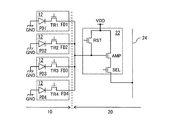
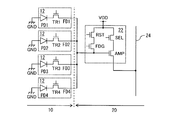
- 2 to 5 are diagrams showing an example of the sensor pixel 12 and the readout circuit 22.
- shared means that the outputs of the four sensor pixels 12 are input to the common readout circuit 22.
- the sharing unit does not matter the number of pixels.
- the output of one sensor pixel 12 may be input to one readout circuit 22.
- the outputs of the four sensor pixels 12 may be input to one readout circuit 22 as in the present example.
- each sensor pixel 12 has components common to each other.
- identification numbers 1, 2, 3, and 4 are added to the end of the reference numerals of the constituent elements of each sensor pixel 12.
- an identification number is given to the end of the reference numeral of the constituent element of each sensor pixel 12.
- the identification number at the end of the reference numeral of the constituent element of each sensor pixel 12 is omitted.
- Each sensor pixel 12 has, for example, a photodiode PD, a transfer transistor TR electrically connected to the photodiode PD, and a floating diffusion that temporarily holds the charge output from the photodiode PD via the transfer transistor TR. FD and.
- the photodiode PD corresponds to a specific but not limitative example of “photoelectric conversion element” of the present disclosure.
- the photodiode PD performs photoelectric conversion to generate electric charges according to the amount of received light.
- the cathode of the photodiode PD is electrically connected to the source of the transfer transistor TR, and the anode of the photodiode PD is electrically connected to a reference potential line such as a ground line (GND).
- the drain of the transfer transistor TR is electrically connected to the floating diffusion FD, and the gate of the transfer transistor TR is electrically connected to the pixel drive line 23 (see FIG. 1).
- the transfer transistor TR is, for example, a CMOS transistor.
- the floating diffusions FD of the sensor pixels 12 that share one readout circuit 22 are electrically connected to each other and also to the input end of the common readout circuit 22.
- the read circuit 22 has, for example, a reset transistor RST, a selection transistor SEL, and an amplification transistor AMP.
- the selection transistor SEL may be omitted if necessary.
- the source of the reset transistor RST, which is the input terminal of the read circuit 22, is electrically connected to the floating diffusion FD, and the drain of the reset transistor RST is electrically connected to the power supply line VDD and the drain of the amplification transistor AMP.
- the gate of the reset transistor RST is electrically connected to the pixel drive line 23 (see FIG. 1).
- the source of the amplification transistor AMP is electrically connected to the drain of the selection transistor SEL, and the gate of the amplification transistor AMP is electrically connected to the source of the reset transistor RST.
- the source of the selection transistor SEL which is the output terminal of the readout circuit 22, is electrically connected to the vertical signal line 24, and the gate of the selection transistor SEL is electrically connected to the pixel drive line 23 (see FIG. 1). ..
- the transfer transistor TR When the transfer transistor TR is turned on, the charge of the photodiode PD is transferred to the floating diffusion FD.
- the reset transistor RST resets the potential of the floating diffusion FD to a predetermined potential.
- the potential of the floating diffusion FD is reset to the potential of the power supply line VDD.
- the selection transistor SEL controls the output timing of the pixel signal from the readout circuit 22.
- the amplification transistor AMP generates, as a pixel signal, a signal having a voltage corresponding to the level of electric charges held in the floating diffusion FD.
- the amplification transistor AMP constitutes a source follower type amplifier, and outputs a pixel signal having a voltage corresponding to the level of the charge generated in the photodiode PD.
- the amplification transistor AMP When the selection transistor SEL is turned on, the amplification transistor AMP amplifies the potential of the floating diffusion FD and outputs a voltage corresponding to the potential to the column signal processing circuit 34 via the vertical signal line 24.
- the reset transistor RST, the amplification transistor AMP, and the selection transistor SEL are CMOS transistors, for example.
- the selection transistor SEL may be provided between the power supply line VDD and the amplification transistor AMP.
- the drain of the reset transistor RST is electrically connected to the power supply line VDD and the drain of the selection transistor SEL.
- the source of the selection transistor SEL is electrically connected to the drain of the amplification transistor AMP, and the gate of the selection transistor SEL is electrically connected to the pixel drive line 23 (see FIG. 1).
- the source of the amplification transistor AMP which is the output terminal of the read circuit 22, is electrically connected to the vertical signal line 24, and the gate of the amplification transistor AMP is electrically connected to the source of the reset transistor RST.
- the FD transfer transistor FDG may be provided between the source of the reset transistor RST and the gate of the amplification transistor AMP.
- the FD transfer transistor FDG is used when switching the conversion efficiency.
- the pixel signal is small when shooting in a dark place.
- the pixel signal becomes large. Therefore, if the FD capacitance C is not large, the floating diffusion FD cannot receive the charge of the photodiode PD.
- the FD capacitance C needs to be large so that the voltage V when converted by the amplification transistor AMP does not become too large. From these points of view, when the FD transfer transistor FDG is turned on, the gate capacitance for the FD transfer transistor FDG increases, so that the entire FD capacitance C increases. On the other hand, when the FD transfer transistor FDG is turned off, the entire FD capacitance C becomes small. In this way, by switching the FD transfer transistor FDG on/off, the FD capacitance C can be made variable and the conversion efficiency can be switched.
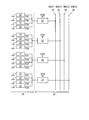
- FIG. 6 is a diagram showing an example of a connection mode of the plurality of read circuits 22 and the plurality of vertical signal lines 24.
- the plurality of vertical signal lines 24 may be assigned to each of the read circuits 22 one by one. ..
- the four vertical signal lines 24 are assigned to each read circuit 22 one by one. It may be.
- identification numbers 1, 2, 3, and 4 are given to the end of the reference numerals of each vertical signal line 24.
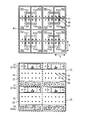
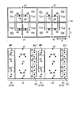
- FIGS. 7 and 8 are diagrams showing an example of a horizontal cross-sectional configuration of the solid-state imaging device 1.
- the upper diagrams of FIGS. 7 and 8 are diagrams showing an example of a cross-sectional configuration in the horizontal direction of the first substrate 10 of FIG. 1.
- the lower diagrams of FIGS. 7 and 8 are diagrams illustrating an example of a cross-sectional configuration in the horizontal direction of the second substrate 20 of FIG. 1.
- FIG. 7 illustrates a configuration in which two sets of four 2 ⁇ 2 sensor pixels 12 are arranged in the second direction H
- FIG. 8 illustrates four sets of four 2 ⁇ 2 sensor pixels 12, A configuration in which they are arranged in the first direction V and the second direction H is illustrated.
- FIGS. 7 and 8 a diagram showing an example of the surface configuration of the semiconductor substrate 11 is superimposed on a diagram showing an example of the cross-sectional configuration of the first substrate 10 in FIG. 1 in the horizontal direction. .. Further, in the lower sectional views of FIGS. 7 and 8, a diagram showing an example of the surface configuration of the semiconductor substrate 21 is superimposed on a diagram showing an example of the sectional configuration of the second substrate 20 in the horizontal direction of FIG. There is.
- the plurality of through-wirings 54, the plurality of through-wirings 48, and the plurality of through-wirings 47 are the first direction V which is the vertical direction in FIG. Alternatively, they are arranged side by side in a strip shape in the second direction H, which is the left-right direction in FIG. 7 and 8, a plurality of through wirings 54, a plurality of through wirings 48 and a plurality of through wirings 47 are arranged in two rows in the first direction V or the second direction H by way of example. Has been done.
- the first direction V or the second direction H is parallel to, for example, a column direction that is one of the two arrangement directions of the plurality of sensor pixels 12 arranged in a matrix, which are the row direction and the column direction. ing.
- the four floating diffusions FD are arranged close to each other, for example, via the pixel separation unit 43.
- the gate electrodes TG of the four transfer transistors TR are arranged so as to surround the four floating diffusions FD.
- the four gate electrodes TG form a ring shape. Is becoming
- the insulating layer 53 existing in the portion of the semiconductor substrate 21 through which the plurality of through wirings 54 penetrate is composed of a plurality of blocks extending in the first direction V or the second direction H.
- the semiconductor substrate 21 extends in the first direction V or the second direction H, and has a plurality of island shapes arranged side by side in the first direction V or the second direction H which are orthogonal to each other via the insulating layer 53. It is composed of a block 21A.
- Each block 21A is provided with, for example, a plurality of sets of reset transistors RST, amplification transistors AMP, and selection transistors SEL.
- the one readout circuit 22 shared by the four sensor pixels 12 is composed of, for example, a reset transistor RST, an amplification transistor AMP, and a selection transistor SEL in a region facing the four sensor pixels 12.
- One read circuit 22 shared by the four sensor pixels 12 includes, for example, an amplification transistor AMP in a block 21A on the left side of the insulating layer 53 and a reset transistor RST in a block 21A on the right side of the insulating layer 53. And a selection transistor SEL.
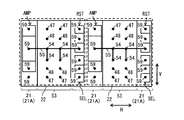
- 9 to 12 are diagrams showing an example of a wiring layout in the horizontal plane of the solid-state imaging device 1.
- 9 to 12 exemplify a case where one readout circuit 22 shared by the four sensor pixels 12 is provided in a region facing the four sensor pixels 12.
- the wirings shown in FIGS. 9 to 12 are provided, for example, in different wiring layers (not shown) provided on the pixel transistor described above.
- the wiring layer is, for example, a plurality of pixel drive lines 23 and a plurality of vertical signal lines 24, a pad electrode (not shown) exposed on the surface of the wiring layer and used for electrical connection between the second substrate 20 and the third substrate 30. have.
- the four penetrating wirings 54 adjacent to each other are electrically connected to the connecting wiring 55, for example, as shown in FIG.
- the four penetrating wirings 54 adjacent to each other are further connected to the gate of the amplification transistor AMP included in the left adjacent block 21A of the insulating layer 53 and the right adjacent block of the insulating layer 53, for example, via the connection wiring 55 and the connection portion 59. It is electrically connected to the gate of the reset transistor RST included in 21A.
- the power supply line VDD is arranged at a position facing each read circuit 22 arranged side by side in the second direction H, as shown in FIG. 10, for example.
- the power supply line VDD is electrically connected to the drain of the amplification transistor AMP and the drain of the reset transistor RST of the read circuits 22 arranged side by side in the second direction H, for example, via the connection portion 59.
- the two pixel drive lines 23 are arranged at positions facing the respective readout circuits 22 arranged side by side in the second direction H.
- One pixel drive line 23 is, for example, a wiring RSTG electrically connected to the gate of the reset transistor RST of each readout circuit 22 arranged side by side in the second direction H.
- the other pixel drive line 23 is, for example, a wiring SELG electrically connected to the gate of the selection transistor SEL of each readout circuit 22 arranged side by side in the second direction H.
- the source of the amplification transistor AMP and the drain of the selection transistor SEL are electrically connected to each other, for example, via the wiring 25.
- the two power supply lines VSS are arranged, for example, at positions facing the respective read circuits 22 arranged side by side in the second direction H.
- Each power supply line VSS is electrically connected to the plurality of through wirings 47, for example, at a position facing each sensor pixel 12 arranged side by side in the second direction H.
- the four pixel drive lines 23 are arranged at positions facing the respective readout circuits 22 arranged side by side in the second direction H.
- Each of the four pixel drive lines 23 is electrically connected to the through wiring 48 of one of the four sensor pixels 12 corresponding to the readout circuits 22 arranged in the second direction H, for example.
- the wiring TRG connected to.
- the four pixel drive lines 23 functioning as control lines are electrically connected to the gate electrodes TG of the transfer transistors TR of the sensor pixels 12 arranged in the second direction H.
- identifiers 1, 2, 3, 4 are added to the end of each wiring TRG.
- the vertical signal line 24 is arranged, for example, at a position facing the read circuits 22 arranged side by side in the first direction V.
- the vertical signal line 24 that functions as an output line is electrically connected to, for example, the source of the amplification transistor AMP, which is the output terminal of each read circuit 22 arranged side by side in the first direction V.
- FIGS. 13 and 14 are diagrams showing a modification of the horizontal sectional configuration of the solid-state imaging device 1.
- the upper drawings of FIGS. 13 and 14 are modifications of the horizontal cross-sectional configuration of the first substrate 10 of FIG. 1, and the lower drawings of FIG. 13 are the horizontal direction of the second substrate 20 of FIG. 5 is a modification of the cross-sectional configuration in FIG.
- a modified example of the surface configuration of the semiconductor substrate 11 of FIG. 1 is shown in a diagram showing a modified example of the sectional configuration of the first substrate 10 in the horizontal direction of FIG.
- the representations are overlaid.
- a diagram showing a modified example of the sectional configuration of the second substrate 20 in the horizontal direction of FIG. 1 and a diagram showing a modified example of the surface configuration of the semiconductor substrate 21. Are overlaid.
- the plurality of through wirings 54, the plurality of through wirings 48, and the plurality of through wirings 47 which are shown as a plurality of dots arranged in a matrix in the drawings, are formed on the first substrate 10. 13A and 13B, the strips are arranged side by side in the first direction H, which is the left-right direction in FIGS. 13 and 14 exemplify a case where the plurality of through wirings 54, the plurality of through wirings 48, and the plurality of through wirings 47 are arranged side by side in two rows in the second direction H.
- the four floating diffusions FD are arranged close to each other, for example, via the pixel separation unit 43.
- the four transfer gates TG1, TG2, TG3, and TG4 are arranged so as to surround the four floating diffusions FD.
- the four transfer gates TG form a ring. It has a shape.
- the insulating layer 53 is composed of a plurality of blocks extending in the second direction H.
- the semiconductor substrate 21 includes a plurality of island-shaped blocks 21A extending in the second direction H and arranged side by side in the first direction V orthogonal to the second direction H with the insulating layer 53 interposed therebetween. ..
- Each block 21A is provided with, for example, a reset transistor RST, an amplification transistor AMP, and a selection transistor SEL.
- the one readout circuit 22 shared by the four sensor pixels 12 is, for example, not arranged so as to face the four sensor pixels 12 but is displaced in the first direction V.
- one read circuit 22 shared by four sensor pixels 12 is a reset transistor in a region of the second substrate 20 facing the four sensor pixels 12 in the first direction V. It is composed of an RST, an amplification transistor AMP, and a selection transistor SEL.
- One readout circuit 22 shared by the four sensor pixels 12 is configured by, for example, the amplification transistor AMP, the reset transistor RST, and the selection transistor SEL in one block 21A.
- one read circuit 22 shared by four sensor pixels 12 is a reset transistor in a region of the second substrate 20 which is opposed to the four sensor pixels 12 in the first direction V.
- One readout circuit 22 shared by the four sensor pixels 12 is configured by, for example, the amplification transistor AMP, the reset transistor RST, the selection transistor SEL, and the FD transfer transistor FDG in one block 21A.
- the one readout circuit 22 shared by the four sensor pixels 12 is not arranged, for example, so as to face the four sensor pixels 12 first, but from the position directly facing the four sensor pixels 12. They are arranged so as to be displaced in the direction V.
- the wiring 25 (see FIG. 10) can be shortened, or the wiring 25 can be omitted and the source of the amplification transistor AMP and the drain of the selection transistor SEL can be formed in a common impurity region. It can also be configured. As a result, it is possible to reduce the size of the read circuit 22 and increase the size of other parts in the read circuit 22.
- FIG. 15 is a diagram showing a modification of the horizontal sectional configuration of the solid-state imaging device 1.
- FIG. 15 shows a modification of the sectional configuration of FIG. 7.
- the semiconductor substrate 21 is composed of a plurality of island-shaped blocks 21A arranged side by side in the first direction V and the second direction H with the insulating layer 53 interposed therebetween.
- Each block 21A is provided with, for example, a set of a reset transistor RST, an amplification transistor AMP, and a selection transistor SEL.
- RST reset transistor
- AMP amplification transistor
- SEL selection transistor
- FIG. 16 is a diagram showing a modification of the horizontal sectional configuration of the solid-state imaging device 1.
- FIG. 16 shows a modification of the sectional configuration of FIG.
- one read circuit 22 shared by the four sensor pixels 12 is not arranged, for example, directly facing the four sensor pixels 12, but is arranged in the first direction V with a shift.
- the semiconductor substrate 21 is composed of a plurality of island-shaped blocks 21A arranged side by side in the first direction V and the second direction H with the insulating layer 53 interposed therebetween. There is.
- Each block 21A is provided with, for example, a set of a reset transistor RST, an amplification transistor AMP, and a selection transistor SEL.
- the plurality of through wirings 47 and the plurality of through wirings 54 are also arranged in the second direction H.
- the plurality of through wirings 47 share four through wirings 54 that share a certain read circuit 22 and four through wirings that share another read circuit 22 adjacent to the read circuit 22 in the second direction H. 54 and 54.
- the crosstalk between the read circuits 22 adjacent to each other can be suppressed by the insulating layer 53 and the through wiring 47, and the deterioration of the resolution on the reproduced image and the deterioration of the image quality due to color mixture can be suppressed.
- FIG. 17 is a diagram showing an example of a horizontal cross-sectional configuration of the solid-state imaging device 1 described above.
- FIG. 17 shows a modification of the sectional configuration of FIG.
- the first substrate 10 has the photodiode PD and the transfer transistor TR for each sensor pixel 12, and the floating diffusion FD is shared by each of the four sensor pixels 12. Therefore, in this modification, one through wiring 54 is provided for each of the four sensor pixels 12.
- the unit area corresponding to four sensor pixels 12 sharing one floating diffusion FD can be obtained by shifting one sensor pixel 12 in the first direction V.
- the four sensor pixels 12 corresponding to the area will be referred to as four sensor pixels 12A.
- the first substrate 10 shares the through wiring 47 for each of the four sensor pixels 12A. Therefore, in this modification, one through wiring 47 is provided for each of the four sensor pixels 12A.
- the first substrate 10 has a pixel separation unit 43 that separates the photodiode PD and the transfer transistor TR for each sensor pixel 12.
- the pixel separating unit 43 does not completely surround the sensor pixel 12 when viewed from the normal line direction of the semiconductor substrate 11, and is provided near the through wiring 54 connected to the floating diffusion FD and near the through wiring 47. It has a gap that is an unformed region. The gap allows the four sensor pixels 12 to share one through wiring 54 and the four sensor pixels 12A to share one through wiring 47.
- the second substrate 20 has the readout circuit 22 for each of the four sensor pixels 12 that share the floating diffusion FD.
- FIG. 18 is a diagram showing an example of a horizontal sectional configuration of the solid-state imaging device 1 according to the present modification.
- FIG. 18 shows a modification of the sectional configuration of FIG.
- the first substrate 10 has the photodiode PD and the transfer transistor TR for each sensor pixel 12, and the floating diffusion FD is shared by each of the four sensor pixels 12. Further, the first substrate 10 has a pixel separation section 43 that separates the photodiode PD and the transfer transistor TR for each sensor pixel 12.
- FIG. 19 is a diagram showing an example of a horizontal sectional configuration of the solid-state imaging device 1 according to the present modification.
- FIG. 19 shows a modification of the sectional configuration of FIG.
- the first substrate 10 has the photodiode PD and the transfer transistor TR for each sensor pixel 12, and the floating diffusion FD is shared by each of the four sensor pixels 12. Further, the first substrate 10 has a pixel separation section 43 that separates the photodiode PD and the transfer transistor TR for each sensor pixel 12.
- FIG. 20 is a diagram showing an example of a circuit configuration of the solid-state image sensor 1 according to the modification.
- the solid-state image sensor 1 according to the present modification is a CMOS image sensor equipped with a column parallel ADC.
- a vertical drive circuit 33 in addition to the pixel region 13 in which a plurality of sensor pixels 12 including photoelectric conversion elements are two-dimensionally arranged in a matrix, a vertical drive circuit 33, It has a configuration including a column signal processing circuit 34, a reference voltage supply unit 38, a horizontal drive circuit 35, a horizontal output line 37, and a system control circuit 36.
- the system control circuit 36 uses the master clock MCK as a reference clock signal for operations of the vertical drive circuit 33, the column signal processing circuit 34, the reference voltage supply section 38, the horizontal drive circuit 35, and the like.
- a control signal or the like is generated and given to the vertical drive circuit 33, the column signal processing circuit 34, the reference voltage supply unit 38, the horizontal drive circuit 35, and the like.
- the vertical drive circuit 33 is also formed on the first substrate 10 together with each sensor pixel 12 in the pixel region 13, and is also formed on the second substrate 20 on which the readout circuit 22 is formed.
- the column signal processing circuit 34, the reference voltage supply unit 38, the horizontal drive circuit 35, the horizontal output line 37, and the system control circuit 36 are formed on the third substrate 30.
- the read circuit 22 includes, for example, a reset transistor RST that controls the potential of the floating diffusion FD, an amplification transistor AMP that outputs a signal corresponding to the potential of the floating diffusion FD, and a pixel selection.
- a three-transistor configuration having a selection transistor SEL for performing the above can be used.
- the sensor pixels 12 are two-dimensionally arranged, and the pixel drive lines 23 are arranged in each row and the vertical signal lines 24 are arranged in each column with respect to the pixel arrangement of m rows and n columns. There is.
- One end of each of the plurality of pixel drive lines 23 is connected to each output end corresponding to each row of the vertical drive circuit 33.
- the vertical drive circuit 33 is configured by a shift register or the like, and controls the row address and the row scan of the pixel region 13 via the plurality of pixel drive lines 23.
- the column signal processing circuit 34 has, for example, ADCs (analog-digital conversion circuits) 34-1 to 34-m provided for each pixel column of the pixel region 13, that is, for each vertical signal line 24, and the pixel region 13 is provided.
- ADCs analog-digital conversion circuits
- the reference voltage supply unit 38 has, for example, a DAC (digital-analog conversion circuit) 38A as a method of generating a reference voltage Vref having a so-called ramp (RAMP) waveform, the level of which changes in an inclined manner as time passes. There is.
- the method of generating the reference voltage Vref having the ramp waveform is not limited to the DAC 38A.
- the DAC 38A under the control of the control signal CS1 given from the system control circuit 36, generates the ramp waveform reference voltage Vref based on the clock CK given from the system control circuit 36 to generate the ADC 34-1 of the column processing unit 15. Supply to ⁇ 34-m.
- each of the ADCs 34-1 to 34-m has an exposure time of 1/N of the sensor pixel 12 as compared with the normal frame rate mode in the progressive scanning method for reading out all the information of the sensor pixel 12 and the normal frame rate mode. Is set so that the AD conversion operation corresponding to each operation mode such as the high-speed frame rate mode for increasing the frame rate N times, for example, twice, can be selectively performed.
- the switching of the operation mode is executed by the control by the control signals CS2 and CS3 provided from the system control circuit 36. Further, the system control circuit 36 is provided with instruction information for switching between the normal frame rate mode and each operation mode of the high speed frame rate mode from an external system controller (not shown).
- the ADCs 34-1 to 34-m have the same configuration, and the ADC 34-m will be described as an example here.
- the ADC 34-m is configured to include a comparator 34A, a counting unit such as an up/down counter (U/DCNT) 34B, a transfer switch 34C, and a memory device 34D.
- the comparator 34A includes a signal voltage Vx of the vertical signal line 24 corresponding to a signal output from each sensor pixel 12 in the nth column of the pixel region 13 and a reference voltage Vref of a ramp waveform supplied from the reference voltage supply unit 38. And the output voltage Vco becomes “H” level when the reference voltage Vref becomes higher than the signal voltage Vx, and the output voltage Vco becomes “L” level when the reference voltage Vref is equal to or lower than the signal voltage Vx. ..
- the up/down counter 34B is an asynchronous counter, and under the control of the control signal CS2 given from the system control circuit 36, the clock CK is given from the system control circuit 36 at the same time as the DAC 18A, and is down in synchronization with the clock CK ( By performing the DOWN) count or the UP (UP) count, the comparison period from the start of the comparison operation in the comparator 34A to the end of the comparison operation is measured.
- the comparison time at the first read time is measured by counting down during the first read operation, and the second read operation is performed.
- the comparison time at the second read is measured by counting up during the read operation.
- the count result for the sensor pixel 12 in a certain row is held as it is, and then the sensor pixel 12 in the next row is down-counted at the first read operation from the previous count result.
- the comparison time at the time of the first read is measured, and by counting up at the time of the second read operation, the comparison time at the time of the second read is measured.
- the transfer switch 34C is turned on when the count operation of the up/down counter 34B for the sensor pixel 12 in a certain row is completed in the normal frame rate mode ( In the closed state, the count result of the up/down counter 34B is transferred to the memory device 34D.
- the analog signal supplied from each sensor pixel 12 in the pixel region 13 via the vertical signal line 24 for each column is supplied to the comparator 34A and the up/down counter 34B in the ADCs 34-1 to 34-m. By each operation, it is converted into an N-bit digital signal and stored in the memory device 34D.
- the horizontal drive circuit 35 is composed of a shift register or the like, and controls the column address and column scan of the ADCs 34-1 to 34-m in the column signal processing circuit 34. Under the control of the horizontal drive circuit 35, the N-bit digital signal AD-converted by each of the ADCs 34-1 to 34-m is sequentially read out to the horizontal output line 37, and passes through the horizontal output line 37. It is output as imaging data.
- a circuit or the like for performing various kinds of signal processing on the imaging data output via the horizontal output line 37 may be provided in addition to the above-described constituent elements. Is.
- the count result of the up/down counter 34B can be selectively transferred to the memory device 34D via the transfer switch 34C. It is possible to independently control the count operation of the /down counter 34B and the read operation of the count result of the up/down counter 34B to the horizontal output line 37.
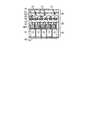
- FIG. 21 shows an example in which the solid-state imaging device 1 of FIG. 20 is configured by laminating three substrates of a first substrate 10, a second substrate 20, and a third substrate 30.
- a pixel region 13 including a plurality of sensor pixels 12 is formed in the central portion of the first substrate 10, and a vertical drive circuit 33 is formed around the pixel region 13.
- a read circuit area 15 including a plurality of read circuits 22 is formed in the central portion, and a vertical drive circuit 33 is formed around the read circuit area 15.
- the column signal processing circuit 34, the horizontal drive circuit 35, the system control circuit 36, the horizontal output line 37, and the reference voltage supply unit 38 are formed on the third substrate 30.
- the vertical drive circuit 33 may be formed only on the first substrate 10 or only on the second substrate 20.
- FIG. 22 shows a modification of the cross-sectional configuration of the solid-state imaging device 1 according to this modification.
- the solid-state imaging device 1 is configured by stacking three substrates of the first substrate 10, the second substrate 20, and the third substrate 30.
- the solid-state imaging device 1 may be configured by stacking two substrates, the first substrate 10 and the second substrate 20.
- the logic circuit 32 is formed separately on the first substrate 10 and the second substrate 20, as shown in FIG. 22, for example.
- a high dielectric constant film made of a material (for example, high-k) that can withstand a high temperature process and a metal gate electrode are laminated.
- a transistor having a gate structure is provided.
- CoSi 2 or NiSi formed using a self-aligned silicide (SALICIDE) process on the surface of the impurity diffusion region in contact with the source electrode and the drain electrode.
- SALICIDE self-aligned silicide
- a low resistance region made of silicide or the like is formed. The low resistance region made of silicide is thus formed of the compound of the material of the semiconductor substrate and the metal.
- FIG. 23 shows a modification of the cross-sectional structure of the solid-state imaging device 1 according to the structure of FIG. 1 and its modification.
- a self-aligned silicide (SALICIDE) process is formed on the surface of the impurity diffusion region in contact with the source electrode and the drain electrode.
- the low resistance region 37 made of silicide such as CoSi 2 or NiSi may be formed. This allows a high temperature process such as thermal oxidation to be used when forming the sensor pixel 12.
- the contact resistance can be reduced. As a result, the calculation speed in the logic circuit 32 can be increased.
- FIG. 24 is a diagram showing a part of the cross section of the solid-state imaging device 100 according to the first embodiment of the present disclosure.
- the solid-state imaging device 100 has a structure in which a laminated body 200, a laminated body 300, and a laminated body 400 are bonded together.
- a surface 230 shown in FIG. 24 is a surface on which the laminated body 200 and the laminated body 300 are bonded together.
- a surface 340 shown in FIG. 24 is a surface on which the laminated body 300 and the laminated body 400 are attached.
- a color filter 211 is arranged below the stacked bodies 200 to 400, that is, at the lower end of the stacked body 200.
- An on-chip lens 212 is arranged below the color filter 211.
- the on-chip lens 212 collects the emitted light.
- the condensed light is guided to the photoelectric conversion element 203 included in the stacked body 200 via the color filter 211.
- the stacked body 200 has a structure in which a plurality of films that form transistors and the like are stacked on a substrate 201.
- the substrate 201 is a semiconductor substrate such as an N-type silicon substrate.
- a P-type semiconductor region 202 (P well) is formed on the substrate 200.
- An N-type semiconductor region is formed in the semiconductor region 202, whereby a photoelectric conversion element 203 such as a photodiode having a PN junction is formed.
- the photoelectric conversion element 203 converts the received light into an electric signal according to the received light amount by photoelectric conversion.
- a HAD (Hole Accumulation Diode) 204 which is a P + type semiconductor region, is formed above the photoelectric conversion element 203.
- the HAD 204 functions as a hole storage layer and suppresses dark current generated from the surface of the photoelectric conversion element 203, which is an N-type photodiode.
- the N-type transfer transistor 220 is arranged on the substrate 201.
- the transfer transistor 220 includes a floating diffusion (FD) 221 which is an N type source region.
- the transfer transistor 220 transfers the electric signal output from the photoelectric conversion element 203 to the pixel transistor.
- the FD 221 temporarily holds the electric signal output from the photoelectric conversion element 203.
- the transfer transistor 220 including the FD 221 and the HAD 204 are covered with an insulating film 250.
- the laminated body 300 has a structure in which a plurality of films forming transistors and the like are laminated on a substrate 301.
- the substrate 301 is a semiconductor substrate such as a P-type silicon substrate.
- the stacked body 300 is turned upside down and is laminated on the insulating film 250 of the stacked body 200.
- pixel transistors such as an N-type amplification transistor 310, an N-type reset transistor 320, and an N-type selection transistor (not shown) are arranged. ..
- the pixel transistor performs a process of reading an electric signal according to the amount of light received by the photoelectric conversion element 203.
- a wiring 313d is connected to the gate electrode 313 of the amplification transistor 310.
- the wiring 313d is connected to the source region 321 of the reset transistor 320.
- the wiring 313d is connected to the FD 221 of the transfer transistor 320 via the contact 221c.
- the pixel transistors such as the amplification transistor 310 and the reset transistor 320 are covered with the insulating film 350. That is, the insulating film 250 and the insulating film 350 are bonded to each other on the surface 230 where the stacked body 200 and the stacked body 300 are attached to each other.
- Wirings D1 to D4 are formed in four layers on the lower surface of the substrate 301, that is, on the side opposite to the side on which the pixel transistors are arranged.
- the wiring D1 is a wiring formed in the lowermost layer of the first layer.
- the wiring D4 is a wiring formed in the uppermost layer of the fourth layer. Note that the number of wiring layers is not limited to four, and can be arbitrarily changed according to design conditions and the like.
- the wirings D1 to D4 are covered with the insulating film 360.
- the laminated body 400 has a structure in which a plurality of films forming transistors and the like are laminated on a substrate 401.
- the substrate 401 is a semiconductor substrate such as a silicon substrate.
- the stacked body 400 is turned upside down and bonded onto the wiring D4 of the stacked body 300. In the example of FIG. 24, the junction point 402 between the wiring D4 and the wiring of the stacked body 400 overlaps the pixel area in which the pixel is arranged.
- a plurality of logic transistors Tr arranged on the substrate 401, that is, on the side of the substrate 401 facing the substrate 301 is connected to the wiring of the stacked body 400.
- the wiring of the stacked body 400 and the logic transistor Tr are covered with the insulating film 450.
- a logic circuit is configured by the wiring of the stacked body 400 and the logic transistor Tr.
- the logic circuit corresponds to a peripheral circuit of the solid-state image sensor 100 that processes an electric signal or the like generated by the photoelectric conversion element 203.
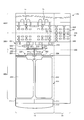
- FIG. 25 is a schematic diagram illustrating the vicinity of the bonding position of the stacked bodies 200 and 300 of the solid-state imaging device 100 according to the first embodiment of the present disclosure.
- 25A is a top view of the laminated body 300 on the side where the pixel transistors are formed
- FIGS. 25B to 25D are cross-sectional views showing the vicinity of the bonding positions of the laminated bodies 200 and 300
- FIG. 25A is a top view of the laminated body 300 on the side where the pixel transistors are formed
- FIGS. 25B to 25D are cross-sectional views showing the vicinity of the bonding positions of the laminated bodies 200 and 300
- the solid-state imaging device 100 includes a substrate 201 as a first semiconductor substrate having an FD 221 that temporarily holds an electric signal output from the photoelectric conversion element 203.
- the HAD 204 is arranged on the photoelectric conversion element 203.
- a contact 204c connected to the upper layer wiring is connected to the HAD 204.
- the contact 204c is grounded through the upper wiring to fix the substrate potential of the substrate 201 to 0V.
- the FD 221 is a source region of the transfer transistor 220.
- the transfer transistor 220 includes a gate insulating film 224 arranged on the substrate 201 and a gate electrode 223 arranged on the gate insulating film 224.
- a contact 223c connected to the upper wiring is connected to the gate electrode 223.
- the contact 223c is connected to the peripheral circuit including the logic transistor Tr via the upper layer wiring and the wiring of the stacked body 400.
- the transfer transistor 220 transfers the electric signal output from the photoelectric conversion element 203 to the amplification transistor 310.
- the solid-state imaging device 100 includes a substrate 301 as a second semiconductor substrate facing the substrate 201.
- the substrate 301 includes the amplification transistor 310 as the first transistor on the side facing the substrate 201.
- the amplification transistor 310 includes a channel 315 extending in the thickness direction of the substrate 301 and a gate electrode 313 as a multi-gate extending in the thickness direction of the substrate 301 and sandwiching the channel 315.
- the channel 315 is composed of a part of the substrate 301, and becomes a current path between a source region 311 and a drain region 312, which will be described later, when a voltage is applied to the gate electrode 313.
- a gate insulating film 314 is interposed between the channel 315 and the gate electrode 313.
- the amplification transistor 310 is configured as, for example, a tri-gate transistor in which the gate electrode 313 is connected to the channel 315 via the gate insulating film 314 on three surfaces.
- the amplification transistor 310 amplifies and outputs the electric signal transferred from the photoelectric conversion element 203 by the transfer transistor 220.
- the substrate 301 includes a reset transistor 320 as a second transistor including a source region 322 on the side facing the substrate 201.
- the reset transistor 320 includes a channel 325 extending in the thickness direction of the substrate 301 and a gate electrode 323 as a multi-gate extending in the thickness direction of the substrate 301 and sandwiching the channel 325.
- the channel 325 is composed of a part of the substrate 301, and when a voltage is applied to the gate electrode 313, it becomes a current path between a source region 321 and a drain region 322, which will be described later.
- a gate insulating film 324 is interposed between the channel 325 and the gate electrode 323.
- the reset transistor 320 is configured as, for example, a tri-gate transistor in which the gate electrode 323 is connected to the channel 325 via the gate insulating film 324 on three surfaces.
- the reset transistor 320 resets (initializes) the potential of the gate electrode 313 of the amplification transistor 310 to the power source potential.
- the reset transistor 320 is also a transistor that resets the potential of the FD 221.
- the gate electrode 323 of the reset transistor 320 is connected to the wirings D1 to D4 as signal lines for transmitting electric signals from the surface side of the substrate 301 opposite to the surface facing the substrate 201. Specifically, the gate electrode 323 is connected to the wirings D1 to D4 via the contact 323c. The wirings D1 to D4 are connected to a peripheral circuit including the logic transistor Tr via the wiring of the stacked body 400 and exchange electric signals.
- the substrate 301 includes a selection transistor 330 on the side facing the substrate 201.
- the selection transistor 330 includes a channel 335 extending in the thickness direction of the substrate 301 and a gate electrode 333 as a multi-gate extending in the thickness direction of the substrate 301 and sandwiching the channel 335.
- the channel 335 is composed of a part of the substrate 301, and when a voltage is applied to the gate electrode 313, it becomes a current path between a source region 331 and a drain region 332.
- a gate insulating film 334 is interposed between the channel 335 and the gate electrode 333.
- the selection transistor 330 is configured as, for example, a tri-gate transistor in which the gate electrode 333 is connected to the channel 335 via the gate insulating film 334 on three surfaces. Since the selection transistor 330 processes the electric signal amplified by the amplification transistor 310, it selects whether or not to transmit the electric signal to the wirings D1 to D4 in the upper layer.
- the gate electrode 313 of the amplification transistor 310 and the gate electrode 333 of the selection transistor 330 are arranged in parallel.
- the gate electrode 333 of the selection transistor 330 and the gate electrode 323 of the reset transistor 320 are arranged so as to be orthogonal to each other.
- the gate electrode 313 of the amplification transistor 310 is connected to the FD 221.
- the solid-state imaging device 100 includes a contact 221c that connects the facing surfaces of the gate electrode 313 and the FD 221. That is, in the example of FIG. 25, of the gate electrodes 313 extending toward the substrate 201 in the thickness direction of the substrate 301, the surface closest to the substrate 201 and the substrate 201 of the FD 221 arranged on the surface layer of the substrate 201. Is connected to the outermost surface by a contact 221c such as polysilicon. In other words, the contact 221c connects the gate electrode 313 and the FD 221 with the shortest distance.
- the gate electrode 313 of the amplification transistor 310 is connected to the source region 321 of the reset transistor 320. Specifically, the gate electrode 313 of the amplification transistor 310 extends in the direction of the reset transistor 320 to form the wiring 313d. The gate electrode 313 of the amplification transistor 310 and the source region 321 of the reset transistor 320 are connected by a wiring 313d.
- the substrate 301 includes source regions 311 and 331 that reach from one surface side of the substrate 301 to the other surface side, and from one surface side of the substrate 301 to the other surface side. Drain regions 312, 322, 333 reaching The source region 311 and the drain region 312 have an N-type conductivity type with an impurity concentration of, for example, 1 ⁇ 10 18 cm ⁇ 3 or more, and are included in the amplification transistor 310.
- the source region 331 and the drain region 332 have an N-type conductivity type with an impurity concentration of, for example, 1 ⁇ 10 18 cm ⁇ 3 or more, and are included in the selection transistor 330.
- the drain region 332 of the selection transistor 330 is connected to the source region 311 of the amplification transistor 310.
- the drain region 322 has an N type conductivity type with an impurity concentration of, for example, 1 ⁇ 10 18 cm ⁇ 3 or more, and is included in the reset transistor 320.
- the source region 321 of the reset transistor 320 also has an N-type conductivity.
- the source region 321 of the reset transistor 320 is formed only on the surface layer portion of the substrate 301 on the side facing the substrate 201, and does not reach the surface on the opposite side of the substrate 301.
- a region from the FD 221 to the source region 321 of the reset transistor 320 via the contact 221c, the gate electrode 313 of the amplification transistor 310, and the wiring 313d is an FD region functioning as a floating diffusion.
- the source region 321 is formed smaller than the others so as to prevent the FD capacitance from increasing.
- the source regions 311 and 331 are connected to wirings D1 to D4 as signal lines for transmitting electric signals from the surface side of the substrate 301 opposite to the surface facing the substrate 201. Specifically, the source region 311 is connected to the wirings D1 to D4 via the contact 311c. The source region 331 is connected to the wirings D1 to D4 via the contact 331c. The wirings D1 to D4 are connected to a peripheral circuit including the logic transistor Tr via the wiring of the stacked body 400 and exchange electric signals.
- the drain regions 312, 322, 333 are connected to the power supply potential from the surface side of the substrate 301 opposite to the surface facing the substrate 201.
- the drain region 312 is connected to the wirings D1 to D4 via the contact 312c.
- the drain region 322 is connected to the wirings D1 to D4 via the contact 322c.
- the drain region 332 is connected to the wirings D1 to D4 via the contact 332c.
- the wirings D1 to D4 are connected to the power supply potential.
- the pixel transistor arranged on the substrate 301 is configured as a tri-gate transistor, for example.
- the configuration of the tri-gate transistor will be described in more detail with reference to FIG. 26 by taking the amplification transistor 310 as an example.
- the reset transistor 320 and the selection transistor 330 are also configured similarly to the amplification transistor 310 described below.
- FIG. 26 is a schematic diagram showing a configuration of the amplification transistor 310 according to the first embodiment of the present disclosure.
- 26A is an exploded perspective view of the amplification transistor 310
- FIG. 26B is a perspective view of the amplification transistor 310.
- the source region 311, the drain region 312, and the channel 314 sandwiched between them are formed in an upright plate shape along the stacking direction SD of the stacked body 300.
- the gate insulating film 314 is, for example, a High-k material such as Al 2 O 3 , TiO 2 , Ta 2 O 5 , HfO 2 , HfSiON, HfSiO 4 , ZrO 2 , ZrSiO 4 , La 2 O 3 , Y 2 O 3 or the like. Composed of.
- the gate insulating film 314 is covered with the gate electrode 313.
- the gate electrode 313 is made of, for example, polysilicon.
- the amplification transistor 313 may be a metal gate transistor whose gate electrode 313 is made of a metal-based material such as TaCx, W, WNx, or TiN.
- the gate width is the sum of the width of the plate-shaped channel (plate thickness) and the height ⁇ 2.
- the amplification transistor 310 has the N-type source region 311, the N-type drain region 312, and the P-type channel 315 sandwiched between these regions. Then, the insulating film 360 is arranged immediately below the body of the NPN structure of the amplification transistor 310. That is, the amplification transistor 310 has a fully depleted silicon-on-insulator (FD-SOI) structure.
- FD-SOI fully depleted silicon-on-insulator
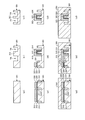
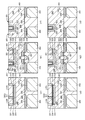
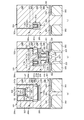
- FIGS. 27 to 31 are flowcharts showing an example of the procedure of the manufacturing process of the solid-state imaging device 100 according to the first embodiment of the present disclosure.
- 27 to 31 are sectional views taken along the line AA′ of FIG. 25A in the manufacturing process of the solid-state imaging device 100.
- 27 to 31 are sectional views taken along the line BB′ of FIG. 25A in the manufacturing process of the solid-state imaging device 100.
- the right views of FIGS. 27 to 31 are sectional views taken along the line CC′ of FIG. 25A in the manufacturing process of the solid-state imaging device 100.
- a substrate 301 such as a P-type silicon substrate is subjected to element isolation, and then trenches TR are formed to form channels 315 and 325. Although not shown, the channel 335 is also formed at this time.
- gate insulating films 314, 324, 334 are formed so as to cover the channels 315, 325, 335. Further, gate electrodes 313, 323, 333 are formed so as to cover the gate insulating films 314, 324, 334.
- the N-type source regions 311, 321, 331 and the N-type drain regions 312, 322 are formed on the substrate 301 on both sides of the gate electrodes 313, 323, 333 so that the impurity concentration is 1 ⁇ 10 18 cm ⁇ 3 or more. , 332 are formed.
- the source regions 311, 331 and the drain regions 312, 322, 332 are formed to the depth of the trench TR.
- the source region 321 is formed shallower than the other source regions 311 and 331.
- the wiring 313d connecting the gate electrode 313 and the source region 321 is formed while the insulating film 350 covering each component is laminated on the substrate 301. ..
- the insulating film 350 is stacked until the entire structure including the wiring 313d is filled.
- a P-type semiconductor region 202 is formed on a substrate 201 such as an N-type silicon substrate, and a photoelectric conversion element 203 such as an N-type photodiode is formed. And a HAD 204, which is a P + type semiconductor region, is formed.
- the gate insulating film 224 is formed over the substrate 201, and the gate electrode 223 is formed over the gate insulating film 224. Then, the FD 221 as an N-type source region is formed on the substrate 201 near the gate electrode 223.
- the insulating film 250 is formed on the substrate 201 so as to cover each component.
- the substrate 301 described above is inverted on the substrate 201 on which each structure is formed, and the surface on which the pixel transistors are formed is arranged to face the substrate 201.
- the substrate 201 and the substrate 301 are attached to each other. At this time, the insulating film 250 formed on the substrate 201 and the insulating film 350 formed on the substrate 301 are bonded.
- the transfer transistor 220 on the substrate 201 and the pixel transistor on the substrate 301 face each other. Further, the wiring 313d extended from the gate electrode 313 is arranged immediately above the FD 221 on the substrate 201.
- the surface of the substrate 301 opposite to the side on which the pixel transistors are formed is ground to thin the substrate 301.
- the bulk substrate 301 disappears and the ends of the channels 315, 325, 335 opposite to the sides covered with the gate electrodes 313, 323, 333, the gate insulating films 314, 324, 334.
- the U-shaped both ends and the U-shaped both ends of the gate electrodes 313, 323, 333 are thinned until exposed.
- the bulk substrate 301 may be left.
- FIGS. 29(a1)(b1)(c1) when the bulk substrate 301 is eliminated, each pixel transistor has an FD-SOI structure.
- ground substrate 301 A part of the ground substrate 301 remains in a divided state around each pixel transistor, but these substrates 301 are not shown in the following figures.
- FIGS. 29(a2)(b2)(c2) the positions corresponding to the source regions 311,331 and the drain regions 312,322,332 from the surface of the substrate 301 opposite to the side where the pixel transistors are formed. Then, ion implantation or the like is performed so that the impurity concentration becomes 1 ⁇ 10 18 cm ⁇ 3 or more. Thereby, the source regions 311 and 331 and the drain regions 312, 322, and 332 that reach from the one surface side of the substrate 301 to the other surface side are obtained.
- an insulating film 360 covering each component is formed on the substrate 301. Then, a through hole TH penetrating the insulating films 360, 350, 250 and the wiring 313d and reaching the FD 221 of the substrate 201 is formed.
- the through hole TH is filled with a conductive material such as polysilicon up to the height of the wiring 313d to form a contact 221c connecting the wiring 313d and the FD 221.
- the insulating films 350 and 360 above the wiring 313d are backfilled with an insulating material such as SiO 2 .
- a contact 223c is formed on the gate electrode 223 and connected to the upper layer wiring.
- a contact 204c is formed on the HAD 204 and connected to the upper wiring.
- a contact 323c is formed on the gate electrode 323 and connected to the wirings D1 to D4.
- a contact 333c is also formed on the gate electrode 333 and connected to the wirings D1 to D4.
- contacts 311c and 331c are formed on the source regions 311 and 331 and connected to the wirings D1 to D4.
- Contacts 312c, 322c, 332c are formed on the drain regions 312, 322, 332 and connected to the wirings D1 to D4.
- the laminated body 400 in which the peripheral circuit including the logic transistor Tr, the wiring, and the like are formed is attached to the laminated body 300.
- the insulating film 450 of the stacked body 400 and the insulating film 360 of the stacked body 300 are bonded.
- the wiring of the stacked body 400 and the wiring D4 of the stacked body 300 are connected.
- the wirings D1 to D4 are appropriately connected to the peripheral circuit of the stacked body 400, the ground line, the power supply potential, and the like.
- FIG. 32 is a schematic diagram showing a solid-state imaging device according to a comparative example of the present disclosure.
- the solid-state image sensor of the comparative example has a transfer transistor 220' having an FD 221' on a substrate 201' having a photoelectric conversion element 203' and a HAD 204'.
- a substrate 301' is arranged above the substrate 201'.
- An amplification transistor 310', a reset transistor 320', and a selection transistor 330' are arranged on the upper surface of the substrate 301', that is, the surface opposite to the substrate 201'. These pixel transistors are planar transistors.
- the gate electrode of the amplification transistor 310', the source region of the reset transistor 320', and the FD 221' are connected via the contact 221c' and the wiring D1'.
- the contact 221c' must be extended to the level of the wiring D1', which increases the overall wiring length. Further, the structure for connecting the gate electrode of the amplification transistor 310', the source region of the reset transistor 320', and the FD 221' becomes complicated. Therefore, the capacity of the wiring related to the FD 221' increases, and the capacity of the entire FD region also increases. Therefore, the photoelectric conversion efficiency of the photoelectric conversion element 203' is reduced.
- each pixel transistor is configured as a tri-gate transistor and is arranged so as to face the substrate 201. This allows the gate electrode 313 of the amplification transistor 310 and the FD 221 to be close to each other. In addition, the source region 321 of the reset transistor 320 and the FD 221 can be close to each other. Therefore, it is possible to improve the photoelectric conversion efficiency of the photoelectric conversion element 203 by reducing the length of the entire wiring related to the FD 221, that is, the length of the contact 221c and the wiring 313d.
- each pixel transistor is configured as a tri-gate transistor. Therefore, the U-shaped ends of the gate electrode 323 of the reset transistor 320 can be opposed to the wirings D1 to D4 while the amplification transistor 310 is opposed to the substrate 201 side. Thus, the gate electrode 323 can be connected to the wirings D1 to D4 from the side of the substrate 301 facing the wirings D1 to D4.
- each pixel transistor is configured as a tri-gate transistor.
- the gate width of the pixel transistor can be expanded in the direction perpendicular to the surface of the substrate 301 without increasing the area occupied by the substrate 301, thereby further reducing noise and improving the transconductance gm.
- each pixel transistor has the FD-SOI structure.
- the pixel transistor can be miniaturized, and the parasitic capacitance can be suppressed to obtain a high-speed pixel transistor.
- the source regions 311 and 331 and the drain regions 312, 322, and 332 are distributed over the entire thickness of the substrate 301. Accordingly, the pixel transistors are opposed to the substrate 201 side, and the source regions 311 and 331 and the drain regions 312, 322, and 332 are connected to the wirings D1 to D4 from the side facing the wirings D1 to D4 of the substrate 301. be able to. Therefore, the connection form between the source regions 311, 331 and the drain regions 312, 322, 332 and the wirings D1 to D4 does not become complicated.
- each pixel transistor is a tri-gate transistor, the controllability of the gate electrodes 313, 323, 333 with respect to the channels 315, 325, 335 is high. Therefore, even if the source regions 311, 331 and the drain regions 312, 322, 332 having a high impurity concentration are distributed from the lower surface to the upper surface of the substrate 301, the source regions 311, 321, 331 and the drain regions 312, 322, 332. It is possible to suppress a short circuit between them.
- the merit of dividing the photoelectric conversion element 203 and the pixel transistor into separate substrates 201 and 301 can be fully utilized. That is, the area of each of the photoelectric conversion element 203 and the pixel transistor can be increased as compared with the case where the photoelectric conversion element and the pixel transistor are arranged on the same substrate. Moreover, the number of pixels per unit area can be increased.
- the substrate 201 and the substrate 301 are connected via the contact 221c. Further, the substrate 301 and the substrate 401 are connected by the wiring D3 of the substrate 301 and the wiring of the substrate 401.
- TSV Through Silicon Via
- the contact point 221c and the junction point 402 of the wiring D3 of the substrate 301 and the wiring of the substrate 401 are arranged in the pixel region.
- the chip size can be further reduced or the pixel area can be enlarged.
- FIG. 33 is a schematic diagram showing the configuration of the amplification transistor of the solid-state imaging device according to the first modification of the first embodiment of the present disclosure.
- the amplification transistor of the first modification is a multi-gate transistor of a type different from that of the first embodiment.
- the reset transistor of modification 1 and the selection transistor of modification 1 are also configured similarly to the amplification transistor described below.
- the amplification transistor 310a of the first modification is configured as a double gate transistor in which the gate electrode 313a is connected to the channel on two sides via the gate insulating film 314a. That is, the amplification transistor 310a includes an N-type source region 311a, an N-type drain region (not shown), and a P-type channel (not shown) sandwiched therebetween.
- a part of both side surfaces of the source region 311a, all side surfaces of the channel, and a part of both side surfaces of the drain region are covered with a gate insulating film 314a.
- the gate insulating film 314a is made of a High-k material or the like as in the first embodiment.
- a lower end of a part of the source region 311a, an entire lower end of the channel, and a lower end of a part of the drain region are covered with an insulating film 316in.
- the gate insulating film 314a and the insulating film 316in are covered with the gate electrode 313a.
- a wiring 313da connected to the source region or the like of the reset transistor extends from the gate electrode 313a.
- the gate electrode 313a and the wiring 313da are made of polysilicon, a metal-based material, or the like, as in the first embodiment.
- the gate width is twice the height of the plate-shaped channel.
- the amplification transistor 310a of Modification 1 can also be configured as an FD-SOI structure transistor in which an insulating film 360 is arranged immediately below a body of an NPN structure.
- the amplification transistor 310b of the first modification is an all-round transistor having a gate all around (GAA) structure in which a gate electrode 313b is connected to a channel on four sides through a gate insulating film 314b. It is configured. That is, the amplification transistor 310b includes an N-type source region 311b, an N-type drain region (not shown), and a P-type channel (not shown) sandwiched between them.
- GAA gate all around
- the source region 311b, the channel, and the drain region are plate-shaped upright with respect to the insulating film 360.
- the source region 311b includes a wing portion 311w that is bent in a V shape and is in contact with the insulating film 360.
- the drain region is provided with a wing portion (not shown) that is bent in a V shape and is in contact with the insulating film 360.
- the gate insulating film 314b covers the entire circumference of part of the source region 311b, the entire circumference of the channel, and the entire circumference of part of the drain region.
- the gate insulating film 314b is made of a High-k material or the like as in the first embodiment.
- the gate insulating film 314b is covered with the gate electrode 313b.
- a wiring 313db connected to the source region of the reset transistor or the like extends from the gate electrode 313b.
- the gate electrode 313b and the wiring 313db are made of polysilicon, a metal-based material, or the like, as in the first embodiment.
- the gate width is the entire length of the plate-shaped channel.
- the amplification transistor 310b of Modification 1 can also be configured as an FD-SOI structure transistor in which an insulating film 360 is arranged immediately below a body of an NPN structure.
- the tri-gate transistor is shown in the first embodiment and the double-gate transistor and the full-circle transistor are shown in the modified example 1, but the configuration of the pixel transistor is not limited to these.
- the pixel transistor can be arbitrarily selected from various types of multi-gate transistors.
- this increases the controllability of the pixel transistor channel. Therefore, while suppressing a short circuit between the source region and the drain region, a source region and a drain region which can make contact with both the substrate side where the photoelectric conversion element is formed and the upper wiring side of the pixel transistor are formed. be able to.
- FIG. 34 is a diagram illustrating a part of the cross section of the solid-state imaging device 110 according to the second modification of the first embodiment of the present disclosure.
- the gate electrode 223x of the transfer transistor 220 is connected to the photodiode 203. That is, the transfer transistor 220 may have a form having the gate electrode 223x as a vertical transfer gate.
- FIG. 35 is a diagram showing a part of the cross section of the solid-state imaging device 120 according to Modification 3 of Embodiment 1 of the present disclosure.
- the electrical connection between the stacked body 300 and the stacked body 400 is made in a region of the stacked body 200 that faces the peripheral region 14.
- the peripheral region 14 corresponds to the frame region of the stacked body 200 and is provided on the periphery of the pixel region 13.
- the stacked body 300 has a plurality of pad electrodes 58 in a region facing the peripheral region 14, and the stacked body 400 has a plurality of pad electrodes 64 in a region facing the peripheral region 14.
- the laminated body 300 and the laminated body 400 are electrically connected to each other by the bonding of the pad electrodes 58 and 64 provided in the region facing the peripheral region 14.
- the chip size is larger than that in the case where the laminated bodies are connected by the TSV provided in the peripheral region of the laminated body. Can be reduced or the pixel area can be enlarged.
- FIG. 36 is a schematic diagram showing the vicinity of the bonding position of the stacked body of the solid-state imaging device according to the second embodiment of the present disclosure.
- the solid-state imaging device of the second embodiment is different from the first embodiment described above in that the selection transistor 530 is arranged on the substrate 501 different from the amplification transistor 310e and the like.
- FIG. 36(a) is a cross-sectional view taken along the line AA′ of FIG. 25(a)
- FIG. 36(b) is a cross-sectional view taken along the line BB′ of FIG. 25(a)
- (c) is a sectional view taken along the line CC′ of FIG.
- the solid-state imaging device includes a laminated body 200, a laminated body 300e attached to the laminated body 200, and a laminated body 500 attached to the laminated body 300e.
- the substrate 301e of the laminated body 300e does not have a selection transistor. That is, the substrate 301e, which is a P-type silicon substrate or the like, includes the amplification transistor 310e and the reset transistor 320.
- the amplification transistor 310e is, for example, a tri-gate transistor having an N-type source region 311e, an N-type drain region 312e, a P-type channel 315e, a gate insulating film 314e, and a gate electrode 313e.
- the amplification transistor 310e may be another multi-gate transistor such as a double-gate transistor or an all-round gate transistor.
- the amplification transistor 310e is formed larger than the amplification transistor 310 of the first embodiment, for example, because the selection transistor is not arranged on the substrate 301e.
- the solid-state imaging device is arranged on the opposite side of the substrate 201 serving as the first semiconductor substrate so as to face the substrate 301e serving as the second semiconductor substrate, and the substrate 501 serving as the third semiconductor substrate. Equipped with. That is, the stacked body 300e and the stacked body 500 including the substrate 501 are bonded to each other at the surface 355 in the insulating film 360 which covers the substrate 301e and the insulating film 550 which covers the substrate 501.
- the substrate 501 such as a P-type silicon substrate includes a selection transistor 530 that selects whether or not to transmit the electric signal amplified by the amplification transistor 510e to the wirings D1 to D4 as signal lines.
- the selection transistor 530 is arranged on the surface opposite to the side facing the substrate 301e.
- the selection transistor 530 includes, for example, a source region 531, a channel 535, and a drain region 532 provided on the surface layer of the substrate 501, and a plane including a gate insulating film 534 on the substrate 501 and a gate electrode 533 on the gate insulating film 534. It is configured as a transistor.
- the drain region 532 of the selection transistor 530 is connected to the source region 311e of the amplification transistor 510 via the contact 532c, the wiring D2, and the contact 311c.
- the source region 531 of the selection transistor 530 is connected to the upper layer wiring via the contact 531c.
- the selection transistor 530 is arranged on the substrate 501 different from the substrate 301e.
- the amplification transistor 310e on the substrate 301e can be made larger, and the noise can be further reduced and the mutual conductance gm can be further improved.
- the selection transistor 530 is a planar transistor, but the selection transistor 530 is not limited to this.
- the selection transistor may be configured as a multi-gate transistor such as a tri-gate transistor as in the first embodiment.
- the source region and the drain region of the select transistor can be distributed over the entire thickness direction of the substrate on which the select transistor is formed. Therefore, the drain region and the source region 311e of the amplification transistor 310e can be connected to each other on opposite surfaces. Further, the source region and the upper layer wiring can be connected to each other on the opposite surfaces. At this time, the vertical direction of the selection transistor does not matter.
- FIG. 37 is a diagram showing an example of a schematic configuration of an imaging system 2 including any one of the solid-state imaging devices of the first and second embodiments and their modifications. That is, any of the solid-state image pickup devices according to the first and second embodiments and their modifications can be mounted on the image pickup system 2.
- the imaging system 2 including the solid-state imaging device 100 according to the first embodiment will be described as an example.
- the imaging system 2 as a video recording device is, for example, an imaging device such as a digital still camera or a video camera, or an electronic device such as a mobile terminal device such as a smartphone or a tablet type terminal.
- the imaging system 2 includes, for example, the solid-state imaging device 100 of the first embodiment, the DSP circuit 141, the frame memory 142, the display unit 143, the storage unit 144, the operation unit 145, and the power supply unit 146.
- the solid-state imaging device 100, the DSP circuit 141, the frame memory 142, the display unit 143, the storage unit 144, the operation unit 145, and the power supply unit 146 are connected to each other via a bus line 147.
- the solid-state image sensor 100 outputs image data according to incident light.
- the DSP circuit 141 is a signal processing circuit that processes image data that is a signal output from the solid-state image sensor 100.
- the frame memory 142 temporarily holds the image data processed by the DSP circuit 141 in frame units.
- the display unit 143 is composed of, for example, a panel-type display device such as a liquid crystal panel or an organic EL (Electro Luminescence) panel, and displays a moving image or a still image captured by the solid-state image sensor 100.
- the storage unit 144 records image data of a moving image or a still image captured by the solid-state image sensor 100 in a recording medium such as a semiconductor memory or a hard disk.
- the operation unit 145 issues operation commands for various functions of the imaging system 2 in accordance with the user's operation.
- the power supply unit 146 appropriately supplies various power supplies serving as operation power supplies of the solid-state imaging device 100, the DSP circuit 141, the frame memory 142, the display unit 143, the storage unit 144, and the operation unit 145 to these supply targets.
- FIG. 38 shows an example of a flowchart of the imaging operation in the imaging system 2.
- the imaging system 2 accepts the start of imaging by the user operating the operation unit 145 or the like (step S101). Then, the operation unit 145 transmits an imaging command to the image sensor 1 (step S102).
- the system control circuit of the image sensor 100 receives the imaging command
- the system control circuit executes imaging by a predetermined imaging method (step S103).
- the solid-state image sensor 100 outputs the image data obtained by image pickup to the DSP circuit 141.
- the image data is data for all pixels of the pixel signal generated based on the charges temporarily held in the floating diffusion FD.
- the DSP circuit 141 performs predetermined signal processing such as noise reduction processing based on the image data input from the solid-state image sensor 100 (step S104).
- the DSP circuit 141 causes the frame memory 142 to hold the image data subjected to the predetermined signal processing, and the frame memory 142 causes the storage unit 144 to store the image data (step S105). In this way, the image pickup by the image pickup system 2 is performed.
- the image pickup system 2 includes the solid-state image pickup device 100 that is miniaturized or has high definition, so that the image pickup system 2 having small size or high definition can be provided.
- FIG. 39 is a diagram showing an example of a schematic configuration of an imaging system 201 of a modified example including any of the solid-state imaging devices of the first and second embodiments and their modified examples. That is, the imaging system 201 is a modification of the above-described imaging system 2.
- the imaging system 201 including the solid-state imaging device 100 according to the first embodiment will be described as an example.
- the imaging device 201 includes an optical system 202, a shutter device 203, a solid-state imaging device 100, a control circuit 205, a signal processing circuit 206, a monitor 207, and a memory 208, and a still image and a moving image. An image can be taken.
- the optical system 202 is configured to have one or a plurality of lenses, guides light (incident light) from a subject to the solid-state imaging device 100, and forms an image on the light-receiving surface of the solid-state imaging device 100.
- the shutter device 203 is arranged between the optical system 202 and the solid-state image sensor 100, and controls the light irradiation period and the light-shielding period of the solid-state image sensor 100 under the control of the control circuit 205.
- the solid-state image sensor 100 accumulates a signal charge for a certain period according to the light imaged on the light receiving surface via the optical system 202 and the shutter device 203.
- the signal charge accumulated in the solid-state imaging device 100 is transferred according to the drive signal (timing signal) supplied from the control circuit 205.
- the control circuit 205 outputs a drive signal for controlling the transfer operation of the solid-state image sensor 100 and the shutter operation of the shutter device 203 to drive the solid-state image sensor 100 and the shutter device 203.
- the signal processing circuit 206 performs various kinds of signal processing on the signal charges output from the solid-state imaging device 100.
- An image (image data) obtained by performing signal processing by the signal processing circuit 206 is supplied to the monitor 207 and displayed, or supplied to the memory 208 and stored (recorded).
- the technology according to the present disclosure can be applied to various products.
- the technology according to the present disclosure is realized as a device mounted on any type of moving body such as an automobile, an electric vehicle, a hybrid electric vehicle, a motorcycle, a bicycle, a personal mobility, an airplane, a drone, a ship, and a robot. May be.
- FIG. 40 is a block diagram showing a schematic configuration example of a vehicle control system which is an example of a mobile body control system to which the technology according to the present disclosure can be applied.
- the vehicle control system 12000 includes a plurality of electronic control units connected via a communication network 12001.
- the vehicle control system 12000 includes a drive system control unit 12010, a body system control unit 12020, a vehicle exterior information detection unit 12030, a vehicle interior information detection unit 12040, and an integrated control unit 12050.
- a microcomputer 12051, an audio/video output unit 12052, and an in-vehicle network I/F (interface) 12053 are illustrated as a functional configuration of the integrated control unit 12050.
- the drive system control unit 12010 controls the operation of devices related to the drive system of the vehicle according to various programs.
- the drive system control unit 12010 includes a drive force generation device for generating a drive force of a vehicle such as an internal combustion engine or a drive motor, a drive force transmission mechanism for transmitting the drive force to wheels, and a steering angle of the vehicle. It functions as a steering mechanism for adjusting and a control device such as a braking device for generating a braking force of the vehicle.
- the body system control unit 12020 controls the operation of various devices mounted on the vehicle body according to various programs.
- the body system control unit 12020 functions as a keyless entry system, a smart key system, a power window device, or a control device for various lamps such as a head lamp, a back lamp, a brake lamp, a winker, or a fog lamp.
- the body system control unit 12020 may receive radio waves or signals of various switches transmitted from a portable device that substitutes for a key.
- the body system control unit 12020 receives the input of these radio waves or signals and controls the vehicle door lock device, the power window device, the lamp, and the like.
- the vehicle exterior information detection unit 12030 detects information outside the vehicle equipped with the vehicle control system 12000.
- the image pickup unit 12031 is connected to the vehicle exterior information detection unit 12030.
- the vehicle exterior information detection unit 12030 causes the image capturing unit 12031 to capture an image of the vehicle exterior and receives the captured image.
- the vehicle exterior information detection unit 12030 may perform an object detection process such as a person, a car, an obstacle, a sign or a character on the road surface, or a distance detection process based on the received image.
- the image pickup unit 12031 is an optical sensor that receives light and outputs an electric signal according to the amount of received light.
- the image pickup unit 12031 can output the electric signal as an image or as distance measurement information.
- the light received by the imaging unit 12031 may be visible light or invisible light such as infrared light.
- the in-vehicle information detection unit 12040 detects in-vehicle information.
- a driver state detection unit 12041 that detects the state of the driver is connected.
- the driver state detection unit 12041 includes, for example, a camera that captures an image of the driver, and the in-vehicle information detection unit 12040 uses the detection information input from the driver state detection unit 12041 to determine the fatigue level or concentration level of the driver. May be calculated or it may be determined whether or not the driver is asleep.
- the microcomputer 12051 calculates the control target value of the driving force generation device, the steering mechanism or the braking device based on the information on the inside and outside of the vehicle acquired by the outside information detection unit 12030 or the inside information detection unit 12040, and the drive system control unit.
- a control command can be output to 12010.
- the microcomputer 12051 realizes a function of ADAS (Advanced Driver Assistance System) that includes collision avoidance or impact mitigation of a vehicle, follow-up traveling based on an inter-vehicle distance, vehicle speed maintenance traveling, a vehicle collision warning, or a vehicle lane departure warning. It is possible to perform cooperative control for the purpose.
- ADAS Advanced Driver Assistance System
- the microcomputer 12051 controls the driving force generation device, the steering mechanism, the braking device, or the like based on the information around the vehicle acquired by the vehicle exterior information detection unit 12030 or the vehicle interior information detection unit 12040, so that the driver It is possible to perform cooperative control for the purpose of autonomous driving or the like that autonomously travels without depending on the operation of.
- the microcomputer 12051 can output a control command to the body system control unit 12020 based on the information outside the vehicle acquired by the outside information detection unit 12030.
- the microcomputer 12051 controls the headlamp according to the position of the preceding vehicle or the oncoming vehicle detected by the vehicle exterior information detection unit 12030, and performs cooperative control for the purpose of anti-glare such as switching the high beam to the low beam. It can be carried out.
- the voice image output unit 12052 transmits an output signal of at least one of a voice and an image to an output device capable of visually or audibly notifying information to a passenger or outside the vehicle.
- an audio speaker 12061, a display unit 12062, and an instrument panel 12063 are illustrated as output devices.
- the display unit 12062 may include at least one of an on-board display and a head-up display, for example.
- FIG. 41 is a diagram showing an example of the installation position of the imaging unit 12031.
- the vehicle 12100 has imaging units 12101, 12102, 12103, 12104, 12105 as the imaging unit 12031.
- the image capturing units 12101 to 12105 are provided, for example, at positions such as the front nose of the vehicle 12100, the side mirrors, the rear bumper, the back door, and the upper part of the windshield in the vehicle interior.
- the image capturing unit 12101 provided on the front nose and the image capturing unit 12105 provided on the upper part of the windshield in the vehicle interior mainly acquire an image in front of the vehicle 12100.
- the imaging units 12102 and 12103 included in the side mirrors mainly acquire images of the side of the vehicle 12100.
- the image capturing unit 12104 provided in the rear bumper or the back door mainly acquires an image behind the vehicle 12100.
- the front images acquired by the image capturing units 12101 and 12105 are mainly used for detecting a preceding vehicle, a pedestrian, an obstacle, a traffic signal, a traffic sign, a lane, or the like.
- FIG. 41 shows an example of the shooting range of the imaging units 12101 to 12104.
- the imaging range 12111 indicates the imaging range of the imaging unit 12101 provided on the front nose
- the imaging ranges 12112 and 12113 indicate the imaging ranges of the imaging units 12102 and 12103 provided on the side mirrors
- the imaging range 12114 indicates The imaging range of the imaging part 12104 provided in a rear bumper or a back door is shown. For example, by overlaying the image data captured by the image capturing units 12101 to 12104, a bird's-eye view image of the vehicle 12100 viewed from above can be obtained.
- At least one of the image capturing units 12101 to 12104 may have a function of acquiring distance information.
- at least one of the image capturing units 12101 to 12104 may be a stereo camera including a plurality of image capturing elements or may be an image capturing element having pixels for phase difference detection.
- the microcomputer 12051 uses the distance information obtained from the image capturing units 12101 to 12104 to determine the distance to each three-dimensional object within the image capturing range 12111 to 12114 and the temporal change of this distance, that is, the relative distance to the vehicle 12100.
- the closest three-dimensional object on the traveling path of the vehicle 12100 can be extracted as the preceding vehicle, which is the closest three-dimensional object traveling in the substantially same direction as the vehicle 12100 at a predetermined speed, for example, 0 km/h or more. ..
- the microcomputer 12051 can set an inter-vehicle distance to be secured in advance before the preceding vehicle, and can perform automatic brake control including follow-up stop control, automatic acceleration control including follow-on start control, and the like. In this way, it is possible to perform cooperative control for the purpose of autonomous driving, which autonomously travels without depending on the operation of the driver.
- the microcomputer 12051 uses the distance information obtained from the image capturing units 12101 to 12104 to convert three-dimensional object data regarding a three-dimensional object to other three-dimensional objects such as two-wheeled vehicles, ordinary vehicles, large vehicles, pedestrians, and utility poles. It can be classified, extracted, and used for automatic avoidance of obstacles. For example, the microcomputer 12051 identifies an obstacle around the vehicle 12100 into an obstacle visible to the driver of the vehicle 12100 and an obstacle difficult to see. Then, the microcomputer 12051 determines the collision risk indicating the risk of collision with each obstacle, and when the collision risk is equal to or more than the set value and there is a possibility of collision, the microcomputer 12051 outputs the audio through the audio speaker 12061 and the display unit 12062. A driver can be assisted for avoiding a collision by outputting an alarm to the driver and performing forced deceleration or avoidance steering through the drive system control unit 12010.
- At least one of the image capturing units 12101 to 12104 may be an infrared camera that detects infrared rays.
- the microcomputer 12051 can recognize a pedestrian by determining whether or not a pedestrian is present in the images captured by the imaging units 12101 to 12104. To recognize such a pedestrian, for example, a procedure of extracting a feature point in an image captured by the image capturing units 12101 to 12104 as infrared cameras, and a pattern matching process on a series of feature points indicating the contour of an object are performed.
- the audio image output unit 12052 causes the recognized pedestrian to have a rectangular contour line for emphasis.
- the display unit 12062 is controlled so as to superimpose. Further, the audio image output unit 12052 may control the display unit 12062 to display an icon indicating a pedestrian or the like at a desired position.
- the technology according to the present disclosure can be applied to the imaging unit 12031 among the configurations described above.
- the solid-state image sensor according to the first and second embodiments and the modifications thereof can be applied to the image capturing section 12031.
- FIG. 42 is a diagram showing an example of a schematic configuration of an endoscopic surgery system to which the technology according to the present disclosure can be applied.
- FIG. 42 shows a surgeon 11131 such as a doctor performing an operation on a patient 11132 on an examination table 11133 using the endoscopic operation system 11000.
- the endoscopic surgery system 11000 includes an endoscope 11100, other surgical tools 11110 such as a pneumoperitoneum tube 11111 and an energy treatment tool 11112, and a support arm device 11120 that supports the endoscope 11100.
- a cart 11200 on which various devices for endoscopic surgery are mounted.
- the endoscope 11100 includes a lens barrel 11101 into which a region of a predetermined length from the distal end is inserted into the body cavity of the patient 11132, and a camera head 11102 connected to the base end of the lens barrel 11101.
- the endoscope 11100 configured as a so-called rigid endoscope having the rigid barrel 11101 is illustrated, but the endoscope 11100 may be configured as a so-called flexible mirror having a flexible barrel. Good.
- An opening in which an objective lens is fitted is provided at the tip of the lens barrel 11101.
- a light source device 11203 is connected to the endoscope 11100, and light generated by the light source device 11203 is guided to the tip of the lens barrel 11101 by a light guide extending inside the lens barrel 11101, and the objective It is irradiated toward the observation target in the body cavity of the patient 11132 via the lens.
- the endoscope 11100 may be a direct-viewing endoscope, a perspective mirror, or a side-viewing endoscope.
- An optical system and any one of the solid-state imaging devices of the first and second embodiments and their modifications are provided inside the camera head 11102, and the reflected light from the observation target, that is, the observation light is the optical
- the light is focused on the solid-state image sensor by the system.
- the observation light is photoelectrically converted by the solid-state imaging device, and an electric signal corresponding to the observation light, that is, an image signal corresponding to the observation image is generated.
- the image signal is transmitted to the camera control unit (CCU: Camera Control Unit) 11201 as RAW data.
- CCU Camera Control Unit
- the CCU 11201 is composed of a CPU (Central Processing Unit), a GPU (Graphics Processing Unit), and the like, and controls the operations of the endoscope 11100 and the display device 11202 in a centralized manner. Further, the CCU 11201 receives the image signal from the camera head 11102, and performs various image processing such as development processing (demosaic processing) on the image signal for displaying an image based on the image signal.
- image processing such as development processing (demosaic processing)
- the display device 11202 displays an image based on the image signal subjected to the image processing by the CCU 11201 under the control of the CCU 11201.
- the light source device 11203 is composed of a light source such as an LED (Light Emitting Diode), for example, and supplies the endoscope 11100 with irradiation light when photographing a surgical site or the like.
- a light source such as an LED (Light Emitting Diode), for example, and supplies the endoscope 11100 with irradiation light when photographing a surgical site or the like.
- the input device 11204 is an input interface for the endoscopic surgery system 11000.
- the user can input various kinds of information and instructions to the endoscopic surgery system 11000 via the input device 11204.
- the user inputs an instruction to change the imaging conditions such as the type of light radiated by the endoscope 11100, the magnification, and the focal length.
- the treatment instrument control device 11205 controls driving of the energy treatment instrument 11112 for cauterization of tissue, incision, sealing of blood vessel, or the like.
- the pneumoperitoneum device 11206 sends gas into the body cavity through the pneumoperitoneum tube 11111 in order to inflate the body cavity of the patient 11132 for the purpose of securing a visual field by the endoscope 11100 and a working space of the operator 11131.
- the recorder 11207 is a device capable of recording various information regarding surgery.
- the printer 11208 is a device that can print various types of information regarding surgery in various formats such as text, images, or graphs.
- the light source device 11203 that supplies the endoscope 11100 with irradiation light for imaging the surgical site can be configured by, for example, an LED, a laser light source, or a white light source configured by a combination thereof.
- a white light source is configured by a combination of RGB laser light sources
- the output intensity and output timing of each wavelength in each color can be controlled with high accuracy, and thus the light source device 11203 adjusts the white balance of the captured image. be able to.
- laser light from each of the RGB laser light sources is irradiated on the observation target in a time-division manner, and the drive of the solid-state imaging device of the camera head 11102 is controlled in synchronization with the irradiation timing, so that each of the RGB is supplied. It is also possible to take a corresponding image in time division. According to this method, a color image can be obtained without providing a color filter on the solid-state image sensor.
- the drive of the light source device 11203 may be controlled so as to change the intensity of the output light at predetermined time intervals.
- the drive of the solid-state image sensor of the camera head 11102 in synchronism with the timing of changing the intensity of light to acquire an image in a time-division manner and combining the images, a high dynamic image without so-called blackout and overexposure is obtained. Images of the range can be generated.
- the light source device 11203 may be configured to be able to supply light in a predetermined wavelength band corresponding to special light observation.
- special light observation for example, by utilizing the wavelength dependence of absorption of light in body tissues, by irradiating a narrow band of light as compared with white light that is irradiation light during normal observation, blood vessels in the mucosal surface layer A so-called narrow band imaging (Narrow Band Imaging) is performed to image a predetermined tissue such as a high contrast.
- narrow band imaging Narrow Band Imaging
- fluorescence observation in which an image is obtained by fluorescence generated by irradiating the excitation light may be performed.
- the light source device 11203 can be configured to be able to supply at least one of narrow band light and excitation light compatible with such special light observation.
- FIG. 43 is a block diagram showing an example of the functional configuration of the camera head 11102 and the CCU 11201 shown in FIG.
- the camera head 11102 includes a lens unit 11401, an imaging unit 11402, a driving unit 11403, a communication unit 11404, and a camera head control unit 11405.
- the CCU 11201 has a communication unit 11411, an image processing unit 11412, and a control unit 11413.
- the camera head 11102 and the CCU 11201 are communicably connected to each other via a transmission cable 11400.
- the lens unit 11401 is an optical system provided at the connecting portion with the lens barrel 11101.
- the observation light taken in from the tip of the lens barrel 11101 is guided to the camera head 11102 and enters the lens unit 11401.
- the lens unit 11401 is configured by combining a plurality of lenses including a zoom lens and a focus lens.
- the image pickup unit 11402 is composed of a solid-state image pickup element.
- the solid-state imaging device forming the imaging unit 11402 may be one of a so-called single plate type or a plurality of so-called multi-plate type.
- image signals corresponding to RGB are generated by each solid-state image pickup element, and these may be combined to obtain a color image.
- the image capturing unit 11402 may be configured to include a pair of solid-state image capturing elements for respectively acquiring right-eye image signals and left-eye image signals corresponding to 3D (Dimensional) display.
- the 3D display enables the operator 11131 to more accurately understand the depth of the living tissue in the operation site.
- a plurality of lens units 11401 may be provided corresponding to each solid-state image pickup element.
- the image pickup unit 11402 does not necessarily have to be provided in the camera head 11102.
- the imaging unit 11402 may be provided inside the lens barrel 11101 immediately after the objective lens.
- the drive unit 11403 is composed of an actuator, and moves the zoom lens and the focus lens of the lens unit 11401 by a predetermined distance along the optical axis under the control of the camera head control unit 11405. Accordingly, the magnification and focus of the image captured by the image capturing unit 11402 can be adjusted as appropriate.
- the communication unit 11404 is composed of a communication device for transmitting and receiving various information to and from the CCU11201.
- the communication unit 11404 transmits the image signal obtained from the imaging unit 11402 as RAW data to the CCU 11201 via the transmission cable 11400.
- the communication unit 11404 also receives a control signal for controlling the driving of the camera head 11102 from the CCU 11201 and supplies it to the camera head control unit 11405.
- control signals include, for example, information indicating that a frame rate of a captured image is specified, information that specifies an exposure value at the time of image capturing, information that specifies a magnification and a focus of the captured image, and the like. Contains information about.
- the image capturing conditions such as the frame rate, the exposure value, the magnification, and the focus may be appropriately designated by the user, or may be automatically set by the control unit 11413 of the CCU 11201 based on the acquired image signal. Good. In the latter case, the so-called AE (Auto Exposure) function, AF (Auto Focus) function, and AWB (Auto White Balance) function are mounted on the endoscope 11100.
- the camera head control unit 11405 controls driving of the camera head 11102 based on a control signal from the CCU 11201 received via the communication unit 11404.
- the communication unit 11411 is composed of a communication device for transmitting and receiving various information to and from the camera head 11102.
- the communication unit 11411 receives the image signal transmitted from the camera head 11102 via the transmission cable 11400.
- the communication unit 11411 transmits a control signal for controlling the driving of the camera head 11102 to the camera head 11102.
- the image signal and the control signal can be transmitted by electric communication, optical communication, or the like.
- the image processing unit 11412 performs various types of image processing on the image signal that is the RAW data transmitted from the camera head 11102.
- the control unit 11413 performs various controls regarding imaging of a surgical site or the like by the endoscope 11100 and display of a captured image obtained by imaging the surgical site or the like. For example, the control unit 11413 generates a control signal for controlling the driving of the camera head 11102.
- control unit 11413 causes the display device 11202 to display a captured image of the surgical site or the like based on the image signal subjected to the image processing by the image processing unit 11412.
- the control unit 11413 may recognize various objects in the captured image using various image recognition techniques. For example, the control unit 11413 detects the shape and color of the edge of the object included in the captured image, and thus the surgical instrument 11110 such as forceps, a specific living body part, bleeding, a mist when the energy treatment instrument 11112 is used, and the like. Can be recognized.
- the control unit 11413 may use the recognition result to superimpose and display various types of surgery support information on the image of the operation unit. By displaying the surgery support information in a superimposed manner and presenting it to the operator 11131, the burden on the operator 11131 can be reduced, and the operator 11131 can proceed with the operation reliably.
- the transmission cable 11400 that connects the camera head 11102 and the CCU 11201 is an electric signal cable compatible with electric signal communication, an optical fiber compatible with optical communication, or a composite cable of these.
- wired communication is performed using the transmission cable 11400, but communication between the camera head 11102 and the CCU 11201 may be performed wirelessly.
- the technology according to the present disclosure can be suitably applied to the imaging unit 11402 provided in the camera head 11102 of the endoscope 11100 among the configurations described above.
- the image capturing unit 11402 can be downsized or highly detailed, and thus the compact or high definition endoscope 11100 can be provided.
- a first semiconductor substrate having a floating diffusion that temporarily holds an electrical signal output from the photoelectric conversion element A second semiconductor substrate facing the first semiconductor substrate, The second semiconductor substrate is A channel extending in the thickness direction of the second semiconductor substrate, A first transistor including a multi-gate that extends in a thickness direction of the second semiconductor substrate and sandwiches the channel, is provided on a side facing the first semiconductor substrate, The multi-gate of the first transistor is connected to the floating diffusion, Solid-state image sensor.
- a contact is provided for connecting the facing surfaces of the multi-gate and the floating diffusion, The solid-state image sensor according to (1) above.
- the second semiconductor substrate is A second transistor including a source region is provided on a side facing the first semiconductor substrate, The multi-gate of the first transistor is connected to the source region of the second transistor, The solid-state imaging device according to (1) or (2) above.
- the second semiconductor substrate is A source region reaching from one surface side of the second semiconductor substrate to the other surface side; A drain region reaching from one surface side to the other surface side of the second semiconductor substrate, The source region is The second semiconductor substrate is connected to a signal line for transmitting the electric signal from a surface side opposite to a surface facing the first semiconductor substrate, The drain region is A surface of the second semiconductor substrate opposite to a surface facing the first semiconductor substrate is connected to a power supply potential;
- the solid-state image sensor according to any one of (1) to (3) above.
- the second semiconductor substrate is A channel extending in the thickness direction of the second semiconductor substrate, A second transistor including a multi-gate extending in the thickness direction of the second semiconductor substrate and sandwiching the channel, is provided on a side facing the first semiconductor substrate, The multi-gate of the second transistor is The second semiconductor substrate is connected to a signal line for transmitting the electric signal from a surface side opposite to a surface facing the first semiconductor substrate, The solid-state imaging device according to (1) or (2) above.
- the first transistor is an amplification transistor that amplifies the electric signal output from the photoelectric conversion element
- the second transistor is a reset transistor that resets the potential of the multi-gate of the amplification transistor to a power supply potential,
- the solid-state imaging device according to (5) above.
- the second semiconductor substrate is A selection transistor for selecting whether or not to transmit the electric signal amplified by the amplification transistor to the signal line, The solid-state imaging device according to (6) above.
- the first semiconductor substrate is A transfer transistor for transferring the electric signal output from the photoelectric conversion element to the amplification transistor, The solid-state image sensor according to any one of (6) to (8).
- a solid-state image sensor An optical system that captures incident light from a subject and forms an image on the imaging surface of the solid-state imaging device, A signal processing circuit that processes an output signal from the solid-state image sensor, The solid-state image sensor, A first semiconductor substrate having a floating diffusion that temporarily holds an electrical signal output from the photoelectric conversion element; A second semiconductor substrate facing the first semiconductor substrate, The second semiconductor substrate is A channel extending in the thickness direction of the second semiconductor substrate, A first transistor including a multi-gate that extends in a thickness direction of the second semiconductor substrate and sandwiches the channel, is provided on a side facing the first semiconductor substrate, The multi-gate of the first transistor is connected to the floating diffusion, Video recording device.
- Solid-state imaging device 200, 300, 400 Laminated body 201, 301, 401 Substrate 203
- Photoelectric conversion element 204 HAD 220 transfer transistor 221 FD 221c, 312c, 322c, 323c, 331c contact 310 amplification transistor 311, 321, 331 source region 312, 322, 332 drain region 313 gate electrode 313d wiring 320 reset transistor 330 selection transistor
Landscapes
- Engineering & Computer Science (AREA)
- Multimedia (AREA)
- Signal Processing (AREA)
- Solid State Image Pick-Up Elements (AREA)
- Transforming Light Signals Into Electric Signals (AREA)
- Metal-Oxide And Bipolar Metal-Oxide Semiconductor Integrated Circuits (AREA)
Abstract
Description
図1~図19を用いて、固体撮像素子の概略構成例について説明する。
図1は、本開示の各実施形態に適用される固体撮像素子1の概略構成の一例を示す図である。固体撮像素子1は、受光した光を電気信号に変換して画素信号として出力する。この例では、固体撮像素子1はCMOS(Complementary Metal Oxide Semiconductor)イメージセンサとして構成されている。
図7及び図8は、固体撮像素子1の水平方向の断面構成の一例を表した図である。図7及び図8の上側の図は、図1の第1基板10の水平方向における断面構成の一例を表す図である。図7及び図8の下側の図は、図1の第2基板20の水平方向における断面構成の一例を表す図である。図7には、2×2の4つのセンサ画素12を2組、第2方向Hに並べた構成が例示されており、図8には、2×2の4つのセンサ画素12を4組、第1方向Vおよび第2方向Hに並べた構成が例示されている。なお、図7及び図8の上側の断面図では、図1の第1基板10の水平方向における断面構成の一例を表す図に、半導体基板11の表面構成の一例を表す図が重ね合わされている。また、図7及び図8の下側の断面図では、図1の第2基板20の水平方向における断面構成の一例を表す図に、半導体基板21の表面構成の一例を表す図が重ね合わされている。
図13及び図14は、上記の固体撮像素子1の水平方向の断面構成の一変形例を表す図である。図13及び図14の上側の図は、図1の第1基板10の水平方向における断面構成の一変形例であり、図13の下側の図は、図1の第2基板20の水平方向における断面構成の一変形例である。なお、図13及び図14の上側の断面図では、図1の第1基板10の水平方向における断面構成の一変形例を表す図に、図1の半導体基板11の表面構成の一変形例を表す図が重ね合わされている。また、図13及び図14の下側の断面図では、図1の第2基板20の水平方向における断面構成の一変形例を表す図に、半導体基板21の表面構成の一変形例を表す図が重ね合わされている。
図15は、上記の固体撮像素子1の水平方向の断面構成の一変形例を表す図である。図15には、図7の断面構成の一変形例が示されている。
図16は、上記の固体撮像素子1の水平方向の断面構成の一変形例を表す図である。図16には、図15の断面構成の一変形例が示されている。
図17は、上記の固体撮像素子1の水平方向の断面構成の一例を表した図である。図17には、図7の断面構成の一変形例が示されている。
図20は、変形例にかかる固体撮像素子1の回路構成の一例を表した図である。本変形例にかかる固体撮像素子1は、列並列ADC搭載のCMOSイメージセンサである。
図22は、本変形例にかかる固体撮像素子1の断面構成の一変形例を表す。上記図1の構成およびその変形例では、固体撮像素子1は、第1基板10、第2基板20、第3基板30の3つの基板を積層して構成されていた。しかし、上記図1の構成およびその変形例において、固体撮像素子1が、第1基板10、第2基板20の2つの基板を積層して構成されていてもよい。
図24~図33を用いて、実施形態1の固体撮像素子について説明する。
図24は、本開示の実施形態1にかかる固体撮像素子100の断面の一部を示す図である。図24に示すように、固体撮像素子100は、積層体200と、積層体300と、積層体400と、が貼り合わされた構造を備える。図24に示す面230は、積層体200と積層体300とが貼り合わされる面を示す。また、図24に示す面340は、積層体300と積層体400とが貼り合わされる面を示す。これらの積層体200~400は互いに電気的に接続されている。
次に、図25を用いて、実施形態1の固体撮像素子100の詳細構成例について説明する。図25は、本開示の実施形態1にかかる固体撮像素子100の積層体200,300の貼り合わせ位置近傍を示す模式図である。図25(a)は積層体300の画素トランジスタが形成された側の上面図であり、(b)~(d)は積層体200,300の貼り合わせ位置近傍を示す断面図であり、(b)は(a)のA-A’線断面図であり、(c)は(a)のB-B’線断面図であり、(d)は(a)のC-C’線断面図である。なお、図25(a)において、絶縁膜350及びコンタクト221cは省略されている。また、図25(b)において、コンタクト223cの位置はずらされている。
上述のように、基板301に配置される画素トランジスタは、例えばトライゲートトランジスタとして構成される。ここで、図26を用い、トライゲートトランジスタの構成について、増幅トランジスタ310を例に挙げて更に詳細に説明する。リセットトランジスタ320及び選択トランジスタ330も、以下に説明する増幅トランジスタ310と同様に構成される。
次に、図27~図31を用いて、実施形態1の固体撮像素子100の製造処理の例について説明する。図27~図31は、本開示の実施形態1にかかる固体撮像素子100の製造処理の手順の一例を示すフロー図である。なお、図27~図31の左図は、固体撮像素子100の製造処理における図25(a)のA-A’線断面図である。図27~図31の中央図は、固体撮像素子100の製造処理における図25(a)のB-B’線断面図である。図27~図31の右図は、固体撮像素子100の製造処理における図25(a)のC-C’線断面図である。
次に、図32を用いて、比較例の構成と実施形態1の構成とを比較する。図32は、本開示の比較例にかかる固体撮像素子を示す模式図である。
次に、図33を用いて、実施形態1の変形例1の固体撮像素子について説明する。図33は、本開示の実施形態1の変形例1にかかる固体撮像素子の増幅トランジスタの構成を示す模式図である。変形例1の増幅トランジスタは、実施形態1とは異なるタイプのマルチゲートトランジスタである。変形例1のリセットトランジスタ及び変形例1の選択トランジスタも、以下に説明する増幅トランジスタと同様に構成される。
次に、図34を用いて、実施形態1の変形例2の固体撮像素子110について説明する。図34は、本開示の実施形態1の変形例2にかかる固体撮像素子110の断面の一部を示す図である。
次に、図35を用いて、実施形態1の変形例3の固体撮像素子120について説明する。図35は、本開示の実施形態1の変形例3にかかる固体撮像素子120の断面の一部を示す図である。
次に、図36を用いて、実施形態2の固体撮像素子について説明する。図36は、本開示の実施形態2にかかる固体撮像素子の積層体の貼り合わせ位置近傍を示す模式図である。実施形態2の固体撮像素子においては、選択トランジスタ530が、増幅トランジスタ310e等とは異なる基板501に配置される点が、上述の実施形態1とは異なる。
図37は、実施形態1,2及びそれらの変形例の固体撮像素子のいずれかを備えた撮像システム2の概略構成の一例を表した図である。つまり、撮像システム2には、上述の実施形態1,2及びそれらの変形例の固体撮像素子のいずれであっても搭載することができる。以下の説明では、実施形態1の固体撮像素子100を搭載した撮像システム2を例に挙げる。
図39は、実施形態1,2及びそれらの変形例の固体撮像素子のいずれかを備えた変形例の撮像システム201の概略構成の一例を表した図である。つまり、撮像システム201は、上述の撮像システム2の変形例である。以下の説明では、実施形態1の固体撮像素子100を搭載した撮像システム201を例に挙げる。
本開示にかかる技術は、様々な製品へ応用することができる。例えば、本開示にかかる技術は、自動車、電気自動車、ハイブリッド電気自動車、自動二輪車、自転車、パーソナルモビリティ、飛行機、ドローン、船舶、ロボット等のいずれかの種類の移動体に搭載される装置として実現されてもよい。
図42は、本開示にかかる技術が適用され得る内視鏡手術システムの概略的な構成の一例を示す図である。
なお、本明細書に記載された効果はあくまで例示であって限定されるものではなく、また他の効果があってもよい。
(1)
光電変換素子から出力される電気信号を一時的に保持するフローティングディフュージョンを有する第1の半導体基板と、
第1の半導体基板に対向する第2の半導体基板と、を備え、
前記第2の半導体基板は、
前記第2の半導体基板の厚さ方向に延びるチャネルと、
前記第2の半導体基板の厚さ方向に延び、前記チャネルを挟み込むマルチゲートと、を備える第1のトランジスタを、前記第1の半導体基板に対向する側に備え、
前記第1のトランジスタの前記マルチゲートは、前記フローティングディフュージョンに接続されている、
固体撮像素子。
(2)
前記マルチゲートと前記フローティングディフュージョンとの対向面同士を接続するコンタクトを備える、
前記(1)に記載の固体撮像素子。
(3)
前記第2の半導体基板は、
前記第1の半導体基板に対向する側に、ソース領域を含む第2のトランジスタを備え、
前記第1のトランジスタの前記マルチゲートは、前記第2のトランジスタの前記ソース領域に接続されている、
前記(1)または(2)に記載の固体撮像素子。
(4)
前記第2の半導体基板は、
前記第2の半導体基板の一方の面側から他方の面側へと到達するソース領域と、
前記第2の半導体基板の一方の面側から他方の面側へと到達するドレイン領域と、を備え、
前記ソース領域は、
前記第2の半導体基板の前記第1の半導体基板と対向する面とは反対の面側から前記電気信号を伝送する信号線に接続されており、
前記ドレイン領域は、
前記第2の半導体基板の前記第1の半導体基板と対向する面とは反対の面側から電源電位に接続されている、
前記(1)~(3)のいずれか1つに記載の固体撮像素子。
(5)
前記第2の半導体基板は、
前記第2の半導体基板の厚さ方向に延びるチャネルと、
前記第2の半導体基板の厚さ方向に延び、前記チャネルを挟み込むマルチゲートと、を備える第2のトランジスタを、前記第1の半導体基板に対向する側に備え、
前記第2のトランジスタの前記マルチゲートは、
前記第2の半導体基板の前記第1の半導体基板と対向する面とは反対の面側から前記電気信号を伝送する信号線に接続されている、
前記(1)または(2)に記載の固体撮像素子。
(6)
前記第1のトランジスタは、前記光電変換素子から出力される前記電気信号を増幅する増幅トランジスタであり、
前記第2のトランジスタは、前記増幅トランジスタの前記マルチゲートの電位を電源電位にリセットするリセットトランジスタである、
前記(5)に記載の固体撮像素子。
(7)
前記第2の半導体基板は、
前記増幅トランジスタで増幅された前記電気信号を前記信号線へ伝送するか否かを選択する選択トランジスタを備える、
前記(6)に記載の固体撮像素子。
(8)
前記第2の半導体基板と対向するように前記第1の半導体基板とは反対側に配置される第3の半導体基板を備え、
前記第3の半導体基板は、
前記増幅トランジスタで増幅された前記電気信号を前記信号線へ伝送するか否かを選択する選択トランジスタを備える、
前記(6)に記載の固体撮像素子。
(9)
前記第1の半導体基板は、
前記光電変換素子から出力される前記電気信号を前記増幅トランジスタへ転送する転送トランジスタを備える、
前記(6)~(8)のいずれか1つに記載の固体撮像素子。
(10)
固体撮像素子と、
被写体からの入射光を取り込んで前記固体撮像素子の撮像面上に結像させる光学系と、
前記固体撮像素子からの出力信号に対して処理を行う信号処理回路と、を備え、
前記固体撮像素子は、
光電変換素子から出力される電気信号を一時的に保持するフローティングディフュージョンを有する第1の半導体基板と、
第1の半導体基板に対向する第2の半導体基板と、を備え、
前記第2の半導体基板は、
前記第2の半導体基板の厚さ方向に延びるチャネルと、
前記第2の半導体基板の厚さ方向に延び、前記チャネルを挟み込むマルチゲートと、を備える第1のトランジスタを、前記第1の半導体基板に対向する側に備え、
前記第1のトランジスタの前記マルチゲートは、前記フローティングディフュージョンに接続されている、
映像記録装置。
200,300,400 積層体
201,301,401 基板
203 光電変換素子
204 HAD
220 転送トランジスタ
221 FD
221c,312c,322c,323c,331c コンタクト
310 増幅トランジスタ
311,321,331 ソース領域
312,322,332 ドレイン領域
313 ゲート電極
313d 配線
320 リセットトランジスタ
330 選択トランジスタ
Claims (10)
- 光電変換素子から出力される電気信号を一時的に保持するフローティングディフュージョンを有する第1の半導体基板と、
前記第1の半導体基板に対向する第2の半導体基板と、を備え、
前記第2の半導体基板は、
前記第2の半導体基板の厚さ方向に延びるチャネルと、
前記第2の半導体基板の厚さ方向に延び、前記チャネルを挟み込むマルチゲートと、を備える第1のトランジスタを、前記第1の半導体基板に対向する側に備え、
前記第1のトランジスタの前記マルチゲートは、前記フローティングディフュージョンに接続されている、
固体撮像素子。 - 前記マルチゲートと前記フローティングディフュージョンとの対向面同士を接続するコンタクトを備える、
請求項1に記載の固体撮像素子。 - 前記第2の半導体基板は、
前記第1の半導体基板に対向する側に、ソース領域を含む第2のトランジスタを備え、
前記第1のトランジスタの前記マルチゲートは、前記第2のトランジスタの前記ソース領域に接続されている、
請求項1に記載の固体撮像素子。 - 前記第2の半導体基板は、
前記第2の半導体基板の一方の面側から他方の面側へと到達するソース領域と、
前記第2の半導体基板の一方の面側から他方の面側へと到達するドレイン領域と、を備え、
前記ソース領域は、
前記第2の半導体基板の前記第1の半導体基板と対向する面とは反対の面側から前記電気信号を伝送する信号線に接続されており、
前記ドレイン領域は、
前記第2の半導体基板の前記第1の半導体基板と対向する面とは反対の面側から電源電位に接続されている、
請求項1に記載の固体撮像素子。 - 前記第2の半導体基板は、
前記第2の半導体基板の厚さ方向に延びるチャネルと、
前記第2の半導体基板の厚さ方向に延び、前記チャネルを挟み込むマルチゲートと、を備える第2のトランジスタを、前記第1の半導体基板に対向する側に備え、
前記第2のトランジスタの前記マルチゲートは、
前記第2の半導体基板の前記第1の半導体基板と対向する面とは反対の面側から前記電気信号を伝送する信号線に接続されている、
請求項1に記載の固体撮像素子。 - 前記第1のトランジスタは、前記光電変換素子から出力される前記電気信号を増幅する増幅トランジスタであり、
前記第2のトランジスタは、前記増幅トランジスタの前記マルチゲートの電位を電源電位にリセットするリセットトランジスタである、
請求項5に記載の固体撮像素子。 - 前記第2の半導体基板は、
前記増幅トランジスタで増幅された前記電気信号を前記信号線へ伝送するか否かを選択する選択トランジスタを備える、
請求項6に記載の固体撮像素子。 - 前記第2の半導体基板と対向するように前記第1の半導体基板とは反対側に配置される第3の半導体基板を備え、
前記第3の半導体基板は、
前記増幅トランジスタで増幅された前記電気信号を前記信号線へ伝送するか否かを選択する選択トランジスタを備える、
請求項6に記載の固体撮像素子。 - 前記第1の半導体基板は、
前記光電変換素子から出力される前記電気信号を前記増幅トランジスタへ転送する転送トランジスタを備える、
請求項6に記載の固体撮像素子。 - 固体撮像素子と、
被写体からの入射光を取り込んで前記固体撮像素子の撮像面上に結像させる光学系と、
前記固体撮像素子からの出力信号に対して処理を行う信号処理回路と、を備え、
前記固体撮像素子は、
光電変換素子から出力される電気信号を一時的に保持するフローティングディフュージョンを有する第1の半導体基板と、
第1の半導体基板に対向する第2の半導体基板と、を備え、
前記第2の半導体基板は、
前記第2の半導体基板の厚さ方向に延びるチャネルと、
前記第2の半導体基板の厚さ方向に延び、前記チャネルを挟み込むマルチゲートと、を備える第1のトランジスタを、前記第1の半導体基板に対向する側に備え、
前記第1のトランジスタの前記マルチゲートは、前記フローティングディフュージョンに接続されている、
映像記録装置。
Priority Applications (7)
| Application Number | Priority Date | Filing Date | Title |
|---|---|---|---|
| CN201980069584.9A CN112889147B (zh) | 2018-12-13 | 2019-11-14 | 固体摄像元件和视频记录装置 |
| KR1020217015504A KR102692675B1 (ko) | 2018-12-13 | 2019-11-14 | 고체 촬상 소자 및 영상 기록 장치 |
| US17/298,875 US11984466B2 (en) | 2018-12-13 | 2019-11-14 | Solid-state imaging element and video recording apparatus |
| EP19897301.8A EP3896723B1 (en) | 2018-12-13 | 2019-11-14 | Solid-state imaging element and video recording device |
| JP2020559857A JP7399105B2 (ja) | 2018-12-13 | 2019-11-14 | 固体撮像素子および映像記録装置 |
| CN202510596931.0A CN120692943A (zh) | 2018-12-13 | 2019-11-14 | 固体摄像元件和视频记录装置 |
| US18/631,370 US12419128B2 (en) | 2018-12-13 | 2024-04-10 | Solid-state imaging element and video recording apparatus |
Applications Claiming Priority (2)
| Application Number | Priority Date | Filing Date | Title |
|---|---|---|---|
| JP2018233437 | 2018-12-13 | ||
| JP2018-233437 | 2018-12-13 |
Related Child Applications (2)
| Application Number | Title | Priority Date | Filing Date |
|---|---|---|---|
| US17/298,875 A-371-Of-International US11984466B2 (en) | 2018-12-13 | 2019-11-14 | Solid-state imaging element and video recording apparatus |
| US18/631,370 Continuation US12419128B2 (en) | 2018-12-13 | 2024-04-10 | Solid-state imaging element and video recording apparatus |
Publications (1)
| Publication Number | Publication Date |
|---|---|
| WO2020121725A1 true WO2020121725A1 (ja) | 2020-06-18 |
Family
ID=71076870
Family Applications (1)
| Application Number | Title | Priority Date | Filing Date |
|---|---|---|---|
| PCT/JP2019/044659 Ceased WO2020121725A1 (ja) | 2018-12-13 | 2019-11-14 | 固体撮像素子および映像記録装置 |
Country Status (7)
| Country | Link |
|---|---|
| US (2) | US11984466B2 (ja) |
| EP (1) | EP3896723B1 (ja) |
| JP (1) | JP7399105B2 (ja) |
| KR (1) | KR102692675B1 (ja) |
| CN (2) | CN120692943A (ja) |
| TW (1) | TWI852956B (ja) |
| WO (1) | WO2020121725A1 (ja) |
Cited By (9)
| Publication number | Priority date | Publication date | Assignee | Title |
|---|---|---|---|---|
| WO2022080125A1 (ja) * | 2020-10-16 | 2022-04-21 | ソニーセミコンダクタソリューションズ株式会社 | 撮像装置および電子機器 |
| WO2022085722A1 (ja) * | 2020-10-23 | 2022-04-28 | ソニーセミコンダクタソリューションズ株式会社 | 撮像装置および受光素子 |
| WO2022107512A1 (ja) * | 2020-11-17 | 2022-05-27 | ソニーセミコンダクタソリューションズ株式会社 | 受光装置及び測距装置 |
| CN114792701A (zh) * | 2021-01-24 | 2022-07-26 | 张葳葳 | 一种主动驱动无机发光二极管显示和照明器件及其制作方法 |
| WO2022163346A1 (ja) * | 2021-01-26 | 2022-08-04 | ソニーセミコンダクタソリューションズ株式会社 | 固体撮像装置及び電子機器 |
| WO2023026525A1 (ja) * | 2021-08-24 | 2023-03-02 | ソニーセミコンダクタソリューションズ株式会社 | 情報処理装置 |
| WO2024004431A1 (ja) * | 2022-06-29 | 2024-01-04 | ソニーセミコンダクタソリューションズ株式会社 | 半導体装置及びその製造方法、並びに電子機器 |
| US12199127B2 (en) | 2021-03-16 | 2025-01-14 | Samsung Electronics Co., Ltd. | Image sensor |
| WO2026028721A1 (ja) * | 2024-07-29 | 2026-02-05 | ソニーセミコンダクタソリューションズ株式会社 | 半導体装置及び電子機器 |
Families Citing this family (3)
| Publication number | Priority date | Publication date | Assignee | Title |
|---|---|---|---|---|
| CN120692943A (zh) | 2018-12-13 | 2025-09-23 | 索尼半导体解决方案公司 | 固体摄像元件和视频记录装置 |
| WO2022249678A1 (ja) * | 2021-05-27 | 2022-12-01 | ソニーセミコンダクタソリューションズ株式会社 | 固体撮像装置およびその製造方法 |
| JP7421532B2 (ja) * | 2021-11-12 | 2024-01-24 | キヤノン株式会社 | 光電変換装置及び発光装置 |
Citations (6)
| Publication number | Priority date | Publication date | Assignee | Title |
|---|---|---|---|---|
| JP2010245506A (ja) | 2009-03-19 | 2010-10-28 | Sony Corp | 半導体装置とその製造方法、及び電子機器 |
| WO2011077580A1 (ja) * | 2009-12-26 | 2011-06-30 | キヤノン株式会社 | 固体撮像装置および撮像システム |
| WO2013094430A1 (ja) * | 2011-12-19 | 2013-06-27 | ソニー株式会社 | 固体撮像装置、固体撮像装置の製造方法、および電子機器 |
| JP2014022561A (ja) * | 2012-07-18 | 2014-02-03 | Sony Corp | 固体撮像装置、及び、電子機器 |
| JP2015032687A (ja) * | 2013-08-02 | 2015-02-16 | ソニー株式会社 | 撮像素子、電子機器、および撮像素子の製造方法 |
| JP2017183636A (ja) * | 2016-03-31 | 2017-10-05 | ソニー株式会社 | 固体撮像素子、センサ装置、および電子機器 |
Family Cites Families (12)
| Publication number | Priority date | Publication date | Assignee | Title |
|---|---|---|---|---|
| JP2012191060A (ja) * | 2011-03-11 | 2012-10-04 | Sony Corp | 電界効果型トランジスタ、電界効果型トランジスタの製造方法、固体撮像装置、及び電子機器 |
| TWI577001B (zh) * | 2011-10-04 | 2017-04-01 | 新力股份有限公司 | 固體攝像裝置、固體攝像裝置之製造方法及電子機器 |
| US9443900B2 (en) * | 2014-08-25 | 2016-09-13 | Taiwan Semiconductor Manufacturing Co., Ltd. | Pixel with multigate structure for charge storage or charge transfer |
| JP6570417B2 (ja) * | 2014-10-24 | 2019-09-04 | 株式会社半導体エネルギー研究所 | 撮像装置および電子機器 |
| US9812555B2 (en) * | 2015-05-28 | 2017-11-07 | Semiconductor Components Industries, Llc | Bottom-gate thin-body transistors for stacked wafer integrated circuits |
| KR20170084519A (ko) * | 2016-01-12 | 2017-07-20 | 삼성전자주식회사 | 이미지 센서 |
| WO2018173754A1 (ja) | 2017-03-24 | 2018-09-27 | ソニーセミコンダクタソリューションズ株式会社 | 積層型撮像素子及び固体撮像装置 |
| JP2018185749A (ja) * | 2017-04-27 | 2018-11-22 | ソニーセミコンダクタソリューションズ株式会社 | 固体撮像装置および固体撮像装置の制御方法 |
| CN108878462B (zh) | 2017-05-12 | 2023-08-15 | 松下知识产权经营株式会社 | 摄像装置及照相机系统 |
| US10574912B2 (en) * | 2018-03-22 | 2020-02-25 | Semiconductor Components Industries, Llc | Method and apparatus for an image sensor capable of simultaneous integration of electrons and holes |
| CN120692943A (zh) | 2018-12-13 | 2025-09-23 | 索尼半导体解决方案公司 | 固体摄像元件和视频记录装置 |
| US10791292B1 (en) * | 2019-04-30 | 2020-09-29 | Semiconductor Components Industries, Llc | Image sensors having high dynamic range imaging pixels |
-
2019
- 2019-11-14 CN CN202510596931.0A patent/CN120692943A/zh active Pending
- 2019-11-14 EP EP19897301.8A patent/EP3896723B1/en active Active
- 2019-11-14 KR KR1020217015504A patent/KR102692675B1/ko active Active
- 2019-11-14 CN CN201980069584.9A patent/CN112889147B/zh active Active
- 2019-11-14 US US17/298,875 patent/US11984466B2/en active Active
- 2019-11-14 WO PCT/JP2019/044659 patent/WO2020121725A1/ja not_active Ceased
- 2019-11-14 JP JP2020559857A patent/JP7399105B2/ja active Active
- 2019-11-15 TW TW108141519A patent/TWI852956B/zh active
-
2024
- 2024-04-10 US US18/631,370 patent/US12419128B2/en active Active
Patent Citations (6)
| Publication number | Priority date | Publication date | Assignee | Title |
|---|---|---|---|---|
| JP2010245506A (ja) | 2009-03-19 | 2010-10-28 | Sony Corp | 半導体装置とその製造方法、及び電子機器 |
| WO2011077580A1 (ja) * | 2009-12-26 | 2011-06-30 | キヤノン株式会社 | 固体撮像装置および撮像システム |
| WO2013094430A1 (ja) * | 2011-12-19 | 2013-06-27 | ソニー株式会社 | 固体撮像装置、固体撮像装置の製造方法、および電子機器 |
| JP2014022561A (ja) * | 2012-07-18 | 2014-02-03 | Sony Corp | 固体撮像装置、及び、電子機器 |
| JP2015032687A (ja) * | 2013-08-02 | 2015-02-16 | ソニー株式会社 | 撮像素子、電子機器、および撮像素子の製造方法 |
| JP2017183636A (ja) * | 2016-03-31 | 2017-10-05 | ソニー株式会社 | 固体撮像素子、センサ装置、および電子機器 |
Non-Patent Citations (1)
| Title |
|---|
| See also references of EP3896723A4 |
Cited By (10)
| Publication number | Priority date | Publication date | Assignee | Title |
|---|---|---|---|---|
| WO2022080125A1 (ja) * | 2020-10-16 | 2022-04-21 | ソニーセミコンダクタソリューションズ株式会社 | 撮像装置および電子機器 |
| WO2022085722A1 (ja) * | 2020-10-23 | 2022-04-28 | ソニーセミコンダクタソリューションズ株式会社 | 撮像装置および受光素子 |
| WO2022107512A1 (ja) * | 2020-11-17 | 2022-05-27 | ソニーセミコンダクタソリューションズ株式会社 | 受光装置及び測距装置 |
| CN114792701A (zh) * | 2021-01-24 | 2022-07-26 | 张葳葳 | 一种主动驱动无机发光二极管显示和照明器件及其制作方法 |
| CN114792701B (zh) * | 2021-01-24 | 2025-02-25 | 张葳葳 | 一种主动驱动无机发光二极管显示和照明器件及其制作方法 |
| WO2022163346A1 (ja) * | 2021-01-26 | 2022-08-04 | ソニーセミコンダクタソリューションズ株式会社 | 固体撮像装置及び電子機器 |
| US12199127B2 (en) | 2021-03-16 | 2025-01-14 | Samsung Electronics Co., Ltd. | Image sensor |
| WO2023026525A1 (ja) * | 2021-08-24 | 2023-03-02 | ソニーセミコンダクタソリューションズ株式会社 | 情報処理装置 |
| WO2024004431A1 (ja) * | 2022-06-29 | 2024-01-04 | ソニーセミコンダクタソリューションズ株式会社 | 半導体装置及びその製造方法、並びに電子機器 |
| WO2026028721A1 (ja) * | 2024-07-29 | 2026-02-05 | ソニーセミコンダクタソリューションズ株式会社 | 半導体装置及び電子機器 |
Also Published As
| Publication number | Publication date |
|---|---|
| US12419128B2 (en) | 2025-09-16 |
| EP3896723B1 (en) | 2026-04-08 |
| US20220059595A1 (en) | 2022-02-24 |
| TW202029488A (zh) | 2020-08-01 |
| TWI852956B (zh) | 2024-08-21 |
| CN112889147A (zh) | 2021-06-01 |
| JPWO2020121725A1 (ja) | 2021-11-04 |
| CN112889147B (zh) | 2025-05-27 |
| CN120692943A (zh) | 2025-09-23 |
| EP3896723A4 (en) | 2022-03-02 |
| EP3896723A1 (en) | 2021-10-20 |
| KR20210101212A (ko) | 2021-08-18 |
| JP7399105B2 (ja) | 2023-12-15 |
| KR102692675B1 (ko) | 2024-08-07 |
| US11984466B2 (en) | 2024-05-14 |
| US20240258355A1 (en) | 2024-08-01 |
Similar Documents
| Publication | Publication Date | Title |
|---|---|---|
| JP7399105B2 (ja) | 固体撮像素子および映像記録装置 | |
| JP7673129B2 (ja) | 撮像装置及び電子機器 | |
| KR102747711B1 (ko) | 촬상 소자 | |
| JP7642528B2 (ja) | 撮像素子および半導体素子 | |
| JP7607456B2 (ja) | 固体撮像素子および撮像装置 | |
| JP7679198B2 (ja) | 固体撮像装置および電子機器 | |
| KR102720386B1 (ko) | 촬상 소자 및 전자 기기 | |
| WO2020100607A1 (ja) | 撮像装置 | |
| WO2020170936A1 (ja) | 撮像装置 | |
| TW202044821A (zh) | 攝像裝置 | |
| CN113940058A (zh) | 摄像装置 | |
| WO2020179494A1 (ja) | 半導体装置および撮像装置 |
Legal Events
| Date | Code | Title | Description |
|---|---|---|---|
| 121 | Ep: the epo has been informed by wipo that ep was designated in this application |
Ref document number: 19897301 Country of ref document: EP Kind code of ref document: A1 |
|
| ENP | Entry into the national phase |
Ref document number: 2020559857 Country of ref document: JP Kind code of ref document: A |
|
| NENP | Non-entry into the national phase |
Ref country code: DE |
|
| ENP | Entry into the national phase |
Ref document number: 2019897301 Country of ref document: EP Effective date: 20210713 |
|
| WWG | Wipo information: grant in national office |
Ref document number: 201980069584.9 Country of ref document: CN |
|
| WWG | Wipo information: grant in national office |
Ref document number: 2019897301 Country of ref document: EP |