WO2020122202A1 - 吸収性物品 - Google Patents
吸収性物品 Download PDFInfo
- Publication number
- WO2020122202A1 WO2020122202A1 PCT/JP2019/048795 JP2019048795W WO2020122202A1 WO 2020122202 A1 WO2020122202 A1 WO 2020122202A1 JP 2019048795 W JP2019048795 W JP 2019048795W WO 2020122202 A1 WO2020122202 A1 WO 2020122202A1
- Authority
- WO
- WIPO (PCT)
- Prior art keywords
- liquid
- water
- absorbent article
- resin particles
- absorbent
- Prior art date
- Legal status (The legal status is an assumption and is not a legal conclusion. Google has not performed a legal analysis and makes no representation as to the accuracy of the status listed.)
- Ceased
Links
Images


Classifications
-
- C—CHEMISTRY; METALLURGY
- C08—ORGANIC MACROMOLECULAR COMPOUNDS; THEIR PREPARATION OR CHEMICAL WORKING-UP; COMPOSITIONS BASED THEREON
- C08F—MACROMOLECULAR COMPOUNDS OBTAINED BY REACTIONS ONLY INVOLVING CARBON-TO-CARBON UNSATURATED BONDS
- C08F120/00—Homopolymers of compounds having one or more unsaturated aliphatic radicals, each having only one carbon-to-carbon double bond, and only one being terminated by only one carboxyl radical or a salt, anhydride, ester, amide, imide or nitrile thereof
- C08F120/02—Monocarboxylic acids having less than ten carbon atoms; Derivatives thereof
- C08F120/04—Acids; Metal salts or ammonium salts thereof
- C08F120/06—Acrylic acid; Methacrylic acid; Metal salts or ammonium salts thereof
-
- A—HUMAN NECESSITIES
- A61—MEDICAL OR VETERINARY SCIENCE; HYGIENE
- A61F—FILTERS IMPLANTABLE INTO BLOOD VESSELS; PROSTHESES; DEVICES PROVIDING PATENCY TO, OR PREVENTING COLLAPSING OF, TUBULAR STRUCTURES OF THE BODY, e.g. STENTS; ORTHOPAEDIC, NURSING OR CONTRACEPTIVE DEVICES; FOMENTATION; TREATMENT OR PROTECTION OF EYES OR EARS; BANDAGES, DRESSINGS OR ABSORBENT PADS; FIRST-AID KITS
- A61F13/00—Bandages or dressings; Absorbent pads
- A61F13/15—Absorbent pads, e.g. sanitary towels, swabs or tampons for external or internal application to the body; Supporting or fastening means therefor; Tampon applicators
- A61F13/53—Absorbent pads, e.g. sanitary towels, swabs or tampons for external or internal application to the body; Supporting or fastening means therefor; Tampon applicators characterised by the absorbing medium
-
- A—HUMAN NECESSITIES
- A61—MEDICAL OR VETERINARY SCIENCE; HYGIENE
- A61F—FILTERS IMPLANTABLE INTO BLOOD VESSELS; PROSTHESES; DEVICES PROVIDING PATENCY TO, OR PREVENTING COLLAPSING OF, TUBULAR STRUCTURES OF THE BODY, e.g. STENTS; ORTHOPAEDIC, NURSING OR CONTRACEPTIVE DEVICES; FOMENTATION; TREATMENT OR PROTECTION OF EYES OR EARS; BANDAGES, DRESSINGS OR ABSORBENT PADS; FIRST-AID KITS
- A61F13/00—Bandages or dressings; Absorbent pads
- A61F13/15—Absorbent pads, e.g. sanitary towels, swabs or tampons for external or internal application to the body; Supporting or fastening means therefor; Tampon applicators
- A61F13/45—Absorbent pads, e.g. sanitary towels, swabs or tampons for external or internal application to the body; Supporting or fastening means therefor; Tampon applicators characterised by the shape
- A61F13/49—Absorbent pads, e.g. sanitary towels, swabs or tampons for external or internal application to the body; Supporting or fastening means therefor; Tampon applicators characterised by the shape specially adapted to be worn around the waist, e.g. diapers, nappies
- A61F13/49007—Form-fitting, self-adjusting disposable diapers
-
- A—HUMAN NECESSITIES
- A61—MEDICAL OR VETERINARY SCIENCE; HYGIENE
- A61L—METHODS OR APPARATUS FOR STERILISING MATERIALS OR OBJECTS IN GENERAL; DISINFECTION, STERILISATION OR DEODORISATION OF AIR; CHEMICAL ASPECTS OF BANDAGES, DRESSINGS, ABSORBENT PADS OR SURGICAL ARTICLES; MATERIALS FOR BANDAGES, DRESSINGS, ABSORBENT PADS OR SURGICAL ARTICLES
- A61L15/00—Chemical aspects of, or use of materials for, bandages, dressings or absorbent pads
- A61L15/16—Bandages, dressings or absorbent pads for physiological fluids such as urine or blood, e.g. sanitary towels, tampons
- A61L15/18—Bandages, dressings or absorbent pads for physiological fluids such as urine or blood, e.g. sanitary towels, tampons containing inorganic materials
-
- A—HUMAN NECESSITIES
- A61—MEDICAL OR VETERINARY SCIENCE; HYGIENE
- A61L—METHODS OR APPARATUS FOR STERILISING MATERIALS OR OBJECTS IN GENERAL; DISINFECTION, STERILISATION OR DEODORISATION OF AIR; CHEMICAL ASPECTS OF BANDAGES, DRESSINGS, ABSORBENT PADS OR SURGICAL ARTICLES; MATERIALS FOR BANDAGES, DRESSINGS, ABSORBENT PADS OR SURGICAL ARTICLES
- A61L15/00—Chemical aspects of, or use of materials for, bandages, dressings or absorbent pads
- A61L15/16—Bandages, dressings or absorbent pads for physiological fluids such as urine or blood, e.g. sanitary towels, tampons
- A61L15/22—Bandages, dressings or absorbent pads for physiological fluids such as urine or blood, e.g. sanitary towels, tampons containing macromolecular materials
- A61L15/225—Mixtures of macromolecular compounds
-
- A—HUMAN NECESSITIES
- A61—MEDICAL OR VETERINARY SCIENCE; HYGIENE
- A61L—METHODS OR APPARATUS FOR STERILISING MATERIALS OR OBJECTS IN GENERAL; DISINFECTION, STERILISATION OR DEODORISATION OF AIR; CHEMICAL ASPECTS OF BANDAGES, DRESSINGS, ABSORBENT PADS OR SURGICAL ARTICLES; MATERIALS FOR BANDAGES, DRESSINGS, ABSORBENT PADS OR SURGICAL ARTICLES
- A61L15/00—Chemical aspects of, or use of materials for, bandages, dressings or absorbent pads
- A61L15/16—Bandages, dressings or absorbent pads for physiological fluids such as urine or blood, e.g. sanitary towels, tampons
- A61L15/22—Bandages, dressings or absorbent pads for physiological fluids such as urine or blood, e.g. sanitary towels, tampons containing macromolecular materials
- A61L15/24—Macromolecular compounds obtained by reactions only involving carbon-to-carbon unsaturated bonds; Derivatives thereof
-
- A—HUMAN NECESSITIES
- A61—MEDICAL OR VETERINARY SCIENCE; HYGIENE
- A61L—METHODS OR APPARATUS FOR STERILISING MATERIALS OR OBJECTS IN GENERAL; DISINFECTION, STERILISATION OR DEODORISATION OF AIR; CHEMICAL ASPECTS OF BANDAGES, DRESSINGS, ABSORBENT PADS OR SURGICAL ARTICLES; MATERIALS FOR BANDAGES, DRESSINGS, ABSORBENT PADS OR SURGICAL ARTICLES
- A61L15/00—Chemical aspects of, or use of materials for, bandages, dressings or absorbent pads
- A61L15/16—Bandages, dressings or absorbent pads for physiological fluids such as urine or blood, e.g. sanitary towels, tampons
- A61L15/42—Use of materials characterised by their function or physical properties
- A61L15/60—Liquid-swellable gel-forming materials, e.g. super-absorbents
-
- B—PERFORMING OPERATIONS; TRANSPORTING
- B01—PHYSICAL OR CHEMICAL PROCESSES OR APPARATUS IN GENERAL
- B01J—CHEMICAL OR PHYSICAL PROCESSES, e.g. CATALYSIS OR COLLOID CHEMISTRY; THEIR RELEVANT APPARATUS
- B01J20/00—Solid sorbent compositions or filter aid compositions; Sorbents for chromatography; Processes for preparing, regenerating or reactivating thereof
- B01J20/22—Solid sorbent compositions or filter aid compositions; Sorbents for chromatography; Processes for preparing, regenerating or reactivating thereof comprising organic material
- B01J20/26—Synthetic macromolecular compounds
- B01J20/261—Synthetic macromolecular compounds obtained by reactions only involving carbon to carbon unsaturated bonds
-
- B—PERFORMING OPERATIONS; TRANSPORTING
- B01—PHYSICAL OR CHEMICAL PROCESSES OR APPARATUS IN GENERAL
- B01J—CHEMICAL OR PHYSICAL PROCESSES, e.g. CATALYSIS OR COLLOID CHEMISTRY; THEIR RELEVANT APPARATUS
- B01J20/00—Solid sorbent compositions or filter aid compositions; Sorbents for chromatography; Processes for preparing, regenerating or reactivating thereof
- B01J20/28—Solid sorbent compositions or filter aid compositions; Sorbents for chromatography; Processes for preparing, regenerating or reactivating thereof characterised by their form or physical properties
- B01J20/28014—Solid sorbent compositions or filter aid compositions; Sorbents for chromatography; Processes for preparing, regenerating or reactivating thereof characterised by their form or physical properties characterised by their form
- B01J20/28016—Particle form
-
- C—CHEMISTRY; METALLURGY
- C08—ORGANIC MACROMOLECULAR COMPOUNDS; THEIR PREPARATION OR CHEMICAL WORKING-UP; COMPOSITIONS BASED THEREON
- C08F—MACROMOLECULAR COMPOUNDS OBTAINED BY REACTIONS ONLY INVOLVING CARBON-TO-CARBON UNSATURATED BONDS
- C08F20/00—Homopolymers and copolymers of compounds having one or more unsaturated aliphatic radicals, each having only one carbon-to-carbon double bond, and only one being terminated by only one carboxyl radical or a salt, anhydride, ester, amide, imide or nitrile thereof
- C08F20/02—Monocarboxylic acids having less than ten carbon atoms, Derivatives thereof
- C08F20/04—Acids, Metal salts or ammonium salts thereof
- C08F20/06—Acrylic acid; Methacrylic acid; Metal salts or ammonium salts thereof
-
- C—CHEMISTRY; METALLURGY
- C08—ORGANIC MACROMOLECULAR COMPOUNDS; THEIR PREPARATION OR CHEMICAL WORKING-UP; COMPOSITIONS BASED THEREON
- C08F—MACROMOLECULAR COMPOUNDS OBTAINED BY REACTIONS ONLY INVOLVING CARBON-TO-CARBON UNSATURATED BONDS
- C08F8/00—Chemical modification by after-treatment
- C08F8/14—Esterification
-
- C—CHEMISTRY; METALLURGY
- C08—ORGANIC MACROMOLECULAR COMPOUNDS; THEIR PREPARATION OR CHEMICAL WORKING-UP; COMPOSITIONS BASED THEREON
- C08J—WORKING-UP; GENERAL PROCESSES OF COMPOUNDING; AFTER-TREATMENT NOT COVERED BY SUBCLASSES C08B, C08C, C08F, C08G or C08H
- C08J3/00—Processes of treating or compounding macromolecular substances
- C08J3/12—Powdering or granulating
-
- C—CHEMISTRY; METALLURGY
- C08—ORGANIC MACROMOLECULAR COMPOUNDS; THEIR PREPARATION OR CHEMICAL WORKING-UP; COMPOSITIONS BASED THEREON
- C08J—WORKING-UP; GENERAL PROCESSES OF COMPOUNDING; AFTER-TREATMENT NOT COVERED BY SUBCLASSES C08B, C08C, C08F, C08G or C08H
- C08J3/00—Processes of treating or compounding macromolecular substances
- C08J3/24—Crosslinking, e.g. vulcanising, of macromolecules
-
- C—CHEMISTRY; METALLURGY
- C08—ORGANIC MACROMOLECULAR COMPOUNDS; THEIR PREPARATION OR CHEMICAL WORKING-UP; COMPOSITIONS BASED THEREON
- C08K—Use of inorganic or non-macromolecular organic substances as compounding ingredients
- C08K3/00—Use of inorganic substances as compounding ingredients
- C08K3/02—Elements
- C08K3/04—Carbon
-
- C—CHEMISTRY; METALLURGY
- C08—ORGANIC MACROMOLECULAR COMPOUNDS; THEIR PREPARATION OR CHEMICAL WORKING-UP; COMPOSITIONS BASED THEREON
- C08K—Use of inorganic or non-macromolecular organic substances as compounding ingredients
- C08K3/00—Use of inorganic substances as compounding ingredients
- C08K3/34—Silicon-containing compounds
- C08K3/36—Silica
-
- A—HUMAN NECESSITIES
- A61—MEDICAL OR VETERINARY SCIENCE; HYGIENE
- A61F—FILTERS IMPLANTABLE INTO BLOOD VESSELS; PROSTHESES; DEVICES PROVIDING PATENCY TO, OR PREVENTING COLLAPSING OF, TUBULAR STRUCTURES OF THE BODY, e.g. STENTS; ORTHOPAEDIC, NURSING OR CONTRACEPTIVE DEVICES; FOMENTATION; TREATMENT OR PROTECTION OF EYES OR EARS; BANDAGES, DRESSINGS OR ABSORBENT PADS; FIRST-AID KITS
- A61F13/00—Bandages or dressings; Absorbent pads
- A61F13/15—Absorbent pads, e.g. sanitary towels, swabs or tampons for external or internal application to the body; Supporting or fastening means therefor; Tampon applicators
- A61F13/53—Absorbent pads, e.g. sanitary towels, swabs or tampons for external or internal application to the body; Supporting or fastening means therefor; Tampon applicators characterised by the absorbing medium
- A61F2013/530481—Absorbent pads, e.g. sanitary towels, swabs or tampons for external or internal application to the body; Supporting or fastening means therefor; Tampon applicators characterised by the absorbing medium having superabsorbent materials, i.e. highly absorbent polymer gel materials
-
- A—HUMAN NECESSITIES
- A61—MEDICAL OR VETERINARY SCIENCE; HYGIENE
- A61F—FILTERS IMPLANTABLE INTO BLOOD VESSELS; PROSTHESES; DEVICES PROVIDING PATENCY TO, OR PREVENTING COLLAPSING OF, TUBULAR STRUCTURES OF THE BODY, e.g. STENTS; ORTHOPAEDIC, NURSING OR CONTRACEPTIVE DEVICES; FOMENTATION; TREATMENT OR PROTECTION OF EYES OR EARS; BANDAGES, DRESSINGS OR ABSORBENT PADS; FIRST-AID KITS
- A61F13/00—Bandages or dressings; Absorbent pads
- A61F13/15—Absorbent pads, e.g. sanitary towels, swabs or tampons for external or internal application to the body; Supporting or fastening means therefor; Tampon applicators
- A61F13/53—Absorbent pads, e.g. sanitary towels, swabs or tampons for external or internal application to the body; Supporting or fastening means therefor; Tampon applicators characterised by the absorbing medium
- A61F2013/530481—Absorbent pads, e.g. sanitary towels, swabs or tampons for external or internal application to the body; Supporting or fastening means therefor; Tampon applicators characterised by the absorbing medium having superabsorbent materials, i.e. highly absorbent polymer gel materials
- A61F2013/530489—Absorbent pads, e.g. sanitary towels, swabs or tampons for external or internal application to the body; Supporting or fastening means therefor; Tampon applicators characterised by the absorbing medium having superabsorbent materials, i.e. highly absorbent polymer gel materials being randomly mixed in with other material
- A61F2013/530496—Absorbent pads, e.g. sanitary towels, swabs or tampons for external or internal application to the body; Supporting or fastening means therefor; Tampon applicators characterised by the absorbing medium having superabsorbent materials, i.e. highly absorbent polymer gel materials being randomly mixed in with other material being fixed to fibres
-
- A—HUMAN NECESSITIES
- A61—MEDICAL OR VETERINARY SCIENCE; HYGIENE
- A61F—FILTERS IMPLANTABLE INTO BLOOD VESSELS; PROSTHESES; DEVICES PROVIDING PATENCY TO, OR PREVENTING COLLAPSING OF, TUBULAR STRUCTURES OF THE BODY, e.g. STENTS; ORTHOPAEDIC, NURSING OR CONTRACEPTIVE DEVICES; FOMENTATION; TREATMENT OR PROTECTION OF EYES OR EARS; BANDAGES, DRESSINGS OR ABSORBENT PADS; FIRST-AID KITS
- A61F13/00—Bandages or dressings; Absorbent pads
- A61F13/15—Absorbent pads, e.g. sanitary towels, swabs or tampons for external or internal application to the body; Supporting or fastening means therefor; Tampon applicators
- A61F13/53—Absorbent pads, e.g. sanitary towels, swabs or tampons for external or internal application to the body; Supporting or fastening means therefor; Tampon applicators characterised by the absorbing medium
- A61F2013/530481—Absorbent pads, e.g. sanitary towels, swabs or tampons for external or internal application to the body; Supporting or fastening means therefor; Tampon applicators characterised by the absorbing medium having superabsorbent materials, i.e. highly absorbent polymer gel materials
- A61F2013/530583—Absorbent pads, e.g. sanitary towels, swabs or tampons for external or internal application to the body; Supporting or fastening means therefor; Tampon applicators characterised by the absorbing medium having superabsorbent materials, i.e. highly absorbent polymer gel materials characterized by the form
- A61F2013/530591—Absorbent pads, e.g. sanitary towels, swabs or tampons for external or internal application to the body; Supporting or fastening means therefor; Tampon applicators characterised by the absorbing medium having superabsorbent materials, i.e. highly absorbent polymer gel materials characterized by the form in granules or particles
-
- A—HUMAN NECESSITIES
- A61—MEDICAL OR VETERINARY SCIENCE; HYGIENE
- A61F—FILTERS IMPLANTABLE INTO BLOOD VESSELS; PROSTHESES; DEVICES PROVIDING PATENCY TO, OR PREVENTING COLLAPSING OF, TUBULAR STRUCTURES OF THE BODY, e.g. STENTS; ORTHOPAEDIC, NURSING OR CONTRACEPTIVE DEVICES; FOMENTATION; TREATMENT OR PROTECTION OF EYES OR EARS; BANDAGES, DRESSINGS OR ABSORBENT PADS; FIRST-AID KITS
- A61F13/00—Bandages or dressings; Absorbent pads
- A61F13/15—Absorbent pads, e.g. sanitary towels, swabs or tampons for external or internal application to the body; Supporting or fastening means therefor; Tampon applicators
- A61F13/53—Absorbent pads, e.g. sanitary towels, swabs or tampons for external or internal application to the body; Supporting or fastening means therefor; Tampon applicators characterised by the absorbing medium
- A61F2013/530481—Absorbent pads, e.g. sanitary towels, swabs or tampons for external or internal application to the body; Supporting or fastening means therefor; Tampon applicators characterised by the absorbing medium having superabsorbent materials, i.e. highly absorbent polymer gel materials
- A61F2013/530583—Absorbent pads, e.g. sanitary towels, swabs or tampons for external or internal application to the body; Supporting or fastening means therefor; Tampon applicators characterised by the absorbing medium having superabsorbent materials, i.e. highly absorbent polymer gel materials characterized by the form
- A61F2013/530613—Absorbent pads, e.g. sanitary towels, swabs or tampons for external or internal application to the body; Supporting or fastening means therefor; Tampon applicators characterised by the absorbing medium having superabsorbent materials, i.e. highly absorbent polymer gel materials characterized by the form in fibres
-
- C—CHEMISTRY; METALLURGY
- C08—ORGANIC MACROMOLECULAR COMPOUNDS; THEIR PREPARATION OR CHEMICAL WORKING-UP; COMPOSITIONS BASED THEREON
- C08F—MACROMOLECULAR COMPOUNDS OBTAINED BY REACTIONS ONLY INVOLVING CARBON-TO-CARBON UNSATURATED BONDS
- C08F2/00—Processes of polymerisation
- C08F2/32—Polymerisation in water-in-oil emulsions
-
- C—CHEMISTRY; METALLURGY
- C08—ORGANIC MACROMOLECULAR COMPOUNDS; THEIR PREPARATION OR CHEMICAL WORKING-UP; COMPOSITIONS BASED THEREON
- C08F—MACROMOLECULAR COMPOUNDS OBTAINED BY REACTIONS ONLY INVOLVING CARBON-TO-CARBON UNSATURATED BONDS
- C08F2810/00—Chemical modification of a polymer
- C08F2810/20—Chemical modification of a polymer leading to a crosslinking, either explicitly or inherently
-
- C—CHEMISTRY; METALLURGY
- C08—ORGANIC MACROMOLECULAR COMPOUNDS; THEIR PREPARATION OR CHEMICAL WORKING-UP; COMPOSITIONS BASED THEREON
- C08J—WORKING-UP; GENERAL PROCESSES OF COMPOUNDING; AFTER-TREATMENT NOT COVERED BY SUBCLASSES C08B, C08C, C08F, C08G or C08H
- C08J2333/00—Characterised by the use of homopolymers or copolymers of compounds having one or more unsaturated aliphatic radicals, each having only one carbon-to-carbon double bond, and only one being terminated by only one carboxyl radical, or of salts, anhydrides, esters, amides, imides, or nitriles thereof; Derivatives of such polymers
- C08J2333/02—Homopolymers or copolymers of acids; Metal or ammonium salts thereof
-
- C—CHEMISTRY; METALLURGY
- C08—ORGANIC MACROMOLECULAR COMPOUNDS; THEIR PREPARATION OR CHEMICAL WORKING-UP; COMPOSITIONS BASED THEREON
- C08J—WORKING-UP; GENERAL PROCESSES OF COMPOUNDING; AFTER-TREATMENT NOT COVERED BY SUBCLASSES C08B, C08C, C08F, C08G or C08H
- C08J2333/00—Characterised by the use of homopolymers or copolymers of compounds having one or more unsaturated aliphatic radicals, each having only one carbon-to-carbon double bond, and only one being terminated by only one carboxyl radical, or of salts, anhydrides, esters, amides, imides, or nitriles thereof; Derivatives of such polymers
- C08J2333/04—Characterised by the use of homopolymers or copolymers of compounds having one or more unsaturated aliphatic radicals, each having only one carbon-to-carbon double bond, and only one being terminated by only one carboxyl radical, or of salts, anhydrides, esters, amides, imides, or nitriles thereof; Derivatives of such polymers esters
- C08J2333/06—Characterised by the use of homopolymers or copolymers of compounds having one or more unsaturated aliphatic radicals, each having only one carbon-to-carbon double bond, and only one being terminated by only one carboxyl radical, or of salts, anhydrides, esters, amides, imides, or nitriles thereof; Derivatives of such polymers esters of esters containing only carbon, hydrogen, and oxygen, the oxygen atom being present only as part of the carboxyl radical
- C08J2333/08—Homopolymers or copolymers of acrylic acid esters
-
- C—CHEMISTRY; METALLURGY
- C08—ORGANIC MACROMOLECULAR COMPOUNDS; THEIR PREPARATION OR CHEMICAL WORKING-UP; COMPOSITIONS BASED THEREON
- C08J—WORKING-UP; GENERAL PROCESSES OF COMPOUNDING; AFTER-TREATMENT NOT COVERED BY SUBCLASSES C08B, C08C, C08F, C08G or C08H
- C08J2333/00—Characterised by the use of homopolymers or copolymers of compounds having one or more unsaturated aliphatic radicals, each having only one carbon-to-carbon double bond, and only one being terminated by only one carboxyl radical, or of salts, anhydrides, esters, amides, imides, or nitriles thereof; Derivatives of such polymers
- C08J2333/04—Characterised by the use of homopolymers or copolymers of compounds having one or more unsaturated aliphatic radicals, each having only one carbon-to-carbon double bond, and only one being terminated by only one carboxyl radical, or of salts, anhydrides, esters, amides, imides, or nitriles thereof; Derivatives of such polymers esters
- C08J2333/06—Characterised by the use of homopolymers or copolymers of compounds having one or more unsaturated aliphatic radicals, each having only one carbon-to-carbon double bond, and only one being terminated by only one carboxyl radical, or of salts, anhydrides, esters, amides, imides, or nitriles thereof; Derivatives of such polymers esters of esters containing only carbon, hydrogen, and oxygen, the oxygen atom being present only as part of the carboxyl radical
- C08J2333/10—Homopolymers or copolymers of methacrylic acid esters
Definitions
- the present invention relates to absorbent articles.
- an absorbent body containing water-absorbent resin particles has been used as an absorbent article for absorbing a liquid mainly composed of water such as urine.
- a liquid mainly composed of water such as urine.
- Patent Documents 1, 2 and 3 it is strongly desired that the occurrence of liquid leakage from the absorbent article during use be suppressed as much as possible.
- the present invention aims to provide an absorbent article in which the occurrence of liquid leakage is suppressed.
- the absorbent article of the present invention includes an absorbent body containing water-absorbent resin particles, and the water-absorbent resin particles satisfy the following requirements (a) and (b).
- Water content index measuring method Using an air flow type mixing device (Ohtech Co., Ltd., pad former), 13.3 g of water-absorbent resin particles and 12.9 g of crushed pulp are uniformly mixed by air papermaking to obtain 40 cm ⁇ A sheet-shaped absorber having a size of 12 cm is obtained.
- a load of 588 kPa is applied to the entire body for 30 seconds with the upper and lower sides of the absorbent body sandwiched by using two pieces of tissue paper having the same size as the absorbent body and having a basis weight of 16 g/m 2 as a core wrap and pressing.
- a laminate is obtained.
- An air-through type porous liquid permeable sheet made of polyethylene-polypropylene having the same size as that of the absorber and having a basis weight of 22 g/m 2 is arranged on the upper surface of the laminate, and made of polyethylene having the same size as the absorber.
- An absorptive article is obtained by pasting a liquid impermeable sheet on the surface opposite to the air-through type porous liquid permeable sheet.
- the water retention capacity of physiological saline is 30 g/g or more.
- the water content index of the water absorbent resin particles 3 minutes after the liquid is charged is preferably 0.
- the water absorbent resin particles have a water content index of 2 or more 2 minutes after the liquid is charged.
- the water absorbent resin particles have a water content index of 20 or more one minute after the liquid is charged.
- the present invention also provides a laminate having an absorber containing water-absorbent resin particles and a fibrous material, and a core wrap sandwiching the absorber above and below, a liquid-permeable sheet disposed on an upper surface of the laminate, and An absorbent article having a liquid-impermeable sheet arranged on the surface of the laminate opposite to the liquid-permeable sheet, wherein the water-absorbent resin particles are (meth)acrylic acid and a salt thereof.
- a cross-linked polymer having a monomer unit derived from an ethylenically unsaturated monomer containing at least one compound selected from the group consisting of inorganic particles, and (meth)acrylic acid and a salt thereof having a ratio of the above-mentioned cross-linked Provided is an absorbent article which is 70 to 100 mol% based on the total amount of monomer units in the polymer and satisfies the following requirements (a) and (b).
- the surface dry index of the absorbent article represented by the following formula is 45 or less.
- Water content index measurement method Using a liquid charging cylinder having an opening with an inner diameter of 3 cm, 160 mL of 0.9 mass% physiological saline (25° C.) was charged to the center of the absorbent article, and the moment of charging was 0 minutes. And A measurement probe (49 mm 2 ) is pressed against the center of the liquid-injection site of the absorbent article, and the water content index on the surface of the center of the absorbent article after a predetermined time from the injection is measured by the capacitance method. (B) The water retention capacity of the water-absorbent resin particles is 30 g/g or more.
- the above-mentioned absorbent article preferably has a water content index of 3 minutes after the liquid is charged.
- the above absorbent article preferably has a water content index of 2 or more 2 minutes after the liquid is charged.
- the above-mentioned absorbent article preferably has a water content index of 20 or more one minute after the liquid is charged.
- the present invention provides an absorbent article in which the occurrence of liquid leakage is suppressed.
- each component in the composition means the total amount of the plurality of substances present in the composition, unless a plurality of substances corresponding to each component are present in the composition, unless otherwise specified.
- the absorbent article according to the present embodiment includes an absorbent body containing water-absorbent resin particles.
- the water absorbent resin particles satisfy the following requirement (a).
- the water content index is an index showing the water content measured by the capacitance method, and is shown in the range of 0 to 120.
- the water content index can be measured using, for example, a Corneometer.
- the capacitance method it is possible to show the amount of water near the surface of a substance as an index by utilizing the fact that the permittivity of water and the permittivity of other substances have a significant difference.
- the water content index of the water absorbent resin particles is measured by the following method.
- a sheet having a size of 40 cm ⁇ 12 cm is obtained by uniformly mixing 13.3 g of water-absorbent resin particles and 12.9 g of crushed pulp by air-papermaking using an air flow type mixing device (pad former made by Autech Co., Ltd.).
- a shaped absorber is obtained.
- an air-through type porous liquid permeable sheet made of polyethylene-polypropylene having a basis weight of 22 g/m 2 and having the same size as the absorbent body is arranged on the upper surface of the laminate, and has the same size as the absorbent body.
- An absorbent article is obtained by sticking a polyethylene liquid impermeable sheet to the surface opposite to the air-through type porous liquid permeable sheet.
- a liquid charging cylinder having an opening having an inner diameter of 3 cm, 160 mL of 0.9 mass% physiological saline (25° C.) is charged into the center of the absorbent article, and the moment of charging is 0 minutes.
- a measurement probe (49 mm 2 ) is pressed against the center of the liquid-injection part of the absorbent article, and the capacitance index is used to measure the moisture content index of the surface of the center of the absorbent article after a predetermined time from the introduction.
- Another aspect of the present invention is a laminated body having an absorbent body containing water-absorbent resin particles and a fibrous material, and a core wrap sandwiching the absorbent body above and below, and a liquid permeable material disposed on the upper surface of the laminated body.
- the present invention relates to an absorbent article having a sheet, and a liquid-impermeable sheet arranged on the surface of the laminate opposite to the liquid-permeable sheet.
- the absorbent article has a surface dryness index of 45 or less. The surface dryness index of the absorbent article is measured in the same manner as the surface dryness index of the water absorbent resin particles, except that the absorbent article is used as it is as a measurement target of the surface dryness index.
- the surface absorbent index of the water absorbent resin particles or absorbent article according to the present embodiment may be 10 or more, 12 or more, 15 or more, 20 or more, 30 or more, or 35 or more.
- the surface dryness index may be 42 or less.
- the water-absorbent resin particles or the absorbent article according to the present embodiment have a water content index of 3 minutes after the liquid is charged, which is measured by the above method.
- the water content index measured 2 minutes after the liquid is charged is preferably 2 or more, and more preferably 4 or more.
- the water content index 2 minutes after the liquid is charged may be 0 or more.
- the water content index measured 1.5 minutes after the liquid is charged may be 2 or more, 4 or more, 6 or more, 10 or more. , 15 or more, or 20 or more.
- the water content index 1.5 minutes after the liquid is charged may be, for example, 60 or less, 50 or less, 40 or less, 30 or less, 20 or less, or 15 or less.
- the water content index measured 1 minute after the liquid is charged may be 20 or more, 30 or more or 40 or more, for example. ..
- the water content index 1 minute after the liquid is charged may be, for example, 120 or less, 100 or less, 80 or less, or 70 or less.
- the water absorbent resin particles according to this embodiment satisfy the following requirement (b).
- the water retention capacity of physiological saline is 30 g/g or more.
- the physiological saline retention capacity of the water-absorbent resin particles is, for example, 30 g/g or more, 31 g/g or more, 32 g/g or more, 35 g/g or more, 37 g/g or more, from the viewpoint of appropriately increasing the absorption capacity of the absorbent body. , 38 g/g or more, 39 g/g or more, or 40 g/g or more.
- the water retention capacity of the physiological saline of the water absorbent resin particles is 60 g/g or less, 57 g/g or less, 55 g/g or less, 52 g/g or less, 50 g/g or less, 47 g/g or less, 45 g/g or less, 43 g/ g, or 42 g/g or less.
- the saline retention capacity may be 30-60 g/g, 30-55 g/g, 30-50 g/g, 30-45 g/g, or 32-42 g/g.
- the water retention capacity of the physiological saline is 31 to 60 g/g, 32 to 60 g/g, 35 to 60 g/g, 37 to 60 g/g, 39 to 55 g/g, 40 to 55 g/g, 40 to 52 g/ It may be g or 40 to 50 g/g.
- the water retention capacity of the physiological saline is measured by the method described in Examples below.
- the shape of the water-absorbent resin particles may be substantially spherical, crushed, granular or the like.
- the median particle diameter of the water absorbent resin particles may be 250 to 850 ⁇ m, 300 to 700 ⁇ m, or 300 to 600 ⁇ m.
- the water-absorbent resin particles according to the present embodiment may have a desired particle size distribution at the time when the polymer particles are obtained by the production method described below, but an operation such as particle size adjustment using classification with a sieve is performed. The particle size distribution may be adjusted accordingly.
- the kind of the water-absorbent resin particles commercially available products can be used, and examples thereof include a hydrolyzate of a starch-acrylonitrile graft copolymer, a neutralized product of a starch-acrylic acid graft polymer, and a vinyl acetate-acrylic acid ester copolymer. And a partially neutralized polyacrylic acid.
- the partially neutralized polyacrylic acid is preferable from the viewpoints of production amount, production cost, water absorption performance and the like.
- Examples of the method for synthesizing the partially neutralized polyacrylic acid include a reverse phase suspension polymerization method and an aqueous solution polymerization method.
- the degree of neutralization of the partially neutralized polyacrylic acid product is preferably 50 mol% or more, and more preferably 70 to 90 mol% from the viewpoint of increasing the osmotic pressure of the water-absorbent resin particles and enhancing the water absorption capacity.
- the water absorbent resin particles according to the present embodiment can include, for example, a cross-linked polymer formed by polymerization of a monomer containing an ethylenically unsaturated monomer.
- the crosslinked polymer has a monomer unit derived from an ethylenically unsaturated monomer. That is, the water absorbent resin particles according to the present embodiment can have a structural unit derived from an ethylenically unsaturated monomer.
- the reverse phase suspension polymerization method As a method for polymerizing the above-mentioned monomer, there are a reverse phase suspension polymerization method, an aqueous solution polymerization method, a bulk polymerization method, a precipitation polymerization method and the like.
- the reverse phase suspension polymerization method or the aqueous solution polymerization method is preferable from the viewpoints of ensuring good water absorbing properties of the resulting water-absorbent resin particles and facilitating control of the polymerization reaction.
- the reverse phase suspension polymerization method will be described as an example of the method for polymerizing the ethylenically unsaturated monomer.
- the ethylenically unsaturated monomer is preferably water-soluble, and examples thereof include (meth)acrylic acid and salts thereof, 2-(meth)acrylamide-2-methylpropanesulfonic acid and salts thereof, (meth)acrylamide, N. , N-dimethyl(meth)acrylamide, 2-hydroxyethyl(meth)acrylate, N-methylol(meth)acrylamide, polyethylene glycol mono(meth)acrylate, N,N-diethylaminoethyl(meth)acrylate, N,N-diethylamino Examples include propyl (meth)acrylate and diethylaminopropyl (meth)acrylamide.
- the amino group may be quaternized.
- a functional group such as a carboxyl group and an amino group contained in the above-mentioned monomer can function as a functional group capable of being crosslinked in the surface crosslinking step described later.
- These ethylenically unsaturated monomers may be used alone or in combination of two or more.
- the ethylenically unsaturated monomer is at least selected from the group consisting of (meth)acrylic acid and salts thereof, acrylamide, methacrylamide, and N,N-dimethylacrylamide, from the viewpoint of industrial availability. It is preferable to contain one kind of compound, and it is more preferable to contain at least one kind of compound selected from the group consisting of (meth)acrylic acid and salts thereof, and acrylamide. From the viewpoint of further improving the water absorption property, the ethylenically unsaturated monomer more preferably contains at least one compound selected from the group consisting of (meth)acrylic acid and salts thereof.
- the monomer some monomers other than the above ethylenically unsaturated monomer may be used. Such a monomer can be used by being mixed with an aqueous solution containing the above-mentioned ethylenically unsaturated monomer.
- the amount of the ethylenically unsaturated monomer used may be, for example, 70 to 100 mol %, 80 to 100 mol %, or 90 to 100 mol %, based on the total amount of the monomers, It may be 95-100 mol %, or it may be 100 mol %.
- (meth)acrylic acid and salts thereof may be 70 to 100 mol%, 80 to 100 mol%, 90 to 100 mol%, and 95 to 100 mol% based on the total amount of the monomers. It may be mol %, or it may be 100 mol %.
- the ethylenically unsaturated monomer is usually preferably used as an aqueous solution.
- concentration of the ethylenically unsaturated monomer in the aqueous solution containing the ethylenically unsaturated monomer may be usually 20% by mass or more and the saturated concentration or less, and is 25 to 70% by mass. It is preferably 30 to 55% by mass and more preferably.
- water used include tap water, distilled water, ion-exchanged water and the like.
- the aqueous monomer solution may be used after neutralizing the acid group with an alkaline neutralizing agent.
- the degree of neutralization with an alkaline neutralizing agent increases the osmotic pressure of the water-absorbent resin particles to be obtained, and from the viewpoint of further enhancing water absorption properties such as water retention, the ethylenically unsaturated monomer is used. It is 10 to 100 mol%, preferably 50 to 90 mol%, and more preferably 60 to 80 mol% of the acidic groups in the body.
- alkaline neutralizing agent examples include alkali metal salts such as sodium hydroxide, sodium carbonate, sodium hydrogen carbonate, potassium hydroxide and potassium carbonate; ammonia and the like. These alkaline neutralizing agents may be used in the form of an aqueous solution in order to simplify the neutralizing operation. The above alkaline neutralizing agents may be used alone or in combination of two or more.
- the acid group of the ethylenically unsaturated monomer can be neutralized by, for example, dropping an aqueous solution of sodium hydroxide, potassium hydroxide or the like into the aqueous monomer solution and mixing them.
- an aqueous monomer solution is dispersed in a hydrocarbon dispersion medium in the presence of a surfactant, and a radical polymerization initiator or the like is used to polymerize the ethylenically unsaturated monomer. Done.
- Nonionic surfactants include, for example, sorbitan fatty acid ester and (poly)glycerin fatty acid ester (“(poly)” means both with and without the prefix “poly”.
- sucrose fatty acid ester polyoxyethylene sorbitan fatty acid ester, polyoxyethylene glycerin fatty acid ester, sorbitol fatty acid ester, polyoxyethylene sorbitol fatty acid ester, polyoxyethylene alkyl ether, polyoxyethylene alkylphenyl ether, polyoxyethylene Castor oil, polyoxyethylene hydrogenated castor oil, alkylallyl formaldehyde condensed polyoxyethylene ether, polyoxyethylene polyoxypropylene block copolymer, polyoxyethylene polyoxypropyl alkyl ether, polyethylene glycol fatty acid ester and the like can be mentioned.
- anionic surfactant examples include fatty acid salts, alkylbenzene sulfonates, alkylmethyl taurates, polyoxyethylene alkylphenyl ether sulfate ester salts, polyoxyethylene alkyl ether sulfonates, and polyoxyethylene alkyl ether phosphates.
- examples thereof include acid esters and phosphoric acid esters of polyoxyethylene alkyl allyl ether.
- the surfactant is sorbitan from the viewpoint that the W/O type reverse phase suspension is in a good state, the water-absorbent resin particles are easily obtained with a suitable particle size, and are industrially easily available.
- the surfactant contains sucrose fatty acid ester from the viewpoint that the water-absorbent resin particles obtained have improved water-absorbing properties.
- These surfactants may be used alone or in combination of two or more.
- the amount of the surfactant is preferably 0.05 to 10 parts by mass with respect to 100 parts by mass of the aqueous ethylenically unsaturated monomer solution, from the viewpoint of sufficiently obtaining the effect on the amount used and being economical. , 0.08 to 5 parts by mass, more preferably 0.1 to 3 parts by mass.
- a polymeric dispersant may be used together with the above-mentioned surfactant.
- the polymeric dispersant include maleic anhydride-modified polyethylene, maleic anhydride-modified polypropylene, maleic anhydride-modified ethylene/propylene copolymer, maleic anhydride-modified EPDM (ethylene/propylene/diene/terpolymer), and anhydrous.
- Maleic acid modified polybutadiene maleic anhydride/ethylene copolymer, maleic anhydride/propylene copolymer, maleic anhydride/ethylene/propylene copolymer, maleic anhydride/butadiene copolymer, polyethylene, polypropylene, ethylene/propylene Examples thereof include copolymers, oxidized polyethylene, oxidized polypropylene, oxidized ethylene/propylene copolymers, ethylene/acrylic acid copolymers, ethyl cellulose and ethyl hydroxyethyl cellulose.
- polymer-based dispersants particularly from the viewpoint of dispersion stability of the monomer, maleic anhydride-modified polyethylene, maleic anhydride-modified polypropylene, maleic anhydride-modified ethylene/propylene copolymer, maleic anhydride/ Ethylene copolymer, maleic anhydride/propylene copolymer, maleic anhydride/ethylene/propylene copolymer, polyethylene, polypropylene, ethylene/propylene copolymer, oxidized polyethylene, oxidized polypropylene, oxidized ethylene/propylene copolymer It is preferable to use a polymer.
- These polymeric dispersants may be used alone or in combination of two or more.
- the amount of the polymeric dispersant is 0.05 to 10 parts by mass with respect to 100 parts by mass of the aqueous ethylenically unsaturated monomer solution, from the viewpoint that the effect on the amount used is sufficiently obtained and it is economical. Is preferred, 0.08 to 5 parts by mass is more preferred, and 0.1 to 3 parts by mass is even more preferred.
- the radical polymerization initiator is preferably water-soluble, and examples thereof include persulfates such as potassium persulfate, ammonium persulfate and sodium persulfate; methyl ethyl ketone peroxide, methyl isobutyl ketone peroxide, di-t-butyl peroxide, t -Butyl cumyl peroxide, t-butyl peroxyacetate, t-butyl peroxyisobutyrate, t-butyl peroxypivalate, and peroxides such as hydrogen peroxide; 2,2'-azobis(2-amidino Propane) dihydrochloride, 2,2′-azobis[2-(N-phenylamidino)propane] dihydrochloride, 2,2′-azobis[2-(N-allylamidino)propane] dihydrochloride, 2, 2'-azobis[2-(2-imidazolin-2-yl)propane] dihydrochlor
- These radical polymerization initiators may be used alone or in combination of two or more kinds.
- the amount of the radical polymerization initiator used may be 0.00005 to 0.01 mol with respect to 1 mol of the ethylenically unsaturated monomer.
- the amount of the radical polymerization initiator used is 0.00005 mol or more, the polymerization reaction does not require a long time and is efficient.
- the amount used is 0.01 mol or less, a rapid polymerization reaction tends not to occur.
- the above radical polymerization initiator can also be used as a redox polymerization initiator in combination with a reducing agent such as sodium sulfite, sodium hydrogen sulfite, ferrous sulfate and L-ascorbic acid.
- a reducing agent such as sodium sulfite, sodium hydrogen sulfite, ferrous sulfate and L-ascorbic acid.
- a chain transfer agent may be included in the ethylenically unsaturated monomer aqueous solution used for the polymerization.
- the chain transfer agent include hypophosphites, thiols, thiolic acids, secondary alcohols, amines and the like.
- a thickener may be included in the aqueous ethylenically unsaturated monomer solution used for polymerization.
- the thickener for example, hydroxyethyl cellulose, hydroxypropyl cellulose, methyl cellulose, carboxymethyl cellulose, polyethylene glycol, polyacrylamide, polyethyleneimine, dextrin, sodium alginate, polyvinyl alcohol, polyvinylpyrrolidone, polyethylene oxide and the like can be used. If the stirring speed during polymerization is the same, the higher the viscosity of the aqueous ethylenically unsaturated monomer solution, the larger the median particle size of the particles obtained.
- the hydrocarbon dispersion medium may contain at least one compound selected from the group consisting of a chain aliphatic hydrocarbon having 6 to 8 carbon atoms and an alicyclic hydrocarbon having 6 to 8 carbon atoms.
- Examples of the hydrocarbon dispersion medium include chain aliphatic hydrocarbons such as n-hexane, n-heptane, 2-methylhexane, 3-methylhexane, 2,3-dimethylpentane, 3-ethylpentane, and n-octane.
- Alicyclic hydrocarbon such as cyclohexane, methylcyclohexane, cyclopentane, methylcyclopentane, trans-1,2-dimethylcyclopentane, cis-1,3-dimethylcyclopentane, trans-1,3-dimethylcyclopentane;
- aromatic hydrocarbons such as benzene, toluene and xylene.
- hydrocarbon dispersion media may be used alone or in combination of two or more. From the viewpoint of industrial availability and stable quality, the hydrocarbon dispersion medium may contain n-heptane, cyclohexane, or both of them.
- the amount of the hydrocarbon dispersion medium used is preferably 30 to 1000 parts by mass, and 40 to 500 parts by mass with respect to 100 parts by mass of the aqueous monomer solution, from the viewpoint of appropriately removing the heat of polymerization and easily controlling the polymerization temperature. More preferably, the amount is more preferably 50 to 300 parts by mass. When the amount of the hydrocarbon dispersion medium used is 30 parts by mass or more, control of the polymerization temperature tends to be easy. When the amount of the hydrocarbon dispersion medium used is 1000 parts by mass or less, the productivity of polymerization tends to be improved, which is economical.
- the internal cross-linking agent may be further used to carry out internal cross-linking to control the water absorption characteristics of the water-absorbent resin particles.
- the internal cross-linking agent used include di- or tri(meth)acrylic acid esters of polyols such as ethylene glycol, propylene glycol, trimethylolpropane, glycerin, polyoxyethylene glycol, polyoxypropylene glycol, and polyglycerin; Unsaturated polyesters obtained by reacting the above polyols with unsaturated acids such as maleic acid and fumaric acid; bis(meth)acrylamides such as N,N'-methylenebis(meth)acrylamide; polyepoxides and (meth) Di or tri(meth)acrylic acid esters obtained by reacting with acrylic acid; Di(meth) obtained by reacting polyisocyanates such as tolylene diisocyanate and hexam
- a polyglycidyl compound more preferable to use a diglycidyl ether compound, (poly)ethylene glycol diglycidyl ether, (poly)propylene glycol diglycidyl ether, (poly)glycerin. It is particularly preferred to use diglycidyl ether.
- diglycidyl ether may be used alone or in combination of two or more.
- the amount of the internal cross-linking agent is such that the water-soluble property is suppressed by the resulting polymer being appropriately cross-linked, and from the viewpoint of showing a sufficient water absorption amount, per 1 mol of the ethylenically unsaturated monomer,
- the amount is preferably 0 to 0.03 mol, more preferably 0.00001 to 0.01 mol, and further preferably 0.00002 to 0.005 mol.
- the reverse phase suspension polymerization can be carried out in a water-in-oil system by mixing with an oil phase containing components and heating with stirring.
- a monomer aqueous solution containing an ethylenically unsaturated monomer is dispersed in a hydrocarbon dispersion medium in the presence of a surfactant and, if necessary, a polymeric dispersant.
- the surfactant or the polymeric dispersant may be added before or after the polymerization reaction is started, either before or after the addition of the aqueous monomer solution.
- the reaction mixture obtained in the first stage polymerization reaction is mixed with an ethylenically unsaturated monomer.
- the body may be added and mixed, and the reverse phase suspension polymerization of the second and subsequent stages may be carried out in the same manner as in the first stage.
- the radical polymerization initiator and the internal crosslinking agent described above are used in the reverse phase suspension in the second and subsequent stages.
- an internal cross-linking agent may be used if necessary.
- an internal cross-linking agent it is added within the range of the molar ratio of each component to the above-mentioned ethylenically unsaturated monomer based on the amount of the ethylenically unsaturated monomer to be supplied to each stage, and the reverse phase suspension is added. It is preferable to carry out turbid polymerization.
- the temperature of the polymerization reaction varies depending on the radical polymerization initiator used, but the polymerization is promoted rapidly and the polymerization time is shortened to improve economic efficiency, and the heat of polymerization is easily removed to smoothly carry out the reaction. From the viewpoint, 20 to 150° C. is preferable, and 40 to 120° C. is more preferable.
- the reaction time is usually 0.5 to 4 hours.
- the completion of the polymerization reaction can be confirmed by, for example, stopping the temperature rise in the reaction system. Thereby, the polymer of the ethylenically unsaturated monomer is usually obtained in a hydrogel state.
- a cross-linking agent may be added to the obtained water-containing gel-like polymer and heated to perform cross-linking after the polymerization.
- a cross-linking agent may be added to the obtained water-containing gel-like polymer and heated to perform cross-linking after the polymerization.
- cross-linking agent for cross-linking after the polymerization examples include polyols such as ethylene glycol, propylene glycol, 1,4-butanediol, trimethylolpropane, glycerin, polyoxyethylene glycol, polyoxypropylene glycol and polyglycerin; Compounds having two or more epoxy groups such as poly)ethylene glycol diglycidyl ether, (poly)propylene glycol diglycidyl ether, and (poly)glycerin diglycidyl ether; epichlorohydrin, epibromhydrin, ⁇ -methylepichlorohydrin, etc.
- Compounds having two or more isocyanate groups such as 2,4-tolylene diisocyanate and hexamethylene diisocyanate; oxazoline compounds such as 1,2-ethylenebisoxazoline; carbonate compounds such as ethylene carbonate; bis[N , N-di( ⁇ -hydroxyethyl)]adipamide and the like.
- polyglycidyl compounds such as (poly)ethylene glycol diglycidyl ether, (poly)glycerin diglycidyl ether, (poly)glycerin triglycidyl ether, (poly)propylene glycol polyglycidyl ether, and polyglycerol polyglycidyl ether are preferable. ..
- These cross-linking agents may be used alone or in combination of two or more.
- the amount of the cross-linking agent used for post-polymerization cross-linking is, from the viewpoint that the resulting water-containing gel polymer exhibits suitable water absorption properties by being appropriately cross-linked, per 1 mol of the ethylenically unsaturated monomer,
- the amount is preferably 0 to 0.03 mol, more preferably 0 to 0.01 mol, and further preferably 0.00001 to 0.005 mol.
- the addition amount of the cross-linking agent is within the above range, it is easy to obtain water-absorbent resin particles or absorbent articles having a suitable surface dry index.
- the post-polymerization crosslinking may be added after the polymerization of the ethylenically unsaturated monomer used in the polymerization, and in the case of multi-stage polymerization, it is preferably added after the multi-stage polymerization.
- the crosslinking agent for crosslinking after polymerization is From the viewpoint of water content (described later), it is preferable to add in the range of [water content immediately after polymerization ⁇ 3 mass%].
- drying is performed to remove water from the obtained hydrous gel polymer.
- polymer particles containing a polymer of an ethylenically unsaturated monomer are obtained.
- a drying method for example, (a) the above hydrogel polymer is dispersed in a hydrocarbon dispersion medium, and azeotropic distillation is performed by externally heating the mixture to reflux the hydrocarbon dispersion medium to remove water.
- the method, (b) the method of taking out the hydrous gel-like polymer by decantation and drying under reduced pressure, and (c) the method of separating the hydrous gel-like polymer by filtration and drying under reduced pressure are mentioned. Above all, it is preferable to use the method (a) because it is easy in the manufacturing process.
- the particle size of the water-absorbent resin particles can be controlled, for example, by adjusting the rotation speed of the stirrer during the polymerization reaction, or after the polymerization reaction or at the beginning of drying, a powdery inorganic coagulant is added to the system. It can be done by By adding the aggregating agent, the particle diameter of the water-absorbent resin particles obtained can be increased.
- the powdery inorganic coagulant include silica, zeolite, bentonite, aluminum oxide, talc, titanium dioxide, kaolin, clay, hydrotalcite and the like. Among them, silica, aluminum oxide, talc or from the viewpoint of coagulation effect. Kaolin is preferred.
- the powdery inorganic coagulant in the reverse phase suspension polymerization, as a method of adding the powdery inorganic coagulant, a hydrocarbon dispersion medium or water of the same kind as that used in the polymerization, the powdery inorganic coagulant is previously dispersed, and then stirred.
- a method of mixing in a hydrocarbon dispersion medium containing a hydrogel polymer is preferable.
- the surface portion of the hydrogel polymer may be cross-linked (surface cross-linking) using a cross-linking agent.
- a cross-linking agent preferable.
- the surface cross-linking is preferably carried out at a timing when the hydrogel polymer has a specific water content.
- the time of surface cross-linking is preferably a time point when the water content of the hydrogel polymer is 5 to 50% by mass, more preferably 10 to 40% by mass, and further preferably 15 to 35% by mass.
- the water content (mass %) of the water-containing gel polymer is calculated by the following formula.
- Moisture content [Ww/(Ww+Ws)] ⁇ 100
- Ww When mixing the powdery inorganic coagulant, surface cross-linking agent, etc. to the amount obtained by subtracting the amount of water discharged to the outside of the system in the drying step from the amount of water contained in the aqueous liquid before the polymerization in the entire polymerization step
- the water content of the hydrogel polymer including the water content used as needed.
- Ws Solid content calculated from the charged amounts of materials such as an ethylenically unsaturated monomer, a cross-linking agent, and an initiator that compose the hydrogel polymer.
- a compound having two or more reactive functional groups can be mentioned.
- examples thereof include polyols such as ethylene glycol, propylene glycol, 1,4-butanediol, trimethylolpropane, glycerin, polyoxyethylene glycol, polyoxypropylene glycol and polyglycerin; (poly)ethylene glycol diglycidyl ether, Polyglycidyl compounds such as (poly)glycerin diglycidyl ether, (poly)glycerin triglycidyl ether, trimethylolpropane triglycidyl ether (poly)propylene glycol polyglycidyl ether, (poly)glycerol polyglycidyl ether; epichlorohydrin, epibromhydrin , ⁇ -methyl epichlorohydrin and other haloepoxy compounds; 2,4-tolylene diisocyanate, hexam
- Carbonate compounds; hydroxyalkylamide compounds such as bis[N,N-di( ⁇ -hydroxyethyl)]adipamide are more preferable.
- polyglycidyl compounds such as (poly)ethylene glycol diglycidyl ether, (poly)glycerin diglycidyl ether, (poly)glycerin triglycidyl ether, (poly)propylene glycol polyglycidyl ether, and polyglycerol polyglycidyl ether are more preferable. preferable.
- These surface cross-linking agents may be used alone or in combination of two or more.
- the amount of the surface cross-linking agent is usually 1 mol of the ethylenically unsaturated monomer used for the polymerization, from the viewpoint that the resulting water-containing gel polymer exhibits suitable water absorption properties by being appropriately cross-linked.
- the ratio is 0.00001 to 0.02 mol, preferably 0.00005 to 0.01 mol, and more preferably 0.0001 to 0.005 mol.
- the amount of the surface crosslinking agent used is preferably 0.00001 mol or more. Further, from the viewpoint of easily obtaining the surface dryness index in a suitable range and increasing the water retention capacity of the water absorbent resin particles, it is preferably 0.02 mol or less.
- the polymer particles have a ratio of the amount of the external cross-linking agent to the amount of the internal cross-linking agent (hereinafter, also referred to as “crosslinking ratio”) of 6 or more from the viewpoint of enhancing liquid permeability and adjusting the surface dryness index to a suitable range. Preferably, it is preferably 8 or more, more preferably 10 or more.
- the crosslinking ratio may be, for example, 100 or less, 80 or less, 60 or less, 40 or less, 30 or less, 20 or less, or 15 or less.
- the amount of the internal cross-linking agent is the total amount (mmole) of the internal cross-linking agent added once or a plurality of times, and the amount of the external cross-linking agent is the total amount of the cross-linking agent after polymerization and the surface cross-linking agent (mmole). ).
- the water-absorbent resin particles according to the present embodiment may be composed of only polymer particles, for example, inorganic powder, a surfactant, an oxidizing agent, a reducing agent, a metal chelating agent (ethylenediaminetetraacetic acid and its salt, diethylenetriamine). 5 acetic acid and its salts, such as diethylenetriamine pentaacetic acid 5 sodium), radical chain inhibitors, antioxidants, antibacterial agents, deodorants, gel stabilizers, fluidity improvers (lubricants), etc. Ingredients can further be included.
- the additional components may be located within the polymer particles, on the surface of the polymer particles, or both.
- a fluidity improver (lubricant) is preferable, and among them, inorganic particles are more preferable.
- the inorganic particles include silica particles such as amorphous silica.
- the fluidity of the water-absorbent resin particles can be improved by adding 0.05 to 5 parts by mass of amorphous silica as inorganic particles to 100 parts by mass of the polymer particles.
- the water absorbent resin particles according to the present embodiment preferably do not contain non-porous spherical silicon oxide.
- the water absorbent resin particles may include a plurality of inorganic particles arranged on the surface of the polymer particles.
- the inorganic particles can be arranged on the surface of the polymer particles by mixing the polymer particles and the inorganic particles.
- the inorganic particles may be silica particles such as amorphous silica.
- the ratio of the inorganic particles to the mass of the polymer particles is 0.2% by mass or more, 0.5% by mass or more, 1.0 It may be at least mass%, or at least 1.5 mass%, may be at most 5.0 mass%, or may be at most 3.5 mass%.
- the inorganic particles here usually have a minute size as compared with the size of the polymer particles.
- the average particle size of the inorganic particles may be 0.1 to 50 ⁇ m, 0.5 to 30 ⁇ m, or 1 to 20 ⁇ m.
- the average particle diameter here can be a value measured by a dynamic light scattering method or a laser diffraction/scattering method. When the added amount of the inorganic particles is within the above range, it is easy to obtain water-absorbent resin particles having good water absorption properties.
- the absorbent article according to the present embodiment includes an absorbent body containing water-absorbent resin particles.
- the content of the water-absorbent resin particles in the absorbent is 100 to 1000 g per 1 square meter of the absorbent (that is, 100 to 1000 g/m 2) from the viewpoint of obtaining sufficient liquid absorbing performance when the absorbent is used in an absorbent article. 2 ), more preferably 150 to 800 g/m 2 , and further preferably 200 to 700 g/m 2 .
- the content is preferably 100 g/m 2 or more from the viewpoint of exhibiting sufficient liquid absorption performance as an absorbent article and particularly suppressing liquid leakage.
- the content is preferably 1000 g/m 2 or less from the viewpoint of suppressing the occurrence of the gel blocking phenomenon, exhibiting the liquid diffusion performance as an absorbent article, and further improving the liquid permeation rate.
- the absorber may further include, for example, fibrous substances in addition to the water-absorbent resin particles.
- the absorber may be, for example, a mixture containing water-absorbent resin particles and fibrous substances.
- the mass ratio of the water absorbent resin particles in the absorber may be 2% by mass to 100% by mass, preferably 10% by mass to 80% by mass, based on the total of the water absorbent resin particles and the fibrous material. More preferably from 20% by mass to 70% by mass.
- the structure of the absorbent body may be, for example, a form in which the water-absorbent resin particles and the fibrous substance are uniformly mixed, and the water-absorbent resin particles are sandwiched between the fibrous substances formed into a sheet or layer. It may be in any form, or in any other form.
- the content of the water-absorbent resin particles in the absorber is preferably 100 to 1000 g, more preferably 150 to 800 g, and further preferably 200 to 700 g per 1 m 2 of the absorber from the viewpoint of easily obtaining sufficient water absorbing performance.
- the content of fibrous substances in the absorber is preferably 50 to 800 g, more preferably 100 to 600 g, and further preferably 150 to 500 g per 1 m 2 of the absorber from the viewpoint of easily obtaining sufficient water absorption performance.
- fibrous materials include finely pulverized wood pulp, cotton, cotton linters, rayon, cellulosic fibers such as cellulose acetate, and synthetic fibers such as polyamide, polyester, and polyolefin.
- the fibrous material may also be a mixture of the above fibers.
- the fibers may be adhered to each other by adding an adhesive binder to the fibrous material in order to improve the shape retention of the absorbent body before and during use.
- an adhesive binder include heat-fusible synthetic fibers, hot melt adhesives and adhesive emulsions.
- heat-fusible synthetic fibers examples include polyethylene, polypropylene, ethylene-propylene copolymer, and other fully-fused binders, polypropylene and polyethylene side-by-side, and non-fully-fused binders having a core-sheath structure.
- non-total melting type binder only the polyethylene portion is heat-sealed.
- hot melt adhesive examples include ethylene-vinyl acetate copolymer, styrene-isoprene-styrene block copolymer, styrene-butadiene-styrene block copolymer, styrene-ethylene-butylene-styrene block copolymer, styrene-ethylene-propylene-styrene block copolymer.
- a blend of a base polymer such as amorphous polypropylene and a tackifier, a plasticizer, an antioxidant and the like.
- Examples of the adhesive emulsion include a polymer of at least one monomer selected from the group consisting of methyl methacrylate, styrene, acrylonitrile, 2-ethylhexyl acrylate, butyl acrylate, butadiene, ethylene, and vinyl acetate. Be done. These adhesive binders may be used alone or in combination of two or more.
- the absorber according to the present embodiment may further contain additives such as an inorganic powder (eg, amorphous silica), a deodorant, a pigment, a dye, an antibacterial agent, a fragrance, and an adhesive.
- additives such as an inorganic powder (eg, amorphous silica), a deodorant, a pigment, a dye, an antibacterial agent, a fragrance, and an adhesive.
- an inorganic powder eg, amorphous silica
- the shape of the absorber according to this embodiment is not particularly limited, and may be, for example, a sheet shape.
- the thickness of the absorber (for example, the thickness of the sheet-like absorber) may be, for example, 0.1 to 20 mm, 0.3 to 15 mm.
- the absorbent article according to the present embodiment may include, for example, a core wrap, a liquid-permeable topsheet, and a liquid-impermeable backsheet in addition to the absorber.
- the core wrap retains the shape of the absorbent body.
- the liquid-permeable top sheet is arranged on the outermost side on the side where the liquid to be absorbed enters.
- the liquid-impermeable back sheet is arranged on the outermost side on the side opposite to the side on which the liquid to be absorbed permeates.
- absorbent articles examples include diapers (eg, paper diapers), toilet training pants, incontinence pads, hygiene products (sanitary napkins, tampons, etc.), sweat pads, pet sheets, simple toilet members, animal excrement disposal materials, etc. ..
- FIG. 1 is a sectional view showing an example of an absorbent article.
- the absorbent article 100 shown in FIG. 1 includes an absorber 10, core wraps 20a and 20b, a liquid-permeable topsheet 30, and a liquid-impermeable backsheet 40.
- the liquid-impermeable backsheet 40, the core wrap 20b, the absorber 10, the core wrap 20a, and the liquid-permeable topsheet 30 are laminated in this order.
- the absorbent body 10 has water-absorbent resin particles 10a and a fiber layer 10b containing fibrous substances.
- the water absorbent resin particles 10a are dispersed in the fiber layer 10b.
- the core wrap 20a is arranged on one side of the absorbent body 10 (the upper side of the absorbent body 10 in FIG. 1) while being in contact with the absorbent body 10.
- the core wrap 20b is arranged on the other surface side of the absorbent body 10 (below the absorbent body 10 in FIG. 1) while being in contact with the absorbent body 10.
- the absorber 10 is arranged between the core wrap 20a and the core wrap 20b.
- the core wrap 20a and the core wrap 20b have, for example, a main surface having the same size as the absorber 10.
- the core wrap By using the core wrap, it is possible to maintain the shape retention property of the absorbent body and prevent the water absorbent resin particles and the like constituting the absorbent body from falling off or flowing.
- the core wrap include a nonwoven fabric, a woven fabric, a tissue, a synthetic resin film having liquid permeation holes, a net-like sheet having a mesh, and the like. From the viewpoint of economic efficiency, a tissue formed by wet molding crushed pulp is preferable. Used.
- the liquid-permeable topsheet 30 is arranged at the outermost side on the side where the liquid to be absorbed enters.
- the liquid-permeable topsheet 30 is arranged on the core wrap 20a while being in contact with the core wrap 20a.
- the liquid-impermeable backsheet 40 is arranged on the outermost side of the absorbent article 100 on the side opposite to the liquid-permeable topsheet 30.
- the liquid-impermeable backsheet 40 is arranged below the core wrap 20b while being in contact with the core wrap 20b.
- the liquid-permeable topsheet 30 and the liquid-impermeable backsheet 40 have, for example, a main surface wider than the main surface of the absorbent body 10.
- the outer edge portion extends around the absorber 10 and the core wraps 20a and 20b.
- liquid-permeable top sheet 30 examples include non-woven fabric and porous sheet.
- nonwoven fabric examples include thermal bond nonwoven fabric, air-through nonwoven fabric, resin bond nonwoven fabric, spunbond nonwoven fabric, meltblown nonwoven fabric, spunbond/meltblown/spunbond nonwoven fabric, airlaid nonwoven fabric, spunlace nonwoven fabric, point bond nonwoven fabric and the like.
- a thermal bond nonwoven fabric, an air-through nonwoven fabric, a spunbond nonwoven fabric, and a spunbond/meltblown/spunbond nonwoven fabric are preferably used.
- a resin or fiber known in the art can be used, and polyethylene (from the viewpoint of liquid permeability, flexibility and strength when used in an absorbent article).
- PE polypropylene
- PP polypropylene
- PET polyethylene terephthalate
- PET polytrimethylene terephthalate
- PEN polyethylene naphthalate
- synthetic fibers are preferably used from the viewpoint of increasing the strength of the liquid-permeable top sheet 30, and among them, polyolefin and polyester are preferable. These materials may be used alone or in combination of two or more kinds.
- the non-woven fabric used for the liquid permeable top sheet 30 preferably has appropriate hydrophilicity from the viewpoint of improving the liquid absorbing performance of the absorbent article. From this point of view, it is preferable that the hydrophilicity is 5 to 200 when measured according to “Nonwoven fabric hydrophilicity” described in International Publication No. 2011/086843 (based on paper pulp test method No. 68 (2000)). It is more preferably 10 to 150.
- the non-woven fabric having such hydrophilicity may be one of the above-mentioned non-woven fabrics, such as rayon fiber, in which the material itself has an appropriate hydrophilicity, and may be a hydrophobic chemical such as polyolefin fiber or polyester fiber. Fibers that have been hydrophilized by a known method to have an appropriate degree of hydrophilicity may be used.
- Examples of the method for hydrophilizing the chemical fibers include, for example, a spunbonded nonwoven fabric obtained by mixing a hydrophobic chemical fiber with a hydrophilizing agent to obtain a nonwoven fabric by a spunbond method, and a spunbonded nonwoven fabric made of a hydrophobic chemical fiber. And the like, or a method of impregnating the hydrophilizing agent after obtaining a spunbonded nonwoven fabric with hydrophobic chemical fibers.
- Examples of the hydrophilizing agent include anionic surfactants such as aliphatic sulfonates and higher alcohol sulfuric acid ester salts, cationic surfactants such as quaternary ammonium salts, polyethylene glycol fatty acid esters, polyglycerin fatty acid esters and sorbitan fatty acids.
- Nonionic surfactants such as esters, silicone surfactants such as polyoxyalkylene-modified silicone, and stain/release agents composed of polyester, polyamide, acrylic, and urethane resins are used.
- the non-woven fabric used for the liquid-permeable top sheet 30 is appropriately bulky from the viewpoint of imparting good liquid permeability, flexibility, strength and cushioning properties to the absorbent article and increasing the liquid permeation rate of the absorbent article. It is preferable that it is high and the basis weight is large.
- the basis weight of the nonwoven fabric is preferably 5 to 200 g/m 2 , more preferably 8 to 150 g/m 2 , and further preferably 10 to 100 g/m 2 .
- the thickness of the nonwoven fabric is preferably 20 to 1400 ⁇ m, more preferably 50 to 1200 ⁇ m, and further preferably 80 to 1000 ⁇ m.
- the liquid-impermeable backsheet 40 prevents the liquid absorbed by the absorber 10 from leaking out from the backsheet 40 side.
- the liquid-impermeable backsheet 40 includes a liquid-impermeable film mainly made of a polyolefin resin such as polyethylene (PE) and polypropylene (PP), a breathable resin film, and a nonwoven fabric such as spunbond or spunlace having breathability. It is possible to use a composite film in which the above resin film is joined, a spunbond/meltblown/spunbond (SMS) nonwoven fabric in which a water-resistant meltblown nonwoven fabric is sandwiched between high-strength spunbond nonwoven fabrics.
- SMS spunbond/meltblown/spunbond
- the backsheet 40 should be a resin film mainly composed of low-density polyethylene (LDPE) resin and having a basis weight of 10 to 50 g/m 2. You can Further, when the breathable material is used, stuffiness at the time of wearing is reduced, and the discomfort given to the wearer can be reduced.
- LDPE low-density polyethylene
- the size relationship among the absorbent body 10, the core wraps 20a and 20b, the liquid-permeable topsheet 30, and the liquid-impermeable backsheet 40 is not particularly limited, and is appropriately adjusted depending on the application of the absorbent article and the like.
- the method of retaining the shape of the absorbent core 10 using the core wraps 20a and 20b is not particularly limited, and the absorbent core may be sandwiched by a plurality of core wraps as shown in FIG. May be coated.
- the absorber 10 may be bonded to the liquid-permeable topsheet 30.
- the absorbent body 10 and the liquid-permeable topsheet 30 By bonding the absorbent body 10 and the liquid-permeable topsheet 30 to each other, the liquid is guided to the absorbent body more smoothly, so that it is easy to obtain an absorbent article excellent in preventing liquid leakage.
- the absorbent body 10 is sandwiched or covered by the core wrap, at least the core wrap and the liquid-permeable topsheet 30 are preferably bonded, and more preferably the core wrap and the absorbent body 10 are bonded.
- a hot melt adhesive is applied to the liquid permeable top sheet 30 at predetermined intervals in the width direction thereof in a vertical stripe shape, a spiral shape or the like, and adhered, starch, carboxymethyl cellulose. , Polyvinyl alcohol, polyvinylpyrrolidone, and other water-soluble polymers.
- a method of adhering by heat fusion may be adopted.
- Example 1 A round bottom cylindrical separable flask having an inner diameter of 11 cm and a volume of 2 L, which was equipped with a reflux condenser, a dropping funnel, a nitrogen gas introducing tube, and a stirring blade having two stages of four inclined paddle blades having a blade diameter of 5 cm as a stirrer. Prepared. To this flask was added 293 g of n-heptane as a hydrocarbon dispersion medium, and 0.736 g of a maleic anhydride-modified ethylene/propylene copolymer (Mitsui Chemicals, Inc., Hiwax 1105A) as a polymeric dispersant. While stirring the reaction liquid in the flask, the temperature was raised to 80° C. to dissolve the polymer dispersant. Then, the reaction solution was cooled to 50°C.
- n-heptane as a hydrocarbon dispersion medium
- the prepared aqueous solution was added to the reaction solution in the separable flask and stirred for 10 minutes.
- a surfactant solution prepared by dissolving 0.736 g of sucrose stearate (HLB: 3, Mitsubishi Chemical Foods Corporation, Ryoto Sugar Ester S-370) as a surfactant in 6.62 g of n-heptane was heated. It was further added to the reaction solution, and the system was sufficiently replaced with nitrogen while stirring at a rotation speed of the stirrer of 550 rpm. Then, the flask was immersed in a water bath at 70° C. to raise the temperature, and polymerization was carried out for 60 minutes to obtain a first stage polymerization slurry liquid.
- the inside of the separable flask system described above was cooled to 25°C while stirring with the agitator rotating at 1000 rpm. Then, the entire amount of the second-stage aqueous liquid was added to the first-stage polymerized slurry liquid in the separable flask, and the system was replaced with nitrogen for 30 minutes. Then, the flask was again immersed in a 70° C. water bath to raise the temperature, and the polymerization reaction was carried out for 60 minutes. Then, 0.580 g (0.067 mmol) of a 2% by mass aqueous solution of ethylene glycol diglycidyl ether was added as a cross-linking agent for post-polymerization cross-linking to obtain a hydrogel polymer.
- 0.265 g of a 45% by mass aqueous solution of diethylenetriamine pentaacetic acid 5 sodium acetate was added to the reaction liquid containing the hydrogel polymer after the second stage polymerization under stirring. Then, the flask was immersed in an oil bath set at 125° C., and 238.5 g of water was extracted out of the system by refluxing n-heptane by azeotropic distillation of n-heptane and water. Then, 4.42 g (0.507 mmol) of a 2% by mass ethylene glycol diglycidyl ether aqueous solution was added to the flask as a surface cross-linking agent, and the mixture was kept at 83° C. for 2 hours.
- n-heptane was evaporated at 125° C. and dried to obtain polymer particles (dry product).
- the polymer particles were passed through a sieve with an opening of 850 ⁇ m, and 0.2% by mass of amorphous silica (Oriental Silicas Corporation, Tokusil NP-S) was mixed with the polymer particles based on the mass of the polymer particles.
- 232.1 g of water-absorbent resin particles containing amorphous silica was obtained.
- the median particle diameter of the water absorbent resin particles was 396 ⁇ m.
- the ratio of the amount of external crosslinking agent to the amount of internal crosslinking agent was 10.1.
- the internal crosslinking agent amount is the total amount (mmole) of the internal crosslinking agent added once or twice, and the external crosslinking agent amount is the total amount of the post-polymerization crosslinking agent amount and the surface crosslinking agent amount (mmol). ).
- Example 2 236.3 g of water-absorbent resin particles was obtained in the same manner as in Example 1 except that the amount of the amorphous silica mixed with the polymer particles (dry product) was changed to 2.0% by mass.
- the median particle diameter of the water absorbent resin particles was 393 ⁇ m.
- the crosslinking ratio was 10.1.
- Example 3 In the preparation of the first-stage aqueous liquid, the amount of potassium persulfate as a radical polymerization initiator was changed to 0.0736 g (0.272 mmol), and 2,2′-azobis(2-amidinopropane) 2 No hydrochloric acid salt was added, the amount of potassium persulfate as a radical polymerization initiator was changed to 0.090 g (0.334 mmol) in the preparation of the second-stage aqueous liquid, 2,2′- Azobis(2-amidinopropane) dihydrochloride was not added, and in the reaction liquid containing the hydrogel polymer after the second-stage polymerization, the amount of water taken out of the system by azeotropic distillation was adjusted to 247.9 g.
- Example 4 In the preparation of the first-stage aqueous liquid, the amount of potassium persulfate as a radical polymerization initiator was changed to 0.0736 g (0.272 mmol), and 2,2′-azobis(2-amidinopropane) 2 No hydrochloric acid salt was added, the amount of potassium persulfate as a radical polymerization initiator was changed to 0.090 g (0.334 mmol) in the preparation of the second-stage aqueous liquid, 2,2′- Azobis(2-amidinopropane) dihydrochloride was not added, and the amount of water extracted from the system by azeotropic distillation was 239.7 g in the reaction liquid containing the hydrogel polymer after the second-stage polymerization.
- the water-absorbent resin particles thus obtained were evaluated for physiological saline retention, medium particle size, surface dryness index, and gradient absorption by the following methods.
- a cotton bag (Membroad No. 60, width 100 mm ⁇ length 200 mm) in which 2.0 g of the water-absorbent resin particles was weighed out was placed in a 500 mL beaker. Pour 0.9 g of a 0.9% by mass aqueous sodium chloride solution (physiological saline) into a cotton bag containing water-absorbent resin particles at one time so that it will not stick, and tie the upper part of the cotton bag with a rubber band and let it stand for 30 minutes. The water-absorbent resin particles were swollen with.
- the water-absorbent resin particles were put into the combined uppermost sieve and shaken for 20 minutes using a low-tap shaker for classification. After the classification, the mass of the water-absorbent resin particles remaining on each sieve was calculated as a mass percentage with respect to the total amount to obtain a particle size distribution. With respect to this particle size distribution, the relationship between the mesh opening of the sieve and the integrated value of the mass percentage of the water-absorbent resin particles remaining on the sieve was plotted on a logarithmic probability paper by sequentially accumulating on the sieve in descending order of particle size. By connecting the plots on the probability paper with a straight line, the particle diameter corresponding to an integrated mass percentage of 50 mass% was defined as the median particle diameter.
- a sheet having a size of 40 cm ⁇ 12 cm is obtained by uniformly mixing 13.3 g of water-absorbent resin particles and 12.9 g of crushed pulp by air-papermaking using an air flow type mixing device (Pad former, manufactured by Autech Co., Ltd.).
- a shaped absorber was prepared. Then, two sheets of tissue paper having the same size as the absorbent body and having a basis weight of 16 g/m 2 are used as core wraps and the upper and lower sides of the absorbent body are sandwiched between them, and a load of 588 kPa is applied to the entire body for 30 seconds to press. To obtain a laminated body.
- an air-through type porous liquid permeable sheet made of polyethylene-polypropylene having a basis weight of 22 g/m 2 and having the same size as that of the absorber is arranged on the upper surface of the laminate, and further has the same size as the absorber.
- An absorbent article was produced by sticking the polyethylene liquid-impermeable sheet having the above to the surface opposite to the air-through type porous liquid-permeable sheet.
- the surface dryness index was calculated from the obtained measured values by the following formula.
- Surface dryness index (water content index 1.5 minutes after liquid addition/water content index 1 minute after liquid addition) ⁇ 100
- FIG. 2 is a schematic diagram showing a method for evaluating the leakiness of an absorbent article.
- a support plate 1 having a flat main surface and having a length of 45 cm (here, an acrylic resin plate, hereinafter also referred to as an inclined surface S 1 ) was fixed by a gantry 41 in a state of being inclined at ⁇ 45° with respect to the horizontal plane S 0 . ..
- the test absorbent article 100 was attached to the fixed inclined surface S 1 of the support plate 1 with the longitudinal direction of the absorbent article 100 aligned with the longitudinal direction of the support plate 1.
- a test solution 50 artificial urine adjusted to 25 ⁇ 1° C.
- test liquid was repeatedly charged under the same conditions at 10-minute intervals from the start of the first test liquid charging, and the test liquid was charged until leakage was observed.
- the absorbent article containing the water-absorbent resin particles obtained in the example did not leak up to the fourth time in the gradient absorption test, and in particular, the absorbent article containing the water-absorbent resin particles obtained in Example 2 was 5 No leak occurred until the first time.
- the absorbent article containing the water-absorbent resin particles obtained in Comparative Example leakage occurred at the third or fourth time. It was confirmed that the absorbent articles containing the water-absorbent resin particles obtained in the examples were sufficiently prevented from leaking.
- SYMBOLS 1 Support plate, 10... Absorber, 10a... Water absorbent resin particles, 10b... Fiber layer, 20a, 20b... Core wrap, 30... Liquid permeable top sheet, 40... Liquid impermeable back sheet, 41... Frame, 42 ... dropping funnel, 43 ... balance, 44 ... metal tray, 50 ... test liquid, 100 ... absorbent article, S 0 ... horizontal surface, S 1 ... inclined surface.
Landscapes
- Health & Medical Sciences (AREA)
- Chemical & Material Sciences (AREA)
- Chemical Kinetics & Catalysis (AREA)
- Life Sciences & Earth Sciences (AREA)
- Veterinary Medicine (AREA)
- Public Health (AREA)
- General Health & Medical Sciences (AREA)
- Engineering & Computer Science (AREA)
- Animal Behavior & Ethology (AREA)
- Epidemiology (AREA)
- Organic Chemistry (AREA)
- Medicinal Chemistry (AREA)
- Polymers & Plastics (AREA)
- Materials Engineering (AREA)
- Hematology (AREA)
- Vascular Medicine (AREA)
- Biomedical Technology (AREA)
- Heart & Thoracic Surgery (AREA)
- Analytical Chemistry (AREA)
- Inorganic Chemistry (AREA)
- General Chemical & Material Sciences (AREA)
- Dispersion Chemistry (AREA)
- Solid-Sorbent Or Filter-Aiding Compositions (AREA)
- Absorbent Articles And Supports Therefor (AREA)
- Epoxy Resins (AREA)
- Processes Of Treating Macromolecular Substances (AREA)
- Compositions Of Macromolecular Compounds (AREA)
Abstract
Description
(a)下記式で表される表面乾燥指数が45以下である。
表面乾燥指数=(液投入1.5分後の水分量指数/液投入1分後の水分量指数)×100
水分量指数測定方法:気流型混合装置(有限会社オーテック社製、パッドフォーマー)を用いて、吸水性樹脂粒子13.3g及び粉砕パルプ12.9gを空気抄造によって均一混合することにより、40cm×12cmの大きさのシート状の吸収体を得る。次に、当該吸収体と同じ大きさを有する坪量16g/m2の2枚のティッシュッペーパーをコアラップとして上記吸収体の上下を挟んだ状態で全体に588kPaの荷重を30秒間加えてプレスすることにより積層体を得る。上記吸収体と同じ大きさを有する坪量22g/m2のポリエチレン-ポリプロピレン製のエアスルー型多孔質液体透過性シートを上記積層体の上面に配置し、上記吸収体と同じ大きさを有するポリエチレン製液体不透過性シートを、エアスルー型多孔質液体透過性シートとは反対側の面に貼り付けることにより、吸収性物品を得る。内径3cmの開口部を有する液投入用シリンダーを用いて、0.9質量%生理食塩水(25℃)160mLを上記吸収性物品の中心に投入し、投入した瞬間を0分とする。測定用プローブ(49mm2)を上記吸収性物品の液投入箇所中心部に押し当て、静電容量法により、投入から所定時間後の上記吸収性物品の中心部表面の水分量指数を測定する。
(b)生理食塩水保水量が30g/g以上である。
(a)下記式で表される吸収性物品の表面乾燥指数が45以下である。
表面乾燥指数=(液投入1.5分後の水分量指数/液投入1分後の水分量指数)×100
水分量指数測定方法:内径3cmの開口部を有する液投入用シリンダーを用いて、0.9質量%生理食塩水(25℃)160mLを吸収性物品の中心に投入し、投入した瞬間を0分とする。測定用プローブ(49mm2)を上記吸収性物品の液投入箇所中心部に押し当て、静電容量法により、投入から所定時間後の前記吸収性物品の中心部表面の水分量指数を測定する。
(b)吸水性樹脂粒子の生理食塩水保水量が30g/g以上である。
(a)下記式で表される表面乾燥指数が45以下である。
表面乾燥指数=(液投入1.5分後の水分量指数/液投入1分後の水分量指数)×100
(b)生理食塩水保水量が30g/g以上である。
吸水性樹脂粒子の生理食塩水保水量は、吸収体の吸収容量を適切に高める観点から、例えば、30g/g以上、31g/g以上、32g/g以上、35g/g以上、37g/g以上、38g/g以上、39g/g以上、又は40g/g以上であってよい。吸水性樹脂粒子の生理食塩水の保水量は、60g/g以下、57g/g以下、55g/g以下、52g/g以下、50g/g以下、47g/g以下、45g/g以下、43g/g、又は42g/g以下であってよい。生理食塩水保水量は、30~60g/g、30~55g/g、30~50g/g、30~45g/g、又は32~42g/gであってよい。また、生理食塩水の保水量は、31~60g/g、32~60g/g、35~60g/g、37~60g/g、39~55g/g、40~55g/g、40~52g/g又は40~50g/gであってもよい。生理食塩水保水量は、後述する実施例に記載の方法によって測定される。
含水率=[Ww/(Ww+Ws)]×100
Ww:全重合工程の重合前の水性液に含まれる水分量から、乾燥工程により系外部に排出された水分量を差し引いた量に、粉末状無機凝集剤、表面架橋剤等を混合する際に必要に応じて用いられる水分量を加えた含水ゲル状重合体の水分量。
Ws:含水ゲル状重合体を構成するエチレン性不飽和単量体、架橋剤、開始剤等の材料の仕込量から算出される固形分量。
[実施例1]
還流冷却器、滴下ロート、窒素ガス導入管、及び、撹拌機として、翼径5cmの4枚傾斜パドル翼を2段で有する撹拌翼を備えた内径11cm、2L容の丸底円筒型セパラブルフラスコを準備した。このフラスコに、炭化水素分散媒としてn-ヘプタン293gをとり、高分子系分散剤として無水マレイン酸変性エチレン・プロピレン共重合体(三井化学株式会社、ハイワックス1105A)0.736gを添加した。フラスコ内の反応液を撹拌しつつ80℃まで昇温して高分子系分散剤を溶解した。その後、反応液を50℃まで冷却した。
重合体粒子(乾燥品)に対する非晶質シリカの混合量を2.0質量%に変更したこと以外は、実施例1と同様にして、吸水性樹脂粒子236.3gを得た。該吸水性樹脂粒子の中位粒子径は393μmであった。架橋比率は10.1であった。
第1段目の水性液の調製において、ラジカル重合開始剤としての過硫酸カリウムの量を0.0736g(0.272ミリモル)に変更したこと、2,2’-アゾビス(2-アミジノプロパン)2塩酸塩を加えなかったこと、第2段目の水性液の調製において、ラジカル重合開始剤としての過硫酸カリウムの量を0.090g(0.334ミリモル)に変更したこと、2,2’-アゾビス(2-アミジノプロパン)2塩酸塩を加えなかったこと、第2段目重合後の含水ゲル状重合体を含む反応液において、共沸蒸留により系外へ抜き出す水の量を247.9gに変更したこと、及び重合体粒子に対する非晶質シリカの混合量を0.5質量%に変更したこと以外は、実施例1と同様にして、吸水性樹脂粒子231.0gを得た。該吸水性樹脂粒子の中位粒子径は355μmであった。架橋比率は10.1であった。
第1段目の水性液の調製において、ラジカル重合開始剤としての過硫酸カリウムの量を0.0736g(0.272ミリモル)に変更したこと、2,2’-アゾビス(2-アミジノプロパン)2塩酸塩を加えなかったこと、第2段目の水性液の調製において、ラジカル重合開始剤としての過硫酸カリウムの量を0.090g(0.334ミリモル)に変更したこと、2,2’-アゾビス(2-アミジノプロパン)2塩酸塩を加えなかったこと、第2段目の重合後の含水ゲル状重合体を含む反応液において、共沸蒸留により系外へ抜き出す水の量を239.7gに変更したこと、及び、重合体粒子対する非晶質シリカの混合量を0.5質量%に変更したこと以外は、実施例1と同様にして、吸水性樹脂粒子229.2gを得た。該吸水性樹脂粒子の中位粒子径は377μmであった。架橋比率は10.1であった。
第1段目の水性液の調製において、内部架橋剤としてのエチレングリコールジグリシジルエーテルの量を0.0046g(0.026ミリモル)に変更したこと、第2段目の水溶液の調整において、内部架橋剤としてのエチレングリコールジグリシジルエーテルを0.0116g(0.067ミリモル)添加したこと、重合後架橋のための架橋剤を添加しなかったこと、第2段目の重合後の含水ゲル状重合体を含む反応液において、共沸蒸留により系外へ抜き出す水の量を219.2gに変更したこと、表面架橋剤としての2質量%のエチレングリコールジグリシジルエーテル水溶液の量を6.62g(0.761ミリモル)に変更したこと以外は、実施例1と同様にして、吸水性樹脂粒子229.6gを得た。該吸水性樹脂粒子の中位粒子径は356μmであった。架橋比率は8.2であった。
第1段目の水性液の調製において、内部架橋剤としてのエチレングリコールジグリシジルエーテルの量を0.0046g(0.026ミリモル)に変更したこと、第2段目の水性液の調製において、内部架橋剤としてのエチレングリコールジグリシジルエーテルを0.0116g(0.067ミリモル)添加したこと、重合後架橋のための架橋剤を添加しなかったこと、及び第2段目の重合後の含水ゲル状重合体を含む反応液において、共沸蒸留により系外へ抜き出す水の量を234.2gに変更したこと以外は、実施例1と同様にして、吸水性樹脂粒子229.6gを得た。該吸水性樹脂粒子の中位粒子径は355μmであった。架橋比率は5.5であった。
第1段目の水性液の調製において、内部架橋剤としてのエチレングリコールジグリシジルエーテルの量を0.0368g(0.211ミリモル)に変更したこと、第2段目の水性液の調製において、内部架橋剤としてのエチレングリコールジグリシジルエーテルの量を0.0515g(0.296ミリモル)に変更したこと、重合後架橋のための架橋剤を添加しなかったこと、第2段目の重合後の含水ゲル状重合体において、共沸蒸留により抜き出す水の量を286.9gに変更したこと以外は、実施例1と同様にして、吸水性樹脂粒子222.2gを得た。該粒子の中位粒子径は396μmであった。架橋比率は1.0であった。
吸水性樹脂粒子2.0gを量り取った綿袋(メンブロード60番、横100mm×縦200mm)を500mL容のビーカー内に設置した。吸水性樹脂粒子の入った綿袋中に0.9質量%塩化ナトリウム水溶液(生理食塩水)500gをママコができないように一度に注ぎ込み、綿袋の上部を輪ゴムで縛り、30分静置させることで吸水性樹脂粒子を膨潤させた。30分経過後の綿袋を、遠心力が167Gとなるよう設定した脱水機(株式会社コクサン製、品番:H-122)を用いて1分間脱水し、脱水後の膨潤ゲルを含んだ綿袋の質量Wa(g)を測定した。吸水性樹脂粒子を添加せずに同様の操作を行い、綿袋の湿潤時の空質量Wb(g)を測定し、以下の式から生理食塩水保水量を算出した。結果を表1に示す。
生理食塩水保水量(g/g)=[Wa-Wb]/2.0
吸水性樹脂粒子50gを中位粒子径(粒度分布)測定用に用いた。JIS標準篩を上から、目開き850μmの篩、目開き500μmの篩、目開き425μmの篩、目開き300μmの篩、目開き250μmの篩、目開き180μmの篩、目開き150μmの篩、及び受け皿の順に組み合わせた。
[吸収性物品の作製]
気流型混合装置(有限会社オーテック社製、パッドフォーマー)を用いて、吸水性樹脂粒子13.3g及び粉砕パルプ12.9gを空気抄造によって均一混合することにより、40cm×12cmの大きさのシート状の吸収体を作製した。次に、当該吸収体と同じ大きさを有する坪量16g/m2の2枚のティッシュッペーパーをコアラップとして吸収体の上下を挟んだ状態で全体に588kPaの荷重を30秒間加えてプレスすることにより積層体を得た。さらに、上記吸収体と同じ大きさを有する坪量22g/m2のポリエチレン-ポリプロピレン製のエアスルー型多孔質液体透過性シートを上記積層体の上面に配置し、さらに、上記吸収体と同じ大きさを有するポリエチレン製液体不透過性シートを、エアスルー型多孔質液体透過性シートとは反対側の面に貼り付けることにより、吸収性物品を作製した。
200mLメスシリンダーに0.9質量%生理食塩水(25℃)160mLを用意し、内径3cmの開口部を有する液投入用シリンダーを用いて、上記試験用吸収性物品の中心に投入した。投入した瞬間を0分とした。コルネオメーター(Courage+Khazaka社製、CM825)を用いて、液投入から所定時間経過後の水分量を測定した。具体的には、コルネオメーター付属の水分量測定用プローブ(49mm2)を上記吸収性物品の液投入箇所の中心部に押し当て、生理食塩水投入から1分後、1.5分後、2分後、3分後、及び4分後における、吸収性物品表面の水分量指数を一定の力(1N±10%)で測定した。測定は25±1℃、相対湿度50±5%の環境下で行った。結果を表1及び図3に示す。
表面乾燥指数=(液投入1.5分後の水分量指数/液投入1分後の水分量指数)×100
(1)人工尿の調製
塩化ナトリウム、塩化カルシウム及び硫酸マグネシウムを下記の濃度でイオン交換水に溶解させた。得られた溶液に少量の青色1号加えて、青色に着色した人工尿を得た。得られた人工尿を、漏れ性評価のための試験液として用いた。下記の濃度は、人工尿の全質量を基準とする濃度である。
人工尿組成
NaCl:0.780質量%
CaCl2:0.022質量%
MgSO4:0.038質量%
青色一号:0.002質量%
吸水性樹脂粒子10g及び粉砕パルプ9.5gを空気抄造によって均一混合することにより、12cm×32cmの大きさのシート状の吸収体を作製した。吸収体を坪量16g/m2のコアラップ(ティッシュペーパー)に載せ、吸収体の上に、液体透過性トップシート及びコアラップ(ティッシュペーパー)上部を載せた。液体透過性トップシート及びコアラップ上部としては、日本国内市販の衛材製品(マミーポコパンツLサイズ)から採取したものを用いた。コアラップ及び液体透過性トップシートによって挟まれた吸収体に対して、588kPaの荷重を30秒間加えた。更に、12cm×32cmの大きさのポリエチレン製液体不透過性バックシートを、液体透過性トップシートとは反対側の面に貼り付けて、試験用の吸収性物品を得た。

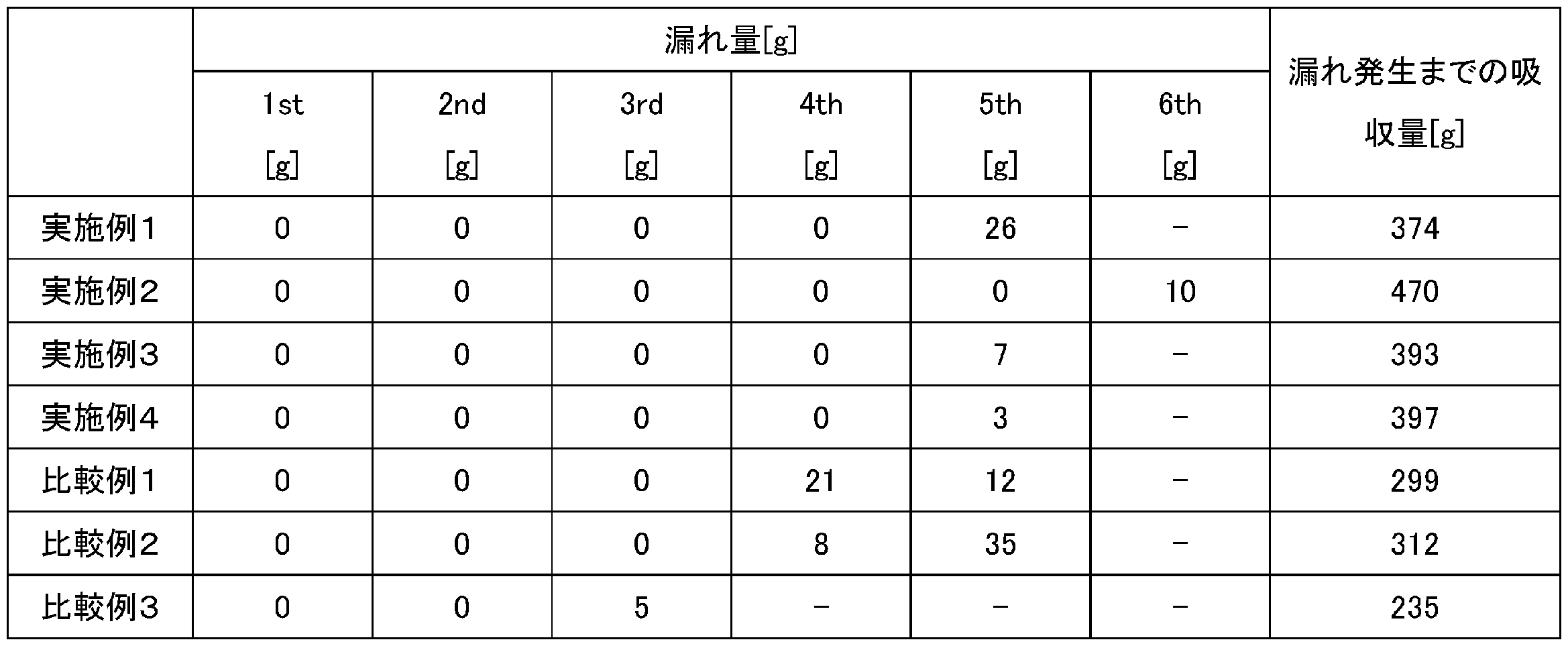
Claims (11)
- 吸水性樹脂粒子及び繊維状物を含む吸収体と、該吸収体の上下を挟むコアラップとを有する積層体、該積層体の上表面に配置された液体透過性シート、並びに該積層体の該液体透過性シートとは反対側の面に配置された液体不透過性シートを有する吸収性物品であって、
前記吸水性樹脂粒子が、(メタ)アクリル酸及びその塩からなる群より選ばれる少なくとも1種の化合物を含むエチレン性不飽和単量体に由来する単量体単位を有する架橋重合体と、無機粒子とを含み、(メタ)アクリル酸及びその塩の割合が前記架橋重合体中の単量体単位全量に対して70~100モル%であり、下記要件(a)及び(b)を満たす吸収性物品。
(a)下記式で表される吸収性物品の表面乾燥指数が45以下である。
表面乾燥指数=(液投入1.5分後の水分量指数/液投入1分後の水分量指数)×100
水分量指数測定方法:内径3cmの開口部を有する液投入用シリンダーを用いて、0.9質量%生理食塩水(25℃)160mLを吸収性物品の中心に投入し、投入した瞬間を0分とする。測定用プローブ(49mm2)を前記吸収性物品の液投入箇所中心部に押し当て、静電容量法により、投入から所定時間後の前記吸収性物品の中心部表面の水分量指数を測定する。
(b)吸水性樹脂粒子の生理食塩水保水量が30g/g以上である。 - 液投入3分後の水分量指数が0である、請求項1に記載の吸収性物品。
- 液投入2分後の水分量指数が2以上である、請求項1又は2に記載の吸収性物品。
- 液投入1分後の水分量指数が20以上である、請求項1~3のいずれか一項に記載の吸収性物品。
- 前記吸収体における前記吸水性樹脂粒子の含有量が100~1000g/m2である、請求項1~4のいずれか一項に記載の吸収性物品。
- 前記吸収体における前記吸水性樹脂粒子の質量割合が、前記吸水性樹脂粒子及び前記繊維状物の合計に対し10~80%である、請求項1~5のいずれか一項に記載の吸収性物品。
- 前記液体透過性シートの目付量が5~200g/m2である、請求項1~6のいずれか一項に記載の吸収性物品。
- 前記繊維状物が、セルロース系繊維、合成繊維及びこれらの混合物からなる群から選ばれる少なくとも1種である、請求項1~7のいずれか一項に記載の吸収性物品。
- 前記繊維状物が、微粉砕された木材パルプ、コットン、コットンリンター、レーヨン、セルロースアセテート、ポリアミド、ポリエステル及びポリオレフィンからなる群から選ばれる少なくとも1種である、請求項1~7のいずれか一項に記載の吸収性物品。
- 前記コアラップが、不織布、織布、ティッシュ、液体透過孔を有する合成樹脂フィルム、及び網目を有するネット状シートからなる群から選ばれる少なくとも1種である、請求項1~9のいずれか一項に記載の吸収性物品。
- 前記液体透過性シートが、サーマルボンド不織布、エアスルー不織布、スパンボンド不織布、及びスパンボンド/メルトブロー/スパンボンド不織布からなる群から選ばれる少なくとも1種である、請求項1~10のいずれか一項に記載の吸収性物品。
Priority Applications (5)
| Application Number | Priority Date | Filing Date | Title |
|---|---|---|---|
| JP2020559327A JPWO2020122202A1 (ja) | 2018-12-12 | 2019-12-12 | 吸収性物品 |
| CN201980082146.6A CN113164304A (zh) | 2018-12-12 | 2019-12-12 | 吸收性物品 |
| KR1020217019050A KR20210101250A (ko) | 2018-12-12 | 2019-12-12 | 흡수성 물품 |
| EP19895636.9A EP3895676A4 (en) | 2018-12-12 | 2019-12-12 | ABSORBENT ARTICLE |
| US17/311,910 US20220023112A1 (en) | 2018-12-12 | 2019-12-12 | Absorbent article |
Applications Claiming Priority (24)
| Application Number | Priority Date | Filing Date | Title |
|---|---|---|---|
| JP2018-232843 | 2018-12-12 | ||
| JP2018232857 | 2018-12-12 | ||
| JP2018-232724 | 2018-12-12 | ||
| JP2018232850 | 2018-12-12 | ||
| JP2018-232728 | 2018-12-12 | ||
| JP2018232728 | 2018-12-12 | ||
| JP2018232726 | 2018-12-12 | ||
| JP2018-232851 | 2018-12-12 | ||
| JP2018232856 | 2018-12-12 | ||
| JP2018-232850 | 2018-12-12 | ||
| JP2018232851 | 2018-12-12 | ||
| JP2018232724 | 2018-12-12 | ||
| JP2018232843 | 2018-12-12 | ||
| JP2018-232857 | 2018-12-12 | ||
| JP2018-232856 | 2018-12-12 | ||
| JP2018232848 | 2018-12-12 | ||
| JP2018232847 | 2018-12-12 | ||
| JP2018-232848 | 2018-12-12 | ||
| JP2018-232847 | 2018-12-12 | ||
| JP2018-232726 | 2018-12-12 | ||
| JP2019014525 | 2019-01-30 | ||
| JP2019-014525 | 2019-01-30 | ||
| JP2019055283 | 2019-03-22 | ||
| JP2019-055283 | 2019-03-22 |
Publications (1)
| Publication Number | Publication Date |
|---|---|
| WO2020122202A1 true WO2020122202A1 (ja) | 2020-06-18 |
Family
ID=71077395
Family Applications (1)
| Application Number | Title | Priority Date | Filing Date |
|---|---|---|---|
| PCT/JP2019/048795 Ceased WO2020122202A1 (ja) | 2018-12-12 | 2019-12-12 | 吸収性物品 |
Country Status (6)
| Country | Link |
|---|---|
| US (1) | US20220023112A1 (ja) |
| EP (1) | EP3895676A4 (ja) |
| JP (1) | JPWO2020122202A1 (ja) |
| KR (1) | KR20210101250A (ja) |
| CN (1) | CN113164304A (ja) |
| WO (1) | WO2020122202A1 (ja) |
Families Citing this family (3)
| Publication number | Priority date | Publication date | Assignee | Title |
|---|---|---|---|---|
| US12246303B2 (en) | 2018-12-12 | 2025-03-11 | Sumitomo Seika Chemicals Co., Ltd. | Water-absorbing resin particles and absorbent article |
| EP3896117A4 (en) * | 2018-12-12 | 2022-09-07 | Sumitomo Seika Chemicals Co., Ltd. | WATER-ABSORBENT RESIN PARTICLES, METHOD OF EVALUATION OF WATER-ABSORBENT RESIN PARTICLES FOR LIQUID LEAKS, METHOD OF MANUFACTURE OF WATER-ABSORBENT RESIN PARTICLES AND ABSORBENT ARTICLES |
| WO2020122211A1 (ja) * | 2018-12-12 | 2020-06-18 | 住友精化株式会社 | 吸水性樹脂粒子 |
Citations (8)
| Publication number | Priority date | Publication date | Assignee | Title |
|---|---|---|---|---|
| JP2003088552A (ja) * | 2001-09-19 | 2003-03-25 | Sumitomo Seika Chem Co Ltd | 吸収体およびそれを用いた吸収性物品 |
| JP2006167480A (ja) | 2006-01-27 | 2006-06-29 | Daio Paper Corp | 体液吸収物品 |
| JP2007069161A (ja) | 2005-09-08 | 2007-03-22 | San-Dia Polymer Ltd | 吸水剤 |
| WO2011086843A1 (ja) | 2010-01-13 | 2011-07-21 | 住友精化株式会社 | 吸水シート構成体 |
| JP2013063254A (ja) | 2011-08-26 | 2013-04-11 | Kao Corp | 使い捨ておむつ |
| WO2018181565A1 (ja) * | 2017-03-31 | 2018-10-04 | 住友精化株式会社 | 吸水性樹脂粒子 |
| JP2018166887A (ja) * | 2017-03-30 | 2018-11-01 | 株式会社リブドゥコーポレーション | 吸収体およびこれを備えた吸収性物品 |
| WO2019142872A1 (ja) * | 2018-01-18 | 2019-07-25 | 住友精化株式会社 | 吸水性樹脂 |
Family Cites Families (14)
| Publication number | Priority date | Publication date | Assignee | Title |
|---|---|---|---|---|
| KR101511820B1 (ko) * | 2008-12-26 | 2015-04-13 | 산다이야 폴리마 가부시키가이샤 | 흡수성 수지 입자, 이 제조 방법, 이것을 함유하는 흡수체 및 흡수성 물품 |
| EP2679608A4 (en) * | 2011-02-25 | 2016-03-02 | Asahi Glass Co Ltd | HIGHLY CONCENTRATED POLYMER POLYOL AND MANUFACTURING METHOD THEREFOR |
| BR112013024152A2 (pt) * | 2011-03-24 | 2016-12-20 | Sanyo Chemical Ind Ltd | resina absorvente de líquido aquoso, composição absorvente de líquido aquoso e material absorvedor e objeto absorvente cada um produzido usando a mesma |
| JP6013729B2 (ja) * | 2011-12-27 | 2016-10-25 | 株式会社リブドゥコーポレーション | 吸水性樹脂粉末およびこれを用いた吸収体、吸収性物品 |
| JP6128790B2 (ja) * | 2012-10-15 | 2017-05-17 | 株式会社リブドゥコーポレーション | 吸収性物品 |
| JP6128791B2 (ja) * | 2012-10-15 | 2017-05-17 | 株式会社リブドゥコーポレーション | 吸収性物品 |
| JP6226522B2 (ja) * | 2012-11-30 | 2017-11-08 | 株式会社リブドゥコーポレーション | 吸収体およびこれを用いた吸収性物品 |
| JP5893116B2 (ja) * | 2014-07-11 | 2016-03-23 | 住友精化株式会社 | 吸水性樹脂及び吸水性樹脂の製造方法 |
| JP5893117B2 (ja) * | 2014-07-11 | 2016-03-23 | 住友精化株式会社 | 吸水性樹脂及び吸収性物品 |
| JP2017531531A (ja) * | 2014-10-24 | 2017-10-26 | ビーエーエスエフ ソシエタス・ヨーロピアBasf Se | 流体吸収性物品 |
| WO2016196713A1 (en) * | 2015-06-02 | 2016-12-08 | The Procter & Gamble Company | Absorbent fibrous structures comprising a branched copolymer soil adsorbing agent |
| WO2017091924A1 (en) * | 2015-11-30 | 2017-06-08 | Kimberly-Clark (China) Co., Ltd. | Absorbent core layer and absorbent personal care article containing such layer |
| EP3896122A4 (en) * | 2018-12-12 | 2022-10-12 | Sumitomo Seika Chemicals Co., Ltd. | ABSORBENT RESIN PARTICLES, ABSORBENT ARTICLE AND METHOD OF MANUFACTURE THEREOF |
| KR102841813B1 (ko) * | 2018-12-12 | 2025-08-01 | 스미토모 세이카 가부시키가이샤 | 흡수성 수지 입자 |
-
2019
- 2019-12-12 CN CN201980082146.6A patent/CN113164304A/zh active Pending
- 2019-12-12 US US17/311,910 patent/US20220023112A1/en not_active Abandoned
- 2019-12-12 WO PCT/JP2019/048795 patent/WO2020122202A1/ja not_active Ceased
- 2019-12-12 KR KR1020217019050A patent/KR20210101250A/ko not_active Withdrawn
- 2019-12-12 JP JP2020559327A patent/JPWO2020122202A1/ja active Pending
- 2019-12-12 EP EP19895636.9A patent/EP3895676A4/en not_active Withdrawn
Patent Citations (8)
| Publication number | Priority date | Publication date | Assignee | Title |
|---|---|---|---|---|
| JP2003088552A (ja) * | 2001-09-19 | 2003-03-25 | Sumitomo Seika Chem Co Ltd | 吸収体およびそれを用いた吸収性物品 |
| JP2007069161A (ja) | 2005-09-08 | 2007-03-22 | San-Dia Polymer Ltd | 吸水剤 |
| JP2006167480A (ja) | 2006-01-27 | 2006-06-29 | Daio Paper Corp | 体液吸収物品 |
| WO2011086843A1 (ja) | 2010-01-13 | 2011-07-21 | 住友精化株式会社 | 吸水シート構成体 |
| JP2013063254A (ja) | 2011-08-26 | 2013-04-11 | Kao Corp | 使い捨ておむつ |
| JP2018166887A (ja) * | 2017-03-30 | 2018-11-01 | 株式会社リブドゥコーポレーション | 吸収体およびこれを備えた吸収性物品 |
| WO2018181565A1 (ja) * | 2017-03-31 | 2018-10-04 | 住友精化株式会社 | 吸水性樹脂粒子 |
| WO2019142872A1 (ja) * | 2018-01-18 | 2019-07-25 | 住友精化株式会社 | 吸水性樹脂 |
Non-Patent Citations (1)
| Title |
|---|
| See also references of EP3895676A4 |
Also Published As
| Publication number | Publication date |
|---|---|
| CN113164304A (zh) | 2021-07-23 |
| EP3895676A4 (en) | 2022-10-12 |
| JPWO2020122202A1 (ja) | 2021-10-21 |
| EP3895676A1 (en) | 2021-10-20 |
| KR20210101250A (ko) | 2021-08-18 |
| US20220023112A1 (en) | 2022-01-27 |
Similar Documents
| Publication | Publication Date | Title |
|---|---|---|
| EP3896120B1 (en) | Water-absorbing resin particles, absorbent, and absorbent article | |
| JP7588579B2 (ja) | 吸水性樹脂粒子、吸収体、吸収性物品、吸水性樹脂粒子の通液維持率の測定方法、及び吸水性樹脂粒子の製造方法 | |
| KR20210101251A (ko) | 흡수성 수지 입자, 흡수체 및 흡수성 물품 | |
| JP7561117B2 (ja) | 吸水性樹脂粒子 | |
| JP6681494B1 (ja) | 吸水性樹脂粒子 | |
| US12274999B2 (en) | Water absorbent resin particles, absorbent, absorbent article and liquid suction power measurement method | |
| US20220023112A1 (en) | Absorbent article | |
| JP6681492B1 (ja) | 吸水性樹脂粒子 | |
| WO2020184398A1 (ja) | 吸水性樹脂粒子及びその製造方法、吸収体、並びに、吸収性物品 | |
| JP2020094165A (ja) | 吸水性樹脂粒子 | |
| JP7194197B2 (ja) | 吸収体及び吸収性物品 | |
| JP6681495B1 (ja) | 吸水性樹脂粒子、吸収体及び吸収性物品 | |
| WO2020122203A1 (ja) | 吸水性樹脂粒子、吸水性樹脂粒子の液体漏れ性の評価方法、及び吸水性樹脂粒子の製造方法並びに吸収性物品 | |
| WO2020122214A1 (ja) | 吸水性樹脂粒子及び吸収性物品 | |
| US12533658B2 (en) | Water-absorbent resin particles | |
| JP7386809B2 (ja) | 吸水性樹脂粒子 | |
| JP7470496B2 (ja) | 粒子状吸水性樹脂組成物 | |
| WO2021049450A1 (ja) | 吸水性樹脂粒子 | |
| JP2020121298A (ja) | 吸水性樹脂粒子、吸収体及び吸収性物品 | |
| JP6775050B2 (ja) | 吸収性物品 | |
| JP6752320B2 (ja) | 吸収性物品及びその製造方法 | |
| JP6775051B2 (ja) | 吸収性物品 | |
| WO2022071503A1 (ja) | 架橋重合体粒子を製造する方法 |
Legal Events
| Date | Code | Title | Description |
|---|---|---|---|
| 121 | Ep: the epo has been informed by wipo that ep was designated in this application |
Ref document number: 19895636 Country of ref document: EP Kind code of ref document: A1 |
|
| ENP | Entry into the national phase |
Ref document number: 2020559327 Country of ref document: JP Kind code of ref document: A |
|
| NENP | Non-entry into the national phase |
Ref country code: DE |
|
| ENP | Entry into the national phase |
Ref document number: 20217019050 Country of ref document: KR Kind code of ref document: A |
|
| ENP | Entry into the national phase |
Ref document number: 2019895636 Country of ref document: EP Effective date: 20210712 |