WO2020129821A1 - ゴム組成物 - Google Patents
ゴム組成物 Download PDFInfo
- Publication number
- WO2020129821A1 WO2020129821A1 PCT/JP2019/048809 JP2019048809W WO2020129821A1 WO 2020129821 A1 WO2020129821 A1 WO 2020129821A1 JP 2019048809 W JP2019048809 W JP 2019048809W WO 2020129821 A1 WO2020129821 A1 WO 2020129821A1
- Authority
- WO
- WIPO (PCT)
- Prior art keywords
- random copolymer
- mass
- rubber
- conjugated diene
- rubber composition
- Prior art date
- Legal status (The legal status is an assumption and is not a legal conclusion. Google has not performed a legal analysis and makes no representation as to the accuracy of the status listed.)
- Ceased
Links
Classifications
-
- C—CHEMISTRY; METALLURGY
- C08—ORGANIC MACROMOLECULAR COMPOUNDS; THEIR PREPARATION OR CHEMICAL WORKING-UP; COMPOSITIONS BASED THEREON
- C08L—COMPOSITIONS OF MACROMOLECULAR COMPOUNDS
- C08L21/00—Compositions of unspecified rubbers
-
- C—CHEMISTRY; METALLURGY
- C08—ORGANIC MACROMOLECULAR COMPOUNDS; THEIR PREPARATION OR CHEMICAL WORKING-UP; COMPOSITIONS BASED THEREON
- C08L—COMPOSITIONS OF MACROMOLECULAR COMPOUNDS
- C08L15/00—Compositions of rubber derivatives
-
- B—PERFORMING OPERATIONS; TRANSPORTING
- B60—VEHICLES IN GENERAL
- B60C—VEHICLE TYRES; TYRE INFLATION; TYRE CHANGING; CONNECTING VALVES TO INFLATABLE ELASTIC BODIES IN GENERAL; DEVICES OR ARRANGEMENTS RELATED TO TYRES
- B60C1/00—Tyres characterised by the chemical composition or the physical arrangement or mixture of the composition
-
- B—PERFORMING OPERATIONS; TRANSPORTING
- B60—VEHICLES IN GENERAL
- B60C—VEHICLE TYRES; TYRE INFLATION; TYRE CHANGING; CONNECTING VALVES TO INFLATABLE ELASTIC BODIES IN GENERAL; DEVICES OR ARRANGEMENTS RELATED TO TYRES
- B60C1/00—Tyres characterised by the chemical composition or the physical arrangement or mixture of the composition
- B60C1/0016—Compositions of the tread
-
- C—CHEMISTRY; METALLURGY
- C08—ORGANIC MACROMOLECULAR COMPOUNDS; THEIR PREPARATION OR CHEMICAL WORKING-UP; COMPOSITIONS BASED THEREON
- C08K—Use of inorganic or non-macromolecular organic substances as compounding ingredients
- C08K3/00—Use of inorganic substances as compounding ingredients
- C08K3/01—Use of inorganic substances as compounding ingredients characterized by their specific function
- C08K3/013—Fillers, pigments or reinforcing additives
-
- C—CHEMISTRY; METALLURGY
- C08—ORGANIC MACROMOLECULAR COMPOUNDS; THEIR PREPARATION OR CHEMICAL WORKING-UP; COMPOSITIONS BASED THEREON
- C08L—COMPOSITIONS OF MACROMOLECULAR COMPOUNDS
- C08L2312/00—Crosslinking
-
- C—CHEMISTRY; METALLURGY
- C08—ORGANIC MACROMOLECULAR COMPOUNDS; THEIR PREPARATION OR CHEMICAL WORKING-UP; COMPOSITIONS BASED THEREON
- C08L—COMPOSITIONS OF MACROMOLECULAR COMPOUNDS
- C08L9/00—Compositions of homopolymers or copolymers of conjugated diene hydrocarbons
- C08L9/06—Copolymers with styrene
Definitions
- the present invention relates to a rubber composition, a crosslinked product of the rubber composition, and a pneumatic tire using at least a part of the rubber composition.
- Patent Documents 1 and 3 for the purpose of improving the steering stability without deteriorating the fracture characteristics of the tire, a specific high molecular weight partially hydrogenated diene polymer is added to a low molecular weight diene heavy polymer.
- a specific high molecular weight partially hydrogenated diene polymer is added to a low molecular weight diene heavy polymer.
- Patent Document 2 a rubber component containing a styrene-butadiene rubber, a specific zinc oxide, and a liquid styrene-butadiene rubber having a specific weight average molecular weight are used for the purpose of improving grip performance, durability of the grip performance, and abrasion resistance.
- a rubber composition containing the same is being investigated.
- the present invention has been made in view of the above circumstances, and provides a rubber composition that is a cross-linked product with improved tensile strength, and a pneumatic tire using a part thereof.
- the inclusion of a specific hydrogenated aromatic vinyl-conjugated diene random copolymer or the like in the rubber composition makes the crosslinked product of the composition excellent in tensile strength.
- the present invention has been completed and the present invention has been completed.
- (ii) The vinyl content of the conjugated diene unit of the random copolymer (B) before hydrogenation is 10 to 70 mol %.
- the hydrogenation rate of the conjugated diene unit is 10 mol% or more.
- Weight average molecular weight of 3,000 to 100,000 [2] A crosslinked product obtained by crosslinking the rubber composition according to [1].
- a rubber composition having excellent tensile strength of a crosslinked product can be obtained.
- Solid rubber (A) used in the rubber composition of the present invention is a rubber other than the hydrogenated aromatic vinyl-conjugated diene random copolymer (B), which can be handled in a solid state at 20°C.
- the Mooney viscosity ML 1+4 at 100° C. of the solid rubber (A) may be in the range of 20 to 200, and may be selected from at least one of synthetic rubber and natural rubber.
- solid rubber (A) examples include styrene butadiene rubber (hereinafter also referred to as “SBR”), butadiene rubber (hereinafter also referred to as “BR”), isoprene rubber, butyl rubber, halogenated butyl rubber, ethylene propylene diene. Examples thereof include rubber, butadiene acrylonitrile copolymer rubber, chloroprene rubber, acrylic rubber, fluororubber, synthetic rubber such as urethane rubber, and natural rubber.
- SBR styrene butadiene rubber
- BR butadiene rubber
- isoprene rubber butyl rubber
- halogenated butyl rubber examples thereof include rubber, butadiene acrylonitrile copolymer rubber, chloroprene rubber, acrylic rubber, fluororubber, synthetic rubber such as urethane rubber, and natural rubber.
- natural rubber, SBR, butadiene rubber, and isoprene rubber are preferable, natural rubber,
- SBR for example, general ones used for tires can be used. Specifically, those having a styrene content of 0.1 to 70% by mass are preferable, and those having 5 to 60% by mass are more preferable. It is more preferably 5 to 50% by mass, still more preferably 5 to 40% by mass, particularly preferably 5 to 30% by mass, most preferably 5 to 25% by mass. Further, those having a vinyl content of 0.1 to 80 mol% are preferable, and those having a vinyl content of 5 to 70 mol% are more preferable.
- the vinyl content of SBR in the present specification represents the content of a monomer unit having a vinyl group among the units derived from all butadiene contained in SBR.
- the vinyl content of the solid rubber (A) represents the content of the monomer unit actually having a vinyl group with respect to the total amount of the monomer unit capable of having a vinyl group depending on the bonding form.
- the weight average molecular weight (Mw) of SBR is preferably 100,000 to 2,500,000, more preferably 150,000 to 2,000,000, and further preferably 150,000 to 1,500,000.
- Mw weight average molecular weight
- the processability of the rubber composition is improved, and the resulting crosslinked product is excellent in mechanical strength and abrasion resistance, and the rubber composition is used for tires, for example. If so, steering stability and wet grip performance are improved.
- the weight average molecular weight in this specification is the polystyrene equivalent weight average molecular weight obtained from the measurement of gel permeation chromatography (GPC).
- the glass transition temperature (Tg) determined by differential thermal analysis of SBR may be -10°C or lower, preferably -20°C or lower, more preferably -30°C or lower, further preferably -40°C or lower, and The temperature is more preferably ⁇ 45° C. or lower, particularly preferably ⁇ 50° C. or lower, most preferably ⁇ 55° C. or lower.
- Tg glass transition temperature
- the SBR that can be used in the present invention is obtained by copolymerizing styrene and butadiene.
- the method for producing SBR is not particularly limited, and any of an emulsion polymerization method, a solution polymerization method, a gas phase polymerization method, and a bulk polymerization method can be used. Among these production methods, the emulsion polymerization method and the solution polymerization method are preferable. ..
- the emulsion-polymerized styrene-butadiene rubber (hereinafter, also referred to as E-SBR) can be manufactured by a known emulsion polymerization method or a commonly known method. For example, it can be obtained by emulsifying and dispersing a predetermined amount of styrene and butadiene monomers in the presence of an emulsifier, and emulsion-polymerizing with a radical polymerization initiator.
- a long-chain fatty acid salt having 10 or more carbon atoms or a rosin acid salt is used as the emulsifier.
- fatty acids such as capric acid, lauric acid, myristic acid, palmitic acid, oleic acid, stearic acid.
- Water is usually used as the dispersion medium, and may contain a water-soluble organic solvent such as methanol or ethanol as long as the stability during polymerization is not impaired.
- a water-soluble organic solvent such as methanol or ethanol
- the radical polymerization initiator include persulfates such as ammonium persulfate and potassium persulfate, organic peroxides, hydrogen peroxide and the like.
- a chain transfer agent may be used to adjust the molecular weight of the resulting E-SBR.
- the chain transfer agent include mercaptans such as t-dodecyl mercaptan and n-dodecyl mercaptan; carbon tetrachloride, thioglycolic acid, diterpenes, terpinolene, ⁇ -terpinene, ⁇ -methylstyrene dimer and the like.
- the temperature of emulsion polymerization can be appropriately selected depending on the type of radical polymerization initiator used, but is usually preferably 0 to 100°C, more preferably 0 to 60°C.
- the polymerization mode may be either continuous polymerization or batch polymerization.
- the polymerization reaction can be stopped by adding a polymerization terminator.
- polymerization terminator examples include amine compounds such as isopropylhydroxylamine, diethylhydroxylamine and hydroxylamine; quinone compounds such as hydroquinone and benzoquinone; and sodium nitrite.
- an antioxidant may be added if necessary.
- unreacted monomers are removed from the obtained latex as needed, and then salts such as sodium chloride, calcium chloride, potassium chloride are used as a coagulant, and nitric acid, sulfuric acid, etc. are added as necessary.
- the acid is added to adjust the pH of the coagulation system to a predetermined value to coagulate the polymer, the dispersion medium is separated to recover the polymer as crumbs.
- E-SBR can be obtained by washing the crumb with water, dehydration, and drying with a band dryer or the like.
- a latex and an extending oil made into an emulsified dispersion liquid may be mixed in advance as necessary and recovered as an oil-extended rubber.
- the extender oil is not included in the solid rubber (A). Examples of commercially available E-SBR include oil-extended styrene-butadiene rubber "JSR1723" manufactured by JSR Corporation.
- Solution-polymerized styrene-butadiene rubber (hereinafter, also referred to as S-SBR) can be produced by a usual solution-polymerization method, and for example, an active metal capable of being anionically polymerized in a solvent is used, optionally in the presence of a polar compound, Polymerize styrene and butadiene.
- the solvent examples include aliphatic hydrocarbons such as n-butane, n-pentane, isopentane, n-hexane, n-heptane and isooctane; alicyclic hydrocarbons such as cyclopentane, cyclohexane and methylcyclopentane; benzene, Examples thereof include aromatic hydrocarbons such as toluene. It is generally preferable to use these solvents in a range where the monomer concentration is 1 to 50% by mass.
- anion-polymerizable active metal examples include alkali metals such as lithium, sodium and potassium; alkaline earth metals such as beryllium, magnesium, calcium, strontium and barium; lanthanide rare earth metals such as lanthanum and neodymium. ..
- alkali metals and alkaline earth metals are preferable, and alkali metals are more preferable.
- organic alkali metal compounds are more preferably used.
- organic alkali metal compound examples include organic monolithium compounds such as n-butyllithium, sec-butyllithium, t-butyllithium, hexyllithium, phenyllithium and stilbenelithium; dilithiomethane, 1,4-dilithiobutane, 1,4 Examples thereof include polyfunctional organolithium compounds such as -dilithio-2-ethylcyclohexane and 1,3,5-trilithiobenzene; sodium naphthalene, potassium naphthalene and the like. Of these, organic lithium compounds are preferable, and organic monolithium compounds are more preferable.
- the amount of the organic alkali metal compound used is appropriately determined according to the required molecular weight of S-SBR.
- the organic alkali metal compound can also be used as an organic alkali metal amide by reacting with a secondary amine such as dibutylamine, dihexylamine or dibenzylamine.
- the polar compound is not particularly limited as long as it is a compound that is usually used for adjusting the microstructure of the butadiene unit and the distribution in the copolymer chain of styrene without deactivating the reaction in the anionic polymerization.
- examples thereof include ether compounds such as dibutyl ether, tetrahydrofuran and ethylene glycol diethyl ether; tertiary amines such as tetramethylethylenediamine and trimethylamine; alkali metal alkoxides and phosphine compounds.
- the temperature of the polymerization reaction is usually in the range of -80 to 150°C, preferably 0 to 100°C, more preferably 30 to 90°C.
- the polymerization mode may be either batch type or continuous type.
- styrene and butadiene should be continuously or intermittently supplied to the reaction solution so that the composition ratio of styrene and butadiene in the polymerization system falls within a specific range. Is preferred.
- the polymerization reaction can be stopped by adding an alcohol such as methanol or isopropanol as a polymerization terminator.
- the target S-SBR can be recovered by separating the solvent from the polymerization solution after the termination of the polymerization reaction by direct drying or steam stripping. Before removing the solvent, the polymerization solution and the extender oil may be mixed in advance and recovered as an oil-extended rubber.
- a modified SBR in which a functional group is introduced into the SBR may be used as long as the effect of the present invention is not impaired.
- the functional group include an amino group, an alkoxysilyl group, a hydroxyl group, an epoxy group, a carboxyl group and the like.
- the modified SBR for example, tin tetrachloride, tetrachlorosilane, dimethyldichlorosilane, dimethyldiethoxysilane, tetramethoxysilane, tetraethoxysilane, which can react with a polymerization active terminal, before a polymerization terminator is added, Coupling agents such as 3-aminopropyltriethoxysilane, tetraglycidyl-1,3-bisaminomethylcyclohexane and 2,4-tolylene diisocyanate, 4,4′-bis(diethylamino)benzophenone and N-vinylpyrrolidone Examples of the method include adding the polymerization end modifier described above or other modifiers described in JP-A-2011-132298.
- the position of the polymer into which the functional group is introduced may be the polymerization terminal or the side chain of the polymer chain.
- isoprene rubber examples include titanium tetrahalide-trialkylaluminum-based, diethylaluminum chloride-cobalt-based, trialkylaluminum-boron trifluoride-nickel-based, diethylaluminum chloride-nickel-based Ziegler-based catalysts; triethyl Aluminum-organic acid neodymium-Lewis acid-based lanthanoid rare earth metal catalyst, or commercially available isoprene rubber polymerized using an organic alkali metal compound like S-SBR can be used. Isoprene rubber polymerized with a Ziegler-based catalyst is preferable because of its high cis content. In addition, an isoprene rubber having an ultrahigh cis content obtained by using a lanthanoid rare earth metal catalyst may be used.
- the vinyl content of the isoprene rubber is preferably 50 mol% or less, more preferably 40 mol% or less, and further preferably 30 mol% or less. If the vinyl content exceeds 50 mol %, the rolling resistance performance tends to deteriorate.
- the lower limit of the vinyl content is not particularly limited. Although the glass transition temperature varies depending on the vinyl content, it is preferably ⁇ 20° C. or lower, more preferably ⁇ 30° C. or lower.
- the weight average molecular weight (Mw) of isoprene rubber is preferably 90,000 to 2,000,000, more preferably 150,000 to 1,500,000. When Mw is in the above range, workability and mechanical strength are improved.
- the isoprene rubber is a polyfunctional modifier, for example, tin tetrachloride, silicon tetrachloride, an alkoxysilane having an epoxy group in the molecule, or an amino group-containing portion, as long as the effect of the present invention is not impaired. It may have a branched structure or a polar functional group by using a modifier such as an alkoxysilane.
- butadiene rubber examples include titanium tetrahalide-trialkylaluminum-based, diethylaluminum chloride-cobalt-based, trialkylaluminum-boron trifluoride-nickel-based, diethylaluminum chloride-nickel-based Ziegler-based catalysts; triethyl
- a lanthanoid rare earth metal catalyst such as an aluminum-organic acid neodymium-Lewis acid catalyst or a commercially available butadiene rubber polymerized using an organic alkali metal compound similar to S-SBR.
- Butadiene rubber polymerized with a Ziegler-based catalyst is preferred because of its high cis content.
- a butadiene rubber having an ultrahigh cis content for example, a cis content of 95% or more obtained by using a lanthanoid rare earth metal catalyst may be used.
- the vinyl content of the butadiene rubber is preferably 50 mol% or less, more preferably 40 mol% or less, and further preferably 30 mol% or less. When the vinyl content exceeds 50 mol %, rolling resistance performance (fuel efficiency performance) and abrasion resistance tend to deteriorate.
- the lower limit of the vinyl content is not particularly limited. Although the glass transition temperature varies depending on the vinyl content, it is preferably -40°C or lower, more preferably -50°C or lower.
- the weight average molecular weight (Mw) of the butadiene rubber is preferably 90,000 to 2,000,000, more preferably 150,000 to 1,500,000.
- Mw is in the above range, not only the workability of the rubber composition is improved, but also the ice grip performance, wear resistance and steering stability of a tire using the rubber composition as at least a part thereof are improved.
- the butadiene rubber is a polyfunctional modifier, for example, tin tetrachloride, silicon tetrachloride, an alkoxysilane having an epoxy group in the molecule, or an amino group-containing portion, as long as the effect of the present invention is not impaired. It may have a branched structure or a polar functional group formed by using a modifier such as an alkoxysilane.
- At least one kind of SBR, isoprene rubber, and butadiene rubber may be used together with one kind or two or more kinds of butyl rubber, halogenated butyl rubber, ethylene propylene diene rubber, butadiene acrylonitrile polymer rubber, chloroprene rubber and the like. Further, the manufacturing method of these is not particularly limited, and commercially available ones can be used.
- Examples of the natural rubber are generally used in the tire industry such as TSR (Technically Specified Rubber) and RSS (Ribbed Smoked Sheet) such as SMR (Malaysia TSR), SIR (Indonesia TSR), STR (Thailand TSR).
- Modified natural rubbers such as used natural rubber, high-purity natural rubber, epoxidized natural rubber, hydroxylated natural rubber, hydrogenated natural rubber and grafted natural rubber can be mentioned.
- SMR20, STR20 and RSS#3 are preferable from the viewpoint of little variation in quality and the ease of availability.
- These natural rubbers may be used alone or in combination of two or more. In the present invention, synthetic rubber and natural rubber may be used together.
- the hydrogenated aromatic vinyl-conjugated diene random copolymer (B) (hereinafter also simply referred to as random copolymer (B)) used in the rubber composition of the present invention is a random copolymer of conjugated diene and aromatic vinyl.
- a hydrogenated copolymer which has a weight average molecular weight (Mw) of 3,000 to 100,000, an aromatic vinyl unit content of 10 to 70% by mass, and a random copolymer before hydrogenation.
- the component (B) has a vinyl content of the conjugated diene unit of 10 to 70 mol% and a hydrogenation rate of the conjugated diene unit of 10 mol% or more.
- the tensile strength of the obtained crosslinked product is improved as compared with other polymers containing a conjugated diene unit having a similar weight average molecular weight. To do.
- the conjugated diene include butadiene, isoprene, 2,3-dimethylbutadiene, 2-phenylbutadiene, 1,3-pentadiene, 2-methyl-1,3-pentadiene, 1,3-hexadiene, and 1,3-octadiene.
- the conjugated diene unit contained in the unhydrogenated random copolymer (B′) preferably contains a butadiene and/or isoprene monomer unit.
- aromatic vinyl compound (b2) include styrene, ⁇ -methylstyrene, 2-methylstyrene, 3-methylstyrene, 4-methylstyrene, 4-propylstyrene, 4-t-butylstyrene, 4-cyclohexylstyrene.
- aromatic vinyl compounds styrene, ⁇ -methylstyrene, and 4-methylstyrene are preferable.
- the unhydrogenated random copolymer (B′) may contain a monomer unit other than the conjugated diene unit and the aromatic vinyl compound (b2) unit.
- unhydrogenated random copolymer (B′) a conjugated diene, an aromatic vinyl compound, and other monomers optionally contained are polymerized by, for example, an emulsion polymerization method or a solution polymerization method.
- the polymer obtained in this way is preferred.
- emulsion polymerization method a known method or a method similar to the known method can be applied.
- a monomer containing a predetermined amount of a conjugated diene is emulsified and dispersed in the presence of an emulsifier, and emulsion-polymerized with a radical polymerization initiator.
- emulsifiers include long-chain fatty acid salts having 10 or more carbon atoms and rosin acid salts.
- long-chain fatty acid salt include potassium or sodium salts of fatty acids such as capric acid, lauric acid, myristic acid, palmitic acid, oleic acid and stearic acid.
- Water is usually used as the dispersion medium, and may contain a water-soluble organic solvent such as methanol or ethanol as long as the stability during polymerization is not impaired.
- a water-soluble organic solvent such as methanol or ethanol
- the radical polymerization initiator include persulfates such as ammonium persulfate and potassium persulfate, organic peroxides, hydrogen peroxide and the like.
- a chain transfer agent may be used to adjust the molecular weight of the resulting unhydrogenated random copolymer (B′).
- the chain transfer agent include mercaptans such as t-dodecyl mercaptan and n-dodecyl mercaptan; carbon tetrachloride, thioglycolic acid, diterpenes, terpinolene, ⁇ -terpinene, ⁇ -methylstyrene dimer and the like.
- the temperature of emulsion polymerization can be appropriately set depending on the type of radical polymerization initiator used, etc., but is usually in the range of 0 to 100° C., preferably in the range of 0 to 60° C.
- the polymerization mode may be either continuous polymerization or batch polymerization.
- the polymerization reaction can be stopped by adding a polymerization terminator.
- the polymerization terminator include amine compounds such as isopropylhydroxylamine, diethylhydroxylamine and hydroxylamine, quinone compounds such as hydroquinone and benzoquinone, and sodium nitrite.
- an antioxidant may be added if necessary.
- salts such as sodium chloride, calcium chloride, potassium chloride are used as a coagulant, and nitric acid, sulfuric acid, etc. are added as necessary.
- the acid is added to adjust the pH of the coagulation system to a predetermined value, the unhydrogenated random copolymer (B′) is coagulated, and then the dispersion medium is separated to recover the polymer. Then, the product is washed with water, dehydrated, and dried to obtain the unhydrogenated random copolymer (B′).
- a latex and an extending oil made into an emulsified dispersion may be mixed in advance, if necessary, and recovered as an oil-extended unhydrogenated random copolymer (B′).
- a known method or a method similar to the known method can be applied.
- a Ziegler-based catalyst, a metallocene-based catalyst, an anion-polymerizable active metal or an active metal compound is used, and a monomer containing a conjugated diene is polymerized in the presence of a polar compound, if necessary. ..
- the solvent examples include aliphatic hydrocarbons such as n-butane, n-pentane, isopentane, n-hexane, n-heptane and isooctane; alicyclic hydrocarbons such as cyclopentane, cyclohexane and methylcyclopentane; benzene, Examples thereof include aromatic hydrocarbons such as toluene and xylene.
- aliphatic hydrocarbons such as n-butane, n-pentane, isopentane, n-hexane, n-heptane and isooctane
- alicyclic hydrocarbons such as cyclopentane, cyclohexane and methylcyclopentane
- benzene examples thereof include aromatic hydrocarbons such as toluene and xylene.
- anion-polymerizable active metal examples include alkali metals such as lithium, sodium and potassium; alkaline earth metals such as beryllium, magnesium, calcium, strontium and barium; lanthanide rare earth metals such as lanthanum and neodymium. ..
- alkali metals and alkaline earth metals are preferable, and alkali metals are more preferable.
- an organic alkali metal compound As an active metal compound capable of anionic polymerization, an organic alkali metal compound is preferable.
- the organic alkali metal compound include organic monolithium compounds such as methyllithium, ethyllithium, n-butyllithium, sec-butyllithium, t-butyllithium, hexyllithium, phenyllithium, and stilbenelithium; dilithiomethane, dilithionaphthalene.
- Polyfunctional organolithium compounds such as 1,4-dilithiobutane, 1,4-dilithio-2-ethylcyclohexane, and 1,3,5-trilithiobenzene; sodium naphthalene, potassium naphthalene, and the like.
- organic alkali metal compounds organic lithium compounds are preferable, and organic monolithium compounds are more preferable.
- the amount of the organic alkali metal compound used can be appropriately set according to the melt viscosity and the molecular weight of the unhydrogenated random copolymer (B') and the hydrogenated aromatic vinyl-conjugated diene random copolymer (B).
- the amount is usually 0.01 to 3 parts by mass with respect to 100 parts by mass of the total monomer containing the conjugated diene.
- the organic alkali metal compound may be used as an organic alkali metal amide by reacting with a secondary amine such as dibutylamine, dihexylamine, dibenzylamine.
- Polar compounds are usually used in anionic polymerization to control the microstructure (eg vinyl content) of conjugated diene units without deactivating the reaction.
- the polar compound include ether compounds such as 2,2-di(2-tetrahydrofuryl)propane (DTHFP), dibutyl ether, tetrahydrofuran, and ethylene glycol diethyl ether; N,N,N′,N′-tetramethylethylenediamine. , Tertiary amines such as trimethylamine; alkali metal alkoxides, phosphine compounds and the like.
- the polar compound is usually used in an amount of 0.01 to 1000 mol with respect to 1 mol of the organic alkali metal compound. By increasing the addition amount of the polar compound with respect to the organic alkali metal compound, the randomness of the copolymer can be enhanced.
- the temperature of solution polymerization is usually in the range of -80 to 150°C, preferably in the range of 0 to 100°C, more preferably in the range of 10 to 90°C.
- the polymerization mode may be either batch type or continuous type.
- the polymerization reaction can be stopped by adding a polymerization terminator.
- the polymerization terminator include alcohols such as methanol and isopropanol.
- the obtained polymerization reaction liquid is poured into a poor solvent such as methanol to precipitate the unhydrogenated random copolymer (B′), or the polymerization reaction liquid is washed with water, separated, and dried to obtain the above-mentioned product.
- An unhydrogenated random copolymer (B') can be isolated.
- the solution polymerization method is preferable as the method for producing the unhydrogenated random copolymer (B′).
- the hydrogenation reaction of the carbon-carbon double bond derived from the conjugated diene unit contained in the unhydrogenated random copolymer (B′) can be performed by a known method or a method according to a known method.
- a hydrogenation reaction can be carried out by reacting an unhydrogenated random copolymer (B′) with a solution prepared by dissolving the hydrogenated catalyst in a solvent inert to the hydrogenation catalyst in the presence of the hydrogenation catalyst.
- the hydrogenation catalyst for example, Raney nickel; a heterogeneous catalyst in which a metal such as Pt, Pd, Ru, Rh, and Ni is supported on a carrier such as carbon, alumina, diatomaceous earth; a transition metal compound and an alkylaluminum compound, an alkyllithium compound Ziegler-based catalysts in combination with the like; metallocene-based catalysts and the like.
- the hydrogenation reaction is not particularly limited as long as the hydrogenation rate of the carbon-carbon double bond derived from the conjugated diene compound can be adjusted to a desired range, for example, 10 mol% or more, but the catalyst amount, hydrogen pressure and reaction It is preferable to adjust the hydrogenation rate by appropriately selecting the temperature and controlling the reaction rate.
- the hydrogen pressure is preferably 0.1 to 20 MPa, more preferably 0.1 to 10 MPa.
- the reaction temperature is preferably 20 to 250°C, more preferably 20 to 150°C, and further preferably 20 to 120°C.
- the hydrogenation catalyst is used in an amount of the hydrogenation catalyst based on the number of moles of carbon-carbon double bonds contained in the conjugated diene unit. It is preferable to use the transition metal compound as a constituent in an amount of 1.0 ⁇ 10 ⁇ 6 to 1.0 ⁇ 10 ⁇ 1 mol.
- a polar compound may be added for the purpose of adjusting the activity of the hydrogenation catalyst.
- the polar compound to be added include amine compounds such as N,N,N′,N′-tetramethylethylenediamine and alcohols.
- the reaction time is usually 0.1 to 100 hours.
- the concentration of the hydrogenation catalyst contained in the random copolymer (B) after hydrogenation is preferably less than 500 ppm, more preferably less than 100 ppm, and more preferably 20 ppm as the concentration of the central metal element. Less than 10 ppm is even more preferable, and less than 10 ppm is particularly preferable.
- the method for measuring the concentration of the metal element in the sample include atomic absorption spectrometry and ICP emission spectroscopy.
- the hydrogenation catalyst is deactivated with a polar compound, and then an acid or salt is added as a cleaning agent if necessary, and the hydrogenation catalyst is removed by washing with water.
- the hydrogenation rate of the conjugated diene unit constituting the random copolymer (B) is 10 mol% or more, the hydrogenation rate is preferably 20 mol% or more, more preferably 30 mol% or more, It is more preferably 50 mol% or more, still more preferably 70 mol% or more. Further, from the viewpoint of improving the tensile strength at break, the hydrogenation rate of the conjugated diene unit constituting the random copolymer (B) is preferably 99 mol% or less, more preferably 95 mol% or less. , 90 mol% or less is more preferable, and 80 mol% or less is still more preferable.
- the random copolymer (B) The hydrogenation rate of the conjugated diene unit constituting the is preferably 99 mol% or less, more preferably 90 mol% or less, further preferably 80 mol% or less, and further preferably 70 mol% or less.
- the hydrogenation rate of the random copolymer (B) is 20% or more and 90% or less. It is preferably from 30% to 80%, more preferably from 50% to 70%.
- the content of the aromatic vinyl compound (b2) unit is preferably 10% by mass or more, more preferably 20% by mass or more, and 30% by mass or more. More preferably, it is more preferably 39% by mass or more, still more preferably 45% by mass or more.
- the content of the aromatic vinyl compound (b2) unit is preferably 70% by mass or less, more preferably 60% by mass or less, and further preferably 55% by mass or less.
- the content of the aromatic vinyl compound (b2) unit contained in the random copolymer (B) is, for example, the aromatic vinyl compound (b2) contained in the polymer of the unhydrogenated random copolymer (B′). It can be controlled by setting the content of the unit within the above desired range.
- the content of the conjugated diene unit in all the monomer units constituting the random copolymer (B) may be 30 to 90% by mass, preferably 40 to 85% by mass, and 60 to 80% by mass. More preferably, it is mass %.
- the content of the conjugated diene unit contained in the random copolymer (B) is, for example, the content of the conjugated diene unit contained in the polymer of the unhydrogenated random copolymer (B′) within the above desired range. By doing so, it is possible to control.
- the vinyl content of the conjugated diene unit in the random copolymer (B′) before hydrogenation is 10 to 70 mol %, preferably 30 to 65 mol %, and more preferably 40 to 60 mol %. More preferable.
- the “vinyl content” means the total of isoprene units, butadiene units, and conjugated diene (b1) units other than isoprene units and butadiene units contained in the random copolymer (B′) before hydrogenation. In 100 mol%, it means the total mol% of conjugated diene units bonded with 1,2-bonds or 3,4-bonds (conjugated diene units bonded with bonds other than 1,4-bonds).
- the vinyl content is the peak derived from the conjugated diene unit bonded with 1,2-bond or 3,4-bond and the conjugated diene unit bonded with 1,4-bond using 1 H-NMR. It can be calculated from the area ratio of the peaks derived from.
- the vinyl content of the random copolymer (B) is, for example, the type of solvent used in the production of the unhydrogenated random copolymer (B′), the polar compound used if necessary, A desired value can be obtained by controlling the polymerization temperature and the like.
- the weight average molecular weight (Mw) of the random copolymer (B) is 3,000 or more, preferably 5,000 or more, more preferably 5,500 or more, further preferably 6,000 or more, and 7,000 or more. Even more preferable, and 7,500 or more is particularly preferable.
- the weight average molecular weight (Mw) of the random copolymer (B) is 100,000 or less, preferably 50,000 or less, more preferably 30,000 or less, still more preferably 20,000 or less.
- Mw of the hydrogenated aromatic vinyl-conjugated diene random copolymer (B) is a polystyrene-equivalent weight average molecular weight determined by measurement by gel permeation chromatography (GPC).
- the Mw is too low, the effect of reinforcing the rubber (for example, improvement in tensile strength) may not be obtained, or if it is remarkable, it may worsen. If the Mw is too high, the processability of the rubber composition may be improved. In some cases, it may disappear, in other cases, it may worsen.
- the molecular weight distribution (Mw/Mn) of the random copolymer (B) is preferably 1.0 to 20.0, more preferably 1.0 to 15.0, still more preferably 1.0 to 10.0. 0 to 5.0 is more preferable, 1.0 to 2.0 is particularly preferable, 1.0 to 1.3 is particularly preferable, and 1.0 to 1.1 is particularly preferable.
- Mw/Mn means the ratio of standard polystyrene-equivalent weight average molecular weight (Mw) and number average molecular weight (Mn) obtained by GPC measurement.
- the melt viscosity of the random copolymer (B) measured at 38° C. is preferably 0.1 to 2,000 Pa ⁇ s, more preferably 0.1 to 1500 Pa ⁇ s, and further preferably 0.1 to 1000 Pa ⁇ s. It is more preferably 0.1 to 500 Pa ⁇ s, even more preferably 0.1 to 250 Pa ⁇ s, particularly preferably 0.1 to 100 Pa ⁇ s, most preferably 0.1 to 50 Pa ⁇ s.
- the melt viscosity of the random copolymer (B) is within the above range, the flexibility of the obtained rubber composition is improved, and thus the processability is improved.
- the melt viscosity of the random copolymer (B) is a value measured by a Brookfield viscometer at 38°C.
- the glass transition temperature (Tg) of the random copolymer (B) is preferably 20° C. or lower.
- the glass transition temperature (Tg) changes depending on the vinyl content of isoprene units, butadiene units and conjugated diene (b1) units, the type of conjugated diene (b1), the content of units derived from monomers other than conjugated dienes, and the like.
- 10° C. or lower is more preferable, 0° C. or lower is further preferable, and ⁇ 10° C. or lower is further preferable.
- the random copolymer (B) may be used alone or in combination of two or more.
- the amount of catalyst residue derived from the polymerization catalyst used for its production is preferably in the range of 0 to 200 ppm in terms of metal.
- a catalyst residue The metal that serves as the basis for the amount is an alkali metal such as lithium.
- the amount of the catalyst residue derived from the polymerization catalyst used for producing the random copolymer (B) is more preferably 0 to 150 ppm, further preferably 0 to 100 ppm in terms of metal.
- the amount of catalyst residue can be measured by using, for example, a polarized Zeeman atomic absorption spectrophotometer.
- the random copolymer (B) or the unhydrogenated random copolymer (B′) as a raw material is purified to obtain the catalyst residue.
- a method of sufficiently removing As a purification method washing with water or warm water, an organic solvent typified by methanol, acetone, or supercritical fluid carbon dioxide is preferable.
- the number of washings is preferably 1 to 20 times, more preferably 1 to 10 times, from an economical viewpoint.
- the washing temperature is preferably 20 to 100°C, more preferably 40 to 90°C.
- the amount of catalyst residue in the rubber composition containing the solid rubber (A), the random copolymer (B) and the filler (C) of the present invention is 0 to 200 ppm in terms of metal. It is preferably present, more preferably 0 to 150 ppm, even more preferably 0 to 100 ppm.
- the amount of catalyst residue may be the amount of catalyst residue derived from the solid rubber (A), the random copolymer (B) and/or the polymerization catalyst used for the production of other optional components contained in the rubber composition. Good.
- the content of the random copolymer (B) with respect to 100 parts by mass of the solid rubber (A) is preferably 0.1 to 50 parts by mass, and 0.1 to 45 parts by mass. More preferably, 0.5 to 40 parts by mass is even more preferable.
- the content of the random copolymer (B) is within the above range, the dispersibility of the filler (C) in the rubber composition and the abrasion resistance of the resulting crosslinked product are improved, and for example, in tires and the like. It has sufficient dry grip performance, excellent wet grip performance and ice grip performance, and good steering stability.
- the filler (C) used in the rubber composition of the present invention is not particularly limited as long as it is generally used in rubber compositions, and physical properties such as mechanical strength are improved, for example, at least one of the rubber compositions is used. From the viewpoint of improving the dry grip performance, wet grip performance, steering stability performance and fuel economy performance of the tire used for the part, at least one selected from carbon black and silica is preferable among the above fillers (C). ..
- Examples of the carbon black include furnace black, channel black, thermal black, acetylene black, and ketjen black. From the viewpoint of improving the crosslinking speed, improving the mechanical strength of the obtained crosslinked product, for example, improving the dry grip performance, the wet grip performance, the steering stability performance, and the fuel economy performance of a tire using the rubber composition at least partially. Of these carbon blacks, furnace black is preferable. These carbon blacks may be used alone or in combination of two or more.
- the average particle diameter of the carbon black is, for example, preferably 5 nm or more, more preferably 10 nm or more, from the viewpoint of improving dry grip performance, wet grip performance, and fuel economy performance of a tire partially using the rubber composition. It is more preferably 15 nm or more, and preferably 100 nm or less, more preferably 80 nm or less, still more preferably 70 nm or less, still more preferably 60 nm or less.
- the average particle diameter of carbon black can be determined by measuring the diameter of the particles with a transmission electron microscope and calculating the average value.
- Examples of commercially available products of the above furnace black include Mitsubishi Chemical Co., Ltd. “Dia Black” and Tokai Carbon Co., Ltd. “Seast”.
- Examples of commercially available acetylene black include “Denka Black” manufactured by Denki Kagaku Kogyo Co., Ltd.
- Examples of commercially available Ketjen Black include “ECP600JD” manufactured by Lion Corporation.
- the carbon black is subjected to an acid treatment with nitric acid, sulfuric acid, hydrochloric acid or a mixed acid thereof, or a surface oxidation treatment by a heat treatment in the presence of air. You may go. Further, from the viewpoint of improving the mechanical strength of the rubber composition of the present invention and the crosslinked product obtained from this composition, heat treatment may be performed at 2,000 to 3,000° C. in the presence of a graphitization catalyst.
- boron As the graphitization catalyst, boron, boron oxide (for example, B 2 O 2 , B 2 O 3 , B 4 O 3 , B 4 O 5 etc.), boron oxo acid (for example, orthoboric acid, metaboric acid, Tetraboric acid and the like) and salts thereof, boron carbide (for example, B 4 C, B 6 C and the like), boron nitride (BN), and other boron compounds are preferably used.
- boron carbide for example, B 4 C, B 6 C and the like
- BN boron nitride
- the carbon black can be used after adjusting the particle size by crushing or the like.
- high-speed rotary crusher hammer mill, pin mill, cage mill
- various ball mills rolling mill, vibration mill, planetary mill
- stirring mill be used for crushing carbon black.
- silica examples include wet silica (hydrous silicic acid), dry silica (anhydrous silicic acid), calcium silicate, aluminum silicate and the like.
- wet silica is preferable.
- These silicas may be used alone or in combination of two or more.
- the average particle diameter of silica is preferably 0. from the viewpoint of improving the processability of the rubber composition, for example, the dry grip performance, wet grip performance, and fuel economy performance of a tire using the rubber composition as at least a part. 5 nm or more, more preferably 2 nm or more, further preferably 5 nm or more, even more preferably 8 nm or more, particularly preferably 10 nm or more, and preferably 200 nm or less, more preferably 150 nm or less, further preferably 100 nm or less,
- the thickness is more preferably 50 nm or less, particularly preferably 30 nm or less, and most preferably 20 nm or less.
- the average particle size of silica can be determined by measuring the particle diameter with a transmission electron microscope and calculating the average value.
- silica as the filler (C) from the viewpoint of improving the rolling resistance performance of the obtained rubber composition and its crosslinked product.
- a filler other than silica and carbon black is used for the purpose of improving the mechanical strength of a tire using a rubber composition at least in part, and improving the manufacturing cost by blending a filler as an extender. May be contained.
- fillers other than silica and carbon black examples include organic fillers, clay, talc, mica, calcium carbonate, magnesium hydroxide, aluminum hydroxide, barium sulfate, titanium oxide, glass fibers, fibrous fillers, and glass balloons. Inorganic fillers such as can be used. These fillers may be used alone or in combination of two or more.
- the amount of the filler (C) with respect to 100 parts by mass of the solid rubber (A) is preferably 20 to 200 parts by mass.
- the amount of the filler (C) is within the above range, for example, the dry grip performance, wet grip performance, and fuel economy performance of a tire using the rubber composition as at least a part thereof are improved.
- the amount of the filler (C) with respect to 100 parts by mass of the solid rubber (A) is more preferably 30 parts by mass or more, further preferably 40 parts by mass or more, still more preferably 50 parts by mass or more, and particularly preferably.
- the amount of silica based on 100 parts by mass of the solid rubber (A) is, for example, a dry grip performance, a wet grip performance, and a low grip performance of a tire using at least a part of the rubber composition.
- the amount of carbon black with respect to 100 parts by mass of the solid rubber (A) may be, for example, dry grip performance, wet grip performance of a tire using at least a part of the rubber composition, And from the viewpoint of improving fuel economy performance, preferably 10 parts by mass or more, more preferably 20 parts by mass or more, even more preferably 30 parts by mass or more, particularly preferably 40 parts by mass or more, and preferably 120 parts by mass. Parts or less, more preferably 100 parts by mass or less, further preferably 80 parts by mass or less, even more preferably 70 parts by mass or less, particularly preferably 60 parts by mass or less, more preferably 55 parts by mass or less, most preferably 50 parts by mass. Below the section.
- the ratio of silica to carbon black is preferably 1/99 to 99/1, more preferably 10/90 to 90/10, and 30/70. -80/20 is even more preferable.
- the rubber composition of the present invention contains silica or the like as the filler (C), it is a preferred embodiment to contain a silane coupling agent.
- the silane coupling agent include sulfide compounds, mercapto compounds, vinyl compounds, amino compounds, glycidoxy compounds, nitro compounds, chloro compounds and the like.
- sulfide compound examples include bis(3-triethoxysilylpropyl)tetrasulfide, bis(2-triethoxysilylethyl)tetrasulfide, bis(3-trimethoxysilylpropyl)tetrasulfide, bis(2-trimethoxy) (Silylethyl) tetrasulfide, bis(3-triethoxysilylpropyl) trisulfide, bis(3-trimethoxysilylpropyl) trisulfide, bis(3-triethoxysilylpropyl) disulfide, bis(3-trimethoxysilylpropyl) Disulfide, 3-trimethoxysilylpropyl-N,N-dimethylthiocarbamoyl tetrasulfide, 3-triethoxysilylpropyl-N,N-dimethylthiocarbamoyl tetrasulfide
- Examples of mercapto compounds include 3-mercaptopropyltrimethoxysilane, 3-mercaptopropyltriethoxysilane, 2-mercaptoethyltrimethoxysilane, and 2-mercaptoethyltriethoxysilane.
- Examples of vinyl compounds include vinyltriethoxysilane and vinyltrimethoxysilane.
- Examples of amino compounds include 3-aminopropyltriethoxysilane, 3-aminopropyltrimethoxysilane, 3-(2-aminoethyl)aminopropyltriethoxysilane, and 3-(2-aminoethyl)aminopropyltrimethoxysilane. Examples include silane.
- Examples of the glycidoxy compound include ⁇ -glycidoxypropyltriethoxysilane, ⁇ -glycidoxypropyltrimethoxysilane, ⁇ -glycidoxypropylmethyldiethoxysilane, ⁇ -glycidoxypropylmethyldimethoxysilane and the like. Can be mentioned.
- Examples of the nitro compounds include 3-nitropropyltrimethoxysilane and 3-nitropropyltriethoxysilane.
- Examples of the chloro-based compound include 3-chloropropyltrimethoxysilane, 3-chloropropyltriethoxysilane, 2-chloroethyltrimethoxysilane, 2-chloroethyltriethoxysilane and the like.
- Examples of other compounds include octyltriethoxysilane, methyltriethoxysilane, methyltrimethoxysilane, and hexadecyltrimethoxysilane.
- silane coupling agents may be used alone or in combination of two or more.
- silane coupling agents containing sulfur such as sulfide compounds and mercapto compounds are preferable from the viewpoint of a large reinforcing effect, and bis(3-triethoxysilylpropyl) disulfide and bis(3- Triethoxysilylpropyl)tetrasulfide and 3-mercaptopropyltrimethoxysilane are more preferable.
- the silane coupling agent is preferably contained in an amount of 0.1 to 30 parts by mass, more preferably 0.5 to 20 parts by mass, still more preferably 1 to 15 parts by mass, relative to 100 parts by mass of the filler (C).
- content of the silane coupling agent is within the above range, dispersibility, coupling effect, reinforcing property, and abrasion resistance are improved.
- the rubber composition of the present invention may further contain a vulcanizing agent (D) in order to crosslink the rubber.
- a vulcanizing agent (D) include sulfur and sulfur compounds.
- the sulfur compound include morpholine disulfide and alkylphenol disulfide.
- These vulcanizing agents (D) may be used alone or in combination of two or more.
- the vulcanizing agent (D) is usually 0.1 to 10 parts by mass, preferably 0.5 to 10 parts by mass, more preferably 100 parts by mass of the solid rubber (A), from the viewpoint of mechanical properties of the crosslinked product. Is contained in an amount of 0.8 to 5 parts by mass.
- the rubber composition of the present invention contains, for example, a vulcanizing agent (D) for crosslinking (vulcanizing) rubber, it may further contain a vulcanization accelerator (E).
- a vulcanization accelerator (E) examples include guanidine compounds, sulfenamide compounds, thiazole compounds, thiuram compounds, thiourea compounds, dithiocarbamic acid compounds, aldehyde-amine compounds, aldehyde-ammonia compounds. , Imidazoline compounds, and xanthate compounds.
- These vulcanization accelerators (E) may be used alone or in combination of two or more.
- the vulcanization accelerator (E) is usually contained in an amount of 0.1 to 15 parts by mass, preferably 0.1 to 10 parts by mass, based on 100 parts by mass of the solid rubber (A).
- the rubber composition of the present invention further contains a vulcanization aid (F) when, for example, sulfur, a sulfur compound or the like is contained as a vulcanizing agent (D) for crosslinking (vulcanizing) rubber.
- a vulcanization aid (F) when, for example, sulfur, a sulfur compound or the like is contained as a vulcanizing agent (D) for crosslinking (vulcanizing) rubber.
- the vulcanization aid (F) include fatty acids such as stearic acid, metal oxides such as zinc white, and fatty acid metal salts such as zinc stearate. These vulcanization aids (F) may be used alone or in combination of two or more.
- the vulcanization aid (F) is usually contained in an amount of 0.1 to 15 parts by mass, preferably 1 to 10 parts by mass, based on 100 parts by mass of the solid rubber (A).
- the rubber composition may contain a crosslinking agent in addition to the vulcanizing agent.
- the cross-linking agent include oxygen, organic peroxides, phenol resins, amino resins, quinone and quinone dioxime derivatives, halogen compounds, aldehyde compounds, alcohol compounds, epoxy compounds, metal halides, organometal halides, and silanes. A compound etc. are mentioned. These may be used alone or in combination of two or more.
- the amount of the cross-linking agent is preferably 0.1 to 10 parts by mass with respect to 100 parts by mass of the solid rubber (A).
- the rubber composition of the present invention is intended to improve processability, fluidity and the like within a range that does not impair the effects of the present invention, and if necessary, silicone oil, aroma oil, TDAE (Treatd Distributed Aromatic Extracts), MES( Process oils such as Mild Extracted Solvates), RAE (Residual Aromatic Extracts), paraffin oil and naphthene oil, aliphatic hydrocarbon resins, alicyclic hydrocarbon resins, C9 resins, rosin resins, coumarone indene resins, phenols
- a resin component such as a system resin may be contained as a softening agent.
- the content thereof is preferably 50 parts by mass or less based on 100 parts by mass of the solid rubber (A) from the viewpoint of bleeding resistance. It is more preferably 30 parts by mass or less, still more preferably 15 parts by mass or less.
- the rubber composition of the present invention as long as the effect of the present invention is not impaired, weather resistance, heat resistance, for the purpose of improving the oxidation resistance, etc., if necessary, antioxidants, antioxidants, waxes, lubricants, Light stabilizers, anti-scorch agents, processing aids, colorants such as pigments and dyes, flame retardants, antistatic agents, matting agents, antiblocking agents, ultraviolet absorbers, mold release agents, foaming agents, antibacterial agents, anti-static agents. You may contain additives, such as a mold agent and a fragrance
- antioxidant examples include hindered phenol compounds, phosphorus compounds, lactone compounds, hydroxyl compounds and the like.
- examples of the antiaging agent include amine-ketone compounds, imidazole compounds, amine compounds, phenol compounds, sulfur compounds and phosphorus compounds. These additives may be used alone or in combination of two or more.
- the method for producing the rubber composition of the present invention is not particularly limited as long as the above components can be uniformly mixed.
- a tangential or meshing closed type kneader such as a kneader ruder, a brabender, a Banbury mixer, an internal mixer, a single screw extruder, a twin screw extruder, a mixing roll. , And rollers.
- the above rubber composition can be produced usually in a temperature range of 50 to 270°C.
- the rubber composition of the present invention is preferably used as a crosslinked product (vulcanized rubber) by being crosslinked.
- the vulcanization conditions and method are not particularly limited, but it is preferable to use a vulcanization mold at a vulcanization temperature of 120 to 200°C and a vulcanization pressure of 0.5 to 20 MPa.
- the extraction rate of the random copolymer (B) from the crosslinked product is preferably 20% by mass or less, more preferably 15% by mass or less, still more preferably 10% by mass or less.
- the extraction rate can be calculated by immersing 2 g of the crosslinked product in 400 mL of toluene and after 48 hours at 23° C., the amount of the random copolymer (B) extracted in toluene.
- the tire of the present invention uses the rubber composition at least partially, and a pneumatic tire using the tire is particularly preferable.
- the pneumatic tire of the present invention which uses the rubber composition at least in part, has sufficient dry grip performance, has excellent wet grip performance and ice grip performance, and has improved steering stability. It also has excellent wear resistance. Therefore, the pneumatic tire is suitable as winter tires such as winter tires and studless tires, all-season tires, summer tires, and competition tires such as race tires.
- Examples of the tire site where the rubber composition and the crosslinked product of the rubber composition can be used include, for example, treads (cap treads, undertreads), sidewalls, rubber reinforcement layers for runflat tires (liners, etc.), rim cushions, Examples include bead filler, bead insulation, bead apex, clinch apex, belt, belt cushion, breaker, breaker cushion, chafer, chafer pad, strip apex and the like.
- SBR Oil-extended emulsion-polymerized styrene-butadiene rubber (emulsion-polymerized SBR), JSR1723 (manufactured by JSR Corporation), Weight average molecular weight 480,000, styrene content 23.5% by mass, Glass transition temperature-53°C Oil 37.5 parts by mass
- SBR Oil-extended solution-polymerized styrene-butadiene rubber (solution-polymerized SBR), Tuffden E580 (made by Asahi Kasei Corporation) Weight average molecular weight of 1.7 million, styrene content of 35.5 mass%, Glass transition temperature-31°C Oil 37.5 parts by mass BR: butadiene rubber, BR01 (manufactured by JSR Corporation,
- TDAE H&R's VivaTec500 ⁇ Other ingredients>
- Silane coupling agent Evonik Si75 Sulfur: Tsurumi Chemical Industry Co., Ltd.
- Vulcanization accelerator (2) Nocceller D manufactured by Ouchi Shinko Chemical Industry Co., Ltd.
- Stearic acid Lunack S-20 manufactured by Kao Corporation
- Zinc flower Sakai Chemical Industry Co., Ltd.
- the weight average molecular weight (Mw) and number average molecular weight (Mn) of the polymer were obtained by standard polystyrene conversion molecular weight by GPC (gel permeation chromatography), and the molecular weight distribution (Mw/Mn) was calculated from these values.
- the measuring device and conditions are as follows.
- GPC device GPC device "GPC8020” manufactured by Tosoh Corporation ⁇ Separation column: "TSKgel G4000HXL” manufactured by Tosoh Corporation ⁇ Detector: "RI-8020” manufactured by Tosoh Corporation -Eluent: Tetrahydrofuran-Eluent flow rate: 1.0 mL/min-Sample concentration: 5 mg/10 mL ⁇ Column temperature: 40°C
- the aromatic vinyl unit content was calculated from the area ratio to the peak of the double bond derived from the diene compound, with 6.00 to 7.95 ppm as the peak derived from the aromatic vinyl in the obtained spectrum. Further, the content of the conjugated diene unit was calculated from the content of the aromatic vinyl unit.
- the vinyl content (mol %) was calculated from the area ratio of the peak of the double bond derived from the vinylated diene compound and the peak of the double bond derived from the non-vinylated diene compound in the obtained spectrum. ..
- the vinyl content of the butadiene unit can be calculated as follows.
- Glass-transition temperature 10 mg of the polymer was sampled in an aluminum pan, a thermogram was measured by a differential scanning calorimetry (DSC) under a temperature rising rate condition of 10° C./min, and the peak top value of the DDSC was defined as the glass transition temperature (Tg).
- Production Example 1 Production of Aromatic Vinyl-Conjugated Diene Random Copolymer (B'-1) In a pressure-resistant container which had been purged with nitrogen and dried, 750 g of cyclohexane as a solvent and sec-butyl lithium (10.5 mass as a polymerization initiator). % Cyclohexane solution) (62.9 g) and N,N,N′,N′-tetramethylethylenediamine (5.9 g) as a polar compound are charged, the temperature is raised to 50° C., and then 105 g of styrene and 395 g of butadiene prepared in advance are mixed. The liquid was added at 5 mL/min and polymerization was performed for 2.5 hours.
- Production Example 2 Production of Aromatic Vinyl-Conjugated Diene Random Copolymer (B'-2) In a pressure-resistant container which had been purged with nitrogen and dried, 750 g of cyclohexane as a solvent and sec-butyllithium (10.5 mass as a polymerization initiator). % Cyclohexane solution) (47.5 g) and N,N,N',N'-tetramethylethylenediamine (5.2 g) as a polar compound are charged, the temperature is raised to 50° C., and then 200 g of styrene and 300 g of butadiene prepared in advance are mixed. The liquid was added at 5 mL/min and polymerization was carried out for 2.3 hours.
- Production Example 3 Hydrogenated aromatic vinyl-conjugated diene random copolymer (B-2) 500 g of the aromatic vinyl-conjugated diene random copolymer (B′-2) obtained in Production Example 2 and 500 g of cyclohexane as a solvent were mixed in an autoclave, and the temperature was raised to 50° C. Then, a mixture of triisobutylaluminum and nickel 2-ethylhexanoate in a molar ratio of 3:1 was used as a hydrogenation catalyst, and the hydrogenation catalyst was added to the number of moles of all unsaturated bonds contained in the polymer. The constituent nickel metal was added in an amount of 1.5 ⁇ 10 ⁇ 3 mol and the temperature was raised to 80° C.
- Production Example 4 Production of Aromatic Vinyl-Conjugated Diene Random Copolymer (B'-3) In a pressure-resistant container that had been purged with nitrogen and dried, 1167 g of cyclohexane as a solvent and sec-butyllithium (10.5 mass) as a polymerization initiator. % Cyclohexane solution) (49.3 g) and tetrahydrofuran (10.4 g) as a polar compound are charged and the temperature is raised to 50° C., and then a previously prepared liquid mixture of 255 g of styrene and 245 g of butadiene is added at 5 mL/min for 2.5 hours. Polymerized.
- Production Examples 5 to 10 Hydrogenated Aromatic Vinyl-Conjugated Diene Random Copolymers (B-3-1) to (B-3-6) 500 g of the aromatic vinyl-conjugated diene random copolymer (B′-3) obtained in Production Example 4 and 500 g of cyclohexane as a solvent were mixed in an autoclave, and the temperature was raised to 50° C. Then, a mixture of triisobutylaluminum and nickel 2-ethylhexanoate at a molar ratio of 3:1 was used as a hydrogenation catalyst, and the hydrogenation catalyst was added to the total number of moles of unsaturated bonds contained in the polymer.
- the constituent nickel metal was added in an amount of 1.5 ⁇ 10 ⁇ 3 mol and the temperature was raised to 80° C.
- Hydrogenation aromatic vinyl-conjugated diene random copolymerization with different hydrogenation amounts is performed by continuing stirring while supplying hydrogen as needed to keep the hydrogen pressure at 1.0 MPa and stopping the hydrogen supply as appropriate to terminate the reaction.
- Compounds (B-3-1) to (B-3-6) were obtained.
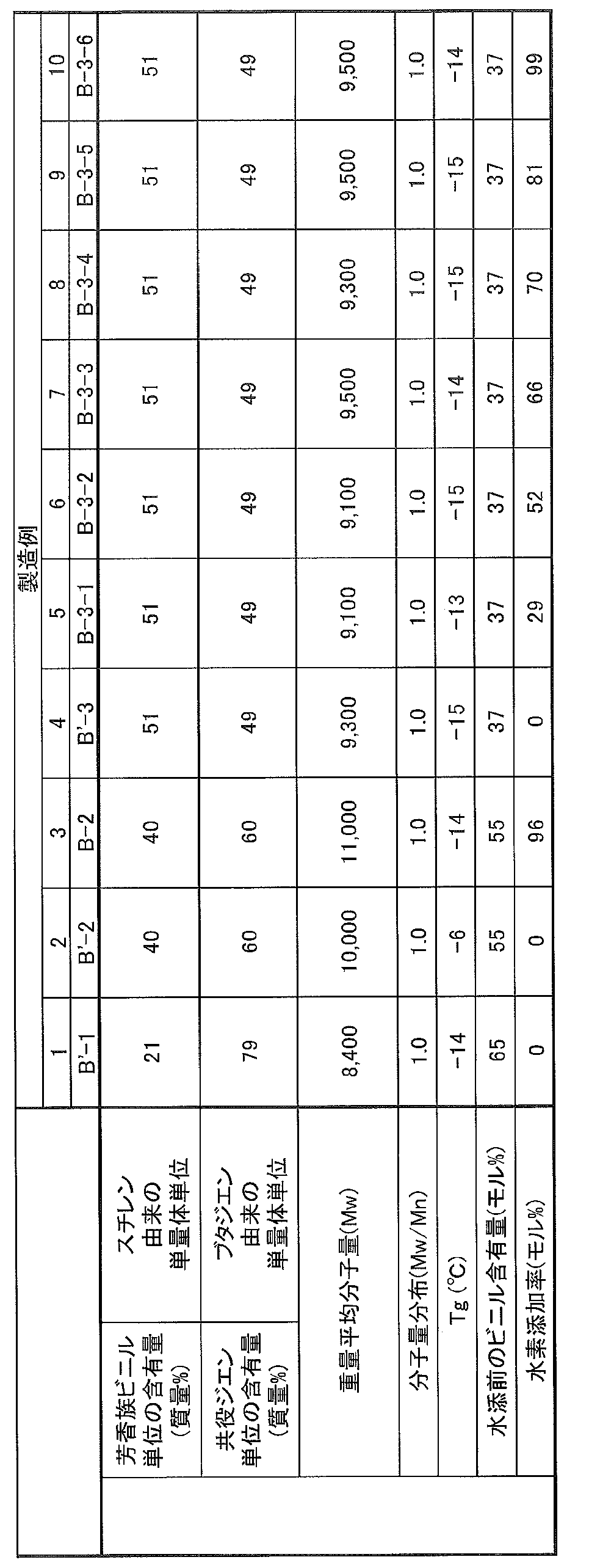
- the physical properties of the hydrogenated aromatic vinyl-conjugated diene random copolymers (B-3-1) to (B-3-6) thus obtained are summarized in Table 1.
- Example 1 and Comparative Examples 1 to 3 Of the hydrogenated aromatic vinyl-conjugated diene random copolymer (B) and aromatic vinyl-conjugated diene random copolymer (B') obtained above, (B-2), (B'-1) Using (B'-2) and (B'-2) respectively, a rubber composition was prepared as follows, and each physical property was evaluated. In Comparative Example 3, the hydrogenated aromatic vinyl-conjugated diene random copolymer (B) was not used.
- the solid rubber (A), the random copolymer (B) (or the random copolymer (B′)) (not used in Comparative Example 3), the filler ( C), a vulcanization aid, a silane coupling agent, and other components were respectively charged into a closed Banbury mixer, and the mixture was kneaded for 6 minutes so that the starting temperature was 60° C. and the resin temperature was 140° C., and then outside the mixer. It was taken out and cooled to room temperature.
- the obtained rubber composition is press-molded (press conditions: 160° C., 20 to 25 minutes) to prepare a vulcanized sheet (2 mm thick) of a crosslinked product (vulcanized rubber), and the physical properties are determined according to the following methods. Was measured and the performance was evaluated.
- Steping stability A 40 mm long ⁇ 5 mm wide test piece was cut out from the vulcanized sheets produced in Example 1 and Comparative Examples 1 to 3, and using a dynamic viscoelasticity measuring device manufactured by GABO, measurement temperature 25° C., frequency 10 Hz, static.
- the E′ storage elastic modulus (MPa) was measured under the conditions of strain of 10% and dynamic strain of 2% and used as an index of steering stability. The larger the value, the higher the rigidity of the rubber composition and the smaller the deformation, and the better the steering stability.
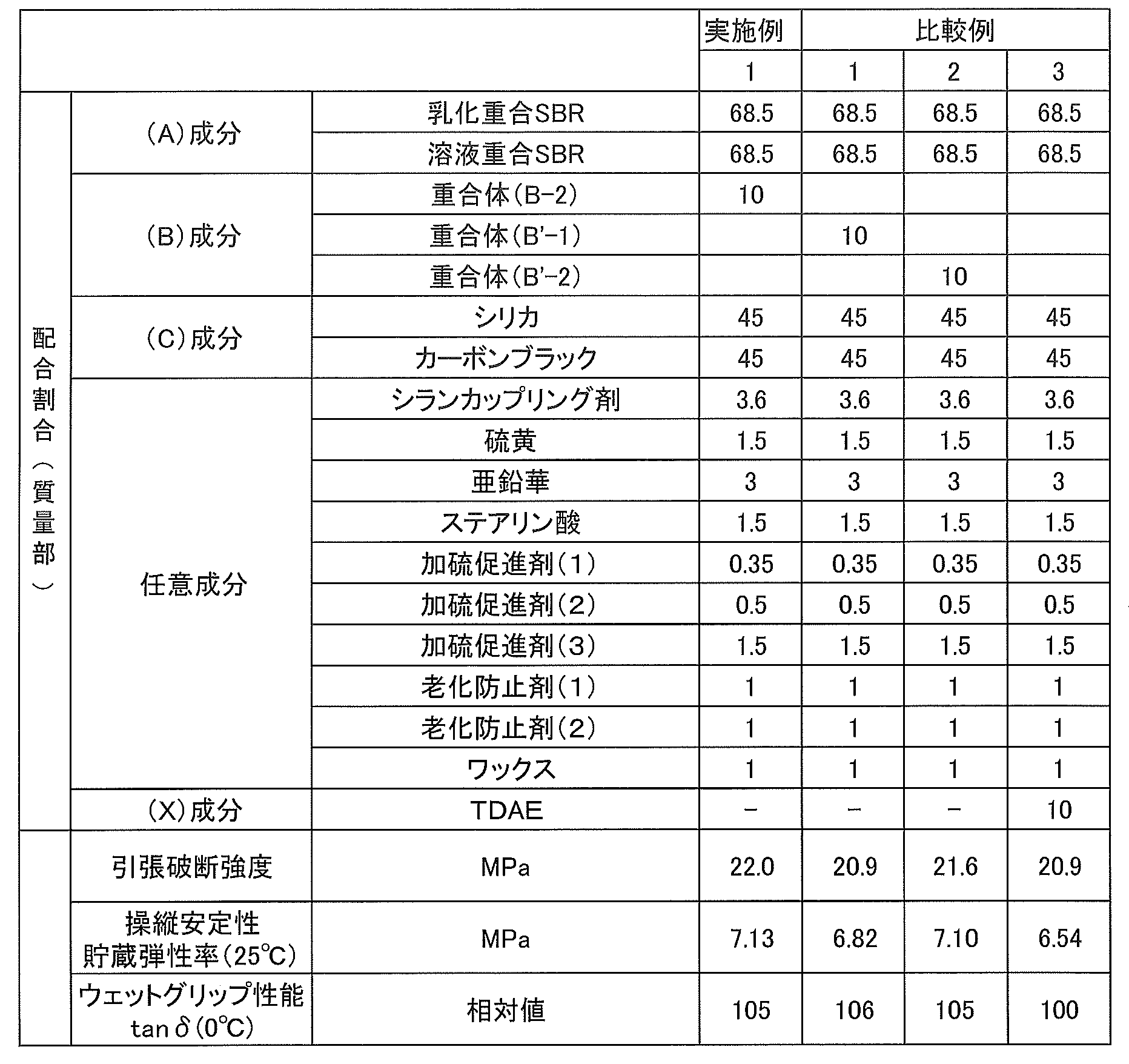
- Example 1 includes Comparative Example 3 in which TDAE was added in place of the random copolymer (B) for the purpose of improving processability, and Comparative Examples 1 and 2 including the unhydrogenated random copolymer (B′). In comparison, the tensile strength is improved. Further, Example 1 has a high storage elastic modulus at 25° C. and is excellent in handling stability. Furthermore, in Example 1, as compared with Comparative Example 3, tan ⁇ measured at 0° C. is improved, and wet grip performance is also excellent.
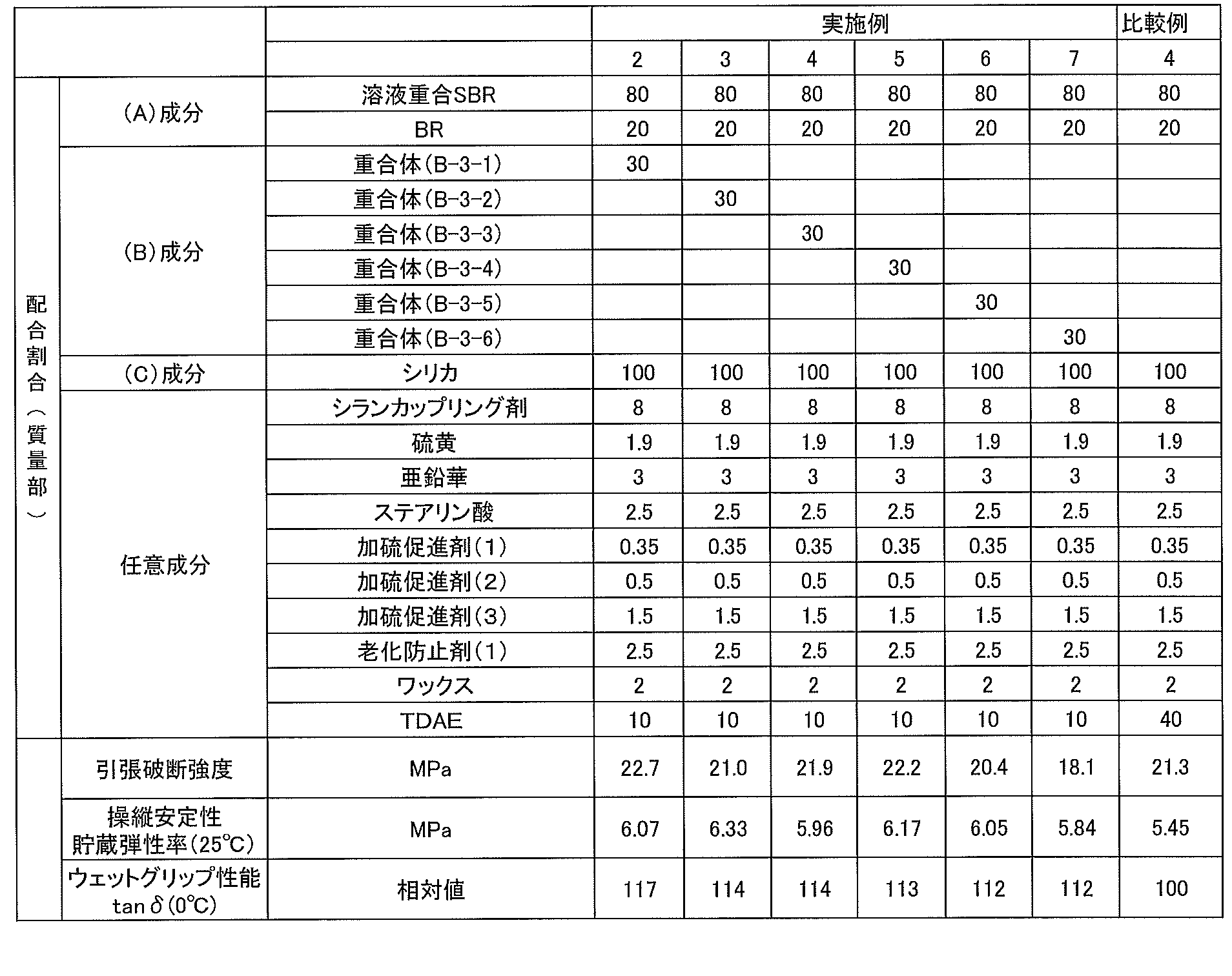
- the obtained rubber composition was press-molded (pressing conditions: 160° C., 20 to 25 minutes) to prepare a vulcanized sheet (2 mm thick) of a crosslinked product (vulcanized rubber), and processed in the same manner as in Example 1. Based on this, physical properties such as tensile breaking strength, steering stability, and wet grip performance were measured and the performance was evaluated. The results are shown in Table 3.
- the wet grip performance is a relative value when the numerical value of Comparative Example 4 is 100.
- Examples 2 to 7 have a higher storage elastic modulus at 25° C. and excellent steering stability as compared with Comparative Example 1 in which TDAE was added instead of the random copolymer (B) for improving processability. Further, tan ⁇ measured at 0° C. is improved, and the wet grip performance is also excellent. Further, Examples 2 to 7 are also excellent in tensile breaking strength. In Example 7, the hydrogenation rate is high and the tensile breaking strength is worse than in Comparative Example 1, but the steering stability and wet grip performance can be improved. In Examples 2 to 6, tensile breaking strength, steering stability, and wet grip performance are all improved.
- the rubber composition of the present invention is not only excellent in processability, but when it is made into a crosslinkable rubber composition by adding a cross-linking agent, it gives an excellent cross-linked product with improved tensile strength, etc. Can be suitably used.
- a cross-linked product is used for a tire tread or the like, steering stability is sufficient and excellent wet grip performance is obtained, which is useful.
Landscapes
- Chemical & Material Sciences (AREA)
- Health & Medical Sciences (AREA)
- Chemical Kinetics & Catalysis (AREA)
- Medicinal Chemistry (AREA)
- Polymers & Plastics (AREA)
- Organic Chemistry (AREA)
- Engineering & Computer Science (AREA)
- Mechanical Engineering (AREA)
- Compositions Of Macromolecular Compounds (AREA)
- Tires In General (AREA)
Abstract
Description
本発明は、上記の実情に鑑みてなされたものであり、引張強度が向上された架橋物となるゴム組成物、これを一部に用いた空気入りタイヤを提供する。
〔1〕固形ゴム(A)、水添芳香族ビニル-共役ジエン ランダム共重合体(B)、およびフィラー(C)を含むゴム組成物であり、
ランダム共重合体(B)が下記(i)~(iv)を満たす、ゴム組成物。
(i)芳香族ビニル単位の含有量が10~70質量%
(ii)水添前のランダム共重合体(B)の共役ジエン単位のビニル含有量が10~70モル%
(iii)共役ジエン単位の水素添加率が10モル%以上
(iv)重量平均分子量が3,000~100,000
〔2〕〔1〕に記載のゴム組成物を架橋させた架橋物。
〔3〕〔1〕に記載のゴム組成物を少なくとも一部に用いた空気入りタイヤ。
本発明のゴム組成物で用いる固形ゴム(A)とは、水添芳香族ビニル-共役ジエン ランダム共重合体(B)以外のゴムであって、20℃において固形状で取り扱うことができるゴムをいい、固形ゴム(A)の100℃におけるムーニー粘度ML1+4は20~200の範囲であってもよく、合成ゴム及び天然ゴムの少なくとも1種から選ばれるものであってもよい。
ラジカル重合開始剤としては、例えば、過硫酸アンモニウムや過硫酸カリウム等の過硫酸塩、有機過酸化物、過酸化水素等が挙げられる。
E-SBRの市販品としては、JSR株式会社製、油展スチレンブタジエンゴム「JSR1723」等が挙げられる。
本発明のゴム組成物で用いる水添芳香族ビニル-共役ジエン ランダム共重合体(B)(以下、単にランダム共重合体(B)ともいう。)とは、共役ジエンと芳香族ビニルとのランダム共重合体の水添体であり、その重量平均分子量(Mw)が3,000~100,000の範囲、芳香族ビニル単位の含有量が10~70質量%、水添前のランダム共重合体(B)の共役ジエン単位のビニル含有量が10~70モル%、共役ジエン単位の水素添加率が10モル%以上であるものをいう。本発明のゴム組成物において、ランダム共重合体(B)が含まれると、同程度の重量平均分子量の共役ジエン単位を含む他の重合体と比較して、得られる架橋物の引張強度が向上する。
ラジカル重合開始剤としては、例えば過硫酸アンモニウムや過硫酸カリウムのような過硫酸塩、有機過酸化物、過酸化水素等が挙げられる。
有機アルカリ金属化合物に対して、極性化合物の添加量を増加することで、共重合体のランダム性を高めることができる。
上記未水添のランダム共重合体(B')の製造方法としては、上記方法の中でも、溶液重合法が好ましい。
上記ランダム共重合体(B)は、1種単独で用いられてもよく、2種以上を併用してもよい。
本発明のゴム組成物で用いるフィラー(C)としては、ゴム組成物に一般的に用いるものであれば特に制限はなく、機械強度の向上等の物性の改善、例えばそのゴム組成物を少なくとも一部に用いたタイヤのドライグリップ性能、ウェットグリップ性能、操縦安定性能及び低燃費性能を向上させるなどの観点からは、上記フィラー(C)の中でも、カーボンブラック及びシリカから選ばれる少なくとも1種が好ましい。
本発明のゴム組成物では、フィラー(C)としてシリカなどを含有する場合は、シランカップリング剤を含有することが好ましい一態様である。シランカップリング剤としては、例えば、スルフィド系化合物、メルカプト系化合物、ビニル系化合物、アミノ系化合物、グリシドキシ系化合物、ニトロ系化合物、クロロ系化合物等が挙げられる。
アミノ系化合物としては、例えば、3-アミノプロピルトリエトキシシラン、3-アミノプロピルトリメトキシシラン、3-(2-アミノエチル)アミノプロピルトリエトキシシラン、3-(2-アミノエチル)アミノプロピルトリメトキシシランなどが挙げられる。
クロロ系化合物としては、例えば、3-クロロプロピルトリメトキシシラン、3-クロロプロピルトリエトキシシラン、2-クロロエチルトリメトキシシラン、2-クロロエチルトリエトキシシランなどが挙げられる。
その他の化合物としては、例えば、オクチルトリエトキシシラン、メチルトリエトキシシラン、メチルトリメトキシシラン、ヘキサデシルトリメトキシシランなどが挙げられる。
老化防止剤としては、例えば、アミン-ケトン系化合物、イミダゾール系化合物、アミン系化合物、フェノール系化合物、硫黄系化合物及びリン系化合物等が挙げられる。これら添加剤は、1種単独で用いられてもよく、2種以上を併用してもよい。
本発明のゴム組成物の製造方法は、上記各成分を均一に混合できれば特に限定されない。ゴム組成物の製造に用いる装置としては、例えば、ニーダールーダー、ブラベンダー、バンバリーミキサー、インターナルミキサー等の接線式又は噛合式の密閉式混練機、単軸押出機、二軸押出機、ミキシングロール、及びローラーなどが挙げられる。上記ゴム組成物を製造は、通常50~270℃の温度範囲で行うことができる。
なお、上記抽出率は、架橋物2gをトルエン400mL中に浸漬し、23℃で48時間後にトルエン中に抽出されたランダム共重合体(B)の量から算出することができる。
本発明のタイヤは、前記ゴム組成物を少なくとも一部に用いたものであり、特に前記タイヤを用いた空気入りタイヤが好ましい。本発明の空気入りタイヤは、前記ゴム組成物を少なくとも一部に用いているため、ドライグリップ性能が十分であり、優れたウェットグリップ性能及びアイスグリップ性能を兼ね備え、操縦安定性が向上しており、耐摩耗性にも優れる。そのため、空気入りタイヤとしては、ウインタータイヤ、スタッドレスタイヤ等の冬用タイヤ、オールシーズンタイヤ、夏用タイヤ、レースタイヤ等の競技用タイヤとして好適である。
本実施例及び比較例において使用した各成分は以下のとおりである。
<(A)成分>
SBR(1):油展乳化重合スチレンブタジエンゴム(乳化重合SBR)、
JSR1723(JSR株式会社製)、
重量平均分子量48万、スチレン含有量23.5質量%、
ガラス転移温度-53℃
オイル37.5質量部
SBR(2):油展溶液重合スチレンブタジエンゴム(溶液重合SBR)、
タフデンE580(旭化成株式会社製)
重量平均分子量170万、スチレン含有量35.5質量%、
ガラス転移温度-31℃
オイル37.5質量部
BR:ブタジエンゴム、
BR01(JSR株式会社製、高シスタイプ〔1,4-シス結合95%〕、
重量平均分子量52万、
ガラス転移温度 -103℃
<(B)成分>
後述する製造例3、5~10で得られた水添芳香族ビニル-共役ジエン ランダム共重合体
<(C)成分>
シリカ :エボニック社製 ULTRASIL7000GR(湿式シリカ)、
平均粒径14nm
カーボンブラック:三菱化学株式会社製 ダイアブラックN234、
平均粒径22nm
<(X)成分>
(B)成分の比較用の一例に下記(X)成分を用いた。
TDAE :H&R社製 VivaTec500
<その他の成分>
シランカップリング剤:エボニック社製 Si75
硫黄 :鶴見化学工業株式会社製 微粉硫黄200メッシュ
加硫促進剤(1) :大内新興化学工業株式会社製 ノクセラーCZ-G
加硫促進剤(2) :大内新興化学工業株式会社製 ノクセラーD
加硫促進剤(3) :大内新興化学工業株式会社製 ノクセラーTBT-N
ステアリン酸 :花王株式会社製 ルナックS-20
亜鉛華 :堺化学工業株式会社製 酸化亜鉛
老化防止剤(1) :大内新興化学工業株式会社製 ノクラック6C
老化防止剤(2) :川口化学工業株式会社製 アンテージRD
ワックス :精工化学株式会社製 サンタイトS
重合体の重量平均分子量(Mw)及び数平均分子量(Mn)は、GPC(ゲルパーミエーションクロマトグラフィー)により標準ポリスチレン換算分子量で求め、これら値から分子量分布(Mw/Mn)を算出した。測定装置及び条件は、以下の通りである。
・装置 :東ソー株式会社製GPC装置「GPC8020」
・分離カラム :東ソー株式会社製「TSKgelG4000HXL」
・検出器 :東ソー株式会社製「RI-8020」
・溶離液 :テトラヒドロフラン
・溶離液流量 :1.0mL/分
・サンプル濃度:5mg/10mL
・カラム温度 :40℃
芳香族ビニル単位の含有量を、日本電子株式会社製1H-NMR(500MHz)を使用し、サンプル/重クロロホルム=50mg/1mLの濃度、積算回数1024回で測定した。得られたスペクトルの6.00~7.95ppmを芳香族ビニル由来のピークとして、ジエン化合物由来の二重結合のピークとの面積比から、芳香族ビニル単位の含有量を算出した。また、該芳香族ビニル単位の含有量から、共役ジエン単位の含有量を算出した。
水添前のランダム共重合体について、共役ジエン単位のビニル含有量を、日本電子株式会社製1H-NMR(500MHz)を使用し、サンプル/重クロロホルム=50mg/1mLの濃度、積算回数1024回で測定した。得られたスペクトルのビニル化されたジエン化合物由来の二重結合のピークと、ビニル化されていないジエン化合物由来の二重結合のピークとの面積比から、ビニル含有量(モル%)を算出した。
例えば、ブタジエン単位のビニル含有量については、以下のようにして算出できる。上述の測定により得られたチャートの4.85~4.94ppm部分をビニル構造由来のスペクトル、5.22~5.65ppmの部分をビニル構造と1,4結合の合成スペクトルとし、以下の式に基づきビニル含有量を算出した。
{ビニル含有量(ブタジエン単位)}=4.85~4.94ppmの積分値/2/{4.85~4.94ppmの積分値/2+〔5.22~5.65ppmの積分値-(4.85~4.94ppmの積分値/2)〕/2}
すなわち、表1中の水添芳香族ビニル-共役ジエン ランダム共重合体(B-2),(B-3-1)~(B-3-5)のビニル含有量は水添前の共役ジエン単位のビニル含有量であり、水添を行わない芳香族ビニル-共役ジエン ランダム共重合体(B'-1)~(B'-3)はそれ自体の共役ジエン単位のビニル含有量である。
日本電子株式会社製1H-NMR(500MHz)を使用し、サンプル/重クロロホルム=100mg/1mLの濃度、積算回数512回、測定温度50℃で測定した。得られたスペクトルの未水添共役ジエン化合物由来の二重結合に由来するピークと、水添又は未水添共役ジエン化合物由来の飽和炭化水素に由来するピークとの面積比から、水素添加率(モル%)を算出した。
重合体10mgをアルミパンに採取し、示差走査熱量測定(DSC)により10℃/分の昇温速度条件においてサーモグラムを測定し、DDSCのピークトップの値をガラス転移温度(Tg)とした。
窒素置換し乾燥させた耐圧容器に、溶媒としてシクロヘキサン750g、重合開始剤としてsec-ブチルリチウム(10.5質量%シクロヘキサン溶液)62.9g、極性化合物としてN,N,N',N'-テトラメチルエチレンジアミン5.9gを仕込み、50℃に昇温した後、予め調製した105gのスチレンと395gのブタジエンの混合液を5mL/分で加えて2.5時間重合した。得られた重合反応液にメタノール4gを添加して重合を停止した後、水2Lを用いて重合反応液を洗浄した。洗浄後の重合反応液と水とを分離して、70℃で12時間減圧乾燥することにより、芳香族ビニル-共役ジエン ランダム共重合体(B'-1)を得た。製造例1で得られた芳香族ビニル-共役ジエン ランダム共重合体(B'-1)の物性を表1にまとめる。
窒素置換し乾燥させた耐圧容器に、溶媒としてシクロヘキサン750g、重合開始剤としてsec-ブチルリチウム(10.5質量%シクロヘキサン溶液)47.5g、極性化合物としてN,N,N',N'-テトラメチルエチレンジアミン5.2gを仕込み、50℃に昇温した後、予め調製した200gのスチレンと300gのブタジエンの混合液を5mL/分で加えて2.3時間重合した。得られた重合反応液にメタノール3gを添加して重合を停止した後、水2Lを用いて重合反応液を洗浄した。洗浄後の重合反応液と水とを分離して、70℃で12時間減圧乾燥することにより、芳香族ビニル-共役ジエン ランダム共重合体(B'-2)を得た。製造例2で得られた芳香族ビニル-共役ジエン ランダム共重合体(B'-2)の物性を表1にまとめる。
製造例2で得た芳香族ビニル-共役ジエン ランダム共重合体(B'-2)500gと、溶媒であるシクロヘキサン500gとをオートクレーブ中で混合し、50℃まで昇温した。続いて、トリイソブチルアルミニウムと2-エチルヘキサン酸ニッケルとを3:1のモル比で混合したものを水素添加触媒として、重合体が含有する全不飽和結合のモル数に対し、水素添加触媒を構成しているニッケル金属として1.5×10⁻³倍モル加え、80℃まで昇温した。水素圧力を1.0MPaに保つように随時水素を供給しながら攪拌を続け3時間反応し、水添芳香族ビニル-共役ジエン ランダム共重合体(B-2)を得た。製造例3で得られた水添芳香族ビニル-共役ジエン ランダム共重合体(B-2)の物性を表1にまとめる。
窒素置換し乾燥させた耐圧容器に、溶媒としてシクロヘキサン1167g、重合開始剤としてsec-ブチルリチウム(10.5質量%シクロヘキサン溶液)49.3g、極性化合物としてテトラヒドロフラン10.4gを仕込み、50℃に昇温した後、予め調製した255gのスチレンと245gのブタジエンの混合液を5mL/分で加えて2.5時間重合した。得られた重合反応液にメタノール3.2gを添加して重合を停止した後、水2Lを用いて重合反応液を洗浄した。洗浄後の重合反応液と水とを分離して、70℃で12時間減圧乾燥することにより、芳香族ビニル-共役ジエン ランダム共重合体(B'-3)を得た。製造例4で得られた芳香族ビニル-共役ジエン ランダム共重合体(B'-3)の物性を表1にまとめる。
製造例4で得た芳香族ビニル-共役ジエン ランダム共重合体(B'-3)500gと、溶媒であるシクロヘキサン500gとをオートクレーブ中で混合し、50℃まで昇温した。続いて、トリイソブチルアルミニウムと2-エチルヘキサン酸ニッケルとを3:1のモル比で混合したものを水素添加触媒として、重合体が含有する全不飽和結合のモル数に対し、水素添加触媒を構成しているニッケル金属として1.5×10⁻³倍モル加え、80℃まで昇温した。水素圧力を1.0MPaに保つように随時水素を供給しながら攪拌を続け、適宜水素供給を止めて反応を終了することで、水素添加量の異なる、水添芳香族ビニル-共役ジエン ランダム共重合体(B-3-1)~(B-3-6)を得た。得られた水添芳香族ビニル-共役ジエン ランダム共重合体(B-3-1)~(B-3-6)の物性を表1にまとめる。
上記で得られた水添芳香族ビニル-共役ジエン ランダム共重合体(B)及び芳香族ビニル-共役ジエン ランダム共重合体(B')の内、(B-2),(B'-1)及び(B'-2)をそれぞれ用いて以下のようにゴム組成物を作製し、各物性を評価した。なお、比較例3では水添芳香族ビニル-共役ジエン ランダム共重合体(B)は用いていない。
表2に示した配合割合(質量部)にしたがって、固形ゴム(A)、ランダム共重合体(B)(または、ランダム共重合体(B'))(比較例3では用いず)、フィラー(C)、加硫助剤、シランカップリング剤及びその他の成分を、それぞれ密閉式バンバリーミキサーに投入して開始温度60℃、樹脂温度が140℃となるように6分間混練した後、ミキサー外に取り出して室温まで冷却した。次いで、この混合物を再度密閉式バンバリーミキサーに投入し、加硫剤(硫黄)及び加硫促進剤を加えて開始温度50℃、到達温度100℃となるように75秒間混練することでゴム組成物を得た。結果を表2に示す。
実施例1及び比較例1~3で作製した加硫シートからJIS3号ダンベル状試験片を打ち抜き、インストロン社製引張試験機を用いて、JIS K 6251に準じて引張破断強度(MPa)を測定した。数値が大きいほど、破断特性が良好である。
実施例1及び比較例1~3で作製した加硫シートから縦40mm×横5mmの試験片を切り出し、GABO社製動的粘弾性測定装置を用いて、測定温度25℃、周波数10Hz、静的歪み10%、動的歪み2%の条件で、E'貯蔵弾性率(MPa)を測定し、操縦安定性の指標とした。数値が大きいほどゴム組成物の剛性が高く、変形が小さいため操縦安定性が良好であることを示す。
実施例1及び比較例1~3で作製した加硫シートから縦40mm×横5mmの試験片を切り出し、GABO社製動的粘弾性測定装置を用いて、測定温度0℃、周波数10Hz、静的歪み10%、動的歪み2%の条件で、tanδを測定し、ウェットグリップ性能の指標とした。数値が大きいほどゴム組成物のウェットグリップ性能が良好であることを示す。なお、表2には、比較例3の数値を100とした際の相対値を示す。
上記で得られた水添芳香族ビニル-共役ジエン ランダム共重合体(B)の内、(B-3-1)~(B-3-6)をそれぞれ用いて以下のようにゴム組成物を作製し、各物性を評価した。なお、比較例4では水添芳香族ビニル-共役ジエン ランダム共重合体(B)は用いていない。
表3に示した配合割合(質量部)にしたがって、固形ゴム(A)、ランダム共重合体(B)(比較例4では用いず)、フィラー(C)、加硫助剤、シランカップリング剤及びその他の成分を、それぞれ密閉式バンバリーミキサーに投入して開始温度60℃、樹脂温度が140℃となるように6分間混練した後、ミキサー外に取り出して室温まで冷却した。次いで、この混合物を再度密閉式バンバリーミキサーに投入し、加硫剤(硫黄)及び加硫促進剤を加えて開始温度50℃、到達温度100℃となるように75秒間混練することでゴム組成物を得た。
Claims (3)
- 固形ゴム(A)、水添芳香族ビニル-共役ジエン ランダム共重合体(B)、およびフィラー(C)を含むゴム組成物であり、
ランダム共重合体(B)が下記(i)~(iv)を満たす、ゴム組成物。
(i)芳香族ビニル単位の含有量が10~70質量%
(ii)水添前のランダム共重合体(B)の共役ジエン単位のビニル含有量が10~70モル%
(iii)共役ジエン単位の水素添加率が10モル%以上
(iv)重量平均分子量が3,000~100,000 - 請求項1に記載のゴム組成物を架橋させた架橋物。
- 請求項1に記載のゴム組成物を少なくとも一部に用いた空気入りタイヤ。
Priority Applications (5)
| Application Number | Priority Date | Filing Date | Title |
|---|---|---|---|
| JP2020561366A JPWO2020129821A1 (ja) | 2018-12-17 | 2019-12-12 | ゴム組成物 |
| CN201980083364.1A CN113165429A (zh) | 2018-12-17 | 2019-12-12 | 橡胶组合物 |
| US17/413,571 US20220056245A1 (en) | 2018-12-17 | 2019-12-12 | Rubber compositions |
| KR1020217017607A KR20210088674A (ko) | 2018-12-17 | 2019-12-12 | 고무 조성물 |
| EP19897635.9A EP3900948A4 (en) | 2018-12-17 | 2019-12-12 | Rubber composition |
Applications Claiming Priority (2)
| Application Number | Priority Date | Filing Date | Title |
|---|---|---|---|
| JP2018235436 | 2018-12-17 | ||
| JP2018-235436 | 2018-12-17 |
Publications (1)
| Publication Number | Publication Date |
|---|---|
| WO2020129821A1 true WO2020129821A1 (ja) | 2020-06-25 |
Family
ID=71100479
Family Applications (1)
| Application Number | Title | Priority Date | Filing Date |
|---|---|---|---|
| PCT/JP2019/048809 Ceased WO2020129821A1 (ja) | 2018-12-17 | 2019-12-12 | ゴム組成物 |
Country Status (7)
| Country | Link |
|---|---|
| US (1) | US20220056245A1 (ja) |
| EP (1) | EP3900948A4 (ja) |
| JP (1) | JPWO2020129821A1 (ja) |
| KR (1) | KR20210088674A (ja) |
| CN (1) | CN113165429A (ja) |
| TW (1) | TW202033649A (ja) |
| WO (1) | WO2020129821A1 (ja) |
Citations (14)
| Publication number | Priority date | Publication date | Assignee | Title |
|---|---|---|---|---|
| JPH07238187A (ja) * | 1994-02-28 | 1995-09-12 | Asahi Chem Ind Co Ltd | タイヤトレッド用ゴム組成物 |
| JPH09227723A (ja) * | 1996-02-23 | 1997-09-02 | Toyo Tire & Rubber Co Ltd | 低燃費タイヤ用トレッドゴム組成物 |
| JP2005225946A (ja) * | 2004-02-12 | 2005-08-25 | Sumitomo Rubber Ind Ltd | ゴム組成物およびそれを用いたタイヤ |
| JP2006213807A (ja) | 2005-02-03 | 2006-08-17 | Bridgestone Corp | ゴム組成物及びそれを用いた空気入りタイヤ |
| JP2006213809A (ja) * | 2005-02-03 | 2006-08-17 | Bridgestone Corp | ゴム組成物及びそれを用いた空気入りタイヤ |
| JP2007161817A (ja) * | 2005-12-12 | 2007-06-28 | Sumitomo Rubber Ind Ltd | タイヤ用ゴム組成物 |
| WO2007081026A1 (ja) | 2006-01-16 | 2007-07-19 | Bridgestone Corporation | ゴム組成物及びそれを用いた空気入りタイヤ |
| JP2008184517A (ja) * | 2007-01-29 | 2008-08-14 | Bridgestone Corp | ゴム組成物及びそれを用いた空気入りタイヤ |
| JP2008231207A (ja) * | 2007-03-19 | 2008-10-02 | Bridgestone Corp | ゴム組成物及びそれを用いた空気入りタイヤ |
| JP2008274120A (ja) * | 2007-04-27 | 2008-11-13 | Sumitomo Rubber Ind Ltd | ゴム組成物およびそれを用いたタイヤ |
| JP2011132298A (ja) | 2009-12-22 | 2011-07-07 | Sumitomo Rubber Ind Ltd | 変性共重合体、それを用いたゴム組成物および空気入りタイヤ |
| JP2011153219A (ja) | 2010-01-27 | 2011-08-11 | Sumitomo Rubber Ind Ltd | タイヤ用ゴム組成物及び空気入りタイヤ |
| WO2015064646A1 (ja) * | 2013-10-31 | 2015-05-07 | Jsr株式会社 | 架橋ゴム、タイヤ用部材、防振用部材、ベルト用部材及びゴム組成物 |
| JP2018177920A (ja) * | 2017-04-10 | 2018-11-15 | 住友ゴム工業株式会社 | ゴム組成物およびタイヤ |
Family Cites Families (8)
| Publication number | Priority date | Publication date | Assignee | Title |
|---|---|---|---|---|
| EP1514901B1 (en) * | 2002-06-19 | 2011-06-01 | Bridgestone Corporation | Rubber composition for tire and tire made therefrom |
| JP3996008B2 (ja) * | 2002-07-31 | 2007-10-24 | 株式会社ブリヂストン | ゴム組成物及びこれをトレッドに用いた空気入りタイヤ |
| EP2261283A3 (en) * | 2003-11-28 | 2012-03-21 | Sumitomo Rubber Industries, Ltd. | Rubber composition for a tire and tire using the same |
| JP4402530B2 (ja) * | 2004-07-02 | 2010-01-20 | 住友ゴム工業株式会社 | ゴム組成物およびそれを用いたタイヤ |
| JP6355581B2 (ja) * | 2015-03-20 | 2018-07-11 | 住友ゴム工業株式会社 | 高分子複合体及びその製造方法、並びに、タイヤ用ゴム組成物及び空気入りタイヤ |
| JP6805502B2 (ja) * | 2016-02-18 | 2020-12-23 | 住友ゴム工業株式会社 | 空気入りタイヤ |
| JP6862787B2 (ja) * | 2016-11-22 | 2021-04-21 | 住友ゴム工業株式会社 | 空気入りタイヤ |
| JP7013670B2 (ja) * | 2017-04-07 | 2022-02-01 | 住友ゴム工業株式会社 | タイヤ |
-
2019
- 2019-12-12 EP EP19897635.9A patent/EP3900948A4/en active Pending
- 2019-12-12 US US17/413,571 patent/US20220056245A1/en not_active Abandoned
- 2019-12-12 JP JP2020561366A patent/JPWO2020129821A1/ja active Pending
- 2019-12-12 WO PCT/JP2019/048809 patent/WO2020129821A1/ja not_active Ceased
- 2019-12-12 KR KR1020217017607A patent/KR20210088674A/ko not_active Ceased
- 2019-12-12 CN CN201980083364.1A patent/CN113165429A/zh active Pending
- 2019-12-16 TW TW108145934A patent/TW202033649A/zh unknown
Patent Citations (14)
| Publication number | Priority date | Publication date | Assignee | Title |
|---|---|---|---|---|
| JPH07238187A (ja) * | 1994-02-28 | 1995-09-12 | Asahi Chem Ind Co Ltd | タイヤトレッド用ゴム組成物 |
| JPH09227723A (ja) * | 1996-02-23 | 1997-09-02 | Toyo Tire & Rubber Co Ltd | 低燃費タイヤ用トレッドゴム組成物 |
| JP2005225946A (ja) * | 2004-02-12 | 2005-08-25 | Sumitomo Rubber Ind Ltd | ゴム組成物およびそれを用いたタイヤ |
| JP2006213807A (ja) | 2005-02-03 | 2006-08-17 | Bridgestone Corp | ゴム組成物及びそれを用いた空気入りタイヤ |
| JP2006213809A (ja) * | 2005-02-03 | 2006-08-17 | Bridgestone Corp | ゴム組成物及びそれを用いた空気入りタイヤ |
| JP2007161817A (ja) * | 2005-12-12 | 2007-06-28 | Sumitomo Rubber Ind Ltd | タイヤ用ゴム組成物 |
| WO2007081026A1 (ja) | 2006-01-16 | 2007-07-19 | Bridgestone Corporation | ゴム組成物及びそれを用いた空気入りタイヤ |
| JP2008184517A (ja) * | 2007-01-29 | 2008-08-14 | Bridgestone Corp | ゴム組成物及びそれを用いた空気入りタイヤ |
| JP2008231207A (ja) * | 2007-03-19 | 2008-10-02 | Bridgestone Corp | ゴム組成物及びそれを用いた空気入りタイヤ |
| JP2008274120A (ja) * | 2007-04-27 | 2008-11-13 | Sumitomo Rubber Ind Ltd | ゴム組成物およびそれを用いたタイヤ |
| JP2011132298A (ja) | 2009-12-22 | 2011-07-07 | Sumitomo Rubber Ind Ltd | 変性共重合体、それを用いたゴム組成物および空気入りタイヤ |
| JP2011153219A (ja) | 2010-01-27 | 2011-08-11 | Sumitomo Rubber Ind Ltd | タイヤ用ゴム組成物及び空気入りタイヤ |
| WO2015064646A1 (ja) * | 2013-10-31 | 2015-05-07 | Jsr株式会社 | 架橋ゴム、タイヤ用部材、防振用部材、ベルト用部材及びゴム組成物 |
| JP2018177920A (ja) * | 2017-04-10 | 2018-11-15 | 住友ゴム工業株式会社 | ゴム組成物およびタイヤ |
Non-Patent Citations (1)
| Title |
|---|
| See also references of EP3900948A4 |
Also Published As
| Publication number | Publication date |
|---|---|
| KR20210088674A (ko) | 2021-07-14 |
| EP3900948A1 (en) | 2021-10-27 |
| US20220056245A1 (en) | 2022-02-24 |
| EP3900948A4 (en) | 2022-08-31 |
| CN113165429A (zh) | 2021-07-23 |
| TW202033649A (zh) | 2020-09-16 |
| JPWO2020129821A1 (ja) | 2021-11-04 |
Similar Documents
| Publication | Publication Date | Title |
|---|---|---|
| US10227481B2 (en) | Rubber composition, vulcanized rubber, and tire | |
| JP7112406B2 (ja) | タイヤ用ゴム組成物 | |
| TWI827548B (zh) | 重負載輪胎用橡膠組成物及輪胎 | |
| JP7132322B2 (ja) | 変性液状ジエン系重合体およびゴム組成物 | |
| CN111875740A (zh) | 共聚物、使用了其的橡胶组合物以及轮胎 | |
| JP7112405B2 (ja) | タイヤ用ゴム組成物 | |
| JP7112407B2 (ja) | 高グリップタイヤ用ゴム組成物 | |
| WO2018043699A1 (ja) | ゴム組成物 | |
| WO2018043700A1 (ja) | ゴム組成物 | |
| CA3074360A1 (en) | Heavy-duty tire rubber compositions and tires | |
| JP7153654B2 (ja) | 高グリップタイヤ用ゴム組成物 | |
| JP7270035B2 (ja) | ジエン系ゴム及びゴム組成物 | |
| WO2020129821A1 (ja) | ゴム組成物 | |
| EP4653495A1 (en) | Rubber composition and crosslinked material |
Legal Events
| Date | Code | Title | Description |
|---|---|---|---|
| 121 | Ep: the epo has been informed by wipo that ep was designated in this application |
Ref document number: 19897635 Country of ref document: EP Kind code of ref document: A1 |
|
| ENP | Entry into the national phase |
Ref document number: 2020561366 Country of ref document: JP Kind code of ref document: A |
|
| ENP | Entry into the national phase |
Ref document number: 20217017607 Country of ref document: KR Kind code of ref document: A |
|
| NENP | Non-entry into the national phase |
Ref country code: DE |
|
| ENP | Entry into the national phase |
Ref document number: 2019897635 Country of ref document: EP Effective date: 20210719 |