WO2020129968A1 - チョコレートの製造方法 - Google Patents
チョコレートの製造方法 Download PDFInfo
- Publication number
- WO2020129968A1 WO2020129968A1 PCT/JP2019/049364 JP2019049364W WO2020129968A1 WO 2020129968 A1 WO2020129968 A1 WO 2020129968A1 JP 2019049364 W JP2019049364 W JP 2019049364W WO 2020129968 A1 WO2020129968 A1 WO 2020129968A1
- Authority
- WO
- WIPO (PCT)
- Prior art keywords
- chocolate
- chocolate dough
- dough
- content
- mass
- Prior art date
- Legal status (The legal status is an assumption and is not a legal conclusion. Google has not performed a legal analysis and makes no representation as to the accuracy of the status listed.)
- Ceased
Links
Classifications
-
- A—HUMAN NECESSITIES
- A23—FOODS OR FOODSTUFFS; TREATMENT THEREOF, NOT COVERED BY OTHER CLASSES
- A23G—COCOA; COCOA PRODUCTS, e.g. CHOCOLATE; SUBSTITUTES FOR COCOA OR COCOA PRODUCTS; CONFECTIONERY; CHEWING GUM; ICE-CREAM; PREPARATION THEREOF
- A23G1/00—Cocoa; Cocoa products, e.g. chocolate; Substitutes therefor
- A23G1/30—Cocoa products, e.g. chocolate; Substitutes therefor
- A23G1/32—Cocoa products, e.g. chocolate; Substitutes therefor characterised by the composition containing organic or inorganic compounds
- A23G1/36—Cocoa products, e.g. chocolate; Substitutes therefor characterised by the composition containing organic or inorganic compounds characterised by the fats used
-
- A—HUMAN NECESSITIES
- A23—FOODS OR FOODSTUFFS; TREATMENT THEREOF, NOT COVERED BY OTHER CLASSES
- A23G—COCOA; COCOA PRODUCTS, e.g. CHOCOLATE; SUBSTITUTES FOR COCOA OR COCOA PRODUCTS; CONFECTIONERY; CHEWING GUM; ICE-CREAM; PREPARATION THEREOF
- A23G1/00—Cocoa; Cocoa products, e.g. chocolate; Substitutes therefor
- A23G1/0003—Processes of manufacture not relating to composition or compounding ingredients
- A23G1/0026—Mixing; Roller milling for preparing chocolate
- A23G1/0036—Conching
-
- A—HUMAN NECESSITIES
- A23—FOODS OR FOODSTUFFS; TREATMENT THEREOF, NOT COVERED BY OTHER CLASSES
- A23G—COCOA; COCOA PRODUCTS, e.g. CHOCOLATE; SUBSTITUTES FOR COCOA OR COCOA PRODUCTS; CONFECTIONERY; CHEWING GUM; ICE-CREAM; PREPARATION THEREOF
- A23G1/00—Cocoa; Cocoa products, e.g. chocolate; Substitutes therefor
- A23G1/0003—Processes of manufacture not relating to composition or compounding ingredients
- A23G1/005—Moulding, shaping, cutting or dispensing chocolate
- A23G1/0053—Processes of shaping not covered elsewhere
-
- A—HUMAN NECESSITIES
- A23—FOODS OR FOODSTUFFS; TREATMENT THEREOF, NOT COVERED BY OTHER CLASSES
- A23G—COCOA; COCOA PRODUCTS, e.g. CHOCOLATE; SUBSTITUTES FOR COCOA OR COCOA PRODUCTS; CONFECTIONERY; CHEWING GUM; ICE-CREAM; PREPARATION THEREOF
- A23G1/00—Cocoa; Cocoa products, e.g. chocolate; Substitutes therefor
- A23G1/30—Cocoa products, e.g. chocolate; Substitutes therefor
- A23G1/56—Liquid products; Solid products in the form of powders, flakes or granules for making liquid products, e.g. for making chocolate milk, drinks and the products for their preparation, pastes for spreading or milk crumb
-
- A—HUMAN NECESSITIES
- A23—FOODS OR FOODSTUFFS; TREATMENT THEREOF, NOT COVERED BY OTHER CLASSES
- A23V—INDEXING SCHEME RELATING TO FOODS, FOODSTUFFS OR NON-ALCOHOLIC BEVERAGES AND LACTIC OR PROPIONIC ACID BACTERIA USED IN FOODSTUFFS OR FOOD PREPARATION
- A23V2002/00—Food compositions, function of food ingredients or processes for food or foodstuffs
Definitions
- the present invention relates to a method for producing a chocolate dough having a reduced viscosity, a method for producing chocolate using the dough, and particularly a method for producing heat resistant chocolate.
- a method for imparting heat resistance to chocolate for example, a method of blending chocolate with an oil or fat having a high melting point, a method of increasing the solid content of chocolate (reducing the oil or fat), or a method of mixing a small amount of water with chocolate dough
- a method of forming a sugar skeleton may be mentioned.
- the blending of fats and oils having a high melting point significantly deteriorates the mouth-feel of chocolate.
- the formation of the sugar skeleton inside the chocolate can impart heat resistance to the chocolate without damaging the mouth feel and mouthfeel.
- the chocolate can maintain its shape even when the ambient temperature is equal to or higher than the melting point of the fats and oils contained in the chocolate.
- An object of the present invention is to provide a chocolate dough in which an increase in the dough viscosity due to the addition of a small amount of water is suppressed, and a method for producing the dough.
- the present inventors have conducted diligent research to solve the above problems.
- the chocolate dough undergoes a step in which the ratio of the polyglycerin condensed ricinoleic acid ester and the phospholipid contained in the chocolate dough is maintained in a specific range, and by being prepared, the viscosity of the chocolate dough is reduced. I found that. Furthermore, they have found that the addition of a small amount of water to the chocolate dough suppresses the increase in the dough viscosity. As a result, the present invention has been completed.
- the present invention may include the following aspects.
- [1] A melted chocolate dough which is at least through a state in which the mass ratio of the polyglycerin-condensed ricinoleic acid ester content to the phospholipid content contained in the chocolate dough is 100:0 to 70:30 Production method.
- [2] The melted chocolate according to [1], wherein the mass ratio of the content of polyglycerin condensed ricinoleic acid ester to the content of phospholipid contained in the melted chocolate dough is 70:30 to 25:75. Fabric manufacturing method.
- [3] The method for producing a molten chocolate dough according to [1] or [2], wherein the polyglycerin condensed ricinoleic acid ester is added to the chocolate dough before the first half of the conching step.
- [4] The method for producing a molten chocolate dough according to any one of [1] to [3], which has a particle diameter (D90) of 10 to 30 ⁇ m.
- [5] A method for producing chocolate, comprising cooling and solidifying the melted chocolate dough produced by the method according to any one of [1] to [4].
- [6] The method for producing chocolate according to [5], wherein 0.1 to 3 parts by mass of water is added and dispersed with respect to 100 parts by mass of the melted chocolate dough before being cooled and solidified.
- a melted chocolate dough which passes through at least a state in which the mass ratio of the polyglycerin-condensed ricinoleic acid ester content to the phospholipid content contained in the chocolate dough is 100:0 to 70:30 Viscosity reduction method.
- Melt by adding and dispersing water which causes at least a state in which the mass ratio of the polyglycerin-condensed ricinoleic acid ester contained in the chocolate dough and the phospholipid is 100:0 to 70:30.
- a method for suppressing an increase in viscosity of liquid chocolate dough is
- the present invention it is possible to provide a chocolate dough in which an increase in the dough viscosity due to the addition of a small amount of water is suppressed and a method for producing the dough.
- chocolate is not limited by the “fair competition agreement regarding the labeling of chocolates” (National Chocolate Industry Fair Trade Council) or legal provisions.
- the chocolate of the present invention is mainly composed of edible oils and fats and sugars, and may optionally contain cocoa components (cocoa mass, cocoa powder, etc.), dairy products, flavors, emulsifiers and the like.
- the chocolate of the present invention is produced through some or all of the steps of chocolate production (mixing step, atomizing step, refining step, cooling step, etc.). Further, the chocolate of the present invention includes white chocolate and color chocolate in addition to dark chocolate and milk chocolate.
- the chocolate dough is a mixture in which some or all of the chocolate raw materials are mixed, and refers to a chocolate raw material mixture at any stage before being solidified by cooling to finally become solid chocolate.
- the chocolate dough can be, for example, a chocolate raw material mixture after atomization or a chocolate raw material mixture after conching.
- the melted chocolate dough in the present invention refers to a chocolate dough in a state in which fats and oils contained in the chocolate dough are melted. Whether or not the chocolate dough is in a molten state can be determined, for example, in the case of a temper type chocolate dough, by confirming the chocolate mold release after cooling and solidifying the chocolate dough. When the cooled and solidified chocolate does not come out of the mold (specifically, when the mold release rate of the chocolate from the mold is less than 70%), it is determined that the chocolate dough is in a molten state.
- the chocolate dough of the present invention contains polyglycerin condensed ricinoleic acid ester (hereinafter also referred to as PGPR).
- the polyglycerin condensed ricinoleic acid ester is sometimes referred to as condensed ricinoleic acid polyglycerin, polyglycerin polyricinoleate, polyglycerin condensed ricinoleic acid ester, or the like.
- the production method is known, and for example, it is obtained by an esterification reaction of ricinoleic acid, which is mainly obtained from castor oil, and polyglycerin.
- the average degree of polymerization of the condensed ricinoleic acid is preferably about 2-10, more preferably about 2-6.
- the average degree of polymerization of the polyglycerin is preferably about 3-10, more preferably about 4-7.
- a commercially available product may be used as the polyglycerin condensed ricinoleic acid ester.
- examples of commercially available products include SY Glister CR-310, CR-500, CR-ED, and CRS-75 manufactured by Sakamoto Yakuhin Kogyo Co., Ltd., Sunsoft No. 818DG, 818R, 818SK, and Poem PR-300 manufactured by Riken Vitamin Co., Ltd. can be used as appropriate.
- Two or more kinds of polyglycerin condensed ricinoleic acid ester may be used in combination.
- the chocolate dough of the present invention preferably contains the polyglycerol condensed ricinoleic acid ester in an amount of 0.05 to 1% by mass, more preferably 0.1 to 0.6% by mass, and further preferably 0.15 to 0%. 0.5% by mass, and most preferably 0.18 to 0.4% by mass.
- the chocolate dough of the present invention also contains phospholipids.
- the phospholipid contained in the chocolate dough of the present invention is not particularly limited. However, in practice, the phospholipid contained in lecithin can be applied.
- Lecithin is a mixture of several phospholipids with surface-active ability that are widely present in the animal and plant kingdoms. Lecithin is industrially obtained from oil seeds such as soybean or rapeseed, or animal raw materials such as egg yolk.
- soybean lecithin contains mixed phospholipids such as phosphatidylcholine, phosphatidylethanolamine, phosphatidylinositol, and phosphatidylserine.
- lecithin in addition to general crude lecithin, purified powdered lecithin obtained by deoiling this, fractionated lecithin obtained by fractionating the components of lecithin, by reacting the enzyme with lecithin.
- the obtained enzyme-treated lecithin or hydrogenated lecithin obtained by hydrogenating lecithin can also be used.
- crude lecithin having a phospholipid content of about 65 mass% can be suitably used for the chocolate dough of the present invention.
- the chocolate dough of the present invention preferably contains 0.03 to 1.3% by mass of phospholipid, more preferably 0.06 to 0.8% by mass, further preferably 0.1 to 0.6% by mass, and most preferably phospholipid. Preferably 0.12 to 0.5 mass% is contained.
- the amount of crude lecithin used may be adjusted so that the phospholipid content is 0.03 to 1.3% by mass. For example, when using crude soybean lecithin having a phospholipid content of 65% by mass, the content of phospholipid contained in the chocolate dough is 1% by mass if the content of crude soybean lecithin contained in the chocolate dough is 1% by mass. , 0.65% by mass.
- the chocolate dough of the present invention when using crude lecithin having a phospholipid content of about 65% by mass, preferably contains 0.05 to 2% by mass of crude lecithin, and more preferably 0.1% by mass. To 1.2% by mass, more preferably 0.15 to 1% by mass, and most preferably 0.18 to 0.8% by mass.
- the phospholipid content contained in the crude lecithin can be calculated as, for example, the acetone insoluble matter content.
- the acetone insoluble matter content of lecithin can be determined, for example, as follows. 2 g of the sample is weighed in a beaker, 300 ml of ice-cooled acetone is added, sufficiently stirred and left for 30 minutes. The supernatant is suction filtered with a glass filter of known mass, and the insoluble matter is washed 3 times with 30 ml of ice-cooled acetone, and the whole amount of the insoluble matter is transferred to the glass filter. The glass filter is filled with ice-cold acetone, and after suctioning, the glass filter is dried under reduced pressure and the mass is measured.
- the increase in the mass of the glass filter is the mass of the acetone insoluble matter. (Mass of insoluble matter/sampled amount) ⁇ 100 is acetone insoluble matter (mass %). Further, the measurement of the phospholipid content may be carried out by using the colorimetric method of the standard oil and fat analysis test method (2.4.11-1996) of the Japan Oil Chemistry Association (a conversion coefficient from the phosphorus content of 25.4). ).
- the above-mentioned polyglycerin condensed ricinoleic acid ester and phospholipid are used as a viscosity reducing agent for melted chocolate dough.
- the polyglycerin condensed ricinoleic acid ester and the phospholipid are more effective when used in combination.
- the polyglycerin condensed ricinoleic acid ester and the phospholipid are used together at a stage where all the polyglycerin condensed ricinoleic acid ester and the phospholipid are added to the chocolate dough, preferably in a mass ratio of 70:30 to 25:75, and more It is preferably used together in a mass ratio of 65:35 to 30:70.
- the polyglycerin condensed ricinoleic acid ester and the crude lecithin are preferably combined in a mass ratio of 60:40 to 15:85, and more It is preferably used in a mass ratio of 55:45 to 20:80.
- the chocolate dough of the present invention can be prepared into a melted chocolate dough by, for example, a step of mixing raw materials, atomizing by roll refining and the like, and if necessary conching treatment, according to a conventional method. Refining and conching may be continuously performed by one device by a refiner conche or the like, or the conching treatment may be omitted by only wet pulverizing with a ball mill or the like.
- the chocolate dough of the present invention is contained in the chocolate dough at some stage in the process of preparing a melted chocolate dough in a state in which polyglycerin condensed ricinoleic acid ester and phospholipid are all added, and the polyglycerin condensed ricinolein is contained.
- the mass ratio of the content of the acid ester to the content of the phospholipid is at least 100:0 to 70:30 (preferably 100:0 to 80:20). Somewhere in the process of preparing the molten chocolate dough, the mass ratio of the polyglycerin condensed ricinoleic acid ester content to the phospholipid content is 100:0 to 70:30. As a result, the viscosity of the obtained melted chocolate dough is further reduced as compared with the melted chocolate dough prepared without going through such a state. Further, the increase of the dough viscosity due to the addition of a small amount of water to the melted chocolate dough is suppressed. The reason why such an effect is obtained is not clear. However, it is considered important that the surface of the solid particles contained in the chocolate dough is preferentially coated with the polyglycerin condensed ricinoleic acid ester.
- the polyglycerin condensed ricinoleic acid ester is preferably added to the chocolate dough before the first half of the conching step.
- the first half of the conching process all the processes performed at the midpoint of the conching process and the stages before it are included. That is, generally, the first half of the raw material mixing step, the atomization step, and the conching step may be included.
- an intermediate point of the conching step is a time point at which the dough exhibits a molten state by performing additional oil, additional mass, etc. At this time point, the polyglycerin condensed ricinoleic acid ester may be added.
- the midpoint of the total time spent in the conching process is a standard.
- the viscosity of the melted chocolate dough can be effectively reduced. Further, it is possible to effectively suppress an increase in the dough viscosity due to the addition of a small amount of water to the melted chocolate dough.
- the melt-fabricated chocolate dough of the present invention is preferably prepared at 40 to 60° C., more preferably 40 to 50° C. so as not to impair the flavor of chocolate when prepared as a melt in the conching step.
- the melted chocolate dough obtained by the production method of the present invention can maintain a low viscosity even when it is once cooled and solidified and then heated and melted.
- the melted chocolate dough that has been once cooled and solidified and then heated and melted can further effectively suppress an increase in dough viscosity due to addition of a small amount of water.
- the melted chocolate dough obtained by the production method of the present invention can maintain a low viscosity even if it is maintained for about one week in the melted state.
- the chocolate dough maintained in the melt state for about one week can effectively suppress an increase in dough viscosity due to addition of a small amount of water.
- the particle diameter (D90) of the solid particles contained in the molten chocolate dough of the present invention is preferably 10 to 30 ⁇ m, more preferably 10 to 25 ⁇ m.
- the solid particles may be, for example, sugar, cocoa component, or milk component solid particles.
- the particle diameter (D90) is measured by a laser diffraction/scattering method (ISO133201) using a particle size distribution measuring device (for example, Shimadzu Corp., device name: SALD-2300, Nikkiso Co., Ltd., device name: Microtrac MT3300ExII). , ISO9276-1), and is a value measured by wet measurement (D90: measured value of particle diameter of integrated value 90% in particle size distribution).
- the particle diameter (D90) of the solid particles contained in the melted chocolate dough is small, the viscosity becomes large, and if the particle diameter (D90) is large, the viscosity becomes small. Therefore, in order to reduce the viscosity of the molten chocolate dough, it is preferable that the particle diameter (D90) is large. However, since a sugar skeleton is less likely to be formed when the particle size is large, it is preferable that the particle size (D90) is small in order to enhance the heat resistance of chocolate.
- the method for producing a melted chocolate dough of the present invention can effectively reduce the viscosity of the melted chocolate dough even if the solid particles contained in the melted chocolate dough have a particle diameter (D90) of 13 to 20 ⁇ m. Further, it is possible to effectively suppress the increase in the dough viscosity due to the addition of a small amount of water to the melted chocolate dough.
- the melted chocolate dough may be subjected to tempering treatment or seeding treatment. Furthermore, when a water addition step described below is applied, the tempering treatment or the seeding treatment may be performed either before or after the water addition step.
- the above tempering treatment is an operation to generate stable crystal nuclei in the melted chocolate dough. Specifically, for example, it is known as an operation of lowering the product temperature of chocolate melted at 40 to 50° C. to about 27 to 28° C. and then heating it again to about 29 to 31° C.
- the tempering treatment is preferably performed after the water addition step described below.
- the above seeding treatment is a treatment for dispersing the crystal nuclei of the stable crystals in the molten chocolate dough by using a seeding agent that functions as the crystal nuclei of the stable crystals instead of the tempering treatment. Similar to the tempering treatment, the seeding treatment is performed to solidify the fats and oils contained in the chocolate as V-type stable crystals.
- either the seeding treatment or the water addition step described below may be performed first. Further, the step of adding the seeding agent and the step of adding water may be performed at the same time. That is, the seeding agent and water may be simultaneously added to the molten chocolate dough.
- the chocolate of the present invention is obtained by cooling and solidifying the melted chocolate dough of the present invention.
- the cooling and solidifying method is not particularly limited. It may be appropriately selected depending on chocolate products such as molded chocolate and chocolate coated on food.
- the molten chocolate dough can be cooled and solidified, for example, by blowing cold air in a cooling tunnel (cooling tunnel) or contacting it with a cooling plate.
- the conditions for cooling and solidification are not particularly limited as long as the melted chocolate dough solidifies.
- the cooling temperature may be preferably 0 to 20°C, more preferably 0 to 10°C.
- the cooling time may preferably be 5 to 90 minutes, more preferably 10 to 60 minutes.
- a preferred embodiment of the production of the chocolate of the present invention has a step of adding and dispersing a small amount of water in advance in the melted chocolate dough (water addition step) in order to form a sugar skeleton in the chocolate.
- the temperature of the melted chocolate dough in the water addition step is preferably 30 to 60°C, more preferably 33 to 50°C, and further preferably 35 to 45°C.
- water can be added and dispersed without impairing the flavor of chocolate.
- the amount of water added may be appropriately set so that the content of water in the chocolate dough is preferably 0.8 to 3% by mass.
- it is preferably 0.1 to 3 parts by mass, more preferably 0.5 to 2 parts by mass, and still more preferably 0.5 to 1. 5 parts by mass.
- the water added in the above-mentioned water addition step may be only water, but may be a composition containing components other than water together with water (hereinafter, such a composition is referred to as a “water-containing material”). Good. Even if the amount of water added in the water addition step is the same, the rate of increase in viscosity of the molten chocolate dough may change depending on the components added together with water. Specifically, when only water or a water-containing material having a high water content (fruit juice, milk, etc.) is added, the viscosity of the melted chocolate dough rapidly increases. On the other hand, when a water-containing material such as sugar solution or protein solution is added, the viscosity of the melted chocolate dough rises relatively slowly. If the viscosity rises sharply, water cannot be sufficiently dispersed throughout the melted chocolate dough. Therefore, the water added in the water addition step is preferably a water-containing material such as sugar solution or protein solution.
- sugar solution examples include solutions such as reduced starch syrup, fructose-glucose liquid sugar and sorbitol solution, which contain sugar such as fructose, glucose, sucrose, maltose, oligosaccharide and water.
- protein liquid examples include egg white meringue, concentrated milk, and fresh cream containing protein and water.
- the content of water contained in the sugar solution or the protein solution is preferably 10 to 90% by mass, more preferably 10 to 50% by mass, based on the entire solution.
- the addition amount may be such that the amount of water with respect to the melted chocolate is within the above range.
- the temperature of the water or water-containing material used in the water addition step is preferably about the same as the temperature of the molten chocolate dough to which water or the water-containing material is added. By doing so, the temperature of the melted chocolate dough is kept constant, and water and water-containing materials are easily dispersed uniformly. After adding the water to the melted chocolate dough, the water may be uniformly dispersed in the chocolate by stirring or the like.
- the temperature of the melted chocolate dough to which water is added is preferably 32 to 40°C, more preferably 33 to 38°C, and further preferably 34 to 37°C.
- the melted chocolate dough after addition of water may be held for 10 minutes or longer, preferably 32 to 40°C, more preferably 33 to 38°C, further preferably 34 to 37°C (holding step). This holding step promotes the dispersion of water in the melted chocolate dough and increases the viscosity of the melted chocolate dough.
- the time of holding at 32 to 40° C. in the above holding step is preferably 0.25 to 12 hours, more preferably 0.5 to 8 hours, and further preferably 1 to 5 hours.
- the viscosity of the molten chocolate dough of the present invention can be measured using a BH viscometer which is a rotary viscometer. For example, at the measurement temperature No. The rotor of No. 6 is rotated at 4 rpm, and the read value after three rotations is multiplied by the device coefficient to measure the plastic viscosity.
- the chocolate After cooling and solidification, the chocolate may be further heat-insulated.
- the heat retention treatment means that the chocolate after solidification by cooling is preferably at 24 to 36°C, more preferably at 26 to 34°C, further preferably at 28 to 32°C, preferably for 1 hour to 14 days, more preferably for 6 hours to The treatment is for 10 days, more preferably 6 hours to 8 days, and most preferably 12 hours to 4 days.
- the heat retention treatment By the heat retention treatment, the sugar skeleton formed in chocolate can be made stronger.
- the chocolate after cooling and solidification, which is the object of heat retention treatment is preferably 16 to 24° C., more preferably 18 to 22° C., preferably 6 hours to 14 days, more preferably after cooling and solidification, before heat retention treatment.
- the chocolate after the heat retention treatment may be subjected to aging treatment at preferably 16 to 24° C., more preferably 18 to 22° C., preferably 2 to 20 days, more preferably 4 to 14 days.
- the chocolate of the present invention preferably contains 28 to 46% by mass, more preferably 30 to 42% by mass, and further preferably 32 to 38% by mass of fats and oils.
- the "fats and oils” include not only the fats and oils themselves such as cocoa butter blended as raw materials, but also the fats and oils contained in the raw materials such as cacao mass, cocoa powder, and whole milk powder (cocoa butter, milk fat, etc.).
- cocoa mass has an oil (cocoa butter) content of about 55 mass% (oil content 0.55)
- cocoa powder has an oil (cocoa butter) content of about 11 mass% (oil content 0.11).
- the fat (milk fat) content of the whole milk powder is about 25% by mass (oil content 0.25).
- the content of fats and oils contained in chocolate is the sum of the values obtained by multiplying the blending amount (mass %) of each raw material contained in chocolate by the oil content.
- the fat and oil content of the chocolate of the present invention is within the above range, the sugar skeleton of chocolate is likely to be formed.
- the chocolate of the present invention also preferably contains 20 to 70% by mass, more preferably 30 to 65% by mass, and further preferably 35 to 60% by mass of saccharides.
- the sugar contained in chocolate contributes to the sugar skeleton formation in chocolate.
- sugars include sugar (sucrose), lactose, glucose, maltose, oligosaccharides, fructooligosaccharides, soybean oligosaccharides, galactooligosaccharides, milk fruit oligosaccharides, palatinose oligosaccharides, enzymatic saccharified starch syrup, reduced starch saccharified products, isomers.
- the chocolate of the present invention preferably contains 30 to 58 mass% of sucrose as one of the sugars.
- Sucrose contained in the chocolate of the present invention is one of the important components forming the sugar skeleton.
- sucrose it is suitable to use powdered sugar obtained by powdering granulated sugar which is a crystal of sucrose.
- the content of sucrose contained in the chocolate of the present invention is preferably 32 to 54% by mass, more preferably 34 to 50% by mass. When the content of sucrose contained in the chocolate of the present invention is within the above range, a sugar skeleton is easily formed in the chocolate.
- the chocolate of the present invention preferably contains 1 to 20 mass% lactose as one of the sugars.
- Lactose is preferably crystalline, preferably formulated as crystals. Most commercial lactose is crystalline.
- the lactose crystals may be ⁇ -lactose or ⁇ -lactose.
- the ⁇ -lactose may be anhydrous or monohydrate.
- the content of lactose contained in the chocolate of the present invention is more preferably 2 to 18% by mass, further preferably 3 to 16% by mass. Whether or not lactose is crystalline can be confirmed by powder X-ray diffraction.
- the chocolate of the present invention may contain raw materials generally used for chocolate, in addition to fats and sugars.
- raw materials include cacao mass, cocoa powder, dairy products (milk solids, etc.), emulsifiers, flavors, pigments, starches, gums, heat-coagulable proteins, strawberry powder and matcha powder.
- Various foodstuffs and various food additives such as various powders.
- the chocolate of the present invention may contain an emulsifier other than polyglycerin condensed ricinoleic acid ester and lecithin containing a phospholipid.
- the chocolate of the present invention preferably contains milk powder.
- the powdered milk used in the present invention is not particularly limited as long as it is a powder derived from milk. Examples include whole milk powder, skim milk powder, whey powder, cream powder, buttermilk powder.
- the milk powder may be used alone or in combination of two or more.
- whole milk powder, skim milk powder, and whey powder are preferably contained, and more preferably whole milk powder and skim milk powder are contained.
- the milk powder used in the chocolate of the present invention is also preferably produced by spray drying using a spray dryer or the like like the milk powder exemplified above.
- the milk powder content of the chocolate of the present invention is preferably 4 to 32% by mass, more preferably 8 to 28% by mass, and further preferably 12 to 24% by mass.
- the chocolate has good flavor and shape retention.
- the sugar skeleton is formed in the chocolate of the present invention can be confirmed by a test of immersing the chocolate in n-hexane. That is, it can be judged that the sugar skeleton is formed in the chocolate when the shape of the chocolate immersed in n-hexane at 20° C. is maintained for at least 20 minutes after the immersion.
- the shape of the chocolate is maintained by the sugar skeleton, and thus the heat resistance of the chocolate is improved.
- the chocolate in which the sugar skeleton is formed maintains its shape after the immersion test in n-hexane, preferably for 2 hours or more, more preferably 12 hours or more, still more preferably 24 hours or more.
- the chocolate of the present invention can be eaten as it is, for example, as a die-cut chocolate. Further, the chocolate of the present invention can be used as a coating material, a filling material, or a chip material to be mixed into a dough of a confectionery bread product (for example, bread, cake, Western confectionery, baked confectionery, donut, choux confectionery, etc.). .. Moreover, the chocolate of the present invention may be baked in an oven or the like. By using the molten chocolate dough or chocolate of the present invention, various chocolate complex foods (foods containing chocolate as a part of the raw material) can be obtained.
- a confectionery bread product for example, bread, cake, Western confectionery, baked confectionery, donut, choux confectionery, etc.
- the chocolate of the present invention may be baked in an oven or the like.
Landscapes
- Chemical & Material Sciences (AREA)
- Engineering & Computer Science (AREA)
- Life Sciences & Earth Sciences (AREA)
- Food Science & Technology (AREA)
- Polymers & Plastics (AREA)
- Inorganic Chemistry (AREA)
- Manufacturing & Machinery (AREA)
- Confectionery (AREA)
Abstract
Description
[1]チョコレート生地に含まれる、ポリグリセリン縮合リシノレイン酸エステルの含有量とリン脂質の含有量との質量比が、100:0~70:30となる状態を少なくとも経由する、融液状チョコレート生地の製造方法。
[2]前記融液状チョコレート生地に含まれる、ポリグリセリン縮合リシノレイン酸エステルの含有量とリン脂質の含有量との質量比が、70:30~25:75である、[1]の融液状チョコレート生地の製造方法。
[3]前記ポリグリセリン縮合リシノレイン酸エステルが、コンチング工程の前半部以前にチョコレート生地に添加される、[1]または[2]の融液状チョコレート生地の製造方法。
[4]粒子径(D90)が10~30μmである、[1]~[3]の何れか1つの融液状チョコレート生地の製造方法。
[5][1]~[4]の何れか1つの製造方法により製造された融液状チョコレート生地を冷却固化する、チョコレートの製造方法。
[6]前記冷却固化する前に、前記融液状チョコレート生地の100質量部に対して、0.1~3質量部の水を添加分散する、[5]のチョコレートの製造方法。
[7]チョコレート生地に含まれる、ポリグリセリン縮合リシノレイン酸エステルの含有量とリン脂質の含有量との質量比が、100:0~70:30である状態を少なくとも経由させる、融液状チョコレート生地の粘度低減方法。
[8]チョコレート生地に含まれる、ポリグリセリン縮合リシノレイン酸エステルの含有量とリン脂質との質量比が、100:0~70:30である状態を少なくとも経由させる、水を添加分散させることによる融液状チョコレート生地の粘度上昇を抑制する方法。
[9]チョコレート生地に含まれる、ポリグリセリン縮合リシノレイン酸エステルの含有量とリン脂質の含有量との質量比が、100:0~70:30である状態を少なくとも経由する、ポリグリセリン縮合リシノレイン酸エステルの含有量とリン脂質の含有量との質量比が、70:30~25:75である、融液状チョコレート生地。
(1)融液状チョコレート生地に含まれる固形粒子の粒子径(D90)
粒度分布測定装置(例えば、株式会社島津製作所製、装置名:SALD-2300)でレーザー回折散乱法(ISO133201,ISO9276-1)に基づいて、湿式測定により測定した値(D90:粒度分布における積算値90%の粒径の測定値)とした。
(2)融液状チョコレート生地の粘度
融液状チョコレート生地の粘度(単位:mPa・s)は、BH型粘度計(東機産業社製)を使用して測定した。つまり、No.6のローターを回転数4rpmに設定した。次いで、測定温度に調温したチョコレートの中で、ローターを3回転させて数値を読み取った。読み取った数値に装置係数(2500)を乗じて粘度を求めた。
(3)チョコレートの水分
チョコレートの水分(水含有量)は、常法に従い、常圧乾燥減量法により測定した。
(4))n-ヘキサン浸漬試験(耐熱保形性)
長間隔16mm、短間隔8mmで60°と120°で交差する菱形のステンレスネット上にチョコレートを載せ、20℃でn-ヘキサン中に浸漬し、経時的にネットの上に残存するチョコレートの抽出残渣の有無、及び、その形状の観察を48時間にわたって下記の基準に基づいて評価した。チョコレートの形状が保持されているほど、糖によるネットワークの形成がより強固になされていることを示す。
◎ 元の形状が完全に残っている
○ 一部崩れているが元の形状が残っている
△ ネット上に残渣が残っているが、形状が崩れている
× ネット上から残渣が完全に落下し、形状が完全に崩れている
表1に示されたチョコレートの原材料配合を使用して、表2に示された添加順序に従って比較例1および実施例1~3の融液状チョコレート生地を調製した。乳化剤(ポリグリセリン縮合リシノレイン酸エステルおよび大豆粗製レシチン)を全て添加分散し、生地の温度を34℃に調整した段階をスタート(0分)とし、チョコレート生地が十分に攪拌される状態(63rpm)で維持した。10分後に、100質量部の融液状チョコレート生地に対して4質量部の液糖(水含有量25質量%)を添加した。20分後に、100質量部の融液状チョコレート生地に対して0.3質量部のStOSt(1,3-ジステアロイル-2-オレオイルグリセリン)を主成分とするシーディング剤を添加した。その後、攪拌速度12rpmで180分まで攪拌を継続した。融液状チョコレート生地に含まれる固形分の粒子径(D90)を測定するとともに、0分、10分、20分、60分、120分および180分の各時点における融液状チョコレート生地の粘度を測定した。結果を表2に示した。

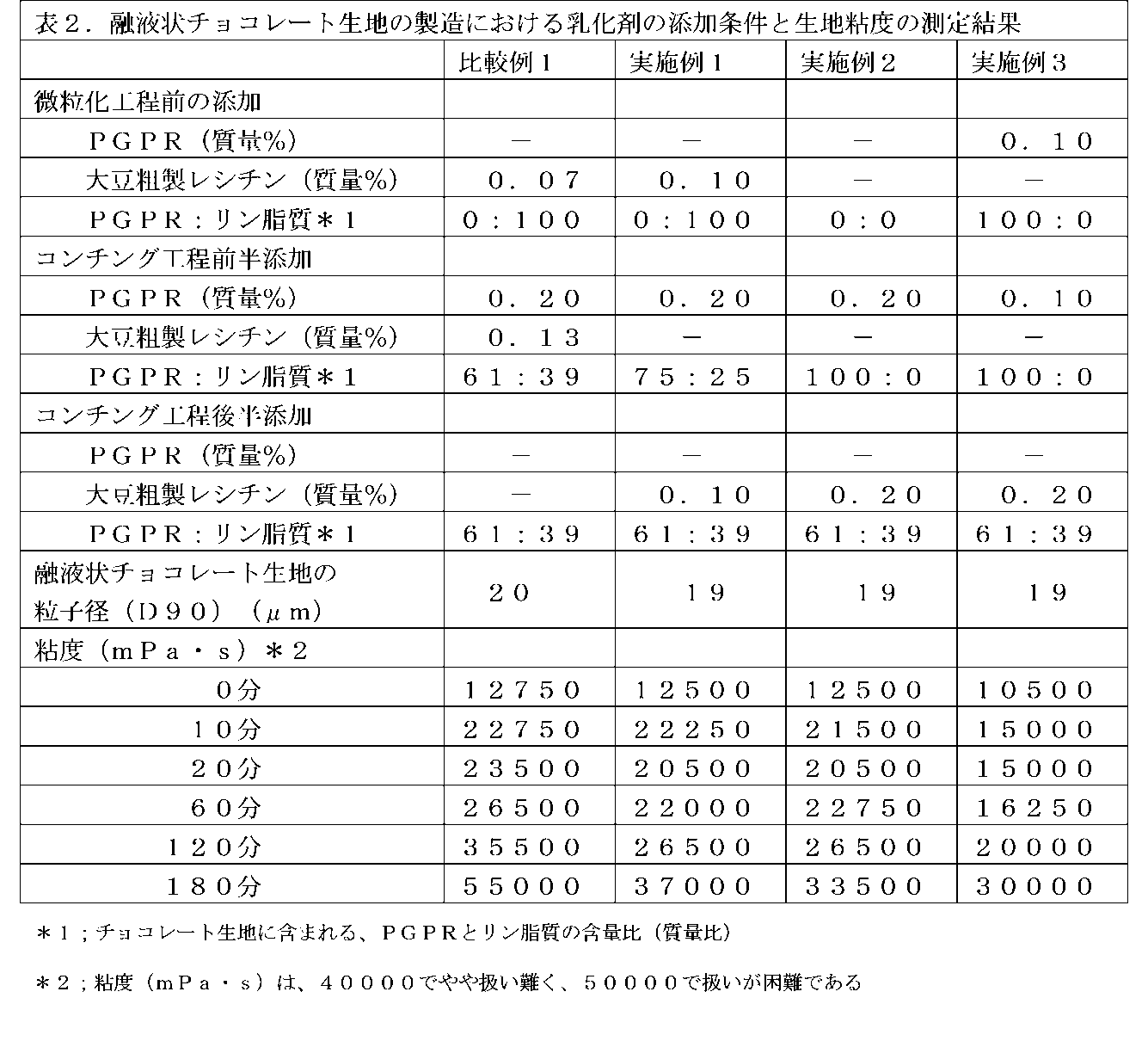
表3に示されたチョコレートの原材料配合を使用して、表4に示された添加順序に従って比較例2および実施例4の融液状チョコレート生地を調製した。乳化剤(ポリグリセリン縮合リシノレイン酸エステルおよび大豆粗製レシチン)を全て添加分散し、生地の温度を34℃に調整した段階をスタート(0分)とし、チョコレート生地が十分に攪拌される状態(63rpm)で維持した。10分後に、100質量部の融液状チョコレート生地に対して4質量部の液糖(水含有量25質量%)を添加した。20分後に、100質量部の融液状チョコレート生地に対して0.3質量部のStOSt(1,3-ジステアロイル-2-オレオイルグリセリン)を主成分とするシーディング剤を添加した。その後、攪拌速度12rpmで180分まで攪拌を継続した。融液状チョコレート生地に含まれる固形分の粒子径(D90)を測定するとともに、0分、10分、20分、60分、120分および180分の各時点における融液状チョコレート生地の粘度を測定した。結果を表4に示した。
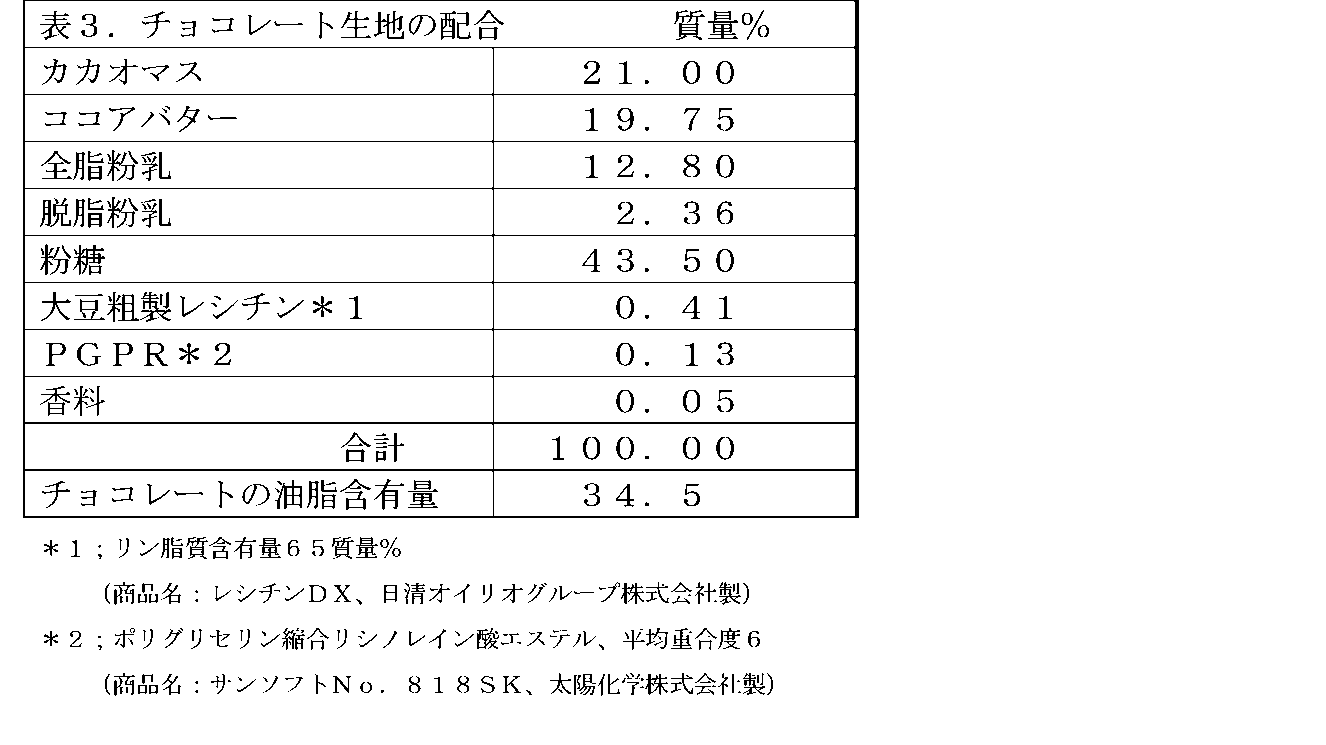
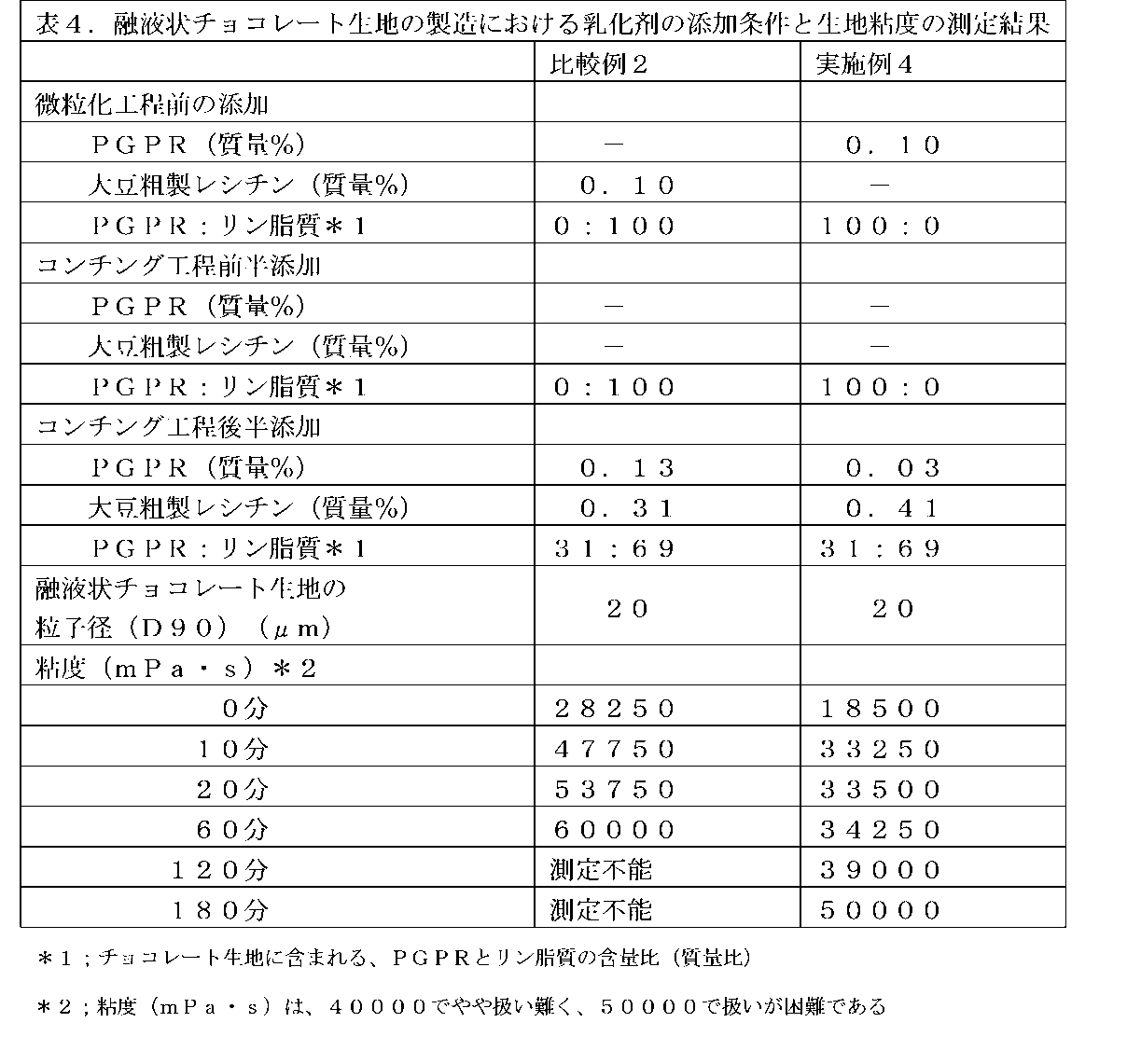
表5に示されたチョコレートの原材料配合を使用して、表6に示された添加順序に従って参考例1~5の融液状チョコレート生地を調製した。乳化剤(ポリグリセリン縮合リシノレイン酸エステルおよび大豆粗製レシチン)を全て添加分散し、生地の温度を37℃に調整した段階をスタート(0分)とし、チョコレート生地が十分に攪拌される状態(63rpm)で維持した。10分後に、100質量部の融液状チョコレート生地に対して4質量部の液糖(水含有量25質量%)を添加分散した。0分、10分の各時点における融液状チョコレート生地の粘度を測定した。結果を表6に示した。


表7に示されたチョコレートの原材料配合を使用して、表8に示された添加順序に従って比較例3、4および実施例5の融液状チョコレート生地を調製した。なお、比較例3は、ロールによる微粒化を10barの圧力で行い、比較例4および実施例5は、15barの圧力で行った。乳化剤(ポリグリセリン縮合リシノレイン酸エステルおよび大豆粗製レシチン)を全て添加分散して、生地の温度を34℃に調整した段階をスタート(0分)とし、融液状チョコレート生地の水含有量および固形分の粒子径(D90)を測定した。そして、チョコレート生地が十分に攪拌される状態(63rpm)で維持した。10分後に、100質量部の融液状チョコレート生地に対して4質量部の液糖(水含有量25質量%)を添加した。20分後に、100質量部の融液状チョコレート生地に対して0.3質量部のStOSt(1,3-ジステアロイル-2-オレオイルグリセリン)を主成分とするシーディング剤を添加した。0分、10分、20分の各時点における融液状チョコレート生地の粘度を測定した。その後、チョコレート生地をモールドに注入し、10℃で冷却固化した。冷却固化後、チョコレートを、30℃で4日間保温処理した。また、保温処理後のチョコレートの水含有量を測定するとともに、n-ヘキサン浸漬試験に供した。結果を表8に示した。
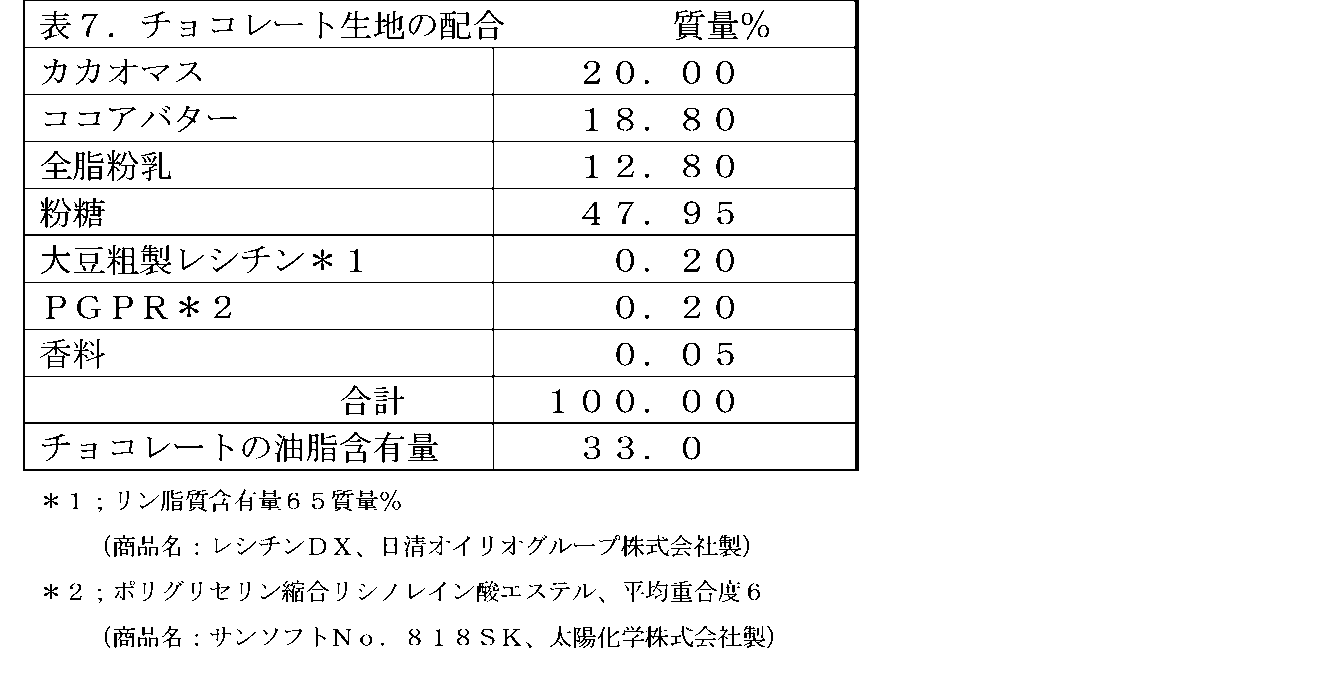

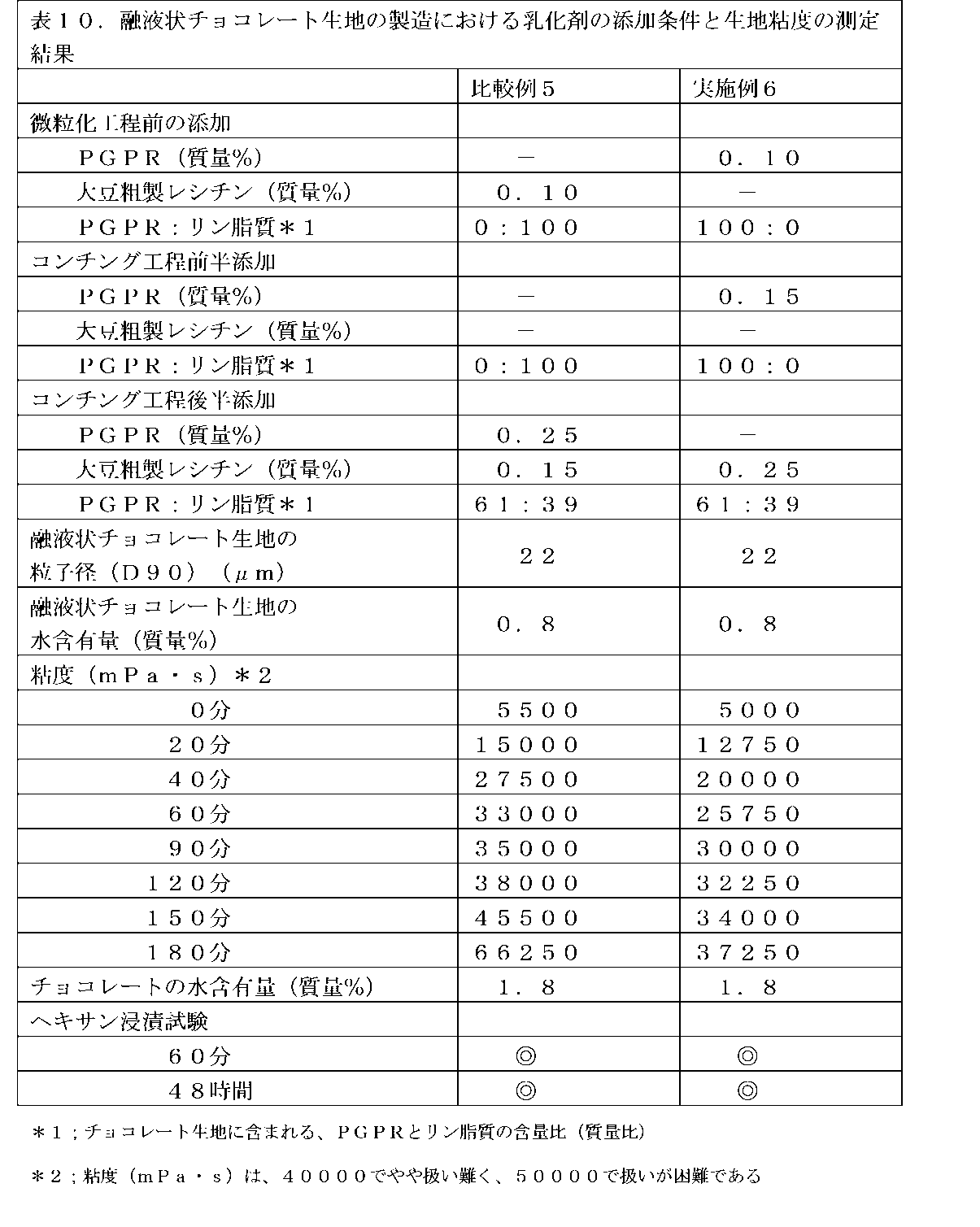
表9に示されたチョコレートの原材料配合を使用して、表10に示された添加順序に従って比較例5および実施例6の融液状チョコレート生地を調製した。乳化剤(ポリグリセリン縮合リシノレイン酸エステルおよび大豆粗製レシチン)を全て添加分散して、生地の温度を34℃に調整した段階をスタート(0分)とし、融液状チョコレート生地の水含有量および固形分の粒子径(D90)を測定した。そして、チョコレート生地が十分に攪拌される状態(63rpm)で維持した。20分後に、100質量部の融液状チョコレート生地に対して4質量部の液糖(水含有量25質量%)を添加した。その後、攪拌速度12rpmで180分まで攪拌を継続した。0分、20分、40分、60分、90分、120分、150分および180分の各時点における融液状チョコレート生地の粘度を測定した。その後、チョコレート生地をモールドに注入し、10℃で冷却固化した。冷却固化後、チョコレートを、30℃で4日間保温処理した。また、保温処理後のチョコレートの水含有量を測定するとともに、n-ヘキサン浸漬試験に供した。結果を表10に示した。

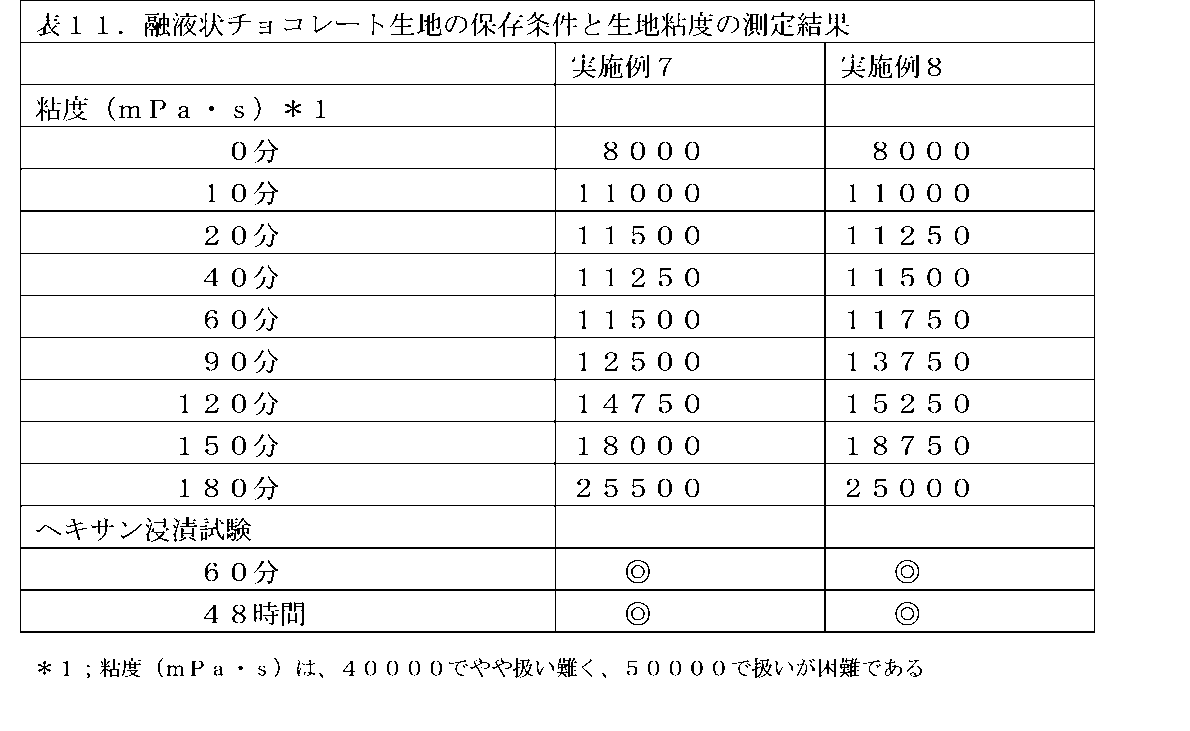
実施例3により得られたコンチング工程終了後の、乳化剤(ポリグリセリン縮合リシノレイン酸エステルおよび大豆粗製レシチン)が全て添加分散された融液状のチョコレート生地を使用して、50℃で5日間維持した融液状のチョコレート生地(実施例7)、および、冷却固化し、20℃で5日間維持したチョコレート生地を、再度加熱融解した融液状のチョコレート生地(実施例8)、を準備して、生地温度を34℃に調整した。生地の温度を34℃に調整した段階をスタート(0分)とし、チョコレート生地が十分に攪拌される状態(63rpm)で維持した。10分後に、100質量部の融液状チョコレート生地に対して4質量部の液糖(水含有量25質量%)を添加した。20分後に、100質量部の融液状チョコレート生地に対して0.3質量部のStOSt(1,3-ジステアロイル-2-オレオイルグリセリン)を主成分とするシーディング剤を添加した。その後、攪拌速度12rpmで180分まで攪拌を継続した。0分、10分、20分、40分、60分、90分、120分、150分および180分後の各時点における融液状チョコレート生地の粘度を測定した。その後、チョコレート生地をモールドに注入し、10℃で冷却固化した。冷却固化後、チョコレートを、30℃で4日間保温処理した。保温処理後のチョコレートは、n-ヘキサン浸漬試験に供した。結果を表11に示した。
Claims (9)
- チョコレート生地に含まれる、ポリグリセリン縮合リシノレイン酸エステルの含有量とリン脂質の含有量との質量比が、100:0~70:30となる状態を少なくとも経由する、融液状チョコレート生地の製造方法。
- 前記融液状チョコレート生地に含まれる、ポリグリセリン縮合リシノレイン酸エステルの含有量とリン脂質の含有量との質量比が、70:30~25:75である、請求項1に記載の融液状チョコレート生地の製造方法。
- 前記ポリグリセリン縮合リシノレイン酸エステルが、コンチング工程の前半部以前にチョコレート生地に添加される、請求項1または2に記載の融液状チョコレート生地の製造方法。
- 粒子径(D90)が10~30μmである、請求項1~3の何れか1項に記載の融液状チョコレート生地の製造方法。
- 請求項1~4の何れか1項に記載の製造方法により製造された融液状チョコレート生地を冷却固化する、チョコレートの製造方法。
- 前記冷却固化する前に、前記融液状チョコレート生地の100質量部に対して、0.1~3質量部の水を添加分散する、請求項5に記載のチョコレートの製造方法。
- チョコレート生地に含まれる、ポリグリセリン縮合リシノレイン酸エステルの含有量とリン脂質の含有量との質量比が、100:0~70:30である状態を少なくとも経由させる、融液状チョコレート生地の粘度低減方法。
- チョコレート生地に含まれる、ポリグリセリン縮合リシノレイン酸エステルの含有量とリン脂質との質量比が、100:0~70:30である状態を少なくとも経由させる、水を添加分散させることによる融液状チョコレート生地の粘度上昇を抑制する方法。
- チョコレート生地に含まれる、ポリグリセリン縮合リシノレイン酸エステルの含有量とリン脂質の含有量との質量比が、100:0~70:30である状態を少なくとも経由する、ポリグリセリン縮合リシノレイン酸エステルの含有量とリン脂質の含有量との質量比が、70:30~25:75である、融液状チョコレート生地。
Priority Applications (6)
| Application Number | Priority Date | Filing Date | Title |
|---|---|---|---|
| MYPI2021003334A MY205547A (en) | 2018-12-21 | 2019-12-17 | Method for producing chocolate |
| CN201980082736.9A CN113194736B (zh) | 2018-12-21 | 2019-12-17 | 巧克力底料及其制造方法、巧克力及其制造方法 |
| EP19900338.5A EP3900545B1 (en) | 2018-12-21 | 2019-12-17 | Method for producing chocolate |
| KR1020217017108A KR102864694B1 (ko) | 2018-12-21 | 2019-12-17 | 초콜릿의 제조 방법 |
| JP2020526339A JP6792100B2 (ja) | 2018-12-21 | 2019-12-17 | チョコレートの製造方法 |
| US17/415,737 US11980205B2 (en) | 2018-12-21 | 2019-12-17 | Method for producing chocolate |
Applications Claiming Priority (2)
| Application Number | Priority Date | Filing Date | Title |
|---|---|---|---|
| JP2018239833 | 2018-12-21 | ||
| JP2018-239833 | 2018-12-21 |
Publications (1)
| Publication Number | Publication Date |
|---|---|
| WO2020129968A1 true WO2020129968A1 (ja) | 2020-06-25 |
Family
ID=71101926
Family Applications (1)
| Application Number | Title | Priority Date | Filing Date |
|---|---|---|---|
| PCT/JP2019/049364 Ceased WO2020129968A1 (ja) | 2018-12-21 | 2019-12-17 | チョコレートの製造方法 |
Country Status (7)
| Country | Link |
|---|---|
| US (1) | US11980205B2 (ja) |
| EP (1) | EP3900545B1 (ja) |
| JP (2) | JP6792100B2 (ja) |
| KR (1) | KR102864694B1 (ja) |
| CN (1) | CN113194736B (ja) |
| MY (1) | MY205547A (ja) |
| WO (1) | WO2020129968A1 (ja) |
Cited By (1)
| Publication number | Priority date | Publication date | Assignee | Title |
|---|---|---|---|---|
| WO2021256285A1 (ja) * | 2020-06-19 | 2021-12-23 | 日清オイリオグループ株式会社 | 耐熱性チョコレート及びその製造方法 |
Families Citing this family (1)
| Publication number | Priority date | Publication date | Assignee | Title |
|---|---|---|---|---|
| JP7572256B2 (ja) | 2021-01-29 | 2024-10-23 | 株式会社神戸製鋼所 | 造形履歴監視装置、造形物の製造システム及び造形履歴監視方法 |
Citations (7)
| Publication number | Priority date | Publication date | Assignee | Title |
|---|---|---|---|---|
| JPH02219543A (ja) * | 1989-02-20 | 1990-09-03 | Meiji Seika Kaisha Ltd | 飲料用の固型チョコレート |
| JPH07132047A (ja) * | 1993-11-10 | 1995-05-23 | Lotte Co Ltd | 低カロリーチョコレート |
| WO1996019923A1 (en) * | 1994-12-23 | 1996-07-04 | Cadbury Schweppes Plc | Process for manufacture of reduced fat chocolate |
| US6165540A (en) | 1996-09-24 | 2000-12-26 | Nestec S.A. | Process for manufacturing chocolate compositions containing water |
| US6488979B1 (en) | 1998-06-16 | 2002-12-03 | Victor R. Davila | Method of making heat-resistant chocolate and chocolate-like compositions with reduced apparent viscosity |
| JP2003284497A (ja) * | 2002-03-29 | 2003-10-07 | Fuji Oil Co Ltd | 被覆用油性組成物及びこれを用いた被覆用食品の製造法 |
| WO2018185502A1 (en) * | 2017-04-07 | 2018-10-11 | The University Of Birmingham | Low-sugar chocolate |
Family Cites Families (10)
| Publication number | Priority date | Publication date | Assignee | Title |
|---|---|---|---|---|
| GB9424855D0 (en) | 1994-12-09 | 1995-02-08 | Cadbury Schweppes Plc | Process for manufacture of reduced fat chocolate |
| GB0014570D0 (en) | 2000-06-14 | 2000-08-09 | Nestle Sa | Milk chocolate containing water |
| CN101945585A (zh) | 2007-12-20 | 2011-01-12 | 不二制油株式会社 | 油性食品及其制备方法 |
| US8535749B2 (en) | 2007-12-26 | 2013-09-17 | The Nisshin Oillio Group, Ltd. | Oil-and-fat composition, process for production of the composition, chocolate, and process for production of the chocolate |
| JP2012095561A (ja) | 2010-10-29 | 2012-05-24 | Sakamoto Yakuhin Kogyo Co Ltd | ポリグリセリン縮合リシノール酸エステルを含む食品 |
| JP2012106936A (ja) | 2010-11-15 | 2012-06-07 | Meiji Co Ltd | 経口剤 |
| JP5906565B2 (ja) * | 2010-11-25 | 2016-04-20 | 不二製油株式会社 | 光沢のよいチョコレート類並びにその製造法 |
| CN104507326A (zh) * | 2012-06-21 | 2015-04-08 | 不二制油株式会社 | 耐热性巧克力类及其制造方法 |
| KR102352611B1 (ko) * | 2013-12-27 | 2022-01-18 | 닛신 오일리오그룹 가부시키가이샤 | 함수형 내열성 초콜릿의 제조방법, 함수형 내열성 초콜릿, 함수 초콜릿 반죽의 점도 상승 억제방법, 및 함수형 내열성 초콜릿중의 당골격 형성방법 |
| JP6391896B1 (ja) * | 2016-12-22 | 2018-09-19 | 日清オイリオグループ株式会社 | チョコレート |
-
2019
- 2019-12-17 US US17/415,737 patent/US11980205B2/en active Active
- 2019-12-17 CN CN201980082736.9A patent/CN113194736B/zh active Active
- 2019-12-17 EP EP19900338.5A patent/EP3900545B1/en active Active
- 2019-12-17 KR KR1020217017108A patent/KR102864694B1/ko active Active
- 2019-12-17 JP JP2020526339A patent/JP6792100B2/ja active Active
- 2019-12-17 MY MYPI2021003334A patent/MY205547A/en unknown
- 2019-12-17 WO PCT/JP2019/049364 patent/WO2020129968A1/ja not_active Ceased
-
2020
- 2020-11-04 JP JP2020184138A patent/JP2021013390A/ja active Pending
Patent Citations (7)
| Publication number | Priority date | Publication date | Assignee | Title |
|---|---|---|---|---|
| JPH02219543A (ja) * | 1989-02-20 | 1990-09-03 | Meiji Seika Kaisha Ltd | 飲料用の固型チョコレート |
| JPH07132047A (ja) * | 1993-11-10 | 1995-05-23 | Lotte Co Ltd | 低カロリーチョコレート |
| WO1996019923A1 (en) * | 1994-12-23 | 1996-07-04 | Cadbury Schweppes Plc | Process for manufacture of reduced fat chocolate |
| US6165540A (en) | 1996-09-24 | 2000-12-26 | Nestec S.A. | Process for manufacturing chocolate compositions containing water |
| US6488979B1 (en) | 1998-06-16 | 2002-12-03 | Victor R. Davila | Method of making heat-resistant chocolate and chocolate-like compositions with reduced apparent viscosity |
| JP2003284497A (ja) * | 2002-03-29 | 2003-10-07 | Fuji Oil Co Ltd | 被覆用油性組成物及びこれを用いた被覆用食品の製造法 |
| WO2018185502A1 (en) * | 2017-04-07 | 2018-10-11 | The University Of Birmingham | Low-sugar chocolate |
Non-Patent Citations (2)
| Title |
|---|
| SCHANTZ, B. ET AL.: "Influence of lecithin-PGPR blends on the rheological properties of chocolate", LWT-FOOD SCIENCE AND TECHNOLOGY, vol. 38, no. 1, 2004, pages 41 - 45, XP004606348, DOI: 10.1016/j.lwt.2004.03.014 * |
| See also references of EP3900545A4 |
Cited By (1)
| Publication number | Priority date | Publication date | Assignee | Title |
|---|---|---|---|---|
| WO2021256285A1 (ja) * | 2020-06-19 | 2021-12-23 | 日清オイリオグループ株式会社 | 耐熱性チョコレート及びその製造方法 |
Also Published As
| Publication number | Publication date |
|---|---|
| KR102864694B1 (ko) | 2025-09-25 |
| EP3900545A1 (en) | 2021-10-27 |
| EP3900545B1 (en) | 2024-09-18 |
| CN113194736A (zh) | 2021-07-30 |
| US20220061350A1 (en) | 2022-03-03 |
| CN113194736B (zh) | 2024-09-03 |
| EP3900545A4 (en) | 2022-02-23 |
| JPWO2020129968A1 (ja) | 2021-02-15 |
| US11980205B2 (en) | 2024-05-14 |
| JP6792100B2 (ja) | 2020-11-25 |
| JP2021013390A (ja) | 2021-02-12 |
| MY205547A (en) | 2024-10-25 |
| KR20210106425A (ko) | 2021-08-30 |
Similar Documents
| Publication | Publication Date | Title |
|---|---|---|
| EP3087847B1 (en) | Method for manufacturing water-containing heat-resistant chocolate, method for suppressing increase in viscosity of water-containing chocolate dough, and method for forming saccharide skeleton in water-containing heat-resistant chocolate | |
| US10716316B2 (en) | Chocolate, method for producing chocolate-covered food product coated by the same, and method for preventing increase in viscosity of chocolate for coating | |
| JP6391896B1 (ja) | チョコレート | |
| JP6130981B1 (ja) | チョコレート | |
| JP5952988B1 (ja) | 耐熱性チョコレート及びその製造方法 | |
| WO2014069218A1 (ja) | 耐熱性チョコレート及び耐熱性チョコレートの製造方法 | |
| JP6715076B2 (ja) | 含水型耐熱性チョコレートの製造方法 | |
| WO2012121327A1 (ja) | 焼成菓子 | |
| JP6792100B2 (ja) | チョコレートの製造方法 | |
| JP7259147B1 (ja) | 含水チョコレート組成物及びその製造方法 | |
| CN107105698A (zh) | 热稳定的巧克力糖果产品及其制造方法 | |
| JP3663986B2 (ja) | 含水チョコレート類の製造法 | |
| JP7840848B2 (ja) | 耐熱性チョコレート及びその製造方法 | |
| JP7785477B2 (ja) | 油性菓子製造用の含水組成物、油性菓子の製造方法、油性菓子生地、及び油性菓子 | |
| JP2024142653A (ja) | チョコレート風味菓子の製造方法 | |
| WO2021117787A1 (ja) | 含水型耐熱性チョコレート及びその製造方法 |
Legal Events
| Date | Code | Title | Description |
|---|---|---|---|
| ENP | Entry into the national phase |
Ref document number: 2020526339 Country of ref document: JP Kind code of ref document: A |
|
| 121 | Ep: the epo has been informed by wipo that ep was designated in this application |
Ref document number: 19900338 Country of ref document: EP Kind code of ref document: A1 |
|
| ENP | Entry into the national phase |
Ref document number: 20217017108 Country of ref document: KR Kind code of ref document: A |
|
| NENP | Non-entry into the national phase |
Ref country code: DE |
|
| ENP | Entry into the national phase |
Ref document number: 2019900338 Country of ref document: EP Effective date: 20210721 |