WO2020136829A1 - ニッケル含有鋼板 - Google Patents
ニッケル含有鋼板 Download PDFInfo
- Publication number
- WO2020136829A1 WO2020136829A1 PCT/JP2018/048244 JP2018048244W WO2020136829A1 WO 2020136829 A1 WO2020136829 A1 WO 2020136829A1 JP 2018048244 W JP2018048244 W JP 2018048244W WO 2020136829 A1 WO2020136829 A1 WO 2020136829A1
- Authority
- WO
- WIPO (PCT)
- Prior art keywords
- steel sheet
- less
- temperature
- toughness
- austenite
- Prior art date
- Legal status (The legal status is an assumption and is not a legal conclusion. Google has not performed a legal analysis and makes no representation as to the accuracy of the status listed.)
- Ceased
Links
Images


Classifications
-
- C—CHEMISTRY; METALLURGY
- C22—METALLURGY; FERROUS OR NON-FERROUS ALLOYS; TREATMENT OF ALLOYS OR NON-FERROUS METALS
- C22C—ALLOYS
- C22C38/00—Ferrous alloys, e.g. steel alloys
- C22C38/18—Ferrous alloys, e.g. steel alloys containing chromium
- C22C38/40—Ferrous alloys, e.g. steel alloys containing chromium with nickel
- C22C38/54—Ferrous alloys, e.g. steel alloys containing chromium with nickel with boron
-
- C—CHEMISTRY; METALLURGY
- C21—METALLURGY OF IRON
- C21D—MODIFYING THE PHYSICAL STRUCTURE OF FERROUS METALS; GENERAL DEVICES FOR HEAT TREATMENT OF FERROUS OR NON-FERROUS METALS OR ALLOYS; MAKING METAL MALLEABLE, e.g. BY DECARBURISATION OR TEMPERING
- C21D1/00—General methods or devices for heat treatment, e.g. annealing, hardening, quenching or tempering
- C21D1/18—Hardening; Quenching with or without subsequent tempering
-
- C—CHEMISTRY; METALLURGY
- C21—METALLURGY OF IRON
- C21D—MODIFYING THE PHYSICAL STRUCTURE OF FERROUS METALS; GENERAL DEVICES FOR HEAT TREATMENT OF FERROUS OR NON-FERROUS METALS OR ALLOYS; MAKING METAL MALLEABLE, e.g. BY DECARBURISATION OR TEMPERING
- C21D6/00—Heat treatment of ferrous alloys
-
- C—CHEMISTRY; METALLURGY
- C21—METALLURGY OF IRON
- C21D—MODIFYING THE PHYSICAL STRUCTURE OF FERROUS METALS; GENERAL DEVICES FOR HEAT TREATMENT OF FERROUS OR NON-FERROUS METALS OR ALLOYS; MAKING METAL MALLEABLE, e.g. BY DECARBURISATION OR TEMPERING
- C21D6/00—Heat treatment of ferrous alloys
- C21D6/001—Heat treatment of ferrous alloys containing Ni
-
- C—CHEMISTRY; METALLURGY
- C21—METALLURGY OF IRON
- C21D—MODIFYING THE PHYSICAL STRUCTURE OF FERROUS METALS; GENERAL DEVICES FOR HEAT TREATMENT OF FERROUS OR NON-FERROUS METALS OR ALLOYS; MAKING METAL MALLEABLE, e.g. BY DECARBURISATION OR TEMPERING
- C21D8/00—Modifying the physical properties of ferrous metals or ferrous alloys by deformation combined with, or followed by, heat treatment
- C21D8/02—Modifying the physical properties of ferrous metals or ferrous alloys by deformation combined with, or followed by, heat treatment during manufacturing of plates or strips
-
- C—CHEMISTRY; METALLURGY
- C21—METALLURGY OF IRON
- C21D—MODIFYING THE PHYSICAL STRUCTURE OF FERROUS METALS; GENERAL DEVICES FOR HEAT TREATMENT OF FERROUS OR NON-FERROUS METALS OR ALLOYS; MAKING METAL MALLEABLE, e.g. BY DECARBURISATION OR TEMPERING
- C21D8/00—Modifying the physical properties of ferrous metals or ferrous alloys by deformation combined with, or followed by, heat treatment
- C21D8/02—Modifying the physical properties of ferrous metals or ferrous alloys by deformation combined with, or followed by, heat treatment during manufacturing of plates or strips
- C21D8/0221—Modifying the physical properties of ferrous metals or ferrous alloys by deformation combined with, or followed by, heat treatment during manufacturing of plates or strips characterised by the working steps
- C21D8/0226—Hot rolling
-
- C—CHEMISTRY; METALLURGY
- C21—METALLURGY OF IRON
- C21D—MODIFYING THE PHYSICAL STRUCTURE OF FERROUS METALS; GENERAL DEVICES FOR HEAT TREATMENT OF FERROUS OR NON-FERROUS METALS OR ALLOYS; MAKING METAL MALLEABLE, e.g. BY DECARBURISATION OR TEMPERING
- C21D9/00—Heat treatment, e.g. annealing, hardening, quenching or tempering, adapted for particular articles; Furnaces therefor
- C21D9/46—Heat treatment, e.g. annealing, hardening, quenching or tempering, adapted for particular articles; Furnaces therefor for sheet metals
-
- C—CHEMISTRY; METALLURGY
- C22—METALLURGY; FERROUS OR NON-FERROUS ALLOYS; TREATMENT OF ALLOYS OR NON-FERROUS METALS
- C22C—ALLOYS
- C22C38/00—Ferrous alloys, e.g. steel alloys
-
- C—CHEMISTRY; METALLURGY
- C22—METALLURGY; FERROUS OR NON-FERROUS ALLOYS; TREATMENT OF ALLOYS OR NON-FERROUS METALS
- C22C—ALLOYS
- C22C38/00—Ferrous alloys, e.g. steel alloys
- C22C38/001—Ferrous alloys, e.g. steel alloys containing N
-
- C—CHEMISTRY; METALLURGY
- C22—METALLURGY; FERROUS OR NON-FERROUS ALLOYS; TREATMENT OF ALLOYS OR NON-FERROUS METALS
- C22C—ALLOYS
- C22C38/00—Ferrous alloys, e.g. steel alloys
- C22C38/002—Ferrous alloys, e.g. steel alloys containing In, Mg, or other elements not provided for in one single group C22C38/001 - C22C38/60
-
- C—CHEMISTRY; METALLURGY
- C22—METALLURGY; FERROUS OR NON-FERROUS ALLOYS; TREATMENT OF ALLOYS OR NON-FERROUS METALS
- C22C—ALLOYS
- C22C38/00—Ferrous alloys, e.g. steel alloys
- C22C38/005—Ferrous alloys, e.g. steel alloys containing rare earths, i.e. Sc, Y, Lanthanides
-
- C—CHEMISTRY; METALLURGY
- C22—METALLURGY; FERROUS OR NON-FERROUS ALLOYS; TREATMENT OF ALLOYS OR NON-FERROUS METALS
- C22C—ALLOYS
- C22C38/00—Ferrous alloys, e.g. steel alloys
- C22C38/02—Ferrous alloys, e.g. steel alloys containing silicon
-
- C—CHEMISTRY; METALLURGY
- C22—METALLURGY; FERROUS OR NON-FERROUS ALLOYS; TREATMENT OF ALLOYS OR NON-FERROUS METALS
- C22C—ALLOYS
- C22C38/00—Ferrous alloys, e.g. steel alloys
- C22C38/04—Ferrous alloys, e.g. steel alloys containing manganese
-
- C—CHEMISTRY; METALLURGY
- C22—METALLURGY; FERROUS OR NON-FERROUS ALLOYS; TREATMENT OF ALLOYS OR NON-FERROUS METALS
- C22C—ALLOYS
- C22C38/00—Ferrous alloys, e.g. steel alloys
- C22C38/06—Ferrous alloys, e.g. steel alloys containing aluminium
-
- C—CHEMISTRY; METALLURGY
- C22—METALLURGY; FERROUS OR NON-FERROUS ALLOYS; TREATMENT OF ALLOYS OR NON-FERROUS METALS
- C22C—ALLOYS
- C22C38/00—Ferrous alloys, e.g. steel alloys
- C22C38/08—Ferrous alloys, e.g. steel alloys containing nickel
-
- C—CHEMISTRY; METALLURGY
- C22—METALLURGY; FERROUS OR NON-FERROUS ALLOYS; TREATMENT OF ALLOYS OR NON-FERROUS METALS
- C22C—ALLOYS
- C22C38/00—Ferrous alloys, e.g. steel alloys
- C22C38/12—Ferrous alloys, e.g. steel alloys containing tungsten, tantalum, molybdenum, vanadium, or niobium
-
- C—CHEMISTRY; METALLURGY
- C22—METALLURGY; FERROUS OR NON-FERROUS ALLOYS; TREATMENT OF ALLOYS OR NON-FERROUS METALS
- C22C—ALLOYS
- C22C38/00—Ferrous alloys, e.g. steel alloys
- C22C38/14—Ferrous alloys, e.g. steel alloys containing titanium or zirconium
-
- C—CHEMISTRY; METALLURGY
- C22—METALLURGY; FERROUS OR NON-FERROUS ALLOYS; TREATMENT OF ALLOYS OR NON-FERROUS METALS
- C22C—ALLOYS
- C22C38/00—Ferrous alloys, e.g. steel alloys
- C22C38/16—Ferrous alloys, e.g. steel alloys containing copper
-
- C—CHEMISTRY; METALLURGY
- C22—METALLURGY; FERROUS OR NON-FERROUS ALLOYS; TREATMENT OF ALLOYS OR NON-FERROUS METALS
- C22C—ALLOYS
- C22C38/00—Ferrous alloys, e.g. steel alloys
- C22C38/18—Ferrous alloys, e.g. steel alloys containing chromium
- C22C38/40—Ferrous alloys, e.g. steel alloys containing chromium with nickel
-
- C—CHEMISTRY; METALLURGY
- C22—METALLURGY; FERROUS OR NON-FERROUS ALLOYS; TREATMENT OF ALLOYS OR NON-FERROUS METALS
- C22C—ALLOYS
- C22C38/00—Ferrous alloys, e.g. steel alloys
- C22C38/18—Ferrous alloys, e.g. steel alloys containing chromium
- C22C38/40—Ferrous alloys, e.g. steel alloys containing chromium with nickel
- C22C38/42—Ferrous alloys, e.g. steel alloys containing chromium with nickel with copper
-
- C—CHEMISTRY; METALLURGY
- C22—METALLURGY; FERROUS OR NON-FERROUS ALLOYS; TREATMENT OF ALLOYS OR NON-FERROUS METALS
- C22C—ALLOYS
- C22C38/00—Ferrous alloys, e.g. steel alloys
- C22C38/18—Ferrous alloys, e.g. steel alloys containing chromium
- C22C38/40—Ferrous alloys, e.g. steel alloys containing chromium with nickel
- C22C38/44—Ferrous alloys, e.g. steel alloys containing chromium with nickel with molybdenum or tungsten
-
- C—CHEMISTRY; METALLURGY
- C22—METALLURGY; FERROUS OR NON-FERROUS ALLOYS; TREATMENT OF ALLOYS OR NON-FERROUS METALS
- C22C—ALLOYS
- C22C38/00—Ferrous alloys, e.g. steel alloys
- C22C38/18—Ferrous alloys, e.g. steel alloys containing chromium
- C22C38/40—Ferrous alloys, e.g. steel alloys containing chromium with nickel
- C22C38/46—Ferrous alloys, e.g. steel alloys containing chromium with nickel with vanadium
-
- C—CHEMISTRY; METALLURGY
- C22—METALLURGY; FERROUS OR NON-FERROUS ALLOYS; TREATMENT OF ALLOYS OR NON-FERROUS METALS
- C22C—ALLOYS
- C22C38/00—Ferrous alloys, e.g. steel alloys
- C22C38/18—Ferrous alloys, e.g. steel alloys containing chromium
- C22C38/40—Ferrous alloys, e.g. steel alloys containing chromium with nickel
- C22C38/48—Ferrous alloys, e.g. steel alloys containing chromium with nickel with niobium or tantalum
-
- C—CHEMISTRY; METALLURGY
- C22—METALLURGY; FERROUS OR NON-FERROUS ALLOYS; TREATMENT OF ALLOYS OR NON-FERROUS METALS
- C22C—ALLOYS
- C22C38/00—Ferrous alloys, e.g. steel alloys
- C22C38/18—Ferrous alloys, e.g. steel alloys containing chromium
- C22C38/40—Ferrous alloys, e.g. steel alloys containing chromium with nickel
- C22C38/50—Ferrous alloys, e.g. steel alloys containing chromium with nickel with titanium or zirconium
-
- C—CHEMISTRY; METALLURGY
- C21—METALLURGY OF IRON
- C21D—MODIFYING THE PHYSICAL STRUCTURE OF FERROUS METALS; GENERAL DEVICES FOR HEAT TREATMENT OF FERROUS OR NON-FERROUS METALS OR ALLOYS; MAKING METAL MALLEABLE, e.g. BY DECARBURISATION OR TEMPERING
- C21D2211/00—Microstructure comprising significant phases
- C21D2211/001—Austenite
Definitions
- the present invention relates to a nickel-containing steel plate.
- ferritic low temperature steel such as 9% Ni steel can be used in addition to austenitic stainless steel.
- ferritic low-temperature nickel steel shows a decrease in toughness due to strain aging, so overcoming this is the key to practical use.
- the minimum value of the Charpy impact absorption energy at -196°C of the material that has been heat-treated at 200°C for 1 hr after applying 6% strain is 150 J or more.
- this is not always easy to achieve.
- Inclusions may be involved in the low value that occurs with a very low probability in the Charpy impact absorbed energy at -196°C of ferritic low temperature nickel steel.
- inclusions of several ⁇ m remain without being floated and separated, but if the cleanliness is normal, such independent inclusions are Charpy at -196°C.
- the impact on shock absorption energy is minor.
- the Charpy impact absorption energy at ⁇ 196° C. of the material subjected to heat treatment at 200° C. for 1 hr after applying 6% strain may be reduced to 150 J or less. is there.
- Cross rolling is a method for reducing the harmful effects of inclusions, for example, elongated inclusions such as MnS.
- Cross-rolling is a hot rolling process for forming the shape of a steel sheet.
- the rolling methods usually performed only in the longitudinal direction of the steel sheet, some rolling is performed in the width direction of the steel sheet, and the inclusions are MnS.
- the MnS elongation in the longitudinal direction of the steel sheet is suppressed, so that the Charpy impact absorbed energy is improved in the Charpy test using the test piece in which the longitudinal direction of the test piece is parallel to the rolling width direction.
- Patent Document 1 bending workability and low temperature toughness are improved by performing widthwise rolling during cross rolling in a non-recrystallization temperature range.
- width-direction rolling in the non-recrystallization temperature range is required at the initial stage of rolling due to the length limitation in the width direction, so the rolling waiting time increases and the rolling efficiency (productivity) increases significantly.
- the unrecrystallized temperature range rolling will be performed while the austenite grain size is large, In some cases, the toughness is still unstable, and this method cannot achieve the above purpose.
- a steel plate having high isotropy is defined by defining a reduction ratio of widthwise rolling and longitudinal rolling when performing cross rolling. Regarding the control of inclusions, this method is effective, but the regulation of the reduction ratio alone may not always be sufficient to make the austenite grains fine during rolling, and this method cannot achieve the above object. That is, it is difficult to provide a nickel-containing steel sheet having excellent toughness with high production efficiency using the current technology.
- the object of the present invention is to provide a nickel-containing steel sheet having excellent toughness.
- the present invention provides a nickel-containing steel sheet having excellent toughness, and the gist thereof is as follows.
- the nickel-containing steel sheet according to one aspect of the present invention has a chemical composition, in mass%, of C: 0.02 to 0.12%, Si: 0.02 to 0.35%, and Mn: 0.10. To 1.50%, P: 0.0100% or less, S: 0.0035% or less, Ni: more than 5.0% and 10.0% or less, Al: 0.002 to 0.090%, N: 0.
- the austenite has an average coarse particle size of 20 ⁇ m or less and a tensile strength of 690 to 900 MPa, which is defined as a simple average value of the maximum equivalent circle diameters.
- the average aspect ratio of the old austenite grains may be 1.5 or less.
- the amount of retained austenite at the 1/4t position may be 0.1% or more and less than 5% by volume.
- the amount of retained austenite at the 1/4t position may be 5% to 15% by volume.
- the present invention it becomes possible to provide a nickel-containing steel plate having excellent toughness. Therefore, it can be said that the present invention has high industrial value.
- the nickel-containing steel plate according to this embodiment (hereinafter, also referred to as a steel plate according to this embodiment or a steel plate) will be described in detail.
- a steel plate according to this embodiment or a steel plate the low-temperature nickel-containing steel plates, whether the inventor can avoid or recover the toughness reduction in the steel sheet having a Ni content of more than 5.0% and 10.0% or less in the steps after hot rolling, not in the steelmaking step. Diligently studied. As a result, it is possible to effectively improve the toughness of the steel sheet by making the average coarse grain size of the former austenite at the 1/4 t position of the steel sheet fine, and to perform reheating and quenching after proper hot rolling and direct quenching.
- the average coarse grain size of the former austenite at the 1/4 t position of the steel sheet is significantly refined by slightly increasing the rate of temperature increase from 600° C. to 750° C. during the temperature rise.
- the refinement of the average coarse grain size of the former austenite leads to the refinement of the final structure, that is, the structure mainly composed of tempered martensite and bainite, so that the toughness of the steel sheet can be greatly improved.
- the average coarse grain size of the old austenite is the circle of the old austenite grains in each of 10 fields of view of an area of 200 ⁇ m 2 , which is measured on the surface formed by the rolling direction of the steel sheet and the thickness direction of the steel sheet at the 1/4 t position of the steel sheet.
- the steel sheet according to this embodiment it is effective to combine, for example, two manufacturing methods in order to significantly reduce the average coarse grain size of old austenite.
- the first point is to appropriately control the conditions of hot rolling and direct quenching performed before quenching.
- the second point is to appropriately control the temperature rising conditions during reheating and quenching after rolling.
- the method for manufacturing a steel sheet according to this embodiment includes a hot rolling/direct quenching step (step A), a reheating quenching step (step B), and a tempering step (step C).
- step A hot rolling/direct quenching step
- step B reheating quenching step
- step C tempering step
- step A a slab or steel slab containing more than 5.0% and 10.0% or less of Ni is heated, then hot-rolled, and then water-cooled.
- the hot rolling is performed at a total rolling reduction of 75% or more (that is, the total rolling reduction ratio defined by the slab thickness/steel plate thickness is 4 or more), and the finishing first pass temperature is 600° C. or more and 850° C. or less. Is good.
- the total reduction in hot rolling is the difference between the thickness of the steel plate before the start of hot rolling and the thickness of the steel sheet after the end of hot rolling, the thickness of the steel plate before the start of hot rolling. It is the value divided by.
- the temperature before one pass of finishing is a temperature of the steel sheet surface measured immediately before the final one pass of hot rolling (specifically, within 5 seconds from the time of performing the final one pass).
- the temperature before one pass of finishing is set to 850° C. or less, the structure becomes fine at the time of cooling to normal temperature by water cooling, so that the average coarse grain size of old austenite becomes small.
- the temperature before one pass of finishing is set to 600° C. or higher, it is possible to easily carry out hot rolling with a total rolling reduction of 75% or higher by reducing the deformation resistance. Further, when the total reduction ratio of hot rolling is set to 75% or more, the structure after water cooling becomes fine, and thus the average coarse grain size of old austenite becomes small.
- step B that is, the reheating and quenching step will be described.
- the rate of temperature rise during heating during reheating and quenching that is, the average rate of temperature rise in the temperature range of 600° C. or more and 750° C. or less to 0.4° C./sec or more and 0.8° C./sec or less
- the former austenite The average coarse particle size of can be significantly reduced.
- the average rate of temperature rise in the temperature range of 600° C. or higher and 750° C. or lower during reheating and quenching is 0.4° C./sec or higher, the average coarse grain size of the old austenite becomes small.
- the average heating rate in the temperature range of 600° C. or more and 750° C. or less is 0.8° C./sec or less, it becomes easy to control the heating temperature during reheating and quenching.
- the heating temperature at the time of reheating and quenching is preferably controlled within a very narrow range of 800° C. or higher and 810° C. or lower. Setting the average heating rate in the temperature range of 600°C or more and 750°C or less to 0.8°C/sec or less is for achieving precise control of the heating temperature during reheating and quenching (such as overheating, that is, prevention of overshoot).
- condition 1 the average coarse grain size of the old austenite is increased to 0.6° C./sec only in a specific temperature range, and the average heating rate in other temperature ranges is 0.1° C./sec. 3 conditions, that is, condition 2 in which the average heating rate is 0.6° C./sec only at 200° C. or more and less than 600° C., average heating rate 0.6° C./sec only at 600° C. or more and 750° C. was compared with the average coarse grain size of the former austenite under the condition 3 and the condition 4 in which the average temperature rising rate was 0.6° C./sec only at the 750° C.
- the average coarse grain size of old austenite is a parameter that focuses on coarse grains in the grain size distribution of old austenite.
- the present inventors have found that even when the prior austenite is miniaturized, when coarse grains remain, the toughness decreases at the remaining portion. Therefore, in the steel sheet according to the present embodiment, the average coarse grain size of old austenite is 20 ⁇ m or less, that is, the coarse grains do not remain.
- the average coarse grain size of the former austenite becomes finer, the final structure also becomes finer.
- the average coarse particle size of the prior austenite at the 1/4 t position required to achieve 150 J with the Charpy test absorbed energy at the test temperature of ⁇ 196° C. is required to be 20 ⁇ m or less.
- the average coarse particle size of prior austenite at the 1/4t position is preferably 18 ⁇ m or less, 16 ⁇ m or less, 15 ⁇ m or less, or 14 ⁇ m or less.
- the lower limit of the average coarse particle size of the prior austenite at the 1/4t position is not particularly limited, but may be specified to be 5 ⁇ m or more, 7 ⁇ m or more, or 8 ⁇ m or more, for example.
- the method for measuring the average coarse particle size of the prior austenite at the 1/4t position is as follows.
- the surface formed by the rolling direction of the steel plate and the thickness direction of the steel plate of the sample taken from the 1/4 t position (the position separated from the rolling surface of the steel plate by 1/4 of the plate thickness t of the steel plate) is ground, and this surface is polished.
- the former austenite grain boundary is revealed by using picric acid.
- the largest prior austenite grain is specified in the visual field having an arbitrary area of 200 ⁇ m 2 on this surface, and the equivalent circle diameter thereof is calculated. This operation is repeated for 10 arbitrary fields of view, and the simple average value of the 10 equivalent circle diameters obtained is taken as the average coarse particle size of the prior austenite at the 1/4t position.
- the rolling direction of the steel sheet is generally the longitudinal direction of the steel sheet.
- a known method such as a method of immersing the steel sheet in a high-temperature (for example, 80° C. or higher) acid (for example, hydrochloric acid) and observing a stretched structure by rolling Can determine the rolling direction of the steel sheet.
- the steel sheet according to the present embodiment which has been subjected to hot rolling and direct quenching and then reheat quenching, has almost no elongated austenite grains at the 1/4 t position. Therefore, the average aspect ratio of the old austenite, which is a simple average value of the ratio of the major axis to the minor axis (minor axis/major axis) of the austenite grains at the position of 1/4t, is the same as that of the steel sheet by the direct quenching that is not subjected to the reheating quenching treatment. Smaller than the ones. Normally, the average aspect ratio of old austenite does not exceed 2.0. In many cases, the average aspect ratio will be 1.5 or less. If necessary, the average aspect ratio may be 1.4 or less, 1.3 or less, or 1.2 or less. The lower limit of the average aspect ratio is 1.0.
- the method for measuring the average aspect ratio of prior austenite at the 1/4t position is as follows.
- the surface formed by the rolling direction and the plate thickness direction of the sample taken from the 1/4 t position (the position apart from the rolled surface of the steel plate by 1/4 of the plate thickness t of the steel plate) is polished, and picric acid is formed on this surface.
- picric acid is formed on this surface.
- the ratio of the major axis to the minor axis is measured for each old austenite grain, and the simple average value of the ratio is the average of the old austenite at the 1/4t position.
- Aspect ratio is the ratio of the major axis to the minor axis (minor axis/major axis) is measured for each old austenite grain, and the simple average value of the ratio is the average of the old austenite at the 1/4t position.
- the range of alloying elements contained in the chemical composition of the steel sheet is specified below.
- the unit "%" of the content of alloying elements means% by mass.
- C is an essential element for ensuring the strength of the steel sheet. Moreover, when the C content is insufficient, strength and toughness may be deteriorated. Therefore, the C content is set to 0.02% or more. However, on the other hand, an increase in the amount of C causes a decrease in toughness. Therefore, the upper limit of the amount of C is set to 0.12%.
- the C content may be 0.03% or more, 0.05% or more, or 0.07% or more.
- the C content may be 0.11% or less, 0.10% or less, or 0.08% or less.
- Si is an essential element for ensuring the strength of steel sheets, so its content should be 0.02% or more. However, on the other hand, if Si exceeds 0.35%, the toughness and weldability of the steel sheet are deteriorated. Therefore, the upper limit of the amount of Si is set to 0.35%.
- the amount of Si may be 0.03% or more, 0.05% or more, or 0.09% or more.
- the amount of Si may be 0.30% or less, 0.25% or less, 0.20% or less, 0.15% or less, or 0.10% or less.
- Mn is an element effective in increasing the strength of the steel sheet, and it is necessary to contain at least 0.10%. On the other hand, when Mn is contained in excess of 1.50%, the temper embrittlement susceptibility becomes high and the toughness of the steel sheet decreases. Therefore, the Mn content is specified to be 0.10% or more and 1.50% or less.
- the amount of Mn may be 0.30% or more, 0.40% or more, 0.50% or more, or 0.60% or more.
- the amount of Mn may be 1.20% or less, 1.00% or less, 0.90% or less, or 0.80% or less.
- the lower limit of the P content may be 0%. However, if the amount of P is less than 0.0010%, the productivity may decrease significantly due to an increase in the refining load, and the lower limit may be 0.0010%. On the other hand, if the P content exceeds 0.0100%, tempering embrittlement reduces the toughness of the steel sheet. Therefore, the content of P is set to 0.0100% or less. The P content may be 0.0090% or less, 0.0080% or less, or 0.0060% or less.
- the lower limit of its content does not need to be specified.
- the lower limit of the S content may be 0%. However, if the S amount is less than 0.0001%, the productivity may be significantly reduced due to an increase in the refining load, and the lower limit may be 0.0001%. On the other hand, if the S content exceeds 0.0035%, the toughness of the steel sheet decreases. Therefore, the content of S is set to 0.0035% or less.
- the amount of S may be 0.0005% or more, 0.0010% or more, or 0.0015% or more.
- the amount of S may be 0.0030% or less, 0.0025% or less, or 0.0020% or less.
- Ni In order to secure the toughness and strength of the steel sheet, Ni needs to be contained at least in excess of 5.0%. Further, if the Ni content exceeds 10.0%, the manufacturing cost of the steel sheet increases significantly. Therefore, the Ni content is set to more than 5.0% and 10.0% or less.
- the Ni content may be 5.5% or more, 6.0% or more, or 7.0% or more.
- the Ni content may be 9.5% or less, 9.0% or less, or 8.0% or less.
- the nickel-containing steel plate means a steel plate having a Ni content of more than 5.0% and 10.0% or less.
- Al is an element effective for deoxidizing steel sheets, and it is necessary to contain at least 0.002% or more. On the other hand, if Al is contained in excess of 0.090%, the toughness of the steel sheet will decrease. Therefore, the content of Al is set to 0.002 to 0.090%.
- the Al amount may be 0.005% or more, 0.010% or more, or 0.020% or more.
- the Al amount may be 0.080% or less, 0.070% or less, or 0.060% or less.
- N is an element that can be intentionally added, but is mixed as an impurity even if not intentionally added. It is not necessary to specify the lower limit of the N amount, and the lower limit may be 0%. However, if the N content is less than 0.0001%, the productivity will be significantly reduced due to an increase in the refining load. Therefore, the amount of N may be 0.0001% or more. On the other hand, when the N content exceeds 0.0070%, the toughness of the steel sheet decreases. Therefore, the upper limit of the amount of N is 0.0070%.
- the N content may be 0.0002% or more, 0.0005% or more, or 0.0010% or more.
- the N content may be 0.0060% or less, 0.0050% or less, or 0.0040% or less.
- O is the total amount of oxygen in the components of the steel sheet. Since O is an unnecessary element for the steel sheet according to the present embodiment, the lower limit of O need not be specified in terms of material characteristics, and the lower limit may be 0%. However, if the amount of O is less than 0.0001%, the productivity is remarkably reduced due to an increase in refining load. Therefore, the O content may be 0.0001% or more. On the other hand, if the O content exceeds 0.0030%, the toughness of the steel sheet decreases. Therefore, the upper limit of the amount of O is 0.0030%. The amount of O may be 0.0005% or more, 0.0010% or more, or 0.0015% or more. The amount of O may be 0.0025% or less, 0.0020% or less, or 0.0018% or less.
- the steel sheet according to the present embodiment may further contain the following elements.
- the steel sheet according to the present embodiment can solve the problems without using the elements listed below. Therefore, the lower limit values of the elements listed below are 0%.
- the amount of Cu is preferably 0.01% or more.
- the content of Cu is set to 0 to 2.00%.
- the Cu content may be 0.10% or more, 0.15% or more, or 0.20% or more.
- the Cu content may be 1.50% or less, 1.00% or less, 0.70% or less, 0.50% or 0.30% or less.
- Cr is an element that improves the hardenability of the steel sheet and affects the strength of the steel sheet.
- the Cr content is preferably 0.01% or more.
- the content of Cr is set to 0 to 5.00%.
- the Cr content may be 0.10% or more, 0.20% or more, or 0.25% or more.
- the Cr content may be 3.00% or less, 2.00% or less, 1.00% or less, 0.80% or less, 0.60% or less, or 0.50% or less.
- Mo is an element effective in securing the strength of the steel sheet and reducing temper embrittlement.
- the amount of Mo is preferably 0.01% or more.
- the content of Mo is set to 0 to 1.00%.
- the amount of Mo may be 0.05% or more, 0.08% or more, 0.15% or more, or 0.20% or more.
- the amount of Mo may be 0.80% or less, 0.70% or less, 0.50%, 0.40% or less, 0.30% or less, or 0.25% or less.
- the B is an element that is effective in improving the hardenability of the steel sheet and affects the strength of the steel sheet.
- the B content is preferably 0.0002% or more.
- the toughness of the steel sheet may decrease. Therefore, the content of B is set to 0 to 0.0050% or less.
- the B content may be 0.0002% or more, 0.0004% or more, or 0.0005% or more.
- the B content may be 0.0030% or less, 0.0020% or less, or 0.0015% or less.
- Nb is an element effective in securing the strength of the steel sheet.
- the amount of Nb is preferably 0.001% or more.
- the Nb content is set to 0 to 0.050%.
- the amount of Nb may be 0.005% or more, 0.010% or more, or 0.015% or more.
- the amount of Nb may be 0.040% or less, 0.030% or less, or 0.025% or less.
- Ti is an element effective in securing the strength of the steel sheet.
- the Ti amount is preferably 0.001% or more.
- the content of Ti is set to 0 to 0.050%.
- the amount of Ti may be 0.005% or more, 0.010% or more, or 0.020% or more.
- the Ti amount may be 0.040% or less, 0.030% or less, or 0.025% or less.
- V is an element effective in securing the strength of the steel sheet.
- the amount of V is preferably 0.001% or more.
- the content of V is set to 0 to 0.050%.
- the V content may be 0.002% or more, 0.005% or more, or 0.010% or more.
- the V amount may be 0.040% or less, 0.030% or less, or 0.020% or less.
- Ca is an element that affects the grain size of the steel sheet and affects the strength of the steel sheet. Further, Ca is an element effective in preventing nozzle clogging during casting of a slab, which is a raw material for steel sheets.
- the amount of Ca is preferably 0.0003% or more.
- the Ca content is preferably set to 0 to 0.0300%.
- the amount of Ca may be 0.0010% or more, 0.0020% or more, or 0.0030% or more.
- the amount of Ca may be 0.0100% or less, 0.0080% or less, or 0.0050% or less.
- Mg is an element that affects the strength of the steel sheet and is effective in improving the toughness of the steel sheet.
- the amount of Mg is preferably 0.0003% or more.
- the toughness may be reduced. Therefore, the content of Mg is set to 0 to 0.0300%.
- the amount of Mg may be 0.0005% or more, 0.0010% or more, or 0.0020% or more.
- the amount of Mg may be 0.0100% or less, 0.0080% or less, or 0.0050% or less.
- REM refers to a total of 17 elements consisting of rare earth elements, that is, Sc, Y, and lanthanoids, and the above-mentioned "REM content” means the total content of these 17 elements.
- REM is an element that affects the strength of the steel sheet and is effective in improving the toughness of the steel sheet.
- the amount of REM is preferably 0.0003% or more.
- the REM amount may be 0.0005% or more, 0.0010% or more, or 0.0020% or more.
- the REM amount may be 0.0100% or less, 0.0080% or less, or 0.0050% or less.
- the balance of the chemical composition of the steel sheet according to this embodiment is iron and impurities.
- the impurities are, for example, those used in the production of steel plates and welding materials, and are those that are eluted from the raw materials used including the additive alloy or from the furnace material during melting. Such impurities are also allowed within a range that does not impair the characteristics of the steel sheet according to this embodiment. For example, Zn, Sn, Sb, and the like, which can be mixed as impurities, are acceptable as long as each is less than 0.01%, since the effect of the steel sheet according to the present embodiment is not impaired.
- the tensile strength of the steel sheet according to this embodiment is in the range of 690 MPa to 900 MPa. This is, for example, almost the same as the tensile strength of a steel plate specified in JIS G3127:2013 as a nickel steel plate for a low temperature pressure vessel, and is used for shipbuilding, bridges, construction, marine structures, pressure vessels, tanks, and lines. This is the range of tensile strength required for welded structures such as pipes in general.
- the yield point or proof stress of the steel sheet according to this embodiment is preferably 520 MPa or more or 590 MPa or more. It is not necessary to set this upper limit in particular, but it may be 690 MPa or less.
- the plate thickness of the steel plate according to this embodiment is not particularly limited.
- the thickness of the steel sheet according to the present embodiment may be set to 6 to 100 mm which is the thickness range of the steel sheet used in the general welded structure as described above. If necessary, the lower limit may be 10 mm or 12 mm and the upper limit may be 80 mm, 60 mm or 50 mm.
- the metal structure of the steel sheet according to this embodiment is not particularly limited.
- the residual austenite amount is 0.1% or more and less than 5% by volume. Often becomes.
- the amount of retained austenite in the metallographic structure at the 1/4 t position of the steel sheet according to the present embodiment obtained by the manufacturing method without intermediate heat treatment is 0.2% or more, 0.3% or more, or 0.5% by volume. You may specify as% or more.
- the amount of retained austenite in the metal structure at the 1/4 t position of the steel sheet according to the present embodiment obtained by the manufacturing method without intermediate heat treatment is 4.8% or less, 4.5% or less and 4.2% or less in volume %. It may be defined as below or below 4%.
- the residual austenite amount is often 5 to 15% in volume %.
- the amount of retained austenite in the metallographic structure at the 1/4t position of the steel sheet according to the present embodiment obtained by the intermediate heat treatment is 6% or more, 7% or more, 8% or more, or 9% or more in volume %. May be specified.
- the amount of retained austenite in the metallographic structure at the 1/4t position of the steel sheet according to the present embodiment obtained by the intermediate heat treatment is 14% or less, 13% or less, 12% or less, or 10% or less in volume %. May be specified.
- the balance of the metal structure at the 1/4 t position of the steel sheet is a structure mainly composed of tempered martensite.
- the steel sheet according to the present embodiment has the average coarse grain size of the former austenite of Since it is preferably controlled, excellent low temperature toughness can be secured. Considering the manufacturing cost, it is preferable that the residual austenite at the 1/4t position of the steel sheet be made 0 to less than 5% by volume by omitting the intermediate heat treatment.
- a test piece is sampled from the 1/4t position of the steel sheet, and the surface of the test piece is processed by grinding and polishing so as to be at the 1/4t position of the steel sheet. Then, the X-ray diffraction is used to obtain the diffraction intensities of the (200), (211) planes of ⁇ , and the (200), (220), and (311) planes of ⁇ , and the volume fraction of retained austenite is calculated based on this diffraction intensity.
- the steel sheet is manufactured by a method of hot rolling the slab manufactured by continuous casting by the above method, but in addition to the above, for example, in order to refine the structure mainly composed of martensite and bainite in general.
- the following conditions to be implemented may be applied.
- controlled rolling means rolling at a high pressure reduction rate at a relatively low temperature. This is a rolling that introduces strain into the steel sheet by carrying out. In the steel sheet manufacturing method according to the present embodiment, for convenience, rolling performed at 850° C.
- the “total rolling reduction in controlled rolling” has the same meaning as the “cumulative rolling reduction at 850° C. or lower”.
- a lower temperature at which controlled rolling (CR) is performed is preferable. Therefore, it is more preferable that the slab is air-cooled after the rolling at a temperature higher than 850° C. (the rolling is temporarily stopped), and the controlled rolling is performed after the temperature of the slab is lowered.
- the temperature at which the controlled rolling is started in this case (however, the temperature is 850° C. or lower even by definition) is called the controlled rolling start temperature (CR starting temperature).
- the total rolling reduction in controlled rolling is a value obtained by dividing the difference between the thickness of the slab before the start of controlled rolling and the thickness of the steel sheet after the end of controlled rolling by the thickness of the slab before the start of controlled rolling.
- the water cooling start temperature after hot rolling is the temperature of the steel sheet surface when a coolant such as cooling water is started to be sprayed onto the hot rolled steel sheet after the hot rolling is finished.
- the water cooling end temperature is the temperature of the steel plate surface when the injection of the refrigerant to the hot rolled steel plate is completed.
- the average water cooling rate is a value obtained by dividing the difference between the water cooling start temperature and the water cooling end temperature by the refrigerant injection time.
- the hot rolling/direct quenching process (process A) when the heating temperature of the slab is 1250° C. or lower, grain growth of austenite is suppressed, and thereby the structure mainly composed of transformed martensite is refined. can do.
- the heating temperature of the slab is 1050°C or higher, the rolling resistance in hot rolling can be reduced. Therefore, the slab heating temperature before hot rolling is set to 1050°C or higher and 1250°C or lower.
- Hot rolling is performed at a total reduction of 75% or more and the temperature before one pass of finishing is set to 600°C or more and 850°C or less as described above.
- the total reduction ratio in the passes where rolling is performed at 850° C. or lower that is, the total reduction ratio in controlled rolling is separately set to 60% or more.
- the water cooling start temperature is set to 580°C or higher.
- the average cooling rate during water cooling is 3.0°C/sec or more.
- the equipment cost can be kept low by setting the average cooling rate during water cooling to 100° C./second or less. Therefore, the average cooling rate during water cooling is preferably 100° C./second or less.
- the water cooling stop temperature is set to 150°C or lower.
- the B process which is a reheating and quenching process
- the average rate of temperature increase from 600° C. to 750° C. during reheating and quenching is set to 0.4° C./sec or more and 0.8° C./sec or less as described above.
- the heating temperature at the time of reheating and quenching is 800° C. or higher, it is possible to prevent the untransformed structure from remaining and improve the toughness of the steel sheet.
- the heating temperature at the time of reheating and quenching is 810° C. or lower, the prior austenite at the time of reheating and quenching and heating can be refined to improve the toughness.
- the heating temperature during reheating and quenching is set to 800° C. or higher and 810° C. or lower.
- the heating temperature at the time of reheating and quenching heating is the holding temperature of the steel sheet at the time of reheating and quenching.
- the holding time at the time of reheating and quenching heating which will be described later, means the time during which the steel sheet temperature was within the range of 800 to 810°C.
- the holding time during reheating and quenching heating is 5 minutes or more, the material of the steel sheet is made uniform.
- the holding time during reheating and quenching heating is 100 minutes or less, the structure can be refined and the toughness can be improved. Therefore, the holding time at the time of reheating and quenching may be, for example, 5 minutes or more and 100 minutes or less.
- quenching may be performed using an induction heating device or the like capable of rapid temperature rise for the purpose of improving manufacturing efficiency.
- an intermediate heat treatment can be performed between reheating and quenching and tempering.
- the heating temperature of the intermediate heat treatment is 660° C. or higher
- the toughness of the steel sheet can be improved.
- the heating temperature of the intermediate heat treatment is 700° C. or less
- the toughness improving effect by stabilizing the former austenite during heating for the intermediate heat treatment can be secured. From the above, the heating temperature of the intermediate heat treatment is 660° C. or higher and 700° C. or lower.
- good low temperature toughness can be imparted to the steel sheet without performing intermediate heat treatment.
- the holding time of the intermediate heat treatment is 5 minutes or more, by promoting reverse transformation, it is possible to stabilize the former austenite during quenching heating and obtain a toughness improving effect.
- the holding time of the intermediate heat treatment is 30 minutes or less, the toughness of the steel sheet can be enhanced by stabilizing the old austenite during heating in the reheating and quenching.
- the holding time of the intermediate heat treatment is set to 5 minutes or more and 30 minutes or less.
- the heating temperature of the intermediate heat treatment is the holding temperature of the hot rolled steel sheet during the intermediate heat treatment.
- the holding time of the intermediate heat treatment means the time when the steel sheet temperature was within the range of 660 to 700°C.
- the tempering temperature when the tempering temperature is 570° C. or higher, it is possible to prevent deterioration of toughness due to temper embrittlement.
- the tempering temperature is 590° C. or lower, the toughness of the steel sheet can be increased. From the above, it is preferable to carry out tempering at 570°C or higher and 590°C or lower. Further, when the holding time for tempering is 5 minutes or more, the toughness can be increased. When the holding time for tempering is 30 minutes or less, productivity can be improved. From the above, the holding time for tempering is preferably set to 5 minutes or longer and 30 minutes or shorter.
- the heating temperature for tempering is the holding temperature of the hot rolled steel sheet during tempering.
- the holding time for tempering means the time during which the steel sheet temperature was within the range of 570 to 590°C.
- the tensile test was performed based on the metal material tensile test method described in JIS Z 2241:2011. If the steel plate thickness is more than 20 mm, it is No. 4 test piece, and the test piece is sampled so that the longitudinal direction of the test piece is perpendicular to the rolling direction at the part that enters inside from the steel plate surface by 1/4 of the plate thickness. did. When the steel plate thickness was 20 mm or less, a JIS No. 5 test piece was taken, and the test piece was sampled so that the longitudinal direction was perpendicular to the rolling direction. Two tests were conducted at room temperature, and an average tensile strength value of 690 MPa or more and 900 MPa or less was regarded as acceptable.
- the steel plates having the components specified in the present invention and manufactured by the preferred manufacturing method had excellent tensile strength and toughness. From the above examples, it is apparent that the steel sheets of Examples 1 to 33 which are within the scope of the present invention are steel sheet steel materials excellent in tensile strength and toughness.
- the comparative examples not satisfying the features of the present invention were inferior in one or both of tensile strength and toughness.
- the excessive amount of C caused a decrease in the toughness of the steel sheet, so the low temperature toughness was insufficient.
- the required C content could not be achieved because the C content, which is an essential element for securing the strength of the steel sheet, was insufficient.
- the low temperature toughness was also impaired.
- the excessive amount of Si caused a decrease in the toughness of the steel sheet, so the low temperature toughness was insufficient.
- Comparative Example 4 since the Si content, which is an essential element for securing the strength of the steel sheet, was insufficient, the required tensile strength could not be achieved.
- Comparative Example 5 since an excessive amount of Mn was contained, the temper embrittlement susceptibility was increased and the toughness of the steel sheet was reduced.
- Comparative Example 6 the required tensile strength could not be achieved because the Mn content, which is an element effective for increasing the strength of the steel sheet, was insufficient.
- Comparative Example 7 since an excessive amount of P was contained, tempering embrittlement reduced the toughness of the steel sheet.
- Comparative Example 8 and Comparative Example 27 since the S content was excessive, the toughness of the steel sheet decreased.
- Comparative Example 9 and Comparative Example 30 since Ni, which is essential for ensuring the toughness of the steel sheet, was insufficient, the toughness of the steel sheet decreased. Further, in Comparative Example 9, the tensile strength was insufficient. In Comparative Example 10, since the excessive amount of Al was contained, the toughness of the steel sheet was reduced. In Comparative Example 11 and Comparative Example 29, since the excessive amount of N was contained, the toughness of the steel sheet decreased. In Comparative Example 12 and Comparative Example 28, since the excessive amount of O was contained, the toughness of the steel sheet was reduced. In Comparative Example 13, since the grain growth of austenite could not be suppressed, the average coarse grain size of the old austenite at the 1/4t position was too large and the toughness was impaired.
- Comparative Example 21 the average coarse grain size of the old austenite at the 1/4t position was too large and the toughness was impaired. It is presumed that this is because the average rate of temperature rise from 600° C. to 750° C. during reheating and quenching was low, and the heating temperature during tempering was high.
- Comparative Example 22 the low temperature toughness was impaired because the average coarse grain size of the old austenite at the 1/4 t position was too large and temper embrittlement occurred. It is presumed that this is because the average rate of temperature increase from 600° C. to 750° C. during reheating and quenching was low, and the heating temperature during tempering was low.
- Comparative Example 23 the structure at the time of cooling to normal temperature with water could not be made fine, the average coarse grain size of the former austenite became large, and the low temperature toughness was impaired. It is estimated that this is because the temperature before the finishing one pass was high. Since Comparative Example 26 contained excessive amounts of P and S, the toughness of the steel sheet deteriorated due to temper embrittlement and the like. In Comparative Example 31, the austenite grain size during heating during reheating and quenching became coarse, the average coarse grain size of the old austenite at the 1/4 t position increased, and the low temperature toughness was impaired. It is estimated that this is because the average water cooling rate during direct quenching after hot rolling was insufficient.
- Comparative Example 32 the austenite grain size during heating during reheating and quenching became coarse, the average coarse grain size of the old austenite at the 1/4t position could not be refined, and toughness also decreased. It is presumed that this is because the total rolling reduction in controlled rolling was insufficient and the heating temperature during tempering was insufficient.
- Comparative Example 33 the structure could not be refined, the average coarse grain size of the prior austenite at the 1/4t position increased, and the toughness decreased. It is estimated that this is because the water cooling end temperature during direct quenching after hot rolling was too high.
- Fig. 1 shows a graph in which the horizontal axis represents the average coarse grain size of old austenite and the vertical axis represents low temperature toughness.
- the Charpy absorbed energy at ⁇ 196° C. of the example in which the average coarse particle size of the former austenite is 20 ⁇ m or less is 150 J or more, and the smaller the average coarse particle size is ⁇ 196° C. It can be seen that the Charpy absorbed energy of is likely to increase.
- Fig. 2 shows a graph in which the horizontal axis represents the average heating rate in the temperature range of 600°C to 750°C during reheating and quenching, and the vertical axis represents the average coarse grain size of old austenite.
- the chemical composition is within the scope of the invention, and the manufacturing conditions other than the average heating rate during reheating and quenching are preferably controlled. What was done was plotted.
- the average heating rate is 0.4° C./sec or more and 0.8° C. or less
- the average coarse particle size of the former austenite is controlled to 20 ⁇ m or less. ..
- the steel sheet according to the present invention has excellent low temperature toughness, it can be generally used for welded structures such as shipbuilding, bridges, construction, marine structures, pressure vessels, tanks, and line pipes, and has high industrial applicability. ..
- the present invention has extremely high industrial applicability particularly in use in a low temperature tank that requires fracture toughness at a low temperature of about -196°C.
Landscapes
- Chemical & Material Sciences (AREA)
- Engineering & Computer Science (AREA)
- Mechanical Engineering (AREA)
- Materials Engineering (AREA)
- Metallurgy (AREA)
- Organic Chemistry (AREA)
- Physics & Mathematics (AREA)
- Thermal Sciences (AREA)
- Crystallography & Structural Chemistry (AREA)
- Heat Treatment Of Steel (AREA)
Abstract
本発明の一態様に係るニッケル含有鋼板は、化学組成が所定範囲内であり、鋼板の1/4t位置における前記鋼板の圧延方向及び前記鋼板の厚さ方向がなす面において測定される、面積200μm2の10視野それぞれにおける旧オーステナイト粒の円相当径の最大値の単純平均値として定義される、旧オーステナイトの平均粗大粒径が20μm以下であり、引張強さが690~900MPaである。
Description
本発明は、ニッケル含有鋼板に関するものである。
環境規制の強化に伴い、重油ではなくLNGによりエンジンを駆動して航行するLNG燃料船の開発が進められている。LNG燃料船に搭載されるLNGタンクの材料として、オーステナイト系ステンレス鋼のほかに、9%Ni鋼などのフェライト系低温用鋼も使用可能と考えられる。しかしながら、フェライト系低温用ニッケル鋼は、歪時効による靭性低下がみられることから、この克服が実用化への鍵となる。たとえば6%のひずみ付与後に200℃で1hrの熱処理を行った材料の-196℃のシャルピー衝撃吸収エネルギーの最低値が150J以上であることが望ましい。現在の技術水準では、これを達成することは必ずしも容易ではない。中間熱処理(いわゆるL処理)をすることにより、低温靭性を若干改善することが可能ではあるが、十分ではなく、さらにこれは製造コストの増大を招来する。
フェライト系低温用ニッケル鋼の-196℃でのシャルピー衝撃吸収エネルギーに、ごく低い確率で発生する低値には、介在物が関わっていることがある。連続鋳造で製造される鋼スラブには、数μmの介在物が浮上分離せずに残存しているが、通常の清浄度であれば、そのような独立した介在物が-196℃でのシャルピー衝撃吸収エネルギーに与える影響は軽微である。しかしながら、数μmの介在物が凝集合体したクラスターを形成した場合、6%のひずみ付与後に200℃で1hrの熱処理を行った材料の-196℃のシャルピー衝撃吸収エネルギーが150J以下に低下することがある。
介在物、たとえばMnSなどの伸長介在物による害悪を軽減する方法として、クロス圧延がある。クロス圧延とは、鋼板の形状を作りこむ熱間圧延において、普通は鋼板の長手方向にのみ実施する圧延のうち、一部の圧下を鋼板の幅方向に実施するものであり、介在物がMnSの場合は鋼板長手方向のMnSの伸長が抑制されることから、試験片の長手方向が圧延幅方向と平行になるような試験片を用いたシャルピー試験において、シャルピー衝撃吸収エネルギーが改善する。
たとえば、特許文献1では、クロス圧延を実施する際の幅方向圧延を未再結晶温度域で行うことで、曲げ加工性や低温靭性を改善している。しかしながら、未再結晶温度域での幅方向圧延は、幅方向の長さ制約のため、圧延初期段階で行う必要であることから、圧延待ち時間が増大して圧延能率(生産性)が大幅に低下することに加え、再結晶温度域での圧下が不十分なまま未再結晶温度域での幅方向圧延を開始するため、オーステナイト粒径が大きいまま未再結晶温度域圧延を行うこととなり、依然として靭性が不安定になる場合もあり、この方法では前記の目的を達成できない。また、特許文献2には、クロス圧延を実施する際の幅方向圧延と長手方向圧延の圧下比率を規定することで等方性の高い鋼板としている。介在物の制御に関しては、この方法が有効であるものの、圧下比率の規定のみでは、圧延時のオーステナイト粒の細粒化が必ずしも十分ではない場合があり、この方法では前記の目的を達成できない。
つまり、現在の技術では、靭性に優れたニッケル含有鋼板を高い生産効率で提供することは困難である。
つまり、現在の技術では、靭性に優れたニッケル含有鋼板を高い生産効率で提供することは困難である。
本発明は、靭性に優れたニッケル含有鋼板を提供することを課題とする。
本発明は、靭性に優れたニッケル含有鋼板を提供するものであり、その要旨とするところは以下の通りである。
(1)本発明の一態様に係るニッケル含有鋼板は、化学組成が、質量%で、C:0.02~0.12%、Si:0.02~0.35%、Mn:0.10~1.50%、P:0.0100%以下、S:0.0035%以下、Ni:5.0%超10.0%以下、Al:0.002~0.090%、N:0.0070%以下、O:0.0030%以下、Cu:0~2.00%、Cr:0~5.00%、Mo:0~1.00%、B:0~0.0050%、Nb:0~0.050%、Ti:0~0.050%、V:0~0.050%、Ca:0~0.0300%、Mg:0~0.0300%、REM:0~0.0300%、及び残部:Fe及び不純物であり、鋼板の1/4t位置における前記鋼板の圧延方向及び前記鋼板の厚さ方向がなす面において測定される、面積200μm2の10視野それぞれにおける旧オーステナイト粒の円相当径の最大値の単純平均値として定義される、旧オーステナイトの平均粗大粒径が20μm以下であり、引張強さが690~900MPaである。
(2)上記(1)に記載のニッケル含有鋼板では、前記1/4t位置における前記面において、200μm2の視野における旧オーステナイト粒の長径と短径との比の単純平均値として定義される、旧オーステナイト粒の平均アスペクト比が1.5以下であってもよい。
(3)上記(1)又は(2)に記載のニッケル含有鋼板では、前記1/4t位置における残留オーステナイト量が、体積%で、0.1%以上5%未満であってもよい。
(4)上記(1)又は(2)に記載のニッケル含有鋼板では、前記1/4t位置における残留オーステナイト量が、体積%で、5~15%であってもよい。
(1)本発明の一態様に係るニッケル含有鋼板は、化学組成が、質量%で、C:0.02~0.12%、Si:0.02~0.35%、Mn:0.10~1.50%、P:0.0100%以下、S:0.0035%以下、Ni:5.0%超10.0%以下、Al:0.002~0.090%、N:0.0070%以下、O:0.0030%以下、Cu:0~2.00%、Cr:0~5.00%、Mo:0~1.00%、B:0~0.0050%、Nb:0~0.050%、Ti:0~0.050%、V:0~0.050%、Ca:0~0.0300%、Mg:0~0.0300%、REM:0~0.0300%、及び残部:Fe及び不純物であり、鋼板の1/4t位置における前記鋼板の圧延方向及び前記鋼板の厚さ方向がなす面において測定される、面積200μm2の10視野それぞれにおける旧オーステナイト粒の円相当径の最大値の単純平均値として定義される、旧オーステナイトの平均粗大粒径が20μm以下であり、引張強さが690~900MPaである。
(2)上記(1)に記載のニッケル含有鋼板では、前記1/4t位置における前記面において、200μm2の視野における旧オーステナイト粒の長径と短径との比の単純平均値として定義される、旧オーステナイト粒の平均アスペクト比が1.5以下であってもよい。
(3)上記(1)又は(2)に記載のニッケル含有鋼板では、前記1/4t位置における残留オーステナイト量が、体積%で、0.1%以上5%未満であってもよい。
(4)上記(1)又は(2)に記載のニッケル含有鋼板では、前記1/4t位置における残留オーステナイト量が、体積%で、5~15%であってもよい。
本発明によれば、優れた靭性のニッケル含有鋼板を提供することが可能となる。従って、本発明は産業上の価値の高い発明であるといえる。
本実施形態に係るニッケル含有鋼板(以下、本実施形態に係る鋼板、又は鋼板と称する場合がある)を詳細に説明する。発明者は、低温用ニッケル含有鋼板のうち、Ni含有量が5.0%超10.0%以下の鋼板において、製鋼工程ではなく熱間圧延以降の工程で靭性低下を回避、もしくはリカバリーできないか鋭意検討した。その結果、鋼板の1/4t位置における旧オーステナイトの平均粗大粒径を微細にすることにより鋼板の靱性を効果的に改善できること、そして、適正な熱間圧延および直接焼入れの後、再加熱焼入れの昇温時に600℃以上750℃以下の昇温速度をわずかに高めることで、鋼板の1/4t位置における旧オーステナイトの平均粗大粒径が大幅に微細化することを知見した。旧オーステナイトの平均粗大粒径の微細化は、最終的な組織、すなわち焼戻しマルテンサイトとベイナイトとを主体とする組織の微細化に繋がるので、鋼板の靭性を大幅に改善することができる。なお、旧オーステナイトの平均粗大粒径とは、鋼板の1/4t位置における鋼板の圧延方向及び鋼板の厚さ方向がなす面において測定される、面積200μm2の10視野それぞれにおける旧オーステナイト粒の円相当径の最大値の単純平均値である。旧オーステナイトの平均粗大粒径の具体的な測定方法は後述する。以下、特に断りがない限り、「鋼板の1/4t位置における旧オーステナイトの平均粗大粒径」を単に「旧オーステナイトの平均粗大粒径」と記載する。
本実施形態に係る鋼板において、旧オーステナイトの平均粗大粒径を大幅に微細化するためには、例えば、2つの製造方法を組み合わせることが有効である。第1点目は、焼入れ前に実施される熱間圧延および直接焼入れの条件を適正に制御することである。第2点目は、圧延後の再加熱焼入れの際の昇温条件を適正に制御することである。
具体的には、本実施形態に係る鋼板の製造方法は、熱間圧延・直接焼入れ工程(A工程)、再加熱焼入れ工程(B工程)、及び焼戻し工程(C工程)から構成される。まず、最初のA工程、すなわち、焼入れ前に実施される熱間圧延および直接焼入れの条件について説明する。
熱間圧延・直接焼入れ工程(A工程)では、Niを5.0%超10.0%以下含有する鋳片あるいは鋼片を加熱した後、これに熱間圧延を行い、以後水冷する。熱間圧延は、総圧下率75%以上(つまり、スラブ厚/鋼板厚で定義される総圧下比は4以上となる。)で行い、仕上げ1パス前温度を600℃以上850℃以下とすることがよい。ここで、熱間圧延での総圧下率とは、熱間圧延開始前の鋼片の厚さと熱間圧延終了後の鋼板の厚さとの差を、熱間圧延開始前の鋼片の厚さで除した値である。仕上げ1パス前温度とは、熱間圧延の最終1パスを行う直前(具体的には、最終1パスを行う時点から5秒以内)に測定された、鋼板表面の温度である。
仕上げ1パス前温度を850℃以下とした場合、水冷で常温まで冷却された時点での組織が微細となるため、旧オーステナイトの平均粗大粒径が小さくなる。また、仕上げ1パス前温度を600℃以上とした場合、変形抵抗を小さくすることによって総圧下率75%以上の熱間圧延を容易に実施可能とすることができる。さらに、熱間圧延の総圧下率を75%以上とした際には、水冷後の組織が微細になるため、旧オーステナイトの平均粗大粒径が小さくなる。
仕上げ1パス前温度を850℃以下とした場合、水冷で常温まで冷却された時点での組織が微細となるため、旧オーステナイトの平均粗大粒径が小さくなる。また、仕上げ1パス前温度を600℃以上とした場合、変形抵抗を小さくすることによって総圧下率75%以上の熱間圧延を容易に実施可能とすることができる。さらに、熱間圧延の総圧下率を75%以上とした際には、水冷後の組織が微細になるため、旧オーステナイトの平均粗大粒径が小さくなる。
再加熱焼入れの際の昇温速度;
次に、B工程、すなわち、再加熱焼入れ工程について説明する。再加熱焼入れの際の加熱中の昇温速度、即ち600℃以上750℃以下の温度範囲における平均昇温速度を0.4℃/秒以上0.8℃/秒以下とすることで、旧オーステナイトの平均粗大粒径を大幅に微細化することができる。再加熱焼入れ時の600℃以上750℃以下の温度範囲における平均昇温速度が0.4℃/秒以上の場合、旧オーステナイトの平均粗大粒径が小さくなる。一方、600℃以上750℃以下の温度範囲における平均昇温速度を0.8℃/秒以下とすると、再加熱焼入れ時の加熱温度の制御が容易になる。後述するように、再加熱焼入れ時の加熱温度は、例えば800℃以上810℃以下という非常に狭い範囲内に制御することがよい。600℃以上750℃以下の温度範囲における平均昇温速度を0.8℃/秒以下とすることは、再加熱焼入れ時の加熱温度の精密制御の達成(過加熱つまりオーバーシュートの防止など)に貢献する。なお、600℃以上750℃以下の温度範囲における平均昇温速度とは、150℃(=750℃-600℃)を、鋼板温度を600℃から750℃に上昇させるために要した時間で割った値である。
次に、B工程、すなわち、再加熱焼入れ工程について説明する。再加熱焼入れの際の加熱中の昇温速度、即ち600℃以上750℃以下の温度範囲における平均昇温速度を0.4℃/秒以上0.8℃/秒以下とすることで、旧オーステナイトの平均粗大粒径を大幅に微細化することができる。再加熱焼入れ時の600℃以上750℃以下の温度範囲における平均昇温速度が0.4℃/秒以上の場合、旧オーステナイトの平均粗大粒径が小さくなる。一方、600℃以上750℃以下の温度範囲における平均昇温速度を0.8℃/秒以下とすると、再加熱焼入れ時の加熱温度の制御が容易になる。後述するように、再加熱焼入れ時の加熱温度は、例えば800℃以上810℃以下という非常に狭い範囲内に制御することがよい。600℃以上750℃以下の温度範囲における平均昇温速度を0.8℃/秒以下とすることは、再加熱焼入れ時の加熱温度の精密制御の達成(過加熱つまりオーバーシュートの防止など)に貢献する。なお、600℃以上750℃以下の温度範囲における平均昇温速度とは、150℃(=750℃-600℃)を、鋼板温度を600℃から750℃に上昇させるために要した時間で割った値である。
本発明者らは、昇温速度を高めるべき温度区間を明らかにするために、200℃以上焼入れ加熱温度以下の平均昇温速度を0.1℃/秒とした標準的な昇温(条件1)を行った際の旧オーステナイトの平均粗大粒径を、特定の温度範囲のみ平均昇温速度を0.6℃/秒に高め、その他の温度範囲の平均昇温速度は0.1℃/秒とした3つの条件、すなわち200℃以上600℃未満のみで平均昇温速度を0.6℃/秒とした条件2、600℃以上750℃以下のみで平均昇温速度を0.6℃/秒とした条件3、750℃超焼入れ加熱温度以下のみで平均昇温速度を0.6℃/秒とした条件4での旧オーステナイトの平均粗大粒径と比較した。その結果、表1に示すように、600℃以上750℃以下のみで平均昇温速度を0.6℃/秒として、その他の温度区間では平均昇温速度を0.1℃/秒とした条件で、著しい旧オーステナイトの平均粗大粒径の微細化がみられた。このことから、昇温速度の増大によって旧オーステナイトの平均粗大粒径の微細化をはかる場合、600℃以上750℃以下の平均昇温速度を高めることが有効である。
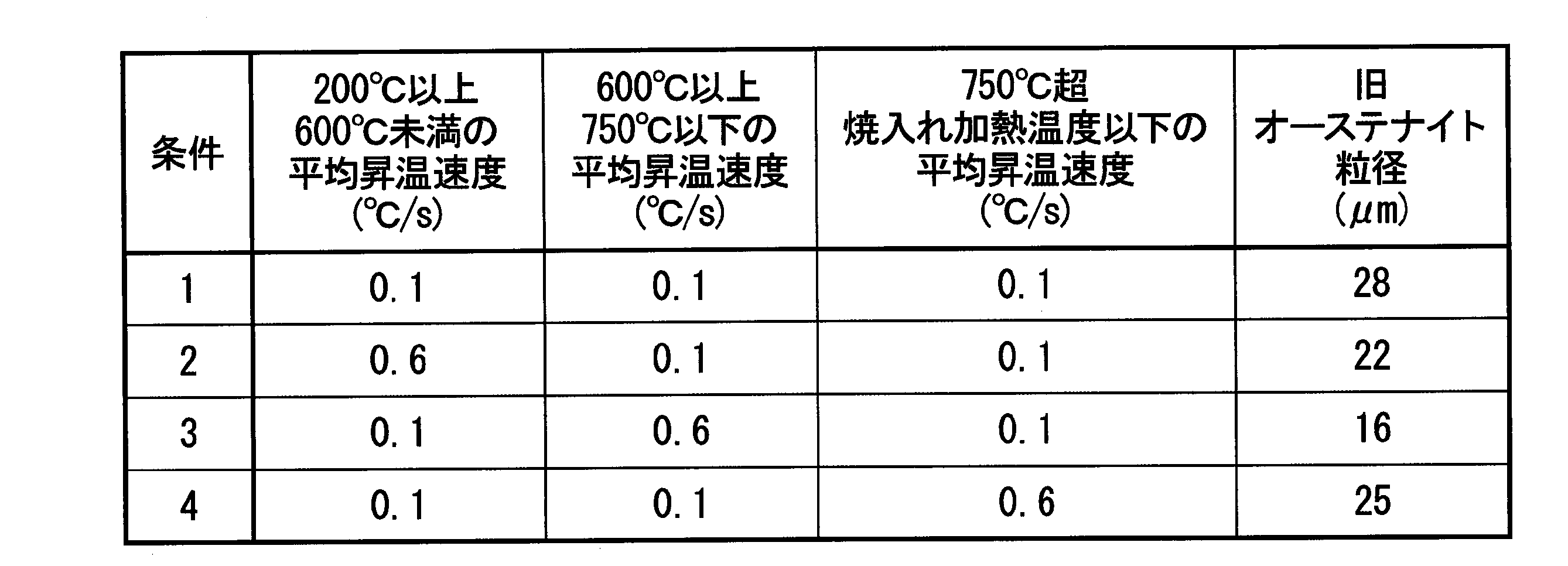
上述の定義から明らかなように、旧オーステナイトの平均粗大粒径とは、旧オーステナイトの粒径分布における粗大粒に着目したパラメータである。本発明者らは、旧オーステナイトが微細化されている場合でも、粗大粒が残存している場合にその残存箇所において靭性が低下することを知見した。そのため、本実施形態に係る鋼板は、旧オーステナイトの平均粗大粒径が20μm以下、即ち粗大粒が残存しないものとされている。旧オーステナイトの平均粗大粒径が微細化すると、最終的な組織も微細化する。試験温度-196℃のシャルピー試験の吸収エネルギーで150Jを達成するために必要な、1/4t位置における旧オーステナイトの平均粗大粒径は20μm以下であることが必要である。1/4t位置における旧オーステナイトの平均粗大粒径は、好ましくは18μm以下、16μm以下、15μm以下又は14μm以下である。1/4t位置における旧オーステナイトの平均粗大粒径の下限値は特に限定されないが、例えばこれを5μm以上、7μm以上、又は8μm以上と規定してもよい。
1/4t位置における旧オーステナイトの平均粗大粒径の測定方法は以下の通りである。1/4t位置(鋼板の圧延面から鋼板の板厚tの1/4だけ離れた位置)から採取された試料の、鋼板の圧延方向及び鋼板の厚さ方向がなす面を研磨し、この面においてピクリン酸を用いて旧オーステナイト粒界を現出させる。その後、この面における任意の面積200μm2の視野において、最も大きい旧オーステナイト粒を特定し、その円相当径を算出する。この作業を任意の10視野で繰り返し実施し、得られた10個の円相当径の単純平均値を、1/4t位置における旧オーステナイトの平均粗大粒径とする。
なお、鋼板の圧延方向は、一般的には鋼板の長手方向となる。しかし、鋼板の圧延方向が不明な場合には、鋼板を高温(例えば、80℃以上)の酸(例えば、塩酸など)に浸漬して、圧延による伸長組織を観察することによる方法など公知の方法により鋼板の圧延方向を把握できる。
なお、鋼板の圧延方向は、一般的には鋼板の長手方向となる。しかし、鋼板の圧延方向が不明な場合には、鋼板を高温(例えば、80℃以上)の酸(例えば、塩酸など)に浸漬して、圧延による伸長組織を観察することによる方法など公知の方法により鋼板の圧延方向を把握できる。
熱間圧延および直接焼入れ後に再加熱焼入れを施した本実施形態に係る鋼板は、1/4tの位置において、伸長した旧オーステナイト粒は殆どない。このため、1/4tの位置におけるオーステナイト粒の長径と短径の比(短径/長径)の単純平均値である旧オーステナイトの平均アスペクト比は、再加熱焼入れ処理が施されない直接焼入れによる鋼板のものより小さくなる。通常であれば、旧オーステナイトの平均アスペクト比が2.0を超えることはない。多くの場合、平均アスペクト比は、1.5以下となる。必要に応じて、平均アスペクト比を1.4以下、1.3以下又は1.2以下としてもよい。平均アスペクト比の下限は1.0である。
1/4t位置における旧オーステナイトの平均アスペクト比の測定方法は以下の通りである。1/4t位置(鋼板の圧延面から鋼板の板厚tの1/4だけ離れた位置)から採取された試料の、圧延方向と板厚方向とがなす面を研磨し、この面においてピクリン酸を用いて旧オーステナイト粒界を現出させる。その後、この面における任意の200μm2の視野において、各旧オーステナイト粒について長径と短径の比(短径/長径)を測定し、その比の単純平均値を1/4t位置における旧オーステナイトの平均アスペクト比とする。
次に、以下に鋼板の化学組成に含まれる合金元素の範囲を規定する。以下、特に断りがない限り、合金元素の含有量の単位「%」は、質量%を意味する。
Cは、鋼板の強度確保のために必須の元素である。また、C含有量が不足した場合、強度低下や靭性低下を招く場合もある。そのため、C含有量を0.02%以上とする。しかし、一方でC量の増大は靱性低下を招く。そのため、C量の上限を0.12%とする。C量を0.03%以上、0.05%以上、又は0.07%以上としてもよい。C量を0.11%以下、0.10%以下、又は0.08%以下としてもよい。
Cは、鋼板の強度確保のために必須の元素である。また、C含有量が不足した場合、強度低下や靭性低下を招く場合もある。そのため、C含有量を0.02%以上とする。しかし、一方でC量の増大は靱性低下を招く。そのため、C量の上限を0.12%とする。C量を0.03%以上、0.05%以上、又は0.07%以上としてもよい。C量を0.11%以下、0.10%以下、又は0.08%以下としてもよい。
Siは、鋼板の強度確保に必須の元素であるため、その含有量を0.02%以上とする。しかし、一方で0.35%超のSiは、鋼板の靭性及び溶接性の低下等を招く。そのため、Si量の上限を0.35%とする。Si量を0.03%以上、0.05%以上、又は0.09%以上としてもよい。Si量を0.30%以下、0.25%以下、0.20%以下、0.15%以下又は0.10%以下としてもよい。
Mnは、鋼板の強度増大に有効な元素であり、最低でも0.10%以上を含有させることが必要となる。一方、1.50%を超えてMnを含有させると、焼戻し脆化感受性が高くなって鋼板の靭性が低下する。よって、Mnの含有量を0.10%以上1.50%以下と規定する。Mn量を0.30%以上、0.40%以上、0.50%以上又は0.60%以上としてもよい。Mn量を1.20%以下、1.00%以下、0.90%以下又は0.80%以下としてもよい。
Pは、本実施形態に係る鋼板にとって不要な元素であるので、その含有量の下限値は特に規定する必要がない。P含有量の下限値を0%としてもよい。ただし、P量を0.0010%未満とすると、精錬負荷の増大により生産性が大幅に低下する場合があり、その下限を0.0010%としてもよい。一方、P量が0.0100%を超えると焼戻し脆化により鋼板の靭性が低下する。よって、Pの含有量を0.0100%以下とする。P量を0.0090%以下、0.0080%以下、又は0.0060%以下としてもよい。
Sは、本実施形態に係る鋼板にとって不要な元素であるので、その含有量の下限値は特に規定する必要がない。S含有量の下限値を0%としてもよい。ただし、S量を0.0001%未満とすると、精錬負荷の増大により生産性が大幅に低下する場合があり、その下限を0.0001%としてもよい。一方、S量が0.0035%を超えると、鋼板の靱性が低下する。よって、Sの含有量を0.0035%以下とする。S量を0.0005%以上、0.0010%以上、又は0.0015%以上としてもよい。S量を0.0030%以下、0.0025%以下、又は0.0020%以下としてもよい。
Niは、鋼板の靭性および強度の確保のため、最低でも5.0%超を含有させることが必要となる。また、Ni量が10.0%超では、鋼板の製造コストが大幅に増大する。よって、Niの含有量を5.0%超10.0%以下とする。Ni量を5.5%以上、6.0%以上、又は7.0%以上としてもよい。Ni量を9.5%以下、9.0%以下、又は8.0%以下としてもよい。
なお、本実施形態において、ニッケル含有鋼板とは、Ni含有量が5.0%超10.0%以下の鋼板を意味する。
なお、本実施形態において、ニッケル含有鋼板とは、Ni含有量が5.0%超10.0%以下の鋼板を意味する。
Alは、鋼板の脱酸に有効な元素であり、最低でも0.002%以上を含有させることが必要となる。一方、0.090%を超えてAlを含有させると、鋼板の靭性が低下する。よって、Alの含有量を0.002~0.090%とする。Al量を0.005%以上、0.010%以上、又は0.020%以上としてもよい。Al量を0.080%以下、0.070%以下、又は0.060%以下としてもよい。
Nは、意図的に添加できるが、意図的に添加しない場合でも不純物として混入する元素である。N量の下限を特に規定する必要はなく、その下限値を0%としてもよい。ただし、N量を0.0001%未満とした場合、精錬負荷の増大によって生産性が著しく低下する。そのため、N量は0.0001%以上としてもよい。一方、N量が0.0070%を超える場合、鋼板の靭性が低下する。そのため、N量の上限は0.0070%とする。N量を0.0002%以上、0.0005%以上、又は0.0010%以上としてもよい。N量を0.0060%以下、0.0050%以下、又は0.0040%以下としてもよい。
Oは、鋼板の成分中の酸素の総量である。Oは本実施形態に係る鋼板にとって不要な元素であるので、Oの下限については材質特性上、特に規定する必要はなく、その下限値を0%としてよい。ただし、O量を0.0001%未満とした場合、精錬負荷の増大によって生産性が著しく低下する。そのため、O量を0.0001%以上としてもよい。一方、O量が0.0030%を超える場合、鋼板の靭性が低下する。そのため、O量の上限は0.0030%とする。O量を0.0005%以上、0.0010%以上、又は0.0015%以上としてもよい。O量を0.0025%以下、0.0020%以下、又は0.0018%以下としてもよい。
なお、本実施形態に係る鋼板では、さらに以下の元素を任意に含有してもよい。ただし、以下に挙げる元素を用いることなく、本実施形態に係る鋼板は課題を解決することができる。従って、以下に挙げる元素の下限値は0%である。
Cuは、鋼板の強度向上効果を有する。この効果を得るためには、Cu量を0.01%以上とすることが好ましい。一方、Cu量が2.00%を超えると、鋼板の靭性が低下するおそれがある。よって、Cuの含有量を0~2.00%とする。Cu量を0.10%以上、0.15%以上、又は0.20%以上としてもよい。Cu量を1.50%以下、1.00%以下、0.70%以下、0.50%又は0.30%以下としてもよい。
Crは、鋼板の焼入性を向上させ、鋼板の強度に影響を与える元素である。Crによる強度向上効果を得るためには、Cr量を0.01%以上とすることが好ましい。一方、Cr量が5.00%を超える場合、鋼板の靭性及び溶接性が低下するおそれがある。よって、Crの含有量を0~5.00%とする。Cr量を0.10%以上、0.20%以上、又は0.25%以上としてもよい。Cr量を3.00%以下、2.00%以下、1.00%以下、0.80%以下、0.60%以下又は0.50%以下としてもよい。
Moは、鋼板の強度確保および焼戻し脆化の軽減に有効な元素である。Moのこれら効果を得るためには、Mo量を0.01%以上とすることが好ましい。一方、Mo量が1.00%を超える場合、鋼板の靭性及び溶接性が低下するおそれがある。よって、Moの含有量を0~1.00%とする。Mo量を0.05%以上、0.08%以上、0.15%以上又は0.20%以上としてもよい。Mo量を0.80%以下、0.70%以下、0.50%、0.40%以下、0.30%以下又は0.25%以下としてもよい。
Bは、鋼板の焼入性の向上に有効で、鋼板の強度に影響を与える元素である。Bのこれら効果を得るためには、B量を0.0002%以上とすることが好ましい。一方、B含有量が0.0050%を超える場合、鋼板の靭性が低下するおそれがある。よって、Bの含有量を0~0.0050%以下とする。B量を0.0002%以上、0.0004%以上、又は0.0005%以上としてもよい。B量を0.0030%以下、0.0020%以下、又は0.0015%以下としてもよい。
Nbは、鋼板の強度確保に有効な元素である。Nbのこの効果を得るためには、Nb量を0.001%以上とすることが好ましい。一方、Nb量が0.050%超である場合、鋼板の靱性の低下を招くおそれがある。よって、Nbの含有量を0~0.050%とする。Nb量を0.005%以上、0.010%以上、又は0.015%以上としてもよい。Nb量を0.040%以下、0.030%以下、又は0.025%以下としてもよい。
Tiは、鋼板の強度確保に有効な元素である。Tiのこの効果を得るためには、Ti量を0.001%以上とすることが好ましい。一方、Ti量が0.050%超である場合、鋼板の靭性の低下を招くおそれがある。よって、Tiの含有量を0~0.050%とする。Ti量を0.005%以上、0.010%以上、又は0.020%以上としてもよい。Ti量を0.040%以下、0.030%以下、又は0.025%以下としてもよい。
Vは、鋼板の強度確保に有効な元素である。Vのこの効果を得るためには、V量を0.001%以上とすることが好ましい。一方、V量が0.050%超である場合、靱性の低下を招くおそれがある。よって、Vの含有量を0~0.050%とする。V量を0.002%以上、0.005%以上、又は0.010%以上としてもよい。V量を0.040%以下、0.030%以下、又は0.020%以下としてもよい。
Caは、鋼板の結晶粒径に影響を与え、鋼板の強度に影響する元素である。さらに、Caは鋼板の原料となるスラブの鋳造時のノズル閉塞防止に有効な元素である。Caのこれら効果を得るためには、Ca量を0.0003%以上とすることが好ましい。一方、Ca量が0.0300%超である場合、鋼板の靭性の低下を招くおそれがある。よって、Caの含有量を0~0.0300%とすることが好ましい。Ca量を0.0010%以上、0.0020%以上、又は0.0030%以上としてもよい。Ca量を0.0100%以下、0.0080%以下、又は0.0050%以下としてもよい。
Mgは、鋼板の強度に影響を与え、鋼板の靱性向上に有効な元素である。Mgのこれら効果を得るためには、Mg量を0.0003%以上とすることが好ましい。一方、Mg量が0.0300%超である場合、靭性の低下を招くおそれがある。よって、Mgの含有量を0~0.0300%とする。Mg量を0.0005%以上、0.0010%以上、又は0.0020%以上としてもよい。Mg量を0.0100%以下、0.0080%以下、又は0.0050%以下としてもよい。
「REM」との用語は、希土類元素、即ちSc、Yおよびランタノイドからなる合計17元素を指し、上記「REMの含有量」とは、これらの17元素の合計含有量を意味する。REMは、鋼板の強度に影響を与え、鋼板の靱性向上に有効な元素である。REMのこれら効果を得るためには、REM量を0.0003%以上とすることが好ましい。一方、REM量が0.0300%超である場合、鋼板の靭性の低下を招くおそれがある。よって、REMの含有量を0~0.0300%とする。REM量を0.0005%以上、0.0010%以上、又は0.0020%以上としてもよい。REM量を0.0100%以下、0.0080%以下、又は0.0050%以下としてもよい。
本実施形態に係る鋼板の化学組成の残部は鉄及び不純物である。不純物とは、例えば、鋼板および溶接材料を製造する上で、添加合金を含めた使用原料または溶製中に炉材等から溶出するものである。このような不純物も、本実施形態に係る鋼板の特性を損なわない範囲内で許容される。例えば、不純物として混入しうる、Zn、Sn、及びSb等も、それぞれ0.01%未満の混入であれば何ら本実施形態に係る鋼板の効果を損なうものではないので許容される。
本実施形態に係る鋼板の引張強さは690MPa以上900MPa以下の範囲である。これは、例えば、低温圧力容器用ニッケル鋼鋼板としてJIS G3127:2013などで規定されている鋼板の引張強さとほぼ同じであり、造船、橋梁、建築、海洋構造物、圧力容器、タンク、及びラインパイプなどの溶接構造物一般において求められる引張強さの範囲である。
なお、本実施形態に係る鋼板の降伏点又は耐力は、520MPa以上又は590MPa以上とすることが好ましい。この上限を特に定める必要はないが、690MPa以下としてもよい。
なお、本実施形態に係る鋼板の降伏点又は耐力は、520MPa以上又は590MPa以上とすることが好ましい。この上限を特に定める必要はないが、690MPa以下としてもよい。
本実施形態に係る鋼板の板厚も特に限定されない。例えば本実施形態に係る鋼板の厚さを、上述したような溶接構造物一般において使用される鋼板の厚さ範囲である6~100mmとしてもよい。必要に応じて、その下限を10mm又は12mmとしてもよく、その上限を80mm、60mm又は50mmとしてもよい。
本実施形態に係る鋼板の金属組織も特に限定されない。例えば、中間熱処理(いわゆるL処理)をしない製造方法によって得られた本実施形態に係る鋼板の1/4t位置での金属組織では、残留オーステナイト量が体積%で0.1%以上5%未満となることが多い。中間熱処理をしない製造方法によって得られた本実施形態に係る鋼板の1/4t位置での金属組織における残留オーステナイト量を、体積%で0.2%以上、0.3%以上、又は0.5%以上と規定してもよい。中間熱処理をしない製造方法によって得られた本実施形態に係る鋼板の1/4t位置での金属組織における残留オーステナイト量を、体積%で4.8%以下、4.5%以下、4.2%以下、又は4%以下と規定してもよい。
一方、中間熱処理をする製造方法によって得られた本実施形態に係る鋼板の1/4t位置での金属組織では、残留オーステナイト量が体積%で5~15%となることが多い。中間熱処理をする製造方法によって得られた本実施形態に係る鋼板の1/4t位置での金属組織における残留オーステナイト量を、体積%で6%以上、7%以上、8%以上、又は9%以上と規定してもよい。中間熱処理をする製造方法によって得られた本実施形態に係る鋼板の1/4t位置での金属組織における残留オーステナイト量を、体積%で14%以下、13%以下、12%以下、又は10%以下と規定してもよい。
いずれの場合も、鋼板の1/4t位置での金属組織の残部は、主に焼戻しマルテンサイトを主体とする組織となる。残留オーステナイト量が多いほど、低温靭性を高めることができる。ただし、中間熱処理を省略することによって鋼板の1/4t位置での残留オーステナイト量が体積%で5%未満になったとしても、本実施形態に係る鋼板は、その旧オーステナイトの平均粗大粒径が好ましく制御されているので優れた低温靭性を確保することができる。製造コストを考慮すると、中間熱処理を省略することにより鋼板の1/4t位置での残留オーステナイトを体積%で0~5%未満とすることが好ましい。
一方、中間熱処理をする製造方法によって得られた本実施形態に係る鋼板の1/4t位置での金属組織では、残留オーステナイト量が体積%で5~15%となることが多い。中間熱処理をする製造方法によって得られた本実施形態に係る鋼板の1/4t位置での金属組織における残留オーステナイト量を、体積%で6%以上、7%以上、8%以上、又は9%以上と規定してもよい。中間熱処理をする製造方法によって得られた本実施形態に係る鋼板の1/4t位置での金属組織における残留オーステナイト量を、体積%で14%以下、13%以下、12%以下、又は10%以下と規定してもよい。
いずれの場合も、鋼板の1/4t位置での金属組織の残部は、主に焼戻しマルテンサイトを主体とする組織となる。残留オーステナイト量が多いほど、低温靭性を高めることができる。ただし、中間熱処理を省略することによって鋼板の1/4t位置での残留オーステナイト量が体積%で5%未満になったとしても、本実施形態に係る鋼板は、その旧オーステナイトの平均粗大粒径が好ましく制御されているので優れた低温靭性を確保することができる。製造コストを考慮すると、中間熱処理を省略することにより鋼板の1/4t位置での残留オーステナイトを体積%で0~5%未満とすることが好ましい。
鋼板の残留オーステナイトの体積分率(体積%)の測定は、以下の手順で行う。鋼板の1/4t位置から試験片を採取し、研削および研磨などにより、試験片表面を鋼板の1/4t位置となるように加工する。その後、X線回折によりαの(200)、(211)面、γの(200)、(220)、(311)面の回折強度を求め、この回折強度に基づいて残留オーステナイトの体積分率を求める。
次に本実施形態に係る鋼板を確実に製造できる製造方法の好ましい一例について記載する。
鋼板は、連続鋳造で製造されたスラブを前記の方法で熱間圧延する方法で製造されるが、前記以外に、例えば、一般的にマルテンサイトやベイナイトを主体とする組織を微細化するために実施する下記の条件を適用することがよい。
-熱間圧延前の鋼片加熱温度:1050~1250℃
-熱間圧延での総圧下率:上述の通り、75%以上
-制御圧延(CR)開始温度:850℃以下
-制御圧延における総圧下率(CR率):60%以上
-仕上げ1パス前温度:上述の通り、600~850℃
-熱間圧延後の水冷開始温度:580℃以上
-平均水冷速度:3.0℃/秒以上
-水冷終了温度:150℃以下
ここで、制御圧延とは、比較的低温において高圧下率の圧延をすることによって鋼板に歪みを導入する圧延である。本実施形態に係る鋼板の製造方法では便宜上、850℃以下で行われる圧延を制御圧延と定義する。従って本実施形態において、「制御圧延における総圧下率」とは、「850℃以下での累積圧下率」と同じ意味である。制御圧延(CR)が行われる温度はより低い方が好ましい。このため、850℃超での圧延終了後に(圧延を一旦中断して)スラブを空冷し、スラブの温度低下後に、制御圧延を行うことがより好ましい。この場合の制御圧延開始の温度(ただし、その定義からもその温度は850℃以下である。)を、制御圧延開始温度(CR開始温度)という。
制御圧延における総圧下率とは、制御圧延開始前のスラブの厚さと制御圧延終了後の鋼板の厚さとの差を、制御圧延開始前のスラブの厚さで除した値である。
熱間圧延後の水冷開始温度とは、熱間圧延終了後に熱延鋼板に冷却水などの冷媒を噴射し始めた際の、鋼板表面の温度である。
水冷終了温度とは、熱延鋼板への冷媒の噴射を終了した際の、鋼板表面の温度である。
平均水冷速度とは、水冷開始温度と水冷終了温度との差を、冷媒噴射時間で除した値である。
鋼板は、連続鋳造で製造されたスラブを前記の方法で熱間圧延する方法で製造されるが、前記以外に、例えば、一般的にマルテンサイトやベイナイトを主体とする組織を微細化するために実施する下記の条件を適用することがよい。
-熱間圧延前の鋼片加熱温度:1050~1250℃
-熱間圧延での総圧下率:上述の通り、75%以上
-制御圧延(CR)開始温度:850℃以下
-制御圧延における総圧下率(CR率):60%以上
-仕上げ1パス前温度:上述の通り、600~850℃
-熱間圧延後の水冷開始温度:580℃以上
-平均水冷速度:3.0℃/秒以上
-水冷終了温度:150℃以下
ここで、制御圧延とは、比較的低温において高圧下率の圧延をすることによって鋼板に歪みを導入する圧延である。本実施形態に係る鋼板の製造方法では便宜上、850℃以下で行われる圧延を制御圧延と定義する。従って本実施形態において、「制御圧延における総圧下率」とは、「850℃以下での累積圧下率」と同じ意味である。制御圧延(CR)が行われる温度はより低い方が好ましい。このため、850℃超での圧延終了後に(圧延を一旦中断して)スラブを空冷し、スラブの温度低下後に、制御圧延を行うことがより好ましい。この場合の制御圧延開始の温度(ただし、その定義からもその温度は850℃以下である。)を、制御圧延開始温度(CR開始温度)という。
制御圧延における総圧下率とは、制御圧延開始前のスラブの厚さと制御圧延終了後の鋼板の厚さとの差を、制御圧延開始前のスラブの厚さで除した値である。
熱間圧延後の水冷開始温度とは、熱間圧延終了後に熱延鋼板に冷却水などの冷媒を噴射し始めた際の、鋼板表面の温度である。
水冷終了温度とは、熱延鋼板への冷媒の噴射を終了した際の、鋼板表面の温度である。
平均水冷速度とは、水冷開始温度と水冷終了温度との差を、冷媒噴射時間で除した値である。
熱間圧延・直接焼入れ工程(A工程)において、スラブの加熱温度が1250℃以下である場合、オーステナイトの粒成長を抑制し、これにより変態後のマルテンサイトを主体とする組織を微細化することすることができる。スラブの加熱温度が1050℃以上である場合、熱間圧延における圧延抵抗を小さくすることができる。従って、熱間圧延前のスラブ加熱温度は、1050℃以上1250℃以下とする。
熱間圧延は、上述のように、総圧下率75%以上で行い、仕上げ1パス前温度を600℃以上850℃以下とする。また、熱間圧延の総パスのうち、850℃以下で圧延を実施するパスにおける総圧下率、即ち制御圧延における総圧下率も、別途60%以上とする。850℃以下の低温において高い圧下率での圧延を行うことにより、その後の再加熱焼入れ時の加熱の際に、微細なオーステナイト粒を得ることができる。
熱間圧延後の水冷(直接焼入れ)では、水冷開始温度を580℃以上とする。水冷を580℃以上の高温から開始することによって、微細な焼入れ組織を得ることができる。また、水冷時の平均冷却速度は3.0℃/秒以上とする。これにより、微細な焼入れ組織を得ることができる。なお、鋼板の特性に観点からは水冷速度の上限を設ける必要はないが、水冷時の平均冷却速度を100℃/秒以下とすることで設備コストを安価に保つことができる。従って、水冷時の平均冷却速度は100℃/秒以下とすることが好ましい。直接焼入れを行うために、水冷停止温度は150℃以下とする。
熱間圧延・直接焼入れ工程後、即ちA工程後は、再加熱焼入れ工程であるB工程を行う。再加熱焼入れ時の600℃以上750℃以下の平均昇温速度は、上述のように、0.4℃/秒以上0.8℃/秒以下とする。この他、再加熱焼入れ時の加熱温度が800℃以上である場合、未変態組織の残存を防止して、鋼板の靭性を高めることができる。再加熱焼入れ時の加熱温度が810℃以下である場合、再加熱焼入れ加熱時の旧オーステナイトを微細化して靭性を向上させることができる。よって、再加熱焼入れ時の加熱温度を800℃以上810℃以下とする。なお、再加熱焼入れ加熱時の加熱温度とは、再加熱焼入れの際の鋼板の保持温度である。後述する再加熱焼入れ加熱時の保持時間とは、鋼板温度が、800~810℃の範囲内にあった時間を意味する。
再加熱焼入れ加熱時の保持時間が5分以上である場合、鋼板の材質が均一化される。再加熱焼入れ加熱時の保持時間が100分以下である場合、組織を微細化して靭性を向上させることができる。よって、再加熱焼入れ加熱時の保持時間を例えば5分以上100分以下としてもよい。
上述の焼入れ工程では、熱処理炉を用いて熱処理をすることが必要であると考えられる。通常の浅い加熱焼入れ工程では、製造効率の向上を目的として、迅速な昇温が可能な高周波加熱装置等を用いて焼入れを実施する場合がある。しかし、このような加熱手段によれば、上述した600~610℃という極めて狭い温度範囲内に鋼板温度を制御することが困難である。特に、この温度範囲内で鋼板温度を5分以上保持することが困難である。従って、鋼板の焼入れ温度を狭い範囲内に制御することが容易な炉加熱をすることが望ましい。これは、本実施形態に係る鋼板の製造方法における他の熱処理においても同様である。
上述の焼入れ工程では、熱処理炉を用いて熱処理をすることが必要であると考えられる。通常の浅い加熱焼入れ工程では、製造効率の向上を目的として、迅速な昇温が可能な高周波加熱装置等を用いて焼入れを実施する場合がある。しかし、このような加熱手段によれば、上述した600~610℃という極めて狭い温度範囲内に鋼板温度を制御することが困難である。特に、この温度範囲内で鋼板温度を5分以上保持することが困難である。従って、鋼板の焼入れ温度を狭い範囲内に制御することが容易な炉加熱をすることが望ましい。これは、本実施形態に係る鋼板の製造方法における他の熱処理においても同様である。
なお、必要に応じて、再加熱焼入れと焼戻しとの間に、中間熱処理を行うことができる。中間熱処理の加熱温度が660℃以上である場合、鋼板の靭性を向上させることができる。中間熱処理の加熱温度が700℃以下である場合、中間熱処理のための加熱時の旧オーステナイト安定化による靭性改善効果を確保することができる。以上のことから、中間熱処理の加熱温度は660℃以上700℃以下とする。ただし、本実施形態に係る鋼板の製造方法では、中間熱処理を実施することなく良好な低温靭性を鋼板に付与することができる。
中間熱処理の保持時間が5分以上である場合、逆変態を進展させることにより、焼入れ加熱時に旧オーステナイトを安定化して、靭性改善効果を得ることができる。中間熱処理の保持時間が30分以下である場合、再加熱焼入れの加熱時の旧オーステナイトを安定化して、鋼板の靭性を高めることができる。以上のことから、中間熱処理の保持時間を5分以上30分以下とする。なお中間熱処理の加熱温度とは、中間熱処理の際の熱延鋼板の保持温度である。中間熱処理の保持時間とは、鋼板温度が660~700℃の範囲内にあった時間を意味する。
焼戻し工程であるC工程において、焼戻し温度が570℃以上である場合、焼戻し脆化による靭性低下を防止することができる。焼戻し温度が590℃以下である場合、鋼板の靭性を高めることができる。以上のことから、焼戻しは570℃以上590℃以下で実施することがよい。また、焼戻しの保持時間が5分以上である場合、靭性を高めることができる。焼戻しの保持時間が30分以下である場合、生産性を高めることができる。以上のことから、焼戻しの保持時間を5分以上30分以下とすることがよい。なお焼戻しの加熱温度とは、焼戻しの際の熱延鋼板の保持温度である。焼戻しの保持時間とは、鋼板温度が570~590℃の範囲内にあった時間を意味する。
種々の化学組成、製造条件で製造した板厚18mm、又は43mmの鋼板について、引張試験およびシャルピー衝撃試験を実施した。鋼板の化学組成、熱間圧延・直接焼入れ条件、板厚、熱処理条件、旧オーステナイトの平均粗大粒径、残留オーステナイトの量(残留γ量)、旧オーステナイトの平均アスペクト比(平均アスペクト比)、機械的特性の評価結果を表2-1~表5-2に示す。中間熱処理における保持時間は、板厚18mmでは20分、板厚43mmでは40分とした。全ての熱処理は、熱処理炉を用いて実施した。発明範囲外となった鋼板の化学組成、及び旧オーステナイトの平均粗大粒径には下線を付した。また、合否基準に満たなかった機械的特性値にも下線を付した。なお、表には残留オーステナイト量を記載したが、全ての実施例及び比較例の金属組織の残部は、ほぼ全て焼戻しマルテンサイトであった。旧オーステナイトの平均粗大粒径、残留オーステナイトの量、及び旧オーステナイトの平均アスペクト比は、上述した手段に従って測定した。
引張試験はJIS Z 2241:2011に記載の金属材料引張試験方法に基づいて行った。鋼板厚さが20mm超の場合4号試験片とし、試験片は、板厚の1/4だけ鋼板表面から内部に入った部位において、試験片の長手方向が圧延方向と垂直になるように採取した。鋼板厚さが20mm以下の場合JIS5号試験片とし、試験片の長手方向が圧延方向と垂直になるように採取した。常温で2本の試験を行い、引張強さの平均値が690MPa以上900MPa以下を合格とした。
シャルピー衝撃試験は、予め6%のひずみを常温で付与した後、200℃で1hrの熱処理を行った鋼板から、JIS Z2242:2018のVノッチ試験片を、板厚の1/4だけ鋼板表面から内部に入った部位において、試験片の長手方向が圧延方向と垂直になるように、またノッチの前縁を結ぶ線が板厚方向に平行になるように採取した。予歪方向は、L方向(鋼板の圧延方向)とした。試験温度-196℃で3本の試験を行い、3本の平均値が150J以上を合格とした。
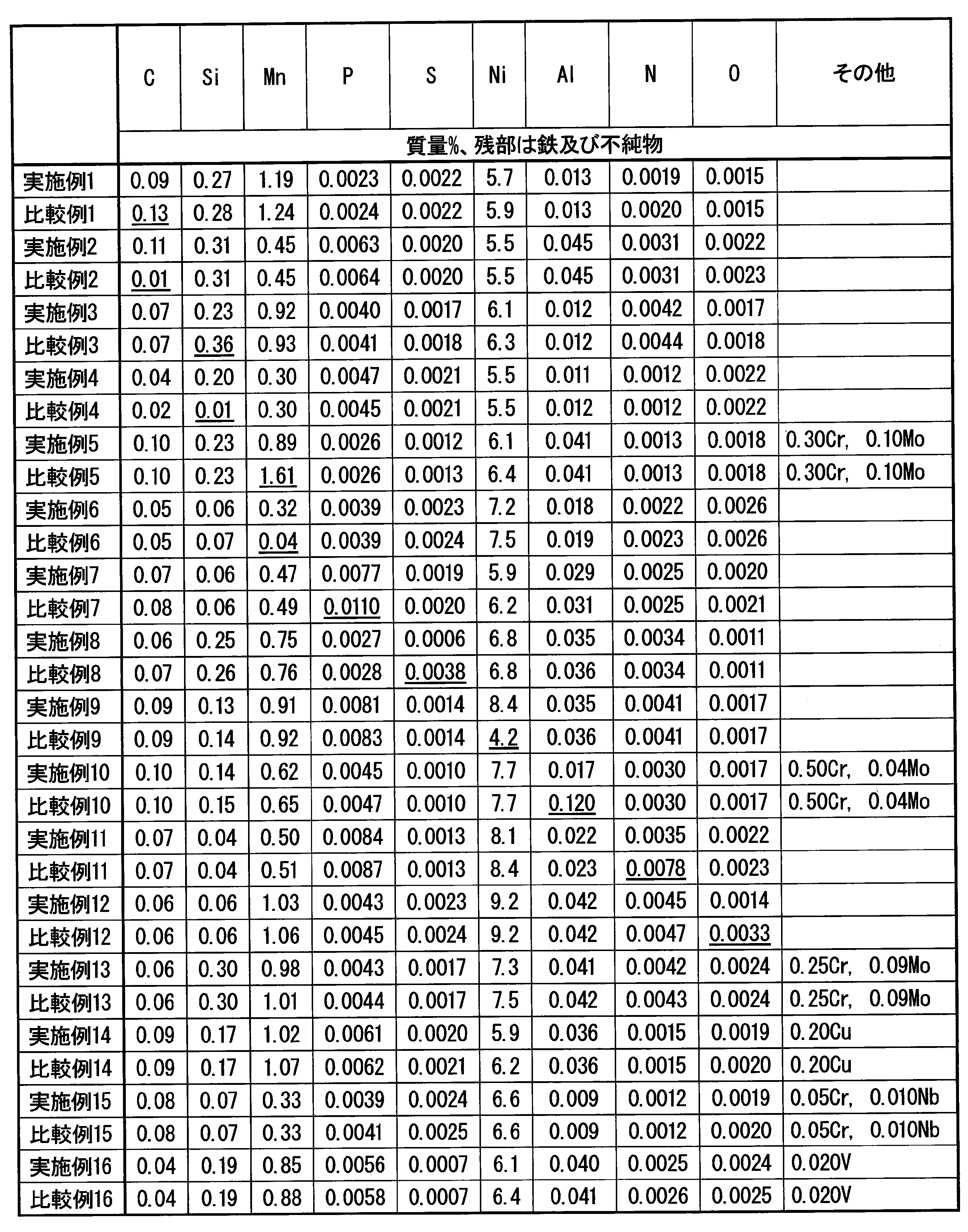

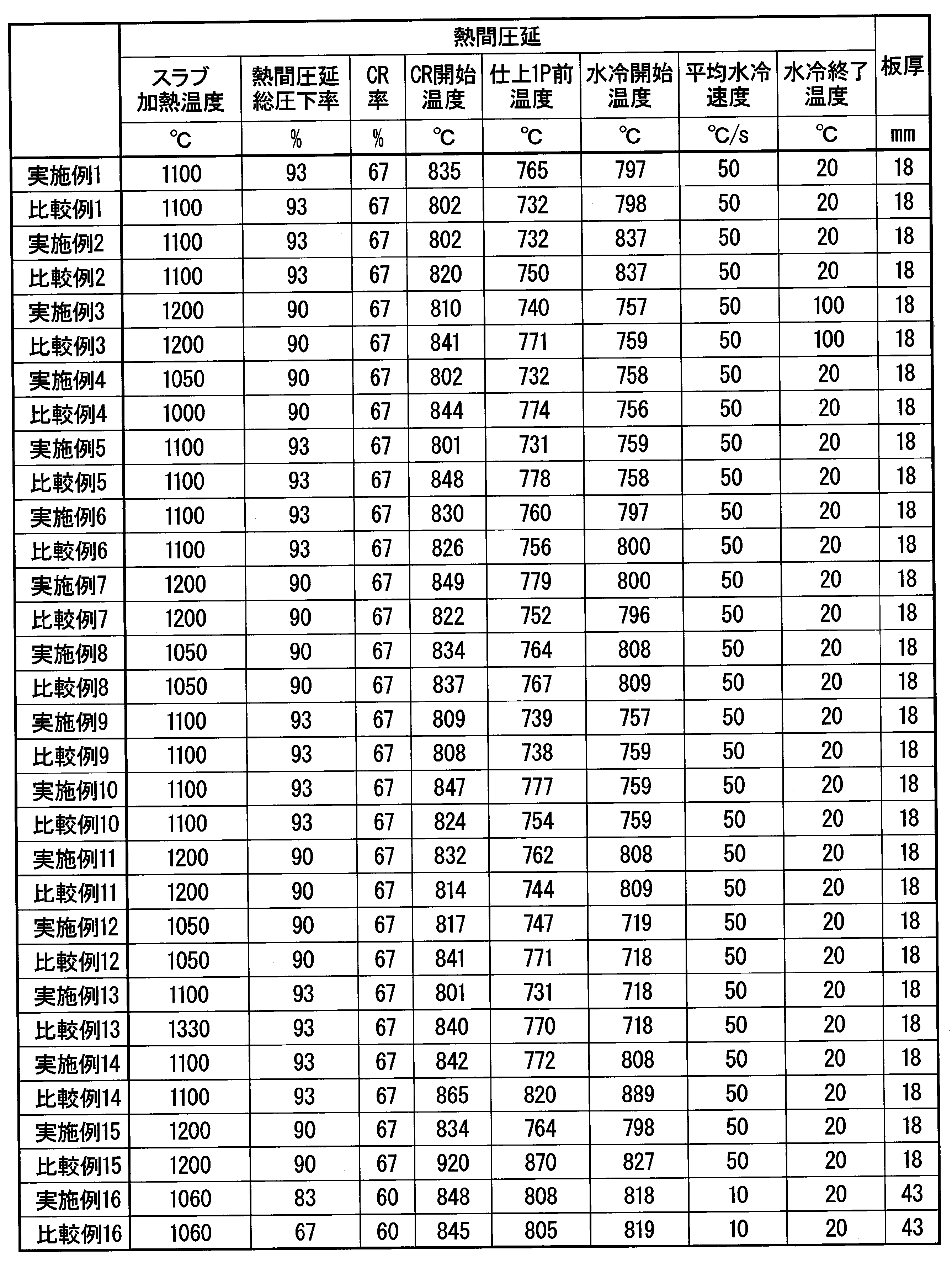
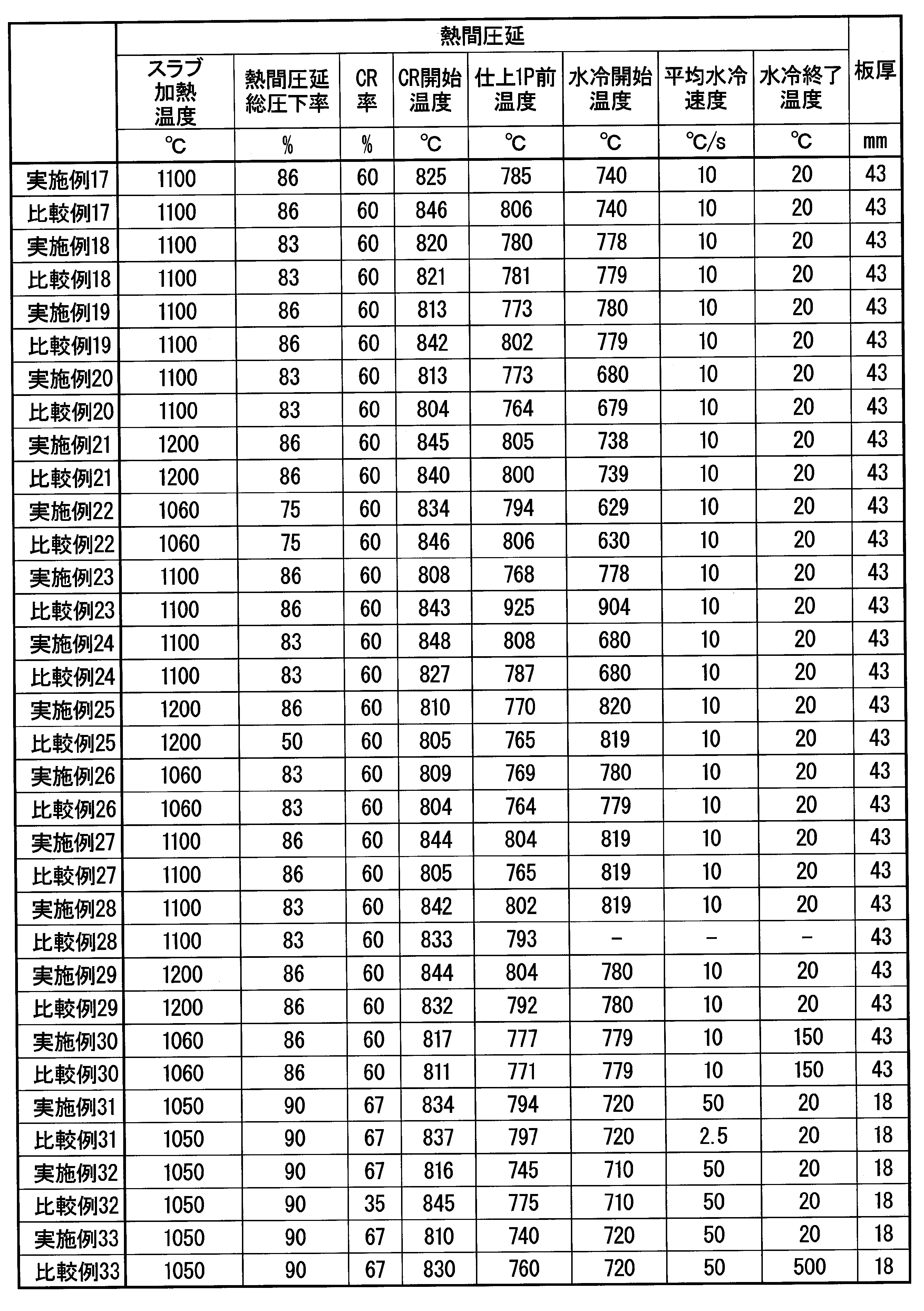

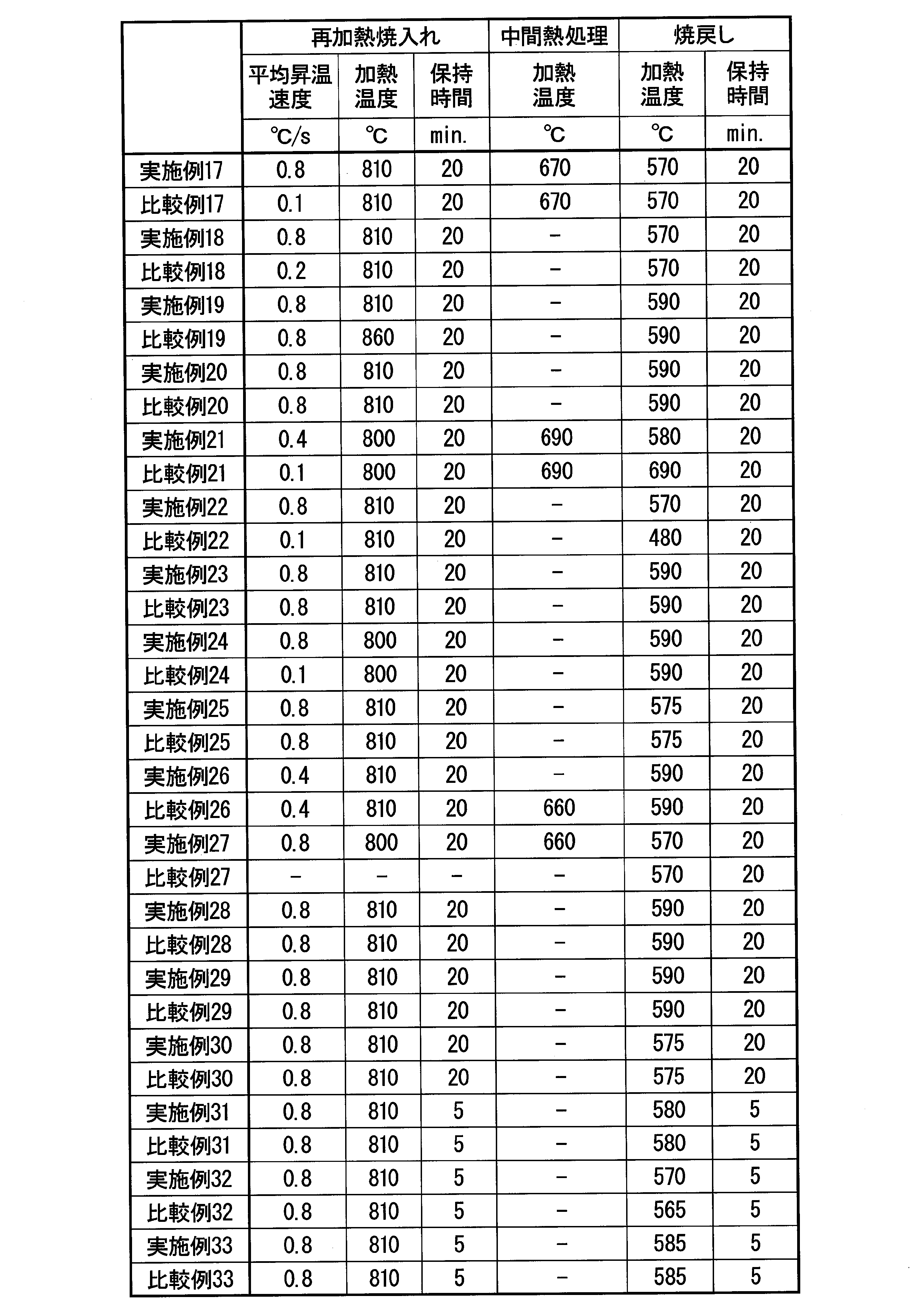

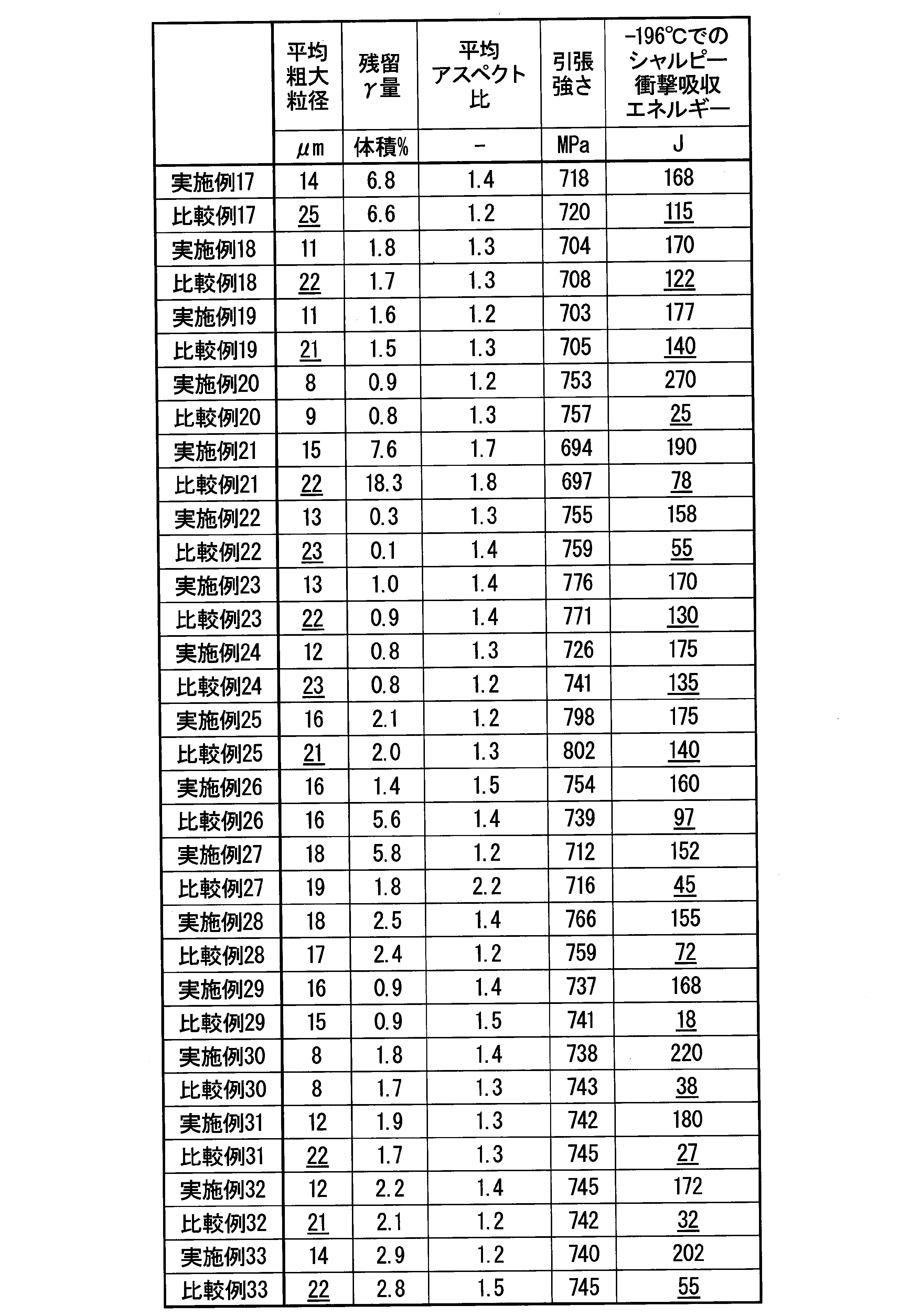
実施例1~33に示すように、本発明に規定した成分を有し、好ましい製造方法で製造された鋼板は、優れた引張強さおよび靭性を有した。以上の実施例から、本発明の範囲内である実施例1~33の鋼板は、引張強さおよび靭性に優れた鋼板鋼材であることは明白である。
一方、本発明の特徴を満たさない比較例は、引張強さ及び靭性の一方又は両方が劣った。
比較例1では、過剰量のCが鋼板の靭性低下を招いたので、低温靭性が不足した。
比較例2では、鋼板の強度確保のために必須の元素であるC含有量が不足したので、必要な引張強さを達成できなかった。また、比較例2では低温靭性も損なわれた。
比較例3では、過剰量のSiが鋼板の靭性低下を招いたので、低温靭性が不足した。
比較例4では、鋼板の強度確保のために必須の元素であるSi含有量が不足したので、必要な引張強さを達成できなかった。
比較例5では、過剰量のMnが含まれていたので、焼戻し脆化感受性が高くなって鋼板の靭性が低下した。
比較例6では、鋼板の強度増大に有効な元素であるMn含有量が不足したので、必要な引張強さを達成できなかった。
比較例7では、過剰量のPが含まれていたので、焼戻し脆化により鋼板の靭性が低下した。
比較例8及び比較例27では、S量が過剰であったので、鋼板の靭性が低下した。
比較例9及び比較例30では、鋼板の靭性確保のために必須であるNiが不足したので、鋼板の靭性が低下した。また、比較例9では引張強さも不足した。
比較例10では、過剰量のAlが含まれていたので、鋼板の靭性が低下した。
比較例11及び比較例29では、過剰量のNが含まれていたので、鋼板の靭性が低下した。
比較例12及び比較例28では、過剰量のOが含まれていたので、鋼板の靭性が低下した。
比較例13では、オーステナイトの粒成長を抑制することができなかったので、1/4t位置における旧オーステナイトの平均粗大粒径が大きすぎて靭性が損なわれた。これは、熱間圧延前の鋼片加熱温度が高かったからであると推定される。
比較例14及び比較例15では、再加熱焼入れの加熱時のオーステナイト粒径が粗大になり、その結果1/4t位置における旧オーステナイトの平均粗大粒径が大きくなり、靭性が損なわれた。これは制御圧延(CR)開始温度が高かったからであると推定される。また、比較例15では仕上げ1パス前温度が高く、このことも旧オーステナイトの平均粗大粒径が大きくなった原因になったと考えられる。
比較例16及び比較例25では、再加熱焼入れの加熱時のオーステナイト粒径が粗大になり、1/4t位置における旧オーステナイトの平均粗大粒径が大きくなり、靭性が損なわれた。これは、熱間圧延での総圧下率が低かったからであると推定される。
比較例17、比較例18、及び比較例24では、1/4t位置における旧オーステナイトの粗大部粒径が大きすぎて靭性が損なわれた。これは、再加熱焼入れ時の、600℃以上750℃以下での平均昇温速度が低かったからであると推定される。
比較例19では、旧オーステナイトを微細化させることができず、靭性を向上させることができなかった。これは、再加熱焼入れ時の加熱温度が高かったからであると推定される。
比較例20では、過剰量のPが含まれていたので、靭性を向上させることができなかった。
比較例21では、1/4t位置における旧オーステナイトの平均粗大粒径が大きすぎて靭性が損なわれた。これは、再加熱焼入れ時の、600℃以上750℃以下での平均昇温速度が低く、且つ焼戻し時の加熱温度が高かったからであると推定される。
比較例22では、1/4t位置における旧オーステナイトの平均粗大粒径が大きすぎ、また焼戻し脆化が生じることにより、低温靭性が損なわれた。これは、再加熱焼入れ時の、600℃以上750℃以下での平均昇温速度が低く、且つ焼戻し時の加熱温度が低かったからであると推定される。
比較例23では、水冷で常温まで冷却された時点での組織を微細とすることができず、旧オーステナイトの平均粗大粒径が大きくなり、低温靭性が損なわれた。これは、仕上げ1パス前温度が高かったからであると推定される。
比較例26は、過剰量のP及びSが含まれていたので、焼戻し脆化等により鋼板の靭性が低下した。
比較例31では、再加熱焼入れの加熱時のオーステナイト粒径が粗大になり、1/4t位置における旧オーステナイトの平均粗大粒径が大きくなり、低温靭性が損なわれた。これは、熱間圧延後直接焼入れ時の平均水冷速度が不足したからであると推定される。
比較例32では、再加熱焼入れの加熱時のオーステナイト粒径が粗大になり、1/4t位置における旧オーステナイトの平均粗大粒径を微細化することができず、靭性低下も生じた。これは、制御圧延における総圧下率が不足し、且つ焼戻し時の加熱温度が不足したからであると推定される。
比較例33では、組織を微細化することができず、1/4t位置における旧オーステナイトの平均粗大粒径が大きくなり、靭性低下が生じた。これは、熱間圧延後直接焼入れ時の水冷終了温度が高すぎたからであると推定される。
比較例1では、過剰量のCが鋼板の靭性低下を招いたので、低温靭性が不足した。
比較例2では、鋼板の強度確保のために必須の元素であるC含有量が不足したので、必要な引張強さを達成できなかった。また、比較例2では低温靭性も損なわれた。
比較例3では、過剰量のSiが鋼板の靭性低下を招いたので、低温靭性が不足した。
比較例4では、鋼板の強度確保のために必須の元素であるSi含有量が不足したので、必要な引張強さを達成できなかった。
比較例5では、過剰量のMnが含まれていたので、焼戻し脆化感受性が高くなって鋼板の靭性が低下した。
比較例6では、鋼板の強度増大に有効な元素であるMn含有量が不足したので、必要な引張強さを達成できなかった。
比較例7では、過剰量のPが含まれていたので、焼戻し脆化により鋼板の靭性が低下した。
比較例8及び比較例27では、S量が過剰であったので、鋼板の靭性が低下した。
比較例9及び比較例30では、鋼板の靭性確保のために必須であるNiが不足したので、鋼板の靭性が低下した。また、比較例9では引張強さも不足した。
比較例10では、過剰量のAlが含まれていたので、鋼板の靭性が低下した。
比較例11及び比較例29では、過剰量のNが含まれていたので、鋼板の靭性が低下した。
比較例12及び比較例28では、過剰量のOが含まれていたので、鋼板の靭性が低下した。
比較例13では、オーステナイトの粒成長を抑制することができなかったので、1/4t位置における旧オーステナイトの平均粗大粒径が大きすぎて靭性が損なわれた。これは、熱間圧延前の鋼片加熱温度が高かったからであると推定される。
比較例14及び比較例15では、再加熱焼入れの加熱時のオーステナイト粒径が粗大になり、その結果1/4t位置における旧オーステナイトの平均粗大粒径が大きくなり、靭性が損なわれた。これは制御圧延(CR)開始温度が高かったからであると推定される。また、比較例15では仕上げ1パス前温度が高く、このことも旧オーステナイトの平均粗大粒径が大きくなった原因になったと考えられる。
比較例16及び比較例25では、再加熱焼入れの加熱時のオーステナイト粒径が粗大になり、1/4t位置における旧オーステナイトの平均粗大粒径が大きくなり、靭性が損なわれた。これは、熱間圧延での総圧下率が低かったからであると推定される。
比較例17、比較例18、及び比較例24では、1/4t位置における旧オーステナイトの粗大部粒径が大きすぎて靭性が損なわれた。これは、再加熱焼入れ時の、600℃以上750℃以下での平均昇温速度が低かったからであると推定される。
比較例19では、旧オーステナイトを微細化させることができず、靭性を向上させることができなかった。これは、再加熱焼入れ時の加熱温度が高かったからであると推定される。
比較例20では、過剰量のPが含まれていたので、靭性を向上させることができなかった。
比較例21では、1/4t位置における旧オーステナイトの平均粗大粒径が大きすぎて靭性が損なわれた。これは、再加熱焼入れ時の、600℃以上750℃以下での平均昇温速度が低く、且つ焼戻し時の加熱温度が高かったからであると推定される。
比較例22では、1/4t位置における旧オーステナイトの平均粗大粒径が大きすぎ、また焼戻し脆化が生じることにより、低温靭性が損なわれた。これは、再加熱焼入れ時の、600℃以上750℃以下での平均昇温速度が低く、且つ焼戻し時の加熱温度が低かったからであると推定される。
比較例23では、水冷で常温まで冷却された時点での組織を微細とすることができず、旧オーステナイトの平均粗大粒径が大きくなり、低温靭性が損なわれた。これは、仕上げ1パス前温度が高かったからであると推定される。
比較例26は、過剰量のP及びSが含まれていたので、焼戻し脆化等により鋼板の靭性が低下した。
比較例31では、再加熱焼入れの加熱時のオーステナイト粒径が粗大になり、1/4t位置における旧オーステナイトの平均粗大粒径が大きくなり、低温靭性が損なわれた。これは、熱間圧延後直接焼入れ時の平均水冷速度が不足したからであると推定される。
比較例32では、再加熱焼入れの加熱時のオーステナイト粒径が粗大になり、1/4t位置における旧オーステナイトの平均粗大粒径を微細化することができず、靭性低下も生じた。これは、制御圧延における総圧下率が不足し、且つ焼戻し時の加熱温度が不足したからであると推定される。
比較例33では、組織を微細化することができず、1/4t位置における旧オーステナイトの平均粗大粒径が大きくなり、靭性低下が生じた。これは、熱間圧延後直接焼入れ時の水冷終了温度が高すぎたからであると推定される。
図1に、横軸を旧オーステナイトの平均粗大粒径とし、縦軸を低温靭性としたグラフを示す。図1のグラフには、上述の実施例1~33及び比較例1~33のうち、化学組成が発明範囲内であるものをプロットした。図1のグラフによれば、旧オーステナイトの平均粗大粒径が20μm以下である実施例の-196℃でのシャルピー吸収エネルギーが150J以上になること、及び平均粗大粒径が小さいほど-196℃でのシャルピー吸収エネルギーが大きくなる傾向があることがわかる。
図2に、横軸を再加熱焼入れ時の600℃以上750℃以下の温度範囲での平均昇温速度とし、縦軸を旧オーステナイトの平均粗大粒径としたグラフを示す。図2のグラフには、上述の実施例1~33及び比較例1~33のうち、化学組成が発明範囲内であり、且つ、再加熱焼入れ時の平均昇温速度以外の製造条件が好ましく制御されたものをプロットした。図2のグラフによれば、平均昇温速度が0.4℃/秒以上0.8℃以下とされた実施例では、旧オーステナイトの平均粗大粒径が20μm以下に制御されていることがわかる。
本発明に係る鋼板は、低温靭性に優れるため、造船、橋梁、建築、海洋構造物、圧力容器、タンク、ラインパイプなどの溶接構造物一般に用いることができ、高い産業上の利用可能性を有する。特に-196℃程度の低温での破壊靱性が要求される低温タンクでの使用において、本発明は極めて高い産業上の利用可能性を有する。
Claims (4)
- 化学組成が、質量%で、
C:0.02~0.12%、
Si:0.02~0.35%、
Mn:0.10~1.50%、
P:0.0100%以下、
S:0.0035%以下、
Ni:5.0%超10.0%以下、
Al:0.002~0.090%、
N:0.0070%以下、
O:0.0030%以下、
Cu:0~2.00%、
Cr:0~5.00%、
Mo:0~1.00%、
B:0~0.0050%、
Nb:0~0.050%、
Ti:0~0.050%、
V:0~0.050%、
Ca:0~0.0300%、
Mg:0~0.0300%、
REM:0~0.0300%、及び
残部:Fe及び不純物であり、
鋼板の1/4t位置における前記鋼板の圧延方向及び前記鋼板の厚さ方向がなす面において測定される、面積200μm2の10視野それぞれにおける旧オーステナイト粒の円相当径の最大値の単純平均値として定義される、旧オーステナイトの平均粗大粒径が20μm以下であり、
引張強さが690~900MPaである
ことを特徴とする、ニッケル含有鋼板。 - 前記1/4t位置における前記面において、200μm2の視野における旧オーステナイト粒の長径と短径との比の単純平均値として定義される、旧オーステナイト粒の平均アスペクト比が1.5以下であることを特徴とする請求項1に記載のニッケル含有鋼板。
- 前記1/4t位置における残留オーステナイト量が、体積%で、0.1%以上5%未満であることを特徴とする請求項1又は2に記載のニッケル含有鋼板。
- 前記1/4t位置における残留オーステナイト量が、体積%で、5~15%であることを特徴とする請求項1又は2に記載のニッケル含有鋼板。
Priority Applications (6)
| Application Number | Priority Date | Filing Date | Title |
|---|---|---|---|
| US16/650,283 US11279993B2 (en) | 2018-12-27 | 2018-12-27 | Nickel-containing steel plate |
| KR1020207008333A KR102195678B1 (ko) | 2018-12-27 | 2018-12-27 | 니켈 함유 강판 |
| CN201880061833.5A CN111630197B (zh) | 2018-12-27 | 2018-12-27 | 含镍钢板 |
| JP2019526628A JP6573059B1 (ja) | 2018-12-27 | 2018-12-27 | ニッケル含有鋼板 |
| PCT/JP2018/048244 WO2020136829A1 (ja) | 2018-12-27 | 2018-12-27 | ニッケル含有鋼板 |
| EP18933730.6A EP3699310B1 (en) | 2018-12-27 | 2018-12-27 | Nickel-containing steel sheet |
Applications Claiming Priority (1)
| Application Number | Priority Date | Filing Date | Title |
|---|---|---|---|
| PCT/JP2018/048244 WO2020136829A1 (ja) | 2018-12-27 | 2018-12-27 | ニッケル含有鋼板 |
Publications (1)
| Publication Number | Publication Date |
|---|---|
| WO2020136829A1 true WO2020136829A1 (ja) | 2020-07-02 |
Family
ID=67909536
Family Applications (1)
| Application Number | Title | Priority Date | Filing Date |
|---|---|---|---|
| PCT/JP2018/048244 Ceased WO2020136829A1 (ja) | 2018-12-27 | 2018-12-27 | ニッケル含有鋼板 |
Country Status (6)
| Country | Link |
|---|---|
| US (1) | US11279993B2 (ja) |
| EP (1) | EP3699310B1 (ja) |
| JP (1) | JP6573059B1 (ja) |
| KR (1) | KR102195678B1 (ja) |
| CN (1) | CN111630197B (ja) |
| WO (1) | WO2020136829A1 (ja) |
Cited By (4)
| Publication number | Priority date | Publication date | Assignee | Title |
|---|---|---|---|---|
| WO2023276429A1 (ja) * | 2021-06-28 | 2023-01-05 | Jfeスチール株式会社 | 鋼板およびその製造方法 |
| JP2023057907A (ja) * | 2021-10-12 | 2023-04-24 | Jfeスチール株式会社 | 鋼板およびその製造方法 |
| WO2023223694A1 (ja) | 2022-05-19 | 2023-11-23 | Jfeスチール株式会社 | 鋼板およびその製造方法 |
| KR20250004737A (ko) | 2022-05-19 | 2025-01-08 | 제이에프이 스틸 가부시키가이샤 | 강판 및 그의 제조 방법 |
Families Citing this family (4)
| Publication number | Priority date | Publication date | Assignee | Title |
|---|---|---|---|---|
| KR102289524B1 (ko) * | 2019-11-22 | 2021-08-12 | 현대제철 주식회사 | 고인성 니켈강 제조방법 및 니켈강 자화 제어방법 |
| KR102480707B1 (ko) * | 2020-11-12 | 2022-12-23 | 현대제철 주식회사 | 고인성 니켈 강재 및 그 제조방법 |
| CN114959452B (zh) * | 2022-04-25 | 2023-07-21 | 中国科学院金属研究所 | 一种耐近海岸强盐雾海洋大气环境腐蚀的耐候钢及其制备方法 |
| KR102867821B1 (ko) * | 2023-06-09 | 2025-10-14 | 현대제철 주식회사 | 초저온 충격인성이 우수한 강재 및 그 제조방법 |
Citations (7)
| Publication number | Priority date | Publication date | Assignee | Title |
|---|---|---|---|---|
| JPH0827517A (ja) * | 1994-07-15 | 1996-01-30 | Nippon Steel Corp | 降伏強度と靭性の優れた9%Ni鋼の熱処理法 |
| JP2002161341A (ja) | 2000-11-21 | 2002-06-04 | Sumitomo Metal Ind Ltd | B含有オーステナイト系ステンレス鋼板およびその製造方法 |
| JP2003160811A (ja) * | 2001-11-26 | 2003-06-06 | Nippon Steel Corp | 靭性に優れた調質高張力鋼板の製造方法 |
| JP2005226080A (ja) | 2004-02-10 | 2005-08-25 | Jfe Steel Kk | 溶接性と低温靭性に優れた高張力厚鋼板の製造方法 |
| JP2008075107A (ja) * | 2006-09-20 | 2008-04-03 | Jfe Steel Kk | 高強度・高靭性鋼の製造方法 |
| JP2008081776A (ja) * | 2006-09-27 | 2008-04-10 | Jfe Steel Kk | Ni含有鋼板の製造方法 |
| JP2011021243A (ja) * | 2009-07-16 | 2011-02-03 | Sumitomo Metal Ind Ltd | アレスト性に優れた厚肉低温用鋼板およびその製造方法 |
Family Cites Families (9)
| Publication number | Priority date | Publication date | Assignee | Title |
|---|---|---|---|---|
| JP4213833B2 (ja) * | 1999-10-21 | 2009-01-21 | 新日本製鐵株式会社 | 溶接部靱性に優れた高靱性高張力鋼とその製造方法 |
| JP5494167B2 (ja) * | 2010-04-14 | 2014-05-14 | 新日鐵住金株式会社 | 極低温用厚鋼板およびその製造方法 |
| JP5594329B2 (ja) * | 2012-07-23 | 2014-09-24 | Jfeスチール株式会社 | 低温靱性に優れたNi含有厚鋼板 |
| CN104854252B (zh) * | 2012-12-13 | 2016-10-12 | 株式会社神户制钢所 | 极低温韧性优异的厚钢板 |
| CN104520461B (zh) * | 2013-06-19 | 2016-06-15 | 新日铁住金株式会社 | 钢材及其制造方法以及lng罐 |
| JP5556948B1 (ja) * | 2013-10-28 | 2014-07-23 | Jfeスチール株式会社 | 低温用鋼板およびその製造方法 |
| KR102022787B1 (ko) * | 2015-03-16 | 2019-09-18 | 제이에프이 스틸 가부시키가이샤 | 복합 용기 축압기 라이너용 강관 및, 복합 용기 축압기 라이너용 강관의 제조 방법 |
| JP6693185B2 (ja) * | 2016-03-11 | 2020-05-13 | 日本製鉄株式会社 | 低温用ニッケル鋼板の製造方法 |
| JP6816467B2 (ja) * | 2016-11-17 | 2021-01-20 | 日本製鉄株式会社 | 低温用ニッケル含有厚鋼板及びその製造方法 |
-
2018
- 2018-12-27 JP JP2019526628A patent/JP6573059B1/ja active Active
- 2018-12-27 US US16/650,283 patent/US11279993B2/en active Active
- 2018-12-27 EP EP18933730.6A patent/EP3699310B1/en active Active
- 2018-12-27 KR KR1020207008333A patent/KR102195678B1/ko active Active
- 2018-12-27 WO PCT/JP2018/048244 patent/WO2020136829A1/ja not_active Ceased
- 2018-12-27 CN CN201880061833.5A patent/CN111630197B/zh active Active
Patent Citations (7)
| Publication number | Priority date | Publication date | Assignee | Title |
|---|---|---|---|---|
| JPH0827517A (ja) * | 1994-07-15 | 1996-01-30 | Nippon Steel Corp | 降伏強度と靭性の優れた9%Ni鋼の熱処理法 |
| JP2002161341A (ja) | 2000-11-21 | 2002-06-04 | Sumitomo Metal Ind Ltd | B含有オーステナイト系ステンレス鋼板およびその製造方法 |
| JP2003160811A (ja) * | 2001-11-26 | 2003-06-06 | Nippon Steel Corp | 靭性に優れた調質高張力鋼板の製造方法 |
| JP2005226080A (ja) | 2004-02-10 | 2005-08-25 | Jfe Steel Kk | 溶接性と低温靭性に優れた高張力厚鋼板の製造方法 |
| JP2008075107A (ja) * | 2006-09-20 | 2008-04-03 | Jfe Steel Kk | 高強度・高靭性鋼の製造方法 |
| JP2008081776A (ja) * | 2006-09-27 | 2008-04-10 | Jfe Steel Kk | Ni含有鋼板の製造方法 |
| JP2011021243A (ja) * | 2009-07-16 | 2011-02-03 | Sumitomo Metal Ind Ltd | アレスト性に優れた厚肉低温用鋼板およびその製造方法 |
Non-Patent Citations (1)
| Title |
|---|
| See also references of EP3699310A4 |
Cited By (9)
| Publication number | Priority date | Publication date | Assignee | Title |
|---|---|---|---|---|
| WO2023276429A1 (ja) * | 2021-06-28 | 2023-01-05 | Jfeスチール株式会社 | 鋼板およびその製造方法 |
| JPWO2023276429A1 (ja) * | 2021-06-28 | 2023-01-05 | ||
| CN117203362A (zh) * | 2021-06-28 | 2023-12-08 | 杰富意钢铁株式会社 | 钢板及其制造方法 |
| JP7396507B2 (ja) | 2021-06-28 | 2023-12-12 | Jfeスチール株式会社 | 鋼板およびその製造方法 |
| CN117203362B (zh) * | 2021-06-28 | 2025-10-31 | 杰富意钢铁株式会社 | 钢板及其制造方法 |
| JP2023057907A (ja) * | 2021-10-12 | 2023-04-24 | Jfeスチール株式会社 | 鋼板およびその製造方法 |
| JP7559733B2 (ja) | 2021-10-12 | 2024-10-02 | Jfeスチール株式会社 | 鋼板およびその製造方法 |
| WO2023223694A1 (ja) | 2022-05-19 | 2023-11-23 | Jfeスチール株式会社 | 鋼板およびその製造方法 |
| KR20250004737A (ko) | 2022-05-19 | 2025-01-08 | 제이에프이 스틸 가부시키가이샤 | 강판 및 그의 제조 방법 |
Also Published As
| Publication number | Publication date |
|---|---|
| KR102195678B1 (ko) | 2020-12-29 |
| CN111630197B (zh) | 2021-07-13 |
| US11279993B2 (en) | 2022-03-22 |
| JP6573059B1 (ja) | 2019-09-11 |
| EP3699310A4 (en) | 2021-03-31 |
| EP3699310A1 (en) | 2020-08-26 |
| KR20200083437A (ko) | 2020-07-08 |
| CN111630197A (zh) | 2020-09-04 |
| US20210222277A1 (en) | 2021-07-22 |
| EP3699310B1 (en) | 2022-10-05 |
| JPWO2020136829A1 (ja) | 2021-02-15 |
Similar Documents
| Publication | Publication Date | Title |
|---|---|---|
| JP6573059B1 (ja) | ニッケル含有鋼板 | |
| CN108699660B (zh) | 高强度钢板及其制造方法 | |
| JP6984319B2 (ja) | 靭性に優れた低温用ニッケル含有鋼板およびその製造方法 | |
| JP7095424B2 (ja) | 低降伏比厚鋼板 | |
| JP7499243B2 (ja) | 高降伏比冷間圧延二相鋼及びその製造方法 | |
| JP6700400B2 (ja) | Pwht抵抗性に優れた低温圧力容器用鋼板及びその製造方法 | |
| CN112236539B (zh) | 极低温用高张力厚钢板及其制造方法 | |
| JP7077801B2 (ja) | 低降伏比厚鋼板 | |
| WO2012002566A1 (ja) | 加工性に優れた高強度鋼板およびその製造方法 | |
| JP6911575B2 (ja) | 脆性き裂伝播停止特性に優れた鋼板およびその製造方法 | |
| JP6492862B2 (ja) | 低温用厚鋼板及びその製造方法 | |
| CN105039870B (zh) | 一种耐低温大应变的x80m管线钢的制备方法与应用 | |
| JP6146429B2 (ja) | 調質高張力厚鋼板及びその製造方法 | |
| JP5477089B2 (ja) | 高強度高靭性鋼の製造方法 | |
| JP2013177649A (ja) | 低降伏比厚鋼板及びその製造方法 | |
| JP5874664B2 (ja) | 落重特性に優れた高張力鋼板およびその製造方法 | |
| JP2017150067A (ja) | 脆性き裂伝播停止特性に優れた鋼板およびその製造方法 | |
| JP2019081929A (ja) | ニッケル含有鋼板およびその製造方法 | |
| CN114341382B (zh) | 具有优异的低温侧向膨胀的压力容器用钢板及其制造方法 | |
| JP6984320B2 (ja) | 靭性に優れた低温用ニッケル含有鋼板およびその製造方法 | |
| JP6673320B2 (ja) | 厚鋼板および厚鋼板の製造方法 | |
| JP6135595B2 (ja) | 耐衝突性に優れた鋼板の高能率製造方法 | |
| JP5034296B2 (ja) | 歪時効硬化特性に優れた熱延鋼板およびその製造方法 | |
| JP3620099B2 (ja) | 強度と靱性に優れるCr−Mo鋼の製造方法 | |
| JP2006118018A (ja) | 伸びフランジ性に優れたCr含有高強度冷延鋼板およびその製造方法 |
Legal Events
| Date | Code | Title | Description |
|---|---|---|---|
| ENP | Entry into the national phase |
Ref document number: 2019526628 Country of ref document: JP Kind code of ref document: A |
|
| ENP | Entry into the national phase |
Ref document number: 2018933730 Country of ref document: EP Effective date: 20200324 |
|
| 121 | Ep: the epo has been informed by wipo that ep was designated in this application |
Ref document number: 18933730 Country of ref document: EP Kind code of ref document: A1 |
|
| NENP | Non-entry into the national phase |
Ref country code: DE |