WO2020136860A1 - 飲料 - Google Patents
飲料 Download PDFInfo
- Publication number
- WO2020136860A1 WO2020136860A1 PCT/JP2018/048433 JP2018048433W WO2020136860A1 WO 2020136860 A1 WO2020136860 A1 WO 2020136860A1 JP 2018048433 W JP2018048433 W JP 2018048433W WO 2020136860 A1 WO2020136860 A1 WO 2020136860A1
- Authority
- WO
- WIPO (PCT)
- Prior art keywords
- beverage
- emulsifier
- beer
- fatty acid
- taste
- Prior art date
- Legal status (The legal status is an assumption and is not a legal conclusion. Google has not performed a legal analysis and makes no representation as to the accuracy of the status listed.)
- Ceased
Links
Classifications
-
- A—HUMAN NECESSITIES
- A23—FOODS OR FOODSTUFFS; TREATMENT THEREOF, NOT COVERED BY OTHER CLASSES
- A23L—FOODS, FOODSTUFFS OR NON-ALCOHOLIC BEVERAGES, NOT OTHERWISE PROVIDED FOR; PREPARATION OR TREATMENT THEREOF
- A23L2/00—Non-alcoholic beverages; Dry compositions or concentrates therefor; Preparation or treatment thereof
- A23L2/38—Other non-alcoholic beverages
-
- C—CHEMISTRY; METALLURGY
- C12—BIOCHEMISTRY; BEER; SPIRITS; WINE; VINEGAR; MICROBIOLOGY; ENZYMOLOGY; MUTATION OR GENETIC ENGINEERING
- C12C—BEER; PREPARATION OF BEER BY FERMENTATION; PREPARATION OF MALT FOR MAKING BEER; PREPARATION OF HOPS FOR MAKING BEER
- C12C5/00—Other raw materials for the preparation of beer
- C12C5/008—Hop surrogates
-
- A—HUMAN NECESSITIES
- A23—FOODS OR FOODSTUFFS; TREATMENT THEREOF, NOT COVERED BY OTHER CLASSES
- A23F—COFFEE; TEA; THEIR SUBSTITUTES; MANUFACTURE, PREPARATION, OR INFUSION THEREOF
- A23F3/00—Tea; Tea substitutes; Preparations thereof
-
- A—HUMAN NECESSITIES
- A23—FOODS OR FOODSTUFFS; TREATMENT THEREOF, NOT COVERED BY OTHER CLASSES
- A23F—COFFEE; TEA; THEIR SUBSTITUTES; MANUFACTURE, PREPARATION, OR INFUSION THEREOF
- A23F5/00—Coffee; Coffee substitutes; Preparations thereof
-
- A—HUMAN NECESSITIES
- A23—FOODS OR FOODSTUFFS; TREATMENT THEREOF, NOT COVERED BY OTHER CLASSES
- A23L—FOODS, FOODSTUFFS OR NON-ALCOHOLIC BEVERAGES, NOT OTHERWISE PROVIDED FOR; PREPARATION OR TREATMENT THEREOF
- A23L2/00—Non-alcoholic beverages; Dry compositions or concentrates therefor; Preparation or treatment thereof
- A23L2/52—Adding ingredients
-
- A—HUMAN NECESSITIES
- A23—FOODS OR FOODSTUFFS; TREATMENT THEREOF, NOT COVERED BY OTHER CLASSES
- A23L—FOODS, FOODSTUFFS OR NON-ALCOHOLIC BEVERAGES, NOT OTHERWISE PROVIDED FOR; PREPARATION OR TREATMENT THEREOF
- A23L2/00—Non-alcoholic beverages; Dry compositions or concentrates therefor; Preparation or treatment thereof
- A23L2/52—Adding ingredients
- A23L2/56—Flavouring or bittering agents
-
- C—CHEMISTRY; METALLURGY
- C12—BIOCHEMISTRY; BEER; SPIRITS; WINE; VINEGAR; MICROBIOLOGY; ENZYMOLOGY; MUTATION OR GENETIC ENGINEERING
- C12C—BEER; PREPARATION OF BEER BY FERMENTATION; PREPARATION OF MALT FOR MAKING BEER; PREPARATION OF HOPS FOR MAKING BEER
- C12C1/00—Preparation of malt
- C12C1/16—After-treatment of malt, e.g. malt cleaning, detachment of the germ
-
- C—CHEMISTRY; METALLURGY
- C12—BIOCHEMISTRY; BEER; SPIRITS; WINE; VINEGAR; MICROBIOLOGY; ENZYMOLOGY; MUTATION OR GENETIC ENGINEERING
- C12G—WINE; PREPARATION THEREOF; ALCOHOLIC BEVERAGES; PREPARATION OF ALCOHOLIC BEVERAGES NOT PROVIDED FOR IN SUBCLASSES C12C OR C12H
- C12G3/00—Preparation of other alcoholic beverages
-
- C—CHEMISTRY; METALLURGY
- C12—BIOCHEMISTRY; BEER; SPIRITS; WINE; VINEGAR; MICROBIOLOGY; ENZYMOLOGY; MUTATION OR GENETIC ENGINEERING
- C12G—WINE; PREPARATION THEREOF; ALCOHOLIC BEVERAGES; PREPARATION OF ALCOHOLIC BEVERAGES NOT PROVIDED FOR IN SUBCLASSES C12C OR C12H
- C12G3/00—Preparation of other alcoholic beverages
- C12G3/04—Preparation of other alcoholic beverages by mixing, e.g. for preparation of liqueurs
-
- A—HUMAN NECESSITIES
- A23—FOODS OR FOODSTUFFS; TREATMENT THEREOF, NOT COVERED BY OTHER CLASSES
- A23V—INDEXING SCHEME RELATING TO FOODS, FOODSTUFFS OR NON-ALCOHOLIC BEVERAGES AND LACTIC OR PROPIONIC ACID BACTERIA USED IN FOODSTUFFS OR FOOD PREPARATION
- A23V2002/00—Food compositions, function of food ingredients or processes for food or foodstuffs
-
- A—HUMAN NECESSITIES
- A23—FOODS OR FOODSTUFFS; TREATMENT THEREOF, NOT COVERED BY OTHER CLASSES
- A23V—INDEXING SCHEME RELATING TO FOODS, FOODSTUFFS OR NON-ALCOHOLIC BEVERAGES AND LACTIC OR PROPIONIC ACID BACTERIA USED IN FOODSTUFFS OR FOOD PREPARATION
- A23V2200/00—Function of food ingredients
- A23V2200/20—Ingredients acting on or related to the structure
- A23V2200/222—Emulsifier
Definitions
- the present invention relates to a beverage and a manufacturing method thereof.
- Xanthohumol and isoxanthohumol are prenyl flavonoids derived from hops, and are known to have various physiological activities such as cancer cell growth suppression, antioxidant activity, bone degradation suppression activity and antibacterial activity. .. Recently, it was found in animal tests that xanthohumol has a fat accumulation inhibitory action (Non-patent Documents 1 and 2), and as a component useful for maintaining and improving health, such as inhibiting fat accumulation and preventing or improving obesity. Is also attracting attention. In addition, an attempt has been made to increase the content of the components in various beverages in anticipation of health maintenance and improvement effects due to the physiologically active action of xanthohumol (Patent Document 1).
- Patent Document 1 Although xanthohumol is used as an inclusion complex with cyclodextrin, the amount of xanthohumol clathrated to the amount of cyclodextrin is extremely low, and xanthophum in a beverage is very low. It is necessary to contain a large amount of cyclodextrin in order to increase the content of Mohr's ingredients, and as a result, it is expected that it will lead to a decrease in taste and an increase in sugar intake. It was not suitable as a beverage to be consumed.
- An object of the present invention is to provide a beverage containing prenyl flavonoids such as xanthohumol and isoxanthohumol at a high concentration while suppressing aggregation and precipitation, and a method for producing the same.
- the present invention relates to the following [1] to [2].
- [1] A beverage containing a prenylflavonoid, a hydrophilic emulsifier, and a lipophilic emulsifier, wherein the content of the prenylflavonoid is 6 to 500 ppm.
- [2] A method for producing a beverage, which comprises a step of mixing prenyl flavonoid, a hydrophilic emulsifier, and a lipophilic emulsifier.
- the present invention it is possible to provide a beverage containing a high concentration of prenylflavonoid while suppressing aggregation and precipitation and a method for producing the beverage.
- the inventors of the present invention have diligently studied the above problems, and by using a hydrophilic emulsifier and a lipophilic emulsifier in combination, increase the content of prenylflavonoids in a beverage while suppressing aggregation and precipitation. Therefore, the present invention has been completed.
- the sparingly water-soluble prenylflavonoid is covered with a lipophilic emulsifier having a relatively close polarity, and a hydrophilic emulsifier further covers the periphery of the prenylflavonoid to form a fine emulsion, and recrystallization of prenylflavonoids can be achieved. It is presumed that the structure formed was hard to occur.
- the beverage of the present invention contains prenyl flavonoid, a hydrophilic emulsifier, and a lipophilic emulsifier.
- the prenyl flavonoid according to the present invention is a flavonoid to which a prenyl group is added, and the flavonoid is a general term for flavones, flavonols, isoflavones, flavans, flavanols, flavanones, flavanonols, chalcones and anthocyanidins.
- chalcones include prenylflavonoids such as xanthohumol, flavans such as isoxanthohumol, and flavanones such as 8-prenylnaringenin.
- the prenyl flavonoid may be extracted from a raw material containing prenyl flavonoids such as hops, or a commercially available product may be used. Examples of commercially available products include Xantho-Flav Pure (manufactured by Hopsteiner, containing 85% xanthohumol and 4% isoxanthohumol as prenyl flavonoids). Further, when containing a specific prenyl flavonoid, it may be contained by changing from another prenyl flavonoid, for example, by converting part of xanthohumol to isoxanthohumol by heat, May be included.
- the content of prenylflavonoids in the beverage of the present invention is 6 ppm or more, preferably 10 ppm or more, and more preferably 16 ppm or more, from the viewpoint of expecting more effectively the physiologically active action of prenylflavonoids. Is more preferably 24 ppm or more, and the greater the content of prenylflavonoids, the more expected the physiological activity of prenylflavonoids can be expected, but from the viewpoint of maintaining the original flavor of the beverage, In the beverage of the present invention, it is 500 ppm or less, preferably 450 ppm or less, and the range may be any combination thereof.
- the emulsifier according to the present invention is not particularly limited as long as it can be used in beverages, and examples thereof include glycerin fatty acid ester, sucrose fatty acid ester, propylene glycol fatty acid ester, phospholipid, sorbitan fatty acid ester and the like. Of these, from the viewpoint of not inhibiting the flavor of the beverage, glycerin fatty acid ester, sucrose fatty acid ester, phospholipid, more preferably glycerin fatty acid ester, sucrose fatty acid ester, more preferably glycerin fatty acid ester. ..
- the degree of hydrophilicity and lipophilicity of the emulsifier is represented by HLB (Hydrophile-Lipophile Balance), but the hydrophilic emulsifier preferably has an HLB of 10 or more, and the lipophilic emulsifier has an HLB of 5 or less.
- HLB can be calculated by the Griffin method.
- the glycerin fatty acid ester used in the present invention is an ester obtained by reacting glycerin with a fatty acid, preferably a polyglycerin fatty acid ester.
- polyglycerin which is a constituent component of polyglycerin fatty acid ester, include, for example, diglycerin, triglycerin, tetraglycerin, pentaglycerin, hexaglycerin, heptaglycerin, octaglycerin, nonaglycerin, decaglycerin, eicosaglycerin.
- the present invention is not limited to these.
- the constituent fatty acid of the polyglycerin fatty acid ester is not particularly limited, and may be a linear or branched saturated or unsaturated fatty acid.
- the type of constituent fatty acids is not particularly limited, and one polyglycerin fatty acid ester may contain one or more fatty acids.
- the saturated fatty acids include butyric acid, valeric acid, caproic acid, caprylic acid, capric acid, lauric acid, myristic acid, palmitic acid, stearic acid, nonadecanoic acid, arachidic acid, behenic acid, lignoceric acid, and these. And the isomers thereof.
- the unsaturated fatty acids include palmitoleic acid, oleic acid, elaidic acid, gadoleic acid, erucic acid, nervonic acid, linoleic acid, eicosadienoic acid, docosadienoic acid, linolenic acid, stearidonic acid, arachidonic acid, eicosapentaenoic acid, docosahexaenoic acid, and undecylene.
- Examples thereof include acids, isomers, condensates and isomers of the condensates.
- the polyglycerin fatty acid ester is contained as the hydrophilic emulsifier
- a polyglycerin fatty acid ester in which the average degree of polymerization of glycerin is 4 to 20 and the fatty acid is a saturated or unsaturated fatty acid having 8 to 18 carbon atoms and the like are preferable. More specifically, decaglycerin monomyristate, decaglycerin monolaurate, tetraglycerin monolaurate and the like can be mentioned.
- glycerin fatty acid ester When the glycerin fatty acid ester is contained as the lipophilic emulsifier, preferable examples include polyglycerin fatty acid ester in which the average degree of polymerization of glycerin is 2 to 10 and the fatty acid is a saturated or unsaturated fatty acid having 12 to 22 carbon atoms. More specifically, tetraglycerin pentaoleate, decaglycerin octaerucate, polyglycerin condensed ricinoleate and the like can be mentioned.
- the sucrose fatty acid ester used in the present invention is an ester of sucrose and a fatty acid.
- the sucrose fatty acid ester is contained as the hydrophilic emulsifier, the fatty acid having 8 to 18 carbon atoms is preferable, and specifically, sucrose palmitate, sucrose myristic ester, sucrose laurate And so on.
- sucrose fatty acid ester is contained as the lipophilic emulsifier, fatty acid having 12 to 22 carbon atoms is preferable, and specific examples thereof include sucrose stearate.
- the phospholipid used in the present invention is a generic term for a compound consisting of a fatty acid residue and a phosphate group in the glycerin skeleton, a basic compound or a sugar bonded to the glycerin skeleton, and generally, soybean, those originating from rapeseed or Those originating from chicken eggs are available.
- phospholipid is contained as the hydrophilic emulsifier, hydrogenated lecithin obtained by adding hydrogen to soybean lecithin or egg yolk lecithin, lysolecithin obtained by enzymatic decomposition and the like can be mentioned.
- soybean lecithin, egg yolk lecithin and the like can be mentioned.
- the sorbitan fatty acid ester used in the present invention is an esterified product of sorbitan and a fatty acid, preferably polyoxyethylene sorbitan fatty acid ester.
- the polyoxyethylene sorbitan fatty acid ester is contained as the hydrophilic emulsifier, the fatty acid preferably has 8 to 18 carbon atoms, and more specifically, polyoxyethylene sorbitan monolaurate and polyoxyethylene sorbitan monooleate. Ate, polyoxyethylene sorbitan monostearate and the like.
- the content of the sorbitan fatty acid ester as the hydrophilic emulsifier and/or the lipophilic emulsifier is preferably 60 per 100 parts by mass of the total content of the hydrophilic emulsifier and the lipophilic emulsifier from the viewpoint of suppressing the bitterness/astringent taste. It is not more than 50 parts by mass, more preferably not more than 50 parts by mass. Although the lower limit is not particularly limited, it can be 0 part by mass or more, 1 part by mass or more, 5 parts by mass or more, 10 parts by mass or more, and the range may be a combination of any of these.
- the mass ratio of the content of the hydrophilic emulsifier to the content of the lipophilic emulsifier in the beverage of the present invention is preferably 1 or more from the viewpoint of maintaining dispersibility in the beverage. Further, from the viewpoint of forming a prenylflavonoid emulsion, it is preferably 100 or less, more preferably 50 or less, further preferably 30 or less, and the range may be a combination of any of these.
- the total content of the hydrophilic emulsifier and the lipophilic emulsifier in the beverage of the present invention is preferably 6 ppm or more, more preferably 30 ppm or more, still more preferably 60 ppm or more, from the viewpoint of high content of prenylflavonoid. Further, from the viewpoint of suppressing calories derived from the emulsifier, it is preferably 25000 ppm or less, more preferably 6000 ppm or less, and further preferably 5000 ppm or less.
- the hydrophilic emulsifier and the lipophilic emulsifier may be contained in one kind or in two or more kinds, and the range may be a combination of any of these.
- the mass ratio of the total content of emulsifiers to the content of prenylflavonoids in the beverage of the present invention is 0.01 or more, preferably 1 or more, from the viewpoint of forming an emulsion of prenylflavonoids. , More preferably 5 or more, still more preferably 10 or more, and preferably 100 or less, more preferably 50 or less, from the viewpoint of suppressing the undesired taste derived from the emulsifier. It may be a range.
- emulsifiers other than hydrophilic emulsifiers and lipophilic emulsifiers emulsifiers having an HLB of more than 5 and less than 10.
- a lipophilic emulsifier covering prenylflavonoid and a hydrophilic emulsifier covering the outermost layer of the emulsion may be contained in a minimum amount, and a hydrophilic emulsifier based on the total content of all emulsifiers used.
- the total content ratio of the lipophilic emulsifier ((hydrophilic emulsifier+lipophilic emulsifier)/total emulsifier) is preferably 0.1 or more, more preferably 0.2 or more, further preferably 0.5 or more. Is. Although the upper limit is not particularly limited, it can be set to 1 or less, 0.9 or less, 0.8 or less, and the like, and the range may be set by any combination thereof.
- the beverage of the present invention while containing a high concentration of prenylflavonoids, since the amount of emulsifier used is small, beer-taste beverage, chewy taste beverage, tea beverage, fruit juice beverage, coffee beverage, suitable as a beverage such as sports beverage. It can be prepared. Further, the beverage of the present invention can optionally contain sweeteners, acidulants, bitters, dietary fibers, polysaccharide thickeners, antioxidants and the like.
- the beverage of the present invention can be prepared in the same manner as known production methods for various beverages, except that it is obtained through the step of mixing prenylflavonoid, a hydrophilic emulsifier, and a lipophilic emulsifier.
- the mixture may be mixed in a beverage, or a mixture containing prenylflavonoid, a hydrophilic emulsifier, and a lipophilic emulsifier (hereinafter, also referred to as "prenylflavonoid mixture”) is separately prepared and added to the beverage. May be.
- the mixing step is preferably performed under the condition of 100 to 200°C.
- prenyl flavonoid, hydrophilic emulsifier and lipophilic emulsifier can be added at the same time and mixed, or prenyl flavonoid and lipophilic emulsifier can be mixed first and then mixed with hydrophilic emulsifier. It is also possible to mix the prenylflavonoid and the hydrophilic emulsifier first and then mix with the lipophilic emulsifier.
- a prenylflavonoid mixture is separately prepared and added to a beer-taste beverage will be exemplified.
- the method for producing a beer-taste beverage according to the present invention includes a production method including a step of adding a prenylflavonoid mixture.
- the beer-taste beverage may be a beer-taste beverage containing alcohol, or may be a non-alcoholic beer-taste beverage, except that the prenylflavonoid mixture is added, and each may be produced by a known production method. it can.
- the production method in each case is illustrated below, but the present invention is not limited to these embodiments.
- beer-taste beverage there is a beer-taste beverage containing alcohol, except that the prenylflavonoid mixture is added during the production process of the beer-taste beverage, in the same manner as a general beer-taste beverage.
- the alcohol at this time refers to ethanol, and the content of ethanol is preferably 1% to 10% by volume ratio, but is not particularly limited.
- the origin of the alcohol content contained in the beer-taste beverage is not limited to fermentation and non-fermentation.
- the manufacturing process of a general beer taste drink is shown.
- Common beer-taste beverages include those that use malt as a raw material and those that do not, and can be produced as follows.
- Alcohol-containing beer-taste beverages produced using malt as a raw material first, other wheat such as malt, if necessary, other grains, starch, sugars, bitters, or raw materials such as colorants and the like. If necessary, an enzyme such as amylase is added to a mixture containing water to cause gelatinization and saccharification, and the mixture is filtered to obtain a saccharified solution. If necessary, hops and bittering agents are added to the saccharified solution and boiled, and solid components such as coagulated proteins are removed in a clarification tank. As an alternative to this saccharified solution, hops may be added to a mixture of malt extract and warm water and boiled. Hops may be mixed at any stage from the start of boiling to the end of boiling.
- Known conditions may be used for the conditions such as the saccharification process, the boiling process, and the solid content removal process.
- Known conditions may be used for the conditions such as the fermentation and storage process.
- the obtained fermentation liquor is filtered, and carbon dioxide is added to the obtained filtrate. Then, it is filled in a container and subjected to a sterilization process to obtain a target beer-taste beverage.
- the addition of the prenylflavonoid mixture may be performed at any step up to filling.
- Beer-taste beverages containing alcohol produced without using malt as a raw material liquid sugar containing a carbon source, nitrogen sources as amino acid-containing materials other than malt or malt, hops, pigments, etc. are mixed with warm water.
- liquid sugar containing a carbon source liquid sugar containing a carbon source
- nitrogen sources as amino acid-containing materials other than malt or malt hops, pigments, etc.
- the liquid sugar solution is boiled.
- hops may be mixed with the liquid sugar solution during boiling, not before the start of boiling.
- hops may be added to an extract prepared by using a raw material other than malt to which hot water is added, and boiled. Hops may be mixed at any stage from the start of boiling to the end of boiling.
- Known conditions may be used for the conditions such as the fermentation and storage process.
- the obtained fermentation liquor is filtered, and carbon dioxide is added to the obtained filtrate. Then, it is filled in a container and subjected to a sterilization process to obtain a target beer-taste beverage.
- the addition of the prenylflavonoid mixture may be performed at any step up to filling.
- the beer-taste beverage that is non-fermented and contains alcohol may or may not be malt, and the alcohol content of the final product may be adjusted by adding alcohol for the raw material.
- the raw material alcohol may be added at any step from the saccharification step to the filling step.
- the addition of the prenylflavonoid mixture may be performed at any step up to filling.
- non-alcoholic beer-taste beverages can be mentioned, except that the prenylflavonoid mixture is added during the production process of the beer-taste beverage, in the same manner as general non-alcoholic beer-taste beverages Can be manufactured.
- the manufacturing process of a general non-fermenting non-alcoholic beer taste drink is shown.
- non-alcoholic beer-taste beverages such as non-alcoholic beer can be easily produced.
- Common non-fermenting non-alcoholic beer-taste beverages may or may not use malt as a raw material and can be produced as follows.
- an enzyme such as amylase is added to the mixture containing the mixture to cause gelatinization and saccharification, and the mixture is filtered to obtain a saccharified solution.
- hops and bittering agents are added to the saccharified solution and boiled, and solid components such as coagulated proteins are removed in a clarification tank.
- hops may be added to a mixture of malt extract and warm water and boiled. Hops may be mixed at any stage from the start of boiling to the end of boiling.
- Known conditions may be used for the conditions such as the saccharification process, the boiling process, and the solid content removal process.
- the obtained wort is filtered, and carbon dioxide is added to the obtained filtrate. Then, it is filled in a container and subjected to a sterilization process to obtain a desired non-alcoholic beer taste beverage.
- the addition of the prenylflavonoid mixture may be performed at any step up to filling.
- a liquid sugar containing a carbon source, a nitrogen source as an amino acid-containing material other than malt or malt, hops, a pigment, etc. are mixed with warm water.
- a liquid sugar solution is boiled.
- hops may be mixed with the liquid sugar solution during boiling, not before the start of boiling.
- Carbon dioxide is added to the liquid sugar solution after boiling. Then, it is filled in a container and subjected to a sterilization process to obtain a desired non-alcoholic beer taste beverage.
- the addition of the prenylflavonoid mixture may be performed at any step up to filling.
- beer-taste beverage as used herein means a carbonated beverage having a beer-like flavor. That is, the beer-taste beverage of the present specification includes all beer-flavored carbonated beverages unless otherwise specified.
- the "non-alcoholic beer-taste beverage” is a beer-taste beverage having an alcohol content of less than 1%, and preferably contains substantially no alcohol.
- the drink of a mode that does not substantially contain alcohol does not exclude a drink containing an extremely small amount of alcohol that cannot be detected. Beverages having an alcohol content of 0.0% by rounding, particularly, beverages having an alcohol content of 0.00% by rounding are included in non-alcoholic beer-taste beverages.
- examples of the beer-taste beverage of the present invention include non-alcoholic beer-taste beverages, beer-taste soft drinks, and the like.
- the "alcohol content (alcohol content)” here means the content of ethanol and does not include aliphatic alcohol.
- the alcohol content of the beer-taste beverage according to the present invention means the content (v/v%) of the alcohol content in the beverage, and can be measured by any known method. Can be measured by Specifically, a sample is prepared by removing carbon dioxide gas from a beverage by filtration or ultrasonic waves, and the sample is subjected to direct flame distillation to measure the density of the obtained distillate at 15° C. (Table 19 Alcohol and Density (15°C) and Specific Gravity (15/15°C) Conversion Table), which is an appendix of (Hira 19 National Tax Agency Instruction No. 6, revised on June 22, 2007) Can be asked. When the alcohol content is a low concentration of less than 1.0%, a commercially available alcohol measuring device or gas chromatography may be used.
- Aliphatic alcohol may be added to the beer-taste beverage according to the present invention from the viewpoint of imparting a feeling of alcohol.
- the aliphatic alcohol is not particularly limited as long as it is a known one, but an aliphatic alcohol having 4 to 5 carbon atoms is preferable.
- preferred aliphatic alcohols are those having 4 carbon atoms such as 2-methyl-1-propanol and 1-butanol, and those having 5 carbon atoms are 3-methyl-1-butanol and 1-pen. Examples thereof include tanol and 2-pentanol. These can be used alone or in combination of two or more.
- the content of the aliphatic alcohol having 4 to 5 carbon atoms is preferably 0.0002 to 0.0007% by mass, more preferably 0.0003 to 0.0006% by mass.
- the content of the aliphatic alcohol can be measured using a headspace gas chromatographic method.
- non-alcoholic beer-taste beverages preferably have low calories in accordance with recent low-calorie tastes. Therefore, the calorie count of the beer-taste beverage according to the present invention is preferably less than 20 kcal/100 mL, more preferably less than 5 kcal/100 mL.
- the number of calories contained in the beer-taste beverage according to the present invention is basically calculated in accordance with "Analysis method of nutritional components etc. in nutrition labeling standard" published in connection with the Health Promotion Act. That is, in principle, the energy conversion coefficient of each component (protein: 4 kcal/g, lipid: 9 kcal/g, sugar: 4 kcal/g, dietary fiber: 2 kcal/g, alcohol: It can be calculated as the sum of those multiplied by 7 kcal/g and organic acid: 3 kcal/g).
- the specific method for measuring the amount of each nutritional component contained in the beer-taste beverage according to the present invention may be according to the various analysis methods described in the Health Promotion Method “Analysis method of nutritional components etc. in nutrition labeling standard”. Alternatively, by requesting the Japan Food Research Laboratories, it is possible to know such heat and/or amount of each nutritional component.
- the sugar contained in the beer-taste beverage according to the present invention refers to a sugar based on the nutrition labeling standard of food (2003 Ministry of Health, Labor and Welfare Notification No. 176).
- sugar refers to foods from which proteins, lipids, dietary fiber, ash, alcohol and water have been removed.
- the amount of sugar in the food is calculated by subtracting the amounts of protein, lipid, dietary fiber, ash and water from the weight of the food. In this case, the amounts of proteins, lipids, dietary fiber, ash and water are measured by the methods listed in the nutrition labeling standard.
- the amount of protein was measured by the nitrogen quantitative conversion method, and the amount of lipid was measured by the ether extraction method, chloroform/methanol mixed solution extraction method, Gerber method, acid decomposition method or Reese-Gottling method, and the amount of dietary fiber.
- ash content is measured by magnesium acetate addition ashing method, direct ashing method or sulfuric acid addition ashing method, water content is Karl Fischer method, drying aid Method, reduced pressure superheat drying method, atmospheric pressure heat drying method or plastic film method.
- the beer-taste beverage according to the present invention has a low sugar content in accordance with the recent low sugar taste. Therefore, the sugar content of the beer-taste beverage according to the present invention is preferably less than 2.5 g/100 mL, more preferably 0.5 g/100 mL or less. Moreover, the lower limit is not particularly set.
- the acidulant used in the beer-taste beverage according to the present invention it is preferable to use at least one acid selected from the group consisting of citric acid, lactic acid, phosphoric acid, and malic acid.
- succinic acid, tartaric acid, fumaric acid, glacial acetic acid and the like can be used as an acid other than the above acids. These can be used without limitation as long as they are approved to be added to foods.
- the content of the acidulant is, in the beer-taste beverage according to the present invention, in terms of citric acid, from the viewpoint of imparting a beer-taste feeling, 200 ppm or more is preferable, 550 ppm or more is more preferable, 700 ppm or more is further preferable, and sourness From the viewpoint of, 15000 ppm or less is preferable, 5500 ppm or less is more preferable, and 2000 ppm or less is further preferable. Therefore, in the present invention, the content of the acidulant is in the range of, for example, 200 ppm to 15000 ppm, preferably 550 ppm to 5500 ppm, more preferably 700 ppm to 1500 ppm in terms of citric acid.
- the amount converted to citric acid is an amount converted from the acidity of each acidulant based on the acidity of citric acid.
- the amount converted to citric acid corresponding to 100 ppm of lactic acid is 120 ppm
- the converted amount of citric acid corresponding to 100 ppm of phosphoric acid is 200 ppm
- the converted amount of citric acid corresponding to 100 ppm of malic acid is 125 ppm.
- the content of acidulant in a beer-taste beverage refers to that calculated by analysis by high performance liquid chromatography (HPLC) or the like.
- hops can be used as a part of the raw material. Since the flavor tends to be similar to beer, it is desirable to use hops as a part of the raw material.
- hops usual pellet hops, powdered hops, and hop extracts used in the production of beer and the like can be appropriately selected and used according to the desired flavor.
- hop processed products such as isolated hop and reduced hop may be used. These are included in the hops used in the beer-taste beverage according to the present invention.
- the amount of hop added is not particularly limited, but it is typically about 0.0001 to 1% by weight based on the total amount of the beverage.
- the beer-taste beverage according to the present invention may use other raw materials, if necessary, as long as the effects of the present invention are not impaired.
- sweeteners including high-intensity sweeteners
- bitters including high-intensity sweeteners
- flavors yeast extracts
- colorants such as caramel pigments
- plant-extracted saponin substances such as soybean saponins and quillaja saponins
- plant proteins such as corn and soybeans
- Peptide-containing substances proteinaceous substances such as bovine serum albumin
- seasonings such as dietary fiber and amino acids
- antioxidants such as ascorbic acid
- the pH of the beer-taste beverage according to the present invention is 3.0 to 5.0, preferably 3.0 to 4.5, and more preferably 3.0 to 4. from the viewpoint of improving the flavor of the beverage. It is 0.
- the beer-taste beverage according to the present invention can be packaged in a container.
- the form of the container is not limited at all, and it can be filled in a sealed container such as a bottle, a can, a barrel, or a plastic bottle to prepare a container-containing beverage.
- Level 2-1 to 2-9 Preparation was performed in the same manner as in Levels 1-1 to 1-8 except that only one of the hydrophilic emulsifier and the lipophilic emulsifier shown in Table 2 was used.
- Xanthohumol Xantho-Flav pure (manufactured by Hopsteiner, containing 85% xanthohumol and 4% isoxanthohumol) Decaglycerin Monomyristate: (manufactured by Sakamoto Yakuhin Kogyo Co., Ltd.) Decaglycerin monolaurate: (manufactured by Sakamoto Yakuhin Kogyo Co., Ltd.) Tetraglycerin monolaurate: (manufactured by Sakamoto Yakuhin Kogyo Co., Ltd.) Tetraglycerin pentaoleate: (manufactured by Sakamoto Yakuhin Kogyo Co., Ltd.) Degaglycerin octaerucate: (manufactured by Sakamoto Yakuhin Kogyo Co., Ltd.) Polyglycerin condensed
- the production scale was 100 L, about 100 g of hops and about 40 g of a commercially available caramel dye (class I) were added, and the mixture was boiled at 100° C. for 80 minutes. The sediment was separated from the liquid after boiling and cooled to about 2°C. A part of the cooling liquid was taken, and an appropriate amount of cold water was added to dilute the final product so that the total amount of the extract was 0.3% by weight. Lactic acid was used as a pH adjuster, and an appropriate amount of a pH adjuster, an antioxidant, a sweet substance, a flavoring agent, and carbon dioxide was added to the diluted solution, and filtration was performed to obtain a base beverage. The prenylflavonoid mixture prepared in Tables 1 and 2 was added to the base beverage so as to have the concentrations shown in Tables 3 and 4 to obtain a non-fermented beer taste beverage.
- a commercially available caramel dye class I
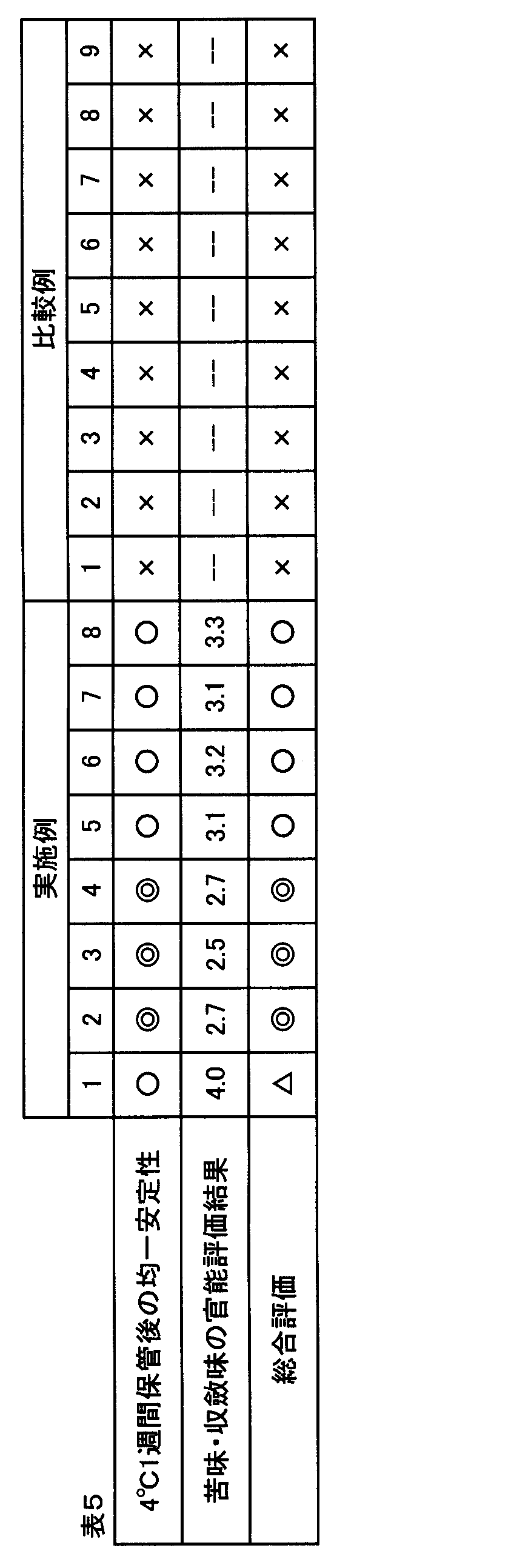
- the beverages of Examples 1 to 8 in which the hydrophilic emulsifier and the lipophilic emulsifier were used in combination were uniformly dispersed without aggregation/precipitation, and were excellent in stability, while the hydrophilic emulsifier or the lipophilic emulsifier was used.
- the beverages of Comparative Examples 1 to 9 in which only one of the emulsifiers was used aggregation/precipitation was observed.
Landscapes
- Chemical & Material Sciences (AREA)
- Engineering & Computer Science (AREA)
- Life Sciences & Earth Sciences (AREA)
- Food Science & Technology (AREA)
- Health & Medical Sciences (AREA)
- Organic Chemistry (AREA)
- Polymers & Plastics (AREA)
- Nutrition Science (AREA)
- Biochemistry (AREA)
- Genetics & Genomics (AREA)
- Wood Science & Technology (AREA)
- Zoology (AREA)
- General Health & Medical Sciences (AREA)
- General Engineering & Computer Science (AREA)
- Bioinformatics & Cheminformatics (AREA)
- Non-Alcoholic Beverages (AREA)
- Tea And Coffee (AREA)
- Alcoholic Beverages (AREA)
- Distillation Of Fermentation Liquor, Processing Of Alcohols, Vinegar And Beer (AREA)
Abstract
Description
[1]プレニルフラボノイドと、親水性乳化剤と、親油性乳化剤とを含み、前記プレニルフラボノイドの含有量が6~500ppmである、飲料。
[2]プレニルフラボノイドと、親水性乳化剤と、親油性乳化剤とを混合する工程を含む、飲料の製造方法。
本発明にかかるビールテイスト飲料のうち、ノンアルコールビールテイスト飲料については、近年の低カロリー嗜好に合わせて、低カロリーであることが望ましい。従って、本発明にかかるビールテイスト飲料のカロリー数は、好ましくは20kcal/100mL未満、より好ましくは5kcal/100mL未満である。
本発明にかかるビールテイスト飲料に含まれる糖質とは、食品の栄養表示基準(平成15年厚生労働省告示第176号)に基づく糖質をいう。具体的には、糖質は、食品から、タンパク質、脂質、食物繊維、灰分、アルコール分及び水分を除いたものをいう。また、食品中の糖質の量は、当該食品の重量から、タンパク質、脂質、食物繊維、灰分及び水分の量を控除することにより算定される。この場合に、タンパク質、脂質、食物繊維、灰分及び水分の量は、栄養表示基準に掲げる方法により測定する。具体的には、タンパク質の量は窒素定量換算法で測定し、脂質の量はエーテル抽出法、クロロホルム・メタノール混液抽出法、ゲルベル法、酸分解法またはレーゼゴットリーブ法で測定し、食物繊維の量は高速液体クロマトグラフ法またはプロスキー法で測定し、灰分の量は酢酸マグネシウム添加灰化法、直接灰化法または硫酸添加灰化法で測定し、水分の量はカールフィッシャー法、乾燥助剤法、減圧過熱乾燥法、常圧加熱乾燥法またはプラスチックフィルム法で測定する。
本発明にかかるビールテイスト飲料において使用される酸味料としては、クエン酸、乳酸、リン酸、及びリンゴ酸からなる群より選ばれる1種以上の酸を用いることが好ましい。また、本発明においては、前記酸以外の酸として、コハク酸、酒石酸、フマル酸および氷酢酸等も用いることができる。これらは食品に添加することが認められているものであれば制限なく用いることができる。本発明においては、まろやかな酸味を適切に付与する観点から乳酸と、やや刺激感のある酸味を適切に付与する観点からリン酸との組み合わせを用いることが好ましい。
本発明にかかるビールテイスト飲料においては、原料の一部にホップを用いることができる。香味がビールに類似する傾向にあることから、原料の一部にホップを用いることが望ましい。ホップを使用する際には、ビール等の製造に使用される通常のペレットホップ、粉末ホップ、ホップエキスを、所望の香味に応じて適宜選択して使用することができる。また、イソ化ホップ、還元ホップなどのホップ加工品を用いてもよい。本発明にかかるビールテイスト飲料に使用されるホップには、これらのものが包含される。また、ホップの添加量は特に限定されないが、典型的には、飲料全量に対して0.0001~1重量%程度である。
本発明にかかるビールテイスト飲料は、本発明の効果を妨げない範囲で、必要に応じて、その他の原料を用いてもよい。例えば、甘味料(高甘味度甘味料を含む)、苦味料、香料、酵母エキス、カラメル色素などの着色料、大豆サポニンやキラヤサポニン等の植物抽出サポニン系物質、コーンや大豆などの植物タンパク質およびペプチド含有物、ウシ血清アルブミン等のタンパク質系物質、食物繊維やアミノ酸などの調味料、アスコルビン酸等の酸化防止剤を、本発明の効果を妨げない範囲で必要に応じて用いることができる。
本発明にかかるビールテイスト飲料は、容器詰めとすることができる。容器の形態は何ら制限されず、ビン、缶、樽、またはペットボトル等の密封容器に充填して、容器入り飲料とすることができる。
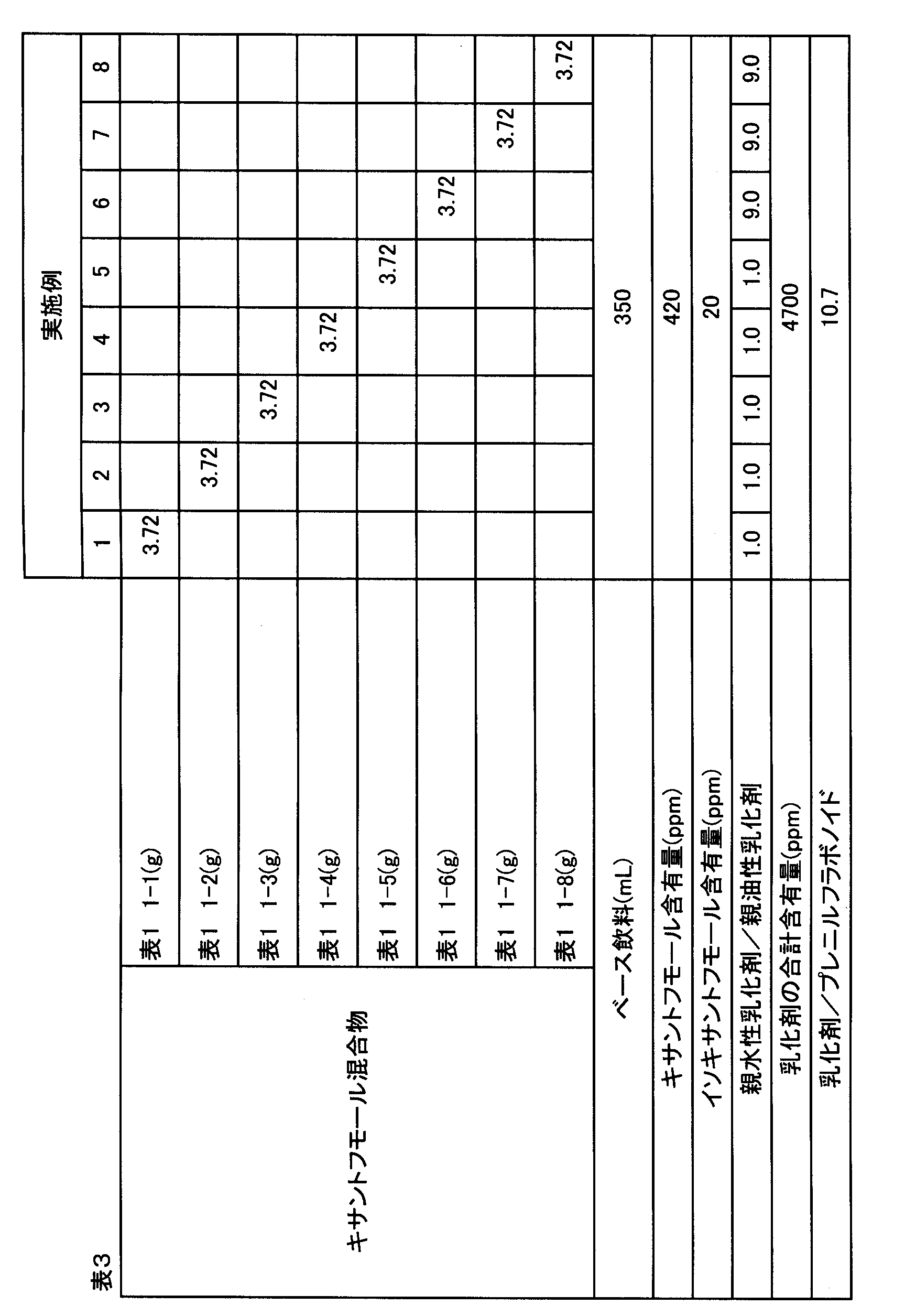
水準1-1~1-8
表1に記載した親水性乳化剤を200℃まで加熱し、表1に記載した量のキサントフモールを添加して全体が均一になるように混合した。さらに、表1に記載した親油性乳化剤を添加して全体が均一になるように混合した後、80℃まで放冷し、さらに純水4.8gを添加して全体が均一になるように混合した。

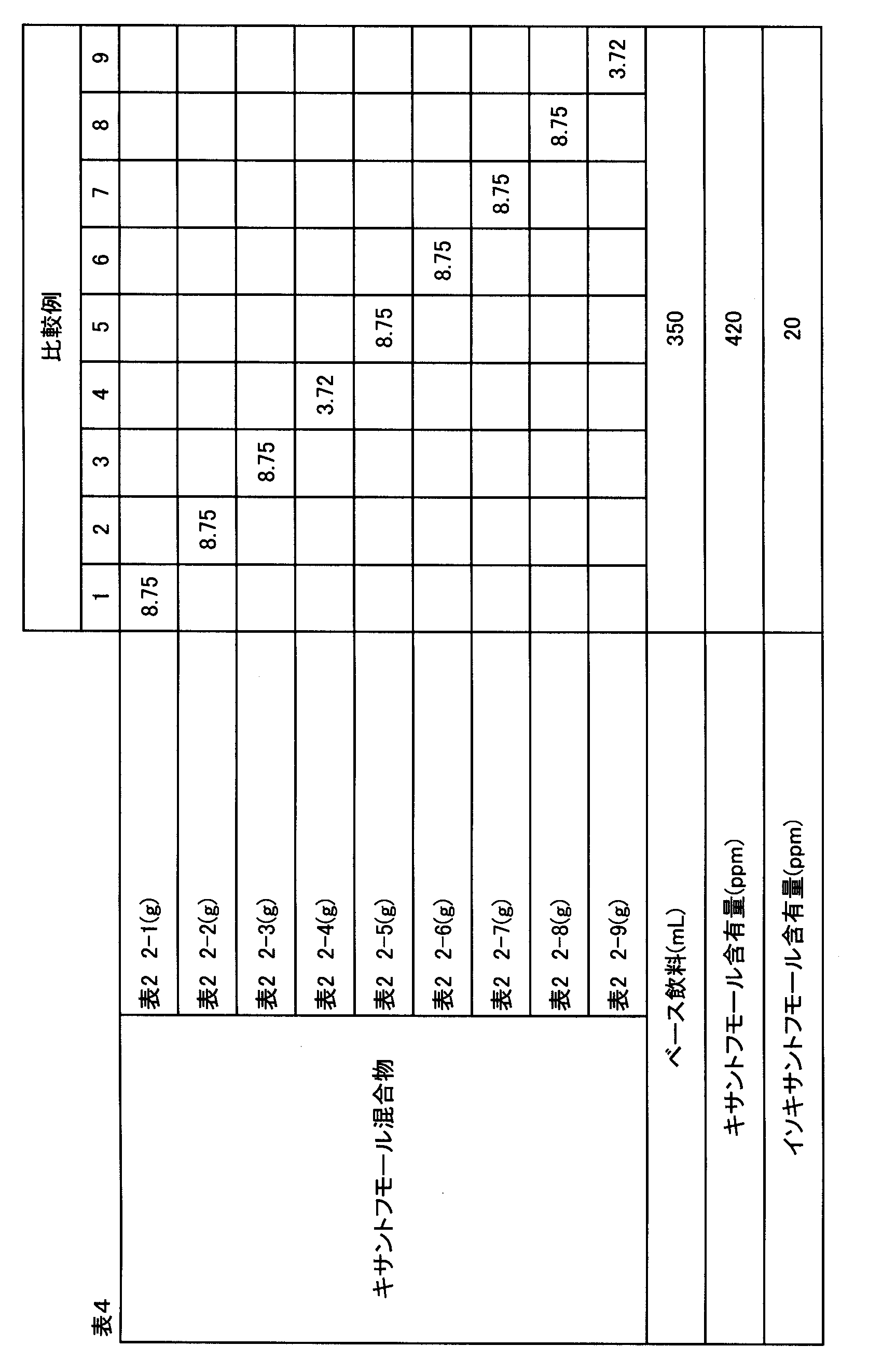
表2に示す親水性乳化剤あるいは親油性乳化剤のいずれか一方のみを使用した以外は水準1-1~1-8と同様にして調製した。
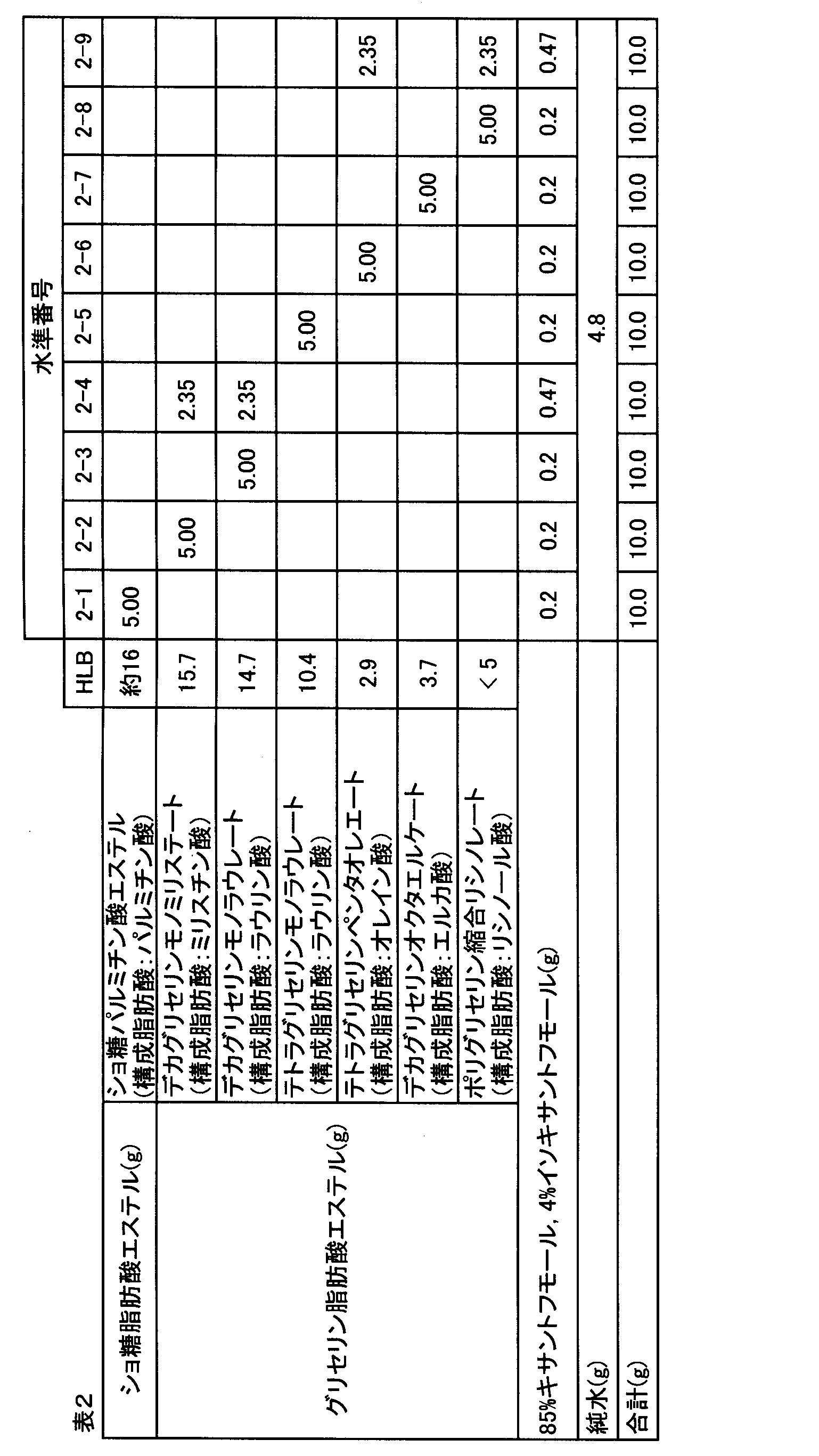
キサントフモール:Xantho-Flav pure(Hopsteiner社製、キサントフモールとして85%、イソキサントフモールとして4%を含有)
デカグリセリンモノミリステート:(阪本薬品工業社製)
デカグリセリンモノラウレート:(阪本薬品工業社製)
テトラグリセリンモノラウレート:(阪本薬品工業社製)
テトラグリセリンペンタオレエート:(阪本薬品工業社製)
デガグリセリンオクタエルケート:(阪本薬品工業社製)
ポリグリセリン縮合リシノレート:(阪本薬品工業社製)
ショ糖パルミチン酸エステル:(三菱ケミカルフーズ社製)
レシチン:(ナカライテスク社製)
ポリオキシエチレンソルビタンモノラウレート:(ナカライテスク社製)
実施例1~8、比較例1~9
麦芽20kgを適当な粒度に粉砕して仕込槽に入れ、これに120Lの温水を加え、約50℃のマッシュを作った。50℃で30分保持後、徐々に昇温して65℃~72℃で60分間、糖化を行った。糖化が完了したマッシュを77℃まで昇温後、麦汁濾過槽に移し濾過を行い、濾液を得た。得られた濾液の一部をとり、温水を加え、その際、濾液と温水の混合割合は、煮沸完了時のエキス分の総量が約4.0重量%になるよう調整した。製造スケールを100Lとし、ホップを約100g、市販のカラメル色素(クラスI)約40gを添加し、100℃で80分間煮沸した。煮沸後の液からオリを分離し、約2℃に冷却した。当該冷却液の一部をとり、最終製品のエキス分の総量が、0.3重量%となるように冷水を適量添加して希釈した。pH調整剤として乳酸を用い、当該希釈液に対して、pH調整剤、酸化防止剤、甘味物質、香料、炭酸ガスを適量添加し、濾過を行い、これをベース飲料とした。前記ベース飲料に表1、2で調製したプレニルフラボノイド混合物を表3、4に記載の濃度となるように添加し、非発酵ビールテイスト飲料を得た。
(均一安定性の評価)
◎:全体が均一で透明。凝集・沈殿が見られない。
○:全体が均一であるが不透明。凝集・沈殿が見られない。
×:全体が均一でなく、凝集・沈殿が見られる。
(乳化剤由来の苦味・収斂味の評価)
1:ほぼ感じられない。
2:わずかに感じられる。
3:ある程度感じられるが、飲料として許容できる水準である。
4:明確に感じられる。
5:強く感じられる。
(総合評価)
×:安定性が×、あるいは官能評価が4.5以上
△:安定性が○、かつ官能評価結果が3.5より大きく4.5以下
○:安定性が○、かつ官能評価結果が3.5以下
◎:安定性が◎、かつ官能評価結果が3.5以下
Claims (10)
- プレニルフラボノイドと、親水性乳化剤と、親油性乳化剤とを含み、前記プレニルフラボノイドの含有量が6~500ppmである、飲料。
- プレニルフラボノイドが、キサントフモールおよびイソキサントフモールからなる群より選択される1種以上である、請求項1に記載の飲料。
- 前記親水性乳化剤のHLBが10以上である、請求項1又は2に記載の飲料。
- 前記親水性乳化剤が、ポリグリセリン脂肪酸エステル、ショ糖脂肪酸エステル、リン脂質、及びソルビタン脂肪酸エステルからなる群より選択される1種以上の乳化剤を含む、請求項1~3いずれかに記載の飲料。
- 前記親油性乳化剤のHLBが5以下である、請求項1~4いずれかに記載の飲料。
- 前記親油性乳化剤が、ポリグリセリン脂肪酸エステル、ショ糖脂肪酸エステル、及びリン脂質からなる群より選択される1種以上の乳化剤を含む、請求項1~5いずれかに記載の飲料。
- 前記親油性乳化剤の含有量に対する前記親水性乳化剤の含有量の質量比(親水性乳化剤/親油性乳化剤)が1~100である、請求項1~6いずれかに記載の飲料。
- 前記プレニルフラボノイドの含有量に対する前記乳化剤の合計含有量の質量比(乳化剤/プレニルフラボノイド)が0.01~100である、請求項1~7いずれかに記載の飲料。
- ビールテイスト飲料、チューハイテイスト飲料、茶飲料、果汁飲料、コーヒー飲料、又はスポーツ飲料である、請求項1~8いずれかに記載の飲料。
- プレニルフラボノイドと、親水性乳化剤と、親油性乳化剤とを混合する工程を含む、飲料の製造方法。
Priority Applications (10)
| Application Number | Priority Date | Filing Date | Title |
|---|---|---|---|
| CA3118700A CA3118700A1 (en) | 2018-12-28 | 2018-12-28 | Beverage |
| EP18945303.8A EP3903602A4 (en) | 2018-12-28 | 2018-12-28 | DRINK |
| PCT/JP2018/048433 WO2020136860A1 (ja) | 2018-12-28 | 2018-12-28 | 飲料 |
| JP2020562261A JP7241774B2 (ja) | 2018-12-28 | 2018-12-28 | 飲料 |
| KR1020217023906A KR20210107111A (ko) | 2018-12-28 | 2018-12-28 | 음료 |
| US17/291,417 US20210368828A1 (en) | 2018-12-28 | 2018-12-28 | Beverage |
| AU2018455463A AU2018455463A1 (en) | 2018-12-28 | 2018-12-28 | Beverage |
| SG11202104750VA SG11202104750VA (en) | 2018-12-28 | 2018-12-28 | Beverage |
| CN201880100253.2A CN113286521A (zh) | 2018-12-28 | 2018-12-28 | 饮料 |
| TW108146813A TWI728608B (zh) | 2018-12-28 | 2019-12-20 | 飲料 |
Applications Claiming Priority (1)
| Application Number | Priority Date | Filing Date | Title |
|---|---|---|---|
| PCT/JP2018/048433 WO2020136860A1 (ja) | 2018-12-28 | 2018-12-28 | 飲料 |
Publications (1)
| Publication Number | Publication Date |
|---|---|
| WO2020136860A1 true WO2020136860A1 (ja) | 2020-07-02 |
Family
ID=71126185
Family Applications (1)
| Application Number | Title | Priority Date | Filing Date |
|---|---|---|---|
| PCT/JP2018/048433 Ceased WO2020136860A1 (ja) | 2018-12-28 | 2018-12-28 | 飲料 |
Country Status (10)
| Country | Link |
|---|---|
| US (1) | US20210368828A1 (ja) |
| EP (1) | EP3903602A4 (ja) |
| JP (1) | JP7241774B2 (ja) |
| KR (1) | KR20210107111A (ja) |
| CN (1) | CN113286521A (ja) |
| AU (1) | AU2018455463A1 (ja) |
| CA (1) | CA3118700A1 (ja) |
| SG (1) | SG11202104750VA (ja) |
| TW (1) | TWI728608B (ja) |
| WO (1) | WO2020136860A1 (ja) |
Citations (10)
| Publication number | Priority date | Publication date | Assignee | Title |
|---|---|---|---|---|
| JPS6029390B2 (ja) | 1976-02-03 | 1985-07-10 | 富士写真フイルム株式会社 | ベンゾトリアゾ−ル化合物 |
| EP1431385A1 (de) * | 2002-12-18 | 2004-06-23 | Döhler GmbH | Xanthohumol-haltiges Getränk |
| JP2007289074A (ja) * | 2006-04-25 | 2007-11-08 | Mitsubishi Chemicals Corp | D相中油型乳化組成物 |
| JP2009095277A (ja) * | 2007-10-17 | 2009-05-07 | Mitsubishi Chemicals Corp | 飲料の製造方法 |
| JP2010124724A (ja) * | 2008-11-26 | 2010-06-10 | Suntory Holdings Ltd | リグナン類化合物含有乳化物及び飲料 |
| JP2011513308A (ja) * | 2008-02-27 | 2011-04-28 | フラクサン ゲーエムベーハー ウント コー. カーゲー | キサントフモール−シクロデキストリン複合体を含有する新規な組成物 |
| JP2013066459A (ja) * | 2011-09-07 | 2013-04-18 | Nippon Shokuhin Kako Co Ltd | キサントフモール/シクロデキストリン包接複合体含有組成物の製造方法及びその利用 |
| US20130245118A1 (en) * | 2010-07-02 | 2013-09-19 | Eric H. Kuhrts | Stable fatty acid-containing formulations |
| JP2015000044A (ja) * | 2013-06-17 | 2015-01-05 | 高田香料株式会社 | 乳化香料組成物 |
| US20170333515A1 (en) * | 2015-11-10 | 2017-11-23 | Eric H. Kuhrts | Compositions and methods for enhancing the metabolic activity or stability of curcumin |
Family Cites Families (3)
| Publication number | Priority date | Publication date | Assignee | Title |
|---|---|---|---|---|
| JPWO2005016019A1 (ja) * | 2003-08-13 | 2007-10-04 | 不二製油株式会社 | 水和性油性ベース食品の製造法 |
| KR20080063748A (ko) * | 2005-07-29 | 2008-07-07 | 바이오액티브스, 인코포레이티드 | 프레닐플라보노이드 제형 |
| JP6300780B2 (ja) | 2015-12-24 | 2018-03-28 | 高砂香料工業株式会社 | アルコール飲料用乳化香料組成物 |
-
2018
- 2018-12-28 SG SG11202104750VA patent/SG11202104750VA/en unknown
- 2018-12-28 JP JP2020562261A patent/JP7241774B2/ja active Active
- 2018-12-28 US US17/291,417 patent/US20210368828A1/en not_active Abandoned
- 2018-12-28 WO PCT/JP2018/048433 patent/WO2020136860A1/ja not_active Ceased
- 2018-12-28 KR KR1020217023906A patent/KR20210107111A/ko not_active Abandoned
- 2018-12-28 EP EP18945303.8A patent/EP3903602A4/en not_active Withdrawn
- 2018-12-28 CN CN201880100253.2A patent/CN113286521A/zh active Pending
- 2018-12-28 AU AU2018455463A patent/AU2018455463A1/en not_active Abandoned
- 2018-12-28 CA CA3118700A patent/CA3118700A1/en active Pending
-
2019
- 2019-12-20 TW TW108146813A patent/TWI728608B/zh not_active IP Right Cessation
Patent Citations (10)
| Publication number | Priority date | Publication date | Assignee | Title |
|---|---|---|---|---|
| JPS6029390B2 (ja) | 1976-02-03 | 1985-07-10 | 富士写真フイルム株式会社 | ベンゾトリアゾ−ル化合物 |
| EP1431385A1 (de) * | 2002-12-18 | 2004-06-23 | Döhler GmbH | Xanthohumol-haltiges Getränk |
| JP2007289074A (ja) * | 2006-04-25 | 2007-11-08 | Mitsubishi Chemicals Corp | D相中油型乳化組成物 |
| JP2009095277A (ja) * | 2007-10-17 | 2009-05-07 | Mitsubishi Chemicals Corp | 飲料の製造方法 |
| JP2011513308A (ja) * | 2008-02-27 | 2011-04-28 | フラクサン ゲーエムベーハー ウント コー. カーゲー | キサントフモール−シクロデキストリン複合体を含有する新規な組成物 |
| JP2010124724A (ja) * | 2008-11-26 | 2010-06-10 | Suntory Holdings Ltd | リグナン類化合物含有乳化物及び飲料 |
| US20130245118A1 (en) * | 2010-07-02 | 2013-09-19 | Eric H. Kuhrts | Stable fatty acid-containing formulations |
| JP2013066459A (ja) * | 2011-09-07 | 2013-04-18 | Nippon Shokuhin Kako Co Ltd | キサントフモール/シクロデキストリン包接複合体含有組成物の製造方法及びその利用 |
| JP2015000044A (ja) * | 2013-06-17 | 2015-01-05 | 高田香料株式会社 | 乳化香料組成物 |
| US20170333515A1 (en) * | 2015-11-10 | 2017-11-23 | Eric H. Kuhrts | Compositions and methods for enhancing the metabolic activity or stability of curcumin |
Non-Patent Citations (1)
| Title |
|---|
| See also references of EP3903602A4 |
Also Published As
| Publication number | Publication date |
|---|---|
| EP3903602A1 (en) | 2021-11-03 |
| CA3118700A1 (en) | 2020-07-02 |
| JP7241774B2 (ja) | 2023-03-17 |
| EP3903602A4 (en) | 2022-08-17 |
| US20210368828A1 (en) | 2021-12-02 |
| JPWO2020136860A1 (ja) | 2021-09-27 |
| KR20210107111A (ko) | 2021-08-31 |
| TW202033102A (zh) | 2020-09-16 |
| TWI728608B (zh) | 2021-05-21 |
| SG11202104750VA (en) | 2021-07-29 |
| CN113286521A (zh) | 2021-08-20 |
| AU2018455463A1 (en) | 2021-06-03 |
Similar Documents
| Publication | Publication Date | Title |
|---|---|---|
| TWI516213B (zh) | After the taste of the improved non-alcoholic beer flavor drinks | |
| TWI501732B (zh) | Beef-flavored beer flavored beverages | |
| JP5291257B1 (ja) | 単糖類及び二糖類の比率が高いノンアルコールのビールテイスト飲料 | |
| JP6200310B2 (ja) | 容器詰飲料 | |
| JP7228034B2 (ja) | ノンアルコールビールテイスト飲料 | |
| JP7268143B2 (ja) | ノンアルコールビールテイスト飲料 | |
| JP7522550B2 (ja) | ビールテイストアルコール飲料 | |
| JP7252326B2 (ja) | 飲料の製造方法 | |
| JP6545818B2 (ja) | ノンアルコールのビールテイスト飲料 | |
| JP7241774B2 (ja) | 飲料 | |
| WO2017090090A1 (ja) | ノンアルコールのビールテイスト飲料 | |
| JP7808048B2 (ja) | ノンアルコールビールテイスト飲料、ノンアルコールビールテイスト飲料の製造方法、及び、ノンアルコールビールテイスト飲料の苦味の質を改善する方法 | |
| JP7353173B2 (ja) | ノンアルコールビールテイスト飲料 | |
| WO2020157890A1 (ja) | ビールテイスト飲料 | |
| CN119403459A (zh) | 加工食品 | |
| JP7089415B2 (ja) | ビールテイスト飲料の製造方法 | |
| AU2011353419C1 (en) | Milk-added, low-calorie black tea beverage | |
| JP2010173989A (ja) | イソフムロン類包接体を含んでなるw/o/w型乳化組成物およびその製造方法 | |
| JP6545817B2 (ja) | ノンアルコールのビールテイスト飲料 | |
| JP6694707B2 (ja) | ノンアルコールビールテイスト飲料 | |
| HK40058297A (zh) | 饮料 | |
| TWI519244B (zh) | Beef-flavored beer flavored beverages | |
| JP2025068596A (ja) | デヒドロエルゴステロールを含有する容器詰め飲料およびその製造方法 | |
| JP2022162982A (ja) | ビタミンb2含有経口液体組成物 | |
| WO2020157892A1 (ja) | ビールテイスト飲料 |
Legal Events
| Date | Code | Title | Description |
|---|---|---|---|
| 121 | Ep: the epo has been informed by wipo that ep was designated in this application |
Ref document number: 18945303 Country of ref document: EP Kind code of ref document: A1 |
|
| ENP | Entry into the national phase |
Ref document number: 2020562261 Country of ref document: JP Kind code of ref document: A |
|
| ENP | Entry into the national phase |
Ref document number: 3118700 Country of ref document: CA |
|
| ENP | Entry into the national phase |
Ref document number: 2018455463 Country of ref document: AU Date of ref document: 20181228 Kind code of ref document: A |
|
| NENP | Non-entry into the national phase |
Ref country code: DE |
|
| ENP | Entry into the national phase |
Ref document number: 20217023906 Country of ref document: KR Kind code of ref document: A |
|
| ENP | Entry into the national phase |
Ref document number: 2018945303 Country of ref document: EP Effective date: 20210728 |