WO2020136941A1 - 車両用記録制御装置、車両用記録装置、車両用記録制御方法およびプログラム - Google Patents
車両用記録制御装置、車両用記録装置、車両用記録制御方法およびプログラム Download PDFInfo
- Publication number
- WO2020136941A1 WO2020136941A1 PCT/JP2019/023036 JP2019023036W WO2020136941A1 WO 2020136941 A1 WO2020136941 A1 WO 2020136941A1 JP 2019023036 W JP2019023036 W JP 2019023036W WO 2020136941 A1 WO2020136941 A1 WO 2020136941A1
- Authority
- WO
- WIPO (PCT)
- Prior art keywords
- vehicle
- recording
- unit
- event
- video data
- Prior art date
- Legal status (The legal status is an assumption and is not a legal conclusion. Google has not performed a legal analysis and makes no representation as to the accuracy of the status listed.)
- Ceased
Links
Images



Classifications
-
- B—PERFORMING OPERATIONS; TRANSPORTING
- B60—VEHICLES IN GENERAL
- B60R—VEHICLES, VEHICLE FITTINGS, OR VEHICLE PARTS, NOT OTHERWISE PROVIDED FOR
- B60R11/00—Arrangements for holding or mounting articles, not otherwise provided for
- B60R11/04—Mounting of cameras operative during drive; Arrangement of controls thereof relative to the vehicle
-
- G—PHYSICS
- G07—CHECKING-DEVICES
- G07C—TIME OR ATTENDANCE REGISTERS; REGISTERING OR INDICATING THE WORKING OF MACHINES; GENERATING RANDOM NUMBERS; VOTING OR LOTTERY APPARATUS; ARRANGEMENTS, SYSTEMS OR APPARATUS FOR CHECKING NOT PROVIDED FOR ELSEWHERE
- G07C5/00—Registering or indicating the working of vehicles
- G07C5/08—Registering or indicating performance data other than driving, working, idle, or waiting time, with or without registering driving, working, idle or waiting time
- G07C5/0841—Registering performance data
- G07C5/085—Registering performance data using electronic data carriers
- G07C5/0866—Registering performance data using electronic data carriers the electronic data carrier being a digital video recorder in combination with video camera
-
- H—ELECTRICITY
- H04—ELECTRIC COMMUNICATION TECHNIQUE
- H04N—PICTORIAL COMMUNICATION, e.g. TELEVISION
- H04N7/00—Television systems
- H04N7/18—Closed-circuit television [CCTV] systems, i.e. systems in which the video signal is not broadcast
-
- B—PERFORMING OPERATIONS; TRANSPORTING
- B60—VEHICLES IN GENERAL
- B60R—VEHICLES, VEHICLE FITTINGS, OR VEHICLE PARTS, NOT OTHERWISE PROVIDED FOR
- B60R2300/00—Details of viewing arrangements using cameras and displays, specially adapted for use in a vehicle
- B60R2300/10—Details of viewing arrangements using cameras and displays, specially adapted for use in a vehicle characterised by the type of camera system used
- B60R2300/105—Details of viewing arrangements using cameras and displays, specially adapted for use in a vehicle characterised by the type of camera system used using multiple cameras
-
- B—PERFORMING OPERATIONS; TRANSPORTING
- B60—VEHICLES IN GENERAL
- B60R—VEHICLES, VEHICLE FITTINGS, OR VEHICLE PARTS, NOT OTHERWISE PROVIDED FOR
- B60R2300/00—Details of viewing arrangements using cameras and displays, specially adapted for use in a vehicle
- B60R2300/80—Details of viewing arrangements using cameras and displays, specially adapted for use in a vehicle characterised by the intended use of the viewing arrangement
- B60R2300/8073—Details of viewing arrangements using cameras and displays, specially adapted for use in a vehicle characterised by the intended use of the viewing arrangement for vehicle security, e.g. parked vehicle surveillance, burglar detection
Definitions
- a so-called drive recorder vehicle recording device that captures the front-back direction of the vehicle is known.
- the drive recorder includes a front camera that captures the front of the vehicle and a rear camera that captures the rear of the vehicle (see, for example, Patent Document 1).
- the drive recorder stores the images of the front camera and the rear camera as event recording data (for example, see Patent Document 2).
- the drive recorder that monitors parking records an event when the vehicle is subjected to an acceleration greater than a threshold value or when a moving object is detected.
- a drive recorder including a plurality of cameras such as a front camera and a rear camera
- the power consumption is large and the time during which parking monitoring is possible may be shorter than when parking monitoring is performed by one camera.
- the capacities of the images captured by a plurality of cameras are large compared to the case where the parking monitoring is performed by one camera, and thus the upper limit that can be stored as the event record data may be insufficient.
- the present invention has been made in view of the above, and an object thereof is to appropriately monitor parking.
- a vehicle recording control device includes a video data acquisition unit that acquires video data captured by a plurality of imaging units that capture the periphery of a vehicle; An event detection unit that detects an event for a vehicle, a parking detection unit that detects that the vehicle is in a parked state, an object detection unit that detects a peripheral object that is less than a predetermined distance from the vehicle when the vehicle is parked, When the object detection unit detects a peripheral object that is less than a predetermined distance from the vehicle when the vehicle is parked, a photographing unit other than the photographing unit that photographs the direction in which the peripheral object is detected is photographed by the plural photographing units. And a recording function control unit for performing recording on the recording unit by using the video data, the recording being caused by the event detected by the event detection unit.
- a vehicle recording device is characterized by including at least one of the above-described vehicle recording control device, a photographing unit that photographs the surroundings of the vehicle, and a recording unit that stores the video data.
- a vehicle recording control method includes a parking detection step of detecting that the vehicle is in a parked state, an object detection step of detecting a peripheral object less than a predetermined distance from the vehicle when the vehicle is parked, An event detecting step of detecting an event with respect to a vehicle, and a peripheral object of a plurality of image capturing units for capturing an image of the periphery of the vehicle when a peripheral object shorter than a predetermined distance from the vehicle is detected when the vehicle is parked by the object detecting step. And a recording function control step of performing recording due to the event detected by the event detection step by using video data captured by an imaging unit other than the imaging unit that captures the direction in which is detected.
- a program includes a parking detection step of detecting that a vehicle is in a parked state, an object detection step of detecting a peripheral object that is less than a predetermined distance from the vehicle when the vehicle is parked, and an event for the vehicle.
- a peripheral object less than a predetermined distance from the vehicle is detected when the vehicle is parked by the event detecting step and the object detecting step
- the peripheral object is detected among a plurality of image capturing units that capture the periphery of the vehicle.
- a computer that operates as a vehicle recording control device, and a recording function control step of performing recording due to an event detected by the event detection step by using video data captured by a shooting unit other than a shooting unit that shoots a direction. To run.
- FIG. 1 is a block diagram showing a configuration example of a vehicle recording device having a vehicle recording control device according to the first embodiment.
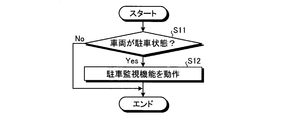
- FIG. 2 is a flowchart showing the flow of processing in the vehicle recording control apparatus according to the first embodiment.
- FIG. 3 is a flowchart showing the flow of processing in the vehicle recording control apparatus according to the first embodiment.
- FIG. 4 is a flowchart showing the flow of processing in the vehicle recording control apparatus according to the first embodiment.
- FIG. 5 is a flowchart showing the flow of processing in the vehicle recording control apparatus according to the second embodiment.
- FIG. 6 is a flowchart showing the flow of processing in the vehicle recording control apparatus according to the second embodiment.
- FIG. 1 is a block diagram showing a configuration example of a vehicle recording device having a vehicle recording control device according to the first embodiment.
- the vehicle recording device 10 appropriately performs parking monitoring using an appropriate camera among a plurality of cameras according to the positional relationship between the vehicle and surrounding objects.
- Peripheral object is an object located around the vehicle when parked.
- the peripheral object physically separates the periphery of the vehicle.
- the peripheral object obstructs the entry of another vehicle around the vehicle.
- the peripheral object is, for example, a garage, a wall, a fence, a car stop, a step, or an object that cannot be easily crossed by another vehicle.
- the vehicle recording device 10 may be a portable device that can be used in the vehicle in addition to the device mounted on the vehicle.
- the vehicular recording device 10 may be realized by including the functions or configurations of a device, a navigation device, and the like that are installed in advance in the vehicle.
- the vehicle recording device 10 includes a camera unit (a plurality of photographing units) 210, a recording unit 220, an operation unit 230, a display unit 240, an acceleration sensor 250, a GPS (Global Positioning System) receiving unit 260, and a vehicle. Recording control device 100.
- the camera unit 210 has a plurality of cameras that take images around the vehicle. The multiple cameras capture different directions for the vehicle.
- the camera unit 210 has a front camera 211 capable of photographing the front and a rear camera 212 capable of photographing the rear.
- the front camera 211 is disposed, for example, in front of the vehicle interior of the vehicle.
- the rear camera 212 is arranged, for example, behind the vehicle interior of the vehicle.
- the camera unit 210 when it is not necessary to distinguish a plurality of cameras, the camera unit 210 will be described.
- the accessory power supply is OFF, in other words, when an event is detected while the vehicle is parked, the camera unit 210 can store an image for a predetermined period of, for example, several tens of seconds.
- the camera unit 210 outputs the captured video data to the video data acquisition unit 120 of the vehicle recording control device 100.
- the video data is, for example, a moving image composed of 30 frames per second.
- the camera unit 210 operates all or some of the selected cameras of the plurality of cameras included in the camera unit 210, and outputs the video data captured by the operating camera. It is output to the video data acquisition unit 120.
- the recording unit 220 is used for temporary storage of data in the vehicle recording device 10.
- the recording unit 220 is, for example, a semiconductor memory device such as a RAM (Random Access Memory) or a flash memory (Flash Memory), or a recording unit such as a memory card. Alternatively, it may be an external recording unit that is wirelessly connected via a communication device (not shown).
- the recording unit 220 records the loop recording video data or the event recording data based on the control signal output from the recording function control unit 123 of the vehicle recording control device 100.
- the operation unit 230 can accept various operations on the vehicle recording device 10.
- the operation unit 230 can accept an operation of manually storing captured image data in the recording unit 220 as event record data.
- the operation unit 230 can accept an operation of reproducing the loop recording video data or the event recording data recorded in the recording unit 220.
- the operation unit 230 can accept an operation of deleting the event record data recorded in the recording unit 220.
- the operation unit 230 can accept an operation to end the loop recording.
- the operation unit 230 outputs operation information to the operation control unit 125 of the vehicle recording control device 100.
- the display unit 240 is, for example, a display device unique to the vehicle recording device 10 or a display device shared with another system including a navigation system.
- the display unit 240 may be formed integrally with the camera unit 210.
- the display unit 240 is a display including, for example, a liquid crystal display (LCD: Liquid Crystal Display) or an organic EL (Organic Electro-Luminescence) display.
- the display unit 240 is arranged on the dashboard, instrument panel, center console, etc. in front of the driver of the vehicle.
- the display unit 240 displays an image based on the image signal output from the display control unit 126 of the vehicle recording control device 100.
- the display unit 240 displays the image captured by the camera unit 210 or the image recorded in the recording unit 220.
- the acceleration sensor 250 is a sensor that detects the acceleration that occurs in the vehicle.
- the acceleration sensor 250 outputs the detection result to the event detection unit 127 of the vehicle recording control device 100.
- the acceleration sensor 250 is, for example, a sensor that detects acceleration in three axis directions.
- the three-axis directions are the front-rear direction, the left-right direction, and the vertical direction of the vehicle.
- the GPS receiver 260 receives radio waves from a GPS satellite (not shown).
- the GPS reception unit 260 outputs the received radio wave signal to the position information acquisition unit 128 of the vehicle recording control device 100.
- the vehicle recording control device 100 is, for example, an arithmetic processing device (control device) including a CPU (Central Processing Unit) and the like.
- the vehicle recording control device 100 loads the stored program into the memory and executes the instructions included in the program.
- the vehicle recording control device 100 includes an internal memory (not shown), and the internal memory is used for temporary storage of data in the vehicle recording control device 100.
- the vehicle recording control device 100 is connected to the bus 110 and is connected to the bus 110.
- the video data acquisition unit 120 acquires video data of the surroundings of the vehicle. More specifically, the video data acquisition unit 120 acquires the video data output by the camera unit 210 and outputs the video data to the buffer memory 121. The video data acquisition unit 120 acquires video data captured by all or some of the selected operating cameras of the plurality of cameras included in the camera unit 210.
- the buffer memory 121 is an internal memory included in the vehicle recording control device 100, and is a memory that temporarily records video data for a certain time period acquired by the video data acquisition unit 120 while updating it.
- the video data processing unit 122 receives the video data temporarily stored in the buffer memory 121 from, for example, H.264. Converts to an arbitrary file format such as MP4 format encoded by an arbitrary codec such as H.264 or MPEG-4 (Moving Picture Experts Group).
- the video data processing unit 122 generates video data as a file for a certain time from the video data temporarily stored in the buffer memory 121.
- the video data processing unit 122 generates the video data temporarily stored in the buffer memory 121 in the order of recording as video data for 60 seconds.
- the video data processing unit 122 outputs the generated video data to the recording function control unit 123.
- the video data processing unit 122 also outputs the generated video data to the display control unit 126.
- the period of the video data generated as a file is set to 60 seconds as an example, but the period is not limited to this.
- the video data referred to here may be data including audio in addition to the video captured by the camera unit 210.
- the recording function control unit 123 controls the recording unit 220 to record the video data filed by the video data processing unit 122.
- the recording function control unit 123 uses the video data filed by the video data processing unit 122 as the overwritable video data during the loop recording process, such as when the accessory power supply of the vehicle is ON, as the recording unit. Record at 220. More specifically, when the recording function control unit 123 continues to record the video data generated by the video data processing unit 122 in the recording unit 220 during the period in which the loop recording process is executed, and the capacity of the recording unit 220 becomes full. , Overwrite the oldest video data with new video data and record.
- the recording function control unit 123 records the video data of a predetermined period in the video data generated by the video data processing unit 122 as event recording data for which overwriting is prohibited. Save 220.
- the event record data stored in the recording unit 220 by the recording function control unit 123 is, for example, 10 seconds or more and 60 seconds or less after the event is detected and the photographing is started when the photographing is started after the event is detected.
- the video data of a predetermined period of is stored as event recording data.
- the event recording data stored in the recording unit 220 by the recording function control unit 123 is video data of a predetermined period of 10 seconds or more and 60 seconds or less before and after the time when the event is detected in the period in which the loop recording process is executed. Is stored as event recording data.
- the recording function control unit 123 operates the parking monitoring function when the accessory power supply of the vehicle is OFF, in other words, while the vehicle is parked, and stores the video data captured by the camera unit 210. More specifically, the parking monitoring function detects an event and saves the video data using a loop recording process. Alternatively, the parking monitoring function activates the camera unit 210 after detecting an event and saves the video data.
- the recording function control unit 123 controls the parking monitoring function according to the positional relationship between the vehicle and surrounding objects.
- the recording function control unit 123 detects a direction in which the peripheral object is detected in the camera unit 210 (hereinafter, referred to as “peripheral object direction”). .) is used to perform recording due to the event detected by the event detection unit 127, using shooting data captured by a camera other than the camera that captures.
- the camera other than the peripheral object direction is a camera included in the camera unit 210, and a camera including a direction other than the peripheral object direction in the shooting range.
- the camera other than the peripheral object direction is the rear camera 212 that includes a direction other than the front of the vehicle in the shooting range.
- the recording function control unit 123 detects a peripheral object within a predetermined distance from the vehicle, the recording function control unit 123 captures an image with a camera other than the camera that captures the peripheral object direction in the camera unit 210.
- the recording function control unit 123 may capture an image with a camera of the camera unit 210 other than the peripheral object direction. Then, based on the detection of the event by the event detection unit 127, the recording function control unit 123 stores the video data captured by the camera of the camera unit 210 other than the peripheral object direction as the event recording data.
- the recording function control unit 123 when the recording function control unit 123 does not detect a peripheral object within a predetermined distance from the vehicle, all the cameras of the camera unit 210 capture an image. If there is no surrounding object, another vehicle may approach and collide with the vehicle from any direction. Therefore, it is preferable that the recording function control unit 123 captures images with all the cameras. Then, the recording function control unit 123 stores the shooting data captured by all the cameras as event recording data based on the detection of the event by the event detection unit 127.
- the reproduction control unit 124 controls to reproduce the loop recording video data or the event recording data recorded in the recording unit 220 based on the control signal of the reproduction operation output from the operation control unit 125.
- the operation control unit 125 acquires the operation information of the operation received by the operation unit 230. For example, the operation control unit 125 acquires save operation information indicating a manual save operation of video data, playback operation information indicating a playback operation, or erase operation information indicating an erase operation of video data, and outputs a control signal. For example, the operation control unit 125 acquires end operation information indicating an operation for ending loop recording and outputs a control signal.
- the display control unit 126 controls the display of video data on the display unit 240.
- the display control unit 126 outputs a video signal that causes the display unit 240 to output video data. More specifically, the display control unit 126 outputs a video image captured by the camera unit 210, or a video signal to be displayed by reproducing loop recording video data or event recording data recorded in the recording unit 220.
- the event detection unit 127 detects an event for the vehicle based on the detection result of the acceleration sensor 250. More specifically, the event detecting unit 127 detects an acceleration detected by the acceleration sensor 250 as an event when an acceleration equal to or higher than a threshold value is detected.
- the threshold for detecting an event during parking recording may be set to be smaller than the threshold for detecting an event during traveling. For example, when the threshold value of acceleration for detecting an event during traveling is about 1 G, for example, the threshold value of acceleration for detecting an event during parking recording may be about 0.3 G.
- the position information acquisition unit 128 calculates the current position information of the vehicle by a known method based on the radio wave received by the GPS reception unit 260.
- the parking detection unit 129 detects that the vehicle is parked based on the information acquired from the vehicle.
- the shift position is "parking"
- the side brake is operated, the speed is zero for 5 seconds or more, the speed is zero, and the engine is stopped. ..
- the object detection unit 130 detects a peripheral object existing at a vehicle parking position within a predetermined distance from the vehicle and obstructing entry of other vehicles.
- the predetermined distance is, for example, about 2 m. Further, the object detection unit 130 detects a detection direction of a peripheral object with respect to the vehicle.
- the object detection unit 130 may detect an object based on the detection result of a sensor that outputs a radio wave other than visible light toward the periphery of the vehicle and detects the object by the reflected wave of the radio wave.
- the object detection unit 130 may detect an object based on the detection result of an infrared sensor, an ultrasonic sensor, a millimeter wave radar, or the like.
- the object detection unit 130 may detect an object by performing image processing on the video data captured by the camera unit 210, for example.
- the object detection unit 130 may detect an object, for example, based on the position information acquired by the position information acquisition unit 128 and the map information acquired from the navigation system.
- the object detection unit 130 may be any as long as it can detect an object.
- the vehicle recording device 10 constantly records an image, so-called loop recording, and detects an event from the time the engine is started to the time it is stopped, that is, while the vehicle is operating, not in a parked state.
- the accessory power supply is OFF, in other words, while the vehicle is parked, the vehicle recording device 10 constantly displays an image when power is supplied to the vehicle recording device 10 from the vehicle battery other than the accessory power source. Recording, so-called loop recording, and event detection are performed.
- the event detection is performed and an image is captured when the event is detected.
- FIG. 2 is a flowchart showing the flow of processing in the vehicle recording control apparatus according to the first embodiment.
- the vehicle recording control device 100 determines whether or not the vehicle is parked by the parking detection unit 129 (step S11). When the parking detection unit 129 determines that the vehicle is in the parked state (Yes in step S11), the vehicle recording control device 100 proceeds to step S12. When the parking detection unit 129 determines that the vehicle is not in the parked state (No in step S11), the vehicle recording control apparatus 100 ends this processing. In the process of FIG. 2, before the determination of Yes in step S11 and after the process of FIG. 2 is completed, the vehicle is not in the parked state, so event detection during traveling is performed.
- step S11 When it is determined that the vehicle is parked (Yes in step S11), the vehicle recording control device 100 operates the parking monitoring function (step S12). The vehicle recording control device 100 ends this process.
- FIG. 3 is a flowchart showing the flow of processing in the vehicle recording control apparatus according to the first embodiment.
- the video data loop-recorded on the basis of event detection is stored in the recording unit 220 as video data for a predetermined period before and after the time when the event is detected.
- the process of FIG. 3 is started by operating the parking monitoring function in step S12 of the flowchart shown in FIG.
- the vehicle recording control device 100 determines whether there is a peripheral object that obstructs the entry of another vehicle within a predetermined distance from the vehicle (step S101). More specifically, the vehicle recording control device 100 indicates that the detection result of the object detection unit 130 indicates that there is a peripheral object that obstructs the entry of another vehicle within a predetermined distance from the vehicle, thus obstructing the entry of the other vehicle.
- the process proceeds to step S102.
- the object detection by the object detection unit 130 for making the determination in step S101 may be based on the detection result of the vehicle immediately before parking, or may be detected after parking.
- the vehicle recording control device 100 does not show that the detection result of the object detection unit 130 indicates that there is a peripheral object that obstructs the entry of another vehicle within a predetermined distance from the vehicle, and the peripheral object that obstructs the entry of the other vehicle. If it is not determined that there is (No in step S101), the process proceeds to step S106.
- step S101 when it is determined that there is a peripheral object that obstructs the entry of another vehicle within a predetermined distance from the vehicle (Yes in step S101), the vehicle recording control device 100 determines that the camera unit 210 is not in the peripheral object direction.
- the continuous recording by the camera is started (step S102). More specifically, in the vehicle recording control device 100, the recording function control unit 123 starts a loop recording process based on video data captured by a camera other than the peripheral object direction, and detects an event based on the output of the acceleration sensor 250. It starts (step S102) and proceeds to step S103.
- the vehicle recording control device 100 determines whether or not an acceleration equal to or higher than a threshold value is detected (step S103). More specifically, the vehicle recording control device 100 determines that an event has been detected when the event detection unit 127 detects an acceleration equal to or higher than a threshold value (Yes in step S103), and proceeds to step S104. When the event detection unit 127 does not detect the acceleration equal to or higher than the threshold, the vehicle recording control device 100 determines that the event is not detected (No in step S103), and proceeds to step S105.
- the vehicle recording control device 100 stores the event record data from the video data captured by the camera of the camera unit 210 other than the peripheral object direction (step S104). ). More specifically, the vehicle recording control apparatus 100 causes the video data processing unit 122 to generate video data acquired from a camera other than the peripheral object direction for a predetermined period before and after the event detection time as event recording data. When it is determined that the predetermined time has elapsed, the vehicle recording control device 100 causes the recording function control unit 123 to store the event recording data generated by the video data processing unit 122 in the recording unit 220, and proceeds to step S105.
- the vehicle recording control device 100 determines whether or not the parking monitoring function has been completed (step S105).
- the end of the parking monitoring function is determined by, for example, turning on the accessory power supply or stopping the parking monitoring function by operating the operation unit 230.
- step S105 If it is determined in step S105 that the parking monitoring function has ended (Yes in step S105), this processing ends. When it is determined that the parking monitoring function is not completed (No in step S105), the process returns to step S103.
- step S101 when it is not determined that there is a peripheral object that obstructs the entry of another vehicle within a predetermined distance from the vehicle (No in step S101), the vehicle recording control device 100 captures all the cameras of the camera unit 210.
- the continuous recording with the image data is started (step S106). More specifically, in the vehicle recording control device 100, the recording function control unit 123 starts loop recording processing based on video data captured by all the cameras of the camera unit 210, and detects an event based on the output of the acceleration sensor 250. Is started (step S106), and the process proceeds to step S107.
- step S107 the same processing as the processing in step S103 is performed.
- step S107 when the acceleration equal to or more than the threshold value is detected (Yes in step S107), the vehicle recording control device 100 stores the event record data from the video data captured by all the cameras of the camera unit 210 (step S108). ). More specifically, the vehicle recording control device 100 causes the video data processing unit 122 to generate video data acquired from all cameras of the camera unit 210 for a predetermined period before and after the event detection time as event recording data. When it is determined that the predetermined time has elapsed, the vehicle recording control device 100 causes the recording function control unit 123 to store the event recording data generated by the video data processing unit 122 in the recording unit 220, and proceeds to step S109.
- step S109 the same processing as the processing in step S105 is performed.
- FIG. 4 is a flowchart showing the flow of processing in the vehicle recording control apparatus according to the first embodiment.
- the camera unit 210 is activated based on the event detection, and the video data for a predetermined period after the event detection is stored in the recording unit 220 as event recording data.
- step S111, step S112, step S115, step S116, and step S119 of FIG. 4 are the same as those of step S101, step S103, step S105, step S107, and step S109 of FIG.
- step S112 In a state in which it is determined that there is a peripheral object that obstructs the entry of another vehicle, if the acceleration equal to or more than the threshold value is detected in step S112 (Yes in step S112), the vehicle recording control device 100 causes the recording function control unit 123 Thus, the camera of the camera unit 210 other than the peripheral object direction is started to shoot (step S113), and the process proceeds to step S114.
- the recording function control unit 123 causes the recording unit 220 to store video data captured by a camera of the camera unit 210 other than the peripheral object direction as event recording data (step S114), and step S115. Proceed to.
- the event record data stored in step S114 is video data in a period from the start of shooting in step S113 to the end of shooting when it is determined that a predetermined period has elapsed.
- step S116 In a state where it is determined that there is no peripheral object that obstructs the entry of another vehicle, if the acceleration equal to or more than the threshold value is detected in step S116 (Yes in step S116), the vehicle recording control device 100 causes the recording function control unit 123. By this, shooting by all the cameras of the camera unit 210 is started (step S117), and the process proceeds to step S118.
- the recording function control unit 123 causes the recording unit 220 to store video data captured by all the cameras of the camera unit 210 as event recording data (step S118), and proceeds to step S119.
- the event record data stored in step S118 is video data in a period from the start of shooting in step S117 to the end of shooting when it is determined that a predetermined period has elapsed.
- the present embodiment when a peripheral object that obstructs the entry of another vehicle into the vicinity of the vehicle is detected, an image is captured by the camera of the camera unit 210 other than the direction of the peripheral object, and parking monitoring is performed.
- the function can be operated.
- parking monitoring can be appropriately performed using an appropriate camera of the camera unit 210 according to the positional relationship between the vehicle and the surrounding objects.
- the camera unit 210 does not perform imaging in the direction of the surrounding object, in other words, in the direction in which another vehicle does not approach the vehicle and may collide.
- the camera unit 210 captures an image in a direction other than the peripheral object direction, in other words, in a direction in which another vehicle may approach and collide with the vehicle.
- the camera unit 210 when a peripheral object is detected, only the camera capable of capturing a direction in which another vehicle may approach may be operated, so that the power consumption is reduced and the parking monitoring time is extended. can do.
- the volume of the image data stored in the recording unit 220 can be reduced.
- FIG. 5 is a flowchart showing the flow of processing in the vehicle recording control apparatus according to the second embodiment.
- FIG. 6 is a flowchart showing the flow of processing in the vehicle recording control apparatus according to the second embodiment.
- the vehicle recording device 10 has the same basic configuration as the vehicle recording device 10 of the first embodiment. In the following description, the same components as those of the vehicular recording apparatus 10 will be denoted by the same or corresponding symbols, and detailed description thereof will be omitted.
- the recording device 10 for a vehicle is different from the first embodiment in the processing in the event detection unit 127 and the object detection unit 130.
- the peripheral object is an object that prevents a person from entering the vicinity of the vehicle.
- the peripheral object is, for example, a garage, a wall, a fence, or an object that a person cannot easily cross.
- the event detection unit 127 detects, as an event, the detection of a moving body around the vehicle. More specifically, the event detection unit 127 performs image processing on the video data captured by the camera unit 210 to detect a moving body. Any known technique may be used as a method for detecting a moving object from video data, and the method is not limited.
- a moving object is, for example, a moving object such as a vehicle, a person, a falling object, or a flying object.
- the object detection unit 130 detects a peripheral object existing at a vehicle parking position within a predetermined distance from the vehicle and obstructing entry of a person.
- step S124, step S125, step S128, and step S129 of FIG. 5 are the same as those of step S104, step S105, step S108, and step S109 of FIG.
- the vehicle recording control device 100 determines whether or not there is a peripheral object that obstructs the entry of a person within a predetermined distance from the vehicle (step S121). More specifically, the vehicle recording control device 100 indicates that the detection result of the object detection unit 130 indicates that there is a peripheral object that obstructs the entry of a person, and determines that there is a peripheral object that obstructs the entry of a person ( Yes in step S121), and the process proceeds to step S122.
- the object detection by the object detection unit 130 for making the determination in step S121 may be based on the detection result of the vehicle immediately before parking, or may be detected after parking.
- step S121 When the detection result of the object detection unit 130 does not indicate that there is a peripheral object that obstructs the entry of a person, and the vehicle recording control device 100 does not determine that there is a peripheral object that obstructs the entry of a person (in step S121). No), and proceeds to step S126.
- step S121 when it is determined that there is a peripheral object that obstructs the entry of a person within a predetermined distance from the vehicle (Yes in step S121), the vehicle recording control device 100 determines the direction other than the peripheral object direction in the camera unit 210. Motion detection by the camera and constant recording are started (step S122). More specifically, the vehicle recording control device 100 causes the recording function control unit 123 to start a loop recording process by a camera other than the peripheral object direction and detect an event based on video data captured by the camera other than the peripheral object direction. Is started and the process proceeds to step S123.
- the vehicle recording control device 100 determines whether or not a moving body has been detected (step S123). More specifically, the vehicle recording control device 100 determines that an event has been detected (Yes in step S123) when the event detection unit 127 detects a moving body around the vehicle, and proceeds to step S124. When the moving body around the vehicle is not detected by the event detection unit 127, the vehicle recording control device 100 determines that the event is not detected (No in step S123), and proceeds to step S125.
- step S121 when it is not determined that there is a peripheral object that obstructs the entry of a person within a predetermined distance from the vehicle (No in step S121), the vehicle recording control device 100 detects the moving objects by all the cameras of the camera unit 210. And continuous recording are started (step S126). More specifically, the vehicle recording control device 100 causes the recording function control unit 123 to start the loop recording processing by all the cameras and to start the detection of the event based on the video data captured by all the cameras, Proceed to S127.
- step S127 the same process as the process in step S123 is performed.
- the camera unit 210 is activated based on the event detection, and the image data for a predetermined period after the event detection is stored in the recording unit 220 as event recording data.
- the process of FIG. 6 is started by operating the parking monitoring function in step S12 of the flowchart shown in FIG.
- the processes of step S131, step S133, step S136, step S138, and step S141 of FIG. 6 are the same as the processes of step S121, step S123, step S125, step S127, and step S129 of FIG.
- the processes of steps S135 and S140 of FIG. 6 are the same as those of steps S114 and S118 of FIG.
- step S131 when it is determined that there is a peripheral object that obstructs the entry of a person within a predetermined distance from the vehicle (Yes in step S131), the vehicle recording control device 100 causes the recording function control unit 123 to cause the camera unit 210. Among them, the moving body detection by the camera other than the peripheral object direction is started (step S132), and the process proceeds to step S133.
- step S133 the vehicle recording control device 100 causes the recording function control unit 123 to start image capturing by the camera in the camera unit 210 other than the peripheral object direction (step). S134), and proceeds to step S135.
- step S131 when it is determined that there is no peripheral object that obstructs the entry of a person within a predetermined distance from the vehicle (No in step S131), the vehicle recording control device 100 causes the recording function control unit 123 to cause the camera unit 210. The moving body detection by all of the cameras is started (step S137), and the process proceeds to step S138.
- the vehicle recording control device 100 causes the recording function control unit 123 to start photographing with all the cameras of the camera unit 210 (step S139), and Proceed to S140.
- the camera unit 210 does not perform shooting in the direction of the surrounding objects, in other words, in the direction in which there is no risk of a person approaching and colliding with the vehicle.
- the camera unit 210 captures an image in a direction other than the peripheral object direction, in other words, in a direction in which a person may approach and collide with the vehicle.
- the camera unit 210 when operating the parking monitoring function, only the camera capable of capturing a direction in which a person may approach may be operated, so that power consumption can be reduced.
- the vehicle recording device 10 according to the present invention may be implemented in various different forms other than the above-described embodiment.
- Each component of the illustrated vehicle recording device 10 is functionally conceptual, and may not necessarily be physically configured as illustrated. That is, the specific form of each device is not limited to the one shown in the figure, and all or part of the device may be functionally or physically dispersed or integrated in arbitrary units according to the processing load and usage of each device. May be.
- the configuration of the vehicle recording device 10 is realized, for example, as software by a program loaded in a memory.
- the functional blocks have been described as those realized by cooperation of these hardware or software. That is, these functional blocks can be realized in various forms by only hardware, only software, or a combination thereof.
- Vehicle Recording Device 100 Vehicle Recording Control Device 110 Bus 120 Video Data Acquisition Unit 121 Buffer Memory 122 Video Data Processing Unit 123 Recording Function Control Unit (Record Control Unit) 124 Playback Control Unit 125 Operation Control Unit 126 Display Control Unit 127 Event Detection Unit 128 Position Information Acquisition Unit 129 Parking Detection Unit 130 Object Detection Unit 210 Camera Unit (Multiple Imaging Units) 220 recording unit 230 operation unit 240 display unit 250 acceleration sensor 260 GPS receiving unit
Landscapes
- Engineering & Computer Science (AREA)
- Multimedia (AREA)
- Mechanical Engineering (AREA)
- Physics & Mathematics (AREA)
- General Physics & Mathematics (AREA)
- Signal Processing (AREA)
- Closed-Circuit Television Systems (AREA)
- Traffic Control Systems (AREA)
- Time Recorders, Dirve Recorders, Access Control (AREA)
Abstract
車両の周辺を撮影する複数の撮影部が撮影した映像データを取得する映像データ取得部120と、車両に対するイベントを検出するイベント検出部127と、車両が駐車状態にあることを検出する駐車検出部129と、車両の駐車時における車両から所定距離未満の周辺物体を検出する物体検出部130と、物体検出部130が車両の駐車時に車両から所定距離未満の周辺物体を検出した場合、複数のカメラのうち周辺物体が検出された方向を撮影するカメラ以外のカメラが撮影した映像データを用いて、イベント検出部127により検出されたイベントに起因する記録を行う記録機能制御部123とを備える。
Description
本発明は、車両用記録制御装置、車両用記録装置、車両用記録制御方法およびプログラムに関する。
車両の前後方向を撮影する、いわゆるドライブレコーダ(車両用記録装置)が知られている。ドライブレコーダは、車両の前方を撮影する前方カメラと、車両の後方を撮影する後方カメラとを備える(例えば、特許文献1参照)。ドライブレコーダは、イベントが検出された場合、前方カメラおよび後方カメラの映像をイベント記録データとして保存する(例えば、特許文献2参照)。
駐車監視を行うドライブレコーダは、車両に閾値以上の大きさの加速度が加わった場合、または、動体が検出された場合、イベント記録を行う。前方カメラおよび後方カメラのように複数のカメラを備えたドライブレコーダによって駐車監視を行う場合、1つのカメラによって駐車監視を行う場合に比べて、消費電力が大きく駐車監視が可能な時間が短くなるおそれがある。また、1つのカメラによって駐車監視を行う場合に比べて、複数のカメラが撮影した映像の容量が大きくなるので、イベント記録データとして保存できる上限が不足するおそれがある。
本発明は、上記に鑑みてなされたものであって、適切に駐車監視を行うことを目的とする。
上述した課題を解決し、目的を達成するために、本発明に係る車両用記録制御装置は、車両の周辺を撮影する複数の撮影部が撮影した映像データを取得する映像データ取得部と、前記車両に対するイベントを検出するイベント検出部と、前記車両が駐車状態にあることを検出する駐車検出部と、前記車両の駐車時における前記車両から所定距離未満の周辺物体を検出する物体検出部と、前記物体検出部が前記車両の駐車時に前記車両から所定距離未満の周辺物体を検出した場合、前記複数の撮影部のうち周辺物体が検出された方向を撮影する撮影部以外の撮影部が撮影した映像データを用いて、前記イベント検出部により検出されたイベントに起因する記録を記録部に行う記録機能制御部と、を備えることを特徴とする。
本発明に係る車両用記録装置は、上記の車両用記録制御装置および、車両の周辺を撮影する撮影部と、前記映像データを保存する記録部との少なくともいずれかを備えることを特徴とする。
本発明に係る車両用記録制御方法は、車両が駐車状態にあることを検出する駐車検出ステップと、前記車両の駐車時における前記車両から所定距離未満の周辺物体を検出する物体検出ステップと、前記車両に対するイベントを検出するイベント検出ステップと、前記物体検出ステップによって前記車両の駐車時に前記車両から所定距離未満の周辺物体を検出した場合、前記車両の周辺を撮影する複数の撮影部のうち周辺物体が検出された方向を撮影する撮影部以外の撮影部が撮影した映像データを用いて、前記イベント検出ステップにより検出されたイベントに起因する記録を行う記録機能制御ステップとを含む。
本発明に係るプログラムは、車両が駐車状態にあることを検出する駐車検出ステップと、前記車両の駐車時における前記車両から所定距離未満の周辺物体を検出する物体検出ステップと、前記車両に対するイベントを検出するイベント検出ステップと、前記物体検出ステップによって前記車両の駐車時に前記車両から所定距離未満の周辺物体を検出した場合、前記車両の周辺を撮影する複数の撮影部のうち周辺物体が検出された方向を撮影する撮影部以外の撮影部が撮影した映像データを用いて、前記イベント検出ステップにより検出されたイベントに起因する記録を行う記録機能制御ステップと、を車両用記録制御装置として動作するコンピュータに実行させる。
本発明によれば、適切に駐車監視を行うことができるという効果を奏する。
以下に添付図面を参照して、本発明に係る車両用記録制御装置、車両用記録装置、車両用記録制御方法およびプログラムの実施形態を詳細に説明する。なお、以下の実施形態により本発明が限定されるものではない。
[第一実施形態]
図1は、第一実施形態に係る車両用記録制御装置を有する車両用記録装置の構成例を示すブロック図である。車両用記録装置10は、車両と周辺物体との位置関係に応じて、複数のカメラのうち適切なカメラを使用して適切に駐車監視を行う。
図1は、第一実施形態に係る車両用記録制御装置を有する車両用記録装置の構成例を示すブロック図である。車両用記録装置10は、車両と周辺物体との位置関係に応じて、複数のカメラのうち適切なカメラを使用して適切に駐車監視を行う。
周辺物体とは、駐車時の車両の周辺に位置する物体である。周辺物体は、車両の周囲を物理的に隔てる。周辺物体は、車両の周辺への他車両の進入を阻害する。周辺物体は、例えば、車庫、壁、柵、車止め、段差、または、他車両が容易に超えることができない物体である。
車両用記録装置10は、車両に載置されているものに加えて、可搬型で車両において利用可能な装置であってもよい。また、車両用記録装置10は、車両に予め設置されている装置やナビゲーション装置等の機能または構成を含んで実現されてもよい。車両用記録装置10は、カメラユニット(複数の撮影部)210と、記録部220と、操作部230と、表示部240と、加速度センサ250と、GPS(Global Positioning System)受信部260と、車両用記録制御装置100とを有する。
カメラユニット210は、車両の周辺を撮影する複数のカメラを有する。複数のカメラは、車両に対して異なる方向を撮影する。本実施形態では、カメラユニット210は、前方を撮影可能な前方カメラ211と、後方を撮影可能な後方カメラ212とを有する。前方カメラ211は、例えば、車両の車室内前方に配置されている。後方カメラ212は、例えば、車両の車室内後方に配置されている。以下の説明において複数のカメラの区別を要しない場合、カメラユニット210として説明する。本実施形態では、カメラユニット210は、アクセサリ電源がOFFであるとき、言い換えると、車両の駐車中、イベントが検出されると、例えば、数10秒程度の所定期間の映像を保存可能である。カメラユニット210は、撮影した映像データを車両用記録制御装置100の映像データ取得部120へ出力する。映像データは、例えば毎秒30フレームの画像から構成される動画像である。カメラユニット210は、車両用記録制御装置100の制御によって、カメラユニット210が備える複数のカメラのうち、選択された全てまたは一部のカメラを動作させ、動作しているカメラが撮影した映像データを映像データ取得部120へ出力する。
記録部220は、車両用記録装置10におけるデータの一時記憶などに用いられる。記録部220は、例えば、RAM(Random Access Memory)、フラッシュメモリ(Flash Memory)などの半導体メモリ素子、または、メモリカードなどの記録部である。または、図示しない通信装置を介して無線接続される外部記録部であってもよい。記録部220は、車両用記録制御装置100の記録機能制御部123から出力された制御信号に基づいて、ループ記録映像データまたはイベント記録データを記録する。
操作部230は、車両用記録装置10に対する各種操作を受付可能である。例えば、操作部230は、撮影した映像データを記録部220にイベント記録データとして手動で保存する操作を受付可能である。例えば、操作部230は、記録部220に記録したループ記録映像データまたはイベント記録データを再生する操作を受付可能である。例えば、操作部230は、記録部220に記録したイベント記録データを消去する操作を受付可能である。例えば、操作部230は、ループ記録を終了する操作を受付可能である。操作部230は、操作情報を車両用記録制御装置100の操作制御部125に出力する。
表示部240は、一例としては、車両用記録装置10に固有の表示装置、または、ナビゲーションシステムを含む他のシステムと共用した表示装置などである。表示部240は、カメラユニット210と一体に形成されていてもよい。表示部240は、例えば、液晶ディスプレイ(LCD:Liquid Crystal Display)または有機EL(Organic Electro-Luminescence)ディスプレイなどを含むディスプレイである。本実施形態では、表示部240は、車両の運転者前方の、ダッシュボード、インストルメントパネル、センターコンソールなどに配置されている。表示部240は、車両用記録制御装置100の表示制御部126から出力された映像信号に基づいて、映像を表示する。表示部240は、カメラユニット210が撮影している映像、または、記録部220に記録された映像を表示する。
加速度センサ250は、車両に対して生じる加速度を検出するセンサである。加速度センサ250は、検出結果を車両用記録制御装置100のイベント検出部127に出力する。加速度センサ250は、例えば3軸方向の加速度を検出するセンサである。3軸方向とは、車両の前後方向、左右方向、および上下方向である。
GPS受信部260は、図示しないGPS衛星から電波を受信する。GPS受信部260は、受信した電波の信号を車両用記録制御装置100の位置情報取得部128へ出力する。
車両用記録制御装置100は、例えば、CPU(Central Processing Unit)などで構成された演算処理装置(制御装置)である。車両用記録制御装置100は、記憶されているプログラムをメモリにロードして、プログラムに含まれる命令を実行する。車両用記録制御装置100には図示しない内部メモリが含まれ、内部メモリは車両用記録制御装置100におけるデータの一時記憶などに用いられる。車両用記録制御装置100は、バス110に接続された、映像データ取得部120と、バッファメモリ121と、映像データ処理部122と、記録機能制御部123と、再生制御部124と、操作制御部125と、表示制御部126と、イベント検出部127と、位置情報取得部128と、駐車検出部129と、物体検出部130とを有する。
映像データ取得部120は、車両の周辺を撮影した映像データを取得する。より詳しくは、映像データ取得部120は、カメラユニット210が出力した映像データを取得して、バッファメモリ121に出力する。映像データ取得部120は、カメラユニット210が備える複数のカメラのうち、選択された全てまたは一部の動作しているカメラが撮影した映像データを取得する。
バッファメモリ121は、車両用記録制御装置100が備える内部メモリであり、映像データ取得部120が取得した一定時間分の映像データを、更新しながら一時的に記録するメモリである。
映像データ処理部122は、バッファメモリ121が一時的に記憶している映像データを、例えばH.264やMPEG-4(Moving Picture Experts Group)などの任意の方式のコーデックで符号化された、例えばMP4形式などの任意のファイル形式に変換する。映像データ処理部122は、バッファメモリ121が一時的に記憶している映像データから、一定時間分のファイルとした映像データを生成する。具体例として、映像データ処理部122は、バッファメモリ121が一時的に記憶している映像データを、記録順に60秒間の映像データをファイルとして生成する。映像データ処理部122は、生成した映像データを記録機能制御部123へ出力する。また、映像データ処理部122は、生成した映像データを表示制御部126へ出力する。ファイルとして生成される映像データの期間は、一例として60秒としたが、これには限定されない。ここで言う映像データとは、カメラユニット210が撮影した映像に加えて音声が含まれたデータであってもよい。
記録機能制御部123は、映像データ処理部122でファイル化された映像データを、記録部220に記録させる制御を行う。記録機能制御部123は、車両のアクセサリ電源がONであるときなど、ループ記録処理を実行する期間は、映像データ処理部122でファイル化された映像データを、上書き可能な映像データとして、記録部220に記録する。より詳しくは、記録機能制御部123は、ループ記録処理を実行する期間は、映像データ処理部122が生成した映像データを記録部220に記録し続け、記録部220の容量が一杯になった場合、最も古い映像データに新しい映像データを上書きして記録する。
さらに、記録機能制御部123は、イベント検出部127がイベントを検出した場合、映像データ処理部122が生成した映像データにおける所定の期間の映像データを、上書きが禁止されたイベント記録データとして記録部220に保存する。
記録機能制御部123が記録部220に保存するイベント記録データは、イベントが検出されてから撮影を開始する場合は、イベントが検出され撮影が開始されてから、例えば10秒以上、60秒以下程度の所定の期間の映像データをイベント記録データとして保存する。記録機能制御部123が記録部220に保存するイベント記録データは、ループ記録処理を実行する期間においては、イベントが検出された時点の前後10秒以上、60秒以下程度の所定の期間の映像データをイベント記録データとして保存する。
記録機能制御部123は、車両のアクセサリ電源がOFFであるとき、言い換えると、車両の駐車中に、駐車監視機能を動作させて、カメラユニット210が撮影した映像データを保存する。より詳しくは、駐車監視機能は、イベントを検出し、ループ記録処理を用いて映像データを保存する。または、駐車監視機能は、イベントを検出してからカメラユニット210を起動して映像データを保存する。
記録機能制御部123は、車両と周辺物体との位置関係に応じて、駐車監視機能を制御する。記録機能制御部123は、物体検出部130が車両の駐車時に車両から所定距離未満の周辺物体を検出した場合、カメラユニット210のうち周辺物体が検出された方向(以下、「周辺物体方向」という。)を撮影するカメラ以外のカメラが撮影した撮影データを用いて、イベント検出部127により検出されたイベントに起因する記録を行う。
周辺物体方向以外のカメラとは、カメラユニット210に含まれるカメラであって、周辺物体方向以外の方向を撮影範囲に含むカメラである。例えば、周辺物体方向が車両の前方である場合、周辺物体方向以外のカメラとは、車両の前方以外の方向を撮影範囲に含む後方カメラ212である。
より詳しくは、記録機能制御部123は、車両から所定距離未満に周辺物体を検出した場合、カメラユニット210のうち周辺物体方向を撮影するカメラ以外のカメラによって映像を撮影する。周辺物体がある場合、周辺物体方向から他車両が近付き車両に衝突するおそれがない。これにより、記録機能制御部123は、カメラユニット210のうち周辺物体方向以外のカメラによって映像を撮影すればよい。そして、記録機能制御部123は、イベント検出部127によるイベントの検出に基づいて、カメラユニット210のうち周辺物体方向以外のカメラが撮影した映像データをイベント記録データとして保存する。
また、記録機能制御部123は、車両から所定距離未満に周辺物体を検出しない場合、カメラユニット210のすべてのカメラによって映像を撮影する。周辺物体がない場合、いずれの方向からでも他車両が近付き車両に衝突するおそれがある。これにより、記録機能制御部123は、すべてのカメラによって映像を撮影することが好ましい。そして、記録機能制御部123は、イベント検出部127によるイベントの検出に基づいて、すべてのカメラが撮影した撮影データをイベント記録データとして保存する。
再生制御部124は、操作制御部125から出力された再生操作の制御信号に基づいて、記録部220に記録されたループ記録映像データまたはイベント記録データを再生するよう制御する。
操作制御部125は、操作部230が受け付けた操作の操作情報を取得する。例えば、操作制御部125は、映像データの手動保存操作を示す保存操作情報、再生操作を示す再生操作情報、または、映像データの消去操作を示す消去操作情報を取得して制御信号を出力する。例えば、操作制御部125は、ループ記録を終了する操作を示す終了操作情報を取得して制御信号を出力する。
表示制御部126は、表示部240における映像データの表示を制御する。表示制御部126は、映像データを表示部240に出力させる映像信号を出力する。より詳しくは、表示制御部126は、カメラユニット210が撮影している映像、または、記録部220に記録されたループ記録映像データまたはイベント記録データの再生によって表示する映像信号を出力する。
イベント検出部127は、加速度センサ250の検出結果に基づいて、車両に対するイベントを検出する。より詳しくは、イベント検出部127は、加速度センサ250が検出した加速度における閾値以上の加速度が検出されると、イベントとして検出する。駐車記録時のイベントを検出する閾値は、走行時にイベント検出を行う場合の閾値より小さい閾値を設定してもよい。例えば、走行時のイベント検出を行う加速度の閾値が例えば1G程度である場合、駐車記録時のイベント検出を行う加速度の閾値を0.3G程度としてもよい。
位置情報取得部128は、GPS受信部260が受信した電波に基づいて、車両の現在の位置情報を公知の方法によって算出する。
駐車検出部129は、車両から取得する情報に基づいて、車両が駐車状態にあることを検出する。
車両が駐車状態であるとは、シフトポジションが「パーキング」となったことやサイドブレーキが操作されたこと、例えば5秒以上の時間、速度がゼロとなったこと、エンジン停止などの状態である。または、ユーザ操作など任意のトリガが発生したとき、車両が駐車状態であると判断してもよい。
物体検出部130は、車両の駐車時に、車両の駐車位置において車両から所定距離未満に存在し、他車両の進入を阻害する周辺物体を検出する。所定距離は、例えば2m程度である。また、物体検出部130は、車両に対する周辺物体の検出方向を検出する。
物体検出部130は、例えば、車両の周辺に向けて可視光以外の電波を出力し、その電波の反射波によって物体を検出するセンサによる検出結果に基づいて、物体を検出してもよい。物体検出部130は、例えば、赤外線センサまたは超音波センサ、ミリ波レーダなどの検出結果に基づいて、物体を検出してもよい。物体検出部130は、例えば、カメラユニット210が撮影した映像データに画像処理を行って、物体を検出してよい。物体検出部130は、例えば、位置情報取得部128が取得した位置情報と、ナビゲーションシステムから取得した地図情報とに基づいて、物体を検出してもよい。物体検出部130は、物体を検出可能であれば、任意のものであってよい。
車両用記録装置10は、エンジンが始動してから停止するまでの間、つまり車両が駐車状態ではなく動作している間は、映像を常時記録、所謂ループ記録を行うとともにイベントの検出を行う。車両用記録装置10は、アクセサリ電源がOFFであるとき、言い換えると、車両の駐車中は、車両用記録装置10にアクセサリ電源以外に車両のバッテリから電源が供給されている場合は、映像を常時記録、所謂ループ記録を行うとともにイベントの検出を行い、車両用記録装置10の専用のバッテリで動作する場合は、イベントの検出を行うとともにイベントが検出された場合に映像の撮影を行う。
次に、図2を用いて、車両用記録制御装置100における処理の流れについて説明する。図2は、第一実施形態に係る車両用記録制御装置における処理の流れを示すフローチャートである。
車両用記録制御装置100は、駐車検出部129によって、車両が駐車状態であるか否かを判定する(ステップS11)。車両用記録制御装置100は、駐車検出部129によって、車両が駐車状態であると判定した場合(ステップS11でYes)、ステップS12に進む。車両用記録制御装置100は、駐車検出部129によって、車両が駐車状態ではないと判定した場合(ステップS11でNo)、本処理を終了する。図2の処理において、ステップS11でYesと判定される前と、図2の処理が終了した後は、車両は駐車状態ではないため、走行時のイベント検出が行われる。
車両が駐車状態であると判定した場合(ステップS11でYes)、車両用記録制御装置100は、駐車監視機能を動作させる(ステップS12)。車両用記録制御装置100は、本処理を終了する。
次に、図3を用いて、駐車監視機能の一例として、イベントを検出し、ループ記録処理を用いて映像データを保存する処理の流れについて説明する。図3は、第一実施形態に係る車両用記録制御装置における処理の流れを示すフローチャートである。図3に示す処理は、イベント検出に基づきループ記録している映像データから、イベントが検出された検出時を含む前後の所定期間の映像データをイベント検出データとして記録部220に保存する。
図3の処理は、図2に示すフローチャートのステップS12において駐車監視機能が動作されることで開始される。
車両用記録制御装置100は、車両から所定距離未満に、他車両の進入を阻害する周辺物体が存在するかを判定する(ステップS101)。より詳しくは、車両用記録制御装置100は、物体検出部130の検出結果が、車両から所定距離未満に、他車両の進入を阻害する周辺物体が存在することを示し、他車両の進入を阻害する周辺物体があると判定する場合(ステップS101でYes)、ステップS102に進む。ステップS101の判定を行うための物体検出部130による物体検出は、車両の駐車直前の検出結果に基づいてもよく、駐車後に検出することとしてもよい。車両用記録制御装置100は、物体検出部130の検出結果が、車両から所定距離未満に、他車両の進入を阻害する周辺物体が存在することを示さず、他車両の進入を阻害する周辺物体があると判定しない場合(ステップS101でNo)、ステップS106に進む。
ステップS101において、車両から所定距離未満に、他車両の進入を阻害する周辺物体が存在すると判定する場合(ステップS101でYes)、車両用記録制御装置100は、カメラユニット210のうち周辺物体方向以外のカメラによる常時記録を開始する(ステップS102)。より詳しくは、車両用記録制御装置100は、記録機能制御部123によって、周辺物体方向以外のカメラが撮影した映像データによるループ記録処理を開始するとともに、加速度センサ250の出力に基づくイベントの検出を開始し(ステップS102)、ステップS103に進む。
車両用記録制御装置100は、閾値以上の加速度を検出したか否かを判定する(ステップS103)。より詳しくは、車両用記録制御装置100は、イベント検出部127によって、閾値以上の加速度が検出された場合、イベントを検出したと判定して(ステップS103でYes)、ステップS104に進む。車両用記録制御装置100は、イベント検出部127によって、閾値以上の加速度が検出されなかった場合、イベントを検出しないと判定して(ステップS103でNo)、ステップS105に進む。
閾値以上の加速度が検出された場合(ステップS103でYes)、車両用記録制御装置100は、カメラユニット210のうち周辺物体方向以外のカメラが撮影した映像データからイベント記録データを保存する(ステップS104)。より詳しくは、車両用記録制御装置100は、映像データ処理部122によって、周辺物体方向以外のカメラから取得した、イベント検出時を含む前後の所定期間の映像データをイベント記録データとして生成する。車両用記録制御装置100は、所定時間が経過したと判断されると、記録機能制御部123によって、映像データ処理部122が生成したイベント記録データを記録部220に保存させ、ステップS105に進む。
車両用記録制御装置100は、駐車監視機能を終了したか否かを判断する(ステップS105)。駐車監視機能の終了とは、例えばアクセサリ電源がONとなったことや、操作部230の操作によって駐車監視機能が停止されたことなどで判断される。
ステップS105において、駐車監視機能が終了したと判断された場合(ステップS105でYes)、本処理を終了する。駐車監視機能が終了していないと判断された場合(ステップS105でNo)、ステップS103に戻る。
ステップS101において、車両から所定距離未満に、他車両の進入を阻害する周辺物体があると判定しない場合(ステップS101でNo)、車両用記録制御装置100は、カメラユニット210のすべてのカメラが撮影した映像データによる常時記録を開始する(ステップS106)。より詳しくは、車両用記録制御装置100は、記録機能制御部123によって、カメラユニット210のすべてのカメラが撮影した映像データによるループ記録処理を開始するとともに、加速度センサ250の出力に基づくイベントの検出を開始し(ステップS106)、ステップS107に進む。
ステップS107においては、ステップS103における処理と同様の処理を行う。
ステップS107において、閾値以上の加速度が検出された場合(ステップS107でYes)、車両用記録制御装置100は、カメラユニット210のすべてのカメラが撮影した映像データからイベント記録データを保存する(ステップS108)。より詳しくは、車両用記録制御装置100は、映像データ処理部122によって、カメラユニット210のすべてのカメラから取得した、イベント検出時を含む前後の所定期間の映像データをイベント記録データとして生成する。車両用記録制御装置100は、所定時間が経過したと判断されると、記録機能制御部123によって、映像データ処理部122が生成したイベント記録データを記録部220に保存させ、ステップS109に進む。
ステップS109においては、ステップS105における処理と同様の処理を行う。
次に、図4を用いて、駐車監視機能の他の例として、イベントを検出してから、カメラを起動して映像データを保存する処理の流れについて説明する。図4は、第一実施形態に係る車両用記録制御装置における処理の流れを示すフローチャートである。図4に示す処理は、イベント検出に基づきカメラユニット210を起動させて、イベント検出後の所定期間の映像データをイベント記録データとして記録部220に保存する。
図4の処理は、図2に示すフローチャートのステップS12において駐車監視機能が動作されることで開始される。図4のステップS111、ステップS112、ステップS115、ステップS116、および、ステップS119の処理は、図3のステップS101、ステップS103、ステップS105、ステップS107、および、ステップS109と同様の処理を行う。
他車両の進入を阻害する周辺物体が存在すると判定された状態において、ステップS112で閾値以上の加速度が検出された場合(ステップS112でYes)、車両用記録制御装置100は、記録機能制御部123によって、カメラユニット210のうち周辺物体方向以外のカメラによる撮影を開始させ(ステップS113)、ステップS114に進む。
車両用記録制御装置100は、記録機能制御部123によって、カメラユニット210のうち周辺物体方向以外のカメラによって撮影された映像データをイベント記録データとして記録部220に保存させ(ステップS114)、ステップS115に進む。ステップS114において保存されるイベント記録データは、ステップS113において撮影を開始してから所定期間が経過したと判定されて撮影が終了するまでの期間の映像データである。
他車両の進入を阻害する周辺物体存在しないと判定された状態において、ステップS116で閾値以上の加速度が検出された場合(ステップS116でYes)、車両用記録制御装置100は、記録機能制御部123によって、カメラユニット210のすべてのカメラによる撮影を開始させ(ステップS117)、ステップS118に進む。
車両用記録制御装置100は、記録機能制御部123によって、カメラユニット210のすべてのカメラによって撮影された映像データをイベント記録データとして記録部220に保存させ(ステップS118)、ステップS119に進む。ステップS118において保存されるイベント記録データは、ステップS117において撮影を開始してから所定期間が経過したと判定されて撮影が終了するまでの期間の映像データである。
このように、車両の周辺への他車両の進入を阻害する周辺物体が検出された場合、カメラユニット210のうち周辺物体方向以外のカメラによって映像が撮影されて、駐車監視機能が動作される。また、周辺物体が検出されない場合、カメラユニット210のすべてのカメラによって映像が撮影されて、駐車監視機能が動作される。
上述したように、本実施形態では、車両の周辺への他車両の進入を阻害する周辺物体が検出された場合、カメラユニット210のうち周辺物体方向以外のカメラによって映像を撮影して、駐車監視機能を動作させることができる。また、本実施形態では、周辺物体が検出されない場合、カメラユニット210のすべてのカメラによって映像を撮影して、駐車監視機能を動作させることができる。本実施形態によれば、車両と周辺物体との位置関係に応じて、カメラユニット210のうち適切なカメラを使用して適切に駐車監視を行うことができる。
本実施形態では、周辺物体方向、言い換えると、車両に他車両が近付き衝突するおそれがない方向については、カメラユニット210による撮影を行わない。また、本実施形態では、周辺物体方向以外の方向、言い換えると、車両に他車両が近付き衝突するおそれがある方向については、カメラユニット210による撮影を行う。このように、本実施形態は、周辺物体が検出された場合、他車両が近づいてくるおそれがある方向を撮影可能なカメラのみを動作させるので、消費電力を低減して、駐車監視時間を長くすることができる。
本実施形態は、他車両が近付き衝突するおそれがある方向を撮影可能なカメラのみを動作させて映像を保存するので、記録部220に保存する映像データの容量を低減することができる。
[第二実施形態]
図5、図6を参照しながら、本実施形態に係る車両用記録装置10について説明する。図5は、第二実施形態に係る車両用記録制御装置における処理の流れを示すフローチャートである。図6は、第二実施形態に係る車両用記録制御装置における処理の流れを示すフローチャートである。車両用記録装置10は、基本的な構成は第一実施形態の車両用記録装置10と同様である。以下の説明においては、車両用記録装置10と同様の構成要素には、同一の符号または対応する符号を付し、その詳細な説明は省略する。車両用記録装置10は、イベント検出部127と物体検出部130とにおける処理が第一実施形態と異なる。
図5、図6を参照しながら、本実施形態に係る車両用記録装置10について説明する。図5は、第二実施形態に係る車両用記録制御装置における処理の流れを示すフローチャートである。図6は、第二実施形態に係る車両用記録制御装置における処理の流れを示すフローチャートである。車両用記録装置10は、基本的な構成は第一実施形態の車両用記録装置10と同様である。以下の説明においては、車両用記録装置10と同様の構成要素には、同一の符号または対応する符号を付し、その詳細な説明は省略する。車両用記録装置10は、イベント検出部127と物体検出部130とにおける処理が第一実施形態と異なる。
本実施形態では、周辺物体は、車両の周辺への人物の進入を阻害する物体である。周辺物体とは、例えば、車庫、壁、柵、または、人物が容易に超えることができない物体である。
イベント検出部127は、車両の周辺における動体を検出したことをイベントとして検出する。より詳しくは、イベント検出部127は、カメラユニット210が撮影した映像データに画像処理を行って、動体を検出する。映像データから動体を検出する方法は公知のいずれの技術を用いてもよく、限定されない。
動体は、例えば、車両、人物、落下物または飛来物のような動く物体である。
物体検出部130は、車両の駐車時に、車両の駐車位置において車両から所定距離未満に存在し、人物の進入を阻害する周辺物体を検出する。
次に、図5を用いて、駐車監視機能の一例として、イベントを検出し、ループ記録処理を用いて映像データを保存する処理の流れについて説明する。図5に示す処理は、イベント検出に基づきループ記録している映像データから、イベントが検出された検出時を含む前後の所定期間の映像データをイベント検出データとして記録部220に保存する。
図5の処理は、図2に示すフローチャートのステップS12において駐車監視機能が動作されることで開始される。図5のステップS124、ステップS125、ステップS128、および、ステップS129の処理は、図3のステップS104、ステップS105、ステップS108、および、ステップS109と同様の処理を行う。
車両用記録制御装置100は、車両から所定距離未満に、人物の進入を阻害する周辺物体があるか否かを判定する(ステップS121)。より詳しくは、車両用記録制御装置100は、物体検出部130の検出結果が、人物の進入を阻害する周辺物体があることを示し、人物の進入を阻害する周辺物体があると判定する場合(ステップS121でYes)、ステップS122に進む。ステップS121の判定を行うための物体検出部130による物体検出は、車両の駐車直前の検出結果に基づいてもよく、駐車後に検出することとしてもよい。車両用記録制御装置100は、物体検出部130の検出結果が、人物の進入を阻害する周辺物体があることを示さず、人物の進入を阻害する周辺物体があると判定しない場合(ステップS121でNo)、ステップS126に進む。
ステップS121において、車両から所定距離未満に、人物の進入を阻害する周辺物体があると判定する場合(ステップS121でYes)、車両用記録制御装置100は、カメラユニット210のうち周辺物体方向以外のカメラによる動体検知と常時記録とを開始する(ステップS122)。より詳しくは、車両用記録制御装置100は、記録機能制御部123によって、周辺物体方向以外のカメラによるループ記録処理を開始するとともに、周辺物体方向以外のカメラが撮影した映像データに基づくイベントの検出を開始して、ステップS123に進む。
車両用記録制御装置100は、動体を検出したか否かを判定する(ステップS123)。より詳しくは、車両用記録制御装置100は、イベント検出部127によって、車両の周辺の動体が検出された場合、イベントを検出したと判定して(ステップS123でYes)、ステップS124に進む。車両用記録制御装置100は、イベント検出部127によって、車両の周辺の動体が検出されなかった場合、イベントを検出しないと判定して(ステップS123でNo)、ステップS125に進む。
ステップS121において、車両から所定距離未満に、人物の進入を阻害する周辺物体があると判定しない場合(ステップS121でNo)、車両用記録制御装置100は、カメラユニット210のすべてのカメラによる動体検知と常時記録とを開始する(ステップS126)。より詳しくは、車両用記録制御装置100は、記録機能制御部123によって、すべてのカメラによるループ記録処理を開始するとともに、すべてのカメラが撮影した映像データに基づくイベントの検出を開始して、ステップS127に進む。
ステップS127においては、ステップS123における処理と同様の処理を行う。
次に、図6を用いて、駐車監視機能の他の例として、イベントを検出してから、カメラを起動して映像データを保存する処理の流れについて説明する。図6に示す処理は、イベント検出に基づきカメラユニット210を起動させて、イベント検出後の所定期間の映像データをイベント記録データとして記録部220に保存する。
図6の処理は、図2に示すフローチャートのステップS12において駐車監視機能が動作されることで開始される。図6のステップS131、ステップS133、ステップS136、ステップS138、ステップS141の処理は、図5のステップS121、ステップS123、ステップS125、ステップS127、ステップS129の処理と同様の処理を行う。図6のステップS135、ステップS140の処理は、図4のステップS114、ステップS118と同様の処理を行う。
ステップS131において、車両から所定距離未満に、人物の進入を阻害する周辺物体があると判定する場合(ステップS131でYes)、車両用記録制御装置100は、記録機能制御部123によって、カメラユニット210のうち周辺物体方向以外のカメラによる動体検知を開始させ(ステップS132)、ステップS133に進む。
車両の周辺の動体が検出された場合(ステップS133でYes)、車両用記録制御装置100は、記録機能制御部123によって、カメラユニット210のうち周辺物体方向以外のカメラによる撮影を開始させ(ステップS134)、ステップS135に進む。
ステップS131において、車両から所定距離未満に、人物の進入を阻害する周辺物体がないと判定する場合(ステップS131でNo)、車両用記録制御装置100は、記録機能制御部123によって、カメラユニット210のすべてのカメラによる動体検知を開始させ(ステップS137)、ステップS138に進む。
車両の周辺の動体が検出された場合(ステップS138でYes)、車両用記録制御装置100は、記録機能制御部123によって、カメラユニット210のすべてのカメラによる撮影を開始させ(ステップS139)、ステップS140に進む。
上述したように、本実施形態では、車両の周辺への人物の進入を阻害する周辺物体が検出された場合、カメラユニット210のうち周辺物体方向以外のカメラによって映像を撮影して、駐車監視機能を動作させることができる。また、本実施形態では、周辺物体が検出されない場合、カメラユニット210のすべてのカメラによって映像を撮影して、駐車監視機能を動作させることができる。
本実施形態では、周辺物体方向、言い換えると、車両に人物が近付き衝突するおそれがない方向については、カメラユニット210による撮影を行わない。また、本実施形態では、周辺物体方向以外の方向、言い換えると、車両に人物が近付き衝突するおそれがある方向については、カメラユニット210による撮影を行う。このように、本実施形態は、駐車監視機能を動作する際に、人物が近づいてくるおそれがある方向を撮影可能なカメラのみを動作させるので、消費電力を低減することができる。
本実施形態は、人物が近づいてくるおそれがある方向を撮影可能なカメラのみを動作させて映像を保存するので、記録部220に保存する映像データの容量を低減することができる。
本発明に係る車両用記録装置10は、上述した実施形態以外にも種々の異なる形態にて実施されてもよい。
図示した車両用記録装置10の各構成要素は、機能概念的なものであり、必ずしも物理的に図示の如く構成されていなくてもよい。すなわち、各装置の具体的形態は、図示のものに限られず、各装置の処理負担や使用状況などに応じて、その全部または一部を任意の単位で機能的または物理的に分散または統合してもよい。
車両用記録装置10の構成は、例えば、ソフトウェアとして、メモリにロードされたプログラムなどによって実現される。上記実施形態では、これらのハードウェアまたはソフトウェアの連携によって実現される機能ブロックとして説明した。すなわち、これらの機能ブロックについては、ハードウェアのみ、ソフトウェアのみ、または、それらの組み合わせによって種々の形で実現できる。
上記した構成要素には、当業者が容易に想定できるもの、実質的に同一のものを含む。さらに、上記した構成は適宜組み合わせが可能である。また、本発明の要旨を逸脱しない範囲において構成の種々の省略、置換または変更が可能である。
10 車両用記録装置
100 車両用記録制御装置
110 バス
120 映像データ取得部
121 バッファメモリ
122 映像データ処理部
123 記録機能制御部(記録制御部)
124 再生制御部
125 操作制御部
126 表示制御部
127 イベント検出部
128 位置情報取得部
129 駐車検出部
130 物体検出部
210 カメラユニット(複数の撮影部)
220 記録部
230 操作部
240 表示部
250 加速度センサ
260 GPS受信部
100 車両用記録制御装置
110 バス
120 映像データ取得部
121 バッファメモリ
122 映像データ処理部
123 記録機能制御部(記録制御部)
124 再生制御部
125 操作制御部
126 表示制御部
127 イベント検出部
128 位置情報取得部
129 駐車検出部
130 物体検出部
210 カメラユニット(複数の撮影部)
220 記録部
230 操作部
240 表示部
250 加速度センサ
260 GPS受信部
Claims (8)
- 車両の周辺を撮影する複数の撮影部が撮影した映像データを取得する映像データ取得部と、
前記車両に対するイベントを検出するイベント検出部と、
前記車両が駐車状態にあることを検出する駐車検出部と、
前記車両の駐車時における前記車両から所定距離未満の周辺物体を検出する物体検出部と、
前記物体検出部が前記車両の駐車時に前記車両から所定距離未満の周辺物体を検出した場合、前記複数の撮影部のうち周辺物体が検出された方向を撮影する撮影部以外の撮影部が撮影した映像データを用いて、前記イベント検出部により検出されたイベントに起因する記録を記録部に行う記録機能制御部と、
を備えることを特徴とする車両用記録制御装置。 - 前記物体検出部は、前記車両の駐車位置において前記車両から所定距離未満に存在する、他車両の進入を阻害する周辺物体を検出する、
請求項1に記載の車両用記録制御装置。 - 前記イベント検出部は、前記車両に所定以上の大きさの加速度が加わったことをイベントとして検出し、
前記記録機能制御部は、前記イベントの検出に基づいて前記複数の撮影部のうち周辺物体が検出された方向を撮影する撮影部以外の撮影部が撮影した映像データをイベント記録データとして保存する、
請求項2に記載の車両用記録制御装置。 - 前記物体検出部は、前記車両の駐車位置において前記車両から所定距離未満に存在する、人物の進入を阻害する周辺物体を検出する、
請求項1に記載の車両用記録制御装置。 - 前記イベント検出部は、前記車両の周辺における動体を検出したことをイベントとして検出し、
前記記録機能制御部は、前記イベントの検出に基づいて前記複数の撮影部のうち周辺物体が検出された方向を撮影する撮影部以外の撮影部が撮影した映像データをイベント記録データとして保存する、
請求項4に記載の車両用記録制御装置。 - 請求項1から5のいずれか一項に記載の車両用記録制御装置および、
車両の周辺を撮影する複数の撮影部と、前記映像データを保存する記録部との少なくともいずれかを備えることを特徴とする車両用記録装置。 - 車両が駐車状態にあることを検出する駐車検出ステップと、
前記車両の駐車時における前記車両から所定距離未満の周辺物体を検出する物体検出ステップと、
前記車両に対するイベントを検出するイベント検出ステップと、
前記物体検出ステップによって前記車両の駐車時に前記車両から所定距離未満の周辺物体を検出した場合、前記車両の周辺を撮影する複数の撮影部のうち周辺物体が検出された方向を撮影する撮影部以外の撮影部が撮影した映像データを用いて、前記イベント検出ステップにより検出されたイベントに起因する記録を行う記録機能制御ステップと、
を含む車両用記録制御方法。 - 車両が駐車状態にあることを検出する駐車検出ステップと、
前記車両の駐車時における前記車両から所定距離未満の周辺物体を検出する物体検出ステップと、
前記車両に対するイベントを検出するイベント検出ステップと、
前記物体検出ステップによって前記車両の駐車時に前記車両から所定距離未満の周辺物体を検出した場合、前記車両の周辺を撮影する複数の撮影部のうち周辺物体が検出された方向を撮影する撮影部以外の撮影部が撮影した映像データを用いて、前記イベント検出ステップにより検出されたイベントに起因する記録を行う記録機能制御ステップと、
を車両用記録制御装置として動作するコンピュータに実行させるためのプログラム。
Priority Applications (3)
| Application Number | Priority Date | Filing Date | Title |
|---|---|---|---|
| CN201980006979.4A CN111615825B (zh) | 2018-12-26 | 2019-06-11 | 车辆用记录控制装置、车辆用记录装置和方法以及存储介质 |
| EP19903505.6A EP3742724B1 (en) | 2018-12-26 | 2019-06-11 | Vehicle recording control device, vehicle recording device, vehicle recording control method, and program |
| US16/986,315 US11685320B2 (en) | 2018-12-26 | 2020-08-06 | Vehicular recording control apparatus, vehicular recording apparatus, vehicular recording control method, and computer program |
Applications Claiming Priority (2)
| Application Number | Priority Date | Filing Date | Title |
|---|---|---|---|
| JP2018-243050 | 2018-12-26 | ||
| JP2018243050A JP6696558B1 (ja) | 2018-12-26 | 2018-12-26 | 車両用記録制御装置、車両用記録装置、車両用記録制御方法およびプログラム |
Related Child Applications (1)
| Application Number | Title | Priority Date | Filing Date |
|---|---|---|---|
| US16/986,315 Continuation US11685320B2 (en) | 2018-12-26 | 2020-08-06 | Vehicular recording control apparatus, vehicular recording apparatus, vehicular recording control method, and computer program |
Publications (1)
| Publication Number | Publication Date |
|---|---|
| WO2020136941A1 true WO2020136941A1 (ja) | 2020-07-02 |
Family
ID=70682388
Family Applications (1)
| Application Number | Title | Priority Date | Filing Date |
|---|---|---|---|
| PCT/JP2019/023036 Ceased WO2020136941A1 (ja) | 2018-12-26 | 2019-06-11 | 車両用記録制御装置、車両用記録装置、車両用記録制御方法およびプログラム |
Country Status (5)
| Country | Link |
|---|---|
| US (1) | US11685320B2 (ja) |
| EP (1) | EP3742724B1 (ja) |
| JP (1) | JP6696558B1 (ja) |
| CN (1) | CN111615825B (ja) |
| WO (1) | WO2020136941A1 (ja) |
Cited By (2)
| Publication number | Priority date | Publication date | Assignee | Title |
|---|---|---|---|---|
| EP4216179A4 (en) * | 2020-10-30 | 2024-03-06 | JVCKenwood Corporation | VEHICLE RECORDING CONTROL APPARATUS AND VEHICLE RECORDING CONTROL METHOD |
| US12262107B2 (en) * | 2022-04-27 | 2025-03-25 | Hyundai Motor Company | Vehicle and method of controlling the same using an image recording device and an ultrasonic sensor |
Families Citing this family (3)
| Publication number | Priority date | Publication date | Assignee | Title |
|---|---|---|---|---|
| JP7388338B2 (ja) * | 2020-10-30 | 2023-11-29 | トヨタ自動車株式会社 | 運転支援システム |
| JP2022134651A (ja) * | 2021-03-03 | 2022-09-15 | トヨタ自動車株式会社 | 車載ドライブレコーダシステム |
| TWI794075B (zh) * | 2022-04-07 | 2023-02-21 | 神達數位股份有限公司 | 用於停車監控的可移除式雷達感測裝置 |
Citations (6)
| Publication number | Priority date | Publication date | Assignee | Title |
|---|---|---|---|---|
| JP2006321357A (ja) | 2005-05-19 | 2006-11-30 | Auto Network Gijutsu Kenkyusho:Kk | 車両用監視装置 |
| JP2007282162A (ja) * | 2006-04-12 | 2007-10-25 | Matsushita Electric Ind Co Ltd | 監視システム |
| JP2014044692A (ja) | 2012-08-29 | 2014-03-13 | Toyoda Gosei Co Ltd | ドライブレコーダシステム |
| JP2016139865A (ja) * | 2015-01-26 | 2016-08-04 | 株式会社デンソー | 車両の周辺画像送信装置及びセキュリティシステム |
| WO2016199287A1 (ja) * | 2015-06-12 | 2016-12-15 | 三菱電機株式会社 | 車体映像記録装置および車体映像記録方法 |
| JP2018050221A (ja) * | 2016-09-23 | 2018-03-29 | 株式会社Jvcケンウッド | 監視システム、監視方法、監視制御装置及び監視制御プログラム |
Family Cites Families (24)
| Publication number | Priority date | Publication date | Assignee | Title |
|---|---|---|---|---|
| JPS5012527B1 (ja) | 1969-11-08 | 1975-05-13 | ||
| JP2004276807A (ja) * | 2003-03-17 | 2004-10-07 | Denso Corp | 車両の後退駐車支援装置 |
| KR20060026712A (ko) * | 2004-09-21 | 2006-03-24 | 문상연 | 자동차 감지기 |
| JP5012527B2 (ja) * | 2008-01-17 | 2012-08-29 | 株式会社デンソー | 衝突監視装置 |
| JP2009280109A (ja) * | 2008-05-22 | 2009-12-03 | Toyota Industries Corp | 車両周辺監視装置 |
| JP5812598B2 (ja) * | 2010-12-06 | 2015-11-17 | 富士通テン株式会社 | 物体検出装置 |
| JP6303453B2 (ja) * | 2013-12-02 | 2018-04-04 | 株式会社デンソー | 駐車支援装置 |
| JP6260462B2 (ja) * | 2014-06-10 | 2018-01-17 | 株式会社デンソー | 運転支援装置 |
| CN104574571B (zh) * | 2015-02-06 | 2017-12-12 | 福建省速卖通电子商务有限公司 | 行车安全记录仪 |
| US20180215344A1 (en) * | 2015-02-10 | 2018-08-02 | Mobile Intelligent Alerts, Llc | Information processing system, method, apparatus, computer readable medium, and computer readable program for information exchange in vehicles |
| JP2016197310A (ja) * | 2015-04-03 | 2016-11-24 | 三菱電機株式会社 | 車両用映像記録装置および車両周辺映像の記録方法 |
| JP6595401B2 (ja) * | 2016-04-26 | 2019-10-23 | 株式会社Soken | 表示制御装置 |
| CN107618434A (zh) * | 2016-07-13 | 2018-01-23 | 芜湖优必慧新能源科技有限公司 | 一种基于dps的汽车安全系统 |
| EP3462733B1 (en) * | 2016-09-20 | 2021-03-10 | JVC Kenwood Corporation | Overhead view video image generation device, overhead view video image generation system, overhead view video image generation method, and program |
| CN206900301U (zh) * | 2016-11-07 | 2018-01-19 | 纵目科技(上海)股份有限公司 | 一种具有摄像头以及测距装置的汽车 |
| US9747795B1 (en) * | 2016-12-05 | 2017-08-29 | AEGIS Enterprises, LLC | System to alert users of potential ambushers |
| KR102714691B1 (ko) * | 2016-12-06 | 2024-10-10 | (주)엠아이웨어 | 카메라 영상의 뎁쓰-맵을 이용한 이동 차량의 장애물 검출 장치 |
| CN106671922B (zh) * | 2016-12-21 | 2018-12-25 | 重庆长安汽车股份有限公司 | 汽车防刮蹭预警系统及方法 |
| US20180208116A1 (en) * | 2017-01-26 | 2018-07-26 | International Business Machines Corporation | System and methodology for vehicle sensor adjustment |
| US10131323B1 (en) * | 2017-09-01 | 2018-11-20 | Gentex Corporation | Vehicle notification system for approaching object detection |
| CN108921969A (zh) * | 2018-03-30 | 2018-11-30 | 斑马网络技术有限公司 | 信息存储系统及其应用 |
| CN108806020A (zh) * | 2018-05-31 | 2018-11-13 | 惠州市德赛西威汽车电子股份有限公司 | 基于雷达的提高环视系统dvr中sd卡使用寿命的方法 |
| US10647300B2 (en) * | 2018-06-29 | 2020-05-12 | Toyota Motor Engingeering & Manufacturing North America, Inc. | Obtaining identifying information when intrusion is detected |
| CN109087485B (zh) * | 2018-08-30 | 2021-06-08 | Oppo广东移动通信有限公司 | 驾驶提醒方法、装置、智能眼镜及存储介质 |
-
2018
- 2018-12-26 JP JP2018243050A patent/JP6696558B1/ja active Active
-
2019
- 2019-06-11 CN CN201980006979.4A patent/CN111615825B/zh active Active
- 2019-06-11 WO PCT/JP2019/023036 patent/WO2020136941A1/ja not_active Ceased
- 2019-06-11 EP EP19903505.6A patent/EP3742724B1/en active Active
-
2020
- 2020-08-06 US US16/986,315 patent/US11685320B2/en active Active
Patent Citations (6)
| Publication number | Priority date | Publication date | Assignee | Title |
|---|---|---|---|---|
| JP2006321357A (ja) | 2005-05-19 | 2006-11-30 | Auto Network Gijutsu Kenkyusho:Kk | 車両用監視装置 |
| JP2007282162A (ja) * | 2006-04-12 | 2007-10-25 | Matsushita Electric Ind Co Ltd | 監視システム |
| JP2014044692A (ja) | 2012-08-29 | 2014-03-13 | Toyoda Gosei Co Ltd | ドライブレコーダシステム |
| JP2016139865A (ja) * | 2015-01-26 | 2016-08-04 | 株式会社デンソー | 車両の周辺画像送信装置及びセキュリティシステム |
| WO2016199287A1 (ja) * | 2015-06-12 | 2016-12-15 | 三菱電機株式会社 | 車体映像記録装置および車体映像記録方法 |
| JP2018050221A (ja) * | 2016-09-23 | 2018-03-29 | 株式会社Jvcケンウッド | 監視システム、監視方法、監視制御装置及び監視制御プログラム |
Non-Patent Citations (1)
| Title |
|---|
| See also references of EP3742724A4 |
Cited By (2)
| Publication number | Priority date | Publication date | Assignee | Title |
|---|---|---|---|---|
| EP4216179A4 (en) * | 2020-10-30 | 2024-03-06 | JVCKenwood Corporation | VEHICLE RECORDING CONTROL APPARATUS AND VEHICLE RECORDING CONTROL METHOD |
| US12262107B2 (en) * | 2022-04-27 | 2025-03-25 | Hyundai Motor Company | Vehicle and method of controlling the same using an image recording device and an ultrasonic sensor |
Also Published As
| Publication number | Publication date |
|---|---|
| US11685320B2 (en) | 2023-06-27 |
| JP2020106943A (ja) | 2020-07-09 |
| CN111615825A (zh) | 2020-09-01 |
| EP3742724A4 (en) | 2021-01-06 |
| JP6696558B1 (ja) | 2020-05-20 |
| EP3742724A1 (en) | 2020-11-25 |
| CN111615825B (zh) | 2021-10-26 |
| EP3742724B1 (en) | 2024-08-07 |
| US20200369220A1 (en) | 2020-11-26 |
Similar Documents
| Publication | Publication Date | Title |
|---|---|---|
| JP6705495B1 (ja) | 車両用記録制御装置、車両用記録装置、車両用記録制御方法およびプログラム | |
| JP6696558B1 (ja) | 車両用記録制御装置、車両用記録装置、車両用記録制御方法およびプログラム | |
| EP4216179B1 (en) | Vehicle recording control device and vehicle recording control method | |
| JP7736156B2 (ja) | 車両用記録装置および記録制御方法 | |
| CN111543052B (zh) | 车辆用记录控制装置、车辆用记录装置、车辆用记录控制方法及存储介质 | |
| JP7259661B2 (ja) | 車両用記録制御装置、車両用記録装置、車両用記録制御方法およびプログラム | |
| US11354911B2 (en) | Vehicle recording control device, vehicle recording device, vehicle recording control method, and computer program | |
| US11798294B2 (en) | Vehicle recording control device, vehicle recording device, vehicle recording control method, and computer program | |
| JP7626281B2 (ja) | 車両用記録装置および記録制御方法 | |
| JP2024047113A (ja) | 車両用記録制御装置および車両用記録制御方法 | |
| JP7512847B2 (ja) | 車両用記録制御装置および車両用記録制御方法 | |
| JP7287010B2 (ja) | 車両用表示制御装置、車両用撮影装置、車両用表示制御方法およびプログラム | |
| JP2021044661A (ja) | 車両用記録制御装置、車両用記録装置、車両用記録制御方法およびプログラム | |
| JP7512846B2 (ja) | 車両用記録制御装置および車両用記録制御方法 | |
| WO2020261765A1 (ja) | 車両用記録制御装置、記録制御方法およびプログラム | |
| JP7608945B2 (ja) | 車両用記録制御装置 |
Legal Events
| Date | Code | Title | Description |
|---|---|---|---|
| 121 | Ep: the epo has been informed by wipo that ep was designated in this application |
Ref document number: 19903505 Country of ref document: EP Kind code of ref document: A1 |
|
| ENP | Entry into the national phase |
Ref document number: 2019903505 Country of ref document: EP Effective date: 20200819 |
|
| NENP | Non-entry into the national phase |
Ref country code: DE |