WO2020137296A1 - 非水電解質二次電池用正極活物質、及び非水電解質二次電池 - Google Patents
非水電解質二次電池用正極活物質、及び非水電解質二次電池 Download PDFInfo
- Publication number
- WO2020137296A1 WO2020137296A1 PCT/JP2019/045909 JP2019045909W WO2020137296A1 WO 2020137296 A1 WO2020137296 A1 WO 2020137296A1 JP 2019045909 W JP2019045909 W JP 2019045909W WO 2020137296 A1 WO2020137296 A1 WO 2020137296A1
- Authority
- WO
- WIPO (PCT)
- Prior art keywords
- lithium composite
- composite oxide
- containing lithium
- positive electrode
- secondary battery
- Prior art date
- Legal status (The legal status is an assumption and is not a legal conclusion. Google has not performed a legal analysis and makes no representation as to the accuracy of the status listed.)
- Ceased
Links
Images


Classifications
-
- H—ELECTRICITY
- H01—ELECTRIC ELEMENTS
- H01M—PROCESSES OR MEANS, e.g. BATTERIES, FOR THE DIRECT CONVERSION OF CHEMICAL ENERGY INTO ELECTRICAL ENERGY
- H01M4/00—Electrodes
- H01M4/02—Electrodes composed of, or comprising, active material
- H01M4/36—Selection of substances as active materials, active masses, active liquids
- H01M4/48—Selection of substances as active materials, active masses, active liquids of inorganic oxides or hydroxides
- H01M4/52—Selection of substances as active materials, active masses, active liquids of inorganic oxides or hydroxides of nickel, cobalt or iron
- H01M4/525—Selection of substances as active materials, active masses, active liquids of inorganic oxides or hydroxides of nickel, cobalt or iron of mixed oxides or hydroxides containing iron, cobalt or nickel for inserting or intercalating light metals, e.g. LiNiO2, LiCoO2 or LiCoOxFy
-
- H—ELECTRICITY
- H01—ELECTRIC ELEMENTS
- H01M—PROCESSES OR MEANS, e.g. BATTERIES, FOR THE DIRECT CONVERSION OF CHEMICAL ENERGY INTO ELECTRICAL ENERGY
- H01M10/00—Secondary cells; Manufacture thereof
- H01M10/05—Accumulators with non-aqueous electrolyte
- H01M10/052—Li-accumulators
- H01M10/0525—Rocking-chair batteries, i.e. batteries with lithium insertion or intercalation in both electrodes; Lithium-ion batteries
-
- H—ELECTRICITY
- H01—ELECTRIC ELEMENTS
- H01M—PROCESSES OR MEANS, e.g. BATTERIES, FOR THE DIRECT CONVERSION OF CHEMICAL ENERGY INTO ELECTRICAL ENERGY
- H01M4/00—Electrodes
- H01M4/02—Electrodes composed of, or comprising, active material
- H01M4/13—Electrodes for accumulators with non-aqueous electrolyte, e.g. for lithium-accumulators; Processes of manufacture thereof
- H01M4/131—Electrodes based on mixed oxides or hydroxides, or on mixtures of oxides or hydroxides, e.g. LiCoOx
-
- H—ELECTRICITY
- H01—ELECTRIC ELEMENTS
- H01M—PROCESSES OR MEANS, e.g. BATTERIES, FOR THE DIRECT CONVERSION OF CHEMICAL ENERGY INTO ELECTRICAL ENERGY
- H01M4/00—Electrodes
- H01M4/02—Electrodes composed of, or comprising, active material
- H01M4/36—Selection of substances as active materials, active masses, active liquids
- H01M4/362—Composites
- H01M4/364—Composites as mixtures
-
- H—ELECTRICITY
- H01—ELECTRIC ELEMENTS
- H01M—PROCESSES OR MEANS, e.g. BATTERIES, FOR THE DIRECT CONVERSION OF CHEMICAL ENERGY INTO ELECTRICAL ENERGY
- H01M4/00—Electrodes
- H01M4/02—Electrodes composed of, or comprising, active material
- H01M4/36—Selection of substances as active materials, active masses, active liquids
- H01M4/48—Selection of substances as active materials, active masses, active liquids of inorganic oxides or hydroxides
- H01M4/50—Selection of substances as active materials, active masses, active liquids of inorganic oxides or hydroxides of manganese
- H01M4/505—Selection of substances as active materials, active masses, active liquids of inorganic oxides or hydroxides of manganese of mixed oxides or hydroxides containing manganese for inserting or intercalating light metals, e.g. LiMn2O4 or LiMn2OxFy
-
- H—ELECTRICITY
- H01—ELECTRIC ELEMENTS
- H01M—PROCESSES OR MEANS, e.g. BATTERIES, FOR THE DIRECT CONVERSION OF CHEMICAL ENERGY INTO ELECTRICAL ENERGY
- H01M4/00—Electrodes
- H01M4/02—Electrodes composed of, or comprising, active material
- H01M2004/021—Physical characteristics, e.g. porosity, surface area
-
- H—ELECTRICITY
- H01—ELECTRIC ELEMENTS
- H01M—PROCESSES OR MEANS, e.g. BATTERIES, FOR THE DIRECT CONVERSION OF CHEMICAL ENERGY INTO ELECTRICAL ENERGY
- H01M4/00—Electrodes
- H01M4/02—Electrodes composed of, or comprising, active material
- H01M2004/026—Electrodes composed of, or comprising, active material characterised by the polarity
- H01M2004/028—Positive electrodes
-
- Y—GENERAL TAGGING OF NEW TECHNOLOGICAL DEVELOPMENTS; GENERAL TAGGING OF CROSS-SECTIONAL TECHNOLOGIES SPANNING OVER SEVERAL SECTIONS OF THE IPC; TECHNICAL SUBJECTS COVERED BY FORMER USPC CROSS-REFERENCE ART COLLECTIONS [XRACs] AND DIGESTS
- Y02—TECHNOLOGIES OR APPLICATIONS FOR MITIGATION OR ADAPTATION AGAINST CLIMATE CHANGE
- Y02E—REDUCTION OF GREENHOUSE GAS [GHG] EMISSIONS, RELATED TO ENERGY GENERATION, TRANSMISSION OR DISTRIBUTION
- Y02E60/00—Enabling technologies; Technologies with a potential or indirect contribution to GHG emissions mitigation
- Y02E60/10—Energy storage using batteries
Definitions
- the present disclosure relates to a positive electrode active material for a non-aqueous electrolyte secondary battery and a non-aqueous electrolyte secondary battery.
- a positive electrode active material for a non-aqueous electrolyte secondary battery a positive electrode having a positive electrode mixture layer containing two types of positive electrode active materials having different average secondary particle diameters is known (for example, see Patent Document 1).
- Patent Document 1 a positive electrode having a positive electrode mixture layer containing two types of positive electrode active materials having different average secondary particle diameters is known (for example, see Patent Document 1).
- the characteristics required for a non-aqueous electrolyte secondary battery are not only high capacity, but also cycle characteristics, high rate discharge characteristics, and reduction of Ni and Mn elution from the positive electrode active material.
- the elution of Ni and Mn from the positive electrode active material may lead to an increase in resistance of the battery, gas generation due to decomposition of the electrolytic solution, and the like, which may impair the reliability of the battery.
- the elution amount of Ni and Mn eluted from the positive electrode active material substantially It is desirable to suppress the amount of Ni, Mn deposited on the negative electrode to less than 50 ppm.
- An object of the present disclosure is to provide a positive electrode active material for a non-aqueous electrolyte secondary battery, which is capable of suppressing the high capacity of the battery, good cycle characteristics and high rate discharge characteristics, and the elution amount of Ni and Mn. Is.
- the positive electrode active material for a non-aqueous electrolyte secondary battery is a positive electrode active material containing Ni-containing lithium composite oxides a and b, and the average primary particle diameter of the Ni-containing lithium composite oxide a. Is 1 ⁇ m or more and is larger than the average primary particle diameter of the Ni-containing lithium composite oxide b, and the average secondary particle diameter of the Ni-containing lithium composite oxide a is 2 ⁇ m to 6 ⁇ m.
- the lithium composite oxide b has an average primary particle size of 0.05 ⁇ m or more and an average secondary particle size of 10 ⁇ m to 20 ⁇ m.
- the Ni-containing lithium composite oxide a contains Mn and contains B and Al.
- At least one of them is contained, 55 mol% or more of Ni is contained with respect to the total number of moles of metal elements excluding Li, the crystallite diameter is 100 nm to 200 nm, and the Ni-containing lithium composite oxide b is Mn. And does not contain B and Al or has a smaller content of B and Al than the Ni-containing lithium composite oxide a, and contains 55 mol% or more of Ni with respect to the total number of moles of metal elements except Li.
- the crystallite diameter is 100 nm to 200 nm, and the mass ratio of the Ni-containing lithium composite oxide a to the Ni-containing lithium composite oxide b is 5:95 to 55:45.
- a non-aqueous electrolyte secondary battery includes a positive electrode containing the positive electrode active material, a negative electrode, and a non-aqueous electrolyte.
- the positive electrode active material that is one aspect of the present disclosure, it is possible to suppress high capacity of the battery, excellent cycle characteristics and high rate discharge characteristics, and the elution amount of Ni and Mn.
- FIG. 1 is a cross-sectional view of a non-aqueous electrolyte secondary battery that is an example of an embodiment. It is a figure which shows typically the Ni containing lithium composite oxide a which is an example of embodiment. It is a figure which shows typically Ni containing lithium composite oxide b which is an example of embodiment.
- the positive electrode active material for a non-aqueous electrolyte secondary battery is a positive electrode active material containing Ni-containing lithium composite oxides a and b, and the average primary particle diameter of the Ni-containing lithium composite oxide a. Is 1 ⁇ m or more and larger than the average primary particle diameter of the Ni-containing lithium composite oxide b, the average secondary particle diameter of the Ni-containing lithium composite oxide a is 2 ⁇ m to 6 ⁇ m, and The average secondary particle size of the lithium-containing composite oxide b is smaller than that of the Ni-containing lithium composite oxide b.
- the average primary particle size of the Ni-containing lithium composite oxide b is 0.05 ⁇ m or more, and the average secondary particle size is 10 ⁇ m to 20 ⁇ m.
- the contained lithium composite oxide a contains Mn, contains at least one of B and Al, contains 55 mol% or more of Ni with respect to the total number of moles of metal elements except Li, and has a crystallite.
- the diameter is 100 nm to 200 nm
- the Ni-containing lithium composite oxide b contains Mn and does not contain B and Al, or the content of B and Al is smaller than that of the Ni-containing lithium composite oxide a.
- the ratio is 5:95 to 55:45 by mass ratio.
- the Ni-containing lithium composite oxide a which has a large primary particle size and a small secondary particle size, is considered to be capable of good cycle characteristics and high rate discharge characteristics of the battery because of its high lithium ion conductivity. Further, since the Ni-containing lithium composite oxide a containing at least one of B and Al and having a crystallite diameter of 100 nm to 200 nm has a stable crystal structure, It is considered that the elution amount of Ni and Mn can be suppressed. Since the Ni-containing lithium composite oxide a having a large primary particle diameter and a small secondary particle diameter is a particle having a small surface area, the area where Ni and Mn are eluted is also reduced, and as a result, the Ni-containing lithium composite oxide a. It is considered that the elution amount of Ni and Mn from a is suppressed.
- the Ni-containing lithium composite oxide a and the Ni-containing lithium composite oxide b having a smaller primary particle size and a larger secondary particle size than the oxide a are mixed at a predetermined mass ratio to obtain a positive electrode composite material. Since the packing density of the positive electrode active material in the layer can be increased, the capacity of the battery can be increased. That is, by using the Ni-containing lithium composite oxide b in combination, it is possible to obtain a positive electrode having a packing density that cannot be realized only by the Ni-containing lithium composite oxide a or the Ni-containing lithium composite oxide b.
- Ni and Mn elute mainly on the surface of the particles and have the above-mentioned predetermined primary particle diameter and secondary particle diameter. It is considered that the elution of Ni and Mn can be suppressed. Therefore, by using the Ni-containing lithium composite oxides a and b together, it is possible to suppress the high capacity of the battery, good cycle characteristics and high rate discharge characteristics, and the elution amount of Ni and Mn from the positive electrode active material. Becomes
- a wound type electrode body is exemplified as a cylindrical battery housed in a cylindrical battery case, but the electrode body is not limited to the wound type, and a plurality of positive electrodes and a plurality of negative electrodes interpose separators. It may be a laminated type in which one sheet is alternately laminated.
- the battery case is not limited to a cylindrical shape, and may be a metal case such as a prism (square battery) or a coin shape (coin battery), or a resin case (laminate battery) formed of a resin film. ..
- FIG. 1 is a cross-sectional view of a non-aqueous electrolyte secondary battery that is an example of the embodiment.
- the non-aqueous electrolyte secondary battery 10 includes an electrode body 14, a non-aqueous electrolyte, and a battery case 15 that houses the electrode body 14 and the non-aqueous electrolyte.
- the electrode body 14 includes a positive electrode 11, a negative electrode 12, and a separator 13 interposed between the positive electrode 11 and the negative electrode 12.
- the electrode body 14 has a winding structure in which the positive electrode 11 and the negative electrode 12 are wound via the separator 13.
- the battery case 15 is composed of a bottomed cylindrical outer can 16 and a sealing body 17 that closes the opening of the outer can 16.
- the outer can 16 is, for example, a bottomed cylindrical metal container.
- a gasket 28 is provided between the outer can 16 and the sealing body 17 to ensure the airtightness inside the battery.
- the outer can 16 has, for example, a grooved portion 22 for supporting the sealing body 17, in which a part of the side surface of the outer can 16 projects inward.
- the grooved portion 22 is preferably formed in an annular shape along the circumferential direction of the outer can 16, and the upper surface thereof supports the sealing body 17.
- the sealing body 17 has a structure in which a bottom plate 23, a lower valve body 24, an insulating member 25, an upper valve body 26, and a cap 27 are laminated in this order from the electrode body 14 side.
- Each member forming the sealing body 17 has, for example, a disk shape or a ring shape, and each member except the insulating member 25 is electrically connected to each other.
- the lower valve body 24 and the upper valve body 26 are connected to each other at their central portions, and an insulating member 25 is interposed between their peripheral portions.
- the non-aqueous electrolyte secondary battery 10 includes insulating plates 18 and 19 arranged above and below the electrode body 14, respectively.
- the positive electrode lead 20 attached to the positive electrode 11 extends to the sealing body 17 side through the through hole of the insulating plate 18, and the negative electrode lead 21 attached to the negative electrode 12 passes through the outside of the insulating plate 19. And extends to the bottom side of the outer can 16.
- the positive electrode lead 20 is connected to the lower surface of the bottom plate 23 of the sealing body 17 by welding or the like, and the cap 27 of the sealing body 17 electrically connected to the bottom plate 23 serves as a positive electrode terminal.
- the negative electrode lead 21 is connected to the inner surface of the bottom of the outer can 16 by welding or the like, and the outer can 16 serves as a negative electrode terminal.
- the positive electrode 11, the negative electrode 12, the separator 13 and the non-aqueous electrolyte that compose the non-aqueous electrolyte secondary battery 10 will be described in detail.
- the positive electrode 11 has a positive electrode current collector and a positive electrode mixture layer formed on both surfaces of the positive electrode current collector.
- a positive electrode current collector a metal foil such as aluminum or aluminum alloy, which is stable in the potential range of the positive electrode 11, a film in which the metal is disposed on the surface layer, or the like can be used.
- the positive electrode mixture layer includes a positive electrode active material, a conductive material, and a binder. The thickness of the positive electrode mixture layer is, for example, 10 ⁇ m to 150 ⁇ m on one side of the current collector.
- the positive electrode 11 is obtained by applying a positive electrode mixture slurry containing a positive electrode active material, a conductive material, a binder and the like on a positive electrode current collector, drying the coating film, and then compressing the positive electrode mixture layer. It can be manufactured by forming on both sides of the electric body.
- Examples of the conductive material contained in the positive electrode mixture layer include carbon materials such as carbon black, acetylene black, Ketjen black, and graphite.
- Examples of the binder contained in the positive electrode mixture layer include fluororesins such as polytetrafluoroethylene (PTFE) and polyvinylidene fluoride (PVdF), polyacrylonitrile (PAN), polyimide, acrylic resin, and polyolefin. These resins may be used in combination with carboxymethyl cellulose (CMC) or a salt thereof, polyethylene oxide (PEO) and the like.
- the positive electrode active material contained in the positive electrode mixture layer includes two types of Ni-containing lithium composite oxides a and b having different average primary particle diameters and average secondary particles.
- the Ni-containing lithium composite oxide a is a composite oxide containing Li, Ni and Mn and containing at least one of B and Al.
- the Ni-containing lithium composite oxide b contains Li, Ni and Mn and does not contain B and Al, or contains Li, Ni and Mn and contains at least one of B and Al. However, the content of B and Al is less than the content of B and Al of the Ni-containing lithium composite oxide a.
- the positive electrode mixture layer may include a positive electrode active material other than the Ni-containing lithium composite oxides a and b within a range that does not impair the object of the present disclosure, but in the present embodiment, as the positive electrode active material. Only Ni-containing lithium composite oxides a and b are included.
- FIG. 2 is a diagram schematically showing the Ni-containing lithium composite oxide a
- FIG. 3 is a diagram schematically showing the Ni-containing lithium composite oxide b.
- the Ni-containing lithium composite oxides a and b are secondary particles formed by aggregating the primary particles 32 and 33, respectively.
- the Ni-containing lithium composite oxide a (secondary particle) has a smaller particle size than the Ni-containing lithium composite oxide b (secondary particle).
- the primary particles 32 forming the Ni-containing lithium composite oxide a are larger than the primary particles 33 forming the Ni-containing lithium composite oxide b.
- the Ni-containing lithium composite oxide a may have a ratio of Ni to 55 mol% or more with respect to the total number of moles of metal elements excluding Li in terms of increasing the capacity, but is preferably 70 mol% or more, and more preferably Is 80 mol% or more.
- the ratio of Mn to the total number of moles of metal elements excluding Li is, for example, 5 mol% or more and 35 mol% or less in terms of good cycle characteristics and high rate discharge characteristics. It is preferable.
- B and Al contained in the Ni-containing lithium composite oxide a are preferably, for example, 200 ppm or more and 1000 ppm or less in terms of mass ratio to the composite oxide a. When the B and Al contents are out of the above range, the capacity of the battery may be lower than that in the above range.
- the Ni-containing lithium composite oxide b may have a ratio of Ni to 55 mol% or more with respect to the total number of moles of metal elements excluding Li in terms of high capacity and the like, but is preferably 70 mol% or more, and more preferably Is 80 mol% or more.
- Mn is, for example, 5 mol% or more and 35 mol% or less with respect to the total number of moles of metal elements excluding Li in terms of good cycle characteristics, high rate discharge characteristics, and the like. preferable.
- B and Al in the Ni-containing lithium composite oxide b are each, for example, preferably 100 ppm or less, and more preferably 0 ppm or more and 50 ppm or less by mass ratio with respect to the composite oxide a.
- the capacity of the battery may be lower than that in the above range.
- the Ni-containing lithium composite oxides a and b may contain elements other than the above-mentioned elements, and for example, Co, Mg, Zr, Mo, W, Cr, V, Ce, Ti, Fe, Si, K, At least one element selected from Ga, In, Ca, Na and the like can be mentioned.
- the Ni-containing lithium composite oxides a and b preferably contain at least Co, and further Mg, Zr, Mo, W, Cr, V, Ce, Ti, Fe, K, Ga. More preferably, it contains at least one metal element selected from In and In.
- the average particle size of the primary particles 32 of the Ni-containing lithium composite oxide a (hereinafter sometimes referred to as “average primary particle size a”) is 1 ⁇ m or more, and the primary particles 33 of the Ni-containing lithium composite oxide b are It is larger than the average particle size (hereinafter, sometimes referred to as “average primary particle size b”).
- the average particle size of the secondary particles of the Ni-containing lithium composite oxide a (hereinafter sometimes referred to as “average secondary particle size a”) is 2 ⁇ m to 6 ⁇ m, and the average particle size of the Ni-containing lithium composite oxide b is It is smaller than the average particle diameter of the secondary particles (hereinafter sometimes referred to as “average secondary particle diameter b”).
- the Ni-containing lithium composite oxide b has an average primary particle diameter b of 0.05 ⁇ m or more and an average secondary particle diameter b of 10 ⁇ m to 20 ⁇ m. Thereby, for example, it is possible to suppress the high capacity of the battery, good cycle characteristics and high rate discharge characteristics, and the elution amount of Ni and Mn from the positive electrode active material.
- the average primary particle diameter a of the Ni-containing lithium composite oxide a is 1 ⁇ m in that the high capacity of the battery, excellent cycle characteristics and high rate discharge characteristics, and the elution amount of Ni and Mn can be suppressed. ⁇ 5 ⁇ m is preferable, and 1 ⁇ m to 4 ⁇ m is more preferable.
- the average primary particle diameter b of the Ni-containing lithium composite oxide b is preferably 0.05 ⁇ m to 0.5 ⁇ m, more preferably 0.05 ⁇ m to 0.2 ⁇ m.
- the average primary particle diameters a and b are obtained by analyzing a cross-sectional SEM image observed by a scanning electron microscope (SEM).
- SEM scanning electron microscope
- the positive electrode is embedded in a resin
- a cross section of the positive electrode mixture layer is formed by cross section polisher (CP) processing, and this cross section is photographed by SEM.
- the powder of the Ni-containing lithium composite oxides a and b is embedded in a resin
- a cross section of the particles of the composite oxide is prepared by CP processing, and this cross section is photographed by SEM.
- 30 primary particles are randomly selected from this cross-sectional SEM image. After observing the grain boundaries of the selected 30 primary particles and specifying the outer shape of the primary particles, the major axis (longest diameter) of each of the 30 primary particles is determined, and the average value thereof is calculated as the average primary particle diameter a, b.
- the average secondary particle diameters a and b can also be calculated from the cross-sectional SEM image. Specifically, 30 secondary particles (Ni-containing lithium composite oxides a and b) are randomly selected from the cross-sectional SEM image, and the grain boundaries of the selected 30 secondary particles are observed. After specifying the outer shape of the secondary particles, the major axis (longest diameter) of each of the 30 secondary particles is determined, and the average value thereof is defined as the average secondary particle diameters a and b.
- the crystallite diameter of the Ni-containing lithium composite oxides a and b may be 100 nm to 300 nm, but is preferably 120 nm to 250 nm in terms of suppressing the elution amount of Ni and Mn.
- the crystallite diameter of the Ni-containing lithium composite oxide in the present specification is, for example, the crystallite diameter in the (110) vector direction, which is the direction perpendicular to the (003) vector direction, which is the direction in which layers are stacked in a layered rock salt type crystal structure. Is.
- the crystallite diameters of the Ni-containing lithium composite oxides a and b are calculated by analyzing the X-ray diffraction pattern obtained by the X-ray diffraction method by the whole powder pattern decomposition method (hereinafter referred to as “WPPD method”).
- PSD X-ray diffraction measurement
- CuK ⁇ 1 wavelength 1.5418 ⁇
- CuK ⁇ 1 wavelength 1.5418 ⁇
- tube voltage 40 kV tube voltage 40 kV
- tube current 40 mA slit width 0.3°
- Procedure 1 Start the software (TOPAS3) and read the measurement data.
- Step 2 Set the Emission Profile. (Select Cu tube, Bragg Brentano focusing optical system)
- Step 3 Set the background. (Use Legendre polynomial as the profile function, set the number of terms to 8-20)
- Step 4 Set Instrument. (Use Fundamental Parameter, enter slit conditions, filament length, sample length)
- Step 5 Set Corrections. (Use sample displacement. If the sample packing density in the sample holder is low, Absorption is also used. In this case, Absorption is fixed at the linear absorption coefficient of the measurement sample.)
- Step 6 Set crystal structure. (Set to space group R3-m.
- Step 7 Perform calculation. (Background, Sample displacement, diffraction intensity, lattice constant, (The crystallite diameter and lattice strain are refined, and the Le-ball formula is used for the calculation.)
- Step 8 If the standard deviation of the crystallite diameter is 6% or less of the refined value, the analysis is completed. If it is larger than 6%, proceed to step 9.
- Step 9 Set the spread of the profile due to lattice distortion to a Gaussian function. (Crystallite size remains Lorentz function)
- Step 10 Perform calculation.
- Step 11 If the standard deviation of the crystallite diameter is 6% or less of the refined value, the analysis is completed. If it is larger than 6%, analysis is not possible.
- the mass ratio of the Ni-containing lithium composite oxide a to the Ni-containing lithium composite oxide b should be 5:95 to 55:45 in order to increase the capacity of the battery by improving the filling amount. However, it is preferably 10:90 to 50:50, or 25:75 to 45:65.
- the Ni-containing lithium composite oxide a comprises a first firing step of firing a first mixture containing a lithium compound and a transition metal compound containing 55 mol% or more of Ni and a predetermined amount of Mn; It is synthesized through a second firing step of firing a second mixture containing an Al-containing compound and a B-containing compound.
- the particle size (D50) of the transition metal compound is, for example, preferably 1 ⁇ m to 6 ⁇ m, more preferably 3 ⁇ m to 4 ⁇ m.
- the content of Li in the first mixture is preferably 1.03 to 1.10, and more preferably 1.05 to 1.07 in terms of molar ratio with respect to the total amount of transition metals.
- the firing temperature of the first mixture is preferably 850°C to 960°C, more preferably 880°C to 930°C.
- the firing time is, for example, 3 hours to 10 hours. The firing is performed, for example, under an oxygen stream.
- the particle diameter (D50) of the transition metal compound, the content of Li in the first mixture, the firing temperature, and the like are within the ranges, the average primary particle diameter and the average secondary particle diameter of the Ni-containing lithium composite oxide a, and It becomes easy to adjust the crystallite diameter within the above range.
- the firing temperature of the second mixture is preferably 600°C to 900°C, more preferably 700°C to 800°C.
- the firing time is, for example, 5 hours to 20 hours.
- the Ni-containing lithium composite oxide b is synthesized by the first firing step of firing a first mixture containing a lithium compound and a transition metal compound containing 55 mol% or more of Ni and a predetermined amount of Mn.
- the 2nd baking process of baking the 2nd mixture containing the baked product obtained by a 1st baking process, and an Al containing compound and a B containing compound is added.
- the particle size (D50) of the transition metal compound is, for example, preferably 7 ⁇ m to 20 ⁇ m, more preferably 10 ⁇ m to 18 ⁇ m.
- the content of Li in the first mixture is preferably 1.03 to 1.10, and more preferably 1.05 to 1.07 in terms of molar ratio with respect to the total amount of transition metals.
- the firing temperature of the first mixture is preferably 860°C to 990°C, more preferably 880°C to 960°C.
- the firing time is, for example, 3 hours to 10 hours. Firing is performed, for example, under oxygen or air flow.
- the particle diameter (D50) of the transition metal compound, the content of Li in the first mixture, the firing temperature, and the like are within the ranges, the average primary particle diameter and the average secondary particle diameter of the Ni-containing lithium composite oxide b, and It becomes easy to adjust the crystallite diameter within the above range.
- the firing temperature of the second mixture is preferably 600°C to 900°C, more preferably 700°C to 800°C.
- the firing time is, for example, 5 hours to 20 hours.
- the negative electrode 12 has a negative electrode current collector and a negative electrode mixture layer formed on both surfaces of the negative electrode current collector.
- a metal foil such as copper or a copper alloy that is stable in the potential range of the negative electrode 12 or a film in which the metal is placed on the surface layer can be used.
- the negative electrode mixture layer includes a negative electrode active material and a binder. The thickness of the negative electrode mixture layer is, for example, 10 ⁇ m to 150 ⁇ m on one side of the current collector.
- the negative electrode 12 is obtained by applying a negative electrode mixture slurry containing a negative electrode active material, a binder and the like on a negative electrode current collector, drying the coating film, and rolling the negative electrode mixture layer on both surfaces of the negative electrode current collector. It can be manufactured by forming
- the negative electrode active material contained in the negative electrode mixture layer is not particularly limited as long as it can reversibly store and release lithium ions, and a carbon material such as graphite is generally used.
- the graphite may be any of natural graphite such as scaly graphite, lump graphite, and earth graphite, lump artificial graphite, and artificial graphite such as graphitized mesophase carbon microbeads.
- a metal alloying with Li such as Si or Sn, a metal compound containing Si or Sn, or a lithium titanium composite oxide may be used.
- a dispersed Si-containing compound or the like may be used in combination with graphite.
- the binder contained in the negative electrode mixture layer may be a fluorine-containing resin such as PTFE or PVdF, PAN, polyimide, acrylic resin, polyolefin or the like, as in the case of the positive electrode 11, but preferably styrene- Butadiene rubber (SBR) is used. Further, the negative electrode mixture layer may contain CMC or a salt thereof, polyacrylic acid (PAA) or a salt thereof, polyvinyl alcohol (PVA), or the like.
- SBR styrene- Butadiene rubber
- a porous sheet having ion permeability and insulation is used.
- the porous sheet include a microporous thin film, woven fabric, non-woven fabric and the like.
- Suitable materials for the separator are polyolefins such as polyethylene and polypropylene, and cellulose.
- the separator 13 may have a single-layer structure or a laminated structure. Further, on the surface of the separator 13, a resin layer having high heat resistance such as an aramid resin or a filler layer containing a filler of an inorganic compound may be provided.
- the non-aqueous electrolyte contains, for example, a non-aqueous solvent and an electrolyte salt dissolved in the non-aqueous solvent.
- a non-aqueous solvent for example, esters, ethers, nitriles such as acetonitrile, amides such as dimethylformamide, and a mixed solvent of two or more kinds thereof can be used.
- the non-aqueous solvent may contain a halogen-substituted product in which at least a part of hydrogen in these solvents is replaced with a halogen atom such as fluorine.
- halogen-substituted compound examples include fluorinated cyclic carbonic acid ester such as fluoroethylene carbonate (FEC), fluorinated chain carbonic acid ester, and fluorinated chain carboxylic acid ester such as methyl fluoropropionate (FMP).
- FEC fluoroethylene carbonate
- FMP fluorinated chain carboxylic acid ester
- esters examples include cyclic carbonates such as ethylene carbonate (EC), propylene carbonate (PC), butylene carbonate, dimethyl carbonate (DMC), ethyl methyl carbonate (EMC), diethyl carbonate (DEC), methyl propyl carbonate.
- cyclic carbonates such as ethylene carbonate (EC), propylene carbonate (PC), butylene carbonate, dimethyl carbonate (DMC), ethyl methyl carbonate (EMC), diethyl carbonate (DEC), methyl propyl carbonate.
- Chain carboxylic acid esters such as ethyl propyl carbonate and methyl isopropyl carbonate, cyclic carboxylic acid esters such as ⁇ -butyrolactone (GBL) and ⁇ -valerolactone (GVL), methyl acetate, ethyl acetate, propyl acetate, methyl propionate (MP ), chain carboxylic acid esters such as ethyl propionate, and the like.
- GBL ⁇ -butyrolactone
- VTL ⁇ -valerolactone
- MP methyl propionate
- chain carboxylic acid esters such as ethyl propionate, and the like.
- ethers examples include 1,3-dioxolane, 4-methyl-1,3-dioxolane, tetrahydrofuran, 2-methyltetrahydrofuran, propylene oxide, 1,2-butylene oxide, 1,3-dioxane, 1,4 -Dioxane, 1,3,5-trioxane, furan, 2-methylfuran, 1,8-cineol, cyclic ethers such as crown ether, 1,2-dimethoxyethane, diethyl ether, dipropyl ether, diisopropyl ether, dibutyl ether , Dihexyl ether, ethyl vinyl ether, butyl vinyl ether, methyl phenyl ether, ethyl phenyl ether, butyl phenyl ether, pentyl phenyl ether, methoxytoluene, benzyl ethyl ether, diphenyl ether,
- the electrolyte salt is preferably a lithium salt.
- the lithium salt LiBF 4, LiClO 4, LiPF 6, LiAsF 6, LiSbF 6, LiAlCl 4, LiSCN, LiCF 3 SO 3, LiCF 3 CO 2, Li (P (C 2 O 4) F 4), LiPF 6-x (C n F 2n+1 ) x (1 ⁇ x ⁇ 6, n is 1 or 2), LiB 10 Cl 10 , LiCl, LiBr, LiI, lithium chloroborane, lower aliphatic lithium carboxylate, Li 2 B 4 O 7 , borate such as Li(B(C 2 O 4 )F 2 ), LiN(SO 2 CF 3 ) 2 , LiN(C 1 F 2l+1 SO 2 )(C m F 2m+1 SO 2 ) ⁇ l , M is an integer of 0 or more ⁇ and the like.
- lithium salts may be used alone or in combination of two or more.
- LiPF 6 is preferably used from the viewpoint of ionic conductivity, electrochemical stability, and the like.
- concentration of the lithium salt is, for example, 0.8 mol to 1.8 mol per liter of the non-aqueous solvent.
- a B-containing metal complex was added so that the amount of B was 0.005 parts by mass (500 ppm), and with respect to 100 parts by mass of the first baked product,
- the Al-containing metal complex so that the amount of Al is 0.005 parts by mass (500 ppm) and maintaining the temperature at 700° C. for 5 hours (second firing step)
- the Ni-containing lithium composite oxide a (second firing) is obtained. Thing).
- the average primary particle diameter of the Ni-containing lithium composite oxide a was 3 ⁇ m, and the average secondary particle diameter was 4 ⁇ m.
- the method for measuring the average particle size is as described above.
- the crystallite diameter was 200 nm.
- the measurement conditions and the like of the X-ray diffraction method are as described above.
- the composition of the Ni-containing lithium composite oxide a was calculated by ICP emission analysis (using an ICP emission spectroscopy analyzer iCAP6300 manufactured by Thermo Fisher Scientific Co., Ltd.). As a result, the proportion of Ni was 60 mol% and the proportion of Mn was 20 mol%. , Co were 20 mol %, B was 500 ppm and Al was 500 ppm.
- Ni-containing lithium composite oxide b A transition metal oxide represented by Ni 0.60 Co 0.20 Mn 0.20 (OH) 2 (D50 is 17.0 ⁇ m, tap density is 2.3 g/cc) and LiOH are mixed with Ni, Co and Mn. Were mixed so that the molar ratio of Li to the total amount of was 1.07. Then, this mixture was baked at 885° C. for 10 hours in an oxygen stream to obtain a Ni-containing lithium composite oxide b.
- the average primary particle diameter of the Ni-containing lithium composite oxide b was 0.1 ⁇ m, which was smaller than that of the Ni-containing lithium composite oxide a.
- the average secondary particle diameter of the Ni-containing lithium composite oxide b was 16 ⁇ m, which was larger than that of the Ni-containing lithium composite oxide a.
- the crystallite diameter of the Ni-containing lithium composite oxide b was 135 nm.
- the composition of the Ni-containing lithium composite oxide b was Li 1.07 Ni 0.60 Co 0.20 Mn 0.20 O 2 .
- the positive electrode active material As the positive electrode active material, a mixture of Ni-containing lithium composite oxides a and b in a mass ratio of 50:50 was used. The positive electrode active material was mixed in an amount of 97.5% by mass, carbon black was 1% by mass, and polyvinylidene fluoride was 1.5% by mass. A mixture slurry was prepared. The slurry is applied to both surfaces of a positive electrode current collector made of aluminum foil having a thickness of 15 ⁇ m by the doctor blade method, the coating film is dried, and then the coating film is rolled with a rolling roller at a pressure of 500 MPa to obtain a positive electrode current collector. A positive electrode having positive electrode mixture layers formed on both surfaces thereof was produced.
- a portion where the positive electrode mixture layer was not formed was provided in the center of the positive electrode current collector in the longitudinal direction, and the positive electrode tab was attached to the portion.
- the thickness of the positive electrode mixture layer was about 140 ⁇ m, and the thickness of the positive electrode was about 300 ⁇ m.
- a negative electrode mixture slurry 98.2% by mass of graphite, 0.7% by mass of styrene-butadiene rubber and 1.1% by mass of sodium carboxymethyl cellulose were mixed, and this was mixed with water to prepare a negative electrode mixture slurry.
- the slurry is applied to both surfaces of a negative electrode current collector made of copper foil having a thickness of 8 ⁇ m by a doctor blade method, the coating film is dried, and then the coating film is rolled by a rolling roller to form a negative electrode mixture on both surfaces of the negative electrode current collector.
- a negative electrode having a material layer formed was produced. A portion where the negative electrode mixture layer was not formed was provided at both ends of the negative electrode current collector in the longitudinal direction, and the negative electrode tab was attached to the portion.
- the thickness of the negative electrode mixture layer was about 120 ⁇ m, and the thickness of the negative electrode was about 250 ⁇ m.
- LiPF 6 was dissolved in a non-aqueous solvent of equal volume mixture of ethylene carbonate (EC) and diethyl carbonate (DEC) at a concentration of 1.6 mol/L to obtain a non-aqueous electrolytic solution.
- EC ethylene carbonate
- DEC diethyl carbonate
- a non-aqueous electrolyte secondary battery was produced by the following procedure.
- a positive electrode and a negative electrode were wound with a separator interposed therebetween to produce an electrode body having a wound structure.
- Insulating plates were arranged above and below the electrode body, and the wound electrode body was housed in a cylindrical battery outer can having a diameter of 18 mm and a height of 65 mm.
- the current collecting tab of the negative electrode was welded to the inner surface of the bottom of the battery case, and the current collecting tab of the positive electrode was welded to the bottom plate of the sealing body.
- the nonaqueous electrolytic solution was injected from the opening of the battery outer can, and then the battery outer can was sealed with the sealing body.
- the battery was discharged up to and the discharge capacity (battery capacity) was determined.
- the Mn and Ni amounts of the sample were quantified by the Inductively Coupled Plasma-Atomic Emission Spectrometry (ICP-AES), and the elution amounts of Mn and Ni were calculated by the following formulas.
- a lower elution amount of Mn and Ni means that the elution amount of Mn and Ni eluted from the positive electrode active material during the storage process was suppressed.
- Elution amount of Mn or Ni Mn or Ni mass/negative electrode mass
- Example 2 In the synthesis of the Ni-containing lithium composite oxide a, the B-containing metal complex was added so that the B content was 0.01 parts by mass (1000 ppm) with respect to 100 parts by mass of the first baked product, and the first baking was performed.
- a non-aqueous electrolyte secondary battery was produced in the same manner as in Example 1 except that the Al-containing metal complex was added so that the amount of Al was 0.01 parts by mass (1000 ppm) with respect to 100 parts by mass of the product. Performance evaluation was performed in the same manner as in Example 1.
- the average primary particle diameter of the Ni-containing lithium composite oxide a of Example 2 was 3 ⁇ m, and the average secondary particle diameter was 4 ⁇ m.
- the crystallite size was 198 nm.
- the composition was such that the proportion of Ni was 60 mol %, the proportion of Mn was 20 mol %, the proportion of Co was 20 mol %, B was 1000 ppm, and Al was 1000 ppm.
- Example 3> In the synthesis of the Ni-containing lithium composite oxide a, the B-containing metal complex was added so that the B content was 0.002 parts by mass (200 ppm) with respect to 100 parts by mass of the first baked product, and the first baking was performed.
- a non-aqueous electrolyte secondary battery was produced in the same manner as in Example 1 except that the Al-containing metal complex was added so that the amount of Al was 0.002 parts by mass (200 ppm) with respect to 100 parts by mass of the product. Performance evaluation was performed in the same manner as in Example 1.
- the average primary particle diameter of the Ni-containing lithium composite oxide a of Example 3 was 3 ⁇ m, and the average secondary particle diameter was 4 ⁇ m.
- the crystallite size was 205 nm.
- the composition was such that the proportion of Ni was 60 mol %, the proportion of Mn was 20 mol %, the proportion of Co was 20 mol %, B was 200 ppm, and Al was 200 ppm.
- Example 4 In the synthesis of the Ni-containing lithium composite oxide b, a transition metal oxide represented by Ni 0.60 Co 0.20 Mn 0.20 (OH) 2 (D50 of 17.0 ⁇ m, tap density of 2.3 g/cc). Is a transition metal oxide represented by Ni 0.60 Co 0.20 Mn 0.20 (OH) 2 (D50 is 10.1 ⁇ m, tap density is 1.9 g/cc).
- a non-aqueous electrolyte secondary battery was prepared in the same manner as in Example 1, and performance evaluation was performed in the same manner as in Example 1.
- the Ni-containing lithium composite oxide b of Example 4 had an average primary particle diameter of 0.1 ⁇ m and an average secondary particle diameter of 10 ⁇ m.
- the crystallite size was 140 nm.
- the composition was Li 1.07 Ni 0.60 Co 0.20 Mn 0.20 O 2 .
- Example 5 In the synthesis of the Ni-containing lithium composite oxide b, a transition metal oxide represented by Ni 0.60 Co 0.20 Mn 0.20 (OH) 2 (D50 of 17.0 ⁇ m, tap density of 2.3 g/cc). Is a transition metal oxide represented by Ni 0.60 Co 0.20 Mn 0.20 (OH) 2 (D50 is 19.4 ⁇ m, tap density is 2.5 g/cc).
- a non-aqueous electrolyte secondary battery was prepared in the same manner as in Example 1, and performance evaluation was performed in the same manner as in Example 1.
- the Ni-containing lithium composite oxide b of Example 5 had an average primary particle diameter of 0.1 ⁇ m and an average secondary particle diameter of 20 ⁇ m.
- the crystallite size was 125 nm.
- the composition was Li 1.07 Ni 0.60 Co 0.20 Mn 0.20 O 2 .
- Example 6 In the synthesis of the Ni-containing lithium composite oxide a, a non-aqueous electrolyte secondary battery was produced in the same manner as in Example 1 except that the firing temperature in the first firing step was changed from 925°C to 900°C. The performance was evaluated in the same manner.
- the average primary particle diameter of the Ni-containing lithium composite oxide a of Example 6 was 1 ⁇ m, and the average secondary particle diameter was 4 ⁇ m.
- the crystallite size was 145 nm.
- the composition was such that the proportion of Ni was 60 mol %, the proportion of Mn was 20 mol %, the proportion of Co was 20 mol %, B was 500 ppm, and Al was 500 ppm.
- Example 7 In the synthesis of the Ni-containing lithium composite oxide a, a transition metal hydroxide represented by Ni 0.60 Co 0.20 Mn 0.20 (OH) 2 (D50 is 3.7 ⁇ m, tap density is 1.7 g/ cc) is a transition metal hydroxide represented by Ni 0.60 Co 0.20 Mn 0.20 (OH) 2 (D50 is 5.5 ⁇ m, tap density is 1.8 g/cc), A non-aqueous electrolyte secondary battery was produced in the same manner as in Example 1, and performance evaluation was performed in the same manner as in Example 1.
- the average primary particle diameter of the Ni-containing lithium composite oxide a of Example 7 was 3 ⁇ m, and the average secondary particle diameter was 6 ⁇ m.
- the crystallite size was 199 nm.
- the composition was such that the proportion of Ni was 60 mol %, the proportion of Mn was 20 mol %, the proportion of Co was 20 mol %, B was 500 ppm, and Al was 500 ppm.
- Example 8> In the synthesis of the Ni-containing lithium composite oxide b, a non-aqueous electrolyte secondary battery was produced in the same manner as in Example 1 except that the firing temperature in the first firing step was changed from 885°C to 870°C. The performance was evaluated in the same manner.
- the Ni-containing lithium composite oxide b of Example 8 had an average primary particle diameter of 0.05 ⁇ m and an average secondary particle diameter of 16 ⁇ m.
- the crystallite size was 120 nm.
- the composition was Li 1.07 Ni 0.60 Co 0.20 Mn 0.20 O 2 .
- Example 9 A non-aqueous electrolyte secondary battery was produced in the same manner as in Example 1 except that a positive electrode active material obtained by mixing Ni-containing lithium composite oxides a and b in a mass ratio of 5:95 was used in the production of the positive electrode. Performance evaluation was performed in the same manner as in Example 1.
- Example 10 A non-aqueous electrolyte secondary battery was produced in the same manner as in Example 1 except that a positive electrode active material obtained by mixing Ni-containing lithium composite oxides a and b in a mass ratio of 55:45 was used in the production of the positive electrode. Performance evaluation was performed in the same manner as in Example 1.
- ⁇ Comparative Example 1> In synthesizing the Ni-containing lithium composite oxide a, a non-aqueous electrolyte secondary battery was produced in the same manner as in Example 1 except that B and Al were not added, and performance evaluation was performed in the same manner as in Example 1. ..
- the average primary particle diameter of the Ni-containing lithium composite oxide a of Comparative Example 1 was 3 ⁇ m, and the average secondary particle diameter was 4 ⁇ m.
- the crystallite size was 208 nm.
- the composition was such that the proportion of Ni was 60 mol %, the proportion of Mn was 20 mol %, and the proportion of Co was 20 mol %.
- ⁇ Comparative example 2> In the synthesis of the Ni-containing lithium composite oxide b, a transition metal oxide represented by Ni 0.60 Co 0.20 Mn 0.20 (OH) 2 (D50 is 17.0 ⁇ m, tap density is 2.3 g/cc. Is a transition metal oxide represented by Ni 0.60 Co 0.20 Mn 0.20 (OH) 2 (D50 is 9.2 ⁇ m, tap density is 1.8 g/cc).
- a non-aqueous electrolyte secondary battery was prepared in the same manner as in Example 1, and performance evaluation was performed in the same manner as in Example 1.
- the Ni-containing lithium composite oxide b of Comparative Example 2 had an average primary particle diameter of 0.1 ⁇ m and an average secondary particle diameter of 9 ⁇ m.
- the crystallite size was 145 nm.
- the composition was Li 1.07 Ni 0.60 Co 0.20 Mn 0.20 O 2 .
- ⁇ Comparative example 3> In the synthesis of the Ni-containing lithium composite oxide b, a transition metal oxide represented by Ni 0.60 Co 0.20 Mn 0.20 (OH) 2 (D50 of 17.0 ⁇ m, tap density of 2.3 g/cc). Is a transition metal oxide represented by Ni 0.60 Co 0.20 Mn 0.20 (OH) 2 (D50 is 22.2 ⁇ m, tap density is 2.7 g/cc).
- a non-aqueous electrolyte secondary battery was prepared in the same manner as in Example 1, and performance evaluation was performed in the same manner as in Example 1.
- the Ni-containing lithium composite oxide b of Comparative Example 3 had an average primary particle diameter of 0.1 ⁇ m and an average secondary particle diameter of 22 ⁇ m.
- the crystallite size was 110 nm.
- the composition was Li 1.07 Ni 0.60 Co 0.20 Mn 0.20 O 2 .
- ⁇ Comparative example 4> In the synthesis of the Ni-containing lithium composite oxide a, a non-aqueous electrolyte secondary battery was produced in the same manner as in Example 1 except that the firing temperature in the first firing step was changed from 925°C to 890°C. The performance was evaluated in the same manner.
- the average primary particle diameter of the Ni-containing lithium composite oxide a of Comparative Example 4 was 0.8 ⁇ m, and the average secondary particle diameter was 4 ⁇ m.
- the crystallite size was 135 nm.
- the composition was such that the proportion of Ni was 60 mol %, the proportion of Mn was 20 mol %, the proportion of Co was 20 mol %, B was 500 ppm, and Al was 500 ppm.
- the average primary particle diameter of the Ni-containing lithium composite oxide a of Comparative Example 5 was 3 ⁇ m, and the average secondary particle diameter was 8 ⁇ m.
- the crystallite size was 198 nm.
- the composition was such that the proportion of Ni was 60 mol %, the proportion of Mn was 20 mol %, the proportion of Co was 20 mol %, B was 500 ppm, and Al was 500 ppm.
- ⁇ Comparative example 6> In the synthesis of the Ni-containing lithium composite oxide b, a non-aqueous electrolyte secondary battery was produced in the same manner as in Example 1 except that the firing temperature in the first firing step was changed from 885°C to 850°C. The performance was evaluated in the same manner.
- the Ni-containing lithium composite oxide b of Comparative Example 6 had an average primary particle diameter of 0.03 ⁇ m and an average secondary particle diameter of 16 ⁇ m.
- the crystallite size was 100 nm.
- the composition was Li 1.07 Ni 0.60 Co 0.20 Mn 0.20 O 2 .
- ⁇ Comparative Example 7> In the production of the positive electrode, a nonaqueous electrolyte secondary battery was produced in the same manner as in Example 1 except that only Ni-containing lithium composite oxide b was used as the positive electrode active material, and performance evaluation was performed in the same manner as in Example 1. It was
- Example 8 In the production of the positive electrode, a non-aqueous electrolyte secondary battery was produced in the same manner as in Example 1 except that only Ni-containing lithium composite oxide a was used as the positive electrode active material, and performance evaluation was performed in the same manner as in Example 1. It was
- each of the batteries of Examples had high discharge capacity, high discharge capacity retention rate, and cycle capacity maintenance rate. Further, in all the batteries of Examples, the elution amounts of Ni and Mn after being stored at 60° C. in a fully charged state for 96 hours were suppressed to less than 50 ppm. That is, the batteries of Examples were able to suppress high capacity, good cycle characteristics and high rate discharge characteristics, and the elution amounts of Ni and Mn from the positive electrode active material. On the other hand, in the comparative example, a battery satisfying all of these characteristics could not be obtained.
- non-aqueous electrolyte secondary battery 11 positive electrode, 12 negative electrode, 13 separator, 14 electrode body, 15 battery case, 16 outer can, 17 sealing body, 18, 19 insulating plate, 20 positive electrode tab, 21 negative electrode tab, 22 grooved part , 23 bottom plate, 24 lower valve body, 25 insulating member, 26 upper valve body, 27 cap, 28 gasket, 32, 33 primary particles.
Landscapes
- Chemical & Material Sciences (AREA)
- Chemical Kinetics & Catalysis (AREA)
- Electrochemistry (AREA)
- General Chemical & Material Sciences (AREA)
- Engineering & Computer Science (AREA)
- Composite Materials (AREA)
- Inorganic Chemistry (AREA)
- Materials Engineering (AREA)
- Manufacturing & Machinery (AREA)
- Battery Electrode And Active Subsutance (AREA)
Abstract
非水電解質二次電池の正極活物質として、Ni含有リチウム複合酸化物a,bを含む正極活物質であって、前記Ni含有リチウム複合酸化物aの平均一次粒子径は、1μm以上であり、前記Ni含有リチウム複合酸化物bの平均一次粒子径よりも大きく、前記Ni含有リチウム複合酸化物aの平均二次粒子径は、2μm~6μmであり、Ni含有リチウム複合酸化物bは、平均一次粒子径が0.05μm以上、平均二次粒子径が10μm~20μmであり、前記Ni含有リチウム複合酸化物aは、Mnを含み、且つB及びAlのうちの少なくともいずれか一方を含み、前記Ni含有リチウム複合酸化物bは、Mnを含み、前記Ni含有リチウム複合酸化物aと前記Ni含有リチウム複合酸化物bとの割合が、質量比で、5:95~55:45を用いる。この正極活物質を用いることで、高容量で良好なサイクル特性及び高率放電特性である非水電解質二次電池を提供できる。
Description
本開示は、非水電解質二次電池用正極活物質、及び非水電解質二次電池に関する。
近年、非水電解質二次電池用正極活物質として、平均二次粒子径が異なる2種類の正極活物質を含む正極合材層を有する正極が知られている(例えば、特許文献1参照)。このような粒径差を有する小粒子と大粒子の組み合わせにより、正極合材層における正極活物質の充填密度が向上し、電池の高容量化を図ることができる。
ところで、非水電解質二次電池に求められる特性としては、高容量だけでなく、サイクル特性、高率放電特性、正極活物質からのNi、Mnの溶出量の低減等がある。正極活物質からのNi、Mnの溶出は、電池の抵抗上昇や電解液の分解によるガス発生等に繋がり、電池の信頼性を損なう場合がある。なお、電池の信頼性を確保するには、例えば、非水電解質二次電池を60℃満充電状態で96時間保存した後に、正極活物質から溶出したNi、Mnの溶出量(実質的には、負極上に堆積したNi、Mn量)を50ppm未満に抑えることが望ましい。
本開示の目的は、電池の高容量、良好なサイクル特性及び高率放電特性、並びにNi、Mnの溶出量を抑制することを可能とする非水電解質二次電池用正極活物質を提供することである。
本開示の一態様である非水電解質二次電池用正極活物質は、Ni含有リチウム複合酸化物a,bを含む正極活物質であって、前記Ni含有リチウム複合酸化物aの平均一次粒子径は、1μm以上であり、且つ前記Ni含有リチウム複合酸化物bの平均一次粒子径よりも大きく、前記Ni含有リチウム複合酸化物aの平均二次粒子径は、2μm~6μmであり、前記Ni含有リチウム複合酸化物bは、平均一次粒子径が0.05μm以上、平均二次粒子径が10μm~20μmであり、前記Ni含有リチウム複合酸化物aは、Mnを含み、且つB及びAlのうちの少なくともいずれか一方を含み、Liを除く金属元素の総モル数に対して55モル%以上のNiを含有し、結晶子径が100nm~200nmであり、前記Ni含有リチウム複合酸化物bは、Mnを含み、且つB及びAlを含有しないか前記Ni含有リチウム複合酸化物aよりもB及びAlの含有量が少なく、Liを除く金属元素の総モル数に対して55モル%以上のNiを含有し、結晶子径が100nm~200nmであり、前記Ni含有リチウム複合酸化物aと前記Ni含有リチウム複合酸化物bとの割合が、質量比で、5:95~55:45である。
本開示の一態様である非水電解質二次電池は、上記正極活物質を含む正極と、負極と、非水電解質とを備える。
本開示の一態様である正極活物質によれば、電池の高容量、良好なサイクル特性及び高率放電特性、並びにNi、Mnの溶出量を抑制することが可能となる。
本開示の一態様である非水電解質二次電池用正極活物質は、Ni含有リチウム複合酸化物a,bを含む正極活物質であって、前記Ni含有リチウム複合酸化物aの平均一次粒子径は、1μm以上であり、且つ前記Ni含有リチウム複合酸化物bの平均一次粒子径よりも大きく、前記Ni含有リチウム複合酸化物aの平均二次粒子径は、2μm~6μmであり、且つ前記Ni含有リチウム複合酸化物bの平均二次粒子径よりも小さく、前記Ni含有リチウム複合酸化物bは、平均一次粒子径が0.05μm以上、平均二次粒子径が10μm~20μmであり、前記Ni含有リチウム複合酸化物aは、Mnを含み、且つB及びAlのうちの少なくともいずれか一方を含み、Liを除く金属元素の総モル数に対して55モル%以上のNiを含有し、結晶子径が100nm~200nmであり、前記Ni含有リチウム複合酸化物bは、Mnを含み、且つB及びAlを含有しないか前記Ni含有リチウム複合酸化物aよりもB及びAlの含有量が少なく、Liを除く金属元素の総モル数に対して55モル%以上のNiを含有し、結晶子径が100nm~200nmであり、前記Ni含有リチウム複合酸化物aと前記Ni含有リチウム複合酸化物bとの割合が、質量比で、5:95~55:45である。
一次粒子径が大きく、二次粒子径が小さいNi含有リチウム複合酸化物aは、リチウムイオン伝導性が高いため、電池の良好なサイクル特性や高率放電特性を可能とすると考えられる。さらに、B及びAlのうちの少なくともいずれか一方を含み、結晶子径が100nm~200nmであるNi含有リチウム複合酸化物aは、結晶構造が安定化するため、Ni含有リチウム複合酸化物aからのNi、Mnの溶出量が抑えられると考えられる。なお、一次粒子径が大きく、二次粒子径が小さいNi含有リチウム複合酸化物aは、表面積が小さい粒子となるため、Ni、Mnが溶出する面積も低減し、結果としてNi含有リチウム複合酸化物aからのNi、Mnの溶出量が抑えられると考えられる。
そして、Ni含有リチウム複合酸化物aと、当該酸化物aよりも一次粒子径が小さく二次粒子径が大きなNi含有リチウム複合酸化物bとを所定の質量比で混合することにより、正極合材層中の正極活物質の充填密度を上げることができるため、電池の高容量化を図ることができる。即ち、Ni含有リチウム複合酸化物bを併用することで、Ni含有リチウム複合酸化物aだけ又はNi含有リチウム複合酸化物bだけでは実現できない充填密度を有する正極を得ることができる。なお、Ni含有リチウム複合酸化物bは、表面積が大きくなるが、上記所定の一次粒子径及び二次粒子径を有することにより、Ni、Mnの溶出は主に粒子表面で起こり、粒子内部からのNi、Mnの溶出は抑えられると考えられる。したがって、Ni含有リチウム複合酸化物a,bを併用することによって、電池の高容量、良好なサイクル特性及び高率放電特性、並びに正極活物質からのNi、Mnの溶出量を抑制することが可能となる。
以下、本開示に係る非水電解質二次電池の実施形態の一例について詳細に説明する。以下では、巻回型の電極体が円筒形の電池ケースに収容された円筒形電池を例示するが、電極体は、巻回型に限定されず、複数の正極と複数の負極がセパレータを介して交互に1枚ずつ積層されてなる積層型であってもよい。また、電池ケースは円筒形に限定されず、角形(角形電池)、コイン形(コイン形電池)等の金属製ケース、樹脂フィルムによって構成される樹脂製ケース(ラミネート電池)などであってもよい。
図1は、実施形態の一例である非水電解質二次電池の断面図である。図1に例示するように、非水電解質二次電池10は、電極体14と、非水電解質と、電極体14及び非水電解質を収容する電池ケース15とを備える。電極体14は、正極11と、負極12と、正極11と負極12の間に介在するセパレータ13とを備える。電極体14は、正極11と負極12がセパレータ13を介して巻回された巻回構造を有する。電池ケース15は、有底円筒形状の外装缶16と、外装缶16の開口部を塞ぐ封口体17とで構成されている。
外装缶16は、例えば有底円筒形状の金属製容器である。外装缶16と封口体17との間にはガスケット28が設けられ、電池内部の密閉性が確保される。外装缶16は、例えば側面部の一部が内側に張り出した、封口体17を支持する溝入部22を有する。溝入部22は、外装缶16の周方向に沿って環状に形成されることが好ましく、その上面で封口体17を支持する。
封口体17は、電極体14側から順に、底板23、下弁体24、絶縁部材25、上弁体26、及びキャップ27が積層された構造を有する。封口体17を構成する各部材は、例えば円板形状又はリング形状を有し、絶縁部材25を除く各部材は互いに電気的に接続されている。下弁体24と上弁体26は各々の中央部で互いに接続され、各々の周縁部の間には絶縁部材25が介在している。異常発熱で電池の内圧が上昇すると、下弁体24が上弁体26をキャップ27側に押し上げるように変形して破断し、下弁体24と上弁体26の間の電流経路が遮断される。さらに内圧が上昇すると、上弁体26が破断し、キャップ27の開口部からガスが排出される。
非水電解質二次電池10は、電極体14の上下にそれぞれ配置された絶縁板18,19を備える。図1に示す例では、正極11に取り付けられた正極リード20が絶縁板18の貫通孔を通って封口体17側に延び、負極12に取り付けられた負極リード21が絶縁板19の外側を通って外装缶16の底部側に延びている。正極リード20は封口体17の底板23の下面に溶接等で接続され、底板23と電気的に接続された封口体17のキャップ27が正極端子となる。負極リード21は外装缶16の底部内面に溶接等で接続され、外装缶16が負極端子となる。
以下、非水電解質二次電池10を構成する正極11、負極12、セパレータ13及び非水電解質について詳説する。
[正極]
正極11は、正極集電体と、正極集電体の両面に形成された正極合材層とを有する。正極集電体には、アルミニウム、アルミニウム合金など、正極11の電位範囲で安定な金属の箔、当該金属を表層に配置したフィルム等を用いることができる。正極合材層は、正極活物質、導電材、及び結着材を含む。正極合材層の厚みは、例えば集電体の片側で10μm~150μmである。正極11は、正極集電体上に正極活物質、導電材、及び結着材等を含む正極合材スラリーを塗布し、塗膜を乾燥させた後、圧縮して正極合材層を正極集電体の両面に形成することにより作製できる。
正極11は、正極集電体と、正極集電体の両面に形成された正極合材層とを有する。正極集電体には、アルミニウム、アルミニウム合金など、正極11の電位範囲で安定な金属の箔、当該金属を表層に配置したフィルム等を用いることができる。正極合材層は、正極活物質、導電材、及び結着材を含む。正極合材層の厚みは、例えば集電体の片側で10μm~150μmである。正極11は、正極集電体上に正極活物質、導電材、及び結着材等を含む正極合材スラリーを塗布し、塗膜を乾燥させた後、圧縮して正極合材層を正極集電体の両面に形成することにより作製できる。
正極合材層に含まれる導電材としては、カーボンブラック、アセチレンブラック、ケッチェンブラック、黒鉛等の炭素材料が例示できる。正極合材層に含まれる結着材としては、ポリテトラフルオロエチレン(PTFE)、ポリフッ化ビニリデン(PVdF)等のフッ素樹脂、ポリアクリロニトリル(PAN)、ポリイミド、アクリル樹脂、ポリオレフィンなどが例示できる。これらの樹脂と、カルボキシメチルセルロース(CMC)又はその塩、ポリエチレンオキシド(PEO)などが併用されてもよい。
正極合材層に含まれる正極活物質として、平均一次粒子径及び平均二次粒子が互いに異なる2種類のNi含有リチウム複合酸化物a,bを含む。Ni含有リチウム複合酸化物aは、Li、Ni、Mnを含み、且つB及びAlのうちの少なくともいずれか一方を含む複合酸化物である。また、Ni含有リチウム複合酸化物bは、Li、Ni、Mnを含み、且つB及びAlを含まない複合酸化物、又はLi、Ni、Mnを含み、且つB及びAlのうちの少なくともいずれか一方を含むが、B及びAlの含有量は、Ni含有リチウム複合酸化物aのB及びAlの含有量より少ない複合酸化物である。なお、正極合材層には、本開示の目的を損なわない範囲でNi含有リチウム複合酸化物a,b以外の正極活物質が含まれていてもよいが、本実施形態では、正極活物質としてNi含有リチウム複合酸化物a,bのみが含まれるものとする。
図2はNi含有リチウム複合酸化物aを模式的に示す図であり、図3はNi含有リチウム複合酸化物bを模式的に示す図である。図2及び図3に示すように、Ni含有リチウム複合酸化物a,bは、それぞれ一次粒子32,33が凝集してなる二次粒子である。Ni含有リチウム複合酸化物a(二次粒子)は、Ni含有リチウム複合酸化物b(二次粒子)よりも粒径が小さい。一方、Ni含有リチウム複合酸化物aを構成する一次粒子32は、Ni含有リチウム複合酸化物bを構成する一次粒子33よりも大きい。Ni含有リチウム複合酸化物a,bを併用することで、電池の高容量、良好なサイクル特性及び高率放電特性、並びに正極活物質からのNi、Mnの溶出量を抑制することが可能となる。
Ni含有リチウム複合酸化物aは、高容量化等の点で、Liを除く金属元素の総モル数に対するNiの割合が55モル%以上であればよいが、好ましくは70モル%以上、より好ましくは80モル%以上である。Ni含有リチウム複合酸化物aは、良好なサイクル特性及び高率放電特性等の点で、Liを除く金属元素の総モル数に対するMnの割合が、例えば、5モル%以上35モル%以下であることが好ましい。また、Ni含有リチウム複合酸化物aに含まれるB及びAlはそれぞれ、複合酸化物aに対する質量比で、例えば、200ppm以上1000ppm以下であることが好ましい。B及びAlの含有量が上記範囲外の場合、上記範囲内の場合と比較して、電池の容量が低下する場合がある。
Ni含有リチウム複合酸化物bは、高容量化等の点で、Liを除く金属元素の総モル数に対するNiの割合が55モル%以上であればよいが、好ましくは70モル%以上、より好ましくは80モル%以上である。Ni含有リチウム複合酸化物bは、良好なサイクル特性及び高率放電特性等の点で、Liを除く金属元素の総モル数に対するMnが、例えば、5モル%以上35モル%以下であることが好ましい。また、Ni含有リチウム複合酸化物bにB及びAlはそれぞれ、複合酸化物aに対する質量比で、例えば、100ppm以下であることが好ましく、0ppm以上50ppm以下であることが好ましい。B及びAlの含有量が上記範囲外の場合、上記範囲内の場合と比較して、電池の容量が低下する場合がある。
Ni含有リチウム複合酸化物a,bは、上記の元素以外の元素を含んでいてもよく、例えば、Co、Mg、Zr、Mo、W、Cr、V、Ce、Ti、Fe、Si、K、Ga、In、Ca、Naから選択される少なくとも1種の元素等が挙げられる。これらの元素の中では、Ni含有リチウム複合酸化物a,bは、少なくともCoを含有することが好ましく、さらに、Mg、Zr、Mo、W、Cr、V、Ce、Ti、Fe、K、Ga、Inから選択される少なくとも1種の金属元素を含有することがより好ましい。
Ni含有リチウム複合酸化物aの一次粒子32の平均粒径(以下、「平均一次粒子径a」という場合がある)は、1μm以上であり、かつNi含有リチウム複合酸化物bの一次粒子33の平均粒径(以下、「平均一次粒子径b」という場合がある)よりも大きい。また、Ni含有リチウム複合酸化物aの二次粒子の平均粒径(以下、「平均二次粒子径a」という場合がある)は、2μm~6μmであり、かつNi含有リチウム複合酸化物bの二次粒子の平均粒径(以下、「平均二次粒子径b」という場合がある)よりも小さい。また、Ni含有リチウム複合酸化物bは、平均一次粒子径bが0.05μm以上、平均二次粒子径bが10μm~20μmである。これにより、例えば、電池の高容量、良好なサイクル特性及び高率放電特性、並びに正極活物質からのNi、Mnの溶出量を抑制することが可能となる。
電池の高容量、良好なサイクル特性及び高率放電特性、並びにNi、Mnの溶出量を抑制すること等を可能とする点で、Ni含有リチウム複合酸化物aの平均一次粒子径aは、1μm~5μmが好ましく、1μm~4μmがより好ましい。Ni含有リチウム複合酸化物bの平均一次粒子径bは、0.05μm~0.5μmが好ましく、0.05μm~0.2μmがより好ましい。
平均一次粒子径a,bは、走査型電子顕微鏡(SEM)によって観察される断面SEM画像を解析することにより求められる。例えば、正極を樹脂中に埋め込み、クロスセクションポリッシャ(CP)加工などにより正極合材層の断面を作製し、この断面をSEMにより撮影する。或いは、Ni含有リチウム複合酸化物a,bの粉末を樹脂中に埋め込み、CP加工などにより複合酸化物の粒子断面を作製し、この断面をSEMにより撮影する。そして、この断面SEM画像から、ランダムに30個の一次粒子を選択する。選択した30個の一次粒子の粒界を観察し、一次粒子の外形を特定した上で、30個の一次粒子それぞれの長径(最長径)を求め、それらの平均値を平均一次粒子径a,bとする。
平均二次粒子径a,bについても、上記断面SEM画像から求められる。具体的には、上記断面SEM画像から、ランダムに30個の二次粒子(Ni含有リチウム複合酸化物a,b)を選択し、選択した30個の二次粒子の粒界を観察し、二次粒子の外形を特定した上で、30個の二次粒子それぞれの長径(最長径)を求め、それらの平均値を平均二次粒子径a,bとする。
Ni含有リチウム複合酸化物a,bの結晶子径は、Ni、Mnの溶出量を抑える等の点で、100nm~300nmであればよいが、好ましくは120nm~250nmである。本明細書におけるNi含有リチウム複合酸化物の結晶子径は、例えば層状岩塩型の結晶構造において層を重ねる方向である(003)ベクトル方向に垂直な方向である(110)ベクトル方向の結晶子径である。
Ni含有リチウム複合酸化物a,bの結晶子径は、X線回折法により得られるX線回折パターンを全粉末パターン分解法(以下、「WPPD法」という)により解析して算出される。
X線回析測定は、検出器としてPSD(LYNX EYE)、管球としてCuKα1(波長1.5418Å)を用い、管電圧40kV、管電流40mA、スリット幅を0.3°、ステップ幅を0.03°とし、1ステップあたり1秒の計数時間にて10°~120°まで測定する。
WPPD法による解析手順は、下記の通りである。
手順1:ソフト(TOPAS3)を起動し、測定データを読み込む。
手順2:Emission Profileを設定する。
(Cu管球、Bragg Brentano集中光学系を選択する)
手順3:バックグラウンドを設定する。
(プロファイル関数としてルジャンドルの多項式を使用、項数は8~20に設定)
手順4:Instrumentを設定する。
(Fundamental Parameterを使用、スリット条件、フィラメント長、サンプル長を入力)
手順5:Correctionsを設定する。
(Sample displacementを使用。試料ホルダーへの試料充填密度が低
い場合、Absorptionも使用する。この場合、Absorptionは測定試料の線吸収係数で固定)
手順6:結晶構造の設定をする。
(空間群R3-mに設定。格子定数・結晶子径・格子歪を使用。結晶子径と格子歪とによ
るプロファイルの広がりをローレンツ関数に設定)
手順7:計算を実行する。
(バックグラウンド、Sample displacement、回折強度、格子定数、
結晶子径、及び格子歪を精密化、計算にはLe-ball式を採用)
手順8:結晶子径の標準偏差が精密化した値の6%以下であれば、解析終了。6%より大きい場合は、手順9へ進む。
手順9:格子歪によるプロファイルの広がりをガウス関数に設定する。
(結晶子径はローレンツ関数のまま)
手順10:計算を実行する。
(バックグラウンド、Sample displacement、回折強度、格子定数、
結晶子径、及び格子歪を精密化)
手順11:結晶子径の標準偏差が精密化した値の6%以下であれば、解析終了。6%より大きい場合は、解析不可。
手順1:ソフト(TOPAS3)を起動し、測定データを読み込む。
手順2:Emission Profileを設定する。
(Cu管球、Bragg Brentano集中光学系を選択する)
手順3:バックグラウンドを設定する。
(プロファイル関数としてルジャンドルの多項式を使用、項数は8~20に設定)
手順4:Instrumentを設定する。
(Fundamental Parameterを使用、スリット条件、フィラメント長、サンプル長を入力)
手順5:Correctionsを設定する。
(Sample displacementを使用。試料ホルダーへの試料充填密度が低
い場合、Absorptionも使用する。この場合、Absorptionは測定試料の線吸収係数で固定)
手順6:結晶構造の設定をする。
(空間群R3-mに設定。格子定数・結晶子径・格子歪を使用。結晶子径と格子歪とによ
るプロファイルの広がりをローレンツ関数に設定)
手順7:計算を実行する。
(バックグラウンド、Sample displacement、回折強度、格子定数、
結晶子径、及び格子歪を精密化、計算にはLe-ball式を採用)
手順8:結晶子径の標準偏差が精密化した値の6%以下であれば、解析終了。6%より大きい場合は、手順9へ進む。
手順9:格子歪によるプロファイルの広がりをガウス関数に設定する。
(結晶子径はローレンツ関数のまま)
手順10:計算を実行する。
(バックグラウンド、Sample displacement、回折強度、格子定数、
結晶子径、及び格子歪を精密化)
手順11:結晶子径の標準偏差が精密化した値の6%以下であれば、解析終了。6%より大きい場合は、解析不可。
Ni含有リチウム複合酸化物aとNi含有リチウム複合酸化物bとの割合は、充填量の向上による電池の高容量化を図る等の点で、質量比で、5:95~55:45であればよいが、好ましくは10:90~50:50、又は25:75~45:65である。
以下、Ni含有リチウム複合酸化物a,bの製造方法の一例について詳説する。
Ni含有リチウム複合酸化物aは、リチウム化合物と、55モル%以上のNi及び所定量のMnを含有する遷移金属化合物とを含む第1混合物を焼成する第1焼成工程と、当該焼成物と、Al含有化合物やB含有化合物とを含む第2混合物を焼成する第2焼成工程を経て合成される。
<第1焼成工程>
遷移金属化合物の粒径(D50)は、例えば1μm~6μmが好ましく、3μm~4μmがより好ましい。第1混合物におけるLiの含有量は、遷移金属の総量に対するモル比で1.03~1.10が好ましく、1.05~1.07がより好ましい。第1混合物の焼成温度は、850℃~960℃が好ましく、880℃~930℃がより好ましい。焼成時間は、例えば3時間~10時間である。焼成は例えば酸素気流下で行われる。遷移金属化合物の粒径(D50)、第1混合物におけるLiの含有量及び焼成温度等が当該範囲内であると、Ni含有リチウム複合酸化物aの平均一次粒子径及び平均二次粒子径、及び結晶子径を上記範囲に調整することが容易になる。
遷移金属化合物の粒径(D50)は、例えば1μm~6μmが好ましく、3μm~4μmがより好ましい。第1混合物におけるLiの含有量は、遷移金属の総量に対するモル比で1.03~1.10が好ましく、1.05~1.07がより好ましい。第1混合物の焼成温度は、850℃~960℃が好ましく、880℃~930℃がより好ましい。焼成時間は、例えば3時間~10時間である。焼成は例えば酸素気流下で行われる。遷移金属化合物の粒径(D50)、第1混合物におけるLiの含有量及び焼成温度等が当該範囲内であると、Ni含有リチウム複合酸化物aの平均一次粒子径及び平均二次粒子径、及び結晶子径を上記範囲に調整することが容易になる。
<第2焼成工程>
第2混合物の焼成温度は、600℃~900℃が好ましく、700℃~800℃がより好ましい。焼成時間は、例えば5時間~20時間である。
第2混合物の焼成温度は、600℃~900℃が好ましく、700℃~800℃がより好ましい。焼成時間は、例えば5時間~20時間である。
Ni含有リチウム複合酸化物bは、リチウム化合物と、55モル%以上のNi及び所定量のMnを含有する遷移金属化合物とを含む第1混合物を焼成する第1焼成工程により合成される。なお、AlやBを添加する場合には、第1焼成工程で得られた焼成物と、Al含有化合物やB含有化合物とを含む第2混合物を焼成する第2焼成工程が追加される。
<第1焼成工程>
遷移金属化合物の粒径(D50)は、例えば7μm~20μmが好ましく、10μm~18μmがより好ましい。第1混合物におけるLiの含有量は、遷移金属の総量に対するモル比で1.03~1.10が好ましく、1.05~1.07がより好ましい。第1混合物の焼成温度は、860℃~990℃が好ましく、880℃~960℃がより好ましい。焼成時間は、例えば3時間~10時間である。焼成は例えば酸素もしくは空気気流下で行われる。遷移金属化合物の粒径(D50)、第1混合物におけるLiの含有量及び焼成温度等が当該範囲内であると、Ni含有リチウム複合酸化物bの平均一次粒子径及び平均二次粒子径、及び結晶子径を上記範囲に調整することが容易になる。
遷移金属化合物の粒径(D50)は、例えば7μm~20μmが好ましく、10μm~18μmがより好ましい。第1混合物におけるLiの含有量は、遷移金属の総量に対するモル比で1.03~1.10が好ましく、1.05~1.07がより好ましい。第1混合物の焼成温度は、860℃~990℃が好ましく、880℃~960℃がより好ましい。焼成時間は、例えば3時間~10時間である。焼成は例えば酸素もしくは空気気流下で行われる。遷移金属化合物の粒径(D50)、第1混合物におけるLiの含有量及び焼成温度等が当該範囲内であると、Ni含有リチウム複合酸化物bの平均一次粒子径及び平均二次粒子径、及び結晶子径を上記範囲に調整することが容易になる。
<第2焼成工程>
第2混合物の焼成温度は、600℃~900℃が好ましく、700℃~800℃がより好ましい。焼成時間は、例えば5時間~20時間である。
第2混合物の焼成温度は、600℃~900℃が好ましく、700℃~800℃がより好ましい。焼成時間は、例えば5時間~20時間である。
[負極]
負極12は、負極集電体と、負極集電体の両面に形成された負極合材層とを有する。負極集電体には、銅、銅合金等の負極12の電位範囲で安定な金属の箔、当該金属を表層に配置したフィルムなどを用いることができる。負極合材層は、負極活物質、及び結着材を含む。負極合材層の厚みは、例えば集電体の片側で10μm~150μmである。負極12は、負極集電体上に負極活物質、結着材等を含む負極合材スラリーを塗布し、塗膜を乾燥させた後、圧延して負極合材層を負極集電体の両面に形成することにより作製できる。
負極12は、負極集電体と、負極集電体の両面に形成された負極合材層とを有する。負極集電体には、銅、銅合金等の負極12の電位範囲で安定な金属の箔、当該金属を表層に配置したフィルムなどを用いることができる。負極合材層は、負極活物質、及び結着材を含む。負極合材層の厚みは、例えば集電体の片側で10μm~150μmである。負極12は、負極集電体上に負極活物質、結着材等を含む負極合材スラリーを塗布し、塗膜を乾燥させた後、圧延して負極合材層を負極集電体の両面に形成することにより作製できる。
負極合材層に含まれる負極活物質としては、リチウムイオンを可逆的に吸蔵、放出できるものであれば特に限定されず、一般的には黒鉛等の炭素材料が用いられる。黒鉛は、鱗片状黒鉛、塊状黒鉛、土状黒鉛等の天然黒鉛、塊状人造黒鉛、黒鉛化メソフェーズカーボンマイクロビーズ等の人造黒鉛のいずれであってもよい。また、負極活物質として、Si、Sn等のLiと合金化する金属、Si、Sn等を含む金属化合物、リチウムチタン複合酸化物などを用いてもよい。例えば、SiOx(0.5≦x≦1.6)で表されるSi含有化合物、又はLi2ySiO(2+y)(0<y<2)で表されるリチウムシリケート相中にSiの微粒子が分散したSi含有化合物などが、黒鉛と併用されてもよい。
負極合材層に含まれる結着材には、正極11の場合と同様に、PTFE、PVdF等の含フッ素樹脂、PAN、ポリイミド、アクリル樹脂、ポリオレフィンなどを用いてもよいが、好ましくはスチレン-ブタジエンゴム(SBR)が用いられる。また、負極合材層には、CMC又はその塩、ポリアクリル酸(PAA)又はその塩、ポリビニルアルコール(PVA)などが含まれていてもよい。
[セパレータ]
セパレータ13には、例えば、イオン透過性及び絶縁性を有する多孔性シートが用いられる。多孔性シートの具体例としては、微多孔薄膜、織布、不織布等が挙げられる。セパレータの材質としては、ポリエチレン、ポリプロピレン等のポリオレフィン、セルロースなどが好適である。セパレータ13は、単層構造であってもよく、積層構造を有していてもよい。また、セパレータ13の表面には、アラミド樹脂等の耐熱性の高い樹脂層、無機化合物のフィラーを含むフィラー層が設けられていてもよい。
セパレータ13には、例えば、イオン透過性及び絶縁性を有する多孔性シートが用いられる。多孔性シートの具体例としては、微多孔薄膜、織布、不織布等が挙げられる。セパレータの材質としては、ポリエチレン、ポリプロピレン等のポリオレフィン、セルロースなどが好適である。セパレータ13は、単層構造であってもよく、積層構造を有していてもよい。また、セパレータ13の表面には、アラミド樹脂等の耐熱性の高い樹脂層、無機化合物のフィラーを含むフィラー層が設けられていてもよい。
[非水電解質]
非水電解質は、例えば、非水溶媒と、非水溶媒に溶解した電解質塩とを含む。非水溶媒には、例えばエステル類、エーテル類、アセトニトリル等のニトリル類、ジメチルホルムアミド等のアミド類、及びこれらの2種以上の混合溶媒等を用いることができる。非水溶媒は、これら溶媒の水素の少なくとも一部をフッ素等のハロゲン原子で置換したハロゲン置換体を含有していてもよい。ハロゲン置換体としては、フルオロエチレンカーボネート(FEC)等のフッ素化環状炭酸エステル、フッ素化鎖状炭酸エステル、フルオロプロピオン酸メチル(FMP)等のフッ素化鎖状カルボン酸エステルなどが挙げられる。
非水電解質は、例えば、非水溶媒と、非水溶媒に溶解した電解質塩とを含む。非水溶媒には、例えばエステル類、エーテル類、アセトニトリル等のニトリル類、ジメチルホルムアミド等のアミド類、及びこれらの2種以上の混合溶媒等を用いることができる。非水溶媒は、これら溶媒の水素の少なくとも一部をフッ素等のハロゲン原子で置換したハロゲン置換体を含有していてもよい。ハロゲン置換体としては、フルオロエチレンカーボネート(FEC)等のフッ素化環状炭酸エステル、フッ素化鎖状炭酸エステル、フルオロプロピオン酸メチル(FMP)等のフッ素化鎖状カルボン酸エステルなどが挙げられる。
上記エステル類の例としては、エチレンカーボネート(EC)、プロピレンカーボネート(PC)、ブチレンカーボネート等の環状炭酸エステル、ジメチルカーボネート(DMC)、エチルメチルカーボネート(EMC)、ジエチルカーボネート(DEC)、メチルプロピルカーボネート、エチルプロピルカーボネート、メチルイソプロピルカーボネート等の鎖状炭酸エステル、γ-ブチロラクトン(GBL)、γ-バレロラクトン(GVL)等の環状カルボン酸エステル、酢酸メチル、酢酸エチル、酢酸プロピル、プロピオン酸メチル(MP)、プロピオン酸エチル等の鎖状カルボン酸エステルなどが挙げられる。
上記エーテル類の例としては、1,3-ジオキソラン、4-メチル-1,3-ジオキソラン、テトラヒドロフラン、2-メチルテトラヒドロフラン、プロピレンオキシド、1,2-ブチレンオキシド、1,3-ジオキサン、1,4-ジオキサン、1,3,5-トリオキサン、フラン、2-メチルフラン、1,8-シネオール、クラウンエーテル等の環状エーテル、1,2-ジメトキシエタン、ジエチルエーテル、ジプロピルエーテル、ジイソプロピルエーテル、ジブチルエーテル、ジヘキシルエーテル、エチルビニルエーテル、ブチルビニルエーテル、メチルフェニルエーテル、エチルフェニルエーテル、ブチルフェニルエーテル、ペンチルフェニルエーテル、メトキシトルエン、ベンジルエチルエーテル、ジフェニルエーテル、ジベンジルエーテル、o-ジメトキシベンゼン、1,2-ジエトキシエタン、1,2-ジブトキシエタン、ジエチレングリコールジメチルエーテル、ジエチレングリコールジエチルエーテル、ジエチレングリコールジブチルエーテル、1,1-ジメトキシメタン、1,1-ジエトキシエタン、トリエチレングリコールジメチルエーテル、テトラエチレングリコールジメチルエーテル等の鎖状エーテルなどが挙げられる。
電解質塩は、リチウム塩であることが好ましい。リチウム塩の例としては、LiBF4、LiClO4、LiPF6、LiAsF6、LiSbF6、LiAlCl4、LiSCN、LiCF3SO3、LiCF3CO2、Li(P(C2O4)F4)、LiPF6-x(CnF2n+1)x(1<x<6,nは1又は2)、LiB10Cl10、LiCl、LiBr、LiI、クロロボランリチウム、低級脂肪族カルボン酸リチウム、Li2B4O7、Li(B(C2O4)F2)等のホウ酸塩類、LiN(SO2CF3)2、LiN(ClF2l+1SO2)(CmF2m+1SO2){l,mは0以上の整数}等のイミド塩類などが挙げられる。リチウム塩は、これらを1種単独で用いてもよいし、複数種を混合して用いてもよい。これらのうち、イオン伝導性、電気化学的安定性等の観点から、LiPF6を用いることが好ましい。リチウム塩の濃度は、例えば非水溶媒1L当り0.8モル~1.8モルである。
以下、実施例により本開示をさらに説明するが、本開示は以下の実施例に限定されるものではない。
<実施例1>
[Ni含有リチウム複合酸化物aの合成]
Ni0.60Co0.20Mn0.20(OH)2で表される遷移金属水酸化物(D50が3.7μm、タップ密度が1.7g/cc)とLiOHとを、Ni、Co及びMnの総量に対するLiのモル比が1.07となるように混合した。その後、この混合物を925℃で10時間、酸素気流下で焼成して(第1焼成工程)、Ni含有リチウム複合酸化物の第1焼成物を得た。次に、第1焼成物100質量部に対して、B量として0.005質量部(500ppm)となるようにB含有金属錯体を添加し、また、第1焼成物100質量部に対して、Al量として0.005質量部(500ppm)となるようにAl含有金属錯体を添加し、700℃で5時間保持することによって(第2焼成工程)、Ni含有リチウム複合酸化物a(第2焼成物)を得た。
[Ni含有リチウム複合酸化物aの合成]
Ni0.60Co0.20Mn0.20(OH)2で表される遷移金属水酸化物(D50が3.7μm、タップ密度が1.7g/cc)とLiOHとを、Ni、Co及びMnの総量に対するLiのモル比が1.07となるように混合した。その後、この混合物を925℃で10時間、酸素気流下で焼成して(第1焼成工程)、Ni含有リチウム複合酸化物の第1焼成物を得た。次に、第1焼成物100質量部に対して、B量として0.005質量部(500ppm)となるようにB含有金属錯体を添加し、また、第1焼成物100質量部に対して、Al量として0.005質量部(500ppm)となるようにAl含有金属錯体を添加し、700℃で5時間保持することによって(第2焼成工程)、Ni含有リチウム複合酸化物a(第2焼成物)を得た。
Ni含有リチウム複合酸化物aの平均一次粒子径は3μm、平均二次粒子径は4μmであった。平均粒径の測定方法は上述の通りである。
また、X線回折法により得たNi含有リチウム複合酸化物aのX線回折パターンを解析した結果、結晶子径は200nmであった。X線回折法の測定条件等は上述の通りである。Ni含有リチウム複合酸化物aの組成を、ICP発光分析(Thermo Fisher Scientific社製、ICP発光分光分析装置iCAP6300を使用)により算出した結果、Niの割合は60モル%、Mnの割合は20モル%、Coの割合は20モル%、Bは500ppm、Alは500ppmであった。
[Ni含有リチウム複合酸化物bの合成]
Ni0.60Co0.20Mn0.20(OH)2で表される遷移金属酸化物(D50が17.0μm、タップ密度が2.3g/cc)とLiOHとを、Ni、Co及びMnの総量に対するLiのモル比が1.07となるように混合した。その後、この混合物を885℃で10時間、酸素気流下で焼成することによって、Ni含有リチウム複合酸化物bを得た。
Ni0.60Co0.20Mn0.20(OH)2で表される遷移金属酸化物(D50が17.0μm、タップ密度が2.3g/cc)とLiOHとを、Ni、Co及びMnの総量に対するLiのモル比が1.07となるように混合した。その後、この混合物を885℃で10時間、酸素気流下で焼成することによって、Ni含有リチウム複合酸化物bを得た。
Ni含有リチウム複合酸化物bの平均一次粒子径はNi含有リチウム複合酸化物aと比べて小さく、0.1μmであった。また、Ni含有リチウム複合酸化物bの平均二次粒子径は、Ni含有リチウム複合酸化物aよりも大きく、16μmであった。
また、Ni含有リチウム複合酸化物bの結晶子径は135nmであった。Ni含有リチウム複合酸化物bの組成は、Li1.07Ni0.60Co0.20Mn0.20O2であった。
[正極の作製]
正極活物質として、Ni含有リチウム複合酸化物a,bを50:50の質量比で混合したものを用いた。正極活物質が97.5質量%、カーボンブラックが1質量%、ポリフッ化ビニリデンが1.5質量%となるように混合し、これをN-メチル-2-ピロリドン(NMP)と混合して正極合材スラリーを調製した。当該スラリーを厚み15μmのアルミニウム箔からなる正極集電体の両面にドクターブレード法により塗布し、塗膜を乾燥した後、圧延ローラにより、500MPaの圧力で塗膜を圧延して、正極集電体の両面に正極合材層が形成された正極を作製した。正極集電体の長手方向中央部に正極合材層を形成しない部分を設け、当該部分に正極タブを取り付けた。正極合材層の厚みを約140μm、正極の厚みを約300μmとした。
正極活物質として、Ni含有リチウム複合酸化物a,bを50:50の質量比で混合したものを用いた。正極活物質が97.5質量%、カーボンブラックが1質量%、ポリフッ化ビニリデンが1.5質量%となるように混合し、これをN-メチル-2-ピロリドン(NMP)と混合して正極合材スラリーを調製した。当該スラリーを厚み15μmのアルミニウム箔からなる正極集電体の両面にドクターブレード法により塗布し、塗膜を乾燥した後、圧延ローラにより、500MPaの圧力で塗膜を圧延して、正極集電体の両面に正極合材層が形成された正極を作製した。正極集電体の長手方向中央部に正極合材層を形成しない部分を設け、当該部分に正極タブを取り付けた。正極合材層の厚みを約140μm、正極の厚みを約300μmとした。
[負極の作製]
黒鉛が98.2質量%と、スチレン-ブタジエンゴムが0.7質量%、カルボキシメチルセルロースナトリウムが1.1質量%となるよう混合し、これを水と混合して負極合材スラリーを調製した。当該スラリーを厚み8μmの銅箔からなる負極集電体の両面にドクターブレード法により塗布し、塗膜を乾燥した後、圧延ローラにより塗膜を圧延して、負極集電体の両面に負極合材層が形成された負極を作製した。負極集電体の長手方向両端部に負極合材層を形成しない部分を設け、当該部分に負極タブを取り付けた。負極合材層の厚みを約120μm、負極の厚みを約250μmとした。
黒鉛が98.2質量%と、スチレン-ブタジエンゴムが0.7質量%、カルボキシメチルセルロースナトリウムが1.1質量%となるよう混合し、これを水と混合して負極合材スラリーを調製した。当該スラリーを厚み8μmの銅箔からなる負極集電体の両面にドクターブレード法により塗布し、塗膜を乾燥した後、圧延ローラにより塗膜を圧延して、負極集電体の両面に負極合材層が形成された負極を作製した。負極集電体の長手方向両端部に負極合材層を形成しない部分を設け、当該部分に負極タブを取り付けた。負極合材層の厚みを約120μm、負極の厚みを約250μmとした。
[非水電解液の調製]
エチレンカーボネート(EC)とジエチルカーボネート(DEC)との等体積混合非水溶媒に、LiPF6を1.6モル/Lの濃度で溶解させて非水電解液を得た。
エチレンカーボネート(EC)とジエチルカーボネート(DEC)との等体積混合非水溶媒に、LiPF6を1.6モル/Lの濃度で溶解させて非水電解液を得た。
[非水電解質二次電池の作製]
上記正極、上記負極、上記非水電解液、及びセパレータを用いて、以下の手順で非水電解質二次電池を作製した。
(1)正極と負極とをセパレータを介して巻回し、巻回構造の電極体を作製した。
(2)電極体の上下にそれぞれ絶縁板を配置し、直径18mm、高さ65mmの円筒形状の電池外装缶に巻回電極体を収容した。
(3)負極の集電タブを電池外装缶の底部内面に溶接すると共に、正極の集電タブを封口体の底板に溶接した。
(4)電池外装缶の開口部から非水電解液を注入し、その後、封口体によって電池外装缶を密閉した。
上記正極、上記負極、上記非水電解液、及びセパレータを用いて、以下の手順で非水電解質二次電池を作製した。
(1)正極と負極とをセパレータを介して巻回し、巻回構造の電極体を作製した。
(2)電極体の上下にそれぞれ絶縁板を配置し、直径18mm、高さ65mmの円筒形状の電池外装缶に巻回電極体を収容した。
(3)負極の集電タブを電池外装缶の底部内面に溶接すると共に、正極の集電タブを封口体の底板に溶接した。
(4)電池外装缶の開口部から非水電解液を注入し、その後、封口体によって電池外装缶を密閉した。
上記非水電解質二次電池について、下記の方法で性能評価を行った。評価結果は、表1に示した。
[電池容量の評価]
上記非水電解質二次電池について、25℃の環境下、1It=2900mAの定電流で電池電圧が4.2Vとなるまで充電し、その後は、1Itの定電流で電池電圧が2.5Vとなるまで放電して、放電容量(電池容量)を求めた。
上記非水電解質二次電池について、25℃の環境下、1It=2900mAの定電流で電池電圧が4.2Vとなるまで充電し、その後は、1Itの定電流で電池電圧が2.5Vとなるまで放電して、放電容量(電池容量)を求めた。
[高率放電特性の評価]
上記非水電解質二次電池について、25℃の環境下、0.2Itの定電流で、電池電圧が4.2Vとなるまで充電し、その後、0.2Itの定電流で、電池電圧が2.5Vとなるまで放電し、0.2It容量を測定した。つぎに同様の方法で充電し、1Itの定電流で、電池電圧が2.5Vまで放電し、1It容量を測定した。そして、以下の式により、高率放電容量維持率を求めた。高率放電容量維持率が高いほど、高率放電特性が良好であることを意味する。
高率放電容量維持率=1It容量÷0.2It容量×100
上記非水電解質二次電池について、25℃の環境下、0.2Itの定電流で、電池電圧が4.2Vとなるまで充電し、その後、0.2Itの定電流で、電池電圧が2.5Vとなるまで放電し、0.2It容量を測定した。つぎに同様の方法で充電し、1Itの定電流で、電池電圧が2.5Vまで放電し、1It容量を測定した。そして、以下の式により、高率放電容量維持率を求めた。高率放電容量維持率が高いほど、高率放電特性が良好であることを意味する。
高率放電容量維持率=1It容量÷0.2It容量×100
[サイクル特性の評価]
上記非水電解質二次電池を、25℃の温度条件下、以下の条件で充放電して、容量維持率を求めた。
<充放電条件>
充電:1Itの定電流で電池電圧が4.2Vとなるまで定電流充電を行った。さらに、4.2Vの電圧で電流値が145mAとなるまで定電圧充電を行った。
放電:1Itの定電流で電圧が2.5Vとなるまで定電流放電を行った。
この充放電を100サイクル行い、下記式にてサイクル容量維持率を算出した。サイクル容量維持率が高いほど、サイクル特性が良好であることを意味する
サイクル容量維持率=100サイクル目放電容量÷1サイクル目放電容量×100
上記非水電解質二次電池を、25℃の温度条件下、以下の条件で充放電して、容量維持率を求めた。
<充放電条件>
充電:1Itの定電流で電池電圧が4.2Vとなるまで定電流充電を行った。さらに、4.2Vの電圧で電流値が145mAとなるまで定電圧充電を行った。
放電:1Itの定電流で電圧が2.5Vとなるまで定電流放電を行った。
この充放電を100サイクル行い、下記式にてサイクル容量維持率を算出した。サイクル容量維持率が高いほど、サイクル特性が良好であることを意味する
サイクル容量維持率=100サイクル目放電容量÷1サイクル目放電容量×100
[Ni、Mnの溶出量]
上記非水電解質二次電池を、満充電した後、60℃恒温槽にて96時間保存した。そして、96時間経過後の非水電解質二次電池をグローブボックス内で解体し、負極を取り出した。取り出した負極を100℃の0.2規定塩酸水溶液100mlに10分間浸漬することで、負極に析出したMn及びNiを溶解させた。さらに負極をろ過により除去した後、メスフラスコにてメスアップし、サンプルを得た。当該サンプルのMn及びNi量をInductively Coupled Plasma- Atomic Emission Spectrometry(ICP-AES)にて定量し、以下の式により、Mn、Niの溶出量を算出した。Mn、Niの溶出量が低いほど、上記保存過程にて正極活物質から溶出するMn、Niの溶出量が抑えられたことを意味する。
MnまたはNiの溶出量=MnまたはNi質量/負極質量
上記非水電解質二次電池を、満充電した後、60℃恒温槽にて96時間保存した。そして、96時間経過後の非水電解質二次電池をグローブボックス内で解体し、負極を取り出した。取り出した負極を100℃の0.2規定塩酸水溶液100mlに10分間浸漬することで、負極に析出したMn及びNiを溶解させた。さらに負極をろ過により除去した後、メスフラスコにてメスアップし、サンプルを得た。当該サンプルのMn及びNi量をInductively Coupled Plasma- Atomic Emission Spectrometry(ICP-AES)にて定量し、以下の式により、Mn、Niの溶出量を算出した。Mn、Niの溶出量が低いほど、上記保存過程にて正極活物質から溶出するMn、Niの溶出量が抑えられたことを意味する。
MnまたはNiの溶出量=MnまたはNi質量/負極質量
<実施例2>
Ni含有リチウム複合酸化物aの合成において、第1焼成物100質量部に対して、B量として0.01質量部(1000ppm)となるようにB含有金属錯体を添加し、また、第1焼成物100質量部に対して、Al量として0.01質量部(1000ppm)となるようにAl含有金属錯体を添加したこと以外は、実施例1と同様に非水電解質二次電池を作製し、実施例1と同様に性能評価を行った。
Ni含有リチウム複合酸化物aの合成において、第1焼成物100質量部に対して、B量として0.01質量部(1000ppm)となるようにB含有金属錯体を添加し、また、第1焼成物100質量部に対して、Al量として0.01質量部(1000ppm)となるようにAl含有金属錯体を添加したこと以外は、実施例1と同様に非水電解質二次電池を作製し、実施例1と同様に性能評価を行った。
実施例2のNi含有リチウム複合酸化物aの平均一次粒子径は3μm、平均二次粒子径は4μmであった。また、結晶子径は198nmであった。組成は、Niの割合が60モル%、Mnの割合が20モル%、Coの割合が20モル%、Bが1000ppm、Alが1000ppmであった。
<実施例3>
Ni含有リチウム複合酸化物aの合成において、第1焼成物100質量部に対して、B量として0.002質量部(200ppm)となるようにB含有金属錯体を添加し、また、第1焼成物100質量部に対して、Al量として0.002質量部(200ppm)となるようにAl含有金属錯体を添加したこと以外は、実施例1と同様に非水電解質二次電池を作製し、実施例1と同様に性能評価を行った。
Ni含有リチウム複合酸化物aの合成において、第1焼成物100質量部に対して、B量として0.002質量部(200ppm)となるようにB含有金属錯体を添加し、また、第1焼成物100質量部に対して、Al量として0.002質量部(200ppm)となるようにAl含有金属錯体を添加したこと以外は、実施例1と同様に非水電解質二次電池を作製し、実施例1と同様に性能評価を行った。
実施例3のNi含有リチウム複合酸化物aの平均一次粒子径は3μm、平均二次粒子径は4μmであった。また、結晶子径は205nmであった。組成は、Niの割合が60モル%、Mnの割合が20モル%、Coの割合が20モル%、Bが200ppm、Alが200ppmであった。
<実施例4>
Ni含有リチウム複合酸化物bの合成において、Ni0.60Co0.20Mn0.20(OH)2で表される遷移金属酸化物(D50が17.0μm、タップ密度が2.3g/cc)をNi0.60Co0.20Mn0.20(OH)2で表される遷移金属酸化物(D50が10.1μm、タップ密度が1.9g/cc)としたこと以外は、実施例1と同様に非水電解質二次電池を作製し、実施例1と同様に性能評価を行った。
Ni含有リチウム複合酸化物bの合成において、Ni0.60Co0.20Mn0.20(OH)2で表される遷移金属酸化物(D50が17.0μm、タップ密度が2.3g/cc)をNi0.60Co0.20Mn0.20(OH)2で表される遷移金属酸化物(D50が10.1μm、タップ密度が1.9g/cc)としたこと以外は、実施例1と同様に非水電解質二次電池を作製し、実施例1と同様に性能評価を行った。
実施例4のNi含有リチウム複合酸化物bの平均一次粒子径は0.1μm、平均二次粒子径は10μmであった。また、結晶子径は140nmであった。組成は、Li1.07Ni0.60Co0.20Mn0.20O2であった。
<実施例5>
Ni含有リチウム複合酸化物bの合成において、Ni0.60Co0.20Mn0.20(OH)2で表される遷移金属酸化物(D50が17.0μm、タップ密度が2.3g/cc)をNi0.60Co0.20Mn0.20(OH)2で表される遷移金属酸化物(D50が19.4μm、タップ密度が2.5g/cc)としたこと以外は、実施例1と同様に非水電解質二次電池を作製し、実施例1と同様に性能評価を行った。
Ni含有リチウム複合酸化物bの合成において、Ni0.60Co0.20Mn0.20(OH)2で表される遷移金属酸化物(D50が17.0μm、タップ密度が2.3g/cc)をNi0.60Co0.20Mn0.20(OH)2で表される遷移金属酸化物(D50が19.4μm、タップ密度が2.5g/cc)としたこと以外は、実施例1と同様に非水電解質二次電池を作製し、実施例1と同様に性能評価を行った。
実施例5のNi含有リチウム複合酸化物bの平均一次粒子径は0.1μm、平均二次粒子径は20μmであった。また、結晶子径は125nmであった。組成は、Li1.07Ni0.60Co0.20Mn0.20O2であった。
<実施例6>
Ni含有リチウム複合酸化物aの合成において、第1焼成工程の焼成温度を925℃から900℃としたこと以外は、実施例1と同様に非水電解質二次電池を作製し、実施例1と同様に性能評価を行った。
Ni含有リチウム複合酸化物aの合成において、第1焼成工程の焼成温度を925℃から900℃としたこと以外は、実施例1と同様に非水電解質二次電池を作製し、実施例1と同様に性能評価を行った。
実施例6のNi含有リチウム複合酸化物aの平均一次粒子径は1μm、平均二次粒子径は4μmであった。また、結晶子径は145nmであった。組成は、Niの割合が60モル%、Mnの割合が20モル%、Coの割合が20モル%、Bが500ppm、Alが500ppmであった。
<実施例7>
Ni含有リチウム複合酸化物aの合成において、Ni0.60Co0.20Mn0.20(OH)2で表される遷移金属水酸化物(D50が3.7μm、タップ密度が1.7g/cc)をNi0.60Co0.20Mn0.20(OH)2で表される遷移金属水酸化物(D50が5.5μm、タップ密度が1.8g/cc)としたこと以外は、実施例1と同様に非水電解質二次電池を作製し、実施例1と同様に性能評価を行った。
Ni含有リチウム複合酸化物aの合成において、Ni0.60Co0.20Mn0.20(OH)2で表される遷移金属水酸化物(D50が3.7μm、タップ密度が1.7g/cc)をNi0.60Co0.20Mn0.20(OH)2で表される遷移金属水酸化物(D50が5.5μm、タップ密度が1.8g/cc)としたこと以外は、実施例1と同様に非水電解質二次電池を作製し、実施例1と同様に性能評価を行った。
実施例7のNi含有リチウム複合酸化物aの平均一次粒子径は3μm、平均二次粒子径は6μmであった。また、結晶子径は199nmであった。組成は、Niの割合が60モル%、Mnの割合が20モル%、Coの割合が20モル%、Bが500ppm、Alが500ppmであった。
<実施例8>
Ni含有リチウム複合酸化物bの合成において、第1焼成工程の焼成温度を885℃から870℃としたこと以外は、実施例1と同様に非水電解質二次電池を作製し、実施例1と同様に性能評価を行った。
Ni含有リチウム複合酸化物bの合成において、第1焼成工程の焼成温度を885℃から870℃としたこと以外は、実施例1と同様に非水電解質二次電池を作製し、実施例1と同様に性能評価を行った。
実施例8のNi含有リチウム複合酸化物bの平均一次粒子径は0.05μm、平均二次粒子径は16μmであった。また、結晶子径は120nmであった。組成は、Li1.07Ni0.60Co0.20Mn0.20O2であった。
<実施例9>
正極の作製において、Ni含有リチウム複合酸化物a,bを5:95の質量比で混合した正極活物質を用いたこと以外は、実施例1と同様に非水電解質二次電池を作製し、実施例1と同様に性能評価を行った。
正極の作製において、Ni含有リチウム複合酸化物a,bを5:95の質量比で混合した正極活物質を用いたこと以外は、実施例1と同様に非水電解質二次電池を作製し、実施例1と同様に性能評価を行った。
<実施例10>
正極の作製において、Ni含有リチウム複合酸化物a,bを55:45の質量比で混合した正極活物質を用いたこと以外は、実施例1と同様に非水電解質二次電池を作製し、実施例1と同様に性能評価を行った。
正極の作製において、Ni含有リチウム複合酸化物a,bを55:45の質量比で混合した正極活物質を用いたこと以外は、実施例1と同様に非水電解質二次電池を作製し、実施例1と同様に性能評価を行った。
<比較例1>
Ni含有リチウム複合酸化物aの合成において、B及びAlを添加しなかったこと以外は、実施例1と同様に非水電解質二次電池を作製し、実施例1と同様に性能評価を行った。
Ni含有リチウム複合酸化物aの合成において、B及びAlを添加しなかったこと以外は、実施例1と同様に非水電解質二次電池を作製し、実施例1と同様に性能評価を行った。
比較例1のNi含有リチウム複合酸化物aの平均一次粒子径は3μm、平均二次粒子径は4μmであった。また、結晶子径は208nmであった。組成は、Niの割合が60モル%、Mnの割合が20モル%、Coの割合が20モル%であった。
<比較例2>
Ni含有リチウム複合酸化物bの合成において、Ni0.60Co0.20Mn0.20(OH)2で表される遷移金属酸化物(D50が17.0μm、タップ密度が2.3g/cc)をNi0.60Co0.20Mn0.20(OH)2で表される遷移金属酸化物(D50が9.2μm、タップ密度が1.8g/cc)としたこと以外は、実施例1と同様に非水電解質二次電池を作製し、実施例1と同様に性能評価を行った。
Ni含有リチウム複合酸化物bの合成において、Ni0.60Co0.20Mn0.20(OH)2で表される遷移金属酸化物(D50が17.0μm、タップ密度が2.3g/cc)をNi0.60Co0.20Mn0.20(OH)2で表される遷移金属酸化物(D50が9.2μm、タップ密度が1.8g/cc)としたこと以外は、実施例1と同様に非水電解質二次電池を作製し、実施例1と同様に性能評価を行った。
比較例2のNi含有リチウム複合酸化物bの平均一次粒子径は0.1μm、平均二次粒子径は9μmであった。また、結晶子径は145nmであった。組成は、Li1.07Ni0.60Co0.20Mn0.20O2であった。
<比較例3>
Ni含有リチウム複合酸化物bの合成において、Ni0.60Co0.20Mn0.20(OH)2で表される遷移金属酸化物(D50が17.0μm、タップ密度が2.3g/cc)をNi0.60Co0.20Mn0.20(OH)2で表される遷移金属酸化物(D50が22.2μm、タップ密度が2.7g/cc)としたこと以外は、実施例1と同様に非水電解質二次電池を作製し、実施例1と同様に性能評価を行った。
Ni含有リチウム複合酸化物bの合成において、Ni0.60Co0.20Mn0.20(OH)2で表される遷移金属酸化物(D50が17.0μm、タップ密度が2.3g/cc)をNi0.60Co0.20Mn0.20(OH)2で表される遷移金属酸化物(D50が22.2μm、タップ密度が2.7g/cc)としたこと以外は、実施例1と同様に非水電解質二次電池を作製し、実施例1と同様に性能評価を行った。
比較例3のNi含有リチウム複合酸化物bの平均一次粒子径は0.1μm、平均二次粒子径は22μmであった。また、結晶子径は110nmであった。組成は、Li1.07Ni0.60Co0.20Mn0.20O2であった。
<比較例4>
Ni含有リチウム複合酸化物aの合成において、第1焼成工程の焼成温度を925℃から890℃としたこと以外は、実施例1と同様に非水電解質二次電池を作製し、実施例1と同様に性能評価を行った。
Ni含有リチウム複合酸化物aの合成において、第1焼成工程の焼成温度を925℃から890℃としたこと以外は、実施例1と同様に非水電解質二次電池を作製し、実施例1と同様に性能評価を行った。
比較例4のNi含有リチウム複合酸化物aの平均一次粒子径は0.8μm、平均二次粒子径は4μmであった。また、結晶子径は135nmであった。組成は、Niの割合が60モル%、Mnの割合が20モル%、Coの割合が20モル%、Bが500ppm、Alが500ppmであった。
<比較例5>
Ni含有リチウム複合酸化物aの合成において、Ni0.60Co0.20Mn0.20(OH)2で表される遷移金属水酸化物(D50が3.7μm、タップ密度が1.7g/cc)をNi0.60Co0.20Mn0.20(OH)2で表される遷移金属水酸化物(D50が8.1μm、タップ密度が1.7g/cc)としたこと以外は、実施例1と同様に非水電解質二次電池を作製し、実施例1と同様に性能評価を行った。
Ni含有リチウム複合酸化物aの合成において、Ni0.60Co0.20Mn0.20(OH)2で表される遷移金属水酸化物(D50が3.7μm、タップ密度が1.7g/cc)をNi0.60Co0.20Mn0.20(OH)2で表される遷移金属水酸化物(D50が8.1μm、タップ密度が1.7g/cc)としたこと以外は、実施例1と同様に非水電解質二次電池を作製し、実施例1と同様に性能評価を行った。
比較例5のNi含有リチウム複合酸化物aの平均一次粒子径は3μm、平均二次粒子径は8μmであった。また、結晶子径は198nmであった。組成は、Niの割合が60モル%、Mnの割合が20モル%、Coの割合が20モル%、Bが500ppm、Alが500ppmであった。
<比較例6>
Ni含有リチウム複合酸化物bの合成において、第1焼成工程の焼成温度を885℃から850℃としたこと以外は、実施例1と同様に非水電解質二次電池を作製し、実施例1と同様に性能評価を行った。
Ni含有リチウム複合酸化物bの合成において、第1焼成工程の焼成温度を885℃から850℃としたこと以外は、実施例1と同様に非水電解質二次電池を作製し、実施例1と同様に性能評価を行った。
比較例6のNi含有リチウム複合酸化物bの平均一次粒子径は0.03μm、平均二次粒子径は16μmであった。また、結晶子径は100nmであった。組成は、Li1.07Ni0.60Co0.20Mn0.20O2であった。
<比較例7>
正極の作製において、Ni含有リチウム複合酸化物bのみを正極活物質として用いたこと以外は、実施例1と同様に非水電解質二次電池を作製し、実施例1と同様に性能評価を行った。
正極の作製において、Ni含有リチウム複合酸化物bのみを正極活物質として用いたこと以外は、実施例1と同様に非水電解質二次電池を作製し、実施例1と同様に性能評価を行った。
<比較例8>
正極の作製において、Ni含有リチウム複合酸化物aのみを正極活物質として用いたこと以外は、実施例1と同様に非水電解質二次電池を作製し、実施例1と同様に性能評価を行った。
正極の作製において、Ni含有リチウム複合酸化物aのみを正極活物質として用いたこと以外は、実施例1と同様に非水電解質二次電池を作製し、実施例1と同様に性能評価を行った。
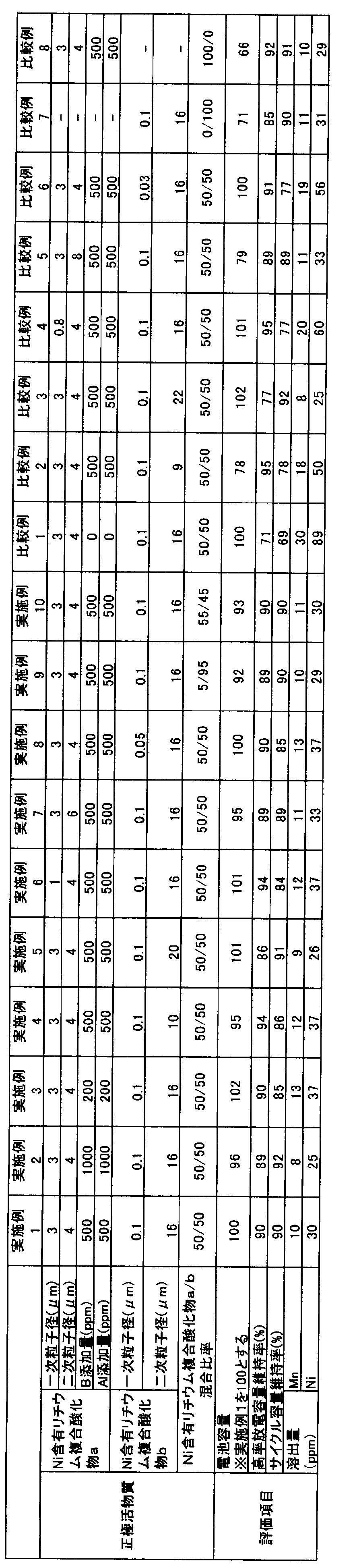
表1に示すように、実施例の電池はいずれも、放電容量、高率放電容量維持率及びサイクル容量維持率が高い結果となった。また、実施例の電池はいずれも、60℃満充電状態で96時間保存した後におけるNi、Mnの溶出量が50ppm未満に抑えられた。すなわち、実施例の電池は、高容量、良好なサイクル特性及び高率放電特性、並びに正極活物質からのNi、Mnの溶出量を抑制することができた。一方、比較例では、これらの特性の全てを満足する電池は得られなかった。
10 非水電解質二次電池、11 正極、12 負極、13 セパレータ、14 電極体、15 電池ケース、16 外装缶、17 封口体、18,19 絶縁板、20 正極タブ、21 負極タブ、22 溝入部、23 底板、24 下弁体、25 絶縁部材、26 上弁体、27 キャップ、28 ガスケット、32,33 一次粒子。
Claims (3)
- Ni含有リチウム複合酸化物a,bを含む正極活物質であって、
前記Ni含有リチウム複合酸化物aの平均一次粒子径は、1μm以上であり、且つ前記Ni含有リチウム複合酸化物bの平均一次粒子径よりも大きく、
前記Ni含有リチウム複合酸化物aの平均二次粒子径は、2μm~6μmであり、
Ni含有リチウム複合酸化物bは、平均一次粒子径が0.05μm以上、平均二次粒子径が10μm~20μmであり、
前記Ni含有リチウム複合酸化物aは、Mnを含み、且つB及びAlのうちの少なくともいずれか一方を含み、Liを除く金属元素の総モル数に対して55モル%以上のNiを含有し、結晶子径が100nm~200nmであり、
前記Ni含有リチウム複合酸化物bは、Mnを含み、且つB及びAlを含有しないか前記Ni含有リチウム複合酸化物aよりもB及びAlの含有量が少なく、Liを除く金属元素の総モル数に対して55モル%以上のNiを含有し、結晶子径が100nm~200nmであり、
前記Ni含有リチウム複合酸化物aと前記Ni含有リチウム複合酸化物bとの割合が、質量比で、5:95~55:45である、非水電解質二次電池用正極活物質。 - 前記Ni含有リチウム複合酸化物aに含まれるB及びAlは、前記Ni含有リチウム複合酸化物aに対する質量比で、200ppm~1000ppmの範囲である、請求項1に記載の非水電解質二次電池用正極活物質。
- 請求項1又は2に記載の非水電解質二次電池用正極活物質を含む正極と、負極と、非水電解質とを備えた、非水電解質二次電池。
Priority Applications (4)
| Application Number | Priority Date | Filing Date | Title |
|---|---|---|---|
| CN201980085864.9A CN113272999B (zh) | 2018-12-28 | 2019-11-25 | 非水电解质二次电池用正极活性物质和非水电解质二次电池 |
| US17/417,240 US11942637B2 (en) | 2018-12-28 | 2019-11-25 | Positive electrode active material for nonaqueous electrolyte secondary battery and nonaqueous electrolyte secondary battery |
| JP2020562944A JP7308462B2 (ja) | 2018-12-28 | 2019-11-25 | 非水電解質二次電池用正極活物質、及び非水電解質二次電池 |
| EP19903520.5A EP3905391A4 (en) | 2018-12-28 | 2019-11-25 | ACTIVE MATERIAL OF POSITIVE ELECTRODE FOR SECONDARY NON-AQUEOUS ELECTROLYTE BATTERY AND SECONDARY NON-AQUEOUS ELECTROLYTE BATTERY |
Applications Claiming Priority (2)
| Application Number | Priority Date | Filing Date | Title |
|---|---|---|---|
| JP2018247348 | 2018-12-28 | ||
| JP2018-247348 | 2018-12-28 |
Publications (1)
| Publication Number | Publication Date |
|---|---|
| WO2020137296A1 true WO2020137296A1 (ja) | 2020-07-02 |
Family
ID=71125759
Family Applications (1)
| Application Number | Title | Priority Date | Filing Date |
|---|---|---|---|
| PCT/JP2019/045909 Ceased WO2020137296A1 (ja) | 2018-12-28 | 2019-11-25 | 非水電解質二次電池用正極活物質、及び非水電解質二次電池 |
Country Status (5)
| Country | Link |
|---|---|
| US (1) | US11942637B2 (ja) |
| EP (1) | EP3905391A4 (ja) |
| JP (1) | JP7308462B2 (ja) |
| CN (1) | CN113272999B (ja) |
| WO (1) | WO2020137296A1 (ja) |
Cited By (14)
| Publication number | Priority date | Publication date | Assignee | Title |
|---|---|---|---|---|
| CN112599742A (zh) * | 2020-12-14 | 2021-04-02 | 宁德新能源科技有限公司 | 电化学装置和电子装置 |
| KR20220057480A (ko) * | 2020-10-29 | 2022-05-09 | 주식회사 엘지에너지솔루션 | 리튬 이차 전지용 양극 활물질, 그 제조방법 및 이를 포함하는 리튬 이차 전지 |
| JP2022082508A (ja) * | 2020-11-23 | 2022-06-02 | 三星エスディアイ株式会社 | リチウム二次電池用正極活物質、その製造方法およびこれを含む正極を含むリチウム二次電池 |
| EP4047693A4 (en) * | 2019-12-05 | 2022-12-21 | LG Energy Solution, Ltd. | ACTIVE CATHODE MATERIAL FOR LITHIUM SECONDARY BATTERY AND PROCESS FOR MANUFACTURE OF ACTIVE CATHODE MATERIAL |
| US11670754B2 (en) | 2017-12-04 | 2023-06-06 | Samsung Sdi Co., Ltd. | Positive active material for rechargeable lithium battery, preparing method thereof and rechargeable lithium battery comprising positive electrode including positive active material |
| US11682755B2 (en) | 2017-12-04 | 2023-06-20 | Samsung Sdi Co., Ltd. | Positive active material for rechargeable lithium battery, preparing method thereof and rechargeable lithium battery comprising positive electrode including positive active material |
| US11728473B2 (en) | 2020-09-24 | 2023-08-15 | Samsung Sdi Co., Ltd. | Positive electrode for rechargeable lithium battery, method of preparing the same, and rechargeable lithium battery including the same |
| JP2023540088A (ja) * | 2021-06-24 | 2023-09-21 | エルジー エナジー ソリューション リミテッド | リチウム二次電池用正極、それを備える正極及びリチウム二次電池 |
| JP2023540077A (ja) * | 2020-11-27 | 2023-09-21 | エルジー エナジー ソリューション リミテッド | リチウム二次電池用正極活物質、その製造方法及びそれを含むリチウム二次電池 |
| US11777075B2 (en) | 2017-12-04 | 2023-10-03 | Samsung Sdi Co., Ltd. | Positive active material for rechargeable lithium battery, preparing method thereof and rechargeable lithium battery comprising positive electrode including positive active material |
| WO2023190422A1 (ja) * | 2022-03-31 | 2023-10-05 | 株式会社Gsユアサ | 非水電解質蓄電素子用の正極及びこれを備える非水電解質蓄電素子 |
| JP2024001780A (ja) * | 2022-06-22 | 2024-01-10 | 株式会社Gsユアサ | 正極及び非水電解質蓄電素子 |
| JP2024531582A (ja) * | 2021-09-10 | 2024-08-29 | エルジー エナジー ソリューション リミテッド | 正極活物質、その製造方法、これを含む正極およびリチウム二次電池 |
| US12300807B2 (en) | 2021-05-28 | 2025-05-13 | Samsung Sdi Co., Ltd. | Positive active material for rechargeable lithium battery, preparing method thereof and rechargeable lithium battery including the same |
Families Citing this family (2)
| Publication number | Priority date | Publication date | Assignee | Title |
|---|---|---|---|---|
| EP4071854B1 (en) * | 2020-09-10 | 2025-05-21 | Contemporary Amperex Technology (Hong Kong) Limited | Electrode active composition and preparation method thereof, electrode, battery and apparatus |
| CN119447287A (zh) * | 2025-01-07 | 2025-02-14 | 宁波容百新能源科技股份有限公司 | 一种正极材料及其制备方法和应用 |
Citations (7)
| Publication number | Priority date | Publication date | Assignee | Title |
|---|---|---|---|---|
| JP2005174847A (ja) * | 2003-12-15 | 2005-06-30 | Toshiba Corp | 電極及び非水電解質二次電池 |
| JP2009032647A (ja) * | 2007-06-25 | 2009-02-12 | Mitsubishi Chemicals Corp | リチウム二次電池用正極活物質材料、及びそれを用いたリチウム二次電池用正極並びにリチウム二次電池 |
| JP2010086693A (ja) * | 2008-09-30 | 2010-04-15 | Hitachi Vehicle Energy Ltd | リチウム二次電池用正極材料及びそれを用いたリチウム二次電池 |
| JP2011113825A (ja) | 2009-11-27 | 2011-06-09 | Hitachi Ltd | リチウムイオン二次電池用正極材料およびそれを用いたリチウムイオン二次電池 |
| JP2017107727A (ja) * | 2015-12-09 | 2017-06-15 | ソニー株式会社 | 正極活物質、正極、電池、電池パック、電子機器、電動車両、蓄電装置および電力システム |
| WO2017104178A1 (ja) | 2015-12-15 | 2017-06-22 | デンカ株式会社 | 正極用バインダー組成物、正極用スラリー、正極及びリチウムイオン二次電池 |
| JP2017152363A (ja) * | 2016-02-25 | 2017-08-31 | Tdk株式会社 | リチウムイオン二次電池用正極活物質、これを用いたリチウムイオン二次電池用正極及びリチウムイオン二次電池 |
Family Cites Families (6)
| Publication number | Priority date | Publication date | Assignee | Title |
|---|---|---|---|---|
| KR100670507B1 (ko) * | 2005-04-28 | 2007-01-16 | 삼성에스디아이 주식회사 | 리튬 이차 전지 |
| WO2011040383A1 (ja) | 2009-09-30 | 2011-04-07 | 戸田工業株式会社 | 正極活物質粒子粉末及びその製造方法、並びに非水電解質二次電池 |
| JP5549321B2 (ja) | 2010-03-31 | 2014-07-16 | 日亜化学工業株式会社 | 非水電解質二次電池用正極活物質及び非水電解質二次電池 |
| JP2013065467A (ja) * | 2011-09-16 | 2013-04-11 | Panasonic Corp | リチウムイオン二次電池 |
| EP2882015B1 (en) | 2013-08-28 | 2018-10-03 | LG Chem, Ltd. | Cathode active material containing lithium transition metal phosphate particles, preparation method therefor, and lithium secondary battery containing same |
| US20170250402A1 (en) * | 2016-02-25 | 2017-08-31 | Tdk Corporation | Positive electrode active material for lithium ion secondary battery, lithium ion secondary battery positive electrode using the same, and lithium ion secondary battery |
-
2019
- 2019-11-25 JP JP2020562944A patent/JP7308462B2/ja active Active
- 2019-11-25 CN CN201980085864.9A patent/CN113272999B/zh active Active
- 2019-11-25 US US17/417,240 patent/US11942637B2/en active Active
- 2019-11-25 WO PCT/JP2019/045909 patent/WO2020137296A1/ja not_active Ceased
- 2019-11-25 EP EP19903520.5A patent/EP3905391A4/en active Pending
Patent Citations (7)
| Publication number | Priority date | Publication date | Assignee | Title |
|---|---|---|---|---|
| JP2005174847A (ja) * | 2003-12-15 | 2005-06-30 | Toshiba Corp | 電極及び非水電解質二次電池 |
| JP2009032647A (ja) * | 2007-06-25 | 2009-02-12 | Mitsubishi Chemicals Corp | リチウム二次電池用正極活物質材料、及びそれを用いたリチウム二次電池用正極並びにリチウム二次電池 |
| JP2010086693A (ja) * | 2008-09-30 | 2010-04-15 | Hitachi Vehicle Energy Ltd | リチウム二次電池用正極材料及びそれを用いたリチウム二次電池 |
| JP2011113825A (ja) | 2009-11-27 | 2011-06-09 | Hitachi Ltd | リチウムイオン二次電池用正極材料およびそれを用いたリチウムイオン二次電池 |
| JP2017107727A (ja) * | 2015-12-09 | 2017-06-15 | ソニー株式会社 | 正極活物質、正極、電池、電池パック、電子機器、電動車両、蓄電装置および電力システム |
| WO2017104178A1 (ja) | 2015-12-15 | 2017-06-22 | デンカ株式会社 | 正極用バインダー組成物、正極用スラリー、正極及びリチウムイオン二次電池 |
| JP2017152363A (ja) * | 2016-02-25 | 2017-08-31 | Tdk株式会社 | リチウムイオン二次電池用正極活物質、これを用いたリチウムイオン二次電池用正極及びリチウムイオン二次電池 |
Non-Patent Citations (1)
| Title |
|---|
| See also references of EP3905391A4 |
Cited By (25)
| Publication number | Priority date | Publication date | Assignee | Title |
|---|---|---|---|---|
| US11682755B2 (en) | 2017-12-04 | 2023-06-20 | Samsung Sdi Co., Ltd. | Positive active material for rechargeable lithium battery, preparing method thereof and rechargeable lithium battery comprising positive electrode including positive active material |
| US11777075B2 (en) | 2017-12-04 | 2023-10-03 | Samsung Sdi Co., Ltd. | Positive active material for rechargeable lithium battery, preparing method thereof and rechargeable lithium battery comprising positive electrode including positive active material |
| US11670754B2 (en) | 2017-12-04 | 2023-06-06 | Samsung Sdi Co., Ltd. | Positive active material for rechargeable lithium battery, preparing method thereof and rechargeable lithium battery comprising positive electrode including positive active material |
| JP7655618B2 (ja) | 2019-12-05 | 2025-04-02 | エルジー エナジー ソリューション リミテッド | リチウム二次電池用正極活物質、前記正極活物質の製造方法 |
| EP4047693A4 (en) * | 2019-12-05 | 2022-12-21 | LG Energy Solution, Ltd. | ACTIVE CATHODE MATERIAL FOR LITHIUM SECONDARY BATTERY AND PROCESS FOR MANUFACTURE OF ACTIVE CATHODE MATERIAL |
| JP2023501681A (ja) * | 2019-12-05 | 2023-01-18 | エルジー エナジー ソリューション リミテッド | リチウム二次電池用正極活物質、前記正極活物質の製造方法 |
| US12224426B2 (en) | 2020-09-24 | 2025-02-11 | Samsung Sdi Co., Ltd. | Positive electrode for rechargeable lithium battery, method of preparing the same, and rechargeable lithium battery including the same |
| US11728473B2 (en) | 2020-09-24 | 2023-08-15 | Samsung Sdi Co., Ltd. | Positive electrode for rechargeable lithium battery, method of preparing the same, and rechargeable lithium battery including the same |
| JP7699206B2 (ja) | 2020-10-29 | 2025-06-26 | エルジー エナジー ソリューション リミテッド | リチウム二次電池用正極活物質、その製造方法、及びそれを含むリチウム二次電池 |
| JP2023546964A (ja) * | 2020-10-29 | 2023-11-08 | エルジー エナジー ソリューション リミテッド | リチウム二次電池用正極活物質、その製造方法、及びそれを含むリチウム二次電池 |
| KR102686481B1 (ko) | 2020-10-29 | 2024-07-19 | 주식회사 엘지에너지솔루션 | 리튬 이차 전지용 양극 활물질, 그 제조방법 및 이를 포함하는 리튬 이차 전지 |
| KR20220057480A (ko) * | 2020-10-29 | 2022-05-09 | 주식회사 엘지에너지솔루션 | 리튬 이차 전지용 양극 활물질, 그 제조방법 및 이를 포함하는 리튬 이차 전지 |
| JP2022082508A (ja) * | 2020-11-23 | 2022-06-02 | 三星エスディアイ株式会社 | リチウム二次電池用正極活物質、その製造方法およびこれを含む正極を含むリチウム二次電池 |
| JP7405814B2 (ja) | 2020-11-23 | 2023-12-26 | 三星エスディアイ株式会社 | リチウム二次電池用正極活物質、その製造方法およびこれを含む正極を含むリチウム二次電池 |
| JP7642796B2 (ja) | 2020-11-27 | 2025-03-10 | エルジー エナジー ソリューション リミテッド | リチウム二次電池用正極活物質、その製造方法及びそれを含むリチウム二次電池 |
| JP2023540077A (ja) * | 2020-11-27 | 2023-09-21 | エルジー エナジー ソリューション リミテッド | リチウム二次電池用正極活物質、その製造方法及びそれを含むリチウム二次電池 |
| CN112599742A (zh) * | 2020-12-14 | 2021-04-02 | 宁德新能源科技有限公司 | 电化学装置和电子装置 |
| US12322791B2 (en) | 2021-05-28 | 2025-06-03 | Samsung Sdi Co., Ltd. | Positive active material for rechargeable lithium battery, preparing method thereof and rechargeable lithium battery including the same |
| US12300807B2 (en) | 2021-05-28 | 2025-05-13 | Samsung Sdi Co., Ltd. | Positive active material for rechargeable lithium battery, preparing method thereof and rechargeable lithium battery including the same |
| JP7463618B2 (ja) | 2021-06-24 | 2024-04-08 | エルジー エナジー ソリューション リミテッド | リチウム二次電池用正極、それを備える正極及びリチウム二次電池 |
| JP2023540088A (ja) * | 2021-06-24 | 2023-09-21 | エルジー エナジー ソリューション リミテッド | リチウム二次電池用正極、それを備える正極及びリチウム二次電池 |
| JP2024531582A (ja) * | 2021-09-10 | 2024-08-29 | エルジー エナジー ソリューション リミテッド | 正極活物質、その製造方法、これを含む正極およびリチウム二次電池 |
| JP7754577B2 (ja) | 2021-09-10 | 2025-10-15 | エルジー エナジー ソリューション リミテッド | 正極活物質、その製造方法、これを含む正極およびリチウム二次電池 |
| WO2023190422A1 (ja) * | 2022-03-31 | 2023-10-05 | 株式会社Gsユアサ | 非水電解質蓄電素子用の正極及びこれを備える非水電解質蓄電素子 |
| JP2024001780A (ja) * | 2022-06-22 | 2024-01-10 | 株式会社Gsユアサ | 正極及び非水電解質蓄電素子 |
Also Published As
| Publication number | Publication date |
|---|---|
| CN113272999B (zh) | 2024-03-15 |
| JPWO2020137296A1 (ja) | 2021-11-11 |
| US20220059836A1 (en) | 2022-02-24 |
| EP3905391A4 (en) | 2022-01-26 |
| US11942637B2 (en) | 2024-03-26 |
| CN113272999A (zh) | 2021-08-17 |
| JP7308462B2 (ja) | 2023-07-14 |
| EP3905391A1 (en) | 2021-11-03 |
Similar Documents
| Publication | Publication Date | Title |
|---|---|---|
| JP7308462B2 (ja) | 非水電解質二次電池用正極活物質、及び非水電解質二次電池 | |
| JP7199064B2 (ja) | 非水電解質二次電池用正極活物質、及び非水電解質二次電池 | |
| JP7113243B2 (ja) | 非水電解質二次電池用正極活物質、非水電解質二次電池用正極及び非水電解質二次電池 | |
| JP7809186B2 (ja) | 非水電解質二次電池用正極活物質、及び非水電解質二次電池 | |
| JPWO2019021806A1 (ja) | 非水電解質二次電池用正極活物質、非水電解質二次電池用正極活物質の製造方法、及び非水電解質二次電池 | |
| JP2016164869A (ja) | 非水電解質二次電池用正極活物質及び非水電解質二次電池 | |
| CN114467196B (zh) | 非水电解质二次电池用正极活性物质、和非水电解质二次电池 | |
| WO2019167582A1 (ja) | 非水電解質二次電池用正極活物質、非水電解質二次電池及び非水電解質二次電池用正極活物質の製造方法 | |
| WO2021153350A1 (ja) | 非水電解質二次電池用正極活物質、及び非水電解質二次電池 | |
| JPWO2018155121A1 (ja) | 非水電解質二次電池用正極活物質、及び非水電解質二次電池 | |
| WO2018061298A1 (ja) | 非水電解質二次電池用正極、及び非水電解質二次電池 | |
| JP7300658B2 (ja) | 非水電解質二次電池用正極活物質、及び非水電解質二次電池 | |
| JPWO2019193873A1 (ja) | 非水電解質二次電池の正極活物質、非水電解質二次電池用正極、及び非水電解質二次電池 | |
| WO2018003477A1 (ja) | 正極活物質、正極、及び非水電解質二次電池 | |
| JP7665440B2 (ja) | 非水電解質二次電池 | |
| WO2019107160A1 (ja) | 非水電解質二次電池用正極活物質及び非水電解質二次電池用正極活物質の製造方法 | |
| WO2022138846A1 (ja) | 非水電解質二次電池用正極活物質、及び非水電解質二次電池 | |
| WO2021210444A1 (ja) | 非水電解質二次電池用正極活物質、及び非水電解質二次電池 | |
| WO2023181848A1 (ja) | 非水電解質二次電池 | |
| WO2023068221A1 (ja) | 非水電解質二次電池用正極活物質、及び非水電解質二次電池 | |
| WO2022138840A1 (ja) | 非水電解質二次電池用正極活物質、及び非水電解質二次電池 |
Legal Events
| Date | Code | Title | Description |
|---|---|---|---|
| 121 | Ep: the epo has been informed by wipo that ep was designated in this application |
Ref document number: 19903520 Country of ref document: EP Kind code of ref document: A1 |
|
| ENP | Entry into the national phase |
Ref document number: 2020562944 Country of ref document: JP Kind code of ref document: A |
|
| NENP | Non-entry into the national phase |
Ref country code: DE |
|
| ENP | Entry into the national phase |
Ref document number: 2019903520 Country of ref document: EP Effective date: 20210728 |