WO2020138149A1 - 積層体 - Google Patents
積層体 Download PDFInfo
- Publication number
- WO2020138149A1 WO2020138149A1 PCT/JP2019/050780 JP2019050780W WO2020138149A1 WO 2020138149 A1 WO2020138149 A1 WO 2020138149A1 JP 2019050780 W JP2019050780 W JP 2019050780W WO 2020138149 A1 WO2020138149 A1 WO 2020138149A1
- Authority
- WO
- WIPO (PCT)
- Prior art keywords
- acid
- film
- resin
- polyamide resin
- polyamide
- Prior art date
- Legal status (The legal status is an assumption and is not a legal conclusion. Google has not performed a legal analysis and makes no representation as to the accuracy of the status listed.)
- Ceased
Links
Classifications
-
- B—PERFORMING OPERATIONS; TRANSPORTING
- B32—LAYERED PRODUCTS
- B32B—LAYERED PRODUCTS, i.e. PRODUCTS BUILT-UP OF STRATA OF FLAT OR NON-FLAT, e.g. CELLULAR OR HONEYCOMB, FORM
- B32B27/00—Layered products comprising a layer of synthetic resin
- B32B27/34—Layered products comprising a layer of synthetic resin comprising polyamides
-
- B—PERFORMING OPERATIONS; TRANSPORTING
- B32—LAYERED PRODUCTS
- B32B—LAYERED PRODUCTS, i.e. PRODUCTS BUILT-UP OF STRATA OF FLAT OR NON-FLAT, e.g. CELLULAR OR HONEYCOMB, FORM
- B32B15/00—Layered products comprising a layer of metal
- B32B15/04—Layered products comprising a layer of metal comprising metal as the main or only constituent of a layer, which is next to another layer of the same or of a different material
- B32B15/08—Layered products comprising a layer of metal comprising metal as the main or only constituent of a layer, which is next to another layer of the same or of a different material of synthetic resin
-
- B—PERFORMING OPERATIONS; TRANSPORTING
- B32—LAYERED PRODUCTS
- B32B—LAYERED PRODUCTS, i.e. PRODUCTS BUILT-UP OF STRATA OF FLAT OR NON-FLAT, e.g. CELLULAR OR HONEYCOMB, FORM
- B32B15/00—Layered products comprising a layer of metal
- B32B15/04—Layered products comprising a layer of metal comprising metal as the main or only constituent of a layer, which is next to another layer of the same or of a different material
- B32B15/08—Layered products comprising a layer of metal comprising metal as the main or only constituent of a layer, which is next to another layer of the same or of a different material of synthetic resin
- B32B15/088—Layered products comprising a layer of metal comprising metal as the main or only constituent of a layer, which is next to another layer of the same or of a different material of synthetic resin comprising polyamides
-
- B—PERFORMING OPERATIONS; TRANSPORTING
- B32—LAYERED PRODUCTS
- B32B—LAYERED PRODUCTS, i.e. PRODUCTS BUILT-UP OF STRATA OF FLAT OR NON-FLAT, e.g. CELLULAR OR HONEYCOMB, FORM
- B32B21/00—Layered products comprising a layer of wood, e.g. wood board, veneer, wood particle board
- B32B21/04—Layered products comprising a layer of wood, e.g. wood board, veneer, wood particle board comprising wood as the main or only constituent of a layer, which is next to another layer of the same or of a different material
- B32B21/08—Layered products comprising a layer of wood, e.g. wood board, veneer, wood particle board comprising wood as the main or only constituent of a layer, which is next to another layer of the same or of a different material of synthetic resin
-
- B—PERFORMING OPERATIONS; TRANSPORTING
- B32—LAYERED PRODUCTS
- B32B—LAYERED PRODUCTS, i.e. PRODUCTS BUILT-UP OF STRATA OF FLAT OR NON-FLAT, e.g. CELLULAR OR HONEYCOMB, FORM
- B32B23/00—Layered products comprising a layer of cellulosic plastic substances, i.e. substances obtained by chemical modification of cellulose, e.g. cellulose ethers, cellulose esters, viscose
- B32B23/04—Layered products comprising a layer of cellulosic plastic substances, i.e. substances obtained by chemical modification of cellulose, e.g. cellulose ethers, cellulose esters, viscose comprising such cellulosic plastic substance as the main or only constituent of a layer, which is next to another layer of the same or of a different material
- B32B23/08—Layered products comprising a layer of cellulosic plastic substances, i.e. substances obtained by chemical modification of cellulose, e.g. cellulose ethers, cellulose esters, viscose comprising such cellulosic plastic substance as the main or only constituent of a layer, which is next to another layer of the same or of a different material of synthetic resin
-
- B—PERFORMING OPERATIONS; TRANSPORTING
- B32—LAYERED PRODUCTS
- B32B—LAYERED PRODUCTS, i.e. PRODUCTS BUILT-UP OF STRATA OF FLAT OR NON-FLAT, e.g. CELLULAR OR HONEYCOMB, FORM
- B32B23/00—Layered products comprising a layer of cellulosic plastic substances, i.e. substances obtained by chemical modification of cellulose, e.g. cellulose ethers, cellulose esters, viscose
- B32B23/20—Layered products comprising a layer of cellulosic plastic substances, i.e. substances obtained by chemical modification of cellulose, e.g. cellulose ethers, cellulose esters, viscose comprising esters
-
- B—PERFORMING OPERATIONS; TRANSPORTING
- B32—LAYERED PRODUCTS
- B32B—LAYERED PRODUCTS, i.e. PRODUCTS BUILT-UP OF STRATA OF FLAT OR NON-FLAT, e.g. CELLULAR OR HONEYCOMB, FORM
- B32B25/00—Layered products comprising a layer of natural or synthetic rubber
- B32B25/04—Layered products comprising a layer of natural or synthetic rubber comprising rubber as the main or only constituent of a layer, which is next to another layer of the same or of a different material
- B32B25/08—Layered products comprising a layer of natural or synthetic rubber comprising rubber as the main or only constituent of a layer, which is next to another layer of the same or of a different material of synthetic resin
-
- B—PERFORMING OPERATIONS; TRANSPORTING
- B32—LAYERED PRODUCTS
- B32B—LAYERED PRODUCTS, i.e. PRODUCTS BUILT-UP OF STRATA OF FLAT OR NON-FLAT, e.g. CELLULAR OR HONEYCOMB, FORM
- B32B25/00—Layered products comprising a layer of natural or synthetic rubber
- B32B25/14—Layered products comprising a layer of natural or synthetic rubber comprising synthetic rubber copolymers
-
- B—PERFORMING OPERATIONS; TRANSPORTING
- B32—LAYERED PRODUCTS
- B32B—LAYERED PRODUCTS, i.e. PRODUCTS BUILT-UP OF STRATA OF FLAT OR NON-FLAT, e.g. CELLULAR OR HONEYCOMB, FORM
- B32B27/00—Layered products comprising a layer of synthetic resin
- B32B27/06—Layered products comprising a layer of synthetic resin as the main or only constituent of a layer, which is next to another layer of the same or of a different material
- B32B27/08—Layered products comprising a layer of synthetic resin as the main or only constituent of a layer, which is next to another layer of the same or of a different material of synthetic resin
-
- B—PERFORMING OPERATIONS; TRANSPORTING
- B32—LAYERED PRODUCTS
- B32B—LAYERED PRODUCTS, i.e. PRODUCTS BUILT-UP OF STRATA OF FLAT OR NON-FLAT, e.g. CELLULAR OR HONEYCOMB, FORM
- B32B27/00—Layered products comprising a layer of synthetic resin
- B32B27/06—Layered products comprising a layer of synthetic resin as the main or only constituent of a layer, which is next to another layer of the same or of a different material
- B32B27/10—Layered products comprising a layer of synthetic resin as the main or only constituent of a layer, which is next to another layer of the same or of a different material of paper or cardboard
-
- B—PERFORMING OPERATIONS; TRANSPORTING
- B32—LAYERED PRODUCTS
- B32B—LAYERED PRODUCTS, i.e. PRODUCTS BUILT-UP OF STRATA OF FLAT OR NON-FLAT, e.g. CELLULAR OR HONEYCOMB, FORM
- B32B27/00—Layered products comprising a layer of synthetic resin
- B32B27/12—Layered products comprising a layer of synthetic resin next to a fibrous or filamentary layer
-
- B—PERFORMING OPERATIONS; TRANSPORTING
- B32—LAYERED PRODUCTS
- B32B—LAYERED PRODUCTS, i.e. PRODUCTS BUILT-UP OF STRATA OF FLAT OR NON-FLAT, e.g. CELLULAR OR HONEYCOMB, FORM
- B32B27/00—Layered products comprising a layer of synthetic resin
- B32B27/16—Layered products comprising a layer of synthetic resin specially treated, e.g. irradiated
-
- B—PERFORMING OPERATIONS; TRANSPORTING
- B32—LAYERED PRODUCTS
- B32B—LAYERED PRODUCTS, i.e. PRODUCTS BUILT-UP OF STRATA OF FLAT OR NON-FLAT, e.g. CELLULAR OR HONEYCOMB, FORM
- B32B27/00—Layered products comprising a layer of synthetic resin
- B32B27/18—Layered products comprising a layer of synthetic resin characterised by the use of special additives
-
- B—PERFORMING OPERATIONS; TRANSPORTING
- B32—LAYERED PRODUCTS
- B32B—LAYERED PRODUCTS, i.e. PRODUCTS BUILT-UP OF STRATA OF FLAT OR NON-FLAT, e.g. CELLULAR OR HONEYCOMB, FORM
- B32B27/00—Layered products comprising a layer of synthetic resin
- B32B27/18—Layered products comprising a layer of synthetic resin characterised by the use of special additives
- B32B27/20—Layered products comprising a layer of synthetic resin characterised by the use of special additives using fillers, pigments, thixotroping agents
-
- B—PERFORMING OPERATIONS; TRANSPORTING
- B32—LAYERED PRODUCTS
- B32B—LAYERED PRODUCTS, i.e. PRODUCTS BUILT-UP OF STRATA OF FLAT OR NON-FLAT, e.g. CELLULAR OR HONEYCOMB, FORM
- B32B27/00—Layered products comprising a layer of synthetic resin
- B32B27/18—Layered products comprising a layer of synthetic resin characterised by the use of special additives
- B32B27/22—Layered products comprising a layer of synthetic resin characterised by the use of special additives using plasticisers
-
- B—PERFORMING OPERATIONS; TRANSPORTING
- B32—LAYERED PRODUCTS
- B32B—LAYERED PRODUCTS, i.e. PRODUCTS BUILT-UP OF STRATA OF FLAT OR NON-FLAT, e.g. CELLULAR OR HONEYCOMB, FORM
- B32B27/00—Layered products comprising a layer of synthetic resin
- B32B27/28—Layered products comprising a layer of synthetic resin comprising synthetic resins not wholly covered by any one of the sub-groups B32B27/30 - B32B27/42
- B32B27/281—Layered products comprising a layer of synthetic resin comprising synthetic resins not wholly covered by any one of the sub-groups B32B27/30 - B32B27/42 comprising polyimides
-
- B—PERFORMING OPERATIONS; TRANSPORTING
- B32—LAYERED PRODUCTS
- B32B—LAYERED PRODUCTS, i.e. PRODUCTS BUILT-UP OF STRATA OF FLAT OR NON-FLAT, e.g. CELLULAR OR HONEYCOMB, FORM
- B32B27/00—Layered products comprising a layer of synthetic resin
- B32B27/28—Layered products comprising a layer of synthetic resin comprising synthetic resins not wholly covered by any one of the sub-groups B32B27/30 - B32B27/42
- B32B27/285—Layered products comprising a layer of synthetic resin comprising synthetic resins not wholly covered by any one of the sub-groups B32B27/30 - B32B27/42 comprising polyethers
-
- B—PERFORMING OPERATIONS; TRANSPORTING
- B32—LAYERED PRODUCTS
- B32B—LAYERED PRODUCTS, i.e. PRODUCTS BUILT-UP OF STRATA OF FLAT OR NON-FLAT, e.g. CELLULAR OR HONEYCOMB, FORM
- B32B27/00—Layered products comprising a layer of synthetic resin
- B32B27/28—Layered products comprising a layer of synthetic resin comprising synthetic resins not wholly covered by any one of the sub-groups B32B27/30 - B32B27/42
- B32B27/286—Layered products comprising a layer of synthetic resin comprising synthetic resins not wholly covered by any one of the sub-groups B32B27/30 - B32B27/42 comprising polysulphones; polysulfides
-
- B—PERFORMING OPERATIONS; TRANSPORTING
- B32—LAYERED PRODUCTS
- B32B—LAYERED PRODUCTS, i.e. PRODUCTS BUILT-UP OF STRATA OF FLAT OR NON-FLAT, e.g. CELLULAR OR HONEYCOMB, FORM
- B32B27/00—Layered products comprising a layer of synthetic resin
- B32B27/28—Layered products comprising a layer of synthetic resin comprising synthetic resins not wholly covered by any one of the sub-groups B32B27/30 - B32B27/42
- B32B27/288—Layered products comprising a layer of synthetic resin comprising synthetic resins not wholly covered by any one of the sub-groups B32B27/30 - B32B27/42 comprising polyketones
-
- B—PERFORMING OPERATIONS; TRANSPORTING
- B32—LAYERED PRODUCTS
- B32B—LAYERED PRODUCTS, i.e. PRODUCTS BUILT-UP OF STRATA OF FLAT OR NON-FLAT, e.g. CELLULAR OR HONEYCOMB, FORM
- B32B27/00—Layered products comprising a layer of synthetic resin
- B32B27/30—Layered products comprising a layer of synthetic resin comprising vinyl (co)polymers; comprising acrylic (co)polymers
- B32B27/302—Layered products comprising a layer of synthetic resin comprising vinyl (co)polymers; comprising acrylic (co)polymers comprising aromatic vinyl (co)polymers, e.g. styrenic (co)polymers
-
- B—PERFORMING OPERATIONS; TRANSPORTING
- B32—LAYERED PRODUCTS
- B32B—LAYERED PRODUCTS, i.e. PRODUCTS BUILT-UP OF STRATA OF FLAT OR NON-FLAT, e.g. CELLULAR OR HONEYCOMB, FORM
- B32B27/00—Layered products comprising a layer of synthetic resin
- B32B27/30—Layered products comprising a layer of synthetic resin comprising vinyl (co)polymers; comprising acrylic (co)polymers
- B32B27/304—Layered products comprising a layer of synthetic resin comprising vinyl (co)polymers; comprising acrylic (co)polymers comprising vinyl halide (co)polymers, e.g. PVC, PVDC, PVF, PVDF
-
- B—PERFORMING OPERATIONS; TRANSPORTING
- B32—LAYERED PRODUCTS
- B32B—LAYERED PRODUCTS, i.e. PRODUCTS BUILT-UP OF STRATA OF FLAT OR NON-FLAT, e.g. CELLULAR OR HONEYCOMB, FORM
- B32B27/00—Layered products comprising a layer of synthetic resin
- B32B27/30—Layered products comprising a layer of synthetic resin comprising vinyl (co)polymers; comprising acrylic (co)polymers
- B32B27/306—Layered products comprising a layer of synthetic resin comprising vinyl (co)polymers; comprising acrylic (co)polymers comprising vinyl acetate or vinyl alcohol (co)polymers
-
- B—PERFORMING OPERATIONS; TRANSPORTING
- B32—LAYERED PRODUCTS
- B32B—LAYERED PRODUCTS, i.e. PRODUCTS BUILT-UP OF STRATA OF FLAT OR NON-FLAT, e.g. CELLULAR OR HONEYCOMB, FORM
- B32B27/00—Layered products comprising a layer of synthetic resin
- B32B27/30—Layered products comprising a layer of synthetic resin comprising vinyl (co)polymers; comprising acrylic (co)polymers
- B32B27/308—Layered products comprising a layer of synthetic resin comprising vinyl (co)polymers; comprising acrylic (co)polymers comprising acrylic (co)polymers
-
- B—PERFORMING OPERATIONS; TRANSPORTING
- B32—LAYERED PRODUCTS
- B32B—LAYERED PRODUCTS, i.e. PRODUCTS BUILT-UP OF STRATA OF FLAT OR NON-FLAT, e.g. CELLULAR OR HONEYCOMB, FORM
- B32B27/00—Layered products comprising a layer of synthetic resin
- B32B27/32—Layered products comprising a layer of synthetic resin comprising polyolefins
-
- B—PERFORMING OPERATIONS; TRANSPORTING
- B32—LAYERED PRODUCTS
- B32B—LAYERED PRODUCTS, i.e. PRODUCTS BUILT-UP OF STRATA OF FLAT OR NON-FLAT, e.g. CELLULAR OR HONEYCOMB, FORM
- B32B27/00—Layered products comprising a layer of synthetic resin
- B32B27/32—Layered products comprising a layer of synthetic resin comprising polyolefins
- B32B27/325—Layered products comprising a layer of synthetic resin comprising polyolefins comprising polycycloolefins
-
- B—PERFORMING OPERATIONS; TRANSPORTING
- B32—LAYERED PRODUCTS
- B32B—LAYERED PRODUCTS, i.e. PRODUCTS BUILT-UP OF STRATA OF FLAT OR NON-FLAT, e.g. CELLULAR OR HONEYCOMB, FORM
- B32B27/00—Layered products comprising a layer of synthetic resin
- B32B27/36—Layered products comprising a layer of synthetic resin comprising polyesters
-
- B—PERFORMING OPERATIONS; TRANSPORTING
- B32—LAYERED PRODUCTS
- B32B—LAYERED PRODUCTS, i.e. PRODUCTS BUILT-UP OF STRATA OF FLAT OR NON-FLAT, e.g. CELLULAR OR HONEYCOMB, FORM
- B32B27/00—Layered products comprising a layer of synthetic resin
- B32B27/36—Layered products comprising a layer of synthetic resin comprising polyesters
- B32B27/365—Layered products comprising a layer of synthetic resin comprising polyesters comprising polycarbonates
-
- B—PERFORMING OPERATIONS; TRANSPORTING
- B32—LAYERED PRODUCTS
- B32B—LAYERED PRODUCTS, i.e. PRODUCTS BUILT-UP OF STRATA OF FLAT OR NON-FLAT, e.g. CELLULAR OR HONEYCOMB, FORM
- B32B27/00—Layered products comprising a layer of synthetic resin
- B32B27/40—Layered products comprising a layer of synthetic resin comprising polyurethanes
-
- B—PERFORMING OPERATIONS; TRANSPORTING
- B32—LAYERED PRODUCTS
- B32B—LAYERED PRODUCTS, i.e. PRODUCTS BUILT-UP OF STRATA OF FLAT OR NON-FLAT, e.g. CELLULAR OR HONEYCOMB, FORM
- B32B27/00—Layered products comprising a layer of synthetic resin
- B32B27/42—Layered products comprising a layer of synthetic resin comprising condensation resins of aldehydes, e.g. with phenols, ureas or melamines
-
- B—PERFORMING OPERATIONS; TRANSPORTING
- B32—LAYERED PRODUCTS
- B32B—LAYERED PRODUCTS, i.e. PRODUCTS BUILT-UP OF STRATA OF FLAT OR NON-FLAT, e.g. CELLULAR OR HONEYCOMB, FORM
- B32B5/00—Layered products characterised by the non- homogeneity or physical structure, i.e. comprising a fibrous, filamentary, particulate or foam layer; Layered products characterised by having a layer differing constitutionally or physically in different parts
- B32B5/02—Layered products characterised by the non- homogeneity or physical structure, i.e. comprising a fibrous, filamentary, particulate or foam layer; Layered products characterised by having a layer differing constitutionally or physically in different parts characterised by structural features of a fibrous or filamentary layer
- B32B5/022—Non-woven fabric
-
- B—PERFORMING OPERATIONS; TRANSPORTING
- B32—LAYERED PRODUCTS
- B32B—LAYERED PRODUCTS, i.e. PRODUCTS BUILT-UP OF STRATA OF FLAT OR NON-FLAT, e.g. CELLULAR OR HONEYCOMB, FORM
- B32B5/00—Layered products characterised by the non- homogeneity or physical structure, i.e. comprising a fibrous, filamentary, particulate or foam layer; Layered products characterised by having a layer differing constitutionally or physically in different parts
- B32B5/02—Layered products characterised by the non- homogeneity or physical structure, i.e. comprising a fibrous, filamentary, particulate or foam layer; Layered products characterised by having a layer differing constitutionally or physically in different parts characterised by structural features of a fibrous or filamentary layer
- B32B5/024—Woven fabric
-
- B—PERFORMING OPERATIONS; TRANSPORTING
- B32—LAYERED PRODUCTS
- B32B—LAYERED PRODUCTS, i.e. PRODUCTS BUILT-UP OF STRATA OF FLAT OR NON-FLAT, e.g. CELLULAR OR HONEYCOMB, FORM
- B32B7/00—Layered products characterised by the relation between layers; Layered products characterised by the relative orientation of features between layers, or by the relative values of a measurable parameter between layers, i.e. products comprising layers having different physical, chemical or physicochemical properties; Layered products characterised by the interconnection of layers
- B32B7/04—Interconnection of layers
- B32B7/12—Interconnection of layers using interposed adhesives or interposed materials with bonding properties
-
- B—PERFORMING OPERATIONS; TRANSPORTING
- B32—LAYERED PRODUCTS
- B32B—LAYERED PRODUCTS, i.e. PRODUCTS BUILT-UP OF STRATA OF FLAT OR NON-FLAT, e.g. CELLULAR OR HONEYCOMB, FORM
- B32B2250/00—Layers arrangement
- B32B2250/02—2 layers
-
- B—PERFORMING OPERATIONS; TRANSPORTING
- B32—LAYERED PRODUCTS
- B32B—LAYERED PRODUCTS, i.e. PRODUCTS BUILT-UP OF STRATA OF FLAT OR NON-FLAT, e.g. CELLULAR OR HONEYCOMB, FORM
- B32B2250/00—Layers arrangement
- B32B2250/24—All layers being polymeric
-
- B—PERFORMING OPERATIONS; TRANSPORTING
- B32—LAYERED PRODUCTS
- B32B—LAYERED PRODUCTS, i.e. PRODUCTS BUILT-UP OF STRATA OF FLAT OR NON-FLAT, e.g. CELLULAR OR HONEYCOMB, FORM
- B32B2255/00—Coating on the layer surface
- B32B2255/10—Coating on the layer surface on synthetic resin layer or on natural or synthetic rubber layer
-
- B—PERFORMING OPERATIONS; TRANSPORTING
- B32—LAYERED PRODUCTS
- B32B—LAYERED PRODUCTS, i.e. PRODUCTS BUILT-UP OF STRATA OF FLAT OR NON-FLAT, e.g. CELLULAR OR HONEYCOMB, FORM
- B32B2255/00—Coating on the layer surface
- B32B2255/26—Polymeric coating
-
- B—PERFORMING OPERATIONS; TRANSPORTING
- B32—LAYERED PRODUCTS
- B32B—LAYERED PRODUCTS, i.e. PRODUCTS BUILT-UP OF STRATA OF FLAT OR NON-FLAT, e.g. CELLULAR OR HONEYCOMB, FORM
- B32B2264/00—Composition or properties of particles which form a particulate layer or are present as additives
- B32B2264/02—Synthetic macromolecular particles
- B32B2264/0214—Particles made of materials belonging to B32B27/00
-
- B—PERFORMING OPERATIONS; TRANSPORTING
- B32—LAYERED PRODUCTS
- B32B—LAYERED PRODUCTS, i.e. PRODUCTS BUILT-UP OF STRATA OF FLAT OR NON-FLAT, e.g. CELLULAR OR HONEYCOMB, FORM
- B32B2264/00—Composition or properties of particles which form a particulate layer or are present as additives
- B32B2264/02—Synthetic macromolecular particles
- B32B2264/0214—Particles made of materials belonging to B32B27/00
- B32B2264/0228—Vinyl resin particles, e.g. polyvinyl acetate, polyvinyl alcohol polymers or ethylene-vinyl acetate copolymers
- B32B2264/0235—Aromatic vinyl resin, e.g. styrenic (co)polymers
-
- B—PERFORMING OPERATIONS; TRANSPORTING
- B32—LAYERED PRODUCTS
- B32B—LAYERED PRODUCTS, i.e. PRODUCTS BUILT-UP OF STRATA OF FLAT OR NON-FLAT, e.g. CELLULAR OR HONEYCOMB, FORM
- B32B2264/00—Composition or properties of particles which form a particulate layer or are present as additives
- B32B2264/02—Synthetic macromolecular particles
- B32B2264/0214—Particles made of materials belonging to B32B27/00
- B32B2264/025—Acrylic resin particles, e.g. polymethyl methacrylate or ethylene-acrylate copolymers
-
- B—PERFORMING OPERATIONS; TRANSPORTING
- B32—LAYERED PRODUCTS
- B32B—LAYERED PRODUCTS, i.e. PRODUCTS BUILT-UP OF STRATA OF FLAT OR NON-FLAT, e.g. CELLULAR OR HONEYCOMB, FORM
- B32B2264/00—Composition or properties of particles which form a particulate layer or are present as additives
- B32B2264/10—Inorganic particles
- B32B2264/102—Oxide or hydroxide
-
- B—PERFORMING OPERATIONS; TRANSPORTING
- B32—LAYERED PRODUCTS
- B32B—LAYERED PRODUCTS, i.e. PRODUCTS BUILT-UP OF STRATA OF FLAT OR NON-FLAT, e.g. CELLULAR OR HONEYCOMB, FORM
- B32B2264/00—Composition or properties of particles which form a particulate layer or are present as additives
- B32B2264/10—Inorganic particles
- B32B2264/104—Oxysalt, e.g. carbonate, sulfate, phosphate or nitrate particles
-
- B—PERFORMING OPERATIONS; TRANSPORTING
- B32—LAYERED PRODUCTS
- B32B—LAYERED PRODUCTS, i.e. PRODUCTS BUILT-UP OF STRATA OF FLAT OR NON-FLAT, e.g. CELLULAR OR HONEYCOMB, FORM
- B32B2270/00—Resin or rubber layer containing a blend of at least two different polymers
-
- B—PERFORMING OPERATIONS; TRANSPORTING
- B32—LAYERED PRODUCTS
- B32B—LAYERED PRODUCTS, i.e. PRODUCTS BUILT-UP OF STRATA OF FLAT OR NON-FLAT, e.g. CELLULAR OR HONEYCOMB, FORM
- B32B2274/00—Thermoplastic elastomer material
-
- B—PERFORMING OPERATIONS; TRANSPORTING
- B32—LAYERED PRODUCTS
- B32B—LAYERED PRODUCTS, i.e. PRODUCTS BUILT-UP OF STRATA OF FLAT OR NON-FLAT, e.g. CELLULAR OR HONEYCOMB, FORM
- B32B2307/00—Properties of the layers or laminate
- B32B2307/30—Properties of the layers or laminate having particular thermal properties
-
- B—PERFORMING OPERATIONS; TRANSPORTING
- B32—LAYERED PRODUCTS
- B32B—LAYERED PRODUCTS, i.e. PRODUCTS BUILT-UP OF STRATA OF FLAT OR NON-FLAT, e.g. CELLULAR OR HONEYCOMB, FORM
- B32B2307/00—Properties of the layers or laminate
- B32B2307/30—Properties of the layers or laminate having particular thermal properties
- B32B2307/306—Resistant to heat
-
- B—PERFORMING OPERATIONS; TRANSPORTING
- B32—LAYERED PRODUCTS
- B32B—LAYERED PRODUCTS, i.e. PRODUCTS BUILT-UP OF STRATA OF FLAT OR NON-FLAT, e.g. CELLULAR OR HONEYCOMB, FORM
- B32B2307/00—Properties of the layers or laminate
- B32B2307/40—Properties of the layers or laminate having particular optical properties
- B32B2307/412—Transparent
-
- B—PERFORMING OPERATIONS; TRANSPORTING
- B32—LAYERED PRODUCTS
- B32B—LAYERED PRODUCTS, i.e. PRODUCTS BUILT-UP OF STRATA OF FLAT OR NON-FLAT, e.g. CELLULAR OR HONEYCOMB, FORM
- B32B2307/00—Properties of the layers or laminate
- B32B2307/50—Properties of the layers or laminate having particular mechanical properties
-
- B—PERFORMING OPERATIONS; TRANSPORTING
- B32—LAYERED PRODUCTS
- B32B—LAYERED PRODUCTS, i.e. PRODUCTS BUILT-UP OF STRATA OF FLAT OR NON-FLAT, e.g. CELLULAR OR HONEYCOMB, FORM
- B32B2307/00—Properties of the layers or laminate
- B32B2307/50—Properties of the layers or laminate having particular mechanical properties
- B32B2307/514—Oriented
-
- B—PERFORMING OPERATIONS; TRANSPORTING
- B32—LAYERED PRODUCTS
- B32B—LAYERED PRODUCTS, i.e. PRODUCTS BUILT-UP OF STRATA OF FLAT OR NON-FLAT, e.g. CELLULAR OR HONEYCOMB, FORM
- B32B2307/00—Properties of the layers or laminate
- B32B2307/50—Properties of the layers or laminate having particular mechanical properties
- B32B2307/546—Flexural strength; Flexion stiffness
-
- B—PERFORMING OPERATIONS; TRANSPORTING
- B32—LAYERED PRODUCTS
- B32B—LAYERED PRODUCTS, i.e. PRODUCTS BUILT-UP OF STRATA OF FLAT OR NON-FLAT, e.g. CELLULAR OR HONEYCOMB, FORM
- B32B2307/00—Properties of the layers or laminate
- B32B2307/50—Properties of the layers or laminate having particular mechanical properties
- B32B2307/558—Impact strength, toughness
-
- B—PERFORMING OPERATIONS; TRANSPORTING
- B32—LAYERED PRODUCTS
- B32B—LAYERED PRODUCTS, i.e. PRODUCTS BUILT-UP OF STRATA OF FLAT OR NON-FLAT, e.g. CELLULAR OR HONEYCOMB, FORM
- B32B2307/00—Properties of the layers or laminate
- B32B2307/50—Properties of the layers or laminate having particular mechanical properties
- B32B2307/58—Cuttability
- B32B2307/581—Resistant to cut
-
- B—PERFORMING OPERATIONS; TRANSPORTING
- B32—LAYERED PRODUCTS
- B32B—LAYERED PRODUCTS, i.e. PRODUCTS BUILT-UP OF STRATA OF FLAT OR NON-FLAT, e.g. CELLULAR OR HONEYCOMB, FORM
- B32B2307/00—Properties of the layers or laminate
- B32B2307/50—Properties of the layers or laminate having particular mechanical properties
- B32B2307/582—Tearability
- B32B2307/5825—Tear resistant
-
- B—PERFORMING OPERATIONS; TRANSPORTING
- B32—LAYERED PRODUCTS
- B32B—LAYERED PRODUCTS, i.e. PRODUCTS BUILT-UP OF STRATA OF FLAT OR NON-FLAT, e.g. CELLULAR OR HONEYCOMB, FORM
- B32B2307/00—Properties of the layers or laminate
- B32B2307/70—Other properties
- B32B2307/732—Dimensional properties
-
- B—PERFORMING OPERATIONS; TRANSPORTING
- B32—LAYERED PRODUCTS
- B32B—LAYERED PRODUCTS, i.e. PRODUCTS BUILT-UP OF STRATA OF FLAT OR NON-FLAT, e.g. CELLULAR OR HONEYCOMB, FORM
- B32B2457/00—Electrical equipment
- B32B2457/08—PCBs, i.e. printed circuit boards
-
- B—PERFORMING OPERATIONS; TRANSPORTING
- B32—LAYERED PRODUCTS
- B32B—LAYERED PRODUCTS, i.e. PRODUCTS BUILT-UP OF STRATA OF FLAT OR NON-FLAT, e.g. CELLULAR OR HONEYCOMB, FORM
- B32B2457/00—Electrical equipment
- B32B2457/20—Displays, e.g. liquid crystal displays, plasma displays
-
- B—PERFORMING OPERATIONS; TRANSPORTING
- B32—LAYERED PRODUCTS
- B32B—LAYERED PRODUCTS, i.e. PRODUCTS BUILT-UP OF STRATA OF FLAT OR NON-FLAT, e.g. CELLULAR OR HONEYCOMB, FORM
- B32B2457/00—Electrical equipment
- B32B2457/20—Displays, e.g. liquid crystal displays, plasma displays
- B32B2457/206—Organic displays, e.g. OLED
-
- B—PERFORMING OPERATIONS; TRANSPORTING
- B32—LAYERED PRODUCTS
- B32B—LAYERED PRODUCTS, i.e. PRODUCTS BUILT-UP OF STRATA OF FLAT OR NON-FLAT, e.g. CELLULAR OR HONEYCOMB, FORM
- B32B2457/00—Electrical equipment
- B32B2457/20—Displays, e.g. liquid crystal displays, plasma displays
- B32B2457/208—Touch screens
Definitions
- the present invention relates to a laminate having excellent puncture resistance and bending resistance.
- flat display devices flat displays
- LCD liquid crystal display
- PDP plasma display panel
- LEDs light emitting diode display device
- VFDs fluorescent display tubes
- FEDs field emission displays
- the LCD is called a light receiving type, and the liquid crystal does not emit light by itself, but operates as a so-called shutter that transmits and blocks external light, and constitutes a display device. For this reason, a light source is required, and a backlight is generally required.
- the self-luminous type does not require a separate light source because the device itself emits light. For these reasons, the self-luminous flat display can be made thinner by reducing the number of parts.
- OLED organic light emitting diode
- Patent Document 1 The glass substrate had problems such as cracks, but by replacing it with a plastic substrate, it became possible to eliminate the cracks and develop a flexible flat display. It is expected that such flexible display technology will evolve from simply curved curved lines to bendable bendables, foldable foldables, and, in the future, rollable rolls.
- the foldable foldable display is evaluated for bending resistance by repeated bending tests, etc., but even if cracks or cracks do not occur due to repeated bending, the strength of the bent portion is reduced and There is a risk of breakage.
- the display film disclosed in Patent Document 1 is a transparent polymer substrate or the like, for example, a polyimide film or a polyester film is used to form a transparent aliphatic crosslinked polyurethane layer, and the transparency is usable as a folding display. And has bending resistance.
- this display film cannot be said to have sufficient bending resistance, and further improvement has been demanded.
- An object of the present invention is to solve the above problems and provide a laminate having excellent bending resistance and puncture resistance.
- a laminate including at least one layer composed of a polyimide resin and one layer composed of a polyamide resin can solve the above problems.
- the present invention has been reached. That is, the gist of the present invention is as follows. (1) A laminate including one or more layers each made of a polyimide resin and a polyamide resin, The puncture strength is 0.60 N/ ⁇ m or more, A laminated body having a retention ratio of edge tear resistance of 70% or more measured at a bent portion after the following bending test.
- the laminate of the present invention is excellent in bending resistance, has sufficiently improved durability against repeated folding, and is also excellent in puncture resistance, so that it has an optical substrate such as an OLED, an LED mounting substrate, a flexible printed wiring board, It can be suitably used as an electronic substrate material such as a flexible flat cable, a cover lay film for flexible printed wiring, and the like.
- the layered product of the present invention comprises, as layers constituting the layered product, one or more layers each composed of a polyimide resin and a polyamide resin.
- a polyimide-based resin especially a polyimide-based resin having transparency, has both transparency and heat resistance, and thus can be suitably used as an optical substrate material.
- the polyimide resin is not suitable for impact resistance and bending resistance due to the rigid structure of polyimide.
- the polyamide-based resin has excellent impact resistance and bending resistance in addition to practical heat resistance and transparency.
- the layered product of the present invention even if the layer made of a polyimide resin and the layer made of a polyamide resin are directly laminated, or between the layer made of a polyimide resin and the layer made of a polyamide resin, The layers may be laminated.
- Polyimide resin that constitutes the laminate of the present invention is not particularly limited, and known ones can be used.
- Polyimide is a resin having an imide structure and is a polymer having an imide bond in a repeating unit.
- the polyimide is preferably formed from diamine or its derivative and acid anhydride or its derivative.
- the polyimide resin is preferably a polyimide having a repeating unit represented by the following general formula (1).
- R is an aromatic hydrocarbon ring, an aromatic heterocycle, a tetravalent group derived from an aliphatic hydrocarbon or an alicyclic hydrocarbon having 4 to 39 carbon atoms, or a combination thereof.
- A represents a divalent group derived from a divalent aliphatic hydrocarbon having 1 to 39 carbon atoms, an alicyclic hydrocarbon or an aromatic hydrocarbon ring, or a divalent group consisting of a combination thereof.
- the method for synthesizing the polyimide having the repeating unit represented by the general formula (1) is not particularly limited, and a known method can be applied.
- a polyimide is synthesized by reacting an aromatic, aliphatic or alicyclic tetracarboxylic acid or a derivative thereof with a diamine or a derivative thereof to synthesize a polyamic acid and then imidizing the polyamic acid. be able to.
- aromatic tetracarboxylic acid and its derivative examples include 4,4′-biphthalic anhydride, 4,4′-(hexafluoroisopropylidene)diphthalic anhydride, 2,3,3′,4′-biphenyl Tetracarboxylic dianhydride, 4,4'-oxydiphthalic anhydride, 3,3',4,4'-benzophenone tetracarboxylic dianhydride, 4-(2,5-dioxotetrahydrofuran-3-yl) -1,2,3,4-tetrahydronaphthalene-1,2-dicarboxylic acid anhydride, 3,3',4,4'-diphenylsulfone tetracarboxylic acid dianhydride, 3,4'-oxydiphthalic anhydride, 3,4,9,10-Perylene tetracarboxylic dianhydride (Pigment Red 224), 2,3,6,7-naphthalene tetracar
- Examples of the aliphatic tetracarboxylic acid include 1,2,3,4-butanetetracarboxylic acid and the like.
- Examples of the alicyclic tetracarboxylic acid include 1,2,3,4-cyclobutanetetracarboxylic acid, 1,2,4,5-cyclopentanetetracarboxylic acid and 1,2,4,5-cyclohexanetetracarboxylic acid.
- Bicyclo[2.2.2]oct-7-ene-2,3,5,6-tetracarboxylic acid, bicyclo[2.2.2]octane-2,3,5,6-tetracarboxylic acid, etc. Can be mentioned.
- Examples of the derivative of the aliphatic or alicyclic tetracarboxylic acid include aliphatic or alicyclic tetracarboxylic acid esters, aliphatic or alicyclic tetracarboxylic dianhydride, and the like. Of the aliphatic or alicyclic tetracarboxylic acids or their derivatives, alicyclic tetracarboxylic dianhydrides are preferred.
- diamines examples include aliphatic diamines, aromatic diamines, and mixtures thereof.
- aromatic diamine represents a diamine in which an amino group is directly bonded to an aromatic ring, and may have an aliphatic group or another substituent in a part of its structure.
- the aromatic ring may be a single ring or a condensed ring.
- the aromatic ring include, but are not limited to, a benzene ring, a naphthalene ring, an anthracene ring, and a fluorene ring, but a benzene ring is preferable.
- the “aliphatic diamine” refers to a diamine in which an amino group is directly bonded to the aliphatic group, and the structure may partially include an aromatic ring or other substituents.
- aliphatic diamines examples include acyclic aliphatic diamines such as hexamethylenediamine, 1,3-bis(aminomethyl)cyclohexane, 1,4-bis(aminomethyl)cyclohexane, norbornanediamine, and 4, Included are cycloaliphatic diamines such as 4'-diaminodicyclohexylmethane. These aliphatic diamines may be used alone or in combination of two or more.
- aromatic diamines examples include p-phenylenediamine, m-phenylenediamine, 2,4-toluenediamine, m-xylylenediamine, p-xylylenediamine, 1,5-diaminonaphthalene, and 2,6- Aromatic diamine having one aromatic ring such as diaminonaphthalene, 4,4′-diaminodiphenylmethane, 4,4′-diaminodiphenylpropane, 4,4′-diaminodiphenyl ether, 3,4′-diaminodiphenyl ether, 3, 3'-diaminodiphenyl ether, 4,4'-diaminodiphenyl sulfone, 3,4'-diaminodiphenyl sulfone, 3,3'-diaminodiphenyl sulfone, 1,4-bis(4-aminophenoxy)benzene, 1,3- Bis
- the polyimide resin used in the laminate of the present invention preferably has transparency especially when the laminate is used as an optical substrate of an image display device or the like.
- the polyamide resin that constitutes the laminate of the present invention is not particularly limited, and aromatic polyamide resin, alicyclic polyamide resin, aliphatic polyamide resin and the like can be used. Among them, aromatic polyamide resins and alicyclic polyamide resins are preferable from the viewpoint of heat resistance and transparency. Furthermore, among the aromatic polyamide resins, a semi-aromatic polyamide resin is more preferable in terms of excellent balance of heat resistance, transparency, impact resistance, and bending resistance, and an aromatic dicarboxylic acid and an aliphatic diamine are combined with each other. It is particularly preferably condensed.
- the dicarboxylic acid component constituting the semi-aromatic polyamide resin preferably contains terephthalic acid as a main component.
- the proportion of terephthalic acid in the dicarboxylic acid component is preferably 60 to 100 mol%, more preferably 70 to 100 mol%, and further preferably 85 to 100 mol%. If the proportion of terephthalic acid in the dicarboxylic acid component is less than 60 mol %, the resulting film may have poor heat resistance and low water absorption.
- examples thereof include aliphatic dicarboxylic acids such as octadecanedioic acid and aromatic dicarboxylic acids such as 1,4-naphthalenedicarboxylic acid, 1,3-naphthalenedicarboxylic acid, 1,2-naphthalenedicarboxylic acid and isophthalic acid.
- the diamine component constituting the semi-aromatic polyamide resin includes 1,4-butanediamine, 1,5-pentanediamine, 1,6-hexanediamine, 1,7-heptanediamine, 1,8-octanediamine, 1, Linear aliphatic diamines such as 9-nonanediamine, 1,10-decanediamine, 1,11-undecanediamine and 1,12-dodecanediamine, 2-methyl-1,8-octanediamine, 4-methyl-1, Branched-chain aliphatic diamines such as 8-octaneamine, 5-methyl-1,9-nonanediamine, alicyclic diamines such as isophoronediamine, norbornanedimethylamine, tricyclodecanedimethylamine, and aromatic diamines such as phenylenediamine. Can be mentioned.
- the diamine component of the semi-aromatic polyamide resin preferably contains an aliphatic diamine having 9 carbon atoms as a main component, and the proportion of the aliphatic diamine having 9 carbon atoms in the diamine component is 60 to 100 mol %. Is preferred, 75 to 100 mol% is more preferred, and 90 to 100 mol% is even more preferred. When the proportion of the aliphatic diamine having 9 carbon atoms is less than 60 mol %, the resulting film may have poor heat resistance, low water absorption and chemical resistance.
- Examples of the aliphatic diamine having 9 carbon atoms include linear aliphatic diamines such as 1,9-nonanediamine, and branched chains such as 2-methyl-1,8-octanediamine and 4-methyl-1,8-octanediamine.
- a chain-like aliphatic diamine etc. can be mentioned. These may be used alone or in combination of two or more. Among the above, from the viewpoint of moldability, it is preferable to use 1,9-nonanediamine and 2-methyl-1,8-octanediamine in combination, or to use 1,9-nonanediamine alone.
- the copolymerization ratio of 1,9-nonanediamine and 2-methyl-1,8-octanediamine is 50/50 to 100/ It is preferably 0, more preferably 70/30 to 100/0, and further preferably 75/25 to 95/5.
- a semi-aromatic polyamide resin in which 1,9-nonanediamine and 2-methyl-1,8-octanediamine are used in combination in the above proportions or 1,9-nonanediamine is used alone is excellent in heat resistance and low water absorption. Can be a film.
- the semi-aromatic polyamide resin may be copolymerized with lactams such as ⁇ -caprolactam, ⁇ -enanthlactam, ⁇ -capryllactam, ⁇ -laurolactam, etc. within a range not impairing the object of the present invention. ..
- semi-aromatic polyamide resin examples include polyamide 7T, polyamide 8T, polyamide 9T (glass transition temperature (Tg) 108° C.), polyamide 10T (Tg 118° C.), polyamide 10N, polyamide 11T, polyamide 12T and the like. it can.
- the alicyclic polyamide resin examples include a homopolyamide or a copolyamide having at least one component selected from at least an alicyclic diamine component and an alicyclic dicarboxylic acid component as a constituent component.
- a homopolyamide or a copolyamide having at least one component selected from at least an alicyclic diamine component and an alicyclic dicarboxylic acid component as a constituent component for example, an alicyclic polyamide obtained by using an alicyclic diamine and/or an alicyclic dicarboxylic acid as at least a part of the diamine component and the dicarboxylic acid component may be mentioned.
- the diamine component and the dicarboxylic acid component it is preferable to use the alicyclic diamine component and/or the alicyclic dicarboxylic acid component together with the aliphatic diamine component and/or the aliphatic dicarboxylic acid component exemplified above.
- Such an alicyclic polyamide resin has high transparency and is known as a so-called transparent polyamide.
- Examples of the alicyclic dicarboxylic acid that constitutes the alicyclic polyamide resin include cycloalkane dicarboxylic acids such as 1,4-cyclohexanedicarboxylic acid and 1,3-cyclohexanedicarboxylic acid (C5-10 cycloalkane-dicarboxylic acid, etc.). Can be mentioned.
- Examples of the alicyclic amine component constituting the alicyclic polyamide resin include diaminocycloalkanes such as diaminocyclohexane (diamino C5-10 cycloalkanes); bis(4-aminocyclohexyl)methane, bis(4-amino-3-) Bis(aminocycloalkyl)alkanes such as methylcyclohexyl)methane and 2,2-bis(4′-aminocyclohexyl)propane [bis(amino C5-8 cycloalkyl)C1-3 alkanes]; hydrogenated xylylenediamine etc.
- diaminocycloalkanes such as diaminocyclohexane (diamino C5-10 cycloalkanes); bis(4-aminocyclohexyl)methane, bis(4-amino-3-) Bis(aminocycloalkyl)al
- alicyclic polyamide resin examples include polyamide 6C.
- the aliphatic polyamide resin is not particularly limited, and examples thereof include polymers having aminocarboxylic acid, lactam, or diamine and dicarboxylic acid as main raw materials and having an amide bond in the main chain.
- the aliphatic polyamide resin is a resin having neither an aromatic ring nor an aliphatic ring in the molecule.
- aminocarboxylic acids constituting the aliphatic polyamide resin include aliphatic aminocarboxylic acids such as 6-aminocaproic acid, 11-aminoundecanoic acid and 12-aminododecanoic acid.
- lactam constituting the aliphatic polyamide resin include ⁇ -caprolactam, ⁇ -undecanolactam, and ⁇ -laurolactam.
- Examples of the diamine constituting the aliphatic polyamide resin include aliphatic diamines such as tetramethylenediamine, hexamethylenediamine, decanediamine, undecamethylenediamine, and dodecamethylenediamine.
- Examples of the dicarboxylic acid that can form the aliphatic polyamide resin include aliphatic dicarboxylic acids such as adipic acid, suberic acid, sebacic acid, and dodecanedioic acid. These diamine and dicarboxylic acid can also be used as a pair of salts.
- aliphatic polyamide resin examples include polyamide 6 (Tg58° C.), polyamide 66 (Tg58° C.), polyamide 11 (Tg46° C.), polyamide 12 (Tg37° C.), polyamide 610 (Tg48° C.), polyamide 1010 (Tg37° C.). ) And the like.
- the polyamide-based resin for use as an optical substrate such as an OLED preferably has a glass transition temperature of 80° C. or higher, more preferably 90° C. or higher, and 100° C. or higher. It is more preferable that there is.
- a layer made of a polyamide resin having a glass transition temperature of 80° C. or higher can withstand the processing temperature when producing a laminate and the processing temperature when producing an image display device by incorporating the laminate, Furthermore, it is possible to endure thermal expansion and deformation due to heat generation of the image display device itself.
- semi-aromatic polyamides such as polyamide 9T (Tg 108° C.) and polyamide 10T (Tg 118° C.) are particularly preferable because they have both heat resistance and transparency.
- the laminate of the present invention may include a layer made of the following resin in addition to the polyimide resin and the polyamide resin.
- the resin other than the polyimide resin and the polyamide resin for example, polyethylene terephthalate, polyester resin such as polyethylene naphthalate, polyphenylene sulfide resin, polyether sulfone resin, polyetherimide resin, polycarbonate resin, cyclic olefin homopolymer, Examples thereof include cyclic olefin resins such as cyclic olefin copolymers.
- polyethylene terephthalate resin Tg 85° C., Tm 266° C.
- poly Use resins such as ether imide resin (Tg 234°C, Tm 275°C), polyphenylene sulfide resin (Tg 223°C, Tm 280°C), polyether sulfone resin (Tg 225°C), polyethylene naphthalate resin (Tg 155°C, Tm 270°C).
- ether imide resin Tg 234°C, Tm 275°C
- polyphenylene sulfide resin Tg 223°C, Tm 280°C
- polyether sulfone resin Tg 225°C
- polyethylene naphthalate resin Tg 155°C, Tm 270°C.
- the laminate of the present invention includes one or more layers each made of a polyimide resin and a polyamide resin, and in particular, by including a layer made of a polyamide resin, the laminate is easy to mold. By heating or pressurizing, it is possible to easily perform a shaping process such as a hinge or step on the bent portion, and it is possible to enhance the durability against bending.
- the layer made of a polyimide resin and the layer made of a polyamide resin that form the laminate each preferably have a thickness of 1 to 100 ⁇ m, more preferably 2 to 75 ⁇ m, and more preferably 5 to 50 ⁇ m. Is more preferable. If the thickness of each layer is less than 1 ⁇ m, the puncture strength of the laminate may be insufficient, and if the thickness of each layer exceeds 100 ⁇ m, the durability of the laminate may be deteriorated.
- the layer structure of the layer (layer I) made of a polyimide resin and the layer (layer II) made of a polyamide resin in the laminated body may be layer I/layer II or layer II/layer I/layer II in addition to layer I/layer II. preferable. A layer such as an adhesive layer may be laminated between the layer I and the layer II.
- the puncture strength of the laminate of the present invention needs to be 0.6 N/ ⁇ m or more, preferably 0.65 N/ ⁇ m or more, and more preferably 0.7 N/ ⁇ m or more.
- the puncture strength is 0.6 N/ ⁇ m or more, the laminate used for the image display device is less likely to be damaged when dropped or hit by an object.
- the laminate of the present invention has excellent flex resistance.
- JIS K5600-5-1 using a cylindrical mandrel with a diameter of 10 mm, in a 20° C. ⁇ 65% RH environment, a bending test in which a bending test of 180° bending is repeated 600,000 times is performed. It is necessary that the edge tear resistance be maintained at 70% or more. Furthermore, it is preferable that a bending portion obtained by repeating 180° bending 600,000 times using a cylindrical mandrel having a diameter of 3 mm also has a retention ratio of end tear resistance of 70% or more, and a cylinder having a diameter of 2 mm.
- the bent portion which is similarly bent by 180° and repeated 600,000 times using a shaped mandrel, has a retention ratio of end tear resistance of 70% or more.
- the retention ratio of end tear resistance is 70% or more after the bending test, not only visible cracks and cracks but also invisible microscopic cracks are generated. Even if it is, it has a tensile strength equal to or higher than a practical level. That is, the bent portion of the laminate has a reduced possibility of breakage during use.
- the end tear resistance retention rate of the bent portion is preferably 75% or more, and more preferably 80% or more.
- the impact strength of the laminate of the present invention is preferably 2.0 J or more, more preferably 2.3 J or more, further preferably 2.5 J or more. Since the laminate has such impact resistance, it can exert a synergistic effect with the above-mentioned bending resistance, and the laminate used for the image display device application can be used when dropped or hit by an object. Damage concerns are reduced.
- the laminate of the present invention preferably has transparency, and the haze value measured according to JIS K7105 is preferably 8% or less, more preferably 7% or less, and 6% or less. Is more preferable.
- the laminate of the present invention can be produced by laminating the layer made of the polyimide resin and the layer made of the polyamide resin, for example, a method of laminating each resin film using an adhesive or the like.
- one resin may be melt-extruded and laminated on a layer made of the other resin, or a solution of one resin dissolved in a solvent may be applied to the layer made of the other resin and dried to form a resin layer. They may be laminated together.
- the polyamide resin used in the present invention can be manufactured by a known method.
- the method for producing the semi-aromatic polyamide resin will be described below.
- the semi-aromatic polyamide resin can be produced by any method known as a method for producing a crystalline polyamide resin.
- a solution polymerization method or an interfacial polymerization method using an acid chloride and a diamine component as raw materials, or a prepolymer is prepared using a dicarboxylic acid component and a diamine component as raw materials, and the prepolymer has a high molecular weight by melt polymerization or solid-phase polymerization.
- a solution polymerization method or an interfacial polymerization method using an acid chloride and a diamine component as raw materials or a prepolymer is prepared using a dicarboxylic acid component and a diamine component as raw materials, and the prepolymer has a high molecular weight by melt polymerization or solid-phase polymerization.
- such methods include
- the prepolymer can be obtained, for example, by heat-polymerizing a nylon salt prepared by mixing a diamine component, a dicarboxylic acid component and a polymerization catalyst at a temperature of 200 to 250°C.
- the intrinsic viscosity of the above prepolymer is preferably 0.1 to 0.6 dl/g.
- the advantage is that If the intrinsic viscosity of the above prepolymer is less than 0.1 dl/g, the polymerization time may be long and the productivity may be poor. On the other hand, if it exceeds 0.6 dl/g, the obtained semi-aromatic polyamide resin may be colored.
- the solid phase polymerization of the above prepolymer is preferably carried out under reduced pressure or under an inert gas flow.
- the solid phase polymerization temperature is preferably 200 to 280°C.
- the melt polymerization of the above prepolymer is preferably carried out at a temperature of 350° C. or lower.
- the polymerization temperature is higher than 350°C, decomposition or thermal deterioration of the semiaromatic polyamide resin may be accelerated. Therefore, the film obtained from such a semi-aromatic polyamide resin may be inferior in strength and appearance.
- the melt polymerization mentioned above also includes melt polymerization using a melt extruder.
- a polymerization catalyst is used in the polymerization of the semi-aromatic polyamide resin.
- a phosphorus-based catalyst is preferable from the viewpoint of reaction rate and economy.
- the phosphorus-based catalyst include hypophosphorous acid, phosphorous acid, phosphoric acid, salts thereof (eg sodium hypophosphite, etc.), or esters thereof [eg 2,2-methylenebis(di-t) -Butylphenyl)octyl phosphite and the like]. These may be used alone or in combination of two or more. Above all, it is more preferable to use phosphorous acid as the polymerization catalyst.
- a semi-aromatic polyamide resin polymerized using phosphorous acid uses a filter in film formation as compared with that polymerized using another polymerization catalyst (for example, a hypophosphorous acid catalyst). As a result, it is possible to suppress an increase in filtration pressure during filtration. The effect obtained by suppressing the increase in filtration pressure will be described later. Further, the semiaromatic polyamide resin polymerized using phosphorous acid is suppressed in gelation, and in the obtained film, generation of fish eyes is suppressed.
- the content of the polymerization catalyst in the obtained semi-aromatic polyamide resin is preferably 0.01 to 5% by mass, and 0.05 to 2% by mass based on the total amount of the dicarboxylic acid component and the diamine component. It is more preferable that the amount is 0.07 to 1% by mass.
- the terminal blocking agent is not particularly limited as long as it is a monofunctional compound having reactivity with an amino group and a carboxyl group at the terminal of the polyamide resin.
- Examples of the terminal blocking agent include monocarboxylic acids, monoamines, acid anhydrides, monoisocyanates, monoacid halides, monoesters, monoalcohols and the like. Among them, monocarboxylic acid or monoamine is preferable from the viewpoints of reactivity and stability of the blocked terminal group. In addition, monocarboxylic acid is more preferable from the viewpoint of easy handling.
- Examples of the monocarboxylic acid include acetic acid, propionic acid, butyric acid, valeric acid, caproic acid, caprylic acid, lauric acid, tridecylic acid, myristic acid, palmitic acid, stearic acid and benzoic acid.
- the amount of the end-capping agent used can be appropriately selected depending on the reactivity, boiling point, reaction device, reaction conditions, etc. of the end-capping agent used. From the viewpoint of adjusting the molecular weight and suppressing the decomposition of the resin, the amount of the end-capping agent used is 0.
- the terminal group of the molecular chain is capped with the terminal capping agent as described above.
- the ratio of the amount of the terminal group whose end is blocked to the total amount of the terminal group is preferably 10 mol% or more, more preferably 40 mol% or more, and further preferably 70 mol% or more.
- the ratio of the amount of the blocked terminal groups By setting the ratio of the amount of the blocked terminal groups to 10 mol% or more, it is possible to suppress the increase in the molecular weight due to the decomposition of the resin during the melt molding or the progress of the condensation. Further, since the generation of bubbles due to the decomposition of the resin is suppressed, the appearance of the film obtained from the polyamide resin can be made excellent.
- the manufacturing method is as follows. That is, the above-mentioned polyamide resin and, if necessary, the heat stabilizer and various additives are melt-kneaded by an extruder to obtain a molten polymer. Then, the molten polymer is filtered by a filter, and the filtered molten polymer is extruded into a film using a flat die such as a T die. Then, the polyamide resin film can be obtained by bringing the film-like melt into contact with the cooling surface of a moving cooling body such as a cooling roll or a steel belt to cool it. This polyamide resin film is a substantially unoriented unstretched film.
- the temperature of the moving cooling body used during film formation is preferably 20 to 90°C, more preferably 45 to 70°C, and further preferably 45 to 60°C.
- the set temperature of the moving cooling body exceeds 90° C.
- the obtained film may be difficult to peel from the moving cooling body.
- the temperature of the cooling moving body is lower than 20° C., when the film-shaped melt comes into contact with the moving cooling body, cooling unevenness is likely to occur, and the flatness of the obtained film may be impaired. ..
- the preheating temperature is preferably (Tg-20°C) to (Tg+40°C), more preferably (Tg-15°C) to (Tg+35°C).
- the preheating temperature is preferably (Tg-20°C) to (Tg+40°C), more preferably (Tg-15°C) to (Tg+35°C).
- Examples of the method for stretching the film include a flat sequential biaxial stretching method, a flat simultaneous biaxial stretching method, and a tubular method. Above all, it is preferable to adopt the flat simultaneous biaxial stretching method from the viewpoint that the thickness accuracy of the film can be made good and the physical properties of the film in the width direction can be made uniform.
- a stretching device for adopting the flat simultaneous biaxial stretching method a screw type tenter, a pantograph type tenter, a linear motor drive clip type tenter or the like can be used.
- the stretching temperature of the film is preferably Tg or higher, and is preferably higher than Tg and (Tg+50° C.) or lower. By setting the stretching temperature within this range, stable stretching can be performed without causing uneven stretching or film breakage. If the stretching temperature is lower than Tg, the film may be broken. On the other hand, if the stretching temperature exceeds (Tg+50° C.), crystallization may proceed before stretching and uneven stretching may occur.
- the heat setting treatment temperature is preferably 200°C to (Tm-5°C), more preferably 240°C to (Tm-10°C).
- the heat setting treatment it is preferable to perform a relaxation treatment of 1 to 10% while holding the film with the clip, and it is more preferable to perform a relaxation treatment of 3 to 7%.
- the relaxation treatment By performing the relaxation treatment, the dimensional stability of the obtained film at high temperature can be further improved.
- the obtained polyamide resin film may be formed into a single sheet, or may be formed into a film roll by being wound on a winding roll. From the viewpoint of productivity when used for various purposes, the form of a film roll is preferable. In the case of a film roll, it may be slit to a desired width.
- the polyamide-based resin film produced by the above method uses a cylindrical mandrel having a diameter of 10 mm, and when repeated 180° bending in an environment of 20° C. ⁇ 65% RH for 600,000 times, cracking or bending No whitening or bending marks are left, and further, the decrease in end tear resistance value is small after the bending test.
- a laminate including such a polyamide-based resin film has excellent bending resistance and has a reduced decrease in end tear resistance value after a bending test, and is a base material for an optical substrate or an FPC in a foldable image display device. It can withstand long-term use as a film or coverlay film.
- the polyamide resin film preferably has impact resistance. Since the polyamide-based resin film has impact resistance, it is possible to enhance the durability that can withstand breakage when an excessive force is applied to the image display device and breakage when dropped.
- the polyamide resin film has an impact strength of preferably 0.7 J or higher, more preferably 1.2 J or higher, and even more preferably 1.5 J or higher. By having such impact resistance, the polyamide resin film exerts a synergistic effect with the above-mentioned flex resistance, and the laminate has practical durability performance for image display device applications. Become.
- the polyamide resin film is preferably stretched in at least one direction, more preferably biaxially.
- the unstretched film tends to be inferior in toughness, and by stretching the film, it is possible to improve flex resistance, impact resistance, low water absorption, chemical resistance, heat resistance, and mechanical properties. it can.
- the polyamide-based resin film preferably has a thickness of 25 ⁇ m or more, more preferably 25 to 100 ⁇ m, even more preferably 50 to 75 ⁇ m. Since the polyamide resin film in the present invention has such characteristics, the laminate used in the image display device has durability. In particular, in a thin image display device such as an organic OLED, even if the image display device itself is bent, bent, or folded and variously deformed, the image display device can be prevented from cracking.
- the polyamide resin film has a haze value measured in accordance with JIS K7105 of preferably 3% or less, more preferably 2% or less, and 1% or less in a thickness of 25 to 100 ⁇ m. Is more preferable.
- the haze value exceeds 3%, the polyamide-based resin film has low transparency and weakens the light of the light source, so that it may be difficult to incorporate the obtained laminate into a display device. Therefore, the lower the haze value is, the more preferable.
- a method such as adjusting the particle size or content of the additive or adjusting the heat treatment condition is adopted, and in particular, a coating agent containing particles is applied to the film.
- the method of doing is preferable. This method, since the particles can be arranged in a very thin coating layer of the film surface, with a smaller addition amount than when containing particles in the film, it is easy to achieve a low haze value, and also such as winding. The slipperiness necessary for web handling can be secured.
- the particles include inorganic particles such as silica, alumina, titanium dioxide, calcium carbonate, kaolin and barium sulfate, and organic particles such as acrylic resin particles, melamine resin particles, silicone resin particles and crosslinked polystyrene particles.
- the average particle diameter of the particles can be appropriately selected according to required characteristics such as friction characteristics and optical characteristics, but from the viewpoint of optical characteristics and smoothness, it is preferably 0.01 to 10 ⁇ m, and 0. More preferably, it is from 05 to 6 ⁇ m. If the average particle size is larger than 10 ⁇ m, the particles are likely to fall off and, in addition, since the particles have a size that can be recognized by the naked eye, the sharpness of an image may be affected when the display is used.
- particles having an average particle size of less than 0.01 ⁇ m are not preferable because the slipperiness necessary for web handling cannot be ensured and reaggregation easily forms coarse particles.
- particles such as silica are contained to ensure a predetermined slidability, the web handling is improved, and the polyamide resin film is wound up, and the film is rubbed with each other when unwound or rubbed with a processing roll. It helps prevent scratches on the film surface. Therefore, by containing the minimum necessary amount of silica or the like within a range that does not affect the increase of the haze value of the film, there is an effect of suppressing the increase of the haze value due to scratches.
- Heat stabilizer Polyamide resin film enhances thermal stability during film formation, prevents deterioration of film strength and elongation, and prevents thermal deterioration of the film due to oxidation or decomposition during use. It is preferable to contain.
- heat stabilizers include hindered phenol heat stabilizers, hindered amine heat stabilizers, phosphorus heat stabilizers, sulfur heat stabilizers, and bifunctional heat stabilizers.
- hindered phenolic heat stabilizer examples include Irganox 1010 (Irganox 1010, manufactured by BASF Japan Ltd., pentaerythritol tetrakis [3-(3,5-di-tert-butyl-4-hydroxyphenyl)propionate]), Irga Knox 1076 (Irganox 1076, BASF Japan Ltd., octadecyl-3-(3,5-di-tert-butyl-4-hydroxyphenyl)propionate), Syanox 1790 (Cyanox 1790, Cyanamide, 1,3,5-Tris) (4-t-butyl-3-hydroxy-2,6-dimethylbenzyl)isocyanuric acid), Irganox 1098 (Irganox 1098, manufactured by BASF Japan Ltd., N,N′-(hexane-1,6-diyl)bis[3 -(3,5-di-tert-butyl-4-hydroxyphenyl
- hindered amine heat stabilizer examples include Nyrostab S-EED (Nylostab S-EED, 2-ethyl-2'-ethoxy-oxalanilide manufactured by Clariant Japan).
- Examples of the phosphorus-based heat stabilizer include Irgafos 168 (Irgafos 168, manufactured by BASF Japan Ltd., tris(2,4-di-tert-butylphenyl)phosphite), Irgafos 12 (Irgafos 12, manufactured by BASF Japan Ltd., 6,6).
- Irgafos 38 Irgafos38, manufactured by BASF Japan Ltd., bis(2,4-bis(1,1-dimethylethyl)-6-methylphenyl)ethyl ester phosphite), ADEKA STAB 329K (ADKSTAB329K, manufactured by Asahi Denka, Tris (mono- Dinonylphenyl)phosphite), ADEKA STAB PEP36 (ADKSTAB PEP36, Asahi Denka Co., bis(2,6-di-tert-butyl-4-methylphenyl)pentaerythritol-di-phosphite), Hostanox P-EPQ ( Clariant, Tetrakis(
- DSTP Yamamototomi
- Yoshitomi distearylthiodipropionate
- Seenox 412S manufactured by Cypro Kasei, pentaerythritol tetrakis-(3-dodecylthiopropionate
- Cyanox 1212 Cyanamid, lauryl stearyl thiodipropionate
- bifunctional heat stabilizer examples include Sumilizer GM (2-tert-butyl-6-(3-tert-butyl-2-hydroxy-5-methylbenzyl)-4-methylphenylacrylate manufactured by Sumitomo Chemical Co., Ltd.) And Sumilizer GS (2-[1-(2-hydroxy-3,5-di-tert-pentylphenyl)ethyl]-4,6-di-tert-pentylphenyl acrylate, manufactured by Sumitomo Chemical Co., Ltd.).
- the phosphorus-based heat stabilizer is preferable, the phosphorus-based heat stabilizer represented by the general formula (2) is more preferable, and R of the general formula (2) is preferable.
- a phosphorus-based heat stabilizer in which all of 1 to R 4 are 2,4-di-tert-butyl-5-methylphenyl groups is more preferable.
- R 1 to R 4 are independently hydrogen, a 2,4-di-tert-butyl-5-methylphenyl group, or a 2,4-di-tert-butylphenyl group. Indicates a group.
- Examples of the phosphorus-based heat stabilizer represented by the general formula (2) include Hostanox P-EPQ and GSY-P101.
- the thermal decomposition temperature of the hindered phenol heat stabilizer is preferably 320°C or higher, more preferably 350°C or higher.
- a hindered phenolic heat stabilizer having a thermal decomposition temperature of 320° C. or higher Sumilizer GA-80 can be mentioned.
- the hindered phenol-based heat stabilizer can prevent deterioration of film strength if it has an amide bond. Irganox 1098 is mentioned as a hindered phenolic heat stabilizer which has an amide bond.
- a bifunctional heat stabilizer is used in combination with the hindered phenol heat stabilizer, the deterioration of the film strength can be further reduced.
- heat stabilizers may be used alone or in combination.
- a hindered phenol-based heat stabilizer and a phosphorus-based heat stabilizer are used in combination, it is possible to prevent the pressurization of the filter during film formation and prevent the deterioration of film strength.
- a hindered phenol heat stabilizer, a phosphorus heat stabilizer and a bifunctional heat stabilizer together, it is possible to prevent the pressurization of the filter during film formation and further reduce the deterioration of film strength. can do.
- a combination of the hindered phenol heat stabilizer and the phosphorus heat stabilizer a combination of Hostanox P-EPQ or GSY-P101 and Sumilizer GA-80 or Irganox 1098 is preferable.
- a combination of the hindered phenol heat stabilizer, the phosphorus heat stabilizer and the bifunctional heat stabilizer a combination of Hostanox P-EPQ or GSY-P101, Sumilizer GA-80 or Irganox 1098 and Sumilizer GS is preferable.
- GSY-P101, Sumilizer GA-80 and Sumilizer GS are more preferable.
- the content of the heat stabilizer in the polyamide resin film is preferably 0.01 to 2 parts by mass, and more preferably 0.05 to 1 part by mass with respect to 100 parts by mass of the polyamide resin. If the content of the heat stabilizer is less than 0.01 parts by mass, decomposition may not be suppressed. On the other hand, if it exceeds 2 parts by mass, it may be economically disadvantageous.
- both the individual content of each heat stabilizer and the total content of the heat stabilizers are preferably within the above range.
- the polyamide resin film may contain a thermoplastic elastomer.
- the polyamide-based resin film can further improve durability against repeated folding by containing the thermoplastic elastomer.
- thermoplastic elastomers include polyolefin-based thermoplastic elastomers, polyester-based thermoplastic elastomers, polyamide-based thermoplastic elastomers, and styrene-based thermoplastic elastomers. These thermoplastic elastomers may be used alone or in combination of two or more. Of these, polyolefin-based thermoplastic elastomers are preferred.
- the polyolefin-based thermoplastic elastomer include those in which the hard segment is a thermoplastic highly crystalline polyolefin and the soft segment is an ethylene- ⁇ -olefin-based copolymer rubber.
- the thermoplastic elastomer has a functional group capable of reacting with an amino group or a carboxyl group which is a terminal group of the polyamide resin, and an amide group of the main chain.
- the functional group is preferably at least one functional group selected from a carboxyl group or its anhydride, an amino group, a hydroxyl group, an epoxy group, an amide group and an isocyanate group, and more preferably a dicarboxylic acid and/or a derivative thereof.
- the stretchability during biaxial stretching may decrease, and a uniform stretched film may not be obtained, and The stretched film obtained may have insufficient deformation resistance.
- thermoplastic elastomer modified with a dicarboxylic acid and/or a derivative thereof examples include Tuffmer manufactured by Mitsui Chemicals, Inc.
- the content of the thermoplastic elastomer is preferably less than 5% by mass of the polyamide resin.
- the polyamide-based resin film may contain various additives, if necessary, as long as the effects of the present invention are not impaired.
- additives colorants such as pigments and dyes, anti-coloring agents, antioxidants, weather resistance improvers, flame retardants, plasticizers, release agents, reinforcing agents, modifiers, antistatic agents, ultraviolet absorbers. , Antifogging agents, various polymer resins and the like.
- the pigment include titanium oxide and the like.
- the weather resistance improver include benzotriazole compounds.
- the flame retardant include brominated flame retardants and phosphorus flame retardants.
- strengthening agent include talc.
- the above additives may be added at any stage during the production of the polyamide resin film.
- the polyamide resin film may be subjected to a treatment for improving the adhesiveness of the surface thereof, if necessary.
- a treatment for improving the adhesiveness include corona treatment, plasma treatment, acid treatment and flame treatment.
- a commercially available polyimide resin film can be used as the layer composed of the polyimide resin.
- Examples of commercially available polyimide resin films include Tomed Type S (manufactured by IST) and Tomed TypeX (manufactured by IST).
- the thickness of the polyimide resin film is preferably 1 to 100 ⁇ m, more preferably 2 to 75 ⁇ m, and further preferably 3 to 50 ⁇ m.
- the layer made of the polyimide resin may be a coating film obtained by applying a varnish of the polyimide resin.
- the coating film preferably has a thickness of 1 to 20 ⁇ m, more preferably 2 to 15 ⁇ m, and even more preferably 3 to 10 ⁇ m.
- the layer made of a polyimide resin has a haze value measured according to JIS K7105 of preferably 2% or less, more preferably 1.5% or less, and further preferably 1.0% or less. preferable.
- the laminate As described above, as a method for laminating a layer made of a polyimide resin and a layer made of a polyamide resin, there is a method of laminating a polyimide resin film and a polyamide resin film via an adhesive layer.
- a known adhesive such as an acrylic adhesive, a silicone adhesive, a urethane adhesive, or a polyamide adhesive can be used as the adhesive, and OCA (Optical Clear Adhesive) can be used. May be used.
- the OCA is not particularly limited, and examples include OCA of a sheet-shaped baseless adhesive tape and liquid UV curable resin (OCR/precure OCR).
- the laminate may be formed using an adhesive containing a dimer acid-based polyamide resin and a crosslinking agent so that excellent durability against repeated folding can be obtained. preferable.
- the dimer acid-based polyamide resin that constitutes the adhesive layer has a large hydrocarbon group, and thus is superior in flexibility to resins such as nylon 6, nylon 66, and nylon 12, which are widely used as polyamide resins.
- the dimer acid-based polyamide resin preferably contains 50 mol% or more of dimer acid as a dicarboxylic acid component, more preferably 60 mol% or more, and further preferably 70 mol% or more of the total dicarboxylic acid component. .. If the proportion of dimer acid is less than 50 mol %, it becomes difficult to achieve the properties and effects of the dimer acid-based polyamide resin.
- the dimer acid is obtained by dimerizing an unsaturated fatty acid having 18 carbon atoms such as oleic acid and linoleic acid, and is a monomer if it is 25% by mass or less of the dimer acid component. It may contain a monomeric acid (18 carbon atoms), a trimer trimer acid (54 carbon atoms), or another polymerized fatty acid having 20 to 54 carbon atoms, and may further be hydrogenated to reduce the degree of unsaturation. Good.
- Dimer acid is commercially available as Haridimer series (manufactured by Harima Kasei Co., Ltd.), Pripol series (manufactured by Croda Japan Co., Ltd.), Tsunodim series (manufactured by Tsukino Food Industry Co., Ltd.), and these can be used.
- a component other than dimer acid as the dicarboxylic acid component of the dimer acid-based polyamide resin, it is preferable to use adipic acid, azelaic acid, sebacic acid, pimelic acid, suberic acid, nonanedicarboxylic acid, fumaric acid, etc.
- adipic acid azelaic acid, sebacic acid, pimelic acid, suberic acid, nonanedicarboxylic acid, fumaric acid, etc.
- the diamine component of the dimer acid-based polyamide resin ethylenediamine, hexamethylenediamine, tetramethylenediamine, pentamethylenediamine, m-xylenediamine, phenylenediamine, diethylenetriamine, piperazine and the like can be used, among which ethylenediamine and hexamethylene. Diamine, diethylenetriamine, m-xylenediamine and piperazine are preferred.
- the amine value of the dimer acid-based polyamide resin is preferably less than 1.0 mgKOH/g, more preferably less than 0.7 mgKOH/g, and even more preferably less than 0.4 mgKOH/g.
- the acid value of the dimer acid-based polyamide resin is preferably 1 to 20 mgKOH/g, more preferably 1 to 15 mgKOH/g, and further preferably 3 to 12 mgKOH/g. Most preferably, it is /g.
- the acid value of the dimer acid-based polyamide resin is less than 1 mgKOH/g, it becomes difficult to obtain a stable adhesive layer-forming coating agent for forming the adhesive layer, while when it exceeds 20 mgKOH/g.
- the chemical resistance of the adhesive layer which is a good characteristic of the original dimer acid-based polyamide resin, may decrease.
- the acid value is defined as the number of milligrams of potassium hydroxide required to neutralize the acidic component contained in 1 g of the resin.
- the amine value is represented by the number of milligrams of potassium hydroxide, which is a molar equivalent to the base component in 1 g of the resin. Both are measured by the method described in JIS K2501.
- the softening point of the dimer acid-based polyamide resin is preferably 70 to 250° C., more preferably 80 to 240° C., and further preferably 80 to 200° C.
- the softening point is less than 70° C.
- the obtained adhesive layer tends to have low heat resistance and tends to have a high tackiness at room temperature.
- the softening point is higher than 250° C., it tends to be difficult to disperse the resin in the aqueous medium to prepare the adhesive layer-forming coating agent, and the adhesive layer obtained is Moreover, the fluidity of the resin becomes insufficient, and sufficient adhesiveness may not be obtained.
- the adhesive layer preferably contains a cross-linking agent together with the dimer acid polyamide resin.
- a cross-linking agent together with the dimer acid polyamide resin.
- any one can be used as long as it can cross-link the dimer acid-based polyamide resins.
- a hydrazide compound, an isocyanate compound, a melamine compound, a urea compound, an epoxy compound, a carbodiimide compound, and an oxazoline compound are preferable, and these compounds can be used alone or in combination.
- oxazoline compounds, carbodiimide compounds, epoxy compounds, and isocyanate compounds are suitable.
- a self-crosslinking agent a polyvalent coordination site, or the like can be used.
- a commercially available crosslinking agent may be used because it is easily available.
- APA series manufactured by Otsuka Chemical Co., Ltd. APA-M950, APAM980, APA-P250, APA-P280, etc.
- isocyanate compound BASONAT PLR8878 manufactured by BASF, BASONAT HW-100, Bayhydur 3100 manufactured by Sumitomo Bayer Urethane Co., Bayhydur VPLS2150/1 and the like can be used.
- the melamine compound Cymel 325 manufactured by Mitsui Cytec, etc. can be used.
- urea compound Beckamine series manufactured by DIC can be used.
- Denacol series (EM-150, EM-101, etc.) manufactured by Nagase Chemtech, Adeka Resin EM-0517, EM-0526, EM-051R, EM-11-50B manufactured by ADEKA can be used.
- carbodiimide compounds carbodilite series (SV-02, V-02, V-02-L2, V-04, E-01, E-02, V-01, V-03, V- manufactured by Nisshinbo Chemical Co., Ltd. 07, V-09, V-05) and the like can be used.
- Epocros series (WS-500, WS-700, K-1010E, K-1020E, K-1030E, K-2010E, K-2020E, K-2030E) manufactured by Nippon Shokubai Co., Ltd. can be used. These are commercially available as dispersions or solutions containing a crosslinking agent.
- the crosslinking agent in an amount of 0.5 to 50 parts by mass with respect to 100 parts by mass of the dimer acid type polyamide resin.
- the content of the cross-linking agent is less than 0.5 parts by mass, it becomes difficult to obtain a desired cross-linking effect such as low fluidity at high temperature in the adhesive layer, while when it exceeds 50 parts by mass, the adhesive layer-forming coating agent As a result of deterioration of liquid stability and processability, it may be difficult to obtain basic performance as an adhesive layer.
- the thickness of the adhesive layer in the laminate is not particularly limited and can be arbitrarily selected according to the type of adherend. Generally, the thickness of the adhesive layer is preferably in the range of 0.05 to 50 ⁇ m, more preferably 0.1 to 20 ⁇ m. If it is less than 0.05 ⁇ m, the adhesiveness may not be sufficiently expressed, while if it exceeds 50 ⁇ m, the adhesiveness may be saturated, which may be disadvantageous in terms of cost.
- a coating agent containing a dimer acid-based polyamide resin applied to one resin film
- examples include a method of forming an adhesive layer by drying, then superposing the other resin film on the adhesive layer and hot pressing.
- a well-known method can be adopted for applying the coating material. For example, gravure roll coating, reverse roll coating, wire bar coating, lip coating, die coating, air knife coating, curtain flow coating, spray coating, dip coating, brush coating and the like can be adopted. By these methods, the coating agent can be uniformly applied to the surface of the resin film.
- a heat treatment for drying is performed, whereby an adhesive layer made of a dense coating film can be formed in close contact with the resin film.
- the conditions of heat-pressing by superposing the other resin film on the formed adhesive layer are a temperature of 180 to 200° C., a time of 1 to 15 minutes, and a pressure of 0.05 to 1.0 MPa. It is preferable to have.
- the laminate of the present invention can be laminated with a hard coat layer by applying a hard coat coating such as an acrylic type or a silane coupling agent type.
- the laminate of the present invention can be improved in performance such as scratch resistance by laminating a hard coat layer.
- the laminate of the present invention is excellent in flex resistance, it is also excellent in flex resistance in a laminate in which a hard coat layer is laminated. It is preferable that the laminate and the hard coat layer have sufficiently high adhesion. When the adhesion between the layer made of a polyimide resin or the layer made of a polyamide resin and the hard coat layer constituting the laminated body is insufficient, the laminated body in which the hard coat layer is laminated is repeatedly bent.
- the original bending resistance of the laminate is impaired and the risk of cracking increases.
- the layered product of the present invention can be laminated with layers having various functions. Layers having various functions can be laminated by providing a coating layer or a laminate layer on one side or both sides of the laminate.
- coating agents amide-based, urethane-based, ester-based, olefin-based adhesive coatings, surfactant-based, conductive polymer-based, carbon-based, metal oxide-based antistatic coatings, silicone-based coatings.
- coating agents include olefin-based release coatings, gas barrier coatings containing polyvinyl alcohol, polyvinylidene chloride, etc., hindered amine-based coatings, zinc oxide-based coatings for ultraviolet absorption, and the like.
- the laminate of the present invention may be laminated with an inorganic substance such as a metal or its oxide, a polymer of another kind, paper, woven fabric, non-woven fabric, wood, etc., in addition to applying the above-mentioned hard coat paint or coating agent.
- an inorganic substance such as a metal or its oxide, a polymer of another kind, paper, woven fabric, non-woven fabric, wood, etc.
- the inorganic material include aluminum, alumina, silica and the like.
- Other polymers include, for example, high density polyethylene, medium density polyethylene, low density polyethylene, linear low density polyethylene, ultra high molecular weight polyethylene, polypropylene, ethylene/propylene copolymer (EPR), ethylene/butene copolymer.
- EBR ethylene/vinyl acetate copolymer
- EAA ethylene/vinyl acetate copolymer saponification product
- EAA ethylene/acrylic acid copolymer
- EMMA ethylene/methacrylic acid copolymer
- EAA Polyolefin resins such as ethylene/methyl acrylate copolymer (EMA), ethylene/methyl methacrylate copolymer (EMMA), ethylene/ethyl acrylate copolymer (EEA), acrylic acid, methacrylic acid, maleic acid, Fumaric acid, itaconic acid, crotonic acid, mesaconic acid, citraconic acid, glutaconic acid, cis-4-cyclohexene-1,2-dicarboxylic acid, endobicyclo-[2.2.1]-5-heptene-2,3- Carboxyl group-containing unsaturated compounds such as dicarboxylic acids and metal salts thereof (Na, Zn, K, Ca, Mg),
- Polyester resins such as polybutylene naphthalate, polyethylene naphthalate and liquid crystal polyester, polyether resins such as polyacetal and polyphenylene oxide, polysulfone resins such as polysulfone and polyethersulfone, polyphenylene sulfide and polythioether sulfone
- Polyketone resins such as thioether resins, polyether ether ketone, polyallyl ether ketone, polyacrylonitrile, polymethacrylonitrile, acrylonitrile/styrene copolymer, methacrylonitrile/styrene copolymer, acrylonitrile/butadiene/styrene copolymer Combined (ABS), methacrylonitrile/s Polynitrile resins such as ethylene/butadiene copolymer (MBS), polymethacrylate resins such as polymethylmethacrylate and polyethylmethacrylate, polyvinylester resins
- the laminate of the present invention has excellent bending resistance, it can be used as a foldable member.
- a foldable image display device such as a foldable smartphone or a foldable touch panel, a foldable (electronic) album, etc. Can be used for.
- the member having the structure to be folded may be folded at one place or at a plurality of places. The folding direction can be arbitrarily determined as needed.
- the laminate of the present invention has excellent bending resistance, mechanical properties and adhesiveness, and also has excellent heat resistance, wet heat resistance, chemical resistance, and low water absorption. Therefore, the laminate of the present invention can be preferably used in the following fields. That is, it can be suitably used as an optical substrate such as an OLED, an LED mounting substrate, a flexible printed wiring board, an electronic substrate material such as a flexible flat cable, a cover lay film for flexible printed wiring, and the like.
- an optical substrate such as an OLED, an LED mounting substrate, a flexible printed wiring board, an electronic substrate material such as a flexible flat cable, a cover lay film for flexible printed wiring, and the like.
- Puncture strength A test piece is tensioned and fixed to a circular mold having an inner diameter of 100 mm ⁇ , and a needle having a tip with a radius of curvature of 0.5 mm is attached to the surface of the test piece at the center of the test piece at a speed of 50 mm/min. The test piece was vertically pierced and pierced, and the puncture strength value when the test piece was broken was measured. When the test piece was a laminate (layer I/layer II), the test piece was fixed so that the tip of the needle directly touched the surface of layer I.
- Puncture strength (puncture strength value)/(thickness) ⁇ : 0.60 N/ ⁇ m or more ⁇ : less than 0.60 N/ ⁇ m
- Edge tear resistance retention rate (%) (edge tear resistance of laminate subjected to bending test)/(edge tear resistance of laminate not subjected to bending test) ⁇ 100
- Reflow heat resistance A test piece cut into 50 mm ⁇ 50 mm was heated to 260° C. at a rate of 100° C./min in an infrared heating type reflow furnace and held for 10 seconds. The test piece after the reflow treatment was observed, and the reflow heat resistance was evaluated according to the following criteria. ⁇ : No deformation such as shrinkage or warpage was observed. ⁇ : Wrinkles occurred due to shrinkage. X: Shrinkage and deformation such as warpage were observed.
- NMDA 1,9-nonanediamine
- MODA 2-methyl-1,8-octanediamine
- TPA terephthalic acid
- benzoic acid 4.0 mol% with respect to the total number of moles of dicarboxylic acid component and di
- the temperature was raised to 230° C. Then, it heated at 230 degreeC for 3 hours. Then, it cooled and took out the reaction product. After crushing the reaction product, it was heated in a dryer under a nitrogen stream at 220° C. for 5 hours to perform solid phase polymerization to obtain a polymer. Then, the mixture was melted and kneaded at a cylinder temperature of 320° C. and extruded into a strand shape. Then, the mixture was cooled and cut to prepare a pelletized polyamide 9T resin.
- the melt was brought into close contact with a cooling roll set at 50° C. by an electrostatic application method and cooled to obtain a substantially non-oriented unstretched film (thickness: 250 ⁇ m). Then, while holding both ends of the unstretched film with clips, the unstretched film was guided to a tenter system simultaneous biaxial stretching machine (entrance width: 193 mm, outlet width: 605 mm) to perform simultaneous biaxial stretching.
- the temperature of the preheating part is 120° C.
- the temperature of the stretching part is 130° C.
- the stretching strain rate in the MD direction is 2400%/min
- the stretching strain rate in the TD direction is 2760%/min
- the stretching ratio in the MD direction is The draw ratio was 3.0 times and the draw ratio in the TD direction was 3.3 times.
- heat setting was performed at 270° C. in the same tenter, and a relaxation treatment of 5% was performed in the width direction of the film to obtain a biaxially stretched polyamide 9T film (PA9T-1(25)) having a thickness of 25 ⁇ m.
- a similar operation was performed to obtain a biaxially stretched polyamide 9T film (PA9T-1(50)) having a thickness of 50 ⁇ m.
- Polyamide 10T film (PA10T(25)) A polyamide 10T resin was prepared in the same manner as the polyamide 9T resin containing no silica, except that the diamine was changed to 1,10-decanediamine. A polyamide 10T film (PA10T(25)) was obtained in the same manner as the polyamide 9T film, except that the polyamide 10T resin was used instead of the polyamide 9T resin.
- Polyamide 10N film (PA10N(25)) A polyamide 10N resin was prepared in the same manner as the polyamide 10T resin, except that naphthalene dicarboxylic acid was used instead of terephthalic acid. A polyamide 10N film (PA10N(25)) was obtained in the same manner as the above polyamide 9T film except that polyamide 10N resin was used instead of the polyamide 9T resin.
- the following dimer acid-based polyamide resin aqueous dispersion was produced as a raw material for the adhesive layer-forming coating material.
- Aqueous dispersion of dimer acid polyamide resin 75.0 g of dimer acid type polyamide resin (containing 100 mol% of dimer acid as a dicarboxylic acid component, 100 mol% of ethylenediamine as a diamine component, and an acid value 10.0 mgKOH/g, amine value 0.1 mgKOH/g, softening point 110° C., melt viscosity at 200° C.
- the obtained aqueous dispersion was placed in a 1 L eggplant flask, depressurized using an evaporator while being immersed in a hot water bath heated to 80° C., and about 100 g of a mixed medium of IPA, THF and water was distilled off to obtain a milky white uniform dimer acid.
- An aqueous polyamide resin dispersion was obtained.
- the solid content concentration of the obtained dispersion was 20 mass %, the number average particle diameter of the resin in the dispersion was 0.040 ⁇ m, the pH was 10.4, and the viscosity was 36 mPa ⁇ s.
- Example 1 A dimer acid-based polyamide resin aqueous dispersion, an oxazoline group-containing polymer aqueous solution (manufactured by Nippon Shokubai Co., Ltd., Epocros WS-700, solid content concentration 25 mass %), and acrylic particles (manufactured by JXTG Energy Co., average particle size 5 ⁇ m), The solid parts were mixed so that the mass parts were 100/10/1, and mixed and stirred at room temperature for 5 minutes to obtain an adhesive layer forming coating agent. The resulting coating composition was applied to a polyamide 9T film (PA9T-1(25)) with a thickness of 3 ⁇ m on one side and dried at 150° C.
- PA9T-1(25) polyamide 9T film
- a laminate having an adhesive layer/polyamide 9T film was obtained.
- a polyimide film (PI-1(25)) was overlaid on the adhesive layer of the laminate A and pressed with a heat press machine (180° C., 15 minutes, 2 MPa) to form a polyimide film (layer I)/adhesive.
- a layered/polyamide 9T film (Layer II) was obtained.
- Example 2-10 Comparative Examples 1-4 The same operations as in Example 1 were carried out so that the structures shown in Tables 1 and 2 were obtained to obtain a laminate.
- the laminates obtained in Examples 1 to 10 were excellent in puncture resistance and bending resistance because they had a structure including a layer made of a polyimide resin and a layer made of a polyamide resin.
- the laminates of Comparative Examples 1 and 2 do not contain a layer made of a polyamide resin
- the laminates of Comparative Examples 3 to 4 do not contain a layer made of a polyimide resin, so that they are resistant to each other. It was not possible to satisfy both the piercing property and the bending resistance at the same time.
Landscapes
- Engineering & Computer Science (AREA)
- Textile Engineering (AREA)
- Life Sciences & Earth Sciences (AREA)
- Wood Science & Technology (AREA)
- Laminated Bodies (AREA)
- Electroluminescent Light Sources (AREA)
Abstract
ポリイミド系樹脂からなる層と、ポリアミド系樹脂からなる層とを、それぞれ1層以上含む積層体であって、突刺強度が0.60N/μm以上であり、屈曲試験後に屈曲部おいて測定される端裂抵抗の保持率が70%以上であることを特徴とする積層体。
Description
本発明は、耐突刺性、耐屈曲性に優れた積層体に関する。
近年、平面表示装置(フラットディスプレイ)は、多くの分野、場所で使われており、情報化が進む中で、ますます、その重要性が高まっている。
現在、フラットディスプレイの代表と言えば、液晶ディスプレイ(LCD)であるが、LCDとは異なる表示原理に基づくフラットディスプレイとして、有機EL、無機EL、プラズマディスプレイパネル(PDP)、ライトエミッティングダイオード表示装置(LED)、蛍光表示管表示装置(VFD)、フィールドエミッションディスプレイ(FED)などの開発も活発に行われている。
現在、フラットディスプレイの代表と言えば、液晶ディスプレイ(LCD)であるが、LCDとは異なる表示原理に基づくフラットディスプレイとして、有機EL、無機EL、プラズマディスプレイパネル(PDP)、ライトエミッティングダイオード表示装置(LED)、蛍光表示管表示装置(VFD)、フィールドエミッションディスプレイ(FED)などの開発も活発に行われている。
これらの新しいフラットディスプレイは、いずれも自発光型と呼ばれるもので、LCDとは次の点で大きく異なり、LCDには無い優れた特徴を有している。
すなわち、LCDは、受光型と呼ばれ、液晶は自身では発光することはなく、外光を透過、遮断する、いわゆるシャッターとして動作し、表示装置を構成する。このため光源を必要とし、一般に、バックライトが必要である。
これに対して自発光型は、装置自身が発光するため別光源が不要である。このような理由によって、自発光型のフラットディスプレイは、部品点数を減らし薄型化が可能となった。
すなわち、LCDは、受光型と呼ばれ、液晶は自身では発光することはなく、外光を透過、遮断する、いわゆるシャッターとして動作し、表示装置を構成する。このため光源を必要とし、一般に、バックライトが必要である。
これに対して自発光型は、装置自身が発光するため別光源が不要である。このような理由によって、自発光型のフラットディスプレイは、部品点数を減らし薄型化が可能となった。
とりわけ有機ELを利用した有機発光ダイオード(OLED)ディスプレイは、最近ではテレビ、携帯情報端末等で採用が進んでいる。薄型化にともない軽量化の観点より、従来のガラス基板より各種プラスチック基板への置換えが進んでいる(例えば、特許文献1)。ガラス基板は割れの問題等あったが、プラスチック基板に置換えることで、割れの解消、さらには可とう性を有したフラットディスプレイへの展開が可能となった。このようなフレキシブルディスプレイ技術は、単に曲がった形態のカーブドから、折り曲げ可能なベンダブル、折り畳み可能なフォルダブル、将来的には、くるくる巻き付けることができるローラブルへと進化することが展望される。上記折り畳み可能なフォルダブルディスプレイは、繰り返しの屈曲試験等により耐屈曲性が評価されるが、繰り返しの屈曲により割れやクラックが生じなくても、屈曲部の強度が低下していて、使用中に破断する懸念がある。
特許文献1に開示されたディスプレイフィルムは、透明なポリマー基材等として、例えば、ポリイミドフィルムやポリエステルフィルムを用い、透明な脂肪族架橋ポリウレタン層を形成したものであり、折り畳みディスプレイとして使用できる透明性や耐屈曲性を有している。しかしながら、このディスプレイフィルムは、耐屈曲性についても必ずしも十分なものとは言えず、さらなる改善が求められていた。
本発明は、上記問題を解決し、耐屈曲性に優れるともに、耐突刺性にも優れた積層体を提供することを目的とする。
本発明者らは、前記課題を解決するため鋭意研究を重ねた結果、ポリイミド系樹脂からなる層およびポリアミド系樹脂からなる層をそれぞれ1層以上含む積層体が、上記課題が解決できることを見出し、本発明に到達した。
すなわち、本発明の要旨は下記の通りである。
(1)ポリイミド系樹脂からなる層と、ポリアミド系樹脂からなる層とを、それぞれ1層以上含む積層体であって、
突刺強度が0.60N/μm以上であり、
下記屈曲試験後に屈曲部において測定される端裂抵抗の保持率が70%以上であることを特徴とする積層体。
<屈曲試験>JIS K5600-5-1に準拠し、直径が10mmの円筒形マンドレルを用い、20℃×65%RH環境下、180°折り曲げを60万回繰り返し行う。
(2)衝撃強度が2.0J以上であることを特徴とする(1)記載の積層体。
(3)ポリアミド系樹脂が半芳香族ポリアミド樹脂であることを特徴とする(1)または(2)記載の積層体。
(4)JIS K7105に準じて測定されるヘイズ値が8%以下であることを特徴とする(1)~(3)のいずれかに記載の積層体。
(5)上記(1)~(4)のいずれかに記載の積層体を用いた画像表示装置。
本発明者らは、前記課題を解決するため鋭意研究を重ねた結果、ポリイミド系樹脂からなる層およびポリアミド系樹脂からなる層をそれぞれ1層以上含む積層体が、上記課題が解決できることを見出し、本発明に到達した。
すなわち、本発明の要旨は下記の通りである。
(1)ポリイミド系樹脂からなる層と、ポリアミド系樹脂からなる層とを、それぞれ1層以上含む積層体であって、
突刺強度が0.60N/μm以上であり、
下記屈曲試験後に屈曲部において測定される端裂抵抗の保持率が70%以上であることを特徴とする積層体。
<屈曲試験>JIS K5600-5-1に準拠し、直径が10mmの円筒形マンドレルを用い、20℃×65%RH環境下、180°折り曲げを60万回繰り返し行う。
(2)衝撃強度が2.0J以上であることを特徴とする(1)記載の積層体。
(3)ポリアミド系樹脂が半芳香族ポリアミド樹脂であることを特徴とする(1)または(2)記載の積層体。
(4)JIS K7105に準じて測定されるヘイズ値が8%以下であることを特徴とする(1)~(3)のいずれかに記載の積層体。
(5)上記(1)~(4)のいずれかに記載の積層体を用いた画像表示装置。
本発明の積層体は、耐屈曲性に優れ、繰り返し折り畳みに対する耐久性が十分に向上しており、また耐突刺性にも優れるため、OLED等の光学基板、LED実装基板、フレキシブルプリント配線板、フレキシブルフラットケーブルなどの電子基板材料、フレキシブルプリント配線用カバーレイフィルムなどとして、好適に使用することができる。
以下、本発明について詳細に説明する。
本発明の積層体は、積層体を構成する層として、ポリイミド系樹脂からなる層およびポリアミド系樹脂からなる層をそれぞれ1層以上含むものである。
ポリイミド系樹脂、なかでも透明性を有するポリイミド系樹脂は、透明性と耐熱性を兼ね備えることから、光学基板材料として好適に用いることができる。しかしポリイミド系樹脂は、ポリイミドの剛直な構造に起因し、耐衝撃性や耐屈曲性に対して十分に適したものではない。一方、ポリアミド系樹脂は、実用的な耐熱性と透明性に加え、優れた耐衝撃性、耐屈曲性も有するものである。
本発明の積層体は、ポリイミド系樹脂からなる層とポリアミド系樹脂からなる層とが直接積層されていても、また、ポリイミド系樹脂からなる層とポリアミド系樹脂からなる層との間に任意の層が積層されていてもよい。
本発明の積層体は、積層体を構成する層として、ポリイミド系樹脂からなる層およびポリアミド系樹脂からなる層をそれぞれ1層以上含むものである。
ポリイミド系樹脂、なかでも透明性を有するポリイミド系樹脂は、透明性と耐熱性を兼ね備えることから、光学基板材料として好適に用いることができる。しかしポリイミド系樹脂は、ポリイミドの剛直な構造に起因し、耐衝撃性や耐屈曲性に対して十分に適したものではない。一方、ポリアミド系樹脂は、実用的な耐熱性と透明性に加え、優れた耐衝撃性、耐屈曲性も有するものである。
本発明の積層体は、ポリイミド系樹脂からなる層とポリアミド系樹脂からなる層とが直接積層されていても、また、ポリイミド系樹脂からなる層とポリアミド系樹脂からなる層との間に任意の層が積層されていてもよい。
<ポリイミド系樹脂>
本発明の積層体を構成するポリイミド系樹脂は、特に限定されず、公知のものを用いることができる。ポリイミドは、イミド構造を有する樹脂であり、繰り返し単位にイミド結合を含む高分子である。本発明において、ポリイミドは、ジアミンまたはその誘導体と酸無水物またはその誘導体とから形成されることが好ましい。
具体的には、ポリイミド系樹脂は、下記一般式(1)で表される繰り返し単位を有するポリイミドであることが好ましい。下記一般式(1)において、(-C(=O))2-R-(C(=O)-)2を含む部分が酸無水物またはその誘導体由来の部分であり、=N-A-N=を含む部分がジアミンまたはその誘導体由来の部分である。
本発明の積層体を構成するポリイミド系樹脂は、特に限定されず、公知のものを用いることができる。ポリイミドは、イミド構造を有する樹脂であり、繰り返し単位にイミド結合を含む高分子である。本発明において、ポリイミドは、ジアミンまたはその誘導体と酸無水物またはその誘導体とから形成されることが好ましい。
具体的には、ポリイミド系樹脂は、下記一般式(1)で表される繰り返し単位を有するポリイミドであることが好ましい。下記一般式(1)において、(-C(=O))2-R-(C(=O)-)2を含む部分が酸無水物またはその誘導体由来の部分であり、=N-A-N=を含む部分がジアミンまたはその誘導体由来の部分である。

一般式(1)中、Rは、芳香族炭化水素環、芳香族複素環、炭素数4~39の脂肪族炭化水素もしくは脂環式炭化水素由来の4価の基、またはこれらの組み合わせからなる4価の基を表す。Aは、炭素数1~39の2価の脂肪族炭化水素、脂環式炭化水素もしくは芳香族炭化水素環由来の2価の基、またはこれらの組み合わせからなる2価の基を表す。
上記一般式(1)で表される繰り返し単位を有するポリイミドの合成方法としては、特に制限されず、公知の方法を適用できる。例えば、芳香族、脂肪族もしくは脂環式テトラカルボン酸、またはその誘導体と、ジアミンまたはその誘導体とを反応させて、ポリアミド酸を合成し、ついでポリアミド酸をイミド化させることによって、ポリイミドを合成することができる。
芳香族テトラカルボン酸やその誘導体としては、例えば、4,4′-ビフタル酸無水物、4,4′-(ヘキサフルオロイソプロピリデン)ジフタル酸無水物、2,3,3′,4′-ビフェニルテトラカルボン酸二無水物、4,4′-オキシジフタル酸無水物、3,3′,4,4′-ベンゾフェノンテトラカルボン酸二無水物、4-(2,5-ジオキソテトラヒドロフラン-3-イル)-1,2,3,4-テトラヒドロナフタレン-1,2-ジカルボン酸無水物、3,3′,4,4′-ジフェニルスルホンテトラカルボン酸二無水物、3,4′-オキシジフタル酸無水物、3,4,9,10-ペリレンテトラカルボン酸二無水物(ピグメントレッド224)、2,3,6,7-ナフタレンテトラカルボン酸二無水物、2,2-ビス(4-(3,4-ジカルボキシフェノキシ)フェニル)プロパン二無水物、9,9-ビス(3,4-ジカルボキシフェニル)フルオレン、9,9-ビス[4-(3,4-ジカルボキシフェノキシ)-フェニル]フルオレン無水物等が挙げられる。
脂肪族テトラカルボン酸としては、例えば、1,2,3,4-ブタンテトラカルボン酸等が挙げられる。
脂環式テトラカルボン酸としては、例えば、1,2,3,4-シクロブタンテトラカルボン酸、1,2,4,5-シクロペンタンテトラカルボン酸、1,2,4,5-シクロヘキサンテトラカルボン酸、ビシクロ[2.2.2]オクト-7-エン-2,3,5,6-テトラカルボン酸、ビシクロ[2.2.2]オクタン-2,3,5,6-テトラカルボン酸等が挙げられる。
脂肪族または脂環式テトラカルボン酸の誘導体としては、例えば、脂肪族または脂環式テトラカルボン酸エステル類、脂肪族または脂環式テトラカルボン酸二無水物等が挙げられる。
脂肪族もしくは脂環式テトラカルボン酸、またはその誘導体のうち、脂環式テトラカルボン酸二無水物が好ましい。
脂環式テトラカルボン酸としては、例えば、1,2,3,4-シクロブタンテトラカルボン酸、1,2,4,5-シクロペンタンテトラカルボン酸、1,2,4,5-シクロヘキサンテトラカルボン酸、ビシクロ[2.2.2]オクト-7-エン-2,3,5,6-テトラカルボン酸、ビシクロ[2.2.2]オクタン-2,3,5,6-テトラカルボン酸等が挙げられる。
脂肪族または脂環式テトラカルボン酸の誘導体としては、例えば、脂肪族または脂環式テトラカルボン酸エステル類、脂肪族または脂環式テトラカルボン酸二無水物等が挙げられる。
脂肪族もしくは脂環式テトラカルボン酸、またはその誘導体のうち、脂環式テトラカルボン酸二無水物が好ましい。
ジアミンとしては、例えば、脂肪族ジアミン、芳香族ジアミン、またはそれらの混合物が挙げられる。なお、本発明において「芳香族ジアミン」とは、アミノ基が芳香環に直接結合しているジアミンを表し、その構造の一部に脂肪族基またはその他の置換基を含んでいてもよい。芳香環は単環でも縮合環でもよい。芳香環としては、例えば、ベンゼン環、ナフタレン環、アントラセン環、およびフルオレン環が挙げられ、これらに限定されないが、ベンゼン環が好ましい。また、本発明において、「脂肪族ジアミン」とは、アミノ基が脂肪族基に直接結合しているジアミンを表し、その構造の一部に芳香環やその他の置換基を含んでいてもよい。
脂肪族ジアミンとしては、例えば、ヘキサメチレンジアミンのような非環式脂肪族ジアミン、ならびに1,3-ビス(アミノメチル)シクロヘキサン、1,4-ビス(アミノメチル)シクロヘキサン、ノルボルナンジアミン、および4,4′-ジアミノジシクロヘキシルメタンのような環式脂肪族ジアミンが挙げられる。これら脂肪族ジアミンは、1種を単独で用いてもよく、2種以上を組合せて用いてもよい。
芳香族ジアミンとしては、例えば、p-フェニレンジアミン、m-フェニレンジアミン、2,4-トルエンジアミン、m-キシリレンジアミン、p-キシリレンジアミン、および1,5-ジアミノナフタレン、ならびに2,6-ジアミノナフタレンのような芳香環を1つ有する芳香族ジアミン、4,4′-ジアミノジフェニルメタン、4,4′-ジアミノジフェニルプロパン、4,4′-ジアミノジフェニルエーテル、3,4′-ジアミノジフェニルエーテル、3,3′-ジアミノジフェニルエーテル、4,4′-ジアミノジフェニルスルホン、3,4′-ジアミノジフェニルスルホン、3,3′-ジアミノジフェニルスルホン、1,4-ビス(4-アミノフェノキシ)ベンゼン、1,3-ビス(4-アミノフェノキシ)ベンゼン、4,4′-ジアミノジフェニルスルホン、ビス〔4-(4-アミノフェノキシ)フェニル〕スルホン、ビス〔4-(3-アミノフェノキシ)フェニル〕スルホン、2,2-ビス[4-(4-アミノフェノキシ)フェニル]プロパン、2,2-ビス[4-(3-アミノフェノキシ)フェニル]プロパン、2,2′-ジメチルベンジジン、2,2′-ビス(トリフルオロメチル)-4,4′-ジアミノジフェニル(2,2′-ビス(トリフルオロメチル)ベンジジン(TFMB))、4,4′-ビス(4-アミノフェノキシ)ビフェニル、4,4′-ジアミノジフェニルエーテル、3,4′-ジアミノジフェニルエーテル、4,4′-ジアミノジフェニルメタン、9,9-ビス(4-アミノフェニル)フルオレン、9,9-ビス(4-アミノ-3-メチルフェニル)フルオレン、9,9-ビス(4-アミノ-3-クロロフェニル)フルオレン、9,9-ビス(4-アミノ-3-フルオロフェニル)フルオレン、およびこれらの誘導体のような芳香環を2つ以上有する芳香族ジアミンが挙げられる。これら芳香族ジアミンは、1種を単独で用いてもよく、2種以上を組合せて用いてもよい。
なお、本発明の積層体で用いるポリイミド系樹脂は、積層体を画像表示装置等の光学基板として用いる際には、特に透明性を有することが好ましい。
<ポリアミド系樹脂>
本発明の積層体を構成するポリアミド系樹脂は、特に限定はされず、芳香族ポリアミド樹脂、脂環族ポリアミド樹脂、脂肪族ポリアミド樹脂等用いることができる。
中でも、耐熱性、透明性の観点より、芳香族ポリアミド樹脂、脂環族ポリアミド樹脂が好ましい。さらには、芳香族ポリアミド樹脂の中でも、耐熱性、透明性、耐衝撃性、耐屈曲性のバランスが優れる点で、半芳香族ポリアミド樹脂がより好ましく、芳香族ジカルボン酸と脂肪族ジアミンとを重縮合したものであることが特に好ましい。
本発明の積層体を構成するポリアミド系樹脂は、特に限定はされず、芳香族ポリアミド樹脂、脂環族ポリアミド樹脂、脂肪族ポリアミド樹脂等用いることができる。
中でも、耐熱性、透明性の観点より、芳香族ポリアミド樹脂、脂環族ポリアミド樹脂が好ましい。さらには、芳香族ポリアミド樹脂の中でも、耐熱性、透明性、耐衝撃性、耐屈曲性のバランスが優れる点で、半芳香族ポリアミド樹脂がより好ましく、芳香族ジカルボン酸と脂肪族ジアミンとを重縮合したものであることが特に好ましい。
上記半芳香族ポリアミド樹脂を構成するジカルボン酸成分は、テレフタル酸を主成分として含むことが好ましい。ジカルボン酸成分中のテレフタル酸の割合は、60~100モル%が好ましく、70~100モル%がより好ましく、85~100モル%がさらに好ましい。ジカルボン酸成分において、テレフタル酸の割合が60モル%未満の場合には、得られるフィルムは、耐熱性、低吸水性が低下する場合がある。
半芳香族ポリアミド樹脂を構成するジカルボン酸成分に含まれる、テレフタル酸以外のジカルボン酸成分としては、シュウ酸、マロン酸、コハク酸、グルタル酸、アジピン酸、セバシン酸、ドデカン二酸、テトラデカン二酸、オクタデカン二酸などの脂肪族ジカルボン酸や1,4-ナフタレンジカルボン酸、1,3-ナフタレンジカルボン酸、1,2-ナフタレンジカルボン酸、イソフタル酸などの芳香族ジカルボン酸を例示することができる。
半芳香族ポリアミド樹脂を構成するジアミン成分としては、1,4-ブタンジアミン、1,5-ペンタンジアミン、1,6-ヘキサンジアミン、1,7-ヘプタンジアミン、1,8-オクタンジアミン、1,9-ノナンジアミン、1,10-デカンジアミン、1,11-ウンデカンジアミン、1,12-ドデカンジアミンなどの直鎖状脂肪族ジアミン、2-メチル-1,8-オクタンジアミン、4-メチル-1,8-オクタンアミン、5-メチル-1,9-ノナンジアミンなどの分岐鎖状脂肪族ジアミン、イソホロンジアミン、ノルボルナンジメチルアミン、トリシクロデカンジメチルアミンなどの脂環式ジアミン、フェニレンジアミンなどの芳香族ジアミンが挙げられる。
半芳香族ポリアミド樹脂のジアミン成分は、炭素数が9である脂肪族ジアミンを主成分として含むことが好ましく、ジアミン成分中における炭素数が9である脂肪族ジアミンの割合は、60~100モル%が好ましく、75~100モル%がより好ましく、90~100モル%がさらに好ましい。炭素数が9である脂肪族ジアミンの割合が60モル%未満の場合には、得られるフィルムは、耐熱性、低吸水性、耐薬品性が低下する場合がある。
炭素数が9である脂肪族ジアミンとしては、1,9-ノナンジアミンなどの直鎖状脂肪族ジアミン、2-メチル-1,8-オクタンジアミン、4-メチル-1,8-オクタンジアミンなどの分岐鎖状脂肪族ジアミンなどを挙げることができる。これらは、単独で用いてもよいし、2種以上を併用してもよい。上記のなかでも、成形性の観点から、1,9-ノナンジアミンと2-メチル-1,8-オクタンジアミンを併用すること、あるいは1,9-ノナンジアミンを単独で使用することが好ましい。1,9-ノナンジアミンと2-メチル-1,8-オクタンジアミンとの共重合比(モル比、1,9-ノナンジアミン/2-メチル-1,8-オクタンジアミン)は、50/50~100/0であることが好ましく、70/30~100/0であることがより好ましく、75/25~95/5であることがさらに好ましい。1,9-ノナンジアミンおよび2-メチル-1,8-オクタンジアミンを上記の割合で併用した、あるいは1,9-ノナンジアミンを単独で使用した半芳香族ポリアミド樹脂は、耐熱性、低吸水性に優れたフィルムとすることができる。
炭素数が9である脂肪族ジアミンとしては、1,9-ノナンジアミンなどの直鎖状脂肪族ジアミン、2-メチル-1,8-オクタンジアミン、4-メチル-1,8-オクタンジアミンなどの分岐鎖状脂肪族ジアミンなどを挙げることができる。これらは、単独で用いてもよいし、2種以上を併用してもよい。上記のなかでも、成形性の観点から、1,9-ノナンジアミンと2-メチル-1,8-オクタンジアミンを併用すること、あるいは1,9-ノナンジアミンを単独で使用することが好ましい。1,9-ノナンジアミンと2-メチル-1,8-オクタンジアミンとの共重合比(モル比、1,9-ノナンジアミン/2-メチル-1,8-オクタンジアミン)は、50/50~100/0であることが好ましく、70/30~100/0であることがより好ましく、75/25~95/5であることがさらに好ましい。1,9-ノナンジアミンおよび2-メチル-1,8-オクタンジアミンを上記の割合で併用した、あるいは1,9-ノナンジアミンを単独で使用した半芳香族ポリアミド樹脂は、耐熱性、低吸水性に優れたフィルムとすることができる。
また、半芳香族ポリアミド樹脂には、本発明の目的を損なわない範囲で、ε-カプロラクタム、ζ-エナントラクタム、η-カプリルラクタム、ω-ラウロラクタムなどのラクタム類が共重合されていてもよい。
半芳香族ポリアミド樹脂の具体例としては、ポリアミド7T、ポリアミド8T、ポリアミド9T(ガラス転移温度(Tg)108℃)、ポリアミド10T(Tg118℃)、ポリアミド10N、ポリアミド11T、ポリアミド12T等を挙げることができる。
上記脂環族ポリアミド樹脂としては、少なくとも脂環族ジアミン成分および脂環族ジカルボン酸成分から選択された少なくとも一種を構成成分とするホモポリアミドまたはコポリアミドなどが挙げられる。例えば、ジアミン成分およびジカルボン酸成分のうち、少なくとも一部の成分として脂環族ジアミンおよび/または脂環族ジカルボン酸を用いることにより得られる脂環族ポリアミドなどが挙げられる。特に、ジアミン成分およびジカルボン酸成分として、脂環族ジアミン成分および/または脂環族ジカルボン酸成分とともに、前記例示の脂肪族ジアミン成分および/または脂肪族ジカルボン酸成分を併用することが好ましい。このような脂環族ポリアミド樹脂は、透明性が高く、いわゆる透明ポリアミドとして知られている。
脂環族ポリアミド樹脂を構成する脂環族ジカルボン酸としては、1,4-シクロヘキサンジカルボン酸、1,3-シクロヘキサンジカルボン酸などのシクロアルカンジカルボン酸(C5-10シクロアルカン-ジカルボン酸など)などが挙げられる。
脂環族ポリアミド樹脂を構成する脂環族アミン成分としては、ジアミノシクロヘキサンなどのジアミノシクロアルカン(ジアミノC5-10シクロアルカンなど);ビス(4-アミノシクロヘキシル)メタン、ビス(4-アミノ-3-メチルシクロヘキシル)メタン、2,2-ビス(4′-アミノシクロヘキシル)プロパンなどのビス(アミノシクロアルキル)アルカン[ビス(アミノC5-8シクロアルキル)C1-3アルカンなど];水添キシリレンジアミンなどが挙げられる。
脂環族ポリアミド樹脂の具体例としては、ポリアミド6Cが挙げられる。
上記脂肪族ポリアミド樹脂としては、特に限定されないが、アミノカルボン酸、ラクタム、またはジアミンとジカルボン酸を主たる原料とし、アミド結合を主鎖内に有する重合体が挙げられる。脂肪族ポリアミド樹脂は、分子内に芳香族環および脂肪族環を有さない樹脂である。
脂肪族ポリアミド樹脂を構成するアミノカルボン酸としては、例えば、6-アミノカプロン酸、11-アミノウンデカン酸、12-アミノドデカン酸等の脂肪族アミノカルボン酸が挙げられる。脂肪族ポリアミド樹脂を構成するラクタムとしては、例えば、ε-カプロラクタム、ω-ウンデカノラクタム、ω-ラウロラクタムが挙げられる。
脂肪族ポリアミド樹脂を構成するジアミンとしては、例えば、テトラメチレンジアミン、ヘキサメチレンジアミン、デカンジアミン、ウンデカメチレンジアミン、ドデカメチレンジアミン等の脂肪族ジアミンが挙げられる。脂肪族ポリアミド樹脂を構成し得るジカルボン酸としては、例えば、アジピン酸、スベリン酸、セバシン酸、ドデカン二酸等の脂肪族ジカルボン酸が挙げられる。これらのジアミンとジカルボン酸は、一対の塩として用いることもできる。
脂肪族ポリアミド樹脂の具体例としては、ポリアミド6(Tg58℃)、ポリアミド66(Tg58℃)、ポリアミド11(Tg46℃)、ポリアミド12(Tg37℃)、ポリアミド610(Tg48℃)、ポリアミド1010(Tg37℃)等を挙げることができる。
脂肪族ポリアミド樹脂の具体例としては、ポリアミド6(Tg58℃)、ポリアミド66(Tg58℃)、ポリアミド11(Tg46℃)、ポリアミド12(Tg37℃)、ポリアミド610(Tg48℃)、ポリアミド1010(Tg37℃)等を挙げることができる。
OLED等の光学基板として用いるためには、耐熱耐久性を考慮すると、ポリアミド系樹脂は、ガラス転移温度が80℃以上であることが好ましく、90℃以上であることがより好ましく、100℃以上であることがさらに好ましい。ガラス転移温度が80℃以上であるポリアミド系樹脂からなる層は、積層体を作製する際の加工温度や、積層体を組み込んで画像表示装置を作製する場合の加工温度に耐え得ることができ、さらには、画像表示装置そのものの発熱による熱膨張や変形に耐え得ることができる。
ガラス転移温度が80℃以上のポリアミド樹脂としては、ポリアミド9T(Tg108℃)、ポリアミド10T(Tg118℃)等の半芳香族ポリアミドが、耐熱性と透明性を兼ね備え特に好ましい。
ガラス転移温度が80℃以上のポリアミド樹脂としては、ポリアミド9T(Tg108℃)、ポリアミド10T(Tg118℃)等の半芳香族ポリアミドが、耐熱性と透明性を兼ね備え特に好ましい。
<その他の樹脂>
本発明の積層体は、上記ポリイミド系樹脂、ポリアミド系樹脂以外に、以下の樹脂からなる層を含んでもよい。ポリイミド系樹脂、ポリアミド系樹脂以外の樹脂としては、例えば、ポリエチレンテレフタレート、ポリエチレンナフタレート等のポリエステル系樹脂、ポリフェニレンサルファイド樹脂、ポリエーテルサルフォン樹脂、ポリエーテルイミド樹脂、ポリカーボネート樹脂、環状オレフィンホモポリマー、環状オレフィンコポリマー等の環状オレフィン系樹脂などが挙げられる。
本発明の積層体は、上記ポリイミド系樹脂、ポリアミド系樹脂以外に、以下の樹脂からなる層を含んでもよい。ポリイミド系樹脂、ポリアミド系樹脂以外の樹脂としては、例えば、ポリエチレンテレフタレート、ポリエチレンナフタレート等のポリエステル系樹脂、ポリフェニレンサルファイド樹脂、ポリエーテルサルフォン樹脂、ポリエーテルイミド樹脂、ポリカーボネート樹脂、環状オレフィンホモポリマー、環状オレフィンコポリマー等の環状オレフィン系樹脂などが挙げられる。
これらの中でも、透明であり、かつ融点(Tm)が220℃以上であるか、またはガラス転移温度(Tg)が200℃以上であるという観点から、ポリエチレンテレフタレート樹脂(Tg85℃、Tm266℃)、ポリエーテルイミド樹脂(Tg234℃、Tm275℃)、ポリフェニレンサルファイド樹脂(Tg223℃、Tm280℃)、ポリエーテルサルフォン樹脂(Tg225℃)、ポリエチレンナフタレート樹脂(Tg155℃、Tm270℃)などの樹脂を使用することが好ましい。これらは一種類または二種類以上組み合わせて用いることができる。
<積層体>
本発明の積層体は、ポリイミド系樹脂からなる層およびポリアミド系樹脂からなる層をそれぞれ1層以上含むものであり、特にポリアミド系樹脂からなる層含むことにより、積層体は、成形が容易であり、加熱や加圧によって、屈曲部にヒンジや段付き等の附形加工が容易であり、また、屈曲に対する耐久性を高めることができる。
本発明の積層体は、ポリイミド系樹脂からなる層およびポリアミド系樹脂からなる層をそれぞれ1層以上含むものであり、特にポリアミド系樹脂からなる層含むことにより、積層体は、成形が容易であり、加熱や加圧によって、屈曲部にヒンジや段付き等の附形加工が容易であり、また、屈曲に対する耐久性を高めることができる。
積層体を構成するポリイミド系樹脂からなる層およびポリアミド系樹脂からなる層は、それぞれ、厚さが1~100μmであることが好ましく、2~75μmであることがより好ましく、5~50μmであることがさらに好ましい。各層の厚さが1μm未満であると、積層体は、突刺強度が不足することがあり、各層の厚さが100μmを超えると、積層体は、屈曲に対する耐久性が低下することがある。
積層体における、ポリイミド系樹脂からなる層(層I)とポリアミド系樹脂からなる層(層II)の層構成は、層I/層IIの他、層II/層I/層IIであることが好ましい。層Iと層IIの間に、接着剤層などの層が積層されてもよい。
積層体における、ポリイミド系樹脂からなる層(層I)とポリアミド系樹脂からなる層(層II)の層構成は、層I/層IIの他、層II/層I/層IIであることが好ましい。層Iと層IIの間に、接着剤層などの層が積層されてもよい。
本発明の積層体は、突刺強度が、0.6N/μm以上であることが必要であり、0.65N/μm以上であることが好ましく、0.7N/μm以上であることがさらに好ましい。突刺強度が0.6N/μm以上であると、画像表示装置用途に使用した積層体は、落下や物が当たった際の破損の懸念が低減される。
本発明の積層体は、耐屈曲性に優れるものである。JIS K5600-5-1に準拠し、直径が10mmの円筒形マンドレルを用い、20℃×65%RH環境下、180°折り曲げを60万回繰り返す屈曲試験を実施した積層体は、その屈曲部において、端裂抵抗が70%以上保持されていることが必要である。
さらには、直径が3mmの円筒形マンドレルを用いて、同様に180°折り曲げを60万回繰り返した屈曲部も、端裂抵抗の保持率が70%以上であることが好ましく、直径が2mmの円筒形マンドレルを用いて、同様に180°折り曲げ60万回繰り返した屈曲部も、端裂抵抗の保持率が70%以上であることがより好ましい。
積層体の屈曲部は、上記屈曲試験後において端裂抵抗の保持率が70%以上であると、視認可能な割れ、クラックは生じないばかりか、視認不可能なミクロ的なクラックが生じた場合であっても、実用レベル以上の引張強度を有する。つまり、積層体の屈曲部は、使用中に破断する可能性が低減されたものとなる。屈曲部の端裂抵抗の保持率は、75%以上であることが好ましく、80%以上であることがより好ましい。
さらには、直径が3mmの円筒形マンドレルを用いて、同様に180°折り曲げを60万回繰り返した屈曲部も、端裂抵抗の保持率が70%以上であることが好ましく、直径が2mmの円筒形マンドレルを用いて、同様に180°折り曲げ60万回繰り返した屈曲部も、端裂抵抗の保持率が70%以上であることがより好ましい。
積層体の屈曲部は、上記屈曲試験後において端裂抵抗の保持率が70%以上であると、視認可能な割れ、クラックは生じないばかりか、視認不可能なミクロ的なクラックが生じた場合であっても、実用レベル以上の引張強度を有する。つまり、積層体の屈曲部は、使用中に破断する可能性が低減されたものとなる。屈曲部の端裂抵抗の保持率は、75%以上であることが好ましく、80%以上であることがより好ましい。
本発明の積層体は、衝撃強度が、2.0J以上であることが好ましく、2.3J以上であることがより好ましく、2.5J以上であることがさらに好ましい。積層体は、このような耐衝撃性を有することで、前記耐屈曲性と相乗的に効果を発揮することができ、画像表示装置用途に使用した積層体は、落下や物が当たった際の破損の懸念が低減される。
本発明の積層体は、透明性を有することが好ましく、JIS K7105に準じて測定されるヘイズ値が8%以下であることが好ましく、7%以下であることがより好ましく、6%以下であることがさらに好ましい。
<積層体の製造>
本発明の積層体は、上記ポリイミド系樹脂からなる層とポリアミド系樹脂からなる層とを積層して製造することができ、例えば、それぞれの樹脂フィルムを、接着剤等を用いて積層する方法や、一方の樹脂を溶融押出して、他方の樹脂からなる層に積層してもよいし、溶媒に溶解させた一方の樹脂の溶液を、他方の樹脂からなる層に塗布乾燥して樹脂層を形成して積層してもよい。
本発明の積層体は、上記ポリイミド系樹脂からなる層とポリアミド系樹脂からなる層とを積層して製造することができ、例えば、それぞれの樹脂フィルムを、接着剤等を用いて積層する方法や、一方の樹脂を溶融押出して、他方の樹脂からなる層に積層してもよいし、溶媒に溶解させた一方の樹脂の溶液を、他方の樹脂からなる層に塗布乾燥して樹脂層を形成して積層してもよい。
(ポリアミド系樹脂の製造)
まず、ポリアミド系樹脂からなる層を構成するためのポリアミド系樹脂の製造について説明する。
本発明に用いるポリアミド系樹脂は、公知の方法によって、製造することができる。以下、半芳香族ポリアミド樹脂についてその製造方法について説明する。
半芳香族ポリアミド樹脂は、結晶性ポリアミド樹脂を製造する方法として知られている任意の方法を用いて製造することができる。例えば、酸クロライドとジアミン成分とを原料とする溶液重合法または界面重合法、あるいはジカルボン酸成分とジアミン成分とを原料としてプレポリマーを作製し、該プレポリマーを溶融重合または固相重合により高分子量化する方法などが挙げられる。
まず、ポリアミド系樹脂からなる層を構成するためのポリアミド系樹脂の製造について説明する。
本発明に用いるポリアミド系樹脂は、公知の方法によって、製造することができる。以下、半芳香族ポリアミド樹脂についてその製造方法について説明する。
半芳香族ポリアミド樹脂は、結晶性ポリアミド樹脂を製造する方法として知られている任意の方法を用いて製造することができる。例えば、酸クロライドとジアミン成分とを原料とする溶液重合法または界面重合法、あるいはジカルボン酸成分とジアミン成分とを原料としてプレポリマーを作製し、該プレポリマーを溶融重合または固相重合により高分子量化する方法などが挙げられる。
前記プレポリマーは、例えば、ジアミン成分、ジカルボン酸成分および重合触媒を一括で混合することで調製されたナイロン塩を、200~250℃の温度で加熱重合することで得ることができる。
上記のプレポリマーの極限粘度は、0.1~0.6dl/gであることが好ましい。プレポリマーの極限粘度をこの範囲とすることで、続く固相重合や溶融重合において、ジカルボン酸成分におけるカルボキシル基とジアミン成分におけるアミノ基のモルバランスの崩れを生じさせず、重合速度を速くすることができるという利点がある。上記のプレポリマーの極限粘度が0.1dl/g未満であると、重合時間が長くなり、生産性に劣る場合がある。一方、0.6dl/gを超えると、得られる半芳香族ポリアミド樹脂が着色する場合がある。
上記のプレポリマーの固相重合は、好ましくは、減圧下または不活性ガス流通下で行われる。また、固相重合の温度は200~280℃であることが好ましい。固相重合の温度をこの範囲とすることで、得られる半芳香族ポリアミド樹脂の着色やゲル化を抑制することができる。固相重合の温度が200℃未満であると、重合時間が長くなるため生産性に劣る場合がある。一方、280℃を超えると、得られる半芳香族ポリアミド樹脂において、着色やゲル化が発現する場合がある。
また、上記のプレポリマーの溶融重合は、好ましくは、350℃以下の温度で行われる。重合温度が350℃を超えると、半芳香族ポリアミド樹脂の分解や熱劣化が促進される場合がある。そのため、このような半芳香族ポリアミド樹脂から得られたフィルムは、強度や外観に劣ることがある。なお、上記の溶融重合には、溶融押出機を用いた溶融重合も含まれる。
半芳香族ポリアミド樹脂の重合に際して、重合触媒が用いられる。重合触媒としては、反応速度や経済性の観点から、リン系触媒が好ましい。リン系触媒としては、例えば、次亜リン酸、亜リン酸、リン酸、それらの塩(例えば、次亜リン酸ナトリウムなど)、またはそれらのエステル[例えば、2,2-メチレンビス(ジ-t-ブチルフェニル)オクチルホスファイトなど]が挙げられる。これらは単独で用いてもよく、2種以上を併用してもよい。
中でも、重合触媒として亜リン酸を用いることがより好ましい。亜リン酸を用いて重合された半芳香族ポリアミド樹脂は、他の重合触媒(例えば、次亜リン酸触媒など)を用いて重合されたものと比較して、フィルム製膜において、フィルターを用いることによる濾過の際の濾圧の上昇を抑制することができる。なお、濾圧の上昇を抑制することにより奏される効果については、後述する。
また、亜リン酸を用いて重合された半芳香族ポリアミド樹脂は、ゲル化が抑制されており、得られるフィルムにおいて、フィッシュアイの発生が抑制される。
中でも、重合触媒として亜リン酸を用いることがより好ましい。亜リン酸を用いて重合された半芳香族ポリアミド樹脂は、他の重合触媒(例えば、次亜リン酸触媒など)を用いて重合されたものと比較して、フィルム製膜において、フィルターを用いることによる濾過の際の濾圧の上昇を抑制することができる。なお、濾圧の上昇を抑制することにより奏される効果については、後述する。
また、亜リン酸を用いて重合された半芳香族ポリアミド樹脂は、ゲル化が抑制されており、得られるフィルムにおいて、フィッシュアイの発生が抑制される。
得られた半芳香族ポリアミド樹脂における重合触媒の含有量は、ジカルボン酸成分とジアミン成分の合計量に対して、0.01~5質量%であることが好ましく、0.05~2質量%であることがより好ましく、0.07~1質量%であることがさらに好ましい。重合触媒の含有量をこの範囲とすることで、半芳香族ポリアミド樹脂の劣化を抑制しつつ、該半芳香族ポリアミド樹脂を効率よく重合することができる。重合触媒の含有量が0.01質量%未満であると触媒作用が発現しない場合がある。一方、5質量%を超えると、経済性の点で不利となる場合がある。
ポリアミド系樹脂の製造において、末端封止剤が用いられてもよい。末端封止剤としては、ポリアミド系樹脂の末端におけるアミノ基、カルボキシル基との反応性を有する単官能性の化合物であれば、特に限定されない。例えば、末端封止剤としては、モノカルボン酸、モノアミン、酸無水物、モノイソシアネート、モノ酸ハロゲン化物、モノエステル類、モノアルコール類などが挙げられる。
中でも、反応性、および封止された末端基の安定性などの点から、モノカルボン酸またはモノアミンが好ましい。また、取扱いの容易さなどの点からモノカルボン酸がより好ましい。モノカルボン酸としては、酢酸、プロピオン酸、酪酸、吉草酸、カプロン酸、カプリル酸、ラウリン酸、トリデシル酸、ミリスチン酸、パルミチン酸、ステアリン酸、安息香酸などが挙げられる。
末端封止剤の使用量は、用いられる末端封止剤の反応性、沸点、反応装置、反応条件などによって適宜に選択することができる。末端封止剤の使用量としては、分子量の調整や樹脂の分解抑制の観点から、ジカルボン酸成分とジアミン成分の総モル数、またジカルボン酸成分とジオール成分の総モル数に対して、0.1~15モル%が好ましい。
本発明に用いるポリアミド系樹脂は、上記のような末端封止剤により分子鎖の末端基が封止されていることが好ましい。末端基の全量に対する末端封止されている末端基量の割合は、10モル%以上が好ましく、40モル%以上がより好ましく、70モル%以上がさらに好ましい。封止されている末端基量の割合を10モル%以上とすることで、溶融成形時における樹脂の分解や、縮合が進行することによる分子量の増加を抑制することができる。また、樹脂の分解による気泡の発生が抑制されるため、ポリアミド系樹脂から得られるフィルムの外観を優れたものとすることができる。
中でも、反応性、および封止された末端基の安定性などの点から、モノカルボン酸またはモノアミンが好ましい。また、取扱いの容易さなどの点からモノカルボン酸がより好ましい。モノカルボン酸としては、酢酸、プロピオン酸、酪酸、吉草酸、カプロン酸、カプリル酸、ラウリン酸、トリデシル酸、ミリスチン酸、パルミチン酸、ステアリン酸、安息香酸などが挙げられる。
末端封止剤の使用量は、用いられる末端封止剤の反応性、沸点、反応装置、反応条件などによって適宜に選択することができる。末端封止剤の使用量としては、分子量の調整や樹脂の分解抑制の観点から、ジカルボン酸成分とジアミン成分の総モル数、またジカルボン酸成分とジオール成分の総モル数に対して、0.1~15モル%が好ましい。
本発明に用いるポリアミド系樹脂は、上記のような末端封止剤により分子鎖の末端基が封止されていることが好ましい。末端基の全量に対する末端封止されている末端基量の割合は、10モル%以上が好ましく、40モル%以上がより好ましく、70モル%以上がさらに好ましい。封止されている末端基量の割合を10モル%以上とすることで、溶融成形時における樹脂の分解や、縮合が進行することによる分子量の増加を抑制することができる。また、樹脂の分解による気泡の発生が抑制されるため、ポリアミド系樹脂から得られるフィルムの外観を優れたものとすることができる。
(ポリアミド系樹脂からなる層の製造)
次に、ポリアミド系樹脂からなる層の製造として、ポリアミド系樹脂フィルムの製造について説明する。
本発明においては、上記ポリアミド系樹脂を溶融して溶融ポリマーを得、該溶融ポリマーを絶対濾過径60μm以下の金属焼結フィルターを通した後、フィルム状に成形することが好ましい。
次に、ポリアミド系樹脂からなる層の製造として、ポリアミド系樹脂フィルムの製造について説明する。
本発明においては、上記ポリアミド系樹脂を溶融して溶融ポリマーを得、該溶融ポリマーを絶対濾過径60μm以下の金属焼結フィルターを通した後、フィルム状に成形することが好ましい。
より具体的には、以下のような製造方法である。すなわち、前記のポリアミド系樹脂、必要に応じて熱安定剤や各種の添加剤を押出機で溶融混練し、溶融ポリマーを得る。そして該溶融ポリマーをフィルターで濾過し、濾過された溶融ポリマーをTダイなどのフラットダイを用いて、フィルム状に押出す。その後、フィルム状の溶融物を冷却ロールやスチールベルトなどの移動冷却体の冷却面に接触させて冷却することにより、ポリアミド系樹脂フィルムを得ることができる。このポリアミド系樹脂フィルムは、実質的に未配向の未延伸フィルムである。
フィルムの製膜の際に用いる移動冷却体の温度は、20~90℃であることが好ましく、45~70℃であることがより好ましく、45~60℃であることがさらに好ましい。移動冷却体の設定温度が90℃を超えると、得られたフィルムは、移動冷却体からの剥離が困難となる場合がある。また、冷却移動体の温度が20℃未満であると、フィルム状の溶融物が移動冷却体に接触した際に、冷却ムラが起りやすくなり、得られるフィルムは、平坦性が損なわれる場合がある。
次に、得られた未延伸フィルムを、予熱後に、延伸する。
予熱温度としては、(Tg-20℃)~(Tg+40℃)であることが好ましく、(Tg-15℃)~(Tg+35℃)であることがより好ましい。予熱温度をこの範囲とすることで、延伸ムラやフィルムの破断が発現することなく、安定して延伸を行うことができる。予熱温度が(Tg-20℃)未満であると、延伸時にフィルムが変形できずに破断する場合があり、一方、予熱温度が(Tg+40℃)を超えると、フィルムは、延伸前に結晶化して延伸時に破断したり、延伸ムラが生じたりする場合がある。
また、延伸前のフィルムの予熱時間は、特に限定されず、1~60秒が現実的な範囲である。
予熱温度としては、(Tg-20℃)~(Tg+40℃)であることが好ましく、(Tg-15℃)~(Tg+35℃)であることがより好ましい。予熱温度をこの範囲とすることで、延伸ムラやフィルムの破断が発現することなく、安定して延伸を行うことができる。予熱温度が(Tg-20℃)未満であると、延伸時にフィルムが変形できずに破断する場合があり、一方、予熱温度が(Tg+40℃)を超えると、フィルムは、延伸前に結晶化して延伸時に破断したり、延伸ムラが生じたりする場合がある。
また、延伸前のフィルムの予熱時間は、特に限定されず、1~60秒が現実的な範囲である。
フィルムを延伸する方法としては、フラット式逐次二軸延伸法、フラット式同時二軸延伸法、チューブラ法などを挙げることができる。中でも、フィルムの厚み精度を良好とし、フィルムの幅方向の物性を均一とすることができる観点から、フラット式同時二軸延伸法を採用することが好ましい。
フラット式同時二軸延伸法を採用するための延伸装置としては、スクリュー式テンター、パンタグラフ式テンター、リニアモーター駆動クリップ式テンターなどを用いることができる。
フィルムの延伸温度は、Tg以上であることが好ましく、Tgを超え(Tg+50℃)以下であることが好ましい。延伸温度をこの範囲とすることで、延伸ムラやフィルム破断を生じさせることなく安定して延伸することができる。延伸温度がTg未満であると、フィルムが破断してしまう場合がある。一方、延伸温度が(Tg+50℃)を超えると、延伸前に結晶化が進み、延伸ムラが発現する場合がある。
フラット式同時二軸延伸法を採用するための延伸装置としては、スクリュー式テンター、パンタグラフ式テンター、リニアモーター駆動クリップ式テンターなどを用いることができる。
フィルムの延伸温度は、Tg以上であることが好ましく、Tgを超え(Tg+50℃)以下であることが好ましい。延伸温度をこの範囲とすることで、延伸ムラやフィルム破断を生じさせることなく安定して延伸することができる。延伸温度がTg未満であると、フィルムが破断してしまう場合がある。一方、延伸温度が(Tg+50℃)を超えると、延伸前に結晶化が進み、延伸ムラが発現する場合がある。
延伸を行った後、延伸のためのクリップでフィルムを把持したまま、熱固定処理を行うことが好ましい。熱固定処理を行うことで、得られるフィルムの高温での寸法安定性を向上させることができる。
熱固定処理温度は、フィルムの耐熱性や寸法安定性の観点から、200℃~(Tm-5℃)であることが好ましく、240℃~(Tm-10℃)であることがより好ましい。
熱固定処理温度は、フィルムの耐熱性や寸法安定性の観点から、200℃~(Tm-5℃)であることが好ましく、240℃~(Tm-10℃)であることがより好ましい。
さらに、熱固定処理を行った後、クリップでフィルムを把持したまま1~10%の弛緩処理を行うことが好ましく、3~7%の弛緩処理を行うことがより好ましい。弛緩処理を行うことで、得られるフィルムの高温での寸法安定性をさらに向上させることができる。
得られたポリアミド系樹脂フィルムは、枚葉とされてもよいし、巻き取りロールに巻き取られることでフィルムロールの形態とされてもよい。各種用途への利用に際しての生産性の点から、フィルムロールの形態とすることが好ましい。フィルムロールとされた場合は、所望の巾にスリットされてもよい。
上記方法で製造されたポリアミド系樹脂フィルムは、直径が10mmの円筒形マンドレルを用い、20℃×65%RH環境下180°折り曲げを60万回繰り返し行った場合に、割れの発生や、屈曲部の白化、曲げ跡が残ることが少なく、さらに、前記屈曲試験後において、端裂抵抗値の低下が小さい。このようなポリアミド系樹脂フィルムを含む積層体は、耐屈曲性に優れ、屈曲試験後の端裂抵抗値の低下が低減されており、折り畳み可能な画像表示装置において、光学基板やFPCの基材フィルム、カバーレイフィルムとして、長期の使用に耐えることができる。
本発明において、ポリアミド系樹脂フィルムは、耐衝撃性を有することが好ましい。ポリアミド系樹脂フィルムは、耐衝撃性を有することで、画像表示装置に必要以上の力が加えられた場合の破断や、落下させた場合の破損に耐え得る耐久性を高めることができる。ポリアミド系樹脂フィルムは、耐衝撃強度が0.7J以上であることが好ましく、1.2J以上であることがより好ましく、1.5J以上であることがさらに好ましい。ポリアミド系樹脂フィルムは、このような耐衝撃性を有することで、前記耐屈曲性と相乗的に効果を発揮し、積層体は、画像表示装置用途での実用的な耐久性能を兼ね備えたものとなる。
上記耐屈曲性や耐衝撃性を得るためには、ポリアミド系樹脂フィルムは、少なくとも一方向に延伸されていることが好ましく、2軸方向に延伸されていることがさらに好ましい。
延伸されていないフィルムは、強靭性に劣る傾向にあり、フィルムは、延伸することにより、耐屈曲性、耐衝撃性、低吸水性、耐薬品性、耐熱性、力学的特性を向上させることができる。
ポリアミド系樹脂フィルムは、厚さが25μm以上であることが好ましく、25~100μmであることがより好ましく、50~75μmであることがさらに好ましい。
本発明におけるポリアミド系樹脂フィルムが、このような特性を有することで、画像表示装置で用いる積層体は、耐久性を有する。特に有機OLED等、薄型の画像表示装置において、画像表示装置そのものを曲げたり、折り曲げたり、折り畳んだりして様々に変形しても、画像表示装置に割れが生じないものとすることができる。
延伸されていないフィルムは、強靭性に劣る傾向にあり、フィルムは、延伸することにより、耐屈曲性、耐衝撃性、低吸水性、耐薬品性、耐熱性、力学的特性を向上させることができる。
ポリアミド系樹脂フィルムは、厚さが25μm以上であることが好ましく、25~100μmであることがより好ましく、50~75μmであることがさらに好ましい。
本発明におけるポリアミド系樹脂フィルムが、このような特性を有することで、画像表示装置で用いる積層体は、耐久性を有する。特に有機OLED等、薄型の画像表示装置において、画像表示装置そのものを曲げたり、折り曲げたり、折り畳んだりして様々に変形しても、画像表示装置に割れが生じないものとすることができる。
ポリアミド系樹脂フィルムは、JIS K7105に準じて測定されるヘイズ値が、厚さ25~100μmにおいて、3%以下であることが好ましく、2%以下であることがより好ましく、1%以下であることがさらに好ましい。ヘイズ値が3%を超えると、ポリアミド系樹脂フィルムは、透明性が低く、光源の光を弱めるため、得られる積層体をディスプレイ装置に組み込むことが困難になることがある。したがって、ヘイズ値は低いほど好ましいが、1%以下であれば、ディスプレイ用途の大半の要求を満たすことができる。
ヘイズ値をこの範囲にするためには、例えば、添加剤の粒子径や含有量を調整したり、熱処理条件を調整するなどの手法が採用され、特に、粒子を含有するコーティング剤をフィルムに塗布する手法が好ましい。この手法は、フィルム表面の非常に薄い塗布層に粒子を並べることができるため、フィルム中に粒子を含有させる場合よりも少ない添加量で、低いヘイズ値を達成しやすく、また、捲き取りなどのウェブハンドリングに必要な滑り性を確保することができる。
[粒子]
粒子としては、シリカ、アルミナ、二酸化チタン、炭酸カルシウム、カオリン、硫酸バリウムなどの無機粒子、アクリル系樹脂粒子、メラミン樹脂粒子、シリコーン樹脂粒子、架橋ポリスチレン粒子などの有機系微粒子が挙げられる。
粒子の平均粒径は、摩擦特性、光学特性など、要求特性に応じて適宜選択することができるが、光学特性や平滑性の観点からは、0.01~10μmであることが好ましく、0.05~6μmであることがより好ましい。平均粒径が10μmよりも大きいと、粒子は脱落しやすくなることに加え、肉眼で認識できるサイズであるため、ディスプレイ用途の使用において、映像の鮮明さに影響を及ぼすことがある。一方、平均粒径が0.01μmよりも小さい粒子は、ウェブハンドリングに必要な滑り性を確保できず、また、再凝集して粗大粒子を形成しやすいため、好ましくない。
一方、シリカ等の粒子を含有させて、所定の滑り性を確保した場合、ウェブハンドリングが向上し、ポリアミド系樹脂フィルムの巻き取り、巻き出し時のフィルム同志の擦れ、あるいは加工ロールとの擦れに起因するフィルム表面への傷付き防止に役立つ。したがって、フィルムのヘイズ値の上昇に影響を与えない範囲で、必要最低限のシリカ等を含有させることで、傷付きによるヘイズ値上昇の抑制効果がある。
粒子としては、シリカ、アルミナ、二酸化チタン、炭酸カルシウム、カオリン、硫酸バリウムなどの無機粒子、アクリル系樹脂粒子、メラミン樹脂粒子、シリコーン樹脂粒子、架橋ポリスチレン粒子などの有機系微粒子が挙げられる。
粒子の平均粒径は、摩擦特性、光学特性など、要求特性に応じて適宜選択することができるが、光学特性や平滑性の観点からは、0.01~10μmであることが好ましく、0.05~6μmであることがより好ましい。平均粒径が10μmよりも大きいと、粒子は脱落しやすくなることに加え、肉眼で認識できるサイズであるため、ディスプレイ用途の使用において、映像の鮮明さに影響を及ぼすことがある。一方、平均粒径が0.01μmよりも小さい粒子は、ウェブハンドリングに必要な滑り性を確保できず、また、再凝集して粗大粒子を形成しやすいため、好ましくない。
一方、シリカ等の粒子を含有させて、所定の滑り性を確保した場合、ウェブハンドリングが向上し、ポリアミド系樹脂フィルムの巻き取り、巻き出し時のフィルム同志の擦れ、あるいは加工ロールとの擦れに起因するフィルム表面への傷付き防止に役立つ。したがって、フィルムのヘイズ値の上昇に影響を与えない範囲で、必要最低限のシリカ等を含有させることで、傷付きによるヘイズ値上昇の抑制効果がある。
[熱安定剤]
ポリアミド系樹脂フィルムは、製膜時の熱安定性を高め、フィルムの強度や伸度の劣化を防ぎ、使用時においても酸化や分解などに起因するフィルムの劣化を防止するため、熱安定剤を含有することが好ましい。熱安定剤としては、ヒンダードフェノール系熱安定剤、ヒンダードアミン系熱安定剤、リン系熱安定剤、イオウ系熱安定剤、二官能型熱安定剤などが挙げられる。
ポリアミド系樹脂フィルムは、製膜時の熱安定性を高め、フィルムの強度や伸度の劣化を防ぎ、使用時においても酸化や分解などに起因するフィルムの劣化を防止するため、熱安定剤を含有することが好ましい。熱安定剤としては、ヒンダードフェノール系熱安定剤、ヒンダードアミン系熱安定剤、リン系熱安定剤、イオウ系熱安定剤、二官能型熱安定剤などが挙げられる。
ヒンダードフェノール系熱安定剤としては、例えば、イルガノックス1010(Irganox1010、BASFジャパン社製、ペンタエリスリトールテトラキス[3-(3,5-ジ-tert-ブチル-4-ヒドロキシフェニル)プロピオネート])、イルガノックス1076(Irganox1076、BASFジャパン社製、オクタデシル-3-(3,5-ジ-tert-ブチル-4-ヒドロキシフェニル)プロピオネート)、サイアノックス1790(Cyanox1790、サイアナミド社製、1,3,5-トリス(4-t-ブチル-3-ヒドロキシ-2,6-ジメチルベンジル)イソシアヌル酸)、イルガノックス1098(Irganox1098、BASFジャパン社製、N,N′-(ヘキサン-1,6-ジイル)ビス[3-(3,5-ジ-tert-ブチル-4-ヒドロキシフェニル)プロピオンアミド])、スミライザーGA-80(SumilizerGA-80、住友化学社製、3,9-ビス[2-{3-(3-t-ブチル-4-ヒドロキシ-5-メチルフェニル)プロピオニルオキシ}-1,1-ジメチルエチル]-2,4,8,10-テトラオキサスピロ[5.5]ウンデカン)などが挙げられる。
ヒンダードアミン系熱安定剤としては、例えば、ナイロスタブ S-EED(Nylostab S-EED、クラリアントジャパン社製、2-エチル-2′-エトキシ-オキザルアニリド)などが挙げられる。
リン系熱安定剤としては、例えば、イルガフォス168(Irgafos168、BASFジャパン社製、トリス(2,4-ジ-tert-ブチルフェニル)ホスファイト)、イルガフォス12(Irgafos12、BASFジャパン社製、6,6′,6″-[ニトリロトリス(エチレンオキシ)]トリス(2,4,8,10-テトラ-tert-ブチルジベンゾ[d,f][1,3,2]ジオキサホスフェピン)、イルガフォス38(Irgafos38、BASFジャパン社製、ビス(2,4-ビス(1,1-ジメチルエチル)-6-メチルフェニル)エチルエステル亜リン酸)、アデカスタブ329K(ADKSTAB329K、旭電化社製、トリス(モノ-ジノニルフェニル)ホスファイト)、アデカスタブPEP36(ADKSTAB PEP36、旭電化社製、ビス(2,6-ジ―tert―ブチル-4-メチルフェニル)ペンタエリスリトール-ジ-ホスファイト)、Hostanox P-EPQ(クラリアント社製、テトラキス(2,4-ジ-tert-ブチルフェニル)-4,4′-ビフェニレンジホスホナイト)、GSY-P101(堺化学工業社製、テトラキス(2,4-ジ-tert-ブチル-5-メチルフェニル)-4,4′-ビフェニレンジホスホナイト)、スミライザーGP(住友化学社製、6-[3-(3-tert-ブチル-4-ヒドロキシ-5-メチルフェニル)プロポキシ]-2,4,8,10-テトラ-tert-ブチルジベンズ[d,f][1,3,2]-ジオキサホスフェピン)などが挙げられる。
イオウ系熱安定剤としては、DSTP(ヨシトミ)(吉富社製、ジステアリルチオジプロピオネート)、Seenox 412S(シプロ化成社製、ペンタエリスリトール テトラキス-(3-ドデシルチオプロピオネート)、Cyanox 1212(サイアナミド社製、ラウリルステアリルチオジプロピオネート)などが挙げられる。
二官能型熱安定剤としては、例えば、スミライザーGM(住友化学社製、2-tert-ブチル-6-(3-tert-ブチル-2-ヒドロキシ-5-メチルベンジル)-4-メチルフェニルアクリレート)、スミライザーGS(住友化学社製、2-[1-(2-ヒドロキシ-3,5-ジ-tert-ペンチルフェニル)エチル]-4,6-ジ-tert-ペンチルフェニルアクリレート)などが挙げられる。
なかでも、フィルムの製膜時におけるフィルター昇圧を防止する観点からは、リン系熱安定剤が好ましく、一般式(2)で示されるリン系熱安定剤がより好ましく、一般式(2)のR1~R4がすべて2,4-ジ-tert-ブチル-5-メチルフェニル基であるリン系熱安定剤がさらに好ましい。

なお、上記式(2)中、R1~R4は、独立して、水素、2,4-ジ-tert-ブチル-5-メチルフェニル基、または、2,4-ジ-tert-ブチルフェニル基を示す。
一般式(2)で示されるリン系熱安定剤としては、Hostanox P-EPQ、GSY-P101等が挙げられる。
フィルム強度の劣化を防止する観点からは、ヒンダードフェノール系熱安定剤が好ましい。ヒンダードフェノール系熱安定剤の熱分解温度は、320℃以上が好ましく、350℃以上がより好ましい。熱分解温度が320℃以上のヒンダードフェノール系熱安定剤としては、スミライザーGA-80が挙げられる。また、ヒンダードフェノール系熱安定剤は、アミド結合を有していれば、フィルム強度の劣化を防止することができる。アミド結合を有しているヒンダードフェノール系熱安定剤としては、イルガノックス1098が挙げられる。また、ヒンダードフェノール系熱安定剤に二官能型熱安定剤を併用すれば、フィルム強度の劣化をさらに低減することができる。
これらの熱安定剤は、単独で用いてもよいし、併用してもよい。例えば、ヒンダードフェノール系熱安定剤とリン系熱安定剤を併用すれば、フィルムの製膜時におけるフィルターの昇圧を防止することができ、フィルム強度の劣化を防止することができる。また、ヒンダードフェノール系熱安定剤とリン系熱安定剤と二官能型熱安定剤を併用すれば、フィルムの製膜時におけるフィルターの昇圧を防止することができ、フィルム強度の劣化をさらに低減することができる。
ヒンダードフェノール系熱安定剤とリン系熱安定剤の組み合わせとしては、Hostanox P-EPQまたはGSY-P101と、スミライザーGA-80またはイルガノックス1098との組み合わせが好ましい。ヒンダードフェノール系熱安定剤とリン系熱安定剤と二官能型熱安定剤の組み合わせとしては、HostanoxP-EPQまたはGSY-P101と、スミライザーGA-80またはイルガノックス1098と、スミライザーGSの組み合わせが好ましく、GSY-P101、スミライザーGA-80およびスミライザーGSの組み合わせがより好ましい。
ポリアミド系樹脂フィルムにおける熱安定剤の含有量は、ポリアミド系樹脂100質量部に対して、0.01~2質量部であることが好ましく、0.05~1質量部であることがより好ましい。熱安定剤の含有量が0.01質量部未満であると、分解を抑制できない場合がある。一方、2質量部を超えると、経済的に不利となる場合がある。
なお、熱安定剤を2種以上併用する場合は、各々の熱安定剤の個別の含有量、および熱安定剤の合計の含有量のいずれもが、上記の範囲に入っていることが好ましい。
なお、熱安定剤を2種以上併用する場合は、各々の熱安定剤の個別の含有量、および熱安定剤の合計の含有量のいずれもが、上記の範囲に入っていることが好ましい。
[熱可塑性エラストマー]
ポリアミド系樹脂フィルムは、熱可塑性エラストマーを含有してもよい。ポリアミド系樹脂フィルムは、熱可塑性エラストマーを含有することで、繰り返し折り畳みに対する耐久性をさらに高めることができる。
熱可塑性エラストマーとしては、例えば、ポリオレフィン系熱可塑性エラストマー、ポリエステル系熱可塑性エラストマー、ポリアミド系熱可塑性エラストマー、スチレン系熱可塑性エラストマーが挙げられる。これらの熱可塑性エラストマーは、単独で用いられてもよいし、2種以上が併用されてもよい。
中でもポリオレフィン系熱可塑性エラストマーが好ましい。ポリオレフィン系熱可塑性エラストマーとしては、例えば、ハードセグメントが熱可塑性高結晶性ポリオレフィンであるとともに、ソフトセグメントがエチレン-α-オレフィン系共重合体ゴムであるものが挙げられる。
ポリアミド系樹脂フィルムは、熱可塑性エラストマーを含有してもよい。ポリアミド系樹脂フィルムは、熱可塑性エラストマーを含有することで、繰り返し折り畳みに対する耐久性をさらに高めることができる。
熱可塑性エラストマーとしては、例えば、ポリオレフィン系熱可塑性エラストマー、ポリエステル系熱可塑性エラストマー、ポリアミド系熱可塑性エラストマー、スチレン系熱可塑性エラストマーが挙げられる。これらの熱可塑性エラストマーは、単独で用いられてもよいし、2種以上が併用されてもよい。
中でもポリオレフィン系熱可塑性エラストマーが好ましい。ポリオレフィン系熱可塑性エラストマーとしては、例えば、ハードセグメントが熱可塑性高結晶性ポリオレフィンであるとともに、ソフトセグメントがエチレン-α-オレフィン系共重合体ゴムであるものが挙げられる。
熱可塑性エラストマーは、ポリアミド系樹脂の末端基であるアミノ基やカルボキシル基、および主鎖のアミド基と反応しうる官能基を有することが好ましい。官能基としては、カルボキシル基またはその無水物、アミノ基、水酸基、エポキシ基、アミド基およびイソシアネート基から選ばれる少なくとも一種の官能基であることが好ましく、ジカルボン酸および/またはその誘導体がより好ましい。ポリアミド系樹脂は、その末端基と反応しうる官能基を有しない熱可塑性エラストマーを含有すると、二軸延伸時の延伸性が低下し、均一な延伸フィルムが得られない場合があり、また、得られた延伸フィルムは、変形耐性が不十分になる場合がある。
本発明において、ポリアミド系樹脂として半芳香族ポリアミド樹脂を用いる場合には、熱可塑性エラストマーとして、ジカルボン酸および/またはその誘導体で変性された熱可塑性エラストマーを用いることが特に好ましい。このようなエラストマーとしては、三井化学社製タフマー等が挙げられる。なお、熱可塑性エラストマーの必要以上の添加は、得られるフィルムの透明性を損なうため、熱可塑性エラストマーの含有量は、ポリアミド系樹脂の5質量%未満であることが好ましい。
[添加剤]
ポリアミド系樹脂フィルムは、本発明の効果を損なわない範囲において、必要に応じて、各種の添加剤を含有してもよい。添加剤としては、顔料、染料などの着色剤、着色防止剤、酸化防止剤、耐候性改良剤、難燃剤、可塑剤、離型剤、強化剤、改質剤、帯電防止剤、紫外線吸収剤、防曇剤、各種ポリマー樹脂などが挙げられる。
顔料としては酸化チタンなどが挙げられる。耐候性改良剤としてはベンゾトリアゾール系化合物などが挙げられる。難燃剤としては臭素系難燃剤やリン系難燃剤などが挙げられる。強化剤としてはタルクなどが挙げられる。
なお、上記のような添加剤は、ポリアミド系樹脂フィルムを製造する際の任意の段階で添加すればよい。
ポリアミド系樹脂フィルムは、本発明の効果を損なわない範囲において、必要に応じて、各種の添加剤を含有してもよい。添加剤としては、顔料、染料などの着色剤、着色防止剤、酸化防止剤、耐候性改良剤、難燃剤、可塑剤、離型剤、強化剤、改質剤、帯電防止剤、紫外線吸収剤、防曇剤、各種ポリマー樹脂などが挙げられる。
顔料としては酸化チタンなどが挙げられる。耐候性改良剤としてはベンゾトリアゾール系化合物などが挙げられる。難燃剤としては臭素系難燃剤やリン系難燃剤などが挙げられる。強化剤としてはタルクなどが挙げられる。
なお、上記のような添加剤は、ポリアミド系樹脂フィルムを製造する際の任意の段階で添加すればよい。
[表面処理]
ポリアミド系樹脂フィルムには、必要に応じて、その表面の接着性を向上させるための処理をほどこすことができる。接着性を向上させる方法としては、コロナ処理、プラズマ処理、酸処理、火炎処理などが挙げられる。
ポリアミド系樹脂フィルムには、必要に応じて、その表面の接着性を向上させるための処理をほどこすことができる。接着性を向上させる方法としては、コロナ処理、プラズマ処理、酸処理、火炎処理などが挙げられる。
(ポリイミド系樹脂からなる層)
本発明において、ポリイミド系樹脂からなる層として、市販のポリイミド系樹脂フィルムを使用することができる。市販のポリイミド系樹脂フィルムとしては、トーメッドTypeS(I.S.T社製)や、トーメッドTypeX(I.S.T社製)等が挙げられる。
ポリイミド系樹脂フィルムは、厚さが1~100μmであることが好ましく、2~75μmであることがより好ましく、3~50μmであることがさらに好ましい。
また、ポリイミド系樹脂からなる層は、ポリイミド系樹脂のワニスを塗布して得られる塗膜でもよい。塗膜は、厚さが1~20μmであることが好ましく、2~15μmであることがより好ましく、3~10μmであることがさらに好ましい。
ポリイミド系樹脂からなる層は、JIS K7105に準じて測定されるヘイズ値が2%以下であることが好ましく、1.5%以下であることがより好ましく、1.0%以下であることがさらに好ましい。
本発明において、ポリイミド系樹脂からなる層として、市販のポリイミド系樹脂フィルムを使用することができる。市販のポリイミド系樹脂フィルムとしては、トーメッドTypeS(I.S.T社製)や、トーメッドTypeX(I.S.T社製)等が挙げられる。
ポリイミド系樹脂フィルムは、厚さが1~100μmであることが好ましく、2~75μmであることがより好ましく、3~50μmであることがさらに好ましい。
また、ポリイミド系樹脂からなる層は、ポリイミド系樹脂のワニスを塗布して得られる塗膜でもよい。塗膜は、厚さが1~20μmであることが好ましく、2~15μmであることがより好ましく、3~10μmであることがさらに好ましい。
ポリイミド系樹脂からなる層は、JIS K7105に準じて測定されるヘイズ値が2%以下であることが好ましく、1.5%以下であることがより好ましく、1.0%以下であることがさらに好ましい。
(積層)
上記のように、ポリイミド系樹脂からなる層とポリアミド系樹脂からなる層とを積層する方法として、ポリイミド系樹脂フィルムとポリアミド系樹脂フィルムとを接着層を介して積層する方法がある。この方法を採用する場合、接着剤として、アクリル系接着剤、シリコーン系接着剤、ウレタン系接着剤またはポリアミド系接着剤などの公知の接着剤を用いることができ、また、OCA(Optical Clear Adhesive)を用いてもよい。OCAとしては特に限定はされず、シート状の基材レス粘着テープのOCAや、液状のUV硬化樹脂(OCR・プレキュアOCR)を挙げることができる。
本発明においては、積層体が、繰り返し折り畳みに対して優れた耐久性が得られるように、接着層を、ダイマー酸系ポリアミド樹脂と架橋剤とを含有する接着剤を使用して形成することが好ましい。
上記のように、ポリイミド系樹脂からなる層とポリアミド系樹脂からなる層とを積層する方法として、ポリイミド系樹脂フィルムとポリアミド系樹脂フィルムとを接着層を介して積層する方法がある。この方法を採用する場合、接着剤として、アクリル系接着剤、シリコーン系接着剤、ウレタン系接着剤またはポリアミド系接着剤などの公知の接着剤を用いることができ、また、OCA(Optical Clear Adhesive)を用いてもよい。OCAとしては特に限定はされず、シート状の基材レス粘着テープのOCAや、液状のUV硬化樹脂(OCR・プレキュアOCR)を挙げることができる。
本発明においては、積層体が、繰り返し折り畳みに対して優れた耐久性が得られるように、接着層を、ダイマー酸系ポリアミド樹脂と架橋剤とを含有する接着剤を使用して形成することが好ましい。
接着層を構成するダイマー酸系ポリアミド樹脂は、大きな炭化水素グループを有するため、ポリアミド樹脂として広く使用されているナイロン6、ナイロン66、ナイロン12などの樹脂に比べて、柔軟性に優れている。
ダイマー酸系ポリアミド樹脂は、ジカルボン酸成分としてダイマー酸をジカルボン酸成分全体の50モル%以上含有することが好ましく、60モル%以上含有することがより好ましく、70モル%以上含有することがさらに好ましい。ダイマー酸の割合が50モル%未満であると、ダイマー酸系ポリアミド樹脂の特性や効果を奏することが困難となる。
ダイマー酸系ポリアミド樹脂は、ジカルボン酸成分としてダイマー酸をジカルボン酸成分全体の50モル%以上含有することが好ましく、60モル%以上含有することがより好ましく、70モル%以上含有することがさらに好ましい。ダイマー酸の割合が50モル%未満であると、ダイマー酸系ポリアミド樹脂の特性や効果を奏することが困難となる。
ここでダイマー酸とは、オレイン酸やリノール酸などの炭素数18の不飽和脂肪酸を二量化することによって得られるものであり、ダイマー酸成分の25質量%以下であれば、単量体であるモノマー酸(炭素数18)、三量体であるトリマー酸(炭素数54)、炭素数20~54の他の重合脂肪酸を含んでもよく、さらに水素添加して不飽和度を低下させたものでもよい。ダイマー酸は、ハリダイマーシリーズ(ハリマ化成社製)、プリポールシリーズ(クローダジャパン社製)、ツノダイムシリーズ(築野食品工業社製)などとして市販されており、これらを用いることができる。
ダイマー酸系ポリアミド樹脂のジカルボン酸成分としてダイマー酸以外の成分を用いる場合は、アジピン酸、アゼライン酸、セバシン酸、ピメリン酸、スベリン酸、ノナンジカルボン酸、フマル酸などを用いることが好ましく、これらを50モル%未満含有することにより、樹脂の軟化点や接着性などの制御が容易となる。
また、ダイマー酸系ポリアミド樹脂のジアミン成分としては、エチレンジアミン、ヘキサメチレンジアミン、テトラメチレンジアミン、ペンタメチレンジアミン、m-キシレンジアミン、フェニレンジアミン、ジエチレントリアミン、ピペラジンなどを用いることができ、中でもエチレンジアミン、ヘキサメチレンジアミン、ジエチレントリアミン、m-キシレンジアミン、ピペラジンが好ましい。
ダイマー酸系ポリアミド樹脂を重合する際に、上記ジカルボン酸成分とジアミン成分の仕込み比を変更することによって、樹脂の重合度または酸価もしくはアミン価を制御することが可能となる。
また、ダイマー酸系ポリアミド樹脂のジアミン成分としては、エチレンジアミン、ヘキサメチレンジアミン、テトラメチレンジアミン、ペンタメチレンジアミン、m-キシレンジアミン、フェニレンジアミン、ジエチレントリアミン、ピペラジンなどを用いることができ、中でもエチレンジアミン、ヘキサメチレンジアミン、ジエチレントリアミン、m-キシレンジアミン、ピペラジンが好ましい。
ダイマー酸系ポリアミド樹脂を重合する際に、上記ジカルボン酸成分とジアミン成分の仕込み比を変更することによって、樹脂の重合度または酸価もしくはアミン価を制御することが可能となる。
ダイマー酸系ポリアミド樹脂のアミン価は、1.0mgKOH/g未満であることが好ましく、0.7mgKOH/g未満であることがより好ましく、0.4mgKOH/g未満であることがさらに好ましい。アミン価が1.0mgKOH/g以上のダイマー酸系ポリアミド樹脂を接着層に用いた場合、接着層の耐熱性が低下することがある。
また、ダイマー酸系ポリアミド樹脂の酸価は、1~20mgKOH/gであることが好ましく、1~15mgKOH/gであることがより好ましく、3~12mgKOH/gであることがさらに好ましく、3~7mgKOH/gであることが最も好ましい。ダイマー酸系ポリアミド樹脂の酸価が1mgKOH/g未満では、接着層を形成するための接着層形成用の塗剤として、安定なものを得ることが困難になり、一方、20mgKOH/gを超えると、本来のダイマー酸系ポリアミド樹脂の良好な特性である接着層の耐薬品性が低下することがある。
なお、酸価とは、樹脂1g中に含まれる酸性成分を中和するのに要する水酸化カリウムのミリグラム数で定義されるものである。一方、アミン価とは、樹脂1g中の塩基成分とモル当量となる水酸化カリウムのミリグラム数で表されるものである。いずれも、JIS K2501に記載の方法で測定される。
また、ダイマー酸系ポリアミド樹脂の酸価は、1~20mgKOH/gであることが好ましく、1~15mgKOH/gであることがより好ましく、3~12mgKOH/gであることがさらに好ましく、3~7mgKOH/gであることが最も好ましい。ダイマー酸系ポリアミド樹脂の酸価が1mgKOH/g未満では、接着層を形成するための接着層形成用の塗剤として、安定なものを得ることが困難になり、一方、20mgKOH/gを超えると、本来のダイマー酸系ポリアミド樹脂の良好な特性である接着層の耐薬品性が低下することがある。
なお、酸価とは、樹脂1g中に含まれる酸性成分を中和するのに要する水酸化カリウムのミリグラム数で定義されるものである。一方、アミン価とは、樹脂1g中の塩基成分とモル当量となる水酸化カリウムのミリグラム数で表されるものである。いずれも、JIS K2501に記載の方法で測定される。
ダイマー酸系ポリアミド樹脂の軟化点は、70~250℃であることが好ましく、80~240℃であることがより好ましく、80~200℃であることがさらに好ましい。軟化点が70℃未満であると、得られる接着層は、耐熱性が低くなる傾向にあり、また室温におけるタック感が高くなる傾向にある。一方、軟化点が250℃を超えると、樹脂を水性媒体中に分散させて接着層形成用塗剤を調製するのが困難となる傾向にあるだけでなく、得られる接着層は、接着する際に樹脂の流動性が不十分となり、十分な接着性が得られない可能性がある。
接着層は、ダイマー酸系ポリアミド樹脂とともに架橋剤を含有することが好ましい。ダイマー酸系ポリアミド樹脂を架橋することにより、樹脂の軟化点以上に加熱しても低流動性(高温下低流動性)を示す接着層を得ることができる。
架橋剤としては、ダイマー酸系ポリアミド樹脂同士を架橋できるものであれば、どのようなものでも使用できる。例えば、ヒドラジド化合物、イソシアネート化合物、メラミン化合物、尿素化合物、エポキシ化合物、カルボジイミド化合物、オキサゾリン化合物が好ましく、これらの化合物を、単独でまたは混合して用いることができる。中でもオキサゾリン化合物、カルボジイミド化合物、エポキシ化合物、イソシアネート化合物が好適である。この他、架橋剤として、自己架橋性を有するものや多価の配位座を有するものなども使用できる。
架橋剤は、入手が容易であるという点から、市販のものを用いてもよい。具体的には、ヒドラジド化合物として、大塚化学社製APAシリーズ(APA-M950、APAM980、APA-P250、APA-P280など)などが使用できる。イソシアネート化合物として、BASF社製のバソナート(BASONAT)PLR8878、バソナートHW-100、住友バイエルウレタン社製のバイヒジュール(Bayhydur)3100、バイヒジュールVPLS2150/1などが使用できる。メラミン化合物として、三井サイテック社製サイメル325などが使用できる。尿素化合物として、DIC社製のベッカミンシリーズなどが使用できる。エポキシ化合物として、ナガセケムテック社製のデナコールシリーズ(EM-150、EM-101など)、ADEKA社製のアデカレジンEM-0517、EM-0526、EM-051R、EM-11-50Bなどが使用できる。カルボジイミド化合物として、日清紡ケミカル社製のカルボジライトシリーズ(SV-02、V-02、V-02-L2、V-04、E-01、E-02、V-01、V-03、V-07、V-09、V-05)などが使用できる。オキサゾリン化合物として、日本触媒社製のエポクロスシリーズ(WS-500、WS-700、K-1010E、K-1020E、K-1030E、K-2010E、K-2020E、K-2030E)などが使用できる。これらは、架橋剤を含む分散体または溶液として市販されている。
ダイマー酸系ポリアミド樹脂と架橋剤を含有する接着層において、ダイマー酸系ポリアミド樹脂100質量部に対し、架橋剤を0.5~50質量部含有することが好ましい。架橋剤の含有量が0.5質量部未満になると、接着層において所望の高温下低流動性などの架橋効果が得難くなり、一方、50質量部を超えると、接着層形成用塗剤の液安定性や加工性などが低下する結果、接着層としての基本性能が得難くなることがある。
積層体における接着層の厚みは、特に限定されるものではなく、被着体の種類に応じて任意に選択することができる。一般的には、接着層の厚みは、0.05~50μmの範囲とすることが好ましく、0.1~20μmであることがより好ましい。0.05μm未満では、接着性が十分に発現されないことがあり、一方、50μmを超えると接着性が飽和し、コスト的に不利となる場合がある。
上記ダイマー酸系ポリアミド樹脂を使用して、ポリイミド系樹脂フィルムとポリアミド系樹脂フィルムとを接着する方法としては、例えば、ダイマー酸系ポリアミド樹脂を含有する塗剤を、一方の樹脂フィルムに塗布し、乾燥して接着層を形成し、次いで、接着層上に他方の樹脂フィルムを重ね合わせて熱プレスする方法が挙げられる。
塗剤の塗布は、公知の方法が採用できる。例えば、グラビアロールコーティング、リバースロールコーティング、ワイヤーバーコーティング、リップコーティング、ダイコーティング、エアナイフコーティング、カーテンフローコーティング、スプレーコーティング、浸漬コーティング、はけ塗り法などが採用できる。これらの方法により、塗剤を樹脂フィルムの表面に均一に塗布することができる。塗布後、乾燥熱処理することにより、緻密な塗膜からなる接着層を、樹脂フィルムに密着させたて形成することができる。
形成された接着層上に他方の樹脂フィルムを重ね合わせて熱プレスする条件としては、温度が180~200℃であり、時間が1~15分であり、圧力が0.05~1.0MPaであることが好ましい。
塗剤の塗布は、公知の方法が採用できる。例えば、グラビアロールコーティング、リバースロールコーティング、ワイヤーバーコーティング、リップコーティング、ダイコーティング、エアナイフコーティング、カーテンフローコーティング、スプレーコーティング、浸漬コーティング、はけ塗り法などが採用できる。これらの方法により、塗剤を樹脂フィルムの表面に均一に塗布することができる。塗布後、乾燥熱処理することにより、緻密な塗膜からなる接着層を、樹脂フィルムに密着させたて形成することができる。
形成された接着層上に他方の樹脂フィルムを重ね合わせて熱プレスする条件としては、温度が180~200℃であり、時間が1~15分であり、圧力が0.05~1.0MPaであることが好ましい。
<ハードコート層>
本発明の積層体は、アクリル系、シランカップリング剤系などのハードコート用塗料を塗布して、ハードコート層を積層することができる。本発明の積層体は、ハードコート層を積層することで耐傷付き性等の性能を高めることができる。さらには本発明の積層体は耐屈曲性に優れているので、ハードコート層を積層した積層体においても、耐屈曲性に優れている。
積層体とハードコート層は、十分に密着性が高いことが好ましい。積層体を構成するポリイミド系樹脂からなる層またはポリアミド系樹脂からなる層とハードコート層との密着性が不十分であると、ハードコート層を積層した積層体は、繰り返し屈曲を行った際に、ハードコート層との界面で剥離が生じ、その結果、積層体本来の耐屈曲性が損なわれ、割れる懸念が高まる。
ポリアミド系樹脂からなる層とハードコート層との密着性を高めるには、ポリアミド系樹脂からなる層とハードコート層との間に、予め接着層を設けることが好ましい。接着層としては任意のものを用いることができるが、ハードコート層がアクリル系である場合、前述のダイマー酸ポリアミドを含有する接着層を設けることで、ポリアミド系樹脂からなる層とハードコート層の密着性を高めることができる。
本発明の積層体は、アクリル系、シランカップリング剤系などのハードコート用塗料を塗布して、ハードコート層を積層することができる。本発明の積層体は、ハードコート層を積層することで耐傷付き性等の性能を高めることができる。さらには本発明の積層体は耐屈曲性に優れているので、ハードコート層を積層した積層体においても、耐屈曲性に優れている。
積層体とハードコート層は、十分に密着性が高いことが好ましい。積層体を構成するポリイミド系樹脂からなる層またはポリアミド系樹脂からなる層とハードコート層との密着性が不十分であると、ハードコート層を積層した積層体は、繰り返し屈曲を行った際に、ハードコート層との界面で剥離が生じ、その結果、積層体本来の耐屈曲性が損なわれ、割れる懸念が高まる。
ポリアミド系樹脂からなる層とハードコート層との密着性を高めるには、ポリアミド系樹脂からなる層とハードコート層との間に、予め接着層を設けることが好ましい。接着層としては任意のものを用いることができるが、ハードコート層がアクリル系である場合、前述のダイマー酸ポリアミドを含有する接着層を設けることで、ポリアミド系樹脂からなる層とハードコート層の密着性を高めることができる。
<その他の層>
本発明の積層体は、各種機能を有する層を積層することができる。各種機能を有する層は、積層体の片面もしくは両面に対し、コーティング層やラミネート層を設けることによって積層することができる。
コーティング剤としては、アミド系、ウレタン系、エステル系、オレフィン系などの接着用塗料、界面活性剤系、導電性高分子系、カーボン系、金属酸化物系などの帯電防止用塗料、シリコーン系、オレフィン系などの離型用塗料、ポリビニルアルコールやポリ塩化ビニリデンなどを含むガスバリア用塗料、ヒンダードアミン系、酸化亜鉛系などの紫外線吸収用塗料などが挙げられる。
本発明の積層体は、各種機能を有する層を積層することができる。各種機能を有する層は、積層体の片面もしくは両面に対し、コーティング層やラミネート層を設けることによって積層することができる。
コーティング剤としては、アミド系、ウレタン系、エステル系、オレフィン系などの接着用塗料、界面活性剤系、導電性高分子系、カーボン系、金属酸化物系などの帯電防止用塗料、シリコーン系、オレフィン系などの離型用塗料、ポリビニルアルコールやポリ塩化ビニリデンなどを含むガスバリア用塗料、ヒンダードアミン系、酸化亜鉛系などの紫外線吸収用塗料などが挙げられる。
本発明の積層体は、上記ハードコート用塗料やコーティング剤を塗布する以外に、金属またはその酸化物などの無機物、他種ポリマー、紙、織布、不織布、木材などを積層してもよい。
無機物としては、例えば、アルミ、アルミナ、シリカなどが挙げられる。
他種ポリマーとしては、例えば、高密度ポリエチレン、中密度ポリエチレン、低密度ポリエチレン、直鎖状低密度ポリエチレン、超高分子量ポリエチレン、ポリプロピレン、エチレン/プロピレン共重合体(EPR)、エチレン/ブテン共重合体(EBR)、エチレン/酢酸ビニル共重合体(EVA)、エチレン/酢酸ビニル共重合体鹸化物(EVOH)、エチレン/アクリル酸共重合体(EAA)、エチレン/メタクリル酸共重合体(EMAA)、エチレン/アクリル酸メチル共重合体(EMA)、エチレン/メタクリル酸メチル共重合体(EMMA)、エチレン/アクリル酸エチル共重合体(EEA)などのポリオレフィン系樹脂、アクリル酸、メタクリル酸、マレイン酸、フマル酸、イタコン酸、クロトン酸、メサコン酸、シトラコン酸、グルタコン酸、シス-4-シクロヘキセン-1,2-ジカルボン酸、エンドビシクロ-[2.2.1]-5-ヘプテン-2,3-ジカルボン酸などのカルボキシル基含有不飽和化合物およびその金属塩(Na、Zn、K、Ca、Mg)、無水マレイン酸、無水イタコン酸、無水シトラコン酸、エンドビシクロ-[2.2.1]-5-ヘプテン-2,3ジカルボン酸無水物などの酸無水物基含有不飽和化合物、アクリル酸グリシジル、メタクリル酸グリシジル、エタクリル酸グリシジル、イタコン酸グリシジル、シトラコン酸グリシジルなどのエポキシ基含有不飽和化合物などにより、カルボキシル基またはその金属塩、酸無水物基、エポキシ基などの官能基が導入された、上記のポリオレフィン系樹脂、ポリブチレンテレフタレート、ポリエチレンテレフタレート、ポリエチレンイソフタレート、PET/PEI共重合体、ポリアリレート、ポリブチレンナフタレート、ポリエチレンナフタレート、液晶ポリエステルなどのポリエステル系樹脂、ポリアセタール、ポリフェニレンオキシドなどのポリエーテル系樹脂、ポリサルホン、ポリエーテルスルホンなどのポリサルホン系樹脂、ポリフェニレンスルフィド、ポリチオエーテルサルホンなどのポリチオエーテル系樹脂、ポリエーテルエーテルケトン、ポリアリルエーテルケトンなどのポリケトン系樹脂、ポリアクリロニトリル、ポリメタクリロニトリル、アクリロニトリル/スチレン共重合体、メタクリロニトリル/スチレン共重合体、アクリロニトリル/ブタジエン/スチレン共重合体(ABS)、メタクリロニトリル/スチレン/ブタジエン共重合体(MBS)などのポリニトリル系樹脂、ポリメタクリル酸メチル、ポリメタクリル酸エチルなどのポリメタクリレート系樹脂、ポリ酢酸ビニルなどのポリビニルエステル系樹脂、ポリ塩化ビニリデン、ポリ塩化ビニル、塩化ビニル/塩化ビニリデン共重合体、塩化ビニリデン/メチルアクリレート共重合体などのポリ塩化ビニル系樹脂、酢酸セルロース、酪酸セルロースなどのセルロース系樹脂、ポリカーボネートなどのポリカーボネート系樹脂、熱可塑性ポリイミド、ポリアミドイミド、ポリエーテルイミドなどのポリイミド系樹脂、ポリフッ化ビニリデン、ポリフッ化ビニル、エチレン/テトラフルオロエチレン共重合体(ETFE)、ポリクロロトリフルオロエチレン(PCTFE)、エチレン/クロロトリフルオロエチレン共重合体(ECTFE)、テトラフルオロエチレン/ヘキサフルオロプロピレン共重合体(TFE/HFP,FEP)、テトラフルオロエチレン/ヘキサフルオロプロピレン/フッ化ビニリデン共重合体(TFE/HFP/VDF,THV)、テトラフルオロエチレン/フルオロ(アルキルビニルエーテル)共重合体(PFA)などのフッ素系樹脂、熱可塑性ポリウレタン系樹脂、ポリウレタンエラストマー、ポリエステルエラストマー、ポリアミドエラストマー、メラミンが挙げられる。
無機物としては、例えば、アルミ、アルミナ、シリカなどが挙げられる。
他種ポリマーとしては、例えば、高密度ポリエチレン、中密度ポリエチレン、低密度ポリエチレン、直鎖状低密度ポリエチレン、超高分子量ポリエチレン、ポリプロピレン、エチレン/プロピレン共重合体(EPR)、エチレン/ブテン共重合体(EBR)、エチレン/酢酸ビニル共重合体(EVA)、エチレン/酢酸ビニル共重合体鹸化物(EVOH)、エチレン/アクリル酸共重合体(EAA)、エチレン/メタクリル酸共重合体(EMAA)、エチレン/アクリル酸メチル共重合体(EMA)、エチレン/メタクリル酸メチル共重合体(EMMA)、エチレン/アクリル酸エチル共重合体(EEA)などのポリオレフィン系樹脂、アクリル酸、メタクリル酸、マレイン酸、フマル酸、イタコン酸、クロトン酸、メサコン酸、シトラコン酸、グルタコン酸、シス-4-シクロヘキセン-1,2-ジカルボン酸、エンドビシクロ-[2.2.1]-5-ヘプテン-2,3-ジカルボン酸などのカルボキシル基含有不飽和化合物およびその金属塩(Na、Zn、K、Ca、Mg)、無水マレイン酸、無水イタコン酸、無水シトラコン酸、エンドビシクロ-[2.2.1]-5-ヘプテン-2,3ジカルボン酸無水物などの酸無水物基含有不飽和化合物、アクリル酸グリシジル、メタクリル酸グリシジル、エタクリル酸グリシジル、イタコン酸グリシジル、シトラコン酸グリシジルなどのエポキシ基含有不飽和化合物などにより、カルボキシル基またはその金属塩、酸無水物基、エポキシ基などの官能基が導入された、上記のポリオレフィン系樹脂、ポリブチレンテレフタレート、ポリエチレンテレフタレート、ポリエチレンイソフタレート、PET/PEI共重合体、ポリアリレート、ポリブチレンナフタレート、ポリエチレンナフタレート、液晶ポリエステルなどのポリエステル系樹脂、ポリアセタール、ポリフェニレンオキシドなどのポリエーテル系樹脂、ポリサルホン、ポリエーテルスルホンなどのポリサルホン系樹脂、ポリフェニレンスルフィド、ポリチオエーテルサルホンなどのポリチオエーテル系樹脂、ポリエーテルエーテルケトン、ポリアリルエーテルケトンなどのポリケトン系樹脂、ポリアクリロニトリル、ポリメタクリロニトリル、アクリロニトリル/スチレン共重合体、メタクリロニトリル/スチレン共重合体、アクリロニトリル/ブタジエン/スチレン共重合体(ABS)、メタクリロニトリル/スチレン/ブタジエン共重合体(MBS)などのポリニトリル系樹脂、ポリメタクリル酸メチル、ポリメタクリル酸エチルなどのポリメタクリレート系樹脂、ポリ酢酸ビニルなどのポリビニルエステル系樹脂、ポリ塩化ビニリデン、ポリ塩化ビニル、塩化ビニル/塩化ビニリデン共重合体、塩化ビニリデン/メチルアクリレート共重合体などのポリ塩化ビニル系樹脂、酢酸セルロース、酪酸セルロースなどのセルロース系樹脂、ポリカーボネートなどのポリカーボネート系樹脂、熱可塑性ポリイミド、ポリアミドイミド、ポリエーテルイミドなどのポリイミド系樹脂、ポリフッ化ビニリデン、ポリフッ化ビニル、エチレン/テトラフルオロエチレン共重合体(ETFE)、ポリクロロトリフルオロエチレン(PCTFE)、エチレン/クロロトリフルオロエチレン共重合体(ECTFE)、テトラフルオロエチレン/ヘキサフルオロプロピレン共重合体(TFE/HFP,FEP)、テトラフルオロエチレン/ヘキサフルオロプロピレン/フッ化ビニリデン共重合体(TFE/HFP/VDF,THV)、テトラフルオロエチレン/フルオロ(アルキルビニルエーテル)共重合体(PFA)などのフッ素系樹脂、熱可塑性ポリウレタン系樹脂、ポリウレタンエラストマー、ポリエステルエラストマー、ポリアミドエラストマー、メラミンが挙げられる。
<用途>
本発明の積層体は、耐屈曲性に優れるため、折り畳み式の部材として使用することができ、例えば、折り畳み式スマートフォンや折り畳み式タッチパネル等の折り畳み式画像表示装置、折り畳み式の(電子)アルバム等に用いることができる。なお、折り畳まれる構造を備えた部材での、折り畳み箇所は、1箇所であっても、複数個所であってもよい。折り畳みの方向も必要に応じて任意に決めることができる。
本発明の積層体は、耐屈曲性に優れるため、折り畳み式の部材として使用することができ、例えば、折り畳み式スマートフォンや折り畳み式タッチパネル等の折り畳み式画像表示装置、折り畳み式の(電子)アルバム等に用いることができる。なお、折り畳まれる構造を備えた部材での、折り畳み箇所は、1箇所であっても、複数個所であってもよい。折り畳みの方向も必要に応じて任意に決めることができる。
また本発明の積層体は、耐屈曲性に優れるとともに、機械特性、接着性に優れ、耐熱性、耐湿熱性、耐薬品性、低吸水性に優れている。このため、本発明の積層体は、以下のような分野において、好適に使用されることができる。すなわち、OLED等の光学基板、LED実装基板、フレキシブルプリント配線板、フレキシブルフラットケーブルなどの電子基板材料、フレキシブルプリント配線用カバーレイフィルムなどとして、好適に使用することができる。
次に、実施例により本発明をさらに具体的に説明する。しかし、本発明は、これらによって限定されるものではない。
得られた積層体と、積層体を構成する単体フィルムについて、下記の方法で特性を評価した。
(1)突刺強度
内径100mmφの円形型枠に試験片を緊張させて固定し、この試験片の中央部に、先端が曲率半径0.5mmの針を、50mm/分の速度で、試験片面に垂直に当てて突き刺し、試験片が破れる際の突刺強力値を測定した。なお、試験片が、積層体(層I/層II)である場合は、層I面に、針の先端が直接当たるように、試験片の固定を行った。
突刺強力値と、ダイヤルゲージを用いて測定した試験片の厚みとから、下記式より突刺強度を算出した。試験片数は10とし、突刺強度の平均値を求めた。その結果に基づき、以下の基準で評価した。突刺強度は0.60N/μm以上であることが必要である。
突刺強度=(突刺強力値)/(厚み)
○:0.60N/μm以上
×:0.60N/μm未満
(1)突刺強度
内径100mmφの円形型枠に試験片を緊張させて固定し、この試験片の中央部に、先端が曲率半径0.5mmの針を、50mm/分の速度で、試験片面に垂直に当てて突き刺し、試験片が破れる際の突刺強力値を測定した。なお、試験片が、積層体(層I/層II)である場合は、層I面に、針の先端が直接当たるように、試験片の固定を行った。
突刺強力値と、ダイヤルゲージを用いて測定した試験片の厚みとから、下記式より突刺強度を算出した。試験片数は10とし、突刺強度の平均値を求めた。その結果に基づき、以下の基準で評価した。突刺強度は0.60N/μm以上であることが必要である。
突刺強度=(突刺強力値)/(厚み)
○:0.60N/μm以上
×:0.60N/μm未満
(2)耐屈曲性(目視評価)
30mm×100mmに切り出した試験片を、温度20℃、湿度65%RHで十分に状態調整を行った後、耐久試験機(ユアサシステム機器社製、DLDMLH-FU型)に取付けた。前記雰囲気下、JIS K5600-5-1に準拠し、180°折り曲げを60万回繰り返し行う屈曲試験を、直径が10mm(試験A)、3mm(試験B)、2mm(試験C)である円筒形マンドレルを用いて、それぞれ実施した。なお、試験片が、積層体(層I/層II)である場合は、層Iが内側になるようにして折り曲げた。
各屈曲試験A、B、Cを、それぞれ試験数5で行ない、下記基準により、割れ、白化、曲げ跡を目視で評価し、最も低位の結果を耐屈曲性として評価した。なお、試験Aで破断したものは、以後の評価は行わなかった。
なお、評価は、積層体、および積層体を構成する単体フィルムともに、同一の基準にて行った。
<割れ>
○:割れ、破断ともになし。
△:割れが生じたが、破断なし。
×:割れが生じ、破断あり。
<白化>
○:屈曲部が白くならない。
△:屈曲部の透明性が低下した。
×:屈曲部が白くなった。
<曲げ跡>
○:曲げ跡が残らない。
△:曲げしわが生じた。
×:曲げ跡が残った。
30mm×100mmに切り出した試験片を、温度20℃、湿度65%RHで十分に状態調整を行った後、耐久試験機(ユアサシステム機器社製、DLDMLH-FU型)に取付けた。前記雰囲気下、JIS K5600-5-1に準拠し、180°折り曲げを60万回繰り返し行う屈曲試験を、直径が10mm(試験A)、3mm(試験B)、2mm(試験C)である円筒形マンドレルを用いて、それぞれ実施した。なお、試験片が、積層体(層I/層II)である場合は、層Iが内側になるようにして折り曲げた。
各屈曲試験A、B、Cを、それぞれ試験数5で行ない、下記基準により、割れ、白化、曲げ跡を目視で評価し、最も低位の結果を耐屈曲性として評価した。なお、試験Aで破断したものは、以後の評価は行わなかった。
なお、評価は、積層体、および積層体を構成する単体フィルムともに、同一の基準にて行った。
<割れ>
○:割れ、破断ともになし。
△:割れが生じたが、破断なし。
×:割れが生じ、破断あり。
<白化>
○:屈曲部が白くならない。
△:屈曲部の透明性が低下した。
×:屈曲部が白くなった。
<曲げ跡>
○:曲げ跡が残らない。
△:曲げしわが生じた。
×:曲げ跡が残った。
(3)耐屈曲性(端裂抵抗)
上記(2)で屈曲試験を行った試験片(30mm×100mm)から、短冊状試験片(20mm×100mm)を切り出した。
JIS C2151に準拠し、試験冶具として、V形切込板(厚さ1mm、V字角150°)を用い、屈曲部がVの谷間に一致するよう短冊状試験片をかけ、引張試験機で速度200mm/minで引張り、屈曲部における端裂抵抗を測定した。試験片数は5とし、端裂抵抗の平均値を算出した。
端裂抵抗の測定は、屈曲試験A、B、Cを行ったすべての試験片に対し行い、屈曲試験において破断にいたったものは行わなかった。
なお、下記式より端裂抵抗の保持率を算出した。
端裂抵抗保持率(%)=(屈曲試験を行った積層体の端裂抵抗)/(屈曲試験を行っていない積層体の端裂抵抗)×100
上記(2)で屈曲試験を行った試験片(30mm×100mm)から、短冊状試験片(20mm×100mm)を切り出した。
JIS C2151に準拠し、試験冶具として、V形切込板(厚さ1mm、V字角150°)を用い、屈曲部がVの谷間に一致するよう短冊状試験片をかけ、引張試験機で速度200mm/minで引張り、屈曲部における端裂抵抗を測定した。試験片数は5とし、端裂抵抗の平均値を算出した。
端裂抵抗の測定は、屈曲試験A、B、Cを行ったすべての試験片に対し行い、屈曲試験において破断にいたったものは行わなかった。
なお、下記式より端裂抵抗の保持率を算出した。
端裂抵抗保持率(%)=(屈曲試験を行った積層体の端裂抵抗)/(屈曲試験を行っていない積層体の端裂抵抗)×100
(4)耐衝撃性
温度20℃、湿度65%RHで十分に状態調整を行った後、100mm×100mmに切り出した試験片について、フィルムインパクトテスタ(東洋精機製作所社製)を用い、1/2インチ、3.0kgf/cmの半球を衝撃ヘッドとして固定し、試験片をエア圧3~4kg/cm2で固定し、前記衝撃ヘッドを衝突させることで、衝撃強度を測定した。なお、試験片が、積層体(層I/層II)である場合は、層I面に、衝撃ヘッドが直接当たるように、試験片の固定を行った。試験数10で測定を実施し、平均値を求め、以下の基準で耐衝撃性を評価した。
○:衝撃強度が2.0J以上
△:衝撃強度が1.5J以上、2.0J未満
×:衝撃強度が1.5J未満
温度20℃、湿度65%RHで十分に状態調整を行った後、100mm×100mmに切り出した試験片について、フィルムインパクトテスタ(東洋精機製作所社製)を用い、1/2インチ、3.0kgf/cmの半球を衝撃ヘッドとして固定し、試験片をエア圧3~4kg/cm2で固定し、前記衝撃ヘッドを衝突させることで、衝撃強度を測定した。なお、試験片が、積層体(層I/層II)である場合は、層I面に、衝撃ヘッドが直接当たるように、試験片の固定を行った。試験数10で測定を実施し、平均値を求め、以下の基準で耐衝撃性を評価した。
○:衝撃強度が2.0J以上
△:衝撃強度が1.5J以上、2.0J未満
×:衝撃強度が1.5J未満
(5)ヘイズ
JIS K7105に準じて、ヘイズメーター(日本電色社製、NDH2000型)を用い、全光線透過率(Tt)、拡散透過率(Td)の測定を行い、下記式より、ヘイズを算出した。
ヘイズ(%)=(Td/Tt)×100
JIS K7105に準じて、ヘイズメーター(日本電色社製、NDH2000型)を用い、全光線透過率(Tt)、拡散透過率(Td)の測定を行い、下記式より、ヘイズを算出した。
ヘイズ(%)=(Td/Tt)×100
(6)ガラス転移温度
積層体を構成する各フィルムの試験片10mgを、示差走査型熱量計(パーキンエルマー社製、DSC-7)を用い、窒素雰囲気下で20℃から350℃まで10℃/分で昇温し(1st Scan)、350℃にて5分間保持した。その後、100℃/分で20℃まで降温し、20℃にて5分間保持後、350℃まで20℃/分でさらに昇温した(2nd Scan)。そして、2nd Scanで観測される結晶融解ピークのピークトップ温度を融点とし、ガラス転移に由来する2つの折曲点の温度の中間点を、ガラス転移温度とした。
積層体を構成する各フィルムの試験片10mgを、示差走査型熱量計(パーキンエルマー社製、DSC-7)を用い、窒素雰囲気下で20℃から350℃まで10℃/分で昇温し(1st Scan)、350℃にて5分間保持した。その後、100℃/分で20℃まで降温し、20℃にて5分間保持後、350℃まで20℃/分でさらに昇温した(2nd Scan)。そして、2nd Scanで観測される結晶融解ピークのピークトップ温度を融点とし、ガラス転移に由来する2つの折曲点の温度の中間点を、ガラス転移温度とした。
(7)リフロー耐熱性
50mm×50mmに切り出した試験片を、赤外線加熱式のリフロー炉にて、100℃/分の速度で、260℃まで昇温し、10秒間保持した。リフロー処理後の試験片を観察し、以下の基準でリフロー耐熱性を評価した。
○:収縮、反り等の変形が見られなかった。
△:収縮によりシワが入った。
×:収縮し反り等の変形が見られた。
50mm×50mmに切り出した試験片を、赤外線加熱式のリフロー炉にて、100℃/分の速度で、260℃まで昇温し、10秒間保持した。リフロー処理後の試験片を観察し、以下の基準でリフロー耐熱性を評価した。
○:収縮、反り等の変形が見られなかった。
△:収縮によりシワが入った。
×:収縮し反り等の変形が見られた。
積層体を構成する樹脂層として、下記のフィルムを使用した。
(1)ポリアミド9Tフィルム
(ポリアミド9T樹脂の製造)
1264gの1,9-ノナンジアミン(NMDA)、316gの2-メチル-1,8-オクタンジアミン(MODA)、1627gのテレフタル酸(TPA、平均粒径:80μm)(NMDA:MODA:TPA=80:20:99、モル比)、48.2gの安息香酸(ジカルボン成分とジアミン成分の総モル数に対して4.0モル%)、3.2gの亜リン酸(ジカルボン成分とジアミン成分の合計量に対して0.1質量%)、1100gの水を反応装置に入れ、窒素置換した。さらに、80℃で0.5時間、毎分28回転で撹拌した後、230℃に昇温した。その後、230℃で3時間加熱した。その後冷却し、反応生成物を取り出した。該反応生成物を粉砕した後、乾燥機中において、窒素気流下、220℃で5時間加熱し、固相重合してポリマーを得た。そして、シリンダー温度320℃の条件下で溶融混練してストランド状に押し出した。その後、冷却、切断して、ペレット状のポリアミド9T樹脂を調製した。
(1)ポリアミド9Tフィルム
(ポリアミド9T樹脂の製造)
1264gの1,9-ノナンジアミン(NMDA)、316gの2-メチル-1,8-オクタンジアミン(MODA)、1627gのテレフタル酸(TPA、平均粒径:80μm)(NMDA:MODA:TPA=80:20:99、モル比)、48.2gの安息香酸(ジカルボン成分とジアミン成分の総モル数に対して4.0モル%)、3.2gの亜リン酸(ジカルボン成分とジアミン成分の合計量に対して0.1質量%)、1100gの水を反応装置に入れ、窒素置換した。さらに、80℃で0.5時間、毎分28回転で撹拌した後、230℃に昇温した。その後、230℃で3時間加熱した。その後冷却し、反応生成物を取り出した。該反応生成物を粉砕した後、乾燥機中において、窒素気流下、220℃で5時間加熱し、固相重合してポリマーを得た。そして、シリンダー温度320℃の条件下で溶融混練してストランド状に押し出した。その後、冷却、切断して、ペレット状のポリアミド9T樹脂を調製した。
(シリカを含有しないポリアミド9Tフィルム(PA9T-1(25)、PA9T-1(50))の製造)
ポリアミド9T樹脂100質量部に対し、ヒンダードフェノール系熱安定剤「スミライザーGA-80」を0.2質量部となるよう含有させ、シリンダー温度320℃に加熱した単軸押出機に投入して溶融して、溶融ポリマーを得た。該溶融ポリマーを金属繊維焼結フィルター(日本精線社製、「NF-10」、絶対濾過径:30μm)を用いて濾過した。その後、320℃にしたTダイよりフィルム状に押し出し、フィルム状の溶融物とした。50℃に設定した冷却ロール上に、該溶融物を静電印加法により密着させて冷却し、実質的に無配向の未延伸フィルム(厚さ:250μm)を得た。
次に、この未延伸フィルムの両端をクリップで把持しながら、テンター方式同時二軸延伸機(入口幅:193mm、出口幅:605mm)に導いて、同時二軸延伸を行った。延伸条件は、予熱部の温度が120℃、延伸部の温度が130℃、MD方向の延伸歪み速度が2400%/分、TD方向の延伸歪み速度が2760%/分、MD方向の延伸倍率が3.0倍、TD方向の延伸倍率が3.3倍であった。
そして、同テンター内で、270℃で熱固定を行い、フィルムの幅方向に5%の弛緩処理を施し、厚さ25μmの二軸延伸ポリアミド9Tフィルム(PA9T-1(25))を得た。
また、同様の操作を行って厚さ50μmの二軸延伸ポリアミド9Tフィルム(PA9T-1(50))も得た。
ポリアミド9T樹脂100質量部に対し、ヒンダードフェノール系熱安定剤「スミライザーGA-80」を0.2質量部となるよう含有させ、シリンダー温度320℃に加熱した単軸押出機に投入して溶融して、溶融ポリマーを得た。該溶融ポリマーを金属繊維焼結フィルター(日本精線社製、「NF-10」、絶対濾過径:30μm)を用いて濾過した。その後、320℃にしたTダイよりフィルム状に押し出し、フィルム状の溶融物とした。50℃に設定した冷却ロール上に、該溶融物を静電印加法により密着させて冷却し、実質的に無配向の未延伸フィルム(厚さ:250μm)を得た。
次に、この未延伸フィルムの両端をクリップで把持しながら、テンター方式同時二軸延伸機(入口幅:193mm、出口幅:605mm)に導いて、同時二軸延伸を行った。延伸条件は、予熱部の温度が120℃、延伸部の温度が130℃、MD方向の延伸歪み速度が2400%/分、TD方向の延伸歪み速度が2760%/分、MD方向の延伸倍率が3.0倍、TD方向の延伸倍率が3.3倍であった。
そして、同テンター内で、270℃で熱固定を行い、フィルムの幅方向に5%の弛緩処理を施し、厚さ25μmの二軸延伸ポリアミド9Tフィルム(PA9T-1(25))を得た。
また、同様の操作を行って厚さ50μmの二軸延伸ポリアミド9Tフィルム(PA9T-1(50))も得た。
(シリカを含有するポリアミド9Tフィルム(PA9T-2(25)、PA9T-2(50))の製造)
ポリアミド9T樹脂100質量部に対し、平均粒径2.5μmの凝集シリカを0.08質量部、ヒンダードフェノール系熱安定剤「スミライザーGA-80」を0.2質量部となるよう含有させる以外は、前記、シリカを含有しないポリアミド9Tフィルムの製造と同様の操作を行って、厚さ25μmの二軸延伸ポリアミド9Tフィルム(PA9T-2(25))を得た。
また、同様の操作を行って厚さ50μmの二軸延伸ポリアミド9Tフィルム(PA9T-2(50))も得た。
ポリアミド9T樹脂100質量部に対し、平均粒径2.5μmの凝集シリカを0.08質量部、ヒンダードフェノール系熱安定剤「スミライザーGA-80」を0.2質量部となるよう含有させる以外は、前記、シリカを含有しないポリアミド9Tフィルムの製造と同様の操作を行って、厚さ25μmの二軸延伸ポリアミド9Tフィルム(PA9T-2(25))を得た。
また、同様の操作を行って厚さ50μmの二軸延伸ポリアミド9Tフィルム(PA9T-2(50))も得た。
(2)ポリアミド10Tフィルム(PA10T(25))
ジアミンを、1,10-デカンジアミンに変更する以外は、シリカを含有しないポリアミド9T樹脂と同様の操作を行って、ポリアミド10T樹脂を調製した。
ポリアミド9T樹脂に代えて、ポリアミド10T樹脂を使用した以外は、上記ポリアミド9Tフィルムと同様にして、ポリアミド10Tフィルム(PA10T(25))を得た。
ジアミンを、1,10-デカンジアミンに変更する以外は、シリカを含有しないポリアミド9T樹脂と同様の操作を行って、ポリアミド10T樹脂を調製した。
ポリアミド9T樹脂に代えて、ポリアミド10T樹脂を使用した以外は、上記ポリアミド9Tフィルムと同様にして、ポリアミド10Tフィルム(PA10T(25))を得た。
(3)ポリアミド10Nフィルム(PA10N(25))
テレフタル酸を、ナフタレンジカルボン酸に変更する以外は、ポリアミド10T樹脂と同様の操作を行って、ポリアミド10N樹脂を調製した。
ポリアミド9T樹脂に代えて、ポリアミド10N樹脂を使用した以外は、上記ポリアミド9Tフィルムと同様にして、ポリアミド10Nフィルム(PA10N(25))を得た。
テレフタル酸を、ナフタレンジカルボン酸に変更する以外は、ポリアミド10T樹脂と同様の操作を行って、ポリアミド10N樹脂を調製した。
ポリアミド9T樹脂に代えて、ポリアミド10N樹脂を使用した以外は、上記ポリアミド9Tフィルムと同様にして、ポリアミド10Nフィルム(PA10N(25))を得た。
(4)ポリアミド6フィルム(PA6(25))
ユニチカ社製「エンブレムON-25」(厚さ25μm)を用いた。
ユニチカ社製「エンブレムON-25」(厚さ25μm)を用いた。
(5)ポリイミドフィルム(PI-1(25)、PI-2(50))
I.S.T社製「トーメッドTypeS」(厚さ25μm、ヘイズ3.0)と、同社製「トーメッドTypeX」(厚さ50μm、ヘイズ0.4)とを、それぞれ、PI-1(25)、PI-2(50)として用いた。
I.S.T社製「トーメッドTypeS」(厚さ25μm、ヘイズ3.0)と、同社製「トーメッドTypeX」(厚さ50μm、ヘイズ0.4)とを、それぞれ、PI-1(25)、PI-2(50)として用いた。
(6)ポリウレタンフィルム(TPU(25))
武田産業社製「タフグレイス」(厚さ25μm)を用いた。
(7)ポリエチレンテレフタレートフィルム(PET(50))
ユニチカ社製「エンブレットT-50」(厚さ50μm)を用いた。
(8)ポリカーボネートフィルム(PC(50))
住友化学社製「テクノロイ」(厚さ50μm)を用いた。
武田産業社製「タフグレイス」(厚さ25μm)を用いた。
(7)ポリエチレンテレフタレートフィルム(PET(50))
ユニチカ社製「エンブレットT-50」(厚さ50μm)を用いた。
(8)ポリカーボネートフィルム(PC(50))
住友化学社製「テクノロイ」(厚さ50μm)を用いた。
接着層形成用塗剤の原料として、下記のダイマー酸系ポリアミド樹脂水性分散体を製造した。
(ダイマー酸系ポリアミド樹脂水性分散体)
撹拌機およびヒーター付きの密閉できる耐圧1リットル容ガラス容器に、75.0gのダイマー酸系ポリアミド樹脂(ジカルボン酸成分としてダイマー酸を100モル%含有、ジアミン成分としてエチレンジアミンを100モル%含有、酸価10.0mgKOH/g、アミン価0.1mgKOH/g、軟化点110℃、200℃における溶融粘度1,100mPa・s)、37.5gのイソプロパノール(IPA)、37.5gのテトラヒドロフラン(THF)、7.2gのN,N-ジメチルエタノールアミンおよび217.8gの蒸留水を仕込んだ。回転速度を300rpmで撹拌しながら、系内を加熱し、120℃で60分間加熱攪拌を行った。その後、撹拌しながら室温付近(約30℃)まで冷却し、100gの蒸留水を追加した後、300メッシュのステンレス製フィルター(線径0.035mm、平織)でごくわずかに加圧しながらろ過した。得られた水性分散体を1Lナスフラスコに入れ、80℃に加熱した湯浴につけながらエバポレーターを用いて減圧し、IPA、THF、水の混合媒体約100gを留去し、乳白色の均一なダイマー酸系ポリアミド樹脂水性分散体を得た。得られた分散体の固形分濃度は20質量%、分散体中の樹脂の数平均粒子径は0.040μm、pHは10.4、粘度は36mPa・sであった。
(ダイマー酸系ポリアミド樹脂水性分散体)
撹拌機およびヒーター付きの密閉できる耐圧1リットル容ガラス容器に、75.0gのダイマー酸系ポリアミド樹脂(ジカルボン酸成分としてダイマー酸を100モル%含有、ジアミン成分としてエチレンジアミンを100モル%含有、酸価10.0mgKOH/g、アミン価0.1mgKOH/g、軟化点110℃、200℃における溶融粘度1,100mPa・s)、37.5gのイソプロパノール(IPA)、37.5gのテトラヒドロフラン(THF)、7.2gのN,N-ジメチルエタノールアミンおよび217.8gの蒸留水を仕込んだ。回転速度を300rpmで撹拌しながら、系内を加熱し、120℃で60分間加熱攪拌を行った。その後、撹拌しながら室温付近(約30℃)まで冷却し、100gの蒸留水を追加した後、300メッシュのステンレス製フィルター(線径0.035mm、平織)でごくわずかに加圧しながらろ過した。得られた水性分散体を1Lナスフラスコに入れ、80℃に加熱した湯浴につけながらエバポレーターを用いて減圧し、IPA、THF、水の混合媒体約100gを留去し、乳白色の均一なダイマー酸系ポリアミド樹脂水性分散体を得た。得られた分散体の固形分濃度は20質量%、分散体中の樹脂の数平均粒子径は0.040μm、pHは10.4、粘度は36mPa・sであった。
実施例1
ダイマー酸系ポリアミド樹脂水性分散体と、オキサゾリン基含有高分子水溶液(日本触媒社製、エポクロスWS-700、固形分濃度25質量%)と、アクリル粒子(JXTGエネルギー社製 平均粒径5μm)を、それぞれの固形分の質量部が、100/10/1の割合になるように配合し、室温で5分間混合攪拌して、接着層形成用塗剤を得た。
得られた塗剤を、ポリアミド9Tフィルム(PA9T-1(25))に、厚み3μmで片面に塗布し、150℃、30秒の条件で乾燥し、接着層/ポリアミド9Tフィルムからなる構成の積層体Aを得た。
積層体Aの接着層に対し、ポリイミドフィルム(PI-1(25))を重ね合わせ、ヒートプレス機(180℃、15分間、2MPa)でプレスし、構成が、ポリイミドフィルム(層I)/接着層/ポリアミド9Tフィルム(層II)である積層体を得た。
ダイマー酸系ポリアミド樹脂水性分散体と、オキサゾリン基含有高分子水溶液(日本触媒社製、エポクロスWS-700、固形分濃度25質量%)と、アクリル粒子(JXTGエネルギー社製 平均粒径5μm)を、それぞれの固形分の質量部が、100/10/1の割合になるように配合し、室温で5分間混合攪拌して、接着層形成用塗剤を得た。
得られた塗剤を、ポリアミド9Tフィルム(PA9T-1(25))に、厚み3μmで片面に塗布し、150℃、30秒の条件で乾燥し、接着層/ポリアミド9Tフィルムからなる構成の積層体Aを得た。
積層体Aの接着層に対し、ポリイミドフィルム(PI-1(25))を重ね合わせ、ヒートプレス機(180℃、15分間、2MPa)でプレスし、構成が、ポリイミドフィルム(層I)/接着層/ポリアミド9Tフィルム(層II)である積層体を得た。
実施例2~10、比較例1~4
表1~2に記載の構成になるように、実施例1と同様の操作を行って、積層体を得た。
表1~2に記載の構成になるように、実施例1と同様の操作を行って、積層体を得た。
実施例、比較例で得られた積層体について、突刺強度、端裂抵抗などの評価を行い、また、比較例5~16において、積層体を構成する各単体フィルムについても評価を行い、結果を表1~3に示した。
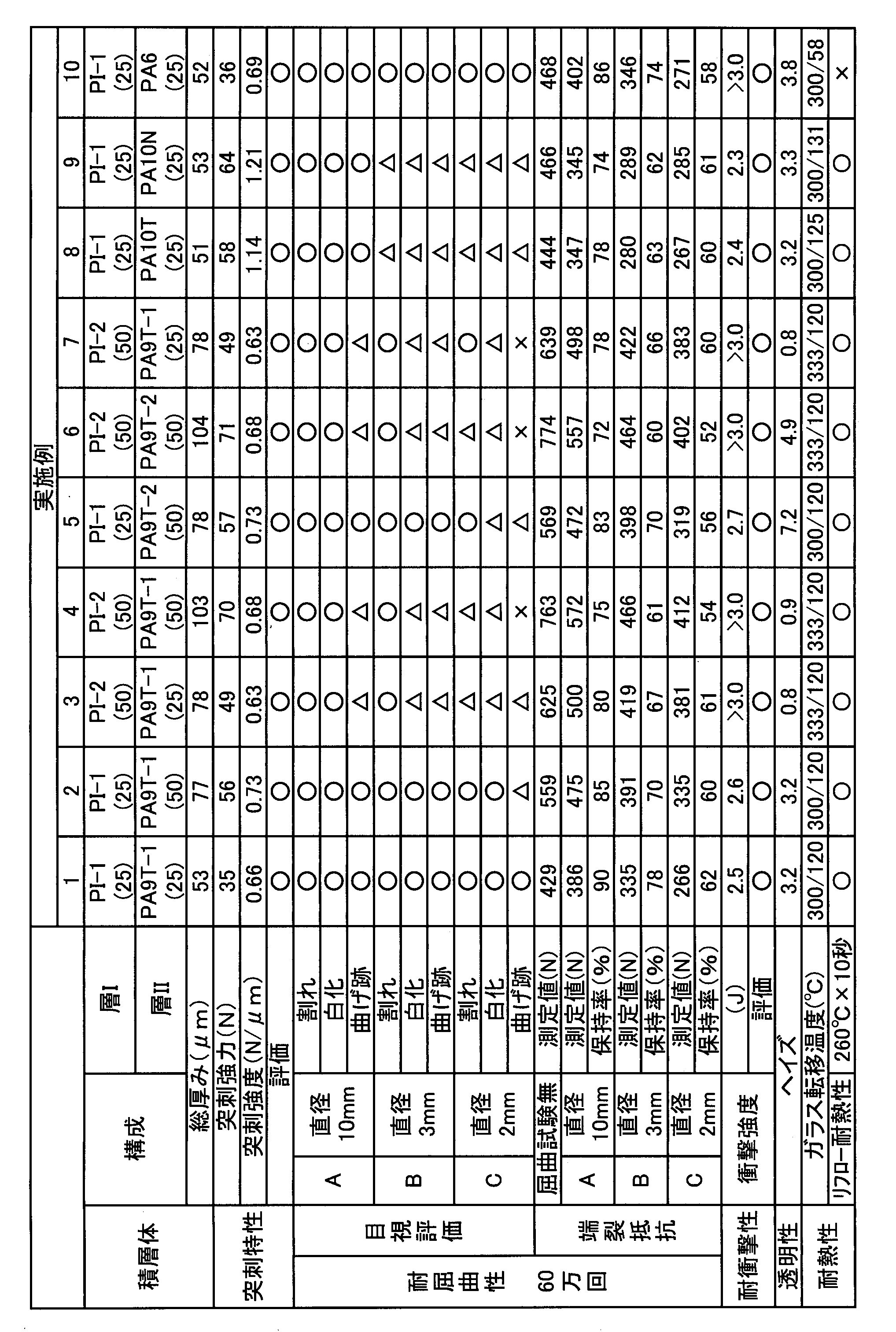
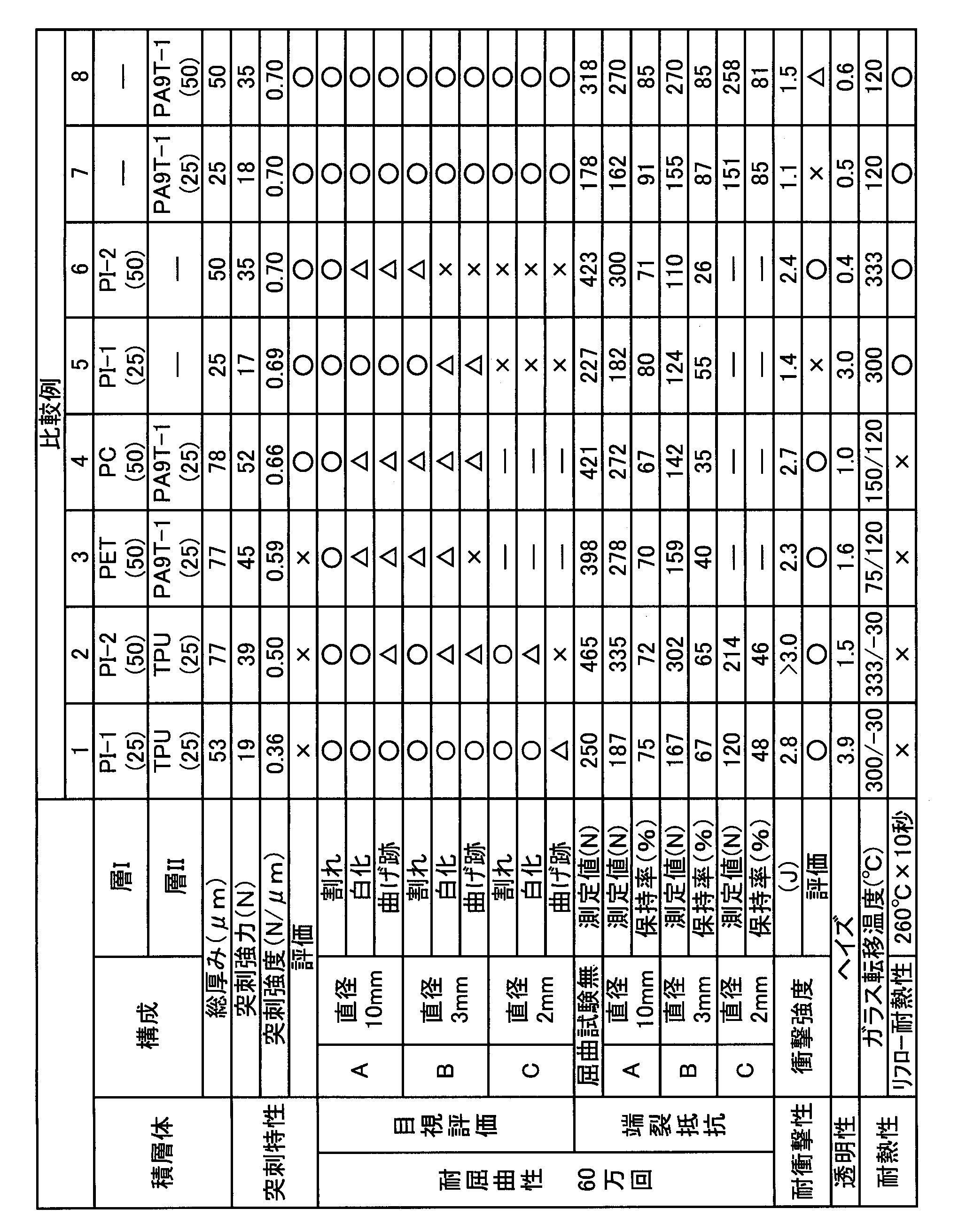

実施例1~10で得られた積層体は、ポリイミド系樹脂からなる層とポリアミド系樹脂からなる層とを含む構成であるため、耐突刺性、耐屈曲性に優れたものであった。一方、比較例1~2の積層体は、ポリアミド系樹脂からなる層を含まないため、また、比較例3~4の積層体は、ポリイミド系樹脂からなる層を含まないため、いずれも、耐突刺性と耐屈曲性とを同時に満足することができないものであった。
Claims (5)
- ポリイミド系樹脂からなる層と、ポリアミド系樹脂からなる層とを、それぞれ1層以上含む積層体であって、
突刺強度が0.60N/μm以上であり、
下記屈曲試験後に屈曲部において測定される端裂抵抗の保持率が70%以上であることを特徴とする積層体。
<屈曲試験>JIS K5600-5-1に準拠し、直径が10mmの円筒形マンドレルを用い、20℃×65%RH環境下、180°折り曲げを60万回繰り返し行う。 - 衝撃強度が2.0J以上であることを特徴とする請求項1記載の積層体。
- ポリアミド系樹脂が半芳香族ポリアミド樹脂であることを特徴とする請求項1または2記載の積層体。
- JIS K7105に準じて測定されるヘイズ値が8%以下であることを特徴とする請求項1~3のいずれかに記載の積層体。
- 請求項1~4のいずれかに記載の積層体を用いた画像表示装置。
Priority Applications (6)
| Application Number | Priority Date | Filing Date | Title |
|---|---|---|---|
| EP19902982.8A EP3904094A4 (en) | 2018-12-27 | 2019-12-25 | LAMINATE |
| KR1020217019086A KR20210110584A (ko) | 2018-12-27 | 2019-12-25 | 적층체 |
| CN201980085037.XA CN113226761A (zh) | 2018-12-27 | 2019-12-25 | 层叠体 |
| JP2020563340A JPWO2020138149A1 (ja) | 2018-12-27 | 2019-12-25 | 積層体 |
| US17/417,254 US20220088910A1 (en) | 2018-12-27 | 2019-12-25 | Laminate |
| SG11202106697TA SG11202106697TA (en) | 2018-12-27 | 2019-12-25 | Laminate |
Applications Claiming Priority (2)
| Application Number | Priority Date | Filing Date | Title |
|---|---|---|---|
| JP2018246320 | 2018-12-27 | ||
| JP2018-246320 | 2018-12-27 |
Publications (1)
| Publication Number | Publication Date |
|---|---|
| WO2020138149A1 true WO2020138149A1 (ja) | 2020-07-02 |
Family
ID=71129464
Family Applications (1)
| Application Number | Title | Priority Date | Filing Date |
|---|---|---|---|
| PCT/JP2019/050780 Ceased WO2020138149A1 (ja) | 2018-12-27 | 2019-12-25 | 積層体 |
Country Status (8)
| Country | Link |
|---|---|
| US (1) | US20220088910A1 (ja) |
| EP (1) | EP3904094A4 (ja) |
| JP (1) | JPWO2020138149A1 (ja) |
| KR (1) | KR20210110584A (ja) |
| CN (1) | CN113226761A (ja) |
| SG (1) | SG11202106697TA (ja) |
| TW (1) | TW202033371A (ja) |
| WO (1) | WO2020138149A1 (ja) |
Cited By (1)
| Publication number | Priority date | Publication date | Assignee | Title |
|---|---|---|---|---|
| JP2022134144A (ja) * | 2021-03-03 | 2022-09-15 | ユニチカ株式会社 | 積層体 |
Families Citing this family (2)
| Publication number | Priority date | Publication date | Assignee | Title |
|---|---|---|---|---|
| CN117207635A (zh) * | 2023-08-29 | 2023-12-12 | 上海鑫亘环保科技有限公司 | 一种tpu复合薄膜及其制备工艺和应用 |
| CN119502504B (zh) * | 2024-11-25 | 2025-09-12 | 江西民强新材料技术有限公司 | 一种聚酰亚胺基复合隔热薄膜叠层材料结构及其制备方法 |
Citations (3)
| Publication number | Priority date | Publication date | Assignee | Title |
|---|---|---|---|---|
| WO2018043627A1 (ja) * | 2016-09-01 | 2018-03-08 | 大日本印刷株式会社 | 光学フィルムおよび画像表示装置 |
| WO2018052104A1 (ja) * | 2016-09-15 | 2018-03-22 | ユニチカ株式会社 | 積層体 |
| JP2019051644A (ja) * | 2017-09-15 | 2019-04-04 | ユニチカ株式会社 | 積層体 |
Family Cites Families (3)
| Publication number | Priority date | Publication date | Assignee | Title |
|---|---|---|---|---|
| TWI506063B (zh) * | 2010-11-17 | 2015-11-01 | Unitika Ltd | 半芳香族聚醯胺膜,及其製造方法 |
| US10005264B2 (en) | 2015-12-15 | 2018-06-26 | 3M Innovative Properties Company | Thin protective display film |
| KR20180046422A (ko) * | 2016-10-27 | 2018-05-09 | 삼성디스플레이 주식회사 | 플렉시블 표시 장치 및 그 제조 방법 |
-
2019
- 2019-12-25 SG SG11202106697TA patent/SG11202106697TA/en unknown
- 2019-12-25 JP JP2020563340A patent/JPWO2020138149A1/ja active Pending
- 2019-12-25 US US17/417,254 patent/US20220088910A1/en not_active Abandoned
- 2019-12-25 WO PCT/JP2019/050780 patent/WO2020138149A1/ja not_active Ceased
- 2019-12-25 CN CN201980085037.XA patent/CN113226761A/zh active Pending
- 2019-12-25 KR KR1020217019086A patent/KR20210110584A/ko not_active Withdrawn
- 2019-12-25 EP EP19902982.8A patent/EP3904094A4/en not_active Withdrawn
- 2019-12-26 TW TW108147849A patent/TW202033371A/zh unknown
Patent Citations (3)
| Publication number | Priority date | Publication date | Assignee | Title |
|---|---|---|---|---|
| WO2018043627A1 (ja) * | 2016-09-01 | 2018-03-08 | 大日本印刷株式会社 | 光学フィルムおよび画像表示装置 |
| WO2018052104A1 (ja) * | 2016-09-15 | 2018-03-22 | ユニチカ株式会社 | 積層体 |
| JP2019051644A (ja) * | 2017-09-15 | 2019-04-04 | ユニチカ株式会社 | 積層体 |
Non-Patent Citations (1)
| Title |
|---|
| See also references of EP3904094A4 |
Cited By (2)
| Publication number | Priority date | Publication date | Assignee | Title |
|---|---|---|---|---|
| JP2022134144A (ja) * | 2021-03-03 | 2022-09-15 | ユニチカ株式会社 | 積層体 |
| JP7695685B2 (ja) | 2021-03-03 | 2025-06-19 | ユニチカ株式会社 | 積層体 |
Also Published As
| Publication number | Publication date |
|---|---|
| EP3904094A1 (en) | 2021-11-03 |
| EP3904094A4 (en) | 2022-02-16 |
| US20220088910A1 (en) | 2022-03-24 |
| CN113226761A (zh) | 2021-08-06 |
| TW202033371A (zh) | 2020-09-16 |
| JPWO2020138149A1 (ja) | 2021-11-11 |
| KR20210110584A (ko) | 2021-09-08 |
| SG11202106697TA (en) | 2021-07-29 |
Similar Documents
| Publication | Publication Date | Title |
|---|---|---|
| JP5881614B2 (ja) | 半芳香族ポリアミドフィルム、およびその製造方法 | |
| JP2019099626A (ja) | 熱可塑性樹脂フィルムおよび積層体 | |
| CN105431471B (zh) | 含有me-bht的聚酰胺,含有此类聚酰胺的组合物,含有此类聚酰胺或此类组合物的成型物品 | |
| KR102046699B1 (ko) | 폴리이미드계 광학 필름, 그의 제조 방법 및 유기 일렉트로루미네센스 디스플레이 | |
| CN107443645B (zh) | 透明树脂膜的制造方法和具有透明树脂膜的层叠体的制造方法 | |
| TWI856210B (zh) | 柔軟性聚醯胺膜 | |
| CN102369233A (zh) | 低热膨胀性嵌段聚酰亚胺及其前驱体和其用途 | |
| JP5842824B2 (ja) | ポリアミド樹脂フィルム及びその製造方法 | |
| JPWO2020138149A1 (ja) | 積層体 | |
| JP6494844B1 (ja) | 樹脂フィルムの製造方法および微小キズが少ない樹脂フィルム | |
| JP2019051644A (ja) | 積層体 | |
| JP2024530415A (ja) | 表面硬度と復元性が向上した積層フィルムおよびそれを含むディスプレイ装置 | |
| JP2015013986A (ja) | ポリマーおよびフィルム | |
| CN118339219A (zh) | 热塑性树脂膜 | |
| JP6494845B1 (ja) | 樹脂フィルムの製造方法 | |
| JP7193198B1 (ja) | 半芳香族ポリアミドフィルムおよびそれより得られる積層体 | |
| JP7695685B2 (ja) | 積層体 | |
| JP2024009620A (ja) | 延伸ポリアミドフィルム | |
| JP2019151093A (ja) | 樹脂フィルムの製造方法 | |
| JP2025041528A (ja) | ポリアミドおよびその製造方法ならびにポリアミドを含むフィルム | |
| WO2018117465A1 (ko) | 폴리아미드이미드 공중합체 및 이를 포함하는 무색 투명한 폴리아미드이미드 필름 |
Legal Events
| Date | Code | Title | Description |
|---|---|---|---|
| 121 | Ep: the epo has been informed by wipo that ep was designated in this application |
Ref document number: 19902982 Country of ref document: EP Kind code of ref document: A1 |
|
| ENP | Entry into the national phase |
Ref document number: 2020563340 Country of ref document: JP Kind code of ref document: A |
|
| NENP | Non-entry into the national phase |
Ref country code: DE |
|
| ENP | Entry into the national phase |
Ref document number: 2019902982 Country of ref document: EP Effective date: 20210727 |