WO2020138341A1 - ビニルアルコール系重合体、及びビニルアルコール系重合体の製造方法 - Google Patents
ビニルアルコール系重合体、及びビニルアルコール系重合体の製造方法 Download PDFInfo
- Publication number
- WO2020138341A1 WO2020138341A1 PCT/JP2019/051248 JP2019051248W WO2020138341A1 WO 2020138341 A1 WO2020138341 A1 WO 2020138341A1 JP 2019051248 W JP2019051248 W JP 2019051248W WO 2020138341 A1 WO2020138341 A1 WO 2020138341A1
- Authority
- WO
- WIPO (PCT)
- Prior art keywords
- vinyl alcohol
- ppm
- alcohol polymer
- integrated value
- vinyl
- Prior art date
- Legal status (The legal status is an assumption and is not a legal conclusion. Google has not performed a legal analysis and makes no representation as to the accuracy of the status listed.)
- Ceased
Links
Images




Classifications
-
- C—CHEMISTRY; METALLURGY
- C08—ORGANIC MACROMOLECULAR COMPOUNDS; THEIR PREPARATION OR CHEMICAL WORKING-UP; COMPOSITIONS BASED THEREON
- C08F—MACROMOLECULAR COMPOUNDS OBTAINED BY REACTIONS ONLY INVOLVING CARBON-TO-CARBON UNSATURATED BONDS
- C08F16/00—Homopolymers and copolymers of compounds having one or more unsaturated aliphatic radicals, each having only one carbon-to-carbon double bond, and at least one being terminated by an alcohol, ether, aldehydo, ketonic, acetal or ketal radical
- C08F16/02—Homopolymers and copolymers of compounds having one or more unsaturated aliphatic radicals, each having only one carbon-to-carbon double bond, and at least one being terminated by an alcohol, ether, aldehydo, ketonic, acetal or ketal radical by an alcohol radical
- C08F16/04—Acyclic compounds
- C08F16/06—Polyvinyl alcohol ; Vinyl alcohol
-
- C—CHEMISTRY; METALLURGY
- C08—ORGANIC MACROMOLECULAR COMPOUNDS; THEIR PREPARATION OR CHEMICAL WORKING-UP; COMPOSITIONS BASED THEREON
- C08F—MACROMOLECULAR COMPOUNDS OBTAINED BY REACTIONS ONLY INVOLVING CARBON-TO-CARBON UNSATURATED BONDS
- C08F8/00—Chemical modification by after-treatment
- C08F8/48—Isomerisation; Cyclisation
-
- C—CHEMISTRY; METALLURGY
- C08—ORGANIC MACROMOLECULAR COMPOUNDS; THEIR PREPARATION OR CHEMICAL WORKING-UP; COMPOSITIONS BASED THEREON
- C08F—MACROMOLECULAR COMPOUNDS OBTAINED BY REACTIONS ONLY INVOLVING CARBON-TO-CARBON UNSATURATED BONDS
- C08F14/00—Homopolymers and copolymers of compounds having one or more unsaturated aliphatic radicals, each having only one carbon-to-carbon double bond, and at least one being terminated by a halogen
- C08F14/02—Monomers containing chlorine
- C08F14/04—Monomers containing two carbon atoms
- C08F14/06—Vinyl chloride
-
- C—CHEMISTRY; METALLURGY
- C08—ORGANIC MACROMOLECULAR COMPOUNDS; THEIR PREPARATION OR CHEMICAL WORKING-UP; COMPOSITIONS BASED THEREON
- C08F—MACROMOLECULAR COMPOUNDS OBTAINED BY REACTIONS ONLY INVOLVING CARBON-TO-CARBON UNSATURATED BONDS
- C08F2/00—Processes of polymerisation
- C08F2/12—Polymerisation in non-solvents
- C08F2/16—Aqueous medium
- C08F2/18—Suspension polymerisation
-
- C—CHEMISTRY; METALLURGY
- C08—ORGANIC MACROMOLECULAR COMPOUNDS; THEIR PREPARATION OR CHEMICAL WORKING-UP; COMPOSITIONS BASED THEREON
- C08F—MACROMOLECULAR COMPOUNDS OBTAINED BY REACTIONS ONLY INVOLVING CARBON-TO-CARBON UNSATURATED BONDS
- C08F2/00—Processes of polymerisation
- C08F2/12—Polymerisation in non-solvents
- C08F2/16—Aqueous medium
- C08F2/18—Suspension polymerisation
- C08F2/20—Suspension polymerisation with the aid of macromolecular dispersing agents
-
- C—CHEMISTRY; METALLURGY
- C08—ORGANIC MACROMOLECULAR COMPOUNDS; THEIR PREPARATION OR CHEMICAL WORKING-UP; COMPOSITIONS BASED THEREON
- C08F—MACROMOLECULAR COMPOUNDS OBTAINED BY REACTIONS ONLY INVOLVING CARBON-TO-CARBON UNSATURATED BONDS
- C08F216/00—Copolymers of compounds having one or more unsaturated aliphatic radicals, each having only one carbon-to-carbon double bond, and at least one being terminated by an alcohol, ether, aldehydo, ketonic, acetal or ketal radical
- C08F216/02—Copolymers of compounds having one or more unsaturated aliphatic radicals, each having only one carbon-to-carbon double bond, and at least one being terminated by an alcohol, ether, aldehydo, ketonic, acetal or ketal radical by an alcohol radical
- C08F216/04—Acyclic compounds
- C08F216/06—Polyvinyl alcohol ; Vinyl alcohol
-
- C—CHEMISTRY; METALLURGY
- C08—ORGANIC MACROMOLECULAR COMPOUNDS; THEIR PREPARATION OR CHEMICAL WORKING-UP; COMPOSITIONS BASED THEREON
- C08F—MACROMOLECULAR COMPOUNDS OBTAINED BY REACTIONS ONLY INVOLVING CARBON-TO-CARBON UNSATURATED BONDS
- C08F8/00—Chemical modification by after-treatment
- C08F8/06—Oxidation
Definitions
- the present invention relates to a vinyl alcohol-based polymer and a method for producing a vinyl alcohol-based polymer.
- Polyvinyl chloride is generally produced by suspension polymerization of vinyl chloride monomers. Suspension polymerization is often carried out by dispersing a vinyl chloride monomer in water using a dispersant such as polyvinyl alcohol. Various studies have been conducted on dispersants from the viewpoint of suppressing foaming during polymerization and the production of polyvinyl chloride having a desired average particle diameter. For example, JP-A-2005-350557 (Patent Document 1) describes that when a dispersant for suspension polymerization containing a polyvinyl alcohol-based resin and a specific compound is used, foaming during polymerization can be suppressed. There is.
- Patent Document 2 JP-A-2001-026604 (Patent Document 2), by using a dispersant for suspension polymerization of a vinyl compound composed of a modified polyvinyl alcohol containing 1 to 10 mol% of an ⁇ -olefin unit having 4 or less carbon atoms, It is described that a polyvinyl chloride composed of uniform porous particles can be obtained.
- a dispersant for suspension polymerization of vinyl chloride monomer in addition to the above-mentioned properties such as suppressing foaming during polymerization, while increasing the average particle size of polyvinyl chloride to be produced in an appropriate range, it has a high bulk density.
- a dispersant that can.
- the processability such as the volume of the container required for storage is reduced and the molding speed is increased during molding such as extrusion molding is improved.
- a conventional dispersant for suspension polymerization it is difficult to increase the bulk density while keeping the average particle size of polyvinyl chloride produced in an appropriate range, and there is room for improvement.
- Integrated value of peak (d) Integrated value of peak confirmed at 7.56 to 7.81 ppm
- e Integrated value of peak confirmed at 7.82 to 8.04 ppm
- Saponification degree is 65 to 80 mol %
- the residual ester group has a block character of 0.45 to 0.62
- the ratio a1/a2 of the absorbance a1 of the 0.1% by mass aqueous solution at a wavelength of 280 nm and the absorbance a2 of the aqueous solution at a wavelength of 320 nm is 1.6 or less.
- [3] The vinyl alcohol polymer according to the above [1] or [2], wherein the ratio (Mw/Mn) of the weight average molecular weight Mw to the number average molecular weight Mn is 2.6 to 14.
- [4] The above-mentioned [1] to [3], wherein the residual ester group has a 2 chain/3 chain ratio of 0.7 to 1.3 and the hydroxyl group has a 2 chain/3 chain ratio of 2.0 to 3.5.
- [5] The vinyl alcohol polymer according to any one of the above [1] to [4], wherein the residual ester group is an acetoxy group.
- a method for producing a vinyl alcohol polymer which comprises at least the following steps (1) to (3). Step (1) Step of polymerizing vinyl ester monomer to produce polyvinyl ester Step (2) Step of saponifying the polyvinyl ester to produce partially saponified polyvinyl ester Step (3) Partially saponified Step [11] of melt-kneading polyvinyl ester at a heating temperature of 185 to 250° C.
- the melt-kneading of the step (3) is performed in the presence of an oxidizing agent, and the mixing amount of the oxidizing agent is The method for producing a vinyl alcohol polymer according to the above [10], which is 2 parts by mass or less based on 100 parts by mass of the polyvinyl ester.
- Resin particles comprising the vinyl alcohol polymer according to any one of the above [1] to [9].
- the resin particles according to the above [12] in which 95% or more of the particles have a particle diameter of 1.7 mm or more.
- the integrated value (c) is 30 to 50 and the integrated value (d) is 0.8 when the total of the following integrated values (a) to (e) is set to 100.
- Integrated value of peak (d) Integrated value of peak confirmed at 7.56 to 7.81 ppm
- e Integrated value of peak confirmed at 7.82 to 8.04 ppm
- [15] As described in [14] above Resin particles made of vinyl alcohol polymer. [16] The resin particles according to the above [15], wherein 95% or more of the particles have a particle diameter of 1.7 mm or more.
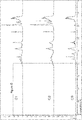
- 1 is a 1 H-NMR spectrum of S1 to S4 obtained in each example.
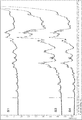
- 3 is a 1 H-NMR spectrum of S5 to S7 obtained in each example.
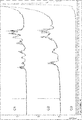
- 1 is a 1 H-NMR spectrum of C1 to C3 obtained in each comparative example. It is the figure which expanded a part of FIG. It is the figure which expanded a part of FIG. It is the figure which expanded a part of FIG.
- FIG. 3 is a diagram showing integrated values (a) to (e) in the 1 H-NMR spectrum of S1.
- the vinyl alcohol-based polymer in the 1 H-NMR spectrum, has an integrated value (e) within a specific range when the sum of the integrated values (a) to (e) below is 100. Or the integrals (c) and (d) have a specific range. Preferably, all of the integrated values (a) to (e) have values in a specific range.
- the vinyl alcohol-based polymer which is one embodiment of the present invention is produced through a step of partially saponifying polyvinyl ester.
- Polyvinyl ester is a polymer of vinyl ester monomers such as vinyl formate, vinyl acetate, vinyl propionate, vinyl butyrate, vinyl pivalate, and vinyl versatate.
- the vinyl alcohol-based polymer produced through the step of partially saponifying a polyvinyl ester has a structural unit represented by the following formula (1) and represented by (u1) to (u3). .. u1 is a structural unit having a carbonyl group and a double bond, u2 is a structural unit having a residual ester group, and u3 is a structural unit having a hydroxyl group.
- OCOR is a residual ester group
- X, y, and z are not zero.
- the molecular chain has an ester, a hydroxyl group, a carbonyl group, and a double bond close to the carbonyl group.
- the double bond is a single double bond or a conjugated double bond having two or more double bonds, and both of them may be present in the vinyl alcohol polymer.
- n is preferably 1 to 5, and more preferably 1 to 3.
- R is a hydrogen atom or an alkyl group having 1 to 20 carbon atoms.
- polyvinyl acetate as the polyvinyl ester, and in this case, the residual ester group represents an acetoxy group.
- the integrated values (a) to (e) in the 1 H-NMR spectrum are peaks derived from the proton ( 1 H) bonded to the carbon of the double bond of the formula (u1).
- the vinyl alcohol-based polymer which is one embodiment of the present invention, has a specific combination of integrated values (a) to (e), or all of the integrated values (a) to (e) are within a specific numerical range.
- the vinyl alcohol-based polymer is unique in the type, number, sequence, etc. of the double structure such as single or conjugated. When a vinyl alcohol-based polymer having such a specific structure is used as a dispersant for polyvinyl chloride suspension polymerization, it is possible to obtain polyvinyl chloride having an average particle size in an appropriate range and a high bulk density. You can
- the vinyl alcohol-based polymer satisfies the following condition (I).
- condition (I) When the total of the integrated values (a) to (e) is 100, the integrated value (e) is 0.8 to 20.
- Integrated value of peak (d) Integrated value of peak confirmed at 7.56 to 7.81 ppm
- e Integrated value of peak confirmed at 7.82 to 8.04 ppm
- the system polymer is used as a dispersant for suspension polymerization of polyvinyl chloride, it is possible to obtain polyvinyl chloride having an average particle size in an appropriate range and a high bulk density.
- the integrated value (e) is preferably 0.8 to 15, more preferably 0.8 to 10, and further preferably from the viewpoint of further increasing the bulk density and further improving the dispersibility of polyvinyl chloride. It is 0.9 to 9, even more preferably 0.95 to 8, and particularly preferably 1 to 7.
- the vinyl alcohol-based polymer satisfies the following condition (II).
- the integral value (c) is 30 to 50 and the integral value (d) is 0.8 to 10, when the total of the integral values (a) to (e) is 100.
- Integrated value of peak (d) Integrated value of peak confirmed at 7.56 to 7.81 ppm
- e Integrated value of peak confirmed at 7.82 to 8.04 ppm
- the integrated value (c) is preferably 30 to 45, more preferably 30 to 40, and further preferably 30 to 45, from the viewpoint of further increasing the bulk density and further improving the dispersibility of polyvinyl chloride. It is preferably 30 to 38, more preferably 30 to 37.
- the integrated value (d) is preferably 0.8 to 8 and more preferably 0.8 from the viewpoint of further increasing the bulk density and further improving the dispersibility of polyvinyl chloride. 7 to 7, more preferably 0.8 to 6, still more preferably 0.9 to 5.5, and particularly preferably 0.95 to 5.3.
- a vinyl alcohol polymer that does not satisfy both the conditions (I) and (II) is difficult to obtain polyvinyl chloride having a high bulk density even when used as a dispersant for suspension polymerization of polyvinyl chloride.
- the vinyl alcohol-based polymer further satisfies the condition (III).
- condition (III) When the total of the integrated values (a) to (e) is 100, the integrated value (a) is 1 to 10 and the integrated value (b) is 20 to 70.
- the bulk density is from the viewpoint of further increasing and further improving the dispersibility of polyvinyl chloride, the integrated value (a) is preferably 1 to 8, more preferably 1 to 5, and still more preferably 1 to 4.
- the integrated value (b) is preferably from 30 to 65, more preferably from 40 to 65, and further from the viewpoint of further increasing the bulk density and further improving the dispersibility of polyvinyl chloride. It is preferably 45 to 63, even more preferably 48 to 60, particularly preferably 48 to 59.
- the vinyl alcohol polymer which is one embodiment of the present invention, satisfies both the conditions (I) and (II) from the viewpoint of further increasing the bulk density and further improving the dispersibility of polyvinyl chloride. It is preferable that both of the conditions (I) and (III) are satisfied, or that both of the conditions (II) and (III) are satisfied, and that all of the conditions (I), (II), and (III) are satisfied. More preferable.
- the above integrated values (a) to (e) can be adjusted depending on the production conditions when producing the vinyl alcohol-based polymer. Specifically, as will be described later, the presence or absence of peroxide, heat treatment It can be adjusted depending on the production conditions such as the presence or absence of, the heating temperature and the heat treatment time.
- the vinyl alcohol polymer according to one embodiment of the present invention preferably has a saponification degree of 65 to 80 mol %.
- the degree of saponification is more preferably 70 to 80 mol %.
- the degree of saponification can be measured according to JIS K6726.
- the block character of the residual ester group of the vinyl alcohol-based polymer according to one embodiment of the present invention is preferably 0.45 to 0.62, more preferably 0.45 to 0.6, and more preferably 0. It is more preferably 45 to 0.55, particularly preferably 0.45 to 0.5. With such a value, the bulk density of polyvinyl chloride produced by using the vinyl alcohol polymer as a dispersant for suspending polyvinyl chloride is likely to increase.
- the block character usually takes a value of 0 to 2, and the closer it is to 0, the higher the blockiness of the residual ester group distribution is. The closer it is to 1, the higher the randomness is. It is high.
- the block character ( ⁇ ) of the residual ester group is an index showing the distribution of the residual ester group of the vinyl alcohol-based polymer, and is determined by analyzing the peak appearing in the methine region in the 1 H-NMR spectrum.
- the above-mentioned peaks are each split into three due to the three-chain structure in which the adjacent substituent is a hydroxyl group (O) or a residual ester group (A).
- the block character ( ⁇ ) is represented by the following (Formula 1).
- the residual ester group (A) represents a residual acetoxy group (OAc group) when vinyl acetate is used as a raw material.
- the solvent and water mixed in the sample may interfere with each other, and the spectrum area may not be obtained accurately.
- the water peak is removed by adding 0.5 wt% of deuterated trifluoroacetic acid to the sample and shifting the water peak, or by adding a pulse series that saturates the water peak during NMR measurement. There is. Further, the details of measurement/analysis are described in a prior document (Macromolecules, 1982, 15, 1071).
- the vinyl alcohol-based polymer which is one embodiment of the present invention, has an absorbance a1 of a 0.1 mass% aqueous solution at a wavelength of 280 nm and an absorbance a2 of a 0.1 mass% aqueous solution of a vinyl alcohol-based polymer at a wavelength of 320 nm. It is preferable that the ratio (a1/a2) of the above is within a certain range.
- the vinyl alcohol-based polymer which is one embodiment of the present invention has a double bond. A part of the double bond forms a conjugated double bond along the polymer main chain adjacent to the carbonyl group, as shown in the following formulas (2) and (3).
- Formula (2) represents a conjugated double bond having two double bonds close to the carbonyl group in the vinyl alcohol-based polymer
- formula (3) represents 3 in the vicinity of the carbonyl group in the vinyl alcohol-based polymer. It represents a conjugated double bond having two double bonds.
- X1 of the formula (2) and x2 of the formula (3) are synonymous with x of the formula (1), respectively.
- the absorbance a1 at a wavelength of 280 nm is based on a conjugated double bond having two double bonds close to the carbonyl group represented by the above formula (2). The more conjugated double bonds there are, the more the value of a1 is.
- the absorbance a2 at a wavelength of 320 nm is based on a conjugated double bond having three double bonds close to the carbonyl group represented by the above formula (3). The more conjugated double bonds, the value of a2. Grows.
- a1/a2 is preferably 1.6 or less, more preferably 1.5 or less, and preferably 1.0 or more, more preferably 1.2 or more, still more preferably 1.3 or more.
- the absorbance a1 is preferably 0.15 to 0.70, more preferably 0.20 to 0.60 from the viewpoint of improving the dispersibility of polyvinyl chloride.
- the absorbance a2 is preferably 0.10 to 0.50, more preferably 0.15 to 0.40 from the viewpoint of improving the dispersibility of polyvinyl chloride.
- the saponification degree described above, the block character of the residual ester group, the ratio a1/a2 of the absorbance a1 at 280 nm and the absorbance a2 at 320 nm are both within the above ranges. It is preferable that These are the polymerization conditions of the vinyl ester monomer, the conditions of partial saponification, the presence or absence of peroxide, the presence or absence of heat treatment, the heating temperature, the heat treatment time, etc. when producing the vinyl alcohol-based polymer described below. It can be adjusted according to the manufacturing conditions. The same applies to adjustment of various measured values such as Mw/Mn, 2 chain/3 chain ratio, and viscosity described later.
- the ratio (Mw/Mn) of the weight average molecular weight Mw to the number average molecular weight Mn of the vinyl alcohol polymer according to one embodiment of the present invention is preferably 2.0 to 18, and 2.6 to 14. More preferably, it is more preferably 2.8-14.
- the ratio of 2 chains to 3 chains of the residual ester group (2 chains/3 chains ratio) is preferably 0.7 to 1.3.
- the 3-chain residual ester group is the proportion of three consecutive structural units having a residual ester group in the vinyl alcohol-based polymer
- the 2-chain residual ester group is the vinyl alcohol-based heavy chain. It is the ratio in which two structural units having a residual ester group are continuously present in the united body.
- the ratio of 2 chains to 3 chains of hydroxyl groups (2 chains/3 chains ratio) is preferably 2.0 to 3.5, and 2.1 to 3 It is more preferably 0.3, and even more preferably 2.2 to 3.0.
- the 3-chain hydroxyl group is the proportion of three consecutive structural units having a hydroxyl group in the vinyl alcohol-based polymer
- the 2-chain hydroxyl group is a vinyl alcohol-based polymer having a hydroxyl group. It is the ratio of two consecutive structural units.
- each of these 2 chains and 3 chains is obtained by 1 H-NMR measurement.
- the integration ratio of each peak of a 1.0 wt% DMSO-d6 solution of the target sample at 400 MHz at 1 H-NMR measurement is measured. It can be calculated by the ratio.
- the peak integrated value of each chemical shift is defined as follows, it is calculated by the following calculation formula.
- O represents a hydroxyl group
- A represents an acetyl group
- the underline represents a substituent to be integrated.
- [O A O] (relative amount of acetyl groups sandwiched between hydroxyl groups): 5.04 to 5.19 ppm [A A O+O A A] (relative amount of acetyl group sandwiched between hydroxyl group and acetyl group): 4.90-5.05 ppm [A A A] (relative amount of acetyl groups sandwiched by acetyl groups): 4.69-4.91 ppm [O O O] (relative amount of hydroxyl sandwiched hydroxyl): 3.75-4.15ppm [A 2 O 3 +O 2 O A] (relative amount of hydroxyl group sandwiched between hydroxyl group and acetyl group): 3.60-3.76 ppm [A O A] (relative amount of hydroxyl groups sandwiched by acetyl groups): 3.34 to 3.61 ppm
- the vinyl alcohol-based polymer which is one embodiment of the present invention, is an undissolved substance when the concentration of the vinyl alcohol-based polymer is 7% by mass and the aqueous solution dissolved at 5° C. for 12 hours is filtered through a 200 mesh filter. It is preferable that the component remaining on the filter is less than 0.1%.
- Such a vinyl alcohol-based polymer having a small amount of undissolved substance is excellent in solubility and handleability as a dispersant.
- the viscosity of the vinyl alcohol-based polymer which is one embodiment of the present invention, is not particularly limited, but from the viewpoint of stability of the suspension and the like, the viscosity of a 4% by mass aqueous solution of the vinyl alcohol-based polymer is 5 to 9 cP. It is preferably 6 to 7.5 cP, and more preferably 6 to 7.5 cP.
- the viscosity is a value at 20° C., and the viscosity can be measured using a Brookfield viscometer (type LVDV-II+Pro).
- the yellowness index (YI) of a 4% by mass aqueous solution of the vinyl alcohol polymer according to one embodiment of the present invention is preferably 30 to 80, and more preferably 35 to 70.
- the yellowness index (YI) has a correlation with the conjugated double bond component in which n in the above formula (1) is 4 or more.
- the yellowness index (YI) is 30 or more, the grafting efficiency of the vinyl chloride monomer during the polyvinyl chloride polymerization reaction increases, so that the particle size and bulk density can be easily controlled as desired.
- the yellowness index (YI) is 80 or less, the side reaction does not proceed excessively and is easily dissolved in water to improve the production efficiency. Note that the yellowness index (YI) can be obtained according to ASTM standard D1925.
- the vinyl alcohol-based polymer which is one embodiment of the present invention is preferably resin particles made of the vinyl alcohol-based polymer.
- the polyvinyl chloride obtained by using the resin particles as a dispersant for suspension polymerization of polyvinyl chloride has a good quality with less generation of sardines (spun powder, lumps).
- the average particle diameter of the resin particles is preferably 0.8 to 3.0 mm, and the weight ratio of particles having a particle diameter of 1.7 mm or more is preferably 95% or more. When the average particle diameter of the resin particles is 0.8 mm or more, coalescence of the resin particles is suppressed during melting, and lumps are less likely to occur.
- the average particle diameter of the resin particles is 3.0 mm or less, the resin particles are completely dissolved in a short time, and as a result, the productivity of polyvinyl chloride polymerization can be improved.
- the weight ratio of particles having a particle diameter of 1.7 mm or more is such that 100 g of resin particles are placed on a sieve having a mesh diameter of 1.7 mm, the lid is shaken for 5 minutes, and the resin remaining on the sieve It can be measured by evaluating the weight ratio of the resin that has passed through the sieve.
- the method for producing the resin particles is not particularly limited, but preferably, as described below, the vinyl alcohol-based polymer is extruded into a strand shape by an extruder, and after air cooling, pelletized by cutting with a strand cutter, and resin particles. Should be manufactured.
- the vinyl alcohol polymer according to one embodiment of the present invention and the resin particles comprising the vinyl alcohol polymer can be preferably used as a dispersant for polyvinyl chloride suspension polymerization.
- the production method of the vinyl alcohol polymer which is one embodiment of the present invention, is not limited, but it is preferably produced by the production method including the following steps (1) to (3).
- Step (1) A step of polymerizing a vinyl ester monomer to produce a polyvinyl ester
- Step (2) A step of partially saponifying the polyvinyl ester to produce a partially saponified polyvinyl ester
- Step (3) A step of melt-kneading the partially saponified polyvinyl ester at a heating temperature of 185 to 250° C. for a heating time of 1 to 10 minutes
- the step (1) is a step of polymerizing a vinyl ester monomer to produce a polyvinyl ester.
- the above reaction formula (I) is a simplified reaction formula used for explaining the step (1), and shows a reaction formula when vinyl acetate (VAM) is used as the vinyl ester monomer. .. Ac represents an acetyl group.
- examples of the vinyl ester monomer include vinyl formate, vinyl acetate, vinyl propionate, vinyl butyrate, vinyl pivalate, vinyl versatate and the like.
- the vinyl ester monomer may be used alone or in combination of two or more. Among these, it is preferable to use at least vinyl acetate, and it is more preferable to use only vinyl acetate.
- the polymerization can be carried out in the substantial absence of olefin comonomers such as ethylene, propylene, or styrene. Further, the polymerization can be carried out in the absence or in the substantial absence of chain transfer agents such as aldehydes and ketones.
- substantially absent means not intentionally added.
- Examples of the polymerization method include known methods such as a bulk polymerization method, a solution polymerization method, a suspension polymerization method and an emulsion polymerization method.
- the polymerization can be carried out at about ⁇ 80 to 300° C., and a polymerization initiator such as peroxide or azoisobutyronitrile can be used.
- the step (2) is a step of partially saponifying the polyvinyl ester obtained in the step (1) to produce a partially saponified polyvinyl ester.
- the above reaction formula (II) is a simplified reaction formula used for explaining the step (2), and the reaction of the step (2) when vinyl acetate (VAM) is used as the vinyl ester monomer. Shows the formula.
- a part of the ester group is saponified to be a hydroxyl group.
- the reaction temperature in step (2) is, for example, 10 to 70° C., preferably about 20 to 50° C.
- Partial saponification can be carried out by bringing the polyvinyl ester into contact with an alkali compound for transesterification or direct hydrolysis.
- alkali compound examples include alkali metal hydroxides such as potassium hydroxide, sodium hydroxide and lithium hydroxide, and alkali metal alkoxides such as sodium methoxide, sodium ethoxide, potassium methoxide, potassium ethoxide and potassium t-butoxide. Etc.
- the amount of the alkali compound used is not particularly limited, but is preferably 0.0005 to 0.01 mol, and more preferably 0.001 to 0.003 mol, relative to 1 mol of the polyvinyl ester.
- alcohols such as methanol, ethanol, isopropanol, n-propyl alcohol, n-butanol, isobutanol, sec-butanol, t-butanol, amyl alcohol, cyclohexanol, tetrahydrofuran, dioxane, etc.
- Cyclic ethers ketones such as acetone, methyl ethyl ketone, methyl isobutyl ketone, and pinacholine, sulfoxides such as dimethyl sulfoxide, hydrocarbons such as toluene, benzene, n-hexane, and cyclohexane.
- the partially saponified polyvinyl ester is preferably isolated and dried to obtain a powdered partially saponified polyvinyl ester for further processing.
- the step (3) is a step of melt-kneading the partially saponified polyvinyl ester at a heating temperature of 185 to 250° C. for a heating time of 1 to 10 minutes.
- the above reaction formula (III) is a simplified reaction formula used for explaining the step (3), and the reaction of the step (3) when vinyl acetate (VAM) is used as the vinyl ester monomer. Shows the formula.
- OAc represents an acetoxy group
- step (3) a double bond and a carbonyl group are introduced into the polymer main chain.
- the double bond is a single double bond or a conjugated double bond having two or more double bonds, and both of them may be present in the vinyl alcohol polymer.
- n is preferably 1 to 5, and more preferably 1 to 3.
- the partially saponified polyvinyl ester obtained in step (2) is melt-kneaded at a heating temperature of 185 to 250° C. for a heating time of 1 to 10 minutes. By performing melt-kneading at a heating temperature of 185° C. or higher, it becomes easy to adjust the above-mentioned integral values (a) to (e) in the 1 H-NMR spectrum to the desired ranges described above.
- the heating temperature is preferably 190 to 245° C.
- the heating time is preferably 2 to 8 minutes.
- the means for performing the melt kneading is not particularly limited, but it is preferable to use an extruder.
- the extruder may be a single-screw extruder or a twin-screw extruder, but it is preferable to use a twin-screw extruder.
- a twin-screw extruder is used, the powdery partially saponified polyvinyl ester obtained in step (2) is easily melt-kneaded, and a desired vinyl alcohol-based polymer is easily obtained.
- the melt kneading is preferably performed in the presence of an oxidizing agent.
- an oxidizing agent By performing melt-kneading in the presence of an oxidizing agent, it becomes easy to adjust the above-mentioned integral values (a) to (e) in the 1 H-NMR spectrum to the desired ranges described above.
- the compounding amount of the oxidizing agent is preferably 2 parts by mass or less, more preferably 1 part by mass or less, and preferably 0.1 part by mass or more with respect to 100 parts by mass of the polyvinyl ester.
- the oxidizing agent may be diluted with a solvent such as water, methanol or methyl acetate and added, and in this case, it is preferable to add it as an aqueous solution.
- the addition of the oxidizing agent is not particularly limited, but it is preferably carried out while kneading at a temperature of 10°C to less than 185°C in consideration of the half-life temperature of the corresponding oxidizing agent.
- the oxidizing agent When the oxidizing agent is diluted with a solvent, it is preferable to add it at a boiling point or lower in consideration of the boiling point of the solvent, particularly 100° C. or lower for an aqueous solution.
- an extruder When an extruder is used, it is preferable to add an oxidizing agent by providing the extruder with an oxidizing agent charging port.
- the oxidizing agent include various acids, peroxides, perchlorates, chlorinated isocyanurates and the like. Among these, as the oxidizing agent, peroxide type oxidizing agents such as hydrogen peroxide and peracetic acid are preferable, and hydrogen peroxide is more preferable.
- step (3) by-products of the reaction such as esters such as methyl acetate, carboxylic acids such as acetic acid, and water may be removed as necessary.
- esters such as methyl acetate
- carboxylic acids such as acetic acid
- water may be removed as necessary.
- an extruder equipped with a vacuum vent may be used.
- the vinyl alcohol polymer according to one embodiment of the present invention is obtained.
- the step (3) is performed by an extruder, it is preferable that the vinyl alcohol polymer is extruded in a strand shape by the extruder, air-cooled, and then cut by a strand cutter to be pelletized to obtain resin particles.
- the polyvinyl chloride obtained by using the resin particles as a dispersant for suspension polymerization of polyvinyl chloride has a good quality with less generation of sardines (spun powder, lumps).
- the vinyl alcohol polymer according to one embodiment of the present invention can be used as a dispersant for suspension polymerization of polyvinyl chloride.
- a method for producing polyvinyl chloride using the vinyl alcohol polymer as a dispersant for example, the following may be performed.
- the step of mixing the vinyl alcohol-based polymer, the vinyl chloride monomer, and water to form a suspension which is one embodiment of the present invention, and then the step of polymerizing the vinyl chloride monomer may be performed.
- the order of adding the vinyl alcohol-based polymer, the vinyl chloride monomer, and water is not particularly limited, but for example, the vinyl alcohol-based polymer is added to a solution containing the vinyl chloride monomer and water and mixed. It may be a suspension.
- the mixing can be performed by a known stirring device.
- the amount of the vinyl alcohol polymer used is preferably 0.01 to 5% by mass, more preferably 0.02 to 0.2% by mass, based on the vinyl chloride monomer.
- a dispersant other than the vinyl alcohol-based polymer which is one embodiment of the present invention may be used in combination with the vinyl alcohol-based polymer which is one embodiment of the present invention.
- examples of other dispersants include cellulose and cellulose derivatives.
- examples of the cellulose derivative include methyl cellulose, ethyl cellulose, hydroxymethyl cellulose, hydroxypropyl methyl cellulose, hydroxybutyl methyl cellulose, hydroxyethyl cellulose, carboxymethyl cellulose and the like.
- a vinyl alcohol polymer other than the vinyl alcohol polymer according to the embodiment of the present invention may be used.
- the proportion of the vinyl alcohol polymer, which is an embodiment of the present invention, based on the total amount of the dispersant is preferably 60% by mass or more, more preferably 80% by mass or more, and 90% by mass or more. It is preferable.
- the vinyl chloride monomer may be added in the amount used for the polymerization all at once, or a part thereof may be added first and the rest may be added after the initiation of the polymerization.
- the suspension may further contain additives such as one or more polymerization initiators, antioxidants and pH adjusters.
- Examples of the polymerization initiator include di-2-ethylhexyl peroxydicarbonate, diethoxyethyl peroxydicarbonate, ⁇ -cumylperoxyneodecanate, t-butylperoxyneodecanate, t-butylperoxydicarbonate. Examples thereof include barrate, t-butylperoxy-3,5,5-trimethylhexanoate, acetylcyclohexylsulfonyl peroxide, 2,4,4-trimethylpentyl-2-peroxyphenoxyacetate and lauroyl peroxide. May be used alone or in combination of two or more.
- Examples of the antioxidant include hindered phenolic antioxidants.
- pH adjuster examples include sodium bicarbonate, sodium carbonate, potassium bicarbonate, potassium carbonate, sodium citrate, potassium citrate, sodium tartrate, potassium tartrate, sodium benzoate, potassium benzoate, and the like. They may be used alone or in combination of two or more.
- the suspension is heated to polymerize the vinyl chloride monomer.
- the temperature for the polymerization is about 20 to 90°C.
- a vinyl chloride monomer can be additionally added.
- the average particle diameter of the obtained polyvinyl chloride is preferably 130 to 180 ⁇ m, more preferably 140 to 160 ⁇ m.
- Polyvinyl chloride having such an average particle size has good handleability.
- Use of the vinyl alcohol polymer, which is one embodiment of the present invention, as a dispersant makes it possible to obtain polyvinyl chloride having a high bulk density.
- Example 1 In a reactor equipped with a thermometer, a stirrer and a cooling tube, 100 parts by weight of vinyl acetate monomer and 40 parts by weight of methanol were added, and nitrogen gas was blown thereinto for 30 minutes to replace the atmosphere with nitrogen. Heated. Next, 0.03 parts by weight of 2-ethylhexyl peroxydicarbonate, which is a polymerization initiator, was added, and the reaction was carried out at 60° C. for 4 hours. After the reaction time was completed, the reaction solution was cooled. When the polymerization rate was measured after cooling, the reaction rate was 40%.
- an aqueous hydrogen peroxide solution (concentration: 30% by mass) was supplied through a charging port provided in the barrel and mixed with the partially saponified polyvinyl acetate.
- the amount of hydrogen peroxide added was adjusted to 0.3 parts by mass with respect to 100 parts by mass of polyvinyl acetate.
- the mixture was melted and kneaded under the conditions of a heating temperature of 242° C. and a heating time of 7.5 minutes to obtain a vinyl alcohol polymer according to the present invention.
- the vinyl alcohol-based polymer was extruded into a strand shape by an extruder, air-cooled, and then cut with a strand cutter to obtain resin particles S1 made of the vinyl alcohol-based polymer. Various evaluations described later were performed on the S1. The results are shown in Table 1.
- Example 2 In a reactor equipped with a thermometer, a stirrer and a cooling tube, 100 parts by weight of vinyl acetate monomer and 40 parts by weight of methanol were added, and nitrogen gas was blown thereinto for 30 minutes to replace the atmosphere with nitrogen. Heated. Next, 0.03 parts by weight of 2-ethylhexyl peroxydicarbonate, which is a polymerization initiator, was added, and the reaction was carried out at 60° C. for 4 hours. After the reaction time was completed, the reaction solution was cooled. When the polymerization rate was measured after cooling, the reaction rate was 40%.
- an aqueous hydrogen peroxide solution (concentration: 30% by mass) was supplied through a charging port provided in the barrel and mixed with the partially saponified polyvinyl acetate.
- the amount of hydrogen peroxide added was adjusted to be 0.6 parts by mass with respect to 100 parts by mass of polyvinyl acetate.
- the mixture was melted and kneaded under the conditions of a heating temperature of 197° C. and a heating time of 6 minutes to obtain a vinyl alcohol polymer according to the present invention.
- the vinyl alcohol-based polymer was extruded into a strand shape by an extruder, air-cooled, and then cut with a strand cutter to obtain resin particles S3 made of the vinyl alcohol-based polymer. Various evaluations described later were performed on S3. The results are shown in Table 1.
- Example 3 In a reactor equipped with a thermometer, a stirrer and a cooling tube, 100 parts by weight of vinyl acetate monomer and 40 parts by weight of methanol were added, and nitrogen gas was blown thereinto for 30 minutes to replace the atmosphere with nitrogen. Heated. Next, 0.03 parts by weight of 2-ethylhexyl peroxydicarbonate, which is a polymerization initiator, was added, and the reaction was carried out at 60° C. for 4 hours. After the reaction time was completed, the reaction solution was cooled. When the polymerization rate was measured after cooling, the reaction rate was 40%.
- an aqueous hydrogen peroxide solution (concentration: 30% by mass) was supplied through a charging port provided in the barrel and mixed with the partially saponified polyvinyl acetate.
- the amount of hydrogen peroxide added was adjusted to 0.3 parts by mass with respect to 100 parts by mass of polyvinyl acetate.
- the mixture was melt-kneaded under the conditions of a heating temperature of 199° C. and a heating time of 6 minutes to obtain a vinyl alcohol polymer according to the present invention.
- the vinyl alcohol polymer was extruded into a strand by an extruder, air-cooled, and then cut with a strand cutter to obtain resin particles S4 made of the vinyl alcohol polymer. Various evaluations described later were performed on the S4. The results are shown in Table 1.
- Example 4 In a reactor equipped with a thermometer, a stirrer and a cooling tube, 100 parts by weight of vinyl acetate monomer and 40 parts by weight of methanol were added, and nitrogen gas was blown thereinto for 30 minutes to replace the atmosphere with nitrogen. Heated. Next, 0.03 parts by weight of 2-ethylhexyl peroxydicarbonate, which is a polymerization initiator, was added, and the reaction was carried out at 60° C. for 4 hours. After the reaction time was completed, the reaction solution was cooled. When the polymerization rate was measured after cooling, the reaction rate was 40%.
- an aqueous hydrogen peroxide solution (concentration: 30% by mass) was supplied through a charging port provided in the barrel and mixed with the partially saponified polyvinyl acetate.
- the amount of hydrogen peroxide added was adjusted to be 0.6 parts by mass with respect to 100 parts by mass of polyvinyl acetate.
- the mixture was melt-kneaded under the conditions of a heating temperature of 193° C. and a heating time of 6 minutes to obtain the vinyl alcohol polymer according to the present invention.
- the vinyl alcohol polymer was extruded into a strand shape by an extruder, air-cooled, and then cut with a strand cutter to obtain resin particles S5 made of the vinyl alcohol polymer. Various evaluations described later were performed on the S5. The results are shown in Table 1.
- Example 5 In a reactor equipped with a thermometer, a stirrer and a cooling tube, 100 parts by weight of vinyl acetate monomer and 40 parts by weight of methanol were added, and nitrogen gas was blown thereinto for 30 minutes to replace the atmosphere with nitrogen. Heated. Next, 0.03 parts by weight of 2-ethylhexyl peroxydicarbonate, which is a polymerization initiator, was added, and the reaction was carried out at 60° C. for 4 hours. After the reaction time was completed, the reaction solution was cooled. When the polymerization rate was measured after cooling, the reaction rate was 40%.
- an aqueous hydrogen peroxide solution (concentration: 30% by mass) was supplied through a charging port provided in the barrel and mixed with the partially saponified polyvinyl acetate.
- the amount of hydrogen peroxide added was adjusted to 0.44 parts by mass with respect to 100 parts by mass of polyvinyl acetate.
- the mixture was melt-kneaded under the conditions of a heating temperature of 210° C. and a heating time of 6 minutes to obtain a vinyl alcohol polymer according to the present invention.
- the vinyl alcohol-based polymer was extruded into a strand shape by an extruder, air-cooled, and then cut by a strand cutter to obtain resin particles S6 made of the vinyl alcohol-based polymer. Various evaluations described later were performed on S6. The results are shown in Table 1.
- Example 6 In a reactor equipped with a thermometer, a stirrer and a cooling tube, 100 parts by weight of vinyl acetate monomer and 40 parts by weight of methanol were added, and nitrogen gas was blown thereinto for 30 minutes to replace the atmosphere with nitrogen. Heated. Next, 0.03 parts by weight of 2-ethylhexyl peroxydicarbonate, which is a polymerization initiator, was added, and the reaction was carried out at 60° C. for 4 hours. After the reaction time was completed, the reaction solution was cooled. When the polymerization rate was measured after cooling, the reaction rate was 40%.
- an aqueous hydrogen peroxide solution (concentration: 30% by mass) was supplied through a charging port provided in the barrel and mixed with the partially saponified polyvinyl acetate.
- the amount of hydrogen peroxide added was adjusted to 0.8 parts by mass with respect to 100 parts by mass of polyvinyl acetate.
- the mixture was melt-kneaded under the conditions of a heating temperature of 209° C. and a heating time of 6 minutes to obtain a vinyl alcohol polymer according to the present invention.
- the vinyl alcohol polymer was extruded into a strand shape by an extruder, air-cooled, and then cut with a strand cutter to obtain resin particles S7 made of the vinyl alcohol polymer. Various evaluations described later were performed on the S7. The results are shown in Table 1.
- glycerin concentration: 98% by mass
- the amount of glycerin added was adjusted to be 9.3 parts by mass with respect to 100 parts by mass of polyvinyl acetate.
- the mixture was melted and kneaded at a heating temperature of 180° C. for a heating time of 4 minutes to obtain a vinyl alcohol polymer.
- the vinyl alcohol polymer was extruded into a strand shape by an extruder, air-cooled, and then cut with a strand cutter to obtain resin particles C3 made of the vinyl alcohol polymer.
- Various evaluations described later were performed using C3. The results are shown in Table 2.
- the powdery partially saponified polyvinyl acetate obtained is fed into a twin-screw extruder ("BTN-90" manufactured by Plastic Engineering Laboratory) using a feeder and kneaded at room temperature to less than 220°C. did. While kneading under such conditions, an aqueous hydrogen peroxide solution (concentration: 30% by mass) was supplied through a charging port provided in the barrel and mixed with the partially saponified polyvinyl acetate. The amount of hydrogen peroxide added was adjusted to be 1.2 parts by mass with respect to 100 parts by mass of polyvinyl acetate. After supplying the hydrogen peroxide aqueous solution, the mixture was melted and kneaded under the conditions of a heating temperature of 255° C.
- the vinyl alcohol-based polymer was extruded into a strand shape by an extruder, air-cooled, and then cut with a strand cutter to obtain resin particles C4 made of the vinyl alcohol-based polymer. Since many resin particles C4 were undissolved, various measurements were difficult.
- UV absorbance A 0.1 mass% aqueous solution of a vinyl alcohol polymer was prepared, and the absorbance at 280 nm and 320 nm was measured. As the measuring device, Evolution 600 UV-Vis Spectrophotometer (Thermo Fisher, Pittsburgh, PA, USA) was used.
- the yellowness index (YI) was determined according to ASTM standard D1925 by preparing a 4 mass% aqueous solution of a vinyl alcohol polymer.
- polyvinyl chloride was produced as described below, and various evaluations were performed.
- the polymerization was carried out in a 200 L reactor equipped with a Dual Pfaudler type impeller. 100 kg of water and the vinyl alcohol polymer (PVA) of each of Examples and Comparative Examples as a dispersant were added so as to be 400 ppm with respect to the vinyl chloride monomer, and the pressure was reduced to remove the air in the polymerization vessel. ..
- polyvinyl chloride was obtained in the same manner as above, with the amount of the vinyl alcohol polymer added to be 500 ppm with respect to the vinyl chloride monomer. The following evaluations were performed on the obtained polyvinyl chlorides.
- the bulk density The bulk density (g/cm 3 ) of the polyvinyl chloride produced in each Example and Comparative Example was measured according to JIS K6721. The bulk density was measured for both polyvinyl chloride produced using 400 ppm of vinyl alcohol polymer and polyvinyl chloride produced using 500 ppm of vinyl alcohol polymer, and the data of the higher bulk density was obtained. Adopted and listed in the table.
- the average particle size ( ⁇ m) of polyvinyl chloride (PVC) produced in each of the examples and comparative examples was measured by a particle size distribution meter.
- the average particle size was measured for both polyvinyl chloride produced using 400 ppm of the vinyl alcohol polymer and polyvinyl chloride produced using 500 ppm of the vinyl alcohol polymer.
- Polyvinyl chloride produced by using the vinyl alcohol-based polymers of the respective examples satisfying the requirements of the present invention as a dispersant for suspension polymerization of polyvinyl chloride has an average particle size of 130 to 180 ⁇ m and is in an appropriate range. And the bulk density was high.
- the polyvinyl chloride produced by using the vinyl alcohol-based polymer of Comparative Example not satisfying the requirements of the present invention as a dispersant for suspension polymerization of polyvinyl chloride has a low bulk density or cannot be evaluated. It was
Landscapes
- Chemical & Material Sciences (AREA)
- Health & Medical Sciences (AREA)
- Chemical Kinetics & Catalysis (AREA)
- Medicinal Chemistry (AREA)
- Polymers & Plastics (AREA)
- Organic Chemistry (AREA)
- General Chemical & Material Sciences (AREA)
- Addition Polymer Or Copolymer, Post-Treatments, Or Chemical Modifications (AREA)
- Polymerisation Methods In General (AREA)
Abstract
Description
例えば、特開2005-350557号公報(特許文献1)では、ポリビニルアルコール系樹脂と特定の化合物を含有する懸濁重合用分散剤を用いると、重合時の発泡を抑えることができる旨記載されている。また、特開2001-026604(特許文献2)では、炭素数4以下のα-オレフィン単位を1~10モル%含有する変性ポリビニルアルコールからなるビニル化合物の懸濁重合用分散剤を用いることにより、均一な多孔性粒子からなるポリ塩化ビニルが得られる旨記載されている。
しかしながら、従来の懸濁重合用分散剤を用いた場合は、生成するポリ塩化ビニルの平均粒径を適切な範囲としつつ、嵩密度を高くすることが難しく、改善の余地がある。
[1]1H-NMRスペクトルにおいて、下記の積分値(a)~(e)の合計を100とした場合に、積分値(e)が0.8~20であるビニルアルコール系重合体。
(a)5.70~5.96ppmに確認されるピークの積分値
(b)5.97~6.63ppmに確認されるピークの積分値
(c)6.64~7.55ppmに確認されるピークの積分値
(d)7.56~7.81ppmに確認されるピークの積分値
(e)7.82~8.04ppmに確認されるピークの積分値
[2]ケン化度が65~80mol%、残存エステル基のブロックキャラクターが0.45~0.62、0.1質量%水溶液の波長280nmでの吸光度a1と前記水溶液の波長320nmでの吸光度a2の比a1/a2が1.6以下である、上記[1]に記載のビニルアルコール系重合体。
[3]数平均分子量Mnに対する重量平均分子量Mwの比(Mw/Mn)が2.6~14である、上記[1]又は[2]に記載のビニルアルコール系重合体。
[4]残存エステル基の2連鎖/3連鎖比率が0.7~1.3であり、水酸基の2連鎖/3連鎖比率が2.0~3.5である上記[1]~[3]のいずれかに記載のビニルアルコール系重合体。
[5]残存エステル基がアセトキシ基である、上記[1]~[4]のいずれかに記載のビニルアルコール系重合体。
[6]4質量%水溶液の粘度が5~9cPである、上記[1]~[5]のいずれかに記載のビニルアルコール系重合体。
[7]4質量%水溶液の黄色度(YI)が30~80である、上記[1]~[6]のいずれかに記載のビニルアルコール系重合体。
[8]ビニルアルコール系重合体の濃度を7質量%として、5℃で12時間溶解した水溶液を200メッシュのフィルターでろ過した際、未溶解物としてフィルター上に残る成分が0.1%未満である、上記[1]~[7]のいずれかに記載のビニルアルコール系重合体。
[9]ポリ塩化ビニル懸濁重合用の分散剤として用いる、上記[1]~[8]のいずれかに記載のビニルアルコール系重合体。
[10]以下の工程(1)~(3)を少なくとも備える、ビニルアルコール系重合体の製造方法。
工程(1)ビニルエステル単量体を重合しポリビニルエステルを製造する工程
工程(2)該ポリビニルエステルをケン化して、部分ケン化されたポリビニルエステルを製造する工程
工程(3)部分ケン化されたポリビニルエステルを、加熱温度185~250℃、加熱時間1~10分で溶融混練する工程
[11]前記工程(3)の溶融混練が酸化剤の存在下で行われ、酸化剤の配合量が、ポリビニルエステル100質量部に対して2質量部以下である、上記[10]に記載のビニルアルコール系重合体の製造方法。
[12]上記[1]~[9]のいずれかに記載のビニルアルコール系重合体からなる樹脂粒子。
[13]粒子径1.7mm以上の粒子が95%以上である、上記[12]に記載の樹脂粒子。
[14]1H-NMRスペクトルにおいて、下記積分値(a)~(e)の合計を100とした場合に、積分値(c)が30~50であり、積分値(d)が0.8~10であるビニルアルコール系重合体。
(a)5.70~5.96ppmに確認されるピークの積分値
(b)5.97~6.63ppmに確認されるピークの積分値
(c)6.64~7.55ppmに確認されるピークの積分値
(d)7.56~7.81ppmに確認されるピークの積分値
(e)7.82~8.04ppmに確認されるピークの積分値
[15]上記[14]に記載のビニルアルコール系重合体からなる樹脂粒子。
[16]粒子径1.7mm以上の粒子が95%以上である、上記[15]に記載の樹脂粒子。
本発明の一実施態様であるビニルアルコール系重合体は、1H-NMRスペクトルにおいて、下記積分値(a)~(e)の合計を100とした場合に、積分値(e)が特定の範囲の値を有しているか、又は積分値(c)及び(d)が特定の範囲を有している。好ましくは積分値(a)~(e)のすべてが特定の範囲の値を有している。
(a)5.70~5.96ppmに確認されるピークの積分値
(b)5.97~6.63ppmに確認されるピークの積分値
(c)6.64~7.55ppmに確認されるピークの積分値
(d)7.56~7.81ppmに確認されるピークの積分値
(e)7.82~8.04ppmに確認されるピークの積分値
ポリビニルエステルを部分ケン化する工程を経て製造した上記ビニルアルコール系重合体は、次のような式(1)で表され、(u1)~(u3)で表される構成単位を有している。
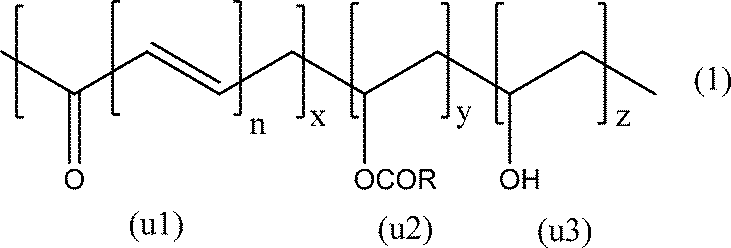
u1はカルボニル基及び二重結合を有する構成単位、u2は残存エステル基を有する構成単位、u3は水酸基を有する構成単位である。
上記式において、OCORは残存エステル基であり、x、y、zは、ポリマー中のそれぞれの構成単位のモル分率を表し、x+y+z=1となり、x、y、zはそれぞれ0~1であり、x、y、zはいずれも0ではない。上記式では、分子鎖中にエステル、水酸基、カルボニル基、カルボニル基に近接した二重結合を有している。二重結合は、単一の二重結合又は2以上の二重結合を有する共役二重結合であり、ビニルアルコール系重合体中には、これらの両方が存在してもよい。nは1~5であることが好ましく、1~3であることがより好ましい。
なお上記したOCORは残存エステル基(O-C(=O)R)であり、Rは水素原子又は炭素数1~20のアルキル基である。本発明においては、ポリビニルエステルとしてポリ酢酸ビニルを用いることが好ましく、この場合、残存エステル基はアセトキシ基を表す。
[条件(I)]積分値(a)~(e)の合計を100とした場合に、積分値(e)が0.8~20である。
(a)5.70~5.96ppmに確認されるピークの積分値
(b)5.97~6.63ppmに確認されるピークの積分値
(c)6.64~7.55ppmに確認されるピークの積分値
(d)7.56~7.81ppmに確認されるピークの積分値
(e)7.82~8.04ppmに確認されるピークの積分値
上記条件(I)を満足するビニルアルコール系重合体をポリ塩化ビニル懸濁重合用の分散剤として用いると、平均粒径が適切な範囲であり、かつ嵩密度の高いポリ塩化ビニルを得ることができる。
積分値(e)は、嵩密度を更に高める観点及びポリ塩化ビニルの分散性の更なる向上の観点から、好ましくは0.8~15であり、より好ましくは0.8~10、さらに好ましくは0.9~9、さらにより好ましくは0.95~8、特に好ましくは1~7である。
[条件(II)]積分値(a)~(e)の合計を100とした場合に、積分値(c)が30~50であり、積分値(d)が0.8~10である。
(a)5.70~5.96ppmに確認されるピークの積分値
(b)5.97~6.63ppmに確認されるピークの積分値
(c)6.64~7.55ppmに確認されるピークの積分値
(d)7.56~7.81ppmに確認されるピークの積分値
(e)7.82~8.04ppmに確認されるピークの積分値
上記条件(II)において、嵩密度を更に高める観点及びポリ塩化ビニルの分散性の更なる向上の観点から、積分値(c)は好ましくは30~45であり、より好ましくは30~40、さらに好ましくは30~38、さらに好ましくは30~37である。
上記条件(II)において、嵩密度を更に高める観点及びポリ塩化ビニルの分散性の更なる向上の観点から、積分値(d)は好ましくは0.8~8であり、より好ましくは0.8~7、さらに好ましくは0.8~6、さらにより好ましくは0.9~5.5、特に好ましくは0.95~5.3である。
[条件(III)]積分値(a)~(e)の合計を100とした場合に、積分値(a)が1~10であり、積分値(b)が20~70である。
(a)5.70~5.96ppmに確認されるピークの積分値
(b)5.97~6.63ppmに確認されるピークの積分値
(c)6.64~7.55ppmに確認されるピークの積分値
(d)7.56~7.81ppmに確認されるピークの積分値
(e)7.82~8.04ppmに確認されるピークの積分値
上記条件(III)において、嵩密度を更に高める観点及びポリ塩化ビニルの分散性の更なる向上の観点から、積分値(a)は好ましくは1~8であり、より好ましくは1~5、さらに好ましくは1~4である。
上記条件(III)において、嵩密度を更に高める観点及びポリ塩化ビニルの分散性の更なる向上の観点から、積分値(b)は好ましくは30~65であり、より好ましくは40~65、さらに好ましくは45~63、さらにより好ましくは48~60、特に好ましくは48~59である。
上記した積分値(a)~(e)は、ビニルアルコール系重合体を製造する際の製造条件によって調整することができ、具体的には後述するように、過酸化物使用の有無、加熱処理の有無、加熱温度、加熱処理時間などの製造条件によって調整することができる。
本発明の一実施態様であるビニルアルコール系重合体は、ケン化度が65~80mol%であることが好ましい。ケン化度をこのような範囲とすることで、ビニルアルコール系重合体をポリ塩化ビニル懸濁用分散剤として用いて製造したポリ塩化ビニルの嵩密度が高まりやすい。嵩密度をより良好とする観点から、ケン化度は70~80mol%であることがより好ましい。
なお、ケン化度はJIS K6726に準じて測定することができる。
本発明の一実施態様であるビニルアルコール系重合体の残存エステル基のブロックキャラクターは0.45~0.62であることが好ましく、0.45~0.6であることがより好ましく、0.45~0.55であることが更に好ましく、0.45~0.5であることが特に好ましい。このような値であると、ビニルアルコール系重合体をポリ塩化ビニル懸濁用分散剤として用いて製造したポリ塩化ビニルの嵩密度が高まりやすい。
なお、ブロックキャラクターは通常0~2の値をとり、0に近いほど残存エステル基分布のブロック性が高いことを示し、1に近いほどランダム性が高いことを示し、2に近いほど交互性が高いことを示している。
残存エステル基のブロックキャラクター(η)とは、ビニルアルコール系重合体の残存エステル基の分布を示す指標であり、1H-NMRスペクトル中のメチン領域に現れるピークの解析により求められる。前記のピークは、隣接する置換基が水酸基(O)、または残存エステル基(A)の3連鎖構造によりそれぞれ3本に分裂する。具体的には、残存エステル基ピーク中心において(OAO)、(AAO)、(AAA)、水酸基中心において(OOO)、(AOO)、(AOA)となり、その吸収強度は構造の存在比に比例している。ブロックキャラクター(η)は、下記(式1)で表される。尚、残存エステル基(A)は、例えば、原料として酢酸ビニルが使用された場合は、残存アセトキシ基(OAc基)を示す。

NMR測定の際、溶媒および試料中に混入する水分が干渉し、スペクトルの面積が正確に求められないことがある。その際、試料に0.5wt%の重トリフルオロ酢酸を添加し、水ピークをシフトさせる、あるいはNMR測定時に、に水のピークを飽和させるパルス系列を追加することで水のピークを除去することがある。
また、測定・解析の詳細に関しては、先行文献(Macromolecules、1982、15、1071)に記載されている。
本発明の一実施態様であるビニルアルコール系重合体は、0.1質量%水溶液の波長280nmでの吸光度a1と、ビニルアルコール系重合体の0.1質量%水溶液の波長320nmでの吸光度a2との比(a1/a2)を一定範囲にすることが好ましい。
本発明の一実施態様であるビニルアルコール系重合体は上記したとおり、二重結合を有している。該二重結合の一部は、下記式(2)及び(3)に示すように、カルボニル基に近接したポリマー主鎖に沿って共役二重結合を形成している。
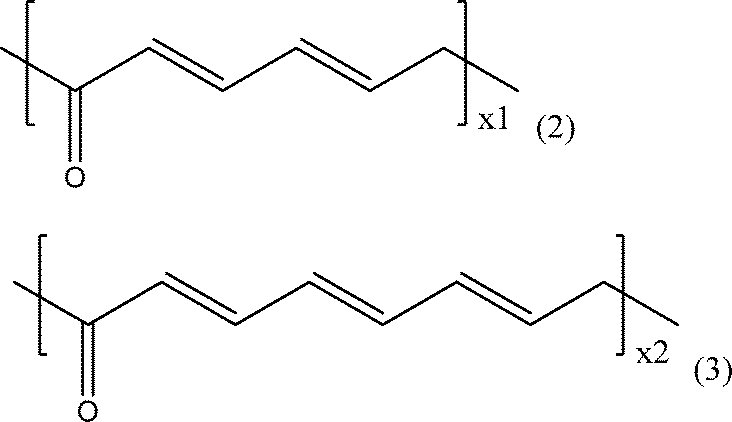
式(2)は、ビニルアルコール系重合体中のカルボニル基に近接した2つの二重結合を有する共役二重結合を表し、式(3)はビニルアルコール系重合体中のカルボニル基に近接した3つの二重結合を有する共役二重結合を表している。式(2)のx1、及び式(3)のx2はそれぞれ式(1)のxと同義である。
波長280nmの吸光度a1は、上記式(2)で表されるカルボニル基に近接した2つの二重結合を有する共役二重結合に基づくものであり、該共役二重結合が多いほど、a1の値は大きくなる。
波長320nmの吸光度a2は、上記式(3)で表されるカルボニル基に近接した3つの二重結合を有する共役二重結合に基づくものであり、該共役二重結合が多いほど、a2の値は大きくなる。
a1/a2が上記のような範囲にあるビニルアルコール系重合体を懸濁重合用分散剤として用いることにより、嵩高いポリ塩化ビニルが得やすくなる。
吸光度a1は、ポリ塩化ビニルの分散性向上の観点から、好ましくは0.15~0.70であり、より好ましくは0.20~0.60である。吸光度a2は、ポリ塩化ビニルの分散性向上の観点から、好ましくは0.10~0.50であり、より好ましくは0.15~0.40である。
本発明の一実施態様であるビニルアルコール系重合体の水酸基の3連鎖に対する2連鎖の比率(2連鎖/3連鎖比率)は2.0~3.5であることが好ましく、2.1~3.3であることがより好ましく、2.2~3.0であることがさらに好ましい。ここで水酸基の3連鎖とは、ビニルアルコール系重合体において、水酸基を有する構成単位が3つ連続して存在する割合であり、水酸基の2連鎖とは、ビニルアルコール系重合体において、水酸基を有する構成単位が2つ連続して存在する割合である。
具体的には、各ケミカルシフトのピーク積分値を以下と定義した場合、下記計算式によって算出する。ここでは、残存エステル基はアセチル基の場合について説明するが、以下、Oは水酸基を、Aはアセチル基を示すものとし、下線は積分対象とする置換基を示すものとする。
[AAO+OAA](水酸基とアセチル基に挟まれたアセチル基の相対量):4.90-5.05ppm
[AAA] (アセチル基によって挟まれたアセチル基の相対量):4.69-4.91ppm
[OOO] (水酸基に挟まれた水酸基の相対量):3.75―4.15ppm
[AOO+OOA](水酸基とアセチル基に挟まれた水酸基の相対量):3.60-3.76ppm
[AOA] (アセチル基に挟まれた水酸基の相対量):3.34-3.61ppm
水酸基の2連鎖/3連鎖比率=([OOO]+0.5[AOO+OOA])/([AOA]+0.5[AOO+OOA])
該樹脂粒子の平均粒子径は、0.8~3.0mmであることが好ましく、粒子径1.7mm以上の粒子が重量比で95%以上であることが好ましい。樹脂粒子の平均粒子径が0.8mm以上の場合、溶解時に樹脂粒子同士の合着が抑制され、ままこが発生し難くなる。また、樹脂粒子の平均粒子径が3.0mm以下になると、短時間で完全に溶解する結果、ポリ塩化ビニル重合の生産性を向上させることができる。なお、粒子径1.7mm以上の粒子の重量比は、樹脂粒子100gをメッシュ径1.7mmのふるいの上に置き、ふたをして5分間振とうし、ふるいの上に残った樹脂と、ふるいを通り抜けた樹脂の重量比を評価することにより測定することができる。
樹脂粒子の製造方法は特に限定されないが、好ましくは後述するように、押出し機でビニルアルコール系重合体をストランド状に押し出し、空冷を行った後、ストランドカッターで切断することによりペレット化し、樹脂粒子を製造すればよい。
工程(1)ビニルエステル単量体を重合しポリビニルエステルを製造する工程、
工程(2)該ポリビニルエステルを部分ケン化して、部分ケン化されたポリビニルエステルを製造する工程、
工程(3)部分ケン化されたポリビニルエステルを、加熱温度185~250℃、加熱時間1~10分で溶融混練する工程
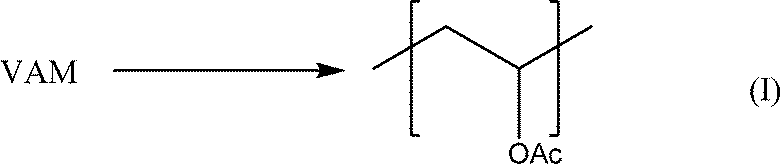
上記反応式(I)は、工程(1)を説明するために用いる簡略化された反応式であり、ビニルエステル単量体として、酢酸ビニル(VAM)を使用したときの反応式を示している。Acはアセチル基を表す。
重合は、エチレン、プロピレン、又はスチレン等のオレフィンコモノマーが実質的に存在しない状態で実施することができる。また、重合は、アルデヒド、ケトン等の連鎖移動剤が存在しないか、実質的に存在しない状態で実施することができる。ここで実質的に存在しないとは意図的に添加しないことを意味する。
重合方法としては、バルク重合法、溶液重合法、懸濁重合法、乳化重合法等の公知の方法が挙げられる。重合は、-80~300℃程度で実施することができ、過酸化物、アゾイソブチロニトリルなどの重合開始剤を用いることができる。

上記反応式(II)は、工程(2)を説明するために用いる簡略化された反応式であり、ビニルエステル単量体として、酢酸ビニル(VAM)を使用したときの工程(2)の反応式を示している。工程(2)により、エステル基の一部がケン化され水酸基となる。
工程(2)における反応温度は、例えば、10~70℃、好ましくは20~50℃程度である。
部分ケン化において使用する溶媒としては、メタノール、エタノール、イソプロパノール、n-プロピルアルコール、n-ブタノール、イソブタノール、sec-ブタノール、t-ブタノール、アミルアルコール、シクロヘキサノールなどのアルコール類、テトラヒドロフラン、ジオキサン等の環状エーテル類、アセトン、メチルエチルケトン、メチルイソブチルケトン、ピナコリン等のケトン類、ジメチルスルホキシド等のスルホキシド類、トルエン、ベンゼン、n-ヘキサン、シクロヘキサン等の炭化水素類等を用いることができる。
部分ケン化されたポリビニルエステルは、さらなる処理のため、単離し、乾燥させて粉体状の部分ケン化されたポリビニルエステルを得ることが好ましい。
工程(3)は、部分ケン化されたポリビニルエステルを、加熱温度185~250℃、加熱時間1~10分で溶融混練する工程である。

上記反応式(III)は、工程(3)を説明するために用いる簡略化された反応式であり、ビニルエステル単量体として、酢酸ビニル(VAM)を使用したときの工程(3)の反応式を示している。上記反応式において、OAcはアセトキシ基を表し、x、y、zは、ポリマー中のそれぞれの構成単位のモル分率を表し、x+y+z=1であり、x、y、zはそれぞれ0~1であり、x、y、zはいずれも0ではない。
工程(3)により、ポリマー主鎖に二重結合及びカルボニル基が導入される。二重結合は、単一の二重結合又は2以上の二重結合を有する共役二重結合であり、ビニルアルコール系重合体中にはこれらの両方が存在してもよい。nは1~5であることが好ましく、1~3であることがより好ましい。
工程(3)では、工程(2)で得られた部分ケン化されたポリビニルエステルを、加熱温度185~250℃、加熱時間1~10分で溶融混練を行う。加熱温度185℃以上で溶融混練を行うことで、1H-NMRスペクトルにおける、上記した積分値(a)~(e)の値を上記した所望の範囲に調整しやすくなる。加熱温度を250℃以下とすることにより、ビニルアルコール系重合体における上記未溶解物を低減しやすくなる。このような観点から、加熱温度は190~245℃であることが好ましく、加熱時間は2~8分であることが好ましい。
上記溶融混練を行う手段は、特に限定されないが、押出し機を用いて行うことが好ましい。押出し機は、一軸の押出し機でもよいし、二軸の押出し機でもよいが、二軸の押出し機を用いることが好ましい。二軸の押出し機を用いると、工程(2)で得られる粉体状の部分ケン化されたポリビニルエステルを溶融混練しやすくなり、所望のビニルアルコール系重合体を得やすくなる。
また、酸化剤は、水、メタノール、酢酸メチルといった溶剤に希釈し、添加することも可能であり、その場合、水溶液として添加することが好ましい。酸化剤の添加は、特に限定はされないが、該当酸化剤の半減期温度を加味し10℃~185℃未満の温度で混練しながら行うことが好ましい。酸化剤を溶剤に希釈する場合は、溶剤の沸点を考慮し沸点以下、とりわけ水溶液の場合は100℃以下で添加することが好ましい。
押出し機を用いる場合は、押出し機に酸化剤投入口を設けて酸化剤を添加することが好ましい。
酸化剤としては、種々の酸、過酸化物、過塩素酸塩、塩素化イソシアヌレート等が挙げられる。これらの中でも、酸化剤としては、過酸化水素、過酢酸などの過酸化物系酸化剤が好ましく、過酸化水素がより好ましい。
該樹脂粒子を、ポリ塩化ビニル懸濁重合用の分散剤として用いて得られたポリ塩化ビニルは、ままこ(継粉、だま)の発生が少なく、品質が良好である。
本発明の一実施態様であるビニルアルコール系重合体は、ポリ塩化ビニル懸濁重合用分散剤として用いることができる。上記ビニルアルコール系重合体を分散剤として、ポリ塩化ビニルを製造する方法としては、例えば次のようにすればよい。
本発明の一実施態様であるビニルアルコール系重合体、塩化ビニル単量体、及び水を混合して懸濁液とする工程を行い、次いで塩化ビニル単量体を重合させる工程を行えばよい。
ビニルアルコール系重合体、塩化ビニル単量体、及び水を添加する順番は特に制限されないが、例えば、ビニルアルコール系重合体を、塩化ビニル単量体及び水を含む溶液に添加し、混合して懸濁液とすればよい。混合は、公知の攪拌装置により行うことができる。
ビニルアルコール系重合体の使用量としては、塩化ビニル単量体に対して好ましくは0.01~5質量%であり、より好ましくは0.02~0.2質量%である。
塩化ビニル単量体は、重合に使用する量を一度に配合してもよいし、一部を最初に添加して、残りを重合開始後に添加してもよい。
上記懸濁液は、さらに1種以上の重合開始剤、酸化防止剤、pH調整剤のような添加剤を含有することができる。
重合開始剤としては、例えば、ジ-2-エチルヘキシルパーオキシジカーボネート、ジエトキシエチルパーオキシジカーボネート、α-クミルパーオキシネオデカネート、t-ブチルパーオキシネオデカネート、t-ブチルパーオキシピバレート、t-ブチルパーオキシ-3,5,5-トリメチルヘキサノエート、アセチルシクロヘキシルスルホニルパーオキシド、2,4,4-トリメチルペンチル-2-パーオキシフェノキシアセテート、ラウロイルパーオキシドなどが挙げられ、これらは単独で用いられてもよく、二種以上が併用されてもよい。
酸化防止剤としては、例えば、ヒンダードフェノール系酸化防止剤が挙げられる。
pH調整剤としては、例えば、重炭酸ナトリウム、炭酸ナトリウム、重炭酸カリウム、炭酸カリウム、クエン酸ナトリウム、クエン酸カリウム、酒石酸ナトリウム、酒石酸カリウム、安息香酸ナトリウム、安息香酸カリウムなどが挙げられ、これらは単独で用いられてもよく、二種以上が併用されてもよい。
本発明の一実施態様であるビニルアルコール系重合体を分散剤として用いると、嵩密度の高いポリ塩化ビニルを得ることが可能となる。
温度計、攪拌機及び冷却管を備えた反応器内に、酢酸ビニルモノマー100重量部及びメタノール40重量部を加え、窒素ガスを30分間吹き込んで窒素置換した後、反応器を60℃にて30分間加熱した。次いで、重合開始剤である2-エチルヘキシルペルオキシジカーボネートを0.03重量部添加した後、60℃にて4時間反応させた。反応時間終了後、反応液を冷却した。冷却後に重合率を測定したところ、反応率は40%であった。次いで、減圧下で、残留する酢酸ビニルモノマーをメタノールとともに除去する操作を、メタノールを追加しながら行い、ポリ酢酸ビニル50重量%を含むメタノール溶液を得た。このメタノール溶液に、ポリ酢酸ビニル1molに対して0.003molの水酸化ナトリウム量となるように水酸化ナトリウムのメタノール溶液を加え、40℃でケン化を行った。溶媒を留去した後、乾燥させて、粉体状の部分ケン化されたポリ酢酸ビニルを得た。
得られた粉体状の部分ケン化されたポリ酢酸ビニルを、供給機を用いて二軸押出し機内に供給し、室温~185℃未満で混練した。このような条件で混練を行いながら、バレルに設けられた投入口により、過酸化水素水溶液(濃度30質量%)を供給し、部分ケン化されたポリ酢酸ビニルと混合した。過酸化水素の添加量は、ポリ酢酸ビニル100質量部に対して0.3質量部となるように調整した。
過酸化水素水溶液を供給した後、加熱温度242℃、加熱時間7.5分の条件で溶融混練し、本発明に係るビニルアルコール系重合体を得た。該ビニルアルコール系重合体を押出し機により、ストランド状に押し出し、空冷した後、ストランドカッターで切断して、ビニルアルコール系重合体からなる樹脂粒子S1を得た。
該S1について後述する各種評価を行った。結果を表1に示した。
温度計、攪拌機及び冷却管を備えた反応器内に、酢酸ビニルモノマー100重量部及びメタノール40重量部を加え、窒素ガスを30分間吹き込んで窒素置換した後、反応器を60℃にて30分間加熱した。次いで、重合開始剤である2-エチルヘキシルペルオキシジカーボネートを0.03重量部添加した後、60℃にて4時間反応させた。反応時間終了後、反応液を冷却した。冷却後に重合率を測定したところ、反応率は40%であった。次いで、減圧下で、残留する酢酸ビニルモノマーをメタノールとともに除去する操作を、メタノールを追加しながら行い、ポリ酢酸ビニル50重量%を含むメタノール溶液を得た。このメタノール溶液に、ポリ酢酸ビニル1molに対して0.003molの水酸化ナトリウム量となるように水酸化ナトリウムのメタノール溶液を加え、40℃でケン化を行った。溶媒を留去した後、乾燥させて、粉体状の部分ケン化されたポリ酢酸ビニルを得た。
得られた粉体状の部分ケン化されたポリ酢酸ビニルを、供給機を用いて二軸押出し機内に供給し、室温~185℃未満で混練した。このような条件で混練を行いながら、バレルに設けられた投入口により、過酸化水素水溶液(濃度30質量%)を供給し、部分ケン化されたポリ酢酸ビニルと混合した。過酸化水素の添加量は、ポリ酢酸ビニル100質量部に対して0.6質量部となるように調整した。
過酸化水素水溶液を供給した後、加熱温度197℃、加熱時間6分の条件で溶融混練し、本発明に係るビニルアルコール系重合体を得た。該ビニルアルコール系重合体を押出し機により、ストランド状に押し出し、空冷した後、ストランドカッターで切断して、ビニルアルコール系重合体からなる樹脂粒子S3を得た。
該S3について後述する各種評価を行った。結果を表1に示した。
温度計、攪拌機及び冷却管を備えた反応器内に、酢酸ビニルモノマー100重量部及びメタノール40重量部を加え、窒素ガスを30分間吹き込んで窒素置換した後、反応器を60℃にて30分間加熱した。次いで、重合開始剤である2-エチルヘキシルペルオキシジカーボネートを0.03重量部添加した後、60℃にて4時間反応させた。反応時間終了後、反応液を冷却した。冷却後に重合率を測定したところ、反応率は40%であった。次いで、減圧下で、残留する酢酸ビニルモノマーをメタノールとともに除去する操作を、メタノールを追加しながら行い、ポリ酢酸ビニル50重量%を含むメタノール溶液を得た。このメタノール溶液に、ポリ酢酸ビニル1molに対して0.003molの水酸化ナトリウム量となるように水酸化ナトリウムのメタノール溶液を加え、40℃でケン化を行った。溶媒を留去した後、乾燥させて、粉体状の部分ケン化されたポリ酢酸ビニルを得た。
得られた粉体状の部分ケン化されたポリ酢酸ビニルを、供給機を用いて二軸押出し機内に供給し、室温~185℃未満で混練した。このような条件で混練を行いながら、バレルに設けられた投入口により、過酸化水素水溶液(濃度30質量%)を供給し、部分ケン化されたポリ酢酸ビニルと混合した。過酸化水素の添加量は、ポリ酢酸ビニル100質量部に対して0.3質量部となるように調整した。
過酸化水素水溶液を供給した後、加熱温度199℃、加熱時間6分の条件で溶融混練し、本発明に係るビニルアルコール系重合体を得た。該ビニルアルコール系重合体を押出し機により、ストランド状に押し出し、空冷した後、ストランドカッターで切断して、ビニルアルコール系重合体からなる樹脂粒子S4を得た。
該S4について後述する各種評価を行った。結果を表1に示した。
温度計、攪拌機及び冷却管を備えた反応器内に、酢酸ビニルモノマー100重量部及びメタノール40重量部を加え、窒素ガスを30分間吹き込んで窒素置換した後、反応器を60℃にて30分間加熱した。次いで、重合開始剤である2-エチルヘキシルペルオキシジカーボネートを0.03重量部添加した後、60℃にて4時間反応させた。反応時間終了後、反応液を冷却した。冷却後に重合率を測定したところ、反応率は40%であった。次いで、減圧下で、残留する酢酸ビニルモノマーをメタノールとともに除去する操作を、メタノールを追加しながら行い、ポリ酢酸ビニル50重量%を含むメタノール溶液を得た。このメタノール溶液に、ポリ酢酸ビニル1molに対して0.003molの水酸化ナトリウム量となるように水酸化ナトリウムのメタノール溶液を加え、40℃でケン化を行った。溶媒を留去した後、乾燥させて、粉体状の部分ケン化されたポリ酢酸ビニルを得た。
得られた粉体状の部分ケン化されたポリ酢酸ビニルを、供給機を用いて二軸押出し機内に供給し、室温~185℃未満で混練した。このような条件で混練を行いながら、バレルに設けられた投入口により、過酸化水素水溶液(濃度30質量%)を供給し、部分ケン化されたポリ酢酸ビニルと混合した。過酸化水素の添加量は、ポリ酢酸ビニル100質量部に対して0.6質量部となるように調整した。
過酸化水素水溶液を供給した後、加熱温度193℃、加熱時間6分の条件で溶融混練し、本発明に係るビニルアルコール系重合体を得た。該ビニルアルコール系重合体を押出し機により、ストランド状に押し出し、空冷した後、ストランドカッターで切断して、ビニルアルコール系重合体からなる樹脂粒子S5を得た。
該S5について後述する各種評価を行った。結果を表1に示した。
温度計、攪拌機及び冷却管を備えた反応器内に、酢酸ビニルモノマー100重量部及びメタノール40重量部を加え、窒素ガスを30分間吹き込んで窒素置換した後、反応器を60℃にて30分間加熱した。次いで、重合開始剤である2-エチルヘキシルペルオキシジカーボネートを0.03重量部添加した後、60℃にて4時間反応させた。反応時間終了後、反応液を冷却した。冷却後に重合率を測定したところ、反応率は40%であった。次いで、減圧下で、残留する酢酸ビニルモノマーをメタノールとともに除去する操作を、メタノールを追加しながら行い、ポリ酢酸ビニル50重量%を含むメタノール溶液を得た。このメタノール溶液に、ポリ酢酸ビニル1molに対して0.003molの水酸化ナトリウム量となるように水酸化ナトリウムのメタノール溶液を加え、40℃でケン化を行った。溶媒を留去した後、乾燥させて、粉体状の部分ケン化されたポリ酢酸ビニルを得た。
得られた粉体状の部分ケン化されたポリ酢酸ビニルを、供給機を用いて二軸押出し機内に供給し、室温~185℃未満で混練した。このような条件で混練を行いながら、バレルに設けられた投入口により、過酸化水素水溶液(濃度30質量%)を供給し、部分ケン化されたポリ酢酸ビニルと混合した。過酸化水素の添加量は、ポリ酢酸ビニル100質量部に対して0.44質量部となるように調整した。
過酸化水素水溶液を供給した後、加熱温度210℃、加熱時間6分の条件で溶融混練し、本発明に係るビニルアルコール系重合体を得た。該ビニルアルコール系重合体を押出し機により、ストランド状に押し出し、空冷した後、ストランドカッターで切断して、ビニルアルコール系重合体からなる樹脂粒子S6を得た。
該S6について後述する各種評価を行った。結果を表1に示した。
温度計、攪拌機及び冷却管を備えた反応器内に、酢酸ビニルモノマー100重量部及びメタノール40重量部を加え、窒素ガスを30分間吹き込んで窒素置換した後、反応器を60℃にて30分間加熱した。次いで、重合開始剤である2-エチルヘキシルペルオキシジカーボネートを0.03重量部添加した後、60℃にて4時間反応させた。反応時間終了後、反応液を冷却した。冷却後に重合率を測定したところ、反応率は40%であった。次いで、減圧下で、残留する酢酸ビニルモノマーをメタノールとともに除去する操作を、メタノールを追加しながら行い、ポリ酢酸ビニル50重量%を含むメタノール溶液を得た。このメタノール溶液に、ポリ酢酸ビニル1molに対して0.003molの水酸化ナトリウム量となるように水酸化ナトリウムのメタノール溶液を加え、40℃でケン化を行った。溶媒を留去した後、乾燥させて、粉体状の部分ケン化されたポリ酢酸ビニルを得た。
得られた粉体状の部分ケン化されたポリ酢酸ビニルを、供給機を用いて二軸押出し機内に供給し、室温~185℃未満で混練した。このような条件で混練を行いながら、バレルに設けられた投入口により、過酸化水素水溶液(濃度30質量%)を供給し、部分ケン化されたポリ酢酸ビニルと混合した。過酸化水素の添加量は、ポリ酢酸ビニル100質量部に対して0.8質量部となるように調整した。
過酸化水素水溶液を供給した後、加熱温度209℃、加熱時間6分の条件で溶融混練し、本発明に係るビニルアルコール系重合体を得た。該ビニルアルコール系重合体を押出し機により、ストランド状に押し出し、空冷した後、ストランドカッターで切断して、ビニルアルコール系重合体からなる樹脂粒子S7を得た。
該S7について後述する各種評価を行った。結果を表1に示した。
ビニルアルコール系重合体である、Synthomer社製「Alcotex B72」(サンプル名C1)を用いて、後述する各種評価を行った。結果を表2に示した。
ビニルアルコール系重合体である、株式会社クラレ製「Kuraray L8」(サンプル名C2)を用いて、後述する各種評価を行った。結果を表2に示した。
温度計、攪拌機及び冷却管を備えた反応器内に、酢酸ビニルモノマー100重量部及びメタノール20重量部を加え、窒素ガスを30分間吹き込んで窒素置換した後、反応器を60℃にて30分間加熱した。次いで、重合開始剤である2-エチルヘキシルペルオキシジカーボネートを0.01重量部添加した後、64℃にて4.5時間反応させた。反応時間終了後、反応液を冷却した。冷却後に重合率を測定したところ、反応率は52%であった。次いで、減圧下で、残留する酢酸ビニルモノマーをメタノールとともに除去する操作を、メタノールを追加しながら行い、ポリ酢酸ビニル53重量%を含むメタノール溶液を得た。このメタノール溶液に、ポリ酢酸ビニル1molに対して0.015molの水酸化ナトリウム量となるように水酸化ナトリウムのメタノール溶液を加え、42℃でケン化を行った。溶媒を留去した後、乾燥させて、粉体状の部分ケン化されたポリ酢酸ビニルを得た。
得られた粉体状の部分ケン化されたポリ酢酸ビニルを、供給機を用いて二軸押出し機内に供給し、室温~165℃で混練した。このような条件で混練を行いながら、バレルに設けられた投入口により、グリセリン(濃度98質量%)を供給し、部分ケン化されたポリ酢酸ビニルと混合した。グリセリンの添加量は、ポリ酢酸ビニル100質量部に対して9.3質量部となるように調整した。
グリセリンを供給した後、加熱温度180℃、加熱時間4分の条件で溶融混練し、ビニルアルコール系重合体を得た。該ビニルアルコール系重合体を押出し機により、ストランド状に押し出し、空冷した後、ストランドカッターで切断して、ビニルアルコール系重合体からなる樹脂粒子C3を得た。C3を用いて後述する各種評価を行った。結果を表2に示した。
温度計、攪拌機及び冷却管を備えた反応器内に、酢酸ビニルモノマー100重量部及びメタノール40重量部を加え、窒素ガスを30分間吹き込んで窒素置換した後、反応器を60℃にて30分間加熱した。次いで、重合開始剤である2-エチルヘキシルペルオキシジカーボネートを0.03重量部添加した後、60℃にて4時間反応させた。反応時間終了後、反応液を冷却した。冷却後に重合率を測定したところ、反応率は40%であった。次いで、減圧下で、残留する酢酸ビニルモノマーをメタノールとともに除去する操作を、メタノールを追加しながら行い、ポリ酢酸ビニル50重量%を含むメタノール溶液を得た。このメタノール溶液に、ポリ酢酸ビニル1molに対して0.003molの水酸化ナトリウム量となるように水酸化ナトリウムのメタノール溶液を加え、40℃でケン化を行った。溶媒を留去した後、乾燥させて、粉体状の部分ケン化されたポリ酢酸ビニルを得た。
得られた粉体状の部分ケン化されたポリ酢酸ビニルを、供給機を用いて二軸押出し機内(プラスチック工学研究所製「BTN-90」)内に供給し、室温~220℃未満で混練した。このような条件で混練を行いながら、バレルに設けられた投入口により、過酸化水素水溶液(濃度30質量%)を供給し、部分ケン化されたポリ酢酸ビニルと混合した。過酸化水素の添加量は、ポリ酢酸ビニル100質量部に対して1.2質量部となるように調整した。
過酸化水素水溶液を供給した後、加熱温度255℃、加熱時間8分の条件で溶融混練し、ビニルアルコール系重合体を得た。該ビニルアルコール系重合体を押出し機により、ストランド状に押し出し、空冷した後、ストランドカッターで切断して、ビニルアルコール系重合体からなる樹脂粒子C4を得た。樹脂粒子C4は未溶解物が多く、各種測定が困難であった。
(ケン化度)
JIS K6726に準じて行った。
(ブロックキャラクター)
明細書本文に記載した方法により測定した。測定方法は、Macromolecules、1982、15、1071の記載に準ずるものである。
対象試料の1.0wt%のDMSO-d6溶液の常温における400MHz 1H-NMR測定による各ピークの積分比の比率によって行った。具体的には下記計算式によって算出した。
残存エステル基の2連鎖/3連鎖比率=([AAA]+0.5[AAO+OAA])/([OAO]+0.5[AAO+OAA])
水酸基の2連鎖/3連鎖比率=([OOO]+0.5[AOO+OOA])/([AOA]+0.5[AOO+OOA])
ここで、それぞれ
[OAO] (水酸基に挟まれたアセチル基の相対量):5.04-5.19 ppm
[AAO+OAA](水酸基とアセチル基に挟まれたアセチル基の相対量):4.90-5.05ppm
[AAA] (アセチル基によって挟まれたアセチル基の相対量):4.69-4.91ppm
[OOO] (水酸基に挟まれた水酸基の相対量):3.75―4.15ppm
[AOO+OOA](水酸基とアセチル基に挟まれた水酸基の相対量):3.60-3.76ppm
[AOA] (アセチル基に挟まれた水酸基の相対量):3.34-3.61ppm
を意味する。
分子量及び分子量分布は、ゲルパーミエーションクロマトグラフィー(GPC)測定により算出した。標準試料としては、ポリエチレンオキシド(19K)を用い、カラム SOLDEX SB804 二連結+SOLDEX802.5を用いた。溶媒は水を用い、インジェクション量100μL,溶媒流速1.0mL/minであった。分子量分布の解析は、光散乱検出器とRI検出器、粘度検出器のシグナルを基に、解析ソフトOmni SEC DATAを用いて行った。
1H-NMRは、Bruker製(400MHz)を用いた。試料を重DMSOの5質量%溶液とした。指数関数(0.2Hz)、積算1024回(プロディジー型プローブ)又は10000回(通常プローブ)、遅延時間1秒、パルス間隔12マイクロ秒として、DMSOのピーク(2.49ppm)を基準として測定した。
上記試料(S1~S7、C1~C3)の1H-NMRスペクトルを図1~3に示した。また図1~3の1H-NMRスペクトルの部分拡大図をそれぞれ図4~6に示した。図7に、S1の1H-NMRスペクトルにおける積分値(a)~(e)について図示した。
ビニルアルコール系重合体の0.1質量%水溶液を調製して、280nm、320nmの吸光度を測定した。測定装置はEvolution 600 UV-Vis Spectrophotometer(Thermo Fisher,Pittsburgh,PA,USA)を用いた。
ビニルアルコール系重合体の4質量%水溶液を調製して、Brookfield粘度計(型 LVDV-II+Pro)を用いて、#18スピンドルを100rpmで使用し、20℃にて測定した。
各試料を篩にかけることで、粒子径1.7mm以上の粒子の割合を評価した。
黄色度(YI)は、ビニルアルコール系重合体の4質量%水溶液を調製して、ASTM規格D1925に準拠して求めた。
ビニルアルコール系重合体S1~S7、及びC1~C4をそれぞれ分散剤として使用して、下記のとおりポリ塩化ビニルを製造し、各種評価を行った。
(ポリ塩化ビニルの製造)
重合は、Dual Pfaudler型のインペラを備えた200L反応器で行った。水100kg、及び分散剤として各実施例・比較例のビニルアルコール系重合体(PVA)を塩化ビニル単量体に対して400ppmとなるように投入し、減圧にして重合器内の空気を除いた。次いで、塩化ビニル単量体を70kg、t-ブチルパーオキシネオデカネートを塩化ビニル単量体に対して150ppm、クミルパーオキシネオデカネートを塩化ビニル単量体に対して385ppmを仕込んだ。重合は、450rpmで攪拌して、57℃にて行い、重合器の圧力が7.0kg/cm2に低下した時点で、未反応の塩化ビニル単量体を回収し、内容物を取り出して、脱水乾燥してポリ塩化ビニルを得た。
さらに、上記とは別に、ビニルアルコール系重合体の投入量を、塩化ビニル単量体に対して500ppmとなるようにして、上記と同様にしてポリ塩化ビニルを得た。
得られたこれらのポリ塩化ビニルについて以下の評価を行った。
各実施例、比較例で製造したポリ塩化ビニルの嵩密度(g/cm3)は、JIS K 6721に準拠して測定した。ビニルアルコール系重合体を400ppm使用して製造したポリ塩化ビニル、ビニルアルコール系重合体を500ppm使用して製造したポリ塩化ビニルの双方に対して嵩密度を測定し、嵩密度の高い方のデータを採用し表に記載した。
各実施例、比較例で製造したポリ塩化ビニル(PVC)の平均粒径(μm)は、粒度分布計により測定した。平均粒径は、ビニルアルコール系重合体を400ppm使用して製造したポリ塩化ビニル、ビニルアルコール系重合体を500ppm使用して製造したポリ塩化ビニルの双方に対して行った。
各実施例、比較例で製造したポリ塩化ビニルについて、ままこの発生の有無は、目視により行った。
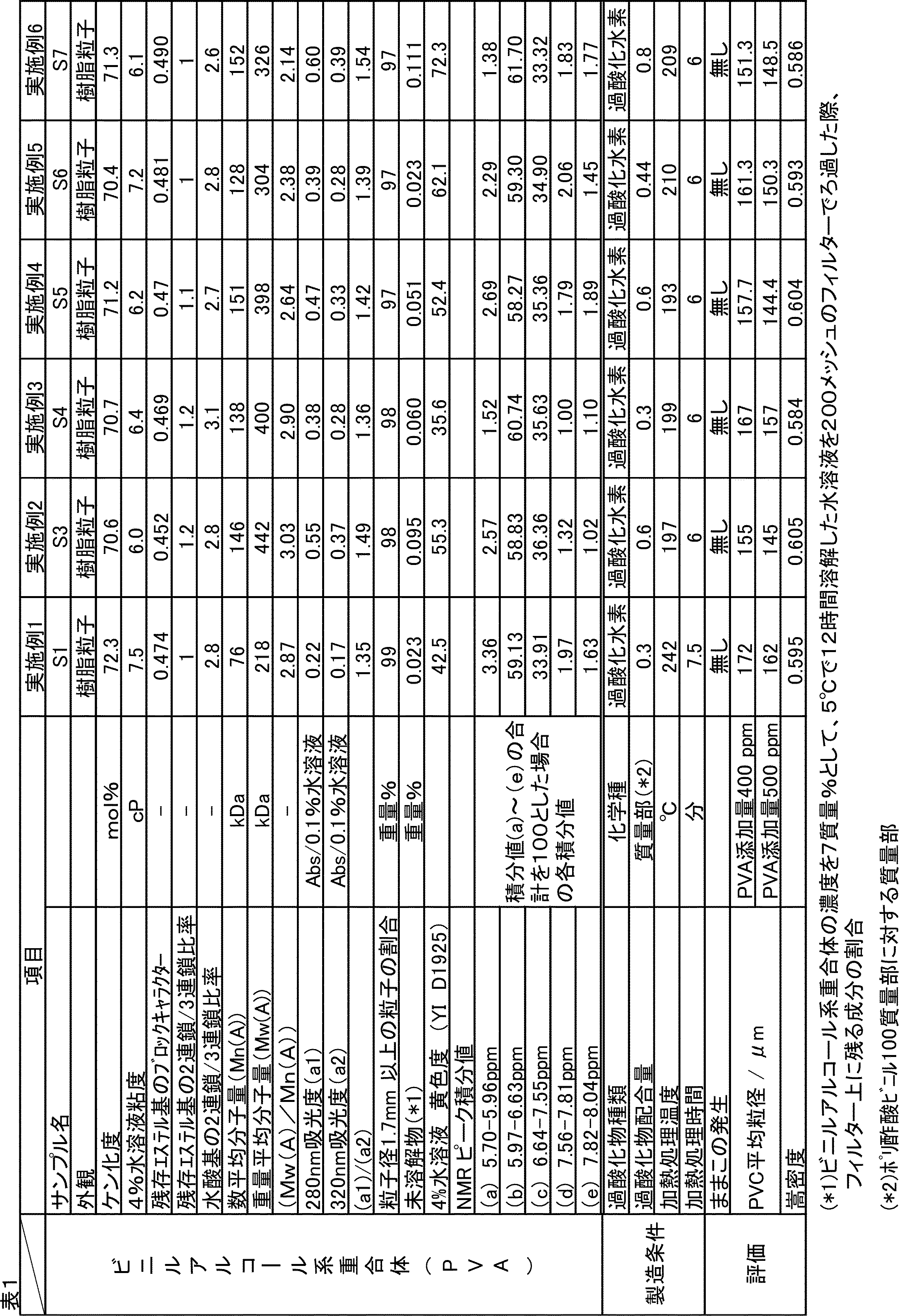

一方、本発明の要件を満足しない比較例のビニルアルコール系重合体をポリ塩化ビニル懸濁重合用分散剤として用いて製造されたポリ塩化ビニルは、嵩密度が低いか、評価することができなかった。
Claims (16)
- 1H-NMRスペクトルにおいて、下記積分値(a)~(e)の合計を100とした場合に、積分値(e)が0.8~20であるビニルアルコール系重合体。
(a)5.70~5.96ppmに確認されるピークの積分値
(b)5.97~6.63ppmに確認されるピークの積分値
(c)6.64~7.55ppmに確認されるピークの積分値
(d)7.56~7.81ppmに確認されるピークの積分値
(e)7.82~8.04ppmに確認されるピークの積分値 - ケン化度が65~80mol%、残存エステル基のブロックキャラクターが0.45~0.62、0.1質量%水溶液の波長280nmでの吸光度a1と前記水溶液の波長320nmでの吸光度a2の比a1/a2が1.6以下である、請求項1に記載のビニルアルコール系重合体。
- 数平均分子量Mnに対する重量平均分子量Mwの比(Mw/Mn)が2.6~14である、請求項1又は2に記載のビニルアルコール系重合体。
- 残存エステル基の2連鎖/3連鎖比率が0.7~1.3であり、水酸基の2連鎖/3連鎖比率が2.0~3.5である請求項1~3のいずれかに記載のビニルアルコール系重合体。
- 残存エステル基がアセトキシ基である、請求項1~4のいずれかに記載のビニルアルコール系重合体。
- 4質量%水溶液の粘度が5~9cPである、請求項1~5のいずれかに記載のビニルアルコール系重合体。
- 4質量%水溶液の黄色度(YI)が30~80である、請求項1~6のいずれかに記載のビニルアルコール系重合体。
- ビニルアルコール系重合体の濃度を7質量%として、5℃で12時間溶解した水溶液を200メッシュのフィルターでろ過した際、未溶解物としてフィルター上に残る成分が0.1%未満である、請求項1~7のいずれかに記載のビニルアルコール系重合体。
- ポリ塩化ビニル懸濁重合用の分散剤として用いる、請求項1~8のいずれかに記載のビニルアルコール系重合体。
- 以下の工程(1)~(3)を少なくとも備える、ビニルアルコール系重合体の製造方法。
工程(1)ビニルエステル単量体を重合しポリビニルエステルを製造する工程
工程(2)該ポリビニルエステルをケン化して、部分ケン化されたポリビニルエステルを製造する工程
工程(3)部分ケン化されたポリビニルエステルを、加熱温度185~250℃、加熱時間1~10分で溶融混練する工程 - 前記工程(3)の溶融混練が酸化剤の存在下で行われ、酸化剤の配合量が、ポリビニルエステル100質量部に対して2質量部以下である、請求項10に記載のビニルアルコール系重合体の製造方法。
- 請求項1~9のいずれかに記載のビニルアルコール系重合体からなる樹脂粒子。
- 粒子径1.7mm以上の粒子が95%以上である、請求項12に記載の樹脂粒子。
- 1H-NMRスペクトルにおいて、下記積分値(a)~(e)の合計を100とした場合に、積分値(c)が30~50であり、積分値(d)が0.8~10であるビニルアルコール系重合体。
(a)5.70~5.96ppmに確認されるピークの積分値
(b)5.97~6.63ppmに確認されるピークの積分値
(c)6.64~7.55ppmに確認されるピークの積分値
(d)7.56~7.81ppmに確認されるピークの積分値
(e)7.82~8.04ppmに確認されるピークの積分値 - 請求項14に記載のビニルアルコール系重合体からなる樹脂粒子。
- 粒子径1.7mm以上の粒子が95%以上である、請求項15に記載の樹脂粒子。
Priority Applications (5)
| Application Number | Priority Date | Filing Date | Title |
|---|---|---|---|
| JP2020504430A JP7048719B2 (ja) | 2018-12-27 | 2019-12-26 | ビニルアルコール系重合体、及びビニルアルコール系重合体の製造方法 |
| US17/417,589 US12084526B2 (en) | 2018-12-27 | 2019-12-26 | Vinyl alcohol polymer and method for producing vinyl alcohol polymer |
| EP19903777.1A EP3904397B1 (en) | 2018-12-27 | 2019-12-26 | Vinyl alcohol polymer and method for producing vinyl alcohol polymer |
| CN201980086407.1A CN113227161B (zh) | 2018-12-27 | 2019-12-26 | 乙烯醇系聚合物及乙烯醇系聚合物的制造方法 |
| JP2022048416A JP7724179B2 (ja) | 2018-12-27 | 2022-03-24 | ビニルアルコール系重合体、及びビニルアルコール系重合体の製造方法 |
Applications Claiming Priority (2)
| Application Number | Priority Date | Filing Date | Title |
|---|---|---|---|
| US201862785385P | 2018-12-27 | 2018-12-27 | |
| US62/785,385 | 2018-12-27 |
Publications (1)
| Publication Number | Publication Date |
|---|---|
| WO2020138341A1 true WO2020138341A1 (ja) | 2020-07-02 |
Family
ID=71125995
Family Applications (1)
| Application Number | Title | Priority Date | Filing Date |
|---|---|---|---|
| PCT/JP2019/051248 Ceased WO2020138341A1 (ja) | 2018-12-27 | 2019-12-26 | ビニルアルコール系重合体、及びビニルアルコール系重合体の製造方法 |
Country Status (6)
| Country | Link |
|---|---|
| US (1) | US12084526B2 (ja) |
| EP (1) | EP3904397B1 (ja) |
| JP (2) | JP7048719B2 (ja) |
| CN (1) | CN113227161B (ja) |
| TW (1) | TWI786358B (ja) |
| WO (1) | WO2020138341A1 (ja) |
Cited By (4)
| Publication number | Priority date | Publication date | Assignee | Title |
|---|---|---|---|---|
| JP2022081684A (ja) * | 2018-12-27 | 2022-05-31 | 積水化学工業株式会社 | ビニルアルコール系重合体、及びビニルアルコール系重合体の製造方法 |
| WO2023008438A1 (ja) * | 2021-07-30 | 2023-02-02 | 株式会社クラレ | ポリビニルアルコール系樹脂、懸濁重合用分散剤、ビニル系重合体粒子の製造方法、及びポリビニルアルコール系樹脂の製造方法 |
| JP2024527861A (ja) * | 2022-04-14 | 2024-07-26 | テンファ インスティチュート オブ ケミカル マシナリィ アンド オートメーション カンパニー リミテッド | Pva熟成機 |
| US12570780B2 (en) | 2022-01-14 | 2026-03-10 | Sekisui Specialty Chemicals America, Llc | Modified polyvinyl alcohol resin with improved solubility in alcohol mixtures |
Families Citing this family (1)
| Publication number | Priority date | Publication date | Assignee | Title |
|---|---|---|---|---|
| US20240141082A1 (en) * | 2021-03-08 | 2024-05-02 | Sekisui Chemical Co., Ltd. | Poly(vinyl alcohol) resin |
Citations (10)
| Publication number | Priority date | Publication date | Assignee | Title |
|---|---|---|---|---|
| JP2001026604A (ja) | 1991-10-02 | 2001-01-30 | Kuraray Co Ltd | 懸濁重合用分散剤 |
| JP2004189889A (ja) * | 2002-12-11 | 2004-07-08 | Kuraray Co Ltd | ビニル系化合物の懸濁重合用分散安定剤 |
| JP2004250695A (ja) * | 2003-01-30 | 2004-09-09 | Nippon Synthetic Chem Ind Co Ltd:The | 分子内に共役二重結合を有するポリビニルアルコール系分散剤 |
| JP2005350557A (ja) | 2004-06-10 | 2005-12-22 | Nippon Synthetic Chem Ind Co Ltd:The | 懸濁重合用分散剤 |
| JP2012077185A (ja) * | 2010-09-30 | 2012-04-19 | Sekisui Chem Co Ltd | ポリビニルアルコール系樹脂の脱色方法及びポリビニルアルコール系樹脂 |
| JP2015044923A (ja) * | 2013-08-27 | 2015-03-12 | 国立大学法人宇都宮大学 | ベータポリケトンの製造方法、ベータポリケトン、特定金属イオン抽出剤の製造方法及び特定金属イオン抽出剤 |
| JP2018507311A (ja) * | 2015-03-05 | 2018-03-15 | セキスイ スペシャルティ ケミカルズ アメリカ リミテッド ライアビリティ カンパニー | Vcm重合用pvoh分散剤 |
| WO2018117245A1 (ja) * | 2016-12-21 | 2018-06-28 | 日本合成化学工業株式会社 | ポリビニルアルコール系樹脂、分散剤及び懸濁重合用分散剤 |
| WO2018117246A1 (ja) * | 2016-12-21 | 2018-06-28 | 日本合成化学工業株式会社 | ポリビニルアルコール系樹脂、分散剤及び懸濁重合用分散剤 |
| WO2018212207A1 (ja) * | 2017-05-16 | 2018-11-22 | 日本合成化学工業株式会社 | ポリビニルアルコール系樹脂、分散剤及び懸濁重合用分散剤 |
Family Cites Families (10)
| Publication number | Priority date | Publication date | Assignee | Title |
|---|---|---|---|---|
| JPH1143517A (ja) * | 1997-05-27 | 1999-02-16 | Denki Kagaku Kogyo Kk | 塩化ビニル酢酸ビニル系共重合体、磁気記録媒体用結合剤及び磁気記録媒体 |
| JP3995584B2 (ja) * | 2002-12-11 | 2007-10-24 | 株式会社クラレ | ビニル系化合物の懸濁重合用分散安定剤の製造法 |
| JP2004256637A (ja) * | 2003-02-25 | 2004-09-16 | Japan Vam & Poval Co Ltd | 樹脂組成物およびその製造方法 |
| DE602006012198D1 (de) * | 2005-08-22 | 2010-03-25 | Nippon Synthetic Chem Ind | Acetessig-estergruppe mit polyvinylalkoholharz, harzzusammensetzung und deren verwendung |
| JP5307175B2 (ja) | 2011-03-09 | 2013-10-02 | 電気化学工業株式会社 | ポリクロロプレンラテックス及びその製造方法、並びに水系接着剤 |
| RU2633617C2 (ru) | 2015-09-01 | 2017-10-16 | Общество С Ограниченной Ответственностью "Производственно-Коммерческая Фирма "Атлантис-Пак" | Одно- или многослойная пленка, содержащая связанный поливиниловый спирт |
| US9746088B2 (en) * | 2015-12-30 | 2017-08-29 | Tdw Delaware, Inc. | Device for sealing pipelines |
| US10595375B2 (en) * | 2017-01-26 | 2020-03-17 | Signify Holding B.V. | Rich black lighting device for differentiating shades of black |
| US10647791B2 (en) | 2018-03-30 | 2020-05-12 | Sekisui Chemical Co., Ltd. | Polyvinyl alcohol used as dispersing agents for polyvinyl chloride suspension polymerization, dispersing agents comprising the polyvinyl alcohol, and method for producing polyvinyl chloride using the polyvinyl alcohol |
| CN113227161B (zh) | 2018-12-27 | 2022-07-01 | 积水化学工业株式会社 | 乙烯醇系聚合物及乙烯醇系聚合物的制造方法 |
-
2019
- 2019-12-26 CN CN201980086407.1A patent/CN113227161B/zh active Active
- 2019-12-26 EP EP19903777.1A patent/EP3904397B1/en active Active
- 2019-12-26 US US17/417,589 patent/US12084526B2/en active Active
- 2019-12-26 JP JP2020504430A patent/JP7048719B2/ja active Active
- 2019-12-26 WO PCT/JP2019/051248 patent/WO2020138341A1/ja not_active Ceased
- 2019-12-27 TW TW108148066A patent/TWI786358B/zh active
-
2022
- 2022-03-24 JP JP2022048416A patent/JP7724179B2/ja active Active
Patent Citations (10)
| Publication number | Priority date | Publication date | Assignee | Title |
|---|---|---|---|---|
| JP2001026604A (ja) | 1991-10-02 | 2001-01-30 | Kuraray Co Ltd | 懸濁重合用分散剤 |
| JP2004189889A (ja) * | 2002-12-11 | 2004-07-08 | Kuraray Co Ltd | ビニル系化合物の懸濁重合用分散安定剤 |
| JP2004250695A (ja) * | 2003-01-30 | 2004-09-09 | Nippon Synthetic Chem Ind Co Ltd:The | 分子内に共役二重結合を有するポリビニルアルコール系分散剤 |
| JP2005350557A (ja) | 2004-06-10 | 2005-12-22 | Nippon Synthetic Chem Ind Co Ltd:The | 懸濁重合用分散剤 |
| JP2012077185A (ja) * | 2010-09-30 | 2012-04-19 | Sekisui Chem Co Ltd | ポリビニルアルコール系樹脂の脱色方法及びポリビニルアルコール系樹脂 |
| JP2015044923A (ja) * | 2013-08-27 | 2015-03-12 | 国立大学法人宇都宮大学 | ベータポリケトンの製造方法、ベータポリケトン、特定金属イオン抽出剤の製造方法及び特定金属イオン抽出剤 |
| JP2018507311A (ja) * | 2015-03-05 | 2018-03-15 | セキスイ スペシャルティ ケミカルズ アメリカ リミテッド ライアビリティ カンパニー | Vcm重合用pvoh分散剤 |
| WO2018117245A1 (ja) * | 2016-12-21 | 2018-06-28 | 日本合成化学工業株式会社 | ポリビニルアルコール系樹脂、分散剤及び懸濁重合用分散剤 |
| WO2018117246A1 (ja) * | 2016-12-21 | 2018-06-28 | 日本合成化学工業株式会社 | ポリビニルアルコール系樹脂、分散剤及び懸濁重合用分散剤 |
| WO2018212207A1 (ja) * | 2017-05-16 | 2018-11-22 | 日本合成化学工業株式会社 | ポリビニルアルコール系樹脂、分散剤及び懸濁重合用分散剤 |
Cited By (8)
| Publication number | Priority date | Publication date | Assignee | Title |
|---|---|---|---|---|
| JP2022081684A (ja) * | 2018-12-27 | 2022-05-31 | 積水化学工業株式会社 | ビニルアルコール系重合体、及びビニルアルコール系重合体の製造方法 |
| JP7724179B2 (ja) | 2018-12-27 | 2025-08-15 | 積水化学工業株式会社 | ビニルアルコール系重合体、及びビニルアルコール系重合体の製造方法 |
| WO2023008438A1 (ja) * | 2021-07-30 | 2023-02-02 | 株式会社クラレ | ポリビニルアルコール系樹脂、懸濁重合用分散剤、ビニル系重合体粒子の製造方法、及びポリビニルアルコール系樹脂の製造方法 |
| JPWO2023008438A1 (ja) * | 2021-07-30 | 2023-02-02 | ||
| JP7856653B2 (ja) | 2021-07-30 | 2026-05-11 | 株式会社クラレ | ポリビニルアルコール系樹脂、懸濁重合用分散剤、ビニル系重合体粒子の製造方法、及びポリビニルアルコール系樹脂の製造方法 |
| US12570780B2 (en) | 2022-01-14 | 2026-03-10 | Sekisui Specialty Chemicals America, Llc | Modified polyvinyl alcohol resin with improved solubility in alcohol mixtures |
| JP2024527861A (ja) * | 2022-04-14 | 2024-07-26 | テンファ インスティチュート オブ ケミカル マシナリィ アンド オートメーション カンパニー リミテッド | Pva熟成機 |
| JP7706636B2 (ja) | 2022-04-14 | 2025-07-11 | テンファ インスティチュート オブ ケミカル マシナリィ アンド オートメーション カンパニー リミテッド | Pva熟成機 |
Also Published As
| Publication number | Publication date |
|---|---|
| US20220056169A1 (en) | 2022-02-24 |
| CN113227161A (zh) | 2021-08-06 |
| JP7048719B2 (ja) | 2022-04-05 |
| US12084526B2 (en) | 2024-09-10 |
| EP3904397A4 (en) | 2022-09-21 |
| EP3904397A1 (en) | 2021-11-03 |
| JP7724179B2 (ja) | 2025-08-15 |
| TWI786358B (zh) | 2022-12-11 |
| TW202033569A (zh) | 2020-09-16 |
| CN113227161B (zh) | 2022-07-01 |
| JP2022081684A (ja) | 2022-05-31 |
| EP3904397B1 (en) | 2025-10-15 |
| JPWO2020138341A1 (ja) | 2021-11-04 |
Similar Documents
| Publication | Publication Date | Title |
|---|---|---|
| JP7048719B2 (ja) | ビニルアルコール系重合体、及びビニルアルコール系重合体の製造方法 | |
| EP3265505B1 (en) | Pvoh dispersant for vcm polymerization | |
| TWI770376B (zh) | 作為聚氯乙烯懸浮聚合用分散劑使用之聚乙烯醇、含有該聚乙烯醇之分散劑、及使用該聚乙烯醇之聚氯乙烯之製造方法 | |
| JP5641769B2 (ja) | 水溶性ポリビニルアルコール系樹脂組成物 | |
| US8883052B2 (en) | Polyvinyl butyral resin pellet, and method for producing the same | |
| WO2010126041A1 (ja) | ポリビニルアルコール系樹脂組成物 | |
| JP2017503873A (ja) | 抽出分量と溶融弾性との改善された均衡を有する管状低密度エチレン系ポリマー | |
| TW200427703A (en) | Dispersing agent comprising vinyl alcohol polymer having conjugated double bonds in its molecule | |
| TWI655215B (zh) | 乙烯化合物之懸浮聚合用分散劑 | |
| JP2017114931A (ja) | 紫外線遮蔽フィルム | |
| WO2019022974A9 (en) | LOW DENSITY ETHYLENE POLYMERS FOR LOW SPEED EXTRUSION COATING OPERATIONS | |
| JP4746290B2 (ja) | 変性エチレン−ビニルアルコール共重合体の製造方法 | |
| JP6203038B2 (ja) | 成形品及びその製造方法 | |
| EP2228404A1 (en) | Method for producing evoh resin composition | |
| CN118355057A (zh) | 含有乙烯-乙烯醇共聚物的粒料及其制造方法 | |
| JP2021178951A (ja) | ポリラクチドグラフト化ポリビニルアルコール系樹脂の製造方法 | |
| JP6161531B2 (ja) | 成形品及びその製造方法 | |
| JPH06100625A (ja) | 塩化ビニル系樹脂の製造方法 | |
| JPS5846133B2 (ja) | 塩化ビニルの塊状重合方法 |
Legal Events
| Date | Code | Title | Description |
|---|---|---|---|
| ENP | Entry into the national phase |
Ref document number: 2020504430 Country of ref document: JP Kind code of ref document: A |
|
| 121 | Ep: the epo has been informed by wipo that ep was designated in this application |
Ref document number: 19903777 Country of ref document: EP Kind code of ref document: A1 |
|
| NENP | Non-entry into the national phase |
Ref country code: DE |
|
| ENP | Entry into the national phase |
Ref document number: 2019903777 Country of ref document: EP Effective date: 20210727 |
|
| WWG | Wipo information: grant in national office |
Ref document number: 2019903777 Country of ref document: EP |