WO2020138489A1 - 新規抗ccr8抗体 - Google Patents
新規抗ccr8抗体 Download PDFInfo
- Publication number
- WO2020138489A1 WO2020138489A1 PCT/JP2019/051603 JP2019051603W WO2020138489A1 WO 2020138489 A1 WO2020138489 A1 WO 2020138489A1 JP 2019051603 W JP2019051603 W JP 2019051603W WO 2020138489 A1 WO2020138489 A1 WO 2020138489A1
- Authority
- WO
- WIPO (PCT)
- Prior art keywords
- amino acid
- acid sequence
- seq
- chain variable
- variable region
- Prior art date
- Legal status (The legal status is an assumption and is not a legal conclusion. Google has not performed a legal analysis and makes no representation as to the accuracy of the status listed.)
- Ceased
Links
Images




Classifications
-
- C—CHEMISTRY; METALLURGY
- C07—ORGANIC CHEMISTRY
- C07K—PEPTIDES
- C07K16/00—Immunoglobulins [IG], e.g. monoclonal or polyclonal antibodies
- C07K16/18—Immunoglobulins [IG], e.g. monoclonal or polyclonal antibodies against material from animals or humans
- C07K16/28—Immunoglobulins [IG], e.g. monoclonal or polyclonal antibodies against material from animals or humans against receptors, cell surface antigens or cell surface determinants
- C07K16/2866—Immunoglobulins [IG], e.g. monoclonal or polyclonal antibodies against material from animals or humans against receptors, cell surface antigens or cell surface determinants against receptors for cytokines, lymphokines, interferons
-
- A—HUMAN NECESSITIES
- A61—MEDICAL OR VETERINARY SCIENCE; HYGIENE
- A61K—PREPARATIONS FOR MEDICAL, DENTAL OR TOILETRY PURPOSES
- A61K39/00—Medicinal preparations containing antigens or antibodies
- A61K39/395—Antibodies; Immunoglobulins; Immune serum, e.g. antilymphocytic serum
- A61K39/39533—Antibodies; Immunoglobulins; Immune serum, e.g. antilymphocytic serum against materials from animals
- A61K39/3955—Antibodies; Immunoglobulins; Immune serum, e.g. antilymphocytic serum against materials from animals against proteinaceous materials, e.g. enzymes, hormones, lymphokines
-
- A—HUMAN NECESSITIES
- A61—MEDICAL OR VETERINARY SCIENCE; HYGIENE
- A61P—SPECIFIC THERAPEUTIC ACTIVITY OF CHEMICAL COMPOUNDS OR MEDICINAL PREPARATIONS
- A61P35/00—Antineoplastic agents
-
- A—HUMAN NECESSITIES
- A61—MEDICAL OR VETERINARY SCIENCE; HYGIENE
- A61K—PREPARATIONS FOR MEDICAL, DENTAL OR TOILETRY PURPOSES
- A61K39/00—Medicinal preparations containing antigens or antibodies
- A61K2039/505—Medicinal preparations containing antigens or antibodies comprising antibodies
-
- C—CHEMISTRY; METALLURGY
- C07—ORGANIC CHEMISTRY
- C07K—PEPTIDES
- C07K2317/00—Immunoglobulins specific features
- C07K2317/20—Immunoglobulins specific features characterized by taxonomic origin
- C07K2317/24—Immunoglobulins specific features characterized by taxonomic origin containing regions, domains or residues from different species, e.g. chimeric, humanized or veneered
-
- C—CHEMISTRY; METALLURGY
- C07—ORGANIC CHEMISTRY
- C07K—PEPTIDES
- C07K2317/00—Immunoglobulins specific features
- C07K2317/30—Immunoglobulins specific features characterized by aspects of specificity or valency
- C07K2317/34—Identification of a linear epitope shorter than 20 amino acid residues or of a conformational epitope defined by amino acid residues
-
- C—CHEMISTRY; METALLURGY
- C07—ORGANIC CHEMISTRY
- C07K—PEPTIDES
- C07K2317/00—Immunoglobulins specific features
- C07K2317/50—Immunoglobulins specific features characterized by immunoglobulin fragments
- C07K2317/52—Constant or Fc region; Isotype
-
- C—CHEMISTRY; METALLURGY
- C07—ORGANIC CHEMISTRY
- C07K—PEPTIDES
- C07K2317/00—Immunoglobulins specific features
- C07K2317/50—Immunoglobulins specific features characterized by immunoglobulin fragments
- C07K2317/56—Immunoglobulins specific features characterized by immunoglobulin fragments variable (Fv) region, i.e. VH and/or VL
-
- C—CHEMISTRY; METALLURGY
- C07—ORGANIC CHEMISTRY
- C07K—PEPTIDES
- C07K2317/00—Immunoglobulins specific features
- C07K2317/50—Immunoglobulins specific features characterized by immunoglobulin fragments
- C07K2317/56—Immunoglobulins specific features characterized by immunoglobulin fragments variable (Fv) region, i.e. VH and/or VL
- C07K2317/565—Complementarity determining region [CDR]
-
- C—CHEMISTRY; METALLURGY
- C07—ORGANIC CHEMISTRY
- C07K—PEPTIDES
- C07K2317/00—Immunoglobulins specific features
- C07K2317/70—Immunoglobulins specific features characterized by effect upon binding to a cell or to an antigen
- C07K2317/73—Inducing cell death, e.g. apoptosis, necrosis or inhibition of cell proliferation
- C07K2317/732—Antibody-dependent cellular cytotoxicity [ADCC]
-
- C—CHEMISTRY; METALLURGY
- C07—ORGANIC CHEMISTRY
- C07K—PEPTIDES
- C07K2317/00—Immunoglobulins specific features
- C07K2317/70—Immunoglobulins specific features characterized by effect upon binding to a cell or to an antigen
- C07K2317/76—Antagonist effect on antigen, e.g. neutralization or inhibition of binding
-
- C—CHEMISTRY; METALLURGY
- C07—ORGANIC CHEMISTRY
- C07K—PEPTIDES
- C07K2317/00—Immunoglobulins specific features
- C07K2317/90—Immunoglobulins specific features characterized by (pharmaco)kinetic aspects or by stability of the immunoglobulin
- C07K2317/92—Affinity (KD), association rate (Ka), dissociation rate (Kd) or EC50 value
Definitions
- the present invention relates to a novel anti-CCR8 antibody and a pharmaceutical composition containing the antibody.
- Non-Patent Document 1 Strong negative regulatory mechanisms including immunosuppression mediated by regulatory T cells (Treg cells) within the tumor microenvironment are major obstacles to tumor therapy.
- CD4-positive Treg cells that invade tumors may potently inhibit the anti-tumor immune response and can be a major obstacle to effective cancer therapy.
- Tumor immunosuppression mediated by CD4-positive FoxP3-positive Treg cells has been well documented in animal tumor models, and antitumor effect can be obtained by systemic Treg cell elimination including in the tumor, but about 50%. It has been reported that no effect is observed in the removal of Treg cells infiltrating into tumor (Non-patent Document 2).
- the anti-tumor effect has been confirmed by removing CD4-positive CD25-positive Treg cells from the tumor with anti-CD25 antibody.
- CD25 is also expressed on the cell surface of CD4-positive CD25-positive Treg cells and newly activated effector T cells, it cannot be said that Treg cells are specifically removed.
- the anti-tumor effect of administration of anti-CD25 antibody in mice is limited, and the therapeutic effect is exhibited only by the antibody administration before tumor transplantation, and there is almost no therapeutic effect when the antibody is administered after the tumor is engrafted in the mouse. Has been demonstrated in various tumor models.
- Non-patent Document 9 When the anti-CD25 antibody administration is started on the 1st day after transplantation, the antitumor effect is attenuated, and when the administration is started on the 2nd day or after the transplantation, almost no antitumor effect is observed.
- Non-Patent Document 10 a drug efficacy test in which an anti-CD25 antibody is administered to mice for the purpose of Treg cell elimination has been carried out, but there are few reports showing an antitumor effect, and there is little report of an antitumor therapeutic effect by Treg cell elimination by antibody administration after transplantation. Confirmation is very difficult (Non-Patent Document 10).
- CCR8 is a G protein-coupled 7-transmembrane CC chemokine receptor protein expressed in thymus and spleen, which was also called CY6, CKR-L1 or TER1, and its gene is 3p21 in human chromosome.
- Human CCR8 consists of 355 amino acids (Non-patent Document 11).
- CCL1 is known as an endogenous ligand for CCR8 (Non-Patent Document 12).
- Human CCR8 cDNA is Genbank ACC No. It is composed of the nucleotide sequence shown in NM_005201.3.
- the mouse CCR8 cDNA is Genbank ACC No. It is composed of the base sequence shown in NM_007720.2.
- CCR8 is also specifically expressed in tumor-infiltrating Treg cells, and when breast cancer cells were transplanted into CCR8-deficient mice and wild-type mice, the proliferation and metastasis of breast cancer in CCR8-deficient mice was higher than that in wild-type mice. It was shown that it was suppressed (Patent Document 1 and Non-Patent Document 13). Further, it is disclosed that the anti-CCR8 antibody was administered to a cancer model animal to show an antitumor effect (Patent Documents 2 and 3).
- Patent Document 4 discloses an anti-CCR8 antibody useful for treating allergic diseases and HIV infection.
- This document discloses anti-CCR8 antibodies designated 414B, 414C, 414E, 433H, 459M, 464A, 464B, 433B and 455AL.
- the 433H anti-CCR8 antibody is sold by BD Biosciences.
- the CDR sequences of the antibody are not disclosed.
- anti-CCR8 antibody has antitumor activity and has not been shown to be useful for cancer treatment.
- Non-Patent Document 14 discloses anti-CCR8 antibodies represented by 3B10, 2D10, and 5B11.
- anti-CCR8 antibody with product number L263G8 is sold by BioLegend.
- Anti-CCR8 antibody with product number 191704 is sold by R&D. However, the CDR sequences of the antibody are not disclosed. Further, anti-CCR8 antibody has antitumor activity and has not been shown to be useful for cancer treatment. Patent Document 5 and Non-Patent Documents 15 to 19 describe that CCR8 is involved in the pathological condition of cancer.
- the object of the present invention is to provide a novel anti-CCR8 antibody or an antibody fragment thereof. Furthermore, it is to provide a novel anti-CCR8 antibody or an antibody fragment thereof that can be used as a therapeutic drug for cancer.
- the present inventors have found a monoclonal antibody that specifically binds to human CCR8 and inhibits the binding between CCR8 and a CCR8 ligand. It was also found that a monoclonal antibody or an antibody fragment thereof that recognizes tyrosine at position 17 of the amino acid sequence of human CCR8 can be used to inhibit the binding between CCR8 and CCR8 ligand. Furthermore, it was found that the monoclonal antibody of the present invention has antitumor activity and is useful for treating cancer. It was also found that a monoclonal antibody or an antibody fragment thereof that recognizes tyrosine at position 17 of the amino acid sequence of human CCR8 has antitumor activity and can be used for treating cancer.
- the monoclonal antibody or antibody fragment thereof of the present invention can be used to inhibit the binding between CCR8 and CCR8 ligand. Moreover, the monoclonal antibody or the antibody fragment thereof of the present invention can be used as a neutralizing antibody.
- the present invention relates to the following.
- the antibody or antibody fragment thereof according to (1) which is a neutralizing antibody.
- the antibody or antibody fragment thereof according to (1) or (2) which further recognizes one or more amino acids at positions 94 to 107 of the amino acid sequence represented by SEQ ID NO: 1.
- the antibody or antibody fragment thereof according to any one of (1) to (3) which further recognizes one or more amino acids at positions 172 to 202 of the amino acid sequence represented by SEQ ID NO: 1.
- CDR1 consisting of the amino acid sequence of SEQ ID NO: 2 in which 1 or 2 amino acids may be deleted, substituted, inserted and/or added, 1 or 2 amino acids in the amino acid sequence of SEQ ID NO: 4 and CDR2 consisting of an amino acid sequence in which 1 or 2 amino acids may be deleted, substituted, inserted and/or added in the amino acid sequence of SEQ ID NO: 3,
- a light chain variable region comprising a CDR3 consisting of an amino acid sequence which may be substituted, inserted and/or added, and 1 or 2 amino acids in the amino acid sequence of SEQ ID NO: 5 have been deleted, substituted, inserted and/or added CDR1 consisting of a good amino acid sequence
- CDR2 consisting of an amino acid sequence in which 1 or 2 amino acids may be deleted, substituted, inserted and/or added in the amino acid sequence of SEQ ID NO: 6 and 1 or 2 amino acids in the amino acid sequence of SEQ ID NO: 7 are deleted
- a heavy chain variable region comprising CDR3 consisting of
- CDR1 consisting of the amino acid sequence of SEQ ID NO: 2
- a light chain variable region comprising CDR2 consisting of the amino acid sequence of SEQ ID NO:3 and CDR3 consisting of the amino acid sequence of SEQ ID NO:4 and CDR1 consisting of the amino acid sequence of SEQ ID NO:5,
- a heavy chain variable region comprising CDR2 consisting of the amino acid sequence of SEQ ID NO:6 and CDR3 consisting of the amino acid sequence of SEQ ID NO:7,
- A) The 10th asparagine in the amino acid sequence of SEQ ID NO: 2 is substituted with lysine
- CDR1 consisting of the amino acid sequence of SEQ ID NO: 2
- a light chain variable region comprising CDR2 consisting of the amino acid sequence of SEQ ID NO: 9 and CDR3 consisting of the amino acid sequence of SEQ ID NO: 10 and CDR1 consisting of the amino acid sequence of SEQ ID NO: 8
- a heavy chain variable region comprising CDR2 consisting of the amino acid sequence of SEQ ID NO:6 and CDR3 consisting of the amino acid sequence of SEQ ID NO:11,
- A) The 33rd asparagine in the amino acid sequence of SEQ ID NO: 40, 42, 43, 44, 45 or 47 is substituted with lysine; B) Substitution of glycine at position 34 of the amino acid sequence of SEQ ID NO: 40, 42, 43, 44, 45 or 47 with glutamine, threonine, alanine, lysine, leucine or arginine; C) Asparagine at position 58 in the amino acid sequence of SEQ ID NO: 40, 42, 43, 44, 45 or 47 is replaced with glutamine; D) Leucine at position 59 in the amino acid sequence of SEQ ID NO: 40, 42, 43, 44, 45 or 47 is replaced with isoleucine; E) The leucine at position 97 in the amino acid sequence of SEQ ID NO: 40, 42, 43, 44, 45 or 47 is replaced with isoleucine; F) Tyrosine at position 99 in the amino acid sequence of SEQ ID NO:
- a light chain variable region having the amino acid sequence of SEQ ID NO: 40 or 42, and A heavy chain variable region having the amino acid sequence of SEQ ID NO: 41, 58th asparagine of the amino acid sequence of SEQ ID NO: 40 or 42 is substituted with glutamine, Further, it may have any one of the following substitutions, A) The 33rd asparagine in the amino acid sequence of SEQ ID NO: 40 or 42 is substituted with lysine; B) Glycine at position 34 in the amino acid sequence of SEQ ID NO: 40 or 42 is replaced with leucine or arginine, A humanized monoclonal antibody or antibody fragment thereof which is the antibody according to any one of (17) to (19).
- a light chain variable region having the amino acid sequence of SEQ ID NO: 42, and A heavy chain variable region having the amino acid sequence of SEQ ID NO: 41 The asparagine at position 58 of the amino acid sequence of SEQ ID NO: 42 is substituted with glutamine, and the glycine at position 34 of the amino acid sequence of SEQ ID NO: 42 is substituted with arginine.
- a humanized monoclonal antibody which is the antibody according to (20) or an antibody fragment thereof.
- the humanized monoclonal antibody or antibody fragment thereof which is the antibody according to (20), having a light chain variable region having the amino acid sequence of SEQ ID NO: 59 and a heavy chain variable region having the amino acid sequence of SEQ ID NO: 41.
- a light chain variable region having the amino acid sequence of SEQ ID NO: 56 and a heavy chain variable region having the amino acid sequence of SEQ ID NO: 57 which may have one or more of the following substitutions: A) Substituting the 25th serine in the amino acid sequence of SEQ ID NO: 56 with threonine; B) Substituting the 26th serine in the amino acid sequence of SEQ ID NO: 56 with threonine; C) The serine at position 28 of the amino acid sequence of SEQ ID NO: 56 is replaced with threonine; D) Substitution of glutamine at position 95 in the amino acid sequence of SEQ ID NO: 56 with asparagine; E) The 31st threonine of the amino acid sequence of SEQ ID NO: 57 is substituted with serine; F) Alanine at the 63rd position of the amino acid sequence of SEQ ID NO: 57 is replaced with valine; G) Lysine at position 67 in the amino acid sequence of SEQ ID NO: 57 was
- a light chain constant region having the amino acid sequence of SEQ ID NO: 52, and A heavy chain constant region having the amino acid sequence of SEQ ID NO:53 The humanized monoclonal antibody or antibody fragment thereof, which is the antibody according to any of (14) to (25), wherein lysine may or may not be added to the C-terminus of SEQ ID NO: 53.
- a pharmaceutical composition comprising the antibody or antibody fragment thereof according to any one of (1) to (26).
- Composition. (31) The pharmaceutical composition according to (30), which is used for inhibiting the binding between CCR8 and any of CCR8 ligands. (32) The pharmaceutical composition according to any of (27) to (31), wherein the antibody has ADCC activity. (33) The pharmaceutical composition according to any of (27) to (31), wherein the antibody is an IgG antibody.
- (55) having a neutralizing activity against human CCR8, and comprising a light chain variable region having the amino acid sequence of SEQ ID NO: 42 and a heavy chain variable region having the amino acid sequence of SEQ ID NO: 41 with respect to binding to human CCR8 A monoclonal antibody or an antibody fragment thereof that competes with the antibody.
- the antibody fragment. (57) It has a neutralizing activity against human CCR8 and comprises a light chain variable region having the amino acid sequence of SEQ ID NO: 42 and a heavy chain variable region having the amino acid sequence of SEQ ID NO: 41 with respect to binding to human CCR8.
- (58) comprising a light chain variable region having the amino acid sequence of SEQ ID NO: 42 and a heavy chain variable region having the amino acid sequence of SEQ ID NO: 41, wherein the 58th asparagine in the amino acid sequence of SEQ ID NO: 42 is replaced with glutamine, A monoclonal antibody or an antibody fragment thereof that recognizes the same epitope as the epitope of the antibody in which the glycine at position 34 of the amino acid sequence of SEQ ID NO: 42 is replaced with arginine.
- the antibody or antibody fragment thereof according to any of (59) to (61). (63) The monoclonal antibody or antibody fragment according to any of (54) to (62), which is a humanized monoclonal antibody or an antibody fragment thereof. (64) A pharmaceutical composition containing the monoclonal antibody or the antibody fragment thereof according to any of (54) to (63).
- a method for inhibiting the binding between CCR8 and any of the CCR8 ligands which comprises using the antibody or the antibody fragment thereof according to any one of (1) to (26).
- a method for treating cancer which comprises administering the antibody or antibody fragment thereof according to any one of (1) to (26).
- (93) A method for recognizing tyrosine at the 17th position of the amino acid sequence represented by SEQ ID NO: 1 using the CCR8-binding monoclonal antibody or antibody fragment thereof described in any of (7) to (26).
- the monoclonal antibody of the present invention or the antibody fragment thereof specifically binds to human CCR8, it can be used for detecting human CCR8 in a biological sample. Furthermore, since the monoclonal antibody of the present invention or an antibody fragment thereof has an activity of selectively inhibiting human CCR8, a pharmaceutical composition containing the monoclonal antibody of the present invention or an antibody fragment thereof can be used as a pharmaceutical product, especially for a human CCR8-related disease. It is very useful as a medicine for treating or preventing.
- N-terminal region, loop1 region, loop2 region or loop3 region corresponding to the extracellular domains of human CCR8, human CCR4 and human CCR8 was replaced with the corresponding N-terminal region, loop1 region, loop2 region or loop3 region of human CCR4, respectively.
- Amino acid sequence comparison of each chimera Kabat numbering and alignment results of light chain variable regions of 10A11, 27G1, 1H4, 19D7, 8F7 and 2C7. Kabat numbering and alignment results of heavy chain variable regions of 10A11, 27G1, 1H4, 19D7, 8F7 and 2C7.
- antibody production techniques known in the art can be used.
- the method described in Immunochemistry in Practice (Blackwell Scientific Publications) and the like can be mentioned.
- gene manipulation techniques known in the art can be used.
- the amino acid sequence of human CCR8 is shown in UniProtKB/Swiss-Prot:P51685 (SEQ ID NO: 1).
- the extracellular domain of human CCR8 corresponds to the N-terminal region consisting of amino acids 1 to 35, the loop1 region consisting of amino acids 94 to 107, the loop2 region consisting of amino acids 172 to 202, and the loop3 region consisting of amino acids 264 to 280.
- the 17th position in the amino acid sequence of human CCR8 is tyrosine, and the 17th position is deleted in the amino acid sequence of mouse CCR8.
- Table 2 of Example 3 the monoclonal antibody or antibody fragment thereof of the present invention has no binding activity to mouse CCR8.
- antibody SA214G2 is sold by BioLegend.
- the antibody has a neutralizing activity on mouse CCR8.
- the present inventors have confirmed that the antibody does not show binding activity to human CCR8 and does not recognize tyrosine at position 17 in the amino acid sequence of human CCR8.
- the antibody recognized phenylalanine at position 27 in the amino acid sequence of mouse CCR8, and confirmed that the amino acid was an important amino acid for the expression of neutralizing activity against mouse CCR8.
- the 27th amino acid in the amino acid sequence of mouse CCR8 corresponds to the 29th amino acid in the amino acid sequence of human CCR8 in alignment.
- the amino acid at position 29 in the amino acid sequence of human CCR8 is leucine. Due to this difference, it is considered that the monoclonal antibody having neutralizing activity against mouse CCR8 does not show binding activity to human CCR8.
- the hybridoma producing the anti-CCR8 antibody of the present invention can be prepared using a human CCR8 protein, a gene encoding the full length of human CCR8, human CCR8 expressing cells, etc. as an immunogen.
- a gene encoding the entire length of human CCR8 is used as an immunogen, for example, a spleen cell of a mouse immunized with DNA using the gene as an antigen and a mouse myeloma cell are fused to obtain a hybridoma producing an anti-CCR8 antibody.
- the monoclonal antibody or antibody fragment thereof of the present invention includes a monoclonal antibody or a fragment of the antibody having CDR or heavy chain variable region/light chain variable region described in the present specification.
- the antibody or antibody fragment can be from any class (eg, IgG, IgE, IgM, IgD or IgA, preferably IgG.) or subclass of immunoglobulin molecule, eg, mouse, rat, shark, rabbit, It may be obtained from any species including pig, hamster, camel, llama, goat or human.
- the antibody or antibody fragment is preferably a humanized monoclonal antibody or an antibody fragment of a humanized monoclonal antibody.
- an epitope means a region of an antigen bound by an antibody that targets the antigen, and when the antigen is a protein, it includes a specific amino acid that makes direct contact with the antibody.
- the present invention includes not only a monoclonal antibody or an antibody fragment thereof that completely recognizes the same epitope as the monoclonal antibody or the antibody fragment thereof of the present invention, but also a monoclonal antibody or an antibody fragment thereof that partially recognizes the same epitope. ..
- the monoclonal antibody of the present invention or a fragment thereof is a monoclonal antibody that binds to human CCR8 or an antibody fragment thereof that recognizes tyrosine at the 17th position in the amino acid sequence of human CCR8. Further, among the above-mentioned monoclonal antibodies or antibody fragments thereof, the following monoclonal antibodies or antibody fragments thereof are preferable.
- a monoclonal antibody or an antibody fragment thereof may be recognized.
- the monoclonal antibody or the antibody fragment thereof of the present invention may further recognize amino acids other than the above amino acids in the amino acid sequence of human CCR8.
- the monoclonal antibody of the present invention is not particularly limited as long as it recognizes tyrosine at position 17 in the amino acid sequence of human CCR8, but in one embodiment, the CDR sequence of the monoclonal antibody of the present invention is preferably Has an array.
- Light chain CDR1 SEQ ID NO: 2, 14 or 20.
- Light chain CDR2 SEQ ID NO: 3, 9, 15 or 21.
- Light chain CDR3 SEQ ID NO: 4, 10, 16 or 22.
- Heavy chain CDR1 SEQ ID NO: 5, 8, 12, 17 or 23.
- Heavy chain CDR2 SEQ ID NO: 6, 18 or 24.
- Heavy chain CDR3 SEQ ID NO: 7, 11, 13, 19 or 25. More preferably, it has the following sequences.
- Light chain CDR1 SEQ ID NO:2.
- Light chain CDR2 SEQ ID NO: 3 or 9.
- Light chain CDR3 SEQ ID NO: 4 or 10.
- Heavy chain CDR1 SEQ ID NO: 5, 8 or 12.
- Heavy chain CDR2 SEQ ID NO:6.
- Heavy chain CDR3 SEQ ID NO: 7, 11 or 13. Most preferably it has the following sequence: (1) Light chain CDR1: SEQ ID NO:2.
- Light chain CDR2 SEQ ID NO: 3.
- (3) light chain CDR3 SEQ ID NO:4.
- Heavy chain CDR1 SEQ ID NO:5.
- Heavy chain CDR2 SEQ ID NO:6.
- (6) Heavy chain CDR3 SEQ ID NO:7.
- amino acids may be deleted, substituted, inserted and/or added.
- asparagine in the CDR sequence in the monoclonal antibody of the present invention is glutamine or lysine
- aspartic acid is glutamic acid
- leucine is isoleucine
- tyrosine is phenylalanine
- serine is threonine
- glycine is glutamine, threonine
- It may be substituted with alanine, lysine, leucine or arginine.
- the fourth asparagine in the amino acid sequence of SEQ ID NO: 3 was replaced with glutamine. More preferably, the fourth asparagine in the amino acid sequence of SEQ ID NO: 3 is replaced with glutamine, Further, it may have any one of the following substitutions.
- the monoclonal antibody of the present invention has the following sequence, (1) Light chain CDR1: SEQ ID NO:2. (2) Light chain CDR2: SEQ ID NO:9. (3) light chain CDR3:10.
- Heavy chain CDR1 SEQ ID NO:8.
- Heavy chain CDR2 SEQ ID NO:6.
- Heavy chain CDR3 SEQ ID NO: 11. It may have one or more of any of the following substitutions, A) The second serine in the amino acid sequence of SEQ ID NO: 2 was replaced with threonine. B) Substituting the third serine in the amino acid sequence of SEQ ID NO: 2 with threonine. C) Substitution of serine at position 5 in the amino acid sequence of SEQ ID NO: 2 with threonine. D) The second glutamine in the amino acid sequence of SEQ ID NO: 10 was replaced with asparagine.
- F Alanine at the 14th position in the amino acid sequence of SEQ ID NO: 6 was replaced with valine.
- H The 19th aspartic acid in the amino acid sequence of SEQ ID NO: 6 was replaced with glutamic acid.
- the “antibody fragment of a monoclonal antibody” is a part of the monoclonal antibody of the present invention, which is a fragment that specifically binds to human CCR8 and selectively inhibits human CCR8 in the same manner as the monoclonal antibody. means.
- the antibody fragment of the monoclonal antibody of the present invention recognizes tyrosine at position 17 in the amino acid sequence of human CCR8.
- Fab fragment of antigen binding
- Fab′ fragment of antigen binding
- F(ab′) 2 single chain antibody
- scFv single chain Fv
- Examples include a disulfide stabilized antibody (disulfide stabilized Fv; hereinafter referred to as dsFv), a dimerized V region fragment (hereinafter referred to as Diabody), a peptide including CDR (Expert Opinion on Terra).
- dsFv disulfide stabilized antibody
- Diabody dimerized V region fragment
- CDR Expert Opinion on Terra
- Fab is the N-terminal side of the H chain obtained by degrading the peptide portion above the two disulfide bonds (SS bonds) bridging the two H chains in the hinge region of IgG with the enzyme papain.
- the Fab used in the present invention can be obtained by treating the monoclonal antibody of the present invention with papain.
- the Fab can also be produced by inserting a DNA encoding the Fab of the monoclonal antibody of the present invention into an expression vector for cells and introducing the vector into cells to express the DNA.
- Fab′ is an antibody fragment having an antigen-binding activity with a molecular weight of about 50,000, which is obtained by cleaving the SS bond between the hinges of F(ab′) 2 .
- Fab′ used in the present invention can be obtained by treating F(ab′) 2 of the monoclonal antibody of the present invention with a reducing agent dithiothreitol.
- Fab' can also be produced by inserting the DNA encoding the Fab' of the monoclonal antibody of the present invention into an expression vector for cells and introducing the vector into E. coli, yeast or animal cells for expression. ..
- F(ab′) 2 is obtained by degrading the lower part of two SS bonds in the hinge region of IgG with the enzyme pepsin, and is composed of two Fab′ regions linked at the hinge portion. An antibody fragment having an antigen-binding activity of 100,000.
- F(ab′) 2 used in the present invention can be obtained by treating the monoclonal antibody of the present invention with pepsin.
- the F(ab′) 2 of the monoclonal antibody of the present invention may be inserted into an expression vector for cells, and the vector may be introduced into E. coli, yeast or animal cells to express the F(ab′) 2. ) 2 can be produced.
- scFv is a VH-P-VL or VL-P-VH polypeptide in which one VH and one VL are linked using an appropriate peptide linker (hereinafter referred to as P), and antigen-binding It is an antibody fragment having activity.
- VH and VL contained in scFv used in the present invention may be those of the monoclonal antibody of the present invention.
- the scFv used in the present invention is produced by constructing an scFv expression vector using cDNAs encoding VH and VL of the monoclonal antibody of the present invention, and expressing the vector by introducing it into E. coli, yeast or animal cells. be able to.
- DsFv refers to a polypeptide in which one amino acid residue in each of VH and VL is replaced with a cysteine residue, which are linked via an SS bond.
- the amino acid residue to be substituted with the cysteine residue can be selected based on the prediction of the three-dimensional structure of the antibody according to the method shown by Reiter et al. (Protein Engineering, 7, 697 (1994)).
- the VH or VL contained in the dsFv used in the present invention may be that of the monoclonal antibody of the present invention.
- the dsFv used in the present invention is a cDNA encoding VH and VL of the monoclonal antibody of the present invention, and is inserted into an appropriate expression vector to construct a dsFv expression vector. It can be produced by introducing it into a cell and expressing it.
- Diabody is an antibody fragment in which scFv having the same or different antigen binding specificity forms a dimer, and has divalent antigen binding activity to the same antigen or two kinds of specific antigen binding activity to different antigens.
- a divalent diabody that specifically reacts with the monoclonal antibody of the present invention encodes an scFv having a peptide linker of 3 to 10 residues using cDNAs encoding VH and VL of the monoclonal antibody of the present invention. It can be produced by constructing DNA, inserting the DNA into an expression vector for cells, and introducing the expression vector into Escherichia coli, yeast or animal cells to express diabody.
- a peptide containing CDR is constituted by including at least one region of CDR of VH or VL. Multiple CDRs can be linked directly or via a suitable peptide linker.
- the peptide containing CDR used in the present invention is constructed by using cDNA encoding VH and VL of the monoclonal antibody of the present invention to construct DNA encoding CDR, and inserting the DNA into an expression vector for animal cells, It can be produced by introducing the vector into E. coli, yeast or animal cells to express the vector.
- the peptide containing CDR can also be produced by a chemical synthesis method such as Fmoc method (fluorenylmethyloxycarbonyl method) and tBoc method (t-butyloxycarbonyl method).
- the monoclonal antibody or antibody fragment thereof of the present invention is characterized by binding to human CCR8.
- those that specifically bind are preferable.
- Specific binding can be characterized by an equilibrium dissociation constant of at least about 1 ⁇ 10 ⁇ 6 M or less (eg, a lower Kd represents tighter binding).
- the Kd value is preferably 1 ⁇ 10 ⁇ 7 M or less, more preferably 1 ⁇ 10 ⁇ 8 M or less, still more preferably 1 ⁇ 10 ⁇ 9 M or less.
- Methods for determining whether two molecules specifically bind are well known in the art and include competitive ELISA, surface plasmon resonance and the like.
- the present invention includes monoclonal antibodies or antibody fragments thereof that compete with the monoclonal antibodies or antibody fragments thereof described herein for binding to human CCR8.
- the “competitive monoclonal antibody or antibody fragment thereof” is the monoclonal antibody of the present invention or an antibody fragment thereof (preferably the antibody described in Examples of the present specification. Particularly preferably 10A11.
- the amino acid sequence of SEQ ID NO: 42 is used.
- An antibody comprising a light chain variable region having and a heavy chain variable region having an amino acid sequence of SEQ ID NO: 41.
- the antibody whose binding to the antigen (human CCR8) has been confirmed in the presence of the Isotype control antibody the antibody whose binding signal is significantly reduced in the presence of the monoclonal antibody of the present invention or the antibody fragment thereof is It can be identified as an antibody that competes with the antibody or antibody fragment thereof.
- the reduction in the binding signal is preferably 50%, more preferably 70%.
- the Ki value of an antibody that competes with the monoclonal antibody or antibody fragment thereof of the present invention for binding of the monoclonal antibody or antibody fragment thereof of the present invention to an antigen is preferably 1 ⁇ 10 ⁇ 7 M or less, more preferably It is 1 ⁇ 10 ⁇ 8 M or less, more preferably 1 ⁇ 10 ⁇ 9 M or less.
- the neutralizing activity of human CCR8 of the antibody thus obtained which competes with the monoclonal antibody of the present invention or the antibody fragment thereof has an IC50 value of preferably 10 nM or less.
- the monoclonal antibody or the antibody fragment thereof of the present invention is characterized by inhibiting the binding between CCR8 and any of CCR8 ligands.
- the “CCR8 ligand” is not particularly limited as long as it is a substance that binds to CCR8, such as CCL1, CCL8 and CCL18, but is preferably CCL1 or CCL18, and particularly preferably CCL1.
- the ability to inhibit the binding between CCR8 and CCR8 ligand for example, in the case of human CCL1, using human CCR8-expressing 293 cells, Ca 2+ influx due to human CCL1 addition was measured, and the signal when human CCL1 was not added was inhibited by 100%, It can be determined by calculating the IC50 value with the inhibition rate of the signal obtained when human CCL1 is added and the antibody is not added as 0%.
- the ability to inhibit the binding of other CCR8 ligands can be determined in the same manner as in the case of human CCL1 described above.
- Human CCL1 is UniProtKB/Swiss-Prot No. It has the amino acid sequence shown in P22362 or the like.
- Human CCL8 is a GenBank No. It has the amino acid sequence shown in AAI26243.1 and the like.
- Human CCL18 is a GenBank No. It has an amino acid sequence shown in EAW802.1.
- the monoclonal antibody of the present invention can be produced by a method known in the art using the CDR or heavy chain variable region/light chain variable region described in the present specification.
- Monoclonal antibodies of the invention also include chimeric, humanized, fully human, antibody small molecule complexes (ADC) and bispecific antibodies. Since humanized monoclonal antibodies have reduced antigenicity in the human body, they are useful when administered to humans for therapeutic purposes and the like.
- the humanized monoclonal antibody is obtained by transplanting a complementarity determining region (CDR) of a mammal other than human, for example, a mouse antibody, to a framework region (FR) of human antibody. Therefore, the FR of the humanized monoclonal antibody is of human origin.
- a suitable FR is Kabat E. A. It can be selected by referring to these documents. In this case, the FR is selected so that the CDR can form an excellent antigen-binding site.
- the FRs of the variable region of the antibody may be substituted so that the CDRs of the reconstituted humanized monoclonal antibody form the appropriate antigen binding site (Sato, K. et al. Cancer Res. 1993). P. 53, p. 851).
- the ratio of the amino acids of FR to be replaced is 0 to 15%, preferably 0 to 5% of the entire FR region.
- the humanized monoclonal antibody of the present invention is preferably A light chain variable region comprising an amino acid sequence of SEQ ID NO: 40, 42, 43, 44, 45 or 47 or an amino acid sequence having 95% or more identity with the amino acid sequence of SEQ ID NO: 40, 42, 43, 44, 45 or 47; It contains a heavy chain variable region consisting of the amino acid sequence of SEQ ID NO: 41 or 46 or an amino acid sequence having 95% or more identity with the amino acid sequence of SEQ ID NO: 41 or 46.
- a light chain variable region having the amino acid sequence of SEQ ID NO: 40, and A heavy chain variable region having the amino acid sequence of SEQ ID NO: 41; or 2) a light chain variable region having the amino acid sequence of SEQ ID NO: 42, and A heavy chain variable region having the amino acid sequence of SEQ ID NO: 41 It may have one or more of any of the following substitutions: A) The 33rd asparagine in the amino acid sequence of SEQ ID NO: 40 or 42 was replaced with lysine. B) Glycine at position 34 in the amino acid sequence of SEQ ID NO: 40 or 42 was replaced with glutamine, threonine, alanine, lysine, leucine or arginine.
- a light chain variable region having the amino acid sequence of SEQ ID NO: 40, and A heavy chain variable region having the amino acid sequence of SEQ ID NO: 41; or 2) a light chain variable region having the amino acid sequence of SEQ ID NO: 42, and A heavy chain variable region having the amino acid sequence of SEQ ID NO: 41 It may have one or more of any of the following substitutions: A) The 33rd asparagine in the amino acid sequence of SEQ ID NO: 40 or 42 was replaced with lysine. B) Glycine at position 34 in the amino acid sequence of SEQ ID NO: 40 or 42 was replaced with leucine or arginine.
- the 58th asparagine in the amino acid sequence of SEQ ID NO: 40 or 42 was replaced with glutamine.
- glutamine Most preferably, 1) a light chain variable region having the amino acid sequence of SEQ ID NO: 40, and A heavy chain variable region having the amino acid sequence of SEQ ID NO: 41; or 2) a light chain variable region having the amino acid sequence of SEQ ID NO: 42, and A heavy chain variable region having the amino acid sequence of SEQ ID NO: 41, 58th asparagine of the amino acid sequence of SEQ ID NO: 40 or 42 is substituted with glutamine, Further, it may have any one of the following substitutions.
- A) The 33rd asparagine in the amino acid sequence of SEQ ID NO: 40 or 42 was replaced with lysine.
- Glycine at position 34 in the amino acid sequence of SEQ ID NO: 40 or 42 was replaced with leucine or arginine.
- Most preferred is a humanized monoclonal antibody in which the glycine at position 34 of the amino acid sequence of No. 42 has been replaced with arginine.
- sequences of the light chain variable region and the heavy chain variable region in the humanized monoclonal antibody of the present invention include, for example, the combinations shown in Table 1.
- each symbol in the "type of substitution" in Table 1 above means the following substitution, respectively.
- the 33rd asparagine in the amino acid sequence is replaced with lysine.
- B1) The 34th glycine in the amino acid sequence was replaced with glutamine.
- B2 Glycine at position 34 in the amino acid sequence was replaced with threonine.
- B3) Glycine at position 34 in the amino acid sequence was replaced with alanine.
- the amino acid sequence of SEQ ID NO: 40, 42, 43, 44, 45, or 47 or the amino acid sequence of SEQ ID NO: 40, 42, 43, 44, 45, or 47 which consists of an amino acid sequence having 95% or more identity
- the 26th position is serine
- the 27th position is lysine
- the 30th position is leucine
- the 98th position is glutamic acid
- the light chain variable region and the amino acid sequence of SEQ ID NO: 41 or 46 or the amino acid sequence of SEQ ID NO: 41 or 46 has 95% or more identity.
- Position 109 contains a heavy chain variable region that is glycine and position 113 is aspartic acid.
- the thirty-third consists of a light chain variable region which is glutamic acid and an amino acid sequence of SEQ ID NO: 41 or 46 or an amino acid sequence having 95% or more identity with the amino acid sequence of SEQ ID NO: 41 or 46.
- the 33rd position of the amino acid sequence is alanine, 35 Th is tyrosine, 52 is arginine, 56 is asparagine, 62 is tyrosine, 102 is arginine, 103 is phenylalanine, 104 is tyrosine, 109 is glycine and 113 is heavy chain variable region that is aspartic acid. including. More preferably, The amino acid sequence of SEQ ID NO: 42 or an amino acid sequence having 95% or more identity with the amino acid sequence of SEQ ID NO: 42, wherein the 26th position is serine, the 27th is lysine, the 30th is leucine, and the 98th is glutamic acid.
- the 52nd contains arginine, the 56th is asparagine, the 62nd is tyrosine, the 102nd is arginine, the 103rd is phenylalanine, the 104th is tyrosine, the 109th is glycine, and the 113th is heavy chain variable region which is aspartic acid.
- the humanized monoclonal antibody of the invention is also preferably Light chain variable region consisting of the amino acid sequence of SEQ ID NO: 54, 55 or 56 or the amino acid sequence of SEQ ID NO: 54, 55 or 56 with 95% or more identity, and the amino acid sequence of SEQ ID NO: 57 or 58 or SEQ ID NO: 57 Alternatively, it contains a heavy chain variable region consisting of an amino acid sequence having 95% or more identity with the 58 amino acid sequence.
- a light chain variable region having the amino acid sequence of SEQ ID NO: 56 and a heavy chain variable region having the amino acid sequence of SEQ ID NO: 57 which may have one or more of the following substitutions: A) Substituting the 25th serine in the amino acid sequence of SEQ ID NO: 56 with threonine; B) Substituting the 26th serine in the amino acid sequence of SEQ ID NO: 56 with threonine; C) The serine at position 28 of the amino acid sequence of SEQ ID NO: 56 is replaced with threonine; D) Substitution of glutamine at position 95 in the amino acid sequence of SEQ ID NO: 56 with asparagine; E) The 31st threonine of the amino acid sequence of SEQ ID NO: 57 is substituted with serine; F) Alanine at the 63rd position of the amino acid sequence of SEQ ID NO: 57 is replaced with valine; G) Lysine at position 67 in the amino acid sequence of SEQ ID NO:
- the humanized monoclonal antibody of the present invention uses a constant region of a human antibody.
- C ⁇ can be mentioned as a heavy chain, and for example, C ⁇ 1, C ⁇ 2, C ⁇ 3, C ⁇ 4 can be used, and as a light chain, C ⁇ and C ⁇ can be used.
- the C region of a human antibody may be modified in order to improve the stability of the antibody or its production.
- the human antibody used for humanization may be a human antibody of any isotype such as IgG, IgM, IgA, IgE, and IgD, but IgG is preferably used in the present invention, and IgG1 or IgG4 is more preferable.
- the humanized monoclonal antibody of the present invention may or may not have a lysine added to the C-terminus of the heavy chain constant region.
- it has a light chain constant region of the amino acid sequence of SEQ ID NO: 52 and a heavy chain constant region of the amino acid sequence of SEQ ID NO: 53, and may or may not have a lysine added to the C-terminus of SEQ ID NO: 53.
- the humanized monoclonal antibody can be produced by a general production method (see, for example, WO95/14041, WO96/02576, etc.). Specifically, first, a DNA sequence encoding a variable region designed to link the CDR of a mouse antibody and the FR of a human antibody was prepared from several oligonucleotides prepared so as to have overlapping portions at their ends. It is synthesized by the PCR method (see WO98/13388). The obtained DNA is ligated with DNA encoding the constant region of human antibody and then incorporated into an expression vector. Alternatively, the DNA encoding the variable region of the antibody may be incorporated into an expression vector containing the DNA of the constant region of the antibody.
- the antibody gene is incorporated into an expression vector so that the gene is expressed under the control of an expression control region, for example, an enhancer/promoter.
- an expression control region for example, an enhancer/promoter.
- a host cell can be transformed with this expression vector to express an antibody.
- Examples of host cells of the above transformants include vertebrate cells such as COS cells and CHO cells, prokaryotic cells, yeast and the like.
- the transformant can be cultured according to a method well known to those skilled in the art, and the culture produces the monoclonal antibody of the present invention inside or outside the transformant cell.
- As the medium used for the culturing various kinds of medium commonly used can be appropriately selected depending on the adopted host cell. For example, in the case of COS cells, RPMI-1640 medium, Dulbecco's modified Eagle minimum essential medium (DMEM), etc. If necessary, a serum component such as fetal bovine serum (FBS) may be added to the medium.
- FBS fetal bovine serum
- the culture temperature for culturing the transformant may be any temperature as long as it does not significantly reduce the intracellular protein synthesizing ability, but it is preferably 32 to 42° C., most preferably 37° C. It is preferable. If necessary, the culture can be performed in the air containing 1 to 10% (v/v) carbon dioxide gas.
- the fraction containing the monoclonal antibody of the present invention produced intracellularly or extracellularly of the transformant as described above is separated by various known separation operation methods utilizing the physical properties and chemical properties of the protein. It can be purified. Specific examples of such methods include treatment with conventional protein precipitants, ultrafiltration, molecular sieve chromatography (gel filtration), adsorption chromatography, ion exchange chromatography, affinity chromatography, high performance liquid chromatography (HPLC). ) Etc., various chromatographies, dialysis methods, and combinations thereof can be adopted. By this method, the monoclonal antibody of the present invention can be easily produced in high yield and high purity.
- the monoclonal antibody or antibody fragment thereof of the present invention may be further modified with various molecules such as polyethylene glycol (PEG), a radioactive substance, and a toxin.
- PEG polyethylene glycol
- radioactive substance such as a radioactive substance, and a toxin.
- a method for modifying an antibody a method known in this field can be used.
- the monoclonal antibody of the present invention may be fused with another protein at its N-terminus or C-terminus (Clinical Cancer Research, 2004, 10, 1274-1281).
- the protein to be fused can be appropriately selected by those skilled in the art.
- the monoclonal antibody of the present invention includes an antibody in which an N-glycoside-linked sugar chain is bound to the Fc region of the antibody.
- fucose may not be bound to N-acetylglucosamine at the reducing end of the N-glycoside-linked sugar chain.
- An antibody in which an N-glycoside-linked sugar chain is bound to the Fc region of the antibody and fucose is not bound to N-acetylglucosamine at the reducing end of the N-glycoside-linked sugar chain is, for example, ⁇ 1,6-fucosyltransferase gene.
- Examples of the antibody include CHO cells deficient in (WO 2005/035586, WO 02/31140).
- the antibody of the present invention in which an N-glycoside-linked sugar chain is bound to the Fc region of the antibody and fucose is not bound to N-acetylglucosamine at the reducing end of the N-glycoside-linked sugar chain has high ADCC activity.
- the monoclonal antibody of the present invention or an antibody fragment thereof has ADCC (Antibody-dependent cell mediated cytotoxicity) activity against cells expressing CCR8 from the viewpoint of removing Treg cells or macrophage cells.
- ADCC activity means that in vivo, an antibody bound to a cell surface antigen such as a target cell activates the effector cell through the binding between the Fc region of the antibody and the Fc receptor present on the surface of the effector cell, It means the activity of damaging cells and the like. Examples of effector cells include natural killer cells and activated macrophages.
- an antibody bound to a cell surface antigen (CCR8) such as Treg cells or macrophage cells in vivo is mediated by the binding between the Fc region of the antibody and the Fc receptor existing on the effector cell surface. It also includes a case where the effector cells are activated to damage Treg cells or macrophage cells and the like, resulting in damage to tumor cells and the like.
- CCR8 cell surface antigen
- the monoclonal antibody or antibody fragment thereof of the present invention is preferably a CCR8 neutralizing antibody or a neutralizing antibody fragment.
- the CCR8 neutralizing antibody or neutralizing antibody fragment means an antibody or an antibody fragment having neutralizing activity against CCR8. Whether or not it has a neutralizing activity on CCR8 can be determined, for example, by measuring whether or not the physiological action of any of the CCR8 ligands (for example, CCL1) on CCR8 is suppressed. Examples include, but are not limited to, the binding of CCL1 to CCR8, the migration of CCR8-expressing cells by CCL1 or intracellular Ca 2+ increase, or changes in the expression of genes sensitive to CCL1 stimulation. It can be mentioned. It can also be measured by the method described in Examples below.
- the neutralizing activity of the monoclonal antibody of the present invention or an antibody fragment thereof against the binding between CCR8 and CCL1 was measured by adding an antibody diluent diluted in a medium to human CCR8-expressing 293 cells into which a Ca 2+ indicator was previously incorporated. can do.
- CCL1 has the strongest affinity, and an antibody having a high inhibitory activity against CCL1 is useful.
- the neutralizing activity of the monoclonal antibody or antibody fragment thereof of the present invention preferably has an IC50 value of 10 nM or less.
- the neutralizing activity is more preferably an IC50 value of 5 nM or less, further preferably 2 nM or less, particularly preferably 1 nM or less, most preferably 0.5 nM or less.
- an antibody or antibody fragment thereof that strongly recognizes human CCR8 is preferable.
- an antibody or an antibody fragment thereof that more strongly recognizes human CCR8 by selecting an antibody or an antibody fragment thereof with the strength of neutralizing activity as an index Can be selected.
- An anti-CCR8 antibody or an antibody fragment thereof that recognizes tyrosine at the 17th position in the human CCR8 amino acid sequence is useful as an anti-CCR8 antibody or an antibody fragment thereof that inhibits the binding between CCR8 and CCL1 and has a neutralizing activity.
- an antibody or an antibody fragment thereof that more strongly recognizes human CCR8 an antibody or an antibody fragment thereof having a high neutralizing activity is preferable.
- the following antibodies or antibody fragments thereof are preferable.
- tyrosine at position 17 of the amino acid sequence of human CCR8 it also corresponds to loop1 of human CCR8, and corresponds to one or more amino acids from positions 94 to 107 of the amino acid sequence and/or loop2 of human CCR8, An antibody or an antibody fragment thereof that recognizes one or more amino acids in positions 172 to 202 of the amino acid sequence is more preferable.
- an anti-CCR8 antibody or an antibody fragment thereof that recognizes one or more amino acids is more preferable.
- the following antibodies are known as antibodies that recognize human CCR8.
- WO2007/044756 discloses that it binds to positions 1 to 39 of the amino acid sequence of human CCR8 by epitope analysis. However, no detailed epitope site has been analyzed or disclosed. Regarding the anti-CCR8 antibodies of b) to d), no epitope site is disclosed. That is, in any document, it is possible to use a monoclonal antibody that recognizes tyrosine at position 17 of the amino acid sequence of human CCR8 or an antibody fragment thereof to inhibit the binding between CCR8 and a CCR8 ligand (for example, CCL1). It has not been disclosed or suggested.
- the monoclonal antibody or antibody fragment thereof of the present invention preferably has an action of removing Treg cells infiltrating into tumor. Whether or not the monoclonal antibody of the present invention has a tumor-infiltrating Treg cell removing activity can be measured, for example, by the method described in the Example of Patent Document 2.
- the monoclonal antibody or antibody fragment thereof of the present invention preferably has an action of removing macrophage cells infiltrating into tumor. Whether or not the antibody of the present invention or the antibody fragment thereof has a tumor-infiltrating macrophage cell-removing action can be measured, for example, by the method described in Example of Patent Document 2.
- the monoclonal antibody or antibody fragment thereof of the present invention is useful as a pharmaceutical composition.
- a monoclonal antibody or an antibody fragment thereof that recognizes tyrosine at position 17 of the amino acid sequence of human CCR8 is very useful as a pharmaceutical composition. Therefore, the pharmaceutical composition containing the monoclonal antibody or the antibody fragment thereof of the present invention can be orally or parenterally administered systemically or locally.
- parenteral administration for example, intravenous injection such as drip, intramuscular injection, intraperitoneal injection, subcutaneous injection, intranasal administration, and inhalation can be selected.
- the pharmaceutical composition of the present invention is very useful as a medicament for treating and/or preventing CCR8-related diseases.
- it is very useful as a drug for treating and/or preventing a cancer in which infiltration of CCR8-expressing Treg cells into a tumor occurs.
- breast cancer endometrial cancer, cervical cancer, ovarian cancer, prostate cancer, lung cancer, gastric (gastric gland) cancer, non-small cell lung cancer, pancreatic cancer, head and neck squamous cell carcinoma, esophageal cancer, bladder cancer, melanoma, colon cancer , Renal cancer, non-Hodgkin's lymphoma, urothelial cancer, sarcoma, blood cell cancer (leukemia, lymphoma, etc.), bile duct cancer, gallbladder cancer, thyroid cancer, testicular cancer, thymic cancer, liver cancer, etc., preferably breast cancer, uterus It is very useful as a medicament for treating and/or preventing body cancer, ovarian cancer, lung cancer, colon cancer, renal cancer and sarcoma, more preferably breast cancer, colon cancer, renal cancer and sarcoma.
- the “cancer” in the “pharmaceutical composition for treating cancer” of the present invention includes all solid cancers and hematological cancers. Specifically, breast cancer, endometrial cancer, cervical cancer, ovarian cancer, prostate cancer, lung cancer, stomach (gastric gland) cancer, non-small cell lung cancer, pancreatic cancer, head and neck squamous cell carcinoma, esophageal cancer, bladder cancer, melanoma , Colon cancer, renal cancer, non-Hodgkin's lymphoma, urothelial cancer, sarcoma, blood cell cancer (leukemia, lymphoma etc.), bile duct cancer, gallbladder cancer, thyroid cancer, testicular cancer, thymic cancer, liver cancer and the like.
- breast cancer, endometrial cancer, ovarian cancer, lung cancer, colon cancer, renal cancer and sarcoma are preferred, and breast cancer, lung cancer, colon cancer, renal cancer and sarcoma are more preferred.
- the “cancer” in the “pharmaceutical composition for treating cancer” of the present invention is preferably a cancer that expresses a tumor-specific antigen.
- cancer means not only epithelial malignant tumors such as ovarian cancer and gastric cancer, but also non-epithelial malignant tumors including hematopoietic cancer such as chronic lymphocytic leukemia and Hodgkin lymphoma.
- epithelial malignant tumors such as ovarian cancer and gastric cancer
- non-epithelial malignant tumors including hematopoietic cancer such as chronic lymphocytic leukemia and Hodgkin lymphoma.
- terms such as “cancer”, “carcinoma”, “tumor”, “neoplasm”, etc. are not distinguished from each other and are interchanged with each other. It is possible.
- the monoclonal antibody or antibody fragment thereof of the present invention is (1) Complementation and/or enhancement of the therapeutic effect of the pharmaceutical composition of the present invention, (2) Kinetics of the pharmaceutical composition of the present invention, improved absorption, reduced dose and/or (3) Reduction of side effects of the pharmaceutical composition of the present invention, For this purpose, it may be administered as a combination drug in combination with other drugs.
- the combination drug of the monoclonal antibody or the antibody fragment thereof of the present invention and another drug may be administered in the form of a combination drug in which both components are mixed in one preparation, or in the form of separate preparations for administration. Good.
- simultaneous administration and administration with a time difference are included.
- administration by a time lag the monoclonal antibody or antibody fragment thereof of the present invention may be administered first, the other drug may be administered later, or the other drug may be administered first, and the monoclonal antibody of the present invention or the same.
- the antibody fragment may be administered later, and the respective administration methods may be the same or different.
- Examples of the other drug that may be used in combination with the monoclonal antibody of the present invention or the antibody fragment thereof include anti-PD-1 antibody, anti-PD-L1 antibody and anti-CTLA-4 antibody.
- Anti-PD-1 antibody or anti-PD-L1 antibody is preferable, and anti-PD-1 antibody is more preferable.
- examples of the anti-PD-1 antibody include nivolumab (nivolumab) and pembrolizumab (Pembrolizumab).
- examples of the anti-PD-L1 antibody include atezolizumab (Atelizumab), avelumab (Avelumab), and durvalumab (Durvalumab).
- examples of the anti-CTLA-4 antibody include ipilimumab.
- the effective dose of the pharmaceutical composition of the present invention is selected from the range of 0.01 mg to 100 mg per 1 kg of body weight per administration. Alternatively, a dose of 5 to 5000 mg, preferably 10 to 500 mg, can be selected per patient. However, the pharmaceutical composition containing the monoclonal antibody or antibody fragment thereof of the present invention is not limited to these doses.
- the administration period can be appropriately selected depending on the age and symptoms of the patient.
- the pharmaceutical composition of the present invention may include a pharmaceutically acceptable carrier or additive depending on the administration route.
- Such carriers and additives include water, pharmaceutically acceptable organic solvents, collagen, polyvinyl alcohol, polyvinylpyrrolidone, sodium alginate, water-soluble dextran, pectin, methylcellulose, ethylcellulose, casein, diglycerin, propylene glycol. , Polyethylene glycol, petrolatum, human serum albumin (HSA), mannitol, sorbitol, lactose, and surfactants acceptable as pharmaceutical additives.
- the additives to be used are appropriately selected or combined from the above depending on the dosage form, but are not limited thereto.
- the present invention includes a polynucleotide encoding the light chain variable region or the heavy chain variable region of the monoclonal antibody of the present invention.
- the present invention further includes an expression vector containing the polynucleotide.
- the polynucleotide is not particularly limited as long as it encodes the light chain variable region or the heavy chain variable region of the monoclonal antibody of the present invention, and is a polymer composed of a plurality of nucleotides such as deoxyribonucleic acid (DNA) or ribonucleic acid (RNA). Is. It may contain non-natural bases.
- the polynucleotide of the present invention can be used for producing an antibody by a genetic engineering technique. It can also be used as a probe for screening an antibody having a function equivalent to that of the monoclonal antibody of the present invention.
- the polynucleotide encoding the monoclonal antibody of the present invention, or a part thereof as a probe hybridizes with the polynucleotide under stringent conditions,
- a DNA encoding an antibody having the same activity as the monoclonal antibody of the present invention can be obtained.
- Such DNA is also included in the polynucleotide of the present invention.
- Hybridization technology (Sambrook, J et al., Molecular Cloning 2nd ed., 9.47-9.58, Cold Spring Harbor Lab. press, 1989) is a technology well known to those skilled in the art.
- Hybridization conditions include, for example, conditions of low stringency. Low stringent conditions are, for example, conditions of 42° C., 0.1 ⁇ SSC, 0.1% SDS in washing after hybridization, preferably 50° C., 0.1 ⁇ SSC, 0.1%. It is a condition of SDS. More preferable hybridization conditions include highly stringent conditions. Highly stringent conditions are, for example, conditions of 65° C., 5 ⁇ SSC and 0.1% SDS.
- An antibody functionally equivalent to the monoclonal antibody of the present invention which is encoded by a polynucleotide obtained by these hybridization techniques or gene amplification techniques, usually has high homology in amino acid sequence with these antibodies.
- the monoclonal antibody of the present invention also includes an antibody functionally equivalent to the monoclonal antibody of the present invention and having high homology with the amino acid sequence of the antibody.
- High homology generally means at least 75% or more identity, preferably 85% or more identity, and more preferably 95% or more identity at the amino acid level.
- kits containing the monoclonal antibody of the present invention can be used as a CCR8 detection kit.
- the kit contains the monoclonal antibody of the present invention or an antibody fragment thereof, and further contains a labeled secondary antibody, a substrate necessary for detecting the label, a carrier, a washing buffer, a sample diluent, an enzyme substrate, a reaction stop solution, and a purified product. It may include CCR8 protein as a standard substance, instructions for use, and the like.
- the present invention also includes a CCR8-binding monoclonal antibody or an antibody fragment thereof that recognizes a site on the antigen recognized by the monoclonal antibody or the antibody fragment thereof of the present invention. That is, the present invention also includes a monoclonal antibody or an antibody fragment thereof that competes with the monoclonal antibody or the antibody fragment thereof of the present invention for binding to CCR8.
- the above antibody can be selected by performing a competition experiment using an antibody such as clone No. 10A11 of Example 3 or an antibody having the CDR sequences described in the present specification in the light chain and long chain variable regions. You can
- Example 1 Preparation of anti-human CCR8 antibody-producing mouse hybridoma
- A/J Jms Slc female mouse was DNA-immunized with a gene encoding the full length of human CCR8 (UniProtKB/Swiss-Prot:P51685) as an antigen.
- DNA immunization was repeated 2 or 3 times at 2-week intervals, and boosted by intraperitoneal administration of human CCR8-expressing Expi293 cells 1 week after the final immunization.
- the spleen was extracted, and the spleen cells and mouse myeloma cells (p3 ⁇ 6363-Ag8, Tokyo Mass Research Institute) were fused using the PEG method and selected in a medium containing hypoxanthine, aminopterin and thymidine. ..
- the anti-human CCR8 antibody and the anti-human CCR8 neutralizing antibody were selected by the following method using this culture supernatant.
- the anti-human CCR8 antibody was converted into human CCR8 by detecting the culture supernatant by reacting with human CCR8-expressing Expi293 cells and human CCR4-expressing Expi293 cells with Alexa488-labeled anti-mouse IgG antibody (manufactured by Thermo Fisher Scientific). A clone was selected that specifically binds only to the clone.
- the anti-human CCR8 neutralizing antibody was prepared by sufficiently reacting the culture supernatant with human CCR8-expressing 293 cells into which a Ca 2+ indicator had been previously incorporated, and then adding Ca 2+ by FLIPR to add 200 nM hCCL1 (manufactured by Bio Legend).
- Influx was measured and clones were selected that inhibited Ca2 + influx stimulated by hCCL1. A clone showing particularly strong neutralizing activity (% inhibition>80%) and a clone having no neutralizing activity were each cloned to establish a hybridoma.
- Rat-1 cells expressing human CCR8 as an immunogen were prepared by transfecting Rat-1 cells with an expression vector obtained by cloning the human CCR8 gene into pQCXIP (Clontech). In addition, it was prepared by drug selection with puromycin (1 ug/ml) for 1 month. Rats were immunized once with human CCR8-expressing Rat-1 cells, and after about 2 weeks, lymph nodes were collected and hybridomas were prepared by a conventional method.
- the anti-human CCR8 antibody is specific to human CCR8 by reacting the hybridoma culture supernatant with human CCR8-expressing 293 cells and 293 cells and detecting with Alexa647-labeled anti-rat IgG antibody (manufactured by Thermo Fisher Scientific). A clone capable of binding to was selected.
- Example 3 Epitope analysis of anti-human CCR8 neutralizing antibody and non-neutralizing antibody
- 40 types were obtained from the serum-free medium culture supernatant by Protein G purification and gel filtration purification. The purified antibody of the clone was obtained. Of the 40 clones obtained, 27 types of neutralizing antibodies and 13 types of non-neutralizing antibody purified antibodies were used to perform an antigen binding test by the following method, whereby an epitope important for neutralizing activity was obtained. Was identified.
- the neutralizing activity of each clone was determined by the method described in Example 1 by FLIPR for the inhibitory activity against Ca 2+ influx by the addition of 100 nM hCCL1 (manufactured by Bio Legend). Each neutralizing antibody had an IC50 value of 2 nM or less for Ca 2+ influx inhibitory activity stimulated by 100 nM hCCL1.
- a gene encoding the full length of human CCR8 (UniProtKB/Swiss-Prot: P51685 SEQ ID NO: 1) and a gene encoding the full length of human CCR4 (UniProtKB/Swiss-Prot: P51679 SEQ ID NO: 48), mouse CCR8 (UniProtKB/Swiss-Prot) : P56484 SEQ ID NO: 39) encoding the full length gene was cloned into pcDNA3.4 vector, respectively. By transfecting this, Expi293 cells in which human CCR8, human CCR4 and mouse CCR8 were transiently expressed were prepared.
- the cells were reacted with a dilution series of the purified antibody of each clone, and the binding was evaluated by detecting with Alexa488-labeled anti-mouse IgG antibody (manufactured by Thermo Fisher Scientific).
- Alexa488-labeled anti-mouse IgG antibody manufactured by Thermo Fisher Scientific.
- all antibodies bound to human CCR8, but did not bind to human CCR4 or mouse CCR8 at all. Therefore, the N-terminal region (amino acids 1-35 of SEQ ID NO: 1), loop1 region (amino acids 94-107 of SEQ ID NO: 1), loop2 region (172-202 of SEQ ID NO: 1) corresponding to the extracellular domain of human CCR8.
- loop3 region (amino acids 264-280 of SEQ ID NO: 1) corresponding thereto N-terminal region of human CCR4 (amino acids 1-39 of SEQ ID NO: 48), loop1 region (positions 98-111 of SEQ ID NO: 48) Amino acid), loop2 region (amino acids 176-206 of SEQ ID NO: 48) and loop3 region (amino acids 268-284 of SEQ ID NO: 48) were substituted to prepare a chimera (FIG. 1), and the same method as the above-mentioned method was prepared. The binding properties of each antibody were evaluated by.
- the binding at 5 ug/mL, 0.5 ug/mL, and 0.05 ug/mL was evaluated, and when the binding activity was remarkably reduced as compared with wild-type human CCR8 (hCCR8), ⁇ , the binding was Those that have fallen below the detection limit are shown by x.
- the blank column means that the binding activity is similar to that of wild-type human CCR8 (hCCR8).
- Table 2 by replacing the N-terminal region of all the antibodies having neutralizing activity with human CCR4 (N-ter hCCR4-hCCR8), the binding activity was below the detection limit, and the N-terminal region was It was revealed that this is an important epitope for exerting neutralizing activity.
- the binding activity was also reduced for loop1 human CCR4 substituted human CCR8 and loop2 human CCR4 substituted human CCR8. From the above, it is considered that the anti-CCR8 antibody having a strong neutralizing activity strongly recognizes the N-terminal region and recognizes a three-dimensional structure that also binds to loop1 and loop2. An antibody that does not recognize human CCR8, human CCR4, or mouse CCR8 was used as a control, but the control antibody did not bind to each antigen. In addition, it was confirmed that the expression of hCCR8 was not decreased by mutation by adding a tag to the N-terminus of each antigen and detecting with an anti-tag antibody.
- the human CCR8 point mutant shown in Table 2 was prepared in order to analyze the N-terminal region, which is an epitope region common to all clones having strong neutralization, in more detail.
- all of the above 27 types of neutralizing antibodies were mutants in which Y at position 17 of human CCR8 was replaced with A ( Since the binding activity to hCCR8(Y17A) was remarkably reduced and was below the detection limit, it is considered that Y at position 17 is recognized.
- 8F7 is shown in Table 2, there are several neutralizing antibodies with reduced binding activity to a mutant (hCCR8(I20A)) in which I at position 20 of human CCR8 is replaced with A. However, it is considered that there is a neutralizing antibody that recognizes a three-dimensional structure such that it also binds to isoleucine at the 20th position. On the other hand, the above 13 types of non-neutralizing antibodies recognized the same N-terminal region but did not recognize Y at the 17th position because the binding activity to hCCR8 (Y17A) was not reduced. To be From this, it is considered that Y at position 17 is an extremely important amino acid for exerting neutralizing activity. Table 2 shows the results for representative neutralizing antibodies (clone No. 10A11, 27G1, 1H4, 8F7, 2C7) and non-neutralizing antibodies (clone No. 5B5).
- Example 4 Determination of antibody sequence Among the established clones, regarding the mouse antibody shown in Table 3 and the rat antibody shown in Table 4, from the hybridoma cells, the amino acid sequences of the light chain variable region and heavy chain variable region of the antibody were determined by a conventional method. It was determined.
- Example 5 Alignment of antibody sequence
- the amino acid sequences of the light chain and heavy chain of the anti-human CCR8 neutralizing antibody derived from the mouse hybridoma described in Example 4 were aligned with Kabat numbering using the antibody sequence analysis software abYsis. (FIGS. 2 and 3).
- the amino acid sequences of 10A11, 27G1, 1H4, 19D7, 8F7 contained sequences similar to CDRs as described below.
- the light chain CDR1 was composed of 16 amino acids of SEQ ID NO:2.
- the light chain CDR2 was composed of 7 amino acids of R-Xaa1-SNLLAS (where Xaa1 is M or V: SEQ ID NO:49) (SEQ ID NO:3 or 9). ).
- the CDR3 of the light chain was composed of 9 amino acids of MQHLEYPYXaa1-T (where Xaa1 is L or F: SEQ ID NO: 50) (SEQ ID NO: 50). No. 4 or 10).
- the CDR1 of the heavy chain was composed of 5 amino acids of Xaa1-YAA-Xaa2-Y (where Xaa1 is T or P and Xaa2 is L or M: SEQ ID NO: 51) (sequence No. 5, 8 or 12).
- CDR2 of the heavy chain was composed of 19 amino acids of SEQ ID NO:6.
- CDR3 of the heavy chain had a common sequence of 10A11, 27G1, 1H4 and was composed of 14 amino acids of SEQ ID NO:7.
- Example 6 Evaluation of neutralizing activity The established hybridoma was cultured in a serum-free medium, and the culture supernatant was subjected to Protein G affinity purification and gel filtration purification to obtain a purified antibody.
- the neutralizing activity of this purified antibody was measured by the following method. Adding the antibody dilutions, diluted in culture media for human CCR8 expression 293 cells were incorporated in advance Ca 2+ indicator, it was measured Ca 2+ influx by 200nM hCCL1 (Bio legend Co.) added by FLIPR. The inhibition rate was calculated assuming that the signal when hCCL1 was not added was 100%, and the signal when hCCL1 was added and the antibody was not added was 0%. Evaluations were performed at least 3 times and the IC50 was expressed as Average ⁇ SD. (Table 5)
- Example 7 Humanization of antibodies (10A11, 2C7) Humanization was performed on 10A11 and 2C7 by the following method. Kabat numbering and CDR were defined using antibody sequence analysis software abYsis. A human germline acceptor sequence similar to the heavy and light chain V gene region sequences of the mouse antibody amino acid sequence was searched by the sequence analysis software Absis and selected. Regarding the J chain region, a sequence highly homologous to the mouse antibody DNA sequence was searched by IMGT (http://www.imgt.org/) and used as the human framework sequence. Mice defined by Kabat numbering (Wu, TT and Kabat, EA, J Exp. Med. Aug1; 132(2): 211-50. (1970)) against this human framework sequence.
- a humanized monoclonal antibody sequence was designed by grafting antibody heavy chain CDR1, CDR2, CDR3 and mouse antibody light chain CDR1, CDR2, CDR3 (light chain; FIG. 4, heavy chain; FIG. 5).
- the humanized monoclonal antibodies shown in Table 6 showed an affinity equal to or higher than that of the mouse antibody.
- Example 7-2 Humanization of antibody (19D7) 19D7 was humanized in the same manner as in Example 7 (light chain; FIG. 6, heavy chain; FIG. 7). As a result of measuring the neutralizing activity by the method described in Example 6, the humanized monoclonal antibodies shown in Table 7 showed an affinity equal to or higher than that of the mouse antibody.
- Example 8 Identification of amino acid important for activity of humanized 10A11 Regarding humanized 10A11 shown in FIGS. 4 and 5, a mutant in which a point mutation was introduced into an amino acid corresponding to CDR was prepared, and shown in Example 6.
- the neutralizing activity of each mutant was calculated by the method.
- the neutralizing activity of each mutant was evaluated multiple times, and the IC50 value was expressed as IC50 ratio (WT IC50/mutant IC50) as a ratio with the IC50 value of WT.
- the results are shown in Tables 8 and 9.
- *Amino acid site is the site of Kabat numbering.
- *Amino acid site is the site of Kabat numbering.
- *Amino acid site is the site of Kabat numbering.
- *Amino acid site is the site of Kabat numbering.
- Example 9 Improved activity of humanized 10A11
- the humanized framework found in Example 7 the activity-improved mutation found in Example 8 and Kabat numbering corresponding to the deamidation risk sequence.
- the humanized 10A11 was optimized by combining mutations for N at the L28 amino acid site and G for the L29 amino acid site. As a result, the humanized 10A11 mutant shown in Table 12 was found.
- *Amino acid site is the site of Kabat numbering.
- Example 9-2 Improvement of activity of humanized 19D7
- the humanized 19D7 was optimized by introducing a point mutation into the humanized framework found in Example 7-2. As a result, the humanized 19D7 mutant shown in Table 13 was found.
- Example 10 Antitumor Activity of Anti-Human CCR8 Antibody in Tumor-Transplanted Human CCR8 Knock-In Mouse (hereinafter, hCCR8-KI(KI/KI) Mouse) (1) Preparation of hCCR8-KI(KI/KI) Mouse Mouse CCR8 gene ( Gene ID: 12776) and the human CCR8 gene (Gene ID: 1237) are both composed of two exons, and the ORF (open reading frame) full length is contained in the second exon.
- the expressed CCR8 protein was completely humanized hCCR8- KI (KI/KI) mice were generated.
- the DNA fragment used as the homologous recombination arm is obtained by PCR-amplifying a mouse genomic sequence of about 2 kb (kilobase) upstream and downstream of the ORF of the mouse CCR8 gene, and the ORF is removed from the mouse-derived genomic sequence. Designed to.
- a targeting vector was prepared by seamlessly connecting homologous recombination arms before and after the ORF full-length sequence of the human CCR8 gene, and subjected to homologous recombination to prepare hCCR8-KI(KI/+) Balb/c mice. did. Regarding the prepared hCCR8-KI(KI/+) Balb/c mice, it was confirmed that the ORF full length of the mouse CCR8 gene and the ORF full length of the human CCR8 gene were correctly replaced, and that no extra sequence was inserted or deleted. It was confirmed by PCR and DNA base sequence analysis. hCCR8-KI(KI/+) Balb/c mice were crossed by normal mating to prepare hCCR8-KI(KI/KI) mice.
- the prepared cells were passed through a 70 ⁇ m cell strainer and then washed twice with 10 mM HEPES/HBSS/2% FBS. Then, the cells were treated with a red blood cell lysate (BD Biosciences) for 5 minutes to remove red blood cells, and further washed twice with 2% FBS/10 mM HEPES/HBSS buffer. Tumor infiltrating cells were stained by the following method and antibody. Invading cells were stained with Zombie NIR Fixable Viability Kit (BioLegend) reagent for 30 minutes in ice.
- Bv510-labeled anti-mouse CD45 (30-F11, Biolegend), FITC-labeled anti-mouse CD4 (RM4-4, BioLegend), PE/Cy7-labeled anti-mouse CD8 (53-). 6.7, BioLegend), PerCP/Cy5.5-labeled anti-mouse TCR ⁇ (H57-597, BioLegend), PE-labeled anti-mouse CD25 (PC61, BioLegend), BV421-labeled anti-human CCR8 antibody (433H, BD BioscienceB42) (or BD BioscienceB42). (Labeled isotype control antibody).
- Example 11 Screening of anti-human CCR8 antibody that competes with 10A11 Humanized 10A11 antibody (light chain variable region: IGKV4-1/heavy chain variable region: IGHV3-15 T94R) was used to compete with this for binding to hCCR8. Antibodies were screened. In the same manner as described in Example 1, a gene encoding the full length of human CCR8 (UniProtKB/Swiss-Prot:P51685) was used as an antigen to immunize a female A/J Jms Slc mouse with a DNA to prepare a hybridoma. ..
- the prepared hybridoma was seeded on a 96-well plate, and 176 wells of the culture supernatant obtained after culturing for 9 days was subjected to a competitive binding test with a humanized 10A11 antibody.
- human CCR8-expressing Expi293 cells produced by the method of Example 1 were mixed with the culture supernatant with 10 nM humanized 10A11 antibody or isotype control, reacted at room temperature for 3 hours, and then 3 times with PBS. After washing, detection was performed with an Alexa488-labeled anti-mouse IgG antibody (manufactured by Thermo Fisher Scientific).
- Those in which the binding of the hybridoma-derived antibody was confirmed in the presence of Isotype control were defined as normal human CCR8-binding antibodies.
- human CCR8-binding antibodies an antibody whose binding signal was significantly reduced in the coexistence of the humanized 10A11 antibody was identified as an antibody that competes with the humanized 10A11 antibody.
- 56 wells out of 170 wells were human CCR8 binding antibodies.
- 7 wells were antibodies that compete with the humanized 10A11 antibody.
- 3 clones were cloned as representatives, and purified antibodies were obtained from the hybridoma culture supernatant after cloning.
- Example 12 Epitope Analysis of Humanized Monoclonal Antibody
- humanized 10A11 antibody and humanized 19D7 antibody were subjected to epitope verification.
- the binding evaluation was also performed on the point mutants of the human CCR8 loop1 and loop2 regions.
- each mutant was transiently expressed in Expi293 cells, and the humanized 10A11 antibody (light chain variable region: IGKV4-1/heavy chain variable region: IGHV3-15 T94R) or humanized 19D7 antibody (light chain variable region) was used.
- IGKV3-20/heavy chain variable region IGHV3-15 T94R
- IGHV3-15 T94R IGKV3-20/heavy chain variable region
- the monoclonal antibody or antibody fragment thereof of the present invention can be used to detect CCR8 in a biological sample. Furthermore, the pharmaceutical composition containing the monoclonal antibody or antibody fragment thereof of the present invention is very useful as a medicament for treating or preventing CCR8-related diseases.
Landscapes
- Health & Medical Sciences (AREA)
- Chemical & Material Sciences (AREA)
- Organic Chemistry (AREA)
- Medicinal Chemistry (AREA)
- Life Sciences & Earth Sciences (AREA)
- Immunology (AREA)
- General Health & Medical Sciences (AREA)
- Animal Behavior & Ethology (AREA)
- Public Health (AREA)
- Veterinary Medicine (AREA)
- Pharmacology & Pharmacy (AREA)
- Proteomics, Peptides & Aminoacids (AREA)
- Molecular Biology (AREA)
- Nuclear Medicine, Radiotherapy & Molecular Imaging (AREA)
- General Chemical & Material Sciences (AREA)
- Chemical Kinetics & Catalysis (AREA)
- Biochemistry (AREA)
- Biophysics (AREA)
- Genetics & Genomics (AREA)
- Mycology (AREA)
- Microbiology (AREA)
- Endocrinology (AREA)
- Bioinformatics & Cheminformatics (AREA)
- Epidemiology (AREA)
- Engineering & Computer Science (AREA)
- Peptides Or Proteins (AREA)
- Medicines Containing Antibodies Or Antigens For Use As Internal Diagnostic Agents (AREA)
Abstract
Description
例えば、腫瘍に浸潤するCD4陽性Treg細胞は、抗腫瘍免疫応答を強力に阻害している可能性があり、効果的な癌治療の大きな障害となりうる。
CD4陽性FoxP3陽性Treg細胞が媒介する腫瘍免疫抑制は、動物腫瘍モデルで十分に立証されており、腫瘍内も含めた全身性のTreg細胞除去により抗腫瘍効果が得られるが、一方で50%程度の腫瘍内浸潤Treg細胞除去では効果が認められないことが報告されている(非特許文献2)。
非特許文献14には、3B10、2D10及び5B11で示される抗CCR8抗体が開示されている。また、BioLegend社から、品番L263G8の抗CCR8抗体が販売されている。R&D社から、品番191704の抗CCR8抗体が販売されている。しかし、該抗体のCDR配列は開示されていない。また、抗CCR8抗体が抗腫瘍活性を有し、癌治療に有用であることは示されていない。
特許文献5及び非特許文献15~19には、CCR8が癌の病態に関与していることが記載されている。
(1)配列番号1で示されるアミノ酸配列の17位のチロシンを認識する、CCR8に結合するモノクローナル抗体又はその抗体断片。
(2)中和抗体である、(1)記載の抗体又はその抗体断片。
(3)さらに、配列番号1で示されるアミノ酸配列の94位から107位の中の1以上のアミノ酸を認識する、(1)又は(2)記載の抗体又はその抗体断片。
(4)さらに、配列番号1で示されるアミノ酸配列の172位から202位の中の1以上のアミノ酸を認識する、(1)~(3)のいずれかに記載の抗体又はその抗体断片。
(5)配列番号1で示されるアミノ酸配列の20位のイソロイシン、22位のセリン、35位のリジン、181位のロイシン、183位のシステイン及び188位のアスパラギンのうち、1以上のアミノ酸を認識する、(1)~(4)のいずれかに記載の抗体又はその抗体断片。
(6)ヒト化モノクローナル抗体又はその抗体断片である、(1)~(5)のいずれかに記載の抗体又は抗体断片。
(7)1)配列番号2のアミノ酸配列において1又は2のアミノ酸が欠失、置換、挿入及び/若しくは付加されていてもよいアミノ酸配列からなるCDR1、
配列番号3のアミノ酸配列において1又は2のアミノ酸が欠失、置換、挿入及び/若しくは付加されていてもよいアミノ酸配列からなるCDR2及び
配列番号4のアミノ酸配列において1又は2のアミノ酸が欠失、置換、挿入及び/若しくは付加されていてもよいアミノ酸配列からなるCDR3を含む軽鎖可変領域並びに
配列番号5のアミノ酸配列において1又は2のアミノ酸が欠失、置換、挿入及び/若しくは付加されていてもよいアミノ酸配列からなるCDR1、
配列番号6のアミノ酸配列において1又は2のアミノ酸が欠失、置換、挿入及び/若しくは付加されていてもよいアミノ酸配列からなるCDR2及び
配列番号7のアミノ酸配列において1又は2のアミノ酸が欠失、置換、挿入及び/若しくは付加されていてもよいアミノ酸配列からなるCDR3を含む重鎖可変領域;
2)配列番号2のアミノ酸配列において1又は2のアミノ酸が欠失、置換、挿入及び/若しくは付加されていてもよいアミノ酸配列からなるCDR1、
配列番号3のアミノ酸配列において1又は2のアミノ酸が欠失、置換、挿入及び/若しくは付加されていてもよいアミノ酸配列からなるCDR2及び
配列番号4のアミノ酸配列において1又は2のアミノ酸が欠失、置換、挿入及び/若しくは付加されていてもよいアミノ酸配列からなるCDR3を含む軽鎖可変領域並びに
配列番号8のアミノ酸配列において1又は2のアミノ酸が欠失、置換、挿入及び/若しくは付加されていてもよいアミノ酸配列からなるCDR1、
配列番号6のアミノ酸配列において1又は2のアミノ酸が欠失、置換、挿入及び/若しくは付加されていてもよいアミノ酸配列からなるCDR2及び
配列番号7のアミノ酸配列において1又は2のアミノ酸が欠失、置換、挿入及び/若しくは付加されていてもよいアミノ酸配列からなるCDR3を含む重鎖可変領域;
3)配列番号2のアミノ酸配列において1又は2のアミノ酸が欠失、置換、挿入及び/若しくは付加されていてもよいアミノ酸配列からなるCDR1、
配列番号9のアミノ酸配列において1又は2のアミノ酸が欠失、置換、挿入及び/若しくは付加されていてもよいアミノ酸配列からなるCDR2及び
配列番号10のアミノ酸配列において1又は2のアミノ酸が欠失、置換、挿入及び/若しくは付加されていてもよいアミノ酸配列からなるCDR3を含む軽鎖可変領域並びに
配列番号8のアミノ酸配列において1又は2のアミノ酸が欠失、置換、挿入及び/若しくは付加されていてもよいアミノ酸配列からなるCDR1、
配列番号6のアミノ酸配列において1又は2のアミノ酸が欠失、置換、挿入及び/若しくは付加されていてもよいアミノ酸配列からなるCDR2及び
配列番号11のアミノ酸配列において1又は2のアミノ酸が欠失、置換、挿入及び/若しくは付加されていてもよいアミノ酸配列からなるCDR3を含む重鎖可変領域;
(ここで、以下のいずれかの置換を1以上有していても良い、
A)配列番号2のアミノ酸配列の2番目のセリンがトレオニンに置換、
B)配列番号2のアミノ酸配列の3番目のセリンがトレオニンに置換、
C)配列番号2のアミノ酸配列の5番目のセリンがトレオニンに置換、
D)配列番号10のアミノ酸配列の2番目のグルタミンがアスパラギンに置換、
E)配列番号8のアミノ酸配列の1番目のトレオニンがセリンに置換、
F)配列番号6のアミノ酸配列の14番目のアラニンがバリンに置換、
G)配列番号6のアミノ酸配列の18番目のリジンがアルギニンに置換、
H)配列番号6のアミノ酸配列の19番目のアスパラギン酸がグルタミン酸に置換、
I)配列番号11のアミノ酸配列の5番目のアスパラギンがグルタミンに置換、
J)配列番号11のアミノ酸配列の12番目のチロシンがフェニルアラニンに置換);
4)配列番号2のアミノ酸配列において1又は2のアミノ酸が欠失、置換、挿入及び/若しくは付加されていてもよいアミノ酸配列からなるCDR1、
配列番号3のアミノ酸配列において1又は2のアミノ酸が欠失、置換、挿入及び/若しくは付加されていてもよいアミノ酸配列からなるCDR2及び
配列番号10のアミノ酸配列において1又は2のアミノ酸が欠失、置換、挿入及び/若しくは付加されていてもよいアミノ酸配列からなるCDR3を含む軽鎖可変領域並びに
配列番号12のアミノ酸配列において1又は2のアミノ酸が欠失、置換、挿入及び/若しくは付加されていてもよいアミノ酸配列からなるCDR1、
配列番号6のアミノ酸配列において1又は2のアミノ酸が欠失、置換、挿入及び/若しくは付加されていてもよいアミノ酸配列からなるCDR2及び
配列番号13のアミノ酸配列において1又は2のアミノ酸が欠失、置換、挿入及び/若しくは付加されていてもよいアミノ酸配列からなるCDR3を含む重鎖可変領域;
5)配列番号14のアミノ酸配列において1又は2のアミノ酸が欠失、置換、挿入及び/若しくは付加されていてもよいアミノ酸配列からなるCDR1、
配列番号15のアミノ酸配列において1又は2のアミノ酸が欠失、置換、挿入及び/若しくは付加されていてもよいアミノ酸配列からなるCDR2及び
配列番号16のアミノ酸配列において1又は2のアミノ酸が欠失、置換、挿入及び/若しくは付加されていてもよいアミノ酸配列からなるCDR3を含む軽鎖可変領域並びに
配列番号17のアミノ酸配列において1又は2のアミノ酸が欠失、置換、挿入及び/若しくは付加されていてもよいアミノ酸配列からなるCDR1、
配列番号18のアミノ酸配列において1又は2のアミノ酸が欠失、置換、挿入及び/若しくは付加されていてもよいアミノ酸配列からなるCDR2及び
配列番号19のアミノ酸配列において1又は2のアミノ酸が欠失、置換、挿入及び/若しくは付加されていてもよいアミノ酸配列からなるCDR3を含む重鎖可変領域;若しくは
6)配列番号20のアミノ酸配列において1又は2のアミノ酸が欠失、置換、挿入及び/若しくは付加されていてもよいアミノ酸配列からなるCDR1、
配列番号21のアミノ酸配列において1又は2のアミノ酸が欠失、置換、挿入及び/若しくは付加されていてもよいアミノ酸配列からなるCDR2及び
配列番号22のアミノ酸配列において1又は2のアミノ酸が欠失、置換、挿入及び/若しくは付加されていてもよいアミノ酸配列からなるCDR3を含む軽鎖可変領域並びに
配列番号23のアミノ酸配列において1又は2のアミノ酸が欠失、置換、挿入及び/若しくは付加されていてもよいアミノ酸配列からなるCDR1、
配列番号24のアミノ酸配列において1又は2のアミノ酸が欠失、置換、挿入及び/若しくは付加されていてもよいアミノ酸配列からなるCDR2及び
配列番号25のアミノ酸配列において1又は2のアミノ酸が欠失、置換、挿入及び/若しくは付加されていてもよいアミノ酸配列からなるCDR3を含む重鎖可変領域
を含む、CCR8に結合するモノクローナル抗体又はその抗体断片。
(8)1)配列番号2のアミノ酸配列からなるCDR1、
配列番号3のアミノ酸配列からなるCDR2及び
配列番号4のアミノ酸配列からなるCDR3を含む軽鎖可変領域並びに
配列番号5のアミノ酸配列からなるCDR1、
配列番号6のアミノ酸配列からなるCDR2及び
配列番号7のアミノ酸配列からなるCDR3を含む重鎖可変領域
(ここで、以下のいずれかの置換を1以上有していても良い、
A)配列番号2のアミノ酸配列の10番目のアスパラギンがリジンに置換
B)配列番号2のアミノ酸配列の11番目のグリシンがグルタミン、トレオニン、アラニン、リジン、ロイシン又はアルギニンに置換
C)配列番号3のアミノ酸配列の4番目のアスパラギンがグルタミンに置換
D)配列番号3のアミノ酸配列の5番目のロイシンがイソロイシンに置換
E)配列番号4のアミノ酸配列の4番目のロイシンがイソロイシンに置換
F)配列番号4のアミノ酸配列の6番目のチロシンがフェニルアラニンに置換
G)配列番号6のアミノ酸配列の16番目のセリンがトレオニンに置換
H)配列番号6のアミノ酸配列の19番目のアスパラギン酸がグルタミン酸に置換);
2)配列番号2のアミノ酸配列からなるCDR1、
配列番号3のアミノ酸配列からなるCDR2及び
配列番号4のアミノ酸配列からなるCDR3を含む軽鎖可変領域並びに
配列番号8のアミノ酸配列からなるCDR1、
配列番号6のアミノ酸配列からなるCDR2及び
配列番号7のアミノ酸配列からなるCDR3を含む重鎖可変領域;
3)配列番号2のアミノ酸配列からなるCDR1、
配列番号9のアミノ酸配列からなるCDR2及び
配列番号10のアミノ酸配列からなるCDR3を含む軽鎖可変領域並びに
配列番号8のアミノ酸配列からなるCDR1、
配列番号6のアミノ酸配列からなるCDR2及び
配列番号11のアミノ酸配列からなるCDR3を含む重鎖可変領域;
4)配列番号2のアミノ酸配列からなるCDR1、
配列番号3のアミノ酸配列からなるCDR2及び
配列番号10のアミノ酸配列からなるCDR3を含む軽鎖可変領域並びに
配列番号12のアミノ酸配列からなるCDR1、
配列番号6のアミノ酸配列からなるCDR2及び
配列番号13のアミノ酸配列からなるCDR3を含む重鎖可変領域;
5)配列番号14のアミノ酸配列からなるCDR1、
配列番号15のアミノ酸配列からなるCDR2及び
配列番号16のアミノ酸配列からなるCDR3を含む軽鎖可変領域並びに
配列番号17のアミノ酸配列からなるCDR1、
配列番号18のアミノ酸配列からなるCDR2及び
配列番号19のアミノ酸配列からなるCDR3を含む重鎖可変領域;若しくは
6)配列番号20のアミノ酸配列からなるCDR1、
配列番号21のアミノ酸配列からなるCDR2及び
配列番号22のアミノ酸配列からなるCDR3を含む軽鎖可変領域並びに
配列番号23のアミノ酸配列からなるCDR1、
配列番号24のアミノ酸配列からなるCDR2及び
配列番号25のアミノ酸配列からなるCDR3を含む重鎖可変領域
を含む、(7)記載の抗体又はその抗体断片。
(9)配列番号2のアミノ酸配列からなるCDR1、
配列番号3のアミノ酸配列からなるCDR2及び
配列番号4のアミノ酸配列からなるCDR3を含む軽鎖可変領域並びに
配列番号5のアミノ酸配列からなるCDR1、
配列番号6のアミノ酸配列からなるCDR2及び
配列番号7のアミノ酸配列からなるCDR3を含む重鎖可変領域を含み、
以下のいずれかの置換を1以上有する、
A)配列番号2のアミノ酸配列の10番目のアスパラギンがリジンに置換;
B)配列番号2のアミノ酸配列の11番目のグリシンがグルタミン、トレオニン、アラニン、リジン、ロイシン又はアルギニンに置換;
C)配列番号3のアミノ酸配列の4番目のアスパラギンがグルタミンに置換;
D)配列番号3のアミノ酸配列の5番目のロイシンがイソロイシンに置換;
E)配列番号4のアミノ酸配列の4番目のロイシンがイソロイシンに置換;
F)配列番号4のアミノ酸配列の6番目のチロシンがフェニルアラニンに置換
G)配列番号6のアミノ酸配列の16番目のセリンがトレオニンに置換
H)配列番号6のアミノ酸配列の19番目のアスパラギン酸がグルタミン酸に置換、
(8)記載の抗体又はその抗体断片。
(10)以下のいずれかの置換を1以上有する、
A)配列番号2のアミノ酸配列の10番目のアスパラギンがリジンに置換;
B)配列番号2のアミノ酸配列の11番目のグリシンがロイシン又はアルギニンに置換;
C)配列番号3のアミノ酸配列の4番目のアスパラギンがグルタミンに置換、
(9)記載の抗体又はその抗体断片。
(11)配列番号3のアミノ酸配列の4番目のアスパラギンがグルタミンに置換されており、
さらに、以下のいずれか一つの置換を有していても良い、
A)配列番号2のアミノ酸配列の10番目のアスパラギンがリジンに置換;
B)配列番号2のアミノ酸配列の11番目のグリシンがロイシン又はアルギニンに置換、
(9)又は(10)記載の抗体又はその抗体断片。
(12)配列番号3のアミノ酸配列の4番目のアスパラギンがグルタミンに置換されており、さらに、配列番号2のアミノ酸配列の11番目のグリシンがアルギニンに置換されている、(11)記載の抗体又はその抗体断片。
(13)配列番号2のアミノ酸配列からなるCDR1、
配列番号9のアミノ酸配列からなるCDR2及び
配列番号10のアミノ酸配列からなるCDR3を含む軽鎖可変領域並びに
配列番号8のアミノ酸配列からなるCDR1、
配列番号6のアミノ酸配列からなるCDR2及び
配列番号11のアミノ酸配列からなるCDR3を含む重鎖可変領域を含み、
以下のいずれかの置換を1以上有する、
A)配列番号2のアミノ酸配列の2番目のセリンがトレオニンに置換;
B)配列番号2のアミノ酸配列の3番目のセリンがトレオニンに置換;
C)配列番号2のアミノ酸配列の5番目のセリンがトレオニンに置換;
D)配列番号10のアミノ酸配列の2番目のグルタミンがアスパラギンに置換;
E)配列番号8のアミノ酸配列の1番目のトレオニンがセリンに置換;
F)配列番号6のアミノ酸配列の14番目のアラニンがバリンに置換;
G)配列番号6のアミノ酸配列の18番目のリジンがアルギニンに置換;
H)配列番号6のアミノ酸配列の19番目のアスパラギン酸がグルタミン酸に置換;
I)配列番号11のアミノ酸配列の5番目のアスパラギンがグルタミンに置換、
J)配列番号11のアミノ酸配列の12番目のチロシンがフェニルアラニンに置換、
(8)記載の抗体又はその抗体断片。
(14)ヒト化モノクローナル抗体又はその抗体断片である、(7)~(13)のいずれかに記載の抗体又は抗体断片。
(15)配列番号40、42、43、44、45若しくは47のアミノ酸配列又は
配列番号40、42、43、44、45若しくは47のアミノ酸配列と95%以上の同一性のアミノ酸配列からなる軽鎖可変領域並びに
配列番号41若しくは46のアミノ酸配列又は
配列番号41若しくは46のアミノ酸配列と95%以上の同一性のアミノ酸配列からなる重鎖可変領域;
を含む、(14)記載のヒト化モノクローナル抗体又はその抗体断片。
(16)1)配列番号40のアミノ酸配列を有する軽鎖可変領域、及び、
配列番号41のアミノ酸配列を有する重鎖可変領域;
2)配列番号42のアミノ酸配列を有する軽鎖可変領域、及び、
配列番号41のアミノ酸配列を有する重鎖可変領域;
3)配列番号43のアミノ酸配列を有する軽鎖可変領域、及び、
配列番号41のアミノ酸配列を有する重鎖可変領域;
4)配列番号44のアミノ酸配列を有する軽鎖可変領域、及び、
配列番号41のアミノ酸配列を有する重鎖可変領域;
5)配列番号45のアミノ酸配列を有する軽鎖可変領域、及び、
配列番号41のアミノ酸配列を有する重鎖可変領域;
6)配列番号47のアミノ酸配列を有する軽鎖可変領域、及び、
配列番号41のアミノ酸配列を有する重鎖可変領域;
7)配列番号40のアミノ酸配列を有する軽鎖可変領域、及び、
配列番号46のアミノ酸配列を有する重鎖可変領域;
8)配列番号42のアミノ酸配列を有する軽鎖可変領域、及び、
配列番号46のアミノ酸配列を有する重鎖可変領域;
9)配列番号43のアミノ酸配列を有する軽鎖可変領域、及び、
配列番号46のアミノ酸配列を有する重鎖可変領域;
10)配列番号44のアミノ酸配列を有する軽鎖可変領域、及び、
配列番号46のアミノ酸配列を有する重鎖可変領域;
11)配列番号45のアミノ酸配列を有する軽鎖可変領域、及び、
配列番号46のアミノ酸配列を有する重鎖可変領域;若しくは
12)配列番号47のアミノ酸配列を有する軽鎖可変領域、及び、
配列番号46のアミノ酸配列を有する重鎖可変領域
を含み、
以下のいずれかの置換を1以上有していても良い、
A)配列番号40、42、43、44、45又は47のアミノ酸配列の33番目のアスパラギンがリジンに置換;
B)配列番号40、42、43、44、45又は47のアミノ酸配列の34番目のグリシンがグルタミン、トレオニン、アラニン、リジン、ロイシン又はアルギニンに置換;
C)配列番号40、42、43、44、45又は47のアミノ酸配列の58番目のアスパラギンがグルタミンに置換;
D)配列番号40、42、43、44、45又は47のアミノ酸配列の59番目のロイシンがイソロイシンに置換;
E)配列番号40、42、43、44、45又は47のアミノ酸配列の97番目のロイシンがイソロイシンに置換;
F)配列番号40、42、43、44、45又は47のアミノ酸配列の99番目のチロシンがフェニルアラニンに置換;
G)配列番号41又は46のアミノ酸配列の65番目のセリンがトレオニンに置換;
H)配列番号41又は46のアミノ酸配列の68番目のアスパラギン酸がグルタミン酸に置換、
(14)又は(15)記載の抗体であるヒト化モノクローナル抗体又はその抗体断片。
(17)以下のいずれかの置換を1以上有する、
A)配列番号40、42、43、44、45又は47のアミノ酸配列の33番目のアスパラギンがリジンに置換;
B)配列番号40、42、43、44、45又は47のアミノ酸配列の34番目のグリシンがグルタミン、トレオニン、アラニン、リジン、ロイシン又はアルギニンに置換;
C)配列番号40、42、43、44、45又は47のアミノ酸配列の58番目のアスパラギンがグルタミンに置換;
D)配列番号40、42、43、44、45又は47のアミノ酸配列の59番目のロイシンがイソロイシンに置換;
E)配列番号40、42、43、44、45又は47のアミノ酸配列の97番目のロイシンがイソロイシンに置換;
F)配列番号40、42、43、44、45又は47のアミノ酸配列の99番目のチロシンがフェニルアラニンに置換;
G)配列番号41又は46のアミノ酸配列の65番目のセリンがトレオニンに置換;
H)配列番号41又は46のアミノ酸配列の68番目のアスパラギン酸がグルタミン酸に置換、
(16)記載の抗体であるヒト化モノクローナル抗体又はその抗体断片。
(18)配列番号40又は42のアミノ酸配列を有する軽鎖可変領域、及び、
配列番号41のアミノ酸配列を有する重鎖可変領域を含み、
以下のいずれかの置換を1以上有する、
A)配列番号40又は42のアミノ酸配列の33番目のアスパラギンがリジンに置換;
B)配列番号40又は42のアミノ酸配列の34番目のグリシンがグルタミン、トレオニン、アラニン、リジン、ロイシン又はアルギニンに置換;
C)配列番号40又は42のアミノ酸配列の58番目のアスパラギンがグルタミンに置換;
D)配列番号40又は42のアミノ酸配列の59番目のロイシンがイソロイシンに置換;
E)配列番号40又は42のアミノ酸配列の97番目のロイシンがイソロイシンに置換;
F)配列番号40又は42のアミノ酸配列の99番目のチロシンがフェニルアラニンに置換;
G)配列番号41のアミノ酸配列の65番目のセリンがトレオニンに置換;
H)配列番号41のアミノ酸配列の68番目のアスパラギン酸がグルタミン酸に置換、
(17)記載の抗体であるヒト化モノクローナル抗体又はその抗体断片。
(19)以下のいずれかの置換を1以上有する、
配列番号40又は42のアミノ酸配列を有する軽鎖可変領域、及び、
配列番号41のアミノ酸配列を有する重鎖可変領域を含み、
A)配列番号40又は42のアミノ酸配列の33番目のアスパラギンがリジンに置換;
B)配列番号40又は42のアミノ酸配列の34番目のグリシンがロイシン又はアルギニンに置換;
C)配列番号40又は42のアミノ酸配列の58番目のアスパラギンがグルタミンに置換、
(17)又は(18)記載の抗体であるヒト化モノクローナル抗体又はその抗体断片。
(20)配列番号40又は42のアミノ酸配列を有する軽鎖可変領域、及び、
配列番号41のアミノ酸配列を有する重鎖可変領域を含み、
配列番号40又は42のアミノ酸配列の58番目のアスパラギンがグルタミンに置換されており、
さらに、以下のいずれか一つの置換を有していても良い、
A)配列番号40又は42のアミノ酸配列の33番目のアスパラギンがリジンに置換;
B)配列番号40又は42のアミノ酸配列の34番目のグリシンがロイシン又はアルギニンに置換、
(17)~(19)のいずれかに記載の抗体であるヒト化モノクローナル抗体又はその抗体断片。
(21)配列番号42のアミノ酸配列を有する軽鎖可変領域、及び、
配列番号41のアミノ酸配列を有する重鎖可変領域を含み、
配列番号42のアミノ酸配列の58番目のアスパラギンがグルタミンに置換されており、配列番号42のアミノ酸配列の34番目のグリシンがアルギニンに置換されている、
(20)記載の抗体であるヒト化モノクローナル抗体又はその抗体断片。
(22)配列番号59のアミノ酸配列を有する軽鎖可変領域、及び、配列番号41のアミノ酸配列を有する重鎖可変領域を有する、(20)記載の抗体であるヒト化モノクローナル抗体又はその抗体断片。
(23)配列番号54、55若しくは56のアミノ酸配列又は
配列番号54、55若しくは56のアミノ酸配列と95%以上の同一性のアミノ酸配列からなる軽鎖可変領域並びに
配列番号57若しくは58のアミノ酸配列又は
配列番号57若しくは58のアミノ酸配列と95%以上の同一性のアミノ酸配列からなる重鎖可変領域;
を含む、(14)記載のヒト化モノクローナル抗体又はその抗体断片。
(24)1)配列番号54のアミノ酸配列を有する軽鎖可変領域、及び、
配列番号57のアミノ酸配列を有する重鎖可変領域;
2)配列番号55のアミノ酸配列を有する軽鎖可変領域、及び、
配列番号57のアミノ酸配列を有する重鎖可変領域;
3)配列番号56のアミノ酸配列を有する軽鎖可変領域、及び、
配列番号57のアミノ酸配列を有する重鎖可変領域;
4)配列番号54のアミノ酸配列を有する軽鎖可変領域、及び、
配列番号58のアミノ酸配列を有する重鎖可変領域;
5)配列番号55のアミノ酸配列を有する軽鎖可変領域、及び、
配列番号58のアミノ酸配列を有する重鎖可変領域;
6)配列番号56のアミノ酸配列を有する軽鎖可変領域、及び、
配列番号58のアミノ酸配列を有する重鎖可変領域
を含み、以下のいずれかの置換を1以上有していてもよい、
A)配列番号54、55又は56のアミノ酸配列の25番目のセリンがトレオニンに置換;
B)配列番号54、55又は56のアミノ酸配列の26番目のセリンがトレオニンに置換;
C)配列番号54、55又は56のアミノ酸配列の28番目のセリンがトレオニンに置換;
D)配列番号54、55又は56のアミノ酸配列の95番目のグルタミンがアスパラギンに置換;
E)配列番号57又は58のアミノ酸配列の31番目のトレオニンがセリンに置換;
F)配列番号57又は58のアミノ酸配列の63番目のアラニンがバリンに置換;
G)配列番号57又は58のアミノ酸配列の67番目のリジンがアルギニンに置換;
H)配列番号57又は58のアミノ酸配列の68番目のアスパラギン酸がグルタミン酸に置換;
I)配列番号57又は58のアミノ酸配列の99番目のアスパラギンがグルタミンに置換、
J)配列番号57又は58のアミノ酸配列の105番目のチロシンがフェニルアラニンに置換、
(14)又は(23)記載の抗体であるヒト化モノクローナル抗体又はその抗体断片。
(25)配列番号56のアミノ酸配列を有する軽鎖可変領域、及び、配列番号57のアミノ酸配列を有する重鎖可変領域を含み、以下のいずれかの置換を1以上有していてもよい、
A)配列番号56のアミノ酸配列の25番目のセリンがトレオニンに置換;
B)配列番号56のアミノ酸配列の26番目のセリンがトレオニンに置換;
C)配列番号56のアミノ酸配列の28番目のセリンがトレオニンに置換;
D)配列番号56のアミノ酸配列の95番目のグルタミンがアスパラギンに置換;
E)配列番号57のアミノ酸配列の31番目のトレオニンがセリンに置換;
F)配列番号57のアミノ酸配列の63番目のアラニンがバリンに置換;
G)配列番号57のアミノ酸配列の67番目のリジンがアルギニンに置換;
H)配列番号57のアミノ酸配列の68番目のアスパラギン酸がグルタミン酸に置換;
I)配列番号57のアミノ酸配列の99番目のアスパラギンがグルタミンに置換、
J)配列番号57のアミノ酸配列の105番目のチロシンがフェニルアラニンに置換、
(24)記載の抗体であるヒト化モノクローナル抗体又はその抗体断片。
(26)さらに、配列番号52のアミノ酸配列を有する軽鎖定常領域、及び、
配列番号53のアミノ酸配列を有する重鎖定常領域を有し、
配列番号53のC末端にリジンが付加していてもしていなくてもよい、(14)~(25)のいずれかに記載の抗体であるヒト化モノクローナル抗体又はその抗体断片。
(27)(1)~(26)のいずれかに記載の抗体又はその抗体断片を含有する医薬組成物。
(28)CCR8とCCR8リガンドのいずれかとの結合を阻害するために用いる、(1)~(26)のいずれかに記載の抗体又はその抗体断片を含有する医薬組成物。
(29)中和抗体として用いる、(1)~(26)のいずれかに記載の抗体又はその抗体断片を含有する医薬組成物。
(30)配列番号1で示されるアミノ酸配列の17位のチロシンを認識するために用いる、(1)~(26)のいずれかに記載のCCR8に結合するモノクローナル抗体又はその抗体断片を含有する医薬組成物。
(31)CCR8とCCR8リガンドのいずれかとの結合を阻害するために用いる、(30)記載の医薬組成物。
(32)抗体がADCC活性を有するものである、(27)~(31)のいずれかに記載の医薬組成物。
(33)抗体がIgG抗体である、(27)~(31)のいずれかに記載の医薬組成物。
(34)癌を治療するために用いる、(27)~(33)のいずれかに記載の医薬組成物。
(35)(7)~(18)のいずれかに記載の抗体の軽鎖可変領域又は重鎖可変領域をコードするポリヌクレオチド。
(36)(35)記載のポリヌクレオチドを含む発現ベクター。
(52)中和抗体である、(51)記載の抗体又はその抗体断片。
(53)ヒト化モノクローナル抗体又はその抗体断片である、(51)又は(52)記載の抗体又は抗体断片。
(55)ヒトCCR8に対し中和活性を有し、ヒトCCR8への結合に関して、配列番号42のアミノ酸配列を有する軽鎖可変領域、及び、配列番号41のアミノ酸配列を有する重鎖可変領域を含む抗体と競合するモノクローナル抗体又はその抗体断片。
(56)配列番号42のアミノ酸配列を有する軽鎖可変領域、及び、配列番号41のアミノ酸配列を有する重鎖可変領域を含む抗体のエピトープと完全に又は部分的に同じエピトープを認識するモノクローナル抗体又はその抗体断片。
(57)ヒトCCR8に対し中和活性を有し、ヒトCCR8への結合に関して、配列番号42のアミノ酸配列を有する軽鎖可変領域、及び、配列番号41のアミノ酸配列を有する重鎖可変領域を含み、配列番号42のアミノ酸配列の58番目のアスパラギンがグルタミンに置換され、配列番号42のアミノ酸配列の34番目のグリシンがアルギニンに置換されている抗体と競合するモノクローナル抗体又はその抗体断片。
(58)配列番号42のアミノ酸配列を有する軽鎖可変領域、及び、配列番号41のアミノ酸配列を有する重鎖可変領域を含み、配列番号42のアミノ酸配列の58番目のアスパラギンがグルタミンに置換され、配列番号42のアミノ酸配列の34番目のグリシンがアルギニンに置換されている抗体のエピトープと完全に又は部分的に同じエピトープを認識するモノクローナル抗体又はその抗体断片。
(59)配列番号1で示されるアミノ酸配列の17位のチロシンを認識する抗体又はその抗体断片である、(54)~(58)のいずれかに記載のモノクローナル抗体又は抗体断片。
(60)さらに、配列番号1で示されるアミノ酸配列の94位から107位の中の1以上のアミノ酸を認識する、(59)記載の抗体又はその抗体断片。
(61)さらに、配列番号1で示されるアミノ酸配列の172位から202位の中の1以上のアミノ酸を認識する、(59)又は(60)記載の抗体又はその抗体断片。
(62)配列番号1で示されるアミノ酸配列の20位のイソロイシン、22位のセリン、35位のリジン、181位のロイシン、183位のシステイン及び188位のアスパラギンのうち、1以上のアミノ酸を認識する、(59)~(61)のいずれかに記載の抗体又はその抗体断片。
(63)ヒト化モノクローナル抗体又はその抗体断片である、(54)~(62)のいずれかに記載のモノクローナル抗体又は抗体断片。
(64)上記(54)~(63)のいずれかに記載のモノクローナル抗体又はその抗体断片を含有する医薬組成物。
a)WO2007/044756に記載された、414B、414C、414E、433H、459M、464A、464B、433B及び455ALで示される抗CCR8抗体。
b)Quらの論文(J. Exp. Med., (2004), 200(10), 1231-1241)に記載された、3B10、2D10及び5B11で示される抗CCR8抗体。
c)BioLegend社の品番L263G8の抗CCR8抗体。
d)R&D社の品番191704の抗CCR8抗体。
(92)(1)~(26)のいずれかに記載の抗体又はその抗体断片を投与することを特徴とする、癌の治療方法。
(93)(7)~(26)のいずれかに記載のCCR8に結合するモノクローナル抗体又はその抗体断片を用いる、配列番号1で示されるアミノ酸配列の17位のチロシンを認識する方法。
(94)CCR8とCCR8リガンドのいずれかとの結合を阻害する薬剤を製造するための、(1)~(26)のいずれかに記載の抗体又はその抗体断片の使用。
(95)癌の治療剤を製造するための、(1)~(26)のいずれかに記載の抗体又はその抗体断片の使用。
(96)配列番号1で示されるアミノ酸配列の17位のチロシンを認識する薬剤を製造するための、(1)~(26)のいずれかに記載のCCR8に結合するモノクローナル抗体又はその抗体断片の使用。
(97)CCR8とCCR8リガンドのいずれかとの結合を阻害するために用いる、(1)~(26)のいずれかに記載の抗体又はその抗体断片。
(98)癌を治療するために用いる、(1)~(26)のいずれかに記載の抗体又はその抗体断片。
(99)配列番号1で示されるアミノ酸配列の17位のチロシンを認識するために用いる、(1)~(26)のいずれかに記載のCCR8に結合するモノクローナル抗体又はその抗体断片。
また、当該分野で公知の遺伝子操作的手法が利用可能である。例えば、Molecular Cloning, A Laboratory Manual, Forth Edition, Cold Spring Harbor Laboratory Press (2012)、Current Protocols Essential Laboratory Techniques, Current Protocols (2012)に記載された方法等が挙げられる。
さらに、上記のモノクローナル抗体又はその抗体断片のうち、以下のモノクローナル抗体又はその抗体断片が好ましい。
ヒトCCR8のloop1に該当する、該アミノ酸配列の94位から107位の中の一以上のアミノ酸を認識するヒトCCR8に結合するモノクローナル抗体又はその抗体断片。
ヒトCCR8のloop2に該当する、該アミノ酸配列の172位から202位の中の一以上のアミノ酸を認識するヒトCCR8に結合するモノクローナル抗体又はその抗体断片。
ヒトCCR8のアミノ酸配列の20位のイソロイシン、22位のセリン、35位のリジン、181位のロイシン、183位のシステイン及び188位のアスパラギンのうち、1以上のアミノ酸を認識するヒトCCR8に結合するモノクローナル抗体又はその抗体断片。
ここで、上記の好ましい場合において、上記に示したエピトープのうち、任意に選択される複数のエピトープを認識していてもよい。また、本発明のモノクローナル抗体又はその抗体断片が、ヒトCCR8のアミノ酸配列における上記アミノ酸以外のアミノ酸をさらに認識していてもよい。
(1)軽鎖CDR1:配列番号2、14又は20。
(2)軽鎖CDR2:配列番号3、9、15又は21。
(3)軽鎖CDR3:配列番号4、10、16又は22。
(4)重鎖CDR1:配列番号5、8、12、17又は23。
(5)重鎖CDR2:配列番号6、18又は24。
(6)重鎖CDR3:配列番号7、11、13、19又は25。
さらに好ましくは、以下の配列を有している。
(1)軽鎖CDR1:配列番号2。
(2)軽鎖CDR2:配列番号3又は9。
(3)軽鎖CDR3:配列番号4又は10。
(4)重鎖CDR1:配列番号5、8又は12。
(5)重鎖CDR2:配列番号6。
(6)重鎖CDR3:配列番号7、11又は13。
最も好ましくは、以下の配列を有している。
(1)軽鎖CDR1:配列番号2。
(2)軽鎖CDR2:配列番号3。
(3)軽鎖CDR3:配列番号4。
(4)重鎖CDR1:配列番号5。
(5)重鎖CDR2:配列番号6。
(6)重鎖CDR3:配列番号7。
また、上記の各アミノ酸配列(配列番号2~25)において、1又は2のアミノ酸が欠失、置換、挿入及び/若しくは付加されていてもよい。
ここで、本発明のモノクローナル抗体におけるCDR配列中のアスパラギンはグルタミン又はリジンに、アスパラギン酸はグルタミン酸に、ロイシはンイソロイシンに、チロシンはフェニルアラニンに、セリンはトレオニンに、及び、グリシンはグルタミン、トレオニン、アラニン、リジン、ロイシン又はアルギニンに置換されていてもよい。
好ましくは、以下のいずれかの置換を1以上有していても良い、
A)配列番号2のアミノ酸配列の10番目のアスパラギンがリジンに置換。
B)配列番号2のアミノ酸配列の11番目のグリシンがグルタミン、トレオニン、アラニン、リジン、ロイシン又はアルギニンに置換。
C)配列番号3のアミノ酸配列の4番目のアスパラギンがグルタミンに置換。
D)配列番号3のアミノ酸配列の5番目のロイシンがイソロイシンに置換。
E)配列番号4のアミノ酸配列の4番目のロイシンがイソロイシンに置換。
F)配列番号4のアミノ酸配列の6番目のチロシンがフェニルアラニンに置換。
G)配列番号6のアミノ酸配列の16番目のセリンがトレオニンに置換。
H)配列番号6のアミノ酸配列の19番目のアスパラギン酸がグルタミン酸に置換。
より好ましくは、以下のいずれかの置換を1以上有していても良い。
A)配列番号2のアミノ酸配列の10番目のアスパラギンがリジンに置換。
B)配列番号2のアミノ酸配列の11番目のグリシンがロイシン又はアルギニンに置換。
C)配列番号3のアミノ酸配列の4番目のアスパラギンがグルタミンに置換。
さらに好ましくは、配列番号3のアミノ酸配列の4番目のアスパラギンがグルタミンに置換されており、
さらに、以下のいずれか一つの置換を有していても良い。
A)配列番号2のアミノ酸配列の10番目のアスパラギンがリジンに置換;
B)配列番号2のアミノ酸配列の11番目のグリシンがロイシン又はアルギニンに置換。
また、本発明のモノクローナル抗体が以下の配列を有している場合、
(1)軽鎖CDR1:配列番号2。
(2)軽鎖CDR2:配列番号9。
(3)軽鎖CDR3:配列番号10。
(4)重鎖CDR1:配列番号8。
(5)重鎖CDR2:配列番号6。
(6)重鎖CDR3:配列番号11。
以下のいずれかの置換を1以上有していてもよい、
A)配列番号2のアミノ酸配列の2番目のセリンがトレオニンに置換。
B)配列番号2のアミノ酸配列の3番目のセリンがトレオニンに置換。
C)配列番号2のアミノ酸配列の5番目のセリンがトレオニンに置換。
D)配列番号10のアミノ酸配列の2番目のグルタミンがアスパラギンに置換。
E)配列番号8のアミノ酸配列の1番目のトレオニンがセリンに置換。
F)配列番号6のアミノ酸配列の14番目のアラニンがバリンに置換。
G)配列番号6のアミノ酸配列の18番目のリジンがアルギニンに置換。
H)配列番号6のアミノ酸配列の19番目のアスパラギン酸がグルタミン酸に置換。
I)配列番号11のアミノ酸配列の5番目のアスパラギンがグルタミンに置換。
J)配列番号11のアミノ酸配列の12番目のチロシンがフェニルアラニンに置換。
「競合するモノクローナル抗体又はその抗体断片」は、本発明のモノクローナル抗体又はその抗体断片(好ましくは、本願明細書の実施例記載の抗体。特に好ましくは、10A11。例えば、配列番号42のアミノ酸配列を有する軽鎖可変領域、及び、配列番号41のアミノ酸配列を有する重鎖可変領域を含む抗体。配列番号42のアミノ酸配列を有する軽鎖可変領域、及び、配列番号41のアミノ酸配列を有する重鎖可変領域を含み、配列番号42のアミノ酸配列の58番目のアスパラギンがグルタミンに置換され、配列番号42のアミノ酸配列の34番目のグリシンがアルギニンに置換されている抗体。)のヒトCCR8への特異的結合を阻害する抗体又はその抗体断片を意味する。あるモノクローナル抗体又はその抗体断片が本発明のモノクローナル抗体又はその抗体断片と競合するかどうかを決定する。Isotype control抗体の共存下、抗原(ヒトCCR8)との結合が確認できた抗体のうち、本発明のモノクローナル抗体又はその抗体断片の共存下では結合シグナルが顕著に低下する抗体を、本発明のモノクローナル抗体又はその抗体断片と競合する抗体として同定することができる。該結合シグナルの低下は、好ましくは50%、より好ましくは70%である。また、本発明のモノクローナル抗体又はその抗体断片と競合する抗体の、該本発明のモノクローナル抗体又はその抗体断片と抗原との結合に対するKi値は、好ましくは1×10⁻⁷M以下、より好ましくは1×10⁻⁸M以下、さらに好ましくは1×10⁻⁹M以下である。
このようにして得られた本発明のモノクローナル抗体又はその抗体断片と競合する抗体のヒトCCR8の中和活性は、好ましくはIC50値が10nM以下である。
CCR8とCCR8リガンドの結合阻害能については、例えば、ヒトCCL1の場合、ヒトCCR8発現293細胞を用い、ヒトCCL1添加によるCa2+流入を測定し、ヒトCCL1非添加時のシグナルを阻害率100%、ヒトCCL1添加及び抗体非添加時のシグナルを阻害率0%として、IC50値を計算することにより決定することができる。他のCCR8リガンドの結合阻害能についても、上記ヒトCCL1の場合と同様に、決定することができる。
ヒト化モノクローナル抗体はヒト体内における抗原性が低下しているため、治療目的等でヒトに投与する場合に有用である。ヒト化モノクローナル抗体は、ヒト以外の哺乳動物、例えばマウス抗体の相補性決定領域(CDR; complementarity determining region)をヒト抗体のフレームワーク領域(FR; framework region)へ移植したものである。従って、ヒト化モノクローナル抗体のFRは、ヒト由来のものである。適当なFRは、Kabat E.A.らの文献を参照すれば選択できる。この場合のFRとしては、CDRが良好な抗原結合部位を形成することができるものが選択される。必要に応じ、再構成したヒト化モノクローナル抗体のCDRが適切な抗原結合部位を形成するように、抗体の可変領域のFRのアミノ酸を置換してもよい(Sato、K.ら, Cancer Res. 1993年、第53巻、851ページ)。置換されるFRのアミノ酸の割合は、全FR領域の0~15%、好ましくは0~5%である。
配列番号40、42、43、44、45若しくは47のアミノ酸配列又は
配列番号40、42、43、44、45若しくは47のアミノ酸配列と95%以上の同一性のアミノ酸配列からなる軽鎖可変領域並びに
配列番号41若しくは46のアミノ酸配列又は
配列番号41若しくは46のアミノ酸配列と95%以上の同一性のアミノ酸配列からなる重鎖可変領域を含む。
より好ましくは、
1)配列番号40のアミノ酸配列を有する軽鎖可変領域、及び、
配列番号41のアミノ酸配列を有する重鎖可変領域;
2)配列番号42のアミノ酸配列を有する軽鎖可変領域、及び、
配列番号41のアミノ酸配列を有する重鎖可変領域;
3)配列番号43のアミノ酸配列を有する軽鎖可変領域、及び、
配列番号41のアミノ酸配列を有する重鎖可変領域;
4)配列番号44のアミノ酸配列を有する軽鎖可変領域、及び、
配列番号41のアミノ酸配列を有する重鎖可変領域;
5)配列番号45のアミノ酸配列を有する軽鎖可変領域、及び、
配列番号41のアミノ酸配列を有する重鎖可変領域;
6)配列番号47のアミノ酸配列を有する軽鎖可変領域、及び、
配列番号41のアミノ酸配列を有する重鎖可変領域
7)配列番号40のアミノ酸配列を有する軽鎖可変領域、及び、
配列番号46のアミノ酸配列を有する重鎖可変領域;
8)配列番号42のアミノ酸配列を有する軽鎖可変領域、及び、
配列番号46のアミノ酸配列を有する重鎖可変領域;
9)配列番号43のアミノ酸配列を有する軽鎖可変領域、及び、
配列番号46のアミノ酸配列を有する重鎖可変領域;
10)配列番号44のアミノ酸配列を有する軽鎖可変領域、及び、
配列番号46のアミノ酸配列を有する重鎖可変領域;
11)配列番号45のアミノ酸配列を有する軽鎖可変領域、及び、
配列番号46のアミノ酸配列を有する重鎖可変領域;若しくは
12)配列番号47のアミノ酸配列を有する軽鎖可変領域、及び、
配列番号46のアミノ酸配列を有する重鎖可変領域
を含み、
以下のいずれかの置換を1以上有していても良い。
A)配列番号40、42、43、44、45又は47のアミノ酸配列の33番目のアスパラギンがリジンに置換。
B)配列番号40、42、43、44、45又は47のアミノ酸配列の34番目のグリシンがグルタミン、トレオニン、アラニン、リジン、ロイシン又はアルギニンに置換。
C)配列番号40、42、43、44、45又は47のアミノ酸配列の58番目のアスパラギンがグルタミンに置換。
D)配列番号40、42、43、44、45又は47のアミノ酸配列の59番目のロイシンがイソロイシンに置換。
E)配列番号40、42、43、44、45又は47のアミノ酸配列の97番目のロイシンがイソロイシンに置換。
F)配列番号40、42、43、44、45又は47のアミノ酸配列の99番目のチロシンがフェニルアラニンに置換。
G)配列番号41又は46のアミノ酸配列の65番目のセリンがトレオニンに置換。
H)配列番号41又は46のアミノ酸配列の68番目のアスパラギン酸がグルタミン酸に置換。
さらに好ましくは、
1)配列番号40のアミノ酸配列を有する軽鎖可変領域、及び、
配列番号41のアミノ酸配列を有する重鎖可変領域;若しくは
2)配列番号42のアミノ酸配列を有する軽鎖可変領域、及び、
配列番号41のアミノ酸配列を有する重鎖可変領域
を含み、
以下のいずれかの置換を1以上有していてもよい。
A)配列番号40又は42のアミノ酸配列の33番目のアスパラギンがリジンに置換。
B)配列番号40又は42のアミノ酸配列の34番目のグリシンがグルタミン、トレオニン、アラニン、リジン、ロイシン又はアルギニンに置換。
C)配列番号40又は42のアミノ酸配列の58番目のアスパラギンがグルタミンに置換。
D)配列番号40又は42のアミノ酸配列の59番目のロイシンがイソロイシンに置換。
E)配列番号40又は42のアミノ酸配列の97番目のロイシンがイソロイシンに置換。
F)配列番号40又は42のアミノ酸配列の99番目のチロシンがフェニルアラニンに置換。
G)配列番号41のアミノ酸配列の65番目のセリンがトレオニンに置換。
H)配列番号41のアミノ酸配列の68番目のアスパラギン酸がグルタミン酸に置換。
特に好ましくは、
1)配列番号40のアミノ酸配列を有する軽鎖可変領域、及び、
配列番号41のアミノ酸配列を有する重鎖可変領域;若しくは
2)配列番号42のアミノ酸配列を有する軽鎖可変領域、及び、
配列番号41のアミノ酸配列を有する重鎖可変領域
を含み、
以下のいずれかの置換を1以上有していてもよい。
A)配列番号40又は42のアミノ酸配列の33番目のアスパラギンがリジンに置換。
B)配列番号40又は42のアミノ酸配列の34番目のグリシンがロイシン又はアルギニンに置換。
C)配列番号40又は42のアミノ酸配列の58番目のアスパラギンがグルタミンに置換。
最も好ましくは、
1)配列番号40のアミノ酸配列を有する軽鎖可変領域、及び、
配列番号41のアミノ酸配列を有する重鎖可変領域;若しくは
2)配列番号42のアミノ酸配列を有する軽鎖可変領域、及び、
配列番号41のアミノ酸配列を有する重鎖可変領域
を含み、
配列番号40又は42のアミノ酸配列の58番目のアスパラギンがグルタミンに置換されており、
さらに、以下のいずれか一つの置換を有していても良い。
A)配列番号40又は42のアミノ酸配列の33番目のアスパラギンがリジンに置換。
B)配列番号40又は42のアミノ酸配列の34番目のグリシンがロイシン又はアルギニンに置換。
配列番号42のアミノ酸配列を有する軽鎖可変領域、及び、配列番号41のアミノ酸配列を有する重鎖可変領域を含み、配列番号42のアミノ酸配列の58番目のアスパラギンがグルタミンに置換されており、配列番号42のアミノ酸配列の34番目のグリシンがアルギニンに置換されているヒト化モノクローナル抗体が最も好ましい。

ここで、上記表1の「置換の種類」における各記号は、それぞれ以下の置換を意味する。
(1)配列番号40又は42のアミノ酸配列を有する軽鎖可変領域
A)アミノ酸配列の33番目のアスパラギンがリジンに置換。
B1)アミノ酸配列の34番目のグリシンがグルタミンに置換。
B2)アミノ酸配列の34番目のグリシンがトレオニンに置換。
B3)アミノ酸配列の34番目のグリシンがアラニンに置換。
B4)アミノ酸配列の34番目のグリシンがリジンに置換。
B5)アミノ酸配列の34番目のグリシンがロイシンに置換。
B6)アミノ酸配列の34番目のグリシンがアルギニンに置換。
C)アミノ酸配列の58番目のアスパラギンがグルタミンに置換。
D)アミノ酸配列の59番目のロイシンがイソロイシンに置換。
E)アミノ酸配列の97番目のロイシンがイソロイシンに置換。
F)アミノ酸配列の99番目のチロシンがフェニルアラニンに置換。
(2)配列番号41のアミノ酸配列を有する重鎖可変領域
G)アミノ酸配列の65番目のセリンがトレオニンに置換。
H)アミノ酸配列の68番目のアスパラギン酸がグルタミン酸に置換。
配列番号40、42、43、44、45若しくは47のアミノ酸配列又は
配列番号40、42、43、44、45若しくは47のアミノ酸配列と95%以上の同一性のアミノ酸配列からなり、当該アミノ酸配列の26番目はセリン、27番目はリジン、30番目はロイシン及び98番目はグルタミン酸である軽鎖可変領域並びに
配列番号41若しくは46のアミノ酸配列又は
配列番号41若しくは46のアミノ酸配列と95%以上の同一性のアミノ酸配列からなり、当該アミノ酸配列の33番目はアラニン、35番目はチロシン、52番目はアルギニン、56番目はアスパラギン、62番目はチロシン、102番目はアルギニン、103番目はフェニルアラニン、104番目はチロシン、109番目はグリシン及び113番目はアスパラギン酸である重鎖可変領域を含む。
より好ましくは、
配列番号40若しくは42のアミノ酸配列又は
配列番号40若しくは42のアミノ酸配列と95%以上の同一性のアミノ酸配列からなり、当該アミノ酸配列の26番目はセリン、27番目はリジン、30番目はロイシン及び98番目はグルタミン酸である軽鎖可変領域並びに
配列番号41若しくは46のアミノ酸配列又は
配列番号41若しくは46のアミノ酸配列と95%以上の同一性のアミノ酸配列からなり、当該アミノ酸配列の33番目はアラニン、35番目はチロシン、52番目はアルギニン、56番目はアスパラギン、62番目はチロシン、102番目はアルギニン、103番目はフェニルアラニン、104番目はチロシン、109番目はグリシン及び113番目はアスパラギン酸である重鎖可変領域を含む。
さらに好ましくは、
配列番号42のアミノ酸配列若しくは
配列番号42のアミノ酸配列と95%以上の同一性のアミノ酸配列からなり、当該アミノ酸配列の26番目はセリン、27番目はリジン、30番目はロイシン及び98番目はグルタミン酸である軽鎖可変領域並びに
配列番号41若しくは46のアミノ酸配列若しくは
配列番号41若しくは46のアミノ酸配列と95%以上の同一性のアミノ酸配列からなり、当該アミノ酸配列の33番目はアラニン、35番目はチロシン、52番目はアルギニン、56番目はアスパラギン、62番目はチロシン、102番目はアルギニン、103番目はフェニルアラニン、104番目はチロシン、109番目はグリシン及び113番目はアスパラギン酸である重鎖可変領域を含む。
配列番号54、55若しくは56のアミノ酸配列又は
配列番号54、55若しくは56のアミノ酸配列と95%以上の同一性のアミノ酸配列からなる軽鎖可変領域並びに
配列番号57若しくは58のアミノ酸配列又は
配列番号57若しくは58のアミノ酸配列と95%以上の同一性のアミノ酸配列からなる重鎖可変領域を含む。
より好ましくは、
1)配列番号54のアミノ酸配列を有する軽鎖可変領域、及び、
配列番号57のアミノ酸配列を有する重鎖可変領域;
2)配列番号55のアミノ酸配列を有する軽鎖可変領域、及び、
配列番号57のアミノ酸配列を有する重鎖可変領域;
3)配列番号56のアミノ酸配列を有する軽鎖可変領域、及び、
配列番号57のアミノ酸配列を有する重鎖可変領域;
4)配列番号54のアミノ酸配列を有する軽鎖可変領域、及び、
配列番号58のアミノ酸配列を有する重鎖可変領域;
5)配列番号55のアミノ酸配列を有する軽鎖可変領域、及び、
配列番号58のアミノ酸配列を有する重鎖可変領域;
6)配列番号56のアミノ酸配列を有する軽鎖可変領域、及び、
配列番号58のアミノ酸配列を有する重鎖可変領域
を含み、以下のいずれかの置換を1以上有していてもよい、
A)配列番号54、55又は56のアミノ酸配列の25番目のセリンがトレオニンに置換;
B)配列番号54、55又は56のアミノ酸配列の26番目のセリンがトレオニンに置換;
C)配列番号54、55又は56のアミノ酸配列の28番目のセリンがトレオニンに置換;
D)配列番号54、55又は56のアミノ酸配列の95番目のグルタミンがアスパラギンに置換;
E)配列番号57又は58のアミノ酸配列の31番目のトレオニンがセリンに置換;
F)配列番号57又は58のアミノ酸配列の63番目のアラニンがバリンに置換;
G)配列番号57又は58のアミノ酸配列の67番目のリジンがアルギニンに置換;
H)配列番号57又は58のアミノ酸配列の68番目のアスパラギン酸がグルタミン酸に置換;
I)配列番号57又は58のアミノ酸配列の99番目のアスパラギンがグルタミンに置換、
J)配列番号57又は58のアミノ酸配列の105番目のチロシンがフェニルアラニンに置換。
さらに好ましくは、
配列番号56のアミノ酸配列を有する軽鎖可変領域、及び、配列番号57のアミノ酸配列を有する重鎖可変領域を含み、以下のいずれかの置換を1以上有していてもよい、
A)配列番号56のアミノ酸配列の25番目のセリンがトレオニンに置換;
B)配列番号56のアミノ酸配列の26番目のセリンがトレオニンに置換;
C)配列番号56のアミノ酸配列の28番目のセリンがトレオニンに置換;
D)配列番号56のアミノ酸配列の95番目のグルタミンがアスパラギンに置換;
E)配列番号57のアミノ酸配列の31番目のトレオニンがセリンに置換;
F)配列番号57のアミノ酸配列の63番目のアラニンがバリンに置換;
G)配列番号57のアミノ酸配列の67番目のリジンがアルギニンに置換;
H)配列番号57のアミノ酸配列の68番目のアスパラギン酸がグルタミン酸に置換;
I)配列番号57のアミノ酸配列の99番目のアスパラギンがグルタミンに置換、
J)配列番号57のアミノ酸配列の105番目のチロシンがフェニルアラニンに置換。
本発明のモノクローナル抗体又はその抗体断片の、CCR8とCCL1の結合に対する中和活性は、あらかじめCa2+指示薬を取り込ませたヒトCCR8発現293細胞に対し、培地で希釈した抗体希釈液を添加して測定することができる。CCR8とCCR8リガンドの親和性は、CCL1が最も強く、CCL1に対して高い阻害活性を有する抗体が有用である。
本発明のモノクローナル抗体又はその抗体断片の中和活性は、IC50値が10nM以下であることが好ましい。中和活性は、より好ましくは、IC50値が5nM以下、さらに好ましくは2nM以下、特に好ましくは1nM以下、最も好ましくは0.5nM以下である。
ヒトCCR8のアミノ酸配列の17位のチロシンに加え、さらに、ヒトCCR8のloop1に該当する、該アミノ酸配列の94位から107位の中の一以上のアミノ酸及び/又はヒトCCR8のloop2に該当する、該アミノ酸配列の172位から202位の中の一以上のアミノ酸を認識する抗体又はその抗体断片がより好ましい。
また、ヒトCCR8のアミノ酸配列の17位のチロシンに加え、さらに、ヒトCCR8のアミノ酸配列の20位のイソロイシン、22位のセリン、35位のリジン、181位のロイシン、183位のシステイン及び188位のアスパラギンのうち、1以上のアミノ酸を認識する抗CCR8抗体又はその抗体断片がより好ましい。
a)WO2007/044756に記載された、414B、414C、414E、433H、459M、464A、464B、433B及び455ALで示される抗CCR8抗体。
b)Quらの論文(J. Exp. Med., (2004), 200(10), 1231-1241)に記載された、3B10、2D10及び5B11で示される抗CCR8抗体。
c)BioLegend社の品番L263G8の抗CCR8抗体。
d)R&D社の品番191704の抗CCR8抗体。
a)の抗CCR8抗体については、WO2007/044756において、エピトープ解析によりヒトCCR8のアミノ酸配列の1位から39位と結合することが開示されている。しかし、詳細なエピトープ部位については全く解析も開示もされていない。
b)~d)の抗CCR8抗体については、エピトープ部位については全く開示されていない。すなわち、ヒトCCR8のアミノ酸配列の17位のチロシンを認識するモノクローナル抗体又はその抗体断片を、CCR8とCCR8リガンド(例えば、CCL1)の結合を阻害するために用いることができることは、いずれの文献にも開示も示唆もされていない。
また、本発明の「癌治療用医薬組成物」における「癌」は、腫瘍特異抗原を発現する癌が好ましい。
(1)本発明の医薬組成物の治療効果の補完及び/又は増強、
(2)本発明の医薬組成物の動態、吸収改善、投与量の低減及び/又は、
(3)本発明の医薬組成物の副作用の軽減、
のために他の薬剤と組み合わせて、併用剤として投与してもよい。
ヒトCCR8(UniProtKB/Swiss-Prot:P51685)の全長をコードする遺伝子を抗原とし、A/J Jms Slc雌性マウスにDNA免疫した。DNA免疫は、2週間隔で2回又は3回繰り返し、最終免疫1週間後にヒトCCR8発現Expi293細胞を腹腔内投与することでブーストした。その3日後に脾臓を摘出し、脾臓細胞とマウスミエローマ細胞(p3×6363-Ag8.、東京腫瘤研究所)をPEG法を用いて融合させ、ヒポキサンチン、アミノプテリン及びチミジンを含む培地で選択した。抗ヒトCCR8抗体及び抗ヒトCCR8中和抗体はこの培養上清を用い、下記の方法により選抜した。
抗ヒトCCR8抗体は、培養上清をヒトCCR8発現Expi293細胞及びヒトCCR4発現Expi293細胞とそれぞれ反応させ、Alexa488標識抗マウスIgG抗体(サーモフィッシャーサイエンティフィック社製)で検出することにより、ヒトCCR8に対してのみ特異的に結合するクローンを選抜した。
抗ヒトCCR8中和抗体は、あらかじめCa2+指示薬を取り込ませたヒトCCR8発現293細胞に対して培養上清を十分に反応させたのちに、FLIPRにより200nM hCCL1(バイオレジェンド社製)添加によるCa2+流入を測定し、hCCL1刺激によるCa2+流入を阻害するクローンを選抜した。
特に強い中和活性を示すクローン(% inhibition>80%)と、中和活性をもたないクローンをそれぞれクローニングし、ハイブリドーマを樹立した。
免疫原であるヒトCCR8発現Rat-1細胞は、pQCXIP(クロンテック社)に
ヒトCCR8遺伝子をクローニングした発現ベクターをRat-1細胞にトランスフェクションしたのちに、ピューロマイシン(1ug/ml)で一ヶ月間薬剤選択することにより作製した。
ヒトCCR8発現Rat-1細胞をラットに一回免疫し、約2週間後にリンパ節を回収して常法によりハイブリドーマを作製した。
抗ヒトCCR8抗体は、ハイブリドーマ培養上清をヒトCCR8発現293細胞と293細胞にそれぞれ反応させ、Alexa647標識抗ラットIgG抗体(サーモフィッシャーサイエンティフィック社製)で検出することで、ヒトCCR8に特異的に結合可能なクローンを選抜した。
実施例1で樹立した抗ヒトCCR8抗体産生ハイブリドーマについて、無血清培地培養上清からProteinG精製及び、ゲル濾過精製により、40種類のクローンの精製抗体を得た。得られた40種類のクローンのうち、27種類の中和抗体及び13種類の非中和抗体の精製抗体を用い、下記の方法で抗原結合試験を実施することにより、中和活性に重要なエピトープを同定した。各クローンの中和活性は実施例1記載の方法で100nM hCCL1(バイオレジェンド社製)添加によるCa2+流入に対する阻害活性をFLIPRにより測定した。各中和抗体は、100nM hCCL1刺激によるCa2+流入阻害活性のIC50値が2nM以下であった。
ヒトCCR8(UniProtKB/Swiss-Prot:P51685 配列番号1)の全長をコードする遺伝子及びヒトCCR4(UniProtKB/Swiss-Prot:P51679 配列番号48)の全長をコードする遺伝子、マウスCCR8(UniProtKB/Swiss-Prot:P56484 配列番号39)の全長をコードする遺伝子をそれぞれpcDNA3.4ベクターにクローニングした。これをトランスフェクションすることで一過性にヒトCCR8、ヒトCCR4、マウスCCR8を発現させたExpi293細胞を作製した。この細胞に各クローンの精製抗体の希釈系列を反応させ、Alexa488標識抗マウスIgG抗体(サーモフィッシャーサイエンティフィック社製)で検出することにより、その結合性を評価した。その結果、いずれの抗体もヒトCCR8には結合するが、ヒトCCR4、マウスCCR8には全く結合しなかった。
そこで、ヒトCCR8の細胞外ドメインに相当するN末領域(配列番号1の1-35位アミノ酸)、loop1領域(配列番号1の94-107位アミノ酸)、loop2領域(配列番号1の172-202位アミノ酸)、loop3領域(配列番号1の264-280位アミノ酸)をそれに対応するヒトCCR4のN末領域(配列番号48の1-39位アミノ酸)、loop1領域(配列番号48の98-111位アミノ酸)、loop2領域(配列番号48の176-206位アミノ酸)、loop3領域(配列番号48の268-284位アミノ酸)に置換したキメラ体(図1)を作製し、上述の方法と同様の方法により、各抗体の結合性を評価した。
5ug/mL、0.5ug/mL、0.05ug/mLでの結合を評価し、野生型のヒトCCR8(hCCR8)と比較して、結合活性が顕著に低下しているものを△、結合が検出限界以下まで低下しているものを×で示した。空欄は、野生型のヒトCCR8(hCCR8)と同程度の結合活性を示すことを意味する。
その結果、表2に示すとおり、中和活性を有する抗体はいずれもN末領域をヒトCCR4(N-ter hCCR4-hCCR8)に置換することでその結合活性は検出限界以下となり、N末領域が中和活性発揮に重要なエピトープであることが明らかになった。さらに、loop1ヒトCCR4置換ヒトCCR8、及びloop2ヒトCCR4置換ヒトCCR8に対しても結合活性が低下した。以上のことから、強い中和活性を有する抗CCR8抗体はN末領域を強く認識し、かつloop1及びloop2にも結合するような立体構造認識をしていると考えられる。
なお、ヒトCCR8、ヒトCCR4及びマウスCCR8のいずれも認識しない抗体をコントロールとして使用したが、コントロール抗体は各抗原とは結合しなかった。また、各抗原のN末にタグを付与し、抗タグ抗体により検出することで、変異によりhCCR8の発現が低下しないことを確認した。
さらに、強い中和を有するすべてのクローンについて共通するエピトープ領域であるN末領域についてより詳細に解析すべく、表2に示すヒトCCR8点変異体を作製した。上述の方法と同様の方法で、この変異体に対する各クローンの結合活性を評価した結果、上記の27種類の中和抗体は、いずれもヒトCCR8の17位のYをAに置換した変異体(hCCR8(Y17A))に対する結合活性が著しく低下し検出限界以下となったことから、17位のYを認識していると考えられる。また、表2にはclone No. 8F7しか示していないが、ヒトCCR8の20位のIをAに置換した変異体(hCCR8(I20A))に対する結合活性が低下している中和抗体も複数存在し、20位のイソロイシンにも結合するようなような立体構造認識をしている中和抗体も存在すると考えられる。
一方、上記の13種類の非中和抗体は、hCCR8(Y17A)に対する結合活性が低下しなかったことから、同じN末領域を認識しているが、17位のYは認識していないと考えられる。このことから、17位のYが中和活性発揮に極めて重要なアミノ酸であると考えられる。代表的な中和抗体(clone No. 10A11, 27G1, 1H4, 8F7, 2C7)及び非中和抗体(clone No. 5B5)についての結果を表2に示す。

樹立したクローンのうち、表3に示すマウス抗体及び表4に示すラット抗体について、ハイブリドーマ細胞より、常法に従って抗体の軽鎖可変領域及び重鎖可変領域のアミノ酸配列を決定した。


実施例4に記載したマウスハイブリドーマ由来、抗ヒトCCR8中和抗体の軽鎖及び重鎖のアミノ酸配列について抗体配列解析ソフトウェアabYsisを用いたKabat numberingと、アライメントを実施した(図2、図3)。その結果、10A11、27G1、1H4、19D7,8F7のアミノ酸配列は以下に述べるとおりCDRに類似した配列を含むものであった。
軽鎖のCDR1は、配列番号2の16アミノ酸から構成されていた。
軽鎖のCDR2は、R-Xaa1-S-N-L-A-S(ここで、Xaa1は、M又はVである:配列番号49)の7アミノ酸から構成されていた(配列番号3又は9)。
軽鎖のCDR3は、M-Q-H-L-E-Y-P-Xaa1-T(ここで、Xaa1は、L又はFである:配列番号50)の9アミノ酸から構成されていた(配列番号4又は10)。
重鎖のCDR1は、Xaa1-Y-A-Xaa2-Y(ここで、Xaa1は、T又はPであり、Xaa2はL又はMである:配列番号51)の5アミノ酸から構成されていた(配列番号5、8又は12)。
重鎖のCDR2は、配列番号6の19アミノ酸から構成されていた。
重鎖のCDR3は10A11、27G1、1H4が共通した配列を有し、配列番号7の14アミノ酸から構成されていた。
樹立したハイブリドーマを無血清培地で培養し、その培養上清をProteinGアフィニティー精製及びゲル濾過精製を行うことで、精製抗体を得た。この精製抗体について下記の方法で中和活性を測定した。
あらかじめCa2+指示薬を取り込ませたヒトCCR8発現293細胞に対して培地で希釈した抗体希釈液を添加し、FLIPRにより200nM hCCL1(バイオレジェンド社製)添加によるCa2+流入を測定した。hCCL1非添加時のシグナルを阻害率100%、hCCL1添加及び抗体非添加時のシグナルを阻害率0%として阻害率を計算し、50%の阻害率を示す抗体濃度をIC50とした。少なくとも3回評価を行い、IC50をAverage±SDとして表記した。(表5)

10A11、2C7について、下記の方法でヒト化を実施した。
抗体配列解析ソフトabYsisを用いてKabatのnumbering及びCDRの定義を実施した。マウス抗体アミノ酸配列の重鎖及び軽鎖のV遺伝子領域配列に類似したヒト生殖系アクセプター配列を配列解析ソフトAbsisで検索し、選択した。またJ鎖領域については、マウス抗体DNA配列と相同性の高い配列をIMGT(http://www.imgt.org/)で検索しヒトフレームワーク配列とした。このヒトフレームワーク配列に対し、Kabat numbering(Wu,T.T.and Kabat,E.A.,J Exp.Med.Aug1;132(2):211-50.(1970))によって定義されたマウス抗体重鎖CDR1、CDR2、CDR3及びマウス抗体軽鎖CDR1,CDR2,CDR3を移植することでヒト化モノクローナル抗体配列を設計した(軽鎖;図4、重鎖;図5)。実施例6に示す方法により中和活性を測定した結果、表6に示すヒト化モノクローナル抗体が、マウス抗体と同等以上の親和性を示した。
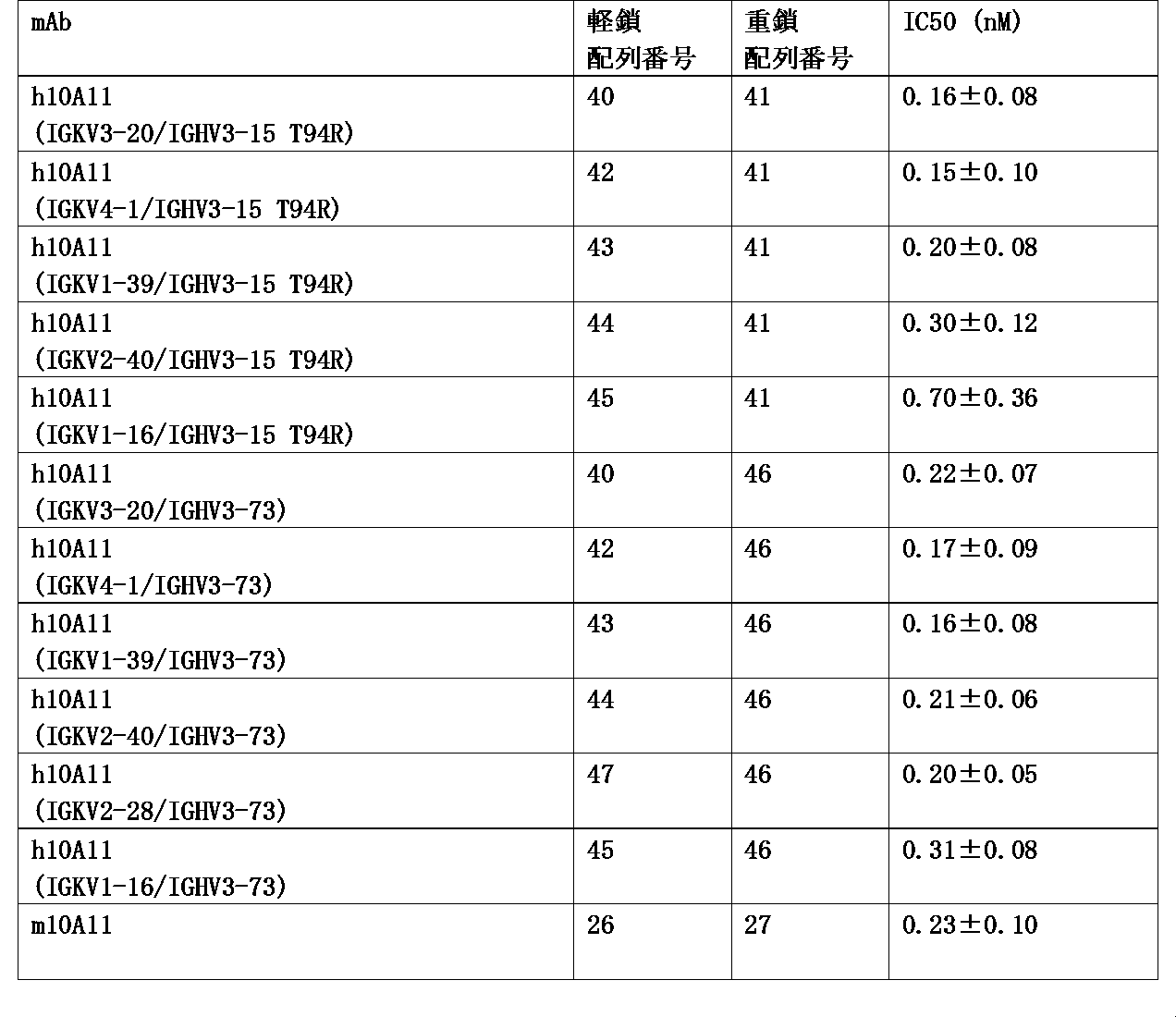
19D7について、実施例7と同様の方法でヒト化を実施した(軽鎖;図6、重鎖;図7)。実施例6に示す方法により中和活性を測定した結果、表7に示すヒト化モノクローナル抗体が、マウス抗体と同等以上の親和性を示した。

図4及び図5に示すヒト化10A11について、CDRに相当するアミノ酸に点変異を導入した変異体を作製し、実施例6に示した方法により、各変異体の中和活性を算出した。各変異体について複数回中和活性評価を行い、そのIC50値をWTのIC50値との比として、IC50 ratio (WT IC50/ 変異体IC50)で表記した。
結果を表8及び表9に示す。n.d.(=not detectable)は、変異体のIC50値が測定系の限界値である10nM以上であり、検出限界以下まで活性が低下していることを示す。中和活性評価の結果、軽鎖については、KabatのnumberingによるL26、L27、L27c、L93アミノ酸部位において変異を有するS26T、K27R、L27cI、E93Dの各変異体は10倍以上活性が低下した(表8)。また重鎖については、KabatのnumberingによるH33、H35、H52、H53、H59、H96、H97、H98、H100c、H101アミノ酸部位において変異を有するA33V、Y35F、R52K、N53Q、Y59F、R96K、F97L、Y98F、G100cA、D101Eの各変異体で10倍以上活性が低下した(表9)。これらのアミノ酸は活性に極めて重要なアミノ酸である。

※アミノ酸部位はKabatのnumberingによる部位。
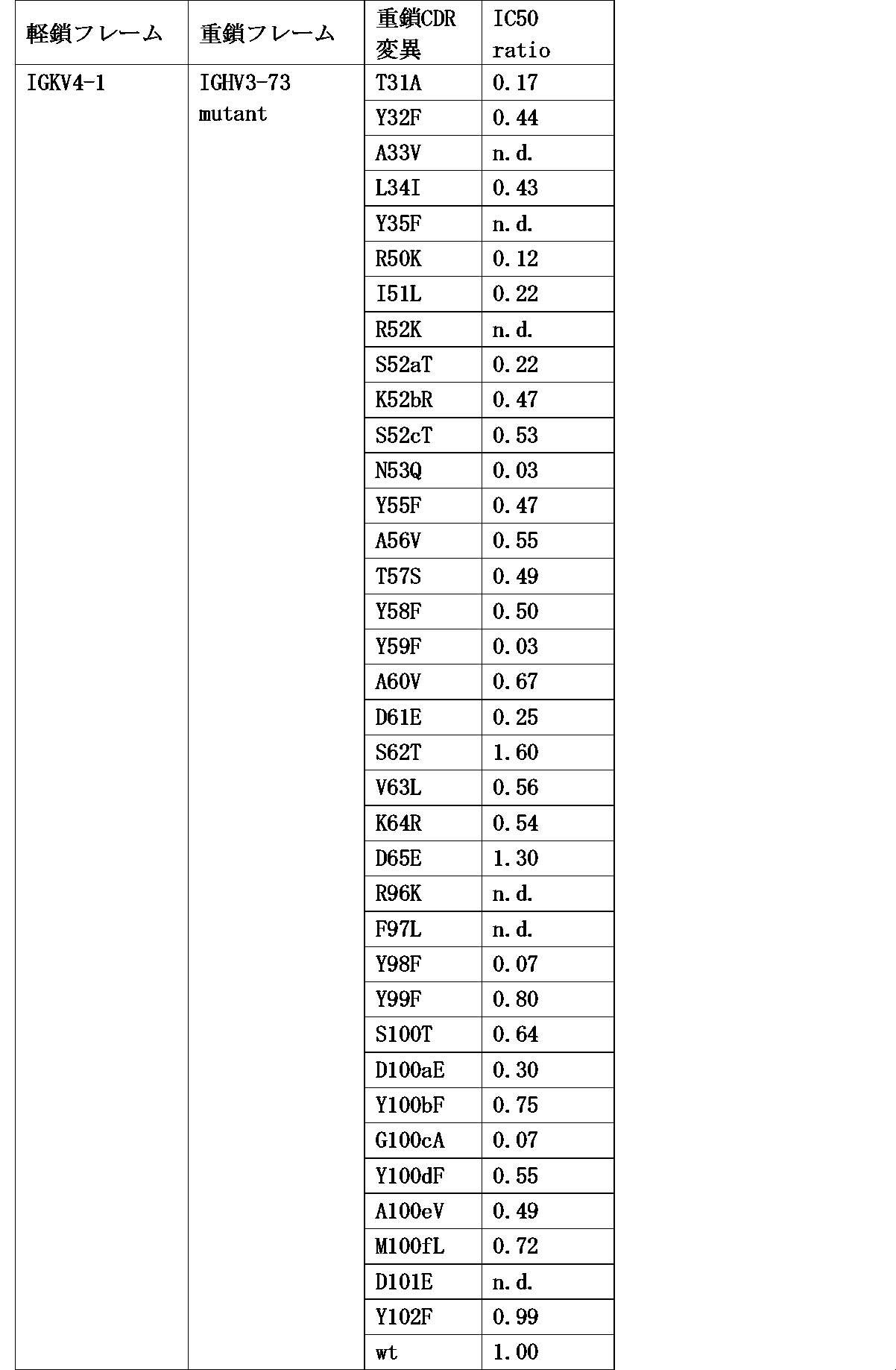
※アミノ酸部位はKabatのnumberingによる部位。
図6及び図7に示すヒト化19D7について、CDRに相当するアミノ酸に点変異を導入した変異体を作製し、実施例6に示した方法により、各変異体の中和活性を算出した。各変異体について複数回中和活性評価を行い、そのIC50値をWTのIC50値との比として、IC50 ratio (WT IC50/ 変異体IC50)で表記した。
結果を表10及び表11に示す。n.d.(=not detectable)は、変異体のIC50値が測定系の限界値である10nM以上であり、検出限界以下まで活性が低下していることを示す。
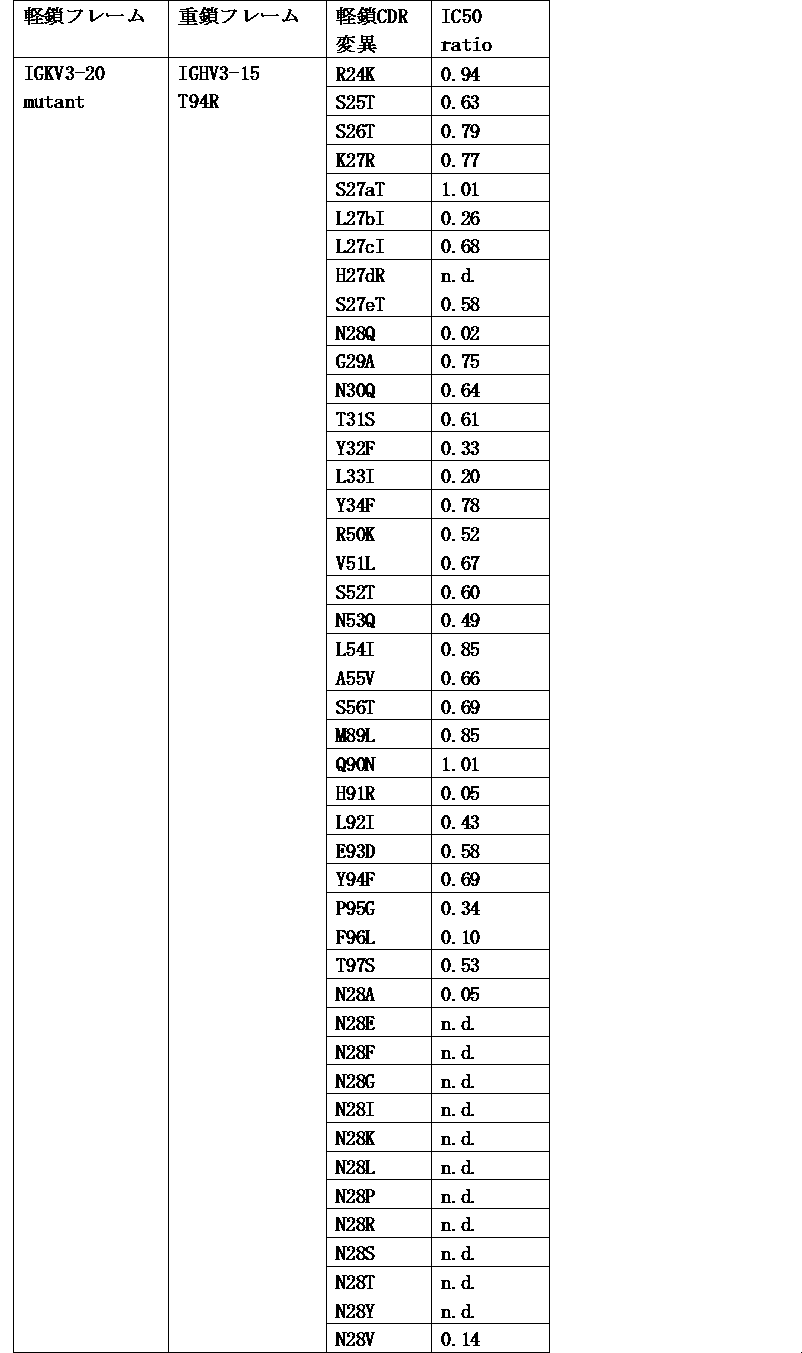
※アミノ酸部位はKabatのnumberingによる部位。
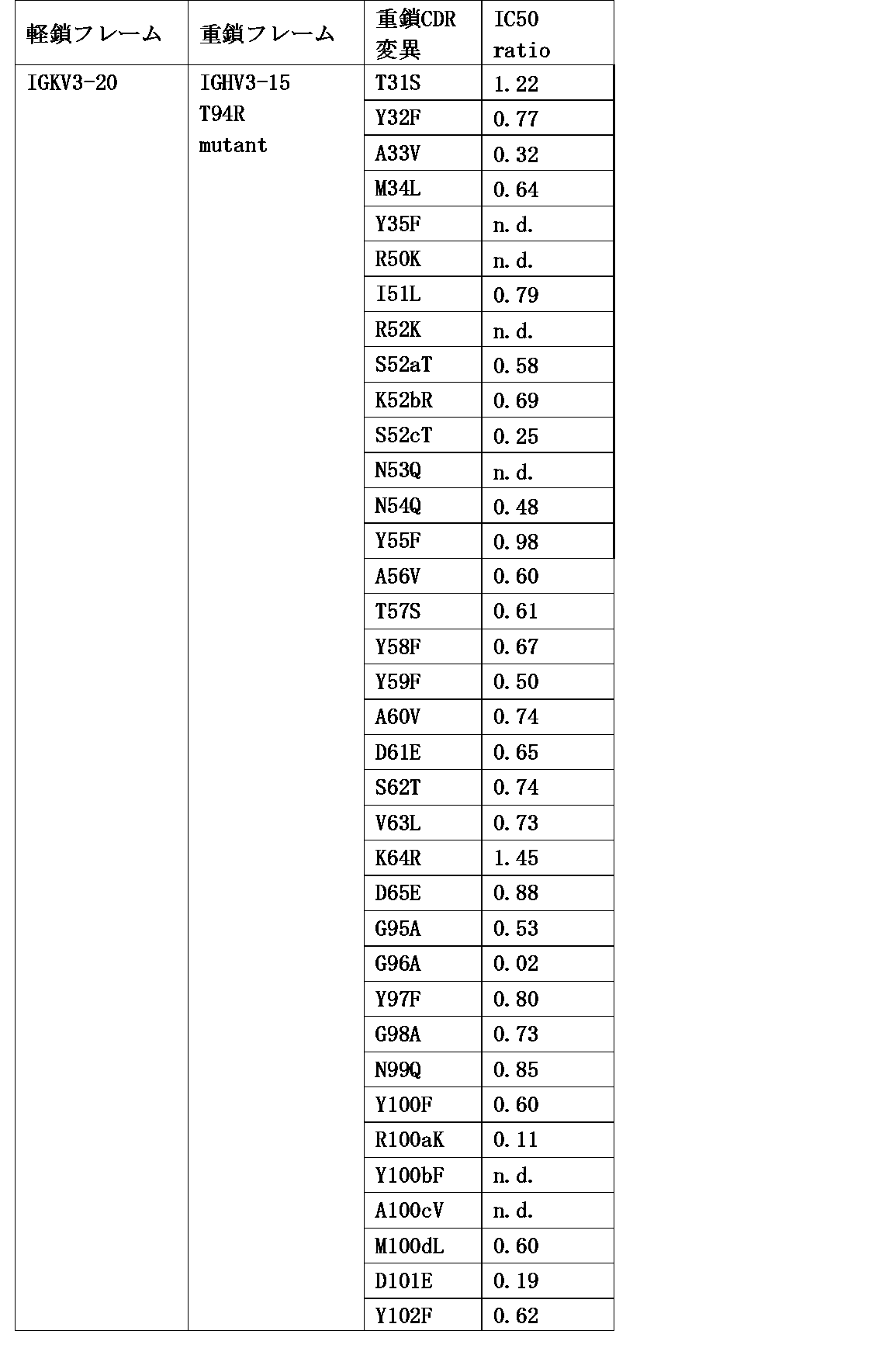
※アミノ酸部位はKabatのnumberingによる部位。
実施例7により見出されたヒト化フレームワークに、実施例8により見出された活性向上変異と、脱アミド化リスク配列に相当する、KabatのnumberingによるL28アミノ酸部位のNとL29アミノ酸部位のGに対する変異を組み合わせることで、ヒト化10A11の最適化を行った。その結果、表12に示すヒト化10A11変異体を見出した。

※アミノ酸部位はKabatのnumberingによる部位。
実施例7-2により見出されたヒト化フレームワークに点変異を導入し、ヒト化19D7の最適化を行った。その結果、表13に示すヒト化19D7変異体を見出した。

(1)hCCR8-KI(KI/KI)マウスの作製
マウスCCR8遺伝子(Gene ID:12776)及びヒトCCR8遺伝子(Gene ID:1237)は、いずれも2つのエクソンから構成されており、第2番目のエクソン内にORF(オープンリーディングフレーム)全長が含まれている。マウスCCR8遺伝子のORF(CCDS ID:23621.1)全長を取り除くと同時にヒトCCR8遺伝子のORF(CCDS ID:2684.1)全長を挿入することで、発現するCCR8タンパク質を完全にヒト化したhCCR8-KI(KI/KI)マウスを作製した。
相同組換えアームとして使用するDNA断片は、マウスCCR8遺伝子のORFの上流下流それぞれ約2kb(キロベース)のマウスゲノム配列をPCR増幅することにより取得し、マウス由来のゲノム配列はORFのみが取り除かれるように設計した。先のヒトCCR8遺伝子のORF全長配列の前後に相同組換えアームをそれぞれ継ぎ目なく接続することでターゲティングベクターを作製し、相同組換えに供し、hCCR8-KI(KI/+)Balb/cマウスを作製した。作製したhCCR8-KI(KI/+)Balb/cマウスについては、マウスCCR8遺伝子のORF全長とヒトCCR8遺伝子のORF全長が正しく置き換わっており、かつ、余計な配列の挿入や欠失がないことをPCR及びDNA塩基配列解析により確認した。hCCR8-KI(KI/+)Balb/cマウスを通常交配で掛け合わせることでhCCR8-KI(KI/KI)マウスを作製した。
hCCR8-KI(KI/KI)マウス(6週齢、メス)の背部皮内に3.5x105個(50μL)のCT26細胞を移植し、移植17日目に、5例の個体より腫瘍を回収した(N=5)。CT26細胞の腫瘍塊を、ハサミで細かく切断し、市販キット(Tumor Dissociation Kit, mouse, Miltenyi社及びThe gentleMACS(TM) Dissociator, Miltenyi社)を用いて添付キットプロトコルに従い、腫瘍浸潤細胞を調製した。
調製された細胞は70umのセルストレイナーに通した後、2回10mM HEPES/HBSS/2%FBSで洗浄した。その後、赤血球溶解液(BD Biosciences社)で5分間処理し、赤血球を除去し、さらに2%FBS/10mM HEPES/HBSSバッファーで2回洗浄した。腫瘍浸潤細胞は以下の方法及び抗体により染色した。
浸潤細胞をZombie NIR Fixable Viability Kit(BioLegend)試薬を用いて、30分間氷中で染色した。2%FBS/10mM HEPES/HBSSで1回洗浄後、Bv510標識抗マウスCD45(30-F11、Biolegend)、 FITC標識抗マウスCD4(RM4-4、BioLegend)、PE/Cy7標識抗マウスCD8(53-6.7、BioLegend)、PerCP/Cy5.5標識抗マウスTCRβ(H57-597、BioLegend)、PE標識抗マウスCD25(PC61、BioLegend)、BV421標識抗ヒトCCR8抗体(433H、BD Biosciences)(又はBV421標識アイソタイプコントロール抗体)で染色した。染色は30分間氷中で実施した。2%FBS/HEPES/HBSSで2回洗浄後、フローサイトメーターを用いて細胞を解析した。
CD45+TCRβ+CD4+CD25+T細胞中のヒトCCR8発現を解析した。アイソタイプコントロール抗体での染色により陰性細胞領域を決定し、抗ヒトCCR8抗体で陽性となる細胞をヒトCCR8+細胞として移植17日後に存在頻度を算出した。その結果、マウス腫瘍内のCD45+TCRβ+CD4+CD25+細胞中の約47%にヒトCCR8が検出された。
hCCR8-KI(KI/KI)マウス(8週齢、メス)の背部皮内に4x105個の大腸癌由来CT26細胞(50uL)を移植した。腫瘍移植4日目及び11日目にヒト化10A11抗体(軽鎖可変領域:IGKV4-1 N53Q+G29R(配列番号59)/重鎖可変領域:IGHV3-15 T94R(配列番号41))を静脈内に100μg(100μL)又は200μg(100μL)投与した(N=10)。コントロールは媒体(りん酸緩衝生理食塩水)100μLを投与した(N=10)。腫瘍移植4、7、10、11、14、16、18、21、24日後に腫瘍体積を測定した。腫瘍体積(mm3)は長径(mm)x短径(mm)x短径(mm)/2で計量した。
その結果、移植11日目、14日目、16日目、18日目、21日目、24日目においていずれの用量の抗ヒトCCR8抗体投与群の腫瘍体積が有意に小さかった(図8、有意水準はWelch‘s t testを用い、いずれの用量においても10日目が**;p<0.01、11日目以降が、***;p<0.001)。また抗ヒトCCR8抗体投与群では、完全退縮を示す個体が出現し、24日目には100μg抗ヒトCCR8抗体投与群で10匹中5匹、200μg抗ヒトCCR8抗体投与群で10匹中6匹のマウスの腫瘍がほぼ完全に消失した。
ヒト化10A11抗体(軽鎖可変領域:IGKV4-1/重鎖可変領域:IGHV3-15 T94R)を用い、hCCR8との結合において、これと競合する抗体のスクリーニングを実施した。
実施例1に記載の方法と同様の方法で、ヒトCCR8(UniProtKB/Swiss-Prot:P51685)の全長をコードする遺伝子を抗原とし、A/J Jms Slc雌性マウスにDNA免疫してハイブリドーマを作製した。作製したハイブリドーマを96well plateに播種し、9日間培養後得られた培養上清のうち176wellについて、ヒト化10A11抗体との競合結合試験を実施した。競合試験は、実施例1の方法で作製したヒトCCR8発現Expi293細胞に対し、培養上清を10nMのヒト化10A11抗体もしくは、isotype controlと混合して、室温で3時間反応させ、PBSで3回洗浄したのちにAlexa488標識抗マウスIgG抗体(サーモフィッシャーサイエンティフィック社製)で検出することにより行った。Isotype controlの共存下、ハイブリドーマ由来抗体の結合が確認できたものを通常のヒトCCR8結合抗体であると定義した。またヒトCCR8結合抗体のうち、ヒト化10A11抗体の共存下では結合シグナルが顕著に低下する抗体をヒト化10A11抗体と競合する抗体として同定した。その結果、170well中56wellがヒトCCR8結合抗体であった。一方この56well中、7wellがヒト化10A11抗体と競合する抗体であった。
さらに、競合する抗体として同定したもののうち、代表して3クローンをクローン化し、クローン化後のハイブリドーマ培養上清より精製抗体を得た。この精製抗体についてヒトCCL1-ヒトCCR8に対する中和活性を実施例1の方法により測定した。その結果いずれの抗体も中和活性を有しており(表14)、ヒト化10A11抗体と競合する抗体が強い中和抗体であることが示された。

実施例3に記載の内容と同様、ヒト化10A11抗体、ヒト化19D7抗体について、エピトープ検証を実施した。実施例3で作製した、ヒトCCR4のキメラ体、ヒトCCR8N末領域の点変異体に加え、ヒトCCR8 loop1、loop2領域の点変異体についても結合評価を実施した。結合評価は各変異体をExpi293細胞に一過性発現させ、ヒト化10A11抗体(軽鎖可変領域:IGKV4-1/重鎖可変領域:IGHV3-15 T94R)又はヒト化19D7抗体(軽鎖可変領域:IGKV3-20/重鎖可変領域:IGHV3-15 T94R)を20μg/mLから3倍ずつ8段階希釈調製した抗体溶液を反応させることにより実施した。室温で3時間反応させたのちにAlexa488標識anti-human IgG抗体(サーモフィッシャーサイエンティフィック社)と反応させ、フローサイトメトリー解析を実施した。また各変異体の発現量は各変異体のN末にタグを付与し、同様の方法で抗タグ抗体により検出することで、補正した。
結果を表15および16に示す。ヒトCCR8と比較して、その結合活性が70%以下になる変異体を△、20%以下になる変異体を×と示した。

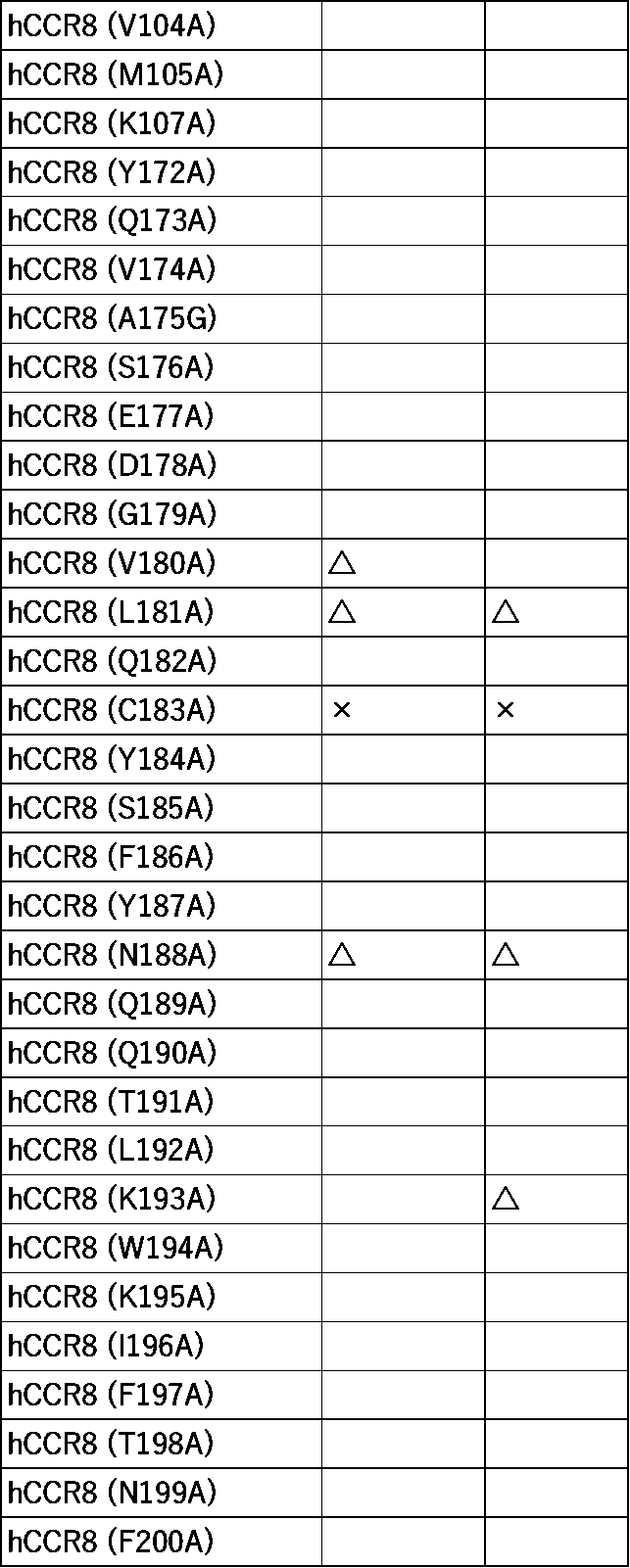
Claims (36)
- 配列番号1で示されるアミノ酸配列の17位のチロシンを認識する、CCR8に結合するモノクローナル抗体またはその抗体断片。
- 中和抗体である、請求項1記載の抗体又はその抗体断片。
- さらに、配列番号1で示されるアミノ酸配列の94位から107位の中の1以上のアミノ酸を認識する、請求項1又は2記載の抗体又はその抗体断片。
- さらに、配列番号1で示されるアミノ酸配列の172位から202位の中の1以上のアミノ酸を認識する、請求項1~3のいずれかに記載の抗体又はその抗体断片。
- 配列番号1で示されるアミノ酸配列の20位のイソロイシン、22位のセリン、35位のリジン、181位のロイシン、183位のシステイン及び188位のアスパラギンのうち、1以上のアミノ酸を認識する、請求項1~4のいずれかに記載の抗体又はその抗体断片。
- ヒト化モノクローナル抗体又はその抗体断片である、請求項1~5のいずれかに記載の抗体又は抗体断片。
- 1)配列番号2のアミノ酸配列において1又は2のアミノ酸が欠失、置換、挿入及び/若しくは付加されていてもよいアミノ酸配列からなるCDR1、
配列番号3のアミノ酸配列において1又は2のアミノ酸が欠失、置換、挿入及び/若しくは付加されていてもよいアミノ酸配列からなるCDR2及び
配列番号4のアミノ酸配列において1又は2のアミノ酸が欠失、置換、挿入及び/若しくは付加されていてもよいアミノ酸配列からなるCDR3を含む軽鎖可変領域並びに
配列番号5のアミノ酸配列において1又は2のアミノ酸が欠失、置換、挿入及び/若しくは付加されていてもよいアミノ酸配列からなるCDR1、
配列番号6のアミノ酸配列において1又は2のアミノ酸が欠失、置換、挿入及び/若しくは付加されていてもよいアミノ酸配列からなるCDR2及び
配列番号7のアミノ酸配列において1又は2のアミノ酸が欠失、置換、挿入及び/若しくは付加されていてもよいアミノ酸配列からなるCDR3を含む重鎖可変領域;
2)配列番号2のアミノ酸配列において1又は2のアミノ酸が欠失、置換、挿入及び/若しくは付加されていてもよいアミノ酸配列からなるCDR1、
配列番号3のアミノ酸配列において1又は2のアミノ酸が欠失、置換、挿入及び/若しくは付加されていてもよいアミノ酸配列からなるCDR2及び
配列番号4のアミノ酸配列において1又は2のアミノ酸が欠失、置換、挿入及び/若しくは付加されていてもよいアミノ酸配列からなるCDR3を含む軽鎖可変領域並びに
配列番号8のアミノ酸配列において1又は2のアミノ酸が欠失、置換、挿入及び/若しくは付加されていてもよいアミノ酸配列からなるCDR1、
配列番号6のアミノ酸配列において1又は2のアミノ酸が欠失、置換、挿入及び/若しくは付加されていてもよいアミノ酸配列からなるCDR2及び
配列番号7のアミノ酸配列において1又は2のアミノ酸が欠失、置換、挿入及び/若しくは付加されていてもよいアミノ酸配列からなるCDR3を含む重鎖可変領域;
3)配列番号2のアミノ酸配列において1又は2のアミノ酸が欠失、置換、挿入及び/若しくは付加されていてもよいアミノ酸配列からなるCDR1、
配列番号9のアミノ酸配列において1又は2のアミノ酸が欠失、置換、挿入及び/若しくは付加されていてもよいアミノ酸配列からなるCDR2及び
配列番号10のアミノ酸配列において1又は2のアミノ酸が欠失、置換、挿入及び/若しくは付加されていてもよいアミノ酸配列からなるCDR3を含む軽鎖可変領域並びに
配列番号8のアミノ酸配列において1又は2のアミノ酸が欠失、置換、挿入及び/若しくは付加されていてもよいアミノ酸配列からなるCDR1、
配列番号6のアミノ酸配列において1又は2のアミノ酸が欠失、置換、挿入及び/若しくは付加されていてもよいアミノ酸配列からなるCDR2及び
配列番号11のアミノ酸配列において1又は2のアミノ酸が欠失、置換、挿入及び/若しくは付加されていてもよいアミノ酸配列からなるCDR3を含む重鎖可変領域;
4)配列番号2のアミノ酸配列において1又は2のアミノ酸が欠失、置換、挿入及び/若しくは付加されていてもよいアミノ酸配列からなるCDR1、
配列番号3のアミノ酸配列において1又は2のアミノ酸が欠失、置換、挿入及び/若しくは付加されていてもよいアミノ酸配列からなるCDR2及び
配列番号10のアミノ酸配列において1又は2のアミノ酸が欠失、置換、挿入及び/若しくは付加されていてもよいアミノ酸配列からなるCDR3を含む軽鎖可変領域並びに
配列番号12のアミノ酸配列において1又は2のアミノ酸が欠失、置換、挿入及び/若しくは付加されていてもよいアミノ酸配列からなるCDR1、
配列番号6のアミノ酸配列において1又は2のアミノ酸が欠失、置換、挿入及び/若しくは付加されていてもよいアミノ酸配列からなるCDR2及び
配列番号13のアミノ酸配列において1又は2のアミノ酸が欠失、置換、挿入及び/若しくは付加されていてもよいアミノ酸配列からなるCDR3を含む重鎖可変領域;
5)配列番号14のアミノ酸配列において1又は2のアミノ酸が欠失、置換、挿入及び/若しくは付加されていてもよいアミノ酸配列からなるCDR1、
配列番号15のアミノ酸配列において1又は2のアミノ酸が欠失、置換、挿入及び/若しくは付加されていてもよいアミノ酸配列からなるCDR2及び
配列番号16のアミノ酸配列において1又は2のアミノ酸が欠失、置換、挿入及び/若しくは付加されていてもよいアミノ酸配列からなるCDR3を含む軽鎖可変領域並びに
配列番号17のアミノ酸配列において1又は2のアミノ酸が欠失、置換、挿入及び/若しくは付加されていてもよいアミノ酸配列からなるCDR1、
配列番号18のアミノ酸配列において1又は2のアミノ酸が欠失、置換、挿入及び/若しくは付加されていてもよいアミノ酸配列からなるCDR2及び
配列番号19のアミノ酸配列において1又は2のアミノ酸が欠失、置換、挿入及び/若しくは付加されていてもよいアミノ酸配列からなるCDR3を含む重鎖可変領域;若しくは
6)配列番号20のアミノ酸配列において1又は2のアミノ酸が欠失、置換、挿入及び/若しくは付加されていてもよいアミノ酸配列からなるCDR1、
配列番号21のアミノ酸配列において1又は2のアミノ酸が欠失、置換、挿入及び/若しくは付加されていてもよいアミノ酸配列からなるCDR2及び
配列番号22のアミノ酸配列において1又は2のアミノ酸が欠失、置換、挿入及び/若しくは付加されていてもよいアミノ酸配列からなるCDR3を含む軽鎖可変領域並びに
配列番号23のアミノ酸配列において1又は2のアミノ酸が欠失、置換、挿入及び/若しくは付加されていてもよいアミノ酸配列からなるCDR1、
配列番号24のアミノ酸配列において1又は2のアミノ酸が欠失、置換、挿入及び/若しくは付加されていてもよいアミノ酸配列からなるCDR2及び
配列番号25のアミノ酸配列において1又は2のアミノ酸が欠失、置換、挿入及び/若しくは付加されていてもよいアミノ酸配列からなるCDR3を含む重鎖可変領域
を含む、CCR8に結合するモノクローナル抗体又はその抗体断片。 - 1)配列番号2のアミノ酸配列からなるCDR1、
配列番号3のアミノ酸配列からなるCDR2及び
配列番号4のアミノ酸配列からなるCDR3を含む軽鎖可変領域並びに
配列番号5のアミノ酸配列からなるCDR1、
配列番号6のアミノ酸配列からなるCDR2及び
配列番号7のアミノ酸配列からなるCDR3を含む重鎖可変領域
(ここで、以下のいずれかの置換を1以上有していても良い、
A)配列番号2のアミノ酸配列の10番目のアスパラギンがリジンに置換
B)配列番号2のアミノ酸配列の11番目のグリシンがグルタミン、トレオニン、アラニン、リジン、ロイシン又はアルギニンに置換
C)配列番号3のアミノ酸配列の4番目のアスパラギンがグルタミンに置換
D)配列番号3のアミノ酸配列の5番目のロイシンがイソロイシンに置換
E)配列番号4のアミノ酸配列の4番目のロイシンがイソロイシンに置換
F)配列番号4のアミノ酸配列の6番目のチロシンがフェニルアラニンに置換
G)配列番号6のアミノ酸配列の16番目のセリンがトレオニンに置換
H)配列番号6のアミノ酸配列の19番目のアスパラギン酸がグルタミン酸に置換);
2)配列番号2のアミノ酸配列からなるCDR1、
配列番号3のアミノ酸配列からなるCDR2及び
配列番号4のアミノ酸配列からなるCDR3を含む軽鎖可変領域並びに
配列番号8のアミノ酸配列からなるCDR1、
配列番号6のアミノ酸配列からなるCDR2及び
配列番号7のアミノ酸配列からなるCDR3を含む重鎖可変領域;
3)配列番号2のアミノ酸配列からなるCDR1、
配列番号9のアミノ酸配列からなるCDR2及び
配列番号10のアミノ酸配列からなるCDR3を含む軽鎖可変領域並びに
配列番号8のアミノ酸配列からなるCDR1、
配列番号6のアミノ酸配列からなるCDR2及び
配列番号11のアミノ酸配列からなるCDR3を含む重鎖可変領域;
(ここで、以下のいずれかの置換を1以上有していても良い、
A)配列番号2のアミノ酸配列の2番目のセリンがトレオニンに置換、
B)配列番号2のアミノ酸配列の3番目のセリンがトレオニンに置換、
C)配列番号2のアミノ酸配列の5番目のセリンがトレオニンに置換、
D)配列番号10のアミノ酸配列の2番目のグルタミンがアスパラギンに置換、
E)配列番号8のアミノ酸配列の1番目のトレオニンがセリンに置換、
F)配列番号6のアミノ酸配列の14番目のアラニンがバリンに置換、
G)配列番号6のアミノ酸配列の18番目のリジンがアルギニンに置換、
H)配列番号6のアミノ酸配列の19番目のアスパラギン酸がグルタミン酸に置換、
I)配列番号11のアミノ酸配列の5番目のアスパラギンがグルタミンに置換、
J)配列番号11のアミノ酸配列の12番目のチロシンがフェニルアラニンに置換);
4)配列番号2のアミノ酸配列からなるCDR1、
配列番号3のアミノ酸配列からなるCDR2及び
配列番号10のアミノ酸配列からなるCDR3を含む軽鎖可変領域並びに
配列番号12のアミノ酸配列からなるCDR1、
配列番号6のアミノ酸配列からなるCDR2及び
配列番号13のアミノ酸配列からなるCDR3を含む重鎖可変領域;
5)配列番号14のアミノ酸配列からなるCDR1、
配列番号15のアミノ酸配列からなるCDR2及び
配列番号16のアミノ酸配列からなるCDR3を含む軽鎖可変領域並びに
配列番号17のアミノ酸配列からなるCDR1、
配列番号18のアミノ酸配列からなるCDR2及び
配列番号19のアミノ酸配列からなるCDR3を含む重鎖可変領域;若しくは
6)配列番号20のアミノ酸配列からなるCDR1、
配列番号21のアミノ酸配列からなるCDR2及び
配列番号22のアミノ酸配列からなるCDR3を含む軽鎖可変領域並びに
配列番号23のアミノ酸配列からなるCDR1、
配列番号24のアミノ酸配列からなるCDR2及び
配列番号25のアミノ酸配列からなるCDR3を含む重鎖可変領域
を含む、請求項7記載の抗体又はその抗体断片。 - 配列番号2のアミノ酸配列からなるCDR1、
配列番号3のアミノ酸配列からなるCDR2及び
配列番号4のアミノ酸配列からなるCDR3を含む軽鎖可変領域並びに
配列番号5のアミノ酸配列からなるCDR1、
配列番号6のアミノ酸配列からなるCDR2及び
配列番号7のアミノ酸配列からなるCDR3を含む重鎖可変領域を含み、
以下のいずれかの置換を1以上有する、
A)配列番号2のアミノ酸配列の10番目のアスパラギンがリジンに置換;
B)配列番号2のアミノ酸配列の11番目のグリシンがグルタミン、トレオニン、アラニン、リジン、ロイシン又はアルギニンに置換;
C)配列番号3のアミノ酸配列の4番目のアスパラギンがグルタミンに置換;
D)配列番号3のアミノ酸配列の5番目のロイシンがイソロイシンに置換;
E)配列番号4のアミノ酸配列の4番目のロイシンがイソロイシンに置換;
F)配列番号4のアミノ酸配列の6番目のチロシンがフェニルアラニンに置換
G)配列番号6のアミノ酸配列の16番目のセリンがトレオニンに置換
H)配列番号6のアミノ酸配列の19番目のアスパラギン酸がグルタミン酸に置換、
請求項8記載の抗体又はその抗体断片。 - 以下のいずれかの置換を1以上有する、
A)配列番号2のアミノ酸配列の10番目のアスパラギンがリジンに置換;
B)配列番号2のアミノ酸配列の11番目のグリシンがロイシン又はアルギニンに置換;
C)配列番号3のアミノ酸配列の4番目のアスパラギンがグルタミンに置換、
請求項9記載の抗体又はその抗体断片。 - 配列番号3のアミノ酸配列の4番目のアスパラギンがグルタミンに置換されており、
さらに、以下のいずれか一つの置換を有していても良い、
A)配列番号2のアミノ酸配列の10番目のアスパラギンがリジンに置換;
B)配列番号2のアミノ酸配列の11番目のグリシンがロイシン又はアルギニンに置換、
請求項9又は10記載の抗体又はその抗体断片。 - 配列番号3のアミノ酸配列の4番目のアスパラギンがグルタミンに置換されており、さらに、配列番号2のアミノ酸配列の11番目のグリシンがアルギニンに置換されている、請求項11記載の抗体又はその抗体断片。
- 配列番号2のアミノ酸配列からなるCDR1、
配列番号9のアミノ酸配列からなるCDR2及び
配列番号10のアミノ酸配列からなるCDR3を含む軽鎖可変領域並びに
配列番号8のアミノ酸配列からなるCDR1、
配列番号6のアミノ酸配列からなるCDR2及び
配列番号11のアミノ酸配列からなるCDR3を含む重鎖可変領域を含み、
以下のいずれかの置換を1以上有する、
A)配列番号2のアミノ酸配列の2番目のセリンがトレオニンに置換;
B)配列番号2のアミノ酸配列の3番目のセリンがトレオニンに置換;
C)配列番号2のアミノ酸配列の5番目のセリンがトレオニンに置換;
D)配列番号10のアミノ酸配列の2番目のグルタミンがアスパラギンに置換;
E)配列番号8のアミノ酸配列の1番目のトレオニンがセリンに置換;
F)配列番号6のアミノ酸配列の14番目のアラニンがバリンに置換;
G)配列番号6のアミノ酸配列の18番目のリジンがアルギニンに置換;
H)配列番号6のアミノ酸配列の19番目のアスパラギン酸がグルタミン酸に置換;
I)配列番号11のアミノ酸配列の5番目のアスパラギンがグルタミンに置換、
J)配列番号11のアミノ酸配列の12番目のチロシンがフェニルアラニンに置換、
請求項8記載の抗体又はその抗体断片。 - ヒト化モノクローナル抗体又はその抗体断片である、請求項7~13のいずれかに記載の抗体又は抗体断片。
- 配列番号40、42、43、44、45若しくは47のアミノ酸配列又は
配列番号40、42、43、44、45若しくは47のアミノ酸配列と95%以上の同一性のアミノ酸配列からなる軽鎖可変領域並びに
配列番号41若しくは46のアミノ酸配列又は
配列番号41若しくは46のアミノ酸配列と95%以上の同一性のアミノ酸配列からなる重鎖可変領域;
を含む、請求項14記載のヒト化モノクローナル抗体又はその抗体断片。 - 1)配列番号40のアミノ酸配列を有する軽鎖可変領域、及び、
配列番号41のアミノ酸配列を有する重鎖可変領域;
2)配列番号42のアミノ酸配列を有する軽鎖可変領域、及び、
配列番号41のアミノ酸配列を有する重鎖可変領域;
3)配列番号43のアミノ酸配列を有する軽鎖可変領域、及び、
配列番号41のアミノ酸配列を有する重鎖可変領域;
4)配列番号44のアミノ酸配列を有する軽鎖可変領域、及び、
配列番号41のアミノ酸配列を有する重鎖可変領域;
5)配列番号45のアミノ酸配列を有する軽鎖可変領域、及び、
配列番号41のアミノ酸配列を有する重鎖可変領域;
6)配列番号47のアミノ酸配列を有する軽鎖可変領域、及び、
配列番号41のアミノ酸配列を有する重鎖可変領域;
7)配列番号40のアミノ酸配列を有する軽鎖可変領域、及び、
配列番号46のアミノ酸配列を有する重鎖可変領域;
8)配列番号42のアミノ酸配列を有する軽鎖可変領域、及び、
配列番号46のアミノ酸配列を有する重鎖可変領域;
9)配列番号43のアミノ酸配列を有する軽鎖可変領域、及び、
配列番号46のアミノ酸配列を有する重鎖可変領域;
10)配列番号44のアミノ酸配列を有する軽鎖可変領域、及び、
配列番号46のアミノ酸配列を有する重鎖可変領域;
11)配列番号45のアミノ酸配列を有する軽鎖可変領域、及び、
配列番号46のアミノ酸配列を有する重鎖可変領域;若しくは
12)配列番号47のアミノ酸配列を有する軽鎖可変領域、及び、
配列番号46のアミノ酸配列を有する重鎖可変領域
を含み、
以下のいずれかの置換を1以上有していても良い、
A)配列番号40、42、43、44、45又は47のアミノ酸配列の33番目のアスパラギンがリジンに置換;
B)配列番号40、42、43、44、45又は47のアミノ酸配列の34番目のグリシンがグルタミン、トレオニン、アラニン、リジン、ロイシン又はアルギニンに置換;
C)配列番号40、42、43、44、45又は47のアミノ酸配列の58番目のアスパラギンがグルタミンに置換;
D)配列番号40、42、43、44、45又は47のアミノ酸配列の59番目のロイシンがイソロイシンに置換;
E)配列番号40、42、43、44、45又は47のアミノ酸配列の97番目のロイシンがイソロイシンに置換;
F)配列番号40、42、43、44、45又は47のアミノ酸配列の99番目のチロシンがフェニルアラニンに置換;
G)配列番号41又は46のアミノ酸配列の65番目のセリンがトレオニンに置換;
H)配列番号41又は46のアミノ酸配列の68番目のアスパラギン酸がグルタミン酸に置換、
請求項14又は15記載の抗体であるヒト化モノクローナル抗体又はその抗体断片。 - 以下のいずれかの置換を1以上有する、
A)配列番号40、42、43、44、45又は47のアミノ酸配列の33番目のアスパラギンがリジンに置換;
B)配列番号40、42、43、44、45又は47のアミノ酸配列の34番目のグリシンがグルタミン、トレオニン、アラニン、リジン、ロイシン又はアルギニンに置換;
C)配列番号40、42、43、44、45又は47のアミノ酸配列の58番目のアスパラギンがグルタミンに置換;
D)配列番号40、42、43、44、45又は47のアミノ酸配列の59番目のロイシンがイソロイシンに置換;
E)配列番号40、42、43、44、45又は47のアミノ酸配列の97番目のロイシンがイソロイシンに置換;
F)配列番号40、42、43、44、45又は47のアミノ酸配列の99番目のチロシンがフェニルアラニンに置換;
G)配列番号41又は46のアミノ酸配列の65番目のセリンがトレオニンに置換;
H)配列番号41又は46のアミノ酸配列の68番目のアスパラギン酸がグルタミン酸に置換、
請求項16記載の抗体であるヒト化モノクローナル抗体又はその抗体断片。 - 配列番号40又は42のアミノ酸配列を有する軽鎖可変領域、及び、
配列番号41のアミノ酸配列を有する重鎖可変領域を含み、
以下のいずれかの置換を1以上有する、
A)配列番号40又は42のアミノ酸配列の33番目のアスパラギンがリジンに置換;
B)配列番号40又は42のアミノ酸配列の34番目のグリシンがグルタミン、トレオニン、アラニン、リジン、ロイシン又はアルギニンに置換;
C)配列番号40又は42のアミノ酸配列の58番目のアスパラギンがグルタミンに置換;
D)配列番号40又は42のアミノ酸配列の59番目のロイシンがイソロイシンに置換;
E)配列番号40又は42のアミノ酸配列の97番目のロイシンがイソロイシンに置換;
F)配列番号40又は42のアミノ酸配列の99番目のチロシンがフェニルアラニンに置換;
G)配列番号41のアミノ酸配列の65番目のセリンがトレオニンに置換;
H)配列番号41のアミノ酸配列の68番目のアスパラギン酸がグルタミン酸に置換、
請求項17記載の抗体であるヒト化モノクローナル抗体又はその抗体断片。 - 配列番号40又は42のアミノ酸配列を有する軽鎖可変領域、及び、
配列番号41のアミノ酸配列を有する重鎖可変領域を含み、
以下のいずれかの置換を1以上有する、
A)配列番号40又は42のアミノ酸配列の33番目のアスパラギンがリジンに置換;
B)配列番号40又は42のアミノ酸配列の34番目のグリシンがロイシン又はアルギニンに置換;
C)配列番号40又は42のアミノ酸配列の58番目のアスパラギンがグルタミンに置換、
請求項17又は18記載の抗体であるヒト化モノクローナル抗体又はその抗体断片。 - 配列番号40又は42のアミノ酸配列を有する軽鎖可変領域、及び、
配列番号41のアミノ酸配列を有する重鎖可変領域を含み、
配列番号40又は42のアミノ酸配列の58番目のアスパラギンがグルタミンに置換されており、
さらに、以下のいずれか一つの置換を有していても良い、
A)配列番号40又は42のアミノ酸配列の33番目のアスパラギンがリジンに置換;
B)配列番号40又は42のアミノ酸配列の34番目のグリシンがロイシン又はアルギニンに置換、
請求項17~19のいずれかに記載の抗体であるヒト化モノクローナル抗体又はその抗体断片。 - 配列番号42のアミノ酸配列を有する軽鎖可変領域、及び、
配列番号41のアミノ酸配列を有する重鎖可変領域を含み、
配列番号42のアミノ酸配列の58番目のアスパラギンがグルタミンに置換されており、配列番号42のアミノ酸配列の34番目のグリシンがアルギニンに置換されている、
請求項20記載の抗体であるヒト化モノクローナル抗体又はその抗体断片。 - 配列番号59のアミノ酸配列を有する軽鎖可変領域、及び、配列番号41のアミノ酸配列を有する重鎖可変領域を有する、請求項20記載の抗体であるヒト化モノクローナル抗体又はその抗体断片。
- 配列番号54、55若しくは56のアミノ酸配列又は
配列番号54、55若しくは56のアミノ酸配列と95%以上の同一性のアミノ酸配列からなる軽鎖可変領域並びに
配列番号57若しくは58のアミノ酸配列又は
配列番号57若しくは58のアミノ酸配列と95%以上の同一性のアミノ酸配列からなる重鎖可変領域;
を含む、請求項14記載のヒト化モノクローナル抗体又はその抗体断片。 - 1)配列番号54のアミノ酸配列を有する軽鎖可変領域、及び、
配列番号57のアミノ酸配列を有する重鎖可変領域;
2)配列番号55のアミノ酸配列を有する軽鎖可変領域、及び、
配列番号57のアミノ酸配列を有する重鎖可変領域;
3)配列番号56のアミノ酸配列を有する軽鎖可変領域、及び、
配列番号57のアミノ酸配列を有する重鎖可変領域;
4)配列番号54のアミノ酸配列を有する軽鎖可変領域、及び、
配列番号58のアミノ酸配列を有する重鎖可変領域;
5)配列番号55のアミノ酸配列を有する軽鎖可変領域、及び、
配列番号58のアミノ酸配列を有する重鎖可変領域;
6)配列番号56のアミノ酸配列を有する軽鎖可変領域、及び、
配列番号58のアミノ酸配列を有する重鎖可変領域
を含み、以下のいずれかの置換を1以上有していてもよい、
A)配列番号54、55又は56のアミノ酸配列の25番目のセリンがトレオニンに置換;
B)配列番号54、55又は56のアミノ酸配列の26番目のセリンがトレオニンに置換;
C)配列番号54、55又は56のアミノ酸配列の28番目のセリンがトレオニンに置換;
D)配列番号54、55又は56のアミノ酸配列の95番目のグルタミンがアスパラギンに置換;
E)配列番号57又は58のアミノ酸配列の31番目のトレオニンがセリンに置換;
F)配列番号57又は58のアミノ酸配列の63番目のアラニンがバリンに置換;
G)配列番号57又は58のアミノ酸配列の67番目のリジンがアルギニンに置換;
H)配列番号57又は58のアミノ酸配列の68番目のアスパラギン酸がグルタミン酸に置換;
I)配列番号57又は58のアミノ酸配列の99番目のアスパラギンがグルタミンに置換、
J)配列番号57又は58のアミノ酸配列の105番目のチロシンがフェニルアラニンに置換、
請求項14又は23記載の抗体であるヒト化モノクローナル抗体又はその抗体断片。 - 配列番号56のアミノ酸配列を有する軽鎖可変領域、及び、配列番号57のアミノ酸配列を有する重鎖可変領域を含み、以下のいずれかの置換を1以上有していてもよい、
A)配列番号56のアミノ酸配列の25番目のセリンがトレオニンに置換;
B)配列番号56のアミノ酸配列の26番目のセリンがトレオニンに置換;
C)配列番号56のアミノ酸配列の28番目のセリンがトレオニンに置換;
D)配列番号56のアミノ酸配列の95番目のグルタミンがアスパラギンに置換;
E)配列番号57のアミノ酸配列の31番目のトレオニンがセリンに置換;
F)配列番号57のアミノ酸配列の63番目のアラニンがバリンに置換;
G)配列番号57のアミノ酸配列の67番目のリジンがアルギニンに置換;
H)配列番号57のアミノ酸配列の68番目のアスパラギン酸がグルタミン酸に置換;
I)配列番号57のアミノ酸配列の99番目のアスパラギンがグルタミンに置換、
J)配列番号57のアミノ酸配列の105番目のチロシンがフェニルアラニンに置換、
請求項24記載の抗体であるヒト化モノクローナル抗体又はその抗体断片。 - さらに、配列番号52のアミノ酸配列を有する軽鎖定常領域、及び、
配列番号53のアミノ酸配列を有する重鎖定常領域を有し、
配列番号53のC末端にリジンが付加していてもしていなくてもよい、請求項14~25のいずれかに記載の抗体であるヒト化モノクローナル抗体又はその抗体断片。 - 請求項1~26のいずれかに記載の抗体又はその抗体断片を含有する医薬組成物。
- CCR8とCCR8リガンドのいずれかとの結合を阻害するために用いる、請求項1~26のいずれかに記載の抗体又はその抗体断片を含有する医薬組成物。
- 中和抗体として用いる、請求項1~26のいずれかに記載の抗体又はその抗体断片を含有する医薬組成物。
- 配列番号1で示されるアミノ酸配列の17位のチロシンを認識するために用いる、請求項1~26のいずれかに記載のCCR8に結合するモノクローナル抗体又はその抗体断片を含有する医薬組成物。
- CCR8とCCR8リガンドのいずれかとの結合を阻害するために用いる、請求項30記載の医薬組成物。
- 抗体がADCC活性を有するものである、請求項27~31のいずれかに記載の医薬組成物。
- 抗体がIgG抗体である、請求項27~31のいずれかに記載の医薬組成物。
- 癌を治療するために用いる、請求項27~33のいずれかに記載の医薬組成物。
- 請求項7~24のいずれかに記載の抗体の軽鎖可変領域又は重鎖可変領域をコードするポリヌクレオチド。
- 請求項35記載のポリヌクレオチドを含む発現ベクター。
Priority Applications (10)
| Application Number | Priority Date | Filing Date | Title |
|---|---|---|---|
| US17/418,417 US20220064312A1 (en) | 2018-12-27 | 2019-12-27 | Novel Anti-CCR8 Antibody |
| SG11202106214YA SG11202106214YA (en) | 2018-12-27 | 2019-12-27 | Novel anti-ccr8 antibody |
| MX2021007576A MX2021007576A (es) | 2018-12-27 | 2019-12-27 | Nuevo anticuerpo anti receptor 8 de motivo c-c de quimiocina (ccr8). |
| KR1020217023411A KR102940634B1 (ko) | 2018-12-27 | 2019-12-27 | 신규 항 ccr8 항체 |
| EP19905033.7A EP3903817A4 (en) | 2018-12-27 | 2019-12-27 | NOVEL ANTI-CRR8 ANTIBODY |
| CA3124332A CA3124332A1 (en) | 2018-12-27 | 2019-12-27 | Novel anti-ccr8 antibody |
| JP2020538152A JP6894086B2 (ja) | 2018-12-27 | 2019-12-27 | 新規抗ccr8抗体 |
| AU2019415395A AU2019415395A1 (en) | 2018-12-27 | 2019-12-27 | Novel anti-CCR8 antibody |
| CN201980086253.6A CN113260381A (zh) | 2018-12-27 | 2019-12-27 | 新型抗ccr8抗体 |
| BR112021011431A BR112021011431A2 (pt) | 2018-12-27 | 2019-12-27 | Anticorpo monoclonal ou um fragmento de anticorpo do mesmo que se liga ao ccr8, seu uso, bem como composição farmacêutica, polinucleotídeo, vetor de expressão e kit |
Applications Claiming Priority (4)
| Application Number | Priority Date | Filing Date | Title |
|---|---|---|---|
| JP2018-245044 | 2018-12-27 | ||
| JP2018245044 | 2018-12-27 | ||
| JP2019099923 | 2019-05-29 | ||
| JP2019-099923 | 2019-05-29 |
Publications (1)
| Publication Number | Publication Date |
|---|---|
| WO2020138489A1 true WO2020138489A1 (ja) | 2020-07-02 |
Family
ID=71128288
Family Applications (1)
| Application Number | Title | Priority Date | Filing Date |
|---|---|---|---|
| PCT/JP2019/051603 Ceased WO2020138489A1 (ja) | 2018-12-27 | 2019-12-27 | 新規抗ccr8抗体 |
Country Status (13)
| Country | Link |
|---|---|
| US (1) | US20220064312A1 (ja) |
| EP (1) | EP3903817A4 (ja) |
| JP (3) | JP6894086B2 (ja) |
| KR (1) | KR102940634B1 (ja) |
| CN (1) | CN113260381A (ja) |
| AU (1) | AU2019415395A1 (ja) |
| BR (1) | BR112021011431A2 (ja) |
| CA (1) | CA3124332A1 (ja) |
| MX (1) | MX2021007576A (ja) |
| SA (1) | SA521422394B1 (ja) |
| SG (1) | SG11202106214YA (ja) |
| TW (1) | TW202039575A (ja) |
| WO (1) | WO2020138489A1 (ja) |
Cited By (74)
| Publication number | Priority date | Publication date | Assignee | Title |
|---|---|---|---|---|
| EP3616720B1 (en) | 2017-03-29 | 2021-02-17 | Shionogi&Co., Ltd. | Pharmaceutical composition for cancer treatment |
| WO2021194942A1 (en) | 2020-03-23 | 2021-09-30 | Bristol-Myers Squibb Company | Anti-ccr8 antibodies for treating cancer |
| WO2021152186A3 (en) * | 2020-06-26 | 2021-12-02 | Bayer Aktiengesellschaft | Ccr8 antibodies for therapeutic applications |
| WO2022004760A1 (ja) | 2020-06-30 | 2022-01-06 | 塩野義製薬株式会社 | 抗ccr8抗体と化学療法剤の併用 |
| WO2022078277A1 (en) | 2020-10-16 | 2022-04-21 | Lanova Medicines Limited Company | Anti-ccr8 monoclonal antibodies and uses thereof |
| WO2022081718A1 (en) * | 2020-10-14 | 2022-04-21 | Five Prime Therapeutics, Inc. | Anti-c-c chemokine receptor 8 (ccr8) antibodies and methods of use thereof |
| WO2022117572A2 (en) | 2020-12-02 | 2022-06-09 | Oncurious Nv | An ltbr agonist in combination therapy against cancer |
| WO2022117569A1 (en) | 2020-12-02 | 2022-06-09 | Oncurious Nv | A ccr8 antagonist antibody in combination with a lymphotoxin beta receptor agonist antibody in therapy against cancer |
| WO2022136649A1 (en) | 2020-12-24 | 2022-06-30 | Oncurious Nv | Non-blocking human ccr8 binders |
| WO2022136650A1 (en) | 2020-12-24 | 2022-06-30 | Oncurious Nv | Murine cross-reactive human ccr8 binders |
| WO2022136647A1 (en) | 2020-12-24 | 2022-06-30 | Oncurious Nv | Human ccr8 binders |
| CN114805569A (zh) * | 2021-01-29 | 2022-07-29 | 北京伟峰益民科技有限公司 | 一种抗人ccl1抗体及其应用 |
| JPWO2022211046A1 (ja) * | 2021-03-31 | 2022-10-06 | ||
| WO2022256563A1 (en) * | 2021-06-04 | 2022-12-08 | Amgen Inc. | Anti-ccr8 antibodies and uses thereof |
| WO2022256559A1 (en) * | 2021-06-04 | 2022-12-08 | Amgen Research (Munich) Gmbh | T cell engager molecules and uses thereof |
| WO2023288241A1 (en) | 2021-07-14 | 2023-01-19 | Genentech, Inc. | Anti-c-c motif chemokine receptor 8 (ccr8) antibodies and methods of use |
| WO2023010054A1 (en) * | 2021-07-27 | 2023-02-02 | Abbvie Inc. | Anti-ccr8 antibodies |
| WO2023020621A1 (en) * | 2021-08-20 | 2023-02-23 | Hifibio (Hk) Limited | Anti-ccr8 antibodies and uses thereof |
| WO2023077030A1 (en) | 2021-10-29 | 2023-05-04 | Gilead Sciences, Inc. | Cd73 compounds |
| WO2023076983A1 (en) | 2021-10-28 | 2023-05-04 | Gilead Sciences, Inc. | Pyridizin-3(2h)-one derivatives |
| WO2023122615A1 (en) | 2021-12-22 | 2023-06-29 | Gilead Sciences, Inc. | Ikaros zinc finger family degraders and uses thereof |
| WO2023122581A2 (en) | 2021-12-22 | 2023-06-29 | Gilead Sciences, Inc. | Ikaros zinc finger family degraders and uses thereof |
| WO2023116880A1 (en) * | 2021-12-23 | 2023-06-29 | Concept To Medicine Biotech Co., Ltd. | Anti-ccr8 antibodies and uses thereof |
| US11692038B2 (en) | 2020-02-14 | 2023-07-04 | Gilead Sciences, Inc. | Antibodies that bind chemokine (C-C motif) receptor 8 (CCR8) |
| WO2023147418A1 (en) | 2022-01-28 | 2023-08-03 | Gilead Sciences, Inc. | Parp7 inhibitors |
| JP2023538782A (ja) * | 2020-08-28 | 2023-09-11 | ハーバー・バイオメド・ユーエス・インコーポレイテッド | Ccr8抗体及びその用途 |
| EP4245756A1 (en) | 2022-03-17 | 2023-09-20 | Gilead Sciences, Inc. | Ikaros zinc finger family degraders and uses thereof |
| WO2023174396A1 (zh) | 2022-03-18 | 2023-09-21 | 北京天诺健成医药科技有限公司 | 一种新型免疫调节剂的开发和应用 |
| WO2023137466A3 (en) * | 2022-01-14 | 2023-09-21 | Qilu Puget Sound Biotherapeutics Corporation | Anti-ccr8 antibodies |
| WO2023205719A1 (en) | 2022-04-21 | 2023-10-26 | Gilead Sciences, Inc. | Kras g12d modulating compounds |
| WO2023206350A1 (en) * | 2022-04-29 | 2023-11-02 | Analytical Biosciences Shanghai Limited | Anti-ccr8 antibodies and uses thereof |
| WO2023219147A1 (ja) * | 2022-05-13 | 2023-11-16 | 塩野義製薬株式会社 | Ccr8検出用新規抗ccr8抗体 |
| WO2023230473A1 (en) | 2022-05-24 | 2023-11-30 | Bristol-Myers Squibb Company | Antibodies that bind to human ccr8 |
| WO2024006929A1 (en) | 2022-07-01 | 2024-01-04 | Gilead Sciences, Inc. | Cd73 compounds |
| WO2024052517A2 (en) | 2022-09-09 | 2024-03-14 | Bayer Aktiengesellschaft | Medical use of ccr8 antibodies and dosing schedule |
| WO2024062072A2 (en) | 2022-09-21 | 2024-03-28 | Domain Therapeutics | Anti-ccr8 monoclonal antibodies and their therapeutic use |
| WO2024062082A1 (en) | 2022-09-21 | 2024-03-28 | Domain Therapeutics | Anti-ccr8 monoclonal antibodies and their therapeutic use |
| WO2024062076A1 (en) | 2022-09-21 | 2024-03-28 | Domain Therapeutics | Anti-ccr8 monoclonal antibodies and their therapeutic use |
| WO2024077239A1 (en) | 2022-10-07 | 2024-04-11 | Genentech, Inc. | Methods of treating cancer with anti-c-c motif chemokine receptor 8 (ccr8) antibodies |
| WO2024109657A1 (zh) | 2022-11-22 | 2024-05-30 | 上海宏成药业有限公司 | 抗ccr8抗体及其用途 |
| WO2024120418A1 (zh) * | 2022-12-07 | 2024-06-13 | 广东菲鹏制药股份有限公司 | 抗ccr8抗体及其应用 |
| WO2024137852A1 (en) | 2022-12-22 | 2024-06-27 | Gilead Sciences, Inc. | Prmt5 inhibitors and uses thereof |
| JP2024527288A (ja) * | 2021-06-25 | 2024-07-24 | ナンキン イムノファージ バイオテック カンパニー リミテッド | 抗ccr8抗体及びその使用 |
| WO2024165468A1 (en) | 2023-02-06 | 2024-08-15 | Bayer Aktiengesellschaft | Combination of ccr8 antibodies with dgk inhibitors in the treatment of cancer |
| JPWO2024204440A1 (ja) * | 2023-03-28 | 2024-10-03 | ||
| WO2024215754A1 (en) | 2023-04-11 | 2024-10-17 | Gilead Sciences, Inc. | Kras modulating compounds |
| WO2024220917A1 (en) | 2023-04-21 | 2024-10-24 | Gilead Sciences, Inc. | Prmt5 inhibitors and uses thereof |
| WO2024248037A1 (ja) | 2023-05-30 | 2024-12-05 | 塩野義製薬株式会社 | Ccr8を抗原として認識する二重特異性抗体 |
| WO2025006720A1 (en) | 2023-06-30 | 2025-01-02 | Gilead Sciences, Inc. | Kras modulating compounds |
| WO2025024663A1 (en) | 2023-07-26 | 2025-01-30 | Gilead Sciences, Inc. | Parp7 inhibitors |
| WO2025024811A1 (en) | 2023-07-26 | 2025-01-30 | Gilead Sciences, Inc. | Parp7 inhibitors |
| WO2025054347A1 (en) | 2023-09-08 | 2025-03-13 | Gilead Sciences, Inc. | Kras g12d modulating compounds |
| WO2025054530A1 (en) | 2023-09-08 | 2025-03-13 | Gilead Sciences, Inc. | Pyrimidine-containing polycyclic derivatives as kras g12d modulating compounds |
| WO2025061993A1 (en) | 2023-09-21 | 2025-03-27 | Domain Therapeutics | Anti-ccr8 monoclonal antibodies and their therapeutic use |
| WO2025061994A1 (en) | 2023-09-21 | 2025-03-27 | Domain Therapeutics | Anti-ccr8 monoclonal antibodies and their therapeutic use |
| WO2025076288A1 (en) | 2023-10-06 | 2025-04-10 | Amgen Inc. | Combination therapy for cancer treatment |
| WO2025096589A1 (en) | 2023-11-03 | 2025-05-08 | Gilead Sciences, Inc. | Prmt5 inhibitors and uses thereof |
| WO2025113643A1 (en) | 2023-12-01 | 2025-06-05 | Gilead Sciences Inc. | Anti-fap-light fusion protein and use thereof |
| WO2025137640A1 (en) | 2023-12-22 | 2025-06-26 | Gilead Sciences, Inc. | Azaspiro wrn inhibitors |
| WO2025145207A1 (en) | 2023-12-29 | 2025-07-03 | Bristol-Myers Squibb Company | Combination therapy of kras inhibitor and treg-depleting agent |
| WO2025186043A1 (en) | 2024-03-06 | 2025-09-12 | Bayer Aktiengesellschaft | Pharmaceutical formulation for anti-ccr8 antibodies |
| WO2025240847A1 (en) | 2024-05-17 | 2025-11-20 | Revolution Medicines, Inc. | Ras inhibitors |
| WO2025245003A1 (en) | 2024-05-21 | 2025-11-27 | Gilead Sciences, Inc. | Prmt5 inhibitors and uses thereof |
| WO2025255438A1 (en) | 2024-06-07 | 2025-12-11 | Revolution Medicines, Inc. | Methods of treating a ras protein-related disease or disorder |
| WO2025259871A1 (en) | 2024-06-14 | 2025-12-18 | Gilead Sciences, Inc. | Anti-ccr8 antibodies and uses thereof |
| WO2025265060A1 (en) | 2024-06-21 | 2025-12-26 | Revolution Medicines, Inc. | Therapeutic compositions and methods for managing treatment-related effects |
| WO2026006747A1 (en) | 2024-06-28 | 2026-01-02 | Revolution Medicines, Inc. | Ras inhibitors |
| WO2026015801A1 (en) | 2024-07-12 | 2026-01-15 | Revolution Medicines, Inc. | Methods of treating a ras related disease or disorder |
| WO2026015796A1 (en) | 2024-07-12 | 2026-01-15 | Revolution Medicines, Inc. | Methods of treating a ras related disease or disorder |
| WO2026015825A1 (en) | 2024-07-12 | 2026-01-15 | Revolution Medicines, Inc. | Use of ras inhibitor for treating pancreatic cancer |
| WO2026015790A1 (en) | 2024-07-12 | 2026-01-15 | Revolution Medicines, Inc. | Methods of treating a ras related disease or disorder |
| JP2026505138A (ja) * | 2022-10-19 | 2026-02-12 | アイバイオ, インク. | ケモカイン受容体8(ccr8)抗体 |
| WO2026039365A1 (en) | 2024-08-12 | 2026-02-19 | Gilead Sciences, Inc. | Kras modulating compounds |
| WO2026050446A1 (en) | 2024-08-29 | 2026-03-05 | Revolution Medicines, Inc. | Ras inhibitors |
Families Citing this family (10)
| Publication number | Priority date | Publication date | Assignee | Title |
|---|---|---|---|---|
| CN113260381A (zh) * | 2018-12-27 | 2021-08-13 | 盐野义制药株式会社 | 新型抗ccr8抗体 |
| WO2022241034A1 (en) * | 2021-05-12 | 2022-11-17 | BioLegend, Inc. | Anti-ccr8 antibodies, antigen-binding fragments thereof, and agents and compositions and methods for making and using the same |
| US20250034266A1 (en) * | 2021-12-02 | 2025-01-30 | Zai Lab (Shanghai) Co., Ltd. | Ccr8 antigen binding unit and uses thereof |
| EP4536278A2 (en) | 2022-06-07 | 2025-04-16 | Actinium Pharmaceuticals, Inc. | Bifunctional chelators and conjugates |
| US20250388684A1 (en) | 2022-07-07 | 2025-12-25 | Sichuan Swiftbio Biotechnology Co., Ltd | Anti-ccr8 antibody and use thereofr |
| CA3263543A1 (en) * | 2022-08-04 | 2024-02-08 | Beone Medicines I Gmbh | CCR8 ANTIBODIES AND METHODS OF USE |
| CN121605125A (zh) * | 2023-04-28 | 2026-03-03 | 阿比利塔生物公司 | 抗ccr8抗体、缀合物及其用途 |
| WO2024240224A1 (zh) * | 2023-05-23 | 2024-11-28 | 再鼎医药(上海)有限公司 | 包含抗ccr8抗体的制剂及其用途 |
| EP4725967A1 (en) * | 2023-06-12 | 2026-04-15 | Nanjing Probio Biotech Co., Ltd. | Antibody binding to human ccr8 and the use thereof |
| CN121152808A (zh) * | 2023-06-16 | 2025-12-16 | 嘉和生物药业有限公司 | 抗ccr8抗体和抗ccr8/ctla4双特异性抗体 |
Citations (15)
| Publication number | Priority date | Publication date | Assignee | Title |
|---|---|---|---|---|
| WO1995014041A1 (en) | 1993-11-19 | 1995-05-26 | Chugai Seiyaku Kabushiki Kaisha | Reconstituted human antibody against human medulloblastomatous cell |
| WO1996002576A1 (en) | 1994-07-13 | 1996-02-01 | Chugai Seiyaku Kabushiki Kaisha | Reconstituted human antibody against human interleukin-8 |
| WO1998013388A1 (en) | 1996-09-26 | 1998-04-02 | Chugai Seiyaku Kabushiki Kaisha | Antibody against human parathormone related peptides |
| WO1999006561A2 (en) * | 1997-07-29 | 1999-02-11 | The Government Of The United States Of America, Represented By The Secretary, Department Of Health And Human Services, National Institutes Of Health | Chemokine receptor ccr8 dna and uses thereof |
| JP2001523446A (ja) * | 1997-11-13 | 2001-11-27 | シェーリング コーポレイション | Th2細胞枯渇、組成物、方法 |
| WO2002031140A1 (en) | 2000-10-06 | 2002-04-18 | Kyowa Hakko Kogyo Co., Ltd. | Cells producing antibody compositions |
| US20030148369A1 (en) * | 2000-02-10 | 2003-08-07 | Lira Sergio A. | Novel uses of mammalian CCR8 receptors and related reagents |
| WO2005035586A1 (ja) | 2003-10-08 | 2005-04-21 | Kyowa Hakko Kogyo Co., Ltd. | 融合蛋白質組成物 |
| WO2007044756A2 (en) | 2005-10-11 | 2007-04-19 | Icos Corporation | Monoclonal antibodies recognizing human ccr8 |
| WO2013131010A2 (en) * | 2012-03-02 | 2013-09-06 | Icahn School Of Medicine At Mount Sinai | Function of chemokine receptor ccr8 in melanoma metastasis |
| WO2017198631A1 (en) | 2016-05-16 | 2017-11-23 | Istituto Nazionale Di Genetica Molecolare - Ingm | Markers selectively deregulated in tumor-infiltrating regulatory t cells |
| WO2018112032A1 (en) | 2016-12-13 | 2018-06-21 | President And Fellows Of Harvard College | Methods and compositions for targeting tumor-infiltrating tregs using inhibitors of ccr8 and tnfrsf8 |
| US10087259B1 (en) | 2014-04-28 | 2018-10-02 | Memorial Sloan Kettering Cancer Center | Depleting tumor-specific tregs |
| WO2018181425A1 (ja) | 2017-03-29 | 2018-10-04 | 塩野義製薬株式会社 | 癌治療用医薬組成物 |
| WO2019157098A1 (en) * | 2018-02-06 | 2019-08-15 | Advaxis, Inc. | Compositions comprising a recombinant listeria strain and an anti-ccr8 antibody and methods of use |
Family Cites Families (1)
| Publication number | Priority date | Publication date | Assignee | Title |
|---|---|---|---|---|
| CN113260381A (zh) * | 2018-12-27 | 2021-08-13 | 盐野义制药株式会社 | 新型抗ccr8抗体 |
-
2019
- 2019-12-27 CN CN201980086253.6A patent/CN113260381A/zh active Pending
- 2019-12-27 BR BR112021011431A patent/BR112021011431A2/pt unknown
- 2019-12-27 TW TW108148111A patent/TW202039575A/zh unknown
- 2019-12-27 MX MX2021007576A patent/MX2021007576A/es unknown
- 2019-12-27 AU AU2019415395A patent/AU2019415395A1/en active Pending
- 2019-12-27 WO PCT/JP2019/051603 patent/WO2020138489A1/ja not_active Ceased
- 2019-12-27 CA CA3124332A patent/CA3124332A1/en active Pending
- 2019-12-27 SG SG11202106214YA patent/SG11202106214YA/en unknown
- 2019-12-27 US US17/418,417 patent/US20220064312A1/en active Pending
- 2019-12-27 EP EP19905033.7A patent/EP3903817A4/en active Pending
- 2019-12-27 JP JP2020538152A patent/JP6894086B2/ja active Active
- 2019-12-27 KR KR1020217023411A patent/KR102940634B1/ko active Active
-
2021
- 2021-03-05 JP JP2021034895A patent/JP7452818B2/ja active Active
- 2021-06-24 SA SA521422394A patent/SA521422394B1/ar unknown
-
2024
- 2024-02-28 JP JP2024028052A patent/JP2024059872A/ja active Pending
Patent Citations (15)
| Publication number | Priority date | Publication date | Assignee | Title |
|---|---|---|---|---|
| WO1995014041A1 (en) | 1993-11-19 | 1995-05-26 | Chugai Seiyaku Kabushiki Kaisha | Reconstituted human antibody against human medulloblastomatous cell |
| WO1996002576A1 (en) | 1994-07-13 | 1996-02-01 | Chugai Seiyaku Kabushiki Kaisha | Reconstituted human antibody against human interleukin-8 |
| WO1998013388A1 (en) | 1996-09-26 | 1998-04-02 | Chugai Seiyaku Kabushiki Kaisha | Antibody against human parathormone related peptides |
| WO1999006561A2 (en) * | 1997-07-29 | 1999-02-11 | The Government Of The United States Of America, Represented By The Secretary, Department Of Health And Human Services, National Institutes Of Health | Chemokine receptor ccr8 dna and uses thereof |
| JP2001523446A (ja) * | 1997-11-13 | 2001-11-27 | シェーリング コーポレイション | Th2細胞枯渇、組成物、方法 |
| US20030148369A1 (en) * | 2000-02-10 | 2003-08-07 | Lira Sergio A. | Novel uses of mammalian CCR8 receptors and related reagents |
| WO2002031140A1 (en) | 2000-10-06 | 2002-04-18 | Kyowa Hakko Kogyo Co., Ltd. | Cells producing antibody compositions |
| WO2005035586A1 (ja) | 2003-10-08 | 2005-04-21 | Kyowa Hakko Kogyo Co., Ltd. | 融合蛋白質組成物 |
| WO2007044756A2 (en) | 2005-10-11 | 2007-04-19 | Icos Corporation | Monoclonal antibodies recognizing human ccr8 |
| WO2013131010A2 (en) * | 2012-03-02 | 2013-09-06 | Icahn School Of Medicine At Mount Sinai | Function of chemokine receptor ccr8 in melanoma metastasis |
| US10087259B1 (en) | 2014-04-28 | 2018-10-02 | Memorial Sloan Kettering Cancer Center | Depleting tumor-specific tregs |
| WO2017198631A1 (en) | 2016-05-16 | 2017-11-23 | Istituto Nazionale Di Genetica Molecolare - Ingm | Markers selectively deregulated in tumor-infiltrating regulatory t cells |
| WO2018112032A1 (en) | 2016-12-13 | 2018-06-21 | President And Fellows Of Harvard College | Methods and compositions for targeting tumor-infiltrating tregs using inhibitors of ccr8 and tnfrsf8 |
| WO2018181425A1 (ja) | 2017-03-29 | 2018-10-04 | 塩野義製薬株式会社 | 癌治療用医薬組成物 |
| WO2019157098A1 (en) * | 2018-02-06 | 2019-08-15 | Advaxis, Inc. | Compositions comprising a recombinant listeria strain and an anti-ccr8 antibody and methods of use |
Non-Patent Citations (30)
| Title |
|---|
| "GenBank", Database accession no. AAI 26243.1 |
| "Molecular Cloning, A Laboratory Manual", 2012, COLD SPRING HARBOR LABORATORY PRESS, article "Current Protocols Essential Laboratory Techniques" |
| "UniProtKB/Swiss-Prot", Database accession no. P51685 |
| CANCER RES., vol. 59, no. 13, 1999, pages 3128 - 33 |
| CANCER RES., vol. 70, no. 7, 2010, pages 2665 - 74 |
| CANCER RES., vol. 76, no. 4, 2016 |
| CANCER RES., vol. 78, no. 18, 2018, pages 5340 - 5348 |
| CANCER, vol. 107, 2006, pages 2866 - 2872 |
| CELL. MOL. IMMUNOL., vol. 8, 2011, pages 59 - 66 |
| CLINICAL CANCER RESEARCH, vol. 10, 2004, pages 1274 - 1281 |
| EUR. J. CANCER, vol. 44, 2008, pages 1875 - 1882 |
| EUR. J. IMMUNOL., vol. 40, 2010, pages 3325 - 3335 |
| EXPERT OPINION ON THERAPEUTIC PATENTS, vol. 6, no. 5, 1996, pages 441 - 456 |
| IMMUNIT, vol. 45, 2016, pages 1122 - 1134 |
| IMMUNITY, vol. 45, 2016, pages 1135 - 1147 |
| J. BIOL. CHEM., vol. 272, no. 28, 1997, pages 17251 - 4 |
| J. CLIN. ONCOL., vol. 24, 2006, pages 5373 - 5380 |
| J. CLIN. ONCOL., vol. 25, 2007, pages 2586 - 2593 |
| J. IMMUNOL., vol. 157, no. 7, 1996, pages 2759 - 63 |
| NAT. MED., vol. 10, 2004, pages 942 - 949 |
| NAT. REV. IMMUNOL., vol. 6, no. 4, 2006, pages 295 - 307 |
| PROC. NATL. ACAD. SCI. USA, vol. 115, no. 45, 2018, pages 10672 - 10681 |
| QU ET AL., J. EXP. MED., vol. 200, no. 10, 2004, pages 1231 - 1241 |
| REITER ET AL., PROTEIN ENGINEERING, vol. 7, 1994, pages 697 |
| SAMBROOK, J ET AL.: "Molecular Cloning", 1989, COLD SPRING HARBOR LAB. PRESS, pages: 9.47 - 9.58 |
| SATO, K. ET AL., CANCER RES., vol. 53, 1993, pages 851 |
| See also references of EP3903817A4 |
| VILLARREAL, D. O. ET AL.: "Targeting CCR8 induces protective antitumor immunity and enhances vaccine-induced responses in colon cancer", CANCER RESEARCH, vol. 78, no. 18, 15 September 2018 (2018-09-15), pages 5340 - 5348, XP055631142, DOI: 10.1158/0008-5472.CAN-18-1119 * |
| WILBUR, W. J.LIPMAN, D. J., PROC. NATL. ACAD. SCI. USA, vol. 80, 1983, pages 726 - 730 |
| WU, T. T.KABAT, E.A., J EXP. MED., vol. 132, no. 2, 1 August 1970 (1970-08-01), pages 211 - 50 |
Cited By (103)
| Publication number | Priority date | Publication date | Assignee | Title |
|---|---|---|---|---|
| EP3616720B1 (en) | 2017-03-29 | 2021-02-17 | Shionogi&Co., Ltd. | Pharmaceutical composition for cancer treatment |
| US12297282B2 (en) | 2020-02-14 | 2025-05-13 | Gilead Sciences, Inc. | Nucleic acids encoding, and methods of producing, antibodies that bind human chemokine (C—C motif) receptor 8 (CCR8) |
| US11692038B2 (en) | 2020-02-14 | 2023-07-04 | Gilead Sciences, Inc. | Antibodies that bind chemokine (C-C motif) receptor 8 (CCR8) |
| WO2021194942A1 (en) | 2020-03-23 | 2021-09-30 | Bristol-Myers Squibb Company | Anti-ccr8 antibodies for treating cancer |
| JP2023519254A (ja) * | 2020-03-23 | 2023-05-10 | ブリストル-マイヤーズ スクイブ カンパニー | がんを処置するための抗ccr8抗体 |
| WO2021152186A3 (en) * | 2020-06-26 | 2021-12-02 | Bayer Aktiengesellschaft | Ccr8 antibodies for therapeutic applications |
| US11427640B1 (en) | 2020-06-26 | 2022-08-30 | Bayer Aktiengesellschaft | CCR8 antibodies for therapeutic applications |
| US12065497B2 (en) | 2020-06-26 | 2024-08-20 | Bayer Aktiengesellschaft | Methods of treatment using CCR8 antibodies |
| WO2022004760A1 (ja) | 2020-06-30 | 2022-01-06 | 塩野義製薬株式会社 | 抗ccr8抗体と化学療法剤の併用 |
| JP2023538782A (ja) * | 2020-08-28 | 2023-09-11 | ハーバー・バイオメド・ユーエス・インコーポレイテッド | Ccr8抗体及びその用途 |
| AU2021330067B2 (en) * | 2020-08-28 | 2025-05-22 | Harbour Biomed (Shanghai) Co., Ltd. | CCR8 antibody and application thereof |
| EP4186926A4 (en) * | 2020-08-28 | 2024-06-05 | Harbour Biomed US, Inc. | ANTI-CCR8 ANTIBODIES AND CORRESPONDING APPLICATION |
| JP7610302B2 (ja) | 2020-08-28 | 2025-01-08 | ハーバー・バイオメド・(シャンハイ)・カンパニー・リミテッド | Ccr8抗体及びその用途 |
| WO2022081718A1 (en) * | 2020-10-14 | 2022-04-21 | Five Prime Therapeutics, Inc. | Anti-c-c chemokine receptor 8 (ccr8) antibodies and methods of use thereof |
| US11873342B2 (en) | 2020-10-16 | 2024-01-16 | LaNova Medicines Limited | Anti-CCR8 monoclonal antibodies and uses thereof |
| JP2023546121A (ja) * | 2020-10-16 | 2023-11-01 | ラノバ メディシンズ リミテッド | 抗ccr8モノクローナル抗体およびその使用 |
| CN115052892B (zh) * | 2020-10-16 | 2023-07-07 | 礼新医药科技(上海)有限公司 | 抗ccr8单克隆抗体及其用途 |
| AU2021277712B2 (en) * | 2020-10-16 | 2023-05-25 | LaNova Medicines Limited | Anti-CCR8 monoclonal antibodies and uses thereof |
| WO2022078277A1 (en) | 2020-10-16 | 2022-04-21 | Lanova Medicines Limited Company | Anti-ccr8 monoclonal antibodies and uses thereof |
| EP4010378A4 (en) * | 2020-10-16 | 2023-07-26 | LaNova Medicines Limited | ANTICCR8 MONOCLONAL ANTIBODIES AND USES THEREOF |
| EP4010378A1 (en) | 2020-10-16 | 2022-06-15 | Lanova Medicines Limited Company | Anti-ccr8 monoclonal antibodies and uses thereof |
| CN115052892A (zh) * | 2020-10-16 | 2022-09-13 | 礼新医药科技(上海)有限公司 | 抗ccr8单克隆抗体及其用途 |
| WO2022117569A1 (en) | 2020-12-02 | 2022-06-09 | Oncurious Nv | A ccr8 antagonist antibody in combination with a lymphotoxin beta receptor agonist antibody in therapy against cancer |
| WO2022117572A2 (en) | 2020-12-02 | 2022-06-09 | Oncurious Nv | An ltbr agonist in combination therapy against cancer |
| WO2022136649A1 (en) | 2020-12-24 | 2022-06-30 | Oncurious Nv | Non-blocking human ccr8 binders |
| WO2022136650A1 (en) | 2020-12-24 | 2022-06-30 | Oncurious Nv | Murine cross-reactive human ccr8 binders |
| WO2022136647A1 (en) | 2020-12-24 | 2022-06-30 | Oncurious Nv | Human ccr8 binders |
| CN114805569A (zh) * | 2021-01-29 | 2022-07-29 | 北京伟峰益民科技有限公司 | 一种抗人ccl1抗体及其应用 |
| WO2022211046A1 (ja) | 2021-03-31 | 2022-10-06 | 塩野義製薬株式会社 | Ccr8を抗原として認識するキメラ抗原受容体 |
| JPWO2022211046A1 (ja) * | 2021-03-31 | 2022-10-06 | ||
| WO2022256563A1 (en) * | 2021-06-04 | 2022-12-08 | Amgen Inc. | Anti-ccr8 antibodies and uses thereof |
| US12258411B2 (en) | 2021-06-04 | 2025-03-25 | Amgen Inc. | Anti-CCR8 antibodies and uses thereof |
| JP2024522360A (ja) * | 2021-06-04 | 2024-06-18 | アムジエン・インコーポレーテツド | 抗ccr8抗体及びその使用 |
| WO2022256559A1 (en) * | 2021-06-04 | 2022-12-08 | Amgen Research (Munich) Gmbh | T cell engager molecules and uses thereof |
| JP2024527288A (ja) * | 2021-06-25 | 2024-07-24 | ナンキン イムノファージ バイオテック カンパニー リミテッド | 抗ccr8抗体及びその使用 |
| US12240910B2 (en) | 2021-07-14 | 2025-03-04 | Genentech, Inc. | Anti-C-C motif chemokine receptor 8 (CCR8) antibodies and methods of use |
| WO2023288241A1 (en) | 2021-07-14 | 2023-01-19 | Genentech, Inc. | Anti-c-c motif chemokine receptor 8 (ccr8) antibodies and methods of use |
| JP7638935B2 (ja) | 2021-07-27 | 2025-03-04 | アッヴィ・インコーポレイテッド | 抗ccr8抗体 |
| JP2023018678A (ja) * | 2021-07-27 | 2023-02-08 | アッヴィ・インコーポレイテッド | 抗ccr8抗体 |
| EP4491635A3 (en) * | 2021-07-27 | 2025-04-02 | AbbVie Inc. | Anti-ccr8 antibodies |
| WO2023010054A1 (en) * | 2021-07-27 | 2023-02-02 | Abbvie Inc. | Anti-ccr8 antibodies |
| IL307533B1 (en) * | 2021-07-27 | 2025-04-01 | Abbvie Inc | Anti-CCR8 antibodies |
| IL307533B2 (en) * | 2021-07-27 | 2025-08-01 | Abbvie Inc | Anti-ccr8 antibodies |
| WO2023020621A1 (en) * | 2021-08-20 | 2023-02-23 | Hifibio (Hk) Limited | Anti-ccr8 antibodies and uses thereof |
| WO2023076983A1 (en) | 2021-10-28 | 2023-05-04 | Gilead Sciences, Inc. | Pyridizin-3(2h)-one derivatives |
| WO2023077030A1 (en) | 2021-10-29 | 2023-05-04 | Gilead Sciences, Inc. | Cd73 compounds |
| WO2023122581A2 (en) | 2021-12-22 | 2023-06-29 | Gilead Sciences, Inc. | Ikaros zinc finger family degraders and uses thereof |
| WO2023122615A1 (en) | 2021-12-22 | 2023-06-29 | Gilead Sciences, Inc. | Ikaros zinc finger family degraders and uses thereof |
| EP4667056A1 (en) | 2021-12-22 | 2025-12-24 | Gilead Sciences, Inc. | Ikaros zinc finger family degraders and uses thereof |
| WO2023116880A1 (en) * | 2021-12-23 | 2023-06-29 | Concept To Medicine Biotech Co., Ltd. | Anti-ccr8 antibodies and uses thereof |
| WO2023137466A3 (en) * | 2022-01-14 | 2023-09-21 | Qilu Puget Sound Biotherapeutics Corporation | Anti-ccr8 antibodies |
| WO2023147418A1 (en) | 2022-01-28 | 2023-08-03 | Gilead Sciences, Inc. | Parp7 inhibitors |
| WO2023178181A1 (en) | 2022-03-17 | 2023-09-21 | Gilead Sciences, Inc. | Ikaros zinc finger family degraders and uses thereof |
| EP4464703A2 (en) | 2022-03-17 | 2024-11-20 | Gilead Sciences, Inc. | Ikaros zinc finger family degraders and uses thereof |
| EP4245756A1 (en) | 2022-03-17 | 2023-09-20 | Gilead Sciences, Inc. | Ikaros zinc finger family degraders and uses thereof |
| WO2023174396A1 (zh) | 2022-03-18 | 2023-09-21 | 北京天诺健成医药科技有限公司 | 一种新型免疫调节剂的开发和应用 |
| WO2023205719A1 (en) | 2022-04-21 | 2023-10-26 | Gilead Sciences, Inc. | Kras g12d modulating compounds |
| WO2023206350A1 (en) * | 2022-04-29 | 2023-11-02 | Analytical Biosciences Shanghai Limited | Anti-ccr8 antibodies and uses thereof |
| WO2023219147A1 (ja) * | 2022-05-13 | 2023-11-16 | 塩野義製薬株式会社 | Ccr8検出用新規抗ccr8抗体 |
| WO2023230473A1 (en) | 2022-05-24 | 2023-11-30 | Bristol-Myers Squibb Company | Antibodies that bind to human ccr8 |
| WO2024006929A1 (en) | 2022-07-01 | 2024-01-04 | Gilead Sciences, Inc. | Cd73 compounds |
| WO2024052517A2 (en) | 2022-09-09 | 2024-03-14 | Bayer Aktiengesellschaft | Medical use of ccr8 antibodies and dosing schedule |
| WO2024062076A1 (en) | 2022-09-21 | 2024-03-28 | Domain Therapeutics | Anti-ccr8 monoclonal antibodies and their therapeutic use |
| WO2024062082A1 (en) | 2022-09-21 | 2024-03-28 | Domain Therapeutics | Anti-ccr8 monoclonal antibodies and their therapeutic use |
| WO2024062072A2 (en) | 2022-09-21 | 2024-03-28 | Domain Therapeutics | Anti-ccr8 monoclonal antibodies and their therapeutic use |
| WO2024077239A1 (en) | 2022-10-07 | 2024-04-11 | Genentech, Inc. | Methods of treating cancer with anti-c-c motif chemokine receptor 8 (ccr8) antibodies |
| JP2026505138A (ja) * | 2022-10-19 | 2026-02-12 | アイバイオ, インク. | ケモカイン受容体8(ccr8)抗体 |
| WO2024109657A1 (zh) | 2022-11-22 | 2024-05-30 | 上海宏成药业有限公司 | 抗ccr8抗体及其用途 |
| EP4624492A1 (en) | 2022-11-22 | 2025-10-01 | Shanghai Hongcheng Biopharmaceutical Co., Ltd. | Anti-ccr8 antibody and use thereof |
| WO2024120418A1 (zh) * | 2022-12-07 | 2024-06-13 | 广东菲鹏制药股份有限公司 | 抗ccr8抗体及其应用 |
| WO2024137852A1 (en) | 2022-12-22 | 2024-06-27 | Gilead Sciences, Inc. | Prmt5 inhibitors and uses thereof |
| WO2024165468A1 (en) | 2023-02-06 | 2024-08-15 | Bayer Aktiengesellschaft | Combination of ccr8 antibodies with dgk inhibitors in the treatment of cancer |
| JPWO2024204440A1 (ja) * | 2023-03-28 | 2024-10-03 | ||
| WO2024204440A1 (ja) * | 2023-03-28 | 2024-10-03 | 株式会社エヌビィー健康研究所 | 抗体、核酸、細胞、及び医薬 |
| JP7747395B2 (ja) | 2023-03-28 | 2025-10-01 | 株式会社エヌビィー健康研究所 | 抗体、核酸、細胞、及び医薬 |
| WO2024215754A1 (en) | 2023-04-11 | 2024-10-17 | Gilead Sciences, Inc. | Kras modulating compounds |
| WO2024220917A1 (en) | 2023-04-21 | 2024-10-24 | Gilead Sciences, Inc. | Prmt5 inhibitors and uses thereof |
| WO2024248037A1 (ja) | 2023-05-30 | 2024-12-05 | 塩野義製薬株式会社 | Ccr8を抗原として認識する二重特異性抗体 |
| WO2025006720A1 (en) | 2023-06-30 | 2025-01-02 | Gilead Sciences, Inc. | Kras modulating compounds |
| WO2025024811A1 (en) | 2023-07-26 | 2025-01-30 | Gilead Sciences, Inc. | Parp7 inhibitors |
| WO2025024663A1 (en) | 2023-07-26 | 2025-01-30 | Gilead Sciences, Inc. | Parp7 inhibitors |
| WO2025054530A1 (en) | 2023-09-08 | 2025-03-13 | Gilead Sciences, Inc. | Pyrimidine-containing polycyclic derivatives as kras g12d modulating compounds |
| WO2025054347A1 (en) | 2023-09-08 | 2025-03-13 | Gilead Sciences, Inc. | Kras g12d modulating compounds |
| WO2025061994A1 (en) | 2023-09-21 | 2025-03-27 | Domain Therapeutics | Anti-ccr8 monoclonal antibodies and their therapeutic use |
| WO2025061993A1 (en) | 2023-09-21 | 2025-03-27 | Domain Therapeutics | Anti-ccr8 monoclonal antibodies and their therapeutic use |
| WO2025076288A1 (en) | 2023-10-06 | 2025-04-10 | Amgen Inc. | Combination therapy for cancer treatment |
| WO2025096589A1 (en) | 2023-11-03 | 2025-05-08 | Gilead Sciences, Inc. | Prmt5 inhibitors and uses thereof |
| WO2025113643A1 (en) | 2023-12-01 | 2025-06-05 | Gilead Sciences Inc. | Anti-fap-light fusion protein and use thereof |
| WO2025137640A1 (en) | 2023-12-22 | 2025-06-26 | Gilead Sciences, Inc. | Azaspiro wrn inhibitors |
| WO2025145207A1 (en) | 2023-12-29 | 2025-07-03 | Bristol-Myers Squibb Company | Combination therapy of kras inhibitor and treg-depleting agent |
| WO2025186043A1 (en) | 2024-03-06 | 2025-09-12 | Bayer Aktiengesellschaft | Pharmaceutical formulation for anti-ccr8 antibodies |
| WO2025240847A1 (en) | 2024-05-17 | 2025-11-20 | Revolution Medicines, Inc. | Ras inhibitors |
| WO2025245003A1 (en) | 2024-05-21 | 2025-11-27 | Gilead Sciences, Inc. | Prmt5 inhibitors and uses thereof |
| WO2025255438A1 (en) | 2024-06-07 | 2025-12-11 | Revolution Medicines, Inc. | Methods of treating a ras protein-related disease or disorder |
| WO2025259871A1 (en) | 2024-06-14 | 2025-12-18 | Gilead Sciences, Inc. | Anti-ccr8 antibodies and uses thereof |
| WO2025265060A1 (en) | 2024-06-21 | 2025-12-26 | Revolution Medicines, Inc. | Therapeutic compositions and methods for managing treatment-related effects |
| WO2026006747A1 (en) | 2024-06-28 | 2026-01-02 | Revolution Medicines, Inc. | Ras inhibitors |
| WO2026015801A1 (en) | 2024-07-12 | 2026-01-15 | Revolution Medicines, Inc. | Methods of treating a ras related disease or disorder |
| WO2026015796A1 (en) | 2024-07-12 | 2026-01-15 | Revolution Medicines, Inc. | Methods of treating a ras related disease or disorder |
| WO2026015825A1 (en) | 2024-07-12 | 2026-01-15 | Revolution Medicines, Inc. | Use of ras inhibitor for treating pancreatic cancer |
| WO2026015790A1 (en) | 2024-07-12 | 2026-01-15 | Revolution Medicines, Inc. | Methods of treating a ras related disease or disorder |
| WO2026039365A1 (en) | 2024-08-12 | 2026-02-19 | Gilead Sciences, Inc. | Kras modulating compounds |
| WO2026050446A1 (en) | 2024-08-29 | 2026-03-05 | Revolution Medicines, Inc. | Ras inhibitors |
Also Published As
| Publication number | Publication date |
|---|---|
| TW202039575A (zh) | 2020-11-01 |
| US20220064312A1 (en) | 2022-03-03 |
| MX2021007576A (es) | 2021-08-24 |
| JP7452818B2 (ja) | 2024-03-19 |
| AU2019415395A1 (en) | 2021-07-15 |
| EP3903817A4 (en) | 2022-08-17 |
| SA521422394B1 (ar) | 2024-05-09 |
| EP3903817A1 (en) | 2021-11-03 |
| JP6894086B2 (ja) | 2021-06-23 |
| CA3124332A1 (en) | 2020-07-02 |
| CN113260381A (zh) | 2021-08-13 |
| JPWO2020138489A1 (ja) | 2021-02-18 |
| JP2024059872A (ja) | 2024-05-01 |
| SG11202106214YA (en) | 2021-07-29 |
| KR20210108996A (ko) | 2021-09-03 |
| KR102940634B1 (ko) | 2026-03-17 |
| BR112021011431A2 (pt) | 2021-11-23 |
| JP2021101710A (ja) | 2021-07-15 |
Similar Documents
| Publication | Publication Date | Title |
|---|---|---|
| JP7452818B2 (ja) | 新規抗ccr8抗体 | |
| TWI816396B (zh) | 特異性針對gucy2c之抗體及其用途 | |
| US12297265B2 (en) | Antibody and use thereof | |
| WO2022004760A1 (ja) | 抗ccr8抗体と化学療法剤の併用 | |
| KR102427192B1 (ko) | 항-인간 4-1bb 항체 및 그의 용도 | |
| KR102536145B1 (ko) | 항-pd-1 항체 및 이의 용도 | |
| JP6985252B2 (ja) | ネクチン−4に対する特異性を有する抗体及びその使用 | |
| KR20220121850A (ko) | 항-cd73 항체 및 이의 용도 | |
| JP7554309B2 (ja) | 抗cd147抗体 | |
| CN111542546B (zh) | 抗lag-3抗体及其用途 | |
| JP2025508118A (ja) | 新規免疫調節剤の開発および使用 | |
| JP2023179541A (ja) | Cd3結合分子 | |
| RU2782462C1 (ru) | Новое антитело против ccr8 | |
| HK40054247A (en) | Novel anti-ccr8 antibody | |
| RU2812113C2 (ru) | Антитела против gucy2c и их применение | |
| HK40034214B (en) | Anti-lag-3 antibody and use thereof | |
| HK40060091A (en) | Antibodies specific for gucy2c and uses thereof | |
| EA050347B1 (ru) | Антитела к периостину и их применение | |
| HK40034214A (en) | Anti-lag-3 antibody and use thereof |
Legal Events
| Date | Code | Title | Description |
|---|---|---|---|
| ENP | Entry into the national phase |
Ref document number: 2020538152 Country of ref document: JP Kind code of ref document: A |
|
| 121 | Ep: the epo has been informed by wipo that ep was designated in this application |
Ref document number: 19905033 Country of ref document: EP Kind code of ref document: A1 |
|
| ENP | Entry into the national phase |
Ref document number: 3124332 Country of ref document: CA |
|
| REG | Reference to national code |
Ref country code: BR Ref legal event code: B01A Ref document number: 112021011431 Country of ref document: BR |
|
| NENP | Non-entry into the national phase |
Ref country code: DE |
|
| ENP | Entry into the national phase |
Ref document number: 2019415395 Country of ref document: AU Date of ref document: 20191227 Kind code of ref document: A |
|
| ENP | Entry into the national phase |
Ref document number: 20217023411 Country of ref document: KR Kind code of ref document: A |
|
| ENP | Entry into the national phase |
Ref document number: 2019905033 Country of ref document: EP Effective date: 20210727 |
|
| REG | Reference to national code |
Ref country code: BR Ref legal event code: B01E Ref document number: 112021011431 Country of ref document: BR Free format text: COM BASE NA PORTARIA 405 DE 21/12/2020, SOLICITA-SE QUE SEJA APRESENTADO, EM ATE 60 (SESSENTA) DIAS, NOVO CONTEUDO DE LISTAGEM DE SEQUENCIA POIS O CONTEUDO APRESENTADO NA PETICAO NO 870210052822 DE 11/06/2021 POSSUI INFORMACOES DIVERGENTES AO PEDIDO EM QUESTAO, O TITULO DEVE SER IDENTICO AO DO ULTIMO RELATORIO TECNICO APRESENTADO. DEVERA SER INCLUIDO O CAMPO 140 / 141 UMA VEZ QUE O DEPOSITANTE JA POSSUI O NUMERO DO PEDIDO NO BRASIL |
|
| ENP | Entry into the national phase |
Ref document number: 112021011431 Country of ref document: BR Kind code of ref document: A2 Effective date: 20210611 |
|
| WWE | Wipo information: entry into national phase |
Ref document number: 521422394 Country of ref document: SA |
|
| WWG | Wipo information: grant in national office |
Ref document number: 521422394 Country of ref document: SA |