WO2020153390A1 - 活性炭材料を使用する工程を含む抗体精製方法 - Google Patents
活性炭材料を使用する工程を含む抗体精製方法 Download PDFInfo
- Publication number
- WO2020153390A1 WO2020153390A1 PCT/JP2020/002057 JP2020002057W WO2020153390A1 WO 2020153390 A1 WO2020153390 A1 WO 2020153390A1 JP 2020002057 W JP2020002057 W JP 2020002057W WO 2020153390 A1 WO2020153390 A1 WO 2020153390A1
- Authority
- WO
- WIPO (PCT)
- Prior art keywords
- activated carbon
- cation exchange
- carbon material
- solution
- antibody
- Prior art date
- Legal status (The legal status is an assumption and is not a legal conclusion. Google has not performed a legal analysis and makes no representation as to the accuracy of the status listed.)
- Ceased
Links
Classifications
-
- C—CHEMISTRY; METALLURGY
- C07—ORGANIC CHEMISTRY
- C07K—PEPTIDES
- C07K1/00—General methods for the preparation of peptides, i.e. processes for the organic chemical preparation of peptides or proteins of any length
- C07K1/14—Extraction; Separation; Purification
- C07K1/36—Extraction; Separation; Purification by a combination of two or more processes of different types
-
- B—PERFORMING OPERATIONS; TRANSPORTING
- B01—PHYSICAL OR CHEMICAL PROCESSES OR APPARATUS IN GENERAL
- B01D—SEPARATION
- B01D15/00—Separating processes involving the treatment of liquids with solid sorbents; Apparatus therefor
- B01D15/08—Selective adsorption, e.g. chromatography
- B01D15/26—Selective adsorption, e.g. chromatography characterised by the separation mechanism
- B01D15/32—Bonded phase chromatography
- B01D15/325—Reversed phase
- B01D15/327—Reversed phase with hydrophobic interaction
-
- B—PERFORMING OPERATIONS; TRANSPORTING
- B01—PHYSICAL OR CHEMICAL PROCESSES OR APPARATUS IN GENERAL
- B01D—SEPARATION
- B01D15/00—Separating processes involving the treatment of liquids with solid sorbents; Apparatus therefor
- B01D15/08—Selective adsorption, e.g. chromatography
- B01D15/26—Selective adsorption, e.g. chromatography characterised by the separation mechanism
- B01D15/36—Selective adsorption, e.g. chromatography characterised by the separation mechanism involving ionic interaction, e.g. ion-exchange, ion-pair, ion-suppression or ion-exclusion
- B01D15/361—Ion-exchange
- B01D15/362—Cation-exchange
-
- B—PERFORMING OPERATIONS; TRANSPORTING
- B01—PHYSICAL OR CHEMICAL PROCESSES OR APPARATUS IN GENERAL
- B01D—SEPARATION
- B01D15/00—Separating processes involving the treatment of liquids with solid sorbents; Apparatus therefor
- B01D15/08—Selective adsorption, e.g. chromatography
- B01D15/26—Selective adsorption, e.g. chromatography characterised by the separation mechanism
- B01D15/38—Selective adsorption, e.g. chromatography characterised by the separation mechanism involving specific interaction not covered by one or more of groups B01D15/265 and B01D15/30 - B01D15/36, e.g. affinity, ligand exchange or chiral chromatography
- B01D15/3804—Affinity chromatography
- B01D15/3809—Affinity chromatography of the antigen-antibody type, e.g. protein A, G or L chromatography
-
- B—PERFORMING OPERATIONS; TRANSPORTING
- B01—PHYSICAL OR CHEMICAL PROCESSES OR APPARATUS IN GENERAL
- B01D—SEPARATION
- B01D15/00—Separating processes involving the treatment of liquids with solid sorbents; Apparatus therefor
- B01D15/08—Selective adsorption, e.g. chromatography
- B01D15/26—Selective adsorption, e.g. chromatography characterised by the separation mechanism
- B01D15/38—Selective adsorption, e.g. chromatography characterised by the separation mechanism involving specific interaction not covered by one or more of groups B01D15/265 and B01D15/30 - B01D15/36, e.g. affinity, ligand exchange or chiral chromatography
- B01D15/3861—Selective adsorption, e.g. chromatography characterised by the separation mechanism involving specific interaction not covered by one or more of groups B01D15/265 and B01D15/30 - B01D15/36, e.g. affinity, ligand exchange or chiral chromatography using an external stimulus
- B01D15/388—Selective adsorption, e.g. chromatography characterised by the separation mechanism involving specific interaction not covered by one or more of groups B01D15/265 and B01D15/30 - B01D15/36, e.g. affinity, ligand exchange or chiral chromatography using an external stimulus modifying the pH
-
- C—CHEMISTRY; METALLURGY
- C07—ORGANIC CHEMISTRY
- C07K—PEPTIDES
- C07K1/00—General methods for the preparation of peptides, i.e. processes for the organic chemical preparation of peptides or proteins of any length
- C07K1/14—Extraction; Separation; Purification
- C07K1/16—Extraction; Separation; Purification by chromatography
-
- C—CHEMISTRY; METALLURGY
- C07—ORGANIC CHEMISTRY
- C07K—PEPTIDES
- C07K1/00—General methods for the preparation of peptides, i.e. processes for the organic chemical preparation of peptides or proteins of any length
- C07K1/14—Extraction; Separation; Purification
- C07K1/16—Extraction; Separation; Purification by chromatography
- C07K1/18—Ion-exchange chromatography
-
- C—CHEMISTRY; METALLURGY
- C07—ORGANIC CHEMISTRY
- C07K—PEPTIDES
- C07K1/00—General methods for the preparation of peptides, i.e. processes for the organic chemical preparation of peptides or proteins of any length
- C07K1/14—Extraction; Separation; Purification
- C07K1/16—Extraction; Separation; Purification by chromatography
- C07K1/20—Partition-, reverse-phase or hydrophobic interaction chromatography
-
- C—CHEMISTRY; METALLURGY
- C07—ORGANIC CHEMISTRY
- C07K—PEPTIDES
- C07K1/00—General methods for the preparation of peptides, i.e. processes for the organic chemical preparation of peptides or proteins of any length
- C07K1/14—Extraction; Separation; Purification
- C07K1/16—Extraction; Separation; Purification by chromatography
- C07K1/22—Affinity chromatography or related techniques based upon selective absorption processes
-
- C—CHEMISTRY; METALLURGY
- C07—ORGANIC CHEMISTRY
- C07K—PEPTIDES
- C07K1/00—General methods for the preparation of peptides, i.e. processes for the organic chemical preparation of peptides or proteins of any length
- C07K1/14—Extraction; Separation; Purification
- C07K1/34—Extraction; Separation; Purification by filtration, ultrafiltration or reverse osmosis
-
- C—CHEMISTRY; METALLURGY
- C07—ORGANIC CHEMISTRY
- C07K—PEPTIDES
- C07K16/00—Immunoglobulins [IG], e.g. monoclonal or polyclonal antibodies
- C07K16/06—Immunoglobulins [IG], e.g. monoclonal or polyclonal antibodies from serum
- C07K16/065—Purification, fragmentation
Definitions
- the present invention relates to a method for purifying an antibody with high purity.
- Non-patent Document 1 Many antibody pharmaceuticals are manufactured by a production system using CHO cells as a host (Non-patent Document 1), but in addition to the antibody that is the target substance, host cell-derived impurities (protein, DNA, etc.) are contained in the culture supernatant. ), impurities derived from the target substance (aggregates, related substances, etc.), and virus-like particles.
- a host cell-derived protein Host cell protein; HCP
- HCP is not only recognized as a heterologous protein in humans and exhibits antigenicity, but also has a tumorigenic risk.
- the host cell-derived DNA has a concern of tumorigenicity.
- Aggregates which are impurities derived from the target substance, may cause immunogenicity, and the post-translational modification product of the fragment and the target protein may adversely affect safety and drug efficacy.
- infectivity of the endogenous virus and the DNA derived from the endogenous virus In addition, it is necessary to take measures against contamination by foreign viruses. In many cases, various in vitro virus tests and in vivo virus tests have been devised to avoid the risk of foreign virus contamination from cell substrates (such as CHO cells mainly used for production), medium raw materials, and conditioned medium. Therefore, it is important to rule out the contamination of typical viruses that may be mixed in the manufacturing process.
- the antibody purification method is constructed by combining a plurality of steps including chromatography for the above purpose.
- affinity chromatography such as protein A, ion exchange chromatography, hydrophobic interaction chromatography, ceramic hydroxyapatite chromatography and the like are used. These chromatographies are based on the charge of the target substance and impurities, the degree of hydrophobicity, or the molecular size, or the specific binding action between the target substance and the immobilized ligand. Impurities, leached protein A, virus-like particles, etc. can be efficiently separated and removed.
- CEX chromatography has recently been reported as an example of a purification method by F/T mode including overload mode.
- F/T mode including overload mode.
- the column By allowing the antibody, which is the target substance, to pass through while adsorbing impurities that are less contaminated than the target substance on the resin, etc., the column can be made smaller and the work process can be simplified and made more efficient. It has been shown that cost reduction can be achieved by reducing the amount of chromatography resin used. In fact, in the B/E mode up to now, even if a high-performance resin was used, the usage condition was 100 g/L resin or less, whereas in the F/T mode, 10 times that amount of 1000 g/L resin was used.
- the problem was that the amount and type of impurities mixed in had an effect on the resolution compared to the B/E mode.
- the antibody purification method in which the activated carbon material is combined with the F/T mode of AEX chromatography and CEX chromatography can extend the period of use of the chromatography column, but has a problem that the number of purification steps is large. That is, since the treatment with activated carbon material is performed in addition to the three-step chromatography of protein A chromatography, AEX chromatography, and CEX chromatography, the number of purification steps is large, which increases the manufacturing cost and the purification period. Becomes longer.
- the inventors of the present application have conducted intensive studies to solve the above problems, and have found an efficient purification method that reduces the number of purification steps while maintaining the same quality as the conventional purification method. That is, by combining the F/T mode of CEX chromatography with the treatment with the activated carbon material, impurities are reduced by the activated carbon material, and it is expected that the activated carbon material can be used at low cost. It was found that the target antibody drug or the like can be stably and highly purified in the F/T mode of CEX chromatography, which had been a problem of reduction.
- the inventors of the present application have found that the virus is surely removed by the activated carbon material, and complement the function of the AEX chromatography step having high virus clearance ability in the purification step of the antibody drug using CHO cells.
- a manufacturing process capable of omitting the AEX chromatography step was constructed. That is, the present inventors have found an efficient purification method that combines treatment with an activated carbon material in two steps of F/T mode chromatography of protein A chromatography and CEX chromatography, and compared them with conventional purification methods.
- the present invention has been completed by reducing the number of purification steps and manufacturing costs, and enabling efficient purification of antibodies to a quality sufficient for human therapeutic use.
- a method for purifying an antibody from a composition containing one or more impurities a1.
- the cell culture supernatant is treated with an affinity chromatography resin to obtain an affinity chromatography pool containing antibody, c1.
- Inactivating the virus in the affinity chromatography pool to obtain a virus inactivating solution, d1.
- the virus inactivating liquid is treated with an activated carbon material to obtain an activated carbon material pool liquid, e1.
- the activated carbon material pool liquid is treated with a cation exchange material to obtain a cation exchange material pool liquid, A1.
- a method including the steps of.
- a method for purifying an antibody from a composition containing one or more impurities a2.
- the cell culture supernatant is treated with an affinity chromatography resin to obtain an affinity chromatography pool containing antibody, c2.
- Inactivating the virus in the affinity chromatography pool to obtain a virus inactivating solution, d2.
- the virus inactivating liquid is treated with a depth filter to obtain a depth filter filtered pool liquid, e2.
- the depth filter filtration pool liquid is treated with an activated carbon material to obtain an activated carbon material pool liquid, f2.
- the activated carbon material pool liquid is treated with a cation exchange material to obtain a cation exchange material pool liquid, A2.
- the virus inactivation is at least one selected from the group consisting of treatment with an acid, a surfactant, a chemical substance, a nucleic acid cross-linking agent, ultraviolet rays, gamma rays and heat, [1] to [4] ] The method described in any one of.
- the hydrophobic interaction chromatographic material is POROS Benzyl Ultra, POROS Benzyl, Hexyl-650C, Phenyl Sepharose 6 Fast Flow, Phenol Sepharose Pyrose Sepharose Perth, and Phenol Sepharose Phenose Sepharose Perth Phenose Perth.
- the activated carbon material pool liquid is treated by hydrophobic interaction chromatography to obtain a pool liquid, and further treated with a cation exchange material to obtain a pool liquid. [1] to [14] One described method.
- the hydrophobic interaction chromatographic material is POROS Benzyl Ultra, POROS Benzyl, Hexyl-650C, Phenyl Sepharose 6 Fast Flow, Phenyl Sepharose Pherose Perfore Phenose Perfore, or Phenol Sepharose Pherose Phenose Perfore Persperm.
- At least one impurity is a host cell-derived protein (Host cell protein; HCP), phospholipase B-like 2 (PLBL2), virus, virus-like particle, high molecular weight species (HMWS), low molecular weight.
- HCP host cell-derived protein
- PLBL2 phospholipase B-like 2
- HMWS high molecular weight species
- LMWS low molecular weight species
- a method for purifying an antibody from a composition containing one or more impurities, a2. Prepare cell culture supernatant containing antibody, b2.
- the cell culture supernatant is treated with an affinity chromatography resin to obtain an affinity chromatography pool containing antibody, c2.
- a method for purifying an antibody from a composition containing one or more impurities comprising: a1. Prepare cell culture supernatant containing antibody, b1. The cell culture supernatant is treated with an affinity chromatography resin to obtain an affinity chromatography pool containing antibody, c1.
- a method for purifying an antibody from a composition containing one or more impurities comprising: a2. Prepare cell culture supernatant containing antibody, b2. The cell culture supernatant is treated with an affinity chromatography resin to obtain an affinity chromatography pool containing antibody, c2.
- the virus inactivating liquid is treated with a depth filter to obtain a depth filter filtered pool liquid, e2.
- the depth filter filtration pool liquid is treated with an activated carbon material to obtain an activated carbon material pool liquid, f2.
- the activated carbon material pool liquid is treated with a cation exchange material to obtain a cation exchange material pool liquid, A2 to f2.
- the inventors of the present application added a treatment with an activated carbon material to the conventional antibody purification process to reduce the impurity load on the subsequent purification step, and stabilize the antibody regardless of the amount or type of impurities mixed in. It was found that it can be purified to the target purity. Furthermore, the inventors of the present invention have found that treatment with an activated carbon material can achieve high virus clearance ability, and complement the function of the AEX chromatography step having virus clearance ability in the purification process of antibody pharmaceuticals using CHO cells. As a result, a manufacturing process capable of omitting AEX chromatography was constructed. As a result, the number of purification steps and the manufacturing cost were reduced as compared with the conventional purification method, and the antibody could be efficiently purified to a sufficient purity for use in human therapy.
- the term "antibody” refers to a monoclonal antibody, a polyclonal antibody, a chimeric antibody, a humanized antibody, a human antibody, or a multispecific antibody (bispecific antibody) formed from at least two intact antibodies. , Fc fusion protein, antibody fragment exhibiting biological activity, and the like.
- the antibody to which the present invention is applicable is not limited by the antigen to which the antibody specifically binds. Further, the antibody to which the present invention is applicable is not limited by the amino acid sequence of the antibody.
- bind/elute (B/E) mode refers to a product separation technique in which at least one product contained in a sample binds to a chromatography resin or medium and is subsequently eluted. To do.
- flow-through (F/T) mode intends that at least one product in a sample will flow through a chromatographic resin or medium, but at least one potential It refers to a product separation technique in which components are attached to a chromatographic resin or medium.
- the term “overload mode” means a product separation technology that intends to load the adsorption capacity of a column or the like and uses a difference in the strength of adsorption of a target substance and impurities. To do.
- the cation exchange material is loaded with the crude antibody purified product in excess of the adsorption capacity of the cation exchange material.
- the adsorption capacity of the crude antibody purified product on the cation exchange material is about 100 g of protein per liter of cation exchange material.
- the loading density in the overload mode is 150 to 4000 g of protein mass per liter of the cation exchange material, but the preferred loading density is in the range of 500 to 2000 g/L, and the more preferred loading density is 1000 to 1500 g/L. Is the range.
- affinity chromatography refers to a protein separation technique in which a target protein (eg, a protein or antibody containing the Fc region of interest) is specifically bound to a ligand specific for the target protein. Point to.
- a target protein eg, a protein or antibody containing the Fc region of interest
- a ligand is Protein A or Protein G or a functional variant thereof, which is covalently bound to the chromatographic solid phase material and the antibody solution is contacted with the chromatographic solid phase material. When it does, it binds to the antibody in the solution.
- depth filter refers to a series of sequentially arranged filters with decreasing pore size used to remove particles from an antibody solution.
- the three-dimensional matrix of the depth filter forms a labyrinthine path through which the antibody solution passes, randomly adsorbing and mechanically trapping particles throughout the depth of the matrix.
- Various depth filters are composed of rolled cotton, polypropylene, rayon cellulose, glass fibers, sintered metal, porcelain, diatomaceous earth or other known ingredients.
- cation exchange material or "CEX (;ation exchange) material” are used interchangeably and are negatively charged and thus aqueous solutions that have passed through or through the solid phase. Means a solid phase having free cations for exchange with cations therein.
- anion exchange material or "AEX (; anion exchange) material” are used interchangeably and are bound to a solid phase, primary, secondary, tertiary or quaternary.
- positively charged solid phase is meant having one or more positively charged ligands such as primary amino groups.
- hydrophobic interaction chromatography or "HIC (; Hydrophobic Interaction Chromatography)” refers to the hydrophobicity of a molecule, that is, the ability of the molecule to adsorb onto a hydrophobic surface from an aqueous solution. Means a process for separating. Hydrophobic interaction chromatography, typically relying on differences in hydrophobic groups on the surface of solute molecules. These hydrophobic groups tend to attach to the hydrophobic groups on the surface of the insoluble matrix. Because HIC uses an environment that is more polar and less denaturing than reverse phase liquid chromatography, it is commonly used in antibody purification, often in combination with ion exchange or gel filtration chromatography.
- activated carbon material means any substance composed of carbon or containing carbon, activated carbon.
- Activated carbon means a carbonaceous material that has been treated to enhance its pore structure. Activated carbon is a porous solid with a very high surface area. These can be obtained from a variety of sources including coal, wood, coconut shells, nut shells, peat. Activated carbon can be manufactured from these materials using physical activation with heating in a controlled environment or chemical activation using strong acids, bases, or oxidants. The activation method creates a porous structure with a high surface area to give activated carbon a high impurity clearance capacity.
- activated carbon is believed to use relatively weak Van der Waals forces to interact with molecules.
- one type of activated carbon may be used alone, or two or more types of activated carbon may be used alone or in combination.
- the term “continuous” means having some other mechanism that allows for continuous flow between each directly connected material. That is, the output from one process step includes two or more process steps (or unit operations) that flow directly to the next process step in the process without intervention, and include two or more process steps during the period. It means a process for purifying a target substance, which can be performed at least in part at the same time.
- the terms “removal”, “reduction”, “clearance” are used interchangeably and mean to reduce the amount of one or more impurities in a sample containing the antibody to be purified.
- purification and “enhancing purity” are used interchangeably to remove one or more impurities from a sample to result in a ratio of target antibody to one or more impurities in the sample. Means to increase.
- the term “electrical conductivity” means the ability of an aqueous solution to conduct an electric current between two electrodes. In solution, current flows by ionic transport. Thus, as the amount of ions present in the aqueous solution increases, the solution will have higher electrical conductivity. Electrical conductivity can be measured using an electrical conductivity meter, the unit of measurement of electrical conductivity is millisiemens per centimeter (mS/cm or mS).
- the electrical conductivity of a solution can be modified by changing the concentration of ions in it. For example, the concentration of buffer and/or the concentration of salt in the solution can be varied to achieve the desired electrical conductivity. Preferably, the salt concentrations of the various buffers are modified to achieve the desired electrical conductivity.
- fraction means a small volume of liquid collected after providing a sample containing a target antibody in the step of loading the sample on the activated carbon material.
- HCP host cell protein
- CHO Chinese hamster ovary
- HMWS high molecular weight species
- LMWS low molecular weight species
- virus means a small infectious agent or particle that can only replicate inside a living cell. They generally consist of a nucleic acid (RNA or DNA) encapsulated inside a protein capsid, and optionally a lipid envelope.
- RNA or DNA nucleic acid
- virus-like particle means a structure which is morphologically related to a known virus under an electron microscope.
- retrovirus means an RNA virus capable of integrating its genetic information into the genomic DNA of infected cells via a reverse transcribed DNA intermediate.
- retrovirus-like particle means a particle produced by a cell having a portion of retrovirus-derived DNA in its genome. These particles resemble retroviruses but are often non-infectious.
- the murine leukemia virus (MLV) used in the examples herein represents a model retrovirus or retrovirus-like particle.
- parvovirus refers to a linear, non-segmented, single-stranded DNA non-enveloped virus with an average genome size of 5000 nucleotides and a diameter of 18 to 26 nm.
- MMV mouse microvirus
- LRV logarithmic removal value
- examples of the “medium component” include serum, growth factors (insulin etc.), antibiotics and the like.
- HCP may induce immunogenicity via various mechanisms.
- HCP persistence produced anti-HCP antibodies in all patients, and up to 60% of patients produced non-neutralizing anti-somatropin antibodies (M. Pavlovic et al., Horm. Res. 69:14-21 (2008)). Further removal of HCP improved the anti-somatropin antibody to the extent reported for other growth hormone antibodies.
- recombinant factor IX produced in CHO cells, it was reported that anti-HCP antibody was produced at a considerably high rate and no adverse event was reported, but a pending order was received from the regulatory authority.
- HCP residue on safety and stability will depend on the type and dosage of the product in addition to the type of host cell and the type of HCP remaining. Therefore, it is necessary to consider the manufacturing process, maximum dose, administration site, administration frequency, etc. to set an appropriate HCP residual value for each product, but to reduce it as much as possible in the manufacturing process. desired.
- HCP is sufficient as a heterologous protein to show antigenicity to humans, a mammalian cell-derived protein has an oncogenic risk, and is stable from the viewpoint of polysorbate degradation in pharmaceuticals. As described above, it is necessary to remove to a low level in the purification step.
- Phospholipase B-like 2 (PLBL2), which is a type of HCP, has been reported as a hitchhiking HCP that remains due to interaction with an antibody (B. Tran et al., J. Chromatogr. A 1438:31- 38 (2016)).
- the activated carbon material has reduced HMWS and LMWS, which are impurities derived from the target substance.
- HMWS and LMWS are impurities derived from the target substance.
- the virus clearance ability was improved by adjusting the pH of the antibody solution loaded on the activated carbon material. It has been shown that activated carbon materials may be able to remove retroviruses and/or retrovirus-like particles, or parvoviruses with a limited amount of antibody solutions (WO 2015/005961), but the solution pH Is a condition of 7.0. On the other hand, the present invention found that the virus can be removed under the condition of pH 5.0, and further showed that the virus clearance ability under the condition of pH 5.0 is better than the previously reported conditions.
- the AEX chromatography step has a virus clearance ability, but it is clear that the activated carbon material has a virus clearance ability equivalent to that of the AEX chromatography. Therefore, it was possible to treat with an activated carbon material as an alternative to the AEX chromatography step, which indicated that AEX chromatography could be omitted.
- Chromatography such as AEX chromatography has complicated workability. By using an activated carbon material as an adsorption filter, chromatography with complicated workability can be omitted, resulting in a simpler and more efficient process. obtain.
- expensive AEX resin, Membrane Adsorber, etc. as an inexpensive activated carbon adsorption filter, a significant reduction in running cost can be achieved. Furthermore, since an expensive chromatography device is not required and the filter unit can be replaced with an inexpensive filter unit, it is considered that the initial investment of manufacturing equipment can be greatly reduced.
- Purification step adopted in the present invention a method for purifying an antibody from a composition containing one or more impurities, a1.
- the cell culture supernatant is treated with an affinity chromatography resin to obtain an affinity chromatography pool containing antibody, c1.
- Inactivating the virus in the affinity chromatography pool to obtain a virus inactivating solution, d1.
- the virus inactivating liquid is treated with an activated carbon material to obtain an activated carbon material pool liquid, e1.
- the activated carbon material pool liquid is treated with a cation exchange material to obtain a cation exchange material pool liquid, A1.
- a method (hereinafter, referred to as improved method 2) including the step of.
- Protein A resin can be mentioned as a suitable example of the affinity chromatography resin in the step.
- protein A resins include KanCapA (KANEKA), KanCapA3G (KANEKA), MabSelect SuRe (GE Healthcare LifeHece Science), MabSelectSureReceAceAcePeAceAceAcePeAcePeAcePeAcePeAcePeAcePeAcePeAcePeAcePe, and HbPePePePePePePePePePePe,PePe,PeP,PeP,PeP,PeP,Pp,PeP,Pp,Pp,Pe,Pe,Pe, and Pp and Pb and Pb and Pb and Pb and Pb and Pb (Pb and Pb and Pb and Pb (Pb and Pb and Pb and Pb (PeX).
- Or Amsphere A3 JSR Life Sciences
- the virus inactivation in the step of there may be mentioned any one method selected from the group consisting of treatment with an acid, a surfactant, a chemical substance, a nucleic acid crosslinking agent, ultraviolet rays, gamma rays and heat.
- the acid treatment is selected as the virus inactivating treatment
- the preferable pH range is a treatment for lowering the pH of the affinity chromatography pool solution to 3 to 4
- a further preferable pH for the virus inactivating treatment is 3. It is 5.
- the preferable treatment time is 60 to 120 minutes
- the preferable treatment temperature is 15 to 30°C.
- the activated carbon material in the step of is packed in a chromatography column.
- the activated carbon material is of the filter type and is loaded into a disposable single-use device, such as the disposable form Millistak+® Pod.
- the activated carbon material is filled in a cartridge or capsule.
- activated carbon material is mixed with a filter medium having a strong structure such as a cellulose matrix.
- activated carbon filters examples include Millistak+ (registered trademark) Pod CR40 (Merck Millipore), Zeta Plus activated carbon adsorbing depth filter (3M), and SUPRACap 50 Seitz (registered trademark) AKS filter (PALL).
- the activated carbon material is not limited to the above.
- the activated carbon filter has a structure that retains the activated carbon material in a cellulosic matrix. D1.
- the pH of the solution to be loaded on the activated carbon material, the equilibration buffer of the activated carbon material and the washing buffer in the step of 4.5 is 4.5 to 7.5, and the more preferable pH is 4.5 to 5.5, and The preferred pH is 5.0. Also, d1.
- the preferable electric conductivity of the solution loaded on the activated carbon material in the step of step 1, the equilibration buffer of the activated carbon material and the washing buffer is 2 to 10 mS/cm, and the more preferable electric conductivity is 2 to 5 mS/cm.
- any one of resin, monolith column and membrane is selected.
- the functional group of the cation exchange material is sulfopropyl, sulfoethyl, sulfoisobutyl, or carboxyl.
- Examples of commercially available cation-exchange materials are POROSXS (Thermo Fisher Scientific), Eshmuno (registered trademark) CPX (Merck Millipore), Eshmuno (registered trademark) CP-FT (Merck MilliporeS), or Capless MilleporeS (Impact). Science), but is not limited to these cation exchange materials.
- the activated carbon material pool liquid obtained in the above step is loaded in excess of the adsorption capacity of the cation exchange material.
- the loading density can be selected in the range of 150 to 4000 g of protein mass per liter of cation exchange material, but the preferred loading density is in the range of 500 to 2000 g/L, and the more preferred loading density is 1000 to 1500 g/L. It is the range of L.
- a preferable pH of the activated carbon material pool liquid to be loaded is pH 4 to 6, a more preferable pH is 4.5 to 5.5, and a further preferable pH is 5.0.
- the preferred electrical conductivity of the solution loaded on the cation exchange material in the step (3) is 3 to 7 mS/cm, and the more preferred electrical conductivity is 3 to 5 mS/cm.
- the process by the depth filter may be added during the process of.
- the depth filter is a filter that can capture particles with a size of generally more than 1 ⁇ m from the two aspects of adsorption function and mechanical filtration effect of ordinary porous filter media, and it can be obtained from cellulose matrix and filter media such as diatomaceous earth. Become. It has a feature that an object can be trapped inside the filter by a thick filter medium having innumerable long flow paths.
- the depth filter is loaded into a closed disposable device such as a Millistak+(R) Pod. Examples of commercially available depth filters include, but are not limited to, Millistak+(R) A1HC, D0HC, X0HC.
- a method for purifying an antibody from a composition containing one or more impurities a2.
- the cell culture supernatant is treated with an affinity chromatography resin to obtain an affinity chromatography pool containing antibody, c2.
- Inactivating the virus in the affinity chromatography pool to obtain a virus inactivating solution, d2.
- the virus inactivating liquid is treated with a depth filter to obtain a depth filter filtered pool liquid, e2.
- the depth filter filtration pool is treated with an activated carbon material to obtain an activated carbon material pool liquid, f2.
- the activated carbon material pool liquid is treated with a cation exchange material to obtain a cation exchange material pool liquid, A2.
- C1. of improved method 2 which comprises the steps of Process and d1.
- a method (hereinafter, referred to as improved method 1) in which a treatment with a depth filter is added during the step (1).
- anion exchange material one of a resin, a monolith column and a membrane is selected, but in the case of a membrane, a Q membrane can be selected.
- anion exchange materials are used in F/T mode. Examples of commercially available anion exchange materials can include, but are not limited to, NatriFlo® HD-Q, Mustang® Q, or Sartobind® Q. Not something.
- the cation exchange material pool solution obtained in the step (1) may be further treated by hydrophobic interaction chromatography to obtain a pool solution (hereinafter, referred to as improved method 3).
- d1 the improvement method 1 e2.
- the activated carbon material pool solution obtained in step (1) is further treated by hydrophobic interaction chromatography to obtain a hydrophobic interaction chromatography pool solution, which is further treated with a cation exchange material to obtain a cation exchange material pool solution. It may be obtained (hereinafter referred to as improvement method 4).
- the hydrophobic interaction chromatography described above is preferably in F/T mode.
- hydrophobic interaction chromatography is carried out using a resin or membrane having a Phenyl group, a Benzyl group or a Hexyl group.
- a resin or membrane having a Phenyl group, a Benzyl group or a Hexyl group examples of commercially available hydrophobic interaction chromatography material, Phenyl Sepharose High Performance (GE Healthcare Life Science), Phenyl Sepharose 6 Fast Flow (GE Healthcare Life Science), Sartobind (TM) Phenyl (sartorius), ReadyToProcess Adsorber Phenyl (GE Healthcare Life Science), POROS Benzyl Ultra (Thermo Fisher Scientific), POROS Benzyl (Thermo Fisher Scientific), and Hexyl-650C which can be listed as mutual materials, Hexyl-650, which can be mentioned as mutual hydrophobic materials. Not a thing.
- Some embodiments of any of the methods described herein further include recovering the purified antibody.
- the purified antibody is recovered from any of the purification steps described herein.
- At least one impurity selected from HCP, PLBL2, virus, virus-like particle, HMWS, LMWS, medium component, leached protein A and DNA is removed.
- Example 1 General Method In this example, a general method commonly used in the examples shown in the second and subsequent examples will be described.
- the antibody concentration was measured by the HPLC method using a PA ID Sensor Cartridge (2.1 mm ⁇ 3 mm, Applied Biosystems) column.
- HCP measurement was performed by an enzyme-linked immunosorbent assay (ELISA) using a third-generation CHO host cell protein kit from Cygnus Technologies or a CHO
- ELISA enzyme-linked immunosorbent assay
- Examples 2 to 5 a third-generation CHO host cell protein kit from Cygnus Technologies was used, and in Examples 6 to 8, a CHO
- HMWS High molecular weight
- LMWS low molecular weight
- TSK gel G3000SWXL column 5 ⁇ m, 7.8 mm ⁇ 300 mm, Tosoh
- the mobile phase used was 0.1 M phosphate buffer containing 0.4 M sodium chloride.
- Protein A measurement It measured by the enzyme-linked immunosorbent assay (ELISA) using the Protein A ELISA kit of Cygnus Technologies. The obtained protein A concentration was divided by the antibody concentration for comparison of the results, and converted into ng protein A/mg antibody.
- ELISA enzyme-linked immunosorbent assay
- Viral titer measurement and viral clearance ability Viral titer is 50%, which utilizes the phenomenon that cell shape changes upon infection with virus (cytopathic change).
- the amount of virus that infects cells was measured by a method (tissue culture infectivity test; TCID 50 ).
- the target viruses were mouse leukemia virus (MLV), mouse microvirus (MMV), pseudorabies virus (PRV), and reovirus type 3 (Reo3).
- MMV mouse leukemia virus
- MMV mouse microvirus
- PRV pseudorabies virus
- Reo3 reovirus type 3
- As the indicator cells PG4 cells (MLV indicator cells), 324K cells or A9 cells (MMV indicator cells), Vero cells (PRV indicator cells), and L-929 cells (Reo3 indicator cells) were used.
- LRV logarithmic elimination value
- DNA measurement It was measured by the qPCR method using CHO-specific primers and probes. The obtained DNA concentration was divided by the antibody concentration and converted into pgDNA/mg antibody.
- Example 2 Reference example (Mab A) purified by C/EX chromatography step in F/T mode This example illustrates the impurity clearance of a monoclonal antibody called Mab A in the purification flow shown in Table 1 below.
- the absorbance at 280 mm was monitored, and the fraction containing Mab A was obtained (affinity chromatography pool solution). Hydrochloric acid was added to the affinity chromatography pool solution to adjust the pH to 3.5, and virus inactivation treatment was performed for 1 hour. The process was performed at room temperature. After the virus inactivation treatment for 1 hour, the mixture was neutralized to pH 5.0 with an aqueous Tris solution. The neutralized solution was loaded on a depth filter (Millistaka (registered trademark) Pod A1HC) that had been washed with an acetate buffer (pH 5.0) in advance, and then extruded with an acetate buffer (pH 5.0) to recover Mab A. did.
- a depth filter Millistaka (registered trademark) Pod A1HC
- the depth filter filtration pool solution was adjusted to pH 7.5 with an aqueous Tris solution to obtain an AEX material loading solution.
- the AEX material load solution was passed through an AEX Membrane Adsorber (NatriFlo (registered trademark) HD-Q) that had been previously equilibrated with Tris buffer (pH 7.5) containing 1 M sodium chloride, and then Tris buffer (pH 7.5). Subsequently, Mab A was recovered by washing with Tris buffer (pH 7.5).
- the recovered liquid was adjusted to pH 5.0 with acetic acid, filtered through a 0.2 ⁇ m filter, and stored as an AEX material pool liquid.
- An AEX material pool solution was passed through a CEX column packed with POROS XS that had been equilibrated with an acetate buffer (pH 5.0) containing 1 M sodium chloride in advance and subsequently with an acetate buffer (pH 5.0).
- the loading density on the CEX column was set to 2000 g/L resin or less. After loading, extrusion was carried out with an acetate buffer (pH 5.0). The absorbance at 280 mm was monitored, the fraction containing Mab A was obtained, and used as the CEX material pool solution in the F/T mode.
- Example 3 Impurity clearance due to activated carbon materials (Mab A, Mab B, Mab C, Mab D)
- This example describes the impurity clearance by activated carbon material of multiple antibodies called Mab A, Mab B, Mab C, or Mab D in the purification flow shown in Table 3 below.
- the amino acid sequence of Mab A, Mab B, Mab C, or Mab D and the antigen to be bound are different.
- the activated carbon filter was appropriately washed in advance according to the instruction manual, and then equilibrated with an acetate buffer (pH 5.0). The flow rate after equilibration was set to 109 LMH. After equilibration, the activated carbon material loading solution in Mab B, about 300L / m 2, was loaded at about the Mab A 117L / m 2, after passing liquid was recovered Mab B and Mab A in acetate buffer (activated carbon material Pool fluid).
- PLBL2 which is reported as a hitch-hike HCP that is difficult to reduce by a general antibody purification flow (International Publication No. WO2015/038888), is also reduced by activated carbon filter filtration due to interaction with the antibody. It was Since it is difficult to reduce PLBL2, which is a hitch-hike HCP by a general purification method, about 50% of the load solution is reduced by the activated carbon material, that is, the logarithmic removal value (LRV) of PLBL2 of 0.27 is reduced by the activated carbon material. There is great significance in obtaining it.
- LUV logarithmic removal value
- Viral clearance in activated carbon material was evaluated using Millistak+ (registered trademark) Pod CR40 as the activated carbon material. Viral clearance was confirmed by a spike test on Mab B, Mab C, and Mab D.
- the viruses to be spiked were 4 viruses (MLV, MMV, Reo3 and PRV) that are commonly used in the virus clearance test of antibody drugs using CHO cells. As factors that may affect the virus clearance by filtration with an activated carbon filter, the flow rate, pH, and antibody type were raised, and a test for confirming those effects was planned.
- the depth filter filtration pool liquid of Mab B, Mab C, and Mab D obtained according to the method shown in Example 2 was used as a load liquid (active carbon material load liquid) to the activated carbon filter (pH 5.0). Further, the pH of the load solution under the condition of pH 7.5 was adjusted to 7.5 with an aqueous Tris solution. The activated carbon filter was appropriately washed in advance according to the instruction manual, and then equilibrated with an acetate buffer (pH 5.0) or Tris buffer (pH 7.5). The flow rate after the equilibration was set to 109 LMH or 54.5 LMH.
- the activated carbon material load was loaded at about 55 L/m 2 or about 110 L/m 2 , and after passing through, Mab B, Mab C, and acetate buffer (pH 5.0) or Tris buffer (pH 7.5) were used.
- Mab D was collected (activated carbon material pool solution), and virus logarithmic elimination value (LRV) was calculated from the virus titer of the activated carbon material load solution and the activated carbon material pool solution (Table 9). As a result, it was revealed that the activated carbon filter has a clearance ability for four kinds of viruses.
- the virus clearance capacities at pH 5.0 and 7.5 in the evaluation of MLV it was found that the LRV was decreased at pH 7.5, and pH is an important parameter affecting virus clearance in activated carbon materials. It became clear.
- Example 4 Purification Example by Improved Method 1 (Mab A, Mab C) This example illustrates the impurity clearance of a monoclonal antibody called Mab A or Mab C in the purification flow shown in Table 10 below.
- the absorbance at 280 mm was monitored, and the fraction containing Mab A was obtained (affinity chromatography pool solution). Hydrochloric acid was added to the affinity chromatography pool solution to adjust the pH to 3.5, and virus inactivation treatment was performed for 1 hour. The process was performed at room temperature. After the virus inactivating treatment for 1 hour, it was neutralized to pH 5.0 with an aqueous Tris solution, filtered through a 0.2 ⁇ m filter, and stored (virus inactivating solution).
- the virus inactivating solution was applied to a depth filter (Millistak+ (registered trademark) Pod A1HC) which had been washed with an acetate buffer (pH 5.0) at about 109 L/m 2 , followed by extrusion with an acetate buffer (pH 5.0). It carried out and Mab A was collect
- the depth filter filtration pool solution was loaded at 117 L/m 2 on an activated carbon filter (Millistak+ (registered trademark) Pod CR40) that had been washed with an acetate buffer (pH 5.0) in advance, and then extruded with an acetate buffer (pH 5.0). And Mab A was recovered. Then, it filtered with a 0.2-micrometer filter and preserve
- an activated carbon filter Millistak+ (registered trademark) Pod CR40
- the loading density on the CEX column was about 2000 g/L resin. After loading, extrusion was carried out with an acetate buffer (pH 5.0). The absorbance at 280 mm was monitored, the fraction containing Mab A was obtained, and used as the CEX material pool solution in the F/T mode.
- the virus clearance was evaluated using the Mab C affinity chromatography pool solution, depth filter filtration pool solution, and activated carbon material pool solution prepared in Example 3.
- the viruses to be spiked were 4 viruses (MLV, MMV, Reo3 and PRV) that are generally used in the virus clearance test of antibody drugs using CHO cells.
- the virus logarithmic elimination value (LRV) was calculated from the virus titer.
- Results Table 11 and Table 12 show the results of Mab A recovery rate and impurity clearance in the improved method 1. Further, with respect to Mab C, Table 13 shows the total clearance of the purification step of the step having the virus clearance ability in the improved method 1.
- the recovery rate of Mab A in improvement method 1 was good. HMWS and LMWS were removed, resulting in high Monomer content antibodies. The HCP content was reduced appropriately. The PLBL2 content could also be reduced. It was also confirmed that DNA was also removed below the quantitation limit.
- the purification process total clearance of the process having the virus clearance ability of Mab C in the improved method 1 also showed good results.
- the number of manufacturing days could be shortened by one day. Manufacturing efficiency is essential for many pharmaceutical manufacturers, and it is important to maximize the number of manufacturing lots per year to improve manufacturing efficiency. Therefore, reducing the number of manufacturing days by one day is of great significance. is there.
- Example 5 Example of purification by improved method 2 (Mab A, Mab D) This example illustrates the impurity clearance of the Mab A and Mab D monoclonal antibodies in the purification flow shown in Table 14 below, with depth filter filtration omitted from the purification flow in Table 10 of Example 4.
- the amino acid sequence of Mab D and the antigen to which it binds are different from those of Mab A, Mab B or Mab C.
- the absorbance at 280 mm was monitored, and the fraction containing each antibody was obtained (affinity chromatography pool solution). Hydrochloric acid was added to the affinity chromatography pool solution to adjust the pH to 3.5, and virus inactivation treatment was performed for 1 hour. The process was performed at room temperature. After the virus inactivation treatment for 1 hour, the solution was neutralized to pH 5.0 with an aqueous Tris solution, filtered through a 0.2 ⁇ m filter, and stored (virus inactivation solution).
- the virus inactivating solution was loaded at 70 L/m 2 on an activated carbon filter (Millistak+ (registered trademark) Pod CR40) which had been washed with an acetate buffer (pH 5.0) in advance, followed by extrusion with an acetate buffer (pH 5.0). , Each antibody was collected. Then, it filtered with a 0.2-micrometer filter and preserve
- an activated carbon filter Millistak+ (registered trademark) Pod CR40
- the loading density on the CEX column was set at about 2000 g/L resin. After loading, extrusion was carried out with an acetate buffer (pH 5.0). The absorbance at 280 mm was monitored to obtain a fraction containing each antibody, which was subsequently filtered through a 0.2 ⁇ m filter to obtain a CEX material pool solution in F/T mode.
- Mab D-producing CHO cell culture medium was clarified by removing cells by depth filter filtration.
- the cell culture supernatant was purified by protein A chromatography using KanCap A resin.
- a phosphate buffer (pH 7.5) containing 20 mM sodium chloride After equilibrating the column with a phosphate buffer (pH 7.5) containing 20 mM sodium chloride, the culture supernatant was loaded, and then a phosphate buffer (pH 7.5) containing 1 M sodium chloride was added, followed by 20 mM sodium chloride. It was washed with a phosphate buffer (pH 7.5) containing it.
- Mab D was eluted from the column with acetate buffer (pH 3.6).
- the absorbance at 280 mm was monitored, and the fraction containing each antibody was obtained (affinity chromatography pool solution). Hydrochloric acid was added to the affinity chromatography pool solution to adjust the pH to 3.4, and virus inactivation treatment was performed for 1 hour. The process was performed at room temperature. After the virus inactivating treatment for 1 hour, it was neutralized to pH 5.0 with an aqueous Tris solution and stored (virus inactivating solution). The virus inactivating solution was loaded onto an activated carbon filter (Millistak+ (registered trademark) Pod CR40) which had been washed with an acetate buffer (pH 5.0) at 178 L/m 2 , followed by extrusion with an acetate buffer (pH 5.0). , Each antibody was collected.
- activated carbon filter Millistak+ (registered trademark) Pod CR40
- An activated carbon material pool liquid was passed through a CEX column packed with POROS XS equilibrated with an acetate buffer (pH 5.0) containing 1 M sodium chloride in advance and subsequently with an acetate buffer (pH 5.0).
- the loading density on the CEX column was set at about 1500 g/L resin.
- extrusion was carried out with an acetate buffer (pH 5.0).
- the absorbance at 280 mm was monitored to obtain a fraction containing each antibody, which was subsequently filtered through a 0.2 ⁇ m filter to obtain a CEX material pool solution in F/T mode.
- Results Tables 15 and 16 show the results of the Mab A recovery rate and impurity clearance in the improved method 2
- Tables 17 and 18 show the Mab D recovery rate and the impurity clearance results.
- the target step is the same as that in Table 13 of Example 4, and therefore the same clearance can be expected.
- Example 6 Example of purification by improved method 3 (Mab F, Mab G) This example illustrates the impurity clearance of antibodies by the purification flow shown in Table 19 below with the addition of cation exchange chromatography followed by hydrophobic interaction chromatography in the purification flow of Table 10 of Example 4.
- the amino acid sequences of Mab E, Mab F, and Mab G used in this example and the antigens to be bound are different from each other, and also different from Mab A, Mab B, Mab C, or Mab D.
- Viral clearance in hydrophobic interaction chromatography
- Mab E Viral clearance of a monoclonal antibody called Mab E in hydrophobic interaction chromatography. Viral clearance was assessed by the MLV, MMV spike test on Mab E using POROS Benzyl Ultra HIC resin.
- the CHO cell culture medium that produced Mab E was clarified by removing the cells by depth filter filtration.
- the cell culture supernatant was purified by protein A chromatography using KanCap A resin. After equilibrating the column with phosphate buffer (pH 7.5) containing 20 mM sodium chloride, the culture supernatant was loaded, and then phosphate buffer (pH 7.5) containing 1 M sodium chloride was added, followed by 20 mM sodium chloride. It was washed with a phosphate buffer (pH 7.5) containing it.
- Mab E was eluted from the column with acetate buffer (pH 3.6). The absorbance at 280 mm was monitored, and the fraction containing Mab E was obtained (affinity chromatography pool solution).
- the depth filter filtration pool solution was loaded at 129 L/m 2 on an activated carbon filter (Millistak+ (registered trademark) Pod CR40) that had been washed with an acetate buffer (pH 5.0) in advance, and then extruded with an acetate buffer (pH 5.0). It was carried out, filtered through a 0.2 ⁇ m filter, and stored (activated carbon material pool solution). An activated carbon material pool liquid was passed through a HIC column packed with water for injection, and then POROS Benzyl Ultra equilibrated with an acetate buffer (pH 5.0). The loading density on the HIC column was about 1000 g/L resin. After loading, extrusion was carried out with an acetate buffer (pH 5.0).
- activated carbon filter Millistak+ (registered trademark) Pod CR40
- the absorbance at 280 mm was monitored, and the fraction containing Mab E was obtained and used as the HIC material pool solution in the F/T mode.
- the virus logarithmic elimination value (LRV) was calculated from the virus titers of the load solution and the pool solution (Table 20). As a result, it was revealed that the hydrophobic interaction chromatography has a clearance ability.
- the CHO cell culture medium that produced Mab F was clarified by removing cells by depth filter filtration.
- the cell culture supernatant was purified by protein A chromatography using KanCap A resin. After equilibrating the column with phosphate buffer (pH 7.5) containing 20 mM sodium chloride, the culture supernatant was loaded, and then phosphate buffer (pH 7.5) containing 1 M sodium chloride was added, followed by 20 mM sodium chloride. It was washed with a phosphate buffer (pH 7.5) containing it.
- Mab F was eluted from the column with acetate buffer (pH 3.6). The absorbance at 280 mm was monitored, and the fraction containing Mab F was obtained (affinity chromatography pool solution).
- Hydrochloric acid was added to the affinity chromatography pool solution to adjust the pH to 3.7, and virus inactivation treatment was performed for 1 hour. The process was performed at room temperature. After the virus inactivating treatment for 1 hour, it was neutralized to pH 5.0 with an aqueous Tris solution (virus inactivating solution).
- the virus inactivating solution was loaded at about 900 g/m 2 on a depth filter (Millistak+ (registered trademark) Pod A1HC) previously washed with an acetate buffer (pH 5.0), followed by extrusion with an acetate buffer (pH 5.0). It carried out and collected Mab F (depth filter filtration pool liquid).
- the depth filter filtration pool solution was loaded at about 800 g/m 2 on an activated carbon filter (Millistak+ (registered trademark) Pod CR40) that had been washed with an acetate buffer (pH 5.0) in advance, and then extruded with an acetate buffer (pH 5.0). Was carried out, filtered through a 0.2 ⁇ m filter, and stored (activated carbon material pool solution).
- An activated carbon material pool liquid was passed through a CEX column packed with POROS XS equilibrated with an acetate buffer (pH 5.0) containing 1 M sodium chloride in advance and subsequently with an acetate buffer (pH 5.0).
- the loading density on the CEX column was set at about 1300 g/L resin.
- Table 21 shows the result of the impurity clearance in the improved method 3.
- Monomer content was increased by hydrophobic interaction chromatography.
- HCP and PLBL2 remaining after cation exchange chromatography were removed by hydrophobic interaction chromatography, especially PLBL2 was removed below the quantitation limit.
- the CHO cell culture medium that produced Mab G was clarified by removing cells by depth filter filtration.
- the cell culture supernatant was purified by protein A chromatography using KanCap A resin. After equilibrating the column with a phosphate buffer (pH 7.5) containing 20 mM sodium chloride, the culture supernatant was loaded, and then a phosphate buffer (pH 7.5) containing 1 M sodium chloride was added, followed by 20 mM sodium chloride. It was washed with a phosphate buffer (pH 7.5) containing it.
- Mab G was eluted from the column with acetate buffer (pH 3.6).
- the absorbance at 280 mm was monitored, and the fraction containing Mab G was obtained (affinity chromatography pool solution). Hydrochloric acid was added to the affinity chromatography pool solution to adjust the pH to 3.7, and virus inactivation treatment was performed for 1 hour. The process was performed at room temperature. After the virus inactivating treatment for 1 hour, it was neutralized to pH 5.0 with an aqueous Tris solution (virus inactivating solution). The virus inactivating solution was loaded onto a depth filter (Millistak+ (registered trademark) Pod A1HC) which had been washed with an acetate buffer (pH 5.0) at about 800 g/m 2 , followed by extrusion with an acetate buffer (pH 5.0).
- a depth filter Millistak+ (registered trademark) Pod A1HC
- the depth filter filtration pool solution was loaded at about 700 g/m 2 on an activated carbon filter (Millistak + (registered trademark) Pod CR40) that had been washed with an acetate buffer (pH 5.0), and then extruded with an acetate buffer (pH 5.0).
- the activated carbon material pool liquid was passed through a CEX column packed with POROS XS equilibrated with an acetate buffer (pH 5.0) containing 1 M sodium chloride in advance and subsequently with an acetate buffer (pH 5.0).
- the loading density on the CEX column was set at about 1500 g/L resin. After loading, extrusion was carried out with an acetate buffer (pH 5.0). The absorbance at 280 mm was monitored, the fraction containing Mab G was obtained, and subsequently filtered through a 0.2 ⁇ m filter to obtain a CEX material pool solution in the F/T mode.
- the CEX material pool liquid was passed through a HIC column packed with POROS Benzyl Ultra previously equilibrated with water for injection and then with an acetate buffer (pH 5.0). The loading density on the HIC column was about 300 g/L resin. After loading, extrusion was carried out with an acetate buffer (pH 5.0). The absorbance at 280 mm was monitored, and the fraction containing Mab G was obtained and used as the HIC material pool solution in the F/T mode.
- Table 22 shows the result of the impurity clearance in the improvement method 3.
- Monomer content was increased by hydrophobic interaction chromatography.
- HCP and PLBL2 remaining after cation exchange chromatography were removed by hydrophobic interaction chromatography, especially PLBL2 was removed to near the limit of quantification.
- Example 7 Example of purification by improved method 4 (Mab F, Mab G) This example illustrates the impurity clearance of antibodies by the purification flow shown in Table 23 below, with hydrophobic interaction chromatography added prior to cation exchange chromatography in the purification flow of Table 10 of Example 4. ..
- Impurity clearance (Mab F) by improved method 4 This example illustrates the impurity clearance of a monoclonal antibody called Mab F in the purification flow shown in Table 23.
- the CHO cell culture medium that produced Mab F was clarified by removing cells by depth filter filtration.
- the cell culture supernatant was purified by protein A chromatography using KanCap A resin. After equilibrating the column with a phosphate buffer (pH 7.5) containing 20 mM sodium chloride, the culture supernatant was loaded, and then a phosphate buffer (pH 7.5) containing 1 M sodium chloride was added, followed by 20 mM sodium chloride. It was washed with a phosphate buffer (pH 7.5) containing it.
- Mab F was eluted from the column with acetate buffer (pH 3.6).
- the absorbance at 280 mm was monitored, and the fraction containing Mab F was obtained (affinity chromatography pool solution). Hydrochloric acid was added to the affinity chromatography pool solution to adjust the pH to 3.7, and virus inactivation treatment was performed for 1 hour. The process was performed at room temperature. After the virus inactivating treatment for 1 hour, it was neutralized to pH 5.0 with an aqueous Tris solution (virus inactivating solution). The virus inactivating solution was loaded at about 900 g/m 2 on a depth filter (Millistak+ (registered trademark) Pod A1HC) previously washed with an acetate buffer (pH 5.0), followed by extrusion with an acetate buffer (pH 5.0).
- a depth filter Millistak+ (registered trademark) Pod A1HC
- the depth filter filtration pool solution was loaded at about 800 g/m 2 on an activated carbon filter (Millistak+ (registered trademark) Pod CR40) that had been washed with an acetate buffer (pH 5.0) in advance, and then extruded with an acetate buffer (pH 5.0).
- the activated carbon material pool liquid was passed through a HIC column packed with water for injection and then POROS Benzyl Ultra equilibrated with an acetate buffer (pH 5.0).
- the loading density on the HIC column was about 300 g/L resin.
- Table 24 shows the result of the impurity clearance in the improved method 4.
- Monomer content was increased by hydrophobic interaction chromatography.
- HCP and PLBL2 remaining in the activated carbon material pool solution were removed by hydrophobic interaction chromatography, and particularly PLBL2 was removed up to near the quantification limit.
- Impurity clearance according to improvement method 4 (Mab G) This example illustrates the impurity clearance of a monoclonal antibody called Mab G in the purification flow shown in Table 23.
- the CHO cell culture medium that produced Mab G was clarified by removing cells by depth filter filtration.
- the cell culture supernatant was purified by protein A chromatography using KanCap A resin. After equilibrating the column with a phosphate buffer (pH 7.5) containing 20 mM sodium chloride, the culture supernatant was loaded, and then a phosphate buffer (pH 7.5) containing 1 M sodium chloride was added, followed by 20 mM sodium chloride. It was washed with a phosphate buffer (pH 7.5) containing it.
- Mab G was eluted from the column with acetate buffer (pH 3.6).
- the absorbance at 280 mm was monitored, and the fraction containing Mab G was obtained (affinity chromatography pool solution). Hydrochloric acid was added to the affinity chromatography pool solution to adjust the pH to 3.7, and virus inactivation treatment was performed for 1 hour. The process was performed at room temperature. After the virus inactivating treatment for 1 hour, it was neutralized to pH 5.0 with an aqueous Tris solution (virus inactivating solution). The virus inactivating solution was loaded onto a depth filter (Millistak+ (registered trademark) Pod A1HC) that had been washed with an acetate buffer (pH 5.0) at about 800 g/m 2 , followed by extrusion with an acetate buffer (pH 5.0).
- a depth filter Millistak+ (registered trademark) Pod A1HC
- the depth filter filtration pool was loaded at about 700 g/m 2 on an activated carbon filter (Millistak+ (registered trademark) Pod CR40) that had been washed with an acetate buffer (pH 5.0), and then extruded with an acetate buffer (pH 5.0).
- the activated carbon filter was passed through a HIC column packed with water for injection, and then POROS Benzyl Ultra equilibrated with an acetate buffer (pH 5.0).
- the loading density on the HIC column was about 300 g/L resin.
- Table 25 shows the result of the impurity clearance in the improved method 4. Monomer content was increased by hydrophobic interaction chromatography. HCP and PLBL2 remaining in the activated carbon material pool solution were removed by hydrophobic interaction chromatography, and particularly PLBL2 was removed up to near the quantification limit.
- Example 8 Impurity clearance with activated carbon material (Mab A) This example illustrates the impurity clearance of a monoclonal antibody called Mab A with activated carbon material in the purification flow shown in Table 26 below.
- the absorbance at 280 mm was monitored, and the fraction containing Mab A was obtained (affinity chromatography pool solution). Hydrochloric acid was added to the affinity chromatography pool solution to adjust the pH to 3.5, and virus inactivation treatment was performed for 1 hour. The process was performed at room temperature. After the virus inactivating treatment for 1 hour, it was neutralized to pH 5.0 with an aqueous Tris solution (virus inactivating solution). The virus inactivation solution was loaded at 124 L/m 2 on a depth filter (Millistak+ (registered trademark) Pod A1HC) previously washed with an acetate buffer (pH 5.0), followed by extrusion with an acetate buffer (pH 5.0).
- a depth filter Millistak+ (registered trademark) Pod A1HC
- Mab A was recovered (depth filter filtration pool solution).
- the depth filter filtration pool solution was adjusted to pH 4.5, pH 5.0, pH 5.5, pH 6.0, pH 6.5, pH 7.0 and pH 7.5 with hydrochloric acid or Tris aqueous solution, and filtered with a 0.2 ⁇ m filter. , And stored (pH adjusted activated carbon material loading solution).
- Depth filter Filtration pool liquid was adjusted to electrical conductivity 2mS/cm, 4mS/cm, 5mS/cm, 6mS/cm, 8mS/cm, 10mS/cm by ultrafiltration/diafiltration, 0.2 ⁇ m filter It was filtered and stored (electrical conductivity adjusted activated carbon material loading solution).
- pH-adjusted activated carbon material Activated carbon that has been washed with an acetic acid buffer (pH 4.5, pH 5.0, pH 5.5, pH 6.0, pH 6.5, pH 7.0, pH 7.5) having the same pH as the loading solution in advance.
- filter Millistak + (R) Pod CR40
- 60L / m 2 or 100L / m 2 followed by the same pH as the load fluid acetate buffer (pH4.5, pH5.0, pH5.5, pH6.0 , PH 6.5, pH 7.0, pH 7.5) were respectively extruded to collect Mab A to obtain a pH-adjusted activated carbon material pool solution.
- Electric conductivity adjusted activated carbon material loading solution was loaded at 60 L/m 2 on an activated carbon filter (Millistak+ (registered trademark) Pod CR40) washed with an acetate buffer (pH 5.0), respectively, and then loaded with an acetate buffer (pH 5.0). Each was extruded to recover Mab A to obtain an electric conductivity-adjusted activated carbon material pool liquid.
- activated carbon filter Millistak+ (registered trademark) Pod CR40
- Results Tables 27 and 28 show the results of impurity clearance in the activated carbon filter filtration with a load of 60 L/m 2 in the purification flow shown in Table 26.
- the HCP removal rate was not significantly affected by pH and electrical conductivity.
- the removal rate of PLBL2 tended to be higher as the pH was lower or the electric conductivity was lower.
- the lower the pH of leached Protein A the higher the removal rate tended to be.
- the removal rates of MLV and MMV tended to be higher as the pH was lower or the electric conductivity was lower. It was confirmed that the conditions of pH and electric conductivity of the activated carbon material load solution obtained by the purification flow shown in Table 26 are the conditions showing a high impurity removal rate in activated carbon filter filtration.
- the antibody purification method of the present invention makes it possible to shorten the purification period, efficiently remove impurities, purify the antibody to a sufficient purity for use in human therapy, and reduce the manufacturing cost. It was
Landscapes
- Chemical & Material Sciences (AREA)
- Organic Chemistry (AREA)
- Health & Medical Sciences (AREA)
- Analytical Chemistry (AREA)
- Life Sciences & Earth Sciences (AREA)
- Molecular Biology (AREA)
- Medicinal Chemistry (AREA)
- Genetics & Genomics (AREA)
- General Health & Medical Sciences (AREA)
- Biophysics (AREA)
- Proteomics, Peptides & Aminoacids (AREA)
- Biochemistry (AREA)
- Chemical Kinetics & Catalysis (AREA)
- Immunology (AREA)
- Engineering & Computer Science (AREA)
- Water Supply & Treatment (AREA)
- Peptides Or Proteins (AREA)
Abstract
Description
[1] 抗体を一又は複数の不純物を含む組成物から精製するための手法であって、
a1.抗体を含有する細胞培養上清を用意し、
b1.前記細胞培養上清をアフィニティークロマトグラフィー樹脂により処理して、抗体を含むアフィニティークロマトグラフィープール液を得、
c1.前記アフィニティークロマトグラフィープール液においてウイルスを不活化して、ウイルス不活化液を得、
d1.前記ウイルス不活化液を活性炭材料により処理して、活性炭材料プール液を得、
e1.前記活性炭材料プール液を陽イオン交換材料により処理して、陽イオン交換材料プール液を得る、
のa1.乃至e1.の工程を含む方法。
[2] 抗体を一又は複数の不純物を含む組成物から精製するための手法であって、
a2.抗体を含有する細胞培養上清を用意し、
b2.前記細胞培養上清をアフィニティークロマトグラフィー樹脂により処理して、抗体を含むアフィニティークロマトグラフィープール液を得、
c2.前記アフィニティークロマトグラフィープール液においてウイルスを不活化して、ウイルス不活化液を得、
d2.前記ウイルス不活化液をデプスフィルターにより処理して、デプスフィルターろ過プール液を得、
e2.前記デプスフィルターろ過プール液を活性炭材料により処理して、活性炭材料プール液を得、
f2.前記活性炭材料プール液を陽イオン交換材料により処理して、陽イオン交換材料プール液を得る、
のa2.乃至f2.の工程を含む[1]に記載の方法。
[3] アフィニティークロマトグラフィー樹脂がプロテインA樹脂である[1]又は[2]に記載の方法。
[4] プロテインA樹脂が、KanCapA、KanCapA3G、MabSelect SuRe、MabSelect SuRe pcc、MabSelect PrismA、又はAmsphere A3である[3]に記載の方法。
[5] ウイルス不活化が、酸、界面活性剤、化学物質、核酸架橋剤、紫外線、ガンマ線及び熱での処理からなる群から選択される少なくともいずれか一つである、[1]乃至[4]のいずれか一つに記載の方法。
[6] ウイルス不活化が、アフィニティークロマトグラフィープール液のpHを3~4に低下させることを含む[5]に記載の方法。
[7] ウイルス不活化中に、アフィニティークロマトグラフィープール液を60~120分間インキュベートする[6]に記載の方法。
[8] ウイルス不活化中に、アフィニティークロマトグラフィープール液を15~30℃でインキュベートする[6]又は[7]に記載の方法。
[9] 活性炭材料にロードする溶液、活性炭材料の平衡化バッファー及び洗浄バッファーのpHが、4.5~7.5である[1]乃至[8]のいずれか一つに記載の方法。
[10] 活性炭材料にロードする溶液、活性炭材料の平衡化バッファー及び洗浄バッファーのpHが、4.5~5.5である[9]に記載の方法。
[12] 活性炭材料にロードする溶液、活性炭材料の平衡化バッファー及び洗浄バッファーの電気伝導度が、2~5mS/cmである[11]に記載の方法。
[13] 活性炭材料による処理が、活性炭材料を含むフィルターを用いて行われる、[1]乃至[12]のいずれか一つに記載の方法。
[14] フィルターが、Millistak+ Pod CR40、Zeta Plus活性炭吸着デプスフィルター、又はSUPRAcap 50 Seitz AKS filterである[13]に記載の方法。
[15] 陽イオン交換材料に対し、活性炭材料プール液が、該陽イオン交換材料の吸着容量を超えてロードされる[1]乃至[14]のいずれか一つに記載の方法。
[16] 陽イオン交換材料に対する活性炭材料プール液のローディング密度が、500~2000g/Lである[15]に記載の方法。
[17] 陽イオン交換材料に対する活性炭材料プール液のローディング密度が1000~1500g/Lである[16]に記載の方法。
[18] 陽イオン交換材料が、樹脂、モノリスカラム、又は膜である[1]乃至[17]のいずれか一つに記載の方法。
[19] 陽イオン交換材料の官能基が、スルホプロピル、スルホエチル、スルホイソブチル、又はカルボキシルである[18]に記載の方法。
[20] 陽イオン交換材料が、POROS XS、Eshmuno CPX、Eshmuno CP-FT、又はCaptoS ImpActである[19]に記載の方法。
[22] 陽イオン交換材料にロードする溶液のpHが、4.5~5.5である[21]に記載の方法。
[23] 陽イオン交換材料にロードする溶液の電気伝導度が、3~7mS/cmである[1]乃至[22]のいずれか一つに記載の方法。
[24] 陽イオン交換材料にロードする溶液の電気伝導度が、3~5mS/cmである[23]に記載の方法。
[25] 陽イオン交換材料プール液を、さらに疎水性相互作用クロマトグラフィーにより処理して、プール液を得る[1]乃至[24]のいずれか一つに記載の方法。
[26] 疎水性相互作用クロマトグラフィーが、フロースルーモードである[25]に記載の方法。
[27] 疎水性相互作用クロマトグラフィーが、樹脂又は膜を用いて実施される[26]に記載の方法。
[28] 疎水性相互作用クロマトグラフィー樹脂又は膜が、Phenyl基、Benzyl基又はHexyl基を有する[27]に記載の方法。
[29] 疎水性相互作用クロマトグラフィー材料が、 POROS Benzyl Ultra、 POROS Benzyl、Hexyl-650C 、Phenyl Sepharose 6 Fast Flow、 Phenyl Sepharose High Performance、 Sartobind Phenyl又はReadyToProcess Adsorber Phenylである[28]に記載の方法。
[30] 活性炭材料プール液を、疎水性相互作用クロマトグラフィーにより処理して、プール液を得、さらに陽イオン交換材料により処理して、プール液を得る[1]乃至[14]のいずれか一つに記載の方法。
[32] 疎水性相互作用クロマトグラフィーが、樹脂又は膜を用いて実施される[31]に記載の方法。
[33] 疎水性相互作用クロマトグラフィー樹脂又は膜が、Phenyl基、Benzyl基又はHexyl基を有する[32]に記載の方法。
[34] 疎水性相互作用クロマトグラフィー材料が、POROS Benzyl Ultra、 POROS Benzyl、Hexyl-650C 、Phenyl Sepharose 6 Fast Flow、 Phenyl Sepharose High Performance、 Sartobind Phenyl又はReadyToProcess Adsorber Phenylである[33]に記載の方法。
[35] 陽イオン交換材料に対し、疎水性相互作用クロマトグラフィープール液が、該陽イオン交換材料の吸着容量を超えてロードされる[30]乃至[34]のいずれか一つに記載の方法。
[36] 陽イオン交換材料に対する疎水性相互作用クロマトグラフィープール液のローディング密度が、500~2000g/Lである[35]に記載の方法。
[37] 陽イオン交換材料に対する疎水性相互作用クロマトグラフィープール液のローディング密度が1000~1500g/Lである[36]に記載の方法。
[38] 陽イオン交換材料が、樹脂、モノリスカラム、又は膜である[30]乃至[37]のいずれか一つに記載の方法。
[39] 陽イオン交換材料の官能基が、スルホプロピル、スルホエチル、スルホイソブチル、又はカルボキシルである[38]に記載の方法。
[40] 陽イオン交換材料が、POROS XS、Eshmuno CPX、Eshmuno CP-FT、又はCaptoS ImpActである[39]に記載の方法。
[42] 陽イオン交換材料にロードする溶液のpHが、4.5~5.5である[41]に記載の方法。
[43] 陽イオン交換材料にロードする溶液の電気伝導度が、3~7mS/cmである[30]乃至[42]のいずれか一つに記載の方法。
[44] 陽イオン交換材料にロードする溶液の電気伝導度が、3~5mS/cmである[43]に記載の方法。
[45] 少なくとも一つの不純物が、宿主細胞由来タンパク質(Host cell protein;HCP)、phospholipase B-like 2(PLBL2)、ウイルス、ウイルス様粒子、高分子量体(high molecular weight species;HMWS)、低分子量体(lowmolecular weight species;LMWS)、培地成分、浸出プロテインA及び/又はDNAからなる群から選択される[1]乃至[44]のいずれか一つに記載の方法。
[46] 工程が連続的である[1]乃至[45]のいずれか一つに記載の方法。
[47] [1]乃至[46]のいずれか一つに記載の方法によって精製された抗体。
[48] 抗体を一又は複数の不純物を含む組成物から精製するための手法であって、
a1.抗体を含有する細胞培養上清を用意し、
b1.前記細胞培養上清をアフィニティークロマトグラフィー樹脂により処理して、抗体を含むアフィニティークロマトグラフィープール液を得、
c1.前記アフィニティークロマトグラフィープール液においてウイルスを不活化して、ウイルス不活化液を得、
d1.前記ウイルス不活化液を活性炭材料により処理して、活性炭材料プール液を得る、
のa1.乃至d1.の工程を含み、工程d1を実施することによりPLBL2クリアランス能が向上する、方法。
[49] 抗体を一又は複数の不純物を含む組成物から精製するための手法であって、
a2.抗体を含有する細胞培養上清を用意し、
b2.前記細胞培養上清をアフィニティークロマトグラフィー樹脂により処理して、抗体を含むアフィニティークロマトグラフィープール液を得、
c2.前記アフィニティークロマトグラフィープール液においてウイルスを不活化して、ウイルス不活化液を得、
d2.前記ウイルス不活化液をデプスフィルターにより処理して、デプスフィルターろ過プール液を得、
e2.前記デプスフィルターろ過プール液を活性炭材料により処理して、活性炭材料プール液を得る、
のa2乃至e2.の工程を含み、工程e2を実施することによりPLBL2クリアランス能が向上する、方法。
[50] 抗体を一又は複数の不純物を含む組成物から精製するための手法であって、
a1.抗体を含有する細胞培養上清を用意し、
b1.前記細胞培養上清をアフィニティークロマトグラフィー樹脂により処理して、抗体を含むアフィニティークロマトグラフィープール液を得、
c1.前記アフィニティークロマトグラフィープール液においてウイルスを不活化して、ウイルス不活化液を得、
d1.前記ウイルス不活化液を活性炭材料により処理して、活性炭材料プール液を得、
e1.前記活性炭材料プール液を陽イオン交換材料により処理して、陽イオン交換材料プール液を得る、
のa1.乃至e1.の工程を含み、工程d1を実施することによりPLBL2クリアランス能が向上する、方法。
[51] 抗体を一又は複数の不純物を含む組成物から精製するための手法であって、
a2.抗体を含有する細胞培養上清を用意し、
b2.前記細胞培養上清をアフィニティークロマトグラフィー樹脂により処理して、抗体を含むアフィニティークロマトグラフィープール液を得、
c2.前記アフィニティークロマトグラフィープール液においてウイルスを不活化して、ウイルス不活化液を得、
d2.前記ウイルス不活化液をデプスフィルターにより処理して、デプスフィルターろ過プール液を得、
e2.前記デプスフィルターろ過プール液を活性炭材料により処理して、活性炭材料プール液を得、
f2.前記活性炭材料プール液を陽イオン交換材料により処理して、陽イオン交換材料プール液を得る、
のa2乃至f2.の工程を含み、工程e2を実施することによりPLBL2クリアランス能が向上する、方法。
本明細書において、「抗体」なる用語は、モノクローナル抗体、ポリクローナル抗体、キメラ抗体、ヒト化抗体、ヒト抗体、少なくとも2つのインタクトな抗体から形成される多重特異性抗体(二重特異性抗体)、Fc融合タンパク質、及び生物学的活性を呈する抗体断片等を意味する。なお、本発明を適用可能な抗体は、該抗体が特異的に結合する抗原によって限定されるものではない。また、本発明を適用可能な抗体は、該抗体のアミノ酸配列によって限定されるものでもない。
特許文献1、非特許文献2及び非特許文献3に示される先行技術にしたがい、プロテインAクロマトグラフィー、AEXクロマトグラフィーに引き続き、F/TモードCEXクロマトグラフィーで抗体培養液を精製したところ、抗体種(宿主細胞、あるいは培養方法の違いによる混在する不純物の量や種類の違いを含む)によってはHCPが充分に除去できない例があることが分かった。プロテインAクロマトグラフィー、AEXクロマトグラフィーに引き続き、F/TモードCEXクロマトグラフィーからなるプロセスは、コスト、労力及び作業時間の面からは優れていたが、不純物、特にHCPの除去という点で効果が安定していないことが明らかとなった。
(https://www.fda.gov/downloads/BiologicsBloodVaccines/BloodBloodProducts/ApprovedProducts/LicensedProductsBLAs/FractionatedPlasmaProducts/UCM448429.pdf
Food and Drug Administration
STATISTICAL REVIEW AND EVALUATION BLA FINAL, Product Name: IB1001, Indication(s): Control and prevention of bleeding episodes and perioperative management in patients with hemophilia B, CBER Receipt Date: Apr 6 2012
又はhttps://www.news-medical.net/news/20120710/Inspiration-receives-FDA-clinical-hold-order-for-IB1001-phase-III-studies-on-hemophilia-B.aspx
News-Medical.net - An AZoNetwork Site
Inspiration receives FDA clinical hold order for IB1001 phase III studies on hemophilia B, Jul 10 2012)。
本願発明者らは、製造コストを低減した上で抗体を確実に高純度に精製する方法を特定することを目指し、従来の精製工程に活性炭材料による処理を追加することで、抗体種によらず高純度に精製できることを見出した。
本明細書においては、抗体を一又は複数の不純物を含む組成物から精製するための手法であって、
a1.抗体を含有する細胞培養上清を用意し、
b1.前記細胞培養上清をアフィニティークロマトグラフィー樹脂により処理して、抗体を含むアフィニティークロマトグラフィープール液を得、
c1.前記アフィニティークロマトグラフィープール液においてウイルスを不活化して、ウイルス不活化液を得、
d1.前記ウイルス不活化液を活性炭材料により処理して、活性炭材料プール液を得、
e1.前記活性炭材料プール液を陽イオン交換材料により処理して、陽イオン交換材料プール液を得る、
のa1.乃至e1.の工程を含む方法(以下、改良方法2)、を提供する。
a2.抗体を含有する細胞培養上清を用意し、
b2.前記細胞培養上清をアフィニティークロマトグラフィー樹脂により処理して、抗体を含むアフィニティークロマトグラフィープール液を得、
c2.前記アフィニティークロマトグラフィープール液においてウイルスを不活化して、ウイルス不活化液を得、
d2.前記ウイルス不活化液をデプスフィルターにより処理して、デプスフィルターろ過プール液を得、
e2.前記デプスフィルターろ過プールを活性炭材料により処理して、活性炭材料プール液を得、
f2.前記活性炭材料プール液を陽イオン交換材料により処理して、陽イオン交換材料プール液を得る、
のa2.乃至f2.の工程を含むことからなる、改良方法2のc1.の工程とd1.の工程の間にデプスフィルターによる処理が追加された方法(以下、改良方法1)、を提供する。
本実施例では、実施例2以降に示す実施例で共通して使用する一般的な方法について説明する。
抗体濃度は、PA ID Sensor Cartridge (2.1mm×3mm、 Applied Biosystems)カラムを用いたHPLC法により測定した。
Cygnus Technologies社のthird-generation CHO host cell proteinキットあるいはBioGENES社のCHO|360 HCP ELISAキットを用いて、酵素結合免疫吸着法(ELISA)により測定した。得られたHCP濃度を抗体濃度で除し、ngHCP/mg抗体に換算した。
Immunology Consultants Laboratory, INC.のHamster Phospholipase B-Like 2 (PLBL2) ELISAキットを用いて、酵素結合免疫吸着法(ELISA)により測定した。得られたPLBL2濃度を抗体濃度で除し、ngPLBL2/mg抗体に換算した。さらに各精製工程でのPLBL2クリアランス能(対数除去値、Log Reduction Value;LRV)を、以下の計算により算出した。Cfがフィード液中のPLBL2の濃度であり、Cpがカラム、フィルターを通過した後のPLBL2の濃度であるとき、LRV=log(Cf)-log(Cp)とした。
TSK gel G3000SWXL column (5μm、7.8mm×300mm、Tosoh)又はACQUITY UPLC Protein BEH SEC column (1.7μm、4.6mm×300mm、Waters)を用いたHPLC法により測定した。移動相は、0.4M塩化ナトリウムを含有する0.1Mリン酸緩衝液を用いた。
Cygnus Technologies社のプロテインA ELISAキットを用いて、酵素結合免疫吸着法(ELISA)により測定した。得られたプロテインA濃度を結果比較のために抗体濃度で除し、ngプロテインA/mg抗体に換算した。
ウイルス力価は、ウイルスに感染すると細胞の形状が変化する現象(細胞変性)を利用した、50%の細胞に感染するウイルス量を測定する方法(組織培養感染性試験;TCID50)により測定した。対象ウイルスとしては、マウス白血病ウイルス(MLV)、マウス微小ウイルス(MMV)、仮性狂犬病ウイルス(PRV)、レオウイルス3型(Reo3)とした。また指示細胞として、PG4細胞(MLVの指示細胞)、324K細胞あるいはA9細胞(MMVの指示細胞)、Vero細胞(PRVの指示細胞)、L-929細胞(Reo3の指示細胞)を用いた。ウイルスクリアランス試験の前には、緩衝液やサンプルが指示細胞に望ましくない影響を及ぼしていないかを調べるために、ウイルス力価測定法に対する毒性作用又は干渉作用を評価した。ウイルスクリアランス能(対数除去値、LRV)を、以下の計算により算出した。Cfがフィード液中のウイルスの濃度であり、Cpがカラム、フィルターを通過した後のウイルスの濃度であるとき、LRV=log(Cf)-log(Cp)とした。
CHOに特異的なプライマー、プローブを用いたqPCR法により測定した。得られたDNA濃度を抗体濃度で除し、pgDNA/mg抗体に換算した。
本実施例は、以下の表1に示される精製フローにおけるMab Aと呼ばれるモノクローナル抗体の不純物クリアランスについて説明する。

Mab Aを産生したCHO細胞培養液について、デプスフィルターろ過により細胞を除去し、清澄化して細胞培養上清を得た。細胞培養上清を、KanCapA樹脂を用いたプロテインAクロマトグラフィーにより精製した。20mM塩化ナトリウムを含むリン酸バッファー(pH7.5)でカラムを平衡化した後、培養上清をロードし、その後、1M塩化ナトリウムを含むリン酸バッファー(pH7.5)、続いて20mM塩化ナトリウムを含むリン酸バッファー(pH7.5)で洗浄を行った。酢酸バッファー(pH3.6)でMab Aをカラムから溶出した。280mmの吸光度をモニタリングし、Mab Aを含む画分を取得した(アフィニティークロマトグラフィープール液)。アフィニティークロマトグラフィープール液に塩酸を加え、pHを3.5に調整し、1時間、ウイルス不活化処理を行った。該工程は室温で実施した。1時間のウイルス不活化処理の後、トリス水溶液を用いてpH5.0に中和した。中和液を、予め酢酸バッファー(pH5.0)で洗浄したデプスフィルター(Millistak(登録商標) Pod A1HC)にロードし、続いて酢酸バッファー(pH5.0)で押し出しを実施し、Mab Aを回収した。続いて、0.2μmのフィルターでろ過し、保存した(デプスフィルターろ過プール液)。デプスフィルターろ過プール液をトリス水溶液でpH7.5に調整し、AEX材料ロード液とした。予め1M塩化ナトリウムを含むトリスバッファー(pH7.5)、続いてトリスバッファー(pH7.5)で平衡化したAEX Membrane Adsorber(NatriFlo(登録商標) HD-Q)にAEX材料ロード液を通液し、続いてトリスバッファー(pH7.5)で洗浄することによりMab Aを回収した。回収液は酢酸を用いてpH5.0に調整した後、0.2μmのフィルターでろ過し、AEX材料プール液として保存した。予め1M塩化ナトリウムを含む酢酸バッファー(pH5.0)、続いて酢酸バッファー(pH5.0)で平衡化したPOROS XSを充填したCEXカラムにAEX材料プール液を通液した。CEXカラムへのローディング密度は2000g/L樹脂以下と設定した。ロード後、酢酸バッファー(pH5.0)で押し出しを実施した。280mmの吸光度をモニタリングし、Mab Aを含む画分を取得し、F/TモードによるCEX材料プール液とした。
CEXクロマトグラフィー工程のF/TモードによるMab A回収率は、92%であった。不純物クリアランスの結果(表2)を示す。
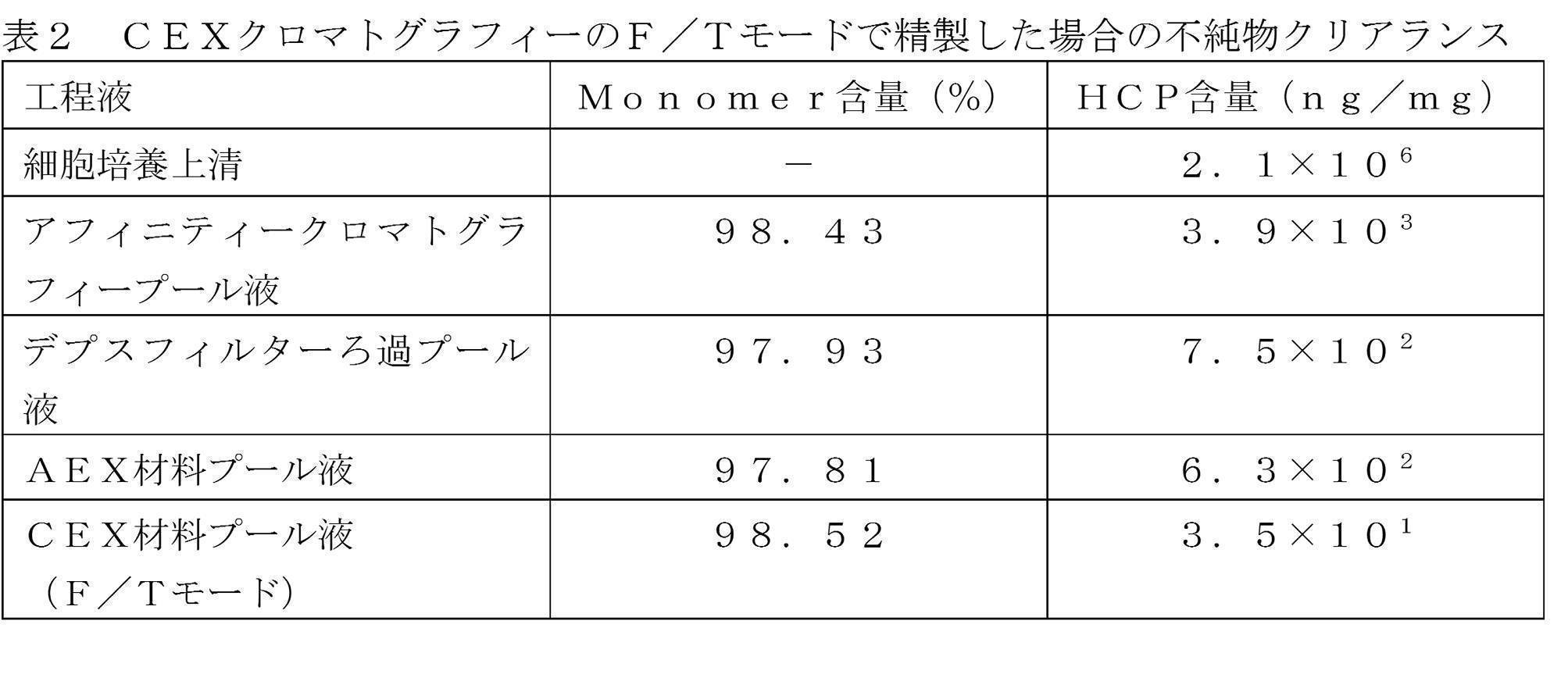
本実施例は、以下の表3に示される精製フローにおけるMab A、Mab B、Mab C、又はMab Dと呼ばれる複数の抗体の活性炭材料による不純物クリアランスについて説明する。なお、Mab A、Mab B、Mab C、又はMab Dのアミノ酸配列及び結合する抗原は、それぞれ異なっている。
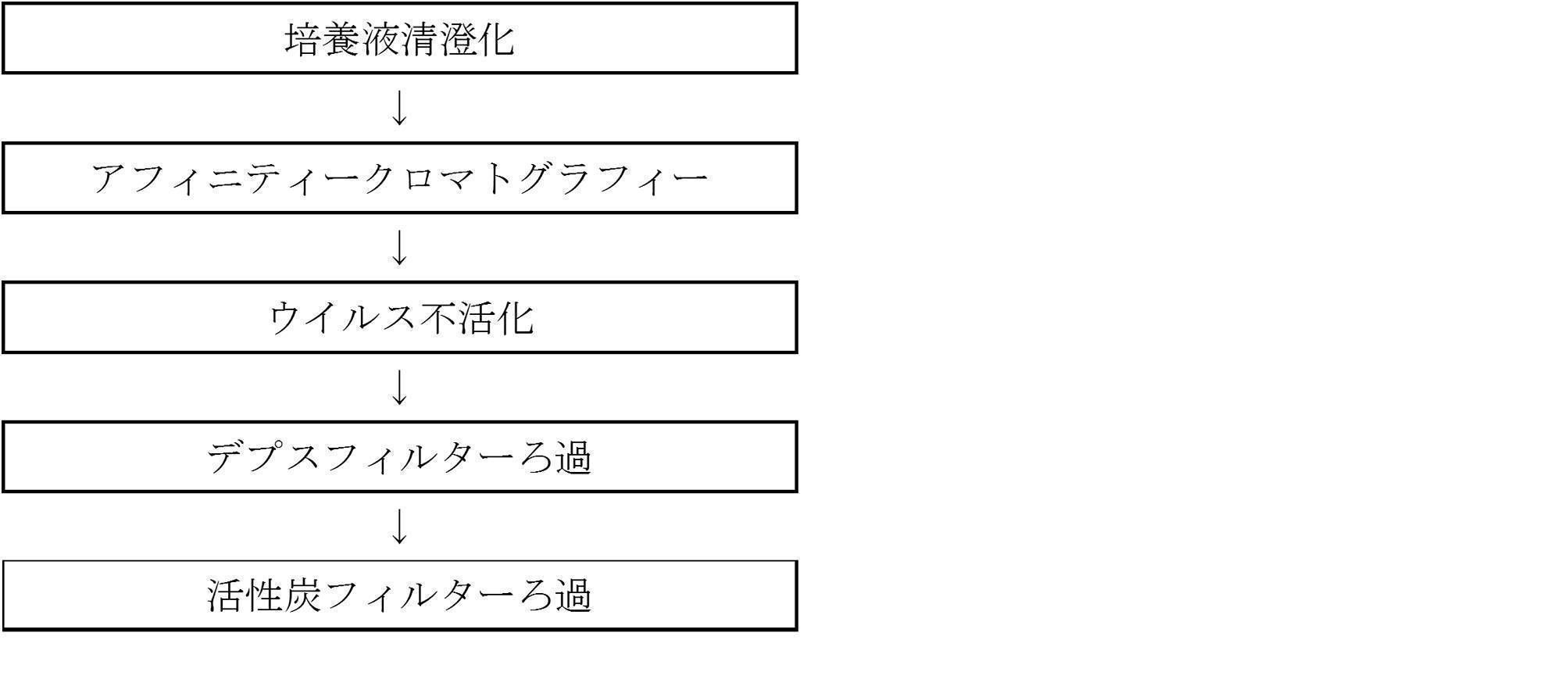
活性炭材料としてMillistak+(登録商標) Pod CR40を用いて、Mab B及びMab Aについて、抗体回収率及び不純物クリアランスの評価をおこなった。実施例2に示す方法に準じて得られたMab B及びMab Aのデプスフィルターろ過プール液を活性炭フィルターへのロード液(活性炭材料ロード液)として用いた。ただし、活性炭フィルターでのHCPのクリアランス能を評価しやすくするために、Mab BについてはプロテインAクロマトグラフィーにおいて、培養上清をロード後の1M塩化ナトリウムを含むリン酸バッファー(pH7.5)による洗浄は実施しなかった。活性炭フィルターは予め取扱説明書にしたがって適切な洗浄を実施した後、酢酸バッファー(pH5.0)で平衡化した。なお、平衡化以降の流速は、109LMHと設定した。平衡化後、活性炭材料ロード液をMab Bでは、約300L/m2で、Mab Aでは約117L/m2で負荷し、通液後、酢酸バッファーでMab B及びMab Aを回収した(活性炭材料プール液)。
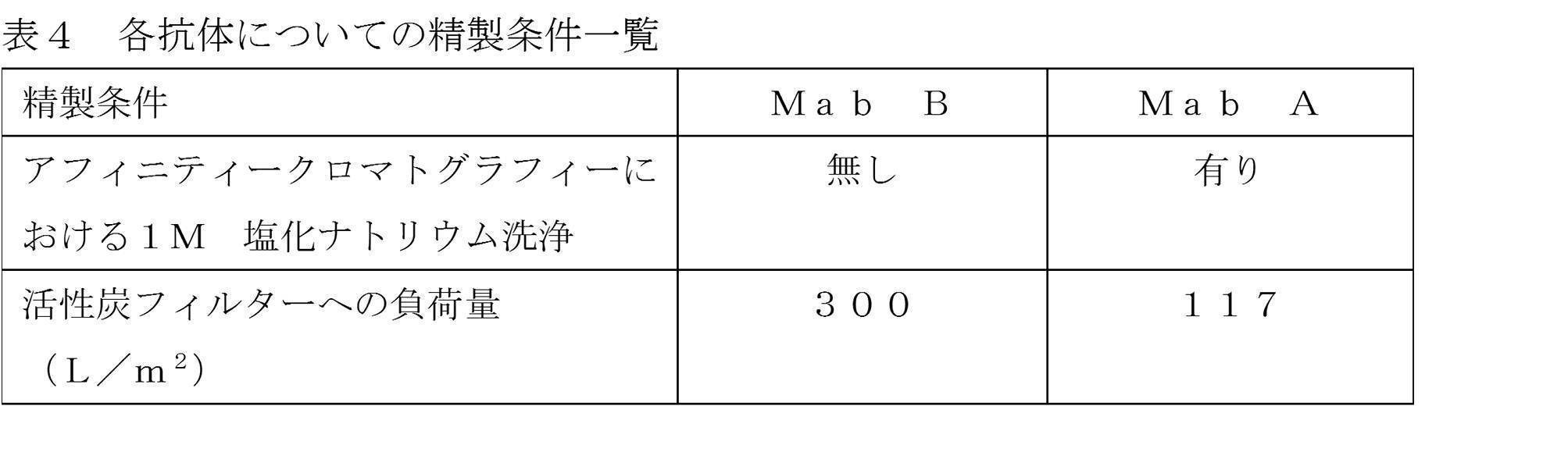

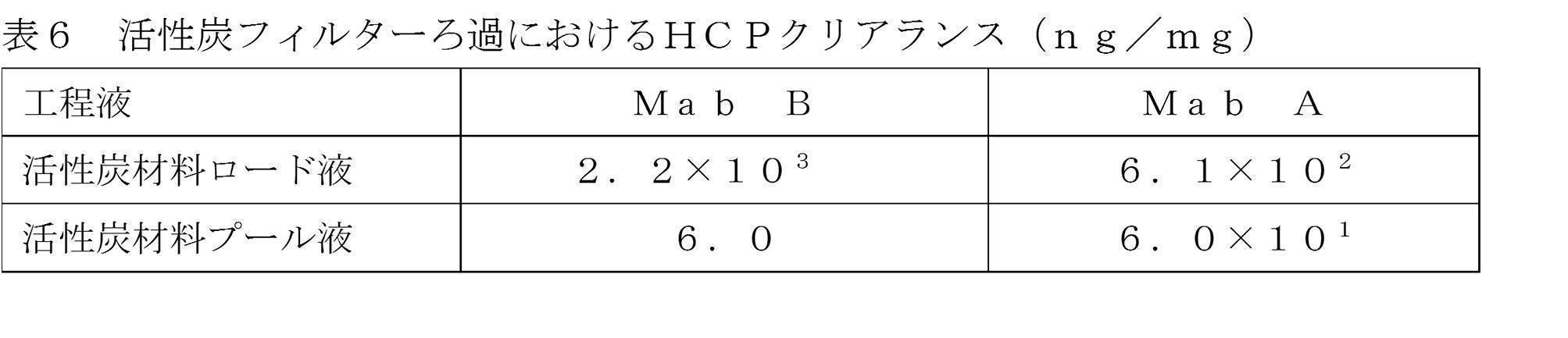

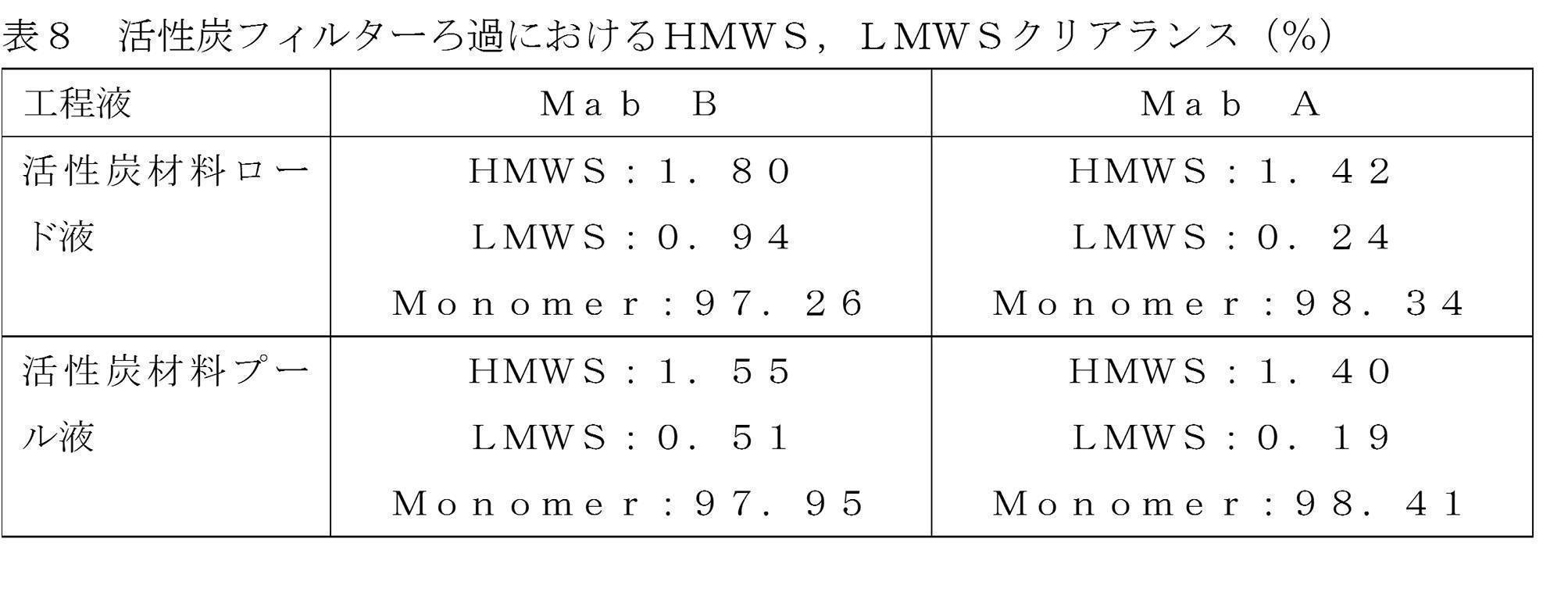
活性炭材料としてMillistak+(登録商標) Pod CR40を用いて、ウイルスクリアランスを評価した。Mab B、Mab C、及びMab Dへのスパイク試験によりウイルスクリアランス能を確認した。スパイク対象ウイルスとしては、CHO細胞を用いた抗体医薬品のウイルスクリアランス試験で一般的に用いられている4ウイルス(MLV,MMV,Reo3及びPRV)とした。活性炭フィルターろ過によるウイルスクリアランス能に影響を及ぼす可能性がある因子として、流速、pH及び抗体種類をあげ、それらの影響を確認する試験を計画した。実施例2に示す方法に準じて得られたMab B、Mab C、及びMab Dのデプスフィルターろ過プール液を活性炭フィルターへのロード液(活性炭材料ロード液)として用いた(pH5.0)。さらに、pH7.5の条件のロード液については、トリス水溶液によりpHを7.5に調整した。活性炭フィルターは予め取扱説明書にしたがって適切な洗浄を実施した後、酢酸バッファー(pH5.0)あるいはトリスバッファー(pH7.5)で平衡化した。なお、平衡化以降の流速は、109LMHあるいは54.5LMHと設定した。平衡化後、活性炭材料ロードを約55L/m2あるいは約110L/m2で負荷し、通液後、酢酸バッファー(pH5.0)あるいはトリスバッファー(pH7.5)でMab B、Mab C、及びMab Dを回収し(活性炭材料プール液)、活性炭材料ロード液及び活性炭材料プール液のウイルス力価からウイルス対数除去値(LRV)を算出した(表9)。この結果、活性炭フィルターは4種のウイルスに対してクリアランス能を有することが判明した。ウイルスクリアランス能は、流速、共存する抗体種、及び負荷量によって影響を受けず、CHO細胞を用いた抗体医薬品のウイルスクリアランス試験で用いる4種のウイルスについてLRVがいずれも>=4と高いクリアランス能を有していた。一方、MLVの評価においてpH5.0及び7.5でウイルスクリアランス能を比較した結果、pH7.5でLRVが低下していることが分かり、pHが活性炭材料におけるウイルスクリアランスに影響する重要パラメータであることが明らかとなった。
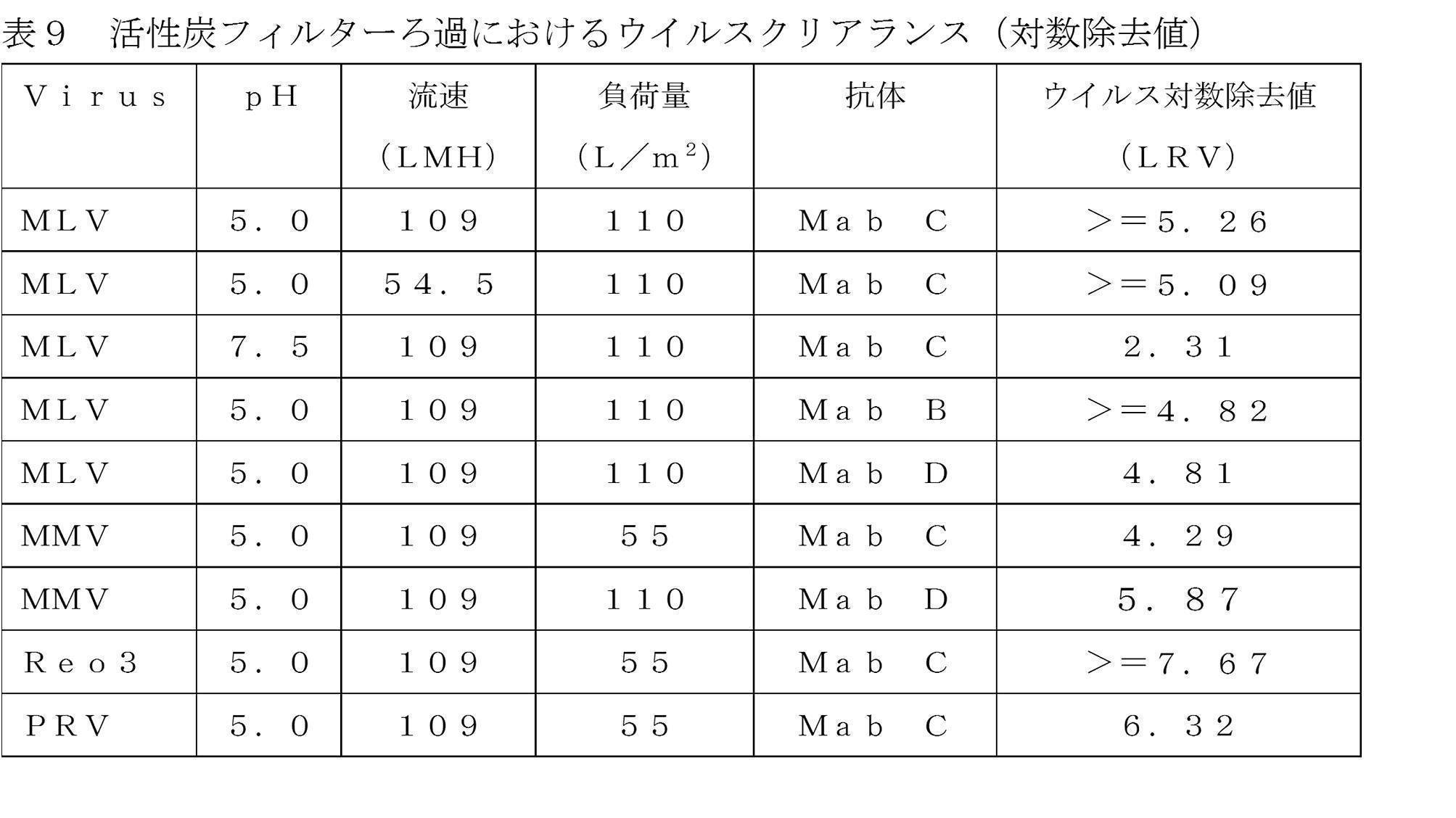
本実施例は、以下の表10に示される精製フローにおけるMab A又はMab Cと呼ばれるモノクローナル抗体の不純物クリアランスについて説明する。
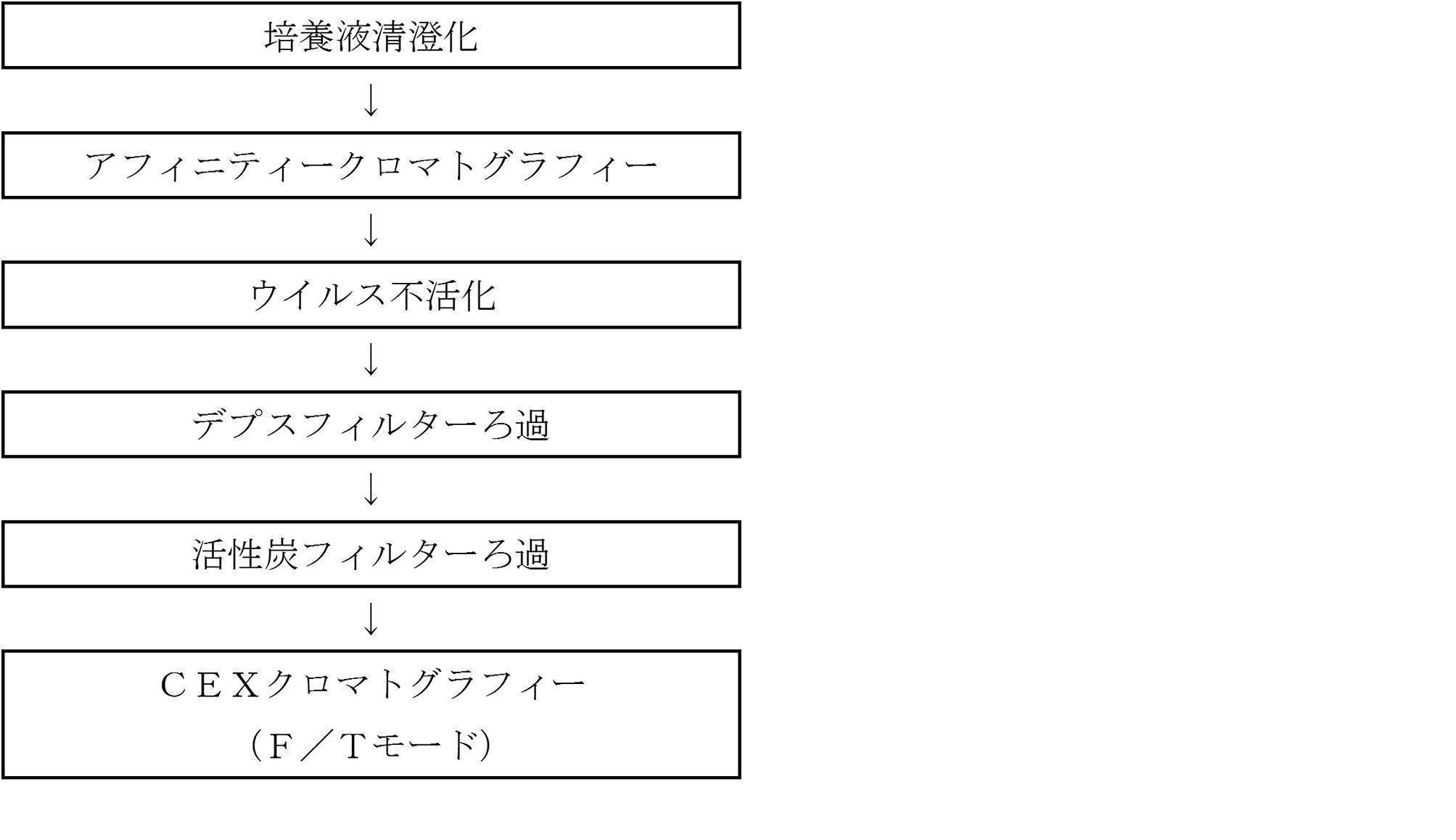
Mab Aを産生したCHO細胞培養液について、デプスフィルターろ過により細胞を除去し、清澄化した。細胞培養上清を、KanCapA樹脂を用いたプロテインAクロマトグラフィーにより精製した。20mM塩化ナトリウムを含むリン酸バッファー(pH7.5)でカラムを平衡化した後、培養上清をロードし、その後、1M塩化ナトリウムを含むリン酸バッファー(pH7.5)、続いて20mM塩化ナトリウムを含むリン酸バッファー(pH7.5)で洗浄を行った。酢酸バッファー(pH3.6)でMab Aをカラムから溶出した。280mmの吸光度をモニタリングし、Mab Aを含む画分を取得した(アフィニティークロマトグラフィープール液)。アフィニティークロマトグラフィープール液に塩酸を加え、pHを3.5に調整し、1時間、ウイルス不活化処理を行った。該工程は室温で実施した。1時間のウイルス不活化処理の後、トリス水溶液を用いてpH5.0に中和し、0.2μmのフィルターでろ過し、保存した(ウイルス不活化液)。ウイルス不活化液を、予め酢酸バッファー(pH5.0)で洗浄したデプスフィルター(Millistak+(登録商標) Pod A1HC)に約109L/m2で負荷し、続いて酢酸バッファー(pH5.0)で押し出しを実施し、Mab Aを回収した(デプスフィルターろ過プール液)。
改良方法1におけるMab A回収率、及び不純物クリアランスの結果を表11及び表12に示す。また、Mab Cについて、改良方法1におけるウイルスクリアランス能を有する工程の精製工程総クリアランスを表13に示す。
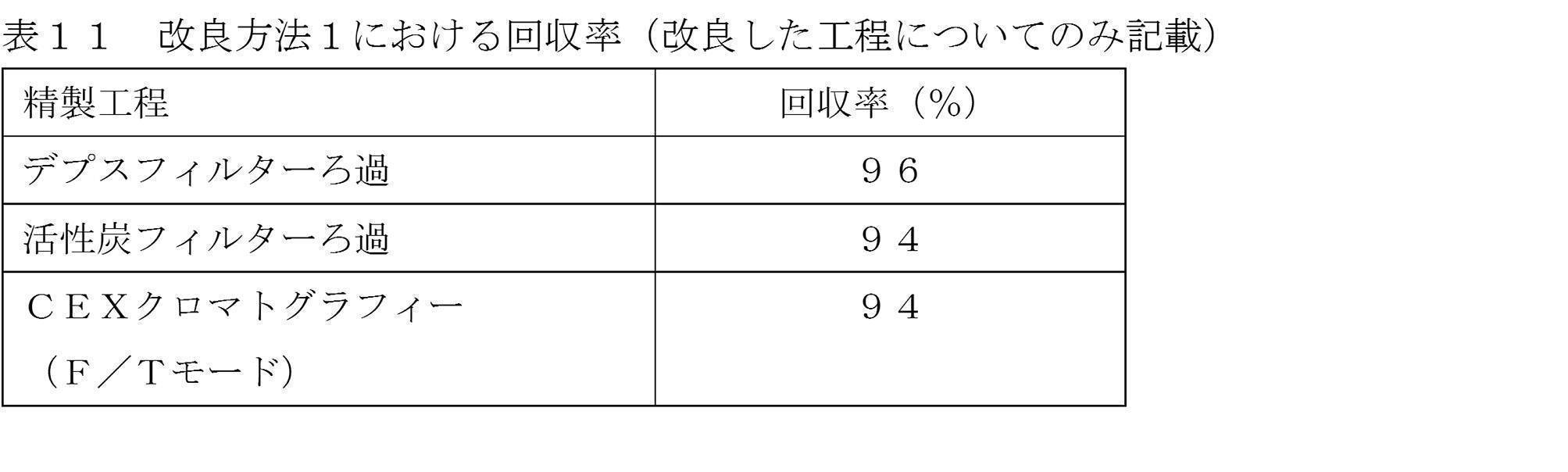
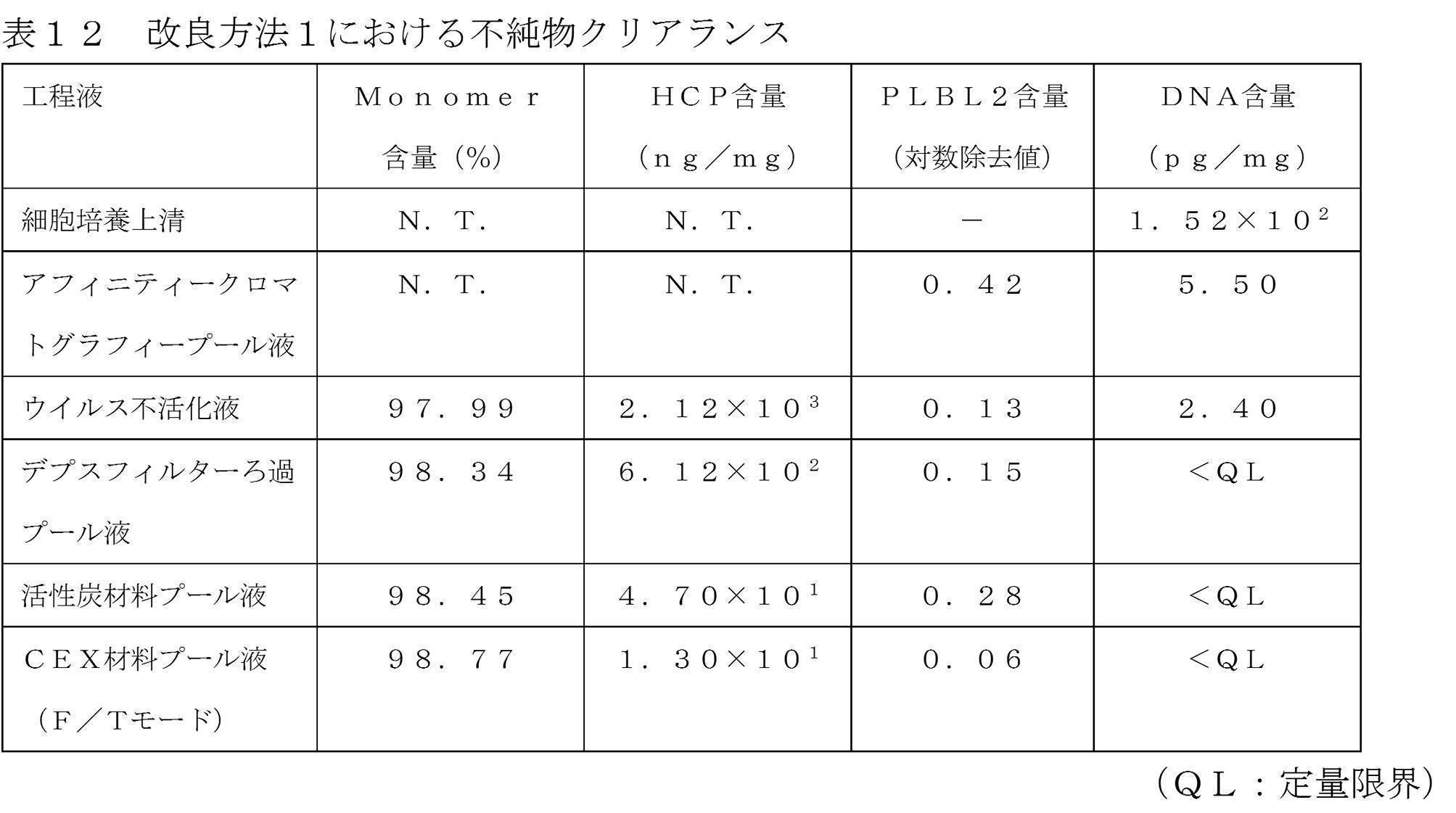
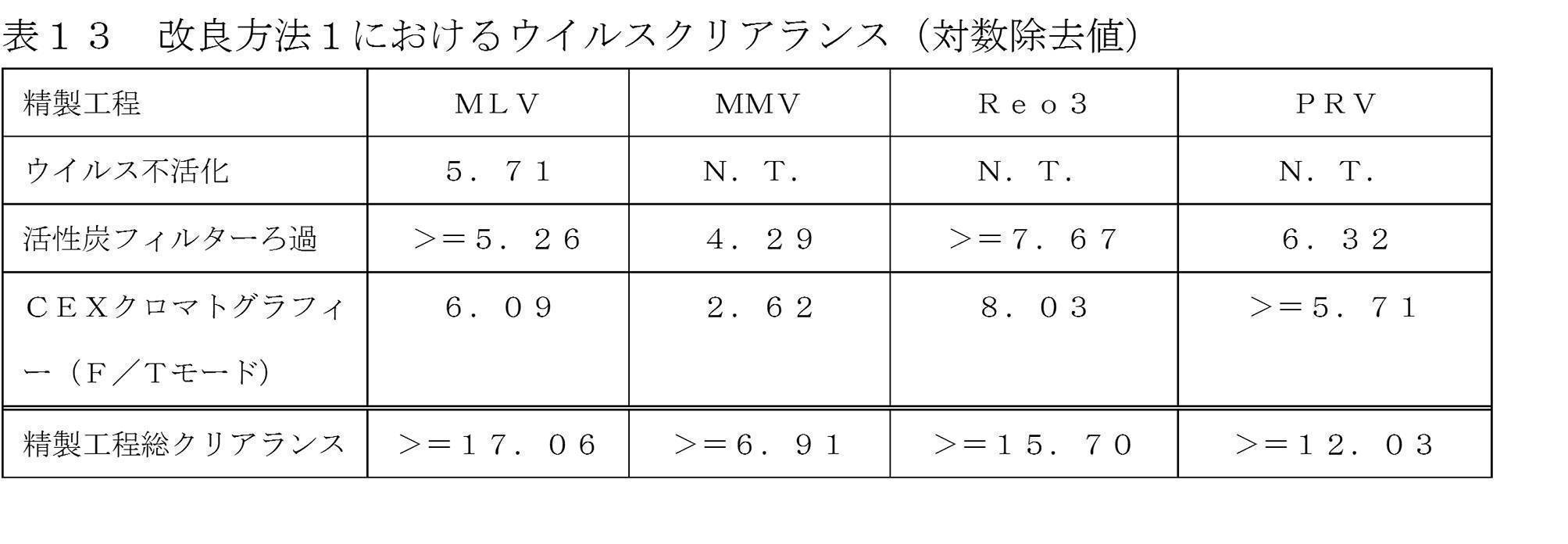
本実施例は、実施例4の表10の精製フローよりデプスフィルターろ過を省略した、以下の表14に示される精製フローにおけるMab A及びMab Dと呼ばれるモノクローナル抗体の不純物クリアランスについて説明する。なお、Mab Dのアミノ酸配列及び結合する抗原は、Mab A、Mab B又はMab Cとは異なっている。
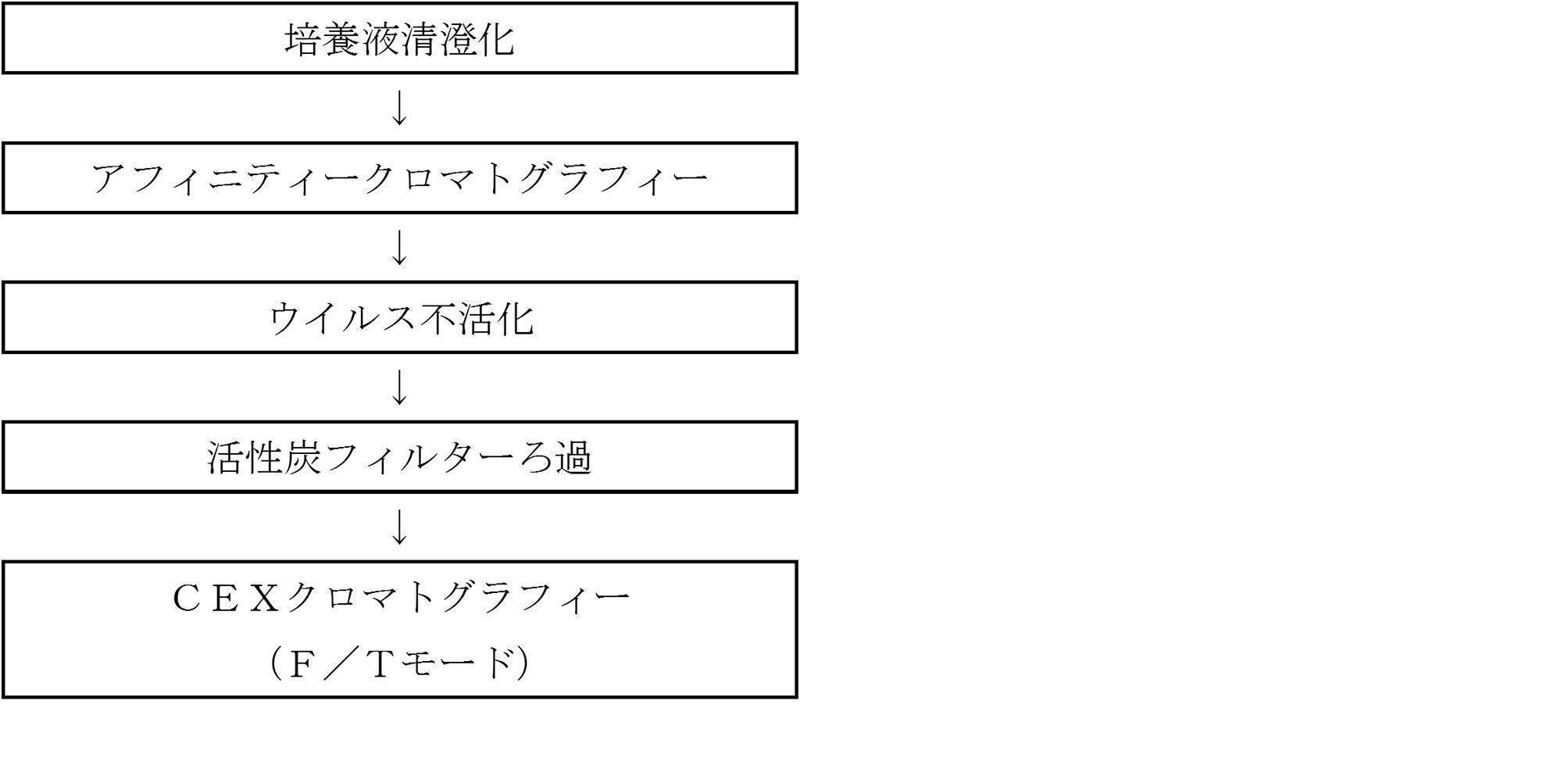
1)-1)Mab Aの場合
Mab Aを産生したCHO細胞培養液について、デプスフィルターろ過により細胞を除去し、清澄化した。細胞培養上清を、KanCapA樹脂を用いたプロテインAクロマトグラフィーにより精製した。20mM塩化ナトリウムを含むリン酸バッファー(pH7.5)でカラムを平衡化した後、培養上清をロードし、その後、1M塩化ナトリウムを含むリン酸バッファー(pH7.5)、続いて20mM塩化ナトリウムを含むリン酸バッファー(pH7.5)で洗浄を行った。酢酸バッファー(pH3.6)でMab Aをカラムから溶出した。280mmの吸光度をモニタリングし、各抗体を含む画分を取得した(アフィニティークロマトグラフィープール液)。アフィニティークロマトグラフィープール液に塩酸を加え、pHを3.5に調整し、1時間、ウイルス不活化処理を行った。該工程は室温で実施した。1時間のウイルス不活化処理の後、トリス水溶液を用いてpH5.0に中和し、0.2μmのフィルターでろ過し、保存した(ウイルス不活化液)。ウイルス不活化液を予め酢酸バッファー(pH5.0)で洗浄した活性炭フィルター(Millistak+(登録商標) Pod CR40)に70L/m2で負荷し、続いて酢酸バッファー(pH5.0)で押し出しを実施し、各抗体を回収した。続いて、0.2μmのフィルターでろ過し、保存した(活性炭材料プール液)。予め1M塩化ナトリウムを含む酢酸バッファー(pH5.0)、続いて酢酸バッファー(pH5.0)で平衡化したPOROS XSを充填したCEXカラムに活性炭材料プール液を通液した。CEXカラムへのローディング密度は約2000g/L樹脂と設定した。ロード後、酢酸バッファー(pH5.0)で押し出しを実施した。280mmの吸光度をモニタリングし、各抗体を含む画分を取得し、続いて0.2μmのフィルターでろ過しF/TモードによるCEX材料プール液とした。
Mab Dを産生したCHO細胞培養液について、デプスフィルターろ過により細胞を除去し、清澄化した。細胞培養上清を、KanCapA樹脂を用いたプロテインAクロマトグラフィーにより精製した。20mM塩化ナトリウムを含むリン酸バッファー(pH7.5)でカラムを平衡化した後、培養上清をロードし、その後、1M塩化ナトリウムを含むリン酸バッファー(pH7.5)、続いて20mM塩化ナトリウムを含むリン酸バッファー(pH7.5)で洗浄を行った。酢酸バッファー(pH3.6)でMab Dをカラムから溶出した。280mmの吸光度をモニタリングし、各抗体を含む画分を取得した(アフィニティークロマトグラフィープール液)。アフィニティークロマトグラフィープール液に塩酸を加え、pHを3.4に調整し、1時間、ウイルス不活化処理を行った。該工程は室温で実施した。1時間のウイルス不活化処理の後、トリス水溶液を用いてpH5.0に中和し、保存した(ウイルス不活化液)。ウイルス不活化液を予め酢酸バッファー(pH5.0)で洗浄した活性炭フィルター(Millistak+(登録商標) Pod CR40)に178L/m2で負荷し、続いて酢酸バッファー(pH5.0)で押し出しを実施し、各抗体を回収した。続いて、0.2μmのフィルターでろ過し、保存した(活性炭材料プール液)。予め1M塩化ナトリウムを含む酢酸バッファー(pH5.0)、続いて酢酸バッファー(pH5.0)で平衡化したPOROS XSを充填したCEXカラムに活性炭材料プール液を通液した。CEXカラムへのローディング密度は約1500g/L樹脂と設定した。ロード後、酢酸バッファー(pH5.0)で押し出しを実施した。280mmの吸光度をモニタリングし、各抗体を含む画分を取得し、続いて0.2μmのフィルターでろ過しF/TモードによるCEX材料プール液とした。
改良方法2におけるMab A回収率、及び不純物クリアランスの結果を表15及び表16に、Mab D回収率、及び不純物クリアランスの結果を表17及び表18に示す。なお、改良方法2におけるウイルスクリアランス能を有する工程の精製工程総クリアランスについては、実施例4の表13と対象工程が同じであるため、同等のクリアランスが期待できる。


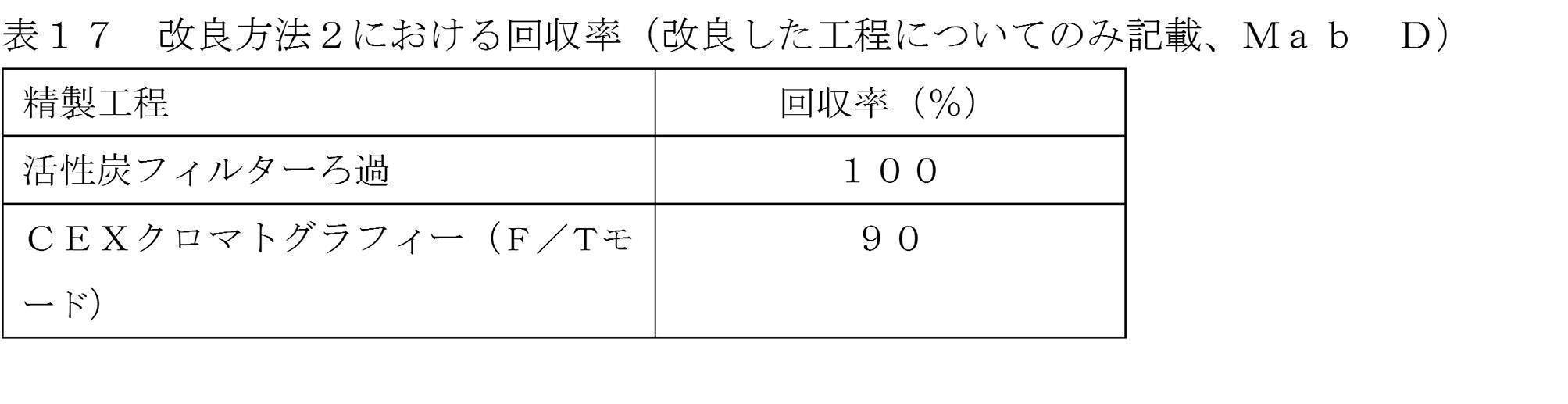

本実施例は、実施例4の表10の精製フローにおける陽イオン交換クロマトグラフィーの後に疎水性相互作用クロマトグラフィーを追加した、以下の表19に示される精製フローによる抗体の不純物クリアランスを例示する。なお、本実施例で使用されるMab E、Mab F及びMab Gのアミノ酸配列及び結合する抗原は、それぞれ異なっており、Mab A、Mab B、Mab C又はMab Dとも異なっている。

本実施例は、疎水性相互作用クロマトグラフィーにおけるMab Eと呼ばれるモノクローナル抗体のウイルスクリアランスについて説明する。POROS Benzyl Ultra HIC 樹脂を用いて、Mab EへのMLV,MMVのスパイク試験により、ウイルスクリアランスを評価した。
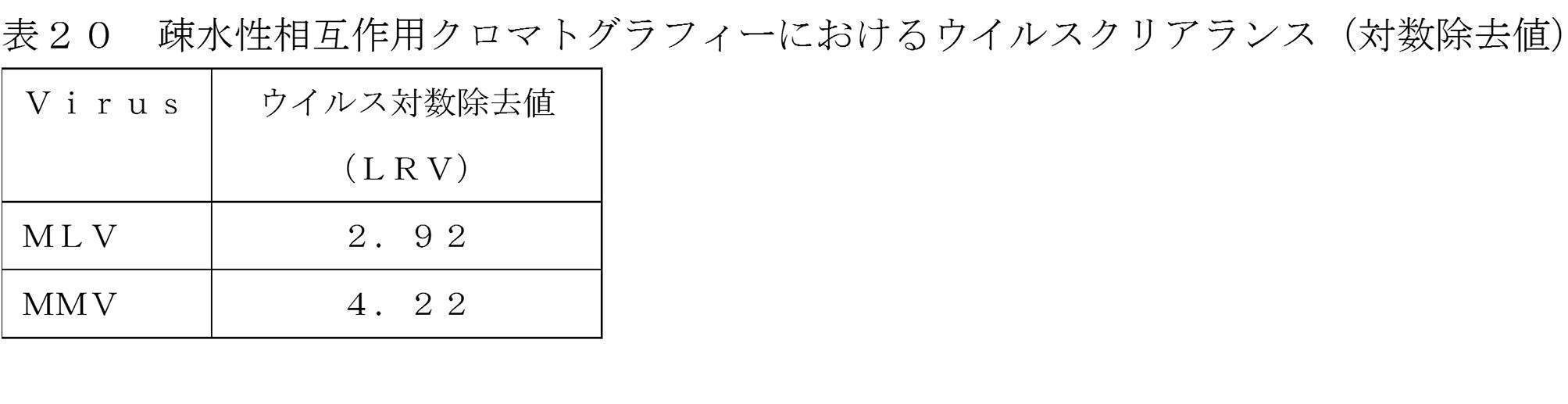
本実施例は、表19に示される精製フローにおけるMab Fと呼ばれるモノクローナル抗体の不純物クリアランスについて説明する。
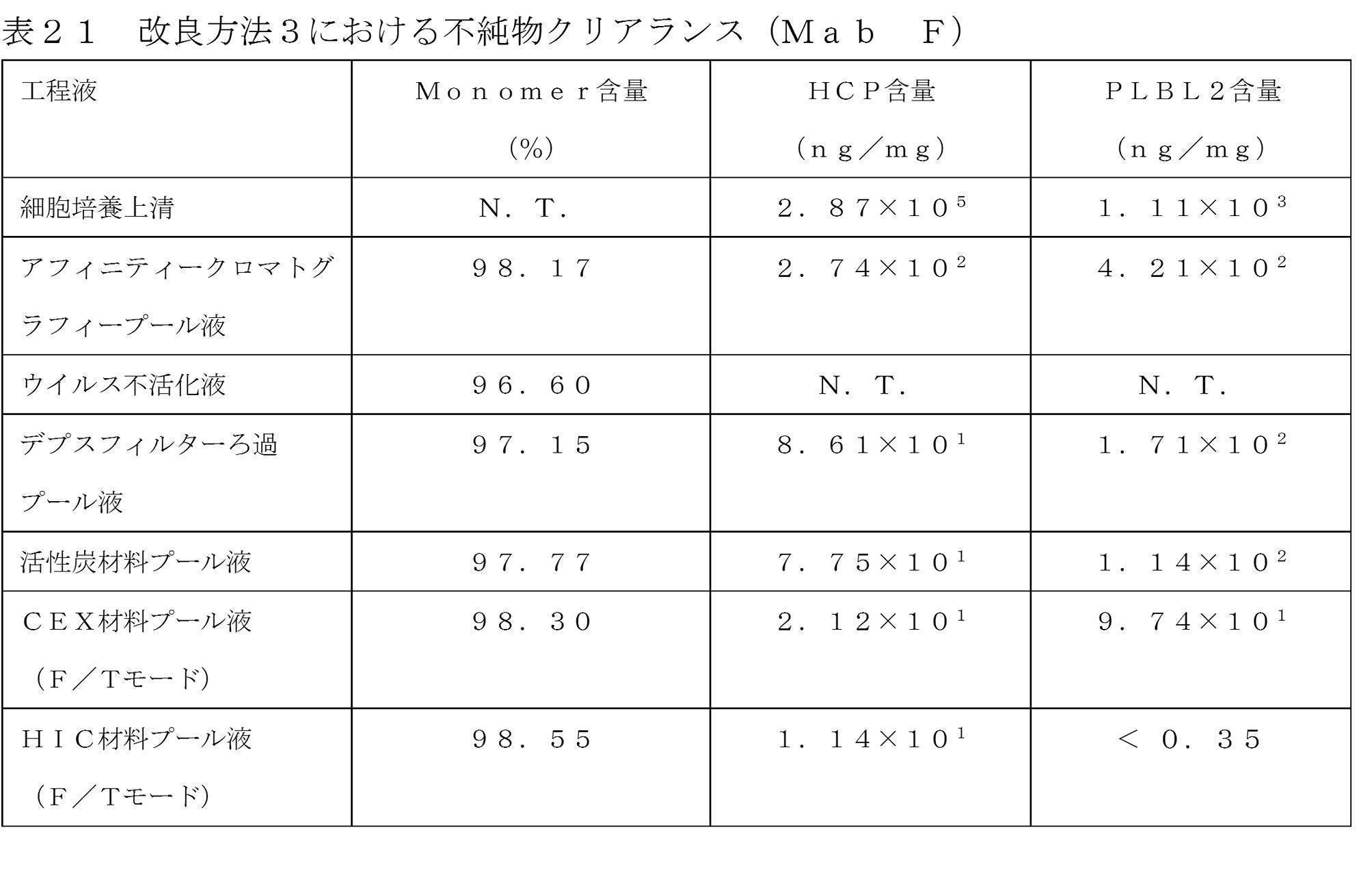
本実施例は、表19に示される精製フローにおけるMab Gと呼ばれるモノクローナル抗体の不純物クリアランスについて説明する。

本実施例は、実施例4の表10の精製フローにおける陽イオン交換クロマトグラフィーの前に疎水性相互作用クロマトグラフィーを追加した、以下の表23に示される精製フローによる抗体の不純物クリアランスを例示する。
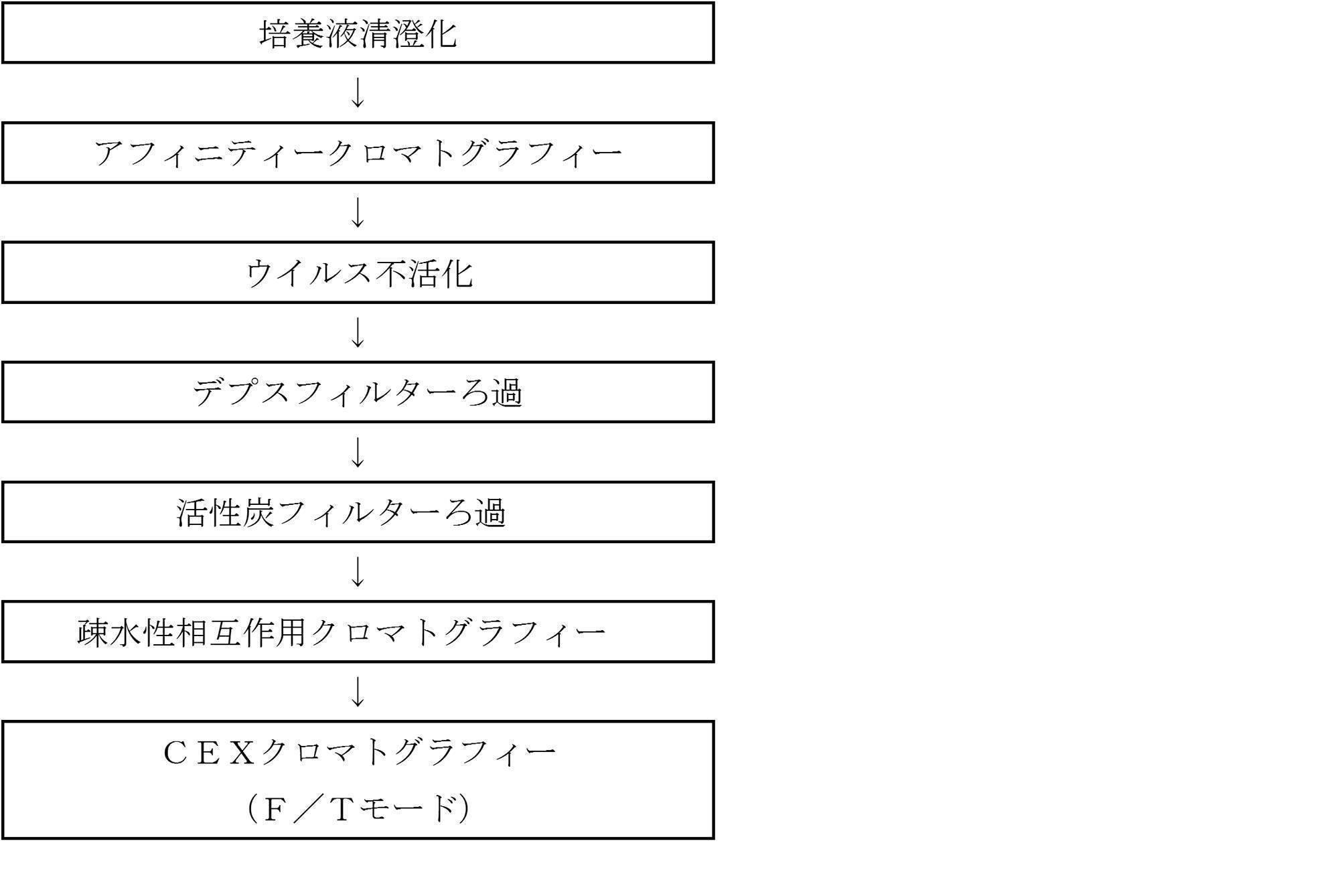
本実施例は、表23に示される精製フローにおけるMab Fと呼ばれるモノクローナル抗体の不純物クリアランスについて説明する。
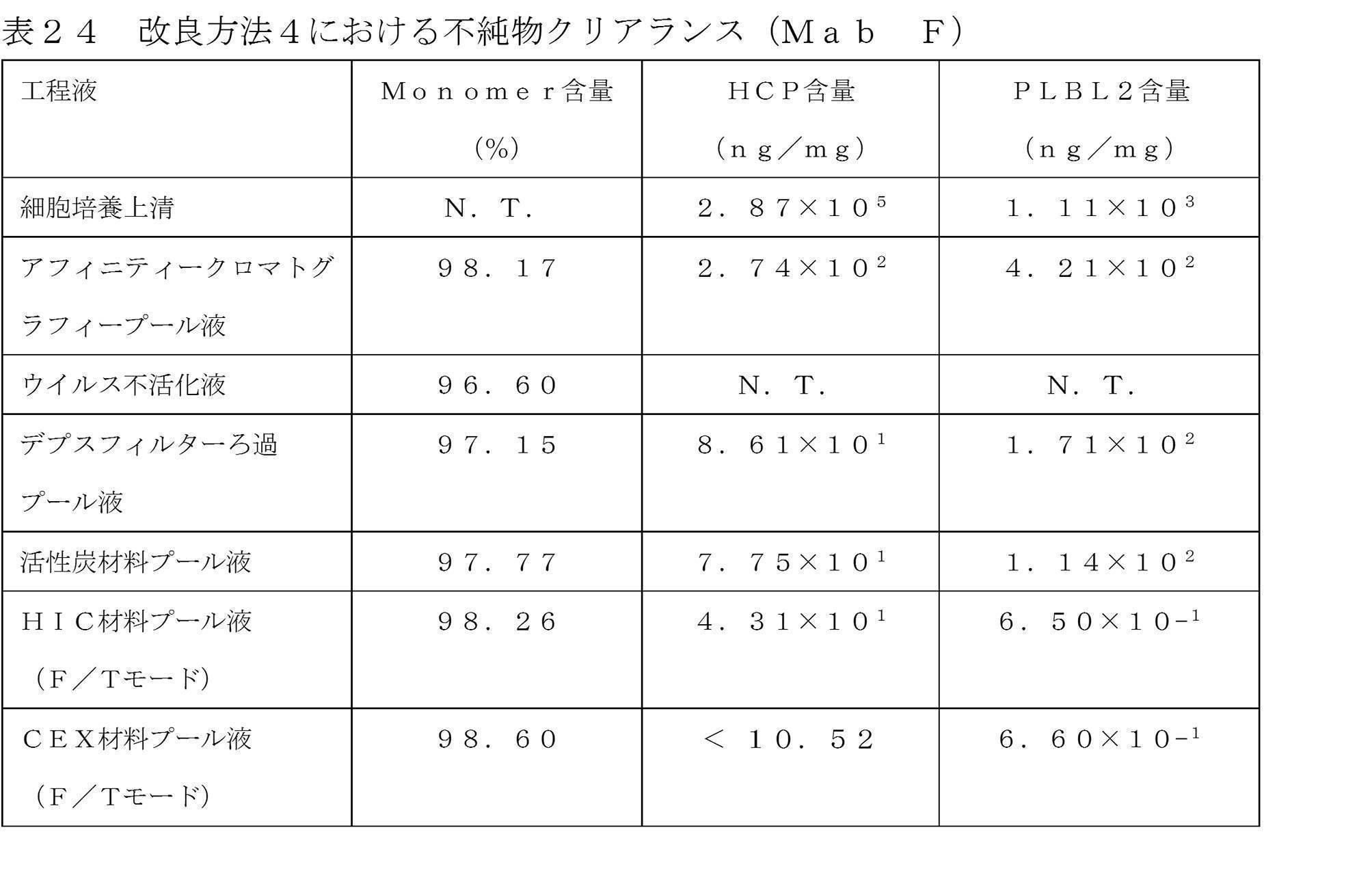
本実施例は、表23に示される精製フローにおけるMab Gと呼ばれるモノクローナル抗体の不純物クリアランスについて説明する。
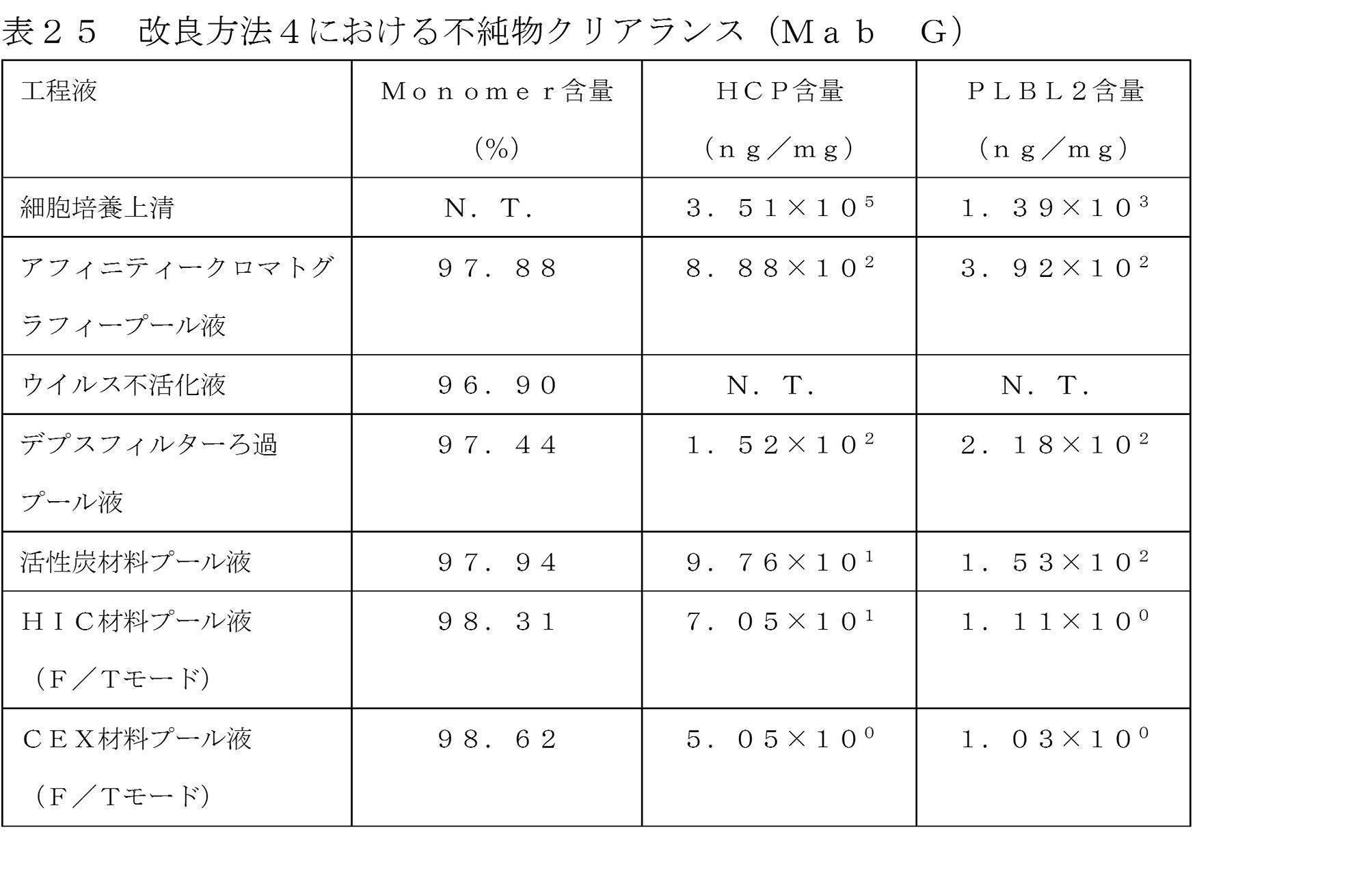
本実施例は、以下の表26に示される精製フローにおけるMab Aと呼ばれるモノクローナル抗体の活性炭材料による不純物クリアランスについて説明する。
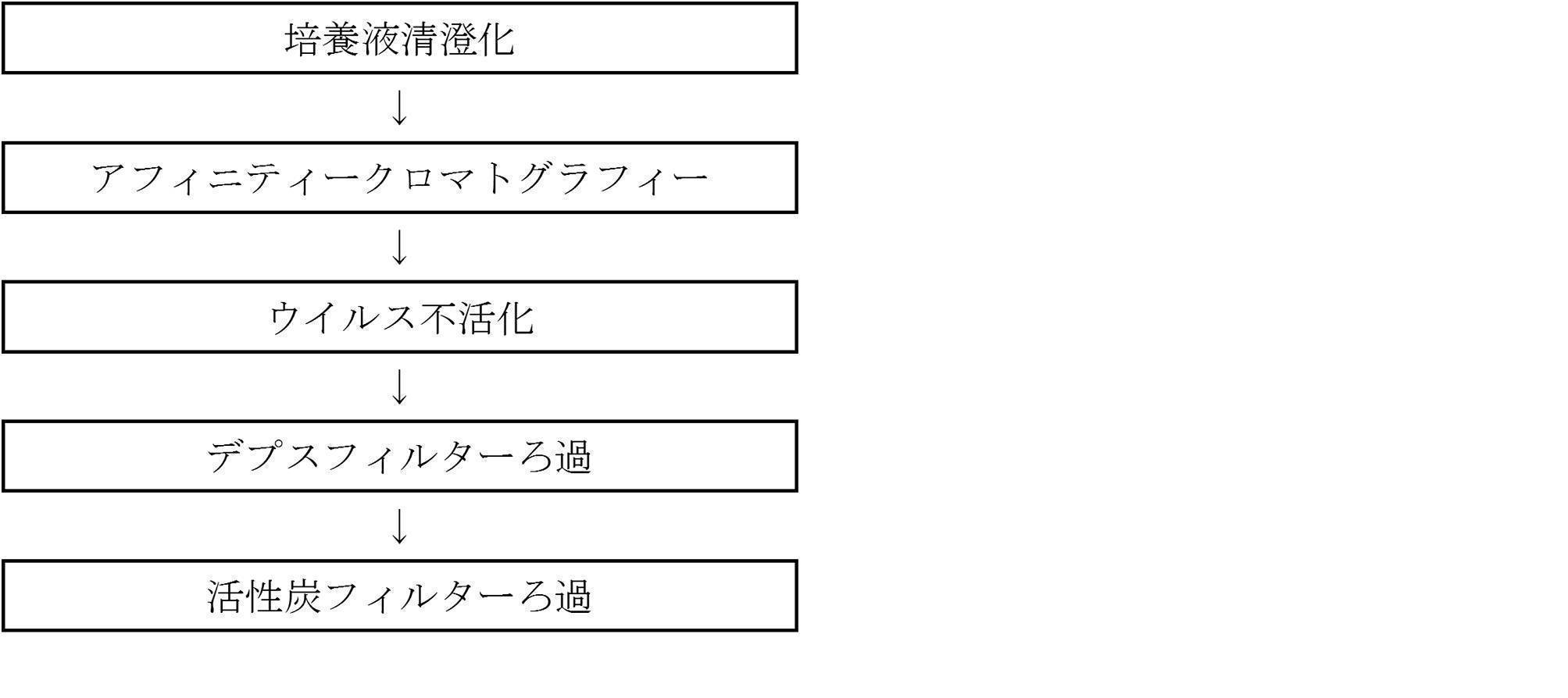
Mab Aを産生したCHO細胞培養液について、デプスフィルターろ過により細胞を除去し、清澄化した。細胞培養上清を、KanCapA樹脂を用いたプロテインAクロマトグラフィーにより精製した。20mM塩化ナトリウムを含むリン酸バッファー(pH7.5)でカラムを平衡化した後、培養上清をロードし、その後、1M塩化ナトリウムを含むリン酸バッファー(pH7.5)、続いて20mM塩化ナトリウムを含むリン酸バッファー(pH7.5)で洗浄を行った。酢酸バッファー(pH3.6)でMab Aをカラムから溶出した。280mmの吸光度をモニタリングし、Mab Aを含む画分を取得した(アフィニティークロマトグラフィープール液)。アフィニティークロマトグラフィープール液に塩酸を加え、pHを3.5に調整し、1時間、ウイルス不活化処理を行った。該工程は室温で実施した。1時間のウイルス不活化処理の後、トリス水溶液を用いてpH5.0に中和した(ウイルス不活化液)。ウイルス不活化液を、予め酢酸バッファー(pH5.0)で洗浄したデプスフィルター(Millistak+(登録商標) Pod A1HC)に124L/m2で負荷し、続いて酢酸バッファー(pH5.0)で押し出しを実施し、Mab Aを回収した(デプスフィルターろ過プール液)。デプスフィルターろ過プール液を塩酸又はトリス水溶液によりpH4.5、pH5.0、pH5.5、pH6.0、pH6.5、pH7.0、pH7.5に調整し、0.2μmのフィルターでろ過し、保存した(pH調整活性炭材料ロード液)。デプスフィルターろ過プール液を限外ろ過・ダイアフィルトレーションにより電気伝導度2mS/cm、4mS/cm、5mS/cm、6mS/cm、8mS/cm、10mS/cmに調整し、0.2μmのフィルターでろ過し、保存した(電気伝導度調整活性炭材料ロード液)。
2)結果
表26に示される精製フローのうち負荷量60L/m2の活性炭フィルターろ過における不純物クリアランスの結果を表27及び表28に示す。pH及び電気伝導度によりHCP除去率は大きな影響を受けなかった。PLBL2はpHが低いほど、又は電気伝導度が低いほど除去率が大きくなる傾向があった。浸出Protein AはpHが低いほど、除去率が大きくなる傾向にあった。MLV及びMMVはpHが低いほど、又は電気伝導度が低いほど除去率が大きくなる傾向があった。表26に示される精製フローで得られる活性炭材料ロード液のpH及び電気伝導度の条件は、活性炭フィルターろ過において高い不純物除去率を示す条件であることが確認された。
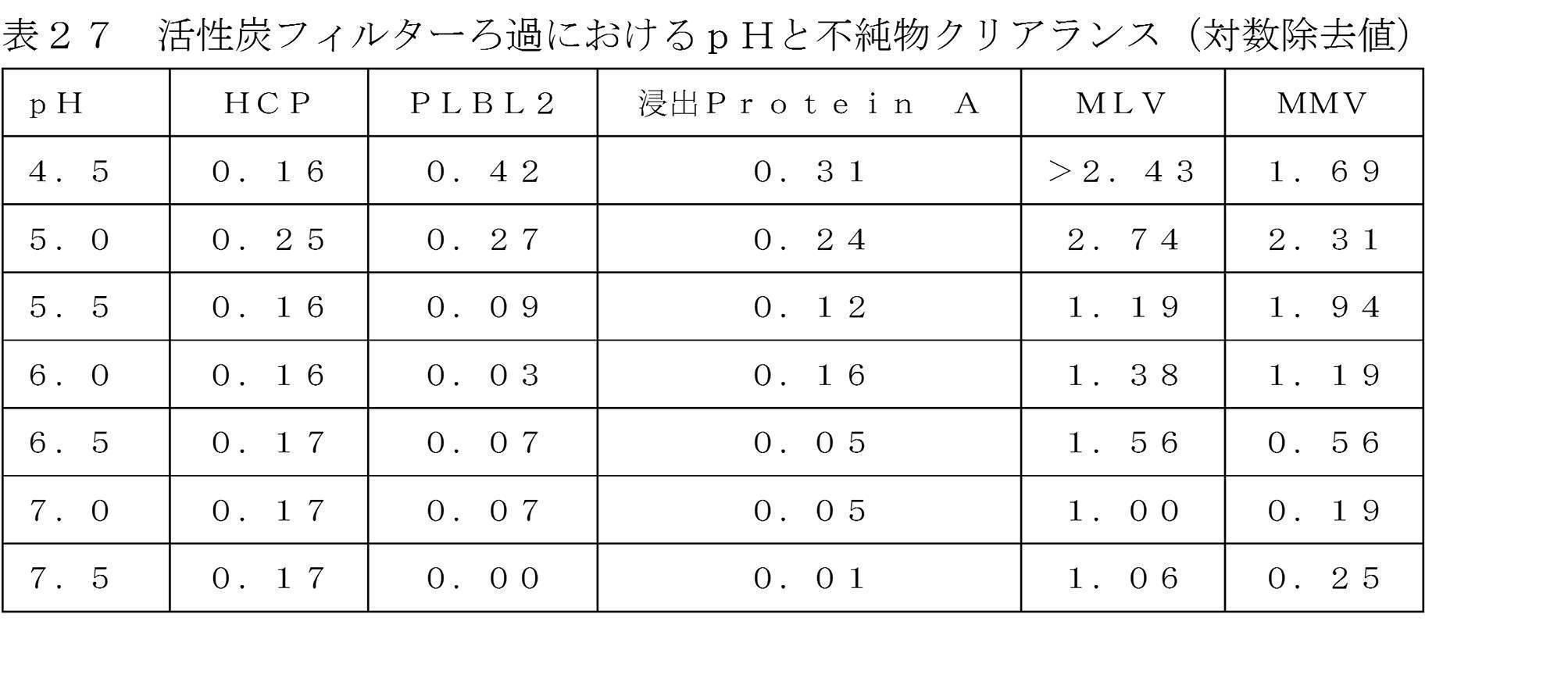

Claims (47)
- 抗体を一又は複数の不純物を含む組成物から精製するための手法であって、
a1.抗体を含有する細胞培養上清を用意し、
b1.前記細胞培養上清をアフィニティークロマトグラフィー樹脂により処理して、抗体を含むアフィニティークロマトグラフィープール液を得、
c1.前記アフィニティークロマトグラフィープール液においてウイルスを不活化して、ウイルス不活化液を得、
d1.前記ウイルス不活化液を活性炭材料により処理して、活性炭材料プール液を得、
e1.前記活性炭材料プール液を陽イオン交換材料により処理して、陽イオン交換材料プール液を得る、
のa1.乃至e1.の工程を含む方法。 - 抗体を一又は複数の不純物を含む組成物から精製するための手法であって、
a2.抗体を含有する細胞培養上清を用意し、
b2.前記細胞培養上清をアフィニティークロマトグラフィー樹脂により処理して、抗体を含むアフィニティークロマトグラフィープール液を得、
c2.前記アフィニティークロマトグラフィープール液においてウイルスを不活化して、ウイルス不活化液を得、
d2.前記ウイルス不活化液をデプスフィルターにより処理して、デプスフィルターろ過プール液を得、
e2.前記デプスフィルターろ過プール液を活性炭材料により処理して、活性炭材料プール液を得、
f2.前記活性炭材料プール液を陽イオン交換材料により処理して、陽イオン交換材料プール液を得る、
のa2.乃至f2.の工程を含む請求項1に記載の方法。 - アフィニティークロマトグラフィー樹脂がプロテインA樹脂である請求項1又は2に記載の方法。
- プロテインA樹脂が、KanCapA、KanCapA3G、MabSelect SuRe、MabSelect SuRe pcc、MabSelect PrismA、又はAmsphere A3である請求項3に記載の方法。
- ウイルス不活化が、酸、界面活性剤、化学物質、核酸架橋剤、紫外線、ガンマ線及び熱での処理からなる群から選択される少なくともいずれか一つである、請求項1乃至4のいずれか一つに記載の方法。
- ウイルス不活化が、アフィニティークロマトグラフィープール液のpHを3~4に低下させることを含む請求項5に記載の方法。
- ウイルス不活化中に、アフィニティークロマトグラフィープール液を60~120分間インキュベートする請求項6に記載の方法。
- ウイルス不活化中に、アフィニティークロマトグラフィープール液を15~30℃でインキュベートする請求項6又は7に記載の方法。
- 活性炭材料にロードする溶液、活性炭材料の平衡化バッファー及び洗浄バッファーのpHが、4.5~7.5である請求項1乃至8のいずれか一つに記載の方法。
- 活性炭材料にロードする溶液、活性炭材料の平衡化バッファー及び洗浄バッファーのpHが、4.5~5.5である請求項9に記載の方法。
- 活性炭材料にロードする溶液、活性炭材料の平衡化バッファー及び洗浄バッファーの電気伝導度が、2~10mS/cmである請求項1乃至10のいずれか一つに記載の方法。
- 活性炭材料にロードする溶液、活性炭材料の平衡化バッファー及び洗浄バッファーの電気伝導度が、2~5mS/cmである請求項11に記載の方法。
- 活性炭材料による処理が、活性炭材料を含むフィルターを用いて行われる、請求項1乃至12のいずれか一つに記載の方法。
- フィルターが、Millistak+ Pod CR40、Zeta Plus 活性炭吸着デプスフィルター、又はSUPRAcap 50 Seitz AKS filterである請求項13に記載の方法。
- 陽イオン交換材料に対し、活性炭材料プール液が、該陽イオン交換材料の吸着容量を超えてロードされる請求項1乃至14のいずれか一つに記載の方法。
- 陽イオン交換材料に対する活性炭材料プール液のローディング密度が、500~2000g/Lである請求項15に記載の方法。
- 陽イオン交換材料に対する活性炭材料プール液のローディング密度が1000~1500g/Lである請求項16に記載の方法。
- 陽イオン交換材料が、樹脂、モノリスカラム、又は膜である請求項1乃至17のいずれか一つに記載の方法。
- 陽イオン交換材料の官能基が、スルホプロピル、スルホエチル、スルホイソブチル、又はカルボキシルである請求項18に記載の方法。
- 陽イオン交換材料が、POROS XS、Eshmuno CPX、Eshmuno CP-FT、又はCaptoS ImpActである請求項19に記載の方法。
- 陽イオン交換材料にロードする溶液のpHが、4~6である請求項1乃至20のいずれか一つに記載の方法。
- 陽イオン交換材料にロードする溶液のpHが、4.5~5.5である請求項21に記載の方法。
- 陽イオン交換材料にロードする溶液の電気伝導度が、3~7mS/cmである請求項1乃至22のいずれか一つに記載の方法。
- 陽イオン交換材料にロードする溶液の電気伝導度が、3~5mS/cmである請求項23に記載の方法。
- 陽イオン交換材料プール液を、さらに疎水性相互作用クロマトグラフィーにより処理して、プール液を得る請求項1乃至24のいずれか一つに記載の方法。
- 疎水性相互作用クロマトグラフィーが、フロースルーモードである請求項25に記載の方法。
- 疎水性相互作用クロマトグラフィーが、樹脂又は膜を用いて実施される請求項26に記載の方法。
- 疎水性相互作用クロマトグラフィー樹脂又は膜が、Phenyl基、Benzyl基又はHexyl基を有する請求項27に記載の方法。
- 疎水性相互作用クロマトグラフィー材料が、POROS Benzyl Ultra 、POROS Benzyl、 Hexyl-650C 、Phenyl Sepharose 6 Fast Flow、 Phenyl Sepharose High Performance、 Sartobind Phenyl又はReadyToProcess Adsorber Phenylである請求項28に記載の方法。
- 活性炭材料プール液を、疎水性相互作用クロマトグラフィーにより処理して、プール液を得、さらに陽イオン交換材料により処理して、プール液を得る請求項1乃至14のいずれか一つに記載の方法。
- 疎水性相互作用クロマトグラフィーが、フロースルーモードである請求項30に記載の方法。
- 疎水性相互作用クロマトグラフィーが、樹脂又は膜を用いて実施される請求項31に記載の方法。
- 疎水性相互作用クロマトグラフィー樹脂又は膜が、Phenyl基、Benzyl基又はHexyl基を有する請求項32に記載の方法。
- 疎水性相互作用クロマトグラフィー材料が、POROS Benzyl Ultra 、POROS Benzyl、 Hexyl-650C 、Phenyl Sepharose 6 Fast Flow、 Phenyl Sepharose High Performance、 Sartobind Phenyl又はReadyToProcess Adsorber Phenylである請求項33に記載の方法。
- 陽イオン交換材料に対し、疎水性相互作用クロマトグラフィープール液が、該陽イオン交換材料の吸着容量を超えてロードされる請求項30乃至34のいずれか一つに記載の方法。
- 陽イオン交換材料に対する疎水性相互作用クロマトグラフィープール液のローディング密度が、500~2000g/Lである請求項35に記載の方法。
- 陽イオン交換材料に対する疎水性相互作用クロマトグラフィープール液のローディング密度が1000~1500g/Lである請求項36に記載の方法。
- 陽イオン交換材料が、樹脂、モノリスカラム、又は膜である請求項30乃至37のいずれか一つに記載の方法。
- 陽イオン交換材料の官能基が、スルホプロピル、スルホエチル、スルホイソブチル、又はカルボキシルである請求項38に記載の方法。
- 陽イオン交換材料が、POROS XS、Eshmuno CPX、Eshmuno CP-FT、又はCaptoS ImpActである請求項39に記載の方法。
- 陽イオン交換材料にロードする溶液のpHが、4~6である請求項30乃至40のいずれか一つに記載の方法。
- 陽イオン交換材料にロードする溶液のpHが、4.5~5.5である請求項41に記載の方法。
- 陽イオン交換材料にロードする溶液の電気伝導度が、3~7mS/cmである請求項30乃至42のいずれか一つに記載の方法。
- 陽イオン交換材料にロードする溶液の電気伝導度が、3~5mS/cmである請求項43に記載の方法。
- 少なくとも一つの不純物が、宿主細胞由来タンパク質(Host cell protein;HCP)、phospholipase B-like 2(PLBL2)、ウイルス、ウイルス様粒子、高分子量体(high molecular weight species;HMWS)、低分子量体(lowmolecular weight species;LMWS)、培地成分、浸出プロテインA及び/又はDNAからなる群から選択される請求項1乃至44のいずれか一つに記載の方法。
- 工程が連続的である請求項1乃至45のいずれか一つに記載の方法。
- 請求項1乃至46のいずれか一つに記載の方法によって精製された抗体。
Priority Applications (8)
| Application Number | Priority Date | Filing Date | Title |
|---|---|---|---|
| CA3127174A CA3127174A1 (en) | 2019-01-23 | 2020-01-22 | Methods for purifying antibodies comprising of a process by using activated carbon materials |
| CN202080010634.9A CN113302197A (zh) | 2019-01-23 | 2020-01-22 | 包括使用活性炭材料的工序的纯化抗体的方法 |
| SG11202107192VA SG11202107192VA (en) | 2019-01-23 | 2020-01-22 | Methods for purifying antibodies comprising of a process by using activated carbon materials |
| US17/424,605 US20220098235A1 (en) | 2019-01-23 | 2020-01-22 | Methods for purifying antibodies comprising of a process by using activated carbon materials |
| EP20745999.1A EP3916001A4 (en) | 2019-01-23 | 2020-01-22 | ONE-STEP PROCEDURE FOR PURIFICATION OF ANTIBODIES USING ACTIVATED CARBON MATERIAL |
| AU2020213017A AU2020213017A1 (en) | 2019-01-23 | 2020-01-22 | Methods for purifying antibodies comprising of a process by using activated carbon materials |
| KR1020217018647A KR20210118815A (ko) | 2019-01-23 | 2020-01-22 | 활성탄 재료를 사용하는 공정을 포함하는 항체 정제 방법 |
| JP2020568180A JPWO2020153390A1 (ja) | 2019-01-23 | 2020-01-22 | 活性炭材料を使用する工程を含む抗体精製方法 |
Applications Claiming Priority (2)
| Application Number | Priority Date | Filing Date | Title |
|---|---|---|---|
| JP2019008865 | 2019-01-23 | ||
| JP2019-008865 | 2019-01-23 |
Publications (1)
| Publication Number | Publication Date |
|---|---|
| WO2020153390A1 true WO2020153390A1 (ja) | 2020-07-30 |
Family
ID=71736813
Family Applications (1)
| Application Number | Title | Priority Date | Filing Date |
|---|---|---|---|
| PCT/JP2020/002057 Ceased WO2020153390A1 (ja) | 2019-01-23 | 2020-01-22 | 活性炭材料を使用する工程を含む抗体精製方法 |
Country Status (10)
| Country | Link |
|---|---|
| US (1) | US20220098235A1 (ja) |
| EP (1) | EP3916001A4 (ja) |
| JP (1) | JPWO2020153390A1 (ja) |
| KR (1) | KR20210118815A (ja) |
| CN (1) | CN113302197A (ja) |
| AU (1) | AU2020213017A1 (ja) |
| CA (1) | CA3127174A1 (ja) |
| SG (1) | SG11202107192VA (ja) |
| TW (1) | TW202045527A (ja) |
| WO (1) | WO2020153390A1 (ja) |
Cited By (2)
| Publication number | Priority date | Publication date | Assignee | Title |
|---|---|---|---|---|
| WO2022239704A1 (ja) * | 2021-05-10 | 2022-11-17 | 株式会社カイオム・バイオサイエンス | 抗体組成物の精製方法 |
| WO2025005240A1 (ja) | 2023-06-30 | 2025-01-02 | 第一三共株式会社 | 活性炭材料を使用する精製工程を含む抗体-薬物コンジュゲートの製造方法 |
Families Citing this family (2)
| Publication number | Priority date | Publication date | Assignee | Title |
|---|---|---|---|---|
| CN113880907A (zh) * | 2021-10-12 | 2022-01-04 | 郑州创迈生物科技有限公司 | 一种可用于Protein A亲和层析连续流工艺开发的研究方法 |
| WO2023180523A1 (en) * | 2022-03-24 | 2023-09-28 | Pieris Pharmaceuticals Gmbh | Process for purifying fusion proteins |
Citations (8)
| Publication number | Priority date | Publication date | Assignee | Title |
|---|---|---|---|---|
| WO2011150110A1 (en) | 2010-05-25 | 2011-12-01 | Genentech, Inc. | Methods of purifying polypeptides |
| WO2013028330A2 (en) | 2011-08-19 | 2013-02-28 | Emd Millipore Corporation | Methods of reducing level of one of more impurities in a sample during protein purification |
| JP2013189427A (ja) * | 2012-03-12 | 2013-09-26 | Emd Millipore Corp | フロースルー式での生物製剤からのタンパク質凝集体の除去 |
| WO2014004281A1 (en) * | 2012-06-29 | 2014-01-03 | Emd Millipore Corporation | Purification of biological molecules |
| WO2014004103A1 (en) * | 2012-06-29 | 2014-01-03 | Emd Millipore Corporation | Methods for inactivating viruses during a protein purification process |
| WO2015005961A1 (en) | 2013-07-12 | 2015-01-15 | Emd Millipore Corporation | A method of determining virus removal from a sample containing a target protein using activated carbon |
| WO2015038888A1 (en) | 2013-09-13 | 2015-03-19 | Genentech, Inc. | Methods and compositions comprising purified recombinant polypeptides |
| WO2018043645A1 (ja) * | 2016-08-31 | 2018-03-08 | 協和発酵キリン株式会社 | 活性炭を用いた蛋白質の精製方法 |
Family Cites Families (4)
| Publication number | Priority date | Publication date | Assignee | Title |
|---|---|---|---|---|
| US20130012689A1 (en) * | 2011-07-08 | 2013-01-10 | Emd Millipore Corporation | Depth Filters For Disposable Biotechnological Processes |
| TWI596107B (zh) * | 2013-06-25 | 2017-08-21 | 卡地拉保健有限公司 | 單株抗體之新穎純化方法 |
| CN105017418B (zh) * | 2014-03-27 | 2021-02-23 | 上海药明康德新药开发有限公司 | 单克隆抗体纯化工艺方法 |
| SI3337812T1 (sl) * | 2015-08-21 | 2021-08-31 | F. Hoffmann-La Roche Ag | Postopek za zmanjševanje beljakovin gostiteljske celice v afinitetni kromatografiji |
-
2020
- 2020-01-22 WO PCT/JP2020/002057 patent/WO2020153390A1/ja not_active Ceased
- 2020-01-22 KR KR1020217018647A patent/KR20210118815A/ko not_active Withdrawn
- 2020-01-22 CN CN202080010634.9A patent/CN113302197A/zh active Pending
- 2020-01-22 CA CA3127174A patent/CA3127174A1/en active Pending
- 2020-01-22 SG SG11202107192VA patent/SG11202107192VA/en unknown
- 2020-01-22 AU AU2020213017A patent/AU2020213017A1/en not_active Withdrawn
- 2020-01-22 TW TW109102525A patent/TW202045527A/zh unknown
- 2020-01-22 EP EP20745999.1A patent/EP3916001A4/en active Pending
- 2020-01-22 US US17/424,605 patent/US20220098235A1/en not_active Abandoned
- 2020-01-22 JP JP2020568180A patent/JPWO2020153390A1/ja active Pending
Patent Citations (8)
| Publication number | Priority date | Publication date | Assignee | Title |
|---|---|---|---|---|
| WO2011150110A1 (en) | 2010-05-25 | 2011-12-01 | Genentech, Inc. | Methods of purifying polypeptides |
| WO2013028330A2 (en) | 2011-08-19 | 2013-02-28 | Emd Millipore Corporation | Methods of reducing level of one of more impurities in a sample during protein purification |
| JP2013189427A (ja) * | 2012-03-12 | 2013-09-26 | Emd Millipore Corp | フロースルー式での生物製剤からのタンパク質凝集体の除去 |
| WO2014004281A1 (en) * | 2012-06-29 | 2014-01-03 | Emd Millipore Corporation | Purification of biological molecules |
| WO2014004103A1 (en) * | 2012-06-29 | 2014-01-03 | Emd Millipore Corporation | Methods for inactivating viruses during a protein purification process |
| WO2015005961A1 (en) | 2013-07-12 | 2015-01-15 | Emd Millipore Corporation | A method of determining virus removal from a sample containing a target protein using activated carbon |
| WO2015038888A1 (en) | 2013-09-13 | 2015-03-19 | Genentech, Inc. | Methods and compositions comprising purified recombinant polypeptides |
| WO2018043645A1 (ja) * | 2016-08-31 | 2018-03-08 | 協和発酵キリン株式会社 | 活性炭を用いた蛋白質の精製方法 |
Non-Patent Citations (6)
| Title |
|---|
| B. TRAN ET AL., J. CHROMATOGR. A, vol. 1438, 2016, pages 1633 - 1642 |
| BROWN, A.BILL, J.TULLY, T.RADHAMOHAN, A.DOWD, C.: "Overloading ionexchange membranes as a purification step for monoclonal antibodies", BIOTECHNOL. APPL. BIOCHEM., vol. 56, 2010, pages 59 - 70, XP055137278, DOI: 10.1042/BA20090369 |
| LIU, H.F.MCCOOEY, B.DUARTE, T.MYERS, D.E.HUDSON, T.AMANULLAH, A.VAN REIS, R.KELLEY, B.D.: "Exploration of overloaded cation exchange chromatography for monoclonal antibody purification", J. CHROMATOGR. A., vol. 1218, 2011, pages 6943 - 6952 |
| M. PAVLOVIC ET AL., HORM. RES., vol. 69, 2008, pages 14 - 21 |
| REICHERT, J.: "Marketed therapeutic antibodies compendium", MABS, vol. 4, no. 3, 2012, pages 413 - 415, XP055217424, DOI: 10.4161/mabs.19931 |
| See also references of EP3916001A4 |
Cited By (3)
| Publication number | Priority date | Publication date | Assignee | Title |
|---|---|---|---|---|
| WO2022239704A1 (ja) * | 2021-05-10 | 2022-11-17 | 株式会社カイオム・バイオサイエンス | 抗体組成物の精製方法 |
| EP4353734A4 (en) * | 2021-05-10 | 2025-05-21 | Chiome Bioscience Inc. | PURIFICATION PROCESS FOR AN ANTIBODY COMPOSITION |
| WO2025005240A1 (ja) | 2023-06-30 | 2025-01-02 | 第一三共株式会社 | 活性炭材料を使用する精製工程を含む抗体-薬物コンジュゲートの製造方法 |
Also Published As
| Publication number | Publication date |
|---|---|
| CA3127174A1 (en) | 2020-07-30 |
| CN113302197A (zh) | 2021-08-24 |
| AU2020213017A1 (en) | 2021-07-22 |
| TW202045527A (zh) | 2020-12-16 |
| SG11202107192VA (en) | 2021-07-29 |
| EP3916001A1 (en) | 2021-12-01 |
| EP3916001A4 (en) | 2022-10-19 |
| US20220098235A1 (en) | 2022-03-31 |
| JPWO2020153390A1 (ja) | 2021-12-02 |
| KR20210118815A (ko) | 2021-10-01 |
Similar Documents
| Publication | Publication Date | Title |
|---|---|---|
| WO2020153390A1 (ja) | 活性炭材料を使用する工程を含む抗体精製方法 | |
| JP6039550B2 (ja) | タンパク質の精製装置および方法 | |
| EP3041857B1 (en) | Protein a chromatography | |
| JP6484169B2 (ja) | 生体分子の精製 | |
| US20190256555A1 (en) | Carrier for ligand immobilization | |
| CN113710685B (zh) | 通过使用捕获前的絮凝改善免疫球蛋白的亲和色谱 | |
| JP5711369B2 (ja) | 蛋白製剤の製造方法 | |
| BR112013008738B1 (pt) | Method for purification of a protein | |
| JP2008500959A (ja) | ウイルスについて安全な免疫グロブリンの製造方法 | |
| DE69733467T2 (de) | Adsorbtionsvorrichtung und absorbens für immunuglobine und deren komplexe | |
| JP7678791B2 (ja) | 核酸の低減方法および核酸吸着フィルター | |
| JP7540667B2 (ja) | アデノウイルス精製の方法 | |
| CN104710527B (zh) | 一种生物制品的内毒素去除方法 | |
| EP3019262A1 (en) | Removal of fragments from a sample containing a target protein using activated carbon | |
| WO2013102822A1 (en) | Filtration method | |
| JP7445332B2 (ja) | ベバシズマブ精製の最適化された方法 | |
| CA3203540A1 (en) | Systems and methods for process scale isolation of immunoglobulin g | |
| Heldt et al. | Identification of trimeric peptides that bind porcine parvovirus from mixtures containing human blood plasma | |
| HK40054330A (en) | Method for antibody purification including step where activated carbon material is used | |
| WO2022044727A1 (ja) | 有用物質の精製方法 | |
| RU2681413C9 (ru) | Способы получения нового поколения безопасных с биологической точки зрения продуктов klh, применяемых для лечения рака, для разработки конъюгированных терапевтических вакцин и в качестве стимулирующих средств | |
| JP6067889B2 (ja) | 溶液条件を調整することによる活性化炭素を使用したタンパク質混合物からの1種のタンパク質の選択的除去 | |
| Salema et al. | Removing endotoxin from biopharmaceutical solutions | |
| CN120796207A (zh) | 一种快速高效的慢病毒纯化方法 | |
| WO2003018596A2 (en) | Method for removing endotoxins from protein solutions |
Legal Events
| Date | Code | Title | Description |
|---|---|---|---|
| 121 | Ep: the epo has been informed by wipo that ep was designated in this application |
Ref document number: 20745999 Country of ref document: EP Kind code of ref document: A1 |
|
| ENP | Entry into the national phase |
Ref document number: 2020568180 Country of ref document: JP Kind code of ref document: A |
|
| ENP | Entry into the national phase |
Ref document number: 3127174 Country of ref document: CA |
|
| ENP | Entry into the national phase |
Ref document number: 2020213017 Country of ref document: AU Date of ref document: 20200122 Kind code of ref document: A |
|
| NENP | Non-entry into the national phase |
Ref country code: DE |
|
| ENP | Entry into the national phase |
Ref document number: 2020745999 Country of ref document: EP Effective date: 20210823 |