WO2020154261A1 - Method for treating osteoarthritis pain by administering resiniferatoxin - Google Patents
Method for treating osteoarthritis pain by administering resiniferatoxin Download PDFInfo
- Publication number
- WO2020154261A1 WO2020154261A1 PCT/US2020/014361 US2020014361W WO2020154261A1 WO 2020154261 A1 WO2020154261 A1 WO 2020154261A1 US 2020014361 W US2020014361 W US 2020014361W WO 2020154261 A1 WO2020154261 A1 WO 2020154261A1
- Authority
- WO
- WIPO (PCT)
- Prior art keywords
- composition
- rtx
- joint
- pharmaceutically acceptable
- dose
- Prior art date
- Legal status (The legal status is an assumption and is not a legal conclusion. Google has not performed a legal analysis and makes no representation as to the accuracy of the status listed.)
- Ceased
Links
Classifications
-
- C—CHEMISTRY; METALLURGY
- C07—ORGANIC CHEMISTRY
- C07D—HETEROCYCLIC COMPOUNDS
- C07D493/00—Heterocyclic compounds containing oxygen atoms as the only ring hetero atoms in the condensed system
- C07D493/12—Heterocyclic compounds containing oxygen atoms as the only ring hetero atoms in the condensed system in which the condensed system contains three hetero rings
- C07D493/18—Bridged systems
-
- A—HUMAN NECESSITIES
- A61—MEDICAL OR VETERINARY SCIENCE; HYGIENE
- A61K—PREPARATIONS FOR MEDICAL, DENTAL OR TOILETRY PURPOSES
- A61K31/00—Medicinal preparations containing organic active ingredients
- A61K31/33—Heterocyclic compounds
- A61K31/335—Heterocyclic compounds having oxygen as the only ring hetero atom, e.g. fungichromin
- A61K31/357—Heterocyclic compounds having oxygen as the only ring hetero atom, e.g. fungichromin having two or more oxygen atoms in the same ring, e.g. crown ethers, guanadrel
-
- A—HUMAN NECESSITIES
- A61—MEDICAL OR VETERINARY SCIENCE; HYGIENE
- A61K—PREPARATIONS FOR MEDICAL, DENTAL OR TOILETRY PURPOSES
- A61K9/00—Medicinal preparations characterised by special physical form
- A61K9/0012—Galenical forms characterised by the site of application
- A61K9/0019—Injectable compositions; Intramuscular, intravenous, arterial, subcutaneous administration; Compositions to be administered through the skin in an invasive manner
-
- A—HUMAN NECESSITIES
- A61—MEDICAL OR VETERINARY SCIENCE; HYGIENE
- A61P—SPECIFIC THERAPEUTIC ACTIVITY OF CHEMICAL COMPOUNDS OR MEDICINAL PREPARATIONS
- A61P19/00—Drugs for skeletal disorders
- A61P19/02—Drugs for skeletal disorders for joint disorders, e.g. arthritis, arthrosis
-
- A—HUMAN NECESSITIES
- A61—MEDICAL OR VETERINARY SCIENCE; HYGIENE
- A61P—SPECIFIC THERAPEUTIC ACTIVITY OF CHEMICAL COMPOUNDS OR MEDICINAL PREPARATIONS
- A61P29/00—Non-central analgesic, antipyretic or antiinflammatory agents, e.g. antirheumatic agents; Non-steroidal antiinflammatory drugs [NSAID]
-
- A—HUMAN NECESSITIES
- A61—MEDICAL OR VETERINARY SCIENCE; HYGIENE
- A61K—PREPARATIONS FOR MEDICAL, DENTAL OR TOILETRY PURPOSES
- A61K47/00—Medicinal preparations characterised by the non-active ingredients used, e.g. carriers or inert additives; Targeting or modifying agents chemically bound to the active ingredient
- A61K47/02—Inorganic compounds
-
- A—HUMAN NECESSITIES
- A61—MEDICAL OR VETERINARY SCIENCE; HYGIENE
- A61K—PREPARATIONS FOR MEDICAL, DENTAL OR TOILETRY PURPOSES
- A61K47/00—Medicinal preparations characterised by the non-active ingredients used, e.g. carriers or inert additives; Targeting or modifying agents chemically bound to the active ingredient
- A61K47/06—Organic compounds, e.g. natural or synthetic hydrocarbons, polyolefins, mineral oil, petrolatum or ozokerite
- A61K47/08—Organic compounds, e.g. natural or synthetic hydrocarbons, polyolefins, mineral oil, petrolatum or ozokerite containing oxygen, e.g. ethers, acetals, ketones, quinones, aldehydes, peroxides
- A61K47/10—Alcohols; Phenols; Salts thereof, e.g. glycerol; Polyethylene glycols [PEG]; Poloxamers; PEG/POE alkyl ethers
-
- A—HUMAN NECESSITIES
- A61—MEDICAL OR VETERINARY SCIENCE; HYGIENE
- A61K—PREPARATIONS FOR MEDICAL, DENTAL OR TOILETRY PURPOSES
- A61K47/00—Medicinal preparations characterised by the non-active ingredients used, e.g. carriers or inert additives; Targeting or modifying agents chemically bound to the active ingredient
- A61K47/06—Organic compounds, e.g. natural or synthetic hydrocarbons, polyolefins, mineral oil, petrolatum or ozokerite
- A61K47/26—Carbohydrates, e.g. sugar alcohols, amino sugars, nucleic acids, mono-, di- or oligo-saccharides; Derivatives thereof, e.g. polysorbates, sorbitan fatty acid esters or glycyrrhizin
Definitions
- the present disclosure provides methods of treating Osteoarthritis (OA) comprising administering resiniferatoxin, and resiniferatoxin for use in such methods.
- OA Osteoarthritis
- Resiniferatoxin acts as an ultrapotent analog of capsaicin, the pungent principal ingredient of the red pepper.
- RTX is a tricyclic diterpene isolated from certain species of Euphorbia. A homovanillyl group is an important structural feature of capsaicin and is the most prominent feature distinguishing RTX from typical phorbol-related compounds.
- Native RTX has the following structure:
- RTX and analog compounds such as tinyatoxin and other compounds, (20- homovanillyl esters of diterpenes such as 12-deoxyphorbol 13-phenylacetate 20- homovanillate and mezerein 20-homovanillate) are described in U.S. Patent Nos. 4,939,194; 5,021,450; and 5,232,684.
- Other resiniferatoxin-type phorboid vanilloids have also been identified (Szallasi et al. (1999) Brit. J. Pharmacol. 128:428-434).
- TrpVl the transient receptor potential cation channel subfamily V member 1 (also known as Vanilloid receptor-1 (VR1)) is a multimeric cation channel prominently expressed in nociceptive primary afferent neurons (Caterina et al. (1997) Nature 389:816-824; Tominaga et al. (1998) Neuron 21:531-543).
- Activation of TrpVl typically occurs at the nerve endings via application of painful heat and is up regulated during certain types of inflammatory stimuli.
- TrpVl in peripheral tissues by a chemical agonist results in the opening of calcium channels and the transduction of a pain sensation (Szalllasi et al. (1999 )Mol. Pharmacol. 56:581-587).
- TrpVl agonists to the cell body of a neuron (ganglion) expressing TrpVl opens calcium channels and triggers a cascade of events leading to programmed cell death (“apoptosis”) (Karai et al. (2004) J. of Clin. Invest. 113:1344-1352).
- OA Osteoarthritis
- OA is a degenerative joint disease that occurs because of the breakdown and erosion of joint cartilage.
- OA largely affects people 55 years old or greater, nearly one in 12 Americans.
- the damage to cartilage is associated with inflammation and is progressive.
- OA is associated with fluid accumulation and structural changes such as bony overgrowth that can restrict movement.
- OA affects mainly the weight bearing joints of the knees, hips, and spine, as well as joints in the wrist, fingers, and feet.
- a nearly universal and dominant symptom is pain, which in later stages can become severe to the point where the patient is a candidate for joint replacement.
- OA pain is managed by a wide variety of approaches that include lifestyle changes (e.g., weight loss, exercise), topical creams, gels, and patches, systemic drugs including nonsteroidal anti-inflammatory drugs (NSAIDs) and opioids and intraarticular treatments. Nonetheless, OA pain frequently remains an intractable problem in most patients, with many of the commonly prescribed analgesics providing insufficient relief.
- Joint replacement e.g., hip or knee
- the Centers for Disease Control estimates that over 700,000 total knee replacement (TKR) surgeries are performed per year. While the surgical success rate is high (-90%), the replacement has a finite lifetime, between 15 and 20 years. Revisions are associated with increased complications and expense. Delaying or eliminating the surgery by medically managing the pain can be particularly advantageous in younger patients or in older patients who may not be good surgical candidates.
- Intraarticular (I A) injections provide a treatment modality in the continuum of management of OA pain; however, only I A injections of corticosteroids have consistently demonstrated analgesic efficacy.
- symptomatic improvement after steroid injections is short (2-4 weeks).
- the usual recommendation is that the same joint receive no more than 3 injections per year due to concerns for bone deterioration and progressive cartilage damage.
- triamcinolone acetonide extended-release injection was approved by the United States Food and Drug Administration (US FDA) as a single injection based on the observed superiority over placebo.
- US FDA United States Food and Drug Administration
- Oral agents such as NSAIDs and opioid-containing agents are approved for the treatment of moderate to severe pain.
- these agents have shortcomings with regards to associated adverse effects, including the risk of opioid dependency.
- These limited options in the therapeutic arsenal for OA highlight the great unmet need for an IA injection agent that provides safe and effective long-term pain relief beyond steroid injections and oral analgesics. Therefore, there is a need in the art for an improved treatment for Osteoarthritis.
- Embodiment 1 is a method of treating (OA) pain comprising administering a therapeutically effective amount of resiniferatoxin (RTX) to a subject in need thereof.
- OA resiniferatoxin
- Embodiment 2 is a composition comprising resiniferatoxin (RTX) for use in a method of treating osteoarthritis (OA) pain, the method comprising administering a therapeutically effective amount of RTX to a subject in need thereof.
- RTX resiniferatoxin
- Embodiment 3 is the method or composition for use according to embodiment
- RTX is from about 1 pg to about 100 pg.
- Embodiment 4 is the method or composition for use according to embodiment
- RTX ranges from 0.1-1 pg, 1-2 pg, 2-5 pg, 5-10 pg, 10-20 pg, 20-30 pg, 30-40 pg, 40-50 pg, 50-60 pg, 60-70 pg, 70-80 pg, 80-90 pg, or 90-100 pg.
- Embodiment 5 is the method or composition for use according to embodiment
- RTX is from about 5 pg to about 40 pg, from about 10 pg to about 30 pg, from about 15 pg to about 25 pg.
- Embodiment 6 is the method or composition for use according to embodiment
- Embodiment 7 is the method or composition for use according to embodiment
- Embodiment 8 is the method or composition for use according to any one of the preceding embodiments, wherein the dose of RTX is about 5 pg, 12.5 pg, 20 pg or 30 pg, optionally wherein the dose is in a volume of about 2.5 ml to about 15 ml, e.g., wherein the volume is about 5 ml or 10 ml.
- Embodiment 9 is the method or composition for use according to any one of the preceding embodiments, wherein the administering is by an intra-articular injection to an affected joint.
- Embodiment 10 is the method or composition for use according to
- the affected joint is a knee joint, a hip joint, a hand joint, a shoulder joint, an ankle joint, a foot joint, an elbow joint, a wrist joint, a sacroiliac joint, or a spine joint, or combinations thereof.
- Embodiment 11 is the method or composition for use according to
- Embodiment 12 is the method or composition for use according to any one of embodiments 9-11, wherein the RTX is administered to a single site.
- Embodiment 13 is the method or composition for use according to any one of embodiments 9-11, wherein the RTX is administered to a plurality of sites.
- Embodiment 14 is the method or composition for use according to any one of the preceding embodiments, wherein the method comprises administering a pharmaceutical formulation comprising the RTX and a pharmaceutically acceptable carrier.
- Embodiment 15 is the method or composition for use of embodiment 14, wherein the pharmaceutically acceptable carrier comprises water.
- Embodiment 16 is the method or composition for use of embodiment 14 or 15, wherein the pharmaceutically acceptable carrier comprises polysorbate 80.
- Embodiment 17 is the method or composition for use of any one of embodiments 14-16, wherein the pharmaceutically acceptable carrier comprises polyethylene glycol.
- Embodiment 18 is the method or composition for use of any one of embodiments 14-17, wherein the pharmaceutically acceptable carrier comprises a sugar or sugar alcohol.
- Embodiment 19 is the method or composition for use of embodiment 18, wherein the pharmaceutically acceptable carrier comprises mannitol.
- Embodiment 20 is the method or composition for use of embodiment 18 or 19, wherein the pharmaceutically acceptable carrier comprises dextrose.
- Embodiment 21 is the method or composition for use of any one of embodiments 14-20, wherein the pharmaceutically acceptable carrier comprises a pharmaceutically acceptable buffer.
- Embodiment 22 is the method or composition for use of embodiment 21, wherein the pharmaceutically acceptable carrier comprises a phosphate buffer.
- Embodiment 23 is the method or composition for use of any one of embodiments 14-22, wherein the pharmaceutical formulation has a pH in the range of 6 to 7.6.
- Embodiment 24 is the method or composition for use of embodiment 23, wherein the pharmaceutical formulation has a pH in the range of 6 to 6.4, 6.3 to 6.7, 6.4 to 6.8, 6.8 to 7.2, 7 to 7.4, or 7.2 to 7.6.
- Embodiment 25 is the method or composition for use of embodiment 23, wherein the pharmaceutical formulation has a pH of 6.5 or 7.2.
- Embodiment 26 is the method or composition for use of any one of embodiments 14-25, wherein the pharmaceutically acceptable carrier comprises a pharmaceutically acceptable salt.
- Embodiment 27 is the method or composition for use of embodiment 26, wherein the pharmaceutically acceptable salt is NaCl.
- Embodiment 28 is the method or composition for use of any one of embodiments 14-27, wherein the concentration of RTX in the pharmaceutical formulation is in the range of 0.1 to 300 pg/ml.
- Embodiment 29 is the method or composition for use of embodiment 28, wherein the concentration of RTX in the pharmaceutical formulation is in the range of 0.1-1 pg/ml, 1-5 pg/ml, 5-10 pg/ml, 10-20 pg/ml, 20-50 pg/ml, 50-100 pg/ml, 100-150 pg/ml, 150-200 pg/ml, 200-250 pg/ml, or 250-300 pg/ml.
- Embodiment 30 is the method or composition for use of embodiment 28 or 29, wherein the concentration of RTX in the pharmaceutical formulation is in the range of 150 to 250 pg/ml, or 200 pg/ml.
- Embodiment 31 is the method or composition for use of any one of the preceding embodiments, wherein the subject is a mammal.
- Embodiment 32 is the method or composition for use of embodiment 31, wherein the subject is a cat, dog, horse, pig, ruminant, cow, sheep, goat, or domesticated mammal.
- Embodiment 33 is the method or composition for use of embodiment 31, wherein the subject is a human.
- Embodiment 34 is the method or composition for use of any one of the preceding embodiments, wherein RTX is periodically administered.
- Embodiment 35 is the method or composition for use of embodiment 34, wherein RTX is periodically administered about 1, 2, 3, 4, 5, 6, 7, 8, 9, 10, 11, or 12 times per year; 1, 2, or 3 times per month; or 1 or 2 times per week.
- Embodiment 36 is the method or composition for use of embodiment 34, wherein the duration of the periodic administration is from about 1 week to about 12 months or more, about 1 week to about 6 months, about 1 month to 4 months, or about 3 months.
- Embodiment 37 is the method or composition for use of any one of embodiments 34-36, wherein the duration of the periodic administration is at least 2 weeks, optionally wherein the duration of the periodic administration is at least one month, further optionally wherein the duration of the periodic administration is at least two months.
- Embodiment 38 is the method or composition for use of any one of embodiments 34-36, wherein the duration of the periodic administration is at least three months, optionally wherein the duration of the periodic administration is at least four months, further optionally wherein the duration of the periodic administration is at least six months.
- Figure 1 shows the data from Example 1 demonstrating large pain score differences between RTX treated patients and placebo control patients.
- Figure 2 shows the data from Example 3 demonstrating Numeric Pain Rating
- NPRS Pain Scale
- Figure 3 shows the data from Example 3 demonstrating Western Ontario
- osteoarthritis pain refers to the pain caused by osteoarthritis
- OA in a joint of a mammal.
- the pain is perceived by the mammal to emanate from the affected joint and the tissues surrounding the joint.
- Affected joint refers to a bone joint in a mammal (a human or non-human mammal) having osteoarthritis and can include any bone joint in the body where cartilage is present.
- Non-limiting examples of an affected joint include the shoulder joints, the spine, the joints in a hand, the joints in a foot, including the ankle, and the large weight-bearing joints, such as a knee or a hip or spine.
- a“large joint” refers to a knee, ankle, shoulder, hip or elbow for a human (e.g., an adolescent human, such as a human of 10 or more years of age, or an adult human, such as a human of 18 or more years of age) and equivalent joints in other mammals (e.g., mammals weighing 25 kg or more).
- a human e.g., an adolescent human, such as a human of 10 or more years of age, or an adult human, such as a human of 18 or more years of age
- equivalent joints in other mammals e.g., mammals weighing 25 kg or more.
- Intraarticular injection is injection of compounds in an aqueous solution into an affected joint, such as a large joint, e.g., the knee or elbow.
- a large joint e.g., the knee or elbow.
- intraarticular injection injection of compounds in an aqueous solution into an affected joint, such as a large joint, e.g., the knee or elbow.
- the volume for intraarticular injection is injection of compounds in an aqueous solution into an affected joint, such as a large joint, e.g., the knee or elbow.
- administration for a human adult knee may be from 3 to 10 ml of volume and 5 to 50 pg of RTX. Knees of pediatric humans or veterinary subjects (such as dog or cats) are lower and proportionate in volume to the relative sizes of each species knees..
- Periodical administration or“periodically administered” as used herein refers to administration at a plurality of time points including an initial administration of a composition followed by a pre-determined time period and then one or more further administrations, each of which may also be separated by about the same pre-determined time period.
- the pre-determined time period can be, e.g., from about 4 hours to about 24 hours.
- “or a combination thereof’ and“or combinations thereof’ as used herein refers to any and all permutations and combinations of the listed terms preceding the term.
- “A, B, C, or combinations thereof’ is intended to include at least one of: A, B, C, AB, AC, BC, or ABC, and if order is important in a particular context, also BA, CA, CB, ACB, CBA, BCA, BAC, or CAB.
- expressly included are combinations that contain repeats of one or more item or term, such as BB, AAA, AAB,
- OA osteoarthritis
- methods for treating osteoarthritis (OA) pain comprising administering a therapeutically effective amount of resiniferatoxin (RTX) to a subject in need thereof.
- compositions comprising resiniferatoxin (RTX) for use in a method of treating OA pain, the method comprising administering a therapeutically effective amount of RTX to a subject in need of treatment of OA pain.
- RTX to treat osteoarthritis pain by intraarticular injection as disclosed herein may provide benefits, such as allowing safe and effective long-term pain relief beyond steroid injections and oral analgesics such as NSAIDs and opioid-containing agents that have shortcomings with regards to associated adverse effects, including the risk of various NSAID side effects (e.g., stomach pain, stomach ulcers, increased bleeding/reduced blood clotting, etc.) and opioid dependency, respectively.
- NSAID side effects e.g., stomach pain, stomach ulcers, increased bleeding/reduced blood clotting, etc.
- compositions and methods described herein are for use with any subject in whom RTX is effective, e.g., able to bind and activate TrpVl or a homolog thereof, and who is in need of treatment for osteoarthritis pain.
- the subject is a mammal.
- the mammal is a human.
- the mammal is a cat.
- the mammal is a dog.
- the mammal is a ruminant.
- the mammal is a horse, cow, pig, sheep, or goat.
- the subject suffers from osteoarthritis pain.
- the osteoarthritis pain may occur at any bone joint in the body where cartilage is present.
- an affected joint include the shoulder joints, the spine, the joints in a hand, the joints in a foot, including the ankle, and the large weight-bearing joints, such as a knee or a hip or spine.
- the subject had one or more symptoms of osteoarthritis prior to treatment and the treatment reduces or eliminates the one or more symptoms.
- symptoms osteoarthritis include stiffness, joint swelling, decreased range of motion, and, when the back is affected, weakness or numbness of the arms and legs.
- the RTX is administered by intraarticular injection.
- Injections may be performed, e.g., using a size of syringe appropriate for the dosage volume, which may be a 1 cc syringe.
- RTX may be administered by intraarticular injection to one or more than one site, depending on the joints responsible for the osteoarthritis pain. In some embodiments, the RTX is administered by intraarticular injection to a single site. In some embodiments, the RTX is administered by intraarticular injection to a plurality of sites.
- the RTX is administered to a knee joint. In some embodiments, the RTX is administered to a hip joint. In some embodiments, the RTX is administered to a hand joint. In some embodiments, the RTX is administered to a shoulder joint. In some embodiments, the RTX is administered to an ankle joint. In some
- the RTX is administered to a foot joint. In some embodiments, the RTX is administered to an elbow joint. In some embodiments, the RTX is administered to a wrist joint. In some embodiments, the RTX is administered to a sacroiliac joint. In some embodiments, the RTX is administered to a spine joint.
- the RTX is administered at a dose of 0.1-100 pg.
- the dose of RTX ranges from 0.1-0.5 pg, 0.5-1 pg, 1-2 pg, 2-5 pg, 5-10 pg, 10-20 pg, 20-30 pg, 30-40 pg, 40-50 pg, 50-60 pg, 60-70 pg, 70-80 pg, 80-90 pg, or 90-
- RTX is specific for the TRPV1 receptor and therefore does not affect non-target nerves, such as motor neurons, that do not have enough TRPV1 receptors to be sensitive to RTX.
- the dosage and volume can be adjusted depending on the size of the affected joint. For a large joint of an adult human, a higher dose and volume can be used.
- the RTX is administered at 5 pg in 2.5-15 ml. In some embodiments, the RTX is administered at 12.5 pg in 2.5-15 ml. In some embodiments, the RTX is administered at 20 pg in 2.5-15 ml. In some embodiments, the RTX is administered at 12.5 pg in 2.5 ml. In some embodiments, the RTX is administered at 12.5 pg in 5 ml. In some embodiments, the RTX is administered at 12.5 pg in 10 ml.
- the RTX is administered at 12.5 pg in 15 ml. In some embodiments, the RTX is administered at 20 pg in 2.5 ml. In some embodiments, the RTX is administered at 20 pg in 5 ml. In some embodiments, the RTX is administered at 20 pg in 10 ml. In some embodiments, the RTX is administered at 20 pg in 15 ml.
- the concentration of intraarticular injection of the RTX is adjusted according to dose of RTX and volume to be injected to achieve the selected dose of RTX to be administered.
- the dose of RTX is from about 1 mg/ml to about 100 pg/ml. In some embodiments, the dose of RTX is from about 5 pg/ml to about 40 pg/ml. In some embodiments, the dose of RTX is about 20 pg/ml.
- RTX may be administered as a one-time single dose. In some embodiments, RTX is periodically administered. In some embodiments, RTX is periodically administered to a subject in need of treatment for osteoarthritis pain by intraarticular injection to an affected joint as needed to reduce the severity of the pain and/or to alleviate the pain. In some embodiments, RTX is administered once a day (e.g., about every 24 hours). In some embodiments, RTX is administered 1-12 times per year, 1-3 times per month, or 1-2 times per week. The specified duration of time for the periodic
- the duration of the periodic administration is from about 1 week to about 12 months or more, 1 week to about 6 months, from about 1 month to 4 months, about 1 month to 2 months, about 2 to 3 months, or about 3 to 4 months (e.g., about 2 months, or about 3 months). In some embodiments, the duration of periodic administration is at least 2 weeks, at least one month, at least 2 months, at least 3 months, at least 4 months, or at least 6 months.
- RTX which may be at the dosages discussed above, is administered with a pharmaceutically acceptable carrier.
- the pharmaceutically acceptable carrier comprises water.
- the pharmaceutically acceptable carrier comprises water.
- pharmaceutically acceptable carrier comprises polysorbate 80.
- the pharmaceutically acceptable carrier comprises polyethylene glycol.
- the pharmaceutically acceptable carrier comprises sugar or sugar alcohol.
- the pharmaceutically acceptable carrier comprises mannitol.
- the pharmaceutically acceptable carrier comprises dextrose.
- the pharmaceutically acceptable carrier comprises a pharmaceutically acceptable buffer.
- the pharmaceutically acceptable carrier comprises a phosphate buffer.
- the pharmaceutically acceptable carrier comprises a pharmaceutically acceptable salt.
- the pharmaceutically acceptable carrier comprises NaCl.
- the pharmaceutically acceptable carrier comprises an organic solvent such as ethanol or DMSO, e.g., as a minority or residual component used as an aid in dissolving RTX before dilution in a primarily aqueous composition.
- RTX is prepared in a formulation comprising a combination of two or more pharmaceutically acceptable carriers, which may include any of the foregoing pharmaceutically acceptable carriers.
- the concentration of RTX in the formulation may be any suitable value for delivery of the intended dose.
- the concentration of RTX in the pharmaceutical formulation is in the range of 0.1 to 300 pg/ml. In some embodiments, the concentration of RTX in the pharmaceutical formulation is in the range of 0.1-1 pg/ml, 1-5 pg/ml, 5-10 pg/ml, 10-20 pg/ml, 10-30 pg/ml, 20-30 pg/ml, 20-50 pg/ml, 50-100 pg/ml, 100-150 pg/ml, 150-200 pg/ml, 200-250 pg/ml, or 250-300 pg/ml. In some embodiments, the concentration of RTX in the pharmaceutical formulation is in the range of 150 to 250 pg/ml, or 200 pg/ml.
- the formulation may have any pH suitable for intra-articular administration.
- the pharmaceutical formulation comprising RTX and a
- the pharmaceutically acceptable carrier has a pH in the range of 6 to 7.6.
- the pharmaceutical formulation comprising RTX and a pharmaceutically acceptable carrier has a pH in the range of 6 to 6.4, 6.3 to 6.7, 6.4 to 6.8, 6.8 to 7.2, 7 to 7.4, or 7.2 to 7.6.
- the pharmaceutical formulation comprising RTX and a pharmaceutically acceptable carrier has a pH of 6.5 or 7.2.
- the formulation comprises polysorbate 80 and dextrose.
- the concentration of polysorbate 80 is 2-4% w/v, and/or the concentration of dextrose is 4-6% w/v. In some embodiments, the concentration of polysorbate 80 is 3% w/v, and/or the concentration of dextrose is 5% w/v. In some embodiments, in any of the foregoing formulations, the concentration of RTX may be 10-30 pg/ml, such as 10 pg/ml or 25 pg/ml. In some embodiments, the formulation further comprises phosphate buffer, e.g., at a concentration and pH shown for phosphate buffer in Table 1. In some embodiments, the formulation further comprises NaCl, e.g., at a
- the phosphate buffer and NaCl may be (but are not necessarily) present at a combination of concentrations and phosphate buffer pH shown for an individual formulation.
- Table 1 is adjusted to any of the RTX concentrations or concentration ranges disclosed herein.
- the concentration of RTX in a formulation shown in Table 1 is adjusted to a value in the range of 10-50 pg/ml.
- the concentration of RTX in a formulation shown in Table 1 is adjusted to a value in the range of 10-30 pg/ml.
- the concentration of RTX in a formulation shown in Table 1 is adjusted to a value in the range of 20-30 pg/ml.
- the concentration of RTX in a formulation shown in Table 1 is adjusted to 25 pg/ml.
- formulations in Table 1 may be prepared according to the following exemplary methods, which are provided for formulations 3 and 5 but may be adapted to the other formulations by one skilled in the art.
- Formulation 3 may be made by preparing a 30 mM, pH 7.2 phosphate buffer. Then 1.43% w/v polysorbate 80 and 0.86% w/v NaCl are mixed to form the aqueous component. 20 mg of RTX is added to 100 mL of the aqueous component in a volumetric flask. Then 30 mL of PEG 300 is added and the solution is sonicated to dissolve the solids. The aqueous component is added to about 80% volume, and then it is sonicated to mix.
- RTX will sometimes precipitate at the interface of aqueous solution and PEG initially, but will go back into solution upon sonication.
- the full mixture in the flask is diluted to volume with the aqueous component and this is mixed by an inversion process.
- the full formulation is filtered through a 0.2 pm polytetrafluoroethylene (PTFE) filter.
- PTFE polytetrafluoroethylene
- Formulation 5 may be made by preparing 30 mM, pH 7.2 phosphate buffer.
- aqueous component 3.0% w/v polysorbate 80, 0.8% w/v dextrose, and 0.54% w/v NaCl are mixed together to form the aqueous component.
- 20 mg of RTX is added to 100 mL of the aqueous component in a volumetric flask. The aqueous component is added to about 80% volume, and then it is sonicated to dissolve all the solids. (Alternatively, the RTX may be initially dissolved in a small volume of ethanol or DMSO, and this solution may then be added to the aqueous component.) The full mixture in the flask is diluted to volume with the aqueous component and this is mixed by an inversion process.
- a formulation according to Formulation 11 is prepared using 200 pg RTX, 20 mg Polysorbate 80 (using commercially-available polysorbate 80); 5.4 mg of sodium chloride, 50 mg of dextrose, and a 30 mM aqueous phosphate buffer, water (WFI) to 1 mL.
- the pharmaceutical formulation is in a unit dosage form.
- the preparation is subdivided into unit doses containing appropriate quantities of the active component.
- the unit dosage form can be a packaged preparation, the package containing discrete quantities of formulation, such as in vials, ampoules, or pre- loaded syringes.
- the unit dosage form can be, e.g., a solution or a lyophilized composition for reconstitution.
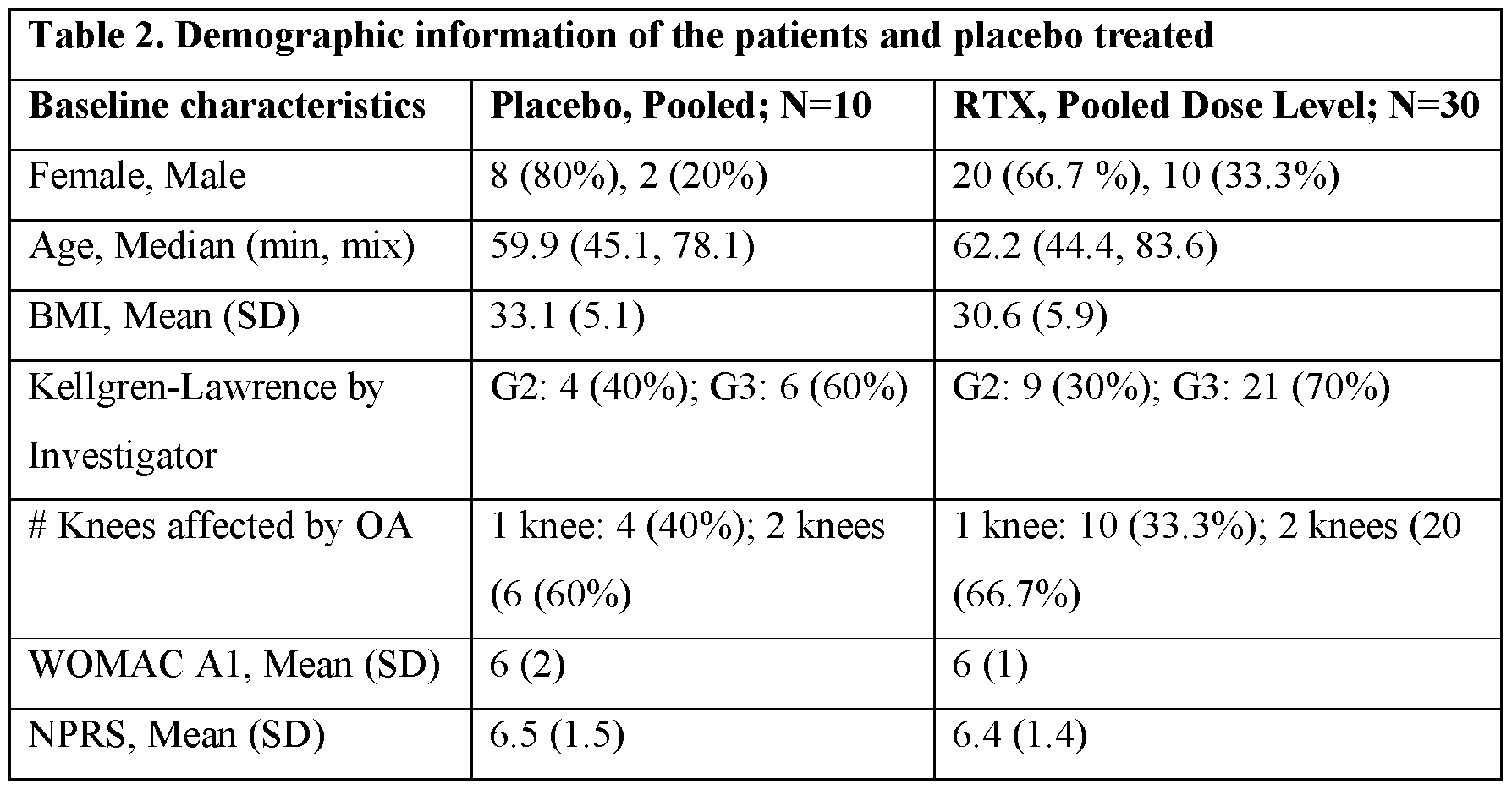
- Subjects with moderate to severe osteoarthritis diagnosed based on ACR diagnostic criteria and X-ray imaging were enrolled in a phase lb double-blind study to assess the safety, tolerability and preliminary efficacy of intra-articular administration of resiniferatoxin or placebo for the treatment of moderate to severe pain due to osteoarthritis of the knee.
- Patients met the following criteria: (1) baseline pain score in the index knee (WOMAC pain subscale question Al) of >5 but ⁇ 9 during four weeks prior to enrollment; (2) mean NPRS score of >5 but ⁇ 9 during 8 of 10 days prior to enrollment; and (3) pain lasted for at least 6 months prior to enrollment.
- RTX rt al.
- saline placebo at escalating dose level cohorts of 5 pg, 12.5 pg, 20 pg and 30 pg in 5 or 10 mL in dose escalation cohorts.
- the first patient was considered a sentinel patient and received open-label drug.
- the remaining 7 patients in the cohort were enrolled in a blinded fashion, 2 patients receiving placebo and 5 patients receiving RTX.
- the next higher dose level was opened for enrollment. Patients were followed for safety and efficacy over a 12-week period. Patients had the option to provide additional follow-up to 52 weeks. Efficacy was assessed using the patient reported WOMAC pain scores and NPRS pain scores. As per protocol, the treatment assignment could be unblinded at week 12.
- RTX treated patients had a mean pain score 4.7 points lower than controls (on the 10 point WOMAC pain scale) at Day 84 (see Fig. 1). Onset of pain reduction was as early as the day following drug administration and was sustained over time. Patients in all dose groups are also displaying rapid and sustainable improvements. Therefore, these data are able to determine a safe and efficacious dose of RTX.
- MMRM mixed model repeated measures
- resiniferatoxin demonstrated safety and preliminary efficacy when given as one-time intra-articular injection up to the planned highest dose of 30 pg.
Landscapes
- Health & Medical Sciences (AREA)
- Chemical & Material Sciences (AREA)
- Life Sciences & Earth Sciences (AREA)
- Veterinary Medicine (AREA)
- Medicinal Chemistry (AREA)
- Pharmacology & Pharmacy (AREA)
- Animal Behavior & Ethology (AREA)
- General Health & Medical Sciences (AREA)
- Public Health (AREA)
- Organic Chemistry (AREA)
- General Chemical & Material Sciences (AREA)
- Chemical Kinetics & Catalysis (AREA)
- Epidemiology (AREA)
- Nuclear Medicine, Radiotherapy & Molecular Imaging (AREA)
- Rheumatology (AREA)
- Engineering & Computer Science (AREA)
- Immunology (AREA)
- Orthopedic Medicine & Surgery (AREA)
- Pain & Pain Management (AREA)
- Bioinformatics & Cheminformatics (AREA)
- Physical Education & Sports Medicine (AREA)
- Oil, Petroleum & Natural Gas (AREA)
- Dermatology (AREA)
- Biochemistry (AREA)
- Molecular Biology (AREA)
- Inorganic Chemistry (AREA)
- Pharmaceuticals Containing Other Organic And Inorganic Compounds (AREA)
- Medicinal Preparation (AREA)
- Acyclic And Carbocyclic Compounds In Medicinal Compositions (AREA)
- Medicines That Contain Protein Lipid Enzymes And Other Medicines (AREA)
Abstract
Description




Claims
Priority Applications (14)
| Application Number | Priority Date | Filing Date | Title |
|---|---|---|---|
| CA3126239A CA3126239A1 (en) | 2019-01-22 | 2020-01-21 | Method for treating osteoarthritis pain by administering resiniferatoxin |
| SG11202107815UA SG11202107815UA (en) | 2019-01-22 | 2020-01-21 | Method for treating osteoarthritis pain by administering resiniferatoxin |
| MX2021008716A MX2021008716A (en) | 2019-01-22 | 2020-01-21 | Method for treating osteoarthritis pain by administering resiniferatoxin. |
| EP20744876.2A EP3914595A4 (en) | 2019-01-22 | 2020-01-21 | METHODS OF TREATMENT OF PAIN IN OSTEOARTHRITIS BY ADMINISTRATION OF RESINIFERATOXIN |
| AU2020212942A AU2020212942A1 (en) | 2019-01-22 | 2020-01-21 | Method for treating osteoarthritis pain by administering resiniferatoxin |
| JP2021541622A JP7530365B2 (en) | 2019-01-22 | 2020-01-21 | Methods for treating osteoarthritis pain by administering resiniferatoxin - Patent Application 20070123333 |
| KR1020217026564A KR20210118883A (en) | 2019-01-22 | 2020-01-21 | How to Treat Osteoarthritis Pain by Administering Reciniferatoxin |
| BR112021014107-3A BR112021014107A2 (en) | 2019-01-22 | 2020-01-21 | METHOD TO TREAT OSTEOARTHRITIS PAIN BY ADMINISTRATION OF RESINIFERATOXIN |
| CN202080022702.3A CN113614081A (en) | 2019-01-22 | 2020-01-21 | Method for treating osteoarthritis pain by administration of resiniferatoxin |
| EA202192037A EA202192037A1 (en) | 2019-10-16 | 2020-01-21 | METHOD FOR TREATMENT OF PAIN IN OSTEOARTHRITIS BY INJECTING RESINIFERATOXIN |
| US17/424,634 US12029725B2 (en) | 2019-01-22 | 2020-01-21 | Method for treating osteoarthritis pain by administering resiniferatoxin |
| IL284951A IL284951A (en) | 2019-01-22 | 2021-07-19 | Method for treating osteoarthritis pain by administering resiniferatoxin |
| US18/735,041 US20250161261A1 (en) | 2019-01-22 | 2024-06-05 | Method for Treating Osteoarthritis Pain by Administering Resiniferatoxin |
| AU2025223880A AU2025223880A1 (en) | 2019-01-22 | 2025-08-29 | Method for treating osteoarthritis pain by administering resiniferatoxin |
Applications Claiming Priority (4)
| Application Number | Priority Date | Filing Date | Title |
|---|---|---|---|
| US201962795530P | 2019-01-22 | 2019-01-22 | |
| US62/795,530 | 2019-01-22 | ||
| US201962915802P | 2019-10-16 | 2019-10-16 | |
| US62/915,802 | 2019-10-16 |
Related Child Applications (2)
| Application Number | Title | Priority Date | Filing Date |
|---|---|---|---|
| US17/424,634 A-371-Of-International US12029725B2 (en) | 2019-01-22 | 2020-01-21 | Method for treating osteoarthritis pain by administering resiniferatoxin |
| US18/735,041 Continuation US20250161261A1 (en) | 2019-01-22 | 2024-06-05 | Method for Treating Osteoarthritis Pain by Administering Resiniferatoxin |
Publications (1)
| Publication Number | Publication Date |
|---|---|
| WO2020154261A1 true WO2020154261A1 (en) | 2020-07-30 |
Family
ID=71736992
Family Applications (1)
| Application Number | Title | Priority Date | Filing Date |
|---|---|---|---|
| PCT/US2020/014361 Ceased WO2020154261A1 (en) | 2019-01-22 | 2020-01-21 | Method for treating osteoarthritis pain by administering resiniferatoxin |
Country Status (13)
| Country | Link |
|---|---|
| US (2) | US12029725B2 (en) |
| EP (1) | EP3914595A4 (en) |
| JP (1) | JP7530365B2 (en) |
| KR (1) | KR20210118883A (en) |
| CN (1) | CN113614081A (en) |
| AU (2) | AU2020212942A1 (en) |
| BR (1) | BR112021014107A2 (en) |
| CA (1) | CA3126239A1 (en) |
| IL (1) | IL284951A (en) |
| MX (1) | MX2021008716A (en) |
| SG (1) | SG11202107815UA (en) |
| TW (1) | TW202042802A (en) |
| WO (1) | WO2020154261A1 (en) |
Cited By (4)
| Publication number | Priority date | Publication date | Assignee | Title |
|---|---|---|---|---|
| US11254659B1 (en) | 2019-01-18 | 2022-02-22 | Centrexion Therapeutics Corporation | Capsaicinoid prodrug compounds and their use in treating medical conditions |
| US11447444B1 (en) | 2019-01-18 | 2022-09-20 | Centrexion Therapeutics Corporation | Capsaicinoid prodrug compounds and their use in treating medical conditions |
| EP4487872A3 (en) * | 2020-04-15 | 2025-03-26 | Grünenthal GmbH | Resiniferatoxin compositions |
| WO2025153515A1 (en) | 2024-01-15 | 2025-07-24 | Grünenthal GmbH | Lyophilized resiniferatoxin |
Families Citing this family (3)
| Publication number | Priority date | Publication date | Assignee | Title |
|---|---|---|---|---|
| KR20200051771A (en) * | 2017-09-11 | 2020-05-13 | 소렌토 쎄라퓨틱스, 인코포레이티드 | Resiniferatoxin formulation |
| CN113490745A (en) | 2018-12-21 | 2021-10-08 | 索伦托药业有限公司 | Treatment of maladaptive pain with perinervous resiniferatoxin administration |
| EP3914595A4 (en) | 2019-01-22 | 2022-11-09 | Sorrento Therapeutics, Inc. | METHODS OF TREATMENT OF PAIN IN OSTEOARTHRITIS BY ADMINISTRATION OF RESINIFERATOXIN |
Citations (6)
| Publication number | Priority date | Publication date | Assignee | Title |
|---|---|---|---|---|
| US4939194A (en) | 1986-02-27 | 1990-07-03 | Plastopil Hazorea | Controllably and swiftly degradable polymer compositions and films and other products made therefrom |
| US5021450A (en) | 1989-05-30 | 1991-06-04 | The United States Of America As Represented By The Secretary Of The Department Of Health And Human Services | New class of compounds having a variable spectrum of activities for capsaicin-like responses, compositions and uses thereof |
| US5232684A (en) | 1990-06-29 | 1993-08-03 | The United States Of America As Represented By The Department Of Health And Human Services | Labelled resiniferatoxin, compositions thereof, and methods for using the same |
| US20040156931A1 (en) * | 2002-12-18 | 2004-08-12 | Algorx | Administration of capsaicinoids |
| US20150190509A1 (en) | 2012-08-03 | 2015-07-09 | Mestex Ag | Resiniferatoxin solution |
| WO2017087803A1 (en) * | 2015-11-20 | 2017-05-26 | Sorrento Therapeutics, Inc. | Methods for pain treatment using resiniferatoxin |
Family Cites Families (12)
| Publication number | Priority date | Publication date | Assignee | Title |
|---|---|---|---|---|
| CA2302496C (en) | 1997-08-28 | 2009-12-08 | Mount Cook Biosciences, Inc. | Urinary incontinence therapy |
| US20040146590A1 (en) | 2001-03-22 | 2004-07-29 | Iadarola Michael J | Molecular neurochirurgie for pain control administering locally capsaicin or resinferatoxin |
| CA2509233A1 (en) | 2002-12-13 | 2004-07-01 | Neurogen Corporation | 2-substituted quinazolin-4-ylamine analogues as capsaicin receptor modulators |
| US7329664B2 (en) | 2003-07-16 | 2008-02-12 | Neurogen Corporation | Substituted (7-pyridyl-4-phenylamino-quinazolin-2-yl)-methanol analogues |
| ES2533256T3 (en) | 2004-12-28 | 2015-04-08 | Mestex Ag | Use of resiniferatoxin (RTX) for the manufacture of a medication for the treatment of pain |
| WO2008109026A1 (en) | 2007-03-05 | 2008-09-12 | Mt Cook Pharma | Pharmaceutical compositions for the localized treatment of neurogenic dysfunction |
| US20170296506A1 (en) | 2016-04-13 | 2017-10-19 | Board Of Regents Of The University Of Nebraska | Methods for administration and methods for treating cardiovascular diseases with resiniferatoxin |
| CN113490745A (en) | 2018-12-21 | 2021-10-08 | 索伦托药业有限公司 | Treatment of maladaptive pain with perinervous resiniferatoxin administration |
| AU2019414329A1 (en) | 2018-12-24 | 2021-06-10 | Vivasor, Inc. | Methods for treating parkinson's disease by administering resiniferatoxin |
| EP3914595A4 (en) | 2019-01-22 | 2022-11-09 | Sorrento Therapeutics, Inc. | METHODS OF TREATMENT OF PAIN IN OSTEOARTHRITIS BY ADMINISTRATION OF RESINIFERATOXIN |
| US20230270713A1 (en) | 2020-06-19 | 2023-08-31 | Sorrento Therapeutics, Inc. | Administration of Resiniferatoxin For Treatment of Bladder Pain or Bladder Cancer |
| CA3219312A1 (en) | 2021-05-18 | 2022-11-24 | Alexis Nahama | Presurgical perineural administration of resiniferatoxin for reduction of post-operative pain |
-
2020
- 2020-01-21 EP EP20744876.2A patent/EP3914595A4/en active Pending
- 2020-01-21 WO PCT/US2020/014361 patent/WO2020154261A1/en not_active Ceased
- 2020-01-21 MX MX2021008716A patent/MX2021008716A/en unknown
- 2020-01-21 JP JP2021541622A patent/JP7530365B2/en active Active
- 2020-01-21 AU AU2020212942A patent/AU2020212942A1/en not_active Abandoned
- 2020-01-21 KR KR1020217026564A patent/KR20210118883A/en active Pending
- 2020-01-21 SG SG11202107815UA patent/SG11202107815UA/en unknown
- 2020-01-21 BR BR112021014107-3A patent/BR112021014107A2/en not_active Application Discontinuation
- 2020-01-21 TW TW109102215A patent/TW202042802A/en unknown
- 2020-01-21 CN CN202080022702.3A patent/CN113614081A/en active Pending
- 2020-01-21 CA CA3126239A patent/CA3126239A1/en active Pending
- 2020-01-21 US US17/424,634 patent/US12029725B2/en active Active
-
2021
- 2021-07-19 IL IL284951A patent/IL284951A/en unknown
-
2024
- 2024-06-05 US US18/735,041 patent/US20250161261A1/en active Pending
-
2025
- 2025-08-29 AU AU2025223880A patent/AU2025223880A1/en active Pending
Patent Citations (6)
| Publication number | Priority date | Publication date | Assignee | Title |
|---|---|---|---|---|
| US4939194A (en) | 1986-02-27 | 1990-07-03 | Plastopil Hazorea | Controllably and swiftly degradable polymer compositions and films and other products made therefrom |
| US5021450A (en) | 1989-05-30 | 1991-06-04 | The United States Of America As Represented By The Secretary Of The Department Of Health And Human Services | New class of compounds having a variable spectrum of activities for capsaicin-like responses, compositions and uses thereof |
| US5232684A (en) | 1990-06-29 | 1993-08-03 | The United States Of America As Represented By The Department Of Health And Human Services | Labelled resiniferatoxin, compositions thereof, and methods for using the same |
| US20040156931A1 (en) * | 2002-12-18 | 2004-08-12 | Algorx | Administration of capsaicinoids |
| US20150190509A1 (en) | 2012-08-03 | 2015-07-09 | Mestex Ag | Resiniferatoxin solution |
| WO2017087803A1 (en) * | 2015-11-20 | 2017-05-26 | Sorrento Therapeutics, Inc. | Methods for pain treatment using resiniferatoxin |
Non-Patent Citations (11)
| Title |
|---|
| "Remington's Pharmaceutical Sciences", 1990, MACK PUBLISHING CO. |
| CATERINA ET AL., NATURE, vol. 389, 1997, pages 816 - 824 |
| IADAROLA ET AL., PAIN, vol. 159, no. 10, 2018, pages 2105 - 2114 |
| KARAI ET AL., J. OF CLIN. INVEST., vol. 113, 2004, pages 1344 - 1352 |
| LADAROLA ET AL.: "Long-term pain relief in canine osteoarthritis by a single intra-articular injection of resiniferatoxin, a potent TRPV1 agonist", PAIN, vol. 159, no. 10, 10 July 2018 (2018-07-10), pages 2105 - 2114, XP055843937 * |
| See also references of EP3914595A4 |
| SZALLASI ET AL., BRIT. J. PHARMACOL., vol. 128, 1999, pages 428 - 434 |
| SZALLLASI ET AL., MOL. PHARMACOL., vol. 56, 1999, pages 581 - 587 |
| TOMINAGA ET AL., NEURON, vol. 21, 1998, pages 531 - 543 |
| UEDA ET AL., J. OF CARDIOVASC. PHARMACOL., vol. 51, 2008, pages 513 - 520 |
| YOUNGKYUNG ET AL., KOREAN JOURNAL OF PHYSIOLOGY AND PHARMACOLOGY, vol. 20, no. 1, 2016, pages 129 |
Cited By (7)
| Publication number | Priority date | Publication date | Assignee | Title |
|---|---|---|---|---|
| US11254659B1 (en) | 2019-01-18 | 2022-02-22 | Centrexion Therapeutics Corporation | Capsaicinoid prodrug compounds and their use in treating medical conditions |
| US11447444B1 (en) | 2019-01-18 | 2022-09-20 | Centrexion Therapeutics Corporation | Capsaicinoid prodrug compounds and their use in treating medical conditions |
| US11820727B1 (en) | 2019-01-18 | 2023-11-21 | Centrexion Therapeutics Corporation | Capsaicinoid prodrug compounds and their use in treating medical conditions |
| EP4487872A3 (en) * | 2020-04-15 | 2025-03-26 | Grünenthal GmbH | Resiniferatoxin compositions |
| WO2025153515A1 (en) | 2024-01-15 | 2025-07-24 | Grünenthal GmbH | Lyophilized resiniferatoxin |
| WO2025153517A1 (en) | 2024-01-15 | 2025-07-24 | Grünenthal GmbH | Treating knee joint pain by injecting resiniferatoxin at ultra low doses |
| WO2025153516A1 (en) | 2024-01-15 | 2025-07-24 | Grünenthal GmbH | Ethanolic resiniferatoxin concentrate |
Also Published As
| Publication number | Publication date |
|---|---|
| EP3914595A1 (en) | 2021-12-01 |
| MX2021008716A (en) | 2021-08-24 |
| US20220096428A1 (en) | 2022-03-31 |
| AU2025223880A1 (en) | 2025-09-18 |
| IL284951A (en) | 2021-09-30 |
| TW202042802A (en) | 2020-12-01 |
| CN113614081A (en) | 2021-11-05 |
| US12029725B2 (en) | 2024-07-09 |
| US20250161261A1 (en) | 2025-05-22 |
| BR112021014107A2 (en) | 2021-09-21 |
| JP2022518725A (en) | 2022-03-16 |
| JP7530365B2 (en) | 2024-08-07 |
| CA3126239A1 (en) | 2020-07-30 |
| EP3914595A4 (en) | 2022-11-09 |
| AU2020212942A1 (en) | 2021-08-26 |
| SG11202107815UA (en) | 2021-08-30 |
| KR20210118883A (en) | 2021-10-01 |
Similar Documents
| Publication | Publication Date | Title |
|---|---|---|
| US20250161261A1 (en) | Method for Treating Osteoarthritis Pain by Administering Resiniferatoxin | |
| US12403091B2 (en) | Delivery system | |
| CA2977960C (en) | Reduction of adipose tissue | |
| JP7280192B2 (en) | Plinabulin composition and use thereof | |
| KR102032400B1 (en) | Treatment of degenerative joint disease | |
| SK20012000A3 (en) | Methods and transdermal compositions for pain relief | |
| JP6695140B2 (en) | Aqueous capsaicinoid formulations and methods of making and using same | |
| JP5763624B2 (en) | Administration methods and formulations for the treatment of local adipose tissue | |
| US12144886B2 (en) | Perineural administration of resiniferatoxin for treatment of maladaptive pain | |
| WO2013143300A1 (en) | Sustained-release preparation of fulvestrant or derivatives thereof and preparation method therefor | |
| US20250228775A1 (en) | Ethanolic resiniferatoxin concentrate | |
| Argoff | Targeted peripheral analgesics therapy for neuropathic pain | |
| Kraychete et al. | Topic drug therapy for neuropathic pain | |
| Lee et al. | (389) The combination effect of propacetamol with nefopam for postoperative pain after thyroidectomy | |
| CZ20004823A3 (en) | Methods and Transdermal Agents for Pain Relief |
Legal Events
| Date | Code | Title | Description |
|---|---|---|---|
| 121 | Ep: the epo has been informed by wipo that ep was designated in this application |
Ref document number: 20744876 Country of ref document: EP Kind code of ref document: A1 |
|
| ENP | Entry into the national phase |
Ref document number: 3126239 Country of ref document: CA |
|
| ENP | Entry into the national phase |
Ref document number: 2021541622 Country of ref document: JP Kind code of ref document: A |
|
| NENP | Non-entry into the national phase |
Ref country code: DE |
|
| REG | Reference to national code |
Ref country code: BR Ref legal event code: B01A Ref document number: 112021014107 Country of ref document: BR |
|
| ENP | Entry into the national phase |
Ref document number: 20217026564 Country of ref document: KR Kind code of ref document: A |
|
| ENP | Entry into the national phase |
Ref document number: 2020212942 Country of ref document: AU Date of ref document: 20200121 Kind code of ref document: A |
|
| ENP | Entry into the national phase |
Ref document number: 112021014107 Country of ref document: BR Kind code of ref document: A2 Effective date: 20210716 |
|
| ENP | Entry into the national phase |
Ref document number: 2020744876 Country of ref document: EP Effective date: 20210823 |
|
| WWW | Wipo information: withdrawn in national office |
Ref document number: 202192037 Country of ref document: EA |
|
| WWW | Wipo information: withdrawn in national office |
Ref document number: 778765 Country of ref document: NZ |