WO2020158820A1 - Structure composite métal-résine à base d'aluminium, élément métallique à base d'aluminium, procédé de fabrication d'un élément métallique à base d'aluminium, et procédé de fabrication de structure composite métal-résine à base d'aluminium - Google Patents
Structure composite métal-résine à base d'aluminium, élément métallique à base d'aluminium, procédé de fabrication d'un élément métallique à base d'aluminium, et procédé de fabrication de structure composite métal-résine à base d'aluminium Download PDFInfo
- Publication number
- WO2020158820A1 WO2020158820A1 PCT/JP2020/003252 JP2020003252W WO2020158820A1 WO 2020158820 A1 WO2020158820 A1 WO 2020158820A1 JP 2020003252 W JP2020003252 W JP 2020003252W WO 2020158820 A1 WO2020158820 A1 WO 2020158820A1
- Authority
- WO
- WIPO (PCT)
- Prior art keywords
- aluminum
- based metal
- metal member
- resin
- composite structure
- Prior art date
- Legal status (The legal status is an assumption and is not a legal conclusion. Google has not performed a legal analysis and makes no representation as to the accuracy of the status listed.)
- Ceased
Links
Images





Classifications
-
- B—PERFORMING OPERATIONS; TRANSPORTING
- B29—WORKING OF PLASTICS; WORKING OF SUBSTANCES IN A PLASTIC STATE IN GENERAL
- B29C—SHAPING OR JOINING OF PLASTICS; SHAPING OF MATERIAL IN A PLASTIC STATE, NOT OTHERWISE PROVIDED FOR; AFTER-TREATMENT OF THE SHAPED PRODUCTS, e.g. REPAIRING
- B29C65/00—Joining or sealing of preformed parts, e.g. welding of plastics materials; Apparatus therefor
- B29C65/70—Joining or sealing of preformed parts, e.g. welding of plastics materials; Apparatus therefor by moulding
-
- B—PERFORMING OPERATIONS; TRANSPORTING
- B29—WORKING OF PLASTICS; WORKING OF SUBSTANCES IN A PLASTIC STATE IN GENERAL
- B29C—SHAPING OR JOINING OF PLASTICS; SHAPING OF MATERIAL IN A PLASTIC STATE, NOT OTHERWISE PROVIDED FOR; AFTER-TREATMENT OF THE SHAPED PRODUCTS, e.g. REPAIRING
- B29C45/00—Injection moulding, i.e. forcing the required volume of moulding material through a nozzle into a closed mould; Apparatus therefor
- B29C45/14—Injection moulding, i.e. forcing the required volume of moulding material through a nozzle into a closed mould; Apparatus therefor incorporating preformed parts or layers, e.g. injection moulding around inserts or for coating articles
-
- B—PERFORMING OPERATIONS; TRANSPORTING
- B29—WORKING OF PLASTICS; WORKING OF SUBSTANCES IN A PLASTIC STATE IN GENERAL
- B29C—SHAPING OR JOINING OF PLASTICS; SHAPING OF MATERIAL IN A PLASTIC STATE, NOT OTHERWISE PROVIDED FOR; AFTER-TREATMENT OF THE SHAPED PRODUCTS, e.g. REPAIRING
- B29C45/00—Injection moulding, i.e. forcing the required volume of moulding material through a nozzle into a closed mould; Apparatus therefor
- B29C45/0001—Injection moulding, i.e. forcing the required volume of moulding material through a nozzle into a closed mould; Apparatus therefor characterised by the choice of material
-
- B—PERFORMING OPERATIONS; TRANSPORTING
- B29—WORKING OF PLASTICS; WORKING OF SUBSTANCES IN A PLASTIC STATE IN GENERAL
- B29C—SHAPING OR JOINING OF PLASTICS; SHAPING OF MATERIAL IN A PLASTIC STATE, NOT OTHERWISE PROVIDED FOR; AFTER-TREATMENT OF THE SHAPED PRODUCTS, e.g. REPAIRING
- B29C45/00—Injection moulding, i.e. forcing the required volume of moulding material through a nozzle into a closed mould; Apparatus therefor
- B29C45/0053—Injection moulding, i.e. forcing the required volume of moulding material through a nozzle into a closed mould; Apparatus therefor combined with a final operation, e.g. shaping
- B29C45/006—Joining parts moulded in separate cavities
- B29C45/0062—Joined by injection moulding
-
- B—PERFORMING OPERATIONS; TRANSPORTING
- B29—WORKING OF PLASTICS; WORKING OF SUBSTANCES IN A PLASTIC STATE IN GENERAL
- B29C—SHAPING OR JOINING OF PLASTICS; SHAPING OF MATERIAL IN A PLASTIC STATE, NOT OTHERWISE PROVIDED FOR; AFTER-TREATMENT OF THE SHAPED PRODUCTS, e.g. REPAIRING
- B29C45/00—Injection moulding, i.e. forcing the required volume of moulding material through a nozzle into a closed mould; Apparatus therefor
- B29C45/14—Injection moulding, i.e. forcing the required volume of moulding material through a nozzle into a closed mould; Apparatus therefor incorporating preformed parts or layers, e.g. injection moulding around inserts or for coating articles
- B29C45/14311—Injection moulding, i.e. forcing the required volume of moulding material through a nozzle into a closed mould; Apparatus therefor incorporating preformed parts or layers, e.g. injection moulding around inserts or for coating articles using means for bonding the coating to the articles
-
- B—PERFORMING OPERATIONS; TRANSPORTING
- B29—WORKING OF PLASTICS; WORKING OF SUBSTANCES IN A PLASTIC STATE IN GENERAL
- B29C—SHAPING OR JOINING OF PLASTICS; SHAPING OF MATERIAL IN A PLASTIC STATE, NOT OTHERWISE PROVIDED FOR; AFTER-TREATMENT OF THE SHAPED PRODUCTS, e.g. REPAIRING
- B29C45/00—Injection moulding, i.e. forcing the required volume of moulding material through a nozzle into a closed mould; Apparatus therefor
- B29C45/14—Injection moulding, i.e. forcing the required volume of moulding material through a nozzle into a closed mould; Apparatus therefor incorporating preformed parts or layers, e.g. injection moulding around inserts or for coating articles
- B29C45/14336—Coating a portion of the article, e.g. the edge of the article
-
- B—PERFORMING OPERATIONS; TRANSPORTING
- B29—WORKING OF PLASTICS; WORKING OF SUBSTANCES IN A PLASTIC STATE IN GENERAL
- B29C—SHAPING OR JOINING OF PLASTICS; SHAPING OF MATERIAL IN A PLASTIC STATE, NOT OTHERWISE PROVIDED FOR; AFTER-TREATMENT OF THE SHAPED PRODUCTS, e.g. REPAIRING
- B29C66/00—General aspects of processes or apparatus for joining preformed parts
- B29C66/70—General aspects of processes or apparatus for joining preformed parts characterised by the composition, physical properties or the structure of the material of the parts to be joined; Joining with non-plastics material
- B29C66/74—Joining plastics material to non-plastics material
- B29C66/742—Joining plastics material to non-plastics material to metals or their alloys
- B29C66/7422—Aluminium or alloys of aluminium
-
- C—CHEMISTRY; METALLURGY
- C23—COATING METALLIC MATERIAL; COATING MATERIAL WITH METALLIC MATERIAL; CHEMICAL SURFACE TREATMENT; DIFFUSION TREATMENT OF METALLIC MATERIAL; COATING BY VACUUM EVAPORATION, BY SPUTTERING, BY ION IMPLANTATION OR BY CHEMICAL VAPOUR DEPOSITION, IN GENERAL; INHIBITING CORROSION OF METALLIC MATERIAL OR INCRUSTATION IN GENERAL
- C23C—COATING METALLIC MATERIAL; COATING MATERIAL WITH METALLIC MATERIAL; SURFACE TREATMENT OF METALLIC MATERIAL BY DIFFUSION INTO THE SURFACE, BY CHEMICAL CONVERSION OR SUBSTITUTION; COATING BY VACUUM EVAPORATION, BY SPUTTERING, BY ION IMPLANTATION OR BY CHEMICAL VAPOUR DEPOSITION, IN GENERAL
- C23C22/00—Chemical surface treatment of metallic material by reaction of the surface with a reactive liquid, leaving reaction products of surface material in the coating, e.g. conversion coatings, passivation of metals
- C23C22/05—Chemical surface treatment of metallic material by reaction of the surface with a reactive liquid, leaving reaction products of surface material in the coating, e.g. conversion coatings, passivation of metals using aqueous solutions
- C23C22/06—Chemical surface treatment of metallic material by reaction of the surface with a reactive liquid, leaving reaction products of surface material in the coating, e.g. conversion coatings, passivation of metals using aqueous solutions using aqueous acidic solutions with pH less than 6
- C23C22/48—Chemical surface treatment of metallic material by reaction of the surface with a reactive liquid, leaving reaction products of surface material in the coating, e.g. conversion coatings, passivation of metals using aqueous solutions using aqueous acidic solutions with pH less than 6 not containing phosphates, hexavalent chromium compounds, fluorides or complex fluorides, molybdates, tungstates, vanadates or oxalates
- C23C22/56—Treatment of aluminium or alloys based thereon
-
- C—CHEMISTRY; METALLURGY
- C23—COATING METALLIC MATERIAL; COATING MATERIAL WITH METALLIC MATERIAL; CHEMICAL SURFACE TREATMENT; DIFFUSION TREATMENT OF METALLIC MATERIAL; COATING BY VACUUM EVAPORATION, BY SPUTTERING, BY ION IMPLANTATION OR BY CHEMICAL VAPOUR DEPOSITION, IN GENERAL; INHIBITING CORROSION OF METALLIC MATERIAL OR INCRUSTATION IN GENERAL
- C23C—COATING METALLIC MATERIAL; COATING MATERIAL WITH METALLIC MATERIAL; SURFACE TREATMENT OF METALLIC MATERIAL BY DIFFUSION INTO THE SURFACE, BY CHEMICAL CONVERSION OR SUBSTITUTION; COATING BY VACUUM EVAPORATION, BY SPUTTERING, BY ION IMPLANTATION OR BY CHEMICAL VAPOUR DEPOSITION, IN GENERAL
- C23C22/00—Chemical surface treatment of metallic material by reaction of the surface with a reactive liquid, leaving reaction products of surface material in the coating, e.g. conversion coatings, passivation of metals
- C23C22/73—Chemical surface treatment of metallic material by reaction of the surface with a reactive liquid, leaving reaction products of surface material in the coating, e.g. conversion coatings, passivation of metals characterised by the process
-
- C—CHEMISTRY; METALLURGY
- C23—COATING METALLIC MATERIAL; COATING MATERIAL WITH METALLIC MATERIAL; CHEMICAL SURFACE TREATMENT; DIFFUSION TREATMENT OF METALLIC MATERIAL; COATING BY VACUUM EVAPORATION, BY SPUTTERING, BY ION IMPLANTATION OR BY CHEMICAL VAPOUR DEPOSITION, IN GENERAL; INHIBITING CORROSION OF METALLIC MATERIAL OR INCRUSTATION IN GENERAL
- C23F—NON-MECHANICAL REMOVAL OF METALLIC MATERIAL FROM SURFACE; INHIBITING CORROSION OF METALLIC MATERIAL OR INCRUSTATION IN GENERAL; MULTI-STEP PROCESSES FOR SURFACE TREATMENT OF METALLIC MATERIAL INVOLVING AT LEAST ONE PROCESS PROVIDED FOR IN CLASS C23 AND AT LEAST ONE PROCESS COVERED BY SUBCLASS C21D OR C22F OR CLASS C25
- C23F1/00—Etching metallic material by chemical means
- C23F1/10—Etching compositions
- C23F1/14—Aqueous compositions
- C23F1/16—Acidic compositions
- C23F1/20—Acidic compositions for etching aluminium or alloys thereof
-
- B—PERFORMING OPERATIONS; TRANSPORTING
- B29—WORKING OF PLASTICS; WORKING OF SUBSTANCES IN A PLASTIC STATE IN GENERAL
- B29C—SHAPING OR JOINING OF PLASTICS; SHAPING OF MATERIAL IN A PLASTIC STATE, NOT OTHERWISE PROVIDED FOR; AFTER-TREATMENT OF THE SHAPED PRODUCTS, e.g. REPAIRING
- B29C45/00—Injection moulding, i.e. forcing the required volume of moulding material through a nozzle into a closed mould; Apparatus therefor
- B29C45/14—Injection moulding, i.e. forcing the required volume of moulding material through a nozzle into a closed mould; Apparatus therefor incorporating preformed parts or layers, e.g. injection moulding around inserts or for coating articles
- B29C45/14008—Inserting articles into the mould
-
- B—PERFORMING OPERATIONS; TRANSPORTING
- B29—WORKING OF PLASTICS; WORKING OF SUBSTANCES IN A PLASTIC STATE IN GENERAL
- B29K—INDEXING SCHEME ASSOCIATED WITH SUBCLASSES B29B, B29C OR B29D, RELATING TO MOULDING MATERIALS OR TO MATERIALS FOR MOULDS, REINFORCEMENTS, FILLERS OR PREFORMED PARTS, e.g. INSERTS
- B29K2023/00—Use of polyalkenes or derivatives thereof as moulding material
- B29K2023/10—Polymers of propylene
- B29K2023/12—PP, i.e. polypropylene
-
- B—PERFORMING OPERATIONS; TRANSPORTING
- B29—WORKING OF PLASTICS; WORKING OF SUBSTANCES IN A PLASTIC STATE IN GENERAL
- B29K—INDEXING SCHEME ASSOCIATED WITH SUBCLASSES B29B, B29C OR B29D, RELATING TO MOULDING MATERIALS OR TO MATERIALS FOR MOULDS, REINFORCEMENTS, FILLERS OR PREFORMED PARTS, e.g. INSERTS
- B29K2067/00—Use of polyesters or derivatives thereof, as moulding material
-
- B—PERFORMING OPERATIONS; TRANSPORTING
- B29—WORKING OF PLASTICS; WORKING OF SUBSTANCES IN A PLASTIC STATE IN GENERAL
- B29K—INDEXING SCHEME ASSOCIATED WITH SUBCLASSES B29B, B29C OR B29D, RELATING TO MOULDING MATERIALS OR TO MATERIALS FOR MOULDS, REINFORCEMENTS, FILLERS OR PREFORMED PARTS, e.g. INSERTS
- B29K2075/00—Use of PU, i.e. polyureas or polyurethanes or derivatives thereof, as moulding material
-
- B—PERFORMING OPERATIONS; TRANSPORTING
- B29—WORKING OF PLASTICS; WORKING OF SUBSTANCES IN A PLASTIC STATE IN GENERAL
- B29K—INDEXING SCHEME ASSOCIATED WITH SUBCLASSES B29B, B29C OR B29D, RELATING TO MOULDING MATERIALS OR TO MATERIALS FOR MOULDS, REINFORCEMENTS, FILLERS OR PREFORMED PARTS, e.g. INSERTS
- B29K2101/00—Use of unspecified macromolecular compounds as moulding material
- B29K2101/12—Thermoplastic materials
-
- B—PERFORMING OPERATIONS; TRANSPORTING
- B29—WORKING OF PLASTICS; WORKING OF SUBSTANCES IN A PLASTIC STATE IN GENERAL
- B29K—INDEXING SCHEME ASSOCIATED WITH SUBCLASSES B29B, B29C OR B29D, RELATING TO MOULDING MATERIALS OR TO MATERIALS FOR MOULDS, REINFORCEMENTS, FILLERS OR PREFORMED PARTS, e.g. INSERTS
- B29K2703/00—Use of resin-bonded materials for preformed parts, e.g. inserts
- B29K2703/04—Inorganic materials
- B29K2703/06—Metal powders, metal carbides or the like
-
- B—PERFORMING OPERATIONS; TRANSPORTING
- B29—WORKING OF PLASTICS; WORKING OF SUBSTANCES IN A PLASTIC STATE IN GENERAL
- B29K—INDEXING SCHEME ASSOCIATED WITH SUBCLASSES B29B, B29C OR B29D, RELATING TO MOULDING MATERIALS OR TO MATERIALS FOR MOULDS, REINFORCEMENTS, FILLERS OR PREFORMED PARTS, e.g. INSERTS
- B29K2705/00—Use of metals, their alloys or their compounds, for preformed parts, e.g. for inserts
- B29K2705/02—Aluminium
-
- C—CHEMISTRY; METALLURGY
- C23—COATING METALLIC MATERIAL; COATING MATERIAL WITH METALLIC MATERIAL; CHEMICAL SURFACE TREATMENT; DIFFUSION TREATMENT OF METALLIC MATERIAL; COATING BY VACUUM EVAPORATION, BY SPUTTERING, BY ION IMPLANTATION OR BY CHEMICAL VAPOUR DEPOSITION, IN GENERAL; INHIBITING CORROSION OF METALLIC MATERIAL OR INCRUSTATION IN GENERAL
- C23C—COATING METALLIC MATERIAL; COATING MATERIAL WITH METALLIC MATERIAL; SURFACE TREATMENT OF METALLIC MATERIAL BY DIFFUSION INTO THE SURFACE, BY CHEMICAL CONVERSION OR SUBSTITUTION; COATING BY VACUUM EVAPORATION, BY SPUTTERING, BY ION IMPLANTATION OR BY CHEMICAL VAPOUR DEPOSITION, IN GENERAL
- C23C22/00—Chemical surface treatment of metallic material by reaction of the surface with a reactive liquid, leaving reaction products of surface material in the coating, e.g. conversion coatings, passivation of metals
- C23C22/05—Chemical surface treatment of metallic material by reaction of the surface with a reactive liquid, leaving reaction products of surface material in the coating, e.g. conversion coatings, passivation of metals using aqueous solutions
- C23C22/68—Chemical surface treatment of metallic material by reaction of the surface with a reactive liquid, leaving reaction products of surface material in the coating, e.g. conversion coatings, passivation of metals using aqueous solutions using aqueous solutions with pH between 6 and 8
-
- C—CHEMISTRY; METALLURGY
- C23—COATING METALLIC MATERIAL; COATING MATERIAL WITH METALLIC MATERIAL; CHEMICAL SURFACE TREATMENT; DIFFUSION TREATMENT OF METALLIC MATERIAL; COATING BY VACUUM EVAPORATION, BY SPUTTERING, BY ION IMPLANTATION OR BY CHEMICAL VAPOUR DEPOSITION, IN GENERAL; INHIBITING CORROSION OF METALLIC MATERIAL OR INCRUSTATION IN GENERAL
- C23F—NON-MECHANICAL REMOVAL OF METALLIC MATERIAL FROM SURFACE; INHIBITING CORROSION OF METALLIC MATERIAL OR INCRUSTATION IN GENERAL; MULTI-STEP PROCESSES FOR SURFACE TREATMENT OF METALLIC MATERIAL INVOLVING AT LEAST ONE PROCESS PROVIDED FOR IN CLASS C23 AND AT LEAST ONE PROCESS COVERED BY SUBCLASS C21D OR C22F OR CLASS C25
- C23F1/00—Etching metallic material by chemical means
- C23F1/10—Etching compositions
- C23F1/14—Aqueous compositions
- C23F1/32—Alkaline compositions
- C23F1/36—Alkaline compositions for etching aluminium or alloys thereof
Definitions
- the present invention relates to an aluminum-based metal resin composite structure, an aluminum-based metal member, a method for manufacturing an aluminum-based metal member, and a method for manufacturing an aluminum-based metal-resin composite structure.
- Patent Document 1 An aluminum alloy is immersed in warm water to form a microporous hydroxyl group-containing dendritic layer having a thickness of 5 to 100 nm on the surface thereof, and then polybutylene phthalate or polyphenylene is formed on the treated surface.
- a technique has been proposed in which a thermoplastic resin mainly containing sulfide is injection-molded to integrate aluminum and the resin. According to this method, the surface of the aluminum alloy can be made microporous without using a chemical substance, and the resin can be strongly integrally bonded to the microporous surface, which is a technology that is very attractive in industry. ..
- the surface is formed with an opening of a hole having a number average inner diameter of 10 to 80 nm formed by an anodic oxidation method.
- a composite comprising a covered metal part and a resin composition part having a resin component composition containing 70 to 99% by weight of polyphenylene sulfide and 1 to 30% by weight of a polyolefin resin fixed to the above metal part by injection molding. Has been done.
- the inventors of the present invention faithfully complied with the content of the invention described in Patent Document 1 and verified the effect.
- the same aluminum alloy test piece was subjected to resin treatment under the same surface treatment condition and the same molding condition. Even when joined, it was confirmed that the joint between the aluminum alloy and the resin may show a joint strength with a high base metal fracture level, or the interface may fracture and the joint strength may not be exhibited at all. ing. That is, the mechanical properties of the composite produced by the method described in the document have a problem that the reproducibility of the effect of the invention is poor.
- the present invention has been made in view of the above circumstances, and can directly bond an aluminum-based metal member and a resin member made of a thermoplastic resin composition without using an adhesive, and an aluminum-based metal member.
- the present invention provides an aluminum-based metal-resin composite structure having excellent bonding strength between a resin member and a resin member.
- the present invention provides an aluminum-based metal member capable of stably obtaining an aluminum-based metal resin composite structure having excellent bonding strength between an aluminum-based metal member and a resin member, a method for producing the same, and an aluminum-based metal resin composite structure.
- a method of manufacturing a body is provided.
- the present inventors diligently studied to minimize the variation in the bonding strength between the aluminum-based metal and the resin in the aluminum-based metal-resin composite structure and to develop a stable bonding strength. As a result, they have found that the treated aluminum-based metal surface satisfies the specific microstructure requirements, and the stability of the bonding strength is significantly improved, and the present invention has been accomplished.
- the following aluminum-based metal-resin composite structure, aluminum-based metal member, method for manufacturing an aluminum-based metal member, and method for manufacturing an aluminum-based metal-resin composite structure are provided.
- An aluminum-based metal-resin composite structure comprising: Fourier transform infrared spectrophotometer (FTIR) analysis is performed on the surface of the aluminum-based metal member that is at least joined to the resin member, and the absorbance of the absorption peak observed at 3400 cm ⁇ 1 is A 1, and the absorbance at 3800 cm ⁇ 1 is when the absorbance at straight 3400 cm -1 which connects the absorbance at 2500 cm -1 was a 0, the absorbance difference (a 1 -A 0) is an aluminum-based metal-resin composite structure is in the range of 0.03 or less.
- FTIR Fourier transform infrared spectrophotometer
- An aluminum-based metal-resin composite structure wherein the average number density of the main trunks of the dendritic layer is 5/ ⁇ m or more and 40/ ⁇ m or less.
- An aluminum-based metal-resin composite structure comprising: An aluminum-based metal-resin composite structure, wherein the average number density of the main trunks of the dendritic layer is 5/ ⁇ m or more and 40/ ⁇ m or less.
- the average value of ten-point average roughness (R zjis ) measured according to JIS B0601:2001 (corresponding international standard: ISO4287) is more than 2 ⁇ m and 50 ⁇ m or less [6].
- An aluminum-based metal resin composite structure in which the surface of the aluminum-based metal member on which the dendritic layer is formed satisfies the following characteristic (2).
- the average value of the average lengths (RS m ) of roughness curve elements measured according to JIS B0601:2001 (corresponding international standard: ISO4287) is more than 10 ⁇ m and less than 400 ⁇ m [7].
- thermoplastic resin composition contains one or more thermoplastic resins selected from polyolefin-based resins, polyester-based resins, polyamide-based resins and polyarylene-based resins.
- An aluminum-based metal member having an absorbance difference (A 1 -A 0 ) of 0.03 or less, where A 0 is the absorbance at 3400 cm ⁇ 1 of the straight line connecting the two.
- the aluminum-based metal member according to any one of [8] to [10] above An aluminum-based metal member having an average thickness of the dendritic layer of 20 nm or more and less than 1000 nm, which is measured by observing a cross-sectional profile with a scanning electron microscope (SEM).
- SEM scanning electron microscope
- the aluminum-based metal member according to any one of [8] to [11] above, The surface of the aluminum-based metal member on which the dendritic layer is formed satisfies the following characteristic (1).
- the average value of ten-point average roughness (R zjis ) measured in accordance with JIS B0601:2001 (corresponding international standard: ISO4287) is more than 2 ⁇ m and 50 ⁇ m or less [13].
- the surface of the aluminum-based metal member on which the dendritic layer is formed satisfies the following characteristic (2).
- the average value of the average length (RS m ) of roughness curve elements measured according to JIS B0601:2001 (corresponding international standard: ISO4287) is more than 10 ⁇ m and less than 400 ⁇ m [14].
- the surface of the aluminum-based metal base material is chemically roughened by contacting the aluminum-based metal base material with an oxidizing acidic aqueous solution containing a metal cation having a standard electrode potential E 0 at ⁇ 25° C. of ⁇ 0.2 to 0.8.
- the method for manufacturing an aluminum-based metal member according to any one of [8] to [13] above including the step of: [15] The method for producing an aluminum-based metal member according to the above [14], wherein the oxidizing acidic aqueous solution contains cupric ions. [16] The method for producing an aluminum-based metal member according to [15], wherein the concentration of the cupric ion in the oxidizing aqueous solution is 1% by mass or more and 15% by mass or less. [17] The method for producing an aluminum-based metal member according to any one of the above [14] to [16], wherein the oxidizing acid in the oxidizing aqueous solution contains nitric acid.
- an aluminum-based metal member and a resin member made of a thermoplastic resin composition can be directly bonded without using an adhesive, and the bonding strength between the aluminum-based metal member and the resin member can be improved.
- An excellent aluminum-based metal resin composite structure can be provided.
- an aluminum-based metal member capable of stably obtaining an aluminum-based metal-resin composite structure having excellent bonding strength between an aluminum-based metal member and a resin member, a method for producing the same, and an aluminum-based metal A method for manufacturing a resin composite structure can be provided.
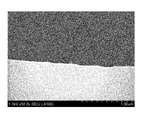
- FIG. 3 is a view showing an SEM cross-sectional profile of a joint portion of the aluminum-based metal resin composite structure obtained in Example 1.
- FIG. 5 is a diagram showing an SEM cross-sectional profile of a joint portion of an aluminum-based metal resin composite structure obtained in Comparative Example 1.
- FIG. 6 is a view showing an SEM cross-sectional profile of a joint portion of an aluminum-based metal resin composite structure obtained in Comparative Example 3.
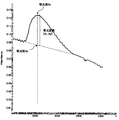
- FIG. 3 is a diagram conceptually showing a method for obtaining an absorbance difference (A 1 ⁇ A 0 ) according to the present invention from an FTIR chart.
- FIG. 3 is a diagram showing an SEM profile of the surface of the aluminum-based metal member obtained in Example 1.
- the aluminum-based metal resin composite structure 106 includes an aluminum-based metal member 103 having a dendritic layer 103-2 formed on at least a part of its surface, and an aluminum-based metal via the dendritic layer 103-2.
- a resin member 105 which is joined to the member 103 and is made of the thermoplastic resin composition (P).
- the dendritic layer 103-2 according to the present embodiment is a layer in which a plurality of branched trunks are forested.
- FIG. 1 is an external view showing an example of the structure of an aluminum-based metal resin composite structure 106 according to an embodiment of the present invention.
- FIG. 2 is a sectional view conceptually showing an example of the joint portion of the aluminum-based metal resin composite structure 106 according to the embodiment of the present invention.
- the aluminum-based metal member 103 that constitutes the aluminum-based metal-resin composite structure 106 is substantially the same as the aluminum-based metal member 103 before the resin member 105 is bonded in all points including the surface microstructure (morphology). .. That is, in the aluminum-based metal member 103 according to the present embodiment, the microstructure of the surface of the aluminum-based metal member 103 does not significantly change before and after the injection joining of the resin member 105, as will be described later in Examples. Therefore, in the present embodiment, unless otherwise specified, the aluminum-based metal member 103 is not only the aluminum-based metal member before the resin member 105 is joined, but also the aluminum-based metal-resin composite structure 106 to which the resin member 105 is joined. It also includes an aluminum-based metal member constituting the.
- the surface of the aluminum-based metal member 103 forming the aluminum-based metal-resin composite structure 106 according to the present embodiment at least the joint with the resin member 105 is analyzed by Fourier transform infrared spectrophotometer (FTIR) and observed at 3400 cm ⁇ 1.
- FTIR Fourier transform infrared spectrophotometer
- the lower limit of the absorbance difference (A 1 -A 0 ) is preferably 0.005 or more, more preferably 0.01 or more, and the upper limit of the absorbance difference (A 1 -A 0 ) is preferably 0.02 or less. is there.
- An example of a method for obtaining the difference in absorbance (A 1 ⁇ A 0 ) from the FTIR chart is shown in FIG. 7. Further, in the FTIR measurement, the high-sensitivity reflection method (RAS method) is adopted, and the incident angle of infrared light is 85°.
- the difference in absorbance by satisfying such a range, when the resin is insert-molded after the aluminum-based metal member is stored under environmental conditions, the composite of the composite with storage time. It is possible to prevent the phenomenon that the joint strength is lowered, that is, to extend the pot life.
- the broad absorption peak having a peak top at 3400 cm ⁇ 1 observed by FTIR measurement is estimated to be a peak due to aluminum hydroxide or aluminum hydrate oxide.
- the absorbance difference (A 1 -A 0 ) is an index showing the degree of possession of hydroxyl groups on the metal surface. There are still many unclear points regarding the relationship between the amount of hydroxyl groups on the metal surface and the bonding strength, but the present inventors consider it as follows.
- the average number density of the trunks of the dendritic layer 103-2 according to the present embodiment is 5 lines/ ⁇ m or more and 40 lines/ ⁇ m or less, preferably 7 lines/ ⁇ m or more, more preferably 10 lines/ ⁇ m or more, It is preferably 35 lines/ ⁇ m or less, more preferably 30 lines/ ⁇ m or less.
- the average number density of the trunks of the dendritic layer 103-2 according to the present embodiment is, for example, as shown in FIG. 8, a certain area is selected from the SEM photograph of the surface of the aluminum-based metal member 103, and the aluminum-based metal member is selected. It can be calculated by counting the “number of trunks” grown from the surface of 103 and converting it per unit length of the base.
- the average number density of the main trunks of the dendritic layer 103-2 according to the present embodiment can be measured at a total of 10 points in one measurement sample, and the average value thereof can be adopted.
- the aluminum-based metal-resin composite structure 106 it suffices to satisfy either one of the configuration relating to the difference in absorbance (A 1 -A 0 ) and the configuration relating to the average number density of the main trunk, It is preferable to satisfy both the configuration related to the difference (A 1 -A 0 ) and the configuration related to the average number density of the main trunks.
- the aluminum-based metal-resin composite structure 106 according to the present embodiment is excellent in the bonding strength between the aluminum-based metal member 103 and the resin member 105 because the dendritic layer 103-2 is present on the surface 104 of the bonded portion.
- the dendritic layer 103-2 is formed on the microscopic uneven structure of micron order, even if the metal etching amount when the fine uneven shape is formed by chemical etching is suppressed, the sufficient bonding strength is obtained.
- a dendritic layer is used when the resin member 105 is injection-molded on the aluminum-based metal member 103 in which the dendritic layer 103-2 is formed on a microscopic uneven structure. It was found that it is possible to significantly reduce the mold temperature as compared with the case where 103-2 does not exist. This property is effectively used for reducing the warpage due to the molding shrinkage of the injection molded body.
- the average thickness of the dendritic layer 103-2 calculated from the cross-sectional profile by a scanning electron microscope (SEM) is, for example, 20 nm or more and less than 1000 nm, preferably 30 nm or more and 900 nm or less. Yes, it is more preferably 50 nm or more and 800 nm or less, and further preferably 100 nm or more and 700 nm or less.
- SEM scanning electron microscope
- the aluminum-based metal-resin composite structure 106 maintains high bonding strength and suppresses deterioration of surface characteristics even when stored for a long period of time. That is, the pot life can be further extended.
- Such excellent properties for example, when preparing a metal-resin composite structure by a method described below by insert molding of a resin member onto a roughened metal member, a certain amount of roughened metal member is prepared at once. Every time it is used, it may be used one after another within the pot life, and it is free from the troublesome process that the roughened metal member has to be prepared immediately before each molding.
- the aluminum-based metal base surface on which the dendritic layer 103-2 is formed that is, the base surface on which the dendritic layer 103-2 is formed is flat. It may be a curved surface, an uneven surface, or a planar shape of the aluminum-based metal product itself, and is not particularly limited.
- the surface of the aluminum-based metal member 103 according to the present embodiment on which the dendritic layer 103-2 is formed is preferably any three straight line portions in parallel relationship and any three straight line portions orthogonal to the three straight line portions. The following six characteristics (1) and (2) are satisfied, and more preferably the following requirements (1) and (2) are simultaneously satisfied for a total of 6 straight line sections.
- the dendritic layer 103-2 is formed on a rough surface of micron order that simultaneously satisfies the following requirements (1) and (2).
- a rough surface is referred to as a double rough surface, and may be distinguished from a rough surface (single rough surface) in which the dendritic layer 103-2 is formed on the commercially available aluminum-based metal surface itself.
- the micron-order rough surface serving as the base may be called a base rough surface
- the dendritic layer coated on the base rough surface may be called a fine rough surface.
- the average value of ten-point average roughness (R zjis ) measured in accordance with JIS B0601:2001 (corresponding international standard: ISO4287) is more than 2 ⁇ m and 50 ⁇ m or less, preferably 5 ⁇ m to 30 ⁇ m, more preferably 8 To 25 ⁇ m, more preferably 10 to 20 ⁇ m.
- the ten-point average roughness of the mean value of the (R zjis) is the average value of R Zjis any 6 straight portions described above.
- the average value of the average lengths (RS m ) of roughness curve elements measured in accordance with JIS B0601:2001 (corresponding international standard: ISO4287) is more than 10 ⁇ m and less than 400 ⁇ m, preferably 50 ⁇ m to 350 ⁇ m. It is preferably in the range of 70 ⁇ m to 330 ⁇ m, more preferably 70 ⁇ m to 250 ⁇ m, and even more preferably 70 ⁇ m to 230 ⁇ m.
- the average length of the roughness curve element average value of (RS m) is the mean value of RS m any 6 straight portions described above.
- the bonding strength of the aluminum-based metal resin composite obtained from this is higher than the bonding strength of the aluminum-based metal resin composite obtained from the single rough surface. There is. Further, in the aluminum-based metal-resin composite obtained from the double roughened surface, even if the metal etching amount at the time of producing the base roughened surface is reduced, it is possible to suppress the tendency of the bonding strength to be reduced, which leads to a reduction in the metal loss amount, which is economical. Target. Furthermore, when the aluminum-based metal-resin composite is manufactured by insert molding, the mold temperature can be significantly reduced by using the double rough surface as compared with the case of using the single rough surface. As a result, it becomes possible to suppress the amount of warpage/deformation of the composite taken out after the mold is opened during the process from the mold temperature to the ambient temperature.
- FIG. 6 is a schematic diagram for explaining a total of 6 straight line portions including any 3 straight line portions in parallel relationship and any 3 straight line portions orthogonal to the 3 straight line portions on the joint surface 104 of the metal member 103. It is a figure.
- 6 straight line portions for example, 6 straight line portions B1 to B6 as shown in FIG. 6 can be selected.
- the center line B1 passing through the center portion A of the joint surface 104 of the metal member 103 is selected.
- straight lines B2 and B3 parallel to the center line B1 are selected.
- a center line B4 orthogonal to the center line B1 is selected, and straight lines B5 and B6 orthogonal to the center line B1 and parallel to the center line B4 are selected.
- the vertical distances D1 to D4 between the straight lines are, for example, 2 to 5 mm.
- the surface roughening treatment is generally performed not only on the joint surface 104 in the surface 110 of the metal member 103 but also on the entire surface 110 of the metal member 103.
- 6 straight line portions are selected from the same surface as the joint surface 104 of the metal member 103, other than the joint surface 104. Good.
- thermoplastic resin composition (P) forming the resin member 105 penetrates into the dendritic layer formed on the surface 110 of the aluminum-based metal member 103. It is obtained by joining an aluminum metal and a resin to form an aluminum metal resin interface.
- thermoplastic resin composition (P) penetrates into the dendritic layer on the surface 110 of the aluminum-based metal member 103, the physical resistance force between the aluminum-based metal member 103 and the resin member 105 ( It is considered that the aluminum-based metal member 103 and the resin member 105 made of the thermoplastic resin composition (P), which are normally difficult to bond, can be firmly bonded to each other by effectively expressing the (anchor effect).
- the aluminum-based metal-resin composite structure 106 thus obtained can prevent moisture and humidity from entering the interface between the aluminum-based metal member 103 and the resin member 105. That is, the airtightness and the liquidtightness at the adhesion interface of the aluminum-based metal resin composite structure 106 can be improved.
- the aluminum-based metal member 103 preferably has a specific surface area of 0.01 m 2 /g or more and 1.0 m 2 /g or less by the BET three-point method in nitrogen adsorption, and 0.05 m 2 /g. More preferably, it is 0.5 m 2 /g or less.
- the specific surface area is within the above range, the amount of the resin member 105 penetrating into the aluminum-based metal member 103 increases, so that the bonding strength between the resin member 105 and the aluminum-based metal member 103 can be further improved.
- Each member constituting the aluminum-based metal resin composite structure 106 will be described below.
- the aluminum-based metal member 103 according to this embodiment is obtained by roughening a commercially available aluminum-based metal base material by a method described below to provide a rough surface.
- Examples of commercially available aluminum-based metal base materials include an aluminum base material composed of a simple substance of aluminum and an aluminum alloy base material composed of an aluminum alloy. More specifically, examples of the aluminum-based metal base material include industrial pure aluminum (aluminum simple substance) 1000 series, Al—Cu series 2000 series alloy, Al—Mn series 3000 series alloy, and Al—Si.
- alloy numbers 1050, 1100, 2014, 2024, 3003, 5052, 6063, 7075 and the like are preferably used.
- the shape of the aluminum-based metal base material that is the raw material of the aluminum-based metal member 103 is not particularly limited as long as it can be joined to the resin member 105, and is, for example, a flat plate shape, a curved plate shape, a rod shape, a cylindrical shape, a lump shape, or the like. can do. Further, it may be a structure composed of a combination thereof. Further, the shape of the surface of the metal base material forming the joint surface 104 to be joined to the resin member 105 is not particularly limited, and examples thereof include a flat surface and a curved surface.
- the aluminum-based metal member 103 is processed into the above-described predetermined shape by cutting the aluminum-based metal base material, plastic working by pressing or the like, punching, cutting, polishing, electric discharge machining, or the like, and then the rough shape described later. Those that have been subjected to a chemical treatment are preferable. In short, it is preferable to use those processed into various shapes by various processing methods.
- the resin member 105 is made of a thermoplastic resin composition (P).
- the thermoplastic resin composition (P) contains a thermoplastic resin (A) as a resin component and, if necessary, a filler (B). Furthermore, the thermoplastic resin composition (P) contains other compounding agents as needed. Note that, for convenience, even when the resin member 105 is made of only the thermoplastic resin (A), it is described that the resin member 105 is made of the thermoplastic resin composition (P).
- thermoplastic resin (A) is not particularly limited, for example, a polyolefin resin, a polymethacrylic resin such as polymethylmethacrylate resin, a polyacrylic resin such as polymethylacrylate resin, a polystyrene resin, a polyvinyl alcohol-polyethylene resin Vinyl chloride copolymer resin, polyvinyl acetal resin, polyvinyl butyral resin, polyvinyl formal resin, polymethylpentene resin, maleic anhydride-styrene copolymer resin, polycarbonate resin, polyphenylene ether resin, polyether ether ketone resin, polyether ketone Aromatic polyether ketone such as resin, polyester resin, polyamide resin, polyamideimide resin, polyimide resin, polyetherimide resin, styrene elastomer, polyolefin elastomer, polyurethane elastomer, polyester elastomer, polyamide elast
- thermoplastic resin (A) from the viewpoint that a high bonding strength between the aluminum-based metal member 103 and the resin member 105 can be obtained more stably, a polyolefin-based resin, polyester-based resin, polyamide One or two or more thermoplastic resins selected from the group-based resins and the polyarylene-based resins are preferably used.
- the thermoplastic resin composition (P) may further contain the filler (B) from the viewpoint of adjusting the difference in linear expansion coefficient between the aluminum-based metal member 103 and the resin member 105 and improving the mechanical strength of the resin member 105.
- the filler (B) for example, one kind or two or more kinds can be selected from the group consisting of glass fiber, carbon fiber, carbon particles, clay, talc, silica, mineral and cellulose fiber. Of these, one or more selected from glass fiber, carbon fiber, talc and mineral are preferable.
- the shape of the filler (B) is not particularly limited, and may be any shape such as fibrous shape, particle shape, and plate shape.
- the filler (B) preferably contains a filler having a maximum length in the range of 10 nm or more and 600 ⁇ m or less in a fraction of 5 to 100%.
- the maximum length is more preferably 30 nm or more and 550 ⁇ m or less, still more preferably 50 nm or more and 500 ⁇ m or less.
- the fraction of the filler (B) in the range of the maximum length is preferably 10 to 100%, more preferably 20 to 100%.
- the filler (B) can easily move in the thermoplastic resin (A) melted during the molding of the thermoplastic resin composition (P).
- the filler (B) can be present in the vicinity of the surface of the aluminum-based metal member 103 at a certain ratio. Therefore, as described above, the resin that interacts with the filler (B) enters the uneven shape of the surface of the aluminum-based metal member 103, so that stronger bonding strength can be obtained.
- the thermoplastic resin composition (P) has a sufficient number of the filler (B) to act on the irregular shape of the surface of the aluminum-based metal member 103. It will exist inside.
- thermoplastic resin composition (P) contains the filler (B)
- its content is preferably 1 part by mass or more and 100 parts by mass or less with respect to 100 parts by mass of the thermoplastic resin (A).
- thermoplastic resin composition (P) may contain other compounding agents for the purpose of imparting individual functions.
- compounding agents include heat stabilizers, antioxidants, pigments, weathering agents, flame retardants, plasticizers, dispersants, lubricants, mold release agents, antistatic agents, and the like.
- thermoplastic resin composition (P) contains other compounding agents
- the content thereof is preferably 0.0001 to 5 parts by mass, more preferably 100 parts by mass of the thermoplastic resin (A). Is 0.001 to 3 parts by mass.
- thermoplastic resin composition (P) The method for preparing the thermoplastic resin composition (P) is not particularly limited, and the thermoplastic resin composition (P) can be prepared by a generally known method. For example, the following method may be mentioned. First, the above-mentioned thermoplastic resin (A), if necessary the above-mentioned filler (B), and further, if necessary, the above-mentioned other compounding agents are added to a Banbury mixer, a single-screw extruder, a twin-screw extruder, a high-speed twin-screw extrusion. The thermoplastic resin composition (P) is obtained by mixing or melt mixing using a mixing device such as a machine.
- a mixing device such as a machine.
- the aluminum-based metal member 103 is classified into a double rough surface and a single rough surface as described above.
- the double rough surface is formed by imparting a base rough surface having a microscopic uneven structure on the surface 110 of the metal member 103 using a known method such as a chemical etching agent, an anodic oxidation method, or a mechanical cutting method, and then the base rough surface. It can be formed by providing a fine rough surface on top.
- the single rough surface can be formed on a commercially available aluminum-based metal substrate by a method of immediately providing a fine rough surface without providing a base rough surface. The method for forming the double rough surface will be described in detail below as an example.
- the base rough surface having a microscopic uneven structure on the order of microns can be formed by a known metal surface roughening method.
- a chemical treatment method; an anodization method; a mechanical cutting method such as sand blasting, knurling, or laser processing can be used.
- These known methods can be used alone or in appropriate combination.
- treatment with an acid-based etching agent is preferable.
- the treatment methods disclosed in International Publication No. 2015/8847, Japanese Patent Application Laid-Open No. 2001-348684, International Publication No. 2008/81933 can be used.
- the treatment with the zinc ion-containing alkaline aqueous solution when added before the treatment with the acid-based etching agent, the airtightness of the joint surface of the metal/resin composite structure 106 is improved, and the surface of the roughened metal is smoothed. This is preferable because it can prevent the phenomenon that the property is impaired.
- the treatment with the zinc ion-containing alkaline aqueous solution for example, the treatment method disclosed in WO 2013/47365 can be adopted.
- a particularly preferable method for forming the base rough surface having the fine concavo-convex structure on the surface 110 of the metal member 103 is to carry out the following steps (1) to (4) in this order.
- Pretreatment Step This is a step of removing a coating film made of an oxide film, a hydroxide or the like existing on the surface of the metal member 103 on the side where the metal member 103 is joined to the resin member 105.
- mechanical polishing or chemical polishing is performed.
- an alkaline aqueous solution such as an aqueous sodium hydroxide solution or an aqueous potassium hydroxide solution or degreasing may be performed.
- Post-treatment step This is a cleaning step performed after the above step (3). It usually consists of washing and drying operations. An ultrasonic cleaning operation may be included to remove smut.
- the metal member provided with the base rough surface having the fine uneven structure of the micron order obtained by the above method has the standard electrode potential E 0 at ⁇ 25° C. of more than ⁇ 0.2 and 0.8 or less, preferably 0 or less.
- a fine roughened surface is provided by chemically roughening the surface of the metal member by bringing it into contact with an oxidizing acidic aqueous solution containing more than 0.5 or less metal cation. Further, it is preferable that the oxidizing acidic aqueous solution does not contain a metal cation having E 0 of ⁇ 0.2 or less. Specific examples of the metal cation whose standard electrode potential E 0 at ⁇ 25° C.
- Cu 2+ is preferable from the viewpoint of the rarity of metals and the safety and toxicity of the corresponding metal salts.
- the compound that generates Cu 2+ include inorganic compounds such as copper hydroxide, cupric oxide, cupric chloride, cupric bromide, copper sulfate, and copper nitrate, and these compounds are limited in the present invention. Although it can be used without any use, copper oxide is preferably used from the viewpoint of the safety and toxicity of the inorganic compound and the efficiency of providing the dendritic layer.
- nitric acid or an acid obtained by mixing nitric acid with hydrochloric acid, hydrofluoric acid or sulfuric acid can be exemplified.
- the concentration of nitric acid forming the aqueous solution is, for example, 10% by mass to 40% by mass, preferably 15% by mass to It is 38% by mass, more preferably 20% by mass to 35% by mass.
- the concentration of copper ions (cupric ion) forming the aqueous solution is, for example, 1% by mass to 15% by mass, preferably 2% by mass to 12% by mass, and more preferably 2% by mass to 8% by mass. If the nitric acid concentration is less than 10% by mass, the copper ions may not be completely dissolved, which is not preferable. If the nitric acid concentration exceeds 40% by mass, the viscosity of the aqueous solution itself increases, so that a sufficient roughening effect is obtained on the metal surface. In some cases, it cannot be given, and it is not preferable in terms of safety.
- the roughening efficiency of the metal may not be sufficient, which may lead to a decrease in bonding strength in the case of a composite. If it exceeds 15% by mass, the cupric oxide will not be sufficiently dissolved and the metal It is not preferable because it may leave a red copper residue on the surface.
- the temperature at the time of contacting the metal member provided with the base rough surface having a microscopic uneven structure of micron order and the oxidizing acidic aqueous solution containing the above metal cation is not particularly limited, but it is an economical speed while controlling the exothermic reaction.
- a treatment temperature of, for example, room temperature to 60° C., preferably 30° C. to 50° C. is adopted.
- the processing time at this time is, for example, in the range of 1 minute to 15 minutes, preferably 2 minutes to 10 minutes.
- the aluminum-based metal member thus formed, which has a fine rough surface on the base rough surface, is washed with water and dried as necessary to provide the aluminum-based metal member 103 for resin bonding.
- the aluminum-based metal member 103 obtained by the above method is inserted into the cavity of the injection molding die, and then the thermoplastic resin is applied to the injection molding die. It can be obtained by molding the resin member 105 by an injection molding method of injecting the composition (P). Specifically, this manufacturing method includes the following steps [1] to [3].
- Step of preparing desired thermoplastic resin composition (P) [2] Step of installing aluminum-based metal member 103 obtained by the above method inside a mold for injection molding [3] Injection molding machine A step of forming a resin member 105 by injection molding the thermoplastic resin composition (P) into the mold so as to be in contact with the aluminum-based metal member 103 using
- thermoplastic resin composition (P) The steps for preparing the thermoplastic resin composition (P) are as described above. Hereinafter, the injection molding method by the steps [2] and [3] will be described. First, a mold for injection molding is prepared, the mold is opened, and the aluminum-based metal member 103 is installed on a part of the mold. Thereafter, the mold is closed, and a step [in the mold is performed so that at least a part of the thermoplastic resin composition (P) is in contact with the formation region of the dendritic layer 103-2 on the surface 110 of the aluminum-based metal member 103. 1] The thermoplastic resin composition (P) obtained in 1] is injected and solidified. After that, the mold is opened and released to obtain the aluminum-based metal resin composite structure 106.
- injection foam molding and high-speed heat cycle molding for rapidly heating and cooling the mold may be used in combination with the injection molding in the steps [2] and [3].
- Injection foam molding methods include adding a chemical foaming agent to the resin, directly injecting nitrogen gas or carbon dioxide into the cylinder of the injection molding machine, or injecting nitrogen gas or carbon dioxide in a supercritical state.
- MuCell injection foam molding method in which the resin member 105 is a foam
- an aluminum-based metal resin composite structure 106 in which the resin member 105 is a foam can be obtained.
- ⁇ High-speed heat cycle molding can be performed by connecting a rapid heating and cooling device to the mold.
- the rapid heating/cooling device may be a generally used system.
- a heating method any one of a steam type, a pressurized hot water type, a hot water type, a hot oil type, an electric heater type, an electromagnetic induction heating type, or a combination thereof can be used.
- a cooling method either one of a cold water system and a cold oil system or a combination thereof can be used.
- the conditions of the high-speed heat cycle molding method include, for example, heating the injection mold to a temperature of 100° C. or higher and 250° C. or lower, and after the injection of the thermoplastic resin composition (P) is completed, the injection mold is It is desirable to cool.
- the temperature for heating the mold has a preferable range depending on the thermoplastic resin (A) constituting the thermoplastic resin composition (P), and is 100° C. for a crystalline resin having a melting point of less than 200° C. It is preferably 150° C. or higher, and is 140° C. or higher and 250° C. or lower if it is a crystalline resin and a thermoplastic resin having a melting point of 200° C. or higher. About amorphous resin, 100 degreeC or more and 180 degrees C or less are desirable.
- the aluminum-based metal-resin composite structure 106 according to this embodiment has high productivity and a high degree of freedom in shape control, it can be applied to various applications. Furthermore, since the aluminum-based metal resin composite structure 106 according to the present embodiment exhibits high airtightness and liquid-tightness, it is suitable for use according to these characteristics.
- structural parts for vehicles For example, structural parts for vehicles, vehicle-mounted products, housings for electronic devices, housings for home appliances, structural parts, mechanical parts, various automotive parts, electronic device parts, furniture, kitchen appliances, etc. , Medical equipment, building material parts, other structural parts, exterior parts, and the like.
- the following parts are designed so that the aluminum-based metal supports the parts where the strength is insufficient with resin alone.
- instrument panels, console boxes, door knobs, door trims, shift levers, pedals, glove boxes, bumpers, bonnets, fenders, trunks, doors, roofs, pillars, seats, radiators, oil pans, steering wheels, An ECU box, electrical components, etc. are mentioned.
- building materials and furniture include glass window frames, handrails, curtain rails, chests, drawers, closets, bookcases, desks, chairs, and the like.
- precision electronic parts include connectors, relays, gears, and the like.
- examples of the shipping container include a shipping container, a suitcase, a trunk, and the like.
- the aluminum-based metal member 103 in combination with the high thermal conductivity of the aluminum-based metal member 103 and the adiabatic property of the resin member 105, it is used for parts used in equipment for optimally designing heat management, for example, for various home appliances and various cooling devices.
- household appliances such as refrigerators, washing machines, vacuum cleaners, microwave ovens, air conditioners, lighting equipment, electric water heaters, TVs, watches, ventilation fans, projectors, speakers, personal computers, mobile phones, smartphones, digital cameras, tablets.
- Examples include a portable computer, a portable music player, a portable game machine, a charger, an electronic information device such as a battery, a cooling unit for a heating element such as a CPU or a lithium ion secondary battery.
- the contact area between the aluminum-based metal member 103 and the resin member 105 is increased, and the thermal resistance of the contact interface is reduced. It comes from being able to.
- toys sports equipment, shoes, sandals, bags, forks and knives, spoons, tableware such as plates, ballpoint pens and mechanical pencils, files, binders and other stationery, frying pans, pots, kettles, and fly-backs.
- tableware such as plates, ballpoint pens and mechanical pencils, files, binders and other stationery, frying pans, pots, kettles, and fly-backs.
- Examples include a ladle, a ladle, a whisk, cooking tools such as tongs, parts for a lithium-ion secondary battery, and a robot.
- Example 1 (Surface roughening process) An aluminum alloy plate having an alloy number A5052 (thickness: 2.0 mm) defined in JIS H4000 was cut into a length of 45 mm and a width of 18 mm. After degreasing this aluminum alloy plate, the treatment tank 1 filled with an alkaline etching agent (30° C.) containing 19.0% by mass of sodium hydroxide and 3.2% by mass of zinc oxide was used for 2 minutes. After soaking (sometimes abbreviated as “zinc pretreatment” in the following description), the plate was washed with water.
- an alkaline etching agent (30° C.) containing 19.0% by mass of sodium hydroxide and 3.2% by mass of zinc oxide was used for 2 minutes. After soaking (sometimes abbreviated as “zinc pretreatment” in the following description), the plate was washed with water.
- the obtained aluminum alloy plate was treated with an acid-based etching aqueous solution containing 3.9 mass% ferric chloride, 0.2 mass% cupric chloride, and 4.1 mass% sulfuric acid.
- the filled processing tank 2 was dipped and rocked at 30° C. for 6 minutes (may be abbreviated as “processing 1” in the following description). Then, ultrasonic cleaning (in water, 1 minute) was performed with running water.
- the aluminum alloy plate thus treated is treated with an acid system containing 6.3% by mass of cupric oxide (5.0% by mass as Cu 2+ ) and 30.0% by mass of nitric acid.
- the treatment tank 3 filled with an etching aqueous solution was dipped at 40° C. for 5 minutes and rocked (in some cases, it may be abbreviated as “treatment 2” in the following description). Then, after washing with running water, it was dried at 80° C. for 15 minutes to obtain an aluminum alloy plate.
- the standard electrode potential E 0 of Cu 2+ used in the process 2 is +0.337 (V vs. SHE).
- the surface roughness of the obtained surface-treated aluminum alloy plate is measured according to JIS B0601 (corresponding ISO4287) using a surface roughness measuring device "Surfcom 1400D (manufactured by Tokyo Seimitsu Co., Ltd.)".
- the ten-point average roughness (R zjis ) and the average length of roughness curve elements (RS m ) were measured.
- the average value of R zjis was 14 ⁇ m
- the average value of RS m was 135 ⁇ m.
- the R zjis average value and the RS m average value are averages of the measured values at 6 points at different measurement locations.
- the measurement was performed on a total of 6 straight line portions including any 3 straight line portions on the joint surface 104 of the metal member 103 and any 3 straight line portions orthogonal to the straight line portions. It is a thing.
- the conditions for measuring the surface roughness are as follows. ⁇ Stylus tip radius: 5 ⁇ m ⁇ Reference length: 0.8 mm ⁇ Evaluation length: 4 mm ⁇ Measurement speed: 0.06 mm/sec
- the specific surface area of the obtained surface-treated aluminum alloy plate was measured by the following method. As a result, the specific surface area was 0.21 m 2 /g.
- FTIR Shimadzu Fourier transform infrared spectrophotometer
- RAS-8000 high-sensitivity reflection measuring device
- a 0 the virtual absorbance at the absorbance of the absorption peak A 1, 3800 cm -1 absorbance and 2500cm straight 3400 cm -1 connecting the absorbance -1 observed in 3400 cm -1 .
- the absorbance difference (A 1 ⁇ A 0 ) value was 0.01.
- the SEM profile of the surface of the obtained surface-treated aluminum alloy plate is shown in FIG. According to this, the average number density of the main trunks of the dendritic layer was calculated to be 28/ ⁇ m.
- the average number density of the main trunks of the dendritic layer was measured at a total of 10 points in one measurement sample, and the average value thereof was adopted.
- the storage stability of the surface-treated aluminum alloy plate was examined by the following method. First, three sets of five surface-treated aluminum alloy plates that were doubly enclosed in a zippered plastic bag (product name: Unipack) so that they did not overlap each other were prepared. Then, the three sets of inclusion bodies were stored in a thermo-hygrostat at 40° C. and 90% RH. Five aluminum alloy plates were taken out from the aluminum alloy plate before set (0th day) and the aluminum alloy plate encapsulant after storage for 14 days, 28 days, and 56 days, and the aluminum-based metal resin was subjected to the injection molding process described later. Five samples of the composite structure were manufactured.
- the shear strength of the five aluminum-based metal resin composite structures was measured by the method described below, and the average value was used as the bonding strength. As a result, it was found that the bonding strength of the sample after storage for 56 days was within 5% from the bonding strength of the sample before setting.
- the average thickness of the dendritic layer was calculated to be 500 nm. It was confirmed that the nano-order dendritic layer was covering so as to follow the uneven shape of the micron order.
- the dendritic layer was also observed in the SEM analysis of the surface of the aluminum alloy plate before injection molding as described above (see FIG. 8), and its average thickness was 490 nm.
- the average thickness of the dendritic layer was obtained from a cross-sectional SEM photograph of the aluminum-based metal member before injection molding, unless otherwise specified.
- Example 2 The same operation as in Example 1 was carried out except that an aluminum alloy plate with alloy number A2024 was used instead of the aluminum alloy plate with alloy number A5052 specified in JIS H4000. The results are summarized in Table 1.
- Example 3 The same operation as in Example 1 was performed except that an aluminum alloy plate with alloy number A6063 was used instead of the aluminum alloy plate with alloy number A5052 specified in JIS H4000. The results are summarized in Table 1.
- Example 4 As the resin composition (P) used in the injection molding step, instead of glass fiber reinforced polypropylene (V7100 manufactured by Prime Polymer Co., Ltd.), glass fiber reinforced polyamide 6 (GM1011G30 manufactured by Toray Co.; glass fiber content 30% by mass, in the table) The same operation as in Example 1 was performed except that PA6 was used and the mold temperature during the injection molding process was 90°C. The results are summarized in Table 1.
- Example 5 The same operation as in Example 1 was performed except that the mold temperature during the injection molding process was lowered to 70°C. The results are summarized in Table 1.
- Example 6 The same operation as in Example 1 was performed except that the mold temperature during the injection molding process was raised to 120°C. The results are summarized in Table 1.
- Example 1 The same operation as in Example 6 was performed except that the treatment 2 was not performed. The results are summarized in Table 1.
- the etching amount As a result of measuring the etching amount, it was 8.0% by mass.
- the surface roughness was measured in the same manner as in the method described in Example 1 by using a surface roughness measuring device “Surfcom 1400D (manufactured by Tokyo Seimitsu Co., Ltd.)”, and the R zjis average value was 13 ⁇ m, and the RS m average value was measured. The value was 137 ⁇ m. Further, as a result of observing a cross-sectional SEM photograph of the surface-treated aluminum alloy plate, it was confirmed that the nano-order dendritic layer was covered so as to follow the uneven shape of the micron order. The average thickness of the dendritic layer was estimated to be 210 nm.
- Example 7 The same operation as in Example 1 was carried out except that the treatment 1 was not performed, to obtain a surface-treated aluminum alloy plate having a single rough surface. The results are summarized in Table 1. The surface-treated aluminum alloy plate was injection-molded in the same manner as in Example 1 to obtain an aluminum-based metal resin composite structure. The results are summarized in Table 1.
Landscapes
- Chemical & Material Sciences (AREA)
- Engineering & Computer Science (AREA)
- Mechanical Engineering (AREA)
- Manufacturing & Machinery (AREA)
- Chemical Kinetics & Catalysis (AREA)
- General Chemical & Material Sciences (AREA)
- Materials Engineering (AREA)
- Metallurgy (AREA)
- Organic Chemistry (AREA)
- Laminated Bodies (AREA)
- Injection Moulding Of Plastics Or The Like (AREA)
- ing And Chemical Polishing (AREA)
Abstract
Priority Applications (10)
| Application Number | Priority Date | Filing Date | Title |
|---|---|---|---|
| MX2021009077A MX2021009077A (es) | 2019-01-29 | 2020-01-29 | Estructura compuesta de metal-resina a base de aluminio, elemento de metal a base de aluminio, metodo para fabricar de elemento de metal a base de aluminio y metodo para fabricar estructura compuesta de metal-resina a base de aluminio. |
| EP20748421.3A EP3919653A4 (fr) | 2019-01-29 | 2020-01-29 | Structure composite métal-résine à base d'aluminium, élément métallique à base d'aluminium, procédé de fabrication d'un élément métallique à base d'aluminium, et procédé de fabrication de structure composite métal-résine à base d'aluminium |
| US17/426,062 US20220097311A1 (en) | 2019-01-29 | 2020-01-29 | Aluminum-based metal-resin composite structure, aluminum-based metal member, method for manufacturing aluminum-based metal member, and method for manufacturing aluminum-based metal-resin composite structure |
| CN202080010085.5A CN113396243B (zh) | 2019-01-29 | 2020-01-29 | 铝系金属树脂复合结构体、铝系金属构件、铝系金属构件的制造方法及铝系金属树脂复合结构体的制造方法 |
| KR1020217023993A KR102545622B1 (ko) | 2019-01-29 | 2020-01-29 | 알루미늄계 금속 수지 복합 구조체, 알루미늄계 금속 부재, 알루미늄계 금속 부재의 제조 방법 및 알루미늄계 금속 수지 복합 구조체의 제조 방법 |
| EP23157515.0A EP4209617A1 (fr) | 2019-01-29 | 2020-01-29 | Structure composite métal-résine à base d'aluminium, élément métallique à base d'aluminium, procédé de fabrication |
| KR1020237011867A KR102746414B1 (ko) | 2019-01-29 | 2020-01-29 | 알루미늄계 금속 수지 복합 구조체, 알루미늄계 금속 부재, 알루미늄계 금속 부재의 제조 방법 및 알루미늄계 금속 수지 복합 구조체의 제조 방법 |
| JP2020569697A JP7225269B2 (ja) | 2019-01-29 | 2020-01-29 | アルミニウム系金属樹脂複合構造体、アルミニウム系金属部材、アルミニウム系金属部材の製造方法およびアルミニウム系金属樹脂複合構造体の製造方法 |
| JP2022174968A JP7585274B2 (ja) | 2019-01-29 | 2022-10-31 | アルミニウム系金属樹脂複合構造体、アルミニウム系金属部材、アルミニウム系金属部材の製造方法およびアルミニウム系金属樹脂複合構造体の製造方法 |
| JP2024106431A JP2024129105A (ja) | 2019-01-29 | 2024-07-01 | アルミニウム系金属樹脂複合構造体、アルミニウム系金属部材、アルミニウム系金属部材の製造方法およびアルミニウム系金属樹脂複合構造体の製造方法 |
Applications Claiming Priority (2)
| Application Number | Priority Date | Filing Date | Title |
|---|---|---|---|
| JP2019013396 | 2019-01-29 | ||
| JP2019-013396 | 2019-01-29 |
Publications (1)
| Publication Number | Publication Date |
|---|---|
| WO2020158820A1 true WO2020158820A1 (fr) | 2020-08-06 |
Family
ID=71841540
Family Applications (1)
| Application Number | Title | Priority Date | Filing Date |
|---|---|---|---|
| PCT/JP2020/003252 Ceased WO2020158820A1 (fr) | 2019-01-29 | 2020-01-29 | Structure composite métal-résine à base d'aluminium, élément métallique à base d'aluminium, procédé de fabrication d'un élément métallique à base d'aluminium, et procédé de fabrication de structure composite métal-résine à base d'aluminium |
Country Status (7)
| Country | Link |
|---|---|
| US (1) | US20220097311A1 (fr) |
| EP (2) | EP4209617A1 (fr) |
| JP (3) | JP7225269B2 (fr) |
| KR (2) | KR102746414B1 (fr) |
| CN (1) | CN113396243B (fr) |
| MX (1) | MX2021009077A (fr) |
| WO (1) | WO2020158820A1 (fr) |
Cited By (3)
| Publication number | Priority date | Publication date | Assignee | Title |
|---|---|---|---|---|
| WO2022019339A1 (fr) * | 2020-07-22 | 2022-01-27 | 三井化学株式会社 | Élément métallique, composite métal-résine et procédé de production d'un élément métallique |
| WO2023013557A1 (fr) | 2021-08-05 | 2023-02-09 | 三井化学株式会社 | Matériau métallique antibactérien et article antibactérien |
| WO2023157628A1 (fr) | 2022-02-21 | 2023-08-24 | 三井化学株式会社 | Élément métallique, corps composite métal-résine et procédé de production d'élément métallique |
Families Citing this family (1)
| Publication number | Priority date | Publication date | Assignee | Title |
|---|---|---|---|---|
| US20250372661A1 (en) * | 2024-05-29 | 2025-12-04 | Honeywell International Inc. | Composite structures having a primer layer and methods of manufacturing the composite structures |
Citations (10)
| Publication number | Priority date | Publication date | Assignee | Title |
|---|---|---|---|---|
| JP2001348684A (ja) | 2000-06-06 | 2001-12-18 | Mec Kk | アルミニウムまたはアルミニウム合金の表面粗化剤およびそれを用いる表面粗化法 |
| JP2007050630A (ja) | 2005-08-19 | 2007-03-01 | Tosoh Corp | 複合体およびその製造方法 |
| JP2008081933A (ja) | 2006-09-26 | 2008-04-10 | Sankosha Co Ltd | シート式案内標識 |
| JP2008162115A (ja) | 2006-12-28 | 2008-07-17 | Ykk Corp | 金属と樹脂の複合体の製造方法 |
| WO2013047365A1 (fr) | 2011-09-26 | 2013-04-04 | 日本軽金属株式会社 | Corps lié de résine et d'aluminium et son procédé de fabrication |
| WO2013128595A1 (fr) * | 2012-02-29 | 2013-09-06 | 株式会社 京信 | Procédé pour la fabrication de composite de métal-résine et composite de métal-résine |
| WO2015008847A1 (fr) | 2013-07-18 | 2015-01-22 | 三井化学株式会社 | Structure composite métal/résine et élément métallique |
| JP2016190412A (ja) * | 2015-03-31 | 2016-11-10 | 三井化学株式会社 | 金属/樹脂複合構造体および金属/樹脂複合構造体の製造方法 |
| JP2018144475A (ja) * | 2017-03-03 | 2018-09-20 | 三井化学株式会社 | アルミニウム系金属/樹脂複合構造体、アルミニウム系金属部材、アルミニウム系金属部材の製造方法およびアルミニウム系金属/樹脂複合構造体の製造方法 |
| JP2019013396A (ja) | 2017-07-05 | 2019-01-31 | 株式会社バンダイ | ゲーム装置、プログラム及びゲームシステム |
Family Cites Families (10)
| Publication number | Priority date | Publication date | Assignee | Title |
|---|---|---|---|---|
| JPS6196666A (ja) * | 1984-10-16 | 1986-05-15 | Sanyo Electric Co Ltd | アルカリ亜鉛蓄電池 |
| WO2008069252A1 (fr) | 2006-12-06 | 2008-06-12 | Taisei Plas Co., Ltd. | Procédé de production d'un composite hautement résistant à la corrosion |
| US8932719B2 (en) | 2007-03-12 | 2015-01-13 | Taisei Plas Co., Ltd. | Aluminum alloy composite and method for joining thereof |
| TWI630101B (zh) * | 2013-03-26 | 2018-07-21 | Nippon Light Metal Company, Ltd. | 金屬樹脂接合體及其製造方法 |
| JP6352087B2 (ja) * | 2014-07-12 | 2018-07-04 | 株式会社Uacj | 表面処理アルミニウム材及びその製造方法 |
| JP6469403B2 (ja) * | 2014-10-03 | 2019-02-13 | 三井化学株式会社 | 金属/樹脂複合構造体の製造方法 |
| JP6482417B2 (ja) * | 2015-07-09 | 2019-03-13 | 三井化学株式会社 | 金属/樹脂複合構造体および金属/樹脂複合構造体の製造方法 |
| KR20170092210A (ko) * | 2016-02-03 | 2017-08-11 | 주식회사 에이제이테크 | 알루미늄ㆍ수지 사출 일체 성형품 및 그 제조 방법 |
| US20190299503A1 (en) * | 2016-05-31 | 2019-10-03 | Mitsui Chemicals, Inc. | Metal-resin composite structure, metal member, and manufacturing method of metal member |
| JP7348709B2 (ja) * | 2017-04-21 | 2023-09-21 | 三井化学株式会社 | 包装体、金属部材の保存または運搬方法、および金属/樹脂複合構造体の製造方法 |
-
2020
- 2020-01-29 CN CN202080010085.5A patent/CN113396243B/zh active Active
- 2020-01-29 EP EP23157515.0A patent/EP4209617A1/fr not_active Withdrawn
- 2020-01-29 WO PCT/JP2020/003252 patent/WO2020158820A1/fr not_active Ceased
- 2020-01-29 KR KR1020237011867A patent/KR102746414B1/ko active Active
- 2020-01-29 EP EP20748421.3A patent/EP3919653A4/fr active Pending
- 2020-01-29 MX MX2021009077A patent/MX2021009077A/es unknown
- 2020-01-29 JP JP2020569697A patent/JP7225269B2/ja active Active
- 2020-01-29 US US17/426,062 patent/US20220097311A1/en not_active Abandoned
- 2020-01-29 KR KR1020217023993A patent/KR102545622B1/ko active Active
-
2022
- 2022-10-31 JP JP2022174968A patent/JP7585274B2/ja active Active
-
2024
- 2024-07-01 JP JP2024106431A patent/JP2024129105A/ja not_active Withdrawn
Patent Citations (10)
| Publication number | Priority date | Publication date | Assignee | Title |
|---|---|---|---|---|
| JP2001348684A (ja) | 2000-06-06 | 2001-12-18 | Mec Kk | アルミニウムまたはアルミニウム合金の表面粗化剤およびそれを用いる表面粗化法 |
| JP2007050630A (ja) | 2005-08-19 | 2007-03-01 | Tosoh Corp | 複合体およびその製造方法 |
| JP2008081933A (ja) | 2006-09-26 | 2008-04-10 | Sankosha Co Ltd | シート式案内標識 |
| JP2008162115A (ja) | 2006-12-28 | 2008-07-17 | Ykk Corp | 金属と樹脂の複合体の製造方法 |
| WO2013047365A1 (fr) | 2011-09-26 | 2013-04-04 | 日本軽金属株式会社 | Corps lié de résine et d'aluminium et son procédé de fabrication |
| WO2013128595A1 (fr) * | 2012-02-29 | 2013-09-06 | 株式会社 京信 | Procédé pour la fabrication de composite de métal-résine et composite de métal-résine |
| WO2015008847A1 (fr) | 2013-07-18 | 2015-01-22 | 三井化学株式会社 | Structure composite métal/résine et élément métallique |
| JP2016190412A (ja) * | 2015-03-31 | 2016-11-10 | 三井化学株式会社 | 金属/樹脂複合構造体および金属/樹脂複合構造体の製造方法 |
| JP2018144475A (ja) * | 2017-03-03 | 2018-09-20 | 三井化学株式会社 | アルミニウム系金属/樹脂複合構造体、アルミニウム系金属部材、アルミニウム系金属部材の製造方法およびアルミニウム系金属/樹脂複合構造体の製造方法 |
| JP2019013396A (ja) | 2017-07-05 | 2019-01-31 | 株式会社バンダイ | ゲーム装置、プログラム及びゲームシステム |
Non-Patent Citations (1)
| Title |
|---|
| HIDEAKI TAKAHASHI ET AL: "FTIR Analysis of Hydroxide Films on Aluminum", JOURNAL OF THE SURFACE SCIENCE SOCIETY OF JAPAN, vol. 8, no. 4, 1987, pages 279 - 281, XP055726022 * |
Cited By (5)
| Publication number | Priority date | Publication date | Assignee | Title |
|---|---|---|---|---|
| WO2022019339A1 (fr) * | 2020-07-22 | 2022-01-27 | 三井化学株式会社 | Élément métallique, composite métal-résine et procédé de production d'un élément métallique |
| WO2023013557A1 (fr) | 2021-08-05 | 2023-02-09 | 三井化学株式会社 | Matériau métallique antibactérien et article antibactérien |
| WO2023157628A1 (fr) | 2022-02-21 | 2023-08-24 | 三井化学株式会社 | Élément métallique, corps composite métal-résine et procédé de production d'élément métallique |
| JPWO2023157628A1 (fr) * | 2022-02-21 | 2023-08-24 | ||
| JP7807529B2 (ja) | 2022-02-21 | 2026-01-27 | 三井化学株式会社 | 金属部材、金属樹脂接合体及び金属部材の製造方法 |
Also Published As
| Publication number | Publication date |
|---|---|
| CN113396243A (zh) | 2021-09-14 |
| JP2024129105A (ja) | 2024-09-26 |
| KR102746414B1 (ko) | 2024-12-27 |
| JP2023024979A (ja) | 2023-02-21 |
| KR20230054479A (ko) | 2023-04-24 |
| US20220097311A1 (en) | 2022-03-31 |
| EP3919653A1 (fr) | 2021-12-08 |
| KR20210109010A (ko) | 2021-09-03 |
| KR102545622B1 (ko) | 2023-06-20 |
| MX2021009077A (es) | 2021-11-17 |
| CN113396243B (zh) | 2024-03-01 |
| EP4209617A1 (fr) | 2023-07-12 |
| JP7225269B2 (ja) | 2023-02-20 |
| JP7585274B2 (ja) | 2024-11-18 |
| JPWO2020158820A1 (ja) | 2021-10-14 |
| EP3919653A4 (fr) | 2022-10-05 |
Similar Documents
| Publication | Publication Date | Title |
|---|---|---|
| CN104583458B (zh) | 金属/树脂复合结构体及金属构件 | |
| JP7585274B2 (ja) | アルミニウム系金属樹脂複合構造体、アルミニウム系金属部材、アルミニウム系金属部材の製造方法およびアルミニウム系金属樹脂複合構造体の製造方法 | |
| JP7049792B2 (ja) | 金属/樹脂複合構造体および金属/樹脂複合構造体の製造方法 | |
| JP7074868B2 (ja) | 冷却装置 | |
| JP6469403B2 (ja) | 金属/樹脂複合構造体の製造方法 | |
| JP2018144475A (ja) | アルミニウム系金属/樹脂複合構造体、アルミニウム系金属部材、アルミニウム系金属部材の製造方法およびアルミニウム系金属/樹脂複合構造体の製造方法 | |
| JP6937634B2 (ja) | 金属/樹脂複合構造体、金属/樹脂複合構造体の製造方法および耐リーク性部品 | |
| JP6899639B2 (ja) | 金属/樹脂複合構造体および金属/樹脂複合構造体の製造方法 | |
| JP6867814B2 (ja) | 金属/樹脂複合構造体、金属/樹脂複合構造体の製造方法、ニッケルめっき化鉄鋼部材およびニッケルめっき化鉄鋼部材の製造方法 | |
| JP6941953B2 (ja) | 金属/樹脂複合構造体および金属/樹脂複合構造体の製造方法 | |
| JP7088655B2 (ja) | 金属/樹脂複合構造体および金属/樹脂複合構造体の製造方法 | |
| JP6482417B2 (ja) | 金属/樹脂複合構造体および金属/樹脂複合構造体の製造方法 | |
| CN115516136A (zh) | 金属构件、金属树脂复合体、及金属构件的制造方法 | |
| EP3287547B1 (fr) | Procédé permettant de produire une structure composite métal/résine et procédé permettant de produire un élément en acier à surface rugueuse | |
| JP6422751B2 (ja) | 金属/樹脂複合構造体および金属/樹脂複合構造体の製造方法 |
Legal Events
| Date | Code | Title | Description |
|---|---|---|---|
| 121 | Ep: the epo has been informed by wipo that ep was designated in this application |
Ref document number: 20748421 Country of ref document: EP Kind code of ref document: A1 |
|
| ENP | Entry into the national phase |
Ref document number: 2020569697 Country of ref document: JP Kind code of ref document: A |
|
| ENP | Entry into the national phase |
Ref document number: 20217023993 Country of ref document: KR Kind code of ref document: A |
|
| NENP | Non-entry into the national phase |
Ref country code: DE |
|
| ENP | Entry into the national phase |
Ref document number: 2020748421 Country of ref document: EP Effective date: 20210830 |