WO2020158930A1 - 生体機能を制御する新規成分 - Google Patents
生体機能を制御する新規成分 Download PDFInfo
- Publication number
- WO2020158930A1 WO2020158930A1 PCT/JP2020/003734 JP2020003734W WO2020158930A1 WO 2020158930 A1 WO2020158930 A1 WO 2020158930A1 JP 2020003734 W JP2020003734 W JP 2020003734W WO 2020158930 A1 WO2020158930 A1 WO 2020158930A1
- Authority
- WO
- WIPO (PCT)
- Prior art keywords
- exosome
- cancer
- miso
- cells
- moromi
- Prior art date
- Legal status (The legal status is an assumption and is not a legal conclusion. Google has not performed a legal analysis and makes no representation as to the accuracy of the status listed.)
- Ceased
Links
Images


Classifications
-
- A—HUMAN NECESSITIES
- A61—MEDICAL OR VETERINARY SCIENCE; HYGIENE
- A61K—PREPARATIONS FOR MEDICAL, DENTAL OR TOILETRY PURPOSES
- A61K36/00—Medicinal preparations of undetermined constitution containing material from algae, lichens, fungi or plants, or derivatives thereof, e.g. traditional herbal medicines
- A61K36/06—Fungi, e.g. yeasts
-
- C—CHEMISTRY; METALLURGY
- C12—BIOCHEMISTRY; BEER; SPIRITS; WINE; VINEGAR; MICROBIOLOGY; ENZYMOLOGY; MUTATION OR GENETIC ENGINEERING
- C12N—MICROORGANISMS OR ENZYMES; COMPOSITIONS THEREOF; PROPAGATING, PRESERVING, OR MAINTAINING MICROORGANISMS; MUTATION OR GENETIC ENGINEERING; CULTURE MEDIA
- C12N1/00—Microorganisms; Compositions thereof; Processes of propagating, maintaining or preserving microorganisms or compositions thereof; Processes of preparing or isolating a composition containing a microorganism; Culture media therefor
- C12N1/14—Fungi; Culture media therefor
- C12N1/16—Yeasts; Culture media therefor
-
- A—HUMAN NECESSITIES
- A61—MEDICAL OR VETERINARY SCIENCE; HYGIENE
- A61K—PREPARATIONS FOR MEDICAL, DENTAL OR TOILETRY PURPOSES
- A61K36/00—Medicinal preparations of undetermined constitution containing material from algae, lichens, fungi or plants, or derivatives thereof, e.g. traditional herbal medicines
- A61K36/06—Fungi, e.g. yeasts
- A61K36/062—Ascomycota
- A61K36/064—Saccharomycetales, e.g. baker's yeast
-
- A—HUMAN NECESSITIES
- A61—MEDICAL OR VETERINARY SCIENCE; HYGIENE
- A61K—PREPARATIONS FOR MEDICAL, DENTAL OR TOILETRY PURPOSES
- A61K36/00—Medicinal preparations of undetermined constitution containing material from algae, lichens, fungi or plants, or derivatives thereof, e.g. traditional herbal medicines
- A61K36/06—Fungi, e.g. yeasts
- A61K36/062—Ascomycota
-
- A—HUMAN NECESSITIES
- A61—MEDICAL OR VETERINARY SCIENCE; HYGIENE
- A61K—PREPARATIONS FOR MEDICAL, DENTAL OR TOILETRY PURPOSES
- A61K8/00—Cosmetics or similar toiletry preparations
- A61K8/02—Cosmetics or similar toiletry preparations characterised by special physical form
- A61K8/14—Liposomes; Vesicles
-
- A—HUMAN NECESSITIES
- A61—MEDICAL OR VETERINARY SCIENCE; HYGIENE
- A61K—PREPARATIONS FOR MEDICAL, DENTAL OR TOILETRY PURPOSES
- A61K8/00—Cosmetics or similar toiletry preparations
- A61K8/18—Cosmetics or similar toiletry preparations characterised by the composition
- A61K8/96—Cosmetics or similar toiletry preparations characterised by the composition containing materials, or derivatives thereof of undetermined constitution
- A61K8/97—Cosmetics or similar toiletry preparations characterised by the composition containing materials, or derivatives thereof of undetermined constitution from algae, fungi, lichens or plants; from derivatives thereof
- A61K8/9728—Fungi, e.g. yeasts
-
- A—HUMAN NECESSITIES
- A61—MEDICAL OR VETERINARY SCIENCE; HYGIENE
- A61K—PREPARATIONS FOR MEDICAL, DENTAL OR TOILETRY PURPOSES
- A61K9/00—Medicinal preparations characterised by special physical form
- A61K9/10—Dispersions; Emulsions
- A61K9/127—Synthetic bilayered vehicles, e.g. liposomes or liposomes with cholesterol as the only non-phosphatidyl surfactant
-
- A—HUMAN NECESSITIES
- A61—MEDICAL OR VETERINARY SCIENCE; HYGIENE
- A61P—SPECIFIC THERAPEUTIC ACTIVITY OF CHEMICAL COMPOUNDS OR MEDICINAL PREPARATIONS
- A61P17/00—Drugs for dermatological disorders
- A61P17/16—Emollients or protectives, e.g. against radiation
-
- A—HUMAN NECESSITIES
- A61—MEDICAL OR VETERINARY SCIENCE; HYGIENE
- A61P—SPECIFIC THERAPEUTIC ACTIVITY OF CHEMICAL COMPOUNDS OR MEDICINAL PREPARATIONS
- A61P35/00—Antineoplastic agents
-
- A—HUMAN NECESSITIES
- A61—MEDICAL OR VETERINARY SCIENCE; HYGIENE
- A61P—SPECIFIC THERAPEUTIC ACTIVITY OF CHEMICAL COMPOUNDS OR MEDICINAL PREPARATIONS
- A61P37/00—Drugs for immunological or allergic disorders
- A61P37/02—Immunomodulators
- A61P37/04—Immunostimulants
-
- A—HUMAN NECESSITIES
- A61—MEDICAL OR VETERINARY SCIENCE; HYGIENE
- A61Q—SPECIFIC USE OF COSMETICS OR SIMILAR TOILETRY PREPARATIONS
- A61Q19/00—Preparations for care of the skin
- A61Q19/08—Anti-ageing preparations
-
- A—HUMAN NECESSITIES
- A61—MEDICAL OR VETERINARY SCIENCE; HYGIENE
- A61K—PREPARATIONS FOR MEDICAL, DENTAL OR TOILETRY PURPOSES
- A61K2236/00—Isolation or extraction methods of medicinal preparations of undetermined constitution containing material from algae, lichens, fungi or plants, or derivatives thereof, e.g. traditional herbal medicine
- A61K2236/10—Preparation or pretreatment of starting material
- A61K2236/19—Preparation or pretreatment of starting material involving fermentation using yeast, bacteria or both; enzymatic treatment
-
- A—HUMAN NECESSITIES
- A61—MEDICAL OR VETERINARY SCIENCE; HYGIENE
- A61K—PREPARATIONS FOR MEDICAL, DENTAL OR TOILETRY PURPOSES
- A61K2236/00—Isolation or extraction methods of medicinal preparations of undetermined constitution containing material from algae, lichens, fungi or plants, or derivatives thereof, e.g. traditional herbal medicine
- A61K2236/50—Methods involving additional extraction steps
- A61K2236/53—Liquid-solid separation, e.g. centrifugation, sedimentation or crystallization
-
- C—CHEMISTRY; METALLURGY
- C12—BIOCHEMISTRY; BEER; SPIRITS; WINE; VINEGAR; MICROBIOLOGY; ENZYMOLOGY; MUTATION OR GENETIC ENGINEERING
- C12R—INDEXING SCHEME ASSOCIATED WITH SUBCLASSES C12C - C12Q, RELATING TO MICROORGANISMS
- C12R2001/00—Microorganisms ; Processes using microorganisms
- C12R2001/645—Fungi ; Processes using fungi
Definitions
- the present invention relates to medical and cosmetic compositions that use yeast-derived exosomes.
- Probiotic lactic acid bacteria have been reported to prevent metabolic syndrome, such as suppressing fat accumulation and improving insulin resistance.
- the mechanism may be that exosomes derived from lactic acid bacteria that are orally ingested and absorbed from the intestinal tract act on tissues far away from the intestinal tract such as adipose tissue and skeletal muscle and contribute to the prevention of metabolic syndrome.
- exosomes derived from lactic acid bacteria that are orally ingested and absorbed from the intestinal tract act on tissues far away from the intestinal tract such as adipose tissue and skeletal muscle and contribute to the prevention of metabolic syndrome.
- These effects are likely to be released from bacteria and yeast, which are widely considered to be good for the human body, and also from many vegetables and fruits taken orally, and expectations are high for their usefulness.
- an object of the present invention is to provide a cancer suppressor, a preventive agent for reducing elasticity of tissues or an agent for improving elasticity, which contains a novel active ingredient.
- the present inventors have conducted extensive studies on the purification process, and have found that exosomes can be extracted by an original manufacturing method.
- the present inventors examined the change in the amount of intracellular granzyme in immune cells using exosomes collected from liquor and mash and found that the amount increased. No change was observed in cytokine secretion, but no difference was observed in beta-galactosidase staining, which is an index of senescence in fibroblasts.
- beta-galactosidase staining which is an index of senescence in fibroblasts.
- we evaluated the expression of collagenase and elastin in senescent fibroblasts and confirmed that the expression levels of collagen and elastin were increased.
- the present inventors have found for the first time that exosomes derived from sake mothers and moromi of sake have the effects of preventing a decrease in elasticity of tissues and improving elasticity.
- the present inventors have found that when the changes in the gene amounts of type I collagen and elastin having anti-aging action in senescent fibroblasts supplemented with exosomes recovered from miso are increased. In addition, it was found that the addition of exosomes recovered from miso enhances the immune activity of NK cells.
- the present invention relates to the following inventions: (1) Exosomes extracted from yeast. (2) The exosome according to (1), wherein the yeast is yeast contained in sake mother or moromi of sake. (3) Exosomes extracted from sake mother or moromi of sake. (4) Supernatant obtained by centrifuging sake mother or moromi of sake at 10,000 to 20,000 ⁇ g is obtained as a precipitate by ultracentrifuging at 10,000 to 210,000 ⁇ g. The exosome according to 2) or (3). (5) The exosome according to (1), wherein the yeast is a yeast contained in miso. (6) Exosomes extracted from miso. (7) The exosome according to (5) or (6), wherein the miso is aged for one year or more.
- a composition for suppressing cancer cell growth which is the composition according to any one of (9) to (12), containing the exosome as an active ingredient.
- the composition according to (13), wherein the cancer cells are colon cancer, prostate cancer, or breast cancer.
- a granzyme expression promoter for NK cells which is the composition according to any one of (9) to (12), containing the exosome as an active ingredient.
- a pharmaceutical composition for treating or preventing cancer which is the composition according to any one of (9) to (12), containing the exosome as an active ingredient.
- a collagen and/or elastin production promoter which is the composition according to any one of (9) to (12), containing the exosome as an active ingredient.
- a tissue elasticity loss preventive agent or a tissue elasticity improving agent which is the composition according to any one of (9) to (12), containing the exosome as an active ingredient.
- the present invention succeeds in activating the immune system, anti-aging, and extracting valuable components that maintain the health of the body.
- the exosome-containing active ingredient obtained by this unique method can be applied to all forms of health maintenance products such as sake, miso, other beverages, foods, cosmetics, and pharmaceuticals. ..
- FIG. 6 is a graph showing the results of an apoptosis inducing ability test for colorectal cancer cell line HCT116, lung cancer cell line A549, breast cancer cell line MDA-MB-231, and prostate cancer cell line PC-3M).
- the vertical axis represents the relative value when the value of control (without addition of exosome) is 1. It is a photograph showing the result of a migration test. The white line in the center is the scratched part.
- the result of the migration test shown in FIG. 6 is represented by a graph.
- the vertical axis represents the relative value when the value of the control (PBS) is 1.
- the expression level of granzyme in NK cells when exosomes are added is shown.
- the above figure is a photograph of Western blotting showing the expression level of each protein.
- the figure below shows a graph quantifying the expression level by Western blotting. It is a graph showing the result of having evaluated the effect
- the expression level by Western blotting was quantified and expressed as an average value. It is a graph which shows the result of having evaluated the effect of the exosome with respect to the expression levels of type I collagen and elastin.
- the bar graphs shown in each group (in order from the left, unaged, 1-year-aged, quick-brewed, 3-year-aged) show the results of type I collagen on the left and elastin on the right.
- the vertical axis represents the relative value when the control value is 1.
- Exosome Derived from Sake Mother and Moromi or Miso Sake mother is a mixture of steamed rice, koji and water, which has been added with yeast for brewing sake. Fermentation of yeast of liquor mother progresses, and steamed rice, koji, and water are divided into several times and added. Both sake mother and moromi are commonly used in the sake brewing industry, and their manufacturing methods are widely known. In particular, the liquor mother and moromi used for the festival are available from Asahi Shuzo Co., Ltd. (2167-4 Ogoshi, Shuto-cho, Iwakuni-shi, Yamaguchi).
- Extraction of exosomes from liquor and moromi is carried out, for example, by (a) centrifuging sake liquor or moromi of sake; (b) ultracentrifuging the supernatant obtained in (a) above; and (c) This can be performed by collecting the precipitate obtained in (b) above as an exosome fraction.
- Miso is soybean mixed with rice koji and salt and fermented.
- Non-ripened miso refers to miso that has not been aged, and “ripened miso” is produced by natural brewing that is aged by allowing it to stand by utilizing the ability of natural yeast and lactic acid bacteria to naturally ferment. Says miso.
- Aged miso is called 1-year-aged miso or 3-year-aged miso depending on the aging period.
- Full-ripening miso refers to miso that is artificially placed at a constant temperature and heat-treated to activate the fermentation of koji and forcibly ferment it. There are quick-ripe miso etc.
- the miso in the present specification is preferably an aged miso, for example, a miso aged for 1 to 3 years, preferably a miso aged for 1 year or more, and more preferably a miso aged for 3 years or more. ..
- Extraction of exosomes from miso is performed, for example, by centrifuging (a) miso or a suspension of miso (for example, miso dissolved in water); (b) the supernatant obtained in (a) above. Centrifugation by ultracentrifugation; and (c) collecting the precipitate obtained in (b) above as an exosome fraction.
- the centrifugation in step (a) can be performed at 10,000 to 20,000 xg, 10,000 to 15,000 xg, 12,000 to 17,000 xg, or 15,000 xg.
- the centrifugation in step (a) can be performed, for example, for 5 minutes or longer, 10 minutes or longer, or 15 minutes or longer.
- the centrifugation in step (a) can be performed at 4°C to room temperature.
- the supernatant obtained in step (a) is used to collect exosomes.
- the supernatant can be filtered to remove the residue, if necessary (for example, filtration with a 0.65 ⁇ m filter). Filtration can be carried out in two stages if necessary.
- Ultracentrifugation in step (b) is performed at 70,000 to 100,000 xg, 10,000 to 210,000 xg, 50,000 to 200,000 xg, 100,000 to 210,000 xg be able to.
- the ultracentrifugation in step (b) can be performed, for example, for 50 minutes or more, 60 minutes or more, or 70 minutes or more, for example, 60 minutes to 4 hours.
- the ultracentrifugation in step (b) can be performed at 4°C to room temperature.
- step C By recovering the precipitate obtained in step (b) as exosomes, exosomes derived from liquor or moromi can be obtained (step C).
- the collected exosomes can be washed with PBS or the like, if necessary. Washing can be performed by suspending the precipitate in PBS, centrifuging at 100,000 to 210,000 ⁇ g, and removing the supernatant.
- the centrifugation conditions can be set according to the centrifugation in step (b).
- the obtained exosome fraction contains exosomes is confirmed by, for example, measuring the number of particles using the nanoparticle analysis system NanoSight according to the description of the present Example, or measuring the amount of protein contained. can do.
- exosomes separated and concentrated under such other conditions are also included in the exosomes of the present invention.
- it can be extracted using a Total Exosome Isolation reagent (Thermo Fisher Scientific Co.). Ultrafiltration, pelleting.
- the present invention relates to exosomes extracted from sake mother or moromi of sake.
- the exosome of the present invention is preferably an exosome obtained by the method described above.
- Exosomes are membrane endoplasmic reticulum with a diameter of 30 to 200 nm surrounded by lipid bilayers secreted from cells, and usually include nucleic acids such as mRNA and miRNA and proteins.
- the average particle size of the exosome of the present invention is preferably 80 to 200 nm, 100 to 180 nm, 110 to 160 nm, or 118 nm.
- the peak diameter of the exosome of the present invention is preferably 70 to 140 nm, 80 to 130 nm, 90 to 120 nm, or 95 nm.
- the present invention relates to a composition containing the exosomes.
- the content of exosomes in the composition of the present invention is not particularly limited as long as the purpose of use of the composition can be achieved, but for example, 1 mass% or more, 2 mass% or more, 3 mass% or more , 4 mass% or more, 5 mass% or more, 10 mass% or more, 20 mass% or more, 30 mass% or more, 40 mass% or more, or 50 mass% or more.
- the amount of exosomes contained in the composition of the present invention is 4 ⁇ 10 8 cells/ml or more, 5 ⁇ 10 8 cells/ml or more, 1 ⁇ 10 9 cells/ml or more, 1 ⁇ 10 10 cells/ml or more.
- the amount of exosomes contained in the composition of the present invention is 33 ng/ml or more, 50 ng/ml or more, 100 ng/ml or more, 500 ng/ml or more, 1 ⁇ g/ml or more, 5 ⁇ g/ml as the amount of protein contained in exosomes.
- 10 ⁇ g/ml or more, 500 ⁇ g/ml or more, 1 mg/ml or more, 5 mg/ml or more, 10 mg/ml or more, 50 mg/ml or more, 100 mg/ml or more, 500 mg/ml or more, 1 g/ml or more, 5 g/ml Can be
- compositions other than exosomes in the composition can be appropriately selected according to the purpose of use, and can include, for example, foods, food additives, cosmetic raw materials, cosmetic additives, pharmaceutical additives.
- Such an exosome composition can be used as, for example, a food (including a health food and a nutritional supplement), a cosmetic, or a pharmaceutical, and can be manufactured by appropriately adding it as a raw material of these in the manufacturing process. Therefore, the subject of the present invention includes foods and cosmetics to which the exosome of the present invention has been added (excluding foods and cosmetics to which only liquor, moromi, and/or miso derived from exosomes have been added).
- composition of the present invention is not particularly limited and can be appropriately selected according to the usage form.
- the composition containing the exosome can be used as a cancer cell growth inhibitory composition.
- cancer includes epithelial malignant tumors, spinal cord-derived hematopoietic malignant tumors, and the like, and specifically, hematopoiesis such as lymphoma (Hodgkin's disease and non-Hodgkin's lymphoma, etc.), multiple myeloma, etc.
- Ovarian cancer Cellular malignancy; Ovarian cancer; Breast cancer; Breast cancer; Uterine cancer such as endometrial cancer, cervical cancer; Endometrial cancer; Ovarian cancer such as non-mucinous ovarian cancer; Esophageal cancer Gastric cancer; appendiceal cancer; colon cancer such as colon cancer, rectal cancer, colon cancer; liver cancer such as hepatocellular carcinoma; gallbladder cancer; bile duct cancer; pancreatic cancer; adrenal cancer; Gastrointestinal stromal tumor; mesothelioma such as pleural mesothelioma; head of laryngeal cancer, throat cancer, oral cancer (oral floor cancer, gingival cancer, tongue cancer, buccal mucosa cancer, etc.) Cervical cancer; brain cancer such as ependymoma; salivary gland cancer; sinus cancer (maxillary sinus cancer, frontal sinus cancer, ethmoid sinus cancer, sphenoid sinus cancer, etc.); thyroid cancer; Lung cancer; lung
- the composition containing the exosome can be used for promoting granzyme expression by NK cells.
- Granzyme is a serine protease that plays a central role in the cytotoxic activity of NK cells. Therefore, the composition for promoting granzyme expression by NK cells of the present invention can be used as a pharmaceutical composition for the treatment or prevention of cancer utilizing the ability of NK cells to damage cancer cells, as well as for viral or bacterial infection, Alternatively, it can be used as a composition for treating inflammatory diseases.
- the exosome of the present invention was confirmed to have a collagen and/or elastin production promoting action. Therefore, the composition containing the exosome can be used for promoting the production of collagen and/or elastin.
- Fiber components such as collagen and elastin are known to play an important role in the elasticity of tissues such as skin and blood vessels. Therefore, the composition for promoting collagen and/or elastin production can be used as a composition for preventing the loss of elasticity of a tissue or improving the elasticity of a tissue.
- the composition when the tissue is skin, the composition can also be used as a cosmetic. More specifically, it can be used for improving the appearance of aged skin and for reducing sagging and/or wrinkles or fine lines.
- the cosmetic composition may be applied to the skin or may be taken orally into the body.
- the amount or dose of the composition of the present invention and the method of use or administration can be appropriately set according to the form and purpose of the composition. For example, when ingested as food, an adult can take 0.01 mg to 100 g several times a day.
- Example 1 Preparation of exosome sample for evaluation (1) Centrifuge liquor mother Tomomi (Asahi Shuzo Co., Ltd.) at 15,000 xg at 4°C for 15 minutes, and the supernatant was filtered with a 0.65 ⁇ m filter. It was filtered (Fig. 1). The supernatant after filtration was ultracentrifuged at 35,000 rpm (100,000 ⁇ g-210,000 ⁇ g) at 4° C. for 70 minutes using an ultracentrifuge manufactured by Beckman Coulter Inc. and a SW41Ti rotor. After centrifugation, the supernatant was discarded, the precipitate was suspended in PBS for washing, and then ultracentrifuged again under the same conditions.
- the exosome fraction remaining on the bottom of the tube was collected in a low adsorption tube.
- the amount of the supernatant liquid after ultracentrifugation was 88 mL for liquor and 176 mL for mash.
- the precipitates of mash and moromi were finally suspended in 170 ⁇ L and 340 ⁇ L of PBS, respectively.
- miso aged for 1 to 3 years is a natural brew that is naturally aged for 1 to 3 years in a vat without artificial heating and using the natural fermentation ability of natural yeasts and lactic acid bacteria. Used the miso made by.
- Fast-ripening miso was aged by a quick brewing method that artificially puts it at a constant temperature and heats it to activate the function of koji and forcibly ferment it to make miso in a short period of time. I used one. These miso were centrifuged at 15,000 ⁇ g and 4° C. for 15 minutes, and the supernatant was filtered with a 0.65 ⁇ m filter (FIG. 1).
- the supernatant after filtration was ultracentrifuged at 35,000 rpm (100,000 ⁇ g-210,000 ⁇ g) at 4° C. for 70 minutes using an ultracentrifuge manufactured by Beckman Coulter Inc. and a SW41Ti rotor. After centrifugation, the supernatant was discarded, the precipitate was suspended in PBS for washing, and then ultracentrifuged again under the same conditions. After washing the sample, the exosome fraction remaining on the bottom of the tube was collected in a low adsorption tube and used.
- Example 2 Measurement of particle concentration and protein concentration of prepared exosomes (1) Diluted exosomes recovered from liquor mother and mash at the festival are diluted 100-fold with PBS, moromi-derived exosomes are diluted 40-fold with PBS. Diluted. The number of particles of each diluted solution was measured with a nanoparticle analysis system NanoSight (analysis condition: Camera Level 14, Detection Threshold 7). Regarding the protein concentration, 20 ⁇ L of exosome solution was used and protein quantification was performed using the Qubit Protein Assay Kit (Invitrogen).
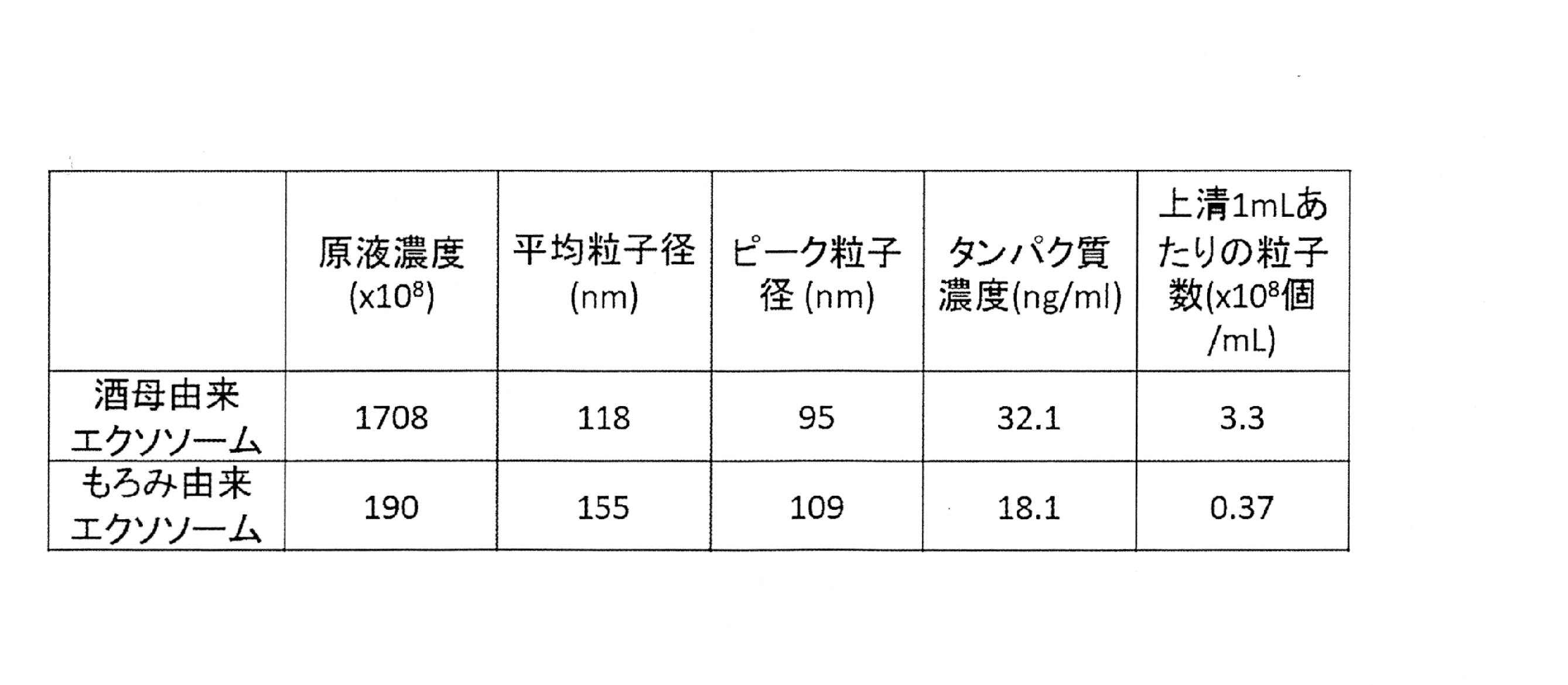
- Table 1 shows the number of particles and protein concentration of the exosomes collected from the sake mother and mash at the festival using the nanoparticle analysis system.
- Figure 2 shows the particle size distribution chart of the particles obtained by the nanoparticle analysis system.
- the amounts of exosomes contained in liquor and moromi were 3.8 ⁇ 10 8 /ml for liquor and 0.37 ⁇ 10 8 /ml for moromi.
- the protein concentration of exosomes contained in liquor and mash was 32.1 ng/ml for liquor and 18.1 ng/ml for moromi.
- the number of particles of non-aged miso is 1.2 ⁇ 10 10 particles/ml
- 1 year aged miso is 4.7 ⁇ 10 11 particles/ml
- 3 years aged miso is 7.8 ⁇ 10 12 particles/ml.
- the quick-ripened miso was 2.5 ⁇ 10 10 pieces/ml.
- Example 3 Proliferation test and cell death test in HCT116 cells
- HCT116 cells human colon adenocarcinoma-derived cancer cells
- HCT116 cells human colon adenocarcinoma-derived cancer cells
- Cell death due to apoptosis was evaluated by measuring caspase activity.
- the medium was removed from the cells of (3) for which the cell proliferation test was completed, and M-PER Mammalian was used. 100 ⁇ l of Protein Extraction Reagent (Thermofischer Scientific) was added to lyse the cells to obtain a cell lysate. 50 ⁇ l of cell lysate and 50 ⁇ l of Caspase-Glo (registered trademark) 3/7 Reagent (Caspase-Glo (registered trademark) 3/7 Assay Systems, Promega) were mixed, and the caspase activity was measured by luminescence. ..
- Example 4 Proliferation test and cell death test in various cancer cell types
- the same as in Example 3 except that the exosome concentration was 2 ⁇ g/mL.
- Growth inhibition test and apoptosis induction test for more cancer cell types went.
- the growth inhibitory effect was reproduced in the colon cancer cell line as in Example 2.
- an effect similar to that of colon cancer was also observed in the prostate cancer cell line and the breast cancer cell line, and in the lung cancer, the growth inhibitory effect was recognized although it was relatively weak.
- Fig. 5 shows the result of apoptosis measurement.
- the relative amount compared with PBS no significant apoptosis induction was found in all cell lines. Therefore, it was reconfirmed that the cell growth inhibitory effect seen in FIG. 4 was not due to cell death induction but to cell proliferation inhibition.
- Example 5 Migration test in cancer cells HCT116 cells were seeded on a 24-well plate, and on the next day, the plate was scratched to form a partial space. Cells were photographed on Day 0, Day 1 and Day 2 with Day 0 as the day of injury, and the extent to which the injured area narrowed due to cell migration was evaluated.
- NK-92 MI cells which are NK cells that can be cultured for a long period of time, were seeded in 25-well plates at 25, 000 cells each, and the exosomes prepared in Example 1 were 10 or 30 ⁇ /L (in the case of miso exosome, about 100 particles per cell, that is, 2 ⁇ 10 7 particles per well) was added. Two days after that, the cells were collected, the protein was extracted, and the protein expression level was measured by the Western blotting method.
- Example 7 Measurement of Cytokine Secretion in Immune Cells The secretion amount of three types of cytokines, interferon gamma, interleukin 17, and TNF alpha, which are major NK cell cytokine secretions, was evaluated.
- NK-92MI cells were seeded on a 24-well plate at 25,0000 cells each, and exosomes were added at 3, 10 or 30 ⁇ /L. Two days after that, the culture supernatant was collected and centrifuged at 300 g for 3 minutes to collect the supernatant.
- Interferon gamma, interleukin 17, and TNF alpha in the supernatant were measured using an ELISA kit (R&D systems).
- Beta-galactosidase staining in senescent cells was performed as a method for evaluating senescent cells.
- SPiDER- ⁇ Gal Dojindo
- fibroblasts (P8) to which exosomes were added so as to be 3, 10 or 30 ⁇ /L were seeded in a 60 mm dish at 2 ⁇ 10 5 cells/dish, and subcultured twice. , Aging cells. Exosomes were added so that the concentration was 3, 10, or 30 ⁇ /L each time the cells were passaged.
- the aged fibroblast (P10) was seed
- Fig. 10 The results are shown in Fig. 10. The cells were stained green in any of the control and exosome-added cells, indicating that the exosomes derived from moromi and mash were unable to stop cell senescence.
- Example 9 Measurement of expression levels of collagenase and elastin in senescent cells (1) Changes in the expression levels of collagen and elastin, which have decreased activity in senescent fibroblasts, were evaluated by addition of exosomes. Aged fibroblasts (P10) were seeded on a 24-well plate at 100,000 cells, and the next day 3, 10 or 30 ⁇ /L (in the case of miso exosome, about 100 particles per cell, that is, 2 ⁇ 10 7 particles per well). ), and 2 days after that, Qiagen miRNeasy mini was added. RNA extraction was performed using kit.
- RT-PCR was performed using a High-Capacity cDNA Reverse Transcription Kit (Applied Biosystems).
- Taqman Universal Master Mix II from Applied Biosystems was used for quantitative PCR.
- Taqman method of Applied Biosystems was used for evaluation. Primers/probes of type I collagen alpha 1 chain, type I collagen alpha 2 chain, type III collagen, and elastin were used.
- the exosome fraction was isolated from sake mash, mash and miso, and the function in immune cells and senescent cells was evaluated.
- immune cells we focused on NK cells, which have a killing effect on cancer cells.
- the amount of granzyme which is known to have a cell-killing effect, increased in the cells by the addition of exosome. This result suggests that NK cells kill more cancer cells more effectively when attacking cancer cells.
- no significant changes were observed in the secretion of cytokines that attract other immune cells.
- the secretion amount of interferon gamma in the exosome of liquor is decreased, it can be considered that it is a stage in which NK cells enhance the cell-killing activity because it is inversely correlated with the expression amount of granzyme.
- exosomes derived from yeast enhance the cell-killing effect of NK cells by increasing the expression level of granzyme.
- senescent cells it is considered that by increasing the expression levels of collagen and elastin, it is possible to contribute to the prevention of the decrease in elasticity and improvement of elasticity in the skin.
Landscapes
- Health & Medical Sciences (AREA)
- Life Sciences & Earth Sciences (AREA)
- General Health & Medical Sciences (AREA)
- Animal Behavior & Ethology (AREA)
- Public Health (AREA)
- Veterinary Medicine (AREA)
- Chemical & Material Sciences (AREA)
- Mycology (AREA)
- Medicinal Chemistry (AREA)
- Pharmacology & Pharmacy (AREA)
- Engineering & Computer Science (AREA)
- Epidemiology (AREA)
- Microbiology (AREA)
- Biotechnology (AREA)
- Natural Medicines & Medicinal Plants (AREA)
- Botany (AREA)
- Organic Chemistry (AREA)
- Chemical Kinetics & Catalysis (AREA)
- General Chemical & Material Sciences (AREA)
- Nuclear Medicine, Radiotherapy & Molecular Imaging (AREA)
- Immunology (AREA)
- Birds (AREA)
- Medical Informatics (AREA)
- Alternative & Traditional Medicine (AREA)
- Bioinformatics & Cheminformatics (AREA)
- Dermatology (AREA)
- Gerontology & Geriatric Medicine (AREA)
- Dispersion Chemistry (AREA)
- Genetics & Genomics (AREA)
- Wood Science & Technology (AREA)
- Zoology (AREA)
- Tropical Medicine & Parasitology (AREA)
- Virology (AREA)
- Biomedical Technology (AREA)
- Toxicology (AREA)
- Biochemistry (AREA)
- General Engineering & Computer Science (AREA)
- Medicines Containing Material From Animals Or Micro-Organisms (AREA)
- Micro-Organisms Or Cultivation Processes Thereof (AREA)
- Cosmetics (AREA)
Abstract
Description
(1) 酵母から抽出されたエクソソーム。
(2) 酵母が日本酒の酒母又はもろみに含まれる酵母である、(1)に記載のエクソソーム。
(3) 日本酒の酒母又はもろみから抽出されたエクソソーム。
(4) 日本酒の酒母又はもろみを10,000~20,000×gで遠心することにより得られる上清を10,000~210,000×gで超遠心することにより沈殿物として得られる,(2)又は(3)に記載のエクソソーム。
(5) 酵母が味噌に含まれる酵母である、(1)に記載のエクソソーム。
(6) 味噌から抽出されたエクソソーム。
(7) 味噌が1年以上熟成された味噌である、(5)又は(6)に記載のエクソソーム。
(8) 味噌が3年以上熟成された味噌である、(7)に記載のエクソソーム。
(9) (1)~(8)のいずれか1項に記載のエクソソームを含有する組成物。
(10) (1)~(8)のいずれか1項に記載のエクソソームを4×10⁸個/ml以上又はタンパク質量として33ng/ml以上含有する(9)に記載の組成物。
(11) (1)~(8)のいずれか1項に記載のエクソソームを4.7×10¹¹個/ml以上含有する(9)に記載の組成物。
(12) (1)~(8)のいずれか1項に記載のエクソソームを7.8×10¹²個/ml以上含有する(9)に記載の組成物。
(13) 前記エクソソームを有効成分として含有する、(9)~(12)のいずれか1項に記載の組成物である,がん細胞増殖抑制用組成物。
(14) がん細胞が,大腸がん,前立腺がん,又は乳がんである,(13)に記載の組成物。
(15) 前記エクソソームを有効成分として含有する、(9)~(12)のいずれか1項に記載の組成物である,NK細胞によるグランザイム発現促進剤。
(16) 前記エクソソームを有効成分として含有する,(9)~(12)のいずれか1項に記載の組成物である,がんの治療用又は予防用医薬組成物。
(17) 前記エクソソームを有効成分として含有する,(9)~(12)のいずれか1項に記載の組成物である,コラーゲン及び/又はエラスチン産生促進剤。
(18) 前記エクソソームを有効成分として含有する,(9)~(12)のいずれか1項に記載の組成物である,組織の弾力性喪失予防剤又は組織の弾力性向上剤。
(19) 組織が皮膚である,(18)に記載の組織の弾力性喪失予防剤又は組織の弾力性向上剤。
(20) 化粧用である,(19)に記載の組織の弾力性喪失予防剤又は組織の弾力性向上剤。
(21) (1)~(4)に記載のエクソソームの製造方法であって,
(a)日本酒の酒母又はもろみを10,000~20,000×gで遠心すること,
(b)前記(a)により得られた上清を10,000~210,000×gで超遠心すること,及び
(c)沈殿物をエクソソーム画分として回収することを含む方法。
(23) (5)~(8)に記載のエクソソームの製造方法であって,
(a)味噌を10,000~20,000×gで遠心すること,
(b)前記(a)により得られた上清を10,000~210,000×gで超遠心すること,及び
(c)沈殿物をエクソソーム画分として回収することを含む方法。
酒母は,日本酒の醸造のために,蒸米・麹・水の混合物に酵母加えた培養したものである。酒母の酵母の発酵が進み,蒸米・麹・水を何回かにわけて,加えたものがもろみである。酒母ももろみも,日本酒製造の業界では通常利用されており,その製造方法も広く知られている。特に,獺祭に使用されている酒母ともろみは旭酒造株式会社(山口県岩国市周東町獺越2167-4)より入手可能である。酒母及びもろみからのエクソソームの抽出は,例えば,(a)日本酒の酒母又はもろみを遠心すること;(b)前記(a)により得られた上清を超遠心で遠心すること;及び(c)前記(b)で得られた沈殿物をエクソソーム画分として回収することにより行うことができる。
別の態様において,本発明は前記エクソソームを含有する組成物に関する。本発明の組成物におけるエクソソームの含有量は,当該組成物の使用目的が達成できる濃度であれば特に限定されるものではないが,例えば,1質量%以上,2質量%以上,3質量%以上,4質量%以上,5質量%以上,10質量%以上,20質量%以上,30質量%以上,40質量%以上,又は50質量%以上とすることができる。また、本発明の組成物が含有するエクソソームの量は、4×10⁸個/ml以上,5×108個/ml以上,1×109個/ml以上,1×1010個/ml以上,1×1011個/ml以上、又は1×1012個/ml以上とすることができる。あるいは、本発明の組成物が含有するエクソソームの量は、エクソソームが含有するタンパク質量として33ng/ml以上、50ng/ml以上、100ng/ml以上、500ng/ml以上、1μg/ml以上、5μg/ml以上、10μg/ml以上、500μg/ml以上、1mg/ml以上、5mg/ml以上、10mg/ml以上、50mg/ml以上、100mg/ml以上、500mg/ml以上、1g/ml以上、5g/ml以とすることができる。
(1)獺祭の酒母ともろみ(旭酒造株式会社)を15,000×g,4℃で15分間遠心後,その上澄み液を0.65μmフィルターでろ過した(図1)。ろ過後の上澄み液をベックマンコールター社の超遠心機及びSW41Tiローターを用いて,35,000rpm(100,000×g-210,000×g),4℃で70分間超遠心した。遠心後,上澄みを破棄し,洗浄のため,沈殿物をPBSに懸濁後,再度同じ条件で超遠心を行った。サンプル洗浄後,チューブ底面に残ったエクソソーム画分を低吸着チューブに回収した。超遠心後の上澄み液の量は酒母が88mL,もろみは176mLであった。酒母及びもろみの沈殿物は,最終的に,それぞれ170μL及び340μLのPBSに懸濁した。
(1)獺祭の酒母ともろみから回収したエクソソームを,酒母由来エクソソームはPBSで100倍希釈し,もろみ由来エクソソームはPBSで40倍に希釈した。それぞれの希釈溶液をナノ粒子解析システムNanoSight(解析条件:Camera Level 14,Detection Threshold 7)にて粒子数の測定を行った。タンパク質濃度については,エクソソーム溶液20μL使用してQubit Protein Assay Kit(Invitrogen)を用いてタンパク定量を行った。
HCT116細胞(ヒト結腸腺癌由来癌細胞)を96wellプレートの各wellに2,000細胞ずつ播種して,翌日,実施例1で調製したエクソソームを0.5,1,及び2μg/mLの濃度で添加した。その3日後に細胞増殖試験を行い,細胞増殖の評価を行った。
Protein Extraction Reagent(Thermofischer Scientific社)を100μl加えて細胞を溶解して細胞溶解液を得た。50μlの細胞溶解液と50μlのCaspase-Glo(登録商標)3/7 Reagent(Caspase-Glo(登録商標)3/7 Assay Systems,Promega社)の溶液を混合して,発光によりcaspase活性を測定した。
結腸癌以外の癌細胞においても同様の効果があるか確かめるため,エクソソーム濃度を2μg/mLとした以外は実施例3と同様の方法でより多くのがん細胞種(大腸がん細胞株HCT116,肺がん細胞株A549,乳がん細胞株MDA-MB-231,及び前立腺がん細胞株PC-3M)について増殖抑制試験及びアポトーシス誘導能試験を行った。
HCT116細胞を24wellプレートに播種し,翌日,プレート内に傷を付け,一部空間を作った。傷をつけた日をDay0として,Day0,Day1,Day2に細胞を撮影し,傷を付けた部分が細胞の遊走により,どれだけ狭まったのかを評価した。

(1)長期間培養可能なNK細胞であるNK-92MI細胞を24wellプレートに25,0000細胞ずつ播種し,実施例1で調製したエクソソームを3,10,又は30μ/L(味噌エクソソームの場合、細胞あたりおよそ100個、すなわち1ウエルあたり2x107個の粒子)となるように添加した。その2日後に細胞を回収し,タンパク質抽出を行い,ウェスタンブロッティング法によりタンパク質の発現量を測定した。
図8に示すとおり,酒母エクソソームを添加することにより,NK細胞内のグランザイムの発現量の増加が見られた。図8の上図はタンパク質の発現量を評価するウェスタンブロッティングの写真で,下図はその発現量を定量化したものである。以上のことから,酒母エクソソームはNK細胞内のグランザイムの発現を上げることで殺細胞効果に貢献すると考えられる。もろみエクソソームに関しては,グランザイムの発現量に大きな変化は見られなかった。
図12に示すとおり,1年及び3年熟成味噌のエクソソームを添加することにより,NK細胞内のグランザイムの発現量の増加が見られた。よって,1年以上熟成した味噌のエクソソームはNK細胞内のグランザイムの発現を上げることで殺細胞効果に貢献すると考えられる。
NK細胞のサイトカイン分泌として主要なインターフェロンガンマ,インターロイキン17,TNFアルファの3種類のサイトカインの分泌量を評価した。NK-92MI細胞を24wellプレートに25,0000細胞ずつ播種し,3,10,又は30μ/Lとなるようにエクソソームを添加した。その2日後に培養上清を回収し,300gで3分間遠心して上清を回収した。上清中のインターフェロンガンマ,インターロイキン17,TNFアルファの測定はELISAキット(R&D systems)を用いて行った。
老化細胞の評価方法としてベータガラクトシダーゼ染色を行った。ベータガラクトシダーゼ染色は高感度であることが知られているSPiDER-βGal(Dojindo社)を用いた。具体的には,3,10,又は30μ/Lとなるようにエクソソームを加えた線維芽細胞(P8)を60mmディッシュに2×105細胞/ディッシュとなるように播種し,二回継代し,細胞を老化させた。細胞を継代するごとに3,10,又は30μ/Lとなるようにエクソソームを加えた。その後,老化させた線維芽細胞(P10)を35mmガラスベースディッシュに播種した。翌日,培地を吸引除去し,HBSS 2mlで1回洗浄した。培養開始から72時間後に4%パラホルムアルデヒド/PBS溶液2mlを添加し,室温で3分間固定化した。4%パラホルムアルデヒド/PBS溶液2mlを吸引除去し,HBSS 2mlで2回洗浄を行った。SPiDER-βGal working solution 2ml(Dojindo)を加え,37℃で30分間静置した。その後,HBSS 2mlで2回洗浄を行い,共焦点レーザー顕微鏡で観察した。
(1)老化線維芽細胞で活性が減少しているコラーゲンとエラスチンの発現量のエクソソーム添加による変化を評価した。老化させた線維芽細胞(P10)を24wellプレートに100,000細胞播種し,翌日3,10,又は30μ/L(味噌エクソソームの場合、細胞あたりおよそ100個、すなわち1ウエルあたり2x107個の粒子)となるようにエクソソームを添加し,その2日後にQiagen miRNeasy mini
kitを用いてRNA抽出を行った。抽出されたRNAをサンプルとして,High-Capacity cDNA Reverse Transcription Kit(Applied Biosystems社)を用いてRT-PCRを行った。定量的PCRのためにTaqman Universal Master Mix II(Applied Biosystems社の)を使用した。コラゲナーゼとエラスチンの検出用のプライマー/プローブとして,Applied Biosystems社のTaqman法を用いて評価した。I型コラーゲンアルファ1鎖,I型コラーゲンアルファ2鎖,III型コラーゲン,エラスチンのプライマー/プローブを使用した。
皮下のコラーゲンとして重要なI型コラーゲンとIII型コラーゲン,そしてエラスチンの発現量の評価を行った。その結果を図11に示す。酒母エクソソームを加えることでI型コラーゲンとIII型コラーゲンそしてエラスチンの発現量が全て上昇することがわかった。一方,もろみエクソソームを添加した場合,これらの物質の発現量に変化は見られなかった。
I型コラーゲンとエラスチンの発現量の評価を行った。その結果を図13に示す。味噌エクソソームを加えることでI型コラーゲンとエラスチンの発現量が全て上昇することがわかった。特に、3年熟成エクソソームを添加した場合,これらの物質の発現量が顕著に高くなった。

Claims (22)
- 酵母から抽出されたエクソソーム。
- 酵母が日本酒の酒母又はもろみに含まれる酵母である、請求項1に記載のエクソソーム。
- 日本酒の酒母又はもろみから抽出されたエクソソーム。
- 日本酒の酒母又はもろみを10,000~20,000×gで遠心することにより得られる上清を10,000~210,000×gで超遠心することにより沈殿物として得られる,請求項2又は請求項3に記載のエクソソーム。
- 酵母が味噌に含まれる酵母である、請求項1に記載のエクソソーム。
- 味噌から抽出されたエクソソーム。
- 味噌が1年以上熟成された味噌である、請求項5又は請求項6に記載のエクソソーム。
- 味噌が3年以上熟成された味噌である、請求項7に記載のエクソソーム。
- 請求項1~請求項8のいずれか1項に記載のエクソソームを含有する組成物。
- 請求項1~請求項8のいずれか1項に記載のエクソソームを4×10⁸個/ml以上又はタンパク質量として33ng/ml以上含有する請求項9に記載の組成物。
- 請求項1~請求項8のいずれか1項に記載のエクソソームを4.7×10¹¹個/ml以上含有する請求項9に記載の組成物。
- 請求項1~請求項8のいずれか1項に記載のエクソソームを7.8×10¹²個/ml以上含有する請求項9に記載の組成物。
- 前記エクソソームを有効成分として含有する、請求項9~請求項12のいずれか1項に記載の組成物である,がん細胞増殖抑制用組成物。
- がん細胞が,大腸がん,前立腺がん,又は乳がんである,請求項13に記載の組成物。
- 前記エクソソームを有効成分として含有する、請求項9~請求項12のいずれか1項に記載の組成物である,NK細胞によるグランザイム発現促進剤。
- 前記エクソソームを有効成分として含有する,請求項9~請求項12のいずれか1項に記載の組成物である,がんの治療用又は予防用医薬組成物。
- 前記エクソソームを有効成分として含有する,請求項9~請求項12のいずれか1項に記載の組成物である,コラーゲン及び/又はエラスチン産生促進剤。
- 前記エクソソームを有効成分として含有する,請求項9~請求項12のいずれか1項に記載の組成物である,組織の弾力性喪失予防剤又は組織の弾力性向上剤。
- 組織が皮膚である,請求項18に記載の組織の弾力性喪失予防剤又は組織の弾力性向上剤。
- 化粧用である,請求項19に記載の組織の弾力性喪失予防剤又は組織の弾力性向上剤。
- 請求項1~請求項4に記載のエクソソームの製造方法であって,
(a)日本酒の酒母又はもろみを10,000~20,000×gで遠心すること,
(b)前記(a)により得られた上清を10,000~210,000×gで超遠心すること,及び
(c)沈殿物をエクソソーム画分として回収することを含む方法。 - 請求項5~請求項8に記載のエクソソームの製造方法であって,
(a)味噌を10,000~20,000×gで遠心すること,
(b)前記(a)により得られた上清を10,000~210,000×gで超遠心すること,及び
(c)沈殿物をエクソソーム画分として回収することを含む方法。
Priority Applications (8)
| Application Number | Priority Date | Filing Date | Title |
|---|---|---|---|
| CN202080011901.4A CN113382773A (zh) | 2019-02-01 | 2020-01-31 | 控制生物功能的新成分 |
| EP20749091.3A EP3922313A4 (en) | 2019-02-01 | 2020-01-31 | NEW COMPONENT WITH THE ABILITY TO REGULATE THE BIOLOGICAL FUNCTION |
| US17/426,788 US20220133826A1 (en) | 2019-02-01 | 2020-01-31 | Novel component for controlling biological function |
| JP2020568632A JP7228201B2 (ja) | 2019-02-01 | 2020-01-31 | 生体機能を制御する新規成分 |
| CN202310719509.0A CN116747250A (zh) | 2019-02-01 | 2020-01-31 | 控制生物功能的新成分 |
| KR1020217024276A KR102823772B1 (ko) | 2019-02-01 | 2020-01-31 | 생체 기능을 제어하는 신규 성분 |
| US19/395,622 US20260077007A1 (en) | 2019-02-01 | 2025-11-20 | Novel component for controlling biological function |
| US19/395,624 US20260069646A1 (en) | 2019-02-01 | 2025-11-20 | Component for controlling biological function |
Applications Claiming Priority (2)
| Application Number | Priority Date | Filing Date | Title |
|---|---|---|---|
| JP2019017296 | 2019-02-01 | ||
| JP2019-017296 | 2019-02-01 |
Related Child Applications (3)
| Application Number | Title | Priority Date | Filing Date |
|---|---|---|---|
| US17/426,788 A-371-Of-International US20220133826A1 (en) | 2019-02-01 | 2020-01-31 | Novel component for controlling biological function |
| US19/395,622 Division US20260077007A1 (en) | 2019-02-01 | 2025-11-20 | Novel component for controlling biological function |
| US19/395,624 Division US20260069646A1 (en) | 2019-02-01 | 2025-11-20 | Component for controlling biological function |
Publications (1)
| Publication Number | Publication Date |
|---|---|
| WO2020158930A1 true WO2020158930A1 (ja) | 2020-08-06 |
Family
ID=71841123
Family Applications (1)
| Application Number | Title | Priority Date | Filing Date |
|---|---|---|---|
| PCT/JP2020/003734 Ceased WO2020158930A1 (ja) | 2019-02-01 | 2020-01-31 | 生体機能を制御する新規成分 |
Country Status (6)
| Country | Link |
|---|---|
| US (3) | US20220133826A1 (ja) |
| EP (1) | EP3922313A4 (ja) |
| JP (1) | JP7228201B2 (ja) |
| KR (1) | KR102823772B1 (ja) |
| CN (2) | CN113382773A (ja) |
| WO (1) | WO2020158930A1 (ja) |
Cited By (5)
| Publication number | Priority date | Publication date | Assignee | Title |
|---|---|---|---|---|
| CN113462645A (zh) * | 2021-03-26 | 2021-10-01 | 上海圣特佳健康科技发展有限公司 | 包含nk细胞和植物来源的外泌体的组合物、其用途及包含其的产品 |
| WO2022224644A1 (ja) | 2021-04-19 | 2022-10-27 | ボルド エルドン | 馬乳酒由来エクソソーム及びその使用 |
| WO2023038118A1 (ja) * | 2021-09-09 | 2023-03-16 | ダ・ヴィンチユニバーサル株式会社 | 麹由来細胞外小胞を含む皮膚用組成物 |
| WO2023063380A1 (ja) * | 2021-10-13 | 2023-04-20 | ダ・ヴィンチユニバーサル株式会社 | 麹由来細胞外小胞又は発酵酒酵母由来細胞外小胞を含むコロナウイルス感染症用組成物 |
| JP2024508051A (ja) * | 2021-02-22 | 2024-02-21 | エクソコバイオ インコーポレイテッド | 黒酵母由来のエキソソームを含む化粧料組成物 |
Families Citing this family (2)
| Publication number | Priority date | Publication date | Assignee | Title |
|---|---|---|---|---|
| CN116042422B (zh) * | 2023-02-07 | 2024-03-26 | 广东丸美生物技术股份有限公司 | 一种酵母来源外泌体及其制备方法和应用 |
| CN117757716B (zh) * | 2023-12-21 | 2025-04-18 | 山东第一医科大学附属眼科研究所(山东省眼科研究所、山东第一医科大学附属青岛眼科医院) | 一种来源于啤酒发酵液的外泌体及其制备方法和应用 |
Citations (5)
| Publication number | Priority date | Publication date | Assignee | Title |
|---|---|---|---|---|
| JP2009029788A (ja) * | 2007-06-22 | 2009-02-12 | Wamiles Cosmetics Kk | 海水由来酵母培養物含有皮膚外用用組成物 |
| KR20110082481A (ko) * | 2010-01-11 | 2011-07-19 | 포항공과대학교 산학협력단 | 발효식품에서 유래된 세포밖 소포체를 포함하는 조성물 및 이의 용도 |
| JP2015119697A (ja) * | 2013-11-21 | 2015-07-02 | マルサ商事株式会社 | 味噌およびその抽出物 |
| CN106722209A (zh) * | 2017-01-29 | 2017-05-31 | 黑龙江中医药大学 | 一种功能型藜麦味噌的酿造工艺 |
| KR20180003344A (ko) * | 2016-06-30 | 2018-01-09 | (주)아모레퍼시픽 | 효모 유래 세포밖 소포체를 포함하는 항염 조성물 |
Family Cites Families (5)
| Publication number | Priority date | Publication date | Assignee | Title |
|---|---|---|---|---|
| JP2004244413A (ja) * | 2002-11-01 | 2004-09-02 | Yamauchi Honten:Kk | 抗腫瘍剤、健康食品及び味噌のエタノール抽出物 |
| WO2012093755A1 (ko) * | 2011-01-04 | 2012-07-12 | 포항공과대학교 산학협력단 | 발효식품에서 유래된 세포밖 소포체를 포함하는 조성물 및 이의 용도 |
| WO2019088656A1 (ko) * | 2017-11-02 | 2019-05-09 | 주식회사 엑소코바이오 | 안정화된 엑소좀의 필러 조성물 |
| KR102015116B1 (ko) * | 2018-05-04 | 2019-10-21 | (주)메디톡스 | 표적 단백질을 코딩하는 폴리뉴클레오티드를 포함하는 재조합 미생물로부터 유래한 세포외 소낭 및 그의 용도 |
| EP3827810A4 (en) | 2018-09-06 | 2022-05-25 | Exocobio Inc. | COSMETIC COMPOSITION WITH EXOSOME DERIVED FROM GALACTOMYCES AS ACTIVE INGREDIENT |
-
2020
- 2020-01-31 KR KR1020217024276A patent/KR102823772B1/ko active Active
- 2020-01-31 CN CN202080011901.4A patent/CN113382773A/zh active Pending
- 2020-01-31 WO PCT/JP2020/003734 patent/WO2020158930A1/ja not_active Ceased
- 2020-01-31 CN CN202310719509.0A patent/CN116747250A/zh active Pending
- 2020-01-31 JP JP2020568632A patent/JP7228201B2/ja active Active
- 2020-01-31 EP EP20749091.3A patent/EP3922313A4/en active Pending
- 2020-01-31 US US17/426,788 patent/US20220133826A1/en active Pending
-
2025
- 2025-11-20 US US19/395,624 patent/US20260069646A1/en active Pending
- 2025-11-20 US US19/395,622 patent/US20260077007A1/en active Pending
Patent Citations (5)
| Publication number | Priority date | Publication date | Assignee | Title |
|---|---|---|---|---|
| JP2009029788A (ja) * | 2007-06-22 | 2009-02-12 | Wamiles Cosmetics Kk | 海水由来酵母培養物含有皮膚外用用組成物 |
| KR20110082481A (ko) * | 2010-01-11 | 2011-07-19 | 포항공과대학교 산학협력단 | 발효식품에서 유래된 세포밖 소포체를 포함하는 조성물 및 이의 용도 |
| JP2015119697A (ja) * | 2013-11-21 | 2015-07-02 | マルサ商事株式会社 | 味噌およびその抽出物 |
| KR20180003344A (ko) * | 2016-06-30 | 2018-01-09 | (주)아모레퍼시픽 | 효모 유래 세포밖 소포체를 포함하는 항염 조성물 |
| CN106722209A (zh) * | 2017-01-29 | 2017-05-31 | 黑龙江中医药大学 | 一种功能型藜麦味噌的酿造工艺 |
Non-Patent Citations (3)
| Title |
|---|
| MINETOKI TOSHITAKA: "A characteristic and inflection of the enzyme processing sake lees seasoning", A TECHNICAL JOURNAL ON FOOD CHEMISTRY & CHEMICALS, vol. 2013, no. 1, 1 January 2013 (2013-01-01), JP, pages 39 - 46, XP009530079, ISSN: 0911-2286 * |
| WATANABE MITSUHIRO: "The splendor of Japaneses food", JOURNAL OF JAPANESE SOY SAUCE RESEARCH INSTITUTE, vol. 42, no. 2, 2016, pages 123 - 133, XP009530075 * |
| YAMASAKI-YASHIKI SHINO, MIYOSHI YUKI, NAKAYAMA TOMOYA, KUNISAWA JUN, KATAKURA YOSHIO: "IgA-enhancing effects of membrane vesicles derived from Lactobacillus sakei subsp. sakei NBRC15893", BIOSCIENCE OF MICROBIOTA, FOOD AND HEALTH, vol. 38, no. 1, 1 November 2018 (2018-11-01), pages 23 - 29, XP055726840 * |
Cited By (12)
| Publication number | Priority date | Publication date | Assignee | Title |
|---|---|---|---|---|
| JP2024508051A (ja) * | 2021-02-22 | 2024-02-21 | エクソコバイオ インコーポレイテッド | 黒酵母由来のエキソソームを含む化粧料組成物 |
| EP4295835A4 (en) * | 2021-02-22 | 2025-01-22 | Exocobio Inc. | Cosmetic composition comprising black yeast-derived exosomes |
| JP7736388B2 (ja) | 2021-02-22 | 2025-09-09 | エクソコバイオ インコーポレイテッド | 黒酵母由来のエキソソームを含む化粧料組成物 |
| US12491151B2 (en) | 2021-02-22 | 2025-12-09 | Exocobio Inc. | Cosmetic composition comprising black yeast-derived exosomes |
| CN113462645A (zh) * | 2021-03-26 | 2021-10-01 | 上海圣特佳健康科技发展有限公司 | 包含nk细胞和植物来源的外泌体的组合物、其用途及包含其的产品 |
| CN113462645B (zh) * | 2021-03-26 | 2023-11-28 | 上海瑞开投资管理有限公司 | 包含nk细胞和植物来源的外泌体的组合物、其用途及包含其的产品 |
| WO2022224644A1 (ja) | 2021-04-19 | 2022-10-27 | ボルド エルドン | 馬乳酒由来エクソソーム及びその使用 |
| WO2023038118A1 (ja) * | 2021-09-09 | 2023-03-16 | ダ・ヴィンチユニバーサル株式会社 | 麹由来細胞外小胞を含む皮膚用組成物 |
| JPWO2023038118A1 (ja) * | 2021-09-09 | 2023-03-16 | ||
| EP4400112A4 (en) * | 2021-09-09 | 2025-10-22 | Da Vinci Universale Co Ltd | SKIN COMPOSITION COMPRISING EXTRACELLULAR VESICLES FROM MALTED RICE |
| WO2023063380A1 (ja) * | 2021-10-13 | 2023-04-20 | ダ・ヴィンチユニバーサル株式会社 | 麹由来細胞外小胞又は発酵酒酵母由来細胞外小胞を含むコロナウイルス感染症用組成物 |
| US20240398880A1 (en) * | 2021-10-13 | 2024-12-05 | Da Vinci Universale Co., Ltd. | Composition for coronavirus infection including koji-derived extracellular vesicle or fermented alcohol yeast-derived extracellular vesicle |
Also Published As
| Publication number | Publication date |
|---|---|
| KR20210110355A (ko) | 2021-09-07 |
| EP3922313A4 (en) | 2022-12-21 |
| JP7228201B2 (ja) | 2023-02-24 |
| US20220133826A1 (en) | 2022-05-05 |
| US20260069646A1 (en) | 2026-03-12 |
| KR102823772B1 (ko) | 2025-06-20 |
| JPWO2020158930A1 (ja) | 2021-11-25 |
| CN113382773A (zh) | 2021-09-10 |
| US20260077007A1 (en) | 2026-03-19 |
| CN116747250A (zh) | 2023-09-15 |
| EP3922313A1 (en) | 2021-12-15 |
Similar Documents
| Publication | Publication Date | Title |
|---|---|---|
| JP7228201B2 (ja) | 生体機能を制御する新規成分 | |
| EP3231436B1 (en) | Pharmaceutical composition for prevention or treatment of metabolic disease, comprising bacteroides acidifaciens as effective ingredient | |
| CN105878289B (zh) | 一种美洲大蠊制剂及其在制备治疗胃癌药物中的应用 | |
| CN116782948A (zh) | 包含长双歧杆菌rapo(kctc13773bp)的用于预防或治疗癌症的组合物 | |
| CN114480249A (zh) | 马氏珠母贝黏液用于提取外泌体的用途、外泌体及其提取方法和应用 | |
| Wu et al. | Phytic acid promotes high glucose-mediated bone marrow mesenchymal stem cells osteogenesis via modulating circEIF4B that sponges miR-186-5p and complexes with IGF2BP3 | |
| JP2014034562A (ja) | アディポネクチン産生促進剤 | |
| JP7715365B2 (ja) | 杜仲葉由来のエクソソームを含むウイルス感染症改善剤 | |
| TWI607004B (zh) | 羥甲糠醛衍生物的製造方法、蘆筍莖熱水加熱處理物的用途以及蘆筍莖加熱處理物的用途 | |
| CN107148277B (zh) | 一种抑制脂肪细胞分化和胰岛素耐受的药物 | |
| HK40055041A (en) | Novel component capable of regulating biological function | |
| TW201200148A (en) | Adiponectin production-promoting composition | |
| HK40100963A (zh) | 控制生物功能的新成分 | |
| CN118006547A (zh) | 一种间充质干细胞外泌体的制备方法、制得的外泌体及其应用 | |
| KR20150047876A (ko) | 길경 유래의 다당류를 유효성분으로 포함하는 수지상세포 성숙화 유도용 조성물 | |
| JP7212329B2 (ja) | 免疫賦活剤及び免疫賦活用食品組成物 | |
| JP7565055B2 (ja) | ディフェンシン及びインターロイキンの産生誘導剤組成物、医薬品、医薬部外品、化粧料、食品、飲料 | |
| US20220378863A1 (en) | Method and composition for rejuvenation of muscle cells | |
| CN118542864B (zh) | 一种缓解动脉粥样硬化的肌肽组合物及其应用 | |
| KR102556835B1 (ko) | 어수리 추출물을 유효성분으로 포함하는 면역증진 및 항비만용 조성물 | |
| JP7766034B2 (ja) | 筋肉の分解抑制剤 | |
| CN119709589B (zh) | 一种西梅外泌体及制备方法和在制备润肠通便产品中的应用 | |
| JP5925728B2 (ja) | 血管内皮細胞のTGF−β分泌誘導物及びその製造方法、並びに抗老化剤 | |
| JP6734603B1 (ja) | 経口組成物 | |
| KR20260056545A (ko) | 해조류 유래 나노베지클 및 이의 용도 |
Legal Events
| Date | Code | Title | Description |
|---|---|---|---|
| 121 | Ep: the epo has been informed by wipo that ep was designated in this application |
Ref document number: 20749091 Country of ref document: EP Kind code of ref document: A1 |
|
| DPE1 | Request for preliminary examination filed after expiration of 19th month from priority date (pct application filed from 20040101) | ||
| ENP | Entry into the national phase |
Ref document number: 20217024276 Country of ref document: KR Kind code of ref document: A Ref document number: 2020568632 Country of ref document: JP Kind code of ref document: A |
|
| NENP | Non-entry into the national phase |
Ref country code: DE |
|
| ENP | Entry into the national phase |
Ref document number: 2020749091 Country of ref document: EP Effective date: 20210901 |