WO2020162415A1 - 冷媒を含有する組成物、並びに、その組成物を用いた冷凍方法、冷凍装置の運転方法及び冷凍装置 - Google Patents
冷媒を含有する組成物、並びに、その組成物を用いた冷凍方法、冷凍装置の運転方法及び冷凍装置 Download PDFInfo
- Publication number
- WO2020162415A1 WO2020162415A1 PCT/JP2020/003990 JP2020003990W WO2020162415A1 WO 2020162415 A1 WO2020162415 A1 WO 2020162415A1 JP 2020003990 W JP2020003990 W JP 2020003990W WO 2020162415 A1 WO2020162415 A1 WO 2020162415A1
- Authority
- WO
- WIPO (PCT)
- Prior art keywords
- refrigerant
- hfo
- mass
- temperature
- refrigerating
- Prior art date
- Legal status (The legal status is an assumption and is not a legal conclusion. Google has not performed a legal analysis and makes no representation as to the accuracy of the status listed.)
- Ceased
Links
Images

Classifications
-
- C—CHEMISTRY; METALLURGY
- C09—DYES; PAINTS; POLISHES; NATURAL RESINS; ADHESIVES; COMPOSITIONS NOT OTHERWISE PROVIDED FOR; APPLICATIONS OF MATERIALS NOT OTHERWISE PROVIDED FOR
- C09K—MATERIALS FOR MISCELLANEOUS APPLICATIONS, NOT PROVIDED FOR ELSEWHERE
- C09K5/00—Heat-transfer, heat-exchange or heat-storage materials, e.g. refrigerants; Materials for the production of heat or cold by chemical reactions other than by combustion
- C09K5/02—Materials undergoing a change of physical state when used
- C09K5/04—Materials undergoing a change of physical state when used the change of state being from liquid to vapour or vice versa
- C09K5/041—Materials undergoing a change of physical state when used the change of state being from liquid to vapour or vice versa for compression-type refrigeration systems
- C09K5/044—Materials undergoing a change of physical state when used the change of state being from liquid to vapour or vice versa for compression-type refrigeration systems comprising halogenated compounds
- C09K5/045—Materials undergoing a change of physical state when used the change of state being from liquid to vapour or vice versa for compression-type refrigeration systems comprising halogenated compounds containing only fluorine as halogen
-
- C—CHEMISTRY; METALLURGY
- C10—PETROLEUM, GAS OR COKE INDUSTRIES; TECHNICAL GASES CONTAINING CARBON MONOXIDE; FUELS; LUBRICANTS; PEAT
- C10M—LUBRICATING COMPOSITIONS; USE OF CHEMICAL SUBSTANCES EITHER ALONE OR AS LUBRICATING INGREDIENTS IN A LUBRICATING COMPOSITION
- C10M171/00—Lubricating compositions characterised by purely physical criteria, e.g. containing as base-material, thickener or additive, ingredients which are characterised exclusively by their numerically specified physical properties, i.e. containing ingredients which are physically well-defined but for which the chemical nature is either unspecified or only very vaguely indicated
- C10M171/008—Lubricant compositions compatible with refrigerants
-
- C—CHEMISTRY; METALLURGY
- C09—DYES; PAINTS; POLISHES; NATURAL RESINS; ADHESIVES; COMPOSITIONS NOT OTHERWISE PROVIDED FOR; APPLICATIONS OF MATERIALS NOT OTHERWISE PROVIDED FOR
- C09K—MATERIALS FOR MISCELLANEOUS APPLICATIONS, NOT PROVIDED FOR ELSEWHERE
- C09K2205/00—Aspects relating to compounds used in compression type refrigeration systems
- C09K2205/10—Components
- C09K2205/12—Hydrocarbons
- C09K2205/126—Unsaturated fluorinated hydrocarbons
-
- C—CHEMISTRY; METALLURGY
- C09—DYES; PAINTS; POLISHES; NATURAL RESINS; ADHESIVES; COMPOSITIONS NOT OTHERWISE PROVIDED FOR; APPLICATIONS OF MATERIALS NOT OTHERWISE PROVIDED FOR
- C09K—MATERIALS FOR MISCELLANEOUS APPLICATIONS, NOT PROVIDED FOR ELSEWHERE
- C09K2205/00—Aspects relating to compounds used in compression type refrigeration systems
- C09K2205/22—All components of a mixture being fluoro compounds
-
- C—CHEMISTRY; METALLURGY
- C09—DYES; PAINTS; POLISHES; NATURAL RESINS; ADHESIVES; COMPOSITIONS NOT OTHERWISE PROVIDED FOR; APPLICATIONS OF MATERIALS NOT OTHERWISE PROVIDED FOR
- C09K—MATERIALS FOR MISCELLANEOUS APPLICATIONS, NOT PROVIDED FOR ELSEWHERE
- C09K2205/00—Aspects relating to compounds used in compression type refrigeration systems
- C09K2205/40—Replacement mixtures
-
- C—CHEMISTRY; METALLURGY
- C10—PETROLEUM, GAS OR COKE INDUSTRIES; TECHNICAL GASES CONTAINING CARBON MONOXIDE; FUELS; LUBRICANTS; PEAT
- C10M—LUBRICATING COMPOSITIONS; USE OF CHEMICAL SUBSTANCES EITHER ALONE OR AS LUBRICATING INGREDIENTS IN A LUBRICATING COMPOSITION
- C10M2207/00—Organic non-macromolecular hydrocarbon compounds containing hydrogen, carbon and oxygen as ingredients in lubricant compositions
- C10M2207/28—Esters
- C10M2207/283—Esters of polyhydroxy compounds
- C10M2207/2835—Esters of polyhydroxy compounds used as base material
-
- C—CHEMISTRY; METALLURGY
- C10—PETROLEUM, GAS OR COKE INDUSTRIES; TECHNICAL GASES CONTAINING CARBON MONOXIDE; FUELS; LUBRICANTS; PEAT
- C10M—LUBRICATING COMPOSITIONS; USE OF CHEMICAL SUBSTANCES EITHER ALONE OR AS LUBRICATING INGREDIENTS IN A LUBRICATING COMPOSITION
- C10M2209/00—Organic macromolecular compounds containing oxygen as ingredients in lubricant compositions
- C10M2209/02—Macromolecular compounds obtained by reactions only involving carbon-to-carbon unsaturated bonds
- C10M2209/04—Macromolecular compounds obtained by reactions only involving carbon-to-carbon unsaturated bonds containing monomers having an unsaturated radical bound to an alcohol or ester thereof; bound to an aldehyde, ketonic, ether, ketal or acetal radical
- C10M2209/043—Macromolecular compounds obtained by reactions only involving carbon-to-carbon unsaturated bonds containing monomers having an unsaturated radical bound to an alcohol or ester thereof; bound to an aldehyde, ketonic, ether, ketal or acetal radical used as base material
-
- C—CHEMISTRY; METALLURGY
- C10—PETROLEUM, GAS OR COKE INDUSTRIES; TECHNICAL GASES CONTAINING CARBON MONOXIDE; FUELS; LUBRICANTS; PEAT
- C10M—LUBRICATING COMPOSITIONS; USE OF CHEMICAL SUBSTANCES EITHER ALONE OR AS LUBRICATING INGREDIENTS IN A LUBRICATING COMPOSITION
- C10M2209/00—Organic macromolecular compounds containing oxygen as ingredients in lubricant compositions
- C10M2209/10—Macromolecular compoundss obtained otherwise than by reactions only involving carbon-to-carbon unsaturated bonds
- C10M2209/103—Polyethers, i.e. containing di- or higher polyoxyalkylene groups
- C10M2209/1033—Polyethers, i.e. containing di- or higher polyoxyalkylene groups used as base material
-
- C—CHEMISTRY; METALLURGY
- C10—PETROLEUM, GAS OR COKE INDUSTRIES; TECHNICAL GASES CONTAINING CARBON MONOXIDE; FUELS; LUBRICANTS; PEAT
- C10N—INDEXING SCHEME ASSOCIATED WITH SUBCLASS C10M RELATING TO LUBRICATING COMPOSITIONS
- C10N2020/00—Specified physical or chemical properties or characteristics, i.e. function, of component of lubricating compositions
- C10N2020/09—Characteristics associated with water
- C10N2020/097—Refrigerants
- C10N2020/101—Containing Hydrofluorocarbons
-
- C—CHEMISTRY; METALLURGY
- C10—PETROLEUM, GAS OR COKE INDUSTRIES; TECHNICAL GASES CONTAINING CARBON MONOXIDE; FUELS; LUBRICANTS; PEAT
- C10N—INDEXING SCHEME ASSOCIATED WITH SUBCLASS C10M RELATING TO LUBRICATING COMPOSITIONS
- C10N2030/00—Specified physical or chemical properties which is improved by the additive characterising the lubricating composition, e.g. multifunctional additives
- C10N2030/64—Environmental friendly compositions
-
- C—CHEMISTRY; METALLURGY
- C10—PETROLEUM, GAS OR COKE INDUSTRIES; TECHNICAL GASES CONTAINING CARBON MONOXIDE; FUELS; LUBRICANTS; PEAT
- C10N—INDEXING SCHEME ASSOCIATED WITH SUBCLASS C10M RELATING TO LUBRICATING COMPOSITIONS
- C10N2040/00—Specified use or application for which the lubricating composition is intended
- C10N2040/30—Refrigerators lubricants or compressors lubricants
Definitions
- the present disclosure relates to a composition containing a refrigerant, and a refrigerating method, a refrigerating apparatus operating method and a refrigerating apparatus using the composition.
- HFC-134a or R134a 1,1,1,2-tetrafluoroethane
- GWP global warming potential
- Patent Document 1 1,1,1,2-tetrafluoroethane
- This disclosure has a coefficient of performance [Coefficient of Performance (COP)] equal to or higher than that of R134a and refrigeration capacity [Refrigeration Capacity (sometimes referred to as Cooling Capacity, Capacity)], and sufficient GWP. It is an object to provide a composition containing a refrigerant having the property of being small. Another object of the present disclosure is to provide a refrigerating method, a refrigerating apparatus operating method, and a refrigerating apparatus using the composition.
- COP Coefficient of Performance
- Item 1 A composition containing a refrigerant, The refrigerant contains cis-1,2-difluoroethylene (HFO-1132(Z)) and 2,3,3,3-tetrafluoropropene (HFO-1234yf), For the total mass of HFO-1132(Z) and HFO-1234yf, The content ratio of HFO-1132(Z) is 53.0-59.5 mass%, A composition in which the content of HFO-1234yf is 47.0 to 40.5% by mass.
- Item 2. The composition according to Item 1, wherein the refrigerant is used for operating a refrigeration cycle having an evaporation temperature of -60 to 20°C.
- Item 3. Item 3.
- Item 4. A composition containing a refrigerant, The refrigerant contains cis-1,2-difluoroethylene (HFO-1132(Z)) and 2,3,3,3-tetrafluoropropene (HFO-1234yf), For the total mass of HFO-1132(Z) and HFO-1234yf, The content ratio of HFO-1132(Z) is 41.0 to 49.2 mass%, A composition in which the content ratio of HFO-1234yf is 59.0 to 50.8 mass %. Item 5. Item 5.
- composition according to Item 4 wherein the refrigerant is used for operating a refrigeration cycle having an evaporation temperature of -60 to 20°C.
- Item 6. The composition according to Item 4 or 5, wherein the refrigerant comprises HFO-1132(Z) and HFO-1234yf only.
- R134a R22, R12, R404A, R407A, R407C, R407F, R407H, R410A, R413A, R417A, R422A, R422B, R422C, R422D, R423A, R424A, R426A, R427A, R428A, R430A, R434A, R437A, R438A, R448A, R448A, R438A, R438A, R438A, R438A, R438A Item 1 to 6, which is used as a substitute refrigerant for R449A, R449B, R449C, R450A, R452A, R452B, R454A, R452B, R454C, R455A, R465A, R502, R507, R513A, R513B, R515A or R515B.
- Item 8. The composition according to any one of Items 1 to 7, which contains at least one substance selected from the group consisting of water, a tracer, an ultraviolet fluorescent dye, a stabilizer, and a polymerization inhibitor.
- Item 9. The composition according to any one of items 1 to 8, which further contains refrigerating machine oil and is used as a working fluid for a refrigerating apparatus.
- Item 10. The composition according to Item 9, wherein the refrigerating machine oil contains at least one polymer selected from the group consisting of polyalkylene glycol (PAG), polyol ester (POE), and polyvinyl ether (PVE).
- PAG polyalkylene glycol
- POE polyol ester
- PVE polyvinyl ether
- a refrigeration method including a step of operating a refrigeration cycle using the composition according to any one of Items 1 to 10.
- Item 12. A refrigeration method comprising a step of operating a refrigeration cycle using a composition containing a refrigerant, wherein the refrigerant is trans-1,2-difluoroethylene (HFO-1132(E)) and 2,3,3, Contains 3-tetrafluoropropene (HFO-1234yf), For the total mass of HFO-1132(Z) and HFO-1234yf, The content ratio of HFO-1132(Z) is 53.0-59.5 mass%, A freezing method in which the content ratio of HFO-1234yf is 47.0 to 40.5 mass %. Item 13. Item 13.
- a refrigeration method comprising a step of operating a refrigeration cycle using a composition containing a refrigerant, wherein the refrigerant is trans-1,2-difluoroethylene (HFO-1132(E)) and 2,3,3, Contains 3-tetrafluoropropene (HFO-1234yf),
- HFO-1132(Z) and HFO-1234yf a composition containing a refrigerant
- the content ratio of HFO-1132(Z) is 41.0 to 49.2 mass%
- a freezing method in which the content of HFO-1234yf is 59.0 to 50.8 mass %.
- Item 16 The refrigeration method according to Item 15, wherein the evaporation temperature in the refrigeration cycle is -60 to 20°C.
- Item 17. Item 17.
- Item 11. A method of operating a refrigeration system, which comprises operating a refrigeration cycle using the composition according to any one of items 1 to 10.
- Item 11. A refrigeration system containing the composition according to any one of items 1 to 10 as a working fluid.
- Item 20. Item 19, which is an air conditioner, a refrigerator, a freezer, a chiller, an ice maker, a refrigerating showcase, a freezing showcase, a refrigerating/refrigerating unit, a refrigerator/freezer for a refrigerator/freezer, a vehicle air conditioner, a turbo refrigerator or a screw refrigerator. The refrigeration system described.
- Item 11 The composition according to any one of items 1 to 10, which is used as a refrigerant.
- Item 22. The composition according to Item 21, which is used as a refrigerant in a refrigerator.
- the refrigerating device is an air conditioner, a refrigerator, a freezer, a chiller, an ice maker, a refrigerating showcase, a refrigerating showcase, a refrigerating/refrigerating unit, a refrigerator/refrigerator for a refrigerator/freezer, an in-vehicle air conditioner, a turbo refrigerator or a screw refrigerator.
- Item 23. The composition according to Item 22.
- Item 24. Use of the composition according to any one of items 1 to 10 as a refrigerant.
- Item 25 Item 25.
- the refrigerating device is an air conditioner, a refrigerator, a freezer, a chiller, an ice maker, a refrigerating showcase, a refrigerating showcase, a refrigerating/refrigerating unit, a refrigerator/refrigerator for a refrigerator/freezer, an in-vehicle air conditioner, a turbo refrigerator or a screw refrigerator.
- composition containing the refrigerant of the present disclosure has characteristics that it has a coefficient of performance (COP) and refrigerating capacity (Capacity) equal to or higher than R134a, and that GWP is sufficiently small.
- COP coefficient of performance
- Capacity refrigerating capacity
- HFO-1132(Z) cis-1,2-difluoroethylene
- HFO 2,3,3,3-tetrafluoropropene
- the present disclosure has been completed as a result of further research based on such findings.
- the present invention includes the following embodiments.
- refrigerant includes at least a compound having a refrigerant number (ASHRAE number) starting with R representing the type of refrigerant, which is defined by ISO817 (International Organization for Standardization), and further has a refrigerant number. Even if not added yet, those having the characteristics as a refrigerant equivalent to them are included.
- ASHRAE number refrigerant number
- ISO817 International Organization for Standardization
- Fluorocarbon-based compounds include chlorofluorocarbon (CFC), hydrochlorofluorocarbon (HCFC) and hydrofluorocarbon (HFC).
- fluorocarbon compounds include chlorofluorocarbon (CFC), hydrochlorofluorocarbon (HCFC) and hydrofluorocarbon (HFC).
- non-fluorocarbon compound examples include propane (R290), propylene (R1270), butane (R600), isobutane (R600a), carbon dioxide (R744) and ammonia (R717).
- composition containing a refrigerant includes (1) Refrigerant itself (including a mixture of refrigerants, that is, “mixed refrigerant”), (2) a composition which further comprises other components and which can be used to obtain a working fluid for a refrigerating machine by mixing with at least refrigerating machine oil, (3) At least a refrigerating machine working fluid containing refrigerating machine oil is included.
- composition of (2) is referred to as a "refrigerant composition” in distinction from the refrigerant itself (including a mixed refrigerant).
- working fluid for a refrigerating machine of (3) is referred to as a "refrigerator oil-containing working fluid” in distinction from a “refrigerant composition”.
- the second refrigerant is used by only changing a few parts (at least one of refrigerating machine oil, gasket, packing, expansion valve, dryer and other parts) and adjusting the equipment as necessary. It means that it can be operated under optimum conditions. In other words, this type refers to operating the same device by "substituting" for the refrigerant.
- a device designed to operate using a second refrigerant for the same purpose as the existing use of the first refrigerant, it is also possible to use the second refrigerant mounted, Included in the term "alternative”.
- This type refers to providing the same application "alternative" to the refrigerant.
- the term “refrigerating device” broadly refers to an entire device that removes heat from an object or space to bring it to a temperature lower than the ambient air and to maintain this low temperature.
- the refrigerating apparatus refers to a converting apparatus that obtains energy from the outside to perform work to convert energy in order to move heat from a lower temperature to a higher temperature.
- a refrigeration system is synonymous with a heat pump.
- the refrigerating apparatus in a narrow sense, is used separately from the heat pump depending on the difference in the temperature range to be used and the operating temperature.
- a device that puts a low-temperature heat source in a temperature region lower than the atmospheric temperature is called a refrigerating device, while a device that uses the heat dissipation effect by driving the refrigeration cycle by placing the low-temperature heat source near the atmospheric temperature.
- air conditioners having the “cooling mode”, the “heating mode”, and the like, which have the functions of a refrigerating device in the narrow sense and a heat pump in the narrow sense even though they are the same device.
- the terms “refrigerating device” and “heat pump” are used in a broad sense unless otherwise specified.
- temperature glide means the absolute value of the difference between the start temperature and the end temperature of the phase change process of the composition containing the refrigerant of the present disclosure in the components of the heat cycle system.
- the “vehicle air conditioner” is a kind of refrigeration system used in vehicles such as gasoline vehicles, hybrid vehicles, electric vehicles, and hydrogen vehicles.
- the on-vehicle air conditioner is an evaporator that causes a liquid refrigerant to exchange heat, the compressor sucks the evaporated refrigerant gas, and the adiabatic compressed refrigerant gas is cooled by a condenser and liquefied, and an expansion valve After refrigeration cycle, and after adiabatic expansion is performed, the refrigeration system is composed of a refrigeration cycle in which the refrigerant is supplied again to the evaporator as a liquid refrigerant.
- the “turbo refrigerator” is a kind of large-scale refrigerator, and causes a liquid refrigerant to perform heat exchange in an evaporator, and the evaporated refrigerant gas is sucked by a centrifugal compressor to perform adiabatic compression.
- the refrigerating apparatus includes a refrigerating cycle in which the refrigerant gas thus cooled is liquefied by being cooled in a condenser, further passed through an expansion valve for adiabatic expansion, and then supplied again to the evaporator as a liquid refrigerant.
- the above-mentioned "large refrigerator” refers to a large air conditioner for the purpose of air conditioning in a building unit.
- saturated pressure means the pressure of saturated steam.
- the evaporation temperature in the refrigeration cycle means the temperature at which the refrigerant liquid absorbs heat and becomes vapor in the evaporation step of the refrigeration cycle.
- the evaporation temperature in the refrigeration cycle can be determined by measuring the temperature at the evaporator inlet and/or the evaporator outlet.
- discharge temperature means the temperature of the mixed refrigerant at the discharge port of the compressor.
- evaporation pressure means the saturation pressure at the evaporation temperature.
- condensation pressure means the saturation pressure at the condensation temperature.
- the refrigerant is ⁇ non-flammable''
- the WCF (Worst case of formation for flammability) composition which is the most flammable composition among the allowable refrigerant concentrations in the US ANSI/ASHRAE 34-2013 standard, is determined to be "class 1". Means to be done.
- the refrigerant being "lightly burned” means that the WCF composition is judged to be "Class 2L” in the US ANSI/ASHRAE 34-2013 standard.
- the refrigerant being "weakly flammable” means that the WCF composition is judged to be "class 2" in the US ANSI/ASHRAE 34-2013 standard.
- GWP means a value based on the value of IPCC (Intergovernmental Panel on Climate Change) Fourth Report.
- composition of the present disclosure contains a refrigerant, and examples of the refrigerant include “refrigerant 1" and “refrigerant 2".
- refrigerant 1 and the refrigerant 2 will be described below.
- the “refrigerant of the present disclosure” means the refrigerant 1 and the refrigerant 2.
- Refrigerant 1 The refrigerant included in the compositions of the present disclosure, in one embodiment, contains HFO-1132(Z) and HFO-1234yf. This refrigerant may be referred to as "refrigerant 1".
- Refrigerant 1 contains HFO-1132(Z) and HFO-1234yf in an amount of 53.0-59.5% by mass, and HFO-1234yf in an amount of 47.0-40.5% by mass based on the total mass of HFO-1132(Z). %.
- Refrigerant 1 has such a configuration that (1) GWP is sufficiently small (100 or less), (2) has a COP equal to or higher than R134a, and (3) equal to or higher than R134a. It has various desirable characteristics as an alternative refrigerant of R134a, that is, it has a refrigerating capacity of (4) and that it is slightly flammable (class 2L) according to the ASHRAE standard.
- GWP is sufficiently small means that GWP is usually 100 or less, preferably 75 or less, more preferably 50 or less, and further preferably 25 or less.
- Refrigerant 1 when the content ratio of HFO-1132(Z) to the total mass of HFO-1132(Z) and HFO-1234yf exceeds 59.5 mass %, there is a problem that refrigerant 1 becomes a weak flame.
- Refrigerant 1 has a refrigerating capacity for R134a of usually 95% or more, preferably 98% or more, more preferably 99% or more, from the viewpoint of being able to reduce power consumption during operation with respect to a commercially available R134a refrigeration system. It is more preferably 100% or more, and particularly preferably 100.5% or more.
- Refrigerant 1 has a GWP of 100 or less, so it can significantly reduce the environmental load compared to other general-purpose refrigerants from the viewpoint of global warming.
- Refrigerant 1 has a ratio of coefficient of performance (COP) of the power consumed in the refrigeration cycle to R134a (coefficient of performance (COP)) of 100% or more, so it can be applied to commercial R134a refrigeration equipment without major design changes. it can.
- COP coefficient of performance
- Refrigerant 1 has a high ratio (power coefficient (COP)) of power consumed in the refrigeration cycle to R134a and refrigeration capacity.
- COP power coefficient
- the COP with respect to R134a is preferably 98% or more, more preferably 99% or more, further preferably 100% or more, and particularly preferably 101% or more.
- Refrigerant 1 has a HFO-1132(Z) content of 53.0 to 59.0 mass% and a HFO-1234yf content of 47.0 to 41.0 mass, based on the total mass of HFO-1132(Z) and HFO-1234yf. % Is preferable.
- Refrigerant 1 has a HFO-1132(Z) content ratio of 54.0 to 59.0 mass% and a HFO-1234yf content ratio of 46.0 to 41.0 mass, based on the total mass of HFO-1132(Z) and HFO-1234yf. % Is more preferable.
- Refrigerant 1 has a HFO-1132(Z) content of 55.0 to 59.0 mass% and a HFO-1234yf content of 45.0 to 41.0 mass, based on the total mass of HFO-1132(Z) and HFO-1234yf. % Is more preferable.
- Refrigerant 1 has a HFO-1132(Z) content of 56.0 to 59.0 mass% and a HFO-1234yf content of 44.0 to 41.0 mass, based on the total mass of HFO-1132(Z) and HFO-1234yf. % Is particularly preferable.
- Refrigerant 1 may contain HFO-1132(Z) and HFO-1234yf in total of these concentrations, usually 99.5% by mass or more.
- the total amount of HFO-1132(Z) and HFO-1234yf in the entire refrigerant 1 is preferably 99.7% by mass or more, more preferably 99.8% by mass or more, and further preferably 99.9% by mass or more. ..
- the refrigerant 1 may further contain other refrigerants in addition to the HFO-1132(Z) and HFO-1234yf within a range not impairing the above characteristics.
- the content ratio of the other refrigerant in the entire refrigerant 1 is preferably 0.5% by mass or less, more preferably 0.3% by mass or less, further preferably 0.2% by mass or less, and particularly preferably 0.1% by mass or less.
- the other refrigerant is not particularly limited and can be widely selected from known refrigerants widely used in this field.
- the refrigerant 1 may include another refrigerant alone, or may include two or more kinds of other refrigerants.
- the refrigerant 1 is preferably used for operating a refrigeration cycle having an evaporation temperature of ⁇ 60 to 20° C. from the viewpoint of sufficiently cooling the room and the object to be cooled.
- the evaporation temperature is more preferably 15°C or lower, further preferably 10°C or lower, and further preferably 5°C or lower, from the viewpoint of sufficiently cooling the room and the object to be cooled. Is more preferable, and it is particularly preferable that the temperature is lower than 0°C.
- the evaporation temperature is preferably ⁇ 55° C. or higher, more preferably ⁇ 50° C. or higher, further preferably ⁇ 45° C. or higher, particularly preferably from the viewpoint of adjusting the evaporation pressure to 0.02 MPa or higher. -40°C or higher.
- the evaporation temperature is more preferably -55°C or higher and 15°C or lower, even more preferably -50°C or higher and 10°C or lower, further preferably -45°C or higher and 5°C or lower, particularly preferably -40°C or more and less than 0°C.
- the refrigerant 1 consists only of HFO-1132(Z) and HFO-1234yf. In other words, it is particularly preferable that the total concentration of HFO-1132(Z) and HFO-1234yf in the refrigerant 1 is 100% by mass.
- Refrigerant 1 consists of HFO-1132(Z) and HFO-1234yf only
- the content ratio of HFO-1132(Z) is 53.0-59.5 mass% with respect to the total mass of HFO-1132(Z) and HFO-1234yf. It is preferable that the content ratio of HFO-1234yf is 47.0 to 40.5% by mass.
- Refrigerant 1 consists of HFO-1132(Z) and HFO-1234yf only
- the content ratio of HFO-1132(Z) is 54.0-59.0 mass% with respect to the total mass of HFO-1132(Z) and HFO-1234yf. It is even more preferable that the content ratio of HFO-1234yf is 46.0 to 41.0% by mass.
- Refrigerant 1 consists of HFO-1132(Z) and HFO-1234yf only
- the HFO-1132(Z) content is 55.0-59.0% by mass based on the total mass of HFO-1132(Z) and HFO-1234yf. It is more preferable that the content ratio of HFO-1234yf is 45.0 to 41.0% by mass.
- Refrigerant 1 consists of HFO-1132(Z) and HFO-1234yf only
- the content ratio of HFO-1132(Z) is 56.0-59.0 mass% with respect to the total mass of HFO-1132(Z) and HFO-1234yf. It is particularly preferable that the content ratio of HFO-1234yf is 44.0 to 41.0% by mass.
- Refrigerant 1 consists of HFO-1132(Z) and HFO-1234yf only
- the content ratio of HFO-1132(Z) is 53.0-59.5 mass% with respect to the total mass of HFO-1132(Z) and HFO-1234yf. It is preferable that the content ratio of HFO-1234yf is 47.0 to 40.5 mass% and the refrigerant 1 is used for operating the refrigeration cycle having the evaporation temperature of ⁇ 55° C. to 15° C.
- Refrigerant 1 consists of HFO-1132(Z) and HFO-1234yf only
- the content ratio of HFO-1132(Z) is 54.0-59.0 mass% with respect to the total mass of HFO-1132(Z) and HFO-1234yf. More preferably, the content ratio of HFO-1234yf is 46.0 to 41.0% by mass, and the refrigerant 1 is used for operating the refrigeration cycle in which the evaporation temperature is ⁇ 50° C. to 10° C.
- Refrigerant 1 consists of HFO-1132(Z) and HFO-1234yf only
- the content ratio of HFO-1132(Z) is 55.0-59.0 mass with respect to the total mass of HFO-1132(Z) and HFO-1234yf. %
- the content of HFO-1234yf is 45.0 to 41.0% by mass
- Refrigerant 1 is more preferably used for operating a refrigeration cycle having an evaporation temperature of ⁇ 45° C. to 5° C.
- the refrigerant 1 consists of HFO-1132(Z) and HFO-1234yf only
- the HFO-1132(Z) content is 56.0-59.0 mass with respect to the total mass of HFO-1132(Z) and HFO-1234yf. %
- the content ratio of HFO-1234yf is 44.0 to 41.0% by mass
- the refrigerant 1 is particularly preferably used for operating a refrigeration cycle having an evaporation temperature of -40°C or higher and lower than 0°C.
- the refrigerant included in the composition of the present disclosure in one embodiment, contains HFO-1132(Z) and HFO-1234yf, and HFO-1132(Z) and HFO-1234yf, based on the total mass of HFO-1132yf.
- the content ratio of (Z) is 41.0 to 49.2% by mass, and the content ratio of HFO-1234yf is 59.0 to 50.8% by mass.
- This refrigerant may be referred to as "refrigerant 2".
- Refrigerant 2 has such a configuration that (1) GWP is sufficiently small (100 or less), (2) has a COP equal to or higher than R134a, and (3) equal to or higher than R134a. It has various desirable characteristics as an alternative refrigerant of R134a, that is, it has a refrigerating capacity of (4) and that it is slightly flammable (class 2L) according to the ASHRAE standard.
- GWP is sufficiently small means that GWP is usually 100 or less, preferably 75 or less, more preferably 50 or less, and further preferably 25 or less.
- ⁇ Refrigerant 2 has a GWP of 100 or less, which can significantly reduce the environmental load compared to other general-purpose refrigerants from the viewpoint of global warming.
- Refrigerant 2 has a refrigerating capacity for R134a of usually 95% or more, preferably 98% or more, more preferably 99% or more, from the viewpoint that the power consumption during operation can be reduced with respect to a commercially available R134a refrigeration system. It is more preferably 100% or more, and particularly preferably 101% or more.
- Refrigerant 2 has a ratio of the power consumed in the refrigeration cycle to R134a and the refrigerating capacity (coefficient of performance (COP)) of 100% or more, so it can be applied to commercial R134a refrigeration equipment without major design changes. it can.
- COP coefficient of performance
- Refrigerant 2 has a high ratio of power consumed in the refrigeration cycle to R134a and refrigeration capacity (coefficient of performance (COP)).
- the COP with respect to R134a is preferably 98% or more, more preferably 99% or more, further preferably 100% or more, and particularly preferably 101% or more.
- Refrigerant 2 has a HFO-1132(Z) content ratio of 42.0 to 49.2 mass% and a HFO-1234yf content ratio of 58.0 to 50.8 mass with respect to the total mass of HFO-1132(Z) and HFO-1234yf. % Is preferable.
- Refrigerant 2 has a HFO-1132(Z) content ratio of 43.0 to 49.2 mass% and a HFO-1234yf content ratio of 57.0 to 50.8 mass, based on the total mass of HFO-1132(Z) and HFO-1234yf. % Is more preferable.
- Refrigerant 2 has a HFO-1132(Z) content ratio of 44.0 to 49.0 mass% and a HFO-1234yf content ratio of 56.0 to 51.0 mass, based on the total mass of HFO-1132(Z) and HFO-1234yf. % Is more preferable.
- Refrigerant 2 may contain HFO-1132(Z) and HFO-1234yf in total of these concentrations, usually 99.5% by mass or more.
- the total amount of HFO-1132(Z) and HFO-1234yf in the entire refrigerant 2 is preferably 99.7% by mass or more, more preferably 99.8% by mass or more, and further preferably 99.9% by mass or more. ..
- Refrigerant 2 can further contain other refrigerants in addition to HFO-1132(Z) and HFO-1234yf within a range that does not impair the above characteristics.
- the content ratio of the other refrigerant in the entire refrigerant 2 is preferably 0.5% by mass or less, more preferably 0.3% by mass or less, further preferably 0.2% by mass or less, and particularly preferably 0.1% by mass or less.
- the other refrigerant is not particularly limited and can be widely selected from known refrigerants widely used in this field.
- the refrigerant 2 may include another refrigerant alone, or may include two or more kinds of other refrigerants.
- the refrigerant 2 is preferably used for operating a refrigeration cycle having an evaporation temperature of ⁇ 60 to 20° C. from the viewpoint of sufficiently cooling the room and the object to be cooled.
- the evaporation temperature is more preferably 15°C or lower, further preferably 10°C or lower, and more preferably 5°C or lower, from the viewpoint of sufficiently cooling the room and the object to be cooled. Is more preferable, and it is particularly preferable that the temperature is lower than 0°C.
- the evaporation temperature is preferably ⁇ 55° C. or higher, more preferably ⁇ 50° C. or higher, even more preferably ⁇ 45° C. or higher, particularly preferably from the viewpoint of adjusting the evaporation pressure to 0.02 MPa or higher. -40°C or higher.
- the evaporation temperature is more preferably -55°C or higher and 15°C or lower, still more preferably -50°C or higher and 10°C or lower, further preferably -45°C or higher and 5°C or lower, and particularly preferably -40°C or more and less than 0°C.
- the refrigerant 2 consists only of HFO-1132(Z) and HFO-1234yf. In other words, it is particularly preferable that the total concentration of HFO-1132(Z) and HFO-1234yf in the refrigerant 2 is 100% by mass.
- the content ratio of HFO-1132(Z) is 41.0 to 49.2% by mass with respect to the total mass of HFO-1132(Z) and HFO-1234yf. It is preferable that the content ratio of HFO-1234yf is 59.0 to 50.8 mass %.
- the content ratio of HFO-1132(Z) is 42.0 to 49.2 mass% with respect to the total mass of HFO-1132(Z) and HFO-1234yf. It is more preferable that the content ratio of HFO-1234yf is 58.0 to 50.8 mass %.
- the content ratio of HFO-1132(Z) is 43.0 to 49.2 mass% with respect to the total mass of HFO-1132(Z) and HFO-1234yf. It is more preferable that the content ratio of HFO-1234yf is 57.0 to 50.8% by mass.
- the content ratio of HFO-1132(Z) is 44.0 to 49.0 mass% with respect to the total mass of HFO-1132(Z) and HFO-1234yf. It is particularly preferable that the content ratio of HFO-1234yf is 56.0 to 51.0 mass %.
- the content ratio of HFO-1132(Z) is 41.0 to 49.2% by mass with respect to the total mass of HFO-1132(Z) and HFO-1234yf. It is preferable that the content ratio of HFO-1234yf is 59.0 to 50.8 mass% and the refrigerant 2 is used for operating the refrigeration cycle having the evaporation temperature of ⁇ 55° C. to 15° C.
- the content ratio of HFO-1132(Z) is 42.0-49.2 mass with respect to the total mass of HFO-1132(Z) and HFO-1234yf. %, the content ratio of HFO-1234yf is 58.0 to 50.8 mass %, and the refrigerant 2 is more preferably used for operating the refrigeration cycle having the evaporation temperature of ⁇ 50° C. to 10° C.
- the content ratio of HFO-1132(Z) is 43.0-49.2 mass with respect to the total mass of HFO-1132(Z) and HFO-1234yf. %, the content ratio of HFO-1234yf is 57.0 to 50.8 mass %, and the refrigerant 2 is more preferably used for operating the refrigeration cycle having the evaporation temperature of ⁇ 45° C. to 5° C.
- the content ratio of HFO-1132(Z) is 44.0-49.0 mass with respect to the total mass of HFO-1132(Z) and HFO-1234yf. %, the content ratio of HFO-1234yf is 56.0 to 51.0 mass %, and the refrigerant 2 is particularly preferably used for operating a refrigeration cycle having an evaporation temperature of -40°C or higher and lower than 0°C.
- composition containing the refrigerant of the present disclosure is used as a working fluid of 1) a refrigeration method including a step of operating a refrigeration cycle, 2) an existing refrigerant in a method of operating a refrigeration apparatus that operates the refrigeration cycle, It can be widely used for various purposes.
- the refrigeration cycle the refrigerant through the compressor (refrigerant 1 and refrigerant 2 of the present disclosure) only in the state of the refrigerant, or in the state of the refrigerant composition or refrigerating machine oil-containing working fluid described later It means circulating energy inside and converting energy.
- the present disclosure includes the use of the refrigerant of the present disclosure (or a composition containing the same) in a refrigeration method, the use of the refrigerant of the present disclosure (or a composition containing the same) in an operation method of a refrigeration apparatus, and the like. Refrigerating devices having a refrigerant (or a composition containing them) are also included.
- the composition containing Refrigerant 1 of the present disclosure is preferably used for operating a refrigeration cycle having an evaporation temperature of -60 to 20°C from the viewpoint of sufficiently cooling the room and the object to be cooled. Further, by using the composition containing Refrigerant 1 of the present disclosure to operate a refrigeration cycle having an evaporation temperature of -60 to 20°C, the COP during operation becomes higher than that of a commercially available refrigerating apparatus for R134a. Therefore, power consumption can be reduced.
- the evaporation temperature is more preferably 15° C. or lower, further preferably 10° C. or lower, from the viewpoint of sufficiently cooling the room or the object to be cooled. It is more preferably 5° C. or lower, still more preferably 0° C. or lower.
- the evaporation temperature is preferably ⁇ 55° C. or higher, more preferably ⁇ 50° C. or higher, further preferably ⁇ 45° C., from the viewpoint of adjusting the evaporation pressure to 0.02 MPa or higher. Or higher, particularly preferably -40°C or higher.
- the evaporation temperature is more preferably ⁇ 55° C. or higher and 15° C. or lower, even more preferably ⁇ 50° C. or higher and 10° C. or lower, and further preferably ⁇ 45° C. or higher and 5° C.
- the temperature is particularly preferably -40°C or higher and lower than 0°C.
- composition containing Refrigerant 1 is preferably used for operating a refrigeration cycle having a condensation temperature of 0 to 70°C.
- the condensation temperature is preferably 70° C. or lower, more preferably 60° C. or lower, and 55° C. or lower from the viewpoint of extending the life of the refrigerating apparatus. It is more preferable that the temperature is 50° C. or lower, and particularly preferably 50° C. or lower.
- the condensation temperature is preferably 0°C or higher, more preferably 5°C or higher, and 10°C or higher from the viewpoint of preventing dew condensation on the outdoor unit. Is more preferable, and 15° C. or higher is particularly preferable.
- a device that constitutes a refrigeration cycle in which a composition containing the refrigerant 1 is circulated via a compressor can be provided.
- composition containing Refrigerant 2 is preferably used for operating a refrigeration cycle having an evaporation temperature of -60 to 20°C from the viewpoint of sufficiently cooling the room and the object to be cooled.
- the evaporation temperature is more preferably 15°C or lower, and further preferably 10°C or lower, from the viewpoint of sufficiently cooling the room and the object to be cooled. It is more preferably 5° C. or lower, still more preferably 0° C. or lower.
- the evaporation temperature is preferably ⁇ 55° C. or higher, more preferably ⁇ 50° C. or higher, still more preferably ⁇ 45° C., from the viewpoint of adjusting the evaporation pressure to 0.02 MPa or higher. Or higher, particularly preferably -40°C or higher.
- the evaporation temperature is more preferably ⁇ 55° C. or higher and 15° C. or lower, even more preferably ⁇ 50° C. or higher and 10° C. or lower, and further preferably ⁇ 45° C. or higher and 5° C.
- the temperature is particularly preferably -40°C or higher and lower than 0°C.
- composition containing Refrigerant 2 is preferably used for operating a refrigeration cycle having a condensation temperature of 0 to 70°C.
- the condensation temperature is preferably 70° C. or lower, more preferably 60° C. or lower, and 55° C. or lower from the viewpoint of extending the life of the refrigerating apparatus. It is more preferable that the temperature is 50° C. or lower, and particularly preferably 50° C. or lower.
- the condensation temperature is preferably 0°C or higher, more preferably 5°C or higher, and 10°C or higher from the viewpoint of preventing dew condensation on the outdoor unit. Is more preferable, and 15° C. or higher is particularly preferable.
- a device that constitutes a refrigeration cycle in which a composition containing the refrigerant 2 is circulated via a compressor can be provided.
- refrigerating device examples include, for example, air conditioners, refrigerators, freezers, chillers, ice makers, refrigerating showcases, freezing showcases, and refrigerating/refrigerating units. At least one selected from the group consisting of a refrigerator for a refrigerating warehouse, a vehicle air conditioner, a turbo refrigerator, and a screw refrigerator is preferred.
- compositions of the present disclosure include R134a, R22, R12, R404A, R407A, R407C, R407F, R407H, R410A, R413A, R417A, R422A, R422B, R422C, R422D, R423A, R424A, R426A, R427A, R428A, R430A, R434A. , R437A, R438A, R448A, R449A, R449B, R450A, R454A, R454C, R455A, R465A, R502, R507, R513A, R513B, R515A or R515B.
- the composition of the present disclosure has characteristics of having a coefficient of performance (COP) and refrigerating capacity (Capacity) equal to or higher than that of R134a, and having a sufficiently small GWP, and therefore, it is an alternative to R134a. It is particularly suitable for use as a refrigerant.
- COP coefficient of performance
- Capacity refrigerating capacity
- the refrigerant composition of the present disclosure includes at least the refrigerant of the present disclosure and can be used for the same purpose as the refrigerant of the present disclosure.
- the refrigerant composition of the present disclosure can be used to obtain a working fluid for a refrigerating apparatus by further mixing it with at least refrigerating machine oil.
- the refrigerant composition of the present disclosure further contains at least one other component in addition to the refrigerant of the present disclosure.
- the refrigerant composition of the present disclosure may contain at least one of the following other components, if necessary.
- the refrigerant composition of the present disclosure when used as a working fluid in a refrigerating apparatus, it is usually used as a mixture with at least refrigerating machine oil.
- the refrigerant composition of the present disclosure is preferably substantially free of refrigerating machine oil.
- the refrigerant composition of the present disclosure has a refrigerating machine oil content of preferably 0 to 1% by mass, more preferably 0 to 0.5% by mass, and further preferably 0 to It is 0.25% by mass, and particularly preferably 0 to 0.1% by mass.
- 2.1 refrigerant composition of the water present disclosure may include trace amounts of water.
- the water content of the refrigerant composition is preferably 0 to 0.1% by mass, more preferably 0 to 0.075% by mass, further preferably 0 to 0.05% by mass, based on the entire refrigerant. It is particularly preferably from 0.025% by mass.
- the refrigerant composition contains a trace amount of water, the intramolecular double bond of the unsaturated fluorocarbon compound that may be contained in the refrigerant is stabilized, and the oxidation of the unsaturated fluorocarbon compound is less likely to occur. The stability of the refrigerant composition is improved.
- a tracer is added to the refrigerant composition of the present disclosure at a detectable concentration so that if the refrigerant composition of the present disclosure is diluted, contaminated, or otherwise changed, the change can be traced.
- the refrigerant composition of the present disclosure may contain one type of the above tracers, or may contain two or more types.
- the above-mentioned tracer is not particularly limited, and can be appropriately selected from the commonly used tracers.
- a compound that cannot become an impurity that is inevitably mixed in the refrigerant of the present disclosure is selected as a tracer.
- Examples of the tracer include hydrofluorocarbon, hydrochlorofluorocarbon, chlorofluorocarbon, hydrochlorocarbon, fluorocarbon, deuterated hydrocarbon, deuterated hydrofluorocarbon, perfluorocarbon, fluoroether, brominated compound, iodinated compound, alcohol. , Aldehydes, ketones, nitrous oxide (N 2 O) and the like. Among these, hydrofluorocarbon, hydrochlorofluorocarbon, chlorofluorocarbon, hydrochlorocarbon, fluorocarbon and fluoroether are preferable.
- HCC-40 chloromethane, CH 3 Cl
- HFC-41 fluoromethane, CH 3 F
- HFC-161 fluoroethane, CH 3 CH 2 F
- HFC-245fa (1,1,1,3,3-pentafluoropropane, CF 3 CH 2 CHF 2
- HFC-236fa (1,1,1,3,3,3-hexafluoropropane, CF 3 CH 2 CF 3
- HFC-236ea 1,1,1,2,3,3-hexafluoropropane, CF 3 CHFCHF 2
- HCFC-22 chlorodifluoromethane, CHClF 2
- HCFC-31 chlorofluoromethane, CH 2 ClF
- the above tracer compound may be present in the refrigerant composition in a total concentration of 10 mass parts per million (ppm) to 1000 ppm.
- the tracer compound is preferably present in the refrigerant composition in a total concentration of 30 ppm to 500 ppm, more preferably present in the refrigerant composition in a total concentration of 50 ppm to 300 ppm, and more preferably in a total concentration of 75 ppm to 250 ppm. Is more preferably present in the refrigerant composition, and particularly preferably present in the refrigerant composition in a total concentration of 100 ppm to 200 ppm.
- the refrigerant composition of the present disclosure may contain one type of UV fluorescent dye, or may contain two or more types.
- the above-mentioned ultraviolet fluorescent dye is not particularly limited, and can be appropriately selected from generally used ultraviolet fluorescent dyes.
- Examples of the ultraviolet fluorescent dye include naphthalimide, coumarin, anthracene, phenanthrene, xanthene, thioxanthene, naphthoxanthene and fluorescein, and derivatives thereof. Among these, naphthalimide and coumarin are preferable.
- the refrigerant composition of the present disclosure may contain a single stabilizer, or may contain two or more stabilizers.
- the above-mentioned stabilizer is not particularly limited, and can be appropriately selected from commonly used stabilizers.
- Examples of the stabilizer include nitro compounds, ethers, amines and the like.
- nitro compound examples include aliphatic nitro compounds such as nitromethane and nitroethane, and aromatic nitro compounds such as nitrobenzene and nitrostyrene.
- ethers examples include 1,4-dioxane.
- amines examples include 2,2,3,3,3-pentafluoropropylamine and diphenylamine.
- stabilizer examples include butylhydroxyxylene, benzotriazole, etc. in addition to the nitro compounds, ethers and amines.
- the content ratio of the stabilizer is not particularly limited, and is usually 0.01 to 5% by mass, preferably 0.05 to 3% by mass, more preferably 0.1 to 2% by mass, and 0.25 to 1.5% by mass with respect to the entire refrigerant. % Is more preferable, and 0.5 to 1% by mass is particularly preferable.
- the method for evaluating the stability of the refrigerant composition of the present disclosure is not particularly limited and can be evaluated by a commonly used method.
- a method of evaluating the amount of free fluoride ion as an index according to ASHRAE Standard 97-2007 there is also a method of evaluating the total acid number as an index. This method can be performed according to, for example, ASTM D974-06.
- the refrigerant composition of the present disclosure may contain one polymerization inhibitor alone, or may contain two or more polymerization inhibitors.
- the above polymerization inhibitor is not particularly limited, and can be appropriately selected from commonly used polymerization inhibitors.
- polymerization inhibitor examples include 4-methoxy-1-naphthol, hydroquinone, hydroquinone methyl ether, dimethyl-t-butylphenol, 2,6-di-tert-butyl-p-cresol, benzotriazole and the like.
- the content ratio of the above-mentioned polymerization inhibitor is not particularly limited, and is usually 0.01 to 5% by mass, preferably 0.05 to 3% by mass, more preferably 0.1 to 2% by mass, and 0.25 to 1.5% based on the entire refrigerant. Mass% is more preferable, and 0.5 to 1% is particularly preferable.
- the refrigerant composition of the present disclosure is mentioned as optionally including the following components.
- the fluorinated hydrocarbon as the other component is not particularly limited, and examples thereof include at least one fluorinated hydrocarbon selected from the group consisting of HCFC-1122, HCFC-124, and CFC-1113.
- each X independently represents a fluorine atom, a chlorine atom or a bromine atom, m is 1 or 2, 2m+2 ⁇ n+p and p ⁇ 1.
- It can contain at least 1 type of halogenated organic compound represented by these.
- the halogenated organic compound is not particularly limited, for example, difluorochloromethane, chloromethane, 2-chloro-1,1,1,2,2-pentafluoroethane, 2-chloro-1,1,1,2- Tetrafluoroethane, 2-chloro-1,1-difluoroethylene, trifluoroethylene and the like are preferable.
- each X independently represents an atom which is not a halogen atom, m is 1 or 2, 2m + 2 ⁇ n+p and p ⁇ 1.
- organic compound represented by these can be contained.
- the organic compound is not particularly limited, and for example, propane, isobutane and the like are preferable.
- the content of these fluorinated hydrocarbons, the halogenated organic compound represented by the above formula (A), and the organic compound represented by the above formula (B) is not limited, but as the total amount thereof, the refrigerant composition Is preferably 0.5 mass% or less, more preferably 0.3 mass% or less, particularly preferably 0.1 mass% or less.
- the refrigerating machine oil-containing working fluid of the present disclosure includes at least the refrigerant or the refrigerant composition of the present disclosure and refrigerating machine oil, and is used as a working fluid in a refrigerating apparatus.
- the refrigerating machine oil-containing working fluid of the present disclosure is obtained by mixing refrigerating machine oil used in a compressor of a refrigerating apparatus with a refrigerant or a refrigerant composition.
- the content ratio of the refrigerating machine oil is not particularly limited, and is usually 10 to 50% by mass, preferably 12.5 to 45% by mass, more preferably 15 to 40% by mass, based on the entire working fluid containing the refrigerating machine oil. 17.5 to 35 mass% is more preferable, and 20 to 30 mass% is particularly preferable.
- composition of the present disclosure may contain one kind of refrigerating machine oil, or may contain two or more kinds.
- the refrigerating machine oil is not particularly limited, and can be appropriately selected from commonly used refrigerating machine oils. In that case, if necessary, it is more excellent in terms of compatibility with the mixture of the refrigerant of the present disclosure (mixed refrigerant of the present disclosure) and the effect of improving the stability of the mixed refrigerant of the present disclosure and the like.
- the refrigerating machine oil used can be appropriately selected.
- the base oil of the refrigerating machine oil for example, at least one selected from the group consisting of polyalkylene glycol (PAG), polyol ester (POE) and polyvinyl ether (PVE) is preferable.
- PAG polyalkylene glycol
- POE polyol ester
- PVE polyvinyl ether
- the refrigerating machine oil may further contain additives in addition to the base oil.
- the additive is at least one selected from the group consisting of antioxidants, extreme pressure agents, acid scavengers, oxygen scavengers, copper deactivators, rust inhibitors, oiliness agents and defoamers. Good.
- the refrigerating machine oil has a kinematic viscosity of 5 to 400 cSt at 40°C.
- the refrigerating machine oil-containing working fluid of the present disclosure may further include at least one additive, if necessary.
- the additive include the following compatibilizing agents.
- the refrigerating machine oil-containing working fluid of the present disclosure may contain one compatibilizer alone, or may contain two or more compatibilizers.
- the compatibilizer is not particularly limited, and can be appropriately selected from the commonly used compatibilizers.
- compatibilizer examples include polyoxyalkylene glycol ether, amide, nitrile, ketone, chlorocarbon, ester, lactone, aryl ether, fluoroether, 1,1,1-trifluoroalkane, and the like.
- polyoxyalkylene glycol ether is preferable.
- Test Example 1-1 The GWPs of the mixed refrigerants shown in Examples 1-1 to 1-3, Comparative examples 1-1 to 1-6 and Reference example 1-1 (R134a) were evaluated based on the values in the IPCC Fourth Report. ..
- Refp 10.0 National Institute of Science and Technology (NIST) was used for the COP, refrigeration capacity, discharge temperature, saturation pressure at saturation temperature 40°C, condensation pressure and evaporation pressure of these mixed refrigerants, and mixed under the following conditions. It was obtained by performing a refrigeration cycle theoretical calculation of the refrigerant. ⁇ Air conditioning conditions> Evaporation temperature 10°C Condensation temperature 40°C Overheating temperature 20K Supercooling temperature 0K Compressor efficiency 70%
- Evaporation temperature 10°C means that the evaporation temperature of the mixed refrigerant in the evaporator of the refrigeration system is 10°C.
- condensing temperature 40° C means that the condensing temperature of the mixed refrigerant in the condenser of the refrigerating apparatus is 40° C.
- Table 1 shows examples and comparative examples of the refrigerant 1 of the present disclosure.
- COP ratio and “refrigerating capacity ratio” indicate the ratio (%) to R134a.
- saturation pressure 40° C.
- discharge temperature indicates the temperature at which the temperature is highest in the refrigeration cycle in the refrigeration cycle theoretical calculation of the mixed refrigerant.
- COP (refrigerating capacity or heating capacity) / power consumption
- Compression ratio Condensing pressure (Mpa) / Evaporating pressure (Mpa)
- the flammability of the mixed refrigerant was judged by setting the mixed composition of the mixed refrigerant to the WCF concentration and measuring the combustion speed according to ANSI/ASHRAE34-2013 standard.
- the flammability of R134a was judged by setting the composition of R134a as WCF concentration and measuring the burning rate according to the ANSI/ASHRAE 34-2013 standard.
- the mixed refrigerant with a burning rate of 0 cm/s to 10 cm/s is "class 2L (lightly burned)", and the mixed refrigerant with a burning rate of more than 10 cm/s is “class 2 (lightly burned)”.
- R134a was classified as “Class 1 (non-combustible)" because there was no flame propagation.
- Table 1 "ASHRAE flammability category” indicates the results based on this criterion.
- the burning rate test was conducted as follows. First, the mixed refrigerant used had a purity of 99.5% or higher, and was deaerated by repeating a cycle of freezing, pumping and thawing until no trace of air was observed on the vacuum gauge. The burning rate was measured by the closed method. The initial temperature was ambient temperature. Ignition was performed by creating an electrical spark between the electrodes at the center of the sample cell. The duration of the discharge was 1.0-9.9 ms and the ignition energy was typically about 0.1-1.0 J. A schlieren photograph was used to visualize the spread of the flame.
- a cylindrical container (internal diameter: 155 mm, length: 198 mm) equipped with two acrylic windows that allow light to pass was used as a sample cell, and a xenon lamp was used as a light source.
- a Schlieren image of the flame was recorded with a high-speed digital video camera at a framing speed of 600 fps and saved on a PC.
- the combustion range of the mixed refrigerant was measured using a measuring device based on ASTM E681-09 (see Fig. 1).
- a spherical glass flask with an internal volume of 12 liters is used so that the state of combustion can be visually and video-recorded.
- gas is released from the upper lid. It was to so.
- the ignition method was generated by discharge from an electrode held at a height of 1/3 from the bottom.
- Test container 280 mm ⁇ spherical (internal volume: 12 liters)
- Test temperature 60°C ⁇ 3°C Pressure: 101.3kPa ⁇ 0.7kPa
- Moisture content 0.0088g ⁇ 0.0005g per 1g of dry air (50% relative humidity at 23°C)
- Refrigerant composition/air mixing ratio 1vol.% increments ⁇ 0.2vol.%
- Refrigerant composition mixture ⁇ 0.1% by mass
- Ignition method AC discharge, voltage 15kV, current 30mA, neon transformer electrode spacing: 6.4mm (1/4inch) Spark: 0.4 seconds ⁇ 0.05 seconds
- Test Example 1-2 The GWPs of the mixed refrigerants shown in Examples 1-4 to 1-6, Comparative Examples 1-7 to 1-12 and Reference Example 1-2 (R134a) were evaluated based on the values in the IPCC Fourth Report. ..
- Refp 10.0 (manufactured by NIST) is used for the COP, refrigeration capacity, discharge temperature, saturation pressure at saturation temperature 45°C, condensation pressure and evaporation pressure of these mixed refrigerants, and the refrigeration cycle theoretical calculation of the mixed refrigerant is performed under the following conditions.
- Table 2 shows the results of Test Example 1-2.
- Table 2 shows examples and comparative examples of the refrigerant 1 of the present disclosure.
- the meaning of each term is the same as in Test Example 1-1.
- the flammability of the mixed refrigerant was judged in the same manner as in Test Example 1-1.
- the burning rate test was performed in the same manner as in Test Example 1-1.
- the combustion range of the mixed refrigerant was measured using the measuring device based on ASTM E681-09 (see Fig. 1) by the same method and test conditions as in Test Example 1-1.
- Test Example 1-3 The GWPs of the mixed refrigerants shown in Examples 1-7 to 1-9, Comparative Examples 1-13 to 1-18 and Reference Example 1-3 (R134a) were evaluated based on the values in the IPCC Fourth Report. ..
- Refprop 10.0 (manufactured by NIST) is used for the COP, refrigeration capacity, discharge temperature, saturation pressure at saturation temperature 40°C, condensation pressure and evaporation pressure of these mixed refrigerants, and the refrigerant cycle theoretical calculation of the mixed refrigerant is performed under the following conditions.
- Table 3 shows the results of Test Examples 1-3.
- Table 3 shows examples and comparative examples of the refrigerant 1 of the present disclosure.
- the meaning of each term is the same as in Test Example 1-1.
- the flammability of the mixed refrigerant was judged in the same manner as in Test Example 1-1.
- the burning rate test was performed in the same manner as in Test Example 1-1.
- the combustion range of the mixed refrigerant was measured using the measuring device based on ASTM E681-09 (see Fig. 1) by the same method and test conditions as in Test Example 1-1.
- Test Example 1-4 The GWPs of the mixed refrigerants shown in Examples 1-10 to 1-12, Comparative Examples 1-19 to 1-24 and Reference Example 1-4 (R134a) were evaluated based on the values in the IPCC Fourth Report. ..
- Refprop 10.0 (manufactured by NIST) is used for the COP, refrigeration capacity, discharge temperature, saturation pressure at saturation temperature 40°C, condensation pressure and evaporation pressure of these mixed refrigerants, and the refrigerant cycle theoretical calculation of the mixed refrigerant is performed under the following conditions.
- Table 4 shows the results of Test Examples 1-4.
- Table 4 shows examples and comparative examples of the refrigerant 1 of the present disclosure.
- the meaning of each term is the same as in Test Example 1-1.
- the flammability of the mixed refrigerant was judged in the same manner as in Test Example 1-1.
- the burning rate test was performed in the same manner as in Test Example 1-1.
- the combustion range of the mixed refrigerant was measured using the measuring device based on ASTM E681-09 (see Fig. 1) by the same method and test conditions as in Test Example 1-1.
- Test Example 1-5 The GWPs of the mixed refrigerants shown in Examples 1-13 to 1-15, Comparative Examples 1-25 to 1-30 and Reference Example 1-5 (R134a) were evaluated based on the values in the IPCC Fourth Report. ..
- Refprop 10.0 (manufactured by NIST) is used for the COP, refrigeration capacity, discharge temperature, saturation pressure at saturation temperature 40°C, condensation pressure and evaporation pressure of these mixed refrigerants, and the refrigerant cycle theoretical calculation of the mixed refrigerant is performed under the following conditions.
- Table 5 shows the results of Test Example 1-5.
- Table 5 shows examples and comparative examples of the refrigerant 1 of the present disclosure.
- the meaning of each term is the same as in Test Example 1-1.
- the flammability of the mixed refrigerant was judged in the same manner as in Test Example 1-1.
- the burning rate test was performed in the same manner as in Test Example 1-1.
- the combustion range of the mixed refrigerant was measured using the measuring device based on ASTM E681-09 (see Fig. 1) by the same method and test conditions as in Test Example 1-1.
- Test Example 1-6 The GWPs of the mixed refrigerants shown in Examples 1-16 to 1-18, Comparative Examples 1-31 to 1-36 and Reference Example 1-6 (R134a) were evaluated based on the values in the IPCC Fourth Report. ..
- Refprop 10.0 (manufactured by NIST) is used for the COP, refrigeration capacity, discharge temperature, saturation pressure at saturation temperature 40°C, condensation pressure and evaporation pressure of these mixed refrigerants, and the refrigerant cycle theoretical calculation of the mixed refrigerant is performed under the following conditions.
- Table 6 shows the results of Test Example 1-6.
- Table 6 shows examples and comparative examples of the refrigerant 1 of the present disclosure.
- the meaning of each term is the same as in Test Example 1-1.
- the flammability of the mixed refrigerant was judged in the same manner as in Test Example 1-1.
- the burning rate test was performed in the same manner as in Test Example 1-1.
- the combustion range of the mixed refrigerant was measured using the measuring device based on ASTM E681-09 (see Fig. 1) by the same method and test conditions as in Test Example 1-1.
- Test Example 2-1 The GWPs of the mixed refrigerants shown in Examples 2-1 to 2-4, Comparative Examples 2-1 to 2-6 and Reference Example 2-1 (R134a) were evaluated based on the values in the IPCC Fourth Report. ..
- Refp 10.0 National Institute of Science and Technology (NIST) was used for the COP, refrigeration capacity, discharge temperature, saturation pressure at saturation temperature 40°C, condensation pressure and evaporation pressure of these mixed refrigerants, and mixed under the following conditions. It was obtained by performing a refrigeration cycle theoretical calculation of the refrigerant. ⁇ Air conditioning conditions> Evaporation temperature 10°C Condensation temperature 40°C Overheating temperature 20K Supercooling temperature 0K Compressor efficiency 70%
- Evaporation temperature 10°C means that the evaporation temperature of the mixed refrigerant in the evaporator of the refrigeration system is 10°C.
- condensing temperature 40° C means that the condensing temperature of the mixed refrigerant in the condenser of the refrigerating apparatus is 40° C.
- Table 7 shows the results of Test Example 2-1. Table 7 shows Examples and Comparative Examples of the refrigerant 2 of the present disclosure.
- COP ratio and “refrigeration capacity ratio” indicate the ratio (%) to R134a.
- saturation pressure (40° C.) indicates the saturation pressure at a saturation temperature of 40° C.
- discharge temperature (° C.) indicates the temperature at which the temperature becomes highest in the refrigeration cycle theoretical calculation of the mixed refrigerant.
- COP (refrigerating capacity or heating capacity) / power consumption
- Compression ratio Condensing pressure (Mpa) / Evaporating pressure (Mpa)
- the flammability of the mixed refrigerant was judged by setting the mixed composition of the mixed refrigerant to the WCF concentration and measuring the combustion speed according to ANSI/ASHRAE34-2013 standard.
- the flammability of R134a was judged by setting the composition of R134a as WCF concentration and measuring the burning rate according to the ANSI/ASHRAE 34-2013 standard.
- the mixed refrigerant with a burning rate of 0 cm/s to 10 cm/s is "class 2L (lightly burned)", and the mixed refrigerant with a burning rate of more than 10 cm/s is “class 2 (lightly burned)”.
- R134a was classified as “Class 1 (non-combustible)" because there was no flame propagation.
- ASHRAE flammability category indicates the result based on this criterion.
- the burning rate test was conducted as follows. First, the mixed refrigerant used had a purity of 99.5% or higher, and was deaerated by repeating a cycle of freezing, pumping and thawing until no trace of air was observed on the vacuum gauge. The burning rate was measured by the closed method. The initial temperature was ambient temperature. Ignition was performed by creating an electrical spark between the electrodes at the center of the sample cell. The duration of the discharge was 1.0-9.9 ms and the ignition energy was typically about 0.1-1.0 J. A schlieren photograph was used to visualize the spread of the flame.
- a cylindrical container (internal diameter: 155 mm, length: 198 mm) equipped with two acrylic windows that allow light to pass was used as a sample cell, and a xenon lamp was used as a light source.
- a Schlieren image of the flame was recorded with a high-speed digital video camera at a framing speed of 600 fps and saved on a PC.
- the combustion range of the mixed refrigerant was measured using a measuring device based on ASTM E681-09 (see Fig. 1).
- a spherical glass flask with an internal volume of 12 liters is used so that the state of combustion can be visually and video-recorded.
- gas is released from the upper lid. It was to so.
- the ignition method was generated by discharge from an electrode held at a height of 1/3 from the bottom.
- Test container 280 mm ⁇ spherical (internal volume: 12 liters)
- Test temperature 60°C ⁇ 3°C Pressure: 101.3kPa ⁇ 0.7kPa
- Moisture content 0.0088g ⁇ 0.0005g per 1g of dry air (50% relative humidity at 23°C)
- Refrigerant composition/air mixing ratio 1vol.% increments ⁇ 0.2vol.%
- Refrigerant composition mixture ⁇ 0.1% by mass
- Ignition method AC discharge, voltage 15kV, current 30mA, neon transformer electrode spacing: 6.4mm (1/4inch) Spark: 0.4 seconds ⁇ 0.05 seconds
- Test Example 2-2 The GWPs of the mixed refrigerants shown in Examples 2-5 to 2-8, Comparative Examples 2-7 to 2-12 and Reference Example 2-2 (R134a) were evaluated based on the values in the IPCC Fourth Report. ..
- Refp 10.0 (manufactured by NIST) is used for the COP, refrigeration capacity, discharge temperature, saturation pressure at saturation temperature 45°C, condensation pressure and evaporation pressure of these mixed refrigerants, and the refrigeration cycle theoretical calculation of the mixed refrigerant is performed under the following conditions.
- Table 8 shows the results of Test Example 2-2.
- Table 8 shows examples and comparative examples of the refrigerant 2 of the present disclosure. In Table 8, the meaning of each term is the same as in Test Example 2-1.
- the flammability of the mixed refrigerant was judged in the same manner as in Test Example 2-1.
- the burning rate test was performed in the same manner as in Test Example 2-1.
- the combustion range of the mixed refrigerant was measured by the same method and test conditions as in Test Example 2-1 using a measuring device based on ASTM E681-09 (see Fig. 1).
- Test Example 2-3 The GWPs of the mixed refrigerants shown in Examples 2-9 to 2-12, Comparative Examples 2-13 to 2-18 and Reference Example 2-3 (R134a) were evaluated based on the values in the IPCC Fourth Report. ..
- Refprop 10.0 (manufactured by NIST) is used for the COP, refrigeration capacity, discharge temperature, saturation pressure at saturation temperature 40°C, condensation pressure and evaporation pressure of these mixed refrigerants, and the refrigerant cycle theoretical calculation of the mixed refrigerant is performed under the following conditions.
- Table 9 shows the results of Test Example 2-3.
- Table 9 shows examples and comparative examples of the refrigerant 2 of the present disclosure. In Table 9, the meaning of each term is the same as in Test Example 2-1.
- the flammability of the mixed refrigerant was judged in the same manner as in Test Example 2-1.
- the burning rate test was performed in the same manner as in Test Example 2-1.
- the combustion range of the mixed refrigerant was measured by the same method and test conditions as in Test Example 2-1 using a measuring device based on ASTM E681-09 (see Fig. 1).
- Test Example 2-4 The GWPs of the mixed refrigerants shown in Examples 2-13 to 2-16, Comparative Examples 2-19 to 2-24 and Reference Example 2-4 (R134a) were evaluated based on the values in the IPCC Fourth Report. ..
- Refprop 10.0 (manufactured by NIST) is used for the COP, refrigeration capacity, discharge temperature, saturation pressure at saturation temperature 40°C, condensation pressure and evaporation pressure of these mixed refrigerants, and the refrigerant cycle theoretical calculation of the mixed refrigerant is performed under the following conditions.
- Table 10 shows the results of Test Example 2-4.
- Table 10 shows Examples and Comparative Examples of the refrigerant 2 of the present disclosure. In Table 10, the meaning of each term is the same as in Test Example 2-1.
- the flammability of the mixed refrigerant was judged in the same manner as in Test Example 2-1.
- the burning rate test was performed in the same manner as in Test Example 2-1.
- the combustion range of the mixed refrigerant was measured by the same method and test conditions as in Test Example 2-1 using a measuring device based on ASTM E681-09 (see FIG. 1).
- Test Example 2-5 The GWPs of the mixed refrigerants shown in Examples 2-17 to 2-20, Comparative examples 2-25 to 2-30 and Reference example 2-5 (R134a) were evaluated based on the values in the IPCC Fourth Report. ..
- Refprop 10.0 (manufactured by NIST) is used for the COP, refrigeration capacity, discharge temperature, saturation pressure at saturation temperature 40°C, condensation pressure and evaporation pressure of these mixed refrigerants, and the refrigerant cycle theoretical calculation of the mixed refrigerant is performed under the following conditions.
- Table 11 shows the results of Test Example 2-5.
- Table 11 shows examples and comparative examples of the refrigerant 2 of the present disclosure.
- the meaning of each term is the same as in Test Example 2-1.
- the flammability of the mixed refrigerant was judged in the same manner as in Test Example 2-1.
- the burning rate test was performed in the same manner as in Test Example 2-1.
- the combustion range of the mixed refrigerant was measured by the same method and test conditions as in Test Example 2-1 using a measuring device based on ASTM E681-09 (see Fig. 1).
- Test Example 2-6 The GWPs of the mixed refrigerants shown in Examples 2-21 to 2-24, Comparative Examples 2-31 to 2-36 and Reference Example 2-6 (R134a) were evaluated based on the values in the IPCC Fourth Report. ..
- Refprop 10.0 (manufactured by NIST) is used for the COP, refrigeration capacity, discharge temperature, saturation pressure at saturation temperature 40°C, condensation pressure and evaporation pressure of these mixed refrigerants, and the refrigerant cycle theoretical calculation of the mixed refrigerant is performed under the following conditions.
- Table 12 shows the results of Test Example 2-6.
- Table 12 shows examples and comparative examples of the refrigerant 2 of the present disclosure.
- the meaning of each term is the same as in Test Example 2-1.
- the flammability of the mixed refrigerant was judged in the same manner as in Test Example 2-1.
- the burning rate test was performed in the same manner as in Test Example 2-1.
- the combustion range of the mixed refrigerant was measured by the same method and test conditions as in Test Example 2-1 using a measuring device based on ASTM E681-09 (see Fig. 1).
- Preparation line 2 Sampling line 3: Thermometer 4: Pressure gauge 5: Electrode 6: Stirring blade (made of PTFE)
Landscapes
- Chemical & Material Sciences (AREA)
- Engineering & Computer Science (AREA)
- Chemical Kinetics & Catalysis (AREA)
- Organic Chemistry (AREA)
- Physics & Mathematics (AREA)
- Combustion & Propulsion (AREA)
- Thermal Sciences (AREA)
- Materials Engineering (AREA)
- General Chemical & Material Sciences (AREA)
- Oil, Petroleum & Natural Gas (AREA)
- Lubricants (AREA)
Abstract
本開示は、R134aと同等又はそれ以上の成績係数(COP)及び冷凍能力(Capacity)を有すること、並びにGWPが十分に小さいこと、という特性を有する冷媒を含有する組成物を提供する。本開示は、具体的には、冷媒を含有する組成物であって、当該冷媒が、シス-1,2-ジフルオロエチレン(HFO-1132(Z))及び2,3,3,3-テトラフルオロプロペン(HFO-1234yf)を含有し、HFO-1132(Z)及びHFO-1234yfの全質量に対して、HFO-1132(Z)の含有割合が53.0~59.5質量%であり、HFO-1234yfの含有割合が47.0~40.5質量%である、組成物を提供する。
Description
本開示は、冷媒を含有する組成物、並びに、その組成物を用いた冷凍方法、冷凍装置の運転方法及び冷凍装置に関する。
地球温暖化が深刻な問題として全世界で議論される中、環境への負担が少ない空調、冷凍装置等の開発は、益々重要性を増してきている。
現在、家庭用エアコン等の空調用冷媒として用いられている1,1,1,2-テトラフルオロエタン(HFC-134a又はR134a)に代替可能な低地球温暖化係数(GWP:Global Warming Potential)の混合冷媒が種々提案されている(例えば、特許文献1)。
本開示は、R134aと同等又はそれ以上の成績係数[Coefficient of Performance(COP)]及び冷凍能力[Refrigeration Capacity(Cooling Capacity、Capacityと表記されることもある)]を有すること、並びにGWPが十分に小さいという特性を有する冷媒を含有する組成物を提供することを目的とする。また、本開示は、その組成物を用いた冷凍方法、冷凍装置の運転方法及び冷凍装置を提供することも目的とする。
本開示は、下記に掲げる態様の発明を提供する。
項1.
冷媒を含有する組成物であって、
前記冷媒が、シス-1,2-ジフルオロエチレン(HFO-1132(Z))及び2,3,3,3-テトラフルオロプロペン(HFO-1234yf)を含有し、
HFO-1132(Z)及びHFO-1234yfの全質量に対して、
HFO-1132(Z)の含有割合が53.0~59.5質量%であり、
HFO-1234yfの含有割合が47.0~40.5質量%である、組成物。
項2.
前記冷媒が、蒸発温度が-60~20℃である冷凍サイクルを運転するために用いられる、項1に記載の組成物。
項3.
前記冷媒が、HFO-1132(Z)及びHFO-1234yfのみからなる、項1又は2に記載の組成物。
項4.
冷媒を含有する組成物であって、
前記冷媒が、シス-1,2-ジフルオロエチレン(HFO-1132(Z))及び2,3,3,3-テトラフルオロプロペン(HFO-1234yf)を含有し、
HFO-1132(Z)及びHFO-1234yfの全質量に対して、
HFO-1132(Z)の含有割合が41.0~49.2質量%であり、
HFO-1234yfの含有割合が59.0~50.8質量%である、組成物。
項5.
前記冷媒が、蒸発温度が-60~20℃である冷凍サイクルを運転するために用いられる、項4に記載の組成物。
項6.
前記冷媒が、HFO-1132(Z)及びHFO-1234yfのみからなる、項4又は5に記載の組成物。
項7.
R134a、R22、R12、R404A、R407A、R407C、R407F、R407H、R410A、R413A、R417A、R422A、R422B、R422C、R422D、R423A、R424A、R426A、R427A、R428A、R430A、R434A、R437A、R438A、R448A、R449A、R449B、R449C、R450A、R452A、R452B、R454A、R452B、R454C、R455A、R465A、R502、R507、R513A、R513B、R515A又はR515Bの代替冷媒として用いられる、項1~6のいずれか1項に記載の組成物。
項8.
水、トレーサー、紫外線蛍光染料、安定剤及び重合禁止剤からなる群より選択される少なくとも1種の物質を含有する、項1~7のいずれか1項に記載の組成物。
項9.
更に、冷凍機油を含有し、冷凍装置用作動流体として用いられる、項1~8のいずれか1項に記載の組成物。
項10.
前記冷凍機油は、ポリアルキレングリコール(PAG)、ポリオールエステル(POE)及びポリビニルエーテル(PVE)からなる群より選択される少なくとも1種のポリマーを含有する、項9に記載の組成物。
項11.
項1~10のいずれか1項に記載の組成物を用いて冷凍サイクルを運転する工程を含む冷凍方法。
項12.
冷媒を含有する組成物を用いて冷凍サイクルを運転する工程を含む冷凍方法であって、 前記冷媒が、トランス-1,2-ジフルオロエチレン(HFO-1132(E))及び2,3,3,3-テトラフルオロプロペン(HFO-1234yf)を含有し、
HFO-1132(Z)及びHFO-1234yfの全質量に対して、
HFO-1132(Z)の含有割合が53.0~59.5質量%であり、
HFO-1234yfの含有割合が47.0~40.5質量%である、冷凍方法。
項13.
前記冷凍サイクルにおける蒸発温度が-60~20℃である、項12に記載の冷凍方法。
項14.
前記冷媒が、HFO-1132(Z)及びHFO-1234yfのみからなる、項12又は13に記載の組成物。
項15.
冷媒を含有する組成物を用いて冷凍サイクルを運転する工程を含む冷凍方法であって、 前記冷媒が、トランス-1,2-ジフルオロエチレン(HFO-1132(E))及び2,3,3,3-テトラフルオロプロペン(HFO-1234yf)を含有し、
HFO-1132(Z)及びHFO-1234yfの全質量に対して、
HFO-1132(Z)の含有割合が41.0~49.2質量%であり、
HFO-1234yfの含有割合が59.0~50.8質量%である、冷凍方法。
項16.
前記冷凍サイクルにおける蒸発温度が-60~20℃である、項15に記載の冷凍方法。
項17.
前記冷媒が、HFO-1132(Z)及びHFO-1234yfのみからなる、項15又は16に記載の組成物。
項18.
項1~10のいずれか1項に記載の組成物を用いて冷凍サイクルを運転する冷凍装置の運転方法。
項19.
項1~10のいずれか1項に記載の組成物を作動流体として含む冷凍装置。
項20.
空調機器、冷蔵庫、冷凍庫、冷水機、製氷機、冷蔵ショーケース、冷凍ショーケース、冷凍冷蔵ユニット、冷凍冷蔵倉庫用冷凍機、車載用空調機器、ターボ冷凍機又はスクリュー冷凍機である、項19に記載の冷凍装置。
項21.
冷媒として用いられる、項1~10のいずれか1項に記載の組成物。
項22.
冷凍装置における冷媒として用いられる、項21に記載の組成物。
項23.
前記冷凍装置が、空調機器、冷蔵庫、冷凍庫、冷水機、製氷機、冷蔵ショーケース、冷凍ショーケース、冷凍冷蔵ユニット、冷凍冷蔵倉庫用冷凍機、車載用空調機器、ターボ冷凍機又はスクリュー冷凍機である、項22に記載の組成物。
項24.
冷媒としての、項1~10のいずれか1項に記載の組成物の使用。
項25.
冷凍装置における、項24に記載の使用。
項26.
前記冷凍装置が、空調機器、冷蔵庫、冷凍庫、冷水機、製氷機、冷蔵ショーケース、冷凍ショーケース、冷凍冷蔵ユニット、冷凍冷蔵倉庫用冷凍機、車載用空調機器、ターボ冷凍機又はスクリュー冷凍機である、項25に記載の使用。
項1.
冷媒を含有する組成物であって、
前記冷媒が、シス-1,2-ジフルオロエチレン(HFO-1132(Z))及び2,3,3,3-テトラフルオロプロペン(HFO-1234yf)を含有し、
HFO-1132(Z)及びHFO-1234yfの全質量に対して、
HFO-1132(Z)の含有割合が53.0~59.5質量%であり、
HFO-1234yfの含有割合が47.0~40.5質量%である、組成物。
項2.
前記冷媒が、蒸発温度が-60~20℃である冷凍サイクルを運転するために用いられる、項1に記載の組成物。
項3.
前記冷媒が、HFO-1132(Z)及びHFO-1234yfのみからなる、項1又は2に記載の組成物。
項4.
冷媒を含有する組成物であって、
前記冷媒が、シス-1,2-ジフルオロエチレン(HFO-1132(Z))及び2,3,3,3-テトラフルオロプロペン(HFO-1234yf)を含有し、
HFO-1132(Z)及びHFO-1234yfの全質量に対して、
HFO-1132(Z)の含有割合が41.0~49.2質量%であり、
HFO-1234yfの含有割合が59.0~50.8質量%である、組成物。
項5.
前記冷媒が、蒸発温度が-60~20℃である冷凍サイクルを運転するために用いられる、項4に記載の組成物。
項6.
前記冷媒が、HFO-1132(Z)及びHFO-1234yfのみからなる、項4又は5に記載の組成物。
項7.
R134a、R22、R12、R404A、R407A、R407C、R407F、R407H、R410A、R413A、R417A、R422A、R422B、R422C、R422D、R423A、R424A、R426A、R427A、R428A、R430A、R434A、R437A、R438A、R448A、R449A、R449B、R449C、R450A、R452A、R452B、R454A、R452B、R454C、R455A、R465A、R502、R507、R513A、R513B、R515A又はR515Bの代替冷媒として用いられる、項1~6のいずれか1項に記載の組成物。
項8.
水、トレーサー、紫外線蛍光染料、安定剤及び重合禁止剤からなる群より選択される少なくとも1種の物質を含有する、項1~7のいずれか1項に記載の組成物。
項9.
更に、冷凍機油を含有し、冷凍装置用作動流体として用いられる、項1~8のいずれか1項に記載の組成物。
項10.
前記冷凍機油は、ポリアルキレングリコール(PAG)、ポリオールエステル(POE)及びポリビニルエーテル(PVE)からなる群より選択される少なくとも1種のポリマーを含有する、項9に記載の組成物。
項11.
項1~10のいずれか1項に記載の組成物を用いて冷凍サイクルを運転する工程を含む冷凍方法。
項12.
冷媒を含有する組成物を用いて冷凍サイクルを運転する工程を含む冷凍方法であって、 前記冷媒が、トランス-1,2-ジフルオロエチレン(HFO-1132(E))及び2,3,3,3-テトラフルオロプロペン(HFO-1234yf)を含有し、
HFO-1132(Z)及びHFO-1234yfの全質量に対して、
HFO-1132(Z)の含有割合が53.0~59.5質量%であり、
HFO-1234yfの含有割合が47.0~40.5質量%である、冷凍方法。
項13.
前記冷凍サイクルにおける蒸発温度が-60~20℃である、項12に記載の冷凍方法。
項14.
前記冷媒が、HFO-1132(Z)及びHFO-1234yfのみからなる、項12又は13に記載の組成物。
項15.
冷媒を含有する組成物を用いて冷凍サイクルを運転する工程を含む冷凍方法であって、 前記冷媒が、トランス-1,2-ジフルオロエチレン(HFO-1132(E))及び2,3,3,3-テトラフルオロプロペン(HFO-1234yf)を含有し、
HFO-1132(Z)及びHFO-1234yfの全質量に対して、
HFO-1132(Z)の含有割合が41.0~49.2質量%であり、
HFO-1234yfの含有割合が59.0~50.8質量%である、冷凍方法。
項16.
前記冷凍サイクルにおける蒸発温度が-60~20℃である、項15に記載の冷凍方法。
項17.
前記冷媒が、HFO-1132(Z)及びHFO-1234yfのみからなる、項15又は16に記載の組成物。
項18.
項1~10のいずれか1項に記載の組成物を用いて冷凍サイクルを運転する冷凍装置の運転方法。
項19.
項1~10のいずれか1項に記載の組成物を作動流体として含む冷凍装置。
項20.
空調機器、冷蔵庫、冷凍庫、冷水機、製氷機、冷蔵ショーケース、冷凍ショーケース、冷凍冷蔵ユニット、冷凍冷蔵倉庫用冷凍機、車載用空調機器、ターボ冷凍機又はスクリュー冷凍機である、項19に記載の冷凍装置。
項21.
冷媒として用いられる、項1~10のいずれか1項に記載の組成物。
項22.
冷凍装置における冷媒として用いられる、項21に記載の組成物。
項23.
前記冷凍装置が、空調機器、冷蔵庫、冷凍庫、冷水機、製氷機、冷蔵ショーケース、冷凍ショーケース、冷凍冷蔵ユニット、冷凍冷蔵倉庫用冷凍機、車載用空調機器、ターボ冷凍機又はスクリュー冷凍機である、項22に記載の組成物。
項24.
冷媒としての、項1~10のいずれか1項に記載の組成物の使用。
項25.
冷凍装置における、項24に記載の使用。
項26.
前記冷凍装置が、空調機器、冷蔵庫、冷凍庫、冷水機、製氷機、冷蔵ショーケース、冷凍ショーケース、冷凍冷蔵ユニット、冷凍冷蔵倉庫用冷凍機、車載用空調機器、ターボ冷凍機又はスクリュー冷凍機である、項25に記載の使用。
本開示の冷媒を含有する組成物は、R134aと同等又はそれ以上の成績係数(COP)及び冷凍能力(Capacity)を有すること、並びにGWPが十分に小さいこと、という特性を有する。
本発明者らは、上記の課題を解決すべく鋭意研究を行った結果、シス-1,2-ジフルオロエチレン(HFO-1132(Z))及び2,3,3,3-テトラフルオロプロペン(HFO-1234yf)を含有する混合冷媒を含有する組成物が、上記特性を有していることを見出した。
本開示は、かかる知見に基づき、更に研究を重ねた結果完成されたものである。本発明は、以下の実施形態を含む。
<用語の定義>
本明細書において「~」を用いて示された数値範囲は、「~」の前後に記載される数値を夫々最小値及び最大値として含む範囲を示す。
本明細書において「~」を用いて示された数値範囲は、「~」の前後に記載される数値を夫々最小値及び最大値として含む範囲を示す。
本明細書中、語句「含有」及び語句「含む」は、語句「実質的にからなる」及び語句「のみからなる」という概念を包含する。
本明細書において用語「冷媒」には、ISO817(国際標準化機構)で定められた、冷媒の種類を表すRで始まる冷媒番号(ASHRAE番号)が付された化合物が少なくとも含まれ、更に冷媒番号が未だ付されていないとしても、それらと同等の冷媒としての特性を有するものが含まれる。
冷媒は、化合物の構造の面で、「フルオロカーボン系化合物」と「非フルオロカーボン系化合物」とに大別される。「フルオロカーボン系化合物」には、クロロフルオロカーボン(CFC)、ハイドロクロロフルオロカーボン(HCFC)及びハイドロフルオロカーボン(HFC)が含まれる。「非フルオロカーボン系化合物」としては、プロパン(R290)、プロピレン(R1270)、ブタン(R600)、イソブタン(R600a)、二酸化炭素(R744)及びアンモニア(R717)等が挙げられる。
本明細書において、用語「冷媒を含有する組成物」には、
(1)冷媒そのもの(冷媒の混合物、すなわち「混合冷媒」を含む)と、
(2)その他の成分を更に含み、少なくとも冷凍機油と混合することにより冷凍装置用作動流体を得るために用いることのできる組成物と、
(3)冷凍機油を含有する冷凍装置用作動流体と、が少なくとも含まれる。
(1)冷媒そのもの(冷媒の混合物、すなわち「混合冷媒」を含む)と、
(2)その他の成分を更に含み、少なくとも冷凍機油と混合することにより冷凍装置用作動流体を得るために用いることのできる組成物と、
(3)冷凍機油を含有する冷凍装置用作動流体と、が少なくとも含まれる。
本明細書においては、これら三態様のうち、(2)の組成物のことを、冷媒そのもの(混合冷媒を含む)と区別して「冷媒組成物」と表記する。また、(3)の冷凍装置用作動流体のことを「冷媒組成物」と区別して「冷凍機油含有作動流体」と表記する。
本明細書において、用語「代替」は、第一の冷媒を第二の冷媒で「代替」するという文脈で用いられる場合、第一の類型として、第一の冷媒を使用して運転するために設計された機器において、必要に応じてわずかな部品(冷凍機油、ガスケット、パッキン、膨張弁、ドライヤその他の部品のうち少なくとも一種)の変更及び機器調整のみを経るだけで、第二の冷媒を使用して、最適条件下で運転することができることを意味する。すなわち、この類型は、同一の機器を、冷媒を「代替」して運転することを指す。この類型の「代替」の態様としては、第二の冷媒への置き換えの際に必要とされる変更乃至調整の度合いが小さい順に、「ドロップイン(drop in)代替」、「ニアリー・ドロップイン(nealy drop in)代替」及び「レトロフィット(retrofit)」があり得る。
第二の類型として、第二の冷媒を用いて運転するために設計された機器を、第一の冷媒の既存用途と同一の用途のために、第二の冷媒を搭載して用いることも、用語「代替」に含まれる。この類型は、同一の用途を、冷媒を「代替」して提供することを指す。
本明細書において用語「冷凍装置」とは、広義には、物あるいは空間の熱を奪い去ることにより、周囲の外気よりも低い温度にし、かつこの低温を維持する装置全般のことをいう。言い換えれば、広義には、冷凍装置は温度の低い方から高い方へ熱を移動させるために、外部からエネルギーを得て仕事を行いエネルギー変換する変換装置のことをいう。本開示において、広義には、冷凍装置はヒートポンプと同義である。
また、本開示において、狭義には、利用する温度領域及び作動温度の違いにより冷凍装置はヒートポンプとは区別して用いられる。この場合、大気温度よりも低い温度領域に低温熱源を置くものを冷凍装置といい、これに対して低温熱源を大気温度の近くに置いて冷凍サイクルを駆動することによる放熱作用を利用するものをヒートポンプということもある。なお、「冷房モード」及び「暖房モード」等を有するエアコン等のように、同一の機器であるにもかかわらず、狭義の冷凍装置及び狭義のヒートポンプの機能を兼ね備えるものも存在する。本明細書においては、特に断りのない限り、「冷凍装置」及び「ヒートポンプ」は全て広義の意味で用いられる。
本明細書において温度グライド(Temperature Glide)とは、熱サイクルシステムの構成要素内における、本開示の冷媒を含有する組成物の相変化過程の開始温度と終了温度との差の絶対値と言い換えることができる。
本明細書において、「車載用空調機器」とは、ガソリン車、ハイブリッド自動車、電気自動車、水素自動車などの自動車で用いられる冷凍装置の一種である。車載用空調機器とは、蒸発器にて液体の冷媒に熱交換を行わせ、蒸発した冷媒ガスを圧縮機が吸い込み、断熱圧縮された冷媒ガスを凝縮器で冷却して液化させ、さらに膨張弁を通過させて断熱膨張させた後、蒸発機に再び液体の冷媒として供給する冷凍サイクルからなる冷凍装置を指す。
本明細書において、「ターボ冷凍機」とは、大型冷凍装置の一種であって、蒸発器にて液体の冷媒に熱交換を行わせ、蒸発した冷媒ガスを遠心式圧縮機が吸い込み、断熱圧縮された冷媒ガスを凝縮器で冷却して液化させ、さらに膨張弁を通過させて断熱膨張させた後、蒸発機に再び液体の冷媒として供給する冷凍サイクルからなる冷凍装置を指す。なお、上記「大型冷凍機」とは、建物単位での空調を目的とした大型空調機を指す。
本明細書において、「飽和圧力」とは飽和蒸気の圧力を意味する。
本明細書では、冷凍サイクルにおける蒸発温度とは、冷凍サイクルの蒸発工程において、冷媒液が熱を吸収して蒸気になる際の温度を意味する。冷凍サイクルにおける蒸発温度は、蒸発器入口及び/又は蒸発器出口の温度を測定することにより決定することができる。単体冷媒及び共沸冷媒の場合、蒸発温度は一定であるが、非共沸冷媒の場合、蒸発温度は蒸発器入口の温度と露点温度との平均値となる。即ち、非共沸冷媒の場合、「蒸発温度=(蒸発器入口温度+露点温度)/2」と計算することができる。
本明細書において、「吐出温度」とは圧縮機の吐出口における混合冷媒の温度を意味する。
本明細書において、「蒸発圧力」とは蒸発温度での飽和圧力を意味する。
本明細書において、「凝縮圧力」とは凝縮温度での飽和圧力を意味する。
本明細書における不燃及び微燃の技術的意味は次の通りである。
本明細書において冷媒が「不燃」であるとは、米国ANSI/ASHRAE34-2013規格において冷媒許容濃度のうち最も燃えやすい組成であるWCF(Worst case of formulation for flammability)組成が「クラス1」と判断されることを意味する。
本明細書において冷媒が「微燃」であるとは、米国ANSI/ASHRAE34-2013規格においてWCF組成が「クラス2L」と判断されることを意味する。
本明細書において冷媒が「弱燃」であるとは、米国ANSI/ASHRAE34-2013規格においてWCF組成が「クラス2」と判断されることを意味する。
本明細書において、GWPは、IPCC(Intergovernmental Panel on Climate Change)第4次報告書の値に基づいた値を意味する。
1.組成物
本開示の組成物は冷媒を含有し、当該冷媒としては、「冷媒1」及び「冷媒2」が挙げられる。以下、冷媒1及び冷媒2についてそれぞれ説明する。本明細書において、「本開示の冷媒」とは冷媒1及び冷媒2を意味する。
本開示の組成物は冷媒を含有し、当該冷媒としては、「冷媒1」及び「冷媒2」が挙げられる。以下、冷媒1及び冷媒2についてそれぞれ説明する。本明細書において、「本開示の冷媒」とは冷媒1及び冷媒2を意味する。
1.1 冷媒1
本開示の組成物に含まれる冷媒は、一つの態様において、HFO-1132(Z)及びHFO-1234yfを含有する。この冷媒を「冷媒1」ということがある。
本開示の組成物に含まれる冷媒は、一つの態様において、HFO-1132(Z)及びHFO-1234yfを含有する。この冷媒を「冷媒1」ということがある。
冷媒1は、HFO-1132(Z)及びHFO-1234yfの全質量に対して、HFO-1132(Z)の含有割合が53.0~59.5質量%であり、HFO-1234yfの含有割合が47.0~40.5質量%である。
冷媒1は、このような構成を有することによって、(1)GWPが十分小さいこと(100以下)、(2)R134aと同等又はそれ以上のCOPを有すること、(3)R134aと同等又はそれ以上の冷凍能力を有すること、及び(4)ASHRAEの規格で微燃性(クラス2L)であること、というR134a代替冷媒として望ましい諸特性を有する。
本項目において、GWPが十分に小さいとは、GWPが通常100以下、好ましくは75以下、より好ましくは50以下、更に好ましくは25以下であることを意味する。
冷媒1において、HFO-1132(Z)及びHFO-1234yfの全質量に対する、HFO-1132(Z)の含有割合が59.5質量%を超える場合は、冷媒1が弱燃になるという問題が生じる。
冷媒1は、市販のR134a用冷凍装置に対して運転時の消費電力を低減することができる観点から、R134aに対する冷凍能力が通常95%以上、好ましくは98%以上、より好ましくは99%以上、更に好ましくは100%以上、特に好ましくは100.5%以上である。
冷媒1は、GWPが100以下であることによって、地球温暖化の観点から他の汎用冷媒と比べて顕著に環境負荷を抑えることができる。
冷媒1は、R134aに対する冷凍サイクルで消費された動力と冷凍能力の比(成績係数(COP))が100%以上であるため、市販のR134a用冷凍装置に対して大きな設計変更なく適用することができる。
冷媒1は、エネルギー消費効率の点から、R134aに対する冷凍サイクルで消費された動力と冷凍能力の比(成績係数(COP))が高いことが好ましい。具体的には、R134aに対するCOPは98%以上であることが好ましく、99%以上であることがより好ましく、100%以上であることが更に好ましく、101%以上であることが特に好ましい。
冷媒1は、HFO-1132(Z)及びHFO-1234yfの全質量に対して、HFO-1132(Z)の含有割合が53.0~59.0質量%であり、HFO-1234yfの含有割合が47.0~41.0質量%であることが好ましい。
冷媒1は、HFO-1132(Z)及びHFO-1234yfの全質量に対して、HFO-1132(Z)の含有割合が54.0~59.0質量%であり、HFO-1234yfの含有割合が46.0~41.0質量%であることがより好ましい。
冷媒1は、HFO-1132(Z)及びHFO-1234yfの全質量に対して、HFO-1132(Z)の含有割合が55.0~59.0質量%であり、HFO-1234yfの含有割合が45.0~41.0質量%であることが更に好ましい。
冷媒1は、HFO-1132(Z)及びHFO-1234yfの全質量に対して、HFO-1132(Z)の含有割合が56.0~59.0質量%であり、HFO-1234yfの含有割合が44.0~41.0質量%であることが特に好ましい。
冷媒1は、HFO-1132(Z)及びHFO-1234yfをこれらの濃度の総和で、通常99.5質量%以上含有してもよい。本開示において、冷媒1全体におけるHFO-1132(Z)及びHFO-1234yfの合計量が99.7質量%以上であれば好ましく、99.8質量%以上であればより好ましく、99.9質量%以上であれば更に好ましい。
冷媒1は、上記の特性を損なわない範囲内で、HFO-1132(Z)及びHFO-1234yfに加えて、更に他の冷媒を含有することができる。この場合、冷媒1全体における他の冷媒の含有割合は0.5質量%以下が好ましく、0.3質量%以下がより好ましく、0.2質量%以下が更に好ましく、0.1質量%以下が特に好ましい。他の冷媒としては、特に限定されず、この分野で広く使用されている公知の冷媒の中から幅広く選択できる。冷媒1は、他の冷媒を単独で含んでいてもよいし、他の冷媒を2種以上含んでいてもよい。
本開示において、冷媒1は、室内及び被冷却物を十分に冷却する観点から、蒸発温度が-60~20℃である冷凍サイクルを運転するために用いられることが好ましい。
冷媒1が使用される冷凍サイクルでは、室内及び被冷却物を十分に冷却する観点から、蒸発温度が15℃以下であることがより好ましく、10℃以下であることがより一層好ましく、5℃以下であること更に好ましく、0℃未満であることが特に好ましい。
冷媒1が使用される冷凍サイクルにおいて、蒸発圧力を0.02MPa以上にする観点から、蒸発温度は好ましくは-55℃以上、より好ましくは-50℃以上、更に好ましくは-45℃以上、特に好ましくは-40℃以上である。
冷媒1が使用される冷凍サイクルにおいて、蒸発温度はより好ましくは-55℃以上15℃以下、より一層好ましくは-50℃以上10℃以下、更に好ましくは-45℃以上5℃以下、特に好ましくは-40℃以上0℃未満である。
冷媒1は、HFO-1132(Z)及びHFO-1234yfのみからなることが特に好ましい。換言すると、冷媒1は、冷媒1全体におけるHFO-1132(Z)及びHFO-1234yfの総濃度が100質量%であることが特に好ましい。
冷媒1がHFO-1132(Z)及びHFO-1234yfのみからなる場合、HFO-1132(Z)及びHFO-1234yfの全質量に対して、HFO-1132(Z)の含有割合が53.0~59.5質量%であり、HFO-1234yfの含有割合が47.0~40.5質量%であることが好ましい。
冷媒1がHFO-1132(Z)及びHFO-1234yfのみからなる場合、HFO-1132(Z)及びHFO-1234yfの全質量に対して、HFO-1132(Z)の含有割合が54.0~59.0質量%であり、HFO-1234yfの含有割合が46.0~41.0質量%であることがより一層好ましい。
冷媒1がHFO-1132(Z)及びHFO-1234yfのみからなる場合、HFO-1132(Z)及びHFO-1234yfの全質量に対して、HFO-1132(Z)の含有割合が55.0~59.0質量%であり、HFO-1234yfの含有割合が45.0~41.0質量%であることが更に好ましい。
冷媒1がHFO-1132(Z)及びHFO-1234yfのみからなる場合、HFO-1132(Z)及びHFO-1234yfの全質量に対して、HFO-1132(Z)の含有割合が56.0~59.0質量%であり、HFO-1234yfの含有割合が44.0~41.0質量%であることが特に好ましい。
冷媒1がHFO-1132(Z)及びHFO-1234yfのみからなる場合、HFO-1132(Z)及びHFO-1234yfの全質量に対して、HFO-1132(Z)の含有割合が53.0~59.5質量%であり、HFO-1234yfの含有割合が47.0~40.5質量%であり、冷媒1が、蒸発温度が-55℃~15℃である冷凍サイクルを運転するために用いられることが好ましい。
冷媒1がHFO-1132(Z)及びHFO-1234yfのみからなる場合、HFO-1132(Z)及びHFO-1234yfの全質量に対して、HFO-1132(Z)の含有割合が54.0~59.0質量%であり、HFO-1234yfの含有割合が46.0~41.0質量%であり、冷媒1が、蒸発温度が-50℃~10℃である冷凍サイクルを運転するために用いられることがより好ましい。
冷媒1が、HFO-1132(Z)及びHFO-1234yfのみからなる場合、HFO-1132(Z)及びHFO-1234yfの全質量に対して、HFO-1132(Z)の含有割合が55.0~59.0質量%であり、HFO-1234yfの含有割合が45.0~41.0質量%であり、冷媒1が、蒸発温度が-45℃~5℃である冷凍サイクルを運転するために用いられることが更に好ましい。
冷媒1が、HFO-1132(Z)及びHFO-1234yfのみからなる場合、HFO-1132(Z)及びHFO-1234yfの全質量に対して、HFO-1132(Z)の含有割合が56.0~59.0質量%であり、HFO-1234yfの含有割合が44.0~41.0質量%であり、冷媒1が、蒸発温度が-40℃以上0℃未満である冷凍サイクルを運転するために用いられることが特に好ましい。
1.2 冷媒2
本開示の組成物に含まれる冷媒は、一つの態様において、HFO-1132(Z)及びHFO-1234yfを含有し、HFO-1132(Z)及びHFO-1234yfの全質量に対して、HFO-1132(Z)の含有割合が41.0~49.2質量%であり、HFO-1234yfの含有割合が59.0~50.8質量%である。この冷媒を「冷媒2」ということがある。
本開示の組成物に含まれる冷媒は、一つの態様において、HFO-1132(Z)及びHFO-1234yfを含有し、HFO-1132(Z)及びHFO-1234yfの全質量に対して、HFO-1132(Z)の含有割合が41.0~49.2質量%であり、HFO-1234yfの含有割合が59.0~50.8質量%である。この冷媒を「冷媒2」ということがある。
冷媒2は、このような構成を有することによって、(1)GWPが十分小さいこと(100以下)、(2)R134aと同等又はそれ以上のCOPを有すること、(3)R134aと同等又はそれ以上の冷凍能力を有すること、及び(4)ASHRAEの規格で微燃性(クラス2L)であること、というR134a代替冷媒として望ましい諸特性を有する。
本項目において、GWPが十分に小さいとは、GWPが通常100以下、好ましくは75以下、より好ましくは50以下、更に好ましくは25以下であることを意味する。
冷媒2は、GWPが100以下であることによって、地球温暖化の観点から他の汎用冷媒と比べて顕著に環境負荷を抑えることができる。
冷媒2は、市販のR134a用冷凍装置に対して運転時の消費電力を低減することができる観点から、R134aに対する冷凍能力が通常95%以上、好ましくは98%以上、より好ましくは99%以上、更に好ましくは100%以上、特に好ましくは101%以上である。
冷媒2は、R134aに対する冷凍サイクルで消費された動力と冷凍能力の比(成績係数(COP))が100%以上であるため、市販のR134a用冷凍装置に対して大きな設計変更なく適用することができる。
冷媒2は、エネルギー消費効率の点から、R134aに対する冷凍サイクルで消費された動力と冷凍能力の比(成績係数(COP))が高いことが好ましい。具体的には、R134aに対するCOPは98%以上であることが好ましく、99%以上であることがより好ましく、100%以上であることが更に好ましく、101%以上であることが特に好ましい。
冷媒2は、HFO-1132(Z)及びHFO-1234yfの全質量に対して、HFO-1132(Z)の含有割合が42.0~49.2質量%であり、HFO-1234yfの含有割合が58.0~50.8質量%であることが好ましい。
冷媒2は、HFO-1132(Z)及びHFO-1234yfの全質量に対して、HFO-1132(Z)の含有割合が43.0~49.2質量%であり、HFO-1234yfの含有割合が57.0~50.8質量%であることがより好ましい。
冷媒2は、HFO-1132(Z)及びHFO-1234yfの全質量に対して、HFO-1132(Z)の含有割合が44.0~49.0質量%であり、HFO-1234yfの含有割合が56.0~51.0質量%であることが更に好ましい。
冷媒2は、HFO-1132(Z)及びHFO-1234yfをこれらの濃度の総和で、通常99.5質量%以上含有してもよい。本開示において、冷媒2全体におけるHFO-1132(Z)及びHFO-1234yfの合計量が99.7質量%以上であれば好ましく、99.8質量%以上であればより好ましく、99.9質量%以上であれば更に好ましい。
冷媒2は、上記の特性を損なわない範囲内で、HFO-1132(Z)及びHFO-1234yfに加えて、更に他の冷媒を含有することができる。この場合、冷媒2全体における他の冷媒の含有割合は0.5質量%以下が好ましく、0.3質量%以下がより好ましく、0.2質量%以下が更に好ましく、0.1質量%以下が特に好ましい。他の冷媒としては、特に限定されず、この分野で広く使用されている公知の冷媒の中から幅広く選択できる。冷媒2は、他の冷媒を単独で含んでいてもよいし、他の冷媒を2種以上含んでいてもよい。
本開示において、冷媒2は、室内及び被冷却物を十分に冷却する観点から、蒸発温度が-60~20℃である冷凍サイクルを運転するために用いられることが好ましい。
冷媒2が使用される冷凍サイクルでは、室内及び被冷却物を十分に冷却する観点から、蒸発温度が15℃以下であることがより好ましく、10℃以下であることがより一層好ましく、5℃以下であること更に好ましく、0℃未満であることが特に好ましい。
冷媒2が使用される冷凍サイクルでは、蒸発圧力を0.02MPa以上にする観点から、蒸発温度は好ましくは-55℃以上、より好ましくは-50℃以上、更に好ましくは-45℃以上、特に好ましくは-40℃以上である。
冷媒2が使用される冷凍サイクルにおいて、蒸発温度はより好ましくは-55℃以上15℃以下、より一層好ましくは-50℃以上10℃以下、更に好ましくは-45℃以上5℃以下、特に好ましくは-40℃以上0℃未満である。
冷媒2は、HFO-1132(Z)及びHFO-1234yfのみからなることが特に好ましい。換言すると、冷媒2は、冷媒2全体におけるHFO-1132(Z)及びHFO-1234yfの総濃度が100質量%であることが特に好ましい。
冷媒2がHFO-1132(Z)及びHFO-1234yfのみからなる場合、HFO-1132(Z)及びHFO-1234yfの全質量に対して、HFO-1132(Z)の含有割合が41.0~49.2質量%であり、HFO-1234yfの含有割合が59.0~50.8質量%であることが好ましい。
冷媒2がHFO-1132(Z)及びHFO-1234yfのみからなる場合、HFO-1132(Z)及びHFO-1234yfの全質量に対して、HFO-1132(Z)の含有割合が42.0~49.2質量%であり、HFO-1234yfの含有割合が58.0~50.8質量%であることがより好ましい。
冷媒2がHFO-1132(Z)及びHFO-1234yfのみからなる場合、HFO-1132(Z)及びHFO-1234yfの全質量に対して、HFO-1132(Z)の含有割合が43.0~49.2質量%であり、HFO-1234yfの含有割合が57.0~50.8質量%であることが更に好ましい。
冷媒2がHFO-1132(Z)及びHFO-1234yfのみからなる場合、HFO-1132(Z)及びHFO-1234yfの全質量に対して、HFO-1132(Z)の含有割合が44.0~49.0質量%であり、HFO-1234yfの含有割合が56.0~51.0質量%であることが特に好ましい。
冷媒2がHFO-1132(Z)及びHFO-1234yfのみからなる場合、HFO-1132(Z)及びHFO-1234yfの全質量に対して、HFO-1132(Z)の含有割合が41.0~49.2質量%であり、HFO-1234yfの含有割合が59.0~50.8質量%であり、冷媒2が、蒸発温度が-55℃~15℃である冷凍サイクルを運転するために用いられることが好ましい。
冷媒2が、HFO-1132(Z)及びHFO-1234yfのみからなる場合、HFO-1132(Z)及びHFO-1234yfの全質量に対して、HFO-1132(Z)の含有割合が42.0~49.2質量%であり、HFO-1234yfの含有割合が58.0~50.8質量%であり、冷媒2が、蒸発温度が-50℃~10℃である冷凍サイクルを運転するために用いられることがより好ましい。
冷媒2が、HFO-1132(Z)及びHFO-1234yfのみからなる場合、HFO-1132(Z)及びHFO-1234yfの全質量に対して、HFO-1132(Z)の含有割合が43.0~49.2質量%であり、HFO-1234yfの含有割合が57.0~50.8質量%であり、冷媒2が、蒸発温度が-45℃~5℃である冷凍サイクルを運転するために用いられることが更に好ましい。
冷媒2が、HFO-1132(Z)及びHFO-1234yfのみからなる場合、HFO-1132(Z)及びHFO-1234yfの全質量に対して、HFO-1132(Z)の含有割合が44.0~49.0質量%であり、HFO-1234yfの含有割合が56.0~51.0質量%であり、冷媒2が、蒸発温度が-40℃以上0℃未満である冷凍サイクルを運転するために用いられることが特に好ましい。
1.3 用途
本開示の冷媒を含有する組成物は、作動流体として、1)冷凍サイクルを運転する工程を含む冷凍方法、2)冷凍サイクルを運転する冷凍装置の運転方法等における既存の冷媒の用途に幅広く利用することができる。
本開示の冷媒を含有する組成物は、作動流体として、1)冷凍サイクルを運転する工程を含む冷凍方法、2)冷凍サイクルを運転する冷凍装置の運転方法等における既存の冷媒の用途に幅広く利用することができる。
ここで、上記冷凍サイクルは、圧縮機を介しての冷媒(本開示の冷媒1及び冷媒2)を当該冷媒のみの状態、又は後述する冷媒組成物或いは冷凍機油含有作動流体の状態で冷凍装置の内部を循環させてエネルギー変換することを意味する。
本開示には、冷凍方法における本開示の冷媒(又はそれらを含む組成物)の使用、冷凍装置などの運転方法における本開示の冷媒(又はそれらを含む組成物)の使用、更には本開示の冷媒(又はそれらを含む組成物)を有する冷凍装置等も包含されている。
本開示の冷媒1を含有する組成物は、室内及び被冷却物を十分に冷却する観点から、蒸発温度が-60~20℃である冷凍サイクルを運転するために用いられることが好ましい。また、本開示の冷媒1を含有する組成物を蒸発温度が-60~20℃である冷凍サイクルを運転するために用いることにより、市販のR134a用冷凍装置に対して運転時のCOPが高くなるため、消費電力を低減することができる。
冷媒1を含有する組成物が使用される冷凍サイクルでは、室内や被冷却物を十分に冷却する観点から、蒸発温度が15℃以下であることがより好ましく、10℃以下であることがより一層好ましく、5℃以下であること更に好ましく、0℃未満であることが特に好ましい。
冷媒1を含有する組成物が使用される冷凍サイクルでは、蒸発圧力を0.02MPa以上にする観点から、蒸発温度は好ましくは-55℃以上、より好ましくは-50℃以上、更に好ましくは-45℃以上、特に好ましくは-40℃以上である。
冷媒1を含有する組成物が使用される冷凍サイクルにおいて、蒸発温度はより好ましくは-55℃以上15℃以下、より一層好ましくは-50℃以上10℃以下、更に好ましくは-45℃以上5℃以下、特に好ましくは-40℃以上0℃未満である。
冷媒1を含有する組成物は、凝縮温度が0~70℃である冷凍サイクルを運転するために用いることが好ましい。
冷媒1を含有する組成物が使用される冷凍サイクルでは、冷凍装置の寿命を延ばす観点から、凝縮温度が70℃以下であることが好ましく、60℃以下であることがより好ましく、55℃以下であることが更に好ましく、50℃以下であることが特に好ましい。
冷媒1を含有する組成物が使用される冷凍サイクルでは、室外機の結露を防止する観点から、凝縮温度が0℃以上であることが好ましく、5℃以上であることがより好ましく、10℃以上であることが更に好ましく、15℃以上であることが特に好ましい。
本開示において、圧縮機を介して冷媒1を含有する組成物を循環させる冷凍サイクルを構成する装置とすることができる。
冷媒2を含有する組成物は、室内及び被冷却物を十分に冷却する観点から、蒸発温度が-60~20℃である冷凍サイクルを運転するために用いられることが好ましい。
冷媒2を含有する組成物が使用される冷凍サイクルでは、室内及び被冷却物を十分に冷却する観点から、蒸発温度が15℃以下であることがより好ましく、10℃以下であることがより一層好ましく、5℃以下であること更に好ましく、0℃未満であることが特に好ましい。
冷媒2を含有する組成物が使用される冷凍サイクルでは、蒸発圧力を0.02MPa以上にする観点から、蒸発温度は好ましくは-55℃以上、より好ましくは-50℃以上、更に好ましくは-45℃以上、特に好ましくは-40℃以上である。
冷媒2を含有する組成物が使用される冷凍サイクルにおいて、蒸発温度はより好ましくは-55℃以上15℃以下、より一層好ましくは-50℃以上10℃以下、更に好ましくは-45℃以上5℃以下、特に好ましくは-40℃以上0℃未満である。
冷媒2を含有する組成物は、凝縮温度が0~70℃である冷凍サイクルを運転するために用いることが好ましい。
冷媒2を含有する組成物が使用される冷凍サイクルでは、冷凍装置の寿命を延ばす観点から、凝縮温度が70℃以下であることが好ましく、60℃以下であることがより好ましく、55℃以下であることが更に好ましく、50℃以下であることが特に好ましい。
冷媒2を含有する組成物が使用される冷凍サイクルでは、室外機の結露を防止する観点から、凝縮温度が0℃以上であることが好ましく、5℃以上であることがより好ましく、10℃以上であることが更に好ましく、15℃以上であることが特に好ましい。
本開示において、圧縮機を介して冷媒2を含有する組成物を循環させる冷凍サイクルを構成する装置とすることができる。
本開示の冷媒1及び冷媒2(又はそれらを含む組成物)が適用できる冷凍装置としては、例えば、空調機器、冷蔵庫、冷凍庫、冷水機、製氷機、冷蔵ショーケース、冷凍ショーケース、冷凍冷蔵ユニット、冷凍冷蔵倉庫用冷凍機、車載用空調機器、ターボ冷凍機及びスクリュー冷凍機からなる群より選択される少なくとも1種が好ましいものとして挙げられる。
本開示の組成物は、R134a、R22、R12、R404A、R407A、R407C、R407F、R407H、R410A、R413A、R417A、R422A、R422B、R422C、R422D、R423A、R424A、R426A、R427A、R428A、R430A、R434A、R437A、R438A、R448A、R449A、R449B、R450A、R454A、R454C、R455A、R465A、R502、R507、R513A、R513B、R515A又はR515Bの代替冷媒としての使用に適している。これらの中でも、本開示の組成物は、R134aと同等又はそれ以上の成績係数(COP)及び冷凍能力(Capacity)を有すること、並びにGWPが十分に小さいこと、という特性を有するため、R134aの代替冷媒としての使用に特に適している。
2.冷媒組成物
本開示の冷媒組成物は、本開示の冷媒を少なくとも含み、本開示の冷媒と同じ用途のために使用することができる。
本開示の冷媒組成物は、本開示の冷媒を少なくとも含み、本開示の冷媒と同じ用途のために使用することができる。
また、本開示の冷媒組成物は、更に少なくとも冷凍機油と混合することにより冷凍装置用作動流体を得るために用いることができる。
本開示の冷媒組成物は、本開示の冷媒に加えて、更に少なくとも1種のその他の成分を含有する。本開示の冷媒組成物は、必要に応じて、以下のその他の成分のうち少なくとも1種を含有していてもよい。
上述の通り、本開示の冷媒組成物を、冷凍装置における作動流体として使用するに際しては、通常、少なくとも冷凍機油と混合して用いられる。
ここで、本開示の冷媒組成物は、好ましくは冷凍機油を実質的に含まない。具体的には、本開示の冷媒組成物は、冷媒組成物全体に対する冷凍機油の含有量が好ましくは0~1質量%であり、より好ましくは0~0.5質量%であり、更に好ましくは0~0.25質量%であり、特に好ましくは0~0.1質量%である。
2.1 水
本開示の冷媒組成物は微量の水を含んでもよい。
本開示の冷媒組成物は微量の水を含んでもよい。
冷媒組成物における含水割合は、冷媒全体に対して、0~0.1質量%であることが好ましく、0~0.075質量%であることがより好ましく、0~0.05質量%であることが更に好ましく、0~0.025質量%であることが特に好ましい。
冷媒組成物が微量の水分を含むことにより、冷媒中に含まれ得る不飽和のフルオロカーボン系化合物の分子内二重結合が安定化され、また、不飽和のフルオロカーボン系化合物の酸化も起こりにくくなるため、冷媒組成物の安定性が向上する。
2.2 トレーサー
トレーサーは、本開示の冷媒組成物が希釈、汚染、その他何らかの変更があった場合、その変更を追跡できるように検出可能な濃度で本開示の冷媒組成物に添加される。
トレーサーは、本開示の冷媒組成物が希釈、汚染、その他何らかの変更があった場合、その変更を追跡できるように検出可能な濃度で本開示の冷媒組成物に添加される。
本開示の冷媒組成物は、上記トレーサーを1種単独で含有してもよいし、2種以上を含有してもよい。
上記トレーサーとしては、特に限定されず、一般に用いられるトレーサーの中から適宜選択することができる。好ましくは、本開示の冷媒に不可避的に混入する不純物とはなり得ない化合物をトレーサーとして選択する。
上記トレーサーとしては、例えば、ハイドロフルオロカーボン、ハイドロクロロフルオロカーボン、クロロフルオロカーボン、ハイドロクロロカーボン、フルオロカーボン、重水素化炭化水素、重水素化ハイドロフルオロカーボン、パーフルオロカーボン、フルオロエーテル、臭素化化合物、ヨウ素化化合物、アルコール、アルデヒド、ケトン、亜酸化窒素(N2O)等が挙げられる。これらの中でも、ハイドロフルオロカーボン、ハイドロクロロフルオロカーボン、クロロフルオロカーボン、ハイドロクロロカーボン、フルオロカーボン及びフルオロエーテルが好ましい。
上記トレーサーとしては、具体的には、以下の化合物(以下、トレーサー化合物とも称する)がより好ましい。
HCC-40(クロロメタン、CH3Cl)
HFC-41(フルオロメタン、CH3F)
HFC-161(フルオロエタン、CH3CH2F)
HFC-245fa(1,1,1,3,3-ペンタフルオロプロパン、CF3CH2CHF2)
HFC-236fa(1,1,1,3,3,3-ヘキサフルオロプロパン、CF3CH2CF3)
HFC-236ea(1,1,1,2,3,3-ヘキサフルオロプロパン、CF3CHFCHF2)
HCFC-22(クロロジフルオロメタン、CHClF2)
HCFC-31(クロロフルオロメタン、CH2ClF)
CFC-1113(クロロトリフルオロエチレン、CF2=CClF)
HFE-125(トリフルオロメチル-ジフルオロメチルエーテル、CF3OCHF2)
HFE-134a(トリフルオロメチル-フルオロメチルエーテル、CF3OCH2F)
HFE-143a(トリフルオロメチル-メチルエーテル、CF3OCH3)
HFE-227ea(トリフルオロメチル-テトラフルオロエチルエーテル、CF3OCHFCF3)
HFE-236fa(トリフルオロメチル-トリフルオロエチルエーテル、CF3OCH2CF3)
HCC-40(クロロメタン、CH3Cl)
HFC-41(フルオロメタン、CH3F)
HFC-161(フルオロエタン、CH3CH2F)
HFC-245fa(1,1,1,3,3-ペンタフルオロプロパン、CF3CH2CHF2)
HFC-236fa(1,1,1,3,3,3-ヘキサフルオロプロパン、CF3CH2CF3)
HFC-236ea(1,1,1,2,3,3-ヘキサフルオロプロパン、CF3CHFCHF2)
HCFC-22(クロロジフルオロメタン、CHClF2)
HCFC-31(クロロフルオロメタン、CH2ClF)
CFC-1113(クロロトリフルオロエチレン、CF2=CClF)
HFE-125(トリフルオロメチル-ジフルオロメチルエーテル、CF3OCHF2)
HFE-134a(トリフルオロメチル-フルオロメチルエーテル、CF3OCH2F)
HFE-143a(トリフルオロメチル-メチルエーテル、CF3OCH3)
HFE-227ea(トリフルオロメチル-テトラフルオロエチルエーテル、CF3OCHFCF3)
HFE-236fa(トリフルオロメチル-トリフルオロエチルエーテル、CF3OCH2CF3)
上記トレーサー化合物は、10質量百万分率(ppm)~1000ppmの合計濃度で冷媒組成物中に存在し得る。上記トレーサー化合物は30ppm~500ppmの合計濃度で冷媒組成物中に存在することが好ましく、50ppm~300ppmの合計濃度で冷媒組成物中に存在することがより好ましく、75ppm~250ppmの合計濃度で冷媒組成物中に存在することが更に好ましく、100ppm~200ppmの合計濃度で冷媒組成物中に存在することが特に好ましい。
2.3 紫外線蛍光染料
本開示の冷媒組成物は、紫外線蛍光染料を1種単独で含有してもよいし、2種以上を含有してもよい。
本開示の冷媒組成物は、紫外線蛍光染料を1種単独で含有してもよいし、2種以上を含有してもよい。
上記紫外線蛍光染料としては、特に限定されず、一般に用いられる紫外線蛍光染料の中から適宜選択することができる。
上記紫外線蛍光染料としては、例えば、ナフタルイミド、クマリン、アントラセン、フェナントレン、キサンテン、チオキサンテン、ナフトキサンテン及びフルオレセイン、並びにこれらの誘導体が挙げられる。これらの中でも、ナフタルイミド及びクマリンが好ましい。
2.4 安定剤
本開示の冷媒組成物は、安定剤を1種単独で含有してもよいし、2種以上を含有してもよい。
本開示の冷媒組成物は、安定剤を1種単独で含有してもよいし、2種以上を含有してもよい。
上記安定剤としては、特に限定されず、一般に用いられる安定剤の中から適宜選択することができる。
上記安定剤としては、例えば、ニトロ化合物、エーテル類、アミン類等が挙げられる。
ニトロ化合物としては、例えば、ニトロメタン、ニトロエタン等の脂肪族ニトロ化合物、及びニトロベンゼン、ニトロスチレン等の芳香族ニトロ化合物等が挙げられる。
エーテル類としては、例えば、1,4-ジオキサン等が挙げられる。
アミン類としては、例えば、2,2,3,3,3-ペンタフルオロプロピルアミン、ジフェニルアミン等が挙げられる。
上記安定剤としては、上記ニトロ化合物、エーテル類及びアミン類以外にも、ブチルヒドロキシキシレン、ベンゾトリアゾール等が挙げられる。
上記安定剤の含有割合は、特に限定されず、冷媒全体に対して、通常、0.01~5質量%であり、0.05~3質量%が好ましく、0.1~2質量%がより好ましく、0.25~1.5質量%が更に好ましく、0.5~1質量%が特に好ましい。
なお、本開示の冷媒組成物の安定性の評価方法は、特に限定されず、一般的に用いられる手法で評価することができる。そのような手法の一例として、ASHRAE標準97-2007にしたがって遊離フッ素イオンの量を指標として評価する方法等が挙げられる。その他にも、全酸価(total acid number)を指標として評価する方法等も挙げられる。この方法は、例えば、ASTM D 974-06にしたがって行うことができる。
2.5 重合禁止剤
本開示の冷媒組成物は、重合禁止剤を1種単独で含有してもよいし、2種以上を含有してもよい。
本開示の冷媒組成物は、重合禁止剤を1種単独で含有してもよいし、2種以上を含有してもよい。
上記重合禁止剤としては、特に限定されず、一般に用いられる重合禁止剤の中から適宜選択することができる。
上記重合禁止剤としては、例えば、4-メトキシ-1-ナフトール、ヒドロキノン、ヒドロキノンメチルエーテル、ジメチル-t-ブチルフェノール、2,6-ジ-tert-ブチル-p-クレゾール、ベンゾトリアゾール等が挙げられる。
上記重合禁止剤の含有割合は、特に限定されず、冷媒全体に対して、通常、0.01~5質量%であり、0.05~3質量%が好ましく、0.1~2質量%がより好ましく、0.25~1.5質量%が更に好ましく、0.5~1質量%が特に好ましい。
2.6 冷媒組成物に含み得るその他の成分
本開示の冷媒組成物は、以下の成分も含み得るものとして挙げられる。
本開示の冷媒組成物は、以下の成分も含み得るものとして挙げられる。
例えば、前述の冷媒とは異なるフッ素化炭化水素を含有することができる。他の成分としてのフッ素化炭化水素は特に限定されず、HCFC-1122及びHCFC-124、CFC-1113からなる群より選択される少なくとも一種のフッ素化炭化水素が挙げられる。
また、その他の成分としては、例えば、式(A):CmHnXp[式中、Xはそれぞれ独立してフッ素原子、塩素原子又は臭素原子を表し、mは1又は2であり、2m+2≧n+pであり、p≧1である。]で表される少なくとも一種のハロゲン化有機化合物を含有することができる。上記ハロゲン化有機化合物は特に限定されず、例えば、ジフルオロクロロメタン、クロロメタン、2-クロロ-1,1,1,2,2-ペンタフルオロエタン、2-クロロ-1,1,1,2-テトラフルオロエタン、2-クロロ-1,1-ジフルオロエチレン、トリフルオロエチレン等が好ましい。
また、その他の成分としては、例えば、式(B):CmHnXp[式中、Xはそれぞれ独立してハロゲン原子ではない原子を表し、mは1又は2であり、2m+2≧n+pであり、p≧1である。]で表される少なくとも一種の有機化合物を含有することができる。上記有機化合物は特に限定されず、例えば、プロパン、イソブタン等が好ましい。
これらのフッ素化炭化水素、上記式(A)で表わされるハロゲン化有機化合物、及び上記式(B)で表わされる有機化合物の含有量は限定的ではないが、これらの合計量として、冷媒組成物の全量に対して0.5質量%以下が好ましく、0.3質量%以下がより好ましく、0.1質量%以下が特に好ましい。
3.冷凍機油含有作動流体
本開示の冷凍機油含有作動流体は、本開示の冷媒又は冷媒組成物と、冷凍機油とを少なくとも含み、冷凍装置における作動流体として用いられる。具体的には、本開示の冷凍機油含有作動流体は、冷凍装置の圧縮機において使用される冷凍機油と、冷媒又は冷媒組成物とが互いに混じり合うことにより得られる。
本開示の冷凍機油含有作動流体は、本開示の冷媒又は冷媒組成物と、冷凍機油とを少なくとも含み、冷凍装置における作動流体として用いられる。具体的には、本開示の冷凍機油含有作動流体は、冷凍装置の圧縮機において使用される冷凍機油と、冷媒又は冷媒組成物とが互いに混じり合うことにより得られる。
上記冷凍機油の含有割合は、特に限定されず、冷凍機油含有作動流体全体に対して、通常、10~50質量%であり、12.5~45質量%が好ましく、15~40質量%がより好ましく、17.5~35質量%が更に好ましく、20~30質量%が特に好ましい。
3.1 冷凍機油
本開示の組成物は、冷凍機油を1種単独で含有してもよいし、2種以上を含有してもよい。
本開示の組成物は、冷凍機油を1種単独で含有してもよいし、2種以上を含有してもよい。
上記冷凍機油としては、特に限定されず、一般に用いられる冷凍機油の中から適宜選択することができる。その際には、必要に応じて、本開示の冷媒の混合物(本開示の混合冷媒)との相溶性(miscibility)及び本開示の混合冷媒の安定性等を向上する作用等の点でより優れている冷凍機油を適宜選択することができる。
上記冷凍機油の基油としては、例えば、ポリアルキレングリコール(PAG)、ポリオールエステル(POE)及びポリビニルエーテル(PVE)からなる群より選択される少なくとも一種が好ましい。
上記冷凍機油は、上記基油に加えて、更に添加剤を含んでいてもよい。
上記添加剤は、酸化防止剤、極圧剤、酸捕捉剤、酸素捕捉剤、銅不活性化剤、防錆剤、油性剤及び消泡剤からなる群より選択される少なくとも1種であってもよい。
上記冷凍機油としては、潤滑の点から、40℃における動粘度が5~400cStであるものが好ましい。
本開示の冷凍機油含有作動流体は、必要に応じて、更に少なくとも1種の添加剤を含んでもよい。添加剤としては例えば以下の相溶化剤等が挙げられる。
3.2 相溶化剤
本開示の冷凍機油含有作動流体は、相溶化剤を一種単独で含有してもよいし、二種以上を含有してもよい。
本開示の冷凍機油含有作動流体は、相溶化剤を一種単独で含有してもよいし、二種以上を含有してもよい。
上記相溶化剤としては、特に限定されず、一般に用いられる相溶化剤の中から適宜選択することができる。
上記相溶化剤としては、例えば、ポリオキシアルキレングリコールエーテル、アミド、ニトリル、ケトン、クロロカーボン、エステル、ラクトン、アリールエーテル、フルオロエーテル、1,1,1-トリフルオロアルカン等が挙げられる。これらの中でも、ポリオキシアルキレングリコールエーテルが好ましい。
以下に、実施例を挙げて更に詳細に説明する。ただし、本開示は、これらの実施例に限定されるものではない。
試験例1-1
実施例1-1~1-3、比較例1-1~1-6及び参考例1-1(R134a)に示される混合冷媒のGWPは、IPCC第4次報告書の値に基づいて評価した。
実施例1-1~1-3、比較例1-1~1-6及び参考例1-1(R134a)に示される混合冷媒のGWPは、IPCC第4次報告書の値に基づいて評価した。
これらの混合冷媒のCOP、冷凍能力、吐出温度、飽和温度40℃における飽和圧力、凝縮圧力及び蒸発圧力は、Refprop 10.0(National Institute of Science and Technology(NIST)製)を使用し、下記条件で混合冷媒の冷凍サイクル理論計算を実施することにより求めた。
<空調条件>
蒸発温度 10℃
凝縮温度 40℃
過熱温度 20K
過冷却温度 0K
圧縮機効率 70%
<空調条件>
蒸発温度 10℃
凝縮温度 40℃
過熱温度 20K
過冷却温度 0K
圧縮機効率 70%
「蒸発温度10℃」とは、冷凍装置が備える蒸発器における混合冷媒の蒸発温度が10℃であることを意味する。また、「凝縮温度40℃」とは、冷凍装置が備える凝縮器における混合冷媒の凝縮温度が40℃であることを意味する。
試験例1-1の結果を表1に示す。表1は、本開示の冷媒1の実施例及び比較例を示している。表1中、「COP比」及び「冷凍能力比」とは、R134aに対する割合(%)を示す。表1中、「飽和圧力(40℃)」とは、飽和温度40℃における飽和圧力を示す。表1中、「吐出温度(℃)」とは、上記混合冷媒の冷凍サイクル理論計算において、冷凍サイクル中で最も温度が高くなる温度を示す。
成績係数(COP)は、次式により求めた。
COP=(冷凍能力又は暖房能力)/消費電力量
COP=(冷凍能力又は暖房能力)/消費電力量
圧縮比は、次式により求めた。
圧縮比=凝縮圧力(Mpa)/蒸発圧力(Mpa)
圧縮比=凝縮圧力(Mpa)/蒸発圧力(Mpa)
混合冷媒の燃焼性は、混合冷媒の混合組成をWCF濃度とし、ANSI/ASHRAE34-2013規格に従い燃焼速度を測定することにより、判断した。R134aの燃焼性は、R134aの組成をWCF濃度とし、ANSI/ASHRAE34-2013規格に従い燃焼速度を測定することにより、判断した。
燃焼速度が0cm/s~10cm/sとなる混合冷媒は「クラス2L(微燃)」、燃焼速度が10cm/s超となる混合冷媒は「クラス2(弱燃)」であるとした。R134aは火炎伝播がなかったため、「クラス1(不燃)」であるとした。表1中、「ASHRAE燃焼性区分」とは、この判定基準に基づく結果を示している。
燃焼速度試験は以下の通り行った。まず、使用した混合冷媒は99.5%又はそれ以上の純度とし、真空ゲージ上に空気の痕跡が見られなくなるまで凍結、ポンピング及び解凍のサイクルを繰り返すことにより脱気した。閉鎖法により燃焼速度を測定した。初期温度は周囲温度とした。点火は、試料セルの中心で電極間に電気的スパークを生じさせることにより行った。放電の持続時間は1.0~9.9msとし、点火エネルギーは典型的には約0.1~1.0Jであった。シュリーレン写真を使って炎の広がりを視覚化した。光を通す2つのアクリル窓を備えた円筒形容器(内径:155mm、長さ:198mm)を試料セルとして用い、光源としてはキセノンランプを用いた。炎のシュリーレン画像を高速デジタルビデオカメラで600fpsのフレーミング速度で記録し、PCに保存した。
混合冷媒の燃焼範囲は、ASTM E681-09に基づく測定装置(図1を参照)を用いて測定を実施した。
具体的には、燃焼の状態が目視および録画撮影できるように内容積12リットルの球形ガラスフラスコを使用し、ガラスフラスコは燃焼により過大な圧力が発生した際には上部のふたからガスが開放されるようにした。着火方法は底部から1/3の高さに保持された電極からの放電により発生させた。
<試験条件>
試験容器:280mmφ球形(内容積:12リットル)
試験温度:60℃±3℃
圧力:101.3kPa±0.7kPa
水分:乾燥空気1gにつき0.0088g±0.0005g(23℃における相対湿度50%の水分量)冷媒組成物/空気混合比:1vol.%刻み±0.2vol.%
冷媒組成物混合:±0.1質量%
点火方法:交流放電、電圧15kV、電流30mA、ネオン変圧器
電極間隔:6.4mm(1/4inch)
スパーク:0.4秒±0.05秒
判定基準:
・着火点を中心に90度より大きく火炎が広がった場合=火炎伝播あり(可燃)
・着火点を中心に90度以下の火炎の広がりだった場合=火炎伝播なし(不燃)
試験容器:280mmφ球形(内容積:12リットル)
試験温度:60℃±3℃
圧力:101.3kPa±0.7kPa
水分:乾燥空気1gにつき0.0088g±0.0005g(23℃における相対湿度50%の水分量)冷媒組成物/空気混合比:1vol.%刻み±0.2vol.%
冷媒組成物混合:±0.1質量%
点火方法:交流放電、電圧15kV、電流30mA、ネオン変圧器
電極間隔:6.4mm(1/4inch)
スパーク:0.4秒±0.05秒
判定基準:
・着火点を中心に90度より大きく火炎が広がった場合=火炎伝播あり(可燃)
・着火点を中心に90度以下の火炎の広がりだった場合=火炎伝播なし(不燃)
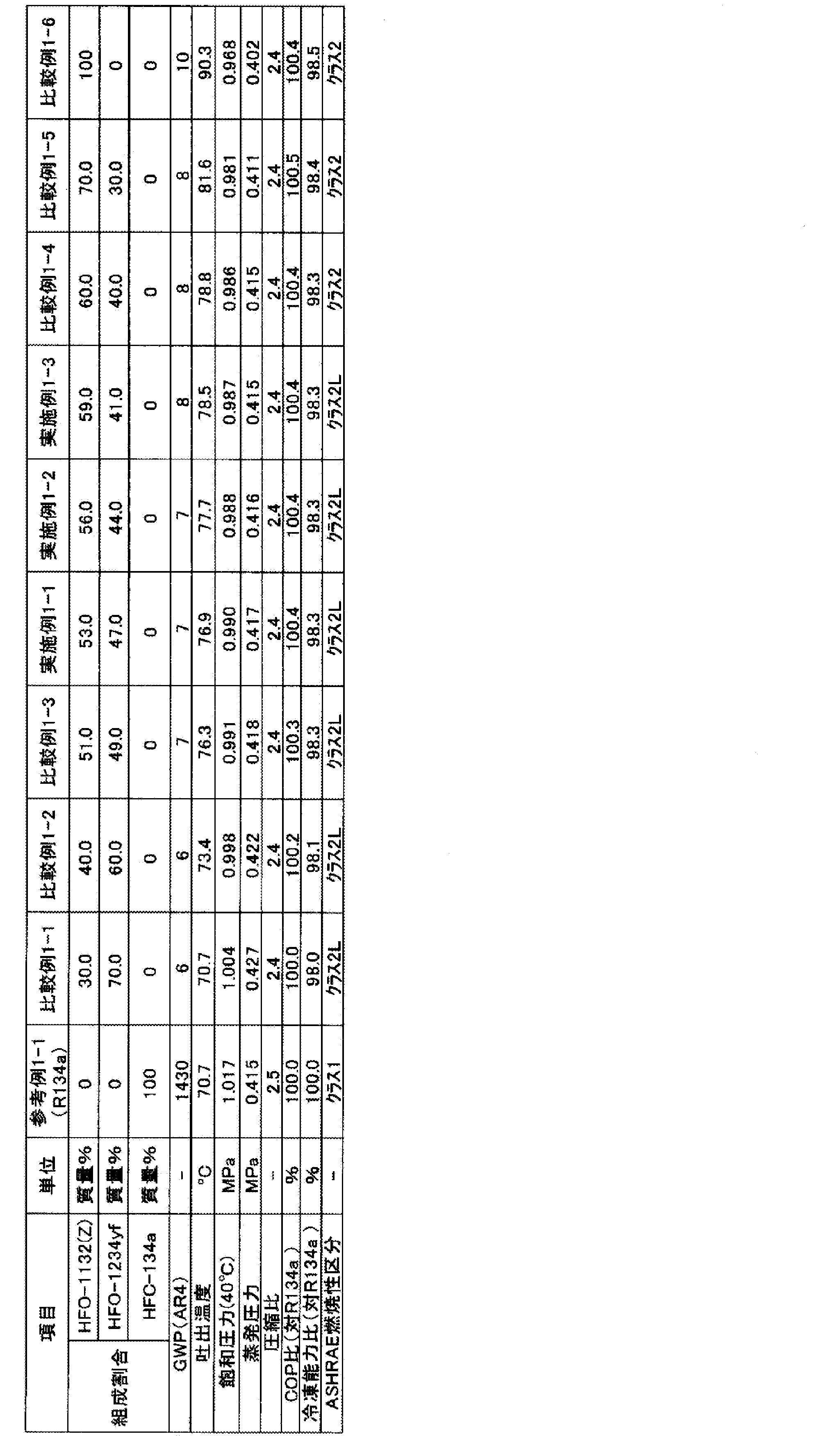
試験例1-2
実施例1-4~1-6、比較例1-7~1-12及び参考例1-2(R134a)に示される混合冷媒のGWPは、IPCC第4次報告書の値に基づいて評価した。
実施例1-4~1-6、比較例1-7~1-12及び参考例1-2(R134a)に示される混合冷媒のGWPは、IPCC第4次報告書の値に基づいて評価した。
これらの混合冷媒のCOP、冷凍能力、吐出温度、飽和温度45℃における飽和圧力、凝縮圧力及び蒸発圧力は、Refprop 10.0(NIST製)を使用し、下記条件で混合冷媒の冷凍サイクル理論計算を実施することにより求めた。
<空調条件>
蒸発温度 5℃
凝縮温度 45℃
過熱温度 5K
過冷却温度 5K
圧縮機効率 70%
<空調条件>
蒸発温度 5℃
凝縮温度 45℃
過熱温度 5K
過冷却温度 5K
圧縮機効率 70%
上記用語の意味は、試験例1-1と同様である。
試験例1-2の結果を表2に示す。表2は、本開示の冷媒1の実施例及び比較例を示している。表2中、各用語の意味は、試験例1-1と同様である。
成績係数(COP)及び圧縮比は、試験例1-1と同様にして求めた。
混合冷媒の燃焼性は、試験例1-1と同様にして判断した。燃焼速度試験は、試験例1-1と同様にして行った。
混合冷媒の燃焼範囲は、ASTM E681-09に基づく測定装置(図1を参照)を用いて、試験例1-1と同様の方法及び試験条件で測定した。

試験例1-3
実施例1-7~1-9、比較例1-13~1-18及び参考例1-3(R134a)に示される混合冷媒のGWPは、IPCC第4次報告書の値に基づいて評価した。
実施例1-7~1-9、比較例1-13~1-18及び参考例1-3(R134a)に示される混合冷媒のGWPは、IPCC第4次報告書の値に基づいて評価した。
これらの混合冷媒のCOP、冷凍能力、吐出温度、飽和温度40℃における飽和圧力、凝縮圧力及び蒸発圧力は、Refprop 10.0(NIST製)を使用し、下記条件で混合冷媒の冷凍サイクル理論計算を実施することにより求めた。
<空調条件>
蒸発温度 -10℃
凝縮温度 40℃
過熱温度 20K
過冷却温度 0K
圧縮機効率 70%
<空調条件>
蒸発温度 -10℃
凝縮温度 40℃
過熱温度 20K
過冷却温度 0K
圧縮機効率 70%
上記用語の意味は、試験例1-1と同様である。
試験例1-3の結果を表3に示す。表3は、本開示の冷媒1の実施例及び比較例を示している。表3中、各用語の意味は、試験例1-1と同様である。
成績係数(COP)及び圧縮比は、試験例1-1と同様にして求めた。
混合冷媒の燃焼性は、試験例1-1と同様にして判断した。燃焼速度試験は、試験例1-1と同様にして行った。
混合冷媒の燃焼範囲は、ASTM E681-09に基づく測定装置(図1を参照)を用いて、試験例1-1と同様の方法及び試験条件で測定した。
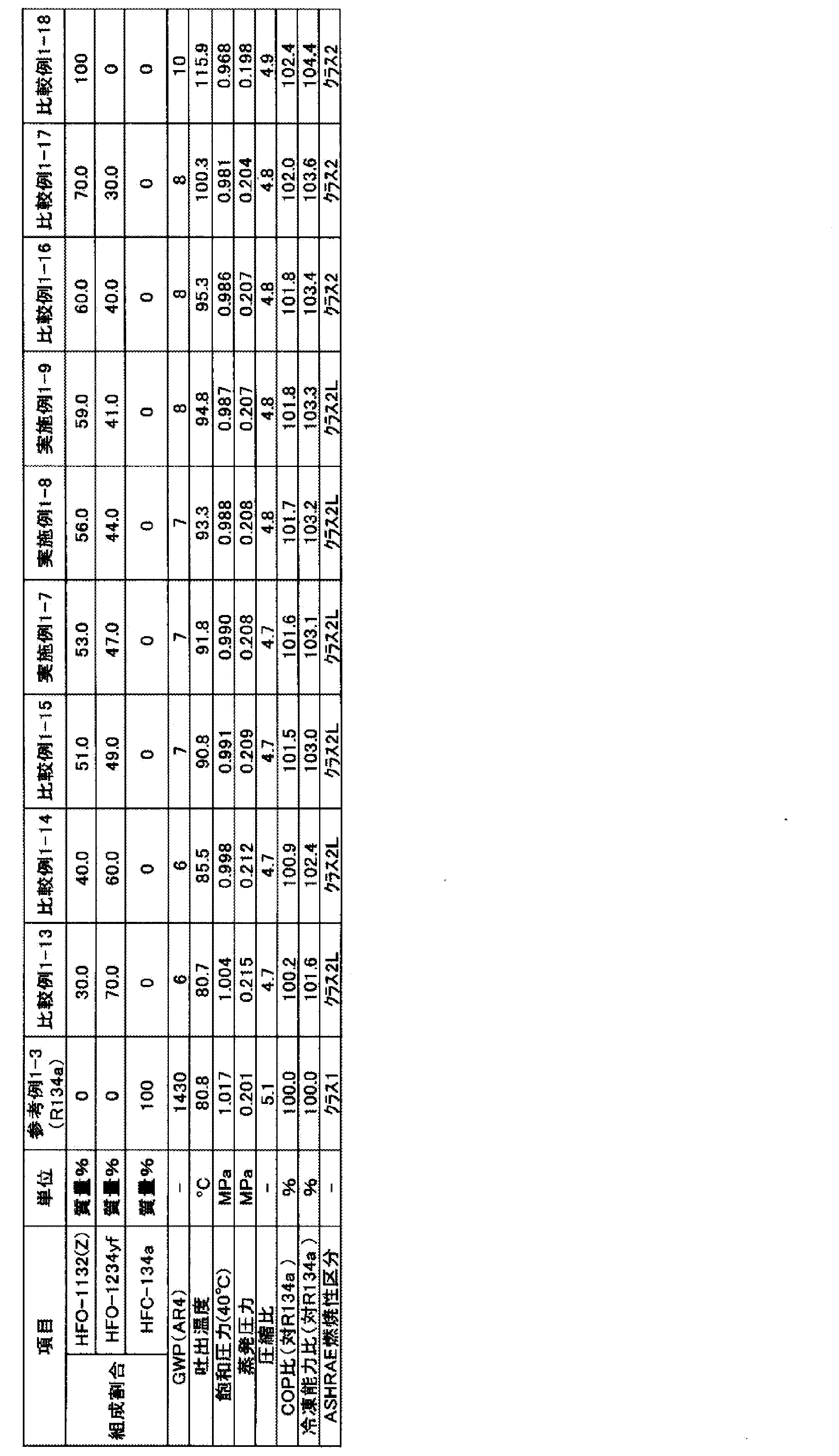
試験例1-4
実施例1-10~1-12、比較例1-19~1-24及び参考例1-4(R134a)に示される混合冷媒のGWPは、IPCC第4次報告書の値に基づいて評価した。
実施例1-10~1-12、比較例1-19~1-24及び参考例1-4(R134a)に示される混合冷媒のGWPは、IPCC第4次報告書の値に基づいて評価した。
これらの混合冷媒のCOP、冷凍能力、吐出温度、飽和温度40℃における飽和圧力、凝縮圧力及び蒸発圧力は、Refprop 10.0(NIST製)を使用し、下記条件で混合冷媒の冷凍サイクル理論計算を実施することにより求めた。
<空調条件>
蒸発温度 -35℃
凝縮温度 40℃
過熱温度 20K
過冷却温度 0K
圧縮機効率 70%
<空調条件>
蒸発温度 -35℃
凝縮温度 40℃
過熱温度 20K
過冷却温度 0K
圧縮機効率 70%
上記用語の意味は、試験例1-1と同様である。
試験例1-4の結果を表4に示す。表4は、本開示の冷媒1の実施例及び比較例を示している。表4中、各用語の意味は、試験例1-1と同様である。
成績係数(COP)及び圧縮比は、試験例1-1と同様にして求めた。
混合冷媒の燃焼性は、試験例1-1と同様にして判断した。燃焼速度試験は、試験例1-1と同様にして行った。
混合冷媒の燃焼範囲は、ASTM E681-09に基づく測定装置(図1を参照)を用いて、試験例1-1と同様の方法及び試験条件で測定した。
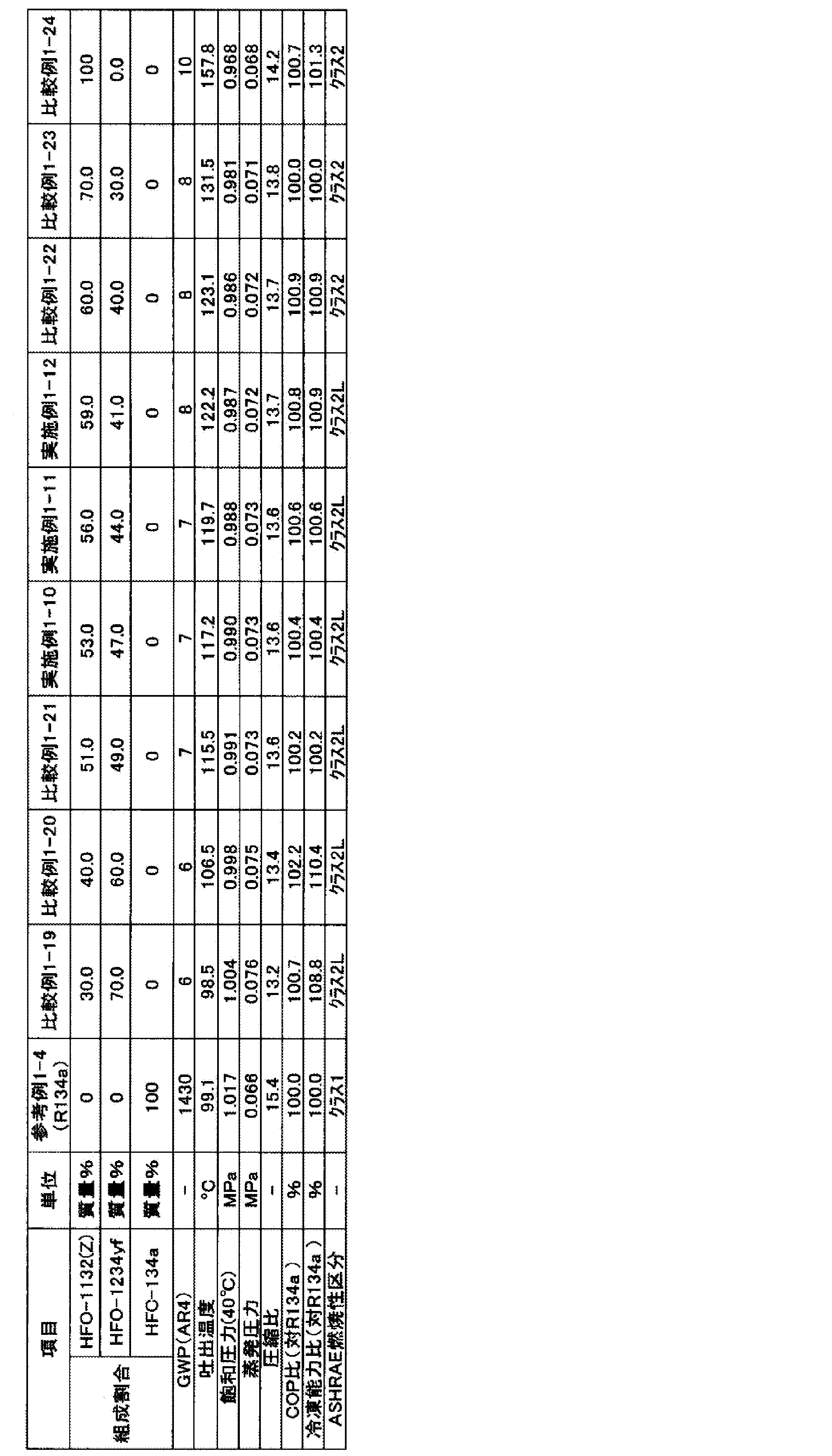
試験例1-5
実施例1-13~1-15、比較例1-25~1-30及び参考例1-5(R134a)に示される混合冷媒のGWPは、IPCC第4次報告書の値に基づいて評価した。
実施例1-13~1-15、比較例1-25~1-30及び参考例1-5(R134a)に示される混合冷媒のGWPは、IPCC第4次報告書の値に基づいて評価した。
これらの混合冷媒のCOP、冷凍能力、吐出温度、飽和温度40℃における飽和圧力、凝縮圧力及び蒸発圧力は、Refprop 10.0(NIST製)を使用し、下記条件で混合冷媒の冷凍サイクル理論計算を実施することにより求めた。
<空調条件>
蒸発温度 -50℃
凝縮温度 40℃
過熱温度 20K
過冷却温度 0K
圧縮機効率 70%
<空調条件>
蒸発温度 -50℃
凝縮温度 40℃
過熱温度 20K
過冷却温度 0K
圧縮機効率 70%
上記用語の意味は、試験例1-1と同様である。
試験例1-5の結果を表5に示す。表5は、本開示の冷媒1の実施例及び比較例を示している。表5中、各用語の意味は、試験例1-1と同様である。
成績係数(COP)及び圧縮比は、試験例1-1と同様にして求めた。
混合冷媒の燃焼性は、試験例1-1と同様にして判断した。燃焼速度試験は、試験例1-1と同様にして行った。
混合冷媒の燃焼範囲は、ASTM E681-09に基づく測定装置(図1を参照)を用いて、試験例1-1と同様の方法及び試験条件で測定した。
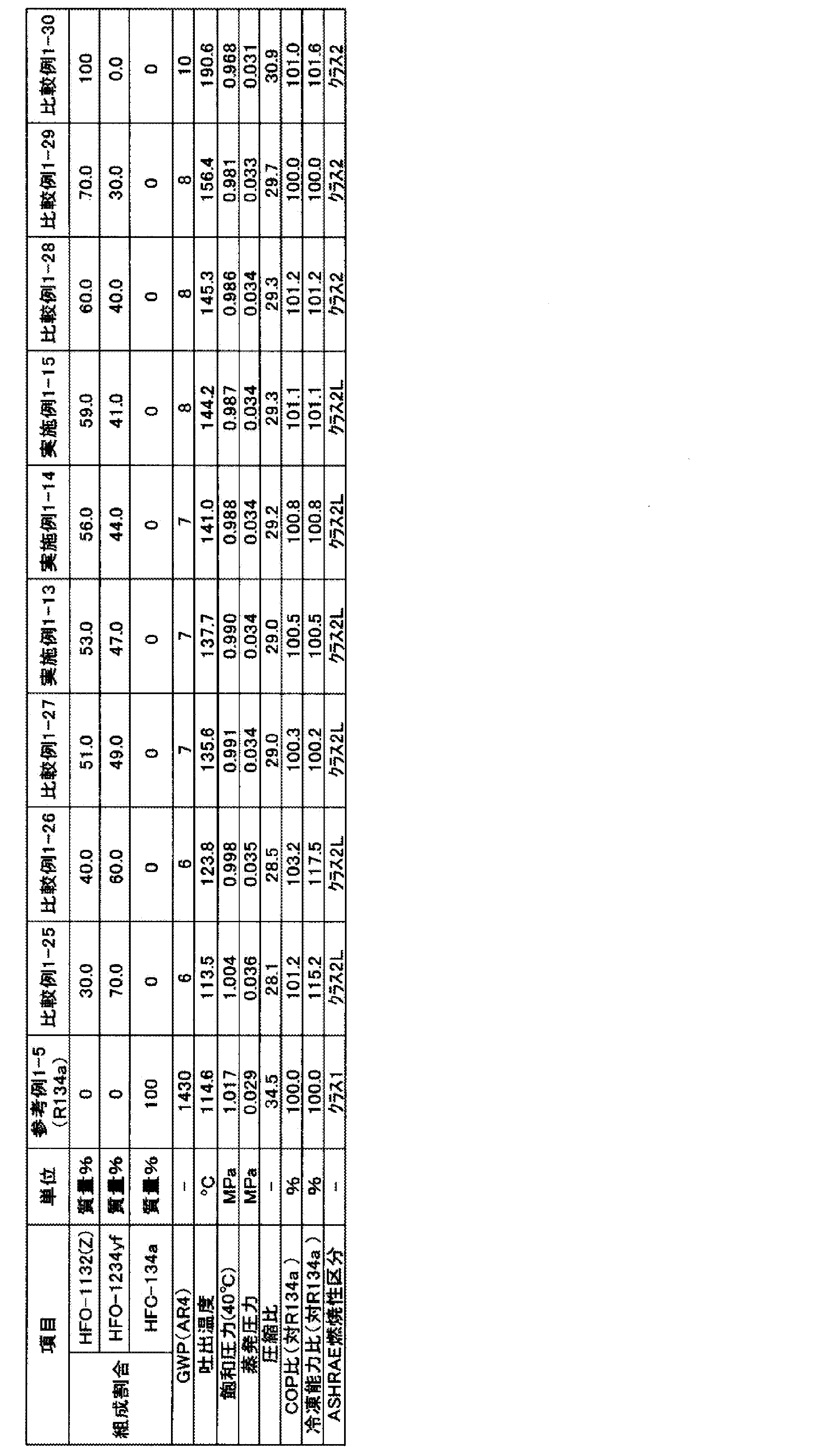
試験例1-6
実施例1-16~1-18、比較例1-31~1-36及び参考例1-6(R134a)に示される混合冷媒のGWPは、IPCC第4次報告書の値に基づいて評価した。
実施例1-16~1-18、比較例1-31~1-36及び参考例1-6(R134a)に示される混合冷媒のGWPは、IPCC第4次報告書の値に基づいて評価した。
これらの混合冷媒のCOP、冷凍能力、吐出温度、飽和温度40℃における飽和圧力、凝縮圧力及び蒸発圧力は、Refprop 10.0(NIST製)を使用し、下記条件で混合冷媒の冷凍サイクル理論計算を実施することにより求めた。
<空調条件>
蒸発温度 -65℃
凝縮温度 40℃
過熱温度 20K
過冷却温度 0K
圧縮機効率 70%
<空調条件>
蒸発温度 -65℃
凝縮温度 40℃
過熱温度 20K
過冷却温度 0K
圧縮機効率 70%
上記用語の意味は、試験例1-1と同様である。
試験例1-6の結果を表6に示す。表6は、本開示の冷媒1の実施例及び比較例を示している。表6中、各用語の意味は、試験例1-1と同様である。
成績係数(COP)及び圧縮比は、試験例1-1と同様にして求めた。
混合冷媒の燃焼性は、試験例1-1と同様にして判断した。燃焼速度試験は、試験例1-1と同様にして行った。
混合冷媒の燃焼範囲は、ASTM E681-09に基づく測定装置(図1を参照)を用いて、試験例1-1と同様の方法及び試験条件で測定した。
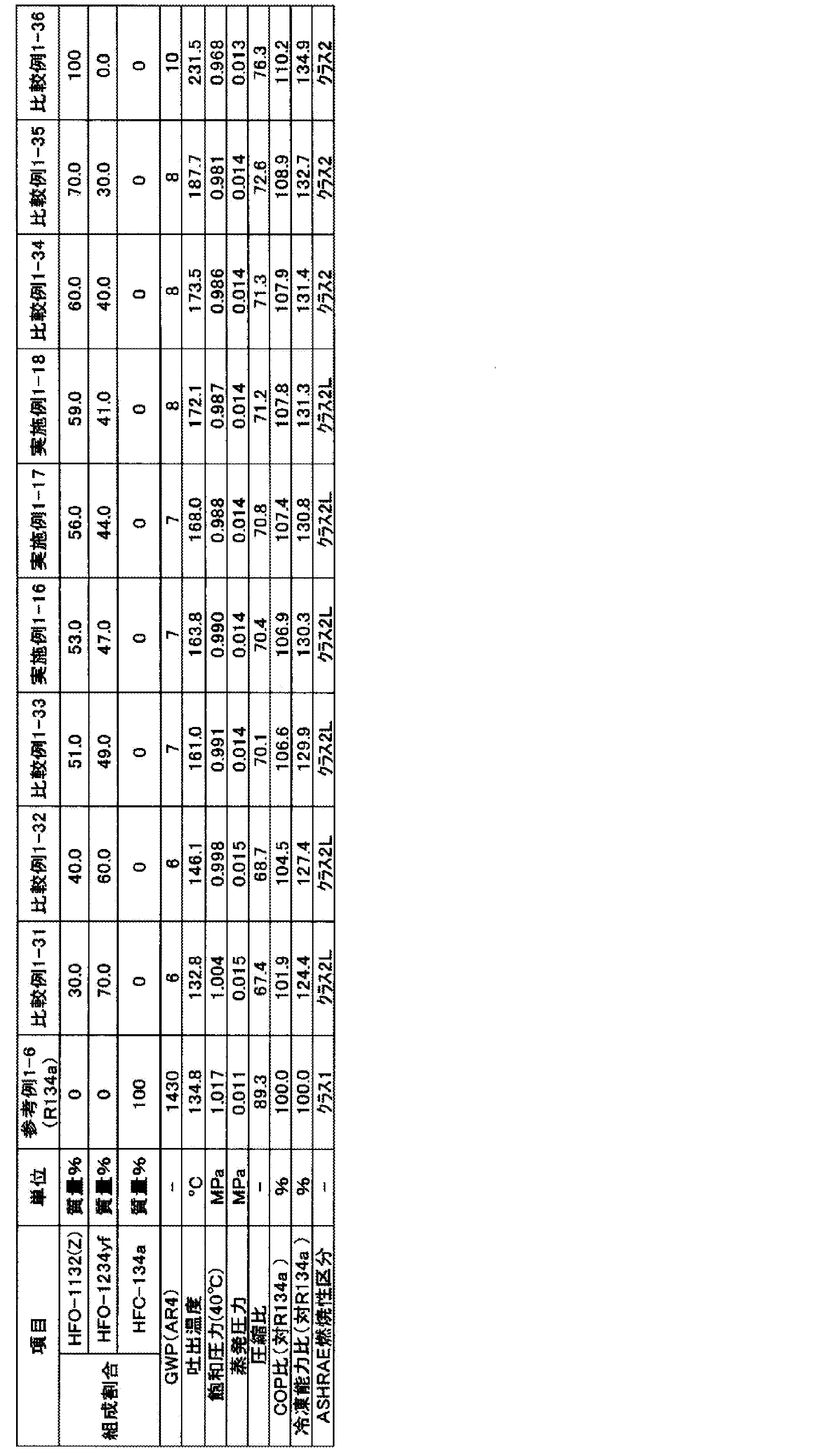
試験例2-1
実施例2-1~2-4、比較例2-1~2-6及び参考例2-1(R134a)に示される混合冷媒のGWPは、IPCC第4次報告書の値に基づいて評価した。
実施例2-1~2-4、比較例2-1~2-6及び参考例2-1(R134a)に示される混合冷媒のGWPは、IPCC第4次報告書の値に基づいて評価した。
これらの混合冷媒のCOP、冷凍能力、吐出温度、飽和温度40℃における飽和圧力、凝縮圧力及び蒸発圧力は、Refprop 10.0(National Institute of Science and Technology(NIST)製)を使用し、下記条件で混合冷媒の冷凍サイクル理論計算を実施することにより求めた。
<空調条件>
蒸発温度 10℃
凝縮温度 40℃
過熱温度 20K
過冷却温度 0K
圧縮機効率 70%
<空調条件>
蒸発温度 10℃
凝縮温度 40℃
過熱温度 20K
過冷却温度 0K
圧縮機効率 70%
「蒸発温度10℃」とは、冷凍装置が備える蒸発器における混合冷媒の蒸発温度が10℃であることを意味する。また、「凝縮温度40℃」とは、冷凍装置が備える凝縮器における混合冷媒の凝縮温度が40℃であることを意味する。
試験例2-1の結果を表7に示す。表7は、本開示の冷媒2の実施例及び比較例を示している。表7中、「COP比」及び「冷凍能力比」とは、R134aに対する割合(%)を示す。表7中、「飽和圧力(40℃)」とは、飽和温度40℃における飽和圧力を示す。表7中、「吐出温度(℃)」とは、上記混合冷媒の冷凍サイクル理論計算において、冷凍サイクル中で最も温度が高くなる温度を示す。
成績係数(COP)は、次式により求めた。
COP=(冷凍能力又は暖房能力)/消費電力量
COP=(冷凍能力又は暖房能力)/消費電力量
圧縮比は、次式により求めた。
圧縮比=凝縮圧力(Mpa)/蒸発圧力(Mpa)
圧縮比=凝縮圧力(Mpa)/蒸発圧力(Mpa)
混合冷媒の燃焼性は、混合冷媒の混合組成をWCF濃度とし、ANSI/ASHRAE34-2013規格に従い燃焼速度を測定することにより、判断した。R134aの燃焼性は、R134aの組成をWCF濃度とし、ANSI/ASHRAE34-2013規格に従い燃焼速度を測定することにより、判断した。
燃焼速度が0cm/s~10cm/sとなる混合冷媒は「クラス2L(微燃)」、燃焼速度が10cm/s超となる混合冷媒は「クラス2(弱燃)」であるとした。R134aは火炎伝播がなかったため、「クラス1(不燃)」であるとした。表7中、「ASHRAE燃焼性区分」とは、この判定基準に基づく結果を示している。
燃焼速度試験は以下の通り行った。まず、使用した混合冷媒は99.5%又はそれ以上の純度とし、真空ゲージ上に空気の痕跡が見られなくなるまで凍結、ポンピング及び解凍のサイクルを繰り返すことにより脱気した。閉鎖法により燃焼速度を測定した。初期温度は周囲温度とした。点火は、試料セルの中心で電極間に電気的スパークを生じさせることにより行った。放電の持続時間は1.0~9.9msとし、点火エネルギーは典型的には約0.1~1.0Jであった。シュリーレン写真を使って炎の広がりを視覚化した。光を通す2つのアクリル窓を備えた円筒形容器(内径:155mm、長さ:198mm)を試料セルとして用い、光源としてはキセノンランプを用いた。炎のシュリーレン画像を高速デジタルビデオカメラで600fpsのフレーミング速度で記録し、PCに保存した。
混合冷媒の燃焼範囲は、ASTM E681-09に基づく測定装置(図1を参照)を用いて測定を実施した。
具体的には、燃焼の状態が目視および録画撮影できるように内容積12リットルの球形ガラスフラスコを使用し、ガラスフラスコは燃焼により過大な圧力が発生した際には上部のふたからガスが開放されるようにした。着火方法は底部から1/3の高さに保持された電極からの放電により発生させた。
<試験条件>
試験容器:280mmφ球形(内容積:12リットル)
試験温度:60℃±3℃
圧力:101.3kPa±0.7kPa
水分:乾燥空気1gにつき0.0088g±0.0005g(23℃における相対湿度50%の水分量)冷媒組成物/空気混合比:1vol.%刻み±0.2vol.%
冷媒組成物混合:±0.1質量%
点火方法:交流放電、電圧15kV、電流30mA、ネオン変圧器
電極間隔:6.4mm(1/4inch)
スパーク:0.4秒±0.05秒
判定基準:
・着火点を中心に90度より大きく火炎が広がった場合=火炎伝播あり(可燃)
・着火点を中心に90度以下の火炎の広がりだった場合=火炎伝播なし(不燃)
試験容器:280mmφ球形(内容積:12リットル)
試験温度:60℃±3℃
圧力:101.3kPa±0.7kPa
水分:乾燥空気1gにつき0.0088g±0.0005g(23℃における相対湿度50%の水分量)冷媒組成物/空気混合比:1vol.%刻み±0.2vol.%
冷媒組成物混合:±0.1質量%
点火方法:交流放電、電圧15kV、電流30mA、ネオン変圧器
電極間隔:6.4mm(1/4inch)
スパーク:0.4秒±0.05秒
判定基準:
・着火点を中心に90度より大きく火炎が広がった場合=火炎伝播あり(可燃)
・着火点を中心に90度以下の火炎の広がりだった場合=火炎伝播なし(不燃)

試験例2-2
実施例2-5~2-8、比較例2-7~2-12及び参考例2-2(R134a)に示される混合冷媒のGWPは、IPCC第4次報告書の値に基づいて評価した。
実施例2-5~2-8、比較例2-7~2-12及び参考例2-2(R134a)に示される混合冷媒のGWPは、IPCC第4次報告書の値に基づいて評価した。
これらの混合冷媒のCOP、冷凍能力、吐出温度、飽和温度45℃における飽和圧力、凝縮圧力及び蒸発圧力は、Refprop 10.0(NIST製)を使用し、下記条件で混合冷媒の冷凍サイクル理論計算を実施することにより求めた。
<空調条件>
蒸発温度 5℃
凝縮温度 45℃
過熱温度 5K
過冷却温度 5K
圧縮機効率 70%
<空調条件>
蒸発温度 5℃
凝縮温度 45℃
過熱温度 5K
過冷却温度 5K
圧縮機効率 70%
上記用語の意味は、試験例2-1と同様である。
試験例2-2の結果を表8に示す。表8は、本開示の冷媒2の実施例及び比較例を示している。表8中、各用語の意味は、試験例2-1と同様である。
成績係数(COP)及び圧縮比は、試験例2-1と同様にして求めた。
混合冷媒の燃焼性は、試験例2-1と同様にして判断した。燃焼速度試験は、試験例2-1と同様にして行った。
混合冷媒の燃焼範囲は、ASTM E681-09に基づく測定装置(図1を参照)を用いて、試験例2-1と同様の方法及び試験条件で測定した。

試験例2-3
実施例2-9~2-12、比較例2-13~2-18及び参考例2-3(R134a)に示される混合冷媒のGWPは、IPCC第4次報告書の値に基づいて評価した。
実施例2-9~2-12、比較例2-13~2-18及び参考例2-3(R134a)に示される混合冷媒のGWPは、IPCC第4次報告書の値に基づいて評価した。
これらの混合冷媒のCOP、冷凍能力、吐出温度、飽和温度40℃における飽和圧力、凝縮圧力及び蒸発圧力は、Refprop 10.0(NIST製)を使用し、下記条件で混合冷媒の冷凍サイクル理論計算を実施することにより求めた。
<空調条件>
蒸発温度 -10℃
凝縮温度 40℃
過熱温度 20K
過冷却温度 0K
圧縮機効率 70%
<空調条件>
蒸発温度 -10℃
凝縮温度 40℃
過熱温度 20K
過冷却温度 0K
圧縮機効率 70%
上記用語の意味は、試験例2-1と同様である。
試験例2-3の結果を表9に示す。表9は、本開示の冷媒2の実施例及び比較例を示している。表9中、各用語の意味は、試験例2-1と同様である。
成績係数(COP)及び圧縮比は、試験例2-1と同様にして求めた。
混合冷媒の燃焼性は、試験例2-1と同様にして判断した。燃焼速度試験は、試験例2-1と同様にして行った。
混合冷媒の燃焼範囲は、ASTM E681-09に基づく測定装置(図1を参照)を用いて、試験例2-1と同様の方法及び試験条件で測定した。

試験例2-4
実施例2-13~2-16、比較例2-19~2-24及び参考例2-4(R134a)に示される混合冷媒のGWPは、IPCC第4次報告書の値に基づいて評価した。
実施例2-13~2-16、比較例2-19~2-24及び参考例2-4(R134a)に示される混合冷媒のGWPは、IPCC第4次報告書の値に基づいて評価した。
これらの混合冷媒のCOP、冷凍能力、吐出温度、飽和温度40℃における飽和圧力、凝縮圧力及び蒸発圧力は、Refprop 10.0(NIST製)を使用し、下記条件で混合冷媒の冷凍サイクル理論計算を実施することにより求めた。
<空調条件>
蒸発温度 -35℃
凝縮温度 40℃
過熱温度 20K
過冷却温度 0K
圧縮機効率 70%
<空調条件>
蒸発温度 -35℃
凝縮温度 40℃
過熱温度 20K
過冷却温度 0K
圧縮機効率 70%
上記用語の意味は、試験例2-1と同様である。
試験例2-4の結果を表10に示す。表10は、本開示の冷媒2の実施例及び比較例を示している。表10中、各用語の意味は、試験例2-1と同様である。
成績係数(COP)及び圧縮比は、試験例2-1と同様にして求めた。
混合冷媒の燃焼性は、試験例2-1と同様にして判断した。燃焼速度試験は、試験例2-1と同様にして行った。
混合冷媒の燃焼範囲は、ASTM E681-09に基づく測定装置(図1を参照)を用いて、試験例2-1と同様の方法及び試験条件で測定した。
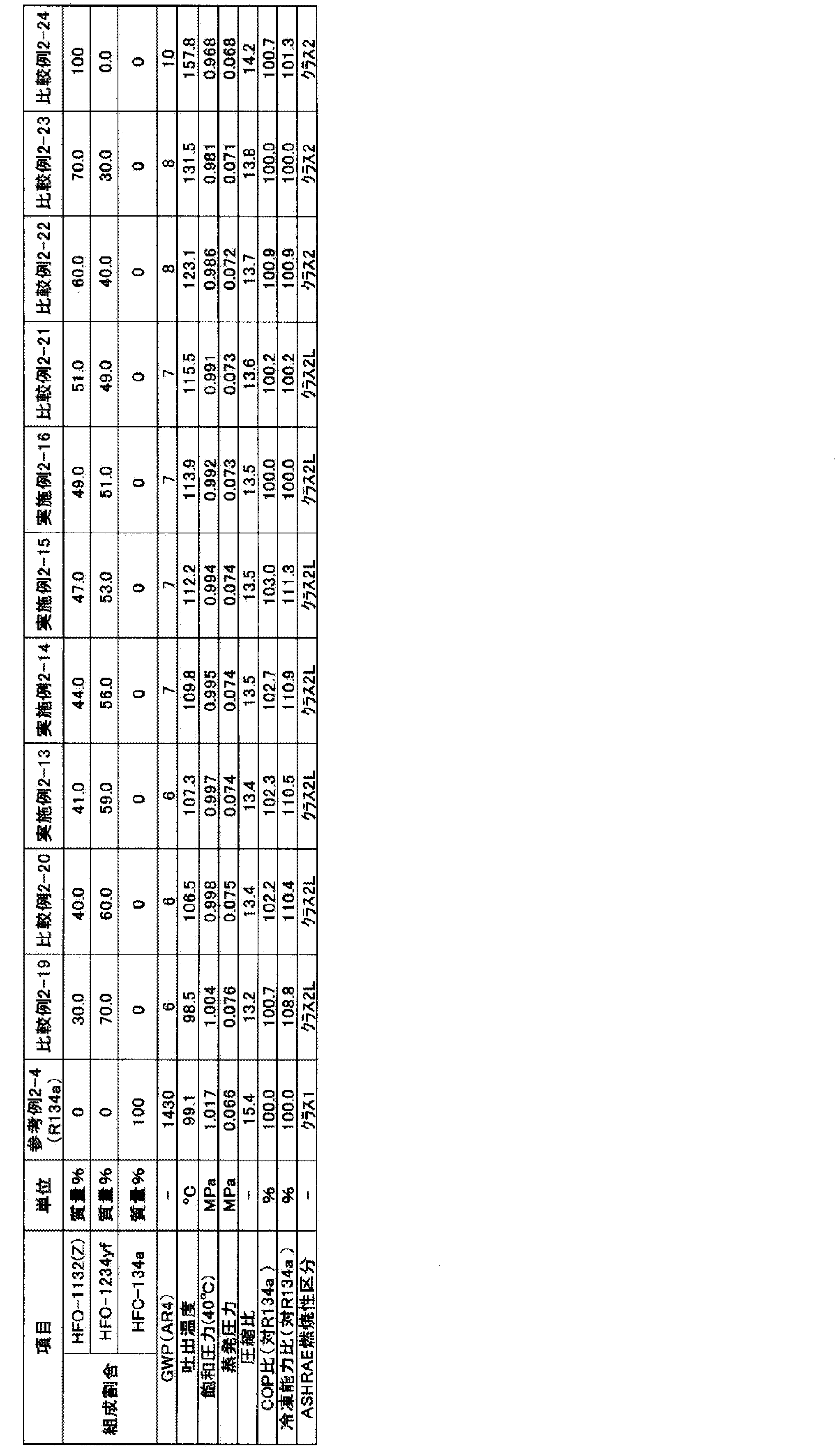
試験例2-5
実施例2-17~2-20、比較例2-25~2-30及び参考例2-5(R134a)に示される混合冷媒のGWPは、IPCC第4次報告書の値に基づいて評価した。
実施例2-17~2-20、比較例2-25~2-30及び参考例2-5(R134a)に示される混合冷媒のGWPは、IPCC第4次報告書の値に基づいて評価した。
これらの混合冷媒のCOP、冷凍能力、吐出温度、飽和温度40℃における飽和圧力、凝縮圧力及び蒸発圧力は、Refprop 10.0(NIST製)を使用し、下記条件で混合冷媒の冷凍サイクル理論計算を実施することにより求めた。
<空調条件>
蒸発温度 -50℃
凝縮温度 40℃
過熱温度 20K
過冷却温度 0K
圧縮機効率 70%
<空調条件>
蒸発温度 -50℃
凝縮温度 40℃
過熱温度 20K
過冷却温度 0K
圧縮機効率 70%
上記用語の意味は、試験例2-1と同様である。
試験例2-5の結果を表11に示す。表11は、本開示の冷媒2の実施例及び比較例を示している。表11中、各用語の意味は、試験例2-1と同様である。
成績係数(COP)及び圧縮比は、試験例2-1と同様にして求めた。
混合冷媒の燃焼性は、試験例2-1と同様にして判断した。燃焼速度試験は、試験例2-1と同様にして行った。
混合冷媒の燃焼範囲は、ASTM E681-09に基づく測定装置(図1を参照)を用いて、試験例2-1と同様の方法及び試験条件で測定した。

試験例2-6
実施例2-21~2-24、比較例2-31~2-36及び参考例2-6(R134a)に示される混合冷媒のGWPは、IPCC第4次報告書の値に基づいて評価した。
実施例2-21~2-24、比較例2-31~2-36及び参考例2-6(R134a)に示される混合冷媒のGWPは、IPCC第4次報告書の値に基づいて評価した。
これらの混合冷媒のCOP、冷凍能力、吐出温度、飽和温度40℃における飽和圧力、凝縮圧力及び蒸発圧力は、Refprop 10.0(NIST製)を使用し、下記条件で混合冷媒の冷凍サイクル理論計算を実施することにより求めた。
<空調条件>
蒸発温度 -65℃
凝縮温度 40℃
過熱温度 20K
過冷却温度 0K
圧縮機効率 70%
<空調条件>
蒸発温度 -65℃
凝縮温度 40℃
過熱温度 20K
過冷却温度 0K
圧縮機効率 70%
上記用語の意味は、試験例2-1と同様である。
試験例2-6の結果を表12に示す。表12は、本開示の冷媒2の実施例及び比較例を示している。表12中、各用語の意味は、試験例2-1と同様である。
成績係数(COP)及び圧縮比は、試験例2-1と同様にして求めた。
混合冷媒の燃焼性は、試験例2-1と同様にして判断した。燃焼速度試験は、試験例2-1と同様にして行った。
混合冷媒の燃焼範囲は、ASTM E681-09に基づく測定装置(図1を参照)を用いて、試験例2-1と同様の方法及び試験条件で測定した。

1:仕込みライン
2:サンプリングライン
3:温度計
4:圧力計
5:電極
6:撹拌羽根(PTFE製)
2:サンプリングライン
3:温度計
4:圧力計
5:電極
6:撹拌羽根(PTFE製)
Claims (14)
- 冷媒を含有する組成物であって、
前記冷媒が、シス-1,2-ジフルオロエチレン(HFO-1132(Z))及び2,3,3,3-テトラフルオロプロペン(HFO-1234yf)を含有し、
HFO-1132(Z)及びHFO-1234yfの全質量に対して、
HFO-1132(Z)の含有割合が53.0~59.5質量%であり、
HFO-1234yfの含有割合が47.0~40.5質量%である、組成物。 - 前記冷媒が、蒸発温度が-60~20℃である冷凍サイクルを運転するために用いられる、請求項1に記載の組成物。
- 前記冷媒が、HFO-1132(Z)及びHFO-1234yfのみからなる、請求項1又は2に記載の組成物。
- 冷媒を含有する組成物であって、
前記冷媒が、シス-1,2-ジフルオロエチレン(HFO-1132(Z))及び2,3,3,3-テトラフルオロプロペン(HFO-1234yf)を含有し、
HFO-1132(Z)及びHFO-1234yfの全質量に対して、
HFO-1132(Z)の含有割合が41.0~49.2質量%であり、
HFO-1234yfの含有割合が59.0~50.8質量%である、組成物。 - 前記冷媒が、蒸発温度が-60~20℃である冷凍サイクルを運転するために用いられる、請求項4に記載の組成物。
- 前記冷媒が、HFO-1132(Z)及びHFO-1234yfのみからなる、請求項4又は5に記載の組成物。
- R134a、R22、R12、R404A、R407A、R407C、R407F、R407H、R410A、R413A、R417A、R422A、R422B、R422C、R422D、R423A、R424A、R426A、R427A、R428A、R430A、R434A、R437A、R438A、R448A、R449A、R449B、R449C、R450A、R452A、R452B、R454A、R452B、R454C、R455A、R465A、R502、R507、R513A、R513B、R515A又はR515Bの代替冷媒として用いられる、請求項1~6のいずれか1項に記載の組成物。
- 水、トレーサー、紫外線蛍光染料、安定剤及び重合禁止剤からなる群より選択される少なくとも1種の物質を含有する、請求項1~7のいずれか1項に記載の組成物。
- 更に、冷凍機油を含有し、冷凍装置用作動流体として用いられる、請求項1~8のいずれか1項に記載の組成物。
- 前記冷凍機油は、ポリアルキレングリコール(PAG)、ポリオールエステル(POE)及びポリビニルエーテル(PVE)からなる群より選択される少なくとも1種のポリマーを含有する、請求項9に記載の組成物。
- 請求項1~10のいずれか1項に記載の組成物を用いて冷凍サイクルを運転する工程を含む冷凍方法。
- 請求項1~10のいずれか1項に記載の組成物を用いて冷凍サイクルを運転する冷凍装置の運転方法。
- 請求項1~10のいずれか1項に記載の組成物を作動流体として含む、冷凍装置。
- 空調機器、冷蔵庫、冷凍庫、冷水機、製氷機、冷蔵ショーケース、冷凍ショーケース、冷凍冷蔵ユニット、冷凍冷蔵倉庫用冷凍機、車載用空調機器、ターボ冷凍機及びスクリュー冷凍機からなる群より選択される少なくとも1種である、請求項13に記載の冷凍装置。
Priority Applications (3)
| Application Number | Priority Date | Filing Date | Title |
|---|---|---|---|
| EP20752629.4A EP3922923A4 (en) | 2019-02-06 | 2020-02-03 | Refrigerant-containing composition, and refrigerating method, refrigerating device operating method, and refrigerating device using said composition |
| CN202080013019.3A CN113412398A (zh) | 2019-02-06 | 2020-02-03 | 含有制冷剂的组合物及使用了该组合物的冷冻方法、冷冻装置的运转方法和冷冻装置 |
| US17/390,158 US11827833B2 (en) | 2019-02-06 | 2021-07-30 | Refrigerant-containing composition, and refrigerating method, refrigerating device operating method, and refrigerating device using said composition |
Applications Claiming Priority (2)
| Application Number | Priority Date | Filing Date | Title |
|---|---|---|---|
| JP2019-019701 | 2019-02-06 | ||
| JP2019019701 | 2019-02-06 |
Related Child Applications (1)
| Application Number | Title | Priority Date | Filing Date |
|---|---|---|---|
| US17/390,158 Continuation US11827833B2 (en) | 2019-02-06 | 2021-07-30 | Refrigerant-containing composition, and refrigerating method, refrigerating device operating method, and refrigerating device using said composition |
Publications (1)
| Publication Number | Publication Date |
|---|---|
| WO2020162415A1 true WO2020162415A1 (ja) | 2020-08-13 |
Family
ID=71947719
Family Applications (1)
| Application Number | Title | Priority Date | Filing Date |
|---|---|---|---|
| PCT/JP2020/003990 Ceased WO2020162415A1 (ja) | 2019-02-06 | 2020-02-03 | 冷媒を含有する組成物、並びに、その組成物を用いた冷凍方法、冷凍装置の運転方法及び冷凍装置 |
Country Status (5)
| Country | Link |
|---|---|
| US (1) | US11827833B2 (ja) |
| EP (1) | EP3922923A4 (ja) |
| JP (1) | JP6791414B2 (ja) |
| CN (1) | CN113412398A (ja) |
| WO (1) | WO2020162415A1 (ja) |
Families Citing this family (3)
| Publication number | Priority date | Publication date | Assignee | Title |
|---|---|---|---|---|
| EP3910040A4 (en) * | 2019-01-11 | 2022-11-09 | Daikin Industries, Ltd. | COMPOSITION CONTAINING A CIS-?,?-DIFLUOROETHYLENE |
| CN116103076B (zh) * | 2022-12-29 | 2025-03-28 | 河南理工大学 | 一种冷冻机油组合物及其制备方法和应用 |
| DE102023114350A1 (de) | 2023-05-08 | 2024-11-14 | Liebherr-Hausgeräte Ochsenhausen GmbH | Kühl- und / oder Gefriergerät |
Citations (5)
| Publication number | Priority date | Publication date | Assignee | Title |
|---|---|---|---|---|
| WO2015086670A2 (de) * | 2013-12-10 | 2015-06-18 | Akasol Gmbh | Batteriemodul |
| WO2015186557A1 (ja) * | 2014-06-06 | 2015-12-10 | 旭硝子株式会社 | 熱サイクル用作動媒体、熱サイクルシステム用組成物および熱サイクルシステム |
| WO2015186671A1 (ja) * | 2014-06-06 | 2015-12-10 | 旭硝子株式会社 | 熱サイクルシステム用組成物および熱サイクルシステム |
| JP2016011423A (ja) * | 2014-06-06 | 2016-01-21 | 旭硝子株式会社 | 熱サイクル用作動媒体、熱サイクルシステム用組成物および熱サイクルシステム |
| WO2020017520A1 (ja) * | 2018-07-17 | 2020-01-23 | ダイキン工業株式会社 | 自動車用冷凍サイクル装置 |
Family Cites Families (82)
| Publication number | Priority date | Publication date | Assignee | Title |
|---|---|---|---|---|
| US2309224A (en) | 1940-01-11 | 1943-01-26 | Matson C Terry | Self-contained air conditioner |
| EP0770114B1 (fr) | 1994-07-11 | 1998-11-11 | SOLVAY (Société Anonyme) | Refrigerants |
| JP2869038B2 (ja) | 1996-06-05 | 1999-03-10 | 松下電器産業株式会社 | 3成分混合冷媒を用いたヒートポンプ装置 |
| US6658882B2 (en) | 2001-08-09 | 2003-12-09 | Sanyo Electric Co., Ltd. | Integral-type air conditioner |
| US7279451B2 (en) | 2002-10-25 | 2007-10-09 | Honeywell International Inc. | Compositions containing fluorine substituted olefins |
| US7704404B2 (en) | 2003-07-17 | 2010-04-27 | Honeywell International Inc. | Refrigerant compositions and use thereof in low temperature refrigeration systems |
| US20060243945A1 (en) | 2005-03-04 | 2006-11-02 | Minor Barbara H | Compositions comprising a fluoroolefin |
| WO2009036537A2 (en) | 2007-09-18 | 2009-03-26 | Carrier Corporation | Partition and condenser shroud for an air conditioning unit |
| US20100122545A1 (en) | 2008-11-19 | 2010-05-20 | E. I. Du Pont De Nemours And Company | Tetrafluoropropene compositions and uses thereof |
| BR122013002802A2 (pt) | 2008-11-19 | 2016-01-05 | Du Pont | composição, processo para produzir resfriamento, processo para produzir aquecimento, método, aparelhos e sistema de refrigeração estacionário |
| CN102239228A (zh) | 2008-12-02 | 2011-11-09 | 墨西哥化学阿玛科股份有限公司 | 传热组合物 |
| GB201002622D0 (en) | 2010-02-16 | 2010-03-31 | Ineos Fluor Holdings Ltd | Heat transfer compositions |
| US8961811B2 (en) | 2010-04-15 | 2015-02-24 | E I Du Pont De Nemours And Company | Compositions comprising E-1,2-difluoroethylene and uses thereof |
| US8961812B2 (en) * | 2010-04-15 | 2015-02-24 | E I Du Pont De Nemours And Company | Compositions comprising Z-1,2-difluoroethylene and uses thereof |
| JP2013529703A (ja) | 2010-06-22 | 2013-07-22 | アーケマ・インコーポレイテッド | ヒドロフルオロカーボンとヒドロフルオロオレフィンの熱伝達組成物 |
| BR112013029408A2 (pt) | 2011-05-19 | 2017-01-31 | Asahi Glass Co Ltd | meio de trabalho e sistema de ciclo de calor |
| EP2842928A4 (en) | 2012-04-27 | 2017-11-08 | Asahi Glass Company, Limited | Method for preservation of tetrafluoropropene and container for preservation of tetrafluoropropene |
| ES2726535T3 (es) | 2012-12-04 | 2019-10-07 | Honeywell Int Inc | Composiciones de transferencia de calor con bajo GWP |
| KR101462426B1 (ko) | 2012-12-07 | 2014-11-17 | 한화케미칼 주식회사 | 탄소나노튜브를 포함하는 고열전도성 블래더용 고무복합체 조성물 및 그 제조방법 |
| FR3000095B1 (fr) | 2012-12-26 | 2015-02-20 | Arkema France | Composition comprenant du 2,3,3,3-tetrafluoropropene et du 1,2-difluoroethylene |
| WO2014178352A1 (ja) | 2013-04-30 | 2014-11-06 | 旭硝子株式会社 | トリフルオロエチレンを含む組成物 |
| EP2993212B1 (en) | 2013-04-30 | 2019-08-28 | AGC Inc. | Working medium for heat cycle |
| WO2014203356A1 (ja) | 2013-06-19 | 2014-12-24 | 三菱電機株式会社 | 冷凍サイクル装置 |
| JP6141429B2 (ja) | 2013-06-19 | 2017-06-07 | 三菱電機株式会社 | 空気調和機 |
| CN110373159B (zh) | 2013-07-12 | 2021-08-10 | Agc株式会社 | 热循环用工作介质、热循环系统用组合物以及热循环系统 |
| US10101043B2 (en) | 2013-07-26 | 2018-10-16 | Energy Design Technology & Solutions, Inc. | HVAC system and method of operation |
| US20160097569A1 (en) | 2013-07-29 | 2016-04-07 | Mitsubishi Electric Corporporation | Heat pump apparatus |
| ES2754267T3 (es) | 2013-10-10 | 2020-04-16 | Chemours Co Fc Llc | Composiciones que comprenden difluorometano, pentafluoroetano, tetrafluoroetano y tetrafluoropropeno y usos de las mismas |
| EP3101081B1 (en) | 2014-01-31 | 2019-12-18 | AGC Inc. | Working fluid for heat cycle, composition for heat cycle system, and heat cycle system |
| EP4417667A1 (en) | 2014-01-31 | 2024-08-21 | Agc Inc. | Working fluid for heat cycle, composition for heat cycle system, and heat cycle system |
| EP3109292B1 (en) | 2014-02-20 | 2020-09-02 | AGC Inc. | Working fluid for heat cycle |
| EP3112438B1 (en) | 2014-02-24 | 2021-03-24 | AGC Inc. | Composition for heat cycle systems, and heat cycle system |
| JP6180619B2 (ja) | 2014-03-14 | 2017-08-16 | 三菱電機株式会社 | 圧縮機及び冷凍サイクル装置 |
| CN106255736B (zh) * | 2014-03-17 | 2019-11-26 | Agc株式会社 | 热循环用工作介质、热循环系统用组合物以及热循环系统 |
| CN106133110B (zh) | 2014-03-18 | 2020-06-02 | Agc株式会社 | 热循环用工作介质、热循环系统用组合物以及热循环系统 |
| JP6105511B2 (ja) | 2014-04-10 | 2017-03-29 | 三菱電機株式会社 | ヒートポンプ装置 |
| JP6417533B2 (ja) | 2014-05-12 | 2018-11-07 | パナソニックIpマネジメント株式会社 | 圧縮機およびそれを用いた冷凍サイクル装置 |
| WO2015186558A1 (ja) | 2014-06-06 | 2015-12-10 | 旭硝子株式会社 | 熱サイクル用作動媒体、熱サイクルシステム用組成物および熱サイクルシステム |
| EP3153561A4 (en) * | 2014-06-06 | 2018-01-10 | Asahi Glass Company, Limited | Composition for heat cycle system and heat cycle system |
| JP2015229767A (ja) | 2014-06-06 | 2015-12-21 | 旭硝子株式会社 | 熱サイクル用作動媒体 |
| CN106574802A (zh) | 2014-08-12 | 2017-04-19 | 旭硝子株式会社 | 热循环系统 |
| JP6779875B2 (ja) | 2014-11-11 | 2020-11-04 | トレイン インターナショナル インク | 冷媒組成物及び使用方法 |
| GB201501598D0 (en) | 2015-01-30 | 2015-03-18 | Mexichem Fluor Sa De Cv | Compositions |
| CN107532074A (zh) | 2015-05-14 | 2018-01-02 | 旭硝子株式会社 | 流体组合物、制冷剂组合物和空调机 |
| WO2016190177A1 (ja) | 2015-05-25 | 2016-12-01 | 旭硝子株式会社 | 熱サイクル用作動媒体および熱サイクルシステム |
| CN117050728A (zh) | 2015-06-01 | 2023-11-14 | Agc株式会社 | 热循环用工作介质、热循环系统用组合物以及热循环系统 |
| EP3404342A4 (en) | 2016-01-12 | 2019-08-28 | AGC Inc. | COLD CIRCULATION DEVICE AND COLD CIRCULATION SYSTEM |
| JP6788820B2 (ja) | 2016-02-18 | 2020-11-25 | パナソニックIpマネジメント株式会社 | 冷凍サイクル用作動媒体および冷凍サイクルシステム |
| CA3015523A1 (en) | 2016-02-29 | 2017-09-08 | The Chemours Company Fc, Llc | Refrigerant mixtures comprising difluoromethane, pentafluoroethane, tetrafluoroethane, tetrafluoropropene, and carbon dioxide and uses thereof |
| CN109312108A (zh) | 2016-05-11 | 2019-02-05 | 欧文斯科宁知识产权资产有限公司 | 包含低水平溴化阻燃剂的聚合物泡沫及其制备方法 |
| JP6884572B2 (ja) | 2016-12-27 | 2021-06-09 | パナソニック株式会社 | 冷凍サイクル用作動媒体および冷凍サイクルシステム |
| JP6877998B2 (ja) | 2016-12-27 | 2021-05-26 | パナソニック株式会社 | 冷凍サイクル用作動媒体および冷凍サイクルシステム |
| JP7113185B2 (ja) | 2017-04-13 | 2022-08-05 | パナソニックIpマネジメント株式会社 | 冷凍サイクル装置 |
| JP6979563B2 (ja) | 2017-04-13 | 2021-12-15 | パナソニックIpマネジメント株式会社 | 冷凍サイクル装置 |
| JP6979564B2 (ja) | 2017-04-13 | 2021-12-15 | パナソニックIpマネジメント株式会社 | 冷凍サイクル装置 |
| JP2018179404A (ja) | 2017-04-13 | 2018-11-15 | パナソニックIpマネジメント株式会社 | 冷凍サイクル装置 |
| JP6979565B2 (ja) | 2017-04-13 | 2021-12-15 | パナソニックIpマネジメント株式会社 | 冷凍サイクル装置 |
| CN110537062A (zh) | 2017-04-20 | 2019-12-03 | Agc株式会社 | 热循环系统 |
| JP6504298B2 (ja) | 2017-04-21 | 2019-04-24 | ダイキン工業株式会社 | 冷媒を含有する組成物及びその応用 |
| GB201712813D0 (en) | 2017-08-10 | 2017-09-27 | Mexichem Fluor Sa De Cv | Compositions |
| JP6899529B2 (ja) | 2017-08-10 | 2021-07-07 | パナソニックIpマネジメント株式会社 | 冷凍サイクル用作動媒体および冷凍サイクルシステム |
| US11906207B2 (en) | 2017-12-18 | 2024-02-20 | Daikin Industries, Ltd. | Refrigeration apparatus |
| US20200393178A1 (en) | 2017-12-18 | 2020-12-17 | Daikin Industries, Ltd. | Refrigeration cycle apparatus |
| US11365335B2 (en) | 2017-12-18 | 2022-06-21 | Daikin Industries, Ltd. | Composition comprising refrigerant, use thereof, refrigerating machine having same, and method for operating said refrigerating machine |
| KR20200098565A (ko) | 2017-12-18 | 2020-08-20 | 다이킨 고교 가부시키가이샤 | 냉매를 포함하는 조성물, 그 사용, 그리고 그것을 갖는 냉동기 및 그 냉동기의 운전 방법 |
| US20200326103A1 (en) | 2017-12-18 | 2020-10-15 | Daikin Industries, Ltd. | Refrigeration cycle |
| US20220389299A1 (en) | 2017-12-18 | 2022-12-08 | Daikin Industries, Ltd. | Refrigeration cycle apparatus |
| US20230002659A1 (en) | 2017-12-18 | 2023-01-05 | Daikin Industries, Ltd. | Composition containing refrigerant, use of said composition, refrigerator having said composition, and method for operating said refrigerator |
| US12270575B2 (en) | 2017-12-18 | 2025-04-08 | Daikin Industries, Ltd. | Warm-water generating apparatus |
| US20220404070A1 (en) | 2017-12-18 | 2022-12-22 | Daikin Industries, Ltd. | Air conditioner |
| WO2019123897A1 (ja) | 2017-12-18 | 2019-06-27 | ダイキン工業株式会社 | 冷凍サイクル装置 |
| US11441819B2 (en) | 2017-12-18 | 2022-09-13 | Daikin Industries, Ltd. | Refrigeration cycle apparatus |
| JP6857813B2 (ja) | 2018-03-05 | 2021-04-14 | パナソニックIpマネジメント株式会社 | 冷凍サイクル装置 |
| JP6857815B2 (ja) | 2018-05-29 | 2021-04-14 | パナソニックIpマネジメント株式会社 | 冷凍サイクル装置 |
| WO2020017521A1 (ja) | 2018-07-17 | 2020-01-23 | ダイキン工業株式会社 | 冷媒サイクル装置 |
| CN116792980A (zh) | 2018-07-17 | 2023-09-22 | 大金工业株式会社 | 制冷循环装置 |
| WO2020071380A1 (ja) | 2018-10-01 | 2020-04-09 | Agc株式会社 | 熱サイクルシステム用組成物および熱サイクルシステム |
| CN113366274A (zh) * | 2019-01-30 | 2021-09-07 | 大金工业株式会社 | 库内空气调节装置 |
| CN114656925A (zh) | 2019-01-30 | 2022-06-24 | 大金工业株式会社 | 含有制冷剂的组合物、以及使用该组合物的冷冻方法、冷冻装置的运转方法和冷冻装置 |
| JP2021001722A (ja) | 2019-06-19 | 2021-01-07 | ダイキン工業株式会社 | ジフルオロエチレン(hfo−1132)を作動流体として含む冷凍機 |
| WO2020256134A1 (ja) | 2019-06-19 | 2020-12-24 | ダイキン工業株式会社 | 冷凍サイクル用作動媒体及び冷凍サイクルシステム |
| JP2021001326A (ja) | 2019-06-19 | 2021-01-07 | ダイキン工業株式会社 | 1,2−ジフルオロエチレン(hfo−1132)と酸素とを気相で共存させる方法、並びにそれらを含む保存容器及び冷凍機 |
-
2020
- 2020-02-03 EP EP20752629.4A patent/EP3922923A4/en active Pending
- 2020-02-03 JP JP2020016190A patent/JP6791414B2/ja active Active
- 2020-02-03 WO PCT/JP2020/003990 patent/WO2020162415A1/ja not_active Ceased
- 2020-02-03 CN CN202080013019.3A patent/CN113412398A/zh active Pending
-
2021
- 2021-07-30 US US17/390,158 patent/US11827833B2/en active Active
Patent Citations (5)
| Publication number | Priority date | Publication date | Assignee | Title |
|---|---|---|---|---|
| WO2015086670A2 (de) * | 2013-12-10 | 2015-06-18 | Akasol Gmbh | Batteriemodul |
| WO2015186557A1 (ja) * | 2014-06-06 | 2015-12-10 | 旭硝子株式会社 | 熱サイクル用作動媒体、熱サイクルシステム用組成物および熱サイクルシステム |
| WO2015186671A1 (ja) * | 2014-06-06 | 2015-12-10 | 旭硝子株式会社 | 熱サイクルシステム用組成物および熱サイクルシステム |
| JP2016011423A (ja) * | 2014-06-06 | 2016-01-21 | 旭硝子株式会社 | 熱サイクル用作動媒体、熱サイクルシステム用組成物および熱サイクルシステム |
| WO2020017520A1 (ja) * | 2018-07-17 | 2020-01-23 | ダイキン工業株式会社 | 自動車用冷凍サイクル装置 |
Non-Patent Citations (1)
| Title |
|---|
| See also references of EP3922923A4 * |
Also Published As
| Publication number | Publication date |
|---|---|
| US11827833B2 (en) | 2023-11-28 |
| JP2020128528A (ja) | 2020-08-27 |
| EP3922923A4 (en) | 2022-12-07 |
| EP3922923A1 (en) | 2021-12-15 |
| CN113412398A (zh) | 2021-09-17 |
| JP6791414B2 (ja) | 2020-11-25 |
| US20210355361A1 (en) | 2021-11-18 |
Similar Documents
| Publication | Publication Date | Title |
|---|---|---|
| JP6696633B1 (ja) | 冷媒を含有する組成物、並びに、その組成物を用いた冷凍方法、冷凍装置の運転方法及び冷凍装置 | |
| JP7776773B2 (ja) | 冷媒を含有する組成物、並びに、その組成物を用いた冷凍方法、冷凍装置の運転方法及び冷凍装置 | |
| JP6642757B2 (ja) | 冷媒を含有する組成物、熱移動媒体及び熱サイクルシステム | |
| JP6844677B2 (ja) | 冷媒を含有する組成物、並びに、その組成物を用いた冷凍方法、冷凍装置の運転方法及び冷凍装置 | |
| JP2020059858A (ja) | 冷媒を含有する組成物、熱移動媒体及び熱サイクルシステム | |
| US11827833B2 (en) | Refrigerant-containing composition, and refrigerating method, refrigerating device operating method, and refrigerating device using said composition | |
| JP6658948B2 (ja) | 冷媒を含有する組成物、並びに、その組成物を用いた冷凍方法、冷凍装置の運転方法及び冷凍装置 | |
| RU2832046C2 (ru) | Композиция, содержащая хладагент, и способ охлаждения с использованием указанной композиции, способ работы холодильного устройства и холодильное устройство |
Legal Events
| Date | Code | Title | Description |
|---|---|---|---|
| 121 | Ep: the epo has been informed by wipo that ep was designated in this application |
Ref document number: 20752629 Country of ref document: EP Kind code of ref document: A1 |
|
| NENP | Non-entry into the national phase |
Ref country code: DE |
|
| ENP | Entry into the national phase |
Ref document number: 2020752629 Country of ref document: EP Effective date: 20210906 |