WO2020162509A1 - 鋼部材、鋼板、及びそれらの製造方法 - Google Patents
鋼部材、鋼板、及びそれらの製造方法 Download PDFInfo
- Publication number
- WO2020162509A1 WO2020162509A1 PCT/JP2020/004421 JP2020004421W WO2020162509A1 WO 2020162509 A1 WO2020162509 A1 WO 2020162509A1 JP 2020004421 W JP2020004421 W JP 2020004421W WO 2020162509 A1 WO2020162509 A1 WO 2020162509A1
- Authority
- WO
- WIPO (PCT)
- Prior art keywords
- steel sheet
- less
- steel
- content
- temperature
- Prior art date
- Legal status (The legal status is an assumption and is not a legal conclusion. Google has not performed a legal analysis and makes no representation as to the accuracy of the status listed.)
- Ceased
Links
Images

Classifications
-
- C—CHEMISTRY; METALLURGY
- C22—METALLURGY; FERROUS OR NON-FERROUS ALLOYS; TREATMENT OF ALLOYS OR NON-FERROUS METALS
- C22C—ALLOYS
- C22C38/00—Ferrous alloys, e.g. steel alloys
- C22C38/18—Ferrous alloys, e.g. steel alloys containing chromium
- C22C38/40—Ferrous alloys, e.g. steel alloys containing chromium with nickel
- C22C38/58—Ferrous alloys, e.g. steel alloys containing chromium with nickel with more than 1.5% by weight of manganese
-
- C—CHEMISTRY; METALLURGY
- C21—METALLURGY OF IRON
- C21D—MODIFYING THE PHYSICAL STRUCTURE OF FERROUS METALS; GENERAL DEVICES FOR HEAT TREATMENT OF FERROUS OR NON-FERROUS METALS OR ALLOYS; MAKING METAL MALLEABLE, e.g. BY DECARBURISATION OR TEMPERING
- C21D6/00—Heat treatment of ferrous alloys
- C21D6/005—Heat treatment of ferrous alloys containing Mn
-
- B—PERFORMING OPERATIONS; TRANSPORTING
- B21—MECHANICAL METAL-WORKING WITHOUT ESSENTIALLY REMOVING MATERIAL; PUNCHING METAL
- B21C—MANUFACTURE OF METAL SHEETS, WIRE, RODS, TUBES, PROFILES OR LIKE SEMI-MANUFACTURED PRODUCTS OTHERWISE THAN BY ROLLING; AUXILIARY OPERATIONS USED IN CONNECTION WITH METAL-WORKING WITHOUT ESSENTIALLY REMOVING MATERIAL
- B21C47/00—Winding-up, coiling or winding-off metal wire, metal band or other flexible metal material characterised by features relevant to metal processing only
- B21C47/02—Winding-up or coiling
-
- C—CHEMISTRY; METALLURGY
- C21—METALLURGY OF IRON
- C21D—MODIFYING THE PHYSICAL STRUCTURE OF FERROUS METALS; GENERAL DEVICES FOR HEAT TREATMENT OF FERROUS OR NON-FERROUS METALS OR ALLOYS; MAKING METAL MALLEABLE, e.g. BY DECARBURISATION OR TEMPERING
- C21D1/00—General methods or devices for heat treatment, e.g. annealing, hardening, quenching or tempering
- C21D1/18—Hardening; Quenching with or without subsequent tempering
-
- C—CHEMISTRY; METALLURGY
- C21—METALLURGY OF IRON
- C21D—MODIFYING THE PHYSICAL STRUCTURE OF FERROUS METALS; GENERAL DEVICES FOR HEAT TREATMENT OF FERROUS OR NON-FERROUS METALS OR ALLOYS; MAKING METAL MALLEABLE, e.g. BY DECARBURISATION OR TEMPERING
- C21D1/00—General methods or devices for heat treatment, e.g. annealing, hardening, quenching or tempering
- C21D1/26—Methods of annealing
-
- C—CHEMISTRY; METALLURGY
- C21—METALLURGY OF IRON
- C21D—MODIFYING THE PHYSICAL STRUCTURE OF FERROUS METALS; GENERAL DEVICES FOR HEAT TREATMENT OF FERROUS OR NON-FERROUS METALS OR ALLOYS; MAKING METAL MALLEABLE, e.g. BY DECARBURISATION OR TEMPERING
- C21D1/00—General methods or devices for heat treatment, e.g. annealing, hardening, quenching or tempering
- C21D1/62—Quenching devices
- C21D1/673—Quenching devices for die quenching
-
- C—CHEMISTRY; METALLURGY
- C21—METALLURGY OF IRON
- C21D—MODIFYING THE PHYSICAL STRUCTURE OF FERROUS METALS; GENERAL DEVICES FOR HEAT TREATMENT OF FERROUS OR NON-FERROUS METALS OR ALLOYS; MAKING METAL MALLEABLE, e.g. BY DECARBURISATION OR TEMPERING
- C21D6/00—Heat treatment of ferrous alloys
- C21D6/008—Heat treatment of ferrous alloys containing Si
-
- C—CHEMISTRY; METALLURGY
- C21—METALLURGY OF IRON
- C21D—MODIFYING THE PHYSICAL STRUCTURE OF FERROUS METALS; GENERAL DEVICES FOR HEAT TREATMENT OF FERROUS OR NON-FERROUS METALS OR ALLOYS; MAKING METAL MALLEABLE, e.g. BY DECARBURISATION OR TEMPERING
- C21D8/00—Modifying the physical properties of ferrous metals or ferrous alloys by deformation combined with, or followed by, heat treatment
-
- C—CHEMISTRY; METALLURGY
- C21—METALLURGY OF IRON
- C21D—MODIFYING THE PHYSICAL STRUCTURE OF FERROUS METALS; GENERAL DEVICES FOR HEAT TREATMENT OF FERROUS OR NON-FERROUS METALS OR ALLOYS; MAKING METAL MALLEABLE, e.g. BY DECARBURISATION OR TEMPERING
- C21D8/00—Modifying the physical properties of ferrous metals or ferrous alloys by deformation combined with, or followed by, heat treatment
- C21D8/02—Modifying the physical properties of ferrous metals or ferrous alloys by deformation combined with, or followed by, heat treatment during manufacturing of plates or strips
-
- C—CHEMISTRY; METALLURGY
- C21—METALLURGY OF IRON
- C21D—MODIFYING THE PHYSICAL STRUCTURE OF FERROUS METALS; GENERAL DEVICES FOR HEAT TREATMENT OF FERROUS OR NON-FERROUS METALS OR ALLOYS; MAKING METAL MALLEABLE, e.g. BY DECARBURISATION OR TEMPERING
- C21D8/00—Modifying the physical properties of ferrous metals or ferrous alloys by deformation combined with, or followed by, heat treatment
- C21D8/02—Modifying the physical properties of ferrous metals or ferrous alloys by deformation combined with, or followed by, heat treatment during manufacturing of plates or strips
- C21D8/0221—Modifying the physical properties of ferrous metals or ferrous alloys by deformation combined with, or followed by, heat treatment during manufacturing of plates or strips characterised by the working steps
- C21D8/0226—Hot rolling
-
- C—CHEMISTRY; METALLURGY
- C21—METALLURGY OF IRON
- C21D—MODIFYING THE PHYSICAL STRUCTURE OF FERROUS METALS; GENERAL DEVICES FOR HEAT TREATMENT OF FERROUS OR NON-FERROUS METALS OR ALLOYS; MAKING METAL MALLEABLE, e.g. BY DECARBURISATION OR TEMPERING
- C21D8/00—Modifying the physical properties of ferrous metals or ferrous alloys by deformation combined with, or followed by, heat treatment
- C21D8/02—Modifying the physical properties of ferrous metals or ferrous alloys by deformation combined with, or followed by, heat treatment during manufacturing of plates or strips
- C21D8/0247—Modifying the physical properties of ferrous metals or ferrous alloys by deformation combined with, or followed by, heat treatment during manufacturing of plates or strips characterised by the heat treatment
-
- C—CHEMISTRY; METALLURGY
- C21—METALLURGY OF IRON
- C21D—MODIFYING THE PHYSICAL STRUCTURE OF FERROUS METALS; GENERAL DEVICES FOR HEAT TREATMENT OF FERROUS OR NON-FERROUS METALS OR ALLOYS; MAKING METAL MALLEABLE, e.g. BY DECARBURISATION OR TEMPERING
- C21D8/00—Modifying the physical properties of ferrous metals or ferrous alloys by deformation combined with, or followed by, heat treatment
- C21D8/02—Modifying the physical properties of ferrous metals or ferrous alloys by deformation combined with, or followed by, heat treatment during manufacturing of plates or strips
- C21D8/0247—Modifying the physical properties of ferrous metals or ferrous alloys by deformation combined with, or followed by, heat treatment during manufacturing of plates or strips characterised by the heat treatment
- C21D8/0263—Modifying the physical properties of ferrous metals or ferrous alloys by deformation combined with, or followed by, heat treatment during manufacturing of plates or strips characterised by the heat treatment following hot rolling
-
- C—CHEMISTRY; METALLURGY
- C21—METALLURGY OF IRON
- C21D—MODIFYING THE PHYSICAL STRUCTURE OF FERROUS METALS; GENERAL DEVICES FOR HEAT TREATMENT OF FERROUS OR NON-FERROUS METALS OR ALLOYS; MAKING METAL MALLEABLE, e.g. BY DECARBURISATION OR TEMPERING
- C21D8/00—Modifying the physical properties of ferrous metals or ferrous alloys by deformation combined with, or followed by, heat treatment
- C21D8/02—Modifying the physical properties of ferrous metals or ferrous alloys by deformation combined with, or followed by, heat treatment during manufacturing of plates or strips
- C21D8/0247—Modifying the physical properties of ferrous metals or ferrous alloys by deformation combined with, or followed by, heat treatment during manufacturing of plates or strips characterised by the heat treatment
- C21D8/0273—Final recrystallisation annealing
-
- C—CHEMISTRY; METALLURGY
- C21—METALLURGY OF IRON
- C21D—MODIFYING THE PHYSICAL STRUCTURE OF FERROUS METALS; GENERAL DEVICES FOR HEAT TREATMENT OF FERROUS OR NON-FERROUS METALS OR ALLOYS; MAKING METAL MALLEABLE, e.g. BY DECARBURISATION OR TEMPERING
- C21D8/00—Modifying the physical properties of ferrous metals or ferrous alloys by deformation combined with, or followed by, heat treatment
- C21D8/02—Modifying the physical properties of ferrous metals or ferrous alloys by deformation combined with, or followed by, heat treatment during manufacturing of plates or strips
- C21D8/04—Modifying the physical properties of ferrous metals or ferrous alloys by deformation combined with, or followed by, heat treatment during manufacturing of plates or strips to produce plates or strips for drawing, e.g. for deep-drawing
-
- C—CHEMISTRY; METALLURGY
- C21—METALLURGY OF IRON
- C21D—MODIFYING THE PHYSICAL STRUCTURE OF FERROUS METALS; GENERAL DEVICES FOR HEAT TREATMENT OF FERROUS OR NON-FERROUS METALS OR ALLOYS; MAKING METAL MALLEABLE, e.g. BY DECARBURISATION OR TEMPERING
- C21D8/00—Modifying the physical properties of ferrous metals or ferrous alloys by deformation combined with, or followed by, heat treatment
- C21D8/02—Modifying the physical properties of ferrous metals or ferrous alloys by deformation combined with, or followed by, heat treatment during manufacturing of plates or strips
- C21D8/04—Modifying the physical properties of ferrous metals or ferrous alloys by deformation combined with, or followed by, heat treatment during manufacturing of plates or strips to produce plates or strips for drawing, e.g. for deep-drawing
- C21D8/0421—Modifying the physical properties of ferrous metals or ferrous alloys by deformation combined with, or followed by, heat treatment during manufacturing of plates or strips to produce plates or strips for drawing, e.g. for deep-drawing characterised by the working steps
- C21D8/0426—Hot rolling
-
- C—CHEMISTRY; METALLURGY
- C21—METALLURGY OF IRON
- C21D—MODIFYING THE PHYSICAL STRUCTURE OF FERROUS METALS; GENERAL DEVICES FOR HEAT TREATMENT OF FERROUS OR NON-FERROUS METALS OR ALLOYS; MAKING METAL MALLEABLE, e.g. BY DECARBURISATION OR TEMPERING
- C21D8/00—Modifying the physical properties of ferrous metals or ferrous alloys by deformation combined with, or followed by, heat treatment
- C21D8/02—Modifying the physical properties of ferrous metals or ferrous alloys by deformation combined with, or followed by, heat treatment during manufacturing of plates or strips
- C21D8/04—Modifying the physical properties of ferrous metals or ferrous alloys by deformation combined with, or followed by, heat treatment during manufacturing of plates or strips to produce plates or strips for drawing, e.g. for deep-drawing
- C21D8/0447—Modifying the physical properties of ferrous metals or ferrous alloys by deformation combined with, or followed by, heat treatment during manufacturing of plates or strips to produce plates or strips for drawing, e.g. for deep-drawing characterised by the heat treatment
-
- C—CHEMISTRY; METALLURGY
- C21—METALLURGY OF IRON
- C21D—MODIFYING THE PHYSICAL STRUCTURE OF FERROUS METALS; GENERAL DEVICES FOR HEAT TREATMENT OF FERROUS OR NON-FERROUS METALS OR ALLOYS; MAKING METAL MALLEABLE, e.g. BY DECARBURISATION OR TEMPERING
- C21D8/00—Modifying the physical properties of ferrous metals or ferrous alloys by deformation combined with, or followed by, heat treatment
- C21D8/02—Modifying the physical properties of ferrous metals or ferrous alloys by deformation combined with, or followed by, heat treatment during manufacturing of plates or strips
- C21D8/04—Modifying the physical properties of ferrous metals or ferrous alloys by deformation combined with, or followed by, heat treatment during manufacturing of plates or strips to produce plates or strips for drawing, e.g. for deep-drawing
- C21D8/0447—Modifying the physical properties of ferrous metals or ferrous alloys by deformation combined with, or followed by, heat treatment during manufacturing of plates or strips to produce plates or strips for drawing, e.g. for deep-drawing characterised by the heat treatment
- C21D8/0463—Modifying the physical properties of ferrous metals or ferrous alloys by deformation combined with, or followed by, heat treatment during manufacturing of plates or strips to produce plates or strips for drawing, e.g. for deep-drawing characterised by the heat treatment following hot rolling
-
- C—CHEMISTRY; METALLURGY
- C21—METALLURGY OF IRON
- C21D—MODIFYING THE PHYSICAL STRUCTURE OF FERROUS METALS; GENERAL DEVICES FOR HEAT TREATMENT OF FERROUS OR NON-FERROUS METALS OR ALLOYS; MAKING METAL MALLEABLE, e.g. BY DECARBURISATION OR TEMPERING
- C21D8/00—Modifying the physical properties of ferrous metals or ferrous alloys by deformation combined with, or followed by, heat treatment
- C21D8/02—Modifying the physical properties of ferrous metals or ferrous alloys by deformation combined with, or followed by, heat treatment during manufacturing of plates or strips
- C21D8/04—Modifying the physical properties of ferrous metals or ferrous alloys by deformation combined with, or followed by, heat treatment during manufacturing of plates or strips to produce plates or strips for drawing, e.g. for deep-drawing
- C21D8/0447—Modifying the physical properties of ferrous metals or ferrous alloys by deformation combined with, or followed by, heat treatment during manufacturing of plates or strips to produce plates or strips for drawing, e.g. for deep-drawing characterised by the heat treatment
- C21D8/0473—Final recrystallisation annealing
-
- C—CHEMISTRY; METALLURGY
- C21—METALLURGY OF IRON
- C21D—MODIFYING THE PHYSICAL STRUCTURE OF FERROUS METALS; GENERAL DEVICES FOR HEAT TREATMENT OF FERROUS OR NON-FERROUS METALS OR ALLOYS; MAKING METAL MALLEABLE, e.g. BY DECARBURISATION OR TEMPERING
- C21D9/00—Heat treatment, e.g. annealing, hardening, quenching or tempering, adapted for particular articles; Furnaces therefor
- C21D9/0068—Heat treatment, e.g. annealing, hardening, quenching or tempering, adapted for particular articles; Furnaces therefor for particular articles not mentioned below
-
- C—CHEMISTRY; METALLURGY
- C21—METALLURGY OF IRON
- C21D—MODIFYING THE PHYSICAL STRUCTURE OF FERROUS METALS; GENERAL DEVICES FOR HEAT TREATMENT OF FERROUS OR NON-FERROUS METALS OR ALLOYS; MAKING METAL MALLEABLE, e.g. BY DECARBURISATION OR TEMPERING
- C21D9/00—Heat treatment, e.g. annealing, hardening, quenching or tempering, adapted for particular articles; Furnaces therefor
- C21D9/46—Heat treatment, e.g. annealing, hardening, quenching or tempering, adapted for particular articles; Furnaces therefor for sheet metals
-
- C—CHEMISTRY; METALLURGY
- C21—METALLURGY OF IRON
- C21D—MODIFYING THE PHYSICAL STRUCTURE OF FERROUS METALS; GENERAL DEVICES FOR HEAT TREATMENT OF FERROUS OR NON-FERROUS METALS OR ALLOYS; MAKING METAL MALLEABLE, e.g. BY DECARBURISATION OR TEMPERING
- C21D9/00—Heat treatment, e.g. annealing, hardening, quenching or tempering, adapted for particular articles; Furnaces therefor
- C21D9/46—Heat treatment, e.g. annealing, hardening, quenching or tempering, adapted for particular articles; Furnaces therefor for sheet metals
- C21D9/48—Heat treatment, e.g. annealing, hardening, quenching or tempering, adapted for particular articles; Furnaces therefor for sheet metals deep-drawing sheets
-
- C—CHEMISTRY; METALLURGY
- C22—METALLURGY; FERROUS OR NON-FERROUS ALLOYS; TREATMENT OF ALLOYS OR NON-FERROUS METALS
- C22C—ALLOYS
- C22C38/00—Ferrous alloys, e.g. steel alloys
- C22C38/002—Ferrous alloys, e.g. steel alloys containing In, Mg, or other elements not provided for in one single group C22C38/001 - C22C38/60
-
- C—CHEMISTRY; METALLURGY
- C22—METALLURGY; FERROUS OR NON-FERROUS ALLOYS; TREATMENT OF ALLOYS OR NON-FERROUS METALS
- C22C—ALLOYS
- C22C38/00—Ferrous alloys, e.g. steel alloys
- C22C38/005—Ferrous alloys, e.g. steel alloys containing rare earths, i.e. Sc, Y, Lanthanides
-
- C—CHEMISTRY; METALLURGY
- C22—METALLURGY; FERROUS OR NON-FERROUS ALLOYS; TREATMENT OF ALLOYS OR NON-FERROUS METALS
- C22C—ALLOYS
- C22C38/00—Ferrous alloys, e.g. steel alloys
- C22C38/008—Ferrous alloys, e.g. steel alloys containing tin
-
- C—CHEMISTRY; METALLURGY
- C22—METALLURGY; FERROUS OR NON-FERROUS ALLOYS; TREATMENT OF ALLOYS OR NON-FERROUS METALS
- C22C—ALLOYS
- C22C38/00—Ferrous alloys, e.g. steel alloys
- C22C38/02—Ferrous alloys, e.g. steel alloys containing silicon
-
- C—CHEMISTRY; METALLURGY
- C22—METALLURGY; FERROUS OR NON-FERROUS ALLOYS; TREATMENT OF ALLOYS OR NON-FERROUS METALS
- C22C—ALLOYS
- C22C38/00—Ferrous alloys, e.g. steel alloys
- C22C38/04—Ferrous alloys, e.g. steel alloys containing manganese
-
- C—CHEMISTRY; METALLURGY
- C22—METALLURGY; FERROUS OR NON-FERROUS ALLOYS; TREATMENT OF ALLOYS OR NON-FERROUS METALS
- C22C—ALLOYS
- C22C38/00—Ferrous alloys, e.g. steel alloys
- C22C38/06—Ferrous alloys, e.g. steel alloys containing aluminium
-
- C—CHEMISTRY; METALLURGY
- C22—METALLURGY; FERROUS OR NON-FERROUS ALLOYS; TREATMENT OF ALLOYS OR NON-FERROUS METALS
- C22C—ALLOYS
- C22C38/00—Ferrous alloys, e.g. steel alloys
- C22C38/08—Ferrous alloys, e.g. steel alloys containing nickel
-
- C—CHEMISTRY; METALLURGY
- C22—METALLURGY; FERROUS OR NON-FERROUS ALLOYS; TREATMENT OF ALLOYS OR NON-FERROUS METALS
- C22C—ALLOYS
- C22C38/00—Ferrous alloys, e.g. steel alloys
- C22C38/12—Ferrous alloys, e.g. steel alloys containing tungsten, tantalum, molybdenum, vanadium, or niobium
-
- C—CHEMISTRY; METALLURGY
- C22—METALLURGY; FERROUS OR NON-FERROUS ALLOYS; TREATMENT OF ALLOYS OR NON-FERROUS METALS
- C22C—ALLOYS
- C22C38/00—Ferrous alloys, e.g. steel alloys
- C22C38/14—Ferrous alloys, e.g. steel alloys containing titanium or zirconium
-
- C—CHEMISTRY; METALLURGY
- C22—METALLURGY; FERROUS OR NON-FERROUS ALLOYS; TREATMENT OF ALLOYS OR NON-FERROUS METALS
- C22C—ALLOYS
- C22C38/00—Ferrous alloys, e.g. steel alloys
- C22C38/16—Ferrous alloys, e.g. steel alloys containing copper
-
- C—CHEMISTRY; METALLURGY
- C22—METALLURGY; FERROUS OR NON-FERROUS ALLOYS; TREATMENT OF ALLOYS OR NON-FERROUS METALS
- C22C—ALLOYS
- C22C38/00—Ferrous alloys, e.g. steel alloys
- C22C38/18—Ferrous alloys, e.g. steel alloys containing chromium
- C22C38/20—Ferrous alloys, e.g. steel alloys containing chromium with copper
-
- C—CHEMISTRY; METALLURGY
- C22—METALLURGY; FERROUS OR NON-FERROUS ALLOYS; TREATMENT OF ALLOYS OR NON-FERROUS METALS
- C22C—ALLOYS
- C22C38/00—Ferrous alloys, e.g. steel alloys
- C22C38/18—Ferrous alloys, e.g. steel alloys containing chromium
- C22C38/22—Ferrous alloys, e.g. steel alloys containing chromium with molybdenum or tungsten
-
- C—CHEMISTRY; METALLURGY
- C22—METALLURGY; FERROUS OR NON-FERROUS ALLOYS; TREATMENT OF ALLOYS OR NON-FERROUS METALS
- C22C—ALLOYS
- C22C38/00—Ferrous alloys, e.g. steel alloys
- C22C38/18—Ferrous alloys, e.g. steel alloys containing chromium
- C22C38/24—Ferrous alloys, e.g. steel alloys containing chromium with vanadium
-
- C—CHEMISTRY; METALLURGY
- C22—METALLURGY; FERROUS OR NON-FERROUS ALLOYS; TREATMENT OF ALLOYS OR NON-FERROUS METALS
- C22C—ALLOYS
- C22C38/00—Ferrous alloys, e.g. steel alloys
- C22C38/18—Ferrous alloys, e.g. steel alloys containing chromium
- C22C38/26—Ferrous alloys, e.g. steel alloys containing chromium with niobium or tantalum
-
- C—CHEMISTRY; METALLURGY
- C22—METALLURGY; FERROUS OR NON-FERROUS ALLOYS; TREATMENT OF ALLOYS OR NON-FERROUS METALS
- C22C—ALLOYS
- C22C38/00—Ferrous alloys, e.g. steel alloys
- C22C38/18—Ferrous alloys, e.g. steel alloys containing chromium
- C22C38/28—Ferrous alloys, e.g. steel alloys containing chromium with titanium or zirconium
-
- C—CHEMISTRY; METALLURGY
- C22—METALLURGY; FERROUS OR NON-FERROUS ALLOYS; TREATMENT OF ALLOYS OR NON-FERROUS METALS
- C22C—ALLOYS
- C22C38/00—Ferrous alloys, e.g. steel alloys
- C22C38/18—Ferrous alloys, e.g. steel alloys containing chromium
- C22C38/32—Ferrous alloys, e.g. steel alloys containing chromium with boron
-
- C—CHEMISTRY; METALLURGY
- C22—METALLURGY; FERROUS OR NON-FERROUS ALLOYS; TREATMENT OF ALLOYS OR NON-FERROUS METALS
- C22C—ALLOYS
- C22C38/00—Ferrous alloys, e.g. steel alloys
- C22C38/18—Ferrous alloys, e.g. steel alloys containing chromium
- C22C38/34—Ferrous alloys, e.g. steel alloys containing chromium with more than 1.5% by weight of silicon
-
- C—CHEMISTRY; METALLURGY
- C22—METALLURGY; FERROUS OR NON-FERROUS ALLOYS; TREATMENT OF ALLOYS OR NON-FERROUS METALS
- C22C—ALLOYS
- C22C38/00—Ferrous alloys, e.g. steel alloys
- C22C38/18—Ferrous alloys, e.g. steel alloys containing chromium
- C22C38/38—Ferrous alloys, e.g. steel alloys containing chromium with more than 1.5% by weight of manganese
-
- C—CHEMISTRY; METALLURGY
- C22—METALLURGY; FERROUS OR NON-FERROUS ALLOYS; TREATMENT OF ALLOYS OR NON-FERROUS METALS
- C22C—ALLOYS
- C22C38/00—Ferrous alloys, e.g. steel alloys
- C22C38/18—Ferrous alloys, e.g. steel alloys containing chromium
- C22C38/40—Ferrous alloys, e.g. steel alloys containing chromium with nickel
- C22C38/42—Ferrous alloys, e.g. steel alloys containing chromium with nickel with copper
-
- C—CHEMISTRY; METALLURGY
- C22—METALLURGY; FERROUS OR NON-FERROUS ALLOYS; TREATMENT OF ALLOYS OR NON-FERROUS METALS
- C22C—ALLOYS
- C22C38/00—Ferrous alloys, e.g. steel alloys
- C22C38/18—Ferrous alloys, e.g. steel alloys containing chromium
- C22C38/40—Ferrous alloys, e.g. steel alloys containing chromium with nickel
- C22C38/44—Ferrous alloys, e.g. steel alloys containing chromium with nickel with molybdenum or tungsten
-
- C—CHEMISTRY; METALLURGY
- C22—METALLURGY; FERROUS OR NON-FERROUS ALLOYS; TREATMENT OF ALLOYS OR NON-FERROUS METALS
- C22C—ALLOYS
- C22C38/00—Ferrous alloys, e.g. steel alloys
- C22C38/18—Ferrous alloys, e.g. steel alloys containing chromium
- C22C38/40—Ferrous alloys, e.g. steel alloys containing chromium with nickel
- C22C38/46—Ferrous alloys, e.g. steel alloys containing chromium with nickel with vanadium
-
- C—CHEMISTRY; METALLURGY
- C22—METALLURGY; FERROUS OR NON-FERROUS ALLOYS; TREATMENT OF ALLOYS OR NON-FERROUS METALS
- C22C—ALLOYS
- C22C38/00—Ferrous alloys, e.g. steel alloys
- C22C38/18—Ferrous alloys, e.g. steel alloys containing chromium
- C22C38/40—Ferrous alloys, e.g. steel alloys containing chromium with nickel
- C22C38/48—Ferrous alloys, e.g. steel alloys containing chromium with nickel with niobium or tantalum
-
- C—CHEMISTRY; METALLURGY
- C22—METALLURGY; FERROUS OR NON-FERROUS ALLOYS; TREATMENT OF ALLOYS OR NON-FERROUS METALS
- C22C—ALLOYS
- C22C38/00—Ferrous alloys, e.g. steel alloys
- C22C38/18—Ferrous alloys, e.g. steel alloys containing chromium
- C22C38/40—Ferrous alloys, e.g. steel alloys containing chromium with nickel
- C22C38/50—Ferrous alloys, e.g. steel alloys containing chromium with nickel with titanium or zirconium
-
- C—CHEMISTRY; METALLURGY
- C22—METALLURGY; FERROUS OR NON-FERROUS ALLOYS; TREATMENT OF ALLOYS OR NON-FERROUS METALS
- C22C—ALLOYS
- C22C38/00—Ferrous alloys, e.g. steel alloys
- C22C38/18—Ferrous alloys, e.g. steel alloys containing chromium
- C22C38/40—Ferrous alloys, e.g. steel alloys containing chromium with nickel
- C22C38/54—Ferrous alloys, e.g. steel alloys containing chromium with nickel with boron
-
- C—CHEMISTRY; METALLURGY
- C22—METALLURGY; FERROUS OR NON-FERROUS ALLOYS; TREATMENT OF ALLOYS OR NON-FERROUS METALS
- C22C—ALLOYS
- C22C38/00—Ferrous alloys, e.g. steel alloys
- C22C38/60—Ferrous alloys, e.g. steel alloys containing lead, selenium, tellurium, or antimony, or more than 0.04% by weight of sulfur
-
- C—CHEMISTRY; METALLURGY
- C23—COATING METALLIC MATERIAL; COATING MATERIAL WITH METALLIC MATERIAL; CHEMICAL SURFACE TREATMENT; DIFFUSION TREATMENT OF METALLIC MATERIAL; COATING BY VACUUM EVAPORATION, BY SPUTTERING, BY ION IMPLANTATION OR BY CHEMICAL VAPOUR DEPOSITION, IN GENERAL; INHIBITING CORROSION OF METALLIC MATERIAL OR INCRUSTATION IN GENERAL
- C23G—CLEANING OR DE-GREASING OF METALLIC MATERIAL BY CHEMICAL METHODS OTHER THAN ELECTROLYSIS
- C23G1/00—Cleaning or pickling metallic material with solutions or molten salts
- C23G1/02—Cleaning or pickling metallic material with solutions or molten salts with acid solutions
- C23G1/08—Iron or steel
-
- C—CHEMISTRY; METALLURGY
- C23—COATING METALLIC MATERIAL; COATING MATERIAL WITH METALLIC MATERIAL; CHEMICAL SURFACE TREATMENT; DIFFUSION TREATMENT OF METALLIC MATERIAL; COATING BY VACUUM EVAPORATION, BY SPUTTERING, BY ION IMPLANTATION OR BY CHEMICAL VAPOUR DEPOSITION, IN GENERAL; INHIBITING CORROSION OF METALLIC MATERIAL OR INCRUSTATION IN GENERAL
- C23G—CLEANING OR DE-GREASING OF METALLIC MATERIAL BY CHEMICAL METHODS OTHER THAN ELECTROLYSIS
- C23G1/00—Cleaning or pickling metallic material with solutions or molten salts
- C23G1/02—Cleaning or pickling metallic material with solutions or molten salts with acid solutions
- C23G1/08—Iron or steel
- C23G1/081—Iron or steel solutions containing H2SO4
-
- C—CHEMISTRY; METALLURGY
- C21—METALLURGY OF IRON
- C21D—MODIFYING THE PHYSICAL STRUCTURE OF FERROUS METALS; GENERAL DEVICES FOR HEAT TREATMENT OF FERROUS OR NON-FERROUS METALS OR ALLOYS; MAKING METAL MALLEABLE, e.g. BY DECARBURISATION OR TEMPERING
- C21D2211/00—Microstructure comprising significant phases
- C21D2211/008—Martensite
-
- C—CHEMISTRY; METALLURGY
- C25—ELECTROLYTIC OR ELECTROPHORETIC PROCESSES; APPARATUS THEREFOR
- C25D—PROCESSES FOR THE ELECTROLYTIC OR ELECTROPHORETIC PRODUCTION OF COATINGS; ELECTROFORMING; APPARATUS THEREFOR
- C25D5/00—Electroplating characterised by the process; Pretreatment or after-treatment of workpieces
- C25D5/48—After-treatment of electroplated surfaces
Definitions
- the present invention relates to steel members, steel plates, and methods for manufacturing them.
- the ductility of the steel sheet decreases with the increase in strength, causing the problem of breakage of highly machined parts. Further, springback and wall warpage occur due to residual stress after processing, which causes a problem of deterioration in dimensional accuracy. Therefore, it is not easy to press-form a steel sheet having high strength, particularly a tensile strength of 780 MPa or more, into a product having a complicated shape.
- high strength steel sheets can be easily processed by roll forming rather than press forming, the application destination is limited to parts having a uniform cross section in the longitudinal direction.
- the hot stamping technique has been adopted as a technique for press-forming a material that is difficult to form, such as a high-strength steel plate.
- the hot stamping technology is a hot molding technology in which a material used for molding is heated and then molded.
- the material is heated before it is molded, so the steel material is soft and has good moldability during molding. As a result, even a high-strength steel material can be accurately formed into a complicated shape. Further, in the hot stamping technique, since quenching is performed simultaneously with forming by a press die, the steel material after forming has sufficient strength. Further, since the strain introduced by forming is eliminated by the transformation during quenching, the steel material after forming is excellent in toughness.
- Patent Document 1 it becomes possible to impart a tensile strength of 1400 MPa or more to the steel material after forming by the hot stamping technology.
- Japanese Patent Laid-Open No. 2002-102980 JP 2012-180594 A Japanese Patent Laid-Open No. 2012-1802 JP, 2003-268489, A JP, 2017-179589, A JP, 2005-113500, A Japanese Patent Publication No. 2017-525849 JP, 2011-122207, A JP, 2011-246801, A Japanese Patent Laid-Open No. 2012-1816
- Patent Document 2 discloses a press-formed product which is excellent in toughness and is hot press-formed with a tensile strength of 1.8 GPa or more.
- measures against hydrogen embrittlement in a corrosive environment are not sufficient, and there are cases where it is not possible to meet safer requirements when used as automobile parts.
- Patent Document 3 discloses a steel material having an extremely high tensile strength of 2.0 GPa or more and further having good toughness and ductility.
- measures against hydrogen embrittlement in a corrosive environment are not sufficient, and there are cases where it is not possible to meet safer requirements when used as automobile parts.
- Patent Documents 4, 5 and 6 show hot stamp materials having excellent hydrogen embrittlement resistance in a hydrochloric acid immersion environment.
- hydrogen embrittlement is more likely to occur than in a hydrochloric acid immersion environment due to pitting corrosion as will be described later, and it is not suitable for use in a vehicle body of a high strength material exceeding 1.5 GPa as in the present invention. It is enough.
- Patent Document 7 discloses a hot stamp material in which Ni in the steel material is concentrated on the surface layer, and it is described that it has an effect of suppressing hydrogen intrusion during heating in the hot stamp step.
- hydrogen embrittlement resistance in a corrosive environment when using an automobile, and it is insufficient for using a high-strength material exceeding 1.5 GPa as a vehicle body.
- Patent Documents 8, 9, and 10 show a hot stamp material in which Ni is diffused from the Ni-based plating layer to the surface layer of the steel sheet, and it is described that it has an effect of suppressing hydrogen intrusion in a corrosive environment.
- it is not possible to reduce pitting corrosion that is the starting point of hydrogen embrittlement cracking, and even if hydrogen intrusion is reduced, there is a high risk of hydrogen embrittlement cracking accumulating in the pitting corrosion portion.
- the present invention has been made to solve the above problems, and provides a steel member having high tensile strength and toughness, and excellent in hydrogen embrittlement resistance in a corrosive environment, a steel plate, and a method for manufacturing them.
- the purpose is to
- the gist of the present invention is the following steel members, steel plates and their manufacturing methods.
- a slab having the components described in (2) above is heated to 1100 to 1350° C., and time t1 (hr) from the end of rough rolling to the start of finish rolling.
- T1 (° C.) of the rough bar from the end of rough rolling to the start of finish rolling is (T1+273) ⁇ (logt1+20) ⁇ 20000
- heating is performed under the condition that the finish rolling end temperature is Ar 3 points to 1000° C.
- Hot rolling the obtained slab into a hot rolled steel sheet cooling the hot rolled steel sheet at an average cooling rate of 10° C./s or more, and winding the cooled steel sheet at 700° C. or less, winding
- a method for manufacturing a steel sheet comprising a step of subjecting the steel sheet after the pickling to pickling.
- the pickling uses hydrochloric acid or sulfuric acid, the pickling temperature is 80 to 90° C., the acid concentration ⁇ (%) and the pickling time t(s) are 6 ⁇ 14, 0 ⁇ t.
- a steel member, a steel plate and a manufacturing method thereof which have high tensile strength and are excellent in hydrogen embrittlement resistance in a corrosive environment.
- the present inventors will explain the contents of the examination conducted by investigating the influence of the chemical composition and the structure on these characteristics in order to obtain a steel member excellent in hydrogen embrittlement resistance in a corrosive environment.
- Most of the steel sheets for hot stamping have similar components and generally contain C: about 0.2 to 0.3% and Mn: about 1 to 2%, and further contain B. Then, in the heat treatment step, after heating the steel sheet having such a component to a temperature of Ac 3 point or more, it is quickly conveyed so that ferrite does not precipitate, and is subjected to a martensitic transformation start temperature (Ms point) by a die press. By quenching, a high-strength steel member having a tensile strength of about 1.5 GPa is obtained.
- Ms point martensitic transformation start temperature
- General-purpose hot stamping materials have a risk of hydrogen embrittlement cracking in corrosive environments, so it is difficult to apply them to the lower parts of automobiles where corrosion is severe. Also, production of hot stamping materials having a tensile strength of more than 1.5 GPa has started to reduce the weight of automobiles. However, as the tensile strength becomes higher, the hydrogen embrittlement susceptibility increases, so that hydrogen embrittlement cracking occurs even in an automobile part where corrosion is slight. Higher risk.
- C 0.25 to 0.60% C is an element that enhances the hardenability of steel and improves the strength of the steel member after quenching. However, if the C content is less than 0.25%, it becomes difficult to secure sufficient strength in the steel member after quenching. Therefore, the C content is 0.25% or more. On the other hand, if the C content exceeds 0.60%, the strength of the steel member after quenching becomes too high, and the toughness and hydrogen embrittlement resistance are significantly deteriorated. Therefore, the C content is 0.60% or less.
- the C content is preferably 0.29% or more or 0.31% or more, and preferably 0.50% or less, 0.48% or less or 0.44% or less.
- Si 0.25 to 2.00% Si is an element effective in enhancing the hardenability of steel and stably securing the strength after quenching. To obtain this effect, it is necessary to contain Si in an amount of 0.25% or more. However, if the Si content in the steel exceeds 2.00%, the heating temperature required for the austenite transformation during heat treatment becomes extremely high. As a result, the cost required for the heat treatment may increase. Furthermore, the toughness of the hardened part is deteriorated. Therefore, the Si content is 2.00% or less.
- the Si content is preferably 0.30% or more or 0.35% or more, and preferably 1.60% or less, 1.00% or less, 0.80% or less or 0.60% or less.
- Mn 0.30 to 3.00%
- Mn is a very effective element for improving the hardenability of the steel sheet and stably securing the strength after quenching. Further, it is an element that lowers the Ac 3 point and promotes lowering of the quenching treatment temperature. However, if the Mn content is less than 0.30%, the effect is not sufficient. On the other hand, when the Mn content exceeds 3.00%, the above effects are saturated, and further the toughness and hydrogen embrittlement resistance of the hardened part are deteriorated. Therefore, the Mn content is set to 0.30 to 3.00%.
- the Mn content is preferably 0.40% or more, 0.50% or more, or 0.60% or more. Further, the Mn content is preferably 2.80% or less or 2.00%, and more preferably 1.50% or less, 1.20% or 0.90% or less.
- P 0.050% or less
- P is an element that deteriorates the toughness and hydrogen embrittlement resistance of the steel member after quenching.
- the P content is limited to 0.050% or less.
- the P content is preferably limited to 0.020% or less, 0.010% or less, or 0.005% or less.
- the lower limit of P content is 0%. In order to reduce the refining cost, the lower limit of the P content may be 0.0001% or 0.001%.
- S 0.0100% or less
- S is an element that deteriorates the toughness and hydrogen embrittlement resistance of the steel member after quenching.
- the S content is limited to 0.0100% or less.
- the S content is preferably limited to 0.0070% or 0.0050% or less.
- the lower limit of the S content is 0%. In order to reduce the steelmaking cost for reducing the S content, the lower limit of the S content may be 0.0001% or 0.0005%.
- N 0.010% or less
- N is an element that deteriorates the toughness of the steel member after quenching.
- the N content exceeds 0.010%, coarse nitrides are formed in the steel and the toughness is significantly deteriorated. Therefore, the N content is 0.010% or less.
- the lower limit of the N content is 0%.
- the N content is preferably 0.0002% or more, and 0.0008% or more. Is more preferable.
- Ti 0.010-0.100% Ti suppresses recrystallization when the steel sheet is heated to a temperature of Ac 3 point or higher and subjected to heat treatment, and forms fine carbides to suppress grain growth, thereby making austenite grains fine. Is an element having. Therefore, by containing Ti, the effect of greatly improving the toughness of the steel member can be obtained. Further, Ti suppresses the consumption of B due to the precipitation of BN by preferentially bonding with N in steel, and promotes the effect of improving hardenability due to B described later. If the Ti content is less than 0.010%, the above effect cannot be sufficiently obtained. Therefore, the Ti content is 0.010% or more.
- the Ti content exceeds 0.100%, the precipitation amount of TiC increases and C is consumed, so that the strength of the steel member after quenching decreases. Therefore, the Ti content is 0.100% or less.
- the Ti content is preferably 0.015% or more or 0.025% or more, and preferably 0.080% or less or 0.045% or less.
- B 0.0005 to 0.0100%
- B has an effect of dramatically increasing the hardenability of steel even in a small amount, and is an important element in the present invention. Further, B segregates at the grain boundaries to strengthen the grain boundaries and enhance toughness and hydrogen embrittlement resistance. Further, B suppresses austenite grain growth during heating of the steel sheet. If the B content is less than 0.0005%, the above effects may not be sufficiently obtained. Therefore, the B content is set to 0.0005% or more. On the other hand, if the B content exceeds 0.0100%, a large amount of coarse compounds precipitate, and the toughness and hydrogen embrittlement resistance of the steel member deteriorate. Therefore, the B content is 0.0100% or less.
- the B content is preferably 0.0010% or more, 0.0015% or more or 0.0020% or more, and preferably 0.0050% or less or 0.0030% or less.
- Cu 0.15-1.00%
- Cu is a very important element in the present invention because it suppresses pitting corrosion and prevents hydrogen embrittlement cracking in a corrosive environment. Further, Cu is an element that enhances the hardenability of steel and enables stable securing of the strength of the steel member after quenching. However, if the Cu content is less than 0.15%, the effect is not sufficient. On the other hand, when the Cu content exceeds 1.00%, the above effects are saturated, and further the toughness and hydrogen embrittlement resistance of the steel member after quenching are deteriorated. Therefore, the Cu content is set to 0.15 to 1.00%. The Cu content is preferably 0.18% or more or 0.20% or more. Further, the Cu content is preferably 0.80% or less, 0.50% or less, or 0.35% or less.
- Mo 0.10-1.00%
- Mo is an extremely effective element for enhancing the hardenability of the steel sheet and stably securing the strength after quenching. Further, Mo segregates at the grain boundaries to strengthen the grain boundaries and enhance toughness and hydrogen embrittlement resistance. However, if the Mo content is less than 0.10%, the effect is not sufficient. On the other hand, when the Mo content exceeds 1.00%, the above effects are saturated and the economical efficiency is reduced. Further, since Mo has the effect of stabilizing iron carbide, when the Mo content exceeds 1.00%, coarse iron carbide remains unmelted when the steel sheet is heated, and the toughness of the steel member after quenching deteriorates. Therefore, when Mo is contained, the Mo content is 1.0% or less. The Mo content is preferably 0.15% or more or 0.19% or more, and preferably 0.80% or less, 0.50% or less or 0.30% or less.
- the steel member of the present embodiment further contains one or more elements selected from the following Cr, Ni, V, Ca, Al, Nb, Sn, W, Sb and REM in addition to the above elements. You may let me. Further, these elements may not be contained, and the lower limits of the contents of these elements are all 0%.
- Cr 0-1.00% Cr is an element that enhances the hardenability of steel and enables stable securing of the strength of the steel member after quenching, so it may be contained. However, if the Cr content exceeds 1.00%, the above effect is saturated, and the cost is unnecessarily increased. Further, since Cr has an action of stabilizing iron carbide, if the Cr content exceeds 1.00%, coarse iron carbide remains unmelted when the steel sheet is heated, and the toughness of the steel member after quenching deteriorates. Therefore, when it is contained, the Cr content is 1.00% or less.
- the Cr content is preferably 0.80% or less and 0.50% or less. In order to obtain the above effects, the Cr content is preferably 0.01% or more, more preferably 0.05% or more. When it is not necessary to obtain the above effect, it may be 0.05% or less or 0.01% or less.
- Ni 0 to 1.00%
- Ni is an element that enhances the hardenability of steel and enables the strength of the steel member after quenching to be stably ensured, so Ni may be contained. However, when the Ni content exceeds 1.00%, the above effects are saturated and the economical efficiency is reduced. Therefore, if Ni is contained, the Ni content is 1.00% or less. The Ni content may be 0.80% or less and 0.50% or less. In order to obtain the above effects, Ni is preferably contained in an amount of 0.01% or more, more preferably 0.10% or more.
- V 0 to 1.00%
- V is an element that forms fine carbides and makes it possible to enhance the toughness due to the grain-refining effect, and thus may be contained.
- the V content exceeds 1.00%, the above effect is saturated and the economical efficiency is lowered. Therefore, the V content, if contained, is 1.00% or less.
- V is preferably contained in an amount of 0.01% or more, more preferably 0.10% or more. When it is not necessary to obtain the above effect, it may be 0.10% or less or 0.01% or less.
- Ca 0 to 0.010%
- Ca is an element that has the effect of refining the inclusions in the steel and improving the toughness after quenching, so Ca may be included.
- the Ca content is preferably 0.005% or less, more preferably 0.004% or less.
- the Ca content is preferably 0.001% or more, more preferably 0.002% or more.
- the amount may be 0.002% or less or 0.001% or less.
- Al 0 to 1.00%
- Al is generally used as a deoxidizing agent for steel and may be included.
- the Al content (however, not the Sol-Al content but the T-Al content) exceeds 1.00%, the above effects are saturated and the economical efficiency is lowered. Therefore, the Al content when contained is 1.00% or less.
- the Al content may be 0.10% or less and 0.05% or less. In order to obtain the above effect, it is preferable to contain Al in an amount of 0.01% or more. When it is not necessary to obtain the above effect, the content may be 0.01% or less.
- Nb 0 to 0.10%
- Nb is an element that forms fine carbides and makes it possible to enhance the toughness due to the grain-refining effect, and thus may be contained.
- the Nb content exceeds 0.10%, the above effect is saturated and the economical efficiency is reduced. Therefore, when Nb is contained, the Nb content is 0.10% or less.
- the Nb content may be 0.06% or less and 0.04% or less.
- Sn 0 to 1.00% Sn may be contained in order to improve the corrosion resistance in a corrosive environment. However, if the Sn content exceeds 1.00%, the grain boundary strength decreases, and the toughness of the steel member after quenching deteriorates. Therefore, the Sn content when contained is 1.00% or less.
- the Sn content may be 0.50% or less, 0.10% or 0.04% or less. In order to obtain the above effects, it is preferable to contain Sn in an amount of 0.01% or more. When it is not necessary to obtain the above effect, the content may be 0.01% or less.
- W 0-1.00% W is an element that enhances the hardenability of steel and enables the strength of the steel member after quenching to be stably ensured, so W may be included. Further, W improves the corrosion resistance in a corrosive environment. However, if the W content exceeds 1.00%, the above effect is saturated and the economical efficiency is reduced. Therefore, when W is contained, the W content is 1.00% or less.
- the W content may be 0.50% or less, 0.10% or 0.04% or less. In order to obtain the above effects, it is preferable to contain W in an amount of 0.01% or more. When it is not necessary to obtain the above effect, the content may be 0.01% or less.
- Sb 0-1.00% Sb may be contained in order to improve the corrosion resistance in a corrosive environment. However, if the Sb content exceeds 1.00%, the grain boundary strength decreases, and the toughness of the steel member after quenching deteriorates. Therefore, the Sb content when contained is 1.00% or less.
- the Sn content may be 0.50% or less, 0.10% or 0.04% or less. In order to obtain the above effect, it is preferable to contain Sb in an amount of 0.01% or more. When it is not necessary to obtain the above effect, the content may be 0.01% or less.
- REM 0 to 0.30% Similar to Ca, REM is an element that has the effect of refining inclusions in the steel and improving the toughness of the steel member after quenching, so it may be included. However, when the REM content exceeds 0.30%, the effect is saturated, and the cost is unnecessarily increased. Therefore, when it is contained, the REM content is 0.30% or less.
- the REM content is preferably 0.20% or less or 0.05% or less. In order to obtain the above effects, the REM content is preferably 0.01% or more, more preferably 0.02% or more. When it is not necessary to obtain the above effect, the content may be 0.01% or less or 0.0010% or less.
- REM refers to a total of 17 elements of lanthanoids such as Sc, Y and La and Nd, and the content of the REM means the total content of these elements.
- REM is added to molten steel using, for example, a Fe-Si-REM alloy, which alloy includes, for example, Ce, La, Nd, Pr.
- elements other than the above-mentioned elements that is, the balance is Fe and impurities.
- the "impurity” is a component that is mixed in during the industrial production of steel sheet due to ores, raw materials such as scrap, and various factors in the production process, and is allowed within a range that does not adversely affect the present invention. Means something.
- the maximum content of Cu within the depth of 30 ⁇ m from the surface is 1.4 times or more the Cu content at the depth of 200 ⁇ m from the surface. Have an organization.
- the GDS was measured at five positions at random from the widthwise end of the steel member in the vicinity of 1/4 of the plate width, and the maximum Cu content in the depth range of 0 to 30 ⁇ m from the surface and the surface
- the Cu content is measured at a position where the depth from is 200 ⁇ m to calculate the Cu surface concentration.
- the Cu surface concentration in the present invention is the average value of the Cu surface concentration at the five positions.
- GDS is performed from the surface of the steel member and the position where the Fe content is 80% is regarded as the surface, and the depth from that position is considered.
- the maximum value of the Cu content in the range of 0 to 30 ⁇ m is divided by the Cu content at the position where the depth from that position is 200 ⁇ m to obtain a value of the Cu surface concentration.
- GDS is performed from the surface of the steel member and the position at the depth where the Fe content is 90% is regarded as the surface.
- the surface is covered with an oxide film or oxide scale, irregularities are formed at the interface between these and steel, and therefore 80% Fe content, which is slightly lower than that in the case of plating, is regarded as the surface.
- the structure existing in the present embodiment is mainly composed of high-strength martensite, and it is preferable that 70% or more of the area ratio is martensite. It is more preferably 80% or more, more preferably 90% or more, 95% or more, or 100%.
- Residual austenite, bainite, ferrite and pearlite may be contained as the balance.
- the martensite includes tempering and automatic tempering martensite.
- Automatic tempered martensite refers to tempered martensite that is generated during cooling during quenching without performing heat treatment for tempering. It is returned and generated.
- the steel member of the present embodiment can obtain excellent hydrogen embrittlement resistance in a corrosive environment due to the pitting suppression effect of Cu concentrated on the surface thereof.
- excessive addition of Cu impairs the toughness of the steel member and the critical hydrogen content (the critical hydrogen content at which the steel material does not undergo hydrogen embrittlement cracking in the absence of stress concentration and hydrogen accumulation due to pitting). Is added to thicken the surface by the production method described later.
- the steel member according to the present embodiment is not only resistant to hydrogen embrittlement in a corrosive environment, but also has high strength with a tensile strength of more than 1500 MPa, and it is desirable that the toughness and the critical hydrogen content at which hydrogen embrittlement does not occur are high.
- the hydrogen embrittlement resistance in a corrosive environment is evaluated by an exposure test in a real environment of a steel member and a corrosion acceleration test by CCT (composite cycle test).
- CCT composite cycle test
- a corrosion acceleration test for example, a steel member is bent at four points and CCT is performed in accordance with the provisions of the neutral salt spray cycle test method described in JIS H8502:1999. It is evaluated by the number of cycles.
- the toughness is evaluated by a collision test or a notched impact test of a steel member.
- a Charpy impact test piece with a V notch is cut out from the above steel member, a Charpy impact test is performed in accordance with JIS Z 2242:2018, and the toughness is evaluated by the impact value (absorbed energy) at -40°C.
- the above-mentioned limit hydrogen amount is determined by bending the steel member with four-point support, charging hydrogen by dipping thiocyanic acid, and limiting the hydrogen amount by the limit hydrogen amount that does not cause cracking within a predetermined time. To be evaluated.
- the method for measuring the limit hydrogen amount will be described in detail in the section of Examples.
- the steel member according to the present embodiment has been described above, but the shape of the steel member is not particularly limited. That is, although it may be a flat plate, in particular, a hot-formed steel member is a molded body in many cases, and in the present embodiment, both a case of a molded body and a case of a flat plate are referred to as “steel”. Member.
- the thickness of the steel member does not need to be specified, but may be 0.5 to 5.0 mm.
- the upper limit of the thickness may be 4.0 mm or 3.2 mm, and the lower limit thereof may be 0.8 mm or 1.0 mm.
- the tensile strength of the steel member may be more than 1500 MPa, but may be 1700 MPa or more, 1800 MPa or more, or 1900 MPa or more, if necessary. It is not necessary to set the upper limit of the tensile strength, but it may be 2500 MPa or less or 2300 MPa or less.
- the maximum value of the Cu content in the depth range of 0 to 30 ⁇ m from the surface is 1.2 times the Cu content at the position of 200 ⁇ m depth from the surface. It has a metal structure that is more than double and the average crystal grain size is 30 ⁇ m or less.
- Cu enriched on the surface of the steel sheet is further enriched on the surface in the heat treatment described later, and when the member is used, a dense rust layer is formed to cause pitting corrosion. It has the effect of suppressing and improving the hydrogen embrittlement resistance in a corrosive environment.
- the Cu surface concentration of the steel sheet is less than 1.2, the Cu surface concentration of the steel member is less than 1.4, which increases the risk of hydrogen embrittlement accompanied by corrosion. Therefore, the Cu surface concentration of the steel sheet is 1.2 or more. It is preferably 1.4 or more.
- the upper limit of the Cu surface concentration is not required to be specified, but may be 2.5 or 2.1.
- Average grain size 30 ⁇ m or less Since grain boundaries function as a diffusion path, grain size refinement increases the diffusion path per unit volume, resulting in a substantial diffusion rate.
- the heat treatment is effective in further promoting the surface concentration of Cu. Therefore, it is necessary to reduce the crystal grain size.
- the average crystal grain size of the steel sheet exceeds 30 ⁇ m, the Cu surface concentration of the steel member becomes less than 1.4, and the risk of hydrogen embrittlement accompanied by corrosion increases. Therefore, the average crystal grain size of the steel sheet is set to 30 ⁇ m or less. It is preferably 25 ⁇ m or less. The lower limit need not be specified, but may be 8 ⁇ m or 15 ⁇ m.
- the average crystal grain size of the steel sheet is determined as follows in accordance with JIS G 0551:2013.
- the number of supplementary crystal grains for the crystal is 1, the test line ends within the crystal grain, or the test line is in contact with the grain boundary.
- the number of supplementary crystal grains is 0.5.
- the average line segment length in each visual field is obtained, and the average of the average line segment lengths of the five visual fields of each of the three test lines (the average line segment length of 15 in total) is taken as the average crystal grain size.
- the structure existing in this embodiment is ferrite or pearlite. Bainite, martensite, and retained austenite may be contained within the conditions of the manufacturing method mentioned later.
- the martensite includes tempering and automatic tempering martensite. Automatic tempered martensite refers to tempered martensite that is generated during cooling during quenching without performing heat treatment for tempering, and the martensite generated by the heat generated by the martensitic transformation is annealed in situ. It is returned and generated.
- the plate thickness of the steel plate need not be specified, but may be 0.5 to 5.0 mm.
- the upper limit of the plate thickness may be 4.0 mm or 3.2 mm, and the lower limit thereof may be 0.8 mm or 1.0 mm.
- the obtained slab After melting and casting the steel having the above chemical composition in a furnace, the obtained slab is heated to 1100 to 1350° C. and hot rolled. In the hot rolling step, after rough rolling, descaling is performed as necessary, and finally finish rolling is performed.
- the following parameter S1 composed of the time t1 (hr) from the end of rough rolling to the start of finish rolling and the average temperature T1 (°C) of the rough bar during that time is set to 20000 or more.
- the time from the end of rough rolling to the start of finish rolling refers to the time from the end of descaling to the start of finish rolling.
- finish rolling is completed at Ar 3 point to 1000° C., thereafter cooling is performed at an average cooling rate of 10° C./s or more, and winding is performed at 700° C. or less.
- Slab heating temperature 1100 to 1350°C
- the slab heating temperature before starting hot rolling is set to 1100 to 1350°C.
- this temperature exceeds 1350° C.
- the austenite grain size during heating increases, and the average crystal grain size of the steel sheet obtained after rolling may exceed 30 ⁇ m.
- this temperature is 1100° C. or lower, the alloying elements may not be sufficiently homogenized, and the toughness and hydrogen embrittlement resistance after heat treatment described below may deteriorate.
- the parameter S1 constituted by the time t1 (hr) from the end of rough rolling to the start of finish rolling and the average temperature T1 (° C.) of the rough bar during that time is 20000 or more. Then, it becomes possible to concentrate Cu on the surface of the steel sheet 1.2 times or more.
- the parameter S1 is less than 20,000, the oxidation of the steel sheet may be insufficient, and the Cu surface concentration may be less than 1.2.
- the upper limit of the parameter S1 is not particularly specified, but if it exceeds 30,000, scale production due to oxidation becomes enormous, and the yield may decrease.
- Finish rolling finish temperature Ar 3 points to 1000°C
- the finish temperature of finish rolling is set to Ar 3 point to 1000° C. If the finish rolling end temperature exceeds 1000° C., recrystallization of austenite occurs immediately after rolling and the number of ferrite nucleation sites is limited, so the average grain size of the steel sheet obtained after rolling may exceed 30 ⁇ m. is there. On the other hand, when the finishing temperature is less than Ar 3 point, rolling is performed after ferrite transformation, which causes abnormal grain growth of ferrite, and thus the average grain size of the steel sheet obtained after rolling may exceed 30 ⁇ m.
- Average cooling rate from completion of finish rolling to winding 10°C/s or more
- the average cooling rate from completion of finish rolling to winding is 10°C/s or more. If this average cooling rate is less than 10° C./s, ferrite grain growth may proceed, and the average grain size of the steel sheet after rolling may exceed 30 ⁇ m.
- the upper limit of this cooling rate is not particularly specified, but if it exceeds 150° C./s, the ferrite transformation is not completed and the material is wound up and the transformation proceeds even after the winding up. Therefore, the transformation strain may deform the coil. is there.
- Winding temperature 700°C or less
- the winding temperature is 700°C or less.
- this temperature exceeds 700° C., grain growth of ferrite proceeds, and the coiling temperature after hot rolling may be such that the average crystal grain size of the steel sheet after rolling exceeds 30 ⁇ m.
- the lower limit of this temperature is not particularly specified, but if it is lower than 500° C., martensite or bainite transformation occurs after winding, so that the transformation strain may deform the coil.
- Descaling of hot rolled steel sheet Descaling is performed by pickling only iron scale with hydrochloric acid or sulfuric acid pickling, which is milder than pickling of ordinary steel plates. Specifically, when hydrochloric acid or sulfuric acid is used, the pickling temperature is 80 to 90° C., the acid concentration is ⁇ (%), and the pickling time is t(s), 6 ⁇ 14, 0 ⁇ t It is preferable that ⁇ 420-30 ⁇ .
- Fig. 1 shows preferred pickling conditions (relationship between acid concentration and pickling time). For example, it is possible to remove only the iron scale by descaling with hydrochloric acid having a concentration of 12% for 30 s for the immersion time, and to leave the Cu-enriched layer on the surface of the steel sheet obtained in the hot rolling step.
- the steel sheet in the present embodiment includes, in addition to the above-described hot rolled steel sheet (hot rolled steel sheet), a hot rolled annealed steel sheet obtained by annealing the obtained steel sheet or a cold rolled steel sheet obtained by cold rolling (cold rolled steel sheet). ), a cold rolled annealed steel sheet which has been annealed after cold rolling may be used. Further, it may be a surface-treated steel plate such as a plated steel plate. The processing steps after winding may be appropriately selected according to the required level of plate thickness accuracy of the product.
- the hot-rolled steel sheet that has been subjected to descaling can be annealed as necessary to obtain a hot-rolled annealed steel sheet. Further, the hot-rolled steel sheet or the hot-rolled annealed steel sheet can be cold-rolled as required to obtain a cold-rolled steel sheet. Further, the cold-rolled steel sheet can be annealed as necessary to be a cold-rolled annealed steel sheet, or can be plated on the surface to be a surface-treated steel sheet.
- the steel sheet used for cold rolling or surface treatment is hard, it is preferable to improve the workability of the steel sheet by annealing before cold rolling or surface treatment.
- Cold rolling may be performed using a normal method. From the viewpoint of ensuring good flatness, the rolling reduction in cold rolling is preferably 30% or more. On the other hand, in order to avoid an excessive load, the rolling reduction in cold rolling is preferably 80% or less.
- the hot rolled steel sheet or the cold rolled steel sheet is annealed.
- the hot rolled steel sheet or the cold rolled steel sheet is annealed in the temperature range of 550 to 950°C.
- the temperature for heating in the annealing is preferably 550° C. or higher.
- the heating temperature for annealing exceeds 950°C
- the structure may become coarse. Coarsening of the structure may reduce the toughness after quenching. Further, even if the temperature for heating in annealing exceeds 950° C., the effect of increasing the temperature cannot be obtained, the cost increases, and the productivity only decreases. Therefore, it is preferable that the temperature for heating in annealing is 950° C. or lower.
- the average cooling rate By setting the average cooling rate to 3° C./s or more, generation of coarse pearlite and coarse cementite can be suppressed, and the characteristics after quenching can be improved. Further, by setting the average cooling rate to 30° C./s or less, it becomes easy to suppress the occurrence of strength unevenness and to stabilize the material of the hot rolled annealed steel sheet or the cold rolled annealed steel sheet.
- the plated layer on the surface may be an electroplated layer, a hot dip plated layer or an alloyed hot dip plated layer.
- the electroplated layer include an electrogalvanized layer and an electroplated Zn-Ni alloy plated layer.
- the hot dip plated layer include a hot dip aluminum plating layer, a hot Al-Si plating layer, a hot Al-Si-Mg plating layer, a hot dip galvanizing layer, and a hot Zn-Mg plating layer.
- alloyed hot-dip plated layer alloyed hot-dip aluminum plated layer, alloyed hot-dip Al-Si plated layer, alloyed hot-dip Al-Si-Mg plated layer, alloyed hot-dip galvanized layer, alloyed hot-dip Zn-Mg plated layer Etc. are illustrated.
- the plating layer may contain Mn, Cr, Cu, Mo, Ni, Sb, Sn, Ti, Ca, Sr, Mg, or the like.
- the adhesion amount of the plating layer is not particularly limited, and is, for example, within a general range. Similar to the steel plate, the steel member after heat treatment may be provided with a plating layer or an alloying plating layer.
- the maximum value of the Cu content having the above-described chemical composition and having a depth of 0 to 30 ⁇ m from the surface is the Cu content of 1 at a depth of 200 ⁇ m from the surface.
- the maximum value of Cu content in the range of depth 0 to 30 ⁇ m from the surface is thus, it is possible to obtain a steel member excellent in hydrogen embrittlement resistance in a corrosive environment, which is 1.4 times or more the Cu content at a depth of 200 ⁇ m.
- the average heating rate explained below is the value obtained by dividing the temperature rise range of the steel sheet from the start of heating to the end of heating by the time required from the start of heating to the end of heating.
- the average cooling rate is the value obtained by dividing the temperature drop width of the steel sheet from the start of cooling to the end of cooling by the time required from the start of cooling to the end of cooling.
- the above steel plate is heated to T2 (° C.) in the temperature range of Ac 3 point to (Ac 3 point +300)° C. at an average heating rate of 5 to 1000° C./s, and the average cooling rate is upper critical until Ms° C. It is cooled at a cooling rate or higher, and then cooled from the Ms point to 100° C. or lower at an average cooling rate of 5° C./s or higher.
- T2 ° C.
- the time t2 (hr) from reaching the temperature 10° C. lower than T2 to ending the heating is 19000 or more. The features of this heat treatment will be described below.
- the upper critical cooling rate is the minimum cooling rate at which the structure becomes 100% martensite.
- the measuring method Various methods are known as the measuring method, and one example thereof will be described in the section of Examples.
- the time until the end of heating means the time immediately before the start of cooling. For example, in the case of holding for a certain time after reaching T2 (° C.), the holding time is also included.
- the heating rate is less than 5°C/s, the structure becomes coarse and the toughness and hydrogen embrittlement resistance decrease, which is not preferable.
- the heating rate exceeds 1000° C./s, a mixed grain structure is formed and toughness and hydrogen embrittlement resistance are reduced, which is not preferable.
- the heating temperature is less than Ac3 point, a small amount of ferrite is mixed after cooling, and toughness, hydrogen embrittlement resistance, and strength decrease, which is not preferable.
- the temperature reached by heating exceeds (Ac 3 points+300), the structure becomes coarser and the toughness decreases, which is not preferable.
- hot You may perform hot molding like a stamp.
- hot forming include bending, drawing, bulging, hole expanding, and flange forming.
- the present invention may be applied to a forming method other than press forming, for example, roll forming as long as a means for cooling the steel sheet is provided at the same time as or immediately after forming. If the above-mentioned heat history is followed, repeated hot forming may be performed.
- the term "steel member” includes both the one that is hot-formed into a compact and the one that is only a heat treatment and is a flat plate.
- hot forming or heat treatment may be performed on a part of the steel material to obtain a steel member having regions with different strengths.
- the series of heat treatments described above can be carried out by any method, for example, induction heating and quenching, electric heating, or furnace heating may be carried out.
- a cylindrical test piece having a diameter of 3 mm and a length of 10 mm was cut out from the slab, and the test piece was heated to 1000° C. in an air atmosphere at an average heating rate of 10° C./second, and kept at that temperature for 5 minutes, and then, Cooled to room temperature at various cooling rates.
- the cooling rate was set from 1°C/sec to 100°C/sec at intervals of 10°C/sec.
- the Ar 3 point, the Ac 3 point, the Ms point, and the upper critical cooling rate were measured by measuring the thermal expansion change of the test piece during heating and cooling and observing the structure of the test piece after cooling.
- the upper critical cooling rate was the minimum cooling rate at which precipitation of the ferrite phase did not occur in each test piece cooled at the above cooling rate.
- Example 1> The slabs shown in Tables 1-1 and 1-2 above were hot-rolled to obtain hot-rolled steel sheets having a thickness of 3.0 mm.
- the slab heating temperature was 1250° C.
- the parameter S1 from the rough rolling to the finish rolling start was 22657
- the finish rolling end temperature was 930° C.
- the average cooling rate until winding was 20° C./s. It was wound up at 550°C.
- the parameter S1 was controlled to 22657 in the range of 1 to 60 s from the end of rough rolling to the start of finish rolling and the average temperature of the rough bar from the end of rough rolling to the start of finish rolling in the range of 950 to 1150°C.
- the above hot-rolled steel sheet was subjected to descaling for 30 seconds with hydrochloric acid having a concentration of 12% and a temperature of 90°C. Then, it cold-rolled with the cold rolling mill and it set it as the cold-rolled steel plate of thickness 1.4mm.
- the above cold-rolled steel sheet is heated to 920° C. at an average temperature rising rate of 10° C./s, the parameter S2 depending on the reached temperature and the holding time is set to 21765, and cooled to an Ms point at an average cooling rate of 50° C./s, and then 100° C. Was subjected to heat treatment for cooling at an average cooling rate of 30° C./s to obtain a steel member.
- the above-mentioned parameter S2 was controlled to 21581 within the range of 1 to 600 s from the time the temperature reached the lower limit of the reached temperature Ac 3 points to Ac 3 points +300° C. and the temperature 10° C. lower than the reached temperature to the end of heating.
- the obtained steel member is cut out and subjected to GDS (glow discharge optical emission analysis), tensile test, Charpy impact test, CCT (salt spray combined cycle test), and thiocyanic acid immersion test by the following methods to enrich the surface of Cu. Degree, tensile strength, impact value, CCT limit cycle number (hydrogen embrittlement resistance in a corrosive environment), and limit hydrogen amount were evaluated. The evaluation results are shown in Table 2.
- GDS Low Discharge Optical Emission Analysis
- the maximum value of the Cu content in the depth range of 0 to 30 ⁇ m from the surface was divided by the Cu content in the depth of 200 ⁇ m from the surface to calculate a value, and the surface enrichment degree of Cu was obtained.
- the GDS was measured at five points in the plate width (1/4) from the widthwise end of the steel member in parallel with the rolling direction at random, and the average was taken as the Cu surface enrichment.
- the “surface” is the depth at which Fe is 80% or more by GDS from the surface of the steel member.
- a strain gauge (gauge length: 5 mm) was attached to each test piece, and a room temperature tensile test was performed at a strain rate of 3 mm/min to measure the tensile strength (maximum strength). In this example, it was decided that the case where the tensile strength was more than 1500 MPa was excellent.
- the Charpy impact test was carried out in accordance with the regulations of JIS Z 2242:2018.
- the soaked portion of the steel member was ground to a thickness of 1.2 mm, a test piece was cut out in parallel with the rolling direction, and three V-notch test pieces were laminated to produce a Charpy at a test temperature of -40°C.
- An impact test was performed to determine the impact value (absorbed energy). In this example, the obtained absorbed energy was divided by the cross-sectional area under the notch of three sheets, and it was decided that the case where the impact value was 30 J/cm 2 or more was excellent in toughness.
- the CCT was carried out in accordance with the regulations of the neutral salt spray cycle test method described in JIS H8502:1999.
- the surface scale of the soaking part of the steel member was removed by shot blasting to produce a strip test piece having a width of 8 mm and a length of 68 mm.
- a strain gauge (gauge length: 5 mm) similar to that used in the tensile test was attached to the center of the width and length directions of the surface of the test piece, and the sample was bent to a strain equivalent to 1 ⁇ 2 of the tensile strength with a 4-point jig.
- a test piece bent at four points was put in a CCT device together with a jig, and in the CCT described in JIS H8502:1999, which consisted of salt spray 2h, dry 4h, and wet 2h as one cycle, every three cycles every 24h. By observing, the presence or absence of cracks was confirmed up to 360 cycles, and the limit cycle number at which cracks did not occur was determined. In this example, the test was performed 5 times, and it was determined that the hydrogen embrittlement resistance was excellent in a corrosive environment when the hydrogen embrittlement crack did not occur for an average of 150 cycles.
- the thiocyanic acid immersion was performed by immersing the test piece bent at four points by the above method in an aqueous solution of ammonium thiocyanate together with the jig.
- the ammonium thiocyanate aqueous solution was prepared by mixing the ammonium thiocyanate reagent in 2 L of distilled water, taking out 72 hours after the start of immersion and observing for cracks, and at the same time analyzing the hydrogen content by the temperature programmed desorption method up to 300°C. did.
- the test was conducted by changing the amount of hydrogen to be charged by changing the concentration of the ammonium thiocyanate aqueous solution, and the maximum amount of hydrogen in which cracking did not occur was defined as the limit hydrogen amount. In this example, the test was conducted 5 times, and the case where the average amount of the limit hydrogen was 0.25 mass ppm or more was considered to be excellent in the hydrogen embrittlement resistance.
- the invention examples B1 to B29 satisfying the range of the present invention show good results in terms of texture and characteristics, while the comparative examples b1 to b21 not satisfying the scope of the invention indicate at least texture and characteristics. The result did not satisfy one.
- Example 2> The slabs shown in Tables 1-1 and 1-2 above were hot-rolled to obtain hot-rolled steel sheets having a thickness of 3.0 mm.
- the slab heating temperature is 1250° C.
- the parameter S1 from the end of rough rolling to the start of finish rolling is 22657
- the finish rolling end temperature is 930° C.
- the coil is cooled at 20° C./s until winding, and 550° C. I wound it up.
- the parameter S1 was controlled to 22657 in the range of 1 to 60 s from the end of rough rolling to the start of finish rolling and the average temperature of the rough bar from the end of rough rolling to the start of finish rolling in the range of 950 to 1150°C.
- the above hot-rolled steel sheet was subjected to descaling for 30 seconds with hydrochloric acid having a concentration of 12% and a temperature of 90°C. Then, cold rolling was performed by a cold rolling tester to obtain a cold rolled steel sheet having a thickness of 1.4 mm.
- the obtained cold-rolled steel sheet was evaluated for Cu surface enrichment by the same method as for the steel member.
- the average crystal grain size was determined according to JIS G 0551:2013. The evaluation results are shown in Table 3.
- Inventive Examples C1 to C29 satisfying the range of the present invention show good Cu surface concentration and average crystal grain size, while Comparative Examples c1 to c20 not satisfying the range of the present invention show that the Cu surface concentration is high. The result is that at least one of the degree of chemical conversion and the average crystal grain size is not satisfied.
- Example 3> Among the steel types shown in Table 1-1, Steel No.
- the slabs having the steel components of A28 and A29 are hot-rolled (partly heated using a bar heater) and pickled (hydrochloric acid or sulfuric acid) shown in Tables 4-1 and 4-2, and hot-rolled.
- a steel plate (plate thickness 2.8 mm) was manufactured.
- the evaluation results of the structure of the obtained steel sheet are shown in Tables 4-1 and 4-2.
- t1 (s) is the time from the end of rough rolling to the start of finish rolling
- T1 (°C) is the average temperature of the rough bar from the end of rough rolling to the start of finish rolling
- S1 is It is a value obtained by (T1+273) ⁇ (logt1+20).
- the unit of t1 in the formula of S1 is (hr).
- Example 4> Among the steel types shown in Table 1-1, Steel No. A cold-rolled steel sheet (sheet thickness 1.8 mm) having a steel composition of A28 and A29, a Cu surface enrichment of 1.2 or more, and a crystal grain size of 30 ⁇ m or less was subjected to the heat treatment shown in Table 5 to obtain a steel. The member was manufactured.
- Table 5 shows the evaluation results of the structure and properties of the obtained steel members.
- Inventive Examples E1 to E18 satisfying the range of the present invention have good structures and characteristics, while Comparative Examples e1 to e14 not satisfying the range of the invention result in not satisfying at least one of the structures and characteristics. Became.
- the steel member according to the present invention is particularly suitable for use as a frame component of an automobile.
Landscapes
- Chemical & Material Sciences (AREA)
- Engineering & Computer Science (AREA)
- Mechanical Engineering (AREA)
- Materials Engineering (AREA)
- Metallurgy (AREA)
- Organic Chemistry (AREA)
- Crystallography & Structural Chemistry (AREA)
- Thermal Sciences (AREA)
- Physics & Mathematics (AREA)
- Chemical Kinetics & Catalysis (AREA)
- General Chemical & Material Sciences (AREA)
- Heat Treatment Of Sheet Steel (AREA)
- Heat Treatment Of Articles (AREA)
- Heat Treatment Of Steel (AREA)
Abstract
Description
(A1)鋼部材の化学組成
鋼部材の各元素の限定理由は下記のとおりである。なお、以下の説明において含有量についての「%」は、「質量%」を意味する。ここで鋼部材の化学組成とは、鋼部材の平均の化学組成をいうものとする。
Cは、鋼の焼入れ性を高め、かつ焼入れ後の鋼部材の強度を向上させる元素である。しかし、C含有量が0.25%未満では、焼入れ後の鋼部材において十分な強度を確保することが困難となる。したがって、C含有量は0.25%以上とする。一方、C含有量が0.60%を超えると、焼入れ後の鋼部材の強度が高くなり過ぎて、靱性や耐水素脆性の劣化が著しくなる。したがって、C含有量は0.60%以下とする。C含有量は0.29%以上又は0.31%以上であるのが好ましく、0.50%以下、0.48%以下又は0.44%以下であるのが好ましい。
Siは、鋼の焼入れ性を高め、かつ焼入れ後の強度を安定して確保するために、効果のある元素である。この効果を得るためには、Siを0.25%以上含有させる必要がある。ただし、鋼中のSi含有量が2.00%を超えると、熱処理に際して、オーステナイト変態のために必要となる加熱温度が著しく高くなる。これにより、熱処理に要するコストの上昇を招く場合がある。さらに焼入れ部の靱性の劣化を招く。したがって、Si含有量は2.00%以下とする。Si含有量は0.30%以上又は0.35%以上であるのが好ましく、1.60%以下、1.00%以下、0.80%以下又は0.60%以下であるのが好ましい。
Mnは、鋼板の焼入れ性を高め、かつ焼入れ後の強度を安定して確保するために、非常に効果のある元素である。さらにAc3点を下げ、焼入れ処理温度の低温化を促進する元素である。しかし、Mn含有量が0.30%未満ではその効果は十分ではない。一方、Mn含有量が3.00%を超えると上記の効果は飽和し、さらに焼入れ部の靱性や耐水素脆性の劣化を招く。そのため、Mn含有量は0.30~3.00%とする。Mn含有量は0.40%以上、0.50%以上又は0.60%以上であるのが好ましい。また、Mn含有量は2.80%以下又は2.00%であるのが好ましく、1.50%以下、1.20%又は0.90%以下であるのがより好ましい。
Pは、焼入れ後の鋼部材の靱性や耐水素脆性を劣化させる元素である。特に、P含有量が0.050%を超えると、靱性や耐水素脆性の劣化が著しくなる。したがって、P含有量は0.050%以下と制限する。P含有量は、0.020%以下、0.010%以下又は0.005%以下に制限することが好ましい。P含有量の下限は0%である。精錬コストの低減のため、P含有量の下限を0.0001%又は0.001%としてもよい。
Sは、焼入れ後の鋼部材の靱性や耐水素脆性を劣化させる元素である。特に、S含有量が0.0100%を超えると、靱性や耐水素脆性の劣化が著しくなる。したがって、S含有量は0.0100%以下と制限する。S含有量は、0.0070%又は0.0050%以下に制限することが好ましい。S含有量の下限は0%である。S含有量の低減のための製鋼コストを低減するため、S含有量の下限を0.0001%又は0.0005%としてもよい。
Nは、焼入れ後の鋼部材の靱性を劣化させる元素である。特に、N含有量が0.010%を超えると、鋼中に粗大な窒化物が形成され、靱性が著しく劣化する。したがって、N含有量は0.010%以下とする。N含有量の下限は0%である。N含有量を0.0002%未満とすることは製鋼コストの増大を招き、経済的に好ましくないので、N含有量は0.0002%以上とすることが好ましく、0.0008%以上とすることがより好ましい。
Tiは、鋼板をAc3点以上の温度に加熱して熱処理を施す際に再結晶を抑制するとともに、微細な炭化物を形成して粒成長を抑制することで、オーステナイト粒を細粒にする作用を有する元素である。このため、Tiを含有させることによって、鋼部材の靱性が大きく向上する効果が得られる。また、Tiは、鋼中のNと優先的に結合することによってBNの析出によるBの消費を抑制し、後述するBによる焼入れ性向上の効果を促進する。Ti含有量が0.010%未満では、上記の効果を十分に得られない。したがって、Ti含有量は0.010%以上とする。一方、Ti含有量が0.100%を超えると、TiCの析出量が増加してCが消費されるため、焼入れ後の鋼部材の強度が低下する。したがって、Ti含有量は0.100%以下とする。Ti含有量は0.015%以上又は0.025%以上であるのが好ましく、0.080%以下又は0.045%以下であるのが好ましい。
Bは、微量でも鋼の焼入れ性を劇的に高める作用を有するので、本発明において重要な元素である。また、Bは粒界に偏析することで、粒界を強化して靱性や耐水素脆性を高める。さらに、Bは、鋼板の加熱時にオーステナイトの粒成長を抑制する。B含有量が0.0005%未満では、上記の効果を十分に得られない場合がある。したがって、B含有量は0.0005%以上とする。一方、B含有量が0.0100%を超えると、粗大な化合物が多く析出し、鋼部材の靱性や耐水素脆性が劣化する。したがってB含有量は0.0100%以下とする。B含有量は0.0010%以上、0.0015%以上又は0.0020%以上であるのが好ましく、0.0050%以下又は0.0030%以下であるのが好ましい。
Cuは、腐食環境において孔食を抑制し、水素脆化割れを防止するので、本発明において非常に重要な元素である。さらにCuは、鋼の焼入れ性を高め、かつ焼入れ後の鋼部材の強度を安定して確保することを可能にする元素である。しかし、Cu含有量が0.15%未満ではその効果は十分ではない。一方、Cu含有量が1.00%を超えると、上記の効果は飽和し、さらに焼入れ後の鋼部材の靱性や耐水素脆性の劣化を招く。そのため、Cu含有量は0.15~1.00%とする。Cu含有量は0.18%以上又は0.20%以上であるのが好ましい。また、Cu含有量は0.80%以下、0.50%以下又は0.35%以下であるのが好ましい。
Moは、鋼板の焼入れ性を高め、かつ焼入れ後の強度を安定して確保するために、非常に効果のある元素である。また、Moは粒界に偏析することで、粒界を強化して靱性や耐水素脆性を高める。しかし、Mo含有量が0.10%未満ではその効果は十分ではない。一方、Mo含有量が1.00%を超えると、上記の効果が飽和して経済性が低下する。またMoは鉄炭化物を安定化させる作用を有するため、Mo含有量が1.00%を超えると鋼板の加熱時に粗大な鉄炭化物が溶け残り、焼入れ後の鋼部材の靱性が劣化する。したがって、含有させる場合のMo含有量は1.0%以下とする。Mo含有量は0.15%以上又は0.19%以上であるのが好ましく、0.80%以下、0.50%以下又は0.30%以下であるのが好ましい。
Crは、鋼の焼入れ性を高め、かつ焼入れ後の鋼部材の強度を安定して確保することを可能にする元素であるため、含有させてもよい。しかし、Cr含有量が1.00%を超えると上記の効果は飽和し、いたずらにコストの増加を招く。またCrは鉄炭化物を安定化させる作用を有するため、Cr含有量が1.00%を超えると鋼板の加熱時に粗大な鉄炭化物が溶け残り、焼入れ後の鋼部材の靱性が劣化する。したがって、含有させる場合のCr含有量は1.00%以下とする。Cr含有量は0.80%以下、0.50%以下であるのが好ましい。上記の効果を得るためには、Cr含有量は0.01%以上であるのが好ましく、0.05%以上であるのがより好ましい。上記の効果を得る必要がない場合、0.05%以下又は0.01%以下としてもよい。
Niは、鋼の焼入れ性を高め、かつ焼入れ後の鋼部材の強度を安定して確保することを可能にする元素であるため、含有させてもよい。しかし、Ni含有量が1.00%を超えると、上記の効果が飽和して経済性が低下する。したがって、含有させる場合のNi含有量は1.00%以下とする。Ni含有量は0.80%以下、0.50%以下としてもよい。上記の効果を得るためには、Niを0.01%以上含有させることが好ましく、0.10%以上含有させることがより好ましい。
Vは、微細な炭化物を形成し、その細粒化効果により靱性を高めることを可能とする元素であるため、含有させてもよい。しかし、V含有量が1.00%を超えると、上記の効果が飽和して経済性が低下する。したがって、含有させる場合のV含有量は1.00%以下とする。上記の効果を得るためには、Vを0.01%以上含有させることが好ましく、0.10%以上含有させることがより好ましい。上記の効果を得る必要がない場合、0.10%以下又は0.01%以下としてもよい。
Caは、鋼中の介在物を微細化し、焼入れ後の靱性を向上させる効果を有する元素であるため、含有させてもよい。しかし、Ca含有量が0.010%を超えるとその効果は飽和して、いたずらにコストの増加を招く。したがって、Caを含有する場合にはその含有量は0.010%以下とする。Ca含有量は0.005%以下であることが好ましく、0.004%以下であるのがより好ましい。上記の効果を得たい場合は、Ca含有量を0.001%以上とすることが好ましく、0.002%以上とすることがより好ましい。上記の効果を得る必要がない場合、0.002%以下又は0.001%以下としてもよい。
Alは、鋼の脱酸剤として一般的に用いられるため、含有させてもよい。しかし、Al含有量(ただし、Sol-Al含有量でなく、T-Al含有量)が1.00%を超えると、上記の効果が飽和して経済性が低下する。したがって、含有させる場合のAl含有量は1.00%以下とする。Al含有量は0.10%以下、0.05%以下としてもよい。上記の効果を得るためには、Alを0.01%以上含有させることが好ましい。上記の効果を得る必要がない場合、0.01%以下としてもよい。
Nbは、微細な炭化物を形成し、その細粒化効果により靱性を高めることを可能とする元素であるため、含有させてもよい。しかし、Nb含有量が0.10%を超えると、上記の効果が飽和して経済性が低下する。したがって、含有させる場合のNb含有量は0.10%以下とする。Nb含有量は0.06%以下、0.04%以下としてもよい。上記の効果を得るためには、Nbを0.01%以上含有させることが好ましい。上記の効果を得る必要がない場合、0.01%以下としてもよい。
Snは腐食環境において耐食性を向上させるため、含有させてもよい。しかし、Sn含有量が1.00%を超えると粒界強度が低下し、焼入れ後の鋼部材の靭性が劣化する。したがって、含有させる場合のSn含有量は1.00%以下とする。Sn含有量は0.50%以下、0.10%又は0.04%以下としてもよい。上記の効果を得るためには、Snを0.01%以上含有させることが好ましい。上記の効果を得る必要がない場合、0.01%以下としてもよい。
Wは鋼の焼入れ性を高め、かつ焼入れ後の鋼部材の強度を安定して確保することを可能にする元素であるため、含有させてもよい。また、Wは、腐食環境において耐食性を向上させる。しかし、W含有量が1.00%を超えると、上記の効果が飽和して経済性が低下する。したがって、含有させる場合のW含有量は1.00%以下とする。W含有量は0.50%以下、0.10%又は0.04%以下としてもよい。上記の効果を得るためには、Wを0.01%以上含有させることが好ましい。上記の効果を得る必要がない場合、0.01%以下としてもよい。
Sbは腐食環境において耐食性を向上させるため、含有させてもよい。しかし、Sb含有量が1.00%を超えると粒界強度が低下し、焼入れ後の鋼部材の靭性が劣化する。したがって、含有させる場合のSb含有量は1.00%以下とする。Sn含有量は0.50%以下、0.10%又は0.04%以下としてもよい。上記の効果を得るためには、Sbを0.01%以上含有させることが好ましい。上記の効果を得る必要がない場合、0.01%以下としてもよい。
REMは、Caと同様に鋼中の介在物を微細化し、焼入れ後の鋼部材の靱性を向上させる効果を有する元素であるため、含有させてもよい。しかし、REM含有量が0.30%を超えるとその効果は飽和して、いたずらにコストの増加を招く。したがって、含有させる場合のREM含有量は0.30%以下とする。REM含有量は0.20%以下又は0.05%以下であるのが好ましい。上記の効果を得たい場合は、REM含有量を0.01%以上とすることが好ましく、0.02%以上とすることがより好ましい。上記の効果を得る必要がない場合、0.01%以下又は0.0010%以下としてもよい。
本実施形態に係る鋼部材は、その表面から深さ30μm以内におけるCu含有量の最大値が、表面から深さ200μmにおけるCu含有量の1.4倍以上となる金属組織を有する。
鋼部材の表面に濃化したCuは、その部材使用時において緻密な錆層を形成することによって、孔食を抑制し、腐食環境における耐水素脆性を向上させる効果がある。一方でCuを過剰に添加すると鋼部材の靱性や限界水素量が劣化する。そこで、適量のCuを表面に濃化させることで、鋼部材の靱性や限界水素量の劣化を防ぎながら、耐水素脆性を向上させることができる。特に、Cuの表面濃化度が1.4未満であると、表面の孔食傾向が増し、腐食を伴う水素脆化リスクが高まる。したがって、Cuの表面濃化度は1.4以上とする。好ましくは1.6%以上である。Cuの表面濃化度の上限を規定する必要はないが、2.5又は2.1としてもよい。
本実施系形態の鋼部材は、その表面に濃化したCuの孔食抑制効果によって、腐食環境における優れた耐水素脆性を得ることが可能となる。しかしながら、Cuの過剰な添加は鋼部材の靱性や限界水素量(孔食による応力集中や水素集積が存在しない状態で、鋼材が水素脆化割れしない限界の水素量)を損なうため、前述の適量の添加で、後述する製造方法にて表面に濃化させる。
次に、鋼板について説明する。
鋼板の化学組成は、上述した鋼部材における化学組成と同一であり、その限定理由も同様である。
本実施形態に係る鋼板は、その表面から深さ0~30μmの範囲におけるCu含有量の最大値が、表面からの深さが200μmの位置におけるCu含有量の1.2倍以上であり、平均結晶粒径が30μm以下である金属組織を有する。
鋼板の表面に濃化したCuは、後述する熱処理において、さらに表面に濃化し、その部材使用時において緻密な錆層を形成することによって、孔食を抑制し、腐食環境における耐水素脆性を向上させる効果がある。鋼板のCuの表面濃化度が1.2未満であると、鋼部材のCuの表面濃化度が1.4未満となり、腐食を伴う水素脆化リスクが高まる。したがって、鋼板のCuの表面濃化度は1.2以上とする。好ましくは1.4以上である。Cuの表面濃化度の上限を規定する必要はないが、2.5又は2.1としてもよい。
結晶粒界が拡散経路として機能するため、結晶粒径の細粒化は、単位体積当たりの拡散経路が増大し、その結果実質的な拡散速度が大きくなるため、後述する熱処理においてCuの表面濃化をさらに促進させる効果がある。したがって、結晶粒径の細粒化が必要である。鋼板の平均結晶粒径が30μmを超えると、鋼部材のCuの表面濃化度が1.4未満となり、腐食を伴う水素脆化リスクが高まる。したがって、鋼板の平均結晶粒径は30μm以下とする。好ましくは25μm以下である。その下限を規定する必要はないが、8μm又は15μmとしてもよい。
鋼板の板厚を特に規定する必要はないが、0.5~5.0mmとしてもよい。板厚の上限を4.0mm又は3.2mmとしてもよく、その下限を0.8mm又は1.0mmとしてもよい。
(C)鋼板の製造方法
本実施形態に係る鋼部材を得るための熱処理前の鋼板は、以下に示す製造方法を用いることにより製造することができる。
熱間圧延を開始する前のスラブ加熱温度は1100~1350℃とする。この温度が1350℃を超えると、加熱中におけるオーステナイト粒径が大きくなり、圧延後に得られる鋼板の平均結晶粒径が30μmを超える場合がある。一方、この温度が1100℃以下であると合金元素が十分に均質化せず、後述する熱処理後の靱性や耐水素脆性が劣化する場合がある。
Cuは難酸化性元素であるため、熱間圧延工程においCu以外の元素が優先的に酸化されることで、Cuが表面に濃縮する。特に粗圧延終了から仕上げ圧延開始までの間に、上記粗圧延終了から仕上げ圧延開始するまでの時間t1(hr)とその間の粗バーの平均温度T1(℃)で構成されるパラメータS1を20000以上とすると、鋼板の表面にCuを1.2倍以上濃化させることが可能となる。上記パラメータS1が20000未満であると、鋼板の酸化が不十分で、Cuの表面濃化度が1.2未満となる場合がある。上記パラメータS1の上限は特に規定しないが、30000を超えると、酸化によるスケールの生成が膨大となり、歩留まりが低下する場合がある。
仕上げ圧延の終了温度はAr3点~1000℃とする。仕上げ圧延終了温度が1000℃を超えると、圧延直後にオーステナイトの再結晶が生じ、フェライトの核生成サイトの数が制限されるため、圧延後に得られる鋼板の平均結晶粒径が30μmを超える場合がある。一方、仕上げ温度がAr3点未満であると、フェライト変態後に圧延することとなり、フェライトの異常粒成長を招くため、圧延後に得られる鋼板の平均結晶粒径が30μmを超える場合がある。
仕上げ圧延完了から巻取りまでの平均冷却速度は10℃/s以上とする。この平均冷却速度が10℃/s未満であるとフェライトの粒成長が進み、圧延後に鋼板の平均結晶粒径が30μmを超える場合がある。この冷却速度の上限は特に規定しないが、150℃/sを超えると、フェライト変態が完了せずに巻き取られ、巻取り後も変態が進行するため、その変態ひずみによってコイルが変形する場合がある。
巻取り温度は700℃以下とする。この温度が700℃を超えるとフェライトの粒成長が進み、熱間圧延後の巻取温度は、圧延後に鋼板の平均結晶粒径が30μmを超える場合がある。この温度の下限は特に規定しないが、500℃を下回ると、巻取り後にマルテンサイトやベイナイト変態が発生するため、その変態ひずみによってコイルが変形する場合がある。
次に、本実施形態に係る鋼部材の製造方法について説明する。
Cuは加熱時に表面に濃化する元素であるため、加熱到達温度T2(℃)と、T2より10℃低い温度に到達してから加熱を終了するまでの時間t2(hr)で構成される上記パラメータS2を19000以上とすると、Cuが粒界を主な拡散パスとして鋼板の表面に濃化し、表面にCuを1.4倍以上濃化させることが可能となる。上記パラメータS2が19000未満であると、Cuの拡散が不十分となり、Cuの表面濃化度が1.4未満となる場合がある。S2の上限は特に規定しないが、30000を超えると、酸化によるスケールの生成が膨大となり、歩留まりが低下する場合がある。

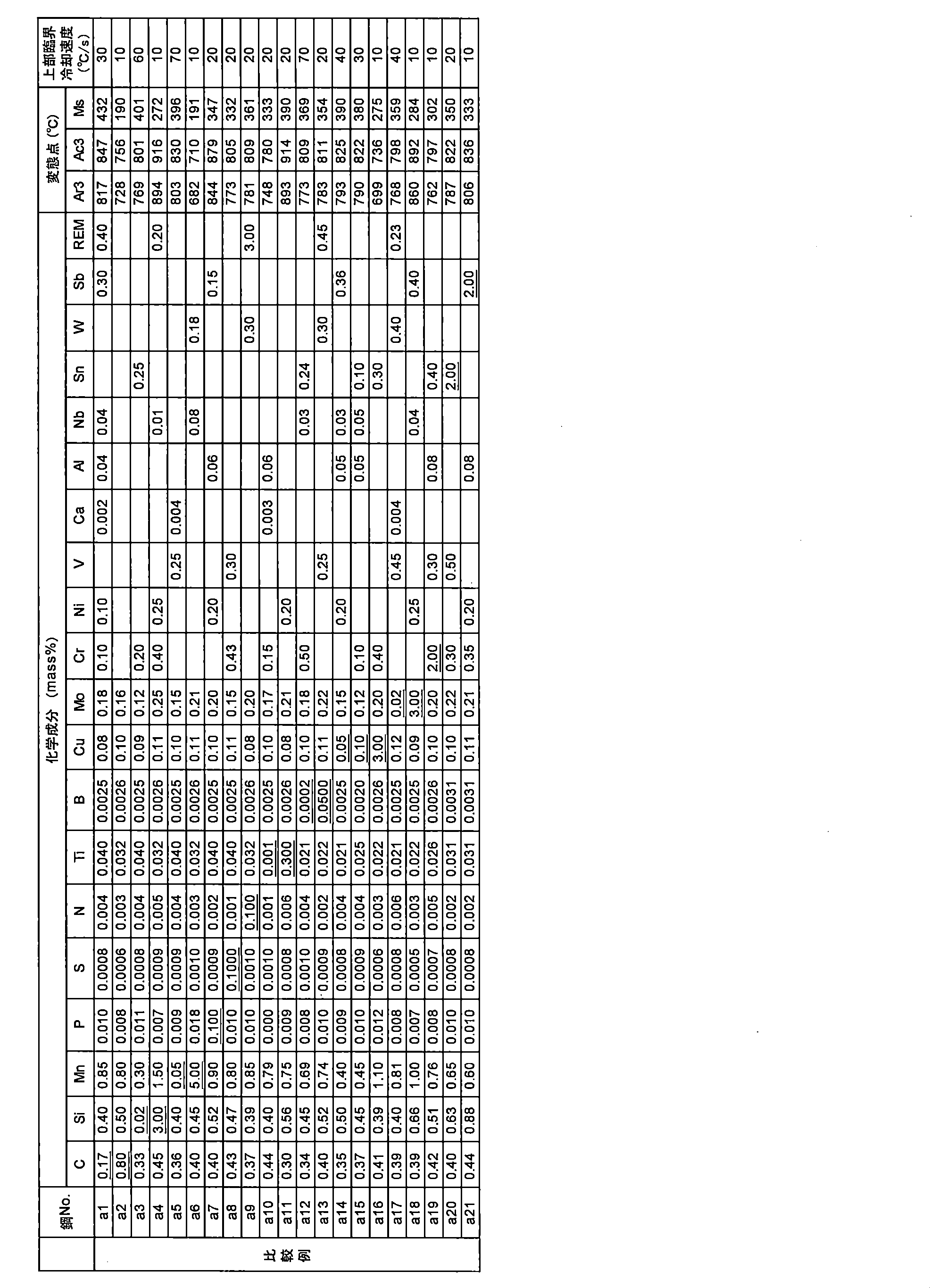
得られたスラブについて、Ar3点、Ac3点、Ms点および上部臨界冷却速度を、次の方法によって求めた。結果を表1-1~1-2に示す。
上記表1-1~1-2のスラブに熱間圧延を施し、厚さ3.0mmの熱延鋼板とした。熱間圧延工程では、スラブ加熱温度を1250℃とし、粗圧延から仕上げ圧延開始におけるパラメータS1を22657とし、仕上げ圧延終了温度を930℃とし、巻き取りまで平均冷却速度20℃/sで冷却し、550℃で巻き取った。
Cuの表面濃化度の測定は以下の手順により行った。
引張試験は、ASTM規格E8の規定に準拠して実施した。鋼部材の均熱部位を1.2mm厚まで研削した後、試験方向が圧延方向に平行になるように、ASTM規格E8のハーフサイズ板状試験片(平行部長さ:32mm、平行部板幅:6.25mm)を採取した。
シャルピー衝撃試験はJIS Z 2242:2018の規定に準拠して実施した。鋼部材の均熱部位を厚さが1.2mmとなるまで研削し、圧延方向に平行に試験片を切出し、これを3枚積層したVノッチ試験片を作製し、試験温度-40℃におけるシャルピー衝撃試験を行い、衝撃値(吸収エネルギー)を求めた。本実施例においては、得られた吸収エネルギーを3枚分のノッチ下断面積で除し、30J/cm2以上の衝撃値を有する場合を靱性に優れると評価することとした。
CCTは、JIS H 8502:1999に記載の中性塩水噴霧サイクル試験方法の規定に準拠してCCTを実施した。鋼部材の均熱部位の表面スケールをショットブラストで取り除き、幅8mm、長さ68mmの短冊状試験片を作製した。そして、試験片表面の幅および長さ方向中心に引張試験と同様のひずみゲージ(ゲージ長:5mm)を貼付け、引張強度の1/2相当のひずみまで4点指示の治具で曲げた。4点曲げした試験片を治具と一緒にCCT装置に入れ、塩水噴霧2h、乾燥4h、湿潤2hを1サイクルとして構成される上記JIS H 8502:1999に記載のCCTにおいて、3サイクル24h毎に観察して、360サイクルまで割れの有無を確認し、割れが発生しない限界のサイクル数を求めた。本実施例においては、5回の試験を行い、平均150サイクルまで水素脆化割れが発生しない場合を腐食環境における耐水素脆性に優れるとした。
チオシアン酸浸漬は、上記の方法で4点曲げした試験片を治具と一緒にチオシアン酸アンモニウム水溶液に浸漬して行った。チオシアン酸アンモニウム水溶液は2Lの蒸留水にチオシアン酸アンモニウム試薬を混ぜ込んで作製し、浸漬開始から72h後に取り出して割れの有無を観察し、同時に300℃までの昇温脱離法で水素量を分析した。チオシアン酸アンモニウム水溶液の濃度を変えることによりチャージする水素量を変えて試験を行い、割れが生じない最も多い水素量を限界水素量とした。本実施例においては、5回の試験を行い、平均0.25mass ppm以上の限界水素量を有する場合を耐水素脆性に優れるとした。
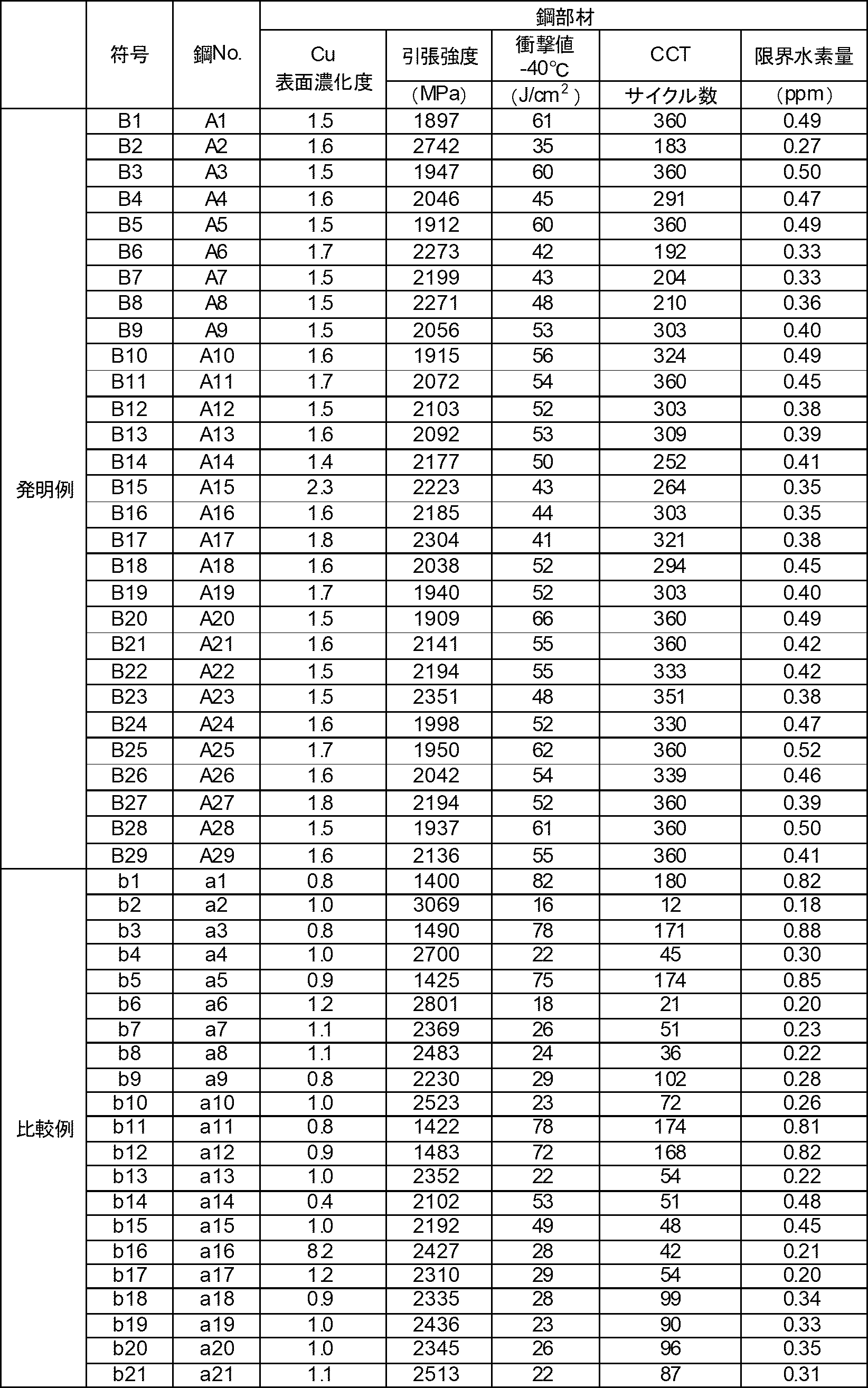
上記表1-1~1-2のスラブに熱間圧延を施し、厚さ3.0mmの熱延鋼板とした。熱間圧延工程では、スラブ加熱温度を1250℃とし、粗圧延終了から仕上げ圧延開始におけるパラメータS1を22657とし、仕上げ圧延終了温度を930℃とし、巻き取りまで20℃/sで冷却し、550℃で巻き取った。パラメータS1は粗圧延終了から仕上げ圧延開始までの時間1~60s、粗圧延終了から仕上げ圧延開始までの粗バーの平均温度950~1150℃の範囲で22657に制御した。その後、上記の熱延鋼板について、濃度12%、温度90℃の塩酸により30s間デスケーリングを施した。その後、冷間圧延試験機によって冷間圧延を施し、厚さ1.4mmの冷延鋼板を得た。
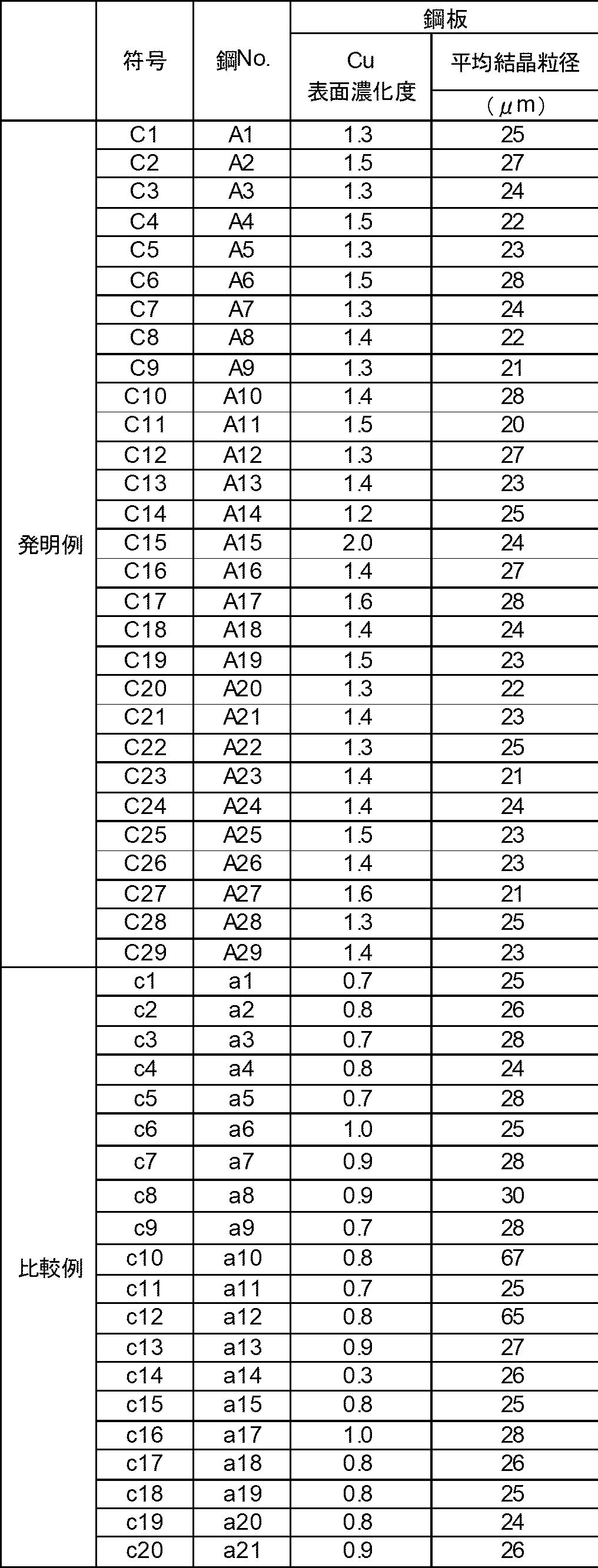
表1-1に示す鋼種のうち、鋼No.A28およびA29の鋼成分を有するスラブに、表4-1、4-2に示す熱間圧延(一部はバーヒーターを使用して加熱)、酸洗(塩酸または硫酸)を施して、熱延鋼板(板厚2.8mm)を製造した。得られた鋼板の組織の評価結果を表4-1、4-2に示す。なお、表4-1、4-2のt1(s)は、粗圧延終了から仕上げ圧延開始までの時間、T1(℃)は粗圧延終了から仕上げ圧延開始までの粗バーの平均温度、S1は(T1+273)×(logt1+20)で求められる値である。ただし、S1の式におけるt1の単位は(hr)である。

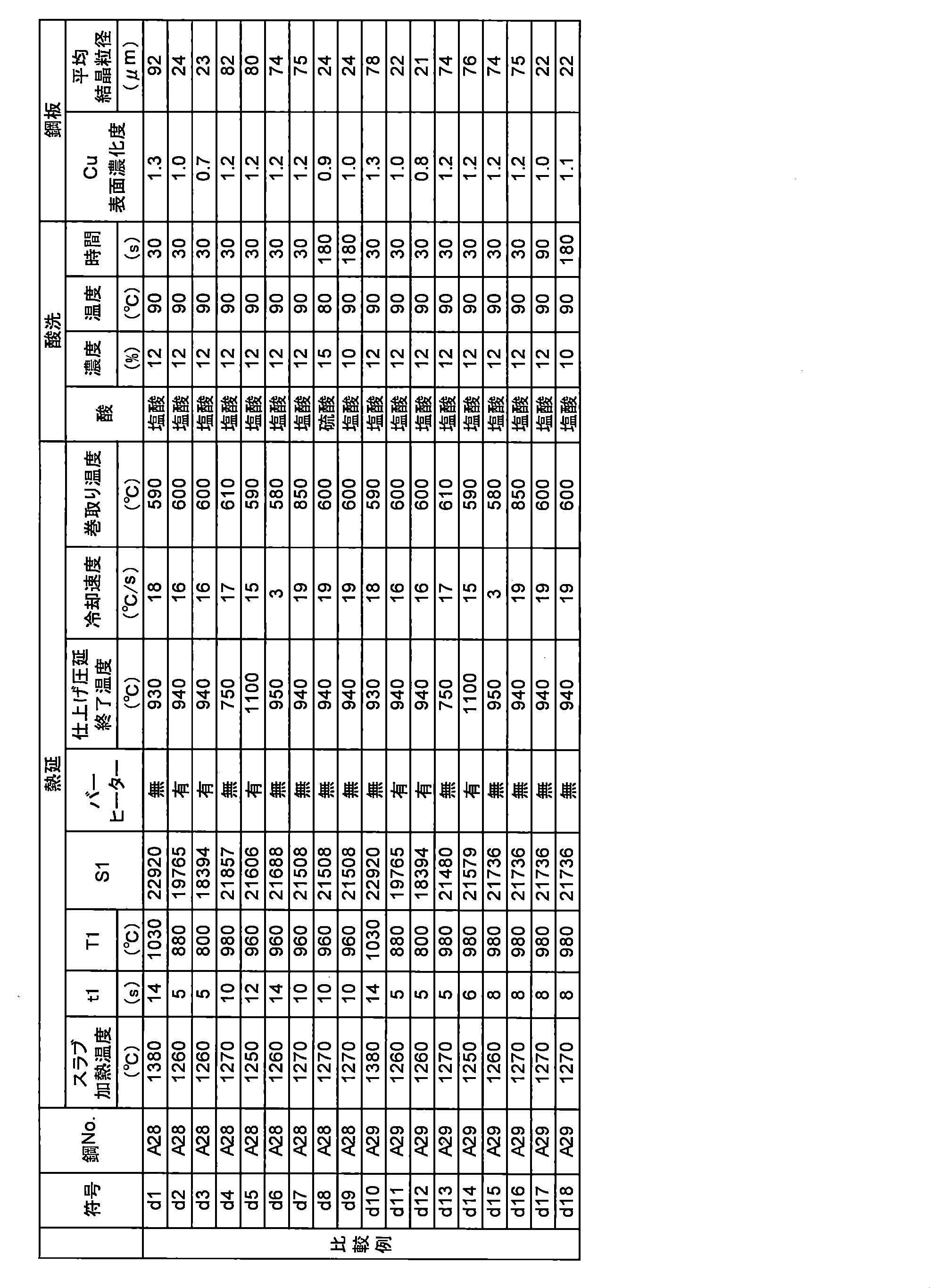
表1-1に示す鋼種のうち、鋼No.A28およびA29の鋼成分を有し、Cuの表面濃化度が1.2以上、結晶粒径30μm以下の冷延鋼板(板厚1.8mm)に、表5に示す熱処理を施して、鋼部材を製造した。
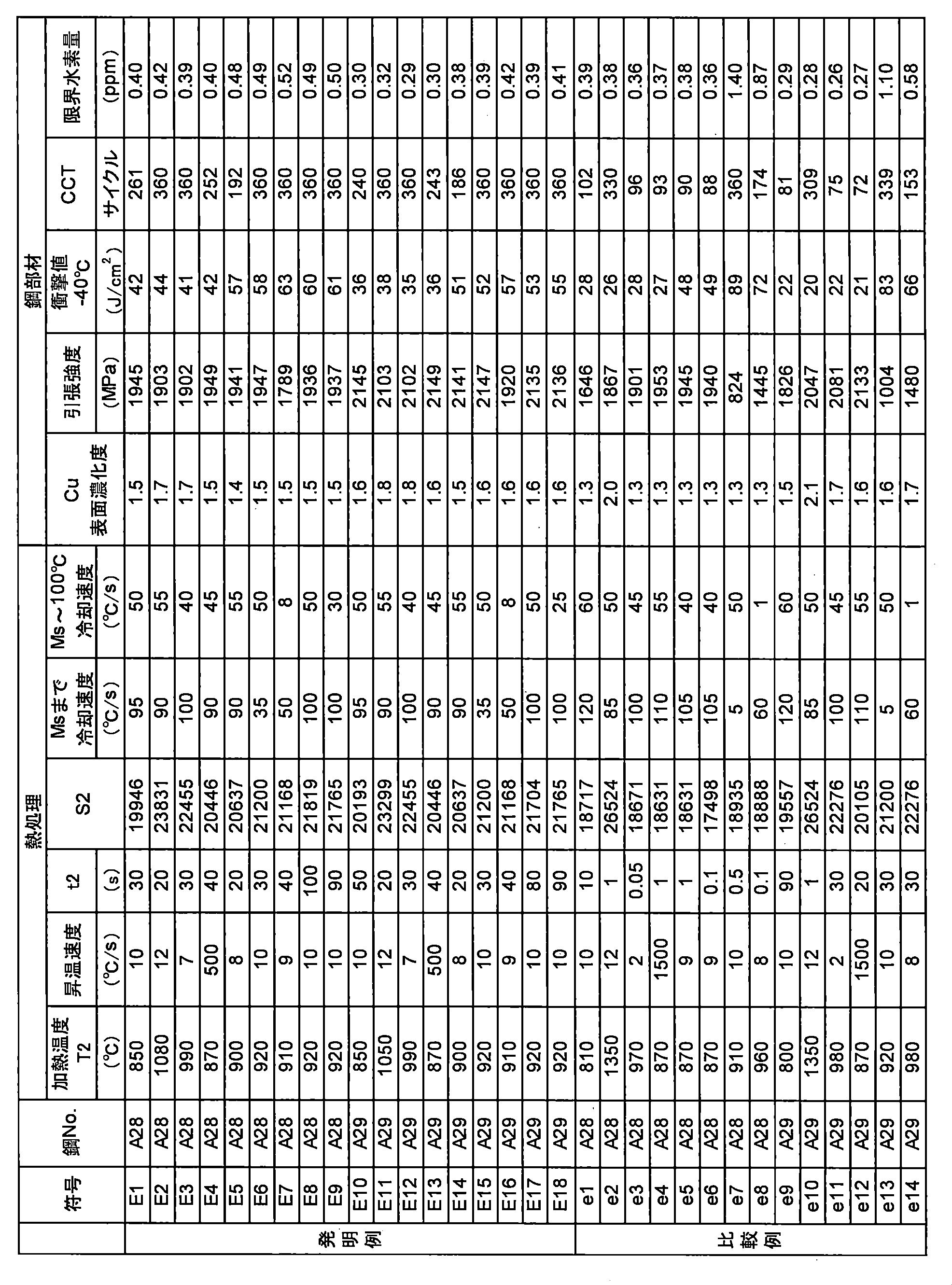
Claims (6)
- 化学組成が、質量%で、
C :0.25~0.60%、
Si:0.25~2.00%、
Mn:0.30~3.00%、
P :0.050%以下、
S :0.0100%以下、
N :0.010%以下、
Ti:0.010~0.100%、
B :0.0005~0.0100%、
Cu:0.15~1.00%、
Mo:0.10~1.00%、
Cr:0~1.00%、
Ni:0~1.00%、
V :0~1.00%、
Ca:0~0.010%、
Al:0~1.00%、
Nb:0~0.10%、
Sn:0~1.00%、
W :0~1.00%、
Sb:0~1.00%、
REM:0~0.30%、
残部:Fe及び不純物
であり、
表面から深さ0~30μmの範囲におけるCu含有量の最大値が、深さ200μmにおけるCu含有量の1.4倍以上である
ことを特徴とする鋼部材。 - 化学組成が、質量%で、
C:0.25~0.60%、
Si:0.25~2.00%、
Mn:0.30~3.00%、
P :0.050%以下、
S :0.0100%以下、
N :0.010%以下、
Ti:0.010~0.100%、
B :0.0005~0.0100%、
Cu:0.15~1.00%、
Mo:0.10~1.00%、
Cr:0~1.00%、
Ni:0~1.00%、
V :0~1.00%、
Ca:0~0.010%、
Al:0~1.00%、
Nb:0~0.10%、
Sn:0~1.00%、
W :0~1.00%、
Sb:0~1.00%、
REM:0~0.30%、
残部:Fe及び不純物
であり、
表面から深さ0~30μmの範囲におけるCu含有量の最大値が、深さ200μmにおけるCu含有量の1.2倍以上であり、
平均結晶粒径が30μm以下
であることを特徴とする鋼板。 - 請求項2に記載の鋼板の製造方法であって、
請求項2に記載の成分を有するスラブを1100~1350℃に加熱し、
粗圧延終了から仕上げ圧延開始までの時間t1(hr)、粗圧延終了から仕上げ圧延開始までの粗バーの平均温度T1(℃)としたとき、(T1+273)×(logt1+20)≧20000、仕上げ圧延終了温度がAr3点~1000℃となる条件で、加熱された上記スラブを熱間圧延して熱延鋼板とする工程、
上記熱延鋼板を平均冷却速度10℃/s以上で冷却する工程、及び
冷却後の鋼板を700℃以下で巻き取る工程、
巻き取り後の鋼板に酸洗を施す工程
を備えることを特徴とする鋼板の製造方法。 - 前記酸洗は、塩酸又は硫酸を用い、酸洗温度が80~90℃であり、酸濃度α(%)、酸洗時間t(s)が、
6≦α<14、
0<t≦420-30×α
を満たす
ことを特徴とする請求項3に記載の鋼板の製造方法。 - 請求項1に記載の鋼部材の製造方法であって、
請求項2に記載の鋼板を、
到達温度をT2(℃)、鋼板の温度がT2(℃)より10℃低い温度に到達してから加熱が終了するまでの時間をt2(hr)としたとき、(T2+273-10)×(logt2+20)≧19000、Ac3点≦T2≦(Ac3点+300)℃、平均昇温速度5~1000℃/sとなる条件で加熱する工程、及び
加熱された鋼板をMs点まで上部臨界冷却速度以上で冷却し、続いて
Ms点から100℃以下まで平均冷却速度5℃/s以上で冷却する工程
を備えることを特徴とする鋼部材の製造方法。 - 前記Ms点までの冷却と同時に、前記鋼板に熱間成形を施すことを特徴とする請求項5に記載の鋼部材の製造方法。
Priority Applications (6)
| Application Number | Priority Date | Filing Date | Title |
|---|---|---|---|
| US17/292,308 US11352684B2 (en) | 2019-02-05 | 2020-02-05 | Steel member, steel sheet, and methods for manufacturing same |
| KR1020217008728A KR102528152B1 (ko) | 2019-02-05 | 2020-02-05 | 강 부재, 강판, 및 그들의 제조 방법 |
| JP2020537676A JP6912007B2 (ja) | 2019-02-05 | 2020-02-05 | 鋼部材、鋼板、及びそれらの製造方法 |
| EP20752025.5A EP3854900B9 (en) | 2019-02-05 | 2020-02-05 | Steel member, steel sheet, and methods for manufacturing same |
| CN202080001387.6A CN111801436B (zh) | 2019-02-05 | 2020-02-05 | 钢构件、钢板及它们的制造方法 |
| MX2021007387A MX2021007387A (es) | 2019-02-05 | 2020-02-05 | Miembro de acero, lamina de acero y metodos para fabricar los mismos. |
Applications Claiming Priority (2)
| Application Number | Priority Date | Filing Date | Title |
|---|---|---|---|
| JP2019-019077 | 2019-02-05 | ||
| JP2019019077 | 2019-02-05 |
Publications (1)
| Publication Number | Publication Date |
|---|---|
| WO2020162509A1 true WO2020162509A1 (ja) | 2020-08-13 |
Family
ID=71948291
Family Applications (1)
| Application Number | Title | Priority Date | Filing Date |
|---|---|---|---|
| PCT/JP2020/004421 Ceased WO2020162509A1 (ja) | 2019-02-05 | 2020-02-05 | 鋼部材、鋼板、及びそれらの製造方法 |
Country Status (7)
| Country | Link |
|---|---|
| US (1) | US11352684B2 (ja) |
| EP (1) | EP3854900B9 (ja) |
| JP (1) | JP6912007B2 (ja) |
| KR (1) | KR102528152B1 (ja) |
| CN (1) | CN111801436B (ja) |
| MX (1) | MX2021007387A (ja) |
| WO (1) | WO2020162509A1 (ja) |
Cited By (4)
| Publication number | Priority date | Publication date | Assignee | Title |
|---|---|---|---|---|
| JP2023535541A (ja) * | 2021-06-04 | 2023-08-18 | ヒュンダイ スチール カンパニー | ホットスタンピング用鋼板及びその製造方法 |
| JPWO2023189175A1 (ja) * | 2022-03-31 | 2023-10-05 | ||
| JP2025527310A (ja) * | 2022-08-07 | 2025-08-20 | 宝山鋼鉄股▲分▼有限公司 | 耐低温脆化性に優れた熱間プレス部品およびその製造方法 |
| JP2025536959A (ja) * | 2022-11-14 | 2025-11-12 | アルセロールミタル | 高靭性プレス硬化鋼部品及びその製造方法 |
Families Citing this family (3)
| Publication number | Priority date | Publication date | Assignee | Title |
|---|---|---|---|---|
| KR102518291B1 (ko) * | 2017-08-18 | 2023-04-04 | 쓰리엠 이노베이티브 프로퍼티즈 컴파니 | 자성 필름 |
| CN112626415A (zh) * | 2020-12-08 | 2021-04-09 | 北京科技大学 | 一种耐应力腐蚀海洋用低合金高强钢的二元合金设计方法 |
| CN113817964B (zh) * | 2021-08-27 | 2022-06-14 | 马鞍山钢铁股份有限公司 | 一种含Cu高耐冲击腐蚀压裂泵阀体用钢及其热处理方法 |
Citations (14)
| Publication number | Priority date | Publication date | Assignee | Title |
|---|---|---|---|---|
| JP2002102980A (ja) | 2000-07-28 | 2002-04-09 | Aisin Takaoka Ltd | 車輌用衝突補強材の製造方法および車輌用衝突補強材 |
| JP2003268489A (ja) | 2002-03-08 | 2003-09-25 | Jfe Steel Kk | 熱処理用鋼板およびその製造方法 |
| KR20090071163A (ko) * | 2007-12-27 | 2009-07-01 | 주식회사 포스코 | 내식성이 우수한 고강도 스프링강 선재 및 그 제조 방법 |
| JP2010111950A (ja) * | 2010-01-26 | 2010-05-20 | Kobe Steel Ltd | 合金化溶融亜鉛めっき鋼板 |
| JP2011122207A (ja) | 2009-12-11 | 2011-06-23 | Jfe Steel Corp | 熱間プレス部材およびその製造方法 |
| JP2011246801A (ja) | 2009-10-28 | 2011-12-08 | Jfe Steel Corp | 熱間プレス部材およびその製造方法 |
| JP2012001816A (ja) | 2009-10-28 | 2012-01-05 | Jfe Steel Corp | 熱間プレス部材 |
| JP2012001802A (ja) | 2010-06-21 | 2012-01-05 | Sumitomo Metal Ind Ltd | 鋼材およびその製造方法ならびに焼入処理用鋼板 |
| JP2012180594A (ja) | 2006-05-10 | 2012-09-20 | Sumitomo Metal Ind Ltd | 熱間プレス成形された鋼板部材および熱間プレス鋼板部材用鋼板ならびにそれらの製造方法 |
| JP2015113500A (ja) | 2013-12-12 | 2015-06-22 | 株式会社神戸製鋼所 | 熱間プレス部品 |
| WO2017141953A1 (ja) * | 2016-02-18 | 2017-08-24 | Jfeスチール株式会社 | 高強度冷延鋼板 |
| WO2017141952A1 (ja) * | 2016-02-18 | 2017-08-24 | Jfeスチール株式会社 | 高強度冷延鋼板 |
| JP2017525849A (ja) | 2014-07-30 | 2017-09-07 | アルセロールミタル | プレス硬化用の鋼板を製作するための方法、および当該方法によって得られた部品 |
| JP2017179589A (ja) | 2016-03-29 | 2017-10-05 | Jfeスチール株式会社 | ホットプレス用鋼板およびその製造方法、ならびにホットプレス部材およびその製造方法 |
Family Cites Families (18)
| Publication number | Priority date | Publication date | Assignee | Title |
|---|---|---|---|---|
| JP4252145B2 (ja) * | 1999-02-18 | 2009-04-08 | 新日鐵住金ステンレス株式会社 | 耐遅れ破壊性に優れた高強度・高靭性ステンレス鋼 |
| JP2002332540A (ja) * | 2001-05-07 | 2002-11-22 | Nippon Steel Corp | レーザー切断性に優れた厚鋼板 |
| JP4898543B2 (ja) * | 2007-05-02 | 2012-03-14 | 株式会社神戸製鋼所 | 耐ピット性に優れた鋼板およびその製造方法 |
| CN102652181B (zh) * | 2010-01-18 | 2014-06-25 | 新日铁住金株式会社 | 焊接变形较小且耐腐蚀性优良的钢板 |
| US9840750B2 (en) | 2011-09-22 | 2017-12-12 | Nippon Steel & Sumitomo Metal Corporation | Medium carbon steel sheet for cold working and method for manufacturing the same |
| WO2013047755A1 (ja) * | 2011-09-30 | 2013-04-04 | 新日鐵住金株式会社 | 耐衝撃特性に優れた高強度溶融亜鉛めっき鋼板およびその製造方法、並びに、高強度合金化溶融亜鉛めっき鋼板およびその製造方法 |
| PL2998414T3 (pl) * | 2013-05-14 | 2019-08-30 | Nippon Steel & Sumitomo Metal Corporation | Walcowana na gorąco blacha stalowa cienka i sposób jej wytwarzania |
| KR101568549B1 (ko) | 2013-12-25 | 2015-11-11 | 주식회사 포스코 | 우수한 굽힘성 및 초고강도를 갖는 열간 프레스 성형품용 강판, 이를 이용한 열간 프레스 성형품 및 이들의 제조방법 |
| WO2016158961A1 (ja) | 2015-03-31 | 2016-10-06 | 新日鐵住金株式会社 | ホットスタンプ用鋼板およびその製造方法、並びにホットスタンプ成形体 |
| KR102034127B1 (ko) | 2015-04-08 | 2019-10-18 | 닛폰세이테츠 가부시키가이샤 | 열처리 강판 부재 및 그것의 제조 방법 |
| JP6620465B2 (ja) | 2015-08-28 | 2019-12-18 | 日本製鉄株式会社 | ホットスタンプ用鋼板 |
| US11591675B2 (en) | 2017-02-20 | 2023-02-28 | Nippon Steel Corporation | Steel sheet and method for producing same |
| US11408045B2 (en) | 2017-02-20 | 2022-08-09 | Nippon Steel Corporation | Steel sheet |
| BR112019017622A2 (pt) * | 2017-03-31 | 2020-03-24 | Nippon Steel Corporation | Chapa de aço laminada a quente, peça de aço forjado, e métodos de produção da mesma |
| JP2019019077A (ja) | 2017-07-18 | 2019-02-07 | ポーラ化成工業株式会社 | 皮膚外用組成物 |
| BR112020001437A2 (pt) | 2017-07-31 | 2020-07-28 | Nippon Steel Corporation | chapa de aço galvanizada por imersão a quente |
| KR102504106B1 (ko) | 2018-04-23 | 2023-02-28 | 닛폰세이테츠 가부시키가이샤 | 강 부재 및 그 제조 방법 |
| EP3922738A4 (en) | 2019-02-05 | 2022-03-23 | Nippon Steel Corporation | STEEL ELEMENT, COATED STEEL SHEET AND METHOD FOR ITS MANUFACTURE |
-
2020
- 2020-02-05 CN CN202080001387.6A patent/CN111801436B/zh active Active
- 2020-02-05 US US17/292,308 patent/US11352684B2/en active Active
- 2020-02-05 EP EP20752025.5A patent/EP3854900B9/en active Active
- 2020-02-05 WO PCT/JP2020/004421 patent/WO2020162509A1/ja not_active Ceased
- 2020-02-05 KR KR1020217008728A patent/KR102528152B1/ko active Active
- 2020-02-05 JP JP2020537676A patent/JP6912007B2/ja active Active
- 2020-02-05 MX MX2021007387A patent/MX2021007387A/es unknown
Patent Citations (14)
| Publication number | Priority date | Publication date | Assignee | Title |
|---|---|---|---|---|
| JP2002102980A (ja) | 2000-07-28 | 2002-04-09 | Aisin Takaoka Ltd | 車輌用衝突補強材の製造方法および車輌用衝突補強材 |
| JP2003268489A (ja) | 2002-03-08 | 2003-09-25 | Jfe Steel Kk | 熱処理用鋼板およびその製造方法 |
| JP2012180594A (ja) | 2006-05-10 | 2012-09-20 | Sumitomo Metal Ind Ltd | 熱間プレス成形された鋼板部材および熱間プレス鋼板部材用鋼板ならびにそれらの製造方法 |
| KR20090071163A (ko) * | 2007-12-27 | 2009-07-01 | 주식회사 포스코 | 내식성이 우수한 고강도 스프링강 선재 및 그 제조 방법 |
| JP2011246801A (ja) | 2009-10-28 | 2011-12-08 | Jfe Steel Corp | 熱間プレス部材およびその製造方法 |
| JP2012001816A (ja) | 2009-10-28 | 2012-01-05 | Jfe Steel Corp | 熱間プレス部材 |
| JP2011122207A (ja) | 2009-12-11 | 2011-06-23 | Jfe Steel Corp | 熱間プレス部材およびその製造方法 |
| JP2010111950A (ja) * | 2010-01-26 | 2010-05-20 | Kobe Steel Ltd | 合金化溶融亜鉛めっき鋼板 |
| JP2012001802A (ja) | 2010-06-21 | 2012-01-05 | Sumitomo Metal Ind Ltd | 鋼材およびその製造方法ならびに焼入処理用鋼板 |
| JP2015113500A (ja) | 2013-12-12 | 2015-06-22 | 株式会社神戸製鋼所 | 熱間プレス部品 |
| JP2017525849A (ja) | 2014-07-30 | 2017-09-07 | アルセロールミタル | プレス硬化用の鋼板を製作するための方法、および当該方法によって得られた部品 |
| WO2017141953A1 (ja) * | 2016-02-18 | 2017-08-24 | Jfeスチール株式会社 | 高強度冷延鋼板 |
| WO2017141952A1 (ja) * | 2016-02-18 | 2017-08-24 | Jfeスチール株式会社 | 高強度冷延鋼板 |
| JP2017179589A (ja) | 2016-03-29 | 2017-10-05 | Jfeスチール株式会社 | ホットプレス用鋼板およびその製造方法、ならびにホットプレス部材およびその製造方法 |
Cited By (7)
| Publication number | Priority date | Publication date | Assignee | Title |
|---|---|---|---|---|
| JP2023535541A (ja) * | 2021-06-04 | 2023-08-18 | ヒュンダイ スチール カンパニー | ホットスタンピング用鋼板及びその製造方法 |
| JPWO2023189175A1 (ja) * | 2022-03-31 | 2023-10-05 | ||
| WO2023189175A1 (ja) * | 2022-03-31 | 2023-10-05 | 日本製鉄株式会社 | ホットスタンプ用鋼板及びホットスタンプ成形体 |
| JP7817621B2 (ja) | 2022-03-31 | 2026-02-19 | 日本製鉄株式会社 | ホットスタンプ用鋼板及びホットスタンプ成形体 |
| JP2025527310A (ja) * | 2022-08-07 | 2025-08-20 | 宝山鋼鉄股▲分▼有限公司 | 耐低温脆化性に優れた熱間プレス部品およびその製造方法 |
| JP2025536959A (ja) * | 2022-11-14 | 2025-11-12 | アルセロールミタル | 高靭性プレス硬化鋼部品及びその製造方法 |
| JP7806347B2 (ja) | 2022-11-14 | 2026-01-26 | アルセロールミタル | 高靭性プレス硬化鋼部品及びその製造方法 |
Also Published As
| Publication number | Publication date |
|---|---|
| JP6912007B2 (ja) | 2021-07-28 |
| CN111801436A (zh) | 2020-10-20 |
| MX2021007387A (es) | 2021-07-15 |
| EP3854900A4 (en) | 2022-04-20 |
| EP3854900B9 (en) | 2025-12-17 |
| US11352684B2 (en) | 2022-06-07 |
| US20210395870A1 (en) | 2021-12-23 |
| CN111801436B (zh) | 2021-10-29 |
| EP3854900A1 (en) | 2021-07-28 |
| EP3854900B1 (en) | 2023-05-03 |
| KR102528152B1 (ko) | 2023-05-04 |
| JPWO2020162509A1 (ja) | 2021-02-18 |
| KR20210050539A (ko) | 2021-05-07 |
Similar Documents
| Publication | Publication Date | Title |
|---|---|---|
| JP6822616B2 (ja) | 被覆鋼部材、被覆鋼板およびそれらの製造方法 | |
| KR102483105B1 (ko) | 피복 강 부재, 피복 강판 및 그것들의 제조 방법 | |
| US8657969B2 (en) | High-strength galvanized steel sheet with excellent formability and method for manufacturing the same | |
| JP6912007B2 (ja) | 鋼部材、鋼板、及びそれらの製造方法 | |
| US9109275B2 (en) | High-strength galvanized steel sheet and method of manufacturing the same | |
| KR101621639B1 (ko) | 강판, 도금 강판 및 그들의 제조 방법 | |
| TW201938816A (zh) | 高強度冷軋鋼板及其製造方法 | |
| KR102512770B1 (ko) | 피복강 부재, 피복강판 및 그것들의 제조 방법 | |
| CN114945690B (zh) | 钢板及其制造方法 | |
| JP6384623B2 (ja) | 高強度鋼板およびその製造方法 | |
| KR102888792B1 (ko) | 핫 스탬프용 강판 및 그 제조 방법, 그리고, 핫 스탬프 부재 및 그 제조 방법 | |
| CN108603262A (zh) | 高屈服比型高强度镀锌钢板及其制造方法 | |
| WO2023190867A1 (ja) | 鋼部材及び鋼板 | |
| JP7755182B2 (ja) | 冷延鋼板及びその製造方法 | |
| WO2023095920A1 (ja) | 鋼部材及び鋼板 | |
| WO2022158469A1 (ja) | 鋼材 | |
| JP6119655B2 (ja) | 鋼帯内における材質のバラツキが小さい成形性に優れた高強度合金化溶融亜鉛めっき鋼帯およびその製造方法 | |
| JP7748014B2 (ja) | 鋼板 | |
| CN114585758A (zh) | 高强度钢板和碰撞吸收构件以及高强度钢板的制造方法 | |
| JP7708344B1 (ja) | 亜鉛めっき鋼板および部材、ならびに、それらの製造方法 | |
| JP7127735B2 (ja) | ホットスタンプ成形品およびその製造方法 | |
| WO2024190769A1 (ja) | 鋼部材及び鋼板 | |
| JP3750600B2 (ja) | 高張力冷延鋼板およびその製造方法 |
Legal Events
| Date | Code | Title | Description |
|---|---|---|---|
| ENP | Entry into the national phase |
Ref document number: 2020537676 Country of ref document: JP Kind code of ref document: A |
|
| 121 | Ep: the epo has been informed by wipo that ep was designated in this application |
Ref document number: 20752025 Country of ref document: EP Kind code of ref document: A1 |
|
| ENP | Entry into the national phase |
Ref document number: 20217008728 Country of ref document: KR Kind code of ref document: A |
|
| ENP | Entry into the national phase |
Ref document number: 2020752025 Country of ref document: EP Effective date: 20210423 |
|
| WWE | Wipo information: entry into national phase |
Ref document number: MX/A/2021/007387 Country of ref document: MX |
|
| NENP | Non-entry into the national phase |
Ref country code: DE |
|
| WWP | Wipo information: published in national office |
Ref document number: MX/A/2021/007387 Country of ref document: MX |
|
| WWG | Wipo information: grant in national office |
Ref document number: MX/A/2021/007387 Country of ref document: MX |