WO2020166676A1 - 次亜塩素酸イオン、及びpH緩衝剤を含む半導体ウェハの処理液 - Google Patents
次亜塩素酸イオン、及びpH緩衝剤を含む半導体ウェハの処理液 Download PDFInfo
- Publication number
- WO2020166676A1 WO2020166676A1 PCT/JP2020/005655 JP2020005655W WO2020166676A1 WO 2020166676 A1 WO2020166676 A1 WO 2020166676A1 JP 2020005655 W JP2020005655 W JP 2020005655W WO 2020166676 A1 WO2020166676 A1 WO 2020166676A1
- Authority
- WO
- WIPO (PCT)
- Prior art keywords
- ruthenium
- treatment liquid
- acid
- treatment
- buffer
- Prior art date
- Legal status (The legal status is an assumption and is not a legal conclusion. Google has not performed a legal analysis and makes no representation as to the accuracy of the status listed.)
- Ceased
Links
Images


Classifications
-
- C—CHEMISTRY; METALLURGY
- C09—DYES; PAINTS; POLISHES; NATURAL RESINS; ADHESIVES; COMPOSITIONS NOT OTHERWISE PROVIDED FOR; APPLICATIONS OF MATERIALS NOT OTHERWISE PROVIDED FOR
- C09K—MATERIALS FOR MISCELLANEOUS APPLICATIONS, NOT PROVIDED FOR ELSEWHERE
- C09K13/00—Etching, surface-brightening or pickling compositions
- C09K13/04—Etching, surface-brightening or pickling compositions containing an inorganic acid
- C09K13/06—Etching, surface-brightening or pickling compositions containing an inorganic acid with organic material
-
- H—ELECTRICITY
- H10—SEMICONDUCTOR DEVICES; ELECTRIC SOLID-STATE DEVICES NOT OTHERWISE PROVIDED FOR
- H10P—GENERIC PROCESSES OR APPARATUS FOR THE MANUFACTURE OR TREATMENT OF DEVICES COVERED BY CLASS H10
- H10P50/00—Etching of wafers, substrates or parts of devices
- H10P50/60—Wet etching
- H10P50/66—Wet etching of conductive or resistive materials
- H10P50/663—Wet etching of conductive or resistive materials by chemical means only
- H10P50/667—Wet etching of conductive or resistive materials by chemical means only by liquid etching only
-
- C—CHEMISTRY; METALLURGY
- C23—COATING METALLIC MATERIAL; COATING MATERIAL WITH METALLIC MATERIAL; CHEMICAL SURFACE TREATMENT; DIFFUSION TREATMENT OF METALLIC MATERIAL; COATING BY VACUUM EVAPORATION, BY SPUTTERING, BY ION IMPLANTATION OR BY CHEMICAL VAPOUR DEPOSITION, IN GENERAL; INHIBITING CORROSION OF METALLIC MATERIAL OR INCRUSTATION IN GENERAL
- C23F—NON-MECHANICAL REMOVAL OF METALLIC MATERIAL FROM SURFACE; INHIBITING CORROSION OF METALLIC MATERIAL OR INCRUSTATION IN GENERAL; MULTI-STEP PROCESSES FOR SURFACE TREATMENT OF METALLIC MATERIAL INVOLVING AT LEAST ONE PROCESS PROVIDED FOR IN CLASS C23 AND AT LEAST ONE PROCESS COVERED BY SUBCLASS C21D OR C22F OR CLASS C25
- C23F1/00—Etching metallic material by chemical means
- C23F1/10—Etching compositions
- C23F1/14—Aqueous compositions
- C23F1/32—Alkaline compositions
- C23F1/40—Alkaline compositions for etching other metallic material
-
- C—CHEMISTRY; METALLURGY
- C23—COATING METALLIC MATERIAL; COATING MATERIAL WITH METALLIC MATERIAL; CHEMICAL SURFACE TREATMENT; DIFFUSION TREATMENT OF METALLIC MATERIAL; COATING BY VACUUM EVAPORATION, BY SPUTTERING, BY ION IMPLANTATION OR BY CHEMICAL VAPOUR DEPOSITION, IN GENERAL; INHIBITING CORROSION OF METALLIC MATERIAL OR INCRUSTATION IN GENERAL
- C23F—NON-MECHANICAL REMOVAL OF METALLIC MATERIAL FROM SURFACE; INHIBITING CORROSION OF METALLIC MATERIAL OR INCRUSTATION IN GENERAL; MULTI-STEP PROCESSES FOR SURFACE TREATMENT OF METALLIC MATERIAL INVOLVING AT LEAST ONE PROCESS PROVIDED FOR IN CLASS C23 AND AT LEAST ONE PROCESS COVERED BY SUBCLASS C21D OR C22F OR CLASS C25
- C23F1/00—Etching metallic material by chemical means
- C23F1/46—Regeneration of etching compositions
Definitions
- the present invention relates to a novel treatment liquid for etching ruthenium existing on a semiconductor wafer, which is used in the manufacturing process of semiconductor devices.
- ruthenium Compared with conventional wiring materials such as aluminum and copper, ruthenium has a high electromigration resistance and can reduce the resistance value of the wiring. Has been done. In addition to the wiring material, ruthenium can prevent electromigration even when copper is used as the wiring material. Therefore, it is also considered to use ruthenium as a barrier metal for copper wiring. ..
- the wiring is formed by dry or wet etching as in the conventional wiring material.
- ruthenium is difficult to dry-etch with an etching gas or to etch and remove by CMP polishing, more precise etching is desired, and more specifically, wet-etching is drawing attention.
- Patent Document 1 as an etching solution for wet-etching ruthenium, an etching solution containing an oxidizing agent having a pH of more than 7, specifically, periodate as an oxidizing agent, boric acid as a buffering agent, and a pH adjusting agent is used.
- An etching solution containing potassium hydroxide is described, and it is described that ruthenium can be selectively etched by the etching solution.
- the etching solution described in Patent Document 1 contains potassium hydroxide as a pH adjusting agent, but potassium may remain on the surface of a semiconductor wafer after etching ruthenium. That is, it was revealed by the study of the present inventors that the potassium hydroxide contained in the etching solution remains as potassium on the surface of the wafer after etching, and the yield of semiconductor elements is reduced.
- the ruthenium etching rate correlates with the pH of the etching solution in the semiconductor element formation process.
- the pH of the etching solution fluctuates during the etching process and affects the etching rate, so that it is necessary to precisely control the addition amount of the pH adjusting agent.
- an object of the present invention is to provide a treatment liquid for etching ruthenium existing on a semiconductor wafer at an etching rate with little fluctuation.
- the inventors of the present invention have made earnest studies to solve the above problems. Then, it was considered to add a pH buffer to the treatment liquid containing hypochlorite ion and tetraalkylammonium ion. As a result, they have found that the pH buffer added to the processing solution can suppress the fluctuation of the pH of the processing solution and the fluctuation of the etching rate of ruthenium, and have completed the present invention.
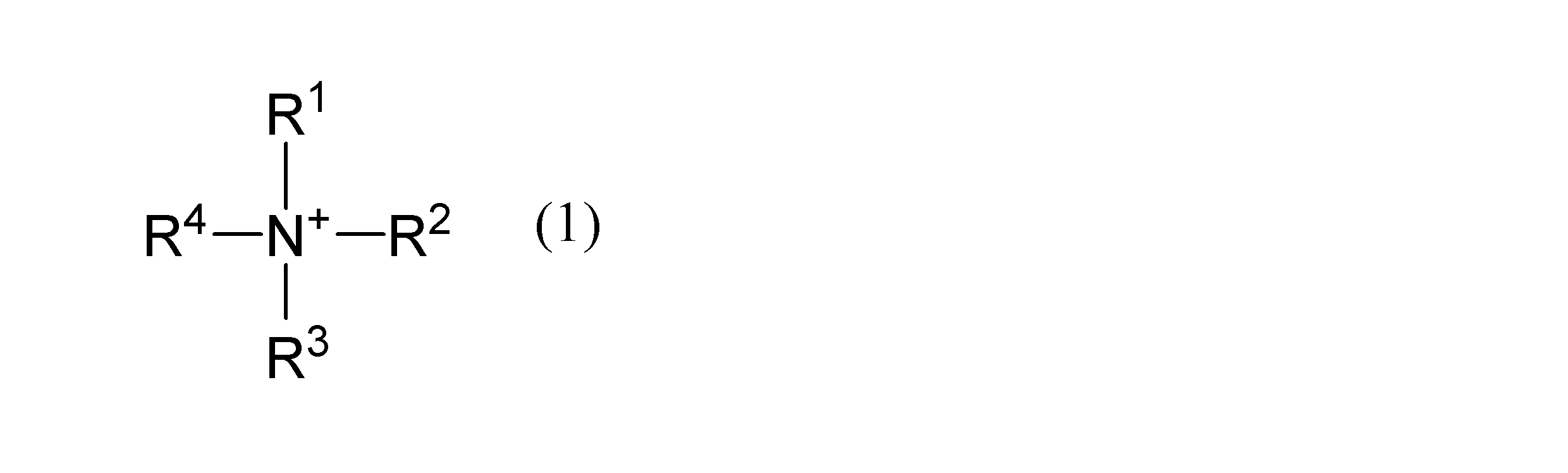
- the present invention is (1) A processing liquid for processing a semiconductor wafer in a semiconductor forming process, (A) hypochlorite ion, (B) pH buffer (C) A treatment liquid containing a tetraalkylammonium ion represented by the following formula (1).
- R 1 , R 2 , R 3 and R 4 are independently an alkyl group having 1 to 20 carbon atoms.
- the present invention can also take the following modes.
- the (B) pH buffer is carbonic acid, boric acid, phosphoric acid, trishydroxymethylaminomethane (tris), ammonia, pyrophosphoric acid, p-phenolsulfonic acid, diethanolamine, ethanolamine, triethanolamine, 5 ,5-diethylbarbituric acid, glycine, glycylglycine, imidazole, N,N-bis(2-hydroxyethyl)-2-aminoethanesulfonic acid, 3-morpholinopropanesulfonic acid, N-tris(hydroxymethyl)methyl -2-aminoethanesulfonic acid, 2-[4-(2-hydroxyethyl)-1-piperazinyl]ethanesulfonic acid, 4-(2-hydroxyethyl)-1-piperazinepropanesulfonic acid, tricine, N,N- The treatment according to any one of (1) to (3), which is at least one selected from the group consisting of di(2-hydroxyethyl
- B pH buffer agent
- C Tetraalkylammonium ion represented by the following formula (1) (In the formula, R 1 , R 2 , R 3 and R 4 are independently an alkyl group having 1 to 20 carbon atoms.)
- B pH buffer agent
- C Tetraalkylammonium ion represented by the following formula (1) (In the formula, R 1 , R 2 , R 3 and R 4 are independently an alkyl group having 1 to 20 carbon atoms.)
- a method for treating a ruthenium-containing waste liquid which comprises using the treatment agent for a ruthenium-containing waste liquid according to any one of (16) to (19).
- the treatment liquid of the present invention can accurately control the ruthenium etching rate.
- the conjugate base of the pH buffer present in the treatment liquid undergoes a neutralization reaction with hydrogen ions, and the change in the pH of the treatment liquid can be suppressed. Can be controlled to be constant.
- the etching rate of ruthenium is high, and the etching rate change due to the pH change due to the ruthenium etching reaction and carbon dioxide gas absorption can be suppressed, and the etching rate during use can be kept constant.
- a processing liquid capable of stably performing precision processing on the order of several nm.
- the treatment liquid of the present invention is a treatment liquid capable of etching ruthenium existing on a semiconductor wafer without damaging the semiconductor wafer, and is a treatment liquid capable of etching ruthenium at an etching rate with little fluctuation. Therefore, the treatment liquid of the present invention is a treatment liquid that can be suitably used in the wiring forming process in the semiconductor manufacturing process.
- the ruthenium to which the treatment liquid of the present invention is applied is mainly formed by the CVD or sputtering method used in the semiconductor element process. By etching the ruthenium formed as the wiring material, the wiring in the semiconductor is formed. 1 and 2 show an example of a wiring forming process. An interlayer insulating film 2 made of a silicon oxide film, a low dielectric constant film or the like is provided on the lower substrate 1, and a ruthenium film 3 is formed thereon. The ruthenium is etched as shown in FIG. 2 to form a wiring using ruthenium as a wiring material.
- the treatment liquid of the present invention can be suitably used for etching ruthenium as described above.
- the treatment liquid is a treatment liquid containing (A) hypochlorite ion, (B) pH buffer agent, and (C) tetraalkylammonium ion.
- A hypochlorite ion
- B pH buffer agent
- C tetraalkylammonium ion
- hypochlorite ion used in the present invention is obtained by dissolving chlorine gas in an alkaline solution and conducting a neutralization reaction. It is also possible to generate hypochlorous acid and hypochlorite ion by dissolving hypochlorite in water.
- the concentration range of hypochlorite ion is preferably 0.05 to 20 mass %. It is possible to etch ruthenium within the above range. When the concentration of hypochlorite ion exceeds 20 mass %, decomposition reaction of hypochlorite ion is likely to occur and accurate control of etching rate cannot be performed. On the other hand, if it is less than 0.05% by mass, the etching rate will be remarkably slow. Therefore, the concentration range of hypochlorite ion is preferably 0.1 to 15% by mass, more preferably 0.3 to 10% by mass, further preferably 0.5 to 7% by mass, Particularly preferably, it is 0.5 to 4% by mass.
- the concentration range of hypochlorite ion is preferably 0.05 to 6 mass %. Within this range, it is possible to suppress fluctuations in the etching rate even after adding the (B) pH buffer. Therefore, considering the etching rate of ruthenium and the stability of hypochlorite ion, the range of hypochlorite ion is more preferably 0.1 to 6% by mass, further preferably 0.3 to 6% by mass, 0.5 to 4 mass% is particularly preferable.
- the concentration of hypochlorite ion of the present invention can be obtained by calculation at the time of manufacturing the treatment liquid, or can be confirmed by directly analyzing the treatment liquid.
- the concentration of hypochlorite ion described in the following examples was determined by measuring the effective chlorine concentration of the treatment liquid. Specifically, referring to the Ministry of Health, Labor and Welfare Notification No. 318 (final revision March 11, 2005), potassium iodide and acetic acid were added to a solution containing hypochlorite ion to release iodine.
- the effective chlorine concentration was calculated by performing redox titration with an aqueous sodium thiosulfate solution, and the hypochlorite ion concentration was calculated from the effective chlorine concentration.
- pH buffering agent used in the present invention is a combination of a weak acid and a conjugate base, and is added to the processing liquid for the purpose of suppressing fluctuation of hydrogen ions in the processing liquid.
- the pH buffer is a substance having a pH buffering ability, and can be used without particular limitation as long as it is a combination of a weak acid and a conjugate base.
- Specific examples of the cationic pH buffering agent that can be preferably used in the present invention include carbonic acid, boric acid, phosphoric acid, trishydroxymethylaminomethane (tris), ammonia, pyrophosphoric acid, p-phenolsulfonic acid, diethanolamine, Ethanolamine, triethanolamine, 5,5-diethylbarbituric acid, glycine, glycylglycine, imidazole, N,N-bis(2-hydroxyethyl)-2-aminoethanesulfonic acid, 3-morpholinopropanesulfonic acid, N-tris(hydroxymethyl)methyl-2-aminoethanesulfonic acid, 2-[4-(2-hydroxyethyl)-1-piperazinyl]ethanesulfonic acid, 4-(2-
- pH buffer only one kind of pH buffer may be added, or two or more kinds of pH buffers may be added in combination.
- pH buffering agents By combining two or more types of pH buffering agents, even if the pH of the treatment liquid becomes highly alkaline, fluctuations in pH can be suppressed.
- pH is expressed as a value at 25°C.
- a pH buffer containing at least boric acid, carbonic acid or phosphoric acid it is preferable to use.
- boric acid the pH of the treatment liquid is 8.2 to 10.2
- carbonic acid when used, when the pH of the treatment liquid is 9.3 to 11.3, and when phosphoric acid is used.
- these pH buffering agents may be used alone or in a mixture thereof.
- ruthenium when etched, it is preferable to use a pH buffering agent that is not adsorbed on the surface of ruthenium.
- the concentration of the pH buffer in the treatment liquid is preferably 0.0001 to 10% of the total mass of the treatment liquid, more preferably 0.001 to 8%, and further preferably 0.01. ⁇ 6%. Within the range of 0.1 to 6%, it is possible to suppress the fluctuation of the pH of the treatment liquid within a range that does not affect the etching rate.
- the content of the pH buffer in the treatment liquid of the present invention is in the range of 0.0001 to 10% of the total mass, it becomes possible to stabilize the pH of the treatment liquid and further suppress the increase in viscosity of the treatment liquid. This is preferable because it can be performed. If the viscosity of the treatment liquid is high, it tends to be difficult to apply the treatment liquid to a finely-divided wiring process. Therefore, the content of the pH buffer in the above range is preferable. Further, if it is within the above range, the pH buffer agent is sufficiently dissolved in the treatment liquid, and the object to be etched is not contaminated by reprecipitation of the pH buffer agent or the like, which is preferable.
- the treatment liquid of the present invention can suppress fluctuations in the ruthenium etching rate by adding a pH buffer. That is, even if the pH of the treatment liquid changes, the conjugate base of the pH buffer present in the treatment liquid undergoes a neutralization reaction with hydrogen ions, and the pH of the treatment liquid changes due to disturbance such as contact with outside air or etching reaction. Can be suppressed. As a result, it is considered that the fluctuation of the ruthenium etching rate can be suppressed.
- the pH adjusting agent of the present invention is an acid or alkali different from the above pH buffering agent, for example, an acid such as hydrochloric acid, sulfuric acid, nitric acid, etc., and an alkylammonium hydroxide such as tetramethyl hydroxide. It is an alkali such as ammonium or choline.
- an acid such as hydrochloric acid, sulfuric acid, nitric acid, etc.
- an alkylammonium hydroxide such as tetramethyl hydroxide. It is an alkali such as ammonium or choline.
- the range in which the pH is stably present is determined by the combination of the pH adjuster and the pH buffer in the treatment liquid.
- the pH of the treatment solution can be stabilized at 8.2 to 10.2, and the ruthenium etching rate can be stabilized. Can be suppressed. Further, since a compound containing an alkali metal such as potassium hydroxide or sodium hydroxide is not used as a pH adjuster, alkali metal contamination such as potassium or sodium is not observed on the surface of the semiconductor substrate after etching, which is preferable. Can be used for
- (C) Tetraalkylammonium ion In the present invention, a tetraalkylammonium ion represented by the following formula (1) is contained in the treatment liquid in order to adjust the pH of the treatment liquid.
- R 1 , R 2 , R 3 and R 4 are independently an alkyl group having 1 to 20 carbon atoms.
- R 1 , R 2 , R 3 and R 4 in the above formula (1) are preferably the same alkyl groups having 1 to 3 carbon atoms. Further, R 1 , R 2 , R 3 and R 4 in the above formula (1) are all preferably methyl or ethyl, and particularly preferably methyl.
- the concentration range of tetraalkylammonium ions is preferably 0.1 to 30% by mass.
- concentration of tetraalkylammonium ions satisfies this range, ruthenium can be etched. As a result, stable etching can be performed, and a treatment liquid having excellent long-term storage stability can be obtained.
- the concentration of tetraalkylammonium ion is more preferably 0.15 to 25% by mass, further preferably 0.3 to 21% by mass, and particularly preferably 0.5. It is up to 15% by mass.
- concentration range, the preferable concentration range, and the more preferable concentration range described above are applicable to any specific example of the tetraalkylammonium ion represented by the formula (1) as exemplified by the tetramethylammonium ion. It is possible.
- solvent in the treatment liquid of the present invention, in addition to the components (A), (B), and (C), the remaining components other than the optional pH adjuster and other additives described below are solvents, and After adjusting A), (B), (C), the pH adjuster, and other additives, the residue is adjusted with a solvent so that the total amount becomes 100% by mass.
- the solvent may contain an anion.
- anion chloride ion, hydroxide ion and the like can be considered.
- the solvent is not particularly limited, and an organic solvent, water, etc. can be used.
- an organic solvent an organic solvent that is stable even in the presence of the hypochlorite ion present in the treatment liquid is preferable, and examples thereof include acetonitrile and sulfolane.
- water water from which metal ions, organic impurities, particle particles and the like have been removed by distillation, ion exchange treatment, filter treatment, various adsorption treatments and the like is preferable, and pure water and ultrapure water are particularly preferable. ..
- the treatment liquid of the present invention comprises the (A) hypochlorite ion, the (B) pH buffer agent, the (C) tetraalkylammonium ion, and other additives to be blended as necessary as described in detail below. , The balance comprising the solvent. In addition, if necessary, a pH adjusting agent is included. Suitable (A) hypochlorite ion concentration (0.05 to 20% by mass), (B) pH buffer concentration (0.0001 to 10% by mass), (C) tetraalkylammonium ion concentration (0.1 (About 30% by mass), and the pH of the treatment liquid can be easily made less than 14 by using a pH adjusting agent as necessary.
- the pH of the treatment liquid of the present invention becomes less than 14 depending on the amount of each component, even if the ruthenium is oxidized, dissolved and removed, the pH of the treatment liquid does not change and can be stably removed.
- the pH of the treatment liquid is 14 or more, the ruthenium etching rate is significantly reduced.
- the pH of the treatment liquid is preferably 7 or more and less than 14, more preferably 7.5 or more and less than 13.5, and even more preferably 9 or more and less than 13.
- a preferable upper limit of pH of the treatment liquid for example, when boric acid is used as a pH buffer, it can be less than 10.
- the treatment liquid of the present invention may optionally contain additives conventionally used in the treatment liquid for semiconductors within a range not impairing the object of the present invention.
- additives conventionally used in the treatment liquid for semiconductors within a range not impairing the object of the present invention.
- an acid an alkali, a metal anticorrosive, a water-soluble organic solvent, a fluorine compound, an oxidizing agent, a reducing agent, a chelating agent, a surfactant, an antifoaming agent or the like can be added.
- the etching conditions using the treatment liquid of the present invention are such that the temperature is in the range of 10 to 80° C., preferably 20 to 70° C., and may be appropriately selected according to the etching conditions of the etching apparatus used.
- the time for using the treatment liquid of the present invention is in the range of 0.1 to 120 minutes, preferably 0.5 to 60 minutes, and may be appropriately selected depending on the etching conditions and the semiconductor element used.
- An organic solvent such as alcohol may be used as the rinse liquid after using the treatment liquid of the present invention, but it is sufficient to rinse with deionized water.
- the treatment liquid of the present invention can have an etching rate of noble metals, particularly ruthenium, of 20 ⁇ or more/minute or more, preferably 50 ⁇ /minute or more.
- an etching rate of noble metals particularly ruthenium
- the treatment liquid of the present invention can be suitably used as a treatment liquid for etching ruthenium.
- the treatment liquid of the present invention also has a function of suppressing RuO 4 gas generation.
- the mechanism is speculated as follows. That is, in an alkaline treatment liquid, anions such as RuO 4 ⁇ and RuO 4 2 ⁇ generated by dissolution of ruthenium (hereinafter, also referred to as RuO 4 ⁇ , etc.) are regarded as onium ions contained in the treatment liquid. They interact electrostatically, and part of them stably exist as an ion pair. As a result, the change from RuO 4 ⁇ or the like to RuO 4 is prevented, and as a result, the generation of RuO 4 gas is suppressed.
- the effect of suppressing the RuO 4 gas by the addition of the tetraalkylammonium ion represented by the formula (1) depends on the type and amount of the oxidizing agent and other additives contained in the treatment liquid, and the treatment method.
- the processing conditions are not limited thereto.
- the oxidant contained in the treatment liquid of the present invention is a hypochlorite ion, but the tetraalkylammonium ion represented by the formula (1) contained in the treatment liquid is contained regardless of the amount of the oxidant.
- the method of treating a semiconductor wafer with the treatment liquid of the present invention is not limited to wet etching, and can be suitably used as a treatment liquid for cleaning applications and residue removal applications. Furthermore, by using the treatment liquid of the present invention for CMP polishing, it is possible to suppress the generation of RuO 4 gas even in the CMP polishing step.
- the treatment of the wafer containing ruthenium with the treatment liquid of the present invention may be a single-wafer treatment or an immersion treatment.
- the temperature of the treatment liquid is not particularly limited, and at any treatment temperature, the tetraalkylammonium ion represented by the formula (1) contained in the treatment liquid exerts the RuO 4 gas suppressing effect.
- the ruthenium-containing gas generation inhibitor suppresses the generation of ruthenium-containing gas by adding it to a liquid for treating ruthenium.
- the ruthenium-containing gas generation inhibitor and the tetraalkyl represented by the formula (1) are used. It refers to a liquid containing ammonium ions.
- the liquid for treating ruthenium may be any liquid as long as it contains a component that comes into contact with ruthenium and imparts a physical or chemical change to the ruthenium, and examples thereof include a solution containing an oxidizing agent. ..
- Examples of the oxidizing agent include hypochlorite ion as exemplified in the above description.
- Ruthenium treated with a solution for treating ruthenium causes all or part of the ruthenium to dissolve, disperse, or precipitate in the treatment solution to produce RuO 4 (gas) and/or RuO 2 (particles). Become. Since formation of RuO 4 (solution) and RuO 2 (particles) depends on pH, it is preferable that the pH of the treatment liquid containing ruthenium does not change. By containing the pH buffer in the ruthenium-containing gas generation inhibitor, it is possible to suppress the pH fluctuation of the treatment liquid containing the gas generation inhibitor.
- the pH buffering agent the pH buffering agent exemplified in the above description can be used without any limitation.
- a liquid containing a liquid for treating ruthenium and a ruthenium-containing gas generation inhibitor of the present invention also referred to as a treatment liquid containing a gas generation inhibitor
- RuO 4 -, etc. present in the treatment liquid a tetraalkyl ammonium ion, by forming an ion pair which is soluble in the process solution, RuO 4 - RuO 4 (solution) and inhibits the production of RuO 2 (particles) from the like. This is because the amount of RuO 4 (gas) generated from RuO 4 (solution) is significantly reduced, and the generation of RuO 2 (particles) generated from RuO 4 (gas) is suppressed.
- the treatment liquid of the present invention contains the tetraalkylammonium ion represented by the above formula (1) and the pH buffering agent, a ruthenium-containing semiconductor wafer is treated without generating RuO 4 gas. It is a processing liquid that can be used. That is, the treatment liquid of the present invention is a liquid for treating ruthenium, and at the same time is a generation inhibitor for a ruthenium-containing gas. Therefore, the treatment liquid of the present invention can also be used as a ruthenium-containing gas generation inhibitor.
- the ruthenium-containing gas generation inhibitor of the present invention may not include (A) hypochlorite ion contained in the treatment liquid of the present invention.
- the content of the tetraalkylammonium represented by the above formula (1) contained in the ruthenium-containing gas generation inhibitor may be 0.0001 to 50% by mass. , 0.01 to 35% by mass, more preferably 0.1 to 20% by mass.
- this concentration is calculated by the formula (1) together with the above-mentioned pH buffer in the liquid that is the target for suppressing the generation of the ruthenium-containing gas, that is, the mixed liquid when mixed with the liquid for treating ruthenium.
- the concentration of the liquid containing the tetraalkylammonium ion represented can be adjusted to a predetermined amount.
- the same ruthenium-containing gas generation inhibitor as described above may be appropriately added.
- the content of the pH adjuster can be adjusted so that the pH of the mixed solution when mixed with the solution for treating ruthenium falls within a predetermined range, as described later.
- the content of the pH adjusting agent in the ruthenium-containing gas generation inhibitor may be an effective amount, and specifically 0.000001 to 10 mass% can be exemplified.
- boric acid when boric acid is used, the pH of the treatment liquid containing the gas generation inhibitor is 8.2 to 10.2, and when carbonic acid is used, the pH of the treatment liquid containing the gas generation inhibitor is 9.
- the pH is 3 to 11.3
- when phosphoric acid is used the desired pH buffering ability is expected when the pH of the treatment liquid containing the gas generation inhibitor is 11.4 to 13.4.
- These pH buffering agents may be used alone or in a mixture of them.
- the concentration of each pH buffer agent in the treatment liquid containing the gas generation inhibitor is preferably 0.0001 to 10% of the total mass of the treatment liquid containing the gas generation inhibitor, and more preferably 0. It is 001 to 8%, more preferably 0.01 to 6%. Within the range of 0.1 to 6%, the fluctuation of the pH of the treatment liquid is suppressed within a range that does not affect the etching rate, and a sufficient ruthenium-containing gas generation suppressing effect can be obtained.
- the method for suppressing the generation of a ruthenium-containing gas of the present invention is a method for suppressing the generation of a ruthenium-containing gas, which includes a step of adding the above-mentioned generation inhibitor for a ruthenium-containing gas to a liquid for treating ruthenium.
- a liquid a liquid for treating ruthenium
- the addition of a ruthenium-containing gas generation inhibitor can suppress the generation of ruthenium-containing gas.
- the use of a liquid containing a ruthenium-containing gas generation inhibitor suppresses the generation of ruthenium-containing gas. it can.
- the ruthenium-containing gas of the present invention is added to a cleaning liquid used for removing ruthenium adhering to a chamber, a pipe or the like.
- the generation inhibitor it becomes possible to suppress the ruthenium-containing gas generated during cleaning. According to the method, the generation of the ruthenium-containing gas can be suppressed by the mechanism shown in the description of the ruthenium-containing gas generation inhibitor.
- the concentration of the pH buffer and the tetraalkylammonium ion represented by the formula (1) in the mixed liquid of the ruthenium-containing gas generation suppressing agent and the solution for treating ruthenium is It is preferable to adjust the concentration of the onium salt in the ruthenium-containing gas generation inhibitor and the addition amount thereof so that the respective amounts are 0.0001 to 50% by mass.
- the content of the pH adjuster in the ruthenium-containing gas generation inhibitor and the addition amount of the ruthenium-containing gas generation inhibitor are treated with ruthenium.
- the pH of the mixed solution when mixed with the solution for controlling can be appropriately adjusted to, for example, 7-14.
- the amount of the ruthenium-containing gas generation inhibitor added to the liquid for treating ruthenium depends on the amount of ruthenium dissolved in the treatment liquid containing the gas generation inhibitor.
- the addition amount of the ruthenium-containing gas generation inhibitor is not particularly limited, but for example, when the amount of ruthenium dissolved in the liquid for treating ruthenium is 1, the weight ratio is preferably 10 to 500000, more preferably It is 100 to 100,000, and more preferably 1000 to 50,000.
- the treatment agent for a ruthenium-containing waste liquid according to the present invention suppresses the generation of a ruthenium-containing gas by adding it to a ruthenium-containing waste liquid.
- the tetraalkylammonium ion represented by the above formula (1) and a pH buffering agent are used.
- a liquid containing and. Therefore, the treatment liquid containing the tetraalkylammonium ion represented by the above formula (1) can be used as a treatment agent for the ruthenium-containing waste liquid by utilizing the effect of suppressing the generation of the ruthenium-containing gas.
- the ruthenium-containing waste liquid means a solution containing ruthenium even in a small amount.
- ruthenium is not limited to ruthenium metal, but may include ruthenium element, and examples thereof include Ru, RuO 4 ⁇ , RuO 4 2 ⁇ , RuO 4 and RuO 2 .
- a semiconductor wafer containing ruthenium was subjected to an etching treatment using an etching liquid different from the treatment liquid of the present invention, or a treatment liquid for a semiconductor wafer of the present invention. The liquid after it can be mentioned.
- the invention is not limited to the etching of the semiconductor wafer, but the ruthenium-containing liquid generated by the semiconductor manufacturing process or the chamber cleaning as described in the method for suppressing the generation of the ruthenium-containing gas is one example.
- RuO 2 particles are generated via the RuO 4 gas, which pollutes the tank and piping and accelerates the deterioration of the devices due to the oxidizing action of the particles. Further, RuO 4 gas generated from the waste liquid is highly toxic to the human body even at a low concentration. As described above, since the ruthenium-containing waste liquid has various adverse effects on the equipment and the human body, it is necessary to promptly treat it to suppress the generation of RuO 4 gas. By adding the ruthenium-containing waste liquid treating agent of the present invention to the ruthenium-containing waste liquid, it is possible to prevent the pH of the ruthenium-containing waste liquid from fluctuating and increasing RuO 4 gas and RuO 2 particles.
- the pH of the ruthenium-containing waste liquid decreases due to the incorporation of carbon dioxide, and RuO 4 gas and RuO 2 particles increase, but the ruthenium-containing waste liquid is treated with the ruthenium-containing waste liquid of the present invention. Since the pH fluctuation is suppressed by adding the agent, it is possible to suppress the generation amount of RuO 4 gas and RuO 2 particles to be low.
- the treatment agent for a ruthenium-containing waste liquid of the present invention regarding the content of the tetraalkylammonium ion represented by the above formula (1), other components and the content thereof, and the conditions such as pH, the above-mentioned treatment for semiconductor wafers is performed. The same conditions as described in the liquid description can be applied.
- the treatment agent for a ruthenium-containing waste liquid of the present invention does not need to include (A) hypochlorite ion contained in the treatment liquid of the present invention.
- the content of the tetraalkylammonium represented by the above formula (1) in the treatment agent for the ruthenium-containing waste liquid may be 0.0001 to 50% by mass.
- this concentration can be adjusted so that the concentration of the tetraalkylammonium of the above formula (1) in the mixed liquid when mixed with the ruthenium-containing waste liquid becomes a predetermined amount.
- the treating agent for the ruthenium-containing waste liquid the same one as the above-mentioned pH adjusting agent may be appropriately added.
- the content of the pH adjusting agent can be adjusted so that the pH of the mixed liquid when mixed with the ruthenium-containing waste liquid falls within a predetermined range, as described later.
- the content of the pH adjusting agent in the ruthenium-containing waste liquid treating agent may be any effective amount, and specifically, 0.000001 to 10 mass% can be exemplified.
- boric acid when boric acid is used, the pH of the ruthenium-containing waste liquid treating agent is 8.2 to 10.2, and when carbonic acid is used, the pH of the ruthenium-containing waste liquid treating agent is 9.3 to 11.3.
- phosphoric acid a desirable pH buffering ability is expected when the pH of the treating agent for the ruthenium-containing waste liquid is 11.4 to 13.4.
- These pH buffering agents may be used alone or in a mixture of them.
- the concentration of each pH buffer agent in the ruthenium-containing waste liquid treating agent is preferably 0.0001 to 10%, and more preferably 0.001 to 8% of the total mass of the ruthenium-containing waste liquid treating agent. , And more preferably 0.01 to 6%. Within the range of 0.1 to 6%, the fluctuation of the pH of the treatment agent for the ruthenium-containing waste liquid can be suppressed within a range that does not affect the etching rate, and a sufficient ruthenium-containing gas generation suppressing effect can be obtained.
- the method for treating a ruthenium-containing waste liquid according to the present invention is a method for treating a ruthenium-containing waste liquid, which comprises a step of adding the above-mentioned treating agent for a ruthenium-containing waste liquid to a ruthenium-containing waste liquid described later.
- the ruthenium-containing gas generated from the ruthenium-containing waste liquid can be suppressed by the mechanism shown in the above description of the ruthenium-containing gas generation inhibitor. Therefore, not only is it easy to handle the ruthenium-containing waste liquid, but also the exhaust equipment and the exclusion equipment can be simplified, and the cost for processing the ruthenium-containing gas can be reduced.
- the concentrations of the tetraalkylammonium ion represented by the above formula (1) and the pH buffer in the mixed liquid of the ruthenium-containing waste liquid treating agent and the ruthenium-containing waste liquid are, for example, It is preferable to adjust the concentration of the pH buffer agent and the tetraalkylammonium ion represented by the formula (1) in the treatment agent for the ruthenium-containing waste liquid and the addition amount thereof so that the respective amounts are 0.0001 to 50% by mass. ..
- the same agent as the above pH adjuster may be appropriately added to the treatment agent for the ruthenium-containing waste liquid.
- the pH of the mixed liquid when mixed with the ruthenium-containing waste liquid is, for example, 7 to 14, It can be adjusted appropriately.
- the amount of the ruthenium-containing waste liquid treating agent added to the ruthenium-containing waste liquid depends on the amount of ruthenium in the ruthenium-containing waste liquid.
- the amount of the treating agent added to the ruthenium-containing waste liquid is not particularly limited, but, for example, when the amount of ruthenium in the ruthenium-containing waste liquid is 1, the weight ratio is preferably 10 to 500,000, more preferably 100 to 100,000. It is preferably 1,000 to 50,000.
- PH measuring method After preparing 30 mL of the treatment liquids of Examples 1 to 12 and Comparative Examples 1 to 6, the pH was measured using a desktop pH meter (LAQUA F-73, manufactured by Horiba Ltd.). The pH measurement was performed after the temperature of the treatment liquid was stabilized at 25°C.
- the prepared brown solution was subjected to redox titration using a 0.02 M sodium thiosulfate solution (manufactured by Fujifilm Wako Pure Chemical Industries, for volumetric analysis) until the color of the solution changed from brown to a very pale yellow, and then the starch solution was added. Add a light purple solution. To this solution was further added 0.02 M sodium thiosulfate solution continuously, and the effective chlorine concentration was calculated with the point at which it became colorless and transparent as the end point. The hypochlorite ion concentration was calculated from the obtained effective chlorine concentration. For example, if the effective chlorine concentration is 1%, the hypochlorite ion concentration will be 0.73%.
- the alkylammonium ion concentration in the treatment liquids of Examples 1 to 15 and Comparative Examples 1 to 6 was calculated from the pH and the hypochlorite ion concentration.
- the buffer concentration was analyzed using an ion chromatography analyzer (DIONEX INTEGRION HPLC, manufactured by Thermo SCIENTIFIC). Using KOH as an eluent, 1.2 mL/min. The liquid was passed at a flow rate of. An anion analysis column for hydroxide eluent (AS15, manufactured by Thermo SCIENTIFIC) was used as a column, and the column temperature was 30°C. After removing background noise with a suppressor, the carbonic acid concentration and phosphoric acid concentration were quantified with an electric conductivity detector.
- DIONEX INTEGRION HPLC manufactured by Thermo SCIENTIFIC
- the amount of RuO 4 gas generated was measured using ICP-OES. 5 mL of the treatment liquid was placed in an airtight container, and one 10 ⁇ 20 mm Si wafer on which a ruthenium film having a film thickness of 1200 ⁇ was formed was immersed at a temperature shown in Table 4 for 60 minutes. The weight when all the ruthenium was dissolved was 0.000298 g. After that, Air was flown into the airtight container, the gas phase in the airtight container was bubbled into the container containing the absorbing solution (1 mol/L NaOH), and the RuO 4 gas generated during the immersion was trapped in the absorbing solution.
- the amount of ruthenium in this absorbing solution was measured by ICP-OES, and the amount of ruthenium in the generated RuO 4 gas was determined.
- the fact that all of the ruthenium on the Si wafer immersed in the treatment solution was dissolved was measured by the four-probe resistance measuring device (Loresta-GP, manufactured by Mitsubishi Chemical Analytech Co., Ltd.), and the sheet resistance before and after the immersion was measured, respectively. Confirmed by converting to thickness.
- Example 1> (Preparation of sample for etching) A silicon wafer whose surface was cleaned was prepared and a thermal oxide film having a predetermined thickness was formed. A ruthenium film was formed on the silicon wafer thus obtained by a sputtering method to prepare a sample in which ruthenium was laminated on a silicon wafer having a film thickness of 200 ⁇ .
- thermometer protection tube manufactured by Cosmos Bead Co., bottom sealing type
- a gas cleaning bottle (AsOne, gas cleaning bottle, model number 2450/500) filled with a 5% by mass aqueous sodium hydroxide solution. did.
- nitrogen gas having a carbon dioxide concentration of less than 1 ppm was flown from a PFA tube at 0.289 Pa ⁇ m 3 /sec (at 0° C. conversion) for 20 minutes to drive out carbon dioxide in the gas phase. At this time, the carbon dioxide concentration in the gas phase was 1 ppm or less.
- a magnet stirrer (C-MAG AG HS10 manufactured by AsOne Co., Ltd.) was installed in the lower part of the three-necked flask, rotated and stirred at 300 rpm, and while cooling the outer peripheral part of the three-necked flask with ice water, chlorine gas (Fujiox, specified purity 99.4%) was supplied at 0.064 Pa ⁇ m 3 /sec (at 0° C. conversion) for 180 minutes to obtain a tetramethylammonium hypochlorite solution. At this time, the liquid temperature during the reaction was 11°C.
- the obtained solution was transferred to a glove bag in a glass three-necked flask so as not to come into contact with the atmosphere, and after the carbon dioxide concentration in the glove bag became 1 ppm or less, it was transferred to a 1 L PFA container. .. 22.3 g of boric acid (manufactured by FUJIFILM Wako Pure Chemical Industries, special grade reagent) was dissolved in 1 L of the obtained solution to obtain a treatment liquid having the composition shown in Table 1.
- Example 9 Example 11 to 12, Comparative Examples 1 and 2, Comparative Examples 5 to 6> Examples 2 to 4, Example 9, Examples 11 to 12, Comparative Examples 1 and 2, and Comparative Examples 5 to 6 are (A) hypochlorite ion, (B) pH buffer agent, (C) tetramethyl. The ammonium ion and pH were adjusted in the same manner as in Example 1 so that the compositions were as shown in Table 1, and evaluated.
- Example 5> ⁇ Adjustment of carbonate buffer> A PFA beaker containing 500 g of a 25 mass% tetramethylammonium hydroxide aqueous solution was placed in the glove bag, and the carbon dioxide concentration in the glove bag was adjusted to 1 ppm, and then high purity carbon dioxide gas (manufactured by Showa Denko Gas Products, specification purity 99 30.7 L (at 0° C. conversion) was supplied and sealed for one day to obtain a carbonate buffer. The buffer concentration was calculated by the above method using an ion chromatography analyzer.
- thermometer protection tube manufactured by Cosmos Bead Co., bottom sealing type
- a gas cleaning bottle (AsOne, gas cleaning bottle, model number 2450/500) filled with a 5% by mass aqueous sodium hydroxide solution. did.
- nitrogen gas having a carbon dioxide concentration of less than 1 ppm was flown from a PFA tube at 0.289 Pa ⁇ m 3 /sec (at 0° C. conversion) for 20 minutes to drive out carbon dioxide in the gas phase. At this time, the carbon dioxide concentration in the gas phase was 1 ppm or less.
- a magnet stirrer (C-MAG AG HS10 manufactured by AsOne Co., Ltd.) was installed in the lower part of the three-necked flask, rotated and stirred at 300 rpm, and while cooling the outer peripheral part of the three-necked flask with ice water, chlorine gas (Fujiox, specified purity 99.4%) was supplied at 0.053 Pa ⁇ m 3 /sec (converted to 0° C.) for 180 minutes to obtain a tetramethylammonium hypochlorite solution. At this time, the liquid temperature during the reaction was 11°C.
- the obtained solution was transferred to a glove bag in a glass three-necked flask so as not to come into contact with the atmosphere, and after the carbon dioxide concentration in the glove bag became 1 ppm or less, it was transferred to a 1 L PFA container. .. 300 g of the buffer was dissolved in 600 g of the obtained solution to obtain a treatment liquid having the composition shown in Table 1, and evaluation was performed.
- Example 6 was carried out in the same manner as in Example 5 so that (A) hypochlorite ion, (B) pH buffer agent, (C) tetramethylammonium ion, and pH had the compositions shown in Table 1. It was adjusted and evaluated.
- phosphate buffer Into a PFA container, 500 g of a 25 mass% tetramethylammonium hydroxide aqueous solution was added, and 60.3 g of phosphoric acid (manufactured by Fuji Film Wako Pure Chemical Industries, spec. purity 85%) was added thereto while cooling with ice water, and a phosphate buffer agent was added. Got The buffer concentration was calculated by the above method using an ion chromatography analyzer.
- thermometer protection tube manufactured by Cosmos Bead Co., bottom sealing type
- a gas cleaning bottle (AsOne, gas cleaning bottle, model number 2450/500) filled with a 5% by mass aqueous sodium hydroxide solution. did.
- nitrogen gas having a carbon dioxide concentration of less than 1 ppm was flown from a PFA tube at 0.289 Pa ⁇ m 3 /sec (at 0° C. conversion) for 20 minutes to drive out carbon dioxide in the gas phase. At this time, the carbon dioxide concentration in the gas phase was 1 ppm or less.
- a magnet stirrer (C-MAG AG HS10 manufactured by AsOne Co., Ltd.) was installed in the lower part of the three-necked flask, rotated and stirred at 300 rpm, and while cooling the outer peripheral part of the three-necked flask with ice water, chlorine gas (Fujiox, specified purity 99.4%) was supplied at 0.107 Pa ⁇ m 3 /sec (at 0° C. conversion) for 180 minutes to obtain a tetramethylammonium hypochlorite solution. At this time, the liquid temperature during the reaction was 11°C.
- the obtained solution was transferred to a glove bag in a glass three-necked flask so as not to come into contact with the atmosphere, and after the carbon dioxide concentration in the glove bag became 1 ppm or less, it was transferred to a 1 L PFA container. .. 300 g of the buffer was dissolved in 600 g of the obtained solution to obtain a treatment liquid having the composition shown in Table 1.
- Examples 8 and 10 are the same as Example 7 such that (A) hypochlorite ion, (B) pH buffer agent, (C) tetramethylammonium ion, and pH have the compositions shown in Table 1. It adjusted by the same method and evaluated.
- boric acid manufactured by Fuji Film Wako Pure Chemical Industries, Ltd., special grade reagent
- compositions of the treatment liquids prepared in the above Examples and Comparative Examples are shown in Tables 1 and 2, and the obtained results are shown in Table 3.
- water contains chloride ions.
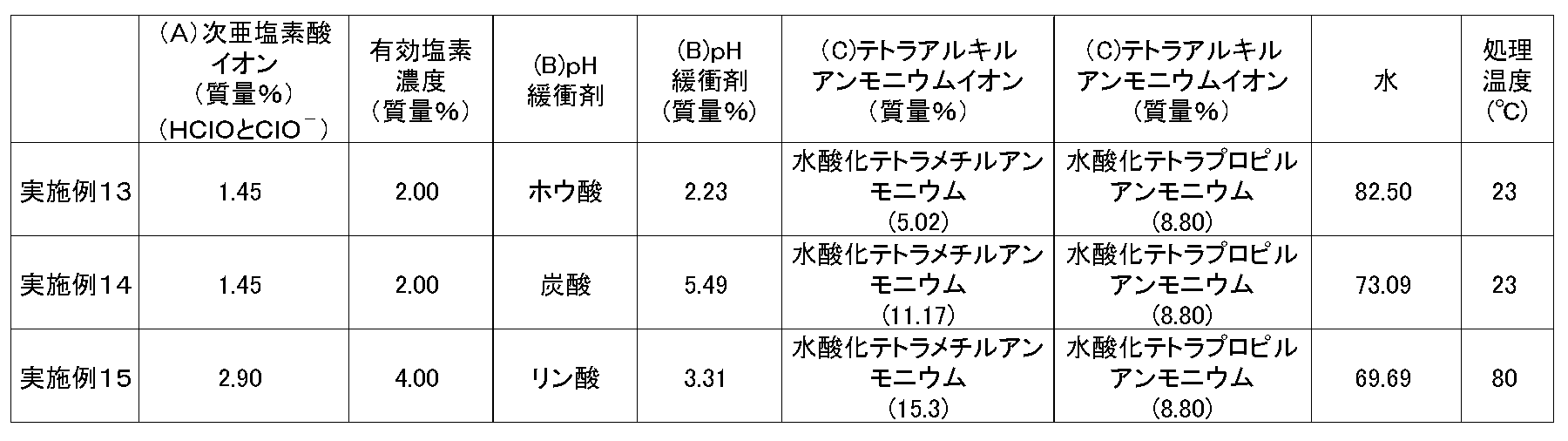
- Example 13 As Example 13, a treatment solution was prepared in the same manner as in Example 1 so that (A) hypochlorite ion, (B) pH buffer agent, and (C) tetraalkylammonium ion had the compositions shown in Table 4. Prepared and evaluated.
- Example 14 a treatment liquid was prepared in the same manner as in Example 5 so that (A) hypochlorite ion, (B) pH buffer agent, and (C) tetraalkylammonium ion had the compositions shown in Table 4. And evaluated.
- Example 15 a treatment liquid was prepared in the same manner as in Example 7 so that (A) hypochlorite ion, (B) pH buffer, and (C) tetraalkylammonium ion had the compositions shown in Table 4. And evaluated.
- water contains chloride ions.
Landscapes
- Chemical & Material Sciences (AREA)
- Materials Engineering (AREA)
- Organic Chemistry (AREA)
- Engineering & Computer Science (AREA)
- Metallurgy (AREA)
- Mechanical Engineering (AREA)
- General Chemical & Material Sciences (AREA)
- Chemical Kinetics & Catalysis (AREA)
- Inorganic Chemistry (AREA)
- Cleaning Or Drying Semiconductors (AREA)
- Weting (AREA)
- ing And Chemical Polishing (AREA)
- Detergent Compositions (AREA)
Abstract
Description
(1)半導体形成工程において半導体ウェハを処理する処理液であって、
(A)次亜塩素酸イオン、
(B)pH緩衝剤
(C)下記式(1)で表されるテトラアルキルアンモニウムイオンを含む処理液である。
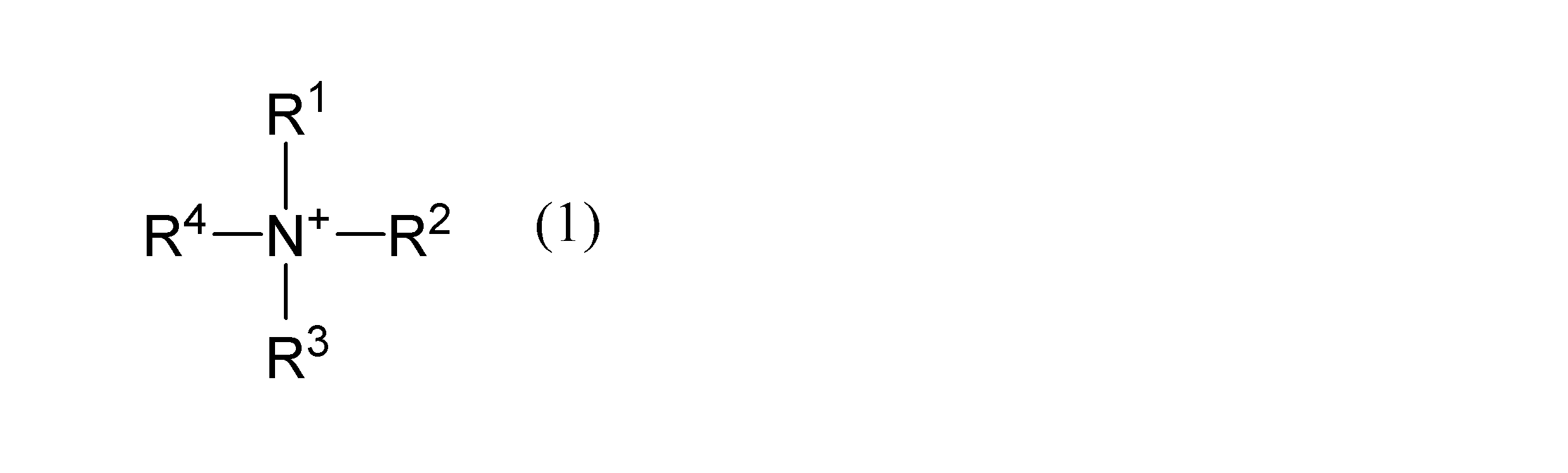
である。
(B)pH緩衝剤
(C)下記式(1)で表されるテトラアルキルアンモニウムイオン
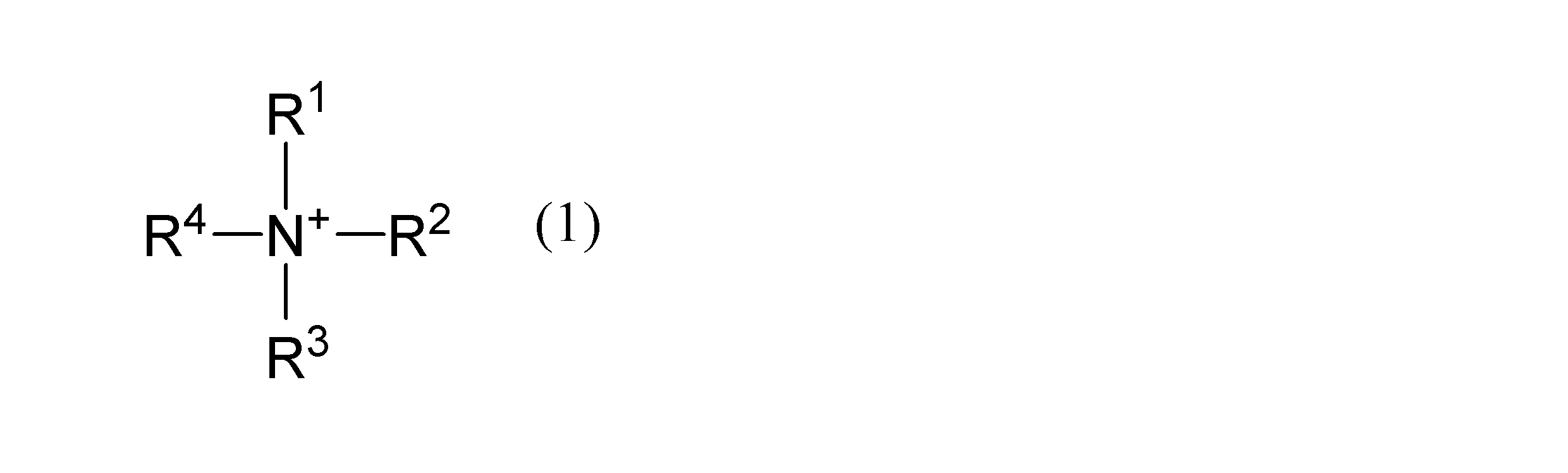
(B)pH緩衝剤
(C)下記式(1)で表されるテトラアルキルアンモニウムイオン

本発明の処理液は、半導体ウェハにダメージを与えることなく、半導体ウェハ上に存在するルテニウムをエッチングできる処理液であり、変動が少ないエッチング速度でルテニウムをエッチングすることが可能な処理液である。そのため、本発明の処理液は、半導体製造工程における配線形成工程で好適に用いることができる処理液である。
本発明で使用される次亜塩素酸イオンは、アルカリ性溶液に塩素ガスを溶解させ、中和反応させることにより得られる。また、次亜塩素酸塩を水に溶解させることにより、次亜塩素酸及び次亜塩素酸イオンを発生させることも可能である。
本発明で使用されるpH緩衝剤は、弱酸と共役塩基の組合せであり、処理液内の水素イオンの変動を抑制する目的で、処理液に添加される。
本発明のpH調整剤は、上記のpH緩衝剤とは異なる、酸、又はアルカリであり、例えば、塩酸、硫酸、硝酸などの酸であり、また、水酸化アルキルアンモニウム、例えば、水酸化テトラメチルアンモニウム、又はコリンなどのアルカリである。
なお、本発明において、処理液にpH緩衝剤が含まれる場合、処理液中のpH調整剤とpH緩衝剤の組み合わせにより、安定的にpHが存在する範囲が決定される。例えば、pH調整剤として水酸化テトラメチルアンモニウム水溶液を、pH緩衝剤としてホウ酸を用いた場合では、処理液のpHは8.2~10.2で安定させることが可能となり、ルテニウムのエッチング速度の変動を抑制することが出来る。さらに、pH調整剤として、水酸化カリウムや水酸化ナトリウムのようなアルカリ金属を含む化合物を使用していないため、エッチング後の半導体基板表面にカリウム、ナトリウム等のアルカリ金属汚染がみられず、好適に使用することが出来る。
本発明において、以下の式(1)で表されるテトラアルキルアンモニウムイオンが、処理液のpHを調整するために処理液に含まれる。
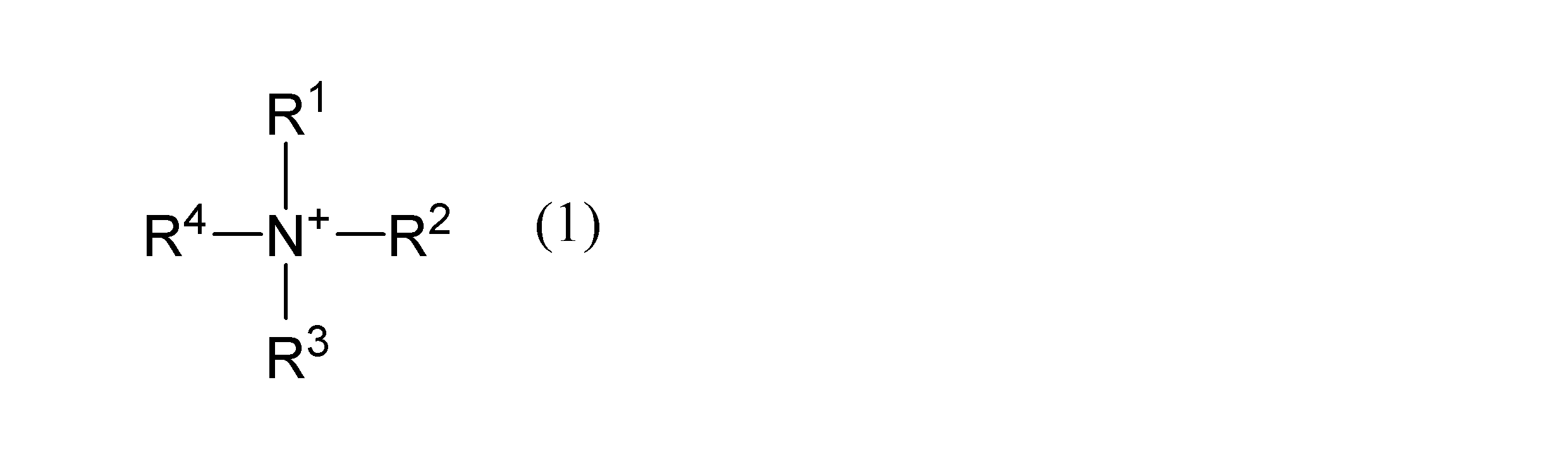
本発明の処理液において、(A)、(B)、(C)の成分に加え、任意成分である、pH調整剤、さらに後述するその他の添加剤以外の残分は、溶媒であり、(A)、(B)、(C)、pH調整剤、およびその他の添加剤を調整後、合計100質量%となるように、残分を溶媒で調整する。ここで、溶媒はアニオンを含んでいてもよい。該アニオンとしては塩化物イオン、水酸化物イオンなどが考えられる。
本発明の処理液は、前記(A)次亜塩素酸イオン、前記(B)pH緩衝剤、前記(C)テトラアルキルアンモニウムイオン、下記に詳述する必要に応じて配合されるその他の添加物、残分の前記溶媒を含む。また、必要に応じて、pH調整剤を含む。好適な(A)次亜塩素酸イオン濃度(0.05~20質量%)、(B)pH緩衝剤濃度(0.0001~10質量%)、(C)テトラアルキルアンモニウムイオン濃度(0.1~30質量%)、また、必要に応じてpH調整剤を使用すれば、容易に処理液のpHを14未満とすることができる。本発明の処理液のpHが各成分量により14未満となることにより、ルテニウムを酸化、溶解、除去しても、処理液のpHが変動せず、安定して除去することができる。処理液のpHが14以上の場合は、著しくルテニウムのエッチング速度が低下する。pHが7未満となる場合は、処理液に含まれている次亜塩素酸イオンの分解反応が生じ易くなる傾向にある。そのため、高エッチング速度と高精度なエッチング速度制御を考慮すると、処理液のpHは、7以上14未満が好ましく、7.5以上13.5未満がより好ましく、9以上13未満がさらに好ましい。処理液のpHの好ましい上限として、例えばpH緩衝剤としてホウ酸を用いる場合、10未満も例示できる。
その他、本発明の処理液には、所望により本発明の目的を損なわない範囲で従来から半導体用処理液に使用されている添加剤を配合してもよい。例えば、添加剤として、酸、アルカリ、金属防食剤、水溶性有機溶剤、フッ素化合物、酸化剤、還元剤、キレート剤、界面活性剤、消泡剤などを加えることができる。
なお、本発明の処理液を使用するエッチング条件は、温度は10~80℃、好ましくは20~70℃の範囲であり、使用するエッチング装置のエッチング条件にあわせて適宜選択すればよい。
したがって、本発明の処理液において、式(1)で表されるテトラアルキルアンモニウムイオンの添加によるRuO4ガス抑制効果は、処理液に含まれる酸化剤やその他の添加剤の種類や量、処理方法、処理条件等に限定されるものではない。例えば、本発明の処理液中に含まれる酸化剤は、次亜塩素酸イオンであるが、この酸化剤の量に関わりなく、処理液に含まれる式(1)で表されるテトラアルキルアンモニウムイオンによりRuO4ガス抑制効果が得られる。また、本発明の処理液による半導体ウェハの処理方式は、ウェットエッチングに限定されるものではなく、洗浄用途や残渣除去用途の処理液としても好適に利用できる。さらに、本発明の処理液をCMP研磨に用いれば、CMP研磨工程においてもRuO4ガスの発生を抑制することが可能である。本発明の処理液によるルテニウムを含むウェハの処理は、枚葉処理でもよく、浸漬処理でもよい。また、処理液の温度は特に制限されることはなく、いずれの処理温度においても、処理液に含まれる式(1)で表されるテトラアルキルアンモニウムイオンによりRuO4ガス抑制効果が発揮される。
ルテニウム含有ガスの発生抑制剤とは、ルテニウムを処理するための液に添加する事で、ルテニウム含有ガスの発生を抑制するものであり、上記pH緩衝剤と式(1)で表されるテトラアルキルアンモニウムイオンを含む液を指す。
ルテニウムを処理するための液は、ルテニウムと接触し、該ルテニウムに物理的、化学的変化を与える成分を含む液であればどのような液でもよく、例えば、酸化剤を含む溶液が例示される。該酸化剤としては、上述の説明で例示したような次亜塩素酸イオンを挙げることができる。ルテニウムを処理するための液で処理されたルテニウムは、その全部又は一部が該処理液中に溶解、分散、又は沈殿し、RuO4(ガス)及び/又はRuO2(粒子)を生じる原因となる。
RuO4(溶液)及びRuO2(粒子)の生成はpHに依存するため、ルテニウムを含む処理液のpHは変動しないことが好ましい。ルテニウム含有ガスの発生抑制剤にpH緩衝剤が含まれることで、ガス発生抑制剤を含有する処理液のpH変動を抑えることができる。該pH緩衝剤としては、上記の説明で例示したようなpH緩衝剤を何ら制限なく用いることができる。
ルテニウムを処理するための液と本発明のルテニウム含有ガスの発生抑制剤とを含む液(ガス発生抑制剤を含有する処理液とも表記する)では、該処理液中に存在するRuO4 -等と、テトラアルキルアンモニウムイオンとが、該処理液に溶解するイオン対を形成することで、RuO4 -等からRuO4(溶液)及びRuO2(粒子)の生成を抑制する。これは、RuO4(溶液)から生じるRuO4(ガス)を大幅に低減するとともに、RuO4(ガス)により生じるRuO2(粒子)の生成を抑えるためである。
ルテニウム含有ガスの発生抑制剤における、上記式(1)で示されるテトラアルキルアンモニウムイオンの含有量や、その他の成分及びその含有量、pH等の条件については、半導体ウェハ用処理液の説明で記載されている条件と同じ条件を適用できる。
一方で、本発明のルテニウム含有ガスの発生抑制剤では、上記の本発明の処理液に含まれる(A)次亜塩素酸イオンを含まなくてもよい。
また、上記の条件以外にも、例えば、ルテニウム含有ガスの発生抑制剤に含まれる上記(1)式で示されるテトラアルキルアンモニウムの含有量としては、0.0001~50質量%を挙げることができ、0.01~35質量%であることがより好ましく、0.1~20質量%である事がさらに好ましい。この濃度は、後述するように、ルテニウム含有ガスの発生を抑制する対象となる液、すなわち、ルテニウムを処理するための液と混合した際の混合液における上記のpH緩衝剤と式(1)で表されるテトラアルキルアンモニウムイオンを含む液の濃度が所定量になるように、調整することができる。また、ルテニウム含有ガスの発生抑制剤には、上記のpH調整剤と同じものを適宜添加してもよい。pH調整剤の含有量については、後述するように、ルテニウムを処理するための液と混合した際の混合液のpHが所定範囲になるように、調整することができる。例えば、ルテニウム含有ガスの発生抑制剤における、pH調整剤の含有量として、有効量であればよく、具体的には0.000001~10質量%を例示できる。またpH緩衝剤としてホウ酸、炭酸又はリン酸を含むことが好ましい。特に、ホウ酸を用いる場合はガス発生抑制剤を含有する処理液のpHが8.2~10.2であるとき、炭酸を用いる場合はガス発生抑制剤を含有する処理液のpHが9.3~11.3であるとき、リン酸を用いる場合はガス発生抑制剤を含有する処理液のpHが11.4~13.4であるときに、望ましいpH緩衝能が期待される。これらのpH緩衝剤は1種単独で用いてもよいし、これらを混合して用いてもよい。また、ガス発生抑制剤を含有する処理液中の各pH緩衝剤の濃度は、ガス発生抑制剤を含有する処理液の全質量の0.0001~10%が好ましく、さらに、好ましくは、0.001~8%であり、さらに好ましくは、0.01~6%である。0.1~6%の範囲であれば、エッチング速度に影響を与えない範囲で、処理液のpHの変動を抑制し、十分なルテニウム含有ガスの発生抑制効果が得られる。
本発明のルテニウム含有ガスの発生抑制方法は、上記のルテニウム含有ガスの発生抑制剤を、ルテニウムを処理するための液に添加する工程を含む、ルテニウム含有ガスの発生抑制方法である。具体的には、たとえば、半導体製造工程におけるエッチング工程、残渣除去工程、洗浄工程、CMP工程等のルテニウムを処理する工程において使用する液(ルテニウムを処理するための液)に対して、本発明のルテニウム含有ガスの発生抑制剤を添加する事で、ルテニウム含有ガスの発生を抑制する事ができる。また、これら半導体製造工程に使用した各装置において、チャンバー内壁や配管等に付着したルテニウムを洗浄する際にも、ルテニウム含有ガスの発生抑制剤を含む液を用いる事でルテニウム含有ガスの発生を抑制できる。例えば、物理蒸着(PVD)や化学蒸着(CVD)を用いてルテニウムを形成する装置のメンテナンスにおいて、チャンバーや配管等に付着したルテニウムを除去する際に使用する洗浄液へ、本発明のルテニウム含有ガスの発生抑制剤を添加する事により、洗浄中に発生するルテニウム含有ガスの抑制が可能となる。当該方法によれば、上記のルテニウム含有ガスの発生抑制剤の説明で示したメカニズムにより、ルテニウム含有ガスの発生を抑制できる。
ルテニウムを処理するための液に対する、ルテニウム含有ガスの発生抑制剤の添加量は、ガス発生抑制剤を含有する処理液に溶解されるルテニウム量による。ルテニウム含有ガスの発生抑制剤の添加量は特に制限されないが、例えば、ルテニウムを処理するための液に溶解されるルテニウム量を1としたときに、重量比で10~500000が好ましく、より好ましくは100~100000であり、さらに好ましくは1000~50000である。
本発明のルテニウム含有廃液の処理剤とは、ルテニウム含有廃液に添加する事で、ルテニウム含有ガスの発生を抑制するものであり、上記式(1)で表されるテトラアルキルアンモニウムイオンとpH緩衝剤とを含む液を指す。よって、上記の式(1)で示されるテトラアルキルアンモニウムイオンを含有する処理液は、そのルテニウム含有ガスの発生抑制効果を利用して、ルテニウム含有廃液の処理剤としても用いることができる。
ここで、ルテニウム含有廃液とは、少量でもルテニウムを含む溶液を意味する。ここで、ルテニウムとは、ルテニウム金属に限定されず、ルテニウム元素を含んでいればよく、例えば、Ru、RuO4 -、RuO4 2-、RuO4、RuO2などが挙げられる。例えば、ルテニウムを含有する半導体ウェハのエッチング処理を、本発明の処理液とは別のエッチング液を用いて行った後の液や、本発明の半導体ウェハ用の処理液を用いて処理を行った後の液などを挙げることができる。また、半導体ウェハのエッチングに限らず、上記のルテニウム含有ガスの発生抑制方法にて述べたような、半導体製造工程やチャンバー洗浄などにより発生したルテニウム含有液もその一例である。
廃液に微量でもルテニウムが含まれると、RuO4ガスを経由してRuO2パーティクルが発生するため、タンクや配管を汚染するし、パーティクルの酸化作用によって装置類の劣化を促進する。また、廃液中から発生するRuO4ガスは低濃度でも人体に強い毒性を示す。このように、ルテニウム含有廃液は、装置類あるいは人体に対して様々な悪影響を及ぼすため、早急に処理してRuO4ガスの発生を抑制する必要がある。
本発明のルテニウム含有廃液の処理剤をルテニウム含有廃液に添加する事で、該ルテニウム含有廃液のpHが変動してRuO4ガスやRuO2パーティクルが増大することを抑制できる。例えば、ルテニウム含有廃液がアルカリ性である場合、二酸化炭素の混入により該ルテニウム含有廃液のpHは低下し、RuO4ガスやRuO2パーティクルが増大するが、ルテニウム含有廃液に本発明のルテニウム含有廃液の処理剤を加えることでpH変動が抑制されるため、RuO4ガスやRuO2パーティクル発生量を低く抑えることができる。
一方で、本発明のルテニウム含有廃液の処理剤では、上記の本発明の処理液に含まれる(A)次亜塩素酸イオンを含まなくてもよい。
また、これらの条件以外にも、例えば、ルテニウム含有廃液の処理剤における、上記式(1)で示されるテトラアルキルアンモニウムの含有量としては、0.0001~50質量%を挙げることができ、0.001~35質量%であることがより好ましい。この濃度は、後述するように、ルテニウム含有廃液と混合した際の混合液における上記式(1)のテトラアルキルアンモニウムの濃度が所定量になるように、調整することができる。また、ルテニウム含有廃液の処理剤には、上記で示したpH調整剤と同じものを適宜添加してもよい。pH調整剤の含有量については、後述するように、ルテニウム含有廃液と混合した際の混合液のpHが所定範囲になるように、調整することができる。例えば、ルテニウム含有廃液の処理剤における、pH調整剤の含有量として、有効量であればよく、具体的には0.000001~10質量%を例示できる。
また、pH緩衝剤としてホウ酸、炭酸又はリン酸を含むことが好ましい。特に、ホウ酸を用いる場合はルテニウム含有廃液の処理剤のpHが8.2~10.2であるとき、炭酸を用いる場合はルテニウム含有廃液の処理剤のpHが9.3~11.3であるとき、リン酸を用いる場合はルテニウム含有廃液の処理剤のpHが11.4~13.4であるときに、望ましいpH緩衝能が期待される。これらのpH緩衝剤は1種単独で用いてもよいし、これらを混合して用いてもよい。また、ルテニウム含有廃液の処理剤中の各pH緩衝剤の濃度は、ルテニウム含有廃液の処理剤の全質量の0.0001~10%が好ましく、さらに、好ましくは、0.001~8%であり、さらに好ましくは、0.01~6%である。0.1~6%の範囲であれば、エッチング速度に影響を与えない範囲で、ルテニウム含有廃液の処理剤のpHの変動を抑制し、十分なルテニウム含有ガスの発生抑制効果が得られる。
本発明のルテニウム含有廃液の処理方法は、上記のルテニウム含有廃液の処理剤を、後述するルテニウム含有廃液に添加する工程を含む、ルテニウム含有廃液の処理方法である。当該方法によれば、上記のルテニウム含有ガスの発生抑制剤の説明で示したメカニズムにより、ルテニウム含有廃液から発生するルテニウム含有ガスを抑制できる。そのため、ルテニウム含有廃液の取り扱いが容易になるだけでなく、排気設備や除外設備を簡素化できルテニウム含有ガスの処理にかかる費用を削減できる。さらに、毒性の高いルテニウム含有ガスに作業者が晒される危険性が減り、安全性が大幅に向上する。
なお、ルテニウム含有廃液の処理方法においては、ルテニウム含有廃液の処理剤と、ルテニウム含有廃液との混合液における、上記の式(1)で示されるテトラアルキルアンモニウムイオンとpH緩衝剤の濃度が、例えば、それぞれ0.0001~50質量%となるように、ルテニウム含有廃液の処理剤における上記pH緩衝剤と式(1)で示されるテトラアルキルアンモニウムイオンの濃度と、その添加量を調整することが好ましい。また、ルテニウム含有廃液の処理方法においては、ルテニウム含有廃液の処理剤に、上記のpH調整剤と同じものを適宜添加してもよい。ルテニウム含有廃液の処理剤におけるpH調整剤の含有量と、ルテニウム含有廃液の処理剤の添加量については、ルテニウム含有廃液と混合した際の混合液のpHが、例えば7~14になるように、適宜調整することができる。
ルテニウム含有廃液に対する、ルテニウム含有廃液の処理剤の添加量は、ルテニウム含有廃液中のルテニウム量による。ルテニウム含有廃液の処理剤の添加量は特に制限されないが、例えば、ルテニウム含有廃液中のルテニウム量を1としたときに、重量比で10~500000が好ましく、より好ましくは100~100000であり、さらに好ましくは1000~50000である。
実施例1~12、比較例1~6の処理液30mLを調製した後、卓上型pHメーター(LAQUA F―73、堀場製作所社製)を用いてpH測定した。pH測定は、処理液の温度が、25℃で安定した後に、実施した。
実施例1~15、比較例1~6の処理液を調製した後、100mL三角フラスコに処理液0.5mLとヨウ化カリウム(富士フイルム和光純薬社製、試薬特級)2g、10%酢酸8mL、超純水10mLを加え、固形物が溶解するまで撹拌し、褐色溶液を得る。調製した褐色溶液は0.02Mチオ硫酸ナトリウム溶液(富士フイルム和光純薬社製、容量分析用)を用いて溶液の色が褐色から極薄い黄色になるまで酸化還元滴定し、次いで、でんぷん溶液を加え薄紫色の溶液を得る。この溶液に更に0.02Mチオ硫酸ナトリウム溶液を続けて加え、無色透明になった点を終点として有効塩素濃度を算出した。また得られた有効塩素濃度から次亜塩素酸イオン濃度を算出した。例えば有効塩素濃度1%であれば次亜塩素酸イオン濃度は0.73%となる。
実施例1~15、比較例1~6の処理液中のアルキルアンモニウムイオン濃度はpH、次亜塩素酸イオン濃度から計算によって求めた。
緩衝剤濃度はイオンクロマトグラフィー分析装置(DIONEX INTEGRION HPLC、Thermo SCIENTIFIC社製)を用いて分析した。溶離液としてKOHを用い、1.2mL/min.の流量で通液した。カラムとして水酸化物系溶離液用陰イオン分析カラム(AS15、Thermo SCIENTIFIC社製)を用い、カラム温度は30℃とした。サプレッサーによりバックグラウンドノイズを取り除いたのち、電気伝導度検出器により炭酸濃度、リン酸濃度を定量した。
実施例1~15、比較例1~6の処理液49.5mLを用意した後、実施例1~6、実施例9、11~14、比較例1~5は1質量%の塩酸を0.5mL添加し、5分間撹拌した後、卓上型pHメーターを用いてpH測定した。実施例7、8、10、15、比較例6は5質量%の塩酸を0.5mL添加し、5分間撹拌した後、卓上型pHメーターを用いてpH測定した。
シリコンウェハ上にバッチ式熱酸化炉を用いて酸化膜を形成し、その上にスパッタ法を用いてルテニウムを200Å(±10%)成膜した。四探針抵抗測定器(ロレスタ‐GP、三菱ケミカルアナリテック社製)によりシート抵抗を測定して膜厚に換算した。
RuO4ガスの発生量は、ICP-OESを用いて測定した。密閉容器に処理液を5mLとり、膜厚1200Åのルテニウムを成膜した10×20mmのSiウェハ1枚を、表4に示す温度で60分間浸漬させた。ルテニウムをすべて溶解させたときの重量は0.000298gとした。その後、密閉容器にAirをフローし、密閉容器内の気相を吸収液(1mol/L NaOH)の入った容器にバブリングして、浸漬中に発生したRuO4ガスを吸収液にトラップした。この吸収液中のルテニウム量をICP-OESにより測定し、発生したRuO4ガス中のルテニウム量を求めた。処理液に浸漬したSiウェハ上のルテニウムが全て溶解したことは、四探針抵抗測定器(ロレスタ‐GP、三菱ケミカルアナリテック社製)により浸漬前および浸漬後のシート抵抗をそれぞれ測定し、膜厚に換算する事で確認した。
(エッチング対象のサンプルの準備)
表面を清浄にしたシリコンウェハを用意し、所定膜厚の熱酸化膜を形成した。そうして得られたシリコンウェハ上にルテニウムをスパッタリング法で成膜することによって、200Åの膜厚のシリコンウェハ上にルテニウムが積層されたサンプルを準備した。
2Lのガラス製三ツ口フラスコ(コスモスビード社製)にCO2含有量が2ppmである25質量%の水酸化テトラメチルアンモニウム水溶液253g、イオン交換水747gを混合して、CO2含有量が0.5ppmであり、6.3質量%の水酸化テトラメチルアンモニウム水溶液を得た。このときのpHは13.8であった。
得られた処理液のpH、有効塩素濃度、次亜塩素酸イオン濃度を評価し、アルキルアンモニウムイオン濃度、ルテニウムエッチング速度、塩酸添加後のpH、および酸添加後のルテニウムエッチング速度、塩酸添加前後のエッチング変動率を評価した。結果を表2に示す。なお、処理液に塩酸を添加することで処理液のpHを強制的に酸性側に変動させ、エッチング速度の変動幅を評価することとした。
実施例2~4、実施例9、実施例11~12、比較例1~2、比較例5~6は、(A)次亜塩素酸イオン、(B)pH緩衝剤、(C)テトラメチルアンモニウムイオン、pHが、表1に示した組成となるように実施例1と同様の方法で調整し、評価を行った。
<炭酸緩衝剤の調整>
グローブバッグ内に25質量%の水酸化テトラメチルアンモニウム水溶液500gが入ったPFAビーカーを入れ、グローブバッグ内の二酸化炭素濃度を1ppmとした後、高純度炭酸ガス(昭和電工ガスプロダクツ製、仕様純度99.99%以上)を30.7L(0℃換算時)供給し、一昼夜密閉することで炭酸緩衝剤を得た。緩衝剤濃度はイオンクロマトグラフィー分析装置を用い、前記方法にて算出した。
2Lのガラス製三ツ口フラスコ(コスモスビード社製)にCO2含有量が2ppmである25質量%の水酸化テトラメチルアンモニウム水溶液185g、イオン交換水415gを混合して、CO2含有量が0.5ppmであり、7.7質量%の水酸化テトラメチルアンモニウム水溶液を得た。このときのpHは13.9であった。
実施例6は、(A)次亜塩素酸イオン、(B)pH緩衝剤、(C)テトラメチルアンモニウムイオン、pHが、表1に示した組成となるように実施例5と同様の方法で調整し、評価を行った。
<リン酸緩衝剤の調整>
25質量%の水酸化テトラメチルアンモニウム水溶液500gをPFA容器に入れ、そこにリン酸(富士フイルム和光純薬社製、仕様純度85%)60.3gを氷水で冷却しながら加え、リン酸緩衝剤を得た。緩衝剤濃度はイオンクロマトグラフィー分析装置を用い、前記方法にて算出した。
2Lのガラス製三ツ口フラスコ(コスモスビード社製)にCO2含有量が2ppmである25質量%の水酸化テトラメチルアンモニウム水溶液379g、イオン交換水221gを混合して、CO2含有量が0.5ppmであり、15.8質量%の水酸化テトラメチルアンモニウム水溶液を得た。このときのpHは14.2であった。
実施例8、実施例10は、(A)次亜塩素酸イオン、(B)pH緩衝剤、(C)テトラメチルアンモニウムイオン、pHが、表1に示した組成となるように実施例7と同様の方法で調整し、評価を行った。
得られた処理液のpH、有効塩素濃度、次亜塩素酸イオン濃度を評価し、テトラアルキルアンモニウムイオン濃度、ルテニウムエッチング速度、塩酸添加後のpH、および酸添加後のルテニウムエッチング速度、塩酸添加前後のエッチング変動率を評価した。結果を表2に示す。なお、処理液に塩酸を添加することで処理液のpHを強制的に酸性側に変動させ、エッチング速度の変動幅を評価することとした。
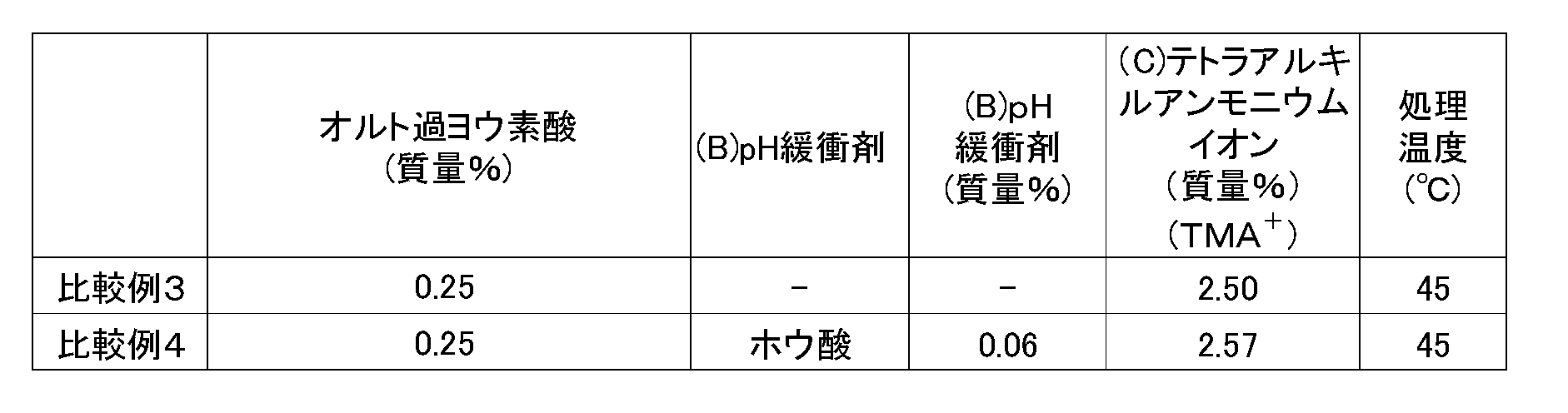
オルト過ヨウ素酸(富士フィルム和光純薬製、和光特級)2.5g、イオン交換水967.5gを混合して0.25質量%のオルト過ヨウ素酸水溶液を得た。この溶液に25質量%の水酸化テトラメチルアンモニウム水溶液30gを混合し、表2に示す組成の処理液を得た。その後、実施例1と同様の方法で、評価を行った。
前記比較例3で得た溶液に、ホウ酸(富士フィルム和光純薬製、試薬特級)0.6gを溶解して、pHが9.23になるよう水酸化テトラメチルアンモニウム水溶液を混合し、表2に示す組成の処理液を得た。その後、実施例1と同様の方法で、評価を行った。


実施例13として、(A)次亜塩素酸イオン、(B)pH緩衝剤、(C)テトラアルキルアンモニウムイオンが、表4に示した組成となるよう実施例1と同様の方法で処理液を調製し、評価した。
実施例14は(A)次亜塩素酸イオン、(B)pH緩衝剤、(C)テトラアルキルアンモニウムイオンが、表4に示した組成となるよう実施例5と同様の方法で処理液を調製し、評価を行った。
実施例15は(A)次亜塩素酸イオン、(B)pH緩衝剤、(C)テトラアルキルアンモニウムイオンが、表4に示した組成となるよう実施例7と同様の方法で処理液を調製し、評価を行った。
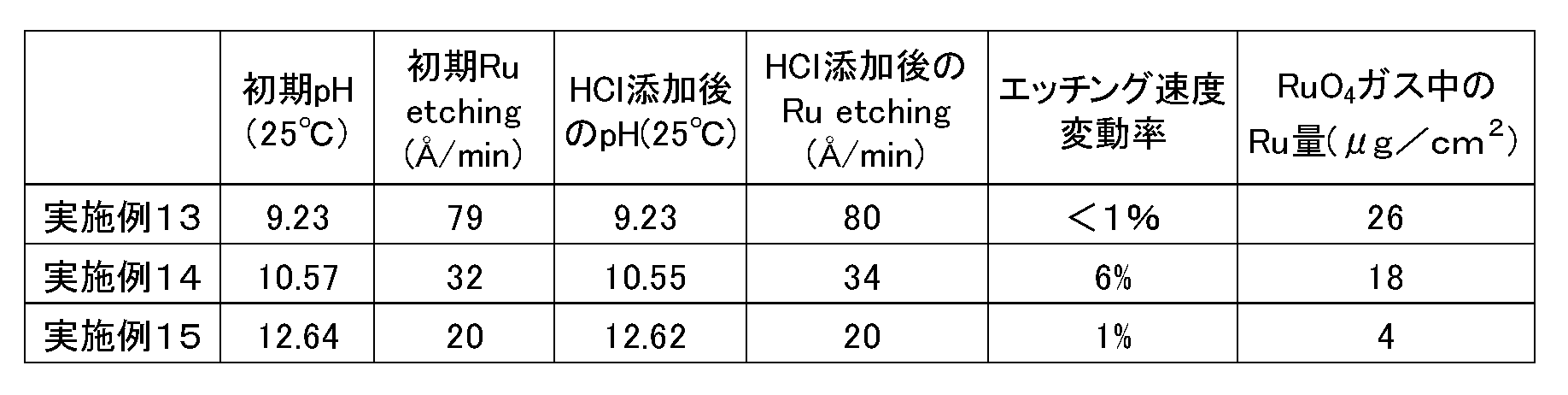
得られた処理液のpH、有効塩素濃度、次亜塩素酸イオン濃度を評価し、テトラアルキルアンモニウムイオン濃度、ルテニウムエッチング速度、塩酸添加後のpH、および酸添加後のルテニウムエッチング速度、塩酸添加前後のエッチング変動率、RuO4ガスの定量分析を評価した。結果を表5に示す。なお、処理液に塩酸を添加することで処理液のpHを強制的に酸性側に変動させ、エッチング速度の変動幅を評価することとした。表5の結果から、式(1)で示されるテトラアルキルアンモニウムイオンを2種類含んでいる場合でも、エッチング速度の変動率を低く抑えることができた。
2 層間絶縁膜
3 ルテニウム
11 三ツ口フラスコ
12 温度計保護管
13 熱電対
14 回転子
15 PFA製チューブ
16 ガス洗浄瓶
17 5質量%水酸化ナトリウム水溶液
18 流量計
19 ウォーターバス
10 氷水
Claims (20)
- 半導体形成工程において半導体ウェハを処理する処理液であって、
(A)次亜塩素酸イオン
(B)pH緩衝剤
(C)下記式(1)で表されるテトラアルキルアンモニウムイオンを含む処理液。

- 前記式(1)におけるR1、R2、R3及びR4は同一の炭素数1~3のアルキル基である請求項1に記載の処理液。
- 前記式(1)におけるR1、R2、R3及びR4がメチル基である請求項1又は2に記載の処理液。
- 前記(B)pH緩衝剤が、炭酸、ホウ酸、リン酸、トリスヒドロキシメチルアミノメタン(tris)、アンモニア、ピロリン酸、p-フェノールスルホン酸、ジエタノールアミン、エタノールアミン、トリエタノールアミン、5,5-ジエチルバルビツール酸、グリシン、グリシルグリシン、イミダゾール、N,N-ビス(2-ヒドロキシエチル)-2-アミノエタンスルホン酸、3-モルホリノプロパンスルホン酸、N-トリス(ヒドロキシメチル)メチル-2-アミノエタンスルホン酸、2-[4-(2-ヒドロキシエチル)-1-ピペラジニル]エタンスルホン酸、4-(2-ヒドロキシエチル)-1-ピペラジンプロパンスルホン酸、トリシン、N,N-ジ(2-ヒドロキシエチル)グリシン、2-シクロヘキシルアミノエタンスルホン酸、ヒドロキシプロリン、フェノール及びエチレンジアミン四酢酸からなる群から選ばれる少なくとも1種である請求項1乃至3のいずれか1項に記載の処理液。
- 前記(A)次亜塩素酸イオンの濃度が、0.05~20.0質量%である請求項1乃至4のいずれか一項に記載の処理液。
- 前記(B)pH緩衝剤の濃度が、0.0001~10質量%である請求項1乃至5のいずれか一項に記載の処理液。
- 25℃でのpHが7以上14未満である請求項1乃至6のいずれか1項に記載の処理液。
- 前記(B)pH緩衝剤が、炭酸、ホウ酸及びリン酸からなる群から選ばれる少なくとも1種である請求項1乃至7のいずれか一項に記載の処理液。
- 請求項1乃至8のいずれか一項に記載の処理液と半導体ウェハとを接触させる工程を含む、エッチング方法。
- 前記半導体ウェハが含む金属がルテニウムであり、該ルテニウムをエッチングする請求項9に記載のエッチング方法。
- 下記(B)及び(C)を含む、ルテニウム含有ガスの発生抑制剤。
(B)pH緩衝剤
(C)下記式(1)で表されるテトラアルキルアンモニウムイオン

- さらに、(A)次亜塩素酸イオンを含む、請求項11に記載のルテニウム含有ガスの発生抑制剤。
- 前記(C)テトラアルキルアンモニウムイオンの濃度が、0.0001~50質量%である請求項11又は12に記載のルテニウム含有ガスの発生抑制剤。
- 前記式(1)におけるR1、R2、R3及びR4は同一の炭素数1~3のアルキル基である、請求項11乃至13のいずれか一項に記載のルテニウム含有ガスの発生抑制剤。
- 請求項11乃至14のいずれか一項に記載のルテニウム含有ガスの発生抑制剤を用いる、ルテニウム含有ガスの発生を抑制する方法。
- 下記(B)及び(C)を含む、ルテニウム含有廃液の処理剤。
(B)pH緩衝剤
(C)下記式(1)で表されるテトラアルキルアンモニウムイオン
- さらに、(A)次亜塩素酸イオンを含む、請求項16に記載のルテニウム含有廃液の処理剤。
- 前記(C)テトラアルキルアンモニウムイオンの濃度が、0.0001~50質量%である請求項16又は17に記載のルテニウム含有廃液の処理剤。
- 前記式(1)におけるR1、R2、R3及びR4は同一の炭素数1~3のアルキル基である、請求項16乃至18のいずれか一項に記載のルテニウム含有廃液の処理剤。
- 請求項16乃至19のいずれか一項に記載のルテニウム含有廃液の処理剤を用いる、ルテニウム含有廃液の処理方法。
Priority Applications (7)
| Application Number | Priority Date | Filing Date | Title |
|---|---|---|---|
| EP20756673.8A EP3926663A4 (en) | 2019-02-13 | 2020-02-13 | SEMICONDUCTOR WAFER TREATMENT LIQUID WITH HYPOCHLORITIONS AND PH BUFFER |
| US17/294,148 US20220010206A1 (en) | 2019-02-13 | 2020-02-13 | Semiconductor wafer treatment liquid containing hypochlorite ions and ph buffer |
| KR1020217022593A KR20210125997A (ko) | 2019-02-13 | 2020-02-13 | 차아염소산 이온, 및 pH 완충제를 함유하는 반도체 웨이퍼의 처리액 |
| JP2020572318A JPWO2020166676A1 (ja) | 2019-02-13 | 2020-02-13 | 次亜塩素酸イオン、及びpH緩衝剤を含む半導体ウェハの処理液 |
| CN202080013283.7A CN113439326B (zh) | 2019-02-13 | 2020-02-13 | 含有次氯酸根离子和pH缓冲剂的半导体晶圆的处理液 |
| JP2024000687A JP7646887B2 (ja) | 2019-02-13 | 2024-01-05 | 次亜塩素酸イオン、及びpH緩衝剤を含む半導体ウェハの処理液 |
| US19/194,593 US20250257264A1 (en) | 2019-02-13 | 2025-04-30 | Semiconductor wafer treatment liquid containing hypochlorite ions and ph buffer |
Applications Claiming Priority (2)
| Application Number | Priority Date | Filing Date | Title |
|---|---|---|---|
| JP2019-024016 | 2019-02-13 | ||
| JP2019024016 | 2019-02-13 |
Related Child Applications (2)
| Application Number | Title | Priority Date | Filing Date |
|---|---|---|---|
| US17/294,148 A-371-Of-International US20220010206A1 (en) | 2019-02-13 | 2020-02-13 | Semiconductor wafer treatment liquid containing hypochlorite ions and ph buffer |
| US19/194,593 Division US20250257264A1 (en) | 2019-02-13 | 2025-04-30 | Semiconductor wafer treatment liquid containing hypochlorite ions and ph buffer |
Publications (1)
| Publication Number | Publication Date |
|---|---|
| WO2020166676A1 true WO2020166676A1 (ja) | 2020-08-20 |
Family
ID=72044242
Family Applications (1)
| Application Number | Title | Priority Date | Filing Date |
|---|---|---|---|
| PCT/JP2020/005655 Ceased WO2020166676A1 (ja) | 2019-02-13 | 2020-02-13 | 次亜塩素酸イオン、及びpH緩衝剤を含む半導体ウェハの処理液 |
Country Status (7)
| Country | Link |
|---|---|
| US (2) | US20220010206A1 (ja) |
| EP (1) | EP3926663A4 (ja) |
| JP (2) | JPWO2020166676A1 (ja) |
| KR (1) | KR20210125997A (ja) |
| CN (1) | CN113439326B (ja) |
| TW (1) | TW202037706A (ja) |
| WO (1) | WO2020166676A1 (ja) |
Cited By (4)
| Publication number | Priority date | Publication date | Assignee | Title |
|---|---|---|---|---|
| JPWO2022138561A1 (ja) * | 2020-12-25 | 2022-06-30 | ||
| JP2022118773A (ja) * | 2021-02-03 | 2022-08-16 | 東京応化工業株式会社 | ルテニウム含有層を洗浄又はエッチングするために用いられる薬液、及びルテニウム配線の製造方法 |
| JP2022159219A (ja) * | 2021-03-31 | 2022-10-17 | 株式会社トクヤマ | 半導体用処理液 |
| KR20230047416A (ko) * | 2020-09-03 | 2023-04-07 | 후지필름 가부시키가이샤 | 조성물, 기판의 처리 방법 |
Families Citing this family (2)
| Publication number | Priority date | Publication date | Assignee | Title |
|---|---|---|---|---|
| US11820919B2 (en) | 2021-10-19 | 2023-11-21 | Tokyo Electron Limited | Ruthenium CMP chemistry based on halogenation |
| CN116891283B (zh) * | 2023-07-12 | 2026-05-05 | 中国电子系统工程第二建设有限公司 | 一种适应pH宽范围深度铜离子捕捉剂、其制法及应用 |
Citations (6)
| Publication number | Priority date | Publication date | Assignee | Title |
|---|---|---|---|---|
| JP2008547202A (ja) * | 2005-06-13 | 2008-12-25 | アドバンスド テクノロジー マテリアルズ,インコーポレイテッド | 金属ケイ化物の形成後の金属または金属合金の選択的な除去のための組成物および方法 |
| JP2009514219A (ja) * | 2005-10-26 | 2009-04-02 | キャボット マイクロエレクトロニクス コーポレイション | 銅/ルテニウム基材のcmp |
| US20090124082A1 (en) * | 2007-11-08 | 2009-05-14 | Hynix Semiconductor Inc. | Slurry for polishing ruthenium and method for polishing using the same |
| JP2009530853A (ja) * | 2006-03-23 | 2009-08-27 | キャボット マイクロエレクトロニクス コーポレイション | 金属の除去速度を制御するためのハロゲン化物アニオン |
| WO2011074601A1 (ja) * | 2009-12-17 | 2011-06-23 | 昭和電工株式会社 | ルテニウム系金属のエッチング用組成物およびその調製方法 |
| WO2016140246A1 (ja) * | 2015-03-04 | 2016-09-09 | 日立化成株式会社 | Cmp用研磨液、及び、これを用いた研磨方法 |
Family Cites Families (20)
| Publication number | Priority date | Publication date | Assignee | Title |
|---|---|---|---|---|
| TW490756B (en) * | 1999-08-31 | 2002-06-11 | Hitachi Ltd | Method for mass production of semiconductor integrated circuit device and manufacturing method of electronic components |
| JP3585437B2 (ja) * | 2000-11-22 | 2004-11-04 | 株式会社荏原製作所 | ルテニウム膜のエッチング方法 |
| US7521406B2 (en) * | 2004-02-11 | 2009-04-21 | Mallinckrodt Baker, Inc | Microelectronic cleaning composition containing halogen oxygen acids, salts and derivatives thereof |
| JP3948737B2 (ja) * | 2005-05-09 | 2007-07-25 | 日本高純度化学株式会社 | 置換型無電解金めっき液 |
| JP2007051346A (ja) * | 2005-08-18 | 2007-03-01 | Ebara Corp | 無電解めっき装置及びめっき液 |
| WO2008129891A1 (ja) * | 2007-04-13 | 2008-10-30 | Tosoh Corporation | エッチング用組成物及びエッチング方法 |
| US7825079B2 (en) * | 2008-05-12 | 2010-11-02 | Ekc Technology, Inc. | Cleaning composition comprising a chelant and quaternary ammonium hydroxide mixture |
| WO2010048139A2 (en) * | 2008-10-21 | 2010-04-29 | Advanced Technology Materials, Inc. | Copper cleaning and protection formulations |
| SG10201605697UA (en) * | 2011-08-09 | 2016-09-29 | Basf Se | Aqueous alkaline compositions and method for treating the surface of silicon substrates |
| KR101554190B1 (ko) * | 2011-12-27 | 2015-09-18 | 후지필름 가부시키가이샤 | 반도체 기판 제품의 제조방법 및 이것에 이용되는 에칭방법 |
| KR102338550B1 (ko) * | 2013-06-06 | 2021-12-14 | 엔테그리스, 아이엔씨. | 질화 티타늄의 선택적인 에칭을 위한 조성물 및 방법 |
| KR102405063B1 (ko) * | 2014-06-30 | 2022-06-07 | 엔테그리스, 아이엔씨. | 텅스텐 및 코발트 상용성을 갖는 에치후 잔류물을 제거하기 위한 수성 및 반-수성 세정제 |
| CN104233302B (zh) * | 2014-09-15 | 2016-09-14 | 南通万德科技有限公司 | 一种蚀刻液及其应用 |
| WO2016068183A1 (ja) * | 2014-10-31 | 2016-05-06 | 富士フイルム株式会社 | ルテニウム除去組成物、及び、磁気抵抗メモリの製造方法 |
| JP2018518825A (ja) * | 2015-04-13 | 2018-07-12 | キャボット マイクロエレクトロニクス コーポレイション | 改善されたサファイア除去速度と低い表面粗さを有するダイヤモンド系スラリー |
| KR102113463B1 (ko) * | 2016-01-22 | 2020-05-21 | 후지필름 가부시키가이샤 | 처리액 |
| KR102111307B1 (ko) * | 2016-06-02 | 2020-05-15 | 후지필름 가부시키가이샤 | 처리액, 기판의 세정 방법 및 레지스트의 제거 방법 |
| JP6808730B2 (ja) * | 2016-06-03 | 2021-01-06 | 富士フイルム株式会社 | 処理液、基板洗浄方法およびレジストの除去方法 |
| US10090247B1 (en) * | 2017-05-03 | 2018-10-02 | International Business Machines Corporation | Semiconductor device formed by wet etch removal of Ru selective to other metals |
| CN113195681A (zh) * | 2018-12-14 | 2021-07-30 | 恩特格里斯公司 | 钌蚀刻组合物和方法 |
-
2020
- 2020-02-13 EP EP20756673.8A patent/EP3926663A4/en not_active Withdrawn
- 2020-02-13 TW TW109104610A patent/TW202037706A/zh unknown
- 2020-02-13 JP JP2020572318A patent/JPWO2020166676A1/ja active Pending
- 2020-02-13 KR KR1020217022593A patent/KR20210125997A/ko not_active Ceased
- 2020-02-13 CN CN202080013283.7A patent/CN113439326B/zh active Active
- 2020-02-13 WO PCT/JP2020/005655 patent/WO2020166676A1/ja not_active Ceased
- 2020-02-13 US US17/294,148 patent/US20220010206A1/en not_active Abandoned
-
2024
- 2024-01-05 JP JP2024000687A patent/JP7646887B2/ja active Active
-
2025
- 2025-04-30 US US19/194,593 patent/US20250257264A1/en active Pending
Patent Citations (6)
| Publication number | Priority date | Publication date | Assignee | Title |
|---|---|---|---|---|
| JP2008547202A (ja) * | 2005-06-13 | 2008-12-25 | アドバンスド テクノロジー マテリアルズ,インコーポレイテッド | 金属ケイ化物の形成後の金属または金属合金の選択的な除去のための組成物および方法 |
| JP2009514219A (ja) * | 2005-10-26 | 2009-04-02 | キャボット マイクロエレクトロニクス コーポレイション | 銅/ルテニウム基材のcmp |
| JP2009530853A (ja) * | 2006-03-23 | 2009-08-27 | キャボット マイクロエレクトロニクス コーポレイション | 金属の除去速度を制御するためのハロゲン化物アニオン |
| US20090124082A1 (en) * | 2007-11-08 | 2009-05-14 | Hynix Semiconductor Inc. | Slurry for polishing ruthenium and method for polishing using the same |
| WO2011074601A1 (ja) * | 2009-12-17 | 2011-06-23 | 昭和電工株式会社 | ルテニウム系金属のエッチング用組成物およびその調製方法 |
| WO2016140246A1 (ja) * | 2015-03-04 | 2016-09-09 | 日立化成株式会社 | Cmp用研磨液、及び、これを用いた研磨方法 |
Non-Patent Citations (2)
| Title |
|---|
| NOTIFICATION OF THE MINISTRY OF HEALTH, LABOR AND WELFARE, no. 318, 11 March 2005 (2005-03-11) |
| See also references of EP3926663A4 |
Cited By (8)
| Publication number | Priority date | Publication date | Assignee | Title |
|---|---|---|---|---|
| KR20230047416A (ko) * | 2020-09-03 | 2023-04-07 | 후지필름 가부시키가이샤 | 조성물, 기판의 처리 방법 |
| KR102958765B1 (ko) | 2020-09-03 | 2026-04-30 | 후지필름 가부시키가이샤 | 조성물, 기판의 처리 방법 |
| JPWO2022138561A1 (ja) * | 2020-12-25 | 2022-06-30 | ||
| WO2022138561A1 (ja) * | 2020-12-25 | 2022-06-30 | 株式会社トクヤマ | 遷移金属を含む半導体の処理方法、遷移金属を含む半導体の製造方法、および半導体用処理液 |
| JP2022118773A (ja) * | 2021-02-03 | 2022-08-16 | 東京応化工業株式会社 | ルテニウム含有層を洗浄又はエッチングするために用いられる薬液、及びルテニウム配線の製造方法 |
| JP7606876B2 (ja) | 2021-02-03 | 2024-12-26 | 東京応化工業株式会社 | ルテニウム含有層を洗浄又はエッチングするために用いられる薬液、及びルテニウム配線の製造方法 |
| JP2022159219A (ja) * | 2021-03-31 | 2022-10-17 | 株式会社トクヤマ | 半導体用処理液 |
| JP7824135B2 (ja) | 2021-03-31 | 2026-03-04 | 株式会社トクヤマ | 半導体用処理液 |
Also Published As
| Publication number | Publication date |
|---|---|
| TW202037706A (zh) | 2020-10-16 |
| JP7646887B2 (ja) | 2025-03-17 |
| EP3926663A1 (en) | 2021-12-22 |
| CN113439326B (zh) | 2025-02-25 |
| KR20210125997A (ko) | 2021-10-19 |
| CN113439326A (zh) | 2021-09-24 |
| JP2024024074A (ja) | 2024-02-21 |
| JPWO2020166676A1 (ja) | 2021-12-16 |
| US20220010206A1 (en) | 2022-01-13 |
| US20250257264A1 (en) | 2025-08-14 |
| EP3926663A4 (en) | 2022-12-21 |
Similar Documents
| Publication | Publication Date | Title |
|---|---|---|
| JP7646887B2 (ja) | 次亜塩素酸イオン、及びpH緩衝剤を含む半導体ウェハの処理液 | |
| JP7311477B2 (ja) | 次亜塩素酸イオンを含む半導体ウェハの処理液 | |
| JP6711437B2 (ja) | 半導体デバイス用基板洗浄液及び半導体デバイス用基板の洗浄方法 | |
| TWI904082B (zh) | 含有鎓鹽的半導體晶圓之處理液 | |
| JP2015506583A (ja) | 窒化チタンを選択的にエッチングするための組成物および方法 | |
| US12444617B2 (en) | Semiconductor wafer processing liquid containing hypobromite ions and PH buffering agent | |
| TW202124694A (zh) | 次氯酸四級烷基銨溶液、其製造方法及半導體晶圓的處理方法 | |
| US20240055272A1 (en) | Method for processing semiconductor containing transition metal, method for producing semiconductor containing transition metal, and processing liquid for semiconductors | |
| JP2022002291A (ja) | オニウム塩を含む半導体ウェハの処理液 | |
| JP2025104324A (ja) | ケイ化ルテニウム除去用半導体処理液 | |
| WO2024004980A1 (ja) | 半導体基板洗浄用組成物、半導体基板の洗浄方法、及び半導体基板の製造方法 |
Legal Events
| Date | Code | Title | Description |
|---|---|---|---|
| 121 | Ep: the epo has been informed by wipo that ep was designated in this application |
Ref document number: 20756673 Country of ref document: EP Kind code of ref document: A1 |
|
| ENP | Entry into the national phase |
Ref document number: 2020572318 Country of ref document: JP Kind code of ref document: A |
|
| NENP | Non-entry into the national phase |
Ref country code: DE |
|
| ENP | Entry into the national phase |
Ref document number: 2020756673 Country of ref document: EP Effective date: 20210913 |
|
| WWG | Wipo information: grant in national office |
Ref document number: 202080013283.7 Country of ref document: CN |
|
| WWW | Wipo information: withdrawn in national office |
Ref document number: 2020756673 Country of ref document: EP |
|
| WWR | Wipo information: refused in national office |
Ref document number: 1020217022593 Country of ref document: KR |
|
| WWC | Wipo information: continuation of processing after refusal or withdrawal |
Ref document number: 1020217022593 Country of ref document: KR |