WO2020169888A1 - Method and process arrangement for producing hydrocarbons and use - Google Patents
Method and process arrangement for producing hydrocarbons and use Download PDFInfo
- Publication number
- WO2020169888A1 WO2020169888A1 PCT/FI2020/050111 FI2020050111W WO2020169888A1 WO 2020169888 A1 WO2020169888 A1 WO 2020169888A1 FI 2020050111 W FI2020050111 W FI 2020050111W WO 2020169888 A1 WO2020169888 A1 WO 2020169888A1
- Authority
- WO
- WIPO (PCT)
- Prior art keywords
- gasifier
- product mixture
- cha
- process arrangement
- polymer
- Prior art date
- Legal status (The legal status is an assumption and is not a legal conclusion. Google has not performed a legal analysis and makes no representation as to the accuracy of the status listed.)
- Ceased
Links
Classifications
-
- C—CHEMISTRY; METALLURGY
- C10—PETROLEUM, GAS OR COKE INDUSTRIES; TECHNICAL GASES CONTAINING CARBON MONOXIDE; FUELS; LUBRICANTS; PEAT
- C10J—PRODUCTION OF PRODUCER GAS, WATER-GAS, SYNTHESIS GAS FROM SOLID CARBONACEOUS MATERIAL, OR MIXTURES CONTAINING THESE GASES; CARBURETTING AIR OR OTHER GASES
- C10J3/00—Production of combustible gases containing carbon monoxide from solid carbonaceous fuels
- C10J3/46—Gasification of granular or pulverulent flues in suspension
- C10J3/48—Apparatus; Plants
- C10J3/482—Gasifiers with stationary fluidised bed
-
- C—CHEMISTRY; METALLURGY
- C08—ORGANIC MACROMOLECULAR COMPOUNDS; THEIR PREPARATION OR CHEMICAL WORKING-UP; COMPOSITIONS BASED THEREON
- C08J—WORKING-UP; GENERAL PROCESSES OF COMPOUNDING; AFTER-TREATMENT NOT COVERED BY SUBCLASSES C08B, C08C, C08F, C08G or C08H
- C08J11/00—Recovery or working-up of waste materials
- C08J11/04—Recovery or working-up of waste materials of polymers
- C08J11/10—Recovery or working-up of waste materials of polymers by chemically breaking down the molecular chains of polymers or breaking of crosslinks, e.g. devulcanisation
- C08J11/14—Recovery or working-up of waste materials of polymers by chemically breaking down the molecular chains of polymers or breaking of crosslinks, e.g. devulcanisation by treatment with steam or water
-
- C—CHEMISTRY; METALLURGY
- C10—PETROLEUM, GAS OR COKE INDUSTRIES; TECHNICAL GASES CONTAINING CARBON MONOXIDE; FUELS; LUBRICANTS; PEAT
- C10J—PRODUCTION OF PRODUCER GAS, WATER-GAS, SYNTHESIS GAS FROM SOLID CARBONACEOUS MATERIAL, OR MIXTURES CONTAINING THESE GASES; CARBURETTING AIR OR OTHER GASES
- C10J3/00—Production of combustible gases containing carbon monoxide from solid carbonaceous fuels
- C10J3/72—Other features
- C10J3/721—Multistage gasification, e.g. plural parallel or serial gasification stages
-
- C—CHEMISTRY; METALLURGY
- C10—PETROLEUM, GAS OR COKE INDUSTRIES; TECHNICAL GASES CONTAINING CARBON MONOXIDE; FUELS; LUBRICANTS; PEAT
- C10K—PURIFYING OR MODIFYING THE CHEMICAL COMPOSITION OF COMBUSTIBLE GASES CONTAINING CARBON MONOXIDE
- C10K1/00—Purifying combustible gases containing carbon monoxide
- C10K1/02—Dust removal
- C10K1/026—Dust removal by centrifugal forces
-
- C—CHEMISTRY; METALLURGY
- C10—PETROLEUM, GAS OR COKE INDUSTRIES; TECHNICAL GASES CONTAINING CARBON MONOXIDE; FUELS; LUBRICANTS; PEAT
- C10K—PURIFYING OR MODIFYING THE CHEMICAL COMPOSITION OF COMBUSTIBLE GASES CONTAINING CARBON MONOXIDE
- C10K3/00—Modifying the chemical composition of combustible gases containing carbon monoxide to produce an improved fuel, e.g. one of different calorific value, which may be free from carbon monoxide
- C10K3/001—Modifying the chemical composition of combustible gases containing carbon monoxide to produce an improved fuel, e.g. one of different calorific value, which may be free from carbon monoxide by thermal treatment
- C10K3/003—Reducing the tar content
- C10K3/008—Reducing the tar content by cracking
-
- C—CHEMISTRY; METALLURGY
- C08—ORGANIC MACROMOLECULAR COMPOUNDS; THEIR PREPARATION OR CHEMICAL WORKING-UP; COMPOSITIONS BASED THEREON
- C08J—WORKING-UP; GENERAL PROCESSES OF COMPOUNDING; AFTER-TREATMENT NOT COVERED BY SUBCLASSES C08B, C08C, C08F, C08G or C08H
- C08J2323/00—Characterised by the use of homopolymers or copolymers of unsaturated aliphatic hydrocarbons having only one carbon-to-carbon double bond; Derivatives of such polymers
- C08J2323/02—Characterised by the use of homopolymers or copolymers of unsaturated aliphatic hydrocarbons having only one carbon-to-carbon double bond; Derivatives of such polymers not modified by chemical after treatment
-
- C—CHEMISTRY; METALLURGY
- C08—ORGANIC MACROMOLECULAR COMPOUNDS; THEIR PREPARATION OR CHEMICAL WORKING-UP; COMPOSITIONS BASED THEREON
- C08J—WORKING-UP; GENERAL PROCESSES OF COMPOUNDING; AFTER-TREATMENT NOT COVERED BY SUBCLASSES C08B, C08C, C08F, C08G or C08H
- C08J2323/00—Characterised by the use of homopolymers or copolymers of unsaturated aliphatic hydrocarbons having only one carbon-to-carbon double bond; Derivatives of such polymers
- C08J2323/26—Characterised by the use of homopolymers or copolymers of unsaturated aliphatic hydrocarbons having only one carbon-to-carbon double bond; Derivatives of such polymers modified by chemical after-treatment
- C08J2323/30—Characterised by the use of homopolymers or copolymers of unsaturated aliphatic hydrocarbons having only one carbon-to-carbon double bond; Derivatives of such polymers modified by chemical after-treatment by oxidation
-
- C—CHEMISTRY; METALLURGY
- C10—PETROLEUM, GAS OR COKE INDUSTRIES; TECHNICAL GASES CONTAINING CARBON MONOXIDE; FUELS; LUBRICANTS; PEAT
- C10J—PRODUCTION OF PRODUCER GAS, WATER-GAS, SYNTHESIS GAS FROM SOLID CARBONACEOUS MATERIAL, OR MIXTURES CONTAINING THESE GASES; CARBURETTING AIR OR OTHER GASES
- C10J2300/00—Details of gasification processes
- C10J2300/09—Details of the feed, e.g. feeding of spent catalyst, inert gas or halogens
- C10J2300/0913—Carbonaceous raw material
- C10J2300/0946—Waste, e.g. MSW, tires, glass, tar sand, peat, paper, lignite, oil shale
-
- C—CHEMISTRY; METALLURGY
- C10—PETROLEUM, GAS OR COKE INDUSTRIES; TECHNICAL GASES CONTAINING CARBON MONOXIDE; FUELS; LUBRICANTS; PEAT
- C10J—PRODUCTION OF PRODUCER GAS, WATER-GAS, SYNTHESIS GAS FROM SOLID CARBONACEOUS MATERIAL, OR MIXTURES CONTAINING THESE GASES; CARBURETTING AIR OR OTHER GASES
- C10J2300/00—Details of gasification processes
- C10J2300/09—Details of the feed, e.g. feeding of spent catalyst, inert gas or halogens
- C10J2300/0953—Gasifying agents
- C10J2300/0973—Water
- C10J2300/0976—Water as steam
-
- C—CHEMISTRY; METALLURGY
- C10—PETROLEUM, GAS OR COKE INDUSTRIES; TECHNICAL GASES CONTAINING CARBON MONOXIDE; FUELS; LUBRICANTS; PEAT
- C10J—PRODUCTION OF PRODUCER GAS, WATER-GAS, SYNTHESIS GAS FROM SOLID CARBONACEOUS MATERIAL, OR MIXTURES CONTAINING THESE GASES; CARBURETTING AIR OR OTHER GASES
- C10J2300/00—Details of gasification processes
- C10J2300/16—Integration of gasification processes with another plant or parts within the plant
- C10J2300/164—Integration of gasification processes with another plant or parts within the plant with conversion of synthesis gas
- C10J2300/1656—Conversion of synthesis gas to chemicals
-
- C—CHEMISTRY; METALLURGY
- C10—PETROLEUM, GAS OR COKE INDUSTRIES; TECHNICAL GASES CONTAINING CARBON MONOXIDE; FUELS; LUBRICANTS; PEAT
- C10J—PRODUCTION OF PRODUCER GAS, WATER-GAS, SYNTHESIS GAS FROM SOLID CARBONACEOUS MATERIAL, OR MIXTURES CONTAINING THESE GASES; CARBURETTING AIR OR OTHER GASES
- C10J2300/00—Details of gasification processes
- C10J2300/16—Integration of gasification processes with another plant or parts within the plant
- C10J2300/1671—Integration of gasification processes with another plant or parts within the plant with the production of electricity
-
- C—CHEMISTRY; METALLURGY
- C10—PETROLEUM, GAS OR COKE INDUSTRIES; TECHNICAL GASES CONTAINING CARBON MONOXIDE; FUELS; LUBRICANTS; PEAT
- C10J—PRODUCTION OF PRODUCER GAS, WATER-GAS, SYNTHESIS GAS FROM SOLID CARBONACEOUS MATERIAL, OR MIXTURES CONTAINING THESE GASES; CARBURETTING AIR OR OTHER GASES
- C10J2300/00—Details of gasification processes
- C10J2300/18—Details of the gasification process, e.g. loops, autothermal operation
-
- C—CHEMISTRY; METALLURGY
- C10—PETROLEUM, GAS OR COKE INDUSTRIES; TECHNICAL GASES CONTAINING CARBON MONOXIDE; FUELS; LUBRICANTS; PEAT
- C10J—PRODUCTION OF PRODUCER GAS, WATER-GAS, SYNTHESIS GAS FROM SOLID CARBONACEOUS MATERIAL, OR MIXTURES CONTAINING THESE GASES; CARBURETTING AIR OR OTHER GASES
- C10J2300/00—Details of gasification processes
- C10J2300/18—Details of the gasification process, e.g. loops, autothermal operation
- C10J2300/1807—Recycle loops, e.g. gas, solids, heating medium, water
-
- Y—GENERAL TAGGING OF NEW TECHNOLOGICAL DEVELOPMENTS; GENERAL TAGGING OF CROSS-SECTIONAL TECHNOLOGIES SPANNING OVER SEVERAL SECTIONS OF THE IPC; TECHNICAL SUBJECTS COVERED BY FORMER USPC CROSS-REFERENCE ART COLLECTIONS [XRACs] AND DIGESTS
- Y02—TECHNOLOGIES OR APPLICATIONS FOR MITIGATION OR ADAPTATION AGAINST CLIMATE CHANGE
- Y02W—CLIMATE CHANGE MITIGATION TECHNOLOGIES RELATED TO WASTEWATER TREATMENT OR WASTE MANAGEMENT
- Y02W30/00—Technologies for solid waste management
- Y02W30/20—Waste processing or separation
-
- Y—GENERAL TAGGING OF NEW TECHNOLOGICAL DEVELOPMENTS; GENERAL TAGGING OF CROSS-SECTIONAL TECHNOLOGIES SPANNING OVER SEVERAL SECTIONS OF THE IPC; TECHNICAL SUBJECTS COVERED BY FORMER USPC CROSS-REFERENCE ART COLLECTIONS [XRACs] AND DIGESTS
- Y02—TECHNOLOGIES OR APPLICATIONS FOR MITIGATION OR ADAPTATION AGAINST CLIMATE CHANGE
- Y02W—CLIMATE CHANGE MITIGATION TECHNOLOGIES RELATED TO WASTEWATER TREATMENT OR WASTE MANAGEMENT
- Y02W30/00—Technologies for solid waste management
- Y02W30/50—Reuse, recycling or recovery technologies
- Y02W30/62—Plastics recycling; Rubber recycling
Definitions
- the application relates to a method defined in claim 1 and a process arrangement defined in claim 15 for producing hydrocarbons, e.g. olefins. Further, the application relates to a use of the method defined in claim 21.
- waste plastic is difficult to recycled and to utilize as raw material in new products.
- Mechanical recycling is the cheapest way to recycle but its applicability is limited to clean plastic, and mechanically recycled plastic is typically used in lower level applications.
- the objective is to disclose a new type meth od and process arrangement for producing hydrocarbons, such as olefins, from waste raw material. Further, the objective is to disclose a new type method and process arrangement for utilizing polymer-based waste as raw material. Further, the objective is to replace virgin fossil raw material in olefin production.
- hydro carbons e.g. olefins
- hydro carbons are produced from polymer-based waste by treating the polymer-based waste by means of gasification in a gasifier to form a product mixture and the hydrocarbons are separated from the product mixture in a recovery unit.
- Fig. 1 is a flow chart illustration of a pro cess according to one embodiment
- Fig. 2 is a flow chart illustration of a pro cess according to another embodiment.
- the polymer-based waste (1) is gasified with steam (3) at low temperature in a gasi bomb (2) for forming a product mixture (4), and the temperature is 640 - 750 °C in the gasifier, and the product mixture (4) is supplied from the gasifier (2) to a recovery unit (6) of the hydrocarbons for sepa rating at least one desired hydrocarbon fraction (7,8, 9) .
- the process arrangement for producing hydro carbons from polymer-based waste comprises a gasifier (2) in which the polymer-based waste (1) is gasified with steam (3) at low temperature which is 640 - 750 °C for forming a product mixture (4), a steam inlet for supplying the steam (3) to the gasifier (2), and a recovery unit (6) into which the product mixture (4) is supplied from the gasifier (2) and in which at least one desired hydrocarbon fraction (7,8,9) is sep arated .
- FIG. 1 One embodiment of the method and the process arrangement is shown in Fig 1.
- FIG. 2 Another embodiment of the method and the process arrangement is shown in Fig 2.
- the polymer-based waste (1) means any waste which comprises polymer or polymers, or which consists of one or more polymers. Often the poly mer-based waste is a heterogenous material. In one em bodiment, the polymer-based waste comprises at least polyolefins, e.g. polyethylene or polypropylene. The polymer-based waste may contain also other polymers. Further, the polymer-based waste may contain also oth er components, such as paper, cardboard and/or alumin ium material. In one embodiment, the polymer-based waste is a mixed plastic material. In one embodiment, the polymer-based waste comprises multi-layer plastic packages and products.
- the polymer- based waste comprises polyolefins over 80 w-%, prefer ably over 90 w-%. In one embodiment, the polymer-based waste comprises polyolefins below 80 w-%, in one em bodiment below 70 w-%, in one embodiment below 60 w-% and in one embodiment below 50 w-%. In one embodiment, the polymer-based waste comprises PVC plastic, in one embodiment below 2 w-%. In one embodiment, the poly mer-based waste, i.e. the feed of the gasifier (2), is in a solid form, e.g. in the form of shredded materi al.
- the polymer-based waste is treated before the supply into the gasifier, for exam ple by means of grinding, milling, chopping, shred ding, briquetting, pelletizing or other means of com pacting.
- particle sizes of the pol ymer-based waste can vary, for example between 0.1 mm - 100 mm in flat form particles and for example 0.1 mm - 30 mm in spherical form particles.
- the polymer-based waste is inertisized with ni trogen, for example to decrease oxygen from the feed, before the supply into the gasifier.
- the product mixture (4) means any product mixture, such as product gas, from the gasifier (2) .
- the product mixture is a mixture of hydrocarbons, and further may comprise car bon monoxide and hydrogen.
- the product mixture com prises one or more components.
- the product mixture may contain ethylene, propylene, buta diene, aromatic hydrocarbons and/or other hydrocar bons.
- the product mixture comprises at least light hydrocarbons, such as C1-C6 hydrocar bons.
- the product mixture comprises at least olefins.
- the product mix ture comprises at least ethylene.
- the product mixture comprises at least ethylene, pro pylene and light aromatic hydrocarbons, such as ben zene or toluene.
- the product mix ture further comprises hydrogen and/or carbon monox ide.
- the product mixture may contain also other components or compounds, e.g. solid components, such as solid particles or solid impurities.
- the product mixture is an olefin-rich product mixture.
- the product mix ture is an ethylene-rich product mixture.
- the gasification in a gasi bomb means any gasification process by steam.
- the gas ification is a process that converts starting material into gasification products, e.g. hydrocarbons and hy drogen. This is achieved by treating the starting ma terial at suitable temperatures, with a controlled amount of steam and/or additional oxygen.
- the gasifier (2) is ar ranged in parallel with one or more known cracking unit (12), in which the cracking unit comprises at least one cracking device, such as a steam cracker. In one embodiment, the gasifier (2) is arranged in paral lel with at least one cracking unit (12) . In one em bodiment, the process arrangement comprises at least one cracking unit (12) which is arranged in parallel with the gasifier (2). In said cracking unit (12), a hydrocarbon mixture (13) of the cracking unit is proucked by cracking from other raw material (11), such as crude oil derived distillates or their upgraded products, e.g. naphtha, ethane or propane.
- both the product mixture (4) from the gasifier (2) and the hydrocarbon mixture (13) of the cracking unit (12) can be supplied the recovery unit (6), or to a desired step or device of the recovery unit (6), and the prod uct mixture (4) is a portion of a feed to the recovery unit (6) .
- the product mixture (4) and the hydrocarbon mixture (13) of the cracking unit can be supplied to the same step or device of the re covery unit (6) .
- the product mix ture (4) and the hydrocarbon mixture (13) of the cracking unit can be supplied to the different steps or devices of the recovery unit (6) .
- the hydrocarbon mixture (13) of the cracking unit means any hydrocarbon-containing mixture which com prises at least olefins, such as ethylene, propylene and/or other olefins. Further, the hydrocarbon mixture (13) may be comprise other hydrocarbons and/or other components .
- the gasifier (2) is a flu idized bed gasifier.
- Any suitable bed material can be used as the fluiding material in the fluidized bed.
- the bed material is sand and/or calci um-containing bed material, such as lime, limestone, dolomite, CaCCg or CaO.
- the bed ma terial contains 0 - 100 w-% sand and 100 - 0 w-% cal- cium-containing bed material.
- the bed material consists of sand.
- the bed material consists of calcium-containing bed mate rial.
- the bed material contains below 60 vol-%, in one embodiment below 50 vol-%, in one embodiment below 30 vol-%, calcium-containing bed material.
- AI2O3 is added to the bed material.
- the bed material may com prise 0.1 - 100 vol-% AI2O3.
- the treatment temperature is over 700 °C, e.g. between 700 - 750 °C in the gasi bomb (2) .
- the treatment temperature is 710 - 740 °C, and in one embodiment 720 - 730 °C.
- the treatment temperature is 690 - 730 °C, and in one embodiment 700 - 720 °C.
- the treatment temperature is 640 - 700 °C.
- the treatment temperature is 640 - 670 °C.
- the treatment is carried out under atmospheric pressure in the gasifier (2) . In one embodiment, the treatment is carried out at a pressure of below 4 bar, in one embodiment below 3 bar and in one embodiment below 2 bar.
- a residence time in the gasifier (2) is clearly longer than a residence time in the cracking device, such as in the steam cracker, of the cracking unit (12) .
- the res idence time is 3 - 30 seconds in the gasifier (2) .
- the residence time is 4 - 30 seconds in the gasifier (2) .
- the residence time is 4 - 20 seconds in the gasifier (2) .
- the residence time is 5 - 15 seconds in the gasifier (2) .
- the residence time is 10 - 20 seconds in the gasifier (2) .
- the product mixture (4) is cooled after the gasifier (2) . In one embodiment, the product mixture is cooled to temperature of 400 - 500 °C. In one embodiment, the product mixture (4) is cooling before the supplying to the recovery unit (6) . In one embodiment, the process arrangement comprises at least one cooling device for cooling the product mixture ( 4 ) .
- the product mixture (4) is filtered after the gasifier (2) . In one embodiment, the product mixture (4) is filtered after the cooling of the product mixture. In one embodiment, the product mixture (4) is filtered by a hot filter. Alternative ly, the product mixture can be filtered by any suita ble filter, cyclone or other filtration device. In one embodiment, the process arrangement comprises at least one filter (5), e.g. a hot filter or other suitable filter or filtration device, for filtering the product mixture (4) . In the filtration solid components, such as solid particles or solid impurities, can be removed from the product mixture (4) . In one embodiment, chlo rine (Cl) and/or chlorine compounds are removed from the product mixture by injecting absorbent before gas filtration or using calcium based bed additive.
- chlo rine (Cl) and/or chlorine compounds are removed from the product mixture by injecting absorbent before gas filtration or using calcium based bed additive.
- the product mixture (4) comprises over 30 w-% olefins, such as ethylene and propylene, in one embodiment over 25 w-% and in one embodiment over 20 w-%. In one embodiment, the product mixture (4) comprises over 25 w-% ethylene, and in one embodiment over 20 w-%. In one embodiment, the product mixture (4) comprises over 13 w-% light aromatics, such as benzene, and in one embodiment over 10 w-%.
- olefins such as ethylene and propylene
- the product mixture (4) comprises over 25 w-% ethylene, and in one embodiment over 20 w-%.
- the product mixture (4) comprises over 13 w-% light aromatics, such as benzene, and in one embodiment over 10 w-%.
- the product mixture (4) can be supplied to the desired step in the recovery unit (6) of the hydrocarbons, e.g. to the first step or device, or to the later step or device.
- the product mixture (4) is a portion of the feed to the recovery unit (6) .
- the product mixture (4) is used at least as the portion of the feed to the recovery unit (6) .
- the product mixture can be used as such in the feed to the recovery unit.
- the product mix ture (4) can be treated before the supply to the re covery unit (6) .
- undesired compo nents of the product mixture for example impurities or metals, e.g.
- aluminium, or heavy aromatic hydrocar bons may be removed from the product mixture (4) after the gasifier (2) .
- the aromatic hy drocarbons e.g. heavy aromatic hydrocarbons and/or light aromatic hydrocarbons, may be removed from the product mixture (4) after the gasifier (2) .
- a recovery process which comprises the recov ery unit (6) may be multistep process, in which de sired hydrocarbons, such as hydrocarbon fractions, and/or desired other components or fractions are sepa rated from the feed of the recovery process.
- the re covery process is a separation process for separating hydrocarbons in which the feed is separated into its component parts or fractions.
- the process arrangement comprises at least recovery unit (6) in which hydro carbons, such as hydrocarbon fractions (7,8,9), are recovered.
- the recovery unit (6) comprises more than one device for separating desired hydrocarbons and hy drocarbons fractions. Further, other components or fractions may be separated in the recovery unit.
- the recovery unit (6) may comprise different devices for separating hydrocarbons or other components, such as separating devices, distillation apparatuses, cooling devices, hydrogenation devices, dewatering devices, or other suitable devices.
- the recov ery unit (6) comprises at least separating device and/or distillation apparatus.
- the recovery unit (6) comprises at least distillation ap paratus.
- the desired hydrocarbons are separated by distillation.
- the recovery unit (6) comprises at least separating de vice.
- the desired hydrocarbons are recovered or removed by separating means of one or more separation devices.
- carbon monoxide and/or hydrogen are recovered in the recovery unit.
- the aromatic hydrocarbons are recovered in the recovery unit.
- un desired components of the product mixture can be re moved in the recovery unit.
- Any suitable separation device known per se can be used as the separation de vice in the process arrangement.
- Any suitable distil lation apparatus known per se can be used as the dis tillation apparatus in the process arrangement.
- the distillation apparatus may be based on distillation, e.g. fractional distillation, or extraction distilla tion.
- the recovered hydrogen can be recirculated to a suitable process step of the pro cess or to a desired refining process, in which the hydrogen is needed for processing.
- the recovered carbon monoxide, aromatic hydrocarbons, tars and/or methane can be recirculated to a suitable process step of the process or to a desired reforming process, or back to the gasifier (2), for example to form energy for the gasifier or maintain temperature in the gasifier.
- the aromatic hy drocarbons e.g. light aromatic hydrocarbons, can be used as a final product or as a source material for chemicals .
- the product distribution can be adjusted based on gasification conditions in the gasifier (2) and/or the selected polymer-based waste material (1) .
- ethylene-rich product mixture is formed from the polymer-based waste (1) in the gasifier (2) .
- undesired components of the product mixture (4), methane, hydrogen, carbon monoxide and/or the aromatic hydrocarbons, e.g. heavy aromatic hydrocarbons, are used to produce energy for the gasi- fication or recirculated back to the gasifier (2) .
- said components and materials can be treated in a device integrated with the gasifier for producing energy.
- the undesired components of the product mixture (4), methane, hydro- gen and/or carbon monoxide can be used as energy mate rial to provide heat to the gasifier (2) .
- the aromatic hydrocarbons e.g. heavy aro matic hydrocarbons, are used to produce energy for the gasification, and they can be used as energy material to provide heat to the gasifier (2) .
- the process arrangement comprises at least one recirculation device for recy cling undesired components, carbon monoxide and/or aro matic hydrocarbons back to the gasifier (2) .
- the recirculation device is arranged to re circulate the aromatic hydrocarbons, carbon monoxide and/or undesired components from the recovery unit (6) to the gasifier (2) .
- the process arrangement comprises more than one gasifier (2) for treating the polymer-based waste (1) . Then the product mixtures, such as product gases, from said gasifiers (2) can be supplied to the recovery unit (6), or to the desired step or device of the recovery unit (6) .
- the process arrangement comprises at least one first feed inlet for supplying the polymer-based waste (1) into the gasifier (2) . In one embodiment, the process arrangement comprises at least one first outlet for discharging the product mixture (4) out from the gasifier (2) . In one embodiment, the process arrangement comprises at least one feed inlet of the recovery unit (6), e.g. second feed inlet, for supplying the product mixture (4) of the gasifier (2) and/or the hydrocarbon mixture (13) of the cracking unit (12) into the recov ery unit (6) . In one embodiment, the process arrange ment comprises at least one outlet, e.g. second out let, for discharging at least one olefin fraction (7,8,9) out from the recovery unit (6).
- the feed inlet may be any suitable inlet known per se, e.g. pipe, port or the like.
- the outlet may be any suitable outlet known per se, e.g. pipe, outlet port or the like.
- the process arrangement comprises at least one feeding device for feeding pol ymer-based waste (1) to the gasifier (2) .
- the feeding device can be any feeding device, equipment or other suitable device.
- the feeding device is selected from the group comprising a screw, conveyor, tube, pipe, pneumatic feeding device, pneumatic conveyor, extruder, other suitable feeding device and their combinations.
- the polymer-based waste is fed to the gasifier by means of a pneumatic feeding device or pneumatic conveyer using methane, e.g. recycled methane from this process, as a pneumatic gas.
- the steam (3) can be supplied via the steam inlet to the gasifier (2) .
- the steam is fed from bottom of the gasifier to the gasi bomb.
- the steam inlet is arranged in connection with the bottom of the gasifier.
- the process arrangement comprises a dis tribution means, e.g. a grate, which is arranged in conncetion with the bottom of the gasifier for dis tributing the steam inside the gasifier. Any suitable steam inlets and distribution means can be used in the gasifier .
- the method and process arrangement can be op erated as a continuous process.
- the method and process ar rangement are used and utilized in a production of hy drocarbons such as light hydrocarbons, olefins, e.g. ethylene, propylene and butadiene, light aromatic hy drocarbons, e.g. bentzene and toluene, carbon monox ide, hydrogen, or their combinations.
- the products, such as hydrocarbon fractions, from the recovery unit can be used as such or can be supplied, for example, to a polymerization process, oxidation process, halo- genation process, alkylation process or other chemical process, or to a production of plastic.
- ethylene and propylene are building blocks for plastic products, petrochemical products and chemicals.
- polymer-based waste can be treated and utilized easily and effectively.
- the desired hydrocarbons like olefins, can be recov ered.
- light aromatic hydrocarbons such as benzene, toluene, xylene or the like, derived from the polymer-based waste can be recovered, and heavy aro matic hydrocarbons can be recirculated and utilized in the process.
- the waste can be upgrad ed.
- the method and process arrangement offer a possi bility to treat the polymer-based waste easily, and energy- and cost-effectively.
- the present invention provides an industrial ly applicable, simple and affordable way to produce hydrocarbons and especially olefins from the polymer- based waste.
- the present invention provides flexible and economically feasible way to recycle waste poly olefins back to olefins.
- the method and process ar rangement are easy and simple to realize in connection with production processes. Further, the recycling of the polymer-based waste can be improved by means of the invention. Fur ther, a part of new crude oil based raw material can be replaced with the polymer-based waste. Further, no investment is needed for a recovery unit when the ex isting recovery process can be applied.
- Figs. 1 and 2 present the method and also process arrangement for producing hydrocarbons contin uously from polymer-based waste.
- the process of Fig. 1 comprises a fluidized bed gasifier (2) in which the polymer-based waste (1) is gasified with steam (3) at low temperature which is 640 - 750 °C, for example 720 - 730 °C, for forming a product mixture (4), a steam inlet for for supplying the steam (3) to the gasifier (2), and a recovery unit (6) into which the product mixture (4) is supplied from the gasifier (2) and in which at least one de sired hydrocarbon fraction (7,8,9) is separated.
- the treatment is carried out under atmospheric pressure in the gasifier (2), and the residence time is 4 - 30 s, in one embodiment 5 - 15 s, in the gasifier.
- the steam (3) is fed by means of a suitable steam feed device via the steam inlet to the gasifier (2) .
- the product mixture (4) comprises at least ethylene, propylene and light aromatic hydrocarbons such as benzene or toluene, and further may comprise hydrogen and carbon monoxide. Further, the product mixture may comprise other hydrocarbons. Preferably, the product mixture is the ethylene rich product mix ture .
- the product mixture (4) may be cooled, for example to temperature of 400 - 500 °C, after the gasifier (2) .
- the process arrangement may comprise at least one filter ing device (5), e.g. a hot filter, for filtering the product mixture (4) and for removing solid components from the product mixture after the gasifier, for exam ple after the cooling of the product mixture.
- the product mixture (4) can be supplied to a desired step or device in the recovery unit (6) of the hydrocarbons.
- the product mixture (4) is a portion of the feed to the recovery unit (6) .
- at least desired hydrocarbons or hydrocarbon fractions are recovered, e.g. ethylene (7), propylene (8) and aromatic hydrocarbons (9) .
- the recovery unit (6) comprises different devices for separating desired hydrocarbons, such as separating devices, distillation apparatuses, cooling devices, hydrogenation devices, dewatering devices or other suitable devices.
- the recovery unit (6) comprises at least separat ing device and/or distillation apparatus.
- the hydro carbon fractions (7,8,9) are separated by separation and/or distillation in the recovery unit (6) .
- the carbon monoxide, hydrogen, me thane, aromatic hydrocarbons (9) and/or other unde sired components may be recovered in the recovery unit (6) .
- the recovered hydrogen may be recirculated to a suitable process step of the process or to a desired refining process, in which the hydrogen is needed for processing.
- the recovered carbon monoxide, aromatic hydrocarbons, methane and/or other undesired compo nents may be recirculated to a suitable process step of the process, or back to the gasifier (2) .
- Said com ponents may be recirculated back to the gasifier to produce energy, temperature and/or steam for the gasi fication.
- the process arrangement may comprise at least one recirculation device for recycling carbon monoxide, methane and/or undesired components from the recovery unit (6) back to the gasifier (2) .
- the process arrange- ment may comprise at least one recirculation device for recycling the aromatic hydrocarbons (9), e.g. heavy ar omatic hydrocarbons (10), from the recovery unit (6) back to the gasifier (2) .
- the aromatic hydrocarbons e.g. light aromatic hydrocarbons, can be used as a final product or as a source material for chemicals .
- the gasifier (2) is ar ranged in parallel with a known cracker unit (12), which comprises at least one cracking device such as a steam cracker.
- a hydrocar bon mixture (13) is produced by cracking from other raw material (11), such as fossil raw material.
- both the product mixture (4) from the gasifier (2) and the hydrocarbon mixture (13) from the cracking unit (12) can be supplied the recovery unit (6), or to the desired step or device of the recovery unit (6), and the product mixture (4) is the portion of the feed to the recovery unit (6) .
- the process was studied in a bench scale bubling fluidized bed gasifier.
- Polyethylene based waste was used as a feed and steam was used as a gasification agent in the gas ifier.
- Low gasification temperatures were used, and the temperatures were between 690 - 730 °C in the gas ifier.
- the residence time was about 4 - 8 s in the gasifier.
- a product gas was formed during the gasifi cation in the gasifier. Five test periods have been carried out and analysed.
- an olefin mixture com prising for example, ethylene and propylene are nor mally produced by cracking and treating naphtha, ethane or propane in a cracking unit, and olefins are recovered from the olefin mixture by multistep recov ery process.
- the product gas was surprisingly rich in ethylene.
- the results were compared with results from the olefin mixture of the conventional naphtha cracker, in which the olefin mixture contains 1.03 vol-% 3 ⁇ 4 + CO, 15.35 vol-% CH and 31.02 vol-% CH .
- the product distribu tion of the product gas was quite similar than the conventional product distribution of the olefin mix ture from the naphtha cracker. Further, it was ob served from the tests that the product gas had high tar loading. However, no filtration problems were ob served.
- the mixture of the product gas comprising at least ethylene, and further aromatic hydrocar bons, e.g.
- the steam gasifier according to the present invention can be installed parallelly with the conventional naphtha cracker enabling partial replacement of virgin naphtha by means of recycled polyolefins .
- the process was studied in a bench scale bubling fluidized bed gasifier.
- the polymer-based feed was gasified with steam at low temperature which is 700 - 720 °C for forming a product mixture.
- Polyethylene material was used as a feed in the first test, and mixed plastic material, which is not suitable for mechanical recycling, was used as a feed in the second test.
- the bed material was sand or a mixture of sand and dolomite in the tests.
- the product mixture com prised ethylene, propylene and light aromatic hydro- carbons such as benzene, and further comprised hydro gen, methane and other hydrocarbons. Further, the product mixture comprised carbon dioxide and carbon monoxide.
- PL-9 and PL-16 sand was used as the bed material
- PL-6 the mixture of the dolomite and sand (dolomite : sand was 50:50) was used as the bed ma terial.
- the temperature was 705 °C and fluidizing ve locity was 0.31 m/s in PL-6 and PL-9 gasifications, and the temperature was 720 °C and fluidizing velocity was 0.5 m/s in Pl-16 gasification.
- the yield of the product components per polyethylene material feed, as dry product gas, is presented in Table 1.
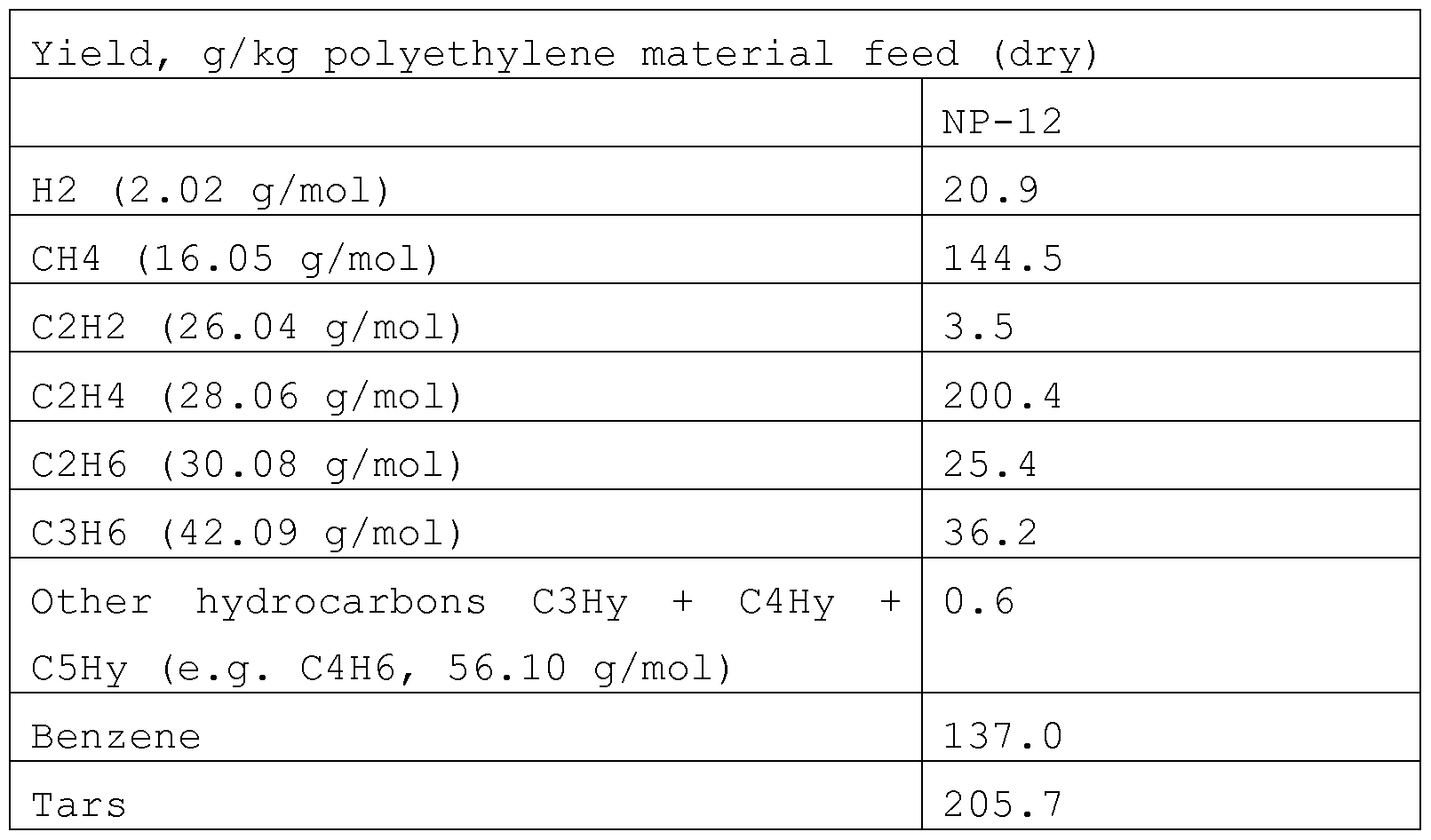
- the product mixture com prised ethylene, propylene and light aromatic hydro carbons such as benzene, and further comprised hydro gen, methane and other hydrocarbons. Further, the product mixture comprised carbon dioxide and carbon monoxide.
- NP-12 sand was used as the bed material. The temperature was 720 °C and fluidized velocity was 0.31 m/s in NP-12 gasification. The yield of the prod uct components per polyethylene material feed, as dry product gas, is presented in Table 2.
- the method and process arrangement are suita- ble in different embodiments for producing hydrocar bons from different polymer-based waste.
Landscapes
- Chemical & Material Sciences (AREA)
- Engineering & Computer Science (AREA)
- Combustion & Propulsion (AREA)
- Organic Chemistry (AREA)
- Oil, Petroleum & Natural Gas (AREA)
- Chemical Kinetics & Catalysis (AREA)
- General Chemical & Material Sciences (AREA)
- Life Sciences & Earth Sciences (AREA)
- Sustainable Development (AREA)
- Health & Medical Sciences (AREA)
- Medicinal Chemistry (AREA)
- Polymers & Plastics (AREA)
- Thermal Sciences (AREA)
- Physics & Mathematics (AREA)
- Separation, Recovery Or Treatment Of Waste Materials Containing Plastics (AREA)
- Organic Low-Molecular-Weight Compounds And Preparation Thereof (AREA)
Abstract
Description

Claims
Priority Applications (8)
| Application Number | Priority Date | Filing Date | Title |
|---|---|---|---|
| US17/432,541 US11905477B2 (en) | 2019-02-21 | 2020-02-21 | Method and process arrangement for producing hydrocarbons |
| KR1020217030109A KR102925277B1 (en) | 2019-02-21 | 2020-02-21 | Method and process apparatus for the production and use of hydrocarbons |
| JP2021549231A JP2022521284A (en) | 2019-02-21 | 2020-02-21 | Methods and process sequences for producing hydrocarbons, and uses |
| BR112021016440-5A BR112021016440B1 (en) | 2019-02-21 | 2020-02-21 | METHOD AND PROCESS ARRANGEMENT FOR PRODUCING HYDROCARBONS FROM POLYMER-BASED WASTE, AND USE OF THE METHOD |
| CA3130873A CA3130873A1 (en) | 2019-02-21 | 2020-02-21 | Method and process arrangement for producing hydrocarbons and use |
| CN202080028279.8A CN113677748B (en) | 2019-02-21 | 2020-02-21 | Methods and equipment for producing hydrocarbons and uses |
| EP20709639.7A EP3927764A1 (en) | 2019-02-21 | 2020-02-21 | Method and process arrangement for producing hydrocarbons and use |
| US18/411,898 US12365846B2 (en) | 2019-02-21 | 2024-01-12 | Arrangement for producing hydrocarbons with parallel gasifier and cracking unit |
Applications Claiming Priority (2)
| Application Number | Priority Date | Filing Date | Title |
|---|---|---|---|
| FI20195132 | 2019-02-21 | ||
| FI20195132 | 2019-02-21 |
Related Child Applications (2)
| Application Number | Title | Priority Date | Filing Date |
|---|---|---|---|
| US17/432,541 A-371-Of-International US11905477B2 (en) | 2019-02-21 | 2020-02-21 | Method and process arrangement for producing hydrocarbons |
| US18/411,898 Continuation US12365846B2 (en) | 2019-02-21 | 2024-01-12 | Arrangement for producing hydrocarbons with parallel gasifier and cracking unit |
Publications (1)
| Publication Number | Publication Date |
|---|---|
| WO2020169888A1 true WO2020169888A1 (en) | 2020-08-27 |
Family
ID=69770931
Family Applications (1)
| Application Number | Title | Priority Date | Filing Date |
|---|---|---|---|
| PCT/FI2020/050111 Ceased WO2020169888A1 (en) | 2019-02-21 | 2020-02-21 | Method and process arrangement for producing hydrocarbons and use |
Country Status (7)
| Country | Link |
|---|---|
| US (2) | US11905477B2 (en) |
| EP (1) | EP3927764A1 (en) |
| JP (1) | JP2022521284A (en) |
| KR (1) | KR102925277B1 (en) |
| CN (1) | CN113677748B (en) |
| CA (1) | CA3130873A1 (en) |
| WO (1) | WO2020169888A1 (en) |
Cited By (4)
| Publication number | Priority date | Publication date | Assignee | Title |
|---|---|---|---|---|
| WO2022184983A1 (en) * | 2021-03-05 | 2022-09-09 | Teknologian Tutkimuskeskus Vtt Oy | Method and apparatus for treating plastics |
| WO2023017210A1 (en) * | 2021-08-13 | 2023-02-16 | Teknologian Tutkimuskeskus Vtt Oy | Method, process arrangement and use for producing hydrocarbons by combining a steam cracker product and a product derived from the steam gasification of a plastic-based material |
| WO2023083887A1 (en) | 2021-11-12 | 2023-05-19 | Borealis Ag | Conversion of plastic waste to hydrocarbons using a transition metal oxide |
| US12018835B2 (en) | 2017-06-09 | 2024-06-25 | Bioshare Ab | Biomass upgrading system |
Citations (4)
| Publication number | Priority date | Publication date | Assignee | Title |
|---|---|---|---|---|
| NL1016093C1 (en) * | 2000-03-31 | 2001-10-05 | Johannes Bastiaan Baars | Production of synthesis gas from hydrocarbon waste using a two-stage fluidized bed gasifier |
| WO2007069449A1 (en) * | 2005-12-12 | 2007-06-21 | Orient Instrument Computer Co., Ltd. | Method and facility for the disposal of plastics waste |
| US20110248218A1 (en) * | 2010-04-13 | 2011-10-13 | Bhagya Chandra Sutradhar | Methods for gasification of carbonaceous materials |
| JP2015160163A (en) * | 2014-02-26 | 2015-09-07 | 国立研究開発法人産業技術総合研究所 | Method and apparatus for recovering valuable materials from waste electronic equipment by steam gasification |
Family Cites Families (33)
| Publication number | Priority date | Publication date | Assignee | Title |
|---|---|---|---|---|
| JPS5036666B2 (en) * | 1971-09-13 | 1975-11-26 | ||
| US4183733A (en) * | 1978-02-21 | 1980-01-15 | Walter Jager | Hydro gas plant with utilization of the residual coke |
| JPH0299596A (en) * | 1988-10-05 | 1990-04-11 | Babcock Hitachi Kk | Thermal cracking furnace for olefin production and decoking of the same furnace |
| US5136117A (en) * | 1990-08-23 | 1992-08-04 | Battelle Memorial Institute | Monomeric recovery from polymeric materials |
| JPH07256228A (en) * | 1994-03-22 | 1995-10-09 | Kunio Kato | Catalytic pyrolysis of wood, carbohydrates and waste plastics |
| NL1007710C2 (en) * | 1997-12-05 | 1999-06-08 | Gibros Pec Bv | Method for processing waste or biomass material. |
| JP4154029B2 (en) * | 1998-04-07 | 2008-09-24 | 株式会社東芝 | Waste treatment method and waste treatment apparatus |
| FI981742A0 (en) | 1998-08-12 | 1998-08-12 | Foster Wheeler Energia Oy | Liquid packaging board waste material recycling process and device for recycling liquid packaging board waste material |
| EP1489046A4 (en) * | 2001-08-21 | 2010-02-24 | Mitsubishi Materials Corp | Method and apparatus for recycling hydrocarbon resource |
| JP3980427B2 (en) | 2002-07-04 | 2007-09-26 | 新日本製鐵株式会社 | Waste plastic gasification gas cooling method and apparatus |
| US7482502B2 (en) | 2003-01-24 | 2009-01-27 | Stone & Webster Process Technology, Inc. | Process for cracking hydrocarbons using improved furnace reactor tubes |
| WO2005021686A1 (en) | 2003-08-29 | 2005-03-10 | Ebara Corporation | Recycling method and system |
| US7128827B2 (en) | 2004-01-14 | 2006-10-31 | Kellogg Brown & Root Llc | Integrated catalytic cracking and steam pyrolysis process for olefins |
| US7618558B2 (en) * | 2005-04-15 | 2009-11-17 | Haldor Topsoe A/S | Process for cleaning gases from gasification units |
| JP2006328328A (en) | 2005-05-30 | 2006-12-07 | Tokyo Institute Of Technology | Gasification system and gasification method for polymer waste |
| BRPI0914765A2 (en) * | 2008-06-25 | 2015-10-20 | Nexterra Systems Corp | generation of clean synthesis gas from biomass |
| DE102008036734A1 (en) * | 2008-08-07 | 2010-02-18 | Spot Spirit Of Technology Ag | Process and apparatus for the production of energy, DME (dimethyl ether and bio-silica using CO2-neutral biogenic reactive and inert starting materials |
| WO2013131042A1 (en) * | 2012-03-01 | 2013-09-06 | The Trustees Of Princeton University | Processes for producing synthetic hydrocarbons from coal, biomass, and natural gas |
| US8961628B2 (en) * | 2012-06-22 | 2015-02-24 | Sundrop Fuels, Inc. | Pretreatment of biomass using steam explosion methods |
| US20130247448A1 (en) * | 2012-03-26 | 2013-09-26 | Sundrop Fuels, Inc. | Optimization of torrefaction volatiles for producing liquid fuel from biomass |
| MY167593A (en) * | 2012-06-26 | 2018-09-20 | Lummus Technology Inc | Two stage gasification with dual quench |
| US9447332B2 (en) * | 2013-02-12 | 2016-09-20 | Saudi Basic Industries Corporation | Conversion of plastics to olefin and aromatic products using temperature control |
| JP6182090B2 (en) * | 2013-03-18 | 2017-08-16 | 出光興産株式会社 | Method and apparatus for producing hydrocarbon components |
| US9862901B2 (en) * | 2013-07-17 | 2018-01-09 | Pyroneer A/S | Apparatus and methods for gasification |
| CN103468322B (en) * | 2013-07-25 | 2015-08-12 | 易高环保能源研究院有限公司 | A method for producing hydrogen-rich gas by steam gasification of solid organic matter |
| DE102013020905A1 (en) * | 2013-12-16 | 2015-06-18 | Ralf Spitzl | Processes and apparatus for the production of synthesis gas |
| KR102375008B1 (en) | 2014-02-25 | 2022-03-17 | 사빅 글로벌 테크놀러지스 비.브이. | A method of controlling the supply and allocation of hydrogen gas in a hydrogen system of a refinery integrated with olefins and aromatics plants |
| WO2015132919A1 (en) * | 2014-03-05 | 2015-09-11 | 中国電力株式会社 | Gasification system |
| US9631151B2 (en) * | 2014-09-04 | 2017-04-25 | Ag Energy Solutions, Inc. | Apparatuses, systems, tar crackers, and methods for gasifying having at least two modes of operation |
| US20170233667A1 (en) * | 2015-02-23 | 2017-08-17 | Exxonmobil Research And Engineering Company | Fluidized bed coking with fuel gas production |
| WO2017132542A1 (en) * | 2016-01-28 | 2017-08-03 | Barry Liss | SYSTEM AND METHOD FOR REDUCING NOx EMISSIONS FROM GASIFICATION POWER PLANTS |
| GB2554923B (en) * | 2016-10-14 | 2021-09-15 | Domino Uk Ltd | Improvements in or relating to inkjet printers |
| US10689587B2 (en) * | 2017-04-26 | 2020-06-23 | Saudi Arabian Oil Company | Systems and processes for conversion of crude oil |
-
2020
- 2020-02-21 EP EP20709639.7A patent/EP3927764A1/en active Pending
- 2020-02-21 US US17/432,541 patent/US11905477B2/en active Active
- 2020-02-21 KR KR1020217030109A patent/KR102925277B1/en active Active
- 2020-02-21 JP JP2021549231A patent/JP2022521284A/en active Pending
- 2020-02-21 CA CA3130873A patent/CA3130873A1/en active Pending
- 2020-02-21 CN CN202080028279.8A patent/CN113677748B/en active Active
- 2020-02-21 WO PCT/FI2020/050111 patent/WO2020169888A1/en not_active Ceased
-
2024
- 2024-01-12 US US18/411,898 patent/US12365846B2/en active Active
Patent Citations (4)
| Publication number | Priority date | Publication date | Assignee | Title |
|---|---|---|---|---|
| NL1016093C1 (en) * | 2000-03-31 | 2001-10-05 | Johannes Bastiaan Baars | Production of synthesis gas from hydrocarbon waste using a two-stage fluidized bed gasifier |
| WO2007069449A1 (en) * | 2005-12-12 | 2007-06-21 | Orient Instrument Computer Co., Ltd. | Method and facility for the disposal of plastics waste |
| US20110248218A1 (en) * | 2010-04-13 | 2011-10-13 | Bhagya Chandra Sutradhar | Methods for gasification of carbonaceous materials |
| JP2015160163A (en) * | 2014-02-26 | 2015-09-07 | 国立研究開発法人産業技術総合研究所 | Method and apparatus for recovering valuable materials from waste electronic equipment by steam gasification |
Non-Patent Citations (3)
| Title |
|---|
| See also references of EP3927764A1 * |
| TOSHIRO TSUJI ET AL: "Gasification of waste plastics by steam reforming in a fluidized bed", JOURNAL OF MATERIAL CYCLES AND WASTE MANAGEMENT, SPRINGER JAPAN KK, JP, vol. 11, no. 2, 25 June 2009 (2009-06-25), pages 144 - 147, XP019664282, ISSN: 1611-8227 * |
| WILK V ET AL: "Conversion of mixed plastic wastes in a dual fluidized bed steam gasifier", FUEL, IPC SCIENCE AND TECHNOLOGY PRESS, GUILDFORD, GB, vol. 107, 15 February 2013 (2013-02-15), pages 787 - 799, XP029003313, ISSN: 0016-2361, DOI: 10.1016/J.FUEL.2013.01.068 * |
Cited By (5)
| Publication number | Priority date | Publication date | Assignee | Title |
|---|---|---|---|---|
| US12018835B2 (en) | 2017-06-09 | 2024-06-25 | Bioshare Ab | Biomass upgrading system |
| WO2022184983A1 (en) * | 2021-03-05 | 2022-09-09 | Teknologian Tutkimuskeskus Vtt Oy | Method and apparatus for treating plastics |
| WO2022184982A1 (en) * | 2021-03-05 | 2022-09-09 | Teknologian Tutkimuskeskus Vtt Oy | Method and apparatus for treating a feed before a quench column |
| WO2023017210A1 (en) * | 2021-08-13 | 2023-02-16 | Teknologian Tutkimuskeskus Vtt Oy | Method, process arrangement and use for producing hydrocarbons by combining a steam cracker product and a product derived from the steam gasification of a plastic-based material |
| WO2023083887A1 (en) | 2021-11-12 | 2023-05-19 | Borealis Ag | Conversion of plastic waste to hydrocarbons using a transition metal oxide |
Also Published As
| Publication number | Publication date |
|---|---|
| JP2022521284A (en) | 2022-04-06 |
| US20240150664A1 (en) | 2024-05-09 |
| BR112021016440A2 (en) | 2021-11-09 |
| US20220145194A1 (en) | 2022-05-12 |
| CN113677748A (en) | 2021-11-19 |
| US12365846B2 (en) | 2025-07-22 |
| CN113677748B (en) | 2024-03-08 |
| KR20210128470A (en) | 2021-10-26 |
| KR102925277B1 (en) | 2026-02-06 |
| EP3927764A1 (en) | 2021-12-29 |
| CA3130873A1 (en) | 2020-08-27 |
| US11905477B2 (en) | 2024-02-20 |
Similar Documents
| Publication | Publication Date | Title |
|---|---|---|
| US12365846B2 (en) | Arrangement for producing hydrocarbons with parallel gasifier and cracking unit | |
| JP7130632B2 (en) | Maximizing high-value chemicals from mixed plastics using various steam cracker configurations | |
| JP3385025B2 (en) | How to process used or waste plastic | |
| JP7079297B2 (en) | Processes and equipment for simultaneous conversion of waste plastics in delayed coker units | |
| KR100294809B1 (en) | Recycling method of plastic in steam cracker | |
| JP2024535964A (en) | Method for removing chlorine from waste plastic | |
| JP2024525488A (en) | Systems and methods for processing mixed plastic waste | |
| KR20250006081A (en) | Integrated mixed plastics pyrolysis through pyrolysis of heavy oil products | |
| JP7847126B2 (en) | Use of hydrocarbon production and processing equipment and methods | |
| CN119403901A (en) | Co-processing of plastic waste in coker for jet fuel production | |
| CN118103486A (en) | Process for converting mixed plastic waste into liquid hydrocarbon products | |
| JPH08269459A (en) | Liquefaction method of coal | |
| KR20250127303A (en) | plastic recycling process | |
| BR112021016440B1 (en) | METHOD AND PROCESS ARRANGEMENT FOR PRODUCING HYDROCARBONS FROM POLYMER-BASED WASTE, AND USE OF THE METHOD | |
| WO2016169661A1 (en) | Process and plant for producing synthesis gas and pyrolysis products from coal of different grain size | |
| KR102916301B1 (en) | Pyrolysis reactor and apparatus for the production of wax-containing oil by seperating wax from plastic pyrolysis-product | |
| US20240352336A1 (en) | Method and process arrangement for producing hydrocarbons | |
| EP4638667A1 (en) | Method and apparatus for cleaning gasification product and use | |
| EA051999B1 (en) | Integrated pyrolysis of mixed plastic with thermal cracking of heavy petroleum products |
Legal Events
| Date | Code | Title | Description |
|---|---|---|---|
| 121 | Ep: the epo has been informed by wipo that ep was designated in this application |
Ref document number: 20709639 Country of ref document: EP Kind code of ref document: A1 |
|
| ENP | Entry into the national phase |
Ref document number: 3130873 Country of ref document: CA |
|
| ENP | Entry into the national phase |
Ref document number: 2021549231 Country of ref document: JP Kind code of ref document: A |
|
| NENP | Non-entry into the national phase |
Ref country code: DE |
|
| REG | Reference to national code |
Ref country code: BR Ref legal event code: B01A Ref document number: 112021016440 Country of ref document: BR |
|
| ENP | Entry into the national phase |
Ref document number: 20217030109 Country of ref document: KR Kind code of ref document: A |
|
| ENP | Entry into the national phase |
Ref document number: 2020709639 Country of ref document: EP Effective date: 20210921 |
|
| ENP | Entry into the national phase |
Ref document number: 112021016440 Country of ref document: BR Kind code of ref document: A2 Effective date: 20210819 |
|
| WWE | Wipo information: entry into national phase |
Ref document number: 521430114 Country of ref document: SA |
|
| WWE | Wipo information: entry into national phase |
Ref document number: 521430114 Country of ref document: SA |
|
| WWG | Wipo information: grant in national office |
Ref document number: 521430114 Country of ref document: SA |