WO2020170638A1 - 接着組成物、表面処理金属部材の製造方法、および金属-樹脂複合体の製造方法 - Google Patents
接着組成物、表面処理金属部材の製造方法、および金属-樹脂複合体の製造方法 Download PDFInfo
- Publication number
- WO2020170638A1 WO2020170638A1 PCT/JP2020/000437 JP2020000437W WO2020170638A1 WO 2020170638 A1 WO2020170638 A1 WO 2020170638A1 JP 2020000437 W JP2020000437 W JP 2020000437W WO 2020170638 A1 WO2020170638 A1 WO 2020170638A1
- Authority
- WO
- WIPO (PCT)
- Prior art keywords
- metal
- resin
- adhesive composition
- group
- producing
- Prior art date
- Legal status (The legal status is an assumption and is not a legal conclusion. Google has not performed a legal analysis and makes no representation as to the accuracy of the status listed.)
- Ceased
Links
Classifications
-
- B—PERFORMING OPERATIONS; TRANSPORTING
- B32—LAYERED PRODUCTS
- B32B—LAYERED PRODUCTS, i.e. PRODUCTS BUILT-UP OF STRATA OF FLAT OR NON-FLAT, e.g. CELLULAR OR HONEYCOMB, FORM
- B32B7/00—Layered products characterised by the relation between layers; Layered products characterised by the relative orientation of features between layers, or by the relative values of a measurable parameter between layers, i.e. products comprising layers having different physical, chemical or physicochemical properties; Layered products characterised by the interconnection of layers
- B32B7/04—Interconnection of layers
- B32B7/12—Interconnection of layers using interposed adhesives or interposed materials with bonding properties
-
- C—CHEMISTRY; METALLURGY
- C09—DYES; PAINTS; POLISHES; NATURAL RESINS; ADHESIVES; COMPOSITIONS NOT OTHERWISE PROVIDED FOR; APPLICATIONS OF MATERIALS NOT OTHERWISE PROVIDED FOR
- C09J—ADHESIVES; NON-MECHANICAL ASPECTS OF ADHESIVE PROCESSES IN GENERAL; ADHESIVE PROCESSES NOT PROVIDED FOR ELSEWHERE; USE OF MATERIALS AS ADHESIVES
- C09J11/00—Features of adhesives not provided for in group C09J9/00, e.g. additives
- C09J11/02—Non-macromolecular additives
- C09J11/06—Non-macromolecular additives organic
-
- B—PERFORMING OPERATIONS; TRANSPORTING
- B32—LAYERED PRODUCTS
- B32B—LAYERED PRODUCTS, i.e. PRODUCTS BUILT-UP OF STRATA OF FLAT OR NON-FLAT, e.g. CELLULAR OR HONEYCOMB, FORM
- B32B15/00—Layered products comprising a layer of metal
- B32B15/04—Layered products comprising a layer of metal comprising metal as the main or only constituent of a layer, which is next to another layer of the same or of a different material
- B32B15/08—Layered products comprising a layer of metal comprising metal as the main or only constituent of a layer, which is next to another layer of the same or of a different material of synthetic resin
-
- B—PERFORMING OPERATIONS; TRANSPORTING
- B32—LAYERED PRODUCTS
- B32B—LAYERED PRODUCTS, i.e. PRODUCTS BUILT-UP OF STRATA OF FLAT OR NON-FLAT, e.g. CELLULAR OR HONEYCOMB, FORM
- B32B15/00—Layered products comprising a layer of metal
- B32B15/04—Layered products comprising a layer of metal comprising metal as the main or only constituent of a layer, which is next to another layer of the same or of a different material
- B32B15/08—Layered products comprising a layer of metal comprising metal as the main or only constituent of a layer, which is next to another layer of the same or of a different material of synthetic resin
- B32B15/092—Layered products comprising a layer of metal comprising metal as the main or only constituent of a layer, which is next to another layer of the same or of a different material of synthetic resin comprising epoxy resins
-
- B—PERFORMING OPERATIONS; TRANSPORTING
- B32—LAYERED PRODUCTS
- B32B—LAYERED PRODUCTS, i.e. PRODUCTS BUILT-UP OF STRATA OF FLAT OR NON-FLAT, e.g. CELLULAR OR HONEYCOMB, FORM
- B32B15/00—Layered products comprising a layer of metal
- B32B15/18—Layered products comprising a layer of metal comprising iron or steel
-
- B—PERFORMING OPERATIONS; TRANSPORTING
- B32—LAYERED PRODUCTS
- B32B—LAYERED PRODUCTS, i.e. PRODUCTS BUILT-UP OF STRATA OF FLAT OR NON-FLAT, e.g. CELLULAR OR HONEYCOMB, FORM
- B32B15/00—Layered products comprising a layer of metal
- B32B15/20—Layered products comprising a layer of metal comprising aluminium or copper
-
- B—PERFORMING OPERATIONS; TRANSPORTING
- B32—LAYERED PRODUCTS
- B32B—LAYERED PRODUCTS, i.e. PRODUCTS BUILT-UP OF STRATA OF FLAT OR NON-FLAT, e.g. CELLULAR OR HONEYCOMB, FORM
- B32B27/00—Layered products comprising a layer of synthetic resin
- B32B27/28—Layered products comprising a layer of synthetic resin comprising synthetic resins not wholly covered by any one of the sub-groups B32B27/30 - B32B27/42
- B32B27/283—Layered products comprising a layer of synthetic resin comprising synthetic resins not wholly covered by any one of the sub-groups B32B27/30 - B32B27/42 comprising polysiloxanes
-
- B—PERFORMING OPERATIONS; TRANSPORTING
- B32—LAYERED PRODUCTS
- B32B—LAYERED PRODUCTS, i.e. PRODUCTS BUILT-UP OF STRATA OF FLAT OR NON-FLAT, e.g. CELLULAR OR HONEYCOMB, FORM
- B32B27/00—Layered products comprising a layer of synthetic resin
- B32B27/30—Layered products comprising a layer of synthetic resin comprising vinyl (co)polymers; comprising acrylic (co)polymers
- B32B27/308—Layered products comprising a layer of synthetic resin comprising vinyl (co)polymers; comprising acrylic (co)polymers comprising acrylic (co)polymers
-
- B—PERFORMING OPERATIONS; TRANSPORTING
- B32—LAYERED PRODUCTS
- B32B—LAYERED PRODUCTS, i.e. PRODUCTS BUILT-UP OF STRATA OF FLAT OR NON-FLAT, e.g. CELLULAR OR HONEYCOMB, FORM
- B32B27/00—Layered products comprising a layer of synthetic resin
- B32B27/36—Layered products comprising a layer of synthetic resin comprising polyesters
-
- B—PERFORMING OPERATIONS; TRANSPORTING
- B32—LAYERED PRODUCTS
- B32B—LAYERED PRODUCTS, i.e. PRODUCTS BUILT-UP OF STRATA OF FLAT OR NON-FLAT, e.g. CELLULAR OR HONEYCOMB, FORM
- B32B27/00—Layered products comprising a layer of synthetic resin
- B32B27/38—Layered products comprising a layer of synthetic resin comprising epoxy resins
-
- B—PERFORMING OPERATIONS; TRANSPORTING
- B32—LAYERED PRODUCTS
- B32B—LAYERED PRODUCTS, i.e. PRODUCTS BUILT-UP OF STRATA OF FLAT OR NON-FLAT, e.g. CELLULAR OR HONEYCOMB, FORM
- B32B27/00—Layered products comprising a layer of synthetic resin
- B32B27/40—Layered products comprising a layer of synthetic resin comprising polyurethanes
-
- C—CHEMISTRY; METALLURGY
- C08—ORGANIC MACROMOLECULAR COMPOUNDS; THEIR PREPARATION OR CHEMICAL WORKING-UP; COMPOSITIONS BASED THEREON
- C08K—Use of inorganic or non-macromolecular organic substances as compounding ingredients
- C08K5/00—Use of organic ingredients
- C08K5/16—Nitrogen-containing compounds
- C08K5/34—Heterocyclic compounds having nitrogen in the ring
- C08K5/3442—Heterocyclic compounds having nitrogen in the ring having two nitrogen atoms in the ring
-
- C—CHEMISTRY; METALLURGY
- C09—DYES; PAINTS; POLISHES; NATURAL RESINS; ADHESIVES; COMPOSITIONS NOT OTHERWISE PROVIDED FOR; APPLICATIONS OF MATERIALS NOT OTHERWISE PROVIDED FOR
- C09J—ADHESIVES; NON-MECHANICAL ASPECTS OF ADHESIVE PROCESSES IN GENERAL; ADHESIVE PROCESSES NOT PROVIDED FOR ELSEWHERE; USE OF MATERIALS AS ADHESIVES
- C09J11/00—Features of adhesives not provided for in group C09J9/00, e.g. additives
- C09J11/02—Non-macromolecular additives
-
- C—CHEMISTRY; METALLURGY
- C09—DYES; PAINTS; POLISHES; NATURAL RESINS; ADHESIVES; COMPOSITIONS NOT OTHERWISE PROVIDED FOR; APPLICATIONS OF MATERIALS NOT OTHERWISE PROVIDED FOR
- C09J—ADHESIVES; NON-MECHANICAL ASPECTS OF ADHESIVE PROCESSES IN GENERAL; ADHESIVE PROCESSES NOT PROVIDED FOR ELSEWHERE; USE OF MATERIALS AS ADHESIVES
- C09J11/00—Features of adhesives not provided for in group C09J9/00, e.g. additives
- C09J11/02—Non-macromolecular additives
- C09J11/04—Non-macromolecular additives inorganic
-
- C—CHEMISTRY; METALLURGY
- C09—DYES; PAINTS; POLISHES; NATURAL RESINS; ADHESIVES; COMPOSITIONS NOT OTHERWISE PROVIDED FOR; APPLICATIONS OF MATERIALS NOT OTHERWISE PROVIDED FOR
- C09J—ADHESIVES; NON-MECHANICAL ASPECTS OF ADHESIVE PROCESSES IN GENERAL; ADHESIVE PROCESSES NOT PROVIDED FOR ELSEWHERE; USE OF MATERIALS AS ADHESIVES
- C09J201/00—Adhesives based on unspecified macromolecular compounds
-
- C—CHEMISTRY; METALLURGY
- C09—DYES; PAINTS; POLISHES; NATURAL RESINS; ADHESIVES; COMPOSITIONS NOT OTHERWISE PROVIDED FOR; APPLICATIONS OF MATERIALS NOT OTHERWISE PROVIDED FOR
- C09J—ADHESIVES; NON-MECHANICAL ASPECTS OF ADHESIVE PROCESSES IN GENERAL; ADHESIVE PROCESSES NOT PROVIDED FOR ELSEWHERE; USE OF MATERIALS AS ADHESIVES
- C09J5/00—Adhesive processes in general; Adhesive processes not provided for elsewhere, e.g. relating to primers
- C09J5/02—Adhesive processes in general; Adhesive processes not provided for elsewhere, e.g. relating to primers involving pretreatment of the surfaces to be joined
-
- C—CHEMISTRY; METALLURGY
- C09—DYES; PAINTS; POLISHES; NATURAL RESINS; ADHESIVES; COMPOSITIONS NOT OTHERWISE PROVIDED FOR; APPLICATIONS OF MATERIALS NOT OTHERWISE PROVIDED FOR
- C09J—ADHESIVES; NON-MECHANICAL ASPECTS OF ADHESIVE PROCESSES IN GENERAL; ADHESIVE PROCESSES NOT PROVIDED FOR ELSEWHERE; USE OF MATERIALS AS ADHESIVES
- C09J7/00—Adhesives in the form of films or foils
- C09J7/20—Adhesives in the form of films or foils characterised by their carriers
-
- C—CHEMISTRY; METALLURGY
- C09—DYES; PAINTS; POLISHES; NATURAL RESINS; ADHESIVES; COMPOSITIONS NOT OTHERWISE PROVIDED FOR; APPLICATIONS OF MATERIALS NOT OTHERWISE PROVIDED FOR
- C09J—ADHESIVES; NON-MECHANICAL ASPECTS OF ADHESIVE PROCESSES IN GENERAL; ADHESIVE PROCESSES NOT PROVIDED FOR ELSEWHERE; USE OF MATERIALS AS ADHESIVES
- C09J7/00—Adhesives in the form of films or foils
- C09J7/20—Adhesives in the form of films or foils characterised by their carriers
- C09J7/28—Metal sheet
-
- C—CHEMISTRY; METALLURGY
- C23—COATING METALLIC MATERIAL; COATING MATERIAL WITH METALLIC MATERIAL; CHEMICAL SURFACE TREATMENT; DIFFUSION TREATMENT OF METALLIC MATERIAL; COATING BY VACUUM EVAPORATION, BY SPUTTERING, BY ION IMPLANTATION OR BY CHEMICAL VAPOUR DEPOSITION, IN GENERAL; INHIBITING CORROSION OF METALLIC MATERIAL OR INCRUSTATION IN GENERAL
- C23C—COATING METALLIC MATERIAL; COATING MATERIAL WITH METALLIC MATERIAL; SURFACE TREATMENT OF METALLIC MATERIAL BY DIFFUSION INTO THE SURFACE, BY CHEMICAL CONVERSION OR SUBSTITUTION; COATING BY VACUUM EVAPORATION, BY SPUTTERING, BY ION IMPLANTATION OR BY CHEMICAL VAPOUR DEPOSITION, IN GENERAL
- C23C24/00—Coating starting from inorganic powder
- C23C24/08—Coating starting from inorganic powder by application of heat or pressure and heat
-
- B—PERFORMING OPERATIONS; TRANSPORTING
- B32—LAYERED PRODUCTS
- B32B—LAYERED PRODUCTS, i.e. PRODUCTS BUILT-UP OF STRATA OF FLAT OR NON-FLAT, e.g. CELLULAR OR HONEYCOMB, FORM
- B32B2255/00—Coating on the layer surface
- B32B2255/06—Coating on the layer surface on metal layer
-
- B—PERFORMING OPERATIONS; TRANSPORTING
- B32—LAYERED PRODUCTS
- B32B—LAYERED PRODUCTS, i.e. PRODUCTS BUILT-UP OF STRATA OF FLAT OR NON-FLAT, e.g. CELLULAR OR HONEYCOMB, FORM
- B32B2255/00—Coating on the layer surface
- B32B2255/24—Organic non-macromolecular coating
-
- B—PERFORMING OPERATIONS; TRANSPORTING
- B32—LAYERED PRODUCTS
- B32B—LAYERED PRODUCTS, i.e. PRODUCTS BUILT-UP OF STRATA OF FLAT OR NON-FLAT, e.g. CELLULAR OR HONEYCOMB, FORM
- B32B2307/00—Properties of the layers or laminate
- B32B2307/50—Properties of the layers or laminate having particular mechanical properties
- B32B2307/542—Shear strength
-
- B—PERFORMING OPERATIONS; TRANSPORTING
- B32—LAYERED PRODUCTS
- B32B—LAYERED PRODUCTS, i.e. PRODUCTS BUILT-UP OF STRATA OF FLAT OR NON-FLAT, e.g. CELLULAR OR HONEYCOMB, FORM
- B32B2457/00—Electrical equipment
- B32B2457/08—PCBs, i.e. printed circuit boards
-
- C—CHEMISTRY; METALLURGY
- C08—ORGANIC MACROMOLECULAR COMPOUNDS; THEIR PREPARATION OR CHEMICAL WORKING-UP; COMPOSITIONS BASED THEREON
- C08K—Use of inorganic or non-macromolecular organic substances as compounding ingredients
- C08K3/00—Use of inorganic substances as compounding ingredients
- C08K3/30—Sulfur-, selenium- or tellurium-containing compounds
- C08K2003/3045—Sulfates
- C08K2003/3081—Aluminum sulfate
-
- C—CHEMISTRY; METALLURGY
- C08—ORGANIC MACROMOLECULAR COMPOUNDS; THEIR PREPARATION OR CHEMICAL WORKING-UP; COMPOSITIONS BASED THEREON
- C08K—Use of inorganic or non-macromolecular organic substances as compounding ingredients
- C08K3/00—Use of inorganic substances as compounding ingredients
- C08K3/16—Halogen-containing compounds
-
- C—CHEMISTRY; METALLURGY
- C08—ORGANIC MACROMOLECULAR COMPOUNDS; THEIR PREPARATION OR CHEMICAL WORKING-UP; COMPOSITIONS BASED THEREON
- C08K—Use of inorganic or non-macromolecular organic substances as compounding ingredients
- C08K3/00—Use of inorganic substances as compounding ingredients
- C08K3/30—Sulfur-, selenium- or tellurium-containing compounds
-
- C—CHEMISTRY; METALLURGY
- C08—ORGANIC MACROMOLECULAR COMPOUNDS; THEIR PREPARATION OR CHEMICAL WORKING-UP; COMPOSITIONS BASED THEREON
- C08K—Use of inorganic or non-macromolecular organic substances as compounding ingredients
- C08K5/00—Use of organic ingredients
- C08K5/16—Nitrogen-containing compounds
- C08K5/34—Heterocyclic compounds having nitrogen in the ring
- C08K5/3467—Heterocyclic compounds having nitrogen in the ring having more than two nitrogen atoms in the ring
- C08K5/3477—Six-membered rings
- C08K5/3492—Triazines
-
- C—CHEMISTRY; METALLURGY
- C09—DYES; PAINTS; POLISHES; NATURAL RESINS; ADHESIVES; COMPOSITIONS NOT OTHERWISE PROVIDED FOR; APPLICATIONS OF MATERIALS NOT OTHERWISE PROVIDED FOR
- C09J—ADHESIVES; NON-MECHANICAL ASPECTS OF ADHESIVE PROCESSES IN GENERAL; ADHESIVE PROCESSES NOT PROVIDED FOR ELSEWHERE; USE OF MATERIALS AS ADHESIVES
- C09J2203/00—Applications of adhesives in processes or use of adhesives in the form of films or foils
- C09J2203/326—Applications of adhesives in processes or use of adhesives in the form of films or foils for bonding electronic components such as wafers, chips or semiconductors
-
- C—CHEMISTRY; METALLURGY
- C09—DYES; PAINTS; POLISHES; NATURAL RESINS; ADHESIVES; COMPOSITIONS NOT OTHERWISE PROVIDED FOR; APPLICATIONS OF MATERIALS NOT OTHERWISE PROVIDED FOR
- C09J—ADHESIVES; NON-MECHANICAL ASPECTS OF ADHESIVE PROCESSES IN GENERAL; ADHESIVE PROCESSES NOT PROVIDED FOR ELSEWHERE; USE OF MATERIALS AS ADHESIVES
- C09J2400/00—Presence of inorganic and organic materials
- C09J2400/10—Presence of inorganic materials
- C09J2400/16—Metal
- C09J2400/163—Metal in the substrate
-
- C—CHEMISTRY; METALLURGY
- C09—DYES; PAINTS; POLISHES; NATURAL RESINS; ADHESIVES; COMPOSITIONS NOT OTHERWISE PROVIDED FOR; APPLICATIONS OF MATERIALS NOT OTHERWISE PROVIDED FOR
- C09J—ADHESIVES; NON-MECHANICAL ASPECTS OF ADHESIVE PROCESSES IN GENERAL; ADHESIVE PROCESSES NOT PROVIDED FOR ELSEWHERE; USE OF MATERIALS AS ADHESIVES
- C09J2400/00—Presence of inorganic and organic materials
- C09J2400/10—Presence of inorganic materials
- C09J2400/16—Metal
- C09J2400/166—Metal in the pretreated surface to be joined
-
- C—CHEMISTRY; METALLURGY
- C09—DYES; PAINTS; POLISHES; NATURAL RESINS; ADHESIVES; COMPOSITIONS NOT OTHERWISE PROVIDED FOR; APPLICATIONS OF MATERIALS NOT OTHERWISE PROVIDED FOR
- C09J—ADHESIVES; NON-MECHANICAL ASPECTS OF ADHESIVE PROCESSES IN GENERAL; ADHESIVE PROCESSES NOT PROVIDED FOR ELSEWHERE; USE OF MATERIALS AS ADHESIVES
- C09J2463/00—Presence of epoxy resin
-
- C—CHEMISTRY; METALLURGY
- C09—DYES; PAINTS; POLISHES; NATURAL RESINS; ADHESIVES; COMPOSITIONS NOT OTHERWISE PROVIDED FOR; APPLICATIONS OF MATERIALS NOT OTHERWISE PROVIDED FOR
- C09J—ADHESIVES; NON-MECHANICAL ASPECTS OF ADHESIVE PROCESSES IN GENERAL; ADHESIVE PROCESSES NOT PROVIDED FOR ELSEWHERE; USE OF MATERIALS AS ADHESIVES
- C09J2463/00—Presence of epoxy resin
- C09J2463/006—Presence of epoxy resin in the substrate
Definitions
- the present invention relates to an adhesive composition, a method for producing a surface-treated metal member, and a method for producing a metal-resin composite.
- resin materials such as etching resist, plating resist, solder resist, prepreg, and sealing resin are bonded to the surface of metal layers and metal wiring.
- high adhesiveness is required between the metal and the resin.
- a method for forming fine irregularities on the surface of a metal with a roughening agent (micro-etching agent) in order to enhance the adhesion between the metal and the resin, and a film for improving the adhesion with the resin on the surface of the metal A method of forming an adhesive layer), a method of forming an adhesive layer on a roughened surface, and the like are known.
- Patent Documents 1 and 2 disclose a film-forming composition for forming a film having excellent adhesiveness between a metal member and a resin.
- the lead frame immediately before the molding step has a surface of a plurality of metals such as bonding wires, die pads, bonding pads, and heat sinks such as copper, nickel, silver, aluminum, gold, tin, and lead.
- a plurality of metals such as bonding wires, die pads, bonding pads, and heat sinks such as copper, nickel, silver, aluminum, gold, tin, and lead.
- the present invention has been made in view of the above circumstances, and an object thereof is to provide an adhesive composition capable of improving the adhesiveness between a surface of a plurality of metals and a resin.
- the present invention is an adhesive composition for forming an adhesive layer with a resin on the surface of a metal, wherein the resin is a curable resin, and the composition has two or more nitrogen atoms in one molecule.
- a low molecular weight organic compound having an atom, a trivalent aluminum ion, and one or more metal ions selected from the group consisting of trivalent chromium ions, and an aqueous solution having a pH of 12 or less.
- the adhesive composition is characterized in that the concentration of the compound is 0.01 to 150 g/L, and the molar concentration of the metal ion is 0.005 to 100 mm/L.
- the present invention also relates to a method for producing a surface-treated metal member, which comprises the step of contacting the member having a metal surface with the adhesive composition to form an adhesive layer on the surface.
- the present invention relates to a method for producing a metal-resin composite, comprising a step of bonding a resin member on the adhesive layer of the surface-treated metal member obtained by the method for producing a surface-treated metal member. ..
- the adhesive composition of the present invention is used for forming an adhesive layer with a resin on the surface of a metal, and the resin is a curable resin. Further, the adhesive composition of the present invention comprises at least one selected from the group consisting of a low molecular weight organic compound having two or more nitrogen atoms in one molecule, a trivalent aluminum ion, and a trivalent chromium ion.
- the composition comprises a specific amount of the low molecular weight organic compound and a specific amount of the metal ions to form a dense film that is advantageous for adhesion by building a self-assembling network. It is presumed that the adhesion between the surface and the resin can be improved.
- the adhesive composition of the present invention is an adhesive composition for forming an adhesive layer with a resin on the surface of a metal, wherein the resin is a curable resin, and the composition contains 2 in 1 molecule.
- a low molecular weight organic compound having at least one nitrogen atom, a trivalent aluminum ion, and one or more metal ions selected from the group consisting of trivalent chromium ions, and an aqueous solution having a pH of 12 or less,
- the concentration of the low molecular weight organic compound is 0.01 to 150 g/L, and the molar concentration of the metal ion source is 0.005 to 100 mm/L.
- the metal of the present invention may be any metal belonging to the transition elements, base metal elements and metalloid elements of the periodic table, and includes alloys thereof.
- the transition element include titanium, vanadium, chromium, manganese, iron, cobalt, nickel, copper, zinc, zirconium, molybdenum, silver, tungsten, platinum, gold and the like
- the base metal element include: Examples thereof include aluminum, indium, tin, and lead, and examples of the semi-metal element include silicon and antimony.
- iron, copper, nickel, gold, silver, aluminum and tin are preferable.
- the surface of the metal includes, for example, a surface of a metal having an oxide film, a surface of a plated metal, a surface of an activated metal, and the like. The surface of the metal may be smooth and may be roughened.
- the surface of the metal is usually a member (metal member) having a metal surface, and the shape of the member is not particularly limited.
- the shape of the member for example, a lump of metal, a plate material, a bar material, and the like can be cited. Further, plastic working, sawing, milling, electric discharge machining, drilling, press working, grinding, polishing, etc. are independently performed. , Or those machined into a desired shape by combining these processes.
- Examples of the member/site having the metal member include a semiconductor wafer, an electronic substrate, a lead frame, a die pad, a bonding wire, a bonding pad, a bus bar, and a heat sink.
- the resin of the present invention is a curable resin.
- the curable resin is a resin formed from a resin composition exhibiting curability.
- the curable resin include phenol resin, epoxy resin, urea resin, melamine resin, unsaturated polyester resin, silicone resin, polyurethane resin, diallyl phthalate resin, alkyd resin, isocyanate resin, cyanoacrylate resin and the like; acrylic resin and the like.
- the curable resins may be used alone or in combination of two or more.
- the curable resin may be a composition composed of the curable resin or may be a composition containing the curable resin as a main component. Also, to the extent that the effects of the present invention are not impaired, various conventionally known inorganic/organic fillers, flame retardants, flame retardant aids, ultraviolet absorbers, heat stabilizers, light stabilizers, colorants, carbon black, processing aids. It may be a composition containing additives such as an agent, a nucleating agent, a release agent, a plasticizer, and a fibrous reinforcing material.
- the low molecular weight organic compound having two or more nitrogen atoms in one molecule of the present invention is a main component forming an adhesive layer between a metal surface and a resin.
- the low-molecular weight organic compound means that it does not include a so-called high-molecular weight organic compound, and the molecular weight is not particularly limited.
- the upper limit of the molecular weight is 1500 or less, 1000 or less. The following can be illustrated.
- the low molecular weight organic compounds may be used alone or in combination of two or more kinds.
- the low molecular weight organic compound is not particularly limited as long as it is a low molecular weight organic compound having two or more nitrogen atoms in one molecule because two or more nitrogen atoms in one molecule self-assemble to form a network.
- the organic group containing the nitrogen atom for example, an amino group, an imino group, a nitro group, a nitroso group, an azo group, a hydrazo group, a diazo group, a cyano group, a heterocycle containing a nitrogen atom (nitrogen-containing heterocycle) And so on.
- the low molecular weight organic compound is preferably a compound having an aromatic ring in the molecule, and more preferably a compound having a nitrogen atom-containing heterocycle (nitrogen-containing heterocycle).
- amino group-containing compound examples include monoamine compounds such as nitroaniline, cyanoaniline and paraphenylazoaniline; diamine compounds such as ethylenediamine, diaminobenzoic acid, phenylenediamine, aminobenzothiazole and piperazine; bishexamethylenetriamine and diethylenetriamine. And triamine compounds such as diaminoaniline; and polyamine compounds such as tetraamine compounds such as benzenetetraamine, triaminoethylamine, and biphenyltetramine. Among these, amino group-containing compounds having an aromatic ring in the molecule are preferable.
- Examples of the imino group-containing compound include acetamidine hydrochloride and guanidine hydrochloride; examples of the nitro group-containing compound include dinitrofluorobenzene and dinitrophenol; and examples of the nitroso group-containing compound include dinitroso.
- Benzene, dimethylnitrosamine and the like azo group-containing compounds such as azobenzene dicarboxylic acid; hydrazo group-containing compounds such as hydrazobenzene and hydrazine; diazo group-containing compounds such as diazoacetic acid ester and chloride Benzenediazonium and the like
- Examples of the cyano group-containing compound include dichlorodicyanobenzoquinone, dicyano silver salt and the like.
- the heterocycle may be a monocycle or a condensed ring, and the heterocycle may contain an oxygen atom or a sulfur atom.
- the compound having a nitrogen-containing heterocycle for example, pyrrole, pyrazole, imidazole, triazole, tetrazole, oxazole, oxadiazole, isoxazole, thiazole, isothiazole, flazane, pyridine, pyridazine, pyrimidine, pyrazine, triazine, tetrazine, Monocycles such as pentazine, azepine, diazepine, triazepine; fused bicycles such as indole, isoindole, thienoindole, indazole, purine, quinoline, isoquinoline, benzotriazole; carbazole, acridine, ⁇ -carboline,
- a nitrogen-containing heterocycle containing two or more nitrogen atoms such as pyrazole, imidazole, triazole, tetrazole, pyridazine, pyrimidine, pyrazine, triazine, tetrazine and pentadine is preferable, and imidazole, triazole and triazine are particularly preferable.
- examples of the low molecular weight organic compound having two or more nitrogen atoms in one molecule include, for example, amino groups in one molecule described in JP-A-2017-203073 and 2018-115306. And compounds having a nitrogen-containing heterocycle can be used.
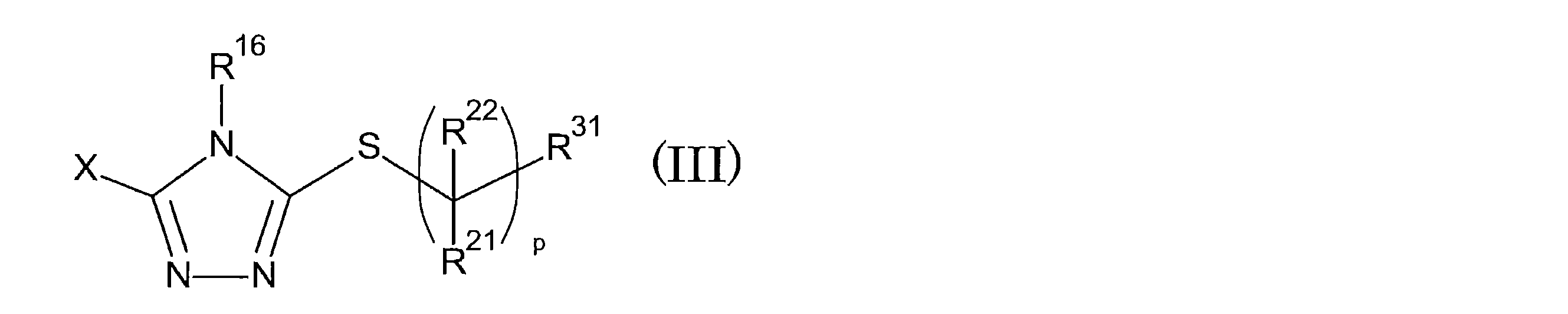
- R 11 to R 15 in the general formulas (I) and (II) are each independently a hydrogen atom, or an alkyl group, an allyl group, a benzyl group or an aryl group having 1 to 20 carbon atoms.
- R 21 and R 21 22 each independently represents a hydrogen atom, an alkyl group having 1 to 4 carbon atoms, a hydroxy group or a methoxy group, p is an integer of 0 to 16.
- R 31 is a primary amino group (—NH 2 ) Or —Si(OR 41 ) k R 42 (3-k) or an alkoxysilyl group or a hydroxysilyl group (k is an integer of 1 to 3, R 41 and R 42 are each independently a hydrogen atom or a carbon atom). An alkyl group of the numbers 1 to 6).
- R 21 and R 22 , R 31 and p in the general formula (III) are the same as those in the general formulas (I) and (II).
- R 16 is a hydrogen atom or an alkyl group having 1 to 20 carbon atoms. , An allyl group, a benzyl group or an aryl group.
- X is a hydrogen atom, a methyl group, —NH 2 , —SH or —SCH 3 , and —NH 2 is particularly preferable.
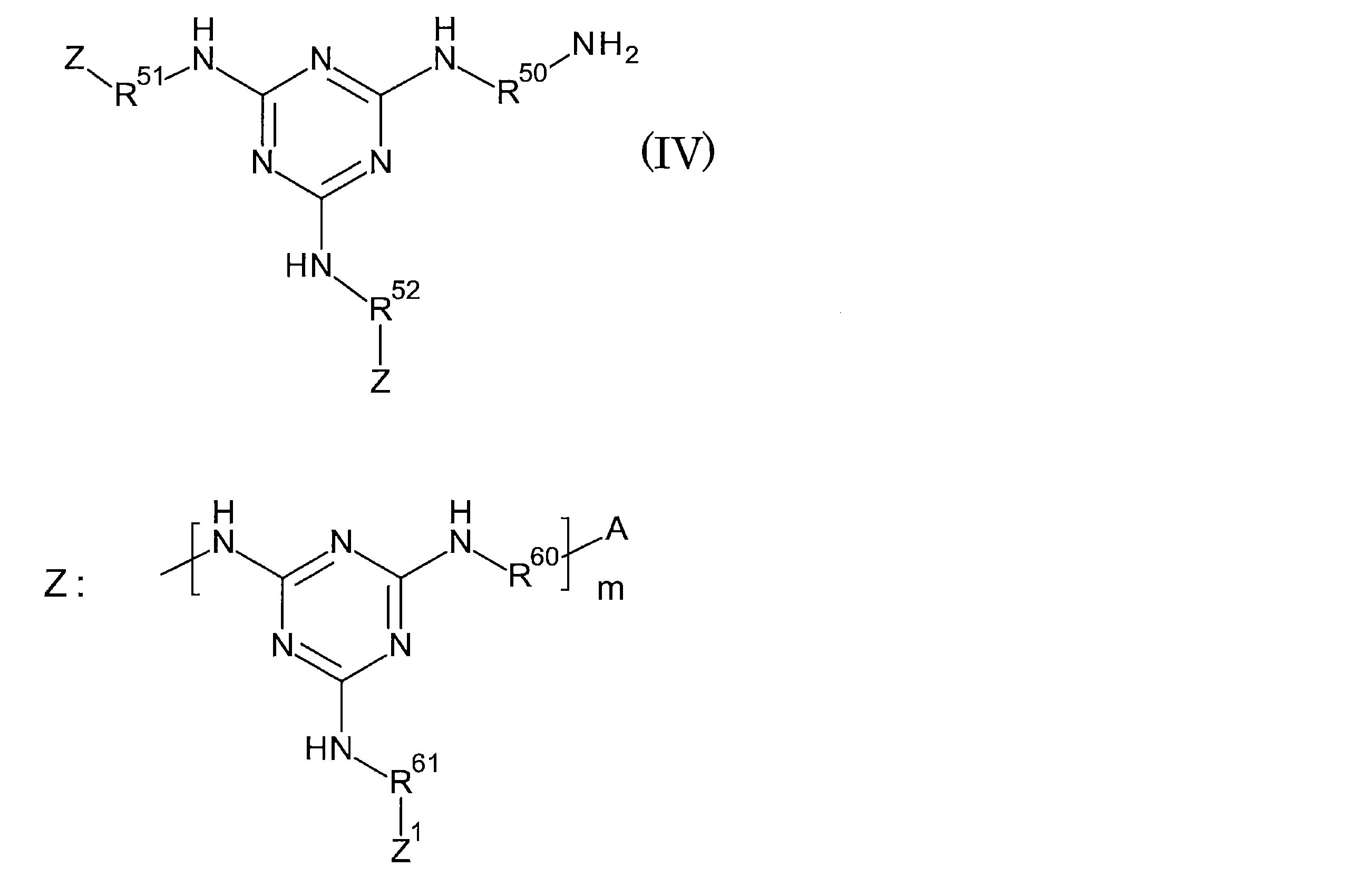
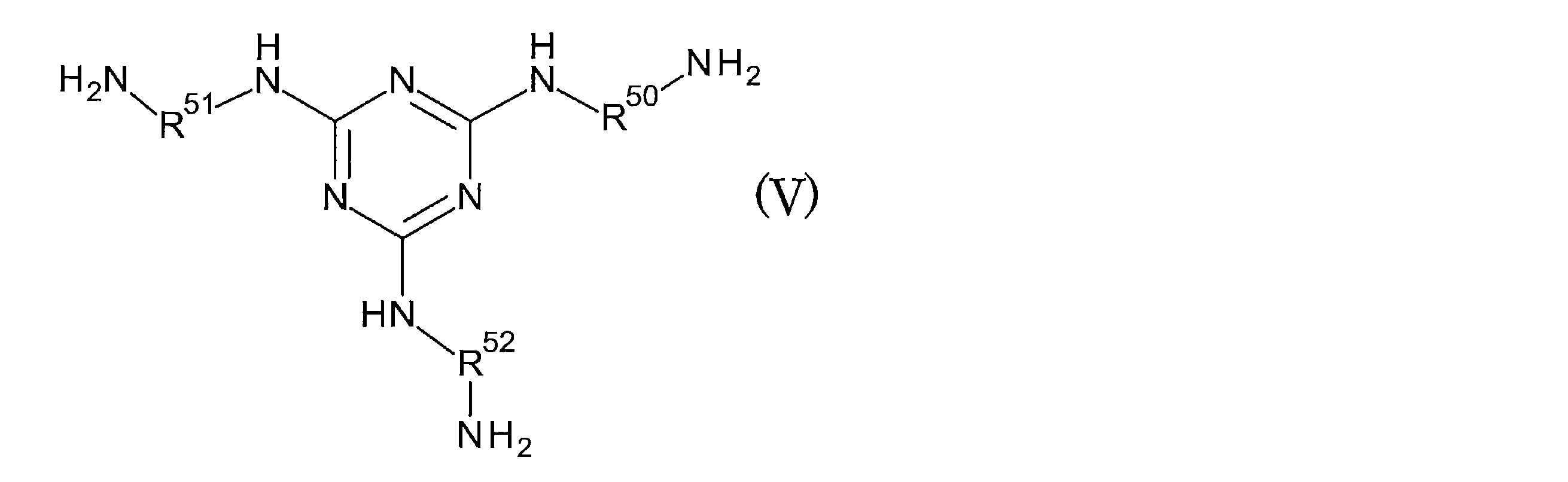
- R 50 , R 51 , R 52 , R 60 and R 61 each independently represents an arbitrary divalent group, and for example, has a branch having 1 to 6 carbon atoms. It may also be a substituted or unsubstituted alkylene group, which may contain ether, carbonyl, carboxy, amide, imide, carbamide, carbamate, etc. at the terminal or between carbon-carbon, Z 1 is Z and M and n are each independently an integer of 0 to 6.
- the terminal group A is a hydrogen atom, a primary amino group (—NH 2 ), or —Si(OR 41 ) k.
- R 42 An alkoxysilyl group or a hydroxysilyl group represented by R 42 (3-k) (k is an integer of 1 to 3, R 41 and R 42 are each independently a hydrogen atom or an alkyl group having 1 to 6 carbon atoms) .
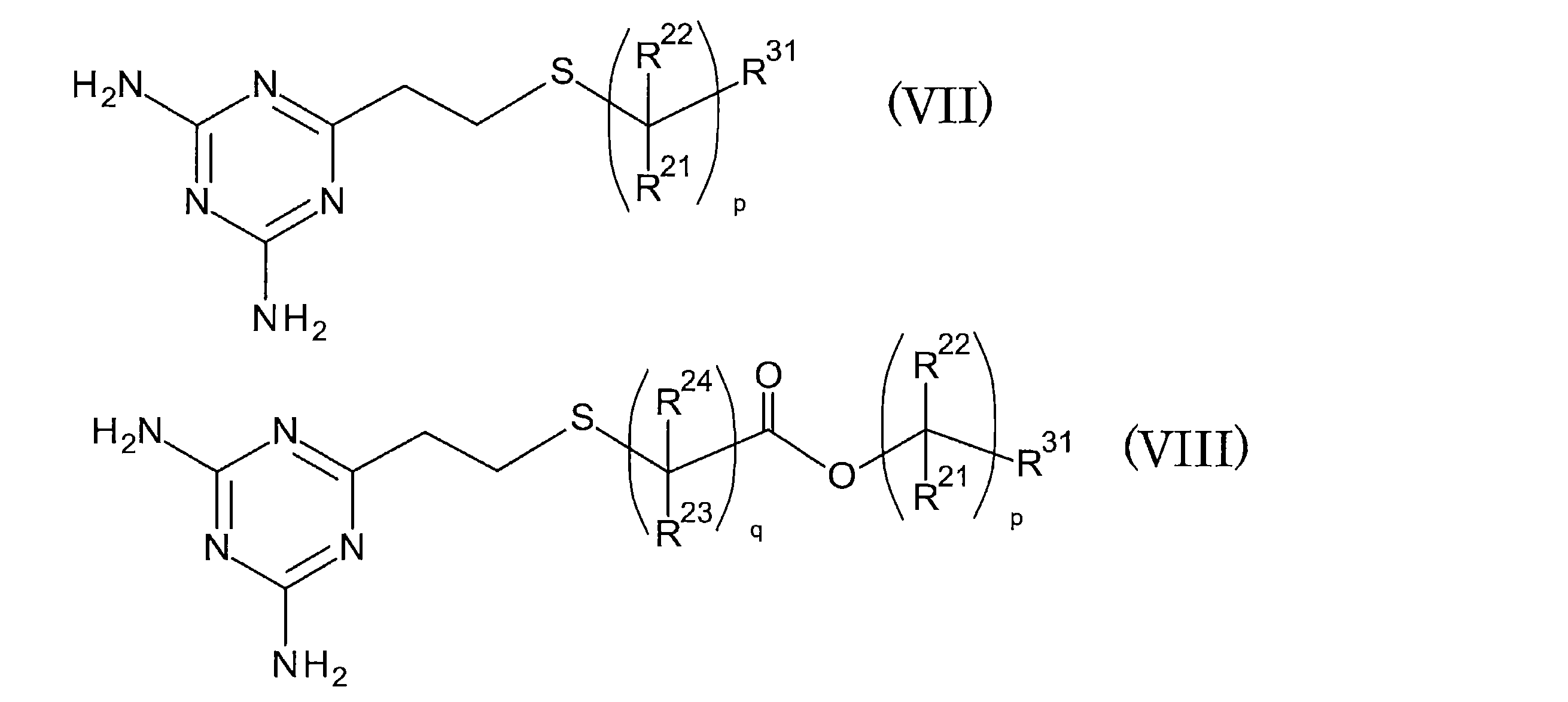
- R 21 to R 24 each independently represent a hydrogen atom, an alkyl group having 1 to 4 carbon atoms, a hydroxy group or a methoxy group.
- R 31 is a primary group.
- the metal ion of the present invention is at least one selected from the group consisting of trivalent aluminum ions and trivalent chromium ions.
- the metal ions may be used alone or in combination of two or more.
- the metal ion usually uses a metal ion organic salt or a metal ion inorganic salt as a metal ion source.
- the organic salt include formic acid, acetic acid, malonate, benzoate, phenate, citrate, amino acid salt and the like.
- the inorganic salt include chloride, bromide, carbonate, sulfate, phosphate, nitrate, hydroxide and the like.
- the adhesive composition of the present invention is an aqueous solution having a pH of 12 or less.
- the medium contained in the adhesive composition may be mainly composed of water such as ion-exchanged water, pure water, distilled water, and industrial water, but may be water containing an organic solvent, for example.
- the organic solvent include alcohols, esters, ethers, ketones, and aromatic hydrocarbons.
- the proportion of the organic solvent in the medium is preferably 15% by weight or less, more preferably 10% by weight or less, and further preferably 5% by weight or less. More preferable.
- the pH can be appropriately determined because the solubility changes depending on the type of metal ion, but from the viewpoint of improving the adhesiveness between the surfaces of a plurality of metals and the curable resin, the pH is 2-11. It is preferable that the pH is 3 to 10, more preferably 3 to 10, and further preferably 4 to 9.
- the pH can be adjusted by using pH adjusting agents such as various acids and alkalis without particular limitation.
- the concentration of the low molecular weight organic compound is 0.01 to 150 g/L in the adhesive composition.
- the concentration of the low molecular weight organic compound in the adhesive composition is preferably 100 g/L or less, more preferably 50 g/L or less, and more preferably 35 g/L from the viewpoint of good film forming property of the adhesive layer. It is more preferably L or less, and the concentration of the low molecular weight organic compound is 0.1 g/L or more in the adhesive composition from the viewpoint of efficiently securing the film thickness of the adhesive layer after coating. It is preferable that the amount is 0.8 g/L weight% or more.
- the molar concentration of the metal ion is 0.005 to 100 mm/l in the adhesive composition.
- the molar concentration of the metal ion in the adhesive composition is preferably 50 mmOl/L or less, and more preferably 20 mmOl/L or less in the adhesive composition from the viewpoint of preventing adhesion inhibition of the metal salt deposited after coating.
- the molar concentration of the metal ion is preferably 0.01 mm/l or more, more preferably 0.1 mm/l or more in the adhesive composition. Is more preferable.
- the total proportion of the low molecular weight organic compound and the metal ion source in the solid content of the adhesive composition is preferably 50% by weight or more, more preferably 70% by weight or more, and 80% by weight or more. Is more preferable, 90% by weight or more is still more preferable, and 95% by weight or more is still more preferable.
- the adhesive composition of the present invention can contain additives.
- additives include stabilizers such as antioxidants and preservatives; viscosity modifiers and coloring agents.
- a member having a surface of the metal is brought into contact with the adhesive composition, whereby the medium is dried and removed, if necessary, to the surface.
- the step of forming an adhesive layer is included.
- the adhesive layer preferably has a thickness of 20 ⁇ m or less, more preferably 10 ⁇ m or less, and further preferably 5 ⁇ m or less.
- various known contact (coating or coating) methods can be applied, for example, brush coating, dip coating, spray coating, bar coat, roll coater, film applicator, spin coat, screen printing. , Transfer, etc.
- the method for producing a metal-resin composite of the present invention includes the step of joining the resin member (resin member) onto the adhesive layer of the surface-treated metal member obtained by the method for producing a surface-treated metal member.
- the joining method includes lamination press, injection molding, extrusion molding, heat press molding, compression molding, transfer molding, cast molding, laser welding molding, reaction injection molding (RIM molding), rim molding (LIM molding), and the like. Can be adopted.
- As the molding conditions for the metal-resin composite known conditions can be adopted depending on the resin used.
- the adhesive layer formed from the adhesive composition of the present invention is excellent in adhesiveness between the surface of the metal and the curable resin, so that the surface of the metal and the curable resin are not particularly intervened. And can be directly joined. Particularly, when the surface of the metal has two or more kinds of metal surfaces, the curable resin can adhere to the two or more kinds (plurality) of metals at the same time, and thus the adhesive composition of the present invention is suitable. is there.
- the surfaces of the two or more metals are surfaces of different metals, and the different metals mean that the main components of the metals are different. For example, the surface of copper and the copper plating. Since copper is the main component, the surface of and the surface of the copper alloy belong to the same metal surface.
- each component shown in Table 2 or 3 was dissolved in ion-exchanged water so as to have the blending amount (g/L) shown in Table 2 or 3, and then shown in Table 2 or 3.
- Acetic acid or ammonia was added to adjust the pH to prepare a solution (adhesive composition).
- the metal ion concentration (mmol/L) was measured with an ICP (model number “PS3520UVDD II”, manufactured by Hitachi High-Tech) device using a standard solution (“Multi-Element Standard IV” manufactured by Merck Ltd.) at 5000 times, 1000 times, 500 times. The measurement was performed by calibrating with a solution diluted twice. The sample was appropriately diluted and the metal concentration was measured.
- the titanium ion was calibrated with a titanium standard solution (1,000 ppm) manufactured by Fuji Film Wako Pure Chemical Industries.
- the bonding strength (adhesive strength) of the metal-resin composite obtained above was measured using an autograph (“AGX-10kNX” manufactured by Shimadzu Corporation) at a tensile speed of 3 mm/min and a shear strength (MPa). The following criteria were evaluated by measuring. The results are shown in Tables 2 and 3.
- the metal members were bonded together via the above curable resin under the above conditions without using the above solution (adhesive composition), A composite was produced and the shear strength (MPa) was measured.
- the shear strength (MPa) is 190% or more as compared with the shear strength value of the reference example (comparison target is the same metal).
- ⁇ The shear strength (MPa) is 160% or more and less than 190% as compared with the shear strength value of the reference example (comparison target is the same metal).
- ⁇ Shear strength (MPa) is 145% or more and less than 160% compared with the shear strength value of the reference example (comparison target is the same metal)
- ⁇ Shear strength (MPa) is 130% or more and less than 145% compared to the shear strength value of the reference example (comparison target is the same metal).
- X The shear strength (MPa) is less than 130% as compared with the shear strength value of the reference example (comparison target is the same metal).
- the triazine compound a is 1,3,5-triazine-2,4,6-trithiol;
- the triazine compound b is A compound represented by: The triazole compound is 3-amino-1,2,4-triazole; The imidazole compound is 2-(2,4-dichlorobenzyl)benzimidazole; A thiazole compound is aminobenzothiazole; The oxazoline compound is 2,2′-bis(2-oxazoline);
- the diamine compound a is diaminobenzoic acid; The diamine compound b is ethylenediamine;
- the dicyano compound is 2,3-dichloro-5,6-dicyano-1,4-benzoquinone;
- the dinitro compound is 2,4-dinitrofluorobenzene;
- the diamide compound is malonamide;
- the amine compound a is 3-aminopropyltriethoxysilane;
- the amine compound b represents glycine
- Ni nickel
- a C194 copper alloy plate is subjected to a sulfamic acid bright nickel plating treatment by a cleaning treatment by O 2 plasma treatment, a degreasing treatment by dilute sulfuric acid immersion (120 seconds), a water washing treatment (30 seconds), and a dryer. Those that have been dried (30 seconds); Cu (copper) is obtained by degreasing a C7025 copper alloy plate by dipping in dilute sulfuric acid (20 seconds), washing with water (30 seconds), and drying with a dryer (30 seconds).
- Ag is a degreasing treatment (20 seconds) by dipping in dilute nitric acid, a washing treatment (30 seconds), and a drying treatment (30 seconds) by a dilute nitric acid treatment on a C194 copper alloy plate.
- Al aluminum
- Al is a degreasing treatment (120 seconds) by immersing an A5052 aluminum alloy plate in an alkaline surface treatment agent (“CA-5372”, manufactured by MEC Co., Ltd.), a water washing treatment (30 seconds), and a drying treatment using a dryer (30 seconds).
- Fe (iron) was obtained by subjecting SUS304 to cleaning treatment by O 2 plasma treatment, degreasing treatment by dilute sulfuric acid immersion (120 seconds), water washing treatment (30 seconds), and drying treatment with a dryer (30 seconds);
- An (tin) is obtained by subjecting a rolled tin plate to a cleaning treatment by O 2 plasma treatment, a degreasing treatment by dipping in dilute sulfuric acid (120 seconds), a washing treatment with water (30 seconds), and a drying treatment with a dryer (30 seconds);
- Au (gold) a C194 copper alloy plate is subjected to a sulfamic acid bright nickel plating treatment, and further, after the gold plating treatment, a cleaning treatment by an O 2 plasma treatment, a degreasing treatment by dilute sulfuric acid immersion (120 seconds), and a water washing treatment ( 30 seconds), and dried with a dryer (30 seconds);
- Si (silicon) is obtained by cleaning a single crystal silicon wafer with O 2 plasma treatment, degreasing treatment with dilute sulfur
- the metal-resin composite was manufactured by bonding the adhesive layer surface of the metal member (adhesion area: 50 mm 2 ), and heating and pressing (conditions: 100° C., 10 kPa, 2 hours) to cure the curable resin.
- ⁇ The shear strength (MPa) is 190% or more compared with the shear strength value of the reference example (comparison target is the same metal and the same curable resin).
- Shear strength (MPa) is 160% or more and less than 190% as compared with the shear strength value of the reference example (comparison target is the same metal, the same curable resin)
- Shear strength (MPa) is 145% or more and less than 160% as compared with the shear strength value of the reference example (comparison targets are the same metal and the same curable resin)
- ⁇ Shear strength (MPa) is 130% or more and less than 145% as compared with the shear strength value of Reference Example (comparison target is the same metal and the same curable resin)
- X The shear strength (MPa) is less than 130% as compared with the shear strength value of the reference example (comparison target is the same metal and the same curable resin).
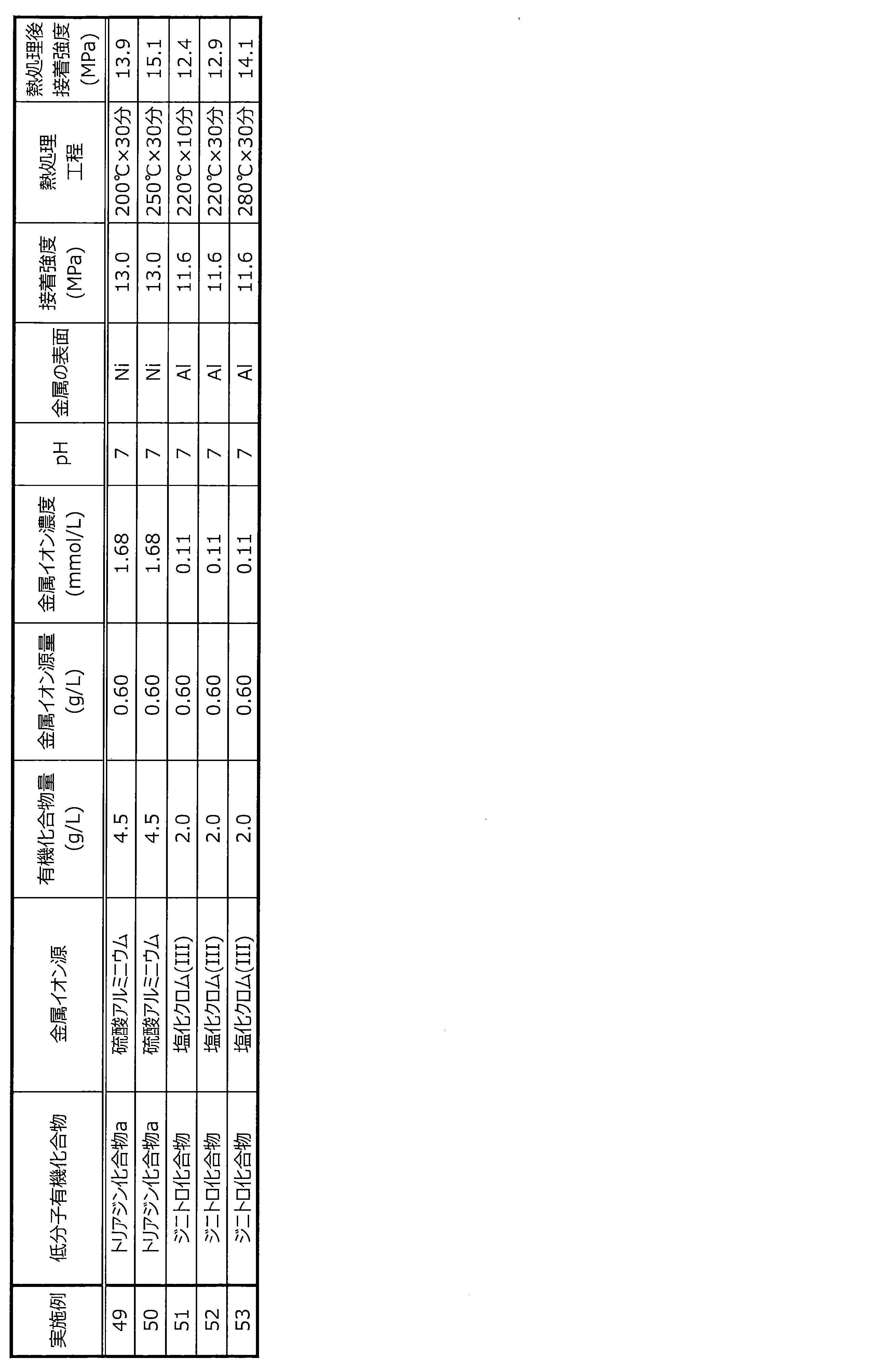
- Examples 49 to 53> In each example, the components shown in Table 6 were used to prepare a solution (adhesive composition) in the same manner as in Example 1 above to produce a metal-resin composite. Then, a heat treatment step was performed under the conditions shown in Table 6, and the bonding strength before and after the heat treatment was evaluated by the above method. The results are shown in Table 6.
Landscapes
- Chemical & Material Sciences (AREA)
- Organic Chemistry (AREA)
- Chemical Kinetics & Catalysis (AREA)
- Mechanical Engineering (AREA)
- Engineering & Computer Science (AREA)
- Materials Engineering (AREA)
- Metallurgy (AREA)
- Inorganic Chemistry (AREA)
- Medicinal Chemistry (AREA)
- Polymers & Plastics (AREA)
- Health & Medical Sciences (AREA)
- Adhesives Or Adhesive Processes (AREA)
- Laminated Bodies (AREA)
Abstract
Description
本発明の金属は、周期表の遷移元素、卑金属元素、半金属元素に属する金属であればよく、これらの合金も含む。前記遷移元素としては、例えば、チタン、バナジウム、クロム、マンガン、鉄、コバルト、ニッケル、銅、亜鉛、ジルコニウム、モリブテン、銀、タングステン、白金、金などが挙げられ、前記卑金属元素としては、例えば、アルミニウム、インジウム、スズ、鉛などが挙げられ、前記半金属元素としては、例えば、ケイ素、アンチモンなどが挙げられる。これらの中でも、鉄、銅、ニッケル、金、銀、アルミニウム、スズが好ましい。ここで、前記金属の表面は、例えば、酸化被膜を有する金属の表面、めっき金属の表面、活性化処理された金属の表面などを含む。また、前記金属の表面は、平滑でよく、粗化されていてもよい。
本発明の樹脂は、硬化性樹脂である。
本発明の1分子中に2個以上の窒素原子を有する低分子有機化合物は、金属の表面と樹脂との接着層を形成する主成分となる。なお、前記低分子有機化合物は、所謂、高分子有機化合物を含まないことを意味するものであり、とくに分子量が限定されるものではないが、例えば、当該分子量の上限値として、1500以下、1000以下が例示できる。前記低分子有機化合物は、単独で用いてもよく2種類以上を併用してもよい。


本発明の金属イオンは、3価のアルミニウムイオン、および3価のクロムイオンからなる群より選ばれる1種以上である。前記金属イオンは、単独で用いてもよく2種類以上を併用してもよい。
本発明の表面処理金属部材の製造方法は、前記金属の表面を有する部材(金属部材)に、前記接着組成物を接触させることにより、必要に応じて前記媒体を乾燥除去して、当該表面に接着層を形成する工程を含む。前記接着層は、厚さが20μm以下であることが好ましく、10μm以下であることがより好ましく、5μm以下であることがさらに好ましい。
本発明の金属-樹脂複合体の製造方法は、前記表面処理金属部材の製造方法で得られた表面処理金属部材の接着層上に、前記樹脂の部材(樹脂部材)を接合する工程を含む。
<接着組成物の調製>
各実施例および各比較例において、表2または3に示す各成分を、表2または3に示す配合量(g/L)となるようにイオン交換水に溶解した後、表2または3に示すpHとなるように、酢酸またはアンモニアを加えて、溶液(接着組成物)を調製した。なお、金属イオン濃度(mmоl/L)は、ICP(型番「PS3520UVDD II」、日立ハイテック社製)装置を用い、標準液(メルク社製 「マルチエレメントスタンダードIV」)を5000倍、1000倍、500倍に希釈した液によって較正して、測定した。サンプルは適宜希釈し、金属濃度を測定した。ただし、チタンイオンは、富士フィルム和光純薬社製のチタン標準液(1,000ppm)で較正した。
上記で得られた溶液(接着組成物)を、エアブラシ(「スプレーワークHGシングルエアーブラシ」タミヤ社製)を用いて、表2または3に示す金属の表面に塗装後、ドライヤーで30秒間乾燥して、当該金属の表面上に接着層を形成し、表面処理金属部材(合計2つ)を製造した。得られた表面処理金属部材の接着層面に、硬化性樹脂として、エポキシ樹脂(「G2エポキシ樹脂」、GATAN社製)を0.2mm厚で塗布した後、もう一方の表面処理金属部材の接着層面と貼り合わせ(接着面積:50mm2)、加温圧締(条件:100℃、10kPa、2時間)によって硬化性樹脂を硬化させて、金属-樹脂複合体を製造した。
接合強度(接着強度)は、上記で得られた金属-樹脂複合体について、オートグラフ(島津製作所社製、「AGX-10kNX」)を用い、引張速度3mm/分で、せん断強度(MPa)を測定することにより、以下の基準にて評価した。結果を表2および3に示す。なお、以下の参考例1~8では、上記の溶液(接着組成物)を使用せずに、上記の条件にて、金属部材同士を上記の硬化性樹脂を介して貼り合わせて、金属-樹脂複合体を製造し、上記のせん断強度(MPa)を測定した。
◎:せん断強度(MPa)が、参考例のせん断強度の値と比較して190%以上である(比較対象は同種金属)
〇:せん断強度(MPa)が、参考例のせん断強度の値と比較して160%以上190%未満である(比較対象は同種金属)
●:せん断強度(MPa)が、参考例のせん断強度の値と比較して145%以上160%未満である(比較対象は同種金属)
△:せん断強度(MPa)が、参考例のせん断強度の値と比較して130%以上145%未満である(比較対象は同種金属)
×:せん断強度(MPa)が、参考例のせん断強度の値と比較して130%未満である(比較対象は同種金属)

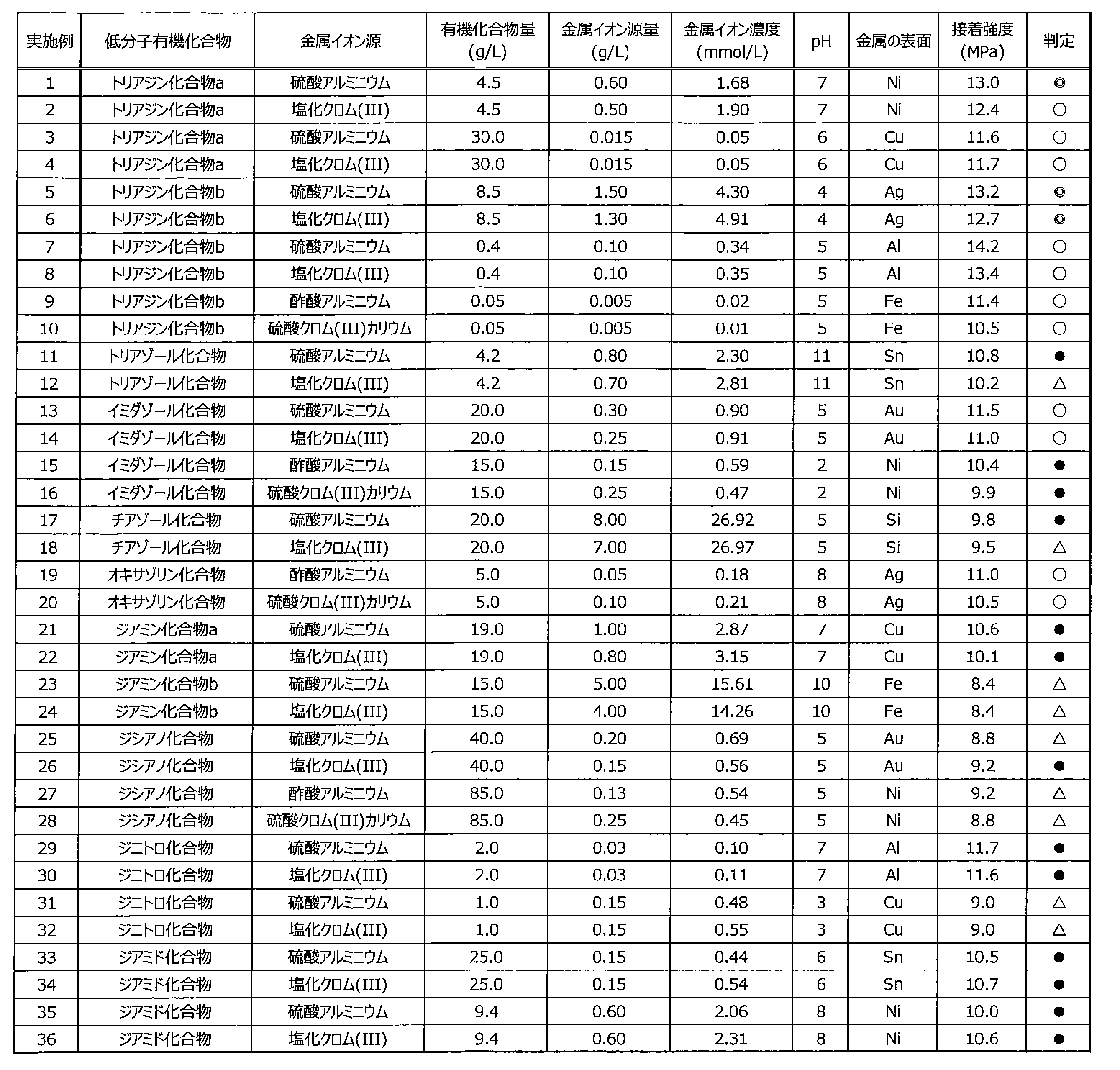
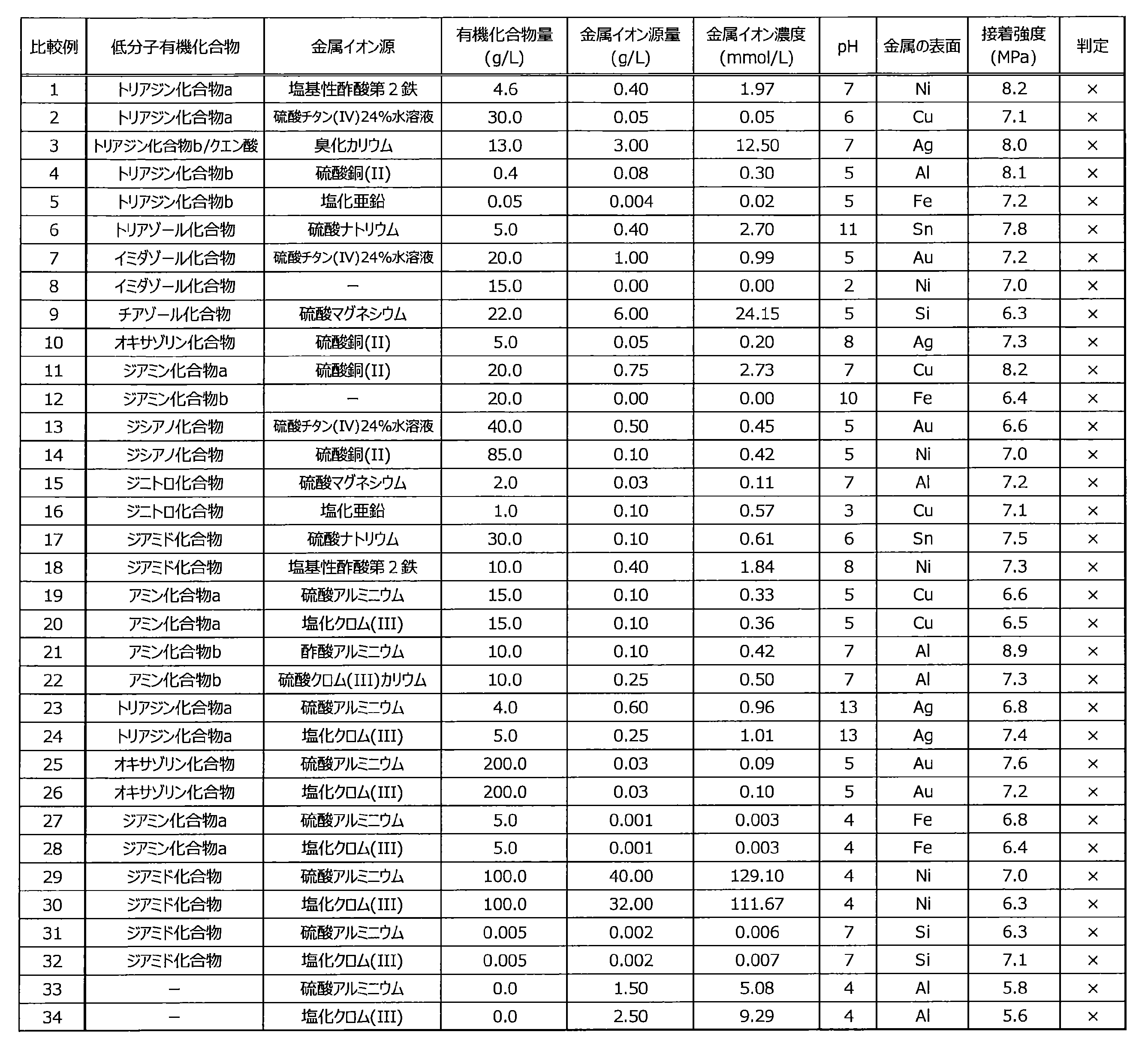
トリアジン化合物aは、1,3,5-トリアジン-2,4,6-トリチオール;
トリアジン化合物bは、

トリアゾール化合物は、3-アミノ-1,2,4-トリアゾール;
イミダゾール化合物は、2-(2,4―ジクロロベンジル)ベンゾイミダゾール;
チアゾール化合物は、アミノベンゾチアゾール;
オキサゾリン化合物は、2,2´-ビス(2-オキサゾリン);
ジアミン化合物aは、ジアミノ安息香酸;
ジアミン化合物bは、エチレンジアミン;
ジシアノ化合物は、2,3-ジクロロ-5,6-ジシアノ-1,4-ベンゾキノン;
ジニトロ化合物は、2,4-ジニトロフルオロベンゼン;
ジアミド化合物は、マロンアミド;
アミン化合物aは、3-アミノプロピルトリエトキシシラン;
アミン化合物bは、グリシン;を示す。
Ni(ニッケル)は、C194銅合金板にスルファミン酸光沢ニッケルめっき処理した板を、O2プラズマ処理による洗浄処理、希硫酸浸漬による脱脂処理(120秒)、水洗処理(30秒)、およびドライヤーによる乾燥処理(30秒)したもの;
Cu(銅)は、C7025銅合金板を、希硫酸浸漬による脱脂処理(20秒)、水洗処理(30秒)、およびドライヤーによる乾燥処理(30秒)したもの;
Ag(銀)は、C194銅合金板にメタンスルホン酸無光沢銀めっき処理した板を、希硝酸浸漬による脱脂処理(20秒)、水洗処理(30秒)、およびドライヤーによる乾燥処理(30秒)したもの;
Al(アルミニウム)は、A5052アルミ合金板を、アルカリ性表面処理剤(「CA-5372」、メック社製)浸漬による脱脂処理(120秒)、水洗処理(30秒)、およびドライヤーによる乾燥処理(30秒)したもの;
Fe(鉄)は、SUS304を、O2プラズマ処理による洗浄処理、希硫酸浸漬による脱脂処理(120秒)、水洗処理(30秒)、およびドライヤーによる乾燥処理(30秒)したもの;
An(スズ)は、圧延スズ板を、O2プラズマ処理による洗浄処理、希硫酸浸漬による脱脂処理(120秒)、水洗処理(30秒)、およびドライヤーによる乾燥処理(30秒)したもの;
Au(金)は、C194銅合金板にスルファミン酸光沢ニッケルめっき処理した板を、さらに、金めっき処理後、O2プラズマ処理による洗浄処理、希硫酸浸漬による脱脂処理(120秒)、水洗処理(30秒)、およびドライヤーによる乾燥処理(30秒)したもの;
Si(ケイ素)は、単結晶のシリコンウェハーを、O2プラズマ処理による洗浄処理、希硫酸浸漬による脱脂処理(120秒)、水洗処理(30秒)、およびドライヤーによる乾燥処理(30秒)したもの;を示す。
<接着組成物の調製、表面処理金属部材、および金属-樹脂複合体の製造>
各実施例において、表5に示す接着組成物を、エアブラシ(「スプレーワークHGシングルエアーブラシ」タミヤ社製)を用いて、表5に示す金属の表面に塗装後、ドライヤーで30秒間乾燥して、当該金属の表面上に接着層を形成し、表面処理金属部材(合計2つ)を製造した。得られた表面処理金属部材の接着層面に、硬化性樹脂として、不飽和ポリエステル樹脂(「冷間埋込樹脂 No.105」、丸本ストルアス社製)、シアノアクリレート樹脂(「アロンアルファ一般用」、東亞合成社製)、シリコーン樹脂(「バスボンドQ#04884」、コニシ社製)、またはポリウレタン樹脂(「シューズドクターN」、セメダイン社製)を0.2mm厚で塗布した後、もう一方の表面処理金属部材の接着層面と貼り合わせ(接着面積:50mm2)、加温圧締(条件:100℃、10kPa、2時間)によって硬化性樹脂を硬化させて、金属-樹脂複合体を製造した。
接合強度(接着強度)は、上記で得られ金属-樹脂複合体について、オートグラフ(島津製作所社製、「AGX-10kNX」)を用い、引張速度3mm/分で、せん断強度(MPa)を測定することにより、以下の基準にて評価した。結果を表5に示す。なお、以下の参考例9~20では、上記の溶液(接着組成物)を使用せずに、上記の条件にて、金属部材同士を上記の硬化性樹脂を介して貼り合わせて、金属-樹脂複合体を製造し、上記のせん断強度(MPa)を測定した。
◎:せん断強度(MPa)が、参考例のせん断強度の値と比較して190%以上である(比較対象は同種金属、同種硬化性樹脂)
〇:せん断強度(MPa)が、参考例のせん断強度の値と比較して160%以上190%未満である(比較対象は同種金属、同種硬化性樹脂)
●:せん断強度(MPa)が、参考例のせん断強度の値と比較して145%以上160%未満である(比較対象は同種金属、同種硬化性樹脂)
△:せん断強度(MPa)が、参考例のせん断強度の値と比較して130%以上145%未満である(比較対象は同種金属、同種硬化性樹脂)
×:せん断強度(MPa)が、参考例のせん断強度の値と比較して130%未満である(比較対象は同種金属、同種硬化性樹脂)
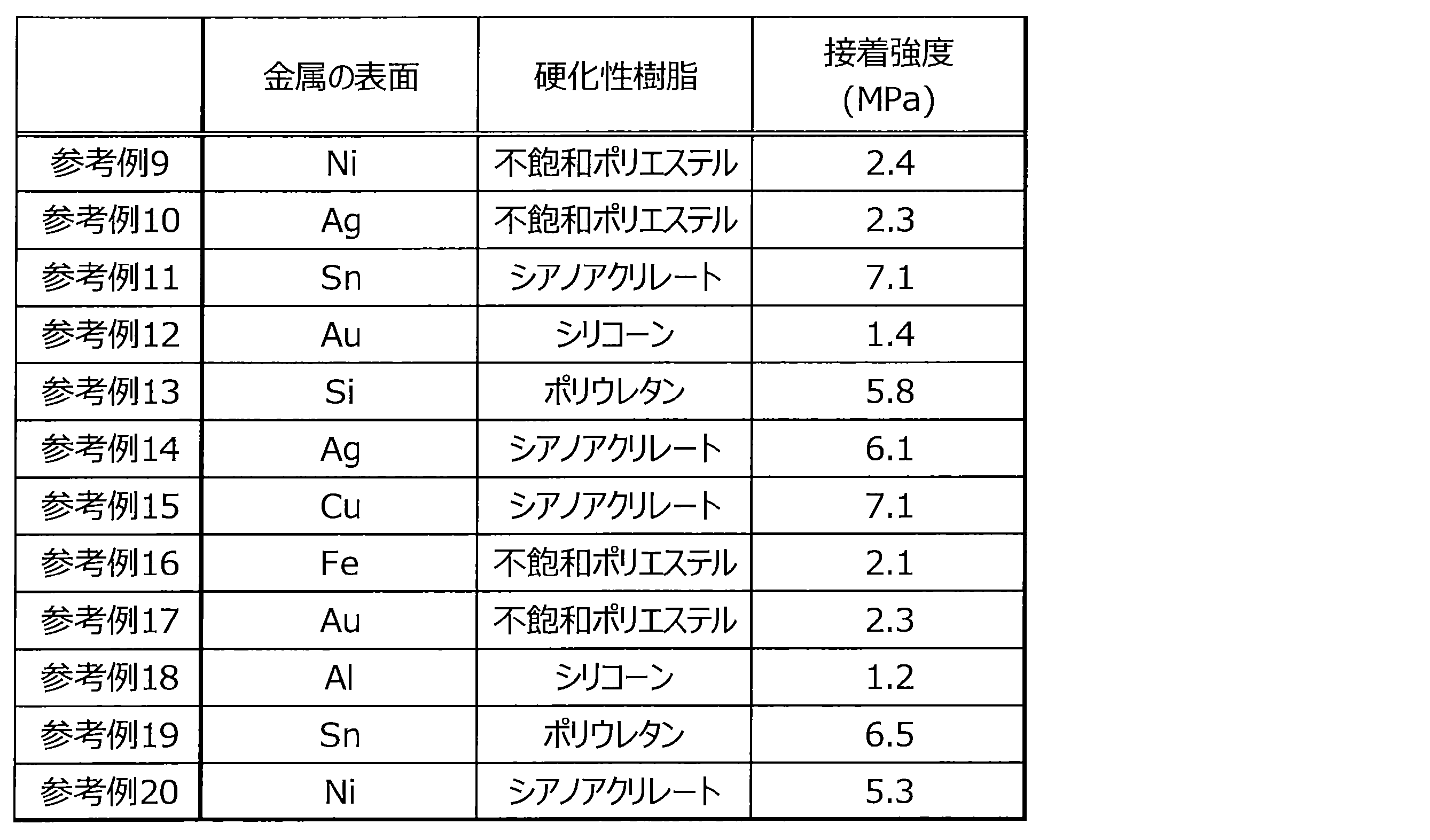
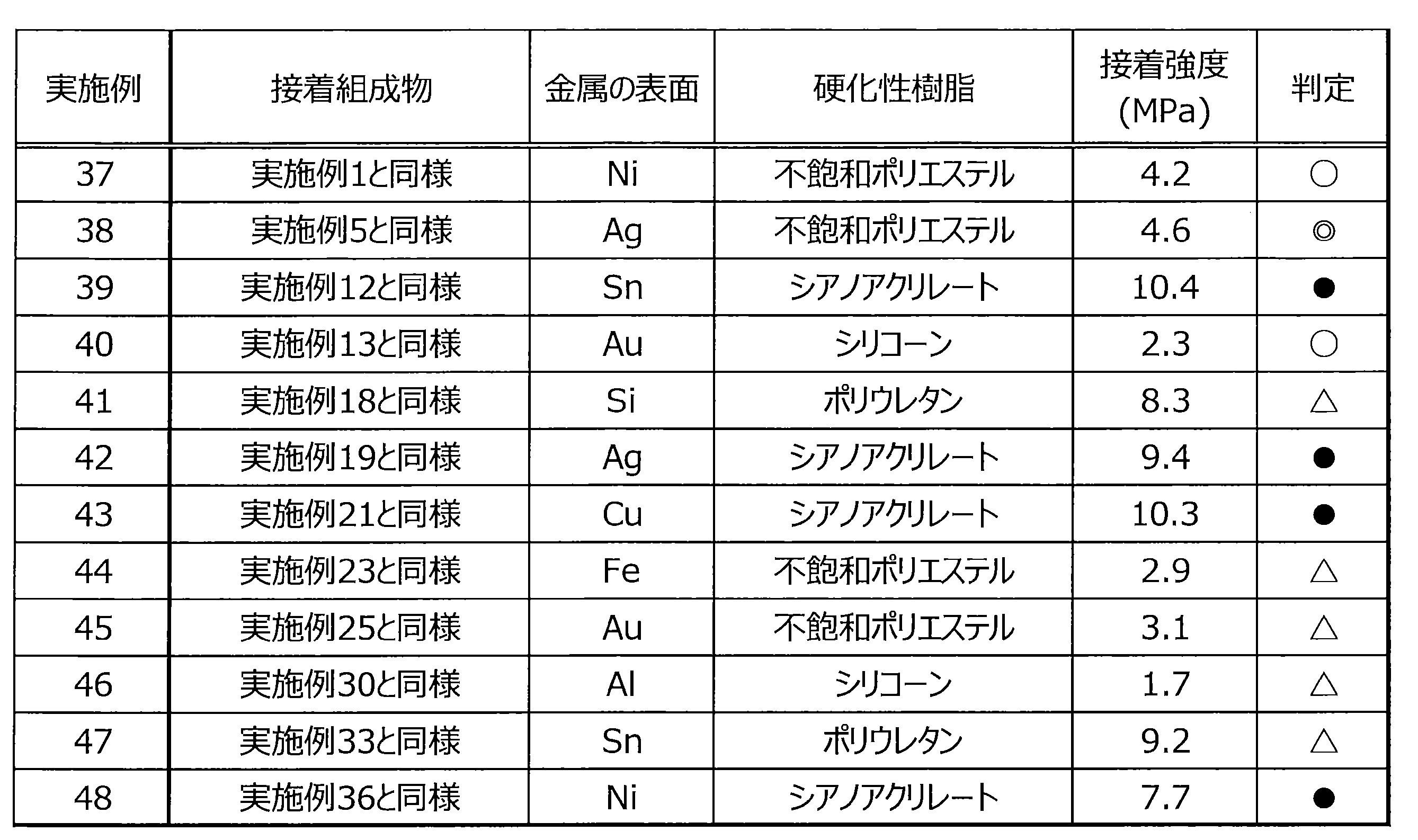
各実施例において、表6に示す成分を用いて、上記の実施例1と同様に、溶液(接着組成物)を調製し、金属-樹脂複合体を製造した。その後、表6に示す条件にて熱処理工程を施し、上記の方法にて、熱処理前後の接合強度を評価した。結果を表6に示す。
Claims (5)
- 金属の表面に、樹脂との接着層を形成するための接着組成物であって、
前記樹脂は、硬化性樹脂であり、
前記組成物は、1分子中に2個以上の窒素原子を有する低分子有機化合物と、3価のアルミニウムイオン、および3価のクロムイオンからなる群より選ばれる1種以上の金属イオンを含み、かつpHが12以下の水溶液であり、
前記低分子有機化合物の濃度は、0.01~150g/Lであり、
前記金属イオンのモル濃度は、0.005~100mmоl/Lであることを特徴とする接着組成物。 - 前記低分子有機化合物は、芳香環を有する化合物であることを特徴とする請求項1記載の接着組成物。
- 前記低分子有機化合物は、含窒素複素環を有する化合物であることを特徴とする請求項1または2記載の接着組成物。
- 金属の表面を有する部材に、請求項1~3のいずれかに記載の接着組成物を接触させることにより、当該表面に接着層を形成する工程を含むことを特徴とする表面処理金属部材の製造方法。
- 請求項4記載の表面処理金属部材の製造方法で得られた表面処理金属部材の接着層上に、樹脂部材を接合する工程を含むことを特徴とする金属-樹脂複合体の製造方法。
Priority Applications (6)
| Application Number | Priority Date | Filing Date | Title |
|---|---|---|---|
| CN202080007203.7A CN113272400A (zh) | 2019-02-21 | 2020-01-09 | 接着组合物、表面处理金属构件的制造方法、及金属-树脂复合体的制造方法 |
| JP2021501673A JP7539160B2 (ja) | 2019-02-21 | 2020-01-09 | 接着組成物、表面処理金属部材の製造方法、および金属-樹脂複合体の製造方法 |
| US17/310,676 US12157837B2 (en) | 2019-02-21 | 2020-01-09 | Adhesive composition, method for producing surface-treated metal member, and method for producing metal-resin composite body |
| SG11202107824XA SG11202107824XA (en) | 2019-02-21 | 2020-01-09 | Adhesive composition, method for producing surface-treated metal member, and method for producing metal-resin composite body |
| KR1020217029671A KR102715757B1 (ko) | 2019-02-21 | 2020-01-09 | 접착 조성물, 표면 처리 금속 부재의 제조 방법, 및 금속-수지 복합체의 제조 방법 |
| EP20758771.8A EP3929259A4 (en) | 2019-02-21 | 2020-01-09 | Adhesive composition, method for producing surface-treated metal member, and method for producing metal-resin composite body |
Applications Claiming Priority (2)
| Application Number | Priority Date | Filing Date | Title |
|---|---|---|---|
| JP2019-029047 | 2019-02-21 | ||
| JP2019029047 | 2019-02-21 |
Publications (1)
| Publication Number | Publication Date |
|---|---|
| WO2020170638A1 true WO2020170638A1 (ja) | 2020-08-27 |
Family
ID=72144635
Family Applications (1)
| Application Number | Title | Priority Date | Filing Date |
|---|---|---|---|
| PCT/JP2020/000437 Ceased WO2020170638A1 (ja) | 2019-02-21 | 2020-01-09 | 接着組成物、表面処理金属部材の製造方法、および金属-樹脂複合体の製造方法 |
Country Status (8)
| Country | Link |
|---|---|
| US (1) | US12157837B2 (ja) |
| EP (1) | EP3929259A4 (ja) |
| JP (1) | JP7539160B2 (ja) |
| KR (1) | KR102715757B1 (ja) |
| CN (1) | CN113272400A (ja) |
| SG (1) | SG11202107824XA (ja) |
| TW (1) | TWI850318B (ja) |
| WO (1) | WO2020170638A1 (ja) |
Families Citing this family (1)
| Publication number | Priority date | Publication date | Assignee | Title |
|---|---|---|---|---|
| CN117777865B (zh) * | 2023-12-29 | 2026-07-10 | 北京航天试验技术研究所 | 一种磷酸盐基胶粘剂及其制备方法 |
Citations (8)
| Publication number | Priority date | Publication date | Assignee | Title |
|---|---|---|---|---|
| JPS6235843A (ja) * | 1985-08-09 | 1987-02-16 | 日立化成工業株式会社 | 金属と樹脂層との積層体の製造方法 |
| JP2005023301A (ja) * | 2003-04-30 | 2005-01-27 | Mec Kk | 接着層形成液、その液を用いた銅と樹脂の接着層の製造方法及びその積層体 |
| JP2013030702A (ja) * | 2011-07-29 | 2013-02-07 | Nitto Denko Corp | 半導体装置用多層接着シート及び半導体装置 |
| JP2016513755A (ja) * | 2013-03-15 | 2016-05-16 | 日本パーカライジング株式会社 | アルミニウムおよびアルミニウム合金のための改善された三価クロム含有組成物 |
| JP2017203073A (ja) | 2016-05-10 | 2017-11-16 | メック株式会社 | 被膜形成用組成物、表面処理金属部材の製造方法、および金属‐樹脂複合体の製造方法 |
| WO2018032006A1 (en) * | 2016-08-12 | 2018-02-15 | Prc-Desoto International, Inc. | Systems and methods for treating a metal substrate |
| JP2018115306A (ja) | 2017-01-21 | 2018-07-26 | メック株式会社 | 被膜形成用組成物、表面処理金属部材の製造方法、および金属‐樹脂複合体の製造方法 |
| JP2018188715A (ja) * | 2017-05-11 | 2018-11-29 | メック株式会社 | 被膜形成用組成物、表面処理金属部材の製造方法、および金属‐樹脂複合体の製造方法 |
Family Cites Families (8)
| Publication number | Priority date | Publication date | Assignee | Title |
|---|---|---|---|---|
| US20060180247A1 (en) * | 2005-02-15 | 2006-08-17 | United States Of America As Represented By The Secretary Of The Navy | Process for preparing chromium conversion coatings for iron and iron alloys |
| AU2005327548A1 (en) | 2005-02-15 | 2006-08-24 | The United States Of America, As Represented By The Secretary Of The Navy, Et Al. | Composition and process for preparing protective coatings on metal substrates |
| JP2007023353A (ja) | 2005-07-19 | 2007-02-01 | Yuken Industry Co Ltd | 亜鉛系めっき部材のノンクロム反応型化成処理 |
| JP5435251B2 (ja) | 2007-09-14 | 2014-03-05 | 山梨県 | 化成処理剤 |
| JP2014071306A (ja) * | 2012-09-28 | 2014-04-21 | Fujifilm Corp | 硬化性樹脂組成物、転写材料、硬化物及びその製造方法、樹脂パターン製造方法、硬化膜、液晶表示装置、有機el表示装置並びにタッチパネル表示装置 |
| JP6342331B2 (ja) * | 2012-12-21 | 2018-06-13 | 三井化学株式会社 | 有機el素子の面封止用シート、それを用いた有機elデバイスの製造方法、有機elデバイスおよび有機elディスプレイパネル |
| JP2017008414A (ja) | 2015-06-19 | 2017-01-12 | 日本パーカライジング株式会社 | 金属材料用化成処理剤、金属表面処理方法及び表面処理金属材料 |
| JP2018104785A (ja) | 2016-12-27 | 2018-07-05 | 日本パーカライジング株式会社 | 金属材料の表面処理方法 |
-
2020
- 2020-01-09 CN CN202080007203.7A patent/CN113272400A/zh active Pending
- 2020-01-09 SG SG11202107824XA patent/SG11202107824XA/en unknown
- 2020-01-09 US US17/310,676 patent/US12157837B2/en active Active
- 2020-01-09 KR KR1020217029671A patent/KR102715757B1/ko active Active
- 2020-01-09 JP JP2021501673A patent/JP7539160B2/ja active Active
- 2020-01-09 WO PCT/JP2020/000437 patent/WO2020170638A1/ja not_active Ceased
- 2020-01-09 EP EP20758771.8A patent/EP3929259A4/en active Pending
- 2020-01-21 TW TW109102153A patent/TWI850318B/zh active
Patent Citations (8)
| Publication number | Priority date | Publication date | Assignee | Title |
|---|---|---|---|---|
| JPS6235843A (ja) * | 1985-08-09 | 1987-02-16 | 日立化成工業株式会社 | 金属と樹脂層との積層体の製造方法 |
| JP2005023301A (ja) * | 2003-04-30 | 2005-01-27 | Mec Kk | 接着層形成液、その液を用いた銅と樹脂の接着層の製造方法及びその積層体 |
| JP2013030702A (ja) * | 2011-07-29 | 2013-02-07 | Nitto Denko Corp | 半導体装置用多層接着シート及び半導体装置 |
| JP2016513755A (ja) * | 2013-03-15 | 2016-05-16 | 日本パーカライジング株式会社 | アルミニウムおよびアルミニウム合金のための改善された三価クロム含有組成物 |
| JP2017203073A (ja) | 2016-05-10 | 2017-11-16 | メック株式会社 | 被膜形成用組成物、表面処理金属部材の製造方法、および金属‐樹脂複合体の製造方法 |
| WO2018032006A1 (en) * | 2016-08-12 | 2018-02-15 | Prc-Desoto International, Inc. | Systems and methods for treating a metal substrate |
| JP2018115306A (ja) | 2017-01-21 | 2018-07-26 | メック株式会社 | 被膜形成用組成物、表面処理金属部材の製造方法、および金属‐樹脂複合体の製造方法 |
| JP2018188715A (ja) * | 2017-05-11 | 2018-11-29 | メック株式会社 | 被膜形成用組成物、表面処理金属部材の製造方法、および金属‐樹脂複合体の製造方法 |
Non-Patent Citations (1)
| Title |
|---|
| See also references of EP3929259A4 |
Also Published As
| Publication number | Publication date |
|---|---|
| KR102715757B1 (ko) | 2024-10-11 |
| EP3929259A1 (en) | 2021-12-29 |
| US12157837B2 (en) | 2024-12-03 |
| KR20210129688A (ko) | 2021-10-28 |
| SG11202107824XA (en) | 2021-08-30 |
| EP3929259A4 (en) | 2022-10-26 |
| TWI850318B (zh) | 2024-08-01 |
| US20220073793A1 (en) | 2022-03-10 |
| TW202039931A (zh) | 2020-11-01 |
| JPWO2020170638A1 (ja) | 2020-08-27 |
| CN113272400A (zh) | 2021-08-17 |
| JP7539160B2 (ja) | 2024-08-23 |
Similar Documents
| Publication | Publication Date | Title |
|---|---|---|
| CN113026008B (zh) | 覆膜形成用组合物、表面处理金属构件的制造方法、以及金属-树脂复合体的制造方法 | |
| CN110546304B (zh) | 覆膜形成用组合物、表面处理金属构件的制造方法以及金属与树脂的复合体的制造方法 | |
| KR102474143B1 (ko) | 폴리이미드 수지 상의 금속 피막 형성 방법 | |
| JPH08311658A (ja) | 銅系金属材料の表面処理用組成物 | |
| WO2018135203A1 (ja) | 被膜形成用組成物、表面処理金属部材の製造方法、および金属‐樹脂複合体の製造方法 | |
| EP4459006A1 (en) | Surface treatment liquid for metal | |
| WO2014042829A1 (en) | Direct electroless palladium plating on copper | |
| JP7539160B2 (ja) | 接着組成物、表面処理金属部材の製造方法、および金属-樹脂複合体の製造方法 | |
| CN102316668A (zh) | 带金属微细图案的基材、印刷布线板和它们的制造方法、以及半导体装置 | |
| JP5688522B2 (ja) | 銅の表面処理剤 | |
| EP4459007A1 (en) | Organic coating and method for producing same | |
| JP2017538867A (ja) | パラジウム無電解めっき用のめっき浴組成物およびパラジウムの無電解めっき方法 | |
| CN100347338C (zh) | 用于银沉积的酸性溶液及在金属表面上沉积银层的方法 | |
| JP2012209392A (ja) | パターン状金属膜を有する積層体の製造方法、被めっき層形成用組成物 | |
| WO2012133684A1 (ja) | パターン状金属膜を有する積層体の製造方法、被めっき層形成用組成物 | |
| TW202523672A (zh) | 四唑化合物、該四唑化合物之合成方法及其利用 | |
| JP2013089630A (ja) | 半導体パッケージ及びその製造方法 | |
| WO2012133297A1 (ja) | 金属膜を有する積層体およびその製造方法、並びに、パターン状金属膜を有する積層体およびその製造方法 | |
| JP2001168496A (ja) | プリント配線用フレキシブル基板およびその製造方法 | |
| US8076003B2 (en) | Coating composition and a method of coating | |
| JP7760779B1 (ja) | 表面処理液ならびにこれを用いた表面処理方法および接着方法 | |
| JPH05156456A (ja) | アルミニウム系基材の無電解めっき前処理剤及びその無電解めっき方法 | |
| JPS59100584A (ja) | 積層物質類の製造方法 | |
| JP2025103798A (ja) | 水性表面処理剤および積層体 |
Legal Events
| Date | Code | Title | Description |
|---|---|---|---|
| 121 | Ep: the epo has been informed by wipo that ep was designated in this application |
Ref document number: 20758771 Country of ref document: EP Kind code of ref document: A1 |
|
| ENP | Entry into the national phase |
Ref document number: 2021501673 Country of ref document: JP Kind code of ref document: A |
|
| NENP | Non-entry into the national phase |
Ref country code: DE |
|
| ENP | Entry into the national phase |
Ref document number: 20217029671 Country of ref document: KR Kind code of ref document: A |
|
| ENP | Entry into the national phase |
Ref document number: 2020758771 Country of ref document: EP Effective date: 20210921 |
|
| WWG | Wipo information: grant in national office |
Ref document number: 11202107824X Country of ref document: SG |
|
| WWP | Wipo information: published in national office |
Ref document number: 11202107824X Country of ref document: SG |