WO2020172755A1 - Ligand clusters and methods of their use and preparation - Google Patents

Ligand clusters and methods of their use and preparation Download PDF

Info

Publication number
WO2020172755A1
WO2020172755A1 PCT/CA2020/050272 CA2020050272W WO2020172755A1 WO 2020172755 A1 WO2020172755 A1 WO 2020172755A1 CA 2020050272 W CA2020050272 W CA 2020050272W WO 2020172755 A1 WO2020172755 A1 WO 2020172755A1
Authority
WO
WIPO (PCT)
Prior art keywords
compound
optionally substituted
salt
independently
group
Prior art date
Legal status (The legal status is an assumption and is not a legal conclusion. Google has not performed a legal analysis and makes no representation as to the accuracy of the status listed.)
Ceased
Application number
PCT/CA2020/050272
Other languages
French (fr)
Inventor
Jovanka BOGOJESKI
Current Assignee (The listed assignees may be inaccurate. Google has not performed a legal analysis and makes no representation or warranty as to the accuracy of the list.)
Deep Genomics Inc
Original Assignee
Deep Genomics Inc
Priority date (The priority date is an assumption and is not a legal conclusion. Google has not performed a legal analysis and makes no representation as to the accuracy of the date listed.)
Filing date
Publication date
Application filed by Deep Genomics Inc filed Critical Deep Genomics Inc
Priority to CA3128577A priority Critical patent/CA3128577A1/en
Priority to US17/434,460 priority patent/US20220145292A1/en
Priority to EP20763206.8A priority patent/EP3931323A4/en
Publication of WO2020172755A1 publication Critical patent/WO2020172755A1/en
Anticipated expiration legal-status Critical
Ceased legal-status Critical Current

Links

Classifications

    • CCHEMISTRY; METALLURGY
    • C12BIOCHEMISTRY; BEER; SPIRITS; WINE; VINEGAR; MICROBIOLOGY; ENZYMOLOGY; MUTATION OR GENETIC ENGINEERING
    • C12NMICROORGANISMS OR ENZYMES; COMPOSITIONS THEREOF; PROPAGATING, PRESERVING, OR MAINTAINING MICROORGANISMS; MUTATION OR GENETIC ENGINEERING; CULTURE MEDIA
    • C12N15/00Mutation or genetic engineering; DNA or RNA concerning genetic engineering, vectors, e.g. plasmids, or their isolation, preparation or purification; Use of hosts therefor
    • C12N15/09Recombinant DNA-technology
    • C12N15/11DNA or RNA fragments; Modified forms thereof; Non-coding nucleic acids having a biological activity
    • C12N15/111General methods applicable to biologically active non-coding nucleic acids
    • AHUMAN NECESSITIES
    • A61MEDICAL OR VETERINARY SCIENCE; HYGIENE
    • A61KPREPARATIONS FOR MEDICAL, DENTAL OR TOILETRY PURPOSES
    • A61K47/00Medicinal preparations characterised by the non-active ingredients used, e.g. carriers or inert additives; Targeting or modifying agents chemically bound to the active ingredient
    • A61K47/50Medicinal preparations characterised by the non-active ingredients used, e.g. carriers or inert additives; Targeting or modifying agents chemically bound to the active ingredient the non-active ingredient being chemically bound to the active ingredient, e.g. polymer-drug conjugates
    • A61K47/51Medicinal preparations characterised by the non-active ingredients used, e.g. carriers or inert additives; Targeting or modifying agents chemically bound to the active ingredient the non-active ingredient being chemically bound to the active ingredient, e.g. polymer-drug conjugates the non-active ingredient being a modifying agent
    • A61K47/54Medicinal preparations characterised by the non-active ingredients used, e.g. carriers or inert additives; Targeting or modifying agents chemically bound to the active ingredient the non-active ingredient being chemically bound to the active ingredient, e.g. polymer-drug conjugates the non-active ingredient being a modifying agent the modifying agent being an organic compound
    • A61K47/549Sugars, nucleosides, nucleotides or nucleic acids
    • CCHEMISTRY; METALLURGY
    • C07ORGANIC CHEMISTRY
    • C07HSUGARS; DERIVATIVES THEREOF; NUCLEOSIDES; NUCLEOTIDES; NUCLEIC ACIDS
    • C07H21/00Compounds containing two or more mononucleotide units having separate phosphate or polyphosphate groups linked by saccharide radicals of nucleoside groups, e.g. nucleic acids
    • YGENERAL TAGGING OF NEW TECHNOLOGICAL DEVELOPMENTS; GENERAL TAGGING OF CROSS-SECTIONAL TECHNOLOGIES SPANNING OVER SEVERAL SECTIONS OF THE IPC; TECHNICAL SUBJECTS COVERED BY FORMER USPC CROSS-REFERENCE ART COLLECTIONS [XRACs] AND DIGESTS
    • Y02TECHNOLOGIES OR APPLICATIONS FOR MITIGATION OR ADAPTATION AGAINST CLIMATE CHANGE
    • Y02PCLIMATE CHANGE MITIGATION TECHNOLOGIES IN THE PRODUCTION OR PROCESSING OF GOODS
    • Y02P20/00Technologies relating to chemical industry
    • Y02P20/50Improvements relating to the production of bulk chemicals
    • Y02P20/55Design of synthesis routes, e.g. reducing the use of auxiliary or protecting groups

Definitions

  • the invention relates to ligand clusters and methods of their use and preparation.
  • Therapeutic applications often suffer from off-target effects associated with the delivery of a therapeutically active agent to an off-target cell or tissue.
  • Targeting moiety-based approaches have been in development to address the problem of off-target effects with varying degrees of success.
  • the invention provides compounds that are useful for targeting cells, e.g., in a tissue, e.g., in a subject, and intermediates useful in the synthesis thereof.
  • the compounds of the invention include a targeting moiety of the following structure:
  • p 1 to 5;
  • X is a monosaccharide
  • each Y is independently -U-T, H, protecting group, optionally substituted hydrocarbon, or optionally substituted heteroorganic group, where each T is independently a ligand or a protected ligand, and each U is independently a covalent linker;
  • L 2 is a conjugation linker
  • At least one Y is -U-T.
  • the invention provides a compound of formula (I):
  • p 1 to 5;
  • X is a monosaccharide
  • each Y is independently -U-T, H, protecting group, optionally substituted hydrocarbon, or optionally substituted heteroorganic group, where each T is independently a ligand or a protected ligand, and each U is independently a covalent linker;
  • L 2 is a conjugation linker
  • Z is a therapeutically active agent, protecting group, or a conjugation moiety
  • At least one Y is -U-T.
  • the monosaccharide is a pentose or hexose, where,
  • the monosaccharide is N-acetylgalactosamine, galactosamine, galactose, mannose, allose, altrose, glucose, gulose, idose, talose, arabinose, lyxose, ribose, or xylose.
  • the monosaccharide is N-acetylgalactosamine.
  • the group -L 2 -Z is a group of the following structure:
  • Q 1 is [-Q 3 -Q 4 -Q 5 ] s -Q c -B 1 , where B 1 is a bond to Q 2 ;
  • Q 2 is [-Q 3 -Q 4 -Q 5 ] s -B 2 , where B 2 is a bond to Z;
  • each Q 3 is independently absent, -CO-, -NH-, -0-, -S-, -S0 2 -, -OC(O)-, -C(0)0- -NHC(O)-, -C(0)NH-, -GHz-, -CH 2 NH-, -NHCH 2 -, -CH 2 0-, or -OCH 2 -;
  • each Q 4 is independently absent, optionally substituted C-M 2 alkylene, optionally substituted C 2 _i 2 alkenylene, optionally substituted C 2 _i 2 alkynylene, optionally substituted C 2 _i 2 heteroalkylene, optionally substituted Ce-io arylene, optionally substituted C heteroarylene, or optionally substituted C heterocyclylene;
  • each Q 5 is independently absent, -CO-, -NH-, -0-, -S-, -S0 2 -, -CH 2 -, -C(0)0-, -OC(O)-, -C(0)NH-, -NHC(O)-, -NH-CH(R a )-C(0)-, -C(0)-CH(R a )-NH-, -0P(0)(0H)0-, or -0P(S)(0H)0- where each R a is independently H or optionally substituted C-M 2 alkyl;
  • Q c is optionally substituted C 2 -i 2 alkylene, optionally substituted C 2 -i 2 heteroalkylene, optionally substituted C-M 2 thioheterocyclylene, optionally substituted C-M 2 heterocyclylene, cyclobut-3-ene-1 ,2- dione-3,4-diyl, pyrid-2-yl hydrazone, optionally substituted Ce-ie triazoloheterocyclylene, optionally substituted C triazolocycloalkenylene, or a dihydropyridazine group; and
  • each s is independently 0 to 20.
  • Q c is optionally substituted C 2 _i 2 heteroalkylene, optionally substituted C-M 2 thioheterocyclylene, optionally substituted C-M 2 heterocyclylene, cyclobut-3-ene-1 ,2- dione-3,4-diyl, pyrid-2-yl hydrazone, optionally substituted Ce-ie triazoloheterocyclylene, optionally substituted C triazolocycloalkenylene, or a dihydropyridazine group.
  • each Q 5 is independently absent, -CO-, -NH-, -0-, -S-, - S0 2 -, -CH 2 -, -C(0)0-, -0C(0)-, -C(0)NH-, -NHC(O)-, -0P(0)(0H)0-, or -0P(S)(0H)0-
  • -L 2 -Z is a group of the following structure:
  • each of ml and m2 is independently 0, 1 , 2, 3, 4, 5, 6, 7, 8, 9, or 10;
  • each of j1 , j2, and j3 is independently 1 , 2, 3, 4, or 5.
  • each Q 5 is independently -NHC(O)- or -C(0)NH-
  • -L 2 -Z is a group of the following structure: where a1 is 0 and a2 is 1 , or a1 is 1 and a2 is 0.
  • -L 2 -Z is a group of the following structure:
  • -L 2 -Z is a group of the following structure:
  • Z is a therapeutically active agent.
  • the therapeutically active agent is a therapeutically active
  • the therapeutically active oligonucleotide is an antisense oligonucleotide, splice-switching oligonucleotide, siRNA, miRNA, or CpG ODN.
  • -L 2 -Z is a group of the following structure:
  • s 1 to 20;
  • each Q 3 is independently absent, -CO-, -NH-, -O-, -S-, -S0 2 -, -OC(O)-, -C(0)0- -NHC(O)-, -C(0)NH-, -GHz-, -CH 2 NH-, -NHCH 2 -, -CH 2 0-, or -OCH 2 -;
  • each Q 4 is independently absent, optionally substituted C-M 2 alkylene, optionally substituted C 2 _i 2 alkenylene, optionally substituted C 2 _i 2 alkynylene, optionally substituted C 2 _i 2 heteroalkylene, optionally substituted Ce-io arylene, optionally substituted C heteroarylene, or optionally substituted C heterocyclylene;
  • each Q 5 is independently absent, -CO-, -NH-, -O-, -S-, -S0 2 -, -CH 2 -, -C(0)0-, -OC(O)- -C(0)NH-, -NHC(O)-, -NH-CH(R a )-C(0)-, -C(0)-CH(R a )-NH-, -0P(0)(0H)0-, or -OP(S)(OH)0- where each R a is independently H or optionally substituted C-M 2 alkyl; and
  • each Q 5 is independently absent, -CO-, -NH-, -O-, -S-, - S0 2 -, -GHz- -C(0)0-, -0C(0)-, -C(0)NH-, -NHC(O)-, -0P(0)(0H)0-, or -0P(S)(0H)0-
  • -L 2 -Z is a group of the following structure:
  • each of ml and m2 is independently 0, 1 , 2, 3, 4, 5, 6, 7, 8, 9, or 10;
  • each of j1 and j2 is independently 1 , 2, 3, 4, or 5.
  • -L 2 -Z is a group of the following structure:
  • LG is a leaving group
  • the leaving group is pentafluorophenoxy or tetrafluorophenoxy.
  • -L 2 -Z is a group of the following structure:
  • -L 2 -Z is a group of the following structure:
  • each -U-T is independently a group of the following structure:
  • s is 0 to 20;
  • each Q 3 and each Q 6 are independently absent, -CO-, -NH-, -0-, -S-, -S0 2 -, -OC(O)-, -C(0)0-, -NHC(O)-, -C(0)NH-, -CH 2 -, -CH 2 NH-, -NHCH 2 -, -CH 2 0-, or -OCH 2 -;
  • each Q 4 is independently absent, optionally substituted C-M 2 alkylene, optionally substituted C 2 _i 2 alkenylene, optionally substituted C 2 _i 2 alkynylene, optionally substituted C 2 _i 2 heteroalkylene, optionally substituted Ce-io arylene, optionally substituted C1-9 heteroarylene, or optionally substituted C1-9 heterocyclylene; amd
  • each Q 5 is independently absent, -CO-, -NH-, -0-, -S-, -S0 2 -, -CH 2 -, -C(0)0-, -OC(O)-,
  • each Q 5 is independently absent, -CO-, -NH-, -0-, -S-, - S0 2 -, -GHz- -C(0)0-, -0C(0)-, -C(0)NH-, -NHC(O)-, -0P(0)(0H)0-, or -0P(S)(0H)0-
  • s is 1 , 2, 3, 4, 5, 6, 7, 8, 9, or 10.
  • each -U-T is independently a group of the following structure:
  • each of k1 and k2 is independently 0, 1 , 2, 3, 4, 5, 6, 7, 8, 9, or 10;
  • each of n 1 , n2, and n3 is independently 1 , 2, 3, 4, or 5.
  • each Q 6 is independently -NHC(O)- or -C(0)NH- [0031]
  • each -U-T is independently a group of the following structure:
  • each -U-T is a group of the following structure:
  • each -U-T is a group of the following structure:
  • each T is independently a ligand.
  • each T is N-acetylgalactosamine.
  • each T is independently a protected ligand.
  • each T is N-acetylgalactosamine triacetate.
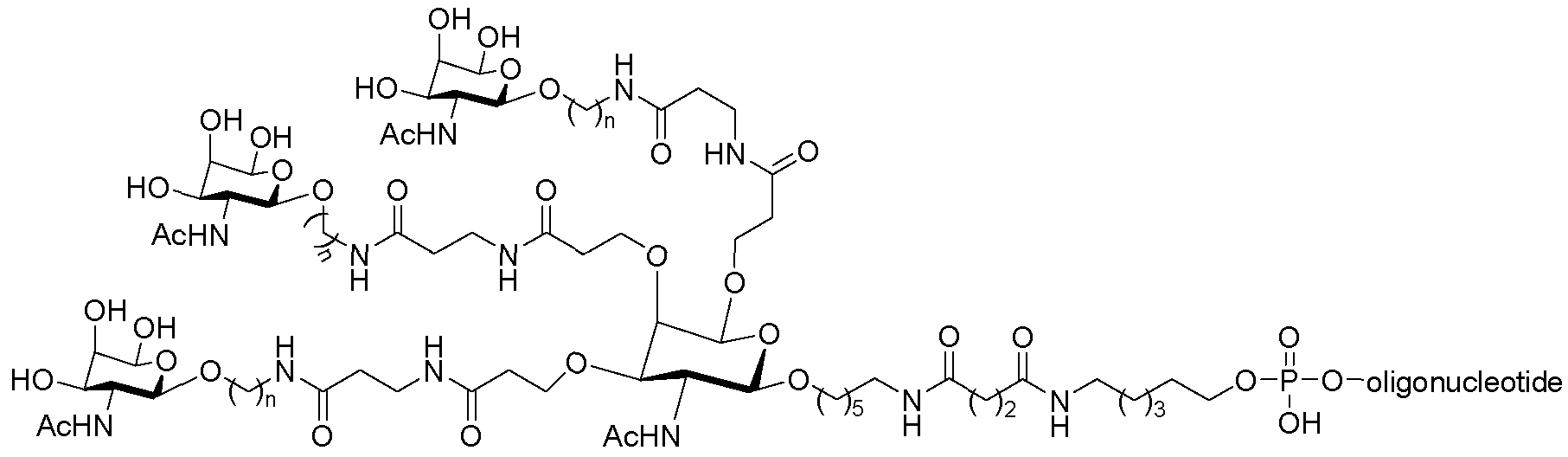
  • the compound is of the following structure:
  • n is independently 1 to 20
  • j is 1 to 11
  • k is 1 to 11
  • m is 1 to 10.
  • j is 5.
  • k is 5.
  • m is 2 or 3.
  • the compound is of the following structure:
  • n is independently 1 to 20.
  • the compound is of the following structure:
  • the compound is of the following structure:
  • n is independently 1 to 20.
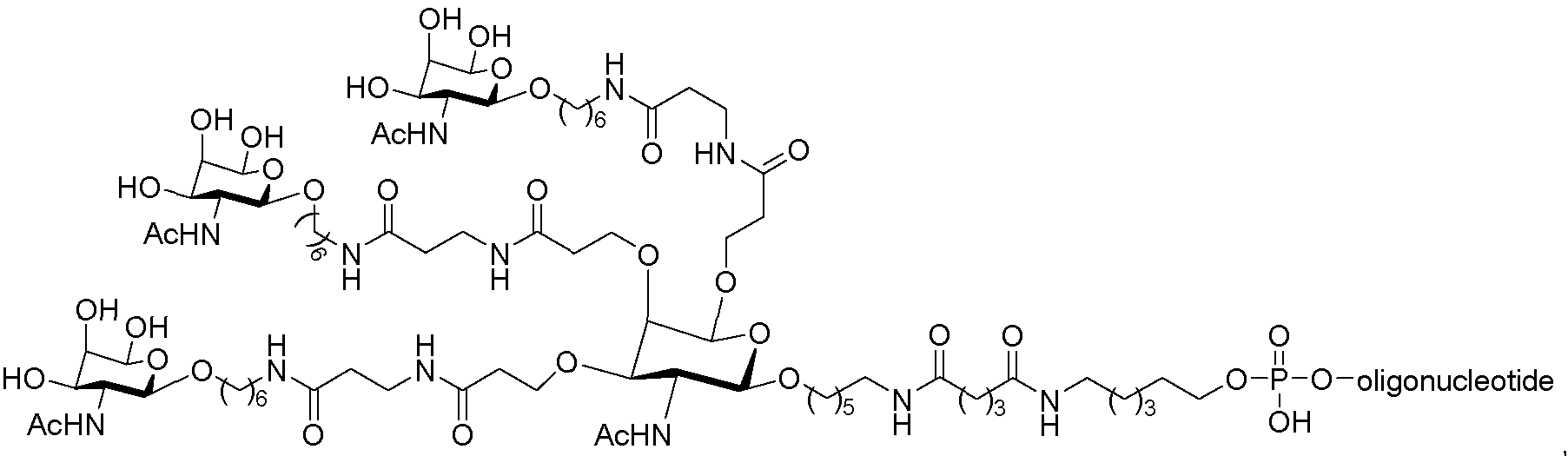
  • the compound is:
  • the compound is of the following structure:
  • n is independently 1 to 20.
  • the compound is:
  • the compound is:
  • n is independently 1 to 20.
  • the compound is:
  • the invention provides a method of delivering a therapeutically active agent to a cell having one or more surface receptors by contacting the cell with the compound of the invention, or a salt thereof, where at least one T is a ligand, and Z is a therapeutically active agent.
  • the cell is in a tissue.
  • the tissue is in a subject.
  • the invention provides a method of producing the compound of the invention, in which Z is a therapeutically active agent, by producing a product of a reaction between the compound of the invention, in which Z is a conjugation moiety and at least one T is a protected ligand, with a compound of formula (III):
  • Z 1 is a complementary conjugation moiety
  • Z 2 is a therapeutically active agent.
  • the method further includes deprotecting the product to produce the compound of the invention, in which Z is a therapeutically active agent and at least one T is a ligand.
  • acyl represents a chemical substituent of formula -C(0)-R, where R is alkyl, aryl, arylalkyl, cycloalkyl, heterocyclyl, heterocyclyl alkyl, heteroaryl, or heteroaryl alkyl.
  • R is alkyl, aryl, arylalkyl, cycloalkyl, heterocyclyl, heterocyclyl alkyl, heteroaryl, or heteroaryl alkyl.
  • An optionally substituted acyl is an acyl that is optionally substituted as described herein for each group R.
  • acyloxy represents a chemical substituent of formula -OR, where R is acyl.
  • An optionally substituted acyloxy is an acyloxy that is optionally substituted as described herein for acyl.
  • alkane-tetrayl represents a tetravalent, acyclic, straight or branched chain, saturated hydrocarbon group having from 1 to 16 carbons, unless otherwise specified. Alkane- tetrayl may be optionally substituted as described for alkyl.
  • alkane-triyl represents a trivalent, acyclic, straight or branched chain, saturated hydrocarbon group having from 1 to 16 carbons, unless otherwise specified. Alkane-triyl may be optionally substituted as described for alkyl.
  • alkanoyl represents a chemical substituent of formula -C(0)-R, where R is alkyl.
  • R is alkyl.
  • An optionally substituted alkanoyl is an alkanoyl that is optionally substituted as described herein for alkyl.
  • alkoxy represents a chemical substituent of formula -OR, where R is a Ci- 6 alkyl group, unless otherwise specified.
  • An optionally substituted alkoxy is an alkoxy group that is optionally substituted as defined herein for alkyl.
  • alkyl refers to an acyclic straight or branched chain saturated hydrocarbon group, which, when unsubstituted, has from 1 to 12 carbons, unless otherwise specified. In certain preferred embodiments, unsubstituted alkyl has from 1 to 6 carbons.
  • Alkyl groups are exemplified by methyl; ethyl; n- and iso-propyl; n-, sec-, iso- and tert-butyl; neopentyl, and the like, and may be optionally substituted, valency permitting, with one, two, three, or, in the case of alkyl groups of two carbons or more, four or more substituents independently selected from the group consisting of: alkoxy; acyloxy; amino; aryl; aryloxy; azido; cycloalkyl; cycloalkoxy; halo; heterocyclyl; heteroaryl;
  • a substituted alkyl includes two substituents (oxo and hydroxy, or oxo and alkoxy) to form a group -L-CO-R, where L is a bond or optionally substituted Ci_n alkylene, and R is hydroxyl or alkoxy.
  • Each of the substituents may itself be unsubstituted or, valency permitting, substituted with unsubstituted substituent(s) defined herein for each respective group.
  • alkylene represents a divalent substituent that is a monovalent alkyl having one hydrogen atom replaced with a valency.
  • An optionally substituted alkylene is an alkylene that is optionally substituted as described herein for alkyl.
  • aryl represents a mono-, bicyclic, or multicyclic carbocyclic ring system having one or two aromatic rings.
  • Aryl group may include from 6 to 10 carbon atoms. All atoms within an unsubstituted carbocyclic aryl group are carbon atoms.
  • Non-limiting examples of carbocyclic aryl groups include phenyl, naphthyl, 1 ,2-d ihydronaphthyl, 1 ,2,3,4-tetrahydronaphthyl, fluorenyl, indanyl, indenyl, etc.
  • the aryl group may be unsubstituted or substituted with one, two, three, four, or five substituents independently selected from the group consisting of: alkyl; alkoxy; acyloxy; amino; aryl; aryloxy; azido; cycloalkyl; cycloalkoxy; halo; heterocyclyl; heteroaryl; heterocyclylalkyl; heteroarylalkyl; heterocyclyloxy; heteroaryloxy; hydroxy; nitro; thiol; silyl; and cyano.
  • Each of the substituents may itself be unsubstituted or substituted with unsubstituted substituent(s) defined herein for each respective group.
  • arylalkyl represents an alkyl group substituted with an aryl group.
  • aryl and alkyl portions may be optionally substituted as the individual groups as described herein.
  • arylene represents a divalent substituent that is an aryl having one hydrogen atom replaced with a valency.
  • An optionally substituted arylene is an arylene that is optionally substituted as described herein for aryl.
  • aryloxy represents a group -OR, where R is aryl.
  • Aryloxy may be an optionally substituted aryloxy.
  • An optionally substituted aryloxy is aryloxy that is optionally substituted as described herein for aryl.
  • bicyclic sugar moiety represents a modified sugar moiety including two fused rings.
  • the bicyclic sugar moiety includes a furanosyl ring.
  • C x.y indicates that the group, the name of which immediately follows the expression, when unsubstituted, contains a total of from x to y carbon atoms. If the group is a composite group (e g., arylalkyl), C x-y indicates that the portion, the name of which immediately follows the expression, when unsubstituted, contains a total of from x to y carbon atoms.
  • (C 6 -io- aryl)-Ci- 6 -alkyl is a group, in which the aryl portion, when unsubstituted, contains a total of from 6 to 10 carbon atoms, and the alkyl portion, when unsubstituted, contains a total of from 1 to 6 carbon atoms.
  • oligonucleotide refers to nucleosides, nucleobases, sugar moieties, or internucleoside linkages that are immediately adjacent to each other.
  • “contiguous nucleobases” means nucleobases that are immediately adjacent to each other in a sequence.
  • cycloalkyl refers to a cyclic alkyl group having from three to ten carbons (e g. , a C -C cycloalkyl), unless otherwise specified.
  • Cycloalkyl groups may be monocyclic or bicyclic.
  • Bicyclic cycloalkyl groups may be of bicyclo[p.q.0]alkyl type, in which each of p and q is, independently, 1 , 2, 3, 4, 5, 6, or 7, provided that the sum of p and q is 2, 3, 4, 5, 6, 7, or 8.
  • bicyclic cycloalkyl groups may include bridged cycloalkyl structures, e.g., bicyclo[p.q.r]alkyl, in which r is 1 , 2, or 3, each of p and q is, independently, 1 , 2, 3, 4, 5, or 6, provided that the sum of p, q, and r is 3, 4, 5, 6, 7, or 8.
  • the cycloalkyl group may be a spirocyclic group, e.g., spiro[p.q]alkyl, in which each of p and q is, independently, 2, 3, 4, 5, 6, or 7, provided that the sum of p and q is 4, 5, 6, 7, 8, or 9.
  • Non-limiting examples of cycloalkyl include cyclopropyl, cyclobutyl, cyclopentyl, cyclohexyl, cycloheptyl, 1- bicyclo[2.2.1.]heptyl, 2-bicyclo[2.2.1.]heptyl, 5-bicyclo[2.2.1.]heptyl, 7-bicyclo[2.2.1.]heptyl, and decalinyl.
  • the cycloalkyl group may be unsubstituted or substituted (e.g., optionally substituted cycloalkyl) with one, two, three, four, or five substituents independently selected from the group consisting of: alkyl; alkoxy; acyloxy; amino; aryl; aryloxy; azido; cycloalkyl; cycloalkoxy; halo; heterocyclyl; heteroaryl;
  • cycloalkylene represents a divalent substituent that is a cycloalkyl having one hydrogen atom replaced with a valency.
  • An optionally substituted cycloalkylene is a cycloalkylene that is optionally substituted as described herein for cycloalkyl.
  • cycloalkoxy represents a group -OR, where R is cycloalkyl.
  • Cycloalkoxy may be an optionally substituted cycloalkoxy.
  • An optionally substituted cycloalkoxy is cycloalkoxy that is optionally substituted as described herein for cycloalkyl.
  • duplex represents two oligonucleotides that are paired through hybridization of complementary nucleobases.
  • halo represents a halogen selected from bromine, chlorine, iodine, and fluorine.
  • heteroalkyl refers to an alkyl group interrupted one or more times by one or two heteroatoms each time. Each heteroatom is independently O, N, or S. None of the heteroalkyl groups includes two contiguous oxygen atoms.
  • the heteroalkyl group may be unsubstituted or substituted (e g., optionally substituted heteroalkyl). When heteroalkyl is substituted and the substituent is bonded to the heteroatom, the substituent is selected according to the nature and valency of the heteratom.
  • substituents may itself be unsubstituted or substituted with unsubstituted substituent(s) defined herein for each respective group.
  • substituent When heteroalkyl is substituted and the substituent is bonded to carbon, the substituent is selected from those described for alkyl, provided that the substituent on the carbon atom bonded to the heteroatom is not Cl, Br, or I.
  • carbon atoms are found at the termini of a heteroalkyl group.
  • heteroalkyl is PEG.
  • heteroalkylene represents a divalent substituent that is a heteroalkyl having one hydrogen atom replaced with a valency.
  • An optionally substituted heteroalkylene is a heteroalkylene that is optionally substituted as described herein for heteroalkyl.
  • heteroaryl represents a monocyclic 5-, 6-, 7-, or 8-membered ring system, or a fused or bridging bicyclic, tricyclic, or tetracyclic ring system; the ring system contains one, two, three, or four heteroatoms independently selected from the group consisting of nitrogen, oxygen, and sulfur; and at least one of the rings is an aromatic ring.
  • heteroaryl groups include benzimidazolyl, benzofuryl, benzothiazolyl, benzothienyl, benzoxazolyl, furyl, imidazolyl, indolyl, isoindazolyl, isoquinolinyl, isothiazolyl, isothiazolyl, isoxazolyl, oxadiazolyl, oxazolyl, purinyl, pyrrolyl, pyridinyl, pyrazinyl, pyrimidinyl, qunazolinyl, quinolinyl, thiadiazolyl (e.g., 1 ,3,4-thiadiazole), thiazolyl, thienyl, triazolyl, tetrazolyl, dihydroindolyl, tetrahydroquinolyl, tetrahydroisoquinolyl, etc.
  • bicyclic, tricyclic, and tetracyclic heteroaryls include at least one ring having at least one heteroatom as described above and at least one aromatic ring.
  • a ring having at least one heteroatom may be fused to one, two, or three carbocyclic rings, e.g., an aryl ring, a cyclohexane ring, a cyclohexene ring, a cyclopentane ring, a cyclopentene ring, or another monocyclic heterocyclic ring.
  • fused heteroaryls examples include 1 ,2,3,5,8,8a-hexahydroindolizine; 2,3-dihydrobenzofuran; 2,3-dihydroindole; and 2,3- dihydrobenzothiophene.
  • heteroarylene represents a divalent substituent that is a heteroaryl having one hydrogen atom replaced with a valency.
  • An optionally substituted heteroarylene is a heteroarylene that is optionally substituted as described herein for heteroaryl.
  • heteroaryloxy refers to a structure -OR, in which R is heteroaryl. Heteroaryloxy can be optionally substituted as defined for heteroaryl.
  • heterocyclyl represents a monocyclic, bicyclic, tricyclic, or tetracyclic ring system having fused or bridging 4-, 5-, 6-, 7-, or 8-membered rings, unless otherwise specified, the ring system containing one, two, three, or four heteroatoms independently selected from the group consisting of nitrogen, oxygen, and sulfur.
  • Heterocyclyl may be aromatic or non-aromatic.
  • An aromatic heterocyclyl is heteroaryl as described herein.
  • Non-aromatic 5-membered heterocyclyl has zero or one double bonds
  • non-aromatic 6- and 7-membered heterocyclyl groups have zero to two double bonds
  • non-aromatic 8-membered heterocyclyl groups have zero to two double bonds and/or zero or one carbon- carbon triple bond.
  • Heterocyclyl groups have a carbon count of 1 to 16 carbon atoms unless otherwise specified. Certain heterocyclyl groups may have a carbon count up to 9 carbon atoms.
  • Non-aromatic heterocyclyl groups include pyrrolinyl, pyrrolidinyl, pyrazolinyl, pyrazolidinyl, imidazolinyl, imidazolidinyl, piperidinyl, homopiperidinyl, piperazinyl, pyridazinyl, oxazolidinyl, isoxazolidiniyl, morpholinyl, thiomorpholinyl, thiazolidinyl, isothiazolidinyl, thiazolidinyl, tetrahydrofuranyl, dihydrofuranyl,
  • heterocyclyl also represents a heterocyclic compound having a bridged multicyclic structure in which one or more carbons and/or heteroatoms bridges two non-adjacent members of a monocyclic ring, e.g., quinuclidine, tropanes, or diaza-bicyclo[2.2.2]octane.
  • heterocyclyl includes bicyclic, tricyclic, and tetracyclic groups in which any of the above heterocyclic rings is fused to one, two, or three carbocyclic rings, e.g., a cyclohexane ring, a cyclohexene ring, a cyclopentane ring, a cyclopentene ring, or another heterocyclic ring.
  • fused heterocyclyls include 1 ,2,3,5,8,8a-hexahydroindolizine; 2,3-dihydrobenzofuran; 2,3-dihydroindole; and 2,3-dihydrobenzothiophene.
  • the heterocyclyl group may be unsubstituted or substituted with one, two, three, four or five substituents independently selected from the group consisting of: alkyl; alkoxy; acyloxy; aryloxy; amino; arylalkoxy; cycloalkyl; cycloalkoxy; halogen; heterocyclyl;
  • heterocyclyl alkyl represents an alkyl group substituted with a heterocyclyl group.
  • the heterocyclyl and alkyl portions of an optionally substituted heterocyclyl alkyl are optionally substituted as described for heterocyclyl and alkyl, respectively.
  • heterocyclylene represents a divalent substituent that is a heterocyclyl having one hydrogen atom replaced with a valency.
  • heterocyclylene is a heterocyclylene that is optionally substituted as described herein for heterocyclyl.
  • heterocyclyloxy refers to a structure -OR, in which R is heterocyclyl. Heterocyclyloxy can be optionally substituted as described for heterocyclyl.
  • heteroorganic refers to (i) an acyclic hydrocarbon interrupted one or more times by one or two heteroatoms each time, or (ii) a cyclic hydrocarbon including one or more (e.g., one, two, three, or four) endocyclic heteroatoms.
  • Each heteroatom is independently O, N, or S. None of the heteroorganic groups includes two contiguous oxygen atoms.
  • An optionally substituted heteroorganic group is a heteroorganic group that is optionally substituted as described herein for alkyl.
  • hydrocarbon refers to an acyclic, branched or acyclic, linear compound or group, or a monocyclic, bicyclic, tricyclic, or tetracyclic compound or group.
  • the hydrocarbon when unsubstituted, consists of carbon and hydrogen atoms. Unless specified otherwise, an unsubstituted hydrocarbon includes a total of 1 to 60 carbon atoms (e.g. , 1 to 16, 1 to 12, or 1 to 6 carbon atoms).
  • An optionally substituted hydrocarbon is an optionally substituted acyclic hydrocarbon or an optionally substituted cyclic hydrocarbon.
  • An optionally substituted acyclic hydrocarbon is optionally substituted as described herein for alkyl.
  • An optionally substituted cyclic hydrocarbon is an optionally substituted aromatic hydrocarbon or an optionally substituted non-aromatic hydrocarbon.
  • An optionally substituted aromatic hydrocarbon is optionally substituted as described herein for aryl.
  • An optionally substituted non-aromatic cyclic hydrocarbon is optionally substituted as described herein for cycloalkyl.
  • an acyclic hydrocarbon is alkyl, alkylene, alkane-triyl, or alkane-tetrayl. In certain embodiments, a cyclic hydrocarbon is aryl or arylene. In particular embodiments, a cyclic hydrocarbon is cycloalkyl or cycloalkylene.
  • hydrophobic moiety represents a monovalent group covalently linked to an oligonucleotide backbone, where the monovalent group is a bile acid (e.g., cholic acid, taurocholic acid, deoxycholic acid, oleyl lithocholic acid, or oleoyl cholenic acid), glycolipid, phospholipid, sphingolipid, isoprenoid, vitamin, saturated fatty acid, unsaturated fatty acid, fatty acid ester, triglyceride, pyrene, porphyrine, texaphyrine, adamantine, acridine, biotin, coumarin, fluorescein, rhodamine, Texas- Red, digoxygenin, dimethoxytrityl, f-butydimethylsilyl, f-butyld iphenylsilyl, cyanine dye (e.g., Cy3 or Cy5), Hoech
  • Non-limiting examples of the monovalent group include ergosterol, stigmasterol, b-sitosterol, campesterol, fucosterol, saringosterol, avenasterol, coprostanol, cholesterol, vitamin A, vitamin D, vitamin E, cardiolipin, and carotenoids.
  • the linker connecting the monovalent group to the oligonucleotide may be an optionally substituted Ci_ 6 o hydrocarbon (e.g., optionally substituted Ci_ 6 o alkylene) or an optionally substituted C 2-6 o heteroorganic (e.g., optionally substituted C 2 -6o heteroalkylene), where the linker may be optionally interrupted with one, two, or three instances independently selected from the group consisting of an optionally substituted arylene, optionally substituted heterocyclylene, and optionally substituted cycloalkylene.
  • an optionally substituted Ci_ 6 o hydrocarbon e.g., optionally substituted Ci_ 6 o alkylene
  • C 2-6 o heteroorganic e.g., optionally substituted C 2 -6o heteroalkylene
  • the linker may be bonded to an oligonucleotide through, e.g., an oxygen atom attached to a 5’-terminal carbon atom, a 3’-terminal carbon atom, a 5’-terminal phosphate or phosphorothioate, a 3’-terminal phosphate or phosphorothioate, or an internucleoside linkage.
  • internucleoside linkage represents a divalent group or covalent bond that forms a covalent linkage between adjacent nucleosides in an oligonucleotide.
  • An internucleoside linkage is an unmodified internucleoside linkage or a modified internucleoside linkage.
  • An“unmodified internucleoside linkage” is a phosphate (-0-P(0)(0H)-0-) internucleoside linkage (“phosphate phosphodiester”).
  • A“modified internucleoside linkage” is an internucleoside linkage other than a phosphate phosphodiester.
  • modified internucleoside linkages are defined by the presence or absence of a phosphorus atom.
  • phosphorus-containing internucleoside linkages include phosphodiester linkages, phosphotriester linkages, phosphorothioate diester linkages, phosphorothioate triester linkages, phosphorodithioate linkages, boranophosphonate linkages, morpholino internucleoside linkages, methylphosphonates, and phosphoramidate.
  • Non-limiting examples of non-phosphorus internucleoside linkages include methylenemethylimino (— CH 2 — N(CH 3 )— O— CH 2 — ), thiodiester (— O— C(O)— S— ), thionocarbamate (— O— C(0)(NH)— S— ), siloxane (— O— Si(H ) 2 — O— ), and N,N'-dimethylhydrazine (— CH 2 — N(CH 3 )— N(CH 3 )— ).
  • Phosphorothioate linkages are phosphodiester linkages and phosphotriester linkages in which one of the non-bridging oxygen atoms is replaced with a sulfur atom.
  • an internucleoside linkage is a group of the following structure:
  • X is a monosaccharide
  • each Y 1 is independently -0-, -S-, -N(-L-R 1 )-, or L;
  • Y 2 is (T-U-) p -X-L 2 - or R 1 -L-Y 1 -;
  • Y 3 is O, S, B, or Se
  • each L is independently a covalent bond or a covalent linker (e.g. , optionally substituted Ci_ 6 o hydrocarbon linker or optionally substituted C heteroorganic linker);
  • a covalent linker e.g. , optionally substituted Ci_ 6 o hydrocarbon linker or optionally substituted C heteroorganic linker
  • each L 1 is independently a covalent linker
  • L 2 is a conjugation linker
  • each R 1 is independently hydrogen, -S-S-R 2 , -O-CO-R 2 , -S-CO-R 2 , optionally substituted Ci_g heterocyclyl, or a hydrophobic moiety;
  • each R 2 is independently optionally substituted C-M O alkyl, optionally substituted C heteroalkyl, optionally substituted Ce-io aryl, optionally substituted Ce-io aryl C alkyl, optionally substituted C heterocyclyl, or optionally substituted C heterocyclyl Ci. 6 alkyl;
  • p 1 to 5;
  • each T is independently a ligand or a protected ligand.
  • L is a covalent bond
  • R 1 is hydrogen
  • Y 3 is oxygen
  • all Y 1 and groups are -0-
  • L is a bond
  • the internucleoside group is known as a phosphate phosphodiester.
  • R 1 is hydrogen
  • Y 3 is sulfur
  • all Y 1 groups are -0-
  • L is a bond
  • the internucleoside group is known as a phosphorothioate diester.
  • morpholino represents an oligomer of at least 10 morpholino monomer units interconnected by morpholino internucleoside linkages.
  • a morpholino includes a 5’ group and a 3’ group.
  • a morpholino may be of the following structure:
  • n is at least 10 (e.g. , 12 to 50) indicating the number of morpholino units
  • each B is independently a nucleobase
  • R 1 is a 5’ group
  • R 2 is a 3’ group
  • L is (i) a morpholino internucleoside linkage or, (ii) if L is attached to R 2 , a covalent bond.
  • a 5’ group in morpholino may be, e.g., hydroxyl, a hydrophobic moiety, phosphate, diphosphate, triphosphate, phosphorothioate, diphosphorothioate, triphosphorothioate, phosphorodithioate, disphorodithioate, triphosphorodithioate, phosphonate, phosphoramidate, a cell penetrating peptide, an endosomal escape moiety, or a neutral organic polymer.
  • a 3’ group in morpholino may be, e.g., hydrogen, a hydrophobic moiety, phosphate, diphosphate, triphosphate, phosphorothioate,
  • diphosphorothioate triphosphorothioate, phosphorodithioate, disphorodithioate, triphosphorodithioate, phosphonate, phosphoramidate, a cell penetrating peptide, an endosomal escape moiety, or a neutral organic polymer.
  • morpholino internucleoside linkage represents a divalent group of the following structure:
  • Z m is O or S
  • X 1 is a bond
  • Y m is -NR 2 , where each R is independently Ci_e alkyl (e.g., methyl), or both R combine together with the nitrogen atom to which they are attached to form a C 2.9 heterocyclyl (e.g., N-piperazinyl);
  • nucleobase represents a nitrogen-containing heterocyclic ring found at the T position of the ribofuranose/2’-deoxyribofuranose of a nucleoside. Nucleobases are unmodified or modified. As used herein,“unmodified” or“natural” nucleobases include the purine bases adenine (A) and guanine (G), and the pyrimidine bases thymine (T), cytosine (C), and uracil (U).
  • Modified nucleobases include 5-substituted pyrimidines, 6-azapyrimidines, alkyl or alkynyl substituted pyrimidines, alkyl substituted purines, and N-2, N-6 and 0-6 substituted purines, as well as synthetic and natural nucleobases, e.g., 5-methylcytosine, 5-hydroxymethyl cytosine, xanthine, hypoxanthine, 2-aminoadenine, 6-alkyl (e.g., 6-methyl) adenine and guanine, 2-alkyl (e.g., 2-propyl) adenine and guanine, 2-th iouracil, 2- thiothymine, 2-thiocytosine, 5-halouracil, 5-halocytosine, 5-propynyl uracil, 5-propynyl cytosine, 5- trifluoromethyl uracil, 5-trifluoromethyl cytosine, 7-methyl guanine
  • nucleobases are particularly useful for increasing the binding affinity of nucleic acids, e g., 5-substituted pyrimidines; 6- azapyrimidines; N2-, N6-, and/or 06-substituted purines.
  • Nucleic acid duplex stability can be enhanced using, e.g., 5-methylcytosine.
  • nucleobases include: 2-aminopropyladenine, 5- hydroxymethyl cytosine, xanthine, hypoxanthine, 2-aminoadenine, 6-N-methylguanine, 6-N- methyladenine, 2-propyladenine, 2-thiouracil, 2-thiothymine and 2-thiocytosine, 5-propynyl (— CoC— CH 3 ) uracil, 5-propynylcytosine, 6-azouracil, 6-azocytosine, 6-azothymine, 5-ribosyluracil (pseudouracil), 4- thiouracil, 8-halo, 8-amino, 8-thiol, 8-thioalkyl, 8-hydroxyl, 8-aza and other 8-substituted purines, 5-halo, particularly 5-bromo, 5-trifluoromethyl, 5-halouracil, and 5-halocytosine, 7-methylguanine, 7- methyla
  • nucleobases include tricyclic pyrimidines, such as 1 ,3-diazaphenoxazine-2-one, 1 ,3-diazaphenothiazine-2-one and 9-(2- aminoethoxy)-1 ,3-diazaphenoxazine-2-one (G-clamp).
  • Modified nucleobases may also include those in which the purine or pyrimidine base is replaced with other heterocycles, for example, 7-deazaadenine, 7- deazaguanine, 2-aminopyridine, or 2-pyridone.
  • Further nucleobases include those disclosed in U.S. Pat. No.
  • nucleoside represents sugar-nucleobase compounds and groups known in the art (e g., modified or unmodified ribofuranose-nucleobase and 2’-deoxyribofuranose- nucleobase compounds and groups known in the art).
  • the sugar may be ribofuranose.
  • the sugar may be modified or unmodified.
  • An unmodified sugar nucleoside is ribofuranose or 2’-deoxyribofuranose having an anomeric carbon bonded to a nucleobase.
  • An unmodified nucleoside is ribofuranose or 2’- deoxyribofuranose having an anomeric carbon bonded to an unmodified nucleobase.
  • Non-limiting examples of unmodified nucleosides include adenosine, cytidine, guanosine, uridine, 2’-deoxyadenosine, 2’-deoxycytidine, 2’-deoxyguanosine, and thymidine.
  • the modified compounds and groups include one or more modifications selected from the group consisting of nucleobase modifications and sugar modifications described herein.
  • a nucleobase modification is a replacement of an unmodified nucleobase with a modified nucleobase.
  • a sugar modification may be, e.g., a 2’-substitution, locking,
  • a 2’-substitution is a replacement of 2’-hydroxyl in ribofuranose with 2’- fluoro, 2’-methoxy, or 2’-(2-methoxy)ethoxy.
  • a locking modification is an incorporation of a bridge between 4’-carbon atom and 2’-carbon atom of ribofuranose.
  • Nucleosides having a locking modification are known in the art as bridged nucleic acids, e.g., locked nucleic acids (LNA), ethylene-bridged nucleic acids (ENA), and cEt nucleic acids.
  • the bridged nucleic acids are typically used as affinity enhancing nucleosides.
  • oligonucleotide represents a structure containing 10 or more (e.g., 10 to 50) contiguous nucleosides covalently bound together by internucleoside linkages.
  • An oligonucleotide includes a 5’ end and a 3’ end.
  • the 5’ end of an oligonucleotide may be, e.g., hydroxyl, a targeting moiety, a hydrophobic moiety, 5’ cap, phosphate, diphosphate, triphosphate, phosphorothioate, diphosphorothioate, triphosphorothioate, phosphorodithioate, diphosphrodithioate, triphosphorodithioate, phosphonate, phosphoramidate, a cell penetrating peptide, an endosomal escape moiety, or a neutral organic polymer.
  • the 3’ end of an oligonucleotide may be, e.g., hydroxyl, a targeting moiety, a hydrophobic moiety, phosphate, diphosphate, triphosphate, phosphorothioate, diphosphorothioate, triphosphorothioate, phosphorodithioate, disphorodithioate, triphosphorodithioate, phosphonate, phosphoramidate, a cell penetrating peptide, an endosomal escape moiety, or a neutral organic polymer (e.g., polyethylene glycol).
  • An oligonucleotide having a 5’-hydroxyl or 5’-phosphate has an unmodified 5’ terminus.
  • An oligonucleotide having a 5’ terminus other than 5’-hydroxyl or 5’-phosphate has a modified 5’ terminus.
  • An oligonucleotide having a 3’-hydroxyl or 3’-phosphate has an unmodified 3’ terminus.
  • An oligonucleotide having a 3’ terminus other than 3’-hydroxyl or 3’-phosphate has a modified 3’ terminus.
  • pharmaceutically acceptable refers to those compounds, materials, compositions, and/or dosage forms, which are suitable for contact with the tissues of an individual (e.g., a human), without excessive toxicity, irritation, allergic response and other problem complications commensurate with a reasonable benefit/risk ratio.
  • the term“protecting group,” as used herein, represents a group intended to protect a functional group (e.g., a hydroxyl, an amino, or a carbonyl) from participating in one or more undesirable reactions during chemical synthesis.
  • the term“O-protecting group,” as used herein, represents a group intended to protect an oxygen containing (e.g., phenol, hydroxyl or carbonyl) group from participating in one or more undesirable reactions during chemical synthesis.
  • the term“/V-protecting group,” as used herein, represents a group intended to protect a nitrogen containing (e.g., an amino or hydrazine) group from participating in one or more undesirable reactions during chemical synthesis.
  • O- and N- protecting groups are disclosed in Wuts,“Greene’s Protective Groups in Organic Synthesis,” 4 th Edition (John Wiley & Sons, New York, 2006), which is incorporated herein by reference.
  • Exemplary O- and N- protecting groups include alkanoyl, aryloyl, or carbamyl groups such as formyl, acetyl, propionyl, pivaloyl, t-butylacetyl, 2-chloroacetyl, 2-bromoacetyl, trifluoroacetyl, trichloroacetyl, phthalyl, o-nitrophenoxyacetyl, a-chlorobutyryl, benzoyl, 4-chlorobenzoyl, 4-bromobenzoyl, f-butyldimethylsilyl, tri-/so- propylsilyloxymethyl, 4,4'-dimethoxytrityl, isobutyryl, phen
  • Exemplary O-protecting groups for protecting carbonyl containing groups include, but are not limited to: acetals, acylals, 1 ,3-dithianes, 1 ,3-dioxanes, 1 ,3-dioxolanes, and 1 ,3-dithiolanes.
  • O-protecting groups include, but are not limited to: substituted alkyl, aryl, and arylalkyl ethers (e.g., trityl; methylthiomethyl; methoxymethyl; benzyloxymethyl; siloxymethyl; 2,2,2,- trichloroethoxymethyl; tetrahydropyranyl; tetrahydrofuranyl; ethoxyethyl; 1-[2-(trimethylsilyl)ethoxy]ethyl; 2-trimethylsilylethyl; t-butyl ether; p-chlorophenyl, p-methoxyphenyl, p-nitrophenyl, benzyl, p- methoxybenzyl, and nitrobenzyl); silyl ethers (e.g., trimethylsilyl; triethylsilyl; triisopropylsilyl;
  • silyl ethers e.g., trimethylsily
  • carbonates e.g., methyl, methoxymethyl, 9-fluorenylmethyl; ethyl; 2,2,2- trich loroethyl; 2-(trimethylsilyl)ethyl; vinyl, allyl, nitrophenyl; benzyl; methoxybenzyl; 3,4-dimethoxybenz
  • Other /V-protecting groups include, but are not limited to, chiral auxiliaries such as protected or unprotected D, L or D, L-amino acids such as alanine, leucine, phenylalanine, and the like; sulfonyl- containing groups such as benzenesulfonyl, p-toluenesulfonyl, and the like; carbamate forming groups such as benzyloxycarbonyl, p-chlorobenzyloxycarbonyl, p-methoxybenzyloxycarbonyl, p- nitrobenzyloxycarbonyl, 2-nitrobenzyloxycarbonyl, p-bromobenzyloxycarbonyl, 3,4- dimethoxybenzyloxycarbonyl, 3,5-dimethoxybenzyl oxycarbonyl, 2,4-dimethoxybenzyloxycarbonyl, 4-methoxybenzyloxycarbonyl, 2-nitro-4,5-
  • pyrid-2-yl hydrazone represents a group of the structure:
  • each R’ is independently H or optionally substituted Ci_ 6 alkyl.
  • Pyrid-2-yl hydrazone may be unsubstituted (i.e. , each R’ is H).
  • an oligonucleotide containing a stereochemically enriched internucleoside linkage is an oligonucleotide, in which a stereogenic internucleoside linkage (e.g. , phosphorothioate) of predetermined stereochemistry is present in preference to a stereogenic internucleoside linkage (e.g. , phosphorothioate) of stereochemistry that is opposite of the predetermined stereochemistry.
  • a stereogenic internucleoside linkage e.g. , phosphorothioate
  • This preference can be expressed numerically using a diastereomeric ratio for the stereogenic internucleoside linkage (e.g., phosphorothioate) of the predetermined stereochemistry.
  • the diastereomeric ratio for the stereogenic internucleoside linkage (e.g., phosphorothioate) of the predetermined stereochemistry is the molar ratio of the diastereomers having the identified stereogenic internucleoside linkage (e.g., phosphorothioate) with the predetermined stereochemistry relative to the diastereomers having the identified stereogenic internucleoside linkage (e.g., phosphorothioate) with the stereochemistry that is opposite of the predetermined stereochemistry.
  • the diastereomeric ratio for the phosphorothioate of the predetermined stereochemistry may be greater than or equal to 1.1 (e.g., greater than or equal to 4, greater than or equal to 9, greater than or equal to 19, or greater than or equal to 39).
  • subject represents a human or non-human animal (e.g., a mammal) that is suffering from, or is at risk of, disease, disorder, or condition, as determined by a qualified professional (e.g., a doctor or a nurse practitioner) with or without known in the art laboratory test(s) of sample(s) from the subject.
  • a qualified professional e.g., a doctor or a nurse practitioner
  • A“sugar” or“sugar moiety,” includes naturally occurring sugars having a furanose ring or a structure that is capable of replacing the furanose ring of a nucleoside.
  • Sugars included in the nucleosides of the invention may be non-furanose (or 4'-substituted furanose) rings or ring systems or open systems. Such structures include simple changes relative to the natural furanose ring (e.g., a six- membered ring).
  • Alternative sugars may also include sugar surrogates wherein the furanose ring has been replaced with another ring system such as, e.g., a morpholino or hexitol ring system.
  • Non-limiting examples of sugar moieties useful that may be included in the oligonucleotides of the invention include b- D-ribose, p-D-2'-deoxyribose, substituted sugars (e.g. , 2', 5', and bis substituted sugars), 4'-S-sugars (e.g.
  • bicyclic sugar moieties e.g., the 2 - O— CH 2 -4' or 2 -0— (CH 2 ) 2 -4' bridged ribose derived bicyclic sugars
  • sugar surrogates when the ribose ring has been replaced with a morpholino or a hexitol ring system.
  • targeting moiety represents a moiety (e.g., N-acetylgalactosamine cluster) that specifically binds or reactively associates or complexes with a receptor or other receptive moiety associated with a given target cell population.
  • the targeting moiety included in the compounds of the invention is Y p -X-L 2 - as described herein, where p indicates the number of groups Y directly bonded to group X.
  • An oligonucleotide including a targeting moiety is also referred to herein as a conjugate.
  • a targeting moiety may include one or more ligands (e.g., 1 to 9 ligands, 1 to 6 ligands, 1 to 3 ligands, or 1 ligand).
  • the ligand can be an antibody or an antigen-binding fragment or an engineered derivative thereof (e.g. , Fcab or a fusion protein (e.g., scFv)).
  • the ligand may be a small molecule (e.g., N-acetylgalactosamine).
  • the ligand may target a cell expressing asialoglycoprotein receptor (ASGP-R), IgA receptor, HDL receptor, LDL receptor, or transferrin receptor.
  • ASGP-R asialoglycoprotein receptor
  • Non-limiting examples of the ligands include N-acetylgalactosamine, glycyrrhetinic acid, glycyrrhizin, lactobionic acid, lactoferrin, IgA, or a bile acid (e.g., litrocholyltaurine or taurocholic acid).
  • a therapeutically active agent represents compounds and compound classes known as being therapeutically active.
  • a therapeutically active agent may be a therapeutically active oligonucleotide, e.g., an antisense oligonucleotide, splice-switching oligonucleotide, siRNA, miRNA, or CpG ODN.
  • functional groups containing a "thiocarbonyl” includes thioesters, thioketones, thioaldehydes, thioanhydrides, thioacyl chlorides, thioamides, thiocarboxylic acids, and thiocarboxylates.
  • thioheterocyclylene represents a divalent group -S-R’-, where R’ is a heterocyclylene as defined herein.
  • triazolocycloalkenylene refers to the heterocyclylenes containing a 1 ,2,3-triazole ring fused to an 8-membered ring, all of the endocyclic atoms of which are carbon atoms, and bridgehead atoms are sp 2 -hybridized carbon atoms. Triazocycloalkenylenes can be optionally substituted in a manner described for heterocyclyl.
  • triazoloheterocyclylene refers to the heterocyclylenes containing a 1 ,2,3-triazole ring fused to an 8-membered ring containing at least one heteroatom.
  • the bridgehead atoms in triazoloheterocyclylene are carbon atoms.
  • Triazoloheterocyclylenes can be optionally substituted in a manner described for heterocyclyl.
  • the compounds described herein encompass isotopically enriched compounds (e.g., deuterated compounds), tautomers, and all stereoisomers and conformers (e.g.
  • the invention provides compounds that may be useful for targeting cells, e.g., in a tissue, e.g., in a subject.
  • the compounds of the invention include a targeting moiety of the following structure:
  • p 1 to 5;
  • X is a monosaccharide
  • each Y is independently -L 1 -T, H, protecting group, optionally substituted hydrocarbon, or optionally substituted heteroorganic group, where each T is independently a ligand or a protected ligand, and each L 1 is independently a covalent linker;
  • L 2 is a conjugation linker
  • the compound of the invention may be a compound of formula (I):
  • p 1 to 5;
  • X is a monosaccharide
  • each Y is independently -L 1 -T, H, protecting group, optionally substituted hydrocarbon, or optionally substituted heteroorganic group, where each T is independently a ligand or a protected ligand, and each L 1 is independently a covalent linker;
  • L 2 is a conjugation linker
  • Z is a therapeutically active agent, protecting group, or a conjugation moiety.
  • At least one Y is -L 1 -T.
  • the monosaccharide may be N-acetylgalactosamine, galactosamine, galactose, mannose, allose, altrose, glucose, gulose, idose, talose, arabinose, lyxose, ribose, or xylose.
  • the group -L 2 -Z may be a group of the following structure:
  • Q 1 is [-Q 3 -Q 4 -Q 5 ] s -Q c -B 1 , where B 1 is a bond to Q 2 ;
  • Q 2 is [-Q 3 -Q 4 -Q 5 ] s -B 2 , where B 2 is a bond to Z;
  • each Q 3 is independently absent, -CO-, -NH-, -0-, -S-, -S0 2 -, -OC(O)-, -C(0)0- -NHC(O)-, -C(0)NH-, -GHz-, -CH 2 NH-, -NHCH 2 -, -CH 2 0-, or -OCH 2 -;
  • each Q 4 is independently absent, optionally substituted C-M 2 alkylene, optionally substituted C 2 _i 2 alkenylene, optionally substituted C 2 _i 2 alkynylene, optionally substituted C 2 _i 2 heteroalkylene, optionally substituted Ce-io arylene, optionally substituted C1-9 heteroarylene, or optionally substituted C1-9 heterocyclylene;
  • each Q 5 is independently absent, -CO-, -NH-, -0-, -S-, -S0 2 -, -CH 2 -, -C(0)0-, -OC(O)-,
  • Q c is optionally substituted C alkylene, optionally substituted C heteroalkylene (e.g. , a heteroalkylene containing -C(0)-N(H)-, -N(H)
  • each s is independently 0 to 20.
  • each Q 5 is independently absent, -CO-, -NH-, -0-, -S-, - S0 2 - -CH -, -C(0)0-, -0C(0)-, -C(0)NH-, -NHC(O)-, -0P(0)(0H)0-, or -0P(S)(0H)0-.
  • the group -L 2 -Z may be a group of the following structure:
  • each of ml and m2 is independently 0, 1 , 2, 3, 4, 5, 6, 7, 8, 9, or 10;
  • each of j1 , j2, and j3 is independently 1 , 2, 3, 4, or 5.
  • the group -L 2 -Z may be a group of the following structure:
  • the group -L 2 -Z may be a group of the following structure:
  • Z is, e.g., a therapeutically active agent.
  • the therapeutically active agent may be a therapeutically active oligonucleotide (e.g., an antisense oligonucleotide, splice-switching oligonucleotide, siRNA, miRNA, or CpG ODN).
  • the therapeutically active oligonucleotide may include one or more modifications.
  • the oligonucleotide may include at least one 2’-modification (e.g., 2’-methoxyethoxy) and/or at least one phosphorothioate phosphodiester.
  • all nucleosides are 2’-methoxyethoxy-modified nucleosides, and all internucleoside linkages are phosphorothioate phosphodiesters.
  • the group -L 2 -Z may be a group of the following structure:
  • s 1 to 20;
  • each Q 3 is independently absent, -CO-, -NH-, -0-, -S-, -S0 2 -, -OC(O)-, -C(0)0- -NHC(O)-,— C(0)NH— , -CM -, -CH 2 NH-, -NHCH 2 -, -CH 2 0-, or -OCH 2 -;
  • each Q 4 is independently absent, optionally substituted C-M 2 alkylene, optionally substituted C 2 _i 2 alkenylene, optionally substituted C 2 _i 2 alkynylene, optionally substituted C 2 _i 2 heteroalkylene, optionally substituted C 6 -io arylene, optionally substituted Ci_ 9 heteroarylene, or optionally substituted Ci_ 9 heterocyclylene;
  • each Q 5 is independently absent, -CO-, -NH-, -0-, -S-, -S0 2 -, -CH 2 -, -C(0)0-, -OC(O)-, -C(0)NH-, -NHC(O)-, -NH-CH(R a )-C(0)-, -C(0)-CH(R a )-NH-, -0P(0)(0H)0-, or -0P(S)(0H)0- where each R a is independently H or optionally substituted C-M 2 alkyl; and
  • each Q 5 is independently absent, -CO-, -NH-, -0-, -S-, - S0 2 -, -GHz- -C(0)0-, -0C(0)-, -C(0)NH-, -NHC(O)-, -0P(0)(0H)0-, or -0P(S)(0H)0-
  • the group -L 2 -Z may be a group of the following structure:
  • each of ml and m2 is independently 0, 1 , 2, 3, 4, 5, 6, 7, 8, 9, or 10;
  • each of j1 and j2 is independently 1 , 2, 3, 4, or 5.
  • the group -L 2 -Z may be a group of the following structure:
  • LG is a leaving group
  • the leaving group may be pentafluorophenoxy or tetrafluorophenoxy.
  • the group -L 2 -Z may be a group of the following structure:
  • Each -U-T may be independently a group of the following structure:
  • s is 0 to 20;
  • each Q 3 and each Q 6 are independently absent, -CO-, -NH-, -O-, -S-, -S0 2 -, -OC(O)- -C(0)0-, -NHC(O)-, -C(0)NH-, -CH 2 -, -CH 2 NH-, -NHCH 2 -, -CH 2 0-, or -OCH 2 -;
  • each Q 4 is independently absent, optionally substituted C alkylene, optionally substituted C alkenylene, optionally substituted C alkynylene, optionally substituted C heteroalkylene, optionally substituted Ce-io arylene, optionally substituted C heteroarylene, or optionally substituted C heterocyclylene; and
  • each Q 5 is independently absent, -CO-, -NH-, -0-, -S-, -SO -, -CH 2 -, -C(0)0-, -OC(O)-, -C(0)NH-, -NHC(O)-, -NH-CH(R a )-C(0)-, -C(0)-CH(R a )-NH-, -0P(0)(0H)0-, or -0P(S)(0H)0- where each R a is independently H or optionally substituted C alkyl;
  • each Q 5 is independently absent, -CO-, -NH-, -0-, -S-, - SO -, -CH -, -C(0)0-, -0C(0)-, -C(0)NH-, -NHC(O)-, -0P(0)(0H)0-, or -0P(S)(0H)0- [00135]
  • s is 1 , 2, 3, 4, 5, 6, 7, 8, 9, or 10.
  • Each -U-T may be independently a group of the following structure:
  • each of k1 and k2 is independently 0, 1 , 2, 3, 4, 5, 6, 7, 8, 9, or 10;
  • each of n 1 , n2, and n3 is independently 1 , 2, 3, 4, or 5.
  • Each -U-T may be independently a group of the following structure:
  • Each -U-T may be a group of the following structure:
  • Each -U-T may be a group of the following structure:
  • Each T may be independently a ligand (e.g. , N-acetylgalactosamine).
  • each T may be independently a protected ligand (e.g., N-acetylgalactosamine triacetate).
  • Y p -X- is a group of the following structure:
  • n 1 to 20 (e g., 6).
  • Y p -X- is a group of the following structure:
  • n 1 to 20 (e g., 6).
  • the compound of the invention may be:
  • n 1 to 20.
  • the compound of the invention may be:
  • n 1 to 20.
  • the compound of the invention may be:
  • the compound of the invention may be:
  • an oligonucleotide including a hydrophobic moiety may exhibit superior cellular uptake, as compared to an oligonucleotide lacking the hydrophobic moiety. Oligonucleotides including a hydrophobic moiety may therefore be used in compositions that are substantially free of transfecting agents.
  • a hydrophobic moiety is a monovalent group (e.g. , a bile acid (e.g.
  • cholic acid taurocholic acid, deoxycholic acid, oleyl lithocholic acid, or oleoyl cholenic acid
  • glycolipid phospholipid, sphingolipid, isoprenoid, vitamin, saturated fatty acid, unsaturated fatty acid, fatty acid ester, triglyceride, pyrene, porphyrine, texaphyrine, adamantine, acridine, biotin, coumarin, fluorescein, rhodamine, Texas-Red, digoxygenin, dimethoxytrityl, t-butydimethylsilyl, t-butyldiphenylsilyl, cyanine dye (e.g., Cy3 or Cy5), Hoechst 33258 dye, psoralen, or ibuprofen) covalently linked to the oligonucleotide backbone (e.g., 5’- terminus).
  • cyanine dye e.g.,
  • Non-limiting examples of the monovalent group include ergosterol, stigmasterol, b-sitosterol, campesterol, fucosterol, saringosterol, avenasterol, coprostanol, cholesterol, vitamin A, vitamin D, vitamin E, cardiolipin, and carotenoids.
  • the linker connecting the monovalent group to the oligonucleotide may be an optionally substituted Ci_ 6 o hydrocarbon (e.g., optionally substituted Ci_ 6 o alkylene) or an optionally substituted C 2-6 o heteroorganic (e.g., optionally substituted C 2-6 o heteroalkylene), where the linker may be optionally interrupted with one, two, or three instances independently selected from the group consisting of an optionally substituted arylene, optionally substituted heterocyclylene, and optionally substituted cycloalkylene.
  • an optionally substituted Ci_ 6 o hydrocarbon e.g., optionally substituted Ci_ 6 o alkylene
  • C 2-6 o heteroorganic e.g., optionally substituted C 2-6 o heteroalkylene
  • the linker may be bonded to an oligonucleotide through, e.g., an oxygen atom attached to a 5’-terminal carbon atom, a 3’-terminal carbon atom, a 5’-terminal phosphate or phosphorothioate, a 3’- terminal phosphate or phosphorothioate, or an internucleoside linkage.
  • an oxygen atom attached to a 5’-terminal carbon atom, a 3’-terminal carbon atom, a 5’-terminal phosphate or phosphorothioate, a 3’- terminal phosphate or phosphorothioate, or an internucleoside linkage.
  • One or more cell penetrating peptides can be attached to an oligonucleotide disclosed herein as an auxiliary moiety.
  • the CPP can be linked to the oligonucleotide through a disulfide linkage, as disclosed herein.
  • an intracellular enzyme e.g., protein disulfide isomerase, thioredoxin, or a thioesterase
  • CPPs are known in the art (e.g., TAT or Args) (Snyder and Dowdy, 2005, Expert Opin. Drug Deliv. 2, 43-51 ). Specific examples of CPPs including moieties suitable for conjugation to the oligonucleotides disclosed herein are provided, e.g., in WO 2015/188197; the disclosure of these CPPs is incorporated by reference herein.
  • CPPs are positively charged peptides that are capable of facilitating the delivery of biological cargo to a cell. It is believed that the cationic charge of the CPPs is essential for their function.
  • CPPs have also been used successfully to induce the intracellular uptake of DNA, antisense polynucleotides, small molecules, and even inorganic 40 nm iron particles suggesting that there is considerable flexibility in particle size in this process.
  • a CPP useful in the methods and compositions of the invention may include a peptide featuring substantial alpha-helicity. It has been discovered that transfection is optimized when the CPP exhibits significant alpha-helicity.
  • the CPP includes a sequence containing basic amino acid residues that are substantially aligned along at least one face of the peptide.
  • a CPP useful in the invention may be a naturally occurring peptide or a synthetic peptide.
  • An oligonucleotide of the invention may include covalently attached neutral polymer-based auxiliary moieties.
  • Neutral polymers include poly(Ci_ e alkylene oxide), e.g., poly( ethylene glycol) and poly(propylene glycol) and copolymers thereof, e.g., di- and triblock copolymers.
  • polymers include esterified poly(acrylic acid), esterified poly(glutamic acid), esterified poly( aspartic acid), poly(vinyl alcohol), poly( ethylene-co-vinyl alcohol), poly(N-vinyl pyrrolidone), poly(ethyloxazoline), poly(alkylacrylates), poly(acrylamide), poly(N-alkylacrylamides), poly(N-acryloylmorpholine), poly(lactic acid), poly(glycolic acid), poly(dioxanone), poly(caprolactone), styrene-maleic acid anhydride copolymer, poly(L-lactide-co-glycolide) copolymer, divinyl ether-maleic anhydride copolymer, N-(2- hydroxypropyljmethacrylamide copolymer (HMPA), polyurethane, N-isopropylacrylamide polymers, and poly(N,N-dialkylacrylamides).
  • Oligonucleotides of the invention may include one or more internucleoside linkage modifications.
  • the two main classes of internucleoside linkages are defined by the presence or absence of a phosphorus atom.
  • Non-limiting examples of phosphorus-containing internucleoside linkages include phosphodiester linkages, phosphotriester linkages, phosphorothioate diester linkages, phosphorothioate triester linkages, morpholino internucleoside linkages, methylphosphonates, and phosphoramidate.
  • Non limiting examples of non-phosphorus internucleoside linkages include methylenemethylimino (— CH 2 — N(CH 3 )— O— CM— ), thiodiester (— O— C(O)— S— ), thionocarbamate (— O— C(0)(NH)— S— ), siloxane (— O— Si(H) 2 — O— ), and N,N'-dimethylhydrazine (— CH2— N(CH 3 )— N(CH 3 )— ). Modified linkages, compared to natural phosphodiester linkages, can be used to alter, typically increase, nuclease resistance of the oligonucleotide. Methods of preparation of phosphorous-containing and non- phosphorous-containing internucleoside linkages are known in the art.
  • Internucleoside linkages may be stereochemically enriched.
  • phosphorothioate- based internucleoside linkages e.g. , phosphorothioate diester or phosphorothioate triester
  • the stereochemically enriched internucleoside linkages including a stereogenic phosphorus are typically designated S P or Rp to identify the absolute stereochemistry of the phosphorus atom.
  • S P phosphorothioate indicates the following structure:
  • R P phosphorothioate indicates the following structure:
  • the oligonucleotides of the invention may include one or more neutral internucleoside linkages.
  • neutral internucleoside linkages include phosphotriesters, phosphorothioate triesters, methylphosphonates, methylenemethylimino (5'-CH 2 — N(CH 3 )— 0-3’), amide-3 (5'-CH 2 —
  • Further neutral internucleoside linkages include nonionic linkages including siloxane (dialkylsiloxane), carboxylate ester, carboxamide, sulfide, sulfonate ester, and amides (See for example: Carbohydrate Modifications in Antisense Research; Y. S. Sanghvi and P. D. Cook, Eds., ACS
  • An internucleoside linkage modification may include a targeting moiety as described herein.
  • Oligonucleotides of the invention may include a terminal modification, e.g., a 5’-terminal modification or a 3’-terminal modification.
  • the 5’ end of an oligonucleotide may be, e.g., hydroxyl, a hydrophobic moiety, a targeting moiety, 5’ cap, phosphate, diphosphate, triphosphate, phosphorothioate, diphosphorothioate, triphosphorothioate, phosphorodithioate, diphosphrodithioate, triphosphorodithioate, phosphonate, phosphoramidate, a cell penetrating peptide, an endosomal escape moiety, or a neutral organic polymer.
  • An unmodified 5’- terminus is hydroxyl or phosphate.
  • An oligonucleotide having a 5’ terminus other than 5’-hydroxyl or 5’- phosphate has a modified 5’ terminus.
  • the 3’ end of an oligonucleotide may be, e.g., hydroxyl, a targeting moiety, a hydrophobic moiety, phosphate, diphosphate, triphosphate, phosphorothioate, diphosphorothioate, triphosphorothioate, phosphorodithioate, disphorodithioate, triphosphorodithioate, phosphonate, phosphoramidate, a cell penetrating peptide, an endosomal escape moiety, or a neutral organic polymer (e.g., polyethylene glycol).
  • An unmodified 3’-terminus is hydroxyl or phosphate.
  • An oligonucleotide having a 3’ terminus other than 3’-hydroxyl or 3’-phosphate has a modified 3’ terminus.
  • the terminal modification (e.g., 5’-terminal modification) may include a targeting moiety as described herein.
  • the terminal modification (e.g., 5’-terminal modification) may include a hydrophobic moiety as described herein.
  • Compounds of the invention may be used to deliver a therapeutically active agent to a cell having one or more surface receptors using methods of the invention.
  • the method of the invention may include contacting the cell with the compound of the invention, or a salt thereof, where at least one T is a ligand targeting the one or more surface receptors, and Z is a therapeutically active agent.
  • the cell may be in a tissue.
  • the tissue may be in a subject.
  • Compounds of the invention may be prepared by reacting a compound of the invention having a conjugation moiety (e.g., Z is a conjugation moiety) with a compound of formula (I II):
  • Z 1 is a complementary conjugation moiety (e.g. , complementary to Z).
  • Z 2 is a therapeutically active agent.
  • the resulting product (e.g., one in which each T is a protected ligand) may be deprotected to produce a compound of the invention in which Z is a therapeutically active agent and at least one T is a ligand.
  • a targeting moiety of the invention may be prepared using techniques and methods known in the art and those described herein.
  • a targeting moiety may be prepared according to the procedure illustrated in Schemes 1 , 2, and 3 and described herein.
  • compound 7 (1.0 equiv.) may be dissolved in CH 2 CI 2 at 0-10 °C.
  • DIPEA 8 equiv.
  • perfluorophenyl trifluoroacetate 4 equiv.
  • the resulting mixture may be stirred for 2 hours at 0-10 °C and may be washed with water at 0- 10 °C, and the separated organic phase may be dried over Na 2 S0 (200% (w/w)).
  • the organic phase may be cooled to 0-10 °C, DIPEA (3 equiv.) may be added, compound 10 (3.4 equiv.) in CH 2 CI 2 may be added dropwise, and the resulting mixture may be stirred for 1 hour at 0-10 °C.
  • the reaction mixture may be washed with saturated aqueous NH 4 CI at 0-10 °C, phases may be separate, and the organic phase may be washed with water, dried over Na 2 S0 (200% (w/w)), filtered, and concentrated. To the concentrated filtrate, MTBE may be added to precipitate the solid from the remaining CH 2 CI 2 /MTBE.
  • compound 12 (1 equiv.) may be dissolved in CH 2 CI 2 at 0-10 °C. DIPEA (2.0 equiv. ) and perfluorophenyl trifluoroacetate (1.5 equiv.) may be added. The reaction mixture may be stirred for 2 hours at 0-10 °C and washed with water at 0-10 °C, and the separated organic phase may be dried over Na 2 S0 (200% (w/w)) and filtered. The filtrate may be concentrated, and the product may be isolated as a solid from CH 2 CI 2 /MTB.
  • DIPEA 2.0 equiv.
  • perfluorophenyl trifluoroacetate 1.5 equiv.
  • the reaction mixture may be stirred for 2 hours at 0-10 °C and washed with water at 0-10 °C, and the separated organic phase may be dried over Na 2 S0 (200% (w/w)) and filtered. The filtrate may be concentrated, and the product may be isolated as
  • compound 14 Preparation of compound 14: compound 12 (1.0 equiv.) and HBTU (1.1 equiv.) may be dissolved in CH 2 CI 2 . The resulting solution may be stirred and cooled to 0-10 °C. DIPEA (1.5 equiv.) may be added, and the resulting mixture may be stirred at 0-10 °C for 15 minutes, at which time, 6-amino-1- hexanol (1.05 equiv.) in CH 2 CI 2 may be added dropwise, and the reaction mixture may be stirred for 1 hour at 0-10 °C. CH 2 CI 2 may be added to the reaction mixture, followed by the addition of aqueous saturated NH 4 CI at 0-10 °C.
  • Layers may be separated, and the organic phase may be washed with NH CI, dried over Na 2 S0 (200% (w/w)), filtered, and concentrated.
  • MTBE may be added to precipitate the solid from CH 2 CI 2 /MTBE.
  • the resulting mixture may be filtered, and the filter cake may be dissolved in CH 2 CI 2 .
  • Al 2 0 3 (100% (w/w)) may be added, and the resulting mixture may be stirred for an hour, at which time, the mixture may be filtered, and the filtrate may be dried in vacuo to give the product as a solid.
  • Compound 13 and compound 15 may be used in the preparation of compounds of the invention described herein.
  • Compound 15 from Example 1 may be coupled to an oligonucleotide to produce compound 16.
  • reaction between compound 15 and oligo-0-P(0)(OH)-0-(CH 2 ) 6 -NH 2 , or a salt thereof, in buffered medium may produce compound 16.
  • a targeting moiety may be prepared as shown in Scheme 4 and described below, e.g., from compound 11 in Example 1.
  • compound 17 (1 equiv.) may be dissolved in CH CI at 0-10 °C. DIPEA (2.0 equiv. ) and perfluorophenyl trifluoroacetate (1.5 equiv.) may be added. The reaction mixture may be stirred for 2 hours at 0-10 °C and washed with water at 0-10 °C, and the separated organic phase may be dried over Na SC (200% (w/w)) and filtered. The filtrate may be concentrated, and the product may be isolated as a solid from CH CI /MTBE.
  • DIPEA 2.0 equiv.
  • perfluorophenyl trifluoroacetate 1.5 equiv.
  • Layers may be separated, and the organic phase may be washed with NH CI, dried over Na S0 (200% (w/w)), filtered, and concentrated.
  • MTBE may be added to precipitate the solid from CH CI /MTBE.
  • the resulting mixture may be filtered, and the filter cake may be dissolved in CH CI 2 .
  • Al 0 (100% (w/w)) may be added, and the resulting mixture may be stirred for an hour, at which time, the mixture may be filtered, and the filtrate may be dried in vacuo to give the product as a solid.
  • Compound 18 and compound 20 may be used in the preparation of compounds of the invention described herein.

Landscapes

  • Health & Medical Sciences (AREA)
  • Life Sciences & Earth Sciences (AREA)
  • Engineering & Computer Science (AREA)
  • Chemical & Material Sciences (AREA)
  • Genetics & Genomics (AREA)
  • Biomedical Technology (AREA)
  • Molecular Biology (AREA)
  • Bioinformatics & Cheminformatics (AREA)
  • Biochemistry (AREA)
  • Organic Chemistry (AREA)
  • Biotechnology (AREA)
  • General Health & Medical Sciences (AREA)
  • Zoology (AREA)
  • Wood Science & Technology (AREA)
  • General Engineering & Computer Science (AREA)
  • Biophysics (AREA)
  • Physics & Mathematics (AREA)
  • Epidemiology (AREA)
  • Pharmacology & Pharmacy (AREA)
  • Animal Behavior & Ethology (AREA)
  • Plant Pathology (AREA)
  • Microbiology (AREA)
  • Veterinary Medicine (AREA)
  • Public Health (AREA)
  • Medicinal Chemistry (AREA)
  • Pharmaceuticals Containing Other Organic And Inorganic Compounds (AREA)

Abstract

Disclosed are compounds of formula (I): Yp–X–L2–Z, (I) or a salt thereof, where p is 1 to 5; X is a monosaccharide; each Y is independently –L1–T, H, protecting group, optionally substituted hydrocarbon, or optionally substituted heteroorganic group, wherein each T is independently a ligand or a protected ligand, and each L1 is independently a covalent linker; L2 is a conjugation linker; Z is a therapeutically active agent, protecting group, or a conjugation moiety. Also disclosed are methods of use of the compounds of the invention and methods of their preparation.

Description

LIGAND CLUSTERS AND METHODS OF THEIR USE AND PREPARATION
FIELD OF THE INVENTION
[0001] The invention relates to ligand clusters and methods of their use and preparation.
BACKGROUND
[0002] Therapeutic applications often suffer from off-target effects associated with the delivery of a therapeutically active agent to an off-target cell or tissue. Targeting moiety-based approaches have been in development to address the problem of off-target effects with varying degrees of success.
[0003] There is a need for new targeting moieties and, in particular, for oligonucleotides having a new targeting moiety.
SUMMARY OF THE INVENTION
[0004] In general, the invention provides compounds that are useful for targeting cells, e.g., in a tissue, e.g., in a subject, and intermediates useful in the synthesis thereof. The compounds of the invention include a targeting moiety of the following structure:
Yp-X-L2-,
where
p is 1 to 5;
X is a monosaccharide;
each Y is independently -U-T, H, protecting group, optionally substituted hydrocarbon, or optionally substituted heteroorganic group, where each T is independently a ligand or a protected ligand, and each U is independently a covalent linker; and
L2 is a conjugation linker;
provided that at least one Y is -U-T.
[0005] In one aspect, the invention provides a compound of formula (I):
Y P-X-L2-Z,
(l)
or a salt thereof,
where
p is 1 to 5;
X is a monosaccharide;
each Y is independently -U-T, H, protecting group, optionally substituted hydrocarbon, or optionally substituted heteroorganic group, where each T is independently a ligand or a protected ligand, and each U is independently a covalent linker;
L2 is a conjugation linker; and
Z is a therapeutically active agent, protecting group, or a conjugation moiety;
provided that at least one Y is -U-T.
[0006] In some embodiments, the monosaccharide is a pentose or hexose, where,
when the monosaccharide is a pentose, p is 1 to 3, and
when the monosaccharide is a hexose, p is 1 to 4. [0007] In certain embodiments, the monosaccharide is N-acetylgalactosamine, galactosamine, galactose, mannose, allose, altrose, glucose, gulose, idose, talose, arabinose, lyxose, ribose, or xylose.
In particular embodiments, the monosaccharide is N-acetylgalactosamine.
[0008] In further embodiments, the group -L2-Z is a group of the following structure:
_Q1_Q2_Z,
where
Q1 is [-Q3-Q4-Q5]s-Qc-B1 , where B1 is a bond to Q2;
Q2 is [-Q3-Q4-Q5]s-B2, where B2 is a bond to Z;
each Q3 is independently absent, -CO-, -NH-, -0-, -S-, -S02-, -OC(O)-, -C(0)0- -NHC(O)-, -C(0)NH-, -GHz-, -CH2NH-, -NHCH2-, -CH20-, or -OCH2-;
each Q4 is independently absent, optionally substituted C-M2 alkylene, optionally substituted C2_i2 alkenylene, optionally substituted C2_i2 alkynylene, optionally substituted C2_i2 heteroalkylene, optionally substituted Ce-io arylene, optionally substituted C heteroarylene, or optionally substituted C
Figure imgf000003_0001
heterocyclylene;
each Q5 is independently absent, -CO-, -NH-, -0-, -S-, -S02-, -CH2-, -C(0)0-, -OC(O)-, -C(0)NH-, -NHC(O)-, -NH-CH(Ra)-C(0)-, -C(0)-CH(Ra)-NH-, -0P(0)(0H)0-, or -0P(S)(0H)0- where each Ra is independently H or optionally substituted C-M2 alkyl;
Qc is optionally substituted C2-i2 alkylene, optionally substituted C2-i2 heteroalkylene, optionally substituted C-M2 thioheterocyclylene, optionally substituted C-M2 heterocyclylene, cyclobut-3-ene-1 ,2- dione-3,4-diyl, pyrid-2-yl hydrazone, optionally substituted Ce-ie triazoloheterocyclylene, optionally substituted C
Figure imgf000003_0002
triazolocycloalkenylene, or a dihydropyridazine group; and
each s is independently 0 to 20.
[0009] In certain preferred embodiments, Qc is optionally substituted C2_i2 heteroalkylene, optionally substituted C-M2 thioheterocyclylene, optionally substituted C-M2 heterocyclylene, cyclobut-3-ene-1 ,2- dione-3,4-diyl, pyrid-2-yl hydrazone, optionally substituted Ce-ie triazoloheterocyclylene, optionally substituted C
Figure imgf000003_0003
triazolocycloalkenylene, or a dihydropyridazine group.
[0010] In particular preferred embodiments, each Q5 is independently absent, -CO-, -NH-, -0-, -S-, - S02-, -CH2-, -C(0)0-, -0C(0)-, -C(0)NH-, -NHC(O)-, -0P(0)(0H)0-, or -0P(S)(0H)0- [0011] In yet further embodiments, -L2-Z is a group of the following structure:
Figure imgf000003_0004
where
each of ml and m2 is independently 0, 1 , 2, 3, 4, 5, 6, 7, 8, 9, or 10; and
each of j1 , j2, and j3 is independently 1 , 2, 3, 4, or 5.
[0012] In still further embodiments, each Q5 is independently -NHC(O)- or -C(0)NH- [0013] In some embodiments, -L2-Z is a group of the following structure: where a1 is 0 and a2 is 1 , or a1 is 1 and a2 is 0.
[0014] In certain embodiments, -L2-Z is a group of the following structure:
Figure imgf000004_0001
[0015] In some embodiments, -L2-Z is a group of the following structure:
Figure imgf000004_0002
[0016] In particular embodiments, Z is a therapeutically active agent.
[0017] In further embodiments, the therapeutically active agent is a therapeutically active
oligonucleotide.
[0018] In yet further embodiments, the therapeutically active oligonucleotide is an antisense oligonucleotide, splice-switching oligonucleotide, siRNA, miRNA, or CpG ODN.
[0019] In still further embodiments, -L2-Z is a group of the following structure:
[_Q3_Q4_Q5]s_Z
where
s is 1 to 20;
each Q3 is independently absent, -CO-, -NH-, -O-, -S-, -S02-, -OC(O)-, -C(0)0- -NHC(O)-, -C(0)NH-, -GHz-, -CH2NH-, -NHCH2-, -CH20-, or -OCH2-;
each Q4 is independently absent, optionally substituted C-M2 alkylene, optionally substituted C2_i2 alkenylene, optionally substituted C2_i2 alkynylene, optionally substituted C2_i2 heteroalkylene, optionally substituted Ce-io arylene, optionally substituted C heteroarylene, or optionally substituted C
Figure imgf000004_0003
heterocyclylene;
each Q5 is independently absent, -CO-, -NH-, -O-, -S-, -S02-, -CH2-, -C(0)0-, -OC(O)- -C(0)NH-, -NHC(O)-, -NH-CH(Ra)-C(0)-, -C(0)-CH(Ra)-NH-, -0P(0)(0H)0-, or -OP(S)(OH)0- where each Ra is independently H or optionally substituted C-M2 alkyl; and
provided that at least one Q4 is present.
[0020] In particular preferred embodiments, each Q5 is independently absent, -CO-, -NH-, -O-, -S-, - S02-, -GHz- -C(0)0-, -0C(0)-, -C(0)NH-, -NHC(O)-, -0P(0)(0H)0-, or -0P(S)(0H)0- [0021] In some embodiments, -L2-Z is a group of the following structure:
Figure imgf000004_0004
where
each of ml and m2 is independently 0, 1 , 2, 3, 4, 5, 6, 7, 8, 9, or 10; and
each of j1 and j2 is independently 1 , 2, 3, 4, or 5.
[0022] In some embodiments, -L2-Z is a group of the following structure:
Figure imgf000005_0001
where
LG is a leaving group.
[0023] In certain embodiments, the leaving group is pentafluorophenoxy or tetrafluorophenoxy.
[0024] In particular embodiments, -L2-Z is a group of the following structure:
Figure imgf000005_0002
[0025] In some embodiments, -L2-Z is a group of the following structure:
Figure imgf000005_0003
[0026] In further embodiments, each -U-T is independently a group of the following structure:
[_Q3_Q4_Q5]s_Q6_T,
where
s is 0 to 20;
each Q3 and each Q6 are independently absent, -CO-, -NH-, -0-, -S-, -S02-, -OC(O)-, -C(0)0-, -NHC(O)-, -C(0)NH-, -CH2-, -CH2NH-, -NHCH2-, -CH20-, or -OCH2-;
each Q4 is independently absent, optionally substituted C-M2 alkylene, optionally substituted C2_i2 alkenylene, optionally substituted C2_i2 alkynylene, optionally substituted C2_i2 heteroalkylene, optionally substituted Ce-io arylene, optionally substituted C1-9 heteroarylene, or optionally substituted C1-9 heterocyclylene; amd
each Q5 is independently absent, -CO-, -NH-, -0-, -S-, -S02-, -CH2-, -C(0)0-, -OC(O)-,
— C(0)NH— ,— NHC(O)— , -NH-CH(Ra)-C(0)-, -C(0)-CH(Ra)-NH-, -0P(0)(0H)0-, or -0P(S)(0H)0- where each Ra is independently H or optionally substituted C-M2 alkyl;
provided that at least one of Q3, Q4, Q5, and Q6 is present.
[0027] In particular preferred embodiments, each Q5 is independently absent, -CO-, -NH-, -0-, -S-, - S02-, -GHz- -C(0)0-, -0C(0)-, -C(0)NH-, -NHC(O)-, -0P(0)(0H)0-, or -0P(S)(0H)0- [0028] In yet further embodiments, s is 1 , 2, 3, 4, 5, 6, 7, 8, 9, or 10.
[0029] In still further embodiments, each -U-T is independently a group of the following structure:
Figure imgf000005_0004
where
each of k1 and k2 is independently 0, 1 , 2, 3, 4, 5, 6, 7, 8, 9, or 10; and
each of n 1 , n2, and n3 is independently 1 , 2, 3, 4, or 5.
[0030] In some embodiments, each Q6 is independently -NHC(O)- or -C(0)NH- [0031] In certain embodiments, each -U-T is independently a group of the following structure:
Figure imgf000006_0001
where t1 is 0 and t2 is 1 , or t1 is 1 and t2 is 0. [0032] In particular embodiments, each -U-T is a group of the following structure:
Figure imgf000006_0002
[0033] In further embodiments, each -U-T is a group of the following structure:
Figure imgf000006_0003
[0034] In yet further embodiments, each T is independently a ligand.
[0035] In still further embodiments, each T is N-acetylgalactosamine.
[0036] In some embodiments, each T is independently a protected ligand.
[0037] In certain embodiments, each T is N-acetylgalactosamine triacetate.
[0038] In some embodiments, the compound is of the following structure:
Figure imgf000006_0004
or a salt thereof, where each n is independently 1 to 20, j is 1 to 11 , k is 1 to 11 , and m is 1 to 10.
[0039] In some embodiments, j is 5.
[0040] In certain embodiments, k is 5.
[0041] In further embodiments, m is 2 or 3.
[0042] In yet further embodiments, the compound is of the following structure:
Figure imgf000007_0001
or a salt thereof, where each n is independently 1 to 20.
[0043] In still further embodiments, the compound is of the following structure:
Figure imgf000007_0002
or a salt thereof.
[0044] In particular embodiments, the compound is of the following structure:
Figure imgf000007_0003
or a salt thereof,
where each n is independently 1 to 20.
[0045] In further embodiments, the compound is:
Figure imgf000007_0004
or a salt thereof. [0046] In yet further embodiments, the compound is of the following structure:
Figure imgf000008_0001
or a salt thereof,
where each n is independently 1 to 20.
[0047] In still further embodiments, the compound is:
Figure imgf000008_0002
or a salt thereof.
[0048] In some embodiments, the compound is:
Figure imgf000008_0003
or a salt thereof, where each n is independently 1 to 20.
[0049] In certain embodiments, the compound is:
Figure imgf000009_0002
[0050] In another aspect, the invention provides a method of delivering a therapeutically active agent to a cell having one or more surface receptors by contacting the cell with the compound of the invention, or a salt thereof, where at least one T is a ligand, and Z is a therapeutically active agent.
[0051] In some embodiments, the cell is in a tissue. In certain embodiments, the tissue is in a subject.
[0052] In yet another aspect, the invention provides a method of producing the compound of the invention, in which Z is a therapeutically active agent, by producing a product of a reaction between the compound of the invention, in which Z is a conjugation moiety and at least one T is a protected ligand, with a compound of formula (III):
Z1-Z2,
Figure imgf000009_0001
or a salt thereof,
where
Z1 is a complementary conjugation moiety; and
Z2 is a therapeutically active agent.
[0053] In some embodiments, the method further includes deprotecting the product to produce the compound of the invention, in which Z is a therapeutically active agent and at least one T is a ligand.
Definitions
[0054] Various terms used throughout the present description may be read and understood as follows, unless the context indicates otherwise:“or” as used throughout is inclusive, as though written“and/or”; singular articles and pronouns as used throughout include their plural forms, and vice versa;“exemplary” should be understood as“illustrative” or“exemplifying” and not necessarily as“preferred” over other embodiments. Further definitions for terms may be set out herein; these may apply to prior and subsequent instances of those terms, as will be understood from a reading of the present description.
[0055] The term“acyl,” as used herein, represents a chemical substituent of formula -C(0)-R, where R is alkyl, aryl, arylalkyl, cycloalkyl, heterocyclyl, heterocyclyl alkyl, heteroaryl, or heteroaryl alkyl. An optionally substituted acyl is an acyl that is optionally substituted as described herein for each group R.
[0056] The term“acyloxy,” as used herein, represents a chemical substituent of formula -OR, where R is acyl. An optionally substituted acyloxy is an acyloxy that is optionally substituted as described herein for acyl. [0057] The term“alkane-tetrayl,” as used herein, represents a tetravalent, acyclic, straight or branched chain, saturated hydrocarbon group having from 1 to 16 carbons, unless otherwise specified. Alkane- tetrayl may be optionally substituted as described for alkyl.
[0058] The term“alkane-triyl,” as used herein, represents a trivalent, acyclic, straight or branched chain, saturated hydrocarbon group having from 1 to 16 carbons, unless otherwise specified. Alkane-triyl may be optionally substituted as described for alkyl.
[0059] The term“alkanoyl,” as used herein, represents a chemical substituent of formula -C(0)-R, where R is alkyl. An optionally substituted alkanoyl is an alkanoyl that is optionally substituted as described herein for alkyl.
[0060] The term“alkoxy,” as used herein, represents a chemical substituent of formula -OR, where R is a Ci-6 alkyl group, unless otherwise specified. An optionally substituted alkoxy is an alkoxy group that is optionally substituted as defined herein for alkyl.
[0061] The term“alkyl,” as used herein, refers to an acyclic straight or branched chain saturated hydrocarbon group, which, when unsubstituted, has from 1 to 12 carbons, unless otherwise specified. In certain preferred embodiments, unsubstituted alkyl has from 1 to 6 carbons. Alkyl groups are exemplified by methyl; ethyl; n- and iso-propyl; n-, sec-, iso- and tert-butyl; neopentyl, and the like, and may be optionally substituted, valency permitting, with one, two, three, or, in the case of alkyl groups of two carbons or more, four or more substituents independently selected from the group consisting of: alkoxy; acyloxy; amino; aryl; aryloxy; azido; cycloalkyl; cycloalkoxy; halo; heterocyclyl; heteroaryl;
heterocyclylalkyl; heteroarylalkyl; heterocyclyloxy; heteroaryloxy; hydroxy; nitro; thiol; silyl; cyano; =0; =S; and =NR’, where R’ is H, alkyl, aryl, or heterocyclyl. In some embodiments, a substituted alkyl includes two substituents (oxo and hydroxy, or oxo and alkoxy) to form a group -L-CO-R, where L is a bond or optionally substituted Ci_n alkylene, and R is hydroxyl or alkoxy. Each of the substituents may itself be unsubstituted or, valency permitting, substituted with unsubstituted substituent(s) defined herein for each respective group.
[0062] The term“alkylene,” as used herein, represents a divalent substituent that is a monovalent alkyl having one hydrogen atom replaced with a valency. An optionally substituted alkylene is an alkylene that is optionally substituted as described herein for alkyl.
[0063] The term“aryl,” as used herein, represents a mono-, bicyclic, or multicyclic carbocyclic ring system having one or two aromatic rings. Aryl group may include from 6 to 10 carbon atoms. All atoms within an unsubstituted carbocyclic aryl group are carbon atoms. Non-limiting examples of carbocyclic aryl groups include phenyl, naphthyl, 1 ,2-d ihydronaphthyl, 1 ,2,3,4-tetrahydronaphthyl, fluorenyl, indanyl, indenyl, etc. The aryl group may be unsubstituted or substituted with one, two, three, four, or five substituents independently selected from the group consisting of: alkyl; alkoxy; acyloxy; amino; aryl; aryloxy; azido; cycloalkyl; cycloalkoxy; halo; heterocyclyl; heteroaryl; heterocyclylalkyl; heteroarylalkyl; heterocyclyloxy; heteroaryloxy; hydroxy; nitro; thiol; silyl; and cyano. Each of the substituents may itself be unsubstituted or substituted with unsubstituted substituent(s) defined herein for each respective group.
[0064] The term“arylalkyl,” as used herein, represents an alkyl group substituted with an aryl group.
The aryl and alkyl portions may be optionally substituted as the individual groups as described herein.
[0065] The term“arylene,” as used herein, represents a divalent substituent that is an aryl having one hydrogen atom replaced with a valency. An optionally substituted arylene is an arylene that is optionally substituted as described herein for aryl. [0066] The term“aryloxy,” as used herein, represents a group -OR, where R is aryl. Aryloxy may be an optionally substituted aryloxy. An optionally substituted aryloxy is aryloxy that is optionally substituted as described herein for aryl.
[0067] The term“bicyclic sugar moiety,” as used herein, represents a modified sugar moiety including two fused rings. In certain embodiments, the bicyclic sugar moiety includes a furanosyl ring.
[0068] The expression“Cx.y,” as used herein, indicates that the group, the name of which immediately follows the expression, when unsubstituted, contains a total of from x to y carbon atoms. If the group is a composite group (e g., arylalkyl), Cx-y indicates that the portion, the name of which immediately follows the expression, when unsubstituted, contains a total of from x to y carbon atoms. For example, (C6-io- aryl)-Ci-6-alkyl is a group, in which the aryl portion, when unsubstituted, contains a total of from 6 to 10 carbon atoms, and the alkyl portion, when unsubstituted, contains a total of from 1 to 6 carbon atoms.
[0069] The term“contiguous,” as used herein in the context of an oligonucleotide, refers to nucleosides, nucleobases, sugar moieties, or internucleoside linkages that are immediately adjacent to each other.
For example,“contiguous nucleobases” means nucleobases that are immediately adjacent to each other in a sequence.
[0070] The term“cycloalkyl,” as used herein, refers to a cyclic alkyl group having from three to ten carbons (e g. , a C -C cycloalkyl), unless otherwise specified. Cycloalkyl groups may be monocyclic or bicyclic. Bicyclic cycloalkyl groups may be of bicyclo[p.q.0]alkyl type, in which each of p and q is, independently, 1 , 2, 3, 4, 5, 6, or 7, provided that the sum of p and q is 2, 3, 4, 5, 6, 7, or 8. Alternatively, bicyclic cycloalkyl groups may include bridged cycloalkyl structures, e.g., bicyclo[p.q.r]alkyl, in which r is 1 , 2, or 3, each of p and q is, independently, 1 , 2, 3, 4, 5, or 6, provided that the sum of p, q, and r is 3, 4, 5, 6, 7, or 8. The cycloalkyl group may be a spirocyclic group, e.g., spiro[p.q]alkyl, in which each of p and q is, independently, 2, 3, 4, 5, 6, or 7, provided that the sum of p and q is 4, 5, 6, 7, 8, or 9. Non-limiting examples of cycloalkyl include cyclopropyl, cyclobutyl, cyclopentyl, cyclohexyl, cycloheptyl, 1- bicyclo[2.2.1.]heptyl, 2-bicyclo[2.2.1.]heptyl, 5-bicyclo[2.2.1.]heptyl, 7-bicyclo[2.2.1.]heptyl, and decalinyl. The cycloalkyl group may be unsubstituted or substituted (e.g., optionally substituted cycloalkyl) with one, two, three, four, or five substituents independently selected from the group consisting of: alkyl; alkoxy; acyloxy; amino; aryl; aryloxy; azido; cycloalkyl; cycloalkoxy; halo; heterocyclyl; heteroaryl;
heterocyclylalkyl; heteroarylalkyl; heterocyclyloxy; heteroaryloxy; hydroxy; nitro; thiol; silyl; cyano; =0; =S; =NR’, where R’ is H, alkyl, aryl, or heterocyclyl. Each of the substituents may itself be unsubstituted or substituted with unsubstituted substituent(s) defined herein for each respective group.
[0071] The term“cycloalkylene,” as used herein, represents a divalent substituent that is a cycloalkyl having one hydrogen atom replaced with a valency. An optionally substituted cycloalkylene is a cycloalkylene that is optionally substituted as described herein for cycloalkyl.
[0072] The term“cycloalkoxy,” as used herein, represents a group -OR, where R is cycloalkyl.
Cycloalkoxy may be an optionally substituted cycloalkoxy. An optionally substituted cycloalkoxy is cycloalkoxy that is optionally substituted as described herein for cycloalkyl.
[0073] The term“duplex,” as used herein, represents two oligonucleotides that are paired through hybridization of complementary nucleobases.
[0074] The term“halo,” as used herein, represents a halogen selected from bromine, chlorine, iodine, and fluorine. [0075] The term“heteroalkyl,” as used herein, refers to an alkyl group interrupted one or more times by one or two heteroatoms each time. Each heteroatom is independently O, N, or S. None of the heteroalkyl groups includes two contiguous oxygen atoms. The heteroalkyl group may be unsubstituted or substituted (e g., optionally substituted heteroalkyl). When heteroalkyl is substituted and the substituent is bonded to the heteroatom, the substituent is selected according to the nature and valency of the heteratom. Thus, the substituent bonded to the heteroatom, valency permitting, is selected from the group consisting of =0, -N(RN2)2, -S020RN3, -S02RN2, -SORN3, -COORN3, an N protecting group, alkyl, aryl, cycloalkyl, heterocyclyl, or cyano, where each RN2 is independently H, alkyl, cycloalkyl, aryl, or heterocyclyl, and each RN3 is independently alkyl, cycloalkyl, aryl, or heterocyclyl. Each of these substituents may itself be unsubstituted or substituted with unsubstituted substituent(s) defined herein for each respective group. When heteroalkyl is substituted and the substituent is bonded to carbon, the substituent is selected from those described for alkyl, provided that the substituent on the carbon atom bonded to the heteroatom is not Cl, Br, or I. In some embodiments, carbon atoms are found at the termini of a heteroalkyl group. In some embodiments, heteroalkyl is PEG.
[0076] The term“heteroalkylene,” as used herein, represents a divalent substituent that is a heteroalkyl having one hydrogen atom replaced with a valency. An optionally substituted heteroalkylene is a heteroalkylene that is optionally substituted as described herein for heteroalkyl.
[0077] The term“heteroaryl,” as used herein, represents a monocyclic 5-, 6-, 7-, or 8-membered ring system, or a fused or bridging bicyclic, tricyclic, or tetracyclic ring system; the ring system contains one, two, three, or four heteroatoms independently selected from the group consisting of nitrogen, oxygen, and sulfur; and at least one of the rings is an aromatic ring. Non-limiting examples of heteroaryl groups include benzimidazolyl, benzofuryl, benzothiazolyl, benzothienyl, benzoxazolyl, furyl, imidazolyl, indolyl, isoindazolyl, isoquinolinyl, isothiazolyl, isothiazolyl, isoxazolyl, oxadiazolyl, oxazolyl, purinyl, pyrrolyl, pyridinyl, pyrazinyl, pyrimidinyl, qunazolinyl, quinolinyl, thiadiazolyl (e.g., 1 ,3,4-thiadiazole), thiazolyl, thienyl, triazolyl, tetrazolyl, dihydroindolyl, tetrahydroquinolyl, tetrahydroisoquinolyl, etc. The term bicyclic, tricyclic, and tetracyclic heteroaryls include at least one ring having at least one heteroatom as described above and at least one aromatic ring. For example, a ring having at least one heteroatom may be fused to one, two, or three carbocyclic rings, e.g., an aryl ring, a cyclohexane ring, a cyclohexene ring, a cyclopentane ring, a cyclopentene ring, or another monocyclic heterocyclic ring. Examples of fused heteroaryls include 1 ,2,3,5,8,8a-hexahydroindolizine; 2,3-dihydrobenzofuran; 2,3-dihydroindole; and 2,3- dihydrobenzothiophene. Heteroaryl may be optionally substituted with one, two, three, four, or five substituents independently selected from the group consisting of: alkyl; alkoxy; acyloxy; aryloxy; amino; arylalkoxy; cycloalkyl; cycloalkoxy; halogen; heterocyclyl; heterocyclyl alkyl; heteroaryl; heteroaryl alkyl; heterocyclyloxy; heteroaryloxy; hydroxyl; nitro; thiol; cyano; =0; -NR2, where each R is independently hydrogen, alkyl, acyl, aryl, arylalkyl, cycloalkyl, heterocyclyl, or heteroaryl; -COORA, where RA is hydrogen, alkyl, aryl, arylalkyl, cycloalkyl, heterocyclyl, or heteroaryl; and -CON(RB)2, where each RB is independently hydrogen, alkyl, aryl, arylalkyl, cycloalkyl, heterocyclyl, or heteroaryl. Each of the substituents may itself be unsubstituted or substituted with unsubstituted substituent(s) defined herein for each respective group.
[0078] The term“heteroarylene,” as used herein, represents a divalent substituent that is a heteroaryl having one hydrogen atom replaced with a valency. An optionally substituted heteroarylene is a heteroarylene that is optionally substituted as described herein for heteroaryl. [0079] The term“heteroaryloxy,” as used herein, refers to a structure -OR, in which R is heteroaryl. Heteroaryloxy can be optionally substituted as defined for heteroaryl.
[0080] The term“heterocyclyl,” as used herein, represents a monocyclic, bicyclic, tricyclic, or tetracyclic ring system having fused or bridging 4-, 5-, 6-, 7-, or 8-membered rings, unless otherwise specified, the ring system containing one, two, three, or four heteroatoms independently selected from the group consisting of nitrogen, oxygen, and sulfur. Heterocyclyl may be aromatic or non-aromatic. An aromatic heterocyclyl is heteroaryl as described herein. Non-aromatic 5-membered heterocyclyl has zero or one double bonds, non-aromatic 6- and 7-membered heterocyclyl groups have zero to two double bonds, and non-aromatic 8-membered heterocyclyl groups have zero to two double bonds and/or zero or one carbon- carbon triple bond. Heterocyclyl groups have a carbon count of 1 to 16 carbon atoms unless otherwise specified. Certain heterocyclyl groups may have a carbon count up to 9 carbon atoms. Non-aromatic heterocyclyl groups include pyrrolinyl, pyrrolidinyl, pyrazolinyl, pyrazolidinyl, imidazolinyl, imidazolidinyl, piperidinyl, homopiperidinyl, piperazinyl, pyridazinyl, oxazolidinyl, isoxazolidiniyl, morpholinyl, thiomorpholinyl, thiazolidinyl, isothiazolidinyl, thiazolidinyl, tetrahydrofuranyl, dihydrofuranyl,
tetrahydrothienyl, dihydrothienyl, pyranyl, dihydropyranyl, dithiazolyl, etc. The term“heterocyclyl” also represents a heterocyclic compound having a bridged multicyclic structure in which one or more carbons and/or heteroatoms bridges two non-adjacent members of a monocyclic ring, e.g., quinuclidine, tropanes, or diaza-bicyclo[2.2.2]octane. The term“heterocyclyl” includes bicyclic, tricyclic, and tetracyclic groups in which any of the above heterocyclic rings is fused to one, two, or three carbocyclic rings, e.g., a cyclohexane ring, a cyclohexene ring, a cyclopentane ring, a cyclopentene ring, or another heterocyclic ring. Examples of fused heterocyclyls include 1 ,2,3,5,8,8a-hexahydroindolizine; 2,3-dihydrobenzofuran; 2,3-dihydroindole; and 2,3-dihydrobenzothiophene. The heterocyclyl group may be unsubstituted or substituted with one, two, three, four or five substituents independently selected from the group consisting of: alkyl; alkoxy; acyloxy; aryloxy; amino; arylalkoxy; cycloalkyl; cycloalkoxy; halogen; heterocyclyl;
heterocyclyl alkyl; heteroaryl; heteroaryl alkyl; heterocyclyloxy; heteroaryloxy; hydroxyl; nitro; thiol; cyano; =0; =S; -NR2, where each R is independently hydrogen, alkyl, acyl, aryl, arylalkyl, cycloalkyl, heterocyclyl, or heteroaryl; -COORA, where RA is hydrogen, alkyl, aryl, arylalkyl, cycloalkyl, heterocyclyl, or heteroaryl; and -CON(RB)2, where each RB is independently hydrogen, alkyl, aryl, arylalkyl, cycloalkyl, heterocyclyl, or heteroaryl.
[0081] The term“heterocyclyl alkyl,” as used herein, represents an alkyl group substituted with a heterocyclyl group. The heterocyclyl and alkyl portions of an optionally substituted heterocyclyl alkyl are optionally substituted as described for heterocyclyl and alkyl, respectively.
[0082] The term“heterocyclylene,” as used herein, represents a divalent substituent that is a heterocyclyl having one hydrogen atom replaced with a valency. An optionally substituted
heterocyclylene is a heterocyclylene that is optionally substituted as described herein for heterocyclyl.
[0083] The term“heterocyclyloxy,” as used herein, refers to a structure -OR, in which R is heterocyclyl. Heterocyclyloxy can be optionally substituted as described for heterocyclyl.
[0084] The term“heteroorganic,” as used herein, refers to (i) an acyclic hydrocarbon interrupted one or more times by one or two heteroatoms each time, or (ii) a cyclic hydrocarbon including one or more (e.g., one, two, three, or four) endocyclic heteroatoms. Each heteroatom is independently O, N, or S. None of the heteroorganic groups includes two contiguous oxygen atoms. An optionally substituted heteroorganic group is a heteroorganic group that is optionally substituted as described herein for alkyl. [0085] The term“hydrocarbon,” as used herein, refers to an acyclic, branched or acyclic, linear compound or group, or a monocyclic, bicyclic, tricyclic, or tetracyclic compound or group. The hydrocarbon, when unsubstituted, consists of carbon and hydrogen atoms. Unless specified otherwise, an unsubstituted hydrocarbon includes a total of 1 to 60 carbon atoms (e.g. , 1 to 16, 1 to 12, or 1 to 6 carbon atoms). An optionally substituted hydrocarbon is an optionally substituted acyclic hydrocarbon or an optionally substituted cyclic hydrocarbon. An optionally substituted acyclic hydrocarbon is optionally substituted as described herein for alkyl. An optionally substituted cyclic hydrocarbon is an optionally substituted aromatic hydrocarbon or an optionally substituted non-aromatic hydrocarbon. An optionally substituted aromatic hydrocarbon is optionally substituted as described herein for aryl. An optionally substituted non-aromatic cyclic hydrocarbon is optionally substituted as described herein for cycloalkyl.
In some embodiments, an acyclic hydrocarbon is alkyl, alkylene, alkane-triyl, or alkane-tetrayl. In certain embodiments, a cyclic hydrocarbon is aryl or arylene. In particular embodiments, a cyclic hydrocarbon is cycloalkyl or cycloalkylene.
[0086] The terms“hydroxyl” and“hydroxy,” as used interchangeably herein, represent -OH.
[0087] The term“hydrophobic moiety,” as used herein, represents a monovalent group covalently linked to an oligonucleotide backbone, where the monovalent group is a bile acid (e.g., cholic acid, taurocholic acid, deoxycholic acid, oleyl lithocholic acid, or oleoyl cholenic acid), glycolipid, phospholipid, sphingolipid, isoprenoid, vitamin, saturated fatty acid, unsaturated fatty acid, fatty acid ester, triglyceride, pyrene, porphyrine, texaphyrine, adamantine, acridine, biotin, coumarin, fluorescein, rhodamine, Texas- Red, digoxygenin, dimethoxytrityl, f-butydimethylsilyl, f-butyld iphenylsilyl, cyanine dye (e.g., Cy3 or Cy5), Hoechst 33258 dye, psoralen, or ibuprofen. Non-limiting examples of the monovalent group include ergosterol, stigmasterol, b-sitosterol, campesterol, fucosterol, saringosterol, avenasterol, coprostanol, cholesterol, vitamin A, vitamin D, vitamin E, cardiolipin, and carotenoids. The linker connecting the monovalent group to the oligonucleotide may be an optionally substituted Ci_6o hydrocarbon (e.g., optionally substituted Ci_6o alkylene) or an optionally substituted C2-6o heteroorganic (e.g., optionally substituted C2-6o heteroalkylene), where the linker may be optionally interrupted with one, two, or three instances independently selected from the group consisting of an optionally substituted arylene, optionally substituted heterocyclylene, and optionally substituted cycloalkylene. The linker may be bonded to an oligonucleotide through, e.g., an oxygen atom attached to a 5’-terminal carbon atom, a 3’-terminal carbon atom, a 5’-terminal phosphate or phosphorothioate, a 3’-terminal phosphate or phosphorothioate, or an internucleoside linkage.
[0088] The term“internucleoside linkage,” as used herein, represents a divalent group or covalent bond that forms a covalent linkage between adjacent nucleosides in an oligonucleotide. An internucleoside linkage is an unmodified internucleoside linkage or a modified internucleoside linkage. An“unmodified internucleoside linkage” is a phosphate (-0-P(0)(0H)-0-) internucleoside linkage (“phosphate phosphodiester”). A“modified internucleoside linkage” is an internucleoside linkage other than a phosphate phosphodiester. The two main classes of modified internucleoside linkages are defined by the presence or absence of a phosphorus atom. Non-limiting examples of phosphorus-containing internucleoside linkages include phosphodiester linkages, phosphotriester linkages, phosphorothioate diester linkages, phosphorothioate triester linkages, phosphorodithioate linkages, boranophosphonate linkages, morpholino internucleoside linkages, methylphosphonates, and phosphoramidate. Non-limiting examples of non-phosphorus internucleoside linkages include methylenemethylimino (— CH2— N(CH3)— O— CH2— ), thiodiester (— O— C(O)— S— ), thionocarbamate (— O— C(0)(NH)— S— ), siloxane (— O— Si(H )2— O— ), and N,N'-dimethylhydrazine (— CH2— N(CH3)— N(CH3)— ). Phosphorothioate linkages are phosphodiester linkages and phosphotriester linkages in which one of the non-bridging oxygen atoms is replaced with a sulfur atom. In some embodiments, an internucleoside linkage is a group of the following structure:
Figure imgf000015_0001
where
X is a monosaccharide;
each Y1 is independently -0-, -S-, -N(-L-R1 )-, or L;
Y2 is (T-U-)p-X-L2- or R1-L-Y1-;
Y3 is O, S, B, or Se;
each L is independently a covalent bond or a covalent linker (e.g. , optionally substituted Ci_6o hydrocarbon linker or optionally substituted C
Figure imgf000015_0002
heteroorganic linker);
each L1 is independently a covalent linker;
L2 is a conjugation linker;
each R1 is independently hydrogen, -S-S-R2, -O-CO-R2, -S-CO-R2, optionally substituted Ci_g heterocyclyl, or a hydrophobic moiety; and
each R2 is independently optionally substituted C-MO alkyl, optionally substituted C
Figure imgf000015_0003
heteroalkyl, optionally substituted Ce-io aryl, optionally substituted Ce-io aryl C alkyl, optionally substituted C
Figure imgf000015_0004
heterocyclyl, or optionally substituted C heterocyclyl Ci.6 alkyl;
p is 1 to 5;
each T is independently a ligand or a protected ligand.
[0089] When L is a covalent bond, R1 is hydrogen, Y3 is oxygen, all Y1 and groups are -0-, and L is a bond, the internucleoside group is known as a phosphate phosphodiester. When L is a covalent bond, R1 is hydrogen, Y3 is sulfur, all Y1 groups are -0-, and L is a bond, the internucleoside group is known as a phosphorothioate diester. When Y3 is oxygen, all Y1 groups are -0-, and either (1 ) Y2 is (T-U-)p-X-L2- or (2) R1-L-Y1-, in which L is a linker or R1 is not a hydrogen, the internucleoside group is known as a phosphotriester. When Y3 is sulfur, all Y1 groups are -0-, and either (1 ) Y2 is (T-U-)p-X-L2- or (2) R1- L-Y1-, in which L is a linker or R1 is not a hydrogen, the internucleoside group is known as a phosphorothioate triester.
[0090] The term“morpholino,” as used herein in reference to a class of oligonucleotides, represents an oligomer of at least 10 morpholino monomer units interconnected by morpholino internucleoside linkages. A morpholino includes a 5’ group and a 3’ group. For example, a morpholino may be of the following structure:
Figure imgf000015_0005
where n is at least 10 (e.g. , 12 to 50) indicating the number of morpholino units;
each B is independently a nucleobase;
R1 is a 5’ group;
R2 is a 3’ group; and
L is (i) a morpholino internucleoside linkage or, (ii) if L is attached to R2, a covalent bond.
A 5’ group in morpholino may be, e.g., hydroxyl, a hydrophobic moiety, phosphate, diphosphate, triphosphate, phosphorothioate, diphosphorothioate, triphosphorothioate, phosphorodithioate, disphorodithioate, triphosphorodithioate, phosphonate, phosphoramidate, a cell penetrating peptide, an endosomal escape moiety, or a neutral organic polymer. A 3’ group in morpholino may be, e.g., hydrogen, a hydrophobic moiety, phosphate, diphosphate, triphosphate, phosphorothioate,
diphosphorothioate, triphosphorothioate, phosphorodithioate, disphorodithioate, triphosphorodithioate, phosphonate, phosphoramidate, a cell penetrating peptide, an endosomal escape moiety, or a neutral organic polymer.
[0091] The term“morpholino internucleoside linkage,” as used herein, represents a divalent group of the following structure:
Figure imgf000016_0001
where
Zm is O or S;
X1 is a bond,
X2 is a bond,
Figure imgf000016_0002
Ym is -NR2, where each R is independently Ci_e alkyl (e.g., methyl), or both R combine together with the nitrogen atom to which they are attached to form a C2.9 heterocyclyl (e.g., N-piperazinyl);
provided that both X1 and X2 are not simultaneously a bond.
[0092] The term“nucleobase,” as used herein, represents a nitrogen-containing heterocyclic ring found at the T position of the ribofuranose/2’-deoxyribofuranose of a nucleoside. Nucleobases are unmodified or modified. As used herein,“unmodified” or“natural” nucleobases include the purine bases adenine (A) and guanine (G), and the pyrimidine bases thymine (T), cytosine (C), and uracil (U). Modified nucleobases include 5-substituted pyrimidines, 6-azapyrimidines, alkyl or alkynyl substituted pyrimidines, alkyl substituted purines, and N-2, N-6 and 0-6 substituted purines, as well as synthetic and natural nucleobases, e.g., 5-methylcytosine, 5-hydroxymethyl cytosine, xanthine, hypoxanthine, 2-aminoadenine, 6-alkyl (e.g., 6-methyl) adenine and guanine, 2-alkyl (e.g., 2-propyl) adenine and guanine, 2-th iouracil, 2- thiothymine, 2-thiocytosine, 5-halouracil, 5-halocytosine, 5-propynyl uracil, 5-propynyl cytosine, 5- trifluoromethyl uracil, 5-trifluoromethyl cytosine, 7-methyl guanine, 7-methyl adenine, 8-azaguanine, 8- azaadenine, 7-deazaguanine, 7-deazaadenine, 3-deazaguanine, 3-deazaadenine. Certain nucleobases are particularly useful for increasing the binding affinity of nucleic acids, e g., 5-substituted pyrimidines; 6- azapyrimidines; N2-, N6-, and/or 06-substituted purines. Nucleic acid duplex stability can be enhanced using, e.g., 5-methylcytosine. Non-limiting examples of nucleobases include: 2-aminopropyladenine, 5- hydroxymethyl cytosine, xanthine, hypoxanthine, 2-aminoadenine, 6-N-methylguanine, 6-N- methyladenine, 2-propyladenine, 2-thiouracil, 2-thiothymine and 2-thiocytosine, 5-propynyl (— CºC— CH3) uracil, 5-propynylcytosine, 6-azouracil, 6-azocytosine, 6-azothymine, 5-ribosyluracil (pseudouracil), 4- thiouracil, 8-halo, 8-amino, 8-thiol, 8-thioalkyl, 8-hydroxyl, 8-aza and other 8-substituted purines, 5-halo, particularly 5-bromo, 5-trifluoromethyl, 5-halouracil, and 5-halocytosine, 7-methylguanine, 7- methyladenine, 2-F-adenine, 2-aminoadenine, 7-deazaguanine, 7-deazaadenine, 3-deazaguanine, 3- deazaadenine, 6-N-benzoyladenine, 2-N-isobutyrylguanine, 4-N-benzoylcytosine, 4-N-benzoyluracil, 5- methyl 4-N-benzoylcytosine, 5-methyl 4-N-benzoyluracil, universal bases, hydrophobic bases, promiscuous bases, size-expanded bases, and fluorinated bases. Further modified nucleobases include tricyclic pyrimidines, such as 1 ,3-diazaphenoxazine-2-one, 1 ,3-diazaphenothiazine-2-one and 9-(2- aminoethoxy)-1 ,3-diazaphenoxazine-2-one (G-clamp). Modified nucleobases may also include those in which the purine or pyrimidine base is replaced with other heterocycles, for example, 7-deazaadenine, 7- deazaguanine, 2-aminopyridine, or 2-pyridone. Further nucleobases include those disclosed in U.S. Pat. No. 3,687,808; The Concise Encyclopedia of Polymer Science and Engineering, Kroschwitz, J. I., Ed., John Wiley & Sons, 1990, 858-859; Englisch et al. , Angewandte Chemie, International Edition, 1991 , 30, 613; Sanghvi, Y. S., Chapter 15, Antisense Research and Applications, Crooke, S. T. and Lebleu, B.,
Eds., CRC Press, 1993, 273-288; and in Chapters 6 and 15, Antisense Drug Technology, Crooke S. T., Ed., CRC Press, 2008, 163-166 and 442-443.
[0093] The term“nucleoside,” as used herein, represents sugar-nucleobase compounds and groups known in the art (e g., modified or unmodified ribofuranose-nucleobase and 2’-deoxyribofuranose- nucleobase compounds and groups known in the art). The sugar may be ribofuranose. The sugar may be modified or unmodified. An unmodified sugar nucleoside is ribofuranose or 2’-deoxyribofuranose having an anomeric carbon bonded to a nucleobase. An unmodified nucleoside is ribofuranose or 2’- deoxyribofuranose having an anomeric carbon bonded to an unmodified nucleobase. Non-limiting examples of unmodified nucleosides include adenosine, cytidine, guanosine, uridine, 2’-deoxyadenosine, 2’-deoxycytidine, 2’-deoxyguanosine, and thymidine. The modified compounds and groups include one or more modifications selected from the group consisting of nucleobase modifications and sugar modifications described herein. A nucleobase modification is a replacement of an unmodified nucleobase with a modified nucleobase. A sugar modification may be, e.g., a 2’-substitution, locking,
carbocyclization, or unlocking. A 2’-substitution is a replacement of 2’-hydroxyl in ribofuranose with 2’- fluoro, 2’-methoxy, or 2’-(2-methoxy)ethoxy. A locking modification is an incorporation of a bridge between 4’-carbon atom and 2’-carbon atom of ribofuranose. Nucleosides having a locking modification are known in the art as bridged nucleic acids, e.g., locked nucleic acids (LNA), ethylene-bridged nucleic acids (ENA), and cEt nucleic acids. The bridged nucleic acids are typically used as affinity enhancing nucleosides.
[0094] The term“nucleotide,” as used herein, represents a nucleoside bonded to an internucleoside linkage or a monovalent group of the following structure -X1-P(X2)(R1)2, where X1 is O, S, or NH, and X2 is absent, =0, or =S, and each R1 is independently -OH, -N(R2)2, or -0-CH2CH2CN, where each R2 is independently an optionally substituted alkyl, or both R2 groups, together with the nitrogen atom to which they are attached, combine to form an optionally substituted heterocyclyl.
[0095] The term“oligonucleotide,” as used herein, represents a structure containing 10 or more (e.g., 10 to 50) contiguous nucleosides covalently bound together by internucleoside linkages. An oligonucleotide includes a 5’ end and a 3’ end. The 5’ end of an oligonucleotide may be, e.g., hydroxyl, a targeting moiety, a hydrophobic moiety, 5’ cap, phosphate, diphosphate, triphosphate, phosphorothioate, diphosphorothioate, triphosphorothioate, phosphorodithioate, diphosphrodithioate, triphosphorodithioate, phosphonate, phosphoramidate, a cell penetrating peptide, an endosomal escape moiety, or a neutral organic polymer. The 3’ end of an oligonucleotide may be, e.g., hydroxyl, a targeting moiety, a hydrophobic moiety, phosphate, diphosphate, triphosphate, phosphorothioate, diphosphorothioate, triphosphorothioate, phosphorodithioate, disphorodithioate, triphosphorodithioate, phosphonate, phosphoramidate, a cell penetrating peptide, an endosomal escape moiety, or a neutral organic polymer (e.g., polyethylene glycol). An oligonucleotide having a 5’-hydroxyl or 5’-phosphate has an unmodified 5’ terminus. An oligonucleotide having a 5’ terminus other than 5’-hydroxyl or 5’-phosphate has a modified 5’ terminus. An oligonucleotide having a 3’-hydroxyl or 3’-phosphate has an unmodified 3’ terminus. An oligonucleotide having a 3’ terminus other than 3’-hydroxyl or 3’-phosphate has a modified 3’ terminus.
[0096] The term“oxo,” as used herein, represents a divalent oxygen atom (e.g., the structure of oxo may be shown as =0).
[0097] The term“pharmaceutically acceptable,” as used herein, refers to those compounds, materials, compositions, and/or dosage forms, which are suitable for contact with the tissues of an individual (e.g., a human), without excessive toxicity, irritation, allergic response and other problem complications commensurate with a reasonable benefit/risk ratio.
[0098] The term“protecting group,” as used herein, represents a group intended to protect a functional group (e.g., a hydroxyl, an amino, or a carbonyl) from participating in one or more undesirable reactions during chemical synthesis. The term“O-protecting group,” as used herein, represents a group intended to protect an oxygen containing (e.g., phenol, hydroxyl or carbonyl) group from participating in one or more undesirable reactions during chemical synthesis. The term“/V-protecting group,” as used herein, represents a group intended to protect a nitrogen containing (e.g., an amino or hydrazine) group from participating in one or more undesirable reactions during chemical synthesis. Commonly used O- and N- protecting groups are disclosed in Wuts,“Greene’s Protective Groups in Organic Synthesis,” 4th Edition (John Wiley & Sons, New York, 2006), which is incorporated herein by reference. Exemplary O- and N- protecting groups include alkanoyl, aryloyl, or carbamyl groups such as formyl, acetyl, propionyl, pivaloyl, t-butylacetyl, 2-chloroacetyl, 2-bromoacetyl, trifluoroacetyl, trichloroacetyl, phthalyl, o-nitrophenoxyacetyl, a-chlorobutyryl, benzoyl, 4-chlorobenzoyl, 4-bromobenzoyl, f-butyldimethylsilyl, tri-/so- propylsilyloxymethyl, 4,4'-dimethoxytrityl, isobutyryl, phenoxyacetyl, 4-isopropylpehenoxyacetyl, dimethylformamidino, and 4-nitrobenzoyl.
[0099] Exemplary O-protecting groups for protecting carbonyl containing groups include, but are not limited to: acetals, acylals, 1 ,3-dithianes, 1 ,3-dioxanes, 1 ,3-dioxolanes, and 1 ,3-dithiolanes.
[00100] Other O-protecting groups include, but are not limited to: substituted alkyl, aryl, and arylalkyl ethers (e.g., trityl; methylthiomethyl; methoxymethyl; benzyloxymethyl; siloxymethyl; 2,2,2,- trichloroethoxymethyl; tetrahydropyranyl; tetrahydrofuranyl; ethoxyethyl; 1-[2-(trimethylsilyl)ethoxy]ethyl; 2-trimethylsilylethyl; t-butyl ether; p-chlorophenyl, p-methoxyphenyl, p-nitrophenyl, benzyl, p- methoxybenzyl, and nitrobenzyl); silyl ethers (e.g., trimethylsilyl; triethylsilyl; triisopropylsilyl;
dimethylisopropylsilyl; t-butyldimethylsilyl; t-butyldiphenylsilyl; tribenzylsilyl; triphenylsilyl; and diphenymethylsilyl); carbonates (e.g., methyl, methoxymethyl, 9-fluorenylmethyl; ethyl; 2,2,2- trich loroethyl; 2-(trimethylsilyl)ethyl; vinyl, allyl, nitrophenyl; benzyl; methoxybenzyl; 3,4-dimethoxybenzyl; and nitrobenzyl).
[00101] Other /V-protecting groups include, but are not limited to, chiral auxiliaries such as protected or unprotected D, L or D, L-amino acids such as alanine, leucine, phenylalanine, and the like; sulfonyl- containing groups such as benzenesulfonyl, p-toluenesulfonyl, and the like; carbamate forming groups such as benzyloxycarbonyl, p-chlorobenzyloxycarbonyl, p-methoxybenzyloxycarbonyl, p- nitrobenzyloxycarbonyl, 2-nitrobenzyloxycarbonyl, p-bromobenzyloxycarbonyl, 3,4- dimethoxybenzyloxycarbonyl, 3,5-dimethoxybenzyl oxycarbonyl, 2,4-dimethoxybenzyloxycarbonyl, 4-methoxybenzyloxycarbonyl, 2-nitro-4,5-dimethoxybenzyloxycarbonyl,
3.4.5-trimethoxybenzyloxycarbonyl, 1-(p-biphenylyl)-1-methylethoxycarbonyl, a,a-dimethyl-
3.5-dimethoxybenzyloxycarbonyl, benzhydroxy carbonyl, t-butyloxycarbonyl, diisopropylmethoxycarbonyl, isopropoxycarbonyl, ethoxycarbonyl, methoxycarbonyl, allyloxycarbonyl, 2,2,2-trichloroethoxycarbonyl, phenoxycarbonyl, 4-nitrophenoxy carbonyl, fluorenyl-9-methoxycarbonyl, cyclopentyloxycarbonyl, adamantyloxycarbonyl, cyclohexyloxycarbonyl, phenylthiocarbonyl, and the like, arylalkyl groups such as benzyl, triphenylmethyl, benzyloxymethyl, and the like and silyl groups such as trimethylsilyl, and the like.
[00102] The term“pyrid-2-yl hydrazone,” as used herein, represents a group of the structure:
R' R'
Figure imgf000019_0001
where each R’ is independently H or optionally substituted Ci_6 alkyl. Pyrid-2-yl hydrazone may be unsubstituted (i.e. , each R’ is H).
[00103]
[00104] The term“stereochemically enriched,” as used herein, refers to a local stereochemical preference for one enantiomer of the recited group over the opposite enantiomer of the same group. Thus, an oligonucleotide containing a stereochemically enriched internucleoside linkage is an oligonucleotide, in which a stereogenic internucleoside linkage (e.g. , phosphorothioate) of predetermined stereochemistry is present in preference to a stereogenic internucleoside linkage (e.g. , phosphorothioate) of stereochemistry that is opposite of the predetermined stereochemistry. This preference can be expressed numerically using a diastereomeric ratio for the stereogenic internucleoside linkage (e.g., phosphorothioate) of the predetermined stereochemistry. The diastereomeric ratio for the stereogenic internucleoside linkage (e.g., phosphorothioate) of the predetermined stereochemistry is the molar ratio of the diastereomers having the identified stereogenic internucleoside linkage (e.g., phosphorothioate) with the predetermined stereochemistry relative to the diastereomers having the identified stereogenic internucleoside linkage (e.g., phosphorothioate) with the stereochemistry that is opposite of the predetermined stereochemistry. The diastereomeric ratio for the phosphorothioate of the predetermined stereochemistry may be greater than or equal to 1.1 (e.g., greater than or equal to 4, greater than or equal to 9, greater than or equal to 19, or greater than or equal to 39).
[00105] The term“subject,” as used herein, represents a human or non-human animal (e.g., a mammal) that is suffering from, or is at risk of, disease, disorder, or condition, as determined by a qualified professional (e.g., a doctor or a nurse practitioner) with or without known in the art laboratory test(s) of sample(s) from the subject.
[00106] A“sugar” or“sugar moiety,” includes naturally occurring sugars having a furanose ring or a structure that is capable of replacing the furanose ring of a nucleoside. Sugars included in the nucleosides of the invention may be non-furanose (or 4'-substituted furanose) rings or ring systems or open systems. Such structures include simple changes relative to the natural furanose ring (e.g., a six- membered ring). Alternative sugars may also include sugar surrogates wherein the furanose ring has been replaced with another ring system such as, e.g., a morpholino or hexitol ring system. Non-limiting examples of sugar moieties useful that may be included in the oligonucleotides of the invention include b- D-ribose, p-D-2'-deoxyribose, substituted sugars (e.g. , 2', 5', and bis substituted sugars), 4'-S-sugars (e.g. , 4'-S-ribose, 4'-S-2'-deoxyribose, and 4'-S-2'-substituted ribose), bicyclic sugar moieties (e.g., the 2 - O— CH2-4' or 2 -0— (CH2)2-4' bridged ribose derived bicyclic sugars) and sugar surrogates (when the ribose ring has been replaced with a morpholino or a hexitol ring system).
[00107] The term“targeting moiety,” as used herein, represents a moiety (e.g., N-acetylgalactosamine cluster) that specifically binds or reactively associates or complexes with a receptor or other receptive moiety associated with a given target cell population. The targeting moiety included in the compounds of the invention is Yp-X-L2- as described herein, where p indicates the number of groups Y directly bonded to group X. An oligonucleotide including a targeting moiety is also referred to herein as a conjugate. A targeting moiety may include one or more ligands (e.g., 1 to 9 ligands, 1 to 6 ligands, 1 to 3 ligands, or 1 ligand). The ligand can be an antibody or an antigen-binding fragment or an engineered derivative thereof (e.g. , Fcab or a fusion protein (e.g., scFv)). Alternatively, the ligand may be a small molecule (e.g., N-acetylgalactosamine). The ligand may target a cell expressing asialoglycoprotein receptor (ASGP-R), IgA receptor, HDL receptor, LDL receptor, or transferrin receptor. Non-limiting examples of the ligands include N-acetylgalactosamine, glycyrrhetinic acid, glycyrrhizin, lactobionic acid, lactoferrin, IgA, or a bile acid (e.g., lithocholyltaurine or taurocholic acid).
[00108] The term "therapeutically active agent," as used herein, represents compounds and compound classes known as being therapeutically active. For example, a therapeutically active agent may be a therapeutically active oligonucleotide, e.g., an antisense oligonucleotide, splice-switching oligonucleotide, siRNA, miRNA, or CpG ODN.
[00109] The term“thiocarbonyl,” as used herein, represents a C(=S) group. Non-limiting example of functional groups containing a "thiocarbonyl" includes thioesters, thioketones, thioaldehydes, thioanhydrides, thioacyl chlorides, thioamides, thiocarboxylic acids, and thiocarboxylates.
[00110] The term“thioheterocyclylene,” as used herein, represents a divalent group -S-R’-, where R’ is a heterocyclylene as defined herein.
[00111] The term“thiol,” as used herein, represents an -SH group.
[00112] The term“triazolocycloalkenylene,” as used herein, refers to the heterocyclylenes containing a 1 ,2,3-triazole ring fused to an 8-membered ring, all of the endocyclic atoms of which are carbon atoms, and bridgehead atoms are sp2-hybridized carbon atoms. Triazocycloalkenylenes can be optionally substituted in a manner described for heterocyclyl.
[00113] The term“triazoloheterocyclylene,” as used herein, refers to the heterocyclylenes containing a 1 ,2,3-triazole ring fused to an 8-membered ring containing at least one heteroatom. The bridgehead atoms in triazoloheterocyclylene are carbon atoms. Triazoloheterocyclylenes can be optionally substituted in a manner described for heterocyclyl.
[00114] Enumeration of positions within oligonucleotides and nucleic acids, as used herein and unless specified otherwise, starts with the 5’-terminal nucleoside as 1 and proceeds in the 3’-direction.
[00115] The compounds described herein, unless otherwise noted, encompass isotopically enriched compounds (e.g., deuterated compounds), tautomers, and all stereoisomers and conformers (e.g.
enantiomers, diastereomers, E/Z isomers, atropisomers, etc.), as well as racemates thereof and mixtures of different proportions of enantiomers or diastereomers, or mixtures of any of the foregoing forms as well as salts (e.g., pharmaceutically acceptable salts). [00116] Additional aspects and advantages of the present disclosure will become readily apparent to those skilled in this art from the following detailed description, wherein only illustrative embodiments of the present disclosure are shown and described. As will be realized, the present disclosure is capable of other and different embodiments, and its several details are capable of modifications in various obvious respects, all without departing from the disclosure. Accordingly, the drawings and description are to be regarded as illustrative in nature, and not as restrictive.
DETAILED DESCRIPTION
[00117] In general, the invention provides compounds that may be useful for targeting cells, e.g., in a tissue, e.g., in a subject. The compounds of the invention include a targeting moiety of the following structure:
Yp-X-L2-,
where
p is 1 to 5;
X is a monosaccharide;
each Y is independently -L1-T, H, protecting group, optionally substituted hydrocarbon, or optionally substituted heteroorganic group, where each T is independently a ligand or a protected ligand, and each L1 is independently a covalent linker; and
L2 is a conjugation linker.
[00118] The compound of the invention may be a compound of formula (I):
Y P-X-L2-Z,
(l)
or a salt thereof,
where
p is 1 to 5;
X is a monosaccharide;
each Y is independently -L1-T, H, protecting group, optionally substituted hydrocarbon, or optionally substituted heteroorganic group, where each T is independently a ligand or a protected ligand, and each L1 is independently a covalent linker;
L2 is a conjugation linker; and
Z is a therapeutically active agent, protecting group, or a conjugation moiety.
[00119] In some embodiments, at least one Y is -L1-T.
[00120] The monosaccharide may be N-acetylgalactosamine, galactosamine, galactose, mannose, allose, altrose, glucose, gulose, idose, talose, arabinose, lyxose, ribose, or xylose.
[00121] The group -L2-Z may be a group of the following structure:
_Q1_Q2_Z,
where
Q1 is [-Q3-Q4-Q5]s-Qc-B1 , where B1 is a bond to Q2;
Q2 is [-Q3-Q4-Q5]s-B2, where B2 is a bond to Z;
each Q3 is independently absent, -CO-, -NH-, -0-, -S-, -S02-, -OC(O)-, -C(0)0- -NHC(O)-, -C(0)NH-, -GHz-, -CH2NH-, -NHCH2-, -CH20-, or -OCH2-; each Q4 is independently absent, optionally substituted C-M2 alkylene, optionally substituted C2_i2 alkenylene, optionally substituted C2_i2 alkynylene, optionally substituted C2_i2 heteroalkylene, optionally substituted Ce-io arylene, optionally substituted C1-9 heteroarylene, or optionally substituted C1-9 heterocyclylene;
each Q5 is independently absent, -CO-, -NH-, -0-, -S-, -S02-, -CH2-, -C(0)0-, -OC(O)-,
— C(0)NH— ,— NHC(O)— , -NH-CH(Ra)-C(0)-, -C(0)-CH(Ra)-NH-, -0P(0)(0H)0-, or -0P(S)(0H)0- where each Ra is independently H or optionally substituted C
Figure imgf000022_0001
alkyl;
Qc is optionally substituted C alkylene, optionally substituted C
Figure imgf000022_0002
heteroalkylene (e.g. , a heteroalkylene containing -C(0)-N(H)-, -N(H)
optionally substituted C-M2 thioheterocyclylene
Figure imgf000022_0004
Figure imgf000022_0005
Figure imgf000022_0003
Figure imgf000023_0001
each s is independently 0 to 20.
[00122] In particular preferred embodiments, each Q5 is independently absent, -CO-, -NH-, -0-, -S-, - S02- -CH -, -C(0)0-, -0C(0)-, -C(0)NH-, -NHC(O)-, -0P(0)(0H)0-, or -0P(S)(0H)0-.
[00123] The group -L2-Z may be a group of the following structure:
Figure imgf000023_0002
where
each of ml and m2 is independently 0, 1 , 2, 3, 4, 5, 6, 7, 8, 9, or 10; and
each of j1 , j2, and j3 is independently 1 , 2, 3, 4, or 5.
[00124] The group -L2-Z may be a group of the following structure:
Figure imgf000023_0003
where a1 is 0 and a2 is 1 , or a1 is 1 and a2 is 0.
[00125] The group -L2-Z may be a group of the following structure:
Figure imgf000023_0004
where Z is, e.g., a therapeutically active agent.
[00126] The therapeutically active agent may be a therapeutically active oligonucleotide (e.g., an antisense oligonucleotide, splice-switching oligonucleotide, siRNA, miRNA, or CpG ODN). The therapeutically active oligonucleotide may include one or more modifications. For example, the oligonucleotide may include at least one 2’-modification (e.g., 2’-methoxyethoxy) and/or at least one phosphorothioate phosphodiester. In some embodiments, in an oligonucleotide of the invention, all nucleosides are 2’-methoxyethoxy-modified nucleosides, and all internucleoside linkages are phosphorothioate phosphodiesters.
[00127] The group -L2-Z may be a group of the following structure:
[_Q3_Q4_Q5]s_Z
where
s is 1 to 20;
each Q3 is independently absent, -CO-, -NH-, -0-, -S-, -S02-, -OC(O)-, -C(0)0- -NHC(O)-,— C(0)NH— , -CM -, -CH2NH-, -NHCH2-, -CH20-, or -OCH2-;
each Q4 is independently absent, optionally substituted C-M2 alkylene, optionally substituted C2_i2 alkenylene, optionally substituted C2_i2 alkynylene, optionally substituted C2_i2 heteroalkylene, optionally substituted C6-io arylene, optionally substituted Ci_9 heteroarylene, or optionally substituted Ci_9 heterocyclylene;
each Q5 is independently absent, -CO-, -NH-, -0-, -S-, -S02-, -CH2-, -C(0)0-, -OC(O)-, -C(0)NH-, -NHC(O)-, -NH-CH(Ra)-C(0)-, -C(0)-CH(Ra)-NH-, -0P(0)(0H)0-, or -0P(S)(0H)0- where each Ra is independently H or optionally substituted C-M2 alkyl; and
provided that at least one Q4 is present.
[00128] In particular preferred embodiments, each Q5 is independently absent, -CO-, -NH-, -0-, -S-, - S02-, -GHz- -C(0)0-, -0C(0)-, -C(0)NH-, -NHC(O)-, -0P(0)(0H)0-, or -0P(S)(0H)0- [00129] The group -L2-Z may be a group of the following structure:
Figure imgf000024_0001
where
each of ml and m2 is independently 0, 1 , 2, 3, 4, 5, 6, 7, 8, 9, or 10; and
each of j1 and j2 is independently 1 , 2, 3, 4, or 5.
[00130] The group -L2-Z may be a group of the following structure:
Figure imgf000024_0002
where
LG is a leaving group.
[00131] The leaving group may be pentafluorophenoxy or tetrafluorophenoxy.
[00132] The group -L2-Z may be a group of the following structure:
Figure imgf000024_0003
[00133] Each -U-T may be independently a group of the following structure:
[_Q3_Q4_Q5]S_Q6_T,
where
s is 0 to 20;
each Q3 and each Q6 are independently absent, -CO-, -NH-, -O-, -S-, -S02-, -OC(O)- -C(0)0-, -NHC(O)-, -C(0)NH-, -CH2-, -CH2NH-, -NHCH2-, -CH20-, or -OCH2-; each Q4 is independently absent, optionally substituted C
Figure imgf000025_0001
alkylene, optionally substituted C
Figure imgf000025_0002
alkenylene, optionally substituted C alkynylene, optionally substituted C heteroalkylene, optionally substituted Ce-io arylene, optionally substituted C heteroarylene, or optionally substituted C
Figure imgf000025_0003
heterocyclylene; and
each Q5 is independently absent, -CO-, -NH-, -0-, -S-, -SO -, -CH2-, -C(0)0-, -OC(O)-, -C(0)NH-, -NHC(O)-, -NH-CH(Ra)-C(0)-, -C(0)-CH(Ra)-NH-, -0P(0)(0H)0-, or -0P(S)(0H)0- where each Ra is independently H or optionally substituted C
Figure imgf000025_0004
alkyl;
provided that at least one of Q3, Q4, Q5, and Q6 is present.
[00134] In particular preferred embodiments, each Q5 is independently absent, -CO-, -NH-, -0-, -S-, - SO -, -CH -, -C(0)0-, -0C(0)-, -C(0)NH-, -NHC(O)-, -0P(0)(0H)0-, or -0P(S)(0H)0- [00135] In some embodiments, s is 1 , 2, 3, 4, 5, 6, 7, 8, 9, or 10.
[00136] Each -U-T may be independently a group of the following structure:
Figure imgf000025_0005
where
each of k1 and k2 is independently 0, 1 , 2, 3, 4, 5, 6, 7, 8, 9, or 10; and
each of n 1 , n2, and n3 is independently 1 , 2, 3, 4, or 5.
[00137] Each -U-T may be independently a group of the following structure:
Figure imgf000025_0006
where t1 is 0 and t2 is 1 , or t1 is 1 and t2 is 0.
[00138] Each -U-T may be a group of the following structure:
Figure imgf000025_0007
[00139] Each -U-T may be a group of the following structure:
Figure imgf000025_0008
[00140] Each T may be independently a ligand (e.g. , N-acetylgalactosamine). Alternatively, each T may be independently a protected ligand (e.g., N-acetylgalactosamine triacetate).
[00141] In some embodiments, Yp-X- is a group of the following structure:
Figure imgf000026_0001
where n is 1 to 20 (e g., 6).
[00142] In some embodiments, Yp-X- is a group of the following structure:
Figure imgf000026_0002
where n is 1 to 20 (e g., 6).
[00143] The compound of the invention may be:
Figure imgf000026_0003
or a salt thereof,
where n is 1 to 20.
[00144] The compound of the invention may be:
Figure imgf000026_0004
or a salt thereof, where n is 1 to 20.
[00145] The compound of the invention may be:
Figure imgf000027_0001
or a salt thereof.
[00146] The compound of the invention may be:
Figure imgf000027_0002
Hydrophobic Moieties
[00147] Advantageously, an oligonucleotide including a hydrophobic moiety may exhibit superior cellular uptake, as compared to an oligonucleotide lacking the hydrophobic moiety. Oligonucleotides including a hydrophobic moiety may therefore be used in compositions that are substantially free of transfecting agents. A hydrophobic moiety is a monovalent group (e.g. , a bile acid (e.g. , cholic acid, taurocholic acid, deoxycholic acid, oleyl lithocholic acid, or oleoyl cholenic acid), glycolipid, phospholipid, sphingolipid, isoprenoid, vitamin, saturated fatty acid, unsaturated fatty acid, fatty acid ester, triglyceride, pyrene, porphyrine, texaphyrine, adamantine, acridine, biotin, coumarin, fluorescein, rhodamine, Texas-Red, digoxygenin, dimethoxytrityl, t-butydimethylsilyl, t-butyldiphenylsilyl, cyanine dye (e.g., Cy3 or Cy5), Hoechst 33258 dye, psoralen, or ibuprofen) covalently linked to the oligonucleotide backbone (e.g., 5’- terminus). Non-limiting examples of the monovalent group include ergosterol, stigmasterol, b-sitosterol, campesterol, fucosterol, saringosterol, avenasterol, coprostanol, cholesterol, vitamin A, vitamin D, vitamin E, cardiolipin, and carotenoids. The linker connecting the monovalent group to the oligonucleotide may be an optionally substituted Ci_6o hydrocarbon (e.g., optionally substituted Ci_6o alkylene) or an optionally substituted C2-6o heteroorganic (e.g., optionally substituted C2-6o heteroalkylene), where the linker may be optionally interrupted with one, two, or three instances independently selected from the group consisting of an optionally substituted arylene, optionally substituted heterocyclylene, and optionally substituted cycloalkylene. The linker may be bonded to an oligonucleotide through, e.g., an oxygen atom attached to a 5’-terminal carbon atom, a 3’-terminal carbon atom, a 5’-terminal phosphate or phosphorothioate, a 3’- terminal phosphate or phosphorothioate, or an internucleoside linkage. Cell Penetrating Peptides
[00148] One or more cell penetrating peptides (e.g. , from 1 to 6 or from 1 to 3) can be attached to an oligonucleotide disclosed herein as an auxiliary moiety. The CPP can be linked to the oligonucleotide through a disulfide linkage, as disclosed herein. Thus, upon delivery to a cell, the CPP can be cleaved intracellularly, e.g., by an intracellular enzyme (e.g., protein disulfide isomerase, thioredoxin, or a thioesterase) and thereby release the polynucleotide.
[00149] CPPs are known in the art (e.g., TAT or Args) (Snyder and Dowdy, 2005, Expert Opin. Drug Deliv. 2, 43-51 ). Specific examples of CPPs including moieties suitable for conjugation to the oligonucleotides disclosed herein are provided, e.g., in WO 2015/188197; the disclosure of these CPPs is incorporated by reference herein.
[00150] CPPs are positively charged peptides that are capable of facilitating the delivery of biological cargo to a cell. It is believed that the cationic charge of the CPPs is essential for their function.
Moreover, the transduction of these proteins does not appear to be affected by cell type, and these proteins can efficiently transduce nearly all cells in culture with no apparent toxicity. In addition to full- length proteins, CPPs have also been used successfully to induce the intracellular uptake of DNA, antisense polynucleotides, small molecules, and even inorganic 40 nm iron particles suggesting that there is considerable flexibility in particle size in this process.
[00151] A CPP useful in the methods and compositions of the invention may include a peptide featuring substantial alpha-helicity. It has been discovered that transfection is optimized when the CPP exhibits significant alpha-helicity. In another embodiment, the CPP includes a sequence containing basic amino acid residues that are substantially aligned along at least one face of the peptide. A CPP useful in the invention may be a naturally occurring peptide or a synthetic peptide.
Polymers
[00152] An oligonucleotide of the invention may include covalently attached neutral polymer-based auxiliary moieties. Neutral polymers include poly(Ci_e alkylene oxide), e.g., poly( ethylene glycol) and poly(propylene glycol) and copolymers thereof, e.g., di- and triblock copolymers. Other examples of polymers include esterified poly(acrylic acid), esterified poly(glutamic acid), esterified poly( aspartic acid), poly(vinyl alcohol), poly( ethylene-co-vinyl alcohol), poly(N-vinyl pyrrolidone), poly(ethyloxazoline), poly(alkylacrylates), poly(acrylamide), poly(N-alkylacrylamides), poly(N-acryloylmorpholine), poly(lactic acid), poly(glycolic acid), poly(dioxanone), poly(caprolactone), styrene-maleic acid anhydride copolymer, poly(L-lactide-co-glycolide) copolymer, divinyl ether-maleic anhydride copolymer, N-(2- hydroxypropyljmethacrylamide copolymer (HMPA), polyurethane, N-isopropylacrylamide polymers, and poly(N,N-dialkylacrylamides). Exemplary polymer auxiliary moieties may have molecular weights of less than 100, 300, 500, 1000, or 5000 Da (e.g., greater than 100 Da). Other polymers are known in the art.
Internucleoside Linkage Modifications
[00153] Oligonucleotides of the invention may include one or more internucleoside linkage modifications. The two main classes of internucleoside linkages are defined by the presence or absence of a phosphorus atom. Non-limiting examples of phosphorus-containing internucleoside linkages include phosphodiester linkages, phosphotriester linkages, phosphorothioate diester linkages, phosphorothioate triester linkages, morpholino internucleoside linkages, methylphosphonates, and phosphoramidate. Non limiting examples of non-phosphorus internucleoside linkages include methylenemethylimino (— CH2— N(CH3)— O— CM— ), thiodiester (— O— C(O)— S— ), thionocarbamate (— O— C(0)(NH)— S— ), siloxane (— O— Si(H)2— O— ), and N,N'-dimethylhydrazine (— CH2— N(CH3)— N(CH3)— ). Modified linkages, compared to natural phosphodiester linkages, can be used to alter, typically increase, nuclease resistance of the oligonucleotide. Methods of preparation of phosphorous-containing and non- phosphorous-containing internucleoside linkages are known in the art.
[00154] Internucleoside linkages may be stereochemically enriched. For example, phosphorothioate- based internucleoside linkages (e.g. , phosphorothioate diester or phosphorothioate triester) may be stereochemically enriched. The stereochemically enriched internucleoside linkages including a stereogenic phosphorus are typically designated SP or Rp to identify the absolute stereochemistry of the phosphorus atom. Within an oligonucleotide, SP phosphorothioate indicates the following structure:
Figure imgf000029_0001
[00155] Within an oligonucleotide, RP phosphorothioate indicates the following structure:
Figure imgf000029_0002
[00156] The oligonucleotides of the invention may include one or more neutral internucleoside linkages. Non-limiting examples of neutral internucleoside linkages include phosphotriesters, phosphorothioate triesters, methylphosphonates, methylenemethylimino (5'-CH2— N(CH3)— 0-3’), amide-3 (5'-CH2
C(=0)— N(H)-3’), amide-4 (5'-CH2— N(H)— C(=0)-3’), formacetal (5'-0— CH2— 0-3’), and thioformacetal (5’-S— CH2— 0-3’). Further neutral internucleoside linkages include nonionic linkages including siloxane (dialkylsiloxane), carboxylate ester, carboxamide, sulfide, sulfonate ester, and amides (See for example: Carbohydrate Modifications in Antisense Research; Y. S. Sanghvi and P. D. Cook, Eds., ACS
Symposium Series 580; Chapters 3 and 4, 40-65).
[00157] An internucleoside linkage modification may include a targeting moiety as described herein.
Terminal Modifications
[00158] Oligonucleotides of the invention may include a terminal modification, e.g., a 5’-terminal modification or a 3’-terminal modification.
[00159] The 5’ end of an oligonucleotide may be, e.g., hydroxyl, a hydrophobic moiety, a targeting moiety, 5’ cap, phosphate, diphosphate, triphosphate, phosphorothioate, diphosphorothioate, triphosphorothioate, phosphorodithioate, diphosphrodithioate, triphosphorodithioate, phosphonate, phosphoramidate, a cell penetrating peptide, an endosomal escape moiety, or a neutral organic polymer. An unmodified 5’- terminus is hydroxyl or phosphate. An oligonucleotide having a 5’ terminus other than 5’-hydroxyl or 5’- phosphate has a modified 5’ terminus.
[00160] The 3’ end of an oligonucleotide may be, e.g., hydroxyl, a targeting moiety, a hydrophobic moiety, phosphate, diphosphate, triphosphate, phosphorothioate, diphosphorothioate, triphosphorothioate, phosphorodithioate, disphorodithioate, triphosphorodithioate, phosphonate, phosphoramidate, a cell penetrating peptide, an endosomal escape moiety, or a neutral organic polymer (e.g., polyethylene glycol). An unmodified 3’-terminus is hydroxyl or phosphate. An oligonucleotide having a 3’ terminus other than 3’-hydroxyl or 3’-phosphate has a modified 3’ terminus.
[00161] The terminal modification (e.g., 5’-terminal modification) may include a targeting moiety as described herein.
[00162] The terminal modification (e.g., 5’-terminal modification) may include a hydrophobic moiety as described herein.
Methods of the Invention
[00163] Compounds of the invention may be used to deliver a therapeutically active agent to a cell having one or more surface receptors using methods of the invention. The method of the invention may include contacting the cell with the compound of the invention, or a salt thereof, where at least one T is a ligand targeting the one or more surface receptors, and Z is a therapeutically active agent. The cell may be in a tissue. The tissue may be in a subject.
[00164] Compounds of the invention may be prepared by reacting a compound of the invention having a conjugation moiety (e.g., Z is a conjugation moiety) with a compound of formula (I II):
Z1-Z2,
Figure imgf000030_0001
or a salt thereof,
where
Z1 is a complementary conjugation moiety (e.g. , complementary to Z); and
Z2 is a therapeutically active agent.
[00165] The resulting product (e.g., one in which each T is a protected ligand) may be deprotected to produce a compound of the invention in which Z is a therapeutically active agent and at least one T is a ligand.
[00166] The following examples are meant to illustrate the invention. They are not meant to limit the invention in any way.
EXAMPLES
Example 1. Preparation of a Targeting Moiety of the Invention
[00167] In general, a targeting moiety of the invention may be prepared using techniques and methods known in the art and those described herein. For example, a targeting moiety may be prepared according to the procedure illustrated in Schemes 1 , 2, and 3 and described herein.
[00168] Scheme 1
Figure imgf000031_0001
[00169] Preparation of compound 3: compound 1 was dissolved in DCM with compound 2 (0.9 equiv. ). TMSOTf (1.0 equiv.) was added dropwise at room temperature, and the resulting mixture was stirred for 16 hours. Then, the reaction mixture was washed with 5% aqueous NaHC03, stirred for 30 minutes, and separated, and the organic phase was collected. The organic phase was then extracted with dichloromethane (DCM) and concentrated to dryness. The product was recrystallized from 2:1
EtOAc/hexane to yield a white solid (83% yield).
[00170] Preparation of compound 4: compound 3 was dissolved in 1 : 1 methanol:CH2CI2. NaOMe (0.11 equiv.) was added, and the resulting mixture was stirred under nitrogen for one hour at room temperature. The reaction mixture was concentration in vacuo to produce a while solid, which was used in the next step without further purification.
[00171] Preparation of compound 5: under inert atmosphere, 3-bromopropionitrile (12.1 equiv.) was added dropwise at 0 °C to a DMF solution of compound 4 (1.0 equiv.), and KOH (8.1 equiv.). The resulting mixture was gradually warmed to room temperature and stirred overnight. The mixture was then concentrated to give a residue, which was dissolve in EtOAc and washed with brine. The organic layer was dried over Na2S0 , concentrated, and subjected to silica gel chromatography (3:2 EtOAc/hexanes) to give the product.
[00172] Preparation of compound 6: to a stirred suspension of compound 5 in anhydrous CH2CI2 at -70 °C, DIBAL-H (1.0M) in CH2CI2 may be added dropwise. The resulting mixture may then be stirred under inert atmosphere for 2 hours. The reaction mixture may be worked up using Fieser procedure to remove aluminum byproducts. First, the reaction mixture may be diluted with ether and warmed to 0 °C. The imine intermediate may be hydrolyzed by slow addition of water. Then, 15% aqueous NaOH may be added, followed by water. The resulting mixture may be warmed to room temperature and stirred for 15 minutes, at which time, anhydrous MgS0 may be added. The resulting mixture may be stirred for 15 minutes and filtered through a Celite® pad. The product may be purified by silica gel chromatography (3:2 EtOAc/hexanes).
[00173] Preparation of compound 7: periodic acid may be added to MeCN and stirred vigorously for 15 minutes at room temperature. Compound 6 may then be added, followed by pyridinium chlorochromate (PCC) in MeCN in 2 parts. After 3 hours stirring, the reaction mixture may be diluted with EtOAc and washed with brine, NaHC03, brine, and dried over Na2S04. The separated organic layer may be concentrated in vacuo to give compound 7. A quantitative yield is expected for this reaction.
[00174] Preparation of compound 8: CBz-protected b-alanine (1 equiv.) and HBTU (1.1 equiv.) were dissolved in DMF. The resulting solution was cooled to 0-10°C, and N,N-diisopropyl-N-ethylamine (DIPEA, 1.5 equiv. was added dropwise. The resulting mixture was stirred for at least 30 minutes at 0- 10°C and then cooled to -25°C. 6-amino-1-hexanol (1 equiv.) in DMF was added dropwise. After 4 hours, the reaction was quenched with water, and the resulting mixture was stirred for 1 hour and filtered, and the filter cake was washed with water. A slurry of the cake and water was filtered twice. The filter cake was dried under vacuum at 40 °C until water content was 0.3% or less (76% yield).
[00175] Preparation of compound 9: compound 1 (1.1 equiv.) was dissolved in DCM, and the resulting solution was cooled to 5-15 °C. TMSOTf (1.2 equiv.) was added, and the resulting mixture was stirred for 2 hours at 5-15 °C. Compound 8 (1.0 equiv.) was added to the reaction mixture, and the resulting mixture was stirred for 16 hours as 30-40 °C. The reaction mixture was then cooled to 15-25 °C. Water was added, and the mixture was stirred for 10 minutes. Layers were separated, and the organic phase was washed with water twice. The organic layer was concentrated to dryness. The product was recrystallized from 2: 1 EtOAc/hexane and filtered, and the filter cake was dried in vacuo to product the white solid (65% yield).
[00176] Preparation of compound 10: compound 9 was dissolved in ethyl acetate (EtOAc) under nitrogen, and trifluoroacetic acid (1.5 equiv) and Pd/C (20% (w/w)) were added with stirring. Hydrogen gas (balloon) was added to the reaction at 2 atm, and the resulting mixture was stirred at room temperature for 2 hours. Solid Pd/C was filtered through a pad of Celite®, and the filtrate was concentrated in vacuo to give a crude product, which may be used without purification in the next step (coupling to the tri- perfluorophenyl ester of compound 7).
[00177] Scheme 2
Figure imgf000033_0001
[00178] Preparation of compound 11 : compound 7 (1.0 equiv.) may be dissolved in CH2CI2 at 0-10 °C.
To this solution of compound 7, DIPEA (8 equiv.) and perfluorophenyl trifluoroacetate (4 equiv.) may be added. The resulting mixture may be stirred for 2 hours at 0-10 °C and may be washed with water at 0- 10 °C, and the separated organic phase may be dried over Na2S0 (200% (w/w)). The organic phase may be cooled to 0-10 °C, DIPEA (3 equiv.) may be added, compound 10 (3.4 equiv.) in CH2CI2 may be added dropwise, and the resulting mixture may be stirred for 1 hour at 0-10 °C. The reaction mixture may be washed with saturated aqueous NH4CI at 0-10 °C, phases may be separate, and the organic phase may be washed with water, dried over Na2S0 (200% (w/w)), filtered, and concentrated. To the concentrated filtrate, MTBE may be added to precipitate the solid from the remaining CH2CI2/MTBE.
[00179] Removal of the CBz protecting group in 11 : this reaction may be performed under the same hydrogenation conditions as those described for the preparation of compound 10, with the exception that the crude product may be dissolved in CH2CI2. The resulting solution may be added dropwise to MTBE to precipitate solid product, which may be filtered. The filter cake may then be combined with 50% (w/w) AI2C>3 in CH2CI2 at 20-25 °C for 30 minutes. The resulting mixture may be filtered, and the filtrate may be dried to give the desired product as a solid.
[00180] Preparation of compound 12: the product of CBz removal from 11 may be dissolved in DMF and stirred at room temperature for 4 hours with glutaric anhydride. The reaction mixture may be washed with saturated aqueous NaHC03, layers may be separated, and the organic phase may be washed with CH2CI2. The resulting solution may be dried in vacuo to give the product. [00181] Scheme 3
Figure imgf000034_0001
[00182] Preparation of compound 13: compound 12 (1 equiv.) may be dissolved in CH2CI2 at 0-10 °C. DIPEA (2.0 equiv. ) and perfluorophenyl trifluoroacetate (1.5 equiv.) may be added. The reaction mixture may be stirred for 2 hours at 0-10 °C and washed with water at 0-10 °C, and the separated organic phase may be dried over Na2S0 (200% (w/w)) and filtered. The filtrate may be concentrated, and the product may be isolated as a solid from CH2CI2/MTB.
[00183] Preparation of compound 14: compound 12 (1.0 equiv.) and HBTU (1.1 equiv.) may be dissolved in CH2CI2. The resulting solution may be stirred and cooled to 0-10 °C. DIPEA (1.5 equiv.) may be added, and the resulting mixture may be stirred at 0-10 °C for 15 minutes, at which time, 6-amino-1- hexanol (1.05 equiv.) in CH2CI2 may be added dropwise, and the reaction mixture may be stirred for 1 hour at 0-10 °C. CH2CI2 may be added to the reaction mixture, followed by the addition of aqueous saturated NH4CI at 0-10 °C. Layers may be separated, and the organic phase may be washed with NH CI, dried over Na2S0 (200% (w/w)), filtered, and concentrated. To the concentrated filtrate, MTBE may be added to precipitate the solid from CH2CI2/MTBE. The resulting mixture may be filtered, and the filter cake may be dissolved in CH2CI2. To the resulting solution, Al203 (100% (w/w)) may be added, and the resulting mixture may be stirred for an hour, at which time, the mixture may be filtered, and the filtrate may be dried in vacuo to give the product as a solid. [00184] Preparation of compound 15: Compound 14 (1.0 equiv.), N-methylimidazole (0.2 equiv.), and tetrazole (0.8 equiv.) may be dissolved in DMF. The resulting solution may be stirred and cooled to 0-10 °C. 2-Cyanoethyl-N,N,N’,N’-tetraisopropylphosphordiamidite (3.0 equiv.) may be added dropwise, and the resulting mixture may be stirred for 1 hour at room temperature. The reaction may be quenched by the dropwise addition of water at 0-10 °C. Saturated aqueous NaCI and EtOAc may be added at 0-10 °C. Layers may be separated, and the aqueous phase may be extracted with EtOAc twice. The organic phase may be dried over Na2S0 , filtered, and concentrated. The product may be isolated as a solid by precipitation from CH CI /MTBE.
[00185] Compound 13 and compound 15 may be used in the preparation of compounds of the invention described herein.
Example 2
[00186] Compound 15 from Example 1 may be coupled to an oligonucleotide to produce compound 16.
Figure imgf000035_0001
[00187] For example, reaction between compound 15 and oligo-0-P(0)(OH)-0-(CH2)6-NH2, or a salt thereof, in buffered medium (e.g., sodium tetraborate buffer at pH 8.5) may produce compound 16.
Example 3
[00188] Additionally, a targeting moiety may be prepared as shown in Scheme 4 and described below, e.g., from compound 11 in Example 1.
[00189] Scheme 4
Figure imgf000036_0001
[00190] Removal of the CBz protecting group in 11 : this reaction may be performed under the same hydrogenation conditions as those described for the preparation of compound 10, with the exception that the crude product may be dissolved in CH2CI2. The resulting solution may be added dropwise to MTBE to precipitate solid product, which may be filtered. The filter cake may then be combined with 50% (w/w) AI2O3 in CH2CI2 at 20-25 °C for 30 minutes. The resulting mixture may be filtered, and the filtrate may be dried to give the desired product as a solid. [00191] Preparation of compound 17: the product of CBz removal from 11 may be dissolved in DMF and stirred at room temperature for 4 hours with succinic anhydride. The reaction mixture may be washed with saturated aqueous NaHC , layers may be separated, and the organic phase may be washed with CH CI . The resulting solution may be dried in vacuo to give the product.
[00192] Preparation of compound 18: compound 17 (1 equiv.) may be dissolved in CH CI at 0-10 °C. DIPEA (2.0 equiv. ) and perfluorophenyl trifluoroacetate (1.5 equiv.) may be added. The reaction mixture may be stirred for 2 hours at 0-10 °C and washed with water at 0-10 °C, and the separated organic phase may be dried over Na SC (200% (w/w)) and filtered. The filtrate may be concentrated, and the product may be isolated as a solid from CH CI /MTBE.
[00193] Preparation of compound 19: compound 17 (1.0 equiv.) and HBTU (1.1 equiv.) may be dissolved in CH CI . The resulting solution may be stirred and cooled to 0-10 °C. DIPEA (1.5 equiv.) may be added, and the resulting mixture may be stirred at 0-10 °C for 15 minutes, at which time, 6-amino-1- hexanol (1.05 equiv.) in CH CI may be added dropwise, and the reaction mixture may be stirred for 1 hour at 0-10 °C. CH CI may be added to the reaction mixture, followed by the addition of aqueous saturated NH CI at 0-10 °C. Layers may be separated, and the organic phase may be washed with NH CI, dried over Na S0 (200% (w/w)), filtered, and concentrated. To the concentrated filtrate, MTBE may be added to precipitate the solid from CH CI /MTBE. The resulting mixture may be filtered, and the filter cake may be dissolved in CH CI2. To the resulting solution, Al 0 (100% (w/w)) may be added, and the resulting mixture may be stirred for an hour, at which time, the mixture may be filtered, and the filtrate may be dried in vacuo to give the product as a solid.
[00194] Preparation of compound 20: Compound 19 (1.0 equiv.), N-methylimidazole (0.2 equiv.), and tetrazole (0.8 equiv.) may be dissolved in DMF. The resulting solution may be stirred and cooled to 0-10 °C. 2-Cyanoethyl-N,N,N’,N’-tetraisopropylphosphordiamidite (3.0 equiv.) may be added dropwise, and the resulting mixture may be stirred for 1 hour at room temperature. The reaction may be quenched by the dropwise addition of water at 0-10 °C. Saturated aqueous NaCI and EtOAc may be added at 0-10 °C. Layers may be separated, and the aqueous phase may be extracted with EtOAc twice. The organic phase may be dried over Na S0 , filtered, and concentrated. The product may be isolated as a solid by precipitation from CH CI /MTBE.
[00195] Compound 18 and compound 20 may be used in the preparation of compounds of the invention described herein.
OTHER EMBODIMENTS
[00196] Various modifications and variations of the described invention will be apparent to those skilled in the art without departing from the scope and spirit of the invention. Although the invention has been described in connection with specific embodiments, it should be understood that the invention as claimed should not be unduly limited to such specific embodiments. Indeed, various modifications of the described modes for carrying out the invention that are obvious to those skilled in the art are intended to be within the scope of the invention.
[00197] Other embodiments are in the claims.

Claims

WHAT IS CLAIMED IS:
1. A compound of formula (I):
Y P-X-L2-Z,
(I)
or a salt thereof,
wherein
p is 1 to 5;
X is a monosaccharide;
each Y is independently -L1-T, H, protecting group, optionally substituted hydrocarbon, or optionally substituted heteroorganic group, wherein each T is independently a ligand or a protected ligand, and each L1 is independently a covalent linker;
L2 is a conjugation linker;
Z is a therapeutically active agent, protecting group, or a conjugation moiety;
provided that at least one Y is -L1-T.
2. The compound of claim 1 , or a salt thereof, wherein the monosaccharide is a pentose or hexose, wherein,
when the monosaccharide is a pentose, p is 1 to 3, and
when the monosaccharide is a hexose, p is 1 to 4.
3. The compound of claim 1 or 2, or a salt thereof, wherein the monosaccharide is N- acetylgalactosamine, galactosamine, galactose, mannose, allose, altrose, glucose, gulose, idose, talose, arabinose, lyxose, ribose, or xylose.
4. The compound of claim 3, or a salt thereof, wherein the monosaccharide is N- acetylgalactosamine.
5. The compound of any one of claims 1 to 4, or a salt thereof, wherein -L2-Z is a group of the following structure:
_Q1_Q2_Z,
wherein
Q1 is [-Q3-Q4-Q5]s-Qc-B1 , wherein B1 is a bond to Q2;
Q2 is [-Q3-Q4-Q5]s-B2, where B2 is a bond to Z;
each Q3 is independently absent, -CO-, -NH-, -0-, -S-, -S02-, -OC(O)-, -C(0)0- -NHC(O)-,— C(0)NH— , -CM -, -CH2NH-, -NHCH2-, -CH20-, or -OCH2-;
each Q4 is independently absent, optionally substituted C-M2 alkylene, optionally substituted C2_i2 alkenylene, optionally substituted C2-i2 alkynylene, optionally substituted C2-i2 heteroalkylene, optionally substituted C6-io arylene, optionally substituted Ci_9 heteroarylene, or optionally substituted Ci_9 heterocyclylene;
each Q5 is independently absent, -CO-, -NH-, -0-, -S-, -S02-, -CH2-, -C(0)0-, -0C(0)-, -C(0)NH-, -NHC(O)-, -NH-CH(Ra)-C(0)-, -C(0)-CH(Ra)-NH-, -0P(0)(0H)0-, or -0P(S)(0H)0- wherein each Ra is independently H or optionally substituted C-M2 alkyl; Qc is optionally substituted C alkylene, optionally substituted C
Figure imgf000039_0001
heteroalkylene, optionally substituted C
Figure imgf000039_0002
thioheterocyclylene, optionally substituted C
Figure imgf000039_0003
heterocyclylene, cyclobut-3-ene-1 ,2- dione-3,4-diyl, pyrid-2-yl hydrazone, optionally substituted Ce-ie triazoloheterocyclylene, optionally substituted C
Figure imgf000039_0004
triazolocycloalkenylene, or a dihydropyridazine group; and
each s is independently 0 to 20.
6. The compound of claim 5, or a salt thereof, wherein -L2-Z is a group of the following structure:
Figure imgf000039_0005
wherein
each of ml and m2 is independently 0, 1 , 2, 3, 4, 5, 6, 7, 8, 9, or 10; and
each of j1 , j2, and j3 is independently 1 , 2, 3, 4, or 5.
7. The compound of claim 5 or 6, or a salt thereof, wherein each Q5 is independently absent, -CO-, -NH-, -0-, -S-, -S02-, -CH2-, -C(0)0-, -OC(O)-, -C(0)NH-, -NHC(O)-, - 0P(0)(0H)0— , or -OP(S)(OH)0-
8. The compound of claim 5 or 6, or a salt thereof, wherein each Q5 is independently - NHC(O)- or -C(0)NH-
9. The compound of claim 8, or a salt thereof, wherein -L2-Z is a group of the following structure:
Figure imgf000039_0006
wherein a1 is 0 and a2 is 1 , or a1 is 1 and a2 is 0.
10 The compound of claim 9, or a salt thereof, wherein -L2-Z is a group of the following structure:
Figure imgf000039_0007
11. The compound of claim 9, or a salt thereof, wherein -L2-Z is a group of the following structure:
Figure imgf000039_0008
12. The compound of any one of claims 1 to 11 , or a salt thereof, wherein Z is a therapeutically active agent.
13. The compound of claim 12, or a salt thereof, wherein the therapeutically active agent is a therapeutically active oligonucleotide.
14. The compound of claim 13, or a salt thereof, wherein the therapeutically active oligonucleotide is an antisense oligonucleotide, splice-switching oligonucleotide, siRNA, miRNA, or CpG ODN.
15. The compound of any one of claims 1 to 4, or a salt thereof, wherein -L2-Z is a group of the following structure:
[— Q3— Q4— Q3]s— Z
wherein
s is 1 to 20;
each Q3 is independently absent, -CO-, -NH-, -O-, -S-, -S02-, -OC(O)-, -C(0)0- -NHC(O)-,— C(0)NH— , -GHz-, -CH2NH-, -NHCH2-, -CH20-, or -OCH2-;
each Q4 is independently absent, optionally substituted C-M2 alkylene, optionally substituted C2_i2 alkenylene, optionally substituted C2_i2 alkynylene, optionally substituted C2_i2 heteroalkylene, optionally substituted C6-io arylene, optionally substituted Ci_9 heteroarylene, or optionally substituted Ci_9 heterocyclylene;
each Q5 is independently absent, -CO-, -NH-, -O-, -S-, -S02-, -CH2-, -C(0)0-, -OC(O)- -C(0)NH-, -NHC(O)-, -NH-CH(Ra)-C(0)-, -C(0)-CH(Ra)-NH-, -0P(0)(0H)0-, or -OP(S)(OH)0- wherein each Ra is independently H or optionally substituted C-M2 alkyl; and
provided that at least one Q4 is present.
16. The compound of claim 15, or a salt thereof, wherein -L2-Z is a group of the following structure:
Figure imgf000040_0001
wherein
each of ml and m2 is independently 0, 1 , 2, 3, 4, 5, 6, 7, 8, 9, or 10; and
each of j1 and j2 is independently 1 , 2, 3, 4, or 5.
17 The compound of claim 16, or a salt thereof, wherein -L2-Z is a group of the following structure:
Figure imgf000040_0002
wherein
LG is a leaving group.
18. The compound of claim 17, or a salt thereof, wherein the leaving group is
pentafluorophenoxy or tetrafluorophenoxy.
19. The compound of claim 17 or 18, or a salt thereof, wherein -L2-Z is a group of the following structure:
Figure imgf000041_0001
20. The compound of claim 17 or 18, or a salt thereof, wherein -L2-Z is a group of the following structure:
Figure imgf000041_0002
21 The compound of any one of claims 1 to 20, or a salt thereof, wherein each -U-T is independently a group of the following structure:
[_Q3_Q4_Q5]S_Q6_T,
wherein
s is 0 to 20;
each Q3 and each Q6 are independently absent, -CO-, -NH-, -O-, -S-, -SO -, -OC(O)-, -C(0)0-, -NHC(O)-,— C(0)NH— , -CH2-, -CH2NH- -NHCH2-, -CH20-, or -OCH2-;
each Q4 is independently absent, optionally substituted C-M2 alkylene, optionally substituted C2.i2 alkenylene, optionally substituted C2.i2 alkynylene, optionally substituted C2.i 2 heteroalkylene, optionally substituted C6-io arylene, optionally substituted
Figure imgf000041_0003
heteroarylene, or optionally substituted Ci_g heterocyclylene; amd
each Q5 is independently absent, -CO-, -NH-, -O-, -S-, -S02-, -CH2-, -C(0)0-, -OC(O)-, -C(0)NH-, -NHC(O)-, -NH-CH(Ra)-C(0)-, -C(0)-CH(Ra)-NH-, -0P(0)(0H)0-, or -OP(S)(OH)0- wherein each Ra is independently H or optionally substituted C-M2 alkyl;
provided that at least one of Q3, Q4, Q5, and Q6 is present.
22. The compound of claim 21 , or a salt thereof, wherein s is 1 , 2, 3, 4, 5, 6, 7, 8, 9, or 10.
23. The compound of claim 21 or 22, or a salt thereof, wherein each -U-T is independently a group of the following structure:
Figure imgf000041_0004
wherein
each of k1 and k2 is independently 0, 1 , 2, 3, 4, 5, 6, 7, 8, 9, or 10; and
each of n 1 , n2, and n3 is independently 1 , 2, 3, 4, or 5.
24. The compound of claim 23, or a salt thereof, wherein each Q6 is independently - NHC(O)- or -C(0)NH-
25. The compound of claim 24, or a salt thereof, wherein each -U-T is independently a group of the following structure:
Figure imgf000042_0001
wherein t1 is 0 and t2 is 1 , or t1 is 1 and t2 is 0.
26. The compound of claim 25, or a salt thereof, wherein each -U-T is a group of the following structure:
Figure imgf000042_0002
27. The compound of claim 25, or a salt thereof, wherein each -U-T is a group of the following structure:
Figure imgf000042_0003
28. The compound of any one of claims 1 to 27, or a salt thereof, wherein each T is independently a ligand.
29. The compound of claim 28, or a salt thereof, wherein each T is N-acetylgalactosamine.
30. The compound of any one of claims 1 to 28, or a salt thereof, wherein each T is independently a protected ligand.
31. The compound of claim 28, or a salt thereof, wherein each T is N-acetylgalactosamine triacetate.
32. A compound of the following structure:
Figure imgf000042_0004
or a salt thereof,
wherein each n is independently 1 to 20, j is 1 to 11 , k is 1 to 11 , and m is 1 to 10.
33. The compound of claim 32, or a salt thereof, wherein j is 5.
34. The compound of claim 32 or 33, or a salt thereof, wherein k is 5.
35. The compound of any one of claims 32 to 34, or a salt thereof, wherein m is 2 or 3.
36. A compound of the following structure:
Figure imgf000043_0001
or a salt thereof,
wherein each n is independently 1 to 20.
37. The compound of claim 36, wherein the compound is:
Figure imgf000043_0002
or a salt thereof.
38. A compound of the following structure:
Figure imgf000043_0003
or a salt thereof,
wherein each n is independently 1 to 20.
39. The compound of claim 38, wherein the compound is:
Figure imgf000044_0001
or a salt thereof.
40. A compound of the following structure:
Figure imgf000044_0002
or a salt thereof,
wherein each n is independently 1 to 20.
41. The compound of claim 40, wherein the compound is:
Figure imgf000044_0003
42. A compound of the following structure:
Figure imgf000045_0001
or a salt thereof,
wherein each n is independently 1 to 20.
43. The compound of claim 42, wherein the compound is:
Figure imgf000045_0003
44. A method of delivering a therapeutically active agent to a cell having one or more surface receptors, the method comprising contacting the cell with the compound of any one of claims 1 to 16 and 21 to 43, or a salt thereof, wherein at least one T is a ligand, and Z is a therapeutically active agent.
45. The method of claim 44, wherein the cell is in a tissue.
46. The method of claim 45, wherein the tissue is in a subject.
47. A method of producing the compound of claim 1 , in which Z is a therapeutically active agent, the method comprising producing a product of a reaction between the compound of claim 1 , in which Z is a conjugation moiety and at least one T is a protected ligand, with a compound of formula (III):
Z1-Z2,
Figure imgf000045_0002
or a salt thereof,
wherein
Z1 is a complementary conjugation moiety; and
Z2 is a therapeutically active agent.
48. The method of claim 47, further comprising deprotecting the product to produce the compound of claim 1 , in which Z is a therapeutically active agent and at least one T is a ligand.
PCT/CA2020/050272 2019-02-28 2020-02-28 Ligand clusters and methods of their use and preparation Ceased WO2020172755A1 (en)

Priority Applications (3)

Application Number Priority Date Filing Date Title
CA3128577A CA3128577A1 (en) 2019-02-28 2020-02-28 Ligand clusters and methods of their use and preparation
US17/434,460 US20220145292A1 (en) 2019-02-28 2020-02-28 Ligand clusters and methods of their use and preparation
EP20763206.8A EP3931323A4 (en) 2019-02-28 2020-02-28 LIGAND AGGREGATES AND METHODS OF USE AND PREPARATION

Applications Claiming Priority (2)

Application Number Priority Date Filing Date Title
US201962812201P 2019-02-28 2019-02-28
US62/812,201 2019-02-28

Publications (1)

Publication Number Publication Date
WO2020172755A1 true WO2020172755A1 (en) 2020-09-03

Family

ID=72238726

Family Applications (1)

Application Number Title Priority Date Filing Date
PCT/CA2020/050272 Ceased WO2020172755A1 (en) 2019-02-28 2020-02-28 Ligand clusters and methods of their use and preparation

Country Status (4)

Country Link
US (1) US20220145292A1 (en)
EP (1) EP3931323A4 (en)
CA (1) CA3128577A1 (en)
WO (1) WO2020172755A1 (en)

Cited By (3)

* Cited by examiner, † Cited by third party
Publication number Priority date Publication date Assignee Title
WO2022162153A1 (en) * 2021-01-30 2022-08-04 E-Therapeutics Plc Conjugated oligonucleotide compounds, methods of making and uses thereof
WO2022162154A1 (en) * 2021-01-30 2022-08-04 E-Therapeutics Plc Conjugated oligonucleotide compounds, methods of making and uses thereof
WO2022162157A1 (en) * 2021-01-30 2022-08-04 E-Therapeutics Plc Conjugated oligonucleotide compounds, methods of making and uses thereof

Citations (1)

* Cited by examiner, † Cited by third party
Publication number Priority date Publication date Assignee Title
WO2014179629A2 (en) * 2013-05-01 2014-11-06 Isis Pharmaceuticals, Inc. Compositions and methods

Patent Citations (1)

* Cited by examiner, † Cited by third party
Publication number Priority date Publication date Assignee Title
WO2014179629A2 (en) * 2013-05-01 2014-11-06 Isis Pharmaceuticals, Inc. Compositions and methods

Non-Patent Citations (3)

* Cited by examiner, † Cited by third party
Title
PRAKASH ET AL.: "Comprehensive structure-activity relationship of triantennary N- acetylgalactosamine conjugated antisense oligonucleotides for targeted delivery to hepatocytes", JOURNAL OF MEDICINAL CHEMISTRY, vol. 59, 25 February 2016 (2016-02-25), pages 2718 - 2733, XP055394434, ISSN: 0022-2623, DOI: 10.1021/acs.jmedchem.5b01948 *
See also references of EP3931323A4 *
SHARMA ET AL.: "Novel cluster and monomer-based GalNAc Structures induce effective uptake of siRNAs in vitro and in vivo", BIOCONJUGATE CHEMISTRY, vol. 29, 13 June 2018 (2018-06-13), pages 2478 - 2488, XP055556649, ISSN: 1043-1802, DOI: 10.1021/acs.bioconjchem.8b00365 *

Cited By (8)

* Cited by examiner, † Cited by third party
Publication number Priority date Publication date Assignee Title
WO2022162153A1 (en) * 2021-01-30 2022-08-04 E-Therapeutics Plc Conjugated oligonucleotide compounds, methods of making and uses thereof
WO2022162154A1 (en) * 2021-01-30 2022-08-04 E-Therapeutics Plc Conjugated oligonucleotide compounds, methods of making and uses thereof
WO2022162157A1 (en) * 2021-01-30 2022-08-04 E-Therapeutics Plc Conjugated oligonucleotide compounds, methods of making and uses thereof
CN117355534A (en) * 2021-01-30 2024-01-05 e-生物有限公司 Conjugated oligonucleotide compounds, methods for their preparation and uses
EP4357334A3 (en) * 2021-01-30 2024-08-07 E-Therapeutics plc Conjugated oligonucleotide compounds, methods of making and uses thereof
US12338438B2 (en) 2021-01-30 2025-06-24 E-Therapeutics Plc Conjugated oligonucleotide compounds, methods of making and uses thereof
AU2022215065B2 (en) * 2021-01-30 2026-04-09 E-Therapeutics Plc Conjugated oligonucleotide compounds, methods of making and uses thereof
AU2022214281B2 (en) * 2021-01-30 2026-04-09 E-Therapeutics Plc Conjugated oligonucleotide compounds, methods of making and uses thereof

Also Published As

Publication number Publication date
CA3128577A1 (en) 2020-09-03
EP3931323A4 (en) 2023-04-05
EP3931323A1 (en) 2022-01-05
US20220145292A1 (en) 2022-05-12

Similar Documents

Publication Publication Date Title
JP7665509B2 (en) Oligonucleotide conjugates containing 7'-5'-alpha-anomeric bicyclic sugar nucleosides
RU2572826C2 (en) Method of synthesising nucleic acids, modified by phosphorus atom
RU2612521C2 (en) Novel prodrugs of nucleic acids and their application methods
EP1968612B1 (en) Dinucleotide prodrugs
CN112004928A (en) Oligonucleotide compositions and methods of use thereof
KR102659912B1 (en) New bicyclic nucleosides and oligomers prepared therefrom
CA3032165A1 (en) Compositions comprising reversibly modified oligonucleotides and uses thereof
JP2013520438A (en) Phosphoramidites for reverse synthetic RNA
WO2018156056A1 (en) Modified oligonucleotides activating rnase h
EP3931323A1 (en) Ligand clusters and methods of their use and preparation
US20240092819A1 (en) Novel ligands for asialoglycoprotein receptor
ES3030929T3 (en) Arnatar compounds and methods for enhanced cellular uptake
JPWO2018110678A1 (en) Nucleoside derivatives and uses thereof
CN121194983A (en) 5'-phosphonate-modified nucleoside analogs and the oligonucleotides prepared therefrom
CN119241620B (en) Double-stranded siRNA, preparation method, pharmaceutical composition and application thereof
JP2024508780A (en) Compositions for conjugating oligonucleotides and carbohydrates
WO1997027206A1 (en) Oligonucleotide analogs
RU2824141C2 (en) Novel bicyclic nucleosides and oligomers derived therefrom
JP2025526994A (en) Novel compositions for conjugating oligonucleotides and carbohydrates
TW202408581A (en) Novel compositions for conjugating oligonucleotides and carbohydrates
AU2024228869A1 (en) Double stranded oligonucleotide compositions for rna interference and methods relating thereto
HK1122469B (en) Dinucleotide prodrugs

Legal Events

Date Code Title Description
121 Ep: the epo has been informed by wipo that ep was designated in this application

Ref document number: 20763206

Country of ref document: EP

Kind code of ref document: A1

ENP Entry into the national phase

Ref document number: 3128577

Country of ref document: CA

NENP Non-entry into the national phase

Ref country code: DE

ENP Entry into the national phase

Ref document number: 2020763206

Country of ref document: EP

Effective date: 20210928

WWW Wipo information: withdrawn in national office

Ref document number: 2020763206

Country of ref document: EP