WO2020175663A1 - 熱可塑性樹脂、その製造方法、及び、光学レンズ - Google Patents

熱可塑性樹脂、その製造方法、及び、光学レンズ Download PDF

Info

Publication number
WO2020175663A1
WO2020175663A1 PCT/JP2020/008193 JP2020008193W WO2020175663A1 WO 2020175663 A1 WO2020175663 A1 WO 2020175663A1 JP 2020008193 W JP2020008193 W JP 2020008193W WO 2020175663 A1 WO2020175663 A1 WO 2020175663A1
Authority
WO
WIPO (PCT)
Prior art keywords
group
thermoplastic resin
carbon atoms
bis
phenyl
Prior art date
Legal status (The legal status is an assumption and is not a legal conclusion. Google has not performed a legal analysis and makes no representation as to the accuracy of the status listed.)
Ceased
Application number
PCT/JP2020/008193
Other languages
English (en)
French (fr)
Inventor
慎也 池田
加藤 宣之
平川 学
カール ロイター
ファシィル アンドルシュコ
マルク カントル
フローリアン シュトルツ
Current Assignee (The listed assignees may be inaccurate. Google has not performed a legal analysis and makes no representation or warranty as to the accuracy of the list.)
Mitsubishi Gas Chemical Co Inc
Original Assignee
Mitsubishi Gas Chemical Co Inc
Priority date (The priority date is an assumption and is not a legal conclusion. Google has not performed a legal analysis and makes no representation as to the accuracy of the date listed.)
Filing date
Publication date
Priority to US17/434,258 priority Critical patent/US12516153B2/en
Priority to KR1020257030923A priority patent/KR20250142933A/ko
Priority to JP2021502391A priority patent/JP7405133B2/ja
Priority to CN202411003869.1A priority patent/CN118955256A/zh
Priority to CN202511008959.4A priority patent/CN120757764A/zh
Priority to KR1020247042121A priority patent/KR102935923B1/ko
Priority to EP22172215.0A priority patent/EP4102262A3/en
Priority to EP20762624.3A priority patent/EP3933457A4/en
Priority to KR1020217030561A priority patent/KR102864886B1/ko
Application filed by Mitsubishi Gas Chemical Co Inc filed Critical Mitsubishi Gas Chemical Co Inc
Priority to CN202080017426.1A priority patent/CN113518934B/zh
Publication of WO2020175663A1 publication Critical patent/WO2020175663A1/ja
Anticipated expiration legal-status Critical
Priority to US17/587,571 priority patent/US12540215B2/en
Priority to JP2023185196A priority patent/JP2024020250A/ja
Priority to US19/217,265 priority patent/US20250282910A1/en
Priority to JP2025101272A priority patent/JP2025134827A/ja
Ceased legal-status Critical Current

Links

Classifications

    • CCHEMISTRY; METALLURGY
    • C08ORGANIC MACROMOLECULAR COMPOUNDS; THEIR PREPARATION OR CHEMICAL WORKING-UP; COMPOSITIONS BASED THEREON
    • C08GMACROMOLECULAR COMPOUNDS OBTAINED OTHERWISE THAN BY REACTIONS ONLY INVOLVING UNSATURATED CARBON-TO-CARBON BONDS
    • C08G63/00Macromolecular compounds obtained by reactions forming a carboxylic ester link in the main chain of the macromolecule
    • C08G63/66Polyesters containing oxygen in the form of ether groups
    • C08G63/668Polyesters containing oxygen in the form of ether groups derived from polycarboxylic acids and polyhydroxy compounds
    • C08G63/672Dicarboxylic acids and dihydroxy compounds
    • CCHEMISTRY; METALLURGY
    • C08ORGANIC MACROMOLECULAR COMPOUNDS; THEIR PREPARATION OR CHEMICAL WORKING-UP; COMPOSITIONS BASED THEREON
    • C08GMACROMOLECULAR COMPOUNDS OBTAINED OTHERWISE THAN BY REACTIONS ONLY INVOLVING UNSATURATED CARBON-TO-CARBON BONDS
    • C08G64/00Macromolecular compounds obtained by reactions forming a carbonic ester link in the main chain of the macromolecule
    • C08G64/04Aromatic polycarbonates
    • C08G64/06Aromatic polycarbonates not containing aliphatic unsaturation
    • CCHEMISTRY; METALLURGY
    • C07ORGANIC CHEMISTRY
    • C07CACYCLIC OR CARBOCYCLIC COMPOUNDS
    • C07C43/00Ethers; Compounds having groups, groups or groups
    • C07C43/02Ethers
    • C07C43/20Ethers having an ether-oxygen atom bound to a carbon atom of a six-membered aromatic ring
    • C07C43/202Ethers having an ether-oxygen atom bound to a carbon atom of a six-membered aromatic ring the aromatic ring being a naphthalene
    • CCHEMISTRY; METALLURGY
    • C08ORGANIC MACROMOLECULAR COMPOUNDS; THEIR PREPARATION OR CHEMICAL WORKING-UP; COMPOSITIONS BASED THEREON
    • C08GMACROMOLECULAR COMPOUNDS OBTAINED OTHERWISE THAN BY REACTIONS ONLY INVOLVING UNSATURATED CARBON-TO-CARBON BONDS
    • C08G63/00Macromolecular compounds obtained by reactions forming a carboxylic ester link in the main chain of the macromolecule
    • C08G63/66Polyesters containing oxygen in the form of ether groups
    • CCHEMISTRY; METALLURGY
    • C08ORGANIC MACROMOLECULAR COMPOUNDS; THEIR PREPARATION OR CHEMICAL WORKING-UP; COMPOSITIONS BASED THEREON
    • C08GMACROMOLECULAR COMPOUNDS OBTAINED OTHERWISE THAN BY REACTIONS ONLY INVOLVING UNSATURATED CARBON-TO-CARBON BONDS
    • C08G63/00Macromolecular compounds obtained by reactions forming a carboxylic ester link in the main chain of the macromolecule
    • C08G63/78Preparation processes
    • CCHEMISTRY; METALLURGY
    • C08ORGANIC MACROMOLECULAR COMPOUNDS; THEIR PREPARATION OR CHEMICAL WORKING-UP; COMPOSITIONS BASED THEREON
    • C08GMACROMOLECULAR COMPOUNDS OBTAINED OTHERWISE THAN BY REACTIONS ONLY INVOLVING UNSATURATED CARBON-TO-CARBON BONDS
    • C08G64/00Macromolecular compounds obtained by reactions forming a carbonic ester link in the main chain of the macromolecule
    • C08G64/04Aromatic polycarbonates
    • C08G64/06Aromatic polycarbonates not containing aliphatic unsaturation
    • C08G64/08Aromatic polycarbonates not containing aliphatic unsaturation containing atoms other than carbon, hydrogen or oxygen
    • C08G64/081Aromatic polycarbonates not containing aliphatic unsaturation containing atoms other than carbon, hydrogen or oxygen containing sulfur
    • CCHEMISTRY; METALLURGY
    • C08ORGANIC MACROMOLECULAR COMPOUNDS; THEIR PREPARATION OR CHEMICAL WORKING-UP; COMPOSITIONS BASED THEREON
    • C08GMACROMOLECULAR COMPOUNDS OBTAINED OTHERWISE THAN BY REACTIONS ONLY INVOLVING UNSATURATED CARBON-TO-CARBON BONDS
    • C08G64/00Macromolecular compounds obtained by reactions forming a carbonic ester link in the main chain of the macromolecule
    • C08G64/04Aromatic polycarbonates
    • C08G64/06Aromatic polycarbonates not containing aliphatic unsaturation
    • C08G64/08Aromatic polycarbonates not containing aliphatic unsaturation containing atoms other than carbon, hydrogen or oxygen
    • C08G64/12Aromatic polycarbonates not containing aliphatic unsaturation containing atoms other than carbon, hydrogen or oxygen containing nitrogen
    • CCHEMISTRY; METALLURGY
    • C08ORGANIC MACROMOLECULAR COMPOUNDS; THEIR PREPARATION OR CHEMICAL WORKING-UP; COMPOSITIONS BASED THEREON
    • C08GMACROMOLECULAR COMPOUNDS OBTAINED OTHERWISE THAN BY REACTIONS ONLY INVOLVING UNSATURATED CARBON-TO-CARBON BONDS
    • C08G64/00Macromolecular compounds obtained by reactions forming a carbonic ester link in the main chain of the macromolecule
    • C08G64/20General preparatory processes
    • C08G64/30General preparatory processes using carbonates
    • C08G64/307General preparatory processes using carbonates and phenols
    • CCHEMISTRY; METALLURGY
    • C08ORGANIC MACROMOLECULAR COMPOUNDS; THEIR PREPARATION OR CHEMICAL WORKING-UP; COMPOSITIONS BASED THEREON
    • C08LCOMPOSITIONS OF MACROMOLECULAR COMPOUNDS
    • C08L69/00Compositions of polycarbonates; Compositions of derivatives of polycarbonates
    • GPHYSICS
    • G02OPTICS
    • G02BOPTICAL ELEMENTS, SYSTEMS OR APPARATUS
    • G02B1/00Optical elements characterised by the material of which they are made; Optical coatings for optical elements
    • G02B1/04Optical elements characterised by the material of which they are made; Optical coatings for optical elements made of organic materials, e.g. plastics
    • G02B1/041Lenses
    • CCHEMISTRY; METALLURGY
    • C07ORGANIC CHEMISTRY
    • C07BGENERAL METHODS OF ORGANIC CHEMISTRY; APPARATUS THEREFOR
    • C07B2200/00Indexing scheme relating to specific properties of organic compounds
    • C07B2200/13Crystalline forms, e.g. polymorphs

Definitions

  • the present invention relates to a thermoplastic resin, particularly a thermoplastic resin such as a polyester resin, a polyester carbonate resin and a polycarbonate resin, and a method for producing the same.
  • the invention also relates to an optical lens containing a thermoplastic resin.
  • Optical glass or optical resin is used as a material for an optical lens used in an optical system of various cameras such as a camera, a film camera, and a video camera.
  • Optical glass is superior in heat resistance, transparency, dimensional stability, chemical resistance, etc., but it has the problems of high material cost, poor moldability, and low productivity.
  • an optical lens made of an optical resin has an advantage that it can be mass-produced by injection molding.
  • a thermoplastic resin or the like is used in a camera lens.
  • resins having a high refractive index has been required due to the light, thin, short and small products (Patent Documents 1 to 4).
  • a lens element having the same refractive index can be realized with a surface having a smaller curvature, so that the amount of aberration generated on this surface can be reduced.
  • the number of lenses can be reduced, the decentering sensitivity of the lenses can be reduced, and the lens thickness can be reduced to reduce the weight.
  • a lens used in an optical system of a camera is required to have a 13-value within a certain level without being too high, and to suppress chromatic aberration.
  • thermoplastic resin having a sufficiently high refractive index and a low threshold value, and an optical lens have not been provided yet.
  • Pretcher _ Kutkar test is being conducted. This test is a humidity and heat resistance test, and evaluates the penetration of water into the sample by accelerating with time. Therefore, an optical lens made of an optical resin used in electronic devices is required to have not only a high refractive index and a low value but also a high heat resistance and a resistance to decomposition by persulfate. ing.
  • Patent Document 1 Japanese Patent Laid-Open No. 201 8-2893
  • Patent Document 2 JP 201 8-2894
  • Patent Document 3 JP-A-201 8-2895
  • Patent Document 4 JP 201 8-59074
  • the problem to be solved by the present invention is to provide a thermoplastic resin having a high refractive index, a low dip value, a high resistance to moist heat, and a particularly high refractive index. It is also an object to provide an excellent optical lens by using this resin.
  • thermoplastic resin and optical lens As a result of intensive studies to solve the above problems, the present inventors have found that the above problems can be solved by the following thermoplastic resin and optical lens, and arrived at the present invention.
  • the present invention is as follows, for example.
  • thermoplastic resin containing a structural unit represented by the following general formula (1) [1] A thermoplastic resin containing a structural unit represented by the following general formula (1). ⁇ 02020/175663 3 (:171?2020/008193
  • Atom fluorine atom, chlorine atom, bromine atom, iodine atom, alkyl group having 1 to 6 carbon atoms, monocyclic or polycyclic aryl group having 6 to 36 carbon atoms, monocyclic or polycyclic
  • a heteroaryl group having 5 to 36 ring atoms, wherein 1, 2, 3, or 4 of the ring atoms are selected from nitrogen, sulfur, and oxygen and the other ring atoms are carbon.
  • X is an alkylene group having 1 to 8 carbon atoms, a cycloalkylene group having 5 to 12 carbon atoms, or an arylene group having 6 to 20 carbon atoms,
  • alkylene group and the cycloalkylene group may each be substituted so as to have a benzene ring
  • thermoplastic resin according to any one of [2]. ⁇ 02020/175663 4 (: 17 2020/008193
  • thermoplastic resin according to the above [3], wherein 0 is represented by the following formula (2 13).
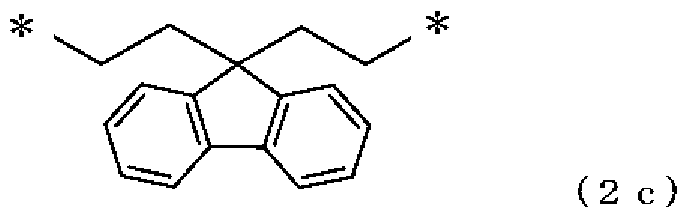
  • thermoplastic resin according to the above [4] which has at least a structural unit containing the above-mentioned ⁇ represented by the following formula (20). ⁇ 02020/175663 5 ⁇ (: 171?2020/008193
  • thermoplastic resin according to any one of the above [1] to [5], which contains the constituent unit represented by the general formula (1) in an amount of more than 50 mol %.
  • thermoplastic resin according to any one of [1] to [6] above.
  • thermoplastic resin according to any one of the above [1] to [9], further including at least one of the structural units represented by the following general formulas (3) and (4).
  • Child fluorine atom, chlorine atom, bromine atom, iodine atom, alkyl group having 1 to 6 carbon atoms, carbon number ⁇ 02020/175663 8 ⁇ (: 171?2020/008193
  • Hydrogen atom fluorine atom, chlorine atom, bromine atom, iodine atom, alkyl group having 1 to 6 carbon atoms, aryl group having 6 to 12 carbon atoms, alkenyl group having 2 to 6 carbon atoms, 1 to 6 carbon atoms An alkoxy group of or an aralkyl group having 7 to 17 carbon atoms,
  • ⁇ and J are integers from 1 to 10 respectively.
  • thermoplastic resin according to [10] which contains a copolymer containing at least the structural unit represented by the general formula (1) and the structural unit represented by the general formula (4). resin.
  • thermoplastic resin according to any one of the above [1] to [14], which contains a total of 20 to 80 mol% of the structural units represented by the general formulas (3) and (4). ..
  • thermoplastic resin as described in any of [1] to [15] above, which further contains at least one of the structural units represented by the following general formula (5). ⁇ 02020/175663 10 10 (: 17 2020/008193
  • thermoplastic resin according to the above [1 6] which contains at least a constitutional unit of Mitsumi (9, 9-bis(6-(2-hydroxyethoxy)naphthalen-2-yl)fluorene).
  • thermoplastic resin according to the above [16] which comprises a structural unit of binaphthalene.
  • the aryl group may be substituted with an alkyl group having 1 to 6 carbon atoms, an alkoxy group having 1 to 6 carbon atoms, or a pyrenyl group which may be substituted with an aryl group having 6 to 16 carbon atoms, Furanyl group, benzodioxanyl group, dihydrobenzofranyl group, piperonyl group, benzofuranyl group, dibenzofuranyl group, pyrrolyl group ⁇ 02020/175663 11 ⁇ (: 171?2020/008193
  • thermoplastic resin according to any one of the above [1] to [19], which is selected from a dinyl group, an isoquinolyl group, a pyrimidinyl group, and a carbazole group.
  • thermoplastic resin according to any one of [1] to [20] above, wherein the thermoplastic resin has a refractive index value of 1.655 or more.
  • thermoplastic resin according to any one of the above [1] to [20].
  • the above and the above May be the same or different, and are a monocyclic or polycyclic aryl group having 6 to 36 carbon atoms, or a monocyclic or polycyclic heteroaryl group having 5 to 36 ring atoms.
  • 1, 2, 3, or 4 of the return atoms are selected from nitrogen, sulfur and oxygen and the other return atom is selected from a heteroaryl group which is carbon,
  • Phenyl substituted by 3, 4 or 5 substituents which may be fused directly to each other, and/or saturated or unsaturated 4- to 10-membered monocyclic or bicyclic ring. It may be condensed with a cyclic hydrocarbon ring,
  • polycyclic aryl having 2 or 3 phenyl rings
  • 2 or 3 of the phenyl rings may be substituted by a single bond. They may be bonded to each other, may be directly condensed with each other, and/or may be condensed with a saturated 4- to 10-membered monocyclic or bicyclic hydrocarbon ring.
  • the phenyl ring of the polycyclic aryl is unsubstituted or 1 Having a polycyclic ant _ Le
  • thermoplastic resin according to any one of the above [1] to [23], which is selected from the group consisting of:
  • Phenyl which may be unsubstituted or substituted by 1, 2, 3, 4, or 5 phenyl groups,
  • Phenyl may be substituted by one or two polycyclic aryl groups selected from biphenyl, naphthyl, fluorenyl, anthracenyl, phenanthryl, and pyrenyl, and may be further substituted by one phenyl group.
  • Triphenylene ⁇ 02020/175663 13 ⁇ (: 171?2020/008193
  • thermoplastic resin according to any one of the above [1] to [24], which is selected from the group consisting of:
  • thermoplastic resin according to the above [2 5] which is selected from the group consisting of phenyl, 2-cyanophenyl, 3-cyanophenyl, 4-cyanophenyl, 2-naphthyl, 1-naphthyl, and 9-naphthyl.
  • Heteroaromatic monocyclic groups having 5 or 6 ring atoms, having 1, 2, 3, or 4 nitrogen atoms, or 1 oxygen atom and 0, 1, 2 , Or 3 nitrogen atoms, or 1 sulfur atom and 0, 1,
  • the other ring atom is a carbon atom, a heteroaromatic monocyclic group,
  • Heteroaromatic polycyclic groups wherein said heteroaromatic monocycle and one, two, three, four or five additional aromatic rings selected from phenyl and heteroaromatic monocycles And the (hetero)aromatic rings of the polycyclic heteroaryl may be linked to each other by covalent bonds, may be directly fused to each other, and/or may be saturated or unsaturated 4 to 1
  • a heteroaromatic polycyclic group which may be condensed with a 0-membered monocyclic or bicyclic hydrocarbon ring, and a heteroaromatic polycyclic group, wherein oxygen, sulfur, and , At least one saturated or partially unsaturated 5- or 6-membered heterocycle having 1 or 2 heteroatoms selected from nitrogen, and phenyl and the above heteroaromatics. 1, 2, 3, 4, or 5 selected from monocycles ⁇ 02020/175663 14
  • At least one further aromatic ring is directly fused to a saturated or partially unsaturated 5- or 6-membered heterocyclic group to give a polycyclic heteroaryl aromatic
  • Another further aromatic ring of the ring may be bonded to each other by a covalent bond, may be directly condensed with each other, and/or is a saturated or unsaturated 4- to 10-membered monocyclic ring.
  • a heteroaromatic polycyclic group which may be condensed with a cyclic or bicyclic hydrocarbon ring,
  • thermoplastic resin according to any one of [1] to [23] above, which is selected from the group consisting of:
  • thermoplastic resin according to the above [27] which is selected from the group consisting of:
  • thermoplastic resin as described in any of [1] to [28] above, wherein X is an ethylene group.
  • the threshold value according to 3 ⁇ 71 05 is 10 or less, above [1] ⁇
  • thermoplastic resin according to any one of [29].
  • thermoplastic resin according to any one of [30].
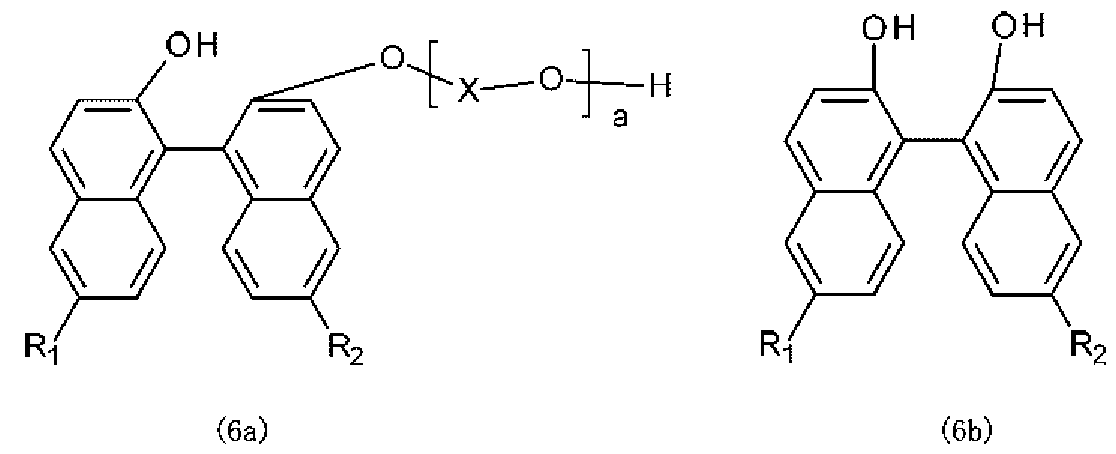
  • thermoplastic resin according to any one of the above [1 to [33], comprising at least a dihydroxy compound represented by the following general formula (6), and a carboxylic acid and a carboxylic acid monester.
  • a method for producing a thermoplastic resin comprising a step of melt polycondensation of at least one of a glyceride and a carboxylic acid ester. ⁇ (: 171-12020/008193
  • Monocyclic or polycyclic of the ant _ group, and the heteroaryl group monocyclic or polycyclic, unsubstituted or substituted with or, 01 ⁇ 1, Rei_1 to 1 3, hundred 1 to 3 , O-phenyl, O-naphthyl, 3-phenyl, 3-naphthyl, and may have 1 or 2 3 groups selected from the group consisting of halogens, provided that Not all of them are hydrogen,
  • X is an alkylene group having 1 to 8 carbon atoms, a cycloalkylene group having 5 to 12 carbon atoms, or an arylene group having 6 to 20 carbon atoms,
  • alkylene group and the cycloalkylene group may each be substituted so as to have a benzene ring
  • the crystalline solvate form wherein the organic solvent is selected from methanol, toluene and methyl ethyl ketone.
  • the amount of methanol is 0.3 to 1.0 mol per 1 mol of 2,2 bis(2-hydroxyethoxy)-1,6-diphenyl-1,1-binaphthalene, [37]
  • the crystal contains less than 0.1 mol of organic solvent per naphthalene
  • thermoplastic resin according to any one of 1.
  • thermoplastic resin of the present invention has a high refractive index, a low value, a high resistance to moist heat, and a particularly high refractive index. Further, by using such an excellent thermoplastic resin, an excellent optical lens can be obtained.
  • FIG. 6 shows the X-ray powder diffraction pattern of the methanol solvation of 6, 6′ — 0 1 to 1 to 8 obtained from Example 22.
  • FIG. 7 The 1 ⁇ 1 I spectrum of the solvated methanol of 6, 6′ — 0 1 to 1 to 8 obtained from Example 22 is shown.
  • FIG. 8 Spectra of methanol solvation of 6, 6′ — 0 1 to 1 to 8 obtained from Example 22 are shown.
  • FIG. 9 The ports 30 for methanol solvation of 6, 6′ — 0 1 to 1 to 8 obtained from Example 22 are shown.
  • FIG. 10 shows an X-ray powder diffraction pattern of the crystalline substance obtained in Example 23. The spectrum is shown.
  • FIG. 12 shows a spectrum of the crystalline substance obtained from Example 23.
  • FIG. 13 shows 030 of the crystalline substance obtained from Example 23.
  • FIG. 14 6′ obtained from Example 24 A micrograph of toluene solvation is shown.
  • FIG. 15 6′ obtained from Example 24 An X-ray powder diffraction pattern of toluene solvation is shown.
  • FIG. 16 6′ obtained from Example 24 Shows a 1 ⁇ 1 speck of toluene solvation.
  • FIG. 17 6′ obtained from Example 24 A toluene solvated spectrum is shown.
  • FIG. 18 6′ obtained from Example 24 The mouth of solvation with toluene is indicated.
  • FIG. 19 shows a microphotograph of IV!Mizu solvation of 6,6′-Kuchimi 1-1 to 8 obtained from Example 25.
  • FIG. 21 shows IV!Mizu solvation 030 of 6, 6′-Kuchimi 1 to 1 Mihachi obtained from Example 25. ⁇ 02020/175663 23 ⁇ (: 171?2020/008193
  • FIG. 22 6′ obtained from Example 25 The X-ray powder diffraction pattern of the solvate is shown.
  • FIG. 23 6′ obtained from Example 26 2 shows an X-ray powder diffraction pattern of the amorphous morphology of.
  • FIG. 25 6′ obtained from Example 26 3 shows an amorphous morphological spectrum of.
  • FIG. 26 6′ obtained from Example 27 An X-ray powder dust diffraction pattern is shown.
  • FIG. 28 6′ obtained from Example 27 Form of Indicates a vector.
  • FIG. 30 A first graph in which the Abbe number (V) of the thermoplastic resins of Examples and Comparative Examples is plotted on the horizontal axis and the refractive index (is plotted on the vertical axis.
  • FIG. 31 A second graph in which the Abbe number (V) of the thermoplastic resins of Examples and Comparative Examples is plotted on the horizontal axis and the refractive index (is plotted on the vertical axis.
  • thermoplastic resin of the present invention contains a structural unit represented by the following general formula (1).
  • the type of thermoplastic resin is not particularly limited as long as it has the following structural units, but is preferably a polyester resin, a polyester carbonate resin, a polycarbonate resin, or a mixture of at least two or more thereof.
  • the polyester resin is (1 [3 ⁇ 4 ⁇ _ _ _ _) part ⁇ 02020/175663 24 ⁇ (: 171?2020/008193
  • polyester constitutional unit containing a position and does not include a polycarbonate constitutional unit (repeating unit) containing a (_[3 ⁇ 4 ⁇ _ ⁇ ⁇ ⁇ _ _) site. 3 ⁇ 4 _ ⁇ ⁇ 010 _) Polycarbonate structural unit (repeating unit) containing a part, and (1) Yes, the polyester carbonate resin has a polyester constitutional unit (repeating unit) containing a (1 [3 ⁇ 4 0 001 001) part, and a poly carbonate structure containing a (_[ 3 ⁇ 4 _ _ ⁇ _ _ _ _) part. It has both units (repeating units) ([all of which are hydrocarbon groups, etc.]).
  • a monocyclic or polycyclic heteroaryl group having 5 to 36 ring atoms.
  • 1, 2, 3, or 4 of the returned atoms are selected from nitrogen, sulfur and oxygen
  • Atom is carbon heteroaryl group, C2-C6 alkenyl group, C1-C6 alkenyl group
  • 0 to 1 3 0-phenyl, 0-naphthyl, 3-phenyl, 3-naphthyl, and may have 1 or 2 & groups selected from the group consisting of halogens, provided that Is not hydrogen,
  • X is an alkylene group having 1 to 8 carbon atoms, a cycloalkylene group having 5 to 12 carbon atoms, or an arylene group having 6 to 20 carbon atoms,
  • alkylene group and the cycloalkylene group may each be substituted so as to have a benzene ring
  • At least one of the general formula (1) is preferably an aryl group having 6 to 20 carbon atoms, more preferably an aryl group having 6 to 14 carbon atoms, and particularly preferably, At least two of them have 6 to 14 carbon atoms, or 6 to 14 carbon atoms
  • 1, 2, 3, or 4 of the reducing atoms may be selected from nitrogen, sulfur, and oxygen and the other reducing atoms may be selected from heteroaryl groups that are carbon.
  • the monocyclic or polycyclic aryl group and the monocyclic or polycyclic heteroaryl group may not be substituted.
  • [0017] may be respectively selected from the following groups. That is,
  • Phenyl substituted with one or two O 1 ⁇ ! groups, phenyl, and may be linked to each other by a single bond, may be directly fused with each other, and/or may be saturated or unsaturated.
  • a saturated or unsaturated 4- to 10-membered monocyclic ring Optionally fused to a cyclic or bicyclic hydrocarbon ring,
  • polycyclic aryl having 2 or 3 phenyl rings
  • 2 or 3 of the phenyl rings may be substituted by a single bond. They may be bonded to each other, may be directly condensed with each other, and/or may be condensed with a saturated 4- to 10-membered monocyclic or bicyclic hydrocarbon ring.
  • the phenyl ring of the polycyclic aryl is unsubstituted or 1 And is a polycyclic aryl.
  • phenyl optionally substituted with one or two polycyclic aryl groups selected from pyrenyl, and optionally further substituted with one phenyl group,
  • Is preferably selected from the group consisting of phenyl, 2-cyanophenyl, 3-cyanophenyl, 4-cyanophenyl, 2-naphthyl, 1-naphthyl, and 9-naphthyl.
  • Heteroaromatic monocyclic groups having 5 or 6 ring atoms, having 1, 2, 3, or 4 nitrogen atoms, or 1 oxygen atom and 0, 1, 2 , Or 3 nitrogen atoms, or 1 sulfur atom and 0, 1,
  • a heteroaromatic polycyclic group wherein said heteroaromatic monocycle and one, two, three, four or five additional aromatic rings selected from phenyl and heteroaromatic monocycles And the (hetero)aromatic rings of the polycyclic heteroaryl may be linked to each other by covalent bonds, may be directly fused to each other, and/or may be saturated or unsaturated 4 to 1
  • a heteroaromatic polycyclic group which may be condensed with a 0-membered monocyclic or bicyclic hydrocarbon ring, and a heteroaromatic polycyclic group, wherein oxygen, sulfur, and , At least one saturated or partially unsaturated 5- or 6-membered heterocycle having 1 or 2 heteroatoms selected from nitrogen, and phenyl and the above heteroaromatics.
  • furanyl, furo [3,4—13]furanyl, oxathrenyl ( ⁇ , Indolyl, isoindolyl, carbazolyl, indolizinyl, benzopyrazolyl, benzimidazolyl, benzoxazolyl, benzo[ ⁇ ⁇ 1]indolyl, 1 1 to 1-benzo[9]indolyl, quinolinyl, isoquinolinyl, acridinyl, phenazinyl, quinazolinyl Quinoxalinyl, ⁇ 02020/175663 29 ⁇ (: 171?2020/008193
  • X in the general formula (1) is preferably an alkylene group having 2 to 4 carbon atoms, a cycloalkylene group having 5 to 8 carbon atoms, or an arylene group having 6 to 14 carbon atoms, and more preferably An alkylene group having 2 or 3 carbon atoms, a cycloalkylene group having 5 to 6 carbon atoms, or an arylene group having 6 to 10 carbon atoms, and particularly preferably an alkylene group having 2 or 3 carbon atoms, for example, ethylene. It is the basis.
  • 3 and the swell in the general formula (1) are each preferably an integer of 1 to 6, more preferably 1 to 4, and particularly preferably 2 or 3.
  • the thermoplastic resin is, for example, a polyester resin or a polyester carbonate resin.
  • the polyester resin or the polyester carbonate resin preferably further contains a structural unit represented by the following general formula (2). ⁇ 02020/175663 30
  • Equation ( 23) Are each independently a single bond that is bonded to the XX group in formula (2), or may have a substituent and have a total carbon number of 1 to 10 and ⁇ 3 0 in formula (2). It is an alkylene group containing a point of attachment to the group at the terminal. It is preferably a single bond or an alkylene group having 1 to 3 total carbon atoms.
  • O in the formula (2) is preferably represented by the following formula (2).
  • n and are each independently an integer from 0 to 5, and preferably an integer from 1 to 3.
  • And 1 ⁇ are each independently an integer of 1 to 5, preferably an integer of 1 to 3.
  • represents the point of connection with the XX group in formula (2).
  • ⁇ in the formula (2) be represented by the following formula (20).
  • is the point of attachment to the XX group in formula (2).
  • the constitutional unit represented by the above general formula (1) is preferably the following general formula (8_
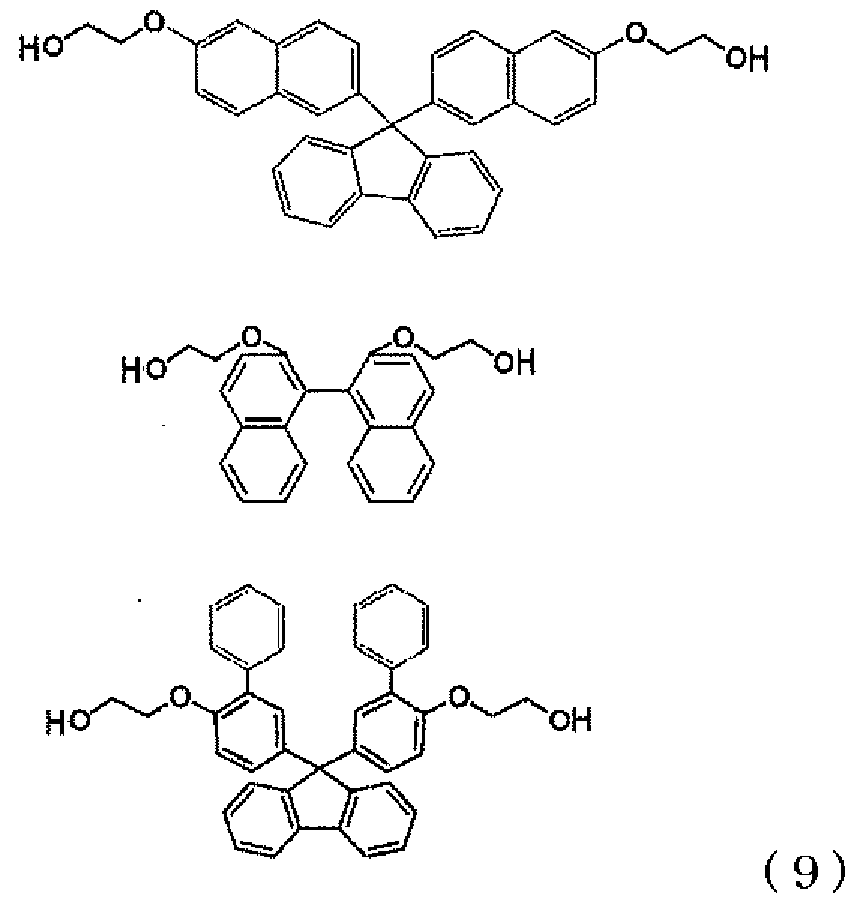
  • Phthalene -derived structural unit, and 90 m 1 1 ⁇ 1 ⁇ 1__2 m ⁇ (2, 2, bis (2-hydroxyethoxy) 1) 6, 6, represented by the general formula (8_4)
  • the thermoplastic resin of the present invention preferably contains the constituent unit represented by the general formula (1) in an amount of more than 50 mol%, more preferably 60 mol%, and further preferably 70 mol%. %, particularly preferably more than 80 mol %, or more than 90 mol %. Further, the thermoplastic resin of the present invention may be formed only by the structural unit represented by the general formula (1).
  • thermoplastic resin of the present invention may contain one or more kinds of other constituent units in addition to the constituent unit represented by the general formula (1) (the constituent unit (1)).
  • the other structural unit a fluorene derivative unit or the like is preferable.
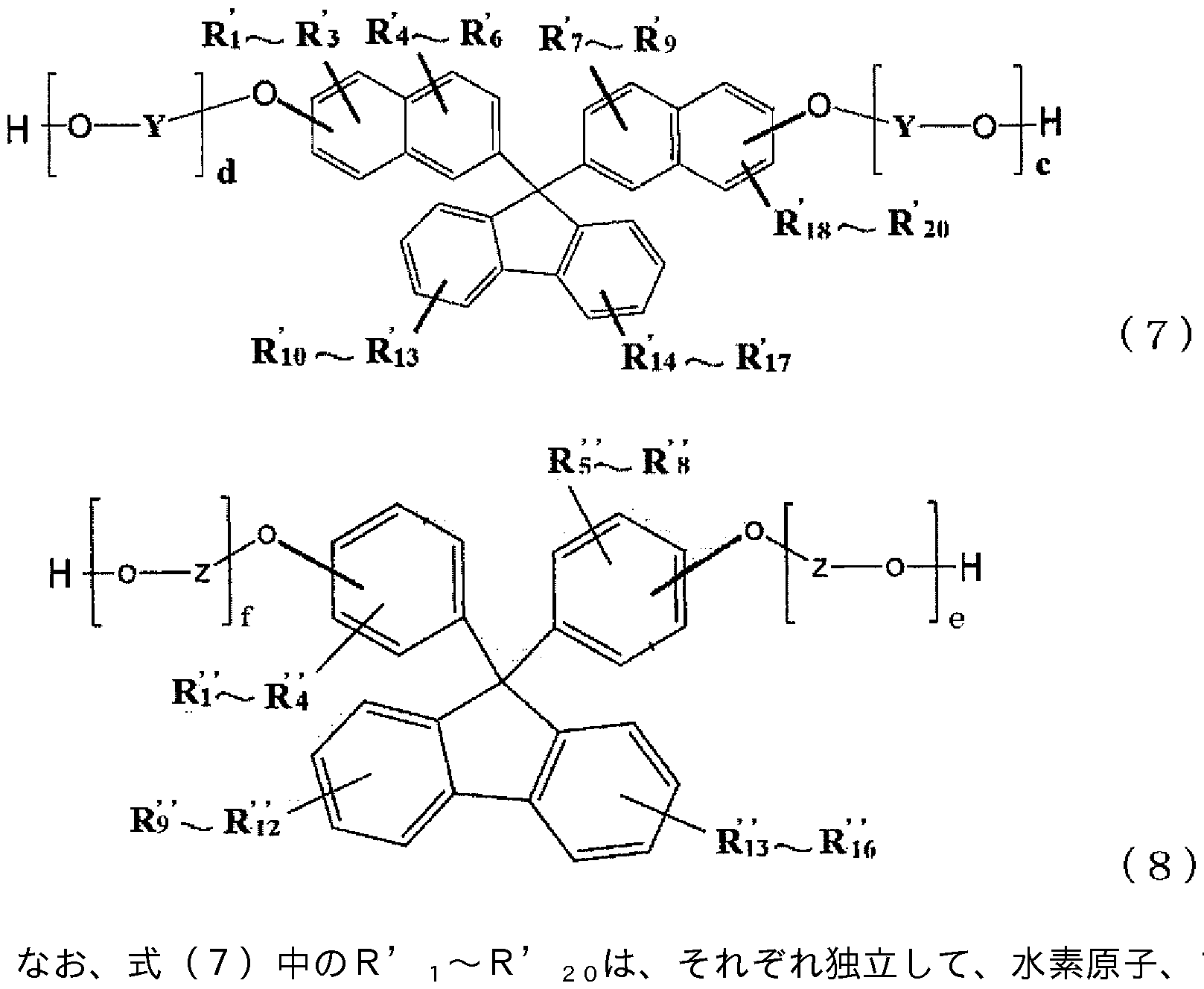
  • thermoplastic resin of the present invention preferably further contains at least one of the structural units represented by the general formulas (3) and (4).
  • (formula 1 to [3 ⁇ 4' 20 are each independently a hydrogen atom, a fluorine atom, a chlorine atom, a bromine atom, an iodine atom, an alkyl group having 1 to 6 carbon atoms, an aryl group having 6 to 12 carbon atoms, and carbon An alkenyl group having 2 to 6 carbon atoms, an alkoxy group having 1 to 6 carbon atoms, or an aralkyl group having 7 to 17 carbon atoms,
  • '' 20 is preferably a hydrogen atom, an alkyl group having 1 to 4 carbon atoms, an aryl group having 6 to 12 carbon atoms, an alkenyl group having 2 to 4 carbon atoms, an alkoxy group having 1 to 4 carbon atoms, Alternatively, it is an aralkyl group having 7 to 12 carbon atoms, and more preferably hydrogen.
  • the above-mentioned general formula (3) is preferably an alkylene group having 2 to 4 carbon atoms, a cycloalkylene group having 5 to 8 carbon atoms, or an arylene group having 6 to 14 carbon atoms, and more preferably , An alkylene group having 2 or 3 carbon atoms, a carbon number of 5 to
  • ⁇ and in the general formula (3) are each preferably 1 to
  • ⁇ and J are integers from 1 to 10 respectively.
  • alkylene group having 2 to 4 carbon atoms is preferably an alkylene group having 2 to 4 carbon atoms, a cycloalkylene group having 5 to 8 carbon atoms, or an arylene group having 6 to 14 carbon atoms, and more preferably C2 or C3 alkylene group, C5 to
  • 6 and dried in the above general formula (4) are each preferably 1 to
  • thermoplastic resin of the present invention comprises a structural unit (1) and a structural unit represented by the following general formula (5) as a structural unit represented by the general formula (3) or (4). It is preferable to further include at least one of
  • thermoplastic resin of the present invention comprises the structural unit (1) and the general formula (5), which is represented by the following formula: ) Fluorene) derived structural unit, Mitsumi (2, 2'-bis (2-hydroxyethoxy) _ 1, 1'-binaphthalene) derived structural unit, and Mitsumi (9, 9-bis (4- It is preferable to further include at least one of the structural units derived from (2-hydroxyethoxy)_ 3 -phenylphenyl)fluorene).
  • the thermoplastic resin of the present invention comprises a structural unit other than the structural unit (1), preferably 20 to 80 mol% in total of the structural units represented by the general formulas (3) and (4). It may be contained, for example, 25 to 75 mol% may be contained.
  • the thermoplastic resin has a constitutional unit represented by the general formulas (3) and (4), for example, 30 to 70 mol%, 35 to 65 mol%, or 40 to 60 mol%. Including. ⁇ 02020/175663 38 ⁇ (: 171?2020/008193
  • the molar ratio of the structural unit (1) in the thermoplastic resin composition of the present invention and the structural unit (3) represented by the general formula (3) is, for example, 4:1 to 1:4, or 7:3 to 3:7. Further, the molar ratio may be 65:35 to 35:65, 3:2 to 2:3, or 1:1. However, in the thermoplastic resin composition, since it is preferable that the constituent unit (1) is contained in an amount of more than 50 mol% as described above, the molar ratio of the constituent unit (1) and the constituent unit (3) is As preferred specific examples, 4:1 to 1:1, 7:3 to 1:1, 65:35 to 1:1, and 3:2 to 1:1 and the like.
  • the molar ratio of the structural unit (1) to the structural unit (4) represented by the general formula (4) is the same as the molar ratio of the structural unit (1) to the structural unit (3) described above. is there.
  • the thermoplastic resin of the present invention may contain any of random, block and alternating copolymer structures. Further, in the thermoplastic resin of the present invention, all of the above-mentioned structural unit (1), structural unit (3), and structural unit (4) may not be contained in the same polymer molecule. That is, the thermoplastic resin of the present invention may be a blended resin as long as the above-mentioned constitutional units are contained in the entire plurality of polymer molecules. For example, a thermoplastic resin containing all of the structural units (1), (3), and (4) described above may be a thermoplastic resin containing any of the structural units (1), (3), and (4).
  • a polymer, a mixture of a homopolymer or copolymer containing the structural unit (1) and a homopolymer or copolymer containing the structural unit (2) and a homopolymer or copolymer containing the structural unit (4) It may be a blend resin of a copolymer containing the structural units (1) and (3) and a copolymer containing the structural units (1) and (4).
  • thermoplastic resin of the present invention can be blended with another resin to be used for producing a molded body.
  • the other resin may be, for example, polyamide, polyacetal, a different type of polycarbonate than thermoplastic resin, or modified polyphenylene ether.
  • Examples include polybutylene terephthalate and the like.
  • thermoplastic resin composition of the present invention includes an antioxidant, a mold release agent, a processing stabilizer, an ultraviolet absorber, a fluidity modifier, a crystal nucleating agent, a reinforcing agent, a dye, an antistatic agent. It is preferable to add an antibacterial agent or the like.
  • the release agent it is preferable that 90% by weight or more thereof is composed of an ester of alcohol and fatty acid.
  • Specific examples of the ester of alcohol and fatty acid include an ester of monohydric alcohol and fatty acid, and a partial ester or total ester of polyhydric alcohol and fatty acid.
  • Examples of the ester of the above monohydric alcohol and fatty acid include a monohydric alcohol having 1 to 20 carbon atoms and a carbon source. ⁇ 02020/175663 40 40 (: 171?2020/008193
  • Esters with saturated fatty acids having a child number of 10 to 30 are preferred.
  • the partial ester or total ester of polyhydric alcohol and fatty acid is a partial ester or total ester of polyhydric alcohol having 1 to 25 carbon atoms and saturated fatty acid having 10 to 30 carbon atoms. preferable.
  • examples of the ester of a monohydric alcohol and a saturated fatty acid include stearyl stearate, palmityl palmitate, butyl stearate, methyl laurate, isopropyl palmitate and the like.
  • examples of partial or total esters of polyhydric alcohols and saturated fatty acids include stearic acid monoglyceride, stearic acid diglyceride, stearic acid triglyceride, stearic acid monosorbate, behenic acid monoglyceride, capric acid monoglyceride.
  • Lyseride monoglyceride laurate, pentaerythritol monostearate, pentaerythritol tetrastearate, pentaerythritol tetraperalgonate, propylene glycol monostearate, biphenyl biphenate, sorbitan monostearate, 2-ethylhexyl stearate, Examples thereof include all or partial esters of dipentaerythritol such as dipentaerythritol hexastearate. Of these, stearic acid monoglyceride and lauric acid monoglyceride are particularly preferable.
  • the content of these release agents is preferably in the range of 0.005 to 2.0 parts by weight, more preferably in the range of 0.01 to 0.6 parts by weight, based on 100 parts by weight of the thermoplastic resin. A range of 0.02 to 0.5 parts by weight is more preferable.
  • Examples of the processing stabilizer include a phosphorus-based processing heat stabilizer and a sulfur-based processing heat stabilizer.
  • Examples of the phosphorus-based processing heat stabilizer include phosphorous acid, phosphoric acid, phosphonous acid, phosphonic acid and their esters. Specifically, triphenyl phosphite, tris (nonyl phenyl) phosphite, tris (2,
  • bis (2,6-di- ⁇ "1: _ butyl 4-methylphenyl) pentaerythritol diphosphite is preferable.
  • the content of the phosphorus-based processing heat stabilizer in the thermoplastic resin composition is It is preferable to use 0.001 to 0.2 parts by weight per 100 parts by weight of the plastic resin.
  • pentaerythritol-tetrakis (3-laurylthioprobionate), pentaerythritol-tetrakis (3-myristylthioprobionate), pentaerythritol-tetrakis (3-stearylthioprobionate) Dilauryl 3,3'-thiodipropionate, Dimyristyl 3,3'-thiodipropionate, Distearyl ⁇ 02020/175663 42 ⁇ (: 171?2020/008193
  • the content of the sulfur-based processing heat stabilizer in the thermoplastic resin composition is preferably 0.001 to 0.2 parts by weight based on 100 parts by weight of the thermoplastic resin.
  • the UV absorber is selected from the group consisting of benzotriazole UV absorbers, benzophenone UV absorbers, triazine UV absorbers, cyclic iminoester UV absorbers and cyanoacrylate UV absorbers. At least one UV absorber is preferred. That is, one of the ultraviolet absorbers listed below may be used alone, or two or more thereof may be used in combination.
  • benzotriazole-based ultraviolet absorber examples include 2-(2-hydroxy-5-methylphenyl)benzotriazole, 2-(2-hydroxy-5- ⁇ "1:-octylphenyl)benzotriazole, 2-(2- Hydroxy-3,5-dicumylphenyl)phenylbenzotriazole, 2-(2-hydro)
  • Examples of the benzophenone-based ultraviolet absorber include 2,4-dihydroxybenzophenone. ⁇ 02020/175663 43 ⁇ (: 171?2020/008193
  • Examples of the triazine-based ultraviolet absorber include 2-(4,6-diphenyl-1,3,5-triazin-2-yl)-1-5-[(hexyl)oxy]-phenol, 2-(4,6-bis). (2,4-dimethylphenyl)-1,1,3,5-triazin-2-yl)-1-((octyl)oxy]-phenol and the like.
  • Examples of the cyclic iminoester-based ultraviolet absorber include 2,2'-bis (3,1 -benzoxazin-4-one), 2, 2, _ _phenylenebis (3,1-benzoxazin-4-one) , twenty two, Phenylene bis (3, 1-benzoxazin-4-one), 2, 2'-one (4, 4'-diphenylene) bis (3, 1-benzoxazin-4-one), 2, 2, 1-(2, 6 —Naphthalene) bis (3,1 —benzoxazin-4-one), 2, 2'one (1,5 —naphthalene) bis (3,1 —benzoxazin-4-one), 2, 2'one ( 2-Methyl-_phenylene) bis(3, 1-benzoxazine-4-one), 2, 2, 1-(2-nitro-phenylene) bis(3, 1-benzoxazin-4-one) and 2, 2, 1- (2-chloro-phenylene) bis (3, 1-benzoxazin-4-one) and the
  • the content of the ultraviolet absorber is preferably 0.01 to 3.0 parts by weight, more preferably 0.02 to 1.0 parts by weight, relative to 100 parts by weight of the thermoplastic resin. , And more preferably, 0.05 to 0.8 parts by weight. Within such a blending amount range, it is possible to impart sufficient weather resistance to the thermoplastic resin composition depending on the application.
  • thermoplastic resin for example, a polycarbonate resin composition
  • phenol produced during the production, and the ester carbonate remaining without reaction are present as impurities.
  • the phenol content in the thermoplastic resin composition is preferably from 0.1 to 300 001, more preferably from 0.1 to 2000 001, from 1 to 1 000 001, 1 to 800 000. It is more preferably 1, 1 to 500, 01, or 1 to 300.
  • the content of the carbonic acid ester in the thermoplastic resin composition is preferably 0.1 to 1 000, more preferably 0. 1 to 500 0 1, and more preferably 1 to 100 0 1. Is particularly preferable.
  • a resin having physical properties according to the purpose can be obtained by adjusting the amounts of phenol and gesturel carbonate contained in the thermoplastic resin composition.
  • the contents of the phenol and the ester carbonate can be adjusted by changing the polycondensation conditions and equipment. It can also be adjusted depending on the conditions of the extrusion process after polycondensation.
  • the obtained resin molded product may have a low strength and may have an odor.
  • the content of the phenol or the ester carbonate is less than the above range, the plasticity at the time of melting the resin may decrease.
  • thermoplastic resin of the present invention The preferred viscosity average molecular weight (! ⁇ /!) of the thermoplastic resin of the present invention is 8,000. ⁇ 02020/175663 45 ⁇ (: 171?2020/008193
  • IV! V is less than 8,000, the molded body may become brittle. Also, if the value of IV! V is greater than 20,000, the melt viscosity will be high and it will be difficult to take out the resin after manufacturing, and the fluidity will be poor and injection molding in the molten state will be difficult. There is.
  • the refractive index (n 0) of the thermoplastic resin of the present invention at 23° and a wavelength of 589 n is preferably 1.635 or more, more preferably 1.645 or more, still more preferably 1.655 or more. , Particularly preferably 1. 665 or more, or larger than these values.
  • the refractive index of the thermoplastic resin of the present invention is preferably 1.640 to 1.710, more preferably 1.645 to 1.700, and further preferably 1.650 to 1.697. , And particularly preferably 1.655 to 1.
  • thermoplastic resin of the present invention has a high refractive index (n D) and is suitable for an optical lens material. Refractive index is thickness The film can be measured with an Abbe refractometer by the method of "3- ⁇ -7 1 42".
  • the Abbe number (r) of the thermoplastic resin of the present invention is preferably 24 or less, more preferably 22 or less, still more preferably 20 or less.
  • the Abbe number is the wavelength of 486
  • V (1 ⁇ 0— 1) / (1 ⁇ — 11 ⁇ )
  • the preferable glass transition temperature (Choose 9) of the thermoplastic resin of the present invention is 90 to 185 ° ⁇ , more preferably 95 to 180 ° ⁇ , considering that it is used for injection molding. , And more preferably 100 to 175°. If Ding 9 is lower than 90 °, the operating temperature range may be narrowed. If it exceeds 185 ° ⁇ , the melting temperature of the resin will rise, and the resin may be decomposed or colored easily. ⁇ 02020/175663 46 ⁇ (: 171?2020/008193
  • the lower limit of the sheets 9 is preferably 1 3 0 ° ⁇ , 1 3 5 ° ⁇ more preferably, the upper limit of the sheets 9 are 1 8 5 ° ⁇ Is preferred, and 175 ° is more preferred.
  • the optical molded article obtained by using the thermoplastic resin of the present invention has a total light transmittance of 8
  • the total light transmittance is 85% or more, it is comparable to bisphenol type polycarbonate resin.
  • the thermoplastic resin of the present invention has high resistance to moist heat. Moisture and heat resistance is evaluated by performing " ⁇ 3 test” (pressure cooker test) on an optical molded product obtained using a thermoplastic resin and measuring the total light transmittance of the optical molded product after the test. can do. ⁇ Three test The thickness 3_Rei! ⁇ ! Injection molding of, 1 2 0 ° ⁇ , ⁇ . 2 1 ⁇ / 1 3, It can be performed by holding it for 20 hours.
  • the thermoplastic resin of the present invention has a total light transmittance after 3 tests of 60% or more, preferably 70% or more, more preferably 75% or more, and 80%. It is even more preferable that the content is not less than 85%, and particularly preferably 85% or more. If the total light transmittance is 60% or more, it can be said that it has high wet heat resistance to conventional thermoplastic resins.
  • the threshold value showing the hue of the thermoplastic resin of the present invention is preferably 5 or less. The smaller the threshold value, the weaker the yellowness, and the better the hue.
  • thermoplastic resin having the constitutional unit represented by the above general formula (1) is a polycarbonate resin
  • the production method thereof is, for example, a dihydroxy compound represented by the following general formula (6) and a ester carbonate. Including the step of melt polycondensation. ⁇ 0 2020/175 663 47 2020 /008193
  • the hydrogen atom represents a heteroaryl group which is carbon, an alkenyl group having 2 to 6 carbon atoms, an alkoxy group having 1 to 6 carbon atoms, or an aralkyl group having 7 to 17 carbon atoms,
  • X is an alkylene group having 1 to 8 carbon atoms, a cycloalkylene group having 5 to 12 carbon atoms, or an arylene group having 6 to 20 carbon atoms,
  • alkylene group and the cycloalkylene group may each be substituted so as to have a benzene ring
  • the compound represented by the above general formula (6) can be used as a dihydroxy component and reacted with a force-carbonate precursor such as carbonic acid ester to produce a polycarbonate resin.
  • a force-carbonate precursor such as carbonic acid ester
  • the compound represented by the general formula (6) and a force-bonate precursor such as carbonic acid gester are added in the presence of a basic compound catalyst, an ester exchange catalyst, or a mixed catalyst composed of both, or without a catalyst.
  • it can be produced by reacting by a melt polycondensation method.
  • a polyester carbonate resin and a polyester resin can be obtained by using the dihydroxy compound represented by the general formula (6) as a raw material (monomer). I can do it.
  • the polyester carbonate resin or the polyester resin is, for example, melt-polycondensed with a dihydroxy compound represented by the above general formula (6) and at least one of a carboxylic acid, a carboxylic acid monoester and a carboxylic acid ester. It can be manufactured according to the process.
  • carboxylic acid carboxylic acid monester, and carboxylic acid ester, 2,2,-bis(2-hydroxyxetoxy)-1,6,6
  • carboxylic acid examples include 2,2,-bis(2-hydroxyxetoxy)-1,6,6.
  • the dihydroxy compound represented by the general formula (6) is used together with the dihydroxy compound represented by the general formula (6).
  • a compound or a dihydroxy compound in which any one of 3 and 3 in the above-mentioned general formula (6) is 0 may be contained as an impurity.
  • dihydroxy compounds differing from the general formula (6) by at least one of the values of 3 and ⁇ are the total of the dihydroxy compounds represented by the general formula (6), which are the main components of the dihydroxy compound. And preferably contained in an amount of 100,000 or less, more preferably 500 or less, further preferably 200 or less, particularly preferably 100 or less, and the general formula (6) is The total content of dihydroxy compounds having different values of at least one of 3 and the swallow in the above monomer is preferably 500 or less, and more preferably 20 or less.
  • the compound represented by the general formula (6) can be produced by various synthetic methods.
  • JP 2014-227387 JP, JP 2014-227388 JP, JP 2015-168658 JP, and ⁇ 02020/175663 50 As described in (:171?2020/008193 and JP 2015-187098 A, (3) A method of reacting 1,1'-binaphthol with ethylene glycol monotosylate, (1) ) Method of reacting binaphthols with alkylene oxide, halogenoalkanol, or alkylene carbonate, ( ⁇ ) 1, 1'- Method of reacting binaphthol with ethylene carbonate, ( ⁇ ⁇ 1, 1' It can be produced by a method of reacting binaphthol with ethylene carbonate.
  • the monomer of the general formula (6) may contain impurities that may adversely affect the properties of the thermoplastic resin, particularly the optical properties.
  • the monomer of the general formula (6) may contain one or more of the following by-products of the general formulas (6 3) and (6 13) as impurities resulting from the manufacturing process. Good.
  • the monomer of the general formula (6) may be added in addition to or in place of the impurities of the general formulas (68) and (6 s) as the impurity represented by the general formula (6). 60)) may contain the following by-products.
  • the substituent 1, X is the same as defined for the monomer of formula (6).
  • 8 is an integer in the range of 1 to 10, preferably an integer in the range of 1 to 4, and It is preferably 1, 2 or 3.
  • the variables 13, ⁇ and ⁇ 1 are integers in the range of 1 to 10, preferably integers in the range of 1 to 4, and more preferably 1, 2 or 3.
  • the substituent X is preferably an alkylene group having 1 to 4 carbon atoms, and more preferably an ethylene group, That is, 1, 2 ethanediyl or 10 ⁇ 02020/175663 51 ⁇ (: 171?2020/008193
  • monomer as well as the formula (6-8) (6), (6 1_Rei) and even (6_Rei) substituents and 82 are preferably 6 carbon atoms in the monocyclic or polycyclic A 36 aryl group, a monocyclic or polycyclic heteroaryl group having 6 to 36 ring atoms, and more preferably a monocyclic or polycyclic aryl group having 6 to 20 carbon atoms.
  • Group more preferably an aryl group having 6 to 14 carbon atoms, particularly phenyl, 1-naphthyl, 2-naphthyl, 9-phenanthyl, 4-dibenzo[10, ⁇ 1]furanyl and 4- Dibenzo [10, ⁇ 1] selected from the group consisting of cenyl.
  • the total weight of impurities of 6 &) and (610) does not exceed 500 based on 1 part by weight of the monomer of formula (6).
  • the total weight of the impurities of the formulas (6 3) and (6 s) is at most 400 001 or less based on 1 part by weight of the monomer of the formula (6), and even at the maximum. It is preferably not more than 300!, and not more than 200 at most.
  • the weight of each impurity of formulas (6 3) and (6 10) is at most 200 0 or less based on 1 part by weight of the monomer of formula (6), and even at most 15 5 It is preferably 0.001 or less, and more preferably 100 or less at the maximum. If present, the amount of impurities of (60) does not exceed 200,0 and is often at most 150 or less based on 1 part by weight of monomer of formula (6).
  • the variables (3) and (10) of the monomer of the formula (6) are 1 and
  • the monomer (6-1) is used below.
  • the monomer (6-1) may include one or more by-products of the following formulas (6 3 _ 1), (6-2), and (6 s), optionally (60 _ 1) may be included as an impurity. ⁇ 02020/175663 52 2020/008193
  • the substituents X are each preferably an alkylene group having 1 to 4 carbon atoms. There, more preferably an ethylene group, i.e., 1, 2 - ethanediyl or ten 1-1 2 ⁇ 1 to 1 2-.
  • the variable ⁇ is defined as the variable 3, especially 2 or 3. Equations (6-1), (63-1), (6-2)
  • the substituent is a monocyclic or polycyclic aryl group having 6 to 36 carbon atoms, a monocyclic or polycyclic heteroaryl group having 6 to 36 ring atoms, and more preferably a monocyclic group.
  • it is a polycyclic aryl group having 6 to 20 carbon atoms, more preferably an aryl group having 6 to 14 carbon atoms, and particularly phenyl, 1-naphthyl, 2-naphthyl, 9-phenanthyl, 4- Selected from the group consisting of dibenzo[10, ⁇ 1]furanyl and 4-dibenzo[10, ⁇ 1]cenyl. ⁇ 02020/175663 53 ⁇ (: 171?2020/008193
  • the total weight of impurities of the formulas (6 3 _ 1), (6_2) and (6 ⁇ ) in the monomer of the formula (6-1) used in the method of the present invention is Do not exceed 5000 based on 1 part by weight of monomer.
  • the total weight of the impurities of the formulas (6 3 _ 1), (6 _ 2) and (6 sq.) is 4000 or less at the maximum based on 1 part by weight of the monomer of the formula (6 _ 1). It is preferable that the maximum value is 3000 ⁇ ! or less, and the maximum value is 2000 ⁇ ! or less.
  • the presence of impurities of (60 _ 1), if present, does not exceed 2000, based on 1 part by weight of monomer of formula (6-1), and is often at most 1 500 or less.
  • the monomer of the formula (6) is 2,2 bis(2-hydroxyethoxy)_6,6, _ Diphenyl 1 ,1 ,-Binaphthalene (6,6'
  • 2'-1)_13 (2-1 ⁇ 1“ ⁇ 61;11 ⁇ )-1, 1'-1)_1 3 3 111;11), that is, the variable (3) and ( ⁇ ) is 1 and X is 1,2-ethanediyl,
  • 2, 2 _ bis(2-hydroxyethoxy)-1,6,-diphenyl-1,1,-binaphthalene is 6,6,-0.
  • the substituent X is 1,2-ethanediyl
  • the chemical name of a compound in which all the substituents of are phenyl is 2— (2-hydr Roxyethoxy)_2'-hydroxy _6,6,_diphenyl-1,1,,_binaphthalene (6,6'-di pheny l-2-(2-hydroxyethoxy)-2 , -hydroxy-1,1'-bi naphthyl), Is.
  • the chemical name of a compound in which the substituent X is 1,2-ethanediyl and all the substituents of R ! and R 2 are phenyl is bis [2-[[1 -[2-(2-hydroxyethoxy) 1 6-phenyl-1-naphthyl] _ 6-phenyl-2-naphthyl]-oxy]-ethyl] carbonate (bis[2-[[1-[2-(2- hydroxyethoxy)-6-pheny l-1-naphthy l]-6-pheny l-2-naphthy l]- ⁇ xy]-ethy l] carbonate).
  • the impurities of the formula (6a_1), (6-2) and (6b) in the 6,6'-DPBH BNA used in the method of the present invention wherein the substituent X Is 1,2—ethanediyl and all the substituents of R 1 and R 2 are phenyl.
  • the total weight of impurities exceeds 5 000 p pm based on 1 part by weight of 6, 6′ DP BH BNA. Absent.
  • 6,1 DP BH BNA is new and therefore also included as part of the present invention.
  • the substituent X is 1,2-ethanediyl and all the substituents of R 1 and R 2 are phenyl.
  • the total weight of neat is, 6, 6 '_0? Snake 1 to 1 only 1 part by weight based on As a standard, it is preferable that the maximum is 4000 ppm or less, the maximum is 3000 ppm or less, and the maximum is 2000 ppm or less.
  • the substituent X is 1,2-ethanediyl and all the substituents of R T and R 2 are phenyl.
  • the maximum weight of each of these is less than 2000 ppm, less than 1500 ppm, and less than 1000 ppm, based on 1 part by weight of 6, 6'-DP BH BNA monomer. Is preferred.
  • the amount of impurities in which the substituent X is 1,2-ethanediyl and all R 1 and R 2 substituents are phenyl is usually 6 , 6'does not exceed 2000 ppm, often up to 1500 ppm, based on 1 part by weight of DP BH BNA.
  • 6, 6'-DP BH BNAs tend to form solvates with certain organic solvents, especially methanol, toluene, anisole, xylene, chlorobenzene, tetrahydrofuran, and methyl ethyl ketone ( It tends to form solvates with aliphatic ketones such as 2-butanone, which is also known as ME K) and 4-methyl-2-pentanone, which is also known as methyl isoptyl ketone (MI BK).
  • the amount of each organic solvent is usually 6, 6'_
  • solvate is understood as a crystalline form comprising a solvent in the crystal lattice of the crystalline form. These solvates are often referred to as "pseudopolymorphisms" and are distinguished from the essentially solvent-free polymorphisms ("polymorphisms").
  • polymorphisms polymorphisms
  • the amount of solvent need not be stoichiometric with respect to the amount of 6,6' 1 D P BH BNA, but can vary.
  • the solvent molecules present in the crystalline solvate of 6,6'_D P BH BNA are usually in the crystal lattice formed by the molecules of 6,6,1 DP BH BNA. The gap or hole.
  • 6, 6' with an organic solvent selected from the group consisting of methanol, toluene and methyl ethyl ketone Solvates of 6, 6'
  • the amount of the organic compound is less than 1% by weight.
  • a purity of at least 99.5%, or at least 99.7% refers to the total amount of organic impurities, i.e., 6, 6'in each solid form of one to one to eight. It's 6, 6'
  • the weight of each of these impurities is 6,
  • the maximum value is 2000 or less, the maximum value is 15001 or less, and the maximum value is preferably 1000 or less. If the respective solvates are bis [2-[[1-[2-(2-hydroxyethoxy) 1 6-phenyl-1-naphthyl] _ 6-phenyl-2-naphthyl]-oxy]-ethyl] carbone — If it contains uranium, the amount is usually not more than 2000 based on 1 part by weight of 6, 6'_0? 1 to 1 8 and is often at most 1 500 or less.
  • the amount of the solvent is changed, it is usually 0.3 to 1.5 mol per mol of 6, 6, _ 0 _ 1 to 1_8.
  • the range is, in particular, the range of 0.3 to 1.2 mol.
  • a particular aspect of the invention is 6, 6'
  • Methanol solvates are also characterized by endothermic peaks indicating their decomposition. 20% methanol solvate I 3 0 1 by heating rate per minute
  • the target of crystallization is 6,6'.
  • the content of methanol is preferably at least based on the total weight of the solvent (mixture).
  • the volume ratio is 1:1 to 9:1, especially 6:4 to 8:2, for example, 7:3.
  • the temperature of the hot solution of 6, 6'bituminum 1 to 1/8 is at least 45 ° and may be as high as the reflux temperature, especially when the content of methanol is high. 6,6' in high temperature solution
  • the degree may vary depending on the amount of methanol used for crystallization. Higher amounts of methanol usually 6 ,6'
  • Crystallization of methanol solvates from hot solutions is usually carried out at temperatures below 40 °C, e.g. _ 10 to below 40 °C, _ 5 to 30 °C. This is achieved by cooling the solution.
  • Seed crystals may be added at temperatures below 40 ° C, for example in the range of 15 to 30 ° C.
  • the amount of seed crystals is usually 6, 6'-one to crystallize as a methanol solvate. Based on the amount of 0.05 to 2% by weight, especially 0.1 to 1% by weight.
  • Crystallization of the methanol solvate can also be achieved by concentrating the hot solution or by a combination of concentration and cooling. Concentration of the solution can be achieved by distilling off part of the solvent.
  • the methanol solvate is obtained by crystallization in the form of compact crystals having a low aspect ratio.
  • the aspect ratio of methanol solvates is usually less than 5, and even in the range of 1 to 4.
  • the crystal size is usually in the range of 5 to 200.
  • the crystal size of the solvated form, as well as the unsolvated crystalline form is obtained by a visual inspection of 100 times magnification through an optical microscope.
  • the size range given refers to the longest dimension of the crystal.
  • the crystalline solvate of 6 and 6'mitsuchi 1 to 1 to 8 is at least 99%, more preferably at least 99.5% or more. ⁇ 02020/175663 60 60 (:171?2020/008193
  • the above-mentioned crystals of the methanol solvate can be decomposed very easily by long-term drying, and preferably the methanol solvate is dried at a high temperature. It may decompose at temperatures below the melting point of. So, basically, it contains 6,6'
  • the novel polymorphs of 6, 6'_ 0 0 1 to 1 8 which were not obtained by crystallization from the solvent were obtained. This crystal polymorph is referred to below as 6, 6' It is called the crystalline form 8 or simply the form.
  • the morphology is particularly useful for the production of thermoplastics in the present invention because it does not contain significant amounts of solvent.
  • Form 8 is usually 6, 6' It does not contain more than 0.1 mol of Yuuki solvent, especially more than 0.005 mol of solvent.
  • the total amount of organic solvent in Form 8 is usually less than 1% by weight.
  • the number of children with methanol in the form is usually less than 0.1%.
  • Form 8 In the X-ray powder diffractogram recorded using irradiation of ⁇ 1 line at 22° ⁇ , Form 8 usually has the following 6 reflection peaks as 20 values, ie, 13 .0 ⁇ 0.2 °, 1 4.9 ⁇ 0.2 °, 20.9 ⁇ 0.2 °, 2 1.4 ⁇ 0.2 °, 2 1.5 ⁇ 0.2 ° and 23.7 ⁇ 0.2 °;
  • Form A is also characterized by an endothermic peak indicative of its dissolution.
  • Form A When Form A was analyzed by DSC recorded along I SO 1 1357— 3 :201 8 with a heating rate of 20 K/min, Form A usually showed 1 1 2 to 1 1 4 °. It shows an endothermic peak with a starting point in the range of C, and the maximum value of the peak is in the range of 1 2 4 to 126 °C. And the reaction point is usually in the range of 117-120 °C.
  • Form A is obtained by decomposition of methanol solvate, which is a compact crystalline form with a low aspect ratio.
  • the aspect ratio of Form A crystals is usually less than 5, and even in the range 1 to 4.
  • the size of the Form A crystals is usually in the range of 5-200 Mm, and the solvate form of the crystal size is obtained by visual inspection through light microscopy at a magnification of 100 times. ..
  • Decomposition of the methanol solvate is usually caused by long-term drying, preferably at high temperature, but below the melting point of the methanol solvate. Drying is usually carried out until the amount of methanol in the 6,6'-D P BH B NA obtained is less than 0.1% by weight. Drying may be carried out in the temperature range of 30°C to 95°C, in particular 30°C to 70°C.
  • the crystals of Form A of 6,6'- 1 D P BH BNA A typically have a purity of at least 99%, even at least 99.5% or more, and even 99.7% or more. As mentioned above, this means that the total amount of impurities other than the solvent in Form A does not exceed 1% by weight, in particular 0.5% by weight or even 0.3% by weight.
  • the total amount of impurities selected from the group consisting of binaphthalene is 6,6' contained in the crystalline form. Often at most 5,000 or less, preferably at most 4,000 or less, especially at most 3,000 or less, and even at most 2,000 or less. In particular, the weight of each of these impurities is 6,6' contained in Form 8 crystals.
  • the maximum value is 2000 or less, the maximum value is 1 500 or less, and the maximum value is preferably 1 000 or less. If Form 8 contains bis[2-[[1-[2-(2-hydroxyethoxy)l6-phenyl-1-naphthyl]-6-phenyl-2-naphthyl]-oxy]-ethyl]carbonate If so, the amount does not usually exceed 2000 based on 1 part by weight of 6, 6, 10 10 1 to 1 18 contained in the Form 8 crystal, and is often at most 1 500 or less.
  • certain aspects of the present invention include: It relates to crystalline 6, 6'10M!!!M8, which is a mixture of crystalline methanol solvates and forms of. This mixture is often obtained by incomplete decomposition of methanol solvate. This mixture is characterized by showing the reflection peaks in the X-ray powder diffractogram of both the methanol solvate and the form. In particular, the mixture is In the X-ray powder diffractogram recorded using the irradiation of the following three reflection peaks as 20 values, namely 20.9 soil ⁇ 0.2°, 21.4 soil ⁇ 0.2° and 23.7 Sat 0.2°; and
  • Two endothermic peaks are usually observed when analyzed by 03 ⁇ recorded along I 30 1 1 357 -3: 2018.
  • One peak has a starting point in the range 97 to 101 ° ⁇ , the maximum value of the peak is in the range 108 to 115 ° ⁇ , and the second peak is 1 1 2 to 1 1. It has a starting point in the range of 14 ° ⁇ and the maximum peak value is in the range of 1 24 to 1 26 ° ⁇ .
  • the mixture of the methanol solvate and Form 8 usually has a purity of at least 99%, further at least 99.5% or more, and further 99.7% or more.
  • the total amount of impurities selected from the group consisting of 1 —binaphthalene is 6,6' contained in the mixture of methanol solvate and morphology. It is often at most 5000 or less, preferably at most 4000 111 or less, in particular at most 3000 01 or less, and at most 2000 or less.
  • a further specific aspect of the present invention relates to a crystalline solvate of 6,6'10min-1 to 1-8 and toluene, which is hereinafter referred to as a toluene solvate.
  • toluene solvate In the X-ray powder diffractogram recorded using irradiation of ⁇ ⁇ 1 line at 22°, toluene solvate usually shows the following three reflection peaks as 20 values, namely, 5.2 Sat ⁇ 0.2°, 7.7 Sat ⁇ 0.2° and 2 1.6 ⁇ 0.2°
  • Toluene solvates are also characterized by endothermic peaks indicating their decomposition. Toluene solvate Depending on the heating rate per minute 30 1 1 3
  • Toluene solvate is a high temperature toluene of 6, 6, 10 1 to 1 8 and does not contain more than 5% by weight of other organic solvents, especially more than 1% by weight of methanol. It is obtained by crystallization of 6, 6'bituminum 1 to 1 min. 8 from a solution of ruene. In order to obtain the desired toluene solvate, the 6,6'10M!!!M, which is the object of crystallization, has a purity of at least 97% by weight with respect to the organic substances other than the solvent. 6, 6'with a purity of at least 97% by weight It is preferably dissolved in hot toluene. Usually 6, 6, 6,
  • the temperature of the hot solution of is at least 60 ° ⁇ and may be as high as the reflux temperature ⁇ 02020/175663 65 ⁇ (: 171?2020/008193
  • Crystallization of toluene solvate thereof from the hot solution is generally less than 50 ° ⁇ temperature, for example, _ 1 0 from less than 50 ° ⁇ , by cooling the hot solution to a temperature ranging from a 5 for 40 ° ⁇ To be achieved.
  • Seed crystals may be added at a temperature of less than 50° ⁇ , for example, in the range of _ 5 to 40 ° ⁇ .
  • the amount of seed crystals is usually 0.05 to 2% by weight, especially 0.1 to 1% by weight, based on the amount of 6,6'-0 crystallized as a toluene solvate.
  • the time to complete the crystallization of the toluene solvate is 6, 6'1 0 1 to 1 It varies depending on the concentration and the temperature applied, but is typically in the range of 4 to 24 hours. Crystallization of the toluene solvate can also be achieved by concentrating the hot solution or by a combination of concentration and cooling. Concentration of the solution can be achieved by distilling off some of the toluene.
  • the toluene solvate is obtained by crystallization as a compact crystal form having a low aspect ratio.
  • the aspect ratio of a toluene solvate is usually
  • the crystal size is usually
  • a further particular embodiment of the invention 6, 6 'a crystalline solvate with 10 Snake 1-1 Snake eight and methyl ethyl ketone (1 ⁇ / 1, M. ⁇ ), below IV!Mi relates to what is called a solvate.
  • reaction point ⁇ is usually in the range of 94-98° ⁇ .
  • the IV! solvate is a high temperature IV!M of 6, 6, 10 0 1 to 1 8
  • Eight has a purity of at least 97% by weight with respect to organics other than solvents. 6, 6'with a purity of at least 97% by weight It is preferably dissolved in high temperature IV! Usually 6, 6, 6, The temperature of the hot solution of is at least 60 ° and may be as high as the reflux temperature. 6,6' in high temperature solution The concentration of does not usually exceed 50% by weight and is usually 10 to 40% by weight. The crystallization of IV! Sami solvate from a hot solution is usually carried out at a temperature below 50 ° ⁇ , for example from _ 10 to below 50 ° ⁇ , _ 5 to 40 ° ⁇ Achieved by cooling.
  • Seed crystals may be added at a temperature of less than 50°, for example in the range of _ 5 to 40 ° .
  • Seed The amount of crystals is usually from 0.05 to 2% by weight, in particular from 0.1 to 1% by weight, based on the amount of 6,6′-DP BH BNA A crystallized as a ME K solvate.
  • the time to complete the crystallization of the MEK solvate can vary depending on the concentration of 6, 6'-DP BH BNA and the temperature applied, but is typically in the range of 4 to 24 hours. .. Crystallization of the ME K solvate can also be achieved by concentrating the hot solution, or a combination of concentrating and cooling. Concentration of the solution can be achieved by distilling off some of the ME K.
  • the ME K solvate is obtained by crystallization in the form of a compact crystal having a low aspect ratio.
  • the aspect ratio of ME K solvates is usually less than 5, and even in the range of 1 to 4.
  • the size of the crystals is usually in the range 1 to 300 Mm. Crystals of the M E K solvate tend not to confine a significant amount of mother liquor. Therefore, the crystalline solvate of 6,6,1 DP BH BNA with ME K should be at least 99%, or even at least 99.5% or higher, or even 99.7% or higher. , 6, 1. Enables the improvement of the purity of DP BH BNA.
  • Amorphous Form B is stable and does not tend to crystallize, even after long-term storage or after being ground by grinding.
  • Amorphous Form B is prepared by dissolving either of the crystalline forms followed by rapid cooling. Preferably, each crystalline form is heated to a temperature at least 5 K above its melting point until it is completely melted to give a clear solution. If solvates are used as starting materials for the preparation of solutions, then preferably any solvent is excluded by exposure to vacuum. The solution is then preferably rapidly cooled with at least 5 K/min refrigeration, for example 5 to 50 K/min refrigeration. This gives Form B as a solid, glass. This amorphous material can be ground, for example by grinding, to obtain a powder. To prevent crystallization, the comminution is 1 ⁇ 02020/175663 68 ⁇ (: 171?2020/008193
  • Morphology is also 1 30 1 1 357 -3 :2 at heating rate of 1 minute
  • the amorphous morphology may exhibit a glass transition point between 105 and 125°.
  • 6'Amorphous morphology of Ichichimi 1 to 1 Miho is usually at least 99%.
  • the maximum value is 2000 or less, the maximum value is 1500 or less, and the maximum value is 1000 or less. If the amorphous morphology is bis [2-[[1-[2-(2-hydroxy ⁇ 02020/175663 69 ⁇ (: 171?2020/008193
  • Form ⁇ 3 does not contain a significant amount of solvent and is therefore particularly useful for the production of thermoplastic resins in the present invention.
  • Form ⁇ is usually 6, 6' It does not contain more than 0.1 mol of Yuuki solvent, especially more than 0.005 mol of solvent.
  • the total amount of organic solvents in form ⁇ is usually less than 1% by weight, in particular at most ⁇ .
  • form ⁇ In the X-ray powder diffractogram recorded using irradiation of ⁇ ⁇ 1 line at 22° ⁇ , form ⁇ usually has the following three reflection peaks as 20 values: 1 Sat ⁇ 0.2°, 7.6 Sat ⁇ 0.2° and 21.0 Sat ⁇ 0.2°; and,
  • the pattern in the X-ray powder diffraction of form ⁇ 3 is X-ray powder of toluene solvate ⁇ 02020/175663 70 70 (: 171-12020/008193
  • Form ⁇ 3 is also characterized by an endothermic peak indicative of its dissolution.
  • Form ⁇ Form ⁇ is usually in the range 1 1 5 to 1 1 8° ⁇ when analyzed by mouth 30 recorded along with the heating rate of 3 0 1 1 357— 3 :201 8. It shows an endothermic peak with a starting point at a peak maximum in the range of 124 to 126°0. And reaction point Is usually in the range of 120 to 122 °.
  • Form ⁇ is 6, 6, 6,6 from hot ethanol in
  • the crystallization target is 6, 6'.
  • 6 has a purity of at least 97% by weight with respect to organic matter other than solvents.
  • 6 has a purity of at least 97 wt%
  • 6 'bite Snake 1-1 Eight is preferably dissolved in hot ethanol.
  • the temperature of the high temperature solution of 6, 6'bite 1 to 1 8 is at least 45 ° and may be as high as the reflux temperature.
  • 6, 6'_ in high temperature solution The concentration of is usually not more than 30% by weight, usually 2 to 25% by weight.
  • the crystallization of the form ⁇ 3 from the hot solution usually, 40 ° ⁇ temperatures below, For example, _ 1 0 40 ° ⁇ below, cooling the hot solution from _ 5 to a temperature ranging from 30 ° ⁇ Achieved by Seed crystals may be added at temperatures below 40 ° C, for example in the range of 15 to 30 ° C.
  • the amount of seed crystals is usually 6,6, Based on the amount of 0.001 to 2% by weight, especially 0.1 to 1% by weight.
  • the time to complete crystallization of Form ⁇ is 6,
  • Crystallization of Form O can also be achieved by concentrating the hot solution, or a combination of concentrating and cooling. Concentration of the solution can be achieved by distilling off part of the solvent.
  • Form ⁇ is a compact crystal form having a low aspect ratio due to crystallization. ⁇ 02020/175663 71 ⁇ (: 171?2020/008193
  • the aspect ratio of morphology ⁇ 3 is usually less than 5 and even in the range 1 to 4.
  • the size of the crystals is usually in the range 2-250.
  • Form O crystals do not tend to entrap significant amounts of mother liquor. Therefore, 6, 6' The crystalline form of is at least 99%, even at least 99.5% or more, or even at least 99.7% or more, 6, 6, Bite Min 1 ⁇ 1 Enables the improvement of the purity of eight. As mentioned above, this means that the total amount of impurities other than the solvent in the form ⁇ 3 does not exceed 1% by weight, in particular 0.5% by weight or even 0.3% by weight. Particularly, in the form ⁇ , 2-(2-hydroxyethoxy)-1,2-hydroxy-6,6-diphenyl-1,1,-binaphthalene, 2,
  • the total amount of impurities selected from the group consisting of binaphthalene is 6, 6′ contained in crystals of form ⁇ 3. And often at most 5,000 or less, preferably at most 4,000 or less, especially at most 2,000! or less, and even at most 1,000 or less. In particular, the weight of each of these impurities is 6, 6, Therefore, it is preferable that the maximum value is 2000 or less, the maximum value is 1500 ⁇ ! or less, and the maximum value is 1 000.
  • Form ⁇ contains bis [2 — [[1 — [2— (2-hydroxyethoxy) 1 6-phenyl-1-naphthyl] _ 6-phenyl-2-naphthyl]-oxy]-ethyl] ribonate In that case, the amount is usually 6, 6'included in crystals of form ⁇ 3.
  • 6, 6'in the present invention Ie, amorphous As with Form B, methanol solvates, toluene solvates, methyl ethyl ketone solvates, and crystalline forms A and C are also usually less than 3.0, often less than 2.5 or It has a low yellowness (Y.I.) of less than 2.0, particularly less than 1.5, even less than 1.0, less than 0.75, and even less than 0.5. All Y.I. values here are measured along AS TM E 313 with 5 w/w% 6,6' DPBHBNA solution in dichloromethane.
  • the solid morphology of 6,6'-DPBH BNA in the present invention is less than 1.0 ntu, often measured with a 5 w/w% 6,6,1-DPBH BNA solution in dichloromethan, often It usually has a low haze of less than 0.8 ntu or less than 0.6 ntu.
  • the turbidity here was measured with 5 w/w% of 6,6' DP BH BNA solution in dichloromethan and presented as nephelometric turbidity units; ntu. It is a thing.
  • the haze of a crystalline solid of 6,6′-DP BH BNA in the present invention is, for example, 0.4 ntu, less than 0.35 ntu, or less than 0.30 ntu, or even 0.2 ntu. It can be even lower, such as
  • thermoplastic resin of the present invention that is, a polyester resin, a polyester carbonate resin, and a polycarbonate resin, or a mixture of at least two of them, is produced by a monomer having a predetermined impurity amount, purity and the like. Preferably.
  • the crystal contains 0.3 to 1.2 mol of an organic solvent per mol of the dihydroxy compound.
  • the organic solvent include methanol, toluene and methylethylketone.
  • thermoplastic resin if the one containing the organic solvent in the appropriate range of content as described above is used, it may be possible to efficiently produce the thermoplastic resin. For example, 0.3-1.2 mol, 0.3-1. ⁇ 02020/175663 73 ⁇ (: 171?2020/008193
  • thermoplastic resin When a thermoplastic resin is produced using an organic solvent containing 0 mol or about 0.3 to 0.5 mol of an organic solvent, it is possible to prevent the monomer from scattering and to obtain a high-purity thermoplastic resin. It may be possible to manufacture
  • thermoplastic resin is produced by using one containing less than 0.1 mol of an organic solvent in its crystal. May be.
  • the above-mentioned aspect ratio of 5:1 or less for example, a crystal having an aspect ratio of 3:1 or 1:1 at the maximum can be used. Good.
  • the dihydroxy compound represented by the general formula (6) has a purity of at least 99.0% by weight (or 99.0% by weight or more) based on an organic substance, preferably 99.0% by weight. It is preferable to use a material having a purity of 0.5% by weight or more, particularly preferably a material having a purity of 99.7% by weight. Also, an organic solvent of less than 0.1 mol, for example, an organic solvent of less than 0.05 mol, preferably ⁇ .
  • the thermoplastic resin may be produced using a dihydroxy compound represented by the general formula (6) containing less than 03 mol of an organic solvent.
  • the value of I.) is preferably less than 3.0, more preferably the value of yellowness is less than 2.0, and even more preferably less than 1.0.
  • the haze measured with a solution of 5/% in dichloromethan is less than 1.0 n, and more preferably 0.7 ntu. It is less than 0.5, and more preferably less than 0.5.
  • thermoplastic resin is produced using any of the dihydroxy compounds represented by the general formula (6), impurities such as dihydroxy compounds other than the dihydroxy compound, for example, impurities having a similar molecular structure
  • impurities such as dihydroxy compounds other than the dihydroxy compound, for example, impurities having a similar molecular structure
  • the total amount is preferably less than 0.5% by weight based on the weight of the dihydroxy compound.
  • mouth 1 to 1 8 as a monomer
  • the reaction efficiency may decrease and the attainable molecular weight may decrease. Further, especially when a large amount of impurities containing many repeating hydroxyethoxy groups are contained, the refractive index of the obtained thermoplastic resin tends to decrease.
  • the resin will contain a structure similar to the basic structure, and the melt viscosity will decrease, resulting in improved moldability. That is, the flow of the resin is improved, and the impact resistance of the molded article such as the optical lens tends to be improved.
  • impurities are contained in the range of not more than 1 to 5000 based on 1 part by weight of the monomer of the formula (6).
  • a monomer of the formula (6) containing less than 0.5% by mass of impurities for example, 2-(2-hydroxyethoxy)_2'-hydroxy_6,6-diphenyl.
  • a lens it is preferable to manufacture a lens, an optical film, or the like.
  • the thermoplastic resin preferably has properties particularly suitable for optical use, and for example, one having a good balance between the refractive index and the Abbe number is preferable.
  • the refractive index is higher than 1.660, more preferably higher than 1.668, and the Abbe number is less than 19, for example, 13 or more and less than 19 or 1 It is preferably 5 or more and less than 19.
  • a difference between the refractive index of 1 ⁇ !0 and the Abbe number is 0.0002 + 1.67 1 8 ⁇ 0 ⁇ -0.024 + It is preferable that the relationship of 2.124 is satisfied, and the relationship of 0.004 + 1.744 ⁇ n D ⁇ -0.024 + 2.1 24 between the refractive index n 0 and Abbe number Is more preferably satisfied, and between the refractive index 0 and the Abbe's number, the relationship of -0.02 V + 2.04 ⁇ n D ⁇ -0.024 + 2.1 24 is satisfied. Is more preferable.
  • thermoplastic resin having a constitutional unit represented by the general formula (1) according to the present invention includes an aromatic dihydroxy compound and an aliphatic dihydroxy compound (for example, a fluorene skeleton) in addition to the compound of the general formula (6).
  • a dihydroxy compound or a binaphthal compound having a) can be used in combination as a dihydroxy component.
  • thermoplastic resin of the present invention is represented by a compound represented by the following general formula (7) and/or a compound represented by the following general formula (8), in addition to the compound represented by the above general formula (6).
  • the formula 'Is independently a hydrogen atom, a fluorine atom, a chlorine atom, a bromine atom, an iodine atom, an alkyl group having 1 to 6 carbon atoms, an aryl group having 6 to 12 carbon atoms, and an alkenyl group having 2 to 6 carbon atoms.
  • ⁇ and J are integers from 1 to 10 respectively. ⁇ 02020/175663 77 ⁇ (: 171?2020/008193
  • dihydroxy compound represented by the formula (7) 2,2'-bis(1-hydroxymethoxy)-1,1,1-binaphthyl, 2,2-bis(2-hydroxyethoxy)-one 1,1'-binaphthyl, 2,2'-bis(3-hydroxypropyloxy)-1,1,'-binaphthyl, 2,2'-bis(4-hydroxybutoxy)-11,1'-binaphthyl and the like.
  • 2,2'-bis(2-hydroxyethoxy)-1,1'-binaphthyl is preferable. These may be used alone or in combination of two or more.
  • 9,9-bis[4-(2-hydroxyethoxy)phenyl]fluorene and 9,9-bis[4-(2-hydroxyethoxy)phenyl]fluorene 9-Bis[4-(2-hydroxyethoxy)-13-phenylphenyl]fluorene is preferable, and these may be used alone or in combination of two or more.
  • examples of the dihydroxy compound represented by the formula (7) or (8) include those represented by the following general formula (9).
  • dihydroxy compounds differing from the general formula (6) in at least one of ⁇ and by the total of the dihydroxy compounds represented by the general formula (6) containing the dihydroxy compound as a main component , Preferably 100 or less, more preferably 500 or less, more preferably 200 or less, and particularly preferably 100 or less, in addition to the above general formula (6)
  • the dihydroxy compound represented by the general formula (7) or (8) the dihydric compound in which the values 6 and 6 in the general formula (7) or (8) are 0 ⁇ 02020/175663 79 ⁇ (: 171?2020/008193
  • Roxy compounds, or dihydroxy compounds in which either one of 6 in the general formula (7) or (8) and one of the dried ones is 0 may be contained as impurities.
  • impurities are contained in the monomer containing the dihydroxy compound represented by the general formula (7) or (8) as a main component, preferably in a total amount of 100,000 or less, more preferably 500,000 or less. It is contained in an amount of 1 or less, more preferably 200,000 or less, and particularly preferably 100 or less.Furthermore, the total content of the above-mentioned impurities in the above-mentioned monomer is not more than 500! Is preferable, and 20 or less is more preferable.
  • the compounds of the general formulas (7) and (8) can be produced by various synthetic methods. For example, as described in Japanese Patent No. 5442800 and Japanese Patent Laid-Open No. 2014-028806, (3) a method of reacting fluorenones with hydroxynaphthalene in the presence of hydrogen chloride gas and mercaptocarboxylic acid, (1) ) A method of reacting 9-fluorenone with hydroxynaphthalene in the presence of an acid catalyst (and alkylmercaptan), ( ⁇ ) In the presence of hydrochloric acid and thiols (mercaptocarboxylic acid, etc.), with fluorenone and hydroxynaphthalene ( ⁇ 1) Fluorenones are reacted with hydroxynaphthalenes in the presence of sulfuric acid and thiols (such as mercaptocarboxylic acid), and a crystallization solvent composed of hydrocarbons and polar solvent is used.
  • a 9,9-bis(hydroxynaphthyl)fluorene compound is obtained by using a method such as crystallization to produce bisnaphtholfluorene, and a compound corresponding to the [ ⁇ ]3 group and [ ⁇ ] ⁇ group It can be produced by reacting (alkylene oxide, haloalkanol, etc.).
  • 9,9-bis[6-(2-hydroxyethoxy)naphthyl]fluorene can be prepared by reacting 9,9-bis[6-hydroxynaphthyl]fluorene with 2-chloroethanol under alkaline conditions. You may get it.
  • aromatic dihydroxy compounds that can be used in combination other than the above include, for example, bisphenol E8, bisphenol E8, bisphenol E8, bisphenol E, bisphenol E, bisphenol O, bisphenol E, ⁇ 02020/175663 80 80 (: 171?2020/008193
  • Examples include bisphenol, bisphenol ⁇ , bisphenol IV!, bisphenol 3, bisphenol, bisphenol !, bisphenol D 1/100, and bisphenol _.
  • Polyester resin, polyester carbonate resin, and polycarbonate resin which are thermoplastics of the present invention, use the compounds represented by the above-mentioned general formulas (6) to (9) as a dihydroxy component, and include carbonate ester, etc. It can be obtained by reacting with a carbonate precursor.
  • a vinyl group-containing impurity represented by the following formula (V-...!) may be present in the monomer, resin, resin composition, optical lens, and optical film described in the present specification.
  • the vinyl group is generated in the monomer synthesis/purification step and may be contained in the monomer. It can also occur and increase during resin polymerization and additive kneading.
  • the vinyl group can be considered as one of the causes of coloring of the polymer, but on the other hand, when the content is too small, the flexural strength and impact resistance of the resin may be improved.
  • the amount of impurities having such a vinyl-terminated structure is usually small, and the produced polymer can be used as a thermoplastic resin without purification. ⁇ 02020/175663 81 ⁇ (: 171?2020/008193
  • the vinyl base in the polycarbonate _ Bone _ resin is measured by the 1 1 to 1-IV! measurement described in ⁇ 9.
  • the content can be determined by
  • the amount of vinyl terminal groups is preferably from 0.0001 to 5.0, more preferably from 0.01 to 3.0, and even more preferably from 0.1 to 1.0.
  • 1 to 11 ⁇ in the above formula (8) means 1 to 1 in the following formula (V-2) corresponding to the above formula (V-...!).
  • the resin of the present application includes oligomers having a molecular weight (1 ⁇ /1) of 1,000 or less,
  • Two or more monomers may be force-boned together to form a cyclic structure.
  • Such oligomers and cyclics Etc. for example, the total content is preferably 2.5% by mass or less, more preferably 2.0% by mass or less, still more preferably 1.0% by mass or less.
  • the metal contained in the monomer is 1__
  • the resulting resin, the metal in the resin composition is the same as
  • the amount of metal is 100% by weight or less 01, the obtained resin is less colored. , There is little risk that the catalytic activity will decrease during polymerization.
  • the amount of the catalyst added is preferably 1 wt% or more (more preferably 1 wt% or more), so that the labor of adding the catalyst can be saved, and the catalyst addition amount can be reduced by exerting the catalytic effect. In some cases, the decrease in Such metal concentration is measured, for example, by the following method.
  • the synthetic quartz beaker Sample 2 9 was weighed in, and just prior to carbonization 2.5 «heated at 1 Mr hot plate was added sulfuric acid of 0.11111 during carbonization and carbonization. Then, it was covered with a quartz dish and heated in an electric furnace at 500 ° for 10 hours to carbonize. In addition, sulfuric acid was added to the mixture to heat it to dryness, and nitric acid was added to heat it to dryness. Add nitric acid aqueous solution to make 50111 and heat to 50° ⁇ , Quantitative analysis was performed.
  • Carbonate gestels used in the production of polycarbonate resins and polyester carbonate resins include diphenyl carbonate, ditolyl carbonate, bis(chlorophenyl)carbonate, 01 _ cresyl carbonate, dimethyl carbonate, jetyl. Carbonate, dibutyl carbonate, dicyclohexyl carbonate and the like can be mentioned. Of these, diphenyl carbonate is particularly preferable. Diphenyl carbonate is preferably used in a proportion of 0.97 to 1.20 moles, and more preferably in a proportion of 0.98 to 1.10 moles, based on 1 mole of the total dihydroxy compound. is there.
  • Possible dicarboxylic acids, monocarboxylic acid monesters, and gesturel compounds are preferably used in a ratio of 0.97 to 1.20 mol per 1 mol of the total of dihydroxy compounds, and more preferably 0.98 to The ratio is 1.10.
  • the basic compound catalysts include alkali metal compounds, alkaline earth metal compounds, and nitrogen-containing compounds.
  • alkali metal compound used in the present invention examples include organic acid salts, inorganic salts, oxides, hydroxides, hydrides or alkoxides of alkali metals.
  • alkaline earth metal compound examples include organic acid salts, inorganic salts, oxides, hydroxides, hydrides and alkoxides of alkaline earth metal compounds.
  • Examples of the nitrogen-containing compound include quaternary ammonium hydroxide and salts thereof, amines and the like. Specifically, quaternary ammonium having an alkyl group or an aryl group such as tetramethylammonium hydroxide, tetraethylammonium hydroxide, tetrapropylammonium hydroxide, tetrabutylammonium hydroxide, trimethylbenzylammonium hydroxide, etc.
  • tertiary amines such as triethylamine, dimethylbenzylamine and triphenylamine
  • secondary amines such as diethylamine and dibutylamine
  • primary amines such as propylamine and butylamine
  • 2-methylimidazole, 2-phenylamine Imidazoles such as enylimidazole and benzimidazole
  • bases or bases such as ammonia, tetramethylammonium borohydride, tetrabutylammonium borohydride, tetrabutylammonium tetraphenylborate, tetraphenylammonium tetrafenylborate, etc.
  • Sodium salt or the like is used.
  • transesterification catalyst salts of titanium, zinc, tin, zirconium, lead and the like are preferably used, and these can be used alone or in combination.
  • transesterification catalysts include alkoxybutane such as tetrabutoxytitanium, zinc acetate, zinc benzoate, zinc 2-ethylhexanoate, tin (II) chloride, tin (IV) chloride, tin acetate.
  • alkoxybutane such as tetrabutoxytitanium, zinc acetate, zinc benzoate, zinc 2-ethylhexanoate
  • tin (II) chloride tin (IV) chloride, tin acetate.
  • II), tin acetate (IV) dibutyltin dilaurate, dibutyltin oxide, dibutyltin dimethoxide, zirconium acetylacetonate, zirconium oxyacetate, zirconium tetrabutoxide, lead acetate (II), lead acetate (IV), etc. Used.
  • the melt polycondensation method is a method of performing melt polycondensation using the above-mentioned raw materials and catalyst under heating and under normal pressure or reduced pressure while removing by-products by transesterification reaction. .. ⁇ 02020/175663 85 ⁇ (: 171?2020/008193
  • the melt polycondensation in the present composition system is carried out by melting the compound represented by the general formula (6) and the gestester carbonate in a reaction vessel and then allowing the by-produced monohydroxy compound to remain therein. It is desirable to carry out the reaction.
  • the pressure can be controlled by, for example, closing the reactor, depressurizing or pressurizing the reactor in order to make it stay.
  • the reaction time in this step is 20 minutes or more and 240 minutes or less, preferably 40 minutes or more and 180 minutes or less, and particularly preferably 60 minutes or more and 150 minutes or less.
  • the thermoplastic resin finally obtained has a low content of high molecular weight compounds.
  • the thermoplastic resin finally obtained has a high content of high molecular weight compounds.
  • the melt polycondensation reaction may be carried out continuously or batchwise.
  • the reactor used for the reaction is a vertical type equipped with an anchor type stirring blade, a Maxblend stirring blade, a helical ribbon type stirring blade, etc., but a horizontal type equipped with paddle blades, lattice blades, eyeglass blades, etc. Alternatively, it may be an extruder type equipped with a screw. In addition, it is preferable to use a reaction device in which these reaction devices are appropriately combined in consideration of the viscosity of the polymer.
  • the catalyst may be removed or deactivated after the completion of the polymerization reaction in order to maintain thermal stability and hydrolysis stability.
  • a known method for deactivating the catalyst by adding an acidic substance can be suitably carried out.
  • the acidic substance include ester such as butyl benzoate, aromatic sulfonic acid such as -toluene sulfonic acid; _ butyl toluene sulfonate, _ aromatic sulfonic acid such as hexyl toluene sulfonate.
  • Phosphorous acids such as phosphorous acid, phosphoric acid, phosphonic acid; triphenyl phosphite, monophenyl phosphite, diphenyl phosphite, diethyl phosphite, dipropyl phosphite, phosphorous acid Esters of phosphites such as di-butyl, di-hexyl phosphite, dioctyl phosphite, monooctyl phosphite; triphenyl phosphate, diphenyl phosphate, monophenyl phosphate, dibutyl phosphate, phosphoric acid.
  • Phosphoric acid esters such as dioctyl and monooctyl phosphate; diphenylphosphone ⁇ 02020/175663 86 ⁇ (: 171?2020/008193
  • Acids such as dioctylphosphonic acid and dibutylphosphonic acid; phosphonic acid esters such as diethyl phenylphosphonate; phosphines such as triphenylphosphine and bis(diphenylphosphino)ethane; boric acid, phenylboric acid and the like Boric acids; aromatic sulfonates such as tetrabutylphosphonium dodecylbenzene sulfonate; organic halides such as stearic acid chloride, benzoyl chloride, toluene sulfonic acid chloride; alkyl sulfuric acid such as dimethyl sulphonic acid; Organic halides such as benzyl chloride are preferably used.
  • deactivators are used in an amount of 0.01 to 50 times, preferably 0.3 to 20 times the molar amount of the catalyst.
  • the amount is less than 0.01 times the molar amount of the catalyst, the deactivating effect becomes insufficient, which is not preferable.
  • the amount is more than 50 times the molar amount of the catalyst, the heat resistance of the resin is lowered and the molded product is easily colored, which is not preferable.
  • the low boiling point compound in the polymer was changed to a pressure of 0.1 to 11 to 19;
  • a step of removing volatilization at a temperature of 200 to 350° may be provided.
  • a horizontal device equipped with a stirring blade having an excellent surface renewal ability such as a paddle blade, a lattice blade, and a glasses blade, or a thin film evaporator is preferably used.
  • thermoplastic resin of the present invention is desired to have a foreign matter content as low as possible, and filtration of a molten raw material, filtration of a catalyst solution, and the like are preferably carried out.
  • the filter mesh is
  • the filtration of the resin produced by polymer_filter_ is preferably carried out.
  • the mesh of the polymer filter is preferably 100 or less, and more preferably 30 or less.
  • the step of collecting the resin pellets must be of course a low dust environment, and is preferably class 6 or lower, more preferably class 5 or lower.
  • Examples of the method for molding the polycarbonate resin include, but are not limited to, injection molding, compression molding, casting, mouth molding, extrusion molding, and stretching.
  • thermoplastic resin of the present invention can be manufactured using the thermoplastic resin of the present invention.
  • it is molded by an arbitrary method such as an injection molding method, a compression molding method, an extrusion molding method, or a solution casting method.
  • the thermoplastic resin of the present invention has excellent moldability and heat resistance, it can be used particularly advantageously in an optical lens that requires injection molding.
  • the thermoplastic resin of the present invention can be used as a mixture with other resin such as other polycarbonate resin or polyester resin.
  • antioxidants processing stabilizers, light stabilizers, polymeric metal deactivators, flame retardants, lubricants, antistatic agents, surfactants, antibacterial agents, mold release agents, UV absorbers, plasticizers, You may mix additives, such as a compatibilizer.
  • processing stabilizers include phosphorus-based processing heat stabilizers and sulfur-based processing heat stabilizers.
  • Phosphorous processing heat stabilizers include phosphorous acid, phosphoric acid, phosphonous acid, ⁇ 02020/175663 88 ⁇ (: 171?2020/008193
  • Examples thereof include phosphonic acid and esters thereof. Specifically, triphenyl phosphite, tris (nonyl phenyl) phosphite, tris (2, 4 — g ⁇ “1: — pentyl phenyl) phosphite, tris (2, 6 — g
  • the content of the phosphorus processing heat stabilizer in the thermoplastic resin is preferably 0.001 to 0.2 parts by weight based on 100 parts by weight of the thermoplastic resin.
  • the content of the sulfur-based processing heat stabilizer in the thermoplastic resin is preferably 0.001 to 0.2 parts by weight with respect to 100 parts by weight of the thermoplastic resin.
  • the release agent those having 90% by weight or more thereof composed of an ester of an alcohol and a fatty acid are preferable.
  • Specific examples of the ester of alcohol and fatty acid include esters of monohydric alcohol and fatty acid, and partial or total esters of polyhydric alcohol and fatty acid.
  • the ester of the monohydric alcohol and the fatty acid an ester of a monohydric alcohol having 1 to 20 carbon atoms and a saturated fatty acid having 10 to 30 carbon atoms is preferable.
  • the partial ester or total ester of polyhydric alcohol and fatty acid is a partial ester or total ester of polyhydric alcohol having 1 to 25 carbon atoms and saturated fatty acid having 10 to 30 carbon atoms. preferable.
  • examples of the ester of a monohydric alcohol and a saturated fatty acid include stearyl stearate, palmityl palmitate, butyl stearate, methyl laurate, isopropyl palmitate and the like.
  • examples of partial or total esters of polyhydric alcohols and saturated fatty acids include stearic acid monoglyceride, stearic acid monoglyceride, stearic acid diglyceride, stearic acid triglyceride, stearic acid monosorbate, behenic acid monoglyceride.
  • Lyseride capric monoglyceride, lauric monoglyceride, pentaerythritol monostearate, pentaerythritol tetrastearate, pentaerythritol tetrapelargonate, propylene glycol monostearate, biphenyl biphenolate, sorbitan monostearate ,
  • the ultraviolet absorber is selected from the group consisting of benzotriazole ultraviolet absorbers, benzophenone ultraviolet absorbers, triazine ultraviolet absorbers, cyclic iminoester ultraviolet absorbers and cyanoacrylate ultraviolet absorbers. At least one UV absorber is preferred. That is, one of the ultraviolet absorbers listed below may be used alone, or two or more thereof may be used in combination.
  • benzotriazole-based ultraviolet absorber examples include 2-(2-hydroxy _ 5 -methylphenyl) benzotriazole, 2-(2-hydroxy-5- ⁇ "1:-octylphenyl” benzotriazole, 2-(2 —Hydroxy-3,5-dicumylphenyl)phenyl benzotriazole, 2-(2-hydro)
  • triazine-based UV absorbers examples include 2_(4,6-diphenyl-1,3,5-triazin-2-yl)-5-[(hexyl)oxy]-phenol, 2-(4,6-bis). (2,4-dimethylphenyl)-1,1,3,5-triazin-2-yl)-1-((octyl)oxy]-phenol and the like.
  • Cyclic iminoester-based UV absorbers include 2,2'-bis (3,1 -benzoxazin-4-one), 2,2,_ _ phenylenebis (3,1-benzoxazin-4-one) , twenty two, Phenylene bis (3, 1-benzoxazin-4-one), 2, 2'-one (4, 4'-diphenylene) bis (3, 1-benzoxazin-4-one), 2, 2, 1-(2, 6 —Naphthalene) bis (3,1 —benzoxazin-4-one), 2, 2'one (1,5 —naphthalene) bis (3,1 —benzoxazin-4-one), 2, 2'one ( 2-methyl-_phenylene) bis (3, 1-benzoxazine-4-one), 2, 2, 1-(2-nitro-phenylene) bis (3, 1-benzoxazin-4-one) and 2, 2'-one (2-chloro-phenylene) bis (3, 1-benzoxazin-4-one) and the like.
  • the content of the ultraviolet absorber is preferably 0.01 to 3.0 parts by weight, more preferably 0.02 to 1.0 part by weight, based on 100 parts by weight of the thermoplastic resin. Parts, and more preferably 0.05 to 0.8 parts by weight. With such a blending amount range, it is possible to impart sufficient weather resistance to the thermoplastic resin depending on the application.
  • thermoplastic resin of the present invention has a high refractive index and a low Abbe number.
  • transparent conductive substrates used in liquid crystal displays, organic displays, solar cells, etc. optical discs, liquid crystal panels, optical disks, sheets, films, optical fibers, connectors, vapor deposition. It can be advantageously used as an optical molding suitable for structural materials or functional materials of optical parts such as plastic reflecting mirrors and displays.
  • a coating layer such as an antireflection layer or a hard coating layer may be provided on the surface of the optical molded body, if necessary.
  • the antireflection layer may be a single layer or a multilayer, and may be an organic substance or an inorganic substance, but is preferably an inorganic substance. Specific examples thereof include oxides or fluorides such as silicon oxide, aluminum oxide, zirconium oxide, titanium oxide, cerium oxide, magnesium oxide and magnesium fluoride.
  • the optical lens manufactured by using the thermoplastic resin of the present invention has a high refractive index, a low Abbe number, and a high resistance to humidity and heat, so that it is conventionally expensive such as a telescope, binoculars, and a television projector. It can be used in the field where the index glass lens was used, and is extremely useful. It is preferably used in the form of an aspherical lens, if necessary. With an aspherical lens, it is possible to reduce the spherical aberration to substantially zero with one lens. ⁇ 02020/175663 93 ⁇ (: 171?2020/008193
  • the aspherical lens is particularly useful as a camera lens among optical lenses.
  • the optical lens is molded by any method such as an injection molding method, a compression molding method, and an injection compression molding method. According to the present invention, a high refractive index, low birefringence aspherical lens, which is technically difficult to process with a glass lens, can be obtained more easily.
  • the molding environment In order to prevent foreign matter from entering the optical lens as much as possible, the molding environment must be a low dust environment, and is preferably class 6 or lower, more preferably class 5 or lower.
  • the optical film produced using the thermoplastic resin of the present invention is excellent in transparency and heat resistance, and therefore, it is suitably used for a film for liquid crystal substrates, an optical memory card and the like.
  • the molding environment In order to avoid inclusion of foreign matter into the optical film as much as possible, the molding environment must also be a low dust environment, and is preferably Class 6 or less, more preferably Class 5 or less.
  • i is the i-th division point when dividing the molecular weight M
  • W i is the i-th weight
  • M i is the i-th molecular weight.
  • the molecular weight M represents the polystyrene molecular weight value at the same elution time of the calibration curve.
  • HL C-8320 GPC manufactured by Tosoh Corporation was used as the GPC device, and one TSKguardcolumn SuperMPHZ-M was used as a guard column and three TSKgeL SuperMu Ui pore HZ-M were connected in series as analytical columns. Was used. Other conditions are as follows. ⁇ 02020/175663 95 ⁇ (: 171?2020/008193 Rade tetrahydrofuran
  • Thickness of the resin produced in the example ⁇ 0.1 The film was measured using an Abbe refractometer by the method of "3- ⁇ -7 1 42".
  • Thickness of the resin produced in the example ⁇ 0.1 About the film, using an Abbe refractometer, the wavelength at 23 ° 0 486 ⁇ ⁇ 1,
  • the refractive index was measured, and the Abbe number was calculated using the following formula.
  • V (1 ⁇ 0— 1) / (1 ⁇ — 11 ⁇ )
  • injection molding machine 8 1 Injection molding at a cylinder temperature of 270° ⁇ and a mold temperature of 9-10° ⁇ by using the «-530 ' ⁇ ). Diameter 50, thickness 3 A disc-shaped test plate piece was obtained. The plate value was measured using this plate piece according to “3 ⁇ 71 05 ”. The smaller the threshold value, the weaker the yellowness, and the better the hue. A 3 day 2000 type spectroscopic color difference meter manufactured by Nippon Denshoku Industries Co., Ltd. was used for the measurement of the molded plate. ⁇ 02020/175663 96 ⁇ (: 171?2020/008193
  • injection molding machine (3 ⁇ 4 Cylinder temperature is 270° ⁇ and mold temperature is set to 9-1 ⁇ ° of resin and injection molding is performed.
  • a disc-shaped test plate piece was obtained. This plate piece was exposed for 48 hours at 130 ° C and 85% relative humidity.
  • Total light transmittance retention (%) ? ⁇ Total light transmittance after 3 test /? (Total light transmittance before 3 test X 1 ⁇ ⁇
  • the mixture of A to C above was used as the mobile phase, and the composition of the mobile phase was switched when the time shown in the time (minutes) column passed, and the mobile phase was allowed to flow through the force ram for 30 minutes. did.
  • MS part Agilent 6120 single quad LCMS System Ionization source: ESI
  • Nebulizer 50 p s i
  • the powder X-ray diffraction (PXRD) pattern was measured using a D8 Discover X-ray diffractometer from Bruker AXS GmbH in Germany as the X-ray source at the Cu Ka 1 line (40 kV, It was recorded in a reflection arrangement (Bragg Brentano) using 40 ma). Data were collected at room temperature with a resolution of 0.025 ° and a measurement time of 0.5 seconds/step in the range 20-5.0° to 20-8 0.0 ° .
  • the DSC measurement was carried out using L in se i s C h i p-DSC 10.
  • the heating rate was 20 °C/min.
  • the melting point was measured by the cavity rally method using a Buchi Melting Point B-545 apparatus at a heating rate of 1 K/min. [0181] ⁇ 1 4. Near infrared analysis>
  • Injection volume 0.8 IX [; Flow rate 0.6 ml/min; detected at 210 nm.
  • the amount of volatile solvent was measured by Shimadzu GC 14 B and Class VP 4.3 software, AOC-20i autoinjector, AOC-20S autosampler, and gas chromatography using an FID detector.
  • PE 62420 Perkin Elmer
  • the yellowness index of Y 6, 6, D P B H B N A was measured according to the following protocol according to ASTM E 313.
  • the haze is measured with a standard nephelometer.
  • ⁇ 1 Microscopic examination (111_1 (; " ⁇ ⁇ ( ⁇ )> Images of the microscopic examination were taken using a Nikon microscope, the Eclipse TS 100, at a magnification of 100 times provided in the Digital Sight DS-U1, a Nikon imaging unit. From these micrographs, the width (W), length (L) and aspect ratio (L/W ratio) were determined.
  • B NL _ 2 E ⁇ 2,2,-bis(2-hydroxyethoxy)-1,6,-diphenyl-1,1,-binaphthalene 31.6 kg (60.0 mol), (sometimes abbreviated as follows “D PC”) diphenyl carbonate 1 3. 5 kg (63. 0 mol), and sodium bicarbonate 0.074 g (8. 8X 1 0- 4 was placed in a 50 L reactor equipped with a stirrer and a distillation apparatus, and heated to 180° C. under a nitrogen atmosphere of 760 mmHg. After 20 minutes from the start of heating, it was confirmed that the raw materials were completely dissolved, and then the mixture was stirred for 120 minutes under the same conditions.
  • the degree of pressure reduction was adjusted to 200 mmHg, and at the same time, the temperature was raised to 200 °C at a rate of 600 °C/hr. At this time, the start of distillation of the by-produced phenol was confirmed. Then, the reaction was performed by holding at 200°C for 40 minutes. Furthermore, the temperature was raised to 240 ° C at a rate of 75 ° C/hr, and 10 minutes after the temperature was raised, the decompression degree was reduced to 1 mmHg or less over 1 hour while maintaining the temperature. Then, the temperature was raised to 245°C at a rate of 600°C/hr, and the mixture was further stirred for 30 minutes.
  • FIG. 1 shows the chassis
  • the raw materials are: 1 1 1 ⁇ 1 !_-2 ⁇ ⁇ 7.91 ⁇ 9 (1 5.0 mol), 9, 9-bis[4-(2-hydroxyethoxy)phenyl]fluorene (hereinafter “Mimi ”
  • Mimi 9, 9-bis[4-(2-hydroxyethoxy)phenyl]fluorene
  • Table 3 shows the physical properties of the obtained resin.
  • Example 3 shows the physical properties of the obtained resin.
  • Example 2 The same operation as in Example 1 was carried out except that 1 ⁇ 9 (27.0 mol) and 0.0013.51 ⁇ 9 (63.0 mol) were used. Table 3 shows the physical properties of the obtained resin.
  • Example 1 4.51 ⁇ 9 (1 2.0 mole), 39 EF 5. 1 1 ⁇ 9 (1 2.0 mole), 1 3.51 ⁇ 9 except for using (63.0 mol) of Example 1 The same operation was performed. Table 3 shows the physical properties of the obtained resin.
  • Example 1 The same operation was performed. Table 3 shows the physical properties of the obtained resin.
  • Example 1 Example 2_ to 0, Example 3_ to 0, and Example 4 — 8 to ⁇ and Example 6 — to ⁇ 1 ⁇ 1! This is “morphology 8” obtained in Example 21 described later.
  • Table 3 shows the physical properties of the obtained resin.
  • Example 2 The same operation as in Example 1 was carried out except that (30.0 mol) and 090 13.51 ⁇ 9 (63.0 mol) were used. Table 3 shows the physical properties of the obtained resin.
  • Table 3 shows the physical properties of the obtained resin.
  • Example 3 shows the physical properties of the obtained resin.
  • Example 3 shows the physical properties of the obtained resin.
  • Example 3 shows the physical properties of the obtained resin.
  • a polyester resin was obtained in the same manner as in Example 12 except that the diol compound shown in Table 3 was used as the diol compound.
  • Table 3 shows the physical properties of the obtained polyester resin.
  • the reaction started at 90°.
  • the reaction mixture was kept at 125-1 35 ° ⁇ for 40 hours, until _!_3 showed complete conversion.
  • the reaction mixture was cooled to an internal temperature of 75 ° ⁇ . 1 451 ⁇ Water of 9 was added slowly. The mixture was heated to 80°C and stirred for another 30 minutes at that temperature.25 minutes after stirring was stopped, layer separation occurred. The lower aqueous layer was removed, and the organic layer remaining in the vessel was filled with 1 64 ! ⁇ 9 sodium hydroxide solution. )) was added and the mixture was stirred at 90° C. for 2 hours (reflux condenser). After 2 hours, the container was cooled to 80 ° C, stirring was stopped, and the layers were separated in 25 minutes. The bottom substantial aqueous layer was removed. The organic layer was washed with an additional 160 kg of water and 25 kg of sodium chloride (80 ° C, 30 min) and then separated for 20 min. The aqueous layer was removed.
  • Step 2 6,6' one D P B by Suzuki coupling
  • a catalyst solution was prepared by dissolving 84 g of tri-O-tolylphosphine (tris-(o-tolyl)phosphine) and 15 g of palladium ( ⁇ ) acetate in 1.5 kg of anisole.
  • Step 3 6, 6'Purification/recrystallization of 10 to 1 to 1 to 8
  • Step 4 6, 6'Conversion of methanol solvate of bitumin 1 to 1 to 8
  • the yellowness index of the product of Step 4 was 3.9, and the haze was 0.5 mm.
  • the end product, 03 ⁇ has an onset at 1 13.6 ° ⁇ , a peak maximum at 1 24.4 ° ⁇ , and an endotherm at 1 12.9 ° o. Showed a peak. Melting points were measured immediately and the melting points shown were 127.0 ° ⁇ , 126.5 ° ⁇ and ⁇ 02020/175663 119 ⁇ (: 171?2020/008193
  • the mouth 30 of the product thus obtained had a starting point at 10.9 0.9 °, a peak maximum at 1 13.4 ° ⁇ , and a reaction point at 108.3 ° ⁇ . It has an endothermic peak. Melting points were measured immediately and the melting points shown were 107.4 ° ° , 108.7 ° ° and 107.7 ° °. Shown in.
  • Step 1 Hydroxyethylation of 6, 6-dibromo 1, 1-bis ( 2 -naphthol) 89.7 g of 6, 6, _dibromo_ 1, in a 2 L, 3 mL flask equipped with stirrer, water separator, reflux condenser, thermometer, and bubble counter. Charge bis (2-naphthol), 573 g anisole, 8.3 g K 2 C 0 3 and 52.8 g ethylene carbonate and heat the reaction mixture at reflux (internal temperature 1 2 5-1 35 ° C), and 6 hours, and stirred. Generation of some gas was confirmed. The progress of the reaction was monitored by TLC.
  • reaction mixture was cooled to 70-80 °C, 75 g water and 25 g brine were added and the mixture was stirred at that temperature for another 20 min.
  • 15% bw aqueous NaOH (1109) was added to the organic layer and the mixture was stirred at 95 ° C for 3 hours.
  • the organic layer was washed with an aqueous solution prepared from 110 g water and 25 g brine. The organic layer obtained after layer separation was used as such in the next step without isolation of the compound.

Landscapes

  • Chemical & Material Sciences (AREA)
  • Organic Chemistry (AREA)
  • Health & Medical Sciences (AREA)
  • Chemical Kinetics & Catalysis (AREA)
  • Medicinal Chemistry (AREA)
  • Polymers & Plastics (AREA)
  • Physics & Mathematics (AREA)
  • Optics & Photonics (AREA)
  • General Physics & Mathematics (AREA)
  • Organic Low-Molecular-Weight Compounds And Preparation Thereof (AREA)
  • Polyesters Or Polycarbonates (AREA)
  • Compositions Of Macromolecular Compounds (AREA)
  • Addition Polymer Or Copolymer, Post-Treatments, Or Chemical Modifications (AREA)
  • Crystallography & Structural Chemistry (AREA)
  • Heterocyclic Carbon Compounds Containing A Hetero Ring Having Oxygen Or Sulfur (AREA)
  • Polyoxymethylene Polymers And Polymers With Carbon-To-Carbon Bonds (AREA)

Abstract

高屈折率、低いb値、及び、高耐湿熱性を有する熱可塑性樹脂、そのような熱可塑性樹脂を用いた光学レンズ等を提供する。 一実施形態によると、下記一般式(1)で表される構成単位を含む熱可塑性樹脂が提供される。(式(1)中のR1及びR2は、それぞれ独立して、水素原子、フッ素原子、塩素原子、臭素原子、ヨウ素原子、炭素数1~6のアルキル基、単環式あるいは多環式の炭素数6~36のアリール基、単環式あるいは多環式の環原子数5~36のヘテロアリール基であって、環原子の1、2、3、または4個が窒素、硫黄、及び、酸素から選択されて他の環原子は炭素であるヘテロアリール基、炭素数2~6のアルケニル基、炭素数1~6のアルコキシ基、又は、炭素数7~17のアラルキル基を示し、 X、a及びbは、それぞれ本願明細書に記載の通りである。)

Description

\¥02020/175663 1 卩(:17 2020/008193 明 細 書
発明の名称 : 熱可塑性樹脂、 その製造方法、 及び、 光学レンズ 技術分野
[0001 ] 本発明は、 熱可塑性樹脂、 特に、 ポリエステル樹脂、 ポリエステルカーボ ネート樹脂、 ポリカーボネート樹脂等の熱可塑性樹脂、 及び、 その製造方法 に関する。 また、 本発明は、 熱可塑性樹脂を含む光学レンズにも関する。 背景技術
[0002] カメラ、 フイルムー体型カメラ、 ビデオカメラ等の各種カメラの光学系に 使用される光学レンズの材料として、 光学ガラスあるいは光学用樹脂が使用 されている。 光学ガラスは、 耐熱性、 透明性、 寸法安定性、 耐薬品性等に優 れるが、 材料コストが高く、 成形加工性が悪く、 生産性が低いという問題点 を有している。
[0003] —方、 光学用樹脂からなる光学レンズは、 射出成形により大量生産が可能 であるという利点を有している。 例えば、 カメラ用レンズにおいて、 熱可塑 性樹脂等が使用されている。 しかしながら、 近年、 製品の軽薄短小化により 、 高い屈折率の樹脂の開発が求められている (特許文献 1〜 4) 。 一般に光 学材料の屈折率が高いと、 同一の屈折率を有するレンズエレメントを、 より 曲率の小さい面で実現できるため、 この面で発生する収差量を小さくできる 。 その結果、 レンズの枚数を減らしたり、 レンズの偏心感度を低減したり、 レンズ厚みを薄く して軽量化することが可能になる。
[0004] また、 一般に、 カメラの光学系で用いられるレンズには、 高い屈折率に加 えて、 13値が高過ぎることなくある程度のレベルにおさまっていて、 色収差 を抑えられることが要求される。
しかしながら、 十分に高い屈折率、 及び、 低い匕値を有する熱可塑性樹脂 、 及び、 光学レンズは、 未だ提供されていなかった。
[0005] さらに近年では、 各種電子機器に耐水性及び耐熱性が求められている。 そ のような電子機器の耐水性及び耐熱性を評価する環境試験として、 「?〇丁 \¥02020/175663 2 卩(:17 2020/008193
試験」 (プレツシャ _クツカー試験) が実施されている。 この試験は、 耐湿 熱性試験であり、 試料内部への水分の侵入を時間的に加速して評価する。 従 つて、 電子機器に使用される光学用樹脂からなる光学レンズには、 高い屈折 率、 及び、 低い 値を有するだけでなく、 高い耐熱性、 及び、 耐過水分解性 を有することも求められている。
先行技術文献
特許文献
[0006] 特許文献 1 :特開 201 8-2893号公報
特許文献 2 :特開 201 8-2894号公報
特許文献 3 :特開 201 8-2895号公報
特許文献 4 :特開 201 8-59074号公報
発明の概要
発明が解決しようとする課題
[0007] 本発明が解決しようとする課題は、 高屈折率、 低い匕値、 及び、 高耐湿熱 性、 特に高い屈折率を有する熱可塑性樹脂を提供することである。 また、 こ の樹脂を使用することにより、 優れた光学レンズを提供することも目的とす る。
課題を解決するための手段
[0008] 本発明者らは上記課題を解決するべく鋭意検討を重ねた結果、 下記熱可塑 性樹脂及び光学レンズによって、 上記課題を解決することができることを見 出し、 本発明に到達した。
[0009] 本発明は、 例えば以下の通りである。
[1 ] 下記一般式 (1) で表される構成単位を含む熱可塑性樹脂。 \¥02020/175663 3 卩(:171?2020/008193
[化 1 ]
Figure imgf000005_0001
原子、 フッ素原子 、 塩素原子、 臭素原子、 ヨウ素原子、 炭素数 1〜 6のアルキル基、 単環式あ るいは多環式の炭素数 6〜 3 6のアリール基、 単環式あるいは多環式の環原 子数 5〜 3 6のへテロアリール基であって、 環原子の 1、 2、 3、 または 4 個が窒素、 硫黄、 及び、 酸素から選択されて他の環原子は炭素であるへテロ アリール基、 炭素数 2〜 6のアルケニル基、 炭素数 1〜 6のアルコキシ基、 又は、 炭素数 7〜 1 7のアラルキル基を示し、
単環式あるいは多環式の前記アリ _ル基、 及び、 単環式あるいは多環式の 前記へテロアリール基は、 置換されていないか、 または、 0 1\1、 〇1~1 3、 〇〇 1~1 3、 〇ーフエニル、 〇ーナフチル、 3—フエニル、 3—ナフチル、 及び、 ハ ロゲンからなる群から選択される 1個あるいは 2個の &基を有していても良 但し、
Figure imgf000005_0002
のいすれもが水素ではなく、
Xは、 炭素数 1〜 8のアルキレン基、 炭素数 5〜 1 2のシクロアルキレン 基、 または炭素数 6〜 2 0のアリーレン基であり、
但し、 前記アルキレン基、 及び、 前記シクロアルキレン基は、 それぞれべ ンゼン環を有するように置換されていても良く、
3及び匕は、 それぞれ 1〜 1 0の整数である。 )
[2] 前記熱可塑性樹脂が、 ポリエステル樹脂、 又は、 ポリエステルカーボ ネート樹脂である、 上記 [1] に記載の熱可塑性樹脂。
[3] 下記一般式 (2) で表される構成単位をさらに含む、 上記 [1] 又は
[2] のいずれかに記載の熱可塑性樹脂。 \¥02020/175663 4 卩(:17 2020/008193
[化 2]
Figure imgf000006_0001
( 2 )
(—般式 (2) 中、 0は下記式 (2 8) で表される。 )
[化 3]
Figure imgf000006_0002
(式 (2 3) 中、
Figure imgf000006_0003
それぞれ独立して、 前記式 (2) における(3 0基と 結合する単結合、 又は、 置換基を有していても良く合計炭素数が 1〜 1 0で あり前記式 (2) における <3 0基との結合点を末端に含むアルキレン基を表 す。 )
[4] 前記 0が、 下記式 (2 13) で表される、 上記 [3] に記載の熱可塑性 樹脂。
[化 4]
Figure imgf000006_0004
(式 (2匕) 中、 nおよび は、 各々独立して〇〜 5の整数を表し、
および 1<は、 各々独立して 1〜 5の整数を表し、
Figure imgf000006_0005
と同義であり、
3および匕は、 各々独立して〇〜 6の整数を表し、
氺は、 前記式 (2) における <3 0基との結合点を表す。 )
[5] 下記式 (2〇) で表される前記〇を含む構成単位を少なくとも有する 、 上記 [4] に記載の熱可塑性樹脂。 \¥02020/175663 5 卩(:171?2020/008193
[化 5]
Figure imgf000007_0001
( 2 <; )
(式 (2〇) 中、 氺は、 前記式 (2) における〇〇基との結合点を表す。 )
[6] 前記一般式 (1) で表される構成単位を 5 0モル%よりも多く含む、 上記 [1] 〜 [5] のいずれかに記載の熱可塑性樹脂。
[7] 前記一般式 (1) における
Figure imgf000007_0002
のうち少なくとも 1つが炭素数 6〜 2 0のアリール基である、 上記 [1] 〜 [6] のいずれかに記載の熱可 塑性樹脂。
[8] 前記一般式 (1) における
Figure imgf000007_0003
のうち少なくとも 2つが炭素数 6〜 1 4のアリール基である、 上記 [7] に記載の熱可塑性樹脂。
[ 9] 前記 _般式 ( 1) で表される構成単位が、 下記 _般式 (八_ 1) 〜 ( 八_ 7) で表される構成単位の少なくともいずれかを含む、 上記 [1] 〜 [ 8] のいずれかに記載の熱可塑性樹脂。
[化 6]
Figure imgf000007_0004
Figure imgf000008_0001
\¥02020/175663 7 卩(:171?2020/008193
[化 1 1 ]
Figure imgf000009_0001
[1 0] 下記一般式 (3) 及び (4) で表される構成単位の少なくとも 1つ をさらに含む、 上記 [1] 〜 [9] のいずれかに記載の熱可塑性樹脂。
[化 13]
Figure imgf000009_0002
子、 フッ素原 子、 塩素原子、 臭素原子、 ヨウ素原子、 炭素数 1〜 6のアルキル基、 炭素数 \¥02020/175663 8 卩(:171?2020/008193
6〜 1 2のアリール基、 炭素数 2〜 6のアルケニル基、 炭素数 1〜 6のアル コキシ基、 又は、 炭素数 7〜 1 7のアラルキル基を示し、
丫は炭素数 1〜 8のアルキレン基、 炭素数 5〜 1 2のシクロアルキレン基 、 または炭素数 6〜 2 0のアリーレン基であり、
〇及び は、 それぞれ 1〜 1 0の整数である。 )
[化 14]
Figure imgf000010_0001
、 水素原子、 フッ 素原子、 塩素原子、 臭素原子、 ヨウ素原子、 炭素数 1〜 6のアルキル基、 炭 素数 6〜 1 2のアリール基、 炭素数 2〜 6のアルケニル基、 炭素数 1〜 6の アルコキシ基、 又は、 炭素数 7〜 1 7のアラルキル基を示し、
は炭素数 1〜 8のアルキレン基、 炭素数 5〜 1 2のシクロアルキレン基 、 または炭素数 6〜 2 0のアリーレン基であり、
㊀及びチは、 それぞれ 1〜 1 0の整数である。 )
[0010] [1 1] 前記一般式 (1) で表される構成単位と、 前記一般式 (3) で表さ れる構成単位とを少なくとも含む共重合体を含む、 上記 [1 0] に記載の熱 可塑性樹脂。
[1 2] 前記共重合体が、 下記一般式 (3 _ 1) で表される構成単位をさら に含む、 上記 [ 1 1] に記載の熱可塑性樹脂。 \¥02020/175663 9 卩(:171?2020/008193
[化 15]
Figure imgf000011_0001
( 3— 1)
[1 3] 前記一般式 (1) で表される構成単位と、 前記一般式 (4) で表さ れる構成単位とを少なくとも含む共重合体を含む、 上記 [1 0] に記載の熱 可塑性樹脂。
[1 4] 前記共重合体が、 下記一般式 (4 _ 1) で表される構成単位をさら に含む、 上記 [1 3] に記載の熱可塑性樹脂。
[化 16]
Figure imgf000011_0002
[1 5] 前記一般式 (3) 及び (4) で表される構成単位を合計で 2 0〜 8 0モル%含む、 上記 [1] 〜 [1 4] のいずれかに記載の熱可塑性樹脂。
[1 6] 下記一般式 (5) で表される構成単位の少なくとも 1つをさらに含 む、 上記 [1] 〜 [1 5] のいずれかに記載の熱可塑性樹脂。 \¥02020/175663 10 卩(:17 2020/008193
[化 17]
Figure imgf000012_0001
[ 1 7] 少なくとも巳 巳 (9 , 9—ビス ( 6— ( 2—ヒドロキシエトキ シ) ナフタレンー 2—イル) フルオレン) の構成単位を含む、 上記 [1 6] に記載の熱可塑性樹脂。
[1 8] 少なくとも 2 , 2’ ービス (2—ヒドロキシエトキシ) 一 1 , 1,
—ビナフタレンの構成単位を含む、 上記 [1 6] に記載の熱可塑性樹脂。
[ 1 9] 少なくとも巳 巳 (9 , 9—ビス ( 4— ( 2—ヒドロキシエト キシ) _ 3—フエニルフエニル) フルオレン) の構成単位をさらに含む、 上 記 [1 6] に記載の熱可塑性樹脂。
[2 0] 前記アリール基が、 炭素数 1〜 6のアルキル基、 炭素数 1〜 6のア ルコキシ基、 又は、 炭素数 6〜 1 6のアリール基によって置換されていても 良い、 ピレニル基、 フラニル基、 ベンゾジオキサニル基、 ジヒドロべンゾフ ラニル基、 ピぺロニル基、 ベンゾフラニル基、 ジベンゾフラニル基、 ピロリ \¥02020/175663 11 卩(:171?2020/008193
ジニル基、 イソキノリル基、 ピリミジニル基、 及び、 カルバゾール基から選 択される、 上記 [1] 〜 [1 9] のいずれかに記載の熱可塑性樹脂。
[2 1] 前記熱可塑性樹脂の屈折率の値が 1 . 6 5 5以上である、 上記 [ 1 ] 〜 [2 0] のいずれかに記載の熱可塑性樹脂。
[2 2] 前記 と前記
Figure imgf000013_0001
が同一である、 上記 [1] 〜 [2 0] のいずれか に記載の熱可塑性樹脂。
[2 3] 前記 と前記
Figure imgf000013_0002
が、 同一であっても異なっていても良く、 単環式 あるいは多環式の炭素数 6〜 3 6のアリール基、 単環式あるいは多環式の環 原子数 5〜 3 6のへテロアリール基であって、 還原子の 1、 2、 3、 または 4個が窒素、 硫黄、 及び、 酸素から選択されて他の還原子は炭素であるへテ ロアリール基から選択され、
単環式あるいは多環式の前記アリ _ル基、 及び、 単環式あるいは多環式の 前記へテロアリール基は、 置換されていない、 上記 [1] 〜 [2 0] のいず れかに記載の熱可塑性樹脂。
[2 4] 前記 !と前記 が、
アズレニル、
置換されていないか、 フエニル、 及び、 単結合によって互いに結合されて いても良く、 互いに直接縮合されていても良く、 及び/又は、 飽和あるいは 不飽和の 4〜 1 0員環の単環式あるいは二環式の炭化水素環に縮合されてい ても良い、 2個、 3個、 あるいは 4個のフエニル環を有する多環式アリール からなる群から選択される、 2個、 3個、 4個、 あるいは 5個の置換基によ って置換されていても良い、 インデニル、
置換されていないフエニル、
1個あるいは 2個の〇 1\!基によって置換されているフエニル、
フエニル、 及び、 単結合によって互いに結合されていても良く、 互いに直 接縮合されていても良く、 及び/又は、 飽和あるいは不飽和の 4〜 1 0員環 の単環式あるいは二環式の炭化水素環に縮合されていても良い、 2個、 3個 、 あるいは 4個のフエニル環を有する多環式アリールから選択される、 2個 \¥02020/175663 12 卩(:171?2020/008193
、 3個、 4個、 あるいは 5個の置換基によって置換されているフエニル、 互いに直接縮合されていても良く、 及び/又は、 飽和あるいは不飽和の 4 〜 1 0員環の単環式あるいは二環式の炭化水素環に縮合されていても良い、
2個、 3個、 あるいは 4個のフエニル環を有する多環式アリールであって、 前記多環式アリールは、 置換されていないか、 あるいは、 フエニル、 及び、
2個あるいは 3個のフエニル環を有する多環式アリ _ルから選択される 1個 あるいは 2個の置換基によって置換されていても良く、 2個あるいは 3個の 前記フエニル環は、 単結合によって互いに結合されていても良く、 互いに直 接縮合されていても良く、 及び/又は、 飽和の 4〜 1 0員環の単環式あるい は二環式の炭化水素環に縮合されていても良く、 多環式アリールの前記フエ ニル環は、 置換されていないか、 あるいは、 1
Figure imgf000014_0001
を 有する、 多環式アリ _
からなる群から選択される、 上記 [1] 〜 [2 3] のいずれかに記載の熱 可塑性樹脂。
[2 5] 前記 1と前記 8 2が、
置換されていないか、 1個、 2個、 3個、 4個、 あるいは 5個のフエニル 基によって置換されていても良い、 フエニル、
1個あるいは 2個の〇 1\!基によって置換されているフエニル、
ビフエニル、 ナフチル、 フルオレニル、 アントラセニル、 フエナントリル 、 及び、 ピレニルから選択される 1個あるいは 2個の多環式アリール基によ って置換され、 及び、 1個のフエニル基によってさらに置換されていても良 いフエニル、
置換されていないか、 〇1\1、 フエニル、 及び、 ビフエニル、 ナフチル、 フ ルオレニル、 アントラセニル、 フエナントリル及びピレニルから選択される 多環式アリールから選択される 1個あるいは 2個の置換基によって置換され るナフチル、
ビフエニレニル、
トリフエニレニル、 \¥02020/175663 13 卩(:171?2020/008193
丁トラフエニレニル、
フエナントリル、
ピレニル、
9 1~1—フルオレニル、
ジベンゾ [3 , 6] [8] アヌレニル、
ペリ レニル、 及び、
9 , 9’ ースピロビ [9 1~1—フルオレン] イル
からなる群から選択される、 上記 [1] 〜 [2 4] のいずれかに記載の熱 可塑性樹脂。
[2 6] 前記 と前記
Figure imgf000015_0001
フエニル、 2—シアノフエニル、 3—シアノ フエニル、 4—シアノフエニル、 2—ナフチル、 1 —ナフチル、 及び、 9 - ナフチルからなる群から選択される、 上記 [2 5] に記載の熱可塑性樹脂。
[2 7] 前記 !と前記 が、
5あるいは 6個の環原子を有するヘテロ芳香族単環基であって、 1個、 2 個、 3個、 あるいは 4個の窒素原子、 または 1個の酸素原子及び 0個、 1個 、 2個、 あるいは 3個の窒素原子、 または 1個の硫黄原子及び 0個、 1個、
2個、 あるいは 3個の窒素原子を有し、
他の環原子は炭素原子である、 ヘテロ芳香族単環基、
ヘテロ芳香族多環基であって、 前記のへテロ芳香族単環と、 フエニル及び ヘテロ芳香族単環から選択される 1個、 2個、 3個、 4個、 あるいは 5個の さらなる芳香環を有し、 多環式へテロアリールの (ヘテロ) 芳香環は、 共有 結合によって互いに結合されていても良く、 互いに直接縮合されていても良 く、 及び/又は、 飽和あるいは不飽和の 4〜 1 0員環の単環式あるいは二環 式の炭化水素環に縮合されていても良い、 ヘテロ芳香族多環基、 及び、 ヘテロ芳香族多環基であって、 還原子として酸素、 硫黄、 及び、 窒素から 選択される 1個あるいは 2個のへテロ原子を有する少なくとも 1個の飽和あ るいは部分的に不飽和の 5あるいは 6員環のへテロ環と、 フエニル及び前記 のへテロ芳香族単環から選択される 1個、 2個、 3個、 4個、 あるいは 5個 \¥02020/175663 14 卩(:171? 2020 /008193
のさらなる芳香環を有し、 少なくとも 1個のさらなる前記芳香環は、 飽和あ るいは部分的に不飽和の 5あるいは 6員環のへテロ環状基に直接縮合されて いて、 多環へテロアリール芳香環の他のさらなる芳香環は、 共有結合によつ て互いに結合されていても良く、 互いに直接縮合されていても良く、 及び/ 又は、 飽和あるいは不飽和の 4〜 1 0員環の単環式あるいは二環式の炭化水 素環に縮合されていても良い、 ヘテロ芳香族多環基、
からなる群から選択される、 上記 [1] 〜 [23] のいずれかに記載の熱可 塑性樹脂。
[28] 前記 と前記
Figure imgf000016_0001
が、 フリル、 チェニル、 ピロリル、 イミダゾリル 、 ピラゾリル、 1 , 2, 3 -トリアゾリル、 1 , 2, 4 -トリアゾリル、 テ トラゾリル、 オキサゾリル、 イソオキサゾリル、 1 , 3, 4—オキサジアゾ リル、 1 , 2 , 4—オキサジアゾリル、 ピリジニル、 ピラジニル、 ピリダジ ニル、 ピリミジニル、 トリアジニル、 ベンゾフリル、 ジベンゾフラニル、 ベ ンゾチェニル、 ジベンゾチェニル、 チアントレニル、 ナフトフリル、 フロ [ 3, 2_ 1〇] フラニル、 フロ [2, 3_ 1〇] フラニル、 フロ [3, 4_ 1〇] フラニル、 オキサトレニル (0乂3^11「6 〇 、 インドリル、 イソインドリル、 カルバゾリル、 インドリジニル、 ベンゾピラゾリル、 ベンズイミダゾリル、 ベンズオキサゾリル、 ベンゾ [〇〇1] インドリル、 1 1~1_ベンゾ [9] イン ドリル、 キノリニル、 イソキノリニル、 アクリジニル、 フェナジニル、 キナ ゾリニル、 キノキサリニル、 フェノキサジニル、 ベンゾ [1〇] [1 , 5] ナ フチルジニル、 シンノリニル、 1、 5—ナフチリジニル、 1、 8—ナフチリ ジニル、 フェニルピロリル、 ナフチルピロリル、 ジピリジニル、 フェニルピ リジニル、 ナフチルピリジニル、 ピリ ド [4, 3 _匕] インドリル、 ピリ ド
[3, 2- 13] インドリル、 ピリ ド [3, 2-9] キノリニル、 ピリ ド [2 , 3_匕] [1 , 8] ナフチリジニル、 ピロロ [3, 2_匕] ピリジリニル
、 ピテリジニル ( 16「_1〇1_1 1) 、 プリニル
Figure imgf000016_0002
91~1_キサンテニル
(乂3门1;116 1) 、 21~1_クロメニル、 フェナントリジニル、 フェナントロリニ ル、 フロ [3, 2 -干] [ 1] ベンゾフラニル、 フロ [2, 3 -†] [1] \¥02020/175663 15 卩(:171?2020/008193
ベンゾフラニル、 フロ [3, 2 - 9] キノリニル、 フロ [2, 3 - 9] キノ リニル、 フロ [2, 3 - 9] キノキサリニル、 ベンゾ [9] クロメニル、 ピ ロロ [3、 2, 1 — 11 丨] インドリル、 ベンゾ [9] キノキサリニル、 ベン ゾ [干] キノキサリニル、 及び、 ベンゾ [ II] イソキノリニル、
からなる群から選択される、 上記 [27] に記載の熱可塑性樹脂。
[29] 前記 Xがェチレン基である、 上記 [1] 〜 [28] のいずれかに記 載の熱可塑性樹脂。
[30] 」 丨 3 < 7 1 05に準じた匕値が 1 0以下である、 上記 [1] 〜
[29] のいずれかに記載の熱可塑性樹脂。
[3 1] 屈折率门〇とアッべ数レとの間で、 一0 0002 + 1. 67 1 8<n D<_0. 024 + 2. 1 24の関係が満たされる、 上記 [ 1] 〜
[30] のいずれかに記載の熱可塑性樹脂。
[32] 屈折率 n 0とアッベ数レとの間で、 一0. 004▽+ ·! . 744< n D<—〇. 024 + 2. 1 24の関係が満たされる、 上記 [ 3 1] に記 載の熱可塑性樹脂。
[33] 屈折率门 0とアッベ数レとの間で、 、 一0. 02 + 2. 04<门 〇<-〇. 024 + 2. 1 24の関係が満たされる、 上記 [32] に記載 の熱可塑性樹脂。
[0011] [34] 上記 [1] 〜 [33] のいずれかに記載の熱可塑性樹脂を含む、 光 学レンズ。
[35] 上記 [1〜 [33] のいずれかに記載の熱可塑性樹脂の製造方法で あって、 少なくとも、 下記一般式 (6) で表されるジヒドロキシ化合物、 及 び、 カルボン酸とカルボン酸モノェステルとカルボン酸ジェステルとの少な くともいずれかを溶融重縮合する工程を含む、 熱可塑性樹脂の製造方法。 卩(:171?2020/008193
Figure imgf000018_0001
(一般式 (6) 中の
Figure imgf000018_0002
及び は、 それぞれ独立して、 水素原子、 フッ素原 子、 塩素原子、 臭素原子、 ヨウ素原子、 炭素数 1〜 6のアルキル基、 単環式 あるいは多環式の炭素数 6〜 36のアリール基、 単環式あるいは多環式の環 原子数 5〜 36のへテロアリール基であって、 還原子の 1、 2、 3、 または 4個が窒素、 硫黄、 及び、 酸素から選択されて他の還原子は炭素であるへテ ロアリール基、 炭素数 2〜 6のアルケニル基、 炭素数 1〜 6のアルコキシ基 、 又は、 炭素数 7〜 1 7のアラルキル基を示し、
単環式あるいは多環式の前記アリ _ル基、 及び、 単環式あるいは多環式の 前記へテロアリール基は、 置換されていないか、 または、 01\1、 〇1~13、 〇〇 1~13、 〇ーフエニル、 〇ーナフチル、 3—フエニル、 3—ナフチル、 及び、 ハ ロゲンからなる群から選択される 1個あるいは 2個の 3基を有していても良 但し、
Figure imgf000018_0003
のいすれもが水素ではなく、
Xは炭素数 1〜 8のアルキレン基、 炭素数 5〜 1 2のシクロアルキレン基 、 または炭素数 6〜 20のアリーレン基であり、
但し、 前記アルキレン基、 及び、 前記シクロアルキレン基は、 それぞれべ ンゼン環を有するように置換されていても良く、
3及び匕は、 それぞれ 1〜 1 0の整数である。 )
[36] 2, 2 —ビス (2—ヒドロキシエトキシ) 一 6, 6 —ジフエニ ルー 1 , 1 —ビナフタレンの結晶性の溶媒和物の形態であって、 1モルの 2, 2 ビス (2—ヒドロキシエトキシ) _ 6, 6 , _ジフエニル_ 1 ,
1 —ビナフタレンあたり〇. 3~ 1. 2モルの有機溶媒をその結晶に含み \¥02020/175663 17 卩(:171?2020/008193
前記有機溶媒が、 メタノール、 トルエン及びメチルエチルケトンから選択 される、 結晶性の溶媒和物の形態。
[37] 前記有機溶媒が、 メタノールである、 上記 [36] に記載の結晶性 の溶媒和物の形態。
[38] 22 °〇における(3リ < « 1線の照射による X線粉末回折図が、
20値としての下記 3つの反射ピーク : 1 3. 0±0. 2° , 1 4. 9土 〇. 2° 及び 2 1. 5 ±0. 2° を示し、
20値としての下記反射ピーク : 6. 2±0. 2° , 9. 0±0. 2° , 1 0. 6±0. 2° , 1 6. 9±0. 2° , 1 8. 2±0. 2° , 1 8. 5 ±0. 2° , 1 9. 2±0. 2° , 1 9. 6±0. 2° , 20. 9±0. 2 ° , 22. 7 ±0. 2° , 24. 3±0. 2° , 24. 9±0. 2° , 26 . 2±0. 2° , 28. 7 ±0. 2° 及び 30. 5±0. 2° のうち少なく とも 3つを示す、 上記 [37] に記載の結晶性の溶媒和物の形態。
[39] 2〇[</分 (または、 20°〇/分;以下同じ) の昇温速度における I 30 1 1 357 -3 : 201 8に沿って記録された示差走査熱量 (口 3〇 ) が、 97〜 1 01 °〇の範囲で開始点を有する吸熱ピークを示し、 ピークの 最大値が 1 08〜 1 1 5°〇の範囲にある、 上記 [37] または [38] に記 載の結晶性の溶媒和物の形態。
[40] メタノールの量が、 1モルの 2, 2 ビス (2—ヒドロキシエト キシ) 一6, 6 —ジフエニルー 1 , 1 —ビナフタレンあたり〇. 3〜 1 . 0モルである、 上記 [37] から [39] のいずれかに記載の結晶性の溶 媒和物の形態。
[4 1] 前記有機溶媒が、 トルエンである、 上記 [36] に記載の結晶性の 溶媒和物の形態。
[42] 22 °〇における(3リ < « 1線の照射による X線粉末回折図が、
20値としての下記 3つの反射ピーク : 5. 2±0. 2° , 7. 7土〇.
2° 及び 2 1. 6±0. 2° を示し、 \¥02020/175663 18 卩(:171?2020/008193
20値としての下記反射ピーク : 8. 2±0. 2° , 9. 1 ±0. 2° , 1 0. 6±0. 2° , 1 0. 8±0. 2° , 1 1. 6±0. 2° , 1 2. 6
±0. 2° , 1 3. 6±0. 2° , 1 4. 7 ±0. 2° , 1 5. 0±0. 2
° , 1 5. 7 ±0. 2° , 1 6. 7 ±0. 2° , 1 7. 1 ±0. 2° , 1 8 . 0±0. 2° , 1 8. 5±0. 2° , 1 9. 4±0. 2° , 1 9. 9±0 . 2° , 20. 8±0. 2° , 2 1. 0±0. 2° , 22. 2±0. 2° ,
22. 7 ±0. 2° , 24. 1 ±0. 2° , 25. 0±0. 2° , 25. 7
±0 2° , 26. 5±0· 2° , 27. 1 ±0. 2° 及び 27. 6 ± 0
2° のうち少なくとも 3つを示す、 上記 [4 1] に記載の結晶性の溶媒和物 の形態。
[43]
Figure imgf000020_0001
分の昇温速度における 丨 3〇 1 1 357— 3 : 201 8に 沿って記録された示差走査熱量 (口 3〇 が、 1 05〜 1 08 °〇の範囲で開 始点を有する吸熱ピークを示し、 ピークの最大値が 1 1 2〜 1 1 5°〇の範囲 にある、 上記 [4 1] または [42] に記載の結晶性の溶媒和物の形態。
[44] トルエンの量が、 1モルの 2, 2 —ビス (2—ヒドロキシエトキ シ) _6, 6 _ジフエニルー 1 , 1 _ビナフタレンあたり〇. 3〜〇.
5モルである、 上記 [4 1] から [43] のいずれかに記載の結晶性の溶媒 和物の形態。
[45] 2, 2 —ビス (2—ヒドロキシエトキシ) 一 6, 6 —ジフエニ ルー 1 , 1 ビナフタレンの結晶性の形態八であって、 1モルの 2, 2 ,
Figure imgf000020_0002
ナフタレンあたり 0. 1モル未満の有機溶媒をその結晶に含み、
22 °〇における(3リ < « 1線の照射による X線粉末回折図が、
20値としての下記 3つの反射ピーク : 2〇. 9土〇. 2° , 2 1. 4土 〇. 2° 及び 23. 7土〇. 2° を示し、
20値としての下記反射ピーク : 6. 5±0. 2° , 8. 6±0. 2° , 1 1. 0±0. 2° , 1 3. 2±0. 2° , 1 4. 9±0. 2° , 1 6. 2 ±0. 2° , 1 7. 3±0. 2° , 1 7. 8±0. 2° , 1 8. 4±0. 2 \¥02020/175663 19 卩(:171?2020/008193
° 及び 1 9. 0±0. 2° のうち少なくとも 3つを示す、 結晶性の形態八。
[46]
Figure imgf000021_0001
分の昇温速度における 丨 3〇 1 1 357— 3 : 201 8に 沿って記録された示差走査熱量
Figure imgf000021_0002
が、 1 1 2〜 1 1 4°〇の範囲で開 始点を有する吸熱ピークを示し、 ピークの最大値が 1 24〜 1 26°〇の範囲 にある、 上記 [45] に記載の結晶性の形態。
[47]2, 2 ビス (2—ヒドロキシエトキシ) 一 6, 6 —ジフエニル - 1 , 1 ビナフタレンの結晶性の形態〇であって、 1モルの 2, 2 ,一 ビス (2—ヒドロキシエトキシ) 一 6, 6 —ジフエニルー 1 , ·! —ビナ フタレンあたり 0. 1モル未満の有機溶媒をその結晶に含み、
22 °〇における(3リ < « 1線の照射による X線粉末回折図が、
20値としての下記 3つの反射ピーク : 5. 1 ±0. 2° , 7. 6土〇.
2° 及び 2 1. 0±0. 2° を示し、
20値としての下記反射ピーク : 8. 2±0. 2° , 9. 2±0. 2° , 1 0. 4±0. 2° , 1 0. 8±0. 2° , 1 1. 6±0. 2° , 1 2. 8 ±0. 2° , 1 3. 4±0. 2° , 1 4. 5±0. 2° , 1 5. 2±0. 2 ° , 1 5. 6±0. 2° , 1 6. 6±0. 2° , 1 7. 4±0. 2° , 1 7 , 9±0. 2° , 1 8. 5±0. 2° , 1 9. 2±0. 2° , 1 9. 9±0 . 2° , 20. 4±0. 2° , 2 1. 8±0. 2° , 22. 2±0. 2° , 22. 6±0. 2° , 1 3. 4±0. 2° , 24. 0±0. 2° , 25. 7 ±0. 2° , 27. 3±0. 2° 及び 27. 9±0. 2° のうち少なくとも 3つを示す、 結晶性の形態〇。
Figure imgf000021_0003
分の昇温速度における 丨 3〇 1 1 357— 3 : 201 8に 沿って記録された示差走査熱量
Figure imgf000021_0004
が、 1 1 2〜 1 1 4°〇の範囲で開 始点を有する吸熱ピークを示し、 ピークの最大値が 1 24〜 1 26°〇の範囲 にある、 上記 [47] に記載の結晶性の形態。
[49] 前記結晶が最大で 5 : 1のアスぺクト比を有する、 上記 [33] か ら [48] のいずれかに記載の結晶性の形態。
[50] 2, 2 —ビス (2—ヒドロキシエトキシ) 一 6, 6 —ジフエニ \¥02020/175663 20 卩(:171?2020/008193 ルー 1 , 1 _ビナフタレンの非晶性の形態巳であって、 有機物質に基づく 少なくとも 99. 0重量%の純度を有し、 1モルの 2, 2 —ビス (2—ヒ ドロキシエトキシ) 一6, 6 —ジフエニルー 1 , 1 —ビナフタレンあた り 0. 1モル未満の有機溶媒をその結晶に含み、
22 °〇における(3リ < « 1線の照射による X線粉末回折図が、
5° 〜 40° の範囲における複数の回折角にて 20値としての反射ピーク を示さず、
20
Figure imgf000022_0001
分の昇温速度における 丨 3〇 1 1 357 -3 : 201 8に沿って 記録された示差走査熱量
Figure imgf000022_0002
が、 80〜 200°〇の範囲で吸熱ピーク を示さない、 非晶性の形態巳。
[5 1 ] 2 - (2—ヒドロキシエトキシ) _2’ ーヒドロキシ _ 6, 6 ^ - ジフエニルー 1, 1 ,ービナフタレン、 2, 2 ,ービスヒドロキシー 6, 6
,ージフエニルー 1 , 1 -ビナフタレン及び 2 - (2 -ヒドロキシエトキ シ) _2’ _ (2 - (2—ヒドロキシエトキシ) ーエトキシ) _6, 6 , _ ジフエニルー 1 , 1 _ビナフタレンからなる群から選択される不純物の合 計量が、 1 00重量%の 2, 2 _ビス (2—ヒドロキシエトキシ) _6,
6 -ジフエニルー 1 , 1 -ビナフタレンに基づき〇. 5重量%未満であ る、 2, 2 ビス (2—ヒドロキシエトキシ) _ 6, 6 ジフエニルー
1 , 1 ^—ビナフタレン。
[52] 以下の少なくとも 1つの特徴を有する、 2, 2 ビス (2 -ヒド ロキシエトキシ) _ 6, 6 , _ジフエニルー 1 , 1 , ービナフタレン。
ジクロロメタンにおける 5 / %の 2, 2 ビス (2 -ヒドロキ シエトキシ) 一6, 6 ,ージフエニルー 1 , 1 ,ービナフタレン溶液で八3 丁1\/1 巳 3 1 3に沿って測定された 3. 0未満の黄色度 (丫. 丨 . ) 、 及び \
I I . ジクロロメタンにおける 5 / %の 2, 2 ビス (2 -ヒドロ キシエトキシ) 一 6, 6 -ジフエニルー 1 , 1 -ビナフタレン溶液で測 定された 1.
Figure imgf000022_0003
リ未満のヘーズ。 \¥02020/175663 21 卩(:171?2020/008193
[53] 上記 [33] 〜 [49] のいずれかに記載の一つの結晶性の形態、 又は、 上記 [50] に記載の非晶性の形態で存在する、 上記 [5 1] 又は上 記 [52] に記載の 2, 2 ,ービス (2 -ヒドロキシエトキシ) 一6, 6 , —ジフエニルー 1 ,
Figure imgf000023_0001
ビナフタレン。
[54] 上記 [33] 〜 [49] に記載の結晶性の形態及び上記 [50] に 記載の非晶性の形態のいずれかに由来する構成単位を有する、 上記 [1] 〜 [33] のいずれかに記載の熱可塑性樹脂。
[ 55] 上記 [ 5 1] 又は上記 [52] に記載の 2 , 2 -ビス ( 2 -ヒド ロキシエトキシ) 一6, 6 -ジフエニルー 1 , 1 -ビナフタレンに由来 する構成単位を有する、 上記 [1] 〜 [33] のいずれかに記載の熱可塑性 樹脂。
[56] 上記 [54] 又は [55] に記載の熱可塑性樹脂を含む、 光学レン ズ。
発明の効果
[0012] 本発明の熱可塑性樹脂は、 高屈折率、 低い 値、 及び、 高耐湿熱性、 特に 高い屈折率を示す。 また、 このように優れた熱可塑性樹脂を使用することに より、 優れた光学レンズを得ることができる。
図面の簡単な説明
[0013] [図 1]実施例 2 -巳で製造した樹脂 (巳 I 1\1〇!_-2巳〇/巳 巳 = 50モ
Figure imgf000023_0002
回折バターンを示す。
[図 3]実施例 2 1から得られた 6, 6’
Figure imgf000023_0003
八の形態八の
Figure imgf000023_0004
ぺクトルを示す。
[図 4]実施例 2 1から得られた 6, 6’
Figure imgf000023_0005
八の形態八の
Figure imgf000023_0006
クトルを示す。
Figure imgf000023_0007
示す。 \¥02020/175663 22 卩(:170?2020/008193
[図 6]実施例 22から得られた 6, 6’ — 0 巳1~1巳 八のメタノール溶媒和 の X線粉末回折パターンを示す。
[図 7]実施例 22から得られた 6, 6’ — 0 巳1~1巳 八のメタノール溶媒和 の 1\1 I スぺクトルを示す。
[図 8]実施例 22から得られた 6, 6’ — 0 巳1~1巳 八のメタノール溶媒和 の スぺクトルを示す。
[図 9]実施例 22から得られた 6, 6’ — 0 巳1~1巳 八のメタノール溶媒和 の口 3〇を示す。
[図 10]実施例 23から得られた結晶性物質の X線粉末回折バターンを示す。
Figure imgf000024_0001
スペクトルを示す。
[図 12]実施例 23から得られた結晶性物質の スぺクトルを示す。
[図 13]実施例 23から得られた結晶性物質の 030を示す。
[図 14]実施例 24から得られた 6, 6’
Figure imgf000024_0002
トルエン溶媒和 のマイクロ写真を示す。
[図 15]実施例 24から得られた 6, 6’
Figure imgf000024_0003
トルエン溶媒和 の X線粉末回折パターンを示す。
[図 16]実施例 24から得られた 6, 6’
Figure imgf000024_0004
トルエン溶媒和 の 1\1 丨 スぺクトルを示す。
[図 17]実施例 24から得られた 6, 6’
Figure imgf000024_0005
トルエン溶媒和 の スぺクトルを示す。
[図 18]実施例 24から得られた 6, 6’
Figure imgf000024_0006
トルエン溶媒和 の口 3〇を示す。
[図 19]実施例 25から得られた 6, 6’ -口 巳 1~1巳 八の IV!巳 溶媒和の マイクロ写真を示す。
[図 20]実施例 25から得られた 6, 6’ — 0卩巳 1~1巳 N八の IV!巳[<溶媒和の スぺクトルを示す。
[図 21]実施例 25から得られた 6, 6’ -口 巳 1~1巳 八の IV!巳 溶媒和の 030を示す。 \¥02020/175663 23 卩(:171?2020/008193
[図 22]実施例 2 5から得られた 6 , 6’
Figure imgf000025_0001
溶媒和物 の X線粉末回折パターンを示す。
[図 23]実施例 2 6から得られた 6 , 6’
Figure imgf000025_0002
の非晶性の形態巳 の X線粉末回折パターンを示す。
[図 24]実施例 2 6から得られた 6 , 6’
Figure imgf000025_0003
の非晶性の形態巳 スぺクトルを示す。
[図 25]実施例 2 6から得られた 6 , 6’
Figure imgf000025_0004
の非晶性の形態巳 スぺクトルを示す。
[図 26]実施例 2 7から得られた 6 , 6’
Figure imgf000025_0005
X線粉 末回折パターンを示す。
[図 27]実施例 2 7から得られた 6 , 6’
Figure imgf000025_0006
の形態〇の
Figure imgf000025_0007
スぺクトルを示す。
[図 28]実施例 2 7から得られた 6 , 6’
Figure imgf000025_0008
の形態〇の
Figure imgf000025_0009
ぺクトルを示す。
[図 29]実施例 2 7から得られた 6 , 6’
Figure imgf000025_0010
の形態〇の 0 3 0 :^す。
[図 30]実施例及び比較例の熱可塑性樹脂のアッベ数 (V) を横軸、 屈折率 ( を縦軸にとった第 1のグラフである。
[図 31]実施例及び比較例の熱可塑性樹脂のアッベ数 (V) を横軸、 屈折率 ( を縦軸にとった第 2のグラフである。
発明を実施するための形態
[0014] 以下、 本発明について詳細に説明する。
( 1) 熱可塑性樹脂の成分 (構成単位)
本発明の熱可塑性樹脂は、 下記一般式 (1) で表される構成単位を含む。 熱可塑性樹脂の種類は、 下記の構成単位を有する限り、 特に限定されないが 、 好ましくは、 ポリエステル樹脂、 ポリエステルカーボネート樹脂、 ポリカ —ボネート樹脂、 又は、 それらの少なくとも 2つ以上の混合物である。
また、 熱可塑性樹脂のうち、 ポリエステル樹脂は、 (一[¾〇〇_〇_) 部 \¥02020/175663 24 卩(:171?2020/008193
位を含むポリエステル構成単位 (繰り返し単位) を有し、 (_[¾〇_◦〇一 〇 _) 部位を含むポリカーボネート構成単位 (繰り返し単位) を含まないも のであり、 ポリカーボネート樹脂は、 (一[¾〇_〇〇一〇 _) 部位を含むポ リカーボネート構成単位 (繰り返し単位) を有し、 (一[¾〇〇_〇_) 部位 を含むポリエステル構成単位 (繰り返し単位) を含まないものであり、 ポリ エステルカーボネート樹脂は、 (一[¾〇一〇〇一) 部位を含むポリエステル 構成単位 (繰り返し単位) 、 及び、 (_[¾〇_◦〇_〇_) 部位を含むポリ 力ーボネート構成単位 (繰り返し単位) のいずれも有するものである ([¾は いずれも炭化水素基等) 。
[化 19]
Figure imgf000026_0001
原子、 フッ素原子 、 塩素原子
、 臭素原子、 ヨウ素原子、 炭素数 1〜 6のアルキル基、 単環式あるいは多環 式の炭素数 6
〜 3 6のアリール基、 単環式あるいは多環式の環原子数 5〜 3 6のへテロア リール基であ
って、 還原子の 1、 2、 3、 または 4個が窒素、 硫黄、 及び、 酸素から選択 されて他の還
原子は炭素であるへテロアリール基、 炭素数 2〜 6のアルケニル基、 炭素数 1〜 6のアル
コキシ基、 又は、 炭素数 7〜 1 7のアラルキル基を示し、
単環式あるいは多環式の前記アリ _ル基、 及び、 単環式あるいは多環式の 前記へテロアリール基は、 置換されていないか、 または、 0 1\1、 〇1~1 3、 〇〇 \¥02020/175663 25 卩(:171?2020/008193
1~1 3、 〇ーフエニル、 〇ーナフチル、 3—フエニル、 3—ナフチル、 及び、 ハ ロゲンからなる群から選択される 1個あるいは 2個の &基を有していても良 但し、
Figure imgf000027_0001
のいずれもが水素ではなく、
Xは炭素数 1〜 8のアルキレン基、 炭素数 5〜 1 2のシクロアルキレン基 、 または炭素数 6〜 2 0のアリーレン基であり、
但し、 前記アルキレン基、 及び、 前記シクロアルキレン基は、 それぞれべ ンゼン環を有するように置換されていても良く、
3及び匕は、 それぞれ 1〜 1 0の整数である。 )
[0015] 上記一般式 (1) における
Figure imgf000027_0002
及び は、 それぞれ、 好ましくは水素原子 、 炭素数 1〜 4のアルキル基、 炭素数 6〜 3 0のアリール基、 炭素数 2〜 4 のアルケニル基、 炭素数 1〜 4のアルコキシ基、 又は、 炭素数 7〜 1 2のア ラルキル基であり、 より好ましくは、 炭素数 6〜 2 0のアリール基、 さらに 好ましくは炭素数 6〜 1 4のアリール基である。 また、 一般式 (1) におけ る のうち少なくとも 1つが、 炭素数 6〜 2 0のアリール基であるこ とが好ましく、 炭素数 6〜 1 4のアリール基であることがさらに好ましく、 特に、
Figure imgf000027_0003
のうち少なくとも 2つが炭素数 6〜 1 4、 又は、 炭素数 6〜
1 2のアリール基であることがより好ましい。
[0016] とは、 例えば、 同一である。
また、
Figure imgf000027_0004
は、 同一であっても異なっていても良く、 単環式あるいは 多環式の炭素数 6〜 3 6のアリール基、 単環式あるいは多環式の環原子数 5 〜 3 6のへテロアリール基であって、 還原子の 1、 2、 3、 または 4個が窒 素、 硫黄、 及び、 酸素から選択されて他の還原子は炭素であるへテロアリー ル基から選択されても良い。 なおここで、 単環式あるいは多環式のアリール 基、 及び、 単環式あるいは多環式のへテロアリール基は、 置換されていなく ても良い。
[0017] は、 それぞれ、 以下の群から選択されても良い。 すなわち、
アズレニル、 \¥02020/175663 26 卩(:171?2020/008193
置換されていないか、 フエニル、 及び、 単結合によって互いに結合されて いても良く、 互いに直接縮合されていても良く、 及び/又は、 飽和あるいは 不飽和の 4〜 1 0員環の単環式あるいは二環式の炭化水素環に縮合されてい ても良い、 2個、 3個、 あるいは 4個のフエニル環を有する多環式アリール からなる群から選択される、 2個、 3個、 4個、 あるいは 5個の置換基によ って置換されていても良い、 インデニル、
置換されていないフエニル、
1個あるいは 2個の〇 1\!基によって置換されているフエニル、 フエニル、 及び、 単結合によって互いに結合されていても良く、 互いに直 接縮合されていても良く、 及び/又は、 飽和あるいは不飽和の 4〜 1 0員環 の単環式あるいは二環式の炭化水素環に縮合されていても良い、 2個、 3個 、 あるいは 4個のフエニル環を有する多環式アリールから選択される、 2個 、 3個、 4個、 あるいは 5個の置換基によって置換されているフエニル、 互いに直接縮合されていても良く、 及び/又は、 飽和あるいは不飽和の 4 〜 1 0員環の単環式あるいは二環式の炭化水素環に縮合されていても良い、
2個、 3個、 あるいは 4個のフエニル環を有する多環式アリールであって、 前記多環式アリールは、 置換されていないか、 あるいは、 フエニル、 及び、
2個あるいは 3個のフエニル環を有する多環式アリ _ルから選択される 1個 あるいは 2個の置換基によって置換されていても良く、 2個あるいは 3個の 前記フエニル環は、 単結合によって互いに結合されていても良く、 互いに直 接縮合されていても良く、 及び/又は、 飽和の 4〜 1 0員環の単環式あるい は二環式の炭化水素環に縮合されていても良く、 多環式アリールの前記フエ ニル環は、 置換されていないか、 あるいは、 1
Figure imgf000028_0001
を 有する、 多環式アリール、 からなる群である。
[0018] また、
Figure imgf000028_0002
は、 それぞれ、 以下の群から選択されても良い。 すなわち 置換されていないか、 1個、 2個、 3個、 4個、 あるいは 5個のフエニル 基によって置換されていても良い、 フエニル、 \¥02020/175663 27 卩(:171?2020/008193
1個あるいは 2個の〇 1\!基によって置換されているフエニル、 ビフエニル、 ナフチル、 フルオレニル、 アントラセニル、 フエナントリル
、 及び、 ピレニルから選択される 1個あるいは 2個の多環式アリール基によ って置換され、 及び、 1個のフエニル基によってさらに置換されていても良 いフエニル、
置換されていないか、 〇1\1、 フエニル、 及び、 ビフエニル、 ナフチル、 フ ルオレニル、 アントラセニル、 フエナントリル及びピレニルから選択される 多環式アリールから選択される 1個あるいは 2個の置換基によって置換され るナフチル、
ビフエニレニル、
トリフエニレニル、
テトラフエニレニル、
フエナントリル、
ピレニル、
9 1~1—フルオレニル、
ジベンゾ[3 , 6] [8] アヌレニル、
ペリレニル、 及び、
9 , 9’ ースピロビ [9 1~1—フルオレン] イルからなる群である。
ここで、
Figure imgf000029_0001
とは、 、 フエニル、 2—シアノフエニル、 3—シアノフ エニル、 4—シアノフエニル、 2—ナフチル、 1 —ナフチル、 及び、 9—ナ フチルからなる群から選択されることが好ましい。
[0019] また、
Figure imgf000029_0002
は、 それぞれ、 以下の群から選択されても良い。 すなわち
5あるいは 6個の環原子を有するヘテロ芳香族単環基であって、 1個、 2 個、 3個、 あるいは 4個の窒素原子、 または 1個の酸素原子及び 0個、 1個 、 2個、 あるいは 3個の窒素原子、 または 1個の硫黄原子及び 0個、 1個、
2個、 あるいは 3個の窒素原子を有し、 他の環原子は炭素原子である、 へテ 口芳香族単環基、 \¥02020/175663 28 卩(:171?2020/008193
ヘテロ芳香族多環基であって、 前記のへテロ芳香族単環と、 フェニル及び ヘテロ芳香族単環から選択される 1個、 2個、 3個、 4個、 あるいは 5個の さらなる芳香環を有し、 多環式へテロアリールの (ヘテロ) 芳香環は、 共有 結合によって互いに結合されていても良く、 互いに直接縮合されていても良 く、 及び/又は、 飽和あるいは不飽和の 4〜 1 0員環の単環式あるいは二環 式の炭化水素環に縮合されていても良い、 ヘテロ芳香族多環基、 及び、 ヘテロ芳香族多環基であって、 還原子として酸素、 硫黄、 及び、 窒素から 選択される 1個あるいは 2個のへテロ原子を有する少なくとも 1個の飽和あ るいは部分的に不飽和の 5あるいは 6員環のへテロ環と、 フェニル及び前記 のへテロ芳香族単環から選択される 1個、 2個、 3個、 4個、 あるいは 5個 のさらなる芳香環を有し、 少なくとも 1個のさらなる前記芳香環は、 飽和あ るいは部分的に不飽和の 5あるいは 6員環のへテロ環状基に直接縮合されて いて、 多環へテロアリール芳香環の他のさらなる芳香環は、 共有結合によっ て互いに結合されていても良く、 互いに直接縮合されていても良く、 及び/ 又は、 飽和あるいは不飽和の 4〜 1 0員環の単環式あるいは二環式の炭化水 素環に縮合されていても良い、 ヘテロ芳香族多環基、 からなる群である。
[0020] また、
Figure imgf000030_0001
は、 それぞれ、 以下の群から選択されても良い。 すなわち 、 フリル、 チェニル、 ピロリル、 イミダゾリル、 ピラゾリル、 1 , 2 , 3 - トリアゾリル、 1 , 2 , 4—トリアゾリル、 テトラゾリル、 オキサゾリル、 イソオキサゾリル、 1 , 3 , 4—オキサジアゾリル、 1 , 2 , 4—オキサジ アゾリル、 ピリジニル、 ピラジニル、 ピリダジニル、 ピリミジニル、 トリア ジニル、 ベンゾフリル、 ジベンゾフラニル、 ベンゾチェニル、 ジベンゾチェ ニル、 チアントレニル、 ナフトフリル、 フロ [ 3 , 2— 1〇] フラニル、 フロ
[ 2 , 3— 1〇] フラニル、 フロ [ 3 , 4— 13 ] フラニル、 オキサトレニル (〇
Figure imgf000030_0002
、 インドリル、 イソインドリル、 カルバゾリル、 インドリジニ ル、 ベンゾピラゾリル、 ベンズイミダゾリル、 ベンズオキサゾリル、 ベンゾ [〇 ¢1 ] インドリル、 1 1~1—ベンゾ [ 9 ] インドリル、 キノリニル、 イソキ ノリニル、 アクリジニル、 フェナジニル、 キナゾリニル、 キノキサリニル、 \¥02020/175663 29 卩(:171?2020/008193
フエノキサジニル、 ベンゾ [13] [1 , 5] ナフチルジニル、 シンノリニル
、 1、 5—ナフチリジニル、 1、 8—ナフチリジニル、 フエニルピロリル、 ナフチルピロリル、 ジピリジニル、 フエニルピリジニル、 ナフチルピリジニ ル、 ピリ ド [4, 3 -匕] インドリル、 ピリ ド [3, 2- 13] インドリル、 ピリ ド [3, 2-9] キノリニル、 ピリ ド [2, 3 -匕] [1, 8] ナフチ リジニル、 ピロロ [3, 2_匕] ピリジリニル、 ピテリジニル
Figure imgf000031_0001
) 、 プリニル (卩11「丨 1) 、 91~1 _キサンテニル (乂8门1;116 1) 、 21~1 _クロ メニル、 フエナントリジニル、 フエナントロリニル、 フロ [3, 2 -†] [
1] ベンゾフラニル、 フロ [2, 3 -†] [1] ベンゾフラニル、 フロ [3 , 2— 9] キノリニル、 フロ [2, 3-9] キノリニル、 フロ [2, 3-9
] キノキサリニル、 ベンゾ [9] クロメニル、 ピロロ [3、 2, 1 — 11 1] インドリル、 ベンゾ [9] キノキサリニル、 ベンゾ [干] キノキサリニル、 及び、 ベンゾ [II] イソキノリニルからなる群である。
[0021] 上記一般式 (1) における Xは、 好ましくは炭素数 2〜 4のアルキレン基 、 炭素数 5〜 8のシクロアルキレン基、 または炭素数 6〜 1 4のアリーレン 基であり、 より好ましくは、 炭素数 2または 3のアルキレン基、 炭素数 5〜 6のシクロアルキレン基、 または炭素数 6〜 1 0のアリーレン基であり、 特 に好ましくは、 炭素数 2または 3のアルキレン基、 例えば、 エチレン基であ る。
また、 上記一般式 (1) における 3及び匕は、 それぞれ、 好ましくは 1〜 6の整数であり、 より好ましくは 1〜 4であり、 特に好ましくは 2または 3 である。
[0022] 熱可塑性樹脂は、 例えば、 ポリエステル樹脂、 又は、 ポリエステルカーボ ネート樹脂である。 そして、 ポリエステル樹脂、 又は、 ポリエステルカーボ ネート樹脂は、 下記一般式 (2) で表される構成単位をさらに含むことが好 ましい。 \¥02020/175663 30 卩(:171?2020/008193
[化 20]
Figure imgf000032_0004
(2 ¾ ) 式 (2 3) において、
Figure imgf000032_0001
は、 それぞれ独立して、 式 (2) における〇〇基 と結合する単結合、 又は、 置換基を有していても良く合計炭素数が 1〜 1 〇 であり式 (2) における <3 0基との結合点を末端に含むアルキレン基である 。 好ましくは単結合、 又は、 合計炭素数が 1〜 3のアルキレン基であ る。
式 (2) における〇は、 下記式 (2匕) で表されることが好ましい。
[化 22]
Figure imgf000032_0002
式 (2匕) において、 nおよび は、 各々独立して〇〜 5の整数であり、 好ましくは、 1〜 3の整数である。
および 1<は、 各々独立して 1〜 5の整数であり、 好ましくは、 1〜 3の 整数である。
および
Figure imgf000032_0003
式 (1) 中の 8 1及び と同義である。
3および匕は、 各々独立して〇〜 6の整数であり、 好ましくは、 1〜 3の 整数、 より好ましくは 1又は 2の整数である。 \¥02020/175663 31 卩(:171?2020/008193 また、 氺は、 式 (2) における〇〇基との結合点を表す。
式 (2) における〇は、 下記式 (2〇) で表されることがより好ましい。
[化 23]
Figure imgf000033_0001
式 (2〇) 中、 氺は、 式 (2) における〇〇基との結合点である。
[0023] 上記一般式 (1) で表される構成単位は、 好ましくは、 下記一般式 (八_
1) 〜 (八_ 7) で表される構成単位の少なくともいずれかを含む。
[化 24]
Figure imgf000033_0002
[fb26]
Figure imgf000034_0002
[fb28]
Figure imgf000034_0001
\¥02020/175663 33 卩(:171?2020/008193
[化 29]
Figure imgf000035_0001
[0024] すなわち、 一般式 (1) で表される構成単位は、 一般式 (八_ 1) で表さ れる (巳 丨
L 2 EO (2, 2, ービス (2—ヒドロキシエトキシ) _6, 6, ージフ ェニノレ— 1 ,
1’ ービナフタレン) 由来の構成単位、 一般式 (八_2) で表される〇 巳 I 1\1〇 - 2
巳〇 (2, 2’ ービス (2—ヒドロキシエトキシ) 一6, 6’ ージ (ナフタ レンー 1 —イル) 一 1 , 1’ ービナフタレン) 由来の構成単位、 一般式 (八 -3) で表される 20 巳 1 1\!〇!_-2巳〇 (2, 2, ービス (2 -ヒドロ キシエトキシ) 一6, 6, ージ (ナフタレンー 2—イル) 一 1 , 1, ービナ \¥02020/175663 34 卩(:171?2020/008193
フタレン) 由来の構成単位、 及び、 一般式 (八_4) で表される 90 巳 1 1\1〇1__2巳〇 (2, 2, ービス (2—ヒドロキシェトキシ) 一6, 6,
-ジ (フェナントレンー 9 -イル) 一 1 , 1’ ービナフタレン) 由来の構成 単位、 一般式 (八一 5) で表される (〇1\1 -巳 八 (6, 6 -ジー (3- シアノフェニル) _2, 2 , _ビスー (2—ヒドロキシェトキシ) _ 1 , 1 _ビナフタレン) 由来の構成単位、 一般式 (八_6) で表される
Figure imgf000036_0001
—巳 八 (6, 6 —ジー (ジベンゾ [匕, ] フランー 4—イル) 一 2,
2 ,ービスー (2—ヒドロキシェトキシ) 一 1 , 1 —ビナフタレン) 由来 の構成単位、 及び、 一般式 (八_7) で表される (丁1~1 1 —巳 八 (6, 6 ,ージー (ジベンゾ [匕, ] チェンー 4—イル) 一2, 2 —ビスー (2 -ヒドロキシェトキシ) 一 1 , 1 -ビナフタレン) 由来の構成単位、 の少 なくともいずれかを含むことが好ましい。
[0025] 本発明の熱可塑性樹脂は、 上記一般式 (1) で表される構成単位を 50モ ル%よりも多く含むことが好ましく、 より好ましくは 60モル%、 さらに好 ましくは 70モル%、 特に好ましくは 80モル%、 または 90モル%よりも 多く含むことが好ましい。 また、 本発明の熱可塑性樹脂は、 上記一般式 (1 ) で表される構成単位のみで形成されていても良い。
[0026] 本発明の熱可塑性樹脂は、 上記一般式 (1) で表される構成単位 (構成単 位 (1) ) 以外にも 1種以上の他の構成単位を含んでいてもよい。 他の構成 単位としては、 フルオレン誘導体単位などが好ましい。
[0027] 具体的には、 本発明の熱可塑性樹脂は、 一般式 (3) 及び (4) で表され る構成単位の少なくとも 1つをさらに含むことが好ましい。
[化 31]
Figure imgf000036_0002
\¥02020/175663 35 卩(:171?2020/008193
(式
Figure imgf000037_0001
1〜[¾’ 2 0は、 それぞれ独立して、 水素原子、 フッ素原 子、 塩素原子、 臭素原子、 ヨウ素原子、 炭素数 1〜 6のアルキル基、 炭素数 6〜 1 2のアリール基、 炭素数 2〜 6のアルケニル基、 炭素数 1〜 6のアル コキシ基、 又は、 炭素数 7〜 1 7のアラルキル基を示し、
丫は炭素数 1〜 8のアルキレン基、 炭素数 5〜 1 2のシクロアルキレン基 、 または炭素数 6〜 2 0のアリーレン基であり、
〇及び は、 それぞれ 1〜 1 0の整数である。 )
[0028] 上記一般式 (3) における
Figure imgf000037_0002
’ ’ 2 0は、 それぞれ、 好ましくは水素 原子、 炭素数 1〜 4のアルキル基、 炭素数 6〜 1 2のアリール基、 炭素数 2 〜 4のアルケニル基、 炭素数 1〜 4のアルコキシ基、 又は、 炭素数 7〜 1 2 のアラルキル基であり、 より好ましくは、 水素である。
[0029] 上記一般式 (3) における丫は、 好ましくは炭素数 2〜 4のアルキレン基 、 炭素数 5〜 8のシクロアルキレン基、 または炭素数 6〜 1 4のアリーレン 基であり、 より好ましくは、 炭素数 2または 3のアルキレン基、 炭素数 5〜
6のシクロアルキレン基、 または炭素数 6〜 1 0のアリーレン基であり、 特 に好ましくは、 炭素数 2または 3のアルキレン基である。
また、 上記一般式 (3) における〇及び は、 それぞれ、 好ましくは 1〜
6の整数であり、 より好ましくは 1〜 4であり、 特に好ましくは 2または 3 である。
[0030] [化 32]
Figure imgf000037_0003
、 水素原子、 フッ 素原子、 塩素原子、 臭素原子、 ヨウ素原子、 炭素数 1〜 6のアルキル基、 炭 \¥02020/175663 36 卩(:171?2020/008193
素数 6〜 1 2のアリール基、 炭素数 2〜 6のアルケニル基、 炭素数 1〜 6の アルコキシ基、 又は、 炭素数 7〜 1 7のアラルキル基を示し、
は炭素数 1〜 8のアルキレン基、 炭素数 5〜 1 2のシクロアルキレン基 、 または炭素数 6〜 2 0のアリーレン基であり、
㊀及びチは、 それぞれ 1〜 1 0の整数である。 )
[0031 ] 上記一般式 (4) における
Figure imgf000038_0001
1 6は、 それぞれ、 好ましくは水 素原子、 炭素数 1〜 4のアルキル基、 炭素数 6〜 1 2のアリール基、 炭素数 2〜 4のアルケニル基、 炭素数 1〜 4のアルコキシ基、 又は、 炭素数 7〜 1 2のアラルキル基であり、 より好ましくは、 水素、 または炭素数 6〜 1 0の アリール基である。
[0032] 上記一般式 (4) における は、 好ましくは炭素数 2〜 4のアルキレン基 、 炭素数 5〜 8のシクロアルキレン基、 または炭素数 6〜 1 4のアリーレン 基であり、 より好ましくは、 炭素数 2または 3のアルキレン基、 炭素数 5〜
6のシクロアルキレン基、 または炭素数 6〜 1 0のアリーレン基であり、 特 に好ましくは、 炭素数 2または 3のアルキレン基である。
また、 上記一般式 (4) における 6及び干は、 それぞれ、 好ましくは 1〜
6の整数であり、 より好ましくは 1〜 4であり、 特に好ましくは 2または 3 である。
[0033] 本発明の熱可塑性樹脂は、 構成単位 (1) 、 及び、 上記一般式 (3) また は (4) で表わされる構成単位として、 下記一般式 (5) で表される構成単 位の少なくとも 1つをさらに含むことが好ましい。
\¥02020/175663 37 卩(:17 2020/008193
[化 33]
Figure imgf000039_0001
すなわち、 本発明の熱可塑性樹脂は、 構成単位 (1) とともに、 上記一般 式 (5) で表される、 巳 巳 (9 , 9 -ビス (6 - (2 -ヒ ドロキシエト キシ) ナフタレンー 2 -イル) フルオレン) に由来する構成単位、 巳 巳 ( 2 , 2’ ービス (2—ヒ ドロキシエトキシ) _ 1 , 1’ ービナフタレン) に 由来する構成単位、 および巳 巳 (9 , 9 -ビス (4 - (2 -ヒ ドロキ シエトキシ) _ 3—フエニルフエニル) フルオレン) に由来する構成単位の 少なくともいずれかをさらに含むことが好ましい。
[0034] 本発明の熱可塑性樹脂は、 構成単位 (1) 以外の構成単位、 好ましくは上 記一般式 (3) 及び (4) で表される構成単位を合計で 2 0〜 8 0モル%含 んでいても良く、 例えば、 2 5〜 7 5モル%含んでいても良い。 熱可塑性樹 脂は、 上記一般式 (3) 及び (4) で表される構成単位を、 例えば、 3 0〜 7 0モル%、 3 5〜 6 5モル%、 又は 4 0〜 6 0モル%含む。 \¥02020/175663 38 卩(:171?2020/008193
すなわち、 本発明の熱可塑性樹脂組成物に占める構成単位 (1) と、 一般 式 (3) で表される構成単位 (3) とのモル比は、 例えば、 4 : 1〜 1 : 4 、 又は 7 : 3〜 3 : 7である。 さらに、 上記モル比は、 6 5 : 3 5〜 3 5 : 6 5であっても良く、 3 : 2〜 2 : 3、 又は 1 : 1でも良い。 ただし、 熱可 塑性樹脂組成物においては、 上述のように構成単位 (1) を 5 0モル%より も多く含むことが好ましいことから、 構成単位 (1) と構成単位 (3) との モル比として、 好ましい具体例は、 4 : 1〜 1 : 1、 7 : 3〜 1 : 1、 6 5 : 3 5〜 1 : 1、 及び 3 : 2〜 1 : 1等である。
なお、 構成単位 (1) と、 一般式 (4) で表される構成単位 (4) とのモ ル比についても、 上述の構成単位 (1) と構成単位 (3) のモル比と同様で ある。
[0035] 本発明の熱可塑性樹脂は、 ランダム、 ブロック及び交互共重合構造のいず れを含んでもよい。 また、 本発明の熱可塑性樹脂において、 同ーポリマー分 子内に上述の構成単位 (1) 、 構成単位 (3) 、 及び構成単位 (4) が全て 含まれていなくてもよい。 すなわち、 複数のポリマー分子全体において上述 の構成単位が含まれるようであれば、 本発明の熱可塑性樹脂は、 ブレンド樹 脂であってもよい。 例えば、 上述の構成単位 (1) 、 構成単位 (3) 、 及び 構成単位 (4) をいずれも含む熱可塑性樹脂としては、 構成単位 (1) 、 ( 3) 及び (4) をいずれも含む共重合体であっても、 構成単位 (1) を含む ホモポリマー又は共重合体と構成単位 (2) を含むホモポリマー又は共重合 体と構成単位 (4) を含むホモポリマー又は共重合体の混合物であってもよ く、 また、 構成単位 (1) および (3) を含む共重合体と構成単位 (1) お よび (4) を含む共重合体とのブレンド樹脂等であってもよい。
[0036] 本発明の熱可塑性樹脂に他の樹脂をプレンドして、 成形体の製造に供する ことができる。 例えば、 熱可塑性樹脂がポリエステル、 ポリエステルカーボ ネート、 ポリカーボネートのいずれかである場合、 その他の樹脂としては、 例えば、 ポリアミ ド、 ポリアセタール、 熱可塑性樹脂とは異なる種類のポリ 力ーボネート、 変性ポリフエニレンエーテル、 ポリエチレンテレフタレート \¥02020/175663 39 卩(:171?2020/008193
、 ポリブチレンテレフタレート等が例示される。
[0037] さらに本発明の熱可塑性樹脂組成物には、 酸化防止剤、 離型剤、 加工安定 剤、 紫外線吸収剤、 流動性改質剤、 結晶核剤、 強化剤、 染料、 帯電防止剤あ るいは抗菌剤等を添加することが好ましい。
[0038] 酸化防止剤としては、 トリエチレングリコールービス [3- (3 - I 6 「
1: _プチルー 5—メチルー 4—ヒドロキシフエニル) プロビオネート] 、 1 , 6—ヘキサンジオールービス [3_ (3, 5—ジー I 6 「 1: _プチルー 4 —ヒドロキシフエニル) プロビオネート] 、 ペンタエリスリ トールーテトラ キス [3— (3, 5—ジー ㊀ 「 ーブチルー 4—ヒドロキシフエニル) プ ロビオネート] 、 オクタデシルー 3 - (3, 5 -ジー I 6 「 1: -プチルー 4 —ヒドロキシフエニル) プロビオネート、 1 , 3, 5—トリメチルー 2, 4 , 6—トリス (3, 5—ジー 6 「 1:—プチルー 4—ヒドロキシベンジル) ベンゼン、 1\1, 1\1_ヘキサメチレンビス (3, 5—ジー I 6 「 1: _プチルー 4—ヒドロキシーヒドロシンナマイ ド) 、 3, 5—ジー I 6 「 1:—プチルー 4—ヒドロキシーベンジルホスホネートージエチルエステル、 トリス (3,
5—ジー ㊀ 「 ーブチルー 4—ヒドロキシベンジル) イソシアヌレートお よび 3, 9—ビス {1 , 1 —ジメチルー 2— [/3— (3— I 6 「 1:—プチル _4—ヒドロキシ _ 5—メチルフエニル) プロピオニルオキシ] エチル} — 2, 4, 8, 1 0 -テトラオキサスピロ (5, 5) ウンデカンなどが挙げら れる。 これらの中でも、 ペンタエリスリ トールーテトラキス [3_ (3, 5 —ジー ㊀ 「 1: _プチルー 4—ヒドロキシフエニル) プロビオネート] が好 ましい。 熱可塑性樹脂組成物中の酸化防止剤の含有量は、 熱可塑性樹脂 1 〇 0重量部に対して〇. 001〜〇. 3重量部であることが好ましい。
[0039] 離型剤としては、 その 90重量%以上がアルコールと脂肪酸とのエステル からなるものが好ましい。 アルコールと脂肪酸とのエステルとしては、 具体 的には一価アルコールと脂肪酸とのエステルや、 多価アルコールと脂肪酸と の部分エステルあるいは全エステルが挙げられる。 上記一価アルコールと脂 肪酸とのエステルとしては、 炭素原子数 1〜 20の一価アルコールと炭素原 \¥02020/175663 40 卩(:171?2020/008193
子数 1 〇〜 3 0の飽和脂肪酸とのエステルが好ましい。 また、 多価アルコー ルと脂肪酸との部分エステルあるいは全エステルとしては、 炭素原子数 1〜 2 5の多価アルコールと炭素原子数 1 〇〜 3 0の飽和脂肪酸との部分エステ ルまたは全エステルが好ましい。
[0040] 具体的に、 一価アルコールと飽和脂肪酸とのエステルとしては、 ステアリ ルステアレート、 パルミチルパルミテート、 プチルステアレート、 メチルラ ウレート、 イソプロピルパルミテート等が挙げられる。 多価アルコールと飽 和脂肪酸との部分エステルまたは全エステルとしては、 ステアリン酸モノグ リセリ ド、 ステアリン酸ジグリセリ ド、 ステアリン酸トリグリセリ ド、 ステ アリン酸モノソルビテート、 ベへニン酸モノグリセリ ド、 カプリン酸モノグ リセリ ド、 ラウリン酸モノグリセリ ド、 ペンタエリスリ トールモノステアレ —卜、 ペンタエリスリ トールテトラステアレート、 ペンタエリスリ トールテ トラペラルゴネート、 プロピレングリコールモノステアレート、 ビフエニル ビフエネート、 ソルビタンモノステアレート、 2—エチルヘキシルステアレ —卜、 ジペンタエリスリ トールへキサステアレート等のジペンタエリスルト —ルの全エステルまたは部分エステル等が挙げられる。 これらのうち、 ステ アリン酸モノグリセリ ドおよびラウリン酸モノグリセリ ドが特に好ましい。 これら離型剤の含有量は、 熱可塑性樹脂 1 〇〇重量部に対して〇. 0 0 5〜 2 . 0重量部の範囲が好ましく、 〇. 0 1〜〇. 6重量部の範囲がより好ま しく、 〇. 0 2〜〇. 5重量部の範囲がさらに好ましい。
[0041 ] 加工安定剤としては、 リン系加工熱安定剤、 硫黄系加工熱安定剤等が挙げ られる。 リン系加工熱安定剤としては、 亜リン酸、 リン酸、 亜ホスホン酸、 ホスホン酸およびこれらのエステル等が挙げられる。 具体的には、 トリフエ ニルホスフアイ ト、 トリス (ノニルフエニル) ホスフアイ ト、 トリス (2 ,
4—ジー ㊀ 「 1:—プチルフエニル) ホスフアイ ト、 トリス (2 , 6—ジー ㊀ 「 1: -プチルフエニル) ホスフアイ ト、 トリデシルホスフアイ ト、 トリ オクチルホスフアイ ト、 トリオクタデシルホスフアイ ト、 ジデシルモノフエ ニルホスフアイ ト、 ジオクチルモノフエニルホスフアイ ト、 ジイソプロピル \¥02020/175663 41 卩(:171? 2020 /008193
モノフエニルホスファイ ト、 モノプチルジフエニルホスファイ ト、 モノデシ ルジフエニルホスファイ ト、 モノオクチルジフエニルホスファイ ト、 ビス ( 2, 6—ジー ㊀ 「 ーブチルー 4—メチルフエニル) ペンタエリスリ トー ルジホスファイ ト、 2, 2—メチレンビス (4,
Figure imgf000043_0001
プチル フエニル) オクチルホスファイ ト、 ビス (ノニルフエニル) ペンタエリスリ 卜ールジホスファイ ト、 ビス (2, 4—ジクミルフエニル) ペンタエリスリ 卜ールジホスファイ ト、 ビス (2, 4—ジー ㊀ 「 1:—プチルフエニル) ぺ ンタエリスリ トールジホスファイ ト、 ジステアリルペンタエリスリ トールジ ホスファイ ト、 トリブチルホスフエート、 トリエチルホスフエート、 トリメ チルホスフエート、 トリフエニルホスフエート、 ジフエニルモノオルソキセ ニルホスフエート、 ジブチルホスフエート、 ジオクチルホスフエート、 ジイ ソプロピルホスフエート、 ベンゼンホスホン酸ジメチル、 ベンゼンホスホン 酸ジエチル、 ベンゼンホスホン酸ジプロピル、 テトラキス (2, 4 -ジー —ブチルフエニル) _4, 4’ ービフエニレンジホスホナイ ト、 テトラキス (2, 4—ジ _ I _プチルフエニル) _4, 3’ ービフエニレンジホスホナ イ ト、 テトラキス (2, 4—ジー I—ブチルフエニル) 一3, 3’ ービフエ ニレンジホスホナイ ト、 ビス (2,
Figure imgf000043_0002
一 4—フエニルーフエニルホスホナイ トおよびビス (2,
Figure imgf000043_0003
ブチルフエニル) 一 3—フエニルーフエニルホスホナイ ト等が挙げられる。 これらの中でも、 ビス (2, 6—ジー ㊀ 「 1: _プチルー 4—メチルフエニ ル) ペンタエリスリ トールジホスファイ トが好ましい。 熱可塑性樹脂組成物 中のリン系加工熱安定剤の含有量は、 熱可塑性樹脂 1 〇〇重量部に対して〇 . 001〜〇. 2重量部が好ましい。
[0042] 硫黄系加工熱安定剤としては、 ペンタエリスリ トールーテトラキス (3- ラウリルチオプロビオネート) 、 ペンタエリスリ トールーテトラキス (3— ミリスチルチオプロビオネート) 、 ペンタエリスリ トールーテトラキス (3 —ステアリルチオプロビオネート) 、 ジラウリルー 3, 3’ ーチオジプロピ オネート、 ジミリスチルー 3, 3’ ーチオジプロビオネート、 ジステアリル \¥02020/175663 42 卩(:171?2020/008193
_ 3 , 3’ ーチオジプロビオネート等が挙げられる。 熱可塑性樹脂組成物中 の硫黄系加工熱安定剤の含有量は、 熱可塑性樹脂 1 〇〇重量部に対して〇. 0 0 1〜〇. 2重量部が好ましい。
[0043] 紫外線吸収剤としては、 ベンゾトリアゾール系紫外線吸収剤、 ベンゾフエ ノン系紫外線吸収剤、 トリアジン系紫外線吸収剤、 環状イミノエステル系紫 外線吸収剤およびシアノアクリレート系紫外線吸収剤からなる群より選ばれ る少なくとも 1種の紫外線吸収剤が好ましい。 すなわち、 以下に挙げる紫外 線吸収剤は、 いずれかを単独で使用してもよく、 2種以上を組み合わせて使 用してもよい。
[0044] ベンゾトリアゾール系紫外線吸収剤としては、 2 - (2 -ヒドロキシー5 —メチルフエニル) ベンゾトリアゾール、 2 - (2—ヒドロキシー 5— ㊀ 「 1:—オクチルフエニル) ベンゾトリアゾール、 2— (2—ヒドロキシー3 , 5—ジクミルフエニル) フエニルべンゾトリアゾール、 2 - (2—ヒドロ
Figure imgf000044_0001
リアゾール、 2 , 2, ーメチレンビス [4— (1 , 1 , 3 , 3—テトラメチ ルプチル) _ 6— (2 1\1 _ベンゾトリアゾールー 2—イル) フエノール] 、
2 - (2—ヒドロキシ _ 3 , 5—ジー ㊀ 「 ーブチルフエニル) ベンゾト リアゾール、 2 - (2—ヒドロキシ _ 3 , 5—ジー ㊀ 「 1: _プチルフエニ ル) 一 5—クロロべンゾトリアゾール、 2— (2—ヒドロキシー3 , 5—ジ _ ㊀ 「 ーアミルフエニル) ベンゾトリアゾール、 2 - (2—ヒドロキシ _ 5 _ ㊀ 「 ーオクチルフエニル) ベンゾトリアゾール、 2 - (2—ヒド ロキシ _ 5— ㊀ 「 1: _プチルフエニル) ベンゾトリアゾール、 2 - (2 - ヒドロキシー4—オクトキシフエニル) ベンゾトリアゾール、 2 , 2’ ーメ チレンビス (4—クミルー 6—ベンゾトリアゾールフエニル) 、 2 , 2’ _ ーフエニレンビス (1 , 3—ベンゾオキサジンー 4—オン) 、 2— [2— ヒドロキシー3— (3 , 4 , 5 , 6—テトラヒドロフタルイミ ドメチル) 一 5 -メチルフエニル] ベンゾトリアゾール等が挙げられる。
[0045] ベンゾフエノン系紫外線吸収剤としては、 2 , 4—ジヒドロキシベンゾフ \¥02020/175663 43 卩(:171?2020/008193
エノン、 2 -ヒドロキシー 4 -メ トキシベンゾフエノン、 2 -ヒドロキシー 4—オクトキシベンゾフエノン、 2—ヒドロキシー 4—ベンジロキシベンゾ フエノン、 2—ヒドロキシ _ 4—メ トキシ _ 5—スルホキシベンゾフエノン 、 2 -ヒドロキシー 4 -メ トキシベンゾフエノンー 5 -スルホン酸水和物、 2, 2, ージヒドロキシ _ 4—メ トキシベンゾフエノン、 2, 2, , 4, 4 , ーテトラヒドロキシベンゾフエノン、 2, 2, ージヒドロキシ _ 4, 4, —ジメ トキシベンゾフエノン、 2, 2’ ージヒドロキシー4, 4’ ージメ ト キシ _ 5—ソジウムスルホキシベンゾフエノン、 ビス (5—ベンゾイルー 4 -ヒドロキシー 2 -メ トキシフエニル) メタン、 2 -ヒドロキシー4 - 11 - ドデシルオキシベンゾフエノン、 2 -ヒドロキシー4 -メ トキシー 2’ ーカ ルボキシベンゾフエノン等が挙げられる。
[0046] トリアジン系紫外線吸収剤としては、 2- (4, 6 -ジフエニルー 1 , 3 , 5—トリアジンー 2—イル) 一 5— [ (ヘキシル) オキシ] —フエノール 、 2— (4, 6—ビス (2, 4—ジメチルフエニル) 一 1 , 3, 5—トリア ジンー 2 -イル) 一5- [ (オクチル) オキシ] -フエノール等が挙げられ る。
[0047] 環状イミノエステル系紫外線吸収剤としては、 2, 2’ ービス (3, 1 - ベンゾオキサジンー 4—オン) 、 2, 2, _ _フエニレンビス (3, 1 - ベンゾオキサジンー 4—オン) 、 2, 2,
Figure imgf000045_0001
フエニレンビス (3, 1 - ベンゾオキサジンー 4—オン) 、 2, 2’ 一 (4, 4’ ージフエニレン) ビ ス (3, 1 —ベンゾオキサジンー 4—オン) 、 2, 2, 一 (2, 6—ナフタ レン) ビス (3, 1 —ベンゾオキサジンー 4—オン) 、 2, 2’ 一 (1 , 5 —ナフタレン) ビス (3, 1 —ベンゾオキサジンー 4—オン) 、 2, 2’ 一 (2—メチルー _フエニレン) ビス (3, 1 —ベンゾオキサジンー 4—才 ン) 、 2, 2, 一 (2 -ニトロー ーフエニレン) ビス (3, 1 -ベンゾオ キサジンー 4 -オン) および 2, 2, 一 (2 -クロロー ーフエニレン) ビ ス (3, 1 —ベンゾオキサジンー 4—オン) などが挙げられる。
[0048] シアノアクリレート系紫外線吸収剤としては、 1 , 3—ビスー [ (2’ 一 \¥02020/175663 44 卩(:171?2020/008193
シアノー3’ , 3’ ージフェニルアクリロイル) オキシ] —2, 2—ビス [ (2—シアノ _3, 3—ジフェニルアクリロイル) オキシ] メチル) プロパ ン、 および 1 , 3 -ビスー [ (2 -シアノー3, 3 -ジフェニルアクリロイ ル) オキシ] ベンゼンなどが挙げられる。
[0049] 紫外線吸収剤の含有量は、 熱可塑性樹脂 1 00重量部に対して、 好ましく は〇. 01 ~3. 0重量部であり、 より好ましくは〇. 02~ 1. 0重量部 であり、 さらに好ましくは〇. 05〜〇. 8重量部である。 かかる配合量の 範囲であれば、 用途に応じ、 熱可塑性樹脂組成物に十分な耐候性を付与する ことが可能である。
[0050] 熱可塑性樹脂の組成物、 例えば、 ポリカーボネート樹脂組成物には、 製造 時に生成するフェノールや、 反応せずに残存した炭酸ジェステルが不純物と して存在する。 熱可塑性樹脂組成物中のフェノール含量は、 〇. 1〜 300 0 〇1であることが好ましく、 〇. 1〜 2000 〇1であることがより 好ましく、 1〜 1 000 〇1、 1〜 800 〇1、 1〜 500 〇1、 ま たは 1〜 300 であることが更に好ましい。 また、 熱可塑性樹脂組成 物中の炭酸ジェステル含量は、 0. 1〜 1 000 であることが好まし く、 〇. 1〜 500 〇1であることがより好ましく、 1〜 1 00 〇1で あることが特に好ましい。 熱可塑性樹脂組成物中に含まれるフェノールおよ び炭酸ジェステルの量を調節することにより、 目的に応じた物性を有する樹 脂を得ることができる。 フェノールおよび炭酸ジェステルの含量の調節は、 重縮合の条件や装置を変更することにより適宜行うことができる。 また、 重 縮合後の押出工程の条件によっても調節可能である。
[0051] フェノールまたは炭酸ジェステルの含量が上記範囲を上回ると、 得られる 樹脂成形体の強度が落ちたり、 臭気が発生する等の問題が生じ得る。 一方、 フェノールまたは炭酸ジェステルの含量が上記範囲を下回ると、 樹脂溶融時 の可塑性が低下する虞がある。
[0052] (2) 熱可塑性樹脂の性状
本発明の熱可塑性樹脂の好ましい粘度平均分子量 (!\/! ) は、 8, 000 \¥02020/175663 45 卩(:171?2020/008193
〜 20, 000であり、 9, 000〜 1 5, 000がより好ましく、 1 0, 000〜 1 4, 000がさらに好ましい。
[0053] IV! Vの値が 8, 000より小さいと、 成形体が脆くなる可能性がある。 ま た、 IV! Vの値が 20, 000より大きいと、 溶融粘度が高くなるため製造後 の樹脂の取り出しが困難になり、 更には流動性が悪くなり溶融状態で射出成 形しにくくなる恐れがある。
[0054] 本発明の熱可塑性樹脂の 23 °〇、 波長 589 n における屈折率 (n 0) は、 好ましくは 1. 635以上、 より好ましくは 1. 645以上、 さらに好 ましくは 1. 655以上、 特に好ましくは 1. 665以上、 またはこれらの 値よりも大きい。 例えば、 本発明の熱可塑性樹脂の屈折率は、 好ましくは 1 . 640~ 1. 7 1 0、 より好ましくは 1. 645~ 1. 700、 さらに好 ましくは 1. 650~ 1. 697であり、 特に好ましくは 1. 655~ 1.
695である。 本発明の熱可塑性樹脂は、 屈折率 (n D) が高く、 光学レン ズ材料に適している。 屈折率は、 厚さ〇. 1
Figure imgf000047_0001
フィルムについて、 アッベ 屈折計を用いて、 」 丨 3-<-7 1 42の方法で測定することができる。
[0055] 本発明の熱可塑性樹脂のアッベ数 (レ) は、 好ましくは 24以下、 より好 ましくは 22以下、 さらに好ましくは 20以下である。 アッベ数は、 23°〇 下での波長 486 |^〇1、
Figure imgf000047_0002
の屈折率から、 下記式を 用いて算出することができる。
V = (1^ 0— 1) / (1·^— 11〇)
Figure imgf000047_0003
〇 :波長 6561^〇!での屈折率
:波長 4861^〇!での屈折率
[0056] 本発明の熱可塑性樹脂の好ましいガラス転移温度 (丁 9) は、 射出成形に 使用することを考慮すると、 90〜 1 85°〇であり、 より好ましくは 95〜 1 80 °〇であり、 さらに好ましくは 1 00〜 1 75 °〇である。 丁 9が 90 °〇 より低いと、 使用温度範囲が狭くなる可能性がある。 また 1 85°〇を越える と、 樹脂の溶融温度が高くなり、 樹脂の分解や着色が発生しやすくなる恐れ \¥02020/175663 46 卩(:171?2020/008193
がある。 樹脂のガラス転移温度が高すぎると、 汎用の金型温調機では、 金型 温度と樹脂ガラス転移温度の差が大きくなってしまう。 そのため、 製品に厳 密な面精度が求められる用途においては、 ガラス転移温度が高すぎる樹脂の 使用が難しくなる可能性がある。 また、 成形流動性及び成形耐熱性の観点か らは、 丁 9の下限値は 1 3 0 °〇が好ましく、 1 3 5 °〇がより好ましく、 丁 9 の上限値は、 1 8 5 °〇が好ましく、 1 7 5 °〇がより好ましい。
[0057] 本発明の熱可塑性樹脂を用いて得られる光学成形体は、 全光線透過率が 8
5 %以上であることが好ましく、 8 7 %以上であることがより好ましく、 8 8 %以上であることが特に好ましい。 全光線透過率が 8 5 %以上であれば、 ビスフェノ _ル 型ポリカーボネート樹脂などと比べても遜色ない。
[0058] 本発明の熱可塑性樹脂は、 高い耐湿熱性を有する。 耐湿熱性は、 熱可塑性 樹脂を用いて得られる光学成形体に対して、 「 <3丁試験」 (プレッシャー クッカー試験) を行い、 試験後の光学成形体の全光線透過率を測定すること で評価することができる。 <3丁試験は、
Figure imgf000048_0001
厚さ 3〇!〇!の射出 成形物を、 1 2 0 °〇、 〇. 2 1\/1 3
Figure imgf000048_0002
2 0時間の条件で保持 することで行うことができる。 本発明の熱可塑性樹脂は、 《3丁試験後の全 光線透過率が 6 0 %以上であり、 7 0 %以上であることが好ましく、 7 5 % 以上であることがより好ましく、 8 0 %以上であることがさらにより好まし く、 8 5 %以上であることが特に好ましい。 全光線透過率が 6 0 %以上であ れば、 従来の熱可塑性樹脂に対して高い耐湿熱性を有すると言える。
[0059] 本発明の熱可塑性樹脂の色相を示す匕値は、 好ましくは 5以下である。 匕 値が小さいほど黄色味が弱いことを示し、 色相が良好となる。
[0060] (3) 熱可塑性樹脂の製造方法
上記一般式 (1) で表される構成単位を有する熱可塑性樹脂がポリカー ボネート樹脂である場合、 その製造方法は、 例えば、 下記一般式 (6) で表 されるジヒドロキシ化合物と、 炭酸ジェステルとを溶融重縮合する工程を含 む。 \¥0 2020/175663 47 2020 /008193
[化 34]
Figure imgf000049_0001
(一般式 (6) 中の
Figure imgf000049_0002
及び は、 それぞれ独立して、 水素原子、 フッ素原 子、 塩素原子、 臭素原子、 ヨウ素原子、 炭素数 1〜 6のアルキル基、 単環式 あるいは多環式の炭素数 6〜 3 6のアリール基、 単環式あるいは多環式の環 原子数 5〜 3 6のへテロアリール基であって、 還原子の 1、 2、 3、 または 4個が窒素、 硫黄、 及び、 酸素から選択されて他の還原子は炭素であるへテ ロアリール基、 炭素数 2〜 6のアルケニル基、 炭素数 1〜 6のアルコキシ基 、 又は、 炭素数 7〜 1 7のアラルキル基を示し、
但し、
Figure imgf000049_0003
のいずれもが水素ではなく、
Xは炭素数 1〜 8のアルキレン基、 炭素数 5〜 1 2のシクロアルキレン基 、 または炭素数 6〜 2 0のアリーレン基であり、
但し、 前記アルキレン基、 及び、 前記シクロアルキレン基は、 それぞれべ ンゼン環を有するように置換されていても良く、
3及び匕は、 それぞれ 1〜 1 0の整数である。 )
すなわち、 上記一般式 (6) で表される化合物をジヒドロキシ成分として 使用し、 炭酸ジェステルなどの力ーボネート前駆物質と反応させて、 ポリカ —ボネート樹脂を製造することができる。 具体的には、 一般式 (6) で表さ れる化合物及び炭酸ジェステルなどの力ーボネート前駆物質を、 塩基性化合 物触媒もしくはェステル交換触媒もしくはその双方からなる混合触媒の存在 下、 又は無触媒下において、 溶融重縮合法により反応させて製造することが できる。
また、 上記一般式 (6) で表されるジヒドロキシ化合物を原料 (モノマー ) として、 ポリエステルカーボネート樹脂、 及びポリエステル樹脂を得るこ ともできる。
ポリェステルカーボネート樹脂、 又は、 ポリェステル樹脂は、 例えば、 上 記一般式 (6) で表されるジヒ ドロキシ化合物と、 カルボン酸とカルボン酸 モノェステルとカルボン酸ジェステルとの少なくともいずれかを溶融重縮合 する工程によって、 製造できる。
[0061] 例えば、 カルボン酸、 カルボン酸モノェステル、 及び、 カルボン酸ジェス テルの具体例として、 2, 2, ービス (2 -ヒ ドロキシェトキシ) 一 6, 6
, ージフェニルー 1 , 1, ービナフタレン (B 丨 N L_ 2 E〇) のジカルボ ン酸、 モノカルボン酸モノェステル、 ジェステル、 9, 9 -フルオレンージ プロピオン酸、 9, 9 -フルオレンージプロピオン酸のモノェステル、 ジェ ステルである 9, 9 -フルオレンージプロピオン酸メチル (F D PM) 等が 挙げられる。
さらに、 カルボン酸、 カルボン酸モノェステル、 及び、 カルボン酸ジェス テルの具体例として、 2, 2, ービス (2 -ヒ ドロキシェトキシ) 一 6, 6
, ージ(ナフタレンー 1 -イル)一 1 , 1, ービナフタレン (D N B I N O L — 2 E O) 、 2, 2’ ービス (2—ヒ ドロキシェトキシ) 一 6, 6’ ージ ( ナフタレンー 2 -イル) 一 1 , 1, ービナフタレン (2 D N B I N O L- 2 E〇) 、 2, 2’ ービス (2—ヒ ドロキシェトキシ) 一 6, 6’ ージ (フェ ナントレンー 9 -イル) 一 1 , 1 , ービナフタレン (9 D P N B I N O L- 2 E O) 、 6, 6’ — d i — (3— c y a n o p h e n y l ) — 2, 2’ — b I s— (2— h y d r o x y e t h o x y; — 1 , 1 — b i n a p h t h y l (C N- B N A) 、 6, 6’ - d i - (d i b e n z o [b, d] f u r a n— 4— y I ) — 2, 2’ 一 b i s— (2— h y d r o x y e t h o x y) - 1 , 1, - b i n a p h t h y l (F U R- B N A) 、 6, 6, - d i — (3— c y a n o p h e n y l ) — 2, 2’ 一 b i s— (2— h y d r o x y e t h o x y) — 1 , 1’ 一 b i n a p h t h y l (C N— B N A ) 、 のジカルボン酸、 モノカルボン酸モノェステル、 ジェステル等も挙げら れる。 \¥02020/175663 49 卩(:171?2020/008193
[0062] -般式 (6) の化合物としては、 2 , 2’ ービス (ヒドロキシ (ポリ) ア ルコキシ) ージアリールー 1 , 1, ービナフタレン類、 2 , 2, ービス (ヒ ドロキシ (ポリ) アルコキシ) ージナフチルー 1 , 1’ ービナフタレン類が 挙げられる。 例えば、 2, 2’ ービス (2 -ヒドロキシエトキシ) 一6, 6 , ージフエニルー 1 , 1, ービナフタレン、 2 , 2, ービス (2 -ヒドロキ シエトキシ) 一6 , 6’ ージ(ナフタレンー 1 -イル)一 1 , 1’ ービナフタ レン、 2 , 2, ービス (2—ヒドロキシメ トキシ) _ 6 , 6, ージフエニル
— 1 , 1’ ービナフタレン、 2 , 2’ ービス (2—ヒドロキシメ トキシ) 一
6 , 6, ージ(ナフタレンー 1 -イル)一 1 , 1, ービナフタレン、 2 , 2,
—ビス (2—ヒドロキシプロポキシ) _ 6 , 6, ージフエニルー 1 , 1, _ ビナフタレン、 2 , 2’ ービス (2—ヒドロキシプロボキシ) 一6 , 6’ 一 ジ(ナフタレンー 1 —イル)一 1 , 1’ ービナフタレンが好ましい。 これらは 単独で使用してもよく、 又は二種以上組み合わせて用いても良い。
[0063] なお、 熱可塑性樹脂を製造するためのモノマーにおいて、 上記一般式 (6 ) で表されるジヒドロキシ化合物とともに、 上記一般式 (6) における 3、 及び匕の値がいずれも 0であるジヒドロキシ化合物、 又は、 上記一般式 (6 ) における 3、 及び匕のいずれか一方が 0であるジヒドロキシ化合物が、 不純 物として含まれていても良い。
このように、 上記一般式 (6) とは 3及び匕の少なくともいずれかの値が異 なるジヒドロキシ化合物は、 上記一般式 ( 6) で表されるジヒドロキシ化合 物を主成分とするモノマー中、 合計で、 好ましくは 1 〇〇〇 以下、 よ り好ましくは 5 0 0 以下、 さらに好ましくは 2 0 0 以下、 特に 好ましくは 1 0 0 以下の量で含まれる、 さらに、 上記一般式 (6) と は 3及び匕の少なくともいずれかの値が異なるジヒドロキシ化合物の上記モノ マー中の合計の含有量は、 5 0 〇!以下であることが望ましく、 2 0 以下であることがより望ましい。
[0064] 一般式 (6) の化合物は、 種々の合成方法で製造することができる。 例え ば、 特開 2014-227387公報、 特開 2014-227388公報、 特開 2015-168658公報、 及 \¥02020/175663 50 卩(:171?2020/008193 び特開 2015-187098公報に記載のように、 (3) 1 , 1’ ービナフトールと、 エチレングリコールモノ トシレートとを反応させる方法、 (1)) ビナフトール 類と、 アルキレンオキサイ ド、 ハロゲノアルカノール、 またはアルキレンカ —ボネートとを反応させる方法、 (〇) 1 , 1’ ービナフトールに対してエチ レンカーボネートを反応させる方法、 (〇〇 1 , 1’ ービナフトールと、 エチ レンカーボネートとを反応させる方法等により製造することができる。
[0065] 一般式 (6) のモノマーは、 熱可塑性樹脂の性状、 特に光学特性に悪影響 を与え得る不純物を含んでもよい。 特に、 一般式 (6) のモノマーは、 それ らの製造工程から生じる不純物としての一般式 (6 3) 及び (6 13) の以下 の副生成物の 1つ、 または 2以上を含んでいてもよい。
[化 35]
Figure imgf000052_0001
[0066] また、 ある形態では、 一般式 (6) のモノマーは、 式 (6 8) 及び (6匕 ) の不純物に加えて、 あるいはそれらの代わりに、 製造工程から生じる不純 物として一般式 (6〇) の以下の副生成物を含んでいてもよい。
式 (6 3) 、 (6匕) 及び (6。) において、 置換基 1、
Figure imgf000052_0002
Xは、 式 (6) のモノマーにおいて定義されたものと同じである。 式 (6) のモノ マーと同様に式 (6 8) 及び ( 6〇) においても、 8は 1〜 1 0の範囲の整 数であり、 好ましくは 1〜 4の範囲の整数であり、 より好ましくは 1、 2又 は 3である。 式 (6〇) において、 変数 13 , 〇及び ¢1は、 1〜 1 0の範囲の 整数であり、 好ましくは 1〜 4の範囲の整数であり、 より好ましくは 1、 2 又は 3である。 式 (6) のモノマーと同様に式 (6 8) 及び (6〇) におい ても、 置換基 Xは、 それぞれ、 好ましくは炭素数 1〜 4のアルキレン基であ り、 より好ましくはエチレン基、 すなわち、 1 , 2エタンジイルまたは一〇 \¥02020/175663 51 卩(:171?2020/008193
1~1 2〇1_1 2 _である。
式 (6) のモノマーと同様に式 (6 8) 、 (6 1〇) 及び (6〇) において も、 置換基 及び 8 2は、 好ましくは、 単環式あるいは多環式の炭素数 6〜 3 6のアリール基、 単環式あるいは多環式の環原子数 6〜 3 6のへテロアリ —ル基であり、 より好ましくは、 単環式あるいは多環式の炭素数 6〜 2 0の アリール基、 さらに好ましくは、 炭素数 6〜 1 4であるアリール基であり、 特に、 フェニル、 1 —ナフチル、 2—ナフチル、 9—フェナンチル、 4—ジ ベンゾ [1〇, ¢1] フラニル及び 4 -ジベンゾ [1〇, ¢1] チェニルからなる群 から選択される。
[0067] 好ましくは、 本発明の方法に用いられる式 (6) のモノマーにおける式 (
6 &) 及び (6 1〇) の不純物の合計重量は、 式 (6) のモノマー 1重量部を 基準として 5 0 0 0 を超えない。 特に、 式 (6 3) 及び (6匕) の不 純物の合計重量は、 式 (6) のモノマー 1重量部を基準として、 最大でも 4 0 0 0 〇1以下であり、 さらには最大でも 3 0 0 0 〇!以下であり、 さ らには最大でも 2 0 0 0 以下であることが好ましい。 特に、 式 (6 3 ) 及び (6 1〇) のそれぞれの不純物の重量が、 式 (6) のモノマー 1重量部 を基準として、 最大でも 2 0 0 0 以下であり、 さらには最大でも 1 5 0 0 01以下であり、 さらには最大でも 1 0 0 0 以下であることが 好ましい。 もし存在するならば、 (6〇) の不純物の量は、 式 (6) のモノ マー 1重量部を基準として 2 0 0 0 を超えず、 しばしば最大でも 1 5 0 0 以下である。
[0068] 本発明の方法で製造される熱可塑性樹脂に関する発明の具体的な形態群に おいては、 式 (6) のモノマーの変数 (3) 及び (1〇) が 1であり、 これを 以下にモノマー (6— 1) とする。 モノマー (6— 1) は、 以下の式 (6 3 _ 1) 、 (6— 2) 、 及び (6匕) の 1つまたは 2以上の副生成物を含んで もよく、 場合によって (6〇_ 1) を不純物として含んでもよい。 \¥02020/175663 52 2020/008193
Figure imgf000054_0001
[0069] 式 (6 - 1) 、 (6 3 - 1) 、 (6 - 2) 及び (6〇 - 1) において、 置 換基Xは、 それぞれ、 好ましくは炭素数 1〜 4のアルキレン基であり、 より 好ましくはエチレン基、 すなわち、 1 , 2 -エタンジイルまたは一〇 1~1 2〇 1~1 2—である。 式 (6— 2) において、 変数㊀は、 変数 3として定義されるもの であり、 特に、 2又は 3である。 式 (6— 1) 、 (6 3— 1) 、 (6 - 2)
、 (6—匕) 及び (6 1) において、 置換基
Figure imgf000054_0002
好ましくは 、 単環式あるいは多環式の炭素数 6〜 3 6のアリール基、 単環式あるいは多 環式の環原子数 6〜 3 6のへテロアリール基であり、 より好ましくは、 単環 式あるいは多環式の炭素数 6〜 2 0のアリール基、 さらに好ましくは、 炭素 数 6〜 1 4であるアリール基であり、 特に、 フエニル、 1 —ナフチル、 2 - ナフチル、 9—フエナンチル、 4—ジベンゾ [1〇, ¢1] フラニル及び 4—ジ ベンゾ [1〇, ¢1] チェニルからなる群から選択される。 \¥02020/175663 53 卩(:171?2020/008193
[0070] 好ましくは、 本発明の方法に用いられる式 (6- 1) のモノマーにおける 式 (63_ 1) 、 (6_2) 及び (6匕) の不純物の合計重量は、 式 ( 6) のモノマー 1重量部を基準として 5000 を超えない。 特に、 式 (6 3 _ 1) 、 ( 6 _ 2) 及び ( 6匕) の不純物の合計重量は、 式 ( 6 _ 1) の モノマー 1重量部を基準として、 最大でも 4000 以下であり、 さら には最大でも 3000 〇!以下であり、 さらには最大でも 2000 〇! 以下であることが好ましい。 特に、 式 (63— 1) 、 (6— 2) 及び (6匕
) のそれぞれの不純物の重量が、 式 (6— 1) のモノマー 1重量部を基準と して、 最大でも 2000 以下であり、 さらには最大でも 1 500 以下であり、 さらには最大でも 1 000 以下であることが好ましい 。 もし存在するならば、 ( 6〇 _ 1) の不純物の童は、 式 (6— 1) のモノ マー 1重量部を基準として 2000 を超えず、 しばしば最大でも 1 5 00 以下である。
[0071] 本発明の方法で製造される熱可塑性樹脂に関する発明の具体的な形態群に おいては、 式 (6) のモノマーは、 2, 2 ビス (2—ヒドロキシエトキ シ) _6, 6 , _ジフエニルー 1 , 1 , ービナフタレン (6,6’
Figure imgf000055_0001
2’ -1)_13(2-1^〇1「〇 61;11〇 )-1, 1’ -1)_1门3卩111;11 ) 、 すなわち、 式 (6) におい て変数 (3) 及び (匕) がいずれも 1であり、 Xが 1 , 2 -エタンジイルで あり、
Figure imgf000055_0002
ここで、 及び、 本明細書の他の箇所において、 2, 2 _ビス (2—ヒドロキシエト キシ) 一 6, 6 ,ージフエニルー 1 , 1 , ービナフタレンは、 6, 6, -0
93\-\ 3 八とも略される。
[0072] 6, 6’
Figure imgf000055_0003
上述の式 (63- 1) 、 (6-2) 、 (6 b) 及び (6〇_ 1) にて、 置換基 Xが 1 , 2—エタンジイルであり、 全て
Figure imgf000055_0004
の置換基がフエニルであり、 式 (6— 2) の変数 6が 2又は 3 、 特に 2である、 1つまたは 2以上の不純物を含んでいてもよい。
式 (63— 1) において、 置換基 Xが 1 , 2—エタンジイルであり、
Figure imgf000055_0005
の置換基がいずれもフエニルである化合物の化学名は、 2— (2—ヒド ロキシエトキシ) _2’ ーヒドロキシ _6, 6 , _ジフエニルー 1 , 1 , _ ビナフタレン (6,6’ -d i pheny l-2-(2-hydroxyethoxy)-2, -hydroxy-1, 1’ -bi naphthyl) 、 である。
式 (6— 2) において、 置換基 Xが 1 , 2—エタンジイルであり、 eが 2 であり、 R !及び R 2の置換基がいずれもフエニルである化合物の化学名は、
2 - (2—ヒドロキシエトキシ) _2’ _ (2 - (2—ヒドロキシエトキシ ) _エトキシ) 一6, 6 , _ジフエニル_ 1 , 1 , _ビナフタレン (6,6’ -d i pheny l-2-(2-hydroxyethoxy)-2, -(2-(2-hydroxyethoxy)-ethoxy)-1 , T -bi naphthyl) である。
式 (6 b) において、 R !及び R2の置換基がいずれもフエニルである化合 物の化学名は、 2, 2 ビスヒドロキシ _ 6, 6 , _ジフエニルー 1 , 1
ービナフタレン (6,6’ -diphenyl-2,2’ -bishydroxy-1, 1’ -binaphthyl) である。
式 (6 c— 1) において、 置換基 Xが 1 , 2—エタンジイルであり、 全て の R !及び R2の置換基がいずれもフエニルである化合物の化学名は、 ビス [ 2 - [ [1 - [2 - (2 -ヒドロキシエトキシ) 一6 -フエニルー 1 -ナフ チル] _ 6—フエニルー 2—ナフチル] -オキシ] -エチル] 力ーボネート (b i s[2 - [[1-[2-(2-hydroxyethoxy)-6-pheny l-1-naphthy l]-6-pheny l-2-naphthy l]-〇xy]-ethy l] carbonate) である。
[0073] 好ましくは、 本発明の方法に用いられる 6, 6’ 一D P BH BNAにおけ る式 (6 a_ 1) 、 (6-2) 及び (6 b) の不純物であって、 置換基 Xが 1 , 2—エタンジイルであり、 全ての R 1及び R2の置換基がフエニルである 不純物の合計重量は、 6, 6’ 一D P BH BNAの 1重量部を基準として 5 000 p pmを超えない。 このように、 少ない量の上述の不純物を含む 6 ,
6, 一 D P BH BN Aは新規なものであり、 よってこれもまた本発明の一部 に含まれる。 特に、 式 (6 a_ 1) 、 (6-2) 及び (6 b) において、 置 換基 Xが 1 , 2—エタンジイルであり、 全ての R 1及び R2の置換基がフエニ ルである不純純物の合計重量は、 6, 6’ _0 ?巳1~1巳 の 1重量部を基 準として、 最大でも 4000 p p m以下であり、 さらには最大でも 3000 p p m以下であり、 さらには最大でも 2000 p p m以下であることが好ま しい。 特に、 式 (6 a— 1) 、 (6— 2) 及び (6 b) において、 置換基 X が 1 , 2—エタンジイルであり、 全ての R T及び R2の置換基がフエニルであ る不純物のそれぞれの重量が、 6, 6’ 一D P BH BNAのモノマー 1重量 部を基準として、 最大でも 2000 p p m以下であり、 さらには最大でも 1 500 p p m以下であり、 さらには最大でも 1 000 p p m以下であること が好ましい。 もし存在するならば、 式 (6 c_ 1) において、 置換基 Xが 1 , 2—エタンジイルであり、 全ての R 1及び R2の置換基がフエニルである不 純物の量は、 通常、 6, 6’ 一D P BH BNAの 1重量部を基準として 20 00 p p mを超えず、 しばしば最大でも 1 500 p p m以下である。
[0074] 6, 6’ 一D P BH BNAは、 ある種の有機溶媒と溶媒和物を形成する傾 向にあり、 特に、 メタノール、 トルエン、 アニソール、 キシレン、 クロロべ ンゼン、 テトラヒドロフラン、 及び、 メチルエチルケトン (ME K) ともい われる 2—ブタノンやメチルイソプチルケトン (M I BK) ともいわれる 4 —メチルー 2—ペンタノン等の脂肪族ケトンと溶媒和物を形成する傾向にあ る。 これらの溶媒において、 それぞれの有機溶媒の量は、 通常、 6, 6’ _
D P B H B N Aの 1モル当たり、 0. 3〜 1. 5モルの範囲である。 ここで 、 及び本願明細書の他の箇所で、 溶媒和物の用語は、 結晶形態の結晶格子の 中に溶媒を含む結晶形態として理解される。 これらの溶媒和物は、 しばしば 、 疑似多形 (” pseudo polymorphism ”) と称され、 基本的に溶媒を含まない 多形 (” polymorphism ”) と区別される。 6, 6’ 一D P BH BNAの結晶性 の溶媒和物において、 溶媒の量は、 6, 6’ 一 D P B H B N Aの量に対して 化学量論的である必要はないものの、 変化し得る。 理論に固執しないものの 、 6, 6’ _D P BH BN Aの結晶性の溶媒和物において存在する溶媒分子 は、 通常、 6, 6, 一 D P BH BN Aの分子により形成される結晶格子にお いて間隙あるいは孔を埋める。
[0075] 上述の溶媒のうち、 メタノール、 トルエン及びメチルエチルケトンが特に \¥02020/175663 56 卩(:171?2020/008193
好ましく、 これらが 6, 6’
Figure imgf000058_0001
媒和物は、 通常、 低いアスペクト比を有するコンパクトな結晶として得られ る。 このような結晶は、 母液に着かず、 6, 6’ 一
Figure imgf000058_0002
を高い純 度で有する傾向にある。 よってこれらの結晶性の溶媒和物もまた、 本発明の —部となり得る。
[0076] メタノール、 トルエン及びメチルエチルケトンからなる群から選択される 有機溶媒との 6, 6’
Figure imgf000058_0003
の溶媒和物は、 6, 6’
Figure imgf000058_0004
巳 八を 99%超 (以上) 、 特に、 少なくとも 99. 5%あるいはそれ以上 、 さらには 99. 7%以上の純度とすべく、 6, 6,
Figure imgf000058_0005
度向上を可能にする。
[0077] 特にさらに記載されない場合、 ここで、 あるいは 6, 6’ 一
Figure imgf000058_0006
八の固体の形態の文脈において、 99%超の純度とは、 6, 6’
Figure imgf000058_0007
巳 のそれぞれの固体の形態において含まれる、 有機物の不純物の総量、 すなわち、 6, 6’
Figure imgf000058_0008
機化合物の量が、 1重量%未満であることを意味する。 同様に、 少なくとも 99. 5 %、 あるいは、 少なくとも 99. 7 %の純度とは、 有機物の不純物 の総量、 すなわち、 6, 6’ 一口 巳1~1巳 八のそれぞれの固体の形態にお いて含まれる、 6, 6’
Figure imgf000058_0009
の有機化合物の量が、 最大でも〇. 5重量%、 あるいは最大でも〇. 3重量 %であることを意味する。
[0078] 本発明における 6, 6’ _ 0 巳 1~1巳 八の結晶性の溶媒和物においては 、 2— (2—ヒドロキシエトキシ) 一2’ ーヒドロキシー6, 6 —ジフエ ニルー 1 , 1 ,ービナフタレン、 2, 2 ,ービスヒドロキシー 6, 6 ,ージ フエニルー 1 , 1 -ビナフタレン、 及び、 2 - (2 -ヒドロキシエトキシ ) —2, 一 (2 - (2—ヒドロキシエトキシ) ーエトキシ) 一6, 6 —ジ フエニルー 1 , 1 '—ビナフタレンからなる群から選択される、 1 , 1 '— ビナフチル部位を有する不純物の総量は、 結晶性の溶媒和物の結晶に含まれ る 6, 6’
Figure imgf000058_0010
しばしば、 最大でも \¥02020/175663 57 卩(:171?2020/008193
5000 (〇. 50重量%) 以下であり、 好ましくは、 最大でも 40 00 〇1 (〇. 40重量%) 以下であり、 特に、 最大でも 3000 〇1 (〇. 30重量%) 以下であり、 さらには、 最大でも 2000
Figure imgf000059_0001
(〇.
20重量%) 以下である。 特に、 これらの不純物のそれぞれの重量が、 6,
6’
Figure imgf000059_0002
最大でも 2000 以 下であり、 さらには最大でも 1 500 〇1以下であり、 さらには最大でも 1 000 以下であることが好ましい。 もし、 それぞれの溶媒和物が、 ビス [2 - [ [1 - [2 - (2 -ヒドロキシエトキシ) 一6 -フエニルー 1 —ナフチル] _ 6—フエニルー 2—ナフチル] -オキシ] -エチル] 力ーボネ —卜を含むならば、 その量は、 通常、 6, 6’ _0 ?巳1~1巳 八の 1重量部 を基準として 2000 を超えず、 しばしば最大でも 1 500 以 下である。
[0079] 本発明の結晶性溶媒和物において、 溶媒の量は変化しるものの、 通常、 6 , 6, _ 0 巳 1~1巳 八の 1モル当たり、 〇. 3〜 1. 5モルの範囲であり 、 特に、 〇. 3〜 1. 2モルの範囲である。
[0080] 本発明の特定の形態は、 6, 6’
Figure imgf000059_0003
性の溶媒和物であって、 以下にメタノール溶媒和物というものに関する。
[0081] メタノール溶媒和物において、 メタノールの量は、 6, 6,
Figure imgf000059_0004
八の 1モル当たり、 通常、 〇. 3~ 1. 5モルの範囲にあり、 特に、 〇.
4〜 1. 2モルの範囲にあり、 さらには、 〇. 6〜 1. 1モルの範囲にある
[0082] 22°〇における〇リ < « 1線の照射を用いて記録された X線粉末回折図に おいて、 メタノール溶媒和物は、 通常、 20値としての下記 3つの反射ピー ク、 すなわち、 1 3. 0土〇. 2° , 1 4. 9土〇. 2° 及び 2 1. 5±0 2
20値としての以下のうち少なくとも 3つ、 特に、 少なくとも 5つ、 少な くとも 7つ、 または全ての反射ピーク : 6. 2±0. 2° , 9. 0±0. 2 ° , 1 0. 6±0. 2° , 1 6. 9±0. 2° , 1 8. 2±0. 2° , 1 8 \¥02020/175663 58 卩(:171?2020/008193
. 5±0. 2° , 1 9. 2±0. 2° , 1 9. 6±0. 2° , 20. 9±0
. 2° , 22. 7 ±0. 2° , 24. 3±0. 2° , 24. 9±0. 2° ,
26. 2土〇. 2° , 28. 7土〇. 2° 及び 3〇. 5土〇. 2 ° ;及び、 任意選択的に、 20値としての以下のうち 1つ、 2つ、 3つ、 4つ、 5つ 、 6つ、 7つ、 8つ、 9つ、 あるいは 1 0個の反射ピーク : 8. 4±0. 2 ° , 1 1. 8±0. 2° , 1 2. 5±0. 2° , 1 6. 0±0. 2° , 1 7
. 7 ±0. 2° , 22. 1 ±0. 2° , 26. 6±0. 2° , 27. 7 ±0
. 2° , 3 1. 6±0. 2° 及び 32. 5±0. 2° を示す。
[0083] メタノール溶媒和物は、 また、 その分解を示す吸熱ピークによっても特徴 付けられる。 メタノール溶媒和物が、 20
Figure imgf000060_0001
分の昇温速度による I 3〇 1
1 357 -3 : 201 8に沿って記録される示差熱走査熱量分析計 (〇1 6「6
Figure imgf000060_0002
口 3〇とも略す) によって分析される と、 メタノール溶媒和物は、 通常、 97〜 1 01 °〇の範囲で開始点を有する 吸熱ピークを示し、 ピークの最大値が 1 08〜 1 1 5°〇の範囲である。 そし て反応点
Figure imgf000060_0003
は、 通常、 1 03〜 1 1 0°0の範囲にある。 反 応点は、 030曲線における吸熱ピークの下側の変曲点であると理解される 。 上述の温度は、 メタノールの含有量に応じて上記範囲内にて変動し得ると いえ、 メタノールの含有量が高いと温度が上昇する。
[0084] メタノール溶媒和物は、 6, 6’
Figure imgf000060_0004
液、 あるいは、 6, 6, 一0 巳1~1
Figure imgf000060_0005
八の高温のメタノールとトルエンの 混合物の溶液からの 6, 6’
Figure imgf000060_0006
(結晶化:
Figure imgf000060_0007
士_10 により得られる。 所望のメタノール溶媒和物を得るためには、 晶析の 対象である 6, 6’
Figure imgf000060_0008
は、 溶媒以外の有機物に関する少なく とも 97重量%の純度を有する。 少なくとも 97重量%の純度を有する 6 ,
6, 一
Figure imgf000060_0009
は、 高温のメタノール、 あるいは高温のメタノールと トルエンの混合物に溶解されることが好ましい。 混合物において、 メタノー ルの含有量は、 溶媒 (混合物) の全重量に基づいて、 好ましくは、 少なくと
Figure imgf000060_0010
以下、 すなわち、 メタノールのトルエン \¥02020/175663 59 卩(:171?2020/008193
に対する容積比で 1 : 1〜 9 : 1であり、 特に、 6 : 4〜 8 : 2であり、 例 えば、 7 : 3である。 通常、 6 , 6’ 一口 巳1~1巳 八の高温溶液の温度は 、 少なくとも 4 5 °〇であり、 特にメタノールの含有量が高い場合において還 流温度まで高くてもよい。 高温溶液における 6 , 6’ 一
Figure imgf000061_0001
度は、 晶析に用いられるメタノールの量に応じて変化してもよい。 メタノー ルの量が多い場合、 通常、 6 , 6’
Figure imgf000061_0002
。 6 , 6’
Figure imgf000061_0003
の濃度は、 通常、 3 0重量%を超えず、 通常、
2〜 2 5重量%である。 高温溶液からのメタノール溶媒和物の晶析は、 通常 、 4 0 °〇未満の温度、 例えば、 _ 1 0から 4 0 °〇未満、 _ 5から 3 0 °〇の範 囲の温度への高温溶液の冷却によって達成される。 4 0 °〇未満、 例えば、 一 5から 3 0 °〇の範囲の温度にて、 種結晶が添加されてもよい。 種結晶の量は 、 通常、 メタノール溶媒和物として晶析させる 6 , 6’ 一
Figure imgf000061_0004
の 量に基づき、 〇. 0 5〜 2重量%、 特に、 〇. 1〜 1重量%である。 メタノ
Figure imgf000061_0005
の濃度及び適用される温度に応じて変化し得るものの、 典型的には 4〜 2 4 時間の範囲にある。 メタノール溶媒和物の晶析は、 高温溶液の濃縮、 又は、 濃縮と冷却の組み合わせによってもまた、 達成され得る。 溶液の濃縮は、 溶 媒の一部を留去させることによって達成され得る。
[0085] メタノール溶媒和物は、 晶析により、 低いアスペクト比を有するコンパク 卜な結晶の形態として得られる。 メタノール溶媒和物のアスペクト比は、 通 常、 5未満であり、 さらには 1から 4の範囲内にある。 結晶のサイズは、 通 常、 5〜 2 0 0 の範囲内にある。 ここで、 溶媒和物の形態の結晶サイズ は、 非溶媒和の結晶形態と同様に、 光学顕微鏡を介して 1 〇〇倍に拡大する 黙視の検査によって得られる。 ここで、 与えられたサイズの範囲は、 結晶の 最長の寸法をさす。
[0086] メタノール溶媒和物の結晶は、 顕著な量の母液を閉じ込めない傾向にある 。 従って、 6 , 6’ 一口 巳1~1巳 八のメタノールとの結晶性溶媒和物は、 少なくとも 9 9 %、 さらには少なくとも 9 9 . 5 %あるいはそれ以上、 さら \¥02020/175663 60 卩(:171?2020/008193
には 99. 7%以上まで、 6, 6,
Figure imgf000062_0001
八の純度向上を可能にす る。 このことは、 上述の通り、 メタノール溶媒和物におけるメタノール以外 の不純物の総量が 1重量%を超えないこと、 特に〇. 5重量%、 さらには 0 . 3重量%を超えないことを意味する。
[0087] これとは別に、 上述のメタノール溶媒和物の結晶は、 長時間の乾燥によっ て非常に容易に分解し得るものであり、 好ましくは高い温度での乾燥による ものの、 メタノール溶媒和物の融点よりも低い温度で分解し得る。 そこで、 基本的に有機溶媒を含まず、 6, 6’
Figure imgf000062_0002
の溶媒からの晶析に よっては得られない、 6 , 6’ _ 0 巳 1~1巳 八の新規な結晶多形体が得ら れた。 この結晶多形体を以下、 6, 6’
Figure imgf000062_0003
の結晶形態八、 あ るいは単に形態 という。 形態 は、 顕著な量の溶媒を含まないため、 本発 明における熱可塑性樹脂の製造に特に有用である。
[0088] 形態八は、 通常、 6, 6’
Figure imgf000062_0004
0. 1モル を超える裕樹溶媒、 特に、 〇. 〇 5モルを超える溶媒を含まない。 形態八に おける有機溶媒の総量は、 通常、 1重量%未満である。 また、 形態 におけ るメタノ _ルの童は、 通常、 〇. 1重童%未満である。
[0089] 22°〇における〇リ < « 1線の照射を用いて記録された X線粉末回折図に おいて、 形態八は、 通常、 20値としての下記 6つの反射ピーク、 すなわち 、 1 3. 0±0. 2° , 1 4. 9±0. 2° , 20. 9±0. 2° , 2 1. 4±0. 2° , 2 1. 5±0. 2° 及び 23. 7 ± 0. 2 ° ;
20値としての以下のうち少なくとも 5つ、 特に、 少なくとも 7つ、 少な くとも 9つ、 または全ての反射ピーク : 6. 5±0. 2° , 8. 6±0. 2 ° , 1 1. 0±0. 2° , 1 3. 2±0. 2° , 1 4. 9±0. 2° , 1 6
. 2±0. 2° , 1 7. 3±0. 2° , 1 7. 8±0. 2° , 1 8. 4±0
. 2 ° 及び 1 9. 0 ± 0. 2 ° ;及び、
任意選択的に、 20値としての以下のうち 1つ、 2つ、 3つ、 4つ、 5つ 、 6つ、 7つ、 8つ、 あるいは 9つの反射ピーク : 9. 4±0. 2° , 1 0
. 4±0. 2° , 1 5. 5±0. 2° , 22. 5±0. 2° , 22. 9±0 . 2° , 24. 5±0. 2° , 25. 9±0. 2° , 27. 8±0. 2° 及 び 30. 8±0. 2° を示す。
[0090] 形態 Aは、 また、 その溶解を示す吸熱ピークによっても特徴付けられる。
形態 Aが、 20 K/分の昇温速度による I SO 1 1 357— 3 : 201 8に 沿って記録される DSCによって分析されると、 形態 Aは、 通常、 1 1 2〜 1 1 4°Cの範囲で開始点を有する吸熱ピークを示し、 ピークの最大値が 1 2 4〜 1 26°Cの範囲である。 そして反応点 (react ion point) は、 通常、 1 1 7〜 1 20°Cの範囲にある。
[0091] 形態 Aは、 低いアスぺクト比を有するコンパクトな結晶の形態であるメタ ノール溶媒和物の分解によって得られる。 形態 Aの結晶のアスぺクト比は、 通常、 5未満であり、 さらには 1から 4の範囲内にある。 形態 Aの結晶のサ イズは、 通常、 5〜 200 Mmの範囲内にあり、 溶媒和物の形態の結晶サイ ズは、 光学顕微鏡を介して 1 〇〇倍に拡大する黙視の検査によって得られる 。 メタノール溶媒和物の分解は、 通常、 長時間の乾燥によって生じるもので あり、 好ましくは高い温度での乾燥によるものの、 メタノール溶媒和物の融 点よりも低い温度で生じる。 通常、 乾燥は、 得られる 6, 6’ 一D P BH B N Aにおけるメタノールの量が 0. 1重量%未満になるまで行われる。 乾燥 は、 30°Cから 95°Cの温度範囲、 特に、 30°Cから 70°Cにおいて行われ てもよい。
[0092] 6, 6’ 一D P BH BN Aの形態 Aの結晶は、 通常、 少なくとも 99%、 さらには少なくとも 99. 5 %あるいはそれ以上、 さらには 99. 7 %以上 の純度を有する。 上述の通り、 このことは、 形態 Aにおける溶媒以外の不純 物の総量が 1重量%を超えないこと、 特に 0. 5重量%、 さらには 0. 3重 量%を超えないことを意味する。 特に、 形態 Aにおいて、 2— (2—ヒドロ キシエトキシ) _2, ーヒドロキシ _ 6, 6 , _ジフエニル_ 1 , 1 ビ ナフタレン、 2, 2 ,ービスヒドロキシー 6, 6 ,ージフエニルー 1 , 1 ,
-ビナフタレン、 及び、 2 - (2 -ヒドロキシエトキシ) 一2’ 一 (2 - ( 2—ヒドロキシエトキシ) ーエトキシ) 一6, 6 —ジフエニルー 1 , 1 , \¥02020/175663 62 卩(:171?2020/008193
-ビナフタレンからなる群から選択される不純物の総量は、 形態 の結晶に 含まれる 6, 6’
Figure imgf000064_0001
しばしば、 最 大でも 5000 以下であり、 好ましくは、 最大でも 4000 〇1以 下であり、 特に、 最大でも 3000 以下であり、 さらには、 最大でも 2000 以下である。 特に、 これらの不純物のそれぞれの重量が、 形 態八の結晶に含まれる 6, 6’
Figure imgf000064_0002
最大でも 2000 以下であり、 さらには最大でも 1 500 以下 であり、 さらには最大でも 1 000 以下であることが好ましい。 もし 、 形態八が、 ビス [2- [ [1 - [2 - (2 -ヒドロキシエトキシ) 一6- フエニルー 1 —ナフチル] — 6—フエニルー 2—ナフチル] -オキシ] -エチ ル] 力ーボネートを含むならば、 その量は、 通常、 形態八の結晶に含まれる 6, 6, 一 0 巳 1~1巳 八の 1重量部を基準として 2000 を超えず 、 しばしば最大でも 1 500 以下である。
[0093] さらに、 本発明の特定の形態は、 6, 6’
Figure imgf000064_0003
八の結晶性のメ タノール溶媒和物と形態 との混合物である、 結晶性の 6, 6’ 一〇 巳!·! 巳 八に関する。 この混合物は、 しばしば、 メタノール溶媒和物の不完全な 分解により得られる。 この混合物は、 メタノール溶媒和物と形態 との両方 の X線粉末回折図の反射ピークを示すことにより、 特徴付けられる。 特に、 その混合物は、 22°〇における〇リ
Figure imgf000064_0004
の照射を用いて記録された X線 粉末回折図において、 20値としての下記 3つの反射ピーク、 すなわち、 2 〇. 9土〇. 2° , 2 1. 4土〇. 2° 及び 23. 7土〇. 2 ° ;及び、
20値としての以下のうち少なくとも 3つ、 特に、 少なくとも 5つ、 少な くとも 7つ、 少なくとも 9つの反射ピーク : 6. 2±0. 2° , 6. 5±0 . 2° , 8. 6±0. 2° , 9. 0±0. 2° , 1 0. 6±0. 2° , 1 1 . 0±0. 2° , 1 3. 2±0. 2° , 1 4. 9±0. 2° , 1 6. 2±0 . 2° , 1 6. 9±0. 2° , 1 7. 3±0. 2° , 1 7. 8±0. 2° , 1 8. 2±0. 2° , 1 8. 4±0. 2° , 1 8. 5±0. 2° , 1 9. 0 ±0. 2° , 1 9. 2±0. 2° , 1 9. 6±0. 2° , 20. 9±0. 2 \¥02020/175663 63 卩(:171?2020/008193
, 22. 7 ±0. 2° , 24. 3±0. 2° , 24. 9±0. 2° , 26 2±0. 2° , 28. 7 ±0. 2° 及び 3〇. 5±0. 2° ; を示し、 任意選択的に、 メタノール溶媒和物と形態 とについて観測された上述の さらなる反射ピークをさらに示し得る。
[0094] メタノール溶媒和物と形態 との混合物が、 20
Figure imgf000065_0001
分の昇温速度による
I 30 1 1 357 -3 : 201 8に沿って記録される 03〇によって分析さ れると、 通常、 2つの吸熱ピークが観測される。 一つのピークは、 97~ 1 01 °〇の範囲で開始点を有し、 ピークの最大値が 1 08〜 1 1 5°〇の範囲に あり、 そして第二のピークは、 1 1 2〜 1 1 4 °〇の範囲で開始点を有し、 ピ —クの最大値が 1 24~ 1 26 °〇の範囲である。
[0095] メタノール溶媒和物と形態八との混合物は、 通常、 少なくとも 99%、 さ らには少なくとも 99. 5%あるいはそれ以上、 さらには 99. 7%以上の 純度を有する。 この混合物において、 2 - (2 -ヒドロキシエトキシ) 一2 , ーヒドロキシー6, 6 ,ージフエニルー 1 , 1 ,ービナフタレン、 2, 2
,ービスヒドロキシ _ 6, 6 _ジフエニル_ 1, 1 _ビナフタレン、 及 び、 2 - (2 -ヒドロキシエトキシ) - 2’ 一 (2 - (2 -ヒドロキシエト キシ) ーエトキシ) 一6, 6 —ジフエニルー 1 , 1 —ビナフタレンから なる群から選択される不純物の総量は、 メタノール溶媒和物と形態 との混 合物に含まれる 6, 6’
Figure imgf000065_0002
しばし ば、 最大でも 5000 以下であり、 好ましくは、 最大でも 4000 111以下であり、 特に、 最大でも 3000 01以下であり、 さらには、 最 大でも 2000 以下である。
[0096] 本発明のさらなる特定の形態は、 6, 6’ 一 0 巳1~1巳 八とトルエンと の結晶性の溶媒和物であって、 以下にトルエン溶媒和物というものに関する
[0097] トルエン溶媒和物において、 トルエンの量は、 6, 6,
Figure imgf000065_0003
の 1モル当たり、 通常、 〇. 3~ 1. 5モルの範囲にあり、 特に、 〇. 3〜 1. 2モルの範囲にあり、 さらには、 〇. 3〜〇. 5モルの範囲にある。 \¥02020/175663 64 卩(:171?2020/008193
[0098] 22°〇における〇リ < « 1線の照射を用いて記録された X線粉末回折図に おいて、 トルエン溶媒和物は、 通常、 20値としての下記 3つの反射ピーク 、 すなわち、 5. 2土〇. 2° , 7. 7土〇. 2° 及び 2 1. 6±0. 2°
;及び、
20値としての以下のうち少なくとも 3つ、 特に、 少なくとも 5つ、 少な くとも 7つ、 または全ての反射ピーク : 8. 2±0. 2° , 9. 1 ±0. 2 ° , 1 0. 6±0. 2° , 1 0. 8±0. 2° , 1 1. 6±0. 2° , 1 2 . 6±0. 2° , 1 3. 6±0. 2° , 1 4. 7 ±0. 2° , 1 5. 0±0
. 2° , 1 5. 7 ±0. 2° , 1 6. 7 ±0. 2° , 1 7. 1 ±0. 2° , 1 8. 0±0. 2° , 1 8. 5±0. 2° , 1 9. 4±0. 2° , 1 9. 9 ±0. 2° , 20. 8±0. 2° , 2 1. 0±0. 2° , 22. 2±0. 2
° , 22. 7 ±0. 2° , 24. 1 ±0. 2° , 25. 0±0. 2° , 25
. 7 ±0. 2° , 26. 5±0· 2° , 27. 1 ±0. 2° 及び 27. 6土
0. 2° ; を示す。
[0099] トルエン溶媒和物は、 また、 その分解を示す吸熱ピークによっても特徴付 けられる。 トルエン溶媒和物が、 2
Figure imgf000066_0001
分の昇温速度による 丨 30 1 1 3
57 -3 : 201 8に沿って記録される
Figure imgf000066_0002
によって分析されると、 トル エン溶媒和物は、 通常、 1 05〜 1 08°〇の範囲で開始点を有する吸熱ピー クを示し、 ピークの最大値が 1 1 2〜 1 1 5°〇の範囲である。 そして反応点
Figure imgf000066_0003
は、 通常、 1 09〜 1 1 2°0の範囲にある。
[0100] トルエン溶媒和物は、 6, 6, 一 0 巳 1~1巳 八の高温のトルエンであっ て、 5重量%超の他の有機溶媒、 特に 1重量%超のメタノールを含まない卜 ルエンの溶液からの 6, 6’ 一口 巳1~1巳 八の晶析により得られる。 所望 のトルエン溶媒和物を得るためには、 晶析の対象である 6, 6’ 一〇 巳!·! 巳 は、 溶媒以外の有機物に関する少なくとも 97重量%の純度を有する 。 少なくとも 97重量%の純度を有する 6, 6’
Figure imgf000066_0004
高温 のトルエンに溶解されることが好ましい。 通常、 6, 6,
Figure imgf000066_0005
の高温溶液の温度は、 少なくとも 60 °〇であり、 還流温度まで高くてもよい \¥02020/175663 65 卩(:171?2020/008193
。 高温溶液における 6, 6’
Figure imgf000067_0001
八の濃度は、 通常、 50重量% を超えず、 通常、 1 〇〜 40重量%である。 高温溶液からのトルエン溶媒和 物の晶析は、 通常、 50°〇未満の温度、 例えば、 _ 1 0から 50°〇未満、 一 5から 40°〇の範囲の温度への高温溶液の冷却によって達成される。 50°〇 未満、 例えば、 _ 5から 40°〇の範囲の温度にて、 種結晶が添加されてもよ い。 種結晶の量は、 通常、 トルエン溶媒和物として晶析させる 6, 6' -0 の量に基づき、 〇. 05〜 2重量%、 特に、 〇. 1〜 1重量% である。 トルエン溶媒和物の晶析を完了させるための時間は、 6, 6’ 一0 巳1~1
Figure imgf000067_0002
の濃度及び適用される温度に応じて変化し得るものの、 典型的 には 4〜 24時間の範囲にある。 トルエン溶媒和物の晶析は、 高温溶液の濃 縮、 又は、 濃縮と冷却の組み合わせによってもまた、 達成され得る。 溶液の 濃縮は、 トルエンの一部を留去させることによって達成され得る。
[0101] トルエン溶媒和物は、 晶析により、 低いアスペクト比を有するコンパクト な結晶の形態として得られる。 トルエン溶媒和物のアスペクト比は、 通常、
5未満であり、 さらには 1から 4の範囲内にある。 結晶のサイズは、 通常、
5〜 300 の範囲内にある。 トルエン溶媒和物の結晶は、 顕著な量の母 液を閉じ込めない傾向にある。 従って、 6, 6’
Figure imgf000067_0003
のトルエ ンとの結晶性溶媒和物は、 少なくとも 99%、 さらには少なくとも 99. 5 %あるいはそれ以上、 さらには 99. 7%以上まで、 6, 6,
Figure imgf000067_0004
八の純度向上を可能にする。
[0102] 本発明のさらなる特定の形態は、 6, 6’ 一 0 巳1~1巳 八とメチルエチ ルケトン (1\/1巳 [<) との結晶性の溶媒和物であって、 以下に IV!巳 溶媒和物 というものに関する。
[0103] IV!巳 溶媒和物において、 IV!巳 の量は、 6, 6,
Figure imgf000067_0005
モル当たり、 通常、 〇. 3~ 1. 5モルの範囲にあり、 特に、 〇. 4~ 1.
0モルの範囲にあり、 さらには、 〇. 5〜〇. 8モルの範囲にある。
[0104] 22°〇における〇リ < « 1線の照射を用いて記録された X線粉末回折図に おいて、 IV!巳 溶媒和物は、 通常、 20値としての下記 3つの反射ピーク、 \¥02020/175663 66 卩(:171?2020/008193
すなわち、 7. 0土〇. 2° , 1 6. 8±0. 2° 及び 23. 4±0. 2°
;及び、
20値としての以下のうち少なくとも 3つ、 特に、 少なくとも 5つ、 少な くとも 7つ、 または全ての反射ピーク : 5. 0±0. 2° , 7. 5±0. 2 ° , 1 2. 6±0. 2° , 1 3. 4±0. 2° , 1 4. 5±0. 2° , 1 5 . 4±0. 2° , 1 5. 7 ±0. 2° , 1 8. 3±0. 2° , 1 9. 4±0 . 2° , 20. 6±0. 2° , 2 1. 5±0. 2° , 22. 7 ±0. 2° ,
24. 1 ±0. 2° , 25. 6±0. 2° , 26. 2±0. 2° , 26. 6 ±0. 2° 及び 30. 8±0. 2° ; を示す。
[0105] 1\/1巳 [<溶媒和物は、 また、 その分解を示す吸熱ピークによっても特徴付け られる。 IV!巳<溶媒和物が、
Figure imgf000068_0001
分の昇温速度による 丨 3〇 1 1 357
-3 : 201 8に沿って記録される
Figure imgf000068_0002
によって分析されると、 1\/1巳 [<溶 媒和物は、 通常、 87〜 9 1 °〇の範囲で開始点を有する吸熱ピークを示し、 ピークの最大値が 95〜 1 00°0の範囲である。 そして反応点
Figure imgf000068_0003
卩〇 〇 は、 通常、 94〜 98°〇の範囲にある。
[0106] IV!巳 溶媒和物は、 6, 6, 一 0 巳 1~1巳 八の高温の IV!巳 であって、
5重量%超の他の有機溶媒、 特に〇. 5重量%超のメタノールを含まない IV! 巳 の溶液からの 6, 6, 一口 巳1~1
Figure imgf000068_0004
八の晶析により得られる。 所望の IV!巳 溶媒和物を得るためには、 晶析の対象である 6, 6’ 一
Figure imgf000068_0005
八は、 溶媒以外の有機物に関する少なくとも 97重量%の純度を有する。 少 なくとも 97重量%の純度を有する 6, 6’
Figure imgf000068_0006
高温の IV! 巳 に溶解されることが好ましい。 通常、 6, 6,
Figure imgf000068_0007
の高温 溶液の温度は、 少なくとも 60 °〇であり、 還流温度まで高くてもよい。 高温 溶液における 6, 6’
Figure imgf000068_0008
の濃度は、 通常、 50重量%を超え ず、 通常、 1 〇〜 40重量%である。 高温溶液からの IV!巳 溶媒和物の晶析 は、 通常、 50°〇未満の温度、 例えば、 _ 1 0から 50°〇未満、 _5から 4 0°〇の範囲の温度への高温溶液の冷却によって達成される。 50°〇未満、 例 えば、 _ 5から 40°〇の範囲の温度にて、 種結晶が添加されてもよい。 種結 晶の量は、 通常、 ME K溶媒和物として晶析させる 6, 6’ 一 D P BH BN Aの量に基づき、 0. 05〜 2重量%、 特に、 0. 1〜 1重量%である。 M E K溶媒和物の晶析を完了させるための時間は、 6, 6’ 一 D P BH BNA の濃度及び適用される温度に応じて変化し得るものの、 典型的には 4〜 24 時間の範囲にある。 ME K溶媒和物の晶析は、 高温溶液の濃縮、 又は、 濃縮 と冷却の組み合わせによってもまた、 達成され得る。 溶液の濃縮は、 ME K の一部を留去させることによって達成され得る。
[0107] ME K溶媒和物は、 晶析により、 低いアスペクト比を有するコンパクトな 結晶の形態として得られる。 ME K溶媒和物のアスペクト比は、 通常、 5未 満であり、 さらには 1から 4の範囲内にある。 結晶のサイズは、 通常、 1〜 300 Mmの範囲内にある。 M E K溶媒和物の結晶は、 顕著な量の母液を閉 じ込めない傾向にある。 従って、 6, 6, 一D P BH BNAの ME Kとの結 晶性溶媒和物は、 少なくとも 99%、 さらには少なくとも 99. 5%あるい はそれ以上、 さらには 99. 7 %以上まで、 6, 6, 一D P BH BNAの純 度向上を可能にする。
[0108] 上述の 6, 6’ _D P BH BN Aの結晶形態の高い純度にも関わらず、 そ れらは非晶性 (アモルファス) 形態 Bに変換され得る。 非晶性の形態 Bは安 定であり、 長期間保存により、 あるいは粉碎 (grinding) によって碎かれた 後であっても、 結晶化する傾向にない。 非晶性の形態 Bは、 結晶性の形態の いずれかを溶解させ、 その後で急速に冷却することによって調製される。 好 ましくは、 それぞれの結晶性の形態は、 完全に溶融されて清澄な溶液が得ら れるまで、 その融点よりも少なくとも 5 K高い温度に加熱される。 もし、 溶 液の調製のために溶媒和物が開始物質として用いられる場合には、 好ましく は、 いずれの溶媒も真空化にさらすことで除外される。 そして溶液は、 好ま しくは、 少なくとも 5 K/分の冷却独度、 例えば 5〜 50 K/分の冷却独度 で、 急速に冷却される。 それにより、 形態 Bが固体の非晶質 (glass) として 得られる。 この非晶質は、 粉末を得るために、 例えば粉砕 (grinding) 等に よって碎かれ得る。 晶析を防ぐために、 碎かれる作業 (comminution) は、 1 \¥02020/175663 68 卩(:171?2020/008193
00°〇よりも大幅に低く、 例えば、 5〜 40°〇の範囲の温度において行われ る。 この粉末においても、 粒子は、 未だ非晶質の形態巳として存在する。
[0109] 22°〇における〇リ < « 1線の照射を用いて記録された X線粉末回折図に おいて、 形態巳は、 通常、 5° 〜 40° の範囲における複数の回折角にて 2 0値としての反射ピークを示さず、 むしろ、 実質的に結晶層が存在しないこ とを示す幅広いハロー (1131〇) が観察される。
[0110] 形態巳はまた、
Figure imgf000070_0001
分の昇温速度における 1 30 1 1 357 -3 : 2
01 8に沿った
Figure imgf000070_0002
によって分析されると、 80〜 200°〇の範囲で吸熱 ピークを示さないことによっても、 特徴付けられる。 むしろ、 このような条 件下で、 非晶性の形態巳は、 1 05〜 1 25°〇のガラス転移点を示し得る。
[0111] 6, 6’ 一口 巳1~1巳 八の非晶性の形態巳は、 通常、 少なくとも 99%
、 さらには少なくとも 99. 5%あるいはそれ以上、 さらには 99. 7%以 上の純度を有する。 上述の通り、 このことは、 形態巳における溶媒以外の不 純物の総量が 1重量%を超えないこと、 特に〇. 5重量%、 さらには 0. 3 重量%を超えないことを意味する。 特に、 形態巳において、 2— (2—ヒド ロキシエトキシ) _2’ ーヒドロキシ _6, 6 , _ジフエニルー 1 , 1 , _ ビナフタレン、 2, 2 ,ービスヒドロキシー 6, 6 ,ージフエニルー 1 , 1
,ービナフタレン、 及び、 2 - (2 -ヒドロキシエトキシ) 一2, 一 (2- (2—ヒドロキシエトキシ) ーエトキシ) 一6, 6 /—ジフエニルー 1 , 1 —ビナフタレンからなる群から選択される不純物の総量は、 形態巳の結晶 に含まれる 6, 6’
Figure imgf000070_0003
しばしば、 最大でも 5000 以下であり、 好ましくは、 最大でも 4000 〇1 以下であり、 特に、 最大でも 3000 以下であり、 さらには、 最大で も 2000 以下である。 特に、 これらの不純物のそれぞれの重量が、 非晶性の形態巳の結晶に含まれる 6, 6’
Figure imgf000070_0004
準として、 最大でも 2000 以下であり、 さらには最大でも 1 500 以下であり、 さらには最大でも 1 000 以下であることが好ま しい。 もし、 非晶性の形態巳が、 ビス [2 - [ [1 - [2 - (2 -ヒドロキ \¥02020/175663 69 卩(:171?2020/008193
シエトキシ) _ 6—フエニルー 1 —ナフチル] _ 6—フエニルー 2—ナフチ ル] _オキシ] _エチル] 力ーボネートを含むならば、 その量は、 通常、 非晶 性の形態巳の結晶に含まれる 6, 6’
Figure imgf000071_0001
して 2000 を超えず、 しばしば最大でも 1 500 以下である
[0112] 驚くべきことに、 2, 2 ,ービス (2 -ヒドロキシエトキシ) 一6, 6 ,
—ジフエニルー 1 , 1 —ビナフタレンのエタノール溶液からの晶析は、 6 , 6, 一口 巳1~1
Figure imgf000071_0002
八のエタノール溶媒和物ではなく、 さらに新規な 6,
6’
Figure imgf000071_0003
以下に形態〇という多形体を生じ た。 形態<3は、 顕著な量の溶媒を含まないため、 本発明における熱可塑性樹 脂の製造に特に有用である。
[0113] 形態〇は、 通常、 6, 6’
Figure imgf000071_0004
0. 1モル を超える裕樹溶媒、 特に、 〇. 〇 5モルを超える溶媒を含まない。 形態〇に おける有機溶媒の総量は、 通常、 1重量%未満であり、 特に、 最大でも〇.
5重量%、 あるいは最大でも〇. 1重量%である。
[0114] 22°〇における〇リ < « 1線の照射を用いて記録されたX線粉末回折図に おいて、 形態〇は、 通常、 20値としての下記 3つの反射ピーク、 すなわち 、 5. 1 土〇. 2° , 7. 6土〇. 2° 及び 2 1. 0土〇. 2° ;及び、
20値としての以下のうち少なくとも 3つ、 特に、 少なくとも 5つ、 少な くとも 7つ、 または全ての反射ピーク : 8. 2±0. 2° , 9. 2±0. 2
° , 1 0. 4±0. 2° , 1 0. 8±0. 2° , 1 1. 6±0. 2° , 1 2 . 8±0. 2° , 1 3. 4±0. 2° , 1 4. 5±0. 2° , 1 5. 2±0
. 2° , 1 5. 6±0. 2° , 1 6. 6±0. 2° , 1 7. 4±0. 2° ,
1 7, 9±0. 2° , 1 8. 5±0. 2° , 1 9. 2±0. 2° , 1 9. 9
±0. 2° , 20. 4±0. 2° , 2 1. 8±0. 2° , 22. 2±0. 2 ° , 22. 6±0. 2° , 1 3. 4±0. 2° , 24. 0±0. 2° , 25 . 7土〇. 2° , 27. 3土〇. 2° 及び 27. 9±0. 2° ; を示す。
[0115] 形態<3の乂線粉末回折におけるパターンは、 トルエン溶媒和物のX線粉末 \¥02020/175663 70 卩(:171?2020/008193
回折におけるバターンと概ね同一であり、 このことは、 形態〇における 6,
6’
Figure imgf000072_0001
の分子が、 トルエン溶媒和物における結晶格子と同様 に配置されていることを示す。
[0116] 形態<3はまた、 その溶解を示す吸熱ピークによっても特徴付けられる。 形 態〇が、
Figure imgf000072_0002
分の昇温速度による 丨 3〇 1 1 357— 3 : 201 8に沿 って記録される口 3〇によって分析されると、 形態〇は、 通常、 1 1 5〜 1 1 8°〇の範囲で開始点を有する吸熱ピークを示し、 ピークの最大値が 1 24 〜 1 26°0の範囲にある。 そして反応点
Figure imgf000072_0003
は、 通常、 1 2 〇〜 1 22 °〇の範囲にある。
[0117] 形態〇は、 6, 6,
Figure imgf000072_0004
の高温のエタノールからの 6, 6,
_ 0 巳 1~1巳 八の晶析により得られる。 所望の形態〇を得るためには、 晶 析の対象である 6, 6’
Figure imgf000072_0005
は、 通常、 溶媒以外の有機物に関 する少なくとも 97重量%の純度を有する。 少なくとも 97重量%の純度を 有する 6, 6’ 一口 巳1~1
Figure imgf000072_0006
八が、 高温のエタノールに溶解されることが 好ましい。 通常、 6, 6’ 一口 巳1~1巳 八の高温溶液の温度は、 少なくと も 45°〇であり、 還流温度まで高くてもよい。 高温溶液における 6, 6’ _
Figure imgf000072_0007
の濃度は、 通常、 30重量%を超えず、 通常、 2〜 25重量 %である。 高温溶液からの形態<3の晶析は、 通常、 40°〇未満の温度、 例え ば、 _ 1 0から 40 °〇未満、 _ 5から 30 °〇の範囲の温度への高温溶液の冷 却によって達成される。 40°〇未満、 例えば、 一 5から 30°〇の範囲の温度 にて、 種結晶が添加されてもよい。 種結晶の量は、 通常、 形態<3として晶析 させる 6, 6,
Figure imgf000072_0008
の量に基づき、 〇. 05〜 2重量%、 特に 、 〇. 1〜 1重量%である。 形態〇の晶析を完了させるための時間は、 6,
6’
Figure imgf000072_0009
の濃度及び適用される温度に応じて変化し得るものの 、 典型的には 4〜 24時間の範囲にある。 形態〇の晶析は、 高温溶液の濃縮 、 又は、 濃縮と冷却の組み合わせによってもまた、 達成され得る。 溶液の濃 縮は、 溶媒の一部を留去させることによって達成され得る。
[0118] 形態〇は、 晶析により、 低いアスペクト比を有するコンパクトな結晶の形 \¥02020/175663 71 卩(:171?2020/008193
態として得られる。 形態 <3のアスペクト比は、 通常、 5未満であり、 さらに は 1から 4の範囲内にある。 結晶のサイズは、 通常、 2〜 250 の範囲 内にある。
[0119] 形態〇の結晶は、 顕著な量の母液を閉じ込めない傾向にある。 従って、 6 , 6’
Figure imgf000073_0001
の結晶性の形態〇は、 少なくとも 99 %、 さらには 少なくとも 99. 5%あるいはそれ以上、 さらには少なくとも 99. 7%あ るいはそれ以上まで、 6, 6, 一口 巳1~1
Figure imgf000073_0002
八の純度向上を可能にする。 上述の通り、 このことは、 形態 <3における溶媒以外の不純物の総量が 1重量 %を超えないこと、 特に〇. 5重量%、 さらには〇. 3重量%を超えないこ とを意味する。 特に、 形態〇において、 2 - (2 -ヒドロキシエトキシ) 一 2, ーヒドロキシー6, 6 ,ージフエニルー 1 , 1 ,ービナフタレン、 2,
2 ,ービスヒドロキシー 6, 6 ,ージフエニルー 1 , 1 ,ービナフタレン、 及び、 2 - (2 -ヒドロキシエトキシ) 一2’ 一 (2 - (2 -ヒドロキシエ トキシ) ーエトキシ) 一6, 6 —ジフエニルー 1 , 1 —ビナフタレンか らなる群から選択される不純物の総量は、 形態 <3の結晶に含まれる 6, 6’
Figure imgf000073_0003
して、 しばしば、 最大でも 5000 以下であり、 好ましくは、 最大でも 4000 以下であり、 特に、 最大でも 2000 〇!以下であり、 さらには、 最大でも 1 000 以 下である。 特に、 これらの不純物のそれぞれの重量が、 形態〇の結晶に含ま れる 6, 6,
Figure imgf000073_0004
して、 最大でも 2000 以下であり、 さらには最大でも 1 500 〇!以下であり、 さらには 最大でも 1 000 であることが好ましい。 もし、 形態〇が、 ビス [2 — [ [1 — [2— (2—ヒドロキシエトキシ) 一 6—フエニルー 1 —ナフチ ル] _ 6—フエニルー 2—ナフチル] -オキシ] -エチル] 力ーボネートを含 むならば、 その量は、 通常、 形態 <3の結晶に含まれる 6, 6’
Figure imgf000073_0005
八の 1重量部を基準として 2000 を超えず、 しばしば最大でも 1 500 以下である。
[0120] 本発明における 6, 6’
Figure imgf000073_0006
すなわち、 非晶 性の形態 Bと同様に、 メタノール溶媒和物、 トルエン溶媒和物、 メチルエチ ルケトン溶媒和物、 および結晶性の形態 A及び Cも、 通常、 3. 0未満、 し ばしば 2. 5未満あるいは 2. 0未満、 特に、 1. 5未満、 さらには 1. 0 未満や 0. 75未満、 さらに 0. 5未満ほどまで低い黄色度 (Y. I . ) を 有する。 ここでの全ての Y. I . 値は、 ジクロロメタンにおける 5 w/w% の 6, 6’ 一 D P B H B N A溶液で A S TM E 3 1 3に沿って測定された ものである。
[0121] 本発明における 6, 6’ 一D P BH BN Aの固体の形態は、 ジクロロメタ ンにおける 5 w/w%の 6, 6, 一D P BH BNA溶液で測定された 1. 0 n t u未満、 しばしば 0. 8 n t u未満あるいは 0. 6 n t u未満、 といっ た低いヘーズを通常、 有する。 ここでの濁度 (turbidity) は、 ジクロロメタ ンにおける 5 w/w%の 6, 6’ 一 D P BH BN A溶液で測定され、 比濁法 濁度単位 (nephelometric turbidity units ; n t u) として示されたもので ある。 本発明における 6, 6’ 一 D P BH BN Aの結晶性の固体のへーズは 、 例えば、 0. 4 n t u、 0. 35 n t u未満、 あるいは 0. 30 n t u未 満等、 さらには 0. 2 n t u以下ほど等のようにさらに低くなり得る。
[0122] 本発明の熱可塑性樹脂、 すなわち、 ポリエステル樹脂、 ポリエステルカー ボネート樹脂、 及び、 ポリカーボネート樹脂、 又は、 それらの少なくとも 2 つ以上の混合物は、 所定の不純物量、 純度等を有するモノマーによって製造 されることが好ましい。
例えば、 上記一般式 (6) で表されるジヒドロキシ化合物が結晶性の溶媒 和物の形態であれば、 ジヒドロキシ化合物 1モル当たり、 0. 3〜 1. 2モ ルの有機溶媒をその結晶に含むもののを用いて熱可塑性樹脂を製造すること が好ましい。 有機溶媒としては、 メタノール、 トルエン、 メチルエチルケト ン等が挙げられる。
[0123] 式 (6) のモノマーとして、 上述のように適度な範囲の含有量の有機溶媒 を含むものを用いると効率的な熱可塑性樹脂の製造が可能となり得る。 例え ば、 ジヒドロキシ化合物 1モル当たり、 0. 3〜 1. 2モル、 0. 3〜 1. \¥02020/175663 73 卩(:171?2020/008193
0モル、 あるいは〇. 3〜〇. 5モル程度の有機溶媒を含むもののを用いて 熱可塑性樹脂を製造する場合、 当該モノマーが飛散してしまうことが防止さ れつつ、 高純度の熱可塑性樹脂を製造することが可能となり得る。
[0124] 上記一般式 (6) で表されるジヒドロキシ化合物が結晶性の形態である場 合において、 〇. 1モル未満の有機溶媒をその結晶に含むものを用いて熱可 塑性樹脂を製造してもよい。
結晶性の形態であるジヒドロキシ化合物においては、 上述のアスペクト比 が最大で 5 : 1のもの、 例えば、 最大で 3 : 1、 あるいは最大で 1 : 1のア スぺクト比を有する結晶を用いてもよい。
[0125] 一般式 (6) で表されるジヒドロキシ化合物として、 有機物質に基づく少 なくとも 9 9 . 0重量% (あるいは 9 9 . 0重量%以上) の純度を有するも の、 好ましくは 9 9 . 5重量%以上の純度を有するもの、 特に好ましくは 9 9 . 7重量%の純度を有するものを用いることが好ましい。 また、 0 . 1モ ル未満の有機溶媒、 例えば、 〇 . 〇 5モル未満の有機溶媒、 好ましくは〇.
0 3モル未満の有機溶媒を含む一般式 (6) のジヒドロキシ化合物を用いて 熱可塑性樹脂を製造してもよい。
[0126] —般式 (6) で表されるジヒドロキシ化合物として、 ジクロロメタンにお ける 5 / %溶液で八3丁1\/1 巳 3 1 3に沿って測定された黄色度 (丫.
I . ) の値が、 3 . 0未満のものが好ましく、 より好ましくは、 黄色度の値 は 2 . 0未満、 さらに好ましくは 1 . 0未満である。
また、 一般式 (6) で表されるジヒドロキシ化合物として、 ジクロロメタ ンにおける 5 / %の溶液で測定されたへーズが 1 . 0 n リ未満である ことが好ましく、 より好ましくは、 〇. 7 n t u未満であり、 さらに好まし くは〇. 5门 リ未満である。
[0127] 一般式 (6) で表されるいずれかのジヒドロキシ化合物を用いて熱可塑性 樹脂を製造する場合において、 当該ジヒドロキシ化合物以外のジヒドロキシ 化合物等の不純物、 例えば、 類似の分子構造を有する不純物の合計量は、 当 該ジヒドロキシ化合物の重量を基準として〇. 5重量%未満であることが好 \¥02020/175663 74 卩(:171?2020/008193
ましく、 より好ましくは、 〇. 3重量%未満であり、 さらに好ましくは〇.
1重量%未満である。
例えば、 6-6, 口 巳 1~1巳 八をモノマーとして用いる場合における、
2— (2—ヒドロキシエトキシ) 一2’ ーヒドロキシー6, 6 —ジフエニ ルー 1 , 1 ,ービナフタレン、 2, 2 ,ービスヒドロキシー 6, 6 ,ージフ エニルー 1 , 1 -ビナフタレン、 及び、 2 - (2 -ヒドロキシエトキシ) — 2’ 一 (2— (2—ヒドロキシエトキシ) ーエトキシ) 一6, 6 —ジフ エニルー 1 , 1 —ビナフタレンの不純物の合計量が、 6— 6,
Figure imgf000076_0001
八の重量を基準として〇. 5重量%未満であることが好ましく、 より好ま しくは、 〇. 3重量%未満であり、 さらに好ましくは〇. 1重量%未満であ る。
[0128] 特定のジヒドロキシ化合物における不純物が、 〇. 5質量%以上含まれる 場合、 反応効率が落ち、 到達分子量が低下する場合がある。 また、 特にヒド ロキシエトキシ基の繰り返しが多い不純物が多く含まれる場合には、 得られ る熱可塑性樹脂の屈折率が低下する傾向がある。
一方、 特定のジヒドロキシ化合物における不純物が〇. 5質量%未満、 含 まれる場合、 樹脂中に基本的構造に類似した構造が含まれることになり、 溶 融粘度が小さくなることにより成形性が向上し、 即ち樹脂の流れが良くなり 、 さらに光学レンズなどの成形体の耐衝撃性が向上する傾向がある。
例えば、 式 (6) のモノマー 1重量部を基準として 1 匕〜 5000 を超えない範囲で不純物が含むことが好ましい。
また、 不純物が〇. 5質量%未満である式 (6) のモノマー、 例えば、 2 - (2—ヒドロキシエトキシ) _2’ ーヒドロキシ _ 6, 6 —ジフエニル
- 1 , 1 ,ービナフタレン、 2, 2 ,ービスヒドロキシー 6, 6 ,ージフエ ニルー 1 , 1 -ビナフタレン及び 2 - (2 -ヒドロキシエトキシ) 一2,
— (2— (2—ヒドロキシエトキシ) ーエトキシ) 一6, 6 —ジフエニル
- 1 , 1 _ビナフタレンからなる群から選択される不純物に由来する構成 単位を〇. 5重量%未満含むモノマーを用いて、 樹脂、 樹脂組成物、 光学レ \¥02020/175663 75 卩(:171?2020/008193
ンズ、 光学フィルム等を製造することが好ましい。
[0129] また、 熱可塑性樹脂は、 光学用途に特に適した性状を有することが好まし く、 例えば、 屈折率とアッベ数とのバランスが良好であるものが好ましい。 具体的には、 熱可塑性樹脂において、 屈折率が 1. 660より高く、 より好 ましくは 1. 668より高く、 さらに、 アッベ数が 1 9未満、 例えば、 1 3 以上 1 9未満、 あるいは 1 5以上 1 9未満であるものが好ましい。 さらに、 上述の屈折率とアッベ数の要件が満たされる上に、 屈折率 1·! 0とアッベ数 との間で、 一0. 0002 + 1. 67 1 8<门 0<-0. 024 + 2. 1 24の関係が満たされることが好ましく、 屈折率 n 0とアッベ数レとの間 で、 一0. 004 + 1. 744<n D<-0. 024 + 2. 1 24の関 係が満たされることがより好ましく、 屈折率门 0とアッベ数レとの間で、 、 -0. 02 V + 2. 04<n D<-0. 024 + 2. 1 24の関係が満た されることがさらに好ましい。
[0130] 本発明による一般式 (1) で表される構成単位を有する熱可塑性樹脂は、 一般式 (6) の化合物に加えて、 芳香族ジヒドロキシ化合物や脂肪族ジヒド ロキシ化合物(例えば、 フルオレン骨格を有するジヒドロキシ化合物やビナフ 卜ール類) をジヒドロキシ成分として併用することができる。
[0131] 好ましくは、 本発明の熱可塑性樹脂は、 上記一般式 (6)で表される化合物 に加え、 下記一般式 (7) で示される化合物及び/又は下記一般式 (8) で 表される化合物をジヒドロキシ成分として使用して製造することができる。
\¥02020/175663 76 卩(:171?2020/008193
[化 37]
Figure imgf000078_0002
フッ 素原子、 塩素原子、 臭素原子、 ヨウ素原子、 炭素数 1〜 6のアルキル基、 炭 素数 6〜 1 2のアリール基、 炭素数 2〜 6のアルケニル基、 炭素数 1〜 6の アルコキシ基、 又は、 炭素数 7〜 1 7のアラルキル基を示し、
丫は炭素数 1〜 8のアルキレン基、 炭素数 5〜 1 2のシクロアルキレン基 、 または炭素数 6〜 2 0のアリーレン基であり、
〇及び は、 それぞれ 1〜 1 0の整数である。
また、 式
Figure imgf000078_0001
’ は、 それぞれ独立して、 水素原子、 フッ素原子、 塩素原子、 臭素原子、 ヨウ素原子、 炭素数 1〜 6のアルキル基 、 炭素数 6〜 1 2のアリール基、 炭素数 2〜 6のアルケニル基、 炭素数 1〜
6のアルコキシ基、 又は、 炭素数 7〜 1 7のアラルキル基を示し、
は炭素数 2〜 8のアルキレン基、 炭素数 5〜 1 2のシクロアルキレン基 、 または炭素数 6〜 2 0のアリーレン基であり、
㊀及びチは、 それぞれ 1〜 1 0の整数である。 \¥02020/175663 77 卩(:171?2020/008193
[0132] 式 (7) で表されるジヒドロキシ化合物の例として、 2, 2’ ービス (1 —ヒドロキシメ トキシ) 一 1 , 1, ービナフチル、 2, 2, ービス (2—ヒ ドロキシエトキシ) 一 1 , 1’ ービナフチル、 2, 2’ ービス (3—ヒドロ キシプロピルオキシ) 一 1 , 1’ ービナフチル、 2, 2’ ービス (4—ヒド ロキシブトキシ) 一 1 , 1’ ービナフチル等が挙げられる。 なかでも 2, 2 ’ ービス (2—ヒドロキシエトキシ) 一 1 , 1’ ー ビナフチルが好ましい。 これらは単独で使用してもよく、 又は二種以上組み合わせて用いても良い。
[0133] 式 (8) で表されるジヒドロキシ化合物の例として、 9, 9 -ビス[4- (
2—ヒドロキシエトキシ) フエニル]フルオレン、 9, 9—ビス[4— (2— ヒドロキシエトキシ) 一3—メチルフエニル]フルオレン、 9, 9—ビス[4 - (2 -ヒドロキシエトキシ) 一 3 - ㊀ 「 ーブチルフエニル]フルオレン 、 9, 9—ビス[4— (2—ヒドロキシエトキシ) 一3—イソプロピルフエニ ル]フルオレン、 9, 9 -ビス[4 - (2 -ヒドロキシエトキシ) 一3 -シク ロヘキシルフエニル]フルオレン、 9, 9 -ビス[4 - (2 -ヒドロキシエト キシ) 一 3 -フエニルフエニル]フルオレン等が挙げられる。 なかでも 9, 9 -ビス[4 - (2 -ヒドロキシエトキシ) フエニル]フルオレン及び 9, 9 - ビス[4— (2—ヒドロキシエトキシ) 一 3—フエニルフエニル]フルオレン が好ましい。 これらは単独で使用してもよく、 又は二種以上組み合わせて用 いても良い。
[0134] 例えば、 式 (7) または (8) で表されるジヒドロキシ化合物の例として 、 以下の一般式 (9) で表わされるものが挙げられる。
\¥02020/175663 78 卩(:171?2020/008193
[化 38]
Figure imgf000080_0001
[0135] なお、 熱可塑性樹脂を製造するためのモノマーにおいて、 上記一般式 (6 ) で表されるジヒドロキシ化合物とともに、 上記一般式 (6) における〇、 及び の値がいずれも 0であるジヒドロキシ化合物、 又は、 上記一般式 (6 ) における〇、 及び のいずれか一方が 0であるジヒドロキシ化合物が、 不 純物として含まれていても良い。
このように、 上記一般式 (6) とは〇及び の少なくともいずれかの値が 異なるジヒドロキシ化合物は、 上記一般式 (6) で表されるジヒドロキシ化 合物を主成分とするモノマー中、 合計で、 好ましくは 1 0 0 0 以下、 より好ましくは 5 0 0 以下、 さらに好ましくは 2 0 0 以下、 特 に好ましくは 1 0 0 以下の量で含まれる、 さらに、 上記一般式一般式 (6) とは〇及び の少なくともいずれかの値が異なるジヒドロキシ化合物 の上記モノマー中の合計の含有量は、 5 0 以下であることが望ましく 、 2 0 以下であることがより望ましい。
上述の一般式 (6) に関する不純物の含有量に関しては、 一般式 (7) 又 は (8) で表されるジヒドロキシ化合物においても同様である。 すなわち、 上記一般式 (7) 又は (8) で表されるジヒドロキシ化合物とともに、 上記 —般式 (7) 又は (8) における 6、 及び干の値がいずれも 0であるジヒド \¥02020/175663 79 卩(:171?2020/008193
ロキシ化合物、 又は、 上記一般式 (7) 又は (8) における 6、 及び干のい ずれか一方が 0であるジヒドロキシ化合物が、 不純物として含まれていても 良い。
そしてこれらの不純物は、 上記一般式 (7) 又は (8) で表されるジヒド ロキシ化合物を主成分とするモノマー中、 合計で、 好ましくは 1 0 0 0 111以下、 より好ましくは 5 0 0 〇1以下、 さらに好ましくは 2 0 0 〇1 以下、 特に好ましくは 1 0 0 以下の量で含まれる、 さらに、 上記不純 物の上記モノマー中の合計の含有量は、 5 0 〇!以下であることが望まし く、 2 0 以下であることがより望ましい。
[0136] 一般式 (7) 及び (8) の化合物は、 種々の合成方法で製造することがで きる。 例えば、 特許 5442800号公報、 及び、 特開 2014-028806公報に記載のよ うに、 (3) 塩化水素ガス及びメルカプトカルボン酸の存在下、 フルオレノン 類とヒドロキシナフタレン類とを反応させる方法、 (1)) 酸触媒 (及びアルキ ルメルカプタン) の存在下、 9 -フルオレノンとヒドロキシナフタレン類と を反応させる方法、 (〇) 塩酸及びチオール類 (メルカプトカルボン酸など) の存在下、 フルオレノン類とヒドロキシナフタレン類とを反応させる方法、 (〇1) 硫酸及びチオール類 (メルカプトカルボン酸など) の存在下、 フルオレ ノン類とヒドロキシナフタレン類とを反応させ、 炭化水素類と極性溶媒とで 構成された晶析溶媒で晶析させてビスナフトールフルオレンを製造する方法 などを利用して 9 , 9 -ビス (ヒドロキシナフチル) フルオレン類を得て、 これに[乂〇] 3基及び[乂〇]匕基に対応する化合物 (アルキレンオキサイ ド やハロアルカノールなど) を反応させることにより製造することができる。 例えば、 9 , 9—ビス [6— (2—ヒドロキシエトキシ) ナフチル] フルオ レンは、 9 , 9—ビス [6—ヒドロキシナフチル] フルオレンと 2—クロロ エタノールとをアルカリ条件下にて反応させることにより得てもよい。
[0137] 上記以外に併用することができる芳香族ジヒドロキシ化合物として、 例え ば、 ビスフエノール八、 ビスフエノール八 、 ビスフエノール八 、 ビスフ エノール巳、 ビスフエノール巳 、 ビスフエノール〇、 ビスフエノール巳、 \¥02020/175663 80 卩(:171?2020/008193
ビスフェノール 、 ビスフェノール◦、 ビスフェノール IV!、 ビスフェノール 3、 ビスフェノール 、 ビスフェノール !·!、 ビスフェノール丁1\/1〇、 及び ビスフェノ _ル 等が例示される。
[0138] (ビニル末端基量)
本発明の熱可塑性である、 ポリェステル樹脂、 ポリェステルカーボネート 樹脂、 及び、 ポリカーボネート樹脂は、 上述の一般式 (6) 〜 (9) 等で表 される化合物をジヒドロキシ成分として使用し、 炭酸ジェステルなどの力一 ボネート前駆物質と反応させることで得られる。 しかし、 ポリカーボネート 等の熱可塑性樹脂を製造するためのポリマー化工程においては、 上記一般式 (6) 〜 (9) の化合物における末端の一〇
Figure imgf000082_0001
基の一方、 あるいは両方 が、 例えば一〇〇 =〇1~1基として表されるビニル末端基に変換された不純物 が発生し得る。
例えば、 下記式 (V— ·!) に示されるビニル基を有する不純物が、 本願明 細書に記載のモノマー、 樹脂、 樹脂組成物、 光学レンズ、 光学フィルム中に 存在し得る。
[化 39]
Figure imgf000082_0002
〔式中、※はポリマー鎖を示し、 は水素原子を示す)
^- 1)
上記ビニル基は、 モノマー合成 ·精製段階で発生し、 モノマー中に含まれ 得る。 また樹脂重合、 添加剤の混練段階においても発生 ·増加し得る。 該ビ ニル基は、 ポリマーの着色原因の 1つとして考え得るが、 一方で含有量がわ ずかである場合、 樹脂の曲げ強度や耐衝撃性が向上する場合がある。
このようなビニル末端構造を有する不純物の量は、 通常わずかであり、 製 造されたポリマーは、 精製することなしに熱可塑性樹脂として使用可能であ る。 \¥02020/175663 81 卩(:171?2020/008193
例えば、 ポリカ _ボネ _卜樹脂中のビニル基童は、 下記< 9. ポリカーボ ネート樹脂のビニル末端基量>に記載の11~1- IV! 測定を行い、 下記式 (八 ) の積分比により含有量を決定し得る。 好ましいビニル末端基量は、 0. 0 001 ~5. 0であり、 より好ましくは〇. 01 ~3. 0であり、 さらに好 ましくは〇. 1〜 1. 0である。
[数 1]
に対応するプロトンピークの積分値
ビニル末端基量 = X 100
に対応するプロトンピークの積分値 ⑷
なお、 上記式 (八) の1~11<とは、 上記式 (V— ·!) に対応する下記式 ( V -2) における 1~1 をさす。
[化 40]
Figure imgf000083_0001
(式中、 は水素原子を示す)
(▽一2) その他、 本願の樹脂には、 分子量 (1\/1 ) 1 000以下のオリゴマーや、
2つ以上のモノマーが互いに力ーボネート結合して環状の構造体を形成する 場合がある。 このようなオリゴマーや環状体は、
Figure imgf000083_0002
等により分析でき 、 例えば合計で 2. 5質量%以下、 含まれることが好ましく、 より好ましく は 2. 0質量%以下、 さらに好ましくは 1. 0質量%以下、 含まれる。
[0139] モノマーに含まれる金属が、 1__|、 N8、 1^、 八1、 1<、 、 丁丨、 〇、 ㊀、 1\1丨、
Figure imgf000083_0003
および を合計で 1 000重量 以下の量であることが好ましい (例え \¥02020/175663 82 卩(:17 2020/008193
ば、 1 0 0重量 111、 1 0重量 111) 。
得られる樹脂、 樹脂組成物中の金属が、 じ|、 、 1^、 し 1<、
Figure imgf000084_0001
丁1、 〇、 ド㊀、 1\1 _1、 Znおよび Snを合計で 1 0 0 0重量 以下であることが好ましい 金属が 1 0 0 0重量 01以下であると、 得られる樹脂の着色が少なく、 重合中に触媒活性が低下する恐れが少ない。 また、 好ましくは 1重量 匕 以上 (さらに好ましくは 1重量 以上) 含まれることにより、 触媒添加 の手間が省け、 触媒効果が発揮されることにより触媒添加量が低減できる可 能性があり、 製造コストの低下に繫がる場合もあり得る。 このような金属濃 度は、 例えば、 以下の方法で測定する。
<金属分析>
試料の硫酸炭化を行った後、
Figure imgf000084_0002
より金属濃度を測定した。 即ち、 合成石英ビーカーに試料 29を秤量し、 炭化する直前に 2. 5«1し 炭化中 に 0. 11111の硫酸を加えホッ トプレート上で加熱し炭化した。 引き続き、 石英皿 でフタをし、 電気炉で 500°〇、 10時間、 加熱し、 炭化した。 さらに、 硫酸を加 え加熱し乾固、 硝酸を加え加熱し乾固することにより、 加熱酸分解を行った 。 硝酸水溶液を加え 50111とし、 50°〇に加温し、
Figure imgf000084_0003
による定量分析を行っ た。
Figure imgf000084_0004
:株式会社島津製作所: 1 〇 巳_ 9 0 0 0
[0140] ポリカーボネート樹脂、 ポリェステルカーボネート樹脂の製造に用いられ る炭酸ジェステルとしては、 ジフェニルカーボネート、 ジトリールカーボネ —卜、 ビス (クロロフェニル) 力ーボネート、 01 _クレジルカーボネート、 ジメチルカーボネート、 ジェチルカーボネート、 ジブチルカーボネート、 ジ シクロヘキシルカーボネート等が挙げられる。 これらの中でも特に、 ジフェ ニルカーボネートが好ましい。 ジフェニルカーボネートは、 ジヒドロキシ化 合物の合計 1モルに対して〇. 9 7〜 1 . 2 0モルの比率で用いられること が好ましく、 更に好ましくは〇. 9 8 ~ 1 . 1 0モルの比率である。
[0141 ] また、 ポリェステル樹脂、 ポリェステルカーボネート樹脂の製造に用いら \¥02020/175663 83 卩(:171?2020/008193
れ得るジカルボン酸、 モノカルボン酸モノェステル、 ジェステル化合物は、 ジヒドロキシ化合物の合計 1モルに対して〇. 9 7〜 1 . 2 0モルの比率で 用いられることが好ましく、 更に好ましくは〇. 9 8 ~ 1 . 1 0モルの比率 である。
[0142] また、 熱可塑性樹脂の製造に用いられる上述のェステル交換の触媒のうち 、 塩基性化合物触媒としては、 特にアルカリ金属化合物、 アルカリ土類金属 化合物、 及び含窒素化合物等が挙げられる。
[0143] 本願発明に使用されるアルカリ金属化合物としては、 例えばアルカリ金属 の有機酸塩、 無機塩、 酸化物、 水酸化物、 水素化物又はアルコキシド等が挙 げられる。 具体的には、 水酸化ナトリウム、 水酸化カリウム、 水酸化セシウ ム、 水酸化リチウム、 炭酸水素ナトリウム、 炭酸ナトリウム、 炭酸カリウム 、 炭酸セシウム、 炭酸リチウム、 酢酸ナトリウム、 酢酸カリウム、 酢酸セシ ウム、 酢酸リチウム、 ステアリン酸ナトリウム、 ステアリン酸カリウム、 ス テアリン酸セシウム、 ステアリン酸リチウム、 水素化ホウ素ナトリウム、 フ ェニル化ホウ素ナトリウム、 安息香酸ナトリウム、 安息香酸カリウム、 安息 香酸セシウム、 安息香酸リチウム、 リン酸水素 2ナトリウム、 リン酸水素 2 カリウム、 リン酸水素 2リチウム、 フェニルリン酸 2ナトリウム、 ビスフェ ノール八の 2ナトリウム塩、 2カリウム塩、 2セシウム塩もしくは 2リチウ ム塩、 フェノールのナトリウム塩、 カリウム塩、 セシウム塩もしくはリチウ ム塩等が用いられる。
[0144] アルカリ土類金属化合物としては、 例えばアルカリ土類金属化合物の有機 酸塩、 無機塩、 酸化物、 水酸化物、 水素化物又はアルコキシド等が挙げられ る。 具体的には、 水酸化マグネシウム、 水酸化カルシウム、 水酸化ストロン チウム、 水酸化バリウム、 炭酸水素マグネシウム、 炭酸水素カルシウム、 炭 酸水素ストロンチウム、 炭酸水素バリウム、 炭酸マグネシウム、 炭酸カルシ ウム、 炭酸ストロンチウム、 炭酸バリウム、 酢酸マグネシウム、 酢酸カルシ ウム、 酢酸ストロンチウム、 酢酸バリウム、 ステアリン酸マグネシウム、 ス テアリン酸カルシウム、 安息香酸カルシウム、 フェニルリン酸マグネシウム \¥02020/175663 84 卩(:171?2020/008193
等が用いられる。
[0145] 含窒素化合物としては、 例えば 4級アンモニウムヒドロキシド及びそれら の塩、 アミン類等が挙げられる。 具体的には、 テトラメチルアンモニウムヒ ドロキシド、 テトラエチルアンモニウムヒドロキシド、 テトラプロピルアン モニウムヒドロキシド、 テトラブチルアンモニウムヒドロキシド、 トリメチ ルベンジルアンモニウムヒドロキシド等のアルキル基、 アリール基等を有す る 4級アンモニウムヒドロキシド類; トリエチルアミン、 ジメチルベンジル アミン、 トリフエニルアミン等の 3級アミン類;ジエチルアミン、 ジブチル アミン等の 2級アミン類; プロピルアミン、 プチルアミン等の 1級アミン類 ; 2—メチルイミダゾール、 2—フエニルイミダゾール、 ベンゾイミダゾー ル等のイミダゾール類;あるいは、 アンモニア、 テトラメチルアンモニウム ボロハイ ドライ ド、 テトラブチルアンモニウムボロハイ ドライ ド、 テトラブ チルアンモニウムテトラフエニルボレート、 テトラフエニルアンモニウムテ トラフエニルボレート等の塩基もしくは塩基性塩等が用いられる。
[0146] エステル交換触媒としては、 チタン、 亜鉛、 スズ、 ジルコニウム、 鉛等の 塩が好ましく用いられ、 これらは単独もしくは組み合わせて用いることがで きる。
[0147] エステル交換触媒としては、 具体的には、 テトラブトキシチタン等のアル コキシチタン、 酢酸亜鉛、 安息香酸亜鉛、 2—エチルヘキサン酸亜鉛、 塩化 スズ (II) 、 塩化スズ (IV) 、 酢酸スズ (II) 、 酢酸スズ (IV) 、 ジブチル スズジラウレート、 ジブチルスズオキサイ ド、 ジブチルスズジメ トキシド、 ジルコニウムアセチルアセトナート、 オキシ酢酸ジルコニウム、 ジルコニウ ムテトラブトキシド、 酢酸鉛 (II) 、 酢酸鉛 (IV) 等が用いられる。
[0148] これらの触媒は、 ジヒドロキシ化合物の合計 1モルに対して、 1 0 _ 9〜 1
0 _ 3モルの比率で、 好ましくは 1 0 _ 7〜 1 0 _4モルの比率で用いられる。
[0149] 溶融重縮合法は、 前記の原料及び触媒を用いて、 加熱下で、 さらに常圧又 は減圧下で、 エステル交換反応により副生成物を除去しながら溶融重縮合を 行うものである。 \¥02020/175663 85 卩(:171?2020/008193
[0150] 本組成系での溶融重縮合は、 一般式 (6) で表される化合物、 及び、 炭酸 ジェステルを反応容器中で溶融後、 副生するモノヒドロキシ化合物を滞留さ せた状態で、 反応を行うことが望ましい。 滞留させるために、 反応装置を閉 塞したり、 減圧したり加圧したりするなど圧力を制御することができる。 こ の工程の反応時間は、 2 0分以上 2 4 0分以下であり、 好ましくは 4 0分以 上 1 8 0分以下、 特に好ましくは 6 0分以上 1 5 0分以下である。 この際、 副生するモノヒドロキシ化合物を生成後すぐに留去すると、 最終的に得られ る熱可塑性樹脂は高分子量体の含有量が少ない。 しかし、 副生したモノヒド ロキシ化合物を反応容器中に一定時間滞留させると、 最終的に得られる熱可 塑性樹脂は高分子量体の含有量が多いものが得られる。
[0151 ] 溶融重縮合反応は、 連続式で行っても良くまたバッチ式で行ってもよい。
反応を行うに際して用いられる反応装置は、 錨型攪拌翼、 マックスブレンド 攪拌翼、 ヘリカルリボン型攪拌翼等を装備した縦型であっても、 パドル翼、 格子翼、 メガネ翼等を装備した横型であっても、 スクリューを装備した押出 機型であってもよい。 また、 重合物の粘度を勘案してこれらの反応装置を適 宜組み合わせた反応装置を使用することが好適に実施される。
[0152] 本発明に使用される熱可塑性樹脂の製造方法では、 重合反応終了後、 熱安 定性及び加水分解安定性を保持するために、 触媒を除去もしくは失活させて もよい。 公知の酸性物質の添加による触媒の失活を行う方法を好適に実施で きる。 酸性物質としては、 具体的には、 安息香酸プチル等のェステル類、 -トルェンスルホン酸等の芳香族スルホン酸類; _トルェンスルホン酸ブ チル、 _トルェンスルホン酸ヘキシル等の芳香族スルホン酸ェステル類; 亜リン酸、 リン酸、 ホスホン酸等のリン酸類;亜リン酸トリフェニル、 亜リ ン酸モノフェニル、 亜リン酸ジフェニル、 亜リン酸ジエチル、 亜リン酸ジ —プロピル、 亜リン酸ジ —ブチル、 亜リン酸ジ —ヘキシル、 亜リン酸ジ オクチル、 亜リン酸モノオクチル等の亜リン酸ェステル類; リン酸トリフェ ニル、 リン酸ジフェニル、 リン酸モノフェニル、 リン酸ジブチル、 リン酸ジ オクチル、 リン酸モノオクチル等のリン酸エステル類;ジフェニルホスホン \¥02020/175663 86 卩(:171?2020/008193
酸、 ジオクチルホスホン酸、 ジブチルホスホン酸等のホスホン酸類; フエニ ルホスホン酸ジエチル等のホスホン酸エステル類; トリフエニルホスフィン 、 ビス (ジフエニルホスフィノ) エタン等のホスフィン類;ホウ酸、 フエニ ルホウ酸等のホウ酸類; ドデシルベンゼンスルホン酸テトラブチルホスホニ ウム塩等の芳香族スルホン酸塩類;ステアリン酸クロライ ド、 塩化べンゾイ ル、 トルエンスルホン酸クロライ ド等の有機ハロゲン化物;ジメチル硫 酸等のアルキル硫酸;塩化ベンジル等の有機ハロゲン化物等が好適に用いら れる。 これらの失活剤は、 触媒量に対して〇. 0 1〜 5 0倍モル、 好ましく は〇. 3〜 2 0倍モル使用される。 触媒量に対して〇. 0 1倍モルより少な いと、 失活効果が不充分となり好ましくない。 また、 触媒量に対して 5 0倍 モルより多いと、 樹脂の耐熱性が低下し、 成形体が着色しやすくなるため好 ましくない。
[0153] 触媒失活後、 ポリマー中の低沸点化合物を、 〇. 1〜 1 1~1 9の圧力、
2 0 0〜 3 5 0 °〇の温度で脱揮除去する工程を設けても良い。 この工程には 、 パドル翼、 格子翼、 メガネ翼等、 表面更新能の優れた攪拌翼を備えた横型 装置、 あるいは薄膜蒸発器が好適に用いられる。
[0154] 本発明の熱可塑性樹脂は、 異物含有量が極力少ないことが望まれ、 溶融原 料の濾過、 触媒液の濾過等が好適に実施される。 フィルターのメッシュは、
5 以下であることが好ましく、 より好ましくは 1 以下である。 さら に、 生成する樹脂のポリマ _フィルタ _による據過が好適に実施される。 ポ リマーフィルターのメッシュは、 1 0 0 〇1以下であることが好ましく、 よ り好ましくは 3〇 以下である。 また、 樹脂ペレッ トを採取する工程は、 当然低ダスト環境でなければならず、 クラス 6以下であることが好ましく、 より好ましくはクラス 5以下である。
[0155] なお、 ポリカーボネート樹脂の成形方法としては、 射出成形の他、 圧縮成 形、 注型、 口ール加工、 押出成形、 延伸などが例示されるがこれに限らない
[0156] ( 4 ) 光学成形体 \¥02020/175663 87 卩(:171?2020/008193
本発明の熱可塑性樹脂を用いて光学成形体を製造できる。 例えば射出成形 法、 圧縮成形法、 押出成形法、 溶液キャスティング法など任意の方法により 成形される。 本発明の熱可塑性樹脂は、 成形性及び耐熱性に優れているので 、 射出成形が必要となる光学レンズにおいて特に有利に使用することができ る。 成形の際には、 本発明の熱可塑性樹脂を他のポリカーボネート樹脂やポ リエステル樹脂などの他の樹脂と混合して使用することが出来る。 また、 酸 化防止剤、 加工安定剤、 光安定剤、 重合金属不活性化剤、 難燃剤、 滑剤、 帯 電防止剤、 界面活性剤、 抗菌剤、 離型剤、 紫外線吸収剤、 可塑剤、 相溶化剤 等の添加剤を混合しても構わない。
[0157] 酸化防止剤としては、 トリエチレングリコールービス [3— (3— I 6 「
1: _プチルー 5—メチルー 4—ヒドロキシフエニル) プロビオネート] 、 1 , 6—ヘキサンジオールービス [3 _ (3 , 5—ジー I 6 「 1: _プチルー 4 —ヒドロキシフエニル) プロビオネート] 、 ペンタエリスリ トールーテトラ キス [3— (3 , 5—ジー ㊀ 「 ーブチルー 4—ヒドロキシフエニル) プ ロビオネート] 、 オクタデシルー 3 - (3 , 5 -ジー I 6 「 1: -プチルー 4 —ヒドロキシフエニル) プロビオネート、 1 , 3 , 5—トリメチルー 2 , 4 , 6—トリス (3 , 5—ジー 6 「 1:—プチルー 4—ヒドロキシベンジル) ベンゼン、 1\1 , 1\1 _ヘキサメチレンビス (3 , 5—ジー I 6 「 1: _プチルー 4—ヒドロキシーヒドロシンナマイ ド) 、 3 , 5—ジー I 6 「 1:—プチルー 4—ヒドロキシーベンジルホスホネートージエチルエステル、 トリス (3 ,
5—ジー 6 「 ーブチルー 4—ヒドロキシベンジル) イソシアヌレート及 び 3 , 9—ビス {1 , 1 —ジメチルー 2— [/3— (3— I 6 「 1:—プチルー 4—ヒドロキシ _ 5—メチルフエニル) プロピオニルオキシ] エチル} - 2 , 4 , 8 , 1 0 -テトラオキサスピロ (5 , 5) ウンデカンなどが挙げられ る。 熱可塑性樹脂中の酸化防止剤の含有量は、 熱可塑性樹脂 1 0 0重量部に 対して〇. 0 0 1〜〇. 3重量部であることが好ましい。
[0158] 加工安定剤としては、 リン系加工熱安定剤、 硫黄系加工熱安定剤等が挙げ られる。 リン系加工熱安定剤としては、 亜リン酸、 リン酸、 亜ホスホン酸、 \¥02020/175663 88 卩(:171?2020/008193
ホスホン酸及びこれらのエステル等が挙げられる。 具体的には、 トリフエニ ルホスフアイ ト、 トリス (ノニルフエニル) ホスフアイ ト、 トリス (2 , 4 —ジー ㊀ 「 1: —プチルフエニル) ホスフアイ ト、 トリス (2 , 6—ジー
㊀ 「 1: —プチルフエニル) ホスフアイ ト、 トリデシルホスフアイ ト、 トリオ クチルホスフアイ ト、 トリオクタデシルホスフアイ ト、 ジデシルモノフエニ ルホスフアイ ト、 ジオクチルモノフエニルホスフアイ ト、 ジイソプロビルモ ノフエニルホスフアイ ト、 モノプチルジフエニルホスフアイ ト、 モノデシル ジフエニルホスフアイ ト、 モノオクチルジフエニルホスフアイ ト、 ビス (2 , 6—ジー ㊀ 「 ーブチルー 4—メチルフエニル) ペンタエリスリ トール ジホスフアイ ト、 2 , 2—メチレンビス (4 , 6—ジー I 6 「 1: —プチルフ エニル) オクチルホスフアイ ト、 ビス (ノニルフエニル) ペンタエリスリ ト —ルジホスフアイ ト、 ビス (2 , 4—ジクミルフエニル) ペンタエリスリ ト —ルジホスフアイ ト、 ビス (2 , 4—ジー ㊀ 「 1: —プチルフエニル) ペン タエリスリ トールジホスフアイ ト、 ジステアリルペンタエリスリ トールジホ スフアイ ト、 トリブチルホスフエート、 トリエチルホスフエート、 トリメチ ルホスフエート、 トリフエニルホスフエート、 ジフエニルモノオルソキセニ ルホスフエート、 ジブチルホスフエート、 ジオクチルホスフエート、 ジイソ プロピルホスフエート、 ベンゼンホスホン酸ジメチル、 ベンゼンホスホン酸 ジエチル、 ベンゼンホスホン酸ジプロピル、 テトラキス (2 , 4—ジー ー プチルフエニル) _ 4 , 4’ ービフエニレンジホスホナイ ト、 テトラキス ( 2 , 4—ジ _ I _プチルフエニル) _ 4 , 3, ービフエニレンジホスホナイ 卜、 テトラキス (2 , 4—ジー I—ブチルフエニル) 一3 , 3, ービフエニ レンジホスホナイ ト、 ビス (2 ,
Figure imgf000090_0001
_ 4 —フエニルーフエニルホスホナイ ト及びビス (2 ,
Figure imgf000090_0002
ルフエニル) 一 3—フエニルーフエニルホスホナイ ト等が挙げられる。 熱可 塑性樹脂中のリン系加工熱安定剤の含有量は、 熱可塑性樹脂 1 〇〇重量部に 対して〇. 0 0 1 〜〇. 2重量部が好ましい。
[0159] 硫黄系加工熱安定剤としては、 ペンタエリスリ トールーテトラキス (3 - \¥02020/175663 89 卩(:171?2020/008193
ラウリルチオプロビオネート) 、 ペンタエリスリ トールーテトラキス (3— ミリスチルチオプロビオネート) 、 ペンタエリスリ トールーテトラキス (3 —ステアリルチオプロビオネート) 、 ジラウリルー 3 , 3’ ーチオジプロピ オネート、 ジミリスチルー 3 , 3’ ーチオジプロビオネート、 ジステアリル _ 3 , 3’ ーチオジプロビオネート等が挙げられる。 熱可塑性樹脂中の硫黄 系加工熱安定剤の含有量は、 熱可塑性樹脂 1 0 0重量部に対して〇. 0 0 1 〜〇. 2重量部が好ましい。
[0160] 離型剤としては、 その 9 0重量%以上がアルコールと脂肪酸とのエステル からなるものが好ましい。 アルコールと脂肪酸とのエステルとしては、 具体 的には一価アルコールと脂肪酸とのエステルや、 多価アルコールと脂肪酸と の部分エステルあるいは全エステルが挙げられる。 上記一価アルコールと脂 肪酸とのエステルとしては、 炭素原子数 1〜 2 0の一価アルコールと炭素原 子数 1 〇〜 3 0の飽和脂肪酸とのエステルが好ましい。 また、 多価アルコー ルと脂肪酸との部分エステルあるいは全エステルとしては、 炭素原子数 1〜 2 5の多価アルコールと炭素原子数 1 〇〜 3 0の飽和脂肪酸との部分エステ ル又は全エステルが好ましい。
[0161 ] 具体的に、 一価アルコールと飽和脂肪酸とのエステルとしては、 ステアリ ルステアレート、 パルミチルパルミテート、 プチルステアレート、 メチルラ ウレート、 イソプロピルパルミテート等が挙げられる。 多価アルコールと飽 和脂肪酸との部分エステル又は全エステルとしては、 ステアリン酸モノグリ セリ ド、 ステアリン酸モノグリセリ ド、 ステアリン酸ジグリセリ ド、 ステア リン酸トリグリセリ ド、 ステアリン酸モノソルビテート、 ベへニン酸モノグ リセリ ド、 カプリン酸モノグリセリ ド、 ラウリン酸モノグリセリ ド、 ペンタ エリスリ トールモノステアレート、 ペンタエリスリ トールテトラステアレー 卜、 ペンタエリスリ トールテトラペラルゴネート、 プロピレングリコールモ ノステアレート、 ビフエニルビフエネート、 ソルビタンモノステアレート、
2—エチルヘキシルステアレート、 ジペンタエリスリ トールへキサステアレ —卜等のジペンタエリスルトールの全エステル又は部分エステル等が挙げら \¥02020/175663 90 卩(:171?2020/008193
れる。 これら離型剤の含有量は、 熱可塑性樹脂 1 0 0重量部に対して 0 . 0 〇 5〜 2 . 0重量部の範囲が好ましく、 〇. 0 1〜〇. 6重量部の範囲がよ り好ましく、 〇. 0 2〜〇. 5重量部の範囲がさらに好ましい。
[0162] 紫外線吸収剤としては、 ベンゾトリアゾール系紫外線吸収剤、 ベンゾフエ ノン系紫外線吸収剤、 トリアジン系紫外線吸収剤、 環状イミノエステル系紫 外線吸収剤及びシアノアクリレート系紫外線吸収剤からなる群より選ばれる 少なくとも 1種の紫外線吸収剤が好ましい。 すなわち、 以下に挙げる紫外線 吸収剤は、 いずれかを単独で使用してもよく、 2種以上を組み合わせて使用 してもよい。
[0163] ベンゾトリアゾール系紫外線吸収剤としては、 2— (2—ヒドロキシ _ 5 —メチルフエニル) ベンゾトリアゾール、 2 - (2—ヒドロキシー 5— ㊀ 「 1:—オクチルフエニル) ベンゾトリアゾール、 2— (2—ヒドロキシー3 , 5—ジクミルフエニル) フエニルべンゾトリアゾール、 2 - (2—ヒドロ
Figure imgf000092_0001
リアゾール、 2 , 2, ーメチレンビス [4— (1 , 1 , 3 , 3—テトラメチ ルプチル) _ 6— (2 1\1 _ベンゾトリアゾールー 2—イル) フエノール] 、
2 - (2—ヒドロキシ _ 3 , 5—ジー ㊀ 「 ーブチルフエニル) ベンゾト リアゾール、 2 - (2—ヒドロキシ _ 3 , 5—ジー ㊀ 「 1: _プチルフエニ ル) 一 5—クロロべンゾトリアゾール、 2— (2—ヒドロキシー3 , 5—ジ _ ㊀ 「 ーアミルフエニル) ベンゾトリアゾール、 2 - (2—ヒドロキシ _ 5 _ ㊀ 「 ーオクチルフエニル) ベンゾトリアゾール、 2 - (2—ヒド ロキシ _ 5— ㊀ 「 1: _プチルフエニル) ベンゾトリアゾール、 2 - (2 - ヒドロキシー4—オクトキシフエニル) ベンゾトリアゾール、 2 , 2’ ーメ チレンビス (4—クミルー 6—ベンゾトリアゾールフエニル) 、 2 , 2’ _ ーフエニレンビス (1 , 3—ベンゾオキサジンー 4—オン) 、 2— [2— ヒドロキシー3— (3 , 4 , 5 , 6—テトラヒドロフタルイミ ドメチル) 一 5 -メチルフエニル] ベンゾトリアゾール等が挙げられる。
[0164] ベンゾフエノン系紫外線吸収剤としては、 2 , 4—ジヒドロキシベンゾフ \¥02020/175663 91 卩(:171?2020/008193
エノン、 2 -ヒドロキシー 4 -メ トキシベンゾフエノン、 2 -ヒドロキシー 4—オクトキシベンゾフエノン、 2—ヒドロキシー 4—ベンジロキシベンゾ フエノン、 2—ヒドロキシ _ 4—メ トキシ _ 5—スルホキシベンゾフエノン 、 2 -ヒドロキシー 4 -メ トキシベンゾフエノンー 5 -スルホン酸水和物、 2, 2, ージヒドロキシ _ 4—メ トキシベンゾフエノン、 2, 2, , 4, 4 , ーテトラヒドロキシベンゾフエノン、 2, 2, ージヒドロキシ _ 4, 4, —ジメ トキシベンゾフエノン、 2, 2’ ージヒドロキシー4, 4’ ージメ ト キシ _ 5—ソジウムスルホキシベンゾフエノン、 ビス (5—ベンゾイルー 4 -ヒドロキシー 2 -メ トキシフエニル) メタン、 2 -ヒドロキシー4 - 11 - ドデシルオキシベンゾフエノン、 2 -ヒドロキシー4 -メ トキシー 2’ ーカ ルボキシベンゾフエノン等が挙げられる。
[0165] トリアジン系紫外線吸収剤としては、 2 _ (4, 6—ジフエニルー 1 , 3 , 5—トリアジンー 2—イル) 一 5— [ (ヘキシル) オキシ] —フエノール 、 2— (4, 6—ビス (2, 4—ジメチルフエニル) 一 1 , 3, 5—トリア ジンー 2 -イル) 一5- [ (オクチル) オキシ] -フエノール等が挙げられ る。
[0166] 環状イミノエステル系紫外線吸収剤としては、 2, 2’ ービス (3, 1 - ベンゾオキサジンー 4—オン) 、 2, 2, _ _フエニレンビス (3, 1 - ベンゾオキサジンー 4—オン) 、 2, 2,
Figure imgf000093_0001
フエニレンビス (3, 1 - ベンゾオキサジンー 4—オン) 、 2, 2’ 一 (4, 4’ ージフエニレン) ビ ス (3, 1 —ベンゾオキサジンー 4—オン) 、 2, 2, 一 (2, 6—ナフタ レン) ビス (3, 1 —ベンゾオキサジンー 4—オン) 、 2, 2’ 一 (1 , 5 —ナフタレン) ビス (3, 1 —ベンゾオキサジンー 4—オン) 、 2, 2’ 一 (2—メチルー _フエニレン) ビス (3, 1 —ベンゾオキサジンー 4—才 ン) 、 2, 2, 一 (2 -ニトロー ーフエニレン) ビス (3, 1 -ベンゾオ キサジンー 4 -オン) 及び 2, 2’ 一 (2 -クロロー ーフエニレン) ビス (3, 1 —ベンゾオキサジンー 4—オン) などが挙げられる。
[0167] シアノアクリレート系紫外線吸収剤としては、 1 , 3—ビスー [ (2’ _ \¥02020/175663 92 卩(:171?2020/008193
シアノー3’ , 3’ ージフエニルアクリロイル) オキシ] —2 , 2—ビス [ (2—シアノ _ 3 , 3—ジフエニルアクリロイル) オキシ] メチル) プロパ ン、 及び 1 , 3 -ビスー [ (2 -シアノー3 , 3 -ジフエニルアクリロイル ) オキシ] ベンゼンなどが挙げられる。
[0168] 紫外線吸収剤の含有量は、 熱可塑性樹脂 1 0 0重量部に対して、 好ましく は〇. 0 1 ~ 3 . 0重量部であり、 より好ましくは〇. 0 2 ~ 1 . 0重量部 であり、 さらに好ましくは〇. 0 5〜〇. 8重量部である。 かかる配合量の 範囲であれば、 用途に応じ、 熱可塑性樹脂に十分な耐候性を付与することが 可能である。
[0169] 本発明の熱可塑性樹脂は、 高屈折率と低いアッベ数を有する。 さらに、 光 学レンズの他に、 液晶ディスプレイ、 有機巳 !_ディスプレイ、 太陽電池等に 使用される透明導電性基板、 光学ディスク、 液晶パネル、 光力ード、 シート 、 フィルム、 光ファイバー、 コネクター、 蒸着プラスチック反射鏡、 ディス プレイなどの光学部品の構造材料又は機能材料用途に適した光学用成形体と して有利に使用することができる。
[0170] 光学成形体の表面には、 必要に応じ、 反射防止層あるいはハードコート層 といったコート層が設けられていても良い。 反射防止層は、 単層であっても 多層であっても良く、 有機物であっても無機物であっても構わないが、 無機 物であることが好ましい。 具体的には、 酸化ケイ素、 酸化アルミニウム、 酸 化ジルコニウム、 酸化チタニウム、 酸化セリウム、 酸化マグネシウム、 フッ 化マグネシウム等の酸化物あるいはフッ化物が例示される。
[0171] (5) 光学レンズ
本発明の熱可塑性樹脂を用いて製造される光学レンズは、 高屈折率であり 、 低アッベ数であり、 高耐湿熱性であるため、 望遠鏡、 双眼鏡、 テレビプロ ジェクター等、 従来、 高価な高屈折率ガラスレンズが用いられていた分野に 用いることができ、 極めて有用である。 必要に応じて、 非球面レンズの形で 用いることが好ましい。 非球面レンズは、 1枚のレンズで球面収差を実質的 にゼロとすることが可能であるため、 複数の球面レンズの組み合わせによっ \¥02020/175663 93 卩(:171?2020/008193
て球面収差を取り除く必要がなく、 軽量化及び生産コストの低減化が可能に なる。 従って、 非球面レンズは、 光学レンズの中でも特にカメラレンズとし て有用である。
光学レンズは、 例えば射出成形法、 圧縮成形法、 射出圧縮成形法など任意 の方法により成形される。 本発明により、 ガラスレンズでは技術的に加工の 困難な高屈折率低複屈折非球面レンズをより簡便に得ることができる。
[0172] 光学レンズへの異物の混入を極力避けるため、 成形環境も当然低ダスト環 境でなければならず、 クラス 6以下であることが好ましく、 より好ましくは クラス 5以下である。
[0173] (6) 光学フィルム
本発明の熱可塑性樹脂を用いて製造される光学フィルムは、 透明性及び耐 熱性に優れるため、 液晶基板用フィルム、 光メモリーカード等に好適に使用 される。
[0174] 光学フィルムへの異物の混入を極力避けるため、 成形環境も当然低ダスト 環境でなければならず、 クラス 6以下であることが好ましく、 より好ましく はクラス 5以下である。
[0175] [略語]
6, 6' -〇 巳 八 :
2, 2 ビス (2—ヒドロキシエトキシ) _ 6, 6 _ジフエニルー 1
, 1 -ビナフタレン (8丨3-2,2’ -(2-11 〇1「〇乂 61; 110乂 )-6, 6’ - 丨卩 ㊀ 1-1 , 1
‘-13 I 3 卩111;11 0
6, 6' - 0 PMH巳 八 :
2 - (2—ヒドロキシエトキシ) _2’ ーヒドロキシ _ 6, 6 , _ジフエ ニルー 1 , 1 ビナフタレン (2-(2-11 〇1「〇乂 61; 110乂 )-2’ -11 〇1「〇乂 -6, 6’ -〇1
1卩|16 _1,1 ‘-13 I 3 卩111;11 0
6, 6' -〇 丁 八 :
2 - (2—ヒドロキシエトキシ) _2’ _ [2—ヒドロキシエトキシ (エ トキシ) ] _6, 6 —ジフエニルー 1 , 1 —ビナフタレン (2-(2-11 〇1「〇乂 61; 110乂 )-2’ -[(2-11 〇1「〇乂 61; 110乂 )61; 110乂 ]-6, 6’ -〇! .1卩 ㊀ 1-1 , 1 ‘-1).13门3卩111;11 y〇
% b . w. : 重量% (% by weight)
D SC : 示差走査熱量 (differential scanning calorimetry)
L〇D : 乾燥減量 (Loss on drying)
m. p . : 融点 (melting point;
M e 0 H : メタノール (Methanol)
N a 0 H : 水酸化ナトリウム (sodium hydroxide)
N I R : 近赤外線 (near infrared)
PX R D : 粉末 X線回折 (powder X-ray diffraction)
T LC : 薄層クロマトグラフィー (thin layer chromatography)
U P LC : 高速液体クロマトグラフィー (Ultra Performance Liquid Chro matography)
[0176] [実施例]
<1. 重量平均分子量 (Mw) の測定方法 >
J I S K 7252-3に基づき、 予め作成した標準ポリスチレンの検量 線からポリスチレン換算重量平均分子量を求めた。 即ち、 分子量既知 (分子 量分布 = 1 ) の標準ポリスチレン (東ソー株式会社製、 “PStQuick MP-M” ) を用いて検量線を作成し、 測定した標準ポリスチレンから各ピークの溶出時 間と分子量値をプロッ トし、 3次式による近似を行い、 較正曲線とした。 M wは、 以下の計算式より求めた。
Mw = å (W i XM i ) ÷ å (W i )
ここで、 i は分子量 Mを分割した際の i番目の分割点、 W i は i番目の重 量、 M i は i番目の分子量を表す。 また分子量 Mとは、 較正曲線の同溶出時 間でのポリスチレン分子量値を表す。 G PC装置として、 東ソー株式会社製 、 H L C- 8320 G P Cを用い、 ガードカラムとして、 TSKguardco lumn Su perMPHZ-Mを 1本、 分析カラムとして TSKgeL SuperMu U i poreHZ-Mを 3本直列 に連結したものを用いた。 その他の条件は以下の通りである。 \¥02020/175663 95 卩(:171?2020/008193
Figure imgf000097_0001
レードテトラヒドロフラン
注入量: 1 0 1- 試料濃度: 〇. 2 / V % 1~1 1_〇グレードクロロホルム溶液 溶媒流速: 〇. 3501 I / 01 丨
Figure imgf000097_0002
測定温度: 40°0
検出器: 8 丨
<2. ガラス転移温度 (丁 9) >
」 1 3 < 7 1 2 1 — 1 987に基づき、 示差熱走査熱量分析計 (口 3〇) により測定した。 該分析計として、 日立ハイテクサイエンス X—口
Figure imgf000097_0003
70
〇〇を用いた。
<3. 屈折率 (n口) >
実施例で製造した樹脂からなる厚さ〇. 1
Figure imgf000097_0004
フィルムについて、 アッベ 屈折計を用い、 」 丨 3-<-7 1 42の方法で測定した。
<4. アツべ数 (レ) >
実施例で製造した樹脂からなる厚さ〇. 1
Figure imgf000097_0005
フィルムについて、 アッベ 屈折計を用い、 23°0下での波長 486门〇1、
Figure imgf000097_0006
屈折率を測定し、 さらに下記式を用いてアッベ数を算出した。
V = (1^ 0— 1) / (1·^— 11〇)
Figure imgf000097_0007
〇 :波長 6561^〇!での屈折率
:波長 4861^〇!での屈折率
<5. 1^値>
製造した樹脂を 1 20°〇で 4時間真空乾燥した後、 射出成型機 八1\!
Figure imgf000097_0008
〇 丁 «-530'^) によりシリンダー温度 270°〇、 金型温度丁 9— 1 0°〇に て射出成形し、 直径 50 、 厚さ 3
Figure imgf000097_0009
の円盤状試験プレート片を得た。 このプレート片を用いて、 」 丨 3 < 7 1 05に準じ匕値を測定した。 匕値 が小さいほど黄色味が弱いことを示し、 色相が良好となる。 成形プレートの 測定には、 日本電色工業株式会社製 3日 2000型分光式色差計を用いた \¥02020/175663 96 卩(:171?2020/008193
<6. プレツシヤークツカー試験 ( 《3丁試験) >
製造した樹脂を 1 20°〇で 4時間、 真空乾燥した後、 射出成型機
Figure imgf000098_0001
(¾
Figure imgf000098_0002
によりシリンダー温度 270°〇、 金型温度を樹脂の丁 9 - 1 〇°〇に設定して射出成形し、 直径 50 、
Figure imgf000098_0003
の円盤状試験プ レート片を得た。 このプレート片を 1 30°〇、 相対湿度 85%「 にて 48 時間さらした。
<7. 全光線透過率 >
上記 (3丁試験前後のプレート片について、 日本電色工業株式会社製 3 巳 2000型分光式色差計を用い、 」 1 3_<_736 1 _ 1の方法で測定 した。
<8. 全光線透過率保持率 (%) >
上述の方法で測定した全光線透過率の値を用いて、 下記式から求めた。 全光線透過率保持率 (%) = ? <3丁試験後の全光線透過率/ ?(3丁試験前 の全光線透過率 X 1 〇〇
[0177] <9. ポリカーボネート樹脂のビニル末端基量 >
1 1~1_ 1\/|[¾の測定を、 下記の条件で行った。
1 |~|_ 1\/|[¾測定条件
装置: ブルカー Ay AN Z E I I I
Figure imgf000098_0004
500
Figure imgf000098_0005
フリップ角 : 30度
待ち時間: 1秒
積算回数: 500回
測定温度:室温 (298 [<)
Figure imgf000098_0006
溶媒:重クロロホルム
内部標準物質:テトラメチルシラン(丁
Figure imgf000098_0007
〇. 05 1 %
<1 0. ポリカーボネート樹脂中のフエノール、 ジフエニルカーボネート ( 〇 9〇 量の測定 > 詳細を後述する実施例 1の試料〇. 5 gをテトラヒドロフラン (TH F)
50m l に溶解し、 試料溶液とした。 標品として各化合物の純品より検量線 を作成し、 試料溶液 2 M Lを LC-MSにより以下の測定条件で定量した。 な お、 この測定条件での検出限界値は 0. 01 p pmである。
LC -MS測定条件:
測定装置 (LC部分) : Agilent Infinity 1260 LC System
カラム: ZORBAX EcUpse XDB-18、 及びガードカートリッジ
移動相:
A: 0. 01 m〇 I /L -酢酸アンモニウム水溶液
B : 0. 01 m〇 I /L-酢酸アンモニウムのメタノール溶液 C : T H F
移動相のグラジェントプログラム:
表 1 に示すように、 上記 A〜 Cの混合物を移動相として使用し、 移動相の 組成を時間 (分) 欄に示す時間が経過したときに切り替えつつ、 30分間力 ラムに移動相を流した。
[表 1]
Figure imgf000099_0001
流速: 〇. 3 I /分
カラム温度: 45°
検出器: II V (225 n〇!)
測定装置 (MS部分) : Agilent 6120 single quad LCMS System イオン化ソース: ESI
極性: Positive (D PC) &Negative (P h〇H)
フラグメンタ : 70V
ドライガス: 1 0 L/分、 350°C
ネブライザ: 50 p s i
キヤビラリ電圧: 3000 V (Positive)、 2500 V (Negqat i ve) 測定イオン:
[表 2]
Figure imgf000100_0001
試料注入量 :2^ \-
[0178] モノマーの分析方法
<1 1. 粉末 X線回折 (PXRD) >
粉末 X線回折 (PXRD) パターンは、 ドイツの Bruker AXS GmbHの D8 Dis cover X-ray回析測定器 (D8 Discover X-ray diffractometer) により、 X線 源として C u Ka 1線 (40 k V, 40 m a) を用いた反射配置 (Bragg Br entano) にて記録された。 データは、 室温で、 20-5. 0° から 20-8 0. 0° の範囲における解像度 0. 025 ° 及び測定時間 0. 5秒/ステッ プで収集された。
[0179] <1 2. 03〇測定>
DSC測定は、 L i n s e i s C h i p-DSC 1 0を用いて行った。 昇温速度は 20 °C/分であった。
[0180] <1 3. 融点の測定 >
融点は、 1 K/分の昇温速度にて B u c h i Me l t i n g P o i n t B-545 装置を用いて、 キヤビラリー法により測定した。 [0181] <1 4. 近赤外分析 >
近赤外分析は、 Bruker FT-NIR spectrometer Matrix F spectrometer, Br uker Opus 5.5 ソフトウェア, 及び、 反射浸漬プローブヘッ ド (reflection immersible probe head) を用いた手段により、 記録された。
[0182] <1 5. 純度の決定 >
純度は、 以下のシステム及び操作条件を用いて、 UPLCにより決定された。 Waters Acquity UPLC H-C lass システム;カラム
Acquity UPLC BEH C18,
Figure imgf000101_0001
2 x 100 mm;カラム温度: 40°C, グラジェント : アセトニトリル/水(アセトニトリル; ACN: 0 分 48% , 21 分 50%, 26 分 100 %, 28 分 100 % , 28.1分 48 %, 32分 48 %) ;
注入量: 0.8 IX [ ; フローレート 0.6 ml/分; 210 nmにて検出。
[0183] <1 6. 揮発性溶媒の測定 >
揮発性溶媒の量を、 Shimadzu GC 14 B と Class VP 4.3 ソフトウェア, AO C-20i自動注入器, AOC-20S オートサンブラ, 及び、 FID検出器を用いたガス クロマトグラフィーにより測定した。
[0184] カラムとして、 以下の寸法を有する PE 62420 (Perkin Elmer)を用いた。
ガスクロマトグラフィーは、 以下の操作条件下で行われた。 キャリアガス: 水素
圧力 : 0. 3 匕 8 「
注入温度: 250°0
検出温度: 300°0
カラム温度: 40° 〇 (2分) , 20°〇/分, 200°〇 (2分)
Figure imgf000101_0002
注入量 : 〇 . 2 ~ 2 丨
[0185] 内部標準として、 1 00
Figure imgf000101_0003
9のナフタリンの 1 0
Figure imgf000101_0004
丨 ジメチルフオルムア ミ ド溶液を用いた。 サンプルは、 の化合物を〇. 1
Figure imgf000101_0005
の内部標準 溶液に溶解させ、 〇. 9 丨のジメチルフオルムアミ ドを添加して調製した 。 媒量は以下の式により算出した。
Figure imgf000102_0001
Mst :サンプル溶液中の内部標準の量
Msamp I e :サンプルの重量
Ssol V :溶媒ピークの面積
Sst :標準の面積
RRF :溶媒の相対感度係数
[0186] <1 7. 黄色度の測定 >
6, 6, _ D P B H B N Aの黄色度である Y丨 は、 ASTM E 3 1 3に 準じて以下の要綱 (protocol) に沿って測定された。
1 gの 6, 6, 一D P BH BN Aを 1 9 gのジクロロメタンに溶解した。 溶液を 5 Ommのキュべッ トに移し、 Shimadzu UV-Visible spectrophotomet er UV-1650PC (分光光度計) を用いて、 300〜 800 n mの範囲で透過度 を測定した。 ジクロロメタンをリファレンスとして用いた。 スペクトルから 、 黄色度 (yellowness index) を、 ASTM E308 (CIEシステムを使用してオブ ジェクトの色を計算するための標準プラクティス; Standard practice for c omputing the colors of objects by using the CIE System)、 及び、 ASTM E 313 (計器により測定された色座標から黄色度及び白色度を計算するための 標準プラクティス; Standard practice for calculating yellowness and wh i teness indices from instrumental ly measured color coord i nates)に沿っ て、 ソフトウェアの RCA-software UV2DATを用いて算出される。
[0187] <1 8. ヘーズの測定 >
へーズは、 標準的なネフェロメーター (比濁計; nephelometer) により、
6, 6, _0 ?巳1~1巳 八の5%ジクロロメタン溶液の860门〇1における 透過度を測定することにより、 決定された。
[0188] <1 9. 顕微鏡検査(111_1(;「〇3〇(^ )> 顕微鏡検査の画像は、 Nikon 社の顕微鏡である Eclipse TS 100 を用いて、 Nikon 社の撮影ユニッ トである Digital Sight DS-U1に備えられた 1 00倍の 拡大率により、 撮影された。 これらの顕微鏡写真から、 幅 (W) 、 長さ (L ) 、 及びアスペクト比 (L/W比) が定められた。
[0189] [ポリカーボネート樹脂の製造]
(実施例 1)
原料として、 2, 2, ービス (2 -ヒドロキシエトキシ) 一6, 6, ージ フエニルー 1 , 1, ービナフタレン (以下 “ B 丨 N L _ 2 E〇” と省略する ことがある) 3 1. 6 k g (60. 0モル) 、 ジフエニルカーボネート (以 下 “ D PC” と省略することがある) 1 3. 5 k g (63. 0モル) 、 及び 炭酸水素ナトリウム 0.074 g (8. 8X 1 0-4モル) を攪拌機及び留出装 置付きの 50 Lの反応器に入れ、 窒素雰囲気 760 mm H gの下、 1 80°C に加熱した。 加熱開始 20分後に原料の完全溶解を確認し、 その後同条件で 1 20分間攪拌を行った。 その後、 減圧度を 200 mmH gに調整すると同 時に、 60〇C/h rの速度で 200°Cまで昇温を行った。 この際、 副生した フエノールの留出開始を確認した。 その後、 40分間 200°Cに保持して反 応を行った。 さらに、 75°C/h rの速度で 240°Cまで昇温し、 昇温終了 1 〇分後、 その温度で保持しながら、 1時間かけて減圧度を 1 mmH g以下 とした。 その後、 60〇C/h rの速度で 245°Cまで昇温し、 さらに 30分 間攪拌を行った。 反応終了後、 反応器内に窒素を導入して常圧に戻し、 生成 したポリカーボネート樹脂をペレッ ト化しながら取り出した。 得られたポリ 力ーボネート樹脂中の不純物であるフエノール、 及びジフエニルカーボネー 卜 (D PC) の量を上述のように測定したところ、 樹脂中のフエノールは 1 00質量 p pm、 D P Cは 300質量 p p mであった。
得られた樹脂の物性値を下記表 3に示す。
[0190] (実施例 2-A)
原料として、 B I N L-2 E07. 9 k g (1 5. 0モル) 、 BN E F 2 4. 2 k g (45. 0モル) 、 D PC 1 3. 5 k g (63. 0モル) を用い \¥02020/175663 102 卩(:171?2020/008193
た以外は実施例 1 と同様の操作を行った。
(実施例 2 _巳)
原料として、 巳 1 1\11_-2巳〇 1 5. 81< 9 (3〇. 0モル) 、 巳 巳 1 6. 21< 9 (3〇. 0モル) 、 0 〇 1 3. 51< 9 (63. 0モル) を用 いた以外は実施例 1 と同様の操作を行った。
(実施例 2_〇
原料として、 巳 1 1\! !_-2巳〇23. 71< 9 (45. 0モル) 、 巳 巳 8. 1 1< 9 (1 5. 0モル) 、 0 〇 1 3. 51< 9 (63. 0モル) を用い た以外は実施例 1 と同様の操作を行った。
[0191] 得られた樹脂の物性値を表 3に示す。 また、 実施例 2 _巳で得られた樹脂
Figure imgf000104_0001
チヤ 卜を図 1 に示す。
[0192] (実施例 3 -八)
原料として、 巳 1 1\1 !_-2巳〇 7. 91< 9 (1 5. 0モル) 、 9, 9 - ビス [4 - (2 -ヒドロキシエトキシ) フエニル] フルオレン (以下 “巳 巳 ” と省略することがある) 1 9. 01< 9 (45. 0モル) 、 090 ^ 3 . 51< 9 (63. 0モル) を用いた以外は実施例 1 と同様の操作を行った。 得られた樹脂の物性値を表 3に示す。
(実施例 3 _巳)
原料として、 巳 1 1\11_-2巳〇 1 5. 81< 9 (30. 0モル) 、 9, 9 - ビス [4 - (2 -ヒドロキシエトキシ) フエニル] フルオレン (以下 “巳 巳 ” と省略することがある) 1 2. 71< 9 (3〇. 0モル) 、 090 ^ 3 . 51< 9 (63. 0モル) を用いた以外は実施例 1 と同様の操作を行った。 得られた樹脂の物性値を表 3に示す。
(実施例 3_〇)
原料として、 巳 1 1\! !_-2巳〇23. 71< 9 (45. 0モル) 、 9, 9 - ビス [4 - (2 -ヒドロキシエトキシ) フエニル] フルオレン (以下 “巳 巳 ” と省略することがある) 6. 3 !< 9 (1 5. 0モル) 、 0 〇 1 3. \¥02020/175663 103 卩(:171?2020/008193
51< 9 (63. 0モル) を用いた以外は実施例 1 と同様の操作を行った。 得 られた樹脂の物性値を表 3に示す。
[0193] (実施例 4 -八)
原料として、 巳 1 1\1 !_-2巳〇 7. 91< 9 (1 5. 0モル) 、 399 º 25. 91< 9 (45. 0モル) 、 0 〇 1 3. 51< 9 (63. 0モル) を 用いた以外は実施例 1 と同様の操作を行った。 得られた樹脂の物性値を表 3 に^^す。
(実施例 4 _巳)
原料として、 巳 1 1\! !_-2巳〇 1 5. 81< 9 (3〇. 0モル) 、 399 巳 1 7. 21< 9 (3〇. 0モル) 、 0 〇 1 3. 51< 9 (63. 0モル) を用いた以外は実施例 1 と同様の操作を行った。 得られた樹脂の物性値を表 3に示す。
(実施例 4_〇
原料として、 巳 1 1\! !_-2巳〇 23. 71< 9 (45. 0モル) 、 399
E F 8. 61< 9 (1 5. 0モル) 、 0 〇 1 3. 51< 9 (63. 0モル) を 用いた以外は実施例 1 と同様の操作を行った。 得られた樹脂の物性値を表 3 に^^す。
[0194] (実施例 5)
原料として、 巳 巳 7. 61< 9 (1 8. 0モル) 、 2, 2, ービス ( 2—ヒドロキシエトキシ) _6, 6’ ージ(ナフタレンー 1 —イル)一 1 , 1
, ービナフタレン (以下 “〇 巳 丨 1\1〇!__2巳〇” と省略することがある ) 26. 31< 9 (42. 0モル) 、 090 1 3. 51< 9 (63. 0モル) を用いた以外は実施例 1 と同様の操作を行った。 得られた樹脂の物性値を表 3に示す。
[0195] (実施例 6 -八)
原料として、 巳 1 1\1 !_-2巳〇 7. 91< 9 (1 5. 0モル) 、 巳 巳
9. 71< 9 (1 8. 0モル) 、 2, 2, ービス (2—ヒドロキシエトキシ) — 1 , 1’ ービナフタレン (以下 “巳 巳と省略することがある) 1 0. 1 \¥02020/175663 104 卩(:171?2020/008193
1< 9 (27. 0モル) 、 0 〇 1 3. 51< 9 (63. 0モル) を用いた以 外は実施例 1 と同様の操作を行った。 得られた樹脂の物性値を表 3に示す。
(実施例 6 _巳)
原料として、 巳 1 1\! !_-2巳〇 1 9. 01< 9 (36. 0モル) 、 巳 巳
4. 51< 9 (1 2. 0モル) 、 39 E F 5. 1 1< 9 (1 2. 0モル) 、 1 3. 51< 9 (63. 0モル) を用いた以外は実施例 1 と同様の操 作を行った。 得られた樹脂の物性値を表 3に示す。
(実施例 6_〇)
原料として、 巳 1 1\! !_-2巳〇 1 9. 01< 9 (36. 0モル) 、 巳 巳
4. 51< 9 (1 2. 0モル) 、 巳 巳 6. 91< 9 (1 2. 0モル) 、 0 〇 1 3. 51< 9 (63. 0モル) を用いた以外は実施例 1 と同様の 操作を行った。 得られた樹脂の物性値を表 3に示す。
なお、 上述の実施例 1、 実施例 2_ 〜0、 実施例 3_ 〜0、 実施例 4 —八〜〇及び実施例 6— 〜〇で用いた巳 丨 1\1 !__2巳〇は、 詳細を後述す る実施例 2 1で得られた 「形態八」 である。
(実施例 6_0)
原料として、 巳 巳 1 1. 31< 9 (2 1. 0モル) 、 巳 巳 1 1. 21< 9 (3〇. 0モル) 、 0 巳 1 1\1〇!_-2巳〇 5. 61< 9 (9. 〇モ ル) 、 〇 〇 1 3. 51< 9 (63. 0モル) を用いた以外は実施例 1 と同 様の操作を行った。 得られた樹脂の物性値を表 3に示す。
(実施例 6 _巳)
原料として、 巳 巳 6. 71< 9 (1 8. 0モル) 、 巳 巳 1 7. 21< 9 (3〇. 0モル) 、 0 巳 1 1\1〇!_-2巳〇 7. 51< 9 (1 2. 0 モル) 、 090 1 3. 51< 9 (63. 0モル) を用いた以外は実施例 1 と 同様の操作を行った。 得られた樹脂の物性値を表 3に示す。
(実施例 6 _ )
原料として、 巳 巳 6. 71< 9 (1 8. 0モル) 、 39 E F 1 0. 1
!< 9 (24. 0モル) 、 0 巳 1 !\1〇!_-2巳〇 1 1. 3 !< 9 (1 8. 0 \¥02020/175663 105 卩(:171?2020/008193
モル) 、 090 1 3. 51< 9 (63. 0モル) を用いた以外は実施例 1 と 同様の操作を行った。 得られた樹脂の物性値を表 3に示す。
[0196] (実施例 7)
原料として、 2, 2, ービス (2 -ヒドロキシエトキシ) 一6, 6, ージ
(ナフタレンー 2 -イル) 一 1 , 1, ービナフタレン (20 巳 1 1\1〇!_ - 2 º0) 32. 01< 9 (5 1. 0モル) 、 39 E F 3. 81< 9 (9. 〇モ ル) 、 〇 〇 1 3. 51< 9 (63. 0モル) を用いた以外は実施例 1 と同 様の操作を行った。 得られた樹脂の物性値を表 3に示す。
(実施例 7 _八)
原料として、 2, 2, ービス (2 -ヒドロキシエトキシ) 一6, 6, ージ
(ナフタレンー 2 -イル) 一 1 , 1, ービナフタレン (20 巳 1 1\1〇!_ - 2 º0) 1 8. 81< 9 (3〇. 0モル) 、 39 E F 1 2. 71< 9 (3〇.
0モル) 、 090 1 3. 51< 9 (63. 0モル) を用いた以外は実施例 1 と同様の操作を行った。 得られた樹脂の物性値を表 3に示す。
(実施例 7 _巳)
原料として、 2, 2, ービス (2 -ヒドロキシエトキシ) 一6, 6, ージ
(ナフタレンー 2 -イル) 一 1 , 1, ービナフタレン (20 巳 1 1\1〇!_ - 2巳〇) 5. 61< 9 (9. 0モル) 、 39 E F 2 1. 51< 9 (5 1. 〇モ ル) 、 〇 〇 1 3. 51< 9 (63. 0モル) を用いた以外は実施例 1 と同 様の操作を行った。 得られた樹脂の物性値を表 3に示す。
[0197] (実施例 8)
原料として、 2, 2, ービス (2 -ヒドロキシエトキシ) 一6, 6, ージ
(フエナントレンー 9 -イル) 一 1 , 1 ,ービナフタレン
Figure imgf000107_0001
〇!_-2巳〇) 37. 1 1< 9 (5 1. 0モル) 、 39 E F 3. 81< 9 (9
. 0モル) 、 090 1 3. 51< 9 (63. 0モル) を用いた以外は実施例
1 と同様の操作を行った。 得られた樹脂の物性値を表 3に示す。
(実施例 8 _八)
原料として、 2, 2, ービス (2 -ヒドロキシエトキシ) 一6, 6, ージ \¥02020/175663 106 卩(:171?2020/008193
(フエナントレンー 9 -イル) 一 1 , 1 ,ービナフタレン
Figure imgf000108_0001
〇!_-2巳〇) 2 1. 81< 9 (3〇. 0モル) 、 39 E F 1 2. 71< 9
3〇. 0モル) 、 090 1 3. 51< 9 (63. 0モル) を用いた以外は実 施例 1 と同様の操作を行った。 得られた樹脂の物性値を表 3に示す。
(実施例 8— B)
原料として、 2, 2, ービス (2 -ヒドロキシエトキシ) 一6, 6, ージ
(フエナントレンー 9 -イル) 一 1 , 1 ,ービナフタレン
Figure imgf000108_0002
〇!_-2巳〇) 6. 51< 9 (9. 0モル) 、 39 E F 2 1. 51< 9 (5 1
. 0モル) 、 090 1 3. 51< 9 (63. 0モル) を用いた以外は実施例
1 と同様の操作を行った。 得られた樹脂の物性値を表 3に示す。
[0198] (実施例 9)
Figure imgf000108_0003
1 8. 41< 9 (42. 0モル) 、 0 〇 1 3. 51< 9 (63. 0モル) を 用いた以外は実施例 1 と同様の操作を行った。 得られた樹脂の物性値を表 3 に^^す。
[0199] (実施例 1 0)
Figure imgf000108_0005
0モル) 、 39 E F 1 8. 41< 9 (42. 0モル) 、 090 1 3. 51<
9 (63. 0モル) を用いた以外は実施例 1 と同様の操作を行った。 得られ た樹脂の物性値を表 3に示す。
[0200] (実施例 1 1)
Figure imgf000108_0004
\¥02020/175663 107 卩(:171? 2020 /008193
0モル) 、 39 E F 1 8. 41< 9 (42. 0モル) 、 090 1 3. 51<
9 (63. 0モル) を用いた以外は実施例 1 と同様の操作を行った。 得られ た樹脂の物性値を表 3に示す。
[0201] (比較例 1)
原料として、 巳 巳 22. 51< 9 (60. 0モル) 、 0 〇 1 3. 59 ( 63. 0モル) を用いた以外は実施例 1 と同様の操作を行った。 得られた樹 脂の物性値を表 3に示す。
[0202]
[¾3]
Figure imgf000110_0001
[0203] \¥02020/175663 109 卩(:17 2020 /008193
[化 41]
Figure imgf000111_0001
[0204] [ポリエステル ·ポリエステルカーボネート樹脂の製造] \¥02020/175663 110 卩(:171?2020/008193
(実施例 1 2)
ジオール化合物として 2, 2 -ビス (2 -ヒドロキシエトキシ) 一6,
6 ,ージフエニルー 1 , 1 ,ービナフタレン (巳 1 1\1 !_-2巳〇) 0. 09
0〇1〇 丨、 カルボン酸ジアルキルとして 9, 9 -フルオレンージプロピオン 酸メチル ( 0 1\/1) 0.
Figure imgf000112_0001
エチレングリコール (巳◦)
〇. 1 20〇1〇 丨、 及びエステル交換触媒としてのテトラブトキシチタン 〇. 001 〇 I を、 半月型撹拌翼を具備した中村科学器械工業株式会社製 の撹拌機シーリングミキサーリ IIおよび留出装置付きの反応釜に入れ、 窒 素雰囲気の常圧下、 1 80°〇に加熱し、 30分間撹拌した。 その後、 1時間 かけて 250°〇まで昇温、 かつ〇. 1 31< 3まで減圧し、 重合反応を行っ た。 引き続き、 250°〇、 〇. 1 31< 3で 1時間保持した後、 内容物を反 応器から取り出し、 ポリエステル樹脂を得た。 得られたポリエステル樹脂の 物性を表 3に示す。
[0205] (実施例 1 3〜 1 8、 比較例 2)
ジオール化合物として表 3に記載のジオール化合物を用いる以外は、 実施 例 1 2と同様にしてポリエステル樹脂を得た。 得られたポリエステル樹脂の 物性を表 3に示す。
[0206] (実施例 1 9)
ジオール化合物として 2, 2 -ビス (2 -ヒドロキシエトキシ) 一6,
6 , _ジフエニルー 1 , 1 , _ビナフタレン (巳 I 1\1 !_-2巳〇) 〇. 1 1 0〇1〇 丨、 カルボン酸ジアルキルとして 9, 9 -フルオレンージプロピオン 酸メチル ( 0 1\/1) 〇. 1 00 〇 I、 ジフエニルカーボネート 〇. 01 0 〇 丨、 及びエステル交換触媒としてのテトラブトキシチタン 〇. 001 〇!〇 I を、 半月型撹拌翼を具備した中村科学器械工業株式会社製の撹 拌機シーリングミキサーリ IIおよび留出装置付きの反応釜に入れ、 窒素雰 囲気の常圧下、 1 80°〇に加熱し、 60分間撹拌した。 フエノールとメタノ —ルの留出が確認された。 その後、 1時間かけて 240°〇まで昇温、 かつ 0 . まで減圧し、 重合反応を行った。 引き続き、 240°〇、 〇. 1 \¥02020/175663 111 卩(:171?2020/008193
31< 3で 1時間保持した後、 内容物を反応器から取り出し、 ポリエステル 力ーボネート樹脂を得た。 得られたポリエステルカーボネート樹脂の物性を 表 3に示す。
[0207] (実施例 20)
ジオール化合物として 2, 2’ ービス (2 -ヒドロキシエトキシ) 一6,
6, ジフエニルー 1 , 1, ービナフタレン (巳 1 1\1 !_-2巳〇) 〇. 1 0〇1〇 I、 エチレングリコール (巳〇) 〇. 06〇1〇 I、 ジカルボン酸として 2 , 2’ ービス (ヒドロキシカルボニルメ トキシ) 一 1 , 1’ ービナフチル ( 巳 1 1\1〇 !_-0〇) 〇. 1 2 〇 丨、 及び触媒としてのテトラブトキシチ タン〇. 001 〇 丨 を、 撹拌器および留出装置付きの反応釜に入れ、 窒素 雰囲気常圧下、 1 80°〇に加熱し、 30分間撹拌した。 その後、 255°〇ま で昇温、 かつ〇. 1 3
Figure imgf000113_0001
3以下まで減圧することにより重合反応を行った
。 引き続き、 255°〇、 〇.
Figure imgf000113_0002
内容物を反応 器から取り出し、 内容物を反応器から取り出し、 ポリエステル樹脂を得た。 得られたポリエステル樹脂の物性を表 4に示す。
[0208]
Figure imgf000114_0001
Figure imgf000114_0002
Figure imgf000115_0001
\¥02020/175663 114 卩(:17 2020/008193
[化 43]
Figure imgf000116_0001
[0210] [モノマーの製造]
(実施例 2 1 :形態 の調製)
Figure imgf000116_0002
, 6’ -〇1.|13「〇111〇-1, 1’ -13.13(2 - 卩111; 1101)) のヒドロキシエチル化
窒素置換された容器に 1 〇 531< 9のアニソールを充填し、 1 57. 61<
9の 6, 6 —ジブロモー 1 , 1 —ビス (2—ナフト—ル) (商業的に入 手可能) 、 1 4. 61< 9の炭酸カリウム及び 971< 9のエチレンカーボネー 卜を充填した。 出発物質の添加が完了した後、 内部温度が 1 25 - 1 35°〇 となるように容器を加熱した。 気体の発生により示されたように、 約 80〜
90°〇にて反応が開始した。 丁 !_(3が完全な変換を示すまで、 反応混合物を 1 25〜 1 35 °〇で 40時間、 維持した。 内部温度が 75 °〇になるように、 反応混合物を冷却した。 1 451< 9の水をゆっくりと添加した。 混合物を 8 〇°〇まで加熱し、 その温度でさらに 30分間、 攪拌した。 攪拌停止後、 25 分で層分離が生じた。 層分離が完全になった後、 下側の水層を除去した。 容 器内に残る有機層に、 1 64 !< 9の水酸化ナトリウム溶液 ) ) を添加し、 この混合物を 90°Cで 2時間、 攪拌した (還流凝縮器) 。 2 時間後、 容器を 80°Cに冷却し、 攪拌を停止し、 25分で層分離が生じた。 下側の実質的な水層を除去した。 有機層をさらなる 1 60 k gの水と 25 k gの塩化ナトリウムで洗浄し (80°C、 30分間) 、 そして 20分間そう分 離させた。 水層を除去した。
[0211] こうして得られた有機層である、 目的の 2, 2’ ービス (2 -ヒドロキシ エトキシ) 一6, 6, ジブロモー 1 , 1, ービナフタレンのアニソールの溶 液を当該化合物の単離なしにそのまま次のステップに用いた。
[0212] ステップ 2 :鈴木カップリング (Suzuki coupling) による 6, 6’ 一D P B
H B N Aの調製
84 gのトリ-〇-トリルホスフィン (tris-(o-tolyl) phosphine) 及び 1 5 gのパラジウム (丨 丨) アセテートを 1. 5 k gのアニソールに溶解させ、 触媒溶液を調製した。
[0213] 第 1の反応容器にて、 ステップ 1で得られた 2, 2’ ービス (2 -ヒドロ キシエトキシ) 一6, 6’ ジブロモー 1 , 1’ ービナフタレンのアニソール の溶液を 60 °Cに加熱し、 93. 4 k gのフエニルボロン酸 (pheny Iboron i c acid) を添加した。 この混合物を、 フエニルボロン酸が完全に溶解するまで 、 1 5分間、 攪拌した。 そして、 混合物を 40°C〜 50°Cに冷却した。
[0214] 第 2の反応容器にて、 520 k gのリン酸三カリウム (tripotassium phos phate) の 3 1 % (w/w) 水溶液を 50 °Cに加熱した。 そして、 予め用意し た触媒溶液を徐々に添加した。 これにより、 全体で約 1 5°Cの温度上昇が生 じた。 触媒が添加された後、 混合物を 60〜 70°Cで 1時間、 攪拌した。 そ して、 容器 1からの残りの 70%を、 55〜 75°Cでゆっくりと反応容器に 添加した。 添加が完了した後、 混合物を 60°Cでさらに 1時間、 攪拌した。
T LCが完全な変換を示した。 50〜 60°Cで 30分間すると層分離した。 下側の水層を除去した。 有機層に、 1 86 k gの水と 1 25 k gの 20重量 %の水酸化ナトリウムの水溶液を添加した。 この混合物を 55 °Cで 40分間 、 攪拌した。 そして、 混合物が層分離を生じ、 下側の実質的な水層を除去し \¥02020/175663 116 卩(:171?2020/008193
た。
[0215] さらに、 1 821< 9の 21\/1塩酸を有機層に添加し、 混合物を 50〜 60°〇 で 30分間、 攪拌した。 層分離を生じ、 下側の酸性の水層を除去した。 有機 層をさらなる
Figure imgf000118_0001
重量%の塩水で 50〜 60°〇で洗浄した。 残 渣の有機層を 6〇〜 70°〇で 90分間、
Figure imgf000118_0002
の活性炭 〇\1〇「_1 0X ^1 「3) と 501< 9の硫酸ナトリウムとで攪拌しながら処理した。 そして生成物 の沈殿を防ぐために 60〜 70°〇にて圧カストレイナーを通して混合物をろ 過した (6, 6’ 一口 巳1~1巳 八はアニソールからの晶析で多面体の結晶 が生じるものの、 結晶は特定の組成を有さずその収率は低い) 。
[0216] そして、 ろ過物 (およそ 25001 _) を蒸留器に移した。 アニソールを、 約 2001_の残渣が残るまで、 80°〇超の温度、 90ミリバール
Figure imgf000118_0003
) で留去した。 アニソールは回収されて再利用可能である。 真空の解放後、 残渣を 55 °〇に冷却した。 この温度で、 1 401< 9のメタノールと 601< 9 のトルエンを添加した。 この混合物を、 沈殿物を溶解させて溶液が均一にな るまで、 攪拌しながら 60〜 65°〇に加熱した。 混合物が完全に金一になっ たら容器を 20 °〇に冷却した。 温度が約 35〜 40°〇のときに 409の 6,
6’
Figure imgf000118_0004
を溶液に種添加し、 晶析が開始した。 混合物を 20°0 に冷却し、 20°〇で 4時間、 攪拌した。 そして沈殿を遠心分離によって回収 し、 ろ過ケーキ
Figure imgf000118_0005
した。
[0217] こうして、 1 621< 9の 6, 6’
Figure imgf000118_0006
(乾燥減量 = 1 5%) が得られ、 これは、 1 371< 9の乾燥 6, 6,
Figure imgf000118_0007
八と、 両方の ステップを通じての収率 74%に相当した。 得られた 6, 6’
Figure imgf000118_0008
八の化学純度は、 II !_〇により 98%と測定された。
[0218] ステップ 3 : 6, 6’ 一0 巳1~1巳 八の精製/再結晶
ステップ 2の手法で得られた 6, 6,
Figure imgf000118_0009
(1 421< 9, 2 70モル;純度; 98. 0%) をメタノール/トルエン (7 : 3 ( / )
; 827 !< 9) の混合物に溶解させた。 溶液を 55 °〇にて活性炭 (8 !< 9) で 2時間、 処理した。 ろ過により活性炭を除去して、 ろ過物を攪拌しながら \¥02020/175663 117 卩(:171?2020/008193
4時間で 0°〇に冷却し、 さらに 1時間、 0°〇で攪拌した。 それにより、 6,
6, 一口 巳 1~1巳 八が晶析した。 6, 6, 一 0 巳 1~1巳 八の結晶をろ過 により集め、 メタノールで洗浄したところ、 1 541< 9の 2, 2 ,ービス ( 2—ヒドロキシエトキシ) 一 6, 6 ,ージフエニルー 1 , 1 ,ービナフタレ ン (8.13-2,2’ -(2-11 〇1「〇乂 61; 110乂 )-6, 6’ -〇1.1卩116 1-1 , 1 ‘-13.13门3卩111;11 1) を 得た (!_〇0 : 1 4 % ; 252モル; II 1_〇化学純度; 98. 8 %) 。
[0219] かく して得られた 6, 6’ 一 0 巳1~1巳 八をメタノール/トルエン (7
: 3 (▽/▽) ; 7721< 9) の混合物に溶解させ、 溶液を再び、 55°〇に て活性炭 (7 !< 9) で 2時間、 処理した。 ろ過により活性炭を除去して、 ろ 過物を攪拌しながら 5時間で 0°〇に冷却し、 さらに 1時間、 0°〇で攪拌した 。 ろ過により固体を集め、 メタノールで洗浄したところ、 1 3 1. 41< 9の 6, 6, 一0 ?巳1~1巳 八を得た (!_〇0 : 1 4% ; 220モル; リ し〇 化学純度; 99 %) 。 生成物は、 乂[¾0により、 メタノール溶媒和物であ ると同定された。
[0220] ステップ 4 : 6, 6’ 一口 巳1~1巳 八のメタノール溶媒和物の形態八への 変換
得られた 481< 9の結晶性の 6, 6,
Figure imgf000119_0001
八のメタノール溶媒 和物を 40 °〇で 5日間、 空気下に乾燥させて、 5〜 20〇 の範囲のサイ ズを有するコンパクトな結晶の形態として、 4 1. 31< 9の結晶性の 6, 6 ,
Figure imgf000119_0002
を得た。
[0221] ステップ 4で得られた生成物は、 〇.
Figure imgf000119_0003
のメタノールと 0. 3%
1). · のトルエンの溶媒成分、 すなわち、 6, 6,
Figure imgf000119_0004
(2, 2
,ービス (2—ヒドロキシエトキシ) _ 6, 6 , _ジフエニル_ 1 ,
Figure imgf000119_0005
ビナフタレン) の重量を基準として (6, 6’ 一 0 巳1~1巳 八 1 00重量 %に対して) 、 〇. 03重量%のメタノールと〇. 3重量%のトルエンの溶 媒成分を含むことが◦(3により測定された。
Figure imgf000119_0006
に示されており、 これが、 結晶性の形態が形態八であることを明らかにした \¥02020/175663 118 卩(:171?2020/008193
。 以下の反射ピークが観察された。
[表 5]
Figure imgf000120_0005
* 相対強度を示す。
[0223] リ し〇は、 ステップ 4の生成物が、 99.
Figure imgf000120_0001
の 6, 6, - 0 9 3
1~1巳 八、 〇.
Figure imgf000120_0002
(〇. 06重量%) の 6, 6, _0 1\/11~1巳 八
、 及び、 〇 1 9 % 1). (〇. 1 9重量%) の 6, 6’ 一0 ?丁 1~1巳 八を 含むことを明らかにした。
[0224] ステップ 4の生成物の黄色度丫 丨 は、 3. 9であり、 へーズは〇. 5 门 リであった。
[0225] ステップ 4の生成物は、 丨 及び 1\1 丨 で分析された。
Figure imgf000120_0003
され、 丨 [¾は図 4に示される。
Figure imgf000120_0004
において、 約 7000及び 4500〇 の相 ^31)10 が、 形態八に特徴的であり、 溶媒和物との差異を明確に示 す。
[0226] ステップ 4の生成物の 03〇は、 1 1 3. 6 °〇に開始点、 1 24. 4°〇に ピーク最大値、 及び、 1 1 2. 9°〇の反応点を有する吸熱ピークを示した。 融点は、 直ちに測定され、 示された融点は、 1 27. 0°〇, 1 26. 5°〇及 \¥02020/175663 119 卩(:171?2020/008193
び 1 26. 8°◦であった。
Figure imgf000121_0001
[0227] (実施例 22 : 6, 6’ 一口 巳 1~1巳 八のメタノール溶媒和物の調製) 実施例 2 1のステップ 4で得られた 209の6, 6,
Figure imgf000121_0002
( II 1_(3化学純度;>99%) を 600
Figure imgf000121_0003
丨の純粋なメタノールに溶解させ 、 還流にて加熱した。 均一な溶液を徐々に 22°〇まで冷却したところで、 6
Figure imgf000121_0004
パクトな結晶の形態としての 6, 6’ 一
Figure imgf000121_0005
を晶析した。 結晶を ろ過により集め、 メタノールで洗浄し、 2日間に渡り 25°〇で空気により乾 燥させ、 6, 6,
Figure imgf000121_0006
メタノールのモル比が約 1 : 1である もの相当する、 5. 98%1). . のメタノールを含む 2, 2 —ビス (2—ヒ ドロキシエトキシ) 一6, 6 —ジフエニルー 1 , 1 —ビナフタレン (す なわち、 6, 6,
Figure imgf000121_0007
(2, 2 , _ビス (2—ヒドロキシエト キシ) 一6, 6 -ジフエニルー 1 , 1 ピナフタレン) の重量を基準と して (6, 6’
Figure imgf000121_0008
重量%に対して) 、 5. 98重量% のメタノールを含む 6, 6’
Figure imgf000121_0009
を得た。
[0228] こうして得られた生成物は、 乂[¾0により分析された。
Figure imgf000121_0010
図 6に示されており、 これが、 結晶性の形態が形態 及び形態(3とは異なる ものであることを明らかにし、 以下の反射ピークが観察された。
[0229]
\¥02020/175663 120 卩(:171?2020/008193
[表 6]
Figure imgf000122_0005
* 相対強度を示す。
[0230] こうして得られた生成物は、 丨
Figure imgf000122_0001
で分析された。 1\1 丨
Figure imgf000122_0002
は図 7 において、 約 4500及び 430
Figure imgf000122_0003
媒和物に特徴的であり、 形態八及び 他の溶媒和物との差異を明確に示す。
[0231] こうして得られた生成物の口3〇は、 1 0〇. 9°〇に開始点、 1 1 3. 4 °〇にピーク最大値、 及び、 1 08. 3°〇に反応点を有する吸熱ピークを示し た。 融点は、 直ちに測定され、 示された融点は、 1 07. 4°〇, 1 08. 7 °〇及び 1 07. 7°◦であった。
Figure imgf000122_0004
に示される。
[0232] (実施例 23 :形態 とメタノール溶媒和物との混合物の調製)
ステップ 1 : 6, 6 —ジブロモ 1 , 1 —ビス (2—ナフト—ル) の ヒドロキシエチル化 撹拌機、 水分離器、 還流凝縮器、 温度計、 及び、 気泡計数器付きの 2 Lの 3ロフラスコに 89. 7 gの 6, 6 , _ジブロモ_ 1 ,
Figure imgf000123_0001
ビス (2—ナ フトール) 、 573 gのアニソール、 8. 3 gの K2C〇3及び 52. 8 gの エチレンカーボネートを充填し、 反応混合物を還流で加熱 (内部温度が 1 2 5— 1 35°C) し、 6時間、 攪拌した。 若干の気体の発生が確認された。 反 応の進行は T LCで監視した。 反応が完了した後、 反応混合物を 70〜 80 °Cに冷却し、 75 gの水と 25 gの塩水を添加し、 その温度で混合物をさら に 20分間、 攪拌した。 層分離の後、 1 5% b.w. の水溶液 N aOH (1 1 0 9) を有機層に添加し、 混合物を 95°Cで 3時間、 攪拌した。 層分離の後、 有機層を、 1 1 〇 gの水と 25 gの塩水から調製した水溶液で洗浄した。 層 分離の後で得られた有機層を、 化合物の単離なしにそのまま次のステップに 用いた。
[0233] ステップ 2 :鈴木カップリング (Suzuki coupling) による 6, 6’ 一D P B
H B N Aの調製
撹拌機、 還流凝縮器、 及び、 温度計付きの 2 Lの 3ロフラスコに、 前のス テップ 1で得られた有機溶液を充填し、 50. 0 gのフエニルボロン酸 (phe ny Iboronic acid) 、 K 3 P〇4 (93. 4 g) 、 及び水 ( 2 1 0 g) を添加し 、 この混合物を内部温度が 60°Cになるまで加熱した。 そして、 49m gの トリ-〇-トリルホスフイン (tris-(o-tolyl)phosphine) 及び 9 m gのパラジ ウム (丨 丨) ァセテートを激しい攪拌下で添加した。 反応混合物をゆっくり と還流まで加熱し、 反応の進行を T LCで監視した。 反応が完了した後 (3 〇分〜 1時間後) 、 混合物を 70°Cに冷却させ、 水槽を分離除去した。 有機 層を、 1 50 m 丨の 1 0%b.w. の水溶液 N aOH、 2 Mの H C l水溶液 (8 7. 5 m l) , 及び再び塩水 (75 m l) で連続して洗浄した。 その後、 有 機層を 2. 5 gの活性炭で処理し、 硫酸ナトリウム (1 2. 5 g) で乾燥さ せた。 ろ過後、 溶媒を真空下で蒸発させ、 残渣をメタノール (77 g) 及び トルエン (33 g) の混合物から晶析させた。 かく して、 結晶性の生成物が 得られ、 ろ過で集められた。 \¥02020/175663 122 卩(:171?2020/008193
[0234] こうして、 1 1 09の湿った 6, 6’
Figure imgf000124_0001
(乾燥減量: 1 5 %) が得られ、 これは、 93. 59の乾燥 6 , 6,
Figure imgf000124_0002
両 方のステップを通じての収率 89%に相当した。 得られた 6, 6’ -093 1~1巳 八の化学純度は、 II !_〇により 98%と測定された。
[0235] ステップ 3 : 6, 6’
Figure imgf000124_0003
再結晶
ステップ 2の手法で得られた 1 079の 6, 6’
Figure imgf000124_0004
(純度 ; 98. 0%) をメタノール/トルエン (7 : 3 ( / ) ; 5359) の 混合物に溶解させた。 溶液を 55°〇にて活性炭 (5. 49) で 2時間、 処理 した。 ろ過により活性炭を除去して、 ろ過物を攪拌しながら〇°〇に冷却し、
1時間半、 0°〇で攪拌した。 それにより、 5〜 1 50 の範囲のサイズを 有するコンパクトな結晶の形態として、 6, 6’ 一
Figure imgf000124_0005
が晶析し た。 この固体をろ過により集め、 メタノールで洗浄し、 室温下で空気中にて —晚乾燥させたところ、 99. 89%の化学純度 (II !_〇 と 2. 1の黄 色度丫 丨 を有する 85. 09の 6, 6,
Figure imgf000124_0006
を得た。
[0236] ステップ 3で得られた生成物は、 2.
Figure imgf000124_0007
のメタノール、 〇. 1 % .
).1«. のアニソールの溶媒成分を含む (
Figure imgf000124_0008
、 , (2, 2 _ビス (2—ヒドロキシエ トキシ) 一 6, 6 —ジフエニルー 1 , 1 —ビナフタレン) の重量を基準 として (6, 6’
Figure imgf000124_0009
重量%に対して) 、 2. 4重量% のメタノール、 〇. 1重量%のトルエン、 及び、 〇. 002重量%のアニソ —ルの溶媒成分を含む 6, 6’
Figure imgf000124_0010
) ことが 0(3により測定 された。
Figure imgf000124_0011
0に示されており、 これが、 結晶性の形態が形態八とメタノール溶媒和物と の混合物であることを明らかにした。 以下の反射ピークが観察された。
[0238] \¥02020/175663 123 卩(:171?2020/008193
[表 7]
Figure imgf000125_0006
* 相対強度を示す ^
[0239] ステップ 3の生成物は、 丨 及び 1\1 丨 で分析された。
Figure imgf000125_0001
1 に において、 約 4500及び 430
Figure imgf000125_0002
媒和物に特徴的である。
[0240] ステップ 3の生成物の 03〇は、 97. 3 °〇に開始点、 1 09. 8°〇のピ
—ク最大値、 及び 1 09. 8°〇の反応点を有する第 1の吸熱ピーク、 及び、 1 1 8. 9 °〇に開始点、 1 24. 4 °〇のピーク最大値、 及び 1 2 1. 4°〇の 反応点を有する第 2のピークを示した。 融点は、 直ちに測定され、 示された 融点は、 1 1 8. 6°〇, 1 1 9. 4°〇及び 1 1 6. 7 °〇であった。
Figure imgf000125_0003
図 1 3に示される。
[0241] (実施例 24 : 6, 6’
Figure imgf000125_0004
トルエン溶媒和物の調製)
実施例 2 1のステップ 4で得られた 209の6, 6,
Figure imgf000125_0005
( \¥02020/175663 124 卩(:171?2020/008193
II 1_(3化学純度; >99. 0%) を 6001 丨の純粋なトルエンに溶解させ 、 還流にて加熱した。 均一な溶液を徐々に 22°〇まで冷却したところで、 6
Figure imgf000126_0001
パクトな結晶の形態としての 6, 6’ 一
Figure imgf000126_0002
を晶析した。 結晶を ろ過により集め、 メタノールで洗浄し、 2日間に渡り 25°〇で空気により乾 燥させ、 6, 6, 一0 ?巳 1~1巳 八 : トルエンのモル比が約 2. 95 : 1で あるもの相当する、 5.
Figure imgf000126_0003
のトルエンを含む 2, 2 —ビス (2—ヒ ドロキシエトキシ) 一6, 6 -ジフエニルー 1 , 1 -ビナフタレンを得 た。 こうして得られた結晶の顕微鏡写真が図 1 4に示される。
[0242] こうして得られた生成物は、 乂[¾0により分析された。
Figure imgf000126_0004
図 1 5に示されており、 これが、 結晶性の形態が形態八とは異なるものであ ることを明らかにし、 以下の反射ピークが観察された。
\¥02020/175663 125 卩(:171?2020/008193
[表 8]
Figure imgf000127_0006
* 相対強度を示す。
[0243] こうして得られた生成物は、 丨
Figure imgf000127_0001
で分析された。 1\1 丨
Figure imgf000127_0002
は図 1
6に示され、
Figure imgf000127_0003
において、 約 7000及び 4 700
Figure imgf000127_0004
の相 ^31)10 が、 トルエン溶媒和物に特徴的であり、 形態八、 形態巳及び他の溶媒和物との差異を明確に示す。
[0244] こうして得られた生成物の口3〇は、 1 06. 5°〇に開始点、 1 1 3. 6 °〇にピーク最大値、 及び、 1 1 〇. 7 °〇の反応点を有する吸熱ピークを示し た。 融点は、 直ちに測定され、 示された融点は、 1 03〜 1 07. 9°〇, 1 04.0〜 1 06. 8°〇及び 1 04. 8〜 1 07. 6°〇であった。
Figure imgf000127_0005
1 8に示される。
[0245] (実施例 25 : 6, 6’ 一 0 巳 !!巳 の IV!巳<溶媒和物の調製) \¥02020/175663 126 卩(:171?2020/008193
実施例 2 1のステップ 4で得られた 1 009の 6, 6,
Figure imgf000128_0001
(\J P L <3化学純度; > 99. 0%)
Figure imgf000128_0002
の純粋な IV!巳 <に溶解さ せ、 還流にて加熱した。 均一な溶液を徐々に 22°〇まで冷却したところで、
Figure imgf000128_0003
ンパクトな結晶の形態としての 6, 6’ 一
Figure imgf000128_0004
を晶析した。 結晶 をろ過により集め、 IV!巳 で洗浄し、 2日間に渡り 25°〇で空気により乾燥 させ、 そして 50°〇で 1時間、 乾燥させ、 6, 6, 一0 ?巳1~1巳 八 : 1\/1巳 <のモル比が約 1. 5 : 1であるもの相当する、 8.
Figure imgf000128_0005
の 1\/1巳[<を含 む 2, 2 ビス (2—ヒドロキシエトキシ) 一 6, 6 —ジフエニルー 1
, 1 -ピナフタレンを得た。 こうして得られた結晶の顕微鏡写真が図 1 9 に^^される。
[0246] こうして得られた生成物は、 1\! 丨
Figure imgf000128_0006
で分析された。 1\! 丨
Figure imgf000128_0007
は図 20に示さ れる。
Figure imgf000128_0008
において、
Figure imgf000128_0009
( 3 1〇 が、 IV!巳 溶媒和物に 特徴的であり、 形態 及び他の溶媒和物との差異を明確に示す。
[0247] こうして得られた生成物の口3〇は、 89. 4°〇に開始点、 97. 6°〇に ピーク最大値、 及び、 95. 5°〇の反応点を有する吸熱ピークを示した。 融 点は、 直ちに測定され、 示された融点は、 1 05. 9°〇, 及び 1 05. 8°〇 であった。 口 3〇は図 2 1 に示される。
[0248] こうして得られた実施例 25の生成物は、 乂[¾0により分析された。 そ の X 0は図 22に示されており、 これが、 結晶性の形態が形態八及び形 態巳とは異なるものであることを明らかにし、 以下の反射ピークが観察され た。 [表 9]
Figure imgf000129_0003
* 相対強度を示す。
(実施例 26 : 6, 6’ -D P BH BNAの非晶性の形態 Bの調製) 実施例 2 1のステップ 4で得られた 1 00 gの 6, 6, 一D P BH BNA (U P LC化学純度; >99. 0%) を 1 30°Cに加熱し、 清澄な溶融体を 得た。 この溶融体を直ちに 22°Cまで 2分以内に冷却し、 これにより、 非晶 性 (glassy) の固体を得た。 この非晶性の固体を、 押しつぶして小片とし、 すり鉢で押しつぶして粉末を得た。
[0249] こうして得られた生成物は、 PXRDにより分析された。 その PXRDは 図 23に示されており、 これが、 20の 5° 〜 40° の範囲における反射ピ —クのないことにより証明されるように、 結晶層が存在しないことを明らか にした。 むしろ、 この 20の範囲では、 幅広いハロー (halo) が観察された
[0250] こうして得られた生成物は、 丨
Figure imgf000129_0001
で分析された。 1\1 丨
Figure imgf000129_0002
は図 2
4に示され、 丨 [¾は図 25に示される。
[0251] こうして得られた生成物の口 3〇は (図示せず) 、 80〜 200°〇の温度 \¥02020/175663 128 卩(:171?2020/008193
範囲において吸熱ピークを示さなかった。 むしろ、 1 09〜 1 1 0°〇の範囲 におけるガラス転移点に対応する段差 (3 6 ) が観察された。
[0252] (実施例 27 : 6, 6’ 一 0 巳 1~1巳 の形態(3の調製)
実施例 273
Figure imgf000130_0001
させ、 還流にて加熱した。 均一な溶液を徐々に 22°〇まで冷却したところで
Figure imgf000130_0002
ンパクトな結晶の形態としての 6, 6’ 一
Figure imgf000130_0003
を晶析した。 結晶 をろ過により集め、 IV!巳 で洗浄し、 2日間に渡り 25°〇で空気により乾燥 させ、 そして 50°〇で 1時間乾燥させ、 検出可能な量のエタノールを含まな い 1 5. 89の 2, 2 ,ービス ( 2—ヒドロキシエトキシ) 一 6 , 6 ,ージ フエニルー 1 , 1 —ビナフタレンを得た。
[0253] 実施例 27 b
実施例 2 1のステップ 4で得られた 309の 6, 6,
Figure imgf000130_0004
( II !_〇化学純度; >99. 0%) を 250〇1 丨のアニソールに 1 00°〇で 溶解させた。 均一な溶液を非常にゆっくりと 22 °〇まで冷却したところで、
Figure imgf000130_0005
ンパクトな結晶の形態としての 6, 6’ 一
Figure imgf000130_0006
を晶析した。 結晶 をろ過により集め、 冷却したアニソールで洗浄し、 1 9時間に渡り 80°〇で 口ータリーエバポレーター内で乾燥させ、 ごく少童のアニソール (約 0. 1 重量%) を含み他の溶媒を含まない 1 1. 49の 2, 2 ビス (2—ヒド ロキシエトキシ) 一6, 6 -ジフエニルー 1 , 1 -ビナフタレンを得た
[0254] 実施例 273にて得られた生成物は、 乂[¾0により分析された。 その は図 26に示されており、 これは、 その結晶性の形態がトルエン溶媒 和物の X 口と同様であるものの形態八や他の溶媒和物のものとは異なり 、 以下の反射ピークを示すことを明らかにした。 [表 10]
Figure imgf000131_0001
* 相対強度を示す ^
[0255] 実施例 27 bにて得られた生成物は、 PXRDにより分析された。 その P XRDは、 実施例 27 aにて得られた生成物と同じ反射ピーク及び相 (habit ) を示し、 実施例 27 aと実施例 27 bとで得られた結晶が同じ結晶形態で あることが確認された。
[0256] 実施例 27 aにて得られた生成物は、 丨 R及び N 丨 Rで分析された。 N 丨
Rは図 27に示され、 I Rは図 28に示される。 N I Rにおいて、 約 700 0及び 4700 c m-iの相 (habit) が、 形態 Cに特徴的であり、 これが、 形 態 A及び B、 及び、 トルエン溶媒和物以外の溶媒和物との差異を明確に示す 。 実施例 27 bにて得られた生成物についてもまた、 丨 R及び N 丨 Rで分析 された。 これらのスぺクトルは、 実施例 27 aにて得られた生成物の相と同 \¥02020/175663 130 卩(:171?2020/008193
じ相を示した。
[0257] 実施例 273にて得られた生成物の 03〇は、 1 1 6. 6°〇に開始点、 1
25. 0°〇にピーク最大値、 及び、 1 2 1. 0°〇の反応点を有する吸熱ピー クを示した。 実施例 273にて得られた生成物の 03(3は図 29に示される 。 実施例 27匕にて得られた生成物の 03(3は、 1 1 5. 4 °〇に開始点、 1 24. 0°〇にピーク最大値、 及び、 1 20. 0°〇の反応点を有する吸熱ピー クを示した。
[0258] [上記実施例のモノマーを用いたポリカーボネート樹脂組成物の製造]
(実施例 28)
原料として、 実施例 2 1で得られた 「形態八」 である巳 丨
Figure imgf000132_0001
— 2巳〇、 即ち 6, 6,
Figure imgf000132_0002
7. 91< 9 (1 5. 0モル) 、
Figure imgf000132_0003
81< 9 (45. 0モル) 、 巳 巳 2 1. 51< 9 (4〇. 0モル) 、 090 22. 1 1< 9 (1 03. 0モル) 及び炭酸水素ナトリウム 0. 1 1 79 (1 3. 9X 1 〇 モル) を用い、 攪拌機及び留出装置付きの 50 !_の反応器に ホッパーを通してスコップで入れた。 引き続き、 反応器内に窒素を入れ、 反 応器内を 780 1~19に加圧し、 3分保持した後、 排気口から窒素を排気 し 760 1~1に戻した。 再度窒素を反応器に入れ、 3分保持した後、 排気 口から窒素を排気し 760 1~1に戻した。 さらに、 再度窒素を反応器に入 れ、 3分保持した後、 排気口から窒素を排気し 760 1~1に戻した。 その 後、 窒素雰囲気 760 1~19の下、 1 80°◦に加熱した。 加熱開始 20分 後に原料の完全溶解を確認し、 その後、 同条件で 1 20分間攪拌を行った。 その後、 減圧度を
Figure imgf000132_0004
60°〇/ 「の速度 で 200°〇まで昇温を行った。 この際、 副生したフエノールの留出開始を確 認した。 その後、 40分間 200°〇に保持して反応を行った。 さらに、 75 °〇/11 「の速度で 240°〇まで昇温し、 昇温終了 1 0分後、 その温度で保持 しながら、
Figure imgf000132_0005
その後、 60°0 / 「の速度で 245°〇まで昇温し、 さらに 30分間攪拌を行った。 反応終了 後、 反応器内に窒素を導入して常圧に戻し、 生成したポリカーボネート樹脂 \¥02020/175663 131 卩(:171?2020/008193
をペレッ ト化しながら取り出した。 このペレッ
Figure imgf000133_0001
は 27500であっ た。
[0259] 得られたポリカーボネート樹脂べレッ トを 1 00 °〇で 3時間乾燥し、 ペレ ッ ト中の含水率が、 力ールフイッシャー計により 1 %になったことを確認し た。 乾燥したペレッ トと、 添加剤として、 ペンタエリスリ トールーテトラキ ス [3— (3, 5—ジー ㊀ 「 ーブチルー 4—ヒドロキシフエニル) プロ ビオネート] (八0£ 社製八〇-60 :酸化防止剤) 1 000
Figure imgf000133_0002
ステアリン 酸モノグリセリ ド (理研ビタミン株式会社性 3-100八:離型剤) 1 500 、 及び 3, 9 -ビス(2, 6- 46 -ブチル- 4 -メチルフエノキシ)-2, 4, 8, 10 -テト ラオキサ- 3, 9 -ジフォスファスピロ [5.5]ウンデカン
Figure imgf000133_0003
防止剤) 300 〇!とを混合し、 乾燥したぺレッ トに添加剤を添着させた 。 続いて、 二軸押出機にて 40 1~19で減圧しながら、 溶融混練しペレッ 卜化した。
[0260] 得られたポリカーボネート樹脂組成物の屈折率は 1. 680、 アッベ数は
1 8. 1、 丁 9は 1 47°〇、 1\/1 は 1 1 900、
Figure imgf000133_0004
27000、 匕値は 3. 9、 成形性は 、 全光線透過率は 89%、 ?<3丁試験後の全光線透過率 は 89 %であった。
実施例 28で得られたポリカーボネート樹脂の物性を、 他の実施例等の樹 脂の物性とともに表 1 1 に示す。
[化 44]
Figure imgf000133_0006
Figure imgf000133_0005
[0261] (実施例 29) \¥02020/175663 132 卩(:171?2020/008193
原料として、 巳 1 1\11_-2巳〇 1 2. 61< 9 (24. 0〇1〇 1) 、 巳 巳 1 1. 1 1< 9 (3〇. 0〇1〇 丨) 、 巳 巳 1 7. 81^ (33. 0〇1〇 I) 、 20 巳 丨 1\1〇1_— 2巳〇 8. 1 1< 9 (1 3. 0〇1〇 丨) 、 090 22. 1 1< 9 (1 03. 0モル) 及び炭酸水素ナトリウム 0. 1 1 79 (1 3 . 9X 1 0_4モル) を用いる以外は実施例 28と同様にして、 ポリカーボネ —卜樹脂、 ポリカーボネート組成物を得た。
[0262] 得られたポリカーボネート樹脂組成物の屈折率は 1. 690、 アッベ数は
1 6. 7、 丁 9は 1 55°〇、 1\/1 は 1 1 900、
Figure imgf000134_0001
27000、 匕値は 3. 9、 成形性は 、 全光線透過率は 89%、 ?<3丁試験後の全光線透過率 は 89 %であった。
実施例 29で得られたポリカーボネート樹脂の物性を、 表 1 1 に示す。
[化 45]
Figure imgf000134_0003
Figure imgf000134_0002
巳〇)
:谢三
Figure imgf000135_0002
Figure imgf000135_0001
¾諸 〔 1 ()063— 3〇 362〜1 \¥02020/175663 134 卩(:171?2020/008193
1. 030モル) 及び炭酸水素ナトリウム 1.2019 ( 1. 39X 1 0-5モル /水溶液にして添加) を用い、 攪拌機及び留出装置付きの 1 !-の反応器に漏斗 を通して入れた。 引き続き、 反応器内に窒素を入れ、 反応器内を 780〇1111 に加圧し、 3分保持した後、 排気口から窒素を排気し 760 1~1に戻 した。 再度窒素を反応器に入れ、 3分保持した後、 排気口から窒素を排気し 760 1~1に戻した。 さらに、 再度窒素を反応器に入れ、 3分保持した後 、 排気口から窒素を排気し 7601111111~1に戻した。 その後、 窒素雰囲気 76
Figure imgf000136_0001
を行った。 この際、 副生したフエノールの留出開始を確認した。 その後、 4 0分間 200°〇に保持して反応を行った。 さらに、 75°〇/11 「の速度で 2 4〇°〇まで昇温し、 昇温終了 1 0分後、 その温度で保持しながら、 1時間か けて減圧度を 1 mm H 9以下とした。 その後、 60°〇/11 「の速度で 245 °〇まで昇温し、 さらに 30分間攪拌を行った。 反応終了後、 反応器内に窒素 を導入して常圧に戻し、 生成したポリカーボネート樹脂取り出した。 得られ た樹脂の光学物性は実施例 28と同様であったが、 到達分子量に若干の差異 があった。
Figure imgf000137_0001
Figure imgf000137_0002
\¥02020/175663 136 卩(:171?2020/008193
[0264] (参考例)
実施例 23のステップ 3において、 「メタノールで洗浄し、 室温下で空気 中にて一晚乾燥させたところ」 、 乾燥の時間を短縮して、 1モルの 2, 2
Figure imgf000138_0001
ナフタレンあたり 1. 3モルのメタノールを含む
Figure imgf000138_0002
即ち 6
, 6, 一0 巳1~1巳 八を得た。 こうして得られた巳 I 1\1 !_-2巳〇 (6, 6’
Figure imgf000138_0003
に主原料を替える以外は、 追加の実施例 1 と同様に 反応を試みた。
その結果、 原料を反応器にホッパーを通してスコップで投入する際に、 ス ムーズに入れにくく、 作業性が悪い上に、 反応の進行が遅くなり、 得られた ペレッ トの実施例 28と比較して 1\/1 は 24500と低めであった。
[0265] 各実施例及び比較例で得られた熱可塑性樹脂の性状のうち、 アッベ数 ( V ) を横軸、 屈折率 (门〇) を縦軸にとったグラフを図 30及び 3 1 に示す。 これらのグラフで示される特定の範囲、 例えば、
図 30の直線门 0 = -〇. 02 V + 1. 96と直線门 0 = -〇. 02 V + 2. 04との間、 あるいは、
図 3 1の直線门 0 = -〇. 0002 十 ·! . 67 1 8と直線门 0 = -〇.
024 + 2. 1 24との間、 あるいは、 直線门 0 = - 0. 004 V + 1.
744と直線 7 =— 0. 02父+ 2. 04との間に、 実施例の点が多数、 プ ロッ トされていることから、 各実施例において、 アッベ数と屈折率とのバラ ンスが良好であり、 光学用途に適した熱可塑性樹脂が実現されたことが確認 された。
[0266] 例えば、 図 3 1 においては、 屈折率が 1. 660より高く、 アッベ数が 1
9未満あるいは 1 9以下、 例えば、 1 3〜 1 9あるいは 1 5〜 1 9の領域内 にあって、 さらに、
直線门 0 = -〇. 0002 十 ·! . 67 1 8と直線门 0 = -〇. 024 + 2. 1 24との間の領域にプロッ トされていて、 一〇. 0002 十 ·! . 67 1 8<n D<_0. 024 + 2. 1 24の関係を満たすポリカーボネ \¥02020/175663 137 卩(:171?2020/008193
-卜樹脂が好ましい性状を有しており、
直線门 0 = -〇. 004 V十 ·! . 744と直線门 0 = -〇. 024 + 2 . 1 24との間の領域にプロッ トされていて、 一〇. 004 V十 ·! . 744 <nD<-0. 024 + 2. 1 24の関係を満たすポリカーボネート樹脂 がより好ましいI生 1犬を有しており、
直線门 0 = -〇. 02 V + 2. 04と直線门 0 = -〇. 024 + 2. 1 24との間の領域にプロッ トされていて、 一〇. 02 + 2. 0 4 < 〇 0 < -0. 024 + 2. 1 24の関係を満たすポリカーボネート樹脂がさらに 好ましい性状を有しているといえる。

Claims

\¥02020/175663 138 卩(:17 2020/008193 請求の範囲
[請求項 1 ] 下記 _般式 (1) で表される構成単位を含む熱可塑性樹脂。
[化 1 ]
Figure imgf000140_0001
原子、 フ ッ素原子、 塩素原子、 臭素原子、 ヨウ素原子、 炭素数 1〜 6のアルキ ル基、 単環式あるいは多環式の炭素数 6〜 3 6のアリール基、 単環式 あるいは多環式の環原子数 5〜 3 6のへテロアリール基であって、 環 原子の 1、 2、 3、 または 4個が窒素、 硫黄、 及び、 酸素から選択さ れて他の環原子は炭素であるへテロアリール基、 炭素数 2〜 6のアル ケニル基、 炭素数 1〜 6のアルコキシ基、 又は、 炭素数 7〜 1 7のア ラルキル基を示し、
単環式あるいは多環式の前記アリール基、 及び、 単環式あるいは多 環式の前記へテロアリール基は、 置換されていないか、 または、 〇 、 〇1~1 3、 〇〇 1~1 3、 〇ーフエニル、 〇ーナフチル、 3—フエニル、
3 _ナフチル、 及び、 ハロゲンからなる群から選択される 1個あるい は 2個の 3基を有していても良く、
但し、
Figure imgf000140_0002
のいすれもが水素ではなく、
Xは、 炭素数 1〜 8のアルキレン基、 炭素数 5〜 1 2のシクロアル キレン基、 または炭素数 6〜 2 0のアリーレン基であり、
但し、 前記アルキレン基、 及び、 前記シクロアルキレン基は、 それ ぞれベンゼン環を有するように置換されていても良く、
3及び匕は、 それぞれ 1〜 1 0の整数である。 )
[請求項 2] 前記熱可塑性樹脂が、 ポリエステル樹脂、 又は、 ポリエステルカー \¥02020/175663 139 卩(:171?2020/008193
ボネート樹脂である、 請求項 1 に記載の熱可塑性樹脂。
[請求項 3] 下記 _般式 (2) で表される構成単位をさらに含む、 請求項 1又は
2のいずれかに記載の熱可塑性樹脂。
[化 2] 一?
し 」 (2)
(—般式 (2) 中、 〇は下記式 (2 3) で表される。 )
[化 3]
Figure imgf000141_0001
(式 (2 3) 中、
Figure imgf000141_0002
それぞれ独立して、 前記式 (2) における 〇〇基と結合する単結合、 又は、 置換基を有していても良く合計炭素 数が 1〜 1 0であり前記式 (2) における <3 0基との結合点を末端に 含むアルキレン基を表す。 )
[請求項 4] 前記 0が、 下記式 (2 13) で表される、 請求項 3に記載の熱可塑性 樹脂。
[化 4]
Figure imgf000141_0003
(式 (2匕) 中、 nおよび は、 各々独立して〇〜 5の整数を表し、 および 1<は、 各々独立して 1〜 5の整数を表し、
Figure imgf000141_0004
と同義であり、
3および匕は、 各々独立して〇〜 6の整数を表し、
氺は、 前記式 (2) における <3 0基との結合点を表す。 ) \¥02020/175663 140 卩(:171?2020/008193
[請求項 5] 下記式 (2〇) で表される前記〇を含む構成単位を少なくとも有す る、 請求項 4に記載の熱可塑性樹脂。
[化 5]
Figure imgf000142_0001
(式 (2〇) 中、 氺は、 前記式 (2) における <3 0基との結合点を表 す。 )
[請求項 6] 前記一般式 (1) で表される構成単位を 5 0モル%よりも多く含む 、 請求項 1〜 5のいずれかに記載の熱可塑性樹脂。
[請求項 7] 前記一般式 (1) における
Figure imgf000142_0002
及び のうち少なくとも 1つが炭 素数 6〜 2 0のアリール基である、 請求項 1〜 6のいずれかに記載の 熱可塑性樹脂。
[請求項 8] 前記一般式 (1) における
Figure imgf000142_0003
及び のうち少なくとも 2つが炭 素数 6〜 1 4のアリール基である、 請求項 7に記載の熱可塑性樹脂。
[請求項 9] 前記 _般式 ( 1) で表される構成単位が、 下記 _般式 (八_ 1) 〜 (八一 7) で表される構成単位の少なくともいずれかを含む、 請求項 1〜 8のいずれかに記載の熱可塑性樹脂。
Figure imgf000142_0004
(八一1) um
Figure imgf000143_0001
a
Figure imgf000144_0001
\¥02020/175663 143 卩(:171?2020/008193
[化 12]
Figure imgf000145_0001
[請求項 10] 下記一般式 (3) 及び (4) で表される構成単位の少なくとも 1つ をさらに含む、 請求項 1〜 9のいずれかに記載の熱可塑性樹脂。
[化 13]
Figure imgf000145_0002
子、 フッ素原子、 塩素原子、 臭素原子、 ヨウ素原子、 炭素数 1〜 6のアル キル基、 炭素数 6〜 1 2のアリール基、 炭素数 2〜 6のアルケニル基 、 炭素数 1〜 6のアルコキシ基、 又は、 炭素数 7〜 1 7のアラルキル 基を示し、
丫は炭素数 1〜 8のアルキレン基、 炭素数 5〜 1 2のシクロアルキ レン基、 または炭素数 6〜 2 0のアリーレン基であり、
〇及び は、 それぞれ 1〜 1 0の整数である。 ) \¥02020/175663 144 卩(:171?2020/008193
[化 14]
Figure imgf000146_0001
、 水素原 子、 フッ素原子、 塩素原子、 臭素原子、 ヨウ素原子、 炭素数 1〜 6の アルキル基、 炭素数 6〜 1 2のアリール基、 炭素数 2〜 6のアルケニ ル基、 炭素数 1〜 6のアルコキシ基、 又は、 炭素数 7〜 1 7のアラル キル基を示し、
は炭素数 1〜 8のアルキレン基、 炭素数 5〜 1 2のシクロアルキ レン基、 または炭素数 6〜 2 0のアリーレン基であり、
㊀及びチは、 それぞれ 1〜 1 0の整数である。 )
[請求項 1 1 ] 前記 _般式 (1) で表される構成単位と、 前記 _般式 (3) で表さ れる構成単位とを少なくとも含む共重合体を含む、 請求項 1 0に記載 の熱可塑性樹脂。
[請求項 12] 前記共重合体が、 下記一般式 (3 _ 1) で表される構成単位をさら に含む、 請求項 1 1 に記載の熱可塑性樹脂。
[化 15]
Figure imgf000146_0002
( 3— 1 ) \¥02020/175663 145 卩(:171?2020/008193
[請求項 13] 前記 _般式 (1) で表される構成単位と、 前記 _般式 (4) で表さ れる構成単位とを少なくとも含む共重合体を含む、 請求項 1 0に記載 の熱可塑性樹脂。
[請求項 14] 前記共重合体が、 下記一般式 (4 _ 1) で表される構成単位をさら に含む、 請求項 1 3に記載の熱可塑性樹脂。
[化 16]
Figure imgf000147_0001
[請求項 15] 前記一般式 (3) 及び (4) で表される構成単位を合計で 2 0〜 8
0モル%含む、 請求項 1〜 1 4のいずれかに記載の熱可塑性樹脂。
[請求項 16] 下記一般式 (5) で表される構成単位の少なくとも 1つをさらに含 む、 請求項 1〜 1 5のいずれかに記載の熱可塑性樹脂。
\¥02020/175663 146 卩(:171?2020/008193
[化 17]
Figure imgf000148_0001
[請求項 17] 少なくとも巳 巳 (9 , 9—ビス (6— (2—ヒドロキシエトキ シ) ナフタレンー 2—イル) フルオレン) の構成単位を含む、 請求項 1 6に記載の熱可塑性樹脂。
[請求項 18] 少なくとも 2 , 2’ ービス (2—ヒドロキシエトキシ) _ 1 , 1,
—ビナフタレンの構成単位を含む、 請求項 1 6に記載の熱可塑性樹脂
[請求項 19] 少なくとも巳 巳 (9 , 9—ビス (4— (2—ヒドロキシエト キシ) _ 3—フエニルフエニル) フルオレン) の構成単位をさらに含 む、 請求項 1 6に記載の熱可塑性樹脂。
[請求項 20] 前記アリール基が、 炭素数 1〜 6のアルキル基、 炭素数 1〜 6のア ルコキシ基、 又は、 炭素数 6〜 1 6のアリール基によって置換されて いても良い、 ピレニル基、 フラニル基、 ベンゾジオキサニル基、 ジヒ \¥02020/175663 147 卩(:171?2020/008193
ドロベンゾフラニル基、 ピぺロニル基、 ベンゾフラニル基、 ジベンゾ フラニル基、 ピロリジニル基、 イソキノリル基、 ピリミジニル基、 及 び、 カルバゾール基から選択される、 請求項 1〜 1 9のいずれかに記 載の熱可塑性樹脂。
[請求項 21 ] 前記熱可塑性樹脂の屈折率の値が 1 . 6 5 5以上である、 請求項 1 〜 2 0のいずれかに記載の熱可塑性樹脂。
[請求項 22] 前記 8】と前記 8 2が同一である、 請求項 1〜 2 1のいずれかに記 載の熱可塑性樹脂。
[請求項 23] 前記 と前記 が、 同 _であっても異なっていても良く、 単環 式あるいは多環式の炭素数 6〜 3 6のアリール基、 単環式あるいは多 環式の環原子数 5〜 3 6のへテロアリール基であって、 還原子の 1、 2、 3、 または 4個が窒素、 硫黄、 及び、 酸素から選択されて他の還 原子は炭素であるへテロアリール基から選択され、 単環式あるいは多環式の前記アリール基、 及び、 単環式あるいは多 環式の前記へテロアリール基は、 置換されていない、 請求項 1〜 2 1 のいずれかに記載の熱可塑性樹脂。
[請求項 24] 前記 8 1と前記 8 2が、
アズレニル、
置換されていないか、 フエニル、 及び、 単結合によって互いに結合 されていても良く、 互いに直接縮合されていても良く、 及び/又は、 飽和あるいは不飽和の 4〜 1 0員環の単環式あるいは二環式の炭化水 素環に縮合されていても良い、 2個、 3個、 あるいは 4個のフエニル 環を有する多環式アリールからなる群から選択される、 2個、 3個、
4個、 あるいは 5個の置換基によって置換されていても良い、 インデ ニル、
置換されていないフエニル、
1個あるいは 2個の〇 1\!基によって置換されているフエニル、 フエニル、 及び、 単結合によって互いに結合されていても良く、 互 \¥02020/175663 148 卩(:171?2020/008193
いに直接縮合されていても良く、 及び/又は、 飽和あるいは不飽和の 4〜 1 0員環の単環式あるいは二環式の炭化水素環に縮合されていて も良い、 2個、 3個、 あるいは 4個のフエニル環を有する多環式アリ —ルから選択される、 2個、 3個、 4個、 あるいは 5個の置換基によ って置換されているフエニル、
互いに直接縮合されていても良く、 及び/又は、 飽和あるいは不飽 和の 4〜 1 0員環の単環式あるいは二環式の炭化水素環に縮合されて いても良い、 2個、 3個、 あるいは 4個のフエニル環を有する多環式 アリールであって、 前記多環式アリールは、 置換されていないか、 あ るいは、 フエニル、 及び、 2個あるいは 3個のフエニル環を有する多 環式アリールから選択される 1個あるいは 2個の置換基によって置換 されていても良く、 2個あるいは 3個の前記フエニル環は、 単結合に よって互いに結合されていても良く、 互いに直接縮合されていても良 く、 及び/又は、 飽和の 4〜 1 0員環の単環式あるいは二環式の炭化 水素環に縮合されていても良く、 多環式アリールの前記フエニル環は 、 置換されていないか、 あるいは、
Figure imgf000150_0001
有する、 多環式アリ _
からなる群から選択される、 請求項 1〜 2 3のいずれかに記載の熱 可塑性樹脂。
[請求項 25] 前記 8 1と前記 8 2が、
置換されていないか、 1個、 2個、 3個、 4個、 あるいは 5個のフ エニル基によって置換されていても良い、 フエニル、
1個あるいは 2個の〇 1\!基によって置換されているフエニル、 ビフエニル、 ナフチル、 フルオレニル、 アントラセニル、 フエナン トリル、 及び、 ピレニルから選択される 1個あるいは 2個の多環式ア リール基によって置換され、 及び、 1個のフエニル基によってさらに 置換されていても良いフエニル、
置換されていないか、 〇!\1、 フエニル、 及び、 ビフエニル、 ナフチ \¥02020/175663 149 卩(:171?2020/008193
ル、 フルオレニル、 アントラセニル、 フエナントリル及びピレニルか ら選択される多環式アリールから選択される 1個あるいは 2個の置換 基によって置換されるナフチル、
ビフエニレニル、
トリフエニレニル、
テトラフエニレニル、
フエナントリル、
ピレニル、
9 1~1—フルオレニル、
ジベンゾ [3 , 6] [8] アヌレニル、
ペリ レニル、 及び、
9 , 9’ ースピロビ [9 1~1—フルオレン] イル からなる群から選択される、 請求項 1〜 2 4のいずれかに記載の熱 可塑性樹脂。
[請求項 26] 前記 と前記 8 2が、 フエニル、 2—シアノフエニル、 3—シア ノフエニル、 4—シアノフエニル、 2—ナフチル、 1 —ナフチル、 及 び、 9—ナフチルからなる群から選択される、 請求項 2 5に記載の熱 可塑性樹脂。
[請求項 27] 前記 !と前記 が、
5あるいは 6個の環原子を有するヘテロ芳香族単環基であって、 1 個、 2個、 3個、 あるいは 4個の窒素原子、 または 1個の酸素原子及 び 0個、 1個、 2個、 あるいは 3個の窒素原子、 または 1個の硫黄原 子及び 0個、 1個、 2個、 あるいは 3個の窒素原子を有し、 他の環原子は炭素原子である、 ヘテロ芳香族単環基、 ヘテロ芳香族多環基であって、 前記のへテロ芳香族単環と、 フエニ ル及びへテロ芳香族単環から選択される 1個、 2個、 3個、 4個、 あ るいは 5個のさらなる芳香環を有し、 多環式へテロアリールの (へテ 口) 芳香環は、 共有結合によって互いに結合されていても良く、 互い \¥02020/175663 150 卩(:171?2020/008193
に直接縮合されていても良く、 及び/又は、 飽和あるいは不飽和の 4 〜 1 0員環の単環式あるいは二環式の炭化水素環に縮合されていても 良い、 ヘテロ芳香族多環基、 及び、
ヘテロ芳香族多環基であって、 還原子として酸素、 硫黄、 及び、 窒 素から選択される 1個あるいは 2個のへテロ原子を有する少なくとも 1個の飽和あるいは部分的に不飽和の 5あるいは 6員環のへテロ環と 、 フェニル及び前記のへテロ芳香族単環から選択される 1個、 2個、
3個、 4個、 あるいは 5個のさらなる芳香環を有し、 少なくとも 1個 のさらなる前記芳香環は、 飽和あるいは部分的に不飽和の 5あるいは 6員環のへテロ環状基に直接縮合されていて、 多環へテロアリール芳 香環の他のさらなる芳香環は、 共有結合によって互いに結合されてい ても良く、 互いに直接縮合されていても良く、 及び/又は、 飽和ある いは不飽和の 4〜 1 0員環の単環式あるいは二環式の炭化水素環に縮 合されていても良い、 ヘテロ芳香族多環基、
からなる群から選択される、 請求項 1〜 2 3のいずれかに記載の熱可 塑性樹脂。
[請求項 28] 前記 と前記 が、 フリル、 チェニル、 ピロリル、 イミダゾリ ル、 ピラゾリル、 1 , 2 , 3 -トリアゾリル、 1 , 2 , 4 -トリアゾ リル、 テトラゾリル、 オキサゾリル、 イソオキサゾリル、 1 , 3 , 4 —オキサジアゾリル、 1 , 2 , 4—オキサジアゾリル、 ピリジニル、 ピラジニル、 ピリダジニル、 ピリミジニル、 トリアジニル、 ベンゾフ リル、 ジベンゾフラニル、 ベンゾチェニル、 ジベンゾチェニル、 チア ントレニル、 ナフトフリル、 フロ [3 , 2 _ 1〇] フラニル、 フロ [2
, 3— 13] フラニル、 フロ [3 , 4— 1〇] フラニル、 オキサトレニル (0乂3^;11「6 1) 、 インドリル、 イソインドリル、 カルバゾリル、 イ ンドリジニル、 ベンゾピラゾリル、 ベンズイミダゾリル、 ベンズオキ サゾリル、 ベンゾ [〇 ] インドリル、 1 1~1 _ベンゾ [ 9] インドリ ル、 キノリニル、 イソキノリニル、 アクリジニル、 フェナジニル、 キ \¥02020/175663 151 卩(:171?2020/008193
ナゾリニル、 キノキサリニル、 フエノキサジニル、 ベンゾ [13] [ 1 , 5] ナフチルジニル、 シンノリニル、 1、 5—ナフチリジニル、 1 、 8—ナフチリジニル、 フエニルピロリル、 ナフチルピロリル、 ジピ リジニル、 フエニルピリジニル、 ナフチルピリジニル、 ピリ ド [4,
3 -匕] インドリル、 ピリ ド [ 3 , 2 -匕] インドリル、 ピリ ド [ 3 , 2— 9] キノリニル、 ピリ ド [2, 3—匕] [1 , 8] ナフチリジ ニル、 ピロロ [3, 2_匕] ピリジリニル、 ピテリジニル
Figure imgf000153_0001
) 、 プリニル (卩11「丨 1) 、 91~1 _キサンテニル ( 8门1;116 1) 、 2 1~1_クロメニル、 フエナントリジニル、 フエナントロリニル、 フロ [ 3, 2 -†] [ 1] ベンゾフラニル、 フロ [2, 3 -†] [1] ベン ゾフラニル、 フロ [3, 2— 9] キノリニル、 フロ [2, 3— 9] キ ノリニル、 フロ [2, 3 - 9] キノキサリニル、 ベンゾ [9] クロメ ニル、 ピロロ [3、 2, 1 - 11 1] インドリル、 ベンゾ [9] キノキ サリニル、 ベンゾ [干] キノキサリニル、 及び、 ベンゾ [II] イソキ ノリニル、
からなる群から選択される、 請求項 27に記載の熱可塑性樹脂。
[請求項 29] 前記 Xがエチレン基である、 請求項 1〜 28のいずれかに記載の熱 可塑性樹脂。
[請求項 30] 」 丨 3 < 7 1 05に準じた匕値が 1 0以下である、 請求項 1〜 2
9のいずれかに記載の熱可塑性樹脂。
[請求項 31] 屈折率门 0とアッべ数レとの間で、 一〇. 0002 + 1. 67 1
8<n D<— 0. 024 + 2. 1 24の関係が満たされる、 請求項 1〜 30のいずれかに記載の熱可塑性樹脂。
[請求項 32] 屈折率门 0とアッベ数レとの間で、 _0. 004 + 1. 744< 门 0<—〇. 024 + 2. 1 24の関係が満たされる、 請求項 3 1 に記載の熱可塑性樹脂。
[請求項 33] 屈折率门 0とアッベ数レとの間で、 、 _0. 02 + 2. 04<门
〇<-〇. 024 + 2. 1 24の関係が満たされる、 請求項 32に \¥02020/175663 152 卩(:171?2020/008193
記載の熱可塑性樹脂。
[請求項 34] 請求項 1〜 3 3のいずれかに記載の熱可塑性樹脂を含む、 光学レン ズ。
[請求項 35] 請求項 1〜 3 3のいずれかに記載の熱可塑性樹脂の製造方法であっ て、 少なくとも、 下記一般式 (6) で表されるジヒドロキシ化合物、 及び、 カルボン酸とカルボン酸モノェステルとカルボン酸ジェステル との少なくともいずれかを溶融重縮合する工程を含む、 熱可塑性樹脂 の製造方法。
[化 18]
Figure imgf000154_0001
子、 フッ素原子、 塩素原子、 臭素原子、 ヨウ素原子、 炭素数 1〜 6のアル キル基、 単環式あるいは多環式の炭素数 6〜 3 6のアリール基、 単環 式あるいは多環式の環原子数 5〜 3 6のへテロアリール基であって、 還原子の 1、 2、 3、 または 4個が窒素、 硫黄、 及び、 酸素から選択 されて他の還原子は炭素であるへテロアリール基、 炭素数 2〜 6のア ルケニル基、 炭素数 1〜 6のアルコキシ基、 又は、 炭素数 7〜 1 7の アラルキル基を示し、
単環式あるいは多環式の前記アリール基、 及び、 単環式あるいは多 環式の前記へテロアリール基は、 置換されていないか、 または、 〇 、 〇 1~1 3、 〇〇 1~1 3、 〇ーフエニル、 〇ーナフチル、 3—フエニル、
3 _ナフチル、 及び、 ハロゲンからなる群から選択される 1個あるい は 2個の 基を有していても良く、
但し、
Figure imgf000154_0002
のいすれもが水素ではなく、 \¥02020/175663 153 卩(:171?2020/008193
Xは炭素数 1〜 8のアルキレン基、 炭素数 5〜 1 2のシクロアルキ レン基、 または炭素数 6〜 20のアリーレン基であり、
但し、 前記アルキレン基、 及び、 前記シクロアルキレン基は、 それ ぞれベンゼン環を有するように置換されていても良く、
3及び匕は、 それぞれ 1〜 1 0の整数である。 )
[請求項 36] 2, 2 —ビス (2—ヒドロキシエトキシ) 一6, 6 —ジフエニ ルー 1 , 1 _ビナフタレンの結晶性の溶媒和物の形態であって、 1 モルの 2, 2 ビス (2—ヒドロキシエトキシ) _ 6, 6 _ジフ エニルー 1 , 1 -ビナフタレンあたり 0. 3〜 1. 2モルの有機溶 媒をその結晶に含み、
前記有機溶媒が、 メタノール、 トルエン及びメチルエチルケトンか ら選択される、 結晶性の溶媒和物の形態。
[請求項 37] 前記有機溶媒が、 メタノールである、 請求項 36に記載の結晶性の 溶媒和物の形態。
[請求項 38] 22 °〇における(3リ < « 1線の照射による X線粉末回折図が、
20値としての下記 3つの反射ピーク : 1 3. 0±0. 2° , 1 4 . 9土〇. 2° 及び 2 1. 5土〇. 2° を示し、
20値としての下記反射ピーク : 6. 2±0. 2° , 9. 0±0. 2° , 1 0. 6±0. 2° , 1 6. 9±0. 2° , 1 8. 2±0. 2 ° , 1 8. 5±0. 2° , 1 9. 2±0. 2° , 1 9. 6±0. 2°
, 20. 9±0. 2° , 22. 7 ±0. 2° , 24. 3±0. 2° ,
24. 9±0· 2° , 26. 2±0. 2° , 28. 7 ±0. 2° 及び
30. 5±0. 2° のうち少なくとも 3つを示す、 請求項 37に記載 の結晶性の溶媒和物の形態。
[請求項 39]
Figure imgf000155_0001
の昇温速度における 丨 3〇 1 1 357 -3 : 201 8 に沿って記録された示差走査熱量
Figure imgf000155_0002
が、 97~ 1 01 °〇の範 囲で開始点を有する吸熱ピークを示し、 ピークの最大値が 1 〇 8〜 1 1 5°〇の範囲にある、 請求項 37または 38に記載の結晶性の溶媒和 \¥02020/175663 154 卩(:171?2020/008193
物の形態。
[請求項 40] メタノールの量が、 1モルの 2, 2 ビス (2—ヒドロキシエト キシ) 一6, 6 —ジフエニルー 1 , 1 —ビナフタレンあたり〇.
3〜 1. 0モルである、 請求項 37から 39のいずれかに記載の結晶 性の溶媒和物の形態。
[請求項 41] 前記有機溶媒が、 トルエンである、 請求項 36に記載の結晶性の溶 媒和物の形態。
[請求項 42] 22 °〇における(3リ < « 1線の照射による X線粉末回折図が、
20値としての下記 3つの反射ピーク : 5. 2±0. 2° , 7. 7 ±0. 2° 及び 2 1. 6土〇. 2° を示し、
20値としての下記反射ピーク : 8. 2±0. 2° , 9. 1 ±0. 2° , 1 0. 6±0. 2° , 1 0. 8±0. 2° , 1 1. 6±0. 2 ° , 1 2. 6±0. 2° , 1 3. 6±0. 2° , 1 4. 7 ±0. 2°
, 1 5. 0±0. 2° , 1 5. 7 ±0. 2° , 1 6. 7 ±0. 2° , 1 7. 1 ±0. 2° , 1 8. 0±0. 2° , 1 8. 5±0. 2° , 1 9. 4±0. 2° , 1 9. 9±0. 2° , 20. 8±0. 2° , 2 1 . 0±0. 2° , 22. 2±0. 2° , 22. 7 ±0. 2° , 24. 1 ±0. 2° , 25. 0±0. 2° , 25. 7 ±0. 2° , 26. 5 ±0. 2° , 27. 1 ±0. 2° 及び 27. 6±0. 2° のうち少な くとも 3つを示す、 請求項 4 1 に記載の結晶性の溶媒和物の形態。
[請求項 43]
Figure imgf000156_0001
の昇温速度における 丨 3〇 1 1 357 -3 : 201 8 に沿って記録された示差走査熱量 (口 3〇 が、 1 05〜 1 08°〇の 範囲で開始点を有する吸熱ピークを示し、 ピークの最大値が 1 1 2〜 1 1 5°〇の範囲にある、 請求項 4 1 または 42に記載の結晶性の溶媒 和物の形態。
[請求項 44] トルエンの量が、 1モルの 2, 2 —ビス (2—ヒドロキシエトキ シ) 一6, 6 —ジフエニルー 1 , 1 —ビナフタレンあたり〇. 3
〜〇. 5モルである、 請求項 4 1から 43のいずれかに記載の結晶性 \¥02020/175663 155 卩(:171?2020/008193
の溶媒和物の形態。
[請求項 45] 2, 2 —ビス (2—ヒドロキシエトキシ) 一6, 6 —ジフエニ ルー 1 , 1 _ビナフタレンの結晶性の形態八であって、 1モルの 2 , 2 ビス (2—ヒドロキシエトキシ) _ 6, 6 ジフエニルー
1 , 1 ^—ビナフタレンあたり 0. 1モル未満の有機溶媒をその結晶 に含み、
22 °〇における(3リ < « 1線の照射による X線粉末回折図が、
20値としての下記 3つの反射ピーク : 20. 9±0. 2° , 2 1 . 4±0. 2° 及び 23. 7 ±0. 2° を示し、
20値としての下記反射ピーク : 6. 5±0. 2° , 8. 6±0. 2° , 1 1. 0±0. 2° , 1 3. 2±0. 2° , 1 4. 9±0. 2 ° , 1 6. 2±0. 2° , 1 7. 3±0. 2° , 1 7. 8±0. 2°
, 1 8. 4±0. 2° 及び 1 9. 0±0. 2° のうち少なくとも 3つ を示す、 結晶性の形態八。
[請求項 46]
Figure imgf000157_0001
の昇温速度における 丨 3〇 1 1 357 -3 : 201 8 に沿って記録された示差走査熱量
Figure imgf000157_0002
が、 1 1 2〜 1 1 4°〇の 範囲で開始点を有する吸熱ピークを示し、 ピークの最大値が 1 24〜 1 26°〇の範囲にある、 請求項 45に記載の結晶性の形態。
[請求項 47] 2, 2 —ビス (2—ヒドロキシエトキシ) 一6, 6 —ジフエニ ルー 1 , 1 ビナフタレンの結晶性の形態〇であって、 1モルの 2 , 2 ビス (2—ヒドロキシエトキシ) _ 6, 6 ジフエニルー
1 , 1 ^—ビナフタレンあたり 0. 1モル未満の有機溶媒をその結晶 に含み、
22 °〇における(3リ < « 1線の照射による X線粉末回折図が、
20値としての下記 3つの反射ピーク : 5. 1 ±0. 2° , 7. 6 ±0. 2° 及び 2 1. 0土〇. 2° を示し、
20値としての下記反射ピーク : 8. 2±0. 2° , 9. 2±0. 2° , 1 0. 4±0. 2° , 1 0. 8±0. 2° , 1 1. 6±0. 2 \¥02020/175663 156 卩(:171?2020/008193
° , 1 2. 8±0. 2° , 1 3. 4±0. 2° , 1 4. 5±0. 2°
, 1 5. 2±0. 2° , 1 5. 6±0. 2° , 1 6. 6±0. 2° , 1 7. 4±0. 2° , 1 7, 9±0. 2° , 1 8. 5±0. 2° , 1 9. 2±0. 2° , 1 9. 9±0. 2° , 20. 4±0. 2° , 2 1 . 8±0. 2° , 22. 2±0. 2° , 22. 6±0. 2° , 1 3. 4±0. 2° , 24. 0±0. 2° , 25. 7 ±0. 2° , 27. 3 土〇. 2° 及び 27. 9±0. 2° のうち少なくとも 3つを示す、 結 晶性の形態 <3。
[請求項 48]
Figure imgf000158_0001
の昇温速度における 丨 3〇 1 1 357 -3 : 201 8 に沿って記録された示差走査熱量
Figure imgf000158_0002
が、 1 1 2〜 1 1 4°〇の 範囲で開始点を有する吸熱ピークを示し、 ピークの最大値が 1 24〜 1 26°〇の範囲にある、 請求項 47に記載の結晶性の形態。
[請求項 49] 前記結晶が最大で 5 : 1のアスペクト比を有する、 請求項 33から
48のいずれかに記載の結晶性の形態。
[請求項 50] 2, 2 —ビス (2—ヒドロキシエトキシ) 一 6, 6 —ジフエニ ルー 1 , 1 ビナフタレンの非晶性の形態巳であって、 有機物質に 基づく少なくとも 99. 0重量%の純度を有し、 1モルの 2, 2 ^ - ビス (2—ヒドロキシエトキシ) _ 6, 6 _ジフエニルー 1 , 1 ,
—ビナフタレンあたり 0. 1モル未満の有機溶媒をその結晶に含み、
22 °〇における(3リ < « 1線の照射による X線粉末回折図が、
5° 〜 40° の範囲における複数の回折角にて 20値としての反射 ピークを示さず、
Figure imgf000158_0003
分の昇温速度における 丨 3〇 1 1 357 -3 : 201 8 に沿って記録された示差走査熱量 (口 3(3) が、 80〜 200 °〇の範 囲で吸熱ピークを示さない、 非晶性の形態巳。
[請求項 51] 2 - (2—ヒドロキシエトキシ) _2’ ーヒドロキシ _ 6, 6 , _ ジフエニルー 1 , 1 -ビナフタレン、 2, 2 -ビスヒドロキシー 6, 6 _ジフエニルー 1, 1 _ビナフタレン及び 2_ (2—ヒド \¥02020/175663 157 卩(:171?2020/008193
ロキシエトキシ) _2’ _ (2 - (2—ヒドロキシエトキシ) ーエト キシ) 一6, 6 -ジフエニルー 1 , 1 -ビナフタレンからなる群 から選択される不純物の合計量が、 1 00重量%の 2, 2 _ビス ( 2—ヒドロキシエトキシ) 一6, 6 ,ージフエニルー 1 , 1 , ーピナ フタレンに基づき〇. 5重量%未満である、 2, 2 ビス (2—ヒ ドロキシエトキシ) 一6, 6 —ジフエニルー 1 , 1 —ビナフタレ ン〇
[請求項 52] 以下の少なくとも 1つの特徴を有する、 2, 2 -ビス (2 -ヒド ロキシエトキシ) _6, 6 —ジフエニルー 1 , 1 —ビナフタレン ジクロロメタンにおける 5 / %の 2, 2 ビス (2 -ヒ ドロキシエトキシ) 一 6, 6 —ジフエニルー 1 , 1 —ビナフタレ ン溶液で八 3丁 IV! 巳 3 1 3に沿って測定された 3. 0未満の黄色度 (V. 丨 ) 、 及び、
I I . ジクロロメタンにおける 5 / %の 2, 2 -ビス (2- ヒドロキシエトキシ) 一 6, 6 —ジフエニルー 1 , 1 —ビナフタ レン溶液で測定された 1.
Figure imgf000159_0001
リ未満のヘーズ。
[請求項 53] 請求項 33〜 49のいずれかに記載の一つの結晶性の形態、 又は、 請求項 50に記載の非晶性の形態で存在する、 請求項 5 1又は請求項 52に記載の 2, 2 ,ービス (2 -ヒドロキシエトキシ) 一6, 6 , —ジフエニルー 1 ,
Figure imgf000159_0002
ビナフタレン。
[請求項 54] 請求項 33〜 49に記載の結晶性の形態及び請求項 50に記載の非 晶性の形態のいずれかに由来する構成単位を有する、 請求項 1〜 33 のいずれかに記載の熱可塑性樹脂。
[請求項 55] 請求項 5 1〜 53のいずれかに記載の 2, 2 —ビス (2—ヒドロ キシエトキシ) _6, 6 _ジフエニル_ 1 , 1 _ビナフタレンに 由来する構成単位を有する、 請求項 1〜 33のいずれかに記載の熱可 塑性樹脂。 \¥02020/175663 158 卩(:17 2020/008193
[請求項 56] 請求項 5 4又は請求項 5 5に記載の熱可塑性樹脂を含む、 光学レン ズ〇
PCT/JP2020/008193 2019-02-27 2020-02-27 熱可塑性樹脂、その製造方法、及び、光学レンズ Ceased WO2020175663A1 (ja)

Priority Applications (14)

Application Number Priority Date Filing Date Title
KR1020217030561A KR102864886B1 (ko) 2019-02-27 2020-02-27 열가소성 수지, 그 제조 방법, 및 광학 렌즈
JP2021502391A JP7405133B2 (ja) 2019-02-27 2020-02-27 熱可塑性樹脂、その製造方法、及び、光学レンズ
CN202411003869.1A CN118955256A (zh) 2019-02-27 2020-02-27 热塑性树脂、其制造方法和光学透镜
CN202511008959.4A CN120757764A (zh) 2019-02-27 2020-02-27 热塑性树脂、其制造方法和光学透镜
KR1020247042121A KR102935923B1 (ko) 2019-02-27 2020-02-27 열가소성 수지, 그 제조 방법, 및 광학 렌즈
EP22172215.0A EP4102262A3 (en) 2019-02-27 2020-02-27 Thermoplastic resin, method for manufacturing same, and optical lens
EP20762624.3A EP3933457A4 (en) 2019-02-27 2020-02-27 THERMOPLASTIC RESIN, METHOD OF MANUFACTURE THEREOF AND OPTICAL LENS
US17/434,258 US12516153B2 (en) 2019-02-27 2020-02-27 Thermoplastic resin, method for manufacturing same, and optical lens
CN202080017426.1A CN113518934B (zh) 2019-02-27 2020-02-27 热塑性树脂、其制造方法和光学透镜
KR1020257030923A KR20250142933A (ko) 2019-02-27 2020-02-27 열가소성 수지, 그 제조 방법, 및 광학 렌즈
US17/587,571 US12540215B2 (en) 2019-02-27 2022-01-28 Method of manufacturing crystalline and amorphous forms of 6,6′-diphenyl-2,2′-bis(2-hydroxyethoxy)-1,1′-binaphthyl and thermoplastic resin therefrom
JP2023185196A JP2024020250A (ja) 2019-02-27 2023-10-30 熱可塑性樹脂、その製造方法、及び、光学レンズ
US19/217,265 US20250282910A1 (en) 2019-02-27 2025-05-23 Thermoplastic resin, method for manufacturing same, and optical lens
JP2025101272A JP2025134827A (ja) 2019-02-27 2025-06-17 熱可塑性樹脂、その製造方法、及び、光学レンズ

Applications Claiming Priority (2)

Application Number Priority Date Filing Date Title
JP2019-034783 2019-02-27
JP2019034783 2019-02-27

Related Child Applications (3)

Application Number Title Priority Date Filing Date
US17/434,258 A-371-Of-International US12516153B2 (en) 2019-02-27 2020-02-27 Thermoplastic resin, method for manufacturing same, and optical lens
US17/587,571 Division US12540215B2 (en) 2019-02-27 2022-01-28 Method of manufacturing crystalline and amorphous forms of 6,6′-diphenyl-2,2′-bis(2-hydroxyethoxy)-1,1′-binaphthyl and thermoplastic resin therefrom
US19/217,265 Continuation US20250282910A1 (en) 2019-02-27 2025-05-23 Thermoplastic resin, method for manufacturing same, and optical lens

Publications (1)

Publication Number Publication Date
WO2020175663A1 true WO2020175663A1 (ja) 2020-09-03

Family

ID=72238872

Family Applications (1)

Application Number Title Priority Date Filing Date
PCT/JP2020/008193 Ceased WO2020175663A1 (ja) 2019-02-27 2020-02-27 熱可塑性樹脂、その製造方法、及び、光学レンズ

Country Status (7)

Country Link
US (3) US12516153B2 (ja)
EP (2) EP4102262A3 (ja)
JP (3) JP7405133B2 (ja)
KR (3) KR20250142933A (ja)
CN (3) CN120757764A (ja)
TW (3) TW202525892A (ja)
WO (1) WO2020175663A1 (ja)

Cited By (7)

* Cited by examiner, † Cited by third party
Publication number Priority date Publication date Assignee Title
JPWO2021220811A1 (ja) * 2020-04-28 2021-11-04
WO2022091780A1 (ja) * 2020-10-27 2022-05-05 帝人株式会社 熱可塑性樹脂及びそれを含む光学部材
WO2023038156A1 (en) * 2021-09-10 2023-03-16 Mitsubishi Gas Chemical Company, Inc. (het)aryl substituted bisphenol compounds and thermoplastic resins
WO2023085340A1 (ja) * 2021-11-12 2023-05-19 三菱瓦斯化学株式会社 ポリカーボネート樹脂、ならびにそれを用いた光学レンズおよび光学フィルム
WO2024237237A1 (ja) * 2023-05-18 2024-11-21 三菱瓦斯化学株式会社 熱可塑性樹脂組成物及びそれを含む光学レンズ
EP4431542A4 (en) * 2021-11-12 2025-02-26 Mitsubishi Gas Chemical Company, Inc. POLYESTER CARBONATE RESIN, AND OPTICAL LENS AND OPTICAL FILM USING SAME
WO2025079691A1 (ja) * 2023-10-13 2025-04-17 三菱ケミカル株式会社 共重合ポリカーボネート樹脂、ポリカーボネート樹脂組成物、成形品、及びxr用投影体

Families Citing this family (8)

* Cited by examiner, † Cited by third party
Publication number Priority date Publication date Assignee Title
CN110741030B (zh) * 2017-08-30 2022-06-17 帝人株式会社 热塑性树脂和光学部件
KR20250142933A (ko) * 2019-02-27 2025-09-30 미츠비시 가스 가가쿠 가부시키가이샤 열가소성 수지, 그 제조 방법, 및 광학 렌즈
CN114957954B (zh) * 2022-05-16 2024-08-20 万华化学集团股份有限公司 一种用于光学透镜的热塑性树脂组合物及其制备方法和应用
CN115716912B (zh) * 2022-11-04 2023-09-19 万华化学集团股份有限公司 一种耐黄变热塑性树脂组合物及其制备方法和应用
CN115926135B (zh) * 2022-11-17 2024-08-20 万华化学集团股份有限公司 一种光学形成体用热塑性树脂组合物及其制造方法
US20260070867A1 (en) * 2022-11-30 2026-03-12 Mitsubishi Gas Chemical Company, Inc. Binaphthyl compounds and thermoplastic resins
CN118909238B (zh) * 2023-11-29 2025-07-15 万华化学集团股份有限公司 一种高折射率聚碳酸酯树脂及其制备方法和应用
CN117623952A (zh) * 2023-12-15 2024-03-01 吉林大学 一种基于萘和菲多环芳烃的聚醚单体

Citations (14)

* Cited by examiner, † Cited by third party
Publication number Priority date Publication date Assignee Title
JPS5442800B2 (ja) 1975-08-07 1979-12-15
JP2002332345A (ja) * 2001-05-08 2002-11-22 Konica Corp 樹脂組成物及び光学用レンズ
JP2014028806A (ja) 2013-07-26 2014-02-13 Osaka Gas Co Ltd フルオレン骨格を有するアルコール
JP2014221865A (ja) * 2013-05-13 2014-11-27 帝人株式会社 ポリエステルカーボネート共重合体
JP2014227387A (ja) 2013-05-24 2014-12-08 田岡化学工業株式会社 ビナフタレン化合物の製造方法
JP2014227388A (ja) 2013-05-24 2014-12-08 田岡化学工業株式会社 ビナフタレン化合物の製造方法
JP2015168658A (ja) 2014-03-10 2015-09-28 田岡化学工業株式会社 2,2’−ビス(2−ヒドロキシエトキシ)−1,1’−ビナフタレンの製造方法
JP2015187098A (ja) 2014-03-10 2015-10-29 田岡化学工業株式会社 2,2’−ビス(2−ヒドロキシエトキシ)−1,1’−ビナフタレンの結晶多形体およびその製造方法
WO2017078075A1 (ja) * 2015-11-04 2017-05-11 三菱瓦斯化学株式会社 熱可塑性樹脂の製造方法
JP2017179323A (ja) * 2016-03-28 2017-10-05 大阪ガスケミカル株式会社 高屈折率ポリカーボネート系樹脂及び成形体
JP2018002895A (ja) 2016-07-04 2018-01-11 帝人株式会社 熱可塑性樹脂
JP2018002893A (ja) 2016-07-04 2018-01-11 帝人株式会社 熱可塑性樹脂
JP2018002894A (ja) 2016-07-04 2018-01-11 帝人株式会社 熱可塑性樹脂
JP2018059074A (ja) 2016-10-06 2018-04-12 大阪ガスケミカル株式会社 フルオレン骨格を有するポリエステル樹脂

Family Cites Families (9)

* Cited by examiner, † Cited by third party
Publication number Priority date Publication date Assignee Title
US6063464A (en) * 1998-04-23 2000-05-16 Hna Holdings, Inc. Isosorbide containing polyesters and methods for making same
EP2441746B1 (en) * 2009-06-11 2017-04-05 Taoka Chemical Co., Ltd. Noncrystalline form of fluorene derivative and process for preparation thereof
US20160319069A1 (en) * 2014-02-28 2016-11-03 Teijin Limited Polycarbonate and optical member comprising the same
WO2015137238A1 (ja) * 2014-03-10 2015-09-17 田岡化学工業株式会社 2,2'-ビス(2-ヒドロキシエトキシ)-1,1'-ビナフタレンの結晶多形体およびその製造方法
EP4198072B1 (en) 2016-07-21 2025-12-03 Mitsubishi Gas Chemical Company, Inc. Polycarbonate resin, method for producing same, and optical lens
CN107176905B (zh) * 2017-04-25 2020-06-26 江苏永星化工股份有限公司 高纯度(±)-2,2’-二-(2-羟基乙氧基)-1,1’-联萘的制备方法
TWI830267B (zh) 2017-08-30 2024-01-21 日商三菱瓦斯化學股份有限公司 聚碳酸酯樹脂、其製造方法以及光學鏡片
JP7395478B2 (ja) * 2017-08-30 2023-12-11 ロイター ヒェミッシャー アパラ―テバウ エー.カー. ビナフチル化合物
KR20250142933A (ko) * 2019-02-27 2025-09-30 미츠비시 가스 가가쿠 가부시키가이샤 열가소성 수지, 그 제조 방법, 및 광학 렌즈

Patent Citations (14)

* Cited by examiner, † Cited by third party
Publication number Priority date Publication date Assignee Title
JPS5442800B2 (ja) 1975-08-07 1979-12-15
JP2002332345A (ja) * 2001-05-08 2002-11-22 Konica Corp 樹脂組成物及び光学用レンズ
JP2014221865A (ja) * 2013-05-13 2014-11-27 帝人株式会社 ポリエステルカーボネート共重合体
JP2014227387A (ja) 2013-05-24 2014-12-08 田岡化学工業株式会社 ビナフタレン化合物の製造方法
JP2014227388A (ja) 2013-05-24 2014-12-08 田岡化学工業株式会社 ビナフタレン化合物の製造方法
JP2014028806A (ja) 2013-07-26 2014-02-13 Osaka Gas Co Ltd フルオレン骨格を有するアルコール
JP2015168658A (ja) 2014-03-10 2015-09-28 田岡化学工業株式会社 2,2’−ビス(2−ヒドロキシエトキシ)−1,1’−ビナフタレンの製造方法
JP2015187098A (ja) 2014-03-10 2015-10-29 田岡化学工業株式会社 2,2’−ビス(2−ヒドロキシエトキシ)−1,1’−ビナフタレンの結晶多形体およびその製造方法
WO2017078075A1 (ja) * 2015-11-04 2017-05-11 三菱瓦斯化学株式会社 熱可塑性樹脂の製造方法
JP2017179323A (ja) * 2016-03-28 2017-10-05 大阪ガスケミカル株式会社 高屈折率ポリカーボネート系樹脂及び成形体
JP2018002895A (ja) 2016-07-04 2018-01-11 帝人株式会社 熱可塑性樹脂
JP2018002893A (ja) 2016-07-04 2018-01-11 帝人株式会社 熱可塑性樹脂
JP2018002894A (ja) 2016-07-04 2018-01-11 帝人株式会社 熱可塑性樹脂
JP2018059074A (ja) 2016-10-06 2018-04-12 大阪ガスケミカル株式会社 フルオレン骨格を有するポリエステル樹脂

Non-Patent Citations (1)

* Cited by examiner, † Cited by third party
Title
See also references of EP3933457A4

Cited By (13)

* Cited by examiner, † Cited by third party
Publication number Priority date Publication date Assignee Title
JPWO2021220811A1 (ja) * 2020-04-28 2021-11-04
WO2021220811A1 (ja) * 2020-04-28 2021-11-04 帝人株式会社 熱可塑性樹脂および光学部材
JP7465956B2 (ja) 2020-04-28 2024-04-11 帝人株式会社 熱可塑性樹脂および光学部材
CN116457415A (zh) * 2020-10-27 2023-07-18 帝人株式会社 热塑性树脂和包含该热塑性树脂的光学部件
JPWO2022091780A1 (ja) * 2020-10-27 2022-05-05
WO2022091780A1 (ja) * 2020-10-27 2022-05-05 帝人株式会社 熱可塑性樹脂及びそれを含む光学部材
JP7506173B2 (ja) 2020-10-27 2024-06-25 帝人株式会社 熱可塑性樹脂及びそれを含む光学部材
TWI896796B (zh) * 2020-10-27 2025-09-11 日商帝人股份有限公司 熱可塑性樹脂及包含其之光學構件
WO2023038156A1 (en) * 2021-09-10 2023-03-16 Mitsubishi Gas Chemical Company, Inc. (het)aryl substituted bisphenol compounds and thermoplastic resins
WO2023085340A1 (ja) * 2021-11-12 2023-05-19 三菱瓦斯化学株式会社 ポリカーボネート樹脂、ならびにそれを用いた光学レンズおよび光学フィルム
EP4431542A4 (en) * 2021-11-12 2025-02-26 Mitsubishi Gas Chemical Company, Inc. POLYESTER CARBONATE RESIN, AND OPTICAL LENS AND OPTICAL FILM USING SAME
WO2024237237A1 (ja) * 2023-05-18 2024-11-21 三菱瓦斯化学株式会社 熱可塑性樹脂組成物及びそれを含む光学レンズ
WO2025079691A1 (ja) * 2023-10-13 2025-04-17 三菱ケミカル株式会社 共重合ポリカーボネート樹脂、ポリカーボネート樹脂組成物、成形品、及びxr用投影体

Also Published As

Publication number Publication date
US12516153B2 (en) 2026-01-06
CN118955256A (zh) 2024-11-15
KR20250142933A (ko) 2025-09-30
TWI849065B (zh) 2024-07-21
TW202411295A (zh) 2024-03-16
US20220243008A1 (en) 2022-08-04
TW202525892A (zh) 2025-07-01
EP3933457A4 (en) 2022-07-27
JP2025134827A (ja) 2025-09-17
CN120757764A (zh) 2025-10-10
EP3933457A1 (en) 2022-01-05
JP7405133B2 (ja) 2023-12-26
JP2024020250A (ja) 2024-02-14
JPWO2020175663A1 (ja) 2020-09-03
US20220145004A1 (en) 2022-05-12
KR102935923B1 (ko) 2026-03-06
EP4102262A3 (en) 2023-03-08
TW202100611A (zh) 2021-01-01
EP4102262A2 (en) 2022-12-14
CN113518934B (zh) 2025-08-12
CN113518934A (zh) 2021-10-19
KR20210132134A (ko) 2021-11-03
KR20250005521A (ko) 2025-01-09
US12540215B2 (en) 2026-02-03
TWI881550B (zh) 2025-04-21
US20250282910A1 (en) 2025-09-11
KR102864886B1 (ko) 2025-09-25

Similar Documents

Publication Publication Date Title
WO2020175663A1 (ja) 熱可塑性樹脂、その製造方法、及び、光学レンズ
CN114716658B (zh) 聚碳酸酯树脂、其制造方法和光学透镜
JP2022505145A (ja) 多環式化合物
KR102770416B1 (ko) 트리아릴메탄 화합물
TW202323232A (zh) (雜)芳基取代之雙酚化合物和熱塑性樹脂
JP2026508450A (ja) ジベンゾチオフェン置換芳香族化合物およびそれらから調製した熱可塑性樹脂
KR20240108783A (ko) 수지 및 이의 제조방법

Legal Events

Date Code Title Description
121 Ep: the epo has been informed by wipo that ep was designated in this application

Ref document number: 20762624

Country of ref document: EP

Kind code of ref document: A1

ENP Entry into the national phase

Ref document number: 2021502391

Country of ref document: JP

Kind code of ref document: A

NENP Non-entry into the national phase

Ref country code: DE

ENP Entry into the national phase

Ref document number: 20217030561

Country of ref document: KR

Kind code of ref document: A

ENP Entry into the national phase

Ref document number: 2020762624

Country of ref document: EP

Effective date: 20210927

WWG Wipo information: grant in national office

Ref document number: 202080017426.1

Country of ref document: CN

WWG Wipo information: grant in national office

Ref document number: 17434258

Country of ref document: US