WO2020179831A1 - 電気化学デバイス用結着剤、電極合剤、電極、電気化学デバイス及び二次電池 - Google Patents
電気化学デバイス用結着剤、電極合剤、電極、電気化学デバイス及び二次電池 Download PDFInfo
- Publication number
- WO2020179831A1 WO2020179831A1 PCT/JP2020/009217 JP2020009217W WO2020179831A1 WO 2020179831 A1 WO2020179831 A1 WO 2020179831A1 JP 2020009217 W JP2020009217 W JP 2020009217W WO 2020179831 A1 WO2020179831 A1 WO 2020179831A1
- Authority
- WO
- WIPO (PCT)
- Prior art keywords
- group
- polymer
- binder
- host
- substituents
- Prior art date
- Legal status (The legal status is an assumption and is not a legal conclusion. Google has not performed a legal analysis and makes no representation as to the accuracy of the status listed.)
- Ceased
Links
Classifications
-
- C—CHEMISTRY; METALLURGY
- C08—ORGANIC MACROMOLECULAR COMPOUNDS; THEIR PREPARATION OR CHEMICAL WORKING-UP; COMPOSITIONS BASED THEREON
- C08B—POLYSACCHARIDES; DERIVATIVES THEREOF
- C08B37/00—Preparation of polysaccharides not provided for in groups C08B1/00 - C08B35/00; Derivatives thereof
- C08B37/0006—Homoglycans, i.e. polysaccharides having a main chain consisting of one single sugar, e.g. colominic acid
- C08B37/0009—Homoglycans, i.e. polysaccharides having a main chain consisting of one single sugar, e.g. colominic acid alpha-D-Glucans, e.g. polydextrose, alternan, glycogen; (alpha-1,4)(alpha-1,6)-D-Glucans; (alpha-1,3)(alpha-1,4)-D-Glucans, e.g. isolichenan or nigeran; (alpha-1,4)-D-Glucans; (alpha-1,3)-D-Glucans, e.g. pseudonigeran; Derivatives thereof
- C08B37/0012—Cyclodextrin [CD], e.g. cycle with 6 units (alpha), with 7 units (beta) and with 8 units (gamma), large-ring cyclodextrin or cycloamylose with 9 units or more; Derivatives thereof
- C08B37/0015—Inclusion compounds, i.e. host-guest compounds, e.g. polyrotaxanes
-
- H—ELECTRICITY
- H01—ELECTRIC ELEMENTS
- H01M—PROCESSES OR MEANS, e.g. BATTERIES, FOR THE DIRECT CONVERSION OF CHEMICAL ENERGY INTO ELECTRICAL ENERGY
- H01M4/00—Electrodes
- H01M4/02—Electrodes composed of, or comprising, active material
- H01M4/62—Selection of inactive substances as ingredients for active masses, e.g. binders, fillers
- H01M4/621—Binders
- H01M4/622—Binders being polymers
-
- C—CHEMISTRY; METALLURGY
- C08—ORGANIC MACROMOLECULAR COMPOUNDS; THEIR PREPARATION OR CHEMICAL WORKING-UP; COMPOSITIONS BASED THEREON
- C08B—POLYSACCHARIDES; DERIVATIVES THEREOF
- C08B37/00—Preparation of polysaccharides not provided for in groups C08B1/00 - C08B35/00; Derivatives thereof
- C08B37/0006—Homoglycans, i.e. polysaccharides having a main chain consisting of one single sugar, e.g. colominic acid
- C08B37/0009—Homoglycans, i.e. polysaccharides having a main chain consisting of one single sugar, e.g. colominic acid alpha-D-Glucans, e.g. polydextrose, alternan, glycogen; (alpha-1,4)(alpha-1,6)-D-Glucans; (alpha-1,3)(alpha-1,4)-D-Glucans, e.g. isolichenan or nigeran; (alpha-1,4)-D-Glucans; (alpha-1,3)-D-Glucans, e.g. pseudonigeran; Derivatives thereof
- C08B37/0012—Cyclodextrin [CD], e.g. cycle with 6 units (alpha), with 7 units (beta) and with 8 units (gamma), large-ring cyclodextrin or cycloamylose with 9 units or more; Derivatives thereof
-
- C—CHEMISTRY; METALLURGY
- C08—ORGANIC MACROMOLECULAR COMPOUNDS; THEIR PREPARATION OR CHEMICAL WORKING-UP; COMPOSITIONS BASED THEREON
- C08F—MACROMOLECULAR COMPOUNDS OBTAINED BY REACTIONS ONLY INVOLVING CARBON-TO-CARBON UNSATURATED BONDS
- C08F220/00—Copolymers of compounds having one or more unsaturated aliphatic radicals, each having only one carbon-to-carbon double bond, and only one being terminated by only one carboxyl radical or a salt, anhydride ester, amide, imide or nitrile thereof
- C08F220/02—Monocarboxylic acids having less than ten carbon atoms; Derivatives thereof
- C08F220/04—Acids; Metal salts or ammonium salts thereof
- C08F220/06—Acrylic acid; Methacrylic acid; Metal salts or ammonium salts thereof
-
- C—CHEMISTRY; METALLURGY
- C08—ORGANIC MACROMOLECULAR COMPOUNDS; THEIR PREPARATION OR CHEMICAL WORKING-UP; COMPOSITIONS BASED THEREON
- C08F—MACROMOLECULAR COMPOUNDS OBTAINED BY REACTIONS ONLY INVOLVING CARBON-TO-CARBON UNSATURATED BONDS
- C08F220/00—Copolymers of compounds having one or more unsaturated aliphatic radicals, each having only one carbon-to-carbon double bond, and only one being terminated by only one carboxyl radical or a salt, anhydride ester, amide, imide or nitrile thereof
- C08F220/02—Monocarboxylic acids having less than ten carbon atoms; Derivatives thereof
- C08F220/52—Amides or imides
- C08F220/54—Amides, e.g. N,N-dimethylacrylamide or N-isopropylacrylamide
- C08F220/56—Acrylamide; Methacrylamide
-
- H—ELECTRICITY
- H01—ELECTRIC ELEMENTS
- H01G—CAPACITORS; CAPACITORS, RECTIFIERS, DETECTORS, SWITCHING DEVICES, LIGHT-SENSITIVE OR TEMPERATURE-SENSITIVE DEVICES OF THE ELECTROLYTIC TYPE
- H01G11/00—Hybrid capacitors, i.e. capacitors having different positive and negative electrodes; Electric double-layer [EDL] capacitors; Processes for the manufacture thereof or of parts thereof
- H01G11/22—Electrodes
- H01G11/30—Electrodes characterised by their material
- H01G11/32—Carbon-based
- H01G11/38—Carbon pastes or blends; Binders or additives therein
-
- H—ELECTRICITY
- H01—ELECTRIC ELEMENTS
- H01M—PROCESSES OR MEANS, e.g. BATTERIES, FOR THE DIRECT CONVERSION OF CHEMICAL ENERGY INTO ELECTRICAL ENERGY
- H01M10/00—Secondary cells; Manufacture thereof
- H01M10/05—Accumulators with non-aqueous electrolyte
- H01M10/052—Li-accumulators
- H01M10/0525—Rocking-chair batteries, i.e. batteries with lithium insertion or intercalation in both electrodes; Lithium-ion batteries
-
- H—ELECTRICITY
- H01—ELECTRIC ELEMENTS
- H01M—PROCESSES OR MEANS, e.g. BATTERIES, FOR THE DIRECT CONVERSION OF CHEMICAL ENERGY INTO ELECTRICAL ENERGY
- H01M4/00—Electrodes
- H01M4/02—Electrodes composed of, or comprising, active material
- H01M4/13—Electrodes for accumulators with non-aqueous electrolyte, e.g. for lithium-accumulators; Processes of manufacture thereof
-
- H—ELECTRICITY
- H01—ELECTRIC ELEMENTS
- H01M—PROCESSES OR MEANS, e.g. BATTERIES, FOR THE DIRECT CONVERSION OF CHEMICAL ENERGY INTO ELECTRICAL ENERGY
- H01M4/00—Electrodes
- H01M4/02—Electrodes composed of, or comprising, active material
- H01M4/13—Electrodes for accumulators with non-aqueous electrolyte, e.g. for lithium-accumulators; Processes of manufacture thereof
- H01M4/133—Electrodes based on carbonaceous material, e.g. graphite-intercalation compounds or CFx
-
- H—ELECTRICITY
- H01—ELECTRIC ELEMENTS
- H01M—PROCESSES OR MEANS, e.g. BATTERIES, FOR THE DIRECT CONVERSION OF CHEMICAL ENERGY INTO ELECTRICAL ENERGY
- H01M4/00—Electrodes
- H01M4/02—Electrodes composed of, or comprising, active material
- H01M4/13—Electrodes for accumulators with non-aqueous electrolyte, e.g. for lithium-accumulators; Processes of manufacture thereof
- H01M4/134—Electrodes based on metals, Si or alloys
-
- H—ELECTRICITY
- H01—ELECTRIC ELEMENTS
- H01M—PROCESSES OR MEANS, e.g. BATTERIES, FOR THE DIRECT CONVERSION OF CHEMICAL ENERGY INTO ELECTRICAL ENERGY
- H01M4/00—Electrodes
- H01M4/02—Electrodes composed of, or comprising, active material
- H01M4/13—Electrodes for accumulators with non-aqueous electrolyte, e.g. for lithium-accumulators; Processes of manufacture thereof
- H01M4/139—Processes of manufacture
- H01M4/1393—Processes of manufacture of electrodes based on carbonaceous material, e.g. graphite-intercalation compounds or CFx
-
- H—ELECTRICITY
- H01—ELECTRIC ELEMENTS
- H01M—PROCESSES OR MEANS, e.g. BATTERIES, FOR THE DIRECT CONVERSION OF CHEMICAL ENERGY INTO ELECTRICAL ENERGY
- H01M4/00—Electrodes
- H01M4/02—Electrodes composed of, or comprising, active material
- H01M4/36—Selection of substances as active materials, active masses, active liquids
- H01M4/362—Composites
- H01M4/364—Composites as mixtures
-
- H—ELECTRICITY
- H01—ELECTRIC ELEMENTS
- H01M—PROCESSES OR MEANS, e.g. BATTERIES, FOR THE DIRECT CONVERSION OF CHEMICAL ENERGY INTO ELECTRICAL ENERGY
- H01M4/00—Electrodes
- H01M4/02—Electrodes composed of, or comprising, active material
- H01M4/36—Selection of substances as active materials, active masses, active liquids
- H01M4/48—Selection of substances as active materials, active masses, active liquids of inorganic oxides or hydroxides
- H01M4/483—Selection of substances as active materials, active masses, active liquids of inorganic oxides or hydroxides for non-aqueous cells
-
- H—ELECTRICITY
- H01—ELECTRIC ELEMENTS
- H01M—PROCESSES OR MEANS, e.g. BATTERIES, FOR THE DIRECT CONVERSION OF CHEMICAL ENERGY INTO ELECTRICAL ENERGY
- H01M4/00—Electrodes
- H01M4/02—Electrodes composed of, or comprising, active material
- H01M4/36—Selection of substances as active materials, active masses, active liquids
- H01M4/58—Selection of substances as active materials, active masses, active liquids of inorganic compounds other than oxides or hydroxides, e.g. sulfides, selenides, tellurides, halogenides or LiCoFy; of polyanionic structures, e.g. phosphates, silicates or borates
- H01M4/583—Carbonaceous material, e.g. graphite-intercalation compounds or CFx
- H01M4/587—Carbonaceous material, e.g. graphite-intercalation compounds or CFx for inserting or intercalating light metals
-
- H—ELECTRICITY
- H01—ELECTRIC ELEMENTS
- H01G—CAPACITORS; CAPACITORS, RECTIFIERS, DETECTORS, SWITCHING DEVICES, LIGHT-SENSITIVE OR TEMPERATURE-SENSITIVE DEVICES OF THE ELECTROLYTIC TYPE
- H01G11/00—Hybrid capacitors, i.e. capacitors having different positive and negative electrodes; Electric double-layer [EDL] capacitors; Processes for the manufacture thereof or of parts thereof
- H01G11/22—Electrodes
- H01G11/30—Electrodes characterised by their material
- H01G11/50—Electrodes characterised by their material specially adapted for lithium-ion capacitors, e.g. for lithium-doping or for intercalation
-
- H—ELECTRICITY
- H01—ELECTRIC ELEMENTS
- H01M—PROCESSES OR MEANS, e.g. BATTERIES, FOR THE DIRECT CONVERSION OF CHEMICAL ENERGY INTO ELECTRICAL ENERGY
- H01M4/00—Electrodes
- H01M4/02—Electrodes composed of, or comprising, active material
- H01M2004/026—Electrodes composed of, or comprising, active material characterised by the polarity
- H01M2004/027—Negative electrodes
-
- Y—GENERAL TAGGING OF NEW TECHNOLOGICAL DEVELOPMENTS; GENERAL TAGGING OF CROSS-SECTIONAL TECHNOLOGIES SPANNING OVER SEVERAL SECTIONS OF THE IPC; TECHNICAL SUBJECTS COVERED BY FORMER USPC CROSS-REFERENCE ART COLLECTIONS [XRACs] AND DIGESTS
- Y02—TECHNOLOGIES OR APPLICATIONS FOR MITIGATION OR ADAPTATION AGAINST CLIMATE CHANGE
- Y02E—REDUCTION OF GREENHOUSE GAS [GHG] EMISSIONS, RELATED TO ENERGY GENERATION, TRANSMISSION OR DISTRIBUTION
- Y02E60/00—Enabling technologies; Technologies with a potential or indirect contribution to GHG emissions mitigation
- Y02E60/10—Energy storage using batteries
Definitions
- the present disclosure relates to binders for electrochemical devices, electrode mixture, electrodes, electrochemical devices and secondary batteries.
- Examples of the above-mentioned secondary battery include lead batteries, nickel-cadmium batteries, nickel-hydrogen batteries, lithium batteries, etc.
- lithium batteries have a high density per unit volume and weight, and their output can be increased, so that the demand amount is high. It has been increasing rapidly.
- These secondary batteries usually include a positive electrode or a negative electrode composed of a positive electrode or negative electrode active material, a binder, and a current collector, and separate the positive electrode and the negative electrode with a separator so as not to cause an electrical short circuit. Has been done.
- the positive electrode, the negative electrode, and the separator are porous and exist in a state of being impregnated with the electrolytic solution.
- Patent Document 1 discloses a binder for a lithium battery, which is made of polyacrylic acid cross-linked with a specific cross-linking agent, for a lithium battery using silicon as an active material.
- Patent Document 2 is a polymer having a plurality of cyclic molecules and a linear polymer, wherein the linear polymer penetrates the plurality of cyclic molecules and is formed at both ends of the cleaning polymer.
- a binder for a lithium-ion secondary battery negative electrode which has an end group that causes steric hindrance to the plurality of cyclic molecules.
- Patent Document 3 discloses a polymer material composed of a polymer containing a polymerizable monomer having a host group having a specific structure and having excellent toughness and strength.
- the present disclosure describes a binder for an electrochemical device capable of reducing the resistance of the electrochemical device and improving the capacity retention rate, an electrode mixture containing the same, an electrode, an electrochemical device, and a secondary battery. provide.
- the present disclosure is a binder for a secondary battery containing a polymer having at least one cyclic host group in the molecule, and the host group exists as a side chain of the polymer, and at least.
- the present invention relates to a binder for an electrochemical device, wherein the main chain of the polymer penetrates through a part of the cyclic host group.
- the present disclosure provides a binder for a secondary battery, which is made of a polymer material containing a polymer having at least one cyclic host group in the molecule,
- the polymer has the following general formula (2a)
- Ra is a hydrogen atom, a methyl group or a fluorine group
- Rb is a hydrogen atom or a fluorine group
- Rc is a hydrogen atom or a fluorine group
- R 2 is a hydroxyl group, a thiol group, or one or more substitutions.
- An alkoxy group which may have a group, a thioalkoxy group which may have one or more substituents, an alkyl group which may have one or more substituents, and one or more substituents.
- a binder for an electrochemical device which is a polymer containing a constitutional unit composed of a host group-containing polymerizable monomer, represented by
- the present disclosure provides a binder for a secondary battery, which is made of a polymer material containing a polymer having at least one cyclic host group in the molecule,
- the polymer has the following general formula (h1)
- Rd represents a hydrogen atom or a methyl group
- R H represents the host group
- R 1 represents a hydroxyl group, a thiol group, or an alkoxy group which may have one or more substituents.
- a thioalkoxy group which may have one or more substituents, an alkyl group which may have one or more substituents, and an amino group which may have one or more substituents.
- a binder for an electrochemical device which is a polymer containing a constitutional unit composed of a host group-containing polymerizable monomer, represented by
- the present disclosure is also an electrode mixture comprising the above-mentioned binder for an electrochemical device, an electrode active material, and a dispersion medium.
- the present disclosure is also an electrode including the binder for an electrochemical device, the electrode active material, the electrolytic solution, and the current collector described above.
- the electrode may be a positive electrode.
- the electrode may be a negative electrode.
- the electrode active material may contain at least a part of a carbonaceous material.
- the electrode active material may include a silicon-containing compound at least in part.
- the present disclosure is also an electrochemical device with the electrodes described above.
- the present disclosure is also a secondary battery provided with the above-mentioned electrodes.
- the secondary battery is preferably a lithium ion battery.
- the present disclosure can provide a binder for an electrochemical device, which can reduce the resistance of the electrochemical device and improve the capacity retention rate.
- An electrochemical device converts electrical energy and chemical energy by exchanging electrons and ions between electrodes, and generally includes a capacitor, a capacitor, a battery, and the like. Electrons and metal ions move between the electrodes, and at this time, the metal ions are inserted into or desorbed from the active material contained in the electrodes. Due to the insertion and desorption of the metal ions, a rapid volume change of the active material occurs, and defects such as cracks easily occur on the surface of the primary particles of the active material. Particularly in a high-capacity secondary battery, when a large amount of metal ions move to increase the output, the volume change becomes very large.
- the active material is pulverized, and finally the life of the battery is shortened. From these viewpoints, the development of long-life electrochemical devices has required the development of active material materials and binders that can follow the volume change due to discharge and charge.
- the conventional role of the binding agent is to bind the active material and the current collector in the electrode to form a strong electrode plate, and to assist the characteristics originally possessed by the active material.
- the binder for electrochemical devices of the present disclosure has the performance as a conventional binder and has unprecedented extensibility, so that it can follow the volume change of the electrode structure. is there.
- the binder for an electrochemical device of the present disclosure has a cyclic host group in a side chain, and the polymer has a main chain penetrating at least a part of the cyclic host groups. It consists of. That is, the main chain of the polymer penetrates through the cyclic host group existing in the side chain. Such a compound basically forms a complicated network structure because the main chain penetrates the side chain of the polymer.
- the crosslinked structure in a general polymer material has a strong network structure in which polymers are bonded to each other by crosslink points where they are fixed.
- a strong stress is applied to a polymer in which such cross-linking points are fixed, there is a problem that the bond is broken from a position where the distance between the cross-linking points is short, resulting in non-uniform fracture.
- the polymer of the present disclosure has a structure formed by penetrating the main chain of the polymer through the ring of the host group. That is, it does not have a fixed cross-linking point as described above, but has a structure in which the cyclic portion of the host group can slide on the main chain of the polymer as a range of motion. As a result, even if a strong stress is applied to the polymer, the effect of relieving the stress is exhibited. As a result, the polymer of the present disclosure can have excellent toughness and strength, and can be a material having excellent fracture energy. It also exhibits excellent extensibility.
- the above-mentioned movable crosslinked polymer when used as a binder for an electrochemical device, it has excellent extensibility, so that it follows a sudden volume change of the electrode without being destroyed and reduces deterioration of the active material. can do. Further, since it is excellent in toughness and strength, it can maintain its performance as a binder even after repeated discharge and charging.
- the compound described in Patent Document 2 described above does not have such a structure, but has a molecular chain penetrating a cyclic molecule and a main chain of a resin as separate compounds. That is, the main chain of the resin does not correspond to the side chain cyclic host group of the present disclosure. For this reason, in the compound described in Patent Document 2, a bulky functional group is bonded to the terminal end so that the host group does not drop out from the penetrating molecular chain.
- the synthesis of a compound having such a structure requires multiple steps, which is likely to be expensive, and the compound has a complicated structure, which tends to cause deterioration in physical properties when decomposed. It has a problem that the sex tends to decrease.
- the materials described in the present disclosure are superior to the above materials due to the fact that a flexible crosslinked structure is built up at once during polymerization and it is not necessary to attach a bulky functional group to the terminal portion.
- the chemical structure in which the main chain penetrates the cyclic host group as in the present disclosure can be observed by a spectroscopic method such as NMR or a swelling test.
- a swelling test for example, when a polymer is prepared without using a chemical cross-linking agent and the obtained polymer is added to a solvent, a case where a swelling phenomenon is observed without being dissolved is referred to as a mobile crosslinking. It can be judged that the polymer is formed, and when dissolved, it can be judged that the mobile crosslinked polymer is not formed.
- the binder for an electrochemical device in the present disclosure is not particularly limited as long as it has the above-mentioned chemical structure, and a binder composed of various resin skeletons can be used.
- Examples of the resin structure that can be used as the binder for the secondary battery of the present disclosure include (meth) acrylic resin (acrylic polymer), polyester resin, alkyd resin, polystyrene resin, and melamine-formaldehyde resin. , Polyisocyanate resin, polyurethane resin, epoxy resin, vinyl chloride resin (for example, vinyl chloride-vinyl acetate copolymer), ketone resin, polyamide resin, polycarbonate resin, polyacetal resin, petroleum resin, polyethylene Olefin resin obtained by polymerizing chlorinated products such as polypropylene and these polyolefins; fluororesin having at least a fluorine atom at least in part; inorganic resin such as silica gel or silicic acid, or elastomer having a basic skeleton of these resins. (Rubber) can be mentioned.
- acrylic resin acrylic polymer
- polyester resin alkyd resin
- polystyrene resin polystyrene resin
- the binder for an electrochemical device of the present disclosure contains a polymer having at least one cyclic host group in the molecule, and the host group exists as a side chain of the polymer.
- the main chain of the polymer penetrates at least part of the cyclic host group.
- the host group in the present disclosure is not particularly limited as long as it is cyclic.
- Examples of the molecule for forming the host group include ⁇ -cyclodextrin, ⁇ -cyclodextrin, ⁇ -cyclodextrin, calix [6] allene sulfonic acid, and calix.
- [8] Arene Sulfonic Acid, 12-Crown-4, 18-Crown-6, [6] Paracyclophane, [2,2] Paracyclophane, Cucurbituril [6] Cucurbituril and Cucurbituril [8] Uryl At least one of these is exemplified.
- These host sites may have substituents. That is, the host site may be a derivative of the host site.
- the host site is preferably cyclodextrin or a derivative thereof (in the present specification, the term cyclodextrin also includes a chemically derived cyclodextrin). It is desirable that ⁇ -cyclodextrin is preferable, and ⁇ -cyclodextrin is more preferable. In this case, since the diameter of the cyclic molecule is large, the ratio of the polymer main chain penetrating the host molecule increases, and as a result, many mobile crosslinks are formed, the mechanical properties of the polymer material are improved, and in particular, fracture occurs. Excellent strain, excellent elongation and flexibility.
- the type of cyclodextrin derivative is not particularly limited, and for example, a cyclodextrin derivative produced by a known method can be applied as the host site.
- the host group may be a group in which a methylene group (—CH 2 —) is bonded to an oxygen atom derived from the hydroxyl group of cyclodextrin or its derivative.
- the methylene group may be attached to the main chain or side chain of the polymer.
- the methylene group (—CH 2 —) plays a so-called linker role between the polymer main chain and the cyclodextrin host site.
- the methylene group can be bonded to the side chain of the polymer, and more specifically, when the side chain of the polymer has an ester group, the methylene group can be bonded to the oxygen atom of the ester group.
- a methylene group can be bonded to the nitrogen atom of the amide group.
- the methylene group may also be attached to the C—C carbon atom of the main chain.
- the main chain of the mobile crosslinked polymer is not particularly limited as long as it is obtained by polymerizing various polymerizable monomers, and may have a size capable of penetrating the cyclic host group.
- the mobile crosslinked polymer may contain, for example, at least a part of the structural unit represented by the general formula (2a) described later.
- Ra is a hydrogen atom, a methyl group or a fluorine group
- Rb is a hydrogen atom or a fluorine group
- Rc is a hydrogen atom or a fluorine group
- R 2 is a hydroxyl group, a thiol group, and one or more substituents.
- An alkoxy group which may have one, a thioalkoxy group which may have one or more substituents, an alkyl group which may have one or more substituents, one or more substituents Remove one hydrogen atom from a monovalent group selected from the group consisting of an amino group which may have one or more substituents, an amide group which may have one or more substituents, an aldehyde group and a carboxy group.
- R 2 is a divalent group formed by removing one hydrogen atom from an alkoxy group which may have one or more substituents, then as the alkoxy group.
- alkoxy group having 1 to 10 carbon atoms include methoxy group, ethoxy group, propoxy group, isopropoxy group, butoxy group, isobutoxy group, sec-butoxy group, pentyloxy group and hexyloxy group. These may be linear or branched.
- R 2 when R 2 is a divalent group formed by removing one hydrogen atom from a thioalkoxy group which may have one or more substituents, the thioalkoxy group
- the group include thioalkoxy groups having 1 to 10 carbon atoms, and specific examples include methylthio group, ethylthio group, propylthio group, isopyrthio group, butylthio group, isobutylthio group, sec-butylthio group, pentylthio group, hexylthio group, etc. And these may be linear or branched.
- R 2 is a divalent group formed by removing one hydrogen atom from an alkyl group which may have one or more substituents, then as the alkyl group.
- alkyl group examples thereof include an alkyl group having 1 to 30 carbon atoms, specifically, methyl group, ethyl group, propyl group, isopropyl group, butyl group, isobutyl group, sec-butyl group, tert-butyl group, pentyl group, isopentyl group. , Neopentyl group, hexyl group and the like, which may be linear or branched.
- R 2 is a divalent group formed by removing one hydrogen atom from an amino group which may have one or more substituents, nitrogen of the amino group Atoms can bond with carbon atoms in the main chain (CC bond).
- R 2 is a divalent group formed by removing one hydrogen atom from an amide group which may have one or more substituents, the carbon of the amide group An atom may be attached to a carbon atom of the main chain (C—C bond).
- R 2 is preferably a divalent group formed by removing one hydrogen atom from a monovalent group selected from the group consisting of an amide group and a carboxy group. That is, the structural unit represented by the formula (2a) has a structure in which the hydrogen atom has an amide group substituted with RH in the side chain and a structure in which the hydrogen atom has a carboxy group substituted with RH in the side chain. It is preferable to have at least one of them. In this case, the movable crosslinked polymer of the present disclosure tends to be easily produced.
- the above-mentioned structural unit does not have to have a fluorine group, and when it has a fluorine group, the number of fluorine atoms is preferably 10 or less.
- the structure represented by the above (2a) is a structure formed by polymerizing the monomer represented by the following general formula (2b).
- Ra, Rb, Rc, R 2 and R H have the same meanings as Ra, Rb, Rc, R 2 and R H in the formula (2a).
- the mobile crosslinked polymer may have a structural unit other than the structure represented by the formula (2a).
- Each of the mobile crosslinked polymers of the present disclosure may also have other building blocks that do not contain host groups.
- Such a structural unit is not particularly limited, and may be any structural unit that can be copolymerized with the above-mentioned structural unit having a host group.
- the copolymerizable structural unit may include, for example, a structural unit represented by the following formula (3a).
- Ra is a hydrogen atom, a methyl group or a fluorine group
- Rb is a hydrogen atom or a fluorine group
- Rc is a hydrogen atom or a fluorine group
- R 3 is a fluorine atom, a chlorine atom, a bromine atom, an iodine atom, a hydroxyl group, and a thiol group.
- R 3 when R 3 is a carboxy group having one substituent, the hydrogen atom of the carboxy group is an alkyl group (for example, a methyl group or an ethyl group), a hydroxyalkyl group (for example, a hydroxymethyl group, etc.).
- a carboxy group substituted with a hydroxyethyl group can be mentioned.
- R 3 when R 3 is an amide group having one or more substituents, that is, a secondary amide or a tertiary amide, at least one hydrogen atom or two hydrogen atoms of the primary amide Examples thereof include an amide group in which an atom is substituted with an alkyl group (eg, methyl group, ethyl group) or a hydroxyalkyl group (eg, hydroxymethyl group, hydroxyethyl group).
- an alkyl group eg, methyl group, ethyl group
- a hydroxyalkyl group eg, hydroxymethyl group, hydroxyethyl group
- R 3 is an amino group; an amide group; an amide group in which a hydrogen atom is substituted with an alkyl group, a hydroxyl group or an alkoxyl group; a carboxy group; a hydrogen atom is an alkyl group, a hydroxyalkyl group (for example, hydroxy group). It is preferably an ethyl group) or a carboxy group substituted with an alcoholic group;
- Ra, Rb and Rc in formulas (2a) and (3a) may be the same or different.
- the structure represented by the above (3a) is a structure formed by polymerizing the monomer represented by the following general formula (3b).
- Ra, Rb, Rc and R 3 have the same meanings as those in formula (3a).
- a polymer which is a polymer containing a constitutional unit composed of a host group-containing polymerizable monomer represented by the following general formula (h1) in at least a part thereof is also a binder for an electrochemical device of the present disclosure.
- Rd represents a hydrogen atom or a methyl group
- RH represents the host group
- R 1 is a hydroxyl group, a thiol group, or an alkoxy group which may have one or more substituents.
- a thioalkoxy group which may have one or more substituents, an alkyl group which may have one or more substituents, and an amino group which may have one or more substituents.
- the host group-containing polymerizable monomer has the following general formula (h2).
- the host group-containing polymerizable monomer has the following general formula (h3).
- Rd, Rd of R H and R 1 are each formula (h1), the same meaning as R H and R 1 .n 1 to 20, preferably 1 to 10, more preferably 1 to It is an integer of 5.
- Rb represents a compound represented by hydrogen or an alkyl group having 1 to 20 carbon atoms (preferably an alkyl group having 1 to 10 carbon atoms, more preferably an alkyl group having 1 to 6 carbon atoms). Can be mentioned.
- the host group R H in the polymerizable monomer containing a host group represented by formulas (h1) to (h3) is a monovalent group obtained by removing one hydroxyl group from a cyclodextrin derivative Is.
- the host group-containing polymerizable monomer can be one of the compounds represented by the formulas (h1) to (h3) alone, or can contain two or more of them.
- Rd in formulas (h1) to (h3) may be the same or different from each other.
- R 1 is sometimes each mutually identical or different of the formula (h1) ⁇ (h3) R H, and formula (h1) ⁇ of (h3).
- the substituents defined by formulas (h1) to (h3) are not particularly limited.
- an alkyl group having 1 to 20 carbon atoms an alkenyl group having 2 to 20 carbon atoms, an alkynyl group having 2 to 20 carbon atoms, a halogen atom, a carboxyl group, a carbonyl group, a sulfonyl group, a sulfone group, and a cyano group.
- the groups can be mentioned.
- R 1 is a divalent group formed by removing one hydrogen atom from an amino group which may have one or more substituents, it is an amino.
- R 1 is a divalent group formed by removing one hydrogen atom from an amide group which may have one or more substituents, the amide is used.
- R 1 is a divalent group formed by removing one hydrogen atom from an aldehyde group
- Examples of the host group-containing polymerizable monomer represented by (h1) to (h3) include (meth)acrylic acid ester derivatives (that is, R 1 is —COO—) and (meth)acrylamide derivatives (that is, R). 1 is —CONH— or —CONR—, and R has the same meaning as the above substituent). In this case, the polymerization reaction is likely to proceed, and the toughness and strength of the obtained polymer material may be higher.
- (meth) acrylic means either acrylic or methacrylic.
- R of —CONR— for example, an alkyl group having 1 to 20 carbon atoms is preferable, an alkyl group having 1 to 10 carbon atoms is more preferable, and an alkyl group having 1 to 6 carbon atoms is particularly preferable.
- the host group-containing polymerizable monomer represented by the formula (h1) are the following (h1-1) to (h1-6) derived from ⁇ -cyclodextrin, ⁇ -cyclodextrin, and ⁇ -cyclodextrin. ) Compounds (the figure is a schematic diagram representing a ring, and all glucose units are ⁇ -1,4-glycosidic bonded).
- the compounds represented by (h1-1), (h1-2), and (h1-3) undergo the same reaction as the methyl substitution of the hydrogen atom of the hydroxyl group in the cyclodextrin derivative described later, and thus the amide in each compound Methyl substitution of the nitrogen atom of the site can be performed.
- the methylation of the cyclodextrin site and the methylation of the amide site can be performed in a one-step reaction, and the compounds represented by the formulas (h1-1), (h1-2) and (h1-3) can be easily prepared. There is an advantage that it can be obtained.
- the compounds represented by the formulas (h1-4), (h1-5) and (h1-6) are the compounds represented by the formula (h1), wherein R 1 is —CONH—, and each is an ⁇ -cyclodextrin derivative or ⁇ -A host group obtained by removing one hydroxyl group from a cyclodextrin derivative or a ⁇ -cyclodextrin derivative. In each case, the hydrogen atoms of N-1 hydroxyl groups in the cyclodextrin derivative are replaced with methyl groups.
- the host group-containing polymerizable monomer represented by the formula (h1) the following (h1-7) to (h1) derived from ⁇ -cyclodextrin, ⁇ -cyclodextrin, and ⁇ -cyclodextrin are derived.
- a compound of -9) (the figure is a schematic diagram showing a cyclic structure, and all glucose units are ⁇ -1,4-glycosidic bonded) can be mentioned.
- the compounds represented by the formulas (h1-7), (h1-8) and (h1-9) are the compounds represented by the formula (h1) in which R 1 is —CONH—, and ⁇ -cyclodextrin derivative and ⁇ - It has a host group obtained by removing one hydroxyl group from a cyclodextrin derivative or a ⁇ -cyclodextrin derivative. In each case, the hydrogen atoms of N-1 hydroxyl groups in the cyclodextrin derivative are replaced with acetyl groups (in each formula, represented as "Ac").
- a compound of the following formula (h1-10) derived from ⁇ -cyclodextrin, ⁇ -cyclodextrin, and ⁇ -cyclodextrin a compound of the following formula (h1-10) derived from ⁇ -cyclodextrin, ⁇ -cyclodextrin, and ⁇ -cyclodextrin.
- the figure is a schematic diagram showing a ring, and all glucose units are ⁇ -1,4-glycosidic bonded).
- At least one X is a hydrogen atom, and at least one X is ⁇ CONHC 2 H 5 (ethyl carbamate group). n is 5, 6 or 7.
- the compound represented by the formula (h1-10) has a host group in which R 1 is -CONH- in the formula (h1) and one hydroxyl group is removed from the cyclodextrin derivative. Further, the hydrogen atoms of N-1 hydroxyl groups in the cyclodextrin derivative are substituted with X.
- the host group-containing polymerizable monomer represented by the formula (h2) include the following (h2-1) to (h2-9) derived from ⁇ -cyclodextrin, ⁇ -cyclodextrin and ⁇ -cyclodextrin. ) (The figure is a schematic diagram showing a ring, and all glucose units are ⁇ -1,4-glycoside-bonded).
- the compounds represented by the formulas (h2-4), (h2-5) and (h2-6) are the compounds represented by the formula (h2) in which R 1 is —CONH—, and ⁇ -cyclodextrin derivative and ⁇ - It has a host group obtained by removing one hydroxyl group from a cyclodextrin derivative or a ⁇ -cyclodextrin derivative. In each case, the hydrogen atoms of N-1 hydroxyl groups in the cyclodextrin derivative are replaced with methyl groups.
- the compounds represented by the formulas (h2-7), (h2-8) and (h2-9) are the compounds represented by the formula (h2) in which R 1 is —COO—, and ⁇ -cyclodextrin derivative and ⁇ - It has a host group obtained by removing one hydroxyl group from a cyclodextrin derivative or a ⁇ -cyclodextrin derivative. In each case, the hydrogen atoms of N-1 hydroxyl groups in the cyclodextrin derivative are replaced with methyl groups.
- the host group-containing polymerizable monomer represented by the formula (h3) are the following (h3-1) to (h3-3) derived from ⁇ -cyclodextrin, ⁇ -cyclodextrin, and ⁇ -cyclodextrin. ) Compounds (the figure is a schematic diagram representing a ring, and all glucose units are ⁇ -1,4-glycosidic bonded).
- R 1 is —COO—
- ⁇ -Cyclodextrin derivative, ⁇ -cyclodextrin derivative, ⁇ -cyclodextrin derivative from which one hydroxyl group has been removed In each case, the hydrogen atoms of N-1 hydroxyl groups in the cyclodextrin derivative are replaced with acetyl groups (Ac).
- the hydrogen atom at the position of Rb may be replaced with a methyl group.
- Any of the host group-containing polymerizable monomers represented by (h1-1) to (h1-9), (h2-1) to (h2-9) and (h3-1) to (h3-3) described above Is also acrylic, but the effect of the present disclosure is not impaired even if the structure is such that the hydrogen at the meta position is replaced with a methyl group, that is, a methacrylic.
- a polymerizable monomer other than the host group-containing polymerizable monomer represented by the above formulas (h1) to (h3) can be combined and polymerized.
- the other polymerizable monomer is not particularly limited, and examples thereof include a copolymerizable monomer containing the structural unit represented by the above formula.
- the mobile crosslinked polymer of the present disclosure described above can be composed of a CC bond in the main chain, it is more than the one having polyethylene glycol as the main chain described in Patent Document 2 and the like. It is particularly preferable because it has excellent durability and is less likely to break.
- the ratio of host groups is preferably in the range of the lower limit of 0.001 and the upper limit of 0.3 (weight ratio) with respect to the total solid content of the mobile crosslinked polymer.
- the lower limit is more preferably 0.01, and the upper limit is more preferably 0.2. If it is less than the lower limit, sufficient effects may not be obtained. If it exceeds the upper limit, the extensibility of the polymer may be reduced.
- the mobile crosslinked polymer according to the present disclosure may or may not further have a guest group, but preferably does not have a guest group.
- the "guest group" referred to herein means a functional group that is included in the host group.
- the present disclosure is also an electrode mixture including the above-mentioned binder for electrochemical device, an electrode active material, and water or a non-aqueous solvent.
- the electrode active material is classified into a positive electrode active material and a negative electrode active material.
- the positive electrode active material and the negative electrode active material are not particularly limited, and known electrochemical devices such as lead batteries, nickel-cadmium batteries, nickel hydrogen batteries, lithium ion batteries, secondary batteries such as alkali metal sulfur batteries, and electric double layer capacitors. Can be mentioned as used in.
- the positive electrode active material is not particularly limited, and examples thereof include those used in known electrochemical devices.
- a specific description of the positive electrode active material of a lithium ion secondary battery is not particularly limited as long as it can electrochemically occlude and release lithium ions.
- a lithium-containing transition metal composite oxide and a lithium-containing transition Examples thereof include metallic phosphoric acid compounds, sulfur-based materials , and conductive polymers.
- a lithium-containing transition metal composite oxide and a lithium-containing transition metal phosphoric acid compound are preferable, and a lithium-containing transition metal composite oxide that produces a high voltage is particularly preferable.
- the transition metal of the lithium-containing transition metal composite oxide is preferably V, Ti, Cr, Mn, Fe, Co, Ni, Cu or the like, and specific examples of the lithium transition metal composite oxide include lithium cobalt such as LiCoO 2. composite oxide, lithium-nickel composite oxides such as LiNiO 2, LiMnO 2, LiMn 2 O 4, Li lithium-manganese composite oxides such as 2 MnO 3, the transition metal of mainly of these lithium transition metal composite oxide Examples thereof include those in which a part of the atom is replaced with another metal such as Al, Ti, V, Cr, Mn, Fe, Co, Li, Ni, Cu, Zn, Mg, Ga, Zr and Si.
- substitutions include lithium-nickel-manganese composite oxide, lithium-nickel-cobalt-aluminum composite oxide, lithium-nickel-cobalt-manganese composite oxide, lithium-manganese-aluminum composite oxide, and lithium-titanium.
- Examples thereof include complex oxides, and more specifically, LiNi 0.5 Mn 0.5 O 2 , LiNi 0.85 Co 0.10 Al 0.05 O 2 , LiNi 0.33 Co 0.33 Mn 0.
- the transition metal of the lithium-containing transition metal phosphate compound V, Ti, Cr, Mn, Fe, Co, Ni, Cu and the like are preferable, and specific examples of the lithium-containing transition metal phosphate compound include, for example, LiFePO 4 , li 3 Fe 2 (PO 4) 3, LiFeP 2 O 7 , etc. of phosphorus Santetsurui, cobalt phosphate such as LiCoPO 4, a part of the transition metal atom comprised mainly of these lithium transition metal phosphate compound Al , Ti, V, Cr, Mn, Fe, Co, Li, Ni, Cu, Zn, Mg, Ga, Zr, Nb, Si and the like substituted with other metals.
- LiCoO 2 , LiNiO 2 , LiMn 2 O 4 , LiNi 0.82 Co 0.15 Al 0.03 O 2 , LiNi 0.33 Mn 0.33 Co 0.33 O 2 , LiNi 0.5 Mn 0.3 Co 0.2 O 2 , LiNi 0.6 Mn 0.2 Co 0.2 O 2 , LiNi 0.8 Mn 0.1 Co 0.1 O 2 and LiFePO 4 are preferable.
- a material containing a sulfur atom can be exemplified, and at least one selected from the group consisting of elemental sulfur, metal sulfide, and an organic sulfur compound is preferable, and elemental sulfur is more preferable.
- the metal sulfide may be a metal polysulfide.
- the organic sulfur compound may be an organic polysulfide.
- Examples of the metal sulfide include a compound represented by LiS x (0 ⁇ x ⁇ 8); a compound represented by Li 2 S x (0 ⁇ x ⁇ 8); a two-dimensional layered structure such as TiS 2 or MoS 2.
- organic sulfur compound examples include carbon sulfide compounds.
- the organic sulfur compound may be carried on a material having pores such as carbon and used as a carbon composite material.
- the content of sulfur contained in the carbon composite material is preferably 10 to 99% by weight, more preferably 20% by weight or more, based on the carbon composite material, because the cycle performance is further excellent and the overvoltage is further reduced. It is preferable, more preferably 30% by weight or more, particularly preferably 40% by weight or more, and preferably 85% by weight or less.
- the positive electrode active material is the sulfur simple substance
- the content of sulfur contained in the positive electrode active material is equal to the content of the sulfur simple substance.
- Examples of the conductive polymer include a p-doping type conductive polymer and an n-doping type conductive polymer.
- Examples of the conductive polymer include polyacetylene-based, polyphenylene-based, heterocyclic polymers, ionic polymers, ladders and network polymers.
- a material in which a substance having a composition different from that of the substance constituting the main positive electrode active material is attached to the surface of these positive electrode active materials include oxides such as aluminum oxide, silicon oxide, titanium oxide, zirconium oxide, magnesium oxide, calcium oxide, boron oxide, antimony oxide, and bismuth oxide, lithium sulfate, sodium sulfate, potassium sulfate, magnesium sulfate, calcium sulfate. , Sulfates such as aluminum sulfate, carbonates such as lithium carbonate, calcium carbonate and magnesium carbonate, organic polymers and the like.
- surface-adhering substances are, for example, dissolved or suspended in a solvent and impregnated with the positive electrode active material and dried, or the surface-adhering substance precursor is dissolved or suspended in the solvent and impregnated with the positive electrode active material and then heated. It can be attached to the surface of the positive electrode active material by a method of reacting with the positive electrode active material, a method of adding to the positive electrode active material precursor and firing at the same time, or the like.
- the amount of the surface adhering substance is preferably 0.1 ppm or more, more preferably 1 ppm or more, still more preferably 10 ppm or more, and the upper limit is preferably 20% or less, more preferably 10 by weight with respect to the positive electrode active material. % Or less, more preferably 5% or less.
- the surface adhering substance can suppress the oxidation reaction of the non-aqueous electrolyte solution on the surface of the positive electrode active material and improve the battery life, but if the adhering amount is too small, the effect is not sufficiently exhibited. However, if the amount is too large, the resistance may increase because the lithium ions are prevented from entering and leaving.
- the shape of the particles of the positive electrode active material is as conventionally used, such as lumps, polyhedra, spheres, ellipsoids, plates, needles, and pillars.
- primary particles are aggregated to form secondary particles.
- the secondary particles are formed and the shape of the secondary particles is spherical or elliptical spherical.
- the active material in the electrode expands and contracts as it is charged and discharged, and the stress easily causes deterioration of the active material and breakage of conductive paths. Therefore, it is preferable that the primary particles aggregate to form the secondary particles rather than the single particle active material containing only the primary particles because the stress of expansion and contraction is alleviated and deterioration is prevented.
- spherical or elliptic spherical particles have less orientation during molding of the electrode than particles having plate-like equiaxed orientation, so that expansion/contraction of the electrode during charge/discharge is small and an electrode is prepared. Even when mixed with the conductive agent, it is preferable because it is easy to be mixed uniformly.
- the tap density of the positive electrode active material is usually 1.5 g/cm 3 or more, preferably 2.0 g/cm 3 or more, more preferably 2.5 g/cm 3 or more, and most preferably 3.0 g/cm 3 or more. ..
- the tap density of the positive electrode active material is less than the above lower limit, the amount of the necessary dispersion medium increases at the time of forming the positive electrode active material layer, and the necessary amount of the conductive material or the binder increases, so that the positive electrode active material layer is positively active.
- the filling rate of the material is restricted, and the battery capacity may be restricted.
- the metal composite oxide powder having a high tap density a high-density positive electrode active material layer can be formed.
- the tap density of the positive electrode active material was passed through a sieve having an opening of 300 ⁇ m, and the sample was dropped into a tapping cell of 20 cm 3 to fill the cell volume, and then a powder density measuring device (for example, Tap Denser manufactured by Seishin Enterprise Co., Ltd.) was used. ) Is used to perform tapping with a stroke length of 10 mm 1000 times, and the density obtained from the volume at that time and the weight of the sample is defined as the tap density.
- a powder density measuring device for example, Tap Denser manufactured by Seishin Enterprise Co., Ltd.
- the median diameter d50 of the particles of the positive electrode active material is usually 0.1 ⁇ m or more, preferably 0.5 ⁇ m or more, more preferably 1 ⁇ m. As described above, it is most preferably 3 ⁇ m or more, usually 20 ⁇ m or less, preferably 18 ⁇ m or less, more preferably 16 ⁇ m or less, most preferably 15 ⁇ m or less. If it falls below the above lower limit, a high bulk density product may not be obtained, and if it exceeds the upper limit, it takes time to diffuse lithium in the particles, resulting in deterioration of battery performance or making a positive electrode of the battery, that is, as an active material.
- the median diameter d50 in the present disclosure is measured by a known laser diffraction / scattering type particle size distribution measuring device.
- LA-920 manufactured by HORIBA is used as the particle size distribution meter
- a 0.1 wt% sodium hexametaphosphate aqueous solution is used as the dispersion medium used in the measurement, and the measured refractive index is set to 1.24 after ultrasonic dispersion for 5 minutes. Then measured.
- the average primary particle diameter of the positive electrode active material is usually 0.01 ⁇ m or more, preferably 0.05 ⁇ m or more, and more preferably 0.08 ⁇ m or more. It is most preferably 0.1 ⁇ m or more, usually 3 ⁇ m or less, preferably 2 ⁇ m or less, more preferably 1 ⁇ m or less, and most preferably 0.6 ⁇ m or less. If it exceeds the above upper limit, it is difficult to form spherical secondary particles, which adversely affects the powder filling property and greatly reduces the specific surface area, so that there is a high possibility that the battery performance such as output characteristics will deteriorate. is there.
- the primary particle size is measured by observation with a scanning electron microscope (SEM). Specifically, in a photograph at a magnification of 10000, the longest value of the intercept by the left and right boundary lines of the primary particles with respect to the horizontal straight line is obtained for any 50 primary particles, and the average value is taken.
- BET specific surface area of the positive electrode active material 0.2 m 2 / g or more, preferably 0.3 m 2 / g or more, more preferably 0.4 m 2 / g or more, 50 m 2 / g or less, preferably 10 m 2 / It is g or less, more preferably 5.0 m 2 / g or less. If the BET specific surface area is smaller than this range, the battery performance tends to deteriorate, and if it is large, the tap density does not easily increase, and a problem may easily occur in the coatability at the time of forming the positive electrode active material.
- the BET specific surface area is determined by using a surface area meter (for example, a fully automatic surface area measuring device manufactured by Okura Riken) to pre-dry the sample at 150 ° C. for 30 minutes under nitrogen flow, and then the relative pressure of nitrogen with respect to atmospheric pressure. It is defined as a value measured by a nitrogen adsorption BET one-point method by a gas flow method using a nitrogen-helium mixed gas that is precisely adjusted to a value of 0.3.
- a surface area meter for example, a fully automatic surface area measuring device manufactured by Okura Riken
- a method for producing a positive electrode active material a general method is used as a method for producing an inorganic compound.
- various methods can be considered for producing spherical or elliptical spherical active materials.
- transition metal raw materials such as transition metal nitrates and sulfates and, if necessary, raw materials of other elements such as water can be used.
- a spherical precursor It is dissolved or pulverized and dispersed in a solvent, and the pH is adjusted with stirring to prepare and collect a spherical precursor, which is then dried if necessary, and then LiOH, Li 2 CO 3 , LiNO 3 or other Li
- a Li source such as LiOH, Li 2 CO 3 or LiNO 3 is added and baked at a high temperature.
- transition metal starting materials such as transition metal nitrates, sulfates, hydroxides, and oxides
- Li sources such as LiOH, Li 2 CO 3 , and LiNO 3
- one type of positive electrode active material may be used alone, or two or more types having different compositions or different powder physical properties may be used in any combination and ratio.
- the negative electrode includes a negative electrode active material layer containing a negative electrode active material and a current collector.
- the negative electrode active material is not particularly limited, and examples thereof include those used in known electrochemical devices.
- the positive electrode active material of the lithium ion secondary battery will be specifically described. There is no particular limitation as long as it can electrochemically occlude and release lithium ions. Specific examples include carbonaceous materials, alloy-based materials, lithium-containing metal composite oxide materials, conductive polymers, and the like. These may be used alone or in any combination of two or more.
- a carbonaceous material capable of occluding and releasing lithium artificial graphite or purified natural graphite produced by high temperature treatment of graphitizable pitch obtained from various raw materials, or surface treatment of these graphite with pitch or other organic substances It is preferable to obtain a carbonaceous material and a negative electrode active material layer obtained by heat treating natural graphite, artificial graphite, an artificial carbonaceous material and an artificial graphiteous material at least once in the range of 400 to 3200° C.
- a carbonaceous material having an interface with which the carbonaceous material contacts is more preferable because it has a good balance of initial irreversible capacity and high current density charge/discharge characteristics.
- one of these carbon materials may be used alone, or two or more of these carbon materials may be used in any combination and ratio.
- Examples of the carbonaceous material obtained by heat-treating the above-mentioned artificial carbonaceous material and artificial graphiteous material at least once in the range of 400 to 3200°C include carbon nanotubes, graphene, coal-based coke, petroleum-based coke, coal-based pitch, and petroleum-based pitch And those obtained by oxidizing these pitches, needle coke, pitch coke and carbon agents partially graphitized thereof, pyrolysis products of organic substances such as furnace black, acetylene black, pitch-based carbon fibers, carbonizable organic substances and these Examples thereof include a solution in which a carbide or a carbonizable organic substance is dissolved in a low-molecular organic solvent such as benzene, toluene, xylene, quinoline, and n-hexane, and these carbides.
- the metal material used as the negative electrode active material if lithium can be stored and released, lithium alone, a single metal and alloy forming a lithium alloy, or oxidation thereof. It may be any compound such as a substance, a carbide, a nitride, a silicide, a sulfide or a phosphor, and is not particularly limited.
- the elemental metal or alloy forming the lithium alloy is preferably a material containing a metal/metalloid element of Groups 13 and 14 and more preferably aluminum, silicon and tin (hereinafter abbreviated as “specific metal element”). ) Is a simple substance metal and an alloy or compound containing these atoms. One of these may be used alone, or two or more thereof may be used in any combination and ratio.
- the negative electrode active material having at least one kind of atom selected from the specific metal element, one kind or two or more kinds of specific metal alone of any one kind of specific metal element, an alloy composed of two or more kinds of specific metal elements Alloys consisting of metal elements and other one or more metal elements, compounds containing one or more specific metal elements, and oxides, carbides, nitrides, and silicates of the compounds. , Complex compounds such as sulfides or phosphates. By using these metal simple substances, alloys or metal compounds as the negative electrode active material, it is possible to increase the capacity of the battery.
- the metal particles that can be alloyed with Li any conventionally known metal particles can be used, but from the viewpoint of capacity and cycle life, the metal particles may be, for example, Fe, Co, Sb, Bi, Pb, Ni, Ag. , A metal selected from the group consisting of Si, Sn, Al, Zr, Cr, P, S, V, Mn, Nb, Mo, Cu, Zn, Ge, In, and Ti, or a compound thereof. Further, an alloy composed of two or more kinds of metals may be used, and the metal particles may be alloy particles formed of two or more kinds of metal elements. Among these, a metal selected from the group consisting of Si, Sn, As, Sb, Al, Zn and W or a metal compound thereof is preferable. Examples of the metal compound include metal oxides, metal nitrides and metal carbides. Further, an alloy composed of two or more kinds of metals may be used.
- a compound in which these composite compounds are complicatedly bonded to several kinds of elements such as elemental metals, alloys or non-metal elements can also be mentioned.
- elements such as elemental metals, alloys or non-metal elements
- silicon and tin an alloy of these elements and a metal that does not act as a negative electrode can be used.
- tin it is possible to use a complex compound containing 5 to 6 kinds of elements in combination with a metal that acts as a negative electrode other than tin and silicon, a metal that does not act as a negative electrode, and a non-metal element. it can.
- the Si metal compound is preferably a Si metal oxide.
- Si or a Si metal compound is preferable in terms of increasing the capacity.
- Si or Si metal compounds are collectively referred to as Si compounds.
- the Si compound is preferably a Si metal oxide, and the Si metal oxide is SiOx when represented by the general formula.
- the general formula SiOx is obtained by using Si dioxide (SiO2) and metallic Si (Si) as raw materials, and the value of x is usually 0 ⁇ x ⁇ 2.
- SiOx has a larger theoretical capacity than graphite, and amorphous Si or nano-sized Si crystals allow alkaline ions such as lithium ions to easily enter and exit, making it possible to obtain a high capacity.
- the second constituent element is, for example, at least one of cobalt, iron, magnesium, titanium, vanadium, chromium, manganese, nickel, copper, zinc, gallium, and zirconium.
- the third constituent element is, for example, at least one of boron, carbon, aluminum and phosphorus.
- the lithium-containing metal composite oxide material used as the negative electrode active material is not particularly limited as long as it can store and release lithium, but a material containing titanium and lithium is preferable from the viewpoint of high current density charge / discharge characteristics.
- a lithium-containing composite metal oxide material containing titanium is more preferred, and a composite oxide of lithium and titanium (hereinafter abbreviated as “lithium titanium composite oxide”) is more preferred. That is, it is particularly preferable to use the lithium-titanium composite oxide having a spinel structure in the negative electrode active material for an electrolytic solution battery because the output resistance is greatly reduced.
- Li x Ti y M z O 4 [In the formula, M represents at least one element selected from the group consisting of Na, K, Co, Al, Fe, Ti, Mg, Cr, Ga, Cu, Zn and Nb. ]
- M represents at least one element selected from the group consisting of Na, K, Co, Al, Fe, Ti, Mg, Cr, Ga, Cu, Zn and Nb.
- the compound represented by is preferable.
- (I) 1.2 ⁇ x ⁇ 1.4, 1.5 ⁇ y ⁇ 1.7, z 0
- (Ii) 0.9 ⁇ x ⁇ 1.1, 1.9 ⁇ y ⁇ 2.1, z 0
- Iii) 0.7 ⁇ x ⁇ 0.9, 2.1 ⁇ y ⁇ 2.3, z 0
- This structure is particularly preferable because it has a good balance of battery performance.
- compositions of the above compounds are Li 4/3 Ti 5/3 O 4 in (i), Li 1 Ti 2 O 4 in (ii), and Li 4/5 Ti 11/5 O in (iii). It is 4 .
- Li 4/3 Ti 4/3 Al 1/3 O 4 is preferable.
- the content of the electrode active material (positive electrode active material or negative electrode active material) is preferably 40% by weight or more in the electrode mixture in order to increase the capacity of the obtained electrode.
- the electrode mixture may further contain a conductive agent.
- a conductive agent is an additive compounded to improve conductivity, and is carbon powder such as graphite, Ketjen black, reverse opal carbon, and acetylene black, vapor-grown carbon fiber (VGCF), graphene sheet, and the like.
- VGCF vapor-grown carbon fiber
- Various carbon fibers such as carbon nanotubes (CNT) can be used.
- the electrode mixture of the present disclosure further contains a dispersion medium of an aqueous solvent or an organic solvent.
- Water is usually used as the aqueous solvent, but an organic solvent such as alcohols such as ethanol or cyclic amides such as N-methylpyrrolidone is used together in an amount of 30% by weight or less with respect to water. You can also.
- nitrogen-containing organic solvents such as N-methyl-2-pyrrolidone, N,N-dimethylacetamide, and dimethylformamide
- ketone-based solvents such as acetone, methyl ethyl ketone, cyclohexanone, methyl isobutyl ketone
- ethyl acetate examples thereof include ester solvents such as butyl acetate; ether solvents such as tetrahydrofuran and dioxane; and low boiling point general-purpose organic solvents such as mixed solvents thereof. Any one of these may be used alone, or two or more of them may be used in any combination and ratio.
- N-methyl-2-pyrrolidone and / or N, N-dimethylacetamide are preferable from the viewpoint of excellent stability and coatability of the electrode mixture.
- a thickener can be used to stabilize the slurry.
- the thickener include carboxymethyl cellulose, methyl cellulose, hydroxymethyl cellulose, ethyl cellulose, polyvinyl alcohol, oxidized starch, phosphorylated starch, casein and the like. These may be used alone or in any combination of two or more at any ratio.
- the thickener may be used as needed, but when used, the content of the thickener in the negative electrode active material layer is usually in the range of 0.5% by weight or more and 5% by weight or less. Is preferred.
- the blending amount of the dispersion medium in the electrode mixture is determined in consideration of the coating property on the current collector, the thin film forming property after drying, and the like.
- the ratio of the binder for an electrochemical device to the dispersion medium is preferably 0.5: 99.5 to 20:80 by weight.
- the electrode mixture may further contain, for example, an acrylic resin such as polymethacrylate or polymethylmethacrylate, a polyimide, a polyamide, a polyamide-imide resin, or the like in order to further improve the adhesiveness to the current collector. ..
- a cross-linking agent may be added and a cross-linked structure may be formed by irradiating with radiation such as ⁇ -rays or electron beams.
- the crosslinking treatment method is not limited to radiation irradiation, and other crosslinking methods such as an amine group-containing compound or a cyanurate group-containing compound capable of thermal crosslinking may be added for thermal crosslinking.
- a dispersant such as a resin-based surfactant, a cationic surfactant, or a nonionic surfactant having a surfactant action may be added to the electrode mixture.
- a conventionally known binder such as styrene-butadiene rubber, cellulose, polyvinylidene fluoride (PVdF), polytetrafluoroethylene (PTFE) may be used in combination.
- the blending ratio of the binder for an electrochemical device of the present disclosure in the electrode mixture is preferably 0.05 to 20% by weight, more preferably 1 to 10% by weight of the electrode mixture.
- an electrode mixture containing the binder for an electrochemical device As a method for preparing an electrode mixture containing the binder for an electrochemical device, a method in which the electrode active material is dispersed and mixed in a solution or a dispersion in which the binder is dissolved or dispersed in the dispersion medium. Is common. Then, the obtained electrode mixture is uniformly applied to a current collector such as a metal foil or a metal net, dried, and pressed as necessary to form a thin electrode mixture layer on the current collector to form a thin-film electrode. And.
- a current collector such as a metal foil or a metal net
- the binder and the electrode active material may be mixed first, and then the above-mentioned dispersion medium may be added to prepare a mixture.
- the binder and the electrode active material are heated and melted and extruded with an extruder to prepare a thin film mixture, which is then bonded onto a current collector coated with a conductive adhesive or a general-purpose organic solvent to form an electrode. Sheets can also be made.
- a solution or dispersion of the binder may be applied to the electrode active material preformed in advance.
- the method of application as a binder is not particularly limited.
- the present disclosure is also an electrode containing the above-mentioned binder for the electrochemical device of the present disclosure. It is preferable that the electrode has a current collector and an electrode material layer formed on the current collector and comprising the electrode active material and the binder for electrochemical device.
- the binder for an electrochemical device according to the present disclosure can obtain the effects of the present disclosure regardless of whether it is used as a positive electrode or a negative electrode, and thus is not limited to either electrode.
- the binder for electrochemical devices of the present disclosure can follow the volume of the electrode active material at the time of charging and discharging, and is preferably used for a high-capacity active material such as a Si-based negative electrode material.
- the current collectors include metal foils such as iron, stainless steel, copper, aluminum, nickel and titanium, and metal nets.
- the positive electrode current collector is preferably aluminum foil or the like
- the negative electrode current collector is preferably copper foil or the like.
- the electrodes of the present disclosure can be manufactured, for example, by the methods described above.
- the present disclosure is also an electrochemical device with the electrodes described above.
- the electrochemical device is not particularly limited, and can be applied to conventionally known electrochemical devices.
- secondary batteries such as lithium-ion batteries, primary batteries such as lithium batteries, radical batteries, solar cells (especially dye-sensitized solar cells), fuel cells;
- Capacitors such as lithium ion capacitors, hybrid capacitors, electric double layer capacitors;
- Various capacitors such as aluminum electrolytic capacitors and tantalum electrolytic capacitors; Electrochemical elements, electrochemical switching elements, various electrochemical sensors and the like can be mentioned.
- the present disclosure is also a secondary battery provided with the electrodes of the present disclosure described above.
- the secondary battery of the present disclosure at least one of the positive electrode and the negative electrode may be the electrode of the present disclosure described above, and the negative electrode is preferably the electrode of the present disclosure described above.
- the secondary battery is preferably a lithium ion battery.
- the secondary battery of the present disclosure preferably further includes a non-aqueous electrolyte solution.
- the non-aqueous electrolyte solution is not particularly limited, but examples of the organic solvent include propylene carbonate, ethylene carbonate, butylene carbonate, ⁇ -butyl lactone, 1,2-dimethoxyethane, 1,2-diethoxyethane, and dimethyl carbonate. , Diethyl carbonate, ethyl methyl carbonate, ethyl propionate and other known hydrocarbon solvents; one or more of fluorosolvents such as fluoroethylene carbonate, fluoroether, fluorinated carbonate, trifluoroethyl methyl carbonate and the like. Can be used.
- electrolyte Any known electrolyte can be used as the electrolyte, and LiClO 4 , LiAsF 6 , LiPF 6 , LiBF 4 , LiCl, LiBr, CH 3 SO 3 Li, CF 3 SO 3 Li, LiN(FSO 2 ) 2 , LiN(CF). 3 SO 2 ) 2, lithium bis(oxalato)borate, LiPO 2 F 2, cesium carbonate or the like can be used.
- a separator may be interposed between the positive electrode and the negative electrode.
- a separator a conventionally known one may be used, or a separator in which the above-mentioned binder for an electrochemical device of the present disclosure is used for coating may be used.
- the separator include conventionally known ones, and examples thereof include a glass fiber separator that absorbs and holds an electrolytic solution, a porous sheet made of a polymer, and a nonwoven fabric.
- the porous sheet is composed of, for example, a microporous polymer.
- the polymer constituting such a porous sheet examples include polyolefins such as polyethylene (PE) and polypropylene (PP); laminates having a three-layer structure of PP / PE / PP, polyimide, and aramid.
- the polyolefin microporous separator and the glass fiber separator are preferable because they have the property of being chemically stable to an organic solvent and can suppress the reactivity with an electrolytic solution to a low level.
- the thickness of the separator made of a porous sheet is not limited, but in the application of a secondary battery for driving a vehicle motor, it is preferable that the total thickness is 4 to 60 ⁇ m in a single layer or a multilayer. Further, it is preferable that the separator made of a porous sheet has a maximum fine pore size of 10 ⁇ m or less (usually about 10 to 100 nm) and a porosity of 20 to 80%.
- non-woven fabric conventionally known ones such as cotton, rayon, acetate, nylon (registered trademark), polyester; polyolefin such as PP and PE; polyimide, aramid and the like are used alone or in combination.
- the porosity of the non-woven fabric separator is preferably 50 to 90%.
- the thickness of the non-woven fabric separator is preferably 5 to 200 ⁇ m, particularly preferably 10 to 100 ⁇ m. If the thickness is less than 5 ⁇ m, the retention of the electrolytic solution deteriorates, and if it exceeds 200 ⁇ m, the resistance may increase.
- Synthesis Example 1 (Synthesis of Compound A) In a reaction vessel, 21 mg (0.02 mmol) of 6-acrylamidomethyl- ⁇ -cyclodextrin, which is a polymerizable monomer having a host group, and the solution concentration after adding acrylic acid described below were 2 mol/kg A mixture was prepared by adding water (mixing step). The proportion of the polymerizable monomer having a host group in the total polymerizable monomer is 1 mol%.
- Synthesis Example 2 (Synthesis of Compound B) A polymer material was obtained in the same manner as in Synthesis Example 1 except that 6-acrylamidomethyl- ⁇ -cyclodextrin was used as the polymerizable monomer having a host group.
- Synthesis Example 3 (Synthesis of Compound C) A polymer material was obtained in the same manner as in Synthesis Example 1 except that 6-acrylamidomethyl- ⁇ -cyclodextrin was used as the polymerizable monomer having a host group.
- Synthesis Example 4 (Synthesis of Compound D) A polymer material was obtained in the same manner as in Synthesis Example 1 except that acrylamide was used instead of 6-acrylamide methyl- ⁇ -cyclodextrin and acrylic acid as the polymerizable monomer having a host group.
- the photoinitiator Irgacure 184 (0.02 mmol) was added to this mixture, and ultraviolet irradiation was performed with a high-pressure mercury lamp for 5 minutes to obtain a cured polymer material.
- Synthesis Example 6 (Synthesis of Compound F) Synthetic Example 5 except that the polymerizable monomer having a host group was peracetyl-6-acrylamidomethyl- ⁇ -cyclodextrin, which was 0.01 mol, and the number of moles of the main monomers of acrylic acid and ethyl acrylate was 1.99 mol. A polymer material was obtained in the same manner as in.
- Synthesis Example 7 (Synthesis of Compound G) Synthetic Example 5 except that the polymerizable monomer having a host group was peracetyl-6-acrylamidomethyl- ⁇ -cyclodextrin, which was 0.04 mol, and the number of moles of the main monomers of acrylic acid and ethyl acrylate was 1.96 mol. A polymer material was obtained in the same manner as in.
- Synthesis Example 8 (Synthesis of Compound H) A polymer material was obtained in the same manner as in Synthesis Example 5 except that the main monomer ratio was 20:80.
- Synthesis Example 9 (Synthesis of Compound I) A polymer material was obtained in the same manner as in Synthesis Example 5 except that the main monomer ratio was 40:60.
- Synthesis Example 10 (Synthesis of Compound J) A polymer material was obtained in the same manner as in Synthesis Example 5 except that the main monomer ratio was 60:40.
- Synthesis Example 11 (Synthesis of Compound K) A polymer material was obtained in the same manner as in Synthesis Example 5 except that the main monomer ratio was 80:20.
- Compound L As the compound L, commercially available polyacrylic acid (manufactured by Aldrich, viscosity average molecular weight 450,000) was used.
- Compound M As the compound M, a commercially available polyrotaxane (manufactured by Advanced Soft Materials Co., Ltd., trade name: SELM Superpolymer SH3400M (weight average molecular weight 400,000)) was used. Polyrotaxane is a material that exhibits high elasticity by sliding the cyclic polymer on the linear polymer, with the linear polymer being polyethylene glycol, the cyclic molecule being polycaprolactone graft ⁇ -cyclodextrin, and the terminal group being adamantanamine. is there.
- Examples 1 to 11, Comparative Examples 1 to 2 (Preparation of lithium-ion secondary battery) [Preparation of positive electrode] LiNi 1/3 Co 1/3 Mn 1/3 O 2 (NMC) 95% by weight as a positive electrode active material, acetylene black 2% by weight as a conductive material, and polyvinylidene fluoride (PVdF) 3 as a binder. Wt% and N-methylpyrrolidone solvent were mixed and slurried. The obtained positive electrode mixture slurry was uniformly applied onto an aluminum foil current collector having a thickness of 15 ⁇ m, dried, and then compression-molded with a pressing machine to obtain a positive electrode laminate. The positive electrode laminate was punched out by a punching machine to a diameter of 1.6 cm to produce a circular positive electrode material.
- NMC LiNi 1/3 Co 1/3 Mn 1/3 O 2
- PVdF polyvinylidene fluoride
- Example 12 Lithium ion secondary battery in the same manner as in Example 1 except that the solid content ratios of the artificial graphite powder, amorphous silicon (SiO), compound I, and compound L were changed to 60/32/3/5 (% by weight ratio). Was produced.
- Example 13 Using artificial graphite powder and amorphous silicon (SiO), Compound I, and an aqueous dispersion of sodium carboxymethylcellulose (CMC) having a concentration of 1% by weight (concentration of sodium carboxymethylcellulose of 1% by weight), the solid content ratio of CMC was 60/32.
- a lithium ion secondary battery was produced in the same manner as in Example 1 except that the ratio was changed to /6/2 (weight% ratio).
- This slurry was uniformly applied to one side of a copper foil having a thickness of 10 ⁇ m, dried, and then pressed to obtain a negative electrode.
- a lithium ion secondary battery was prepared in the same manner as in Example 1 except that the negative electrode thus obtained was used.
- CC/CV charging constant current-constant voltage charging
- 1C represents a current value for discharging the reference capacity of the battery in one hour
- 0.1C represents a current value of 1/10 of the current value.
- the binder for electrochemical devices of the present disclosure it is possible to improve the life characteristics of electrochemical devices that can be used as various power sources such as portable power sources and automobile power sources, especially high-power secondary batteries. it can.
Landscapes
- Chemical & Material Sciences (AREA)
- Engineering & Computer Science (AREA)
- Chemical Kinetics & Catalysis (AREA)
- Electrochemistry (AREA)
- General Chemical & Material Sciences (AREA)
- Materials Engineering (AREA)
- Health & Medical Sciences (AREA)
- Life Sciences & Earth Sciences (AREA)
- Organic Chemistry (AREA)
- Medicinal Chemistry (AREA)
- Polymers & Plastics (AREA)
- Power Engineering (AREA)
- Biochemistry (AREA)
- General Health & Medical Sciences (AREA)
- Molecular Biology (AREA)
- Manufacturing & Machinery (AREA)
- Microelectronics & Electronic Packaging (AREA)
- Inorganic Chemistry (AREA)
- Composite Materials (AREA)
- Battery Electrode And Active Subsutance (AREA)
- Inert Electrodes (AREA)
- Primary Cells (AREA)
- Electric Double-Layer Capacitors Or The Like (AREA)
- Addition Polymer Or Copolymer, Post-Treatments, Or Chemical Modifications (AREA)
Abstract
【課題】 放充電に伴う電極構造の体積変化に追従し、電気化学デバイスの寿命特性を改善することができる電気化学デバイス用結着剤を提供する。 【解決手段】 分子中に少なくとも1の環状のホスト基を有する高分子を含有する二次電池用結着剤であって、 前記ホスト基は、高分子の側鎖として存在するものであり、 少なくとも一部の環状のホスト基中を、前記高分子の主鎖が貫通している ことを特徴とする電気化学デバイス用結着剤。
Description
本開示は、電気化学デバイス用結着剤、電極合剤、電極、電気化学デバイス及び二次電池に関する。
近年、携帯電話、モバイルパソコン、デジタルカメラ等の電子機器が急速に普及し、小型二次電池等の電気化学デバイスの需要が急速に増してきた。さらにそれらの機器が高性能化し、これまでなかった機能が付与されることで、より長時間、過酷な条件での使用に耐えうる電気化学デバイスへのニーズが高まってきている。
上記二次電池としては、鉛電池、ニッカド電池、ニッケル水素電池、リチウム電池等が挙げられ、特にリチウム電池は単位体積・重量当たりの密度が高く、出力を大きくすることができることからその需要量が急速に増加してきた。
これらの二次電池は、通常、正極又は負極活物質、結着剤、及び、集電体からなる正極及び負極を備え、正極と負極の間はセパレーターで電気的な短絡が起こらないように分離されている。正極及び負極、並びに、セパレーターは多孔質であり、電解液がしみ込んだ状態で存在している。
特許文献1は、活物質としてシリコンを用いたリチウム電池を対象とした、特定の架橋剤により架橋されたポリアクリル酸からなるリチウム電池用結着剤を開示している。
特許文献2は、複数の環状分子と、線状高分子とを有する高分子であって、前記線状高分子は、前記複数の環状分子を貫通してなり、前記洗浄高分子の両末端に前記複数の環状分子に対して立体障害となる末端基を有する、リチウムイオン二次電池負極用バインダーを開示している。
特許文献3は、靱性及び強度に優れる、特定の構造を有するホスト基を導入した重合性単量体を含む重合体からなる高分子材料について開示したものである。
本開示は、電気化学デバイスの抵抗を低減することができ、容量保持率を向上させることができる電気化学デバイス用結着剤、それを含む電極合剤、電極、電気化学デバイス及び二次電池を提供する。
本開示は、分子中に少なくとも1の環状のホスト基を有する高分子を含有する二次電池用結着剤であって、前記ホスト基は、高分子の側鎖として存在するものであり、少なくとも一部の環状のホスト基中を、前記高分子の主鎖が貫通していることを特徴とする電気化学デバイス用結着剤に関する。
本開示は、分子中に少なくとも1の環状のホスト基を有する高分子を含む高分子材料からなる二次電池用結着剤であって、
高分子は、下記の一般式(2a)
高分子は、下記の一般式(2a)

で表される、ホスト基含有重合性単量体からなる構成単位を少なくとも一部に含有する重合体であることを特徴とする電気化学デバイス用結着剤でもある。
本開示は、分子中に少なくとも1の環状のホスト基を有する高分子を含む高分子材料からなる二次電池用結着剤であって、
高分子は、下記の一般式(h1)
高分子は、下記の一般式(h1)

で表される、ホスト基含有重合性単量体からなる構成単位を少なくとも一部に含有する重合体であることを特徴とする電気化学デバイス用結着剤でもある。
本開示は、上述の電気化学デバイス用結着剤と、電極活物質と、分散媒とからなる電極合剤でもある。
本開示は、上述の電気化学デバイス用結着剤、電極活物質、電解液、及び、集電体を含む電極でもある。
上記電極は、正極であってもよい。
上記電極は、負極であってもよい。
上記電極活物質は、少なくとも一部に炭素質材料を含むものであってもよい。
上記電極活物質は、少なくとも一部にシリコン含有化合物を含むものであってもよい。
上記電極は、正極であってもよい。
上記電極は、負極であってもよい。
上記電極活物質は、少なくとも一部に炭素質材料を含むものであってもよい。
上記電極活物質は、少なくとも一部にシリコン含有化合物を含むものであってもよい。
本開示は、上述の電極を備える電気化学デバイスでもある。
本開示は、上述の電極を備える二次電池でもある。
上記二次電池は、リチウムイオン電池であることが好ましい。
本開示は、上述の電極を備える二次電池でもある。
上記二次電池は、リチウムイオン電池であることが好ましい。
本開示は、電気化学デバイスの抵抗を低減することができ、容量保持率を向上させることができる電気化学デバイス用結着剤を提供することができる。
以下、本開示を詳細に説明する。
電気化学デバイスは、電極間で電子やイオンをやりとりすることにより電気エネルギーと化学エネルギーを変換するものであり、一般的にコンデンサ、キャパシタ、電池等を含むものである。電子や金属イオンが電極の間を移動し、この際、電極に含まれる活物質に金属イオンが挿入、あるいは脱離する。この金属イオンの挿入脱離によって活物質の急激な体積変化が生じ、活物質の一次粒子表面にクラック等の不具合が発生しやすくなる。特に高容量の二次電池で、出力を大きくするために多量の金属イオンの移動が起こると、体積変化も非常に大きなものとなる。さらに放充電が長期にわたると活物質が微粉化してしまい、最終的には電池の寿命が短くなるという問題があった。
これらの観点から、長寿命の電気化学デバイスの開発には、放充電による体積変化に追従し得る活物質材料や結着剤の開発が必要とされてきた。
電気化学デバイスは、電極間で電子やイオンをやりとりすることにより電気エネルギーと化学エネルギーを変換するものであり、一般的にコンデンサ、キャパシタ、電池等を含むものである。電子や金属イオンが電極の間を移動し、この際、電極に含まれる活物質に金属イオンが挿入、あるいは脱離する。この金属イオンの挿入脱離によって活物質の急激な体積変化が生じ、活物質の一次粒子表面にクラック等の不具合が発生しやすくなる。特に高容量の二次電池で、出力を大きくするために多量の金属イオンの移動が起こると、体積変化も非常に大きなものとなる。さらに放充電が長期にわたると活物質が微粉化してしまい、最終的には電池の寿命が短くなるという問題があった。
これらの観点から、長寿命の電気化学デバイスの開発には、放充電による体積変化に追従し得る活物質材料や結着剤の開発が必要とされてきた。
従来の結着剤の役割は、電極において活物質と集電体とを結着して強度のある極板を形成し、活物質が本来持つ特性をアシストすることである。本開示の電気化学デバイス用結着剤は、従来の結着剤としての性能を有し、かつ、これまでにない優れた伸長性を有することで、電極構造の体積変化に追従し得るものである。
(電気化学デバイス用結着剤)
本開示の電気化学デバイス用結着剤は、側鎖に環状のホスト基を有し、少なくとも一部の環状のホスト基中を高分子の主鎖が貫通していることを特徴とする高分子からなるものである。すなわち、高分子の主鎖が側鎖に存在する環状のホスト基中を貫通しているものである。このような化合物は基本的には高分子の側鎖を、当該主鎖が貫通していることから、複雑な網目構造を形成しているのである。
本開示の電気化学デバイス用結着剤は、側鎖に環状のホスト基を有し、少なくとも一部の環状のホスト基中を高分子の主鎖が貫通していることを特徴とする高分子からなるものである。すなわち、高分子の主鎖が側鎖に存在する環状のホスト基中を貫通しているものである。このような化合物は基本的には高分子の側鎖を、当該主鎖が貫通していることから、複雑な網目構造を形成しているのである。
通常の高分子材料における架橋構造は、高分子同士が固定された架橋点により結合されて強固な網目構造を有している。このような架橋点が固定された高分子に強い応力を加えた場合、架橋点間の距離が短い箇所から結合が破断され、不均一な破壊が生じるという問題があった。
一方、本開示の高分子は、上記ホスト基の環内を、高分子の主鎖が貫通することで形成される構造を有するものである。すなわち、上述のような固定された架橋点を有するものではなく、ホスト基の環状部位が高分子の主鎖上を可動域としてスライドできるような構造となっている。これにより、上記の高分子に強い応力が加わったとしても、その応力を緩和させる作用が発揮される。結果として、本開示の高分子は優れた靭性及び強度を有することができ、破壊エネルギーに優れた材料になり得るものである。また、優れた伸張性を示すものである。
したがって、上記可動性架橋高分子を電気化学デバイス用結着剤として使用すると、優れた伸張性を有することから、電極の急激な体積変化に破壊されることなく追従し、活物質の劣化を低減することができる。また、靱性及び強度に優れることから、放充電を繰り返した後も結着剤としての性能を維持することができるものである。
上述した特許文献2に記載された化合物は、このような構造ではなく、環状分子を貫通する分子鎖と樹脂の主鎖がそれぞれ別個の化合物として存在するものである。すなわち、本開示の側鎖の環状のホスト基を樹脂の主鎖が貫通するものに該当しない。
このため、特許文献2に記載された化合物は、貫通する分子鎖からホスト基が脱落しないように、末端部に嵩高い官能基を結合させている。
このため、特許文献2に記載された化合物は、貫通する分子鎖からホスト基が脱落しないように、末端部に嵩高い官能基を結合させている。
このような構造の化合物の合成は複数工程を要するため高価になりやすいことと、化合物の構造が複雑になるため分解を生じた際に物性の低下を生じやすく、このため、長期使用に基づく耐久性が低下しやすいという問題を有する。一方、本開示に記載する材料は、重合時に可動性架橋構造が一挙に構築されること、末端部に嵩高い官能基を結合させる必要がないという特徴により前記材料より優れている。
本開示のように「主鎖が環状のホスト基を貫通している」化学構造は、NMRのような分光学的手法や膨潤試験によって観察することができる。
膨潤試験としては、例えば、重合体を、化学架橋剤を使用せずに調製し、得られた重合体を溶媒に加えた場合において、溶解せずに膨潤現象が見られた場合を可動性架橋重合体が形成されていると判断でき、溶解した場合を可動性架橋重合体が形成されていないと判断できる。
膨潤試験としては、例えば、重合体を、化学架橋剤を使用せずに調製し、得られた重合体を溶媒に加えた場合において、溶解せずに膨潤現象が見られた場合を可動性架橋重合体が形成されていると判断でき、溶解した場合を可動性架橋重合体が形成されていないと判断できる。
本開示における電気化学デバイス用結着剤は、上述した化学構造を有するものであれば、その樹脂の骨格は特に限定されず、各種樹脂骨格からなるものを使用することができる。
本開示の二次電池用結着剤として使用することができる樹脂構造の例としては、(メタ)アクリル系樹脂(アクリル系重合体)、ポリエステル系樹脂、アルキッド樹脂、ポリスチレン樹脂、メラミン-ホルムアルデヒド樹脂、ポリイソシアネート系樹脂、ポリウレタン系樹脂、エポキシ系樹脂、塩化ビニル系樹脂(たとえば塩化ビニル-酢酸ビニル共重合体など)、ケトン樹脂、ポリアミド系樹脂、ポリカーボネート系樹脂、ポリアセタール系樹脂、石油樹脂、ポリエチレンやポリプロピレンおよびそれらポリオレフィン類の塩素化物などを重合させたオレフィン系樹脂;少なくとも一部にフッ素原子を有するフッ素系樹脂;シリカゲルやケイ酸などの無機系樹脂、または、これら樹脂の基本骨格を有するエラストマー(ゴム)が挙げられる。
このような構造を持つ化合物の具体例としては、上述した特許文献3に記載された化合物を挙げることができる。以下にこのような化合物について、詳述する。
なお、以下の記載において、本開示の高分子を可動性架橋高分子と表す。
本開示の電気化学デバイス用結着剤は、分子中に少なくとも1の環状のホスト基を有する高分子を含有するものであって、上記ホスト基は、高分子の側鎖として存在するものであり、少なくとも一部の環状のホスト基中を、上記高分子の主鎖が貫通していることを特徴とするものである。
本開示の電気化学デバイス用結着剤は、分子中に少なくとも1の環状のホスト基を有する高分子を含有するものであって、上記ホスト基は、高分子の側鎖として存在するものであり、少なくとも一部の環状のホスト基中を、上記高分子の主鎖が貫通していることを特徴とするものである。
本開示におけるホスト基としては、環状であれば特に限定されない。上記ホスト基を形成するための分子(以下、「ホスト部位」と表記することがある)としては、α-シクロデキストリン、β-シクロデキストリン、γ-シクロデキストリン、カリックス[6]アレーンスルホン酸、カリックス[8]アレーンスルホン酸、12-クラウン-4、18-クラウン-6、[6]パラシクロファン、[2,2]パラシクロファン、ククルビット[6]ウリル及びククルビット[8]ウリルの群から選ばれる少なくとも1種が例示される。これらのホスト部位は、置換基を有していてもよい。すなわち、ホスト部位は、そのホスト部位の誘導体であってもよい。
ホスト部位としては、シクロデキストリン又はその誘導体であることが好ましい(本明細書においてシクロデキストリンという語はシクロデキストリンを化学的に誘導したものも含む)。好ましくはβ-シクロデキストリン、より好ましくはγ-シクロデキストリンであることが望ましい。この場合、環状分子の口径が大きいため、高分子主鎖がホスト分子を貫通する割合が多くなり、結果、可動性架橋が多く形成され、高分子材料の機械的物性が向上し、特に、破断ひずみに優れ、伸長率及び柔軟性に優れる。
なお、シクロデキストリン誘導体の種類は特に限定されず、例えば、公知の方法によって製造されたシクロデキストリン誘導体をホスト部位として適用することができる。
ホスト基は、シクロデキストリン又はその誘導体の水酸基由来の酸素原子にメチレン基(-CH2-)が結合した基であってもよい。この場合、上記メチレン基は高分子の主鎖又は側鎖に結合し得る。上記メチレン基(-CH2-)は、高分子主鎖とホスト部位であるシクロデキストリンとのいわゆるリンカーの役割を果たす。これにより、高分子に柔軟性が付与されるので、その結果、高分子材料の破断ひずみが高くなり、伸長性及び柔軟性に優れる。
上記メチレン基は、高分子の側鎖に結合することができ、より具体的に、高分子の側鎖がエステル基を有する場合は、エステル基の酸素原子にメチレン基が結合することができ、高分子の側鎖がアミド基を有する場合は、アミド基の窒素原子にメチレン基が結合することができる。また、メチレン基は、主鎖のC-C炭素原子に結合してもよい。
上記可動性架橋高分子の主鎖としては、各種重合性単量体を重合したものであれば特に限定されず、上記環状のホスト基を貫通できる大きさであればよい。
上記可動性架橋高分子は、例えば、後記一般式(2a)で表される構成単位を少なくとも一部に含有するものであってもよい。

式(2a)中、Raは水素原子、メチル基又はフッ素基、Rbは、水素原子又はフッ素基、Rcは、水素原子又はフッ素基、R2はヒドロキシル基、チオール基、1個以上の置換基を有していてもよいアルコキシ基、1個以上の置換基を有していてもよいチオアルコキシ基、1個以上の置換基を有していてもよいアルキル基、1個以上の置換基を有していてもよいアミノ基、1個以上の置換基を有していてもよいアミド基、アルデヒド基及びカルボキシ基からなる群より選択される1価の基から1個の水素原子を除去することにより形成される2価の基又は-C(O)NH-(CH2)n-O-C(O)-(nは2~8)を示し、RHはホスト基を示す。
式(2a)中、R2が1個以上の置換基を有していてもよいアルコキシ基から1個の水素原子を除去することにより形成される2価の基である場合、当該アルコキシ基として炭素数1~10のアルコキシ基が例示され、具体的には、メトキシ基、エトキシ基、プロポキシ基、イソプロポキシ基、ブトキシ基、イソブトキシ基、sec-ブトキシ基、ペンチルオキシ基、ヘキシルオキシ基等が挙げられ、これらは直鎖状及び分枝鎖状のいずれであってもよい。
式(2a)中、R2が1個以上の置換基を有していてもよいチオアルコキシ基から1個の水素原子を除去することにより形成される2価の基である場合、当該チオアルコキシ基として炭素数1~10のチオアルコキシ基が例示され、具体的には、メチルチオ基、エチルチオ基、プロピルチオ基、イソプピルチオ基、ブチルチオ基、イソブチルチオ基、sec-ブチルチオ基、ペンチルチオ基、ヘキシルチオ基等が挙げられ、これらは直鎖状及び分枝鎖状のいずれであってもよい。
式(2a)中、R2が1個以上の置換基を有していてもよいアルキル基から1個の水素原子を除去することにより形成される2価の基である場合、当該アルキル基として炭素数1~30のアルキル基が例示され、具体的には、メチル基、エチル基、プロピル基、イソプロピル基、ブチル基、イソブチル基、sec-ブチル基、tert-ブチル基、ペンチル基、イソペンチル基、ネオペンチル基、ヘキシル基等が挙げられ、これらは直鎖状及び分枝鎖状のいずれであってもよい。
式(2a)中、R2が1個以上の置換基を有していてもよいアミノ基から1個の水素原子を除去することにより形成される2価の基である場合、アミノ基の窒素原子が主鎖(C-C結合)の炭素原子と結合し得る。
式(2a)中、R2が1個以上の置換基を有していてもよいアミド基から1個の水素原子を除去することにより形成される2価の基である場合、アミド基の炭素原子が主鎖(C-C結合)の炭素原子と結合し得る。
式(2a)中、R2がアルデヒド基から1個の水素原子を除去することにより形成される2価の基である場合、アルデヒド基の炭素原子が主鎖(C-C結合)の炭素原子と結合し得る。
式(2a)中、R2がカルボキシ基から1個の水素原子を除去することにより形成される2価の基である場合、カルボキシ基の炭素原子が主鎖(C-C結合)の炭素原子と結合し得る。
式(2a)中、RHとしては、上述したホスト基が例示される。
式(2a)中、R2がカルボキシ基から1個の水素原子を除去することにより形成される2価の基である場合、カルボキシ基の炭素原子が主鎖(C-C結合)の炭素原子と結合し得る。
式(2a)中、RHとしては、上述したホスト基が例示される。
式(2a)中、R2はアミド基及びカルボキシ基からなる群より選択される1価の基から1個の水素原子を除去することにより形成される2価の基であることが好ましい。すなわち、式(2a)で表される構成単位は、水素原子がRHで置換されたアミド基を側鎖に有する構造及び水素原子がRHで置換されたカルボキシ基を側鎖に有する構造の少なくともいずれか一方を有していることが好ましい。この場合、本開示の可動性架橋高分子の製造が容易となりやすい。
上記の構成単位はフッ素基を有していなくてもよく、フッ素基を有する場合フッ素原子の数は10以下であることが好ましい。
なお、上記(2a)で表される構造は、以下の一般式(2b)で表される単量体を重合させることで形成される構造である。

式(2b)中、Ra、Rb、Rc、R2及びRHは、式(2a)中におけるRa、Rb、Rc、R2及びRHと同義である。
上記可動性架橋高分子は、式(2a)で表される構造以外のその他の構成単位を有するものであってもよい。
本開示の可動性架橋高分子はそれぞれ、更に、ホスト基を含まないその他の構成単位を有することもできる。このような構成単位としては特に限定されず、上述のホスト基を有する構成単位と共重合可能な構成単位であればよい。
上記共重合可能な構成単位としては、例えば、後記式(3a)で表される構成単位を含有してもよい。
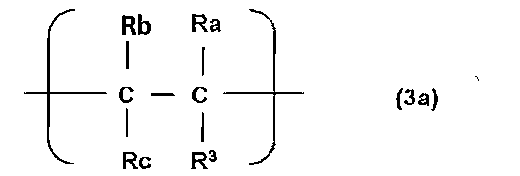
式(3a)中、Raは水素原子、メチル基又はフッ素基、Rbは、水素原子又はフッ素基、Rcは、水素原子又はフッ素基、R3はフッ素、塩素、臭素、ヨウ素、ヒドロキシル基、チオール基、1個以上の置換基を有していてもよいアミノ基、1個の置換基を有していてもよいカルボキシ基又は1個以上の置換基を有していてもよいアミド基を示す。
式(3a)中、R3が1個の置換基を有するカルボキシ基である場合、カルボキシ基の水素原子がアルキル基(例えば、メチル基、エチル基)、ヒドロキシアルキル基(例えば、ヒドロキシメチル基、ヒドロキシエチル基)で置換されたカルボキシ基が挙げられる。
式(3a)中、R3が1個以上の置換基を有するアミド基、すなわち、第2級アミド又は第3級アミドである場合、第1級アミドの少なくとも一つの水素原子又は2個の水素原子がアルキル基(例えば、メチル基、エチル基)、ヒドロキシアルキル基(例えば、ヒドロキシメチル基、ヒドロキシエチル基)で置換されたアミド基が挙げられる。
また、式(3a)中、R3は、アミノ基;アミド基;水素原子がアルキル基、水酸基又はアルコキシル基で置換されたアミド基;カルボキシ基;水素原子がアルキル基、ヒドロキシアルキル基(例えばヒドロキシエチル基)又はアルコシル基で置換されたカルボキシ基;であることが好ましい。
なお、式(2a)及び(3a)におけるRa、Rb及びRcは互いに同一でもよいし、異なっていてもよい。
なお、上記(3a)で表される構造は、以下の一般式(3b)で表される単量体を重合させることで形成される構造である。

[式(3b)中、
Ra、Rb、Rc及びR3は、式(3a)におけるそれらと同義である。]
Ra、Rb、Rc及びR3は、式(3a)におけるそれらと同義である。]
下記の一般式(h1)で表されるホスト基含有重合性単量体からなる構成単位を少なくとも一部に含有する重合体である高分子も、本開示の一つの電気化学デバイス用結着剤である
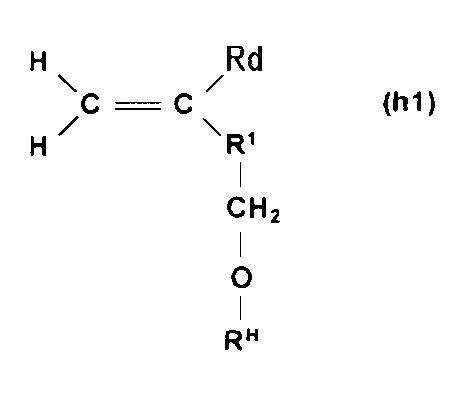
(式(h1)中、Rdは水素原子またはメチル基を示し、RHは前記ホスト基を示し、R1はヒドロキシル基、チオール基、1個以上の置換基を有していてもよいアルコキシ基、1個以上の置換基を有していてもよいチオアルコキシ基、1個以上の置換基を有していてもよいアルキル基、1個以上の置換基を有していてもよいアミノ基、1個以上の置換基を有していてもよいアミド基、アルデヒド基及びカルボキシル基からなる群より選択される1価の基から1個の水素原子を除去することにより形成される2価の基を示す。)
あるいは、ホスト基含有重合性単量体は、下記の一般式(h2)

(式(h2)中、Rd、RH及びR1はそれぞれ式(h1)のRd、RH及びR1と同義である。)
で表される化合物を挙げることができる。
で表される化合物を挙げることができる。
さらには、ホスト基含有重合性単量体は、下記の一般式(h3)

なお、式(h1)~(h3)で表されるホスト基含有重合性単量体におけるホスト基RHは、シクロデキストリン誘導体から1個の水酸基が除された1価の基である場合の例である。
また、ホスト基含有重合性単量体は、式(h1)~(h3)で表される化合物のうちの1種単独とすることができ、あるいは2種以上を含むことができる。この場合、式(h1)~(h3)のRdは互いに同一又は異なる場合がある。同様に、式(h1)~(h3)のRH、並びに式(h1)~(h3)のR1は各々互いに同一又は異なる場合がある。
式(h1)~(h3)で定義される置換基は、特に限定されない。例えば、置換基としては、炭素数1~20のアルキル基、炭素数2~20のアルケニル基、炭素数2~20のアルキニル基、ハロゲン原子、カルボキシル基、カルボニル基、スルホニル基、スルホン基、シアノ基等を挙げることができる。
(h1)~(h3)において、R1が1個以上の置換基を有していてもよいアミノ基から1個の水素原子を除去することにより形成される2価の基であれば、アミノ基の窒素原子がC=C二重結合の炭素原子と結合し得る。
(h1)~(h3)において、R1が1個以上の置換基を有していてもよいアミド基から1個の水素原子を除去することにより形成される2価の基であれば、アミド基の炭素原子がC=C二重結合の炭素原子と結合し得る。
(h1)~(h3)において、R1がアルデヒド基から1個の水素原子を除去することにより形成される2価の基であれば、アルデヒド基の炭素原子がC=C二重結合の炭素原子と結合し得る。
(h1)~(h3)において、R1がカルボキシル基から1個の水素原子を除去することにより形成される2価の基である場合、カルボキシル基の炭素原子がC=C二重結合の炭素原子と結合し得る。
(h1)~(h3)で表されるホスト基含有重合性単量体は、例えば、(メタ)アクリル酸エステル誘導体(すなわち、R1が-COO-)、(メタ)アクリルアミド誘導体(すなわち、R1が-CONH-又は-CONR-であり、Rは前記置換基と同義である)であることが好ましい。この場合、重合反応が進みやすく、また、得られる高分子材料の靭性及び強度もより高くなり得る。なお、本明細書において(メタ)アクリルとは、アクリル及びメタクリルのいずれかを示す。
前記-CONR-のRとしては、例えば、炭素数1~20のアルキル基が好ましく、炭素数1~10のアルキル基がより好ましく、炭素数1~6のアルキル基が特に好ましい。
式(h1)で表されるホスト基含有重合性単量体の具体例として、α-シクロデキストリン、β-シクロデキストリン、γ-シクロデキストリンから誘導される下記(h1-1)~(h1-6)の化合物(図は環状を表す略式図であり、すべてのグルコースユニットはα―1,4―グリコシド結合している)を挙げることができる。

式(h1-1)、(h1-2)及び(h1-3)で表される化合物は、式(h1)において、R1が-CONR-(R=メチル基)であって、それぞれ、α-シクロデキストリン誘導体、β-シクロデキストリン誘導体、γ-シクロデキストリン誘導体から一個の水酸基が除されたホスト基を有している。また、いずれも、シクロデキストリン誘導体におけるN-1個の水酸基の水素原子がメチル基で置換されている。なお、これら(h1-1)、(h1-2)及び(h1-3)で表される化合物では、後記するシクロデキストリン誘導体における水酸基の水素原子のメチル置換と同じ反応により、各化合物中のアミド部位の窒素原子のメチル置換を行うことができる。つまり、一段階の反応で、シクロデキストリン部位のメチル化及びアミド部位のメチル化を行うことでき、式(h1-1)、(h1-2)及び(h1-3)で表される化合物を容易に得ることができるという利点がある。後記式(h2-1)、(h2-2)及び(h2-3)も同様である。
式(h1-4)、(h1-5)及び(h1-6)で表される化合物は、式(h1)において、R1が-CONH-であって、それぞれ、α-シクロデキストリン誘導体、β-シクロデキストリン誘導体、γ-シクロデキストリン誘導体から一個の水酸基が除されたホスト基を有している。また、いずれも、シクロデキストリン誘導体におけるN-1個の水酸基の水素原子がメチル基で置換されている。
さらに、式(h1)で表されるホスト基含有重合性単量体の具体例として、α-シクロデキストリン、β-シクロデキストリン、γ-シクロデキストリンから誘導される下記(h1-7)~(h1-9)の化合物(図は環状を表す略式図であり、すべてのグルコースユニットはα―1,4―グリコシド結合している)を挙げることができる。
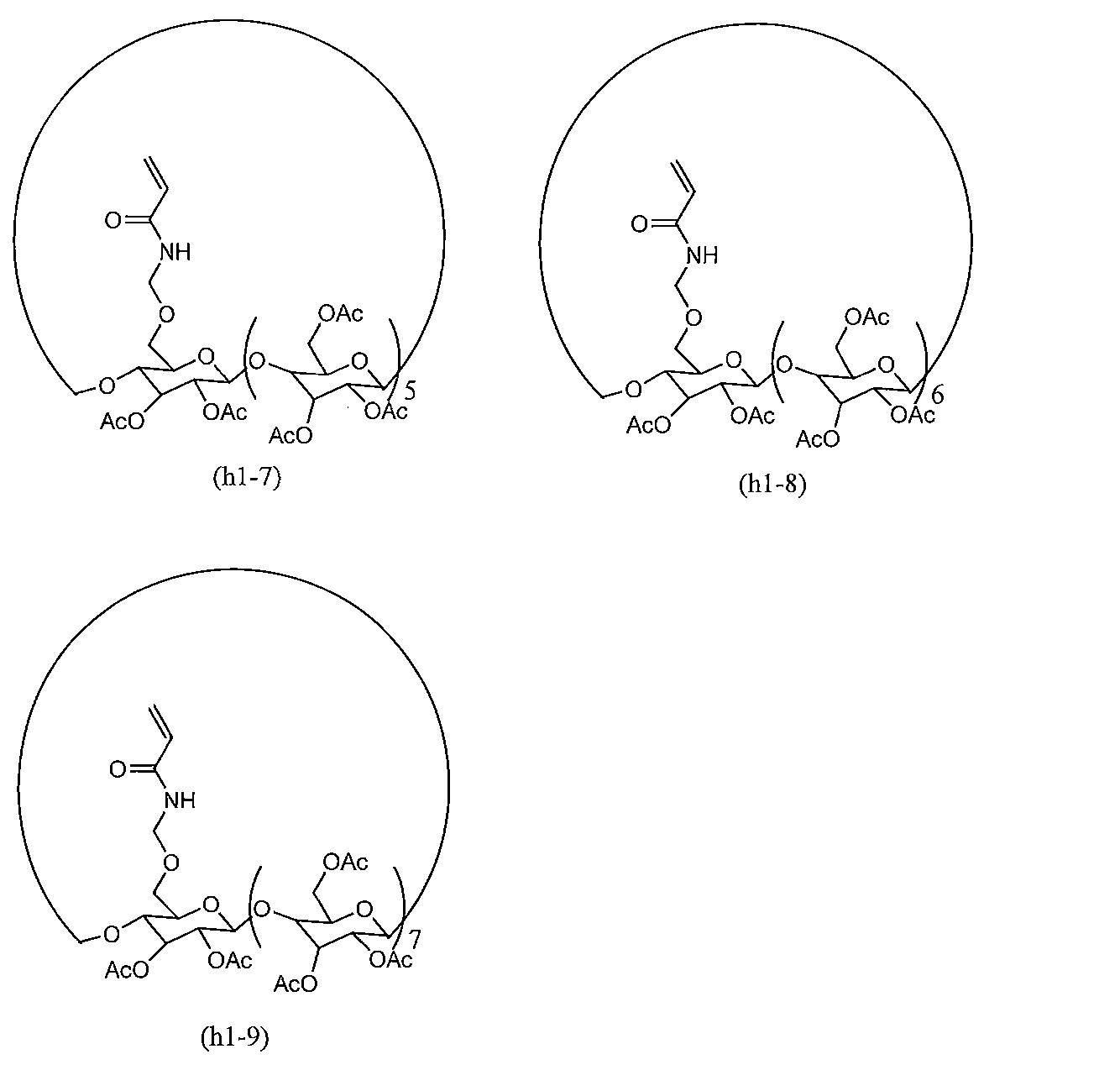
式(h1-7)、(h1-8)及び(h1-9)で表される化合物は、式(h1)においてR1が-CONH-であって、それぞれ、α-シクロデキストリン誘導体、β-シクロデキストリン誘導体、γ-シクロデキストリン誘導体から一個の水酸基が除されたホスト基を有している。また、いずれも、シクロデキストリン誘導体におけるN-1個の水酸基の水素原子がアセチル基(各式において「Ac」と表示)で置換されている。
さらに、式(h1)で表されるホスト基含有重合性単量体の具体例として、α-シクロデキストリン、β-シクロデキストリン、γ-シクロデキストリンから誘導される下記式(h1-10)の化合物(図は環状を表す略式図であり、すべてのグルコースユニットはα―1,4―グリコシド結合している)を挙げることができる。
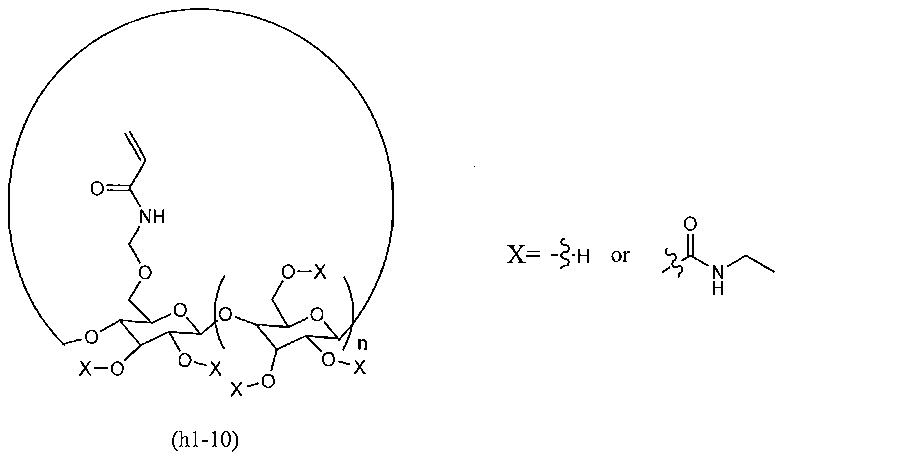
式(h1-10)において、少なくとも1個のXは水素原子であり、また、少なくとも1個のXは-CONHC2H5(エチルカルバメート基)である。nは5,6又は7である。
式(h1-10)で表される化合物は、式(h1)においてR1が-CONH-であって、シクロデキストリン誘導体から1個の水酸基が除されたホスト基を有している。また、シクロデキストリン誘導体におけるN-1個の水酸基の水素原子が前記Xで置換されている。
式(h2)で表されるホスト基含有重合性単量体の具体例として、α-シクロデキストリン、β-シクロデキストリン、γ-シクロデキストリンから誘導される下記(h2-1)~(h2-9)の化合物(図は環状を表す略式図であり、すべてのグルコースユニットはα―1,4―グリコシド結合している)を挙げることができる。


式(h2-1)、(h2-2)及び(h2-3)で表される化合物は、式(h2)においてR1が-CONR-(R=メチル基)であって、それぞれ、α-シクロデキストリン誘導体、β-シクロデキストリン誘導体、γ-シクロデキストリン誘導体から一個の水酸基が除されたホスト基を有している。また、いずれも、シクロデキストリン誘導体におけるN-1個の水酸基の水素原子がメチル基で置換されている。
式(h2-4)、(h2-5)及び(h2-6)で表される化合物は、式(h2)においてR1が-CONH-であって、それぞれ、α-シクロデキストリン誘導体、β-シクロデキストリン誘導体、γ-シクロデキストリン誘導体から一個の水酸基が除されたホスト基を有している。また、いずれも、シクロデキストリン誘導体におけるN-1個の水酸基の水素原子がメチル基で置換されている。
式(h2-7)、(h2-8)及び(h2-9)で表される化合物は、式(h2)においてR1が-COO-であって、それぞれ、α-シクロデキストリン誘導体、β-シクロデキストリン誘導体、γ-シクロデキストリン誘導体から一個の水酸基が除されたホスト基を有している。また、いずれも、シクロデキストリン誘導体におけるN-1個の水酸基の水素原子がメチル基で置換されている。
式(h3)で表されるホスト基含有重合性単量体の具体例として、α-シクロデキストリン、β-シクロデキストリン、γ-シクロデキストリンから誘導される下記(h3-1)~(h3-3)の化合物(図は環状を表す略式図であり、すべてのグルコースユニットはα―1,4―グリコシド結合している)を挙げることができる。
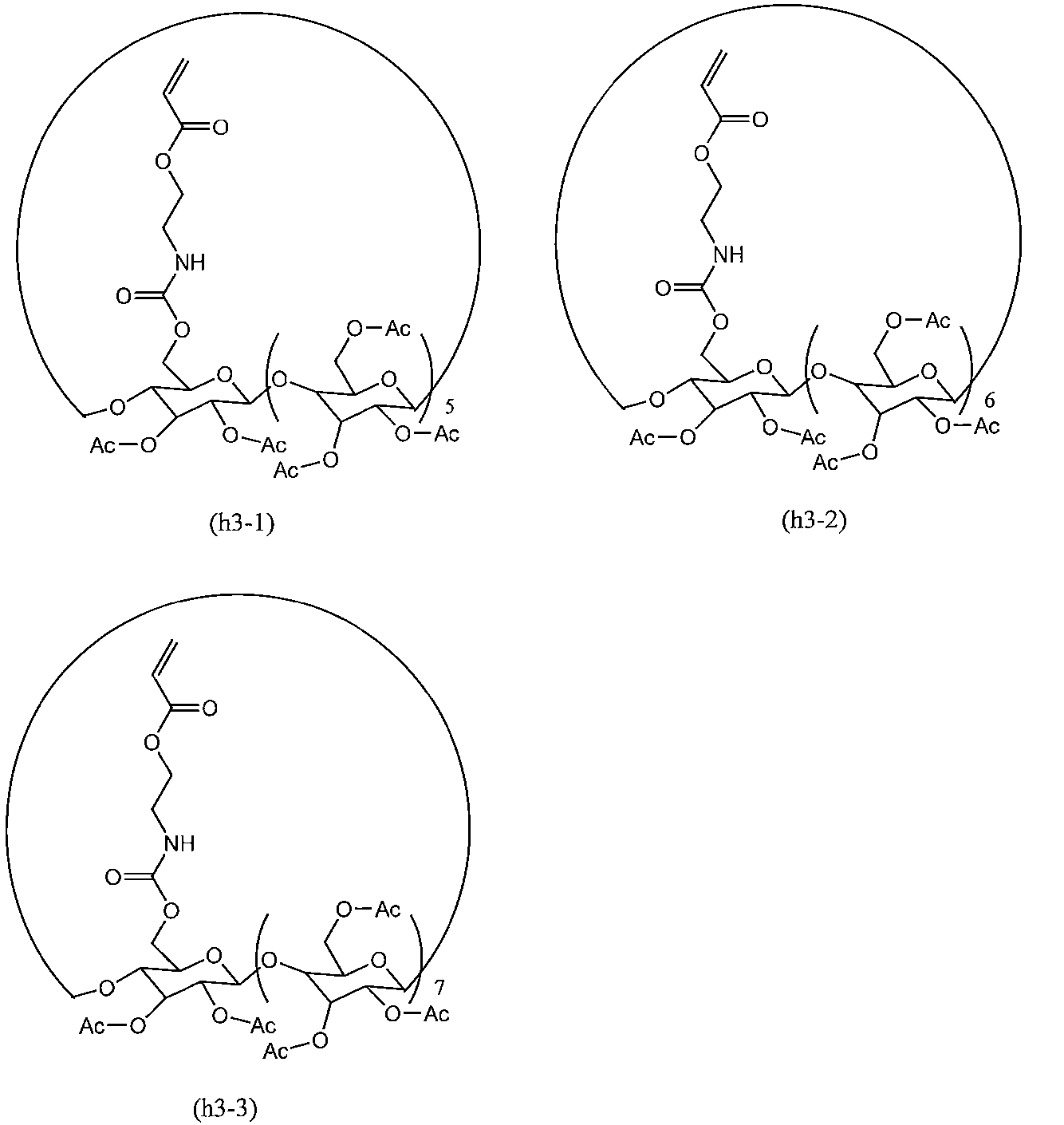
式(h3-1)、(h3-2)及び(h3-3)で表される化合物は、式(h3)においてR1が-COO-、n=2及びRbが水素原子であって、それぞれ、α-シクロデキストリン誘導体、β-シクロデキストリン誘導体、γ-シクロデキストリン誘導体から一個の水酸基が除されたホスト基を有している。また、いずれも、シクロデキストリン誘導体におけるN-1個の水酸基の水素原子がアセチル基(Ac)で置換されている。式(h3-1)、(h3-2)及び(h3-3)において、Rbの位置の水素原子は、メチル基で置き換えられてもよい。
上記(h1-1)~(h1-9)、(h2-1)~(h2-9)及び(h3-1)~(h3-3)で表されるホスト基含有重合性単量体はいずれもアクリル系であるが、メタ位の水素がメチル基に置き換えられた構造、すなわちメタクリル系であっても本開示の効果は阻害されない。
上記式(h1)~(h3)で表されるホスト基含有重合性単量体以外の重合性単量体を組み合わせて重合することもできる。
その他の重合性単量体としては特に限定されず、上述した式で表される構成単位を含有する共重合可能な単量体等を挙げることができる。
その他の重合性単量体としては特に限定されず、上述した式で表される構成単位を含有する共重合可能な単量体等を挙げることができる。
また、上述した本開示の可動性架橋高分子は、主鎖をC-C結合で構成することができるものであるため、特許文献2等に記載されたポリエチレングリコールを主鎖とするものよりも耐久性に優れ、破壊が生じにくい点で特に好ましいものである。
本開示の可動性架橋高分子において、ホスト基の割合は可動性架橋高分子の固形分全量に対して下限0.001、上限0.3(重量比)の範囲であることが好ましい。また下限は0.01であることがより好ましく、上限は0.2であることがより好ましい。下限を下回ると、充分な効果を得られないおそれがある。上限を上回ると、高分子の伸張性を低下させるおそれがある。
本開示の可動性架橋高分子は、さらにゲスト基を有するものであってもよく、有しないものであってもよいが、ゲスト基を有しないものであることが好ましい。なお、ここでいう「ゲスト基」とは、上記ホスト基に包接されるような官能基を意味する。
本開示の可動性架橋高分子は、さらにゲスト基を有するものであってもよく、有しないものであってもよいが、ゲスト基を有しないものであることが好ましい。なお、ここでいう「ゲスト基」とは、上記ホスト基に包接されるような官能基を意味する。
(電極合剤)
本開示は、上述の電気化学デバイス用結着剤と、電極活物質と、水又は非水溶剤とからなる電極合剤でもある。上記電極活物質は、正極活物質、及び、負極活物質に分けられる。上記正極活物質及び負極活物質としては特に限定されず、鉛電池、ニッカド電池、ニッケル水素電池、リチウムイオン電池、アルカリ金属硫黄電池等の二次電池、電気二重層キャパシタ等の公知の電気化学デバイスに使用されているものを挙げることができる。
本開示は、上述の電気化学デバイス用結着剤と、電極活物質と、水又は非水溶剤とからなる電極合剤でもある。上記電極活物質は、正極活物質、及び、負極活物質に分けられる。上記正極活物質及び負極活物質としては特に限定されず、鉛電池、ニッカド電池、ニッケル水素電池、リチウムイオン電池、アルカリ金属硫黄電池等の二次電池、電気二重層キャパシタ等の公知の電気化学デバイスに使用されているものを挙げることができる。
<正極>
上記正極活物質としては特に限定されず、公知の電気化学デバイスに使用されるものを挙げることができる。リチウムイオン二次電池の正極活物質について具体的に説明すると、電気化学的にリチウムイオンを吸蔵・放出可能なものであれば特に制限されないが、例えば、リチウム含有遷移金属複合酸化物、リチウム含有遷移金属リン酸化合物、硫黄系材料、導電性高分子等が挙げられる。なかでも、正極活物質としては、リチウム含有遷移金属複合酸化物、リチウム含有遷移金属リン酸化合物が好ましく、特に、高電圧を産み出すリチウム含有遷移金属複合酸化物が好ましい。
上記正極活物質としては特に限定されず、公知の電気化学デバイスに使用されるものを挙げることができる。リチウムイオン二次電池の正極活物質について具体的に説明すると、電気化学的にリチウムイオンを吸蔵・放出可能なものであれば特に制限されないが、例えば、リチウム含有遷移金属複合酸化物、リチウム含有遷移金属リン酸化合物、硫黄系材料、導電性高分子等が挙げられる。なかでも、正極活物質としては、リチウム含有遷移金属複合酸化物、リチウム含有遷移金属リン酸化合物が好ましく、特に、高電圧を産み出すリチウム含有遷移金属複合酸化物が好ましい。
リチウム含有遷移金属複合酸化物の遷移金属としてはV、Ti、Cr、Mn、Fe、Co、Ni、Cu等が好ましく、リチウム遷移金属複合酸化物の具体例としては、LiCoO2等のリチウム・コバルト複合酸化物、LiNiO2等のリチウム・ニッケル複合酸化物、LiMnO2、LiMn2O4、Li2MnO3等のリチウム・マンガン複合酸化物、これらのリチウム遷移金属複合酸化物の主体となる遷移金属原子の一部をAl、Ti、V、Cr、Mn、Fe、Co、Li、Ni、Cu、Zn、Mg、Ga、Zr、Si等の他の金属で置換したもの等が挙げられる。上記置換したものとしては、リチウム・ニッケル・マンガン複合酸化物、リチウム・ニッケル・コバルト・アルミニウム複合酸化物、リチウム・ニッケル・コバルト・マンガン複合酸化物、リチウム・マンガン・アルミニウム複合酸化物、リチウム・チタン複合酸化物等が挙げられ、より具体的には、LiNi0.5Mn0.5O2、LiNi0.85Co0.10Al0.05O2、LiNi0.33Co0.33Mn0.33O2、LiNi0.5Mn0.3Co0.2O2、LiNi0.6Mn0.2Co0.2O2、LiNi0.8Mn0.1Co0.1O2、LiMn1.8Al0.2O4、LiMn1.5Ni0.5O4、Li4Ti5O12、LiNi0.82Co0.15Al0.03O2等が挙げられる。
リチウム含有遷移金属リン酸化合物の遷移金属としては、V、Ti、Cr、Mn、Fe、Co、Ni、Cu等が好ましく、リチウム含有遷移金属リン酸化合物の具体例としては、例えば、LiFePO4、Li3Fe2(PO4)3、LiFeP2O7等のリン酸鉄類、LiCoPO4等のリン酸コバルト類、これらのリチウム遷移金属リン酸化合物の主体となる遷移金属原子の一部をAl、Ti、V、Cr、Mn、Fe、Co、Li、Ni、Cu、Zn、Mg、Ga、Zr、Nb、Si等の他の金属で置換したもの等が挙げられる。
特に、高電圧、高エネルギー密度、あるいは、充放電サイクル特性等の観点から、LiCoO2、LiNiO2、LiMn2O4、LiNi0.82Co0.15Al0.03O2、LiNi0.33Mn0.33Co0.33O2、LiNi0.5Mn0.3Co0.2O2、LiNi0.6Mn0.2Co0.2O2、LiNi0.8Mn0.1Co0.1O2、LiFePO4が好ましい。
上記硫黄系材料としては、硫黄原子を含む材料が例示でき、単体硫黄、金属硫化物、及び、有機硫黄化合物からなる群より選択される少なくとも1種が好ましく、単体硫黄がより好ましい。上記金属硫化物は金属多硫化物であってもよい。上記有機硫黄化合物は、有機多硫化物であってもよい。
上記金属硫化物としては、LiSx(0<x≦8)で表される化合物;Li2Sx(0<x≦8)で表される化合物;TiS2やMoS2等の二次元層状構造をもつ化合物;一般式MexMo6S8(MeはPb,Ag,Cuをはじめとする各種遷移金属)で表される強固な三次元骨格構造を有するシュブレル化合物等が挙げられる。
上記有機硫黄化合物としては、カーボンスルフィド化合物等が挙げられる。
上記有機硫黄化合物は、カーボン等の細孔を有する材料に坦持させて、炭素複合材料として用いる場合がある。炭素複合材料中に含まれる硫黄の含有量としては、サイクル性能に一層優れ、過電圧が更に低下することから、上記炭素複合材料に対して、10~99重量%が好ましく、20重量%以上がより好ましく、30重量以上が更に好ましく、40重量以上が特に好ましく、また、85重量%以下が好ましい。
上記正極活物質が上記硫黄単体の場合、上記正極活物質に含まれる硫黄の含有量は、上記硫黄単体の含有量と等しい。
上記正極活物質が上記硫黄単体の場合、上記正極活物質に含まれる硫黄の含有量は、上記硫黄単体の含有量と等しい。
導電性高分子としては、p-ドーピング型の導電性高分子やn-ドーピング型の導電性高分子が挙げられる。導電性高分子としては、ポリアセチレン系、ポリフェニレン系、複素環ポリマー、イオン性ポリマー、ラダー及びネットワーク状ポリマー等が挙げられる。
また、これら正極活物質の表面に、主体となる正極活物質を構成する物質とは異なる組成の物質が付着したものを用いることもできる。表面付着物質としては酸化アルミニウム、酸化ケイ素、酸化チタン、酸化ジルコニウム、酸化マグネシウム、酸化カルシウム、酸化ホウ素、酸化アンチモン、酸化ビスマス等の酸化物、硫酸リチウム、硫酸ナトリウム、硫酸カリウム、硫酸マグネシウム、硫酸カルシウム、硫酸アルミニウム等の硫酸塩、炭酸リチウム、炭酸カルシウム、炭酸マグネシウム等の炭酸塩等、有機高分子等が挙げられる。
これら表面付着物質は、例えば、溶媒に溶解又は懸濁させて正極活物質に含浸添加、乾燥する方法、表面付着物質前駆体を溶媒に溶解又は懸濁させて正極活物質に含浸添加後、加熱等により反応させる方法、正極活物質前駆体に添加して同時に焼成する方法等により正極活物質表面に付着させることができる。
表面付着物質の量としては、正極活物質に対して重量で、下限として好ましくは0.1ppm以上、より好ましくは1ppm以上、更に好ましくは10ppm以上、上限として好ましくは20%以下、より好ましくは10%以下、更に好ましくは5%以下で用いられる。表面付着物質により、正極活物質表面での非水系電解液の酸化反応を抑制することができ、電池寿命を向上させることができるが、その付着量が少なすぎる場合その効果は十分に発現せず、多すぎる場合には、リチウムイオンの出入りを阻害するため抵抗が増加する場合がある。
正極活物質の粒子の形状は、従来用いられるような、塊状、多面体状、球状、楕円球状、板状、針状、柱状等が用いられるが、中でも一次粒子が凝集して、二次粒子を形成し、その二次粒子の形状が球状ないし楕円球状であるものが好ましい。通常、電気化学素子はその充放電に伴い、電極中の活物質が膨張収縮をするため、そのストレスによる活物質の破壊や導電パス切れ等の劣化がおきやすい。そのため一次粒子のみの単一粒子活物質であるよりも、一次粒子が凝集して、二次粒子を形成したものである方が膨張収縮のストレスを緩和して、劣化を防ぐため好ましい。また、板状等軸配向性の粒子であるよりも球状ないし楕円球状の粒子の方が、電極の成形時の配向が少ないため、充放電時の電極の膨張収縮も少なく、また電極を作成する際の導電剤との混合においても、均一に混合されやすいため好ましい。
正極活物質のタップ密度は、通常1.5g/cm3以上、好ましくは2.0g/cm3以上、更に好ましくは2.5g/cm3以上、最も好ましくは3.0g/cm3以上である。正極活物質のタップ密度が上記下限を下回ると正極活物質層形成時に、必要な分散媒量が増加すると共に、導電材や結着剤の必要量が増加し、正極活物質層への正極活物質の充填率が制約され、電池容量が制約される場合がある。タップ密度の高い金属複合酸化物粉体を用いることにより、高密度の正極活物質層を形成することができる。タップ密度は一般に大きいほど好ましく特に上限はないが、通常4.5g/cm3以下、好ましくは4.3/cm3以下である。
正極活物質のタップ密度は、目開き300μmの篩を通過させて、20cm3のタッピングセルに試料を落下させてセル容積を満たした後、粉体密度測定器(例えば、セイシン企業社製タップデンサー)を用いて、ストローク長10mmのタッピングを1000回行なって、その時の体積と試料の重量から求めた密度をタップ密度として定義する。
正極活物質の粒子のメジアン径d50(一次粒子が凝集して二次粒子を形成している場合には二次粒子径)は通常0.1μm以上、好ましくは0.5μm以上、より好ましくは1μm以上、最も好ましくは3μm以上で、通常20μm以下、好ましくは18μm以下、より好ましくは16μm以下、最も好ましくは15μm以下である。上記下限を下回ると、高嵩密度品が得られなくなる場合があり、上限を超えると粒子内のリチウムの拡散に時間がかかるため、電池性能の低下をきたしたり、電池の正極作成すなわち活物質と導電剤やバインダー等を溶媒でスラリー化し、薄膜状に塗布する際に、スジを引く等の問題を生ずる場合がある。ここで、異なるメジアン径d50をもつ正極活物質を2種類以上混合することで、正極作成時の充填性を更に向上させることもできる。
なお、本開示におけるメジアン径d50は、公知のレーザー回折/散乱式粒度分布測定装置によって測定される。粒度分布計としてHORIBA社製LA-920を用いる場合、測定の際に用いる分散媒として、0.1重量%ヘキサメタリン酸ナトリウム水溶液を用い、5分間の超音波分散後に測定屈折率1.24を設定して測定される。
一次粒子が凝集して二次粒子を形成している場合には、正極活物質の平均一次粒子径としては、通常0.01μm以上、好ましくは0.05μm以上、更に好ましくは0.08μm以上、最も好ましくは0.1μm以上で、通常3μm以下、好ましくは2μm以下、更に好ましくは1μm以下、最も好ましくは0.6μm以下である。上記上限を超えると球状の二次粒子を形成し難く、粉体充填性に悪影響を及ぼしたり、比表面積が大きく低下するために、出力特性等の電池性能が低下する可能性が高くなる場合がある。逆に、上記下限を下回ると、通常、結晶が未発達であるために充放電の可逆性が劣る等の問題を生ずる場合がある。なお、一次粒子径は、走査電子顕微鏡(SEM)を用いた観察により測定される。具体的には、10000倍の倍率の写真で、水平方向の直線に対する一次粒子の左右の境界線による切片の最長の値を、任意の50個の一次粒子について求め、平均値をとることにより求められる。
正極活物質のBET比表面積は、0.2m2/g以上、好ましくは0.3m2/g以上、更に好ましくは0.4m2/g以上で、50m2/g以下、好ましくは10m2/g以下、更に好ましくは5.0m2/g以下である。BET比表面積がこの範囲よりも小さいと電池性能が低下しやすく、大きいとタップ密度が上がりにくくなり、正極活物質形成時の塗布性に問題が発生しやすい場合がある。
BET比表面積は、表面積計(例えば、大倉理研製全自動表面積測定装置)を用い、試料に対して窒素流通下150℃で30分間、予備乾燥を行なった後、大気圧に対する窒素の相対圧の値が0.3となるように正確に調整した窒素ヘリウム混合ガスを用い、ガス流動法による窒素吸着BET1点法によって測定した値で定義される。
正極活物質の製造法としては、無機化合物の製造法として一般的な方法が用いられる。特に球状ないし楕円球状の活物質を作成するには種々の方法が考えられるが、例えば、遷移金属硝酸塩、硫酸塩等の遷移金属原料物質と、必要に応じ他の元素の原料物質を水等の溶媒中に溶解ないし粉砕分散して、攪拌をしながらpHを調節して球状の前駆体を作成回収し、これを必要に応じて乾燥した後、LiOH、Li2CO3、LiNO3等のLi源を加えて高温で焼成して活物質を得る方法、遷移金属硝酸塩、硫酸塩、水酸化物、酸化物等の遷移金属原料物質と、必要に応じ他の元素の原料物質を水等の溶媒中に溶解ないし粉砕分散して、それをスプレードライヤー等で乾燥成型して球状ないし楕円球状の前駆体とし、これにLiOH、Li2CO3、LiNO3等のLi源を加えて高温で焼成して活物質を得る方法、また、遷移金属硝酸塩、硫酸塩、水酸化物、酸化物等の遷移金属原料物質と、LiOH、Li2CO3、LiNO3等のLi源と、必要に応じ他の元素の原料物質とを水等の溶媒中に溶解ないし粉砕分散して、それをスプレードライヤー等で乾燥成型して球状ないし楕円球状の前駆体とし、これを高温で焼成して活物質を得る方法等が挙げられる。
なお、本開示において、正極活物質は1種を単独で用いても良く、異なる組成又は異なる粉体物性の2種以上を任意の組み合わせ及び比率で併用しても良い。
<負極>
負極は、負極活物質を含む負極活物質層と、集電体とから構成される。上記負極活物質としては特に限定されず、公知の電気化学デバイスに使用されるものを挙げることができる。リチウムイオン二次電池の正極活物質について具体的に説明すると、電気化学的にリチウムイオンを吸蔵・放出可能なものであれば、特に制限はない。具体例としては、炭素質材料、合金系材料、リチウム含有金属複合酸化物材料、導電性高分子等が挙げられる。これらは、1種を単独で用いてもよく、また2種以上を任意に組み合わせて併用してもよい。
負極は、負極活物質を含む負極活物質層と、集電体とから構成される。上記負極活物質としては特に限定されず、公知の電気化学デバイスに使用されるものを挙げることができる。リチウムイオン二次電池の正極活物質について具体的に説明すると、電気化学的にリチウムイオンを吸蔵・放出可能なものであれば、特に制限はない。具体例としては、炭素質材料、合金系材料、リチウム含有金属複合酸化物材料、導電性高分子等が挙げられる。これらは、1種を単独で用いてもよく、また2種以上を任意に組み合わせて併用してもよい。
リチウムを吸蔵・放出可能な炭素質材料としては、種々の原料から得た易黒鉛性ピッチの高温処理によって製造された人造黒鉛若しくは精製天然黒鉛、又は、これらの黒鉛にピッチその他の有機物で表面処理を施した後炭化して得られるものが好ましく、天然黒鉛、人造黒鉛、人造炭素質物質並びに人造黒鉛質物質を400~3200℃の範囲で1回以上熱処理した炭素質材料、負極活物質層が少なくとも2種類以上の異なる結晶性を有する炭素質からなり、かつ/又はその異なる結晶性の炭素質が接する界面を有している炭素質材料、負極活物質層が少なくとも2種以上の異なる配向性の炭素質が接する界面を有している炭素質材料、から選ばれるものが、初期不可逆容量、高電流密度充放電特性のバランスがよくより好ましい。また、これらの炭素材料は、1種を単独で用いてもよく、2種以上を任意の組み合わせ及び比率で併用してもよい。
上記の人造炭素質物質並びに人造黒鉛質物質を400~3200℃の範囲で1回以上熱処理した炭素質材料としては、カーボンナノチューブ、グラフェン、石炭系コークス、石油系コークス、石炭系ピッチ、石油系ピッチ及びこれらピッチを酸化処理したもの、ニードルコークス、ピッチコークス及びこれらを一部黒鉛化した炭素剤、ファーネスブラック、アセチレンブラック、ピッチ系炭素繊維等の有機物の熱分解物、炭化可能な有機物及びこれらの炭化物、又は炭化可能な有機物をベンゼン、トルエン、キシレン、キノリン、n-ヘキサン等の低分子有機溶剤に溶解させた溶液及びこれらの炭化物等が挙げられる。
上記負極活物質として用いられる金属材料(但し、リチウムチタン複合酸化物を除く)としては、リチウムを吸蔵・放出可能であれば、リチウム単体、リチウム合金を形成する単体金属及び合金、又はそれらの酸化物、炭化物、窒化物、ケイ化物、硫化物若しくはリン化物等の化合物のいずれであってもよく、特に制限されない。リチウム合金を形成する単体金属及び合金としては、13族及び14族の金属・半金属元素を含む材料であることが好ましく、より好ましくはアルミニウム、ケイ素及びスズ(以下、「特定金属元素」と略記)の単体金属及びこれら原子を含む合金又は化合物である。これらは、1種を単独で用いてもよく、2種以上を任意の組み合わせ及び比率で併用してもよい。
特定金属元素から選ばれる少なくとも1種の原子を有する負極活物質としては、いずれか1種の特定金属元素の金属単体、2種以上の特定金属元素からなる合金、1種又は2種以上の特定金属元素とその他の1種又は2種以上の金属元素とからなる合金、並びに、1種又は2種以上の特定金属元素を含有する化合物、及びその化合物の酸化物、炭化物、窒化物、ケイ化物、硫化物若しくはリン化物等の複合化合物が挙げられる。負極活物質としてこれらの金属単体、合金又は金属化合物を用いることで、電池の高容量化が可能である。
Liと合金化可能な金属粒子は、従来公知のいずれのものも使用可能であるが、容量と
サイクル寿命の点から、金属粒子は、例えば、Fe、Co、Sb、Bi、Pb、Ni、Ag、Si、Sn、Al、Zr、Cr、P、S、V、Mn、Nb、Mo、Cu、Zn、Ge、In、Ti等からなる群から選ばれる金属又はその化合物であることが好ましい。また、2種以上の金属からなる合金を使用しても良く、金属粒子が、2種以上の金属元素により形成された合金粒子であってもよい。これらの中でも、Si、Sn、As、Sb、Al、Zn及びWからなる群から選ばれる金属又はその金属化合物が好ましい。
金属化合物として、金属酸化物、金属窒化物、金属炭化物等が挙げられる。また、2種以上の金属からなる合金を使用しても良い。
サイクル寿命の点から、金属粒子は、例えば、Fe、Co、Sb、Bi、Pb、Ni、Ag、Si、Sn、Al、Zr、Cr、P、S、V、Mn、Nb、Mo、Cu、Zn、Ge、In、Ti等からなる群から選ばれる金属又はその化合物であることが好ましい。また、2種以上の金属からなる合金を使用しても良く、金属粒子が、2種以上の金属元素により形成された合金粒子であってもよい。これらの中でも、Si、Sn、As、Sb、Al、Zn及びWからなる群から選ばれる金属又はその金属化合物が好ましい。
金属化合物として、金属酸化物、金属窒化物、金属炭化物等が挙げられる。また、2種以上の金属からなる合金を使用しても良い。
また、これらの複合化合物が、金属単体、合金又は非金属元素等の数種の元素と複雑に結合した化合物も挙げられる。具体的には、例えばケイ素やスズでは、これらの元素と負極として作動しない金属との合金を用いることができる。例えば、スズの場合、スズとケイ素以外で負極として作用する金属と、更に負極として動作しない金属と、非金属元素との組み合わせで5~6種の元素を含むような複雑な化合物も用いることができる。
Liと合金可能な金属粒子の中でも、Si又はSi金属化合物が好ましい。Si金属化合物は、Si金属酸化物であることが好ましい。Si又はSi金属化合物は、高容量化の点で、好ましい。本明細書では、Si又はSi金属化合物を総称してSi化合物と呼ぶ。Si化合物としては、具体的には、SiOx,SiNx,SiCx、SiZxOy(Z=C、N)等が挙げられる。Si化合物は、好ましくは、Si金属酸化物であり、Si金属酸化物は、一般式で表すとSiOxである。この一般式SiOxは、二酸化Si(SiO2)と金属Si(Si)とを原料として得られるが、そのxの値は通常0≦x<2である。SiOxは、黒鉛と比較して理論容量が大きく、更に非晶質SiあるいはナノサイズのSi結晶は、リチウムイオン等のアルカリイオンの出入りがしやすく、高容量を得ることが可能となる。
Si金属酸化物は、具体的には、SiOxと表されるものであり、xは0≦x<2であり、より好ましくは、0.2以上、1.8以下、更に好ましくは、0.4以上、1.6以下、特に好ましくは、0.6以上、1,4以下であり、X=0がとりわけ好ましい。この範囲であれば、高容量であると同時に、Liと酸素との結合による不可逆容量を低減させることが可能となる。
Si金属酸化物は、具体的には、SiOxと表されるものであり、xは0≦x<2であり、より好ましくは、0.2以上、1.8以下、更に好ましくは、0.4以上、1.6以下、特に好ましくは、0.6以上、1,4以下であり、X=0がとりわけ好ましい。この範囲であれば、高容量であると同時に、Liと酸素との結合による不可逆容量を低減させることが可能となる。
また、Si又はSnを第一の構成元素とし、それに加えて第2、第3の構成元素を含む複合材料が挙げられる。第2の構成元素は、例えば、コバルト、鉄、マグネシウム、チタン、バナジウム、クロム、マンガン、ニッケル、銅、亜鉛、ガリウム及びジルコニウムのうち少なくとも1種である。第3の構成元素は、例えば、ホウ素、炭素、アルミニウム及びリンのうち少なくとも1種である。
負極活物質として用いられるリチウム含有金属複合酸化物材料としては、リチウムを吸蔵・放出可能であれば、特に制限されないが、高電流密度充放電特性の点からチタン及びリチウムを含有する材料が好ましく、より好ましくはチタンを含むリチウム含有複合金属酸化物材料が好ましく、更にリチウムとチタンの複合酸化物(以下、「リチウムチタン複合酸化物」と略記)が好ましい。すなわち、スピネル構造を有するリチウムチタン複合酸化物を、電解液電池用負極活物質に含有させて用いると、出力抵抗が大きく低減するので特に好ましい。
上記リチウムチタン複合酸化物としては、一般式:
LixTiyMzO4
[式中、Mは、Na、K、Co、Al、Fe、Ti、Mg、Cr、Ga、Cu、Zn及びNbからなる群より選ばれる少なくとも1種の元素を表わす。]
で表される化合物であることが好ましい。
上記組成の中でも、
(i)1.2≦x≦1.4、1.5≦y≦1.7、z=0
(ii)0.9≦x≦1.1、1.9≦y≦2.1、z=0
(iii)0.7≦x≦0.9、2.1≦y≦2.3、z=0
の構造が、電池性能のバランスが良好なため特に好ましい。
LixTiyMzO4
[式中、Mは、Na、K、Co、Al、Fe、Ti、Mg、Cr、Ga、Cu、Zn及びNbからなる群より選ばれる少なくとも1種の元素を表わす。]
で表される化合物であることが好ましい。
上記組成の中でも、
(i)1.2≦x≦1.4、1.5≦y≦1.7、z=0
(ii)0.9≦x≦1.1、1.9≦y≦2.1、z=0
(iii)0.7≦x≦0.9、2.1≦y≦2.3、z=0
の構造が、電池性能のバランスが良好なため特に好ましい。
上記化合物の特に好ましい代表的な組成は、(i)ではLi4/3Ti5/3O4、(ii)ではLi1Ti2O4、(iii)ではLi4/5Ti11/5O4である。また、Z≠0の構造については、例えば、Li4/3Ti4/3Al1/3O4が好ましいものとして挙げられる。
電極活物質(正極活物質又は負極活物質)の含有量は、得られる電極の容量を増やすために、電極合剤中40重量%以上が好ましい。
上記電極合剤は、更に導電剤を含んでもよい。上記導電剤は、導電性を向上させるために配合される添加物であり、黒鉛、ケッチェンブラック、逆オパール炭素、アセチレンブラックなどのカーボン粉末や、気相成長炭素繊維(VGCF)、グラフェンシート、カーボンナノチューブ(CNT)などの種々の炭素繊維などとすることができる。
本開示の電極合剤は、さらに水系溶媒又は有機溶媒の分散媒を含むものである。水系溶媒としては、通常、水が用いられるが、これにエタノール等のアルコール類、N-メチルピロリドン等の環状アミド類等の有機溶媒を、水に対して30重量%以下の範囲で併用することもできる。また、有機溶媒としては、N-メチル-2-ピロリドン、N,N-ジメチルアセトアミド、ジメチルホルムアミド等の含窒素系有機溶剤;アセトン、メチルエチルケトン、シクロヘキサノン、メチルイソブチルケトン等のケトン系溶剤;酢酸エチル、酢酸ブチル等のエステル系溶剤;テトラヒドロフラン、ジオキサン等のエーテル系溶剤;更に、それらの混合溶剤等の低沸点の汎用有機溶剤を挙げることができる。なお、これらは何れか1種を単独で使用してもよく、2種以上を任意の組み合わせ及び比率で併用してもよい。なかでも、電極合剤の安定性、塗工性に優れている点から、N-メチル-2-ピロリドン、及び/又は、N,N-ジメチルアセトアミドであることが好ましい。
また、スラリーの安定化のため増粘剤を用いることができる。増粘剤としては、カルボキシメチルセルロース、メチルセルロース、ヒドロキシメチルセルロース、エチルセルロース、ポリビニルアルコール、酸化スターチ、リン酸化スターチ、カゼイン等が挙げられる。これらは1種を単独で用いてもよく、2種以上を任意の組み合わせ及び比率で併用してもよい。増粘剤は必要に応じて使用すればよいが、使用する場合には、負極活物質層中における増粘剤の含有量が通常0.5重量%以上、5重量%以下の範囲で用いることが好ましい。
上記電極合剤中の上記分散媒の配合量は、集電体への塗布性、乾燥後の薄膜形成性等を考慮して決定される。上記電気化学デバイス用結着剤と上記分散媒との割合は、重量比で0.5:99.5~20:80が好ましい。
上記電極合剤は、集電体との接着性を更に向上させるため、例えば、ポリメタクリレート、ポリメチルメタアクリレート等のアクリル系樹脂、ポリイミド、ポリアミド及びポリアミドイミド系樹脂等を更に含んでいてもよい。また、架橋剤を添加し、γ線や電子線等の放射線を照射して架橋構造を形成させてもよい。架橋処理法としては放射線照射に留まらず、他の架橋方法、例えば熱架橋が可能なアミン基含有化合物、シアヌレート基含有化合物等を添加して熱架橋させてもよい。
上記電極合剤は、スラリーの分散安定性を向上させるために、界面活性作用等を有する樹脂系やカチオン系界面活性剤、ノニオン系界面活性剤等の分散剤を添加してもよい。さらに、スチレンブタジエンゴム、セルロース、ポリフッ化ビニリデン(PVdF)、ポリテトラフルオロエチレン(PTFE)等の従来公知の結着剤を併用してもよい。
上記電極合剤における本開示の電気化学デバイス用結着剤の配合割合は、好ましくは電極合剤の0.05~20重量%であり、より好ましくは1~10重量%である。
上記電気化学デバイス用結着剤を含む電極合剤を調製する方法としては、該結着剤を上記分散媒に溶解又は分散させた溶液又は分散液に上記電極活物質を分散、混合させるといった方法が一般的である。そして、得られた電極合剤を、金属箔又は金属網等の集電体に均一に塗布、乾燥、必要に応じてプレスして集電体上へ薄い電極合剤層を形成し薄膜状電極とする。
そのほか、例えば結着剤と電極活物質を先に混合した後、上記分散媒を添加し合剤を作製してもよい。また、結着剤と電極活物質を加熱溶融し、押出機で押し出して薄膜の合剤を作製しておき、導電性接着剤や汎用性有機溶剤を塗布した集電体上に貼り合わせて電極シートを作製することもできる。更に、予め予備成形した電極活物質に結着剤の溶液又は分散液を塗布してもよい。このように、結着剤としての適用方法は特に限定されない。
(電極)
本開示は、上述した本開示の電気化学デバイス用結着剤を含む電極でもある。
上記電極は、集電体と、当該集電体上に形成された、上記電極活物質と上記電気化学デバイス用結着剤とからなる電極材料層とを有することが好ましい。本開示の電気化学デバイス用結着剤は、正極及び負極のいずれに使用した場合であっても本開示の効果を得ることができるため、どちらかの電極に限定されることはない。特に、本開示の電気化学デバイス用結着剤は、充放電時における電極活物質の体積に追従することができ、Si系負極材料などの高容量活物質に使用するのが好ましい。
本開示は、上述した本開示の電気化学デバイス用結着剤を含む電極でもある。
上記電極は、集電体と、当該集電体上に形成された、上記電極活物質と上記電気化学デバイス用結着剤とからなる電極材料層とを有することが好ましい。本開示の電気化学デバイス用結着剤は、正極及び負極のいずれに使用した場合であっても本開示の効果を得ることができるため、どちらかの電極に限定されることはない。特に、本開示の電気化学デバイス用結着剤は、充放電時における電極活物質の体積に追従することができ、Si系負極材料などの高容量活物質に使用するのが好ましい。
集電体(正極集電体及び負極集電体)としては、例えば、鉄、ステンレス鋼、銅、アルミニウム、ニッケル、チタン等の金属箔あるいは金属網等が挙げられる。中でも、正極集電体としては、アルミ箔等が好ましく、負極集電体としては銅箔等が好ましい。
本開示の電極は、例えば上述した方法によって製造することができる。
本開示の電極は、例えば上述した方法によって製造することができる。
(電気化学デバイス)
本開示は、上述の電極を備える電気化学デバイスでもある。
上記電気化学デバイスとしては特に限定されず、従来公知の電気化学デバイスに適用することができる。具体的には、リチウムイオン電池等の二次電池、リチウム電池等の一次電池、ラジカル電池、太陽電池(特に色素増感型太陽電池)、燃料電池;
リチウムイオンキャパシタ、ハイブリッドキャパシタ、電気二重層キャパシタ等のキャパシタ;
アルミニウム電解コンデンサ、タンタル電解コンデンサ等の各種コンデンサ;
エレクトロミック素子、電気化学スイッチング素子、各種電気化学センサー等を挙げることができる。
本開示は、上述の電極を備える電気化学デバイスでもある。
上記電気化学デバイスとしては特に限定されず、従来公知の電気化学デバイスに適用することができる。具体的には、リチウムイオン電池等の二次電池、リチウム電池等の一次電池、ラジカル電池、太陽電池(特に色素増感型太陽電池)、燃料電池;
リチウムイオンキャパシタ、ハイブリッドキャパシタ、電気二重層キャパシタ等のキャパシタ;
アルミニウム電解コンデンサ、タンタル電解コンデンサ等の各種コンデンサ;
エレクトロミック素子、電気化学スイッチング素子、各種電気化学センサー等を挙げることができる。
なかでも、高容量で出力が大きいために、多量の金属イオンの移動による体積変化が大きなものとなる二次電池にも好適に使用することができる。
(二次電池)
本開示は、上述した本開示の電極を備える二次電池でもある。本開示の二次電池においては、正極及び負極の少なくとも一方が、上述した本開示の電極であればよく、負極が上述した本開示の電極であることが好ましい。二次電池はリチウムイオン電池であることが好ましい。
本開示は、上述した本開示の電極を備える二次電池でもある。本開示の二次電池においては、正極及び負極の少なくとも一方が、上述した本開示の電極であればよく、負極が上述した本開示の電極であることが好ましい。二次電池はリチウムイオン電池であることが好ましい。
本開示の二次電池は、更に非水系電解液を備えることが好ましい。上記非水系電解液は特に限定されるものではないが、有機溶媒としてはプロピレンカーボネート、エチレンカーボネート、ブチレンカーボネート、γ-ブチルラクトン、1,2-ジメトキシエタン、1,2-ジエトキシエタン、ジメチルカーボネート、ジエチルカーボネート、エチルメチルカーボネート、エチルプロピオネート等の公知の炭化水素系溶媒;フルオロエチレンカーボネート、フルオロエーテル、フッ素化カーボネート、トリフルオロエチルメチルカーボネート等のフッ素系溶媒の1種又は2種以上が使用できる。電解質も従来公知のものがいずれも使用でき、LiClO4、LiAsF6、LiPF6、LiBF4、LiCl、LiBr、CH3SO3Li、CF3SO3Li、LiN(FSO2)2、LiN(CF3SO2)2、リチウムビス(オキサラト)ボレート、LiPO2F2、炭酸セシウム等を用いることができる。
また、正極と負極との間にセパレータを介在させてもよい。セパレータとしては、従来公知のものを使用してもよいし、上述した本開示の電気化学デバイス用結着剤をコーティングに使用したセパレータを使用してもよい。
セパレータとしては従来公知のものが挙げられるが、例えば、電解液を吸収保持するガラス繊維製セパレータ、ポリマーからなる多孔性シート及び不織布を挙げることができる。多孔性シートは、例えば、微多孔質のポリマーで構成される。このような多孔性シートを構成するポリマーとしては、例えば、ポリエチレン(PE)、ポリプロピレン(PP)などのポリオレフィン;PP/PE/PPの3層構造をした積層体、ポリイミド、アラミドが挙げられる。特にポリオレフィン系微多孔質セパレータ及びガラス繊維製セパレータは、有機溶媒に対して化学的に安定であるという性質があり、電解液との反応性を低く抑えることができることから好ましい。多孔性シートからなるセパレータの厚みは限定されないが、車両のモータ駆動用二次電池の用途においては、単層又は多層で全体の厚み4~60μmであることが好ましい。また、多孔性シートからなるセパレータの微細孔径は、最大で10μm以下(通常、10~100nm程度)、空孔率は20~80%であることが好ましい。
セパレータとしては従来公知のものが挙げられるが、例えば、電解液を吸収保持するガラス繊維製セパレータ、ポリマーからなる多孔性シート及び不織布を挙げることができる。多孔性シートは、例えば、微多孔質のポリマーで構成される。このような多孔性シートを構成するポリマーとしては、例えば、ポリエチレン(PE)、ポリプロピレン(PP)などのポリオレフィン;PP/PE/PPの3層構造をした積層体、ポリイミド、アラミドが挙げられる。特にポリオレフィン系微多孔質セパレータ及びガラス繊維製セパレータは、有機溶媒に対して化学的に安定であるという性質があり、電解液との反応性を低く抑えることができることから好ましい。多孔性シートからなるセパレータの厚みは限定されないが、車両のモータ駆動用二次電池の用途においては、単層又は多層で全体の厚み4~60μmであることが好ましい。また、多孔性シートからなるセパレータの微細孔径は、最大で10μm以下(通常、10~100nm程度)、空孔率は20~80%であることが好ましい。
不織布としては、綿、レーヨン、アセテート、ナイロン(登録商標)、ポリエステル;PP、PEなどのポリオレフィン;ポリイミド、アラミドなど従来公知のものを、単独又は混合して用いる。不織布セパレータの空孔率は50~90%であることが好ましい。さらに、不織布セパレータの厚さは、好ましくは5~200μmであり、特に好ましくは10~100μmである。厚さが5μm未満では電解液の保持性が悪化し、200μmを超える場合には抵抗が増大する場合がある。
以下、本開示を実施例に基づいて具体的に説明する。以下の実施例においては特に言及しない場合は、「部」「%」はそれぞれ「重量部」「重量%」を表す。
合成例1 (化合物Aの合成)
反応容器に、ホスト基を有する重合性単量体である6-アクリルアミドメチル-α-シクロデキストリン21mg(0.02mmol)と、後記のアクリル酸添加後の溶液濃度が2mol/kgとなるように純水を加えることで、混合物を調製した(混合工程)。全重合性単量体中、ホスト基を有する重合性単量体は1mol%である。
反応容器に、ホスト基を有する重合性単量体である6-アクリルアミドメチル-α-シクロデキストリン21mg(0.02mmol)と、後記のアクリル酸添加後の溶液濃度が2mol/kgとなるように純水を加えることで、混合物を調製した(混合工程)。全重合性単量体中、ホスト基を有する重合性単量体は1mol%である。
この混合物を80℃以上に加温攪拌した後、アクリル酸141mg(1.96mmol)、過硫酸アンモニウム5mg(0.02mmol)、[2-(ジメチルアミノ)エチル]ジメチルアミン3.0μLを添加し、室温で1時間重合することで、高分子材料を得た。
合成例2 (化合物Bの合成)
ホスト基を有する重合性単量体を6-アクリルアミドメチル-β-シクロデキストリンとしたこと以外は合成例1と同様の方法で高分子材料を得た。
ホスト基を有する重合性単量体を6-アクリルアミドメチル-β-シクロデキストリンとしたこと以外は合成例1と同様の方法で高分子材料を得た。
合成例3 (化合物Cの合成)
ホスト基を有する重合性単量体を6-アクリルアミドメチル-γ-シクロデキストリンとしたこと以外は合成例1と同様の方法で高分子材料を得た。
ホスト基を有する重合性単量体を6-アクリルアミドメチル-γ-シクロデキストリンとしたこと以外は合成例1と同様の方法で高分子材料を得た。
合成例4 (化合物Dの合成)
ホスト基を有する重合性単量体を6-アクリルアミドメチル-γ-シクロデキストリン、アクリル酸に代えアクリルアミドを用いること以外は合成例1と同様の方法で高分子材料を得た。
ホスト基を有する重合性単量体を6-アクリルアミドメチル-γ-シクロデキストリン、アクリル酸に代えアクリルアミドを用いること以外は合成例1と同様の方法で高分子材料を得た。
合成例5 (化合物Eの合成)
ホスト基を有する重合性単量体であるパーアセチル-6-アクリルアミドメチル-γ-シクロデキストリン47mg(0.02mmol)と、アクリル酸71mg(0.99mmol)と、エチルアクリレート99mg(0.99mmol)とを混合し、この混合物を80℃以上に加温攪拌した。なお、以後このアクリル酸とエチルアクリレートの総モル数を主モノマーモル数、モル比率を主モノマー比と表記する。
ホスト基を有する重合性単量体であるパーアセチル-6-アクリルアミドメチル-γ-シクロデキストリン47mg(0.02mmol)と、アクリル酸71mg(0.99mmol)と、エチルアクリレート99mg(0.99mmol)とを混合し、この混合物を80℃以上に加温攪拌した。なお、以後このアクリル酸とエチルアクリレートの総モル数を主モノマーモル数、モル比率を主モノマー比と表記する。
この混合物に、光開始剤イルガキュア184(0.02mmol)を加え、高圧水銀ランプによる紫外線照射を5分間行い硬化物である高分子材料を得た。
合成例6 (化合物Fの合成)
ホスト基を有する重合性単量体をパーアセチル-6-アクリルアミドメチル-γ-シクロデキストリンとし、これを0.01mol、アクリル酸とエチルアクリレートの主モノマーモル数を1.99molとする以外は合成例5と同様の方法で高分子材料を得た。
ホスト基を有する重合性単量体をパーアセチル-6-アクリルアミドメチル-γ-シクロデキストリンとし、これを0.01mol、アクリル酸とエチルアクリレートの主モノマーモル数を1.99molとする以外は合成例5と同様の方法で高分子材料を得た。
合成例7 (化合物Gの合成)
ホスト基を有する重合性単量体をパーアセチル-6-アクリルアミドメチル-γ-シクロデキストリンとし、これを0.04mol、アクリル酸とエチルアクリレートの主モノマーモル数を1.96molとする以外は合成例5と同様の方法で高分子材料を得た。
ホスト基を有する重合性単量体をパーアセチル-6-アクリルアミドメチル-γ-シクロデキストリンとし、これを0.04mol、アクリル酸とエチルアクリレートの主モノマーモル数を1.96molとする以外は合成例5と同様の方法で高分子材料を得た。
合成例8(化合物Hの合成)
主モノマー比を20:80にする以外は合成例5と同様の方法で高分子材料を得た。
主モノマー比を20:80にする以外は合成例5と同様の方法で高分子材料を得た。
合成例9 (化合物Iの合成)
主モノマー比を40:60にする以外は合成例5と同様の方法で高分子材料を得た。
主モノマー比を40:60にする以外は合成例5と同様の方法で高分子材料を得た。
合成例10 (化合物Jの合成)
主モノマー比を60:40にする以外は合成例5と同様の方法で高分子材料を得た。
主モノマー比を60:40にする以外は合成例5と同様の方法で高分子材料を得た。
合成例11 (化合物Kの合成)
主モノマー比を80:20にする以外は合成例5と同様の方法で高分子材料を得た。
主モノマー比を80:20にする以外は合成例5と同様の方法で高分子材料を得た。
(化合物L)
化合物Lには市販のポリアクリル酸(アルドリッチ社製、粘度平均分子量450,000)を用いた。
化合物Lには市販のポリアクリル酸(アルドリッチ社製、粘度平均分子量450,000)を用いた。
(化合物M)
化合物Mには市販のポリロタキサン(アドバンスト・ソフトマテリアルズ社製、商品名:セルム スーパーポリマーSH3400M(重量平均分子量400、000))を用いた。ポリロタキサンは線状高分子がポリエチレングリコール、環状分子がポリカプロラクトングラフトα-シクロデキストリン、末端基がアダマンタンアミンであり、環状分子が線状高分子上をスライドすることにより、高い伸縮性を示す材料である。
化合物Mには市販のポリロタキサン(アドバンスト・ソフトマテリアルズ社製、商品名:セルム スーパーポリマーSH3400M(重量平均分子量400、000))を用いた。ポリロタキサンは線状高分子がポリエチレングリコール、環状分子がポリカプロラクトングラフトα-シクロデキストリン、末端基がアダマンタンアミンであり、環状分子が線状高分子上をスライドすることにより、高い伸縮性を示す材料である。
合成例12 (電解液の調製)
高誘電率溶媒であるエチレンカーボネート、フルオロエチレンカーボネートおよび低粘度溶媒であるエチルメチルカーボネートを、体積比30/20/50になるように混合し、これにLiPF6を1.5モル/リットルの濃度となるように添加して、非水電解液を得た。
高誘電率溶媒であるエチレンカーボネート、フルオロエチレンカーボネートおよび低粘度溶媒であるエチルメチルカーボネートを、体積比30/20/50になるように混合し、これにLiPF6を1.5モル/リットルの濃度となるように添加して、非水電解液を得た。
実施例1~11、比較例1~2
(リチウムイオン二次電池の作製)
[正極の作製]
正極活物質としてのLiNi1/3Co1/3Mn1/3O2(NMC)95重量%と、導電材としてのアセチレンブラック2重量%と、結着剤としてのポリフッ化ビニリデン(PVdF)3重量%とを、N-メチルピロリドン溶媒中で混合して、スラリー化した。厚さ15μmのアルミ箔集電体上に、得られた正極合剤スラリーを均一に塗布し、乾燥した後、プレス機により圧縮成形して、正極積層体とした。正極積層体を打ち抜き機で直径1.6cmの大きさに打ち抜き、円状の正極材を作製した。
(リチウムイオン二次電池の作製)
[正極の作製]
正極活物質としてのLiNi1/3Co1/3Mn1/3O2(NMC)95重量%と、導電材としてのアセチレンブラック2重量%と、結着剤としてのポリフッ化ビニリデン(PVdF)3重量%とを、N-メチルピロリドン溶媒中で混合して、スラリー化した。厚さ15μmのアルミ箔集電体上に、得られた正極合剤スラリーを均一に塗布し、乾燥した後、プレス機により圧縮成形して、正極積層体とした。正極積層体を打ち抜き機で直径1.6cmの大きさに打ち抜き、円状の正極材を作製した。
[負極の作製]
負極活物質として人造黒鉛粉末およびアモルファスシリコン(SiO)と、本開示の所定の高分子とを固形分比が60/32/8(重量%比)となるように混合してスラリー状とした負極合剤スラリーを準備した。厚さ10μmの銅箔に均一に塗布、乾燥した後、プレス機により圧縮成形して、負極とした。打ち抜き機で直径1.6cmの大きさに打ち抜き円状の負極材を作製した。
負極活物質として人造黒鉛粉末およびアモルファスシリコン(SiO)と、本開示の所定の高分子とを固形分比が60/32/8(重量%比)となるように混合してスラリー状とした負極合剤スラリーを準備した。厚さ10μmの銅箔に均一に塗布、乾燥した後、プレス機により圧縮成形して、負極とした。打ち抜き機で直径1.6cmの大きさに打ち抜き円状の負極材を作製した。
[コインセルの作製]
上記の円状の正極および負極を、厚さ20μmの微孔性ポリエチレンフィルム(セパレータ)を介して対向させ、上記で得られた非水電解液を注入し、電解液がセパレータ等に充分に浸透した後、封止し予備充電、エージングを行い、コイン型のリチウムイオン二次電池を作製した。
上記の円状の正極および負極を、厚さ20μmの微孔性ポリエチレンフィルム(セパレータ)を介して対向させ、上記で得られた非水電解液を注入し、電解液がセパレータ等に充分に浸透した後、封止し予備充電、エージングを行い、コイン型のリチウムイオン二次電池を作製した。
実施例12
人造黒鉛粉末およびアモルファスシリコン(SiO)、化合物I、化合物Lの固形分比を60/32/3/5(重量%比)に変更したこと以外は実施例1と同様にしてリチウムイオン二次電池を作製した。
人造黒鉛粉末およびアモルファスシリコン(SiO)、化合物I、化合物Lの固形分比を60/32/3/5(重量%比)に変更したこと以外は実施例1と同様にしてリチウムイオン二次電池を作製した。
実施例13
人造黒鉛粉末およびアモルファスシリコン(SiO)、化合物I、濃度1重量%のカルボキシメチルセルロースナトリウム(CMC)の水性ディスパージョン(カルボキシメチルセルロースナトリウムの濃度1重量%)を用いてCMCの固形分比を60/32/6/2(重量%比)に変更したこと以外は実施例1と同様にしてリチウムイオン二次電池を作製した。
人造黒鉛粉末およびアモルファスシリコン(SiO)、化合物I、濃度1重量%のカルボキシメチルセルロースナトリウム(CMC)の水性ディスパージョン(カルボキシメチルセルロースナトリウムの濃度1重量%)を用いてCMCの固形分比を60/32/6/2(重量%比)に変更したこと以外は実施例1と同様にしてリチウムイオン二次電池を作製した。
(比較例3)
負極活物質として人造黒鉛粉末およびアモルファスシリコン(SiO)を60重量%、32重量%、増粘剤、バインダーとしてそれぞれ、カルボキシメチルセルロースナトリウム(CMC)の水性ディスパージョン(カルボキシメチルセルロースナトリウムの濃度1重量%)を用い、カルボキシメチルセルロースナトリウムの固形分として4重量%、及び、スチレン-ブタジエンゴム(SBR)の水性ディスパージョン(スチレン-ブタジエンゴムの濃度50重量%)を用い、スチレン-ブタジエンゴムの固形分として4重量%を加え、ディスパーザーで混合してスラリー化した。このスラリーを厚さ10μmの銅箔の片面に均一に塗布、乾燥した後、プレスして負極とした。
このように得られた負極を用いたこと以外は、実施例1と同様にしてリチウムイオン二次電池を調製した。
負極活物質として人造黒鉛粉末およびアモルファスシリコン(SiO)を60重量%、32重量%、増粘剤、バインダーとしてそれぞれ、カルボキシメチルセルロースナトリウム(CMC)の水性ディスパージョン(カルボキシメチルセルロースナトリウムの濃度1重量%)を用い、カルボキシメチルセルロースナトリウムの固形分として4重量%、及び、スチレン-ブタジエンゴム(SBR)の水性ディスパージョン(スチレン-ブタジエンゴムの濃度50重量%)を用い、スチレン-ブタジエンゴムの固形分として4重量%を加え、ディスパーザーで混合してスラリー化した。このスラリーを厚さ10μmの銅箔の片面に均一に塗布、乾燥した後、プレスして負極とした。
このように得られた負極を用いたこと以外は、実施例1と同様にしてリチウムイオン二次電池を調製した。
(電池特性の測定)
(サイクル容量保持率)
上記で製造した二次電池を、45℃において、1Cに相当する電流で4.1Vまで定電流-定電圧充電(以下、「CC/CV充電」と表記する。)(0.1Cカット)した後、1Cの定電流で3Vまで放電し、これを1サイクルとして、1サイクル目の放電容量から初期放電容量を求めた。ここで、1Cとは、電池の基準容量を1時間で放電する電流値を表し、例えば、0.1Cとはその1/10の電流値を表す。再度4.1VまでCC/CV充電(0.1Cカット)をおこなった後、同様の方法で充放電を行い、100サイクル後の放電容量を測定した。下記式に基づき、100サイクル後の放電容量の初期放電容量に対する割合を求め、これをサイクル容量保持率(%)とした。測定温度は、45℃とした。結果を下記表1に示す。
(100サイクル後の放電容量)/(初期放電容量)×100=サイクル容量保持率(%)
(サイクル容量保持率)
上記で製造した二次電池を、45℃において、1Cに相当する電流で4.1Vまで定電流-定電圧充電(以下、「CC/CV充電」と表記する。)(0.1Cカット)した後、1Cの定電流で3Vまで放電し、これを1サイクルとして、1サイクル目の放電容量から初期放電容量を求めた。ここで、1Cとは、電池の基準容量を1時間で放電する電流値を表し、例えば、0.1Cとはその1/10の電流値を表す。再度4.1VまでCC/CV充電(0.1Cカット)をおこなった後、同様の方法で充放電を行い、100サイクル後の放電容量を測定した。下記式に基づき、100サイクル後の放電容量の初期放電容量に対する割合を求め、これをサイクル容量保持率(%)とした。測定温度は、45℃とした。結果を下記表1に示す。
(100サイクル後の放電容量)/(初期放電容量)×100=サイクル容量保持率(%)
(抵抗増加率)
所定の充放電条件(1Cで所定の電圧にて充電電流が0.05Cになるまで充電し1C相当の電流で3.0Vまで放電する)で行う充放電サイクルを1サイクルとし、3サイクル後の抵抗と100サイクル後の抵抗とを測定した。測定温度は-10℃とした。下記式に基づき、抵抗増加率を求めた。結果を下記表1に示す。
抵抗増加率(%)=100サイクル後の抵抗(Ω)/3サイクル後の抵抗(Ω)×100
所定の充放電条件(1Cで所定の電圧にて充電電流が0.05Cになるまで充電し1C相当の電流で3.0Vまで放電する)で行う充放電サイクルを1サイクルとし、3サイクル後の抵抗と100サイクル後の抵抗とを測定した。測定温度は-10℃とした。下記式に基づき、抵抗増加率を求めた。結果を下記表1に示す。
抵抗増加率(%)=100サイクル後の抵抗(Ω)/3サイクル後の抵抗(Ω)×100
化合物A~Kを25℃にてアセトンに浸し、膨潤試験を行ったところ、膨潤率は2000%を超えることがわかった。化合物A~Kはアセトンに膨潤していることから、化学架橋剤を使用していないにもかかわらず架橋構造を有していることがわかった。従って、化合物A~Kは、エチルアクリレートの重合体が、ホスト基の環内を貫通して形成されてなる可動性架橋重合体を形成していると推察される。
なお、膨潤率は、下記式
膨潤率(%)=(膨潤後の重量/膨潤前の重量)×100
に基づいて算出した。
なお、膨潤率は、下記式
膨潤率(%)=(膨潤後の重量/膨潤前の重量)×100
に基づいて算出した。

表1の結果より、本開示の結着剤を使用した実施例のリチウムイオン電池は、サイクル特性試験後の放電容量保持率が高いことから、優れた寿命特性を示すことが明らかとなった。さらに、実施例のリチウムイオン電池の抵抗増加率は比較例のものよりも明らかに小さいことから、電極の体積変化が比較例よりも小さいことが示された。
本開示の電気化学デバイス用結着剤を使用することで、携帯用電源、自動車用電源等の種々の電源として利用できる電気化学デバイス、特に高出力の二次電池の寿命特性を改善することができる。
Claims (12)
- 分子中に少なくとも1の環状のホスト基を有する高分子を含有する二次電池用結着剤であって、
前記ホスト基は、高分子の側鎖として存在するものであり、
少なくとも一部の環状のホスト基中を、前記高分子の主鎖が貫通している
ことを特徴とする電気化学デバイス用結着剤。 - 分子中に少なくとも1の環状のホスト基を有する高分子を含む高分子材料からなる二次電池用結着剤であって、
高分子は、下記の一般式(2a)

で表される、ホスト基含有重合性単量体からなる構成単位を少なくとも一部に含有する重合体であることを特徴とする電気化学デバイス用結着剤。 - 分子中に少なくとも1の環状のホスト基を有する高分子を含む高分子材料からなる二次電池用結着剤であって、
高分子は、下記の一般式(h1)
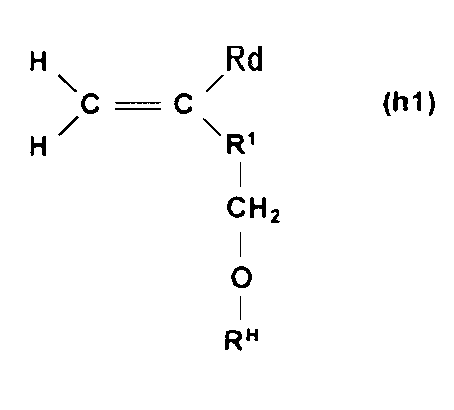
(式(h1)中、Rdは水素原子またはメチル基を示し、RHは前記ホスト基を示し、R1はヒドロキシル基、チオール基、1個以上の置換基を有していてもよいアルコキシ基、1個以上の置換基を有していてもよいチオアルコキシ基、1個以上の置換基を有していてもよいアルキル基、1個以上の置換基を有していてもよいアミノ基、1個以上の置換基を有していてもよいアミド基、アルデヒド基及びカルボキシル基からなる群より選択される1価の基から1個の水素原子を除去することにより形成される2価の基を示す。)
で表される、ホスト基含有重合性単量体からなる構成単位を少なくとも一部に含有する重合体であることを特徴とする電気化学デバイス用結着剤。 - 請求項1~3のいずれか1項に記載の電気化学デバイス用結着剤と、電極活物質と、分散媒とからなる電極合剤。
- 請求項1~3のいずれか1項に記載の電気化学デバイス用結着剤、電極活物質、電解液、及び、集電体を含む電極。
- 正極である請求項5に記載の電極。
- 負極である請求項5記載の電極。
- 電極活物質は、少なくとも一部に炭素質材料を含むものである請求項5に記載の電極。
- 電極活物質は、少なくとも一部にシリコン含有化合物を含むものである請求項5に記載の電極。
- 請求項5~9のいずれか1項に記載の電極を備える電気化学デバイス。
- 請求項5~9のいずれか1項に記載の電極を備える二次電池。
- リチウムイオン電池である請求項11記載の二次電池。
Priority Applications (4)
| Application Number | Priority Date | Filing Date | Title |
|---|---|---|---|
| CN202080006648.3A CN113166329B (zh) | 2019-03-04 | 2020-03-04 | 电化学器件用粘结剂、电极合剂、电极、电化学器件和二次电池 |
| EP20767146.2A EP3936544A4 (en) | 2019-03-04 | 2020-03-04 | BINDER FOR ELECTROCHEMICAL DEVICE, ELECTRODE MIX, ELECTRODE, ELECTROCHEMICAL DEVICE AND SECONDARY BATTERY |
| US17/425,649 US20220166024A1 (en) | 2019-03-04 | 2020-03-04 | Binder for electrochemical device, electrode mixture, electrode, electrochemical device and secondary battery |
| KR1020217027509A KR20210121177A (ko) | 2019-03-04 | 2020-03-04 | 전기 화학 디바이스용 결착제, 전극 합제, 전극, 전기 화학 디바이스 및 이차 전지 |
Applications Claiming Priority (2)
| Application Number | Priority Date | Filing Date | Title |
|---|---|---|---|
| JP2019-038913 | 2019-03-04 | ||
| JP2019038913 | 2019-03-04 |
Publications (1)
| Publication Number | Publication Date |
|---|---|
| WO2020179831A1 true WO2020179831A1 (ja) | 2020-09-10 |
Family
ID=72337191
Family Applications (1)
| Application Number | Title | Priority Date | Filing Date |
|---|---|---|---|
| PCT/JP2020/009217 Ceased WO2020179831A1 (ja) | 2019-03-04 | 2020-03-04 | 電気化学デバイス用結着剤、電極合剤、電極、電気化学デバイス及び二次電池 |
Country Status (7)
| Country | Link |
|---|---|
| US (1) | US20220166024A1 (ja) |
| EP (1) | EP3936544A4 (ja) |
| JP (1) | JP6913916B2 (ja) |
| KR (1) | KR20210121177A (ja) |
| CN (1) | CN113166329B (ja) |
| TW (1) | TWI747184B (ja) |
| WO (1) | WO2020179831A1 (ja) |
Families Citing this family (3)
| Publication number | Priority date | Publication date | Assignee | Title |
|---|---|---|---|---|
| KR102804625B1 (ko) * | 2021-02-04 | 2025-05-12 | 주식회사 엘지에너지솔루션 | 고체 전해질 제조용 조성물, 이를 이용하는 고체 전해질 및 리튬 이차 전지 |
| JP2023036088A (ja) | 2021-09-02 | 2023-03-14 | Tdk株式会社 | リチウムイオン二次電池 |
| WO2024207433A1 (zh) * | 2023-04-07 | 2024-10-10 | 宁德时代新能源科技股份有限公司 | 二次电池和用电装置 |
Citations (10)
| Publication number | Priority date | Publication date | Assignee | Title |
|---|---|---|---|---|
| JP2002117899A (ja) * | 2000-10-11 | 2002-04-19 | Matsushita Electric Ind Co Ltd | リチウムポリマー電池およびその製造法 |
| WO2014065407A1 (ja) | 2012-10-26 | 2014-05-01 | 和光純薬工業株式会社 | リチウム電池用結着剤、電極作製用組成物および電極 |
| JP2016162543A (ja) * | 2015-02-27 | 2016-09-05 | 国立大学法人山口大学 | ロタキサンネットワークポリマーを含有するポリマー電解質、及びそれを用いたマグネシウム二次電池 |
| JP2018016704A (ja) * | 2016-07-27 | 2018-02-01 | 日産化学工業株式会社 | シクロデキストリン誘導体の製造方法、及びその重合体 |
| WO2018038186A1 (ja) * | 2016-08-23 | 2018-03-01 | ダイキン工業株式会社 | 高分子材料 |
| JP2018111788A (ja) * | 2017-01-13 | 2018-07-19 | 国立大学法人大阪大学 | 接着構造体及びその製造方法 |
| WO2018159791A1 (ja) | 2017-03-02 | 2018-09-07 | 国立大学法人大阪大学 | ホスト基含有重合性単量体、高分子材料及びその製造方法、並びに、包接化合物及びその製造方法 |
| JP2018174038A (ja) | 2017-03-31 | 2018-11-08 | Tdk株式会社 | リチウムイオン二次電池負極用バインダー、リチウムイオン二次電池用負極及びこれを用いたリチウムイオン二次電池 |
| JP2018204004A (ja) * | 2017-05-30 | 2018-12-27 | 国立大学法人大阪大学 | 自己修復性導電性材料、導電性高分子化合物及び重合性単量体 |
| JP2019204719A (ja) * | 2018-05-24 | 2019-11-28 | 株式会社豊田自動織機 | 自己修復性負極 |
Family Cites Families (6)
| Publication number | Priority date | Publication date | Assignee | Title |
|---|---|---|---|---|
| KR102002190B1 (ko) | 2011-09-22 | 2019-07-19 | 스미또모 가가꾸 가부시키가이샤 | 금속계 입자 집합체의 제조 방법 |
| US10431830B2 (en) * | 2012-08-30 | 2019-10-01 | Kaneka Corporation | Current collector for battery and battery using same |
| JP6636610B2 (ja) * | 2016-03-18 | 2020-01-29 | 国立大学法人大阪大学 | 高分子材料及びその製造方法、並びに重合性単量体組成物 |
| JP2018159791A (ja) | 2017-03-22 | 2018-10-11 | 株式会社東芝 | 光結合モジュール |
| KR102392241B1 (ko) * | 2017-06-13 | 2022-05-02 | 로베르트 보쉬 게엠베하 | 리튬 이온 전지용 복합 바인더 및 그의 제조 |
| CN108242555B (zh) * | 2018-01-11 | 2020-06-26 | 电子科技大学 | 可自吸附柔性电池及其制备方法 |
-
2020
- 2020-03-04 CN CN202080006648.3A patent/CN113166329B/zh not_active Expired - Fee Related
- 2020-03-04 US US17/425,649 patent/US20220166024A1/en not_active Abandoned
- 2020-03-04 EP EP20767146.2A patent/EP3936544A4/en not_active Withdrawn
- 2020-03-04 KR KR1020217027509A patent/KR20210121177A/ko not_active Ceased
- 2020-03-04 TW TW109107132A patent/TWI747184B/zh not_active IP Right Cessation
- 2020-03-04 WO PCT/JP2020/009217 patent/WO2020179831A1/ja not_active Ceased
- 2020-03-04 JP JP2020036431A patent/JP6913916B2/ja active Active
Patent Citations (10)
| Publication number | Priority date | Publication date | Assignee | Title |
|---|---|---|---|---|
| JP2002117899A (ja) * | 2000-10-11 | 2002-04-19 | Matsushita Electric Ind Co Ltd | リチウムポリマー電池およびその製造法 |
| WO2014065407A1 (ja) | 2012-10-26 | 2014-05-01 | 和光純薬工業株式会社 | リチウム電池用結着剤、電極作製用組成物および電極 |
| JP2016162543A (ja) * | 2015-02-27 | 2016-09-05 | 国立大学法人山口大学 | ロタキサンネットワークポリマーを含有するポリマー電解質、及びそれを用いたマグネシウム二次電池 |
| JP2018016704A (ja) * | 2016-07-27 | 2018-02-01 | 日産化学工業株式会社 | シクロデキストリン誘導体の製造方法、及びその重合体 |
| WO2018038186A1 (ja) * | 2016-08-23 | 2018-03-01 | ダイキン工業株式会社 | 高分子材料 |
| JP2018111788A (ja) * | 2017-01-13 | 2018-07-19 | 国立大学法人大阪大学 | 接着構造体及びその製造方法 |
| WO2018159791A1 (ja) | 2017-03-02 | 2018-09-07 | 国立大学法人大阪大学 | ホスト基含有重合性単量体、高分子材料及びその製造方法、並びに、包接化合物及びその製造方法 |
| JP2018174038A (ja) | 2017-03-31 | 2018-11-08 | Tdk株式会社 | リチウムイオン二次電池負極用バインダー、リチウムイオン二次電池用負極及びこれを用いたリチウムイオン二次電池 |
| JP2018204004A (ja) * | 2017-05-30 | 2018-12-27 | 国立大学法人大阪大学 | 自己修復性導電性材料、導電性高分子化合物及び重合性単量体 |
| JP2019204719A (ja) * | 2018-05-24 | 2019-11-28 | 株式会社豊田自動織機 | 自己修復性負極 |
Non-Patent Citations (1)
| Title |
|---|
| See also references of EP3936544A4 |
Also Published As
| Publication number | Publication date |
|---|---|
| JP2020145193A (ja) | 2020-09-10 |
| TWI747184B (zh) | 2021-11-21 |
| US20220166024A1 (en) | 2022-05-26 |
| JP6913916B2 (ja) | 2021-08-04 |
| CN113166329B (zh) | 2023-02-21 |
| EP3936544A1 (en) | 2022-01-12 |
| TW202103360A (zh) | 2021-01-16 |
| CN113166329A (zh) | 2021-07-23 |
| EP3936544A4 (en) | 2022-12-07 |
| KR20210121177A (ko) | 2021-10-07 |
Similar Documents
| Publication | Publication Date | Title |
|---|---|---|
| KR102375531B1 (ko) | 전기 화학 디바이스용 결착제, 전극 합제, 전극, 전기 화학 디바이스 및 이차 전지 | |
| KR101921169B1 (ko) | 리튬 이온 이차 전지 부극용 슬러리 조성물, 리튬 이온 이차 전지 부극, 및 리튬 이온 이차 전지 | |
| US11735714B2 (en) | Negative electrode slurry composition for lithium secondary battery, and method for preparing the same | |
| CN109845005A (zh) | 正极活性材料预分散体组合物、二次电池用正极以及包含该正极的锂二次电池 | |
| KR101602526B1 (ko) | 리튬 이차 전지용 음극 활물질 및 이를 포함하는 리튬 이차 전지 | |
| JPWO2011096463A1 (ja) | リチウムイオン二次電池負極用スラリー組成物、リチウムイオン二次電池負極及びリチウム二次電池 | |
| JP7427629B2 (ja) | 正極及び該正極を含むリチウム電池 | |
| JP6477691B2 (ja) | 二次電池電極用バインダー組成物、二次電池電極用スラリー組成物、二次電池用電極、および、二次電池 | |
| CN106848379B (zh) | 含吸湿性物质的锂二次电池用电极及包含其的锂二次电池 | |
| CN114651347A (zh) | 负极活性材料和包含所述负极活性材料的负极和二次电池 | |
| JP6913916B2 (ja) | 電気化学デバイス用結着剤、電極合剤、電極、電気化学デバイス及び二次電池 | |
| JP2017134923A (ja) | リチウム二次電池用負極、リチウム二次電池およびそれらの製造方法 | |
| JP7304593B2 (ja) | 樹脂組成物、重合体、重合体の製造方法、電気化学デバイス用結着剤、電極合剤、電極、電気化学デバイス及び二次電池 | |
| CN104425817A (zh) | 锂镍复合氧化物及其的制备方法、以及正极活性物质 | |
| JP5382414B2 (ja) | リチウムイオン二次電池 |
Legal Events
| Date | Code | Title | Description |
|---|---|---|---|
| 121 | Ep: the epo has been informed by wipo that ep was designated in this application |
Ref document number: 20767146 Country of ref document: EP Kind code of ref document: A1 |
|
| ENP | Entry into the national phase |
Ref document number: 20217027509 Country of ref document: KR Kind code of ref document: A |
|
| NENP | Non-entry into the national phase |
Ref country code: DE |
|
| ENP | Entry into the national phase |
Ref document number: 2020767146 Country of ref document: EP Effective date: 20211004 |