WO2020183425A1 - Synergistic insecticidal combinations - Google Patents
Synergistic insecticidal combinations Download PDFInfo
- Publication number
- WO2020183425A1 WO2020183425A1 PCT/IB2020/052261 IB2020052261W WO2020183425A1 WO 2020183425 A1 WO2020183425 A1 WO 2020183425A1 IB 2020052261 W IB2020052261 W IB 2020052261W WO 2020183425 A1 WO2020183425 A1 WO 2020183425A1
- Authority
- WO
- WIPO (PCT)
- Prior art keywords
- insecticide
- denatonium
- inhibitors
- modulators
- combination
- Prior art date
- Legal status (The legal status is an assumption and is not a legal conclusion. Google has not performed a legal analysis and makes no representation as to the accuracy of the status listed.)
- Ceased
Links
Classifications
-
- A—HUMAN NECESSITIES
- A01—AGRICULTURE; FORESTRY; ANIMAL HUSBANDRY; HUNTING; TRAPPING; FISHING
- A01N—PRESERVATION OF BODIES OF HUMANS OR ANIMALS OR PLANTS OR PARTS THEREOF; BIOCIDES, e.g. AS DISINFECTANTS, AS PESTICIDES OR AS HERBICIDES; PEST REPELLANTS OR ATTRACTANTS; PLANT GROWTH REGULATORS
- A01N51/00—Biocides, pest repellants or attractants, or plant growth regulators containing organic compounds having the sequences of atoms O—N—S, X—O—S, N—N—S, O—N—N or O-halogen, regardless of the number of bonds each atom has and with no atom of these sequences forming part of a heterocyclic ring
-
- A—HUMAN NECESSITIES
- A01—AGRICULTURE; FORESTRY; ANIMAL HUSBANDRY; HUNTING; TRAPPING; FISHING
- A01N—PRESERVATION OF BODIES OF HUMANS OR ANIMALS OR PLANTS OR PARTS THEREOF; BIOCIDES, e.g. AS DISINFECTANTS, AS PESTICIDES OR AS HERBICIDES; PEST REPELLANTS OR ATTRACTANTS; PLANT GROWTH REGULATORS
- A01N37/00—Biocides, pest repellants or attractants, or plant growth regulators containing organic compounds containing a carbon atom having three bonds to hetero atoms with at the most two bonds to halogen, e.g. carboxylic acids
- A01N37/44—Biocides, pest repellants or attractants, or plant growth regulators containing organic compounds containing a carbon atom having three bonds to hetero atoms with at the most two bonds to halogen, e.g. carboxylic acids containing at least one carboxylic group or a thio analogue, or a derivative thereof, and a nitrogen atom attached to the same carbon skeleton by a single or double bond, this nitrogen atom not being a member of a derivative or of a thio analogue of a carboxylic group, e.g. amino-carboxylic acids
-
- A—HUMAN NECESSITIES
- A01—AGRICULTURE; FORESTRY; ANIMAL HUSBANDRY; HUNTING; TRAPPING; FISHING
- A01N—PRESERVATION OF BODIES OF HUMANS OR ANIMALS OR PLANTS OR PARTS THEREOF; BIOCIDES, e.g. AS DISINFECTANTS, AS PESTICIDES OR AS HERBICIDES; PEST REPELLANTS OR ATTRACTANTS; PLANT GROWTH REGULATORS
- A01N43/00—Biocides, pest repellants or attractants, or plant growth regulators containing heterocyclic compounds
- A01N43/34—Biocides, pest repellants or attractants, or plant growth regulators containing heterocyclic compounds having rings with one nitrogen atom as the only ring hetero atom
- A01N43/40—Biocides, pest repellants or attractants, or plant growth regulators containing heterocyclic compounds having rings with one nitrogen atom as the only ring hetero atom six-membered rings
-
- A—HUMAN NECESSITIES
- A01—AGRICULTURE; FORESTRY; ANIMAL HUSBANDRY; HUNTING; TRAPPING; FISHING
- A01N—PRESERVATION OF BODIES OF HUMANS OR ANIMALS OR PLANTS OR PARTS THEREOF; BIOCIDES, e.g. AS DISINFECTANTS, AS PESTICIDES OR AS HERBICIDES; PEST REPELLANTS OR ATTRACTANTS; PLANT GROWTH REGULATORS
- A01N43/00—Biocides, pest repellants or attractants, or plant growth regulators containing heterocyclic compounds
- A01N43/72—Biocides, pest repellants or attractants, or plant growth regulators containing heterocyclic compounds having rings with nitrogen atoms and oxygen or sulfur atoms as ring hetero atoms
- A01N43/88—Biocides, pest repellants or attractants, or plant growth regulators containing heterocyclic compounds having rings with nitrogen atoms and oxygen or sulfur atoms as ring hetero atoms six-membered rings with three ring hetero atoms
-
- A—HUMAN NECESSITIES
- A01—AGRICULTURE; FORESTRY; ANIMAL HUSBANDRY; HUNTING; TRAPPING; FISHING
- A01P—BIOCIDAL, PEST REPELLANT, PEST ATTRACTANT OR PLANT GROWTH REGULATORY ACTIVITY OF CHEMICAL COMPOUNDS OR PREPARATIONS
- A01P7/00—Arthropodicides
- A01P7/04—Insecticides
-
- A—HUMAN NECESSITIES
- A01—AGRICULTURE; FORESTRY; ANIMAL HUSBANDRY; HUNTING; TRAPPING; FISHING
- A01N—PRESERVATION OF BODIES OF HUMANS OR ANIMALS OR PLANTS OR PARTS THEREOF; BIOCIDES, e.g. AS DISINFECTANTS, AS PESTICIDES OR AS HERBICIDES; PEST REPELLANTS OR ATTRACTANTS; PLANT GROWTH REGULATORS
- A01N37/00—Biocides, pest repellants or attractants, or plant growth regulators containing organic compounds containing a carbon atom having three bonds to hetero atoms with at the most two bonds to halogen, e.g. carboxylic acids
- A01N37/44—Biocides, pest repellants or attractants, or plant growth regulators containing organic compounds containing a carbon atom having three bonds to hetero atoms with at the most two bonds to halogen, e.g. carboxylic acids containing at least one carboxylic group or a thio analogue, or a derivative thereof, and a nitrogen atom attached to the same carbon skeleton by a single or double bond, this nitrogen atom not being a member of a derivative or of a thio analogue of a carboxylic group, e.g. amino-carboxylic acids
- A01N37/46—N-acyl derivatives
Definitions
- the present invention relates to a synergistic insecticidal combination.
- the present invention provides an insecticidal combination comprising aversive agent and at least one insecticide which is useful against harmful pests in plants.
- the present invention also provides method of controlling harmful pests in plants using said composition.
- Jassids are wedge shaped insects which walk diagonally and suck the cell sap from piercing type of mouth parts. While sucking the cell sap they inject toxins into the plant body which results yellowing and curling of leaves, dropping down of flowering and fruiting bodies. They secrete honey dew like sticky substance which create sooty mould on leaves and affect photosynthesis, growth and finally the yield of the crop.
- IRAC Insecticide Resistance Action Committee
- N-cyanomethyl-4-trifluoromethyl-3-pyridinecarboxyamide (common name: Flonicamid) is used as an active ingredient for a pesticide for controlling Jassids.
- Flonicamid is a chordotonal organ modulator in the insecticide resistance action committee (IRAC) group 29.
- Nicotinic acetylcholine receptor (nAChR) competitive modulators are another class of insecticides classified in Group 4 by the IRAC group.
- the principle pest target for such insecticides is the sap-feeding insects.
- Crossthwaite et.al discloses the nicotinic acetylcholine receptor (nAChR) competitive modulators insecticides alongwith their mode of action.
- Jassids have developed resistance to such commonly used insecticides.
- the use of insecticides for the prevention and control of Jassids is thereby becoming increasingly difficult. Therefore, there is an urgent need to develop new methods and formulations for controlling these harmful pests.
- Potent synergistic insecticidal composition would by useful to manage insect pests for a desired higher crop yield and to control those insects which are hard to kill by existing commercial insecticides solely and in cyclic spray mixtures.
- Denatonium compounds in particular, Denatonium Benzoate and Denatonium Saccharide, as aversive agents is known. See U.S. Pat. Nos. 3,080,327, 3,268,577, 4,661,504 and 4,652,577.
- Denatonium benzoate also known as phenylmethyl-[2-[(2,6-dimethylphenyl)amino]- 2- oxoethyl]-diethylammonium benzoate, CAS no. 3734-33-6.
- Denatonium benzoate is commercially sold as BITREX®, available from Macfarlan Smith, Edinburgh, Scotland, UK.
- Bitrex is a quaternary ammonium salt formed by the combination of a cationic quaternary ammonium salt with an inert anion such as benzoate ion or saccharin anion. Having the following structure:
- Denatonium benzoate is listed in the Guinness Book of Records and the Merck Index as “the bitterest substance known to man”. Denatonium benzoate can be detected by the average person at 10 ppb and has a generally recognized bitter taste at 50 ppb (Anon.1989). The normal application range is 6-50 ppm, depending on the nature of the product to which it is added. Bitrex chemically resembles natural bitter substances such as quinine in having a molecular structure with separately charged elements that act on taste receptors. However, clinical trials have proven that its extremely human safe drug.
- Denatonium benzoate is generally used as a bittering agent (or aversive agent) to prevent eating of toxic substances. For example, added to industrial alcohol, paint, toilet cleaners, liquid soaps, and shampoos in order to prevent poisoning in people, animals. Also, For example, it can be used in a dilute solution to brush on the fingernails of people who are compulsive fingernail-biters or on the thumbs of children who suck their thumbs more than they should.
- Denatonium benzoate is also used as an animal repellent such as cat, dog, and bird repellents, for prevention of cannibalism in pigs, to keep horses from chewing their stalls, deer from nibbling tree shoots, and to keep hedgehogs from eating slug pellets (Payne 1988).
- US6399109B1 discloses a liquid insecticide solution comprising a 5% to 20% water solution of a disodium octaborate tetrahydrate (“DOT”) as insecticide, colored pigment, and a bittering agent of either sucrose octa-acetate or Denatonium benzoate, is provided.
- This solution containing disodium octaborate tetrahydrate insecticide kills fungi that cause wood rot in addition to wood-destroying insects such as, e.g., termites, beetles, and carpenter ants.
- W094/22299A1 discloses solid insecticidal composition
- a mixture of two insecticidally active ingredients in association with an insect-attractive bait substance characterized in that the first insecticidally active ingredients is an insect growth regulator active against larval stages of an insect and the second insecticidally active ingredient is a direct toxicant having knowk down and lethal effects in adult stages of the insect, the insect-attracting bait substance being attractive to both adult and larval stages of the insect, wherein the first insecticidally active ingredient is pyriproxyfen and the second insecticidally active ingredient is a pyrethroid or an organo-phosphorus compound.
- an insecticidal composition comprising:
- FIG. 1 Photographic images of treatment effects with combinations of the present invention on Okra:
- plants refers to all physical parts of a plant, including seeds, seedlings, saplings, roots, tubers, stems, stalks, foliage and fruits.
- insects as used herein, includes all organisms in the class "Insecta.”
- Jassids refers to sucking pests, leafhoppers from the family Cicadellidae (Jassidae).
- Insecticidal refers to the ability of a pesticide to increase mortality or inhibit growth rate of insects.
- locus refers to the part to which a combination according to the invention is applied. It includes application to an individual plant, a group of plants such as a plant and/or its surrounding, and the region in which plants may be planted as well application directly to an insect or insects and/or the vicinity in which they are located.
- agriculturally acceptable amount of active refers to an amount of an active that kills or inhibits the plant disease for which control is desired, in an amount not significantly toxic to the plant being treated.
- % by weight percent by weight as used herein, unless otherwise defined, relates to the relative weight of the respective component based on the total weight of the formulation.
- To“ control” or“ controlling’ insects means to inhibit, through a toxic effect, the ability of insect pests to survive, grow, feed, and/or reproduce, or to limit insect-related damage or loss in crop plants.
- To“control” insects may or may not mean killing the insects, although it preferably means killing the insects.
- aversive agents refers to the class of compounds which cause rejection of a material by presenting unpleasant gustatory cues such as flavors, textures, or other taste (and sometimes associative odor) characteristics.
- unpleasant gustatory cues such as flavors, textures, or other taste (and sometimes associative odor) characteristics.
- aversive agents There are two primary classes of aversive agents: bitterants, chemicals producing a bitter flavor, and pungent agents, chemicals producing an unpleasantly pungent flavor.
- chordotonal organ modulator refers to the class of insecticides classified by the insecticide resistance action committee (IRAC) group 29 which disrupts the chordotonal organs (i.e. stretch receptors) of the insects thereby interfering with movement, hearing and balance, causing the insect to stop feeding.
- IRAC insecticide resistance action committee
- Nicotinic acetylcholine receptor (nAChR) competitive modulators refers to another class of insecticides classified in Group 4 by the IRAC group.
- the nicotinic acetylcholine receptor (nAChR) is a ligand-gated ion channel composed of 5 protein subunits arranged around a central cation selective pore. Insecticides mediate their effect through interacting at nAChRs.
- the present invention provides an insecticidal composition comprising aversive agent for controlling the growth of insects.
- the present invention relates to a novel and effective insecticidal combination comprising: i) an aversive agent and
- the inventors of the present inventors have found that addition of an aversive agent to atleast one insecticide results in an unexpected enhancement of the efficacy, and a surprising reduction in plant disease incidence and enhanced pest control in comparison to the efficacy seen with the insecticides alone. It has been observed that the aversive agent which is conventionally used as a bitterant and otherwise does not demonstrate any insecticidal effect, unexpectedly enhances the efficacy of insecticides in combination and shows synergy. The efficacy of insecticides is enhanced after addition of an aversive agent. It is found to be more effective in killing Jassids (sucking pests) as compared to using insecticides alone.
- the composition comprises denatonium compounds as aversive agent
- the denatonium compound is typically present in the composition at a concentration in the range of about 0.01 to 50 % wt/v, preferably 0.01 to 20% w/v, more preferably in the range of about 0.01 to 10 % w/v which include 1%, 2%, 3%, 4%, 5%, 6%, 7%, 8% and 9% w/v.
- the aversive agent is used in an amount of about 1 to 5% w/w of total weight of the composition.
- Denatonium compound is selected from the group consisting of denatonium chloride, denatonium citrate, denatonium saccharide, denatonium carbonate, denatonium acetate, denatonium benzoate, denatonium benzoate monohydrate and mixtures thereof.
- the preferred aversive agent is Denatonium benzoate.
- the insecticides are selected from chordotonal organ modulators, nicotinic acetylcholine receptor (nAChR) competitive modulators; Acetylcholinesterase (AChE) inhibitors, GABA-gated chloridechannel blockers, Sodium channel modulators, Nicotinic acetylcholine receptor (nAChR) allosteric modulators - Site I, Glutamate-gated chloride channel (GluCl) allosteric modulators, Juvenile hormone mimics, Miscellaneous nonspecific (multi-site) inhibitors, Chordotonal organ TRPV channel modulators, Mite growth inhibitors affecting CHS1, Microbial dismptors of insect midgut membranes, Inhibitors of mitochondrial ATP synthase, Uncouplers of oxidative phosphorylation via disruption of the proton gradient, Nicotinic acetylcholine receptor (nAChR) channel blockers, Inhibitors of chitin biosynthesis affecting CHS1, Inhibitors
- the amount of insecticide used in the present invention may be the recommended dose of each insecticide used in the agriculture industry.
- the total amount of the insecticide is used in an amount in the range of 0.1 to 99% by weight, preferably 0.2 to 90% by weight, more preferably 0.5 to 90% by weight.
- chordotonal organ modulator insecticide is Flonicamid.
- flonicamid used is flonicamid 50% wet granular (WG) and can be used in an amount of 150 to 200 g/ha.
- the nicotinic acetylcholine receptor (nAChR) competitive modulators insecticides are selected from neonicotinoids, nicotine, sulfoximines, butenolides, mesoionics or combinations thereof.
- an agrochemical composition comprises neonicotinoid insecticide.
- neonicotinoid insecticide is selected from the group comprising of acetamiprid, clothianidin, imidacloprid, nitenpyram, nithiazine, Dinotefuran, thiacloprid, thiamethoxam or combinations thereof.
- neonicotinoid insecticide is imidacloprid.
- neonicotinoid insecticide is Imidacloprid 17.8 % SL and can be used in an amount of 100 to 125 ml/ha.
- the neonicotinoid insecticide is thiamethoxam.
- thiamethoxam used is Thiamethoxam 25 % WG and can be used in an amount of 100 g/ha.
- the sulfoximines is Sulfoxaflor.
- the butenolides is Flupyradifurone.
- the mesoionics is Triflumezopyrim.
- Acetylcholinesterase (AChE) inhibitors is selected from Alanycarb, Aldicarb, Bendiocarb, Benfuracarb, Butocarboxim, Butoxycarboxim, Carbaryl, Carbofuran, Carbosulfan, Ethiofencarb, Fenobucarb, Formetanate, Furathiocarb, Isoprocarb, Methiocarb, Methomyl, Metolcarb, Oxamyl, Pirimicarb, Propoxur, Thiodicarb, Thiofanox, Triazamate,Trimethacarb, XMC, Xylylcarb, Acephate, Azamethiphos, Azinphos-ethyl, Azinphosmethyl, Cadusafos, Chlorethoxyfos, Chlorfenvinphos, Chlormephos, Chlorpyrifos, Chlorpyrifos-methyl, Coumaphos, Cyanophos, De
- GABA-gated chloride channel blockers is selected from Chlordane, Endosulfan, Ethiprole and Fipronil.
- Sodium channel modulators is selected from Acrinathrin, Allethrin, d- cis-trans Allethrin, d-trans Allethrin, Bifenthrin, Bioallethrin, Bioallethrin Scyclopentenyl isomer , Bioresmethrin, Cycloprothrin, Cyfluthrin, beta-Cyfluthrin, Cyhalothrin, lambdaCyhalothrin, gamma-Cyhalothrin, Cypermethrin, alpha-Cypermethrin, beta- Cypermethrin, thetacypermethrin, zeta-Cypermethrin, Cyphenothrin , (lR)-trans- isomers], Deltamethrin, Empenthrin (EZ)- (1R)- isomers], Esfenvalerate, Etofenprox, Fenpropathrin, Fenvalerate, Flucyl is
- Nicotinic acetylcholine receptor (nAChR) allosteric modulators - Site I is selected from Spinetoram, Spinosad.
- Glutamate-gated chloride channel (GluC 1) allosteric modulators is selected from Abamectin, Emamectin benzoate, Lepimectin, Milbemectin.
- Juvenile hormone mimics is selected from the group comprising Hydroprene, Kinoprene, Methoprene, Fenoxycarb and Pyriproxyfen.
- Miscellaneous nonspecific (multi-site) inhibitors is selected from Methyl bromide and other alkyl halides, Chloropicrin, Cryolite (Sodium aluminum fluoride), Sulfuryl fluoride, Borax, Boric acid, Disodium octaborate, Sodium borate, Sodium metaborate, Tartar emetic, Dazomet and Metam.
- Chordotonal organ TRPV channel modulators is selected from Pymetrozine, Pyrifluquinazon, Afidopyropen.
- Mite growth inhibitors affecting CHS 1 is selected from Clofentezine, Diflovidazin, Hexythiazox and Etoxazole.
- Microbial disruptors of insect midgut membranes is selected from Bacillus thuringiensis subsp. israelensis Bacillus thuringiensis subsp. aizawai Bacillus thuringiensis subsp. kurstaki Bacillus thuringiensis subsp. tenebrionis B.t. crop proteins: CrylAb, Cry 1 Ac, CrylFa, Cry 1 A.105, Cry2Ab, Vip3A, mCry3A, Cry3Ab, Cry3Bb, Cry34Abl/Cry35Abl and Bacillus sphaericus.
- Inhibitors of mitochondrial ATP synthase is selected from Diafenthiuron, Azocyclotin, Cyhexatin, Fenbutatin oxide, Propargite and Tetradifon.
- Uncouplers of oxidative phosphorylation via disruption of the proton gradient is selected from Chlorfenapyr DNOC Sulfluramid.
- Nicotinic acetylcholine receptor (nAChR) channel blockers is selected from Bensultap, Cartap hydrochloride, Thiocyclam, Thiosultap-sodium.
- Inhibitors of chitin biosynthesis affecting CHS1 is selected from Bistrifluron, Chlorfluazuron, Diflubenzuron, Flucycloxuron, Flufenoxuron, Hexaflumuron, Fufenuron, Novaluron, Noviflumuron, Teflubenzuron and Triflumuron.
- inhibitors of chitin biosynthesis, type 1 is Buprofezin.
- Moulting disruptors, Dipteran is Cyromazine.
- Ecdysone receptor agonists is Chromafenozide, Halofenozide, Methoxyfenozide, Tebufenozide.
- Octopamine receptor agonists is Amitraz.
- Mitochondrial complex III electron transport inhibitors is selected from Hydramethylnon, Acequinocyl, Fluacrypyrim and Bifenazate.
- 21 Mitochondrial complex I electron transport inhibitors is selected from Fenazaquin, Fenpyroximate, Pyridaben, Pyrimidifen, Tebufenpyrad Rotenone (Derris) and Tolfenpyrad.
- Voltage-dependent sodium channel blockers is selected from Indoxacarb, Metaflumizone.
- Inhibitors of acetyl CoA carboxylase is selected from Spirodiclofen, Spiromesifen and Spirotetramat.
- Mitochondrial complex IV electron transport inhibitors is selected from Aluminium phosphide, Calcium phosphide, Phosphine, Zinc phosphide, Calcium cyanide, Potassium cyanide, Sodium cyanide.
- Mitochondrial complex II electron transport inhibitors is selected from Cyenopyrafen, Cyflumetofen and Pyflubumide.
- Ryanodine receptor modulators is selected from Chlorantraniliprole, Cyantraniliprole, Cyclaniliprole and Flubendiamide.
- GABA-gated chloride channel allosteric modulators is selected from Broflanilide and Fluxametamide.
- unknown mode of action compounds are selected from Azadirachtin, Benzoximate, Bromopropylate, Chinomethionat, Dicofol, Lime sulfur, Pyridalyl and Sulfur.
- the present invention provides an insecticidal combination comprising aversive agent and at least one insecticide.
- the present composition comprises denatonium benzoate as aversive agent.
- the present composition comprises insecticide selected from the group comprising chordotonal organ modulators, nicotinic acetylcholine receptor (nAChR) competitive modulators; Acetylcholinesterase (AChE) inhibitors, GABA-gated chloridechannel blockers, Sodium channel modulators, Nicotinic acetylcholine receptor (nAChR) allosteric modulators - Site I, Glutamate-gated chloride channel (GluCl) allosteric modulators, Juvenile hormone mimics, Miscellaneous nonspecific (multi-site) inhibitors, Chordotonal organ TRPV channel modulators, Mite growth inhibitors affecting CHS1, Microbial disruptors of insect midgut membranes, Inhibitors of mitochondrial ATP synthase, Uncouplers of oxidative phosphorylation via disruption of the proton gradient, Nicotinic acetylcholine receptor (nAChR) channel blockers, Inhibitors of chitin biosynthesis affecting CHS1, In
- composition comprising a combination of aversive agent and at least one insecticide and agrochemically acceptable excipient.
- the aversive agent is used in an amount in the range of 0.01 to 50% w/w.
- the insecticide is used in an amount in the range of 0.1 to 99% w/w.
- the present composition comprises denatonium benzoate as aversive agent and insecticide is selected from chordotonal organ modulator insecticide or neonicotinoid insecticide.
- the present composition comprises denatomium benzoate and at least one insecticide selected from flonicamid, imidacloprid or thiamethoxam.
- the insecticidal combination comprises Denatonium benzoate and Flonicamid.
- the insecticidal combination comprises Denatonium benzoate and Thiamethoxam.
- the insecticidal combination comprises Denatonium benzoate and Imidacloprid.
- the combinations of the present invention may be formulated in the form of a composition.
- compositions described herein comprising agrochemically acceptable excipients.
- At least one agrochemically acceptable excipient comprises wetting agents, dispersing agents, emulsifiers, binding agents, sticking agents, fillers, diluents, solvents, coating agents, stabilizers, chelating agents and coloring agents and buffering agent.
- agrochemically acceptable excipient can be in the range from 0.1% to 99% of the total weight of the composition.
- the amount of a composition according to the invention to be applied will depend on various factors, such as the subject of the treatment, such as, for example plants, soil or seeds; the type of treatment, such as, for example spraying, dusting or seed dressing; the purpose of the treatment, such as, for example prophylactic or therapeutic disease control; in case of disease control the type of fungi to be controlled or the application time.
- This amount of the combinations of the present invention to be applied can be readily deduced by a skilled agronomist.
- the combination of the present invention maybe formulated as liquid solution.
- the combination of the present invention maybe a suspension formulation.
- the combination of the present invention maybe formulated in a manner which suits the specific application.
- the formulation may be solid or liquid formulations.
- suitable liquid formulations may be emulsion concentrates (EC), suspension concentrates (SC), capsule suspensions (CS); suitable solid formulations may be water dispersible granules (WDG) and wettable powders (WP), dusts and the like.
- Adjuvants and ancillary ingredients may be used to formulate such pre-formulated compositions and may employ wetting agents, adhesives, dispersants, penetrants, rain fastening agents or surfactants and, if appropriate, solvent or oil and other agriculturally acceptable additives and adjuvants.
- a process for the preparation of agrochemical composition comprising a combination of aversive agent and at least one insecticide comprising dissolving mixing active ingredients in to an aqueous solution containing agrochemically acceptable carriers under stirring to form a clear/ hazy solution.
- This solution was stirred continuously till it forms a uniform dispersed.
- the composition may further comprise at least one selected from anionic surfactant(s), antifreezing agent(s), wetting agent(s), antifoaming agent(s), thickening agents, preservatives, plant health promoting agent and optionally other auxiliary ingredients; and packaging the resulting agrochemical composition.
- the combination of the present invention is preferably effective against the harmful sucking pest.
- the present invention provides a method for controlling harmful pests in plants, said method comprising applying to the locus of the insect pest infestation, an insecticidal combination comprising an aversive agent and at least one insecticide.
- the present invention provides a method of controlling harmful pests in plants, comprising applying to a locus of the insect pest infestation, an insecticidal combination comprising denatonium compound as aversive agent and at least one insecticide.
- the invention further relates to a method of application of the present agricultural composition comprising said combination of aversive agent and at least one insecticide to crops and plants.
- the composition is highly safe to the user and to the environment.
- composition of this invention is effective against a wide spectrum of foliar-feeding, fruit-feeding, stem or root feeding, seed-feeding, aquatic and soil-inhabiting arthropods (term“arthropods” includes insects, mites and nematodes) which are pests of growing and stored agronomic crops, forestry, greenhouse crops, ornamentals, nursery crops, stored food and fiber products, livestock, household, and public and animal health.
- arthropods includes insects, mites and nematodes
- the composition of the present invention is effective against all growth stages of all pests preferably all sucking pest.
- the composition of present invention is effective against pests that include: eggs, larvae and adults of the Order Lepidoptera; eggs, foliar-feeding, fruit-feeding, root-feeding, seed-feeding larvae and adults of the Order Coleoptera; eggs, immatures and adults of the Orders Hemiptera and Homoptera; eggs, larvae, nymphs and adults of the Order Acari; eggs, immatures and adults of the Orders Thysanoptera, Orthoptera and Dermaptera; eggs, immatures and adults of the Order Diptera; and eggs, juveniles and adults of the Phylum Nematoda.
- compositions of invention are also effective against pests of the Orders Hymenoptera, Isoptera, Siphonaptera, Blattaria, Thysanura and Psocoptera; pests belonging to the Class Arachnida and Phylum Platyhelminthes; southern corn rootworm (Diabrotica undecimpunctata howardi), aster leafhopper (Mascrosteles fascifrons), boll weevil (Anthonomus grandis), two-spotted spider mite (Tetranychus urticae), fall armyworm (Spodoptera frugiperda), black bean aphid (Aphis fabae), green peach aphid (Myzus persica), cotton aphid (Aphis gossypii), Russian wheat aphid (Diuraphis noxia), English grain aphid (Sitobion avenae), whitefly (Bemisia tabacii), tobacco budworm (Heliothis virescen
- the combination of the present invention is preferably effective against j as sids.
- the Jassid species is selected from Amrasca bigutula bigutula., Adelungiinae; Agalliinae, Aphrodinae, Arrugadinae, Austroagalloidinae Bythoniinae,Cicadellinae,Bothrogonia,Graphocephala (including coccinea),Homalodisca Zyzzogeton, Coelidiinae,Deltocephalinae, Anoplotettix (Ferrari,
- the plants are selected from but not limited to cereals, such as wheat, oats, barley, spelt, triticale, rye, maize, millet, rice, crops such as sugarcane, soybean, sunflower, rape, canola, tobacco, sugar beet, fodder beet; tuber crops such as potatoes, sweet potatoes etc., crops such as asparagus, hops etc.,; fruit plants such as apples, pears, stone-fruits such as for example peaches, nectarines, cherries, plums, apricots, citrus fruits such as oranges, grapefruit, limes, lemons, kumquats, mandarins, satsumas; nuts such as pistachios, almonds, walnuts, pecan nuts, tropical fruits such as mango, papaya, pineapple, dates, bananas etc., grapes, vegetables such as endives, lambs, lettuce, fennel, globe and loose-leaf salad, chard, spinach, chicory, cauliflower, broccoli
- crops
- treating the locus with the combination of the present invention comprises administering to the soil, applying to the plant or parts of the plant or seed with an effective amount of aversive agent and insecticide.
- the administration is preferably by application either when first signs of infestation are seen or when insect pests begin to reappear.
- the combination of aversive agent and insecticides can be obtained from separate formulation sources and mixed together and used as a tank-mix, ready-to-apply, spray broth, or slurry, optionally with other pesticides, or the said combination may be obtained as a single formulation mixture such as a pre-mix, concentrate or formulated product and optionally mixed together with other insecticides, attractants, sterilants, bactericides, acaracides, nematicides, fungicides, growth regulators, herbicides, fertilizers and mixtures thereof.
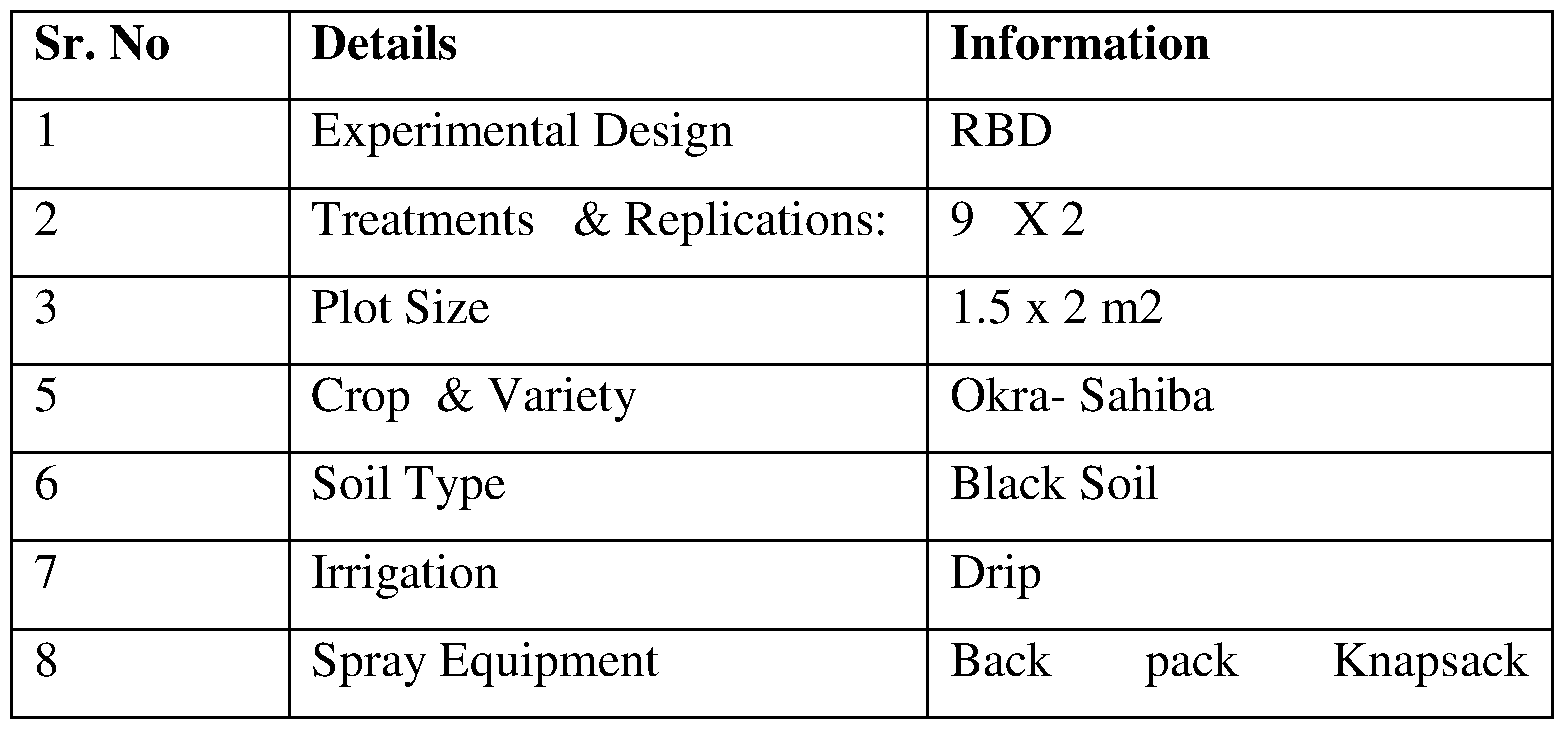
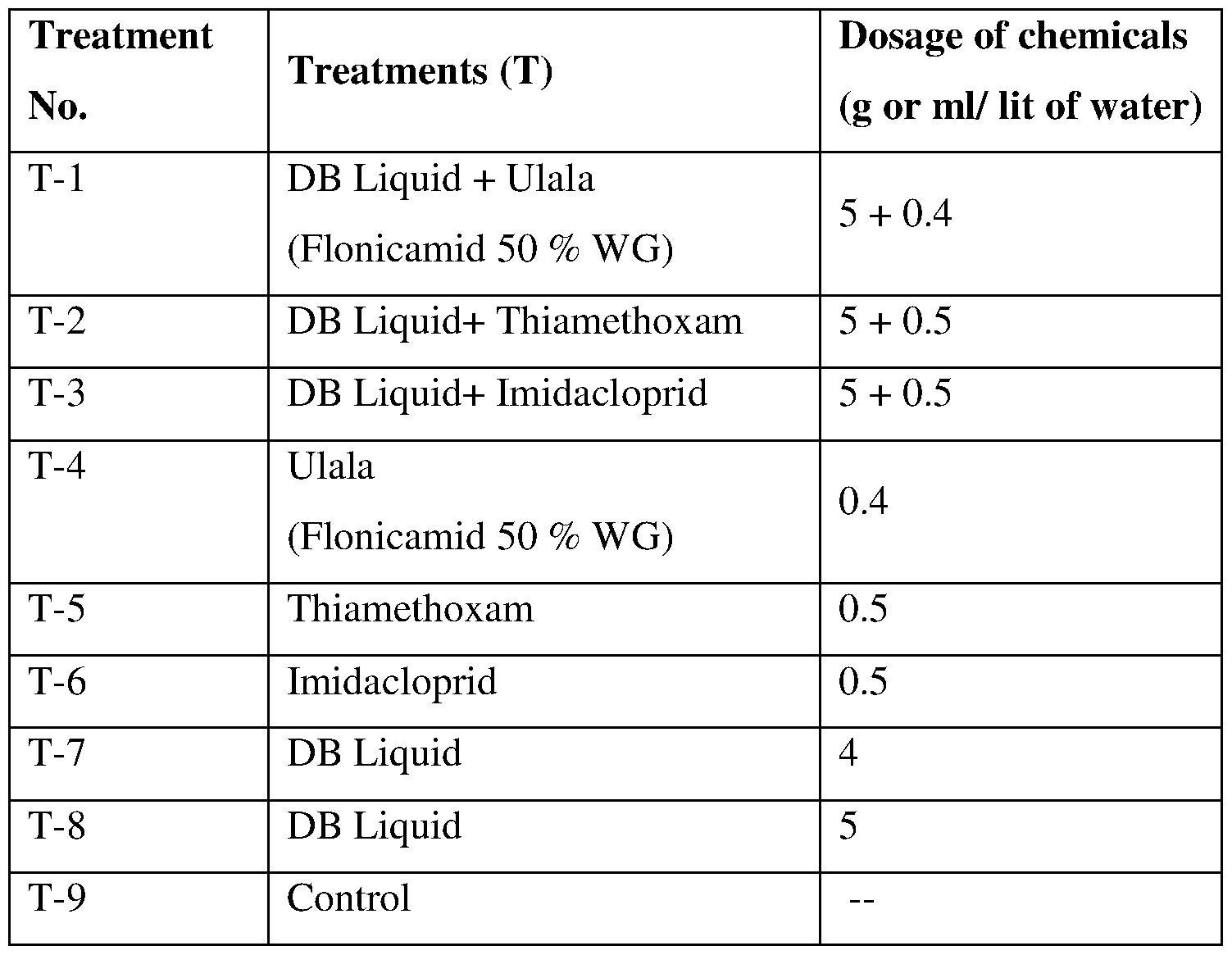
- T-l, T-2 and T-3 are the treatment with insecticidal combinations according to the present invention
- T-4, T-5 and T-6 are the treatment with insecticides alone
- T-7 and T-8 are the treatment with Denatonium benzoate (DB) liquid solutions alone and T-9 is the control.
- DB Denatonium benzoate
- Bio-efficacy of insecticidal combinations of the present invention against Jassids in infected Okra were evaluated. The percentage control of Jassids was measured. Efficacy was evaluated as: Excellent 91-100%, Very good 81-90%, Good 71-80%, Moderate 51- 5 70%, Poor ⁇ 50%.
- Table-3 illustrates the efficacy results of the synergistic combination of present invention.
- Denatonium Benzoate enhances the efficacy of Insecticides and shows Synergy.
- the efficacy of Flonicamid, Thiamethoxam and Imidacloprid is enhanced after addition of DB. It is found that the present combinations are more effective in killing Jassids 25 (sucking pests) over using insecticides alone. It is clearly observed that Denatonium Benzoate alone does not exhibit any insecticidal activity; however, a combination of Denatonium Benzoate with other insecticides results in a synergistic insecticidal activity. It is to be understood that the present invention is susceptible to modifications, changes and adaptations by those skilled in the art. Such modifications, changes, adaptations are intended to be within the scope of the present invention.
Landscapes
- Life Sciences & Earth Sciences (AREA)
- Plant Pathology (AREA)
- Environmental Sciences (AREA)
- Engineering & Computer Science (AREA)
- Zoology (AREA)
- Wood Science & Technology (AREA)
- Pest Control & Pesticides (AREA)
- Health & Medical Sciences (AREA)
- Agronomy & Crop Science (AREA)
- Dentistry (AREA)
- General Health & Medical Sciences (AREA)
- General Chemical & Material Sciences (AREA)
- Chemical Kinetics & Catalysis (AREA)
- Chemical & Material Sciences (AREA)
- Insects & Arthropods (AREA)
- Agricultural Chemicals And Associated Chemicals (AREA)
Abstract
Description





Claims
Priority Applications (6)
| Application Number | Priority Date | Filing Date | Title |
|---|---|---|---|
| BR112021015982-7A BR112021015982A2 (en) | 2019-03-13 | 2020-03-13 | SYNERGIC COMBINATIONS OF INSECTICIDES |
| SG11202109418QA SG11202109418QA (en) | 2019-03-13 | 2020-03-13 | Synergistic insecticidal combinations |
| CA3132929A CA3132929A1 (en) | 2019-03-13 | 2020-03-13 | Synergistic insecticidal combinations |
| US17/433,687 US20220046919A1 (en) | 2019-03-13 | 2020-03-13 | Synergistic insecticidal combinations |
| EP20771107.8A EP3937635A4 (en) | 2019-03-13 | 2020-03-13 | SYNERGIC INSECTICIDES COMBINATIONS |
| MYPI2021004837A MY207896A (en) | 2019-03-13 | 2020-03-13 | Synergistic insecticidal combinations |
Applications Claiming Priority (2)
| Application Number | Priority Date | Filing Date | Title |
|---|---|---|---|
| IN201931009832 | 2019-03-13 | ||
| IN201931009832 | 2019-03-13 |
Publications (1)
| Publication Number | Publication Date |
|---|---|
| WO2020183425A1 true WO2020183425A1 (en) | 2020-09-17 |
Family
ID=72427884
Family Applications (1)
| Application Number | Title | Priority Date | Filing Date |
|---|---|---|---|
| PCT/IB2020/052261 Ceased WO2020183425A1 (en) | 2019-03-13 | 2020-03-13 | Synergistic insecticidal combinations |
Country Status (7)
| Country | Link |
|---|---|
| US (1) | US20220046919A1 (en) |
| EP (1) | EP3937635A4 (en) |
| BR (1) | BR112021015982A2 (en) |
| CA (1) | CA3132929A1 (en) |
| MY (1) | MY207896A (en) |
| SG (1) | SG11202109418QA (en) |
| WO (1) | WO2020183425A1 (en) |
Cited By (1)
| Publication number | Priority date | Publication date | Assignee | Title |
|---|---|---|---|---|
| EP4691239A1 (en) * | 2024-08-08 | 2026-02-11 | UPL Mauritius Limited | An insecticidal combination, composition and method of using the same |
Families Citing this family (3)
| Publication number | Priority date | Publication date | Assignee | Title |
|---|---|---|---|---|
| WO2020170148A1 (en) | 2019-02-20 | 2020-08-27 | Upl Ltd | Spray composition of aversive agent |
| US20220142159A1 (en) * | 2019-02-20 | 2022-05-12 | Upl Ltd | A method and composition for insect repellency using aversive agent |
| CN117322423B (en) * | 2023-12-01 | 2024-02-13 | 济南兄弟作物科学有限公司 | Fluodine thiamethoxam water dispersible granule for preventing tea tree damage and preparation method thereof |
Citations (13)
| Publication number | Priority date | Publication date | Assignee | Title |
|---|---|---|---|---|
| US3080327A (en) | 1959-11-20 | 1963-03-05 | T & H Smith Ltd | Quaternary salts as denaturants for organic substances |
| US3268577A (en) | 1960-11-15 | 1966-08-23 | Edinburgh Pharmaceutical Ind L | Quaternary organic salts of omega-dialkylamino-2, 6-dimethylacetanilides |
| US4652577A (en) | 1984-11-02 | 1987-03-24 | Atomergic Chemetals Corporation | Denatonium saccharide, compositions and method of use |
| US4661504A (en) | 1984-11-02 | 1987-04-28 | Atomergic Chemetals Corporation | Denatonium saccharide compositions and method of use |
| WO1994022299A1 (en) | 1993-03-31 | 1994-10-13 | Zeneca Limited | Insecticidal compositions |
| US6399109B1 (en) | 1997-12-19 | 2002-06-04 | Alan D. Brite | Insecticide including disodium octaborate tetrahydrate and method for treating wood therewith |
| WO2005013687A2 (en) | 2003-07-29 | 2005-02-17 | Novartis Ag | Organic compounds |
| US20060008493A1 (en) | 2004-07-12 | 2006-01-12 | Jadhav Prakash M | Synergistic insecticidal composition containing Chloronicotynyle and Organosphosphorus compounds |
| US20070071785A1 (en) * | 2003-08-29 | 2007-03-29 | Reckitt Benckiser (Australia) Pty Limited | Solid stick insecticidal composition |
| US20080089857A1 (en) | 2004-11-13 | 2008-04-17 | Bayer Cropsicience Lp | Fly Gel Bait |
| US7531187B2 (en) * | 2004-07-13 | 2009-05-12 | United Phosphorus, Ltd. | Synergistic insecticidal composition containing chloronicotynyle and pyrethroids compounds |
| US20130053421A1 (en) * | 2010-01-06 | 2013-02-28 | Fmc Corporation | Method for Flying Insect Control |
| WO2017202882A1 (en) * | 2016-05-24 | 2017-11-30 | Zapi Industrie Chimiche S.P.A | Gel baits for controlling harmful insect |
Family Cites Families (5)
| Publication number | Priority date | Publication date | Assignee | Title |
|---|---|---|---|---|
| US6468554B1 (en) * | 1994-06-07 | 2002-10-22 | Ted Ichino | Sensorially active substance embedded in plastic |
| US5891919A (en) * | 1997-09-19 | 1999-04-06 | Burlington Bio-Medical & Scientific Corp. | Denatonium capsaicinate and methods of producing the same |
| US6903093B2 (en) * | 2000-10-06 | 2005-06-07 | Monsanto Technology Llc | Seed treatment with combinations of pyrethrins/pyrethroids and thiamethoxam |
| US20130161222A1 (en) * | 2011-12-21 | 2013-06-27 | Ajit M. Patel | Bedbugs eliminator |
| US20170112126A1 (en) * | 2014-06-10 | 2017-04-27 | Sabic Global Technologies B.V. | Insecticide-containing coating composition and method for protecting palm trees from pests |
-
2020
- 2020-03-13 CA CA3132929A patent/CA3132929A1/en active Pending
- 2020-03-13 BR BR112021015982-7A patent/BR112021015982A2/en active IP Right Grant
- 2020-03-13 SG SG11202109418QA patent/SG11202109418QA/en unknown
- 2020-03-13 EP EP20771107.8A patent/EP3937635A4/en active Pending
- 2020-03-13 US US17/433,687 patent/US20220046919A1/en active Pending
- 2020-03-13 MY MYPI2021004837A patent/MY207896A/en unknown
- 2020-03-13 WO PCT/IB2020/052261 patent/WO2020183425A1/en not_active Ceased
Patent Citations (15)
| Publication number | Priority date | Publication date | Assignee | Title |
|---|---|---|---|---|
| US3080327A (en) | 1959-11-20 | 1963-03-05 | T & H Smith Ltd | Quaternary salts as denaturants for organic substances |
| US3268577A (en) | 1960-11-15 | 1966-08-23 | Edinburgh Pharmaceutical Ind L | Quaternary organic salts of omega-dialkylamino-2, 6-dimethylacetanilides |
| US4652577A (en) | 1984-11-02 | 1987-03-24 | Atomergic Chemetals Corporation | Denatonium saccharide, compositions and method of use |
| US4661504A (en) | 1984-11-02 | 1987-04-28 | Atomergic Chemetals Corporation | Denatonium saccharide compositions and method of use |
| WO1994022299A1 (en) | 1993-03-31 | 1994-10-13 | Zeneca Limited | Insecticidal compositions |
| US6399109B1 (en) | 1997-12-19 | 2002-06-04 | Alan D. Brite | Insecticide including disodium octaborate tetrahydrate and method for treating wood therewith |
| WO2005013687A2 (en) | 2003-07-29 | 2005-02-17 | Novartis Ag | Organic compounds |
| US20070071784A1 (en) * | 2003-07-29 | 2007-03-29 | Rakoczi Ferenc J | Organic compounds |
| US20070071785A1 (en) * | 2003-08-29 | 2007-03-29 | Reckitt Benckiser (Australia) Pty Limited | Solid stick insecticidal composition |
| US20060008493A1 (en) | 2004-07-12 | 2006-01-12 | Jadhav Prakash M | Synergistic insecticidal composition containing Chloronicotynyle and Organosphosphorus compounds |
| US7531187B2 (en) * | 2004-07-13 | 2009-05-12 | United Phosphorus, Ltd. | Synergistic insecticidal composition containing chloronicotynyle and pyrethroids compounds |
| US20080089857A1 (en) | 2004-11-13 | 2008-04-17 | Bayer Cropsicience Lp | Fly Gel Bait |
| US20100291022A1 (en) * | 2004-11-13 | 2010-11-18 | Bayer Cropscience Ag | Fly Gel Bait |
| US20130053421A1 (en) * | 2010-01-06 | 2013-02-28 | Fmc Corporation | Method for Flying Insect Control |
| WO2017202882A1 (en) * | 2016-05-24 | 2017-11-30 | Zapi Industrie Chimiche S.P.A | Gel baits for controlling harmful insect |
Non-Patent Citations (8)
| Title |
|---|
| CROSSTHWAITE, ANDREW J ET AL.: "The invertebrate pharmacology of insecticides acting at nicotinic acetylcholine receptors.", JOURNAL OF PESTICIDE SCIENCE, vol. 42, no. 3, 2017, pages 67 - 83 |
| DATABASE GNPD 27 January 2011 (2011-01-27), INVENT: "Raptor Cockroach Traps", XP055739329, Database accession no. 1448709 * |
| DATABASE GNPD 4 June 2013 (2013-06-04), BINKA: "Ultra Pum Total Extermination Flies Insecticide", XP055739328, retrieved from Mintel Database accession no. 2084740 * |
| no. 3734-33-6 |
| SACKMANN, P ET AL.: "Effects of the bittering agent denatonium benzoate on the success of toxic baiting of pestiferous German wasps (Vespula german ica", INTERNATIONAL JOURNAL OF PEST MANAGEMENT, vol. 56, no. 1, 2010, pages 69 - 74, XP055721920, DOI: 10.1080/09670870903075022 * |
| SATHE, T. V.NILAM SHENDAGECHANDNI KAMBLE: "Biodiversity of Jassids from agroecosystems of Kolhapur district, India", INT. NAT. J. SCI. ENVIRON. AND TECH, vol. 3, no. 3, 2014, pages 1053 - 1058 |
| See also references of EP3937635A4 |
| SPARKS, THOMAS C.RALF NAUEN.: "IRAC: Mode of action classification and insecticide resistance management", PESTICIDE BIOCHEMISTRY AND PHYSIOLOGY, vol. 121, 2015, pages 122 - 128, XP029613644, DOI: 10.1016/j.pestbp.2014.11.014 |
Cited By (2)
| Publication number | Priority date | Publication date | Assignee | Title |
|---|---|---|---|---|
| EP4691239A1 (en) * | 2024-08-08 | 2026-02-11 | UPL Mauritius Limited | An insecticidal combination, composition and method of using the same |
| WO2026033481A1 (en) * | 2024-08-08 | 2026-02-12 | Upl Mauritius Limited | An insecticidal combination, composition and method of using the same |
Also Published As
| Publication number | Publication date |
|---|---|
| SG11202109418QA (en) | 2021-09-29 |
| BR112021015982A2 (en) | 2021-10-05 |
| US20220046919A1 (en) | 2022-02-17 |
| MY207896A (en) | 2025-03-27 |
| EP3937635A4 (en) | 2022-12-14 |
| CA3132929A1 (en) | 2020-09-17 |
| EP3937635A1 (en) | 2022-01-19 |
Similar Documents
| Publication | Publication Date | Title |
|---|---|---|
| US12161117B2 (en) | Agrochemical combinations | |
| US20220046919A1 (en) | Synergistic insecticidal combinations | |
| JP2013520455A (en) | Pesticide mixtures containing isoxazoline derivatives and insecticides or nematicidal biological agents | |
| JP7256793B2 (en) | novel pesticide combinations | |
| TW201108941A (en) | Combinations of biological control agents and insecticides | |
| BR112018015328B1 (en) | METHODS FOR THE CONTROL OF PESTS IN PLANTS, METHOD FOR CONTROLLING PESTS IN THE FAMILY OF PENTATOMIDAE AND/OR MIRIDAE AND USE OF ONE OR MORE COMPOUNDS OF FORMULA I | |
| WO2016165642A1 (en) | Synergistic insecticidal composition comprising neonicotinoid, pyrethroid and avermectin insecticides | |
| US20190075793A1 (en) | Formulations for killing agricultural pests | |
| CN116019115A (en) | Insecticidal composition comprising isoxapyrad | |
| CN108024538A (en) | Synergistic insecticidal composition | |
| CN102753020A (en) | Insecticidal composition | |
| CN1221173C (en) | Pesticidal composition | |
| CN117119891A (en) | pesticidal compositions | |
| WO2019124564A1 (en) | Synergistic insecticide composition including nitrophenol compound and insecticidally active compound | |
| AU2015234288B2 (en) | A synergistic insecticidal composition | |
| RU2793136C2 (en) | Synergic combinations of insecticides | |
| WO2019124563A1 (en) | Synergistic acaricide composition including nitrophenol compound and acaricidally active compound | |
| TWI820339B (en) | Novel agrochemical combinations | |
| JP2022120577A (en) | Pesticidal and acaricidal compositions containing formulated oil and insecticidal and acaricidal agents | |
| RU2835639C2 (en) | Combination containing insecticide with agent based on silicic acid | |
| JP2017222667A (en) | Pest control mixture | |
| Dajiram | BIOEFFICACY OF DIFFERENT INSECTICIDES AGAINST SUCKING PESTS OF POMEGRANATE | |
| Kale et al. | Studies on thiamethoxam, fipronil, abamectin and spinosad against pests of okra | |
| WO2025005223A1 (en) | Composition, pest control preparation, and pest control method | |
| JP2015500316A (en) | Pest control mixture |
Legal Events
| Date | Code | Title | Description |
|---|---|---|---|
| 121 | Ep: the epo has been informed by wipo that ep was designated in this application |
Ref document number: 20771107 Country of ref document: EP Kind code of ref document: A1 |
|
| REG | Reference to national code |
Ref country code: BR Ref legal event code: B01A Ref document number: 112021015982 Country of ref document: BR |
|
| WWE | Wipo information: entry into national phase |
Ref document number: LK/P/1/21926 Country of ref document: LK |
|
| ENP | Entry into the national phase |
Ref document number: 3132929 Country of ref document: CA |
|
| NENP | Non-entry into the national phase |
Ref country code: DE |
|
| ENP | Entry into the national phase |
Ref document number: 112021015982 Country of ref document: BR Kind code of ref document: A2 Effective date: 20210813 |
|
| ENP | Entry into the national phase |
Ref document number: 2020771107 Country of ref document: EP Effective date: 20211013 |