WO2020183757A1 - 定着装置及び画像形成装置 - Google Patents
定着装置及び画像形成装置 Download PDFInfo
- Publication number
- WO2020183757A1 WO2020183757A1 PCT/JP2019/032291 JP2019032291W WO2020183757A1 WO 2020183757 A1 WO2020183757 A1 WO 2020183757A1 JP 2019032291 W JP2019032291 W JP 2019032291W WO 2020183757 A1 WO2020183757 A1 WO 2020183757A1
- Authority
- WO
- WIPO (PCT)
- Prior art keywords
- recording medium
- unit
- paper
- heating
- fixing device
- Prior art date
- Legal status (The legal status is an assumption and is not a legal conclusion. Google has not performed a legal analysis and makes no representation as to the accuracy of the status listed.)
- Ceased
Links
Images



Classifications
-
- G—PHYSICS
- G03—PHOTOGRAPHY; CINEMATOGRAPHY; ANALOGOUS TECHNIQUES USING WAVES OTHER THAN OPTICAL WAVES; ELECTROGRAPHY; HOLOGRAPHY
- G03G—ELECTROGRAPHY; ELECTROPHOTOGRAPHY; MAGNETOGRAPHY
- G03G15/00—Apparatus for electrographic processes using a charge pattern
- G03G15/20—Apparatus for electrographic processes using a charge pattern for fixing, e.g. by using heat
-
- G—PHYSICS
- G03—PHOTOGRAPHY; CINEMATOGRAPHY; ANALOGOUS TECHNIQUES USING WAVES OTHER THAN OPTICAL WAVES; ELECTROGRAPHY; HOLOGRAPHY
- G03G—ELECTROGRAPHY; ELECTROPHOTOGRAPHY; MAGNETOGRAPHY
- G03G15/00—Apparatus for electrographic processes using a charge pattern
- G03G15/20—Apparatus for electrographic processes using a charge pattern for fixing, e.g. by using heat
- G03G15/2003—Apparatus for electrographic processes using a charge pattern for fixing, e.g. by using heat using heat
- G03G15/2007—Apparatus for electrographic processes using a charge pattern for fixing, e.g. by using heat using heat using radiant heat, e.g. infrared lamps, microwave heaters
-
- G—PHYSICS
- G03—PHOTOGRAPHY; CINEMATOGRAPHY; ANALOGOUS TECHNIQUES USING WAVES OTHER THAN OPTICAL WAVES; ELECTROGRAPHY; HOLOGRAPHY
- G03G—ELECTROGRAPHY; ELECTROPHOTOGRAPHY; MAGNETOGRAPHY
- G03G15/00—Apparatus for electrographic processes using a charge pattern
- G03G15/20—Apparatus for electrographic processes using a charge pattern for fixing, e.g. by using heat
- G03G15/2003—Apparatus for electrographic processes using a charge pattern for fixing, e.g. by using heat using heat
- G03G15/2014—Apparatus for electrographic processes using a charge pattern for fixing, e.g. by using heat using heat using contact heat
- G03G15/2017—Structural details of the fixing unit in general, e.g. cooling means, heat shielding means
-
- G—PHYSICS
- G03—PHOTOGRAPHY; CINEMATOGRAPHY; ANALOGOUS TECHNIQUES USING WAVES OTHER THAN OPTICAL WAVES; ELECTROGRAPHY; HOLOGRAPHY
- G03G—ELECTROGRAPHY; ELECTROPHOTOGRAPHY; MAGNETOGRAPHY
- G03G15/00—Apparatus for electrographic processes using a charge pattern
- G03G15/20—Apparatus for electrographic processes using a charge pattern for fixing, e.g. by using heat
- G03G15/2003—Apparatus for electrographic processes using a charge pattern for fixing, e.g. by using heat using heat
- G03G15/2014—Apparatus for electrographic processes using a charge pattern for fixing, e.g. by using heat using heat using contact heat
- G03G15/2064—Apparatus for electrographic processes using a charge pattern for fixing, e.g. by using heat using heat using contact heat combined with pressure
-
- G—PHYSICS
- G03—PHOTOGRAPHY; CINEMATOGRAPHY; ANALOGOUS TECHNIQUES USING WAVES OTHER THAN OPTICAL WAVES; ELECTROGRAPHY; HOLOGRAPHY
- G03G—ELECTROGRAPHY; ELECTROPHOTOGRAPHY; MAGNETOGRAPHY
- G03G15/00—Apparatus for electrographic processes using a charge pattern
- G03G15/22—Apparatus for electrographic processes using a charge pattern involving the combination of more than one step according to groups G03G13/02 - G03G13/20
- G03G15/23—Apparatus for electrographic processes using a charge pattern involving the combination of more than one step according to groups G03G13/02 - G03G13/20 specially adapted for copying both sides of an original or for copying on both sides of a recording or image-receiving material
- G03G15/231—Arrangements for copying on both sides of a recording or image-receiving material
- G03G15/232—Arrangements for copying on both sides of a recording or image-receiving material using a single reusable electrographic recording member
- G03G15/234—Arrangements for copying on both sides of a recording or image-receiving material using a single reusable electrographic recording member by inverting and refeeding the image receiving material with an image on one face to the recording member to transfer a second image on its second face, e.g. by using a duplex tray; Details of duplex trays or inverters
- G03G15/235—Arrangements for copying on both sides of a recording or image-receiving material using a single reusable electrographic recording member by inverting and refeeding the image receiving material with an image on one face to the recording member to transfer a second image on its second face, e.g. by using a duplex tray; Details of duplex trays or inverters the image receiving member being preconditioned before transferring the second image, e.g. decurled, or the second image being formed with different operating parameters, e.g. a different fixing temperature
-
- G—PHYSICS
- G03—PHOTOGRAPHY; CINEMATOGRAPHY; ANALOGOUS TECHNIQUES USING WAVES OTHER THAN OPTICAL WAVES; ELECTROGRAPHY; HOLOGRAPHY
- G03G—ELECTROGRAPHY; ELECTROPHOTOGRAPHY; MAGNETOGRAPHY
- G03G15/00—Apparatus for electrographic processes using a charge pattern
- G03G15/65—Apparatus which relate to the handling of copy material
- G03G15/6502—Supplying of sheet copy material; Cassettes therefor
- G03G15/6511—Feeding devices for picking up or separation of copy sheets
-
- G—PHYSICS
- G03—PHOTOGRAPHY; CINEMATOGRAPHY; ANALOGOUS TECHNIQUES USING WAVES OTHER THAN OPTICAL WAVES; ELECTROGRAPHY; HOLOGRAPHY
- G03G—ELECTROGRAPHY; ELECTROPHOTOGRAPHY; MAGNETOGRAPHY
- G03G21/00—Arrangements not provided for by groups G03G13/00 - G03G19/00, e.g. cleaning, elimination of residual charge
- G03G21/20—Humidity or temperature control also ozone evacuation; Internal apparatus environment control
- G03G21/206—Conducting air through the machine, e.g. for cooling, filtering, removing gases like ozone
-
- G—PHYSICS
- G03—PHOTOGRAPHY; CINEMATOGRAPHY; ANALOGOUS TECHNIQUES USING WAVES OTHER THAN OPTICAL WAVES; ELECTROGRAPHY; HOLOGRAPHY
- G03G—ELECTROGRAPHY; ELECTROPHOTOGRAPHY; MAGNETOGRAPHY
- G03G2215/00—Apparatus for electrophotographic processes
- G03G2215/00362—Apparatus for electrophotographic processes relating to the copy medium handling
- G03G2215/00535—Stable handling of copy medium
- G03G2215/00666—Heating or drying device
-
- G—PHYSICS
- G03—PHOTOGRAPHY; CINEMATOGRAPHY; ANALOGOUS TECHNIQUES USING WAVES OTHER THAN OPTICAL WAVES; ELECTROGRAPHY; HOLOGRAPHY
- G03G—ELECTROGRAPHY; ELECTROPHOTOGRAPHY; MAGNETOGRAPHY
- G03G2215/00—Apparatus for electrophotographic processes
- G03G2215/00362—Apparatus for electrophotographic processes relating to the copy medium handling
- G03G2215/00535—Stable handling of copy medium
- G03G2215/00679—Conveying means details, e.g. roller
Definitions
- the present invention relates to a fixing device and an image forming device.
- Patent Document 1 discloses a configuration in which a transfer material is conveyed by a transfer member made of an endless wire, and an unfixed toner image transferred to the transfer material is heated and melted by radiant heat.
- the heating unit when a transport unit that contacts the back surface of the recording medium is used as the transport unit that transports the recording medium in the heating unit that heats the front surface of the recording medium such as paper in a non-contact manner, the heating unit operates.
- the transport section is gradually heated, and the back surface of the recording medium is heated by the heated transport section. Since the degree to which the back surface of the recording medium is heated differs depending on the transport unit between the initial operation of the heating unit and the continuous operation of the heating unit, the control of the heating temperature of the heating unit may become complicated. ..
- the back surface of the recording medium comes into contact with the constituent portion of the apparatus as compared with the case where the back surface in the image region of the recording medium comes into contact with the constituent parts of the apparatus.
- at least one embodiment of the present invention reduces the influence of heat on the fixed image on the back surface of the recording medium as compared with the configuration in which the back surface of the recording medium on which the image is fixed comes into contact with the constituent parts of the apparatus. ..
- At least one embodiment of the present invention has a structure in which no wind is blown to the back surface of the recording medium when the recording medium is conveyed while the front surface of the recording medium is opposed to the heating portion. Reduce the effect of heat received from the back side. Further, in at least one embodiment of the present invention, when the recording medium is conveyed while the front surface faces the heating portion, the front end side of the recording medium is not held and is in a free state, as compared with the configuration in which the recording medium is in a free state from the back surface. The effect of heat received can be reduced, and it is transported to the pressurized part.
- a heating unit that heats the surface of the recording medium in a non-contact manner
- a transport unit that conveys the recording medium while facing the surface to the heating unit
- a back surface opposite to the front surface A maintenance unit that maintains the non-contact state so that the recording medium is conveyed by the transfer unit while the back surface in the image region in which an unfixed image is formed on the front surface is in a non-contact state. It is a fixing device provided with.
- the image is fixed on the opposite side of the heating portion that heats the surface of the recording medium in a non-contact manner and the surface of the recording medium that is conveyed while facing the surface to the heating portion.
- a fixing device including a maintenance unit that maintains the non-contact state so that the back surface of the recording medium is conveyed in the non-contact state.
- a third aspect of the present invention is a pressurizing unit that presses the recording medium heated by the heating unit on the downstream side of the heating unit, and the recording medium while facing the surface to the heating unit.
- the fixing device according to the first or second aspect which is a transport unit for transporting, and includes a transport unit that holds and transports the recording medium from the heating unit to the pressurizing unit.
- a fourth aspect of the present invention is a fixing device according to any one of the first to third aspects, wherein the maintenance unit is a blowing unit that blows air to the back surface of the recording medium.
- a fifth aspect of the present invention is a heating unit that heats the surface of a recording medium in a non-contact manner, a transport unit that transports the recording medium while facing the surface to the heating portion, and a recording that is transported by the transport unit. It is a fixing device including a blower portion that blows air to the back surface of the medium.
- a sixth aspect of the present invention is the fourth or fifth aspect, wherein the blower is a blower provided so that the blower port faces only the back surface of the recording medium and does not face the front surface. It is a fixing device.
- a seventh aspect of the present invention is any one of the fourth to sixth aspects, wherein the blower portion is a blower portion provided including a position on the upstream side of the recording medium in the transport direction with respect to the heating portion. It is one fixing device.
- the heating unit includes a reflector including an upstream reflector located on the upstream side in the transport direction of the recording medium, and the blower unit is more recorded than the upstream reflector.
- the maintenance unit is a blower unit that blows air to the back surface of the recording medium, and the distance between the pressure unit and the heating unit is the pressure unit.
- This is the fixing device of the third aspect, which is set to be smaller than the distance between the air and the air blower.
- the heating portion includes a heating source, and the distance between the pressurizing portion and the heating source is such that the recording medium in the blowing region formed by the pressurizing portion and the blowing portion.
- An eleventh aspect of the present invention is a fixing device according to any one of the first aspect, the third aspect to the tenth aspect, which is provided in the transport unit and includes at least a holding unit for holding the front end side of the recording medium. is there.
- a twelfth aspect of the present invention includes any one of the fourth to tenth aspects, comprising a ventilation portion having a plurality of ventilation holes for passing air blown from the ventilation portion toward the back surface of the recording medium.
- a heating unit that heats the surface of the recording medium in a non-contact manner, a pressurizing unit that pressurizes the recording medium heated by the heating unit, and the surface facing the heating unit.
- a fixing device including a transport unit that transports the recording medium to the pressurizing unit, and a holding unit that is provided in the transport unit and holds at least the front end side of the recording medium.
- the fourteenth aspect of the present invention is the fixing device of the thirteenth aspect in which the holding portion holds the front end side and the rear end side of the recording medium.
- the pressurizing unit is arranged on the downstream side in the transport direction with respect to the heating unit, and pressurizes the recording medium between the heating member that heats the recording medium and the heating member. It is a fixing device according to any one of the eleventh aspect, the thirteenth aspect, and the fourteenth aspect, which cites the third aspect, including a pressure member having a recess formed in the outer peripheral surface into which the holding portion enters.
- the abutting portion provided on the heating member and the abutting portion provided on the outer side of the pressurizing member in the axial direction with respect to the concave portion are abutted against the abutting portion to abut the heating member and the addition.
- the fixing device of the fifteenth aspect is provided with an abutting portion for maintaining a distance between axes with a pressure member.
- the distance between the heating unit and the pressurizing unit is set to be smaller than the length in the transport direction of the recording medium used, the third aspect and the thirteenth aspect.
- the eighteenth aspect of the present invention is an fixing device according to any one of the first to the seventeenth aspects, which fixes the dry toner to the recording medium.
- a nineteenth aspect of the present invention is an image forming unit that forms an image on a recording medium, and an fixing device according to any one of the first to eighteenth aspects that fixes an image formed by the image forming unit on the recording medium.
- An image forming apparatus including a reversing mechanism for reversing the front and back of the recording medium on which an image is fixed by the fixing device.
- the back surface in the image area of the recording medium is received from the back surface of the recording medium as compared with the configuration in which the back surface is in contact with the constituent parts of the apparatus.
- the effect of heat can be reduced.
- the second aspect it is possible to reduce the influence of heat on the fixed image on the back surface of the recording medium as compared with the configuration in which the back surface of the recording medium on which the image is fixed comes into contact with the constituent parts of the apparatus.
- the recording medium can be held and conveyed from the heating unit to the pressure unit provided on the downstream side of the heating unit.
- the influence of heat received from the back surface of the recording medium can be reduced as compared with the configuration in which the recording medium is in a free state.
- the heat received from the back surface of the recording medium is compared with the configuration in which air is not blown to the back surface of the recording medium. The influence of can be reduced.
- the disturbance of the image on the recording medium can be reduced as compared with the configuration using the blower portion provided so that the blower port faces the surface of the recording medium.
- the posture of the recording medium is stabilized before the recording medium is conveyed to the heating unit, as compared with the case where the blowing unit is provided downstream of the position on the upstream side in the conveying direction of the heating unit. Can be changed.
- the eighth aspect before the recording medium is heated, as compared with the case where the blower portion is provided downstream of the position on the upstream side in the transport direction of the upstream side reflector that partitions the heating region of the heating portion. , The posture of the recording medium can be stabilized.
- the temperature of the recording medium in the pressurizing section is lowered as compared with the case where the distance between the pressurizing section and the heating section is set to be larger than the distance between the pressurizing section and the blower section.
- the posture of the recording medium can be stabilized before the recording medium is conveyed to the pressurizing section without excessively.
- the recording medium in the pressurizing portion can be stabilized before the recording medium is conveyed to the pressurizing section without lowering the temperature too much.
- the eleventh aspect it is possible to reduce the influence of heat received from the back surface of the recording medium while stably transporting the recording medium, as compared with the configuration in which the front end side of the recording medium is not held and is in a free state.
- the twelfth aspect it is possible to prevent the air from hitting the back surface of the recording medium unevenly as compared with the configuration in which the air blown from the blower unit directly hits the back surface of the recording medium without passing through the ventilation holes.
- the influence of heat received from the back surface of the recording medium is compared with the configuration in which the front end side of the recording medium is not held and is in a free state. Can be reduced and transported to the pressurizing section.
- the holding portion holds only the front end side of the recording medium, and the front end side of the recording medium and the heating portion are different from each other.
- the variation between the distance and the distance between the rear end side of the recording medium and the heating portion can be reduced.
- the holding portion is less likely to get in the way when the recording medium is pressed, as compared with the configuration in which the recording medium is pressed between the pressing member and the heating member in which the recess is not formed.
- the fluctuation of the pressure for pressurizing the recording medium can be suppressed as compared with the configuration in which the recording medium is pressurized between the pressurizing member and the heating member whose distance between the shafts is not maintained.
- the posture of the rear end side of the recording medium is more stable than when the distance between the heating part and the pressurizing part is longer than the length in the transport direction of the recording medium used.
- the eighteenth aspect it is possible to provide a fixing device in which deterioration of image quality is suppressed even when a dry toner is used.
- the image is formed on the back surface of the recording medium as compared with the configuration in which the image is formed by the image forming apparatus which does not have any one fixing device from the 1st aspect to the 16th aspect. It is possible to suppress the melting of the image of.
- the arrow H shown in each figure is the vertical direction and indicates the vertical direction of the device
- the arrow W is the horizontal direction and indicates the width direction of the device
- the arrow D is the front-rear direction of the device (the depth direction of the device).
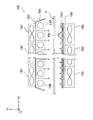
- FIG. 1 is a schematic view showing a configuration of an image forming apparatus 10 according to the present embodiment.
- the image forming apparatus 10 shown in FIG. 1 is an example of an image forming apparatus that forms an image on a recording medium.
- the image forming apparatus 10 is an electrophotographic image forming apparatus that forms a toner image on paper P as an example of a recording medium.
- the image forming apparatus 10 includes an accommodating portion 50, a discharging portion 52, an image forming unit 12, a transport mechanism 60, an inversion mechanism 80, and a fixing device 100. , And a cooling unit 90.
- the accommodating portion 50 shown in FIG. 1 has a function of accommodating the paper P.
- a plurality (for example, two) of the accommodating portions 50 are provided. Paper P is selectively sent out from the plurality of accommodating units 50.
- the paper P as an example of the recording medium, a sheet of paper (cut paper) having a predetermined size is used. Further, the paper P has a front surface PA as one surface (see FIG. 5) and a back surface PB as the other surface (see FIG. 5).
- the surface PA of the paper P has an image region GR on which the toner image is transferred (see FIG. 4), that is, an image region GR on which an unfixed image is formed.
- the ejection unit 52 shown in FIG. 1 is a portion where the paper P on which the image is formed is ejected. Specifically, after the image is fixed by the fixing device 100, the paper P cooled by the cooling unit 90 is discharged to the discharging unit 52.
- the image forming unit 12 shown in FIG. 1 is an example of an image forming unit that forms an image on a recording medium. Specifically, the image forming unit 12 has a function of forming a toner image on the paper P by an electrophotographic method. More specifically, as shown in FIG. 1, the image forming unit 12 transfers the toner image forming unit 20 that forms the toner image and the toner image formed by the toner image forming unit 20 to the paper P. It has a device 30 and.
- Toner image forming unit 20 A plurality of toner image forming units 20 are provided so as to form a toner image for each color.
- the image forming apparatus 10 includes a toner image forming unit 20 having a total of four colors of yellow (Y), magenta (M), cyan (C), and black (K).
- Y), (M), (C), and (K) shown in FIG. 1 indicate components corresponding to the above colors.
- the toner image forming unit 20 of each color is basically configured in the same manner except for the toner to be used. Specifically, as shown in FIG. 2, the toner image forming unit 20 of each color includes a photoconductor drum 21 (photoreceptor) rotating in the direction of arrow A in FIG. 2 and a charger for charging the photoconductor drum 21. 22 and. Further, the toner image forming unit 20 of each color exposes the photoconductor drum 21 charged by the charger 22 to form an electrostatic latent image on the photoconductor drum 21, and the photoconductor drum 21 by the exposure device 23. It has a developing device 24 that develops an electrostatic latent image formed in 21 to form a toner image.
- the transfer device 30 shown in FIG. 1 has a function of superimposing the toner image of the photoconductor drum 21 of each color on the intermediate transfer body and performing primary transfer, and secondary transferring the superimposed toner image onto paper P. ing.
- the transfer device 30 includes a transfer belt 31 as an intermediate transfer body, a primary transfer roll 33, and a transfer unit 35.
- the primary transfer roll 33 has a function of transferring the toner image formed on the photoconductor drum 21 to the transfer belt 31 at the primary transfer position T (see FIG. 2) between the photoconductor drum 21 and the primary transfer roll 33. doing.
- the transfer belt 31 has an endless shape and is wound around a plurality of rolls 32 to determine its posture.
- the transfer belt 31 orbits in the direction of arrow B by rotationally driving at least one of the plurality of rolls 32, and conveys the primary transferred image to the secondary transfer position NT.
- the transfer unit 35 has a function of transferring the toner image transferred to the transfer belt 31 to the paper P. Specifically, the transfer unit 35 has a secondary transfer unit 34 and an opposing roll 36.
- the opposing roll 36 is arranged below the transfer belt 31 so as to face the transfer belt 31.
- the secondary transfer unit 34 is arranged inside the transfer belt 31 so that the transfer belt 31 is arranged between the secondary transfer unit 34 and the opposing roll 36.
- the secondary transfer unit 34 is composed of a corotron.
- the transfer unit 35 the toner image transferred to the transfer belt 31 is transferred to the paper P passing through the secondary transfer position NT by the electrostatic force generated by the discharge of the secondary transfer unit 34.
- the transport mechanism 60 shown in FIG. 1 is a mechanism for transporting the paper P. Specifically, the transport mechanism 60 has a function of transporting the paper P stored in the storage unit 50 to the secondary transfer position NT. Further, the transport mechanism 60 has a function of transporting the paper P from the secondary transfer position NT to the fixing unit 120 (the heating roll 130 and the pressure roll 140 described later) described later. In other words, the transport mechanism 60 has a function of transporting the paper P on which the toner image is transferred in the fixing device 100.
- the transport mechanism 60 has a delivery roll 62, a plurality of transport rolls 64, and a chain gripper 66.
- the delivery roll 62 is a roll that sends out the paper P stored in the storage unit 50.
- the plurality of transport rolls 64 are rolls for transporting the paper P delivered by the delivery roll 62 to the chain gripper 66.
- the chain gripper 66 is a transport unit that holds the front end side (tip side) of the paper P and conveys the paper P.
- the chain gripper 66 includes a pair of chains 72 and a gripper 76 as a holding member (grip member).
- the pair of chains 72 are formed in an annular shape as shown in FIG.
- the pair of chains 72 are arranged at intervals in the front-rear direction of the device (direction D in FIG. 1) (see FIG. 4).
- the pair of chains 72 are spaced apart from a pair of sprockets (not shown) arranged on one end side and the other end side in the axial direction with respect to each of the opposing roll 36 and the pressure roll 140 described later, respectively, in the front-rear direction of the device. It is wound around a pair of sprockets 74, which are arranged so as to be separated from each other. When any one of these pair of sprockets rotates, the chain 72 orbits in the direction of arrow C (see FIG. 1).
- a mounting member 75 to which the gripper 76 is mounted is hung on the pair of chains 72 along the front-rear direction of the device.
- a plurality of mounting members 75 are fixed to a pair of chains 72 at predetermined intervals along the circumferential direction (circumferential direction) of the chain 72.
- the constituent parts of the chain 72 are shown in a block shape.
- a plurality of grippers 76 are attached to the attachment member 75 at predetermined intervals along the front-rear direction of the device.
- the gripper 76 has a function of holding (grasping) the front end portion of the paper P. By holding the front end portion of the paper P, the position of the paper P in the paper transport direction can be easily determined, and the alignment (registration alignment) between the paper P and the image can be easily performed in the transfer unit 35.
- the gripper 76 has a claw 76A and a claw stand 76B, as shown in FIGS. 3 and 5.
- the gripper 76 is configured to hold the paper P by sandwiching the front end portion of the paper P between the claw 76A and the claw base 76B.
- the gripper 76 holds the front end portion of the paper P outside the image region GR (see FIG. 4) on which the toner image on the surface PA is transferred.
- the claw 76A is pressed against the claw base 76B by a spring or the like, and the claw 76A is opened and closed against the claw base 76B by the action of a cam or the like.
- a position for cutting to the finished size and a mark for registering multicolor printing may be formed.
- Such an image may be formed at an overlapping position with the gripper 76 in the top view shown in FIG.
- the gripper 76 may partially overlap the image region GR, but the formed images should not overlap.
- the chain gripper 66 conveys the paper P to the secondary transfer position NT with the surface PA facing upward, further passes the paper P through the heating unit 102 described later, and then conveys the paper P to the fixing unit 120 described later. ..
- the chain gripper 66 is a portion having a function of passing the paper P through the heating unit 102 and conveying the paper P from the heating unit 102 to the fixing unit 120, and also serves as the fixing device 100.
- a part of the transport path through which the paper P is transported by the transport mechanism 60 is shown by a long-dashed line in FIG.
- the reversing mechanism 80 shown in FIG. 1 is an example of a reversing mechanism that reverses the front and back of a recording medium on which an image is fixed by a fixing device.
- the reversing mechanism 80 is a mechanism for reversing the front and back of the paper P on which the toner image is fixed by the fixing device 100.
- the reversing mechanism 80 includes a plurality of (for example, two) transfer rolls 82, a reversing device 84, and a plurality of (for example, seven) transfer rolls 86. doing.
- the plurality of transport rolls 82 are rolls for transporting the paper P sent from the fixing device 100 to the reversing device 84.
- the reversing device 84 twists the paper P like a Mobius strip by transporting the paper P while folding back a plurality of sheets so that the transport direction of the paper P changes by, for example, 90 degrees. It is said to be a device that flips the front and back.
- the plurality of transport rolls 86 are rolls for transporting the paper P whose front and back sides have been reversed by the reversing device 84 to the chain gripper 66. That is, the plurality of transport rolls 86 have a function of delivering the paper P whose front and back sides are reversed to the chain gripper 66.
- the reversing mechanism 80 reverses the front and back sides of the paper P and delivers it to the chain gripper 66, so that the chain gripper 66 has the delivered paper P on the back surface PB of the fixed toner image. Transport as.
- the reversing mechanism 80 may be a mechanism for reversing the paper P by switching back.
- the fixing device 100 shown in FIG. 3 is an example of a fixing device that fixes an image formed by an image forming unit on a recording medium. Specifically, the fixing device 100 is a device that fixes the toner image transferred by the transfer device 30 to the paper P.
- the fixing device 100 is arranged on the downstream side of the secondary transfer position NT in the transport direction of the paper P.
- the fixing device 100 includes a heating unit 102, the chain gripper 66 described above, a blower 160, a ventilation plate 180, and a fixing unit 120 (fixing unit).
- the heating unit 102 shown in FIG. 3 is an example of a heating unit that heats the surface of the recording medium in a non-contact manner. Specifically, the heating unit 102 has a function of non-contactly heating the surface PA of the paper P conveyed by the chain gripper 66.
- the heating unit 102 is arranged on the downstream side of the secondary transfer position NT (see FIG. 1) in the transport direction of the paper P so as to face the surface PA of the paper P transported by the chain gripper 66. .. Specifically, the heating unit 102 includes a reflector 104, a plurality of heaters 106 (heating sources), and a wire mesh 112.
- the reflector 104 has a function of reflecting infrared rays from the heater 106 to the lower side of the device (the paper P side conveyed by the chain gripper 66).
- the reflector 104 is formed by using a metal plate such as an aluminum plate.
- the reflector 104 is formed in a box shape in which the lower side of the device is open.
- the reflector 104 has an upper reflector 1040 that covers the upper side of the heater 106 of the heating unit 102 and an upstream side of the reflector 104 in the transport direction of the paper P, from the upper reflector 1040 to the lower side of the apparatus.
- the downstream side reflection that extends downward from the upper reflector 1040 and covers the downstream side surface of the heater 106.
- a pair of side reflectors extending downward from the upper reflector 1040 and covering both sides of the heater 106 at both end portions of the plate 1044 and, although not shown, in a direction intersecting the transport direction of the paper P of the reflector 104. It is composed of and.
- the heater 106 is a columnar infrared heater having a length in the front-rear direction of the device.
- a plurality (for example, 40) of heaters 106 are arranged inside the reflector 104 along the width direction of the device.
- the heater 106 includes a carbon filament 109 and a cylindrical quartz tube 108 in which the carbon filament 109 is housed.
- a black infrared radiation film is formed on the surface of the quartz tube 108. By forming the black infrared radiation film on the surface of the quartz tube 108 in this way, for example, the heater 106 emits infrared rays more efficiently than in the case where the white film is formed. It has become.
- the heater 106 is enlarged and shown on the upper left side of the heating unit 102.
- the infrared heater 106 in this embodiment has a wavelength peak of the infrared radiation wavelength set to 2 [ ⁇ m] or more and 5 [ ⁇ m] or less, which is a so-called far infrared region.
- the surface temperature of the heater 106 of the heating unit 102 is set to a predetermined temperature of 300 [° C.] or more and 1175 [° C.] or less. Further, in the present embodiment, the length of the reflector 104 in the device width direction is 1 [m], and the heaters 106 that efficiently radiate far infrared rays are arranged in the device width direction at a density of 20 or more and 100 or less. , Good heating distribution is obtained.
- the number of far-infrared heaters 106 is less than 20 per meter.
- the voltage applied to the carbon filament in order to increase the output amount of each heater 106, but the temperature of the black infrared radiation film rises, and it is due to the near infrared light component rather than the far infrared. Melting of toner by heat conduction from the heated surrounding air becomes dominant. As a result, melting unevenness occurs between the vicinity of the heater 106 and the heater 106.
- the carbon filament can predominantly emit far infrared rays. Therefore, 20 far infrared rays, which are less dependent on the distance from the radiation source for toner melting, are emitted. As compared with the case of less than, since it can be used effectively, the melting unevenness between the heaters 106 is reduced. If the number is larger than 100, excessive far-infrared rays are radiated, which makes it difficult to control the temperature of the irradiated object to the extent that the toner melts. In addition, the fixing device in the subsequent stage heats the toner. 100 or less is preferable because the temperature is difficult to control due to heating. In particular, when transporting a recording medium of B2 size or larger so that the transport direction of the recording medium is the long side, 30 or more and 50 or less are preferable.
- wire mesh 112 The wire mesh 112 is fixed to the edge of the lower opening of the reflector 104. As a result, the wire mesh 112 separates the inside of the reflector 104 from the outside of the reflector 104. The wire mesh 112 prevents the paper P conveyed by the chain gripper 66 from coming into contact with the heater 106.
- the chain gripper 66 shown in FIG. 3 is an example of a transport unit that conveys the recording medium while facing the surface of the recording medium to the heating unit.
- the gripper 76 provided in the chain gripper 66 is an example of a holding portion that holds at least the front end side of the recording medium.
- the front end side of the recording medium is a portion of the recording medium on the downstream side (front side) from the center in the transport direction.
- the chain 72 orbits in the direction of arrow C while the gripper 76 holds the front end portion of the paper P, so that the paper P is applied to the heater 106 of the heating unit 102. Paper P is conveyed while facing the surface PAs of. That is, the chain gripper 66 has a function of passing the paper P through the heating region of the heating unit 102. In the transport by the chain gripper 66, the rear end side of the paper P is not held and is in a free state.
- the chain gripper 66 has a function of transporting the paper P from the heating unit 102 to the fixing unit 120.
- the chain gripper 66 functions as an example of the transport unit of the fixing device 100 in the portion having the function of passing the paper P through the heating region of the heating unit 102 and transporting the paper P from the heating unit 102 to the fixing unit 120. doing.
- the blower 160 shown in FIG. 3 has a back surface opposite to the front surface so that the recording medium is conveyed by the conveying unit with the back surface in the image region where the unfixed image is formed on the front surface in a non-contact state.
- This is an example of a maintenance unit that maintains the non-contact state.
- the blower 160 is also an example of a blower unit that blows air to the back surface of the recording medium conveyed by the transport unit.
- the paper P may be conveyed while maintaining the non-contact state only by the blower portion by using both the transport portion and the blower portion.
- a plurality of the blowers 160 are arranged inside the chain 72 (inner circumference side) when viewed in the front-rear direction of the device, and below the heating unit 102. As shown in FIGS. 3 and 4, the plurality of blowers 160 are arranged in a two-dimensional shape (matrix shape) along the transport direction of the paper P and the front-rear direction of the device. In FIG. 4, some blades of the blower 160 are omitted in order to simplify the illustration of the blower 160.
- the blower 160 is oriented upward and is configured to blow air upward. That is, the configuration is such that air is blown in the thickness direction of the paper P only to the back surface PB of the paper P facing the heating unit 102.
- the blower 160 is arranged so as to face the back surface PB of the paper P conveyed by the chain gripper 66.
- the chain gripper 66 is configured to convey the paper P while facing the back surface PB of the paper P to the blower 160.
- an axial blower that blows air in the axial direction is used.
- a centrifugal blower that blows air in the centrifugal direction such as a multi-blade blower (for example, a sirocco fan), may be used.
- the paper P is lifted by blowing air to the back surface PB of the paper P conveyed by the chain gripper 66.
- the back surface PB of the paper P is in a non-contact state.
- at least the back surface PB in the image area GR of the paper P is in a non-contact state.
- at least the back surface PB in the image region GR of the paper P is in a non-contact state with respect to the ventilation plate 180. Therefore, the blower 160 has a function of maintaining the non-contact state so that the paper P is conveyed by the chain gripper 66 in the non-contact state of the back surface PB in the image region GR of the paper P.
- the back surface PB outside the image region GR of the paper P is allowed to come into contact with the ventilation plate 180. It is necessary to prevent the air blown from the blower port of the blower 160 from being directly supplied to the surface PA of the paper P.
- the image forming apparatus 10 of the present embodiment is an image forming apparatus of a type that forms an image using dry toner, and when air is supplied directly to the surface of the paper P from the air outlet, an unfixed toner image is produced. This is because there is a risk of disturbing. Further, by supplying air only to the back surface PB, cooling of the toner transferred to the front surface PA is suppressed.
- the ventilation plate 180 shown in FIG. 3 is an example of a ventilation portion having a plurality of ventilation holes for passing air blown from the ventilation portion toward the back surface of the recording medium.
- the ventilation plate 180 is composed of a plate formed with a plurality of ventilation holes 182 through which air blown from the blower 160 toward the back surface PB of the paper P is passed.
- the ventilation plate 180 is arranged inside the chain 72 (inner peripheral side) when viewed in the front-rear direction of the device, below the heating unit 102 and above the blower 160, with the device vertical direction as the thickness direction. That is, it is arranged so as to cover the blower 160 on the blower direction side of the blower 160.
- the ventilation plate 180 can be said to be an example of an arrangement member arranged so as to face the back surface PB of the paper P conveyed by the chain gripper 66.
- Each ventilation hole 182 penetrates in the thickness direction of the ventilation plate 180.
- the plurality of ventilation holes 182 are arranged in a two-dimensional shape (matrix shape) along the transport direction of the paper P and the front-rear direction of the device.
- a part of the ventilation hole 182 is omitted in order to simplify the illustration of the ventilation plate 180.
- this ventilation plate 180 the air blown from the blower 160 is passed through a plurality of ventilation holes 182 and is applied to the back surface PB of the paper P conveyed by the chain gripper 66.
- the blower 160 is configured to blow air to the back surface PB of the paper P conveyed by the chain gripper 66 via the ventilation plate 180 in which a plurality of ventilation holes 182 are formed.
- the ventilation plate 180 is made of a metal plate.
- the ventilation plate 180 also has a function as a reflector that reflects infrared rays from the heater 106 to the upper side of the device (the paper P side conveyed by the chain gripper 66).
- the infrared heater 106 has a configuration in which the length in the device width direction is set to 1 [m], and the length in the device width direction of the recording medium to be conveyed uses a recording medium of A2 or more. Is preferable.
- a recording medium of less than A2 the area where the air blown from the blower 160 is blocked by the recording medium is small, and the air is supplied to the infrared heater 106, and as a result, the warmed air around the heating unit 102 is used. May be diffused into the device.
- a recording medium of A2 or more it occupies about 50% or more of the infrared heater 106 in the device width direction, which is preferable from the viewpoint of suppressing an increase in the temperature inside the device.
- the blower region set by the blower 160 and the ventilation plate 180 is set longer toward the upstream in the transport direction of the paper P than the heating region set by the heating unit 102 described above. That is, the paper P after passing through the transfer unit 35 is blown on the back surface PB by the blower 160 before rushing into the heating unit 102. As a result, the paper P is carried to the heating unit 102 in a stable posture. More preferably, the air blowing region is set immediately after the transfer unit 35, starting from a position that does not overlap with the transfer belt 31 in the gravity direction toward the downstream in the transport direction of the paper P.
- the blower region set in the blower 160 and the ventilation plate 180 is longer toward the upstream side in the transport direction of the paper P than the upstream side reflector 1042 located on the upstream side in the transport direction of the paper P in the reflector 104. It is set. That is, the paper P after passing through the transfer unit 35 is blown by the blower 160 on the back surface PB before the upstream reflector 1042 that partitions the heating region set by the heating unit 102. From another point of view, the contact position between the transfer belt 31 which is the transfer unit 35 and the paper P, the upstream end of the ventilation region, and the upstream end of the heating region by the heating unit 102 are arranged in this order toward the downstream in the transport direction of the paper P. It can be said that it is.
- the heating region is set closer to the blowing region than the blowing region. That is, the conveyed paper P is heated by the heating unit 102 until just before it rushes into the fixing unit 120, but there is a place where the blown air from the blower 160 is not supplied to the back surface PB. More specifically, the position of the downstream reflector 1044 on the reflector 104 is set longer toward the downstream in the transport direction of the paper P than the ventilation region.
- the position of the downstream end of the heater 106 as the heating source constituting the heating unit 102 in the transport direction of the paper P is directed downstream of the blower region formed by the blower 160 in the transport direction of the paper P. It has been set long. From another point of view, this is arranged in the order of the downstream end of the blowing region, the downstream end of the heater 106, and the contact position between the heating roll 130 and the pressurizing roll 140 in the fixing unit 120 toward the downstream of the paper P in the transport direction. It can be said that there is.
- the fixing unit 120 shown in FIG. 3 is a fixing unit for fixing the image of the paper P to the paper P.
- the fixing unit 120 has a function of fixing the toner image to the paper P by contacting the paper P and heating and pressurizing the paper P.
- the fixing portion 102 that performs heating and pressurization will be described, but heating is not always necessary, and improvement of the surface property of the toner melted by the heating portion 102 in the previous step, for example, adjustment of gloss is performed.
- it can be applied only in the form in which pressurization is performed by the pressurizing portion.
- the fixing unit 120 is arranged on the downstream side of the heating unit 102 in the transport direction of the paper P. Specifically, the fixing unit 120 has a heating roll 130, a pressure roll 140, and a driven roll 150.
- the heating roll 130 shown in FIG. 3 is an example of a heating member that is arranged on the downstream side in the transport direction with respect to the heating unit and heats the recording medium. Specifically, the heating roll 130 is arranged on the downstream side in the transport direction with respect to the heating unit 102, and has a function of contacting the paper P to heat the paper P. The heating roll 130 is arranged with the front-rear direction of the device as the axial direction so as to come into contact with the surface PA of the paper P.
- the heating roll 130 is provided inside the cylindrical base material 132, the rubber layer 134 formed on the outer periphery of the base material 132, the release layer 136 formed on the outer circumference of the rubber layer 134, and the base material 132. It has a housed heater 138 (heating source).
- the heater 138 is composed of, for example, a single or a plurality of halogen lamps.
- the heating roll 130 is provided with an abutting portion 139 that is abutted against the abutting portion 149 provided on the pressure roll 140, which will be described later.
- the abutted portion 139 is an example of the abutted portion provided on the heating roll.
- the abutted portion 139 is formed in a cylindrical shape having an outer diameter equivalent to that of the heating roll 130.
- the abutted portion 139 is provided at one end and the other end in the axial direction of the heating roll 130 so as to rotate coaxially with the heating roll 130 and integrally with the heating roll 130.
- the driven roll 150 shown in FIG. 3 is arranged with the front-rear direction of the device as the axial direction so as to come into contact with a region other than the contact region with respect to the paper P on the outer peripheral surface of the heating roll 130. Further, the driven roll 150 has a cylindrical base material 152 and a heater 154 (heating source) housed inside the base material 152. The driven roll 150 rotates in accordance with the heating roll 130 to heat the heating roll 130. Since the heating roll 130 is heated by the driven roll 150 and the heating roll 130 itself has the heater 138, the surface temperature of the heating roll 130 is predetermined to be 180 [° C.] or more and 200 [° C.] or less. It becomes the temperature.
- the pressure roll 140 shown in FIG. 3 is an example of a pressure member in which a recording medium is pressed against the heating roll and a recess into which the holding portion enters is formed on the outer peripheral surface. Specifically, the pressure roll 140 has a function of sandwiching the paper P with the heating roll 130 and pressing the paper P. The pressure roll 140 is arranged below the heating roll 130 with the front-rear direction of the device as the axial direction.
- the pressure roll 140 has a cylindrical base material 142, a rubber layer 144 formed on the outer periphery of the base material 142, and a release layer 146 formed on the outer circumference of the rubber layer 144.
- the circumference of the pressure roll 140 is the same as the arrangement interval in which the gripper 76 is arranged on the chain 72. Further, as shown in FIGS. 5 and 6, a recess 148 extending in the front-rear direction of the device is formed on the outer peripheral surface of the pressure roll 140.
- the gripper 76 holding the front end side of the paper P passes between the pressure roll 140 and the heating roll 130, the gripper 76 is configured to enter the recess 148.
- the pressure roll 140 is provided with an abutting portion 149 that abuts against the abutting portion 139 of the heating roll 130.
- the abutting portion 149 is an example of an abutting portion which is provided on the outer side in the axial direction with respect to the recess of the pressure roll and abuts on the abutted portion 139 to maintain the distance between the axes of the heating roll 130 and the pressure roll 140.
- the abutting portion 149 is formed in a cylindrical shape having an outer diameter equivalent to that of the pressure roll 140.
- the abutting portion 149 is provided on the outer side in the axial direction with respect to the recess 148 of the pressure roll 140.
- the abutting portion 149 is provided at one end and the other end of the pressure roll 140 in the axial direction so as to rotate coaxially with the pressure roll 140 and integrally with the pressure roll 140. ..
- the heating roll 130 and the pressure roll 140 By rotating the heating roll 130 and the pressure roll 140 in a state where the abutting portion 149 is abutting against the abutted portion 139, even if the recess 148 faces the heating roll 130, the heating roll 130 and the heating roll 130 are added.
- the distance between the shafts with the pressure roll 140 is maintained.
- the surface pressure of the load in which the pressure roll 140 is urged to the heating roll 130 side by the urging member (not shown) is about 250 [kPa] or less and 108 [kPa] or more.
- the surface pressure in a conventional general fuser is about 400 [kPa].
- the pressure roll 140 is rotationally driven by a drive unit (not shown), the heating roll 130 rotates in accordance with the pressure roll 140, and the driven roll 130 follows the heating roll 130. 150 rotates.
- the cooling unit 90 is arranged on the downstream side of the fixing unit 120 in the transport direction of the paper P. Further, the cooling unit 90 includes a plurality of (for example, two) cooling rolls 92 arranged in the width direction of the device.
- the cooling roll 92 is composed of a cylindrical roll made of metal or the like.
- the cooling roll 92 is configured to cool the paper P by air cooling (heat exchange with air) by circulating air inside the cooling roll 92.
- the paper P sent out from the accommodating portion 50 shown in FIG. 1 is conveyed by a plurality of conveying rolls 64 and delivered to the chain gripper 66.
- the paper P delivered to the chain gripper 66 is conveyed to the secondary transfer position NT by the chain gripper 66 with the front end held by the gripper 76, and the toner image is transferred from the transfer belt 31 to the surface PA. ..
- the paper P on which the toner image is transferred is conveyed by the chain gripper 66 to the heater 106 of the heating unit 102 with the surface PA facing the heater 106, and the toner image is heated.
- the moving speed of the chain gripper 66 is 700 [mm / sec] or less and 520 [mm / sec] or more.
- the paper P whose toner image is heated by the heating unit 102 is further conveyed to the fixing unit 120 by the chain gripper 66, sandwiched between the heating roll 130 and the pressure roll 140, and pressurized and heated. As a result, the toner image is fixed on the paper P.
- the paper P on which the toner image is fixed is cooled by the cooling roll 92 of the cooling unit 90 shown in FIG. 1 and then discharged to the discharge unit 52.
- the relative positions of the fixing unit 120 and the heating unit 102 are determined. Specifically, in the heating unit 102, the time from when the front end of the paper P passes through the end on the fixing unit 120 side to when the front end of the paper P reaches the nip portion N is 0.3 [sec] or less. The relative positions of the fixing unit 120 and the heating unit 102 are determined so as to be 0.1 [sec] or more.
- the relative distance between the downstream end of the heating unit 102 and the nip portion N of the fixing unit 102 is set to be shorter than the length of the paper P used in the image forming apparatus in the transport direction. .. As a result, the rear end side of the paper P is maintained in a stable posture until the paper P reaches the nip portion N.
- the transport speed of the paper P is determined so that the time for which the paper P on which the toner image is transferred is heated by the nip portion N is 30 [msec] or less and 10 [msec] or more. Specifically, the time from when the predetermined reference point on the paper P reaches the nip portion N to when it passes through the nip portion N is 30 [msec] or less and 10 [msec] or more. In addition, the transport speed of the paper P is determined.
- the paper P on which the image is fixed on the front surface PA is handed over to the chain gripper 66 again after the front and back sides are reversed by the reversing mechanism 80 shown in FIG. ..
- the paper P delivered to the chain gripper 66 is conveyed to the secondary transfer position NT as the paper P having the fixed toner image on the back surface PB, and the toner image is transferred from the transfer belt 31 to the front surface PA.
- the paper P on which the toner image is transferred is heated by the heating unit 102 and then sandwiched between the heating roll 130 and the pressure roll 140 to be pressurized and heated so that the toner image is fixed on the paper P. Will be done.
- the paper P on which the toner image is fixed is cooled by the cooling roll 92 of the cooling unit 90 and then discharged to the discharge unit 52.
- the blower 160 blows air to the back surface PB of the paper P conveyed by the chain gripper 66, so that the blower 160 is the paper P.
- the non-contact state is maintained so that the paper P is conveyed in the non-contact state of the back surface PB in the image region GR.
- the paper P In the configuration (first configuration) in which the back surface PB in the image region GR of the paper P contacts the constituent parts of the apparatus when the paper P is conveyed while the front surface PA faces the heating unit 102 (first configuration), the paper P When the component (for example, the ventilation plate 180) with which the paper is in contact is heated by the heating unit 102 while the fixing device 100 continues to operate, the paper P is heated by the component and the toner is melted.
- the component for example, the ventilation plate 180
- the degree of melting of the toner varies between the initial operation of the fixing device 100 and the continuous operation of the fixing device 100. Therefore, it is necessary to change the heating temperature of the heating unit 102 and the heating roll 130 between the initial operation of the fixing device 100 and the continuous operation of the fixing device 100, which complicates the control of the heating temperature.
- the blower 160 maintains the non-contact state so that the paper P is conveyed in the non-contact state of the back surface PB in the image area GR of the paper P.
- the back surface PB of the paper P is not heated, and the influence of heat (for example, conduction heat) received from the back surface PB of the paper P is reduced. In other words, the complicated control of the heating temperature of the heating unit 102 and the heating roll 130 is suppressed.
- the back side PB of the paper P is heated even when the paper P having the fixed toner image on the back side PB is conveyed by the chain gripper 66 in the heating unit 102.
- melting of the fixed toner image is suppressed.
- the transport unit and the blower unit are controlled so that the back surface PB is in a non-contact state. If the back surface PB of the paper P does not have a fixed toner image and only the front surface PA has an unfixed toner image, the ventilation plate 180 or the like is always in contact with the back surface PB for transportation. You may.
- the blower 160 blows air to the back surface PB of the paper P conveyed by the chain gripper 66 through the ventilation plate 180 in which a plurality of ventilation holes 182 are formed. Therefore, as compared with the configuration (second configuration) in which the air blown from the blower 160 directly hits the back surface PB of the paper P without passing through the ventilation hole 182, it is suppressed that the air hits the back surface PB of the paper P unevenly. Will be done. As a result, the posture of the paper P is less likely to fluctuate as compared with the second configuration described above.
- the gripper 76 holding the front end side of the paper P passes between the pressure roll 140 and the heating roll 130, the gripper 76 is placed in the recess 148. Get in. Therefore, the gripper 76 is less likely to get in the way when the paper P is pressed, as compared with the configuration in which the paper P is pressed between the pressure roll 140 and the heating roll 130 in which the recess 148 is not formed.
- the recess 148 faces the heating roll 130 by rotating the heating roll 130 and the pressure roll 140 in a state where the abutting portion 149 shown in FIG. 6 abuts against the abutted portion 139. Even in this state, the distance between the shafts of the heating roll 130 and the pressure roll 140 is maintained. Therefore, as compared with the configuration in which the paper P is pressed between the pressure roll 140 and the heating roll 130 in which the distance between the shafts is not maintained, the fluctuation of the pressure for pressing the paper P is suppressed.
- the posture of the paper P may change when the paper P is conveyed while the surface PA faces the heating unit 102. That is, the paper P may be conveyed with the rear end side hanging down. Since the heating unit 102 heats the paper P with infrared electromagnetic waves, the paper P is heated even if the posture of the paper P changes.
- the back surface PB in the image area GR of the paper P may be configured to temporarily contact the ventilation plate 180.
- the blower 160 blows air to the back surface PB of the paper P conveyed by the chain gripper 66. It has the following functions in the configuration.
- the blower 160 blows air to the back surface PB of the paper P conveyed by the chain gripper 66, so that the paper P floats. Therefore, as compared with the configuration (third configuration) in which air is not blown to the back surface PB of the paper P when the paper P is conveyed while the front surface PA faces the heating unit 102, the back surface of the paper P is used. It is difficult for PB to come into contact with the ventilation plate 180. As a result, the back surface PB of the paper P is less likely to be heated as compared with the third configuration described above, and the influence of heat received from the back surface PB of the paper P is reduced.
- the configuration may not have the blower 160 and the ventilation plate 180.
- the gripper 76 of the chain gripper 66 has the following functions in the configuration of holding the front end side of the paper P.
- the posture of the paper P is less likely to change as compared with the configuration (fourth configuration) in which the front end side of the paper P is not held and is in a free state.
- the rear end side is less likely to hang down due to the strain of the paper P.
- the back surface PB of the paper P is less likely to come into contact with the ventilation plate 180.
- the back surface PB of the paper P is less likely to be heated as compared with the fourth configuration described above, and the influence of heat received from the back surface PB of the paper P is reduced.
- the gripper 76 as an example of the holding portion holds the front end side of the paper P, but the present invention is not limited to this. As shown in FIG. 7, the holding portion may be configured to hold the front end side and the rear end side of the paper P.
- the rear end side of the paper P is a portion of the paper P on the upstream side (rear side) from the center in the transport direction.
- the gripper 76 is composed of a total of six grippers 761, 762, and 763 arranged on each of the pair of chains 72 as a set.
- the grippers 761, 762, and 763 are arranged on the chain 72 at predetermined intervals along the circumferential direction (circumferential direction) of the chain 72.
- the gripper 761 sandwiches and holds the front end side of the side portion of the paper P
- the gripper 763 sandwiches and holds the rear end side of the side portion of the paper P.
- the gripper 762 is configured to sandwich and hold an intermediate portion in the transport direction on the side portion of the paper P between the gripper 761 and the gripper 763. It should be noted that there may be no gripper 762, and a total of four grippers 761 and 763 may be configured as one set. Further, only the gripper 761 may sandwich the front end portion of the paper P on the front end side as shown in FIG.
- the gripper 76 holds only the front end side of the paper P, as compared with the case where the gripper 76 holds only the front end side of the paper P.
- the variation between the distance to the heating unit 102 and the distance between the rear end side of the paper P and the heating unit 102 is reduced.
- the configuration may not include the blower 160 and the ventilation plate 180.
- the non-contact state is brought into the non-contact state so that the back surface PB in the image area GR of the paper P is conveyed in the non-contact state. You may try to maintain it.
- the grippers 762 and 763 function as an example of the maintenance unit. It should be noted that the back surface PB in the image area GR of the paper P may be configured to temporarily contact the constituent parts of the apparatus.
- the recess 148 is formed at a position corresponding to the grippers 761, 762, and 763 on the outer peripheral surface of the pressure roll 140. Therefore, the recess 148 is located on both ends in the axial direction on the outer peripheral surface of the pressure roll 140, and is added according to the distance along the circumferential direction (circumferential direction) of the chains 72 of the grippers 761, 762, and 763. A plurality of pressure rolls 140 are formed at intervals in the circumferential direction.
- paper P is used as an example of the recording medium, but the present invention is not limited to this.
- a film or the like may be used, and as an example of the recording medium, a sheet material formed in a sheet shape (paper shape, film shape) other than the paper P may be used.
- the chain gripper 66 as an example of the transport unit transports the paper P to the secondary transfer position NT, and further, the paper P is conveyed to the fixing unit 120 after passing through the heating unit 102. I was doing it, but it is not limited to this.
- the transport unit the paper P that has passed through the secondary transfer position NT is delivered, and after the paper P has passed through the heating unit 102, it is a transport unit such as a chain gripper that transports the paper P to the fixing unit 120. You may. In this case, it is transported to the secondary transfer position NT by another transport unit (for example, a transport roll).
- the blower 160 blows air to the back surface PB of the paper P in the thickness direction of the paper P, but the present invention is not limited to this.
- the blower 160 may blow air obliquely with respect to the thickness direction of the paper P.
- the blower 160 is configured to blow air diagonally (obliquely upward to the right in FIG. 3) toward the upstream side in the transport direction of the paper P with respect to the back surface PB of the paper P.
- the blower 160 may be arranged outside the width direction of the paper P, and air may be blown from the side edges on both sides of the paper P to the back surface PB of the paper P. ..
- the configuration may be such that air is supplied to the back surface PB of the paper P so that the paper P floats.
- air is supplied only to the back surface PB of the paper P, but the present invention is not limited to this.
- air is supplied to the surface PA of the paper P, it is acceptable from the following viewpoints.
- the example shown in FIG. 9 is a modification 1 in which air is supplied to the surface PA from the viewpoint of stable transportation of the paper P.
- a blower 190 is provided so as to face the surface PA side of the paper P and supply air to the surface PA.
- the posture of the paper P is kept parallel to the transport direction by adjusting the relative air volume between the air blown from the blower 190 and the blower 160.
- the air volume of the blower 190 is set to be smaller than the air volume of the blower 160, and the toner is not scattered by the air from the blower 190.
- the blower 200 is provided so as to face the direction orthogonal to the blowing direction of the blower 160 in order to ventilate the air around the heating unit 102. That is, the blower port of the blower 200 is opened in the direction along the surface PA of the paper P, and is provided so as not to face the surface PA of the paper P. Then, the air blown from the blower 200 flows in the direction along the surface PA of the paper P, and the air from the blower 200 may be supplied to the surface PA of the paper P. In this case as well, it is desirable that the air volume is set so that the toner does not scatter as in the modified example 1.
- the blower 160 has been described by using a form in which air is blown to the back surface PB of the paper P in the thickness direction of the paper P. If there is no recording medium between the heating unit 102 and the blower 160 and the air is blown by the blower 160, the warmed air around the heating unit 102 may be diffused into the apparatus. As such a measure, if the recording medium is blown at the timing when the recording medium faces the blower 160, the blown air is blocked by the recording medium. In other words, the air from the blower 160 supplied to the heating unit 102 is reduced by weakening or stopping the blowing air between the preceding recording medium and the succeeding recording medium, resulting in warmed air. Is prevented from being diffused in the device. In this way, the drive control of the blower 160 may be performed, or the drive control of the plurality of blowers 160 may be performed individually.
- Image forming device 12 Image forming unit 66 Chain gripper (example of transport unit) 76 Gripper (an example of holding part) 80 Inversion mechanism 100 Fixing device (example of pressurizing part) 102 Heating unit 130 Heating roll (an example of heating member) 139 Abutted part 140 Pressurized roll (an example of pressurized member) 149 Butt part 160 Blower (Example of maintenance part, example of blower part) 180 Ventilation plate (example of ventilation part) 182 Ventilation hole 190 Blower (example of maintenance part, example of blower part) 200 Blower GR image area P paper (example of recording medium) PA front side PB back side
Landscapes
- Physics & Mathematics (AREA)
- General Physics & Mathematics (AREA)
- Life Sciences & Earth Sciences (AREA)
- Engineering & Computer Science (AREA)
- Atmospheric Sciences (AREA)
- Biodiversity & Conservation Biology (AREA)
- Ecology (AREA)
- Environmental & Geological Engineering (AREA)
- Environmental Sciences (AREA)
- Fixing For Electrophotography (AREA)
- Electrostatic Charge, Transfer And Separation In Electrography (AREA)
- Ink Jet (AREA)
Abstract
Description
本実施形態に係る画像形成装置10の構成を説明する。図1は、本実施形態に係る画像形成装置10の構成を示す概略図である。
図1に示される収容部50は、用紙Pを収容する機能を有している。画像形成装置10では、収容部50は、複数(例えば2つ)が備えられている。この複数の収容部50から選択的に用紙Pが送り出される構成とされている。記録媒体の一例としての用紙Pとしては、予め定められた大きさ(サイズ)とされた枚葉紙(カット紙)が用いられる。また、用紙Pは、一方の面としての表面PA(図5参照)と、他方の面としての裏面PB(図5参照)と、を有している。用紙Pの表面PAは、トナー像が転写される画像領域GR(図4参照)、すなわち、未定着画像が形成される画像領域GRを有している。
図1に示される排出部52は、画像が形成された用紙Pが排出される部分である。具体的には、定着装置100で画像が定着された後に、冷却部90で冷却された用紙Pが排出部52に排出される構成とされている。
図1に示される画像形成部12は、記録媒体に画像を形成する画像形成部の一例である。具体的には、画像形成部12は、電子写真方式により用紙Pにトナー像を形成する機能を有している。さらに具体的には、画像形成部12は、図1に示されるように、トナー像を形成するトナー像形成部20と、トナー像形成部20で形成されたトナー像を用紙Pに転写する転写装置30と、を有している。
トナー像形成部20は、色ごとにトナー像を形成するように複数備えられている。画像形成装置10では、イエロー(Y)、マゼンタ(M)、シアン(C)、ブラック(K)の計4色のトナー像形成部20が備えられている。図1に示す(Y)、(M)、(C)、(K)は、上記各色に対応する構成部分を示している。
図1に示される転写装置30は、各色の感光体ドラム21のトナー像を、中間転写体に重畳して一次転写し、該重畳されたトナー像を用紙Pに二次転写する機能を有している。具体的には、転写装置30は、図1に示されるように、中間転写体としての転写ベルト31と、一次転写ロール33と、転写部35と、を備えている。
図1に示される搬送機構60は、用紙Pを搬送する機構である。具体的には、搬送機構60は、収容部50に収容された用紙Pを二次転写位置NTへ搬送する機能を有している。さらに、搬送機構60は、二次転写位置NTから後述の定着ユニット120(後述の加熱ロール130及び加圧ロール140)へ用紙Pを搬送する機能を有している。換言すれば、搬送機構60は、トナー像が転写された用紙Pを定着装置100において搬送する機能を有している。
図1に示される反転機構80は、定着装置によって画像が定着された記録媒体の表裏を反転させる反転機構の一例である。具体的には、反転機構80は、定着装置100によってトナー像が定着された用紙Pの表裏を反転させる機構である。さらに具体的には、反転機構80は、図1に示されるように、複数(例えば、2つ)の搬送ロール82と、反転装置84、複数(例えば、7つ)の搬送ロール86と、有している。
図3に示される定着装置100は、画像形成部によって形成された画像を記録媒体に定着させる定着装置の一例である。具体的には、定着装置100は、転写装置30で転写されたトナー像を用紙Pへ定着する装置である。
図3に示される加熱部102は、記録媒体の表面を非接触で加熱する加熱部の一例である。具体的には、加熱部102は、チェーングリッパ66で搬送される用紙Pの表面PAを非接触で加熱する機能を有している。
反射板104は、ヒータ106からの赤外線を装置下側(チェーングリッパ66によって搬送される用紙P側)へ反射する機能を有している。反射板104は、例えばアルミニウム板等の金属板を用いて形成されている。反射板104は、装置下側が開放された箱状に形成されている。具体的には、反射板104は、加熱部102のヒータ106の装置上方側を覆う上部反射板1040と、反射板104の用紙Pの搬送方向における上流側において、上部反射板1040から装置下方に延びてヒータ106の上流側面を覆う上流側反射板1042と、反射板104の用紙Pの搬送方向における下流側において、上部反射板1040から装置下方に延びてヒータ106の下流側面を覆う下流側反射板1044と、図示しないが、反射板104の用紙Pの搬送方向と交差する方向の両側端部において、上部反射板1040から装置下方に延びてヒータ106の両側面を覆う一対の側部反射板とから構成されている。
ヒータ106は、装置前後方向に長さを有する円柱状の赤外線ヒータである。ヒータ106は、反射板104の内部に装置幅方向に沿って、複数(例えば、40本)並べられている。ヒータ106は、具体的には、カーボンフィラメント109と、内部にカーボンフィラメント109が収容された円筒状の石英管108と、を備えて構成されている。石英管108の表面には、黒色の赤外線放射膜が形成されている。このように、石英管108の表面に黒色の赤外線放射膜が形成されていることで、例えば、白膜が形成されている場合と比して、ヒータ106は、赤外線を効率よく放射するようになっている。ここで、本実施形態において、黒色とは、無彩色点(x=0.333,y=0.333、Y=0)からの色度のズレが色差ΔEで100以内である色である。なお、図3では、ヒータ106の具体的な構成を示すため、加熱部102の左上側にヒータ106を拡大して示している。また、本実施例における赤外線ヒータ106は、赤外線の放射波長の波長ピークが、2〔μm〕以上5〔μm〕以下に設定されており、いわゆる遠赤外線の領域である。そして加熱部102のヒータ106の表面温度は、300〔℃〕以上1175〔℃〕以下の予め定められた温度とされている。さらに、本実施形態では反射板104の装置幅方向の長さが1〔m〕に対し、遠赤外線を効率よく放射するヒータ106を装置幅方向に20本以上100本以下の密度で並べることで、良好な加熱分布が得られている。
金網112は、反射板104の下側の開口における縁部に固定されている。これにより、金網112は、反射板104の内部と、反射板104の外部とを仕切っている。そして、金網112は、チェーングリッパ66によって搬送される用紙Pとヒータ106とが接触するのを防止している。
図3に示されるチェーングリッパ66は、加熱部に記録媒体の表面を対向させながら記録媒体を搬送する搬送部の一例である。チェーングリッパ66に備えられたグリッパ76は、少なくとも記録媒体の前端側を保持する保持部の一例である。なお、記録媒体の前端側とは、記録媒体における搬送方向の中央より下流側(前側)の部分である。
図3に示される送風機160は、表面とは反対側の裏面であって、表面に未定着画像が形成される画像領域内の裏面が非接触状態で搬送部によって記録媒体が搬送されるように、当該非接触状態を維持する維持部の一例である。さらに、送風機160は、搬送部によって搬送される記録媒体の裏面に対して空気を送風する送風部の一例でもある。なお、搬送部と送風部とは兼用するようにして、送風部のみで非接触状態を維持しつつ、用紙Pを搬送するようにしてもよい。
図3に示される通気板180は、送風部から記録媒体の裏面へ向けて送風される空気を通過させる複数の通気穴を有する通気部の一例である。具体的には、通気板180は、送風機160から用紙Pの裏面PBへ向けて送風される空気を通過させる複数の通気穴182が形成されたプレートで構成されている。
図3に示される定着ユニット120は、用紙Pの画像を用紙Pに定着する定着部である。具体的には、定着ユニット120は、用紙Pに接触して用紙Pを加熱及び加圧することで、トナー像を用紙Pに定着する機能を有している。本実施の形態では、加熱及び加圧を行う定着部102を用いて説明するが、加熱は必ずしも必要でなく、前工程の加熱部102で溶融したトナーの表面性の向上、例えばグロスの調整を目的とすれば、加圧部による加圧が行われる形態のみでも適用可能である。
図3に示される加熱ロール130は、加熱部に対する搬送方向下流側に配置され、記録媒体を加熱する加熱部材の一例である。具体的には、加熱ロール130は、加熱部102に対する搬送方向下流側に配置され、用紙Pに接触して用紙Pを加熱する機能を有している。この加熱ロール130は、用紙Pの表面PAに接触するように、装置前後方向を軸方向として配置されている。
図3に示される従動ロール150は、加熱ロール130の外周面における用紙Pに対する接触領域以外の領域に接触するように、装置前後方向を軸方向として配置されている。また、従動ロール150は、円筒状の基材152と、基材152の内部に収容されたヒータ154(加熱源)と、を有している。この従動ロール150は、加熱ロール130に従動して回転し、加熱ロール130を加熱する。加熱ロール130が従動ロール150によって加熱されること、及び加熱ロール130自身がヒータ138を有していることで、加熱ロール130の表面温度は、180〔℃〕以上200〔℃〕以下の予め定められた温度となる。
図3に示される加圧ロール140は、加熱ロールとの間で記録媒体を加圧し、保持部が入り込む凹部が外周面に形成された加圧部材の一例である。具体的には、加圧ロール140は、加熱ロール130との間に用紙Pを挟んで用紙Pを加圧する機能を有している。この加圧ロール140は、加熱ロール130の下側に装置前後方向を軸方向として配置されている。
冷却部90は、図1に示されるように、用紙Pの搬送方向において、定着ユニット120の下流側に配置されている。また、冷却部90は、装置幅方向に並んでいる複数(例えば2つ)の冷却ロール92を備えている。
図1に示される収容部50から送り出された用紙Pは、複数の搬送ロール64で搬送され、チェーングリッパ66へ受け渡される。チェーングリッパ66へ受け渡された用紙Pは、チェーングリッパ66によって、グリッパ76で前端部が保持された状態で二次転写位置NTへ搬送され、転写ベルト31からトナー像が表面PAに転写される。トナー像が転写された用紙Pは、図3に示されるように、チェーングリッパ66によって、加熱部102のヒータ106に表面PAが対向した状態で搬送され、トナー像が加熱される。なお、本実施形態においては、チェーングリッパ66の移動速度は、700[mm/sec]以下520[mm/sec]以上で搬送されている。
本実施形態では、チェーングリッパ66では、保持部の一例としてのグリッパ76が用紙Pの前端側を保持していたが、これに限られない。保持部としては、図7に示されるように、用紙Pの前端側及び後端側を保持する構成であってもよい。なお、用紙Pの後端側とは、用紙Pにおける搬送方向の中央より上流側(後側)の部分である。
本実施形態では、記録媒体の一例として用紙Pを用いたが、これに限られない。記録媒体の一例としては、例えばフィルムなどであってもよく、記録媒体の一例として、用紙P以外の、シート状(紙状、膜状)に形成されたシート材を用いてもよい。
本出願は、2019年3月12日出願の日本特許出願である特願2019-044949に基づくものであり、それらの内容はここに参照として取り込まれる。
12 画像形成部
66 チェーングリッパ(搬送部の一例)
76 グリッパ(保持部の一例)
80 反転機構
100 定着装置(加圧部の一例)
102 加熱部
130 加熱ロール(加熱部材の一例)
139 被突き当て部
140 加圧ロール(加圧部材の一例)
149 突き当て部
160 送風機(維持部の一例、送風部の一例)
180 通気板(通気部の一例)
182 通気穴
190 送風機(維持部の一例、送風部の一例)
200 送風機
GR 画像領域
P 用紙(記録媒体の一例)
PA 表面
PB 裏面
Claims (19)
- 記録媒体の表面を非接触で加熱する加熱部と、
前記加熱部に前記表面を対向させながら前記記録媒体を搬送する搬送部と、
前記表面とは反対側の裏面であって、前記表面に未定着画像が形成される画像領域内の前記裏面が非接触状態で前記搬送部によって前記記録媒体が搬送されるように、当該非接触状態を維持する維持部と、
を備える定着装置。 - 記録媒体の表面を非接触で加熱する加熱部と、
前記加熱部に前記表面を対向させながら搬送される記録媒体の前記表面とは反対側であって画像が定着された記録媒体の裏面が非接触状態で搬送されるように、当該非接触状態を維持する維持部と、
を備える定着装置。 - 前記加熱部の下流側であって、前記加熱部で加熱された前記記録媒体を加圧する加圧部と、
前記加熱部に前記表面を対向させながら前記記録媒体を搬送する搬送部であって、前記加熱部から前記加圧部に到るまで、前記記録媒体を保持して搬送する搬送部と、
を備える請求項1又は2に記載の定着装置。 - 前記維持部は、前記記録媒体の裏面に対して空気を送風する送風部、
である請求項1~3いずれか1項に記載の定着装置。 - 記録媒体の表面を非接触で加熱する加熱部と、
前記加熱部に前記表面を対向させながら前記記録媒体を搬送する搬送部と、
前記搬送部によって搬送される記録媒体の裏面に対して空気を送風する送風部と、
を備える定着装置。 - 前記送風部は、
送風口が前記記録媒体の前記裏面にのみ向き合い、前記表面に向き合わないように設けられた送風部、
である請求項4又は5に記載の定着装置。 - 前記送風部は、前記加熱部よりも前記記録媒体の搬送方向上流側の位置を含んで設けられた送風部、
である請求項4~6のいずれか1項に記載の定着装置。 - 前記加熱部は、前記記録媒体の搬送方向における上流側に位置する上流側反射板を含む反射板を備え、
前記送風部は、前記上流側反射板よりも前記記録媒体の搬送方向上流側の位置よりも上流側を含んで送風領域を形成する送風部、
である請求項7に記載の定着装置。 - 前記維持部は、前記記録媒体の裏面に対して空気を送風する送風部であり、
前記加圧部と前記加熱部との間の距離は、前記加圧部と前記送風部との距離よりも小さく設定された
請求項3に記載の定着装置。 - 前記加熱部は、加熱源を含み、
前記加圧部と前記加熱源との距離は、前記加圧部と前記送風部により形成される送風領域における前記記録媒体の搬送方向の下流端との距離よりも小さく設定された
請求項9に記載の定着装置。
- 前記搬送部に備えられ、少なくとも前記記録媒体の前端側を保持する保持部、
を備える請求項1、3~10のいずれか1項に記載の定着装置。 - 前記送風部から前記記録媒体の裏面へ向けて送風される空気を通過させる複数の通気穴を有する通気部、
を備える請求項4~10のいずれか1項に記載の定着装置。 - 記録媒体の表面を非接触で加熱する加熱部と、
前記加熱部で加熱された前記記録媒体を加圧する加圧部と、
前記加熱部に前記表面を対向させながら前記記録媒体を前記加圧部まで搬送する搬送部と、
前記搬送部に備えられ、少なくとも前記記録媒体の前端側を保持する保持部と、
を備える定着装置。 - 前記保持部は、前記記録媒体の前端側と後端側とを保持する
請求項13に記載の定着装置。 - 前記加圧部は、前記加熱部に対する搬送方向下流側に配置され、前記記録媒体を加熱する加熱部材と、
前記加熱部材との間で前記記録媒体を加圧し、前記保持部が入り込む凹部が外周面に形成された加圧部材と、
を備える請求項3を引用する請求項11、請求項13、及び請求項14のいずれか1項に記載の定着装置。 - 前記加熱部材に設けられた被突き当て部と、
前記加圧部材の前記凹部に対する軸方向外側に設けられ、前記被突き当て部に突き当たって前記加熱部材と前記加圧部材との軸間距離を保つ突き当て部と、
を備える請求項15に記載の定着装置。 - 前記加熱部と前記加圧部との間の距離は、使用される記録媒体の搬送方向における長さよりも小さい距離に設定された
請求項3、13~16のいずれか1項に記載の定着装置。 - 乾式トナーを前記記録媒体に定着する請求項1~17のいずれか1項に記載の定着装置。
- 記録媒体に画像を形成する画像形成部と、
前記画像形成部によって形成された画像を前記記録媒体に定着させる請求項1~18のいずれか1項に記載の定着装置と、
前記定着装置によって画像が定着された前記記録媒体の表裏を反転させる反転機構と、
を備える画像形成装置。
Priority Applications (10)
| Application Number | Priority Date | Filing Date | Title |
|---|---|---|---|
| EP19919325.1A EP3940457B1 (en) | 2019-03-12 | 2019-08-19 | Fixing device and image-forming apparatus |
| CN201980091713.4A CN113424111B (zh) | 2019-03-12 | 2019-08-19 | 定影装置以及图像形成装置 |
| CN202410272513.1A CN118034001A (zh) | 2019-03-12 | 2019-08-19 | 定影装置 |
| AU2019434978A AU2019434978B2 (en) | 2019-03-12 | 2019-08-19 | Fixing Device and Image Forming Apparatus |
| JP2021505486A JP7131688B2 (ja) | 2019-03-12 | 2019-08-19 | 定着装置及び画像形成装置 |
| US17/358,079 US11493864B2 (en) | 2019-03-12 | 2021-06-25 | Fixing device and image forming apparatus |
| JP2022134302A JP7447948B2 (ja) | 2019-03-12 | 2022-08-25 | 定着装置、及び画像形成装置 |
| US17/961,175 US11940745B2 (en) | 2019-03-12 | 2022-10-06 | Fixing device and image forming apparatus |
| AU2023202384A AU2023202384B2 (en) | 2019-03-12 | 2023-04-19 | Fixing device and image forming apparatus |
| US18/437,725 US12313989B2 (en) | 2019-03-12 | 2024-02-09 | Fixing device and image forming apparatus |
Applications Claiming Priority (2)
| Application Number | Priority Date | Filing Date | Title |
|---|---|---|---|
| JP2019044949 | 2019-03-12 | ||
| JP2019-044949 | 2019-03-12 |
Related Child Applications (1)
| Application Number | Title | Priority Date | Filing Date |
|---|---|---|---|
| US17/358,079 Continuation US11493864B2 (en) | 2019-03-12 | 2021-06-25 | Fixing device and image forming apparatus |
Publications (1)
| Publication Number | Publication Date |
|---|---|
| WO2020183757A1 true WO2020183757A1 (ja) | 2020-09-17 |
Family
ID=72427403
Family Applications (1)
| Application Number | Title | Priority Date | Filing Date |
|---|---|---|---|
| PCT/JP2019/032291 Ceased WO2020183757A1 (ja) | 2019-03-12 | 2019-08-19 | 定着装置及び画像形成装置 |
Country Status (6)
| Country | Link |
|---|---|
| US (3) | US11493864B2 (ja) |
| EP (1) | EP3940457B1 (ja) |
| JP (2) | JP7131688B2 (ja) |
| CN (2) | CN118034001A (ja) |
| AU (2) | AU2019434978B2 (ja) |
| WO (1) | WO2020183757A1 (ja) |
Cited By (1)
| Publication number | Priority date | Publication date | Assignee | Title |
|---|---|---|---|---|
| US12099318B2 (en) | 2021-08-25 | 2024-09-24 | Fujifilm Business Innovation Corp. | Image forming apparatus including a circumferential rotation unit |
Families Citing this family (6)
| Publication number | Priority date | Publication date | Assignee | Title |
|---|---|---|---|---|
| WO2020170471A1 (ja) * | 2019-02-20 | 2020-08-27 | 富士ゼロックス株式会社 | 画像形成装置 |
| JP7268416B2 (ja) * | 2019-03-14 | 2023-05-08 | 富士フイルムビジネスイノベーション株式会社 | 搬送装置、定着装置、及び画像形成装置 |
| JP7563095B2 (ja) * | 2020-10-12 | 2024-10-08 | 富士フイルムビジネスイノベーション株式会社 | 転写装置及び画像形成装置 |
| JP2023031852A (ja) * | 2021-08-25 | 2023-03-09 | 富士フイルムビジネスイノベーション株式会社 | 定着装置、画像形成装置 |
| JP7803095B2 (ja) * | 2021-11-25 | 2026-01-21 | 富士フイルムビジネスイノベーション株式会社 | 定着装置、画像形成装置 |
| JP2025149067A (ja) * | 2024-03-26 | 2025-10-08 | 富士フイルムビジネスイノベーション株式会社 | 定着装置および記録媒体浮揚装置 |
Citations (7)
| Publication number | Priority date | Publication date | Assignee | Title |
|---|---|---|---|---|
| JP2002148973A (ja) | 2000-11-10 | 2002-05-22 | Ricoh Co Ltd | 画像形成装置 |
| WO2005059658A1 (en) * | 2003-12-18 | 2005-06-30 | Eastman Kodak Company | Method and arrangement for fusing toner images to a printing material |
| JP2009163065A (ja) * | 2008-01-08 | 2009-07-23 | Mitsubishi Heavy Ind Ltd | 液体トナー定着装置及び液体現像電子印刷機並びに液体トナー定着方法 |
| JP2011039148A (ja) * | 2009-08-07 | 2011-02-24 | Konica Minolta Holdings Inc | 定着装置及び画像形成装置 |
| JP2016057371A (ja) * | 2014-09-06 | 2016-04-21 | コニカミノルタ株式会社 | 定着装置 |
| JP2018197831A (ja) * | 2017-05-25 | 2018-12-13 | コニカミノルタ株式会社 | 定着装置、画像形成装置及び定着動作制御方法 |
| JP2019044949A (ja) | 2017-09-01 | 2019-03-22 | 傳長 多田 | 板状ロックボルト |
Family Cites Families (17)
| Publication number | Priority date | Publication date | Assignee | Title |
|---|---|---|---|---|
| DE3147444A1 (de) * | 1981-11-30 | 1983-06-01 | Agfa-Gevaert Ag, 5090 Leverkusen | Verfahren zum fixieren eines elektrophoretischen tonerbildes auf einer transparenten bildtraegerfolie und schichttraeger zur durchfuehrung des verfahrens |
| JP2000321922A (ja) * | 1999-05-17 | 2000-11-24 | Ricoh Co Ltd | 定着方法及び定着装置 |
| JP2006259223A (ja) * | 2005-03-17 | 2006-09-28 | Fuji Photo Film Co Ltd | 定着装置およびそれを用いる画像記録装置 |
| JP2007178732A (ja) * | 2005-12-28 | 2007-07-12 | Konica Minolta Business Technologies Inc | 画像形成装置 |
| US20070280758A1 (en) * | 2006-06-01 | 2007-12-06 | Eastman Kodak Company | Chilled finish roller system and method |
| JP4858196B2 (ja) * | 2007-01-31 | 2012-01-18 | 富士ゼロックス株式会社 | 定着装置 |
| JP2009045746A (ja) * | 2007-08-13 | 2009-03-05 | Fuji Xerox Co Ltd | 冷却装置、ベルト回転装置、画像形成装置、及び定着装置 |
| JP5218550B2 (ja) * | 2008-04-08 | 2013-06-26 | コニカミノルタビジネステクノロジーズ株式会社 | 中継搬送装置及び画像形成システム |
| JP5146191B2 (ja) * | 2008-08-18 | 2013-02-20 | 株式会社リコー | 転写定着装置および画像形成装置 |
| JP5577834B2 (ja) * | 2010-05-12 | 2014-08-27 | コニカミノルタ株式会社 | 定着装置及び画像形成装置 |
| JP5267610B2 (ja) * | 2011-04-19 | 2013-08-21 | コニカミノルタビジネステクノロジーズ株式会社 | 画像形成装置 |
| JP5565379B2 (ja) * | 2011-06-08 | 2014-08-06 | コニカミノルタ株式会社 | 画像形成装置および定着装置 |
| JP2013130708A (ja) * | 2011-12-21 | 2013-07-04 | Canon Inc | 画像形成装置 |
| JP5708672B2 (ja) * | 2013-01-21 | 2015-04-30 | コニカミノルタ株式会社 | 画像形成装置および画像形成方法 |
| JP2016066000A (ja) * | 2014-09-25 | 2016-04-28 | 富士ゼロックス株式会社 | 定着装置および画像形成装置 |
| JP2017219717A (ja) * | 2016-06-08 | 2017-12-14 | 富士ゼロックス株式会社 | 加熱装置、定着システム及び画像形成装置 |
| JP2019101288A (ja) * | 2017-12-05 | 2019-06-24 | コニカミノルタ株式会社 | 画像形成装置およびその制御方法 |
-
2019
- 2019-08-19 CN CN202410272513.1A patent/CN118034001A/zh active Pending
- 2019-08-19 AU AU2019434978A patent/AU2019434978B2/en active Active
- 2019-08-19 EP EP19919325.1A patent/EP3940457B1/en active Active
- 2019-08-19 CN CN201980091713.4A patent/CN113424111B/zh active Active
- 2019-08-19 WO PCT/JP2019/032291 patent/WO2020183757A1/ja not_active Ceased
- 2019-08-19 JP JP2021505486A patent/JP7131688B2/ja active Active
-
2021
- 2021-06-25 US US17/358,079 patent/US11493864B2/en active Active
-
2022
- 2022-08-25 JP JP2022134302A patent/JP7447948B2/ja active Active
- 2022-10-06 US US17/961,175 patent/US11940745B2/en active Active
-
2023
- 2023-04-19 AU AU2023202384A patent/AU2023202384B2/en active Active
-
2024
- 2024-02-09 US US18/437,725 patent/US12313989B2/en active Active
Patent Citations (7)
| Publication number | Priority date | Publication date | Assignee | Title |
|---|---|---|---|---|
| JP2002148973A (ja) | 2000-11-10 | 2002-05-22 | Ricoh Co Ltd | 画像形成装置 |
| WO2005059658A1 (en) * | 2003-12-18 | 2005-06-30 | Eastman Kodak Company | Method and arrangement for fusing toner images to a printing material |
| JP2009163065A (ja) * | 2008-01-08 | 2009-07-23 | Mitsubishi Heavy Ind Ltd | 液体トナー定着装置及び液体現像電子印刷機並びに液体トナー定着方法 |
| JP2011039148A (ja) * | 2009-08-07 | 2011-02-24 | Konica Minolta Holdings Inc | 定着装置及び画像形成装置 |
| JP2016057371A (ja) * | 2014-09-06 | 2016-04-21 | コニカミノルタ株式会社 | 定着装置 |
| JP2018197831A (ja) * | 2017-05-25 | 2018-12-13 | コニカミノルタ株式会社 | 定着装置、画像形成装置及び定着動作制御方法 |
| JP2019044949A (ja) | 2017-09-01 | 2019-03-22 | 傳長 多田 | 板状ロックボルト |
Cited By (1)
| Publication number | Priority date | Publication date | Assignee | Title |
|---|---|---|---|---|
| US12099318B2 (en) | 2021-08-25 | 2024-09-24 | Fujifilm Business Innovation Corp. | Image forming apparatus including a circumferential rotation unit |
Also Published As
| Publication number | Publication date |
|---|---|
| US20240184232A1 (en) | 2024-06-06 |
| JP7447948B2 (ja) | 2024-03-12 |
| US12313989B2 (en) | 2025-05-27 |
| CN113424111A (zh) | 2021-09-21 |
| AU2019434978B2 (en) | 2023-01-19 |
| US11940745B2 (en) | 2024-03-26 |
| EP3940457A4 (en) | 2022-12-21 |
| CN113424111B (zh) | 2024-03-29 |
| US20210325803A1 (en) | 2021-10-21 |
| JP7131688B2 (ja) | 2022-09-06 |
| AU2023202384B2 (en) | 2024-09-19 |
| EP3940457A1 (en) | 2022-01-19 |
| JP2022167980A (ja) | 2022-11-04 |
| JPWO2020183757A1 (ja) | 2021-11-04 |
| US11493864B2 (en) | 2022-11-08 |
| AU2019434978A1 (en) | 2021-07-29 |
| CN118034001A (zh) | 2024-05-14 |
| EP3940457B1 (en) | 2024-10-16 |
| US20230035857A1 (en) | 2023-02-02 |
| AU2023202384A1 (en) | 2023-05-11 |
Similar Documents
| Publication | Publication Date | Title |
|---|---|---|
| JP7447948B2 (ja) | 定着装置、及び画像形成装置 | |
| US8086130B2 (en) | Image forming apparatus having fan for supplying air to recording sheet having passed through fixing unit | |
| US20220113659A1 (en) | Image forming apparatus | |
| CN113272740A (zh) | 图像形成装置 | |
| JP2020122932A (ja) | 定着装置、画像形成装置 | |
| JP7581689B2 (ja) | 搬送装置及び画像形成装置 | |
| JP7567253B2 (ja) | 搬送装置及び画像形成装置 | |
| JP7567252B2 (ja) | 搬送装置及び画像形成装置 | |
| JP2024040226A (ja) | 画像形成装置 | |
| JP7512741B2 (ja) | 加熱装置及び画像形成装置 | |
| JP2022024893A (ja) | 加熱装置及び画像形成装置 | |
| CN116165861A (zh) | 定影装置和图像形成装置 |
Legal Events
| Date | Code | Title | Description |
|---|---|---|---|
| 121 | Ep: the epo has been informed by wipo that ep was designated in this application |
Ref document number: 19919325 Country of ref document: EP Kind code of ref document: A1 |
|
| ENP | Entry into the national phase |
Ref document number: 2021505486 Country of ref document: JP Kind code of ref document: A |
|
| ENP | Entry into the national phase |
Ref document number: 2019434978 Country of ref document: AU Date of ref document: 20190819 Kind code of ref document: A |
|
| NENP | Non-entry into the national phase |
Ref country code: DE |
|
| ENP | Entry into the national phase |
Ref document number: 2019919325 Country of ref document: EP Effective date: 20211012 |