WO2020189307A1 - オルガノポリシロキサン、紫外線硬化性シリコーン組成物及び硬化物 - Google Patents
オルガノポリシロキサン、紫外線硬化性シリコーン組成物及び硬化物 Download PDFInfo
- Publication number
- WO2020189307A1 WO2020189307A1 PCT/JP2020/009440 JP2020009440W WO2020189307A1 WO 2020189307 A1 WO2020189307 A1 WO 2020189307A1 JP 2020009440 W JP2020009440 W JP 2020009440W WO 2020189307 A1 WO2020189307 A1 WO 2020189307A1
- Authority
- WO
- WIPO (PCT)
- Prior art keywords
- group
- formula
- carbon atoms
- mass
- units
- Prior art date
- Legal status (The legal status is an assumption and is not a legal conclusion. Google has not performed a legal analysis and makes no representation as to the accuracy of the status listed.)
- Ceased
Links
- 0 CNC(N*)=O Chemical compound CNC(N*)=O 0.000 description 5
Classifications
-
- B—PERFORMING OPERATIONS; TRANSPORTING
- B29—WORKING OF PLASTICS; WORKING OF SUBSTANCES IN A PLASTIC STATE IN GENERAL
- B29C—SHAPING OR JOINING OF PLASTICS; SHAPING OF MATERIAL IN A PLASTIC STATE, NOT OTHERWISE PROVIDED FOR; AFTER-TREATMENT OF THE SHAPED PRODUCTS, e.g. REPAIRING
- B29C64/00—Additive manufacturing, i.e. manufacturing of three-dimensional [3D] objects by additive deposition, additive agglomeration or additive layering, e.g. by 3D printing, stereolithography or selective laser sintering
- B29C64/30—Auxiliary operations or equipment
- B29C64/307—Handling of material to be used in additive manufacturing
- B29C64/314—Preparation
-
- B—PERFORMING OPERATIONS; TRANSPORTING
- B33—ADDITIVE MANUFACTURING TECHNOLOGY
- B33Y—ADDITIVE MANUFACTURING, i.e. MANUFACTURING OF THREE-DIMENSIONAL [3D] OBJECTS BY ADDITIVE DEPOSITION, ADDITIVE AGGLOMERATION OR ADDITIVE LAYERING, e.g. BY 3D PRINTING, STEREOLITHOGRAPHY OR SELECTIVE LASER SINTERING
- B33Y10/00—Processes of additive manufacturing
-
- B—PERFORMING OPERATIONS; TRANSPORTING
- B33—ADDITIVE MANUFACTURING TECHNOLOGY
- B33Y—ADDITIVE MANUFACTURING, i.e. MANUFACTURING OF THREE-DIMENSIONAL [3D] OBJECTS BY ADDITIVE DEPOSITION, ADDITIVE AGGLOMERATION OR ADDITIVE LAYERING, e.g. BY 3D PRINTING, STEREOLITHOGRAPHY OR SELECTIVE LASER SINTERING
- B33Y70/00—Materials specially adapted for additive manufacturing
-
- C—CHEMISTRY; METALLURGY
- C08—ORGANIC MACROMOLECULAR COMPOUNDS; THEIR PREPARATION OR CHEMICAL WORKING-UP; COMPOSITIONS BASED THEREON
- C08F—MACROMOLECULAR COMPOUNDS OBTAINED BY REACTIONS ONLY INVOLVING CARBON-TO-CARBON UNSATURATED BONDS
- C08F290/00—Macromolecular compounds obtained by polymerising monomers on to polymers modified by introduction of aliphatic unsaturated end or side groups
- C08F290/02—Macromolecular compounds obtained by polymerising monomers on to polymers modified by introduction of aliphatic unsaturated end or side groups on to polymers modified by introduction of unsaturated end groups
- C08F290/06—Polymers provided for in subclass C08G
- C08F290/068—Polysiloxanes
-
- C—CHEMISTRY; METALLURGY
- C08—ORGANIC MACROMOLECULAR COMPOUNDS; THEIR PREPARATION OR CHEMICAL WORKING-UP; COMPOSITIONS BASED THEREON
- C08F—MACROMOLECULAR COMPOUNDS OBTAINED BY REACTIONS ONLY INVOLVING CARBON-TO-CARBON UNSATURATED BONDS
- C08F299/00—Macromolecular compounds obtained by interreacting polymers involving only carbon-to-carbon unsaturated bond reactions, in the absence of non-macromolecular monomers
- C08F299/02—Macromolecular compounds obtained by interreacting polymers involving only carbon-to-carbon unsaturated bond reactions, in the absence of non-macromolecular monomers from unsaturated polycondensates
- C08F299/08—Macromolecular compounds obtained by interreacting polymers involving only carbon-to-carbon unsaturated bond reactions, in the absence of non-macromolecular monomers from unsaturated polycondensates from polysiloxanes
-
- C—CHEMISTRY; METALLURGY
- C08—ORGANIC MACROMOLECULAR COMPOUNDS; THEIR PREPARATION OR CHEMICAL WORKING-UP; COMPOSITIONS BASED THEREON
- C08G—MACROMOLECULAR COMPOUNDS OBTAINED OTHERWISE THAN BY REACTIONS ONLY INVOLVING UNSATURATED CARBON-TO-CARBON BONDS
- C08G77/00—Macromolecular compounds obtained by reactions forming a linkage containing silicon with or without sulfur, nitrogen, oxygen or carbon in the main chain of the macromolecule
- C08G77/04—Polysiloxanes
-
- C—CHEMISTRY; METALLURGY
- C08—ORGANIC MACROMOLECULAR COMPOUNDS; THEIR PREPARATION OR CHEMICAL WORKING-UP; COMPOSITIONS BASED THEREON
- C08G—MACROMOLECULAR COMPOUNDS OBTAINED OTHERWISE THAN BY REACTIONS ONLY INVOLVING UNSATURATED CARBON-TO-CARBON BONDS
- C08G77/00—Macromolecular compounds obtained by reactions forming a linkage containing silicon with or without sulfur, nitrogen, oxygen or carbon in the main chain of the macromolecule
- C08G77/04—Polysiloxanes
- C08G77/20—Polysiloxanes containing silicon bound to unsaturated aliphatic groups
-
- C—CHEMISTRY; METALLURGY
- C08—ORGANIC MACROMOLECULAR COMPOUNDS; THEIR PREPARATION OR CHEMICAL WORKING-UP; COMPOSITIONS BASED THEREON
- C08G—MACROMOLECULAR COMPOUNDS OBTAINED OTHERWISE THAN BY REACTIONS ONLY INVOLVING UNSATURATED CARBON-TO-CARBON BONDS
- C08G77/00—Macromolecular compounds obtained by reactions forming a linkage containing silicon with or without sulfur, nitrogen, oxygen or carbon in the main chain of the macromolecule
- C08G77/04—Polysiloxanes
- C08G77/22—Polysiloxanes containing silicon bound to organic groups containing atoms other than carbon, hydrogen and oxygen
- C08G77/26—Polysiloxanes containing silicon bound to organic groups containing atoms other than carbon, hydrogen and oxygen nitrogen-containing groups
-
- C—CHEMISTRY; METALLURGY
- C08—ORGANIC MACROMOLECULAR COMPOUNDS; THEIR PREPARATION OR CHEMICAL WORKING-UP; COMPOSITIONS BASED THEREON
- C08G—MACROMOLECULAR COMPOUNDS OBTAINED OTHERWISE THAN BY REACTIONS ONLY INVOLVING UNSATURATED CARBON-TO-CARBON BONDS
- C08G77/00—Macromolecular compounds obtained by reactions forming a linkage containing silicon with or without sulfur, nitrogen, oxygen or carbon in the main chain of the macromolecule
- C08G77/04—Polysiloxanes
- C08G77/38—Polysiloxanes modified by chemical after-treatment
- C08G77/382—Polysiloxanes modified by chemical after-treatment containing atoms other than carbon, hydrogen, oxygen or silicon
-
- C—CHEMISTRY; METALLURGY
- C08—ORGANIC MACROMOLECULAR COMPOUNDS; THEIR PREPARATION OR CHEMICAL WORKING-UP; COMPOSITIONS BASED THEREON
- C08G—MACROMOLECULAR COMPOUNDS OBTAINED OTHERWISE THAN BY REACTIONS ONLY INVOLVING UNSATURATED CARBON-TO-CARBON BONDS
- C08G77/00—Macromolecular compounds obtained by reactions forming a linkage containing silicon with or without sulfur, nitrogen, oxygen or carbon in the main chain of the macromolecule
- C08G77/04—Polysiloxanes
- C08G77/38—Polysiloxanes modified by chemical after-treatment
- C08G77/382—Polysiloxanes modified by chemical after-treatment containing atoms other than carbon, hydrogen, oxygen or silicon
- C08G77/388—Polysiloxanes modified by chemical after-treatment containing atoms other than carbon, hydrogen, oxygen or silicon containing nitrogen
-
- C—CHEMISTRY; METALLURGY
- C08—ORGANIC MACROMOLECULAR COMPOUNDS; THEIR PREPARATION OR CHEMICAL WORKING-UP; COMPOSITIONS BASED THEREON
- C08G—MACROMOLECULAR COMPOUNDS OBTAINED OTHERWISE THAN BY REACTIONS ONLY INVOLVING UNSATURATED CARBON-TO-CARBON BONDS
- C08G77/00—Macromolecular compounds obtained by reactions forming a linkage containing silicon with or without sulfur, nitrogen, oxygen or carbon in the main chain of the macromolecule
- C08G77/80—Siloxanes having aromatic substituents, e.g. phenyl side groups
-
- C—CHEMISTRY; METALLURGY
- C08—ORGANIC MACROMOLECULAR COMPOUNDS; THEIR PREPARATION OR CHEMICAL WORKING-UP; COMPOSITIONS BASED THEREON
- C08K—Use of inorganic or non-macromolecular organic substances as compounding ingredients
- C08K5/00—Use of organic ingredients
- C08K5/0008—Organic ingredients according to more than one of the "one dot" groups of C08K5/01 - C08K5/59
- C08K5/0025—Crosslinking or vulcanising agents; including accelerators
-
- C—CHEMISTRY; METALLURGY
- C08—ORGANIC MACROMOLECULAR COMPOUNDS; THEIR PREPARATION OR CHEMICAL WORKING-UP; COMPOSITIONS BASED THEREON
- C08K—Use of inorganic or non-macromolecular organic substances as compounding ingredients
- C08K5/00—Use of organic ingredients
- C08K5/04—Oxygen-containing compounds
- C08K5/07—Aldehydes; Ketones
- C08K5/08—Quinones
-
- C—CHEMISTRY; METALLURGY
- C08—ORGANIC MACROMOLECULAR COMPOUNDS; THEIR PREPARATION OR CHEMICAL WORKING-UP; COMPOSITIONS BASED THEREON
- C08K—Use of inorganic or non-macromolecular organic substances as compounding ingredients
- C08K5/00—Use of organic ingredients
- C08K5/04—Oxygen-containing compounds
- C08K5/14—Peroxides
-
- C—CHEMISTRY; METALLURGY
- C08—ORGANIC MACROMOLECULAR COMPOUNDS; THEIR PREPARATION OR CHEMICAL WORKING-UP; COMPOSITIONS BASED THEREON
- C08L—COMPOSITIONS OF MACROMOLECULAR COMPOUNDS
- C08L83/00—Compositions of macromolecular compounds obtained by reactions forming in the main chain of the macromolecule a linkage containing silicon with or without sulfur, nitrogen, oxygen or carbon only; Compositions of derivatives of such polymers
- C08L83/04—Polysiloxanes
- C08L83/08—Polysiloxanes containing silicon bound to organic groups containing atoms other than carbon, hydrogen and oxygen
-
- C—CHEMISTRY; METALLURGY
- C09—DYES; PAINTS; POLISHES; NATURAL RESINS; ADHESIVES; COMPOSITIONS NOT OTHERWISE PROVIDED FOR; APPLICATIONS OF MATERIALS NOT OTHERWISE PROVIDED FOR
- C09D—COATING COMPOSITIONS, e.g. PAINTS, VARNISHES OR LACQUERS; FILLING PASTES; CHEMICAL PAINT OR INK REMOVERS; INKS; CORRECTING FLUIDS; WOODSTAINS; PASTES OR SOLIDS FOR COLOURING OR PRINTING; USE OF MATERIALS THEREFOR
- C09D183/00—Coating compositions based on macromolecular compounds obtained by reactions forming in the main chain of the macromolecule a linkage containing silicon, with or without sulfur, nitrogen, oxygen, or carbon only; Coating compositions based on derivatives of such polymers
- C09D183/04—Polysiloxanes
- C09D183/08—Polysiloxanes containing silicon bound to organic groups containing atoms other than carbon, hydrogen, and oxygen
-
- C—CHEMISTRY; METALLURGY
- C08—ORGANIC MACROMOLECULAR COMPOUNDS; THEIR PREPARATION OR CHEMICAL WORKING-UP; COMPOSITIONS BASED THEREON
- C08L—COMPOSITIONS OF MACROMOLECULAR COMPOUNDS
- C08L2205/00—Polymer mixtures characterised by other features
- C08L2205/02—Polymer mixtures characterised by other features containing two or more polymers of the same C08L -group
-
- C—CHEMISTRY; METALLURGY
- C08—ORGANIC MACROMOLECULAR COMPOUNDS; THEIR PREPARATION OR CHEMICAL WORKING-UP; COMPOSITIONS BASED THEREON
- C08L—COMPOSITIONS OF MACROMOLECULAR COMPOUNDS
- C08L2312/00—Crosslinking
-
- C—CHEMISTRY; METALLURGY
- C08—ORGANIC MACROMOLECULAR COMPOUNDS; THEIR PREPARATION OR CHEMICAL WORKING-UP; COMPOSITIONS BASED THEREON
- C08L—COMPOSITIONS OF MACROMOLECULAR COMPOUNDS
- C08L2312/00—Crosslinking
- C08L2312/06—Crosslinking by radiation
Definitions
- the present invention relates to an organopolysiloxane, an ultraviolet curable silicone composition containing the same, and a cured product thereof.
- the existing ultraviolet curable silicone composition has a problem that when it is tried to be cured in the air, the curing is inhibited by oxygen and the surface layer of the cured product is not cured. If the existing ultraviolet curable silicone composition is sandwiched between transparent members and irradiated with ultraviolet rays, curing inhibition does not occur, but the portion where the composition protrudes is subject to oxygen curing inhibition, so the protruding portion is wiped off. Or, cleaning was required. Therefore, an ultraviolet curable silicone composition that solves this problem has been urgently desired.
- an object of the present invention is to provide a highly convenient ultraviolet curable organopolysiloxane that does not cause surface hardening inhibition even when cured in the air, a composition containing the same, and a cured product thereof. ..
- the present inventors have obtained an ultraviolet curable silicone composition having excellent surface curability even in the atmosphere by using a specific ultraviolet curable organopolysiloxane component. We found that we could provide it and completed the present invention.
- the present invention provides the following ultraviolet curable organopolysiloxane, a silicone composition containing the same, and a cured product thereof.
- Organopolysiloxane represented by the following formula (1) (In the formula (1), R 1 is a monovalent aliphatic hydrocarbon group having 1 to 10 carbon atoms or a group represented by the following formula (2), but is represented by the following formula (2). It has at least one group in one molecule. M is a number satisfying 1 ⁇ m ⁇ 10,000.)
- R 2 is a group having at least one acryloyl group, a methacryloyl group, an acryloyloxyalkyl group or a methacryloyloxyalkyl group.
- R 3 is a divalent hydrocarbon group having 1 to 20 carbon atoms.
- A Organopolysiloxane represented by the following formula (1): 100 parts by mass,
- R 1 is a monovalent aliphatic hydrocarbon group having 1 to 10 carbon atoms or a group represented by the following formula (2), but is represented by the following formula (2). It has at least one group in one molecule.
- M is a number satisfying 1 ⁇ m ⁇ 10,000.
- R 2 is a group having at least one acryloyl group, a methacryloyl group, an acryloyloxyalkyl group or a methacryloyloxyalkyl group.
- R 3 is a divalent hydrocarbon group having 1 to 20 carbon atoms.
- B a photopolymerization initiator: an ultraviolet curable silicone composition containing 0.1 to 20 parts by mass.
- an ultraviolet curable silicone composition containing 0.1 to 20 parts by mass.
- (E) (a) R 4 3 SiO 1/2 unit (in the formula, R 4 independently represents a monovalent hydrocarbon group having 1 to 10 carbon atoms) and (b) SiO 4 /.
- An organopolysiloxane resin consisting of 2 units and having a molar ratio of (a) units: (b) units in the range of 0.4 to 1.2: 1 is added from 1 to 100 parts by mass of the component (A).
- the ultraviolet curable silicone composition according to [2] or [3], which contains 1,000 parts by mass.
- R 5 independently represents a monovalent hydrocarbon group having 1 to 20 carbon atoms
- R 6 represents an oxygen atom or an alkylene group having 1 to 20 carbon atoms
- R 7 represents each. Independently, it represents an acryloyloxyalkyl group, a methacryloyloxyalkyl group, an acryloyloxyalkyloxy group, or a methacryloyloxyalkyloxy group
- n represents a number satisfying 0 ⁇ n ⁇ 10
- a represents 1 ⁇ a ⁇ 3.
- the unit represented by () and (d) R 4 3 SiO 1/2 unit (in the formula, R 4 independently represents a monovalent hydrocarbon group having 1 to 10 carbon atoms. ) And (e) SiO 4/2 units, and the total of (c) units and (d) units: crosslinkability with a molar ratio of (e) units in the range of 0.4 to 1.2: 1.
- Composition. [6] A composition for a 3D printer containing the ultraviolet curable silicone composition according to any one of [2] to [5].
- [7] The cured product of the ultraviolet curable silicone composition according to any one of [2] to [5].
- the organopolysiloxane of the present invention and the ultraviolet curable silicone composition containing the same do not suffer from surface hardening inhibition even in the atmosphere where oxygen is present. Therefore, since this ultraviolet curable silicone composition can be cured by ultraviolet irradiation without any problem even in the presence of oxygen, the composition is excellent in productivity and workability, and in particular, materials for 3D printers, adhesives, adhesives, and microtransfers. It is useful as a printing material.
- Organopolysiloxane of the present invention is an organopolysiloxane represented by the following formula (1).
- R 1 in the above formula (1) is a monovalent hydrocarbon group having 1 to 10 carbon atoms or a group represented by the following formula (2), respectively.
- the monovalent hydrocarbon group may be linear, branched, or cyclic, and may be, for example, methyl, ethyl, n-propyl, isopropyl, n-butyl, isobutyl, tert-butyl, n-hexyl, cyclohexyl, n.
- -Alkyl groups such as octyl, 2-ethylhexyl, n-decyl groups; alkenyl groups such as vinyl, allyl (2-propenyl), 1-propenyl, isopropenyl, butenyl groups; aryls such as phenyl, trill, xsilyl, naphthyl groups Group; Examples thereof include an aralkyl group such as a benzyl, phenylethyl and phenylpropyl group.
- a part or all of the hydrogen atom bonded to the carbon atom of these monovalent hydrocarbon groups may be substituted with a substituent, and specific examples thereof include halogens such as chloromethyl, bromoethyl and trifluoropropyl groups.
- Substituted hydrocarbon groups; cyano-substituted hydrocarbon groups such as cyanoethyl groups can be mentioned.
- an alkyl group and an aryl group having 1 to 6 carbon atoms are preferable, and a methyl group, an ethyl group and a phenyl group are more preferable.
- R 1 in the above formula (1) is a group represented by the following formula (2).
- R 2 in the above formula (2) is a group having at least one acryloyl group, a methacryloyl group, an acryloyloxy group or a methacryloyloxy group, and among the groups, at least one of the hydrogen atoms is an acryloyl group or a methacryloyl group.
- a monovalent hydrocarbon group having 1 to 20 carbon atoms substituted with an acryloyloxyalkyl group or a methacryloyloxyalkyl group is preferable, and at least one of the hydrogen atoms is an acryloyl group, a methacryloyl group, an acryloyloxyalkyl group or a methacryloyloxyalkyl group.
- a linear or branched alkyl group having 1 to 4 carbon atoms substituted with is more preferable.
- R 3 in the above formula (2) is a divalent hydrocarbon group having 1 to 20 carbon atoms, and may be linear, branched, or cyclic. Specific examples thereof include methylene, ethylene, propylene, trimethylene, and the like. Examples thereof include alkylene groups such as tetramethylene, isobutylene, pentamethylene, hexamethylene, heptamethylene, octamethylene, nonamethylene and decamethylene groups. Among these, as R 3 , methylene, ethylene, and a trimethylene group are preferable, and a trimethylene group is more preferable.
- m is a number satisfying 1 ⁇ m ⁇ 10,000, preferably 50 ⁇ m ⁇ 5,000. If m exceeds 10,000, the viscosity may become too high and workability may be inferior.
- the value of m can be calculated as an average value by, for example, 29 Si-NMR measurement, or can be obtained from a polystyrene-equivalent number average molecular weight in gel permeation chromatography (GPC) analysis.
- organopolysiloxane examples include compounds of the following formulas (4) to (9).
- R 8 is an independent methyl group, ethyl group, or phenyl group, and the siloxane units in the two parentheses may be in any sequence order, may be block, or may be random.
- the siloxane unit in the two parentheses may be in any sequence order, may be a block, or may be random.
- organopolysiloxanes include, for example, side-chain type amino-modified dimethyl silicone oil (KF-864 manufactured by Shin-Etsu Chemical Industry Co., Ltd.) and both-terminal amino-modified dimethyl silicone oil (KF-8008 manufactured by Shin-Etsu Chemical Industry Co., Ltd.).
- the component (A) of the ultraviolet curable silicone composition of the present invention is the same as the organopolysiloxane represented by the above formula (1).
- the component (A) is preferably contained in an amount of 5 to 99.9% by mass, more preferably 20 to 99% by mass, and even more preferably 30 to 99% by mass.
- the viscosity of the organopolysiloxane of the component (A) at 25 ° C. is preferably 0.01 to 100,000 Pa ⁇ s, preferably 0.1 to 100,000 Pa ⁇ s, considering that the workability of the composition and the mechanical properties of the cured product are further improved. It is more preferably about 50,000 Pa ⁇ s.
- the viscosity can be measured with a rotational viscometer (for example, BL type, BH type, BS type, cone plate type, rheometer, etc.).
- 2,2-diethoxyacetophenone and 2-hydroxy-2-methyl-1-phenyl-propane-1-one are preferable from the viewpoint of compatibility with the component (A).
- Irgacure 1173 bis (2,4,6-trimethylbenzoyl) -phenylphosphine oxide (Irgacure 819 manufactured by BASF), 2,4,6-trimethylbenzoyl-diphenyl-phosphine oxide (Irgacure TPO manufactured by BASF).
- the amount of the photopolymerization initiator added is in the range of 0.1 to 20 parts by mass with respect to 100 parts by mass of (A). If it is less than 0.1 part by mass, the curability is insufficient, and if it is added in an amount exceeding 20 parts by mass, the deep curability deteriorates.
- the ultraviolet curable silicone composition of the present invention further contains, as necessary, monofunctional (meth) acrylate compounds and polyfunctional (meth) acrylates that do not contain a siloxane structure as components (C) and (D). It may contain either one or both of the compounds.
- (C) Monofunctional (meth) acrylate compound not containing a siloxane structure isoamyl acrylate, lauryl acrylate, stearyl acrylate, ethoxy-diethylene glycol acrylate, and methoxy-tri Examples thereof include ethylene glycol acrylate, 2-ethylhexyl-diglycol acrylate, phenoxyethyl acrylate, phenoxydiethylene glycol acrylate, tetrahydrofurfuryl acrylate, isobornyl acrylate and mixtures thereof, and isobornyl acrylate is particularly preferable.
- polyfunctional (meth) acrylate compound not containing a siloxane structure examples include triethylene glycol diacrylate, polytetramethylene glycol diacrylate, and neopentyl glycol di. Examples thereof include acrylate, 1,6-hexanediol diacrylate, dimethylol-tricyclodecane diacrylate, trimethylolpropane triacrylate, pentaerythritol tetraacrylate and mixtures thereof, and dimethylol-tricyclodecane diacrylate is particularly preferable.
- the amount added is (C) with respect to 100 parts by mass of the component (A) from the viewpoint of the physical properties of the rubber of the obtained cured product.
- the total of the components and the component (D) is preferably in the range of 1 to 500 parts by mass, more preferably in the range of 10 to 100 parts by mass. Further, when combined with the highly viscous component (A), the viscosity of the entire composition can be lowered by increasing the amount of the component (C) and / or the component (D) added.
- the ultraviolet curable silicone composition of the present invention may further contain one or both of the organopolysiloxane resin as the component (E) and the component (F), if necessary.
- (E) Organopolysiloxane resin
- the component (E) is (a) R 4 3 SiO 1/2 unit (in the formula, R 4 is a monovalent hydrocarbon group having 1 to 10 carbon atoms independently of each other. ) And (b) SiO 4/2 units, and the molar ratio of (a) units and (b) units is in the range of 0.4 to 1.2: 1.
- the monovalent hydrocarbon group having 1 to 10 carbon atoms in R 4 include those having 1 to 10 carbon atoms among the groups exemplified in R 1 described above, and among them, methyl, ethyl, and Alkyl groups having 1 to 6 carbon atoms such as n-propyl and n-butyl groups; aryl groups having 6 to 10 carbon atoms such as phenyl and tolyl groups; aralkyl groups having 7 to 10 carbon atoms such as benzyl groups; An alkenyl group having 2 to 6 carbon atoms such as a vinyl group, an allyl group, and a butenyl group is preferable.
- the monovalent hydrocarbon group of R 4 a part or all of the hydrogen atom bonded to the carbon atom may be substituted with the above-mentioned substituent.
- the adhesive strength and mechanical properties of the composition are in a more appropriate range, in the component (E), (a) R 4 3 SiO 1/2 unit (M unit) and (b) SiO 4/2
- the amount added is preferably in the range of 1 to 1,000 parts by mass, more preferably in the range of 10 to 800 parts by mass with respect to 100 parts by mass of the component (A). , 20 to 500 parts by mass is more preferable.
- the number average molecular weight of the component (E) is not particularly limited, but the number average molecular weight converted by the polystyrene standard measured by gel permeation chromatography (GPC) is preferably 500 to 10,000, and particularly preferably 1,000. It is 8,000 to 8,000, more preferably 1,000 to 7,000.
- R 4 has the same meaning as above.
- R 5 in the above formula (3) is a monovalent hydrocarbon group having 1 to 20 carbon atoms independently, and may be linear, branched, or cyclic, and specific examples thereof include methyl, ethyl, and Alkyl groups such as n-propyl, isopropyl, n-butyl, isobutyl, tert-butyl, n-hexyl, cyclohexyl, n-octyl, 2-ethylhexyl, n-decyl group; vinyl, allyl (2-propenyl), 1- Alkenyl groups such as propenyl, isopropenyl, butenyl groups; aryl groups such as phenyl, tolyl, xylyl and naphthyl groups; aralkyl groups such as benzyl, phenylethyl and phenylpropyl groups can be mentioned.
- Alkyl groups such as n-propyl, iso
- hydrogen atoms bonded to the carbon atoms of these monovalent hydrocarbon groups may be substituted with substituents, and specific examples thereof include chloromethyl, bromoethyl, trifluoropropyl and cyanoethyl groups. Such as halogen-substituted hydrocarbon groups; cyano-substituted hydrocarbon groups and the like.
- R 5 an alkyl group having 1 to 5 carbon atoms and an aryl group are preferable, and a methyl group, an ethyl group and a phenyl group are more preferable.
- R 6 in the above formula (3) is an oxygen atom or an alkylene group having 1 to 20 carbon atoms, and may be linear, branched, or cyclic, and specific examples thereof include methylene, ethylene, propylene, and trimethylene. , Tetramethylene, isobutylene, pentamethylene, hexamethylene, heptamethylene, octamethylene, nonamethylene, decylene group and the like.
- R 6 an oxygen atom, methylene, ethylene, or trimethylene group is preferable, and an oxygen atom or ethylene group is more preferable.
- R 7 in the above formula (3) is independently an acryloyloxyalkyl group, a methacryloyloxyalkyl group, an acryloyloxyalkyloxy group, or a methacryloyloxyalkyloxy group, and the carbon of the alkyl (alkylene) group in these groups.
- the number is not particularly limited, but is preferably 1 to 10, and more preferably 1 to 5.
- Specific examples of these alkyl groups include those having 1 to 10 carbon atoms among the groups exemplified in R 1 described above.
- N in the above formula (3) is a number satisfying 0 ⁇ n ⁇ 10, but 0 or 1 is preferable, and a is a number satisfying 1 ⁇ a ⁇ 3, but 1 or 2 is preferable.
- the amount added is preferably in the range of 1 to 1,000 parts by mass, more preferably in the range of 10 to 800 parts by mass with respect to 100 parts by mass of (A). It is preferable, and the range of 20 to 500 parts by mass is more preferable.
- the number average molecular weight of the component (F) is not particularly limited, but the number average molecular weight converted by the polystyrene standard measured by gel permeation chromatography (GPC) is preferably 1,000 to 10,000, and particularly preferably 2. It is 000 to 8,000, more preferably 2,500 to 7,000.
- composition of the present invention contains a coloring material (pigment or dye), a silane coupling agent, an adhesive aid, a polymerization inhibitor, an antioxidant, and light resistance as long as the effects of the present invention are not impaired.
- Additives such as an ultraviolet absorber and a light stabilizer, which are stabilizers, can be blended.
- the composition of this invention can also be used by appropriately mixing with other resin compositions.
- the above components (A) and (B), and if necessary, the components (C) to (F) and other components are mixed in an arbitrary order and stirred. Etc. can be obtained.
- the device used for operations such as stirring is not particularly limited, but a grinder, a three-roll, a ball mill, a planetary mixer, or the like can be used. Moreover, you may combine these devices as appropriate.
- the viscosity of the ultraviolet curable silicone composition of the present invention is preferably 5,000 Pa ⁇ s or less as measured at 25 ° C. using a rotational viscometer from the viewpoint of shape retention and workability during coating. , 3,000 Pa ⁇ s or less is more preferable, and 1,500 Pa ⁇ s or less is even more preferable.
- the cured product of the ultraviolet curable silicone composition of the present invention can be quickly obtained by irradiating with ultraviolet rays.
- the light source of ultraviolet rays irradiating the composition of the present invention include UV LED lamps, high-pressure mercury lamps, ultra-high pressure mercury lamps, metal halide lamps, carbon arc lamps, xenon lamps and the like.
- the irradiation amount of ultraviolet rays is preferably 1 to 10,000 mJ / cm 2 and more preferably 10 to 10 to a sheet obtained by molding the composition of the present invention into a thickness of about 2.0 mm. It is 8,000 mJ / cm 2 . That is, when ultraviolet rays having an illuminance of 100 mW / cm 2 are used, the ultraviolet rays may be irradiated for about 0.01 to 100 seconds.
- the hardness after curing is preferably 20 or more (Type A), and more preferably 30 or more (Type A). These values are values measured according to JIS K 6249: 2003.
- the hardness after curing can be adjusted by increasing or decreasing the amount of the component (C) and the component (D) added.
- Example 1 Weigh 1,000 g of side chain amino-modified dimethyl silicone oil (KF-864 manufactured by Shin-Etsu Chemical Co., Ltd.) and 41.3 g of 2- (acryloyloxy) ethyl isocyanate (Kalens AOI manufactured by Showa Denko Co., Ltd.) into a flask. The mixture was stirred at 25 ° C. for 24 hours to obtain an organopolysiloxane (A-1) having a viscosity of 46.3 Pa ⁇ s represented by the following average structural formula. (In formula (A-1), the sequence of siloxane units in the two parentheses is block or random.)
- Example 2 Weigh 1,000 g of both-terminal amino-modified dimethyl silicone oil (KF-8008 manufactured by Shin-Etsu Chemical Co., Ltd.) and 49.4 g of 1,1-bis (acryloyloxymethyl) ethyl isocyanate (Kalens BEI manufactured by Showa Denko Co., Ltd.) in a flask. Then, the mixture was stirred at 25 ° C. for 24 hours to obtain an organopolysiloxane (A-2) having a viscosity of 13.0 Pa ⁇ s represented by the following average structural formula.
- Example 3 Weigh 1,000 g of both-terminal amino-modified dimethyl silicone oil (KF-8008 manufactured by Shin-Etsu Chemical Co., Ltd.) and 29.1 g of 2- (acryloyloxy) ethyl isocyanate (Kalens AOI manufactured by Showa Denko KK) into a flask, and 25 The mixture was stirred at ° C. for 24 hours to obtain an organopolysiloxane (A-3) having a viscosity of 7.8 Pa ⁇ s represented by the following average structural formula.
- Example 4 to 10 and Comparative Examples 1 and 2 The silicone compositions prepared with the compositions shown in Table 1 were evaluated.
- the viscosity is a value measured at 25 ° C. using a rotational viscometer.
- the hardness of the cured product was measured according to JIS K 6249: 2003.
- the surface curability was observed by touch, and the one without the uncured layer was evaluated as “completely cured”, and the one with the uncured layer was evaluated as "incompletely cured”.
- Each of the prepared silicone compositions was irradiated with ultraviolet light having a wavelength of 365 nm in the air at room temperature (25 ° C.) using an eye UV electronic controller (model UBX0601-01) manufactured by Eye Graphic Co., Ltd. It was cured by irradiating with ultraviolet rays so as to be 000 mJ / cm 2 .
- B Component (B-1) 2-Hydroxy-2-methyl-1-phenyl-Propane-1-one (BaSF's Irgacure 1173) (B-2) 2,4,6-trimethylbenzoyl-diphenyl-phosphine oxide (Irgacure TPO manufactured by BASF)
- D Component (D-1) Dimethylol-Tricyclodecane Diacrylate (Light Acrylate DCP-A manufactured by Kyoeisha Chemical Co., Ltd.)
- Component (E-1) contains 1/2 unit of Me 3 SiO and 4/2 unit of SiO, and the molar ratio of (Me 3 SiO 1/2 unit) / (SiO 4/2 unit) is 0.85. 60 mass% toluene solution of organopolysiloxane resin (number average molecular weight 3,500)
- Component (F-1) Contains a methacryloyloxy group-containing unit represented by the following formula, ViMe 2 SiO 1/2 unit, Me 3 SiO 1/2 unit and SiO 4/2 unit, and contains a methacryloyloxy group.
- the molar ratio of the unit / (ViMe 2 SiO 1/2 unit) / (Me 3 SiO 1/2 unit) / (SiO 4/2 unit) is 0.07 / 0.10 / 0.67 / 1.00. 50 mass% xylene solution of organopolysiloxane resin (number average molecular weight 5,700)
- the ultraviolet curable silicone composition of the present invention (Examples 4 to 10) has good surface curability even when cured in the air, and is useful as a silicone material for modeling applications such as 3D printers. .. On the other hand, in Comparative Examples 1 and 2, the surface curability was insufficient.
Landscapes
- Chemical & Material Sciences (AREA)
- Organic Chemistry (AREA)
- Chemical Kinetics & Catalysis (AREA)
- Health & Medical Sciences (AREA)
- Medicinal Chemistry (AREA)
- Polymers & Plastics (AREA)
- Materials Engineering (AREA)
- Engineering & Computer Science (AREA)
- Manufacturing & Machinery (AREA)
- General Chemical & Material Sciences (AREA)
- Physics & Mathematics (AREA)
- Mechanical Engineering (AREA)
- Optics & Photonics (AREA)
- Life Sciences & Earth Sciences (AREA)
- Wood Science & Technology (AREA)
- Macromonomer-Based Addition Polymer (AREA)
- Silicon Polymers (AREA)
Abstract
大気中で硬化させても表面硬化阻害を引き起こすことのない利便性に優れた紫外線硬化性オルガノポリシロキサン、それを含む組成物及びその硬化物の提供。 下記式(1)で示されるオルガノポリシロキサン。 (式(1)中、R1は、夫々独立に炭素原子数1~10の一価炭化水素基又は下記式(2)で示される基であるが、下記式(2)で示される基を1分子中に少なくとも1個有する。mは1≦m≦10,000を満たす数である。) (式(2)中、R2は、アクリロイル基、メタクリロイル基、アクリロイルオキシアルキル基又はメタクリロイルオキシアルキル基を少なくとも1つ有する基である。R3は炭素原子数1~20の二価炭化水素基である。)
Description
本発明は、オルガノポリシロキサン、それを含む紫外線硬化性シリコーン組成物及びその硬化物に関する。
シリコーン組成物の硬化にはヒドロシリル化反応を用いた架橋反応や過酸化物を開始剤として用いた加熱硬化反応や大気中の水分を用いた縮合架橋反応が古くから用いられている。近年省エネルギー化や工程短縮化が益々要求される中で、室温にて短時間で硬化可能な紫外線硬化反応が注目されている。紫外線硬化反応のなかでも、特に紫外線硬化性ラジカル重合反応の反応系は1液化も可能であり、光を照射せずに保存すれば保存安定性にも優れている(特許文献1及び2)。しかしながら、既存の紫外線硬化性シリコーン組成物では大気中で硬化させようとすると酸素によって硬化阻害が生じてしまい硬化物の表面層が硬化しないという課題があった。既存の紫外線硬化性シリコーン組成物を透明部材に挟み込んで紫外線照射すれば硬化阻害は生じないが、該組成物が食み出た部分は酸素硬化阻害を受けてしまうので食み出た部分を拭き取ったり、洗浄等が必要となっていた。従ってこの課題を解決する紫外線硬化性シリコーン組成物が切に望まれていた。
よって、本発明は、大気中で硬化させても表面硬化阻害を引き起こすことのない利便性に優れた紫外線硬化性オルガノポリシロキサン、それを含む組成物及びその硬化物を提供することを目的とする。
本発明者らは、上記目的を達成するために鋭意研究を重ねた結果、特定の紫外線硬化性オルガノポリシロキサン成分を用いることで、大気中においても表面硬化性に優れる紫外線硬化性シリコーン組成物を提供できることを見出し、本発明を完成した。
本発明は、下記の紫外線硬化性オルガノポリシロキサン、それを含むシリコーン組成物及びその硬化物を提供する。
[1]
下記式(1)で示されるオルガノポリシロキサン。

(式(1)中、R1は、夫々独立に炭素原子数1~10の一価脂肪族炭化水素基又は下記式(2)で示される基であるが、下記式(2)で示される基を1分子中に少なくとも1個有する。mは1≦m≦10,000を満たす数である。)

(式(2)中、R2は、アクリロイル基、メタクリロイル基、アクリロイルオキシアルキル基又はメタクリロイルオキシアルキル基を少なくとも1つ有する基である。R3は炭素原子数1~20の二価炭化水素基である。)
[2]
(A)下記式(1)で示されるオルガノポリシロキサン:100質量部、

(式(1)中、R1は、夫々独立に炭素原子数1~10の一価脂肪族炭化水素基又は下記式(2)で示される基であるが、下記式(2)で示される基を1分子中に少なくとも1個有する。mは1≦m≦10,000を満たす数である。)

(式(2)中、R2は、アクリロイル基、メタクリロイル基、アクリロイルオキシアルキル基又はメタクリロイルオキシアルキル基を少なくとも1つ有する基である。R3は炭素原子数1~20の二価炭化水素基である。)
及び
(B)光重合開始剤:0.1~20質量部
を含有することを特徴とする紫外線硬化性シリコーン組成物。
[3]
更に、(C)シロキサン構造を含まない単官能(メタ)アクリレート化合物及び(D)シロキサン構造を含まない多官能(メタ)アクリレート化合物の何れか一方又は両方を、(A)成分100質量部に対し、(C)成分と(D)成分との合計で1~500質量部含有することを特徴とする、[2]に記載の紫外線硬化性シリコーン組成物。
[4]
更に、(E)(a)R4 3SiO1/2単位(式中、R4は、夫々独立に炭素原子数1~10の一価炭化水素基を表す。)と(b)SiO4/2単位とからなり、(a)単位:(b)単位のモル比が0.4~1.2:1の範囲にあるオルガノポリシロキサンレジンを、(A)成分100質量部に対し、1~1,000質量部含有することを特徴とする、[2]または[3]に記載の紫外線硬化性シリコーン組成物。
[5]
更に、(F)(c)下記式(3)

(式中、R5は、夫々独立に炭素原子数1~20の一価炭化水素基を表し、R6は、酸素原子または炭素原子数1~20のアルキレン基を表し、R7は、夫々独立に、アクリロイルオキシアルキル基、メタクリロイルオキシアルキル基、アクリロイルオキシアルキルオキシ基、またはメタクリロイルオキシアルキルオキシ基を表し、nは、0≦n≦10を満たす数を表し、aは、1≦a≦3を満たす数を表す。)で示される単位と、(d)R4
3SiO1/2単位(式中、R4は、夫々独立に炭素原子数1~10の一価炭化水素基を表す。)と(e)SiO4/2単位とからなり、(c)単位と(d)単位との合計:(e)単位のモル比が0.4~1.2:1の範囲にある架橋性オルガノポリシロキサンレジンを、(A)成分100質量部に対し、1~1,000質量部含有することを特徴とする、[2]~[4]のいずれか1項に記載の紫外線硬化性シリコーン組成物。
[6]
[2]~[5]のいずれか1項に記載の紫外線硬化性シリコーン組成物を含む3Dプリンタ用組成物。
[7]
[2]~[5]のいずれか1項に記載の紫外線硬化性シリコーン組成物の硬化物。
[1]
下記式(1)で示されるオルガノポリシロキサン。
[2]
(A)下記式(1)で示されるオルガノポリシロキサン:100質量部、
及び
(B)光重合開始剤:0.1~20質量部
を含有することを特徴とする紫外線硬化性シリコーン組成物。
[3]
更に、(C)シロキサン構造を含まない単官能(メタ)アクリレート化合物及び(D)シロキサン構造を含まない多官能(メタ)アクリレート化合物の何れか一方又は両方を、(A)成分100質量部に対し、(C)成分と(D)成分との合計で1~500質量部含有することを特徴とする、[2]に記載の紫外線硬化性シリコーン組成物。
[4]
更に、(E)(a)R4 3SiO1/2単位(式中、R4は、夫々独立に炭素原子数1~10の一価炭化水素基を表す。)と(b)SiO4/2単位とからなり、(a)単位:(b)単位のモル比が0.4~1.2:1の範囲にあるオルガノポリシロキサンレジンを、(A)成分100質量部に対し、1~1,000質量部含有することを特徴とする、[2]または[3]に記載の紫外線硬化性シリコーン組成物。
[5]
更に、(F)(c)下記式(3)
[6]
[2]~[5]のいずれか1項に記載の紫外線硬化性シリコーン組成物を含む3Dプリンタ用組成物。
[7]
[2]~[5]のいずれか1項に記載の紫外線硬化性シリコーン組成物の硬化物。
本発明のオルガノポリシロキサンおよびそれを含む紫外線硬化性シリコーン組成物は、酸素が存在する大気中においても表面硬化阻害を受けない。従って、本紫外線硬化性シリコーン組成物は酸素存在下でも問題なく紫外線照射により硬化させることができるため組成物の生産性および作業性に優れ、特に3Dプリンタ用材料、接着剤、粘着剤、マイクロトランスファープリンティング材料として有用である。
以下、本発明をより詳細に説明する。
オルガノポリシロキサン
本発明のオルガノポリシロキサンは、下記式(1)で示されるオルガノポリシロキサンである。

本発明のオルガノポリシロキサンは、下記式(1)で示されるオルガノポリシロキサンである。
上記式(1)におけるR1は、夫々独立に炭素原子数1~10の一価炭化水素基又は下記式(2)で示される基である。該一価炭化水素基としては、直鎖、分岐、及び環状のいずれでもよく、例えば、メチル、エチル、n-プロピル、イソプロピル、n-ブチル、イソブチル、tert-ブチル、n-ヘキシル、シクロヘキシル、n-オクチル、2-エチルヘキシル、n-デシル基等のアルキル基;ビニル、アリル(2-プロペニル)、1-プロペニル、イソプロペニル、ブテニル基等のアルケニル基;フェニル、トリル、キシリル、ナフチル基等のアリール基;ベンジル、フェニルエチル、フェニルプロピル基等のアラルキル基などが挙げられる。
これらの一価炭化水素基の炭素原子に結合した水素原子の一部または全部は、置換基で置換されていてもよく、その具体例としては、クロロメチル、ブロモエチル、トリフルオロプロピル基等のハロゲン置換炭化水素基;シアノエチル基等のシアノ置換炭化水素基が挙げられる。
これらの一価炭化水素基の中でも、炭素原子数1~6のアルキル基及びアリール基が好ましく、メチル基、エチル基、及びフェニル基がより好ましい。
これらの一価炭化水素基の炭素原子に結合した水素原子の一部または全部は、置換基で置換されていてもよく、その具体例としては、クロロメチル、ブロモエチル、トリフルオロプロピル基等のハロゲン置換炭化水素基;シアノエチル基等のシアノ置換炭化水素基が挙げられる。
これらの一価炭化水素基の中でも、炭素原子数1~6のアルキル基及びアリール基が好ましく、メチル基、エチル基、及びフェニル基がより好ましい。
また、上記式(1)中のR1のうち少なくとも1つは、下記式(2)で示される基である。

上記式(2)におけるR2は、アクリロイル基、メタクリロイル基、アクリロイルオキシ基又はメタクリロイルオキシ基を少なくとも1個有する基であり、該基の中でも、水素原子の少なくとも1つが、アクリロイル基、メタクリロイル基、アクリロイルオキシアルキル基又はメタクリロイルオキシアルキル基で置換された炭素原子数1~20の一価炭化水素基が好ましく、水素原子の少なくとも1つが、アクリロイル基、メタクリロイル基、アクリロイルオキシアルキル基又はメタクリロイルオキシアルキル基で置換された炭素原子数1~4の直鎖又は分岐のアルキル基がより好ましい。
上記式(2)におけるR3は炭素原子数1~20の二価炭化水素基であり、直鎖、分岐、及び環状のいずれでもよく、その具体例としては、メチレン、エチレン、プロピレン、トリメチレン、テトラメチレン、イソブチレン、ペンタメチレン、ヘキサメチレン、ヘプタメチレン、オクタメチレン、ノナメチレン、デカメチレン基等のアルキレン基が挙げられる。これらの中でも、R3としては、メチレン、エチレン、及びトリメチレン基が好ましく、トリメチレン基がより好ましい。
mは、1≦m≦10,000を満たす数であり、好ましくは50≦m≦5,000である。mが10,000を超えると、粘度が高くなり過ぎる事により作業性に劣る場合がある。
mの値は、例えば29Si-NMR測定などにより平均値として算出できるほか、ゲルパーミエーションクロマトグラフィ(GPC)分析におけるポリスチレン換算の数平均分子量から求めることができる。
mの値は、例えば29Si-NMR測定などにより平均値として算出できるほか、ゲルパーミエーションクロマトグラフィ(GPC)分析におけるポリスチレン換算の数平均分子量から求めることができる。
このようなオルガノポリシロキサンの例としては、例えば下記式(4)~(9)の化合物を挙げることができる。
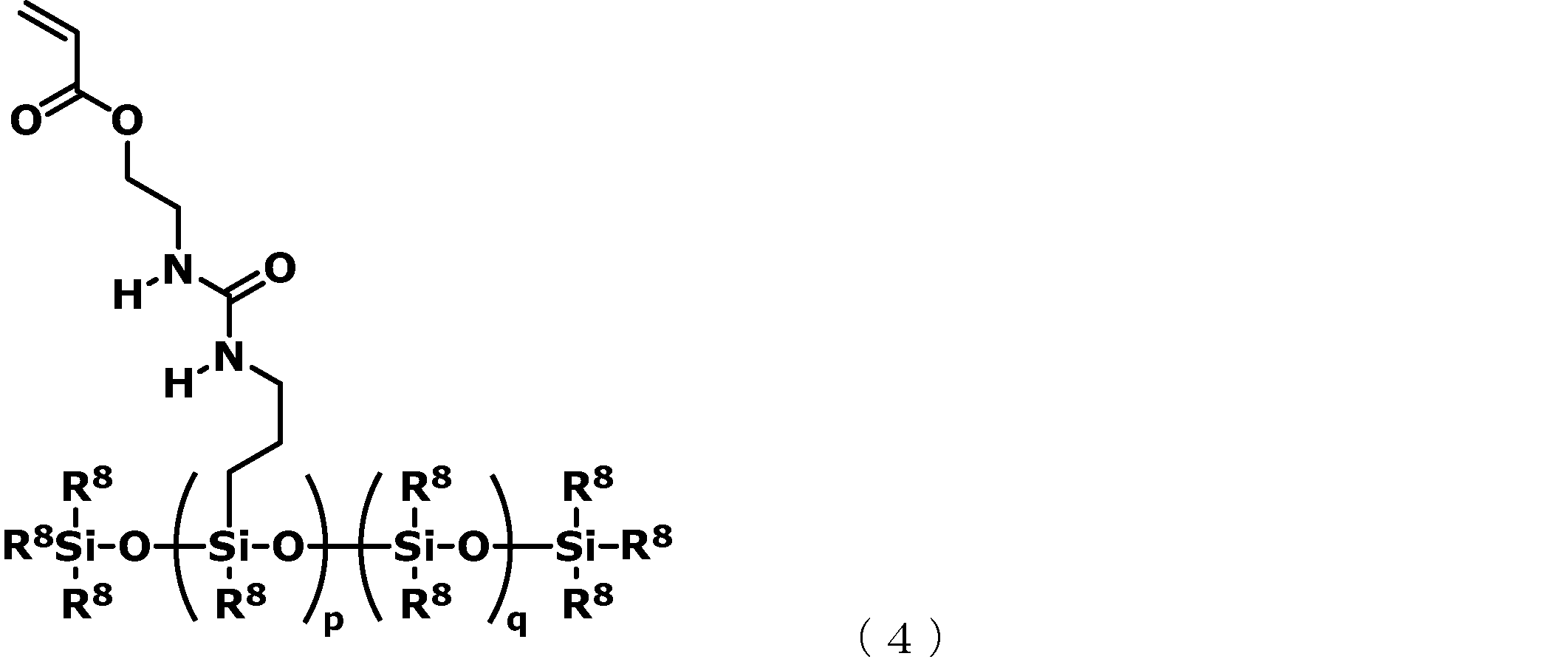
(式(4)中、R8は夫々独立にメチル基、エチル基、又はフェニル基であり、2つの括弧内のシロキサン単位は、任意の配列順でよく、ブロックでもよいし、ランダムでもよい。p、qは、p≧1、q≧0、1≦p+q≦10,000を満たす数である。)
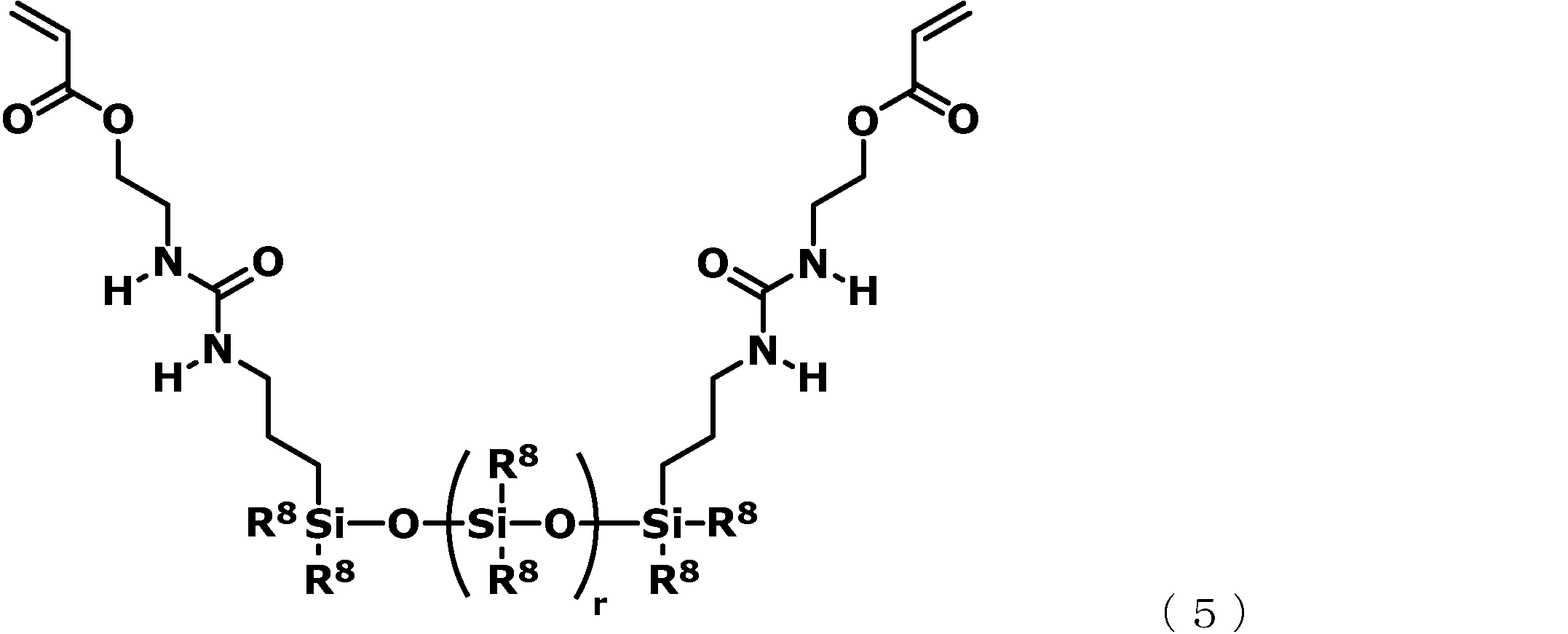
(式(5)中、R8は上記と同じ意味を表し、rは1≦r≦10,000を満たす数である。)
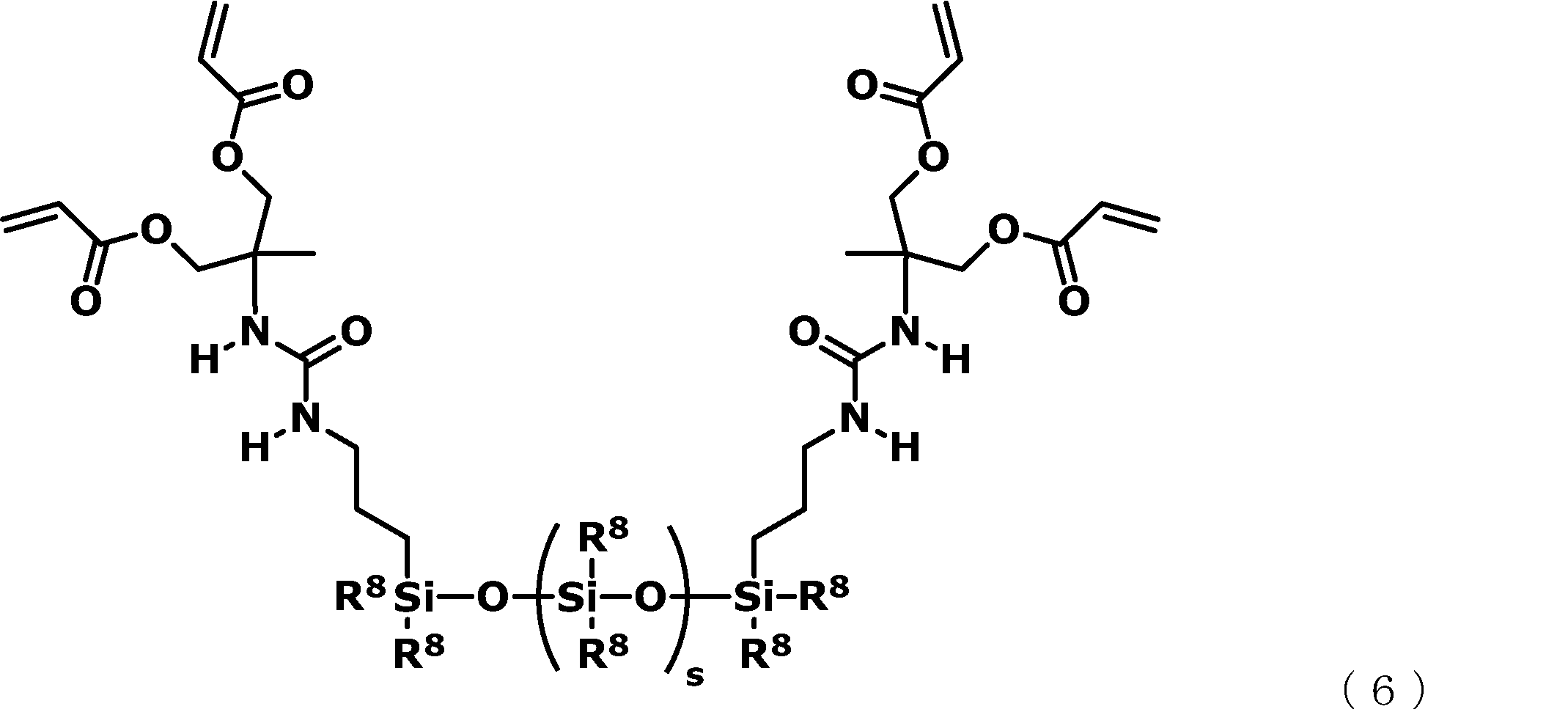
(式(6)中、R8は上記と同じ意味を表し、sは1≦s≦10,000を満たす数である。)
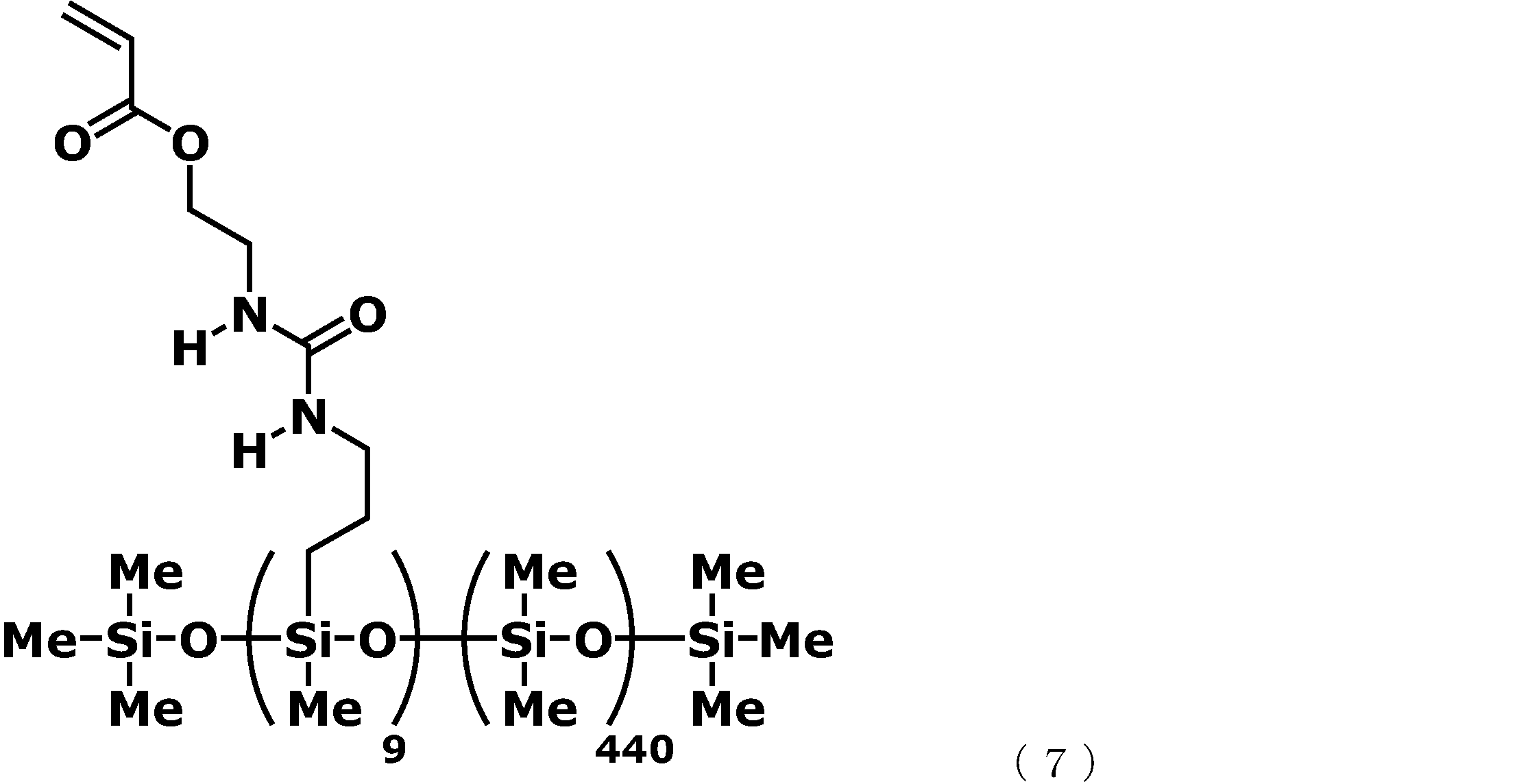
(式(7)中、2つの括弧内のシロキサン単位は、任意の配列順でよく、ブロックでもよいし、ランダムでもよい。)
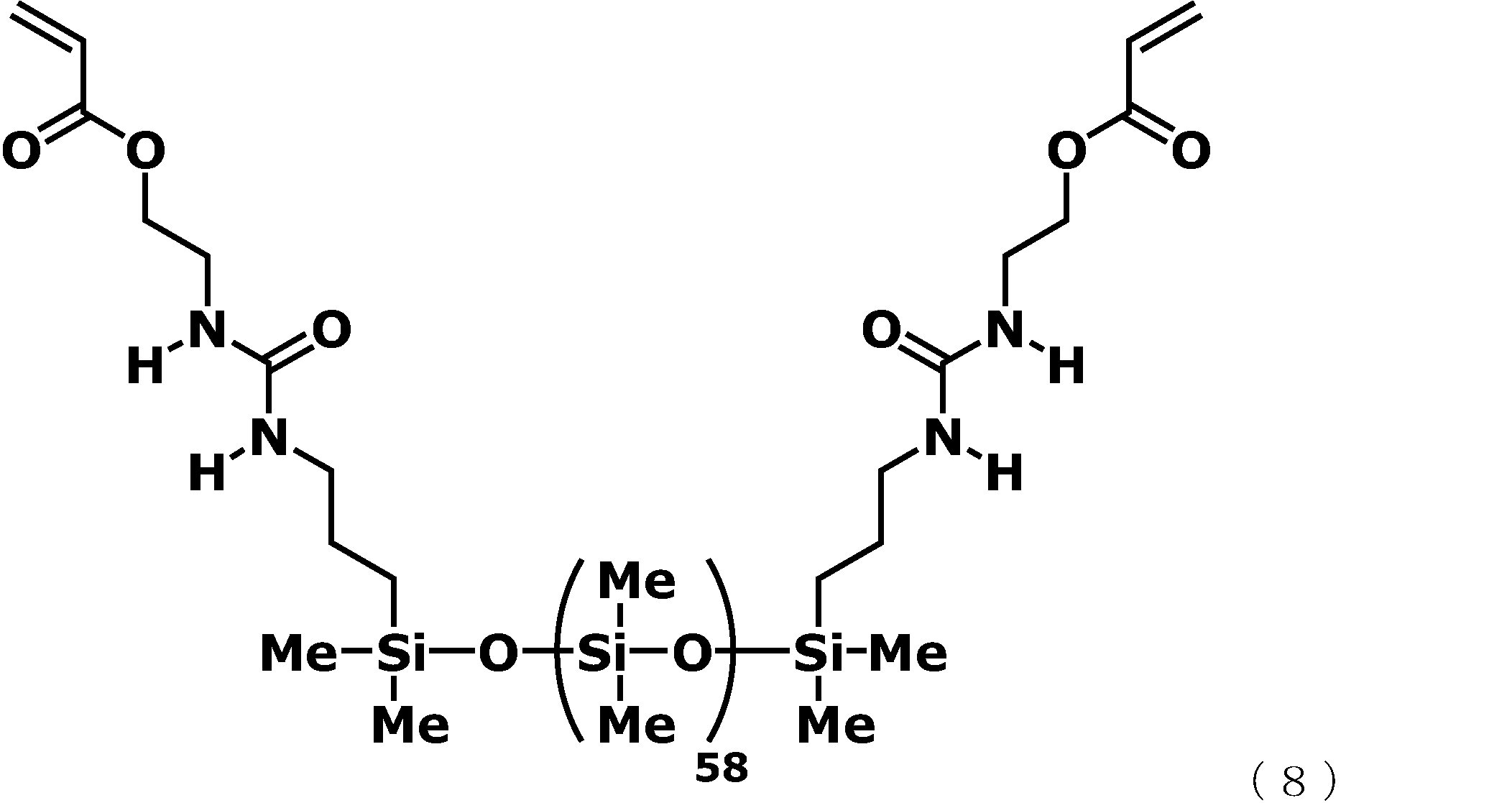
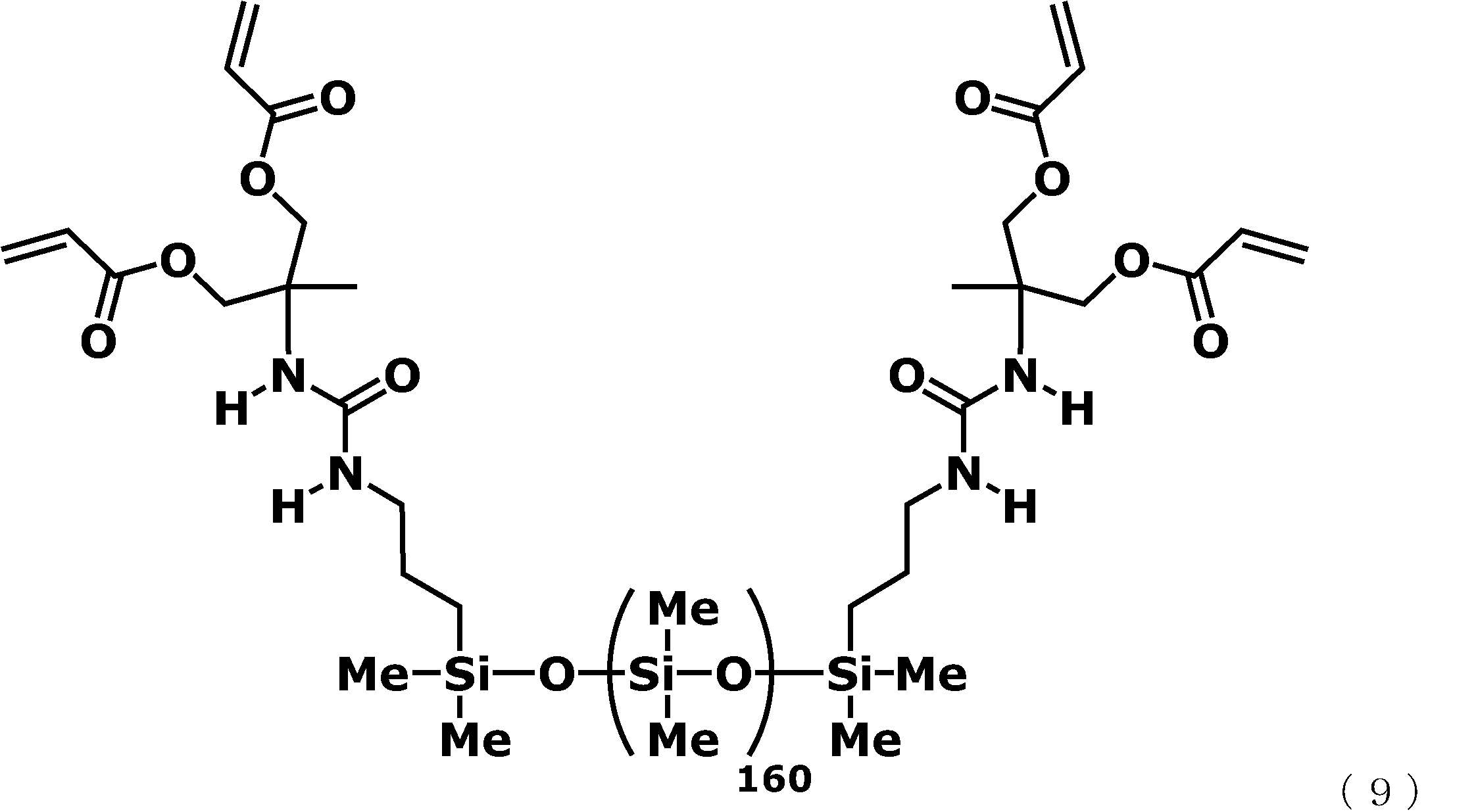
これらのオルガノポリシロキサンは、例えば、側鎖型アミノ変性ジメチルシリコーンオイル(信越化学工業株式会社製KF-864)、及び両末端アミノ変性ジメチルシリコーンオイル(信越化学工業株式会社製KF-8008)等のアミノ基を有するポリシロキサンと、2-(アクリロイルオキシ)エチルイソシアナート(昭和電工株式会社製カレンズAOI)、及び1,1-ビス(アクリロイルオキシメチル)エチルイソシアネート(昭和電工株式会社製カレンズBEI)等の化合物とを反応させることにより得られる。
紫外線硬化性シリコーン組成物
(A)オルガノポリシロキサン
本発明の紫外線硬化性シリコーン組成物の(A)成分は、上記式(1)で示されるオルガノポリシロキサンと同様である。
本発明の組成物中、(A)成分は、5~99.9質量%含有することが好ましく、20~99質量%含有することがより好ましく、30~99質量%含有することがさらに好ましい。
(A)成分のオルガノポリシロキサンの25℃における粘度は、組成物の作業性や硬化物の力学特性をより向上させることを考慮すると、0.01~100,000Pa・sが好ましく、0.1~50,000Pa・sがより好ましい。なお、粘度は回転粘度計(例えば、BL型、BH型、BS型、コーンプレート型、レオメーター等)により測定できる。
(A)オルガノポリシロキサン
本発明の紫外線硬化性シリコーン組成物の(A)成分は、上記式(1)で示されるオルガノポリシロキサンと同様である。
本発明の組成物中、(A)成分は、5~99.9質量%含有することが好ましく、20~99質量%含有することがより好ましく、30~99質量%含有することがさらに好ましい。
(A)成分のオルガノポリシロキサンの25℃における粘度は、組成物の作業性や硬化物の力学特性をより向上させることを考慮すると、0.01~100,000Pa・sが好ましく、0.1~50,000Pa・sがより好ましい。なお、粘度は回転粘度計(例えば、BL型、BH型、BS型、コーンプレート型、レオメーター等)により測定できる。
(B)光重合開始剤
光重合開始剤(B)としては、2,2-ジエトキシアセトフェノン、2,2-ジメトキシ-1,2-ジフェニルエタン-1-オン(BASF製Irgacure 651)、1-ヒドロキシ-シクロヘキシル-フェニル-ケトン(BASF製Irgacure 184)、2-ヒドロキシ-2-メチル-1-フェニル-プロパン-1-オン(BASF製Irgacure 1173)、2-ヒドロキシ-1-{4-[4-(2-ヒドロキシ-2-メチループロピオニル)-ベンジル]-フェニル}-2-メチル-プロパン-1-オン(BASF製Irgacure 127)、フェニルグリオキシリックアシッドメチルエステル(BASF製Irgacure MBF)、2-メチル-1-[4-(メチルチオ)フェニル]-2-モルフォリノプロパン-1-オン(BASF製Irgacure 907)、2-ベンジル-2-ジメチルアミノ-1-(4-モルフォリノフェニル)-1-ブタノン(BASF製Irgacure 369)、ビス(2,4,6-トリメチルベンゾイル)-フェニルホスフィンオキサイド(BASF製Irgacure 819)、2,4,6-トリメチルベンゾイル-ジフェニル-ホスフィンオキサイド(BASF製Irgacure TPO)及びこれらの混合物等が挙げられる。
光重合開始剤(B)としては、2,2-ジエトキシアセトフェノン、2,2-ジメトキシ-1,2-ジフェニルエタン-1-オン(BASF製Irgacure 651)、1-ヒドロキシ-シクロヘキシル-フェニル-ケトン(BASF製Irgacure 184)、2-ヒドロキシ-2-メチル-1-フェニル-プロパン-1-オン(BASF製Irgacure 1173)、2-ヒドロキシ-1-{4-[4-(2-ヒドロキシ-2-メチループロピオニル)-ベンジル]-フェニル}-2-メチル-プロパン-1-オン(BASF製Irgacure 127)、フェニルグリオキシリックアシッドメチルエステル(BASF製Irgacure MBF)、2-メチル-1-[4-(メチルチオ)フェニル]-2-モルフォリノプロパン-1-オン(BASF製Irgacure 907)、2-ベンジル-2-ジメチルアミノ-1-(4-モルフォリノフェニル)-1-ブタノン(BASF製Irgacure 369)、ビス(2,4,6-トリメチルベンゾイル)-フェニルホスフィンオキサイド(BASF製Irgacure 819)、2,4,6-トリメチルベンゾイル-ジフェニル-ホスフィンオキサイド(BASF製Irgacure TPO)及びこれらの混合物等が挙げられる。
上記(B)成分のうち、(A)成分との相溶性の観点から好ましいのは、2,2-ジエトキシアセトフェノン、2-ヒドロキシ-2-メチル-1-フェニル-プロパン-1-オン(BASF製Irgacure 1173)、ビス(2,4,6-トリメチルベンゾイル)-フェニルホスフィンオキサイド(BASF製Irgacure 819)、2,4,6-トリメチルベンゾイル-ジフェニル-ホスフィンオキサイド(BASF製Irgacure TPO)である。
光重合開始剤の添加量は(A)100質量部に対して、0.1~20質量部の範囲で配合される。0.1質量部未満であると硬化性が不足し、20質量部を超える量で添加した場合は深部硬化性が悪化する。
本発明の紫外線硬化性シリコーン組成物は、上記必須成分以外に、必要により更に成分(C)及び成分(D)として、シロキサン構造を含まない単官能(メタ)アクリレート化合物及び多官能(メタ)アクリレート化合物の何れか一方又は両方を含んでもよい。
(C)シロキサン構造を含まない単官能(メタ)アクリレート化合物
シロキサン構造を含まない単官能(メタ)アクリレート化合物(C)としては、イソアミルアクリレート、ラウリルアクリレート、ステアリルアクリレート、エトキシ-ジエチレングリコールアクリレート、メトキシ-トリエチレングリコールアクリレート、2-エチルヘキシル-ジグリコールアクリレート、フェノキシエチルアクリレート、フェノキシジエチレングリコールアクリレート、テトラヒドロフルフリルアクリレート、イソボルニルアクリレート及びこれらの混合物等が挙げられ、特にイソボルニルアクリレートが好ましい。
シロキサン構造を含まない単官能(メタ)アクリレート化合物(C)としては、イソアミルアクリレート、ラウリルアクリレート、ステアリルアクリレート、エトキシ-ジエチレングリコールアクリレート、メトキシ-トリエチレングリコールアクリレート、2-エチルヘキシル-ジグリコールアクリレート、フェノキシエチルアクリレート、フェノキシジエチレングリコールアクリレート、テトラヒドロフルフリルアクリレート、イソボルニルアクリレート及びこれらの混合物等が挙げられ、特にイソボルニルアクリレートが好ましい。
(D)シロキサン構造を含まない多官能(メタ)アクリレート化合物
シロキサン構造を含まない多官能(メタ)アクリレート化合物(D)としては、トリエチレングリコールジアクリレート、ポリテトラメチレングリコールジアクリレート、ネオペンチルグリコールジアクリレート、1,6-ヘキサンジオールジアクリレート、ジメチロール-トリシクロデカンジアクリレート、トリメチロルプロパントリアクリレート、ペンタエリスリトールテトラアクリレート及びこれらの混合物等が挙げられ、特にジメチロール-トリシクロデカンジアクリレートが好ましい。
シロキサン構造を含まない多官能(メタ)アクリレート化合物(D)としては、トリエチレングリコールジアクリレート、ポリテトラメチレングリコールジアクリレート、ネオペンチルグリコールジアクリレート、1,6-ヘキサンジオールジアクリレート、ジメチロール-トリシクロデカンジアクリレート、トリメチロルプロパントリアクリレート、ペンタエリスリトールテトラアクリレート及びこれらの混合物等が挙げられ、特にジメチロール-トリシクロデカンジアクリレートが好ましい。
(C)成分及び/又は(D)成分の(メタ)アクリレート化合物を用いる場合の添加量は、得られる硬化物のゴム物性の観点から、(A)成分100質量部に対して、(C)成分及び(D)成分の合計で1~500質量部の範囲が好ましく、より好ましくは10~100質量部の範囲である。また、高粘度の(A)成分と組み合わせる場合、(C)成分及び/又は(D)成分の添加量を増やすことにより組成物全体の粘度を下げることができる。
また、本発明の紫外線硬化性シリコーン組成物は、必要により更に成分(E)及び成分(F)として、何れか一方又は両方のオルガノポリシロキサンレジンを含んでもよい。
(E)オルガノポリシロキサンレジン
(E)成分は、(a)R4 3SiO1/2単位(式中、R4は、互いに独立して炭素原子数1~10の一価炭化水素基である)と(b)SiO4/2単位からなり、(a)単位と(b)単位のモル比が0.4~1.2:1の範囲にあるオルガノポリシロキサンレジンである。
R4における炭素原子数1~10の一価炭化水素基の具体例としては、上述したR1で例示した基のうち、炭素原子数1~10のものが挙げられるが、中でもメチル、エチル、n-プロピル、n-ブチル基等の炭素原子数1~6のアルキル基;フェニル、トリル基等の炭素原子数6~10のアリール基;ベンジル基等の炭素原子数7~10のアラルキル基;ビニル基、アリル基、ブテニル基等の炭素原子数2~6のアルケニル基などが好ましい。
なお、上記R4の一価炭化水素基も炭素原子に結合した水素原子の一部または全部が、上述した置換基で置換されていてもよい。
組成物の粘着力および力学的特性をより適切な範囲とすることを考慮すると、(E)成分では、(a)R4 3SiO1/2単位(M単位)と(b)SiO4/2単位(Q単位)のモル比がM単位:Q単位=0.4~1.2:1であることが好ましく、M単位:Q単位=0.6~1.2:1であることがより好ましい。
(E)成分のオルガノポリシロキサンレジンを用いる場合の添加量は、上記(A)成分100質量部に対して1~1,000質量部の範囲が好ましく、10~800質量部の範囲がより好ましく、20~500質量部の範囲が更に好ましい。
(E)成分の数平均分子量は、特に限定されないが、ゲルパーミエーションクロマトグラフィ(GPC)測定によるポリスチレン標準で換算した数平均分子量が500~10,000であることが好ましく、特に好ましくは1,000~8,000、更に好ましくは1,000~7,000である。
(E)成分は、(a)R4 3SiO1/2単位(式中、R4は、互いに独立して炭素原子数1~10の一価炭化水素基である)と(b)SiO4/2単位からなり、(a)単位と(b)単位のモル比が0.4~1.2:1の範囲にあるオルガノポリシロキサンレジンである。
R4における炭素原子数1~10の一価炭化水素基の具体例としては、上述したR1で例示した基のうち、炭素原子数1~10のものが挙げられるが、中でもメチル、エチル、n-プロピル、n-ブチル基等の炭素原子数1~6のアルキル基;フェニル、トリル基等の炭素原子数6~10のアリール基;ベンジル基等の炭素原子数7~10のアラルキル基;ビニル基、アリル基、ブテニル基等の炭素原子数2~6のアルケニル基などが好ましい。
なお、上記R4の一価炭化水素基も炭素原子に結合した水素原子の一部または全部が、上述した置換基で置換されていてもよい。
組成物の粘着力および力学的特性をより適切な範囲とすることを考慮すると、(E)成分では、(a)R4 3SiO1/2単位(M単位)と(b)SiO4/2単位(Q単位)のモル比がM単位:Q単位=0.4~1.2:1であることが好ましく、M単位:Q単位=0.6~1.2:1であることがより好ましい。
(E)成分のオルガノポリシロキサンレジンを用いる場合の添加量は、上記(A)成分100質量部に対して1~1,000質量部の範囲が好ましく、10~800質量部の範囲がより好ましく、20~500質量部の範囲が更に好ましい。
(E)成分の数平均分子量は、特に限定されないが、ゲルパーミエーションクロマトグラフィ(GPC)測定によるポリスチレン標準で換算した数平均分子量が500~10,000であることが好ましく、特に好ましくは1,000~8,000、更に好ましくは1,000~7,000である。
(F)架橋性オルガノポリシロキサンレジン
(F)成分は、(c)下記式(3)で示される単位(以下、MA単位という)、(d)R4 3SiO1/2単位(M単位)及び(e)SiO4/2単位(Q単位)からなる(メタ)アクリロイルオキシ含有基を有するオルガノポリシロキサンレジンである。なお、R4は上記と同じ意味を表す。

上記式(3)におけるR5は、夫々独立に炭素原子数1~20の一価炭化水素基であり、直鎖、分岐、及び環状のいずれでもよく、その具体例としては、メチル、エチル、n-プロピル、イソプロピル、n-ブチル、イソブチル、tert-ブチル、n-ヘキシル、シクロヘキシル、n-オクチル、2-エチルヘキシル、n-デシル基等のアルキル基;ビニル、アリル(2-プロペニル)、1-プロペニル、イソプロペニル、ブテニル基等のアルケニル基;フェニル、トリル、キシリル、ナフチル基等のアリール基;ベンジル、フェニルエチル、フェニルプロピル基等のアラルキル基などが挙げられる。
(F)成分は、(c)下記式(3)で示される単位(以下、MA単位という)、(d)R4 3SiO1/2単位(M単位)及び(e)SiO4/2単位(Q単位)からなる(メタ)アクリロイルオキシ含有基を有するオルガノポリシロキサンレジンである。なお、R4は上記と同じ意味を表す。
また、これら一価炭化水素基の炭素原子に結合した水素原子の一部または全部は、置換基で置換されていてもよく、その具体例としては、クロロメチル、ブロモエチル、トリフルオロプロピル、シアノエチル基等のハロゲン置換炭化水素基;シアノ置換炭化水素基などが挙げられる。
これらの中でも、R5としては、炭素原子数1~5のアルキル基、及びアリール基が好ましく、メチル基、エチル基、フェニル基がより好ましい。
上記式(3)におけるR6は、酸素原子または炭素原子数1~20のアルキレン基であり、直鎖、分岐、及び環状のいずれでもよく、その具体例としては、メチレン、エチレン、プロピレン、トリメチレン、テトラメチレン、イソブチレン、ペンタメチレン、ヘキサメチレン、ヘプタメチレン、オクタメチレン、ノナメチレン、デシレン基等が挙げられる。
これらの中でも、R6としては、酸素原子、メチレン、エチレン、またはトリメチレン基が好ましく、酸素原子またはエチレン基がより好ましい。
上記式(3)におけるR7は、夫々独立に、アクリロイルオキシアルキル基、メタクリロイルオキシアルキル基、アクリロイルオキシアルキルオキシ基、またはメタクリロイルオキシアルキルオキシ基であり、これらの基におけるアルキル(アルキレン)基の炭素数としては、特に限定されるものではないが、1~10が好ましく、1~5がより好ましい。これらアルキル基の具体例としては、上述したR1で例示した基のうち、炭素原子数1~10のものが挙げられる。
上記式(3)におけるnは、0≦n≦10を満たす数であるが、0または1が好ましく、aは、1≦a≦3を満たす数であるが、1または2が好ましい。
組成物の粘度および硬化物の力学的特性を考慮すると、(F)成分は、(c)上記式(3)で示される単位(MA単位)、(d)R4
3SiO1/2単位(M単位)及び(e)SiO4/2単位(Q単位)のモル比が、(MA単位+M単位):Q単位=0.4~1.2:1であることが好ましく、(MA単位+M単位):Q単位=0.6~1.2:1であることがより好ましい。
また、MA単位とM単位のモル比により、硬化物のゴム物性を調節できる。硬化物の強度を考慮すると、MA単位:M単位=0.01~1:1が好ましく、MA単位:M単位=0.05~0.5:1がより好ましい。
また、MA単位とM単位のモル比により、硬化物のゴム物性を調節できる。硬化物の強度を考慮すると、MA単位:M単位=0.01~1:1が好ましく、MA単位:M単位=0.05~0.5:1がより好ましい。
(F)成分の架橋性オルガノポリシロキサンレジンを用いる場合の添加量は、(A)100質量部に対して、1~1,000質量部の範囲が好ましく、10~800質量部の範囲がより好ましく、20~500質量部の範囲が更に好ましい。
(F)成分の数平均分子量は、特に限定されないが、ゲルパーミエーションクロマトグラフィ(GPC)測定によるポリスチレン標準で換算した数平均分子量が1,000~10,000であることが好ましく、特に好ましくは2,000~8,000、更に好ましくは2,500~7,000である。
(F)成分の数平均分子量は、特に限定されないが、ゲルパーミエーションクロマトグラフィ(GPC)測定によるポリスチレン標準で換算した数平均分子量が1,000~10,000であることが好ましく、特に好ましくは2,000~8,000、更に好ましくは2,500~7,000である。
その他の成分
なお、本発明の組成物には、本発明の効果を損なわない範囲で、色材(顔料または染料)、シランカップリング剤、接着助剤、重合禁止剤、酸化防止剤、耐光性安定剤である紫外線吸収剤、光安定化剤等の添加剤を配合することができる。
また、本発明の組成物はその他の樹脂組成物と適宜混合して使用することもできる。
なお、本発明の組成物には、本発明の効果を損なわない範囲で、色材(顔料または染料)、シランカップリング剤、接着助剤、重合禁止剤、酸化防止剤、耐光性安定剤である紫外線吸収剤、光安定化剤等の添加剤を配合することができる。
また、本発明の組成物はその他の樹脂組成物と適宜混合して使用することもできる。
製造方法
本発明の紫外線硬化性シリコーン組成物は、上記(A)及び(B)成分、並びに必要に応じて(C)~(F)成分およびその他の成分を、任意の順序で混合し、撹拌等して得ることができる。撹拌等の操作に用いる装置は特に限定されないが、擂潰機、3本ロール、ボールミル、プラネタリーミキサー等を用いることができる。また、これら装置を適宜組み合わせてもよい。
本発明の紫外線硬化性シリコーン組成物は、上記(A)及び(B)成分、並びに必要に応じて(C)~(F)成分およびその他の成分を、任意の順序で混合し、撹拌等して得ることができる。撹拌等の操作に用いる装置は特に限定されないが、擂潰機、3本ロール、ボールミル、プラネタリーミキサー等を用いることができる。また、これら装置を適宜組み合わせてもよい。
本発明の紫外線硬化性シリコーン組成物の粘度は、塗布時の形状保持性と作業性の観点から、回転粘度計を用いて25℃で測定した粘度が5,000Pa・s以下であることが好ましく、3,000Pa・s以下がより好ましく、1,500Pa・s以下がより一層好ましい。
本発明の紫外線硬化性シリコーン組成物の硬化物は、紫外線を照射することにより速やかに得ることができる。
この場合、本発明の組成物に照射する紫外線の光源としては、例えば、UVLEDランプ、高圧水銀灯、超高圧水銀灯、メタルハライドランプ、カーボンアークランプ、キセノンランプ等が挙げられる。
紫外線の照射量(積算光量)は、例えば、本発明の組成物を2.0mm程度の厚みに成形したシートに対して、好ましくは1~10,000mJ/cm2であり、より好ましくは10~8,000mJ/cm2である。すなわち、照度100mW/cm2の紫外線を用いた場合、0.01~100秒程度紫外線を照射すればよい。
この場合、本発明の組成物に照射する紫外線の光源としては、例えば、UVLEDランプ、高圧水銀灯、超高圧水銀灯、メタルハライドランプ、カーボンアークランプ、キセノンランプ等が挙げられる。
紫外線の照射量(積算光量)は、例えば、本発明の組成物を2.0mm程度の厚みに成形したシートに対して、好ましくは1~10,000mJ/cm2であり、より好ましくは10~8,000mJ/cm2である。すなわち、照度100mW/cm2の紫外線を用いた場合、0.01~100秒程度紫外線を照射すればよい。
また、本発明の紫外線硬化性シリコーン組成物からなる硬化物が優れたゴム物性を示す為には硬化後の硬度は20以上(TypeA)が好ましく、30以上(TypeA)であることがより好ましい。なお、これらの値は、JIS K 6249:2003に準じて測定したときの値である。
硬化後の硬度は、(C)成分及び(D)成分の添加量を増減することによって調整できる。
硬化後の硬度は、(C)成分及び(D)成分の添加量を増減することによって調整できる。
以下、実施例及び比較例を示し、本発明を具体的に説明するが、本発明は下記の実施例に限定されるものではない。
[実施例1]
側鎖型アミノ変性ジメチルシリコーンオイル(信越化学工業株式会社製KF-864)1,000gと2-(アクリロイルオキシ)エチルイソシアナート(昭和電工株式会社製カレンズAOI)41.3gをフラスコに計量し、25℃で24時間攪拌し、下記平均構造式で表される、粘度46.3Pa・sのオルガノポリシロキサン(A-1)を得た。
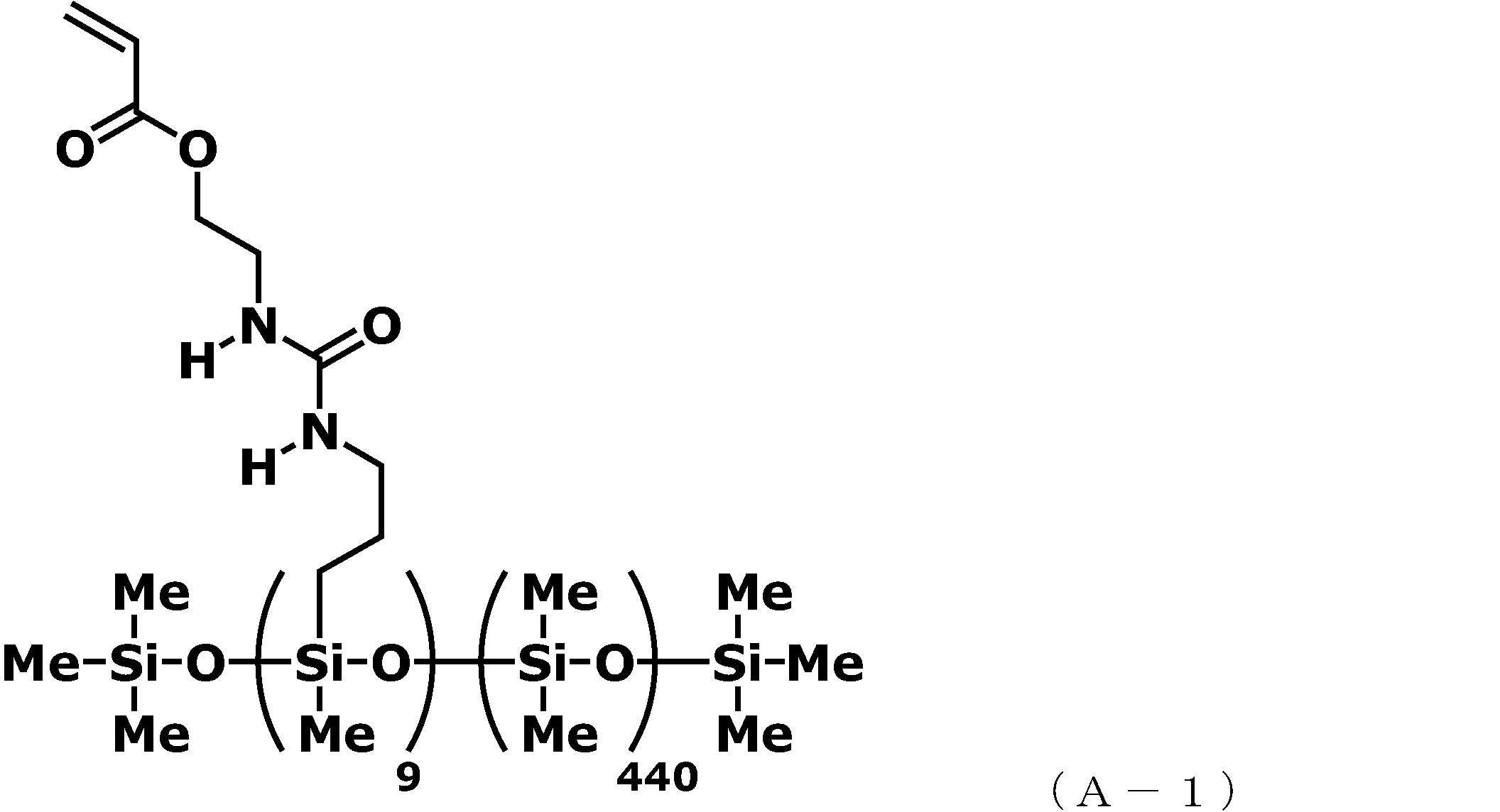
(式(A-1)中、2つの括弧内のシロキサン単位の配列はブロック又はランダムである。)
側鎖型アミノ変性ジメチルシリコーンオイル(信越化学工業株式会社製KF-864)1,000gと2-(アクリロイルオキシ)エチルイソシアナート(昭和電工株式会社製カレンズAOI)41.3gをフラスコに計量し、25℃で24時間攪拌し、下記平均構造式で表される、粘度46.3Pa・sのオルガノポリシロキサン(A-1)を得た。
[実施例2]
両末端アミノ変性ジメチルシリコーンオイル(信越化学工業株式会社製KF-8008)1,000gと1,1-ビス(アクリロイルオキシメチル)エチルイソシアネート(昭和電工株式会社製カレンズBEI)49.4gをフラスコに計量し、25℃で24時間攪拌し、下記平均構造式で表される、粘度13.0Pa・sのオルガノポリシロキサン(A-2)を得た。
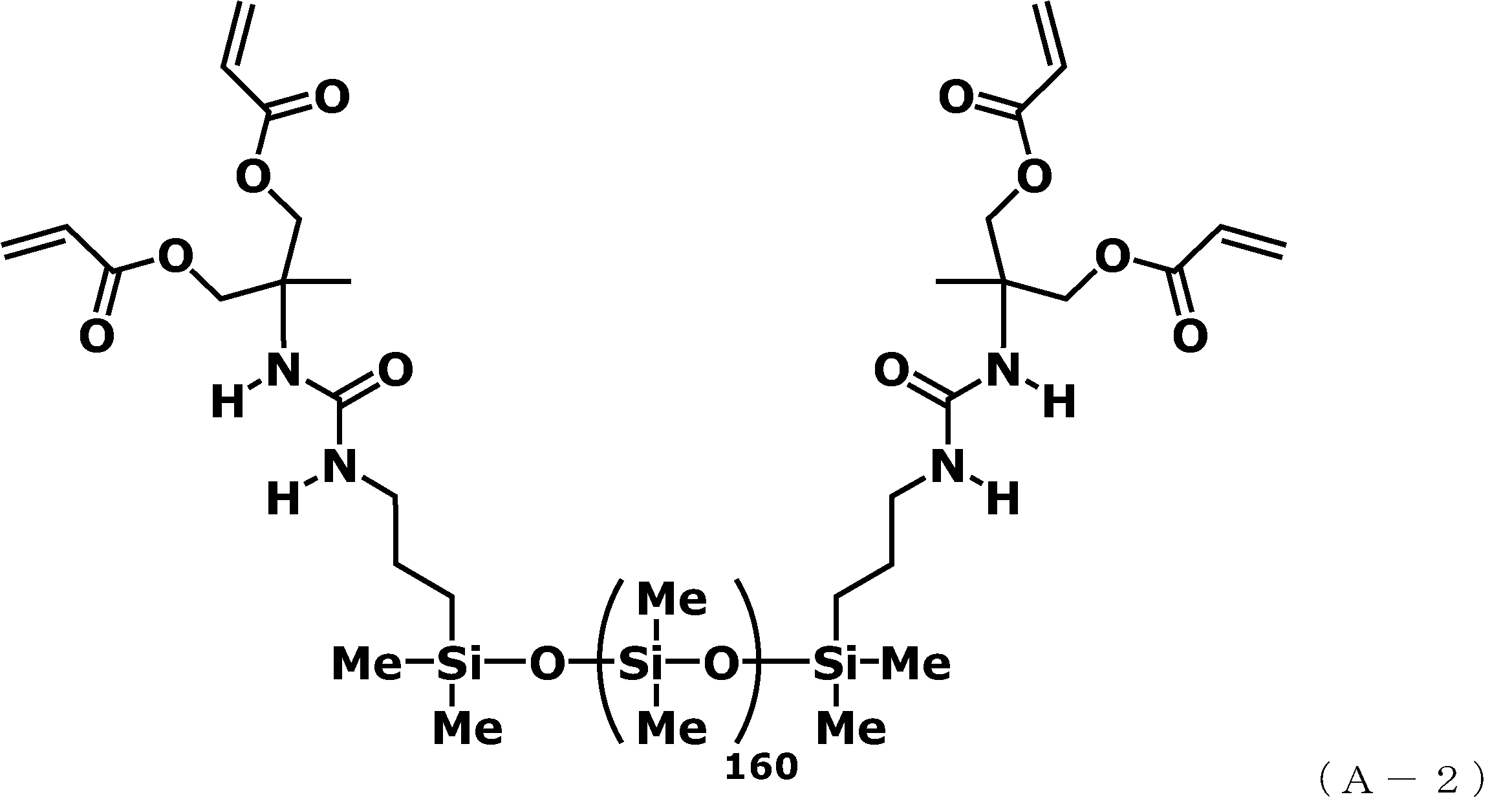
両末端アミノ変性ジメチルシリコーンオイル(信越化学工業株式会社製KF-8008)1,000gと1,1-ビス(アクリロイルオキシメチル)エチルイソシアネート(昭和電工株式会社製カレンズBEI)49.4gをフラスコに計量し、25℃で24時間攪拌し、下記平均構造式で表される、粘度13.0Pa・sのオルガノポリシロキサン(A-2)を得た。
[実施例3]
両末端アミノ変性ジメチルシリコーンオイル(信越化学工業株式会社製KF-8008)1,000gと2-(アクリロイルオキシ)エチルイソシアナート(昭和電工株式会社製カレンズAOI)29.1gをフラスコに計量し、25℃で24時間攪拌し、下記平均構造式で表される、粘度7.8Pa・sのオルガノポリシロキサン(A-3)を得た。
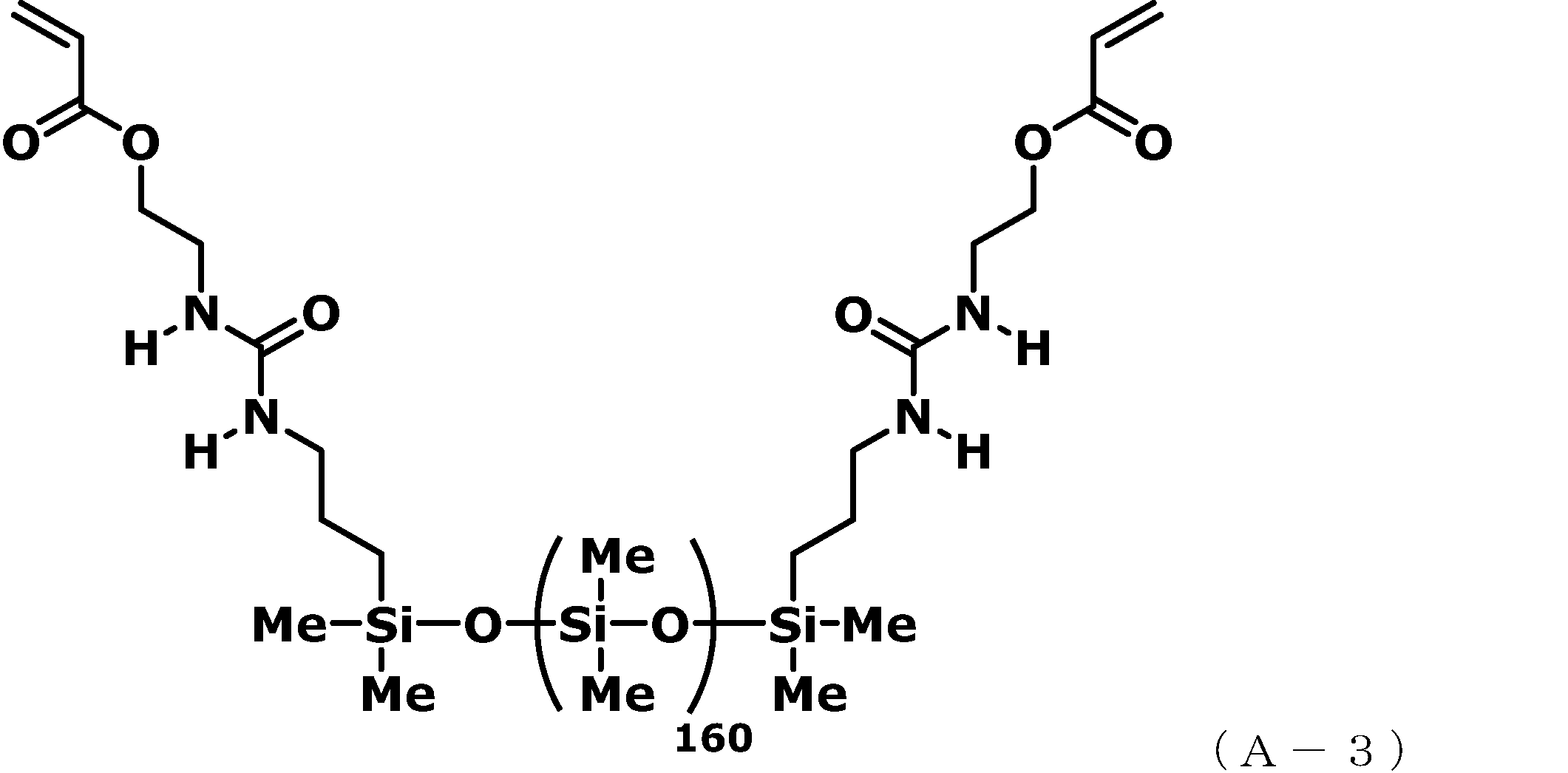
両末端アミノ変性ジメチルシリコーンオイル(信越化学工業株式会社製KF-8008)1,000gと2-(アクリロイルオキシ)エチルイソシアナート(昭和電工株式会社製カレンズAOI)29.1gをフラスコに計量し、25℃で24時間攪拌し、下記平均構造式で表される、粘度7.8Pa・sのオルガノポリシロキサン(A-3)を得た。
[実施例4~10および比較例1、2]
表1に示す組成で調製したシリコーン組成物について評価を行った。なお、下記の例で、粘度は回転粘度計を用いて25℃で測定した値である。
表1に示す組成で調製したシリコーン組成物について評価を行った。なお、下記の例で、粘度は回転粘度計を用いて25℃で測定した値である。
硬化物の硬度はJIS K 6249:2003に準じて測定した。表面硬化性は指触で観察し、未硬化層がないものを「完全硬化」とし、未硬化層があるものを「不完全硬化」として評価した。
上記(A)~(F)成分を表1の組成(質量部)で混合し、減圧下にて100℃でトルエンを留去し、表1に記載の各シリコーン組成物を調製した。
調製した各シリコーン組成物を、アイグラフィック(株)製アイUV電子制御装置(型式UBX0601-01)を用い、大気中、室温(25℃)で、波長365nmの紫外光での照射量が4,000mJ/cm2となるように紫外線を照射し、硬化させた。
なお、実施例4~10及び比較例1、2で使用した各成分の化合物は以下のとおりである。
(A)成分
(A-1)実施例1で得られたオルガノポリシロキサン
(A-2)実施例2で得られたオルガノポリシロキサン
(A-3)実施例3で得られたオルガノポリシロキサン
(A-4)(比較例用)下記平均構造式で表されるオルガノポリシロキサン(粘度3.4Pa・s)

(式(A-4)中、2つの括弧内のシロキサン単位の配列はブロック又はランダムである。)
(A-5)(比較例用)下記平均構造式で表されるオルガノポリシロキサン(粘度0.2Pa・s)

(A-1)実施例1で得られたオルガノポリシロキサン
(A-2)実施例2で得られたオルガノポリシロキサン
(A-3)実施例3で得られたオルガノポリシロキサン
(A-4)(比較例用)下記平均構造式で表されるオルガノポリシロキサン(粘度3.4Pa・s)
(A-5)(比較例用)下記平均構造式で表されるオルガノポリシロキサン(粘度0.2Pa・s)
(B)成分
(B-1)2-ヒドロキシ-2-メチル-1-フェニル-プロパン-1-オン(BASF製Irgacure 1173)
(B-2)2,4,6-トリメチルベンゾイル-ジフェニル-ホスフィンオキサイド(BASF製Irgacure TPO)
(B-1)2-ヒドロキシ-2-メチル-1-フェニル-プロパン-1-オン(BASF製Irgacure 1173)
(B-2)2,4,6-トリメチルベンゾイル-ジフェニル-ホスフィンオキサイド(BASF製Irgacure TPO)
(C)成分
(C-1)イソボルニルアクリレート(共栄社化学(株)製ライトアクリレートIB-XA)
(C-1)イソボルニルアクリレート(共栄社化学(株)製ライトアクリレートIB-XA)
(D)成分
(D-1)ジメチロール-トリシクロデカンジアクリレート(共栄社化学(株)製ライトアクリレートDCP-A)
(D-1)ジメチロール-トリシクロデカンジアクリレート(共栄社化学(株)製ライトアクリレートDCP-A)
(E)成分
(E-1)Me3SiO1/2単位およびSiO4/2単位を含有し、(Me3SiO1/2単位)/(SiO4/2単位)のモル比が0.85であるオルガノポリシロキサンレジン(数平均分子量3,500)の60質量%トルエン溶液
(E-1)Me3SiO1/2単位およびSiO4/2単位を含有し、(Me3SiO1/2単位)/(SiO4/2単位)のモル比が0.85であるオルガノポリシロキサンレジン(数平均分子量3,500)の60質量%トルエン溶液
(F)成分
(F-1)下記式で表されるメタクリロイルオキシ基含有単位、ViMe2SiO1/2単位、Me3SiO1/2単位およびSiO4/2単位を含有し、メタクリロイルオキシ基含有単位/(ViMe2SiO1/2単位)/(Me3SiO1/2単位)/(SiO4/2単位)のモル比が0.07/0.10/0.67/1.00であるオルガノポリシロキサンレジン(数平均分子量5,700)の50質量%キシレン溶液

(F-1)下記式で表されるメタクリロイルオキシ基含有単位、ViMe2SiO1/2単位、Me3SiO1/2単位およびSiO4/2単位を含有し、メタクリロイルオキシ基含有単位/(ViMe2SiO1/2単位)/(Me3SiO1/2単位)/(SiO4/2単位)のモル比が0.07/0.10/0.67/1.00であるオルガノポリシロキサンレジン(数平均分子量5,700)の50質量%キシレン溶液
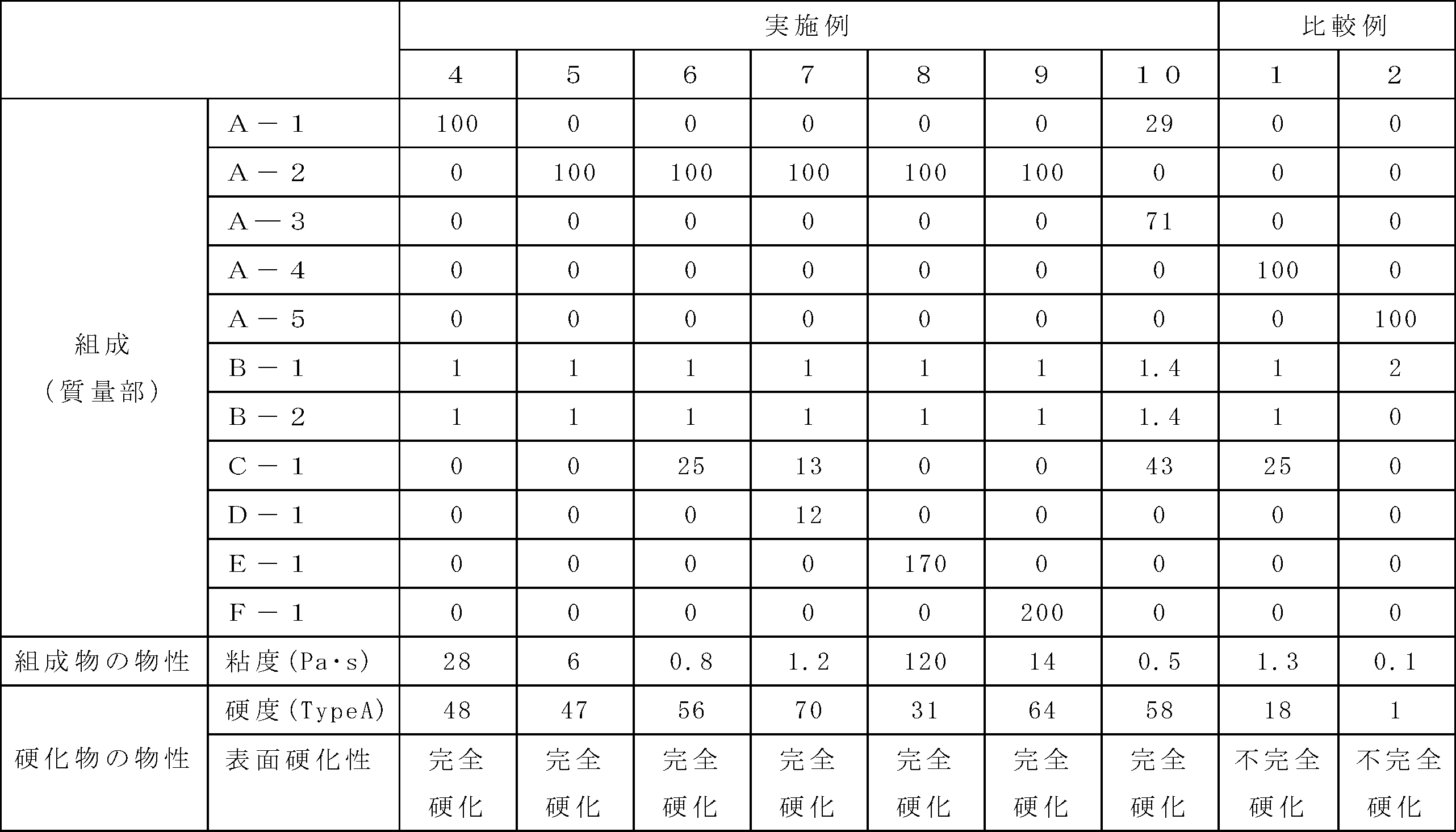
本発明の紫外線硬化性シリコーン組成物(実施例4~10)は、大気中で硬化させた場合においても良好な表面硬化性を有し、3Dプリンタ等の造形用途向けのシリコーン材料として有用である。一方、比較例1および2では、表面硬化性が不十分であった。
Claims (7)
- 下記式(1)で示されるオルガノポリシロキサン。


- (A)下記式(1)で示されるオルガノポリシロキサン:100質量部、


及び
(B)光重合開始剤:0.1~20質量部
を含有することを特徴とする紫外線硬化性シリコーン組成物。 - 更に、(C)シロキサン構造を含まない単官能(メタ)アクリレート化合物及び(D)シロキサン構造を含まない多官能(メタ)アクリレート化合物の何れか一方又は両方を、(A)成分100質量部に対し、(C)成分と(D)成分との合計で1~500質量部含有することを特徴とする、請求項2に記載の紫外線硬化性シリコーン組成物。
- 更に、(E)(a)R4 3SiO1/2単位(式中、R4は、夫々独立に炭素原子数1~10の一価炭化水素基を表す。)と(b)SiO4/2単位とからなり、(a)単位:(b)単位のモル比が0.4~1.2:1の範囲にあるオルガノポリシロキサンレジンを、(A)成分100質量部に対し、1~1,000質量部含有することを特徴とする、請求項2または3に記載の紫外線硬化性シリコーン組成物。
- 更に、(F)(c)下記式(3)

- 請求項2~5のいずれか1項に記載の紫外線硬化性シリコーン組成物を含む3Dプリンタ用組成物。
- 請求項2~5のいずれか1項に記載の紫外線硬化性シリコーン組成物の硬化物。
Priority Applications (4)
| Application Number | Priority Date | Filing Date | Title |
|---|---|---|---|
| KR1020217033151A KR102836352B1 (ko) | 2019-03-19 | 2020-03-05 | 오르가노폴리실록산, 자외선 경화성 실리콘 조성물 및 경화물 |
| US17/431,680 US12202925B2 (en) | 2019-03-19 | 2020-03-05 | Organopolysiloxane, ultraviolet-curable silicone composition and cured product |
| EP20773923.6A EP3943528A4 (en) | 2019-03-19 | 2020-03-05 | ORGANOPOLYSILOXANE, UV CURING SILICONE COMPOSITION AND CURED ARTICLE |
| CN202080019569.6A CN113544194A (zh) | 2019-03-19 | 2020-03-05 | 有机聚硅氧烷、紫外线固化性有机硅组合物及其固化物 |
Applications Claiming Priority (2)
| Application Number | Priority Date | Filing Date | Title |
|---|---|---|---|
| JP2019-050681 | 2019-03-19 | ||
| JP2019050681A JP7591863B2 (ja) | 2019-03-19 | 2019-03-19 | オルガノポリシロキサン、紫外線硬化性シリコーン組成物及び硬化物 |
Publications (1)
| Publication Number | Publication Date |
|---|---|
| WO2020189307A1 true WO2020189307A1 (ja) | 2020-09-24 |
Family
ID=72520892
Family Applications (1)
| Application Number | Title | Priority Date | Filing Date |
|---|---|---|---|
| PCT/JP2020/009440 Ceased WO2020189307A1 (ja) | 2019-03-19 | 2020-03-05 | オルガノポリシロキサン、紫外線硬化性シリコーン組成物及び硬化物 |
Country Status (7)
| Country | Link |
|---|---|
| US (1) | US12202925B2 (ja) |
| EP (1) | EP3943528A4 (ja) |
| JP (2) | JP7591863B2 (ja) |
| KR (1) | KR102836352B1 (ja) |
| CN (1) | CN113544194A (ja) |
| TW (1) | TWI875739B (ja) |
| WO (1) | WO2020189307A1 (ja) |
Cited By (6)
| Publication number | Priority date | Publication date | Assignee | Title |
|---|---|---|---|---|
| US20220380549A1 (en) * | 2021-05-12 | 2022-12-01 | Elkem Silicones USA Corp. | Method for producing a three-dimensional printed article |
| JP2023511193A (ja) * | 2020-01-22 | 2023-03-16 | コモンウェルス サイエンティフィック アンド インダストリアル リサーチ オーガニゼーション | 架橋性ポリシロキサン |
| US20230303898A1 (en) * | 2020-08-11 | 2023-09-28 | 3M Innovative Properties Company | (meth)acrylate structural adhesives and methods |
| WO2023190037A1 (ja) * | 2022-03-28 | 2023-10-05 | 味の素株式会社 | シリコーン骨格含有化合物 |
| JPWO2024009810A1 (ja) * | 2022-07-06 | 2024-01-11 | ||
| WO2025057574A1 (ja) * | 2023-09-14 | 2025-03-20 | 信越化学工業株式会社 | 紫外線硬化型シリコーン組成物およびその硬化物 |
Families Citing this family (6)
| Publication number | Priority date | Publication date | Assignee | Title |
|---|---|---|---|---|
| WO2020059650A1 (ja) | 2018-09-20 | 2020-03-26 | 信越化学工業株式会社 | 紫外線硬化性シリコーン組成物及びその硬化物 |
| JP7200884B2 (ja) * | 2019-08-27 | 2023-01-10 | 信越化学工業株式会社 | 微小構造体の実装方法 |
| JP2021105100A (ja) * | 2019-12-26 | 2021-07-26 | Jsr株式会社 | 硬化性組成物、硬化膜、有機el素子の製造方法及び化合物 |
| JP7476051B2 (ja) * | 2020-09-11 | 2024-04-30 | 株式会社三共 | 遊技機 |
| JP7476053B2 (ja) * | 2020-09-11 | 2024-04-30 | 株式会社三共 | 遊技機 |
| JP2025156802A (ja) * | 2024-04-02 | 2025-10-15 | 信越化学工業株式会社 | 側鎖に、長鎖アルキル基、及び、チオウレア基又はウレア基を有するポリオルガノシロキサン、並びにその製造方法 |
Citations (13)
| Publication number | Priority date | Publication date | Assignee | Title |
|---|---|---|---|---|
| JPH08507563A (ja) * | 1993-03-11 | 1996-08-13 | ミネソタ マイニング アンド マニュファクチャリング カンパニー | 放射線硬化性アクリレート/シリコーンの恒久的再▲剥▼離性感圧接着剤 |
| JP2002302664A (ja) * | 2001-04-06 | 2002-10-18 | Three Bond Co Ltd | 難接着材質用光硬化シリコーン組成物 |
| JP2008031307A (ja) * | 2006-07-28 | 2008-02-14 | Three Bond Co Ltd | 光硬化性オルガノポリシロキサン組成物 |
| JP2009288703A (ja) * | 2008-05-30 | 2009-12-10 | Fujifilm Corp | 着色硬化性組成物、カラーフィルタ、及び、固体撮像素子 |
| JP2013112750A (ja) * | 2011-11-29 | 2013-06-10 | Shin-Etsu Chemical Co Ltd | オルガノポリシロキサン化合物の製造方法並びにその化合物を用いた硬化性組成物 |
| JP2017171734A (ja) | 2016-03-22 | 2017-09-28 | 信越化学工業株式会社 | 紫外線硬化性シリコーン組成物、その硬化物、及び該組成物からなる光学素子封止材、並びに該光学素子封止材により封止された光学素子 |
| JP2017202023A (ja) * | 2016-05-09 | 2017-11-16 | 信越化学工業株式会社 | 生体電極及びその製造方法 |
| JP2017206626A (ja) * | 2016-05-19 | 2017-11-24 | 信越化学工業株式会社 | 伸縮性膜及びその形成方法、配線被覆基板の製造方法、並びに伸縮性配線膜及びその製造方法 |
| WO2018003381A1 (ja) | 2016-06-30 | 2018-01-04 | 信越化学工業株式会社 | 紫外線硬化性シリコーン組成物及びその硬化物 |
| CN108752936A (zh) * | 2018-04-28 | 2018-11-06 | 广州市白云化工实业有限公司 | 双组分加成型硅橡胶及其制备方法 |
| WO2019064116A1 (en) * | 2017-09-28 | 2019-04-04 | 3M Innovative Properties Company | PHOTO-RADICAL CURING OF SILICONES |
| WO2019064117A1 (en) * | 2017-09-28 | 2019-04-04 | 3M Innovative Properties Company | SELF-ADHESIVE SILICONE BASE |
| WO2019194107A1 (ja) * | 2018-04-06 | 2019-10-10 | Jnc株式会社 | 樹脂組成物 |
Family Cites Families (11)
| Publication number | Priority date | Publication date | Assignee | Title |
|---|---|---|---|---|
| US5237082A (en) * | 1989-09-22 | 1993-08-17 | Minnesota Mining And Manufacturing Company | Radiation-curable silicone elastomers and pressure sensitive adhesives |
| AU630732B2 (en) * | 1989-09-22 | 1992-11-05 | Minnesota Mining And Manufacturing Company | Radiation-curable silicone elastomers and pressure sensitive adhesives |
| JP3417230B2 (ja) * | 1996-09-25 | 2003-06-16 | 信越化学工業株式会社 | 型取り母型用光硬化性液状シリコーンゴム組成物 |
| EP1255761B1 (en) * | 2000-02-07 | 2005-08-31 | Biocompatibles UK Limited | Silicon containing compounds from michael - type addition reactions useful as monomers and macromers |
| EP3237496B1 (en) * | 2014-12-22 | 2019-01-30 | 3M Innovative Properties Company | Free radically polymerizable siloxanes and siloxane polymers |
| JP6266560B2 (ja) * | 2015-03-31 | 2018-01-24 | 信越化学工業株式会社 | 画像表示装置用紫外線硬化型液状オルガノポリシロキサン組成物、該組成物を含む画像表示装置用接着剤、該接着剤を用いた画像表示装置及び該接着剤を用いた接着方法 |
| JP6628045B2 (ja) * | 2016-10-24 | 2020-01-08 | 京セラドキュメントソリューションズ株式会社 | 画像読取装置及び核画像読取装置を備えた画像形成装置 |
| JP6788774B2 (ja) * | 2016-12-05 | 2020-11-25 | パナソニックIpマネジメント株式会社 | 車載電源装置 |
| JP6338745B1 (ja) * | 2016-12-27 | 2018-06-06 | 日本化薬株式会社 | 光硬化性樹脂組成物及び電子部品用封止剤 |
| FR3066674B1 (fr) * | 2017-05-19 | 2021-09-03 | Valeo Vision | Source de courant partagee par plusieurs emetteurs de lumiere |
| EP3636723B1 (en) * | 2017-06-06 | 2024-09-18 | Shin-Etsu Chemical Co., Ltd. | Ultraviolet-curable pressure-sensitive silicone adhesive composition and cured object obtained therefrom |
-
2019
- 2019-03-19 JP JP2019050681A patent/JP7591863B2/ja active Active
-
2020
- 2020-03-05 WO PCT/JP2020/009440 patent/WO2020189307A1/ja not_active Ceased
- 2020-03-05 US US17/431,680 patent/US12202925B2/en active Active
- 2020-03-05 CN CN202080019569.6A patent/CN113544194A/zh active Pending
- 2020-03-05 EP EP20773923.6A patent/EP3943528A4/en active Pending
- 2020-03-05 KR KR1020217033151A patent/KR102836352B1/ko active Active
- 2020-03-11 TW TW109107990A patent/TWI875739B/zh active
-
2023
- 2023-02-22 JP JP2023025957A patent/JP2023071794A/ja active Pending
Patent Citations (14)
| Publication number | Priority date | Publication date | Assignee | Title |
|---|---|---|---|---|
| JPH08507563A (ja) * | 1993-03-11 | 1996-08-13 | ミネソタ マイニング アンド マニュファクチャリング カンパニー | 放射線硬化性アクリレート/シリコーンの恒久的再▲剥▼離性感圧接着剤 |
| JP2002302664A (ja) * | 2001-04-06 | 2002-10-18 | Three Bond Co Ltd | 難接着材質用光硬化シリコーン組成物 |
| JP2008031307A (ja) * | 2006-07-28 | 2008-02-14 | Three Bond Co Ltd | 光硬化性オルガノポリシロキサン組成物 |
| JP2009288703A (ja) * | 2008-05-30 | 2009-12-10 | Fujifilm Corp | 着色硬化性組成物、カラーフィルタ、及び、固体撮像素子 |
| JP2013112750A (ja) * | 2011-11-29 | 2013-06-10 | Shin-Etsu Chemical Co Ltd | オルガノポリシロキサン化合物の製造方法並びにその化合物を用いた硬化性組成物 |
| JP2017171734A (ja) | 2016-03-22 | 2017-09-28 | 信越化学工業株式会社 | 紫外線硬化性シリコーン組成物、その硬化物、及び該組成物からなる光学素子封止材、並びに該光学素子封止材により封止された光学素子 |
| JP2017202023A (ja) * | 2016-05-09 | 2017-11-16 | 信越化学工業株式会社 | 生体電極及びその製造方法 |
| JP2017206626A (ja) * | 2016-05-19 | 2017-11-24 | 信越化学工業株式会社 | 伸縮性膜及びその形成方法、配線被覆基板の製造方法、並びに伸縮性配線膜及びその製造方法 |
| WO2018003381A1 (ja) | 2016-06-30 | 2018-01-04 | 信越化学工業株式会社 | 紫外線硬化性シリコーン組成物及びその硬化物 |
| WO2019064116A1 (en) * | 2017-09-28 | 2019-04-04 | 3M Innovative Properties Company | PHOTO-RADICAL CURING OF SILICONES |
| WO2019064117A1 (en) * | 2017-09-28 | 2019-04-04 | 3M Innovative Properties Company | SELF-ADHESIVE SILICONE BASE |
| WO2019194107A1 (ja) * | 2018-04-06 | 2019-10-10 | Jnc株式会社 | 樹脂組成物 |
| WO2019194108A1 (ja) * | 2018-04-06 | 2019-10-10 | Jnc株式会社 | ウレア結合型四官能(メタ)アクリレート化合物およびこれを含む組成物 |
| CN108752936A (zh) * | 2018-04-28 | 2018-11-06 | 广州市白云化工实业有限公司 | 双组分加成型硅橡胶及其制备方法 |
Non-Patent Citations (3)
| Title |
|---|
| BURUIANA, E. C. ET AL.: "Influence of UV irradiation and two photon processing on the cinnamate monomers polymerization and formation of hybrid composites with nanosized ZnO", EUROPEAN POLYMER JOURNAL, vol. 48, no. 12, 2012, pages 1976 - 1987, XP055099896, ISSN: 0014-3057, DOI: 10.1016/j.eurpolymj.2012.09.012 * |
| MATEI, A. ET AL.: "Two photon polymerization of ormosil s", AIP CONFERENCE PROCEEDINGS, vol. 1278, 2010, pages 843 - 851, XP055742776, ISSN: 0094-243X * |
| See also references of EP3943528A4 |
Cited By (7)
| Publication number | Priority date | Publication date | Assignee | Title |
|---|---|---|---|---|
| JP2023511193A (ja) * | 2020-01-22 | 2023-03-16 | コモンウェルス サイエンティフィック アンド インダストリアル リサーチ オーガニゼーション | 架橋性ポリシロキサン |
| US20230303898A1 (en) * | 2020-08-11 | 2023-09-28 | 3M Innovative Properties Company | (meth)acrylate structural adhesives and methods |
| US20220380549A1 (en) * | 2021-05-12 | 2022-12-01 | Elkem Silicones USA Corp. | Method for producing a three-dimensional printed article |
| WO2023190037A1 (ja) * | 2022-03-28 | 2023-10-05 | 味の素株式会社 | シリコーン骨格含有化合物 |
| JPWO2024009810A1 (ja) * | 2022-07-06 | 2024-01-11 | ||
| WO2024009810A1 (ja) * | 2022-07-06 | 2024-01-11 | 信越化学工業株式会社 | 二官能性オルガノポリシロキサン、二重硬化性オルガノポリシロキサン組成物及び硬化物並びに電子機器 |
| WO2025057574A1 (ja) * | 2023-09-14 | 2025-03-20 | 信越化学工業株式会社 | 紫外線硬化型シリコーン組成物およびその硬化物 |
Also Published As
| Publication number | Publication date |
|---|---|
| CN113544194A (zh) | 2021-10-22 |
| TW202035490A (zh) | 2020-10-01 |
| KR20210144763A (ko) | 2021-11-30 |
| EP3943528A4 (en) | 2022-12-07 |
| JP2020152771A (ja) | 2020-09-24 |
| TWI875739B (zh) | 2025-03-11 |
| EP3943528A1 (en) | 2022-01-26 |
| JP2023071794A (ja) | 2023-05-23 |
| JP7591863B2 (ja) | 2024-11-29 |
| US12202925B2 (en) | 2025-01-21 |
| US20220135744A1 (en) | 2022-05-05 |
| KR102836352B1 (ko) | 2025-07-22 |
Similar Documents
| Publication | Publication Date | Title |
|---|---|---|
| WO2020189307A1 (ja) | オルガノポリシロキサン、紫外線硬化性シリコーン組成物及び硬化物 | |
| EP3636723B1 (en) | Ultraviolet-curable pressure-sensitive silicone adhesive composition and cured object obtained therefrom | |
| TWI825135B (zh) | 光造形用紫外線硬化型聚矽氧組成物及其硬化物 | |
| TWI910338B (zh) | 光造形用紫外線硬化性聚矽氧組成物、其硬化物,及硬化物之製造方法 | |
| CN112714772B (zh) | 紫外线固化性硅酮组合物及其固化物 | |
| JP7380394B2 (ja) | 紫外線硬化型シリコーン接着剤組成物およびその硬化物 | |
| JP7290138B2 (ja) | 紫外線硬化型シリコーン組成物およびその硬化物 | |
| WO2020080011A1 (ja) | 紫外線硬化性シリコーン組成物及びその硬化物 | |
| WO2025057574A1 (ja) | 紫外線硬化型シリコーン組成物およびその硬化物 | |
| WO2024009810A1 (ja) | 二官能性オルガノポリシロキサン、二重硬化性オルガノポリシロキサン組成物及び硬化物並びに電子機器 | |
| WO2024106245A1 (ja) | 紫外線硬化型オルガノポリシロキサン組成物及び硬化物並びに電子機器 |
Legal Events
| Date | Code | Title | Description |
|---|---|---|---|
| 121 | Ep: the epo has been informed by wipo that ep was designated in this application |
Ref document number: 20773923 Country of ref document: EP Kind code of ref document: A1 |
|
| NENP | Non-entry into the national phase |
Ref country code: DE |
|
| ENP | Entry into the national phase |
Ref document number: 20217033151 Country of ref document: KR Kind code of ref document: A |
|
| ENP | Entry into the national phase |
Ref document number: 2020773923 Country of ref document: EP Effective date: 20211019 |