WO2020189525A1 - 複素環化合物および農園芸用殺菌剤 - Google Patents
複素環化合物および農園芸用殺菌剤 Download PDFInfo
- Publication number
- WO2020189525A1 WO2020189525A1 PCT/JP2020/010905 JP2020010905W WO2020189525A1 WO 2020189525 A1 WO2020189525 A1 WO 2020189525A1 JP 2020010905 W JP2020010905 W JP 2020010905W WO 2020189525 A1 WO2020189525 A1 WO 2020189525A1
- Authority
- WO
- WIPO (PCT)
- Prior art keywords
- group
- substituted
- unsubstituted
- groups
- formula
- Prior art date
- Legal status (The legal status is an assumption and is not a legal conclusion. Google has not performed a legal analysis and makes no representation as to the accuracy of the status listed.)
- Ceased
Links
- 0 C*1c2ccc(C)cc2*(*)C1C*(C)=C Chemical compound C*1c2ccc(C)cc2*(*)C1C*(C)=C 0.000 description 4
Classifications
-
- A—HUMAN NECESSITIES
- A01—AGRICULTURE; FORESTRY; ANIMAL HUSBANDRY; HUNTING; TRAPPING; FISHING
- A01N—PRESERVATION OF BODIES OF HUMANS OR ANIMALS OR PLANTS OR PARTS THEREOF; BIOCIDES, e.g. AS DISINFECTANTS, AS PESTICIDES OR AS HERBICIDES; PEST REPELLANTS OR ATTRACTANTS; PLANT GROWTH REGULATORS
- A01N43/00—Biocides, pest repellants or attractants, or plant growth regulators containing heterocyclic compounds
- A01N43/72—Biocides, pest repellants or attractants, or plant growth regulators containing heterocyclic compounds having rings with nitrogen atoms and oxygen or sulfur atoms as ring hetero atoms
- A01N43/82—Biocides, pest repellants or attractants, or plant growth regulators containing heterocyclic compounds having rings with nitrogen atoms and oxygen or sulfur atoms as ring hetero atoms five-membered rings with three ring hetero atoms
-
- A—HUMAN NECESSITIES
- A01—AGRICULTURE; FORESTRY; ANIMAL HUSBANDRY; HUNTING; TRAPPING; FISHING
- A01N—PRESERVATION OF BODIES OF HUMANS OR ANIMALS OR PLANTS OR PARTS THEREOF; BIOCIDES, e.g. AS DISINFECTANTS, AS PESTICIDES OR AS HERBICIDES; PEST REPELLANTS OR ATTRACTANTS; PLANT GROWTH REGULATORS
- A01N43/00—Biocides, pest repellants or attractants, or plant growth regulators containing heterocyclic compounds
- A01N43/72—Biocides, pest repellants or attractants, or plant growth regulators containing heterocyclic compounds having rings with nitrogen atoms and oxygen or sulfur atoms as ring hetero atoms
- A01N43/74—Biocides, pest repellants or attractants, or plant growth regulators containing heterocyclic compounds having rings with nitrogen atoms and oxygen or sulfur atoms as ring hetero atoms five-membered rings with one nitrogen atom and either one oxygen atom or one sulfur atom in positions 1,3
- A01N43/78—1,3-Thiazoles; Hydrogenated 1,3-thiazoles
-
- A—HUMAN NECESSITIES
- A01—AGRICULTURE; FORESTRY; ANIMAL HUSBANDRY; HUNTING; TRAPPING; FISHING
- A01N—PRESERVATION OF BODIES OF HUMANS OR ANIMALS OR PLANTS OR PARTS THEREOF; BIOCIDES, e.g. AS DISINFECTANTS, AS PESTICIDES OR AS HERBICIDES; PEST REPELLANTS OR ATTRACTANTS; PLANT GROWTH REGULATORS
- A01N47/00—Biocides, pest repellants or attractants, or plant growth regulators containing organic compounds containing a carbon atom not being member of a ring and having no bond to a carbon or hydrogen atom, e.g. derivatives of carbonic acid
- A01N47/08—Biocides, pest repellants or attractants, or plant growth regulators containing organic compounds containing a carbon atom not being member of a ring and having no bond to a carbon or hydrogen atom, e.g. derivatives of carbonic acid the carbon atom having one or more single bonds to nitrogen atoms
- A01N47/10—Carbamic acid derivatives, i.e. containing the group —O—CO—N<; Thio analogues thereof
- A01N47/18—Carbamic acid derivatives, i.e. containing the group —O—CO—N<; Thio analogues thereof containing a —O—CO—N< group, or a thio analogue thereof, directly attached to a heterocyclic or cycloaliphatic ring
-
- A—HUMAN NECESSITIES
- A01—AGRICULTURE; FORESTRY; ANIMAL HUSBANDRY; HUNTING; TRAPPING; FISHING
- A01P—BIOCIDAL, PEST REPELLANT, PEST ATTRACTANT OR PLANT GROWTH REGULATORY ACTIVITY OF CHEMICAL COMPOUNDS OR PREPARATIONS
- A01P3/00—Fungicides
-
- C—CHEMISTRY; METALLURGY
- C07—ORGANIC CHEMISTRY
- C07D—HETEROCYCLIC COMPOUNDS
- C07D413/00—Heterocyclic compounds containing two or more hetero rings, at least one ring having nitrogen and oxygen atoms as the only ring hetero atoms
- C07D413/02—Heterocyclic compounds containing two or more hetero rings, at least one ring having nitrogen and oxygen atoms as the only ring hetero atoms containing two hetero rings
- C07D413/12—Heterocyclic compounds containing two or more hetero rings, at least one ring having nitrogen and oxygen atoms as the only ring hetero atoms containing two hetero rings linked by a chain containing hetero atoms as chain links
-
- C—CHEMISTRY; METALLURGY
- C07—ORGANIC CHEMISTRY
- C07D—HETEROCYCLIC COMPOUNDS
- C07D413/00—Heterocyclic compounds containing two or more hetero rings, at least one ring having nitrogen and oxygen atoms as the only ring hetero atoms
- C07D413/14—Heterocyclic compounds containing two or more hetero rings, at least one ring having nitrogen and oxygen atoms as the only ring hetero atoms containing three or more hetero rings
-
- C—CHEMISTRY; METALLURGY
- C07—ORGANIC CHEMISTRY
- C07D—HETEROCYCLIC COMPOUNDS
- C07D417/00—Heterocyclic compounds containing two or more hetero rings, at least one ring having nitrogen and sulfur atoms as the only ring hetero atoms, not provided for by group C07D415/00
- C07D417/02—Heterocyclic compounds containing two or more hetero rings, at least one ring having nitrogen and sulfur atoms as the only ring hetero atoms, not provided for by group C07D415/00 containing two hetero rings
- C07D417/12—Heterocyclic compounds containing two or more hetero rings, at least one ring having nitrogen and sulfur atoms as the only ring hetero atoms, not provided for by group C07D415/00 containing two hetero rings linked by a chain containing hetero atoms as chain links
-
- C—CHEMISTRY; METALLURGY
- C07—ORGANIC CHEMISTRY
- C07D—HETEROCYCLIC COMPOUNDS
- C07D417/00—Heterocyclic compounds containing two or more hetero rings, at least one ring having nitrogen and sulfur atoms as the only ring hetero atoms, not provided for by group C07D415/00
- C07D417/14—Heterocyclic compounds containing two or more hetero rings, at least one ring having nitrogen and sulfur atoms as the only ring hetero atoms, not provided for by group C07D415/00 containing three or more hetero rings
Definitions
- the present invention relates to heterocyclic compounds and fungicides for agriculture and horticulture. More specifically, the present invention relates to a heterocyclic compound having excellent bactericidal activity, excellent safety, and industrially advantageous synthesis, and an agricultural and horticultural bactericidal agent containing the heterocyclic compound as an active ingredient.
- the present application claims priority based on Japanese Patent Application No. 2019-048196 filed in Japan on March 15, 2019, the contents of which are incorporated herein by reference.
- control agents When cultivating agricultural and horticultural crops, a large number of control agents have been proposed for diseases of crops. Most of the proposed control agents are inadequately controlled, their use is restricted by the emergence of drug-resistant pathogens, they cause phytotoxicity and contamination of plants, or they are toxic to humans, livestock and fish. It is not fully satisfactory because it has a large impact on the environment. Therefore, there is a strong demand for the emergence of safe-to-use control agents with few such drawbacks.
- Patent Document 1 discloses a compound represented by the formula (A).
- Patent Document 2 discloses a compound represented by the formula (B) and the like.
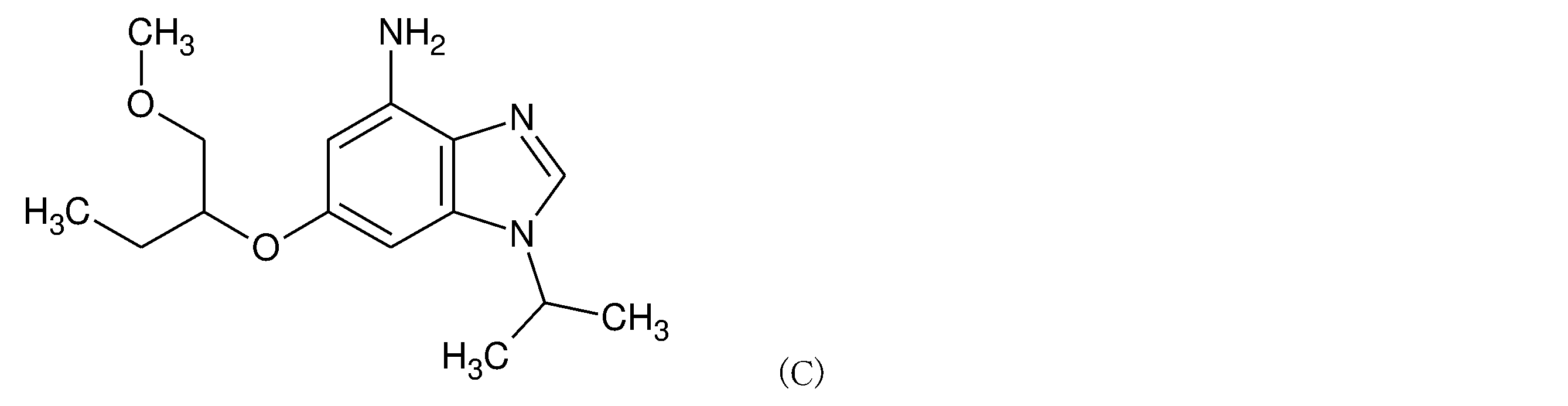
- Non-Patent Document 1 discloses a compound represented by the formula (C) and the like.
- An object of the present invention is to provide a heterocyclic compound having excellent bactericidal activity, excellent safety, and industrially advantageous synthesis, and an agricultural and horticultural bactericidal agent containing the heterocyclic compound as an active ingredient.
- R 1 is a hydrogen atom, a substituted or unsubstituted C1-6 alkyl group, or a halogeno group.
- R 2 is a substituted or unsubstituted 5- to 6-membered heteroaryl group.
- R 3 is a substituted or unsubstituted C1-6 alkyl group, a substituted or unsubstituted C1-6 alkoxycarbonyl group, a substituted or unsubstituted C1-6 alkylthio group, a substituted or unsubstituted C6-10 aryl group, a substituted.
- Ri is a hydrogen atom or a C1-6 alkyl group.
- Rj is a substituted or unsubstituted C1-6 alkyl group.
- R s is a substituted or unsubstituted C1-6 alkyl group.
- Y is an oxygen atom or NH
- a 1 is a sulfur atom, an oxygen atom, or an NR 4 R 4 is a C1-6 alkyl group
- a 2 is a carbon atom or a nitrogen atom
- X is a substituent and n indicates the number of chemically acceptable Xs, is an integer of 0 to 3, and when n is 2 or more, Xs may be the same or different from each other.
- X is a substituted or unsubstituted C1-6 alkyl group, a substituted or unsubstituted C2-6 alkoxy group, a substituted or unsubstituted C2-6 alkoxy group, a hydroxy group, a substituted or substituted.
- R 1 , R 2 , X and n have the same meaning as those in formula (I).
- R 4 , R 5 , R 6 and R 7 are independently hydrogen atoms, substituted or unsubstituted C1 to 6 alkyl groups, substituted or unsubstituted C2 to 6 alkoxy groups, substituted or unsubstituted C2 to 6 Alkinyl groups, substituted or unsubstituted C1-6 alkoxy groups, substituted or unsubstituted C1-6 alkoxycarbonyl groups, substituted or unsubstituted C1-6 alkylthio groups, substituted or unsubstituted C1-6 alkylsulfinyl groups, Substituentally substituted or unsubstituted C1-6 alkylsulfonyl group, substituted or unsubstituted C6-10aryl group, substituted or unsubstituted 5-6-membered heterocyclyl group, halogeno group, cyano group, cyan
- a fungicide for agriculture and horticulture containing at least one selected from the group consisting of the compounds according to the above [1] to [4] and salts thereof as an active ingredient.
- the heterocyclic compound of the present invention and a salt thereof have excellent bactericidal activity, reliable effect, excellent safety, and can be synthesized industrially advantageously.
- the fungicide for agriculture and horticulture of the present invention has an excellent control effect, does not cause phytotoxicity to plants, and has little toxicity to humans, livestock and fish and has little influence on the environment.
- heterocyclic compound The heterocyclic compound of the present invention is a compound represented by the formula (I) (hereinafter, may be referred to as compound (I)) or a salt of compound (I).
- R 1 is a hydrogen atom, a substituted or unsubstituted C1-6 alkyl group, or a halogeno group.
- R 2 is a substituted or unsubstituted 5- to 6-membered heteroaryl group.
- R 3 is a substituted or unsubstituted C1-6 alkyl group, a substituted or unsubstituted C1-6 alkoxycarbonyl group, a substituted or unsubstituted C1-6 alkylthio group, a substituted or unsubstituted C6-10 aryl group, a substituted.
- Ri is a hydrogen atom or a C1-6 alkyl group.
- Rj is a substituted or unsubstituted C1-6 alkyl group.
- R s is a substituted or unsubstituted C1-6 alkyl group.
- Y is an oxygen atom or NH
- a 1 is a sulfur atom, an oxygen atom, or an NR 4 R 4 is a C1-6 alkyl group
- a 2 is a carbon atom or a nitrogen atom
- X is a substituent and n indicates the number of chemically acceptable Xs, is an integer of 0 to 3, and when n is 2 or more, Xs may be the same or different from each other.
- the term "unsubstituted” means that it is only a parent group. When there is no description of "substitution” and only the name of the parent group is described, it means “unsubstituted” unless otherwise specified.
- the term “substituted” means that any hydrogen atom of the parent group is substituted with a group (substituent) having the same or different structure as the mother nucleus. Therefore, a “substituent” is another group attached to the parent group.
- the substituent may be one or two or more. The two or more substituents may be the same or different. Terms such as "C1 to 6" indicate that the number of carbon atoms of the parent group is 1 to 6 or the like. This number of carbon atoms does not include the number of carbon atoms present in the substituent. For example, a butyl group having an ethoxy group as a substituent is classified as a C2 alkoxy C4 alkyl group.
- the "substituent” is chemically acceptable and is not particularly limited as long as it has the effect of the present invention.
- the groups that can be “substituents” are illustrated below. C1-6 such as methyl group, ethyl group, n-propyl group, i-propyl group, n-butyl group, s-butyl group, i-butyl group, t-butyl group, n-pentyl group, n-hexyl group, etc.
- Alkyl group Vinyl group, 1-propenyl group, 2-propenyl group (allyl group), 1-butenyl group, 2-butenyl group, 3-butenyl group, 1-methyl-2-propenyl group, 2-methyl-2-propenyl group, etc.
- C2-6 alkenyl groups C2-6 alkynyl groups such as ethynyl group, 1-propynyl group, 2-propynyl group, 1-butynyl group, 2-butynyl group, 3-butynyl group, 1-methyl-2-propynyl group;
- C3-8 cycloalkyl groups such as cyclopropyl group, cyclobutyl group, cyclopentyl group, cyclohexyl group, cubicyl group; C6-10 aryl groups such as phenyl group and naphthyl group; C6-10aryl C1-6 alkyl groups such as benzyl group and phenethyl group; 3-6 member heterocyclyl group; 3-6 member heterocyclyl C1-6 alkyl group;
- C1-6 alkoxy groups such as methoxy group, ethoxy group, n-propoxy group, i-propoxy group, n-butoxy group, s-butoxy group, i-butoxy group, t-butoxy group; C2-6 alkenyloxy groups such as vinyloxy group, allyloxy group, propenyloxy group, butenyloxy group; C2-6 alkynyloxy groups such as ethynyloxy group and propargyloxy group; C6-10 aryloxy groups such as phenoxy group and naphthoxy group; C6-10aryl C1-6 alkoxy groups such as benzyloxy group, phenethyloxy group; 5- to 6-membered heteroaryloxy groups such as thiazolyloxy groups and pyridyloxy groups; 5- to 6-membered heteroaryl C1 to 6 alkyloxy groups such as thiazolylmethyloxy group and pyridylmethyloxy group; C1-6 alkoxy C2
- C1-6 alkylcarbonyl groups such as acetyl group, propionyl group; Formyloxy group; C1-6 alkylcarbonyloxy groups such as acetyloxy groups and propionyloxy groups; C6-10 arylcarbonyl groups such as benzoyl groups; C1-6 alkoxycarbonyl groups such as methoxycarbonyl group, ethoxycarbonyl group, n-propoxycarbonyl group, i-propoxycarbonyl group, n-butoxycarbonyl group, t-butoxycarbonyl group; C1-6 alkoxycarbonyloxy groups such as methoxycarbonyloxy group, ethoxycarbonyloxy group, n-propoxycarbonyloxy group, i-propoxycarbonyloxy group, n-butoxycarbonyloxy group, t-butoxycarbonyloxy group; Carboxylic group;
- Halogeno groups such as fluoro group, chloro group, bromo group, iod group; Fluoromethyl group, difluoromethyl group, trifluoromethyl group, 2,2,2-trifluoroethyl group, pentafluoroethyl group, 3,3,3-trifluoropropyl group, 2,2,3,3-3 Pentafluoropropyl group, perfluoropropyl group, 2,2,2-trifluoro-1-trifluoromethylethyl group, perfluoroisopropyl group, 4-fluorobutyl group, 2,2,3,3,4,4 4-Heptafluorobutyl group, perfluorobutyl group, perfluoropentyl group, perfluorohexyl group, chloromethyl group, bromomethyl group, dichloromethyl group, dibromomethyl group, trichloromethyl group, tribromomethyl group, 1-chloroethyl group , 2,2,2-Trichloroethy
- Amino group C1-6 alkyl-substituted amino groups such as methylamino group, dimethylamino group, diethylamino group, t-butylamino group; C6-10 arylamino groups such as anilino group and naphthylamino group; C6-10aryl C1-6 alkylamino groups such as benzylamino group, phenethylamino group; Formylamino group; C1-6 alkylcarbonylamino groups such as acetylamino group, diacetylamino group, propanoylamino group, butyrylamino group, i-propylcarbonylamino group; C1-6 alkoxycarbonylamino groups such as methoxycarbonylamino group, ethoxycarbonylamino group, n-propoxycarbonylamino group, i-propoxycarbonylamino group, t-butoxycarbonylamino group; Aminocarbonyl
- C1-6 alkylthio groups such as methylthio group, ethylthio group, n-propylthio group, i-propylthio group, n-butylthio group, i-butylthio group, s-butylthio group, t-butylthio group; C1-6 haloalkylthio groups such as trifluoromethylthio group, 2,2,2-trifluoroethylthio group; C6-10 arylthio groups such as phenylthio groups and naphthylthio groups; C6-10 aryl C1-6 alkylthio groups such as benzylthio groups; 5- to 6-membered heteroarylthio groups such as thiazolylthio groups and pyridylthio groups;
- C1-6 alkylsulfinyl groups such as methylsulfinyl group, ethylsulfinyl group, t-butylsulfinyl group; C1-6 haloalkylsulfinyl groups such as trifluoromethylsulfinyl group, 2,2,2-trifluoroethylsulfinyl group; C6-10 arylsulfinyl groups such as phenylsulfinyl groups; 5- to 6-membered heteroarylsulfinyl groups such as thiazolylsulfinyl groups, pyridylsulfinyl groups;
- C1-6 alkylsulfonyl groups such as methylsulfonyl groups, ethylsulfonyl groups, t-butylsulfonyl groups; C1-6 haloalkylsulfonyl groups such as trifluoromethylsulfonyl groups, 2,2,2-trifluoroethylsulfonyl groups; C6-10 arylsulfonyl groups such as phenylsulfonyl groups; 5- to 6-membered heteroarylsulfonyl groups such as thiazolylsulfonyl groups and pyridylsulfonyl groups; C1-6 alkylsulfonyloxy groups such as methylsulfonyloxy groups, ethylsulfonyloxy groups, t-butylsulfonyloxy groups; C1-6 haloalkylsulfonyloxy groups such as trifluoromethylsulfon
- Tri-C1-6 alkyl-substituted silyl groups such as trimethylsilyl group, triethylsilyl group, t-butyldimethylsilyl group; Tri-C6-10 aryl substituted silyl groups such as triphenylsilyl groups; Cyano group; Nitro group;
- Hydroxy C1-6 alkyl groups such as hydroxymethyl group and 2-hydroxyethyl group; Tri-C1-6 alkyl-substituted silyloxy C1-6 alkyl groups such as tert-butyldimethylsilyloxymethyl group, 2-tert-butyldimethylsilyloxyethyl group; C1-6 alkoxy C1-6 alkyl groups such as methoxymethyl group, ethoxymethyl group, dimethoxymethyl group; C1-6 alkylcarbonyloxy C1-6 alkyl groups such as acetyloxymethyl groups; (Methoxymethoxy) methyl group, (2-methoxyethoxy) methyl group, (1-ethoxyethoxy) methyl group, (1-isopropoxyethoxy) methyl group, ((2-methoxypropan-2-yl) oxy) methyl group C1-6 alkoxy C1-6 alkoxy C1-6 alkyl groups such as; ((2-Methoxyethoxy) methoxy) C1-6 alkoxy C
- any hydrogen atom in the substituent may be substituted with a group having a different structure.
- the "substituent” includes C1 to 6 alkyl group, C1 to 6 haloalkyl group, C1 to 6 alkoxy group, C1 to 6 haloalkoxy group, hydroxyl group, C1 to 6 alkoxy group, C1 to 6 alkylthio group, and C1.
- Examples thereof include a to 6-alkylsulfinyl group, a C1 to 6alkylsulfonyl group, a tri-C1 to 6alkyl-substituted silyl group, a halogeno group, a cyano group and a nitro group.
- the above-mentioned "3- to 6-membered heterocyclyl group” includes 1 to 4 heteroatoms selected from the group consisting of nitrogen atoms, oxygen atoms and sulfur atoms as ring constituent atoms.
- the heterocyclyl group may be monocyclic or polycyclic.
- the polycyclic heterocyclyl group may have any of a saturated alicyclic ring, an unsaturated alicyclic ring, and an aromatic ring as long as at least one ring is a heterocyclic ring.
- Examples of the "3- to 6-membered heterocyclyl group” include a 3- to 6-membered saturated heterocyclyl group, a 5- to 6-membered heteroaryl group, and a 5- to 6-membered partially unsaturated heterocyclyl group.
- Examples of the 3- to 6-membered saturated heterocyclyl group include an aziridinyl group, an epoxy group, a pyrrolidinyl group, a tetrahydrofuranyl group, a thiazolidinyl group, a piperidyl group, a piperazinyl group, a morpholinyl group, a dioxolanyl group, a dioxanyl group, and a dithiolanyl group.
- Examples of the 5-membered heteroaryl group include a pyrrolyl group, a furyl group, a thienyl group, an imidazolyl group, a pyrazolyl group, an oxazolyl group, an isooxazolyl group, a thiazolyl group, an isothiazolyl group, a triazolyl group, an oxadiazolyl group, a thiadiazolyl group and a tetrazolyl group. Can be done.
- 6-membered heteroaryl group examples include a pyridyl group, a pyrazinyl group, a pyrimidinyl group, a pyridadinyl group, a triazinyl group and the like.
- 5- to 6-membered partially unsaturated heterocyclyl group examples include a dihydropyranyl group and a 4,5-dihydroisooxazolyl group.
- R 1 represents a hydrogen atom, a substituted or unsubstituted C1-6 alkyl group, or a halogeno group.
- the "C1 to 6 alkyl group" in R 1 may be a straight chain or a branched chain.
- Alkyl groups include methyl group, ethyl group, n-propyl group, n-butyl group, n-pentyl group, n-hexyl group, i-propyl group, i-butyl group, s-butyl group and t-butyl group. , I-pentyl group, neopentyl group, 2-methylbutyl group, 2,2-dimethylpropyl group, i-hexyl group and the like.
- C1 to 6 alkyl group having a substituent Fluoromethyl group, chloromethyl group, bromomethyl group, difluoromethyl group, dichloromethyl group, dibromomethyl group, trifluoromethyl group, trichloromethyl group, tribromomethyl group, 1-chloroethyl group, 2,2,2-trifluoro Ethyl group, 2,2,2-trichloroethyl group, pentafluoroethyl group, 4-fluorobutyl group, 2,2,3,3,4,4,4-heptafluorobutyl group, 4-chlorobutyl group, 3, 3,3-Trifluoropropyl group, 2,2,3,3,3-pentafluoropropyl group, 1,1,1,3,3,3-hexafluoropropane-2-yl group, perfluoropropane-2 -C1-6 haloalkyl groups such as yl group, perfluorohexyl group, perfluoropropane-2
- Hydroxy C1-6 alkyl groups such as hydroxymethyl group and hydroxyethyl group; C1 to methoxymethyl group, ethoxymethyl group, methoxyethyl group, ethoxyethyl group, methoxy-n-propyl group, n-propoxymethyl group, i-propoxyethyl group, s-butoxymethyl group, t-butoxyethyl group, etc.
- alkyl C1-6 alkyl groups C6-10aryl C1-6 alkyl groups such as benzyl group and phenethyl group; C3-8 cycloalkyl C1-6 alkyl groups such as cyclopropylmethyl group, 2-cyclopropylethyl group, cyclopentylmethyl group, 2-cyclohexylethyl group, 2-cyclooctylethyl group; and the like can be mentioned.
- the substituent on the "C1-6 alkyl group" in R 1 is preferably a halogeno group such as a fluoro group, a chloro group, a bromo group, an iodo group; a methoxy group, an ethoxy group, an n-propoxy group, an i-propoxy group, C1-6 alkoxy groups such as n-butoxy group, s-butoxy group, i-butoxy group, t-butoxy group; 2-chloro-n-propoxy group, 2,3-dichlorobutoxy group, trifluoromethoxy group and the like.
- C1-6 haloalkoxy groups; cyano groups; can be mentioned.
- halogeno group examples include a fluoro group, a chloro group, a bromo group, and an iod group.
- R 1 is preferably a hydrogen atom.
- R 2 represents a substituted or unsubstituted 5- to 6-membered heteroaryl group.
- the "5- to 6-membered heteroaryl group" in R 2 includes a pyrrolyl group, a furyl group, a thienyl group, an imidazolyl group, a pyrazolyl group, an oxazolyl group, an isooxazolyl group, a thiazolyl group, an isothiazolyl group, a triazolyl group, an oxadiazolyl group and a thiadiazolyl group.
- a 5-membered heteroaryl group such as a tetrazolyl group
- a 6-membered heteroaryl group such as a pyridyl group, a pyrazinyl group, a pyrimidinyl group, a pyridadinyl group and a triazinyl group can be mentioned.
- the substituent on the "5- to 6-membered heteroaryl group" in R 2 is preferably a methyl group, an ethyl group, an n-propyl group, an n-butyl group, an n-pentyl group, an n-hexyl group and an i-propyl group.
- R 2 is preferably a 5-membered heteroaryl group, more preferably an oxadiazolyl group, and particularly preferably a 1,3,4-oxadiazole-2-yl group.
- R 3 is a substituted or unsubstituted C1-6 alkyl group, a substituted or unsubstituted C1-6 alkoxycarbonyl group, a substituted or unsubstituted C1-6 alkylthio group, a substituted or unsubstituted C6.
- Examples of the "C1 to 6 alkyl groups" in R 3 include the same as those specifically exemplified in R 1 .
- Examples of the "5- to 6-membered heteroaryl group" in R 3 include the same as those specifically exemplified in R 2 . Among these, a pyridyl group, a pyrimidinyl group, a thiazolyl group and a pyrazinyl group are preferable.
- Examples of the "C1 to 6 alkoxycarbonyl group" in R 3 include a methoxycarbonyl group, an ethoxycarbonyl group, an n-propoxycarbonyl group, an i-propoxycarbonyl group, an n-butoxycarbonyl group, and a t-butoxycarbonyl group. it can.
- Examples of the "C1 to 6 alkylthio group" in R 3 include a methylthio group, an ethylthio group, an n-propylthio group, an n-butylthio group, an n-pentylthio group, an n-hexylthio group and an i-propylthio group.
- the substituent on the "C1 to 6 alkyl group”, “C1 to 6 alkoxycarbonyl group”, and “C1 to 6 alkylthio group” in R 3 is preferably a halogeno group such as a fluoro group, a chloro group, a bromo group, or an iodo group. Can be mentioned.
- the "C6 to 10 aryl group” in R 3 is a group formed by removing one hydrogen on the ring of a monocyclic or polycyclic aromatic hydrocarbon.
- Examples of the “C6 to 10 aryl group” include a phenyl group and a naphthyl group, and a phenyl group is preferable.
- R 'C6 ⁇ 10 aryl group "in 3, and" 5-6 membered heteroaryl group "on the substituent may be referred to as G 1.
- Examples of the "C1 to 6 alkyl group” and “halogeno group” in G 1 include the same as those specifically exemplified in R 1 .
- Examples of the "substituted C1 to 6 alkyl groups" in G 1 include hydroxy C1 to 6 alkyl groups such as hydroxymethyl group and 2-hydroxyethyl group; tertiary butyldimethylsilyloxymethyl group and 2-tershalybutyldimethylsilyloxyethyl.
- Tri-C1-6 alkyl-substituted silyloxy C1-6 alkyl groups such as groups; C1-6 alkoxy C1-6 alkyl groups such as methoxymethyl group, ethoxymethyl group, dimethoxymethyl group; C1-6 alkylthio C1 ⁇ such as methylthiomethyl group 6-alkyl groups; C1-6 alkylcarbonyloxy C1-6 alkyl groups such as acetyloxymethyl groups; (methoxymethoxy) methyl groups, (2-methoxyethoxy) methyl groups, (1-ethoxyethoxy) methyl groups, (1- C1-6 alkoxy C1-6 alkoxy C1-6 alkyl groups such as isopropoxyethoxy) methyl group, ((2-methoxypropan-2-yl) oxy) methyl group; ((2-methoxyethoxy) methoxy) methyl group, etc.
- C1-6 alkoxy C1-6 alkoxy C1-6 alkoxy C1-6 alkoxy C1-6 alkyl groups C1-6 alkoxycarbonyloxy C1-6 alkyl groups such as ((methoxycarbonyl) oxy) methyl groups; (2-methoxyacetoxy) methyl groups , C1-6 alkoxy C1-6 alkylcarbonyloxy C1-6 alkyl groups such as ((3-methoxypropanol) oxy) methyl group; C1-6 alkylthio C1-6 alkoxy C1 such as ((methylthio) methoxy) methyl group ⁇ 6 Alkyl groups; C1-6 alkyl group substituted aminocarbonyloxy C1-6 alkyl groups such as ((methylcarbamoyl) oxy) methyl group, ((dimethylcarbamoyl) oxy) methyl group; cyanomethyl group, 2-cyanoethyl group, 3 -Ciano-substituted C1-6 alkyl groups such as cyanopropyl group; C6-10ary
- the preferred substituent on "C1 ⁇ 6 alkyl group" in G 1, hydroxy group; tert-butyldimethylsilyloxy group, 2-tert-butyldimethylsilyl tri C1 ⁇ 6 alkyl substituted silyloxy groups such as oxy group; methoxy C1-6 alkoxy groups such as group, ethoxy group, n-propoxy group, i-propoxy group, n-butoxy group, s-butoxy group, i-butoxy group, t-butoxy group; methylthio group, ethylthio group, n- C1-6 alkylthio groups such as propylthio group, i-propylthio group, n-butylthio group, i-butylthio group, s-butylthio group, t-butylthio group; C1-6 alkylcarbonyloxy such as acetyloxy group, propionyloxy group Group; methoxymethoxy group
- the "C2-6 alkenyl group" in G 1 includes a vinyl group, a 1-propenyl group, a 2-propenyl group (allyl group), a 1-butenyl group, a 2-butenyl group, a 3-butenyl group, and a 1-methyl-2.
- -Propenyl group, 2-methyl-2-propenyl group and the like can be mentioned.
- Examples of the "C2-6 alkynyl group" in G 1 include an ethynyl group, a 1-propynyl group, a 2-propynyl group, a 1-butynyl group, a 2-butynyl group, a 3-butynyl group, a 1-methyl-2-propynyl group, and the like.
- Examples of the "C1 to 6 alkoxy group" in G 1 include a methoxy group, an ethoxy group, an n-propoxy group, an i-propoxy group, an n-butoxy group, an s-butoxy group, an i-butoxy group, and a t-butoxy group. Can be mentioned.
- Examples of the "C1 to 6 alkoxycarbonyl group” and “C1 to 6 alkylthio group” in G 1 include the same groups specifically exemplified in R 3 .
- Examples of the "C1 to 6 alkylsulfinyl group" in G 1 include a methylsulfinyl group, an ethylsulfinyl group, a t-butylsulfinyl group and the like.
- Examples of the "C1 to 6 alkylsulfonyl group" in G 1 include a methylsulfonyl group, an ethylsulfonyl group, and a t-butylsulfonyl group.
- C2 ⁇ 6 alkenyl group in G 1, "C2 ⁇ 6 alkynyl group”, “C1 ⁇ 6 alkoxy group”, “C1 ⁇ 6 alkoxycarbonyl group”, “C1 ⁇ 6 alkylthio group”, "C1 ⁇ 6 alkylsulfinyl Preferred as substituents on the “group” and “C1-6 alkylsulfonyl group” are methoxy group, ethoxy group, n-propoxy group, i-propoxy group, n-butoxy group, s-butoxy group, i-butoxy group, Examples thereof include C1 to 6 alkoxy groups such as a t-butoxy group.
- Examples of the "C6 to 10 aryl group" in G 1 include the same ones specifically exemplified in R 3 .
- a dioxolanyl group a dioxanyl group, a dithiolanyl group, a frill group, a thienyl group, a pyrazolyl group, an isooxazolyl group, a pyridyl group, a pyrimidinyl group and a dihydropyranyl group are preferable.
- the preferred substituent on "C6 ⁇ 10 aryl group” and "5- to 6-membered heterocyclyl group” in G 1, fluoro group, chloro group, bromo group, a halogeno group such as iodo groups; methyl, ethyl radical, n -C1-6 alkyl groups such as propyl group, i-propyl group, n-butyl group, s-butyl group, i-butyl group, t-butyl group, n-pentyl group, n-hexyl group; hydroxy group; methoxy Examples thereof include C1 to 6 alkoxy groups such as a group, an ethoxy group, an n-propoxy group, an i-propoxy group, an n-butoxy group, an s-butoxy group, an i-butoxy group and a t-butoxy group.
- R g is a hydrogen atom, a C1 to 6 alkyl group or an amino group, and is preferably a hydrogen atom.
- Examples of the "C1 to 6 alkyl groups" in R g include the same ones specifically exemplified in R 1 .
- R h is a hydrogen atom, a substituted or unsubstituted C1-6 alkyl group, or a C2-6 alkynyl group.
- Examples of the "C1 to 6 alkyl groups" in R h include the same ones specifically exemplified in R 1 .
- substituted C1 to 6 alkyl groups include fluoromethyl group, difluoromethyl group, trifluoromethyl group, 2,2,2-trifluoroethyl group, pentafluoroethyl group, 3,3,3-tri.
- Examples of the “C2 to 6 alkynyl group” in R h include the same as those specifically exemplified in G 1 .
- R c and R d are independently hydrogen atoms or C1 to 6 alkyl groups, respectively.
- Examples of the "C1 to 6 alkyl groups" in R c and R d include the same ones specifically exemplified in R 1 .
- R p and R q are independently hydrogen atoms or C1 to 6 alkyl groups, respectively.
- the "C1-6 alkyl groups" in R p and R q can be the same as those specifically exemplified in R 1 .
- G 1 is a substituted or unsubstituted C1 to 6 alkyl group, a substituted or unsubstituted C2 to 6 alkenyl group, a substituted or unsubstituted C2 to 6 alkynyl group, a substituted or unsubstituted C1 to 6 alkoxy group, a substituted or unsubstituted C1 to 6 alkoxy group.
- R i is a hydrogen atom, a C1 to 6 alkyl group, and is preferably a hydrogen atom.
- R j is a substituted or unsubstituted C1-6 alkyl group.
- the “C1 to 6 alkyl groups” in R i and R j can be the same as those specifically exemplified in R 1 .
- Substituted C1 ⁇ 6 alkyl group in R j is benzyl group, C6 ⁇ 10 aryl C1 ⁇ 6 alkyl group such as a phenethyl group; methoxymethyl group, ethoxymethyl group, 2-methoxyethyl group, a 2-ethoxyethyl group C1-6 alkoxy C1-6 alkyl groups of the above can be mentioned, preferably a benzyl group.
- R s is a substituted or unsubstituted C1-6 alkyl group.
- the “C1 to 6 alkyl groups” in R s can be the same as those specifically exemplified in R 1 .
- Examples of the "substituted C1 to 6 alkyl group” in Rs include a methoxyiminomethyl group, an ethoxyiminomethyl group, a 2-methoxyiminoethyl group, a 2-ethoxyiminoethyl group, and a 1- (methoxyimino) propan-2-yl group.
- R 3 is preferably a C1 to 6 alkyl group, a substituted or unsubstituted C6 to 10 aryl group, or a substituted or unsubstituted 5 to 6-membered heteroaryl group, and is preferably a substituted or unsubstituted C6 to 10 aryl group.
- R 3 is preferably a substituted or unsubstituted 5- to 6-membered heteroaryl group, more preferably a substituted or unsubstituted phenyl group, or a substituted or unsubstituted 5- to 6-membered heteroaryl group, further preferably substituted.
- it is particularly preferably an unsubstituted 6-membered heteroaryl group.
- Y is an oxygen atom or NH.
- Y is preferably an oxygen atom.
- X represents a substituent. Examples of the substituent X include those already described.
- Substituent X (hereinafter, may be referred to as G 2.)
- G 2 a substituted or unsubstituted C1 ⁇ 6 alkyl group, a substituted or unsubstituted C2 ⁇ 6 alkenyl group, a substituted or unsubstituted C2 ⁇ 6 Alkinyl group, hydroxy group, substituted or unsubstituted C1-6 alkoxy group, substituted or unsubstituted C1-6 alkoxycarbonyl group, substituted or unsubstituted C1-6 alkylthio group, substituted or unsubstituted C3-8 cyclo Alkyl group, substituted or unsubstituted C6-10aryl group, halogeno group, cyano group, formula: Group represented by "-NR a R b " (in the formula, R a and R b are independent of each other, respectively.
- a hydrogen atom, a C1-6 alkyl group, or a C1-6 alkoxycarbonyl group), or a group represented by the formula: "-C (R e ) NOR f " (in the formula, R e and R f are , Each independently of a hydrogen atom or a C1-6 alkyl group).
- Examples of the "C1 to 6 alkyl group” and “halogeno group” in G 2 include the same ones specifically exemplified in R 1 .
- the preferred substituent on "C1 ⁇ 6 alkyl group" in G 2 fluoro group, chloro group, bromo group, a halogeno group such as iodo groups; hydroxy groups; methoxy group, ethoxy group, n- propoxy group, i- Examples thereof include C1 to 6 alkoxy groups such as a propoxy group, an n-butoxy group, an s-butoxy group, an i-butoxy group and a t-butoxy group.
- Examples of the "C3-8 cycloalkyl group" in G 2 include a cyclopropyl group, a cyclobutyl group, a cyclopentyl group, a cyclohexyl group, and a cubicyl group, and a cyclopropyl group is preferable.
- Examples of the "C1 to 6 alkoxycarbonyl group” and “C1 to 6 alkylthio group” in G 2 include the same groups specifically exemplified in R 3 .
- the "C2-6 alkenyl group” in G 2 includes vinyl group, 1-propenyl group, 2-propenyl group (allyl group), 1-butenyl group, 2-butenyl group, 3-butenyl group, 1-methyl-2.
- -Propenyl group, 2-methyl-1-propenyl group, 2-methyl-2-propenyl group and the like can be mentioned.
- Examples of the "C2 to 6 alkynyl group” and “C1 to 6 alkoxy group” in G 2 include the same groups specifically exemplified in G 1 .
- C2 ⁇ 6 alkenyl group in G 2
- C2 ⁇ 6 alkynyl group "C1 ⁇ 6 alkoxy group”
- C1 ⁇ 6 alkoxycarbonyl group C1 ⁇ 6 alkylthio group
- C3 ⁇ 8 cycloalkyl Preferred examples of the substituent on the "group” include a halogeno group such as a fluoro group, a chloro group, a bromo group and an iodo group.
- Examples of the "C6 to 10 aryl group" in G 2 include the same groups specifically exemplified in R 3 , and a phenyl group is preferable.
- the preferred substituent on "C6 ⁇ 10 aryl group" in G 2 fluoro group, chloro group, bromo group, a halogeno group such as iodo groups; methyl, ethyl, n- propyl, i- propyl, C1-6 alkyl groups such as n-butyl group, s-butyl group, i-butyl group, t-butyl group, n-pentyl group, n-hexyl group; fluoromethyl group, difluoromethyl group, trifluoromethyl group, 2,2,2-trifluoroethyl group, pentafluoroethyl group, 3,3,3-trifluoropropyl group, 2,2,3,3,3-pentafluoropropyl group, perfluoropropyl group, 2,2 , 2-Trifluoro-1-trifluoromethylethyl group, perfluoroisopropyl group, 4-fluorobutyl group
- C1-6 alkylthio groups such as methylthio group, ethylthio group, n-propylthio group, n-butylthio group, n-pentylthio group, n-hexylthio group, i-propylthio group; methylsulfinyl group, ethylsulfinyl group, t- C1-6 alkylsulfinyl groups such as butylsulfinyl groups; C1-6 alkylsulfonyl groups such as methylsulfonyl groups, ethylsulfonyl groups, t-butylsulfonyl groups; cyano groups; more preferably C1-6. Examples thereof include a haloalkyl group, a C1 to 6 alkoxy group, and a C1 to 6 haloalkoxy group.
- R a and R b are independently hydrogen atoms, C1 to 6 alkyl groups, or C1 to 6 alkoxycarbonyl groups, respectively.
- Examples of the "C1 to 6 alkyl groups" in R a and R b include the same ones specifically exemplified in R 1 .
- Examples of the “C1 to 6 alkoxycarbonyl groups” in R a and R b include the same groups specifically exemplified in R 3 .
- R a is preferably a hydrogen atom
- R b is preferably a hydrogen atom or a C1 to 6 alkyl group.
- R e and R f are independently hydrogen atoms or C1 to 6 alkyl groups, respectively.
- Examples of the "C1 to 6 alkyl groups" in R e and R f include the same ones specifically exemplified in R 1 .
- G 2 is a substituted or unsubstituted C1-6 alkyl group, C3-8 cycloalkyl group, substituted or unsubstituted C2-6 alkoxy group, substituted or unsubstituted C2-6 alkoxy group, hydroxy group, substituted or unsubstituted.
- Substituted C1-6 alkoxy groups substituted or unsubstituted C1-6 alkoxycarbonyl groups, substituted or unsubstituted C1-6 alkylthio groups, substituted or unsubstituted C6-10 aryl groups, halogeno groups, cyano groups, or Formula:
- a group represented by "-NR a R b " is more preferable, and a substituted or unsubstituted C1 to 6 alkyl group, C3 to 8 cycloalkyl group, C2 to 6 alkoxy group, C2 to 6 alkoxy group.
- n indicates the number of chemically acceptable Xs and is an integer of 0 to 3, preferably an integer of 0 to 2, 0 or 1. Is more preferable. When n is 2 or more, X may be the same or different from each other.
- a 1 is a sulfur atom, an oxygen atom, or NR 4 , and R 4 is a C1-6 alkyl group.
- a 2 is a carbon atom or a nitrogen atom.
- Examples of the "C1 to 6 alkyl groups" in R 4 include the same ones specifically exemplified in R 1 .
- the compound represented by the formula (I) is preferably any of the compounds represented by the formulas (I-1) to (I-4).
- R 1 , R 2 , R 3 , Y, X and n have the same meanings as those in formula (I), and formula (I-4). Among them, R 4 has the same meaning as described above.
- the compound represented by the formula (I) is preferably a compound represented by the formula (I-1).
- R 1 , R 2 , R 3 , X and n have the same meanings as those in formula (I).
- the compound represented by the formula (I) is preferably a compound represented by the formula (III).
- R 1 , R 2 , X and n have similar meanings to those in formula (I).
- R 4 , R 5 , R 6 and R 7 are independently hydrogen atoms, substituted or unsubstituted C1 to 6 alkyl groups, substituted or unsubstituted C2 to 6 alkoxy groups, substituted or unsubstituted C2 to 6 Alkinyl groups, substituted or unsubstituted C1-6 alkoxy groups, substituted or unsubstituted C1-6 alkoxycarbonyl groups, substituted or unsubstituted C1-6 alkylthio groups, substituted or unsubstituted C1-6 alkylsulfinyl groups, Substituentally substituted or unsubstituted C1-6 alkylsulfonyl group, substituted or unsubstituted C6-10aryl group, substituted or unsubstituted 5-6-membered heterocyclyl group, halogeno group, cyano group, cyan
- a group represented by ⁇ 6 alkylyl group, formula: “ ⁇ ON CR c R d ” (in the formula, R c and R d are independently hydrogen atoms or C1 to 6).
- a group represented by an alkyl group), or the formula: "-C ( O) NR p R q " (R p and R q are independently hydrogen atoms or C1 to 6 alkyl groups, respectively. .).
- R 4 R 5, "substituted or unsubstituted C1 ⁇ 6 alkyl group” in R 6 and R 7, "substituted or unsubstituted C2 ⁇ 6 alkenyl group", "" substituted or unsubstituted C2 ⁇ 6 alkynyl , "Substituted or unsubstituted C1-6 alkoxy groups”, “Substituted or unsubstituted C1-6 alkoxycarbonyl groups", “Substituted or unsubstituted C1-6 alkylthio groups", "Substituted or unsubstituted C1 ⁇ "6-alkylsulfinyl group”, “substituted or unsubstituted C1-6 alkylsulfonyl group”, "substituted or unsubstituted C6-10aryl group", “substituted or unsubstituted 5-6-membered heterocyclyl group", “halogeno group”
- R 4 , R 5 , R 6 and R 7 are preferably independently hydrogen atoms, substituted or unsubstituted C1-6 alkyl groups, substituted or unsubstituted C2-6 alkoxy groups, substituted or unsubstituted.
- R 5 and R 6 are more preferably hydrogen atoms, substituted or unsubstituted C1-6 alkyl groups, substituted or unsubstituted C2-6 alkoxy groups, substituted or unsubstituted C2-6 alkynyl groups, substituted or unsubstituted.
- the salt of compound (I) is not particularly limited as long as it is an horticulturally acceptable salt.
- salts of inorganic acids such as hydrochloric acid and sulfuric acid
- salts of organic acids such as acetic acid and lactic acid
- salts of alkali metals such as lithium, sodium and potassium
- salts of alkaline earth metals such as calcium and magnesium
- iron, copper and the like Transition metal salts
- salts of organic bases such as ammonia, triethylamine, tributylamine, pyridine, hydrazine and the like can be mentioned.
- the compound (I) or the salt of the compound (I) is not particularly limited depending on the production method thereof. Further, the salt of compound (I) can be obtained from compound (I) by a known method. For example, the compound (I) of the present invention or the salt of the compound (I) can be obtained by a known production method described in Examples and the like. The compound of the present invention can be produced, for example, by the method shown below. (Synthesis method 1)
- R 1 , R 3 , A 1 , A 2 , X and n have the same meaning as described above, and R 8 is a C1 to 6 alkyl group such as a methyl group or an ethyl group.
- the agricultural and horticultural fungicide of the present invention contains at least one selected from compound (I) or a salt thereof as an active ingredient.
- the amount of compound (I) contained in the bactericidal agent for agriculture and horticulture of the present invention or a salt thereof is not particularly limited as long as it exhibits a bactericidal effect.
- the agricultural and horticultural fungi of the present invention include a wide variety of filamentous fungi, such as algae fungi (Oomycetes), ascomycetes (Ascomycetes), imperfecti fungi (Deuteromycetes), basidiomycetes, and mating fungi. It can be used to control plant diseases derived from fungi belonging to fungi (Zygomycetes).
- Cercospora beticola black root disease (Aphanomyces cochlioides), root rot (Thanatephorus cucumeris), leaf rot (Thanatephorus cucumeris), rust (Uromyces betae), powdery mildew (Oidium sp.), Spots Diseases (Ramularia beticola), seedling blight (Aphanomyces cochlioides, Pythium ultimum), etc.
- Lakkasei brown spot disease (Mycosphaerella arachidis), plaque disease (Ascochyta sp.), Puccinia arachidis, pythium debaryanum ), Rhizoctonia alternata (Alternaria alternata), Botrytis rolfsii (Sclerotium rolfsii), Black astringent disease (Mycosphaerella berkeleyi), etc.
- Tomatoes Botrytis cinerea, Cladosporium fulvum (Phytophthora infestans), half-body wilt (Verticillium albo-atrum, Verticillium dahliae), powdery mildew (Oidium neolycopersici), ring pattern disease (Alternaria solani), scab (Pseudocercospo) Ra fuligena, etc.
- Botrytis cinerea Corynespora melongenae, Erysiphe cichoracearum, Mycovellosiella nattrassii, Sclerotinia sclerotiorum, half-body wilt Verticillium dahliae, Phhomopsis vexans, etc.
- Straw Botrytis cinerea, Sphaerotheca humuli, Colletotrichum acutatum, Colletrichum fragariae, Phytophthora cactorum, soft rot Rhizopus stolonifer, Fusarium oxysporum, Verticillium dahliae, etc.
- Botrytis allii Botrytis cinerea, Botrytis cinerea, Peronospora Destructor), Botrytis cinerea (Phytophthora porri), Botrytis cinerea (Ciborinia allii), etc.
- Negi Pectobacterium carotovorum, Peronospora destructor, Botrytis cinerea (Pleospora allii), Botrytis cinerea (Pleospora allii) Sclerotium cepivorum), rust (Puccinia allii), Botrytis cinerea (Botrytis squamosa), etc.
- Botrytis cinerea Puonospora parasitica
- Botrytis cinerea Botrytis cinerea
- Botrytis cinerea Peronospora parasitica
- Botrytis cinerea Botrytis cinerea
- Botrytis cinerea Botrytis cinerea
- Botrytis cinerea Botrytis cinerea
- Botrytis cinerea Botrytis cinerea
- Botrytis cinerea Botrytis cinerea
- Botrytis cinerea Botrytis cinerea
- Botrytis cinerea Botrytis cinerea
- Botrytis cinerea Botrytis cinerea
- Botrytis cinerea Botrytis cinerea
- anthrax Coldletotrichum lindemuthianum
- keratoses Phaeoisariopsis griseola
- Apples Udonko disease (Podosphaera leucotricha), scab (Venturia inaequalis), monilinia mali, black spot disease (Mycosphaerella pomi), rot disease (Valsa mali), spot deciduous disease (Alternaria mali), gymnosporangium yamadae), ring spot disease (Botryosphaeria berengeriana), anthrax (Glomerella cingulata, Colletotrichum acutatum), brown spot disease (Diplocarpon mali), soot spot disease (Zygophiala jamaicensis), soot spot disease (Gloeodes pomigena), purple spot feather disease (Helicobasidium mompa), Botrytis cinerea, Burn disease (Erwinia amylovora), etc.
- Ume Cladosporium carpophilum, Botrytis cinerea, Monilinia mumecola, Peltaster sp.), etc.
- Kaki Udonko disease (Phyllactinia kakicola), Botrytis cinerea (Gloeosporium kaki), Horn spot deciduous disease (Cercospora kaki), Circular foliage disease (Mycosphaerella nawae), etc.
- Peach Monilinia fructicola, Almond: Monilinia, such as Cladosporium carpophilum, Phomopsis sp., Xanthomonas campestris pv.
- Grape Botrytis cinerea, Udonko Disease (Uncinula necator), late rot (Glomerella cingulata, Colletotrichum acutatum), sticky disease (Plasmopara viticola), black rot (Elsinoe ampelina), brown spot disease (Pseudocercospora vitis), black rot (Guignardia bidwellii), white Corruption (Coniella castaneicola), rust (Phakopsora ampelopsidis), white cotton snow disease (pathogen unidentified), etc.
- Cankits scab (Elsinoe fawcettii), blue mold (Penicillium italicum), green mold (Penicillium digitatum), Botrytis cinerea ), Black rot (Diaporthe citri), Canker disease (Xanthomonas campestris pv.Citri), Udonko disease (Oidium sp.), Epidemic (Phytophthora citrophthora), Charcoal disease (Colletotrichum fioriniae), etc.
- Udonko disease (Blumeria graminis f.sp. Tritici), Fusarium head blight (Gibberella zeae), Fusarium head blight (Puccinia recondita), Yellow rust (Puccinia striiformis), Brown snow rot (Pythium iwayamai), Monographella nivalis Disease (Monographella nivalis), Eye print disease (Pseudocercosporella herpotrichoides), Leaf blight (Septoria tritici), Fusarium head blight (Leptosphaeria nodorum), Snow rot small-grain fungus nuclear disease (Typhula incarnata), Snow-rot large-grain fungus nuclear disease (Myriosclerotinia borealis) ), Bacterial blight (Gaeumannomyces graminis), Wheat leaf rust (Claviceps purpurea), Tilletia
- Omugi Pyrenophora graminea, Sclerotium disease (Pyrenophora teres), cloud disease (Rhynchosporium secalis), naked black ear disease (Ustilago tritici, U.nuda), etc.
- Rice blast disease (Pyricularia oryzae), blight (Rhizoctonia solani), bakanae disease (Gibberella fujikuroi) ), Sesame leaf blight (Cochliobolus miyabeanus), Seedling blight (Pythium graminicola), White leaf blight (Xanthomonas oryzae), Seedling blight (Burkholderia plantarii), Brown streak (Acidovorax avenae), Fir blight (Burkholderia glumae), streak leaf blight (Cercospora oryzae), rice scab (Ustilaginoidea virens), brown rice (Alternaria alternata, Curvularia intermedia), belly black rice (Alternaria padwickii), reddish rice (Epicoccum purpurascens), etc.
- Plantar disease Sclerotinia sclerotiorum
- charcoal disease Colletotrichum truncatum
- Botrytis cinerea black sigatoka (Elsinoe glycines), black spot disease (Diaporthe phaseolorum var. Sojae), etc.
- Banana Pana Diseases (Fusarium oxysporum), Black sigatoka (Mycosphaerella fijiensis, M. musicola), etc.
- Mango Botrytis cinerea (Colletotrichum aenigma) Rapeseed: Sclerotinia sclerotiorum, Phoma lingam, Alternaria brassicae, etc.
- Coffee Hemileia vastatrix, Colletotrichum coffeanum, Cercospora coffeicola, etc. : Brown rust (Puccinia melanocephala), etc.
- Corn Gloeocercospora sorghi, Puccinia sorghi, Southern rust (Puccinia polysora), Black panicle (Ustilago maydis), Sesame leaf blight (Cochliobolus heterostrophus), Soot scab (Setosphaeria turcica), etc.
- Cotton Seedling blight (Pythium sp.), Rust (Phakopsora gossypii), Mildew (Mycosphaerella areola), Charcoal disease (Glomerella gossypii), etc.
- Examples of the fungicide for agriculture and horticulture of the present invention include cereals, vegetables, root vegetables, potatoes, trees, grasses, and turf. It is preferably used for cereals; vegetables; root vegetables; potatoes; fruit trees, tea, coffee, cacao and other trees; pastures; turf; cotton and other plants.
- the agricultural and horticultural bactericide of the present invention can be applied to various parts of plants, for example, leaves, stems, stalks, flowers, buds, fruits, seeds, sprouts, roots, tubers, tubers, shoots, cuttings and the like. ..
- improved varieties / varieties of these plants, cultivars, mutants, hybrids, and genetically modified organisms (GMOs) can also be targeted.
- the fungicide for agricultural and horticultural use of the present invention is used for seed treatment, foliage spraying, soil application, water surface application, etc., which are performed to control various diseases occurring in agricultural and horticultural crops including flowers, turf, and grass. Can be done.
- the agricultural and horticultural fungicide of the present invention may contain components other than the heterocyclic compound of the present invention.
- other components include known carriers used for formulation.
- conventionally known fungicides, insecticides / acaricides, nematode insecticides, soil pesticides, plant growth regulators, synergists, fertilizers, soil conditioners, animal feeds and the like can be mentioned. be able to. By containing such other components, a synergistic effect may be produced.
- Nucleic acid biosynthesis inhibitor (a) RNA polymerase I inhibitor: benaluxyl, benaluxyl-M, furalaxyl, metalaxyl, metalaxyl-M, oxadixyl, clozylacon.
- Mitotic and fission inhibitors (a) ⁇ -Tubelin polymerization inhibitor: benomyl, carbendazim, chlorfenazole, fuberidazole, thiabendazole, thiophanate, thiophanate-methyl , Dietofencarb, zoxamide, ethaboxam; (b) Inhibitors of cell division: peniccuron; (c) Inhibitor of spectrin-like protein delocalization: fluopicolide.
- Respiratory inhibitor (a) Complex I NADH Oxidoreductase Inhibitors: diflumetorim, tolfenpyrad; (b) Complex II succinate dehydrogenase inhibitor: benodanil, flutolanil, mepronil, isofetamid, fluopyram, fenfuram, furmecyclox , Carboxin, oxycarboxin, thifluzamide, benzovindiflupyr, bixafen, fluxapyroxad, furametpyr, isopyrazam, Penflufen, penthiopyrad, sedaxane, boscalid, pyraziflumid, pydiflumetofen, isoflucypram, inpyrfluxam; (c) Complex III Ubiquinol Oxide Qo Inhibitors: azoxystrobin, coumoxystrobin, coumethoxystrobin, enoxastrobin, flufenoxystrobin , Picoxystrobin,
- Methionine biosynthesis inhibitors andoprim, cyprodinil, mepanipyrim, pyrimetanil;
- Protein synthesis inhibitors blasticidin-S, kasugamycin, kasugamycin hydrochloride, streptomycin, oxytetracycline.
- Signal transduction inhibitor (a) Signal transduction inhibitors: quinoxyfen, proquinazid; (b) MAP-histidine kinase inhibitors in osmotic signaling: fenpiclonil, fludioxonil, chlozolinate, iprodione, procymidone, vinclozolin.
- Lipid and cell membrane synthesis inhibitor (a) Phospholipid biosynthesis, methyltransferase inhibitors: edifenphos, iprobenfos, pyrazophos, isoprothiolane; (b) Lipid oxidizers: biphenyl, chloroneb, dichloran, quintozene, tecnazene, tolclofos-methyl, etridiazole; (c) Agents acting on cell membranes: iodocarb, propamocarb, propamocarb-hydrochloride, propamocarb-fosetylate, prothiocarb; (d) Pathogens Microbillus that disturbs the cell membrane: Bacillus subtilis, Bacillus subtilis QST713, Bacillus subtilis strain FZB24, Bacillus subtilis strain FZB24, Bacillus subtilis MBI600 strain (bacillus) , Bacillus subtilis strain D747, Bacillus amyloliquef
- Cell membrane sterol biosynthesis inhibitor (a) Demethylation inhibitor at position C14 in sterol biosynthesis: triforine, pyrifenox, pyrisoxazole, fenarimol, flurprimidol, nuarimol, Imazalil, imazalil-sulphate, oxpoconazole fumarate, pefurazoate, prochloraz, triflumizole, viniconazole, azaconazole, azaconazole, pefurazoate, prochloraz azaconazole, bitertanol, bromuconazole, cyproconazole, diclobutrazol, diphenoconazole, diniconazole, diniconazole-M, epoxy Conazole (epoxiconazole), etaconazole (etaconazole), fenbuconazole (fenbuconazole), fluquinconazole (fluquinconazole), flusilazole (flusilazo
- Trehalase inhibitor validamycin
- Chitin synthase inhibitors polyoxins, polyoxorim
- Cellulose Synthetic Enzyme Inhibitors dimethomorph, flumorph, pyrimorph, benthiavalicarb-isopropyl, iprovalicarb, valifenalate, mandipropamid ).
- Melanin biosynthesis inhibitor (a) Melanin biosynthesis reductase inhibitor: fthalide, pyroquilon, tricyclazole; (b) Dehydratase inhibitors of melanin biosynthesis: carpropamid, diclocymet, fenoxanil; (c) Inhibitor of melanin biosynthesis polyketide synthesis: tolprocarb.
- Host plant resistance inducer (a) Agents that act on the salicylic acid synthesis pathway: acibenzolar-S-methyl; (b) Others: probenazole, tiadinil, isotianil, dichlobentiazox, laminarin, reynoutria sachalinensis extract.
- Agents of unknown activity cymoxanil, fosetyl-aluminium, phosphoric acid (phosphate), tecloftalam, triazoxide, flusulfamide ( flusulfamide), dichromezine, metasulfocarb, cyflufenamid, metrafenone, pyriofenone, dodine, dodine free base, flutianil.
- Agent having a multi-action point Copper (copper salt) (copper (copper salt)), Bordeaux liquid (bordeaux mixture), copper hydroxide (copper hydroxide), copper naphthalate (copper naphthalate), copper oxide (copper oxide) , Copper oxychloride, copper sulfate, sulfur, sulfur product, calcium polysulfide, ferbam, mancozeb, maneb , Mancopper, metiram, polycarbamate, propineb, thiram, zineb, ziram, captan, captafol, folpet (Folpet), chlorothalonil, dichlofluanid, tolylfluanid, guazatine, iminoctadine triacetate, iminoctadine albesilate (iminoctadine trialbesilate) , Dithianon, quinomethionate, fluoroimide.
- insecticides / acaricides, nematodes, soil pesticides, anthelmintics, etc. that can be mixed or used in combination with the agricultural and horticultural fungicides of the present invention are shown below.
- Acetylcholinesterase inhibitor (a) Carbamates: alanicalb, aldicarb, bendiocarb, benfuracarb, butocarboxim, butoxycarboxim, carbaryl, carbofuran, Carbosulfan, ethiofencarb, fenobucarb, formetanate, furathiocarb, isoprocarb, methiocarb, mesomil, oxamyl, pyrimicarb ), Propoxur, thiodicarb, thiofanox, triazamate, trimethacarb, XMC, xylylcarb, fenothiocarb, MIMOC, MPMC, MTMC, aldicarb (Aldicarb), allyxycarb, aminocarb, bufencarb, cloethocarb, metam-sodium, promecarb;
- GABA-operated chlorine ion channel antagonists acetoprole, chlordane, endosulfan, ethiprole, fipronil, pyrafluprole, pyriprole, Camphechlor, heptachlor, dienochlor.
- Nicotinic acetylcholine receptor agonists acetamiprid, clothianidin, dinotefuran, imidacloprid, nitenpyram, nitiazine, thiamethoxam, thiamethoxam, thiamethoxam Sulfoxaflor, nicotine, flupyradifurone, flupyrimine.
- Nicotinic acetylcholine receptor allosteric modulators spinetorams, spinosad.
- Chloride channel activator abamectin, emamectin-benzoate, lepimectin, milbemectin, ivermectin, selamectin, doramectin, eprinomectin (Eprinomectin), moxidectin, milbemycin, milbemycin oxime, nemadectin.
- Juvenile hormone-like substances hydroprene, kinoprene, methoprene, phenoxycarb, pyriproxyfen, diofenolan, epiphenonane, triprene ).
- Mite growth inhibitors clofentezine, diflovidazin, hexythiazox, etoxazole.
- Microbial-derived insect midgut intima disrupting agent Bacillus thuringiensis subsp. Israelensis, bacillus sphaericus, Bacillus thuringiensis subsp. , Bacillus thuringiensis subspecies Kurstaki (bacillus thuringiensis subsp. Kurstaki), Bacillus thuringiensis subspecies tenebrionis, Bt crop proteins: Cry1Ab, Cry1Ac, Cry1Fa, Cry1A.105, Cry2A.
- Mitochondrial ATP biosynthetic enzyme inhibitor diafenthiuron, azocyclotin, cyhexatin, fenbutatin oxide, propargite, tetradifon.
- Oxidative phosphorylation decoupling agent chlorfenapyr, sulfluramid, DNOC, binapacryl, dinobuton, dinocap.
- Nicotinic acetylcholine receptor channel blockers bensultap, cartap hydrochloride, nereistoxin, thiosultap-sodium, thiocyclam.
- Chitin synthesis inhibitors bistrifluron, chlorfluazuron, diflubenzuron, flucycloxuron, flufenoxuron, hexaflumuron, Lufenuron, novaluron, noviflumuron, teflubenzuron, triflumuron, buprofezin, fluazuron.
- Diptera molting disturber cyromazine.
- Moulting hormone receptor agonists chromafenozide, halofenozide, methoxyfenozide, tebufenozide.
- Octopamine receptor agonists amitraz, demiditraz, chlordimeform.
- Mitochondrial electron transport chain complex III inhibitor acequinocyl, fluacrypyrim, hydramethylnon.
- Mitochondrial electron transport chain complex I inhibitor fenazaquin, fenpyroximate, pyrimidifen, pyridaben, tebufenpyrad, tolfenpyrad, rotenone.
- Voltage-gated sodium channel blockers indoxacarb, metaflumizone.
- Acetyl-CoA carboxylase inhibitors spirodiclofen, spiromesifen, spirotetramat.
- Mitochondrial electron transfer system complex IV inhibitor Aluminum phosphide, calcium phosphide, phosphine, zinc phosphide, cyanide.
- Mitochondrial electron transport chain complex II inhibitor cyenopyrafen, cyflumetofen, pyflubumide.
- Ryanodine receptor modulators chlorantraniliprole, cyantraniliprole, flubendiamide, cyclaniliprole, tetraniliprole.
- Mixed Function Oxidase Inhibitor Compound Piperonyl butoxide.
- Latrophilin receptor agonists depsipeptide, cyclodepsipeptide, 24-membered cyclodepsipeptide, emodepside.
- Anthelmintic (a) Benzimidazole system: fenbendazole, albendazole, triclabendazole, oxibendazole, mebendazole, oxfendazole, perbendazole ( parbendazole), flubendazole (flubendazole), febantel, netobimin, thiophanate, thiabendazole (thiabendazole), cambendazole (cambendazole); (b) Salicylanilide system: closantel, oxyclozanide, rafoxanide, niclosamide; (c) Substituted phenolic system: nitroxinil, nitroscanate; (d) Pyrimidines: pyrantel, morantel; (e) Imidazothiazole system: levamisole, tetramisole; (f) Tetrahydropyrimidines: praziquantel, epsiprantel; (g) Other benzimi
- plant growth regulators that can be mixed or used in combination with the agricultural and horticultural fungicides of the present invention are shown below. Abscisic acid, kinetin, Benzylaminopurine, 1,3-diphenylurea, forchlorfenuron, thidiazuron, chlorphenuron ( chlorfenuron), dihydrozeatin, gibberellin A, gibberellin A4, gibberellin A7, gibberellin A3, 1-methylcyclopropane, N -Acetyl aminoethoxyvinyl glycine (also known as abiglycine) (N-acetyl aminoethoxyvinyl glycine (aviglycine)), aminooxyacetate, silver nitrate, cobalt chloride, IAA, 4-CPA, cloprop (Cloprop), 2,4-D, MCPB, indol-3-butyrate, dichlorprop, phenothiol, 1-naphthyl
- the agricultural and horticultural fungicide of the present invention is not particularly limited depending on the dosage form.
- dosage forms such as wettable powders, emulsions, powders, granules, aqueous solvents, suspensions, granule wettable powders, and tablets can be mentioned.
- the preparation method for the preparation is not particularly limited, and a known preparation method can be adopted depending on the dosage form. The following are some examples of the preparation.
- the formulation formulation shown below is merely an example, and can be modified without contrary to the gist of the present invention, and the present invention is not limited by the following formulation examples. "Part” means "part by mass” unless otherwise specified.
- Formulation 1 wettable powder
- 40 parts of the heterocyclic compound of the present invention, 53 parts of diatomaceous earth, 4 parts of higher alcohol sulfate ester, and 3 parts of alkylnaphthalene sulfonate are uniformly mixed and finely pulverized to obtain a wettable powder having 40% by mass of the active ingredient. obtain.
- Formulation 3 Granules
- 5 parts of the heterocyclic compound of the present invention, 40 parts of talc, 38 parts of clay, 10 parts of bentonite, and 7 parts of sodium alkyl sulfate are uniformly mixed and finely pulverized, and then granulated to a diameter of 0.5 to 1.0 mm. Granulation is performed to obtain granules having an active ingredient of 5% by mass.
- Formulation 4 Granules
- 5 parts of the heterocyclic compound of the present invention, 73 parts of clay, 20 parts of bentonite, 1 part of sodium dioctyl sulfosuccinate, and 1 part of potassium phosphate are pulverized and mixed well, water is added and kneaded well, and then granulation Dry to obtain 5% by mass of active ingredient granules.
- Formulation 5 Suspension
- 10 parts of the heterocyclic compound of the present invention, 4 parts of polyoxyethylene alkyl allyl ether, 2 parts of sodium polycarboxylic acid salt, 10 parts of glycerin, 0.2 part of xanthan gum, and 73.8 parts of water are mixed, and the particle size is 3 microns.
- Wet grinding is performed until the following results are obtained to obtain a suspension agent having 10% by mass of the active ingredient.
- Formulation 6 Granule wettable powder
- 40 parts of the heterocyclic compound of the present invention, 36 parts of clay, 10 parts of potassium chloride, 1 part of sodium alkylbenzene sulfonate salt, 8 parts of sodium lignin sulfonate salt, and 5 parts of formaldehyde condensate of sodium alkylbenzene sulfonate salt are uniformly mixed.
- the clay-like material is granulated and then dried to obtain a granule wettable powder having an active ingredient of 40% by mass.
- Step 1 2- (Benzo [d] thiazole-6-yloxy) -2- (5-fluoropyridin-2-yl) ethyl acetate [ethyl 2- (benzo [d] thiazol-6-yloxy) -2- (5-fluoropyridin-2-yl) acetate] synthesis
- Step 2 2-((Benzo [d] thiazole-6-yloxy) (5-fluoropyridin-2-yl) methyl) -1,3,4-oxadiazole [2-((benzo [d] thiazol) -Synthesis of 6-yloxy) (5-fluoropyridin-2-yl) methyl) -1,3,4-oxadiazole]
- the obtained pale yellow solid (0.49 g) was dissolved in acetic acid (5 mL), trimethyl orthoformate (0.49 g, 4.62 mmol) was added, and the mixture was stirred under heating under reflux for 10 minutes. After allowing to cool, the solvent was evaporated under reduced pressure, and the obtained residue was neutralized with saturated aqueous sodium hydrogen carbonate and extracted with ethyl acetate. The obtained organic layer was washed with water and saturated brine, dried over anhydrous magnesium sulfate, and the inorganic substances were filtered and concentrated under reduced pressure. The obtained residue was purified by column chromatography to obtain 0.22 g (yield 35%) of the target product. The 1H-NMR of the obtained target product is shown below.
- 6-Hydroxybenzothiazole (0.25 g, 1.65 mmol) was dissolved in N, N-dimethylformamide (3 mL), potassium carbonate (0.27 g, 1.95 mmol) and methyl 2-bromohexaneate (0.38 g). , 1.81 mmol) and stirred overnight at room temperature. Water was added to the reaction solution, the mixture was extracted with ethyl acetate, and the obtained organic layer was washed with saturated brine. The organic layer was dried over anhydrous magnesium sulfate, the inorganic substances were filtered off, and the mixture was concentrated under reduced pressure. The obtained residue was purified by silica gel chromatography to obtain 0.45 g (yield 97%) of the target product.
- Step 2 2- (1- (Benzo [d] thiazole-6-yloxy) pentyl) -1,3,4-oxadiazole [2- (1- (benzo [d] thiazol-6-yloxy) pentyl) ) -1,3,4-oxadiazole]
- the obtained pale yellow solid (0.42 g) was dissolved in acetic acid (4 mL), trimethyl orthoformate (0.80 g, 7.54 mmol) was added, and the mixture was stirred under heating under reflux for 15 minutes. After allowing to cool, the solvent was evaporated under reduced pressure, and the obtained residue was neutralized with saturated aqueous sodium hydrogen carbonate and extracted with ethyl acetate. The obtained organic layer was washed with saturated brine, dried over anhydrous magnesium sulfate, and the inorganic substances were filtered and concentrated under reduced pressure. The obtained residue was purified by column chromatography to obtain 0.29 g (yield 67%) of the target product. The 1 H-NMR of the obtained target product is shown below.
- Step 1 Synthesis of 4-((1-propynyl) pyridin-2-yl) ethyl acetate [ethyl 2- (4- (prop-1-yn-1-yl) pyridin-2-yl) acetate]
- the reaction solution was diluted with ethyl acetate, saturated aqueous ammonium chloride solution was added for extraction, and the mixture was washed with water.
- the obtained organic layer was dried over anhydrous magnesium sulfate, the inorganic substance was filtered, and the mixture was concentrated under reduced pressure.
- the obtained residue was purified by column chromatography to obtain 0.38 g (yield 70%) of the target product.
- the 1H-NMR of the obtained target product is shown below.
- Step 2 2- (Benzo [d] thiazole-6-yloxy) -2- (4- (1-propynyl) pyridin-2-yl) ethyl acetate [ethyl 2- (benzo [d] thiazol-6-yloxy) ) -2- (4- (prop-1-yn-1-yl) pyridin-2-yl) acetate]
- the obtained organic layer was dried over anhydrous magnesium sulfate, the inorganic substances were filtered, and then concentrated under reduced pressure.
- the obtained residue was dissolved in acetic acid (4 mL), trimethyl orthoformate (0.20 g, 1.88 mmol) was added, and the mixture was stirred under heating under reflux for 30 minutes.
- the obtained reaction solution was concentrated under reduced pressure, ethyl acetate was added, the mixture was washed with saturated aqueous sodium hydrogen carbonate, and purified by column chromatography to obtain 0.07 g (yield 41%) of the target product.
- the 1H-NMR of the obtained target product is shown below.
- Step 2 2-((4-Bromobenzo [d] thiazole-6-yloxy) (5-fluoropyridin-2-yl) methyl) -1,3,4-oxadiazole [2-((4-bromobenzo) Synthesis of [d] thiazol-6-yloxy) (5-fluoropyridin-2-yl) methyl) -1,3,4-oxadiazole]
- Tables 1 and 2 show some of the compounds of the present invention produced by the same method as in the above Examples.
- Table 1 shows the substituents in the compound represented by the formula (II).
- the physical properties, melting point (mp) or refractive index (n D ) of each compound are also shown.
- the wavy line indicating the bond (NO undefined stero bond) between N (nitrogen atom) and O (oxygen atom) is an E-form or Z-form or a mixture thereof due to a nitrogen-carbon double bond. Is shown.
- Me is a methyl group
- Et is an ethyl group
- n Pr is a normal propyl group
- i Pr is an isopropyl group
- n Bu is a normal butyl group
- t Bu is a tertiary butyl group
- n indicates a normal hexyl group
- c Pr indicates a cyclopropyl group
- Boc indicates a tert-butoxycarbonyl group.
- Control value (%) 100- ⁇ Ratio of lesion area in treated plot / Ratio of lesion area in untreated plot ⁇ ⁇ 100
- Tomato plague control test Water was added to the emulsion (I) so that the concentration of the heterocyclic compound was 125 mass ppm, and the mixture was dissolved to obtain a drug solution. Subsequently, the drug solution was sprayed on tomato seedlings (cultivar "Regina", 4-5 leaf stage) cultivated in a seedling raising pot. After air-drying, tomato seedlings sprayed with the drug solution were spray-inoculated with a suspension of zoospores of Phytophthora infestans (treatment plot). As a control, tomato seedlings that had not been sprayed with the drug were inoculated in the same manner as above (untreated plot). They were allowed to stand in a wet room at 20 ° C. On the day 4 days after the inoculation, the leaves of the tomato seedlings were visually observed to determine the lesion area ratio, and the control value was calculated.
- Randomly selected compounds of the present invention exert the above-mentioned effects. Therefore, the compounds of the present invention, including compounds that could not be exemplified, have a bactericidal effect and cause phytotoxicity to plants. It can be understood that it is a compound that has little toxicity to humans, livestock and fish and has little impact on the environment.
- the heterocyclic compound of the present invention and a salt thereof have excellent bactericidal activity, reliable effect, excellent safety, and can be synthesized industrially advantageously.
- the fungicide for agriculture and horticulture of the present invention has an excellent control effect, does not cause phytotoxicity to plants, and has little toxicity to humans, livestock and fish and has little influence on the environment.
Landscapes
- Chemical & Material Sciences (AREA)
- Organic Chemistry (AREA)
- Life Sciences & Earth Sciences (AREA)
- Wood Science & Technology (AREA)
- Engineering & Computer Science (AREA)
- Environmental Sciences (AREA)
- Zoology (AREA)
- Pest Control & Pesticides (AREA)
- Plant Pathology (AREA)
- Dentistry (AREA)
- Agronomy & Crop Science (AREA)
- Health & Medical Sciences (AREA)
- General Health & Medical Sciences (AREA)
- General Chemical & Material Sciences (AREA)
- Chemical Kinetics & Catalysis (AREA)
- Mycology (AREA)
- Microbiology (AREA)
- Plural Heterocyclic Compounds (AREA)
- Agricultural Chemicals And Associated Chemicals (AREA)
- Heterocyclic Carbon Compounds Containing A Hetero Ring Having Nitrogen And Oxygen As The Only Ring Hetero Atoms (AREA)
Abstract
Description
本願は、2019年3月15日に、日本に出願された特願2019-048196号に基づき優先権を主張し、その内容をここに援用する。



R1は、水素原子、置換若しくは無置換のC1~6アルキル基、またはハロゲノ基であり、
R2は、置換若しくは無置換の5~6員ヘテロアリール基であり、
R3は、置換若しくは無置換のC1~6アルキル基、置換若しくは無置換のC1~6アルコキシカルボニル基、置換若しくは無置換のC1~6アルキルチオ基、置換若しくは無置換のC6~10アリール基、置換若しくは無置換の5~6員ヘテロアリール基、式:「-C(Ri)=NORj」で表される基、または式:「-C(=O)NHRs」で表される基であり、
Riは、水素原子またはC1~6アルキル基であり、
Rjは、置換若しくは無置換のC1~6アルキル基であり、
Rsは、置換若しくは無置換のC1~6アルキル基であり、
Yは、酸素原子またはNHであり、
A1は、硫黄原子、酸素原子、またはNR4であり、
R4は、C1~6アルキル基であり、
A2は、炭素原子、または窒素原子であり、
Xは、置換基であり、
nは、化学的に許容されるXの個数を示し、かつ0~3のいずれかの整数であり、且つ
nが2以上のときXは互いに同じでも異なってもよい。)
〔2〕 式(I)中、Xが、置換若しくは無置換のC1~6アルキル基、置換若しくは無置換のC2~6アルケニル基、置換若しくは無置換のC2~6アルキニル基、ヒドロキシ基、置換若しくは無置換のC1~6アルコキシ基、置換若しくは無置換のC1~6アルコキシカルボニル基、置換若しくは無置換のC1~6アルキルチオ基、置換若しくは無置換のC3~8シクロアルキル基、置換若しくは無置換のC6~10アリール基、ハロゲノ基、シアノ基、式:「-NRaRb」で表される基(式中、RaおよびRbは、それぞれ独立して、水素原子、C1~6アルキル基、またはC1~6アルコキシカルボニル基である。)、または式:「-C(Re)=NORf」で表される基(式中、ReおよびRfは、それぞれ独立して、水素原子、またはC1~6アルキル基である。)である、前記〔1〕に記載の化合物、またはその塩。
〔3〕 式(I)が式(II)である、前記〔1〕に記載の化合物、またはその塩。

〔4〕 式(I)が式(III)である、前記〔1〕に記載の化合物、またはその塩。

R1、R2、Xおよびnは、式(I)中のそれらと同じ意味を示し、
R4、R5、R6およびR7は、それぞれ独立して、水素原子、置換若しくは無置換のC1~6アルキル基、置換若しくは無置換のC2~6アルケニル基、置換若しくは無置換のC2~6アルキニル基、置換若しくは無置換のC1~6アルコキシ基、置換若しくは無置換のC1~6アルコキシカルボニル基、置換若しくは無置換のC1~6アルキルチオ基、置換若しくは無置換のC1~6アルキルスルフィニル基、置換若しくは無置換のC1~6アルキルスルホニル基、置換若しくは無置換のC6~10アリール基、置換若しくは無置換の5~6員ヘテロシクリル基、ハロゲノ基、シアノ基、ニトロ基、式:「-C(Rg)=NORh」(式中、Rgは、水素原子、C1~6アルキル基またはアミノ基であり、Rhは、水素原子、置換若しくは無置換のC1~6アルキル基、またはC2~6アルキニル基である。)で表される基、式:「-O-N=CRcRd」(式中、RcおよびRdは、それぞれ独立して、水素原子、またはC1~6アルキル基である。)で表される基、または式:「-C(=O)NRpRq」(RpおよびRqは、それぞれ独立して、水素原子またはC1~6アルキル基である。)である。
〔5〕 前記〔1〕~〔4〕に記載の化合物、およびそれらの塩からなる群から選ばれる少なくとも1つを有効成分として含有する農園芸用殺菌剤。
本発明の複素環化合物は、式(I)で表される化合物(以下、化合物(I)と表記することがある。)、または化合物(I)の塩である。

R1は、水素原子、置換若しくは無置換のC1~6アルキル基、またはハロゲノ基であり、
R2は、置換若しくは無置換の5~6員ヘテロアリール基であり、
R3は、置換若しくは無置換のC1~6アルキル基、置換若しくは無置換のC1~6アルコキシカルボニル基、置換若しくは無置換のC1~6アルキルチオ基、置換若しくは無置換のC6~10アリール基、置換若しくは無置換の5~6員ヘテロアリール基、式:「-C(Ri)=NORj」で表される基、または式:「-C(=O)NHRs」で表される基であり、
Riは、水素原子またはC1~6アルキル基であり、
Rjは、置換若しくは無置換のC1~6アルキル基であり、
Rsは、置換若しくは無置換のC1~6アルキル基であり、
Yは、酸素原子またはNHであり、
A1は、硫黄原子、酸素原子、またはNR4であり、
R4は、C1~6アルキル基であり、
A2は、炭素原子、または窒素原子であり、
Xは、置換基であり、
nは、化学的に許容されるXの個数を示し、かつ0~3のいずれかの整数であり、且つ
nが2以上のときXは互いに同じでも異なってもよい。
一方、「置換(substituted)」の用語は、母核となる基のいずれかの水素原子が、母核と同一または異なる構造の基(置換基)で置換されていることを意味する。従って、「置換基」は、母核となる基に結合した他の基である。置換基は1つであってもよいし、2つ以上であってもよい。2つ以上の置換基は同一であってもよいし、異なるものであってもよい。
「C1~6」などの用語は、母核となる基の炭素原子数が1~6個などであることを表している。この炭素原子数には、置換基の中に在る炭素原子の数を含まない。例えば、置換基としてエトキシ基を有するブチル基は、C2アルコキシC4アルキル基に分類する。
メチル基、エチル基、n-プロピル基、i-プロピル基、n-ブチル基、s-ブチル基、i-ブチル基、t-ブチル基、n-ペンチル基、n-ヘキシル基などのC1~6アルキル基;
ビニル基、1-プロペニル基、2-プロペニル基(アリル基)、1-ブテニル基、2-ブテニル基、3-ブテニル基、1-メチル-2-プロペニル基、2-メチル-2-プロペニル基などのC2~6アルケニル基;
エチニル基、1-プロピニル基、2-プロピニル基、1-ブチニル基、2-ブチニル基、3-ブチニル基、1-メチル-2-プロピニル基などのC2~6アルキニル基;
フェニル基、ナフチル基などのC6~10アリール基;
ベンジル基、フェネチル基などのC6~10アリールC1~6アルキル基;
3~6員ヘテロシクリル基;
3~6員へテロシクリルC1~6アルキル基;
メトキシ基、エトキシ基、n-プロポキシ基、i-プロポキシ基、n-ブトキシ基、s-ブトキシ基、i-ブトキシ基、t-ブトキシ基などのC1~6アルコキシ基;
ビニルオキシ基、アリルオキシ基、プロペニルオキシ基、ブテニルオキシ基などのC2~6アルケニルオキシ基;
エチニルオキシ基、プロパルギルオキシ基などのC2~6アルキニルオキシ基;
フェノキシ基、ナフトキシ基などのC6~10アリールオキシ基;
ベンジルオキシ基、フェネチルオキシ基などのC6~10アリールC1~6アルコキシ基;
チアゾリルオキシ基、ピリジルオキシ基などの5~6員ヘテロアリールオキシ基;
チアゾリルメチルオキシ基、ピリジルメチルオキシ基などの5~6員ヘテロアリールC1~6アルキルオキシ基;
3-メトキシ-1-プロピニル基、3-エトキシ-1-プロピニル基などのC1~6アルコキシC2~6アルキニル基;
アセチル基、プロピオニル基などのC1~6アルキルカルボニル基;
ホルミルオキシ基;
アセチルオキシ基、プロピオニルオキシ基などのC1~6アルキルカルボニルオキシ基;
ベンゾイル基などのC6~10アリールカルボニル基;
メトキシカルボニル基、エトキシカルボニル基、n-プロポキシカルボニル基、i-プロポキシカルボニル基、n-ブトキシカルボニル基、t-ブトキシカルボニル基などのC1~6アルコキシカルボニル基;
メトキシカルボニルオキシ基、エトキシカルボニルオキシ基、n-プロポキシカルボニルオキシ基、i-プロポキシカルボニルオキシ基、n-ブトキシカルボニルオキシ基、t-ブトキシカルボニルオキシ基などのC1~6アルコキシカルボニルオキシ基;
カルボキシル基;
フルオロメチル基、ジフルオロメチル基、トリフルオロメチル基、2,2,2-トリフルオロエチル基、ペンタフルオロエチル基、3,3,3-トリフルオロプロピル基、2,2,3,3,3-ペンタフルオロプロピル基、パーフルオロプロピル基、2,2,2-トリフルオロ-1-トリフルオロメチルエチル基、パーフルオロイソプロピル基、4-フルオロブチル基、2,2,3,3,4,4,4-ヘプタフルオロブチル基、パーフルオロブチル基、パーフルオロペンチル基、パーフルオロヘキシル基、クロロメチル基、ブロモメチル基、ジクロロメチル基、ジブロモメチル基、トリクロロメチル基、トリブロモメチル基、1-クロロエチル基、2,2,2-トリクロロエチル基、4-クロロブチル基、パークロロヘキシル基、2,4,6-トリクロロヘキシル基などのC1~6ハロアルキル基;
2-クロロ-1-プロペニル基、2-フルオロ-1-ブテニル基などのC2~6ハロアルケニル基;
4,4-ジクロロ-1-ブチニル基、4-フルオロ-1-ペンチニル基、5-ブロモ-2-ペンチニル基などのC2~6ハロアルキニル基;
ジフルオロメトキシ基、トリフルオロメトキシ基、2-クロロ-n-プロポキシ基、2,3-ジクロロブトキシ基などのC1~6ハロアルコキシ基;
2-クロロプロペニルオキシ基、3-ブロモブテニルオキシ基などのC2~6ハロアルケニルオキシ基;
クロロアセチル基、トリフルオロアセチル基、トリクロロアセチル基などのC1~6ハロアルキルカルボニル基;
メチルアミノ基、ジメチルアミノ基、ジエチルアミノ基、t-ブチルアミノ基などのC1~6アルキル置換アミノ基;
アニリノ基、ナフチルアミノ基などのC6~10アリールアミノ基;
ベンジルアミノ基、フェネチルアミノ基などのC6~10アリールC1~6アルキルアミノ基;
ホルミルアミノ基;
アセチルアミノ基、ジアセチルアミノ基、プロパノイルアミノ基、ブチリルアミノ基、i-プロピルカルボニルアミノ基などのC1~6アルキルカルボニルアミノ基;
メトキシカルボニルアミノ基、エトキシカルボニルアミノ基、n-プロポキシカルボニルアミノ基、i-プロポキシカルボニルアミノ基、t-ブトキシカルボニルアミノ基などのC1~6アルコキシカルボニルアミノ基;
アミノカルボニル基、ジメチルアミノカルボニル基、フェニルアミノカルボニル基、N-フェニル-N-メチルアミノカルボニル基などの無置換もしくは置換基を有するアミノカルボニル基;
イミノメチル基、(1-イミノ)エチル基、(1-イミノ)-n-プロピル基などのイミノC1~6アルキル基;
ヒドロキシイミノメチル基;1-(ヒドロキシイミノ)エチル基、2-(ヒドロキシイミノ)エチル基などのヒドロキシイミノC1~6アルキル基;
メトキシイミノメチル基、1-(メトキシイミノ)エチル基、2-(メトキシイミノ)エチル基、エトキシイミノメチル基、1-(エトキシイミノ)エチル基、2-(エトキシイミノ)エチル基、n-プロポキシイミノメチル基、1-(n-プロポキシイミノ)エチル基、2-(n-プロポキシイミノ)エチル基、i-プロポキシイミノメチル基、1-(i-プロポキシイミノ)エチル基、2-(i-プロポキシイミノ)エチル基などのC1~6アルコキシイミノC1~6アルキル基;
トリフルオロメトキシイミノメチル基、1-(トリフルオロメトキシイミノ)エチル基、2-(トリフルオロメトキシイミノ)エチル基などのC1~6ハロアルコキシイミノC1~6アルキル基;
アミノカルボニルオキシ基;
エチルアミノカルボニルオキシ基、ジメチルアミノカルボニルオキシ基などのC1~6アルキル置換アミノカルボニルオキシ基;
メチルチオ基、エチルチオ基、n-プロピルチオ基、i-プロピルチオ基、n-ブチルチオ基、i-ブチルチオ基、s-ブチルチオ基、t-ブチルチオ基などのC1~6アルキルチオ基;
トリフルオロメチルチオ基、2,2,2-トリフルオロエチルチオ基などのC1~6ハロアルキルチオ基;
フェニルチオ基、ナフチルチオ基などのC6~10アリールチオ基;
ベンジルチオ基などのC6~10アリールC1~6アルキルチオ基;
チアゾリルチオ基、ピリジルチオ基などの5~6員ヘテロアリールチオ基;
トリフルオロメチルスルフィニル基、2,2,2-トリフルオロエチルスルフィニル基などのC1~6ハロアルキルスルフィニル基;
フェニルスルフィニル基などのC6~10アリールスルフィニル基;
チアゾリルスルフィニル基、ピリジルスルフィニル基などの5~6員ヘテロアリールスルフィニル基;
トリフルオロメチルスルホニル基、2,2,2-トリフルオロエチルスルホニル基などのC1~6ハロアルキルスルホニル基;
フェニルスルホニル基などのC6~10アリールスルホニル基;
チアゾリルスルホニル基、ピリジルスルホニル基などの5~6員ヘテロアリールスルホニル基;
メチルスルホニルオキシ基、エチルスルホニルオキシ基、t-ブチルスルホニルオキシ基などのC1~6アルキルスルホニルオキシ基;
トリフルオロメチルスルホニルオキシ基、2,2,2-トリフルオロエチルスルホニルオキシ基などのC1~6ハロアルキルスルホニルオキシ基;
トリフェニルシリル基などのトリC6~10アリール置換シリル基;
シアノ基;ニトロ基;
ターシャリーブチルジメチルシリルオキシメチル基、2-ターシャリーブチルジメチルシリルオキシエチル基などのトリC1~6アルキル置換シリルオキシC1~6アルキル基;
メトキシメチル基、エトキシメチル基、ジメトキシメチル基などのC1~6アルコキシC1~6アルキル基;
アセチルオキシメチル基などのC1~6アルキルカルボニルオキシC1~6アルキル基;
(メトキシメトキシ)メチル基、(2-メトキシエトキシ)メチル基、(1-エトキシエトキシ)メチル基、(1-イソプロポキシエトキシ)メチル基、((2-メトキシプロパン-2-イル)オキシ)メチル基などのC1~6アルコキシC1~6アルコキシC1~6アルキル基;
((2-メトキシエトキシ)メトキシ)メチル基などのC1~6アルコキシC1~6アルコキシC1~6アルコキシC1~6アルキル基;
((メトキシカルボニル)オキシ)メチル基などのC1~6アルコキシカルボニルオキシC1~6アルキル基;
(2-メトキシアセトキシ)メチル基、((3-メトキシプロパノイル)オキシ)メチル基などのC1~6アルコキシC1~6アルキルカルボニルC1~6アルキル基;
((メチルチオ)メトキシ)メチル基などのC1~6アルキルチオC1~6アルコキシC1~6アルキル基;
((メチルカルバモイル)オキシ)メチル基、((ジメチルカルバモイル)オキシ)メチル基などのC1~6アルキル基置換アミノカルボニルオキシC1~6アルキル基;
シアノメチル基、2-シアノエチル基、3-シアノプロピル基などのシアノ基置換C1~6アルキル基;
(1,3-ジオキソラン-2-イル)メチル基、2-(1,3-ジオキソラン-2-イル)エチル基、(1,3-ジオキサン-2-イル)メチル基、2-(1,3-ジオキサン-2-イル)エチル基などの5~6員飽和ヘテロシクリル基置換C1~6アルキル基;
3-メトキシ-1-プロピニル基などのC1~6アルコキシC2-6アルキニル基;
メトキシメトキシ基、2-メトキシエトキシ基などのC1~6アルコキシC1~6アルコキシ基。
6員ヘテロアリール基としては、ピリジル基、ピラジニル基、ピリミジニル基、ピリダジニル基、トリアジニル基などを挙げることができる。
5~6員部分不飽和ヘテロシクリル基としては、ジヒドロピラニル基、4,5-ジヒドロイソオキサゾリル基などを挙げることができる。
式(I)中、R1は、水素原子、置換若しくは無置換のC1~6アルキル基、またはハロゲノ基を示す。
フルオロメチル基、クロロメチル基、ブロモメチル基、ジフルオロメチル基、ジクロロメチル基、ジブロモメチル基、トリフルオロメチル基、トリクロロメチル基、トリブロモメチル基、1-クロロエチル基、2,2,2-トリフルオロエチル基、2,2,2-トリクロロエチル基、ペンタフルオロエチル基、4-フルオロブチル基、2,2,3,3,4,4,4-ヘプタフルオロブチル基、4-クロロブチル基、3,3,3-トリフルオロプロピル基、2,2,3,3,3-ペンタフルオロプロピル基、1,1,1,3,3,3-ヘキサフルオロプロパン-2-イル基、パーフルオロプロパン-2-イル基、パーフルオロヘキシル基、パークロロヘキシル基、2,4,6-トリクロロヘキシル基などのC1~6ハロアルキル基;
メトキシメチル基、エトキシメチル基、メトキシエチル基、エトキシエチル基、メトキシ-n-プロピル基、n-プロポキシメチル基、i-プロポキシエチル基、s-ブトキシメチル基、t-ブトキシエチル基などのC1~6アルコキシC1~6アルキル基;
ベンジル基、フェネチル基などのC6~10アリールC1~6アルキル基;
シクロプロピルメチル基、2-シクロプロピルエチル基、シクロペンチルメチル基、2-シクロヘキシルエチル基、2-シクロオクチルエチル基などのC3~8シクロアルキルC1~6アルキル基; などを挙げることができる。
式(I)中、R2は、置換若しくは無置換の5~6員ヘテロアリール基を示す。
式(I)中、R3は、置換若しくは無置換のC1~6アルキル基、置換若しくは無置換のC1~6アルコキシカルボニル基、置換若しくは無置換のC1~6アルキルチオ基、置換若しくは無置換のC6~10アリール基、置換若しくは無置換の5~6員ヘテロアリール基、式:「-C(Ri)=NORj」、または式:「-C(=O)NHRs」で表される基で表される基である。
Rgにおける「C1~6アルキル基」としては、R1において具体的に例示したそれらと同じものを挙げることができる。
RcおよびRdにおける「C1~6アルキル基」としては、R1において具体的に例示したそれらと同じものを挙げることができる。
RpおよびRqにおける「C1~6アルキル基」は、R1において具体的に例示したそれらと同じものを挙げることができる。
式:「-C(Ri)=NORj」中、Rjは、置換若しくは無置換のC1~6アルキル基である。
RiおよびRjにおける「C1~6アルキル基」は、R1において具体的に例示したそれらと同じものを挙げることができる。
Rjにおける「置換C1~6アルキル基」は、ベンジル基、フェネチル基などのC6~10アリールC1~6アルキル基; メトキシメチル基、エトキシメチル基、2-メトキシエチル基、2-エトキシエチル基などのC1~6アルコキシC1~6アルキル基を挙げることができ、好ましくはベンジル基である。
Rsにおける「C1~6アルキル基」は、R1において具体的に例示したそれらと同じものを挙げることができる。
Rsにおける「置換C1~6アルキル基」としては、メトキシイミノメチル基、エトキシイミノメチル基、2-メトキシイミノエチル基、2-エトキシイミノエチル基、1-(メトキシイミノ)プロパン-2-イル基、1-(エトキシイミノ)プロパン-2-イル基、1-(メトキシイミノ)-2-メチルプロパン-2-イル基、1-(エトキシイミノ)-2-メチルプロパン-2-イル基などのC1~6アルコキシイミノ基置換C1~6アルキル基を挙げることができる。
式(I)中、Yは、酸素原子またはNHである。
Yは、酸素原子であることが好ましい。
式(I)中、Xは、置換基を示す。置換基Xとしては、すでに述べたものなどが挙げられる。
ReおよびRfにおける「C1~6アルキル基」としては、R1において具体的に例示したそれらと同じものを挙げることができる。
式(I)中、nは、化学的に許容されるXの個数を示し、かつ0~3のいずれかの整数であり、0~2のいずれかの整数であることが好ましく、0または1であることがより好ましい。nが2以上のときXは互いに同じでも異なってもよい。
式(I)中、A1は、硫黄原子、酸素原子、またはNR4であり、R4は、C1~6アルキル基である。
式(I)中、A2は、炭素原子、または窒素原子である。

式(I) で表される化合物は、式(I-1)で表される化合物であることが好ましい。
式(I)で表される化合物は、式(II)で表される化合物であることが好ましい。


R1、R2、Xおよびnは、式(I)中のそれらと同様の意味を示し、
R4、R5、R6およびR7は、それぞれ独立して、水素原子、置換若しくは無置換のC1~6アルキル基、置換若しくは無置換のC2~6アルケニル基、置換若しくは無置換のC2~6アルキニル基、置換若しくは無置換のC1~6アルコキシ基、置換若しくは無置換のC1~6アルコキシカルボニル基、置換若しくは無置換のC1~6アルキルチオ基、置換若しくは無置換のC1~6アルキルスルフィニル基、置換若しくは無置換のC1~6アルキルスルホニル基、置換若しくは無置換のC6~10アリール基、置換若しくは無置換の5~6員ヘテロシクリル基、ハロゲノ基、シアノ基、ニトロ基、式:「-C(Rg)=NORh」(式中、Rgは、水素原子、C1~6アルキル基、またはアミノ基であり、Rhは、水素原子、置換若しくは無置換のC1~6アルキル基、またはC2~6アルキニル基である。)で表される基、式:「-O-N=CRcRd」(式中、RcおよびRdは、それぞれ独立して、水素原子、またはC1~6アルキル基である。)で表される基、または式:「-C(=O)NRpRq」(RpおよびRqは、それぞれ独立して、水素原子またはC1~6アルキル基である。)である。
R4およびR7は、より好ましくは、水素原子、置換若しくは無置換のC1~6アルキル基、または式:「-C(Rg)=NORh」で表される基であり、特に好ましくは、水素原子である。
R5およびR6は、より好ましくは、水素原子、置換若しくは無置換のC1~6アルキル基、置換若しくは無置換のC2~6アルケニル基、置換若しくは無置換のC2~6アルキニル基、置換若しくは無置換のC1~6アルコキシ基、置換若しくは無置換のC1~6アルキルチオ基、置換若しくは無置換のC1~6アルキルスルフィニル基、置換若しくは無置換のC6~10アリール基、置換若しくは無置換の5~6員ヘテロシクリル基、ハロゲノ基、シアノ基、式:「-C(Rg)=NORh」で表される基、又は、式:「-O-N=CRcRd」で表される基である。
本発明化合物は、例えば、以下に示す方法によって製造することができる。
(合成方法1)


本発明の農園芸用殺菌剤は、化合物(I)、またはその塩から選ばれる少なくともひとつを有効成分として含有するものである。本発明の農園芸用殺菌剤に含まれる化合物(I)、またはその塩の量は殺菌効果を示す限りにおいて特に制限されない。
テンサイ:褐斑病(Cercospora beticola)、黒根病(Aphanomyces cochlioides )、根腐病(Thanatephorus cucumeris)、葉腐病(Thanatephorus cucumeris)、さび病(Uromyces betae)、うどんこ病(Oidium sp.)、斑点病(Ramularia beticola)、苗立枯病(Aphanomyces cochlioides、Pythium ultimum)など
ラッカセイ:褐斑病(Mycosphaerella arachidis)、汚斑病(Ascochyta sp.)、さび病(Puccinia arachidis)、立枯病(Pythium debaryanum)、さび斑病(Alternaria alternata)、白絹病(Sclerotium rolfsii)黒渋病(Mycosphaerella berkeleyi)など
キュウリ:うどんこ病(Sphaerotheca fuliginea)、べと病(Pseudoperonospora cubensis)、つる枯病(Mycosphaerella melonis)、つる割病(Fusarium oxysporum)、菌核病(Sclerotinia sclerotiorum)、灰色かび病(Botrytis cinerea)、炭そ病(Colletotrichum orbiculare)、黒星病(Cladosporium cucumerinum)、褐斑病(Corynespora cassiicola)、苗立枯病(Pythium debaryanum、Rhizoctonia solani Kuhn)、ホモプシス根腐病(Phomopsis sp.)斑点細菌病(Pseudomonas syringae pv. Lechrymans)など
トマト:灰色かび病(Botrytis cinerea)、葉かび病(Cladosporium fulvum)、疫病(Phytophthora infestans)、半身萎凋病(Verticillium albo-atrum、 Verticillium dahliae)、うどんこ病(Oidium neolycopersici)、輪紋病(Alternaria solani)、すすかび病(Pseudocercospora fuligena)など
ナス:灰色かび病(Botrytis cinerea)、黒枯病(Corynespora melongenae)、うどんこ病(Erysiphe cichoracearum)、すすかび病(Mycovellosiella nattrassii)、菌核病(Sclerotinia sclerotiorum)、半身萎凋病(Verticillium dahliae)、褐紋病(Phomopsis vexans)など
イチゴ:灰色かび病(Botrytis cinerea)、うどんこ病(Sphaerotheca humuli)、炭そ病(Colletotrichum acutatum、Colletotrichum fragariae)、疫病(Phytophthora cactorum)、軟腐病(Rhizopus stolonifer)、萎黄病(Fusarium oxysporum)、萎凋病(Verticillium dahliae)など
タマネギ:灰色腐敗病(Botrytis allii)、灰色かび病(Botrytis cinerea)、白斑葉枯病(Botrytis squamosa)、べと病(Peronospora destructor)、白色疫病(Phytophthora porri)、小菌核病(Ciborinia allii)など
ネギ:軟腐病(Pectobacterium carotovorum)、べと病(Peronospora destructor)、葉枯病(Pleospora allii)、黒腐菌核病(Sclerotium cepivorum)、さび病(Puccinia allii)、白斑葉枯病(Botrytis squamosa)など
キャベツ:根こぶ病(Plasmodiophora brassicae)、軟腐病(Erwinia carotovora)、黒腐病(Xanthomonas campesrtis pv. campestris)、黒斑細菌病(Pseudomonas syringae pv. maculicola、P. s. pv. alisalensis)、べと病(Peronospora parasitica)、菌核病(Sclerotinia sclerotiorum)、黒すす病(Alternaria brassicicola)、灰色かび病(Botrytis cinerea)など
インゲン:菌核病(Sclerotinia sclerotiorum)、灰色かび病(Botrytis cinerea)、炭疽病(Colletotrichum lindemuthianum)、角斑病(Phaeoisariopsis griseola)など
ウメ:黒星病(Cladosporium carpophilum)、灰色かび病(Botrytis cinerea)、灰星病(Monilinia mumecola)、すす斑病(Peltaster sp.)など
カキ:うどんこ病(Phyllactinia kakicola)、炭そ病(Gloeosporium kaki)、角斑落葉病(Cercospora kaki)、円星落葉病(Mycosphaerella nawae)など
モモ:灰星病(Monilinia fructicola)、黒星病(Cladosporium carpophilum)、ホモプシス腐敗病(Phomopsis sp.)、穿孔細菌病(Xanthomonas campestris pv. pruni)、縮葉病(Taphrina deformans)、炭そ病(Colletotrichum gloeosporioides)など
アーモンド:灰星病(Monilinia laxa)、斑点病(Stigmina carpophila)、黒星病(Cladosporium carpophilum)、葉ぶくれ病(Polystigma rubrum)、斑点落葉病(Alternaria alternata)、炭疽病(Colletotrichum gloeospoides)など
オウトウ:灰星病(Monilinia fructicola)、炭そ病(Colletotrichum acutatum)、黒斑病(Alternaria sp.)、幼果菌核病(Monilinia kusanoi)、褐色せん孔病(Mycosphaerella cerasella)など
ブドウ:灰色かび病(Botrytis cinerea)、うどんこ病(Uncinula necator)、晩腐病(Glomerella cingulata、Colletotrichum acutatum)、べと病(Plasmopara viticola)、黒とう病(Elsinoe ampelina)、褐斑病(Pseudocercospora vitis)、黒腐病(Guignardia bidwellii)、白腐病(Coniella castaneicola)、さび病(Phakopsora ampelopsidis)、白色綿雪症(病原菌未同定)など
ナシ:黒星病(Venturia nashicola)、赤星病(Gymnosporangium asiaticum)、黒斑病(Alternaria kikuchiana)、輪紋病(Botryosphaeria berengeriana)、うどんこ病(Phyllactinia mali)、胴枯病(Phomopsis fukushii)、褐色斑点病(Stemphylium vesicarium)、炭そ病(Glomerella cingulata)など
チャ:輪斑病(Pestalotiopsis longiseta、 P. theae)、炭そ病(Colletotrichum theae-sinensis)、網もち病(Exobasidium reticulatum)など
カンキツ:そうか病(Elsinoe fawcettii)、青かび病(Penicillium italicum)、緑かび病(Penicillium digitatum)、灰色かび病(Botrytis cinerea)、黒点病(Diaporthe citri)、かいよう病(Xanthomonas campestris pv.Citri)、うどんこ病(Oidium sp.)、疫病(Phytophthora citrophthora)、炭そ病(Colletotrichum fioriniae)など
オオムギ:斑葉病(Pyrenophora graminea)、網斑病(Pyrenophora teres)、雲形病(Rhynchosporium secalis)、裸黒穂病(Ustilago tritici、U.nuda)など
イネ:いもち病(Pyricularia oryzae)、紋枯病(Rhizoctonia solani)、馬鹿苗病(Gibberella fujikuroi)、ごま葉枯病(Cochliobolus miyabeanus)、苗立枯病(Pythium graminicola)、白葉枯病(Xanthomonas oryzae)、苗立枯細菌病(Burkholderia plantarii)、褐条病(Acidovorax avenae)、もみ枯細菌病(Burkholderia glumae)、すじ葉枯病(Cercospora oryzae)、稲こうじ病(Ustilaginoidea virens)、褐色米(Alternaria alternata、Curvularia intermedia)、腹黒米(Alternaria padwickii)、紅変米(Epicoccum purpurascens)など
タバコ:菌核病(Sclerotinia sclerotiorum)、うどんこ病(Erysiphe cichoracearum)、疫病(Phytophthora nicotianae)、など
チューリップ:灰色かび病(Botrytis cinerea)など
ヒマワリ:べと病(Plasmopara halstedii)、菌核病(Sclerotinia sclerotiorum)、灰色かび病(Botrytis cinerea)など
ベントグラス:雪腐大粒菌核病(Sclerotinia borealis)、ラージパッチ(Rhizoctonia solani)、ブラウンパッチ(Rhizoctonia solani)、ダラースポット(Sclerotinia homoeocarpa)、いもち病(Pyricularia sp.)、赤焼病(Pythium aphanidermatum)、炭そ病(Colletotrichum graminicola)など
オーチャードグラス:うどんこ病(Erysiphe graminis)など
ダイズ:紫斑病(Cercospora kikuchii)、べと病(Peronospora manshurica)、茎疫病(Phytophthora sojae)、さび病(Phakopsora pachyrhizi)、菌核病(Sclerotinia sclerotiorum)、炭そ病(Colletotrichum truncatum)、灰色かび病(Botrytis cinerea)、黒とう病(Elsinoe glycines)、黒点病(Diaporthe phaseolorum var. sojae)など
ジャガイモ:疫病(Phytophthora infestans)、夏疫病(Alternaria solani)、黒あざ病(Thanatephorus cucumeris)、半身萎凋病(Verticillium albo-atrum、V. dahliae、V. nigrescens)、黒あし病(Pectobacterium atrosepticum)、軟腐病(Pectobacterium carotovorum)など
バナナ:パナマ病(Fusarium oxysporum)、シガトカ病(Mycosphaerella fijiensis、M. musicola)など
マンゴー:炭そ病(Colletotrichum aenigma)
ナタネ:菌核病(Sclerotinia sclerotiorum)、根朽病(Phoma lingam)、黒斑病(Alternaria brassicae)など
コーヒー:さび病(Hemileia vastatrix)、炭疽病(Colletotrichum coffeanum)、褐眼病(Cercospora coffeicola)など
サトウキビ:褐さび病(Puccinia melanocephala)など
トウモロコシ:ひょう紋病(Gloeocercospora sorghi)、さび病(Puccinia sorghi)、南方さび病(Puccinia polysora)、黒穂病(Ustilago maydis)、ごま葉枯病(Cochliobolus heterostrophus)、すす紋病(Setosphaeria turcica)など
ワタ:苗立枯病(Pythium sp.)、さび病(Phakopsora gossypii)、白かび病(Mycosphaerella areola)、炭疽病(Glomerella gossypii)など
(1)核酸生合成阻害剤:
(a)RNAポリメラーゼI阻害剤: ベナラキシル(benalaxyl)、ベナラキシル-M(benalaxyl-M)、フララキシル(furalaxyl)、メタラキシル(metalaxyl)、メタラキシル-M(metalaxyl-M)、オキサジキシル(oxadixyl)、クロジラコン(clozylacon)、オフレース(ofurace);
(b)アデノシンデアミナーゼ阻害剤: ブピリメート(bupirimate)、ジメチリモール(dimethirimol)、エチリモール(ethirimol);
(c)DNA/RNA合成阻害剤: ヒメキサゾール(hymexazol)、オクチリノン(octhilinone);
(d)DNAトポイソメラーゼII阻害剤: オキソリン酸(oxolinic acid)。
(a)β-チューブリン重合阻害剤: ベノミル(benomyl)、カルベンダジム(carbendazim)、クロルフェナゾール(chlorfenazole)、フベリダゾール(fuberidazole)、チアベンダゾール(thiabendazole)、チオファネート(thiophanate)、チオファネートメチル(thiophanate-methyl)、ジエトフェンカルブ(diethofencarb)、ゾキサミド(zoxamide)、エタボキサム(ethaboxam);
(b)細胞分裂阻害剤: ペンシクロン(pencycuron);
(c)スペクトリン様タンパク質の非局在化阻害剤: フルオピコリド(fluopicolide)。
(a)複合体I NADH酸化還元酵素阻害剤: ジフルメトリム(diflumetorim)、トルフェンピラド(tolfenpyrad);
(b)複合体IIコハク酸脱水素酵素阻害剤: ベノダニル(benodanil)、フルトラニル(flutolanil)、メプロニル(mepronil)、イソフェタミド(isofetamid)、フルオピラム(fluopyram)、フェンフラム(fenfuram)、フルメシクロックス(furmecyclox)、カルボキシン(carboxin)、オキシカルボキシン(oxycarboxin)、チフルザミド(thifluzamide)、ベンゾビンジフルピル(benzovindiflupyr)、ビキサフェン(bixafen)、フルキサピロキサド(fluxapyroxad)、フラメトピル(furametpyr)、イソピラザム(isopyrazam)、ペンフルフェン(penflufen)、ペンチオピラド(penthiopyrad)、セダキサン(sedaxane)、ボスカリド(boscalid)、ピラジフルミド(pyraziflumid)、ビシフルメトフェン(pydiflumetofen)、イソフルシプラム(isoflucypram)、インピルフルキサム(inpyrfluxam);
(c)複合体IIIユビキノールオキシダーゼQo阻害剤: アゾキシストロビン(azoxystrobin)、クモキシストロビン(coumoxystrobin)、クメトキシストロビン(coumethoxystrobin)、エノキサストロビン(enoxastrobin)、フルフェノキシストロビン(flufenoxystrobin)、ピコキシストロビン(picoxystrobin)、ピラオキシストロビン(pyraoxystrobin)、ピラクロストロビン(pyraclostrobin)、ピラメトストロビン(pyrametostrobin)、トリクロピリカルブ(triclopyricarb)、クレソキシム-メチル(kresoxim-methyl)、トリフロキシストロビン(trifloxystrobin)、ジモキシストロビン(dimoxystrobin)、フェナミンストロビン(fenaminstrobin)、メトミノストロビン(metominostrobin)、オリサストロビン(orysastrobin)、ファモキサドン(famoxadone)、フルオキサストロビン(fluoxastrobin)、フェンアミドン(fenamidone)、ピリベンカルブ(pyribencarb)、マンデストロビン(mandestrobin)、メチルテトラプロール(metyltetraprole);
(d)複合体IIIユビキノール還元酵素Qi阻害剤: シアゾファミド(cyazofamid)、アミスルブロム(amisulbrom)、フェンピコキサミド(fenpicoxamid);
(e)酸化的リン酸化の脱共役剤: ビナパクリル(binapacryl)、メプチルジノカップ(meptyldinocap)、ジノカップ(dinocap)、フルアジナム(fluazinam)、フェリムゾン(ferimzone);
(f)酸化的リン酸化阻害剤(ATP 合成酵素の阻害剤): フェンチンアセテート(fentin acetate)、塩化フェンチン(fentin chloride)、水酸化フェンチン(fentin hydroxide);
(g)ATP生産阻害剤: シルチオファム(silthiofam);
(h)複合体III:シトクローム bc1(ユビキノン還元酵素)のQx(未知)阻害剤: アメトクトラジン(ametoctradin)。
(a)メチオニン生合成阻害剤: アンドプリム(andoprim)、シプロジニル(cyprodinil)、メパニピリム(mepanipyrim)、ピリメタニル(pyrimethanil);
(b)タンパク質合成阻害剤: ブラストサイジン-S(blasticidin-S)、カスガマイシン(kasugamycin)、カスガマイシン塩酸塩(kasugamycin hydrochloride)、ストレプトマイシン(streptomycin)、オキシテトラサイクリン(oxytetracycline)。
(a)シグナル伝達阻害剤: キノキシフェン(quinoxyfen)、プロキナジド(proquinazid);
(b)浸透圧シグナル伝達におけるMAP・ヒスチジンキナーゼ阻害剤: フェンピクロニル(fenpiclonil)、フルジオキソニル(fludioxonil)、クロゾリネート(chlozolinate)、イプロジオン(iprodione)、プロシミドン(procymidone)、ビンクロゾリン(vinclozolin)。
(a)りん脂質生合成、メチルトランスフェラーゼ阻害剤: エジフェンホス(edifenphos)、イプロベンホス(iprobenfos)、ピラゾホス(pyrazophos)、イソプロチオラン(isoprothiolane);
(b)脂質の過酸化剤: ビフェニル(biphenyl)、クロロネブ(chloroneb)、ジクロラン(dichloran)、キントゼン(quintozene)、テクナゼン(tecnazene)、トルクロホスメチル(tolclofos-methyl)、エトリジアゾール(etridiazole);
(c)細胞膜に作用する剤: ヨードカルブ(iodocarb)、プロパモカルブ(propamocarb)、プロパモカルブ塩酸塩(propamocarb-hydrochloride)、プロパモカルブホセチレート(propamocarb-fosetylate)、プロチオカルブ(prothiocarb);
(d)病原菌細胞膜を撹乱する微生物: バチルス ズブチリス菌(bacillus subtilis)、バチルス ズブチリスQST713株(bacillus subtilis strain QST713)、バチルス ズブチリスFZB24株(bacillus subtilis strain FZB24)、バチルス ズブチリスMBI600株(bacillus subtilis strain MBI600)、バチルス ズブチリスD747株(bacillus subtilis strain D747)、バチルス アミロリクエファシエンス(bacillus amyloliquefaciens);
(e)細胞膜を撹乱する剤: ゴセイカユプテ(ティーツリー)の抽出物(melaleuca alternifolia (tea tree) extract)。
(a)ステロール生合成におけるC14位の脱メチル化阻害剤: トリホリン(triforine)、ピリフェノックス(pyrifenox)、ピリソキサゾール(pyrisoxazole)、フェナリモル(fenarimol)、フルルプリミドール(flurprimidol)、ヌアリモル(nuarimol)、イマザリル(imazalil)、イマザリル硫酸塩(imazalil-sulphate)、オキスポコナゾールフマル酸塩(oxpoconazole fumarate)、ペフラゾエート(pefurazoate)、プロクロラズ(prochloraz)、トリフルミゾール(triflumizole)、ビニコナゾール(viniconazole)、アザコナゾール(azaconazole)、ビテルタノール(bitertanol)、ブロムコナゾール(bromuconazole)、シプロコナゾール(cyproconazole)、ジクロブトラゾール(diclobutrazol)、ジフェノコナゾール(difenoconazole)、ジニコナゾール(diniconazole)、ジニコナゾール-M(diniconazole-M)、エポキシコナゾール(epoxiconazole)、エタコナゾール(etaconazole)、フェンブコナゾール(fenbuconazole)、フルキンコナゾール(fluquinconazole)、フルシラゾール(flusilazole)、フルトリアホール(flutriafol)、フルコナゾール(furconazole)、フルコナゾール-シス(furconazole-cis)、ヘキサコナゾール(hexaconazole)、イミベンコナゾール(imibenconazole)、イプコナゾール(ipconazole)、メトコナゾール(metconazole)、ミクロブタニル(myclobutanil)、ペンコナゾール(penconazole)、プロピコナゾール(propiconazole)、フルキンコナゾール(fluquinconazole)、シメコナゾール(simeconazole)、テブコナゾール(tebuconazole)、テトラコナゾール(tetraconazole)、トリアジメホン(triadimefon)、トリアジメノール(triadimenol)、トリチコナゾール(triticonazole)、プロチオコナゾール(prothioconazole)、ボリコナゾール(voriconazole)、メフェントリフルコナゾール(mefentrifluconazole);
(b)ステロール生合成におけるΔ14還元酵素およびΔ8→Δ7-イソメラーゼの阻害剤:
アルジモルフ(aldimorph)、ドデモルフ(dodemorph)、ドデモルフ酢酸塩(dodemorph acetate)、フェンプロピモルフ(fenpropimorph)、トリデモルフ(tridemorph)、フェンプロピジン(fenpropidin)、ピペラリン(piperalin)、スピロキサミン(spiroxamine);
(c)ステロール生合成系のC4位脱メチル化における3-ケト還元酵素阻害剤: フェンヘキサミド(fenhexamid)、フェンピラザミン(fenpyrazamine);
(d)ステロール生合成系のスクワレンエポキシダーゼ阻害剤: ピリブチカルブ(pyributicarb)、ナフチフィン(naftifine)、テルビナフィン(terbinafine)。
(a)トレハラーゼ阻害剤: バリダマイシン(validamycin);
(b)キチン合成酵素阻害剤: ポリオキシン(polyoxins)、ポリオクソリム(polyoxorim);
(c)セルロース合成酵素阻害剤: ジメトモルフ(dimethomorph)、フルモルフ(flumorph)、ピリモルフ(pyrimorph)、ベンチアバリカルブイソプロピル(benthiavalicarb-isopropyl)、イプロバリカルブ(iprovalicarb)、バリフェナレート(valifenalate)、マンジプロパミド(mandipropamid)。
(a)メラニン生合成の還元酵素阻害剤: フサライド(fthalide)、ピロキロン(pyroquilon)、トリシクラゾール(tricyclazole);
(b)メラニン生合成の脱水酵素阻害剤: カルプロパミド(carpropamid)、ジクロシメット(diclocymet)、フェノキサニル(fenoxanil);
(c)メラニン生合成のポリケタイド合成阻害剤:トルプロカルブ(tolprocarb)。
(a)サリチル酸合成経路に作用する剤: アシベンゾラル-S-メチル(acibenzolar-S-methyl);
(b)その他: プロベナゾール(probenazole)、チアジニル(tiadinil)、イソチアニル(isotianil)、ジクロベンチアゾクス(dichlobentiazox)、ラミナリン(laminarin)、オオイタドリ抽出液(reynoutria sachalinensis extract)。
(a)カーバメート系: アラニカルブ(alanycarb)、アルジカルブ(aldicarb)、ベンジオカルブ(bendiocarb)、ベンフラカルブ(benfuracarb)、ブトカルボキシム(butocarboxim)、ブトキシカルボキシム(butoxycarboxim)、カルバリル(carbaryl)、カルボフラン(carbofuran)、カルボスルファン(carbosulfan)、エチオフェンカルブ(ethiofencarb)、フェノブカルブ(fenobucarb)、ホルメタネート(formetanate)、フラチオカルブ(furathiocarb)、イソプロカルブ(isoprocarb)、メチオカルブ(methiocarb)、メソミル(methomyl)、オキサミル(oxamyl)、ピリミカルブ(pirimicarb)、プロポキスル(propoxur)、チオジカルブ(thiodicarb)、チオファノックス(thiofanox)、トリアザメート(triazamate)、トリメタカルブ(trimethacarb)、XMC、キシリルカルブ(xylylcarb)、フェノチオカルブ(fenothiocarb)、MIPC、MPMC、MTMC、アルドキシカルブ(aldoxycarb)、アリキシカルブ(allyxycarb)、アミノカルブ(aminocarb)、ブフェンカルブ(bufencarb)、クロエトカルブ(cloethocarb)、メタム・ナトリウム(metam-sodium)、プロメカルブ(promecarb);
(3)ナトリウムチャンネルモジュレーター: アクリナトリン(acrinathrin)、d-シス-トランス アレスリン(d-cis-trans allethrin)、d-トランスアレスリン(d-trans allethrin)、ビフェントリン(bifenthrin)、ビオアレスリン(bioallethrin)、ビオアレスリンs-シクロペンチル異性体(bioallethrin s-cyclopentyl isomer)、ビオレスメトリン(bioresmethrin)、シクロプロトリン(cycloprothrin)、シフルトリン(cyfluthrin)、ベータ-シフルトリン(β-cyfluthrin)、シハロトリン(cyhalothrin)、ラムダ-シハロトリン(λ-cyhalothrin)、ガンマ-シハロトリン(γ-cyhalothrin)、シペルメトリン(cypermethrin)、アルファ-シペルメトリン(α-cypermethrin)、ベータ-シペルメトリン(β-cypermethrin)、シータ-シペルメトリン(θ-cypermethrin)、ゼータ-シペルメトリン(ζ-cypermethrin)、シフェノトリン[(1R)-トランス異性体](cyphenothrin [(1R)-trans isomer])、デルタメトリン(deltamethrin)、エンペントリン[(EZ)-(1R)-異性体](Empenthrin[(EZ)-(1R)-Isomer])、エスフェンバレレート(esfenvalerate)、エトフェンプロックス(etofenprox)、フェンプロパトリン(fenpropathrin)、フェンバレレート(fenvalerate)、フルシトリネート(flucythrinate)、フルメトリン(flumethrin)、タウ-フルバリネート(τ-fluvalinate)、ハルフェンプロックス(halfenprox)、イミプロトリン(imiprothrin)、カデスリン(kadethrin)、ペルメトリン(permethrin)、フェノトリン[(1R)-トランス異性体](phenothrin [(1R)-trans isomer])、プラレトリン(prallethrin)、ピレスラム(pyrethrum)、レスメトリン(resmethrin)、シラフルオフェン(silafluofen)、テフルスリン(tefluthrin)、テトラメトリン[(1R)-異性体](tetramethrin [(1R)-isomer])、トラロメトリン(tralomethrin)、トランスフルトリン(transfluthrin)、アレスリン(allethrin)、ピレトリン(pyrethrins)、ピレトリンI(pyrethrin I)、ピレトリンII(pyrethrin II)、プロフルトリン(profluthrin)、ジメフルトリン(dimefluthrin)、ビオエタノメトリン(bioethanomethrin)、ビオペルメトリン(biopermethrin)、トランスペルメトリン(transpermethrin)、フェンフルトリン(fenfluthrin)、フェンピリトリン(fenpirithrin)、フルブロシトリネート(flubrocythrinate)、フルフェンプロックス(flufenprox)、メトフルトリン(metofluthrin)、プロトリフェンブト(protrifenbute)、ピレスメトリン(pyresmethrin)、テラレトリン(terallethrin)。
(5)ニコチン性アセチルコリン受容体アロステリックモジュレーター: スピネトラム(spinetoram)、スピノサド(spinosad)。
(6)クロライドチャンネル活性化剤: アバメクチン(abamectin)、エマメクチン安息香酸塩(emamectin -benzoate)、レピメクチン(lepimectin)、ミルベメクチン(milbemectin)、イベルメクチン(ivermectin)、セラメクチン(selamectin)、ドラメクチン(doramectin)、エプリノメクチン(eprinomectin)、モキシデクチン(moxidectin)、ミルベマイシン(milbemycin)、ミルベマイシンオキシム(milbemycin oxime)、ネマデクチン(nemadectin)。
(7)幼若ホルモン様物質: ヒドロプレン(hydroprene)、キノプレン(kinoprene)、メトプレン(methoprene)、フェノキシカルブ(fenoxycarb)、ピリプロキシフェン(pyriproxyfen)、ジオフェノラン(diofenolan)、エポフェノナン(epofenonane)、トリプレン(triprene)。
(8)その他非特異的阻害剤: 臭化メチル(methyl bromide)、クロルピクリン(chloropicrin)、フッ化スルフリル(sulfuryl fluoride)、ホウ砂(borax)、吐酒石(tartar emetic)。
(9)同翅目選択的摂食阻害剤: フロニカミド(flonicamid)、ピメトロジン(pymetrozine)、ピリフルキナゾン(pyrifluquinazon)。
(11)微生物由来昆虫中腸内膜破壊剤: バチルス・チューリンゲンシス亜種イスラエレンシ(bacillus thuringiensis subsp. Israelensis)、バチルス・スファエリクス(bacillus sphaericus)、バチルス・チューリンゲンシス亜種アイザワイ(bacillus thuringiensis subsp. aizawai)、バチルス・チューリンゲンシス亜種クルスタキ(bacillus thuringiensis subsp. kurstaki)、バチルス・チューリンゲンシス亜種テネブリオニス(bacillus thuringiensis subsp. tenebrionis)、Bt作物タンパク質:Cry1Ab、Cry1Ac、Cry1Fa、Cry1A.105、Cry2Ab、Vip3A、mCry3A、Cry3Ab、Cry3Bb、Cry34Ab1/Cry35Ab1。
(12)ミトコンドリアATP生合成酵素阻害剤: ジアフェンチウロン(diafenthiuron)、アゾシクロチン(azocyclotin)、シヘキサチン(cyhexatin)、酸化フェンブタスズ(fenbutatin oxide)、プロパルギット(propargite)、テトラジホン(tetradifon)。
(13)酸化的リン酸化脱共役剤: クロルフェナピル(chlorfenapyr)、スルフルラミド(sulfluramid)、DNOC、ビナパクリル(binapacryl)、ジノブトン(dinobuton)、ジノカップ(dinocap)。
(14)ニコチン性アセチルコリン受容体チャンネルブロッカー: ベンスルタップ(bensultap)、カルタップ塩酸塩(cartap hydrochloride)、ネライストキシン(nereistoxin)、チオスルタップ-ナトリウム塩(thiosultap-sodium)、チオシクラム(thiocyclam)。
(15)キチン合成阻害剤: ビストリフルロン(bistrifluron)、クロルフルアズロン(chlorfluazuron)、ジフルベンズロン(diflubenzuron)、フルシクロクスロン(flucycloxuron)、フルフェノクスロン(flufenoxuron)、ヘキサフルムロン(hexaflumuron)、ルフェヌロン(lufenuron)、ノバルロン(novaluron)、ノビフルムロン(noviflumuron)、テフルベンズロン(teflubenzuron)、トリフルムロン(triflumuron)、ブプロフェジン(buprofezin)、フルアズロン(fluazuron)。
(16)双翅目脱皮かく乱剤: シロマジン(cyromazine)。
(17)脱皮ホルモン受容体アゴニスト: クロマフェノジド(chromafenozide)、ハロフェノジド(halofenozide)、メトキシフェノジド(methoxyfenozide)、テブフェノジド(tebufenozide)。
(18)オクトパミン受容体アゴニスト: アミトラズ(amitraz)、デミジトラズ(demiditraz)、クロルジメホルム(chlordimeform)。
(19)ミトコンドリア電子伝達系複合体III阻害剤: アセキノシル(acequinocyl)、フルアクリピリム(fluacrypyrim)、ヒドラメチルノン(hydramethylnon)。
(20)ミトコンドリア電子伝達系複合体I阻害剤: フェナザキン(fenazaquin)、フェンピロキシメート(fenpyroximate)、ピリミジフェン(pyrimidifen)、ピリダベン(pyridaben)、テブフェンピラド(tebufenpyrad)、トルフェンピラド(tolfenpyrad)、ロテノン(rotenone)。
(22)アセチルCoAカルボキシラーゼ阻害剤: スピロジクロフェン(spirodiclofen)、スピロメシフェン(spiromesifen)、スピロテトラマト(spirotetramat)。
(23)ミトコンドリア電子伝達系複合体IV阻害剤: リン化アルミニウム(aluminium phosphide)、リン化カルシウム(calcium phosphide)、ホスフィン(phosphine)、リン化亜鉛(zinc phosphide)、シアニド(cyanide)。
(24)ミトコンドリア電子伝達系複合体II阻害剤: シエノピラフェン(cyenopyrafen)、シフルメトフェン(cyflumetofen)、ピフルブミド(pyflubumide)。
(25)リアノジン受容体モジュレーター: クロラントラニリプロール( chlorantraniliprole)、シアントラニリプロール(cyantraniliprole)、フルベンジアミド(flubendiamide)、シクラニリプロール(cyclaniliprole)、テトラニリプロール(tetraniliprole)。
(26)混合機能オキシダーゼ阻害剤化合物: ピペロニルブトキシド(piperonyl butoxide)。
(27)ラトロフィリン受容体作用薬: デプシペプチド(depsipeptide)、環状デプシペプチド(cyclodepsipeptide)、24員環状デプシペプチド(24 membered cyclodepsipeptide)、エモデプシド(emodepside)。
(28)その他の剤(作用機構が未知): アザジラクチン(azadirachtin)、ベンゾキシメート(benzoximate)、ビフェナゼート(bifenazate)、ブロモプロピレート(bromopropylate)、キノメチオネート(quinomethionate)、クリオライト(cryolite)、ジコホル(dicofol)、ピリダリル(pyridalyl)、ベンクロチアズ(benclothiaz)、硫黄(sulfur)、アミドフルメット(amidoflumet)、1,3-ジクロロプロペン(1,3-dichloropropene)、DCIP、フェニソブロモレート(phenisobromolate)、ベンゾメート(benzomate)、メタアルデヒド(metaldehyde)、クロルベンジレート(chlorobenzilate)、クロチアゾベン(clothiazoben)、ジシクラニル(dicyclanil)、フェノキサクリム(fenoxacrim)、フェントリファニル(fentrifanil)、フルベンジミン(flubenzimine)、フルフェナジン(fluphenazine)、ゴシップルア(gossyplure)、ジャポニルア(japonilure)、メトキサジアゾン(metoxadiazone)、石油(oil)、オレイン酸カリウム(potassium oleate)、テトラスル(tetrasul)、トリアラセン(triarathene)、アフィドピロペン(afidopyropen)、フロメトキン(flometoquin)、フルフィプロル(flufiprole)、フルエンスルホン(fluensulfone)、メペルフルスリン(meperfluthrin)、テトラメチルフルスリン(tetramethylfluthrin)、トラロピリル(tralopyril)、ジメフルスリン(dimefluthrin)、メチルネオデカンアミド(methylneodecanamide)、フルララネル(fluralaner)、アフォキソラネル(afoxolaner)、フルキサメタミド(fluxametamide)、5-[5-(3,5-ジクロロフェニル)-5-トリフルオロメチル-4,5-ジヒドロイソオキサゾール-3-イル]-2-(1H-1,2,4-トリアゾール-1-イル)ベンゾニトリル(CAS:943137-49-3)(5-[5-(3,5-dichlorophenyl)-5-trifluoromethyl-4,5-dihydroisoxazole-3-yl]-2-(1H-1,2,4-triazole-1-yl)benzonitrile (CAS:943137-49-3))、ブロフラニリド(broflanilide)、その他のメタジアミド類、スタイナーネマ カーポカプサエ(steinernema carpocapsae)、スタイナーネマ グラセライ(steinernema glaseri)、パスツーリア ペネトランス(pasteuria penetrans)、ペキロマイセス テヌイペス(paecilomyces tenuipes)、ペキロマイセス フモソロセウス(paecilomyces fumosoroseus)、ボーベリア バシアーナ(beauveria bassiana)、ボーベリア ブロンニアティ(beauveria brongniartii)、メタリジウム アニソプリエ(metarhizium anisopliae)、バーティシリウム レカニ(verticillium lecanii)、アシノナピル(acynonapyr)。
(a)ベンズイミダゾール系: フェンベンダゾール(fenbendazole)、アルベンダゾール(albendazole)、トリクラベンダゾール(triclabendazole)、オキシベンダゾール(oxibendazole)、メベンダゾール(mebendazole)、オクスフェンダゾール(oxfendazole)、パーベンダゾール(parbendazole)、フルベンダゾール(flubendazole)、フェバンテル(febantel)、ネトビミン(netobimin)、チオファネート(thiophanate)、チアベンダゾール(thiabendazole)、カンベンダゾール(cambendazole);
(b)サリチルアニリド系: クロサンテル(closantel)、オキシクロザニド(oxyclozanide)、ラフォキサニド(rafoxanide)、ニクロサミド(niclosamide);
(c)置換フェノール系: ニトロキシニル(nitroxinil)、ニトロスカネート(nitroscanate);
(d)ピリミジン系: ピランテル(pyrantel)、モランテル(morantel);
(e)イミダゾチアゾール系: レバミソール(levamisole)、テトラミソール(tetramisole);
(f)テトラヒドロピリミジン系: プラジカンテル(praziquantel)、エプシプランテル(epsiprantel);
(g)その他の駆虫薬: シクロジエン(cyclodiene)、リアニア(ryania)、クロルスロン(clorsulon)、メトロニダゾール(metronidazole)、デミジトラズ(demiditraz)、ピペラジン(piperazine)、ジエチルカルバマジン(diethylcarbamazine)、ジクロロフェン(dichlorophen)、モネパンテル(monepantel)、トリベンジミジン(tribendimidine)、アミダンテル(amidantel)、チアセタルサミド(thiacetarsamide)、メラルソミン(melarsomine)、アルセナマイド(arsenamide)。
アブシジン酸(abscisic acid)、カイネチン(kinetin)、ベンジルアミノプリン(Benzylaminopurine)、1,3-ジフェニルウレア(1,3-diphenylurea)、ホルクロルフェニュロン(forchlorfenuron)、チジアズロン(thidiazuron)、クロルフェヌロン(chlorfenuron)、ジヒドロゼアチン(dihydrozeatin)、ジベレリンA(gibberellin A)、ジベレリンA4(gibberellin A4)、ジベレリンA7(gibberellin A7)、ジベレリンA3(gibberellin A3)、1-メチルシクロプロパン(1-methylcyclopropane)、N-アセチルアミノエトキシビニルグリシン(別名:アビグリシン)(N-acetyl aminoethoxyvinyl glycine (aviglycine))、アミノオキシ酢酸(aminooxyacetate)、硝酸銀(silver nitrate)、塩化コバルト(cobalt chloride)、IAA、4-CPA、クロプロップ(cloprop)、2,4-D、MCPB、インドール-3-酪酸(indole-3-butyrate)、ジクロルプロップ(dichlorprop)、フェノチオール(phenothiol)、1-ナフチルアセトアミド(1-naphthyl acetamide)、エチクロゼート(ethychlozate)、クロキシホナック(cloxyfonac)、マレイン酸ヒドラジド(maleic acid hydrazide)、2,3,5-トリヨード安息香酸(2,3,5-triiodobenzoic acid)、サリチル酸(salicylic acid)、サリチル酸メチル(methyl salicylate)、(-)-ジャスモン酸((-)-jasmonic acid)、ジャスモン酸メチル(methyl jasmonate)、(+)-ストリゴール((+)-strigol)、(+)-デオキシストリゴール((+)-deoxystrigol)、(+)-オロバンコール((+)-orobanchol)、(+)-ソルゴラクトン((+)-sorgolactone)、4-オキソ-4-(2-フェニルエチル)アミノ酪酸(4-oxo-4-(2-phenylethyl)aminobutyric acid)、エテホン(ethephon)、クロルメコート(chlormequat)、メピコートクロリド(mepiquat chloride)、ベンジルアデニン(benzyladenine)、5-アミノレブリン酸(5-amino levulinic acid)、ダミノジッド(daminozide)。
本発明の農園芸用殺菌剤は、剤型によって特に限定されない。たとえば、水和剤、乳剤、粉剤、粒剤、水溶剤、懸濁剤、顆粒水和剤、錠剤などの剤型を挙げることができる。製剤への調製方法は、特に制限されず、剤形に応じて公知の調製方法を採用することができる。
以下に、製剤実施例を若干示す。なお、以下に示す製剤処方は単なる例示であり、本発明の主旨に反しない範囲で修正することができ、本発明は以下の製剤実施例によって何ら制限されるものではない。「部」は特段の断りが無い限り「質量部」を意味する。
本発明の複素環化合物40部、珪藻土53部、高級アルコール硫酸エステル4部、およびアルキルナフタレンスルホン酸塩3部を均一に混合して微細に粉砕して、有効成分40質量%の水和剤を得る。
本発明の複素環化合物30部、キシレン33部、ジメチルホルムアミド30部、およびポリオキシエチレンアルキルアリルエーテル7部を混合溶解して、有効成分30質量%の乳剤を得る。
本発明の複素環化合物5部、タルク40部、クレー、38部、ベントナイト10部、およびアルキル硫酸ソーダ7部を均一に混合して微細に粉砕後、直径0.5~1.0mmの粒状に造粒して有効成分5質量%の粒剤を得る。
本発明の複素環化合物5部、クレー73部、ベントナイト20部、ジオクチルスルホサクシネートナトリウム塩1部、およびリン酸カリウム1部をよく粉砕混合し、水を加えてよく練り合せた後、造粒乾燥して有効成分5質量%の粒剤を得る。
本発明の複素環化合物10部、ポリオキシエチレンアルキルアリルエーテル4部、ポリカルボン酸ナトリウム塩2部、グリセリン10部、キサンタンガム0.2部、および水73.8部を混合し、粒度が3ミクロン以下になるまで湿式粉砕し、有効成分10質量%の懸濁剤を得る。
本発明の複素環化合物40部、クレー36部、塩化カリウム10部、アルキルベンゼンスルホン酸ナトリウム塩1部、リグニンスルホン酸ナトリウム塩8部、およびアルキルベンゼンスルホン酸ナトリウム塩のホルムアルデヒド縮合物5部を均一に混合して微細に粉砕後、適量の水を加えてから練り込んて粘土状にする。粘土状物を造粒した後乾燥し、有効成分40質量%の顆粒水和剤を得る。
2-((ベンゾ[d]チアゾール-6-イルオキシ)(5-フルオロピリジン-2-イル)メチル)-1,3,4-オキサジアゾール〔2-((benzo[d]thiazol-6-yloxy)(5-fluoropyridin-2-yl)methyl)-1,3,4-oxadiazole〕(化合物番号a-8)の合成

得られた目的物の1H-NMRを以下に示す。
1H-NMR(400 MHz, CDCl3): δ1.23 (dd, 3H), 4.19-4.32 (m, 2H), 5.85 (s, 1H), 7.21 (d, 1H), 7.42-7.51 (m, 2H), 7.69 (dd, 1H), 8.05 (d, 1H), 8.46 (d, 1H), 8.83 (s, 1H).

得られた目的物の1H-NMRを以下に示す。
1H-NMR(400 MHz, CDCl3): δ6.76 (s, 1H), 7.27 (dd, 1H), 7.48-7.57 (m, 1H), 7.59 (d, 1H), 7.85 (dd, 1H), 8.03 (d, 1H), 8.45 (d, 2H), 8.89 (s, 1H).
2-(1-(ベンゾ[d]チアゾール-6-イルオキシ)ペンチル)-1,3,4-オキサジアゾール〔2-(1-(benzo[d]thiazol-6-yloxy)pentyl)-1,3,4-oxadiazole〕(化合物番号a-1)の合成


得られた目的物の1H-NMRを以下に示す。
1H-NMR(400 MHz, CDCl3): δ0.92 (dd, 3H), 1.31-1.46 (m, 3H), 1.50-1.61 (m, 1H), 2.01-2.13 (m, 1H) , 2.20-2.31 (m, 1H) , 5.55 (dd, 1H), 7.18 (dd, 1H), 7.52 (s, 1H), 7.99 (d, 1H), 8.38 (s, 1H), 8.84 (s, 1H).
2-((ベンゾ[d]チアゾール-6-イルオキシ)(4-(1-プロピニル)ピリジン-2-イル)メチル)-1,3,4-オキサジアゾール〔2-((benzo[d]thiazol-6-yloxy)(4-(prop-1-yn-1-yl)pyridin-2-yl)methyl)-1,3,4-oxadiazole〕(化合物番号a-45)の合成

得られた目的物の1H-NMRを以下に示す。
1H-NMR(400 MHz, CDCl3): δ1.26 (t, 3H), 2.07 (s, 3H), 3.79 (s, 2H), 4.18 (q, 2H), 7.14 (dd, 1H), 7.26 (s, 1H), 8.46 (d, 1H).


得られた目的物の1H-NMRを以下に示す。
1H-NMR(400 MHz, CDCl3): δ2.08 (s, 3H), 6.72 (s, 1H), 7.23-7.32 (m, 2H), 7.60 (d, 1H), 7.77 (s, 1H), 8.03 (d, 1H), 8.42 (s, 1H), 8.51 (d, 1H), 8.87 (s, 1H).
2-((4-ブロモベンゾ[d]チアゾール-6-イルオキシ)(5-フルオロピリジン-2-イル)メチル)-1,3,4-オキサジアゾール〔2-((4-bromobenzo[d]thiazol-6-yloxy)(5-fluoropyridin-2-yl)methyl)-1,3,4-oxadiazole〕(化合物番号a-20)の合成

得られた目的物の1H-NMRを以下に示す。
1H-NMR(400 MHz, CDCl3): δ4.42(s,2H),7.25-7.39(m、2H),8.36-8.39(m、2H).

得られた目的物の1H-NMRを以下に示す。
1H-NMR(400 MHz, CDCl3): δ6.72 (s, 1H), 7.52-7.60 (m, 3H), 7.82 (dd, 1H), 8.43(s,1H),8.46 (s, 1H), 8.94 (s, 1H).
尚、表中のMeはメチル基を、Etはエチル基を、nPrはノルマルプロピル基を、iPrはイソプロピル基を、nBuはノルマルブチル基を、tBuはターシャリーブチル基を、nHexはノルマルヘキシル基を、cPrはシクロプロピル基を、Bocはターシャリーブトキシカルボニル基をそれぞれ示す。


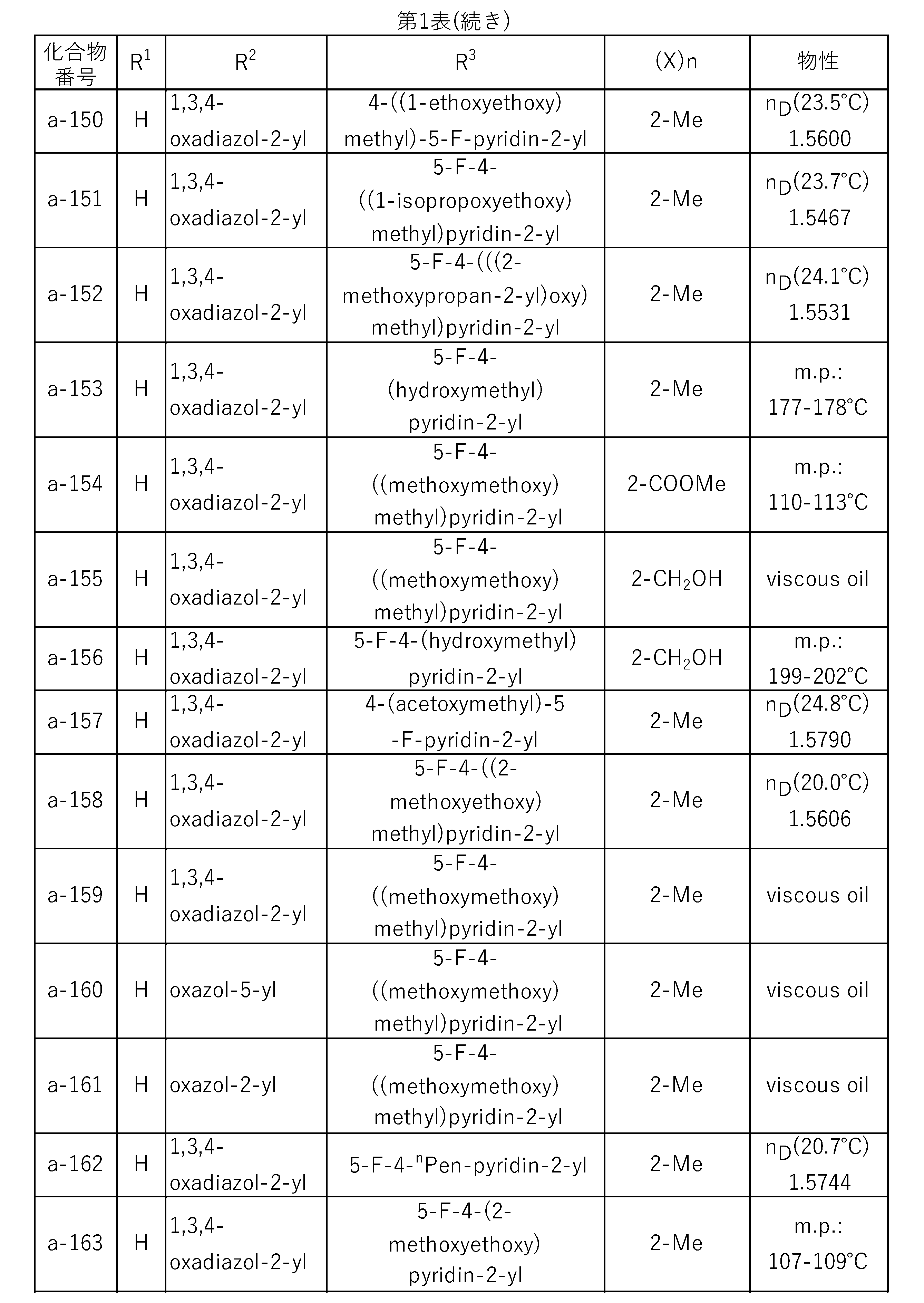


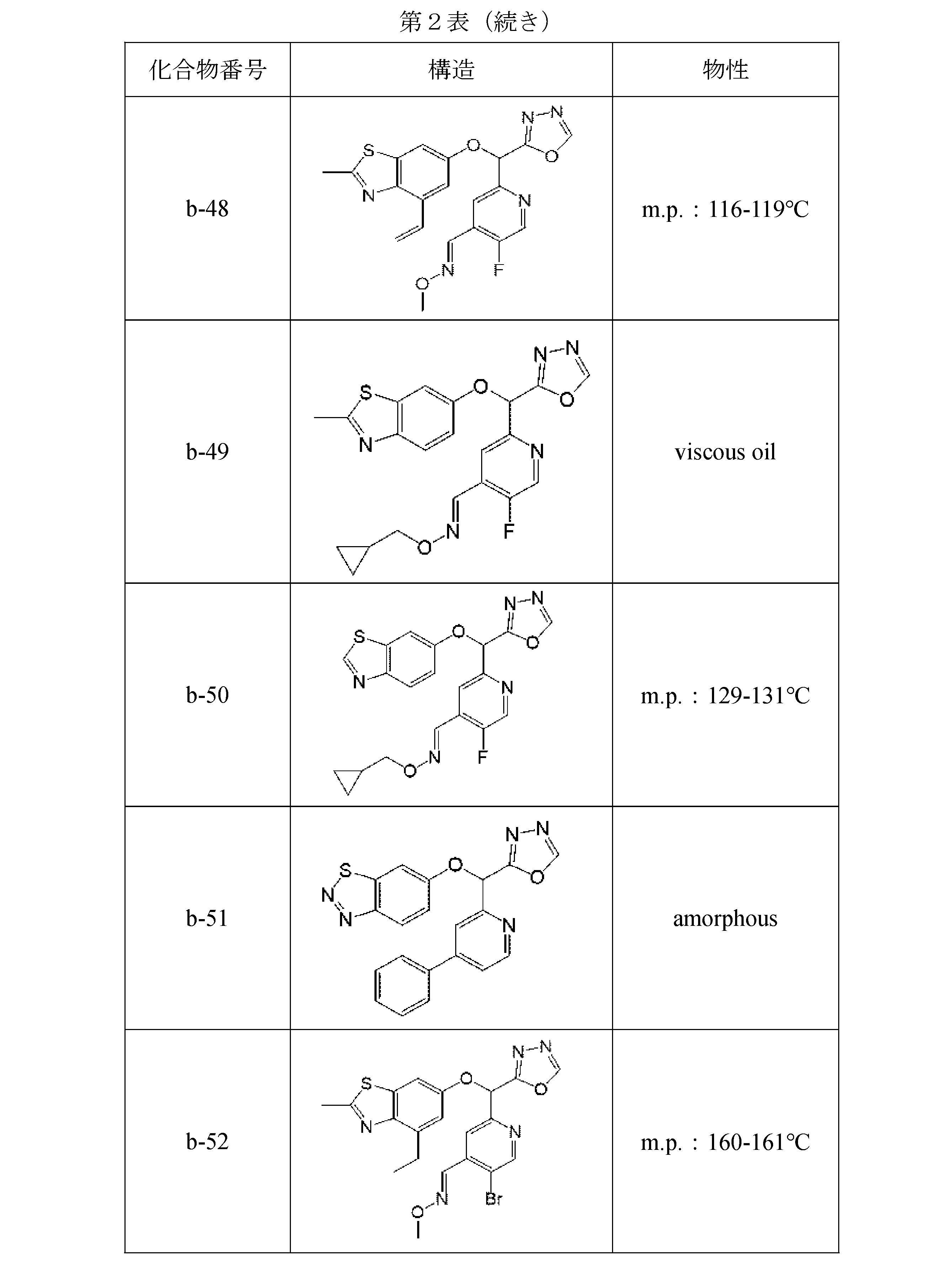


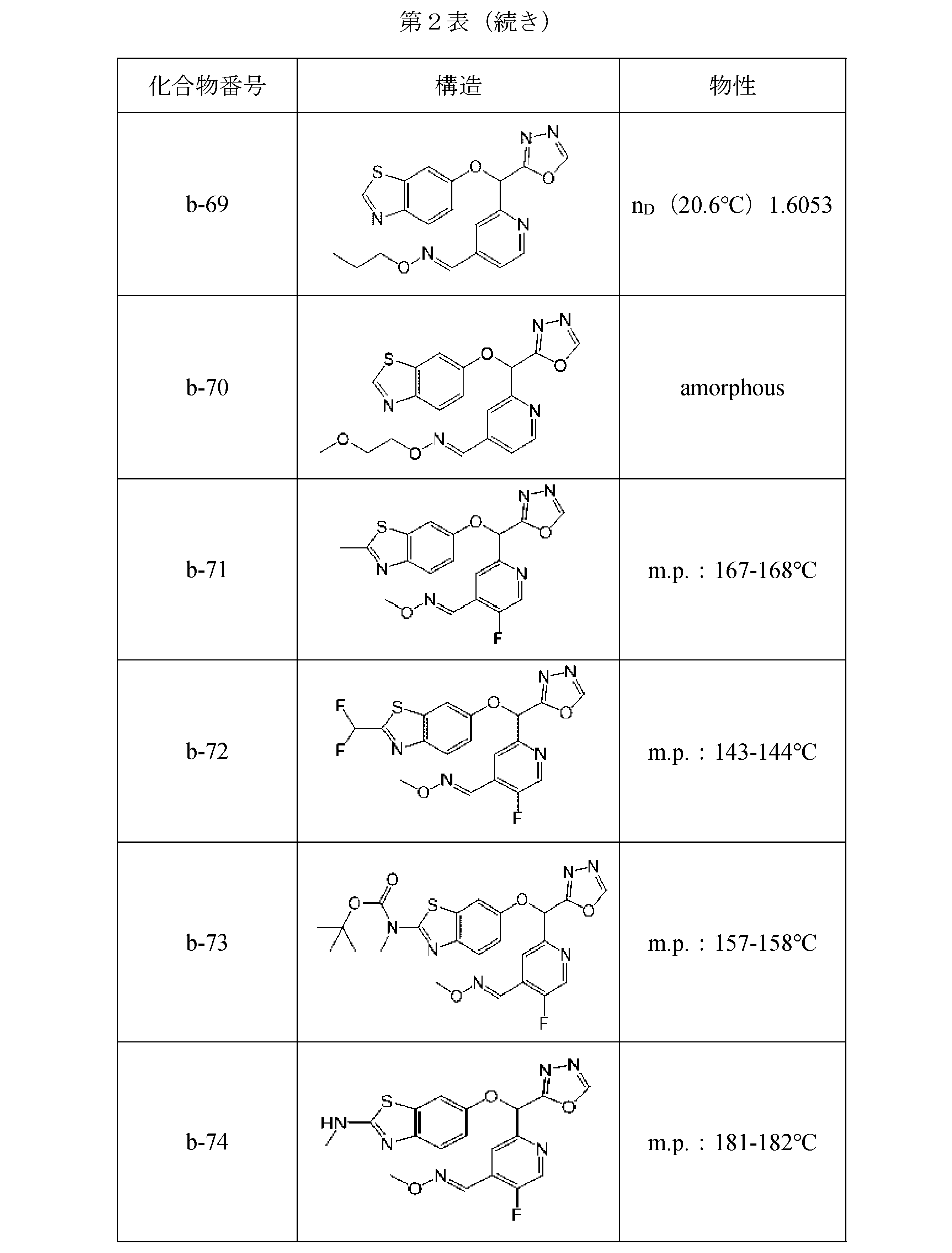

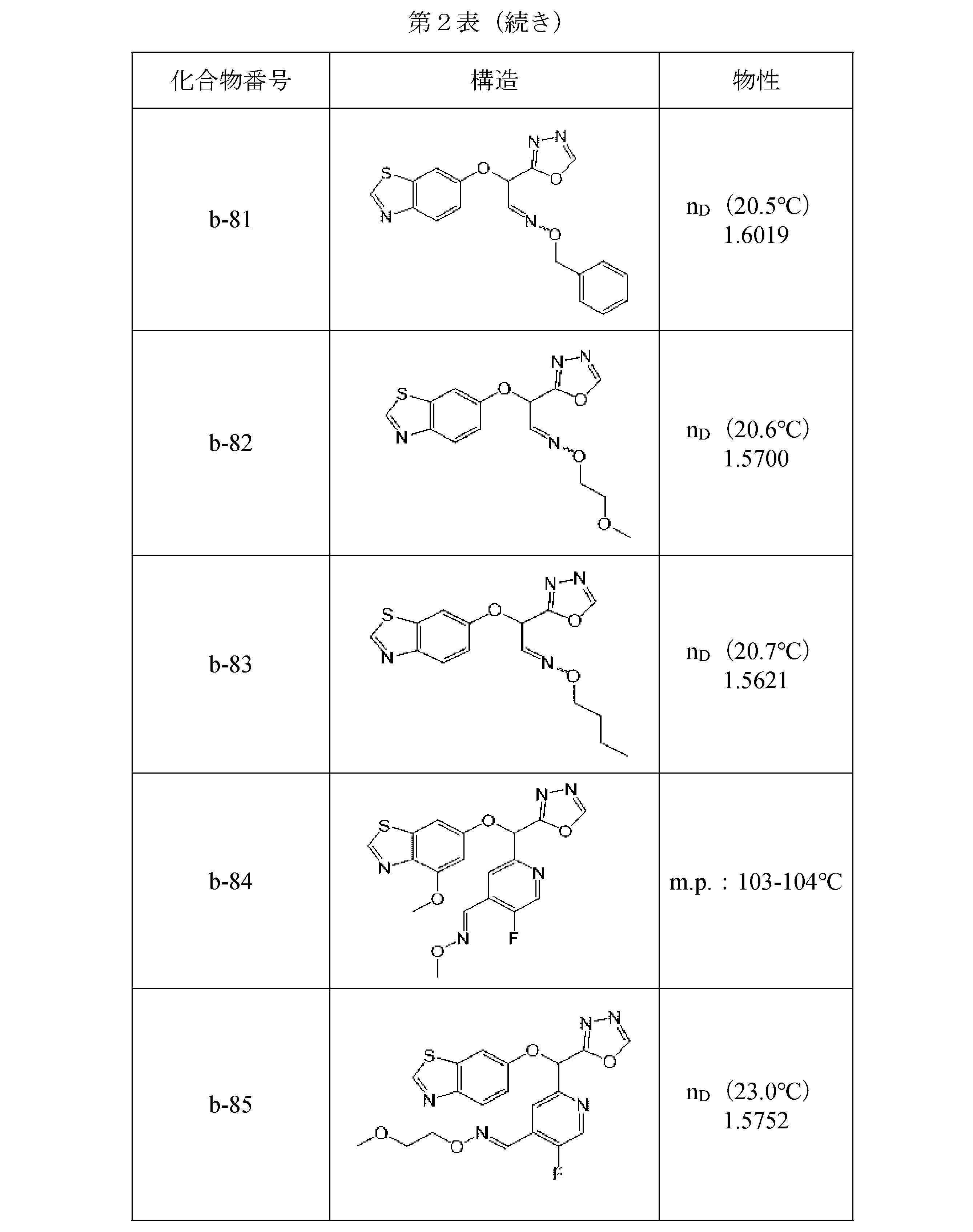
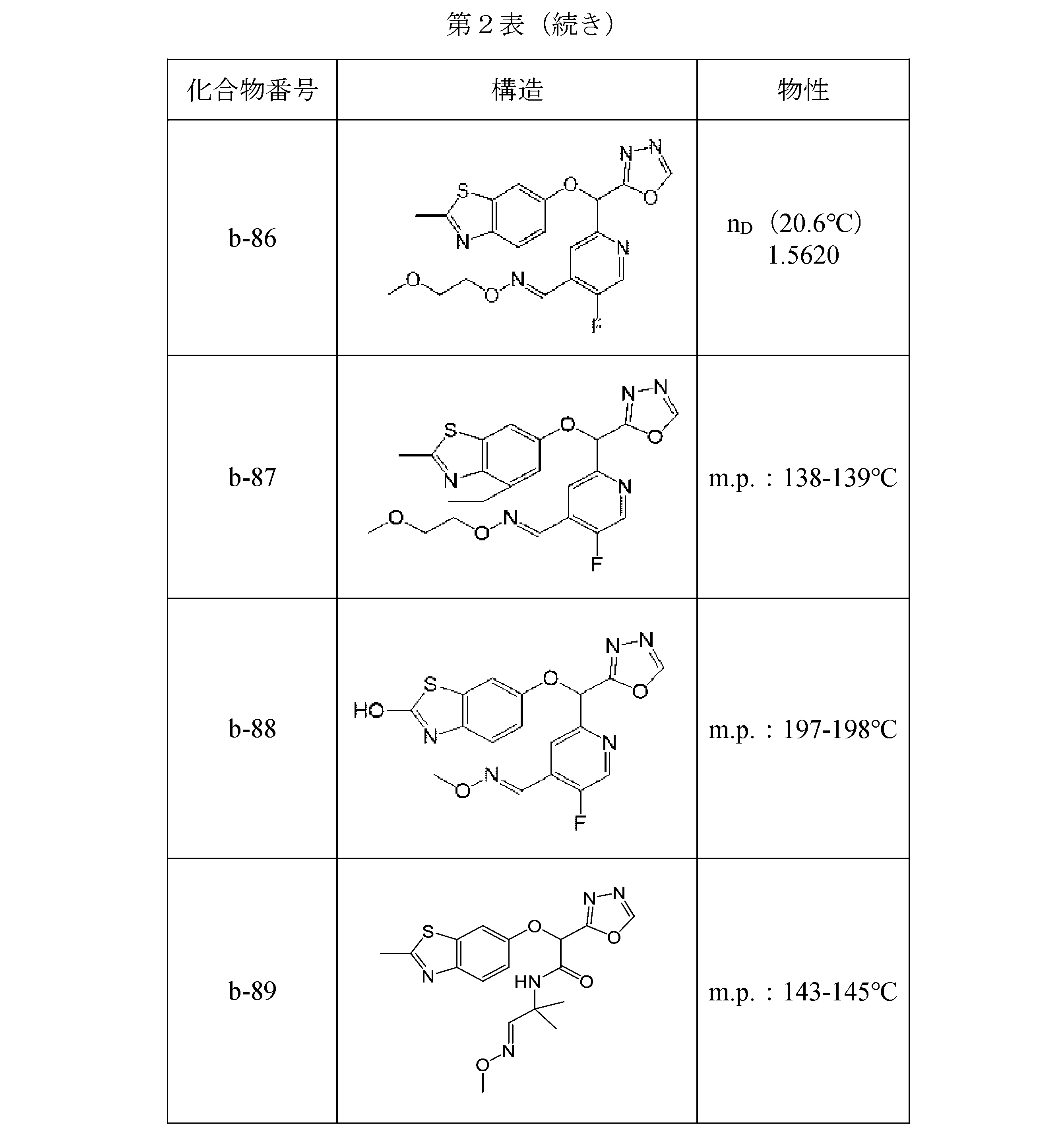

化合物番号(a-1):1H-NMR(400MHz,CDCl3):δ 8.84 (s, 1H), 8.38 (s, 1H), 7.99 (d, 1H), 7.52 (s, 1H), 7.18 (dd, 1H), 5.55 (dd, 1H), 2.20-2.31 (m, 1H), 2.01-2.13 (m, 1H), 1.50-1.61 (m, 1H), 1.31-1.46 (m, 3H), 0.92 (dd, 3H).
化合物番号(a-2):1H-NMR(400MHz,CDCl3):δ 8.37 (s, 1H), 7.80 (d, 1H), 7.60 (dd, 2H), 7.33-7.47 (m, 4H), 7.15 (dd, 1H), 6.60 (s, 1H), 2.77 (s, 3H).
化合物番号(a-3):1H-NMR(400MHz,CDCl3):δ 8.37 (s, 1H), 7.79 (s, 1H), 7.39 (d, 1H), 7.08 (dd, 1H), 5.51 (dd, 1H), 2.76 (s, 3H), 2.18-2.30 (m, 1H), 2.00-2.11 (m, 1H), 1.43-1.60 (m, 1H), 1.33-1.43 (m, 3H), 0.91 (dd, 3H).
化合物番号(a-4):1H-NMR(400MHz,CDCl3):δ 8.87 (s, 1H), 8.41 (s, 1H), 8.02 (d, 1H), 7.62 (dd, 2H), 7.54 (d, 1H), 7.25 (dd, 1H), 7.08-7.19 (m, 2H), 6.63 (s, 1H).
化合物番号(a-5):1H-NMR(400MHz,CDCl3):δ 8.87 (s, 1H), 8.62 (dd, 1H), 8.43 (s, 1H), 8.03 (d, 1H), 7.82 (dd, 2H), 7.60 (s, 1H), 7.21-7.38 (m, 2H), 6.76 (s, 1H).
化合物番号(a-7):1H-NMR(400MHz,CDCl3):δ 8.38 (s, 1H), 7.80 (d, 1H), 7.35 (d, 1H), 7.13 (d, 1H), 5.51 (dd, 1H), 2.19-2.30 (m, 1H), 2.00-2.12 (m, 1H), 1.45-1.60 (m, 1H), 1.32-1.43 (m, 3H), 0.91 (dd, 3H).
化合物番号(a-14):1H-NMR(400MHz,CDCl3):δ 8.84 (s, 1H), 8.37 (s, 1H), 8.00 (d, 1H), 7.60 (dd, 1H), 7.54 (d, 1H), 7.33-7.45 (m, 3H), 7.19-7.25 (m, 2H), 6.64 (s, 1H).
化合物番号(a-15):1H-NMR(400MHz,CDCl3):δ 8.88 (s, 1H), 8.80 (s, 2H), 8.50 (s, 1H), 8.03 (d, 1H), 7.61 (d, 1H), 7.29 (dd, 1H), 6.87 (s, 1H).
化合物番号(a-19):1H-NMR(400MHz,CDCl3):δ 8.97 (s, 1H), 8.45 (d, 1H), 8.41 (s, 1H), 7.82 (dd, 1H), 7.48-7.54 (m, 1H), 7.38 (d, 1H), 7.08 (d, 1H), 6.72 (s, 1H), 2.72 (s, 3H).
化合物番号(a-21):1H-NMR(400MHz,CDCl3):δ 8.89 (s, 1H), 8.45 (d, 2H), 7.85 (dd, 1H), 7.76 (dd, 2H), 7.32-7.58 (m, 6H), 6.98 (s, 1H).
化合物番号(a-24):1H-NMR(400MHz,CDCl3):δ 8.87 (s, 1H), 8.43 (d, 2H), 7.85 (dd, 1H), 7.73 (dd, 2H), 7.48-7.59 (m, 2H), 7.31 (d, 1H), 7.01 (d, 2H), 6.78 (s, 1H), 3.85 (s, 3H).
化合物番号(a-25):1H-NMR(400MHz,CDCl3):δ 8.90 (s, 1H), 8.45 (d, 2H), 7.85 (dd, 1H), 7.73 (dd, 1H), 7.46-7.68 (m, 4H), 7.35 (s, 1H), 7.26 (d, 1H), 6.80 (s, 1H).
化合物番号(a-31):1H-NMR(400MHz,CDCl3):δ 6.95 (s, 1H), 7.38-7.45 (m, 2H), 7.46-7.53 (m, 2H), 7.60 (d, 1H), 7.74-7.81 (m, 2H), 8.50 (s, 1H), 8.71 (s, 2H), 8.91 (s, 1H).
化合物番号(a-38):1H-NMR(400MHz,CDCl3):δ 8.85 (s, 1H), 8.45 (d, 2H), 8.01 (d, 1H), 7.69 (d, 1H), 7.61 (dd, 1H), 7.25 (dd, 2H), 6.69 (s, 1H), 2.49 (s, 3H).
化合物番号(a-39):1H-NMR(400MHz,CDCl3):δ 8.85 (s, 1H), 8.73 (d, 2H), 8.42 (s, 1H), 8.16 (dd, 1H), 7.97-8.05 (m, 1H), 7.57 (s, 1H), 7.20-7.29 (m, 1H), 6.80 (s, 1H), 2.79 (s, 3H).
化合物番号(a-42):1H-NMR(400MHz,CDCl3):δ 10.58 (s, 1H), 9.03 (d, 1H), 8.85 (s, 1H), 8.42 (s, 1H), 8.20 (dd, 1H), 8.02 (d, 1H), 7.83 (d, 1H), 7.60 (dd, 2H), 7.29 (dd, 1H), 6.78 (s, 1H), 6.68 (s, 1H).
化合物番号(a-53):1H-NMR(400MHz,CDCl3):δ 8.87 (s, 1H), 8.44 (s, 1H), 8.02 (d, 1H), 7.57 (dd, 2H), 7.24 (dd, 1H), 6.75 (s, 1H).
化合物番号(a-57):1H-NMR(400MHz,CDCl3):δ 6.79 (s, 1H), 7.28 (dd, 1H), 7.64 (d, 1H), 8.06 (d, 1H), 8.46 (s, 1H), 8.66 (dd, 1H), 8.90 (d, 1H), 8.91 (s, 1H).
化合物番号(a-58):1H-NMR(400MHz,CDCl3):δ 2.62 (s, 3H), 6.80 (s, 1H), 7.29 (dd, 1H), 7.67 (d, 1H), 8.04 (d, 1H), 8.45 (d, 1H), 8.47 (s, 1H), 8.89 (d, 1H), 8.97 (d, 1H).
化合物番号(a-62):1H-NMR(400MHz,CDCl3):δ 8.89 (s, 1H), 8.60 (s, 1H), 8.43 (s, 1H), 8.05 (d, 1H), 7.88 (s, 1H), 7.60 (d, 1H), 7.28 (dd, 1H), 6.71 (s, 1H), 4.40 (s, 2H), 3.84 (s, 3H).
化合物番号(a-69):1H-NMR(400MHz,CDCl3):δ 6.74 (s, 1H), 7.29 (dd, 1H), 7.51 (dd, 1H), 7.62 (d, 1H), 8.03 (d, 1H), 8.07 (s, 1H), 8.42 (s, 1H), 8.43 (s, 1H), 8.89 (s, 1H).
化合物番号(a-71):1H-NMR(400MHz,CDCl3):δ 0.92 (t, 3H), 1.63-1.72 (m, 2H), 2.62 (t, 2H), 6.74 (s, 1H), 7.14 (dd, 1H), 7.28 (dd, 1H), 7.61 (d, 2H), 8.02 (d, 1H), 8.43 (s, 1H), 8.48 (d, 1H), 8.87 (s, 1H).
化合物番号(a-73):1H-NMR(400MHz,CDCl3):δ 3.89 (s, 3H), 6.70 (s, 1H), 6.82 (dd, 1H), 7.28 (dd, 1H), 7.33 (d, 1H), 7.60 (d, 1H), 8.03 (d, 1H), 8.43 (s, 1H), 8.44 (s, 1H), 8.87 (s, 1H).
化合物番号(a-76):1H-NMR(400MHz,CDCl3):δ 1.99 (s, 3H), 3.66 (s, 2H), 6.74 (s, 1H), 7.24-7.30 (m, 2H), 7.59 (s, 1H), 7.73 (s, 1H), 8.00 (d, 1H), 8.41 (s, 1H), 8.53 (d, 1H), 8.85 (s, 1H).
化合物番号(a-79):1H-NMR(400MHz,CDCl3):δ 0.99 (t, 3H), 1.76-1.86 (m, 2H), 2.83 (t, 2H), 6.68 (s, 1H), 7.29-7.31 (m, 1H), 7.63 (m, 1H), 7.71 (s, 1H), 8.06 (d, 1H), 8.44 (s, 1H), 8.90 (s, 1H), 9.11 (s, 1H).
化合物番号(a-80):1H-NMR(400MHz,CDCl3):δ 6.82 (s, 1H), 7.33 (dd, 1H), 7.46-7.52 (m, 3H), 7.55 (dd, 1H), 7.65-7.66 (m, 2H), 7.67 (m, 1H), 8.04 (d, 2H), 8.44 (s, 1H), 8.66-8.67 (m, 1H), 8.88 (s, 1H).
化合物番号(a-83):1H-NMR(400MHz,CDCl3):δ 6.85 (s, 1H), 7.34-7.39 (m, 2H), 7.66 (d, 1H), 7.82-7.86 (m, 2H), 7.95-7.97 (m, 1H), 8.04 (d, 1H), 8.44 (s, 2H), 8.73 (d, 1H), 8.74-8.77 (m, 1H), 8.87 (s, 1H).
化合物番号(a-84):1H-NMR(400MHz,CDCl3):δ 6.78 (s, 1H), 7.40-7.68 (m, 8H), 7.99 (s, 1H), 8.44 (s, 1H), 8.65 (d, 1H), 8.92 (s, 1H).
化合物番号(a-85):1H-NMR(400MHz,CDCl3):δ 6.78 (s, 1H), 7.14-7.16 (m, 1H), 7.32-7.35 (m, 1H), 7.44-7.46 (m, 1H), 7.50-7.52 (m, 1H), 7.56-7.57 (m, 1H), 7.65 (d, 1H), 7.99 (s, 1H), 8.05 (d, 1H), 8.45 (s, 1H), 8.57-8.59 (m, 1H), 8.88 (s, 1H).
化合物番号(a-86):1H-NMR(400MHz,CDCl3):δ 6.84 (s, 1H), 7.33 (dd, 1H), 7.46-7.49 (m, 1H), 7.54-7.59 (m, 2H), 7.65-7.70 (m, 2H), 8.05-8.08 (m, 2H), 8.45 (s, 1H), 8.74-8.78 (m, 2H), 8.89 (s, 1H).
化合物番号(a-88):1H-NMR(400MHz,CDCl3):δ 1.35 (t, 3H), 3.15 (q, 2H), 6.80 (s, 1H), 7.15 (s, 1H), 7.38-7.57 (m, 6H), 7.64 (d, 1H), 8.02 (s, 1H), 8.43 (s, 1H), 8.65 (d, 1H), 8.83 (s, 1H).
化合物番号(a-90):1H-NMR(400MHz,CDCl3):δ 8.87 (s, 1H), 8.62 (d, 1H), 8.43 (s, 1H), 8.03 (d, 1H), 7.90 (s, 1H), 7.62 (d, 1H), 7.44-7.40 (m, 1H), 7.33-7.29 (m, 1H), 6.78 (s, 1H), 5.44 (s, 1H), 3.33 (s, 3H), 3.31 (s, 3H).
化合物番号(a-183):1H-NMR(400MHz,CDCl3):δ 8.51 (1H, d), 8.47-8.47 (1H, m), 8.44 (1H, s), 7.91 (1H, d), 7.87-7.84 (2H, m), 7.50 (1H, d), 7.20 (1H, dd), 6.87 (1H, d), 6.75 (1H, s), 4.00 (3H, s), 2.79 (3H, s).
化合物番号(a-188):1H-NMR(400MHz,CDCl3): δ 8.88 (1H, s), 8.44 (1H, s), 8.37 (1H, d), 8.04 (1H, d), 7.75 (1H, d), 7.61 (1H, d), 7.30-7.27 (1H, m), 6.73 (1H, s), 3.64 (2H, td), 3.30 (3H, s), 2.98 (2H, t).
化合物番号(a-189):1H-NMR(400MHz,CDCl3): δ 8.42 (1H, s), 8.36 (1H, s), 7.77 (1H, d), 7.73 (1H, d), 7.45 (1H, d), 7.17 (1H, dd), 6.67 (1H, s), 3.64 (2H, td), 3.31 (3H, s), 2.97 (2H, t), 2.35-2.33 (1H, m), 1.22-1.18 (4H, m).
化合物番号(a-190):1H-NMR(400MHz,CDCl3): δ 8.88 (1H, s), 8.58 (1H, d), 8.43 (1H, s), 8.04 (1H, d), 7.80 (1H, s), 7.62 (1H, d), 7.33 (1H, d), 7.30 (1H, dd), 6.76 (1H, s), 4.74 (2H, s), 4.67 (2H, s), 4.03 (0H, d), 3.39 (3H, s).
化合物番号(a-193):1H-NMR(400MHz,CDCl3): δ 8.57 (1H, d), 8.41 (1H, s), 7.79 (1H, s), 7.32 (1H, d), 7.30 (1H, d), 7.05 (1H, d), 6.72 (1H, s), 4.74 (2H, s), 4.67 (2H, s), 3.39 (3H, s), 3.09 (2H, q), 2.79 (3H, s), 1.33 (3H, t).
化合物番号(a-194):1H-NMR(400MHz,CDCl3): δ 8.77 (1H, s), 8.59 (1H, d), 8.43 (1H, s), 7.78 (1H, s), 7.33 (1H, d), 7.13 (1H, d), 6.77 (1H, d), 6.76 (1H, s), 4.74 (2H, s), 4.67 (2H, s), 4.03 (3H, s), 3.39 (3H, s).
化合物番号(b-6):1H-NMR(400MHz,CDCl3):δ 3.76 (s, 3H), 6.75 (s, 1H), 7.01 (d, 1H), 7.04-7.05 (m, 1H), 7.50-7.57 (m, 1H), 7.66 (d, 1H), 7.78 (s, 1H), 7.85 (dd, 1H), 8.41 (s, 1H), 8.45 (d, 1H).
化合物番号(b-7):1H-NMR(400MHz,CDCl3):δ 3.75 (s, 3H), 6.61 (s, 1H), 6.99 (s, 1H), 7.00 (d, 1H), 7.36-7.45 (m, 2H), 7.55 (s, 1H), 7.57 (s, 1H), 7.65 (d, 1H), 7.78 (s, 1H), 8.38 (s, 1H).
化合物番号(b-8):1H-NMR(400MHz,CDCl3):δ 3.76 (s, 3H), 6.72 (s, 1H), 6.76 (dd, 1H), 6.85 (d, 1H), 7.50-7.57 (m, 1H), 7.76 (s, 1H), 7.82 (dd, 1H), 8.42 (s, 1H), 8.45 (d, 1H).
化合物番号(b-13):1H-NMR(400MHz,CDCl3):δ 4.04 (s, 3H), 6.74 (s, 1H), 7.50-7.52 (m, 1H), 7.57 (dd, 2H), 7.95 (s, 1H), 8.05 (s, 1H), 8.44 (s, 1H), 8.61 (d, 1H), 8.95 (s, 1H).
化合物番号(b-14):1H-NMR(400MHz,CDCl3):δ 1.24 (t, 3H), 3.14 (q, 2H), 4.03 (s, 3H), 6.76 (s, 1H), 7.15 (d, 1H), 7.43 (d, 1H), 7.49 (dd, 1H), 7.97 (s, 1H), 8.04 (s, 1H), 8.43 (s, 1H), 8.61 (d, 1H), 8.85 (s, 1H).
化合物番号(b-18):1H-NMR(400MHz,CDCl3):δ 1.25-1.35 (m, 6H), 4.45-4.53 (m, 1H), 6.75 (s, 1H), 7.29 (dd, 1H), 7.48 (d, 1H), 7.60 (s, 1H), 7.93 (dd, 1H), 8.01 (s, 1H), 8.05 (s, 1H), 8.42 (s, 1H), 8.58 (d, 1H), 8.86 (s, 1H).
化合物番号(b-20):1H-NMR(400MHz,CDCl3):δ 2.51 (s, 1H), 4.81 (s, 2H), 6.76 (s, 1H), 7.28 (dd, 1H), 7.51 (d, 1H), 7.61 (s, 1H), 7.98 (s, 1H), 8.03 (d, 1H), 8.10 (s, 1H), 8.42 (s, 1H), 8.62 (d, 1H), 8.87 (s, 1H).
化合物番号(b-25):1H-NMR(400MHz,CDCl3):δ 4.03 (s, 3H), 6.83 (s, 1H), 7.30 (d, 1H), 7.60 (s, 1H), 7.78 (d, 1H), 7.98 (d, 1H), 8.03 (s, 1H), 8.47 (s, 1H), 8.77 (d, 1H), 8.85 (s, 1H).
化合物番号(b-28):1H-NMR(400MHz,CDCl3):δ 4.01 (s, 3H), 4.14 (s, 3H), 6.66 (s, 1H), 7.10 (d, 1H), 7.33 (s, 1H), 7.45 (d, 1H), 7.56 (d, 1H), 7.94 (s, 1H), 8.02 (s, 1H), 8.41 (s, 1H), 8.58 (d, 1H).
化合物番号(b-29):1H-NMR(400MHz,CDCl3):δ 1.42 (t, 3H), 3.07 (q, 2H), 4.01 (s, 3H), 6.71 (s, 1H), 7.19 (d, 1H), 7.46 (d, 1H), 7.49 (s, 1H), 7.83 (d, 1H), 7.93 (s, 1H), 8.02 (s, 1H), 8.41 (s, 1H), 8.58 (d, 1H).
化合物番号(b-33):1H-NMR(400MHz,CDCl3):δ 2.05 (s, 3H), 2.08 (s,3H), 6.71 (s, 1H), 7.14 (dd, 1H), 7.31 (dd, 1H), 7.59-7.62 (m, 2H), 8.03 (d, 1H), 8.43-8.44 (m, 2H), 8.87 (s, 1H).
化合物番号(b-34):1H-NMR(400MHz,CDCl3):δ 1.55 (s, 9H), 4.01 (s, 3H), 6.71 (s, 1H), 7.13 (d, 1H), 7.44 (s, 1H), 7.45 (d, 1H), 7.73 (d, 1H), 7.95 (s, 1H), 8.02 (s, 1H), 8.41 (s, 1H), 8.59 (d, 1H).
化合物番号(b-35):1H-NMR(400MHz,CDCl3):δ 1.57 (s, 9H), 3.58 (s, 3H), 4.00 (s, 3H), 6.69 (s, 1H), 7.13 (d, 1H), 7.40 (s, 1H), 7.42 (d, 1H), 7.65 (d, 1H), 7.94 (s, 1H), 8.01 (s, 1H), 8.41 (s, 1H), 8.56 (d, 1H).
化合物番号(b-36):1H-NMR(400MHz,CDCl3):δ 3.06 (s, 3H), 4.01 (s, 3H), 5.31 (br, 1H), 6.64 (s, 1H), 7.04 (d, 1H), 7.30 (s, 1H), 7.42 (d, 1H), 7.46 (d, 1H), 7.95 (s, 1H), 8.02 (s, 1H), 8.40 (s, 1H), 8.57 (d, 1H).
化合物番号(b-37):1H-NMR(400MHz,CDCl3):δ 4.06 (s, 3H), 6.72 (s, 1H), 7.29 (d, 1H), 7.61 (s, 1H), 8.03 (d, 1H), 8.25 (s, 1H), 8.38 (s, 1H), 8.43 (s, 1H), 8.57 (s, 1H), 8.87 (s, 1H).
化合物番号(b-38):1H-NMR(400MHz,CDCl3): δ 8.89 (1H, s), 8.59-8.58 (1H, m), 8.54 (1H, m), 8.45 (1H, s), 8.05 (1H, d), 7.62-7.61 (2H, m), 7.30-7.28 (1H, m), 6.76 (1H, s), 4.06 (3H, s).
化合物番号(b-41):1H-NMR(400MHz,CDCl3):δ 8.88 (1H, s), 8.54 (1H, s), 8.44 (1H, s), 8.43 (1H, s), 8.08 (1H, s), 8.04 (1H, d), 7.62 (1H, d), 7.31 (1H, dd), 6.73 (1H, s), 4.05 (3H, s), 2.53 (3H, s).
化合物番号(b-49):1H-NMR(400MHz,CDCl3):δ 8.89 (1H, s), 8.49-8.48 (1H, m), 8.44 (1H, s), 8.30 (1H, s), 8.22-8.21 (1H, m), 8.05 (1H, d), 7.63-7.62 (1H, m), 7.32-7.29 (1H, m), 6.75 (1H, s), 4.11-4.07 (2H, m), 1.26-1.19 (1H, m), 0.62-0.59 (2H, m), 0.36-0.32 (2H, m).
化合物番号(b-51):1H-NMR(400MHz,CDCl3):δ 8.69-8.66 (m, 1H), 8.53 (d, 1H), 8.46 (s, 1H), 8.01-7.99 (m, 1H), 7.71 (d, 1H), 7.68-7.62 (m, 2H), 7.58-7.55 (m, 1H), 7.53-7.42 (m, 4H), 6.88 (s, 1H).
化合物番号(b-59):1H-NMR(400MHz,CDCl3):δ 8.87 (1H, s), 8.45 (1H, s), 8.44 (1H, s), 8.25 (1H, d), 8.05 (1H, s), 8.02 (1H, d), 7.62 (1H, d), 7.32 (1H, dd), 6.73 (1H, s), 4.04 (3H, s), 2.41 (3H, s).
化合物番号(b-67):1H-NMR(400MHz,CDCl3):δ 8.89 (1H, s), 8.64 (1H, d), 8.46 (1H, s),8.45 (1H, s), 8.17 (1H, s), 8.05 (1H, d), 7.95 (1H, s), 7.61 (1H, d), 7.51 (1H, dd), 7.31 (1H, dd), 6.77 (1H, s), 5.46 (2H, s).
化合物番号(b-70):1H-NMR(400MHz,CDCl3):δ 8.88 (1H, s), 8.61 (1H, d), 8.45 (1H, s), 8.12 (1H, s), 8.04 (1H, d), 7.97 (1H, s), 7.63 (1H, d), 7.49 (1H, dd), 7.31 (1H, dd), 6.77 (1H, s), 4.42-4.36 (2H, m), 3.72-3.67 (2H, m), 3.41 (3H, s).
本発明化合物が、農園芸用殺菌剤の有効成分として有用であることを以下の試験例で示す。
本発明化合物5質量部、ジメチルホルムアミド93.5質量部、およびポリオキシエチレンアルキルアリールエーテル1.5質量部を混合し溶解させて、有効成分5質量%の乳剤(I)を調製した。
防除価(%)=
100-{処理区における病斑面積率/無処理区における病斑面積率}×100
乳剤(I)に複素環化合物濃度が125質量ppmになるように水を加え、溶解させて薬剤溶液を得た。続いて育苗用ポットで栽培したトマト幼苗(品種「レジナ」、4~5葉期)に、前記薬剤溶液を散布した。風乾後、薬剤溶液の散布されたトマト幼苗にトマト疫病菌(Phytophthora infestans)の遊走子嚢懸濁液を噴霧接種した(処理区)。対照として、薬剤散布しなかったトマト幼苗に上記と同様にして接種した(無処理区)。それらを20℃の湿室に静置した。接種から4日経過した日にトマト幼苗の葉を目視観察して、病斑面積率を求め、防除価を算出した。

乳剤(I)に複素環化合物濃度が100質量ppmになるように水を加え、溶解させて薬剤溶液を得た。続いて6穴プレート内の寒天上に置いたブドウ (品種「シャルドネ」) リーフディスクに前記薬剤溶液を散布した。風乾後、薬剤溶液の散布されたブドウリーフディスクにブドウべと病菌 (Plasmopara viticola) の遊走子嚢懸濁液を噴霧接種した(処理区)。対照として、薬剤散布しなかったブドウリーフディスクに上記と同様にして接種した(無処理区)。それらを20℃の湿室に静置した。接種から7日経過した日にブドウリーフディスクを目視観察して、病斑面積率を求め、防除価を算出した。

Claims (5)
- 式(I)で表される化合物、またはその塩。

R1は、水素原子、置換若しくは無置換のC1~6アルキル基、またはハロゲノ基であり、
R2は、置換若しくは無置換の5~6員ヘテロアリール基であり、
R3は、置換若しくは無置換のC1~6アルキル基、置換若しくは無置換のC1~6アルコキシカルボニル基、置換若しくは無置換のC1~6アルキルチオ基、置換若しくは無置換のC6~10アリール基、置換若しくは無置換の5~6員ヘテロアリール基、式:「-C(Ri)=NORj」で表される基、または式:「-C(=O)NHRs」で表される基であり、
Riは、水素原子またはC1~6アルキル基であり、
Rjは、置換若しくは無置換のC1~6アルキル基であり、
Rsは、置換若しくは無置換のC1~6アルキル基であり、
Yは、酸素原子またはNHであり、
A1は、硫黄原子、酸素原子、またはNR4であり、
R4は、C1~6アルキル基であり、
A2は、炭素原子、または窒素原子であり、
Xは、置換基であり、
nは、化学的に許容されるXの個数を示し、かつ0~3のいずれかの整数であり、且つ
nが2以上のときXは互いに同じでも異なってもよい。 - 式(I)中、Xが、置換若しくは無置換のC1~6アルキル基、置換若しくは無置換のC2~6アルケニル基、置換若しくは無置換のC2~6アルキニル基、ヒドロキシ基、置換若しくは無置換のC1~6アルコキシ基、置換若しくは無置換のC1~6アルコキシカルボニル基、置換若しくは無置換のC1~6アルキルチオ基、置換若しくは無置換のC3~8シクロアルキル基、置換若しくは無置換のC6~10アリール基、ハロゲノ基、シアノ基、式:「-NRaRb」で表される基(式中、RaおよびRbは、それぞれ独立して、水素原子、C1~6アルキル基、またはC1~6アルコキシカルボニル基である。)、または式:「-C(Re)=NORf」で表される基(式中、ReおよびRfは、それぞれ独立して、水素原子、またはC1~6アルキル基である。)である、請求項1に記載の化合物、またはその塩。
- 式(I)が式(II)である、請求項1に記載の化合物、またはその塩。

- 式(I)が式(III)である、請求項1に記載の化合物、またはその塩。

R1、R2、Xおよびnは、式(I)中のそれらと同じ意味を示し、
R4、R5、R6およびR7は、それぞれ独立して、水素原子、置換若しくは無置換のC1~6アルキル基、置換若しくは無置換のC2~6アルケニル基、置換若しくは無置換のC2~6アルキニル基、置換若しくは無置換のC1~6アルコキシ基、置換若しくは無置換のC1~6アルコキシカルボニル基、置換若しくは無置換のC1~6アルキルチオ基、置換若しくは無置換のC1~6アルキルスルフィニル基、置換若しくは無置換のC1~6アルキルスルホニル基、置換若しくは無置換のC6~10アリール基、置換若しくは無置換の5~6員ヘテロシクリル基、ハロゲノ基、シアノ基、ニトロ基、式:「-C(Rg)=NORh」(式中、Rgは、水素原子、C1~6アルキル基、またはアミノ基であり、Rhは、水素原子、置換若しくは無置換のC1~6アルキル基、またはC2~6アルキニル基である。)で表される基、式:「-O-N=CRcRd」(式中、RcおよびRdは、それぞれ独立して、水素原子、またはC1~6アルキル基である。)で表される基、または式:「-C(=O)NRpRq」(RpおよびRqは、それぞれ独立して、水素原子またはC1~6アルキル基である。)である。 - 請求項1~4に記載の化合物、およびそれらの塩からなる群から選ばれる少なくとも1つを有効成分として含有する農園芸用殺菌剤。
Priority Applications (6)
| Application Number | Priority Date | Filing Date | Title |
|---|---|---|---|
| BR112021017042A BR112021017042A2 (pt) | 2019-03-15 | 2020-03-12 | Composto, e, fungicida para agricultura ou horticultura |
| US17/433,572 US20220142165A1 (en) | 2019-03-15 | 2020-03-12 | Heterocyclic compound and agricultural or horticultural fungicide |
| CN202080017689.2A CN113518777A (zh) | 2019-03-15 | 2020-03-12 | 杂环化合物和农业园艺用杀菌剂 |
| KR1020217027782A KR20210138585A (ko) | 2019-03-15 | 2020-03-12 | 복소 고리 화합물 및 농원예용 살균제 |
| EP20773358.5A EP3939975A4 (en) | 2019-03-15 | 2020-03-12 | HETEROCYCLIC COMPOUND AND AGRICULTURAL OR HORTICULTURAL BACTERICIDE |
| JP2021507290A JPWO2020189525A1 (ja) | 2019-03-15 | 2020-03-12 |
Applications Claiming Priority (2)
| Application Number | Priority Date | Filing Date | Title |
|---|---|---|---|
| JP2019048196 | 2019-03-15 | ||
| JP2019-048196 | 2019-03-15 |
Publications (1)
| Publication Number | Publication Date |
|---|---|
| WO2020189525A1 true WO2020189525A1 (ja) | 2020-09-24 |
Family
ID=72521010
Family Applications (1)
| Application Number | Title | Priority Date | Filing Date |
|---|---|---|---|
| PCT/JP2020/010905 Ceased WO2020189525A1 (ja) | 2019-03-15 | 2020-03-12 | 複素環化合物および農園芸用殺菌剤 |
Country Status (8)
| Country | Link |
|---|---|
| US (1) | US20220142165A1 (ja) |
| EP (1) | EP3939975A4 (ja) |
| JP (1) | JPWO2020189525A1 (ja) |
| KR (1) | KR20210138585A (ja) |
| CN (1) | CN113518777A (ja) |
| BR (1) | BR112021017042A2 (ja) |
| TW (1) | TW202102492A (ja) |
| WO (1) | WO2020189525A1 (ja) |
Citations (7)
| Publication number | Priority date | Publication date | Assignee | Title |
|---|---|---|---|---|
| WO2004108964A1 (en) | 2003-06-04 | 2004-12-16 | Agency For Science, Technology And Research | Differentially regulated hepatocellular carcinoma genes and uses thereof |
| WO2008055950A1 (en) * | 2006-11-09 | 2008-05-15 | Probiodrug Ag | Novel inhibitors of glutaminyl cyclase |
| US20120135977A1 (en) * | 2010-09-29 | 2012-05-31 | Beshore Douglas C | Ether benzotriazole derivatives |
| WO2016016421A1 (en) * | 2014-07-31 | 2016-02-04 | Institut Pasteur Korea | 2-amino-benzimidazole derivatives and their use as 5-lipoxygenase and/or prostaglandin e synthase inhibitors |
| WO2016108282A1 (ja) | 2014-12-29 | 2016-07-07 | 日本ケミファ株式会社 | Urat1阻害剤 |
| WO2016171755A1 (en) * | 2015-04-21 | 2016-10-27 | Forma Therapeutics, Inc. | Fused-bicyclic aryl quinolinone derivatives as mutant-isocitrate dehydrogenase inhibitors |
| JP2019048196A (ja) | 2013-07-03 | 2019-03-28 | スパイン イノベーション, エルエルシー | 椎体間デバイスを移植するための方法および装置 |
Family Cites Families (2)
| Publication number | Priority date | Publication date | Assignee | Title |
|---|---|---|---|---|
| EP3412675A1 (en) * | 2013-05-27 | 2018-12-12 | Novartis AG | Imidazopyrrolidinone derivatives and their use in the treatment of disease |
| EA029269B1 (ru) * | 2013-11-21 | 2018-02-28 | Новартис Аг | Производные пирролопирролона и их применение для лечения заболеваний |
-
2020
- 2020-03-12 CN CN202080017689.2A patent/CN113518777A/zh active Pending
- 2020-03-12 KR KR1020217027782A patent/KR20210138585A/ko not_active Withdrawn
- 2020-03-12 JP JP2021507290A patent/JPWO2020189525A1/ja not_active Withdrawn
- 2020-03-12 WO PCT/JP2020/010905 patent/WO2020189525A1/ja not_active Ceased
- 2020-03-12 TW TW109108227A patent/TW202102492A/zh unknown
- 2020-03-12 BR BR112021017042A patent/BR112021017042A2/pt not_active IP Right Cessation
- 2020-03-12 EP EP20773358.5A patent/EP3939975A4/en not_active Withdrawn
- 2020-03-12 US US17/433,572 patent/US20220142165A1/en not_active Abandoned
Patent Citations (7)
| Publication number | Priority date | Publication date | Assignee | Title |
|---|---|---|---|---|
| WO2004108964A1 (en) | 2003-06-04 | 2004-12-16 | Agency For Science, Technology And Research | Differentially regulated hepatocellular carcinoma genes and uses thereof |
| WO2008055950A1 (en) * | 2006-11-09 | 2008-05-15 | Probiodrug Ag | Novel inhibitors of glutaminyl cyclase |
| US20120135977A1 (en) * | 2010-09-29 | 2012-05-31 | Beshore Douglas C | Ether benzotriazole derivatives |
| JP2019048196A (ja) | 2013-07-03 | 2019-03-28 | スパイン イノベーション, エルエルシー | 椎体間デバイスを移植するための方法および装置 |
| WO2016016421A1 (en) * | 2014-07-31 | 2016-02-04 | Institut Pasteur Korea | 2-amino-benzimidazole derivatives and their use as 5-lipoxygenase and/or prostaglandin e synthase inhibitors |
| WO2016108282A1 (ja) | 2014-12-29 | 2016-07-07 | 日本ケミファ株式会社 | Urat1阻害剤 |
| WO2016171755A1 (en) * | 2015-04-21 | 2016-10-27 | Forma Therapeutics, Inc. | Fused-bicyclic aryl quinolinone derivatives as mutant-isocitrate dehydrogenase inhibitors |
Non-Patent Citations (4)
| Title |
|---|
| BIOORGANIC & MEDICINAL CHEMISTRY, vol. 19, pages 359 - 373 |
| MOORMANN, ALAN E.: "Potential antisecretory antidiarrheals. 2. Alpha2- adrenergic 2-[(aryloxy)alkyl]imidazolines", JOURNAL OF MEDICINAL CHEMISTRY, vol. 33, 1990, pages 614 - 626, XP002510805, DOI: 10.1021/jm00164a024 * |
| See also references of EP3939975A4 |
| SIDHU, PREETPAL S.: "Development of novel Vitamin D receptor - coactivator inhibitors", ACS MEDICINAL CHEMISTRY LETTERS, vol. 5, no. 2, 2014, pages 199 - 204, XP055741395 * |
Also Published As
| Publication number | Publication date |
|---|---|
| KR20210138585A (ko) | 2021-11-19 |
| EP3939975A1 (en) | 2022-01-19 |
| BR112021017042A2 (pt) | 2021-11-16 |
| EP3939975A4 (en) | 2022-11-30 |
| JPWO2020189525A1 (ja) | 2020-09-24 |
| TW202102492A (zh) | 2021-01-16 |
| US20220142165A1 (en) | 2022-05-12 |
| CN113518777A (zh) | 2021-10-19 |
Similar Documents
| Publication | Publication Date | Title |
|---|---|---|
| JP7158386B2 (ja) | オキサジアゾール化合物および農園芸用殺菌剤 | |
| TW202308515A (zh) | 農園藝用殺菌性組合物 | |
| WO2019031384A1 (ja) | 1,3,5,6-テトラ置換チエノ[2,3-d]ピリミジン-2,4(1H,3H)ジオン化合物および農園芸用殺菌剤 | |
| WO2019065483A1 (ja) | 1,3,5,6-テトラ置換チエノ[2,3-d]ピリミジン-2,4(1H,3H)ジオン化合物および農園芸用殺菌剤 | |
| WO2019107393A1 (ja) | 1,3,5,6-テトラ置換チエノ[2,3-d]ピリミジン-2,4(1H,3H)ジオン化合物および農園芸用殺菌剤 | |
| TW201605800A (zh) | 吡啶化合物及其用途 | |
| EP4644388A1 (en) | Five-membered heteroaryl compound and agricultural and horticultural bactericide | |
| JPWO2019065516A1 (ja) | キノリン化合物および農園芸用殺菌剤 | |
| CN121794258A (zh) | 五元杂芳基化合物和农园艺用杀菌剂 | |
| WO2023017699A1 (ja) | 3-置換ウラシル化合物並びに農園芸用殺菌剤、殺線虫剤、および医療用・動物用抗真菌剤 | |
| WO2021100745A1 (ja) | オキサジアゾール化合物および農園芸用殺菌剤 | |
| TW201609655A (zh) | 吡啶化合物及其用途 | |
| JP2022134284A (ja) | オキサジアゾール化合物および農園芸用殺菌剤 | |
| JP2020147544A (ja) | キノリン化合物および農園芸用殺菌剤 | |
| WO2021153748A1 (ja) | 農園芸用組成物 | |
| JP2020097575A (ja) | 1,3,5,6−テトラ置換チエノ[2,3−d]ピリミジン−2,4(1H,3H)ジオン化合物および農園芸用殺菌剤 | |
| WO2020189525A1 (ja) | 複素環化合物および農園芸用殺菌剤 | |
| JP2019163223A (ja) | 1,3,5,6−テトラ置換チエノ[2,3−d]ピリミジン−2,4(1H,3H)ジオン化合物および農園芸用殺菌剤 | |
| JP2020147545A (ja) | オキサジアゾール化合物および農園芸用殺菌剤 | |
| JP2023003357A (ja) | オキサジアゾール化合物および農園芸用殺菌剤 | |
| WO2025206002A1 (ja) | トリアゾール化合物および農園芸用殺菌剤 | |
| WO2025159046A1 (ja) | 5員ヘテロアリール化合物および農園芸用殺菌剤 | |
| WO2025142780A1 (ja) | ピラゾール化合物および農園芸用殺菌剤 | |
| WO2024143336A1 (ja) | ヒドラジド化合物および農園芸用殺菌剤 | |
| JP2022035834A (ja) | 2,4-ジオキソ-1,4-ジヒドロチエノピリミジン化合物及び農園芸用殺菌剤 |
Legal Events
| Date | Code | Title | Description |
|---|---|---|---|
| 121 | Ep: the epo has been informed by wipo that ep was designated in this application |
Ref document number: 20773358 Country of ref document: EP Kind code of ref document: A1 |
|
| ENP | Entry into the national phase |
Ref document number: 2021507290 Country of ref document: JP Kind code of ref document: A |
|
| ENP | Entry into the national phase |
Ref document number: 20217027782 Country of ref document: KR Kind code of ref document: A |
|
| REG | Reference to national code |
Ref country code: BR Ref legal event code: B01A Ref document number: 112021017042 Country of ref document: BR |
|
| NENP | Non-entry into the national phase |
Ref country code: DE |
|
| WWE | Wipo information: entry into national phase |
Ref document number: 2020773358 Country of ref document: EP |
|
| ENP | Entry into the national phase |
Ref document number: 112021017042 Country of ref document: BR Kind code of ref document: A2 Effective date: 20210827 |