WO2020189581A1 - 核酸増幅方法 - Google Patents
核酸増幅方法 Download PDFInfo
- Publication number
- WO2020189581A1 WO2020189581A1 PCT/JP2020/011249 JP2020011249W WO2020189581A1 WO 2020189581 A1 WO2020189581 A1 WO 2020189581A1 JP 2020011249 W JP2020011249 W JP 2020011249W WO 2020189581 A1 WO2020189581 A1 WO 2020189581A1
- Authority
- WO
- WIPO (PCT)
- Prior art keywords
- temperature zone
- flow path
- nucleic acid
- acid amplification
- curved
- Prior art date
- Legal status (The legal status is an assumption and is not a legal conclusion. Google has not performed a legal analysis and makes no representation as to the accuracy of the status listed.)
- Ceased
Links
Images



Classifications
-
- C—CHEMISTRY; METALLURGY
- C12—BIOCHEMISTRY; BEER; SPIRITS; WINE; VINEGAR; MICROBIOLOGY; ENZYMOLOGY; MUTATION OR GENETIC ENGINEERING
- C12Q—MEASURING OR TESTING PROCESSES INVOLVING ENZYMES, NUCLEIC ACIDS OR MICROORGANISMS; COMPOSITIONS OR TEST PAPERS THEREFOR; PROCESSES OF PREPARING SUCH COMPOSITIONS; CONDITION-RESPONSIVE CONTROL IN MICROBIOLOGICAL OR ENZYMOLOGICAL PROCESSES
- C12Q1/00—Measuring or testing processes involving enzymes, nucleic acids or microorganisms; Compositions therefor; Processes of preparing such compositions
- C12Q1/68—Measuring or testing processes involving enzymes, nucleic acids or microorganisms; Compositions therefor; Processes of preparing such compositions involving nucleic acids
- C12Q1/6844—Nucleic acid amplification reactions
- C12Q1/686—Polymerase chain reaction [PCR]
-
- B—PERFORMING OPERATIONS; TRANSPORTING
- B01—PHYSICAL OR CHEMICAL PROCESSES OR APPARATUS IN GENERAL
- B01L—CHEMICAL OR PHYSICAL LABORATORY APPARATUS FOR GENERAL USE
- B01L7/00—Heating or cooling apparatus; Heat insulating devices
- B01L7/52—Heating or cooling apparatus; Heat insulating devices with provision for submitting samples to a predetermined sequence of different temperatures, e.g. for treating nucleic acid samples
- B01L7/525—Heating or cooling apparatus; Heat insulating devices with provision for submitting samples to a predetermined sequence of different temperatures, e.g. for treating nucleic acid samples with physical movement of samples between temperature zones
-
- C—CHEMISTRY; METALLURGY
- C12—BIOCHEMISTRY; BEER; SPIRITS; WINE; VINEGAR; MICROBIOLOGY; ENZYMOLOGY; MUTATION OR GENETIC ENGINEERING
- C12Q—MEASURING OR TESTING PROCESSES INVOLVING ENZYMES, NUCLEIC ACIDS OR MICROORGANISMS; COMPOSITIONS OR TEST PAPERS THEREFOR; PROCESSES OF PREPARING SUCH COMPOSITIONS; CONDITION-RESPONSIVE CONTROL IN MICROBIOLOGICAL OR ENZYMOLOGICAL PROCESSES
- C12Q1/00—Measuring or testing processes involving enzymes, nucleic acids or microorganisms; Compositions therefor; Processes of preparing such compositions
- C12Q1/68—Measuring or testing processes involving enzymes, nucleic acids or microorganisms; Compositions therefor; Processes of preparing such compositions involving nucleic acids
- C12Q1/6844—Nucleic acid amplification reactions
-
- B—PERFORMING OPERATIONS; TRANSPORTING
- B01—PHYSICAL OR CHEMICAL PROCESSES OR APPARATUS IN GENERAL
- B01L—CHEMICAL OR PHYSICAL LABORATORY APPARATUS FOR GENERAL USE
- B01L3/00—Containers or dishes for laboratory use, e.g. laboratory glassware; Droppers
- B01L3/50—Containers for the purpose of retaining a material to be analysed, e.g. test tubes
- B01L3/502—Containers for the purpose of retaining a material to be analysed, e.g. test tubes with fluid transport, e.g. in multi-compartment structures
- B01L3/5027—Containers for the purpose of retaining a material to be analysed, e.g. test tubes with fluid transport, e.g. in multi-compartment structures by integrated microfluidic structures, i.e. dimensions of channels and chambers are such that surface tension forces are important, e.g. lab-on-a-chip
- B01L3/502715—Containers for the purpose of retaining a material to be analysed, e.g. test tubes with fluid transport, e.g. in multi-compartment structures by integrated microfluidic structures, i.e. dimensions of channels and chambers are such that surface tension forces are important, e.g. lab-on-a-chip characterised by interfacing components, e.g. fluidic, electrical, optical or mechanical interfaces
-
- B—PERFORMING OPERATIONS; TRANSPORTING
- B01—PHYSICAL OR CHEMICAL PROCESSES OR APPARATUS IN GENERAL
- B01L—CHEMICAL OR PHYSICAL LABORATORY APPARATUS FOR GENERAL USE
- B01L2200/00—Solutions for specific problems relating to chemical or physical laboratory apparatus
- B01L2200/06—Fluid handling related problems
- B01L2200/0673—Handling of plugs of fluid surrounded by immiscible fluid
-
- B—PERFORMING OPERATIONS; TRANSPORTING
- B01—PHYSICAL OR CHEMICAL PROCESSES OR APPARATUS IN GENERAL
- B01L—CHEMICAL OR PHYSICAL LABORATORY APPARATUS FOR GENERAL USE
- B01L2300/00—Additional constructional details
- B01L2300/08—Geometry, shape and general structure
- B01L2300/0809—Geometry, shape and general structure rectangular shaped
- B01L2300/0816—Cards, e.g. flat sample carriers usually with flow in two horizontal directions
-
- B—PERFORMING OPERATIONS; TRANSPORTING
- B01—PHYSICAL OR CHEMICAL PROCESSES OR APPARATUS IN GENERAL
- B01L—CHEMICAL OR PHYSICAL LABORATORY APPARATUS FOR GENERAL USE
- B01L2300/00—Additional constructional details
- B01L2300/08—Geometry, shape and general structure
- B01L2300/0861—Configuration of multiple channels and/or chambers in a single devices
- B01L2300/0883—Serpentine channels
-
- B—PERFORMING OPERATIONS; TRANSPORTING
- B01—PHYSICAL OR CHEMICAL PROCESSES OR APPARATUS IN GENERAL
- B01L—CHEMICAL OR PHYSICAL LABORATORY APPARATUS FOR GENERAL USE
- B01L2300/00—Additional constructional details
- B01L2300/18—Means for temperature control
- B01L2300/1838—Means for temperature control using fluid heat transfer medium
- B01L2300/1844—Means for temperature control using fluid heat transfer medium using fans
-
- B—PERFORMING OPERATIONS; TRANSPORTING
- B01—PHYSICAL OR CHEMICAL PROCESSES OR APPARATUS IN GENERAL
- B01L—CHEMICAL OR PHYSICAL LABORATORY APPARATUS FOR GENERAL USE
- B01L2400/00—Moving or stopping fluids
- B01L2400/04—Moving fluids with specific forces or mechanical means
- B01L2400/0475—Moving fluids with specific forces or mechanical means specific mechanical means and fluid pressure
- B01L2400/0487—Moving fluids with specific forces or mechanical means specific mechanical means and fluid pressure fluid pressure, pneumatics
Definitions
- Nucleic acid detection is at the core of various fields such as drug research and development, forensic medicine, clinical testing, identification of crops and types of pathogenic microorganisms.
- One of the most powerful basic techniques for detecting a small amount of nucleic acid, which is a gene, with high sensitivity is a method of analyzing a product obtained by exponentially replicating or amplifying a part or all of a nucleic acid sequence.
- PCR is a powerful technique that selectively amplifies a specific region of DNA.
- PCR can be used to generate millions of copies of DNA fragments from a single template DNA for the target DNA sequence in the template DNA.
- PCR involves denaturing DNA into a single strand, annealing denatured DNA single strands and primers, and primers with a thermostable DNA polymerase enzyme by repeating three-phase or two-phase temperature conditions called a thermal cycle. The individual reactions of elongation are repeated in sequence. This cycle is repeated until sufficient copy number is obtained for the analysis. In principle, it is possible to double the copy number in a single PCR cycle.
- the PCR method is a powerful method that can selectively amplify the target DNA, but in order to confirm the amplified DNA, a separate confirmation work such as gel electrophoresis was required after the completion of PCR. Therefore, as an improvement of the PCR method, a real-time PCR method that generates or quenches fluorescence according to the amplification amount of the target DNA has been developed, and the presence or absence of the target DNA in the sample can be easily confirmed.
- the amount of template DNA in the sample before PCR exceeds a certain amount, the amount of amplified DNA after PCR often reaches a plateau, and the amount of template DNA before PCR can be quantified. Absent.
- the real-time PCR method since the amount of amplified DNA during PCR can be detected in real time before reaching the plateau, it is possible to quantify the amount of template DNA before PCR from the state of DNA amplification. Therefore, the real-time PCR method is also called a quantitative PCR method.
- the quantification of the target DNA amount by the real-time PCR method is particularly useful in clinical practice, and is used for monitoring the transition of the viral amount in order to confirm the therapeutic effect of virus infection such as AIDS virus (HIV).
- virus infection such as AIDS virus (HIV).
- HIV AIDS virus
- DNA quantification by the real-time PCR method is also effective in diagnosing opportunistic infections that proliferate and develop due to physical weakness. is there.
- the PCR method and the real-time PCR method are powerful methods for exponentially amplifying genes by a thermal cycle, but the general-purpose thermal cycler device used for PCR is due to the huge heat capacity of the aluminum block, which is a heater. Temperature control is slow, and 30-40 cycles of PCR operations typically require 1-2 hours, and in some cases even longer. Therefore, even if the latest genetic testing equipment is used, the total analysis usually takes one hour or more, and speeding up the PCR operation has been a major issue since the advent of the technology.
- Patent Document 1 a reciprocal flow type nucleic acid amplification device that uses a microblower or the like as a liquid feeding mechanism for the purpose of speeding up the PCR operation.
- multiplex PCR which simultaneously amplifies a plurality of gene regions by using a plurality of primer pairs in one PCR reaction system, is attracting attention.
- Real-time multiplex PCR which is an evolution of multiplex PCR, detects each target in a distinctive manner without compromising the influence (crosstalk) of other targets and reducing sensitivity, and quantitatively detects multiple different target genes. The purpose is to obtain good results.
- quantitative multiplex reactions of two or more types are often difficult due to the types of fluorescent substances that can be labeled and the problem of overlapping fluorescence wavelengths.
- Patent Document 1 reports the result of measuring one point on the linear flow path of a minute flow path as a detection point using a multicolor fluorescence detector capable of simultaneously measuring three types of fluorescence as an example of multiplex PCR. ing.
- An object of the present invention is to provide a real-time PCR method that is rapid and has reduced noise even when performing multiplex PCR.
- the present inventors when performing real-time PCR, determine the fluorescence intensity for each thermal cycle at predetermined positions of microchannels in two temperature zones that are spatially separated. We found that the above problems could be solved by measuring. The present invention has been completed by further studying such a discovery.
- the present invention includes the following aspects.
- Item 1 A reciprocal flow type nucleic acid amplification method in which two spatially separated temperature zones are connected by a microchannel, and a sample solution is reciprocated between the two temperature zones in the microchannel to perform thermal cycling.
- the two temperature zones are a denaturation temperature zone and an elongation / annealing temperature zone.
- the microchannels include a curved flow path corresponding to a modification temperature zone, a curved flow path corresponding to an extension / annealing temperature zone, a curved flow path corresponding to the modification temperature zone, and a curved flow path corresponding to an extension / annealing temperature zone.
- a method of performing real-time PCR by measuring the fluorescence intensity for each thermal cycle at a predetermined position of the flow path corresponding to the denaturation temperature zone and the flow path corresponding to the elongation / annealing temperature zone.
- Step 1 A heater that can form a denaturing temperature zone and an elongation / annealing temperature zone.
- a fluorescence detector capable of measuring the fluorescence intensity of a sample solution existing in the denaturation temperature range
- a fluorescence detector capable of measuring the fluorescence intensity of the sample solution existing in the elongation / annealing temperature zone, enabling movement of the sample solution in the modification temperature zone and the elongation / annealing temperature zone, and at atmospheric pressure when the liquid feeding is stopped.
- Liquid transfer mechanism that is opened, A substrate on which a nucleic acid amplification chip can be placed, Equipped with a control mechanism that controls the drive of the liquid feeding mechanism by sending an electric signal from the fluorescence detector regarding the movement of the sample liquid.
- a reciprocal flow type nucleic acid amplification device which is characterized in that real-time PCR is performed by measuring the fluorescence intensity for each thermal cycle.
- a curved flow path corresponding to the denaturation temperature zone and the extension / annealing temperature zone, a linear or curved intermediate flow path connecting the curved flow paths, and one or both ends of the flow path are fed by the nucleic acid amplification device.
- Step 2 A step of connecting the liquid feeding mechanism connection portion of the minute flow path and the liquid feeding mechanism
- Step 3 A step of performing thermal cycling by reciprocating the sample liquid between two curved flow paths of the minute flow path by the liquid feeding mechanism
- Step 4 a flow path corresponding to the modification temperature zone and the extension / annealing.
- Item 3 The nucleic acid amplification method according to Item 1 or 2, wherein the liquid feeding mechanism is a microblower or a blower.
- Item 4 The nucleic acid amplification method according to any one of Items 1 to 3, wherein the intermediate flow path connecting the curved flow paths is linear.
- Item 5 further provided with a fluorescence detector capable of measuring the fluorescence intensity of the sample solution passing through the intermediate flow path connecting the curved flow paths of the modification temperature zone and the extension / annealing temperature zone, and a predetermined of the intermediate flow path.
- Item 4. The nucleic acid amplification method according to Item 4, which comprises a step of measuring the fluorescence intensity of the sample solution for each thermal cycle by the fluorescence detector at the position.
- Item 6 The nucleic acid amplification method according to Item 5, wherein the distance between the fluorescence measurement point (P2) on the intermediate flow path and the fluorescence measurement point (P1) on the denaturation temperature zone is 8 mm or more.
- the nucleic acid amplification method of the present invention is a method of performing thermal cycling by reciprocating a sample solution between two temperature zones in a microchannel. Such a nucleic acid amplification method may be referred to as a reciprocal flow type nucleic acid amplification method.
- the nucleic acid amplification method of the present invention is a real-time PCR that can monitor the status of gene amplification during the PCR reaction among PCR (polymerase chain reaction).
- PCR nucleic acid is amplified by utilizing denaturation of a plurality of cycles, annealing of a primer pair to a relative strand, and extension of a primer that causes an exponential increase in the number of copies of a target nucleic acid sequence.
- the fluorescence intensity is measured for each thermal cycle. That is, the initial amount of target DNA is calculated by recording the change in fluorescence intensity for each cycle, which increases as the target DNA is amplified by thermal cycling, and calculating the number of cycles (Ct value) in which the fluorescence intensity exceeds a certain threshold value. Can be quantified.
- the method of gene amplification that is, the number of cycles when a gene product increases exponentially, depends on the amount of the underlying template. Therefore, when an external standard DNA whose concentration is known in advance is used as a template. The abundance of the target gene in the sample can be calculated by comparing with the situation of gene amplification in.
- the nucleic acid amplification method of the present invention may use DNA as a template or RNA as a template.
- DNA is used as a template
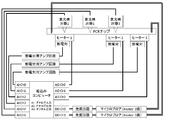
- PCR is performed with the configuration of a nucleic acid amplification device as shown in FIG. 1
- RNA is used as a template
- real-time RT-PCR PCR is performed with the configuration of a nucleic acid amplification device as shown in FIG.
- various known PCR kits and protocols can be used in which PCR is carried out after complementary DNA (cDNA) is generated (reverse transcription) from mRNA by reverse transcriptase.
- cDNA complementary DNA
- reverse transcriptase reverse transcriptase
- the nucleic acid amplification method of the present invention is real-time RT-PCR
- One-Step RT-PCR which can perform reverse transcription reaction and PCR cycling in one step quickly and easily, can be used.
- One of the preferred embodiments of the nucleic acid amplification method of the present invention is multiplex PCR, which simultaneously amplifies a plurality of gene regions by using a plurality of primer pairs in one PCR reaction system.
- multiplex PCR which simultaneously amplifies two or three gene regions.
- the nucleic acid amplification method of the present invention is carried out by moving the sample solution in a microchannel.
- the microchannels for carrying out the nucleic acid amplification method of the present invention include a curved channel corresponding to the denaturation temperature zone and the extension / annealing temperature zone, and a curved channel and an extension / annealing temperature zone corresponding to the denaturation temperature zone. It is provided with at least a linear or curved intermediate flow path connecting the corresponding curved flow path, and a connection portion connectable to a liquid feeding mechanism for realizing the movement of the sample liquid.
- the microchannel may also be provided with an opening for introducing the sample solution. The opening for introducing the sample solution can be optionally sealed by a seal, a valve, or the like.
- the microchannels are (i) relatively highly thermally conductive, (ii) stable in the temperature range required for PCR, (iii) resistant to erosion by electrolyte solutions and organic solvents, and (iv) nucleic acids and proteins. It is preferably composed of a material that meets some or all of the requirements such as low adsorptivity. Specifically, various thermosetting and photocurable resins such as glass, quartz, silicon, and cycloolefin polymer (COP) are exemplified. Further, from the viewpoint of performing fluorescence detection, it is a transparent material having high transparency of light (particularly, excitation light and synchrotron radiation for performing fluorescence detection) (that is, less absorption, diffusion, reflection, etc.). Is preferable.
- Grooves are formed in the material of the microchannel by machining such as cutting by NC processing, injection molding, nanoimprinting, soft lithography, etc., and a seal (preferably a transparent seal made of polyolefin, for example) is used. It can be a closed structure. Alternatively, a microchannel can be formed by three-dimensional printing.
- the shape of the cross section of the microchannel is not particularly limited, and may be a semicircular shape, a circular shape, a rectangular shape, a wedge shape, a trapezoidal shape, a polygonal shape, or the like.
- the cross section of the microchannel can be, for example, a width of about 10 to 1000 ⁇ m and a depth of about 10 to 1000 ⁇ m. Further, the width and the depth of the microchannels can be changed constantly or partially.
- the shape of the curved flow path corresponding to the degeneration temperature zone and the curved flow path corresponding to the extension / annealing temperature zone provided in the minute flow path shall be the shape of a meandering flow path having a loop shape, a spiral flow path, or the like. Can be done.
- the intermediate flow path connecting the curved flow path corresponding to the degeneration temperature zone and the curved flow path corresponding to the extension / annealing temperature zone can have either a linear shape or a curved shape.
- the length of each of the curved flow path corresponding to the degeneration temperature zone and the curved flow path corresponding to the extension / annealing temperature zone is preferably 20 mm or more.
- Each of the curved flow path corresponding to the degeneration temperature zone and the curved flow path corresponding to the elongation / annealing temperature zone provided in the microchannel is maintained at the corresponding temperature, and the temperature of the sample liquid that has moved to the temperature zone. To the temperature in the temperature range.
- the denaturation temperature zone is maintained at the temperature required for the DNA denaturation reaction in PCR.
- the temperature in the denaturation temperature range is preferably about 90 to 100 ° C, more preferably about 95 ° C.
- the elongation / annealing temperature zone is maintained at the temperature required for the DNA annealing and elongation reactions in PCR.
- the temperature in the elongation / annealing temperature range is preferably about 40 to 75 ° C, more preferably about 55 to 65 ° C.
- each of the denaturation temperature zone and the elongation / annealing temperature zone is maintained at a constant temperature. Maintaining the temperature can be achieved by a heat source.
- the heat source is, for example, built in the microchannel or is in contact with the microchannel. Specific examples of the heat source include a cartridge heater, a film heater, a Peltier heater, and the like.
- the sample solution moves in a microchannel in a plug-like form.
- the volume of the sample liquid moving in the microchannel is not particularly limited, and may be preferably about 5 to 50 ⁇ L, more preferably about 15 to 20 ⁇ L.
- the sample solution contains components necessary for the PCR reaction, components necessary for fluorescence detection to realize real-time PCR, and the like.
- the sample solution is an aqueous medium mainly composed of water, a template nucleic acid (which may be DNA or RNA) polymerase, an enzyme such as reverse transcriptase, and various deoxyribonucleotide triphosphates which may be labeled.
- Components required for PCR reaction such as primer set corresponding to the target gene region; components required for fluorescence detection such as TaqMan probe, Cyclove probe, fluorescent probe such as E probe (registered trademark), dye such as SYBR GREEN, etc. include.
- a buffer solution component for adjusting the pH and salt concentration may be contained.
- the sample solution contains a primer set containing two or more types.
- the "primer set” refers to a combination of a forward primer and a reverse primer, and usually one kind of forward primer and one kind of reverse primer are used corresponding to one target gene region.
- the primer set according to the present invention is an amplification product in which the reverse primer corresponds to a different gene region (as a primer pair) in combination with two or more kinds of forward primers even when only one kind of reverse primer is contained. Can be used as a primer set for multiplex PCR when producing.
- the dye used in the multiplex PCR of the present invention preferably contains at least one selected from the group consisting of ABY and HEX, for example, a combination of ABY, Cy5 and FAM or a combination of HEX, Cy5 and FAM. Can be mentioned.
- the movement of the sample liquid in the nucleic acid amplification method of the present invention is realized by the liquid feeding mechanism that opens the atmospheric pressure when the liquid feeding is stopped. That is, for liquid transfer, which is configured to form an open system even during liquid transfer, instead of using a mechanism such as a syringe pump that requires the inside of the flow path to be a closed system so that pressure does not escape. Use the mechanism.
- a liquid feeding mechanism By adopting such a liquid feeding mechanism, when the blowing is stopped, the pressure inside the flow path becomes instantly equal to the pressure outside the flow path, and the pressure acting on the plug-shaped sample liquid is lost, so the liquid feeding Will stop immediately. Therefore, accurate position control is possible without a plurality of pressure release valves for controlling the position of the sample liquid.
- Examples of the liquid feeding mechanism that opens the atmospheric pressure when the liquid feeding is stopped include a micro blower and a fan.
- a micro blower (also referred to as a piezoelectric micro blower) is a known device that sucks and discharges air, and is characterized by not having a closed structure (not having a check valve).
- air suction and discharge are realized by bending and deforming the diaphragm by applying a voltage to the piezoelectric element.
- the microblower for example, those manufactured by Murata Manufacturing Co., Ltd. can be used (MZB1001T02, MZB3004T04).
- a fan is a device that blows air by the rotational movement of an impeller. Due to the structural characteristics of the impeller, the flow path is not a closed system.
- the following [1] to [4] are set as one cycle to perform reciprocal flow type nucleic acid amplification.
- [1] A process of operating the liquid feeding mechanism to move the sample liquid from the elongation / annealing temperature zone into the denatured temperature zone via the intermediate flow path.
- [2] A process of stopping the liquid feeding mechanism and keeping the sample liquid in the denaturation temperature zone for a certain period of time.
- [3] Operate the liquid feeding mechanism to move the sample liquid from the modification temperature zone to the elongation / annealing temperature zone via the intermediate flow path, and [4] Operate the liquid feeding mechanism. , A process of keeping the sample solution in the stretching / annealing temperature range for a certain period of time.
- the above cycle is repeated at least once, preferably about 30 to 50 times, more preferably about 35 to 50 times, and thermal cycling is performed.
- the number of cycles can be appropriately set according to the concentration of the template nucleic acid, the type of the target gene, and the like.
- the speed of movement of the sample solution is, for example, about 25 mm / sec to 2.2 m / sec, more preferably 40 mm / sec. It can be about 1 m / sec and about 60 mm / sec to 300 mm / sec.
- the time for holding the sample solution in the denaturation temperature zone and the time for holding the sample solution in the elongation / annealing temperature zone should be appropriately set according to the target gene region (gene type, region length, etc.). Can be done.
- the time for holding the sample solution in the denaturation temperature zone can be about 2 to 10 seconds
- the time for holding the sample solution in the elongation / annealing temperature zone can be about 2 to 60 seconds.
- the liquid feeding mechanism is connected to a minute flow path, for example, via a connecting portion.
- two liquid feeding mechanisms are connected to each of the two ends of the microchannel. That is, the first liquid feeding mechanism connected so as to feed the liquid from the elongation / annealing temperature zone toward the modification temperature zone is operated in the above step [1], and the elongation / annealing is performed from within the modification temperature zone.
- the second liquid feeding mechanism connected so as to feed the liquid into the temperature zone is operated in the above step [3].
- one liquid feeding mechanism is connected to two ends of the microchannel via a branched connecting flow path provided with a switching valve. That is, in the above step [1], the liquid feeding mechanism is operated in a state where the flow path is configured via the switching valve so that the liquid is fed from the extension / annealing temperature zone to the modification temperature zone. In the step [3], the liquid feeding mechanism is operated in a state where the flow path is configured via the switching valve so that the liquid is fed from the modification temperature zone toward the extension / annealing temperature zone.
- the switching valve in the case of a three-way valve, two are connected to a microblower or fan that opens at atmospheric pressure when the liquid supply is stopped, and are arranged at both ends of the air flow path that divides in two directions at the branch point.
- a microblower or fan that opens at atmospheric pressure when the liquid supply is stopped, and are arranged at both ends of the air flow path that divides in two directions at the branch point.
- the three-way valve can send the sample liquid by blowing air with one valve closed and the other valve open.
- a combination of 2-way valves or a multi-way valve such as 3-way, 4-way, or 5-way may be used depending on the combination of connection flow paths.
- two liquid feeding mechanisms are at one end of a microchannel (air flow path) via a branched connecting flow path provided with a switching valve. It is connected to the extension / annealing temperature zone side). That is, in the above step [1], the liquid feeding mechanism (air discharging means) is operated via the switching valve so as to feed the liquid from the extension / annealing temperature zone toward the modification temperature zone, and the above step. In [3], the liquid feeding mechanism (air suction means) is operated via the switching valve so as to feed the liquid from the modification temperature zone toward the extension / annealing temperature zone.
- a flow path corresponding to a denaturation temperature zone there are three flow paths: a flow path corresponding to a denaturation temperature zone; a flow path corresponding to an extension / annealing temperature zone, and a linear or curved intermediate flow path.
- the fluorescence intensity of the sample solution is measured for each thermal cycle at predetermined positions in at least two of them.
- a flow path corresponding to a modification temperature zone and a flow path corresponding to an extension / annealing temperature zone optionally, at a predetermined position of a linear or curved intermediate flow path, are thermally used.
- the fluorescence intensity of the sample solution is measured for each cycle.
- the predetermined position in the flow path corresponding to the denaturation temperature zone is not particularly limited, but is preferably a position where the intermediate flow path is folded back one to several times (2 to 4 times) or passed through the curved portion.
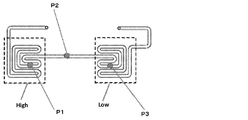
- P1 in 3 can be mentioned.
- the predetermined position in the flow path corresponding to the extension / annealing temperature zone is not particularly limited, but it is preferably a position where the intermediate flow path is folded back one to several times (2 to 4 times) or passed through the curved portion.
- P3 in FIG. 3 can be mentioned.
- the predetermined position of the linear intermediate flow path is not particularly limited, and P2 in FIG. 3 can be mentioned. Real-time PCR is realized as described above by measuring the fluorescence intensity for each thermal cycle.
- the position where the fluorescence intensity is measured can be a linear or curved intermediate flow path with the flow path corresponding to the extension / annealing temperature zone.
- the position where the fluorescence intensity is measured is between the flow path corresponding to the modification temperature zone and the flow path corresponding to the elongation / annealing temperature zone, which is linear or curved. There are three positions with the flow path.
- the detection of the fluorescence intensity at one position preferably detects one type of fluorescence type (one type of wavelength).
- At least one of the measurements of fluorescence intensity is to detect the movement of the sample solution in addition to monitoring the status of gene amplification during the PCR reaction. For example, it is possible to detect the movement of the sample solution in the denaturation temperature zone and the elongation / annealing temperature zone, and control the drive of the liquid feeding mechanism by an electric signal from the fluorescence detector regarding the movement of the sample solution.
- the fluorescence intensity can be measured by detecting the synchrotron radiation (fluorescence) generated by the excitation light emitted from the light source toward the sample liquid in the microchannel with a fluorescence detector.
- the fluorescence intensity detection position (P1) in the modification or elongation / annealing temperature range starts from the time when the sample liquid starts to pass through the fluorescence intensity detection position (P2) in the intermediate flow path.
- the time passes through P3.
- the nucleic acid amplification method of the present invention can be carried out using, for example, the following combination of a nucleic acid amplification device and a nucleic acid amplification chip:
- Nucleic acid amplification device A heater that can form a denaturing temperature zone and an elongation / annealing temperature zone, A fluorescence detector capable of measuring the fluorescence intensity of a sample solution existing in the denaturation temperature range, Sample solution existing in the elongation / annealing temperature range A fluorescence detector capable of measuring the fluorescence intensity of a sample solution, A liquid feeding mechanism that enables the movement of the sample liquid between the two temperature zones and releases the atmospheric pressure when the liquid feeding is stopped.
- a substrate on which a nucleic acid amplification chip can be placed Equipped with a control mechanism that controls the drive of the liquid feeding mechanism by sending an electric signal from the fluorescence detector regarding the movement of the sample liquid.
- a reciprocal flow type nucleic acid amplification device characterized in that real-time PCR is performed by measuring the fluorescence intensity for each thermal cycle.
- [Nucleic acid amplification chip] A curved flow path corresponding to the denaturation temperature zone and the extension / annealing temperature zone, a linear or curved intermediate flow path connecting the curved flow paths, and one or both ends of the flow path are fed by the nucleic acid amplification device.
- a nucleic acid amplification chip having at least one microchannel having a connection that can be connected to a mechanism.
- Step 1 The step of placing the nucleic acid amplification chip on the substrate of the nucleic acid amplification device
- Step 2 A step of connecting the liquid feeding mechanism connection portion and the liquid feeding mechanism at one or both ends of the microchannel.
- Step 3 The sample liquid is reciprocated between two curved flow paths of the minute flow path by the liquid feeding mechanism to perform thermal cycling.
- Step 4 The flow path corresponding to the modification temperature zone and the extension / annealing temperature zone.
- the nucleic acid amplification device includes a substrate on which a nucleic acid amplification chip is placed (not shown), a nucleic acid amplification chip temperature control unit, and a liquid feeding mechanism (for example, a microblower is shown as an example).
- a fluorescence detector, and a small battery for a control computer power supply as a control mechanism can be provided.
- the temperature control section for the nucleic acid amplification chip is spaced by 10 mm so that the two cartridge heaters are in contact with each of the sealing surface sides of the two curved flow path portions of the nucleic acid amplification chip without a gap.
- a K-type thermocouple is joined to each heater.
- the cartridge heater 1 is controlled by a control computer to a temperature required for the DNA denaturation reaction.
- the cartridge heater 2 is controlled by a control computer to a temperature required for the DNA annealing reaction and elongation reaction.
- the temperature zone for the DNA denaturation reaction and the temperature zone for the annealing reaction and the extension reaction can be maintained at a constant temperature by, for example, PID (proportional-integral-differential) control.
- the fluorescence detector uses one point (P1 and P3 in FIG. 3) on the straight line of the microchannel in the modification temperature zone and the elongation / annealing temperature zone and one point (P2 in FIG. 3) as detection points. It is arranged to measure the fluorescence intensity, and the liquid feeding mechanism is stopped when or immediately after the sample liquid sent from one of the curved flow paths by pressurization reaches the detection point P1 or P3. The sample liquid can be held in the other curved flow path portion for a certain period of time.
- the control computer can programmatically control the liquid feeding mechanism, and the sample liquid is set in the curved flow path portion on each heater while continuously monitoring the fluorescence intensity of the detection point at the center of each minute flow path.
- Thermal cycling is performed by alternately switching the liquid feeding mechanism so that it moves alternately with time.
- the control computer also simultaneously records the change in fluorescence intensity for each cycle, which increases as the target DNA is amplified by thermal cycling, and calculates the number of cycles (Ct value) in which the fluorescence intensity exceeds a certain threshold. By doing so, it is possible to quantify the initial amount of target DNA.
- FIG. 3 shows a nucleic acid amplification chip provided with a microchannel.
- two curved flow paths (serpentine flow paths) corresponding to the denaturation temperature zone and the extension / annealing temperature zone are connected by a linear intermediate flow path, and the detection points P1, P2, Sample solution fluorescence is detected at P3.
- Streptococcus pneumoniae, Haemophilus influenzae, template DNA for Mycoplasma pneumoniae uses a commercial control DNA AMPLIRUN (TM) STREPTOCOCCUS PNEUMONIAE DNA CONTROL, AMPLIRUN (TM) HAEMOPHILUS DNA CONTROL, AMPLIRUN (R) Mycoplasma pneumoniae DNA CONTROL , Negative control (NTC) was mixed with sterile water instead and high speed real-time PCR was performed.
- AMPLIRUN STREPTOCOCCUS PNEUMONIAE DNA CONTROL
- AMPLIRUN (TM) HAEMOPHILUS DNA CONTROL AMPLIRUN (R) Mycoplasma pneumoniae DNA CONTROL
- Negative control (NTC) was mixed with sterile water instead and high speed real-time PCR was performed.
- Forward primer sequence for Streptococcus pneumoniae is 5'-AACTCTTACCGCATCTAGCAGATGAA-3'(SEQ ID NO: 1)
- reverse primer sequence is 5'-CGTGCAATAACTCGTGCGTTTTA-3'(SEQ ID NO: 2)
- the forward primer sequence for Haemophilus influenzae is 5'-GGAATCCCAATGCACAAGAAC A-3'(SEQ ID NO: 11)
- the reverse primer sequence is 5'-GCTTTG GTCAACACATCAACCTT-3'(SEQ ID NO: 12)
- the TaqMan® probe sequence is 5.
- the forward primer sequence for Mycoplasma pneumoniae is 5'-CTTGGTTCTC CATACTAACTAAAATAAAAAACTC-3'(SEQ ID NO: 21)
- the reverse primer sequence is 5'-GAACTACAAGCCGCTAATGCAG-3'(SEQ ID NO: 22)
- the TaqMan® probe -GCCTTGAGGCTGGGTTTGCGCTA-3'(SEQ ID NO: 23).
- Fluorescent probes for Streptococcus pneumoniae and Haemophilus influenzae, and Mycoplasma pneumoniae used Cy5, FAM, and ABY-labeled TaqMan® probes, respectively, and the final concentration in the PCR solution was 200 M.
- the final concentrations of the two types of forward and reverse primers for Streptococcus pneumoniae and Haemophilus influenzae in the PCR solution were 1.5 ⁇ M each, and the final concentrations of the forward and reverse primers for Mycoplasma pneumoniae in the PCR solution were 2.0 ⁇ M each. ..
- Takara Bio Inc.'s SpeedSTAR (registered trademark) HS DNA polymerase was used at a final concentration of 0.15 U / ⁇ L, and the attached FAST Buffer I and dNTP Mixture were mixed at the manual concentrations for PCR. It was a polymerization.
- the thermal cycle conditions were set to heat for 10 seconds at 98 ° C. for hot start, and then repeat 50 cycles of 2 seconds at 98 ° C. and 6 seconds at 62 ° C.
- the thermal cycle time of 50 cycles under this condition was 8 minutes 54 seconds.
- the light source (LED) that irradiates the flow path (P1 in FIG. 3) in the degeneration temperature zone has an excitation wavelength of 525 nm
- the light source (LED) that irradiates the intermediate flow path (P2 in FIG. 3) has an excitation wavelength of 470 nm and is elongated.
- -A light source (LED) having a wavelength of 630 nm was used to irradiate the flow path (P3 in FIG. 3) in the annealing temperature range.
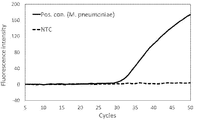
- FIGS. 4-6 The results of multiplex PCR for Streptococcus pneumoniae and Haemophilus influenzae, as well as Mycoplasma pneumoniae using high-speed real-time PCR are shown in FIGS. 4-6.
- FIG. 4 shows the change in fluorescence intensity of the Cy5-labeled TaqMan® probe as an amplification curve for Streptococcus pneumoniae
- FIG. 5 shows the change in fluorescence intensity of the FAM-labeled TaqMan® probe as an amplification curve for Haemophilus influenzae.
- Changes in the fluorescence intensity of the ABY-labeled TaqMan® probe as an amplification curve for Mycoplasma pneumoniae are shown in the solid lines of FIG. 6, and the NTC results are superimposed by broken lines. As shown by the solid line, when any of the three types of control DNA was contained, a clear amplification was obtained as compared with the fluorescence signal of NTC shown by the broken line, and simultaneous measurement of multiple items from the same sample was
Landscapes
- Chemical & Material Sciences (AREA)
- Life Sciences & Earth Sciences (AREA)
- Health & Medical Sciences (AREA)
- Organic Chemistry (AREA)
- Chemical Kinetics & Catalysis (AREA)
- Engineering & Computer Science (AREA)
- Zoology (AREA)
- Proteomics, Peptides & Aminoacids (AREA)
- Wood Science & Technology (AREA)
- General Health & Medical Sciences (AREA)
- Analytical Chemistry (AREA)
- Molecular Biology (AREA)
- Biochemistry (AREA)
- Biophysics (AREA)
- Physics & Mathematics (AREA)
- Biotechnology (AREA)
- Immunology (AREA)
- Microbiology (AREA)
- Bioinformatics & Cheminformatics (AREA)
- General Engineering & Computer Science (AREA)
- Genetics & Genomics (AREA)
- Clinical Laboratory Science (AREA)
- Hematology (AREA)
- Dispersion Chemistry (AREA)
- Measuring Or Testing Involving Enzymes Or Micro-Organisms (AREA)
- Apparatus Associated With Microorganisms And Enzymes (AREA)
Abstract
Description
本出願は、2019年3月15日に出願された、日本国特許出願第2019-049009号明細書(その開示全体が参照により本明細書中に援用される)に基づく優先権を主張する。
本発明は、核酸増幅方法に関する。
前記2つの温度帯は変性温度帯及び伸長・アニーリング温度帯であり、
前記微小流路は変性温度帯に対応する曲線流路、伸長・アニーリング温度帯に対応する曲線流路、前記変性温度帯に対応する曲線流路と伸長・アニーリング温度帯に対応する曲線流路とをつなぐ直線状又は曲線状の中間流路、並びに、試料液の移動を実現するための送液用機構に接続可能な接続部を少なくとも備え、
微小流路中での試料液の移動は送液停止時には大気圧開放される送液用機構により行われ、
前記変性温度帯に対応する流路及び前記伸長・アニーリング温度帯に対応する流路の所定の位置でサーマルサイクル毎の蛍光強度の計測を行うことでリアルタイムPCRを行う、方法。
工程1:変性温度帯と伸長・アニーリング温度帯を形成できるヒーター、
前記変性温度帯に存在する試料液の蛍光強度を測定可能な蛍光検出器、
前記伸長・アニーリング温度帯に存在する試料液の蛍光強度を測定可能な蛍光検出器、前記変性温度帯と前記伸長・アニーリング温度帯の試料液の移動を可能にし、かつ、送液停止時には大気圧開放される送液用機構、
核酸増幅用チップを載置可能な基板、
試料液の移動に関する蛍光検出器からの電気信号が送られて送液用機構の駆動を制御する制御機構を備え、
サーマルサイクル毎の蛍光強度の計測を行うことでリアルタイムPCRを行うことを特徴とするレシプロカルフロー型の核酸増幅装置の基板上に、
前記変性温度帯と前記伸長・アニーリング温度帯に各々対応する曲線流路、前記曲線流路をつなぐ直線状又は曲線状の中間流路、流路の一方又は両端部に前記核酸増幅装置における送液用機構に接続可能な接続部を備えた微小流路を少なくとも1つ有する核酸増幅用チップを載置する工程、
工程2:微小流路の送液用機構接続部と送液用機構を接続する工程、
工程3:前記送液用機構により試料液を微小流路の2つの曲線流路間で往復させてサーマルサイクリングを行う工程、及び
工程4:前記変性温度帯に対応する流路及び前記伸長・アニーリング温度帯に対応する流路の所定の位置で前記蛍光検出器によりサーマルサイクル毎の試料液の蛍光強度の計測を行う工程。
PCRの各種キット及びプロトコールとして、各種公知のものを使用することができる。本発明の核酸増幅方法がリアルタイムRT-PCRである場合、逆転写反応及びPCRでのサイクリングを、ワンステップで迅速かつ簡便に行うことができるOne-Step RT-PCRを用いることができる。
[1]送液用機構を動作させ、試料液を伸長・アニーリング温度帯内から、中間流路を経由して、変性温度帯内へ移動させる工程、
[2]送液用機構を停止させ、試料液を変性温度帯内に一定時間保持させる工程、
[3]送液用機構を動作させ、試料液を変性温度帯内から、中間流路を経由して、伸長・アニーリング温度帯内へ移動させる工程、及び
[4]送液用機構を動作させ、試料液を伸長・アニーリング温度帯内に一定時間保持させる工程。
サーマルサイクル毎の蛍光強度の計測により、前述のとおりリアルタイムPCRが実現される。
[1]変性温度帯の流路を照射する光源(LED)を点灯させ、送液用機構により試料液を伸長・アニーリング温度帯から、中間流路を経由して、変性温度帯内へ移動させる工程、
[2]変性温度帯における試料液を検出したことの電気信号を蛍光検出器から制御機構が受信し送液用機構を停止させる工程、
[3]伸長・アニーリング温度帯の流路を照射する光源(LED)を点灯させ、送液用機構により試料液を変性温度帯内から、中間流路を経由して、伸長・アニーリング温度帯内へ移動させる工程、及び
[4]伸長・アニーリング温度帯における試料液を検出したことの電気信号を蛍光検出器から制御機構が受信し送液用機構を停止させる工程。
なお、中間流路において蛍光強度を計測する場合、試料液が中間流路の蛍光強度の検出位置(P2)を通過し始めた時から変性又は伸長・アニーリング温度帯の蛍光強度の検出位置(P1又はP3)を通過する時までとすることが好ましい。上記のように蛍光強度の計測時間(期間)を規定することにより、P1又はP3を試料液が通過後まで蛍光強度を取得した場合と比較してノイズの少ない安定した測定結果を得ることができる。
[核酸増幅装置]
変性温度帯と伸長・アニーリング温度帯を形成できるヒーター、
前記変性温度帯に存在する試料液の蛍光強度を測定可能な蛍光検出器、
前記伸長・アニーリング温度帯に存在する試料溶液試料液の蛍光強度を測定可能な蛍光検出器、
前記2つの温度帯間の試料液の移動を可能にし、かつ、送液停止時には大気圧開放される送液用機構、
核酸増幅用チップを載置可能な基板、
試料液の移動に関する蛍光検出器からの電気信号が送られて送液用機構の駆動を制御する制御機構を備え、
サーマルサイクル毎の蛍光強度の計測を行うことでリアルタイムPCRを行うことを特徴とするレシプロカルフロー型の核酸増幅装置。
[核酸増幅用チップ]
前記変性温度帯と前記伸長・アニーリング温度帯に各々対応する曲線流路、前記曲線流路をつなぐ直線状又は曲線状の中間流路、流路の一方又は両端部に前記核酸増幅装置における送液用機構に接続可能な接続部を備えた微小流路を少なくとも1つ有する核酸増幅用チップ。
工程1:上記核酸増幅装置の基板に上記核酸増幅用チップを載置する工程、
工程2:微小流路の一方又は両端部の送液用機構接続部と送液用機構を接続する工程、
工程3:前記送液用機構により試料液を微小流路の2つの曲線流路間で往復させてサーマルサイクリングを行う工程
工程4:前記変性温度帯に対応する流路及び前記伸長・アニーリング温度帯に対応する流路の所定の位置で前記蛍光検出器によりサーマルサイクル毎の試料液の蛍光強度の計測を行う工程。
高速リアルタイムPCR用のPCRチップ及び本発明の装置を用いて、肺炎起炎菌群(Streptococcus pneumoniae、Haemophilus influenzae、Mycoplasma pneumoniae)の標的遺伝子の定量を行った。Streptococcus pneumoniae、Haemophilus influenzae、Mycoplasma pneumoniaeに対するテンプレートDNAは、市販のコントロールDNAであるAMPLIRUN(登録商標)STREPTOCOCCUS PNEUMONIAE DNA CONTROL、AMPLIRUN(登録商標)HAEMOPHILUS DNA CONTROL、AMPLIRUN(登録商標)MYCOPLASMA PNEUMONIAE DNA CONTROLを使用し、ネガティブコントロール(NTC)には滅菌水を代わりに混合して高速リアルタイムPCRを実施した。
実線にて示す通り、3種類の何れのコントロールDNAを含有させた場合には、破線で示すNTCの蛍光シグナルに比べ明確な増幅が得られ、同一試料からの多項目同時計測を実現した。
Claims (6)
- 空間的に離れた2つの温度帯が微小流路で結ばれており、試料液を微小流路中前記2つの温度帯間を往復移動させサーマルサイクリングを行うレシプロカルフロー型の核酸増幅方法において、
前記2つの温度帯は変性温度帯及び伸長・アニーリング温度帯であり、
前記微小流路は変性温度帯に対応する曲線流路、伸長・アニーリング温度帯に対応する曲線流路、前記変性温度帯に対応する曲線流路と伸長・アニーリング温度帯に対応する曲線流路とをつなぐ直線状又は曲線状の中間流路、並びに、試料液の移動を実現するための送液用機構に接続可能な接続部を少なくとも備え、
微小流路中での試料液の移動は送液停止時には大気圧開放される送液用機構により行われ、
前記変性温度帯に対応する流路及び前記伸長・アニーリング温度帯に対応する流路の所定の位置でサーマルサイクル毎の蛍光強度の計測を行うことでリアルタイムPCRを行う、方法。 - 以下の工程を含む、核酸増幅方法:
工程1:変性温度帯と伸長・アニーリング温度帯を形成できるヒーター、
前記変性温度帯に存在する試料液の蛍光強度を測定可能な蛍光検出器、
前記伸長・アニーリング温度帯に存在する試料液の蛍光強度を測定可能な蛍光検出器、前記変性温度帯と前記伸長・アニーリング温度帯の試料液の移動を可能にし、かつ、送液停止時には大気圧開放される送液用機構、
核酸増幅用チップを載置可能な基板、
試料液の移動に関する蛍光検出器からの電気信号が送られて送液用機構の駆動を制御する制御機構を備え、
サーマルサイクル毎の蛍光強度の計測を行うことでリアルタイムPCRを行うことを特徴とするレシプロカルフロー型の核酸増幅装置の基板上に、
前記変性温度帯と前記伸長・アニーリング温度帯に各々対応する曲線流路、前記曲線流路をつなぐ直線状又は曲線状の中間流路、流路の一方又は両端部に前記核酸増幅装置における送液用機構に接続可能な接続部を備えた微小流路を少なくとも1つ有する核酸増幅用チップを載置する工程、
工程2:微小流路の送液用機構接続部と送液用機構を接続する工程、
工程3:前記送液用機構により試料液を微小流路の2つの曲線流路間で往復させてサーマルサイクリングを行う工程、及び
工程4:前記変性温度帯に対応する流路及び前記伸長・アニーリング温度帯に対応する流路の所定の位置で前記蛍光検出器によりサーマルサイクル毎の試料液の蛍光強度の計測を行う工程。 - 前記送液用機構がマイクロブロア又は送風機である、請求項1に記載の核酸増幅方法。
- 前記曲線流路をつなぐ中間流路が直線状である、請求項1に記載の核酸増幅方法。
- さらに前記変性温度帯と前記伸長・アニーリング温度帯の曲線流路をつなぐ前記中間流路を通過する試料液の蛍光強度を測定可能な蛍光検出器を備え、前記中間流路の所定の位置で前記蛍光検出器によりサーマルサイクル毎の試料液の蛍光強度の計測を行う工程を含む、請求項4に記載の核酸増幅方法。
- 前記中間流路上の蛍光測定点(P2)と前記変性温度帯上の蛍光測定点(P1)の距離が、8mm以上である、請求項5記載の核酸増幅方法。
Priority Applications (6)
| Application Number | Priority Date | Filing Date | Title |
|---|---|---|---|
| US17/438,012 US12351866B2 (en) | 2019-03-15 | 2020-03-13 | Nucleic acid amplification method |
| EP20773580.4A EP3940053A4 (en) | 2019-03-15 | 2020-03-13 | METHODS FOR AMPLIFICATION OF NUCLEIC ACIDS |
| CN202080021631.5A CN113574161A (zh) | 2019-03-15 | 2020-03-13 | 核酸扩增方法 |
| JP2021507320A JP7752382B2 (ja) | 2019-03-15 | 2020-03-13 | 核酸増幅方法 |
| CN202411834169.7A CN119614685A (zh) | 2019-03-15 | 2020-03-13 | 核酸扩增方法 |
| JP2025099226A JP2025123367A (ja) | 2019-03-15 | 2025-06-13 | 核酸増幅方法 |
Applications Claiming Priority (2)
| Application Number | Priority Date | Filing Date | Title |
|---|---|---|---|
| JP2019-049009 | 2019-03-15 | ||
| JP2019049009 | 2019-03-15 |
Publications (1)
| Publication Number | Publication Date |
|---|---|
| WO2020189581A1 true WO2020189581A1 (ja) | 2020-09-24 |
Family
ID=72521056
Family Applications (1)
| Application Number | Title | Priority Date | Filing Date |
|---|---|---|---|
| PCT/JP2020/011249 Ceased WO2020189581A1 (ja) | 2019-03-15 | 2020-03-13 | 核酸増幅方法 |
Country Status (5)
| Country | Link |
|---|---|
| US (1) | US12351866B2 (ja) |
| EP (1) | EP3940053A4 (ja) |
| JP (2) | JP7752382B2 (ja) |
| CN (2) | CN119614685A (ja) |
| WO (1) | WO2020189581A1 (ja) |
Cited By (2)
| Publication number | Priority date | Publication date | Assignee | Title |
|---|---|---|---|---|
| JP2022022041A (ja) * | 2020-07-22 | 2022-02-03 | 杏林製薬株式会社 | 核酸増幅方法 |
| JPWO2022153999A1 (ja) * | 2021-01-14 | 2022-07-21 |
Families Citing this family (2)
| Publication number | Priority date | Publication date | Assignee | Title |
|---|---|---|---|---|
| CN115505488A (zh) * | 2022-11-04 | 2022-12-23 | 深圳承启生物科技有限公司 | 一种往复式微流控pcr芯片及其使用方法和应用 |
| CN120796450B (zh) * | 2025-09-12 | 2026-02-03 | 复旦大学 | 基于多通道光谱检测的微流控等温扩增方法及系统 |
Citations (4)
| Publication number | Priority date | Publication date | Assignee | Title |
|---|---|---|---|---|
| JP2004305219A (ja) * | 1999-04-20 | 2004-11-04 | National Institute Of Advanced Industrial & Technology | 核酸の測定方法に用いる核酸プローブおよびデータを解析する方法 |
| WO2016006612A1 (ja) * | 2014-07-08 | 2016-01-14 | 国立研究開発法人産業技術総合研究所 | 核酸増幅装置、核酸増幅方法及び核酸増幅用チップ |
| WO2018225577A1 (ja) * | 2017-06-06 | 2018-12-13 | 日本板硝子株式会社 | 反応処理装置 |
| WO2018235766A1 (ja) * | 2017-06-23 | 2018-12-27 | 日本板硝子株式会社 | 反応処理装置 |
Family Cites Families (14)
| Publication number | Priority date | Publication date | Assignee | Title |
|---|---|---|---|---|
| EP1046717B1 (en) | 1999-04-20 | 2010-10-06 | National Institute of Advanced Industrial Science and Technology | Method and probes for determining a concentration of target nucleic acid molecules and method for analyzing data obtained by the method |
| JP2006271216A (ja) * | 2005-03-28 | 2006-10-12 | Dainippon Ink & Chem Inc | 特定の塩基配列を有する核酸の有無を判定するシステムおよび判定方法 |
| GB2433259A (en) | 2005-11-30 | 2007-06-20 | Deltadot Ltd | Nucleic acid amplification method and microfluidic apparatus therefore |
| ES2393758T3 (es) | 2006-03-15 | 2012-12-27 | Micronics, Inc. | Ensayos integrados de ácidos nucleicos |
| WO2008147382A1 (en) | 2006-09-27 | 2008-12-04 | Micronics, Inc. | Integrated microfluidic assay devices and methods |
| JP5224801B2 (ja) * | 2007-12-21 | 2013-07-03 | キヤノン株式会社 | 核酸増幅装置 |
| JP5303983B2 (ja) * | 2008-03-26 | 2013-10-02 | 株式会社島津製作所 | 反応処理方法及び反応処理装置 |
| CN202099269U (zh) * | 2011-05-23 | 2012-01-04 | 北京工业大学 | 聚合酶链式反应器及实时微光学检测装置 |
| US10273532B2 (en) * | 2012-03-09 | 2019-04-30 | National Institute Of Advanced Industrial Science And Technology | Nucleic acid amplification method |
| JP2015053893A (ja) * | 2013-09-11 | 2015-03-23 | 公益財団法人神奈川科学技術アカデミー | 高速遺伝子増幅検出装置 |
| CN108291184B (zh) | 2015-12-01 | 2022-07-01 | 日本板硝子株式会社 | Pcr反应容器、pcr装置、pcr方法 |
| SG11201805707VA (en) * | 2016-01-05 | 2018-07-30 | Nippon Sheet Glass Company Limited | Reaction treatment device, reaction treatment container, and reaction treatment method |
| SG11201810430WA (en) | 2016-06-20 | 2019-01-30 | Philip Morris Products Sa | Heater assembly for an aerosol-generating system |
| CN109844091B (zh) | 2016-11-01 | 2022-12-30 | 日本板硝子株式会社 | 反应处理容器及反应处理装置 |
-
2020
- 2020-03-13 CN CN202411834169.7A patent/CN119614685A/zh active Pending
- 2020-03-13 JP JP2021507320A patent/JP7752382B2/ja active Active
- 2020-03-13 US US17/438,012 patent/US12351866B2/en active Active
- 2020-03-13 WO PCT/JP2020/011249 patent/WO2020189581A1/ja not_active Ceased
- 2020-03-13 CN CN202080021631.5A patent/CN113574161A/zh active Pending
- 2020-03-13 EP EP20773580.4A patent/EP3940053A4/en active Pending
-
2025
- 2025-06-13 JP JP2025099226A patent/JP2025123367A/ja active Pending
Patent Citations (4)
| Publication number | Priority date | Publication date | Assignee | Title |
|---|---|---|---|---|
| JP2004305219A (ja) * | 1999-04-20 | 2004-11-04 | National Institute Of Advanced Industrial & Technology | 核酸の測定方法に用いる核酸プローブおよびデータを解析する方法 |
| WO2016006612A1 (ja) * | 2014-07-08 | 2016-01-14 | 国立研究開発法人産業技術総合研究所 | 核酸増幅装置、核酸増幅方法及び核酸増幅用チップ |
| WO2018225577A1 (ja) * | 2017-06-06 | 2018-12-13 | 日本板硝子株式会社 | 反応処理装置 |
| WO2018235766A1 (ja) * | 2017-06-23 | 2018-12-27 | 日本板硝子株式会社 | 反応処理装置 |
Non-Patent Citations (3)
| Title |
|---|
| "Clinical Applications of PCR", 1998, HUMANA PRESS |
| "PCR Protocols: A Guide to Methods and Applications", 1990, ACADEMIC PRESS INC |
| See also references of EP3940053A4 |
Cited By (3)
| Publication number | Priority date | Publication date | Assignee | Title |
|---|---|---|---|---|
| JP2022022041A (ja) * | 2020-07-22 | 2022-02-03 | 杏林製薬株式会社 | 核酸増幅方法 |
| JP7657002B2 (ja) | 2020-07-22 | 2025-04-04 | 杏林製薬株式会社 | 核酸増幅方法 |
| JPWO2022153999A1 (ja) * | 2021-01-14 | 2022-07-21 |
Also Published As
| Publication number | Publication date |
|---|---|
| EP3940053A1 (en) | 2022-01-19 |
| EP3940053A4 (en) | 2023-01-04 |
| JPWO2020189581A1 (ja) | 2020-09-24 |
| US12351866B2 (en) | 2025-07-08 |
| CN113574161A (zh) | 2021-10-29 |
| JP2025123367A (ja) | 2025-08-22 |
| CN119614685A (zh) | 2025-03-14 |
| JP7752382B2 (ja) | 2025-10-10 |
| US20220145360A1 (en) | 2022-05-12 |
Similar Documents
| Publication | Publication Date | Title |
|---|---|---|
| JP7542834B2 (ja) | 核酸増幅装置、核酸増幅方法及び核酸増幅用チップ | |
| JP2025123367A (ja) | 核酸増幅方法 | |
| US20250050338A1 (en) | Real-time polymerase chain reaction analysis plate | |
| WO2013132645A1 (ja) | 核酸増幅方法 | |
| CN103773840A (zh) | 碱基序列分析方法和碱基序列分析装置 | |
| JP7657002B2 (ja) | 核酸増幅方法 | |
| Wang et al. | Construction of dPCR and qPCR integrated system based on commercially available low-cost hardware | |
| JP2014030373A (ja) | ホモ接合体とヘテロ接合体の判別方法 | |
| EP4202028A1 (en) | Nucleic acid amplification device, nucleic acid amplification method, and sample solution position control method | |
| HK40018117B (en) | Nucleic acid amplification device, nucleic acid amplification method, and chip for nucleic acid amplification |
Legal Events
| Date | Code | Title | Description |
|---|---|---|---|
| 121 | Ep: the epo has been informed by wipo that ep was designated in this application |
Ref document number: 20773580 Country of ref document: EP Kind code of ref document: A1 |
|
| ENP | Entry into the national phase |
Ref document number: 2021507320 Country of ref document: JP Kind code of ref document: A |
|
| NENP | Non-entry into the national phase |
Ref country code: DE |
|
| WWE | Wipo information: entry into national phase |
Ref document number: 2020773580 Country of ref document: EP |
|
| WWG | Wipo information: grant in national office |
Ref document number: 17438012 Country of ref document: US |