WO2020195469A1 - 活性エネルギー線硬化型インキ組成物及びその製造方法、並びにそれを用いた印刷物の製造方法 - Google Patents
活性エネルギー線硬化型インキ組成物及びその製造方法、並びにそれを用いた印刷物の製造方法 Download PDFInfo
- Publication number
- WO2020195469A1 WO2020195469A1 PCT/JP2020/007614 JP2020007614W WO2020195469A1 WO 2020195469 A1 WO2020195469 A1 WO 2020195469A1 JP 2020007614 W JP2020007614 W JP 2020007614W WO 2020195469 A1 WO2020195469 A1 WO 2020195469A1
- Authority
- WO
- WIPO (PCT)
- Prior art keywords
- ink composition
- resin
- meth
- active energy
- acrylate
- Prior art date
- Legal status (The legal status is an assumption and is not a legal conclusion. Google has not performed a legal analysis and makes no representation as to the accuracy of the status listed.)
- Ceased
Links
- 0 CCCC(C)(c1c(**)cc(*)cc1)N Chemical compound CCCC(C)(c1c(**)cc(*)cc1)N 0.000 description 2
Classifications
-
- C—CHEMISTRY; METALLURGY
- C09—DYES; PAINTS; POLISHES; NATURAL RESINS; ADHESIVES; COMPOSITIONS NOT OTHERWISE PROVIDED FOR; APPLICATIONS OF MATERIALS NOT OTHERWISE PROVIDED FOR
- C09D—COATING COMPOSITIONS, e.g. PAINTS, VARNISHES OR LACQUERS; FILLING PASTES; CHEMICAL PAINT OR INK REMOVERS; INKS; CORRECTING FLUIDS; WOODSTAINS; PASTES OR SOLIDS FOR COLOURING OR PRINTING; USE OF MATERIALS THEREFOR
- C09D11/00—Inks
- C09D11/02—Printing inks
- C09D11/10—Printing inks based on artificial resins
- C09D11/101—Inks specially adapted for printing processes involving curing by wave energy or particle radiation, e.g. with UV-curing following the printing
-
- B—PERFORMING OPERATIONS; TRANSPORTING
- B41—PRINTING; LINING MACHINES; TYPEWRITERS; STAMPS
- B41M—PRINTING, DUPLICATING, MARKING, OR COPYING PROCESSES; COLOUR PRINTING
- B41M5/00—Duplicating or marking methods; Sheet materials for use therein
- B41M5/0023—Digital printing methods characterised by the inks used
-
- C—CHEMISTRY; METALLURGY
- C09—DYES; PAINTS; POLISHES; NATURAL RESINS; ADHESIVES; COMPOSITIONS NOT OTHERWISE PROVIDED FOR; APPLICATIONS OF MATERIALS NOT OTHERWISE PROVIDED FOR
- C09D—COATING COMPOSITIONS, e.g. PAINTS, VARNISHES OR LACQUERS; FILLING PASTES; CHEMICAL PAINT OR INK REMOVERS; INKS; CORRECTING FLUIDS; WOODSTAINS; PASTES OR SOLIDS FOR COLOURING OR PRINTING; USE OF MATERIALS THEREFOR
- C09D11/00—Inks
- C09D11/02—Printing inks
- C09D11/03—Printing inks characterised by features other than the chemical nature of the binder
- C09D11/037—Printing inks characterised by features other than the chemical nature of the binder characterised by the pigment
-
- C—CHEMISTRY; METALLURGY
- C09—DYES; PAINTS; POLISHES; NATURAL RESINS; ADHESIVES; COMPOSITIONS NOT OTHERWISE PROVIDED FOR; APPLICATIONS OF MATERIALS NOT OTHERWISE PROVIDED FOR
- C09D—COATING COMPOSITIONS, e.g. PAINTS, VARNISHES OR LACQUERS; FILLING PASTES; CHEMICAL PAINT OR INK REMOVERS; INKS; CORRECTING FLUIDS; WOODSTAINS; PASTES OR SOLIDS FOR COLOURING OR PRINTING; USE OF MATERIALS THEREFOR
- C09D11/00—Inks
- C09D11/02—Printing inks
- C09D11/06—Printing inks based on fatty oils
-
- C—CHEMISTRY; METALLURGY
- C09—DYES; PAINTS; POLISHES; NATURAL RESINS; ADHESIVES; COMPOSITIONS NOT OTHERWISE PROVIDED FOR; APPLICATIONS OF MATERIALS NOT OTHERWISE PROVIDED FOR
- C09D—COATING COMPOSITIONS, e.g. PAINTS, VARNISHES OR LACQUERS; FILLING PASTES; CHEMICAL PAINT OR INK REMOVERS; INKS; CORRECTING FLUIDS; WOODSTAINS; PASTES OR SOLIDS FOR COLOURING OR PRINTING; USE OF MATERIALS THEREFOR
- C09D11/00—Inks
- C09D11/02—Printing inks
- C09D11/08—Printing inks based on natural resins
-
- C—CHEMISTRY; METALLURGY
- C09—DYES; PAINTS; POLISHES; NATURAL RESINS; ADHESIVES; COMPOSITIONS NOT OTHERWISE PROVIDED FOR; APPLICATIONS OF MATERIALS NOT OTHERWISE PROVIDED FOR
- C09D—COATING COMPOSITIONS, e.g. PAINTS, VARNISHES OR LACQUERS; FILLING PASTES; CHEMICAL PAINT OR INK REMOVERS; INKS; CORRECTING FLUIDS; WOODSTAINS; PASTES OR SOLIDS FOR COLOURING OR PRINTING; USE OF MATERIALS THEREFOR
- C09D11/00—Inks
- C09D11/02—Printing inks
- C09D11/10—Printing inks based on artificial resins
Definitions
- the present invention relates to an active energy ray-curable ink composition, a method for producing the same, and a method for producing a printed matter using the same.
- the ink composition When printing using an ink composition, various printing methods are appropriately selected according to the material and shape of the object to be printed, and the ink composition also has appropriate properties according to the printing method. The one is selected. For example, for flat printing paper, an offset printing method using a flat plate is selected, an offset printing ink composition containing vegetable oil and mineral oil and having high viscosity is used, and for printing on cardboard paper, rubber is used. A flexo printing method using a letterpress is selected, and a water-based flexo printing ink composition having extremely high fluidity is used. In addition, it is well known that various printing methods such as gravure printing, screen printing, letterpress printing, and inkjet printing are appropriately selected for printing.
- the drying of the ink composition after printing is not sufficiently fixed on the surface of the object to be printed, and the ink composition adheres to the finger when touched with a finger or the like, and the image is distorted and stained when rubbed. It causes problems such as printing. Therefore, when the printed object to be printed is sent to post-processing, it is necessary that the ink composition is sufficiently fixed (that is, dried) on the surface of the printed object.
- the process of fixing that is, drying
- the ink composition after printing varies depending on the type of the ink composition used, for example, permeation of the solvent into the object to be printed, evaporation of the solvent from the object to be printed, and the ink composition. Examples thereof include increasing the molecular weight by oxidizing the components contained in the product.
- the drying process requires a certain amount of time, and in recent years when the printing speed has been improved due to technological progress, the time required for the drying process has become non-negligible.
- an active energy ray-curable ink composition has also been performed.
- the components contained in the ink composition are increased in molecular weight by irradiation with ultraviolet rays or electron beams, and drying is realized. The time required for this drying is extremely short, and printing using this ink composition meets the demand for promptly transferring the printed matter to post-processing.
- an ink composition corresponding to such a drying method one for an offset printing method is proposed in, for example, Patent Document 1, and one for a resin letterpress printing method is proposed, for example, in Patent Document 2.
- the IG mark is a system that mainly uses the ratio of biomass-derived components among the components that make up the ink composition as an index, and ranks the environmentally friendly level of the ink composition in three stages according to the degree. .. In other words, it can be said that this system is characterized by encouraging the replacement of fossil resource-derived raw materials with biomass-derived raw materials for the purpose of reducing the environmental burden.
- the active energy ray-curable ink composition has a shorter history than the ink composition dried by other drying methods, and it can be said that the materials constituting the ink composition are still in the development stage.
- active energy ray-curable resins with high pigment dispersibility such as rosin-modified phenolic resins that have been used for many years in ink compositions for offset printing, are used. It is difficult to use in ink compositions, and there is a current situation in which pigments are dispersed with low molecular weight components such as monomers and oligomers, which do not necessarily have good pigment dispersibility.
- the present invention has been made in view of the above circumstances, and is an active energy ray-curable ink composition containing a material having excellent pigment dispersibility such as a rosin-modified phenol resin while increasing the ratio of raw materials derived from biomass.
- the purpose is to provide.
- the present inventors have obtained by using animal and plant-derived fats and oils having a specific sp value (solubility parameter by the turbidity drip method) or modified products thereof.
- resins with high pigment dispersibility that have been used in conventional ink compositions, such as rosin-modified phenolic resins, can be used in active energy ray-curable ink compositions with good compatibility. ..
- fats and oils derived from animals and plants or modified products thereof are of course derived from biomass, and rosin contained in resins such as rosin-modified phenolic resin is also derived from biomass. Therefore, the ink composition of the present invention containing these components is a product having a high proportion of raw materials derived from biomass.
- the present invention has been completed based on the above findings, and provides the following.
- the present invention is an active energy ray-curable ink composition containing a compound having an ethylenically unsaturated bond, a specific resin, and a specific liquid component, wherein the specific resin is a rosin-modified phenol resin or a rosin-modified maleic acid resin.
- the specific liquid components include fats and oils derived from animal and vegetable oils having an sp value of 9.0 (cal / cm 3 ) 1/2 or more and 10.0 (cal / cm 3 ) 1/2 or less, modified products thereof, cashew nut shell oil and the like. It is preferably at least one selected from the group consisting of the modified products.
- the sp value of the specific resin is preferably 8.0 (cal / cm 3 ) 1/2 or more and 9.0 (cal / cm 3 ) 1/2 or less.
- the content of the specific liquid component in the ink composition is preferably 10% by mass or more and 50% by mass or less.
- the specific liquid component is preferably at least one selected from the group consisting of castor oil, coconut oil, epoxidized vegetable oil, cashew nut shell oil, and modified products of cashew nut shell oil.
- the present invention is a method for producing an active energy ray-curable ink composition containing a compound having an ethylenically unsaturated bond, a specific resin, a specific liquid component, and a photopolymerization initiator.
- the specific resin is rosin. It is at least one selected from the group consisting of a modified phenol resin, a rosin-modified maleic acid resin, a rosin-modified alkyd resin, a gilsonite resin, and an asphalt resin, and the specific liquid component does not have an ethylenically unsaturated bond and is subjected to turbid drip.
- Solubility parameter sp value (hereinafter referred to as sp value) by the method is 9.0 (cal / cm 3 ) 1/2 or more and less than 11.0 (cal / cm 3 ) 1/2 of animal and plant-derived fats and oils or their respective It is also a method for producing an active energy ray-curable ink composition, which is a modified product and comprises a step of dissolving the specific resin in the heated specific liquid component to prepare a varnish.
- the present invention is also a method for producing a printed matter, which comprises a step of printing using the above-mentioned active energy ray-curable ink composition.
- an active energy ray-curable ink composition containing a material having excellent pigment dispersibility such as a rosin-modified phenol resin while increasing the ratio of raw materials derived from biomass.
- the active energy ray-curable ink composition of the present invention (hereinafter, also simply referred to as an ink composition) is not particularly limited, but is preferably used for offset lithographic printing, resin letterpress printing, and the like, and has active energy such as ultraviolet rays and electron beams. It has the ability to cure by being irradiated with rays.
- the ink composition of the present invention contains a compound having an ethylenically unsaturated bond (monomer, oligomer, etc.), and radicals generated when irradiated with active energy rays are ethylenically unsaturated.
- the printing target thereof is not particularly limited to those printed by ordinary offset printing.
- the ink composition of the present invention becomes tack-free instantly by irradiating it with active energy rays after printing. Therefore, by printing using this, the printed printed matter can be quickly post-processed. It becomes possible to turn to.
- the ink composition of the present invention can also be preferably used for resin letterpress printing.
- Resin letterpress printing is a printing method in which an ink composition is adhered to a convex portion of a resin letterpress printing plate and the adhered ink composition is transferred to an object to be printed. Examples of the printing target include light printed matter such as stickers and labels, curved surfaces, and the like.
- stickers and labels include stickers made of synthetic paper, paper, etc., thermal stickers, etc., and as curved printed matter, beverage cups, ice cream made of synthetic resin, paper, etc.
- examples include, but are not limited to, containers such as cream cups, yogurt containers, and cup noodle containers.
- examples of the synthetic resin constituting these include, but are not limited to, amorphous polyethylene terephthalate (A-PET), polystyrene, expanded polystyrene, polypropylene and the like. Since the printing plate used in resin letterpress printing is made of resin and can be deformed according to the shape of the object to be printed, it is possible to print on a curved surface as described above.
- Examples of active energy rays used for curing the ink composition of the present invention include electron beams and ultraviolet rays.
- ultraviolet rays are preferably exemplified as active energy rays from the viewpoint of the cost and ease of handling of the apparatus, and in that case, the ink composition of the present invention is a photopolymerization initiator that generates radicals upon irradiation with light. Will be contained.
- the wavelength of the ultraviolet rays may be appropriately determined according to the absorption wavelength of the photopolymerization initiator used, and may be 400 nm or less.
- Examples of the ultraviolet irradiation device that generates such ultraviolet rays include a metal halide lamp, a high-pressure mercury lamp, an excimer lamp filled with a rare gas, and an ultraviolet light emitting diode (LED).
- a metal halide lamp When an electron beam is selected as the active energy ray, the chemical bond contained in the component in the ink composition is dissociated and a radical is generated by the irradiation of the electron beam, and this radical is used as a monomer or the like in the ink composition. Since the components of the above are polymerized, a photopolymerization initiator is not required.
- the ink composition of the present invention contains a compound having an ethylenically unsaturated bond, a specific resin, and a specific liquid component.
- the point of the present invention is to use the specific resin and the specific liquid component in combination.
- acrylic acid and / or methacrylic acid collectively referred to as (meth) acrylic acid in the present specification
- monomer or oligomer as a main component.
- these components are incompatible with the rosin-modified phenolic resin and the like used in conventional offset ink compositions and the like, which have a high solubility parameter (sp value) and a low sp value.
- a varnish compatible with a monomer or an oligomer can be prepared by dissolving a rosin-modified phenolic resin or the like using an oil or fat derived from animal or vegetable oil or a modified product thereof having a predetermined sp value. Became clear.
- the present invention has been made based on these findings, and these oils and fats derived from animal and vegetable oils or modified products thereof correspond to specific liquid components, and resins such as rosin-modified phenolic resins used in conventional offset ink compositions. Corresponds to the specific resin.
- the ink composition of the present invention may contain a photopolymerization initiator.
- the ink composition of the present invention exhibits curability to electron beams even if it does not contain a photopolymerization initiator, but by containing a photopolymerization initiator, it exhibits curability to light such as ultraviolet rays.
- the ink composition of the present invention may contain a coloring component (in the present invention, a component that imparts white or metallic color to the ink composition is also included in the coloring component).
- the ink composition of the present invention contains a coloring component
- the ink composition can be used for printing applications such as images and characters, and when the ink composition of the present invention does not contain a coloring component, the ink composition can be used.
- the ink composition can be used for applications such as coating.
- the ink composition of the present invention is suitable for various printing applications such as package printing as well as ordinary printed matter for the purpose of transmitting information or being an object of appreciation. Hereinafter, each component will be described.
- a compound having an ethylenically unsaturated bond is a component that polymerizes with a photopolymerization initiator or a radical generated by electron beam irradiation, which will be described later, to increase the molecular weight, and is a component called a monomer or an oligomer. Further, as for the polymer having a higher molecular weight than the oligomer, various polymers having an ethylenically unsaturated bond are commercially available. Such a polymer can also be crosslinked by the above-mentioned monomers or oligomers or by the polymers to increase the molecular weight. Therefore, such a polymer may be used as a compound having an ethylenically unsaturated bond together with the above-mentioned monomer and oligomer.
- the monomer has an ethylenically unsaturated bond and is a component that polymerizes as described above to increase the molecular weight.
- the monomer in the state before polymerization, is often a liquid component having a relatively low molecular weight, and the above polymer is used. It is also used as a solvent for dissolving to make varnish, and for adjusting the viscosity of the ink composition.
- the monomer include a monofunctional monomer having one ethylenically unsaturated bond in the molecule and a bifunctional or higher monomer having two or more ethylenically unsaturated bonds in the molecule.
- Bifunctional or higher functional monomers can crosslink molecules to each other when the ink composition is cured, which contributes to increasing the curing rate and forming a strong film.
- the monofunctional monomer does not have the above-mentioned cross-linking ability, but contributes to reducing the curing shrinkage associated with the cross-linking.
- Various types of these monomers can be used in combination as needed.
- Examples of the monofunctional monomer include alkyl acrylates such as methyl (meth) acrylate, ethyl (meth) acrylate, butyl (meth) acrylate, hexyl (meth) acrylate, octyl (meth) acrylate, and dodecyl (meth) acrylate, and (meth) acrylic.
- alkyl acrylates such as methyl (meth) acrylate, ethyl (meth) acrylate, butyl (meth) acrylate, hexyl (meth) acrylate, octyl (meth) acrylate, and dodecyl (meth) acrylate, and (meth) acrylic.
- Acid ethylene oxide adduct (meth) acrylate, propylene oxide adduct (meth) acrylate, isobornyl (meth) acrylate, cyclohexyl (meth) acrylate, tricyclodecanemonomethylol (meth) acrylate, 2-hydroxyethyl (meth) Acrylate, 2-hydroxypropyl (meth) acrylate, 3-hydroxypropyl (meth) acrylate, 2-hydroxybutyl (meth) acrylate, 4-hydroxybutyl (meth) acrylate, hydroxypentyl (meth) acrylate, 2-hydroxy-3 -Phenoxypropyl (meth) acrylate, 2-hydroxy-3-butoxypropyl (meth) acrylate, 2-hydroxy-3-methoxypropyl (meth) acrylate, dipropyl mono (meth) acrylate, triethylene glycol mono (meth) acrylate, Polyethylene glycol mono (meth) acrylate, diprop
- bifunctional or higher monomer examples include ethylene glycol di (meth) acrylate, diethylene glycol di (meth) acrylate, triethylene glycol di (meth) acrylate, polyethylene glycol di (meth) acrylate, propylene glycol di (meth) acrylate, and dipropylene.
- Bifunctional monomer glycerin tri (meth) acrylate, trimethylolpropane tri (meth) acrylate, trimethylolpropane tricaprolactonate tri (meth) acrylate, trimethylolethanetri (meth) acrylate, trimethylolhexanetri (meth) acrylate , Trimethyloloptantri (meth) acrylate, pentaerythritol tri (meth) acrylate and other trifunctional monomers; trimethylolpropane tetra (meth) acrylate, pentaerythritol tetra (meth) acrylate, pentaerythritol tetracaprolactonate tetra (meth) ) Acrylic, diglycerin tetra (meth) acrylate, ditrimethylolpropane tetra (meth) acrylate, ditrimethylolpropane tetracaprolactonate te
- an epoxidized vegetable oil acrylate obtained by acrylic-modifying an epoxidized vegetable oil.
- This is a compound obtained by ring-opening addition polymerization of (meth) acrylic acid on the epoxy group of an epoxidized vegetable oil in which the double bond of the unsaturated vegetable oil is epoxidized with an oxidizing agent such as peracetic acid or perbenzoic acid.
- Unsaturated vegetable oil is a triglyceride in which at least one fatty acid has at least one carbon-carbon unsaturated bond, and is asa seed oil, flaxseed oil, eno oil, citrus oil, olive oil, cacao oil, capoc oil, kaya.
- Oil mustard oil, kyonin oil, drilling oil, kukui oil, walnut oil, poppy oil, sesame oil, saflower oil, daikon seed oil, soybean oil, large fool oil, camellia oil, corn oil, rapeseed oil, niger oil
- examples thereof include oil, palm oil, sunflower oil, sunflower oil, grape seed oil, ginger oil, pine seed oil, cottonseed oil, palm oil, peanut oil, and dehydrated castor oil. Since this type of monomer is derived from vegetable oil, it helps to increase the amount of biomass components in the ink composition.
- various epoxidized vegetable oil acrylates are commercially available, they may be used.
- Oligomer is a component that polymerizes to increase the molecular weight as described above, but since it is originally a component with a relatively high molecular weight, it is also used for the purpose of imparting appropriate viscosity and elasticity to the ink composition.
- examples of the oligomer include epoxy-modified (meth) acrylates and vegetable oils, which are exemplified by esters of (meth) acrylic acid and hydroxyl groups generated after the epoxy group contained in an epoxy compound such as an epoxy resin is opened with an acid or base.
- Vegetable oil-modified polyfunctional (meth) acrylates, rosin-modified epoxy acrylates, and dibases which are exemplified as esters of (meth) acrylic acid and hydroxyl groups generated after epoxidizing the unsaturated bond and opening the ring with an acid or base. It is exemplified by the polyester-modified (meth) acrylate exemplified by the ester of the terminal hydroxyl group of the condensed polymer of acid and diol and (meth) acrylic acid, and the ester of the terminal hydroxyl group of the polyether compound and (meth) acrylic acid.
- Examples thereof include polyether-modified (meth) acrylates, urethane-modified (meth) acrylates exemplified as esters of terminal hydroxyl groups and (meth) acrylic acids in condensates of polyisocyanate compounds and polyol compounds.
- Such oligomers are commercially available, for example, Evecryl series manufactured by Daicel Cytec Co., Ltd., CN, SR series manufactured by Sartmer Co., Ltd., Aronix M-6000 series, 7000 series, 8000 series manufactured by Toagosei Co., Ltd.
- a polymer having an ethylenically unsaturated bond is a component that increases the molecular weight together with the above-mentioned monomers and oligomers, and has a large molecular weight even before being irradiated with active energy rays, so that the viscoelasticity of the ink composition is improved. It is a useful ingredient.
- Such a polymer is used, for example, in a state of being dissolved or dispersed in a monomer which is a low-viscosity liquid.
- the polymer having an ethylenically unsaturated bond include polydiallyl phthalate, an acrylic resin having an unreacted unsaturated group, and an acrylic modified phenol resin.
- the content of the compound having an ethylenically unsaturated bond in the ink composition is preferably 10 to 70% by mass, more preferably 20 to 60% by mass.
- the content of the polymer having an ethylenically unsaturated bond is preferably 0 to 50% by mass, more preferably 0 to 30% by mass, and even more preferably 0 to 20% by mass.
- the content of the polymer is in the above range, it is possible to impart appropriate viscoelasticity to the ink composition to suppress the occurrence of misting and the like, and it is possible to secure good curability of the ink composition, which is preferable. ..
- the specific liquid component does not have an ethylenically unsaturated bond, and the solubility parameter sp value in the turbidity titration method is 9.0 (cal / cm 3 ) 1/2 or more and less than 11.0 (cal / cm 3 ) 1/2.
- the present invention has focused on the fact that the specific liquid component can solve these two problems (providing a varnish with good compatibility and obtaining a biomass count without causing the hunger problem) at once, and the specific liquid.
- the use of the component is a point of the present invention together with the use of the specific resin described later.
- the specific liquid component does not have polymerizable property, according to the study by the present inventors, not only the curability of the ink composition by this component is hardly a problem, but also the specific liquid component can be used. It has been found that when printing is performed using the ink composition of the present invention contained therein, a printed matter having good gloss can be obtained.
- the specific liquid component does not have an ethylenically unsaturated bond and does not have the property of rapidly polymerizing in the presence of radicals, so that the components such as monomers are present in the ink composition after printing. It is considered that the specific liquid component maintains the fluidity of the ink composition and contributes to the improvement of leveling even during the polymerization.
- the specific liquid component Since the specific liquid component has good compatibility with monomers and oligomers, there is no upper limit to the amount of the specific liquid component added to the ink composition from the viewpoint of compatibility, but from the viewpoint of maintaining characteristics such as curability, the ink in the present invention
- the amount of the specific liquid component added to the composition can be preferably up to 80% by mass. This upper limit is more preferably 50% by mass and even more preferably 30% by mass. Further, as the amount of the specific liquid component added to the ink composition, 5% by mass can be preferably mentioned as the lower limit. This lower limit is more preferably 10% by mass.
- the specific liquid component is preferably liquid at room temperature. Liquid at room temperature means that the ink composition is liquid at a temperature in a storage environment or a printing environment. Examples of such a normal temperature include about 0 to 50 ° C.
- the sp value is a solubility parameter and can be measured by turbidity titration, which is a simple actual measurement method.
- W. SUH, J.M. M. It is a value calculated according to the formula of CORBETT.
- J. Apple. Polym. Sci. 1968, 12, 2359 can be referred to. This also applies to the sp value under the condition (B).
- Formula sp value (V ml 1/2 ⁇ ⁇ H + V mh 1/2 ⁇ ⁇ D) / (V ml 1/2 + V mh 1/2 )
- turbidity drip titration 0.5 g of a sample is dissolved in 10 mL of toluene or 10 mL of trimethylolpropantriacrylate (TMPTA), which is a good solvent, and n-hexane, which is a poor solvent with a low sp value, is added and titrated at the turbidity point.
- TMPTA trimethylolpropantriacrylate
- n-hexane which is a poor solvent with a low sp value
- the molecular volume and sp value of each solvent used in the above dakuten titration are as follows. Molecular volume of good solvent ⁇ 0 Toluene: 106.28 mL / mol TMPTA: 279.55 mL / mol Molecular volume of low sp value poor solvent ⁇ l n-hexane: 131.61 mL / mol Molecular volume of high sp value poor solvent ⁇ h ethanol: 58.39 mL / mol Sp value of each solvent Toluene: 9.14, TMPTA: 9.88 n-Hexane: 7.28, Ethanol: 12.58
- V ml ( ⁇ 0 ⁇ ⁇ l) / ⁇ (1-VH) ⁇ ⁇ l + VH ⁇ ⁇ 0 ⁇
- V mh ( ⁇ 0 ⁇ ⁇ h) / ⁇ (1-VD) ⁇ ⁇ h + VD ⁇ ⁇ 0 ⁇
- VH H / (M + H)
- D Titration of high sp value poor solvent (mL)
- M Amount of good solvent (mL)
- animal and plant-derived fats and oils usually means triglycerides such as animal and vegetable oils, but in the present invention, it broadly means oily substances derived from animals and plants.
- modified products of animal and plant-derived fats and oils include those in which the sp value is in the above range as a result of chemically modifying the fats and oils derived from animals and plants regardless of whether or not the sp value is in the above range. Can be done.
- modified products include fatty acid esters of triglycerides having high sp values such as coconut oil and castor oil, hardened castor oil, polymerized castor oil, unsaturated animal and vegetable oils or epoxidized products of their fatty acids, and polymers of cashew nut shell oil.
- Castor nut shell oil modified derivative and the like Castor nut shell oil modified derivative and the like.
- the fact that it does not have an ethylenically unsaturated bond means that it does not have a substituent having the property of rapidly polymerizing in the presence of radicals, such as an acryloyl group, a methacryloyl group, and a vinyl group.
- An unsaturated animal or vegetable oil or an epoxidized product of a fatty acid thereof is an ester of a fatty acid having at least one epoxy group and an alcohol.
- epoxidized fats and oils include not only triglycerides having an epoxy group but also esters of fatty acids having an epoxy group and alcohols (regardless of whether they are monoalcohols or polyalcohols).
- alcohols include alcohols having 1 to 14 carbon atoms such as glycerin, methanol, ethanol, propanol, isopropanol, and 2-ethylhexanol, but are not particularly limited.
- a polyhydric alcohol such as glycerin
- at least one fatty acid having at least one epoxy group is condensed (that is, an ester bond is formed) in the polyhydric alcohol, and at least one epoxy group is formed.
- a plurality of fatty acids having may be condensed.
- the fatty acids may be selected independently of each other. Since the epoxidized oil and fat exhibits a high sp value due to the presence of an epoxy group in the molecule, various animal and vegetable oils having a low sp value and fatty acid esters thereof may be used as raw materials and epoxidized.
- Epoxy oils and fats include epoxy soybean oil (ESO), epoxy corn oil, epoxy sunflower oil, epoxy flaxseed oil, epoxy canola oil, epoxy rapeseed oil, epoxy benivana oil, epoxy toll oil, epoxy Tung oil, epoxidized fish oil, epoxidized beef oil, epoxidized castor oil, epoxidized methyl stearate, epoxidized butyl stearate, epoxidized 2-ethylhexyl stearate, epoxidized stearyl stearate, 3,4-epoxycyclohexylmethyl- Examples thereof include 3,4-epoxycyclohexanecarboxylate epoxidized soybean oil, epoxidized propylene glycol dioleate, epoxid
- Epoxy oils and fats can be prepared by various methods.
- an epoxidized fat or oil having a triglyceride as a mother skeleton can be obtained by oxidizing a vegetable oil or an animal oil having an unsaturated bond in a fatty acid portion with an appropriate oxidizing agent or peroxide.
- epoxidized fats and oils having a fatty acid ester that is not a triglyceride as a mother skeleton are esterified by reacting a fatty acid derived from an animal or vegetable oil having an unsaturated bond with an alcohol (regardless of whether it is a monool or a polyol).
- Cashew nut shell oil also called cashew nut shell liquid
- Cashew nut shell oil is an oily liquid contained in cashew nut shells obtained as a by-product when collecting natural cashew nut fruits used for food.
- cardanol and cardol are compounds in which a hydroxyl group and a linear hydrocarbon are bonded to an aromatic ring
- 2-methylcardanol is a compound in which a methyl group is bonded to an aromatic ring of cardanol
- cardanolic acid is cardanol.
- the alkenyl group contained therein is an aliphatic hydrocarbon group having 15 to 18 carbon atoms and contains 1 to 3 unsaturated bonds in the chain.
- the unsaturated bond contained in this alkenyl group is contained in the middle of the linear hydrocarbon group, and is different from the ethylenically unsaturated bond. Since various grades of cashew nut shell oil are commercially available, such commercially available products may be used in the present invention. There are several lineups of such products depending on the purity, color, odor, etc. of cardanol.
- Such a lineup includes Cardolite (registered trademark) NX-2021, NX-2022, NX-2023D, NX-2023, UltraLITE2023, NX-2024, NX-2025, NX-2026, etc. manufactured by Cardolite, and Tohoku Kako CNSL, LB-7000, LB-7250 and the like manufactured by Co., Ltd. can be mentioned.
- Modified derivatives of cashew nut shell oil include those in which various groups are introduced into the phenolic hydroxyl groups of alkenyl-substituted phenols contained in cashew nut shell oil, those in which various substituents are introduced into unsaturated bonds of alkenyl groups, and those in which various substituents are introduced. Examples thereof include those obtained by oxidizing the unsaturated bond of an alkenyl group to epoxidize it. Since various modified derivatives are commercially available, such commercially available products may be used in the present invention.
- R 1 is a hydrogen atom, a glycidyl group,-(CH 2 ) m OH (m is an integer of 1 to 3),-(C 2 H 4 O) p- H (p). Is an integer of 1 to 15),-(CH 2 CH (CH 3 ) O) q- H (q is an integer of 1 to 15), and R 2 has an unsaturated bond of 0 to 3.
- It is an aliphatic hydrocarbon group having 15 to 18 carbon atoms, or a group in which a part or all of unsaturated bonds contained in the aliphatic hydrocarbon is oxidized to form an epoxy ring, and each R 3 is a group. Independently, it is an alkyl group or a carboxyl group having OR 1 and carbon atoms 1 to 3, and n is an integer of 0 to 4.
- Examples of commercially available products of the compound represented by the general formula (1) include Cardolite (registered trademark) LITE2020 and Cardolite (registered trademark) NC-513, NC-510, GX-5166, GX-5167, and GX manufactured by Cardolite. -5170, GX-5248, GX-5190, GX-5191, GX-2551 and the like can be mentioned.
- LITE2020 is an alkenyl-substituted phenyl ether compound in which R 1 is -CH 2 CH 2 OH and R 2 is an alkenyl group having 15 carbon atoms and n is 0, and NC-513 is R 1 having a glycidyl group and R.
- NC-510 is an alkenyl substituted phenol having R 1 being a hydrogen atom and R 2 being an alkenyl group having 15 carbon atoms and n being 0.
- GX-2551 is a mixture of compounds represented by the following chemical formulas (5-1), (5-2) and (5-3), in which R 1 is a glycidyl group and R 2 is an alkenyl group having 15 carbon atoms. It is an epoxidized cardanol having 0 n, which is a group obtained by oxidizing one or more of the unsaturated bonds to form an epoxy ring.
- X is a linear or branched aliphatic hydrocarbon group having 15 to 18 carbon atoms and containing 0 to 3 unsaturated bonds.
- Examples of commercially available products of the compound represented by the general formula (2) include Cardolite (registered trademark) NC-514 manufactured by Cardolite.
- R 2 , R 3 and n are the same as those in the general formula (1), and r is an integer of 1 to 5.
- Examples of commercially available products of the compound represented by the general formula (3) include Cardolite (registered trademark) GX-2520 manufactured by Cardolite.
- R 2 , R 3 and n are the same as those in the above general formula (1), R 4 is a hydrogen atom or a hydroxyl group, and R 5 is a hydrogen atom or ⁇ C. It is 2 H 4 OH.
- Examples of commercially available products of the compound represented by the general formula (4) include Cardolite (registered trademark) GX-9301 and GX-9302 manufactured by Cardolite.
- a condensate of cashew nut shell oil and / or a modified derivative thereof with formaldehyde is preferably exemplified.
- the one represented by the following general formula (6) can be mentioned.
- each R 1 is independently a hydrogen atom,-(CH 2 ) m OH or a glycidyl group, and m is an integer of 1 to 3, and each R 2 independently forms an unsaturated bond. It is an aliphatic hydrocarbon group having 15 to 18 carbon atoms and contains 0 to 3, and n is an integer of 1 or more.
- Examples of commercially available products represented by the above general formula (6) include Cardolite (registered trademark) NC-547 and NX-4000 series manufactured by Cardolite.
- NC-547 is a formaldehyde-based condensate of cardanol and a cardanol-modified derivative having a structure exemplified by the following general formula (7-1).
- the NX-4000 series is a formaldehyde-based condensate of cardanol having a structure exemplified by the following general formula (7-2).
- each R 2 is an aliphatic hydrocarbon group having 15 to 18 carbon atoms, each independently containing 0 to 3 unsaturated bonds.
- the specific liquid component is preferably a non-edible oil or fat or a modified product thereof.
- the non-edible fats and oils referred to here refer to all non-edible fats and oils. Even if the sp value is less than 9.0 (cal / cm 3 ) 1/2 , the sp value of the modified product is the result of chemical modification such as epoxidation to the fat or oil. If is 9.0 (cal / cm 3 ) 1/2 or more, the modified product is treated as a specific liquid component in the present invention.
- At least one selected from the group consisting of castor oil, coconut oil, epoxidized vegetable oil, cashew nut shell oil, and modified products of cashew nut shell oil is preferably mentioned.
- the sp value of the specific liquid component is 9.0 (cal / cm 3 ) 1/2 or more and less than 11.0 (cal / cm 3 ) 1/2 .
- the specific liquid component has an sp value of 9.0 (cal / cm 3 ) 1/2 or more and 10.0 (cal / cm 3).
- the upper limit of the sp value of the specific liquid component is the cashew nut shell. Excluding the oil, about 9.0 (cal / cm 3 ) 1/2 is preferable.
- Cashew nut shell oil has an sp value of 10.0 (cal / cm 3 ) 1/2 or more, but is exceptionally compatible with a specific resin having a low sp value and a specific resin having a high sp value.
- cashew nut shell oil contains a phenol compound having a long-chain alkyl group or an alkenyl group, and the long-chain alkyl group can be compatible with a resin having a low sp value, and the phenol skeleton This is considered to be because it can be compatible with a resin having a high sp value.
- the specific resin is at least one selected from the group consisting of rosin-modified phenolic resin, rosin-modified maleic acid resin, rosin-modified alkyd resin, gilsonite resin and asphalt resin. These resins have been widely used in conventional ink compositions such as offset ink compositions, but have poor compatibility with monomers and oligomers, and are used in active energy ray-curable ink compositions. It was a difficult material to adopt. As already described, the present invention has been completed from the finding that a varnish that is well compatible with monomers and oligomers can be prepared by combining the specific resin and the specific liquid component.
- the rosin constituting them is a biomass-derived component
- long-chain fatty acids are also biomass-derived components in addition to rosin. Therefore, the ink composition of the present invention has a high biomass content.
- the rosin-modified phenolic resin, rosin-modified maleic acid resin, rosin-modified alkyd resin, gilsonite resin, and asphalt resin are all commercially available and can be easily obtained.
- these resins commercially available ones may be used, or those synthesized by known means may be used.
- rosin-modified phenolic resin is preferably used.
- the sp value of the specific resin 8.0 (cal / cm 3 ) 1/2 or more and 9.0 (cal / cm 3 ) 1/2 or less can be preferably mentioned.
- the sp value of the specific resin is in these ranges, good compatibility with the specific liquid component can be obtained, which is preferable.
- the content of the specific resin in the ink composition is preferably about 5% by mass to 30% by mass.
- the specific resin is dissolved by being heated to about 100 to 250 ° C. in a specific liquid component to form a varnish.
- the specific resin is mixed with components such as monomers and oligomers in the state of being varnished in this way, and is used for preparing an ink composition.
- the photopolymerization initiator is a component that generates radicals when irradiated with ultraviolet rays, and the generated radicals polymerize the compound having the ethylenically unsaturated bond to cure the ink composition.
- the photopolymerization initiator is not particularly limited as long as it generates radicals when irradiated with active energy rays. As described above, when the ink composition of the present invention is cured by using an electron beam as an active energy ray, it is not necessary to add a photopolymerization initiator to the ink composition of the present invention.
- photopolymerization initiator examples include benzophenone, diethylthioxanthone, 2-methyl-1- (4-methylthio) phenyl-2-morpholinopropane-1-one, 4-benzoyl-4'-methyldiphenylsulfide, and 1-chloro-.
- photopolymerization initiators are commercially available, and are obtained from BASF, for example, under trade names such as Irgacure 907, Irgacure 369, Irgacure 184, Irgacure 379, Irgacure 819, TPO, and from Lamberti under trade names such as DETX. be able to. These photopolymerization initiators can be used alone or in combination of two or more.
- the content of the photopolymerization initiator in the ink composition is preferably 3 to 30% by mass, more preferably 2 to 15% by mass, and even more preferably 2 to 13% by mass.
- the content of the photopolymerization initiator in the ink composition is within the above range, it is preferable because sufficient curability of the ink composition and good internal curability and cost can be achieved at the same time.
- Coloring components include disazo yellow (12 pigment yellow, 13 pigment yellow, 14 pigment yellow, 17 pigment yellow, 1 pigment yellow), yellow pigments such as Hansa Yellow, and magenta such as Brilliant Carmine 6B, Lake Red C, and Watching Red. Examples thereof include pigments, cyan pigments such as phthalocyanine blue, phthalocyanine green and alkali blue, black pigments such as carbon black, white pigments such as titanium oxide, and metal powders such as aluminum paste and bronze powder.
- the content of the coloring component is exemplified by about 1 to 30% by mass with respect to the entire ink composition, but is not particularly limited.
- a coloring component of another color it is also possible to use a coloring component of another color in combination as a complementary color, or to add an ink composition of another color.
- the extender pigment is a component for imparting properties such as appropriate printability and viscoelasticity to the ink composition, and various pigments usually used in the preparation of the ink composition can be used.
- extender pigments include clay, kaolinite (kaolin), barium sulfate, magnesium sulfate, calcium carbonate, silicon oxide (silica), bentonite, talc, mica, titanium oxide and the like.
- the amount of the extender pigment added is, for example, about 0 to 33% by mass with respect to the entire ink composition, but is not particularly limited.
- phenol compounds such as butylhydroxytoluene, tocopherol acetate, nitrosamines, benzotriazoles, hindered amines and the like can be preferably exemplified, and butylhydroxytoluene can be more preferably exemplified.
- the content of the polymerization inhibitor in the ink composition about 0.01 to 1% by mass can be exemplified.
- the dispersant is used to disperse the coloring components and extender pigments contained in the ink composition in a good state.
- Various types of such dispersants are commercially available, and examples thereof include DISPERBYK (trade name) series manufactured by Big Chemie Japan Co., Ltd.
- a conventionally known method can be applied to produce the ink composition of the present invention using each of the above components.
- the mixture is kneaded with a bead mill, a three-roll mill, or the like to disperse pigments (that is, coloring components and extender pigments), and then additives (polymerization prohibited) as necessary.
- Agents, alcohols, waxes, etc. are added, and the viscosity is adjusted by adding the above-mentioned monomer component and oil component.
- the viscosity of the ink composition can be exemplified as a value of 10 to 70 Pa ⁇ s at 25 ° C. by a Raleigh viscometer, but is not particularly limited.
- the method for preparing the active energy ray-curable ink composition is also one of the present inventions.
- the method for producing an ink composition of the present invention is a method for producing an active energy ray-curable ink composition containing a compound having an ethylenically unsaturated bond, a specific resin, a specific liquid component, and a photopolymerization initiator.
- the specific resin is at least one selected from the group consisting of rosin-modified phenolic resin, rosin-modified maleic acid resin, rosin-modified alkyd resin, gilsonite resin and asphalt resin, and the specific liquid component is an ethylenically unsaturated bond.
- the solubility parameter sp value by the turbidity drip method is 9.0 (cal / cm 3 ) 1/2 or more and 11.0 (cal / cm 3 ) less than 1/2 of animal and plant-derived fats and oils or modified products thereof. It is characterized by comprising a step of preparing a varnish by dissolving the specific resin in the heated specific liquid component.
- the production method of the present invention is characterized by comprising a step of preparing a varnish by dissolving a specific resin in a heated specific liquid component.
- the specific liquid component and the specific resin have already been described.
- a solid specific resin may be added to the specific liquid component, and these may be stirred while being heated to about 100 to 250 ° C.
- the dissolution time can be about 30 to 60 minutes, but is not particularly limited, and the dissolution time may be appropriately adjusted while observing the dissolution state.
- the mixing ratio of the specific resin and the specific liquid component can be presented as a mass ratio (specific resin: specific liquid component) of about 20:80 to 40:60, but is not particularly limited.
- An ink composition is prepared by mixing and kneading the prepared varnish with various components already described.
- the content of the varnish in the ink composition is preferably about 20 to 70% by mass, more preferably about 20 to 60% by mass, and even more preferably about 20 to 50% by mass.
- One of the present inventions is also a method for producing a printed matter, which comprises printing using the active energy ray-curable ink composition of the present invention.
- the method for producing a printed matter of the present invention is carried out using ordinary printing techniques except that the ink composition of the present invention is used.
- a printing technique offset printing, resin letterpress printing and the like can be preferably mentioned.
- the example of the printing target when the resin letterpress printing is used is as described above.
- the undried printed matter By irradiating the undried printed matter produced by printing with active energy rays, the undried printed matter is instantly dried. This is achieved by curing the ink composition existing on the surface of the printing paper by irradiation with active energy rays.
- active energy ray a known one such as an electron beam or an ultraviolet ray can be adopted.
- varnish 1 A mixture of 40 parts by mass of a rosin-modified phenolic resin (sp value: 8.83) and 60 parts by mass of epoxidized soybean oil was dissolved by heating at 200 ° C. for 60 minutes to obtain varnish 1.
- Varnish 2 was obtained in the same procedure as varnish 1 except that castor oil was used instead of epoxidized soybean oil.
- varnish 3 was prepared in the same procedure as the varnish 1 except that trimethylolpropane triacrylate (TMPTA) was used instead of the epoxidized soybean oil, but the resin was not dissolved in the varnish 3.
- TMPTA trimethylolpropane triacrylate
- Varnish 5 was obtained in the same procedure as varnish 1 except that soybean oil was used instead of epoxidized soybean oil.
- varnish 5 A mixture of 40 parts by mass of polydiallyl phthalate (A-DAP manufactured by Osaka Soda Co., Ltd.) and 60 parts by mass of TMPTA was dissolved by heating at 100 ° C. for 60 minutes to obtain varnish 5.
- the varnish 5 is the same varnish as that used in the conventional active energy ray-curable ink composition, which does not contain a specific resin.
- the ink composition of the present invention showed the same compatibility as that of a normal active energy ray-curable ink composition (Reference Example 1) despite the use of rosin-modified phenol. It showed better luster than that. From this, it can be seen that the specific resin, which has been difficult to use in the active energy ray-curable ink composition in the past, can be used in combination with the specific liquid component.
Landscapes
- Chemical & Material Sciences (AREA)
- Life Sciences & Earth Sciences (AREA)
- Engineering & Computer Science (AREA)
- Materials Engineering (AREA)
- Wood Science & Technology (AREA)
- Organic Chemistry (AREA)
- Oil, Petroleum & Natural Gas (AREA)
- Chemical Kinetics & Catalysis (AREA)
- General Chemical & Material Sciences (AREA)
- Inks, Pencil-Leads, Or Crayons (AREA)
- Printing Methods (AREA)
Abstract
【課題】バイオマス由来の原材料比率を高めつつ、ロジン変性フェノール樹脂等の顔料分散性に優れた材料を含む活性エネルギー線硬化型インキ組成物を提供すること。 【解決手段】エチレン性不飽和結合を備えた化合物、特定樹脂、及び特定液体成分を含む活性エネルギー線硬化型インキ組成物であって、上記特定樹脂が、ロジン変性フェノール樹脂、ロジン変性マレイン酸樹脂、ロジン変性アルキッド樹脂、ギルソナイト樹脂及びアスファルト樹脂からなる群より選択される少なくとも1種であり、上記特定液体成分が、エチレン性不飽和結合を持たず、濁点滴定法による溶解性パラメータsp値(以下、sp値と呼ぶ。)が9.0(cal/cm3)1/2以上11.0(cal/cm3)1/2未満の動植物由来の油脂又はその変性物である活性エネルギー線硬化型インキ組成物とすればよい。
Description
本発明は、活性エネルギー線硬化型インキ組成物及びその製造方法、並びにそれを用いた印刷物の製造方法に関する。
インキ組成物を用いて印刷を行う場合、印刷対象である被印刷物の材質や形状等に併せて各種の印刷方式が適切に選択され、インキ組成物もその印刷方式に合わせて適切な性状を有するものが選択される。例えば、平らな印刷用紙に対しては、平版を用いたオフセット印刷方式が選択され、植物油や鉱物油を含み粘度の高いオフセット印刷用インキ組成物が用いられ、段ボール用紙への印刷においては、ゴム凸版を用いたフレキソ印刷方式が選択され、流動性の極めて高い水性のフレキソ印刷用インキ組成物が用いられること等が挙げられる。この他、グラビア印刷、スクリーン印刷、活版印刷、インクジェット印刷等、様々な印刷方式が適宜選択されて印刷が行われていることは周知の通りである。
ところで、印刷において、印刷対象へインキ組成物を付着させて画像を形成させることと併せて重要な要素の一つとして挙げられるのが、印刷後のインキ組成物の乾燥である。印刷された直後のインキ組成物は、被印刷体の表面で十分に固定されておらず、指などで触った際に指へインキ組成物が付着する、擦られた際に画像が乱れて汚れてしまう等の問題を生じる。このため、印刷後の被印刷体を後加工へ回す場合、被印刷体の表面でインキ組成物が十分に固定(すなわち乾燥)された状態であることが必要である。印刷後のインキ組成物の固定(すなわち乾燥)過程は、用いたインキ組成物の種類に応じて様々であり、例えば、被印刷体への溶剤の浸透、被印刷物からの溶剤の蒸発、インキ組成物に含まれる成分の酸化による高分子量化等が挙げられる。いずれの場合であっても、乾燥過程はそれなりの時間を要するものであり、技術の進歩によって印刷速度が向上している昨今では、乾燥過程に要する時間というのも無視できないものになっている。
このような状況において、近年では活性エネルギー線硬化型のインキ組成物を用いた印刷も行われている。活性エネルギー線硬化型のインキ組成物は、紫外線や電子線の照射によりインキ組成物に含まれる成分が高分子量化し、乾燥を実現する。この乾燥に要する時間は極めて短く、このインキ組成物を用いた印刷は、印刷物を速やかに後加工へ回したい等といった要望に応えるものになっている。このような乾燥方式に対応したインキ組成物の一例として、オフセット印刷方式用のものが例えば特許文献1等で提案され、樹脂凸版印刷方式用のものが例えば特許文献2等で提案されている。
ところで近年、様々な業界や業種で環境負荷低減活動が展開されているが、いずれについても最終的な目標は地球環境保全で共通している。印刷インキ業界においてもこれまで各種の観点から環境負荷低減を促す活動が行われ、そのような活動の趣旨に適合した製品には各種の認証マークが付されることになっている。このような認証マークとしては、NL規制マーク、ベジタブルマーク、GPマーク、クリオネマーク等が存在する。このような中にあって、最近、印刷インキ工業連合会によって新たにインキグリーンマーク(以下、IGマークと呼ぶ。)制度が制定された。IGマークは、主にインキ組成物を構成する各成分のうちのバイオマスに由来する成分の比率を指標とし、その程度に応じてインキ組成物の環境対応レベルを3段階にランク付けする制度である。つまりこの制度は、環境負荷の低減を目的として、化石資源由来の原材料をバイオマス由来の原材料に代替することを促すことを特徴とするものといえる。
上述の活性エネルギー線硬化型のインキ組成物においても、より少ない紫外線の照射で乾燥できる製品や、消費電力の少ない発光ダイオード(LED)の光で乾燥できる省エネ対応の製品が販売されており、環境負荷低減を目指した動きが広がっているのは他のインキ組成物と同様である。しかしながら、活性エネルギー線硬化型のインキ組成物では、その成分としてモノマーやオリゴマーを多量に用いなければならないことからバイオマスを由来とする成分を多用することが困難であるとされ、それ故上記IGマークの認定基準には、バイオマス由来の成分比率が含まれておらず、これに代えてリサイクル適性や省エネ対応といった環境対応特性が指標として用いられているのが現状である。
以上のような背景において、活性エネルギー線硬化型のインキ組成物においてもバイオマス由来の成分比率を高めることは社会的に有用であり、その意義は極めて大きいといえる。しかしながら、活性エネルギー線硬化型のインキ組成物で用いられるモノマーやオリゴマーは、一般のインキ組成物で用いられるバイオマス由来の材料との相溶性が必ずしも良くなく、そのような材料を適用するのが難しいのが現状である。
また、活性エネルギー線硬化型のインキ組成物は、その他の乾燥方式で乾燥させるインキ組成物よりも歴史が浅く、それを構成する素材は未だに発展段階にあるといえる。特に、モノマーやオリゴマーとの相溶性の観点から、オフセット印刷用のインキ組成物等において長年用いられてきたロジン変性フェノール樹脂等のような高い顔料分散性を備えた樹脂を活性エネルギー線硬化型のインキ組成物で用いることが難しく、モノマーやオリゴマーといった、必ずしも顔料分散性の良くない低分子量の成分で顔料を分散させている現状もある。
本発明は、以上のような状況に鑑みてなされたものであり、バイオマス由来の原材料比率を高めつつ、ロジン変性フェノール樹脂等の顔料分散性に優れた材料を含む活性エネルギー線硬化型インキ組成物を提供することを目的とする。
本発明者らは、上記の課題を解決するために鋭意検討を重ねた結果、特定のsp値(濁点滴定法による溶解性パラメータ)を備えた動植物由来の油脂又はその変性物を用いることにより、ロジン変性フェノール樹脂を初めとした、従来のインキ組成物で用いられてきた顔料分散性の高い樹脂を活性エネルギー線硬化型のインキ組成物中に相溶性良く用いることが可能になることを見出した。ここで、動植物由来の油脂又はその変性物は勿論バイオマス由来であるし、ロジン変性フェノール樹脂を初めとした樹脂に含まれるロジンもまたバイオマス由来である。したがって、これらの成分を含む本発明のインキ組成物は、バイオマス由来の原材料比率の高い製品となる。本発明は、以上の知見をもとに完成されたものであり、以下のようなものを提供する。
本発明は、エチレン性不飽和結合を備えた化合物、特定樹脂、及び特定液体成分を含む活性エネルギー線硬化型インキ組成物であって、上記特定樹脂が、ロジン変性フェノール樹脂、ロジン変性マレイン酸樹脂、ロジン変性アルキッド樹脂、ギルソナイト樹脂及びアスファルト樹脂からなる群より選択される少なくとも1種であり、上記特定液体成分が、エチレン性不飽和結合を持たず、濁点滴定法による溶解性パラメータsp値(以下、sp値と呼ぶ。)が9.0(cal/cm3)1/2以上11.0(cal/cm3)1/2未満の動植物由来の油脂又はその変性物である活性エネルギー線硬化型インキ組成物である。
上記特定液体成分は、sp値9.0(cal/cm3)1/2以上10.0(cal/cm3)1/2以下の動植物油由来の油脂及びその変性物、並びにカシューナッツシェルオイル及びその変性物からなる群より選択される少なくとも1種であることが好ましい。
上記特定樹脂のsp値は、8.0(cal/cm3)1/2以上9.0(cal/cm3)1/2以下であることが好ましい。
インキ組成物中における上記特定液体成分の含有量が10質量%以上50質量%以下であることが好ましい。
上記特定液体成分は、ヒマシ油、ヤシ油、エポキシ化植物油、カシューナッツシェルオイル、及びカシューナッツシェルオイルの変性物からなる群より選択される少なくとも1種であることが好ましい。
また本発明は、エチレン性不飽和結合を備えた化合物、特定樹脂、特定液体成分、及び光重合開始剤を含む活性エネルギー線硬化型インキ組成物の製造方法であって、上記特定樹脂が、ロジン変性フェノール樹脂、ロジン変性マレイン酸樹脂、ロジン変性アルキッド樹脂、ギルソナイト樹脂及びアスファルト樹脂からなる群より選択される少なくとも1種であり、上記特定液体成分が、エチレン性不飽和結合を持たず、濁点滴定法による溶解性パラメータsp値(以下、sp値と呼ぶ。)が9.0(cal/cm3)1/2以上11.0(cal/cm3)1/2未満の動植物由来の油脂又はその変性物であって、加温された上記特定液体成分に前記特定樹脂を溶解させてワニスを調製する工程を備えることを特徴とする活性エネルギー線硬化型インキ組成物の製造方法でもある。
また本発明は、上記の活性エネルギー線硬化型インキ組成物を用いて印刷を行う工程を含むことを特徴とする印刷物の製造方法でもある。
本発明によれば、バイオマス由来の原材料比率を高めつつ、ロジン変性フェノール樹脂等の顔料分散性に優れた材料を含む活性エネルギー線硬化型インキ組成物が提供される。
以下、本発明の活性エネルギー線硬化型インキ組成物の一実施形態、活性エネルギー線硬化型インキ組成物の製造方法の一実施態様、及び印刷物の製造方法の一実施態様について説明する。なお、本発明は、以下の実施形態又は実施態様に限定されるものでなく、本発明の範囲において適宜変更を加えて実施することができる。
<活性エネルギー線硬化型インキ組成物>
本発明の活性エネルギー線硬化型インキ組成物(以下、単にインキ組成物とも呼ぶ。)は、特に限定されないが、オフセット平版印刷や樹脂凸版印刷等に好ましく用いられ、紫外線や電子線等の活性エネルギー線の照射を受けて硬化する能力を備える。後述するように、本発明のインキ組成物は、エチレン性不飽和結合を備えた化合物(モノマーやオリゴマー等)を含有し、活性エネルギー線の照射を受けた際に生じたラジカルがエチレン性不飽和結合を備えた化合物を高分子量化させることで硬化する。そのため、印刷直後に印刷物の表面でべたついているインキ組成物に活性エネルギー線が照射されると、瞬時にこのインキ組成物が硬化して皮膜となり、乾燥(タックフリー)状態となる。
本発明の活性エネルギー線硬化型インキ組成物(以下、単にインキ組成物とも呼ぶ。)は、特に限定されないが、オフセット平版印刷や樹脂凸版印刷等に好ましく用いられ、紫外線や電子線等の活性エネルギー線の照射を受けて硬化する能力を備える。後述するように、本発明のインキ組成物は、エチレン性不飽和結合を備えた化合物(モノマーやオリゴマー等)を含有し、活性エネルギー線の照射を受けた際に生じたラジカルがエチレン性不飽和結合を備えた化合物を高分子量化させることで硬化する。そのため、印刷直後に印刷物の表面でべたついているインキ組成物に活性エネルギー線が照射されると、瞬時にこのインキ組成物が硬化して皮膜となり、乾燥(タックフリー)状態となる。
本発明のインキ組成物をオフセット印刷に用いる場合、その印刷対象としては通常のオフセット印刷で印刷されるものを特に限定されずに挙げることができる。上記のように、本発明のインキ組成物は、印刷後に活性エネルギー線を照射することで瞬時にタックフリーとなるので、これを用いて印刷を行うことにより、印刷された印刷物を速やかに後工程に回すことが可能になる。また、本発明のインキ組成物は、樹脂凸版印刷にも好ましく用いることができる。樹脂凸版印刷は、樹脂製の凸版印刷版の凸部にインキ組成物を付着させ、その付着したインキ組成物を被印刷体に転写させる印刷方式である。その印刷対象としては、シールやラベル等の軽印刷物や、曲面体等が挙げられる。より具体的には、シールやラベルの例として合成紙や紙等で構成されたシール、サーマルシール等が挙げられ、曲面体である印刷物として合成樹脂や紙等で構成された飲料用カップ、アイスクリームカップ、ヨーグルト容器、カップ麺容器等といった容器類等が挙げられるがこれらに限定されるものではない。なお、これらを構成する合成樹脂としては、アモルファスポリエチレンテレフタレート(A-PET)、ポリスチレン、発泡ポリスチレン、ポリプロピレン等が挙げられるが、これらに限定されるものではない。樹脂凸版印刷で用いる印刷版は樹脂製で被印刷体の形状に応じて変形できるので、上記のような曲面体にも印刷が可能となる。
本発明のインキ組成物を硬化させるために用いる活性エネルギー線としては、電子線や紫外線等が例示される。これらの中でも、装置のコストや扱いやすさという観点からは、活性エネルギー線として紫外線が好ましく例示され、その場合、本発明のインキ組成物は、光照射に伴ってラジカルを生成させる光重合開始剤を含有することになる。そして、その紫外線の波長としては、用いる光重合開始剤の吸収波長に合わせて適宜決定されればよいが、400nm以下を挙げることができる。このような紫外線を発生させる紫外線照射装置としては、メタルハライドランプ、高圧水銀ランプ、希ガスを封入したエキシマランプ、紫外線発光ダイオード(LED)等を挙げることができる。なお、活性エネルギー線として電子線が選択される場合、電子線の照射に伴ってインキ組成中の成分に含まれる化学結合が解離してラジカルが生成し、このラジカルがインキ組成物中のモノマー等の成分を重合させるので、光重合開始剤は不要となる。
本発明のインキ組成物は、エチレン性不飽和結合を備えた化合物、特定樹脂、及び特定液体成分を含む。この特定樹脂と特定液体成分とを組み合わせて用いることが本発明のポイントである。通常、活性エネルギー線硬化型のインキ組成物では、アクリル酸及び/又はメタアクリル酸(本明細書において、これらをまとめて(メタ)アクリル酸とも呼ぶ。)化合物を主成分であるモノマーやオリゴマーとして用いるが、これらの成分は、溶解性パラメータ(sp値)が高く、sp値の低い、従来型のオフセットインキ組成物等で用いられてきたロジン変性フェノール樹脂等と相溶しない。また、これらの樹脂を溶解させるには加熱が必要なため、モノマー等でこれを溶解させてワニスを調製しようとすると、そのモノマーが加熱により重合してしまう等の問題もある。そのため、これらの樹脂を活性エネルギー線硬化型のインキ組成物で用いることは困難だった。
しかしながら、本発明者らの検討により、所定のsp値を有する、動植物油由来の油脂又はその変性物を用いてロジン変性フェノール樹脂等を溶解させると、モノマーやオリゴマーと相溶するワニスが調製できることが明らかになった。本発明はこうした知見に基づいてなされたものであり、これら動植物油由来の油脂又はその変性物が特定液体成分に該当し、従来のオフセットインキ組成物で用いられてきたロジン変性フェノール樹脂等の樹脂が特定樹脂に該当する。これらを組み合わせて活性エネルギー線硬化型のインキ組成物に用いることにより、インキ組成物中の顔料分散性が向上する、インキ組成物におけるバイオマス含有量が向上する等の効果が得られる。
なお、本発明のインキ組成物は、光重合開始剤を含んでもよい。本発明のインキ組成物は、光重合開始剤を含まなくとも電子線に対して硬化性を示すが、光重合開始剤を含むことにより紫外線等の光に対して硬化性を示すようになる。また、本発明のインキ組成物は、着色成分(本発明において、インキ組成物に白色や金属色を付与する成分も着色成分に含めるものとする。)を含んでもよい。本発明のインキ組成物が着色成分を含む場合には、そのインキ組成物は例えば画像や文字等の印刷用途に用いることができるし、本発明のインキ組成物が着色成分を含まない場合には、そのインキ組成物は例えばコーティング等の用途に用いることができる。本発明のインキ組成物は、情報を伝達したり鑑賞の対象となったりすること等を目的とした通常の印刷物のみならず、パッケージ印刷等、各種の印刷用途に対応する。以下、各成分について説明する。
[エチレン性不飽和結合を備えた化合物]
エチレン性不飽和結合を備えた化合物は、後述する光重合開始剤や電子線照射により生じたラジカルによって重合して高分子量化する成分であり、モノマーやオリゴマー等と呼ばれる成分である。また、オリゴマーよりもさらに高分子量であるポリマーについてもエチレン性不飽和結合を備えたものが各種市販されている。このようなポリマーも上記モノマーやオリゴマーによって、又は当該ポリマー同士によって架橋されて高分子量化することができる。そこで、こうしたポリマーを、上記モノマーやオリゴマーとともにエチレン性不飽和結合を備えた化合物として用いてもよい。
エチレン性不飽和結合を備えた化合物は、後述する光重合開始剤や電子線照射により生じたラジカルによって重合して高分子量化する成分であり、モノマーやオリゴマー等と呼ばれる成分である。また、オリゴマーよりもさらに高分子量であるポリマーについてもエチレン性不飽和結合を備えたものが各種市販されている。このようなポリマーも上記モノマーやオリゴマーによって、又は当該ポリマー同士によって架橋されて高分子量化することができる。そこで、こうしたポリマーを、上記モノマーやオリゴマーとともにエチレン性不飽和結合を備えた化合物として用いてもよい。
モノマーは、エチレン性不飽和結合を有し、上記のように重合して高分子量化する成分であるが、重合する前の状態では比較的低分子量の液体成分であることが多く、上記ポリマーを溶解させてワニスとする際の溶媒とされたり、インキ組成物の粘度を調節したりする目的にも用いられる。モノマーとしては、分子内にエチレン性不飽和結合を1つ備える単官能モノマーや、分子内にエチレン性不飽和結合を2つ以上備える2官能以上のモノマーが挙げられる。2官能以上のモノマーは、インキ組成物が硬化するのに際して分子と分子とを架橋することができるので、硬化速度を速めたり、強固な皮膜を形成させたりするのに寄与する。単官能のモノマーは、上記のような架橋能力を持たない反面、架橋に伴う硬化収縮を低減させるのに寄与する。これらのモノマーは、必要に応じて各種のものを組み合わせて用いることができる。
単官能モノマーとしては、メチル(メタ)アクリレート、エチル(メタ)アクリレート、ブチル(メタ)アクリレート、ヘキシル(メタ)アクリレート、オクチル(メタ)アクリレート、ドデシル(メタ)アクリレート等のアルキルアクリレート、(メタ)アクリル酸、エチレンオキシド付加物の(メタ)アクリレート、プロピレンオキシド付加物の(メタ)アクリレート、イソボルニル(メタ)アクリレート、シクロヘキシル(メタ)アクリレート、トリシクロデカンモノメチロール(メタ)アクリレート、2-ヒドロキシエチル(メタ)アクリレート、2-ヒドロキシプロピル(メタ)アクリレート、3-ヒドロキシプロピル(メタ)アクリレート、2-ヒドロキシブチル(メタ)アクリレート、4-ヒドロキシブチル(メタ)アクリレート、ヒドロキシペンチル(メタ)アクリレート、2-ヒドロキシ-3-フェノキシプロピル(メタ)アクリレート、2-ヒドロキシ-3-ブトキシプロピル(メタ)アクリレート、2-ヒドロキシ-3-メトキシプロピル(メタ)アクリレート、ジエチレングリコールモノ(メタ)アクリレート、トリエチレングリコールモノ(メタ)アクリレート、ポリエチレングリコールモノ(メタ)アクリレート、ジプロピレングリコールモノ(メタ)アクリレート、ポリプロピレングリコールモノ(メタ)アクリレート、グリセリンモノ(メタ)アクリレート、アクリオロキシエチルフタレート、2-(メタ)アクリロイロキシエチル-2-ヒドロキシエチルフタレート、2-(メタ)アクリロイロキシプロピルフタレート、β-カルボキシエチル(メタ)アクリレート、(メタ)アクリル酸ダイマー、ω-カルボキシポリカプロラクトンモノ(メタ)アクリレート、ジメチルアミノエチル(メタ)アクリレート、ジエチルアミノエチル(メタ)アクリレート、N-ビニルピロリドン、N-ビニルホルムアミド、(メタ)アクリロイルモルホリン等を挙げることができる。これらの単官能モノマーは、単独で又は2種以上を組み合わせて用いることができる。
2官能以上のモノマーとしては、エチレングリコールジ(メタ)アクリレート、ジエチレングリコールジ(メタ)アクリレート、トリエチレングリコールジ(メタ)アクリレート、ポリエチレングリコールジ(メタ)アクリレート、プロピレングリコールジ(メタ)アクリレート、ジプロピレングリコールジ(メタ)アクリレート、トリプロピレングリコールジ(メタ)アクリレート、ポリプロピレングリコールジ(メタ)アクリレート、ブチレングリコールジ(メタ)アクリレート、ペンチルグリコールジ(メタ)アクリレート、ネオペンチルグリコールジ(メタ)アクリレート、ヒドロキシピバリルヒドロキシピバレートジ(メタ)アクリレート、ヒドロキシピバリルヒドロキシピバレートジカプロラクトネートジ(メタ)アクリレート、1,6-ヘキサンジオールジ(メタ)アクリレート、1,2-ヘキサンジオールジ(メタ)アクリレート、1,5-ヘキサンジオールジ(メタ)アクリレート、2,5-ヘキサンジオールジ(メタ)アクリレート、1,7-ヘプタンジオールジ(メタ)アクリレート、1,8-オクタンジオールジ(メタ)アクリレート、1,2-オクタンジオールジ(メタ)アクリレート、1,9-ノナンジオールジ(メタ)アクリレート、1,2-デカンジオールジ(メタ)アクリレート、1,10-デカンジオールジ(メタ)アクリレート、1,2-デカンジオールジ(メタ)アクリレート、1,12-ドデカンジオールジ(メタ)アクリレート、1,2-ドデカンジオールジ(メタ)アクリレート、1,14-テトラデカンジオールジ(メタ)アクリレート、1,2-テトラデカンジオールジ(メタ)アクリレート、1,16-ヘキサデカンジオールジ(メタ)アクリレート、1,2-ヘキサデカンジオールジ(メタ)アクリレート、2-メチル-2,4-ペンタンジオールジ(メタ)アクリレート、3-メチル-1,5-ペンタンジオールジ(メタ)アクリレート、2-メチル-2-プロピル-1,3-プロパンジオールジ(メタ)アクリレート、2,4-ジメチル-2,4-ペンタンジオールジ(メタ)アクリレート、2,2-ジエチル-1,3-プロパンジオ-ルジ(メタ)アクリレート、2,2,4-トリメチル-1,3-ペンタンジオールジ(メタ)アクリレート、ジメチロールオクタンジ(メタ)アクリレート、2-エチル-1,3-ヘキサンジオールジ(メタ)アクリレート、2,5-ジメチル-2,5-ヘキサンジオールジ(メタ)アクリレート、2-メチル-1,8-オクタンジオールジ(メタ)アクリレート、2-ブチル-2-エチル-1,3-プロパンジオールジ(メタ)アクリレート、2,4-ジエチル-1,5-ペンタンジオールジ(メタ)アクリレート、1,2-ヘキサンジオールジ(メタ)アクリレート、1,5-ヘキサンジオールジ(メタ)アクリレート、2,5-ヘキサンジオールジ(メタ)アクリレート、1,7-ヘプタンジオールジ(メタ)アクリレート、1,8-オクタンジオールジ(メタ)アクリレート、1,2-オクタンジオールジ(メタ)アクリレート、1,9-ノナンジオールジ(メタ)アクリレート、1,2-デカンジオールジ(メタ)アクリレート、1,10-デカンジオールジ(メタ)アクリレート、1,2-デカンジオールジ(メタ)アクリレート、1,12-ドデカンジオールジ(メタ)アクリレート、1,2-ドデカンジオールジ(メタ)アクリレート、1,14-テトラデカンジオールジ(メタ)アクリレート、1,2-テトラデカンジオールジ(メタ)アクリレート、1,16-ヘキサデカンジオールジ(メタ)アクリレート、1,2-ヘキサデカンジオールジ(メタ)アクリレート、2-メチル-2,4-ペンタンジ(メタ)アクリレート、3-メチル-1,5-ペンタンジオールジ(メタ)アクリレート、2-メチル-2-プロピル-1,3-プロパンジオールジ(メタ)アクリレート、2,4-ジメチル-2,4-ペンタンジオールジ(メタ)アクリレート、2,2-ジエチル-1,3-プロパンジオ-ルジ(メタ)アクリレート、2,2,4-トリメチル-1,3-ペンタンジオールジ(メタ)アクリレート、ジメチロールオクタンジ(メタ)アクリレート、2-エチル-1,3-ヘキサンジオールジ(メタ)アクリレート、2,5-ジメチル-2,5-ヘキサンジオールジ(メタ)アクリレート、2-ブチル-2-エチル-1,3-プロパンジオールジ(メタ)アクリレート、2,4-ジエチル-1,5-ペンタンジオールジ(メタ)アクリレートトリシクロデカンジメチロールジ(メタ)アクリレート、トリシクロデカンジメチロールジカプロラクトネートジ(メタ)アクリレート、ビスフェノールAテトラエチレンオキサイド付加体ジ(メタ)アクリレート、ビスフェノールFテトラエチレンオキサイド付加体ジ(メタ)アクリレート、ビスフェノールSテトラエチレンオキサイド付加体ジ(メタ)アクリレート、水添ビスフェノールAテトラエチレンオキサイド付加体ジ(メタ)アクリレート、水添ビスフェノールFテトラエチレンオキサイド付加体ジ(メタ)アクリレート、水添ビスフェノーAジ(メタ)アクリレート、水添ビスフェノールFジ(メタ)アクリレート、ビスフェノールAテトラエチレンオキサイド付加体ジカプロラクトネートジ(メタ)アクリレート、ビスフェノールFテトラエチレンオキサイド付加体ジカプロラクトネートジ(メタ)アクリレート等の2官能モノマー;グリセリントリ(メタ)アクリレート、トリメチロールプロパントリ(メタ)アクリレート、トリメチロールプロパントリカプロラクトネートトリ(メタ)アクリレート、トリメチロールエタントリ(メタ)アクリレート、トリメチロールヘキサントリ(メタ)アクリレート、トリメチロールオクタントリ(メタ)アクリレート、ペンタエリスリトールトリ(メタ)アクリレート等の3官能モノマー;トリメチロールプロパンテトラ(メタ)アクリレート、ペンタエリスリトールテトラ(メタ)アクリレート、ペンタエリスリトールテトラカプロラクトネートテトラ(メタ)アクリレート、ジグリセリンテトラ(メタ)アクリレート、ジトリメチロールプロパンテトラ(メタ)アクリレート、ジトリメチロールプロパンテトラカプロラクトネートテトラ(メタ)アクリレート、ジトリメチロールエタンテトラ(メタ)アクリレート、ジトリメチロールブタンテトラ(メタ)アクリレート、ジトリメチロールヘキサンテトラ(メタ)アクリレート、ジトリメチロールオクタンテトラ(メタ)アクリレート、ジペンタエリスリトールペンタ(メタ)アクリレート、ジペンタエリスリトールヘキサ(メタ)アクリレート、トリペンタエリスリトールヘキサ(メタ)アクリレート、トリペンタエリスリトールヘプタ(メタ)アクリレート、トリペンタエリスリトールオクタ(メタ)アクリレート、トリペンタエリスリトールポリアルキレンオキサイドヘプタ(メタ)アクリレート等の4官能以上のモノマー;等を挙げることができる。これらの2官能以上のモノマーは、単独で又は2種以上を組み合わせて用いることができる。
また、モノマーの一種として、エポキシ化植物油をアクリル変性することにより得られるエポキシ化植物油アクリレートがある。これは、不飽和植物油の二重結合に過酢酸、過安息香酸等の酸化剤でエポキシ化したエポキシ化植物油のエポキシ基に、(メタ)アクリル酸を開環付加重合させた化合物である。不飽和植物油とは、少なくとも1つの脂肪酸が炭素-炭素不飽和結合を少なくとも1つ有するトリグリセリドのことであり、アサ実油、アマニ油、エノ油、オイチシカ油、オリーブ油、カカオ油、カポック油、カヤ油、カラシ油、キョウニン油、キリ油、ククイ油、クルミ油、ケシ油、ゴマ油、サフラワー油、ダイコン種油、大豆油、大風子油、ツバキ油、トウモロコシ油、ナタネ油、ニガー油、ヌカ油、パーム油、ヒマシ油、ヒマワリ油、ブドウ種子油、ヘントウ油、松種子油、綿実油、ヤシ油、落花生油、脱水ヒマシ油等が例示される。この種のモノマーは、植物油を由来とするものなので、インキ組成物におけるバイオマス成分量を増加させるのに役立つ。エポキシ化植物油アクリレートは、各種のものが市販されているのでそれを用いてもよい。
オリゴマーは、上記のように重合して高分子量化する成分であるが、もともとが比較的高分子量の成分であるので、インキ組成物に適度な粘性や弾性を付与する目的にも用いられる。オリゴマーとしては、エポキシ樹脂等といったエポキシ化合物に含まれるエポキシ基を酸や塩基で開環させた後に生じる水酸基と(メタ)アクリル酸とのエステルに例示されるエポキシ変性(メタ)アクリレート、植物油に含まれる不飽和結合をエポキシ化してこれを酸や塩基で開環させた後に生じる水酸基と(メタ)アクリル酸とのエステルに例示される植物油変性多官能(メタ)アクリレート、ロジン変性エポキシアクリレート、二塩基酸とジオールとの縮重合物の末端水酸基と(メタ)アクリル酸とのエステルに例示されるポリエステル変性(メタ)アクリレート、ポリエーテル化合物の末端水酸基と(メタ)アクリル酸とのエステルに例示されるポリエーテル変性(メタ)アクリレート、ポリイソシアネート化合物とポリオール化合物との縮合物における末端水酸基と(メタ)アクリル酸とのエステルに例示されるウレタン変性(メタ)アクリレート等を挙げることができる。このようなオリゴマーは市販されており、例えば、ダイセル・サイテック株式会社製のエベクリルシリーズ、サートマー社製のCN、SRシリーズ、東亜合成株式会社製のアロニックスM-6000シリーズ、7000シリーズ、8000シリーズ、アロニックスM-1100、アロニックスM-1200、アロニックスM-1600、新中村化学工業株式会社製のNKオリゴ等の商品名で入手することができる。これらのオリゴマーは、単独で又は2種以上を組み合わせて用いることができる。
エチレン性不飽和結合を備えたポリマーは、上述のモノマーやオリゴマーとともに高分子量化する成分であり、活性エネルギー線が照射される前から大きな分子量を備えているので、インキ組成物の粘弾性の向上に役立つ成分である。このようなポリマーは、例えば、低粘度の液体であるモノマー中に溶解又は分散された状態で用いられる。エチレン性不飽和結合を備えたポリマーとしては、ポリジアリルフタレート、未反応の不飽和基を備えたアクリル樹脂、アクリル変性フェノール樹脂等を挙げることができる。
インキ組成物中における、エチレン性不飽和結合を備えた化合物の含有量は、10~70質量%が好ましく、20~60質量%がより好ましい。エチレン性不飽和結合を備えた化合物の含有量が上記の範囲であることにより、良好な硬化性と良好な印刷適性とを両立できる。また、エチレン性不飽和結合を備えたポリマーの含有量としては、0~50質量%が好ましく、0~30質量%がより好ましく、0~20質量%がさらに好ましい。ポリマーの含有量が上記の範囲であることにより、インキ組成物に適度な粘弾性を付与してミスチング等の発生を抑制できるとともに、インキ組成物の良好な硬化性を確保することができるので好ましい。
[特定液体成分]
特定液体成分は、エチレン性不飽和結合を持たず、濁点滴定法における溶解性パラメータsp値が9.0(cal/cm3)1/2以上11.0(cal/cm3)1/2未満の動植物由来の油脂又はその変性物である。このようなsp値を有する油脂は、ロジン変性フェノール樹脂等の従来オフセットインキ組成物で用いられてきた樹脂を溶解することでモノマーやオリゴマーとの相溶性の良好なワニスを与えるばかりでなく、その多くが非可食であり、飢餓問題を生じることなくバイオマスカウントを獲得できるので有用である。本発明は、特定液体成分がこれら二つの課題(相溶性が良好なワニスを与えること、及び飢餓問題を生じずにバイオマスカウントを得ること)を一挙に解決できる点に注目しており、特定液体成分を用いることは、後述する特定樹脂を用いることと併せて本発明のポイントとなる。なお、特定液体成分は重合性を備えたものではないが、本発明者らの検討によれば、この成分によるインキ組成物の硬化性は殆ど問題にならない程度であるばかりか、特定液体成分を含有する本発明のインキ組成物を用いて印刷を行うと、良好な光沢を備えた印刷物が得られることが判明している。その理由としては、特定液体成分がエチレン性不飽和結合を持たず、ラジカルの存在下において急速に重合する性質のものではないため、印刷後のインキ組成物内においてモノマー等の成分がラジカルの存在により重合する間も、特定液体成分がインキ組成物の流動性を維持し、レベリングの向上に寄与するためと考えられる。
特定液体成分は、エチレン性不飽和結合を持たず、濁点滴定法における溶解性パラメータsp値が9.0(cal/cm3)1/2以上11.0(cal/cm3)1/2未満の動植物由来の油脂又はその変性物である。このようなsp値を有する油脂は、ロジン変性フェノール樹脂等の従来オフセットインキ組成物で用いられてきた樹脂を溶解することでモノマーやオリゴマーとの相溶性の良好なワニスを与えるばかりでなく、その多くが非可食であり、飢餓問題を生じることなくバイオマスカウントを獲得できるので有用である。本発明は、特定液体成分がこれら二つの課題(相溶性が良好なワニスを与えること、及び飢餓問題を生じずにバイオマスカウントを得ること)を一挙に解決できる点に注目しており、特定液体成分を用いることは、後述する特定樹脂を用いることと併せて本発明のポイントとなる。なお、特定液体成分は重合性を備えたものではないが、本発明者らの検討によれば、この成分によるインキ組成物の硬化性は殆ど問題にならない程度であるばかりか、特定液体成分を含有する本発明のインキ組成物を用いて印刷を行うと、良好な光沢を備えた印刷物が得られることが判明している。その理由としては、特定液体成分がエチレン性不飽和結合を持たず、ラジカルの存在下において急速に重合する性質のものではないため、印刷後のインキ組成物内においてモノマー等の成分がラジカルの存在により重合する間も、特定液体成分がインキ組成物の流動性を維持し、レベリングの向上に寄与するためと考えられる。
特定液体成分はモノマーやオリゴマーとの相溶性が良好なので、相溶性という観点からはインキ組成物に対するその添加量に上限はないが、硬化性などの特性を維持するとの観点から、本発明ではインキ組成物への特定液体成分の添加量としては、80質量%を上限として好ましく挙げることができる。この上限は、50質量%がより好ましく、30質量%がさらに好ましい。また、特定液体成分のインキ組成物中への添加量としては、5質量%を下限として好ましく挙げることができる。この下限は、10質量%であることがより好ましい。なお、特定液体成分は常温で液状を呈することが好ましい。常温で液状とは、インキ組成物の保存環境や印刷環境における温度にて液体であるとの意味である。このような常温としては、0~50℃程度が挙げられる。
sp値は、溶解性パラメータであり、簡便な実測法である濁点滴定により測定することができ、下記のK.W.SUH,J.M.CORBETTの式に従い算出される値である。なお、この方法によるsp値の算出については、J.Appl.Polym.Sci.1968,12,2359を参考にすることができる。なお、これは条件(B)におけるsp値についても同様である。
式 sp値=(Vml 1/2・δH+Vmh 1/2・δD)/(Vml 1/2+Vmh 1/2)
式 sp値=(Vml 1/2・δH+Vmh 1/2・δD)/(Vml 1/2+Vmh 1/2)
濁点滴定では、試料0.5gを良溶媒であるトルエン10mL又はトリメチロールプロパントリアクリレート(TMPTA)10mLに溶解させた中に低sp値貧溶媒であるn-ヘキサンを加えていき、濁点での滴定量H(mL)を読み、同様にトルエン溶液中に高sp値貧溶媒であるエタノールを加えたときの濁点における滴定量D(mL)を読み、これらを下記式に適用し、Vml、Vmh、δH、及びδDを算出し、上記式へ代入すればよい。
なお、上記の濁点滴定で用いた各溶剤の分子容やsp値は次の通りである。
良溶媒の分子容 φ0 トルエン:106.28mL/mol
TMPTA:279.55mL/mol
低sp値貧溶媒の分子容 φl n-ヘキサン:131.61mL/mol
高sp値貧溶媒の分子容 φh エタノール:58.39mL/mol
各溶剤のsp値 トルエン:9.14、TMPTA:9.88
n-ヘキサン:7.28、エタノール:12.58
良溶媒の分子容 φ0 トルエン:106.28mL/mol
TMPTA:279.55mL/mol
低sp値貧溶媒の分子容 φl n-ヘキサン:131.61mL/mol
高sp値貧溶媒の分子容 φh エタノール:58.39mL/mol
各溶剤のsp値 トルエン:9.14、TMPTA:9.88
n-ヘキサン:7.28、エタノール:12.58
Vml=(φ0・φl)/{(1-VH)・φl+VH・φ0}
Vmh=(φ0・φh)/{(1-VD)・φh+VD・φ0}
VH=H/(M+H)
VD=D/(M+D)
δH=(δ0・M)/(M+H)+(δl・H)/(M+H)
δD=(δ0・M)/(M+D)+(δl・D)/(M+D)
δ0:良溶媒のsp値
δl:低sp値貧溶媒のsp値
δh:高sp値貧溶媒のsp値
H:低sp値貧溶媒の滴定量(mL)
D:高sp値貧溶媒の滴定量(mL)
M:良溶媒の量(mL)
VH:低sp値貧溶媒滴定量の体積分率(%)
VD:高sp値貧溶媒滴定量の体積分率(%)
Vmh=(φ0・φh)/{(1-VD)・φh+VD・φ0}
VH=H/(M+H)
VD=D/(M+D)
δH=(δ0・M)/(M+H)+(δl・H)/(M+H)
δD=(δ0・M)/(M+D)+(δl・D)/(M+D)
δ0:良溶媒のsp値
δl:低sp値貧溶媒のsp値
δh:高sp値貧溶媒のsp値
H:低sp値貧溶媒の滴定量(mL)
D:高sp値貧溶媒の滴定量(mL)
M:良溶媒の量(mL)
VH:低sp値貧溶媒滴定量の体積分率(%)
VD:高sp値貧溶媒滴定量の体積分率(%)
動植物由来の油脂という用語は、通常であれば動植物油といったトリグリセリドを意味することが多いが、本発明では広く動植物を由来とする油状の物質を意味する。動植物由来の油脂の変性物としては、sp値が上記の範囲であるか否かを問わない動植物由来の油脂に対して化学修飾を加えた結果、sp値が上記の範囲となるものを挙げることができる。このような変性物としてはヤシ油、ヒマシ油等といった高sp値を有するトリグリセリドの脂肪酸エステル、硬化ヒマシ油、重合ヒマシ油、不飽和動植物油又はそれらの脂肪酸のエポキシ化物、カシューナッツシェルオイルの重合物、カシューナッツシェルオイル変性誘導体等を挙げることができる。なお、エチレン性不飽和結合を持たないとは、アクリロイル基、メタクリロイル基、ビニル基等のような、ラジカルの存在下において急速に重合する性質の置換基を持たないという意味である。
不飽和動植物油又はそれらの脂肪酸のエポキシ化物(以下、「エポキシ化油脂」と適宜省略する。)は、少なくとも1つのエポキシ基を有する脂肪酸とアルコールとのエステルである。このようなエポキシ化油脂としては、エポキシ基を有するトリグリセリドのみならず、エポキシ基を有する脂肪酸とアルコール(モノアルコール又はポリアルコールであることを問わない。)とのエステルを挙げることができる。このようなアルコールとしては、グリセリン、メタノール、エタノール、プロパノール、イソプロパノール、2-エチルヘキサノール等の炭素数1~14のアルコールが例示されるが特に限定されない。グリセリン等のような多価アルコールの場合、当該多価アルコールには、少なくとも1つのエポキシ基を有する脂肪酸が少なくとも1つ縮合(すなわちエステル結合を形成)していればよく、少なくとも1つのエポキシ基を有する脂肪酸が複数個縮合していてもよい。この場合、それぞれの脂肪酸は互いに独立に選択されてもよい。エポキシ化油脂は、分子中にエポキシ基が存在することにより高いsp値を示すので、もともと低いsp値の各種動植物油やその脂肪酸エステル等を原料としてこれをエポキシ化したものであってもよい。
エポキシ基は、酸素原子が、既に互いに結合している2個の炭素原子のそれぞれに結合している、3員環状エーテル(オキシラン又はアルキレンオキシドとも呼ばれる)である。エポキシ化油脂としては、エポキシ化大豆油(ESO)、エポキシ化トウモロコシ油、エポキシ化ヒマワリ油、エポキシ化亜麻仁油、エポキシ化カノーラ油、エポキシ化菜種油、エポキシ化ベニバナ油、エポキシ化トール油、エポキシ化桐油、エポキシ化魚油、エポキシ化牛脂油、エポキシ化ヒマシ油、エポキシ化ステアリン酸メチル、エポキシ化ステアリン酸ブチル、エポキシ化2-エチルヘキシルステアレート、エポキシ化ステアリン酸ステアリル、3,4-エポキシシクロヘキシルメチル-3,4-エポキシシクロヘキサンカルボキシレートエポキシ化大豆油、エポキシ化プロピレングリコールジオレエート、エポキシ化パーム油、エポキシ化脂肪酸メチルエステル等が例示される。これらの中でもエポキシ化トール油が好ましく例示される。
エポキシ化油脂は、多様な方法で調製することができる。例えば、トリグリセリドを母骨格とするエポキシ化油脂は、脂肪酸部分に不飽和結合を備えた植物油又は動物油を適切な酸化剤や過酸化物により酸化することで得られる。また、トリグリセリドでない脂肪酸エステルを母骨格とするエポキシ化油脂は、不飽和結合を備えた、動植物油由来の脂肪酸をアルコール(モノオール又はポリオールであることを問わない。)と反応させてエステル化、エステル交換又はエステル置換反応をさせることにより脂肪酸エステルを得て、さらにこれらの脂肪酸エステルを適切な酸化剤や過酸化物により酸化することで得られる。なお、これらの調製方法は一例であり、その他の調製方法を採用することもできるし、市販のエポキシ化油脂を購入して用いてもよい。
カシューナッツシェルオイルは、カシューナッツシェルリキッドとも呼ばれ、食用として使用される天然のカシューナッツの実を採取する際、副生物として得られるカシューナッツの殻に含まれる油状の液体であり、アナカルド酸、カルドール、2-メチルカルドール、カルダノール等を含む。これらのうち、カルダノール及びカルドールは芳香環にヒドロキシル基及び直鎖状炭化水素が結合した化合物であり、2-メチルカルダノールはカルダノールの芳香環にメチル基が結合した化合物であり、カルダノール酸はカルダノールの芳香環にカルボキシル基が結合した化合物で、これらはいずれもアルケニル置換フェノール類ということができる。ここに含まれるアルケニル基は、炭素数が15~18の脂肪族炭化水素基であり、その鎖中に1~3個の不飽和結合を含む。なお、このアルケニル基に含まれる不飽和結合は、直鎖状の炭化水素基の途中に含まれるものであり、エチレン性不飽和結合とは異なる。カシューナッツシェルオイルは、様々なグレードのものが各種市販されているので、そのような市販品を本発明に用いてもよい。このような製品は、カルダノールの純度、色、臭気等に応じていくつかのラインナップがある。このようなラインナップとしては、Cardolite社製のCardolite(登録商標)NX-2021、NX-2022、NX-2023D、NX-2023、UltraLITE2023、NX-2024、NX-2025、NX-2026等や、東北化工株式会社製のCNSL、LB-7000、LB-7250等が挙げられる。
カシューナッツシェルオイルの変性誘導体としては、カシューナッツシェルオイルに含まれるアルケニル置換フェノール類のフェノール性水酸基に各種の基を導入したものや、アルケニル基の不飽和結合に各種の置換基を導入したものや、アルケニル基の不飽和結合を酸化してエポキシ化したもの等が挙げられる。このような変性誘導体は各種のものが市販されているので、そのような市販品を本発明に用いてもよい。
このような変性誘導体の中でも、下記一般式(1)~(4)のいずれかで表される化合物が好ましく挙げられる。

上記一般式(1)中、R1は水素原子、グリシジル基、-(CH2)mOH(mは1~3の整数である。)、-(C2H4O)p-H(pは1~15の整数である。)、-(CH2CH(CH3)O)q-H(qは1~15の整数である。)であり、R2は不飽和結合を0~3個含む、炭素数15~18の脂肪族炭化水素基、又はその脂肪族炭化水素に含まれる不飽和結合の一部若しくは全部が酸化されてエポキシ環を形成した基であり、各R3はそれぞれ独立にOR1、炭素数1~3のアルキル基又はカルボキシル基であり、nは0~4の整数である。
上記一般式(1)で表す化合物の市販品としては、例えば、Cardolite社製のCardolite(登録商標)LITE2020やCardolite(登録商標)NC-513、NC-510、GX-5166、GX-5167、GX-5170、GX-5248、GX-5190、GX-5191、GX-2551等が挙げられる。これらのうちLITE2020は、R1が-CH2CH2OHでR2が炭素数15のアルケニル基でnが0のアルケニル置換フェニルエーテル化合物であり、NC-513は、R1がグリシジル基でR2が炭素数15のアルケニル基でnが0のアルケニル置換フェニルグリシジルエーテルであり、NC-510は、R1が水素原子でR2が炭素数15のアルケニル基でnが0のアルケニル置換フェノールであり、GX-5166、5167及び5170は、R1が-(C2H4O)p-Hで、R2が炭素数15のアルケニル基でnが0のアルケニル置換フェニルエチルオキシレートであって、GX-5166がp=7、GX-5167がp=9、GX-5170がp=12であり、GX-5243、5190及び5191は、R1が-(CH2CH(CH3)O)q-Hで、R2が炭素数15のアルケニル基でnが0のアルケニル置換フェニルプロピルオキシレートであって、GX-5243がq=1、GX-5190がq=7、GX-5191がq=9である。GX-2551は、下記化学式(5-1)、(5-2)及び(5-3)で表す化合物の混合物であり、R1がグリシジル基で、R2が炭素数15のアルケニル基に含まれる不飽和結合の1又は複数が酸化されてエポキシ環となった基で、nが0のエポキシ化カルダノールである。

上記一般式(2)中、Xは不飽和結合を0~3個含む、炭素数15-18の直鎖又は分岐状の脂肪族炭化水素基である。上記一般式(2)で表す化合物の市販品としては、Cardolite社製のCardolite(登録商標)NC-514が挙げられる。
上記一般式(3)中、R2、R3及びnは、上記一般式(1)におけるものと同じであり、rは、1~5の整数である。上記一般式(3)で表す化合物の市販品としては、Cardolite社製のCardolite(登録商標)GX-2520が挙げられる。
上記一般式(4)中、R2、R3及びnは、上記一般式(1)におけるものと同じであり、R4は、水素原子又は水酸基であり、R5は、水素原子又は-C2H4OHである。上記一般式(4)で表す化合物の市販品としては、Cardolite社製のCardolite(登録商標)GX-9301及びGX-9302が挙げられる。
カシューナッツシェルオイルの重合体としては、カシューナッツシェルオイル及び/又はその変性誘導体のホルムアルデヒドによる縮合物が好ましく例示される。このような縮合物の一例として、下記一般式(6)で表すものを挙げることができる。

上記一般式(6)中、各R1はそれぞれ独立に水素原子、-(CH2)mOH又はグリシジル基でmは1~3の整数であり、各R2はそれぞれ独立に不飽和結合を0~3個含む、炭素数15~18の脂肪族炭化水素基であり、nは1以上の整数である。
上記一般式(6)で表す市販品としては、例えば、Cardolite社製のCardolite(登録商標)NC-547及びNX-4000シリーズが挙げられる。NC-547は、下記一般式(7-1)で例示する構造を備えた、カルダノールとカルダノール変性誘導体とのホルムアルデヒドによる縮合物である。NX-4000シリーズは、下記一般式(7-2)で例示する構造を備えた、カルダノールのホルムアルデヒドによる縮合物である。
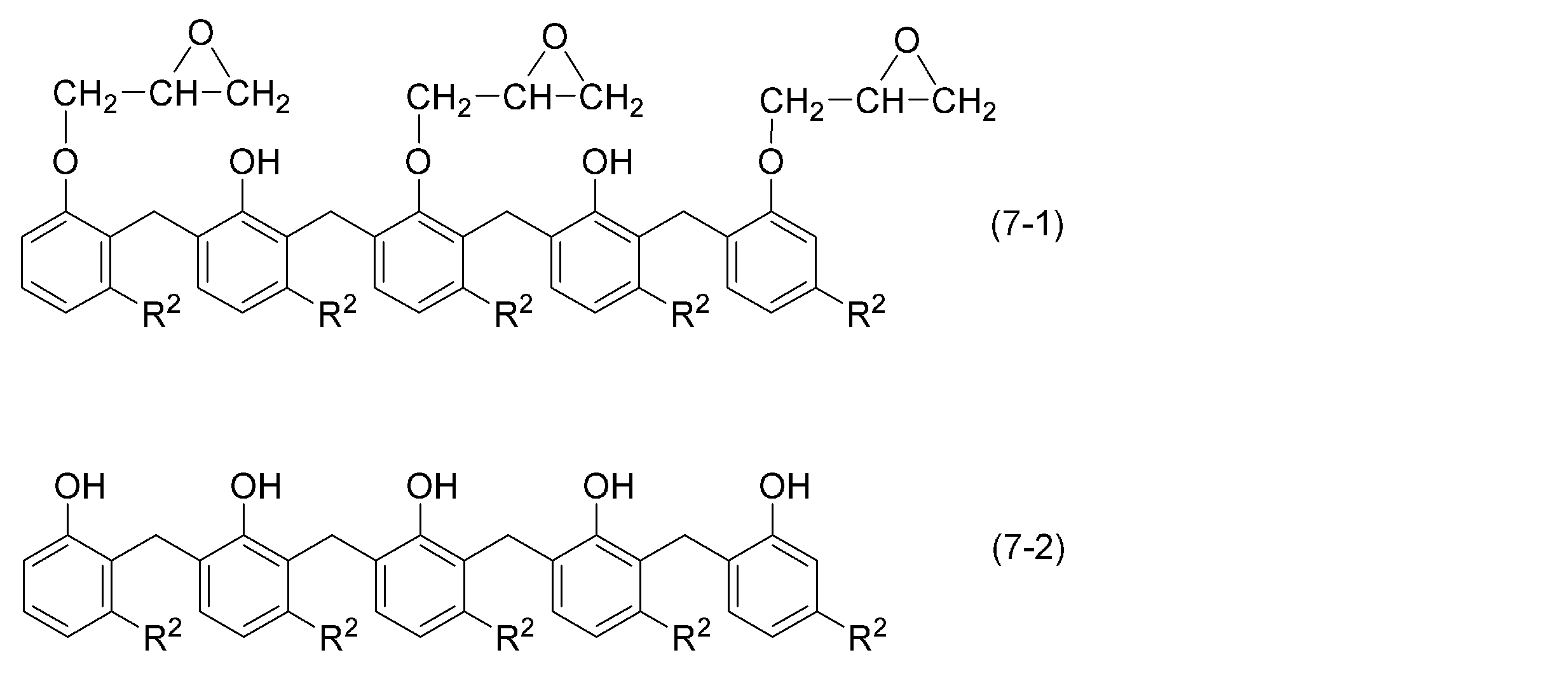
上記一般式(7-1)及び(7-2)において、各R2はそれぞれ独立に不飽和結合を0~3個含む、炭素数15~18の脂肪族炭化水素基である。
特定液体成分は、非可食油脂又はその変性物であることが好ましい。ここでいう非可食油脂とは、食用でない油脂全般を指すものである。なお、sp値が9.0(cal/cm3)1/2未満の非可食油脂であっても、その油脂に対してエポキシ化等の化学変性を加えた結果、その変性物のsp値が9.0(cal/cm3)1/2以上となるならば、その変性物は本発明における特定液体成分として扱う。
これら特定液体成分の中でも、ヒマシ油、ヤシ油、エポキシ化植物油、カシューナッツシェルオイル、及びカシューナッツシェルオイルの変性物からなる群より選択される少なくとも1種が好ましく挙げられる。
既に述べたように、特定液体成分のsp値は、9.0(cal/cm3)1/2以上11.0(cal/cm3)1/2未満である。後述する特定樹脂と特定液体成分とのより良い相溶性を得るとの観点からは、特定液体成分は、sp値9.0(cal/cm3)1/2以上10.0(cal/cm3)1/2以下の動植物油由来の油脂及びその変性物、並びにカシューナッツシェルオイル及びその変性物からなる群より選択される少なくとも1種であることが好ましい。後述する特定樹脂のsp値は、8.0~9.0(cal/cm3)1/2程度のものが多い点から、上記のように、特定液体成分のsp値の上限は、カシューナッツシェルオイルを除いて9.0(cal/cm3)1/2程度が好ましい。カシューナッツシェルオイルは、10.0(cal/cm3)1/2以上のsp値を備えるが、例外的に、sp値が低い特定樹脂に対しても高い特定樹脂に対しても相溶する。その理由は必ずしも明らかでないが、カシューナッツシェルオイルは、長鎖アルキル基又はアルケニル基を備えたフェノール化合物を含み、この長鎖アルキル基によりsp値の低い樹脂と相溶することができ、フェノール骨格によりsp値の高い樹脂とも相溶することができるためと考えられる。
[特定樹脂]
特定樹脂は、ロジン変性フェノール樹脂、ロジン変性マレイン酸樹脂、ロジン変性アルキッド樹脂、ギルソナイト樹脂及びアスファルト樹脂からなる群より選択される少なくとも1種である。これらの樹脂は、オフセットインキ組成物等の従来型のインキ組成物には広く用いられてきたものであるが、モノマーやオリゴマーとの相溶性が悪く、活性エネルギー線硬化型のインキ組成物には採用の難しい材料だった。本発明では、この特定樹脂と特定液体成分とを組み合わせることで、モノマーやオリゴマーと良好に相溶するワニスを調製できるとの知見から完成されたことは、既に述べたとおりである。例えば、ロジン変性フェノール樹脂やロジン変性マレイン酸樹脂では、それらを構成するロジンがバイオマス由来の成分となるし、ロジン変性アルキッド樹脂では、ロジンに加えて長鎖脂肪酸もバイオマス由来の成分となる。このため、本発明のインキ組成物は、高いバイオマス含有量を有するものとなる。
特定樹脂は、ロジン変性フェノール樹脂、ロジン変性マレイン酸樹脂、ロジン変性アルキッド樹脂、ギルソナイト樹脂及びアスファルト樹脂からなる群より選択される少なくとも1種である。これらの樹脂は、オフセットインキ組成物等の従来型のインキ組成物には広く用いられてきたものであるが、モノマーやオリゴマーとの相溶性が悪く、活性エネルギー線硬化型のインキ組成物には採用の難しい材料だった。本発明では、この特定樹脂と特定液体成分とを組み合わせることで、モノマーやオリゴマーと良好に相溶するワニスを調製できるとの知見から完成されたことは、既に述べたとおりである。例えば、ロジン変性フェノール樹脂やロジン変性マレイン酸樹脂では、それらを構成するロジンがバイオマス由来の成分となるし、ロジン変性アルキッド樹脂では、ロジンに加えて長鎖脂肪酸もバイオマス由来の成分となる。このため、本発明のインキ組成物は、高いバイオマス含有量を有するものとなる。
ロジン変性フェノール樹脂、ロジン変性マレイン酸樹脂、ロジン変性アルキッド樹脂、ギルソナイト樹脂及びアスファルト樹脂は、いずれも市販されており、容易に入手することが可能である。これらの樹脂として、市販のものを用いてもよいし、公知の手段で合成したものを用いてもよい。これらの中でも、ロジン変性フェノール樹脂が好ましく用いられる。
特定樹脂のsp値としては、8.0(cal/cm3)1/2以上9.0(cal/cm3)1/2以下を好ましく挙げることができる。特定樹脂のsp値がこれらの範囲であることにより、特定液体成分との良好な相溶性が得られるので好ましい。
インキ組成物中の特定樹脂の含有量としては、5質量%~30質量%程度を好ましく挙げることができる。
特定樹脂は、特定液体成分中で100~250℃程度に加温されることにより溶解してワニスとされる。特定樹脂は、こうしてワニスとされた状態でモノマーやオリゴマー等の成分と混合され、インキ組成物の調製に用いられる。
[光重合開始剤]
光重合開始剤は、紫外線の照射を受けてラジカルを発生させる成分であり、生じたラジカルが上記エチレン性不飽和結合を備えた化合物を重合させ、インキ組成物を硬化させる。光重合開始剤としては、活性エネルギー線が照射された際にラジカルを生じさせるものであれば特に限定されない。なお、上記のように、電子線を活性エネルギー線として用いて本発明のインキ組成物を硬化させる場合には、本発明のインキ組成物に光重合開始剤を添加しなくともよい。
光重合開始剤は、紫外線の照射を受けてラジカルを発生させる成分であり、生じたラジカルが上記エチレン性不飽和結合を備えた化合物を重合させ、インキ組成物を硬化させる。光重合開始剤としては、活性エネルギー線が照射された際にラジカルを生じさせるものであれば特に限定されない。なお、上記のように、電子線を活性エネルギー線として用いて本発明のインキ組成物を硬化させる場合には、本発明のインキ組成物に光重合開始剤を添加しなくともよい。
光重合開始剤としては、ベンゾフェノン、ジエチルチオキサントン、2-メチル-1-(4-メチルチオ)フェニル-2-モルフォリノプロパン-1-オン、4-ベンゾイル-4’-メチルジフェニルサルファイド、1-クロロ-4-プロポキシチオキサントン、イソプロピルチオキサントン、2-ヒドロキシ-2-メチル-1-フェニルプロパン-1-オン、1-ヒドロキシシクロヘキシルフェニルケトン、ビス-2,6-ジメトキシベンゾイル-2,4,4-トリメチルペンチルフォスフィンオキサイド、1-[4-(2-ヒドロキシエトキシ)-フェニル]-2-ヒドロキシ-2-メチル-1-プロパン-1-オン、2,2-ジメチル-2-ヒドロキシアセトフェノン、2,2-ジメトキシ-2-フェニルアセトフェノン、2,4,6-トリメチルベンジル-ジフェニルフォスフィンオキサイド、2-ベンジル-2-ジメチルアミノ-1-(モルホリノフェニル)-ブタン-1-オン等が挙げられる。このような光重合開始剤は市販されており、例えばBASF社からイルガキュア907、イルガキュア369、イルガキュア184、イルガキュア379、イルガキュア819、TPO等の商品名で、Lamberti社からDETX等の商品名で入手することができる。これらの光重合開始剤は、単独で又は2種以上を組み合わせて用いることができる。
インキ組成物中における光重合開始剤の含有量としては、3~30質量%が好ましく挙げられ、2~15質量%がより好ましく挙げられ、2~13質量%がさらに好ましく挙げられる。インキ組成物中における光重合開始剤の含有量が上記の範囲であることにより、インキ組成物の十分な硬化性と、良好な内部硬化性やコストとを両立できるので好ましい。
[着色成分]
着色成分としては、ジスアゾイエロー(ピグメントイエロー12、ピグメントイエロー13、ピグメントイエロー14、ピグメントイエロー17、ピグメントイエロー1)、ハンザイエロー等のイエロー顔料、ブリリアントカーミン6B、レーキレッドC、ウオッチングレッド等のマゼンタ顔料、フタロシアニンブルー、フタロシアニングリーン、アルカリブルー等のシアン顔料、カーボンブラック等の黒色顔料、酸化チタン等の白色顔料、アルミニウムペースト、ブロンズパウダー等の金属パウダー等が例示される。
着色成分としては、ジスアゾイエロー(ピグメントイエロー12、ピグメントイエロー13、ピグメントイエロー14、ピグメントイエロー17、ピグメントイエロー1)、ハンザイエロー等のイエロー顔料、ブリリアントカーミン6B、レーキレッドC、ウオッチングレッド等のマゼンタ顔料、フタロシアニンブルー、フタロシアニングリーン、アルカリブルー等のシアン顔料、カーボンブラック等の黒色顔料、酸化チタン等の白色顔料、アルミニウムペースト、ブロンズパウダー等の金属パウダー等が例示される。
着色成分の含有量としては、インキ組成物の全体に対して1~30質量%程度が例示されるが、特に限定されない。なお、着色されたインキ組成物を調製する場合、補色として他の色の着色成分を併用したり、他の色のインキ組成物を添加したりすることも可能である。
[その他の成分]
本発明のインキ組成物には、上記の各成分に加えて、必要に応じて他の成分を添加することができる。そのような成分としては、体質顔料、重合禁止剤、分散剤、リン酸塩等の塩類、ポリエチレン系ワックス・オレフィン系ワックス・フィッシャートロプシュワックス等のワックス類、アルコール類等が挙げられる。
本発明のインキ組成物には、上記の各成分に加えて、必要に応じて他の成分を添加することができる。そのような成分としては、体質顔料、重合禁止剤、分散剤、リン酸塩等の塩類、ポリエチレン系ワックス・オレフィン系ワックス・フィッシャートロプシュワックス等のワックス類、アルコール類等が挙げられる。
体質顔料は、インキ組成物に適度な印刷適性や粘弾性等の特性を付与するための成分であり、インキ組成物の調製において通常用いられる各種のものを用いることができる。このような体質顔料としては、クレー、カオリナイト(カオリン)、硫酸バリウム、硫酸マグネシウム、炭酸カルシウム、酸化ケイ素(シリカ)、ベントナイト、タルク、マイカ、酸化チタン等が例示される。こうした体質顔料の添加量としては、インキ組成物全体に対して0~33質量%程度が例示されるが、特に限定されない。
重合禁止剤としては、ブチルヒドロキシトルエン等のフェノール化合物や、酢酸トコフェロール、ニトロソアミン、ベンゾトリアゾール、ヒンダードアミン等を好ましく例示することができ、中でもブチルヒドロキシトルエンをより好ましく例示することができる。インキ組成物にこのような重合禁止剤が添加されることにより、保存時に重合反応が進行してインキ組成物が増粘するのを抑制できる。インキ組成物中の重合禁止剤の含有量としては、0.01~1質量%程度を例示することができる。
分散剤は、インキ組成物中に含まれる着色成分や体質顔料を良好な状態に分散させるために用いられる。このような分散剤は、各種のものが市販されており、例えばビックケミー・ジャパン株式会社製のDISPERBYK(商品名)シリーズ等を挙げることができる。
上記の各成分を用いて本発明のインキ組成物を製造するには、従来公知の方法を適用できる。このような方法としては、上記の各成分を混合した後にビーズミルや三本ロールミル等で練肉して顔料(すなわち着色成分及び体質顔料)を分散させた後、必要に応じて添加剤(重合禁止剤、アルコール類、ワックス類等)を加え、さらに上記モノマー成分や油成分の添加により粘度調整することが例示される。インキ組成物における粘度としては、ラレー粘度計による25℃での値が10~70Pa・sであることを例示できるが、特に限定されない。
<活性エネルギー線硬化型インキ組成物の調製方法>
上記活性エネルギー線硬化型インキ組成物の調製方法もまた、本発明の一つである。本発明のインキ組成物の製造方法は、エチレン性不飽和結合を備えた化合物、特定樹脂、特定液体成分、及び光重合開始剤を含む活性エネルギー線硬化型インキ組成物の製造方法であって、上記特定樹脂が、ロジン変性フェノール樹脂、ロジン変性マレイン酸樹脂、ロジン変性アルキッド樹脂、ギルソナイト樹脂及びアスファルト樹脂からなる群より選択される少なくとも1種であり、上記特定液体成分が、エチレン性不飽和結合を持たず、濁点滴定法による溶解性パラメータsp値が9.0(cal/cm3)1/2以上11.0(cal/cm3)1/2未満の動植物由来の油脂又はその変性物であって、加温された上記特定液体成分に上記特定樹脂を溶解させてワニスを調製する工程を備えることを特徴とする。これらの内容のうち、上記インキ組成物にて既に説明したものについてはその説明を省略し、これらと異なる部分を中心に説明する。
上記活性エネルギー線硬化型インキ組成物の調製方法もまた、本発明の一つである。本発明のインキ組成物の製造方法は、エチレン性不飽和結合を備えた化合物、特定樹脂、特定液体成分、及び光重合開始剤を含む活性エネルギー線硬化型インキ組成物の製造方法であって、上記特定樹脂が、ロジン変性フェノール樹脂、ロジン変性マレイン酸樹脂、ロジン変性アルキッド樹脂、ギルソナイト樹脂及びアスファルト樹脂からなる群より選択される少なくとも1種であり、上記特定液体成分が、エチレン性不飽和結合を持たず、濁点滴定法による溶解性パラメータsp値が9.0(cal/cm3)1/2以上11.0(cal/cm3)1/2未満の動植物由来の油脂又はその変性物であって、加温された上記特定液体成分に上記特定樹脂を溶解させてワニスを調製する工程を備えることを特徴とする。これらの内容のうち、上記インキ組成物にて既に説明したものについてはその説明を省略し、これらと異なる部分を中心に説明する。
本発明の製造方法は、加温された特定液体成分に特定樹脂を溶解させてワニスを調製する工程を備えることを特徴とする。特定液体成分及び特定樹脂については既に説明した通りである。
特定液体成分に特定樹脂を溶解させてワニスを調製するには、特定液体成分に固形の特定樹脂を加え、これらを100~250℃程度に加温しながら撹拌すればよい。溶解時間としては30~60分程度を挙げることができるが特に限定されず、溶解状態を観察しながら溶解時間を適宜調節すればよい。
ワニスを調製する際、特定樹脂と特定液体成分との混合比としては、質量比(特定樹脂:特定液体成分)で20:80~40:60程度を提示できるが、特に限定されない。
調製されたワニスと、既に説明した各種の成分とを混合及び混練することでインキ組成物が調製される。インキ組成物中におけるワニスの含有量としては、20~70質量%程度が好ましく挙げられ、20~60質量%程度がより好ましく挙げられ、20~50質量%程度がさらに好ましく挙げられる。
<印刷物の製造方法>
上記本発明の活性エネルギー線硬化型インキ組成物を用いて印刷を行うことを特徴とする印刷物の製造方法も本発明の一つである。本発明の印刷物の製造方法は、本発明のインキ組成物を用いることを除いて、通常の印刷技術を用いて実施されるものである。このような印刷技術としては、オフセット印刷や樹脂凸版印刷等を好ましく挙げることができる。なお、樹脂凸版印刷を用いる場合の印刷対象の例としては、既に述べた通りである。
上記本発明の活性エネルギー線硬化型インキ組成物を用いて印刷を行うことを特徴とする印刷物の製造方法も本発明の一つである。本発明の印刷物の製造方法は、本発明のインキ組成物を用いることを除いて、通常の印刷技術を用いて実施されるものである。このような印刷技術としては、オフセット印刷や樹脂凸版印刷等を好ましく挙げることができる。なお、樹脂凸版印刷を用いる場合の印刷対象の例としては、既に述べた通りである。
印刷により作製された未乾燥状態の印刷物に対して活性エネルギー線の照射を行うことにより、未乾燥状態の印刷物は瞬時に乾燥状態となる。これは、印刷用紙の表面に存在するインキ組成物が、活性エネルギー線の照射により硬化することで実現される。活性エネルギー線としては、電子線や紫外線等公知のものを採用することができる。
以下、実施例を示すことにより本発明をさらに具体的に説明するが、本発明は以下の実施例に何ら限定されるものではない。なお、以下の記載では、特に断りのない限り、「%」は「質量%」を意味し、「部」は質量部を意味する。また、sp値の単位は、(cal/cm3)1/2である。
[ワニス1の調製]
ロジン変性フェノール樹脂(sp値8.83)40質量部、及びエポキシ化大豆油60質量部の混合物を200℃で60分間加熱することで溶解させ、ワニス1を得た。
ロジン変性フェノール樹脂(sp値8.83)40質量部、及びエポキシ化大豆油60質量部の混合物を200℃で60分間加熱することで溶解させ、ワニス1を得た。
[ワニス2の調製]
エポキシ化大豆油に代えてヒマシ油を用いたこと以外は、ワニス1と同様の手順でワニス2を得た。
エポキシ化大豆油に代えてヒマシ油を用いたこと以外は、ワニス1と同様の手順でワニス2を得た。
[ワニス3の調製]
エポキシ化大豆油に代えてトリメチロールプロパントリアクリレート(TMPTA)を用いたこと以外は、ワニス1と同様の手順でワニス3を調製したが、ワニス3中において樹脂は溶解していなかった。
エポキシ化大豆油に代えてトリメチロールプロパントリアクリレート(TMPTA)を用いたこと以外は、ワニス1と同様の手順でワニス3を調製したが、ワニス3中において樹脂は溶解していなかった。
[ワニス4の調製]
エポキシ化大豆油に代えて大豆油を用いたこと以外は、ワニス1と同様の手順でワニス5を得た。
エポキシ化大豆油に代えて大豆油を用いたこと以外は、ワニス1と同様の手順でワニス5を得た。
[ワニス5の調製]
ポリジアリルフタレート(株式会社大阪ソーダ製、A-DAP)40質量部、TMPTA 60質量部の混合物を100℃で60分間加熱することで溶解させ、ワニス5を得た。ワニス5は、特定樹脂を含まない、従来の活性エネルギー線硬化型インキ組成物に用いるものと同様のワニスである。
ポリジアリルフタレート(株式会社大阪ソーダ製、A-DAP)40質量部、TMPTA 60質量部の混合物を100℃で60分間加熱することで溶解させ、ワニス5を得た。ワニス5は、特定樹脂を含まない、従来の活性エネルギー線硬化型インキ組成物に用いるものと同様のワニスである。
[インキ組成物の調製]
カーボンブラック(三菱化学株式会社製、MA-70)、上述のワニス、トリメチロールプロパントリアクリレート(TMPTA)、ジトリメチロールプロパンテトラアクリレート(DI-TMPTA)、イルガキュア907(商品名、BASF社製、光重合開始剤)、イルガキュア184(商品名、BASF社製、光重合開始剤)、及びポリエチレンワックスの各成分を表1に記載した配合量で混合した後、三本ロールミルで混練することにより、実施例1~2、比較例1、及び参考例1の各インキ組成物を調製した。なお、本発明の特定液体成分を用いたものでないワニス3は、上記のように樹脂が溶解しなかったので、インキ組成物の調製には用いなかった。
カーボンブラック(三菱化学株式会社製、MA-70)、上述のワニス、トリメチロールプロパントリアクリレート(TMPTA)、ジトリメチロールプロパンテトラアクリレート(DI-TMPTA)、イルガキュア907(商品名、BASF社製、光重合開始剤)、イルガキュア184(商品名、BASF社製、光重合開始剤)、及びポリエチレンワックスの各成分を表1に記載した配合量で混合した後、三本ロールミルで混練することにより、実施例1~2、比較例1、及び参考例1の各インキ組成物を調製した。なお、本発明の特定液体成分を用いたものでないワニス3は、上記のように樹脂が溶解しなかったので、インキ組成物の調製には用いなかった。
[光沢の評価]
実施例、比較例及び参考例の各インキ組成物のそれぞれについて、インキ組成物0.1ccを、RI展色機(2分割ロール、株式会社明製作所製)を用いて塗工紙(日本製紙株式会社製、オーロラコート)に展色した後に、40mJ/cm2の紫外線を照射して硬化させ、硬化直後の濃度をSpectroeye濃度計(Gretagmacbeth社製)により測定し、その濃度が1.50になるように調整した。次いで、村上式デジタル光沢計(村上色彩研究所製)を用いて展色面の60°反射光沢値を求めた。その結果を表1の光沢値欄に記載した。なお、インキ組成物の相溶性が悪く、インキ組成物中に析出物を生じていたものについては、各評価欄に評価不能と記載した。
実施例、比較例及び参考例の各インキ組成物のそれぞれについて、インキ組成物0.1ccを、RI展色機(2分割ロール、株式会社明製作所製)を用いて塗工紙(日本製紙株式会社製、オーロラコート)に展色した後に、40mJ/cm2の紫外線を照射して硬化させ、硬化直後の濃度をSpectroeye濃度計(Gretagmacbeth社製)により測定し、その濃度が1.50になるように調整した。次いで、村上式デジタル光沢計(村上色彩研究所製)を用いて展色面の60°反射光沢値を求めた。その結果を表1の光沢値欄に記載した。なお、インキ組成物の相溶性が悪く、インキ組成物中に析出物を生じていたものについては、各評価欄に評価不能と記載した。
[硬化性の評価]
実施例、比較例及び参考例の各インキ組成物のそれぞれについて、硬化性試験を行った。まず、インキ組成物の試料0.1ccをとりRI展色機(2分割ロール、株式会社明製作所製)を用いて塗工紙(日本製紙株式会社製、オーロラコート)に展色し、直ちに紫外線照射(メタルハライドランプ、照射量:36mJ/cm2)を行って展色されたインキ組成物を硬化皮膜とした。これを室温で1分間放置した後、硬化皮膜(すなわち印刷面)の表面を学振型耐摩擦堅牢度試験機(荷重1kg、あて紙:上質紙)で10回擦った。擦った後における印刷面の状態を目視で観察し、下記の基準にて評価した。その評価結果を表1の「硬化性」欄に示す。
◎:印刷面に全く傷がなく、きわめて良好
○:印刷面にわずかなかすり傷が観察されるが、実用上の問題はない
△:印刷面に目立つ傷が観察される
×:印刷面に皮膜の剥離が観察される
実施例、比較例及び参考例の各インキ組成物のそれぞれについて、硬化性試験を行った。まず、インキ組成物の試料0.1ccをとりRI展色機(2分割ロール、株式会社明製作所製)を用いて塗工紙(日本製紙株式会社製、オーロラコート)に展色し、直ちに紫外線照射(メタルハライドランプ、照射量:36mJ/cm2)を行って展色されたインキ組成物を硬化皮膜とした。これを室温で1分間放置した後、硬化皮膜(すなわち印刷面)の表面を学振型耐摩擦堅牢度試験機(荷重1kg、あて紙:上質紙)で10回擦った。擦った後における印刷面の状態を目視で観察し、下記の基準にて評価した。その評価結果を表1の「硬化性」欄に示す。
◎:印刷面に全く傷がなく、きわめて良好
○:印刷面にわずかなかすり傷が観察されるが、実用上の問題はない
△:印刷面に目立つ傷が観察される
×:印刷面に皮膜の剥離が観察される
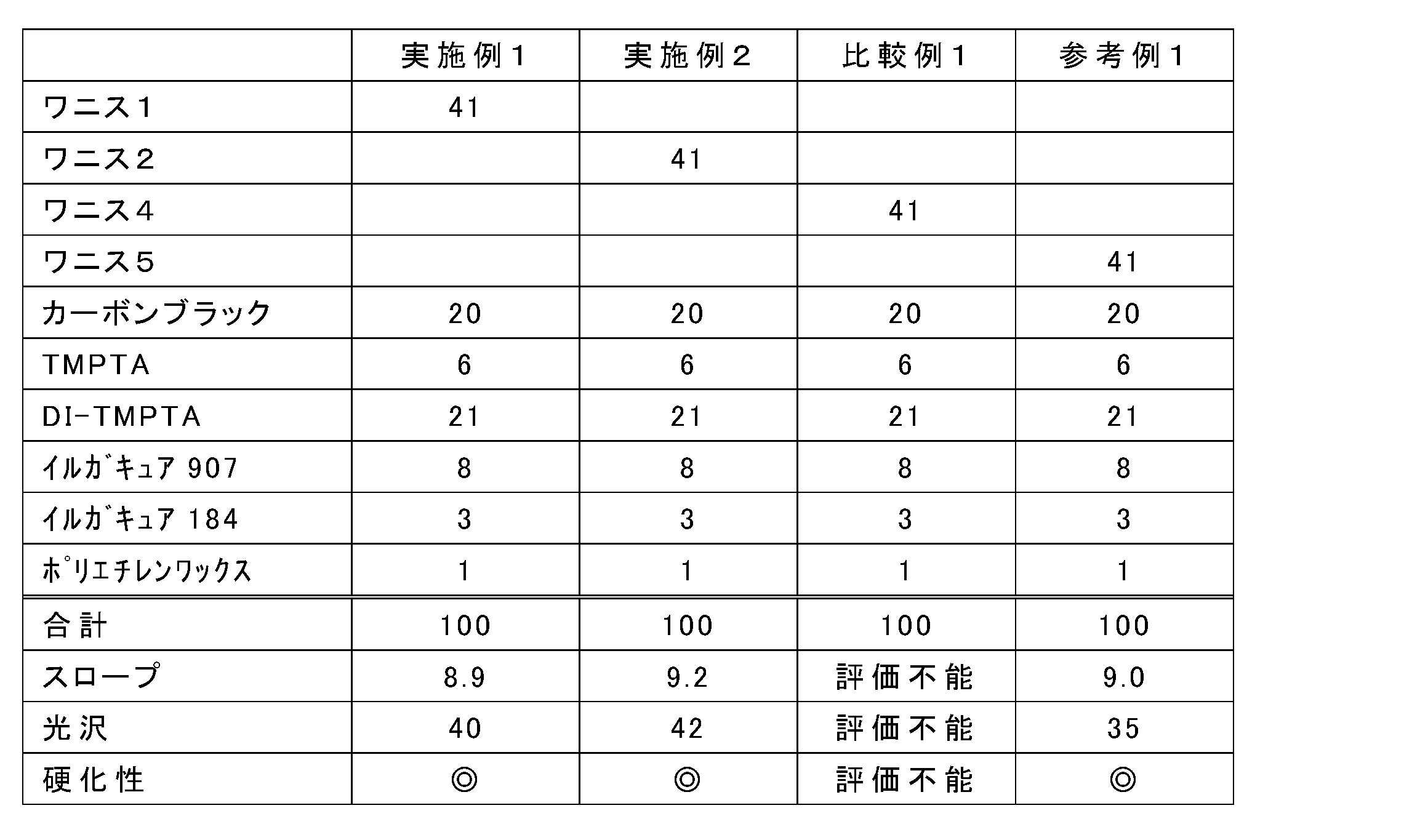
表1に示すように、本発明のインキ組成物は、ロジン変性フェノールを用いたものにもかかわらず、通常の活性エネルギー線硬化型インキ組成物(参考例1)と同様の相溶性を示し、それよりも良好な光沢を示した。このことから、従来、活性エネルギー線硬化型インキ組成物にて使用の困難だった特定樹脂が、特定液体成分と組み合わせることで使用可能になることがわかる。
Claims (8)
- エチレン性不飽和結合を備えた化合物、特定樹脂、及び特定液体成分を含む活性エネルギー線硬化型インキ組成物であって、
前記特定樹脂が、ロジン変性フェノール樹脂、ロジン変性マレイン酸樹脂、ロジン変性アルキッド樹脂、ギルソナイト樹脂及びアスファルト樹脂からなる群より選択される少なくとも1種であり、
前記特定液体成分が、エチレン性不飽和結合を持たず、濁点滴定法による溶解性パラメータsp値(以下、sp値と呼ぶ。)が9.0(cal/cm3)1/2以上11.0(cal/cm3)1/2未満の動植物由来の油脂又はその変性物である活性エネルギー線硬化型インキ組成物。 - 前記特定液体成分が、sp値9.0(cal/cm3)1/2以上10.0(cal/cm3)1/2以下の動植物油由来の油脂及びその変性物、並びにカシューナッツシェルオイル及びその変性物からなる群より選択される少なくとも1種である請求項1記載の活性エネルギー線硬化型インキ組成物。
- 前記特定樹脂のsp値が、8.0(cal/cm3)1/2以上9.0(cal/cm3)1/2以下である請求項1又は2記載の活性エネルギー線硬化型インキ組成物。
- インキ組成物中における前記特定液体成分の含有量が10質量%以上50質量%以下である請求項1~3のいずれか1項記載の活性エネルギー線硬化型インキ組成物。
- 前記特定樹脂が、ロジン変性フェノール樹脂である請求項1~4のいずれか1項記載の活性エネルギー線硬化型インキ組成物。
- 前記特定液体成分が、ヒマシ油、ヤシ油、エポキシ化植物油、カシューナッツシェルオイル、及びカシューナッツシェルオイルの変性物からなる群より選択される少なくとも1種である請求項1~5のいずれか1項記載の活性エネルギー線硬化型インキ組成物。
- エチレン性不飽和結合を備えた化合物、特定樹脂、特定液体成分、及び光重合開始剤を含む活性エネルギー線硬化型インキ組成物の製造方法であって、
前記特定樹脂が、ロジン変性フェノール樹脂、ロジン変性マレイン酸樹脂、ロジン変性アルキッド樹脂、ギルソナイト樹脂及びアスファルト樹脂からなる群より選択される少なくとも1種であり、前記特定液体成分が、エチレン性不飽和結合を持たず、濁点滴定法による溶解性パラメータsp値(以下、sp値と呼ぶ。)が9.0(cal/cm3)1/2以上11.0(cal/cm3)1/2未満の動植物由来の油脂又はその変性物であって、
加温された前記特定液体成分に前記特定樹脂を溶解させてワニスを調製する工程を備えることを特徴とする活性エネルギー線硬化型インキ組成物の製造方法。 - 請求項1~6のいずれか1項記載の活性エネルギー線硬化型インキ組成物を用いて印刷を行う工程を含むことを特徴とする印刷物の製造方法。
Priority Applications (3)
| Application Number | Priority Date | Filing Date | Title |
|---|---|---|---|
| CN202080019644.9A CN113543982A (zh) | 2019-03-22 | 2020-02-26 | 活性能量射线固化型油墨组合物及其制造方法、以及使用其的印刷物的制造方法 |
| EP20780043.4A EP3943311A4 (en) | 2019-03-22 | 2020-02-26 | INK COMPOSITION CURABLE WITH ACTIVE ENERGY RAYS, METHOD OF PREPARING SAME, AND METHOD OF MAKING PRINTED PRODUCTS USING THE SAME |
| US17/593,541 US11932768B2 (en) | 2019-03-22 | 2020-02-26 | Active energy ray-curable ink composition, method for producing same, and method for producing printed matter in which same is used |
Applications Claiming Priority (2)
| Application Number | Priority Date | Filing Date | Title |
|---|---|---|---|
| JP2019054148A JP7281317B2 (ja) | 2019-03-22 | 2019-03-22 | 活性エネルギー線硬化型インキ組成物及びその製造方法、並びにそれを用いた印刷物の製造方法 |
| JP2019-054148 | 2019-03-22 |
Publications (1)
| Publication Number | Publication Date |
|---|---|
| WO2020195469A1 true WO2020195469A1 (ja) | 2020-10-01 |
Family
ID=72557897
Family Applications (1)
| Application Number | Title | Priority Date | Filing Date |
|---|---|---|---|
| PCT/JP2020/007614 Ceased WO2020195469A1 (ja) | 2019-03-22 | 2020-02-26 | 活性エネルギー線硬化型インキ組成物及びその製造方法、並びにそれを用いた印刷物の製造方法 |
Country Status (6)
| Country | Link |
|---|---|
| US (1) | US11932768B2 (ja) |
| EP (1) | EP3943311A4 (ja) |
| JP (1) | JP7281317B2 (ja) |
| CN (1) | CN113543982A (ja) |
| TW (1) | TWI825283B (ja) |
| WO (1) | WO2020195469A1 (ja) |
Cited By (1)
| Publication number | Priority date | Publication date | Assignee | Title |
|---|---|---|---|---|
| EP4310154A4 (en) * | 2021-03-16 | 2025-03-05 | Sakata INX Corporation | ACTINIC RADIATION-CURABLE INK COMPOSITION AND PRODUCTION METHOD THEREOF |
Citations (7)
| Publication number | Priority date | Publication date | Assignee | Title |
|---|---|---|---|---|
| JPH07138516A (ja) * | 1993-11-12 | 1995-05-30 | Dainippon Ink & Chem Inc | 印刷インキ組成物及び該印刷インキ組成物を使用した印刷方法 |
| JP2004161812A (ja) | 2002-11-11 | 2004-06-10 | Toyo Ink Mfg Co Ltd | 電子線硬化型インキ組成物及び印刷物 |
| JP2004359767A (ja) * | 2003-06-03 | 2004-12-24 | Toyo Ink Mfg Co Ltd | 活性エネルギー線硬化性乾式平版印刷インキ組成物、印刷方法およびその印刷物 |
| JP2014015572A (ja) * | 2012-07-11 | 2014-01-30 | Toyo Ink Sc Holdings Co Ltd | 活性エネルギー線硬化型インキおよび印刷物 |
| JP5477995B1 (ja) | 2013-03-12 | 2014-04-23 | サカタインクス株式会社 | 活性エネルギー線硬化型オフセット印刷インキ組成物 |
| JP2018065912A (ja) * | 2016-10-18 | 2018-04-26 | サカタインクス株式会社 | ロジン変性アルキッド樹脂及びその製造方法、並びにそれを用いたオフセット印刷用インキ組成物及びそれを用いた印刷物の製造方法 |
| JP2018115223A (ja) * | 2017-01-16 | 2018-07-26 | サカタインクス株式会社 | 活性エネルギー線硬化型オフセット印刷用インキ組成物、及びそれを用いた印刷物の製造方法 |
Family Cites Families (12)
| Publication number | Priority date | Publication date | Assignee | Title |
|---|---|---|---|---|
| US4409077A (en) * | 1977-10-25 | 1983-10-11 | Sumitomo Chemical Co., Ltd. | Ultraviolet radiation curable coating composition |
| JP3876647B2 (ja) * | 2001-05-21 | 2007-02-07 | 東洋インキ製造株式会社 | 硬化性被覆組成物、硬化性インキ、その印刷方法およびその印刷物 |
| CN100424141C (zh) * | 2002-04-30 | 2008-10-08 | 大日本油墨化学工业株式会社 | 紫外线固化性油墨及使用该油墨的印刷物 |
| JP2007045103A (ja) * | 2005-08-12 | 2007-02-22 | Toyo Ink Mfg Co Ltd | 活性エネルギー線硬化性印刷方法およびその印刷物 |
| JP5252964B2 (ja) * | 2008-03-25 | 2013-07-31 | 富士フイルム株式会社 | インク組成物、インクジェット用インク及びそれを用いたインクセット |
| US8426499B2 (en) * | 2008-03-28 | 2013-04-23 | Dic Corporation | Offset printing ink |
| JP6378720B2 (ja) * | 2016-07-26 | 2018-08-22 | ハリマ化成株式会社 | 活性エネルギー線硬化型インキ用樹脂、活性エネルギー線硬化型インキ用組成物、活性エネルギー線硬化型インキおよび硬化膜 |
| EP3594293B1 (en) * | 2017-03-07 | 2024-02-21 | Toray Industries, Inc. | Actinic-ray-curable ink for lithographic printing and method for producing printed matter using same |
| JP2018165349A (ja) * | 2017-03-29 | 2018-10-25 | 東洋インキScホールディングス株式会社 | 活性エネルギー線硬化型平版印刷インキ、および印刷物 |
| US11365324B2 (en) * | 2017-12-07 | 2022-06-21 | Sakata Inx Corporation | Active-energy-ray curable offset printing ink composition, and method for manufacturing printed matter and method for enhancing gloss of printed matter using the same |
| JP7141823B2 (ja) * | 2017-12-18 | 2022-09-26 | サカタインクス株式会社 | プラズマ硬化型オフセット印刷用インキ組成物、並びにそれを用いた印刷物の製造方法及び印刷方法 |
| JP7207996B2 (ja) * | 2018-12-27 | 2023-01-18 | サカタインクス株式会社 | 活性エネルギー線硬化型組成物 |
-
2019
- 2019-03-22 JP JP2019054148A patent/JP7281317B2/ja active Active
-
2020
- 2020-02-26 CN CN202080019644.9A patent/CN113543982A/zh active Pending
- 2020-02-26 US US17/593,541 patent/US11932768B2/en active Active
- 2020-02-26 EP EP20780043.4A patent/EP3943311A4/en active Pending
- 2020-02-26 WO PCT/JP2020/007614 patent/WO2020195469A1/ja not_active Ceased
- 2020-03-09 TW TW109107603A patent/TWI825283B/zh active
Patent Citations (7)
| Publication number | Priority date | Publication date | Assignee | Title |
|---|---|---|---|---|
| JPH07138516A (ja) * | 1993-11-12 | 1995-05-30 | Dainippon Ink & Chem Inc | 印刷インキ組成物及び該印刷インキ組成物を使用した印刷方法 |
| JP2004161812A (ja) | 2002-11-11 | 2004-06-10 | Toyo Ink Mfg Co Ltd | 電子線硬化型インキ組成物及び印刷物 |
| JP2004359767A (ja) * | 2003-06-03 | 2004-12-24 | Toyo Ink Mfg Co Ltd | 活性エネルギー線硬化性乾式平版印刷インキ組成物、印刷方法およびその印刷物 |
| JP2014015572A (ja) * | 2012-07-11 | 2014-01-30 | Toyo Ink Sc Holdings Co Ltd | 活性エネルギー線硬化型インキおよび印刷物 |
| JP5477995B1 (ja) | 2013-03-12 | 2014-04-23 | サカタインクス株式会社 | 活性エネルギー線硬化型オフセット印刷インキ組成物 |
| JP2018065912A (ja) * | 2016-10-18 | 2018-04-26 | サカタインクス株式会社 | ロジン変性アルキッド樹脂及びその製造方法、並びにそれを用いたオフセット印刷用インキ組成物及びそれを用いた印刷物の製造方法 |
| JP2018115223A (ja) * | 2017-01-16 | 2018-07-26 | サカタインクス株式会社 | 活性エネルギー線硬化型オフセット印刷用インキ組成物、及びそれを用いた印刷物の製造方法 |
Non-Patent Citations (2)
| Title |
|---|
| K. W. SUHJ. M. CORBETT, J. APPL. POLYM. SCI., vol. 12, 1968, pages 2359 |
| See also references of EP3943311A4 |
Cited By (1)
| Publication number | Priority date | Publication date | Assignee | Title |
|---|---|---|---|---|
| EP4310154A4 (en) * | 2021-03-16 | 2025-03-05 | Sakata INX Corporation | ACTINIC RADIATION-CURABLE INK COMPOSITION AND PRODUCTION METHOD THEREOF |
Also Published As
| Publication number | Publication date |
|---|---|
| JP2020152850A (ja) | 2020-09-24 |
| EP3943311A4 (en) | 2022-12-14 |
| US20220169871A1 (en) | 2022-06-02 |
| TW202100674A (zh) | 2021-01-01 |
| TWI825283B (zh) | 2023-12-11 |
| US11932768B2 (en) | 2024-03-19 |
| JP7281317B2 (ja) | 2023-05-25 |
| CN113543982A (zh) | 2021-10-22 |
| EP3943311A1 (en) | 2022-01-26 |
Similar Documents
| Publication | Publication Date | Title |
|---|---|---|
| JP6889560B2 (ja) | 活性エネルギー線硬化型オフセット印刷用インキ組成物、及びそれを用いた印刷物の製造方法 | |
| CN112384576B (zh) | 活性能量射线固化型胶版印刷用油墨组合物、以及使用了该油墨组合物的印刷物的制造方法 | |
| JP7404086B2 (ja) | ポリエステル樹脂、オフセット印刷用インキ組成物、印刷物、および印刷物の製造方法 | |
| JP7288859B2 (ja) | 活性エネルギー線硬化型オフセット印刷用インキ組成物、並びにそれを用いた印刷物の製造方法及び印刷物の光沢を向上させる方法 | |
| US9150742B2 (en) | Linear polyester resins and improved lithographic inks | |
| EP3822324B1 (en) | Active energy ray-curable ink composition for offset printing, and method for producing printed matter using same | |
| JP7292891B2 (ja) | 活性エネルギー線硬化型インキ組成物、及びそれを用いた印刷物の製造方法 | |
| WO2020202918A1 (ja) | 活性エネルギー線硬化型ニス組成物及びその製造方法、並びにそれを用いた印刷物の製造方法 | |
| JP7281317B2 (ja) | 活性エネルギー線硬化型インキ組成物及びその製造方法、並びにそれを用いた印刷物の製造方法 | |
| JP2018090718A (ja) | 活性エネルギー線硬化型オフセット印刷用インキ組成物 | |
| JP7073027B1 (ja) | 活性エネルギー線硬化型インキ組成物及びその製造方法 | |
| JP2023062638A (ja) | 活性エネルギー線硬化型インキ組成物及びその製造方法、並びに活性エネルギー線硬化型インキ組成物調製用のワニス | |
| JP7059428B1 (ja) | 活性エネルギー線硬化型インキ組成物及びその製造方法、並びにそれに適したエポキシ化油脂アクリレート及びその製造方法 | |
| JP2025033222A (ja) | 活性エネルギー線硬化型インキ組成物、及び活性エネルギー線硬化型インキ組成物の製造方法、並びに、これを用いた印刷方法、及び印刷物 | |
| WO2022024512A1 (ja) | 活性エネルギー線硬化型オフセット印刷用インキ組成物 |
Legal Events
| Date | Code | Title | Description |
|---|---|---|---|
| 121 | Ep: the epo has been informed by wipo that ep was designated in this application |
Ref document number: 20780043 Country of ref document: EP Kind code of ref document: A1 |
|
| NENP | Non-entry into the national phase |
Ref country code: DE |
|
| WWE | Wipo information: entry into national phase |
Ref document number: 2020780043 Country of ref document: EP |